Ontdek de Fascinerende Wereld van UFO's en UAP's: Jouw Bron voor Onthullende Informatie!
Ben jij ook gefascineerd door het onbekende? Wil je meer weten over UFO's en UAP's, niet alleen in België, maar over de hele wereld? Dan ben je op de juiste plek!
België: Het Kloppend Hart van UFO-onderzoek
In België is BUFON (Belgisch UFO-Netwerk) dé autoriteit op het gebied van UFO-onderzoek. Voor betrouwbare en objectieve informatie over deze intrigerende fenomenen, bezoek je zeker onze Facebook-pagina en deze blog. Maar dat is nog niet alles! Ontdek ook het Belgisch UFO-meldpunt en Caelestia, twee organisaties die diepgaand onderzoek verrichten, al zijn ze soms kritisch of sceptisch.
Nederland: Een Schat aan Informatie
Voor onze Nederlandse buren is er de schitterende website www.ufowijzer.nl, beheerd door Paul Harmans. Deze site biedt een schat aan informatie en artikelen die je niet wilt missen!
Internationaal: MUFON - De Wereldwijde Autoriteit
Neem ook een kijkje bij MUFON (Mutual UFO Network Inc.), een gerenommeerde Amerikaanse UFO-vereniging met afdelingen in de VS en wereldwijd. MUFON is toegewijd aan de wetenschappelijke en analytische studie van het UFO-fenomeen, en hun maandelijkse tijdschrift, The MUFON UFO-Journal, is een must-read voor elke UFO-enthousiasteling. Bezoek hun website op www.mufon.com voor meer informatie.
Samenwerking en Toekomstvisie
Sinds 1 februari 2020 is Pieter niet alleen ex-president van BUFON, maar ook de voormalige nationale directeur van MUFON in Vlaanderen en Nederland. Dit creëert een sterke samenwerking met de Franse MUFON Reseau MUFON/EUROP, wat ons in staat stelt om nog meer waardevolle inzichten te delen.
Let op: Nepprofielen en Nieuwe Groeperingen
Pas op voor een nieuwe groepering die zich ook BUFON noemt, maar geen enkele connectie heeft met onze gevestigde organisatie. Hoewel zij de naam geregistreerd hebben, kunnen ze het rijke verleden en de expertise van onze groep niet evenaren. We wensen hen veel succes, maar we blijven de autoriteit in UFO-onderzoek!
Blijf Op De Hoogte!
Wil jij de laatste nieuwtjes over UFO's, ruimtevaart, archeologie, en meer? Volg ons dan en duik samen met ons in de fascinerende wereld van het onbekende! Sluit je aan bij de gemeenschap van nieuwsgierige geesten die net als jij verlangen naar antwoorden en avonturen in de sterren!
Heb je vragen of wil je meer weten? Aarzel dan niet om contact met ons op te nemen! Samen ontrafelen we het mysterie van de lucht en daarbuiten.
Glowing Red UFO Recorded Over Denmark May Be Secret Military Craft, Jan 2019, Video, UFO Sighting News.
Date of sighting: January 2019
Location of sighting: Denmark
This is some short footage of a glowing red object shooting over Denmark at high speed. I thought this might be a meteor, but there was no tail and the color stayed red where most meteors are whitish in color. Also this seems to be traveling at 1/4 the speed of a meteor, so its possible this is a UFO, but also possible its a military craft being tested in Denmark by the USA. The United States still maintains nearly 800 military bases in more than 70 countries and territories abroad—from full out bases radar facilities. If this is an experimental craft, then its from one of those bases.
Scott C. Waring
Eyewitness states:
My friend was driving and saw something really strange in the sky. He claimed it definitely wasn`t the moon. Idk i think its a flare
UFO Captured Hovering Above The Clouds During Flight From Amsterdam to China, Video, UFO Sighting News.
Date of sighting: Sept 14, 2018
Location of sighting: Between Argentina and Amsterdam
This UFO is shaped like a cloud but has a dark black ring around its edge which clouds never do. Also the center area of the cloud is glowing from within. Aliens pride themselves on outwitting humans around every corner, and humans do not help the situation by saying...its your imagination...or its just a cloud...which falls into their metal trap perfectly. This is a beautiful disk UFO.
Scott C. Waring
Eyewitness states:
I have lived and worked in Argentina for 6 years. On September 12, 2018, my wife and I finally got on the flight from Argentina to Amsterdam. Our terminal is Fujian Xiamen Gaoqi International Airport. After a short stay at the Amsterdam International Airport, transfer to Dutch Airlines, flight number KL883, model: Boeing 787-9. I don’t know how many hours of flight, after a few sleeps and wake up, I watched the mobile phone at 09:31. I should fly to China. The mobile phone is in flight mode, I can’t access the Internet, I don’t have WIFI, I’m bored. Looking out the window, I suddenly saw a strange black cloud, yes, it was a black cloud, not a black cloud. I quickly took out my mobile phone and immediately took it.
The clouds in the impression are all white, how are there black? It is not surprising that everyone looks at this piece of cloud. The heart wants to be able to see the UFO, because it has a lot of curiosity and awe. I foresee that this trip is not normal. I asked my wife next to me to look outside. She said coldly that it was normal. Clouds are like this. I can only say that women are women. So I held the mentality of trying it out and continued to look out the window to see if I could find something. I watched it for ten minutes and found nothing, so I went to Xiaomi again.
After almost an hour, I suddenly felt something strange, and looked out of the window. There was a disc-like UFO in the distance. At first glance, it looked like a cigar, and immediately pulled out the phone and was nervous. Excited, I was afraid to miss the "first intimate contact" between me and UFO. Too excited, the first focus lens was not photographed. I immediately pulled the phone and pulled it into the lens again. I finally photographed it. Silver-gray discs, there seem to be two layers above and below, in a static state, I don’t know what they are doing, I don’t know if anyone is seeing it, I don’t know if the captains have seen it, I’m excited to call my wife. Looking at this UFO, she still gave me a sentence, isn't it a cloud, as excited as it is, it is your hallucination. I am speechless, come, upload a video to everyone to see what it is, iphone 7 plus was shot on September 14th, 2018 AM 10:30.
CHIME is nothing like traditional radio telescopes
CHIME
Astronomers have detected a repeating fast radio burst (FRB) – a mysterious, ultra-brief but extremely powerful burst of energy far away in space – for only the second time in history.
FRBs were first discovered a decade ago, uber-energetic pulses of radio waves travelling through the Universe. They are brief, lasting just a few milliseconds, but carry more power than 500 million Suns. Researchers still don't know what generates these bursts – some have even dubiously speculated that they could be aliens communicating with us.
We have found dozens of such signals to date, but until now only one repeating signal was detected by the Arecibo Radio Telescope in Puerto Rico in 2012. It’s thought that this first repeater's origin may be a young, rapidly rotating and highly magnetised neutron star – extremely dense stellar objects thought to be the cores collapsed stars. But there are many different theories about the source of FRBs, including cosmic strings and evaporating black holes.
Results published in the scientific journal Nature today could herald a fresh dawn in our understanding of FRBs. Scientists used a new telescope in British Columbia, Canada, called the Canadian Hydrogen Intensity Mapping Experiment (CHIME), to spot another 13 new signals including the second repeater.
“There are still a lot of viable models [for their origin] out there, but if we can find even more FRBs, we can hope to narrow down that set in future,” says Ingrid Stairs from the University of British Columbia, part of the CHIME team.
The main goal of CHIME, which began science operations in September 2018, is to probe the expansion of the Universe using its vast radio receivers. It works differently to the traditional radio telescopes with their large dishes, such as the Parkes telescope in Australia, the Lovell telescope in Jodrell Bank near Manchester or Green Bank telescope in the US.
What if everything we know about dark matter is totally wrong?
Unlike those telescopes, CHIME has so-called “light buckets” that collect very faint signals that arrive from space. Each of its stationary four large reflectors, curved like a half-pipe, collects radio waves from the whole sky as Earth rotates, giving a large scale map of cosmic radio waves.
And CHIME has already proven extremely useful in searching for short-lived radio phenomena like FRBs, with potentially thousands more discoveries expected in the future.
Most of the FRBs detected by CHIME were at lower frequencies than expected, down to 400 MHz. This is well within CHIME’s range, meaning the telescope – which was still only in a commissioning phase when it made these discoveries – could be expected to find lots more FRBs in the future.
“We need to find many more of them, say 1,000, and we need to identify the host galaxies for a decent sample, say 20,” said says Simon Johnston from the Commonwealth Scientific and Industrial Research Organisation (CSIRO) in Australia. “The number of detections will certainly shoot up as a result of CHIME finding FRBs.”
And then there is the second repeater. Repeating FRBs are important, because they tell us their source cannot be something that destroys itself – and we can pin down their origin. That's how scientists knew that the first repeater lives in a faint dwarf galaxy more than three billion light-years away.
Astronomers still don’t know the source for the second one, though, nor what caused it. “It can’t be cataclysmic,” said Shami Chatterjee from Cornell University in the US, who was not involved in the publication of the Nature papers. “It has to be a mechanism that allows whatever it is producing to survive. You could imagine two neutron stars smashing into each other and producing an explosion and pulse of radio waves, but that would destroy the neutron stars, so you couldn’t have it repeat after that.”
What is also still unclear is whether repeating FRBs are produced in a different way to non-repeating ones – although these could perhaps also repeat if observed for long enough. Finding more FRBs will be crucial to narrowing down the answer, and thanks to CHIME we’re on the cusp of learning a great deal more.
“It’s really exciting because you can see science being done in real-time,” said Chatterjee. “It’s just a tremendously exciting time for the field.”
Nasa says bright lights over Georgia were ‘not a meteor’
Nasa says that a series of slow, bright lights seen across the southeastern United States on Monday evening “was not a meteor or fireball”.
The space agency says that from the data it currently has about the event, which was caught on camera and reported more than 150 times on the American Meteor Society website (and more “enthusiastically” on Twitter), indicates it was too slow to be a natural (and well timed) visitor from above.
Nasa says that a series of slow, bright lights seen across the southeastern United States on Monday evening "was not a meteor or fireball".
The space agency says that from the data it currently has about the event, which was caught on camera and reported more than 150 times on the American Meteor Society website (and more "enthusiastically" on Twitter), indicates it was too slow to be a natural (and well timed) visitor from above. One witness said the event was marked by, "two bright objects close together, both with long tails...gradually separated as they crossed the sky".
Instead Nasa thinks the object, which moved at about 14,500 miles per hour across the night sky at around 12.30am, was possibly the reentry of a piece of space debris.
Exactly what the debris was is not clear, however. Bill Cooke, Nasa's head of the Meteoroid Environment Office, said that the object was reported to "have multiple colours and to have broken up into multiple pieces".
Below are some of the videos captured of the event:
"It wasn't a meteor, it moved too slowly. This thing hit the atmosphere moving between 14,000 and 16,000 miles per hour," said Cooke. While that sounds fast, meteors move at 24MPH or slower... and the angle it hit the atmosphere was very shallow, that's not typical of a meteor either."
What it definitely was not, despite what legions of Twitter sky watchers had to say, was an alien spacecraft. "There are four distinct objects, a bright object ahead of the main one... and two fainter ones after that... That's typically what you see in a re-entry," he said. So no, not aliens -- but not an asteroid either. While that might have been pleasing in PR terms for the team at Asteroid Day, it's probably a good thing for the people living directly below the event.
160 UFO sightings reported in Wash. state last year
MGN image
DAVENPORT, Wash. - Some 160 UFO sightings were reported in Washington state last year - about one every 55 hours on average, according to the National UFO Reporting Center.
The center, based in Davenport, Wash., receives UFO reports from all around the world, but says it makes no claims as to the validity of the information in any of these reports.
“Obvious hoaxes have been omitted, however most reports have been posted exactly as received in the author's own words," the center says. "We hope that this information will prove to be useful to the general public and the UFO community at large.”
The center reports that Washington state has the third-highest number of total sightings in its database, behind California (No. 1) and Florida (No. 2).
The reports from the Evergreen State are diverse. Many described triangular- or cigar-shaped objects, spheres, lights, disks, fireballs and even formations of multiple objects.
The reports came from all over the state at all times of the day and night. Some sightings lasted only two or three seconds while others continued for several minutes or, in rare cases, an hour or more.
Some examples:
Oct. 24 sighting by a former pilot in University Place: "Object was spherical in shape and emitted a brilliant, extremely coherent orange glow. ... The object made zero noise. As it approached my direction it just skimmed the bottom of the cloud layers, moving through cloud material and lighting it up with the same orange color it was emitting. It sped up and slowed down erratically and quickly, moving very much as a living creature would as apposed to human aircraft or drone would. ... It was quite strange."
Dec. 7 sighting in Issaquah: "I was at a gas station taking my dog for a walk. At approx. 18:20 I saw a starfish-shaped object floating and changing shape. It was covered in small bright red colored lights. Floating quickly. It was visible for 11 seconds and quickly disappeared. It made no noise."
June 24 sighting from a passenger in a Boeing 737 near Mount St. Helens: "Altitude 23,000 ft, heading 295 degrees mag, craft descended out of clouds off left wing tip. Closed to 5 miles or so out. Held formation for appx 30 to 45 seconds then ascended at almost nose up 45 degrees into clouds in what seemed instantly. Time 8:15 Seattle time. Just east of volcano on horizon. (The report notes that the witness is a pilot and experienced aircraft mechanic of "unimpeachable integrity.")
May 26 sighting in Auburn: "Last night on an evening bike ride with my fiance, we saw objects steadily heading up into the sky. I counted 8 in all. We saw a helicopter approaching than turn away. Others on social media heard helicopters over Auburn for 3 plus hours around the same time, no one found out why."
April 2 sighting in Kittitas: "I was outside smoking, when I noticed flashing in the distance. Grabbed my cell phone to zoom in on object. I started recording the object. It would move in a circular motion. Flash red, blue, white, green. Resembled a fireball of energy bursting repeatedly. Move across the sky in a unpredictable manner. I was terrified."
Feb, 23 sighting in Wenatchee: "I noticed ... 3 lights forming a massive triangle these were moving fairly slow but perfectly in unison with each other, then right next to it there was another one and behind it another one, there were about 5 to 6 giant triangles that I saw all moving together. ... I ran inside and grabbed my camera and tried to get a picture of the formation but could only get 2 lights in the pictures I took."
Jan. 25 sighting reportedly seen by multiple witnesses in Yakima: "Three of us watched these Lights blink off and on as they did not move (in a clear sky). Then suddenly three smaller craft arrived. They showed up out of nowhere! Two moved slow to the right and one began to climb at an incredible rate higher then the other objects and it was very bright. As we watch this the largest object began to turn ... and I can see that it's disk-shaped, and it's huge! Then suddenly the area it was in seemed to magically have a cloud for it to vanish behind..it was as if it made it's own camo, and it was gone (for 13 minutes) ... and now it's back!!!!
The National UFO Reporting Center said it has recently seen a high volume of prank calls on its hotline, “typically dozens per day we suspect that the same problem may spill over to the stream of incoming written reports.”
However, it said, “there are, nevertheless, many excellent reports, submitted by anonymous parties, that deserve a reader’s attention, so an anonymous report is not necessarily unreliable.”
View all the reports from Washington state here ...
View reports from other states and countries here ...
A simulated image of the stratospheric winds over the North Pole Jan. 18, 2019, showing how the northern polar vortex has split into two major parts – one over Canada and one over Russia.
The blast of Arctic weather headed for the United States this weekend could be a first sign of still worse things to comethis winter, with signs that a circular low-pressure system of swirling winds that normally keeps frigid air locked up at the North Pole has been disrupted and split into smaller parts.
The disruption in this counterclockwise-spinning beast, called the polar vortex, is thought to be caused in part by a warm summer over the Arctic and a relatively cold fall over Siberia. The result for the United States and northern Europe? A severe winter lasting throughout February and possibly into March.
Meteorologist Judah Cohen agreed that the breaking up of the polar vortex could be the culprit for the coming storm. Cohen, the director of seasonal forecasting for the weather risk management company Atmospheric and Environmental Research (AER), based in Lexington, Massachusetts, told Live Science that the coming snowstorms in the United States this weekend are consistent with weather models that predicted severe wintry weather to come in the coming weeks. [Infographic: Earth's Atmosphere Top to Bottom]
The weather models suggested that the disruptions would follow the pattern of polar vortex disruptions seen during the northern winter last year, which resulted in freezing weather across the United States in December and January, and a severe cold snap in March over the United Kingdom.
"This pattern looks much more active, [with] more winter type storms and Arctic outbreaks — I think I would attribute it to definitely being a polar vortex disruption, because it is very consistent with what we've seen in the past," Cohen said.
Polar winds
The northern polar vortex is a fast-flowing stream of air that circles the North Pole in the upper parts of the atmosphere, known as the stratosphere, about 20 miles (32 kilometers) above the surface.
A similar polar vortex exists over the South Pole, but it is the northern polar vortex that can bring severe winter weather to the United States and Europe.
When the northern polar vortex is strong, Cohen explained, it keeps most of the air cooled by the Arctic in the polar region, resulting in mild winter temperatures in the middle latitudes of the eastern United States, and in northern Europe and Asia.
But when the polar vortex weakens, the once-trapped cold air can meander throughout the top of the Northern Hemisphere, bringing polar temperatures and extreme winter weather to lower latitudes, he said.
This diagram shows the normal activity of the northern polar vortex (left) and what happens when the polar vortex weakens.
Credit: NOAA
"Think of the polar vortex as a spinning top, and where the polar vortex goes so goes the cold air," Cohen said. "A strong polar vortex is a fast, tightly spinning top centered over the North Pole, keeping all the cold air with it close by over the Arctic. [But] a weak or perturbed polar vortex is a spinning top that has been banged or bumped into an object multiple times … the top slows down and wobbles and can meander from its location."
As for what knocked into this spinning top, Cohen points, in part, to summer warming in the Arctic region and a relatively cold fall in Siberia.
"I have argued that Arctic change has certainly been a contributor," he said. "The loss of sea ice, especially in the Barents and Kara seas, which are near Scandinavia in north-west Russia … and also an increasing trend in Siberian snow cover in October, I think that has also been contributing.
Winter weather
In recent days, weather scientists have seen the northern polar vortex split into three smaller parts, which have now changed into two giant patches of polar winds in the stratosphere — one over northern Canada and one over central Russia.
Snowstorms have been forecast today (Jan. 18) and tomorrow (Jan. 19) for the central Plains and Midwest of the United States, as part of what's being called winter storm Harper; and the winter weather is expected to hit the mid-Atlantic and Northeast of the United States later in the weekend.
But he warned that a cold snap isn't a foregone conclusion; the winter weather could still turn out to be relatively mild if the polar vortex returns to its normal configuration in the coming weeks.
"Right now, the weather looks like it is very consistent with our expectations of how the weather would transition following these type of events, but we'll see," he said. "These [weather patterns] tend to be episodic, so it doesn't come all down once … not every day will be below normal, and we will not have snow every day."
Cohen added, "[But] I think at least through the end of February, and I would think probably into early March, there will be kind of a skewing of the probabilities or the frequency of severe winter weather."
Aan het begin van dit jaar heeft hij zich in drie delen gesplitst, waarvan eentje volgens sommige modellen onze kant op komt. Als die zich nestelt in de atmosfeer boven ons land, zullen we dat geweten hebben. Alleen nu nog niet.
De wervelwinden tienduizenden meters hoog boven de Noordpool hebben zich opgebroken in drie afzonderlijke wervels. De Oostkust van de Verenigde Staten heeft daar de eerste gevolgen al van gevoeld, zo schrijft de Washington Post, en hun experten voorspellen ook voor Europa extreme koude.
De splitsing van de polaire vortex betekent immers dat de grote luchtstromen die gewoonlijk van oost naar west stromen, lichtjes verschuiven richting het noorden en zuiden. Dat betekent dat koude poollucht makkelijker richting Europa getrokken wordt.
Voorlopig lijkt het er echter niet op dat de poolwervel ons veel schade zal berokkenen. Weerman Frank Deboosere ziet de temperaturen de komende weken niet al te fel meer dalen. ‘Overdag blijven de temperaturen net boven het vriespunt, alleen ’s nachts duiken we eronder.’ In de nacht van vrijdag op zaterdag en de nacht erna kan het zelfs vriezen met temperaturen tot -7 graden.
Daarna wordt het weer wat warmer met dinsdag kans op sneeuwbuien en woensdag kans op winterse neerslag.
ASTRONAUT OF APOLLO 15 SAID THAT HUMANS ARE DESCENDANTS OF ALIENS
The astronaut and engineer Alfred Worden (or Al Worden) was a leading pilot and participated in the Apollo 15 lunar mission in 1971. He was the pilot of the Command Module of the same mission, as well as being one of the 24 people they went to the moon Who better than him to reveal the best kept secrets of space missions.
Worden also has a Guinness Record for being the “longest isolated human being” because of the long time he spent alone in the Endeavor Module Command.
While speaking to Good Morning Britain , Al Worden, the astronaut who flew around the moon 75 times, and spent six days in orbit around our satellite, was asked if he thought the aliens were real.
The answer probably surprised everyone who watched the interview.
Al Worden was an astronaut who traveled to the Moon in the Apollo 15 mission.
The former Apollo 15 member said that not only aliens are real, but they came to Earth from far away and created our civilization, and if we wanted to look for evidence, all we had to do was look at ancient Sumerian literature .
This is what Worden said:
We are the aliens, but we believe they are others. But we are the ones who came from another side, because someone else had to survive, and they got into small spaceships, they came here and they landed, and civilization started here . And if you do not believe me, go find books about the ancient Sumerians and see what they have to say. They’ll tell you from the beginning. “
It should be noted that not only ancient Sumeria has evidence of ancient space visitors, other cultures have also mentioned beings from the stars that created man and gave him a lot of knowledge. Our origin is in the sky, in the stars.
In 2017, movies like Alien: Covenantand Life pushed the banal idea that aliens, if we encounter them, will be hostile. Yawn. Far more interesting was the premise posited by Arrival, which suggested that aliens may come in peace, though we’d only know if we couldcommunicate with them. That notion may not be strictly fictional: In a Reddit AMA on Thursday, the famed theoretical physicistMichio Kaku, Ph.D., explained that the latter scenario is far more likely to play out in real life.
It was inevitable that, while Kaku was promoting his boldly titled new book The Future of Humanity, curious fans would ask whether the future of humanity would involve aliens. Kaku, unsurprisingly, said yes — much of his work deals with the Kardashev Scale, a ranking system for the technological prowess of alien civilizations — but his thoughts on what first contact might be like were a little more unexpected.
Michio Kaku: Doesn't think that highly of humans, and that's a good thing.
Asked what would happen when we make contact with alien civilizations and how we would communicate with them, Kaku said that the outcome of our interaction would largely depend on the aliens’ position on the Kardashev Scale but that, in all likelihood, they wouldn’t be bothered to deal with us:
Let me stick my neck out. I personally feel is that within this century, we will make contact with an alien civilization, by listening in on their radio communications. But talking to them will be difficult, since they could be tens of light years away. So, in the meantime, we must decipher their language to understand their level of technology. Are they Type I, II, or III??? And what are their intentions. Are they expansive and aggressive, or peaceful. Another possibility is that they land on the White House lawn and announce their existence. But I think that is unlikely, since we would be like forest animals to them, i.e. not worth communicating with.
Another user asked Kaku how much more advanced an alien society might be morally and philosophically, and in his response he doubled down on the idea that we’d probably be too insignificant to really engage with them on that level.
I get asked if the aliens are evil and want to destroy us. Maybe, but I think in the main they will be peaceful because they have had thousands of years to resolve sectarian, fundamentalist, nationalist questions. However, they still might be dangerous if they simply don’t care about us and we get in the way. In War of the Worlds, the aliens did not hate us. We were simply in the way. In the same way that a developer is a threat to forest animals because he can pave the first, the danger there is from someone who sees that we are just in the way. But for the most part, I think they will be peaceful, but view us like we view forest animals.
Aliens will acknowledge us in the way we acknowledge forest animals, noting our existence but generally not paying any mind.
Kaku doesn’t seem to think too highly of humanity, but perhaps that’s for the best. On the Kardashev Scale, a Type 1 civilization can harness and use all the energy from its nearby star, and a Type 4 (the highest ranking, which Kaku proposed) would control all the energy within the universe and perhaps even outside it; somewhat pathetically, we’re ranked around 0.7. Meanwhile, any aliens that manage to contact us from outside our solar system must be at least a Type 1.
Like any human that steps into the woods, aliens that arrive on Earth may be there to hunt — or simply there to camp or go for a swim. If they show up, there’ll be no way of knowing their intentions. However, as Kaku points out, in that scenario it’ll be better to remain insignificant, like chipmunks and sparrows, than to immediately draw the aliens’ attention, like formidable, threatening bears.
The latest Intergovernmental Panel on Climate Change report foretells an inhospitable Earth unless we drastically reduce greenhouse gas emissions by 2050. Globally, people are already subjected to hardships caused by extreme weather events, such as blizzards, droughts, floods, hurricanes and wildfires. Combined withthe havoc overpopulation createson finite disaster recovery resources, these problems are going to get significantly worse without immediate action.
Climate change is a natural event unnaturally exacerbated by humans, especially since the industrial revolution. There are dozens of high-profile causes such as agriculture, fossil fuel powered manufacturing plants and deforestation. However, the main culprits are 100 fossil fuel companies.
Outside of political intervention or attacking these companies’ bottom lines, it’s unlikely we’ll effectively curb that 71 percent. However, there are meaningful methods we can use to address the other 29 percent of greenhouse gas emissions.
1. Grow More Trees
Every minute, about 27 football pitches’ worth of forests are destroyed, according to the World Wildlife Foundation. The blatant destruction of forests, grasslands and mangroves creates significant amounts of greenhouse gases while simultaneously reducing nature’s capacity for capturing and storing CO2 and methane. The solution is simple: stop rampant deforestation and plant more trees.
The consequences of planting more trees are significant. Like most photosynthesizers, trees offer carbon sequestration and storage. With enough trees, we can achieve 37 percent of the greenhouse gas reduction target by 2050. That’s because one tree stores nearly 48 pounds of carbon dioxide in one year, according to a recent study by Scientific American. Furthermore, forests can store enough carbon dioxide emissions to equal the entire CO2 output of countries like Peru and Colombia, the Scientific American article states.
Image in public domain.
2. Carbon Capture Storage
Carbon capture storage is a necessary method to achieve the global greenhouse gas reductions needed by 2050. With carbon capture facilities, we can achieve 14 percent of the IPCC’s greenhouse gas reduction goals. That’s because carbon capture allows industrial manufacturers to prevent more than 90 percent of their carbon dioxide emissions from being ejected into the atmosphere.
3. Green Cities
By 2050, medium-to-large cities will likely contain two-thirds of the planet’s human population, according to a National Geographic article. Currently, urban areas account for 76 percent of energy-related CO2 emissions, with buildings being responsible for approximately one-third of all greenhouse gas emissions, the article states. These figures are likely to get worse as the population huddles together. However, cities committed to transitioning toward 100 percent renewable energy sources, such as San Diego, can significantly reduce energy-related greenhouse gas emissions.
Plus, the National Geographic article theorizes that cities that “go green” and tackle climate change initiatives will also reduce pollution, improve infrastructure, and make their cities more attractive to residents and businesses. These energy renovations include solar panels, growing roof gardens, incentivizing electric and hybrid vehicles, and retrofitting buildings with triple pane windows and energy-efficient HVAC systems.
4. Stratospheric Aerosol Injection
A controversial climate change solution is stratospheric aerosol injection (SAI). Most climate solutions target CO2 at its source to prevent greenhouse gases from clogging Earth’s atmosphere.
Stratospheric aerosol injection takes the opposite approach by focusing on preventing solar radiation from warming the planet. The practice mimics what happens after strong volcanic eruptions, like the 1991 eruption of Mount Pinatubo in the Philippines.
During an eruption, sulfur dioxide spews into the stratosphere and reflects sunlight back into space. In the aftermath of Pinatubo’s eruption, the Earth cooled by about 0.5°C.
The natural scenarios of SAI are limited in scope and scale, making it difficult to predict how a wide scale implementation would affect the world. For example, a Dezeen report points out that implementing SAI in one area improperly can trigger rain and extreme weather conditions in neighboring territories.
Despite these concerns, SAI has a high predicted success rate and the international climate research community is considering its implementation.
5. Eat Less Meat
Eat more veggies!
At an industrial scale, livestock production is among the largest culprits related to greenhouse gas emissions, air quality degradation, waterway pollution, deforestation and land use, according to the study “options for keeping the food system within environmental limits,” which is published in the journal Nature.
The study states that western countries must cut beef consumption by 90 percent to stave off the ill effects the agriculture industry has on climate change. In the average Western diet, meat and dairy provide 18 percent of calories and 37 percent of protein, according to a report by The Guardian. To produce enough livestock to meet this demand requires 83 percent of farmland and produces 60 percent of agriculture’s greenhouse gas emissions. However, by replacing meat with beans and legumes, we can drastically reduce the required agricultural resources while preventing more CO2 emissions than the entire transportation industry combined.
Climate change affects every single person on the planet. Soon, it’ll affect nearly every aspect of our lives. An unwelcoming climate affects access to clean air and water and harms biodiverses ecosystem that provide us with food. Add in overpopulation, deforestation and weak-willed politicians and we’re in for a challenging fight — but the fight can be won.
We each must make difficult sacrifices to promote a green lifestyle and hold toxic companies and governments accountable. Together, we can create a sustainable world. Our future depends on it.
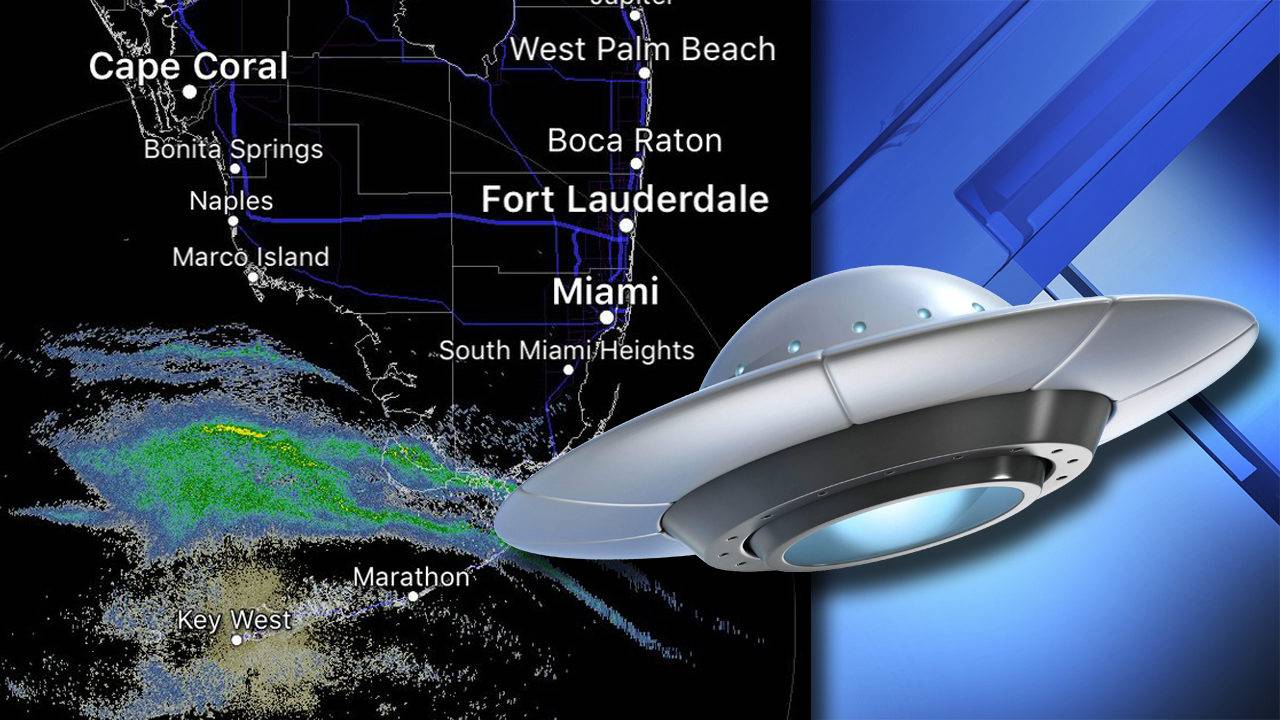
MIAMI- Time to pack up, South Florida. The invasion has begun.
Or not.
Mysterious "blips" seen recently over South Florida and other parts of the country have confounded those trying to figure it out, while enthralling those who believe aliens are out there.
Back in December, weather radars showed odd blips near the Florida Keys and Miami. The same images were seen on radar over parts of Illinois and Kentucky.
It was originally confirmed that chaff was responsible for the images in Kentucky. Chaff is radar-jamming material often used by the military.
Radar blips are seen over Maine on Dec. 12. Military chaff was reportedly to blame.
Courtesy of the National Weather Service
But there was no explanatioin given for the images in South Florida, or those also seen in Maine at the same time. Chaff was ruled out in Maine by one source due to the National Guard stationed in the area not using aircraft that can release the material.
Of course, military operations occur frequently all around Miami-Dade and Monroe counties, so that's the likely answer; but now people are questioning why so much mysterious activity was happening at the same time at different locations around the country.
And then there's who believe the military have nothing to do with the images.
“We believe there is more to the story than what the FAA and military and publications... ...are telling us," someone from the Mutual UFO Network wrote the Courier & Press.
Mysterieuze vlekken waargenomen op de radar in Florida. ‘Hier is meer aan de hand’
In de Verenigde Staten zijn opnieuw vreemde vlekken waargenomen op de radar, dit keer in het zuiden van Florida.
De vlekken stellen experts voor een raadsel en zorgen voor opwinding bij mensen die in aliens geloven.
In december vorig jaar verschenen er vreemde vlekken op de radar nabij Florida Keys en Miami. Dezelfde patronen werden gezien op de radar in Illinois en Kentucky.
Geen verklaring
Zelfs de Amerikaanse nationale weerdienst was verbaasd omdat er geen regen in het gebied was, schreef de Evansville Courier & Press.
In Kentucky zou antiradarsneeuw verantwoordelijk zijn geweest voor de vlekken. Die wordt tijdens militaire oefeningen gedropt in de atmosfeer om het radarsignaal te verstoren.
Voor de vlekken in Zuid-Florida is geen verklaring.
Mysterieuze activiteit
De mysterieuze patronen werden ook waargenomen in de staat Maine. De Nationale Garde daar heeft uitgesloten dat antiradarsneeuw de bron was omdat er geen vliegtuigen in de regio zijn die het materiaal kunnen verspreiden.
Mensen vragen zich nu af waarom er zoveel mysterieuze activiteit op hetzelfde moment was op verschillende plekken in de VS.
Volgens het Mutual UFO Network (MUFON) houden de Amerikaanse luchtvaartautoriteit FAA en het leger informatie achter. “Er is meer aan de hand,” klonk het.
Man Who Says He Was Abducted By Aliens Breaks 45-Year Silence
PASCAGOULA, Miss. (CBS Local) — A Mississippi man in declining health is telling a story he’s kept secret from his own family for 45 years: he claims he was abducted by aliens.
Calvin Parker says he and his buddyCharles Hicksonwere fishing in 1973 on the banks of the Pascagoula River, just north of where Ingalls Shipyard now sits, when a “real bright beam appeared all over us and it kind of blinded me for a second and when I got my vision back, I seen three bulky looking creatures coming toward us.”
Parker said the creatures were “probably 4, 4 1/2, 5 foot tall…built like football players. But I noticed they kind of moved mechanical wise and they was floating off the ground. By the time we stood up and turned around, they was there on us all at one time,” he told WALA in a rare interview. “Two of them got a hold of Charlie, one of them got a hold of myself and instantly I felt like, I just got relaxed.”
Parker, who was 19 at the time, claims he and the 42-year-old Hickson were levitated into a space craft.
“There was an examination room, what I call it, and the ole big ugly creature that brought me in, he took me and laid me on the examination table and he just backed up out of the way. I couldn’t move or anything. All I could do was look,” Parker said.
A device about the size of a deck of cards then came down from the ceiling.
“It hovered about a foot in front of my eyes and then it went to the right side of my head and it clicked, went behind my head and it clicked went to the left side of my head and clicked and then straight to the front and then it shot back into the ceiling,” he said.
Then a “more feminine looking creature came out. She looked completely different than what I called the robot,” he said. She “had regular fingers and came over and pinched me on the side of the cheek and then she took her finger and ran it down my throat and got it behind that thing that hangs down back there and tried to come up in my nasal cavity and that is when it started hurting and I started choking and I got scared and she just kind of telepathically told me ‘Don’t be afraid we aren’t going to hurt you.'”
Calvin Parker, who says he was abducted by aliens in 1973, breaks his silence in his book “Pascagoula – The Closest Encounter: My Story.”
(Credit: Calvin Parker)
Parker said the aliens then dropped him and Hickson on the river bank. They called the Jackson County Sheriff’s Office to report the incident.
Former Jackson County Captain Glenn Ryder said he told the men to come in to the station. To test their sincerity, Ryder said deputies secretly placed a tape recorder into an interrogation room and left the two alone.
“I got to get home, get to bed or get some nerve pills or something, see the doctor or something. I can’t stand it. I’m about to go all to pieces,” Parker was recorded saying at the time.
“I tell you, when we get through, I’ll get you something to settle you down so you can get some damn sleep,” Hickson responded.
“Something happened to them, said Ryder. “You don’t fake fear. He was scared. He was scared out of his mind.”
The men would also take lie detector tests and pass. The story quickly went viral.
“It was a circus, a media circus,” former WALA-TV reporter Rennie Brabner said.
Brabner believes something happened that night.
“I do not think they made it up in the sense that they created it out of whole cloth,” Brabner said. “I have been told, particularly Hickson was known to take a drink. Was it in the bottom of a bottle of a John Barleycorn bottle? I don’t know.”
Hickson wrote a book on his encounter and spoke numerous times about it before he died in 2011.
Parker stayed out of the limelight for 45 years, but after suffering a stroke and having two open heart surgeries, he decided it was his turn to write a book about the night that changed his life. “Pascagoula – The Closest Encounter: My Story” was published in July.
“You can’t really pin everything down. You don’t really know and that’s the point I’m holding out. I don’t know what happened, I know something happened,” Parker said.
Man die werd ontvoerd door aliens doorbreekt na 45 jaar stilzwijgen. Dit is zijn verhaal
Een man uit de Amerikaanse staat Mississippi draagt al 45 jaar een geheim met zich mee: hij claimt te zijn ontvoerd door aliens. Dat schrijft CBS Detroit.
Calvin Parker was op een dag in 1973 samen met een vriend, Charlie Hickson, aan het vissen toen ze plotseling werden verblind door een lichtflits.
“Toen ik weer kon zien, zag ik drie wezens op ons af komen,” zei Parker.
Ruimteschip
Volgens hem waren de wezens hooguit 1,5 meter lang en zweefden ze vlak boven de grond.
“Twee van hen grepen Charlie, één pakte mij vast en ik voelde me gelijk ontspannen worden,” klonk het.
De destijds 19-jarige Parker beweert dat hij samen met zijn vriend naar een ruimteschip werd gebracht.
Telepathische wijze
“Ik werd naar een soort onderzoeksruimte geleid waar ik niet kon bewegen en alleen maar kon toekijken,” zei hij.
Uit het plafond kwam een apparaat ter grootte van een pakje kaarten. Het werd gebruikt om Parker te onderzoeken, waarna het weer in het plafond verdween.
Daarna verscheen er een vrouwelijk wezen dat hem op telepathische wijze vertelde dat hij niet bang hoefde te zijn en dat ze hem geen kwaad zouden doen.
Leugendetectortest
Parker zei dat hij vervolgens werd afgezet langs de oever van de rivier waar hij aan het vissen was.
Het tweetal besloot bij de sheriff melding te maken van het incident.
“Er is iets met ze gebeurd,” zei sheriff Glenn Ryder. “Je kunt niet doen alsof je bang bent. Hij was echt bang. Hij was doodsbang.”
De mannen doorstonden ook een leugendetectortest, waarna hun avontuur de aandacht van de media trok.
Mediacircus
“Het was een circus, een mediacircus,” herinnert oud-verslaggever Rennie Brabner zich.
Brabner gelooft dat er die dag iets gebeurd is: “Ik denk niet dat ze het hebben verzonnen.”
Hickson schreef een boek over zijn ervaringen en sprak er meerdere keren over, voordat hij in 2011 overleed.
Stilte
Parker zweeg 45 jaar, maar besluit nu de stilte te doorbreken omdat hij in slechte gezondheid verkeert.
“Ik weet niet precies wat er is gebeurd,” zei hij. “Ik weet alleen dat er iets is gebeurd.”
Of all the lasting themes that have remained prevalent in science fiction over the last century, what would the genre have been without ray guns, lasers, and “death rays”?
One might even argue that lasers have been a part of science fiction as we know it today since the very beginning, or close to it, at least. Some argue that the creation of science fiction harkens all the way back to Mary Shelly’s eerie tale of reanimation, Frankenstein, while others claim that better “early” examples of the genre appeared in the writing of American authors like Edgar Allan Poe, who wrote what are among the earliest stories that incorporated space travel and journey to locations like the Moon.
However, if ever there were a “Shakespeare of Science Fiction,” as some have argued, it might have been H.G. Wells, whose contributions to literature included everything from the first non-anthropomorphic aliens (as well as what may be the earliest use of the word “extraterrestrial” in reference to an alien craft), to the “heat rays” wielded by the Martian antagonists in his War of the Worlds. And, with the appearance of these directed-energy weapons in his story, we also have one of the earliest appearances of lasers or “death rays” in science fiction
It would not be the last, of course. After humanity fumbled their way to triumph over its Martian invaders (with a helping hand from a few friendly terrestrial viruses), later fiction cast these futuristic weapons in the hands of human characters the likes of Buck Rogers, Flash Gordon, and other characters.
Ryan Lambie, writing for Den of Geek, argues that it wasn’t until decades later in the 1950s and 60s that the laser truly claimed its place in science fiction, in part thanks to the real-world development of laser technologies in various industries:
The production of ray guns of all kinds reached its zenith in the 50s and 60s. Real-world scientific breakthroughs in laser (“light amplification by stimulated emission of radiation”) and maser (“microwave amplification by stimulated emission of radiation”) saw numerous kinds of ray-gun appear in the sci-fi movies and shows of these decades, which no doubt fed back into the popularity of the huge armory of toy weapons that appeared around the same time.
The trend continues today, of course, with laser weaponry remaining an indelible part of the fictional Star Wars universe, along with other fantastic interpretations of alternate futuristic realities.
Lasers used for weaponry exist in real life too, but nothing like what we see in science fiction. I recently caught up with Jeff Hecht, author of Lasers, Death Rays, and the Long, Strange Quest for the Ultimate Weapon and a fellow of the Optical Society of America. As Hecht puts it, in the early days finding practical uses for lasers may have been more challenging than actually building the lasers themselves:
“At the very beginning, the running joke was, ‘the laser is a solution in search of a problem.’ They would say that because a lot of the problems the laser was supposed to solve didn’t just go away when you brought in a laser and applied it; you had to do a lot of good engineering to make them work. And we’ve had a lot of good engineering, and certainly for telecommunications, the pairing of the advances in lasers and fiberoptics and the advances in electronics, are behind the whole information technology advance. You can’t have one without the other.”
An example of an operational laser system in use by the U.S. Navy.
Of course, most of the lasers in use today have nothing to do with weaponry, and finding ways to concentrate a beam with strength comparable to what we see in science fiction seems a ways off, too. However, that doesn’t mean that lasers haven’t been useful in terms of making existing weapons more deadly. Hecht says that even in the early years of laser innovation, “what they were looking at was using lasers, at first, just to measure the range to a target–how long does it take to get back and forth–that’s the range of a radar. And then there was a device called a laser target designator, and what that would do is send a series of coded, invisible infrared pulses at a target.”
“If you had an infrared sensor, you’d see this code of reflective pulses coming from something and you could aim a weapon at that ‘something.’ That was how a smart bomb worked.”
So lasers certainly have weapons systems applications, and field tested designs in use by the U.S. Navy, for instance, are capable of disarming drones and other objects at a distance, as was demonstrated in the summer of 2017 with the AN/SEQ-3 Laser Weapon System.
Drone being dispatched using a long distance laser system from aboard a U.S. Navy ship in 2017.
While the capabilities of laser weapons described here may remain limited in the present day, this is not to say that someday more powerful lasers won’t still be developed. However, it is obvious that the current state of the art has not caught up with the imaginations of our science fiction luminaries from over the decades.
In short, lasers continue to play an important role in technological development, as they have since the end of World War II. Their influence and relevance to a variety of industries cannot be denied, and yes, lasers even see some practical use in modern weaponry. But despite these innovations, it remains true that the most powerful lasers are the ones on the printed page; so to reappropriate an old adage for our use here, perhaps the pen truly is mightier than the sword… and the same still goes for the laser.
An unidentified aircraft seen circling overhead for days has residents of the Canadian city of Kingston wondering if something strange could be afoot. Kingston sits along Lake Ontario at the mouth of the St. Lawrence river a few hours from the major metropolises of Ottawa, Montreal, and Toronto. For days now, residents have seen an aircraft with “minimal lighting” flying over the city under the cover of darkness. Even more curious, not one law enforcement agency or branch of the military has stepped forward to claim responsibility for the craft. What’s going on in the skies over Kingston?
It’s probably just another one of those shadow government planes again turning the frogs gay with chemtrail magic.
The Kingston Whig Standardreports that the news paper has received multiple emails and calls about the unidentified aircraft. According to Kingston resident Doug Stewart, the aircraft appears to circle for hours in the dead of night:
It’s a mystery. I can hear it at 2 and 3 a.m., and I’ve only heard it after dark at about 6, 7, 8 p.m. Some nights it’s constant … it seems like it’s circling.
Other witnesses have estimated that the aircraft is flying fairly low around 3,000 to 5,000 feet and appears to circle the same area every five minutes or so. Naturally, many Kingston residents assumed that the nearby Canadian Forces Base Trenton, Canada’s busiest Air Force base, was to blame. However, Public Affairs Officer Capt. Graeme Scott reports that the aircraft isn’t theirs.
Many law enforcement agencies now operate spy aircraft equipped with incredibly high-resolution video cameras.
Likewise, the Royal Canadian Mounted Police have issued a rather opaque, somewhat passive aggressive statement denying any knowledge of the aircraft:
The RCMP’s primary concern is the safety and security of Canadians. We have multiple aircraft that support our mandate in Ontario and elsewhere in the country. To maintain the integrity of our investigations and operations, the location of our aircraft is not disclosed. We therefore have no additional information to share with you at this time.
With such little information to go on, Kingston residents are left in the dark about the plane circling their homes and who it might belong to. While many see this as an invasion of privacy, deciding who owns the airspace above privately-owned homes has proven tricky for federal governments. Should undisclosed, unidentified aircraft be able to loiter in the sky despite the public’s concern or alarm?
An asteroid belt is full of asteroids, so a collision in this narrow and crowded orbiting highway of rock wouldn’t seem to generate anything more than a “Duh!” from astronomers. However, a recent crash in the main asteroid belt between Mars and Jupiter caught their attention because of its violent impact which seems to have turned one of the asteroids into a comet with an extremely long tail. Doh?
“On 9 Jan. 2019, the Central Bureau for Astronomical Telegrams issued an electronic telegram reporting that the inner main belt asteroid (6478) Gault had a tail. This made the object a very important target to monitor and we managed to get a few images on two nights.”
That electronic telegram (nice to see someone is still using telegrams) was read by The Virtual Telescope Project – an advanced service provided by the Bellatrix Astronomical Observatory in Italy providing remote Internet access to several robotic telescopes for the general public – and distributed worldwide. 6478 Gault is already somewhat famous, having been discovered in 1988 by the astronomer couple Carolyn and Eugene Shoemaker at the Palomar Observatory in California. The Shoemakers are best known for discovering the Comet Shoemaker–Levy 9, whose collision with Jupiter in July 1994 was televised worldwide.
Asteroid Gault (named for American planetary geologist Donald Gault, a pioneer in the field of impact cratering processes – coincidence?) is part of the Phocaea family of space rocks created 2.2 billion years ago by another collision which resulted in Gault (a large asteroid 3.7 km/ 2.3 miles in diameter, countless other little space rocks and 25 Phocaea, a huge asteroid about 75 km/46 miles in diameter. Researchers with the ATLAS project (Asteroid Terrestrial-impact Last Alert System) spotted the sudden appearance of a tail on Gault in late December/early January observations.
Active asteroid 6478 Gault last night from the @INGLaPalma after discovery by @TheGenghisKen@fallingstarIfA . The ejected dust extends > 400,000 km, more than the Earth-Moon distance.
British astronomer Alan Fitzsimmonstweeted that the tail is over 400,000 km/240,000 miles long and would stretch from Earth to the Moon and then some. Astronomer Gianluca Masi posted on the Virtual Telescope Project blog that the tail was most likely created by a collision that blasted a part of Gault into the smithereens that now make up the tail. (See the pictures here.) No one seems to know which rock – if it still exists – collided with 6478) Gault somewhere in November 2018. What the astronomers do know is that an asteroid with a tail is an extremely rare condition that they still don’t seem to fully understand – as evidenced by all of the conflicting stories about whether tail-streaming ’Oumuamua is a comet, an asteroid, a space ship or something else.
Comet or asteroid?
What is 6478 Gault now? If it keeps the tail, and astronomers will be monitoring it closely, then it’s definitely turned into some form of comet. If it loses the tail, it’s still an asteroid. If the collision knocked it hard enough to put it on a collision path with a planet (hopefully not Earth), it will make the Shoemakers famous once again.
Back in the 1970s,Paul Bennewitz– who died in 2003, in Albuquerque, New Mexico – had his own company that stood adjacent to Kirtland Air Force Base, also in Albuquerque. Its name was Thunder Scientific. All was good, as Bennewitz had a number of solid contracts with the military. And living and working so close to the base made things comfortable and handy for Bennewitz. It was the perfect relationship. Until, that is, it wasn’t. In shockingly quick time, Bennewitz’s life began to fragment in chaotic fashion. But, how and why did such a thing happen?
It’s important to note that by the late 1970s Bennewitz had been interested in UFOs not just for years but for decades. He had a large library of books on the subject and subscribed to a number of newsletters and magazines on the subject. On occasion, Bennewitz had seen – late at night and in the early hours of the morning – strange, unidentified objects flying over Kirtland Air Force Base and the nearby, huge Manzano Mountains. They could have been early drone-like craft being tested secretly. But, for Bennewitz they were alien craft.
Bennewitz’s head spun: he came to believe that aliens were in league with the U.S. Air Force, and that much of the secret program was run out of Kirtland. And he shared his views with staff at Kirtland, the CIA, the NSA, the Defense Intelligence Agency, the Pentagon, his Senator, his Congressman, and just about anyone and everyone in a position of power and influence. It was all but inevitable that by firing off lengthy letters about a secret alien-human operation at Kirtland someone would take notice. That’s exactly what they did.
While one school of thought suggests that Bennewitz was indeed tracking the movements of UFOs in the skies over Kirtland, another suggests that Bennewitz had actually stumbled on test-flights of new and radical aircraft, of the aforementioned drone kind. In the latter scenario, the government (as a collective term for all of those agencies and individuals that Bennewitz approached) decided to first politely, but quietly, request that Bennewitz bring his research to a halt. This was like a red rag to a bull. Bennewitz would hear none of it. He was primed and ready to go after the U.S. Government and to confirm what he saw as the dark and sinister truth of Uncle Sam’s liaisons with aliens. One man against the government? It was clear who was going to win; although Bennewitz couldn’t envisage such a thing at all.
Manzano Mountains
In ingenious fashion – but from the perspective of Bennewitz, in terrible fashion – a plot was initiated to, in essence, give Bennewitz exactly what he wanted to hear. So, well-placed government agents, intelligence operatives, and experts in the fields of counterintelligence and disinformation, all fed Bennewitz fictitious tales of dangerous ETs, of thousands of people abducted and mind-controlled in slave-like fashion by the aliens, of terrible experiments undertaken on people held below a huge “underground base” in the town of Dulce, New Mexico, and of a looming confrontation between the human race and the deadly creatures from another galaxy.
That the data was all coming to him from verifiable insider sources impressed Bennewitz and led him to believe their every word – which is precisely what the government was gambling on. The government then tightened the noose even tighter around Bennewitz’s neck: they fed him more and more horror-stories of the alien variety. And, slowly and bit by bit, Bennewitz’s paranoia grew. He couldn’t sleep, he became stressed to the point where he required medication, and eventually had a nervous collapse and was hospitalized. The result: he walked away from UFOs, secret projects, and cosmic conspiracies as a crushed man. Which may well have been the intent of the government, anyway.
How do you wipe out an entire species of 60 ft long giant sharks? Blow up a star, of course. According to arecent paper, supernovas may have been the cause of a number of unexplained mass extinctions throughout earth’s history, including the monstrous and fantastically named giant shark species Megalodon, a relative of the great white shark, whose mysterious extinction some 2.6 million years ago has long puzzled scientists.
There are enough out there to confidently say that stars are exploding all the time. Luckily for us, space is big and our lives are relatively short, so the chance of us getting blasted by a supernova are pretty small. Still, sometimes it happens (roughly every 100 million years) and the earth gets whacked by a cloud of radiation that once made up some other poor solar system’s sun. Scientists have been looking for evidence of how cosmic events like supernovas impact earth and the recent study attempts to discover the role that they play in the rise and fall of species here on earth and the impact that they might have had on evolution. If you guessed that an exploding star would be really good at killing things, you’re right!
Fossilized Megalodon tooth.
According to Adrian Melott, astrophysicist at the University of Kansas and the author of the new paper, the mass extinction of megafauna like the Megalodon lines up with evidence of a supernova impacting earth. Isotopes of iron-60, which is extremely rare on earth yet common in supernovas, were found on the sea floor and the surface of the moon. Dating these isotopes reveals that, if they were dropped here by a supernova, that supernova rolled through our solar system 2.6 million years ago—right about when the Megalodon checked out. According to Melott:
“A lot of things would not leave a definite residue. [Iron-60] is smoking-gun evidence of something happening.”
The blast from a supernova could end species in a few ways. Other theories on how supernovas could impact mass extinctions point to indirect causes. The blast from a supernova could strip the earth’s ozone layer, for example, leaving species vulnerable to solar radiation and destroying ocean food sources like plankton and coral reefs. Cosmic rays could also seed clouds and create a “cosmic-ray winter,” according to Henrik Svensmark of the Technical University of Denmark, which would also result in the destruction of food sources.
Melott thinks that the supernova may have been a much more direct cause of the extinction, however. Supernovas release highly charged radioactive particles called muons. Getting hit by a cloud of muons probably wouldn’t feel like much at first, but the radiation exposure would soon cause irreparable genetic damage and mutations that, depending on the species, could be catastrophic. The bigger the animal, the worse the impact would be. For an animal the size of a human, the muon storm would increase cancer rates by 50 percent. Considering that the Megalodon was about the size of a school bus, it would get hit pretty hard.
Artist’s depiction of a supernova.
As evidence for his theory, Melott points to the sudden extinction of 36 percent of ocean species 2.6 million years ago at the end of the Pliocene era and the beginning of the Pleistocene. The extinct species were largely coastal dwelling, where the impact from muon radiation would be the most devastating. Unfortunately, highly radioactive particles like muons don’t leave any record of their presence, so it’s hard to tell just how catastrophic an impact it was. Yet there does seem to be a correlation between a supernova and a mass extinction, so it is likely that there was some sort of connection.
So, if you have a fear of shark infested waters, just remember: there’s always something bigger and badder on its way (but probably not for another 97 million years).
A radar mystery that began in the skies over parts of the United States late last year has some experts questioning whether the government is involved in secret tests, while others think odd weather might be to blame.
In early December, the National Weather Service reported on what they termed an “anomaly” over parts of the midwestern United States. Here at MU Brett Tingley reported on the incident, which was observed on radar over parts of Illinois, Kentucky, and Indiana. “Whatever was on radar appeared to be as dense as a thunderstorm,” Brett wrote, “but with the night clear and temperatures low, that theory was ruled improbable.” It was determined that the likely cause of the radar traces had been chaff, a substance composed mostly of aluminum that is released from aircraft during military operations and exercises to “confuse enemy radar.” However, as Brett noted at the time, meteorologist Greg Meffert with the NWS stated that he had “never seen [chaff] quite this hot.”
A few days later, Joseph Trevithick over at The Warzone wrote about a second radar incident, reporting that similar anomalous traces had appeared over parts of Maine and Florida just two days later. The National Weather Service confirmed on their Twitter account that the new radar anomalies also resembled chaff, although Trevithick noted that the December radar blips seemed to last longer than chaff typically does.
Chaff, as depicted on a radar visual display
(Wikimedia Commons).
“We have already reached out to the National Guard Bureau,” Trevithick wrote, “but at the time of writing, we have not received any additional information about this new incident over Maine. We’re reaching out to additional commands regarding the plume in Florida, as well.”
Since that time, little else was reported about the incidents. That is, until today, when Jon Webb with the Evansville Courier & Press wrote about the peculiar December incidents. While they do appear to be related to military operations involving chaff, a few questions do remain.
“Whatever it is, it’s exceedingly strange,” Webb wrote, citing an email exchange he had with a member of the Mutual UFO Network (MUFON) who told him, “We believe there is more to the story than what the FAA and military and publications such as ‘The War Zone’ are telling us.” (Does it matter to the unnamed MUFON investigator that even The Warzone’sTrevithick noted having some problems of his own with the chaff theory? Maybe they didn’t read to the end of the article… who knows.)
“More NWS hubs will get confused,” Webb concluded, “And more conspiracies will be born.”
So what was going on back in December, and does the assertion by Trevithick and others that certain aspects of the incidents didn’t resemble “typical” military exercises involving chaff amount to anything?
A pair of B-1B Lancers, 28th Bomb Squadron, deploy chaff and flares during a military exercise
(public domain).
According to a Department of National Defense study from 2008, chaff is described as “a radiofrequency countermeasure released by military aircraft (ships and ground vehicles) to confuse enemy radar.” At the time this report was produced, chaff was used in approximately 26 U.S. states.
The report states that “the effective use of chaff can be maintained only by practicing in-flight deployments during training issues.” It goes on to say that, “The release of chaff into the environment during these exercises has raised concerns among both public-interest groups and the government regarding the fate and environmental impact of chaff particles.”
Concerns about the environmental effects of chaff go back to at least 1993, resulting in a military report that indicated that there were few–if any–significant environmental risks associated with its use in military exercises. However, a 1998 report by the congressional General Accounting Office continued to argue that chaff could have negative environmental effects, in addition to potentially interfering with civilian ATC radar systems.
More recently, controversies arose over the use of chaff last year in relation to the companies that produce it, and their potential future ownership by foreign entities. Presently, Esterline Defense Technologies (also known by the name Armtec) is the only company in the United States that produces chaff for use in military activities. In 2018, it was reported that Esterline/Armtec would be acquired by the UK-based TransDigm Group Inc. The news prompted a bipartisan letter from Congress to Jim Mattis, then-U.S. Defense Secretary, calling for the U.S. government to block the deal.
“TransDigm has repeatedly purchased companies that are the sole providers of Department of Defense items and engaged in price gouging,” the letter, co-authored by California Democratic representative Jackie Speier and North Carolina Republican Walter Jones, argued. “The abuses have been sufficiently common and severe enough to warrant a DoD inspector general investigation. Unsurprisingly, Esterline is the sole DoD chaff provider and one of two flare providers. The alarm bells should be ringing.”
In essence, the controversies surrounding chaff and its use seem to have been an ongoing point of contention for decades. But in sum, do military exercises account for the odd radar returns that were occurring late last year? Also, could it be possible that the military is testing a new kind of chaff or similar substance, following the news that Esterline/Armtec could be acquired by TransDigm? There is no proof that this is the case, but if we were to speculate, it might account for some of the more unusual aspects reported with the December incidents, as well as why so many were reported around that time.
Then again, for all we know maybe the December radar incidents were just good old, Esterline/Armtec chaff that was clouding up radar systems over the Midwest and parts of the East Coast. At present, no further information about the incidents has been made available to the public, nor have any similar radar anomalies been reported… so the rest is left (as per usual) to our imaginations.
Brian Hanley who has published the UFO footage on January 9, 2019, states: I usually cover politics, but when Sam Chortek and Jimmy Chappie came to me with this exclusive UAP footage, I had to break the story.
At first there was a lot of doubt whether the recording was real or faked on which Brian Hanley decided to release the raw footage which was recorded by a DJI Inspire Drone over Beaver, Utah, just a couple of hours (by car) from Area51.
The first original footage shows the object that moves at an incredible speed. The second footage shows the object in slow motion making it easily recognizable.
I do not exclude that the object is of extraterrestrial origin but since this UFO fastwalker has been filmed near Area51 it is quite possible that the object, which is very similar to other fastwalkers that fly through our atmosphere, belongs to one of their secret projects.
New England has been dumped with snow due to winter storms that also brought bone-chilling cold this week. However, the occurrences have been shrouded with a strange ice formation to one Maine river.
In Westbrook City in Maine, around 20-minute drive east of Portland, a mysterious disk of ice has appeared in the Presumpscot River.
City officials estimated the disk to be around 300 feet wide and about the size of a football field.
UFO enthusiasts who saw the disk formation believe the disk is an alien spaceship disguising itself as a natural phenomenon caused by winter storms. They said that the disk was spinning on a frozen river signifying that it was conducting an activity under the river.
City officials went the extra mile with the use of a camera drone to capture stunning images of the disk from above.
According to the official explanations, the varying currents of the river formed the disk. Part of the river flows in a rapid straight line movement, but currents near the other bank flow slowly in a semi-circle. That portion of the river freezes because of the slower currents. The formation of the ice disk is due to the clockwise motion.
However, UFO enthusiasts argue that the formation is a perfect disk and aliens operating under the river have something to do with it. They said that it could be extraterrestrials carrying out a mission under the river.
Open Minds UFO Radio: Ryan Sprague is a UFO journalist, podcaster, and author. He is also a professional playwright and screenwriter. He was a frequent contributor to Open Minds Magazine, and has participated as a staff member or speaker at several International UFO Congress events. Ryan hosts the podcast Somewhere in the Skies and Rogue Planet’s Unknown. Ryan’s latest project was co-hosting CW’s Roswell: Mysteries Decoded. Alejandro also appeared in the show and served as a consulting producer. In this episode, we talk about the production of the CW’s Roswell special, what was left out, and our thoughts on how the production came out. We also discuss the Roswell case and the mysteries surrounding the most famous alleged crash landing of an alien spacecraft.
Last week, astronomers working with the ATLAS project in Hawaii announced an astonishing change to asteroid 6478 Gault. The space rock had sprouted a tail. It is now gliding through the asteroid belt giving every appearance of being a comet. On Jan. 9th, Damian Peach of Selsey UK photographed the 6478 Gault and its 400,000 kilometer-long tail:
And continues:
Gault's tail may be a result of a recent collision. Researchers with the ATLAS project have looked at images of Gault in Dec. 2018 and Jan. 2019. Extrapolating its appearance backwards in time, they suggest that Gault hit another object in the asteroid belt in Nov. 2018.
Active asteroid 6478 Gault last night from the @INGLaPalma after discovery by @TheGenghisKen@fallingstarIfA . The ejected dust extends > 400,000 km, more than the Earth-Moon distance.
A Mysterious X-Shaped Ancient Tomb has been Excavated in China
Xbox???? no way........i see X-men.....or were the terra-cotta warriors avid gamers???
maybe they are going to unearth the Wolverine .....let him save the world from us........
anyways.......the tomb is thought to be from the Qin dynasty 221-206 B.C. ...the Qin dynasty was the very first dynasty of Imperial China founded by the first emperor...........
the image was posted on twitter this week and of course quickly picked up by Xbox fans.......
Archaeologists have recently excavated a mysterious x-shaped tomb in China. The tomb’s surface has revealed an eerie similarity to, guess what? The Xbox. The image of the recently discovered Chinese tomb was posted on Twitter earlier this week and ended up drawing the attention of thousands of users due to the structure’s similarity with the …
Earth’s North Magnetic Pole's 'Erratic Motion' Forces Geologists To Unprecedented Move
Something is happening with Earth’s magnetic field and scientists can’t figure it out.
At the very top of theworldsits Earth’s north magnetic pole. Recently, however, something very strange is happening to it. Driven by liquid iron sloshing around within the Earth’s core, the north magnetic pole has been edging away from Canada and towards Siberia. The world's geomagnetism experts have been forced into doing something very rare due to the fact that the magnetic pole is moving so quickly.
What are the scientists doing?
Due to the magnetic poles erratic movements, on January 15th the experts are set to update the World Magnetic Model. This is quite a big deal because this a model which describes the planet’s magnetic field and underlies all modern navigation, from the systems that steer ships at sea to Google Maps on smartphones. The model wasn't meant to be changed until at least 2020 as the latest version only came out in 2015, however due to the movement being so severe, the model has to be changed now as the error is only getting larger and larger.
What causes this?
There isn't just a single cause, there are several. The problem lies partly with the moving pole and partly with other shifts that occur deep within the planet. The liquid churning in Earth’s core, which was mentioned earlier, generates most of the magnetic field, which varies over time as the deep flows change. For example, in 2016 part of the magnetic field temporarily accelerated deep under northern South America and the eastern Pacific Ocean. This is just another example of how quickly the magnetic pole can change. The historical changes can be seen in the diagram below.
In 2018, the pole crossed the International Date Line into the Eastern Hemisphere and is currently moving in a direction headed towards Siberia.
The geometry of Earth’s magnetic field magnifies the model’s errors in places where the field is changing quickly, such as the North Pole. The fact that the pole is traveling so fast makes this region more prone to large errors.
What’s next?
The magnetic pole will continue to move in the future and in any direction is possible. No one knows where it will go next as it's completely random. Therefore the magnetic pole will definitely be keeping geomagnetic experts busy over the next few years and there will be no shortage of work for them.
It is definitely an interesting development and I for one will be keeping an eye on new publications to see where it goes next and what will happen in the future!
A three-year-old startup is trying to launch rockets into space that are almost entirely 3D printed. And it just got permission from the U.S. Air Force to launch from thehistoric Launch Complex 16at Cape Canaveral in Florida.
Relativity Space — a rocket-building company founded by SpaceX and Blue Origin alumni — revealed a new contract with the U.S. Air Force this week that would allow it to launch from a site that has been unused since 1988, according to Quartz. If the company manages to regularly launch rockets from the site, it could be able to extend the contract into a 20-year exclusive agreement with the Air Force.
Giant Rocket Printers
Relativity Space has ambitious plans: it wants to 3D print an entire rocket with its groundbreaking, building-sized Stargate metal 3D printer, then launch it into orbit. Its long term plans are also enormous — the company wants to eventually 3D print rockets on Mars, according to its official website.
3D printing a rocket would be simpler and allow for more efficient designs, fewer moving parts, and faster construction. The company’s first planned launch vehicle called Terran 1 would only take 60 days to print, and would have a max payload of 1,250 kg (2756 lbs) to low-Earth orbit — at least if everything works out as planned.
Growth Spurt
Relativity Space is going through a growth spurt right now. Its number of employees rose from 14 to 60, co-founder Tim Ellis toldArs Technica. It’s also planning a test launch of the Terran 1 rocket in 2020, with commercial missions starting in 2021.
Using 3D printing technology to blast off into space is an exciting idea, and could make building rockets faster and cheaper. But the proof is in the pudding — or rocket fuel.
The Saturn moon Titan's north pole, as seen by the Visual and Infrared Mapping Spectrometer aboard NASA's Cassini spacecraft. The orange box shows the "wet sidewalk" region, which analysts suggest is evidence of changing seasons and rain on Titan's north pole. The blue box shows the expanded region in the bottom panel. The black dot marks Titan's north pole.
Credit: NASA/JPL/University of Arizona/University of Idaho
Here's something you don't see every day — the glint of freshly fallen rain on the surface of an alien world.
NASA's Cassini spacecraft spotted a big reflective feature near the north pole of Saturn's huge moon Titanin June 2016, a new study reports.
Cassini discovered numerous lakes and seas of liquid hydrocarbons on Titan's frigid surface during the probe's pioneering 13 years in the Saturn system. But this newfound bright patch — which covered 43,330 square miles (120,000 square kilometers), about half the combined surface area of the Great Lakes here on Earth — isn't one of them. [Amazing Photos: Titan, Saturn's Largest Moon]
Credit: NASA/JPL-Caltech/SSI/JHUAPL/Univ. of Arizona
Almost all of the hydrocarbon seas and lakes on the surface of Saturn's moon Titan cluster around the north pole, as can be seen in this mosaic from NASA's Cassini mission. Image released Oct. 23, 2013. [Read the Full Story on Titan's Lakes Here]
The feature disappeared relatively quickly, study team members said, suggesting that it was a big puddle of methane rain that evaporated away.
"It's like looking at a sunlit wet sidewalk," lead author Rajani Dhingra, a doctoral student in physics at the University of Idaho in Moscow, said in a statement.
The likely rainfall event signals that summer weather had arrived in Titan's northern hemisphere by mid-2016, the researchers said. That's a little later than climate models had predicted.
"Summer is happening," Dhingra said. "It was delayed, but it's happening. We will have to figure out what caused the delay, though."
Saturn and its many moons take 29.5 Earth years to complete one lap around the sun, so seasons in the ringed-planet system each last nearly 7.5 years. Cassini arrived at Saturn in mid-2004, during the southern summer, and saw clouds and rainfall in Titan's southern hemisphere.
Titan is the only world beyond Earth known to have stable bodies of liquid on its surface. But this moon's weather system is very different than that of Earth's: The rain, rivers and seas of Titan are all composed of liquid hydrocarbons.
Cassini studied Saturn, its rings and many moons until September 2017, when the low-on-fuel spacecraft plunged intentionally into the planet's thick atmosphere. Mission team members ordered the death dive to ensure that Cassini never contaminated Titan and fellow moon Enceladus with microbes from Earth. Scientists think both of these satellites may be capable of supporting life as we know it.
Cassini captured the rainfall-glint image with its Visual and Infrared Mapping Spectrometer instrument, which was able to peer through Titan's thick, obscuring atmospheric haze.
The Cassini orbiter traveled with a European lander called Huygens, which touched down on Titan in January 2005, pulling off the first-ever soft landing on a moon in the outer system.
New Horizons zoomed within just 2,200 miles (3,500 kilometers) of Ultima Thule in the wee hours of Jan. 1, pulling off themost-distant planetary flyby in spaceflight history. Ultima Thule lies more than 4 billion miles (6.4 billion kilometers) from Earth — 1 billion miles (1.6 billion km) beyond the orbit of Pluto, which New Horizons encountered in July 2015.
The video, which mission team members released Tuesday (Jan. 15), captures 7 hours during New Horizons' final approach, just before the probe buzzed the snowman-shaped Ultima Thule. During those 7 hours, New Horizons closed the gap between itself and its target from 310,000 miles (500,000 km) to 17,100 miles (28,000 km), mission team members said. [New Horizons at Ultima Thule: Full Coverage]
And Ultima Thule gets sharper as it looms larger in the frame.
"The original image scale is 1.5 miles (2.5 km) per pixel in the first frame, and 0.08 miles (0.14 km) per pixel in the last frame," New Horizons team members wrote in a description of the new video.
"The rotation period of Ultima Thule is about 16 hours, so the movie covers a little under half a rotation," they added. "Among other things, the New Horizons science team will use these images to help determine the three-dimensional shape of Ultima Thule, in order to better understand its nature and origin."
NASA's New Horizons spacecraft captured this image of the distant object Ultima Thule just before closest approach, which occurred shortly after midnight EST on Jan. 1, 2019.
Credit: NASA/JHUAPL/SwRI/NOAO
The brief video also shows why New Horizons didn't detect any brightness variations from Ultima Thule during the approach phase, a surprising development that initially puzzled the mission team. The lack of such a "light curve" is expected for spherical objects, which don't shift from a viewer's perspective as they rotate, but early data indicated that the 21-mile-long (34 km) Ultima Thule was highly elongated.
As we can now see, it was all about New Horizons' orientation to Ultima Thule. The object's pole of rotation was pointing directly at the approaching spacecraft, so New Horizons didn't see any appreciable changes in the light bouncing off Ultima Thule.
We should expect more cool imagery and data from the flyby in the coming weeks. But be patient: Because of low data-relay rates, it'll take about 20 months for all the flyby information to come down to Earth, mission team members have said.
And Ultima Thule may not be New Horizons' last flyby target. The probe is in good enough health, and has enough fuel left, to potentially perform yet another deep-space encounter, if NASA approves another mission extension. (The probe's original mission centered on the Pluto flyby, and the Ultima Thule encounter was the focus of a mission extension that runs through 2021.)
Mike Wall's book about the search for alien life, "Out There" (Grand Central Publishing, 2018; illustrated by Karl Tate) is out now.
Scientists think that they've spotted a rare, Jupiter-sizeblack holecasually strolling through theMilky Way galaxy.
Of course, scientists can't see any black holes directly — but new research tracking a celestial cloud structure saw strange behavior that may have been caused by just such an invisible object. That data came courtesy of theAtacama Large Millimeter/submillimeter Array(ALMA), a set of 66 telescopes scattered across the Atacama Desert in northern Chile.
"When I checked the ALMA data for the first time, I was really excited because the observed gas showed obvious orbital motions, which strongly suggest an invisible massive object lurking," lead author Shunya Takekawa, a physicist at the National Astronomical Observatory of Japan, told New Scientist.
Takekawa and his colleagues were using ALMA to study two gas clouds, which the team nicknamed Balloon and Stream for their shapes, during a two-day period in May 2018. During that time, they watched the gas moving strangely, seeming to spin around a center.
That movement allowed the team to calculate that 30,000 times the mass of our sun was packed into an object the size of Jupiter at the center of the movement. Those characteristics, combined with the lack of light coming from the location, suggest that the culprit is medium size for a black hole.
Scientists think tiny black holes and supermassive black holes are pretty common, but that there aren't a whole lot of medium-size black holes. Astronomers believe they've spotted two other black holes in this size range near the heart of the Milky Way. All three, if future observations continue to see evidence for them, may be escapees from the giant black hole at our galaxy's center.
The research is described in an article posted to the preprint server arXiv.org on Dec. 27.
New research led by members from the University of Southampton has identified a black hole spinning around its axis near its maximum possible speed.
A simulated image of supermassive black hole Sagittarius A*, showing against a background of radiation and bright matter swept into the event horizon. The image was generated with data recorded by the Event Horizon Telescope. Image credits National Radio Astronomy Observatory,
The study involved an international team of astronomers. Starting from observations taken with state-of-the-art sensors, the researchers found evidence that 4U 1630-472, a stellar-mass black hole in our galaxy, is rotating really, really fast — around 92% to 95% of a black hole’s theoretical maximum rotational speed.
Material keeps falling into this black hole as its spinning, being subjected do immense gravitational stress and temperatures. The environment is so violent that this matter shines brightly in X-rays, the team reports, which they used to establish that 4U 1630-472 is rotating and calculate its speed.
So fast it’s glowing
If a black hole is rotating rapidly enough, it should — according to the general theory of relativity — distort space-time around it differently than a non-rotating black hole, the team explains. Such distortions would leave a measurable trace on the radiation emitted by the matter it’s absorbing.
Therefore, researchers can look at a black hole’s emission spectra to determine the rate it’s spinning at.
“Detecting signatures that allow us to measure spin is extremely difficult,” says lead author Dr. Mayukh Pahari from the University of Southampton. “The signature is embedded in the spectral information which is very specific to the rate at which matter falls into the black hole.”
“The spectra, however, are often very complex mostly due to the radiation from the environment around the black hole.”
Dr. Pahari says the team was “lucky” to obtain a spectral reading directly from the matter falling into the black hole, sans the background noise. Armed with that data, it was “simple enough to measure the distortion caused by the rotating black hole,” he says.
The findings from this study are significant, as this is one of only a handful of times we’ve managed to accurately measure a black hole’s spin rate. Only five other black holes have shown high spin rates, the team adds. Astronomical black holes can be fully characterized by mass and spin rate. Therefore, measuring these two properties is key to understanding some extreme aspects of the universe and the fundamental physics related to them.
Scientists measure the spin rates of supermassive black holes by spreading the X-ray light into different colors.
Credit: NASA/JPL-Caltech
The paper “AstroSat and Chandra View of the High Soft State of 4U 1630–47 (4U 1630–472): Evidence of the Disk Wind and a Rapidly Spinning Black Hole” has been published in The Astrophysical Journal.
Titan has seas, lakes, and rivers — and now, researchers have found, it also has rainfall and seasonal variation.
A false-color radar mosaic of Titan’s north polar region. Blue coloring depicts hydrocarbon seas, lakes and tributary networks filled with liquid ethane, methane and dissolved nitrogen.
Image credits: NASA / JPL-Caltech / USGS.
If you’d picture a place that has an atmosphere and liquids on its surface, it probably wouldn’t be Titan. This frigid moon is only 50% larger than Earth’s moon and mostly consists of ice and rocky material. It features a young and smooth geological surface, with few volcanic or impact craters, and remarkably, it has not only an atmosphere, but also geological features dunes, rivers, lakes, seas, and even deltas. But there’s a key difference.
Unlike Earth’s seas, which consist of water, Titan’s seas consist of hydrocarbons such as methane and ethane.
Conversely, Titan features a nitrogen atmosphere and has a nitrogen cycle analogous to Earth’s carbon cycle, something which stunned astronomers when it was first discovered. The Cassini mission, which landed a probe on Titan in 2005, first revealed a surface which seemed to be shaped by fluids.
But Titan has far from shared all its secrets. Recently, astronomers have analyzed images suggesting that intense rainfall occurs on Titan, indicating the start of “summer” in the northern hemisphere. It’s something researchers were expecting for a long time, especiallyas rain had been previously observed in the southern hemisphere.
“The whole Titan community has been looking forward to seeing clouds and rains on Titan’s north pole, indicating the start of the northern summer, but despite what the climate models had predicted, we weren’t even seeing any clouds,” said Rajani Dhingra, a doctoral student in physics at the University of Idaho in Moscow, and lead author of the new. “People called it the curious case of missing clouds.”
New research provides evidence of rainfall on the north pole of Titan, the largest of Saturn’s moons, shown here. The rainfall would be the first indication of the start of a summer season in the moon’s northern hemisphere, according to the researchers.
Credit: NASA/JPL/University of Arizona.
The image was taken in 2016, by the near-infrared instrument on the Cassini probe, which offered the bulk of what we know about Titan. The instrument spotted a reflective feature covering approximately 46,332 square miles, which did not seem to appear on any other images of Cassini. The analyses suggest that this reflective feature represents a wet surface.
“It’s like looking at a sunlit wet sidewalk,” Dhingra said.
So we have a strong confirmation that seasons are happening on Titan, which confirms the predictions astronomers made. However, this poses a new question that researchers will have to answer.
“We want our model predictions to match our observations.” Dhingra said. “Summer is happening. It was delayed, but it’s happening. We will have to figure out what caused the delay, though.”
The study was published in Geophysical Research Letters.
Hundreds of miles beneath our feet, floating molten liquid is churning away, driving the planet’s magnetic field like a huge electromagnet. It creates our planet’s north and south magnetic poles. These poles do not correspond to the geographic poles, which mark the ends of Earth’s axis of rotation. In fact, their location changes — daily. What’s more, the magnetic poles even flip from time to time.
Scientists have known this for quite a while and have tracking magnetic pole migrations with high precision for well over a century. This means you shouldn’t be worried about click-bait headlines that announce magnetic pole shifts as something out of the ordinary or even potentially catastrophic. It’s all totally harmless. But what seems to be happening in the last decade is an acceleration in the rate at which the North magnetic pole is moving towards the direction of Siberia and away from Canada.
True North is relative
Historically, researchers recalculate the position of the magnetic North Pole every five years, which is then synced with global navigation systems, such as GPS. The World Magnetic Model is supervised by NOAA and the British Geological Survey, and its most recent update was supposed to happen on January 15 — but it didn’t. The reason behind it is tat NOAA, a US federal agency, is currently inactive due to the ongoing government shutdown.
Credit: NOAA Website screenshot.
For most of the previous century, the pole has moved around nine miles each year. However, since the 1990s, the migration has sped up to 35 miles a year. Over the last 150 years, the magnetic pole has crept north over 1,000 kilometers. It’s not clear why this acceleration is occurring due to gaps in our knowledge of how the planet’s core behaves. One leading hypothesis suggests that liquid molten iron under Canada is being dragged toward Siberia. In the meantime, the magnetic South Pole has barely moved, which is another mystery.
What’s more, a geomagnetic pulse occurred beneath South America in 2016. That was right after a 2015 update to the World Magnetic Model, prompting scientists to schedule a revision earlier than the planned 2020 update. This update should have been online this week were it not for the government shutdown. In the meantime, those engaged in navigation requiring great precision around the North Pole will have to wait — and it’s anybody’s guess for how long.
The new model has the North Pole a good 25 miles away from the one previously predicted. This gross discrepancy means that updates in the future will have to be made much more often than before, preferably yearly. Yet normal folks shouldn’t be too worried since the error gets smaller and smaller the farther away you get from the North Pole. If you live in the United States, your compass should be pointing northward as before with reasonable accuracy.
AFPEen man fietst langs de Large Hadron Collider, voorlopig nog de grootste deeltjesversneller ter wereld.
WETENSCHAPIn het Zwitserse Genève bevindt zich nu al de grootste deeltjesversneller ter wereld, maar de natuurkundigen van het Europees Centrum voor Deeltjesonderzoek (CERN) hebben een nog veel groter project in petto. Ze willen een ‘Future Circular Collidor’ (FCC) bouwen, die vier keer groter is dan de de huidige LHC-cyclotron en 24 miljard euro zou kosten. Dat blijkt uit een conceptstudie.
De nieuwe deeltjesversneller zou bestaan uit een 100 kilometer lange tunnel, die deels onder het meer van Genève loopt. De huidige tunnel is 27 kilometer lang. De nieuwe onderzoekscapaciteit zou tegen ten laatste 2040 operationeel moeten zijn.
In een deeltjesversneller worden geladen deeltjes waaruit een atoom bestaat gigantisch versneld – zelfs tot de snelheid van het licht – om fundamenteel onderzoek te doen naar bijvoorbeeld het ontstaan van het heelal. Het CERN heeft momenteel de grootste deeltjesversneller ter wereld, maar andere landen zoals Japan en China hebben eigen bouwplannen.
In het FCC-project, dat in verschillende fases zou worden opgebouwd, zou tot tien keer meer energie kunnen worden geproduceerd dan vandaag, waardoor bijvoorbeeld de omstandigheden van vlak na de oerknal kunnen worden gesimuleerd en mogelijk nieuwe materie kan worden ontdekt.
Een internationaal panel moet wel nog het licht op groen zetten voor de bouw van de Future Circular Collidor.
apEen deel van de Hadron Collider in de tunnel van het CERN. Het CERN heeft momenteel de grootste deeltjesversneller ter wereld, maar andere landen zoals Japan en China hebben eigen bouwplannen.
EPAEen foto van het ontkiemde zaadje op de maan, dat eerder deze week werd vrijgegeven door het Chinese onderzoeksteam.
WETENSCHAPHet katoenzaadje dat in een laboratorium op de maan was ontkiemd, heeft een hevige temperatuurdaling niet overleefd. Volgens de Britse krant The Guardian deed een temperatuur van 170 graden onder nul het plantje, dat aan boord van een Chinese ruimtesonde ontkiemde, de das om.
Het plantje kwam tot leven in een luchtdichte cilinder met dank aan zonlicht op het maanoppervlak. Wetenschappers omschreven de groei van het zaadje als een mijlpaal.
Het zaadje volgde als primeur op een andere historische eerste keer: begin december landde een Chinese sonde op de achterkant van de maan. China doet met behulp van sonde Chang’e 4 onderzoek naar het maanoppervlak. In de cilinder zitten naast het katoenzaadje ook aardappelzaad, gist, en fruitvliegeitjes. Het onderzoeksteam had gehoopt op een mini-ecosysteem.
Volgens professor Xie Gengxin, de Chinese leider van het experiment, had zijn team verwacht dat het zaadje het niet zou overleven. Het is nu nacht op de maan en dat de temperaturen dan sterk dalen, is bekend. Nacht op de maan duurt ongeveer twee weken. Tijdens die periode neemt Chang’e 4 even pauze.
MAGMA ONDER YELLOWSTONE KOMT STEEDS VERDER OMHOOG ( VIDEO )
Er komen steeds meer aanwijzingen dat een uitbarsting van de Amerikaanse Yellowstone supervulkaan echt niet zo ondenkbaar is en wellicht dichterbij dan we denken.
Ook in dit nog prille jaar 2019 verschijnen er niet alleen alarmerende berichten over de Yellowstone supervulkaan, maar ook over één net bij ons om de hoek.
De reusachtige, slapende vulkaan onder het Yellowstone National Park in de Amerikaanse staat Wyoming zal waarschijnlijk veel eerder uitbarsten dan tot dusver werd aangenomen. Uit een nieuwe studie blijkt dat de grote klap niet over honderden, maar al over tientallen jaren zal plaatsvinden. Als dat gebeurt zullen de gevolgen niet te overzien zijn.
Gemiddeld barst de supervulkaan onder Yellowstone om de 600.000 jaar uit. De laatste grote uitbarsting was 631.000 jaar geleden. Wetenschappers maakten zich tot voor kort geen zorgen, omdat ze dachten dat de eerste tekenen van een eventuele uitbarsting duizenden jaren van te voren zichtbaar zullen zijn. Maar het blijkt volgens de laatste metingen te gaan om enkele decennia.
De recentste uitbarsting van de vulkaan (die van 631.000 jaar geleden) begon toen een nieuwe lading magma naar één van de vulkaankamers werd geduwd. Dat proces duurde slechts enkele tientallen jaren en geen eeuwen zoals eerder werd verondersteld.
Bovenstaande bericht was enkele maanden geleden en nu verschijnen er berichten dat een enorme groot stuk van gesmolten rots (magma) met een lengte van ongeveer 750 kilometer lengte zich langzaam naar boven werkt.
Het is min of meer een gegeven dat deze supervulkaan op een bepaald moment tot uitbarsting komt. En nu kunnen wetenschappers wel vol zelfvertrouwen verklaren dat het minstens enkele decennia zal duren voordat er een uitbarsting komt, nadat de eerste tekenen zijn waargenomen, maar eerst dachten ze dat het duizenden jaren zouden zijn en daar zaten ze ook finaal naast.
Kortom, niemand weet wanneer dit soort monsters echt zullen uitbarsten, maar waar wel iedereen het over eens is, is dat wanneer dit gebeurt, het een ramp voor de wereld zal zijn.
Een uitbarsting zou onmiddellijk een einde maken aan alle klimaatakkoorden die ooit door idioten zijn bedacht, want de wereld zou terechtkomen in wat men noemt een vulkanische winter. Het zonlicht zou worden geblokkeerd door de miljoenen kubieke meter puin en as dat de atmosfeer in wordt geslingerd. De temperaturen op aarde zouden aanzienlijk dalen, oogsten zouden mislukken en miljarden mensen zouden omkomen van de honger.
Feit is dat de afgelopen maanden de activiteit van en rond de Yellowstone supervulkaan zijn toegenomen. Dat wil uiteraard niet zeggen dat deze morgen zal uitbarsten, maar het is wel degelijk iets om nauwlettend te blijven volgen.
Iedereen kent zo langzamerhand de Yellowstone supervulkaan, maar wat veel minder bekend is dat wij een dergelijk monster om de hoek hebben.
De hele wereld houdt de adem in bij onheilsberichten over de supervulkanen zoals onder Yellowstone in de VS, de grote broer van de Vesuvius nabij Napels of de IJslandse schrik Katla, maar nu blijkt er ook zo'n gevaarlijk exemplaar aan onze voordeur te liggen. Experts waarschuwen voor de verhoogde activiteit van een enorme vulkaan onder de Laacher See tussen Bonn en Koblenz, in vogelvucht op zo'n 120 km van de Duits-Nederlandse grens.
Als dit monster zou uitbarsten, dan wordt gevreesd voor een uitbarsting van de omvang van de Pinatubo. Die bedekte op de Filipijnen 20 jaar geleden een enorm gebied met een dik pak as en was meteen de grootste vulkaanuitbarsting van de vorige eeuw.
En net zoals bij Yellowstone, verschijnen er nu ook berichten over verhoogde activiteit onder deze supervulkaan. Ook hier berichten over magma dat omhoog komt en kleine aardbevingen diep onder de grond.
Duidelijk is dat er krachten aan het werk zijn waardoor vulkanen die duizenden jaren lang hebben geslapen weer tot leven worden gewekt. En die krachten worden gegarandeerd niet veroorzaakt door de mens.
BUITENAARDS RUIMTESCHIP KOMT AAN BIJ MEXICAANSE BASIS ( VIDEO )
Mexico is een land waar je meer dan waar ook ter wereld ufo's kunt waarnemen in alle soorten maten.
Maar, wanneer er weer eens eentje verschijnt voor een bezoek aan de buitenaardse basis onder de Popocatepetl vulkaan, dan is dat altijd weer spectaculair.
Voor ufologen zoals bijvoorbeeld Scott Waring is het een uitgemaakte zaak dat zich diep onder de Mexicaanse Popocatepetl vulkaan een buitenaardse basis bevindt. En als we zeggen diep, dan bedoelen we ook echt diep en hebben we het over een diepte van vier tot zes kilometer onder de grond.
Scott zelf heeft al een keer of tien een buitenaardse ufo kunnen vastleggen in de buurt van deze vulkaan en er zijn mensen die niets anders doen dan de hele dag naar de webcambeelden kijken van deze vulkaan, want de kans is groot dat je dan iets bijzonders gaat zien.
Zoals deze week bij iemand gebeurde. Op een gegeven komt er van rechts een ruimteschip en vliegt richting vulkaan.
Dat het eruit ziet als een langgerekte streep, kan te maken hebben met de snelheid waarmee het vliegt, want op het moment dat het bij de vulkaan aan komt, ziet het er als volgt uit:
Volgens Scott Waring hangt het enige tijd bij een soort luchtkokers om of vracht/passagiers af te zetten of om op te pikken, want nadat het daar enige tijd heeft gehangen zie je het weer vertrekken in de richting vanwaar het is gekomen.
Omdat de beelden afkomstig zijn van de webcam is het aannemelijk dat de opnames echt zijn. De bewegende beelden zien er als volgt uit:
We hebben door de jaren heen talloze artikelen geschreven over vreemde vliegende objecten in de buurt van deze vulkaan en trouwens ook andere vulkanen in Mexico.
Hierna een deel uit een eerder artikel met een aantal spectaculaire opnames:
En in al die jaren hebben we daar waanzinnige opnames gezien zoals die grote sigaarvormige UFO die met een enorme snelheid de vulkaan in duikt. De beelden daarvan zijn op de Mexicaanse televisie vertoond, maar nooit in onze contreien.
Bij ons zal je dit soort dingen op televisie nooit tegen komen, want ze bestaan niet. En als ze niet bestaan, dan kan je ze ook niet op televisie laten zien, toch?
Dit is wat het Mexicaanse publiek zag in het late najaar van 2012.
Daarna hebben we nog talloze andere vreemde opnames gehad, ook nog van andere sigaarvormige UFO’s zoals te zien in de volgende video, opgenomen in juli 2015:
Dan, enkele dagen geleden, zijn er wel hele vreemde beelden te zien via de webcam.
Het lijkt wel alsof er een feestje van UFO’s plaatsvindt, want uit alle hoeken en gaten komen ze tevoorschijn.
Er zijn wel vaker opnames gemaakt van dit soort UFO’s bij de vulkaan, maar dan was het er altijd maar hooguit één.
Nu zien we misschien wel tien verschillende exemplaren die als het ware een soort dans uitvoeren, alsof ze weten dat ze door de webcam worden opgenomen.
Volgens Scott Waring is de reden omdat de camera op het moment van opname op infrarood stand stond, waardoor het apparaat dingen waarneemt die normaal gesproken niet met het blote oog te zien zijn.
Despite thefrequent warningsof both experts in the field and laymen, we continue to march along towards a future dominated by artificial intelligence constructs. For some reason, those with the ability to shape our futures just reallywant us to become the subservient Terminator fodder of a superintelligent AI hivemind built right into the very fabric of the technosphere. Are we creating our new overlords? Even worse, have already already created them? Could it be possible that we’ve already passed the tipping point and are already controlled by AI constructs?
It’s possible, according to technologist and historian George Dyson, son of theoretical physicist Freeman Dyson. Dyson has built a career out of studying the history of science and technology, and believes current trends point to a future in which the machines surely take over. To ring in the New Year in the most depressing and hope-crushing way possible, Dyson sat down with Edge.org to discuss the digital revolution and where he sees it heading. According to Dyson, we’ve already lost control of our most advanced technology and are already following the orders prescribed to us by the machines:
As computers proliferated, the humans providing instructions could no longer keep up with the insatiable appetite of the machines. Codes became self-replicating, and machines began supplying instructions to other machines. […] There is now more code than ever, but it is increasingly difficult to find anyone who has their hands on the wheel. Individual agency is on the wane. Most of us, most of the time, are following instructions delivered to us by computers rather than the other way around.
Think about it: your social media feeds, search engine results, suggested products on Amazon – all of these are curated for you by intelligent algorithms which study your habits even when you put the phone down for a few scant seconds. Ever notice how ads occasionally appear on your phone for things you’ve been talking about within hearing range of your phone? Themachines are listening.
Let’s hope they like what they hear.
Dyson goes further, stating that whereas search engines and social media were once descriptive – that is, they were designed to map and index human knowledge and relationships – they have now become prescriptive. Google ishuman knowledge, and Facebook is your social life. When you want to know something, where do you go to look it up? When you want to know what your friends are up to, do you ask them or Facebook? According to Dyson, this shows we’ve already given up control to the machines, or at least those controlling the machines. As those companies give more and more control to their AI networks, though, we’ll see human control removed from the equation entirely.
As early as 2017, technology experts were already warning that there was a dark secret at the heart of AI: we have no idea how the most advanced systems actually do what they do. What happens ten years from now when these systems are exponentially more advanced than they are now? Will all-intelligent AI became the new gods? After all, humankind has always created our gods and supreme beings using whatever media were available to us at the time: stone, ink and paper, big-budget superhero films, and now machine learning algorithms. Will the new gods be as malevolent as the old ones?
Dyson does add a bit of hope, stating he believes we’ll soon see a new “analog revolution” spring up in response to the out-of-control digital revolution. Does that mean angry mobs of pitchfork-and-torch-wielding Luddites will =smashing computers and self-driving cars will become a more common sight?
Well, I just got finished watching the latest episode of the new History Channel show, Project Blue Book. The episode’s title: “The Flatwoods Monster.” If you know your UFO history, you’ll know the story. If you don’t, here’s a summary from me from me on the strange matter: On the night of September 12, 1952, something terrifying descended upon the small, West Virginian town of Flatwoods. Precisely what it was remains a mystery to this very day. All that can be said for sure is that it was hideous, fear-inducing and downright monstrous. It has, appropriately, become known asthe Flatwoods Monster. Situated in Braxton County and dominated by a mountainous, forested landscape, Flatwoods is a distinctly small town – that much is apparent from the fact that, today, its population is less than four hundred. Back in 1952, it was even less. On the night in question, however, the town found its population briefly added to by one visitor from…well…no-one really knows where.
It all began as the sun was setting on what was a warm, still, September evening. A group of boys from Flatwoods were playing football in the town’s schoolyard when they were frozen to the spot by the sight of a brightly lit, fiery object that shot overhead, provoking amazement and wonder in the process. All that the boys could be sure of was that the object appeared to be either egg-shaped or circular. Its color fluctuated from orange to fiery red. As the stunned children watched in awe, they saw the object begin to descend – at a high rate of speed, no less – and then appear to come down on one of Flatwood’s largest hilltops. Not surprisingly, being kids, they saw this as a big adventure looming large. The result: they, with a woman named Kathleen May and a recent U.S. Army recruit, Eugene Lemon, headed off for the scene of all the action. It wasn’t long before the group reached the hill in question – and with nightfall rapidly closing in.
Braxton County
(Wikipedia)
The first thing the group noticed, as they reached the darkened peak, was something brightly lit within the trees. What it was, no-one had a clue. But, it clearly wasn’t the lights of a farmhouse, truck, or car. Suddenly, the air was filled with a sickening odor – not unlike that of devilish brimstone. That was not a good sign. To their credit, however, they pushed on, determined to figure out the true nature of the source behind the lights. They soon found out: as the air became filled with a strange, sizzling sound, nothing less than a pair of self-illuminated red eyes could be seen getting ever closer. Kathleen May had the presence of mind to bring a flashlight with her and she quickly focused it on the eyes. In doing so, she also lit up the abominable creature that possessed those fiery eyes.
Looming before the now-hysterical band of intrepid souls was an approximately ten-feet-tall, floating monster, which appeared to be humanoid in shape, and which had a large black cowling behind its head – that gave the entire head a kind of “Ace of Spades” appearance – and that was possibly even cloaked. Maybe. Oddly, its lower half was ice-cream cone-shaped and had wires and cables running from it. This issue of the cone-shaped lower portion led flying saucer sleuths to later suggest the monster my actually have been encased within some kind of remotely piloted vehicle.
As the creature then turned its attention to the group, and wildly fired laser-like beams from its eyes, the brave band was suddenly brave no more. They didn’t wait to see what might happen next. One and all fled, screaming – possibly for their lives. Mrs. May breathlessly shouted to the boys to follow her to her home, which they all did. On arrival, and possibly as a result of exposure to the noxious odor that hung around the hill, several of the boys became ill, feeling nauseous and even outright vomiting.
Braxton County Courthouse
Kathleen May quickly and shakily called the local police, who, rather intriguingly, were busy responding to reports of what was described as an “airplane crash” in the area. It turns out that no such crashed aircraft was ever found – something which suggests the “airplane” and the brightly lit UFO that descended upon the high hill that night were one and the very same. As a result of the fact that Flatwoods was, and still is, a very small town, word soon got out about what had happened. Local media were quickly on the scene, and even the U.S. Air Force sat up and took notice. Despite intense investigations by the press and the military, the mystery of the Flatwoods Monster was never solved – the creature was long gone by the time anyone else was on the scene. It is, however, decidedly interesting to note that Flatwoods is only around 125 miles from the town of Point Pleasant, West Virginia, where, from 1966 to 1967, yet another red-eyed monster was seen. Its famous name is Mothman. All of which brings us back to Project Blue Book and tonight’s episode.
In the show, the Flatwoods Monster of West Virginia is portrayed nothing like the Flatwoods Monster, which is a relatively minor issue of little consequence. The people of Flatwoods, however, are presented as distrusting, gun-toting characters ready to blast the U.S. military with significant amounts of lead, which, in reality, did not happen. No one in town put a gun in the face of a U.S. military officer. Also, we see one of the characters jump, or get pushed, out of a window to her death. I’ve heard of TV companies being inspired by real events, but this is getting ridiculous. I wonder what the good people of Flatwoods are – tonight – thinking about the townsfolk who came before them and who have been portrayed in such a trigger-happy fashion. That’s my main gripe: the show-makers seem intent on making real people look bad. See my previous article here at Mysterious Universe, for example, in which I explain how, in episode 1, the creators of the show portrayed a WWII hero – pilot George Gorman – as someone who had descended into mental illness and who needed to be shot up with meds to keep him under control, something else which did not happen; not even in the slightest.
On the plus side, the chick on chick action is getting closer to fruition (despite a slight hiccup that set things back a bit), so I’ll have to keep watching…
While investigators in the U.S. are checking into alleged close encounters with Vladimir Putin, Vladimir Putin is checking into close encounters with aliens. Specifically, he ordered the Russian army to investigate the suspicious collapse of a mountain in Siberia (when is the collapse of a mountain NOT serious?) which some people at the site say could only have been caused by a UFO. Just by chance, was the city near the mountain getting ready to hold an election?
“Me and colleague Mikhail were driving a truck with various food supplies for my shops towards Amga and in the general direction of Khabarovsk region. The night was clear. It was the sixth or eighth day of the lunar phase, so the Moon did not rise high and the sky was dark. Seconds before 1.30am the whole sky lit up. We saw a huge green-coloured body with a spectacularly bright and very long tail, falling almost vertically at about an 80 degrees angle. We saw it right in front of us, falling east to south. It all happened within three or four seconds.”
Meteor?
Eyewitness Alexey Dyundin is convinced what he saw on December 11th was a meteor, saying he knows what a falling rocket part looks like because the area gets a lot of those too. (And you thought pigeon droppings on your windshield were annoying.) Alexey Maslov, head of the Verkhnebureinsky district where the incident occurred, agrees – as any politician who doesn’t want to cause a panic would. However, records show there was no meteorite activity that night, nor is there a crater where the mountain collapsed. The other logical explanation is a landslide, but locals who have seen landslides say this river-blocking mountain of a slide is something else. (Many pictures of the pile here.) What else? The Siberian Timeshad this to say:
“Meanwhile, a poll of locals asked for views on the cause of the Bureya event. Some 27% said a meteorite crashing to earth, 40% a landslide – and 33% a UFO attack.”
The mountain of dirt that was once a mountain is blocking the river which drives the Bureyskaya hydro power reservoir, so the Russian defense ministry has a good reason as well as a good cover to send in the military, geomorphologists, geologists, hydrologists and land-surveyors to clear the debris and look underneath it for a possible cause.
“Given the significant size of the landslide, units of engineer and railway forces with special equipment, as well as army and transport aviation, will be involved in clearing the rock.”
Unfortunately, local residents won’t be able to see what the army finds because a state of emergency has been declared (of course) and the area is being evacuated because of “potential flooding.” Does Putin suspect something he doesn’t want them to know or see? Why do so many of them think the cause was a UFO? A tourist group from the neighboring Amur region was attempting to drive over the frozen river and inspect the site in the first week of January … there’s no report they arrived, what they found or if they made it out.
If one-third of the people in your town believed a so-called natural disaster was actually caused by a UFO, would our federal government investigate it? if it really was a UFO, would the Russian government share the information with ours? If they did, would our government share it with US?
“When a distinguished but elderly scientist states that something is possible, he is almost certainly right. When he states that something is impossible, he is very probably wrong.” These were among the many memorable quips from the late Arthur C. Clarke, whose visionary scientific mind bordered the uncanny with his ability to foresee future technological trends and developments.
Unlike many of his contemporaries, Clarke was certainly among those “distinguished but elderly scientist” types who were willing to place more bets in the possible camp than the cautious and careful realms of conventional thinking. Clarke, after all, was often willing to look where no other scientists of his day were willing to go, regularly dabbling with a cautious interest in fringe subjects as chronicled on his television series Arthur C. Clarke’s Mysterious World.
Clarke’s fascination with the mysterious cosmos was perhaps most evident with his views on alien life. “Sometimes I think we’re alone in the universe,” Clarke said, “and sometimes I think we’re not. In either case the idea is quite staggering.” As a science fiction writer, many of his works dealt with ideas pertaining to alien life on other worlds. In his short story “The Star,” he tells of a scientific mission to a distant world, where the evidence of civilization discovered there is one that is long gone.
The story is told from the perspective of the mission’s chief astrophysicist, who also happens to be a Jesuit flirting with a crisis of faith. After he and his group conclude their study of the remains of an ancient world consumed by a supernova, he says to himself: “There can be no reasonable doubt: the ancient mystery is solved at last. Yet, oh God, there were so many stars you could have used. What was the need to give these people to the fire, that the symbol of their passing might shine above Bethlehem?”
The blend and, often, contrasts between themes of deism and alien life were common in Clarke’s writing. Another common feature in his science fiction had been his apparent knack for predicting future innovations and discoveries. In his 1973 novel Rendezvous with Rama, Clarke predicts not only asteroid impact early warning systems the likes of which are being developed today, but also the discovery of an alien spacecraft under circumstances that bear an eerie similarity to one recent–and controversial–astronomical discovery.
Rendezvous with Rama begins in the year 2077, as an asteroid impact occurs in northern Italy which prompts the creation of a system capable of detecting such threats in advance. While Clarke’s threat detection system doesn’t come along until 2077, it bears a remarkable similarity to the present-day Asteroid Terrestrial-impact Last Alert System (ATLAS), a robotic survey and early-warning system in development at the University of Hawaii and funded by NASA. ATLAS is designed to detect near-Earth objects in advance of a potential impact with Earth by as much as several weeks and targets smaller objects which previously might have been missed by astronomical surveys.
The “prediction” of an asteroid early detection system isn’t the only unique coincidence in Clarke’s novel. Rather, Clarke’s introduction of this early warning system allows for the discovery of a distant object outside the orbit of Jupiter, which is spotted half a century after the Italian asteroid impact. Initially mistaken for being a distant asteroid, the object, dubbed “31/439”, is later revealed to be an alien spacecraft. Probes are then sent to observe the object, which is given the name “Rama” after the famous hero of Hindu mythology, which is revealed to be a featureless cylindrical object nearly 35 miles long.
Artist’s rendering of the interior of Clarke’s “Rama” spacecraft
(public domain).
If the description above sounds familiar, you aren’t alone: the mysterious space rock 1I/2017 U1, or ‘Oumuamua as it is more popularly known, was almost named Rama instead, due to the remarkable similarities between the circumstances surrounding its discovery, and the plot line of Clarke’s novel. (This was only one of several remarkable coincidences that appear in Clarke’s writing, and an online search will reveal other cases where themes in the famous futurist’s writing apparently “predicted” future innovations.)
While the similarities between Rendezvous with Rama and the real-life discovery of ‘Oumuamua are interesting, to say the least, there may be more to be gleaned from the comparison.
In a recent interview with Haaretz that we touched on here at MU, the chair of Harvard University’s Astronomy Department Avi Loeb, defending his controversial speculations about “light sail” technologies that might be propelling ‘Oumumua through our solar system, said that “As soon as we leave the solar system, I believe we will see a great deal of traffic out there.”
“Possibly we’ll get a message that says, ‘Welcome to the interstellar club.’ Or we’ll discover multiple dead civilizations — that is, we’ll find their remains.” Again, Loeb’s comments bear similarities to things Clarke had written about in stories like The Star decades ago; perhaps he’s a fan of the late futurist, too.
So much has been written of what is arguably Clarke’s most famous work, 2001: A Space Odyssey, that it hardly requires additional mention here. Nonetheless, it would be worthwhile to point out that Clarke’s fictional scenario about the influences of alien life on humankind over time, and the idea that humans might be “invited” further out for play in the great intergalactic forest as our technological capabilities progress, is also thought-provoking in light of current discoveries.
“The only way to discover the limits of the possible,” Clarke once said, “is to go beyond them into the impossible.” This may be the best summary of Clarke’s approach, both toward the eventuality of human contact with alien life, and the future in general. Thus, it may be why he saw more success than many of his contemporaries: his remarkable vision of the future was one that saw beyond what was possible in his day, and likely well in advance of what is possible even in the present day.
There was once a children’s book called If You Give A Mouse A Cookie. It was spellbinding little tale about what happens when a mouse shakes you down for your baked goods and you give in. Spoiler alert: he takes you for everything you’ve got. Well, it might be time to update that story, a 21st century reboot if you will. The book could be called something like If You Give A Nerd A Particle Accelerator. It’s a working title.
I’ve been fascinated with CERN and the large hadron collider for years. It’s one of those perfect, real-life-science-fiction endeavors that is just so cool and so terrifying to a lot of people. It’s understandable. There’s a lot of wires and buttons and pipes and tunnels. All of which are intimidating by themselves. Add to that the search for something called the “god particle” and the idea of creating mini black holes, it start’s to look like something that just shouldn’t be. But it is, and we’re still here, seemingly unaffected—unless you buy the idea that we jumped universes the minute they switched it on, explaining why everything feels like it’s gone sideways and the proof is in the BerenstainBears. If so, you’re right and I’m sorry.
Seemingly not content with the level of fear and fear-mongering they’ve caused, CERN is now looking for funding to build an even bigger, even badder particle collider to sit next to the LHC outside Geneva, Switzerland. The plan for the “Future Circular Collider” (which sounds like what mad scientists call things, but probably just refers to a circular collider that will be built in the future) was unveiled Tuesday, and officials at CERN hope that the 22 member states commit to providing the estimated 21 billion euros that would see the machine completed and operational by the late 2050’s.
“And now we shall smash….the future!”
That’s a lot of time, and a lot of money, but CERN believes it will be worth it. The FCC would consist of a 100 kilometer-long circular tunnel for smashing things together, which is four times larger than the tunnel at the Large Hadron Collider. Not only would the size of the thing be greatly increased, but the energy output as well. Frédérick Bordry, CERN’s Director for Accelerators and Technology, says:
“The FCC’s ultimate goal is to provide a 100-kilometre superconducting proton accelerator ring, with an energy of up to 100 TeV, meaning an order of magnitude more powerful than the LHC”
According to CERN’s website, the proposal would provide “tantalizingly more powerful particle colliders that can inaugurate the post-LHC era in high-energy physics.” Whenever physicists start using the word “tantalizing,” that’s a red flag.
The first phase of the FCC project would be the construction of the tunnel and an electron-positron collider that could be operational by 2040 at a cost of 9 billion euros. The second phase would be the “superconducting proton accelerator ring” in the same tunnel, which would require another 15 billion euros and an extra ten years of construction.
These machines just look like the sort of serious business I’ll never be a part of.
Credit: CERN
What will they use it for? The technical answer, I believe, is “blowing stuff up.” Extremely small stuff, but it’s the same basic premise. CERN says that they can’t predict what discoveries the FCC could produce, but CERN Director for Research and Computing, Eckhard Elsen gives a much less snarky explanation of the potential benefits to humanity:
“Proton colliders have been the tool-of-choice for generations to venture new physics at the smallest scale. A large proton collider would present a leap forward in this exploration and decisively extend the physics programme beyond results provided by the LHC and a possible electron-positron collider.”
So, blowing stuff up then. Got it. Excuse me, I have a children’s book to write.
In an earlier article here atMysterious Universe, I discussed the alleged CIA document of 1962 on Marilyn Monroe, Howard Rothberg, and Dorothy Kilgallen, which refers to a “…visit by the President at a secret air base for the purpose of inspecting things from outer space.” Within some factions of Ufology, this has given rise to the theory that if the document is the real deal, then that same “secret air base” must have been Area 51, situated in the Nevada desert. Of course, the document may be nothing more than a complete hoax. I explained in my previously-referenced article that although I consider the document to be probably bogus, there are a few things about it that still keep me open-minded (to a degree, anyway!).
It’s significant to note that the matter of a secret facility of Area 51-like proportions popped up in another setting, but also in 1962. As well as being the year in which Marilyn Monroe died, 1962 also saw the release of a novel that, two years later, was turned into a bug-bucks movie. The title: Seven Days in May. It’s an absorbing, thought-provoking story that tells of an attempted military coup to take control of the U.S. Government. Its authors were Charles W. Bailey II (who died in 2012 at the age of eighty-two) and Fletcher Knebel who, in 1960, interestingly, wrote a chapter on JFK for a book titled Candidate 1960.
The novel was so well-received, and became such a huge-selling book, that it wasn’t long at all before Hollywood was knocking on the doors of the publisher. And, it wasn’t long after that – specifically in February 1964 – that the movie version of the Bailey-Knebel book hit cinemas all across the world. Interestingly, the screenplay for the movie was written by Rod Serling, of The Twilight Zone fame. Serling was also a significant figure in the field of antiwar activism – to the extent that several intelligence agencies had files on Serling, including the FBI.
Seven Days in May starred a number of major movie-stars of that era, including Kirk Douglas, Ava Gardner, Burt Lancaster, Fredric March, Martin Balsam, and Edmond O’Brien. In the story, Lancaster’s character of General James Mattoon Scott secretly initiates a plan to take over the elected U.S. Government (run by President Jordan Lyman and played by March) by force. General Scott sees President Lyman’s plans to enter into a nuclear treaty with the Soviet Union as weak and ineffectual and a danger to U.S. national security and to the American people.
It’s only when Kirk Douglas’ character of Colonel “Jiggs” Casey stumbles on strands of the plan that things slowly start to unravel. To his horror, Casey comes to realize that what begins as a wild suspicion is an all-too-real fact: the government is about to be toppled in favor of a new, military-driven government. When Casey speaks with the president and his closest aid Paul Girard (actor Martin Balsam), their response is filled with nothing but skepticism. At least, at first. It’s only when Casey shares all that he has found out, and the president begins to realize what is secretly going on right under his nose, that steps are taken to try and stop the coup and have the conspirators arrested as traitors. So, a race begins. It’s a race which will decide the very future of the United States.
Unbeknownst to just about everyone outside of the planned coup – including the president and his entire team – a top secret facility has been established out in the desert outside of El Paso, Texas. It’s the headquarters of the organization which wishes to overthrow the White House – an organization we come to learn is known as ECOMCON, or Emergency Communications Control. Senator Raymond Clark (Edmund O’Brien) is ordered to find the base. At first, Clark is doubtful that such a secret installation could have been constructed without any kind of Congressional oversight or funding. That is, until he sees it for himself. Clark learns it’s code-name is “Site Y.” As the story progresses, we see a mysterious death, mounting conspiracies, and intrigue and mystery, and we learn more about that Area 51-style secret base known as Site Y. And, finally, there is a confrontation between President Lyman and General Scott, a confrontation which brings the country back from the brink of a military dictatorship.
The document concerning Marilyn Monroe’s knowledge of a “secret air base” was allegedly written in 1962. That was the same year in which the Knebel-Bailey novel, Seven Days in May, was released and became a best-seller – and which had at its heart a classified installation that is practically impenetrable and which not even the president knows about. And, in 1964, in the movie spin-off, we are further exposed to the world of an Area 51-like base. In view of all this, one has to wonder if there had been a leak of data back in the early 1960s – a leak which reached the ears and eyes of a world-famous actress and a couple of enterprising writers, and which was focused on a clandestine facility that, for all intents and purposes, operated outside of the elected government.
We may never know for sure if such a leak did occur – and/or if a 1960s-era equivalent of Edward Snowden decided to blow the whistle on a real Site Y – but, there can be no doubt that while Site Y is fiction, it eerily mirrors what we know of Area 51: both have notable code-names. Both installations are buried deep in desert environments. Most people in government have no idea what goes on there. Not even the government can figure out where it gets its funding from. And, access to the base is almost impossible, unless one has the required clearance levels and a need-to-know.
It should be noted too that Fletcher Knebel – the co-author of Seven days in May – was someone who had a great deal of distrust of government and of the intelligence community. His novels – which included Trespass, Sabotage, and Vanished – are tinged with varying degrees of conspiracy. It’s also a fact that Knebel had a number of unnamed insiders in government who helped to ensure the accuracy of some of the concepts and government protocol presented in his novels. In light of all this, one has to wonder if one of those sources shared certain data with Knebel on Area 51, which he reworked into Site Y.
The world of law enforcement has a large arsenal of techniques, equipment, technology, and training at its disposal to help hunt down criminals and solve the many crimes that plague society. Yet, sometimes leads go cold, evidence is sparse, and not even all of these resources seem to be able to penetrate the murk, leaving a case to go unsolved. In some such instances police and even the FBI can be tempted to look past their usual repertoire of technology, to go out past known science and attempt to harness the powers of the unknown in an attempt to find answers, seeking the help of those with psychic gifts. Who are these people and do their powers really do any good? Welcome to the weird world of police psychic investigators.
One quite well-known supposed psychic who has claimed to have lent his unique set of mysterious skills to the police and FBI is a man named Troy Griffin. According to Griffin, he first became aware of his powers at the age of 12, when he had a vision of his friend in a car accident and the predicted crash happened exactly when and how he had seen it. Fortunately, no one was injured, and the young Griffin became convinced that he had the gift of clairvoyance, intuition and foresight, which he believed he could further hone with practice and use for good.
In later years he says he found he could discern what people were going to say before they said them, or predict certain events down to amazing accuracy, and he also became aware of another gift lurking there in his mind. As well as being able to predict the future, Griffin claims that he developed the ability to talk to the spirits of the dead, and that it is this ability which would end up making him popular among law enforcement, although it started mostly as a freelance hobby. Among his many supposed successes is the case of a missing woman named Lora Hale Costner, whose sister approached Griffin for help. The psychic would then divine “impossible” information that he should not have known about what had happened, saying that she was killed, how it had been done, and that he knew where the body was. When the sister sent this information to authorities they supposedly found the body exactly where he said it would be. Not only that, Griffin was able to point police to the perpetrator, 19-year-old, McKinley Lane Cody, who was found to have killed her after a drug deal gone bad.
This case and others like it apparently got Griffin on the police radar, and he became a sort of unofficial, unpaid psychic investigator for both them and he says the FBI as well, and he has supposedly worked over 100 cases in various countries such as the United States, Germany, Canada and Australia, mostly called in as a last resort when all else fails and the mysterious case has gone ice cold. Griffith says he has some sort of innate ability to look through pictures of missing people, such as the National Missing and Unidentified Persons System database and get a sort of psychic “hit” just by looking at the person’s eyes, as if that person is somehow calling out to him from beyond the grave. He says he will get further information when these people subsequently appear to him and talk to him in his dreams.
It sounds rather amazing, and to the families of the victims of crimes he has successfully “solved” it is, but he has also raised his fair share of skepticism. One problem is that the law enforcement authorities he claims to have worked with, including the FBI, have remained silent on Griffin’s involvement, neither confirming or denying his assistance. There is also the fact that by Griffin’s own admission he typically has an 18 to 20 percent success rate, which doesn’t sound really all that impressive, although he defends himself by pointing out in an interview with ABC News, “When you look at murder cases and unsolved missing persons, they’re very few percentage that actually get solved.”
Adding to the skepticism is that Griffin has been very close-lipped about exactly which cases he has worked or which ones were successes and why he thinks so, nor has he provided any proof that he really has ever worked with the FBI and police at all, making it all rather murky. Nevertheless, there are many who are confident in his abilities, and he has managed to make quite a living for himself, charging up to $300 dollars an hour as a freelance psychic or also as a spirit medium, although he says his work on crimes and his police and FBI work he does for free. For his part, Griffin says of the skepticism aimed at him:
I don’t take advantage of people that are grieving. Most are referred to me from what I did. I don’t charge them. I’m not coming with false hope either way. I’m not here to tell you yea or nay. I’m here to help. What I say to skeptics is, if you have never been in the people’s shoes that I walk with, don’t judge or put opinion on it until you really know if it’s real or not. The only way you’re going to know is if there’s ever a day that you need somebody like me. Then you’ll know. Before then you’ll probably never believe in me but the people that I help and walk away with closure moving forward. They’re the ones who believed in me. That’s why I continue to do what I do.
Another psychic detective who has claimed to not only have helped on official cases but also given training and lectures on criminal profiling to police officers, the CIA and the FBI, is profiler Deborah Schurman-Kauflin. She is well-known for her incredibly accurate profiles, which she in part credits her psychic abilities, of which she says in an article on Psychology Today:
I trained thousands of police officers, CIA and FBI agents and interviewed 25 serial killers and mass murderers. I was famous for how accurate my profiles tended to be. Many, many times, shrewd detectives told me I was so accurate it was eerie. There was a reason for that, a truth that I kept secret. I kept this secret because telling the truth about this subject is often taboo. The truth is that I am a psychic medium.
From the time I was little, I had spirits around me. I didn’t think it was strange because I thought everyone did. My family was very open to psychic phenomenon, and my mother’s aunt was also a practicing psychic medium. But even though I experienced things firsthand, like knowing people’s secrets, I was very skeptical. It became harder and harder to hide my abilities when working with police because I’d come up with things I had no way of knowing. And more than one shrewd detective outright asked me if I was psychic.
With her we face the same situation as Griffin, as police and FBI tend to shy away from talking about involvement with psychics, but she claims that these agencies most definitely are willing to use such gifts to get answers in times of desperate need. She also says that law enforcement and psychic prowess sort of go hand in hand, and that the police and FBI believe in these powers much more than they let on, of which she has said:
In law enforcement, it is not something that is widely accepted. However, the majority of detectives who I worked with admitted to going to crime scenes and asking deceased victims for help in solving their murders. I even know a homicide lieutenant who used a psychic to locate a body only to say he’d never admit that publicly for fear of ridicule. The interesting thing is that the best police officers are the most intuitive. They get gut feelings about suspects which later prove to be true. Some have prophetic dreams. How often have detectives pursued something “on a hunch?”
The reality is that people use their intuitive skills every day. You know when you meet someone, and your gut tells you that something is wrong even though the person looks normal? Perhaps something tells you not to take a certain route to work, and you later learn by doing so you avoided an accident. I’m sure many of you have stories of where your intuition saved you from something bad. I believe that those in police work have lots of protection from the other side, so it is not surprising that police can be some of the most intuitive people. Though not commonly accepted in police circles, psychic abilities are being used. With time perhaps people can be taught how to better ‘tune in’ to their own abilities and learn to trust their gut instincts. There is more to this world than meets the eye.
Whether they really believe in or rely on this power or not, and whether they want to admit it or not, state and federal law enforcement certainly do turn to psychics on occasion, although perhaps not as much as many may think, and not typically treating this information as some magical solution. In a 1993 survey on the matter it was found that a third of the 50 police departments surveyed admitted to using psychics, although in most cases this information was not treated any differently than tips from other, more ordinary sources. The FBI also uses psychics, although they typically deny it, and one former senior investigator for the FBI has explained that “psychics may be used as a last resort and as an investigative tool with caution,” although this information is not typically admissible in court. One retired Police Commander named Rick Bruno has also said of law enforcement and psychics:
We didn’t necessarily employ psychics. They sort of came out of the walls. Especially when reward money was set up. But we listened to anyone who might add something to the case. We still do. We had five innocent women murdered in cold blood in a clothing store. They were moms and sisters and daughters whose only crime was to be in the store when a monster walked in with a gun.
We had a hundred detectives working on the case. We even asked NASA if they had any available photos of the exterior environment to see if we might catch a glimpse of a getaway car or the murderer running away on foot. We sent cops to Texas and to England to follow up on leads. We were doing everything we could think of to find that son of a bitch. So when someone would call and say they had “a vision” of who the murderer was, or where he might be found, we listened. And we send cops out there to interview them.
It certainly does not help the case of psychic investigators that unfortunately some of the psychics who have helped law enforcement have been exposed as frauds. Before her death one of the most well-known and talked about psychic detectives of all was a woman named Sylvia Browne, who appeared on countless TV programs such as regular appearances on The Montel Williams Show, as well as news outlets, expounding her abilities and the important work she had done for the police and FBI. Indeed, allegedly had many endorsements from some of these officials, such as that of former FBI agent Ted Gunderson, who said of her powers, “I’ve worked with numerous psychics in the past and very few are really on target, but Sylvia Browne is probably one of the most accurate psychics in the country.”
However, despite this, an eye-opening article in a 2015 edition of The Skeptical Inquirer managed to mostly smash this illusion by digging into her past and scouring files requested from the FBI under the Freedom of Information Act. This research showed that not only had Brown made many misleading and outright false claims as to the extent of her police and FBI dealings, but also that there were no records of her dealing with the FBI at all. The author of the article explains:
There is no documentation released by the FBI to support the claim that Browne conducted any psychic readings for the FBI, either directly or indirectly. Moreover, Gunderson’s name appears nowhere in her FBI file, and the topics in the FBI release do not discuss working with the FBI. Thus, there is no evidence from the records that Browne was involved with the agency. Assuming Browne worked with Gunderson, it appears to have occurred after he retired from the FBI and when he was investigating aliens, “Satanic” child abductions, and numerous other conspiracies.
In addition, further damning evidence against Browne was her big mistakes, such as declaring a missing girl dead when she was later found to be alive, and she seems to have had just as many misses as hits. It was also discovered that not only had she apparently never worked with the FBI before, but her and her organization, the Nirvana Foundation for Psychic Research, had actually been investigated by them in the 1980s for “selling securities without a permit,” and “violations of federal law in applying for loans from federally insured financial institutions.” This in no way means that every psychic detective is a charlatan or fraud, but it certainly makes them look bad, and gives fuel to those who would doubt them. It has been pointed out that these people are merely very good at tricking everyone and feeding off of desperation, grief, and a potent desire for any answers at all, throwing out vague clues and relying on confirmation bias to do the rest. Famed skeptic Joe Nickell does not mince words when he says of their supposed abilities:
What people should realize is psychics cannot do what they claim to do. They have been reviewed by mainstream science, and they can’t do it. If they can do it, let’s see that they do it. It could be defined as ‘after-the-fact matching. In other words, the detectives have a missing person. They assume the person might be dead, but they’re looking to find that person. In comes the psychic, often ingratiating himself or herself with the family, forcing the police, pretty much, to have to pay attention to the psychic. The psychic will say things like, ‘I see water. I’m getting the number 7. I see some sort of tall structure,’ and so on. They call these clues.
Is this accurate? Are these and the many other psychics allegedly helping law enforcement merely frauds feeding off of suffering and strife, trying to make a name off of tragedy? Are their abilities really all bogus? Or are there some who under the right circumstances manage to reach out and touch some force that allows them to see into where others cannot? Whatever the case may be, there are many who believe this phenomenon to be genuine, and as long as there is hope that it could pry open cold cases and unsolved cromes there will likely be people in times of desperation that will seek these psychic detectives out, whether they really believe or not.
The discovery of ‘Oumuamua continues to prove itself one of the most fascinating and mysterious astronomy stories of our time. It all began in October 2017 when astronomers using the Pan-STARRS telescope in Hawaiispotted a strange object passing through our Solar System at a high velocity. The object defied classification and still does, and its origin remains unknown. What is known is that it originated from somewhere outside of our Solar System, making it the first known interstellar object to visit our neck of the cosmic woods.
The path ‘Oumuamua took through the Solar System.
Almost immediately after its discovery, ‘Oumuamua’s odd behavior and characteristics caused many to speculate that it could be an alien craft or probe sent to explore our Solar System. That speculation grew stronger in November 2018 when astronomers Shmuel Bialy and Avi Loeb of the Harvard Smithsonian Center for Astrophysics published a study arguing that ‘Oumuamua’s anomalous acceleration and direction could mean the object isn’t a comet or asteroid, but instead an artificial craft or probe propelled by a “light-sail,” meaning it uses the ‘winds’ of solar radiation to propel it through space.
Of course, those claims attracted controversy, criticism, and outright jeers in some cases. How could two of the most respected astrophysicists in the country claim any possibilitythat an anomalous object in space could be artificial? How dare they! Don’t they know that science is supposed to suppress the imagination as opposed to ignite it? In response to the controversy, one of the paper’s authors sat down for an interview with Israeli news outlet Haaretz to discuss ‘Oumuamua and the resistance to acknowledge any possibility that ‘Oumuamua could be from an extraterrestrial civilization.
I don’t care what people say. It doesn’t matter to me. I say what I think, and if the broad public takes an interest in what I say, that’s a welcome result as far as I’m concerned, but an indirect result. Science isn’t like politics: It is not based on popularity polls.
That’s what professor Avi Loeb, chair of Harvard’s astronomy department, sat down with Oded Carmeli at Haaretz to share his perspective on the ‘Oumuamua controversy. According to Loeb, he only went public with claims that ‘Oumuamua just might be artificial after lengthy discussions with colleagues. “Scientists of senior status said themselves that this object was peculiar but were apprehensive about making their thoughts public,” Loeb says. “it could be that I’m committing image suicide, if this turns out to be incorrect. On the other hand, if it turns out to be correct, it’s one of the greatest discoveries in human history.”
‘Oumuamua (dot in center) as seen by the Pan-STARRS telescope.
Loeb adds that as a scientist with tenure, he doesn’t understand why so many other stodgy academics in ivory towers are afraid to take risks and imagine possibilities which may at first seem outlandish:
If you’re not ready to find exceptional things, you won’t discover them. Of course, every argument needs to be based on evidence, but if the evidence points to an anomaly, we need to talk about an anomaly. Who cares if this anomaly appeared or did not appear in science-fiction books?
The whole interview is worth a read for anyone interested in astronomy or the search for alien life. In it, Loeb lays out his entire argument for why we must be open to the possibility that ‘Oumuamua is a spacecraft or probe. It’s important to note that Loeb never comes out saying definitively that ‘Oumuamua is an alien craft, only that we must be open to the possibility that it could be based on the available evidence. Still, science has a long history of persecuting those who go against the paradigm or challenge popular opinions. Will Loeb be remembered in the future as a rebellious hero like Galileo, or a crank suffering from wishful thinking?
White UFO Seen During Day Over Busan, South Koreaon Jan 16, 2019, Video, UFO Sighting News.
Date of sighting: January 16, 2019
Location of sighting: Busan, South Korea
This video was taken by an eyewitness in South Korea yesterday. A white double oval UFO hovered over the city of Busan, a city of 3.5 million people. What really is important here is that the person was driving and did not have a window up, so this is not a reflection. Thats a great thing. This UFO does seem to be near the top of a hill, as if its observing something. Also this UFO seems tilted and is very white, like cloud, but without the smoke. So, because of the tilt, the color and the size I would say this is a real UFO.
Scott C. Waring
Eyewitness states:
For long time, I yearn for looking at UFO!! Today at last I saw something. but something weird.
Defense Newsreportsthat the U.S. navy is planning to unleash unmanned surface combatants — military robot warships, basically — to accompany other boats that are controlled by a human crew.
The move may come in response to China and Russia’s heavy investment in similar technologies that could put U.S. aircraft carriers at risk, according to Defense News’ analysis. Naval superiority is a priority for the Chinese military — which the Pentagon wants to challenge with artificial intelligence and automation investments.
Sea Hunters
Last year’s naval National Defense Strategy — when it was announced at the beginning of 2018 — was focused on backing up existing aircraft carriers and bolstering peacekeeping efforts. The new focus differs: smaller surface combatants, many of which will be unmanned, and equipped with state-of-the-art sensors.
The idea is to overwhelm the enemy and make it difficult for them to track a large number of smaller ships. Having a larger number of autonomous ships will also make sensor data collection more reliable and accurate.
“We want everything to be only as big as it needs to be. You make it smaller and more distributable, given all dollars being about equal,” U.S. Navy Surface Warfare Director Ronald Boxall toldDefense News in a December interview. “And when I look at the force, I think: ‘Where can we use unmanned so that I can push it to a smaller platform?'”
One such autonomous warship has already made headlines in the past: Defense Advanced Research Projects Agency’s (DARPA) Sea Hunter is a submarine-hunting warship that can operate without humans on board for 60 to 90 days straight. Details are becoming more sparse about the Sea Hunter since the Navy recently classified any information about its future.
IPhone Warships
The U.S. navy is also moving to update the way it builds warships, and how computers and sensors on board function. The Navy wants all modern warships to be built around a single combat system that runs on every ship.
“For us to get faster, we either have to keep going with the model we had where we upgrade our flip phones, or we cross over the mentality to where it says: ‘I don’t care what model of iPhone you have — 7 or X or whatever you have — it will still run Waze or whatever [applications] you are trying to run,” Boxall toldDefense News.
Risk of impact? Three large asteroids approach Earth today
NASA has listed three asteroids near Earth for January 15. These asteroids are not only fast, but also very large and could theoretically cause massive damage.
On the website of the Center for Near Earth Object Studies, NASA has listed three asteroids that will approach Earth on January 15. The objects are supposed to move past our planet between 3:20 in the morning and 22:43 in the evening.
Asteroids listed by NASA are not considered dangerous
The list of objects does not contain any potential danger for us. They are asteroids whose distance to Earth can be millions or even tens of thousands of millions of kilometres. The term "proximity to Earth" has a completely different meaning from an astronomical point of view.
The three expected objects should vary in size and speed. If they actually hit Earth, one could assume that there would most likely be a catastrophe. However, NASA classifies them as "small bodies", i.e. they do not pose a threat to life on Earth. For the asteroids there are the following reports:
Chinese scientists released this image of a cotton plant germinating in its tank on the moon aboard the Chang'e 4 lander. The photograph was taken Jan. 7, 2019.
That makes it the first truly otherworldly plant in history. Astronauts onboard the International Space Station regularly tend plants to study how growth changes in microgravity (and to diversify astronaut diets in space), and plants and seeds have orbited Earth on and off throughout spaceflight history. But the closest that terrestrial vegetation has come to the moon before now was in 1971, when Apollo 14 astronaut Stuart Roosa carried hundreds of tree seeds to orbit the moon with him. Many of these seeds were later planted back on Earth, becoming "Moon Trees."
In addition to cotton, the Chinese moon capsule also includes seeds to grow potatoes and a common lab plant calledArabidopsis, neither of which have sprouted so far. And even the cotton plant is looking pretty peaky compared to seedlings in a control setup the scientists established on Earth.
An image of the Chinese biology experimental capsule now on the far side of the moon aboard the Chang'e 4 lander.
Credit: Chongqing University
It's not particularly surprising that the moon seeds are struggling, since they've been through a lot — the drama of launch, uncomfortable temperature swings, low gravity and high radiation.
The capsule and its seeds are stored on the Chang'e 4 lander, which is perched inside Von Kármán Crater on the far side of the moon. The lander is accompanied by the Yutu 2 rover, which has left its grounded counterpart to explore the neighborhood. Both robots are currently experiencing their first long, cold night on the moon, when daytime and nighttime each last about two Earth weeks.
An artist's depiction of the proposed Dragonfly spacecraft on the surface of Titan.
Credit: Johns Hopkins APL
The spacecraft that have peered through the yellowish haze surroundingSaturn's moon Titandiscovered a strange, yet strangely familiar world where life could theoretically take root. Now, scientists want to return — this time buoyed by Earth's fascination with drone technology.
That's precisely what a team of scientists working on a proposed mission called Dragonfly want to do: combine terrestrial drone technology and instruments honed by Mars exploration to investigate the complex chemical reactions taking place on Saturn's largest moon. Later this year, NASA will need to decide between that mission and another finalist proposal, which would collect a sample from a comet.
"At first blush, I think a lot of people think [Dragonfly] sounds like the literal meaning of incredible," Melissa Trainer, a deputy principal investigator with the mission and a scientist at NASA, told Space.com. "Not only is this an incredibly exciting concept with amazing, compelling science, but also, it is doable — it's feasible from an engineering standpoint." [Landing on Titan: Pictures from Huygens Probe on Saturn Moon]
Dragonfly, if chosen, would aim to launch in 2025 and arrive at Titan in 2034. The world it will explore is oddly reminiscent of Earth for a strange moon so far away. On Earth, sunlight powers organic life growing in fields and forests; the same sunlight triggers chemical reactions in Titan's upper atmosphere that create large organic molecules that pour down on the moon's surface, like Earth's rainwater. While Earth has a landscape made of rock covered in places by water, Titan's landscape is made of water ice covered in places by organic compounds.
Knowledge of those Titan traits comes primarily from data gathered by the Cassini mission to the Saturn system and the Huygens probe that traveled with Cassini and touched down on Titan in 2005. Taken together, those two spacecraft completely reshaped scientists' ideas about the moon.
"We didn't know how Titan worked as a system before Cassini got there. We had tantalizing hints, but Cassini and Huygens really took it from [being] this mysterious moon to [being] a place that is incredibly familiar," Elizabeth "Zibi" Turtle, principal investigator for Dragonfly and a planetary scientist at the Johns Hopkins University Applied Physics Laboratory, told Space.com. "Cassini really showed us Titan as a world and how it works and the different processes that are acting on it."
An artist's depiction shows each stage of the proposed Dragonfly mission, including landing on Titan's surface, doing science in place and relocating to a new work site.
Credit: Johns Hopkins APL
But Cassini never got a good view of the surface through the moon's thick atmosphere, and once the Huygens probe touched down, it ran out of battery power in mere hours. If all goes smoothly, Dragonfly would be able to explore dozens of sites over the course of two Earth years. And some aspects of the proposed mission aren't as difficult as you might expect.
Consider landing, for example. Trainer, who also works with the Curiosity rover on Mars, remembers well the so-called "7 minutes of terror" during that rover's action-packed landing, as the spacecraft fought to slow itself quickly enough to touch down gently. "Compared to that, landing on Titan is just this leisurely, gentle float down to the surface," she said. "It takes something like over 2 hours because of this dense atmosphere."
That atmosphere, which Trainer compared to a pillow, combined with the low gravity on the moon (about a seventh the strength of Earth's) also makes putting an aircraft on a distant moon much more feasible. With its rotor-copter design, Dragonfly can lift itself off the surface and fly away using the nuclear power source that NASA had available for this class of mission.
But incorporating extraterrestrial drone technology is a means to an end, not the final goal. "We focus so much on the flight, and that's what we show in the pictures, because that's part of the really exciting part. But the truth is we really spend most of the time on the surface," Trainer said. "We're really a landed package, a science laboratory — we're doing [most of] our science on the ground, and then we fly to relocate and to get some data on the surface. We move to a new place and then we do more landed science." [Amazing Photos: Titan, Saturn's Largest Moon]
That science will tackle the chemistry on Titan. Scientists know that the moon hosts huge amounts of organic compounds, but Cassini and Huygens didn't gather enough data to clarify the details of the planet's chemistry. Dragonfly would be able to identify precise organic compounds, so scientists could determine just how close Titan's molecules are to those that terrestrial biology relies on.
Data from the Cassini mission to Saturn show a large lake on Titan's surface. Liquid on the moon's surface is predominantly organic compounds like methane (shown in black here); the solid surface is made of water ice (shown in gold here).
Credit: NASA/JPL-Caltech/ASI/Cornell
"Dragonfly is first and foremost a mission to understand prebiotic chemistry. What happened to get from chemistry to biology?" Turtle said. "Of course, we can't study that on Earth, because biology has kind of overprinted everything, but Titan is actually the place that is most like the early Earth in the solar system."
Scientists have run experiments to try to mimic Titan in the laboratory, testing what compounds the ingredients and conditions they replicate produce. Those experiments have had intriguing results — the reactions can create amino acids, for example, the building blocks of proteins — but they can never run indefinitely. "In the laboratory, you're always limited by time. Titan has been doing this for millions and millions of years," Trainer said. "Titan has basically been doing these experiments for us, and all we're trying to do is go and get the results."
And if the mission's impetus comes from the Cassini and Huygens missions, the methodology to fetch those results is inspired by a very different suite of spacecraft: NASA's Mars rovers. After all, Titan isn't the first place NASA has studied organic compounds; that's precisely what the Curiosity rover was designed to do. So, Dragonfly would carry some of the same instruments adapted for a new context.
Whether Dragonfly takes flight is now up to NASA. The Dragonfly team submitted a detailed concept report in December and is expecting a decision from the agency this summer. The team members said they think they've made a compelling case for both the science that the mission could do and its feasibility.
Meer van UFO'S of UAP'S, ASTRONOMIE, RUIMTEVAART, ARCHEOLOGIE, OUDHEIDKUNDE, SF-SNUFJES EN ANDERE ESOTERISCHE WETENSCHAPPEN - DE ALLERLAATSTE NIEUWTJES


 Glowing Red UFO Recorded Over Denmark May Be Secret Military Craft, Jan 2019, Video, UFO Sighting News.