Ontdek de Fascinerende Wereld van UFO's en UAP's: Jouw Bron voor Onthullende Informatie!
Ben jij ook gefascineerd door het onbekende? Wil je meer weten over UFO's en UAP's, niet alleen in België, maar over de hele wereld? Dan ben je op de juiste plek!
België: Het Kloppend Hart van UFO-onderzoek
In België is BUFON (Belgisch UFO-Netwerk) dé autoriteit op het gebied van UFO-onderzoek. Voor betrouwbare en objectieve informatie over deze intrigerende fenomenen, bezoek je zeker onze Facebook-pagina en deze blog. Maar dat is nog niet alles! Ontdek ook het Belgisch UFO-meldpunt en Caelestia, twee organisaties die diepgaand onderzoek verrichten, al zijn ze soms kritisch of sceptisch.
Nederland: Een Schat aan Informatie
Voor onze Nederlandse buren is er de schitterende website www.ufowijzer.nl, beheerd door Paul Harmans. Deze site biedt een schat aan informatie en artikelen die je niet wilt missen!
Internationaal: MUFON - De Wereldwijde Autoriteit
Neem ook een kijkje bij MUFON (Mutual UFO Network Inc.), een gerenommeerde Amerikaanse UFO-vereniging met afdelingen in de VS en wereldwijd. MUFON is toegewijd aan de wetenschappelijke en analytische studie van het UFO-fenomeen, en hun maandelijkse tijdschrift, The MUFON UFO-Journal, is een must-read voor elke UFO-enthousiasteling. Bezoek hun website op www.mufon.com voor meer informatie.
Samenwerking en Toekomstvisie
Sinds 1 februari 2020 is Pieter niet alleen ex-president van BUFON, maar ook de voormalige nationale directeur van MUFON in Vlaanderen en Nederland. Dit creëert een sterke samenwerking met de Franse MUFON Reseau MUFON/EUROP, wat ons in staat stelt om nog meer waardevolle inzichten te delen.
Let op: Nepprofielen en Nieuwe Groeperingen
Pas op voor een nieuwe groepering die zich ook BUFON noemt, maar geen enkele connectie heeft met onze gevestigde organisatie. Hoewel zij de naam geregistreerd hebben, kunnen ze het rijke verleden en de expertise van onze groep niet evenaren. We wensen hen veel succes, maar we blijven de autoriteit in UFO-onderzoek!
Blijf Op De Hoogte!
Wil jij de laatste nieuwtjes over UFO's, ruimtevaart, archeologie, en meer? Volg ons dan en duik samen met ons in de fascinerende wereld van het onbekende! Sluit je aan bij de gemeenschap van nieuwsgierige geesten die net als jij verlangen naar antwoorden en avonturen in de sterren!
Heb je vragen of wil je meer weten? Aarzel dan niet om contact met ons op te nemen! Samen ontrafelen we het mysterie van de lucht en daarbuiten.
According to a top ex-defense official, the United States is not the only nation that has struggled to explain UFO sighting. Not only have the sightings been happening worldwide, but Christopher Mellon, a former deputy assistant secretary of defense for intelligence, says the unidentified flying objects pose a “vital national security threat.”
According to a report by the New York Post, Mellon says that the U.S. Navy pilots who recently reported seeing UFOs on a near-daily basis in 2014 and 2015 have legitimate concerns about their time on Earth. In numerous interviews, Navy pilots have revealed that they have seen UFOs moving at hypersonic speeds, performing acts “beyond the physical limits of a human crew,” and emitting “no visible engine or infrared exhaust plumes.”
The speeds that were being reported by Navy pilots (about 5,000 miles per hour, according to Mellon) were only sustainable for about an hour by an aircraft in the air, and these objects would be flying around all day long, the pilots said. “Pilots observing these craft are absolutely mystified and that comes through clearly in their public statements,” Mellon continued.
“They’re deeply frustrated and that is the core of our show,” Mellon said in an interview with “Fox & Friends” on Fox News Wednesday, where he pushed his forthcoming History Channel series titled “Unidentified,” which looks into the UFO phenomenon. Mellon is also concerned about UFO sightings and he’s begging the government to take action. (We know what the means: war.)
“We know that UFOs exist. This is no longer an issue,” he said.
“The issue is why are they here? Where are they coming from and what is the technology behind these devices that we are observing?”
A Super Hornet pilot once said he almost collided with one of the objects, and the fear of UFOs amplified. The pilot described the object he nearly misses as “a sphere encasing a cube.” An official report was filed, and the incident shattered the previous theory by Navy pilots that the objects were a part of some sort of extremely classified drone operation. “These are reactions between intelligently controlled vehicles operating in and around U.S. military facilities, hence the concern,” Mellon explained.
Nick Pope said that there is now enough evidence about UFOs that 'you can't really ignore it'
THE new claims of UFO sighting by US Navy pilots which The National reported last week should be taken seriously, according to the man who headed up the Ministry of Defence’s 1990s project on UFOs.
Nick Pope, speaking in the US at the weekend, said that there is now enough evidence about UFOs that “you can’t really ignore it”.
Speaking on John Catsimatidis’s “The Cats Roundtable” radio show on AM 970 in New York, Pope said: “There has been an increased number of cases where not only has the radar tracked these objects performing extraordinary speeds and manoeuvres but then the pilots have been vectored to intercept them. And they’ve had visual sightings. So when you have visual sightings and the radar evidence together, at that point, you can’t really ignore it.”
Pope said that sightings of unidentified objects are “happening much more often than people realize. The issue is that a few years ago these sorts of things were often ignored. And it was easier for service chiefs to say, ‘Well, maybe there was a problem with the radar system.’ They can’t say that anymore.”
Pope explained that people used to say that these type of sightings were by those who were unfamiliar with next generation aircraft or drones, but “the US Navy in their most recent statement put this beyond debate”.
Pope said that American usage of the phrase, “Unidentified Aerial Phenomena” was proof that the incidents were being taken seriously “That is the military and intelligence community’s absolute standard term for UFOs,” said Pope.”These stories are now everywhere.
“The British Government is just in the final stage now of an 11-year project to declassify and release lots of documents about UFOs.
“In fact, around 60,000 documents on UFOs have been declassified and released by the British Government in the last few years.”
This is reportedly a US government video taken by the forward-looking infrared system of a Navy F/A-18 Super Hornet that encountered an unidentified aircraft off the East Coast in 2015. The fighter jet’s pilots were excited by what they saw.
Credit: To The Stars Academy of Arts & Science/YouTube
As Politico first reported in late April, the US Navy “is drafting new guidelines for pilots and other personnel to report encounters with ‘unidentified aircraft,’ a significant new step in creating a formal process to collect and analyze the unexplained sightings—and destigmatize them.” In a statement to Politico, the Navy cited “a number of reports of unauthorized and/or unidentified aircraft entering various military-controlled ranges and designated air space in recent years.”
A former senior intelligence officer recently told the Washington Post that the newly drafted guidelines for pilots mean the Navy has credible evidence of things “that can fly over our country with impunity, defying the laws of physics, and within moments could deploy a nuclear device at will.”
In addition to “unauthorized and/or unidentified aircraft,” the Pentagon refers to such sightings as “unexplained aerial phenomena” or “suspected incursions.” But please don’t call them UFOs. By definition, UFOs are nothing more than unidentified flying objects, but in the popular imagination they have become closely associated with creatures from outer space. As the New York Timesnoted in a report last week, “No one in the Defense Department is saying that the objects were extraterrestrial, and experts emphasize that earthly explanations can generally be found for such incidents.”
Many UFOs turn out to be identifiable flying objects, atmospheric phenomena, or hoaxes. Sometimes they are secret military projects. The mother of all UFO narratives, the so-called Roswell Incident, is deeply rooted in the nation’s nuclear history.
In 1995, the US Air Force published a 994-page collection of records and information about the July 1947 incident, the alleged crash and recovery of a flying saucer and its alien occupants in a remote part of New Mexico. An Air Force Declassification and Review Team concluded that the Army Air Forces (as the Air Force was known at that time) did indeed recover material near Roswell in 1947. However, this material was debris from a secret experiment launched in the early days of the Cold War.
Called Project Mogul, the experiment was an attempt to detect Soviet nuclear weapon explosions and ballistic missile launches. Maurice Ewing, a researcher at Columbia University and the Woods Hole Oceanographic Institution, had previously discovered an ocean layer that could easily conduct the sound of underwater explosions for thousands of miles, and he hoped to find a similar channel in the upper atmosphere. Launched from New Mexico’s Alamogordo Air Field in June 1947, Mogul was a string of weather balloons more than 600 feet long that carried acoustical sensors and oddly constructed radar-reflecting targets. Ultimately, detecting explosions with seismic sensors and air sampling proved to be more accurate and less expensive than acoustic detection. As the Air Force explained in a 1997 follow-up report, claims that alien “bodies” were recovered near Roswell, which did not begin appearing until the 1970s, were probably references to anthropomorphic test dummies carried aloft by high-altitude balloons used in unrelated scientific research.
At the time of the Roswell Incident, the nation’s only nuclear strike force was based at the Roswell Army Airfield—a closely held secret. That may have contributed to the secrecy surrounding the recovery of Project Mogul debris.
Long after the Cold War ended, some observers continue to report a pattern of suspicious UFO activity near missile silos and other nuclear weapons sites. Perhaps it is not surprising that two subjects that have long raised intense fears—nuclear war and alien invasion—should be linked.
While military sightings of unidentified aircraft are getting more attention of late, UFO sightings by the general public have actually been declining for the past few years, according to the National UFO Reporting Center and the Mutual UFO Network, two online sites that collect and analyze reports. One possible explanation: the military’s increased transparency about reporting and investigating alleged encounters.
TOOL TIME Researchers study sediments in Ethiopia where sharp-edged stone tools dating to around 2.6 million years ago were found. Rocks placed over excavated areas protected fragile sediment.
ERIN DIMAGGIO
Discoveries in East Africa of what may be the oldest expertly sharpened stone implements suggest that early members of the human genus, Homo, invented these tools by around 2.6 million years ago, researchers say. But their conclusions are controversial.
New finds at a site in Ethiopia called Ledi-Geraru fit a scenario in which various early Homo groups devised ways to sharpen hand-held stones, assert archaeologist David Braun of George Washington University in Washington, D.C., and his colleagues. Ledi-Geraru artifacts date to between 2.58 million and 2.61 million years ago, the team reports online June 3 in the Proceedings of the National Academy of Sciences.
Another team previously had unearthed sharpened stones that were 2.55 million to 2.58 million years old at Gona, a nearby Ethiopian site (SN: 4/17/04, p. 254). Until now, those were the oldest examples of cutting and digging devices with systematically sharpened edges. Archaeologists refer to these types of artifacts as Oldowan tools because the first examples were found at East Africa’s Olduvai Gorge.
Age estimates for Ledi-Geraru artifacts were determined by where they were found, between a dated layer of volcanic ash and sediment preserving a known reversal of Earth’s magnetic field. Stone tools at Ledi-Geraru “are probably at least 50,000 years older, but could be up to 100,000 years older than Gona artifacts,” Braun says. His team recovered 300 stone artifacts, including sharp-edged rocks and larger rocks from which those implements were struck. Those finds were strewn among 330 fossilized bones of nonhuman animals.
Sharp end
One of the oldest known sharpened tools, unearthed in Ethiopia, is shown here from different angles in photographs, top, and 3-D computer models, bottom.
D.R. BRAUN
Older stone tools have been discovered. For instance, large stone implements found in Kenya at a site called Lomekwi 3, many perhaps best suited for pounding objects, may date to 3.3 million years ago (SN: 6/13/15, p. 6). Contested evidence, based on possible stone-tool incisions on two 3.4 million-year-old animal bones, suggests that Australopithecus afarensis, ancient hominids best known for Lucy’s partial skeleton, butchered animals before the Homo genus appeared (SN: 9/11/10, p. 8). And present-day chimps and monkeys crack open nuts with stones, a sign that such behavior extends far back in primate evolution (SN: 11/26/16, p. 16).
But the Ledi-Geraru artifacts indicate that Homo, which possibly originated around 2.8 million years ago based on a jaw already found at Ledi-Geraru (SN: 4/4/15, p. 8), took stone-tool making to a new level characterized by skilled edge sharpening, Braun’s group argues.
Archaeologist Ignacio de la Torre of University College London, who did not participate in the new study, agrees. “The association of Oldowan tools with early Homomay be best explained by shifts in diet and access to animal meat through scavenging,” he says.
Animal bones unearthed with the Ledi-Geraru artifacts came from creatures such as gazelles and giraffes that would have inhabited open grasslands with few trees, Braun’s team says. That landscape likely presented frequent scavenging opportunities, the researchers suspect. Lucy’s species would have spied fewer fresh animal carcasses, they contend, because the same part of East Africa featured shrubs with occasional stands of trees and forested areas during her time period.
An ability to cut meat and other food with stone tools may have influenced a transition to smaller teeth observed in early Homo specimens, Braun’s group holds.
No stone tools dating to between 3.3 million and 2.6 million years ago have been found, so it’s unclear if Ledi-Geraru artifacts represented a rapid change in toolmaking or an elaboration of earlier techniques, says archaeologist Sonia Harmand of Stony Brook University in New York. Sharp-edged flakes struck from larger rocks have been found at Kenya’s Lomekwi 3, so precursors of Oldowan techniques might have started developing as early as 3.3 million years ago, says Harmand, who directed Lomekwi 3 excavations.
ANCIENT FLYOVER A drone provides a panoramic tour of Ethiopia’s Ledu-Geraru site and the spot where scientists unearthed what they say are the oldest known stone tools with sharpened edges.
Other researchers doubt both Braun’s and Harmand’s conclusions. Ledi-Geraru discoveries add to an increasingly confusing picture of early stone-tool making, says archaeologist Manuel Domínguez-Rodrigo of Complutense University in Madrid. Until a detailed analysis of sediment formation at the Ledi-Geraru site is published, he is skeptical of the claim that the newly discovered artifacts were found where they were originally deposited or are as old as reported. Similarly, Domínguez-Rodrigo suspects that Harmand’s Lomekwi 3 artifacts originally lay in much younger sediment before erosion and water moved them down a slope to 3.3 million-year-old sediment. And animal trampling likely created the reported incisions on animal bones from Lucy’s time, he argues.
Ledi-Geraru artifacts were also found on a slope where they could originally have lain in sediment from after 2.6 million years ago, says archaeologist Yonatan Sahle of the University of Tübingen in Germany. Sahle participated in previous fieldwork at Ledi-Geraru with Braun’s group, but isn’t part of the new paper. It’s “simply unwarranted” to tag stone tools excavated at Ledi-Geraru as the earliest Oldowan specimens without a more thorough sediment analysis, Sahle contends. Even the evolutionary identity and age of the Ledi-Geraru jaw initially assigned to Homo are up for grabs, he says.
Microscopic study of Ledi-Geraru sediment indicates that stone artifacts were dropped at the edge of a lake and quickly covered by earth that held the finds in their original positions, Braun says.
For now, scientists’ clashing positions on the reliability and implications of ancient toolmaking evidence also appear held in place, if not etched in stone.
INSIDE OUT China’s Chang’e-4 mission, which landed in a massive impact basin on the farside of the moon (pictured in false-color blue and purple hues) in January, has detected what appears to be lunar mantle material on the moon’s surface.
The Yutu-2 rover, deployed by the Chinese Chang’e-4 spacecraft that landed on the moon in January, detected soil that appears rich in minerals thought to make up the lunar mantle, researchers report in the May 16 Nature. Those origins, if confirmed, could offer insight into the moon’s early development.
“Understanding the composition of the lunar mantle is key to determining how the moon formed and evolved,” says Mark Wieczorek, a geophysicist at the Côte d’Azur Observatory in Nice, France, not involved in the work. “We do not have any clear, unaltered samples of the lunar mantle” from past moon missions.
In hopes of finding mantle samples, Chang’e-4 touched down in the moon’s largest impact basin, the South Pole–Aitken basin (SN: 2/2/19, p. 5). The collision that formed this enormous divot is thought to have been powerful enough to punch through the moon’s crust and expose mantle rocks to the lunar surface (SN: 11/24/18, p. 14). During its first lunar day on the moon, Yutu-2 recorded the spectra of light reflected off lunar soil at two spots using its Visible and Near-Infrared Spectrometer.
When researchers analyzed these spectra, “what we saw was quite different” than normal lunar surface material, says study coauthor Dawei Liu, a planetary scientist at the Chinese Academy of Sciences National Astronomical Observatories in Beijing.
YUTU-2 ON DUTY The Chang’e-4 mission’s Yutu-2 rover (shown) recorded the spectra of light reflected off the lunar surface in the South Pole–Aitken basin, which contain clues about the minerals that make up the soil.
CHINESE NATIONAL SPACE ADMINISTRATION
Yutu-2’s spectra revealed soil dominated by olivine and low-calcium pyroxene, which are thought to be ingredients in the lunar mantle. One site appeared to contain about 48 percent olivine and 42 percent low-calcium pyroxene; only 10 percent was a component of the lunar crust called high-calcium pyroxene. The other site showed 55 percent olivine, 38 percent low-calcium pyroxene and a mere 7 percent high-calcium pyroxene.
“There need to be some follow-up observations” to confirm that this material really is from the mantle, says Daniel Moriarty, a lunar geologist at NASA’s Goddard Space Flight Center in Greenbelt, Md., not involved in the work. That’s because other materials in the lunar crust, such as plagioclase, can create spectral signatures similar to those of olivine.
Yutu-2 could identify mantle material more conclusively by examining the spectra of specific rocks, rather than mineral mixtures in soil, says Jay Melosh, a planetary scientist at Purdue University in West Lafayette, Ind., not involved in the study. “It would really be best if we could have samples back on the Earth” for lab analyses to tease apart different mineral components.
The Yutu-2 rover will continue investigating candidate mantle materials on the moon in preparation for a potential future sample return mission to Earth, the researchers say.
If from the mantle, the material’s chemical makeup could help clarify the moon’s early history. Billions of years ago, scientists think, the moon was partially or completely molten. As the moon cooled and solidified, materials of different densities separated into the mantle and crust. “We’re currently in this stage where we have a lot of different models” for how this crystallization process occurred, Moriarty says. These models predict different abundances of minerals like olivine and pyroxene in the upper mantle. Samples of the lunar interior could help determine which models best describe how the moon evolved.
A more detailed picture of the moon’s interior may also shed light on planetary evolution in general, says Briony Horgan, a planetary scientist at Purdue not involved in the research. Unlike Earth, the moon doesn’t have tectonic plates that shuffle surface material around or draw ocean water into the mantle when they slip underneath one another (SN Online: 5/13/19). The moon offers “a unique window” into the inner workings of a planetary body that’s quite different from Earth, she says.
CROWNING ROOTS An analysis of hominid tooth evolution, including specimens from Spanish Neandertals (top row), pushes back the age of a common Neandertal-human ancestor to more than 800,000 years ago. The bottom row shows Homo sapiens teeth.
A. GÓMEZ-ROBLES, ANA MUELA AND JOSE MARIA BERMUDEZ DE CASTRO
People and Neandertals separated from a common ancestor more than 800,000 years ago — much earlier than many researchers had thought.
That conclusion, published online May 15 in Science Advances, stems from an analysis of early fossilized Neandertal teeth found at a Spanish site called Sima de los Huesos. During hominid evolution, tooth crowns changed in size and shape at a steady rate, says Aida Gómez-Robles, a paleoanthropologist at University College London. The Neandertal teeth, which date to around 430,000 years ago, could have evolved their distinctive shapes at a pace typical of other hominids only if Neandertals originated between 800,000 and 1.2 million years ago, she finds.
Gómez-Robles’ study indicates that, if a common ancestor of present-day humans and Neandertals existed after around 1 million years ago, “there wasn’t enough time for Neandertal teeth to change at the rate [teeth] do in other parts of the human family tree” in order to end up looking like the Spanish finds, says paleoanthropologist Bernard Wood of George Washington University in Washington, D.C.
Many researchers have presumed that a species dubbed Homo heidelbergensis, thought to have inhabited Africa and Europe, originated around 700,000 years ago and gave rise to an ancestor of both Neandertals and Homo sapiens by roughly 400,000 years ago. Genetic evidence that Sima de los Huesos fossils came from Neandertals raised suspicions that a common ancestor with H. sapiens existed well before that (SN Online: 3/14/16). Recent Neandertal DNA studies place that common ancestor at between 550,000 and 765,000 years old. But those results rest on contested estimates of how fast and how consistently genetic changes accumulated over time.
With that molecular debate in mind, Gómez-Robles calculated the rate at which eight ancient hominid species evolved changes in tooth shape. That enabled her to gauge how long it must have taken for Sima de los Huesos teeth to evolve after Neandertals diverged from a common ancestor with H. sapiens.
Gómez-Robles used two possible evolutionary trees for the eight hominid species to estimate dental evolution rates. Aside from the Spanish Neandertals and Stone Age H. sapiens, teeth in her study came from African hominids dating to as early as 3.2 million years ago.
Moving back the date of an evolutionary split between Neandertals and H. sapiens appears reasonable based on the new data, says paleoanthropologist Aurélien Mounier of Musée de l’Homme in Paris. The timing of that split could still change, though, if further research modifies the Spanish fossils’ age, he says.
Other Spanish hominid teeth dating to nearly 800,000 years ago display some Neandertal features, supporting the new study’s conclusions, says New York University paleoanthropologist Shara Bailey. But it’s unclear if Gómez-Robles’ contention that hominid teeth evolved at a steady rate will hold true, Bailey says.
The plan involves lifting the mole's support structure to get a look at the instrument.
The robotic arm on NASA's Mars InSight lander moves in place over the Heat Flow and Physical Properties Package (HP3) and opens the fingers of its grapple in this image from June 1, 2019.
NASA has a new plan to get its Mars "mole" digging again.
The agency's InSight lander touched down on the Red Planet last November, tasked with mapping the Martian interior in unprecedented detail. The spacecraft is equipped with two main science instruments: a suite of supersensitive seismometers and the Heat Flow and Physical Properties Package (HP3), a burrowing heat probe known affectionately as "the mole."
InSight deployed both of these instruments on the Martian surface successfully, and the seismometers have already detected two marsquakes. But the mole stopped digging in February at a depth of just 12 inches (30 centimeters) — far short of the prescribed 10 to 16 feet (3 to 5 meters).
The mole may have hit a rock, or the soil surrounding the heat probe may be slicker than expected, mission team members have said. (The mole needs a certain amount of soil friction to dig; otherwise, it will simply bounce in place.)
But it's tough to tell what's holding the mole up, because its support structure blocks InSight's view of the instrument. So, the mission team plans to use the lander's robotic arm to lift that support structure out of the way.
"Engineers at JPL and DLR have been working hard to assess the problem," Lori Glaze, director of NASA's Planetary Science Division, said in a statement. She was referring to NASA's Jet Propulsion Laboratory in Pasadena, California, and the German Aerospace Center, whose German acronym is DLR. (JPL manages the InSight mission, and DLR built the mole.)
"Moving the support structure will help them gather more information and try at least one possible solution," Glaze added.
The robotic arm on NASA's Mars InSight lander moves in place over the Heat Flow and Physical Properties Package (HP3) and opens the fingers of its grapple in this series of images from June 1, 2019.
The lifting maneuver, which the team has been practicing with mock-ups at JPL, will begin on the Red Planet in late June. And InSight's handlers will proceed carefully.
"Over the course of a week, the arm will lift the structure in three steps, taking images and returning them so that engineers can make sure the mole isn't being pulled out of the ground while the structure is moved," NASA officials wrote in the same statement. "If removed from the soil, the mole can't go back in."
This NASA Insight Mars lander graphic shows the position of the Heat Flow and Physical Properties Package (HP3), better known as the mole, as of early June 2019.
Moving the support structure could help the team both diagnose the problem and test a possible solution, said DLR's Tilman Spohn, the HP3 principal investigator.
"We plan to use InSight's robotic arm to press on the ground" after the lifting maneuver, Spohn said in the same statement. "Our calculations have shown this should add friction to the soil near the mole."
In a computer simulation of spiral galaxy formation, a halo structure partially forms from a pileup of many small galaxies. Even after merged galaxies disintegrate, individual stars retain chemical traces from their original galaxies.
A star in the Big Dipper is an intergalactic alien, according to clues in its chemical fingerprints.
The star's unusual chemistry is unlike that of all known stars in the Milky Way and instead has more in common with stars in nearby dwarf galaxies, new research reveals.
Researchers suspected that the stellar oddball, named J1124+4535, originated in a dwarf galaxy that collided with the Milky Way long ago. According to that theory, when the dwarf galaxy fell apart, it stranded this star in our cosmic neighborhood. [11 Fascinating Facts About Our Milky Way Galaxy]
The star was first discovered in the constellation Ursa Major in 2015, by the Large Sky Area Multi-Object Fiber Spectroscopic Telescope (LAMOST) in China. Higher-resolution images were captured in 2017 by the Subaru Telescope in Japan, the scientists reported April 29 in the journal Nature Astronomy.
Spectrum readings from the star revealed that it was low in metals such as magnesium but had unexpectedly high levels of the heavy element europium; an element ratio that was unique in comparison to other Milky Way stars, the researchers wrote.
Elements in stars reflect the composition of the dust and gas clouds where the star formed. Stars that are close neighbors are usually shaped by the same materials and therefore have similar chemical signatures. When a star stands out from a group, scientists look elsewhere to see where it might have been born.
Prior studies have found that the Milky Way formed by colliding with and absorbing smaller galaxies. Metal-poor stars such as J1124+4535 are common in dwarf galaxies orbiting the Milky Way today, the scientists reported.
Their analysis of J1124+4535 provides "the clearest chemical signature" yet of the ancient galaxy mergers that shaped the Milky Way billions of years ago, according to the study.
And that's not the only cosmic evidence that hints at the Milky Way's turbulent past.
A distinctive bulge at the Milky Way's center is thought to be the result of a collision with a sausage-shaped dwarf galaxy about 10 billion years ago. That event inflated the Milky Way's core with an influx of billions of stars, some of which are among the oldest in the universe.
There may be an even bigger smashup in the Milky Way's future: Our galaxy is currently on a collision course with another spiral galaxy, the Large Magellanic Cloud. Luckily, that won't take place for at least another 2 billion years — and that collision is about 2 to 3 billion years before we're predicted to slam into the Andromeda Galaxy.
Greatest American Military UFO Experiences via The Nimitz Encounters
November 2004, 90 miles of the coast of Mexico near San Diego, California, the Nimitz Carrier Strike Group was conducting routine training and aerial defense exercises when unexplained events occurred.
No one could have predicted what would soon confront the world’s most advanced naval war ships and fighter jets.
Aerial craft would appear that forever changed all those that encountered them. The answers to the question of “what are they?” remains unanswered by the sailors and the US Gov. After years of cloaked secrecy the true story can finally be told. With multiple witnesses from the ships, their first hand testimony is impossible to deny.
Our film features CGI re-creations as told by the sailors and naval aviators that witnessed them. Aside from the historical fictionalized dialog (no one recorded the radio conversations), the story itself is based on the facts of the case, including official US government docs, witness statements, news reports and official timelines.) See www.thenimitzencounters.com for links to the official documents.
Some military personnel have requested their names be removed or remain anonymous, out of respect for their privacy we have changed names and details to protect their identity. All similarities to persons living or dead is unintentional. The producers have made every attempt to verify details and deny any liability for errors or omissions.
Dozens of satellites joining Vega’s ride-share to space
More than 40 satellite missions will be launched at once by Europe’s Vega launcher this autumn, thanks to the innovative modular “Lego-style” dispenser resting on its upper stage.
Up until now the smallest classes of satellites – all the way down to tiny CubeSats, built from 10 cm modular boxes – have typically ‘piggybacked’ to orbit. They have to make use of any spare capacity as a single large satellite is launched, meaning their overall launch opportunities are limited.
“The new Vega Small Spacecraft Mission Service (SSMS) switches this into a ‘ride-share’ model, with multiple small satellites being flown together, splitting the launch cost through economy class tickets,” comments Giorgio Tumino, managing ESA’s Vega development programmes.
SSMS vibration testing
“Our development of this new SSMS dispenser – able to group together different satellites from 1 kg to 400 kg in mass – is a response to the market for these small- and micro-satellite missions, which has grown exponentially in recent years.”
The inaugural ‘proof of concept’ flight of Vega’s SSMS dispenser will take place this September, with 41 separate passengers: seven small satellites plus 35 CubeSats in all. Included in that total are a trio of ESA CubeSats: the SIMBA mission studying Earth’s radiation budget, ozone-measuring Picasso and PhiSat, investigating the application of artificial intelligence to Earth observation.
Giorgio adds: “Regular follow-on SSMS flights are planned for 2020 on, once the more powerful Vega-C launcher begins operations. This will offer an extra 700 kg of capacity and enlarged volume within a wider launcher fairing – at the same Vega launch cost as before – so we will be able to fly even more passengers per individual SSMS launch at significant lower cost per kilo.”
The SSMS dispenser has been designed to be as market-responsive as possible, able to accommodate any combination of customers, from a main large satellite with smaller companions as piggy back to multiple smaller satellites, or dozens of individual CubeSats.
SSMS modular parts
“The idea of how to do this came out of an ESA study,” says Giorgio. “Basically the SSMS is composed of different modular parts, which can be put together as needed, Lego-style: a central column, tower or hexagon, a supporting platform, adjustable rods and dividers.”
In a first for any ESA launcher, part of the payload integration takes place in Europe, streamlining the cost and effort required by lean small satellite companies. Satellites are placed onto the lower part of the SSMS by its manufacturer, SAB Aerospace in the Czech Republic, with the top-level satellites added at Europe’s Spaceport in Kourou, French Guiana ahead of launch.
Vega liftoff
This inaugural flight will deliver all its passengers to the same 550 km altitude ‘Sun synchronous orbit’, remaining lined up with the Sun for optimal Earth observing conditions. But in future Vega could deliver satellites to three separate orbits per SSMS flight.
Once its target orbit is achieved the SSMS, controlled through the avionics systems in Vega’s Attitude & Vernier Upper Module (AVUM) upper stage, will deploy its satellites in coordinated fashion, with carefully planned delays in between each separation. In a matter of minutes they will all be pushed away smoothly using springs.
Picasso CubeSat
When deployment is completed the AVUM will deorbit itself and its SSMS dispenser, fulfilling stringent international space debris regulations governing low-Earth orbit.
The three-stage solid propellant Vega launcher with a liquid-fuelled re-ignitable AVUM upper stage has been flying since 2012. Its SSMS dispenser is only one of a range of current developments, to allow Vega to respond to the full portfolio of market needs.
“We aim to affordably fly everything from a 1-kg CubeSat all the way up to a 2.3-tonne satellite, with still greater capacity on the way through our Vega Evolution programme.
Vega-C
“And as well as the SSMS for several small payloads, we have the Vespa adapter for dual medium size payloads, in addition to the baseline Vampire adapter for single large payloads. The reusable Space Rider system is also under development for payloads requiring return to Earth, as well as the Venus electric-propulsion module under definition for missions to higher orbits.”
Adding to Vega’s competitiveness is a perfect safety record, with 14 out of 14 launches successful. “ESA, our prime contractor Avio and all our partner companies are fully committed to delivering a successful product,” says Giorgio.
Vega payload carriers and Space Rider
“And ESA’s core Vega Integrated Programme Team at ESRIN draws expertise from wherever is available, working closely with ESA’s Directorate of Technology Quality and Engineering and Directorate of Operations, Italian space agency ASI and French space agency CNES. Working with all the best available competencies in Europe is a strong reason for our success to date.”
Rockets are the backbone of all space-based endeavours. ESA in partnership with industry is developing next-generation space transportation vehicles, Ariane 6, Vega-C, and Space Rider. At Space19+, ESA will propose further enhancements to these programmes and introduce new ideas to help Europe work together to build a robust space transportation economy. This week, take a look at what ESA is doing to ensure continued autonomous access to space for Europe and join the conversation online by following the hashtag #RocketWeek
Speaking at the company’s Hawthorne factory, SpaceX CEO Elon Musk announced a new strategy for efficiently recovering its next-gen BFR’s upper stage, describing a process where the spaceship would rely on a number of unintuitive techniques to reliably land on planets or moons with appreciable atmospheres (i.e. Mars, Earth, Titan). In essence, BFS would end up gliding towards the surface in free-fall, controlling its orientation much like an Earthly skydiver.
Chris B - NSF@NASASpaceflight
True physics sim: Very high angle of attack during landing.
Several times throughout the BFR update and private lunar tourism announcement, Musk emphasized just how unintuitive the new procedures would be, stating that “it’s not like anything that people are familiar with – it’s not like an airplane.” His comparison with skydivers is actually rather apt for conveying why this approach is so unusual for a large, flying vehicle like BFR’s spaceship (BFS). Just like skydivers, BFS will have five main control surfaces to control its orientation, pitch, and general dynamics when operating in an atmosphere – two forward fins (like a skydiver’s arms), two rear fins (legs), and a body.
Also like a skydiver, those forward and aft controls are not aerodynamic in the sense of an airplane’s wing or tail fins – in the case of the skydiver and spaceship, they do not generate lift – in pilot and aerospace parlance, a surface that generates no lift is “stalled”. This is likely the main reason that Musk was so intent on conveying his feeling that the spaceship’s new flight regime was unintuitive – in the world of aerospace engineering, particularly for aerodynamicists, intentionally designed stalled control surfaces is almost oxymoronic, akin to an automotive engineer designing a car with square wheels. For all but fighter pilots, stalled aerodynamic surfaces are traditionally avoided like the plague, and can be frequently blamed for aviation-related fatalities.
Chris B - NSF@NASASpaceflight
BFS Update: Thinks they can get to 1100 m3 volume. Actuated fins/flaps. Control surfaces.
Even to a layperson, the spaceship landing animation shown might look more like a rock uncontrollably plummeting to the ground than an advanced spaceship meant to land humans on Earth, Mars, and beyond. In essence, the proposal Musk laid out on September 17th takes the high-speed reentry characteristics of NASA’s retired Space Shuttle (aerobraking, S-turns, nose-up reentry), adopts a skydiver’s intuitive and efficient aerodynamic control scheme in free-fall, and replaces said skydiver’s parachutes with a group of high-performance rocket engines, as if a skydiver somehow managed to strap rockets to their feet to gently land on the ground.
SpaceX should have little trouble with the latter task thanks to 15 successful vertical landings of Falcon 9 and Falcon Heavy boosters (and many more to come), while the spaceship’s Shuttle-style orbital reentry profile may be new for SpaceX but has been tackled successfully in the past by other companies/agencies. Free-falling to a successful landing with permanently stalled control surfaces, however, will undoubtedly demand an extensive test campaign in Earth’s atmosphere before SpaceX even thinks of placing humans on the craft, something that Musk foreshadowed in a 2017 Reddit AMA focused on BFR.
“Will be starting with a full-scale Ship doing short hops of a few hundred kilometers altitude and lateral distance. Those are fairly easy on the vehicle as no heat shield is needed.”
– Elon Musk, October 2017
BFR’s design and the spaceship’s recovery profile may change further over the next 6-12 months, given that the team’s unintuitive freefall realization seems to be a fresh addition to the Mars rocket. Nevertheless, Musk and COO Gwynne Shotwell have publicly stated that they believe Grasshopper-style spaceship hop tests could commence as early as late 2019 or early 2020, with the first orbital BFR launches starting soon after in the 2020/2021 timeframe.
For prompt updates, on-the-ground perspectives, and unique glimpses of SpaceX’s rocket recovery fleet check out our brand new LaunchPad and LandingZone newsletters!
The United States Navy created a bit of a buzz recently when it revealed that new guidelines had been issued for pilots who wanted to report encounters with unexplained aerial phenomena. The guidelines were created in response to a rash of unusual sightings over the past several years. Many media outlets equated unexplained aerial phenomena to unidentified flying objects, or UFOs, which in turn was interpreted by a lot of people as meaning “spacecraft flown by aliens.” To the disappointment of believers, most reported phenomena are probably due to something a bit more mundane than extraterrestrials taking a joy ride through our atmosphere. In addition to spotting experimental aircraft being tested, aviators may simply be succumbing to optical illusions or experiencing radar glitches. To date, there has been no documented damage to a plane caused by a UFO.
However, it has been mysterious creatures from inner space rather than outer space that have posed an actual threat to the Navy. As long as there have been sailors there have been tales of sea monsters lurking in the depths that could snatch crewmen and crush ships. There are indeed an unknown amount of animals in the ocean that have yet to be identified. Recent discoveries such as the humpback angler fish and the ninja lanternshark demonstrate that there are still plenty of things in the oceans that can fuel nightmares. It is also true that USOs (unidentified submerged objects) not UFOs have presented the Navy with the greatest hazard.
The recently discovered Humpback Angler fish
In 1978, the USS Stein (DE-1065) was experiencing increased sonar noise which was interfering with operations. Upon inspection, it was found that the protective NOFOUL rubber-like coating on the sonar dome had several cuts and scratches. Within the cuts were the remnants of claws. These claws were the type found in the suction cups on the tentacles of the giant squid. Alarmingly, the only specimens of claws that previously had been collected by scientists were a fraction of the size of those recovered from the Stein. If it was a giant squid that attacked the destroyer escort, it was substantially larger than any cephalopod that had been documented. Old seafarers would probably claim that the Stein had somehow managed to escape the legendary Kraken.
In another incident in 1976, a torpedo recovery boat conducting oceanographic research was dragging a cargo parachute as a sea anchor when it snagged something. The crew did not know what had become entangled in the parachute but it was very powerful and the ship was struggling against it. Fighting the full power of the ship’s winch, the sea beast apparently suffocated when it swallowed part of the chute. The crew pulled aboard the bizarre creature that was 15 feet in length and weighing 750 pounds. They did not realize it but they had caught the never-before-seen megamouth shark. The megamouth shark remains elusive, with only about 100 sightings since the Navy’s inadvertent duel with the first one.
A Megamouth shark
In the April 1955 issue of Proceedings magazine, Commander Vining A. Sherman wrote about when he was called to the bridge of the USS Hale (DD-642) to look at something caught on the destroyer’s ramming stem. There he saw “a monster of such gigantic size” that he was stunned. The beast had been spilt in two and he estimated that 40 feet of the body was being dragged down the port side of the ship while another 12 feet of the body was hanging from the starboard side. It appeared to be a shark but Sherman had never seen one that was over 50 feet in length. He ordered the ship to back clear of the monstrous creature because he was concerned that it would become lodged in the ship’s screws. As the ship freed itself from the impaled body, Sherman took a closer look. Besides being so large that Sherman thought he could easily sit in its mouth, the beast had features different from any shark he had ever encountered. He thought it must be from another world or a survivor from another age. Upon returning to port he continued to conduct research and concluded that it was a whale shark. Sighting of whale sharks at the time were extremely rare. Sherman stated that he spoke to many sailors and fisherman who had heard legends about the whale shark but had never seen one.
Tom DeLonge on ‘Scary’ UFO Footage, Angels and Airwaves and Blink-182’s Future
Since leaving Blink-182 to study UFOs, the guitarist has been on one of the strangest odysseys in rock. But as he puts it: “Maybe Tom isn’t so nuts after all”
Tom DeLonge opens up about his UFO research, new music by Angels and Airwaves and his possible future with Blink-182.
Caleb Mallery*
Twenty years ago this month, Blink-182 released Enema of the State, an album that sold more than 15 million copies worldwide and “reimagined Green Day’s Dookie as one big, undeniably catchy fart joke” according to Rolling Stone’s list of the 40 Greatest Punk Albums of All Time. Guitarist Tom DeLonge has spent the two decades since on one of the wildest paths in rock history. In the mid-2000s, DeLonge left Blink to start an an ambitious space-rock band called Angels and Airwaves. He then started seriously investigating space himself, launching To the Stars Academy in 2015, an organization devoted to researching UFOs. DeLonge’s company, which Rolling Stone visited for a profile of the guitarist in 2016, has earned some credibility since; a 2017 New York Times story uncovering the existence of the Pentagon’s secret $22 million Advanced Aerospace Threat Identification Program credited To The Stars as a place where ex-military and government officials such as Luis Elizondo, who formerly ran the government’s aerospace identification program, were continuing their work.
Last week, another major UFO story hit the Times, detailing strange, highly advanced objects that were spotted daily over the East Coast between 2014 and 2015. “These things would be out there all day,” said Lieutenant Ryan Graves, a Super Hornet pilot who has been with the Navy for 10 years. “Keeping an aircraft in the air requires a significant amount of energy. With the speeds we observed, 12 hours in the air is 11 hours longer than we’d expect.” “This was us,” DeLonge said, holding a copy of the New York Times article late last week. He pointed to the work he has done at To the Stars as directly responsible for uncovering the possible sightings. “Everyone is like, ‘Wow! This is real. Maybe Tom is not so nuts after all!'”
DeLonge executive produced the History Channel’s new show Unidentified: Inside America’s U.F.O. Investigation, which airs Fridays at 10 p.m. He appears in the show with former military and government officials such as Elizondo, Lt. Graves as well as John Podesta, President Clinton’s former Chief of Staff. In this interview, DeLonge also discusses new music by Angels and Airwaves and the state of Blink-182, and why he hopes to return to his former band someday.
You just put out “Rebel Girl,” the first Angels and Airwaves song in years. What was the initial reaction to Angels and Airwaves when the band debuted in 2006? It was so different from Blink-182.
I think Angels and Airwaves has always been a little bit ahead of its time. For a kid that grew up on a band like the Ramones like me, these are complex sounds and compositions. I remember that a lot of my fan base wasn’t totally ready for it, because they were still mourning over the fact that I wasn’t playing with Blink at the time. But I tend to realize that everything I’ve done in my life is about five years ahead of its time. It would make a lot of sense that people would revisit what I was doing now and say, “Oh, I kind of get it.” That tends to be the curve that I’m on with everything I do. People thought I was nuts for not being in the band to go chase little green men. I go, “Just trust me for a minute here.” And then now, the article in Rolling Stone, I just posted it right when I walked in the building. It’s like “Wow.”
What did it feel like to see the latest article in the Times?
This is the third New York Times article that we organized and put together at To the Stars. But this one’s dealing directly with the pilots that are current military pilots that we took to the Senate and Congress. A few weeks ago, there was another article that leaked on the Times that Congress is putting together a formal reporting mechanism to the Navy on UFOs. That’s us again. Our show Unidentified is us doing that. Taking these specific pilots to Congress, influencing legislative language for oversight committees and for the appropriations committees. In that process, it leaked and came out in the papers. But our show is what this article specifically is about. And [it’s] very real. Lieutenant Graves [said] they had a fleet of UFO’s follow their carrier battle group for eight months out to the Middle East where they’re intercepting them almost on a daily basis. It’s pretty unnerving.
It’s gun-camera footage. And what people don’t understand is they could be many, many miles away. But they’re zoomed in on an object. And even when the object just bounces an inch on the screen, that means it could’ve gone from zero to 20,000 miles an hour in a snap of your fingers. It’s a big deal even though it just looks like a little blob. But if you’re a pilot, or if you’re a radar operator, or a trained military observer, you know exactly what that is and it’s scary to them. Because things don’t do that. There’s no wings; there’s no plume on the infrared cameras. You will see an outline of a plane. You will see the fire coming out of the back — these crafts don’t have that. They’re circular or disc-like in shape. They have blurred edges. They have observability. They have positive lift and all these different factors that the government has identified. Any one of these things — they call them these five observables, and any one of them, if a country were to get one of these five, it would be a paradigm shift. A game-changing national-security issue. And these craft have five of them.
What we’re showing Congress, and what we’ve been doing in the Senate, that we’re now bringing out to the American people and the world, it’s like, “This is fucking real. And it’s real scary, so let’s get our stuff together and deal with it.”
I know for a fact that this vehicle that I’ve created at To the Stars has already changed the world. People are now taking this seriously and understanding that it’s real. We’ve changed policy, and I’m really proud of that, especially when, for years, people though I was the crazy UFO guy. I didn’t do it alone, by any means. but I created the mechanism for them to do what they’re doing now and I’m really proud of that.
Blink-182’s Travis Barker, Tom DeLonge and Mark Hoppus in 1999.
Photo credit: Jeff Kravitz/FilmMagic
Why is the footage “scary” and dangerous to you?
Because you’re dealing with something [that] you don’t know what it is, you don’t know who’s in there or who’s operating these things. [Luis Elizondo] says it best: It’s kind of like you go to bed at night, you lock your doors, you set your alarm. And then you wake up in the morning, unlock the door and there’s bloody footprints through your whole living room. And you’re like, “The alarm didn’t trip, the doors were still locked, but someone walked right through my house and I had no clue. Whose footprints are those?” That’s kind of scary, because you have no clue how they could bypass all the security systems of your house effortlessly. Something with this technology is in charge. This is like rolling into some type of indigenous tribe that’s never met man. They’re deep in the forests of some remote Pacific Island and we come in with an aircraft carrier and a stealth fighter and all they have are sticks. Who’s in charge should they choose to impose their will? We don’t even know what this is, but we have to think in terms of that. And that’s a big deal.
“This is fucking real. And it’s real scary, so let’s get our stuff together and deal with it,” DeLonge says of recent UFO discoveries.
And think about the technology of these, too. Think about World War II when we were the only ones that had the nuclear bomb. You could take over the world. This is so far beyond nuclear power. They talk about civilizations, the Type 1, Type 2, Type 3 civilizations. A Type 1 civilization can control the power of the planet, and Type 2 can control the power of the sun and a Type 3 civilization can control the power of their own galaxy. We’re not even a Type 1 civilization yet. This could be a Type 2 or Type 3 that’s operating these things. I have no clue, but the technology that it is, is so far beyond what we can do that it’s unnerving. You have to hope that they’re loving. That’s a stretch probably, right?
There was one person in that Times article, Leon Golub, a senior astrophysicist at Harvard. He said the possibility of an extraterrestrial cause “is so unlikely that it competes with many other low-probability but more mundane explanations … bugs in the code for the imaging and display systems, atmospheric effects and reflections, neurological overload from multiple inputs during high-speed flight.” What do you have to say about those explanations?
It’s so offensive and naïve and ignorant that I go, “How are you even let into such a prestige environment?” They’re planting “Harvard” next to comments [made by] an officer that spent 3 million dollars on his training before he ever touched the throttle of a hundred-million-dollar weapons platform, with security clearances and the ability to fly live weapons over an American city. The two guys that went on the record are Top Gun graduates — these are the best in the world. The system that recorded this stuff is called the Spy-1 Radar, which is the single most classified radar system in the world. It’s the best stuff we got in the United States Government. And the Princeton [a Navy ship which spotted objects in 2004, which the Times reported on in 2017] was a radar ship. The entire ship was an array of hardware that can get 360-degree views of an entire combat awareness. It’s so advanced that they have the Top Gun guys running it. So for someone to say it’s bugs on the system is so offensive.
Is he saying that all these generals and admirals that have the keys to all of our nuclear weapons can’t tell a bug on the best radar system on earth? That they’re literally hallucinating, or something? It’s offensive to them. I’ve met these guys. A general I was working with had multiple PhD’s from MIT and Cal Tech in aerospace engineering. Another general was in charge of 5,000 of our nuclear warheads. He was the commander of this stuff. These guys are not idiots. I think people need to think a little bit more before they say disrespectful comments like that.
When you said that To the Stars was responsible for the footage in the Times, what did you mean?
The video had gone declassified and To the Stars Academy were the ones that received it.
OK.
I don’t want to talk about anything else with that. So we’re the ones that brought it to the Times.The Times then was able to go out and find another copy of the video. That’s why there’s their version without our logo and then there’s the version with the To the Stars logo on it. So somebody at the Pentagon gave the Times the video.
Do you see Trump talking about this?
That’s a good question. I don’t know. I do know that because of our efforts, the White House has been definitely informed of some things. I wouldn’t know what. I do think that there’s the potential that some of his Space Force comments are taking into account some of the data and information regarding the subject.
Do you think the Space Force is a good idea?
I don’t know. It make sense to me because when we wanted to deal with oceans, we created the Navy. We created the Army to deal with land. We created the Air Force to deal with the sky. Space is a real thing now; we can get there. And there’s things out there. One of the radar operators, the guy I was referring to that was a Top Gun graduate, he’s the one that sent out the intercept. Commander Fravor [a retired Navy commander who reported the 2004 U.S.S. Princeton incident] was sent by this guy and he watched 100 craft come in from space over a four-day period. One hundred!
Where?
Over the coast of San Diego. So they came in, they hovered and they would drop in .78 seconds from 80,000 feet to sea level. Do you realize how fast .78 seconds is? 80,000 feet to zero. It’s just there. That’s just unreal! The question would be, “Is it imperative that we create an entire division that deals with space?” It makes sense to me because it’s not like we can tell the Navy to worry about space. Maybe they want to. Maybe they consider space like the ocean or something. I don’t even know. It’s just way above anything that I’ve experienced.
Let’s move on to Angels and Airwaves. You’ve said that you you were on drugs at the time you started the band. The sound of the first two albums is very “druggy.” Did the drugs you were on influence that huge, ambitious sound?
Yeah, it was weird because at the time I broke my back and I had surgery and I had a disc that was broken and tangled up in the largest nerve in my body. I got all addicted to painkillers at that time. I was also dealing with coming out of a really big band. It was a rebirth of who I was, and [my] identity, and insecurities and all that kind of stuff. I learned a hell of a lot about myself at the time. But creating Angels and Airwaves and having that issue in my life, at the time, allowed me to hyper-focus and really go deeply into what I was creating. There’s no mystery that drugs ruined a lot of people and I thank God it didn’t ruin me. What happens, and any artist will tell you, is if you’re not sober and you’re creating something, [drugs are] a very simple way to get deeper into what you’re creating, for better or for worse. But I’m probably the only musician who came out with this space-rock band and then did a pause to create an aerospace company. I’m not just singing about space; I’m actively engaged in that technology and what I can do for the human race and what part I can play in bringing this data, this information, this technology, out to the world.
The new single “Rebel Girl” is a little more punk than other Angels stuff, and the sound isn’t as big as the first two records. I was curious if you’re going to return to that sound.
Maybe. It’s so funny because whenever you have a plan, it always changes the first day you start recording. If you’re a good artist, you don’t force it to be something. You’ve got to evolve with whatever the song’s trying to be. What I want is to bring back a lot of those atmospherics and soaring landscapes. And we are doing that. So far, on the first third of the record, there’s a bit of that in there. The big crescendo when it builds and all that kind of stuff. The second song that we’re planning on releasing, if we still go with it, [could have] lived on the I-Empire and We Don’t Need to Whisper records.
When those early records came out, a lot of the fans thought, “What the hell is this?”
We put out a record called The Dream Walker with an animated short film for Poet Andersonand some books and all this stuff. I think that record was a defining moment because people were like, “Well, happened to the old [sound]?” And then half were like “This is the best stuff you ever …” It was the most critically acclaimed record I’ve ever done in my life. The fans needed a minute. But now I think it’s pretty unanimous that people look at that record as one of the best things we’ve done. This next one is going to be very similar in the sound and the landscape. But melodically, it’s going to be way more in the direction of I-Empire. I think everyone will like where this ends up.
When do you think the Angels album will come out?
It’s coming out with a movie. I co-wrote a movie and it goes into production in just a few weeks. Then when I come out of that and go into post, we’ll score it. That will kind of dictate the second half of the album. Both of those will come out together somewhere around the tour or shortly thereafter. It’s going to be hard to say because this is a big project.
What do you expect from this tour? You’re playing clubs and theaters.
Yeah. This is really for the fans that have been so supportive of us. I expect nothing more than having an overwhelming, emotional response within myself that people care about what I’m doing. It’s a fear of mine because I get real emotional when I play Angels live because it’s a big part of my soul. There’s a lot of meaning in it for me. When I see people respond to it, I’m almost scared of it because it’s personal to me. In a different way than Blink. Blink’s personal to me, but it’s super fun and super loud and fast. But Angels and Airwaves, there’s so much heart in it for me. There’s things in those records and songs that mean a hell of a lot to me. So when people send back that vibration, I’m kind of scared of the overwhelming emotion. It’s hard to describe.
“I get real emotional when I play Angels and Airwave songs live because it’s a big part of my soul. When I see people respond to it, I’m almost scared of it because it’s personal.”
Do you remember the first time you knew there was more to your life than Blink?
Probably when I created Box Car Racer. Box Car Racer was a side project that I did with Travis Barker. But really it was about me and my friend David Kennedy, who plays in Angels and Airwaves. He grew up in hardcore bands, I grew up in punk bands, and we wanted to do something that blended both of those styles. But it was kind of scary because Blink became such a big monster at the time, that you kind of get stuck in this feeling that you need everyone in the band to be good at what you do. Because we really did need each other to do what Blink did. So to step out of that and say, “But what can I do on my own?” That was a very difficult decision. I was super excited to challenge myself. And it was actually pretty cool. And I thought it was really good especially for who I was at the time and where I was at musically. So to come out of that and say, “Wow, I made a dope record just by applying myself and taking a shot at putting myself out there without the safety of the team all around you” — that was a stepping stone to lead me to try a lot of things since then — going into technology, clothing companies, aerospace, making feature films, television series. It’s a bunch of stuff I would never have tried if I didn’t succeed the first time I tried something new and ambitious.
Here at the office, we’re fascinated with YouTube clips of your last Blink shows. You’re playing one of those huge festivals, and you’ve changed your singing a lot. You’re singing way differently on those last shows. I was curious what led you to sing in that different voice.
I kind of learned how to use my voice. I never learned how to sing, so I was always trying to sing like the Descendents. When I got in Angel and Airwaves, the tempo was slower, the melodies were written differently. And then, rather than nasally staccato, it became more like violin, more like a stringed instrument. The notes flow together. And then it came naturally to me. I’m not even a good singer. I’m just a little punk kid. I learned how to do this in a garage. So it’s really hard to make that sound good when you’re not even doing it right to begin with, you know? When you’re singing that way, you can’t even hit the notes. You’ll be flat or sharp 80 percent of the time, because the way you slam your vocal chords together on every single word really messes up [the] pitch. So I think for me, it wasn’t even really conscious. It was just what I’ve been doing for years with Angels and Airwaves. It’s the only way I know how to sing now.
Did you get blowback from the guys — “You’re not singing like you do on the records”?
No. I think kids just want it to sound like it did and I don’t blame them. And I probably could. But it seems funny to try and sound like I was 16 again. I’m not. Authenticity is a big deal for me. Be yourself. If you’re not being yourself, then the whole thing is just a play. You’re just putting on a play every night. And I can’t do that; I feel like a robot. I’ve just got to be myself.
What does the 20th anniversary of Enema of the State mean to you?
It means that time is flying by really quickly and I’ve achieved so much more than I ever thought possible. And I’m really, really thankful that people would even care at all about what I do. I’m just trying to do good things for people.
Were you surprised how well that record did?
Oh, my God, yeah! I’m still surprised about it, yeah. I’m always surprised. I’ve only been really into music and UFOs, and I might have a chance to conquer both.
There’s a lot of online excitement about you talking to the guys in Blink. I’m curious when you last talked to Mark and what that was like.
I just talked to Mark two weeks ago and I talk to Travis all the time. There’s a lot of love and respect and it’s like any set of brothers that have an argument and then, all of a sudden — “Who cares? My bad, my bad.” It’s not a big deal. The only issue right now is we’re so busy. My commitment to my company is the priority in my life. And Angels and Airwaves is a part of my company. The company came from Angels and Airwaves. When we created Angels and Airwaves, it was to be an art project that was trans-media. How do we put out music with film and books and all these things? They often live independently, but they all work together. We created an entertainment division to do that for Angels and Airwaves. One of the stories was about UFOs and that’s the one that got me [in with] the people that mattered, because I knew that subject and I knew things about it and I was getting ready to communicate it on really big platform, make motion pictures about all this stuff. I just felt I would get a lot further if I didn’t socialize what I was planning on doing, because I was also a little bit nervous about that, because I knew that I was playing with national security. But everyone else thinks UFO’s are a joke, and it’s weird tin-foil hats. It’s not. It’s real, serious business. I wanted to make sure that I didn’t ruffle any feathers in the wrong way because I do know a lot about that subject and I do know it’s no joke.
When I did that, it just spiraled into aerospace and science and it just grew into To the Stars Academy of Arts and Science. But this all came from Angels and Airwaves wanting to communicate themes over trans-media projects. And I told this to people 12 years ago when I started the band. I think everyone thought I was nuts then, too. There’s a very consistent thing here where Tom’s crazy and doing these things people don’t understand. But if you look at the path I’ve been on, I’ve done everything I said I’ll do. It’s just taken a little bit longer. It’s all hard stuff.
Do you think you will play with Blink again?
I know you’re probably looking for your headline here, but I think there will be a time, absolutely, that we play together. We all love each other and care about each other. We don’t always see eye to eye. I think people see the differences in our art. I love seeing how they’ve evolved and what they’re doing. I think when people look at Angels and Airwaves and what I’m doing, they can tell the differences. And sometimes it’s hard when you’re all trying to paint the same painting. And every once in a while, I like to see what the painting will be if I do it a different way. Off to the side. I think there’s a healthy respect for everyone to be able to paint their own paintings.
“I think there will be a time, absolutely, that we play together. We all love each other and care about each other.”
So you would be excited to play with Blink again?
Oh, my God, yeah! I started that band. That was a big a deal to me and it’s a big deal to them. And it’s a big deal what we accomplished. There is no animosity; there is no weirdness. It’s just right now, for me, I have a lot going on and the stakes are so big with my company, and with the government and with other governments. I found myself in the driver’s seat of something that’s world-changing. I can’t take my hand off the wheel for, honestly, for a rush of people really loving what we accomplished. Those things are amazing to feel, but I’m doing something I feel affects humanity. But once that is smooth sailing, then I can kind of relax and allow the car to drive itself a little bit. Then I think that conversation becomes more relevant for me.
It was the worst thing ever. Because there was the biggest secret on earth, the most classified, most taboo secret on earth. And I was the only person, ever, that was able to turn the valve and get it open. And I had a full flow of information. And when WikiLeaks dumped all of Podesta’s emails, and my communication with Podesta, that valve got shut off and it scared the death out of me — for the people I was working with, but also for humanity. I was like “Oh, my God, I got so close.” But that brought me the credibility to where everybody else — from CIA, the DOD — all circled around me and said, “You’re for real, and your ideas are good. But they’re not good enough yet. Let’s help design a better better version of the idea.” And that’s how the Academy of Arts and Science became a reality.
You told me that Unidentified gets “gnarly” at the end. What did you mean?
You’re going to see stuff towards the last couple episodes that … you’ve never seen this kind of stuff, dealing with this subject, on television. On television, it’s usually guys chasing lights in the sky and they’re out in the middle of the desert. You will see the Majority Leader of the Senate, Harry Reid. You will see the intelligence agents of other NATO allies. You will see members of the current real program. You won’t see their faces, but you’ll see elements of that. You’ll see the data, you’ll see us dealing with Congress. And what you’re going to see is the world being awakened.
We didn’t do this to make a TV show. We did this as a way to get the people ready to pressure Congress further. That is what the show’s about for me. We did not do this for entertainment. I didn’t just want to sell a show. This is To the Stars Academy doing its job and a camera following us. Because everything we’re doing is gathering the info and getting the Congressional leadership to understand what’s going on. And that’s why it leaked in the press. That’s us, and this is all part of a long, multi-year strategy to awaken everybody.
Regarding Blink, it’s really interesting that you said, “I love what they’re doing.” That’s a pretty big to say because I would think that if there’s another guy singing your music, Matt Skiba …
You journalist, you’re trying to push buttons. So transparent.
It’s true, though!
No, I don’t care. I’m a confident guy. I like what I do regardless if people like it or not. I don’t need admiration or people clapping or cheering at me. I don’t need that validation from an audience. I love the fact that they have a way to do what they love. That’s what I care about. I love that they don’t have to wait for me or rely on me depending on when I can or can’t do something. That’s frustrating for them. Do we have differences in what we like musically? Absolutely. But it’s not like my ideas are any better, or something. They’re just different.
Ministry of Defence releases final ‘X Files’ containing the truth about Britain’s secret UFO investigations
Jasper Hamill
Details of Westminster’s probe into ‘unexplained aerial phenomena’ have been slowly making their way into the public domain over the past 11 years. (Image: Getty)
The Ministry of Defence has quietly released two final ‘X Files’ which detail the secrets of Britain’s quest to understand the phenomenon of UFOs.
Over the past 11 years, the MoD has declassified 60,000 pages exposing the secrets of a government investigation into unexplained sightings over the UK.
In April, the last pair of files were published and made available to the public at the National Archives in Kew, where they must be viewed in person because they have not yet been digitised.
The latest files to be released do not contain a smoking gun which proves the existence of aliens, but they reveal fascinating aspects of investigators’ attempt to understand the phenomenon.
They expose bitter arguments between a division that set the policy on UFOs and the Defence Intelligence Staff (DIS) resulting in a total breakdown of communications.
The team which set policy on UFOs was shown to be cautious and worried about what the public might think of a probe into unexplained aircraft spotted in the skies, whilst the DIS was more open-minded and called for further investigation into the mystery.
Nick Pope, a former MoD UFO investigator, has been studying the files and said they also demonstrate the UK’s influence on the US, where ‘bombshell revelations about the US Navy’s encounters with UFOs have moved this subject out of the fringe and into the mainstream’.
He told Metro: ‘These last two files are particularly fascinating and I can understand why sensitivities over their contents may have delayed their release.
‘They show how a sceptic versus believer debate was raging at the MoD, with a total breakdown in relations between the division that set the policy on UFOs and the Defence Intelligence Staff (DIS), who provided the lead division with scientific and technical intelligence.
‘This all happened a few years after I left, but the documents show the policy division – where I worked – being sceptical and overly-concerned about what the media and the public might think, while the DIS were more open-minded and wanted to conduct more in-depth research and investigation into the phenomenon.’
Nick Pope is a former defence insider who headed up the Ministry of Defence’s UFO investigation department
(Provider: David Howard/ Flickr)
A screenshot from a US Navy pilot’s video of a ‘Tic Tac’ UFO seen in 2004
In America, details of a secret research drive called AATIP are slowly being made public, revealing sightings of advanced aircraft as well as classified investigations into ‘exotic technologies’ including wormholes, antigravity, invisibility cloaking, warp drives and high energy laser weapons.
Investigators even explored the health ‘consequences’ of close encounters.
In the US, UFOs are now refered to as unexplained aerial phenomena (UAPs), a phrase the MoD coined in the 1990s.
Pope added: ‘The recent release of the final British government UFO files couldn’t have come at a better time. Interest in UFOs is at an all-time high.
‘If people look at the MoD UFO files and the recent US revelations, one can easily see the UK influence.
‘The most obvious sign of this is the fact that the US military now use the term ‘UAP’ in place of ‘UFO’. We changed the terminology back in the Nineties, because ‘UFO’ was too loaded a term, with too much pop culture baggage.
‘Using ‘UAP’ enabled us to escape from the science fiction connotations of ‘UFO’ and reframe the internal MoD debate about the phenomenon in terms of the defence and national security issue most of us believed it to be.
‘This is exactly what the US military is doing now, and the US Navy in particular is trying to de-stigmatize the issue so that Navy pilots who encounter these mystery objects will make an official report, instead of staying silent, as most do at present.’
Scifi-schrijvers weten het wel: het zijn groene mannetjes met grote ogen. Maar hoe denken wetenschappers daar nu over?
Aliens. Al decennialang wordt er gespeculeerd over hoe ze eruit zullen zien. Tijdens de opkomst van de science-fiction werden ze afgebeeld als de typische groene mannetjes met grote ogen, maar nu de ontdekking van buitenaards leven steeds dichterbij komt, krijgen wetenschappers een beter beeld van onze ‘first encounter‘. En nee, het lijkt er niet op dat ze aan de verwachtingen van de scifi-schrijvers voldoen.
Ooit was Mars warm en vochtig en wellicht zelfs leefbaar. Vandaag de dag is de rode planeet koud en droog. Grote vraag is of eventueel buitenaards leven zich op zo’n koude en droge planeet weet te redden.
Afbeelding: NASA / The Hubble Heritage Team (STScI / AURA).
In ons zonnestelsel Onze eigen planeet heeft ideale omstandigheden voor leven. Veel water en andere belangrijke grondstoffen, een vrij constante comfortabele temperatuur en Jupiter beschermt ons tegen veel meteorietinslagen. Deze omstandigheden zijn uniek in ons zonnestelsel en om de equivalent van de groene mannetjes te vinden, zullen we dus ver van huis moeten zoeken. Als we hopen buitenaards leven te vinden in ons eigen zonnestelsel zullen we moeten zoeken in de extreme omstandigheden die planeten en manen in de buurt te bieden hebben. Leven op een met metersdikke laag ijs bedekte maan of een kurkdroge rode planeet lijkt onmogelijk, maar als we kijken in wat voor extreme omstandigheden sommige aardbewoners leven dan wordt buitenaards leven binnen ons zonnestelsel ineens plausibel.
In de kou Neem Psychromonas. Dit is een bacterie die in arctische gebieden op ijsschotten leeft. Groei van deze bacterie is geobserveerd bij maar liefst -12ºC. Mensen moeten hun lichaamstemperatuur op 37ºC houden, omdat anders hun enzymen te langzaam gaan werken en de stofwisseling tot stilstand komt. Deze bacterie onderhoudt echter een actieve stofwisseling en weet zelfs te groeien in de vrieskou. Hiervoor zijn grote aanpassingen in de moleculaire machinerie van de cel – de eiwitten – nodig. De eiwitten van deze bacteriën bestaan uit flexibele onderdelen, zodat deze op lage temperaturen en dus met weinig energie hun taak nog kunnen uitvoeren. Deze eiwitten zitten zo los in elkaar dat ze op gematigde temperaturen van 20ºC al denatureren (hun ruimtelijke structuur verliezen). -12ºC is de laagste temperatuur waarop nog groei geobserveerd is, maar dit betekent niet dat op nog lagere temperaturen geen leven kan bestaan. Een actieve stofwisseling is gemeten bij temperaturen tot wel -39ºC.
In de hitte Aan de andere kant van het spectrum staan de thermofielen. Dit zijn organismen die gedijen bij extreem hoge temperaturen. De onderzoeksgroep van persoonlijk hoogleraar dr. Huub op den Camp heeft zo’n thermofiel geïsoleerd uit een modderpoel in een vulkanisch gebied. De modderpoel had niet alleen een hoge temperatuur (55-60ºC), maar was ook nog eens enorm zuur met een pH-waarde van 1! Om in deze omstandigheden te overleven, zijn grote aanpassingen nodig. De mechanistische aanpassingen die nodig zijn om bij die pH te kunnen overleven zijn nog niet helemaal bekend en dit onderzoeken Op den Camp en collega’s dan ook nog. Een lage pH wordt veroorzaakt door een hoge concentratie protonen, ook wel H+. “Normaal wordt een concentratieverschil in protonen gebruikt om ATP (de brandstof van de cel, red.) te genereren, maar in deze bacterie kan dit niet,” aldus professor Op den Camp. Hoe deze bacteriën dan wel ATP genereren is nog niet bekend, maar professor Op en Camp heeft zijn vermoedens. “Waarschijnlijk gebruikt deze bacterie andere ionen, zoals natrium of kalium, om ATP te generen.” Over de aanpassingen aan de hoge temperaturen is meer bekend. Normaal denatureren eiwitten bij deze temperaturen, maar thermofielen maken hun eiwitten extra rigide met behulp van bijvoorbeeld zwavelbruggen. Door deze extra verbindingen is er meer energie en dus een hogere temperatuur nodig om deze eiwitten te ontvouwen.
NIET ALTIJD RAAK
Wetenschappers vinden micro-organismen in de meest extreme omstandigheden, maar soms is hun ontdekking toch minder extreem dan geclaimd. Zo vond NASA in 2010 in een giftig meer de bacterie Halomonadaceae. Dit meer bevatte een hoge concentratie arsenicum en juist een lage concentratie fosfor. Fosfor is een essentieel onderdeel van DNA en NASA claimde dat deze bacterie zijn DNA niet met fosfor, maar met het arsenicum maakte. Deze ontdekking zou een enorme stap zijn geweest in de zoektocht naar buitenaards leven. Helaas bleek de ‘ontdekking’ uiteindelijk veel minder spannend dan gedacht. De bacterie was arsenicum-tolerant, maar gebruikte het zeker niet voor zijn DNA.
Radioactieve straling als energiebron De temperaturen waarbij leven kan bestaan, varieert dus van arctische vrieskou tot vulkanische modder. Dit is een best breed scala aan temperaturen die op veel hemellichamen in het zonnestelsel gevonden kunnen worden. Er zijn echter nog meer vereisten dan een goede temperatuur. Voor leven zijn ook de juiste grondstoffen en energie nodig. Voor de meeste aardbewoners is zonlicht de primaire energiebron. Deze energie wordt vastgelegd met behulp van fotosynthese. Ook zijn er micro-organismen die anorganische stoffen als primaire energiebron gebruiken. Desulforudis audaxviator bewijst dat het nog extremer kan. Deze bacterie is gevonden op 3 kilometer diepte in een mijn in Zuid-Afrika. Op deze diepte vind je geen zonlicht om als energiebron te dienen, maar wat je er wel vindt, is uranium en andere radioactieve stoffen. Voor D. audaxviator is de energie die vrijkomt bij het radioactief verval van uranium de primaire energiebron. De radioactieve straling zorgt ervoor dat er moleculaire waterstof en ander biologisch relevante stoffen gevormd worden die D. audaxviator kan gebruiken.
Interessante theorie De vondst van deze bacterie leidde tot een interessante theorie. Het heelal kent kosmische straling. Deze straling is overal aanwezig en bestaat vooral uit protonen van buiten ons zonnestelsel. Wanneer deze straling in aanraking komt met een atmosfeer ontstaan er meerdere subatomaire deeltjes. Deze deeltjes kunnen, mits ze genoeg energie bevatten, tot diep in de bodem penetreren en dezelfde reacties veroorzaken als de straling van uranium. In theorie zou kosmische straling dus de primaire energiebron voor bepaalde levensvormen kunnen zijn.
“WATER IS EEN ABSOLUTE VEREISTE VOOR LEVEN ZOALS WIJ DAT KENNEN”
Vloeibaar water De temperatuur en de energiebron waarop leven kan bestaan, kunnen dus extreme vormen aannemen, maar zoals gezegd zijn er ook nog de juiste grondstoffen nodig. De belangrijkste grondstof voor leven op aarde is water. Bijna alle belangrijke metabolische omzettingen vereisen water. De reacties voor het maken van eiwitten en suikerketens, fotosynthese en veel andere processen; allemaal vereisen ze water. Daarom wordt er ook zo veel moeite gestoken in de zoektocht naar water op Mars. Hard bewijs dat er vroeger of misschien heden ten dage vloeibaar water op Mars stroomt, is een belangrijke aanwijzing voor de mogelijkheid van buitenaards leven op Mars. In de afgelopen jaren zijn er veel missies naar Mars geweest en dat in het verleden vloeibaar water op Mars heeft bestaan achten de betrokken wetenschappers vrijwel zeker. Meer recent bewijs van onder andere de Mars Reconnaissance Orbiter (MRO) ondersteunt de hypothese dat er vandaag de dag vloeibaar water op Mars aanwezig is. Met behulp van simulaties hebben onderzoekers van het Planetary Science Institute ook aangetoond dat een waterlichaam van 3 meter diep gedurende een heel Marsjaar gedeeltelijk vloeibaar kan blijven.
Saturnus’ maan Titan.
Afbeelding: NASA / JPL / Space Science Institute.
Methaan? Dat water essentieel is voor leven leidden we af uit de organismen die we kennen. Deze aardbewoners gebruiken allemaal water. Dat is eigenlijk ook niet vreemd voor een planeet waar ongeveer 75% van het oppervlak uit water bestaat. Maar wat als er nou leven kan bestaan dat niet gebaseerd is op water, maar een andere vloeistof? Waar de aarde water heeft, heeft Titan methaan. Titan is een maan van Saturnus en kent meren, zeeën en regen. Alleen bestaan deze uit vloeibaar methaan. Het kookpunt van methaan is -164ºC, dus op Titan is het aardig koud. Wetenschappers aan de Cornell University hebben een heel nieuw theoretisch metabolisme bedacht dat kan plaatsvinden op de koude en methaanrijke planeet. Dit metabolisme is gebaseerd op stikstof in plaats van koolstof. Waar celmembranen bij aardbewoners bestaan uit fosfolipiden bestaan membranen bij deze hypothetische aliens uit organische stikstofverbindingen die kunnen functioneren bij -164ºC. Een groot probleem bij deze lage temperaturen is dat chemische reacties enorm vertragen. “Bij zo’n lage temperaturen (op Titan) vertragen chemische omzettingen enorm en zullen organismen zich dus veel langzamer vermenigvuldigen,” aldus Op den Camp. Dit maakt het bestaan van deze hypothetische organismen echter niet onmogelijk.
Een hydrothermale bron in de Atlantische Oceaan.
Afbeelding: P. Rona / NOAA (via Wikimedia Commons).
Leven op de oceaanbodem Europa, een maan van Jupiter, is een andere interessante kandidaat voor buitenaards leven. In eerste instantie lijkt dit vreemd, want het gehele oppervlak van deze maan is bedekt met metersdik ijs. Wat deze maan interessant maakt, is dat deze maan geologisch actief is. Dit betekent dat onder al dat ijs veel energie vrijkomt. Ook wordt er vermoed dat zich onder de ijslaag een oceaan van vloeibaar water bevindt. We weten dat er op de bodem van de aardse oceanen leven is. Dit leven is zeer anders dan aan het oppervlak. Op deze grote diepte dringt geen licht door en dus vindt er ook geen fotosynthese plaats. Er is dus een andere energiebron nodig. Deze energie komt van hydrothermale bronnen. Bij deze bronnen ontsnapt er een heet mengsel van energierijke inorganische stoffen vanuit de aardkern de oceaan in. Rond deze hydrothermale bronnen ontstaan hele ecosystemen. Er bevinden zich garnalen, kokerwormen, krabben en schelpdieren. Deze kunnen de energie van de hydrothermale bron echter niet zelf gebruiken. Waar bij ons planten de energie vastleggen, doen bij de hydrothermale bronnen micro-organismen dit met behulp van chemosynthese. Deze organismen kunnen energierijke zwavelverbindingen gebruiken voor groei. Deze zwavelverbinding kennen wij beter als het stofje dat de geur van rotte eieren veroorzaakt. Die hydrothermale bronnen op de bodem van de aardse oceanen heeft onderzoekers aan het denken gezet en doen concluderen dat de hierboven genoemde maan Europa dus een interessante kandidaat voor buitenaards leven is. En wel omdat de maan – dankzij zijn geologische activiteit – waarschijnlijk een equivalent van hydrothermale bronnen kent. En de hydrothermale bronnen op de aarde hebben bewezen dat de energie die uit de bronnen komt, leven kan ondersteunen.
Europa, een maan van Jupiter.
Afbeelding: NASA.
De extreme levensvormen op aarde laten wel zien dat leven mogelijk is onder zeer onherbergzame omstandigheden. Vergelijkbare omstandigheden zijn te vinden op meerdere andere locaties in ons zonnestelsel. Het vele onderzoek op Mars laat ook zien dat leven op deze rode planeet in het verleden en misschien zelfs in het heden tot de mogelijkheden behoort door de aanwezigheid van water. Onze first encounter is dan ook waarschijnlijk niet met groene mannetjes, maar met een micro-organisme dat ergens op een onherbergzame planeet wordt opgeschept door een robot. Ziet deze alien er aards uit? Of toch wereldvreemd? Dat laten we voor nu nog in het midden. Misschien gebruikt het water en fosfolipiden net als wij, maar wellicht lijkt het meer op dat theoretische organisme op de bodem van een vloeibaar methaanmeer.
Bas Cartigny (1993) heeft recentelijk zijn studie biotechnologie afgerond aan de Wageningen Universiteit. Gedurende zijn studie heeft hij zich gespecialiseerd in de microbiologie en de moleculaire biologie. Hij heeft dan ook onderzoek gedaan aan de universiteit in deze richting. Zijn onderzoek richtte zich met name op de het bacteriële immuunsysteem CRISPR-Cas, dat ook gebruikt wordt als tool voor genoommodificatie. Ook heeft hij onderzoek verricht naar schimmels en de implementatie van fotosynthese in E. coli.
Bronmateriaal:
Madigan M., Martinko J., Stahl D., Clark D., Brock Biology of Microorganisms 13th edition, 2012 pages 160-168
Atri D., On the posibility of galactic cosmic ray-induced radiolysis-powered life in subsurface environmetns in the Universe, Journal of the Royal Society Vol. 13, issue 123, 2016
Goldspiel, Jules M., Liquid Water Lakes on Mars Under Present-Day Conditions: Sustainability and Effects on the Subsurface, American Astronomical Society 2015
Stevenson J., Lunine J. and Clancy P., Membrane alternatives in worlds without oxygen: Creation of an azotosome, Science Advances Vol. 1, No. 1, 2016
Interview met persoonlijk hoogleraar dr. Huub op den Camp – Afdeling Microbiologie, Radboud Universiteit Nijmegen
Meteor fireball explodes over Costa Rica – Meteorite crashes into home (videos)
A large meteor fireball exploded in the sky over Costa Rica on April 23, 2019 at 9:09pm. People reported seeing flashes in the sky. Others reported hearing loud booms and feeling rumblings. On the same evening a rock fell from the sky, making a hole in a roof in Aguas Zarcas, San Carlos, Alajuela. Now experts will analyse the rock to determine its origin. But I bet it is a meteorite!
A meteorite made a hole in the roof of a house in Costa Rica just after the meteor fireball exploded in the sky on April 23, 2019. Photo: Edgar Chinchilla
The woman who found the space rock in her house explains she heard a loud rumble, went to the back of her house, discovered the hole in the roof and found the warm rock on the floor.
The meteorite made this hole in the roof of this house. Photo: Edgar Chinchilla
Now, cosmochemist (I am one of those ) will have to analyse the chemical composion of the rock to determine where this rock comes from… But it is … the meteorite!
The lyrid meteor shower peaked on April 22-23, 2019. So it is not quite a coincidence.
Several people as well as cameras located near Poás and Turrialba volcanoes have captured bright flashes of light in the sky, most probably from the disintegration and explosion of the meteor.
Here some videos of the sky event:
UCR@UniversidadCR
Las cámaras de la @RSNcostarica de la UCR captaron los destellos de luz generados por un #meteoro que ingresó el día 23 de abril del 2019, a la atmósfera terrestre sobre el territorio costarricense. Videos editados por el Dr. Pablo Ruiz, de la RSN / UCR-ICE.
Mars is a desert world, with sand dunes similar to those on Earth. But the processes that create them can be quite different from those on our planet, according to a new study from the University of Arizona.
Linear sand dunes in Proctor Crater as seen by the Mars Reconnaissance Orbiter (MRO) on June 10, 2007.
Like Earth, Mars has sand dunes, a lot of them, but scientists are now learning that the processes involved in their formation and movement can be quite different from what happens on our own planet. A team of planetary scientists from the University of Arizona (UA) has conducted the most detailed study yet of how sands move around on Mars, and how that movement differs from sand movement in deserts on Earth.
The new research was led by Matthew Chojnacki at the Lunar and Planetary Laboratory (LPL) at UA and the peer-reviewed results were published in the current issue of the journal Geology on March 11, 2019.
The team found that processes not involved in sand movement on Earth are very much involved in how sand gets transported on Mars, most notably large-scale features on the landscape and differences in landform surface temperature. As Chojnacki explained:
Because there are large sand dunes found in distinct regions of Mars, those are good places to look for changes … If you don’t have sand moving around, that means the surface is just sitting there, getting bombarded by ultraviolet and gamma radiation that would destroy complex molecules and any ancient Martian biosignatures.
Another stunning set of rolling sand dunes, big and small, in Proctor Crater on Mars, as seen by MRO on February 9, 2009.
It may seem surprising that Mars even has sand dunes, since its atmosphere is so thin – about 0.6 percent of Earth’s air pressure at sea level – but it does, and they can range from just a few feet tall to hundreds of feet in height. They have been seen from spacecraft in orbit and close-up on the ground by rovers. The sand dunes on Mars do move much more slowly, however, about two feet per Earth year (about one Martian year), while sand dunes on Earth can migrate as much as 100 feet per year. According to Chojnacki:
On Mars, there simply is not enough wind energy to move a substantial amount of material around on the surface. It might take two years on Mars to see the same movement you’d typically see in a season on Earth.
There were other questions the researchers wanted to address, such as whether the Martian sand dunes are still active today, or just relics from millions or billions of years ago when the atmosphere was thicker. As Chojnacki stated:
We wanted to know: Is the movement of sand uniform across the planet, or is it enhanced in some regions over others? We measured the rate and volume at which dunes are moving on Mars.
In order to help figure out the causes of sand movement on Mars, the researchers used high-resolution images taken by the High Resolution Imaging Science Experiment (HiRISE) camera on NASA’s Mars Reconnaissance Orbiter (MRO). MRO has been orbiting Mars since 2006, taking thousands of detailed images of the surface all over the planet. For this particular work, the researchers mapped sand volumes, dune migration rates and heights for 54 dune fields, encompassing 495 individual dunes. Chojnacki said:
This work could not have been done without HiRISE. The data did not come just from the images, but was derived through our photogrammetry lab that I co-manage with Sarah Sutton. We have a small army of undergraduate students who work part time and build these digital terrain models that provide fine-scale topography.
What the researchers found was surprising. While there are some ancient, inactive sand dunes, there are also many still active today. They fill and sweep across craters, canyons, rifts, cracks, volcanic remnants, polar basins and plains surrounding craters. Mars’ atmosphere may be thin, but it is still good at transporting sand grains across a diverse array of landscapes.
There are three regions that have the most activity: Syrtis Major Planum, a dark area larger than Arizona; Hellespontus Montes, a mountain range about two-thirds the length of the Cascades; and Olympia Undae(North Polar Erg), a sea of sand surrounding the north polar ice cap. What makes these areas unique is that they experience conditions not known to affect terrestrial sand dunes: stark transitions in topography and surface temperatures. According to Chojnacki:
Those are not factors you would find in terrestrial geology. On Earth, the factors at work are different from Mars. For example, ground water near the surface or plants growing in the area retard dune sand movement.
Close-up view of a sand dune called Namib Dune, part of the Bagnold Dunes near Mount Sharp in Gale Crater, as seen by the Curiosity rover on December 18, 2015. Namib is about 16 feet (5 meters) tall.
Image via NASA/JPL-Caltech/MSSS.
Another view from Curiosity of part of the Bagnold Dunes near Mount Sharp in Gale Crater.
Image via NASA/JPL-Caltech/MSSS.
The researchers also found that small basins filled with bright dust had higher rates of sand movement as well, as Chojnacki noted:
A bright basin reflects the sunlight and heats up the air above much more quickly than the surrounding areas, where the ground is dark, so the air will move up the basin toward the basin rim, driving the wind, and with it, the sand.
Mars is often referred to as a desert world, for good reason. Sand dunes flow across the surface just as they do in deserts on Earth, like the Sahara. In some locations, you could swear you were in the American Southwest, with the scenery being uncannily similar-looking. But Mars is not Earth, and different geological and other environmental factors play a key role in how sand dunes behave, and differ, on both worlds.
Bottom line: This new study shows how sand dunes on Mars – while visually and aesthetically similar to their earthly counterparts – can differ significantly in how they are formed and how they migrate across the surface of this cold desert world.
“Mud ball” meteorites – full of clays, organics and water – are unique among space rocks. And a lot of them fell in April 2019 on a small town in Costa Rica, much to the delight of scientists.
This meteorite from the fall at Aguas Zarcas, Costa Rica, in April hit a doghouse. Luckily, the dog – Rocky – was unharmed.
Meteorite falls on Earth are fairly common, but not all meteorites are the same. Some of them are “mud balls,” rich in clays, organic compounds and water-bearing minerals, called carbonaceous chondrites. They are of great interest to scientists, due to their unique composition, and now a bunch more prime specimens have been found, which rained down after a large fireball was seen over Aguas Zarcas, a small town in Costa Rica, on April 23, 2019.
The fireball was a meteor, or space rock, entering the Earth’s atmosphere that broke apart into hundreds of smaller pieces. When the pieces of this rock hit the ground, their name changed to meteorite. One meteorite fragment weighed about two pounds and smashed through the roof of a house, destroying the owner’s dining table. Another one crashed through the roof of a dog house, narrowly missing a sleeping dog. Close calls!
The doghouse with the hole in its roof from the April 2019 meteorite in Costa Rica. The dog, Rocky, was sleeping in the doghouse at the time; he was unharmed, but probably surprised!
Several of the meteorites were collected and sent to Arizona State University (ASU) for study, donated by meteorite collector Michael Farmer. ASU will also be able to purchase additional meteorites from the fall, thanks to a private donor. This is the first time in 50 years that the university has had a chance to analyze such pristine samples of extraterrestrial mud balls. As Laurence Garvie, a research professor at ASU and a curator for its Center for Meteorite Studies, said:
Many carbonaceous chondrites are mud balls that are between 80 and 95 percent clay. Clays are important because water is an integral part of their structure. These had to be collected quickly and before they got rained on. Because they are mostly clay, as soon as these types of meteorites get wet, they fall apart.
Luckily, the researchers were able to collect their samples before it rained again, and they got a nice little haul, too, about 55 pounds (25 kilograms) of the precious space rocks.
A composite element map from one of the meteorites showing the distribution of different minerals. Orange-yellow colors show tochilinite, deep-blue colors represent olivine, and red colors are pentlandite and pyrrhotite.
Image via ASU.
Analysis of the meteorites was carried out at ASU’s campus in Tempe, Arizona. According to Garvie:
I was in the lab by 5 a.m. the next morning after picking up the samples to get them ready for the initial analyses. Classification of new meteorites can be like a race with other institutions, and I needed ASU to be first so that we’ll have the recognition of being the collection that holds and curates the type specimen material.
Air-sensitive meteorites like these are kept in special nitrogen cabinets. The nitrogen gas helps to preserve the meteorites, which can degrade easily due to their composition. As Garvie explained:
If you left this carbonaceous chondrite in the air, it would lose some of its extraterrestrial affinities. These meteorites have to be curated in a way that they can be used for current and future research, and we have that ability here at ASU.
This mud ball meteorite fragment from April’s meteorite fall in Aguas Zarcas, Costa Rica, looks a bit like an arrowhead.
The classification of these meteorites is part of a broader international classification effort. Garvie is also working with Karen Ziegler from the Institute of Meteoritics at the University of New Mexico. They studied the oxygen isotopes of the meteorites, to determine how similar they are to other carbonaceous chondrites.
Sandra Pizzarello, an organic chemist from ASU’s School of Molecular Sciences, is also involved in the studies, focusing on the organic content of the meteorites. These kinds of organics could have provided the material needed for life to begin on Earth.
Additional scientific analysis will follow later, but first the meteorites need to be approved, classified and named by The Meteoritical Society‘s nomenclature committee. This group of 12 scientists is responsible for approving all meteorite samples for study.
These new meteorite samples are currently on display at ASU’s Tempe campus in the Center for Meteorite Studies collection.
So, why are mud ball carbonaceous chondrite meteorites so significant?
They are thought to originate from asteroids that are leftovers from early planetesimals, planets that started to form in the early solar system billions of years ago but now no longer exist. Those planets had organic materials and water, making them places where the chemical precursors to life could have started. In the case of the asteroid that these new meteorites originated from, Garvie said:
It formed in an environment free of life, then was preserved in the cold and vacuum of space for 4.56 billion years, and then dropped in Costa Rica last week.
Carbonaceous chondrites are relatively rare among meteorites but are some of the most sought-after by researchers because they contain the best-preserved clues to the origin of the solar system. This new meteorite represents one of the most scientifically significant additions to our wonderful collection in recent years.
Because these meteorites contain so much mineral-bound water, they could also be useful in learning how water can be extracted from asteroids, a great resource for future astronauts. According to Garvie:
Having this meteorite in our lab gives us the ability, with further analysis, to ultimately develop technologies to extract water from asteroids in space.
Location of Aguas Zarcas in Costa Rica.
Image via Google Maps.
The last time a carbonaceous chondrite meteorite fall similar to this one occurred was in 1969 near Murchison, Australia. Those meteorites were curated by another ASU professor and founding director of ASU’s Center for Meteorite Studies, Carleton Moore.
The meteorites in Aguas Zarcas have also been found to be similar in composition to asteroid Bennu, now being explored by NASA’s OSIRIS-REx spacecraft. Bennu is thought to be a remnant carbonaceous chondrite planetesimal. OSIRIS-REx is carrying ASU’s Phil Christensen-designed Thermal Emissions Spectrometer (OTES) instrument, which is being used to make mineral and temperature maps of the asteroid.
Garvie and other scientists will be studying these mud ball meteorites for years to come, unlocking more secrets as to how our solar system formed and evolved, and how the ingredients of life originated and were spread throughout the solar system, including to Earth.
Bottom line: This new meteorite fall in Costa Rica has provided scientists with a great opportunity to study multiple mud ball meteorites, one of the most unusual kinds of meteorites known to exist, and one that could help answer the question of how life started on Earth.
Three women who believe in fairies were met with some scepticism from This Morning viewers - and Philip Schofield.
Karen Kay, Rebecca Broomfield and Jesse Smart all appeared on the ITV daytime show dressed up in their own fairy costumes, complete with glitter and wings.
They explained how they'd all encountered the mythical creatures in different ways through meditation, yoga, and seeing them with their own eyes.
But viewers were not that convinced mocking the women for talking 'utter s***' and that fairies were not real despite their 'proof' they exist.
Jesse recorded a video of a day out with her husband and after watching the footage back claimed the 'flickering green' object was a fairy
Jesse Smart, Rebecca Broomfield and Karen Kay (L-R) all shared how they believe in fairies during an appearance on This Morning
Some people watching the TV segment were not convinced that the women could see fairies, however others were open to the idea
Karen explained that she had even seen a fairy with her own eyes and it was 'as big as a tree'.
Jesse Smart explained that she even had 'proof' of a real fairy sighting, from footage she recorded on a trip with her husband.
In the clip Jesse points out a 'flickering green' object moving across the water that she believes was a fairy that she didn't notice until she watched the video back.
But This Morning presenter Phil wasn't convinced: 'That could have been a moth...'
Karen explained: 'It could have been a moth, but it could have been a fairy. Fairies can disguise themselves as insects.'
'That’s very convenient,' Phil sniped.
Holly Willoughby was a little more interested in the fairies than a sceptical Phillip Schofield who suggested the fairies they've seen were just moths
Karen Kay is an author of Oracle Fairies and she also hosts fairy festival events where like-minded people can join in
Karen added: 'Yes it is convenient but it is because they are at one with nature. Anyone can see one if they want to show themselves with you.'
One viewer took to Twitter: 'Ah bless them but do they have to dress as fairies just because they see them.'
'Omg this lady on This Morning thinks she has seen a fairy and it's literally just a reflection of the sun onto her camera. This happens all the time when you get those green dots,' said another.
'What utter s*** fairy whisperers!' fumed one.
One added: 'Omg seeing these 3 'fairies' mentioning a fairy festival in Glastonbury, makes me embarrassed to come from Glastonbury.'
Rebecca explained that she had turned to fairies because her son who previously battled cancer loved them and she found Karen's events
Jesse explained that she had never seen a fairy before this moment, while Rebecca, who had a pair of peacock wings on, shared that she connected to fairies through yoga and meditation.
'I found fairies a different way as my son was battling cancer. He had a real affiliation with fairies, he adored them.
'When he was getting better we were hoping to go away, and we stumbled across Karen’s events and we never looked back,' Rebecca said.
Karen also recently had the chance to see Madonna live in concert and commented that she saw the singer surrounded with fairies.
'Madonna has fairies with her, she has fairy energy around her. Most definitely. I can sense it and see it around people.'
‘Elfenfluisteraars’ zeggen bewijs te hebben voor bestaan van elfen. Kijk naar de beelden
Onlangs waren drie zelfbenoemde ‘elfenfluisteraars’ te zien in het populaire Britse tv-programma This Morning.
Karen Kay, Rebecca Broomfield en Jesse Smart beantwoordden in het programma vragen van presentatoren Holly Willoughby en Philip Schofield.
De drie vrouwen zijn ervan overtuigd dat elfen bestaan en stelden dat ze zowel als metafysische manifestaties als fysieke entiteiten in de wereld kunnen verschijnen.
Vermommen
Ze beweerden zelfs elfen op camera te hebben vastgelegd. Er werden beelden getoond van een flikkerend groen object bij een waterval.
“Dat zou een mot kunnen zijn geweest,” zei Schofield.
“Het zou inderdaad en mot kunnen zijn geweest, maar het zou ook een elf kunnen zijn geweest,” reageerde Kay. “Elfen kunnen zichzelf vermommen als insecten.”
Natuur
“Dat is handig,” aldus Schofield.
“Ja, het is handig, maar ze kunnen dat omdat ze één zijn met de natuur,” zei Kay.
Bekijk het segment hieronder. Rond 2:43 zijn de beelden van de vermeende elf te zien:
WAT GEBEURT ER ALLEMAAL OP DWERGPLANEET CERES? ( VIDEO )
We zien regelmatig berichten over de ruimte en verre sterren, maar over onze eigen directe omgeving in ons zonnestelsel, weten we eigenlijk maar bitter weinig.
Hoeveel mensen weten dat er net voorbij Mars, een andere kleine planeet haar rondjes draait; een planeet waarop vreemde dingen gebeuren.
Er zijn daar dingen waar te nemen die erop wijzen dat er wel degelijk leven is op deze planeet.
Ceres is de kleinste dwergplaneet in ons Zonnestelsel en de enige in de planetoïdengordel. Hij is ontdekt op 1 januari 1801 door Giuseppe Piazzi, was een halve eeuw geclassificeerd als de achtste planeet en is vernoemd naar Ceres, de Romeinse godin van de akkerbouw en de moederliefde.
Om je een idee te geven waar hij zich bevindt in ons zonnestelsel.
NASA ruimteschip Dawn nadert Ceres en heeft een aantal foto’s genomen waarop een vreemd flikkerend wit licht is te zien.
Wetenschappers bij NASA hebben geen idee wat dit licht kan zijn. Volgens missie directeur Marc Rayman is het een plek die meer zonlicht weerkaatst dan de rest, maar ook hij heeft geen flauw benul wat het is.
Waar iedereen verwachtte dat het raadsel van de vreemde lichten op Ceres door NASA zou worden opgelost, kwam bedrogen uit. Enkele maanden later schreven wij het volgende:
Formeel is er nog steeds geen antwoord op de vreemde lichten op Ceres en blijft men zeggen dat het mysterie steeds groter wordt.
De ruimtesonde bevindt zich voorlopig aan de schaduwzijde van de dwergplaneet en zal zich pas in de loop van deze maand weer in een positie bevinden waar het foto’s kan maken.
Voordat Dawn echter verdween in de schaduw heeft het nog enkele foto’s gemaakt, waarop volgens ufoloog Scott Waring duidelijk te zien is dat we hier te maken hebben met buitenaardse gebouwen.
Hij komt met de volgende foto waarop inderdaad de vorm van een bepaalde structuur is waar te nemen, met naast de gebouwen een soort roodachtig en groen licht.
Volgens Scott is het heel opmerkelijk dat de camera’s die NASA gebruikt slechtere beelden geven dan een mobiele telefoon uit, zeg, 2008. Ze geven miljoenen en miljoen Dollars uit aan een ruimtesonde zoals Dawn en slagen er niet in om goede kwaliteitsfoto’s te maken.
Dit is volgens Scott omdat ze bewust slechte kwaliteit foto’s tonen aan het publiek. Beelden die zodanig vaag zijn dat je niet de details kunt zien van de gebouwen op Ceres. Hij zegt dat de gemaakte foto’s worden bewerkt op een manier waardoor de kwaliteit van beelden waar bijvoorbeeld buitenaardse gebouwen op voor komen met 30 tot 60 procent wordt gereduceerd. In een poging uiteraard om het publiek zoveel mogelijk onwetend te laten.
Daarnaast is er nu nog een bijzondere ontdekking aan het licht gekomen op één van de foto’s die door NASA is gemaakt en dat is een piramide.
Hier zie je hoe deze eruit ziet:
Het is ook niet bepaald een kleine piramide. De lengte bedraagt zo’n 18 kilometer en de hoogte bijna 5 kilometer.
Duidelijk is dat we ook in dit geval niet te maken hebben met een natuurlijke rotsformatie of iets dergelijks, wat betekent dat ergens ooit iets of iemand deze piramide gebouwd moet hebben.
We zijn nu inmiddels aanbeland in 2019 en nog steeds is er geen echte verklaring voor de lichten op Ceres, noch voor de vreemde structuren en de piramide.
Duidelijk is dat we ook in dit geval niet te maken hebben met een natuurlijke rotsformatie of iets dergelijks, wat betekent dat ergens ooit iets of iemand deze piramide gebouwd moet hebben.
Dan denk je uiteraard aan buitenaardsen, maar dit hoeft niet perse het geval te zijn. We weten dat er in vroegere tijden hoogwaardige beschavingen op aarde waren en het is natuurlijk ook best mogelijk dat zij de ruimte in gingen en op diverse planeten constructies hebben neergezet.
Het blijft speculeren, maar een fascinerende ontdekking is dit zeker.
De man die onverdroten doorgaat met het minutieus bestuderen van NASA afbeeldingen is Scott Waring.
Nu komt hij met de mededeling dat hij honderden gebouwen heeft ontdekt op de zuidpool van Ceres. Het resultaat is een 18 minuten durende video waarin, naar zijn zeggen, iedere halve minuut een nieuw gebouw voorbij komt.
Sommigen zijn duidelijk te herkennen, anderen wat minder, maar in combinatie met al het bovenstaande geeft het toch een beeld van een planeet die allesbehalve verlaten is.
Scott droomt hardop en zegt dat onze verre voorouders misschien wel op Ceres leven en ons op aarde hebben neergezet als een soort experiment dat ze vanaf Ceres volgen. Want in ruimtetermen is het natuurlijk net om de hoek. Bovendien ook vlak naast Mars, waar in feite hetzelfde voor geldt als voor Ceres. Maar ook op Mercurius zijn recent tekenen van leven gevonden. Ons zonnestelsel wemelt van het leven.
Planeten vlak naast de deur waar we zo goed als niets vanaf weten, behalve dingen die via amateuronderzoekers naar buiten sijpelen.
When humans thought the land was endless, they threw their garbage in a hole and moved on. When they found there was nowhere left to move, they invented recycling and self-decomposing plastics. When humans thought the waters were endless, they threw their garbage in a river and watched it move on. When it came back, they invented more recycling and water cleanup programs. When humans thought space was endless, they left their junk in orbit forever. When they found it was falling back on them or blocking their paths for exploration, they invented … what? In the case of one British satellite company, it invented a satellite that can initiate its own self-destruct sequence by deploying a sail that will drag it slowly into the upper atmosphere where it will burn up safely. Not exactly elegant or completely mess-free, but it’s better than letting a Dyson sphere of space junk build up around Earth.
“We are delighted to see our Icarus de-orbit technology demonstrated successfully in orbit—again. With the Icarus sails now deployed on both TechDemoSat-1 and Carbonite-1, SSTL and Cranfield have demonstrated clear leadership in this technology. We hope to see many more satellites following TechDemoSat-1’s example to keep space clear of debris. It’s been great to work with SSTL on this mission.”
Stephen Hobbs, Head of Cranfield University’s Space Group, announced the deployment of the aptly named “Icarus” sailswhich will enable satellites developed by Surrey Satellite Technology Ltd (SSTL) to end their missions in a ball of fire about 100 km (60 miles) above the Earth’s surface – away from the Space Station, other satellites and commercial and military aircraft. The tiny (6.7 square meters or 8 square yards) four-panel sails made of Kepton (a thin film made by Dupont) were sprung open with a simple cord-cutting maneuver and will remove them from their orbits within an internationally agreed-upon time-frame of 25 years from their initial deployments. (See the picture here.)
Carbonite-1 was launched in 2017 and contains a commercial off-the-shelf (COTS) telescope and an imaging system. TechDemoSat-1 was launched in 2014 with eight separate payloads, including MuREM, a flexible miniature radiation and effects monitor from Surrey Space Centre; ChaPS, a prototype compact instrument to detect electrons and ions from the Mullard Space Science Laboratory; HMRM, a lightweight, ultra-compact radiation monitor designed to measure total radiation dose, particle flux rate and identify electrons, protons and ions from Rutherford Appleton Laboratory and Imperial College; and LUCID, a device to measure characterization of the energy, type, intensity and directionality of high energy particles from the Langton Star Centre. It also has an onboard inspection camera to allow the morbidly-curious space engineers like Sarah Parker, Managing Director of SSTL, to watch its self-cremation.
“It is fantastic to see an image of TechDemoSat’s deployed drag sail captured by the onboard inspection camera. This in-orbit image of a deployed drag sail on one of our satellites is a first for us and is a fitting culmination of mission operations for this highly innovative small satellite.”
Sure it’s morbid and sad, but it’s also simple yet elegant and inexpensive. While the blow-it-out-of-space proponents (we’re looking at you, Space Force) get all of the money and attention, the smart and efficient are already living up to their end of the space junk removal bargain.
Kudos to SSTL and Cranfield U for finally giving Icarus a story he could be proud of.
A couple of days ago, I wrote an article here at Mysterious Universe titled “The Men in Black in Today’s World.” You can find it at this link. I thought that today I would share with you another case that reached me in recent times – and which continues to demonstrate that there’s no shortage of such MIB cases surfacing. This one surfaced on October 28, 2016. I was spending the weekend at Kent Senter’s Night Siege conferencein Greensboro, North Carolina. It was a fun gig and one that was well-attended. My agent Lisa Hagan was there too, as was her mom, Sandra Martin, who is the brains behind Paraview Books. I hadn’t seen either of them for a few years, so it was great to catch up again. It was during a quiet few moments in the event, and before I was due to do a presentation on the MIB/Women in Black issue, that a man came up to me and gave me a manila envelope. He introduced himself: Wayne LaPorte.
Wayne was a significant figure in 1970s-1990s era U.S.-based Ufology, having written for a number of UFO-themed magazines and journals back then. I opened the envelope to find a couple of MIB-based cases that Wayne investigated in the 1970s. He very generously let me keep the reports; he also gave me permission to reproduce them. One of them was written to Wayne by a now-retired employee of the Gaston Gazette newspaper, which covers the town of Gaston, North Carolina. Dated July 23, 1977, it read as follows:
“As a part of my work as a reporter for the Gaston Gazette, I wrote a number of stories during the last three months of 1976 which dealt with UFO sightings in Gaston County. I think it is important for anyone who reads this recollection to know that I was interested in these stories mainly for their sensational news appeal. I have never attempted to make a study of UFOs or occupants and know virtually nothing about the subject. During the Oct.-Dec. 1976 period in which I was writing stories about hundreds of UFO sightings in Gaston County, I received a telephone call from an unidentified woman. I believe the call was made sometime in November. I do remember it was on a Saturday afternoon between 4-6 p.m. The woman would not reveal her identity because, she said, too many people would think that she was ‘crazy.’
“I pushed for a story during the call which lasted about 45 minutes, but the woman – she sounded middle age – would not consent. In fact, it was her really strong desire to remain unidentified, even to me, that made me believe she was serious about what she was saying. My recollections are vague, but I do remember her beginning her story by telling me about UFO visitations to her home. She would not tell me where she was located, other than in Gaston County. She said something about strange noises outside her bedroom window, rocks being thrown on the window panes. The noises caused her dog to bark continuously.
“During the several times that she believed UFOs to be outside her home, she and her mother and child would close themselves in a bedroom, the same bedroom I referred to earlier. I remember her telling me that she read the Bible when she heard the noises and that the reading seemed to drive the noises away. At some time after she experienced the visitations, a stranger came to her home. She told me the name he used but I do not recall it. He told her he was from Chapel Hill and she said that he had some knowledge of the Chapel Hill area. I believe she told me that the man had blond hair and wore a black turtle-neck sweater or knit shirt. The turtle-neck part I am sure of. She also described him as having a larger than normal head.
“She and her husband talked to him in their home for a while then took the man to Shoney’s for a meal. She told me that he held the menu upside down and did not know what to order. She ordered fried chicken for him. He told her, she said, that he did not know what fried chicken was. He ate it anyway, she said. That’s about all I can remember her telling me about the visit. But she said that later she tried to call him in Chapel Hill. There was no listing for the name he gave.
“I remember that she told me the reasons she believed he was an extra-terrestrial being, but I do not remember what those reasons were. I can’t be sure, but it seems that she said he left an address and that she wrote to him at the address and the letter was returned. I begged her to tell me if she ever had another similar experience. She promised to call me. She has not and I do not think she ever will because she knows that I want her story and she is 100 per cent against even a no-name type story. I have been a newspaper reporter since 1969 and I have never talked to an unidentified caller who, I sensed, was so careful to give no hints about her identity or her residence. And at the same time, I felt she was completely convinced about her experiences. In any event, I am convinced that she was not playing a prank to see if we would bite for a story.”
It’s important to note there are several issues that place this case in the MIB category. First, of course, there’s the fact that the mysterious man was dressed in black. Second, like so many of the Men in Black, the curious character didn’t seem to fully understand what food was. And, third, he didn’t look entirely human – there was a difference in the head. Another case of a weird Man in Black encounter to add to an already huge number.
November 2004, 90 miles of the coast of Mexico near San Diego, California, the Nimitz Carrier Strike Group was conducting routine training and aerial defense exercises when unexplained events occurred.
No one could have predicted what would soon confront the world's most advanced naval war ships and fighter jets.
Aerial craft would appear that forever changed all those that encountered them. The answers to the question of “what are they?” remains unanswered by the sailors and the US Gov. After years of cloaked secrecy the true story can finally be told. With multiple witnesses from the ships, their first hand testimony is impossible to deny.
Our film features CGI re-creations as told by the sailors and naval aviators that witnessed them. Aside from the historical fictionalized dialog (no one recorded the radio conversations), the story itself is based on the facts of the case, including official US government docs, witness statements, news reports and official timelines.) See www.thenimitzencounters.com for links to the official documents.
Some military personnel have requested their names be removed or remain anonymous, out of respect for their privacy we have changed names and details to protect their identity. All similarities to persons living or dead is unintentional. The producers have made every attempt to verify details and deny any liability for errors or omissions.
Scientists Created Bacteria With a Synthetic Genome. Is This Artificial Life?
In a milestone for synthetic biology, colonies of E. coli thrive with DNA constructed from scratch by humans, not nature.
A colored scanning electron micrograph of the bacteria E. coli. Scientists in Britain created bacteria with “recoded” DNA.CreditCreditNano Creative/Science Source
Scientists have created a living organism whose DNA is entirely human-made — perhaps a new form of life, experts said, and a milestone in the field of synthetic biology.
Researchers at the Medical Research Council Laboratory of Molecular Biology in Britain reported on Wednesday that they had rewritten the DNA of the bacteria Escherichia coli, fashioning a synthetic genome four times larger and far more complex than any previously created.
The bacteria are alive, though unusually shaped and reproducing slowly. But their cells operate according to a new set of biological rules, producing familiar proteins with a reconstructed genetic code.
The achievement one day may lead to organisms that produce novel medicines or other valuable molecules, as living factories. These synthetic bacteria also may offer clues as to how the genetic code arose in the early history of life.
“It’s a landmark,” said Tom Ellis, director of the Center for Synthetic Biology at Imperial College London, who was not involved in the new study. “No one’s done anything like it in terms of size or in terms of number of changes before.”
Each gene in a living genome is detailed in an alphabet of four bases, molecules called adenine, thymine, guanine and cytosine (often described only by their first letters: A, T, G, C). A gene may be made of thousands of bases.
Genes direct cells to choose among 20 amino acids, the building blocks of proteins, the workhorses of every cell. Proteins carry out a vast number of jobs in the body, from ferrying oxygen in the blood to generating force in our muscles.
The new study was led by Jason Chin, a molecular biologist at the M.R.C. laboratory, who wanted to understand why all living things encode genetic information in the same baffling way.
The production of each amino acid in the cell is directed by three bases arranged in the DNA strand. Each of these trios is known as a codon. The codon TCT, for example, ensures that an amino acid called serine is attached to the end of a new protein.
Since there are only 20 amino acids, you’d think the genome only needs 20 codons to make them. But the genetic code is full of redundancies, for reasons that no one understands.
Amino acids are encoded by 61 codons, not 20. Production of serine, for example, is governed by six different codons. (Another three codons are called stop codons; they tell DNA where to stop construction of an amino acid.)
Like many scientists, Dr. Chin was intrigued by all this duplication. Were all these chunks of DNA essential to life?
“Because life universally uses 64 codons, we really didn’t have an answer,” Dr. Chin said. So he set out to create an organism that could shed some light on the question.
A colored scanning electronic micrograph of synthesized Mycoplasma mycoides, bacteria with a genome containing one million base pairs. Now scientists have created an E.coli genome four times larger. CreditThomas Deerinck, NCMIR/Science Source
After some preliminary experiments, he and his colleagues designed a modified version of the E. coli genome on a computer that only required 61 codons to produce all of the amino acids the organism needs.
Instead of requiring six codons to make serine, this genome used just four. It had two stop codons, not three. In effect, the researchers treated E. coli DNA as if it were a gigantic text file, performing a search-and-replace function at over 18,000 spots.
Now the researchers had a blueprint for a new genome four million base pairs long. They could synthesize the DNA in a lab, but introducing it into the bacteria — essentially substituting synthetic genes for those made by evolution — was a daunting challenge.
The genome was too long and too complicated to force into a cell in one attempt. Instead, the researchers built small segments and swapped them piece by piece into E. coli genomes. By the time they were done, no natural segments remained.
Much to their relief, the altered E. coli did not die. The bacteria grow more slowly than regular E. coli and develop longer, rod-shaped cells. But they are very much alive.
Dr. Chin hopes to build on this experiment by removing more codons and compressing the genetic code even further. He wants to see just how streamlined the genetic code can be while still supporting life.
The Cambridge team is just one of many racing in recent years to build synthetic genomes. The list of potential uses is a long one. One attractive possibility: Viruses may not be able to invade recoded cells.
Many companies today use genetically engineered microbes to make medicines like insulin or useful chemicals like detergent enzymes. If a viral outbreak hits the fermentation tanks, the results can be catastrophic. A microbe with synthetic DNA might be made immune to such attacks.
Recoding DNA could also allow scientists to program engineered cells so that their genes won’t work if they escape into other species. “It creates a genetic firewall,” said Finn Stirling, a synthetic biologist at Harvard Medical School who was not involved in the new study.
Researchers are also interested in recoding life because it opens up the opportunity to make molecules with entirely new kinds of chemistry.
Beyond the 20 amino acids used by all living things, there are hundreds of other kinds. A compressed genetic code will free up codons that scientists can use to encode these new building blocks, making new proteins that carry out new tasks in the body.
James Kuo, a postdoctoral researcher at Harvard Medical School, offered a note of caution. Tacking bases together to make genomes remains enormously costly.
“It’s just way too expensive for academic groups to keep pursuing,” Dr. Kuo said.
But E. coli is a workhorse of laboratory research, and now it’s clear that its genome can be synthesized. It’s not hard to imagine that prices will fall as demands for custom, synthetic DNA rise. Researchers could apply Dr. Chin’s methods to yeast or other species.
“In theory, you could recode anything,” said Mr. Stirling.
Carl Zimmer writes the “Matter” column. He is the author of thirteen books, including “She Has Her Mother's Laugh: The Powers, Perversions, and Potential of Heredity.”
Area 51 Bombshell: Could Papers Prove FBI Raided Property Looking For Substance?
by Callum Hoare
Thirty years ago, Bob Lazar (pictured above) was a scientist working on extraterrestrial technology and spacecraft at the government’s top secret military installation known as S-4, near Area 51 in Nevada. He revealed this to journalist, George Knapp in 1989. Lazar then went silent for thirty years.
Recently, filmmaker Jeremy Corbell convinced Lazar to retell his story for a documentary called “Bob Lazar: Area 51 & Flying Saucers”, which went to number one on iTunes. One of the film’s scenes showed an FBI raid on Lazar’s business, United Nuclear.
The FBI claimed that they were looking for a purchase receipt for ‘potentially toxic materials’ that may have led to a death of a past client of United Nuclear. But Lazar and Corbell found it curious that in a private conversation the day before, they had been discussing an anomalous, non-Earthly material known as Element 115, which Lazar had secreted from the top secret military base thirty years prior. (In the 2 minute video below, Lazar and Corbell relate how they had their cell phones in their pockets during the conversation, and they strongly suspect that the government was monitoring their conversation.) The FBI’s extensive multi-agency raid turned up nothing.
“Lazar was able to acquire some of the element when it was being machined at Area 51,” Corbell told Express.co.uk. “Lazar did have a stabilized version of Element 115 in his possession at one time… He did tests on it – and filmed the element bending light due to its unique gravitational characteristics. A handful of witnesses observed these tests – including investigative reporter, George Knapp. There is footage of one of these tests in my film.”
Corbell believes that the raid was meant as a direct threat to Lazar. “I suspect the raid was used as a tactic to apply pressure to Lazar because he was about to talk publicly again – regarding his role in a top-secret government UFO back-engineering program,” said Corbell. “This admittedly bizarre raid comes off the heals of the exact moment Lazar was planning to speak out publicly again – after essentially 30 years of silence.” “[P]eople have been trying to debunk Lazar for 30 years, they have not succeeded.”
Bob Lazar became a conspiracy legend when he sparked a frenzy more than 30 years ago, claiming alien technology was being tested inside Area 51. In 1989, with the help of journalist George Knapp, Mr Lazar detailed a story where he claimed he was stationed at a base known as S-4, south of the USAF’s Homey Airport. He speculated the auxiliary facility in the Nevada Desert was being used by the US Government to reverse engineer technology used by UFOs.
Following the revelation, Mr Lazar went quiet for three decades, until investigative filmmaker Jeremy Corbell finally convinced him to retell his story.
Together, the pair filmed “Bob Lazar: Area 51 & Flying Saucers”, which aimed to prove the claims of Mr Lazar.
During the show, which shot to number one on the iTunes chart in just days, a scene showed Mr Lazar’s business “United Nuclear” allegedly being raided by federal agents.
Many critics claimed the FBI were simply carrying out a standard investigation due to the nature of Mr Lazar’s claims. However, Mr Corbell claims that documents shared with Express.co.uk suggest that the FBI, alongside assistance from Laingsburg Police Department, were following up on an investigation using a material believed to have been purchased from United Nuclear.
The papers discussed the search for a “poison” explaining why a HAZMAT (Hazardous Materials) truck was present.
However, Mr Corbell believes they were actually looking for something known as Element 115, which Mr Lazar is said to have taken from Area 51.
2:00 minute video clip of Lazar and Corbell on Larry King (Hulu) discussing the FBI raid
Billionaire Paul Allen founded the company in 2011.
Stratolaunch's rocket carrier plane, the largest aircraft ever built, takes off from the Mojave Air and Space Port in Mojave, California during its first test flight on April 13, 2019.
The world's largest airplane may be grounded after just one flight.
Stratolaunch Systems Corp., which built a huge rocket-toting aircraft named Roc to launch satellites (and eventually people) into space, will soon shut down, Reuters reported on Friday (May 31), citing four anonymous sources. However, Stratolaunch officials have told Space.com the company "remains operational" as of now.
Microsoft co-founder and longtime space enthusiast Paul Allen established Stratolaunch in 2011. But the billionaire died last October at the age of 65, and his sister Jody — chair of Stratolaunch parent venture Vulcan Inc. and trustee of the Paul G. Allen Trust — decided to "set an exit strategy" late last year, according to Reuters.
"Jody Allen decided to let the carrier aircraft fly to honor her brother’s wishes and also to prove the vehicle and concept worked, one of the four people said," Reuters wrote.
That flight took place April 13 from California's Mojave Air and Space Port. During the 2.5-hour test jaunt, Roc reached a peak altitude of 17,000 feet (5,180 meters) and a top speed of 189 mph (304 km/h), Stratolaunch Systems representatives said at the time.
Roc's wingspan is a record-breaking 385 feet (117 m) — longer than an entire football field, including the two end zones. The aircraft is designed to haul a launch vehicle up to about 35,000 feet (10,700 m), at which point the booster will separate and make its own way to space.
Another company, Richard Branson's Virgin Orbit, plans to air-launch satellites in a similar manner, though with a much smaller carrier plane. And Virgin Orbit's sister outfit, Virgin Galactic, employs a carrier plane to get its six-passenger SpaceShipTwo suborbital spaceliner aloft.
Stratolaunch Systems' impending demise is not official, however; a spokesperson told Reuters that the Seattle-based company is still kicking. And Space.com got the same message when we reached out to the company.
"Stratolaunch remains operational," a company spokesperson told Space.com via email on Friday. "We will provide an update when there is news to share."
A spacecraft powered by sunlight is expected to launch on June 22, capping off a yearslong odyssey for The Planetary Society.
Called LightSail 2, the bread loaf-sized spacecraft is ready to fly onboard a SpaceX Falcon Heavy rocket launching from the Kennedy Space Center in Florida, Planetary Society representatives said in a statement. With LightSail 2, the group's major objective is to deploy a solar sail roughly the size of a boxing ring. The craft will use the sail to raise its orbit around Earth, relying on nothing more than the pressure of photons (particles of electromagnetic radiation) from the sun.
"If successful, LightSail 2 will become the first spacecraft to raise its orbit around the Earth using sunlight," Planetary Society representatives said in the statement.
"While light has no mass, it has momentum that can be transferred to other objects," the representatives added. "A solar sail harnesses this momentum for propulsion. LightSail 2 will demonstrate the application of solar sailing for cubesats, [which are] small, standardized spacecraft that have made spaceflight more affordable for academics, government organizations and private institutions."
LightSail 2 won't be alone on its epic launch. The craft is part of the Department of Defense's Space Test Program-2, which will carry 24 spacecraft to three different orbits. LightSail 2 will ride to space inside Prox-1, a Georgia Institute of Technology spacecraft designed to demonstrate how to perform operations close to other spacecraft in orbit. Prox-1 will release LightSail 2 after a week in space.
The Planetary Society's LightSail 2 spacecraft is set to launch this year on SpaceX's Falcon Heavy rocket. Observers on the ground should readily be able to see the highly reflective craft as it orbits the Earth for a month or more.
If all goes well, a few days after deployment from Prox 2, LightSail 2 should open up its solar panels, then deploy four triangular Mylar solar sails. Gradually, the sun's pressure will boost the spacecraft higher and higher. After a month of this solar pressure, the spacecraft will soar as high as 450 miles (720 kilometers) above Earth, which is double the altitude of the International Space Station.
LightSail 2 was originally expected to fly last year, but an August test showed that the batteries had drained "more than was desired" since they were installed on the Prox-1 spacecraft in March 2018, Planetary Society representatives said in a previous statement. Amid rocket launch delays, mission managers decided to temporarily fly LightSail 2 back to California Polytechnic State University (where mission testing was performed) for periodic battery top-ups — rather than letting it empty over time — until a new launch date was secured.
How the LightSail 2 spacecraft will be deployed into orbit after its launch on the SpaceX Falcon Heavy.
This mission is a follow-on to the LightSail 1 mission, which launched on May 20, 2015 along with the X-37B, a secretive Air Force plane capable of flying in Earth orbit for hundreds of days at a time. LightSail 1 overcame several software and communications glitches to accomplish all of its major objectives. LightSail 2 is expected to fly higher than LightSail 1 did.
Previous to the LightSails, The Planetary Society launched a sail called Cosmos 1in 2005, but that craft never reached orbit after its rocket failed. Studies of solar sail aircraft at the society date back to its founding in 1980, The Planetary Society said, when co-founder Carl Sagan (who died in 1996) was discussing how to use solar sail spacecraft for exploring space.
There have been other solar sail missions, too. For example, the Japanese space program sent the Ikaros spacecraft aloft in 2010, becoming the first agency to successfully demonstrate a solar sail at some distance from Earth. NASA plans a deep-space solar sail test of its own around 2020 or 2021, when the mega Space Launch System rocket flies to the moon with several payloads. Among them is the NEA Scout spacecraft, which is designed to use a solar sail to explore a near-Earth asteroid.
There's something flashing us on the moon, and we don't know what it is. But that might be about to change.
We have known about the mysterious flashes since at least the late 1960s, when the astronomers Barbara Middlehurst and Patrick Moore reviewed the scientific literature and found nearly 400 reports of strange events on the moon. Small regions of the lunar surface would get suddenly brighter or darker, without obvious explanation. The scientists' survey of the flashes and dimming, which they called "lunar transient phenomena," was published in the journal Scienceon Jan. 27, 1967. (Later, astronomers flipped the words around, terming the events "transient lunar phenomena.")
"The emitted light is usually described as reddish or pinkish, sometimes with a 'sparkling' or 'flowing' appearance," wrote the astronomer A. A. Mills in the March 1970 journal Nature.. "The coloration may extend for a distance of 10 miles [16 kilometers] or more on the lunar surface, with brighter spots 2 to 3 miles [3 to 5 km] across, and is commonly associated with veiling of the surface features. The average duration of an event is some 20 minutes, but it may persist intermittently for a few hours."
Amateur astronomers can sometimes spot the flashes with the help of a decent telescope, though the flashes are unpredictable and finding one can involve hours or days of waiting. [See Spectacular Images from the Lunar Mission in 3D]
Mills noted, bafflingly, that the events leave no obvious marks on the lunar surface after they pass.
Scientists have returned to the subject periodically in the five decades since, but without turning up conclusive explanations. These events are now known to happen a few times a week. This year, a new team of astronomers has returned to the question with an observaotry specially designed for the task.
The new instrument observes the moon constantly using two cameras located 60 miles (100 km) north of Seville in Spain. When both cameras spot a flash, according to a statement from the telescope's designers, they record detailed photos and videos of the events, and send an email to Julius-Maximilians-Universität Würzburg (JMU) in Bavaria, Germany, which runs the telescopes.
The observatory is still under development, according to the statement, with ongoing improvements to its software since it went online in April. Still, researchers have their suspicions as to what it will discover.
"Seismic activities were also observed on the moon. When the surface moves, gases that reflect sunlight could escape from the interior of the moon," Hakan Kayal, a researcher at JMU and head of the telescope project, said in the statement. "This would explain the luminous phenomena, some of which last for hours." Kayal said that, given current plans to establish a base on the moon, it's important to know just what's going on up there, so folks living at the base can be prepared for their environment.
But even if that base never happens, it would be nice to know why the moon keeps flashing us.
NEW “FLYING-V” PLANE PUTS PASSENGER SEATS IN THE WINGS
KLM/TU DELFT
KRISTIN HOUSER
Fuel For Thought
Airlines are testing all sorts of ways to make planes less of a drag on the environment. Virgin Atlantic recently used recycled waste to power a commercial flight, while Boeing and JetBlue have backed an effort to create hybrid electric planes.
The Netherland’s KLM Royal Dutch Airlines is taking a different approach.
It just partnered with a university to develop the “Flying-V,” a radical new airplane design that puts passenger seats inside the plane’s wings — and it could decrease the amount of fuel needed for flights by a substantial 20 percent.
Radical Redesign
On Monday, KLM announced plans to collaborate with Delft University of Technology on the school’s in-development Flying-V airplane design. And it doesn’t just put passengers in the plane’s wings — the fuel tanks and cargo hold will also find a new home there.
Based on the researchers’ calculations, the new design should allow the Flying-V to transport approximately the same number of passengers as an Airbus A350 using 20 percent less fuel.
“We’ve been flying these tube and wing airplanes for decades now, but it seems like the configuration is reaching a plateau in terms of energy efficiency,” TU Delft project leader Roelof Vos told CNN. “The new configuration that we propose realizes some synergy between the fuselage and the wing. The fuselage actively contributes to the lift of the airplane, and creates less aerodynamic drag.”
In the wings: Dutch airline KLM has agreed to find development of V-shaped aircraft known as the Flying-V, which incorporates the passenger cabin, fuel tanks and cargo hold into the wings.
KLM
Aerial efficiency: It's claimed the plane will use 20% less fuel than the Airbus A350-900 while carrying a similar number of passengers -- just over 300.
Edwin Wallet, OSO Studio
Better by design: The plane's increased fuel efficiency is largely a result of its aerodynamic design, its creators say, although its reduced weight also contributes.
Edwin Wallet, OSO Studio
Testing times: Researchers hope to fly a scale model of the airplane in September and say it could be ready to enter service between 2040 and 2050.
BUITENAARDSE INVASIE KOMT STEEDS DICHTERBIJ ( VIDEO )
Je kon natuurlijk op je vingers natellen dat er een gegronde reden was dat Amerika plots begint met disclosure van het ufo fenomeen.
Overal in de mainstream media duiken nu ufo’s op en wordt de reden waarom dit gebeurt steeds duidelijker.
Wanneer je de gebeurtenissen met betrekking tot het ufo fenomeen van de laatste tijd op een rij zet, dan krijg je een beeld dat bevestigt dat de mensheid wordt voorbereid op een komende "buitenaardse invasie".
Die voorbereidingen begonnen eigenlijk al in de jaren tachtig toen Ronald Reagan tijdens een toespraak bij de VN al sprak over hoe prachtig het zou zijn als de mensheid zich zou verenigen op het moment dat we een gezamenlijke vijand hadden, een vijand uit de ruimte.
Ook een voormalig directeur van Lockheed, Ben Rich, gaf op zijn sterfbed het volgende toe: “Het Amerikaanse leger kan naar de sterren reizen en buitenaardse bezoekers bestaan echt”. “We beschikken al over de middelen om naar de sterren te kunnen reizen, maar deze technologieën zitten opgesloten in zwarte projecten en er zou een handeling van God voor nodig zijn om hier ooit voordeel voor de gewone mensen uit te halen. Alles wat je je maar voor kunt stellen, kunnen we nu al doen”.
Die luidde dat de door mensen gecreëerde ultieme dreiging voor de mensheid uit de ruimte zou komen en dat dit uiteindelijk de wereld zal verenigen in de New World Order.
Wernher von Braun (1912-1977) was de wellicht meest controversiële raketbouwer ooit. Hij maakte de dodelijke V2-raketten voor Hitler en nadien de ruimtevaartraketten voor de NASA, waarmee onder andere de eerste landing van een mens op de maan werd uitgevoerd.
Ongeveer drie jaar voor zijn dood kwam hij in aanraking met Dr. Carol Rosin. Misschien kreeg hij aan het eind van zijn leven iets van wroeging, want haar vertelde hij een groot aantal geheimen. Om de gigantische kosten en de mega verdiensten voor de ruimtewapensystemen enigszins te rechtvaardigen en de agenda voor de New World Order te promoten, zouden er kunstmatige vijanden worden gecreëerd.
Eerst zou dat Rusland zijn. Daarna de terroristen. Vervolgens de landen in het Midden-Oosten. Dan de laatste troefkaart: Een bedreiging uit de ruimte.
De mensheid beschikt over verregaande (van oorsprong buitenaardse) technologie die ook regelmatig op aarde wordt ingezet indien nodig, zoals bij de aanslagen van 9/11.
Bij 9/11 gebeurde er precies hetzelfde en volgde de UFO het volgende traject:
Op de volgende afbeelding zie je de UFO verschijnen, deze komt van rechtsboven.
Vervolgens verdwijnt deze achter het eerste gebouw van het WTC dat al is geraakt.
En dan naar het nu, waar opeens aan alle kanten berichten verschijnen over ufo’s. Het is plots niet meer iets dat je alleen hier bij Niburu tegenkomt, want de mainstream media lijken opeens volledig overtuigd van het bestaan van ufo’s.
Het Pentagon geeft beelden vrij van piloten die achter onbekende objecten aanjagen. De Amerikaanse marine introduceert nieuwe procedures voor het melden van ufo waarnemingen en de man die het Pentagon onderzoek naar ufo’s leidde vermeld op Fox TV dat de Amerikanen beschikken over wrakstukken van ufo’s.
En nu gaat het weer een stap verder en wordt ook steeds duidelijke waarom Donald Trump opeens een Space Force moest oprichten.
Een voormalig Amerikaanse hooggeplaatste defensiefunctionaris, Christopher Mellon, waarschuwt nu in een televisie-uitzending dat deze buitenaardse ufo’s wel eens een bedreiging voor de mensheid kunnen gaan vormen.
De kern van het verhaal is eigenlijk samen te vatten in een paar zinnen:
“Two, there is a vital national security issue which is that our sovereignty is being violated by vehicles of unknown origin.”
He hinted that the US isn’t alone in its sightings of possible alien life.
De soevereiniteit van Amerika wordt bedreigd door deze ufo’s en Amerika staat niet alleen in deze, want het gebeurt ook in andere landen.
Door de manier waarop het scenario zich ontvouwt wordt duidelijk wat de bedoeling is. Er is een bedreiging uit de ruimte, de mensheid moet nu gaan samenwerken en heel veel belasting betalen om de nieuwe Space Force op te tuigen, zodat “wij” de bedreiging het hoofd kunnen bieden.
Dat zal dan de eerste stap worden en de laatste wordt dan wellicht het verschijnen van Jezus in de lucht.
Het project Blue Beam, volgens sommigen, is een uiterst geheim plan, voor een deel door NASA ontworpen, dat in vier stadia met behulp van 3D holografische technologie niets minder dan de eerste globale ‘false flag’ tracht te scheppen. Volgens Serge Monast, zal Project Bluebeam bestaan uit vier stadia: het culmineert in een soort apocalyps van ELF-straling:
Als eerste zullen aardbevingen nieuwe archeologische ontdekkingen blootleggen, openbarend dat alle godsdienstige basisdoctrines verkeerd zijn begrepen en verkeerd geïnterpreteerd.
Als tweede zal het beeld van God, die in alle talen spreekt, in een gigantische ruimteshow wereldwijd verschijnen, dat wordt getoond met behulp van laserprojecties van meervoudige 3-dimensionale holografische beelden.
Als derde zal elektronische telepathie door onder andere ELF-, VLF- en LF-golven direct in de hersenen binnendringen, die zich met het natuurlijke denken kunnen verweven, om diffuse kunstmatige gedachten te vormen, en om iedereen daarmee te laten geloven dat God innerlijk via hun eigen zielen tot hen spreekt.
Als vierde zal een elektronische universele “ bovennatuurlijke ” verschijning, ontworpen om te misleiden, de mensheid willen doen geloven dat er een buitenaardse invasie dreigende is. Het laat Christenen in vervoering geloven dat ‘de Opname’ aanstaande is en weer anderen dat de buitenaardsen hen komen redden en iedereen is ervan overtuigend dat wereldwijd bovennatuurlijke demonische krachten en manifestaties alles hebben doordrongen — reizend door optische vezelkabels, coax- en elektrische kabels en telefoonlijnen — en onontkoombaar zullen zijn.
Members of the Homo genus have been making stone tools for at least 2.6 million years, a new study published in the Proceedings of the National Academy of Sciences suggests. The findings, based on the discovery of a collection of sharp-edged stone artifacts at the Bokol Dora 1 site in Ethiopia’s Afar Basin, push the origins of early human tool-making back by some 10,000 years earlier than previously believed. Additionally, the research suggests that multiple groups of prehistoric humans invented stone tools on separate occasions, adapting increasingly complex techniques in order to best extract resources from their environment.
Although 3.3 million-year-old stone instruments known as "Lomekwian" tools predate the newly described trove, these were likely made by members of early hominin groups such as Australopithecus afarensis rather than members of the Homo genus. Until now, the oldest known Homo tools—dubbed “Oldowan” in honor of the Olduvai Gorge in Tanzania where the first examples of such artifacts were found—dated to between 2.55 and 2.58 million years ago. Excavated in Gona, Ethiopia, the sharpened stones are technologically distinct from the more rudimentary Lomekwian tools, which were first catalogued by researchers conducting fieldwork in West Turkana, Kenya, in 2015. Compared to the Oldowan tools found in Gona and now Bokol Dora, the earlier Lomekwian tools are decidedly less advanced.
The Bokol Dora trove, also known as the Ledi-Geraru collection, consists of 327 stone tools likely crafted by striking two rocks together to create sharp edges capable of carving up animals, as Phoebe Weston reports for the Independent. The ancient artifacts were found three miles away from the site where the oldest known Homo fossil, a 2.8 million-year-old jawbone, was unearthed in 2013, pointing toward the tools’ connection with early modern humans rather than ape-like hominins belonging to the Australopithecus genus.
“This is the first time we see people chipping off bits of stone to make tools with an end in mind,” study co-author Kaye Reed, an anthropologist at Arizona State University, tells Weston. “They only took two or three flakes off, and some you can tell weren’t taken off quite right. The latest tools seem slightly different in the way they’re made from other examples.”
Compared with the Gona tools and other Oldowan artifacts, the latest finds are actually rather crude. The instruments have “significantly lower numbers of actual pieces chipped off a cobble than we see in any other assemblage later on,” lead author David Braun of George Washington University explains to New Scientist’s Michael Marshall, adding that it’s possible the humans making them were less skilled than their later counterparts or simply didn’t have a need for extremely sharp tools. Still, the Ledi-Geraru artifacts are distinct enough from the older Lomekwian tools to warrant their classification as Oldowan.
The 2.6 million-year-old implements “have nothing to do whatsoever with what we see later on,” Braun tells Marshall. “It’s possible there are multiple independent inventions of stone as a tool.”
The 2.6 million-year-old stone tools are technologically distinct from more primitive 3.3 million-year-old tools likely used by members of the Australopithecus genus (David R. Braun)
According to Cosmos’ Dyani Lewis, Lomekwian tools are roughly on par with the primitive instruments fashioned by modern primates such as capuchin monkeys. Oldowan tools, on the other hand, reveal a basic understanding of what Braun calls the “physics of where to strike something, and how hard to hit it, and what angles to select.”
“Something changed by 2.6 million years ago, and our ancestors became more accurate and skilled at striking the edge of stones to make tools,” study co-author Will Archer of the Max Planck Institute for Evolutionary Anthropology and the University of Cape Town notes in a press release. “The artifacts at BD 1 capture this shift.”
Given the fact that the Ledi-Geraru tools were found alongside the bones of animals, including gazelles and giraffes, the team argues that early humans’ shift toward skilled stone tool-making coincided with a rise in scavenging opportunities. As Science News’ Bruce Bower points out, Homo individuals inhabited open grassland expanses, whereas their earlier Australopithecus ancestors had to contend with dense tree coverage that limited hunting prospects.
Interestingly, the Independent’s Weston writes, the shift from Lomekwian to Oldowan tools appears to be associated with a change in early humans’ teeth. In the statement, Archer explains that processing food with the help of stone tools led to a reduction in the size of our ancestors’ teeth, offering a striking example of how “our technology and biology were intimately intertwined even as early as 2.6 million years ago.”
To date the Ledi-Geraru trove—likely dropped by early humans at the edge of a body of water and subsequently buried for millions of years—researchers drew on volcanic ash found several feet below the excavation site, as well as the magnetic signature of various sediment samples.
But as Bower notes, some scientists have expressed skepticism regarding these dating methods. Paleontologist Manuel Domínguez-Rodrigo of Madrid’s Complutense University says a detailed analysis of sediment formation is needed to verify the artifacts’ age, and Yonatan Sahle, an archeologist at Germany’s University of Tübingen, calls it “simply unwarranted” to deem the tools the oldest known Oldowan specimens without conducting further testing.
For now, Braun says, the team must focus on finding additional evidence of stone tools made between 2.6 and 3.3 million years ago. He concludes, “If our hypothesis is correct then we would expect to find some type of continuity in artefact form after 2.6 million years ago, but not prior to this time period. We need to find more sites.”
A new archaeological site reveals that prehistoric stone tools were invented at least 2.58 million years ago, and were invented multiple times between 2.58 and 2.55 million years ago.
A large green artifact found in situ at the Bokol Dora site. Right: Image of the same artifact and a three dimensional model of the same artifact.
David R. Braun.
The site in Ethiopia is called Bokol Dora 1, and is very close to where the oldest fossil of our genus was found in 2013. The fossil, a jaw bone, is important to our understanding of human evolution. It’s also 200,000 years older than the first evidence of flaked stone tools. Researchers have been trying to find a connection between these two elements, and now they finally have it.
The breakthrough came when Arizona State University geologist Christopher Campisano noticed some sharp-edged stone tools sticking out of the sediments on a steep, eroded slope.
“At first we found several artifacts lying on the surface, but we didn’t know what sediments they were coming from,” says Campisano. “But when I peered over the edge of a small cliff, I saw rocks sticking out from the mudstone face. I scaled up from the bottom using my rock hammer and found two nice stone tools starting to weather out.”
It took a few years to delicately excavate the sediments, a dig that exposed hundreds of animal bones and small pieces of stone tools. The site turned out to offer a trove of valuable archaeological data about how and when humans developed and started using stone tools. Remarkably, everything was in excellent shape — the site is close to a water source which quickly buried the remains in sediment.
“Looking at the sediments under a microscope, we could see that the site was exposed only for a very short time. These tools were dropped by early humans at the edge of a water source and then quickly buried. The site then stayed that way for millions of years,” noted geoarchaeologist Vera Aldeias of the Interdisciplinary Center for Archaeology and Behavioral Evolution at the University of Algarve, Portugal.
Kaye Reed, who studies the site’s ecology, also noted something interesting about these tools: they are very similar to those found a few kilometers away, although the environment is very different. There doesn’t seem to be any connection between these tools either, indicating that the invention was made on separate occasions, multiple times.
The overall picture is extremely complex, but it does seem that at some point around 2.6 million years ago our ancestors became more accurate and skilled at producing these tools, which are very different from the ones made by chimps or other animals. It was a crucial and defining moment in human evolution, paving the way for mankind’s emergence as a dominant species.
The study “Earliest known Oldowan artifacts at >2.58 Ma from Ledi-Geraru, Ethiopia, highlight early technological diversity,” has been published in the Proceedings of the National Academy of Sciences.
Police in rural England have issued warnings after several instances of crop circles have appeared throughout the British countryside. In late May, a crop circle appeared in a field near Norridge Wood, Warminster. The crop circle appears as a series of concentric circles ringed by two spheres on the end of each hemisphere. No access to the field was arranged ahead of time, and it’s unknown who – or what – might have made the circle.
A few weeks later, a pair of crop circles appeared in Gloucestershire just 70 miles (110 km) to the north. One of the crop circles appears as a crescent-shaped line dotted with small solid circles, while the other one looks a little like the adorable Star Wars droid BB8. Both crop circles abut a pair of walking paths which offer easy access to the middle of the field. Photos of these latest crop circles were shared to Twitterby the Gloucestershire Constabulary Rural Crime Team who asked if these crop circles are “art, criminal damage, or some stranger goings on?”
Wiltshire, England is a hub of crop circle activity.
It turns out it’s likely a combination of the first two. While there are some historical anecdotes of unknown geometric formations in fields prior to the 20th century, the modern phenomenon of crop circles took off in the 1960s and ‘70s. During those years, dozens of intricate, massive crop circles began appearing throughout the English countryside, attracting attention from the international media and all manners of paranormal and UFO investigators.
“Muh wheat!”
While many initially believed these crop circles were the work of unknown forces or entities, today it’s widely accepted that these are merely the work of clever humans creating a unique form of art. Not everyone is enthused about this form of expression, though. Like graffiti or other forms of ‘street’ art, crop circles are often decried a form of vandalism that destroys valuable crops.
In the wake of these most recent cases, rural police throughout England are issuing warnings for would-be “vandals” to stay away from crops they have no business flattening. Gloucestershire Chief Inspector Pegler told reporters that crop circles are nothing but a crime that “affects communities, and the livelihoods of people within those communities.” The Gloucestershire Rural Police operates a fleet of drones to catch would-be crop circle makers and catalog instances of crop damage.
Just because crop circles are in most cases the work of quite human ‘vandals’ doesn’t mean that curious occurrences and paranormal phenomena don’t also allegedly accompany the creation of these forms of art; all sorts of claims have been made of crop circles over the years, ranging from claims that they can open portals to other dimensions or planes of existence, or that they may be able to signal and attract extraterrestrial visitors. Is that why Gloucestershire Rural Police are using drones to keep would-be crop circle-makers away, or is this truly all about trespassing and vandalism of crops?
As someone who regularly investigates and writes about the Men in Black phenomenon, one of the questions I’m often asked goes like this: “Do you still get reports of the Men in Black? “ The short answer is “Yes.” And: “A lot.” There’s no doubt at all that within the world of Ufology, the MIB phenomenon was at its height from the 1950s to the 1970s. That does not mean, however, that reports of the Men in Black are no more, or are on a decline. Indeed, I regularly receive reports of the MIB, the vast majority of them from very recent times. That’s probably due to the fact that I have written four books on the Men in Black and one on the Women in Black. In other words, when people have had an encounter with the MIB, they seek out someone who can hopefully help them understand what happened and what they encountered: someone like me. I’m sure that it’s very much the same with people who have come across a Crop Circle: they look for a Circle researcher for the answers and not an MIB investigator. And, it’s the same with the Black-Eyed Children: if you’ve seen one, you’re likely to contact an expert on the topic, like David Weatherly. Which brings us back to those recent cases of the Men in Black. Here’s one of hundreds from the last decade that have come my way.
In February 2016, an Englishman named Liam contacted me and said “…I bought your book The Real Men in Black off of Amazon a while ago and would like to share an event that happened to me in 2011, this was before I had read the book or heard about the more sinister alien type MIB you describe but had heard of the government G-Men gathering UFO reports from witnesses. Here’s my experience, it might not be anything relevant but I found it quite interesting.”
Liam continued: “It was either late July or early August and I was on holiday in Weymouth. This was days before the London riots of that year, staying with my parents in a rented accommodation at Whitehead Drive. The room I was in had a lovely view of the bay and Chesil Beach, you could see Portland in the distance. As the view was nice and the weather was hot I would always leave the window open for air and to admire the view. I had a laptop set up on the desk near the window so could look out easily. One evening I kept getting the eerie feeling of being watched, I would look out the window and not see anything of note, the sun was beginning to fade out at this point, I would guess it was about 5-7 pm sort of time, but you could still see the road and the beach easily.
“Every time I went back to using the laptop I would again get this horrible feeling of unease and would look back out of the window, eventually I spotted what appeared to be a man almost comically hidden behind a road sign. He was stood so half of his face was visible from the side of the sign but the other half obscured, his legs were visible underneath the sign, however.
“The man was I guess about 200 yards from my window but I could make out he was wearing a full dark suit, which was very odd considering it was a warm summer and everyone else nearby was wearing shorts and t-shirts. He also had a black hat on, I guess either a fedora or a bowler-hat but it was hard to make out the exact shape at the distance. He didn’t appear to be staring at me but rather straight down the carriageway, his back was to Portland so he was facing towards Weymouth. I watched him for a good few minutes and he stood completely motionless, staring forward, the weird thing was none of the cars driving past seemed to slow at all as they passed him.
At this point I quickly ran into another room to grab some binoculars and went back into the bedroom and he had vanished! I could only have been gone for 30-60 seconds max and his position would be hard to get away from unless he jumped into the harbor or got into a car, however the flow of traffic meant that it would be very difficult to get a car to stop, pick him up and start again without causing horns to blare from other drivers. As I said it could be nothing of note at all, but after reading your book and listening to several radio shows where the Men in Black were discussed it seems very similar to one of those events. Thanks for reading, Liam.”
No doubt, reports of modern day MIB encounters will continue to reach me.
In the video below I show many different structures that I found on the dark side of the moon in a NASA photo. The objects seem to be very reflective, but have dark black areas that have a lot of right angles and appear to be structures. Some of the objects were white reflective roofs or buildings that had openings that allow ships to come and go. Some of the ships in those structures are hanging half way out...which makes me think some tragic event happened that stopped them from exiting fully. Everything is old, broken and abandoned. The structures all look millions of years old, not thousands, not hundreds. These were around far before human life on earth began. Scott C. Waring
Lake Baikal in southern Siberia is 25 million years old and more than 5,000 feet (1,500 meters) deep. More than 2,500 plant and animal species have been documented in the lake, most found nowhere else. Controversy surrounds construction of hydropower stations on a river that feeds the lake.
Russia’s Lake Baikal – in southern Siberia – the world’s oldest and deepest lake.
Around 25 million years ago, a fissure opened in the Eurasian continent and gave birth Lake Baikal, now the oldest lake in the world. It’s the world’s deepestlake, an estimated 5,387 feet deep (1,642 meters). Among freshwater lakes, it’s the largest in terms of volume, containing about 5,521 cubic miles of water (23,013 cubic kilometers), or approximately 20% of Earth’s fresh surface water. And – like many natural waterways on Earth today – Lake Baikal is the focus of ongoing controversies over development.
This ancient and deep lake is located near the Russian city of Irkutsk, one of the largest cities in Siberia with a little over half a million population according to a 2010 census. In the 1950s, the dam that made possible the Irkutsk Hydroelectric Power Station raised the water level in Lake Baikal by over a meter (several feet). This dam and its power station were heralded as:
… a Siberian miracle, a pearl of the Soviet water-power engineering.
Today, however, there’s more proposed development around Lake Baikal that’s not so universally admired. Environmental activists perceive various threats to the lake – for example, invasive algae along its coastlines – but the biggest perceived threat appears to be from Mongolian power companies that, with help from the World Bank, have been looking to build more hydroelectric dams near Lake Baikal. An April 2019 article at the website Rivers without Boundaries explained:
The Shuren Hydropower Plant, planned on the Selenga River in northern Mongolia, was first proposed in 2013 and is currently the subject of a World Bank-funded environmental and social impact assessment. In tandem, Mongolia is also considering building one of the world’s largest pipelines to transport water from the Orkhon River, one of the Selenga’s tributaries, to supply the miners in the Gobi desert 1,000 km (620 miles) away.
The ongoing environmental and social impact assessment began in 2017 and was expected to take three years, so there’s been something of a hiatus for those worried about Lake Baikal. But it’s a short hiatus, and a big worry. As RadioFreeEurope-RadioLiberty explained in 2017, as the new assessment was beginning:
… Mongolia’s project is far from dead. The Mongolian government has adopted the strategic goal of attaining energy independence from Russia, from which the country currently imports much of its electricity. In addition, China – eager to gain access to Mongolian coal – has pledged $1 billion in loans for the project. In fact, construction of power lines has already begun.
Why are environmentalists so worried about Lake Baikal?
The Selenga River, where the new power plant would be located, is a 600-mile river (nearly 1,000 km) that flows into Lake Baikal. It accounts for some 80 percent of the lake’s incoming water.
A strongly worded Siberian Times article published on May 25, 2016 spoke of an earlier ecological assessment of Lake Baikal. That assessment led to dire warnings that this lake could suffer the same fate as the Aral Sea, formerly one of the four largest lakes in the world, which began shrinking in the 1960s after the rivers that fed it were diverted by Soviet irrigation projects. By the late 1990s, the Aral Sea was less than 10 percent of its original size. According to the Siberian Times article:
Construction of … hydro power stations on the Selenga River and its tributaries can cause the unique lake [Baikal] to dry out. The 25 million-year-old lake is on the edge of environmental catastrophe and if certain measures are not taken, it might disappear just like the Aral Sea.
It’s hard to imagine the world’s deepest and largest lake disappearing due to human influence. Then again, it’s not hard to imagine a damaging environmental effect on a once-pristine natural area.
Lake Baikal is currently a natural reservoir and a UNESCO world heritage site. It contains around 20 percent of the world’s unfrozen freshwater. In total, some 330 rivers and streams flow into Lake Baikal, some large like the Selenga and many small. Its main outflow is the Angara River. The water in the lake is said to be crystal clear, and some claim it has magical, mystical power. Those who want to preserve it point out that it is:
… the ‘Galapagos of Russia’ … its age and isolation have produced one of the world’s richest and most unusual freshwater faunas, which is of exceptional value to evolutionary science.
Holding one-fifth of Earth’s unfrozen fresh water, Lake Baikal is unlike other deep lakes in that it contains dissolved oxygen right down to the lake floor. That means creatures thrive at all depths in the lake. Most of Lake Baikal’s 2,500-plus species of plants and animals are found nowhere else in the world. Scientists believe up to 40 percent of the lake’s species haven’t been described yet. Species endemic to Lake Baikal have evolved over tens of thousands, perhaps millions, of years.
They occupy ecological niches that were undisturbed, until the last few decades.
The large freshwater seal indigenous to Lake Baikal, called a “nerpa.”
Lake Baikal’s unique biodiversity includes species like the Baikal seal, also known as nerpa. It’s the only mammal indigenous to Lake Baikal. In fact, scientists aren’t sure how these seals originally got into Lake Baikal. There are two primary hypotheses concerning this question, which you can read about here.
Another famous species native to Lake Baikal is the omul, a type of whitefish. It’s part of the salmon family. Local economies around Lake Baikal depend on this fish; it’s the main product found at local fisheries. Due to overfishing, it was listed as an endangered species in 2004.
On the far right side of this map, just above Mongolia, do you see the large blue crescent? That’s Lake Baikal.
Map via Google.
By the way, even as humans vie for the opportunity to utilize the waterways around Lake Baikal – or protect them – over the long course of time, Mother Nature will also have its effect on the lake. The website Geology.com pointed out:
Lake Baikal is so deep because it is located in an active continental rift zone. The rift zone is widening at a rate of about 1 inch (2.5 cm) per year. As the rift grows wider, it also grows deeper through subsidence. So, Lake Baikal could grow wider and deeper in the future.
Bottom line: Ancient and deep Lake Baikal is a a UNESCO world heritage site. Controversy surrounds construction of hydropower stations on a river that feeds the lake.
Here’s some good news on the UFO front. Despite their alleged technical superiority and potential military might, the Chinese are worse than the US when it comes to identifying unidentified flying objects. In fact, their UFOs seem to be less advanced that ours too. U-S-A! U-F-O! U-A-P! U-S-A!
“It is reported that the UFO occurrence time is about 4:28 in the morning on the 2nd, and the areas where the UFO can be visually observed include Shandong Province, Shanxi Province, Henan Province, Hebei Province and other provinces.”
According to multiple Chinese news sources, UFOs were seen in various locations over a large swath of China on the morning of June 2, 2019. Many of them repeated the observation that “Some netizens said that this is not the first time to witness similar UFOs,” and the Global Times in a late report observed that “the objects remain a mystery” and “No official explanation has been given as of press time.” However, it and other sites speculated that the UFOs might be related to naval operations in the Bohai Sea and Bohai Straits on the coast of Northeastern China.
“Some military experts combined with the navigation warning issued by the Liaoning Maritime Safety Administration on June 1st that this may be a new type of submarine-launched missile launched by the submarine-launched ballistic missile range in the Bohai Bay.”
Ha! Those Chinese ‘netizens’ can’t even tell the difference between a missile and an alien spaceship or top-secret military test vehicle. The photos accompanying the articles (see them here and here and here) would have caused laughter and derision if they’d been released in the U.S. as UFO sightings – remember those nighttime secret rocket launches off the California coast last year? In order to defy identity, a UFO has to look strange (like a Tic-Tac) and make maneuvers that no known aircraft can make (like those UFOs dogging our own navy ships that even The New York Times can’t identify). Now THOSE are UFOs.
A glowing UFO spotted in the sky on Sunday morning across multiple provinces of China. Photo: screenshot of Sina Weibo
On the other hand, those with knowledge of the Chinese military suggest these “UFOs” might be Julang 3 submarine-launched ballistic missiles. If that’s the case, there’s some non-UFO cause for alarm.
“According to the current widely said, Julang 3 has a range of more than 12,000 kilometers. It is a land-based Dongfeng-41 transformation, which can be deployed on the coast of China and can cover the whole world. The analysis pointed out that Julang 3 will be carried on the 096 strategic nuclear submarine and become an important part of China’s Trinity’s second strike nuclear force.”
The identifiable Julang 3 (Giant Wave 3) is China’s best ICBM and this test may prove it’s now being launched by submarines.
These are not the Tic Tacs you are looking for.
On the other other hand, there’s speculation that those Tic-Tac UFOs seen over US naval operations are actually top top secret US next-next-generation aircraft, which means our maybe-not-UFOs are still better than their probably-not-UFOs.
Perhaps the announcement of the “Space Force” really is just a farcical diversion to trick others into the delusion than we’re really lagging in technology. Perhaps those Tic-Tacs and triangles are going to be our response to those missile-shaped UFOs.
Do you want to believe in UFOs or in U.S. dominance in space.
Encounters with strange entities and creatures can really run a range between the almost plausible to the flat-out absurd. From time to time there appear out of the blue such bizarre cases that they seem to be without any precedent or reason. Among these must surely be those reports of beings or entities that seem to have some sort of invisibility technology, and which appear to be something very much akin to the cloaked aliens of the popular Predator movie franchise, with which they are often compared. And so here we take a look at the very weird world of strange entities which seem to be able to make themselves invisible, and which skirt around past our ability to comprehend them.
On the October 26, 2014 episode of the popular paranormal radio show Coast to Coast AM there was a breathless caller who called in with quite the amazing tale indeed. According to the caller, who identified himself as Greg from Dobson, North Carolina, he had had a rather remarkable encounter in 1993 or 94 with what can only be described as some sort of entity with an invisibility cloaking device while he was living in Nashville, Tennessee. He claimed that he had been out walking his dog one evening when he felt the distinct sense of eyes boring into him from beyond his perception, although no one else seemed to be there. He says of what happened next:
I started looking at some woods, down in the woods directly in front of me, and I couldn’t see anything but I could hear leaves rustling in the trees. So I started looking up towards the tops of the trees and I had very good eyesight at the time. I didn’t do drugs. I didn’t drink. I saw something crouched down in the tops of the trees. The only way I could describe it and I don’t even know if the movie had come out yet so I didn’t know anything about it but the movie “Predator” where they saw that invisible creature. You could see the outline of everything but you could see right through it. And it was sitting up in the very tops of the trees where it wouldn’t hold the weight of a man by any means.
This thing was as big as a man. I just stood there looking at it and then I let go of the leash and I took off at a dead run and I yelled, ‘Hey!’ And I took off at a dead run towards this thing and it started running across the tops of the trees. It ran the length of a football field in, just in no time. I mean it was really fast. I don’t know how it was running across the tops of the trees but I know what I saw. After I thought about it, I thought, what in the world are you doing chasing this thing? I stopped and it stopped about the length of a football field away from where it started and it turned around and looked at me again and then it took off out through the woods, through the tops of the trees out into the woods and I didn’t see it again. It scared the hell out of me, I know that. And I never ever told anybody about it because I thought people would think I was crazy as a loon.
It is an almost absurd, borderline ridiculous account, dripping with the sort of oddness that gets such strange reports thrown into the bin of loonies, but the caller seemed sincere, and amazingly enough it is by far not the only such report of its kind, as there have been numerous other accounts of what seem to be invisible biological entities of some sort. Another report comes from a witness on Reddit, who says she had her odd experience when she was around 5 years old, meeting something apparently not of this world, or at least the world as we know it, and even odder still it would go on to be a recurring thing in her life. She says of her first brush with this unearthly presence:
I was playing by the edge of the woods behind my grandmother’s house. I played there often and my grandma just kept an eye on me from the kitchen or living room because the house had huge windows that faced the woods. She would come out every once in awhile just to see what I was up too. I was obsessed with digging in the dirt and collecting unusual rocks and arrowheads that littered the land where my grandmother lived. I should mention this is Midwest Illinois, not to far from Cahokia mounds, so finding arrowheads was actually not that uncommon. Anyway, that day, I remember picking out a spot to dig.
I had been out there for quite awhile because I remember I had a pretty decent size hole going, when something caught my eye up in the tree that I was next to. I almost don’t know how to explain it, but it looked like almost a heatwave coming off the branch of the tree. It was fall, I remember this because I had my pink jacket on and remember thinking that my mom was going to be pissed because I had dirt around the bottom of the arms from digging. I also remember there being a lot of leaves on the ground. Anyway, I am staring at this “heatwave” and realize it has a human shape.
So here I am, 5 years old, and wondering why there is a invisible man in the tree. I remember feeling scared but unsure what to do. Then it started moving and making a faint clicking sound. That is about the time that I decided that I was not supposed to be seeing this, and I high tailed it back to the house. My grandmother seen I was pretty shaken, and I remember telling her that I just seen a angel. In my 5 year old mind, I didn’t know what else it could be. I had never heard of aliens or ghosts or monsters, so to me it had to be an angel because that’s all my little mind could think of.
Incredibly, this would not be her last meeting with whatever this outlandish thing was. In 2004, the same witness says that she was visited again by the entity, just after she had separated from her husband and was on hard times. She moved her three children to a new place in the next town over and was settling down to begin her new life when the strange came for her once again. She describes her new place as being on the outskirts of town, on the fringes of woodland, and says of what happened:
One night I was up late doing laundry and stuff after the kids went to bed. I decided to take a smoke break before I myself went to sleep. I am back there on the porch and I started hearing this faint clicking sound. I immediately looked to the ditch because I had seen a ground hog out there a few days before and thought perhaps he was out there again. The yard is faintly lit from the outside light that is by they playground that is to the right of my back porch. I didn’t turn on my porch light, I didn’t normally, if I was just going out for a quick smoke. I didn’t see any ground hog or movement from the ditch, so I go back to smoking my cigarette. The faint clicking sound keeps happening and a slight shift of movement makes me look up into the tree to the left of my porch. It’s there.
The same invisible thing I had seen when I was five. It is like a distortion and in a humanoid shape. It is crouched down on the branch with an arm out holding on to the trunk of the tree. I couldn’t believe it. I was like “is this happening, has it came to kill me from me seeing it all those years ago.” All I could think about was my kids in the apartment sleeping. I ran in and slammed and locked the door. I ran to the kids rooms and made sure all the windows are locked, then I just turn out the lights in the living room and stare out the blinds at the tree to see if I could catch another glimpse of it. I sat there for about a good 10 minutes and couldn’t see anything. I begin to think that I am just tired and my mind was playing tricks on me.
Just as I was finally talking myself down, my neighbors dog comes running across the yard and starts barking at the tree at the same branch that I had seen this “predator” thing. That pretty much freaked me out because this dog was not a barker. I actually have never heard him bark at anything, even at the ground hog that had been hanging out at the ditch. This barking went on for a few minutes until I hear the neighbor lady who owns the dog call him back inside. The dog reluctantly turned to go back home, stopping every few feet to look back at the branch of the tree, until he was out of my sight. I didn’t sleep that night and have never seen anything like it again.
Is this getting weird yet? Also from Reddit is the story of a man in western Washington state, who says he had been out on patrol looking for clandestine drug dealers in the area when he had his meeting with the very unusual. As he was working his way through the trees, his rifle held close considering the inherit dangers to what he was doing, something decidedly out of the ordinary happened to him. He would say:
It began in late July, when I was forced to make semi-regular patrols around the property on which I live (heavily wooded, very hilly and wet with a creek and swamp at the bottom) when I was made aware of local drug addicts attempting incursions upon the property. As most of you likely know drug addicts have a natural tendency towards violence, especially the breed we have in my neck of the woods. I began carrying a rifle as I made my patrols because as the old adage puts it “Better safe than sorry”. Very quickly I found their tracks at the bottom of the hill, and I even managed to claim a gas can as a kind of war trophy. That lead me to believe they may be aiming to perform illegal logging on the property, which intensified my patrols. Soon after I ran into a rather unsettling shape in the forest.
I was on another patrol, standard, routine procedure when I passed an ancient cedar tree. I`d been past it a million and a half times but I suddenly felt as though I should take a seat underneath it, and rest a while. I sat down under the trees boughs, and set my rifle and daypack at my side. I sat in the silence and stillness for a while, taking in all the sounds the woods have to offer, I almost felt as though I had entered the same state of zen I had the year previously, kneeling beside a natural spring after heavy rain. All was well, the world was fine and everything would be okay. I felt wonderful. I opened my eyes and rolled my head to my right to look out into a grove of alder trees. Glancing upwards I saw a humanoid shape.
It was roughly 15 feet up in the air, and had the distinct shape of a human head, neck and shoulders but no discernible bottom, it just seemed to fade away. The only way I can describe it is similar to the Predator films, in which the titular creature uses a cloaking device. It was very, very similar to the device. At its edges it seemed reality itself was embossed in that shape. I sat and stared at it for probably about 3-5 seconds before an overwhelming feeling of dread and anxiety overtook me. I should add that I’m very tough to genuinely scare. I’ve been through a great many nasty situations that don’t bear mentioning and suffice to say that this shook me to my very core. I was almost petrified, scared out of my mind of what would happen if I dare move. I finally mustered the strength to remove my glasses and wipe them on my shirt, and re-donning them I could see the shape was still there. The dread grew in intensity tenfold every few seconds and my naturally calm, rational mind took hold again. I began counting down in my head.
What happened next, you may be asking. Well, although the witness did not stick around long for this particular encounter, he did manage to make his way back to the same area in later days and discovered an anomalous hole in the ground shaped like an “L,” surrounded by large, inexplicable scratches, where it would become incredibly windy whenever he drew near. He says of this strange detail:
The hole is at the bottom of a ravine filled with large, old growth trees. It suddenly got terribly windy when I was there, if stormy days are anything to compare, I would say winds were reaching 30-40 MPH at the bottom of a ravine filled with wind-blocking trees. Temperature felt like it dropped by about 20 degrees as well. I’ve been back since, but not often. Each time I visit I say aloud that whatever is there does NOT have my permission to come with me back to the house, and most assuredly nowhere else I go.
Just what is going on here? The website Phantoms and Monsters also has a report along these same lines, of a woman who was out one day just letting her dogs run about when she saw something that seems to be very similar to these other reports. The report says:
Several years ago, a colleague who is psychically gifted described an incident she experienced in her backyard the evening before. She had let her dogs out and was standing at the back door while waiting for them to finish their business. As she continued to wait for her dogs, she noticed ‘something’ approach her on the walkway from the lower yard. Her description was that of a tall and wide shouldered being but without mass… a pixilated transparent form that continued to move towards her. As this form came near her it abruptly stopped as if it was surprised that she was staring at it. Then this form dissipated completely. This was not the first time something of this nature had materialized near her. A similar incident transpired the previous year while she was standing adjacent to her garden. On that occasion the being was somewhat smaller in form but similarly pixilated and transparent.
Her sense of these beings was that it was not a haunting or manifestation by a human spirit. In fact she had never recognized similar phenomena previously. Her assessment was that these were entities from beyond our dimension and most likely of alien origin. After I listened to the evidence, already having knowledge of her surroundings, I concurred that her experience was more than a manifesting human energy.
From Linda Godfrey’s book Monsters among Us, we also have the story of what appears to have been an “invisible Bigfoot,” which was frequently seen by a farmer who said of it:
The funny thing is that it never left footprints, even in mud, and when it ran through tall weeds you couldn’t hear anything. And sometimes when you looked at it, it looked like you could see through it, like it was a ghost or something.
Just about as completely outlandish and utterly surreal as anything we have looked at here so far is a series of reports given to Cryptozoology News involving humanoid entities described as being able to cloak themselves “like the Predator” from the popular science fiction film franchise mentioned in many of these reports. The first report comes from a woman who says that her and her husband moved to a new home in area in western Pennsylvania in 2000. After getting to know the area, one evening they went out with a spotlight to view deer in the wilderness, taking a series of bumpy isolated dirt roads past farms and rural countryside, the only light that which they cast out from their spotlight. As the light stabbed out into the night, the beam captured something within it, although it was not the deer they were expecting to find. The witness says of what they saw:
As I stared at this shape, I realized that I did not know what I was looking at. I knew it wasn’t a deer. It wasn’t any animal at all! As my brain tried to comprehend what I was looking at it became more clear the longer I stared. What I saw had the shape of a man but it was not a man. It was not see-through as a ghost. The only way I can describe it was that it was like standing water. But it didn’t cast a shadow. It didn’t have any glare to it as the light was on it. It did not reflect the light. It was not gas. As gas does not have a significant shape. Gas will ebb and flow with the breeze or at least have an inconsistent shape. Rather, what I saw had a defined shape. That was the only way I can see it because, it had the shape of a human and I could make that out because of the defined edges and curves. Only because of its outline was I able to make out what I was looking at. When I realized that I was looking at a human shape, I noticed the posture was similar to a person skulking or sneaking. It was hunched over a little and one of its arms were frozen in place in front of it. As though it knew we saw it and it froze its position to try to be undetectable.
For moments that must have seemed like an eternity for the frightened woman, the thing remained motionless, as if it were studying them, before creeping off down a knoll and then it just sort of vanished into thin air. She did not know if the creature had been seen by her husband, and the entire odd encounter had lasted only a few seconds, but it was enough to send the woman into a state of panic. She warily told her husband about what she had seen, thinking he might make fun of her, but was shocked when he breathlessly told her that he had witnessed the exact same thing. The witness says:
He saw that it was the shape of a man. He saw that it was hunched over as if caught red-handed. He saw that it was cloaked like the Predator but it didn’t have a jagged camouflaged look. The thing we saw had a smooth look. It was like standing water without the reflective aspect and its outside shape was smooth, definitive. I do not know what we saw, but I do know it was real! I have been really guarded about this experience and have only told a few people. Because, I know how skeptics are. I am one of them! Yet I cannot refute what we saw. It was real. Nevertheless, whatever it was or is we saw it. There is no doubt in my mind or in my husband’s.
Yes, it was dark. But, the spot light was exceptional with its quality and there was no mistaking what we saw being confused with any shadows, strange light reflections, optical illusions, gas leaks, ghosts or any other possible phenomenon. The cloaking capabilities were of absolute exceptional clarity. It bent the light in such a way that it looked like the surrounding environment without any flaws save for the outline of the man/humanoid being. Aside from the distinctive outline, we would not have been able to detect that anything was there at all. Now, if light affects the cloak in the daylight then more people will have more sightings. However, I have a sneaking suspicion that our spot light defected the cloaking mechanism in such a way that we were able to detect the outline because of it.
Was that what was going on here? Was this entity using some kind of cloaking device? If it were just an isolated incident one could almost think that their minds had been playing tricks on them, but unbelievably there was another report that came in that seems to describe something remarkably similar. In this account, a man in Tulalip, Washington, 47-year-old Gerald Phair, came forward to say that he has on many occasions spotted “invisible humanoids” lurking about on his property, that can only be faintly seen if a spotlight is shone on them or if the angle is just right. He says of one such sighting:
They are in my backyard sometimes. I watch them for hours. I think they know I am watching them and they mess with me later at night. They have a human shape. At first, I thought they were people in camouflage. It is really predator-looking military style. It’s been three months now. One day I counted over 30 of them.
One last report here is that of some sort of seemingly alien entity with the ability to become completely invisible at a moment’s notice. The strange account comes to us from the small city of Luumaki, in the country of Finland, where there lived a family named the Kuningas. One day in 1965 the mother and father were out with their two daughters picking blueberries in the middle of a clear day. At some point they became aware of an odd”bubbling” sound coming from the canopy above them, and the father looked to see a man-like form looming up there. The creature began to approach the group, that is until it just suddenly vanished into thin air right before their eyes, although they could still sense it was physically there.
These are all completely outlandish accounts beyond reason that leave us truly scratching our heads. What are these things that people keep reporting? Are they some sort of alien beings using cloaking devices to try to blend in, perhaps in these instances being accidentally seen despite their best efforts to remain concealed? Or are they perhaps some sort of entities travelling between dimensions, either willingly using some befuddling technology to mask their presence or just caught up in some shimmer artifact from the process of crossing over? If they are real then what do they want and why are thery here? Whether we ever get answers to these questions or not, it is certainly unsettling to entertain the thought that forces beyond our understanding may be peering right out of the woods in front of our very eyes without out knowledge, utilizing some mindboggling technology and their motives just as mysterious as anything else about them. Whatever they are, these invisible humanoids certainly seem to occupy their own corner of the world of strange phenomena.
Dr. Ardy Sixkiller Clarke, a Professor Emeritus at Montana State University who is Cherokee/Choctaw has been researching the Star People, and collecting encounters between them and Native Indians for many years. This article shares one of many.
Reflect On:
Are we alone? If not, what are the implications when the public becomes fully aware of this? How will it change the way we look at reality? Science? Technology? History?
I’ve been studying the topic of UFOs and extraterrestrials for a very long time, and one of the things that fascinates me most is when I come across corroborating stories that have absolutely no connection to one another. I’ve come across more interesting corroborations in my research by reading another book that explores the subject, written by Dr. Ardy Sixkiller Clarke, a Professor Emeritus at Montana State University. Dr. Clarke is Cherokee/Choctaw and has been researching the Star People for many years, collecting encounters between them and Native Indians. I recently published two articles detailing indigenous stories of encounters with the “Star People.” One was regarding an indigenous elder who shared a story about the “Star People” that crashed on his reservation, which you can read here. The second article, published a few days ago, was about an elder who showed Dr. Clarke a petrified alien heart, which he claimed belonged to the Star People, and you can read that here. I wrote a third article using the same book titled, “They Live Underground, Indigenous Elders Share Stories About ‘Star People’ Living Inside The Earth,” and you can read that here.
While writing the third article in this series, one interesting corroboration was that an Elder was telling Dr. Clarke a story about an ancient group of human-looking extraterrestrials that lived underground near Mount Hayes, Alaska (or in that general area). This instantly reminded me of the US Government program in conjunction with the CIA and Stanford Research Institute called STARGATE. One of its functions was to study remote viewing, which is the ability to perceive and describe a distant location regardless of distance.It’s an ability that allows the ‘viewer’ to be able to describe a remote geographical location up to several hundred thousand kilometres away (or in some cases even more) from their physical location — a location that they have never been to.
After the program was declassified and they began giving interviews, it was discovered that a common theme among the army remote viewers was extraterrestrial experiences. Multiple viewers like Pat Price Lyn Buchanan gave the location of multiple ET bases located on Earth, which also happened to be underground. One of them was underneath Mount Hayes. This obviously fascinated me. You can read more about that and see the sources here, and here.
Throughout her book, Dr. Clarke interviews many indigenous people that share similar experiences with thousands of other contactees and abductees. These are people who have had no contact with each other but have shared stories that are very similar with regards to extraterrestrial contact and specific details like what these beings look like and why they’re here, etc. According to historian and retired Temple University professor Dr. David M. Jacobs, “the consistency is mind-boggling.” You can read more about that here.
As I’ve expressed in my previous articles about Dr. Clarke, she’s been researching the Star People and collecting encounters between them and Native Indians for many years, but I’d like to highlight a specific one in this article. In this story, Dr. Clarke recounts visiting an Elder on a reservation named “Talie,” who told her that:
“I have been seeing the star beings all my life. The first time I was about 8 years old. I was berry picking down by the river. I watched the craft come down and land across the river. I crossed the river, stepping carefully on the rocks so I didn’t get my feet wet. I was curious; I had never seen anything like it. When I got within 20 feet, a door opened and I walked inside. I remember that the star beings made me feel welcome. There were two women. One brushed my hair and told me it was beautiful. Sometimes I took them flowers and sometimes rocks. My grandmother told me that rocks had souls, and I tried to explain that to them. I don’t think they understood. But they did teach me how to heal with my hands. The star doctors taught me how to cure diseases with my hands. They taught my grandmother how to heal too. People used to come from all over for healings.”
She talks about how when her grandmother passed, the star beings were very sad, and that she was tasked with continuing her work and to learn about herbs and healing people naturally and metaphysically. When asked by Dr. Clarke to describe them, she said:
“They are fair and tall and thin. They are much smarter than us but interested in our ways. They travel the stars learning from others throughout the star system. They collect information on the aging process of Earth people. They are trying to learn why we die so young. The Star People live much longer than we live. A normal age for them is 1,000 Earth years. They don’t have diseases like we do. Alcohol and tobacco use is not used by their civilization. Individuals chose their jobs early in life and stay in that job forever. They become experts in their field, which results in many discoveries that improve their lives. The star doctors visit earth all the time. They mostly observe, but there are ‘helpers’ all over the world who serve as contacts. Both my grandmother and I have been their helpers. The Star People call themselves ‘Observers.’ They brought life to this planet and they study how it had changed.”
This is another piece that corroborates with many of the stories I’ve heard people explain who claim to have had contact experiences. It seems that some of these beings are simply curious observers of planet Earth, collecting data, almost as if some of them are on science missions to bring information about other planets and civilizations back to their own planet.
When Dr. Clarke asked Talie if she could remember anything else that she had learned from them, she replied:
“Yes. They were not violent. I was told that there were four violent species in the (our) universe. Humans were one of them.”
Dr. Clarke ends this chapter of the book by explaining that:
“Over the next five odd years, I often stopped to see Talie when I visited the reservation. She remained strong and alert until her death at 95. On the day of her funeral, several people saw a UFO appear in the sky and hover there. I was one of them.”
The Takeaway
We now have thousands of documents, radar trackings, pictures and videos of unidentified flying objects along with hundreds of ‘high-ranking’ individuals from within academia, military, government, etc. emphasizing we are not alone. This is the biggest story in human history with huge implications, and really begs so many other questions. This is why it’s always interesting to explore the lore that exists within this field and read about supposed contact stories. Perhaps one day we will be the extraterrestrials exploring another planet.
As far as the comments made about humans being one of the most violent species in the universe, there is still a lot of good here. We are empathetic beings, with so much potential for good. We are indeed changing, but if you were an ET looking down at what happens on our planet, you would probably be scared to come and visit.
It’s also important to keep in mind there are many stories of many different species, it’s a big subject and topic.
Er zijn vier gewelddadige soorten in het universum en de mens is daar één van. Lees dit interview over ‘sterrenmensen’
Emeritus hoogleraar Ardy Sixkiller Clarke van de Montana State University doet al jarenlang onderzoek naar het contact dat indianen zeggen te hebben met ‘sterrenmensen’.
Een stamoudste vertelde dr. Clarke dat er mensachtige buitenaardsen leefden onder Mount Hayes in Alaska.
Recentelijk gaf de CIA documenten vrij over het zogeheten Stargate Project, waarbij mensen leerden hoe ze op afstand dingen konden waarnemen zonder hun basiszintuigen te gebruiken.
Eén van de locaties
Tijdens experimenten ontdekten zogeheten remote viewers naar eigen zeggen buitenaardse bases op aarde, schreef Timothy Good, een voormalig adviseur van het Pentagon.
Hij noemde Mount Hayes als één van de locaties waar de bases zouden zijn ontdekt.
De stamoudste, Talie geheten, zei tegen dr. Clarke:
Ik zie mijn hele leven al sterrenwezens. De eerste keer was ik ongeveer acht jaar oud. Ik was bessen aan het plukken bij de rivier. Ik zag hoe het schip landde bij de rivier. Ik was nieuwsgierig; ik had nog nooit zoiets gezien. Toen ik het tot op enkele meters was genaderd ging er een deur open. De sterrenwezens gaven me het gevoel dat ik welkom was. Er waren twee vrouwen. Eén ging door mijn haar en zei dat het mooi was. Soms bracht ik bloemen voor ze mee en soms stenen. Ze leerden me hoe ik met mijn handen kon genezen. De sterrendokters leerden me om ziektes met mijn handen te genezen.
Vier gewelddadige soorten
Toen de hoogleraar Talie vroeg om de wezens te beschrijven, antwoordde ze:
Ze zijn lang en slank. Ze zijn veel slimmer dan wij. Ze reizen van het ene zonnestelsel naar het andere om van anderen te leren. Ze verzamelen informatie over aardse mensen. Ze proberen te achterhalen waarom wij zo jong sterven. De sterrenmensen leven veel langer, minstens 1000 aardse jaren. Ze hebben geen ziektes die wij hebben. Ze gebruiken geen alcohol of tabak.
Ze waren niet vijandig. Ik kreeg te horen dat er vier gewelddadige soorten in ons universum zijn en dat de mens daar één van is.
Talie overleed op 95-jarige leeftijd.
Dr. Clarke zei: “Op de dag van haar begrafenis zagen meerdere mensen een UFO in de lucht verschijnen. Ik was één van hen.”
AMERIKAANSE OVERHEID BLIJFT LIEGEN OVER UFO'S ( VIDEO )
Het lijkt alsof er iedere week een stapje wordt gezet in de richting van disclosure.
Maar, bij ieder stapje wordt ook direct duidelijk dat de Amerikaanse overheid blijft liegen.
Zoals we eerder hebben geschreven lijkt het alsof de Amerikaanse overheid bezig is om de geheime ruimtevloot “wit te wassen”.
Eind 2017 kwam het volgende bericht naar buiten:
Het Amerikaanse ministerie van Defensie heeft jarenlang miljoenen gestoken in onderzoek naar ufo's. Dat onthult de Amerikaanse krant The New York Times. Het onderzoek werd geleid vanuit het Pentagon en begon in 2007 en eindigde in 2012.
Jaarlijks trok Defensie 22 miljoen uit voor het onderzoek naar buitenaards leven, zo bevestigt het ministerie de onthulling van de krant. De uitgaven stonden verstopt in de begroting, zo stelt The New York Times.
Dit bedrag bleek verkeerd geïnterpreteerd door de Nederlandse media, want het totaalbedrag was 22 miljoen dollar, verspreid over een aantal jaren.
Kortom in de periode tussen eind 2008 tot ergens in 2011 heeft dit project in totaal iets minder dan 22 miljoen dollar gekost. Nog veel minder dan het wisselgeld waar we het eerder over hadden. Voor Pentagon begrippen is dit een Mickey Mouse project geweest, dat nu heel goed kan dienen als een afleidingsmanoeuvre voor het wérkelijke geheime programma van het Pentagon.
Wanneer je beseft dat er de afgelopen decennia een bedrag "zoek" is geraakt binnen het Pentagon van 10 trillion dollars op zijn Amerikaans, wat bij ons 10 biljoen dollar is, oftewel een 10 met twaalf nullen erachter, dan begrijp je dat er echt grote dingen gaande zijn in de achtergrond. Dat er grote bedragen zoek zijn bij het Pentagon is niet iets waarover alleen in de alternatieve media wordt bericht, maar ook in de mainstream media, the black budget.
Het is ook niet nieuw want "toevalligerwijze" berichte de toenmalige Amerikaanse Minister van Defensie, Donald Rumsfeld, de dag voor de aanslagen in New York op 11 september 2001 dat hij een bedrag van 2,3 biljoen dollar "kwijt was" binnen het Pentagon.
Het verhaal van de 22 miljoen dollar die is uitgeven aan ufo onderzoek door het Pentagon is dan ook een prachtige afleidingsmanoeuvre voor wat er werkelijk allemaal speelt.
Degene die destijds de belangrijkste man was bij dat Pentagon onderzoek is Luis Elizondo. Enkele dagen geleden was hij op bezoek bij Tucker Carlson, waar hij een aantal interessante dingen zei die in onderstaande video te beluisteren zijn. Belangrijk om te onthouden is dat een dergelijke man helemaal niets zegt, voordat hij het groene licht van Washington heeft gekregen.
Hierna volgt die uitzending, door Paul Harmans voorzien van Nederlandse ondertiteling.
Je weet dat de man liegt door het simpele feit dat hij aan het eind van het programma toegeeft dat de Amerikaanse overheid beschikt over wrakstukken van ufo’s.
Even daarvoor zegt hij dat we eigenlijk totaal niet weten wat het zijn, wie het zijn en waar ze vandaan komen. En om het helemaal bont te maken zegt hij dat de overheid dit onderwerp tot voor kort niet erg serieus nam.
Hoeveel leugen op een rij wil je hebben? Je hebt een land dat beschikt over wrakstukken van ufo’s, maar tot voor kort namen ze ufo’s niet serieus.
Dit alles heeft dan weer te maken met de door Donald Trump opgezette Space Force, waarbij stap voor stap en na nogmaals het verdwijnen van enorme hoeveelheden geld, de geheime ruimtevloot langzaam maar zeker “bekend” zal worden bij het grote publiek.
Dit gebeurt door iedere keer kleine stukjes van de waarheid op tafel te leggen, waardoor iedereen straks gelooft dat de geheime ruimtevloot is ontwikkeld via het nieuwe Space Force programma.
Planet X: Bizarre Lights On Moon Have Astronomers Concerned! Countries Frantic To Get To Moon is Nibiru Why?
Planet X: Bizarre Lights On Moon Have Astronomers Concerned! Countries Frantic To get To Moon is Nibiru Why?
Jacob Israel speaks about his thoughts on the moon and Planet X situations occuring in our Universe.
People seem to be having trouble with Planet X. Yet NASA and countless others including Graham Hancock have spoke of roaming planets. Kinda makes you want it to happen doesn’t? Specially for those who cannot grasp the science behind it.
Science that has been proven again and again and again. There are invisible stealth roaming planets that have hurt our Universe before.
The Nibiru cataclysm is a supposed disastrous encounter between the Earth and a large planetary object which certain groups believe will take place in the early 21st century. Believers in this doomsday event usually refer to this object as Nibiru or Planet X.Wikipedia.
Linda Moulton Howe: MO41, the Incredible UFO Case Before Roswell
COAST TO COAST AM. Earthfiles investigative reporter Linda Moulton Howe presented a report on the new book, “MO41, The Bombshell Before Roswell,” interviewing its author Paul Blake Smith, a longtime Missouri resident who decided to dig deeply into the 1941 crash of a UFO near Cape Girardeau, Missouri.
The incident began on the night of April 12, 1941, when local resident, Pastor William G. Huffman, was called by police authorities to travel immediately to a crash site to give ministerial rites to three passengers, two dead and one still alive, Smith recounted.
According to Huffman, when he was escorted to the site, he saw a crashed metal spaceship, and nearby were three identical Grey aliens, “almost as if they were released from a cookie cutter.” The recovered aliens were “incinerated from within” as though they could not breathe our atmosphere, Rev. Huffman recalled.
900,000 Year Old Human Footprints Found in Layer of Rock via Coast To Coast AM
COAST TO COAST AM. The standard idea is that the Neanderthals came into existence about 300,000 to 400,000 years ago, and humans like us came much later.
But Cremo believes there is plenty of evidence to show that anatomically modern humans were present in Europe at the same as the Neanderthals and even before.
For example, a couple years ago, archaeologists found footprints resembling modern humans in a layer of rock in Happisburgh, England dating back to around 900,000 years ago, he cited. News segment guests: Steve Kates
A series of articles based on evidence of Reincarnation and Life after Death
1. The Afterlife Investigations 2. Is there Life before Life? 3. Reincarnation: The Boy Who Lived Before.. 4. The Afterlife: 'Quantum theory of soul's existence' 5. Proof of Heaven 6. UFO expert describes Grey ETs and how the soul enters the body
1. The Afterlife Investigation
Breakthrough scientific evidence for the afterlife. The Scole Experiments. For five years a group of mediums and scientists witnessed more phenomena than in any other experiment in the history of the paranormal, including recorded conversations with the dead, written messages on sealed film, video of spirit faces and even spirit forms materializing.
These experiments may finally convince you there is life after death. The scientific team in change of overseeing these experiments include world renowned Cambridge Scientist - Dr. Rupert Sheldrake, Dr. David Fontana and Researcher Montague Keen who died during the filming of the documentary.
2. Is there Life before Life?
Evidence that we have lived before
1. People who claim to have lived prior lives have always seemed fake to me. Too often they claim to have been someone famous, like an Egyptian Pharaoh, Napoleon or Joan of Ark. Certainly, if reincarnation is real, it is not limited to the rich and famous...Article: Scientific Proof of Reincarnation
2. James Leininger was not yet 2 years old when he began to have terrible nightmares. His parents knew he would outgrow them, but his screams frightened them. When they would come to his bedside, they often found him on his back, kicking his legs in the air and thrashing his arms -- as if he were trying to escape from an imaginary box. He would also yell some garbled words that his parents could not understand...Article: Convincing Cases of Past Lives
3. Rabbi Yonassan Gershom is a Hasidic Jew and author of Beyond the Ashes -- Cases of Reincarnation from the Holocaust. Hasitism is a branch of Orthodox Judaism that promotes spirituality and joy through Jewish mysticism. This very ancient mystic tradition is based on the Talmud and the teachings of the more recent Kabbala...Article: What Did Jesus Say?
4. While most people think of reincarnation as a dogma of religion or an interesting philosophy, the Buddhist monks in Tibet have developed it into a science.
This ancient and isolated Himalayan community has a tradition of contemplating and recording the aspects of human consciousness. Buddha, himself, began these thought experiments as a means of understanding human suffering. He discovered that our misery comes from our reluctance to accept change and our emotional attachment to both situations and material objects. Buddha understood that change is an inevitable process with time and he devised a method for detaching oneself, mentally and emotionally, from transient phenomenon...Article: Tibetan Buddhism: Rebirth v Reincarnation
5. Hinduism is the oldest and most intellectual religion in human history. Great minds contemplated ideas about God, the soul and human existence long before there was a written language to record such things. As such, the religion was mainly an oral tradition. There is no known founder. Yet the ideas about reincarnation, the laws of karma and the abstract nature of the Creator remain the ultimate revelation and source of almost all other faiths. We explore Hinduism, the Bhagavad-gita and Krishna Consciousness in this summary...Article: Hinduism: The Source of Knowledge
6. "Seeing the light" refers to the personal experience that is reported when one remembers their true identity as something "other than this body." There are many methods that have been used to achieve this goal. Meditation and good living are important but some ancient cults also used a technique that involved fire or reflected light. The method, called "phosphenes" is explored and a possible explanation of how it works is given for consideration. We start this journey in Greece, about 3600 years ago, during the Bronze Age. Our focus is part of a secret cult called the Eleusinian Mysteries...Article:Seeing the Light
7. This is a "true" story of a hypnosis session where an obese patient was receiving therapy for overeating. The hypnotist attempted to suggest that the patient remember how it felt to be thin and began a typical regression procedure. Not being careful on the selection of words, the therapist regressed the patient back to a time "when you were light". This reference to light apparently brought the patient back to a time between incarnations -- only the subsequent life that was recalled was not in the past... This amazing transcript is reproduced, word for word, and describes a life in the future. What do humans look like? How do we live? What mysteries have we solved? Although we cannot vouch for its authenticity, it is certainly a thought provoking and interesting read...Article: Can We Recall FUTURE Lives?
3. Refreshing take on Reincarnation: The Boy Who Lived Before..
Documentaries all too often come with attitude. Last week, when Dominion Post film critic Graeme Tuckett said that one of the strengths of the film festival's My Kid Could Paint That was that it made you have to make up your own mind, I agreed with him.
It was refreshing to see a documentary actually doing what documentaries by definition are supposed to do.
The Boy Who Lived Before starred Cameron, who was only two when he started talking in detail about another place and another family that he had previously belonged to.
If last night's documentary on Prime, The Boy Who Lived Before, had an attitude, it was one of respect. Its subject matter – reincarnation, in this case a small child who had memories of a previous life and of a place which he had never visited – was one guaranteed to get a cynic sneering. But all this documentary set out to do was to allow the audience to observe Cameron's story being checked out. It made for riveting – and touching – viewing.
Cameron was only two when he started talking in detail about another place and another family that he had previously belonged to. That other place was the island of Barra, off the west coast of Scotland, a place neither he nor his family had ever visited. He also spoke of a white house on the sand, watching planes land on the beach, a black and white dog, siblings, a mother who'd had her long hair cut short, and a father who had died because he didn't look both ways. Most two-year-olds don't suffer from nostalgia, but Cameron missed his "other mother" so much that sometimes he cried when his real mother picked him up from kindergarten. His memories, which he continued to have till he was five, when we met him, were completely consistent. He even knew his "other" father's name – Shane Robertson. He was a happy and loving little boy, but he yearned for his other life.
Cameron was fortunate to have a marvellously understanding and compassionate mother. She did that very difficult thing – she kept an open mind. She also managed another even more difficult thing – she at least appeared unthreatened by his longing for his other family. She took a risk when she allowed a camera crew to accompany her on the search for Cameron's other family, but it was one that paid off.
Even the people Cameron's mother approached in her attempt to make sense out of the rationally impossible allowed her her dignity.
The first person she spoke to (on camera, anyway) was potentially the hardest – psychologist Chris French, also the editor of The Skeptic Magazine. Though he was careful not to mock, in lots of ways he stated the bleeding obvious: somehow – through TV perhaps? or a family friend? – Cameron had learnt about Barra and invented a world that he had inhabited.
At this point in our house we became a little restless and uneasy, recalling how our daughter, when aged two, had had the habit of waking three or so hours after having been put to bed. At playcentre one day this guileless toddler had displayed such a parentally-humiliating knowledge of the Ewing family and Southfork that I kick myself now for not having known about children who'd lived another life – I could have just explained away her knowledge by telling everyone that Sue- Ellen was her other mother.
Norma, however, could not think of an opportunity Cameron might have had to pick up such detailed information. Also it would have been easy enough to check whether any TV drama or documentary had been made which contained the details which were so entrenched in this small child's imagination.X So she took Cameron to see a child psychologist who confirmed that, like many children, Cameron had an imaginary world. There were significant differences though – most children who create a friend or a world know that it's their own creation. Cameron insisted his existed.
The third expert that Norma consulted was Dr Jim Tucker, an academic from the University of Virginia who – in a this could only happen in America sort of way – headed a department dedicated to scientifically investigating paranormal phenomena such as near-death experiences, ghosts and reincarnation. Tucker accompanied Norma and her two little boys to Barra.
If this had been fiction (a very similar idea was dealt with a couple of years back in Sea of Souls) it would have had to have had a resolution, and this documentary offered no amazing ending. What it did show – in an impressively unspooky sort of way – was that much of what Cameron remembered did exist. After a false start – there were very few people called Robertson on Barra – we were taken with Cameron to see the house he remembered, where several decades ago a family called Robertson had spent a couple of summers. Then we were taken to meet a woman who was a member of the family. She looked kindly, yet nervously, at Cameron. There'd been no Shane Robertson. There had, though, been several Jameses. There'd been a black and white dog. There'd been a big black car.
And there they left us. Like all other children who have had this experience – and there are thousands documented – as Cameron grew older the memories faded. Having seen the house that he had so vividly described, he became a happier, more settled child. It was terrifically interesting, and I anticipate many happy hours a-Googling. It was evidence of what a really good documentary should do – not tell you how to think, but encourage you to get your own brain ticking over.
Even though it goes against all my naturally pragmatic instincts, on the issue of reincarnation this documentary leaves my mind refreshingly open.
4. The Afterlife: 'Quantum theory of soul's existence'
A pair of world-renowned quantum scientists say they can prove the existence of the soul.
A near-death experience happens when quantum substances which form the soul leave the nervous system and enter the universe at large, according to a remarkable theory proposed by two eminent scientists.
Their idea stems from the notion of the brain as a biological computer, "with 100 billion neurons and their axonal firings and synaptic connections acting as information networks" which can persist in the universe even after death, explaining the perceptions of those who have near-death experiences.
American Dr Stuart Hameroff and British physicist Sir Roger Penrose developed a quantum theory of consciousness asserting that our souls are contained inside structures called microtubules which live within our brain cells.
In a near-death experience the microtubules lose their quantum state, but the information within them is not destroyed. Or in layman's terms, the soul does not die but returns to the universe. Thus it is held that our souls are more than the interaction of neurons in the brain. They are in fact constructed from the very fabric of the universe - and may have existed since the beginning of time.
Let's say the heart stops beating, the blood stops flowing, the microtubules lose their quantum state.
"The quantum information within the microtubules is not destroyed, it can't be destroyed, it just distributes and dissipates to the universe at large.
'If the patient is resuscitated, revived, this quantum information can go back into the microtubules and the patient says "I had a near death experience".'
In the event of the patient's death, it was "possible that this quantum information can exist outside the body indefinitely - as a soul. Read more here and here
5. Proof of Heaven
Top neurosurgeon 'spent six days in heaven' during a coma.
A top neurosurgeon claims to have ‘Proof of heaven’ after making a full recovery from a seven day coma that saw his neocortex inactivated.
Dr Eben Alexander, who teaches neuroscience at Harvard University among others, fell seriously ill after contracting a rare form of bacterial meningitis in 2008.
Within hours of developing a severe headache, Dr Alexander’s entire cortex—the section of the brain that controls thought and emotion —had shut down.
Though his chances of survival were low, he awoke from the coma seven days later and began describing an ‘other worldly experience’. Read full article here
Dr. Evan Alexander tells us about his experience in the afterlife and concludes that consciousness survives physical death.
6. UFO expert describes Grey ETs and how the soul enters the body
In an exclusive Suzanne Hansen, Founding Director of UFOCUS NZ Research Network (New Zealand) publicly reveals the unique and compelling history of how she first met the soul of her son aboard a Grey ET spacecraft when she was only 8 years old and her son appeared as a “Ball of Light.”
Ms. Hansen reveals that later in her life, after she was married and pregnant with her son, she was taken aboard a Grey ET spacecraft, where she met her son’s soul once more as “a Ball of Light.” On this occasion, her son’s Soul was inserted into her womb and her son’s body in a procedure by the Grey ETs, who also gave her deep information about the future positive social role her son would play on Earth. Throughout her life, Ms. Hansen states, her experiences with the Grey ETs were “transformational, purposeful, and positive.”
Excerpt from Suzanne Hansen's interview:
Suzanne Hansen’s account is corroborated by Mary Rodwell, RN, who led Ms. Hansen through hypnotic regression sessions designed to help her recover her memories of her life-long experiences around her son’s Soul aboard Grey ET spacecraft.X Ms. Rodwell is “a world leader in alien abduction counseling. Mary Rodwell was featured in an SBS documentary alongside her son – a self-confessed UFO skeptic. Mary, a former nurse and midwife and clinical hypnotherapist founded ACERN in 1997 and has since investigated over 1600 cases of ET encounters worldwide
Suzanne Hansen’s statement:
1. During this experience at age eight, I was initially taken to a large room in which I 'played' with children of mixed species, using mind games to facilitate telepathic communications between us. The interesting thing is that I could 'see' the objects being produced by our minds, with both my mind (thoughts) and my eyes. You will notice a strange small bed in this drawing with a baby on it and a Grey beside it. In another regression session, Mary Rodwell regressed me to when I was 6 months old, where I could see myself lying on this small bed. I have nick-named it the 'lullaby bed' and a description of how and why this bed is used with human babies, and the technology involved, features in another chapter of my book.
2. I was invited to accompany a Grey to a room where I was to meet another 'child'. Here I am as an eight-year-old girl, during my first 'official' meeting with the ball of blue light, learning to relate to the soul of my future son through play. The Greys 'observed' from another area of the craft to see if we would be suited.
3. At age 28, I was taken onboard craft for a 'merging' procedure, where the soul of my future son would enter my body, and that of my unborn child, for the first time. Two Grey-mixed-species entities comforted me, while a Grey began a procedure to lower my metabolism prior to the soul entering my body.
Her experiences with the specific species of Grey ETs she encountered are purposeful and transformational, although she has had to work through a period of personal fear about the experiences.X Ms. Hansen says that her understanding is that souls are universal, and can chose to incarnate into a variety of species on different planets.
She says that a soul is a spiritual entity, and all of its incarnations appear designed to learn moral or evolutionary lessons.
The Grey ETs’ job
Ms. Rodwell concludes by saying that her abduction research has led her to conclude that a specific species of Grey ETs job includes:
1. Gathering genetic information and materials on humans 2. Healing procedures on humans; 3. Cooperation between interdimensional intelligences, as evidenced by the cooperation between human souls and Grey ETs; 4. Deepening of compassion and love, healing ability, and telepathic transfer of information by humans.
The medical and health inspections of humans by the Grey ETs appear to be for levels of pollution, toxins, and other harmful materials that relates to the planet’s problems.
The typology of intelligent civilizations
The dimensional ecology hypothesis of the multi-verse includes a new typology of extraterrestrial civilizations, based on empirical evidence confirming the existence of the following typologies of extraterrestrial civilizations and extraterrestrial governance bodies:
A. Solar system civilizations: Planetary civilizations in our own solar system, such as the intelligent human civilization living under the surface of Mars that reportedly enjoys a strategic relationship with the United States government.
B. Deep space civilizations: Intelligent extraterrestrial civilizations that are based on a planet, solar system, or space station in our galaxy or in some other location in this known physical universe. An example includes the 10 – 100 intelligent extraterrestrial civilizations that, according to a NATO report, have been visiting Earth for many centuries.
C. Hyper-dimensional civilizations: Intelligent civilizations that are based in dimensions or universes parallel to our own and that may use technologically advanced physical form and/or transport when entering our known universe.
D. Extraterrestrial governance authorities: Legally constituted extraterrestrial governance authorities with jurisdiction over a defined territory, such as the Milky Way Galactic Federation, which has been empirically located in replicable research. Read full article
Our review of the impact of the dimensional hypothesis shows that humanity is being misinformed about the reality of its soul, of life after death, and the mechanisms of reincarnation.
Stanton Friedman Talks Life After Death And Technological Progress With MUFON Interview. UFO Sighting News.
Here is a 2019 interview with the great late Stanton Friedman. He dives into some very interesting topics about life after death, the possibilities that exist and how we need to open our minds more in the science community. He says what was once thought impossible is now possible, even considering telepathy as a possible way aliens communicate. But he says one thing that stands out more than all the others...which has serious consequence for Generations Z..."Remember...technological progress comes from doing things differently in unpredictable ways." Yeah, thats is exactly what most UFO and alien researchers (astrobiologists) are doing today. They are each following their own paths, searching their own leads and finding some extraordinary proof that aliens exist. Stan the man...your UFO and alien research will change generations. Scott C. Waring
Ancient Alien Entrance To Underground Base On Mars Google Map, Video, UFO Sighting News.
Date of discovery: June 4, 2019 Location of discovery: Mars Google coordinates:79°26'47.94"S 135°26'51.84"E I found this entrance today on Google Mars map. The entrance is huge...about 8km by 3.5km across. This is seen on three different maps on google earth, so its not a glitch or mistake in the processing of the photos of Mars. Its unusual to say the least, but I do believe this should be looked into and possible investigated within to see what its depth is and if its a possible location for a future Mars colony to be built. If we are going to Mars, we need to find the best locations to start off at. This looks like one of those places. Scott C. Waring
U.S. Navy pilots and sailorswon't be considered crazy for reporting unidentified flying objects, under new rules meant to encourage them to keep track of what they see. Yet just a few years ago, the Pentagon reportedly shut down another official program that investigated UFO sightings. What has changed? Is the U.S. military finally coming around to the idea that alien spacecraft are visiting our planet?
The answer to that question is almost certainly no. Humans' misinterpretation of observations of natural phenomena are as old as time and include examples such as manatees being seen as mermaids and driftwood in a Scottish loch being interpreted as a monster. A more recent and relevant example is the strange luminescent structure in the sky caused by a SpaceX rocket launch. In these types of cases, incorrect interpretations occur because people have incomplete information or misunderstand what they're seeing.
Based on my prior experience as a science advisor to the Air Force, I believe that the Pentagon wants to avoid this type of confusion, so it needs to better understand flying objects that it can't now identify. During a military mission, whether in peace or in war, if a pilot or soldier can't identify an object, they have a serious problem: How should they react, without knowing if it is neutral, friendly or threatening? Fortunately, the military can use advanced technologies to try to identify strange things in the sky.
Taking the 'U' out of 'UFO'
"Situational awareness" is the military term for having complete understanding of the environment in which you are operating. A UFO represents a gap in situational awareness. At the moment, when a Navy pilot sees something strange during flight, just about the only thing he or she can do is ask other pilots and air traffic control what they saw in that place at that time. Globally, the number of UFO reportings in a year has peaked at more than 8,000. It's not known how many the military experiences.
UFOs represent an opportunity for the military to improve its identification processes. At least some of that work could be done in the future by automated systems, and potentially in real time as an incident unfolds. Military vehicles – Humvees, battleships, airplanes and satellites alike – are covered in sensors. It's not just passive devices like radio receivers, video cameras and infrared imagers, but active systems like radar, sonar and lidar. In addition, a military vehicle is rarely alone – vehicles travel in convoys, sail in fleets and fly in formations. Above them all are satellites watching from overhead.
Military vehicles bristle with antennas, cameras and sensors of all kinds. Credit: U.S. Army
Drawing a complete picture
Sensors can provide a wealth of information on UFOs including range, speed, heading, shape, size and temperature. With so many sensors and so much data, though, it is a challenge to merge the information into something useful. However, the military is stepping up its work on autonomy and artificial intelligence. One possible use of these new technologies could be to combine them to analyze all the many signals as they come in from sensors, separating any observations that it can't identify. In those cases, the system could even assign sensors on nearby vehicles or orbiting satellites to collect additional information in real time. Then it could assemble an even more complete picture.
For the moment, though, people will need to weigh in on what all the data reveal. That's because a key challenge for any successful use of artificial intelligence is building trust or confidence in the system. For example, in a famous experiment by Google scientists, an advanced image recognition algorithm based on artificial intelligence was fooled into wrongly identifying a photo of a panda as a gibbon simply by distorting a small number of the original pixels.
So, until humans understand UFOs better, we won't be able to teach computers about them. In my view, the Navy's new approach to reporting UFO encounters is a good first step. This may eventually lead to a comprehensive, fully integrated approach for object identification involving the fusion of data from many sensors through the application of artificial intelligence and autonomy. Only then will there be fewer and fewer UFOs in the sky – because they won't be unidentified anymore.
A new study shows that Mars has a unique water vapor cycle that occurs only once about every 2 years. The cycle might help explain how Mars lost most of its water.
Artist’s concept of water vapor molecules being ejected into space from Mars. Scientists have found a new water cycle on the planet, where water vapor can be transported into the upper atmosphere and even at times escape into space.
Scientists have discovered a new type of water cycle on Mars, which is a bit surprising given the generally severe lack of water on the planet. According to a new study, water vapor rises from the lower atmosphere to Mars’ upper atmosphere, and some of it even escapes into space, but this can only happen under very limited conditions. This finding may also help explain how Mars lost most of its water billions of years ago.
The intriguing new results were published in the current issue of the peer-reviewed journal Geophysical Research Letters on April 16, 2019, by researchers from the Moscow Institute of Physics and Technology (MIPT) and the Max Planck Institute for Solar System Research (MPS) in Germany.
Computer simulations showed that, surprisingly, water vapor can rise from the lower atmosphere and pass through the colder middle atmosphere into the upper atmosphere, but only under certain circumstances. This unique movement of water vapor occurs about every two years, during summer in the southern hemisphere. Some of the water vapor is carried by winds to the north pole, while the rest of it decays and escapes into space. This could be how Mars lost most of its water vapor in the distant past, as well.
Vertical distribution of water vapor on Mars during the course of one Mars year, at 3 a.m. local time. The water vapor can only reach higher atmospheric layers when it is summer in Mars’ southern hemisphere.
So how is the water vapor able to pass through the cold barrier in the middle atmosphere? The researchers think there is a previously unknown mechanism at work, which acts sort of like a pump. The middle atmosphere is normally very cold, making it difficult for water vapor to go through it. But twice a day – and only at a certain location and at a certain time of year – that barrier becomes more permeable. At those times, the water vapor can sneak through the middle atmosphere and enter the upper atmosphere.
The water vapor cools in the upper atmosphere, where some of it finds its way to the north pole and sinks downward again. But some of the water molecules are disintegrated by solar radiation at those extreme heights, and escape into space.
The orbit of Mars is a key factor in how this process works. Its orbit is about twice as long as Earth’s, two years, and much more elliptical. It is summer in Mars’ southern hemisphere when the planet is closest to the sun, about 26 million miles (42 million km) closer than at its farthest point, and the summer temperatures in Mars’ southern hemisphere are therefore significantly warmer than summer temperatures in its northern hemisphere. This makes it easier for water vapor to rise through the atmosphere at that time. According to Paul Hartogh from MPS:
When it is summer in the southern hemisphere, at certain times of day water vapor can rise locally with warmer air masses and reach the upper atmosphere.
Mars’ dust storms, such as this one seen by the Mars Express orbiter in April 2018 in the Utopia Planitia region, can also carry water vapor higher up into the atmosphere.
Image via ESA/DLR/FU Berlin.
This, combined with the pump mechanism, means that doing those relatively brief moments, water vapor can actually ascend all the way through the atmosphere, even into space. But there is also another process that can help with this: dust storms. Dust storms on Mars can be monsters, even encircling the entire planet sometimes. The dust particles heat up and can increase the atmospheric temperature by as much as 30 degrees. The dust can also lift water vapor high up into the atmosphere, as noted by Alexander Medvedev from MPS:
The amounts of dust swirling through the atmosphere during such a storm facilitate the transport of water vapor into high air layers.
One huge dust storm was in 2007, and the researchers calculated that it lofted approximately twice as much much vapor in to the upper atmosphere than would normal occur. As explained by Dmitry Shaposhnikov of MIPT, first author of the new study:
Our model shows with unprecedented accuracy how dust in the atmosphere affects the microphysical processes involved in the transformation of ice into water vapor.
As Hartogh also commented:
Apparently, the Martian atmosphere is more permeable to water vapor than that of the Earth. The new seasonal water cycle that has been found contributes massively to Mars’ continuing loss of water.
Artist’s concept of what Mars might have looked like with an ancient ocean in its northern hemisphere; some scientists believe this Mars ocean might once have existed. Today, Mars is a dry, cold world with ice on and below the surface, with very little water vapor in its atmosphere.
Image via NASA/GSFC.
The Martian atmosphere is also now so thin, it can’t hold onto nearly as much water vapor as it used to a few billion years ago. And even today, it seems that whatever vapor there is can, at times, easily escape out into space. Scientists also think that Mars’ atmosphere overall was once much thicker than it is now, which could have held much more water vapor, like Earth does today. Rain, rivers and lakes were all possible at this time, and perhaps even an ocean in the northern hemisphere, as some scientists now think. Now it is mostly ice on and below the surface, with some evidence for liquid water lakes deeper down, and much less water vapor. How Mars changed so much has long been a mystery to scientists, but now thanks to studies like this one, researchers are finally learning how the planet changed from a more Earth-like world to the cold, dry desert we see today.
Bottom line:Mars doesn’t have a lot of water left, other than ice and some liquid water deeper down, but it doesstill have an active water cycle in the atmosphere. This new study not only shows how the cycle works, but might also help explain why Mars lost most of its water vapor – and atmosphere overall – in the first place.
Meer van UFO'S of UAP'S, ASTRONOMIE, RUIMTEVAART, ARCHEOLOGIE, OUDHEIDKUNDE, SF-SNUFJES EN ANDERE ESOTERISCHE WETENSCHAPPEN - DE ALLERLAATSTE NIEUWTJES


 Ex-Defense Official: UFOs Pose A "Vital National Security Threat"





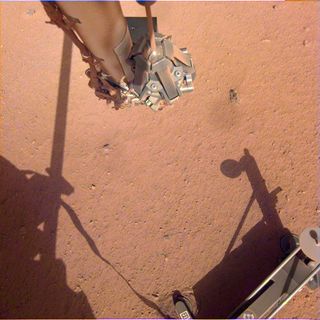


 ) will have to analyse the chemical composion of the rock to determine where this rock comes from… But it is … the meteorite!


 Melania's homage to Diana: Elegant Mrs Trump takes...
 Student sells videos of herself SNEEZING in public to cover...