Naar de inhoud

UFO'S of UAP'S, ASTRONOMIE, RUIMTEVAART, ARCHEOLOGIE, OUDHEIDKUNDE, SF-SNUFJES EN ANDERE ESOTERISCHE WETENSCHAPPEN - DE ALLERLAATSTE NIEUWTJES

UFO's of UAP'S in België en de rest van de wereld
akke.beakke.be
Ontdek de Fascinerende Wereld van UFO's en UAP's: Jouw Bron voor Onthullende Informatie! Ben jij ook gefascineerd door het onbekende? Wil je meer weten over UFO's en UAP's, niet alleen in België, maar over de hele wereld? Dan ben je op de juiste plek! België: Het Kloppend Hart van UFO-onderzoek In België is BUFON (Belgisch UFO-Netwerk) dé autoriteit op het gebied van UFO-onderzoek. Voor betrouwbare en objectieve informatie over deze intrigerende fenomenen, bezoek je zeker onze Facebook-pagina en deze blog. Maar dat is nog niet alles! Ontdek ook het Belgisch UFO-meldpunt en Caelestia, twee organisaties die diepgaand onderzoek verrichten, al zijn ze soms kritisch of sceptisch. Nederland: Een Schat aan Informatie Voor onze Nederlandse buren is er de schitterende website www.ufowijzer.nl, beheerd door Paul Harmans. Deze site biedt een schat aan informatie en artikelen die je niet wilt missen! Internationaal: MUFON - De Wereldwijde Autoriteit Neem ook een kijkje bij MUFON (Mutual UFO Network Inc.), een gerenommeerde Amerikaanse UFO-vereniging met afdelingen in de VS en wereldwijd. MUFON is toegewijd aan de wetenschappelijke en analytische studie van het UFO-fenomeen, en hun maandelijkse tijdschrift, The MUFON UFO-Journal, is een must-read voor elke UFO-enthousiasteling. Bezoek hun website op www.mufon.com voor meer informatie. Samenwerking en Toekomstvisie Sinds 1 februari 2020 is Pieter niet alleen ex-president van BUFON, maar ook de voormalige nationale directeur van MUFON in Vlaanderen en Nederland. Dit creëert een sterke samenwerking met de Franse MUFON Reseau MUFON/EUROP, wat ons in staat stelt om nog meer waardevolle inzichten te delen. Let op: Nepprofielen en Nieuwe Groeperingen Pas op voor een nieuwe groepering die zich ook BUFON noemt, maar geen enkele connectie heeft met onze gevestigde organisatie. Hoewel zij de naam geregistreerd hebben, kunnen ze het rijke verleden en de expertise van onze groep niet evenaren. We wensen hen veel succes, maar we blijven de autoriteit in UFO-onderzoek! Blijf Op De Hoogte! Wil jij de laatste nieuwtjes over UFO's, ruimtevaart, archeologie, en meer? Volg ons dan en duik samen met ons in de fascinerende wereld van het onbekende! Sluit je aan bij de gemeenschap van nieuwsgierige geesten die net als jij verlangen naar antwoorden en avonturen in de sterren! Heb je vragen of wil je meer weten? Aarzel dan niet om contact met ons op te nemen! Samen ontrafelen we het mysterie van de lucht en daarbuiten.

Berichten van 1 augustus 2019 tot 31 augustus 2019

Mystery sunken 3,000BC temple dubbed ‘Spanish Stonehenge’ appears after drought dries up reservoir

Mystery sunken 3,000BC temple dubbed ‘Spanish Stonehenge’ appears after drought dries up reservoir

AN ANCIENT sunken temple in Spain that dates back 5,000 years has been revealed thanks to a drought.

Dubbed the 'Spanish Stonehenge', this collection of 144 standing stones may have once been a site of ritual worship.

The mysterious site has been revealed thanks to a drought

The mysterious site has been revealed thanks to a drought Credit: Rubén Ortega Martín/Raíces de Peralêda

Some of the stones stand two metres high, and are engraved with serpents.

The giant megaliths are arranged in circles but – just like Stonehenge – no one knows who put them there, and why.

The lost site was submerged back in 1963, after the building of a dam created a reservoir in the area.

But warm weather and large amounts of water extraction saw the stones re-emerge from the deep.

Some of the stones stand up to two metres tall

Some of the stones stand up to two metres tall

Credit: Rubén Ortega Martín/Raíces de Peralêda

The 'Spanish Stonehenge' has been lost for 60 years, and could date back to 3,000 BC

The 'Spanish Stonehenge' has been lost for 60 years, and could date back to 3,000 BC Credit: Rubén Ortega Martín/Raíces de Peralêda

"We grew up hearing about the legend of the treasure hidden beneath the lake and now we finally get to view them," said local official Angel Castaño, speaking to Spain's The Local.

"There certainly may have been treasures buried beneath the stones once upon a time.

"But for us now, the treasures are the stones themselves."

Angel is now leading a "race against time" to preserve the site before the rains come – and submerge the temple again.

The site is believed to have been created in the second and third millenia BC

And it's said that it was used as a sun temple on the banks of the River Tagus.

It was last seen by locals six decades ago, and formed part of local legends.

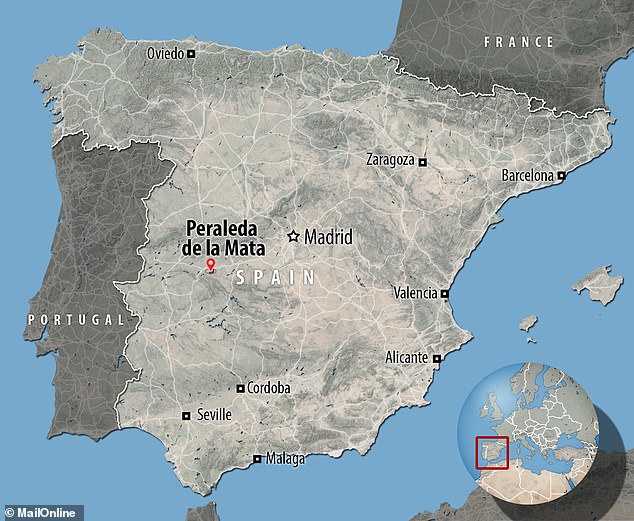
GL-MAP-spanish-stonehenge-v3.jpg

"The site would have been created over thousands of years, using granite transported from kilometres away," Angel explained.

"Like Stonehenge, they formed a sun temple and burial ground.

"They seemed to have a religious but also economic purpose, being at one of the few points of the river where it was possible to cross.

"So it was a sort of trading hub."

Angel and a group of local residents are campaigning to move the stones to a site on dry land.

Otherwise, the waters will rise again and the stones will be lost.

"We have had no rain this summer, so the drought but also a policy of extracting water to send to Portugal has combined to lower the water table and reveal the stones," Angel explained.

"But that can all changed very quickly."

The site was thought to be condemned to the history books in the 1960s when a Spanish general ordered the construction of a hydroelectric dam in Peraleda de la Mata, near Cáceres in Extremadura

The site was thought to be condemned to the history books in the 1960s when a Spanish general ordered the construction of a hydroelectric dam in Peraleda de la Mata, near Cáceres in Extremadura

“If we miss this chance it could be years before they are revealed again.

"And the stones, which are granite and therefore porous, are already showing signs of erosion and cracking, so if we don't act now it could be too late."

Experts now hope to preserve the stones – by moving them to dry land using machines

Experts now hope to preserve the stones – by moving them to dry land using machines

Credit: Rubén Ortega Martín/Raíces de Peralêda

What is Stonehenge?

What you need to know about Britain's most mysterious monument

  • Stonehenge is a prehistoric monument in Wiltshire
  • It's a ring of standing stones that measure around 13 feet high and seven feet wide
  • Each stone weighs roughly 25 tons
  • Experts say that the monument was constructed between 3000 and 2000 BC
  • In 1882, it was legally protected as a Scheduled Ancient Monument
  • And in 1986, the site and surroundings became a UNESCO World Heritage Site
  • Stonehenge itself is owned by the Crown and managed by English Heritage
  • But the land around Stonehenge is owned by the National Trust
  • Part of what makes Stonehenge so mysterious is that it was produced by a culture with no written records
  • Scientists regularly debate over how and why Stonehenge was built, and what it was used for
  • One theory suggests Stonehenge was a sacred burial site
  • Another proposes that it was used for celestial and astronomical alignments
  • And some think it was an ancient place of healing
  • It used to be believed that it was created as a Druid temple
  • But we now know that Stonehenge predated the Druids by around 2000 years

The site was reportedly first uncovered by the Ancient Romans.

However, they weren't rediscovered until German priest and archaeologist Hugo Obermaier visited in the 1920s.

He excavated the site and reportedly took treasures back to Germany.

But the stones themselves remained, and disappeared under a reservoir after the building of a dam in 1963.

"It isn't a difficult thing to move them, we have machinery now to do that," said Angel.

"Let's just hope that there is the political will to save them while we can."

Just last month, scientists announced plans to solve the mystery of the "Armenian Stonehenge" – believed to be even older than Stonehenge itself.

Recent research suggested that the origin of Stonehenge's ancient builders was Turkey.

And Stonehenge builders may have dragged the rocks into place on sledges greased up with pig fat.

What do you make of this mysterious site? Let us know in the comments!

{ https://www.thesun.co.uk/ }

Hoe vind je dit bericht?
Geschreven door peter om 23:15 Stuur door

Two Colossal Crystal Pyramids Found in Center of The Bermuda Triangle

 crystal-pyramids.png

Two Colossal Crystal Pyramids Found in Center of The Bermuda Triangle

With the help of today’s advanced technology, Dr. Meyer Verlag has managed to discover two huge pyramids at the bottom of the ocean.

These pyramids are extremely large. To give you an idea, they are 3 times larger than the pyramid of Cheops in Egypt.

crystal-pyramid.png

It seems that these pyramids are constructed of a type of crystal that could not be identified.

They are about 2000 meters deep at the bottom of the ocean. 

According to researcher Meyer Verlag, these crystal pyramids may be the reason why there are so many mysterious disappearances in that area.

crystal-pyramid-bermuda-triangle.png

There is also a theory that these crystal pyramids belong to the ancient city of Atlantis.

Scientists are optimistic and believe that these pyramids will be investigated very closely in the near future.

And this can give us some very important answers regarding the mysterious disappearances of the Bermuda triangle or even about the lost city of Atlantis.

pyramid-bermuda-triangle.png

Watch the following videos and see for yourself:

{ http://alienblog.net/ }

Hoe vind je dit bericht?
Geschreven door peter om 22:50 Stuur door

Archaeologists Who Discovered Giant Skeletons Were Threatened: “You’re playing with fire”

giant-skeleton.png

Archaeologists Who Discovered Giant Skeletons Were Threatened: “You’re playing with fire”

Since ancient times there are stories and stories about giants. These creatures were so large that the earth shook as they walk.

There are reports about a very controversial case that took place in Romania in the 1940s.

At that time, a team of foreign archaeologists discovered a lot of precious artifacts that it seems to have belonged to the Dacian leader, Burebista.

giant-gold-bracelets.png

From the accounts of that time, it seems that one of the archaeologists by the name of Ionita Florea, discovered a huge skull.

The skull was about five times larger than a human skull. Shortly after the discovery of the giant skull, Ionita Florea was removed from the team, and foreign archaeologists have managed to uncover 80 more giant skeletons.

These giant skeletons were hidden or destroyed. It is not known exactly where the skeletons are.

Another very strange case was when the inhabitants of the village of Scaieni in Romania discovered a cemetery full of giant skeletons, when they were trying to plant an apple orchard. 

giant-skeleton-bucegi.png

In 2009, a television channel began a thorough investigation of the phenomena in the Bucegi Mountains.

But the entire team of researchers and journalists were threatened by telephone by several people who did not reveal their identity.

These people wanted at all costs that this investigation be stopped immediately.

These unknown persons threatened with death the entire team investigating Bucegi Mountains. It seems that the entire operation that investigated the phenomena in the Bucegi mountains was stopped shortly.

And none of the team members ever wanted to make a statement. Watch the following video:

Article created by Vlad © Alien Blog

{ http://alienblog.net/ }

Hoe vind je dit bericht?
Geschreven door peter om 22:40 Stuur door

When aliens spot Earth, what will they see?

earth exoplanet

When aliens spot Earth, what will they see?

Researchers have made incredible advancements in the detection and study of exoplanets in recent years, spotting literally thousands of new planets and learning tantalizing details about them. Scientists can often tell how warm a planet’s surface is, what its atmosphere is made of, and whether or not it could hold liquid water on its surface.

All of this information helps in the never-ending search for extraterrestrial life, but what if an intelligent race of aliens were looking at us? Would they be able to see that Earth is habitable, or perhaps even detect the presence of life here from a distance? A new study published in Science attempts to answer that question, and the answer is just as complicated as you’d expect.

The idea here is that by modeling what a distant civilization would see when looking at Earth, we might get a better idea of what traits to seek out when searching for life-supporting exoplanets of our own. To build this model of a “distant Earth,” the research team collected nearly 10,000 images of Earth snapped from NASA’s Deep Space Climate Observatory satellite and used them to build a two-dimensional picture of the light reflecting off of Earth across multiple wavelengths.

earth_1280p.jpg

This, the researchers say, offers a reasonable estimate of what an intelligent civilization might see when observing our planet at a distance of many light-years. The image might look like little more than a colorful blob, but it’s actually a rough outline of Earth’s continents and oceans.

The scientists suggest that, if we could interpret the light curves of exoplanets in the same way, we may be able to estimate an Earth-like planet’s potential to support life.

“The analysis of light curves in this work have implications for determining geological features and climate systems on exoplanet,” Siteng Fan, lead author of the work, told Universe Today. “We found that the variation of light curve of Earth is dominated by clouds and land/ocean, which are both crucial to the life on Earth. Therefore, Earth-like exoplanets which harbor this kind of features would be more likely to host life.”

{ https://bgr.com/ }

Hoe vind je dit bericht?
Geschreven door peter om 22:10 Stuur door

Watch NASA scientists pretend the Australian Outback is Mars

mars 2020

Watch NASA scientists pretend the Australian Outback is Mars

Next year is going to be a pretty big deal for scientists studying Mars, with both NASA’s Mars 2020 mission and the ExoMars rover mission kicking off in the summer. NASA, the European Space Agency, and Russia’s Roscosmos are all doing their best to plan for the landing of their respective rovers, and they recently gathered in a place that looks a lot like Mars to test a few new ideas.

The international group of researchers met in Australia and set their sights on the dry and dusty conditions of the Australian Outback, which is a decent analog for the Red Planet.

The challenges of controlling a mobile robot on another planet are many, but the scientists are doing their best to plan ahead, especially when it comes to search for evidence of life on Mars.

“The Pilbara Outback is home to the oldest confirmed fossilized lifeforms on Earth, called stromatolites,” Ken Farley of NASA’s Jet Propulsion Laboratory said in a statement. “If we can better understand how these fossils came to be here – and the nearby geological signposts that help point the way to them – we’ll be that much more prepared when hunting for signs of life on Mars.”

Practicing the ability to spot areas where clues about ancient life on Mars may be hiding could come in handy for both teams during their respective missions, but there’s no guarantee that either mission will lead to the discovery of extraterrestrial life.

Both the Mars 2020 mission and the ExoMars rover mission are expected to launch in July of 2020, with NASA’s spacecraft arriving at the Red Planet in February 2021 and the ExoMars rover touching down sometime in March 2021.

{ https://bgr.com/ }

Hoe vind je dit bericht?
Geschreven door peter om 21:59 Stuur door

APOLLO : LE PASSAGE DE LA CEINTURE DE VAN ALLEN

APOLLO : LE PASSAGE DE LA CEINTURE DE VAN ALLEN

Bonjour ! Si vous avez besoin d'apprendre à piloter un avion radiocommandé et de progresser en aéromodélisme je vous propose de télécharger le petit livre ici "les 7 secrets pour débuter et bien progresser en aéromodélisme. Vous serez redirigé sur une autre page et pourrez ensuite continuer votre lecture ici.

Apollo et la ceinture de Van Allen

Apollo et la ceinture de Van Allen

Souvent on croise des personnes sceptiques, remettant en cause l’aventure spatiale. Pourtant l’ensemble de l’oeuvre est très facilement sous la main. Mais se plonger dans le travail colossal de cette entreprise demande toujours trop d’effort pour les détraqueurs. Un grand classique est le passage de le Ceinture de Van Halen par les missions Apollo. Beaucoup disent que c’est impossible. Sauf que le sujet a été traité comme jamais et qu’il est encore traité aujourd’hui : un essais complet a été fait sur la futur capsule pour Mars ( on en parle pas sur le petit écran mais des rapports et des photos sortent chaque mois et pendant qu’on se tourne les pouces les mecs on fait une mission complète dans la ceinture de Van Halen, non habité, pour mesurer la réaction et les taux de radiation de cette futur capsule ).  Mais revenant à Apollo, voici toutes les références si l’on vous ressort ce sujet …  Voilà je vous ai tout mis avec les liens qui vont bien comme ça ça clos le débat.

APOLLO : LA CEINTURE DE VAN ALLEN :

Voici quelques éléments pour le sujet qui nous intéresse aujourd’hui : comment les missions Apolloont résolu le passage de la ceinture de Van Allen ?

Rapport de la NASA des doses radiactive des équipages des missions Appolo lors du passage de la ceninture de Van Halen

Rapport de la NASA des doses radiactive des équipages des missions Appolo lors du passage de la ceinture de Van Allen. (réf 1)

Les doses radioactives reçues lors des missions lunaires, incluant la traversée de la ceinture de Van Allen et l’exposition aux rayonnements cosmiques, furent relativement faibles. On peut noter dans ce tableau que les astronautes d’Apollo 14 furent les plus exposés avec une dose absorbée au niveau de la peau de 1,14 rads soit 11,4 milligrays.

Dosimètre personnel de Collins

Dosimètre personnel de Collins.

Si l’on considère un facteur de pondération pour la peau de 0,01 et un facteur de pondération pour les rayonnements de 20 (cas le plus pénalisant), les astronautes d’Apollo 14 ont reçu une dose de 2,24 millisieverts.

TableRayonsX

Si l’on se réfère à un tableau de radiation classique dans le milieu médical, Apollo 14 a reçu une radiation équivalente à une radio de la poitrine … Par comparaison, la limite annuelle pour les travailleurs du secteur nucléaire en France est de 20 millisieverts. (réf.2)

SYNTHÈSE TECHNIQUE COMPLÈTE SUR LES RADIATIONS LORS DES MISSIONS APOLLO :

Cette synthèse nous fait un point sur les radiations lors du passage de la ceinture de Van Allen, sur les radiations relevées dans le module lunaire et lors des sorties ELM.

Ce document fait également un bref descriptif des instruments utilisés pour faire les mesures. Ciquez sur l’image ci-dessous pour télécharger.

La ceinture de Van Halen : note technique de la NASA faisant la synthèse des missions Apollo vis à vis des doses de radiation des équipages d'Apollo.

La ceinture de Van Allen : note technique de Mars 1973 de la NASA faisant la synthèse des missions Apollo vis à vis des doses de radiation des équipages d’Apollo. Cliquez sur l’image pour accéder à la note technique originale. 

TRAJECTOIRE DU PASSAGE DE LA CEINTURE DE VAN ALLEN POUR APOLLO 11.

Apollo-11_ceinture de Van Allen

Une maquette d’ingénierie grandeur nature chez Michoud Assembly Facility pour la contruction de la futur Saturn V. Le recours à la maquette est essentiel sur ces projets R&D. Saturn avait besoin non seulement d’experts en fusées, mais également d’équipes de construction pour construire certains des plus grands bâtiments du monde.

(NASA).

Étages de la fusée Saturn V en cours d’assemblage à Michoud Assembly Facility

(NASA).

Les ingénieurs d’IBM travaillent à l’intérieur de l’unité Instrument de Saturn V, le «cerveau» responsable du guidage et de la navigation. La structure en anneau s’intègre entre le troisième étage le plus élevé du véhicule et le vaisseau spatial Apollo. (NASA).

LIENS & RÉFÉRENCES SUR APOLLO & LE PASSAGE DE LA CEINTURE DE VAN ALLEN :

{ https://aero-modelisme.com/ }

Hoe vind je dit bericht?
Geschreven door peter om 21:40 Stuur door

For an asteroid, Ryugu has surprisingly little dust on its surface

For an asteroid, Ryugu has surprisingly little dust on its surface

The space rock may hide the fine debris inside larger rocks or eject it into space

Ryugu

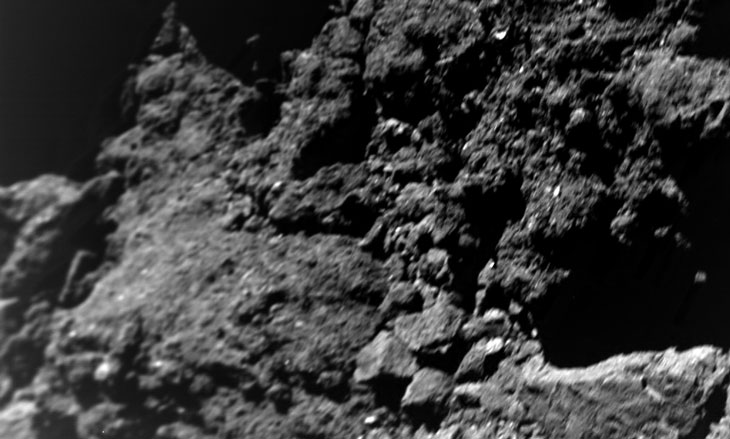
Germany’s MASCOT probe took this photo just before landing on the asteroid Ryugu. The craft found a landscape of crumbly and jagged rocks, but not much actual dust.

R. JAUMANN ET AL/SCIENCE 2019

By 

Ryugu is a neat freak. The surface of the small, near-Earth asteroid is surprisingly free of dust, observations from Germany’s MASCOT lander show.

The asteroid, thought to have formed from the breakup of a larger body around 700 million years ago, has no atmosphere to protect it from interplanetary dust streaming through the solar system (SN: 4/27/19, p. 4). These miniature missiles pummel exposed space rocks at high speed, breaking down their surfaces into thin layers of dust and dirt, such as those found on the moon and the asteroid Vesta.

But when MASCOT bounced across Ryugu in October 2018 (SN Online: 9/24/18), the lander took high-resolution photos that show no sign of any dust-sized particles, down to a resolution of about 100 micrometers, about the thickness of a sheet of paper, researchers report in the Aug. 23 Science.

“After a few tens of millions of years, you should have dust on the surface,” says planetary scientist Ralf Jaumann of the German Aerospace Center in Berlin. “If it’s not there, you should have some kind of physical, geological processes which clean up these bodies.”

The MASCOT lander took many pictures as it bounced over Ryugu’s surface, and revealed a rugged terrain largely free of dust.R. JAUMANN ET AL/SCIENCE 2019

Ryugu could hide its dust in larger, porous rocks or deep in its interior, Jaumann and colleagues say. Shaking due to a meteorite impact may shuffle the particles into bigger surface rocks or down through small surface cracks to the asteroid’s center and out of sight, the way small nuts end up at the bottom of a cup of trail mix.

Or Ryugu could spray dust into space when sunlight heats patches of trapped ice and releases volatile gases. A similar asteroid, Bennu, seems to spew plumes of small rocks into space, according to NASA’s OSIRIS-REx spacecraft (SN: 4/13/19, p. 10). But Jaumann thinks that explanation is less likely for Ryugu. Observations from the Japanese Hayabusa2 craft, which has been orbiting Ryugu since June 2018 and brought MASCOT along, suggest that Ryugu has less water in its minerals than Bennu (SN: 1/19/19, p. 6).

There’s another possible explanation for Bennu’s dust sprays, says OSIRIS-REx principal investigator Dante Lauretta of the University of Arizona in Tucson. He thinks frequent temperature changes on Bennu’s surface as the different sides of the asteroid rotate in and out of sunlight could make the asteroid’s larger rocks fracture like a snapped cracker, spraying crumbs into space.

If something similar happens on Ryugu, “then Ryugu should also be ejecting particles,” he says. Hayabusa2 may just not be in the right position to see the sprays. “It would be very cool if we saw it.”

But snapping rocks might create more dust, not less, he notes. An answer to the mystery may not come until after Hayabusa2 returns to Earth with samples of Ryugu’s surface and subsurface in late 2020 (SN: 8/17/19, p. 14).

{ https://www.sciencenews.org/ }

Hoe vind je dit bericht?
Geschreven door peter om 21:19 Stuur door

Astronomers Watch a Black Hole Swallow a Neutron Star for the First Time

Black_hole_devours_a_neutron_star_02-999x540.jpg

Astronomers Watch a Black Hole Swallow a Neutron Star for the First Time

If you’re looking for something that deserves to be blamed for all of the bad news lately, scientists have for the first time ever witnessed a black hole consuming a neutron star with a satisfied belch and a lip-smacking smile. OK, they couldn’t quite see those last two and it happened 900 million years ago, but it’s definitive proof of a long-held theory and that means it could happen again … and again and again. Is this how it will all end? Did it really cause ripples in space and time? Is the grass greener on the other side of the black hole?

“This is a huge milestone—if it stands up.”

The “milestone” astrophysicist Patrick Brady, spokesperson for the Laser Interferometer Gravitational-Wave Observatory (LIGO), is referring to in the announcement in Science is the discovery of gravitational waves (so the answer to the “ripples in time and space” question is ‘yes’) which have been traced to the collision of a black hole and a neutron star 900 million light-years away – a collision which left only the black hole standing. The discovery was made by LIGO – which gets credit for the first detection of gravitational waves in 2015 – and Virgo, a gravitational wave detector near Pisa, Italy, and involved close to 1700 scientists between the two organizations.

Aerial view of the LIGO Hanford Observatory.

“We’ve never detected a neutron star and a black hole together. If it turns out to be right, then we’ve confirmed a new type of star system. It’s that fundamental.”

Ryan Foley, an astronomer at UC Santa Cruz, told Vice that the discovery last week of a gravitational wave called S190814bvset off a wave of excitement and the search for its source, the so-called “optical counterpart” that is the bright light caused by a neutron star crashing into something. Those somethings are normally other neutron stars … but not this time. A small optical counterpart would confirm that the black hole swallowed the neutron star rather than shredding it to pieces — an event that Foley, Brady and other scientists are cautiously optimistic about.

“The neutron star/black hole system is particularly exciting because we haven’t seen any case of that before, and there’s a lot of interesting stuff we could learn if we did detect it.”

Artist’s depiction of the aftermath of a black hole hating a neutron star

The “interesting stuff” includes how atoms are built and other secrets of subatomic physics and the expansion rate of the universe. Proving most astronomers are big kids at heart (and well behind the rest of the world in their video games), Simon Stevenson, an astronomer with Swinburne University of Technology in Australia, described to CBS what all of this will look like.

“We will either see a neutron star being ripped apart by a black hole, or getting swallowed whole like Pac-Man swallowing a ghost. Either way, we are in for a show!”

Sounds like they will be too busy to play a game of Fortnite and pick up some new analogies.

{ https://mysteriousuniverse.org/ }

Hoe vind je dit bericht?
Geschreven door peter om 20:36 Stuur door

“Rolling Stones Rock” on Mars

“Rolling Stones Rock” on Mars

The team behind NASA's InSight lander has informally named a rock on Mars “Rolling Stones Rock” after the band.

Rolling%2BStones%2BRock%2BMars.jpg

A little larger than a golf ball, the rock appeared to have rolled about 3 feet (1 meter) on Nov. 26, 2018, propelled by InSight's retrorockets as the spacecraft touched down to study the Red Planet's deep interior.

In images taken by InSight the next day, several divots in the orange-red soil can be seen trailing "Rolling Stones Rock." It's the farthest NASA has seen a rock roll while landing a spacecraft on another planet.

NASA will use its robotic missions to Mars to help prepare for eventual human exploration of the Red Planet. Charged with returning astronauts to the Moon, NASA's Artemis program is the next step in human exploration. It is a part of NASA's broader Moon to Mars exploration approach, which will quickly and sustainably explore the Moon and enable humanity's next giant leap to Mars.
  
Hoe vind je dit bericht?
Geschreven door peter om 20:16 Stuur door

Linda Moulton Howe: Invisible Flying Object That Sounds Like a Jet Interrupts Beam of High Power Laser Pointer

Linda Moulton Howe: Invisible Flying Object That Sounds Like a Jet Interrupts Beam of High Power Laser Pointer

Lately, many strange and unknown flying objects have been observed in the sky. Now, according to the latest reports and published by Linda Moulton Howe, people heard strange jet-like sounds but their were no planes, even according to two witnesses, the invisible craft interrupted the beam of high power laser pointers.
 

transparent%2Bplane%2Bsky%2B%2B%25282%2529.jpg
Image: Transparent ‘invisible’ craft photographed in the sky above Kaufman, Texas on July 19, 2016.

On August 14, 2019, a scientist in San Diego, California, who has heard loud jet noises in clear sky and two times flashed a powerful laser in direction of unexplained jet noise and saw the beam interrupted by something invisible.

Earlier this month, a Boeing employee witnessed the same phenomenon.

Boeing employee: “I took my high power laser pointer and shot it up in the direction of the unexplained loud jet sound. … On two separate occasions, I have seen the beam interrupted momentarily — It seems to me there is a real physical object moving through the air that is simply not visible.”

In both cases the laser beam was interrupted – Does that mean that there is a real physical object moving through the air that is simply not visible?

Read full report at Earthfiles.com:

In the next video Linda Moulton Howe talks on the invisible flying object reported by the Boeing employee. (Report starts at the 9.50 mark in the video.)

https://ufosightingshotspot.blogspot.com/

{ https://beforeitsnews.com/ }

Hoe vind je dit bericht?
Geschreven door peter om 17:29 Stuur door

Chinese imperial tomb with wall art and clay pots dating back 1,300 years is found by builders working on a primary school's new playing field

Chinese imperial tomb with wall art and clay pots dating back 1,300 years is found by builders working on a primary school's new playing field

  • The underground chamber is believed to be one of several rooms in this facility
  • It was located underneath Xiaojingyu Elementary School in the city of Taiyuan
  • Its murals and pottery are thought to be from the middle of the Tang dynasty
  • The exact identity of the person the chamber was built for remains a mystery 

Pristine wall art and delicate pots have been found inside a stunning thousand-year-old imperial tomb unearthed by Chinese builders of a school sports field.

The underground chamber - believed to be one of several rooms - was located underneath Xiaojingyu Elementary School in the city of Taiyuan.

The school field was undergoing renovations, with workers sinking new foundations when they unintentionally punched through the ceiling of the burial chambers.

They are believed to date back to the Tang Dynasty, one of the greatest empires in the medieval world that ruled from 618 to 907 AD.

Pristine wall art and delicate pots have been found inside a stunning thousand-year-old imperial tomb unearthed by Chinese builders of a school sports field

Pristine wall art and delicate pots have been found inside a stunning thousand-year-old imperial tomb unearthed by Chinese builders of a school sports field

Officials said the perfectly preserved murals and pottery appeared to be from the middle of the Tang Dynasty.

A cultural relics expert told local media the work bears the style of a roughly half-century period known as 'Sheng Tang', when the dynasty flourished between 713 and 766 AD.

A tombstone inside the burial chamber suggested the individual laid to rest underground was 'not a commoner'.

Their exact identity remains shrouded in mystery, however.

The underground chamber - believed to be one of several rooms - was located underneath Xiaojingyu Elementary School in the city of Taiyuan

The underground chamber - believed to be one of several rooms - was located underneath Xiaojingyu Elementary School in the city of Taiyuan

They are believed to date back to the first century Tang dynasty, one of the greatest empires in the medieval world

They are believed to date back to the first century Tang dynasty, one of the greatest empires in the medieval world

The tomb as viewed from above
Another view of the tomb  from above

A tombstone inside the burial chamber suggested the individual laid to rest underground was 'not a commoner', but their identity remains shrouded in mystery

The Tang era is seen by many historians as an era of progress as well as the greatest period for Chinese poetry.

Chinese civilisation flourishing during the first half of the dynasty before the empire eventually collapsed under social unrest.

Construction work at Xiaojingyu Elementary School, which is in Taiyuan's Wanbailin District, has been halted since the discovery.

An official said further excavations into the tomb would not be easy due to the primary school's teaching buildings nearby.

The work will require extensive negotiations with the school, which could be asked to relocate and have its building demolished.

The school field was undergoing renovations, with workers sinking new foundations when they unintentionally punched through the ceiling of the burial chambers

The school field was undergoing renovations, with workers sinking new foundations when they unintentionally punched through the ceiling of the burial chambers

The eighth century heralded the second important epoch in Tang history, which is ranked as the classical period of Chinese art and literature, as it set the high standard to which later poets, painters, and sculptors aspired

The eighth century heralded the second important epoch in Tang history, which is ranked as the classical period of Chinese art and literature, as it set the high standard to which later poets, painters, and sculptors aspired

WHAT DO WE KNOW ABOUT THE TANG DYNASTY?

After 300 years of division and fragmentation following the collapse of the Han dynasty in 220 AD, China was once again unified under the Sui dynasty (581–618).

The political and governmental institutions established during this brief period lay the foundation for the growth and prosperity of the succeeding Tang dynasty.

Marked by strong and benevolent rule, successful diplomatic relationships, economic expansion, and a cultural efflorescence of cosmopolitan style, Tang China emerged as one of the greatest empires in the medieval world.

Merchants, clerics, and envoys from India, Persia, Arabia, Syria, Korea, and Japan thronged the streets of Chang’an, the capital, and foreign tongues were a common part of daily life.

In the beginning decades of the Tang, especially under the leadership of Emperor Taizong (r. 626–49), China subdued its nomadic neighbors from the north and northwest, securing peace and safety on overland trade routes reaching as far as Syria and Rome.

The seventh century was a time of momentous social change; the official examination system enabled educated men without family connections to serve as government officials.

This new social elite gradually replaced the old aristocracy, and the recruitment of gentlemen from the south contributed to the cultural amalgamation that had already begun in the sixth century.

The eighth century heralded the second important epoch in Tang history, achieved largely during the reign of Emperor Xuanzong (r. 712–56), called minghuang—the Brilliant Monarch.

It is rightfully ranked as the classical period of Chinese art and literature, as it set the high standard to which later poets, painters, and sculptors aspired.

Hoe vind je dit bericht?
Geschreven door peter om 15:02 Stuur door

Mysterious 1,000-Year-Old Imperial Tomb Discovere Under Elementary School in China

chinese-tomb-tang-dynasty-999x540.jpg

Mysterious 1,000-Year-Old Imperial Tomb Discovered Under Elementary School in China

Construction workers at an elementary school in school in China thought they were renovating the school’s sports field. Instead they ended up up unearthing a mysterious 1,000-year-old tomb filled with pottery and art from the Tang dynasty of imperial China.

The tomb was discovered underneath Xiaojingyu Elementary School in the city of Taiyuan. Workers were setting new foundations for structures in the sports field when they accidentally punched through the ceiling of the 1,000 year old tomb. Which probably came as a decent surprise.  The tomb is believed to be one of several rooms in a larger underground complex.

Inscriptions on in the mysterious tomb indicate that it belonged to someone of influence, but the exact identity of the eternal resident is still unknown. Archaeologists who have examined the ornate underground tomb say that it most likely dates back to the rule of the Tang dynasty, a golden age and high point of imperial China, which lasted from  618 to 907 AD.

According to the Daily Mail, a “cultural expert” told local media that the artwork bears the very specific style of a roughly 50-year period known as Sheng Tang, when the Tang dynasty flourished between 713 and 766 AD.

Tang dynasty mural

Mural from the Tang dynasty similar to those found in the newly discovered tomb.

The Tang dynasty period was one of immense progress until it collapse.d after social unrest during. At its height, Tang China was a period of social progress and imperial expansion. During the Tang dynasty, China stretched its economic influence across the world, trading with other empires even as far as Rome and Syria and merchants, envoys, and travelers from other nations were a common sight in the capital. It was also a period of  progress in education and art. The Tang period of imperial China was the first to enable educated men without family connections to serve as government officials. The Tang dynasty is also seen by historians as the high water mark for classical Chinese literature and art. The tomb found in Taiyuan was probably built during the reign of Emperor Xuanzong, who was called minghuang or “brilliant monarch.”

Engraved brick from the Tang dynasty.

Since the discovery of the tomb, construction work at Xiaojingyu Elementary School has been halted. Officials say that further excavations will be difficult due to the proximity of the school’s teaching buildings. According to the officials, negotiations with the school may result in the school having to be relocated and its buildings torn down. Fairly ironic for what started as a renovation project.

But, even if the school is shut down for a little while, it might end up having a net positive impact on the children’s education. I know if, when I was a kid, a thousand-year-old tomb from Imperial China destroyed my school, I’d want to know everything there was to know about imperial China. That’s how you get kids interested in history.

{ https://mysteriousuniverse.org/ }

Hoe vind je dit bericht?
Geschreven door peter om 14:52 Stuur door

Ancient City Of Troy Is Centuries Older Than Originally Thought

5-2.jpg

Ancient City Of Troy Is Centuries Older Than Originally Thought

According to new evidence obtained from excavations, archaeologists say that the ancient city of Troy in northwestern Turkey may have been more than six centuries older than previously thought. Rüstem Aslan, who is from the Archaeology Department of Çanakkale Onsekiz Mart University (ÇOMU), said that because of fires, earthquakes, and wars, the ancient city of Troy had been destroyed and re-established numerous times throughout the years.

In the last 150 years or so, ten layers of settlements had been uncovered and they were named “Troy I” to “Troy XI”. This year, however, they discovered an eleventh layer of settlement that they named “Troy o”. “We found traces of burns, pottery and wooden beams in the Troy o layer,” Aslan told the Daily Sabah.

Ancient city of Troy

The items recovered were of great significance as they prove that the city’s history dates back to approximately 5,500 years ago in around 3500 BC. Prior to this year’s significant discovery of an eleventh layer, the previous layers of the settlements were from the ancient Greek to Byzantine time periods between 3000 BC and 1300 AD.

The ancient city of Troy can be found on the mounds of Hisarlik, looking over to the Turkish Aegean coastal plain. It is known as one of the most famous and most visited archaeological sites in the entire world. Excavations of the ancient city began in 1870 by a German businessman named Heinrich Schliemann, who is very well known in the field of archaeology.

Troy was famously known in the Greek Trojan War when Spartan and Achaean warriors from Greece laid siege on the city in the 13th century BC. It was written about in the famous poem called The Iliad by the Greek poet Homer.

Trojan horse of Troy

As for more recent times, in order to celebrate the 20thanniversary o+f being declared a UNESCO World Heritage site, the Turkish government declared the year 2018 the “Year of Troy”. Hundreds of thousands of visitors have toured the famous archaeological site, which also includes a Troy Museum that opened in 2018 and houses around 2000 artifacts representing the ancient city. You can see more pictures here of the archaeological site of Troy.

11-2.jpg

{ https://mysteriousuniverse.org/ }

Hoe vind je dit bericht?
Geschreven door peter om 14:44 Stuur door

NASA voert onderzoek naar mogelijk eerste misdrijf in de ruimte - HLN.be

NASA voert onderzoek naar mogelijk eerste misdrijf in de ruimte - HLN.be

Bron: Belga, De Morgen

Anne McClain verbleef zes maanden in het Internationaal ruimtestation (ISS). Daar zou ze het bankaccount van haar ex gehackt hebben.

 AP  Anne McClain verbleef zes maanden in het Internationaal ruimtestation (ISS). Daar zou ze het bankaccount van haar ex gehackt hebben.
Het Amerikaanse ruimtevaartagentschap NASA heeft officieel een onderzoek opgestart naar een mogelijk misdrijf dat in de ruimte zou gepleegd zijn. Het gaat wellicht om het eerste ruimtemisdrijf ooit, zo meldt de krant New York Times.

De astronaute Anne McClain zou zich op onrechtmatige wijze toegang hebben verschaft tot de bankrekening van haar ex-vrouw. Ze zou dat gedaan hebben tijdens haar zes maanden durende missie in het internationaal ruimtestation ISS. Toen Summer Worden, de ex van McClain, dat ontdekte, diende ze een klacht in bij de Federal Trade Commission. Ook bij de algemene inspectie van NASA werd intussen een klacht neergelegd.

Lees ook

Voogdij over zoon

Volgens New York Times is er wellicht geen geld van de rekening gehaald. De astronaute wordt wel beschuldigd van identiteitsfraude. Ook wordt aangehaald dat McClain mogelijk op zoek was naar bewarend materiaal om Worden de voogdij over hun zoon te ontzeggen.
McClain, die in juni naar de aarde terugkeerde, zegt via haar advocaat dat ze niets verkeerd heeft gedaan. Ze zegt dat ze in het ISS enkel de gemeenschappelijke rekening van het koppel bekeek, omdat ze wilde nagaan of alles in orde was met de - nog steeds verstrengelde - financiën van het ex-koppel. Zo wilde ze zeker weten of er nog wel genoeg geld aanwezig was voor de opvoeding van hun kind. McClain zegt dat dit tijdens de relatie ook al gebeurde en dat ze gewoon gebruik maakte van het wachtwoord dat ze toen van Worden had gekregen.

Maan

McClain is een gelauwerd militair en astronaut. In de Irakoorlog maakte ze meer dan achthonderd gevechtsvluchten. Ze staat ook op de kandidatenlijst van de NASA van astronauten die mogelijk als eerste vrouw op de maan zullen landen.

Anne McClain.

 AFP Anne McClain.

{ https://www.hln.be/ }

Hoe vind je dit bericht?
Geschreven door peter om 10:53 Stuur door

Russische robot Fiodor kan (voorlopig) niet aan boord gaan bij ISS - HLN.be

Russische robot Fiodor kan (voorlopig) niet aan boord gaan bij ISS - HLN.be

Bron: Belga

De capsule van de Sojoez-MS-14 is onbemand, maar bevat wel de mensachtige robot Fiodor, die 1,80 meter groot is en bijna 160 kilogram weegt.

 EPA  De capsule van de Sojoez-MS-14 is onbemand, maar bevat wel de mensachtige robot Fiodor, die 1,80 meter groot is en bijna 160 kilogram weegt.
 De Russische Sojoez-capsule met aan boord de humanoïde robot Fiodor, is er niet in geslaagd om zich op het voorziene uur vast te hechten aan het internationaal ruimtestation ISS. Dat melden de Russische nieuwsagentschappen. Er zal wellicht maandagmorgen een nieuwe poging volgen.

De koppeling had vanmorgen om 7.30 uur (Belgische tijd) automatisch moeten gebeuren, maar voorlopig heeft die nog niet kunnen plaatsvinden. De capsule was tot op 96 meter van de aanmeerplek genaderd, maar begon daarna weg te driften. Momenteel bevindt ze zich op ongeveer 280 meter van het ISS, zo meldt een reporter van het persbureau Tass vanuit het controlecentrum. Het ruimtevaartuig heeft de manoeuvres voor het uitvoeren van de koppeling opnieuw moeten opstarten.
Volgens het Amerikaanse ruimtevaartagentschap is het mislukken van de koppeling niet te wijten aan de capsule. Wel zou er een probleem zijn met Kurs, het naderings- en koppelingssysteem op het ruimtestation. Een volgende poging om aan te meren zal wellicht pas na 48 uur uitgevoerd kunnen worden, ten vroegste maandagmorgen dus. Tot die tijd zal de Sojoez-capsule, met aan boord Fiodor, op “veilige afstand” van het ISS blijven.

Skybot F-850
De capsule van de Sojoez-MS-14 is onbemand, maar bevat wel de mensachtige robot Fiodor, die 1,80 meter groot is en bijna 160 kilogram weegt. Fiodor - Skybot F-850 voor de vrienden - is een Russische voornaam, maar luidt in het Engels Fedor. Dat staat voor “Final Experimental Demonstration Object Research”. 

De robot moet twee weken lang verschillende taken uitvoeren onder toezicht van de Russische kosmonaut Aleksandr Skvortsov. Hij zal de vaardigheden van Fiodor testen onder micro-zwaartekracht. Een van de belangrijkste vaardigheden van de robot is dat hij menselijke bewegingen kan imiteren, waardoor hij astronauten kan helpen of taken van hen kan overnemen. Zijn terugkeer is voorzien op 6 september om 20.13 uur Belgische tijd.

Lees ook

Fiodor heeft zelfs een eigen account op Instagram en Twitter, waarop hij een inkijk geeft in de dagelijkse beslommeringen van een humanoïde robot.

Fiodor heeft net genoeg plaats in de Sojoez-capsule, die verder onbemand is.

 VIA REUTERS  Fiodor heeft net genoeg plaats in de Sojoez-capsule, die verder onbemand is.

Onbemande capsule

Rusland heeft sinds 2002 gebruik gemaakt van Sojoez-FG-draagraketten om mensen naar het ISS te brengen. Maar in 2020 wordt overgeschakeld op de draagraket Sojoez-2.1a, die ook al een Russische vrachtruimteschip van het type Progress gelanceerd heeft. Een lancering met een Progress mislukte, vandaar de test met een Sojoez-capsule die niet bemand is. 

{ https://www.hln.be/ }

Hoe vind je dit bericht?
Geschreven door peter om 10:46 Stuur door

America's Largest Asteroid Impact Left a Trail of Destruction Across the Eastern United States

America's Largest Asteroid Impact Left a Trail of Destruction Across the Eastern United States

Hoe vind je dit bericht?
Geschreven door peter om 01:36 Stuur door

Space's mysterious fast radio bursts: What the heck are they?

Space's mysterious fast radio bursts: What the heck are they?

We've entered a new era of research into one of the newest phenomena in all of space. Here's what you need to know.

De bronafbeelding bekijken

We're already picking up more signals from deep space.

Danielle Futselaar

Fast radio bursts from space are a uniquely 21st-century mystery. They were first identified just 12 years ago and, up until very recently, almost nothing was known about them and where they come from.

But new radio telescopes in Australia and Canada are already making it much easier to detect fast radio bursts, or FRBs, and here's a look at what we've learned so far.

FRBs are essentially just what they sound like -- radio signals from somewhere in deep space that last for just milliseconds.

"Fast radio bursts are exceedingly bright given their short duration and origin at great distances, and we haven't identified a possible natural source with any confidence," Avi Loeb, a Harvard-Smithsonian Center for Astrophysics theorist, said in a press release back in 2017.

Since then, an "FRB Theory Wiki" hosted by the McGill Space Institute has grown to include over four dozen possible explanations ranging from "annihilating mini black holes" to "alien light sails," although most explanations at this point have something to do with pulsars or neutron stars. 

An (extraterrestrial) intelligent explanation?

It should really be no surprise that, as with most space stuff that can't yet be explained without a doubt by some natural phenomenon, aliens have been proposed as a possibility, including by Loeb himself.

"An artificial origin is worth contemplating and checking," he says.

Loeb and his colleagues worked out how much power would be needed to send such signals across the universe. Turns out it would require covering two Earth-size planets with energy collectors, leading Loeb to theorize that such a massive project might be used not to communicate, but to propel starships using high-energy beams.

While aliens might be the most exciting possible explanation, that doesn't mean they're the most probable. There are, after all, natural phenomena in the cosmos that could generate such signals and are known to actually exist, which is more than we can say for extraterrestrials.

In addition to neutron stars, there's also exploding black holes, magnetars and hypothetical blitzars that could be throwing off radio emissions that eventually make it to us.

Or maybe there are different types of FRBs out there or different explanations we haven't even thought of yet.

At least one case of an FRB was later explained by someone at an observatory opening a microwave oven door while it was running.

Few encores

One aspect of FRBs that has made them so hard to trace back to a source is that they rarely seem to repeat. For the first decade of FRB research, they were all just detected and never heard from again. Then, in January 2017, researchers announced they'd finally identified that FRB 121102 repeats.

This allowed them to trace the blinking signal to a surprising source: a distant dwarf galaxy 3 billion light-years beyond the Milky Way.

"That's weird isn't it? You'd expect to find FRBs where there are more stars ... more stars means more neutron stars," Shriharsh Tendulkar of McGill University and the discovery team said at the time.

But after the CHIME radio telescope in British Columbia came online in late 2017, scientists had a new and highly valuable stream of FRB observations at their disposal. As of August 2019, a total of a dozen repeating fast radio bursts have now been confirmed or are in the process of being confirmed.

Notably, one of the repeating FRBs picked up by the new Canadian Hydrogen Intensity Mapping Experiment (CHIME) appears to be much closer than the first couple observed. While those came from somewhere billions of light years away on the other side of the universe, this newly heard one could come from the edge of our own galaxy.

As more new observing equipment comes online, our understanding of FRBs could begin to crystallize very soon. 

Researchers have also been able to integrate artificial intelligence with one telescope in Australia to detect FRBs in real-time as they arrive at Earth. That could rapidly speed up the work of studying the odd signals, which previously required combing through past observations taken months or even years previous.

At this rate, we might soon be able to stream FRBs live as they arrive at our planet. Podcasts are fun, but I now look forward to a golden age of (tiny) bite-sized alien radio broadcasts.

Hoe vind je dit bericht?
Geschreven door peter om 01:22 Stuur door

UFO Landed in Greenland; NASA Has Evidence

UFO Landed in Greenland; NASA Has Evidence

Hoe vind je dit bericht?
Geschreven door peter om 01:07 Stuur door

Russia Just Sent This Robot, Which Can Shoot Guns, Into Space

Russia Just Sent This Robot, Which Can Shoot Guns, Into Space

Meet "Fyodor," which will arrive at the International Space Station on Saturday and definitely won't become self aware.

By Alex Lubben

There’s Data from “Star Trek: The Next Generation,” R2-D2 and C-3P0 from “Star Wars,” and of course the super-scary HAL 9000 from “2001: A Space Odyssey.”

But space bots aren’t just science fiction anymore: Russia has sent a robot to space to learn how to help cosmonauts and astronauts aboard the International Space Station.

Model Skybot F-850, nicknamed “Fyodor” — short for Final Experimental Demonstration Object Research — is shaped like a human and designed to perform tasks that humans can do, like using a screwdriver or a wrench. It blasted off from Kazakhstan late Wednesday aboard an unmanned Russian Soyuz MS-14 rocket, and will arrive at the ISS Saturday and spend five days aboard.

The spaceship that Fyodor flew on usually carries a crew of three into space. But Fyodor had the whole ship to itself. The robot might be sitting in the driver’s seat, but it’s not flying the rocket. The ship is on autopilot, using its own internal navigation system — another non-human helper — called Kurs.


Дмитрий Рогозин
@Rogozin
Робот платформы F.E.D.O.R. показал навыки стрельбы с двух рук. Идёт работа над мелкой моторикой и алгоритмами принятия решений 
Translate Tweet

View image on Twitter

7:32 PM · Apr 13, 2017·Twitter for Android

  • 305
Likes

The Russians want to be clear: Fyodor isn’t a killer robot, though it canshoot guns. It’s designed to be used in all sorts of high-risk scenarios, including gunfights and space. It’s nimble, able to administer first aid with its metal, hinged, human-like fingers, which can also pull a gun’s trigger. 

“We are not creating a terminator but artificial intelligence which will have a great practical importance in various fields,” said Deputy Prime Minister Dmitry Rogozin in a tweet in 2017, referring to the sci-fi film about a time-traveling murderous android played by Arnold Schwarzenegger. Rogozin also praised the robot’s “decision-making skills.”

Video of the launch shows the robot sitting in the pilot’s seat, holding a small Russian flag. Beside Fyodor sat a small toy Russian cosmonaut, which floated into the air as the rocket left the Earth’s atmosphere and entered into low-gravity space. 

Robots like Fyodor, which stands at 5-foot-11 and weighs about 350 pounds, have been around for about five years, and other models have been used to drive cars and conduct rescue work, according to Space.com.

And though Russia’s never sent a humanoid robot into space before, the primary purpose of the flight was to test the rocket Fyodor was on, NASA spokesperson Rob Navias said during the launch broadcast. This was the first time that this particular capsule-rocket combination has been used for a flight of this type, and researchers want to be sure the flight is safe for humans before sending actual people up to space on them.

Fyodor’s good for figuring that out. The android is equipped with a bunch of sensors that will help give a sense of just how comfortable — or uncomfortable — a flight on this ship will be for human astronauts.

The spacecraft is also bringing up nearly 1,500 pounds of supplies and food for the station's six-person crew.

Fyodor isn’t the first robot to visit the ISS. The U.S. sent up Robonaut 2 back in 2011, specially-equipped with (very goofy-looking) “climbing legs” for zero-gravity mobility. It was designed to help astronauts in high-risk situations, and was sent back to Earth in 2018 after experiencing some technical difficulties.

Japan also sent up Kirobo, a friendly Japanese-speaking robot modeled on manga character Astro Boy, designed to keep astronauts from getting lonely in space. The robot got lonely in space after his buddy, Japanese astronaut Koichi Wakata, went home to Earth.

"I'm a little tired, so I think I'll rest awhile, but I hope you'll look up at the sky sometimes and think of me,” Kirobo said in a video messageafter Wakata left the ISS.

  • Cover: Humanoid robot Fyodor prepares for the Soyuz MS-14 orbital flight to the International Space Station aboard a Soyuz-2.1a rocket carrier. Roscosmos State Corporation/TASS (Photo by TASS\TASS via Getty Images)
{ https://www.vice.com/en_us }
Hoe vind je dit bericht?
Geschreven door peter om 00:50 Stuur door

ONDERZOEKERS TREFFEN STERRENSTOF AAN IN ANTARCTISCHE SNEEUW

Bronmateriaal:

Afbeelding bovenaan dit artikel: kristamonique / Pixabay

{ https://www.scientias.nl/ }

Hoe vind je dit bericht?
Geschreven door peter om 00:32 Stuur door

India's Chandrayaan-2 Spacecraft Snaps Its First Picture of the Moon

India's Chandrayaan-2 Spacecraft Snaps Its First Picture of the Moon

Hoe vind je dit bericht?
Geschreven door peter om 00:23 Stuur door

'UFO' Recorded over Jackson Hole in Wyoming

'UFO' Recorded over Jackson Hole in Wyoming

(Buckrail)

(Buckrail)

A video taken just before 4 a.m. on August 11th over Jackson Hole in Wyoming appears to show an unidentified flying object emit a flash of light before streaking away. A second, larger flash occurs after it is off-screen.

The object was spotted on the webcam at Spring Creek Ranch by an anonymous witness who was trying to keep an eye out for the Perseid Meteor Shower.

The witness sent the video to Buckrail the same morning it was shot.

Buckrail released two versions of the video.

The original is three minutes and thirty five seconds long and shot frame-by-frame, wherein the camera only records one image every second.

A sped up version shows a much smoother flight.

The object is too bright and moving too slowly to be a meteor, and, according to the flight log database on the US Department of Transportation website, no flights were in that airspace at the time the video was recorded.

“My coworker thought something was broken on the camera,” the witness said. “I checked online, there weren’t any flights that I could find at that time.”

“It would totally be a plane in my mind if there weren’t a weird, bright flash in the end," she added.

Historical weather data does not show any meteorological explanation, such as lightning, for the flash.

A drone or fighter jet have both been lobbied as possible explanations for the object.

Samuel Singer, former Executive Director of Wyoming Stargazing, speculated that the object could be a drone, and local photographer and drone pilot Sam Cook agreed, since FAA guidelines require drone lights to be visible for at least three statute miles.

That's "pretty bright," said Cook.

Michael Brotherton, a professor of Astronomy at the University of Wyoming, also agreed that a drone is a valid hypothesis.

The flash of light could have been a relatively dim flash exaggerated by the webcam's low-light sensitivity, he said.

“There does seem to be a flash of light from the object partway through that is likely artificial,” Brotherton wrote in an email to Buckrail.

A former Air Force turned commercial pilot asked about the video said it could be a fighter jet pilot “showboating over the valley with an afterburner and flares.” While there is a jet route matching the object's path in the video, there is no military training airspace in that area, and most fighter jets fly in pairs unless they're moving from base to base. The early morning hour, too, would have been an unusual time for a fighter jet to be flying solo.

So far, the object remains unexplained.

To report your own encounter with the impossible, reach out to us directly at the Singular Fortean Society through our contact page.

  • If you enjoyed this article and would like to support the Singular Fortean Society, please consider becoming an official member by signing up through our Patreon page—membership includes a ton of extra content and behind-the-scenes access to the Society’s inner workings.

{ https://www.singularfortean.com/ }

Hoe vind je dit bericht?
Geschreven door peter om 00:09 Stuur door

Say cheese, aliens! The world’s biggest camera is ready to photograph the universe

Say cheese, aliens! The world’s biggest camera is ready to photograph the universe

qi-toJ_G?format=jpg&name=900x900

[Photo: courtesy SLAC National Accelerator Laboratory]

Look out, aliens, because human scientists are about to start snapping some photos of you.

The Department of Energy’s Brookhaven National Lab has finished construction on the 3.2-gigapixel sensor array for the world’s largest camera, which is ready to take photos of life, the universe, and everything that cosmology, physics, and astronomy can create. The camera will be used in the Large Synoptic Survey Telescope (LSST), a massive telescope that will observe the universe like never before.

“This is the biggest charge-coupled device (CCD) array that has ever been built,” Paul O’Connor, senior scientist at Brookhaven Lab’s instrumentation division, said in a press release. “It’s three billion pixels. No telescope has ever put this many sensors into one camera.”

Now that the array is done, work can continue on the massive telescope that is currently under construction on a mountaintop in Chile. I’m not going to pretend to understand the technology that is involved with this massive camera (Gizmodo has you covered on that front), but the digital sensor array is an important part of the project—a collaborative effort involving more than 30 institutions from around the world. Once complete, it will be used to create a time-lapse movie of the complete visible universe accessible from Chile.

And rest assured, photography technology has improved since the days when they had to build a train-size camera just to photograph a train, so while the telescope is large, it’s not as big as the universe it hopes to capture on film.

You Might Also Like:

{ https://www.fastcompany.com/ }

Hoe vind je dit bericht?
Geschreven door peter om 23:56 Stuur door

Riddle as Himalayan skeleton lake is found to contain remains of hundreds of people who died thousands of years apart, including bodies from as far away as Greece

Riddle as Himalayan skeleton lake is found to contain remains of hundreds of people who died thousands of years apart, including bodies from as far away as Greece

  • Roopkund Lake on Indian side of the Himalayas thought to be site of catastrophe
  • Mystery first emerged amid WW2 when British guard found lake full of skeletons 
  • Now, scientists believe Greeks were among hundreds of those who died at site
  • This suggests that the lake drew visitors from across the globe not just locals 

DNA from remains found high in the Himalayas suggest that Greeks were among hundreds of people who died at a mysterious location known as Skeleton Lake.

Roopkund Lake on the Indian side of the Himalayas was once thought to be the site of an ancient catastrophe that left several hundred people dead.

But the first ancient whole genome DNA data from India shows that several different groups of people died at the lake in several incidents up to 1,000 years apart.

The mystery first emerged during the Second World War when a British guard discovered the frozen lake full of skeletons some 16,000 feet (5,000 metres) above sea level.

Study senior author Doctor Niraj Rai, of the Birbal Sahni Institute of Palaeosciences in India, said: 'Roopkund Lake has long been subject to speculation about who these individuals were, what brought them to Roopkund Lake, and how they died.' 

DNA from remains found high in the Himalayas (pictured) suggest that Greeks were among hundreds of people who died at a mysterious location known as Skeleton Lake

DNA from remains found high in the Himalayas (pictured) suggest that Greeks were among hundreds of people who died at a mysterious location known as Skeleton Lake

WHAT HAPPENED AT SKELETON LAKE? 

Theories ranging from a landslide to a mass suicide were put forward to explain the deaths, but it is only recently that researchers believe they know what caused the cracks in their skulls. 

A 2004 expedition to the site concluded the group was killed by cricket ball-sized hailstones during a sudden storm.

This, they decided, was the only way to explain why the skulls and shoulder bones of the dead had all been hit by rounded objects directly from above.

As there was nowhere to shelter in the valley, the group was at the mercy of the storm.

Their bodies lay in the lake, which regularly freezes, for the next 1,200 years until their wartime discovery

Researchers say that analysis of DNA obtained from the skeletons reveals that they derive from at least three 'distinct' genetic groups. 

The first group was made up of 23 people with ancestries that are related to people from present-day India, who do not appear to belong to a single population, but instead derived from many different groups.

The second largest group is made up of 14 individuals with ancestry that is most closely related to people who live in the eastern Mediterranean, especially present-day Crete and Greece. 

A third individual has ancestry that is more typical of that found in South East Asia. 

Stable isotope dietary reconstruction of the skeletons also supports the presence of multiple distinct groups. 

Study first-author Éadaoin Harney, from Harvard University, said: 'We were extremely surprised by the genetics of the Roopkund skeletons.

'The presence of individuals with ancestries typically associated with the eastern Mediterranean suggests that Roopkund Lake was not just a site of local interest, but instead drew visitors from across the globe.'

Radiocarbon dating indicates that the skeletons were not deposited at the same time, as previously assumed.

Instead, the study showed that the two major genetic groups were actually deposited around 1,000 years apart. 

The first ancient whole genome DNA data from India shows that several different groups of people died at the lake in several incidents up to 1,000 years apart. Pictured: Snow covered bones at Roopkund Lake

The first ancient whole genome DNA data from India shows that several different groups of people died at the lake in several incidents up to 1,000 years apart. Pictured: Snow covered bones at Roopkund Lake

First, during the 7th to 10th Centuries, individuals with Indian-related ancestry died at Roopkund, possibly during several distinct events.

But it was not until sometime during the 17th to 20th Centuries that the other two groups, likely composed of travellers from the eastern Mediterranean and South East Asia arrived at Roopkund Lake. 

Ice melting revealed even more skeletal remains, floating in the water and lying around the lake's edges.

The first assumption was that they were the remains of Japanese soldiers who had died of exposure while trying to invade British India. But it soon became apparent that the bones were much older.

Many theories were put forward as to how so many people had died at such a remote location - including an epidemic, landslide, and ritual suicide.

One popular theory was that the people whose remains were found there had been killed by giant hailstones.

The full findings of the study were published in the journal Nature Communications.

Roopkund Lake (pictured) on the Indian side of the Himalayas was thought to be the site of an ancient catastrophe that left several hundred people dead

Roopkund Lake (pictured) on the Indian side of the Himalayas was thought to be the site of an ancient catastrophe that left several hundred people dead

Hoe vind je dit bericht?
Geschreven door peter om 23:34 Stuur door

The Mystery of the Himalayas’ Skeleton Lake Just Got Weirder

The Mystery of the Himalayas’ Skeleton Lake Just Got Weirder

Every summer, hundreds of ancient bones emerge from the ice. A new genetic study helps explain how they got there.

Roopkund Lake, in the Indian Himalayas, is frozen for much of the year. But in warmer months it delivers a macabre performance, earning the nickname Skeleton Lake. CreditCreditAtish Waghwase

By 

Nestled in the Indian Himalayas, some 16,500 feet above sea level, sits Roopkund Lake. One hundred and thirty feet wide, it is frozen for much of the year, a frosty pond in a lonely, snowbound valley. But on warmer days, it delivers a macabre performance, as hundreds of human skeletons, some with flesh still attached, emerge from what has become known as Skeleton Lake.

Who were these individuals, and what befell them? One leading idea was that they died simultaneously in a catastrophic event more than 1,000 years ago. An unpublished anthropological survey from several years ago studied five skeletons and estimated they were 1,200 years old.

But a new genetic analysis carried out by scientists in India, America and Germany has upended that theory. The study, which examined DNA from 38 remains, indicates that there wasn’t just one mass dumping of the dead, but several, spread over a millennium.

The report, published Tuesday in Nature Communications, has led to a “far richer view into the possible histories of this site” than previous efforts provided, said Jennifer Raff, a geneticist and anthropologist at the University of Kansas who was not involved with the work.

Anthropologists have known about Roopkund Lake for several decades, but little was known about the provenance of its skeletons. Rockslides, migrating ice and even human visitors have disturbed and moved the remains, making it difficult to decipher when and how the individuals were buried, much less who they were. “In a case like this, that becomes impossible,” said Cat Jarman, a bioarchaeologist at the University of Bristol in England who was not part of the research team.

Genetic analysis has helped make some sense of the jumble of bones. The researchers, led in part by Niraj Rai, an expert in ancient DNA at the Birbal Sahni Institute of Palaeosciences in India, and David Reich, a geneticist at Harvard University, extracted DNA from the remains of dozens of skeletal samples, and managed to identify 23 males and 15 females.

Based on populations living today, these individuals fit into three distinct genetic groups. Twenty-three, including males and females, had ancestries typical of contemporary South Asians; their remains were deposited at the lake between the 7th and 10th centuries, and not all at once. Some skeletons were more ancient than others, suggesting that many were interred at the lake lifetimes apart.

Human skeletal remains at Roopkund lake. A new genetic study partially identified some of the individuals: young and old, some interred long before others, none of them related.
CreditHimadri Sinha Roy

Then, perhaps 1,000 years or so later, sometime between the 17th and 20th centuries, two more genetic groups suddenly appeared within the lake: one individual of East Asian-related ancestry and, curiously, 14 people of eastern Mediterranean ancestry.

How all these individuals met their end is anyone’s guess. There’s no evidence of bacterial infections, so an epidemic was probably not to blame. Perhaps the challenging high-altitude environment proved fatal.

The earlier study, of five skeletal samples, found three with unhealed compression fractures, perhaps inflicted by huge hailstones, although that conclusion is open to debate. In any case, across a range of centuries “it’s hard to believe that each individual died in exactly the same way,” said Éadaoin Harney, a doctoral student at Harvard and the lead author on the study.

The individuals included children and elderly adults, but none were family relatives. Chemical signatures from the skeletons indicate that the individuals had significantly different diets, adding support to the notion that several distinct population groups are represented.

If accounts of their journeys exist somewhere, none have been uncovered so far. “We have searched all the archives, but no such records were found,” said Dr. Rai.

The researchers note that Roopkund Lake is situated on a route known to modern-day Hindu pilgrims, so perhaps some of the South Asian individuals died while taking part. But that is less likely to explain the presence of individuals from the distant eastern Mediterranean.

Perhaps they weren’t actually Mediterranean migrants, Dr. Jarman said. Their genetic ancestry resembles that of present-day people from Greece or Crete, but current distribution may not apply to ancient populations. Regardless, this group came from somewhere far from Roopkund Lake, for reasons unknown.

Maybe the site held significance for groups with various religious beliefs, said Dr. Jarman. Maybe some of the skeletons were brought for burial, possibly to be left in the lake. Or maybe there were ill-fated explorers — driven by a desire to see a spectacular mountain range, killed by their own curiosity.

A few answers have begun to emerge, at least. Archaeology is full of such enigmatic sites, Dr. Reich said, and when science comes along and digs in, “it enriches the story in immeasurable ways.”
skeleton lake
View of Skeleton Lake, where hundreds of bodies appear when the snow melts. Researchers have now discovered the bodies belonged to distinct groups and were deposited there over 1,000 years.
PRAMOD JOGLEKAR
skeleton lake
Skeletons at the lake in the Himalayas. Researchers do not know why people from the Mediterranean ended up there.
HIMADRI SINHA ROY
Hoe vind je dit bericht?
Geschreven door peter om 23:22 Stuur door

ARE THERE REALLY ALIENS AT AREA 51?

ARE THERE REALLY ALIENS AT AREA 51?

Area 51 is a region of the southern Nevada desert owned and operated by the US Air Force, within their larger Nellis Air Force Base and Nevada Test Site, a huge swath of land stretching from the Indian Springs Auxiliary Field to the Tonopah Test Range. Just a few hours from Las Vegas, this site has entered conspiracy theory and general cultural folklore as an alleged secret containment area for the US government to house either extraterrestrials, captured extraterrestrial spaceships, reverse-engineered technology from aliens, or some mixture of related alien spookery.

Area 51 shares this honor with other sites maintained by the US government in the American southwest, to wit Roswell Army Air Field in Roswell, New Mexico, and more recently, a supposed Dulce Base in Dulce, New Mexico. All three of these sites have been the focus of theories about the US government hiding evidence of aliens and their ships there. We’ll get into the give-and-take of theory and fact on all three of these sites, because even if we don’t find flying saucers, the answers are pretty mind-blowing anyway!

In any case, Area 51 is a site related to the US military and a matter of national security, so aliens or not, the USAF tends to keep mum about what exactly they do there. Area 51 is at least part of a secrecy designation of some sort, official or unofficial. This fans the flames of conspiracy theories, of course.

THE 2019 AREA 51 MEME

Elon Musk
✔@elonmusk

♥️👽 SpaceX has Area 59 👽♥️

View image on Twitter
  • 68.5K people are talking about this

In July of 2019, Area 51 suddenly spiked in popularity again when a Facebook event titled “Storm Area 51, They Can’t Stop All of Us” proposed a mass charge on foot by the general public to raid the Area 51 facility and discover once and for all whether it is housing any aliens. The original poster, Matty Roberts in California, later recanted that the post was just a joke. But despite this, the meme went viral, with some 3 million people signing up. Even a number of celebrities weighed in, including Elon Musk, which is the threshold for crazy ideas reaching critical mass on the Internet.

For the record, the USAF has released a statement saying the facility will be protected from a mass raid like any military base would. And yes, indeed, the world’s largest and most expensive military force can “stop all of you” with some ammo to spare if it comes to that, although the most likely outcome of a civilian breech is getting arrested by the Lincoln County Sheriff.

But let’s back up here: First off, is Area 51 really worth storming at all?

WHAT WE CAN CONFIRM ABOUT AREA 51

Area 51, and the surrounding Nellis Air Force Base and Nevada Test Site, has a history going back to the Cold War. It started out being used as a testing grounds for nuclear weapons, and yes, we mean the kind that make mushroom clouds. Along with being such a remote location handy to test bombs, the flat, virtually featureless desert of Nevada also makes a good airport location, so they threw in the air force base too.

Now, when you have a remote airport where you’re already keeping off-limits because it’s a nuclear test range, it’s also a handy place to fly something when you need a little privacy. And that, it turns out, is exactly what was going on when a 2013 declassified documentrevealed that Area 51 was a testing site for US spy planes, including the U-2 and OXCART aerial surveillance programs. Beyond that, the area has served as a proving ground for numerous Lockheed craft, and nearby Tonopah Test Range has served as a reverse-engineering arena for captured foreign aircraft. Yes, we do this! Over the years whenever US armed forces get their mitts on aircraft from another country, particularly from less-than-friendly neighbors, they take it out to Tonopah to see what she can do. Some of these exercises include simulated dogfights between the foreign craft and our own equipment. Cool job, isn’t it?

Photo: Finlay McWalter / CC by SA-3.0 / Wikimedia Commons

A 1966 CIA diagram of Area 51, found in an untitled, declassified paper, showing the runway overrun for OXCART (Lockheed A-12) and the turnaround areas.

As for Roswell, the supposed crash of a UFO there in 1947 was explained as a weather balloon. Buy it or not, that’s the story. As for Dulce, there are Cold War missile installations there, but no air base confirmed. But when it comes to Area 51, we have a whole list of interesting US military airborne activity that’s come and gone or is rumored to be ongoing now.

Strictly speaking, we have indeed confirmed “UFOs at Area 51”! Just remember that “UFO” just stands for “Unidentified Flying Object,” and anybody sighting a strange airplane swooping by, which is still part of a top-secret military experiment, can definitely say they saw a flying object they could not identify. Furthermore, there’s even a kernel of truth in the “reverse-engineering foreign technology” part, if you just substitute “foreign governments” for “aliens.”

REALITY CHECK

Before we ask if there’s aliens at Area 51, we have to define what we mean. Surely the first thing we have to throw out is our popular concept of “aliens.” If you’re talking about little green men from Mars in those 1950s-style flying saucers that look like an orange wearing a tutu, then no, they don’t exist. But any living organism originating from any point but planet Earth does qualify as an alien!

If we were to discover and confirm extraterrestrial life, it would automatically be the most shattering news ever in recorded history. That applies even down to the smallest bacteria. As it is, the collective human race has been busily scouting for the tiniest nit of alien life. We have rovers on Mars, probes in space, SETI scanning the skies, telescopes probing the farthest reaches of the universe. The 50th anniversary of the Apollo Moon Landing has just passed, and we’re more interested in off-Earth exploration than ever before.

Buzz Aldrin salutes the U.S flag on the Moon / NASA / Neil A. Armstrong

So it’s highly unlikely that if we were to actually uncover alien life forms of any kind, that we would keep it a secret. Just think, the first person to confirm extraterrestrial life guarantees themselves a place in the history books! They’d have a career for life just giving TED talks after that. Their name would be celebrated in science alongside Galileo, Einstein, and Hawking. There is an informal global competition underway to discover extraterrestrial life.

The motivation to keep it a secret is minimal. But… suppose there was something dreadful about this extraterrestrial life form? What if it had some Lovecraftian evil power, what if it was intelligent and demanded secrecy on threat of invasion, or what if it presented some health threat to the human race in some other way, such as an infection vector? You can never say “never” when dealing with the unknown!

Conclusively, we’d have to move that scenario to “implausible,” but not “impossible.”

IS THERE A CONSPIRACY TO SPREAD A CONSPIRACY?

Keep in mind, any military operation involving flying things you want to keep a secret isn’t hurt at all by UFO rumors. And it’s not like the US government hasn’t enjoyed a convenient smokescreen provided by a conspiracy theory obfuscating what it’s really up to before. Just look at these official mission patches for US spy satellite launches by the CIA / NSA / DOD. Come on, they’re messing with our heads on purpose here!

On the civilian side, a little alien UFO story never hurt a town’s tourist economy. Roswell holds a UFO festival every year. If you want to see Area 51 with your own eyes, no need to storm the place, just take the official tour. Even in Dulce, the merest whiff of a maybe alien event at a hypothetical base inspires the local casinos to hype up the event.

So whether you want to believe or not, there’s government on one side and commerce on the other who both benefit when you go chasing flying saucers. Which still doesn’t mean there are no aliens anyway, but, as usual, does indicate that the truth is always far more complex than we first assume.


Pete Trbovich

{ https://spookwire.com/ }

Hoe vind je dit bericht?
Geschreven door peter om 23:07 Stuur door

Asteroid Ryugu May Be Rubble of Two Space Rocks Smashed Together

A photograph of Ryugu's surface captured by the MASCOT lander.
(Image: © Jaumann et al., Science (2019))

A robot deployed on one of the darkest asteroids in the solar system may now shed light on the origins of some of the oldest, rarest meteorites, a new study finds. 

These findings suggest that this asteroid formed during a collision of two very different space rocks, the scientists said. The research also suggests that dust may float off this asteroid, possibly driven by electric fields.

In 2018, the Japanese spacecraft Hayabusa2 arrived at Ryugu, a 2,950-foot-wide (900 meters) near-Earth asteroid that is one of the darkest celestial bodies in the solar system. Its name, which means "dragon palace," refers to a magical underwater castle in a Japanese folktale. 

One reason scientists may want to learn more about Ryugu is because its orbit brings it close — potentially dangerously close — to Earth. 

"Knowing the composition and geological structure of asteroids and comets is essential to [developing] mitigation strategies in the case of potential collision scenarios," study lead author Ralf Jaumann, a planetary scientist at the Institute of Planetary Research in Berlin, told Space.com.

In addition, previous research suggested Ryugu may contain primordial material from the nebula that gave birth to the sun and its planets. Hayabusa2 is designed to return samples from the asteroid to shed light on the formation of the solar system.

The first image captured by the MASCOT rover during its descent to Ryugu's surface.

(Image credit: Jaumann et al., Science (2019))

To investigate Ryugu's surface, Hayabusa2 deployed the Mobile Asteroid Surface Scout (MASCOT) lander. This shoebox-size robot took photos both as it dropped from the main Hayabusa2 spacecraft onto Ryugu and after it landed on the asteroid's surface, where it operated for a little more than 17 hours before its batteries ran out.

"To have this small lander reaching the surface and providing detailed images of the surface was very exciting," Jaumann said.

MASCOT found Ryugu was covered with two kinds of rocks and boulders — one dark with a cauliflower-like, crumbly surface and the other bright with smooth faces and sharp edges. Both types are nearly evenly distributed on the surface of the asteroid, suggesting Ryugu was a pile of rubble that coalesced after two parent bodies crashed into one another, "indicating a violent history of asteroid collision," Jaumann said. 

Close-up images of Ryugu's dark, rough stones revealed they often seem to possess small, colored inclusions similar to those found in one of the most primitive and rare types of meteorites, known as carbonaceous chondrites.

"Carbonaceous material is the primordial material of the solar system, from which all planets and moons originate," Jaumann said. "Thus, if we want to understand planetary formation, including the formation of Earth, we need to understand its building parts." He said the new findings support long-standing speculation that carbonaceous chondrites come from C-type asteroids — dark-gray, carbon-rich space rocks such as Ryugu.

Unexpectedly, the MASCOT images of Ryugu showed no fine dust, which scientists had expected would accumulate on the asteroid's surface due to micrometeoroid impacts and other forms of weathering. The mission's predecessor, Hayabusa, found that another rubble-pile asteroid, Itokawa, also seemed dust-free.

The researchers suggested that some as-yet-unknown force removes dust from Ryugu's surface. Electric fields on the asteroid might cause dust to float away, Jaumann said, or micrometeoroid impacts and seismic vibrations could be responsible.

The scientists detailed their findings online on Aug. 22 in the journal Science. 

Follow Charles Q. Choi on Twitter @cqchoi. Follow us on Twitter @Spacedotcomand on Facebook. 

{ https://www.space.com/ }

Hoe vind je dit bericht?
Geschreven door peter om 22:53 Stuur door

Biodiversity on Some Alien Planets May Dwarf That of Earth

Biodiversity on Some Alien Planets May Dwarf That of Earth

Hoe vind je dit bericht?
Geschreven door peter om 22:40 Stuur door

Pentagon Finally Admits They Investigate UFO Sightings

Pentagon Finally Admits They Investigate UFO Sightings

DISC-KEN-PFEIFER-8-24-19-1024x551.jpg

The Pentagon has finally uttered the words it always avoided when discussing the possible existence of UFOs — “unidentified aerial phenomena” — and admits that it still investigates reports of them.

In a statement provided exclusively to The Post, a Department of Defense spokesman said a secret government initiative called the Advanced Aerospace Threat Identification Program “did pursue research and investigation into unidentified aerial phenomena.”

And while the DOD says it shut down the AATIP in 2012, spokesman Christopher Sherwood acknowledged that the department still investigates claimed sightings of alien spacecraft.

“The Department of Defense is always concerned about maintaining positive identification of all aircraft in our operating environment, as well as identifying any foreign capability that may be a threat to the homeland,” Sherwood said.

“The department will continue to investigate, through normal procedures, reports of unidentified aircraft encountered by US military aviators in order to ensure defense of the homeland and protection against strategic surprise by our nation’s adversaries.”

Nick Pope, who secretly investigated UFOs for the British government during the 1990s, called the DOD’s comments a “bombshell revelation.”

Pope, a former UK defense official-turned-author, said, “Previous official statements were ambiguous and left the door open to the possibility that AATIP was simply concerned with next-generation aviation threats from aircraft, missiles and drones — as skeptics claimed.

“This new admission makes it clear that they really did study what the public would call ‘UFOs,’ ” he said.

“It also shows the British influence, because UAP was the term we used in the Ministry of Defence to get away from the pop culture baggage that came with the term ‘UFO.’ ”

John Greenewald Jr. — whose website The Black Vault archives declassified government documents on UFO reports, “Bigfoot” sightings and other subjects — also called the Pentagon’s use of the term “unidentified aerial phenomena” unprecedented in its frankness.

“I’m shocked they said it that way, and the reason is, is they’ve seemingly worked very hard not to say that,” he said.

“So I think that’s a pretty powerful statement because now we have actual evidence — official evidence — that said, ‘Yes, AATIP did deal with UAP cases, phenomena, videos, photos, whatever.’”

Greenewald said he hopes that the Pentagon will release more information about the AATIP, either by voluntary disclosure or through requests under the federal Freedom of Information Act.

“But at least we’re one step closer to the truth,” he said.

The existence of the AATIP was revealed in 2017, along with a 33-second DOD video that shows an airborne object being chased by two Navy jets off the coast of San Diego in 2004.

At the time, former Senate Majority Leader Harry Reid (D-Nev.) took credit for arranging $22 million in annual funding for the AATIP, telling the New York Times that it was “one of the good things I did in my congressional service.”

Reid’s home state of Nevada hosts the top-secret military installation known as “Area 51,” long rumored to be the storehouse for an alien craft which crashed in Roswell, New Mexico, in 1947. Reid, through a spokeswoman, declined to comment.

NOTE: The above image is CGI.

KEN PFEIFER WORLD UFO PHOTOS AND NEWS

HTTP://WWW.WORLDUFOPHOTOS.ORG

HTTP://WWW.WORLDUFOPHOTOSANDNEWS.ORG

HTTP://WWW.KENPFEIFERDISCOVERIES.COM

THANKS TO THE NEW YORK POST.

Source: 

{ https://beforeitsnews.com/ }

Hoe vind je dit bericht?
Geschreven door peter om 21:49 Stuur door

De geheimen van de piramides onthuld. Kijk deze fascinerende documentaire


De geheimen van de piramides onthuld. Kijk deze fascinerende documentaire

De geheimen van de piramides onthuld. Kijk deze fascinerende documentaire

Al eeuwenlang spreken de zeven wereldwonderen tot de verbeelding van de mensen. Eén daarvan springt eruit: de Grote Piramide in Egypte.

Men veronderstelt dat de piramide diende als grafmonument voor farao Cheops. Was dat ook echt zo? Er is immers nooit een sarcofaag, een mummie of een spoor van grafschatten gevonden.

Regisseur Patrice Pooyard is ook gefascineerd geraakt door dit monumentale bouwsel dat al zoveel eeuwen onze aarde siert.

Twijfel

Hij was onder de indruk van het feit dat de Egyptenaren dit enorme aardbevingbestendige bouwwerk in slechts 20 jaar gemaakt zouden hebben met als enige gereedschap een hamer en beitel.

Toch begon Pooyard te twijfelen aan deze aannames, die al jaren vanzelfsprekend zijn. Ook trok hij in twijfel dat de piramide van Gizeh een grafmonument was.

Door een ingewijde werd hij aangespoord om op onderzoek uit te gaan, en niet alleen in Egypte.

Heel andere conclusie

Hij raadde hem aan om ook andere archeologische plaatsen van betekenis verspreid over de hele wereld te bezoeken.

Het werd een reis van Paaseiland naar Peru, van China naar Mexico en uiteindelijk bracht het onderzoek hem opnieuw naar Egypte. Daar kwam Pooyard tot een heel andere conclusie dan de egyptologen.

Plek van kennis

De Grote Piramide van Gizeh was geen graf, maar een plek van kennis en die plek was en is wereldwijd van belang.

Pooyard legde zijn bevindingen vast in een fascinerende documentaire waarin hij ook zijn conclusies toelicht.

Bekijk de film hieronder:

© Copyright (c) NineForNews.nl

Hoe vind je dit bericht?
Geschreven door peter om 20:43 Stuur door

Ving Nikola Tesla buitenaardse signalen op? Dit is wat hij ontdekte


Ving Nikola Tesla buitenaardse signalen op? Ontdek hier wat hij ontdekte

Ving Nikola Tesla buitenaardse signalen op? Dit is wat hij ontdekte

In juli 1899 claimde Nikola Tesla tijdens onderzoek naar onweersbuien in Colorado Springs een onbekend signaal te hebben opgevangen.

Tesla vermoedde dat de signalen uit de ruimte afkomstig waren, onder meer van Mars.

Eens in de 1,8 jaar staat Mars dichter bij de aarde dan normaal en tijdens één van die close encountersdacht Tesla dat hij signalen van Mars had opgepikt, aldus natuurkundige John Brandenburg in het programma Ancient Aliens.

Buitenaardse aanwezigheid

In 1901 schreef hij in een artikel voor magazine Collier’s Weekly getiteld ‘Praten met de planeten’ over zijn geloof in buitenaardsen.

Hij raakte geobsedeerd door de signalen van andere planeten, merkt schrijver Tim Schwartz op.

“Gebaseerd op de signalen die hij ontving, ontwikkelde hij een theorie dat er al tenminste 1000 jaar een buitenaardse aanwezigheid op aarde was, die de mensheid vanaf het begin controleerde,” zegt Schwartz.

Diskrediet

In dezelfde periode kreeg Tesla het aan de stok met J.P. Morgan en Thomas Edison, indertijd twee machtige figuren, stelt Brandenburg.

“Hij wilde signalen sturen naar de planeet Mars en zijn vijanden gebruikten dit om hem in diskrediet te brengen,” vervolgt hij.

In 1910 werkte Tesla al aan ontwerpen van vliegtuigen gebaseerd op antizwaartekracht. Die zouden er nooit komen.

Bekijk het filmpje hieronder:

[History]
© Copyright (c) NineForNews.nl
Hoe vind je dit bericht?
Geschreven door peter om 20:40 Stuur door

Forget the Nuclear Smoke — Now Elon Musk Wants to Terraform Mars With Mirrors

oasis-67549_1280-999x540.jpg

Forget the Nuclear Smoke — Now Elon Musk Wants to Terraform Mars With Mirrors

One thing you can say about Elon Musk – he’s always thinking. (OK, there’s a lot of things you can say about Elon Musk, but we don’t have that kind of bandwidth.) Take, for example, his ideas about terraforming Mars, which came from his idea that people living inside of artificial environment enclosures on the planet might not do too well physically and mentally (think Biosphere 2), which came from his idea of colonizing Mars, which … you get the idea – Elon is always thinking. How could humans live on Mars without airtight habitats? By turning the planet into a junior Earth, and the best way to do that is by creating an ultra-fast evolution from barren dirt to bountiful rainforests … or at least enough food and atmosphere to live, work and survive outside. And his original idea for doing that was …

Elon Musk
✔@elonmusk

Nuke Mars!

  • 43.5K people are talking about this

Seriously?

This goes back to 2015 when Musk first said his solution for raising the temperature on Mars to make it habitable for humans would be to “Drop thermonuclear weapons over the poles.” Once the smoke cleared, Musk figured enough trapped CO2 would be released from Martian soil to create an instant Earth atmosphere and kickstart an evolution. Scientists – both environmental and rocket – as well as ethicists and other humans have been objecting to this idea ever since, but busy idea-man Elon has just gotten around to coming up with a new one.

“Might make sense to have thousands of solar reflector satellites 🛰

 to warm Mars vs artificial suns (tbd)”

That’s a mighty big ‘to be determined’ – starting with how does one get thousands of solar reflector satellites into Martian orbit – but it’s less radioactive (both literally and figuratively) so it has generated some consideration and reflection. Not because Elon said it but because Rigel Woida, an optical sciences and engineering student at the University of Arizona, wrote an award-winning paper in 2007 on using large aperture, lightweight orbital mirrors for terraforming targeted areas on the Martian surface. He proposed orbiting a 1.5-km array of 150 segmented, 150-meter-diameter mylar balloons that would collect sunlight and beam it to a square-kilometer area of the Martian surface.

“I adjusted the aperture so the reflector would heat a square-kilometer of Mars’ surface to roughly Tucson daytime illumination and temperatures. This would have immediate benefits for the astronauts. It would increase the light level, solar panel energy collection and bring the temperature of that part of the planet up to Earth’s. Astronauts wouldn’t have to work in freezing temperatures or spend energy thawing frozen water – water they need for manufacturing fuel to return to Earth, as well as water needed for consumption. Eventually, using techniques like these, humans might cultivate plants on Mars.”

It’s a start

That’s EXACTLY what I mean, Elon is probably thinking but certainly not saying for obvious reasons. Woida received a $9,000 NASA Institute for Advanced Concepts (NIAC) Student Fellows Prize for his idea. Musk received … well, that’s “tbd.” This idea seems more scientifically possible and certainly less radioactively controversial. But, is it ethical to terraform any other world to turn it into a junior Earth for the purpose of Earthlings colonizing it? Remember what happened on Earth so many times when settlers brought their own plants and animals to new lands? Are they the invasive species … or is it the humans who thought it was a good idea?

That answer requires more than just thought, doesn’t it? Elon?

{ https://mysteriousuniverse.org/ }

Hoe vind je dit bericht?
Geschreven door peter om 20:32 Stuur door

Invisible flying object that sunds like a jet interrupts beam of high power laser pointer

Invisible flying object that sounds like a jet interrupts beam of high power laser pointer

Lately, many strange and unknown flying objects have been observed in the sky. Now, according to the latest reports and published by Linda Moulton Howe, people heard strange jet-like sounds but their were no planes, even according to two witnesses, the invisible craft interrupted the beam of high power laser pointers.

transparent%2Bplane%2Bsky%2B%2B%25282%2529.jpg
Image: Transparent ‘invisible’ craft photographed in the sky above Kaufman, Texas on July 19, 2016.

On August 14, 2019, a scientist in San Diego, California, who has heard loud jet noises in clear sky and two times flashed a powerful laser in direction of unexplained jet noise and saw the beam interrupted by something invisible.

Earlier this month, a Boeing employee witnessed the same phenomenon.

Boeing employee: “I took my high power laser pointer and shot it up in the direction of the unexplained loud jet sound. … On two separate occasions, I have seen the beam interrupted momentarily — It seems to me there is a real physical object moving through the air that is simply not visible.”

In both cases the laser beam was interrupted - Does that mean that there is a real physical object moving through the air that is simply not visible?

Read full report at Earthfiles.com:
In the next video Linda Moulton Howe talks on the invisible flying object reported by the Boeing employee. (Report starts at the 9.50 mark in the video.)

  
Hoe vind je dit bericht?
Geschreven door peter om 20:09 Stuur door

UFO Sighting Video Over Amsterdam

UFO Sighting Video Over Amsterdam

amsterdam-ufo.png

A mysterious UFO above Amsterdam triggered a lot of speculations online about space alien craft sightings and even dark angels.

A strange aerial event was recently observed in the skies above the Dutch capital just as a tornado wreak havoc across the city centre last week.

YouTube channel Mavi777 uploaded the video online showing what seems to be a glowing UFO in the sky close to the top of the swirling column. The footage was reportedly recorded on August 10 as stated in the caption, but the integrity of it could not be immediately confirmed.

The unusual event shown in the clip led several social media users to suspect a possible appearance of a UFO with some of them claiming that these objects and the plasma orb lights are dark angels or the fallen ones that cauterise and kill animals for genetic parts and suck all the blood out as a sacrifice.

{ http://www.latest-ufo-sightings.net/ }

Hoe vind je dit bericht?
Geschreven door peter om 20:01 Stuur door

Mysterious Oregon cattle killings, mutilations alarm ranchers

Mysterious Oregon cattle killings, mutilations alarm ranchers

oKmhgsFq?format=jpg&name=900x900

Silvies Valley Ranch/David Zaitz Photography

Silvies Valley Ranch is a 140,000-acre property in Oregon’s largest county, where cattle outnumber people 14-to-1.

When the first dead bull turned up at the end of July, it didn’t raise an alarm at the Silvies Valley Ranch.

Cattle sometimes die suddenly on the ranch’s 140,000 acres in Harney County — struck by disease or felled by a broken leg and unable to find a way out of the rugged, forested terrain.

But by the time ranch hands discovered four more dead bulls within 24 hours, they knew they were likely dealing with deliberate, premeditated killings.

They’re still baffled by the circumstances. There were no wounds. No signs of a struggle. And the bulls’ genitals and tongues had been carefully removed.

The killing and mutilation of the 4 and 5-year-old Hereford bulls in the prime of their productive lives has since spurred a multi-agency investigation in eastern Oregon, but detectives have turned up no leads and haven’t yet even settled on a cause of death.

“How somebody put these bulls on the ground at what would be arguably a fairly close range — and to do it in a way that didn’t leave any signs, no trace evidence, no footprints, no struggle marks from the animal, no broken limbs — I have no idea,” said Colby Marshall, vice president of the Silvies Valley Ranch.

The mystery deepens because there’s no obvious reason someone would want those animal parts. They aren’t prime targets for black market sales, authorities said.

The deaths are eerily similar to a rash of livestock killings and mutilations across the West in the 1970s, when hundreds of cows and bulls turned up dead, also of seemingly unknown causes and with their genitals and tongues missing.

Back then, theories ran the gamut from a government conspiracy and UFOs to natural deaths and scavengers. Today, the circumstances at Silvies Valley Ranch point to humans as the probable culprits because of the precise cuts on the bulls.

Anything else for now is speculation, including ideas of what might have killed a bull without leaving marks. Marshall said he wonders if the killer used poison darts.

“We think that these are very sick and dangerous individuals and they need to answer for this horrible crime,” he said.

***

Silvies Valley Ranch, about 40 minutes north of the county seat of Burns, has put up a $25,000 reward for information on the bull killings that leads to an arrest and conviction, and the Oregon Cattlemen’s Association has offered its own $1,000 reward.

The investigation has pulled in Oregon State Police as well as the U.S. Forest Service because the cattle were grazing on a federal allotment in the Malheur National Forest.

The ranch is owned by veterinarian Scott Campbell, who bought the enterprise in 2006. Since then, it’s expanded into tourism with a golf course and resort on site, but still maintains around 4,500 head of beef cattle, including around 100 bulls.

The five dead bulls were found on July 30 and 31, in a wooded area about 15 miles from U.S. 395, the nearest major road. They were each about a quarter mile apart, Marshall said. There is some official disagreement on when they were killed — the Harney County Sheriff’s Office, which saw only four of the bulls, puts the deaths at three to 14 days before discovery, but Marshall believes the cattle were discovered within 24 to 48 hours of their deaths.

The delay in finding the animals is not unusual in such a remote area, where ranchers are tasked with patrolling large tracts of land, said Jerome Rosa, executive director of the Oregon Cattlemen’s Association. Harney County is Oregon’s largest county, covering more than 10,000 square miles where cattle outnumber people 14-to-1.

“These are huge, vast, steep landscapes with lots of rock and trees and brush,” Rosa said. “Ranchers may not see their cattle for long stretches of time.”

Beef is Oregon’s largest agricultural commodity, drawing in nearly $1 billion a year – and most cattle crimes typically involve theft, Rosa said.

This makes the deaths at Silvies Valley Ranch particularly bizarre, he said, because the bulls were worth a lot of money alive, particularly for breeding.

Marshall estimated their value at up to $7,000 apiece and said they would have sired at least 100 calves each over the remainder of their lives.

“Their productive life was a huge economic opportunity for the ranch, and now that’s completely lost,” he said. “We’re talking hundreds of thousands of dollars.”

The five dead bulls were found on July 30 and 31, in a wooded area about 15 miles from U.S. 395, the nearest major road. Their genitals and tongues had been cleanly removed.

Silvies Valley Ranch

The five dead bulls were found on July 30 and 31, in a wooded area about 15 miles from U.S. 395, the nearest major road. Their genitals and tongues had been cleanly removed.

Marshall has heard from several other Oregon ranchers who reported similar killings on their property over the past few decades — including cows that had been found with their udders, vulvas and tongues removed.

One of these ranchers, Terry Anderson, found a dead cow on land he was renting near Pendleton in 1980. Its udder had been cleanly removed and Anderson could see no clear evidence of what had killed the animal.

“There was no visible bullet hole or anything there,” Anderson recalled this week. “It was so unusual. It just left you with an eerie feeling.”

The hundreds of cattle deaths in the 1970s — largely concentrated in the Midwest — caused a media sensation as ranchers roiled by an economic crisis blamed a government conspiracy, according to Michael Goleman, a history professor at Somerset Community College in Kentucky who researched the phenomenon.

Because the killings were scattered across different states, investigators reached no overarching conclusion on the cause of the deaths, but Goleman said some people believed the government was conducting weapons tests on the cattle.

Facing pressure from ranchers, the FBI opened an investigation in 1979 into the deaths of 15 cattle in New Mexico, ultimately concluding that there was no evidence of intentional mutilation by humans and the animals had likely died of natural causes.

Since then, scattered reports have made headlines, including the discovery of several mutilated cows in Kansas in 2016 and five cows in 1990 that had been killed and dissected on a farm in Washington. Goleman said conspiracy theorists have pinned the blame on everything from satanic cults to aliens.

But Silvies Valley Ranch isn’t placing its bets on paranormal activity, though Harney County Sheriff’s Deputy Dan Jenkins said he’s gotten a few suggestions that Sasquatch may be responsible. He’s received around 20 calls from around the western U.S. since news about the deaths started spreading.

Jenkins, the lead investigator on the case, said the lack of physical evidence at the crime sites — no footprints, no tire or ATV tracks — means authorities are relying on witnesses to call in to the tip line and report any suspicious activity they might have seen in the area.

***

  • David Bohnert, a professor at Oregon State University who studies beef cattle, said two things typically kill livestock: poisoning from eating toxic plants and people.

In this case, poisoning is unlikely, given the number of bulls involved and the plants in the area, he said. Larkspur typically flowers earlier in the year, while hemlock, another deadly plant, grows only around rivers and streams — not the dry forests where the bulls were found.

Plus, the fact that all five cattle killed were bulls, Bohnert said, is statistically unlikely to occur in nature — they make up only about 4% to 6% of a herd.

That leaves human activity as the most likely cause, he said. Adding to the evidence is the surgical precision with which the genitals and tongues were removed. Scavengers would leave obvious signs of tearing with teeth, claws or beaks, he said.

Bohnert said he has heard rumors of bull testicles being considered an aphrodisiac, and both tongues and genitals can be eaten — the famous “Rocky Mountain Oysters” come to mind. But he could think of no reason why someone couldn’t just legally buy the animal parts.

Yet the human explanation comes with its own difficulties.

Taking down a 2,000-pound bull is no easy feat, and Marshall said there were no signs of a struggle — the bulls were all lying on their sides as if they had just fallen over and died.

He said he could only think that some kind of toxic dart might kill a bull from a distance. But he has no proof of it and may never find it. It’s not clear if a dart would leave a detectable imprint.

In the meantime, tissue samples taken from the carcasses are still being analyzed for toxins and no results are available yet, Marshall said. Even with the tests, the killings may remain an enigma. The bulls had been left to decompose for several days, making a toxicology screen difficult to do, he said.

Until a suspect is found, ranch employees are on high alert, particularly those who patrol vast areas alone on ATV or on horseback.

Rosa said the news had also concerned other ranchers — but that greater awareness could also lead to faster answers in the tight-knit ranching community.

“The neighbors and the folks that are in those areas know each other,” Rosa said. “And when there’s someone strange or different that’s out and about, they take notice of that, and they let each other know.”

{ https://www.oregonlive.com/ }

Hoe vind je dit bericht?
Geschreven door peter om 00:54 Stuur door

They’re real and contain hidden messages, scientist says

They’re real and contain hidden messages, scientist says

A SCIENTIST who has dedicated his life to researching UFO crop circles says there are “puzzles” in them containing secret messages.

92bea1bd9631554443fe6c612f86735f

Crop circles have been appearing around the world for centuries.

Source:Supplied

IT all started with a UFO sighting.

Dr Horace Drew, 61, was just 10 years old when he allegedly saw an unidentified, silver, windowless craft hovering in the sky near his suburban home, in Jacksonville, Florida. The encounter lasted only moments but led to a lifelong fascination with the extraterrestrial.

“I saw a UFO, so I knew they were real from an early age,” Dr Drew told news.com.au.

The scientist, who holds a PhD in Chemistry from Caltech, the California Institute of Technology, and worked for CSIRO as a molecular biologist, has been researching crop circles and aliens for 20 years. Dr Drew relocated to Australia in the 1980s but most of his work has taken him overseas, predominantly to Europe.

“They’re quite rare in Australia,” he said.

He, along with many conspiracy theorists, believe crop circles are the work of aliens or human time travellers. Sceptics say most are probably man-made.

A crop circle is typically defined by standing wheat stems that have been flattened in the shape of a circle or more complex pattern. They tend to appear mainly in developed Western or secularised countries — including Japan.

The cause of many of the circles is unknown despite various natural and unorthodox explanations having been put forward. Some crop circles have been proven to be hoaxes.

But according to Dr Drew, a number are legitimate and contain puzzles that can be decoded and linked to time travel and alien life.

He told news.com.au he had visited about “two dozen crop circles” around the globe in his career. Typically, they were between 50-500m in length, he said.

“For the past 20 years I have been studying UFOs or crop circles. Just as other mainstream scientists study conventional subjects,” Dr Drew told guests at the March UFO & Paranormal Research Society of Australia (UFO-PRSA) seminar in Sydney on Wednesday night.

“This has led to at least one major breakthrough the discovery of a more advanced binary code than our computers currently use.”

Dr Drew claimed that aliens or human time travellers have been leaving the crop circles on Earth as messages to “us or themselves”.

Sightseers visit an incorporated oversized crop circle in a cornfield, not far from the small community of Mammendorf near Munich, southern Germany, on August 3, 2016. The crop circle had a diameter of 180 metres. Picture: AFP / Christof Stache

Sightseers visit an incorporated oversized crop circle in a cornfield, not far from the small community of Mammendorf near Munich, southern Germany, on August 3, 2016. The crop circle had a diameter of 180 metres.

Picture: AFP / Christof StacheSource:AFP

WHY ARE THERE CROP CIRCLES?

Dr Drew said he was one of a handful of scientists around the world who had worked to successfully decode some of the messages in crop circles.

According to him, some crop circles provide general descriptions of the future.

“Other crop (circles) show schematic images of the future for astronomical or human events,” he said.

He said some of the decoded messages read: ‘Much pain but still time. Believe. There is good out there’; ‘Beware the bearers of false gifts and their broken promises’; ‘We oppose deception. Conduit closing’.

Dr Drew has developed at least two theories as to the purpose of the circles by reading their “advanced (version of) binary codes”.

“One theory is that they are trying to introduce themselves to us peacefully, like we do using bubbles with dolphins,” he said.

“When (humans) want to talk with dolphins we put little bubble circles under the ocean with a generator. We watch the dolphins come up and play and investigate, and we study them.

“This is called the ‘dolphin communication project’.”

He said the dynamic between the way humans interact with dolphins and whales was likely comparable to how extraterrestrials communicate with us.

“Barack or Trump have never said to a dolphin: ‘take me to your leader I want to sign a treaty with you’,” he said.

“And (the extraterrestrials are) not interested in making a treaty with us.

“They are ahead of us like we are ahead of the dolphins and the whales.”

His second theory was that the messages “are not even for us”.

Dr Drew said human time travellers from the distant future could be creating the circles as directional markers, to help them navigate “in their distant past, which is our present”.

“There are definitely humans living there in about 5000 years with time travel capability,” he said.

“They’re coming back and flying all over Earth.

“They seem to just say ‘this is a certain day’ and mark it.

“So the trouble is we don’t know space time physics enough to understand what’s happening. It’s beyond our knowledge.

“Maybe they don’t want us to know about it. It might be just for them.”

It’s a theory shared by many in his field of work.

A crop circle once appeared in field of wheat at Clay Hill, Warminster, Wiltshire. The site, made famous by UFO sightings in the 60s and 70s, had crop circle experts baffled over the 200 foot design.

A crop circle once appeared in field of wheat at Clay Hill, Warminster, Wiltshire. The site, made famous by UFO sightings in the 60s and 70s, had crop circle experts baffled over the 200 foot design.

Source:Supplied

HOW ARE THEY MADE?

Dr Drew said the circles appeared to be created by an “unknown energy that heats the crops up”.

“It’s like microwave energy but is something beyond earth’s science,” he said.

“It can pattern the wheat.

“No one sees or hears anything and that's why its so hard to prove. If there’s a craft, it’s silent, noiseless.”

But there’s nothing to fear, according to him.

“Don’t be afraid,” he said.

REAL OR A HOAX?

Telling the difference between a real crop circle and a hoax is like differentiating between an original painting and a fake, according to Dr Drew.

“There are some things to look for,” he said.

Crops that are bent “halfway up” their stems, rather than on the ground ,is one telltale sign “cereologists”, or someone that advocates paranormal explanations of crop circles, look for to determine that it’s not a hoax.

“You can’t absolutely prove a crop circle wasn’t a hoax but you can give a high probability and judgment,” he said.

“If there’s a hoax the word of it gets around very fast, people are aware, people are not that easily fooled.”

Scientist Dr Horace Drew said he took this photos in a “newly found crop” circle at Etchilhampton near Decizes, England in July, 2012. “About 25 per cent of fallen wheat stems inside the picture were bent by unknown energies,” he told a conference on Wednesday.

Scientist Dr Horace Drew said he took this photos in a “newly found crop” circle at Etchilhampton near Decizes, England in July, 2012. “About 25 per cent of fallen wheat stems inside the picture were bent by unknown energies,” he told a conference on Wednesday.

Source:Supplied

In 1991, English pranksters Doug Bower and Dave Chorley took credit for most of the crop circles across southern England made since 1978. They were inspired by the Tully “saucer nest” case in Australia, where a farmer found a flattened circle of swamp reeds after observing a UFO.

Using basic tools including a plank of wood, rope, and a baseball cap fitted with a loop of wire to help them walk in a straight line, they said they made complex crop circles in England — which others then copied all over the world into the 1980s.

They made a circle for journalists, which was later declared authentic by a cereologist. They then revealed their hoax to the world, spurring on even more copycats.

Scientist Dr Horace Drew has been researching crop circles and aliens for 20 years.

Scientist Dr Horace Drew has been researching crop circles and aliens for 20 years.

Source:Supplied

Dr Drew said there was a lot of scientific evidence to show that some crop circles were made by human time travellers or extraterrestrial beings. “Laboratory results on plant or soil samples taken from a crop circle in Brazil in October of 2016 show that it was formed by unknown sterilising images,” he said.

The earliest mention of a crop circle dates back to the 1500s. A woodcut from the time showed a “mowing devil” making the pattern.

An aerial view shows people strolling through a crop circle on a field near Mammendorf, southern Germany, on July 26, 2016. The pattern had a diameter of 180 meters. Picture: AFP / Sven Hoppe.

An aerial view shows people strolling through a crop circle on a field near Mammendorf, southern Germany, on July 26, 2016. The pattern had a diameter of 180 meters.

Picture: AFP / Sven Hoppe.Source:AFP

GOVERNMENT SECRETS?

Earlier this month, US TV host Jimmy Kimmel asked former US President George Bush if he went through “secret files, the UFO documents” when he was in office.

But instead of laughing off the question, the former commander in chief replied: “Maybe.”

Mr Kimmel then asked him if there were “any great secrets you know that you can’t share with people?”

“Yeah, there are,” Mr Bush said. “But I’m not telling you.”

Many conspiracy theorists and some scientists, including Dr Drew, argued that Mr Bush’s comments indicated the US government knows much more about extraterrestrial life than it has publicly revealed.

“The politicians are scared they'll lose votes if they talk about it,” Dr Drew said.

He said international media had also played a part in causing the public to doubt the legitimacy of crop circles and aliens.

But according to him, its important for humans to keep seeking answers.

“The ET visitors have technologies which would benefit us greatly, for example, how to make safe, clean energy without burning oil, coal or gas,” Dr Drew said.

“Ultra-fast propulsion systems, based on gravity and inertia, could carry us safely to distant planets or stars.

“We may also need to upgrade our planetary defences soon, to protect against ET’s who may not be friendly.”

There’s still a lot more to be understood but Dr Drew’s hope is that he one day gets a closer look at what was inside the UFO he believes he saw as a child.

“I’d like to meet (the extraterrestrials or human time travellers) in person,” he said.

“But I don’t think they're going to do that.

“Whichever scientific team is doing this I don’t think we’re supposed to have full knowledge of it because it will interrupt their program, whatever they're doing.”

{ https://www.news.com.au/ }

Hoe vind je dit bericht?
Geschreven door peter om 00:32 Stuur door

WE COULD TRAVEL TO NEW WORLDS IN NASA'S STARSHIP ENTERPRISE

1-spaceship.0.1406755134.0.jpg

PHOTO ESSAY

WE COULD TRAVEL TO NEW WORLDS IN NASA'S STARSHIP ENTERPRISE

US space agency commissions design for its first warp speed spaceship

NASA announced in 2012 that it was working to build a "warp drive" that could enable "faster-than-light" travel. Two years later and the space agency hasn't built a spaceship capable of such speeds yet — but thanks to artist Mark Rademaker, we now know what one could look like. The result is the IXS Enterprise, a ship that shares similarities with both its science fiction Star Trek namesake, and NASA's real-world space shuttle.

Rademaker worked together with NASA's Dr. Harold White to produce visual concepts for the craft. White and his team at NASA are hoping to make "faster-than-light" travel possible with Alcubierre drives. The drives, named for physicist Miguel Alcubierre, theoretically work by distorting space-time. By expanding the space behind a ship and contracting the space in front of it, the IXS Enterprise could drastically speed up our space travel potential, making the 4.3 light-year journey to Alpha Centauri in around two weeks.

Rademaker says he was influenced in the design for his Enterprise by Matt Jefferies' sci-fi artworks from the 1960s. But where famed aviation artist Jeffries, who helped create the spaceships of the Star Trek universe, imagined spindly craft with thin rings, the IXS Enterprise sits inside two circles chubby enough to power its Alcubierre drive. The spacecraft is fatter than most of Jefferies' sci-fi ships, too, capable of bearing four cylindrical pods on its flanks, and sporting a wide, flat, duck's bill of a command module. Speaking at the SpaceVision conference last year, Dr. White justified the design, saying that "if you're going to go to all the trouble of making it that big, you might as well fit all you can in there."

Until NASA announces a breakthrough in its research of Alcubierre drives and "faster-than-light" travel technology, Rademaker's concepts will remain only concepts. But his visualization of the IXS Enterprise still gives us a glimpse of the kinds of vehicles we'll hopefully one day be able to use to travel to strange new worlds, to seek out new life, and new civilizations.
Hoe vind je dit bericht?
Geschreven door peter om 00:14 Stuur door

Some exoplanets may have better conditions for life than our own planet

Scientists discovered the first planet outside of our solar system in 1992, and today more than 4,000 exoplanets have been confirmed.

Some exoplanets may have better conditions for life than our own planet

Scientists discovered the first planet outside of our solar system in 1992, and today more than 4,000 exoplanets have been confirmed. In a new study, researchers have found that some of these exoplanets may have conditions that are even more well-suited to host life than our own planet.

descarga.jpeg

“This is a surprising conclusion,” said Dr. Stephanie Olson, who led the investigation, “It shows us that conditions on some exoplanets with favorable ocean circulation patterns could be better suited to support life that is more abundant or more active than life on Earth.”

Because it is impossible to reach such distant planets with space probes, scientists are working with remote sensing tools like telescopes to explore the conditions on various exoplanets, and sophisticated models must be used to interpret these remote observations. Dr. Olson’s team used ROCKE-3D software, which was developed by NASA to simulate the climates and ocean habitats of different types of exoplanets.

“NASA’s search for life in the Universe is focused on so-called habitable zone planets, which are worlds that have the potential for liquid water oceans. But not all oceans are equally hospitable – and some oceans will be better places to live than others due to their global circulation patterns,” said Dr. Olson.

“Our work has been aimed at identifying the exoplanet oceans which have the greatest capacity to host globally abundant and active life. Life in Earth’s oceans depends on upwelling (upward flow) which returns nutrients from the dark depths of the ocean to the sunlit portions of the ocean where photosynthetic life lives. More upwelling means more nutrient resupply, which means more biological activity. These are the conditions we need to look for on exoplanets.”

Artist’s concept shows what the TRAPPIST-1 planetary system may look like.

Image Credit: NASA/JPL-Caltech

After modeling a variety of exoplanets with potential, the experts were able to define the types of exoplanets which stand the best chance of sustaining life.

“We have used an ocean circulation model to identify which planets will have the most efficient upwelling and thus offer particularly hospitable oceans,” said Dr. Olson. “We found that higher atmospheric density, slower rotation rates, and the presence of continents all yield higher upwelling rates. A further implication is that Earth might not be optimally habitable – and life elsewhere may enjoy a planet that is even more hospitable than our own.”

“There will always be limitations to our technology, so life is almost certainly more common than ‘detectable’ life. This means that in our search for life in the Universe, we should target the subset of habitable planets that will be most favorable to large, globally active biospheres because those are the planets where life will be easiest to detect – and where non-detections will be most meaningful.”

The research was presented by Dr. Olson at the 2019 meeting of the Goldschmidt Geochemistry Congress in Barcelona.

By Chrissy Sexton, Earth.com Staff Writer

Image Credit: NASA/JPL-Caltech

{ https://www.earth.com/ }

Hoe vind je dit bericht?
Geschreven door peter om 23:58 Stuur door

‘Spaceshuttle-UFO’ vastgelegd in Washington. Fotograaf doet onverwachte ontdekking

'Spaceshuttle-UFO' vastgelegd in Washington. Fotograaf doet onverwachte ontdekking
Foto: Wikimedia Commons CC0

‘Spaceshuttle-UFO’ vastgelegd in Washington. Fotograaf doet onverwachte ontdekking

Een fotograaf uit de Amerikaanse staat Washington heeft op een foto die hij had gemaakt van Whitehorse Mountain een onbekend vliegend object vastgelegd.

De UFO is op 22 juli 2018 op klaarlichte dag waargenomen.

De getuige laat weten dat hij het object in eerste instantie niet had gezien op de foto.

Geen vliegtuigen of helikopters
'Spaceshuttle-UFO' vastgelegd in Washington. Fotograaf doet onverwachte ontdekking

Foto: MUFON

Pas na het croppen van de afbeelding en het toepassen van kleurcorrecties werd het object zichtbaar.

“Op het moment dat ik de foto maakte stond ik naar de zon gericht en moest ik de bovenkant van de camera afdekken om een lensflare te voorkomen,” zei de getuige.

“Er waren op dat moment voor zover ik weet geen vliegtuigen of helikopters in het gebied, maar het was erg warm, er stond een harde wind en er was veel verkeer, dus ik heb snel een foto gemaakt en ben weer verder gegaan,” klonk het.

Zeer interessant

Ik woon niet in het gebied, dus ik weet niet hoe vaak er lijnvliegtuigen zijn te vinden, aldus de getuige.

“Hoe dan ook was het zeer interessant om dit aan te treffen op de foto,” besloot hij.

Spaceshuttle

Een onderzoeker van het MUFON (Mutual UFO Network) in Washington heeft bepaald dat het hier gaat om een Unknown Aerial Vehicle. Onbekend dus.

Volgens sommigen lijkt de UFO erg op een spaceshuttle.

Bekijk hier de volledige foto.

93732_submitter_file1__QWWB1363.JPG

[MUFON]
© Copyright (c) NineForNews.
Hoe vind je dit bericht?
Geschreven door peter om 23:42 Stuur door

NASA Confirms Alien-Hunting Mission to Europa

Two views of Jupiter's ice-covered moon, Europa

© AP Photo / NASA

NASA Confirms Alien-Hunting Mission to Europa

It’s official, NASA is going alien hunting. The space agency announced Tuesday that the next phase of the Europa Clipper mission is confirmed, meaning that within the next four to six year NASA will be sending a spacecraft to Jupiter’s moon Europa to determine if it can support life and maybe, just maybe, find a handful of aliens.

Europa is seen as one of the best, if not the best, candidates for extraterrestrial life within our solar system. Europa is slightly smaller than Earth’s moon and has a crust composed mostly of water ice. Europa also has an oxygen atmosphere, although it is extremely thin and would be indistinguishable from the vacuum of space for the purposes of not suffocating.  But it’s not the ice surface or the thin oxygen atmosphere that excites scientists about the moon.

Because Europa is a very young moon, relatively speaking, and has the smoothest surface of any body in the solar system, scientists hypothesize that the thin ice crust of the moon actually hides a massive subsurface ocean. Estimated to be approximately 61 miles thick, this moon-wide ocean would be kept liquid by tidal flexing as the orbits close to Jupiter. Scientists believe that the ocean pulls down chemicals from the moon’s surface. A big, warm-enough-to-be-liquid, salt water ocean that sucks in chemical compounds. Sounds like a prime alien-fishing hole.

Europa

Europa

(credit: NASA/JPL/Galileo Project)

The Europa Clipper mission would be the first spacecraft to study the surface of Europa. Previous missions have flown by and taken some stunning pictures, but none have been able to study what’s happening on  or below the surface. the confirmation of the mission allows the next steps to be taken in the construction and testing of the spacecraft and science payload. In a press release, Thomas Zurbuchen, associate administrator for the Science Mission Directorate at NASA Headquarters in Washington, said:

“We are all excited about the decision that moves the Europa Clipper mission one key step closer to unlocking the mysteries of this ocean world. We are building upon the scientific insights received from the flagship Galileo and Cassini spacecraft and working to advance our understanding of our cosmic origin, and even life elsewhere.”

Water plume on Europa

Artist’s concept of a water plume on Europa

(credit: NASA/ESA/K. Retherford/SWRI)

So when will we see it launch? 20 years? 40? Actually, it should be much sooner than that. NASA says that in the interest of cost-efficiency they are planning to have the equipment built and ready for launch as early as 2023. However they say that failing a 2023 launch date, the latest it would launch is 2025.

So it will launch pretty soon, relatively speaking. After it does launch however, Europa Clipper will take roughly six years to reach its target. This is due to space being big. So we have until 2031, on the outside range, to see if there are any alien-fish or space-dolphins out there. That is, of course, unless things go weird at Area 51 next month.

{  https://mysteriousuniverse.org/ }

Hoe vind je dit bericht?
Geschreven door peter om 23:23 Stuur door

NASA found alien planet that has tri-star sky like in ‘Star Wars’

NASA found alien planet that has tri-star sky like in ‘Star Wars’

NASA has discovered an exoplanet with three “suns” in its sky. Star Wars, anyone?

Astronomers think they've spotted an alien planet with three suns on its horizon, but that still isn't the most interesting thing about the strange new world's sky.

Alien%2BPlanet%2BThree%2BSuns%2BSky%2BStar%2BWars.jpg

Scientists found the world, which they've dubbed LTT 1445Ab, in data gathered by NASA's Transiting Exoplanet Survey Satellite (TESS).

LTT 1445Ab orbits just one of the three stars, all of which are red dwarfs in the latter half of their lives, and the system is about 22.5 light-years away from Earth.

"If you're standing on the surface of that planet, there are three suns in the sky, but two of them are pretty far away and small-looking," co-author Jennifer Winters, an astronomer at the Harvard-Smithsonian Center for Astrophysics, told New Scientist. "They're like two red, ominous eyes in the sky” reports Space.com.

RT America’s Trinity Chavez has the details.


{ http://ufosightingshotspot.blogspot.com/ }

Hoe vind je dit bericht?
Geschreven door peter om 22:56 Stuur door

Nasa geeft steen op Mars de naam ‘Rolling Stones’ - HLN.be

Nasa geeft steen op Mars de naam ‘Rolling Stones’ - HLN.be

De steen 'Rolling Stones'

 Youtube  De steen 'Rolling Stones'
 De Amerikaanse ruimtevaartorganisatie Nasa heeft een steen op Mars naar de rockband Rolling Stones genoemd.

De “Rolling Stones Rock” is iets groter dan een golfbal, zo liet de Nasa donderdag weten op een persconferentie in het Californische Pasadena.

De steen was in beweging gezet door de turbulentie die door de motor van het landingstuig Insight werd veroorzaakt bij de landing in november 2018. Daardoor was de steen enkele meters verderop gerold. De sporen daarvan zijn op oranjerode foto’s van het Marsoppervlak te zien. Het is de eerste keer dat een Nasa-ruimtevaarttuig op een vreemde planeet een steen op die manier in beweging heeft gezet, aldus de Nasa.

“Dit is een mijlpaal in onze lange en bewogen geschiedenis”, lieten de Stones donderdagavond weten op hun concert in Pasadena.

De logo’s van The Rolling Stones en van Nasa werden gisteren voor de start van het concert van The Rolling Stones op grote schermen afgebeeld.

 Chris Pizzello/Invision/AP  De logo’s van The Rolling Stones en van Nasa werden gisteren voor de start van het concert van The Rolling Stones op grote schermen afgebeeld.

{ https://www.hln.be/ }

Hoe vind je dit bericht?
Geschreven door peter om 22:37 Stuur door

Archeologen ontdekken drie ‘buitenaardse’ schedels in Kroatië - HLN.be

Archeologen ontdekken drie ‘buitenaardse’ schedels in Kroatië - HLN.be

De drie schedels waren afkomstig van 'gewone' jongens die 12 tot 16 jaar oud waren toen ze stierven. De rare vorm van hun schedel is het resultaat van opzettelijke schedelvervorming.

 PLOS One  De drie schedels waren afkomstig van 'gewone' jongens die 12 tot 16 jaar oud waren toen ze stierven. De rare vorm van hun schedel is het resultaat van opzettelijke schedelvervorming.
 In Kroatië zijn drie menselijke schedels opgediept, al twijfelden de archeologen een fractie van een seconde of het niet over de restanten van buitenaardse wezens ging. Tenslotte hadden de schedels een puntige, onaardse vorm. In werkelijkheid ging het om kunstmatig vervormde schedels.

De schedels werden in 2013 reeds teruggevonden op een archeologische site in Osijek. De jaren daarop werden de merkwaardige schedels geanalyseerd en die analyse werd nu gepubliceerd in het tijdschrift PLOS One.

Doodsoorzaak
Uit de resultaten van de archeologen blijkt dat de schedels wel degelijk afkomstig waren van drie ‘gewone’ jongens die zo’n 1.550 jaar geleden stierven. Op dat moment waren de tieners vermoedelijk 12 tot 16 jaar oud. Daarbij waren ze duidelijk ondervoed, maar onduidelijk is nog of ze daaraan ook gestorven zijn.

Hun geschatte sterfdatum (415 tot 560 na Christus) komt immers overeen met de val van het Romeinse Rijk. Daarop kwamen nieuwe bevolkingsgroepen en culturen aan in Europa, alsook strubbelingen en nieuwe ziektes. 

Lees ook

Misvormde schedels

En wat dan met die vreemd gevormde schedels? Het klinkt misschien gek, maar het fenomeen waarbij de schedel opzettelijk vervormd werd, kwam in verschillende werelddelen voor. Mensen met zo’n vreemd hoofd vervulden doorgaans een hogere positie in de samenleving, wilden hun intelligentie in de kijker zetten, en/of dichter bij de geesten staan. 

Het vervormen van de schedel gebeurde voornamelijk bij kinderen, omdat een kinderhoofd nog tamelijk ‘plooibaar’ is. Bij de kinderen werd het hoofd dan tussen twee houten planken gewikkeld waardoor een geforceerde en onnatuurlijke groei werd opgedrongen. Het resultaat? Langwerpige en puntige schedels die een onaardse indruk nalaten.

Natuurlijk liepen de praktijken waarbij het hoofd werd vervormd, niet altijd succesvol af. Zo zijn er reeds talrijke restanten ontdekt van kinderen die hoogstwaarschijnlijk stierven na het uitvoeren van een zogenaamde schedelbinding.

{ https://www.hln.be/ }

Hoe vind je dit bericht?
Geschreven door peter om 22:22 Stuur door

Earth is an Exoplanet to Aliens. This is What They’d See

earth_1280p.jpg

Earth is an Exoplanet to Aliens. This is What They’d See

The study of exoplanets has matured considerably in the last ten years. During this time, the majority of the over 4000 exoplanets that are currently known to us were discovered. It was also during this time that the process has started to shift from the process of discovery to characterization. What’s more, next-generation instruments will allow for studies that will reveal a great deal about the surfaces and atmospheres of exoplanets.


This naturally raises the question: what would a sufficiently-advanced species see if they were studying our planet? Using multi-wavelength data of Earth, a team of Caltech scientists was able to construct a map of what Earth would look like to distant alien observers. Aside from addressing the itch of curiosity, this study could also help astronomers reconstruct the surface features of “Earth-like” exoplanets in the future.

The study that describes the team’s findings, titled “Earth as an Exoplanet: A Two-dimensional Alien Map“, recently appeared in the journal Science Mag and is scheduled for publication in The Astrophysical Journal Letters. The study was led by Siteng Fan and included multiple researchers from the California Institute of Technology’s Division of Geological and Planetary Sciences (GPS) and the NASA Jet Propulsion Laboratory.

Artist’s impression of an exoplanet atmosphere reacting from interaction with its star. Credit: NASA, ESA, and G. Bacon (STSci)

When looking for potentially habitable planets beyond our Solar System, scientists are forced to take the indirect approach. Given that most exoplanets cannot be observed directly to learn of their atmospheric composition or surface features (aka. Direct Imaging), scientists must be satisfied with indications that show how “Earth-like” a planet is.

As Fan told Universe Today via email, this reflects the limitations that astronomers and exoplanet studies are currently forced to contend with:

“Firstly, current exoplanet studies have not figured out what the least requirements are for habitability. There are some proposed criterions, but we are not sure if they are either sufficient or necessary. Secondly, even with these criterions, current observation techniques are not good enough to confirm the habitability, especially on Earth-like exoplanets due to the difficulty of detecting and constraining them.”

Given that Earth is the only planet we know of that is capable of supporting life, the team theorized that remote observations of Earth could act as a proxy for a habitable exoplanet as observed by a distant civilization. “Earth is the only planet we know that contains life,” said Fan. “Studying what the Earth looks like to distant observers would give us the direction of how to find potential habitable exoplanets.”

Direct image of exoplanets around the star HR8799 using a Vortex coronagraph on a 1.5m portion of the Hale telescope. Credit: NASA/JPL-Caltech/Palomar Observatory

One of the most important elements of Earth’s climate (and which is critical to all life on its surface) is the water cycle, which has three distinct phases. These include the presence of water vapor in the atmosphere, clouds of condensed water and ice particles, and the presence of bodies of water on the surface.

Therefore, the presence of these could be considered potential indications of habitability and even indications of life (aka. biosignatures) that could be observed from a distance. Ergo, being able to identify surface features and clouds on exoplanets would be essential in order to place constraints on their habitability.

To determine what Earth would look like to distant observers, the team compiled 9740 images of Earth that were taken by NASA’s Deep Space Climate Observatory (DSCOVR) satellite. The images were taken every 68 to 110 minutes over a two year period (2016 and 2017) and managed to capture light reflected from Earth’s atmosphere at multiple wavelengths.

Fan and his colleagues then combined the images to form a 10-point reflection spectrum plotted over time, which were then integrated over the Earth’s disk. This effectively reproduced what Earth might look like to an observer many light-years away if they were to observe Earth over a two year period.

Within the framework of its 100th anniversary commemorations, the International Astronomical Union (IAU) is organising the IAU100 NameExoWorlds global competition that allows any country in the world to give a popular name to a selected exoplanet and its host star. Image Credit: IAU/L. Calçada

Surface features could be more discernible using a new method developed at Caltech. Credit: IAU/L. Calçada

“We found that the second principal component of Earth’s light curve is strongly correlated to the land fraction of the illuminated hemisphere (r^2=0.91),” Fan said. “Combining with the viewing geometry, reconstructing the map becomes a linear regression problem.”

After analyzing the resulting curves and comparing them with the original images, the research team discovered which parameters of the curves corresponded to land and cloud cover. They then picked out the parameters that most closely related to land area and adjusted it to the 24-hour rotation of the Earth, which gave them a contoured map (shown above) that represented what Earth’s light curve would look like from light years away.

The black lines represent the surface feature parameter and correspond roughly to the coastlines of the major continents. These are further colored in green to provide a rough representation of Africa (center), Asia (top right), North and South America (left), and Antarctica (bottom). What lies in between represents the Earth’s oceans, with the shallower sections denoted in red and the deeper ones in blue.

These kinds of representations, when applied to the light curves of distant exoplanets, could allow astronomers to assess whether an exoplanet has the oceans, clouds, and icecaps – all necessary elements of an “Earth-like” (aka. habitable) exoplanet. As Fan concluded:

“The analysis of light curves in this work have implications for determining geological features and climate systems on exoplanet. We found that the variation of light curve of Earth is dominated by clouds and land/ocean, which are both crucial to the life on Earth. Therefore, Earth-like exoplanets which harbor this kind of features would be more likely to host life.”


Earth-like planets.

Image Credit: JPL

In the neat-future, next-generation instruments like the James Webb Space Telescope (JWST) will allow for the most detailed exoplanet surveys to date. In addition, ground-based instruments that are coming online in the next decade – like the Extremely Large Telescope(ELT), the Thirty Meter Telescope (TMT), and the Giant Magellan Telescope (GMT) – are expected to enable direct imaging studies of smaller, rocky planets that orbit closer to their stars.

{ https://www.universetoday.com/ }

Hoe vind je dit bericht?
Geschreven door peter om 01:45 Stuur door

The iconic film ‘Alien’ came out 40 years ago. A scientist explains why Hollywood depictions of extraterrestrials have changed since then.

The iconic film ‘Alien’ came out 40 years ago. A scientist explains why Hollywood depictions of extraterrestrials have changed since then.

Hoe vind je dit bericht?
Geschreven door peter om 01:25 Stuur door

NASA says mysterious dancing blue lights spotted over the Arctic Circle were caused by vapor tests and NOT aliens, as some feared

NASA says mysterious dancing blue lights spotted over the Arctic Circle were caused by vapor tests and NOT aliens, as some feared

  • Mysterious 'alien' lights were actually the result of a new test from NASA
  • By releasing gases into the atmosphere, NASA hope to study solar winds 
  • The lights created by the experiment are similar to those of the Aurora Borealis 
  • They study will illuminate the pattern of particles in the Earth's ionosphere 

Stargazers in northern Norway enjoyed an unexpected light show when a new NASAtest showered the skies with brushstrokes of blue and orange-colored gases.

The lights, which looked like an 'alien attack' attack to some, were actually a part of an ongoing NASA experiment dubbed The Auroral Zone Upwelling Rocket Experiment (AZURE). 

As a part of the mission, NASA says it has launched the AZURE test rocket -- the first of eight such planed launches -- that aim to study the patterns of solar winds. 

The eye-catching lights were created by releasing two harmless gases into the atmosphere — trimethylaluminum as well as a mixture of barium and strontium — so researchers can study the paths of particles in the Earth's ionosphere, NASA says.

Scroll down for video 

Captures of the show were grabbed via a webcam run by Lights Over Lapland, which helps sightseers get a glimpse of Aurora's through guided tours.

Captures of the show were grabbed via a webcam run by Lights Over Lapland, which helps sightseers get a glimpse of Aurora's through guided tours. 

According to scientists, the experiment will also help unlock the forces behind one of nature's most capturing phenomenon, the Aurora Borealis. 

Auroras — the shows of green, blue, and purple light observed in the skies of regions close to the Earth's poles — are created by solar winds interacting with the planet's magnetic field. 

When the particles of the two atmospheric regions collide and their respective particles are charged, the trajectories are changed, which forces electrons and protons down into the atmosphere at which point humans are able to observe them as streaks of colorful light. 

Gases released by NASA in their vapor test were subject to a similar process. 

While scientists have inferred the cause of Auroras, they have yet to actually observe the pattern and behavior of solar winds and the ionosphere that drive them beyond computer-generated models. 

No need to run for cover yet. Alien-like lights in skies over Norway were the result of a test by NASA to study solar winds and Earth's upper atmosphere.  www.lightsoverlapland.com

No need to run for cover yet. Alien-like lights in skies over Norway were the result of a test by NASA to study solar winds and Earth's upper atmosphere. 

 www.lightsoverlapland.com

That's where AZURE comes in. 

Projects like the one witness by stargazers this month will help scientists gain exact measurements of both horizontal and vertical pathways of particles in the ionosphere over a range of altitudes and help increase understanding of the Auroras they create.

Solar winds have not yet been concretely tracked by scientists who rely mostly on computer-generated models.

Solar winds have not yet been concretely tracked by scientists who rely mostly on computer-generated models. 

In addition to creating beautiful displays of light, the interaction between solar winds and the Earth's magnetic field are also crucial to creating the conditions for much of our planet's life. 

Solar winds, waves of particles released from the sun, are rife with radiation, which if beamed to the Earth's surface, would severely damage all of our planet's inhabitants. 

Instead, however, the sun's particles are deflected away from the planet by the Earth's magnetic field, known as the magnetosphere. 

NASA says its experiments will also help to glean a fuller picture of what happens when particles from the solar winds are forced into our atmosphere and exactly where they go.  

HOW IS THE SOLAR WIND FORMED?

The sun and its atmosphere are made of plasma – a mix of positively and negatively charged particles which have separated at extremely high temperatures, that both carries and travels along magnetic field lines.

Material from the corona streams out into space, filling the solar system with the solar wind. 

But scientists found that as the plasma travels further away from the sun, things change. 

baed0cbca175fbbb97e0e804d7d9bedee0deae4e.gif

Views of the solar wind from NASA's STEREO spacecraft (left) and after computer processing (right). Scientists used an algorithm to dim the appearance of bright stars and dust in images of the faint solar wind

The sun begins to lose magnetic control, forming the boundary that defines the outer corona – the very edge of the sun. 

The breakup of the rays is similar to the way water shoots out from a squirt gun.

First, the water is a smooth and unified stream, but it eventually breaks up into droplets, then smaller drops and eventually a fine, misty spray. 

A recent Nasa study captured the plasma at the same stage where a stream of water gradually disintegrates into droplets.

If charged particles from solar winds hit Earth's magnectic field, this can cause problems for satellite and communication equipment.

Read more:

Hoe vind je dit bericht?
Geschreven door peter om 01:14 Stuur door

Rusland stuurt humanoïde robot Fiodor naar ISS - HLN.be

Rusland stuurt humanoïde robot Fiodor naar ISS - HLN.be

Bron: afp, belga, tass

763?appId=2dc96dd3f167e919913d808324cbfeb2&quality=0.8

 AFP
 Rusland heeft bij een test met een gemoderniseerde Sojoez-draagraket en een onbemande Sojoez-capsule de humanoïde robot Fiodor naar het Internationaal Ruimtestation ISS gelanceerd. Het ding zal daar meerdere testen uitvoeren.

Van op de basis Bajkonoer in Kazachstan vertrok om 05.38 uur Belgische tijd een Sojoez-2.1a draagraket. Die slingerde de onbemande capsule Sojoez-MS-14 naar het ISS.

Deze gemoderniseerde Sojoez-draagraket moet voor bemande vluchten de sinds 2002 ingezette Sojoez-FG vervangen die ook Frank De Winne in de ruimte heeft gebracht. Het model 2.1a heeft ook al een Russische vrachtruimteschip van het type Progress gelanceerd, na sinds 2004 voor satellietlanceringen te zijn ingezet.

Eén lancering met een Progress mislukte, vandaar de test met een Sojoez-capsule die voor het eerst niet bemand is.

763?appId=2dc96dd3f167e919913d808324cbfeb2&quality=0.8

 AFP

De capsule moet zaterdag om 07.30 uur Belgische tijd koppelen aan de Russische Pojsk-module van het ISS en vertrekt op 6 september om 20.13 uur Belgische tijd.

De capsule vervoerde alleen vracht, waaronder een humanoïde robot, die 1,80 meter groot is en bijna 160 kilogram weegt. Fiodor, alias Skybot F850, is een Russische voornaam, maar luidt in het Engels Fedor. Dat staat voor “Final Experimental Demonstration Object Research”.

763?appId=2dc96dd3f167e919913d808324cbfeb2&quality=0.8

 EPA

Fiodor heeft een eigen Instagram- en Twitterprofiel, waarop volgers een blik krijgen in het dagelijkse leven van de robot. Zo is te zien hoe Fiodor leert om een fles water te openen.

Aan boord van de ISS zal de robot verschillende taken uitvoeren onder toezicht van de Russische kosmonaut Aleksandr Skvortsov. Hij kwam een maand geleden in de spacemeccano aan. Hij zal de vaardigheden van Fiodor testen onder micro-zwaartekracht. Een van de belangrijkste vaardigheden van de robot is dat hij menselijke bewegingen kan imiteren, waardoor hij astronauten kan helpen of taken van hen kan overnemen.

  “Hij moet vijf of zes taken uitvoeren die een geheim blijven”, zei Jevgeni Doedorov, de verantwoordelijke van het bedrijf dat Fiodor ontwikkelde.

{ https://www.hln.be/ }

Hoe vind je dit bericht?
Geschreven door peter om 00:24 Stuur door

Mysterie rond meer vol menselijke skeletten neemt toe - HLN.be

Mysterie rond meer vol menselijke skeletten neemt toe - HLN.be

Bron: ScienceAlert, The Atlantic

Het Roopkundmeer in de Himalaya.

 Shutterstock  Het Roopkundmeer in de Himalaya.
 Het Roopkundmeer in de Indiase Himalaya is een mysterieuze plek. Het ondiepe bevroren gletsjermeer te midden van de besneeuwde bergtoppen ligt vol met honderden menselijke skeletten. Daaraan dankt het meer dan ook zijn lugubere bijnaam: Skeleton Lake. Niemand weet echter hoe al die menselijke botten daar beland zijn. Nieuw DNA-onderzoek maakt het mysterie nu nog groter.

Onderzoekers schatten dat er zo’n 500 menselijke skeletten op de bodem van het meer liggen. Het Roopkundmeer ligt langs de route van de Nanda Devi Raj Jat, een beroemd festival en pelgrimstocht. De botten liggen verspreid over de bodem, geen enkel skelet is intact. Tijdens de Tweede Wereldoorlog ontdekte een boswachter bij toeval de spookachtige locatie.

Lees ook

De aanvankelijke hypothese was dat een grote groep mensen getroffen was door een of andere catastrofe, zoals een heel zware storm. DNA-onderzoek van 38 skeletten maakte nu echter komaf met dat idee. Uit de genetische analyse blijkt immers dat de stoffelijke resten afkomstig zijn van afzonderlijke bevolkingsgroepen die op verschillende tijdstippen gedurende een tijdsspanne van ongeveer 1000 jaar aan het meer toekwamen. Dat blijkt uit een studie die werd gepubliceerd in het wetenschappelijk tijdschrift Nature Communications.

“We ontdekten dat de geschiedenis van het Roopkundmeer complexer is dan we ooit hadden gedacht”, zegt geneticus David Reich van de Harvard Medical School.

Het meer ligt vol met menselijke beenderen.

Shutterstock  Het meer ligt vol met menselijke beenderen.

Verschillende origine

Tien jaar geleden onderzocht Kumarasamy Thangaraj, een geneticus van het CSIR Centrum voor Cellulaire en Moleculaire Biologie in India, het DNA van 72 skeletten uit het meer. Hij stelde vast dat sommige beenderen een lokale Indiase origine hadden, maar andere niet. Zo bleken sommige botten van Zuidoost-Aziatische afkomst te zijn.

Een internationaal team van een 25-tal archeologen, genetici en andere specialisten vergeleek nu het DNA van 38 skeletten uit het meer. Zij stelden vast dat de botten afkomstig waren van drie verschillende groepen: de grootste groep bestond uit 23 individuen met DNA dat vergelijkbaar is met dat van leden van de huidige Indiase bevolking. 

Middellandse Zee

Het DNA van de tweede grootste groep, 14 individuen, bleek tot hun verbazing vergelijkbaar te zijn met dat van mensen die vandaag leven in Kreta en Griekenland. Het laatste individu had DNA dat wees op een Zuidoost-Aziatische afkomst. 

“We waren bijzonder verrast door de genetica van de Roopkundskeletten”, zegt evolutiebioloog Éadaoin Harney van de Universiteit van Harvard. “De aanwezigheid van individuen met een afkomst die typisch in verband gebracht wordt met het oosten van het Middellandse Zeegebied suggereert dat Roopkund Lake niet alleen lokaal een belangrijke plek was, maar bezoekers aantrok uit de hele wereld.”

Tijdspanne van 1000 jaar

Nog verrassender was de aankomst van de groepen. Uit koolstofdatering blijkt dat de botten van Indiase afkomst dateren van de zevende tot de tiende eeuw. De twee andere groepen, uit het Middellandse Zeegebied en Zuidoost-Azië, dateren van tussen de 17de en 20ste eeuw. 

De kans bestaat dat er in het meer nog niet nader onderzochte botten liggen die afkomstig zijn uit andere tijden en regio’s. De wetenschappers hopen nu dat verder onderzoek zal uitwijzen wat deze individuen naar het meer bracht en hoe ze aan hun einde kwamen.

{ https://www.hln.be/ }

Hoe vind je dit bericht?
Geschreven door peter om 23:57 Stuur door

'Storm Area 51' event pushes rural Nevada county to declare emergency

'Storm Area 51' event pushes rural Nevada county to declare emergency

Hoe vind je dit bericht?
Geschreven door peter om 23:21 Stuur door

Noodtoestand afgekondigd om bestorming Area 51. Hoe Nevada zich voorbereidt op een menigte waarheidszoekers

Noodtoestand afgekondigd om bestorming Area 51. Hoe Nevada zich voorbereidt op een menigte waarheidszoekers

Noodtoestand afgekondigd om bestorming Area 51. Hoe Nevada zich voorbereidt op een menigte waarheidszoekers

In Lincoln County in Nevada is uit voorzorg de noodtoestand afgekondigd in verband met de verwachte bestorming van Area 51.

Al meer dan twee miljoen mensen hebben zich aangemeld voor het Facebookevenement ‘Bestorm Area 51’ in september. Nog eens 1,5 miljoen mensen zijn geïnteresseerd.

Het is goed mogelijk dat duizenden nieuwsgierigen zullen afreizen naar de woestijn. Veel motels zijn al volgeboekt.

UFO-hoofdstad van de wereld

“We proberen ons zo goed mogelijk voor te bereiden op iets waar we niets over weten,” zei bestuurslid Kevin Phillips.

Matty Roberts uit Californië maakte het evenement in juni aan nadat hij een aflevering van de podcast van Joe Rogan had bekeken.

Het begon in eerste instantie als grap, maar de aanmeldingen bleven maar binnenstromen.

In Lincoln County bevindt zich Rachel, de zelfverklaarde ‘UFO-hoofdstad van de wereld’.

Niet zonder gevaar

De nabijgelegen militaire basis Area 51 wordt al decennia met complottheorieën omgeven. Zo zouden er onder meer UFO’s en lichamen van aliens worden bewaard.

Woordvoerster van de Amerikaanse luchtmacht Laura McAndrews zei tegen USA Today dat legerfunctionarissen op de hoogte zijn van het evenement.

Ze waarschuwde mensen om het gebied niet te betreden.

“De Nevada Test and Training Range is een gebied waar de luchtmacht gevechtstoestellen test,” zei McAndrews.

“Het betreden van militaire installaties of militaire trainingsgebieden is niet zonder gevaar,” voegde ze toe.

[USA Today]
© Copyright (c) NineForNews.nl
Hoe vind je dit bericht?
Geschreven door peter om 23:06 Stuur door

Meer van UFO'S of UAP'S, ASTRONOMIE, RUIMTEVAART, ARCHEOLOGIE, OUDHEIDKUNDE, SF-SNUFJES EN ANDERE ESOTERISCHE WETENSCHAPPEN - DE ALLERLAATSTE NIEUWTJES

↑ Terug naar de berichten