Ontdek de Fascinerende Wereld van UFO's en UAP's: Jouw Bron voor Onthullende Informatie!
Ben jij ook gefascineerd door het onbekende? Wil je meer weten over UFO's en UAP's, niet alleen in België, maar over de hele wereld? Dan ben je op de juiste plek!
België: Het Kloppend Hart van UFO-onderzoek
In België is BUFON (Belgisch UFO-Netwerk) dé autoriteit op het gebied van UFO-onderzoek. Voor betrouwbare en objectieve informatie over deze intrigerende fenomenen, bezoek je zeker onze Facebook-pagina en deze blog. Maar dat is nog niet alles! Ontdek ook het Belgisch UFO-meldpunt en Caelestia, twee organisaties die diepgaand onderzoek verrichten, al zijn ze soms kritisch of sceptisch.
Nederland: Een Schat aan Informatie
Voor onze Nederlandse buren is er de schitterende website www.ufowijzer.nl, beheerd door Paul Harmans. Deze site biedt een schat aan informatie en artikelen die je niet wilt missen!
Internationaal: MUFON - De Wereldwijde Autoriteit
Neem ook een kijkje bij MUFON (Mutual UFO Network Inc.), een gerenommeerde Amerikaanse UFO-vereniging met afdelingen in de VS en wereldwijd. MUFON is toegewijd aan de wetenschappelijke en analytische studie van het UFO-fenomeen, en hun maandelijkse tijdschrift, The MUFON UFO-Journal, is een must-read voor elke UFO-enthousiasteling. Bezoek hun website op www.mufon.com voor meer informatie.
Samenwerking en Toekomstvisie
Sinds 1 februari 2020 is Pieter niet alleen ex-president van BUFON, maar ook de voormalige nationale directeur van MUFON in Vlaanderen en Nederland. Dit creëert een sterke samenwerking met de Franse MUFON Reseau MUFON/EUROP, wat ons in staat stelt om nog meer waardevolle inzichten te delen.
Let op: Nepprofielen en Nieuwe Groeperingen
Pas op voor een nieuwe groepering die zich ook BUFON noemt, maar geen enkele connectie heeft met onze gevestigde organisatie. Hoewel zij de naam geregistreerd hebben, kunnen ze het rijke verleden en de expertise van onze groep niet evenaren. We wensen hen veel succes, maar we blijven de autoriteit in UFO-onderzoek!
Blijf Op De Hoogte!
Wil jij de laatste nieuwtjes over UFO's, ruimtevaart, archeologie, en meer? Volg ons dan en duik samen met ons in de fascinerende wereld van het onbekende! Sluit je aan bij de gemeenschap van nieuwsgierige geesten die net als jij verlangen naar antwoorden en avonturen in de sterren!
Heb je vragen of wil je meer weten? Aarzel dan niet om contact met ons op te nemen! Samen ontrafelen we het mysterie van de lucht en daarbuiten.
Berichten van 1 december 2019 tot 31 december 2019
Why The Ark of the Covenant Is The Most Extraordinary Ancient Artifact in History
COAST TO COAST AM - The Ark of the Covenant has to be one of the most extraordinary artifacts in history. In the latter half of the show, historical detective Graham Phillips presented evidence that this remarkable relic really existed and was discovered by the crusader knights, the Templars, during the Middle Ages and brought back to Europe and Phillips now believes he knows where it’s located.
“I think there’s enough information, enough evidence that there was a historical artifact that was considered holy by the ancient Israelites,” he said. Phillips detailed the biblical story of the origin of the Ark, which was purportedly built by the Israelites to house the Ten Commandment tablets.
Why The Ark of the Covenant Is The Most Extraordinary Ancient Artifact in History
Secret Space Program Antigravity Programs Are Real and Active
COAST TO COAST AM – Author and lecturer Mike Bara discussed the alleged secret space program, as well as anti-gravity propulsion programs, secret flying saucer crafts developed by the military, and anti-gravity breakthroughs.
Early in his research, Bara says that he encountered what appeared to be a secret U.S. space program separate from NASA that was begun within the “military intelligence complex.” He believes this was done because the government was afraid that we might find evidence of extraterrestrials on the moon or other planets.
Bara asked the listeners to consider that UFOs may have technology that is not thousands or hundreds of years ahead of us, but possibly only fifty.
Massive UFO Recovered Intact with Occupants in Aztec NM, Major Cover-up, Latest
You hit the nail right on the head Rex…..Awesome job, in search of the TRUTH! I’m right on board with you with what I’ve studied! The little Grays are just A/I, who worked for the mothership, with low IQ’s.
The Nazi’s were more involved with the Dracos, who guided them with alien technology in the making of the glock and flying saucers! The little people seem like they were interdimentional, and were a peaceful species! Charleen Sampson
Got to love it when a Channel actually talks about different things, oppose to beating a dead horse (Roswell re told over n over 😂.) Keep up the great work, I love tuning in. This was a good one. Later man, u got my thumbs up 👍🏾SB
Secret Base near possible crashed object close to the Heritage Range in Antarctica
We know that the government is covering up many things in Antarctica but now the ice melts it is really hard for them to cover it up anymore.
Near the Heritage Range in Antarctica seems to be a large base that is completely blurred out.
A large trail from the station leads to a huge strange object that at first sight looks like it crashed there a long time ago.
Without claiming that the object is a crashed UFO, we may wonder why the people who work at the station pay a lot of attention to the object, so what the government is trying to hide?
The base is about 470 x 260 meters. The bigger (black) part of the object is about 90 x 40 meters. Google Earth coordinates: 80°17'24.11"S 81°53'15.22"W
Untouched for 1,000 years, over 150 ritual artifacts were found in the cave at Balamku. (Karla Ortega, Great Mayan Aquifer Project, INAH)
A sealed and untouched Mayan “ritual” cave has been discovered in a truly momentous find. Sometimes you start out looking for something and, in the process, you find something else. That’s what happened to a group of archaeologists who were looking for a sacred well underneath the Mayan city of Chichen Itza, according to National Geographic.
While they were searching for the well, they found a collection of over 150 ritual objects that were hidden away for a millennium. The objects were hidden in a system of caves known as Balamku, ‘the Jaguar God.’ The discovery of the cave system was announced in Mexico City last March, by the National Institute of Archaeology and History.
Interestingly, it’s not the first time that anyone has found the cave system. It was first rediscovered in 1966 by local farmers. At the time, and archaeologist named Victor Segovia Pinto went in and took a look around, even going as far as writing a report that noted that there were a large number of artefacts the caves, but rather than being an excavation, Pinto had the farmers seal the entrance again, and any records related to the discovery disappeared.
Xavi Bros@Xavi_Bros
#Maya ritual cave of Balamku (Cave of the Jaguar God) ‘untouched’ for 1,000 years stuns archaeologists. More than 150 artifacts found there reveals ancient Maya religious practices: https://on.natgeo.com/2NIfuqS Images: Karla Ortega - National Geographic
It remained unknown and undisturbed until 2018, when it was rediscovered again. This time the Balamku was found by an explorer from National Geographic, along with his team. They were part of the Great Maya Aquifer Project, and were trying to find the water table beneath the Mayan city.
While he was creeping his way through a series of small tunnels, the explorer, Guillermo De Anda, suddenly came upon a sizable cache of vases, incense burners, and many other objects that had been left as offerings by the ancient people of Chichen Itza. Even more of a surprise, the collection was in a remarkable state of preservation, despite being surrounded by stalagmites.
Since De Anda found that first cache, seven chambers holding ritual offerings have been discovered in the caves. The chambers are deep under the city, and can presently only be accessed by traveling through a long series of tunnels, many of which are so narrow and low that researchers have to go through on their stomachs.
Despite the difficulty of getting to the chambers, the first archaeologist to visit the caves back in the ‘60s also clearly made the trip. His original report was finally found not very long ago by an archaeologist from University of California. That report noted that there were more than 150 objects in the cave, many of them bearing images of the Toltec rain god and other sacred symbols.
CARAA@CARAA_Center
Mexican archaeologists discover cave filled with near perfect Mayan ceramics. https://buff.ly/2H1fzpe
A similar cave was found not far away, back in 1959. It also held sacred objects, but less than half as many as at this site. That find was also more accessible. De Anda thinks that’s important. He remarked that while quantity isn’t more important than information, he found it telling that such a huge repository of artifacts was located in a place that was so hard to get to.
De Anda’s rediscovery of the find means that Modern archaeologists who specialize in Mayan culture may be able to learn some new things about the level of contact and interaction between different Mesoamerican cultures of the time, and other information about the history of the Mayan people prior to the city’s fall. None of that answers the question, however, of why Pinto decided to reseal the caves back in the ‘60s, rather than study them.
Historians do know that among the Mayan people, a ritual cave was considered entrances to the underworld, and were thus considered extremely sacred, even to the extent that they played a role in social organization and site planning, according to Mayan archaeology expert Holley Moyes.
The technology available to scientists has improved dramatically since the middle of the last century, which means that they may be able to get a lot more useful information by using methods like 3-D mapping. That information could help answer questions about not only the sorts of rituals that went on in the caves, but also about the city above them.
According to De Anda, it’s not currently known why Chichen Itza declined and fell, but Balamku should be able to help answer that question with its collection of artifacts and organic matter. It’s been speculated that the area was devastated by severe droughts. Some researchers further believe that the extreme weather cycles in the area were exacerbated by deforestation further south.
Once the contents of Mayan ritual cave have been fully catalogued and analysed, the actual circumstances of the time will be much clearer. In fact, it may even offer some insights into the sustainability of cultures during periods of environmental instability, which has modern-day applications, despite its historic roots.
Alien hunters have gone into a frenzy after spotting the pyramid shape in a huge crater on the Moon. The structure appears to have three sides and does look as if it could be man-made. YouTuber Pacitto Dominique spotted the pyramid in NASA satellite images of the Moon and quickly uploaded it to his channel.
Since then, it has attracted the interest of conspiracy theorists who are convinced the Moon structure holds connections to the Egyptian pyramids.
Prominent UFO enthusiast Scott C Waring described it as “convincing evidence of the existence of intelligent life on our moon.”
Mr Waring wrote on the ET Database: “A pyramid that sat in the centre of a giant crater. It was a three sided pyramid with a single dark window going along one side.
“So the question remains, is this definitive proof that the pyramids in Egypt were built by aliens from our moon? It seems so.”
Pyramid seen in NASA images of Moon -conspiracists CONVINCED it means aliens came to Egypt
(Image: ET DATABASE • GETTY)
This is not the first time a Moon-like structure has been found on the lunar surface.
Some conspiracy theorists claims the Moon could be occupied by aliens and that is the reason NASA has not returned since the Apollo missions ended in the Seventies.
They suspect findings such as this pyramid and other anomalies could be monuments built by an ancient alien civilisation similar to the pyramids and other structures on Earth.
However, sceptics and NASA say the pyramid and other similar findings are just the effects of pareidolia – a psychological phenomenon when the brain tricks the eyes into seeing familiar objects or shapes in patterns or textures such as a rock surface.
At the cosmic dawn, black holes grew big and strong by gobbling up gas for breakfast.
Gas halos surround some of the earliest galaxies in the universe, providing a reservoir of cool gas that fuels the growth of supermassive black holes.
Using the European Southern Observatory's (ESO) Very Large Telescope (VLT), astronomers observed these gas halos around galaxies that formed more than 12.5 billion years ago. The cool gas contained in these halos would be the perfect food for supermassive black holes, which are believed to lie at the center of most galaxies.
"We are now able to demonstrate, for the first time, that primordial galaxies do have enough food in their environments to sustain both the growth of supermassive black holes and vigorous star formation," Emanuele Paolo Farina, lead author of the study from the Max Planck Institute for Astronomy in Heidelberg, Germany, said in a statement. "This adds a fundamental piece to the puzzle that astronomers are building to picture how cosmic structures formed more than 12 billion years ago."
An artist's impression of a gas halo surrounding a quasar in the early universe. The quasar has a supermassive black hole at its center and two powerful jets. The gas halo surrounding the quasar consists of cool, dense hydrogen gas. (Image credit: ESO/M. Kornmesser)
Black holes feed on dust and gas from their surrounding galaxies, allowing them to grow in size. Therefore, observing the halos of cool gas around these distant galaxies may help explain how supermassive black holes were able to grow so large, so quickly in the early universe, according to the statement.
"The presence of these early monsters, with masses several billion times the mass of our sun, is a big mystery," Farina said, adding that astronomers have not previously found a reservoir of gas and dust large enough to support the rapid growth of primordial black holes.
Using the Multi Unit Spectroscopic Explorer (MUSE) instrument on ESO's VLT, the astronomers studied 31 quasars — extremely bright objects powered by an active supermassive black hole in their centers — that formed 12.5 billion years ago, during the early years of the universe.
Twelve of those quasars were surrounded by reservoirs of cool, dense hydrogen gas stretching about 100,000 light-years from their central black holes. These gas halos, which are billions of times the mass of the sun, are believed to be tightly bound to their galaxies, making them "the perfect food source to sustain both the growth of supermassive black holes and vigorous star formation," ESO said in the statement.
"In a matter of a few hours per target, we were able to delve into the surroundings of the most massive and voracious black holes present in the young universe," Farina said in the statement.
Science journal Naturejust released its "Ten People Who Mattered in Science in 2019" list, and it features some people who you should get to know. There are also some people who aren't on the list but we thought it would be a good idea to include.
1.Quantum computer builder - John Martinis
Physicist John Martinis works both at Google and the University of California, Santa Barbara. He has spent the last 17 years fine-tuning the hardware that is Google's first quantum computer — Sycamore.
Sycamore is comprised of superconducting units known as qubits. They are quantum systems that can simultaneously represent zeros, ones, or any point in between. The vast power of quantum computing will someday allow computers to do things that are not possible today, such as searching previously unsearchable databases and cracking encryption.
2. Protector of the Amazon - Ricardo Galvão
Ricardo Galvão is a fusion physics professor who, until July 2019, was head of Brazil's National Institute for Space Research (INPE) in São Paulo. The organization uses satellite imagery to gauge the amount of deforestation in the Amazon River Basin.
After INPE released a report on July 19, 2019, Brazil's president, Jair Bolsonaro, accused its scientists of lying, and Galvão of being in cahoots with environmentalists. The 72-year-old Galvão was stunned by the accusation.
Weeks later, just as the burning season began in the Amazon, Galvão was relieved of his position. Farmers burn the rain forest to clear land for agriculture, and President Bolsonaro’s anti-environmental stance has allowed them to do it with impunity.
Figures released by INPE on November 18, 2019, showed that 9.762 square kilometers (3769 sq miles) of land had been cleared just between August 2018 and July 2019.
Since being fired, Galvão has returned to doing fusion research at the University of São Paulo.
3.The first image of a black hole - Katie Bouman
When the 2014 movie Interstellar came out, audiences were blown away by the image of the black hole at the heart of the story. Far from being entirely black, this black hole was surrounded by halos of light, and it was the brainchild of visual effects company Double Negative VFX and the astrophysicist Kip Thorne. Thorne was one of the recipients of the 2017 Nobel Prize in Physics.
A year before Interstellar came out, a group of some 200 researchers began trying to image a black hole using the Event Horizon Telescope (EHT), a network of 8 radio telescopes scattered around the globe.
Joining that group was a 23-year-old Ph.D. student in computer science and artificial intelligence at the Massachusetts Institute of Technology (MIT) named Katie Bouman. Bouman was tasked with creating an algorithm that would analyze the data coming from the various telescopes and turn it into an image of a black hole.
In April 2019, the result of all that hard work was announced when the first image of a black hole popping up on Bouman's computer screen was released to the world. And, just as predicted by Thorne, the black hole was outlined by light.
The Spectator Index@spectatorindex
IMAGE: Reaction of Katie Bouman, who led the creation of an algorithm to produce first image of black hole.
In southern British Columbia sits CHIME, the Canadian Hydrogen Intensity Mapping Experiment. It sounds like it has a pretty prosaic intent, mapping hydrogen emissions from distant galaxies, but it is actually doing something much more interesting.
CHIME is searching the Universe for fast radio bursts (FRBs), which are mysterious flashes of radio energy. So far, CHIME has discovered hundreds of bursts, more than any other telescope.
The first FRB wasn't discovered until 2007, and in 2013, four more flashes were found. Kaspi, whose area of expertise is neutron stars, and who is an astrophysicist at McGill University in Montreal, Canada, realized that CHIME could not only study fast-rotating neutron stars, it could also detect FRBs.
But first, CHIME would have to be upgraded because 16,000 different frequencies would have to be gathered 1,000 times per second. Kaspi went to work networking and seeking additional funding from the Canada Foundation for Innovation.
In 2016, for her efforts, Kaspi was awarded Canada's highest science prize, the Gerhard Herzberg Canada Gold Medal for Science and Engineering. She used the $760,000 prize money to hire students and postdocs for CHIME.
In 2019, Kaspi landed a $2.4 million grant from the Gordon and Betty Moore Foundation to build additional "outrigger" telescopes 1,000 kilometers (621 miles) away from CHIME to aid in pinpointing FRBs.
5. Bringing brains back to life - Nenad Sestan
In 2016, researchers at the Yale School of Medicine in New Haven, Connecticut were working with dead pigs' brains in an effort to learn how to better preserve human brain tissue for research.
The researchers infused the dead pigs' brains with ice-cold preservatives and oxygen, and amazingly, the organs began to show widespread electrical activity, which might indicate consciousness.
Sestan immediately shut down the experiment and contacted the U.S. National Institutes of Health (NIH), which funds his research, and bioethicists at Yale. Before restarting the experiment, Sestan's team anesthetized the pigs' brains to prevent neurons from firing in unison, a precursor to consciousness.
Sestan's research showed that brains that suffer oxygen deprivation are not damaged nearly as badly as previously thought. Despite concerns from animal-rights activists, Sestan wants to continue his research, but he says any future research will be decided by a committee. Sestan told Nature, "When you explore uncharted territory, you have to be very, very thoughtful."
6. Protecting the world's biodiversity - Sandra Díaz
On May 4, 2019, Sandra Díaz, along with 144 other scientists, announced their findings on the world's biodiversity. The conclusions of the Intergovernmental Science-Policy Platform on Biodiversity and Ecosystem Services (IPBES) were explosive: due to human activities, 1 million species are heading toward extinction.
As one of the group's three co-chairs, Díaz, who is an econologist at Argentina’s National University of Córdoba, coordinated the work done by experts in 51 countries.
Their conclusion states that nations must make huge changes in their economies. Díaz told Nature, "We cannot live a fulfilling life, a life as we know it, without nature." Díaz remains optimistic however, because she says, "there is no Plan B."
7. Ebola warrior - Jean-Jacques Muyembe Tamfum
As a young man in 1976, Muyembe Tamfum traveled to the Democratic Republic of the Congo (DRC) in response to an outbreak of a new disease.
Around him, nurses were dying, and Muyembe Tamfum noticed that when he took blood samples from patients, the punctures continued to bleed. Welcome to Ebola.
In August 2018, a new outbreak of the disease began that has since killed over 2,200 people. In July 2019, Muyembe Tamfum was assigned to lead a response.
Muyembe Tamfum's approach is to get communities to trust him, to respectfully bury the dead in a way that minimizes the spread of infection, and to search for effective drugs and vaccines.
His most recent breakthrough is the use of antibody-based drugs, especially mAb114, which is derived from a survivor of a 1995 Ebola outbreak.
Before he retires, Muyembe Tamfum wants to find one last puzzle piece — the animal that serves as Ebola's vector. A vector is a living organism that transmits an infectious agent from an infected animal to a human or another animal. Vectors are frequently arthropods, such as mosquitoes, ticks, flies, fleas, and lice.
8. Shaking our family tree - Yohannes Haile-Selassie
In February 2016, a goat herder found a jawbone in the northern Woranso-Mille area of the Ethiopian desert. Following right behind the goat herder was Yohannes Haile-Selassie, a palaeoanthropologist at the Cleveland Museum of Natural History in Ohio.
Lying 3 meters away from the jawbone was a skull, and together, they formed a nearly complete hominin skull dating to 3.8 million years ago. Most importantly, the skull and jawbone belonged to the oldest and most elusive of all known human relatives — Australopithecus anamensis.
Announced to the world in August 2019, the skull, known as MRD, is from the Pliocene Era, between 5.3 million and 2.6 million years ago, a period that was empty of fossils, and MRD has shaken up our family tree.
Previously, researchers had thought that Lucy, the 3.2-million-year-old fossil of species Australopithecus afarensis had evolved from Australopithecus anamensis, but MRD's features suggest that A. anamensis and A. afarensis overlapped for at least 100,000 years.
Haile-Selassie has celebrated MRD's discovery by getting a license plate with that designation.
9. Climate warrior - Greta Thunberg
On December 12, 2019, President Donald Trump put out the following tweet about Swedish 16-year-old Greta Thunberg: "Greta must work on her Anger Management problem, then go to a good old-fashioned movie with a friend! Chill Greta, Chill!"
What's making Thunberg, who has Asperger's syndrome, angry is climate change. In September 2019, Thunberg addressed a U.S. Congressional hearing on climate change, telling the Congressmen: "I don’t want you to listen to me, I want you to listen to the scientists. I want you to unite behind the science and I want you to take real action."
In July 2019, German Chancellor Angela Merkel said that Thunberg's protests "drove us to act" when Merkel announced sweeping measures to reduce carbon emissions. In December 2019, Time Magazine named Thunberg its Time Person of the Year, and placed her on its cover.
This possibly rankled President Trump who has long displayed a fake Time Magazine cover featuring himself at several of his golf clubs, including Doral, Florida, Loudoun County, Virgina, Doonbeg, Ireland, and Turnberry in Scotland.
Thunberg's greatest contribution has been her mobilization of young people to protest climate change. Thunberg organized a "school strike for the climate," and on March 15, 2019, an estimated 1.4 million students from 112 countries joined Thunberg and walked out of their classrooms for a day.
Students marched across Australia, New Zealand, Japan, Taiwan, Hong Kong, Thailand, South Korea, Philippines, India, Mauritius, Nigeria, Kenya, Luxembourg, Italy, France, Sweden, Spain, Iceland, Ukraine, Canada, Mexico, Panama, Chile, Poland, the Czech Republic, Israel, and South Africa.
10. CRISPR–Cas9 gene-editing system - Hongkui Deng
In 2019, at his laboratory at Peking University in Beijing, Hongkui Deng showed that CRISPR–Cas9 gene-editing can be used to create immune cells impervious to the Human Immunodeficiency Virus (HIV).
Doctors had determined in the 1990s that those people who have a genetic mutation that disables CCR5, a protein that HIV uses to infect immune cells, were immune to HIV. Deng decided to try to edit CCR5 directly using CRISPR–Cas9.
Deng's test on a patient showed that CRISPR–Cas9 edited cells were safe when included in bone-marrow transplants and that the modified cells persisted in the patient's blood.
A biologist at the University of California, Berkeley, Fyodor Urnov, announced that he thought that Deng's approach was premature, but Deng hopes to continue his work.
11. Making sure transplants are ethical - Wendy Rogers
In February 2019, Wendy Rogers, who is a bioethicist at Macquarie University in Sydney, Australia, blew the lid off the practice of using non-consenting donors for organ transplants in China.
Rogers' team's report prompted Chinese researchers to retract more than two dozen reports of transplants that had been published in professional journals. The journal PLoS ONE retracted 19 of the 21 papers it published, and the journal Transplantation retracted 7.
Rogers activism stemmed from a 2016 conference at which the documentary Hard to Believe was screened. It showed forced organ donations by political prisoners in China. Rogers and her team found over 400 instances in which organs from prisoners were probably used between the years 2001 and 2017.
Image captionSome astronomers suggest the star was two bright objects 'in conjunction'
It might seem churlish to dissect such an enduring image of Christmas as the star of Bethlehem, but a quiet astronomical debate has been bubbling away for decades. Could some real cosmic event have drawn "three wise men" on a journey to find a newborn king?
This debate requires one very big assumption - that the story of the star and the journey is true.
The Three Wise Men, or Three Kings are believed to have been based on the Magi - Persian sages able to read the stars
In Spain and Spanish speaking countries they are a much-celebrated part of Christmas. It is actually the three wise men (Los Reyes Magos) who have the task to bring gifts to all children on the Epiphany (6 January). Traditionally, children send their wish lists to the wise men. Children are also told that they will receive coal instead of presents if they behave badly. Edible sweet coal is widely available in shops
People leave their shoes out in the living room, under which they will find their presents the next morning. It's also traditional to leave some food and water for the kings and their camels
A parade of the three wise men takes place on the evening of the 5 January in all major Spanish cities and towns. The kings are seen riding their camels and throwing sweets into the crowd.
Having spent many years studying the astronomical explanations and reviewing the associated biblical stories, he is now an expert on the subject.
But there are some intriguing historical parallels.
The three kings were religious scholars known as the Magi - revered Babylonian astronomers and astrologists. They studied the stars and planets, interpreting the meaning behind cosmic events.
Anything very unusual was considered an omen, so the star must have been both rare and visually spectacular. And, says Hughes, it would have had a very clear message for the Magi.
This leads the astronomer to conclude that the star of Bethlehem was probably not a star at all, and that it was more than one single event.
"If you read the Bible carefully," says Hughes, "the Magi saw something when they were in their own country - [probably Babylon] - so they travelled to Jerusalem and had a word with King Herod."
According to the story, the Magi told Herod of the sign they had seen and, says Hughes, "when they left Jerusalem [for] Bethlehem, they saw something again".
Reading the stars
By Dr Helen JacobusUniversity College London
The tradition of celestial events signifying events on earth originated in Mesopotamia more than 3,000 years ago.
Astronomer-astrologers reported omens to the king; these were anything unusual - perhaps the moon moving in front of a planet, or a lunar eclipse. Their job was to interpret the meaning of these phenomena.
There was also an elite class of Babylonian diviners who created nativity charts. They recorded the positions of the planets, the Sun, the Moon and other astronomical data at the time of a child's birth, in order to make predictions about that person's life.
About 2,000 years ago the Greeks turned this into the sort of horoscope we would recognise today, charting the zodiac signs in which the Sun and Moon rose, as well as the planets that rose in the east for each moment in time.
Some believe that the wise men from the East, or the "Magi" of the nativity, were astrologers from Mesopotamia, and that the star rising in the east was the horoscope that predicted the birth of a king.
If so, they were reading a nativity chart in reverse; they had the prediction and sought to find the child who had been born at that precise moment.
Hughes's best explanation for this series of events is something known as a triple conjunction between Jupiter and Saturn - with the two planets coming close together in the sky three times over a short period.
"[This happens when] you get an alignment between the Sun, the Earth, Jupiter and Saturn," says Hughes.
Tim O'Brien, associate director of Jodrell Bank Observatory in Cheshire, suggests this would have looked striking. "It's remarkable how much your attention is drawn when two very bright objects come together in the sky," he explains.
And once the planets lined up in their orbits, Earth would "overtake" the others, meaning that Jupiter and Saturn would appear to change direction in the night sky.
"At that time, people would have set great store by the motions of the planets," says O'Brien.
Even more significantly, the event is believed to have been in the constellation Pisces, which represents one of the signs of the zodiac.
"You would [only] get a triple conjunction like this about every 900 years," he says, so for astronomers in Babylon 2,000 years ago, it would have been a signal of something very significant.
"A triple conjunction of this kind ticks all the boxes."
The second favoured explanation is a very bright comet.
While certainly spectacular and ethereal in appearance, comets are essentially "big, dirty snowballs" flying through space.
"When they come close to the Sun, this ice melts - solar wind blows this material out into space, so you get a tail of matter coming off the comet," explains O'Brien.
Image captionComets can appear to "stand over" the horizon
This tail, which points away from the Sun, is one of the things that has made the comet idea popular, explains Hughes.
"Quite a few people have said that comets seem to 'stand over' the Earth, because of their coma and tail sometimes looking like an arrow," says Hughes.
The most timely record was of a bright comet appearing in the constellation of Capricorn in 5BC, which was recorded by astronomers in China.
A less likely, but more famous candidate was Halley's comet, which was visible around 12BC.
Those who favour this theory point out that the 5BC comet would have been in the southern sky as seen from Jerusalem, with the head of the comet close to the horizon and the tail is pointing vertically upward.
"Quite a lot of people liked the comet idea, so it crops up in quite a lot of Christmas cards," says Hughes.
"The snag is that they're not that rare. They were also commonly associated with the 'four Ds' - doom, death, disease and disaster," he suggests. "So if it did contain a message, it would have been a bad omen."
Another theory is that the star was light from the birth of a new star, or nova.
There are records - again from astronomers in the Far East - of a new star in the small, northern constellation of Aquila in 4BC.
Hughes says: "People who like this theory say this new star would have been [positioned] directly over Jerusalem."
A new star, or nova, could have given the three wise men something to follow
"It can 'appear' as a new star in a constellation, and fade again over the following months," he explains.
"It is also not too bright, explaining why we don't have any records of it in the west." Cockcroft suggests that this might also have given the three wise men something to follow.
While other "omens" would have been needed to cause the Magi to set out on their journey west to Jerusalem, he says , it would take them months to get there, "by which time Aquila [and the new star could have] risen in the sky to appear in the south.
"Bethlehem lies due south of Jerusalem, so that Magi could 'follow' the star to Bethlehem."
Other more improbable but entertaining theories have been proposed over the years, says Hughes.
The Star of Bethlehem – nowadays often just called the Christmas Star – is a major seasonal symbol throughout the world.
Image captionSome astronomers suggest the star was two bright objects 'in conjunction'
Imagine, if you will, the silhouettes of three regally attired men on camels. They are gazing across gently rolling hills or dunes of white, to a tiny solitary building in the distance. The night is dark, and one exceedingly bright star appears to hover over the small building, sending a bright shaft of light earthward to illuminate its outline. Another light glows gently inside.
Basilica of Sant’Apollinare Nuovo in Ravenna, Italy: The Three Wise Men (named Balthasar, Melchior, and Gaspar). Detail from 6th-century Mary and Child surrounded by angels mosaic, by the so-called “Master of Sant’Apollinare”.
That is the picture most of us have of the Christmas Star, but it’s an image derived more from imagination and greeting cards than from the Bible. In fact, the Gospel of Matthew in the New Testament is the only place this “star” is mentioned in the Bible (Matt 2:2, 7-10, King James Version). Even there, information on the star is sparse. The most telling reference is Matt. 2:9:
When they had heard the king, they departed; and, lo, the star, which they saw in the east, went before them, till it came and stood over where the young child was.
For anyone inclined to insist on the literal truth of scripture, this verse solves the question. If this verse is literally true, then the Star of Bethlehem could not have been any known natural phenomenon, simply because none would move that way.
However, if we grant the author of Matthew – who assuredly was not an eyewitness at the Nativity – a little artistic license, the “star” might not have appeared literally in the way described. In that case we can consider some natural, astronomical possibilities. In fact, there is some uncertainty about the use of the word for star in the Greek manuscript. Some contend that the word could have meant or implied an object other than a physical star.
Aaron Robinson caught this Geminid meteor on December 14, 2018, in Ririe, Idaho.
Some artistic depictions show what appear to be a bright meteor or “falling star.” Although exploding meteors, sometimes called bolides or fireballs, can be startling and truly impressive, they last only seconds. They can occur at any time. People far more aware of the night sky than the modern city dweller is likely would not have placed much significance in them. Such transient phenomena could not possibly have “led” the wise men (the Bible never calls them “kings”) to Bethlehem.
There are other astronomical objects or events that might have seemed more significant, but there are problems. First off, we don’t know for sure when Jesus was born. Due to an error by a Church cleric hundreds of years later, the birth of Jesus was thought to be at least four years later than it really was. So today we know that the birth was no later than 4 B.C., and it could have been a little earlier. And it certainly was not on December 25. The Bible does not say, leaving us few clues. One clue we do have, however, is the reference that shepherds were out in the field “keeping watch over their flock by night” (Luke 2:8), something the scholars say was likely only done in the spring when lambs were born. Thus the birth was likely in the spring, probably between 7 and 4 B.C.
Few astronomical records were kept at the time, except by the Chinese and Koreans. They did record what might have been comets in 5 and possibly again in 4 B.C. The main problem here is that comets were generally regarded as omens of evil and bad fortune by the Chinese and likely also by the magi-astrologers the New Testament calls “wise men.” Rather than follow such a cometary “star,” they likely would have gone the other way.
Another possibility is that the Christmas Star was a nova or supernova, a previously unseen star that suddenly brightens in a big way. Indeed, one such star was recorded by the Chinese in the spring of 5 B.C, and was seen for more than two months. However, its position in the constellation Capricornus meant that it likely would not have seemed to “lead” the wise men in the manner implied in the Bible.
For some, the star was not really a star at all, but a planet, Jupiter. Or more precisely, it was the conjunction or close meeting of Jupiter with two other planets, Saturn and Mars. Planets were “wandering stars” to the ancients, and to many they bore great astrological or mystical significance. Astronomers know that there was a series of such conjunctions in 6 and 5 B.C., occurring in the constellation Pisces (the Fishes), said by some to be the astrological “sign of the Jews.” To add more credence for later Christian writers such as Matthew, the sign of a fish later became the secret sign for Christians.
Mosaic pavement of a 6th century synagogue at Beth Alpha, Jezreel Valley, northern Israel. It was discovered in 1928. Signs of the zodiac surround the central chariot of the sun (a Greek motif), while the corners depict the 4 “turning points” (“tekufot”) of the year, solstices and equinoxes, each named for the month in which it occurs- tequfah of Tishrei, tequfah of Tevet, tequfah of Ni(san), tequfah of Tamuz.
Unless some major and indisputable archaeological discovery is found to settle the question once and for all, the mystery of what the Christmas Star was will remain in the realm of faith. Science cannot explain it as any known physical object; history offers no clear record; and religion offers only an untestable miraculous apparition. But although there may be no agreement on the nature of the star or even its actual sighting two millenia ago, all sides can agree on the message the Christmas star heralded: “… on earth peace, good will toward men.” (Luke 2:14).
Bottom line: Some possible astronomical explanations for the Star of Bethlehem or Christmas star.
'It wasn't behaving within the normal laws of physics': Navy pilot who shot the famous 'Tic Tac' UFO video breaks his silence 15 years after the encounters near USS Nimitz
Retired Navy pilot Chad Underwood spoke out in interview on Thursday
He is the one who shot the famous 'Tic Tac' UFO video over Pacific in 2004
Unusual objects had been tracked by the USS Nimitz carrier group for days
Pilots of Navy Super Hornet fighter jets subsequently made visual contact
They described the object as a white oblong shape with no wings or windows
The former Navy pilot who shot famous video footage of a UFO encounter near the USS Nimitz carrier group has broken his silence 15 years after the incident.
Chad Underwood spoke out in an interview with New York Magazine published on Thursday, detailing for the first time his experiences over the Pacific in November 2004.
Underwood is the one who coined the description 'Tic Tac' for the oblong, wingless object, and it was his in-flight video that caused a sensation in 2017 when the Pentagon confirmed that the footage was authentic.
In the new interview, Underwood gives a detailed description that backs up other personal accounts of the incident, and admits that to this day he can't be sure whether the object he encountered was from this world or another.
Scroll down for video
Chad Underwood spoke out in an interview with New York Magazine published on Thursday, detailing for the first time his experiences over the Pacific in November 2004
The incident unfolded during carrier group exercises in the Pacific, off the coast of Mexico.
For about two weeks, the Ticonderoga-class guided missile cruiser USS Princeton, part of Carrier Strike Group 11, had been tracking mysterious aircraft intermittently for two weeks on an advanced AN/SPY-1B passive radar.
The radar contacts were so inexplicable that the system was even shut down and restarted to to check for bugs — but operators continued to track the unknown aircraft.
Then on November 14, Commander David Fravor says he was flying in an F/A-18F Super Hornet when he made visual contact with the object, which seemed to dive below the water, resurface, and speed out of sight when he tried to approach it.
As Fravor landed on the deck of the Nimitz, Underwood was just gearing up to take off on his own training run.
Fravor told Underwood about the bizarre encounter, and urged Underwood to keep his eyes open. Underwood replied that the Princeton's radar crew had already reported an object that they wanted the fighters to attempt to track.
'So, we go out to where our designated training area is. We’re not necessarily looking for something, but the Princeton had a specific object that they wanted us to hunt, for lack of a better word. And all of a sudden, I got this blip on my radar,' Underwood recalled in the new interview.
Underwood was flying in an F/A-18F Super Hornet as part of the USS Nimitz (above) carrier group when he encountered an 'unidentified aerial phenomena'
Navy Commander David Fravor and Lieutenant Commander Jim Slaight had been flying about 100 miles off the coast of San Diego (pictured) in each of their F/A-18F Super Hornets (pictured) when they encountered an unidentified flying object described as a 'Tic Tac'
Underwood estimated the object was about 20 miles away, and he was able to pick it up on his infrared gun-pod camera (FLIR).
'The thing that stood out to me the most was how erratic it was behaving. And what I mean by “erratic” is that its changes in altitude, air speed, and aspect were just unlike things that I’ve ever encountered before flying against other air targets,' Underwood told the magazine.
'Because, aircraft, whether they’re manned or unmanned, still have to obey the laws of physics. They have to have some source of lift, some source of propulsion. The Tic Tac was not doing that. It was going from like 50,000 feet to, you know, a hundred feet in like seconds, which is not possible,' he said.
'If it was obeying physics like a normal object that you would encounter in the sky — an aircraft, or a cruise missile, or some sort of special project that the government didn’t tell you about — that would have made more sense to me. The part that drew our attention was how it wasn’t behaving within the normal laws of physics,' Underwood continued.
'Normally, you would see engines emitting a heat plume. This object was not doing that. The video shows a source of heat, but the normal signatures of an exhaust plume were not there. There was no sign of propulsion,' he said.
Underwood said that the object was flying far to high to be birds, and dismissed the notion of a weather balloon because of its erratic and sudden movements.
Underwood estimated the object was about 20 miles away, and he was able to pick it up on his infrared gun-pod camera
(FLIR)
Underwood joins Fravor as well as these former Nimitz and Princeton crew members in speaking out about the unexplained encounter in 2004
The Navy flyer also scoffed at the notion that it was some kind of weather event, given the multiple radar and visual contacts made by both the Princeton and multiple Hornet pilots.
Underwood wasn't able to rule out the notion that the object was some kind of highly advanced, classified U.S. military project — but he did note that he was not given a debriefing warning him of the secret project, as he had in other scenarios as a pilot when he'd accidentally encountered classified planes.
To this day, Underwood isn't sure what the object was, and he refuses to speculate.
'I’ve never said that this is what I think it was or speculate as to what I think it was,' he said. 'That’s not my job. But I saw something. And it was also seen, via eyeballs, by both my commanding officer, Dave Fravor, and the Marine Corps Hornet squadron commanding officer who was out there as well.'
'At no point did I want to speculate as to what I thought this thing was — or be 'associated with, you know, “alien beings” and “alien aircraft” and all that stuff. I’m like, “No. I do not want to be part of that community.” It is just what we call a UFO. I couldn’t identify it. It was flying. And it was an object. It’s as simple as that,' he said.
'I’ll let the nerds, like, do the math on what it was likely to be. I just happened to be the person that brought back the video.'
Het gedroeg zich niet volgens de normale natuurwetten. Straaljagerpiloot verbreekt na 15 jaar stilte over UFO
Straaljagerpiloot Chad Underwood legde in 2004 een onbekend vliegend object (UFO) vast en zweeg hier jarenlang over.
De piloot heeft nu besloten de stilte te doorbreken, schrijven onder meer RTL Nieuws en De Telegraaf op basis van een interview met Underwood in New York Magazine.
De UFO-beelden die hij had gemaakt, gingen in 2017 de hele wereld over.
Onmogelijk
Ze maakten zoveel los, dat zelfs de Amerikaanse marine erop reageerde. Die bevestigde de authenticiteit van de beelden.
De straaljagerpiloot spotte de UFO tijdens een oefenmissie toen hij gestationeerd was op een vliegdekschip voor de kust van de staat Californië.
Underwood stelt dat de UFO vloog op een manier die volgens de natuurkundige wetten eigenlijk onmogelijk is.
Buitenaards
“Het [object] ging in enkele seconden van een hoogte van ruim 15 kilometer naar een hoogte van zo’n 30 meter,” zei hij.
“Dat is eigenlijk onmogelijk,” voegde hij toe.
Underwood wilde niet ingaan op de vraag of het misschien een buitenaards object was.
12 meter lang
“Het was gewoon een UFO,” zei hij. “Ik kon het niet identificeren.”
De commandant van het squadron waar Underwood deel van uitmaakte, David Fravor, zag het onbekende object als eerste.
Well, well, well. Yet more proof that, if nothing else, the universe has a deep and savage sense of irony. “Swamp gas” went from a dismissive write-off of UFO encounters to a ubiquitous running joke among the UFO community and public at large. Even if you know absolutely nothing about UFOs you know they’re all either balloons or swamp gas. Now a new study has found that phosphine, the toxic chemical that makes swamp gas so nasty, is a definite indicator of anaerobic life (life that doesn’t use oxygen) and could be one of the best signs of extraterrestrial life. It all comes full circle, eventually.
Phosphine is a foul-smelling, highly flammable, and generally unpleasant toxic gas found in dung piles and in putrid bogs and swamps. It might also be the best biosignature of alien life. According to a press release from MIT, researchers found that there are only two ways phosphine can be produced. In the intensely high-pressure storm systems of gas giants like Jupiter and Saturn, and by anaerobic life. According to the researchers, finding phosphine on a rocky alien planet would be a definite indicator that there was life there.
Lead author of the new paper, MIT researcher Clara Sousa-Silva says:
“Here on Earth, oxygen is a really impressive sign of life. But other things besides life make oxygen too. It’s important to consider stranger molecules that might not be made as often, but if you do find them on another planet, there’s only one explanation.”
Clara Sousa-Silva and colleagues at MIT have amassed a database of over 16,000 possible alien biosignatures. Most of these biosignatures are unreliable and could be the byproduct of other forces besides life. But Sousa-Silva has spent the last 10 years studying phosphine in particular, and now concludes that phosphine would be a definite indicator of life.
Phosphine exists on Earth in bogs, swamps, and other unpleasant places.
Phosphine was discovered in the atmospheres of Jupiter and Saturn in the 1970s. Due to its composite elements, phosphine is a molecule that won’t come together by chance except in the high-energy, high-pressure, violent storms that swirl through gas giants.
Sousa-Silva wondered if phosphine was could be produced here on Earth, specifically by life on Earth. Sousa-Silva says:
“So we started collecting every single mention of phosphine being detected anywhere on Earth, and it turns out that anywhere where there’s no oxygen has phosphine, like swamps and marshlands and lake sediments and the farts and intestines of everything. Suddenly this all made sense: It’s a really toxic molecule for anything that likes oxygen. But for life that doesn’t like oxygen, it seems to be a very useful molecule.”
Sousa-Silva and her team spent the last several years trying to figure out if anything besides life can create phosphine. They found that, on a rocky planet like Earth, there are no forces powerful enough to create the molecule besides life. She says:
“At some point we were looking at increasingly less-plausible mechanisms, like if tectonic plates were rubbing against each other, could you get a plasma spark that generated phosphine? Or if lightning hit somewhere that had phosphorous, or a meteor had a phosphorous content, could it generate an impact to make phosphine? And we went through several years of this process to figure out that nothing else but life makes detectable amounts of phosphine.”
Finding out aliens smell like a putrid swamp wouldn’t be great for our ego as a species.
Sousa-Silva and her team determined that if phosphine was produced by alien life on some faraway rock, it would be detectable even if it was at the quantities produced here on Earth. That means that although phosphine is an indicator of anaerobic life, detecting it may lead researchers to an alien ecosystem as varied as ours. Or at least a big swamp.
Now the real question is when UFO and alien sightings were first being dismissed as swamp gas, were they really being dismissed? What if the aliens have actually been swamp gas this whole time.
Footballing legend Diego Maradona has claimed he was once abducted by a UFO and went missing for three days.
The 59-year-old retired midfielder had also said he lost his virginity aged 13 'in a basement with an older lady' who was reading a newspaper at the time.
He recently made the comments in an interview with Argentine sports channel TyC Sports.
Footballing legend Diego Maradona, 59, has claimed he was once abducted by a UFO and went missing for three days
Interviewers had asked Maradona if he believed in UFOs, with the ex-Napoli star saying: 'Why make things up? Once, after a few too many drinks, I was missing from home for three days.
'I got home and said that UFOs had taken me. I said "They took me, I can’t tell you about it".'
In a rather revealing interview, he was also asked when he lost his virginity.
'At 13 years old, in a basement with an older lady. I was on top and she was reading a newspaper,' said the star, according to the Sun.
Maradona retired his playing career in 1997, and has moved into management, currently coaching Gimnasia de La Plata in his native Argentina
Maradona retired his playing career in 1997, and has moved into management, currently coaching Gimnasia de La Plata in his native Argentina.
But during his time on the pitch he also revealed that he had played 'several times' without having slept the night before.
He also added that his ideal guests for a dinner party were Fidel Castro, Hugo Chavez, Lula (a former Brazilian President), Nestor Kirchner (former Argentine President), Alberto Fernandez (former Argentine President), and Cristina Kirchner (former Argentine President).
When you’re known worldwide by one name, it generally means you’re a famous entertainer or a star athlete, usually in the field of football (soccer). Say the name “Maradona” anywhere in the world and you’ll generally get a look of recognition followed by a favorite memory of the Argentine soccer star – winning the 1986 World Cup or kicking the “Goal of the Century, to name a few. Is the name Maradona known beyond Earth? In a recent interview, the diminutive former star, now a manager, admitted to being abducted by a UFO. If so, he’s not the only one-named athlete with this tale. If not … well, everyone also remembers his adventures with adult substances. Which one was it?
“Why make things up? Once, after a few too many drinks, I was missing from home for three days. I got home and said that UFOs had taken me. I said, ‘They took me, I can’t tell you about it’.”
Is there a Universe Cup? Was some team from Alpha Centauri looking for a playmaker? In an interview with the Argentine sports channel TyC Sports, ‘Diego Armando’ Maradona was asked if he believed in UFOs and he blurted out his surprise answer. Well, Maradona was a well-known abuser of cocaine and alcohol during his playing days but the UFO part was a surprise. It doesn’t appear that he’s ever made any other references to UFOs or aliens. However, he seems sincere (although typically jovial) in his other responses about his sex life and memories of the game and fellow players, so there’s at least a possibility he’s sharing a real close encounter, not a blackout excuse.
Another one-name athlete who revealed many close encounters is Ali – that’s Muhammad Ali. On September 7, 1973, he appeared on The Tonight Show with host Johnny Carson and brought up his UFO experiences, which began on a training run in 1970. According to UFO investigator Timothy Green Beckley, by the time Ali died in 2016 he had 16 UFO sightings, many while training.
“I happened to look up just before dawn, as I often do while running, and there hovering above us was this brilliant light hanging as if by an invisible thread.”
While ‘Canseco’ never reached the one-name level of Maradona or Ali, there’s only one Jose Canseco, and earlier this year he talked about his knowledge of time travel which he claimed was given to him by aliens. He also said he’d considered running for president but aliens told him he was better suited for fighting the ‘aliens’ in government as a private citizen/celebrity.
It’s often said that aliens choose to communicate with creative people like artists because they’re more open to unusual possibilities, or perhaps that openness allows creative types to see aliens, spirits and like which are already in our midst. Should an active imagination be ridiculed — “She’s just a daydreamer. What are you smoking?” — or respected? While they may not follow sports, extraterrestrials might seek out creative athletes who have one-name status in hopes that they are believable spokespersons. Is that the case with Maradona, Ali and Conseco?
As a follow-up to the current controversy concerning Jacques Vallee and bogus alien abductions in South America, I thought I would share with you a couple of cases that suggest such things haven’t just been performed in South America. Consider the following: On May 5, 1980, Myrna Hansen was driving to her Eagle’s Nest, New Mexico, home from a trip to Oklahoma with her young son. Hansen suddenly found herself in a nightmarish world. Under hypnosis she recalled a classic alien abduction in which she was taken on board a UFO, undressed, and subjected to a physical examination. While on board, she also witnessed a “struggling cow sucked up into its underside in some sort of ‘tractor beam.’” More controversially, Hansen stated that after the abduction, she had been taken to an underground base, had seen “body parts” floating in vats, and felt that some sort of “device” had been implanted in her body so that the aliens could monitor and control her thoughts.
When details of Hansen’s description of the underground base were relayed to Kirtland Air Force Base security personnel, they immediately recognized that Hansen was describing a fortified, highly classified section of one of its facilities: the Manzano Weapons Storage Complex, which, at the time, was the largest underground repository of nuclear weapons in the Western world. I find it highly unlikely that aliens would have abducted Hansen to Kirtland Air Force Base (to say the least!), but maybe a military unit – engaged in a faked alien abduction scenario – might have done exactly that.
An example of a case of alleged alien abduction that appears to have been part of a sophisticated mind-control operation is described by Alison, a woman from Arizona, who lives on a ranch not too far from the city of Sedona. From the age of twenty-seven to thirty-one, Alison was subjected to at least five kidnappings that bore all the hallmarks of the classic alien abduction scenario. On each occasion, she was in her living-room, either reading or watching TV, when her two pet dogs – Lucy and Summer – began to act in a distressed fashion, pacing around the room and whimpering. At that point, things always became a blur, and Alison would later find herself in a different part of the house with several hours of time having passed. She would always awake feel groggy, and with a pounding headache and dry mouth.
For days after the weird experiences, she would dream of the moment when things would begin to go awry – which always resulted in a complete loss of electricity inside the house, a deep humming noise emanating from outside the large living-room window, and powerful and intensely bright lights enveloping the room. In her semi-conscious state, Alison would see small shadowy figures scuttling around the room. They would then carry her outside onto a small craft where she was subjected to a gynecological examination and some form of nasal probing. She would then be returned to another part of the house and the aliens would leave. It was only after the aliens had departed that the intense humming noise would cease.
On what Alison believes to have been the fifth abduction, however, the mysterious humming sound abruptly came to a sudden halt, only a few seconds after her cosmic visitors had entered the room. At that point, Alison recalled – significantly, not in a later dream on this occasion but in real time – she began to slowly regain her senses. And, very surprisingly, so did the aliens. In their place was not a group of frail-looking bald-headed, black-eyed “Grays,” but a number of large and burly men wearing what looked like suspiciously like black military fatigues. According to Alison, the men then suddenly started to back away slowly. And, as Alison began to regain her senses, one of them held his hand up “as if to say ‘stay where you are,” and continued to do so until they had exited the ranch house. Alison made her still-slightly-groggy way to the living-room window – just in time to see the group men jump climb aboard not a state-of-the-art extra-terrestrial spacecraft, but instead a very terrestrial-looking black helicopter. At a height of several hundred feet, a powerful lamp was suddenly turned on by someone aboard the helicopter that lit up the dark sky around her property.
Today, Alison has cast aside her ufological beliefs, and firmly believes that as a result of a combination of subliminal hypnosis, mind-altering technologies, and perhaps even non-lethal weaponry designed to temporary disable her nervous system and bodily movement, she was ingeniously made to think she was an alien abductee. But that in reality, she was merely the guinea-pig for the testing of sophisticated weaponry designed to affect and manipulate both mind and body. These are just two examples of several dozen similar cases I have on file. They all suggest that at least some alien abduction events are nothing of the sort. They are far more down to earth in nature.
I was searching a Mars photo and found this face smack in the center of it. The face really looks human-like. It has a chin, upper and lower lips, nose, nose nostril, eye, brow, hair or hat, cheeks and jaw line. It just seem so old. Sure its a sculpture made from the materials there, but maybe this object was smooth and beautiful when it was made, but over thousands or millions of years degraded. This is 100% proof that not only did intelligent aliens exist on Mars, but...they looked similar to humans. Scott C. Waring
Two unknown anomalies have been caught on camera while flying through space. Both anomalies would have been invisible to human eyes.
Wilbur Allen who captured the objects respectively on December 18 and 21, 2019 believes that the anomalies could be "cloaked" spaceships referring to the tic tac anomalies since several files associated with these anomalies support this assumption.
The so-called enormous 300-foot object has gained attention over the internet after the discoverer, and popular YouTuber shared it online. A bizarre, mysterious object has been reportedly discovered on Google Earth in the middle of Antarctica.
The alleged large dark object seems to be different from anything else found nearby. The discoverer and YouTuber MrMBB333 pointed out in a video that the object could measure 277 feet across and around 260 feet high. MrMBB333 further speculated that the melting glaciers in the area might have made the strange object to appear.
One conspiracy theory believer commented on the video saying there’s something strange going on down there, and because of it, the world’s government has made Antarctica off-limits, and only very few individuals can go to certain parts for scientific research.
Another one suggested the massive object was spotted on the unedited Google Earth application and would not be surprised if the object won’t be there anymore when Google updates Google Earth.
Others pointed out the snow being disturbed in front of the unusual object, leading some to speculate it could a crash landing or secret hanger.
Surprisingly, over the course of most of humanity’s existence, we had no idea that other galaxies even existed. All we could see was our own little corner of the universe. It wasn’t until the early 1900’s that the nature of the so-called “Andromeda nebula” was discerned. Edwin Hubble settled the galaxy vs. nebula debate in 1925, and it was finally revealed that this “nebula” was actually a galaxy containing some 400 billion stars and not simply an extension of our own galaxy. Almost 100 years later, our reality (and relative insignificance) is well known, as we are now aware of the fact that the universe contains several BILLION large galaxies, many of which are similar to our own (current estimates guess that there are 100 to 200 billion galaxies in the Universe). With that revelation, we’ve learned that galaxies come in all shapes and sizes too. “So what other kinds of galaxies are there,” you might ask?
First and foremost, we have elliptical galaxies: the largest (and arguably most dull) of the bunch. Generally, galaxies of this type are older and have no overly defined structure (they usually resemble an American football, and are about 6 million light-years across). In addition to this, they don’t contain many star forming regions, as they have used the bulk of their stellar material early in their formation. The massive size of galaxies of this type can be attributed to several galactic mergers, an event prone to advancing star formation activity. During these mergers, many massive stars are formed, which typically live fast and die hard, ejecting mass quantities of heavy metals into the interstellar medium.
Spiral Galaxies:
Next, we have spiral galaxies. Our galaxy, and our closest neighbor (Andromeda), are among this type. Galaxies of this type tend to be structured similar to a pinwheel, with a large central bulge, expansive disks, and a halo. They have bright central regions, where intricate filaments of stellar materials extend from. Some of their arms can extend several hundreds of thousands of light-years across (the Milky Way is about 100,000 light-years across, all in all), and they have stars of various ages scattered about. The material is organized in a way that is conductive to star formation, as something called “density waves” cause the material to circulate through the spiral arms like circling waves, where they ultimately squeeze and collapse, giving life to new stars.
Oddly enough, this classification has two flavors. There are ordinary spiral galaxies and barred spiral galaxies. The Milky Way was long thought to merely be a spiral galaxy, but recently, we found that the Milky Way is actually a barred spiral galaxy. This means that in our central region, we have a large bar near the nucleus where the spiral arms (one contains our solar system) branch out from. Barred-galaxy types usually have spiral arms that are tightly wound. Whilst the ordinary spiral galaxies are looser and less defined.
Lenticular Galaxies:
A lenticular galaxy is the love child of spiral and elliptical galaxy, usually containing a central bulge with no spiral arms (sometimes, they are even referred to as “armless spiral galaxies” (take from that what you will). Many astronomers believe they are the evolutionary bridge between a spiral and elliptical galaxy. They can often be misidentified as either/or, depending on our frame of reference (if we are seeing the galaxy edge or face-on)
Irregular Galaxies:
All galaxies are separated by large expanses of empty interstellar space, but most are anchored together by immense gravitationael forc. Because of this, galaxies that are millions of light-years apart can be drawn toward one another, eventually coming within several thousands of light-years of one another. Some of these galaxies merely interact, before one darts off. Whilst others actually merge, forming newer (more spectacular) galaxies. The result of such a collision is almost always beautiful, but they still leave lasting scars.
As such, many galaxies that have interacted or merged do not have predictable structures. They come in many flavors. Some resemble birds or cigars (like M82, or the Cigar Galaxy), while others look like giant blobs of glowing dust (like the one seen here). Following this similar classification, irregular galaxies often look very similar to peculiar galaxies. Only some of them can develop unusual features (such as jets emanating from the central region in two opposite directions).
Dwarf Galaxies
Lastly, we come to the smallest rung on the latter: dwarf galaxies. There might be TRILLIONS of them in the universe, most in orbit around other galaxies. The Milky Way may have as many as 26 of them bound to it (The Large and Small Magellanic Clouds were once thought to be, but recent observations indicate that the small galaxies are traveling to fast to be anchored to us.)
In 2004, Navy pilots spotted something extremely unusual off the West Coast — groups of objects flying in erratic, inexplicable flight patterns.
Years later, the puzzling UFO encounter was revealed by TheNew York Times, withmultipleeyewitnesses stepping forward over the years to describe what they saw.
One of three infrared videos, recorded in 2004 and shared by the Times in 2017, shows an odd oblong unidentified object, garnering it the nickname “Tic Tac.”
Now Chad Underwood, the Navy pilot who recorded the video at the time, talked to New York Magazine’sIntelligencer about what he saw in a new interview.
“You’re not going to see it with your own eyes until probably 10 miles, and then you’re not going to be able to visually track it until you’re probably inside of five miles, which is where [commanding officer, who first made visual confirmation of the UFO,] Dave Fravor said that he saw it,” Underwood told Intelligencer.
“The thing that stood out to me the most was how erratic it was behaving,” he added. “It was just behaving in ways that aren’t physically normal. That’s what caught my eye. Because, aircraft, whether they’re manned or unmanned, still have to obey the laws of physics.”
What puzzled Underwood the most was that the “Tic Tac” bore no resemblance to any conventional aircraft.
“Well, normally, you would see engines emitting a heat plume. This object was not doing that,” he said. And it certainly was no bird. “You don’t see birds at 5,000 or 10,000 or 20,000 feet. That’s just not how birds operate.”
The European Space Agency has successfully launched its CHEOPS space telescope, the 1st of 3 planned missions to study distant exoplanets in greater detail than ever before.
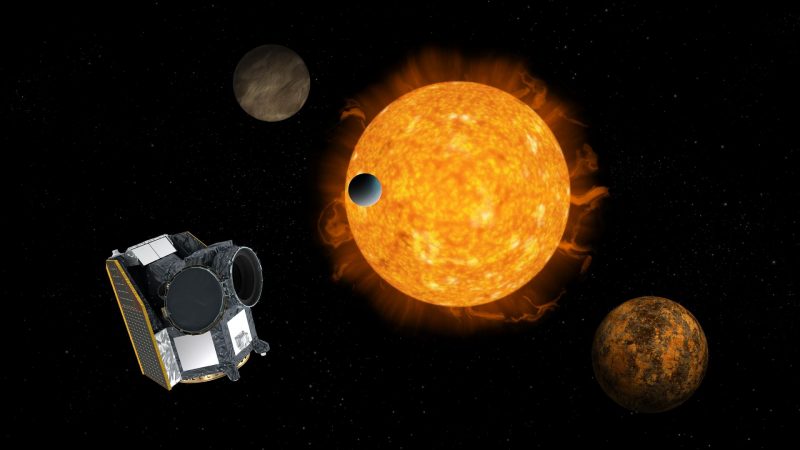
Artist’s concept of the just-launched CHEOPS space telescope, which will study hundreds of exoplanets in greater detail than ever before.
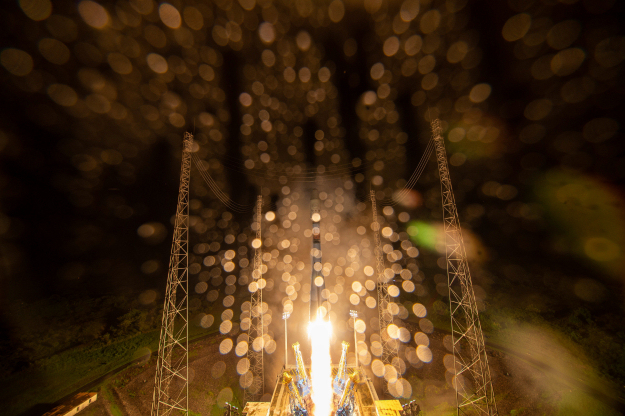
After a one-day delay, the European Space Agency (ESA) successfully launched its CHEOPS mission last week, on the morning of December 18, 2019, from the spaceport in Kourou, French Guiana. CHEOPS is the first ESA mission dedicated to studying exoplanets, those distant worlds orbiting other stars. NASA’s planet-hunting space missions, first Kepler and now TESS, have been finding new exoplanets. CHEOPS will study hundreds of exoplanets already known to exist – out of 4,000-plus now confirmed – to determine their sizes, masses, densities and possible atmospheres.
In this way, CHEOPS will take us some steps along the road of finding out what many exoworlds are actually like, not an easy task.
CHEOPS stands for CHaracterising ExOPlanets Satellite. The telescope will reside in a sun-synchronous orbit around Earth at an altitude of more than 400 miles (700 km).Kate Isaak, CHEOPS project scientist, said in a statement:
We are very excited to see the satellite blast off into space. There are so many interesting exoplanets and we will be following up on several hundreds of them, focusing in particular on the smaller planets in the size range between Earth and Neptune. They seem to be the commonly found planets in our Milky Way galaxy, yet we do not know much about them. CHEOPS will help us reveal the mysteries of these fascinating worlds, and take us one step closer to answering one of the most profound questions we humans ponder: are we alone in the universe?
Watch the launch below:
Heike Rauer, Director of the DLR Institute of Planetary Research in Berlin, said:
More than 4000 exoplanets have been discovered in the Milky Way, yet we still know far too little about these distant worlds in our cosmic neighborhood. We are all eager to see which ‘faces’ the planets characterized by CHEOPS will show us.
So how does CHEOPS observe these planets?
Like some other telescopes, it will watch as the planets transit in front of their stars, as seen from Earth. As Juan Cabrera Perez, Head of the Extrasolar Planets and Atmospheres Department at the DLR Institute of Planetary Research, explained:
We could describe this fluctuation in brightness as a ‘mini stellar eclipse’, as the transiting exoplanet reduces the intensity of the light from the star for a short time. This fluctuation can be measured and analyzed – an area in which we can contribute suitable tools and many years of experience.
CHEOPS will focus on some of the most common exoplanets discovered so far, ranging in size from Earth to Neptune, or about approximately 6,000 to 30,000 miles (10,000 to 50,000 km) in diameter. Using data from the transits, CHEOPS can determine the size, mass and density of the planets. All of these are important in order for scientists to figure out the planets’ compositions. Some will be rocky like Earth, while others will have deep, gaseous atmospheres like Neptune or even Jupiter or Saturn. Knowing this will also help scientists determine which of these worlds might be potentially habitable. Of course, rocky planets similar in size to Earth, or a bit larger – super-Earths – would be the most interesting in this regard. Nicola Rando, CHEOPS project manager, said:
Both CHEOPS instrument and spacecraft are built to be extremely stable, so as to measure the incredibly small variations in the light of distant stars as their planets transit in front of them. For a planet like Earth, this amounts to the equivalent of watching the sun from a distant star and measuring its light dim by a tiny fraction of a percent. Now we are looking forward to the first part of the operational activities, making sure that the satellite and instrument perform as expected, ready for scientists to perform their world-class science.
CHEOPS will also be able to find out which of these planets do have atmospheres and whether they have clouds. This will help differentiate between deep, gaseous primordial atmospheres with no real solid surface beneath them, and thinner atmospheres like those on terrestrial planets such as Earth, Venus or Mars.
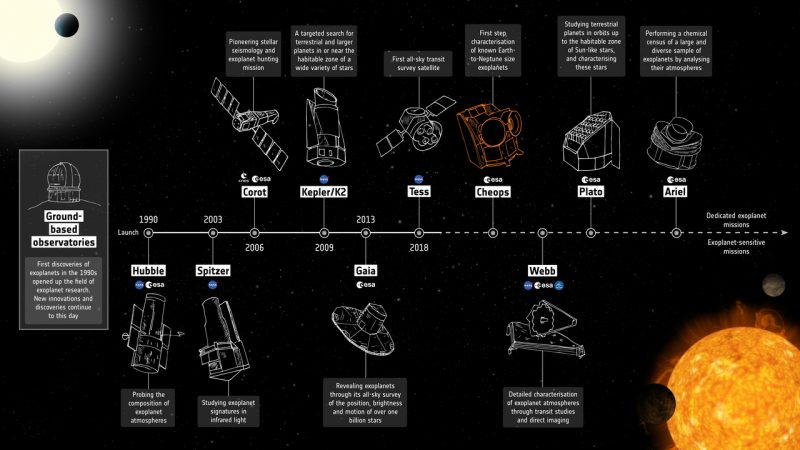
CHEOPS is just the first of three planned ESA missions to study exoplanets.
The Planetary Transits and Oscillations of stars (PLATO) space telescope, expected to launch in 2026, will focus on searching for “Earth-like” planets, ones that are rocky and about the same size as Earth orbiting in their stars’ habitable zones. So far, most such worlds have been found orbiting red dwarf stars, the most common type of star in our galaxy. CHEOPS, however, will look for these planets around sun-like stars. It will also be able to determine the age of these planetary systems with more accuracy than possible before.
A couple of years later, in 2028, ESA will launch the Atmospheric Remote-sensing Infrared Exoplanet Large-survey (ARIEL) mission, which will study the atmospheres of exoplanets. As well as atmospheric composition, this will help scientists develop a comprehensive catalog of exoplanetary orbits, radii, masses, densities and ages.
All three of these exciting missions, and others, will greatly increase our knowledge of these exotic, far-off worlds.
View larger. | Timeline of ESA and NASA exoplanet missions, including CHEOPS.
CHEOPS will take exoplanet science to a whole new level. After the discovery of thousands of planets, the quest can now turn to characterization, investigating the physical and chemical properties of many exoplanets and really getting to know what they are made of and how they formed. CHEOPS will also pave the way for our future exoplanet missions, from the international James Webb Telescope to ESA’s very own PLATO and ARIEL satellites, keeping European science at the forefront of exoplanet research.
The CHEOPS mission is a partnership between ESA and Switzerland with additional contributions from Austria, Belgium, France, Germany, Hungary, Italy, Portugal, Spain, Sweden and the U.K. More than 100 scientists and engineers are involved. The nominal mission is expected to last 3 1/2 years. While the CHEOPS science team has the bulk of observation time, 20% of the time is reserved for other scientists from around the world.
CHEOPS and the coming follow-up missions will open an exciting new chapter in exoplanetary study. What fascinating discoveries will they make?
Bottom line: ESA has successfully launched its CHEOPS space telescope to study hundreds of exoplanets in more detail than ever before.
The Juno spacecraft’s last perijove – or closest point to Jupiter – resulted in a treasure trove of images. Its next perijove is coming up on December 26. Get updated here, and view Juno’s latest amazing images.
Jupiter’s south pole as seen from the Juno spacecraft on November 4, 2019. These swirling spots are cyclones at Jupiter’s pole. The whole hexagonal arrangement of cyclones is large enough to dwarf the Earth. The central cyclone can be compared to the continental U.S. The smallest one, in the lower right – a new one, seen for the first time in November – can be compared to Texas.
Image via NASA/ JPL-Caltech/ SwRI/ ASI/ INAF/ JIRAM.
The Juno spacecraft – which has been orbiting the giant planet Jupiter since July of 2016 – acquires close-up images of the planet at every perijove, or closest point to Jupiter. That happens about every 53 days. The batch of images acquired by the craft in early November, when it swung to within 2,175 miles (3,500 km) of the cloudtops at Jupiter’s south pole, are particularly mind-blowing. The big news for the November flyby … the craft discovered that Jupiter’s south pole has seven large, well defined cyclones now, instead of the six seen previously. These cyclones appear in a hexagonal (six-sided) pattern at Jupiter’s pole, rather than the pentagonal (five-sided) pattern seen previously.
When Juno first arrived at Jupiter in July 2016, its infrared and visible-light cameras discovered giant cyclones encircling the planet’s poles – nine in the north and six in the south. Were they, like their Earthly siblings, a transient phenomenon, taking only weeks to develop and then ebb? Or could these cyclones, each nearly as wide as the continental U.S., be more permanent fixtures?
With each flyby, the data reinforced the idea that five windstorms were swirling in a pentagonal pattern around a central storm at the south pole and that the system seemed stable. None of the six storms showed signs of yielding to allow other cyclones to join in …
Then, during Juno’s 22nd science pass, a new, smaller cyclone churned to life and joined the fray.
Alessandro Mura, a Juno co-investigator at the National Institute for Astrophysics in Rome, said:
Data from Juno’s Jovian Infrared Auroral Mapper [JIRAM] instrument indicates we went from a pentagon of cyclones surrounding one at the center to a hexagonal arrangement.
This new addition is smaller in stature than its six more established cyclonic brothers: It’s about the size of Texas.
Maybe JIRAM data from future flybys will show the cyclone growing to the same size as its neighbors.
Jupiter’s pentagon turns hexagon. In this annotated infrared image, 6 cyclones form a hexagonal pattern around a central cyclone at Jupiter’s south pole. That’s in contrast to the 5 cyclones in a pentagonal shape seen previously.
To give some sense of the immense scale of cyclones arranged in a hexagonal pattern at Jupiter’s south pole, an outline of the continental United States is superimposed over the central cyclone and an outline of Texas is superimposed over the newest cyclone. The hexagonal arrangement of the cyclones is large enough to dwarf the Earth. This JIRAM image was obtained during the 23rd science pass of the Juno spacecraft over Jupiter, on November 4, 2019.
Image via NASA/ JPL-Caltech/ SwRI/ ASI/ INAF/ JIRAM.
NASA said the flyby:
… also marked a victory for the mission team, whose innovative measures kept the solar-powered spacecraft clear of what could have been a mission-ending eclipse.
To understand what happened, you have to go back to Juno’s entry into orbit around Jupiter on July 4, 2016. It was meant to enter an initial 53-day orbit, then reduce the size of its orbit a few months later, in order to shorten the period between science flybys to every 14 days. But the project team recommended to NASA to forgo the main engine burn due to concerns about the spacecraft’s fuel delivery system.
Now Juno is carrying out its mission, NASA said, although it’s taking longer than originally plannned. But Juno’s longer life at Jupiter is what led to the need to avoid Jupiter’s shadow. Steve Levin, Juno project scientist at NASA’s Jet Propulsion Laboratory in Pasadena, California, explained:
Ever since the day we entered orbit around Jupiter, we made sure it remained bathed in sunlight 24/7. Our navigators and engineers told us a day of reckoning was coming, when we would go into Jupiter’s shadow for about 12 hours. We knew that for such an extended period without power, our spacecraft would suffer a similar fate as the Opportunity rover, when the skies of Mars filled with dust and blocked the sun’s rays from reaching its solar panels.
View larger. | In this image, you can see a shadow on Jupiter, cast by its moon Io. Io’s shadow can be seen on Jupiter through earthly telescopes, and many pictures have been taken of it from space as well, but this is the first from such a close distance, just 8,450 miles (13,600 kilometers) above Jupiter’s cloudtops. JunoCam acquired this image on September 12, 2019.
Image via NASA/ JPL-Caltech/ SwRI/ MSSS. Image processing by citizen scientist Tanya Oleksuik.
NASA explained that, without the sun’s rays providing power, Juno would be chilled below tested levels. The space scientists believed that – during this time – Juno’s battery cells would be drained beyond recovery. So the navigation team set devised a plan to “jump the shadow,” maneuvering the spacecraft just enough so its trajectory would miss the eclipse. NASA said:
The navigators calculated that if Juno performed a rocket burn weeks in advance of November 3, while the spacecraft was as far in its orbit from Jupiter as it gets, they could modify its trajectory enough to give the eclipse the slip. The maneuver would utilize the spacecraft’s reaction control system, which wasn’t initially intended to be used for a maneuver of this size and duration.
On September 30, at 7:46 p.m. EDT (4:46 p.m. PDT), the reaction control system burn began. It ended 10 ½ hours later. The propulsive maneuver — five times longer than any previous use of that system — changed Juno’s orbital velocity by 126 mph (203 kph) and consumed about 160 pounds (73 kilograms) of fuel.
Thirty-four days later, the spacecraft’s solar arrays continued to convert sunlight into electrons unabated as Juno prepared to scream once again over Jupiter’s cloud tops.
Scott Bolton, Juno principal investigator from the Southwest Research Institute in San Antonio, explained:
The combination of creativity and analytical thinking has once again paid off big time for NASA … While the team was trying to figure out how to conserve energy and keep our core heated, the engineers came up with a completely new way out of the problem: Jump Jupiter’s shadow.
It was nothing less than a navigation stroke of genius. Lo and behold, first thing out of the gate on the other side, we make another fundamental discovery.
As you read this, Juno is heading toward its next perijove on December 26, 2019. Watch for news and new images shortly after the new year dawns!
View larger. | Swirls and storms in Jupiter’s clouds. This image of a vortex on Jupiter, taken by the Juno mission camera, JunoCam, captures the amazing internal structure of the giant storm. Original image taken on November 3, 2019, at an altitude of approximately 5,300 miles (8,600 km) and a latitude of about 48 degrees north on Jupiter.
Image processing by citizen scientists Gerald Eichstädt/ Seán Doran.
In this amazing Juno image, south is up. The original image was captured by JunoCam on September 12, 2019.
Image via NASA/ JPL-Caltech/ SwRI/ MSSS/ JunoCam. Image processing by citizen scientist Prateek Sarpal, who titled this “A mind of limits, a camera of thoughts.”
Bottom line: On its last flyby close to Jupiter – on November 4, 2019 – the Juno spacecraft discovered a new small cyclone at Jupiter’s south pole.
SPECULATION is rife over the secretive death of a US test pilot. Details of the case are classified, but conspiracy theories have emerged.
THE tragic death of Lieutenant Colonel Eric Schultz last week on a weapons testing range in Nevada has attracted an inordinate amount of interests.
And it’s because of what we don’t know.
The US Air Force has pointedly refused to reveal what aircraft he was at the controls of when the fatal accident occurred. It also took them three days to even admit his death.
This is in stark contrast to another accident, at the same range, in the same week. Details of an accident involving two A-10 ground-attack jets which forced their pilots to eject were released within hours.
So what could possibly cause such reluctance to reveal the circumstances of Schultz’ death?
“I can definitely say it was not an F-35,” Chief of Staff of the Air Force General David L. Goldfein stated at the weekend.
A Joint Strike Fighter F-35 flies during the Avalon Airshow on March 3, 2017 in Avalon, Australia. Technical hurdles remain to be solved before the type is fully combat capable.
He was responding to speculation that this accident involved the highly controversial stealth fighter, and that this was being covered-up to protect its already bruised reputation.
The F-35 Lightning II has recently suffered several engine fires — one of which injured a pilot. It has also been the subject of warnings surrounding its ejection seat which — when combined with the weight and shape of its advanced helmet — could break the neck of its pilots.
But it wasn’t and F-35.
So what was it?
The USAF is remaining tight-lipped.
All we know is the unspecified aircraft crashed about 6pm some 200km northwest of Nellis Air Force Base in the Nevada Test and Training range. This range is also home to the extremely secretive “Area 51” research and development facility.
Everything from crashed alien spacecraft to the next-generation Blackbird ultra-fast surveillance jet are said to be housed here.
But we don’t actually know. It’s secret.
The USAF also admitted the unknown aircraft was being operated by the Air Force Materiel Command. This is the unit that funds and operates aircraft research — and facilities like Area 51 (Groom Lake).
So analysts have been pouring through declassified reports into activities in the Nevada area to glean whatever clues they can.
A US Air Force F-117 Stealth fighter breaks apart in midair during the Chesapeake Air Show in 1997. At least one is back in service, at Area 51. Picture: APSource:AP
STEALTH COUNTERMEASURES:
It was reported last year that the famous F-117 Nighthawk attack jets — used to eliminate Saddam Hussein’s air defences in the opening minutes of Operation Desert Storm in 1990 — had been brought back from retirement. Aviation enthusiasts captured its distinctive shape in the air, and on the ground, around the Groom Lake (Area 51) facility. Analysts speculate examples of the aircraft may have been reactivated to further test stealth technologies amid fears new Russian and Chinese sensors may have already negated much of the ultra-expensive F-35’s stealth advantage. But the return of the F-117 has not yet been admitted by the USAF.
Australian F/A-18 Hornet Aircraft with Indonesian Air Force Sukhoi Su-30 & Su-27 Flanker aircraft. Picture: ADF Source:Supplied
THREAT EVALUATION:
There is evidence the United States may have gotten its hands on one of Russia’s most capable combat jets — the Su-27P. While it first entered service in 1985, this jet is the basis upon which many of Russia’s current frontline warplanes have been built. These are widely regarded to be more manoeuvrable than equivalent Western aircraft, such as the F-15 Eagle and F-18 Hornet. At least one of these was seen engaged in a mock dogfight with a USAF F-16 Falcon near Area 51 late last year. The presence of these Russian-built aircraft has not been officially admitted, however, and explaining away a fatal crash involving one could prove an unwanted embarrassment for the Pentagon.
Concept art released by the Pentagon showing Northrop Grumman's B-21 stealth bomber design
Source:Supplied
NEXT-GENERATION BOMBER:
In January 2016, the Pentagon announced it had chosen a design to replace its ancient fleet of B-52 bombers, as well as its 1980s-era B-1B Lancer bombers. The $55 billion Northrop Grumman B-21 Raider is supposed to be a cut-price stealth design, building upon the technology already established by the B-2 Spirit. But everything about the project — including its true budget — is top secret. Whether or not a flying prototype of the B-21 exists is uncertain, but there was speculation in 2015 that Northrop Grumman had taken the gamble of building one to help it win the lucrative deal. Such a prototype would almost certainly undergo secretive testing in a location like the Nevada range.
The 26,000-Year Astronomical Monument Hidden in Plain Sight
By Alexander Rose
One of the two massive bronze cast sculptures that flank Hoover Dam’s Monument Plaza.
(Photo by Alexander Rose)
On the western flank of the Hoover Dam stands a little-understood monument, commissioned by the US Bureau of Reclamation when construction of the dam began in 01931. The most noticeable parts of this corner of the dam, now known as Monument Plaza, are the massive winged bronze sculptures and central flagpole which are often photographed by visitors. The most amazing feature of this plaza, however, is under their feet as they take those pictures.
The plaza’s terrazzo floor is actually a celestial map that marks the time of the dam’s creation based on the 25,772-year axial precession of the earth.
Marking in the terrazzo floor of Monument Plaza showing the location of Vega, which will be our North Star in roughly 12,000 years.
(Photo by Alexander Rose)
I was particularly interested in this monument because this axial precession is also the slowest cycle that we track in Long Now’s 10,000 Year Clock. Strangely, little to no documentation of this installation seemed to be available, except for a few vacation pictures on Flickr. So the last time I was in Las Vegas, I made a special trip out to Hoover Dam to see if I could learn more about this obscure 26,000-year monument.
Monument Plaza with access road on left.
(Image courtesy of US Bureau of Reclamation).
I parked my rental car on the Nevada side of the dam on a day pushing 100 degrees. I quickly found Monument Plaza just opposite the visitor center where tours of the dam are offered. While the plaza is easy to find, it stands apart from all the main tours and stories about the dam. With the exception of the writing in the plaza floor itself, the only information I could find came from a speaker running on loop, broadcasting a basic description of the monument while visitors walked around the area. When I asked my tour guide about it, he suggested that there may be some historical documentation and directed me to Emme Woodward, the dam’s historian.
Hansen laying out the axial precession.
(Image courtesy of US Bureau of Reclamation)
I was able to get in touch with her after returning home. As she sent me a few items, I began to see why the Bureau of Reclamation doesn’t explain very much about the monument’s background. The first thing she sent me was a description of the plaza by Oskar J. W. Hansen, the artist himself, which I thought would tell me everything I wanted to know. While parts of it were helpful, the artist’s statement of intention was also highly convoluted and opaque. An excerpt:
These [human] postures may be matched to their corresponding reflexes in terms of angle and degree much as one would join cams in a worm-gear drive. There is an angle for doubt, for sorrow, for hate, for joy, for contemplation, and for devotion. There are as many others as there are fleeting emotions within the brain of each individual who inhabits the Earth. Who knows not all these postures of the mind if he would but stop to think of them as usable factors for determining proclivities of character? It is a knowledge bred down to us through the past experience of the whole race of men.
It is pretty hard to imagine the US Bureau of Reclamation using this type of write-up to interpret the monument… and they don’t. And so there it stands, a 26,000-year clock of sorts, for all the world to see, and yet still mired in obscurity.
Markings on the floor showing that Thuban was the North Star for the ancient Egyptians at the time of the Great Pyramids.
(Photo by Alexander Rose)
While I may never totally understand the inner motivations of the monument’s designer, I did want to understand it on a technical level. How did Hansen create a celestial clock face frozen in time that we can interpret and understand as the date of the dam’s completion? The earth’s axial precession is a rather obscure piece of astronomy, and our understanding of it through history has been spotty at best. That this major engineering feat was celebrated through this monument to the axial precession still held great interest to me, and I wanted to understand it better.
The giant bronze statues being craned into place.
(Image courtesy of US Bureau of Reclamation)
I pressed for more documentation, and the historian sent me instructions for using the Bureau of Reclamation’s image archive site as well as some keywords to search for. The black and white images you see here come from this resource. Using the convoluted web site was a challenge, and at first I had difficulty finding any photos of the plaza before or during its construction. As I discovered, the problem was that I was searching with the term “Monument Plaza,” a name only given to it after its completion in 01936. In order to find images during its construction, I had to search for “Safety Island,” so named because at the time of the dam’s construction, it was an island in the road where workers could stand behind a berm to protect themselves from the never-ending onslaught of cement trucks.
Hansen next to the completed axial precession layout before the terrazzo was laid in.
(Image courtesy of US Bureau of Reclamation)
I now had some historical text and photos, but I was still missing a complete diagram of the plaza that would allow me to really understand it. I contacted the historian again, and she obtained permission from her superiors to release the actual building plans. I suspect that they generally don’t like to release technical plans of the dam for security reasons, but it seems they deemed my request a low security risk as the monument is not part of the structure of the dam. The historian sent me a tube full of large blueprints and a CD of the same prints already scanned. With this in hand I was finally able to re-construct the technical intent of the plaza and how it works.
In order to understand how the plaza marks the date of the dam’s construction in the nearly 26,000-year cycle of the earth’s precession, it is worth explaining what exactly axial precession is. In the simplest terms, it is the earth “wobbling” on its tilted axis like a gyroscope — but very, very slowly. This wobbling effectively moves what we see as the center point that stars appear to revolve around each evening.
Long exposure of star trails depicting how all the stars appear to revolve around the earth’s celestial axis, which is currently pointed close to our current North Star — Polaris. Note that when I say that the stars of the night sky “appear to” rotate around Polaris, it is because this apparent rotation is only due to our vantage point on a rotating planet.
(Image courtesy of NASA)
Presently, this center point lies very close to the conveniently bright star Polaris. The reason we have historically paid so much attention to this celestial center, or North Star, is because it is the star that stays put all through the course of the night. Having this one fixed point in the sky is the foundation of all celestial navigation.
Figure 1. The earth sits at roughly a 23 degree tilt. Axial precession is that tilt slowly wobbling around in a circle, changing what we perceive as the celestial pole or “North Star.” (Image from Wikipedia entry on Axial Precession.)
But that point near Polaris, which we call the North Star, is actually slowly moving and tracing a circle through the night sky. While Polaris is our North Star, Hansen’s terrazzo floor points out that the North Star of the ancient Egyptians, as they built the great pyramids, was Thuban. And in about 12,000 years, our North Star will be Vega. The workings of this precession are best explained with an animation, as in figure 1. Here you can see how the axis of the earth traces a circle in the sky over the course of 25,772 years.
Unfortunately it is a bit difficult to see how this all works in the inlaid floor at Monument Plaza. The view that you really want to have of the plaza is directly from above. You would need a crane to get this view of the real thing, but by using the original technical drawing as an underlay I was able to mark up a diagram which hopefully clarifies it (Fig. 2).
Figure 2. Description overlaid on the original technical drawing for the layout of terrazzo floor.
(Underlay courtesy of US Bureau of Reclamation, color notations by Alexander Rose.)
In this diagram, you can see that the center of the circle traced by the axial precession is actually the massive flag pole in the center of the plaza. This axial circle is prominently marked around the pole, and the angle of Polaris was depicted as precisely as possible to show where it would have been on the date of the dam’s opening. Hansen used the rest of the plaza floor to show the location of the planets visible that evening, and many of the bright stars that appear in the night sky at that location.
By combining planet locations with the angle of precession, we are able to pinpoint the time of the dam’s completion down to within a day. We are now designing a similar system — though with moving parts — in the dials of the 10,000 Year Clock. It is likely that at least major portions of the Hoover Dam will still be in place hundreds of thousands of years from now. Hopefully the Clock will still be ticking and Hansen’s terrazzo floor will still be there, even if it continues to baffle visitors.
A drawing of the terrazzo layout.
Click here for a high resolution version. (Courtesy of US Bureau of Reclamation)
I would like to thank Emme Woodward of the US Bureau of Reclamation for all her help in finding the original images and plans of Monument Plaza. If you have further interest in reading Hansen’s original writings about the plaza or in seeing the plans, I have uploaded all the scans to the Internet Archive.
While it was a milestone for EAST, we’re still a long way from generating sustainable energy on Earth.
Imagine if we could replace fossil fuels with our very own stars. And no, we’re not talking about solar power: We’re talking nuclear fusion. And recent research is helping us get there. Meet the Experimental Advanced Superconducting Tokamak, or EAST.
EAST is a fusion reactor based in Hefei, China. And it can now reach temperatures more than six times as hot as the sun. Let’s take a look at what’s happening inside. Fusion occurs when two lightweight atoms combine into a single, larger one, releasing energy in the process. It sounds simple enough, but it’s not easy to pull off. Because those two atoms share a positive charge. And just like two opposing magnets, those positive atoms repel each other.
Stars, like our sun, have a great way of overcoming this repulsion … their massive size, which creates a tremendous amount of pressure in their cores … So the atoms are forced closer together making them more likely to collide. There’s just one problem: We don’t have the technology to recreate that kind of pressure on Earth.
But luckily, there’s another way. You can also generate fusion with extreme temperatures. And that’s exactly what devices like EAST do. The higher the temperature, the faster the atoms move around and the more likely they are to collide.
But it quickly becomes a balancing act. If the temperature is too hot, the atoms move too fast and zip passed each other. If it’s too cold, the atoms won’t move fast enough. So, the ideal temperature to generate fusion is around 100 million degrees Celsius. That’s more than 6 times as hot as our sun’s core.
Only a few fusion experiments in the world have surpassed this milestone. And the latest one was EAST. It sustained nuclear fusion for about 10 seconds before shutting down. And while it was a breakthrough for EAST, it’s a long way from generating sustainable energy for the people of Earth.
And that’s actually on purpose. EAST is a tiny reactor. At only a few meters across, it’s not meant to be a full-fledged power plant. It’s an experiment. And right now, its job is to help us design more effective fusion technology that could, one day, power entire cities.
Like ITER, short for International Thermonuclear Experimental Reactor, it’s the world’s biggest fusion project to date. Thirty-five countries have poured billions of dollars into its construction. And it is designed to be the first fusion reactor to ever produce more fusion power than the power used to heat it up.
You see, you need to pour a lot of energy into these machines to get them to work. This recent EAST test, for example, guzzled over 10 Megawatts of power. Enough to power 1,640 American homes for a year. And it didn’t yield even half that amount. Since the entire point of a power plant is to, well, produce power, it’s a pretty important issue to work out.
But it’s worth the effort. Why? Well for one thing, fusion reactors would produce practically no radioactive waste compared to the kind of reaction we see in today’s nuclear fission power plants. But even better. Fusion reactors can run on seawater– a renewable, sustainable resource.
For perspective, the amount of water just on the top inch of Lake Erie is enough to produce more power than all the fossil fuels left on the planet. And unlike other energy sources, it doesn’t need the sun to shine or the wind to blow.
In a time of dwindling resources and worsening climate change, we could sure use it.
Scientists are trying to open a portal to a parallel universe
By THE SUN
Noah Schnapp as Will in “Stranger Things.”
(THE SUN) — Scientists at Oak Ridge National Laboratory in eastern Tennessee are trying to open a portal to a parallel universe.
The project — which has been compared to the Upside Down in the Netflix blockbuster “Stranger Things” — hopes to show a world identical to ours where life is mirrored.
Leah Broussard, the physicist leading the experiment, told NBC the plan is “pretty wacky” but will “totally change the game,” ahead of a series of experiments she plans to run this summer.
Broussard’s experiment will fire a beam of subatomic particles down a 50-foot tunnel. The beam will pass a powerful magnet and hit an impenetrable wall, with a neutron detector behind it.
If the experiment is successful, particles will transform into mirror images of themselves, allowing them to burrow right through the impenetrable wall.
This would prove that the visible universe is only half of what is out there, Broussard said, but she also admitted that she expects the test to “measure zero.”
In “Stranger Things,” portals began opening, connecting a US town to a dark alternate dimension called the Upside Down.
In reality, if a mirror world exists, it would have its own laws of mirror physics and its own mirror history, according to NBC.
However, there wouldn’t be an alternate version of you. Current theory, the outlet explains, only hypothesizes that mirror atoms and mirror rocks are possible — and perhaps even mirror planets and stars.
Today is a very big day for human spaceflight, NASA officials said, but it's still unclear what tomorrow will bring.
Boeing'sCST-100 Starliner capsule landed safely at White Sands Missile Range in New Mexico this morning (Dec. 22), bringing an end to its truncated debut mission, the uncrewed Orbital Flight Test (OFT).
The reusable Starliner thus became the first crew vehicle to touch down on American soil after an orbital trip since the space shuttles retired in July 2011, and the first capsule ever to do so. (NASA's Apollo and Orion capsules have landed in the ocean, as has SpaceX's Crew Dragon spacecraft.)
"It was an absolute bullseye, better than I think anybody anticipated," NASA Administrator Jim Bridenstine said of the landing during a news conference today. "That's good for the agency, it's good for Boeing; that's good for the United States of America."
But not everything went smoothly on OFT. The mission was supposed to last eight days and feature an automated rendezvous and docking with the International Space Station (ISS), demonstrating Starliner's ability to ferry astronauts to and from the orbiting lab and clearing the way for a crewed test flight next year.
But an error with Starliner's onboard timing system, which manifested shortly after liftoff on Friday morning (Dec. 20), nixed that original plan. The timing problem prevented the capsule from properly performing a pivotal engine burn, trapping Starliner in the wrong orbit, NASA and Boeing representatives have said.
So Starliner ended up circling Earth on its own for about 48 hours and then coming home, leaving some original mission objectives unachieved. But that doesn't necessarily mean the capsule will have to refly OFT before astronauts can climb aboard, NASA officials said.
Indeed, going straight to the Crew Flight Test (CFT), which will carry three astronauts to and from the ISS, is definitely still on the table, NASA Commercial Crew Program deputy manager Steve Stich said during today's news conference.
"To me, there's good data out there to suggest that, once we go through it, maybe it's acceptable to go, next step, fly the Crew Flight Test," Stich said. "But we have to go through the data first."
That good data includes a nominal launch and landing, the two most important milestones to check off on a human spaceflight, Stich and Bridenstine both said. And Starliner seems to have performed very well in orbit, Jim Chilton, senior vice president of Boeing’s Space and Launch Division, said during a news conference yesterday (Dec. 21). And today, Chilton estimated that Starliner may end up meeting about 85% of the original OFT objectives, after all data analyses are complete.
But all three men stressed that the NASA and Boeing teams need to perform those analyses before any decisions can be made about Starliner's next flight.
"I think we're into January, pretty deep into January, before everybody has a thorough understanding" of the OFT data, Chilton said today.
CFT is currently targeted for liftoff sometime next year. If it is decided that Starliner must fly another version of OFT first, the CFT timeline would probably shift to the right by at least three months. That's the estimated minimum amount of time it would take for Boeing to get ready for another OFT, Chilton said today.
(The Starliner vehicle that landed today won't fly CFT, by the way. This capsule will perform Boeing's first contracted ISS crew mission for NASA. And the crew of that mission, which will be commanded by NASA astronaut Suni Williams, has named the capsule "Calypso," after the ship of ocean explorer Jacques Cousteau.)
Boeing has been developing Starliner with funding from NASA's Commercial Crew Program, most notably a $4.2 billion contract that was announced in September 2014. That deal also pays for six operational, crew-carrying flights to and from the ISS.
SpaceX got a similar, $2.6 billion contract at the same time. The California-based company's Crew Dragon capsule aced its version of OFT, called Demo-1, this past March. SpaceX is now gearing up for a key in-flight test of Crew Dragon's emergency-escape system next month; if all goes well with that demonstration, Crew Dragon will be cleared to perform a crewed test flight to the orbiting lab.
Getting one of these private vehicles up and running will end NASA's dependence on Russian Soyuz spacecraft for crewed trips to the ISS, which has been total since the space shuttles were grounded more than eight years ago. And having both of them operational is vital to ensure stable, uninterrupted access to space, Bridenstine said.
"We need to have dissimilar redundancy for how we fly astronauts into space," he said.
NASA also wants to be just one of many customers that use private American spacecraft to get to and from low-Earth orbit, Bridenstine added.
"We want to have numerous providers that are competing against each other on cost and innovation, driving down cost and increasing access," he said. "And today was really a great milestone in that eventuality."
Mike Wall's book about the search for alien life, "Out There" (Grand Central Publishing, 2018; illustrated byKarl Tate), is out now. Follow him on Twitter @michaeldwall. Follow us on Twitter@Spacedotcom orFacebook.
Earth's magnetic north pole, which has been wandering faster than expected in recent years, has now crossed the prime meridian.
Magnetic north has been lurching away from its previous home in the Canadian Arctic toward Siberia at a rate of about 34 miles (55 kilometers) a year over the past two decades. The latest model of the Earth's magnetic field, released Dec. 10 by the National Centers for Environmental Information and the British Geological Survey, predicts that this movement will continue, though likely at a slower rate of 25 miles (40 km) each year.
This model is used to calibrate GPS and other navigation measurements.
Earth's magnetic field is produced by the churning of the planet's iron outer core, which produces a complex, but largely north-south magnetic field. For reasons not entirely understood but related to the planet's interior dynamics, the magnetic field is currently undergoing a period of weakening. That's why magnetic north is drifting.
As of February 2019, magnetic north was located at 86.54 N 170.88 E, within the Arctic Ocean, according to the NCEI. (Magnetic south similarly does not line up with geographic south; it was at at 64.13 S 136.02 E off the coast of Antarctica as of February 2019.)
Scientists release a new version of the World Magnetic Model every five years, so this 2020 update was expected. In February 2019, though, they had to release an update ahead of schedule due to the fast clip of magnetic north's movements. The 2020 model shows the "Blackout Zone" around magnetic north where compasses become unreliable and start to fail because of the proximity of true north. The new maps also show magnetic north east of the prime meridian, a boundary the pole crossed in September 2019, according to Newsweek. The prime, or Greenwich, meridian is the meridian that was set as the official marker of zero degrees, zero minutes and zero seconds in 1884;iIt runs through the Royal Observatory at Greenwich in England.
It's currently unclear whether Earth's magnetic poles are headed for a flip-flop — switching north and south — or whether the magnetic field will soon strengthen again. Both events have happened in Earth's history without any notable effect on biology. However, modern navigation systems rely on magnetic north and will have to be recalibrated as the poles continue to wander. Already, for example, airports have had to rename some of their runways, which have names based on compass directions.
Thirty-two years ago, Supernova 1987A erupted in the nearby Large Magellanic Cloud. Astronomers using the ALMA radio telescope now say they’ve found the small, compact neutron star created in this mighty star explosion.
The location of the recently discovered neutron star at the core of the Supernova 1987A remnant.
A team of astronomers at the University of Cardiff, Wales, believe they have discovered the “missing” neutron star at the center of Supernova 1987A (SN1987A), whose detonation was first seen in earthly skies in February 1987. The explosion occurred in the Large Magellanic Cloud, a companion dwarf galaxy to our home galaxy, the Milky Way. The astronomers said they found this supernova’s neutron star using the ALMA telescope in Chile.
The neutron star finally seems to be emerging from a thick cloud of dust which has completely obscured it for the last 32 years.
The discovery was reported in the Astrophysical Journal on November 19. The team – led by astronomer Phil Cigan of Cardiff University – found a particularly bright patch of dust exactly where the neutron star was predicted to be. Cigan commented in a statement:
For the very first time we can tell that there is a neutron star inside this cloud within the supernova remnant. Its light has been veiled by a very thick cloud of dust, blocking the direct light from the neutron star at many wavelengths like fog masking a spotlight.
Astronomer Mikako Matsuura, also of Cardiff University, specializes in the study of dust and molecules in supernova remnants and is a co-author of this latest study. She commented:
Although the light from the neutron star is absorbed by the dust cloud that surrounds it, this in turn makes the cloud shine in sub-millimeter light, which we can now see with the extremely sensitive ALMA telescope. Our new findings will now enable astronomers to better understand how massive stars end their lives, leaving behind these extremely dense neutron stars.
Supernova 1987A was the brightest and closest supernova since Kepler’s supernova of 1604. It detonated on the edge of the Tarantula Nebula in the Large Magellanic Cloud. Since the supernova is some 168,000 light-years distant, the explosion actually occurred that long ago. Ian Shelton and Oscar Duhalde at the Las Campanas Observatory in Chile – and Albert Jones in New Zealand – were the first to spot the supernova in Earth’s skies in 1987.
A blue supergiant star called Sanduleak A had exploded, about which little was known. Astronomers were optimistic that by studying the event they could see if their theories about the death of massive stars were correct. The hope was that the supernova would leave behind a neutron star: better still, an easily detectable pulsar (all pulsars are neutron stars, but not all neutron stars are pulsars). If so, then the chain of events from core-collapse supernova explosion to neutron star could at last be verified. It was seen as something of a golden opportunity to confirm what we thought we knew about Type II supernovae and their aftermath.
But, as the initial glow subsided and astronomers in the Southern Hemisphere watched and waited, there were no radio bursts from a pulsar, no X-ray glow: there was nothing at all. It was soon realized that if there were any sort of star left behind at the center of the supernova remnant, it was behind huge quantities of dust, completely hidden from our view. Astronomers realized with disappointment, and the sense of something intensely valuable slipping from their grasp, that the dust would take a very long time to clear enough to reveal what it was masking. But there were also those who wondered, as the original mass of Sanduleak A was not known, if the reason there was no visible trace of any remnant was simply because what lurked in the dark, behind the wall of dust, was a new black hole.
And there was something quite unexpected about SN1987A, which was not realized until afterwards: about three hours before the explosion was seen in Chile, Japanese neutrino observatories had, between them, detected 25 neutrinos from the event. This was seen as confirmation that the bulk of neutrinos from supernovae are emitted some time before the star detonates. This pre-supernova detection of neutrinos can perhaps lay claim to be the first true multi-messenger astronomical event.
Apart from a brief flurry of excitement a few years after the supernova, as a group of radio astronomers thought they had detected brief pulsar emissions, nothing at the centre of the supernova remnant has been observed. The tentative pulsar signals were not confirmed nor repeated.
But now, at long last, astronomers have verification of their Type II supernova theories. The discovery demonstrates that astronomy is often a long and frustrating waiting game, where events play out over years and decades.
Composite image of Supernova 1987A, via NASA/ ESA/ NRAO.
Bottom line: Astronomers using the ALMA radio telescope in Chile said in late 2019 that they’ve found the small, compact neutron star created in Supernova 1987A.
A comparison of old and new star catalogs shows that some objects seem to have gone missing.
Stars mysteriously disappear in the sky. But where’d it go? The bright star in in the left image taken in the 1950s has disappeared in the new image of the same field. Picture via Villarroel et al.
The universe holds many mysteries that baffle astronomers from dark energy to cosmic rays to our own solar system… We live in a cosmic oddity as shown by the many alien sounds recorded out there. Now in a new science paper, a group of scientists compared star maps from the 1950s with recent images from the same spots, and discovered that 100 previously catalogued stars cannot be found anymore. Pretty baffling, no?
Many Stars Have Disappeared
The new data compiled by project ‘Vanishing and Appearing Sources during a Century of Observations (VASCO)’ were gathered by comparing mapped stars listed in the U.S. Naval Observatory Catalogue (USNO) B 1.0, dating from the 1950s, with those in the more recent sky catalog of Pan-STARRS Data Release (DR1).
Among the 600 million stars found in the older catalog, 150,000 objects had no readily identifiable counterparts in the new star survey, although the Pan-STARRS can detect much fainter light sources than present in USNO.
The authors visually inspected 24,000 candidates of these 150,000 anomalies and discovered that 100 of these point sources of light had disappeared in the night sky.
How Do Stars Disappear From the Sky?
There are certainly natural phenomena – extremely flaring dwarf planets, failed supernova, or stars that might directly collapse into a black hole – behind the disappearance of several of those stars.
But 100 vanishing stars in less than 50 years is a lot and it would be an amazing surprise if they all can be explained by a natural phenomenon.
The authors themselves discuss the possibility thatthese mysterious disappearances could be the result of unknown phenomena, or the relics of technologically advanced civilizations, particularly the theoretical mega-engineering projects known as Dyson spheres.
What Are These Missing Stars?
Perhaps the missing objects are signs of an advanced civilization. But they’re probably not Dyson spheres.
First, it would be hard to explain why and how such a giant construction project, completely shading out the light of the host star, could be done within the short period of less than a century.
But more importantly, “traditional” Dyson spheres are not gravitationally stable. Even if one could be built near a star like our Sun, it would require more total mass than is available in all our Solar System’s planets, moons, and asteroids.
A few of these missing stars might be explained as flaring stars whose brightness dropped below the detection limit, or stars that collapsed directly into a black hole.
A large portion, however, might represent new stages in the life cycle of certain stars or new stellar phenomena that have not yet been seen. That by itself would be an exciting topic to investigate.
Where Are the Missing Stars?
Are they at the same location, just not emitting light anymore? Or perhaps they’ve moved to some other location.
If the latter, could some of these represent huge starships, the size of moons or planets, that moved outside the field of view?
This, of course, is a highly speculative suggestion. But it would address the hotly discussed Fermi Paradox, and would, in principle, be testable.
If these “missing” light sources represent giant starships, some should appear in new star surveys in some other part of the sky. In an ideal case, we might even be able to track their trajectories through time.
A new direction of future research would be to search for clusters of missing stars, which, if they exist, could be related to new natural phenomena in a particular region of space, or perhaps to activities of an extraterrestrial civilization.
I would on light sources that suddenly appear in new star surveys, and see whether they can be correlated to the stars that vanished. Either way, the authors have turned up something that may become very important for both astrophysical and SETI investigations. Continue reading Strange Sounds or visit Steve Quayle for more extraterrestrial headlines. [ApJ, Air and Space]
Follow us: Facebook and Twitter. By the way you can also support us on Paypal. Please and thank you!
In a new article posted at his The UFO Trail blog (titled “Vallee declines to Substantiate Claims of CIA Simulating UFO abductions“) Jack Brewer wrote, on December 19: “Dr. Jacques Vallee declined to attempt to fully substantiate the assertion contained in his book, Forbidden Science – Volume Four, that he secured a document confirming the CIA simulated UFO abductions in Brazil and Argentina. ‘I felt a duty to call attention to the issue,’ Vallee explained in a Dec. 17 email, but chose not to share the document or address pertinent questions surrounding its circumstances.” As you’ll see from the information contained in the link above, Vallee and Brewer had an interesting discussion about all of this – although at this stage it appears not to have been resolved, in relation to what the “document” is and how all of these matters relate to those “simulated UFO abductions in Brazil and Argentina.”
There’s a distinct possibility (maybe, even, a probability) that this all relates to a very weird and highly controversial affair that went down in Brazil way back in the 1950s. Antonio Villas Boas was a Brazilian man who claimed, in late 1957, to have had wild sex with an equally wild babe from the stars, after having been kidnapped and taken on-board a UFO. An early alien abduction? Yep. Or maybe not. In the late-1970s, UFO researcher Rich Reynolds had contact with a man named Bosco Nedelcovic, who had links to the world of intelligence, who spent time working in South America, and who claimed that the Villas Boas affair was not what it appeared to be. He told Rich that, in reality, Villas Boas was the unwitting player in a new and bizarre experiment. According to Nedelcovic, the UFO that Villas Boas saw over his family’s property was really a helicopter. Not only that, Villas Boas was supposedly hit by some kind of mind-altering aerosol spray that quickly placed him into an altered state, after the pilot of the helicopter flew right over him and at a low level. As for the girl from the stars, she was said to have really been a hooker, a girl hired to take Villas Boas on the closest encounter of all. But, it was all a ruse: a mind-bending event designed to fabricate a UFO incident.
Like it or not, but the fact is that Villas Boas’ own words suggest strongly that he was indeed taken on-board a helicopter. Read Villas Boas’ very own words carefully. The craft, he said, was “like an elongated egg.” On the top of the craft there was, “something which was revolving at great speed and also giving off a powerful fluorescent reddish light” (rotor-blades? Probably, yes). As the craft took to the skies, it made a loud noise, “a sort of beat” (which is a perfect description of the noise associated with a helicopter). Put all those factors together and it sounds very much like Villas Boas was hauled aboard a helicopter. And not onto a flying saucer.
As the Washington Post noted Nedelcovic was “…a linguist with the American Defense College at Fort McNair and a tenacious promoter of building a Utopian society that blended elements of socialism and free market capitalism.” The Post further noted that Nedelcovic died of prostate cancer on December 25, 1999 at the Northern Virginia Hospice. As you will see from this link, Nedelcovic had correspondence with the CIA. Other correspondence between Nedelcovic and the CIA exists, but it is not online – at least, the bulk of it isn’t. For the record, Nedelcovic also told Rich Reynolds that he knew of other simulated/faked cases of alien contact. One of them, said Nedelcovic, involved a man named Arthur Bryant, who claimed a Contactee-type close encounter in April 1965. Bryant died just a few years later from a particularly aggressive brain tumor. The inference was that Bryan’s exposure to microwave-based technology of a government agency had caused the tumor. You can read the whole story in a very strange, but highly readable, 1967 book written by UFO investigator Eileen Buckle. It is called The Scoriton Mystery: Did Adamski Return? Running to slightly more than 300-pages in length, the book is essential reading for those who may want to pursue this whole saga further. It’s pretty rare and not cheap to buy. It will be interesting to see where all of this is going to lead, given the breaking news from Jack Brewer and the words of Jacques Vallee.
One final thing: Rich Reynolds told me a couple of days ago that Jacques Vallee was the first person that he (Rich) mailed the Nedolcovic material to. For the record, that was decades ago. So, while I don’t want to make too many assumptions or guesses, I do think that the document that is being discussed here at Mysterious Universe and at The UFO Trail blog is one of two things: (A) the “document” is something we haven’t seen before; or (B) it’s the package of material that Rich sent to Vallee years ago – and which is very interesting, but which has been discussed in the UFO research community for a number of years. If it’s a CIA document, that is being discussed, it’s a potentially big thing. If, however, it all traces back to Nedelcovic (who is long dead) then it’s down to the claims he made, and which should be pursued.
Classic Disk UFO Seen Flying Past Black Orb Over Kent, Washington, UFO Sighting News.
Date of sighting: July 6, 2019
Location of sighting: Kent, Washington, USA
Now this round UFO was recorded a few months ago, however they missed so much more. Several other UFOs shoot past this round black object in the sky. At 58 sec mark a grey metallic disk shoot below and up near the black orb. To see it you must put the video into a slower speed of .25 so that it is easier to see. I don't believe anyone saw it yet. The disk has a round thin hump on its top, signifying it as a classic disk. 100% real, nothing to even argue about here. Its amazing.
Blue UFOs Recorded Over Scottsdale, Arizona On Dec 2019, Video, UFO Sighting News.
Date of sighting: December 17, 2019 Location of sighting: Scottsdale, Arizona, USA The eyewitness caught several blue glowing UFOs over Scottsdale, Arizona last week. The objects were lined up and flashing brightly. You can hear the excitement in the guys voice as he records the UFOs passing over head. When I made a screenshot of one of the objects, I notice that there is a metallic like object at its center. There are no wings, no propellers or visible engines, no windows, nothing that might identify this strange object. I do believe what we are seeing in this video is a genuine UFO fleet over Arizona. Scott C. Waring
Tall White Aliens Recorded Flying Disk Over Las Vegas, Nevada On Dec 19, 2019, Video, UFO Sighting News.
I added contrast to the photo above to see the disk better.
Date of sighting:Dec 19, 2019 Location of sighting: Las Vegas, Nevada, USA I have heard about flying disks and orbs over Las Vegas for over ten years...because people would email me reporting them to me with video and photos. What you are seeing in this recent video is a UFO...from an alien species called the Tall Whites, stationed in an underground base within the confines of the back mountian range of Nellis AFB. What the people don't know is that there is currently a Tall Whites (yes, thats the name the USAF calls them) alien base behind the old shooting range of Nellis AFB. This is on the edge of Las Vegas...along the hills. They are said to walk funny...due to the knee of the alien moving both ways. Some have even said they saw a few go into Las Vegas to play. They are dangerous if you touch one. They also don't like to be laughed at and might kill you for that. They are tall, but one is not considered an adult until after its 400 years old...by then it has grown taller than 2 meters. They have a set lifespan of 700 years...although they could expand it...their culture determined it to be that way. I will put a actual photo I found taken by google by accident of a young tall white visiting a pyramid in Mexico. I will also put Charles Hall video below for you to hear in his own words what he saw and did. Scott C. Waring
Eyewitness states:
I shot this video from my backyard in the Summerlin area of Las Vegas, Nevada on the night of December 19, 2019. I am making this video to show how incredible this gigantic UFO was. Anyone who watched the entire video must know that this is anything but a helicopter. So far I have at least four witnesses who watched this in detail and described the same thing I did. Nobody heard any sound at all and the UFO could have covered a fifty-mile span in three minutes.
Charles Hall Talks about working with the Tall Whites At Nellis AFB, in video below.
Bizarre flashing UFO lights spotted in the sky over North Dakota
On December 21, 2019 approx. 4.45 pm. when Joshua Studdard was leaving his last tower for the day he spotted a series of weird flashing lights in the sky over North Dakota on which he pulled over to catch a quick video of the lights that vanished moments after the video ends.
It definitely wasn't a plane, helicopter, drone or a flare so what else could it be?
8 Scary Alien & Ufo Encounters Caught on Camera! Join me Rick as we take a look at what some people claim are real Aliens & UFOs. We’ll analyze the footage. Let’s take a close look at this mysterious phenomena.
Brand-New Type of Explosion in the Solar Corona Discovered
Scientists have just discovered a brand-new type of explosion in the solar corona, the atmosphere of the Sun.
The ‘forced magnetic reconnection’ could help explain why the corona is hundreds of times hotter than the surface of the Sun.
new kind magnetic explosion detected on the sun. Picture via NASA
The sun is entering a new Solar Cycle. We are entering the Grand Solar Minimum. Up to now researchers had no evidence suggesting an external driver for magnetic reconnection. But now, analysing new available data from May 2012, scientists have observed that it could be forced by solar eruptions.
What Is A Magnetic Reconnection?
Observations in May 2012 showed erupted material from the surface of the Sun, a so-called prominence, slamming into magnetic lines.
The interactions caused a dramatic realignment of the tangled magnetic field lines, releasing energy very quickly and causing an explosion.
The realignment of field lines is a studied featured of the Sun and it is known as magnetic reconnection.
Spontaneous vs Forced Magnetic Reconnection
The spontaneous magnetic reconnection requires very specific conditions.
On the other side, the forced one appears to be less strict so they can happen more often, given that there is something to supply the material.
Solar eruptions, flares and coronal mass ejections could be equally effective in forcing magnetic reconnection.
In other words, scientists believe that forced reconnection is everywhere. But they still have to prove it.
Mystery of the Corona Temperature
Forced magnetic reconnections heat up material to high temperatures more efficiently than the spontaneous counterpart.
This is why, solar scientists suspect it might have something to do with the mystery of the corona temperature.
The surface of the Sun has a temperature of around 5,499°C (9,930°F) but the corona is over 1 million °C (1.8 million °F).
LAS VEGAS (KTNV) — A video is getting a lot of attention on social media when it comes to attempting to explain what was spotted over the Las Vegas sky this week.
Vegas resident Steve Barone released a videoon Thursday evening of what he says was an unidentified flying object near the Mountains Edge community.
Barone captured the bright object in about a six-minute video in what he shared on his social media accounts.
The video has inspired several comments in just the first few hours of the post, with many sharing their explanations of what they think was caught on camera.
This video comes just a few months after unusual lights were seen above Henderson in what turned out to be a parachute team for pregame festivities at Sam Boyd Stadium.
Please note: This content carries a strict local market embargo. If you share the same market as the contributor of this article, you may not use it on any platform.
Inwoner Las Vegas ziet ‘raadselachtig object’ boven stad. Deze beelden gaan momenteel viraal
In de lucht boven Las Vegas is afgelopen week iets vreemds waargenomen. Beelden van het tafereel gingen al snel viraal op social media.
Steve Barone uit Las Vegas plaatste op donderdagavond een filmpje van een ongeïdentificeerd vliegend object in de buurt van Mountains Edge in het zuidwesten van de stad.
Barone legde een fel licht vast in de lucht, meldt de lokale zender KTNV.
Druk gespeculeerd
Hij besloot de beelden te delen op zijn social media-accounts. Al snel werd er druk gespeculeerd over het object.
Barone zegt onderzoek te doen naar UFO’s in het gebied rond Las Vegas.
“Wauw! Ik sta nog steeds strak van de adrenaline!” schreef hij op Facebook.
Geen officiële verklaring
Er is nog geen officiële verklaring gegeven voor de lichten die donderdag zijn gezien.
Bekijk de beelden die zijn uitgezonden door KTNV hieronder:
Black Knight Satellite Seen Near Jupiter - Live Recording UFOs On the Moon
The next video shows a number of interesting images, including various huge UFOs on and above the moon recorded by BruceSeesall, recently.
One UFO which seems to be parked next to a mega artificial structure is about 25 km long according to Bruce who captured the images with his telescope. (3.40 mark)
Two other UFOs can be seen moving above the lunar surface (11.20 mark).
Antarctica UFO Disclosure:Emery Smith, Biological Craft, Alien DNA
Nacht Waffen High Command also still has a presence down in Antarctica as well. Where they are, it’ll be a thousand years before their ice cavern melts. J.D.
Checkout the Youtube series Hellier season 2 , they mention human trafficking , children held captive under ground in cages, child sacrifice, cannibalism, Ufonauts, something about the magnetic Van Allen belt almost touches Somerset Kentucky. Something about the 37th parallel. Wiccan Marine cult, the CIA and Navy too.
Sounds like all the stuff mention in the Q posts, if you’ve heard that stuff. The trickster the Greenman, Pagan rituals , the whole town is involved a woman claims. The strange HUM that people can hear in caves or in areas that drives people crazy. SS
CAPTAIN MARK RICHARDS & THE SECRET SPACE PROGRAM, A REPTILIAN WAR IN THE HEAVENS, WHO'S REALLY RUNNING THE PLANET? TRUMP'S SPACE FORCE(END OF DAYS)
Jo-Ann Richards is the Executive Director of educational non-profit, Earth Defense Headquarters. Her husband, Mark Richards, and his father, Ellis Loyd Richards, were involved with top-level military intelligence operations since World War II, many including on-world and off-world contact and battles with various alien species. Jo-Ann herself got started in this field after she’d been with Mark for several years. He gave her some reports to read related to his involvement with top-secret space and alien-related missions.
In 2004 he suggested she go to a UFO conference. The next year she had a booth at it. Marks’ family history includes some very interesting bloodlines and personal connections. Both of his grandfathers worked with Nikola Tesla. Grandfather Richards worked on the Manhattan Project. Marks’ father spent summers with Tesla, Goddard, and Hubble. Both he and Mark were involved with top-secret things since they were teens. It runs in the family. In 1984, Mark was falsely convicted of murder and has been incarcerated ever since. The family now believes it was to keep him quiet about what he knows and to keep him from fighting the New World Order.
Since approximately 1980, a secret space fleet code named ‘Solar Warden’ has been covertly operating in our skies. In fact, this has been the testimony shared by various whistleblowers and reporters all over the world. Before Solar Warden, there had been multiple “space programs”, dating back to the ’60s.
The next video shows a number of interesting images, including various huge UFOs on and above the moon recorded by BruceSeesall, recently.
One UFO which seems to be parked next to a mega artificial structure is about 25 km long according to Bruce who captured the images with his telescope. (3.40 mark)
Two other UFOs can be seen moving above the lunar surface (11.20 mark).
AMAZING UFO video filmed over Las Vegas, Nevada – December 2019
Check out this amazing footage of a huge craft flying in the sky above LA on 19th December 2019.
Witness report:
I shot this video from my backyard in the Summerlin area of Las Vegas, Nevada on the night of December 19, 2019. After reading hundreds of distasteful and tacky comments I decided to try one more time to show people that they are wrong about this amazing UFO being a helicopter. When I mapped out where I thought this began and ended it was approximately a 50-mile trip. If you look at the clock on the video you will notice it made that trip in 3 minutes and that was from a dead stop when it began. A helicopter would have to be going a thousand miles an hour to do that. Let’s just say it only went 25 miles in 3 minutes. That would be 500 miles per hour which is basically the speed you would be traveling at on a passenger jet at 32,000 feet. The bottom line is that this thing was large and it was moving fast. There’s No visible structure to this object like on an actual helicopter and at one point towards the end Of the video, it makes a sharp turn without slowing down.
In the 15 years since Chad Underwood recorded a bizarre and erratic UFO — now called “the Tic Tac,” a name Underwood himself came up with — from the infrared camera on the left wing of his F/A-18 Super Hornet, he’s become a flight instructor, a civilian employee in the aerospace industry, and a father. But he has not yet spoken publicly about what he saw that day, even now, two years after his video made the front page of the New York Times. As he explained before speaking with Intelligencer, Underwood has mostly wanted to avoid having his name “attached to the ‘little green men’ crazies that are out there.”
The story of the Tic Tac begins around November 10, 2004, when radar operator Kevin Day first reported seeing odd and slow-moving objects flying in groups of five to ten off of San Clemente Island, west of the San Diego coast. At an elevation of 28,000 feet, moving at a speed of approximately 120 knots (about 138 miles per hour), the clusters were too high to be birds, too slow to be conventional aircraft, and were not traveling on any established flight path, at least according to Day.
In a military report made public by KLAS-TV in Las Vegas, Day would later observe that the objects “exhibited ballistic-missile characteristics” as they zoomed from 60,000 feet to 50 feet above the Pacific Ocean, alarmingly without producing sonic booms. All told, radar operators with the Princeton spent about two weeks attempting to figure out what the objects were, a process that included having the ship’s radar system shut down and recalibrated to make sure that the mysterious radar returns were not not false positives, or “ghost tracks.”
Eventually, David Fravor, commanding officer of the Black Aces, made visual confirmation of one of the objects midair during a flight-training exercise. An hour later, Underwood made his infrared recording on a second flight. “That day,” Underwood recalls, “Dave Fravor was like, ‘Hey, dude. BOLO.’ Like, be on the lookout for just something weird. I can’t remember the exact terms that he used. I didn’t really think much about it at the time. But once I was able to acquire it on the radar and on the FLIR [forward-looking infrared camera], that’s kind of where things — I wouldn’t say ‘went sideways’ — but things were just different.”
The footage appears to depict what Fravor had identified as a 40-foot-long, white, oblong shape (hence “Tic Tac”), hovering somewhere between 15,000 and 24,000 feet in midair and exhibiting no notable exhaust from conventional propulsion sources, even as it makes a surprising dart leftward in the video’s final moments. Of the three UFO incidents captured by U.S. Navy airmen via infrared gun-camera pods, Underwood’s footage remains unique for its lack of cross talk between the pilots — a fact that has led to some speculation about its authenticity. But “there wasn’t anything on it that was protected,” Underwood’s retired former commanding officer Dave Fravor told Intelligencer. The missing audio, he says, “just didn’t make the copy that was taken from the storage drive.”
A former fighter pilot who served on the Nimitz in 2004, who spoke to Intelligencer on condition of anonymity, recalled an exhilarating group screening of the FLIR1 video inside the Nimitz’s Carrier Vehicle Intelligence Center (CVIC): “Debriefs were usually pro forma in the CVIC, but this one in particular was so odd,” the former pilot said. “There weren’t really a lot of skeptics in that room.” Years later, Fravor told ABC News that he didn’t know what the Tic Tac was, but that “it was really impressive, really fast, and I would like to fly it.” In the CVIC that day, the anonymous pilot told Intelligencer, “We all had that. We all wanted to fly it.”
Of the many people to have spotted or recorded the objects, a handful, like Fravor or Princeton’s (retired) Chief Master-at-Arms Sean Cahill, who reported seeing what appeared to be another grouping of the objects from the missile cruiser’s deck, have spoken to journalists or documentarians. Others have not: Lieutenant Colonel “Cheeks” Kurth, a Marine Hornet squadron commanding officer who was also asked to intercept the Tic Tac, still has not done an on-the-record interview. (Three years after the sighting, however, Kurth did take a job as a program manager at Bigelow Advanced Aerospace Space Studies in Las Vegas, whose owner Robert Bigelow has been a well-known private funder of UFO and paranormal research for decades. It was during this same period that Bigelow became a military contractor working on the Pentagon’s once-secret UFO investigation program, the Advanced Aerospace Threat Identification Program.)
Underwood now joins Fravor, Cahill, and others, in speaking about his experience with the Tic Tac. This conversation has been condensed and edited for clarity.
What did you think of Dave Fravor’s appearance on the Joe Rogan Experience?
I’m glad Dave went on Joe’s show. He nailed every detail. At the time of the incident, he was essentially my boss, my commanding officer. I was just a pilot in his squadron. Are you familiar at all with how aircraft-carrier air operations work?
Probably not.
So, usually, we fly for about an hour, hour and a half, and then land. Then there’s the next wave of folks that take off and do their mission, blah, blah, blah. That day, Dave Fravor was landing at the same time I was getting my gear on, and we crossed paths just after he’d seen it. I really don’t want to get into what Dave saw, specifically To summarize Fravor’s eyewitness account to the New York Times, the pilot reported seeing a large submerged object that was causing the ocean to churn. Hovering about 50 feet above that churn, the 40-foot Tic Tac zipped erratically around the submerged object. Fravor observed the Tic Tac as he banked his F/A-18 in a spiral descent to get a closer look. As he told the Times, the Tic Tac “accelerated like nothing I’ve ever seen” and left him “pretty weirded out.”, because I didn’t see it with my own eyeballs. But I told him, “The Princeton” — again, which has got a really good sophisticated radar — “is reporting that there’s an object out there that they wanted us to see if we could find and, if we’re able, track.”
So, we go out to where our designated training area is. We’re not necessarily looking for something, but the Princeton had a specific object that they wanted us to hunt, for lack of a better word. And all of a sudden, I got this blip on my radar.
The “Tic Tac.”
The term “Tic Tac,” I actually coined that. So, any time you heard the term, “It looked like a ‘Tic Tac’ out there in the sky,” I was the one that kind of coined that.
Was that named based on what you saw with your own eyes, or from looking at the screen on the camera?
No. I was more concentrated on looking at the FLIRAdvanced Targeting Forward Looking Infrared (ATFLIR) is an optical electric- and thermal-imaging system that was developed for U.S. Navy pilots by Raytheon in the late 1990s, mainly for the detection and identification of tactical targets and the delivery of autonomous precision targeting to smart weapons. In the mid-2000s, as well as today, ATFLIR was capable of detecting and tracking targets within a range of 40 nautical miles. It was inside of 20 miles. You’re not going to see it with your own eyes until probably 10 miles, and then you’re not going to be able to visually track it until you’re probably inside of five miles, which is where Dave Fravor said that he saw it. So, at that point I didn’t see anything with my eyeballs. I was more concerned with tracking it, making sure that the videotape was on so that I could bring something back to the ship, so that the intel folks could dissect whatever it is that I captured.
The thing that stood out to me the most was how erratic it was behaving. And what I mean by “erratic” is that its changes in altitude, air speed, and aspect were just unlike things that I’ve ever encountered before flying against other air targets. It was just behaving in ways that aren’t physically normal. That’s what caught my eye. Because, aircraft, whether they’re manned or unmanned, still have to obey the laws of physics. They have to have some source of lift, some source of propulsion. The Tic Tac was not doing that. It was going from like 50,000 feet to, you know, a hundred feet in like seconds, which is not possible.
And it was doing that during your engagement too?
Yes. That was the thing that was the most interesting to me: how erratic this thing was. If it was obeying physics like a normal object that you would encounter in the sky — an aircraft, or a cruise missile, or some sort of special project that the government didn’t tell you about — that would have made more sense to me. The part that drew our attention was how it wasn’t behaving within the normal laws of physics. You’re up there flying, like, “Okay. It’s not behaving in a manner that’s predictable or is normal by how flying objects physically move.”
From looking at the video at the time and more recently, do you get a sense as to how much heat this thing was giving off?
Well, normally, you would see engines emitting a heat plume. This object was not doing that. The video shows a source of heat, but the normal signatures of an exhaust plume were not there. There was no sign of propulsion. You could not see the thing that the ATFLIR pod should pick up 100 percent of the time: the source of heat and exhaust that a normal object flying would give you. Does that make sense?
Yeah, it does.
Like, no method of propulsion or exhaust — and the exhaust part of it was the thing that kind of made me raise my eyebrows and be like, “Okay, this is interesting.”
Were you approaching the Tic Tac head-on? Some people have suggested that the Tic Tac’s rapid leftward movement toward the end of the video was actually the result of your F/A-18 banking to the right and dragging the camera along with it.
We were pointed nose-on to it. Maybe 10 to 20 degrees of azimuth, either left or right.
Ergo, when the object kind of darts away to the left—
I was not aggressively maneuvering the aircraft in the manner that would make the FLIR pod would do that. But look: At that point, I did not actually see the object aggressively accelerate to the left, as the video shows, to actually prove that.
Because you were at a distance where you couldn’t make visual contact with your own eyes—
Right.
And so what’s happening in the video is a little ambiguous as a result.
Right. Yeah. And that part kind of sucks, because I can’t confirm that the object aggressively accelerated that way. But I have my feelings, based off of my experience with my equipment — and also just logic, when it comes to, you know, physics.
I want to ask you some questions based on theories that America’s armchair skeptics have put forward — like whether it was birds, or whether it was some sort of thermal weather event. I mean, I’m sure you have had enough flight time that you’ve seen birds.
Yup. Birds normally fly close to the surface of the ground. So, for example, you’re not going to see birds flying at 5,000 feet. You’re going to see them more down at like 2,000 feet and below, like down to the surface. That’s just kind of how birds normally operate. And they’re typically not alone. So you can you can physically see them, in a flock or whatever. You don’t see birds at 5,000 or 10,000 or 20,000 feet. That’s just not how birds operate. So birds are out of the question.
And just so that I anticipate your next question: There are weather balloons that people launch, but this was not a weather balloon — because a balloon, it just ascends and floats from low to high altitude; it doesn’t behave erratically. I mean, it’s just a damn balloon. So that was out of the question.
It wasn’t — to the best of my knowledge — a cruise missile or any other kind of test aircraft that we possibly may have not known about, just because of the way it was behaving. Like I said, it was just very erratic. It would go from like 50 feet off the ground, which when you’re out in the open ocean, you know, off the coast of San Diego, it looked like it was just hovering over the water. But there was no method of propulsion that was keeping it airborne: no wings, no heat, keeping it airborne or aloft.
Have you ever seen a weather event on an ATFLIR?
I would say if I captured this object on my sensors independently, like I was the only one that saw it or tracked it, I might have blown it off as something like a weather event. But the amount of people and sensors from other independent sources who found it — given the time period Dave Fravor saw it, and an hour and a half later I went out and saw it, and we captured basically an object with the same description — leads me to believe that a weather event would be unlikely.
Did it surprise you or provide any kind of relief seeing the Navyofficially declare the Tic Tac video genuine and a genuine UAP when that happened in the Washington Post last September?
No, not surprised. Validation for sure.
This might be a good time to talk about what the mood was on the Nimitz after all of this.
Once I landed, I saw one of my buddies from my sister squadron. He said, “Hey, did you see something out there too?,” in a very jokey manner. And I was like, “Actually, MFer, because I know you want to make fun of me, I got it here on video.” Although, I didn’t say “MFer.” I said the actual term. He’s a good friend of mine, so it was in jest. We pop the tapes into the playback machine. I’m like, “Here, this is where it is.” Those little video cuts — that you see of my FLIR recording — were taken there at the intelligence center. What they do with it from there, I don’t have a whole lot to deal with.
When I was still in my flight gear, so probably within about 20 minutes or so, I spoke to someone that I assume was from NORAD. I described it exactly as I just told you. I didn’t get debriefed. The interesting thing was, normally, if you see something out in the middle of the ocean that’s a test project, we would get debriefed on it, one-on-one, in a dark room. Whether it’s from the folks at Edwards test site or something like that. “Hey, yes, we were testing a project. This is what you saw.” Without going into great detail, it will be like, “Yes. This is project ‘Umptysquat’” and, basically, “This is what you saw. Don’t talk about it.” That never happened, which leads me to think that it was not a government project.
Or, at least, not one—
Not one that they wanted to give any acknowledgment of. And, you know, I’ve got top-secret clearance with a ton of special-project clearances. So, it’s not like I wasn’t cleared to know. But, as I’m sure you’ve found in your research, to have clearance to know something, you have to have both the clearance that it’s elevated to and you have to have the “need to know” it. And, clearly, whatever it was, if it was a government project, I did not need to know.
Yeah. Understood. Here’s something I’m curious about, because of this NORAD aspect: Did it come up that this telephone debriefing was maybe involved with something called an Operations Event Incident Report or NORAD’s OPREP-3 reporting system?
Honestly, Matt, I have no idea. Like like what level up to who I was talking to. I just wanted to answer them. I was just basically handed a telephone and said, “Hey. Answer these questions.”
Fair enough. So, Between talking to the NORAD guy and Fravor going public, there’s a several-year period where this is just like a thing that happened in your life. Did it come up very often at all?
There would be associations. I would be sitting at lunch five years later with some of my colleagues. Rumors tend to have legs. “Hey, you were out on the Nimitz in ’04. Someone told me about some alien spacecraft.” And I’m like, “Well, (1) the video that you see is my video. And no, I’ve never said that this is what I think it was or speculate as to what I think it was. That’s not my job. But I saw something. And it was also seen, via eyeballs, by both my commanding officer, Dave Fravor, and the Marine Corps Hornet squadron commanding officer who was out there as well.
When did you find out Fravor was going to go public? Did a lot of people approach you during that reporting or afterward?
It’s funny, seeing your boss’s name and face on the news, given what he was putting out there. You know, obviously, our encounter happened in 2004 — so a while back — but everything that Dave has put out there in the interviews is absolutely, 100 percent, exactly what happened on that day. And we’re still good friends to this day, so I started texting him. We had about a two-hour-long phone call and I’d be like, “Dude. Like what made this pop up?” Like, “Where was this like, you know, 12, 14 years ago?” Now it’s 15 years ago. And, I guess, that was when the Pentagon released — whatever project they called it. I can’t even remember it.
AATIP.
Yeah. AATIP.
Did the New York Times reach out to you? Ask for background just to confirm anything?
No.
Interesting.
Not that I really care. At no point did I want to speculate as to what I thought this thing was — or be associated with, you know, “alien beings” and “alien aircraft” and all that stuff. I’m like, “No. I do not want to be part of that community.” It is just what we call a UFO. I couldn’t identify it. It was flying. And it was an object. It’s as simple as that.
Yeah.
I’ll let the nerds, like, do the math on what it was likely to be. I just happened to be the person that brought back the video.
The funding allocation was confirmed on Friday when the president signed the $738bn (£567bn) annual US military budget.
The launch of the Space Force will be funded by an initial $40m for its first year.
What will the Space Force actually do?
It is not intended to put troops into orbit, but will protect US assets - such as the hundreds of satellites used for communication and surveillance.
It comes as US military chiefs see China and Russia making advancements in the military final frontier.
Vice-President Mike Pence previously said the two nations had airborne lasers and anti-satellite missiles that the US needed to counter.
"The space environment has fundamentally changed in the last generation," he said. "What was once peaceful and uncontested is now crowded and adversarial."
Air Force Secretary Barbara Barrett said the Space Force would comprise around 16,000 Air Force and civilian personnel.
It will be led by Air Force General Jay Raymond, who currently runs SpaceCom.
Earlier this month, Russia's President Vladimir Putin suggested US expansion in space posed a threat to Russian interests, and required a response from Russia.
AFPDe CST-100 Starliner moet in de loop van volgend jaar mensen naar de ruimte brengen. De laatste keer dat de Verenigde Staten een bemande vlucht uitvoerden, was in juli 2011, bij de laatste spaceshuttlemissie. Sindsdien zijn de Amerikanen afhankelijk van de Russen.
UPDATEDe geplande reis van de Boeing-ruimtecapsule Starliner richting het internationaal ruimtestation ISS is mislukt. Het tuig zal onverrichterzake terugkeren naar aarde, zo is vandaag op een persconferentie bij NASA gezegd.
De Starliner (CST-100 in het jargon) werd vandaag om 6.36 uur lokale tijd (12.36 uur Belgische tijd) voor een eerste testvlucht gelanceerd richting het ISS, met behulp van een Atlas-V draagraket. Als de test zou slagen, zouden er binnen afzienbare tijd astronauten mee van en naar het ruimtestation kunnen worden vervoerd. Aan boord waren nu dus nog geen astronauten, wel een pop die Rosie werd gedoopt, een knuffel Snoopy, en zowat 300 kilogram aan voorraden en uitrusting voor de bemanning van het ISS. Morgen zou de capsule daar normaal moeten aanmeren, een week later zou het gevaarte weer naar de aarde terugkeren.
Phil Amato✔@PhilAmatoANjax
Make sure to tune into Action News Jax at 6:36am. That’s when Boeing’s Starliner capsule is scheduled to launch on top of a Atlas 5 rocket at Cape Canveral. It’s an Orbital Test Flight that will eventually take astronauts to the ISS. A mannequin named Rosie is also on board.
The zero-gravity indicator on Rosie’s flight is a flying ace. #AstronautSnoopy is on board! Snoopy's space experience dates back to #Apollo50 and is rocketing into the future on the @NASA_SLS Artemis mission.
De lancering vanop Cape Canaveral in Florida zelf verliep vlekkeloos, de capsule maakte zich ook zoals gepland los van de draagraket. Maar helaas, de verdere reis van Starliner richting het ISS verliep niet probleemloos. Integendeel. Na de lancering kwam het vaartuig in een verkeerde baan rond de aarde terecht. “De ontsteking die nodig was voor de afspraak met het ISS vond niet plaats”, verduidelijkte NASA-baas Jim Bridenstine op Twitter. De capsule was wel “onder controle”.
“Er was een anomalie aan boord van het tuig, waardoor de Starliner dacht dat hij op de goede baan zat. Maar de capsule heeft meer brandstof verbruikt dan voorzien om de controle te behouden. Daardoor kan er niet aangemeerd worden bij het ISS. Op dit moment vliegt de Starliner in een veilige baan”, zo klonk het later op de persconferentie.
Daar werd ook aangekondigd dat ze de Starliner zondag zullen proberen terug op aarde te laten landen. Nadien wordt verder gekeken wat het exacte probleem was.
APDe Boeing-ruimtecapsule zou normaal zaterdag aanmeren aan het ISS en er een week blijven.
SpaceX
Boeing is een van twee ondernemingen die door de Amerikaanse ruimtevaartorganisatie NASA zijn aangeduid om ruimteschepen te bouwen die zullen worden ingezet tussen de aarde en het ISS. De tweede is SpaceX, waarvan de Crew Dragon in maart een succesvolle onbemande testvlucht naar het ISS ondernam. Zowel Boeing als SpaceX willen volgend jaar voor het eerst een bemande vlucht uitvoeren.
Sinds het einde van de Space Shuttle in 2011 voeren de Amerikanen geen eigen bemande ISS-ruimtevluchten meer uit. Amerikaanse astronauten zijn momenteel voor missies in het ISS aangewezen op de Russische Sojoez als transportmiddel.
Boeing
Het grotendeels mislukken van de testvlucht is de zoveelste tegenslag dit jaar voor het geplaagde Boeing. Na bekendmaken van het nieuws ging het aandeel verder in de min, hoewel dat volgens sommige analisten meer te maken heeft met de problemen rond de Boeing 737 MAX.
Het ene na het andere land sloot in maart van dit jaar het luchtruim voor dit type vliegtuig na een serie dodelijke ongelukken met het toestel waar een softwarefout aan ten grondslag bleek te liggen. Verschillende maatschappijen schrapten hun orders bij Boeing en tot op de dag van vandaag wordt er niet met het toestel gevlogen.
AP
De bedoeling is dat de capsule binnen afzienbare tijd astronauten van en naar het ruimtestation vervoert.
EPA
Memphis_Tom ///@memphis_tom
Incredible view of the Starliner launch as it passed over #pawleysislandsc including the first stage separation.
E. GALILI AND J. MCCARTHYArcheologen vonden restanten van de muur terug op de bodem van de Middellandse Zee.
WETENSCHAP Zo’n 7.000 jaar geleden werd in Haifa, in het noorden van Israël, reeds een muur gebouwd in een poging het stijgende zeeniveau de baas te blijven. Een vergeefse poging, want archeologen vonden restanten terug van de oude muur – samen met het dorp dat hij diende te beschermen – op de bodem van de Middellandse Zee.
Zeven tot negen millennia geleden steeg het zeeniveau aanzienlijk omdat de gletsjers – die tijdens de ijstijd flink in omvang waren toegenomen – terug aan het smelten waren. De zeespiegel steeg jaarlijks zo’n vier tot vijf millimeter. Omdat ze zich bedreigd voelden door de zeeën die stilaan dichterbij kwamen, probeerde men zichzelf te verdedigen tegen het zoute water. Met muren bijvoorbeeld.
Achter de 7.000 jaar oude muur verschool zich een boerendorpje. Van dat dorpje schieten nu nog wat ruïnes, twee begraafplaatsen en gereedschap over. Dankzij de menselijke overblijfselen in de begraafplaatsen konden archeologen met koolstofdatering bepalen dat het dorp zo’n 7.000 jaar oud moet zijn.
De muur - die inmiddels zo’n vier meter diep in de zee begraven ligt - was in zijn volle glorie ongeveer honderd meter lang en gebouwd met stenen die wel 1.000 kilogram konden wegen. Vermoedelijk zeulden de dorpsbewoners de kolossen van een riviertje, zo’n vier kilometer verderop, helemaal richting de zee.
En al beschermde de indrukwekkende muur hen even tegen zeestormen, moeten “de inwoners na een tijd beseft hebben dat ze daar weg moesten”, gelooft Jim Leary, archeoloog aan de universiteit van New York. Tot slot was de muur niet bestand tegen de groeiende zandduinen en het zoute water dat in hun waterputten sijpelde. “Ze probeerden zich aan te passen. Maar uiteindelijk hadden ze toch niet voldoende middelen om de zee te stoppen”, aldus hoofdonderzoeker en archeoloog aan de universiteit in Haifa Ehud Galili.
Les
“Mensen reageerden 7.000 tot zelfs 8.000 jaar geleden op precies dezelfde manier als nu”, aldus Amy Gusick, archeoloog aan het Natural History Museum in Los Angeles. “Laat het een les voor ons zijn”, zo stelt ze nog. De meeste dorpjes ‘verdronken’ immers, samen met hun muren.
Meer van UFO'S of UAP'S, ASTRONOMIE, RUIMTEVAART, ARCHEOLOGIE, OUDHEIDKUNDE, SF-SNUFJES EN ANDERE ESOTERISCHE WETENSCHAPPEN - DE ALLERLAATSTE NIEUWTJES


 Why The Ark of the Covenant Is The Most Extraordinary Ancient Artifact in History


 'It looked like a giant Tic Tac': New TV series with the...


 Diego Maradona announces he will return to manage..