Ontdek de Fascinerende Wereld van UFO's en UAP's: Jouw Bron voor Onthullende Informatie!
Ben jij ook gefascineerd door het onbekende? Wil je meer weten over UFO's en UAP's, niet alleen in België, maar over de hele wereld? Dan ben je op de juiste plek!
België: Het Kloppend Hart van UFO-onderzoek
In België is BUFON (Belgisch UFO-Netwerk) dé autoriteit op het gebied van UFO-onderzoek. Voor betrouwbare en objectieve informatie over deze intrigerende fenomenen, bezoek je zeker onze Facebook-pagina en deze blog. Maar dat is nog niet alles! Ontdek ook het Belgisch UFO-meldpunt en Caelestia, twee organisaties die diepgaand onderzoek verrichten, al zijn ze soms kritisch of sceptisch.
Nederland: Een Schat aan Informatie
Voor onze Nederlandse buren is er de schitterende website www.ufowijzer.nl, beheerd door Paul Harmans. Deze site biedt een schat aan informatie en artikelen die je niet wilt missen!
Internationaal: MUFON - De Wereldwijde Autoriteit
Neem ook een kijkje bij MUFON (Mutual UFO Network Inc.), een gerenommeerde Amerikaanse UFO-vereniging met afdelingen in de VS en wereldwijd. MUFON is toegewijd aan de wetenschappelijke en analytische studie van het UFO-fenomeen, en hun maandelijkse tijdschrift, The MUFON UFO-Journal, is een must-read voor elke UFO-enthousiasteling. Bezoek hun website op www.mufon.com voor meer informatie.
Samenwerking en Toekomstvisie
Sinds 1 februari 2020 is Pieter niet alleen ex-president van BUFON, maar ook de voormalige nationale directeur van MUFON in Vlaanderen en Nederland. Dit creëert een sterke samenwerking met de Franse MUFON Reseau MUFON/EUROP, wat ons in staat stelt om nog meer waardevolle inzichten te delen.
Let op: Nepprofielen en Nieuwe Groeperingen
Pas op voor een nieuwe groepering die zich ook BUFON noemt, maar geen enkele connectie heeft met onze gevestigde organisatie. Hoewel zij de naam geregistreerd hebben, kunnen ze het rijke verleden en de expertise van onze groep niet evenaren. We wensen hen veel succes, maar we blijven de autoriteit in UFO-onderzoek!
Blijf Op De Hoogte!
Wil jij de laatste nieuwtjes over UFO's, ruimtevaart, archeologie, en meer? Volg ons dan en duik samen met ons in de fascinerende wereld van het onbekende! Sluit je aan bij de gemeenschap van nieuwsgierige geesten die net als jij verlangen naar antwoorden en avonturen in de sterren!
Heb je vragen of wil je meer weten? Aarzel dan niet om contact met ons op te nemen! Samen ontrafelen we het mysterie van de lucht en daarbuiten.
Berichten van 1 december 2019 tot 31 december 2019
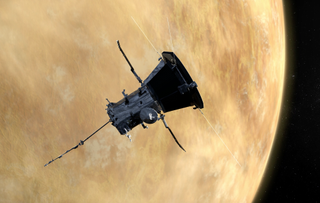
The sun is right there in the name of NASA's Parker Solar Probe, but a second mission of opportunity may make the spacecraft just as vital to Venus scientists as to those studying our local star.
Parker Solar Probe launched in August 2018, destined to spend seven years looping ever closer to the sun in hopes of sorting out some of the hottest mysteries about our star. But to do so, the spacecraft needed a carefully choreographed trajectory, one that included seven flybys of Earth's evil twin, Venus. And Venus scientists, who haven't had a dedicated NASA spacecraft since the mid-1990s, were not about to let that opportunity fly past them.
"The Venus flybys are like, if you have like a 48-hour layover in Paris, not leaving the airport," Shannon Curry, a planetary physicist at the University of California, Berkeley, told Space.com. "It would be crazy not to turn on [the instruments]." Curry and her colleagues made her case, and the Parker Solar Probe will gather its second batch of Venus data today (Dec. 26), as the probe makes its closest approach to the planet at 1:14 p.m. EST (1814 GMT).
Of course, Parker Solar Probe's instruments are designed to study a star, not a planet. They focus mostly on plasma, the hot mess of charged particles that makes up the sun. Traditionally, planetary scientists want very different instruments on their spacecraft: radar devices to map the surface, spectrometers to identify chemicals and the like. But that doesn't make plasma data superfluous.
Two dedicated Venus missions have carried plasma detectors to the world: NASA's Pioneer Venus Orbiter and the European Space Agency's Venus Express. But those spacecraft were built decades ago. "The stuff that they were able to put on [Parker] Solar Probe takes measurements faster, better, stronger, like the whole deal," Curry said.
And she and her colleagues have plenty of questions about Venus that plasma data could help answer. For today's flyby, the team is particularly interested in a feature called the bow shock, where the planet's neighborhood meets the solar wind of charged particles that constantly stream off the sun.
The precise location of the bow shock varies based on how active the sun is, which changes over the course of the 11-year solar cycle. "We're not positive it'll cross the shock or not, but that's actually important because it'll tell us physically where the shock is at this point in the solar cycle," Curry said. "It tells us a lot about what the sun's doing, and the shock is a nice gauge of that."
And the environment on either side of the bow shock differs dramatically. Outside the shock is the pristine solar wind and the effects of solar storms. But if Parker Solar Probe crosses inside the shock, scientists should be able to better understand how quickly Venus is losing its atmosphere.
"The magnetic fields pile up and actually sort of drag the atmosphere off. It's almost like a slingshot," Curry said. "That's one of the biggest ways the atmosphere of Venus gets removed, the sun's magnetic field lines."
Venus scientists are interested in a more detailed measurement of atmosphere loss, because atmospheric pressure affects what state water takes; it's Earth's even 1 bar of pressure that helps keep our oceans liquid. "At some point, maybe liquids could exist again [on Venus], or maybe they did before and we just don't know," Curry said.
But the Venus atmospheric-loss measurements will really crank up during Parker Solar Probe's next two flybys, in July 2020 and February 2021. These two visits will carry the spacecraft right through what scientists call the tail of Venus, which is where the atmosphere slips away from the planet.
"Those are going to be the super-important ones. I think these first two are almost — not like dress rehearsals, but it's really important to make sure we get everything right," Curry said. "Flybys 3 and 4 will tell us mountains about atmospheric escape at Venus and then a lot of other dynamics we just don't understand."
Curry said that Parker Solar Probe may be able to solve a long-standing mystery about the surface of Venus: whether the planet sports small, patchy crustal magnetic fields. So far, Mars is the only planet where scientists have seen this phenomenon. "It's like a little magnetic rash on its belly, like little bubbles with magnetic fields," Curry said. But no one's gotten a close enough look at Venus to check for them. "We might not [see them], and they might not even be there. We just don't know."
The results of the first Venus flyby, which took place in October 2018, prove the importance of practice. During the pass, the spacecraft ended up shutting its instruments down, convinced that they were pointing straight at the sun, which they aren't meant to do.
"We're just looking at Venus, not the sun. Venus is just a superbright planet the way it reflects," Curry said. "That's why the instruments got confused." Now, Curry said, the project team believes it's figured out how to keep that error from happening again.
And the Venus work is benefiting from a science bonus discovered by the main Parker Solar Probe team, which realized that the spacecraft could gather and send back more data than originally anticipated. Curry had been willing to fight for even just an hour of data on a flyby; during the first maneuver, the team got about 10 hours of observations.
Curry is hoping to build similar Venus collaborations with the European and Japanese team running the BepiColombo mission en route to Mercury and with Europe's Solar Orbiter mission. Like Parker Solar Probe, both of these spacecraft also need to make Venus flybys to reach their targets.
"These are the only measurements of Venus we're going to have for, frankly, it might be the next decade," Curry said. "We have nothing planned to go to Venus." And the missions NASA is considering don't carry plasma instruments like Parker Solar Probe does, so questions like atmospheric loss might go unanswered even then.
Combine those two factors, and the mission's accidental planetary science looks even more precious. "With Venus science," Curry said, "anybody who gets data is a hero."
As 2019 comes to a close, it's time to review some of the biggest space science stories of the year.
From a world with three suns in its sky to lots of possibly habitable real estate, the past year has seen some incredible exoplanet discoveries. Here are 10 of the most memorable.
This graphic shows a comparison of the habitable zones of several alien planets, and how the Teegarden's Star planets measure up. (Image credit: C. Harman)
In June 2019, researchers reported that they had found two Earth-like exoplanets circling a red dwarf known as Teegarden's Star, which lies only 12.5 light-years from Earth.
The newfound worlds complete one lap around their host star in just 4.9 and 11.4 Earth days, respectively. Despite these close orbits, they're still thought to reside in the "habitable zone" — the range of distances from a star that can support the existence of liquid water on a world's surface — because Teegarden's star is so dim.
From the data collected so far, scientists believe there might be more exoplanets to find in this system too.
9. Ploonets
An artist's illustration of a potentially habitable exomoon orbiting a giant planet in a distant solar system. Such worlds could get stripped of their host planets and orbit stars independently, becoming "ploonets." (Image credit: NASA GSFC/Jay Friedlander and Britt Griswold)
Who said space isn't adorable? In a preprint paper published on the website arXiv in July 2019, scientists gave a fanciful name to a class of wandering exomoons. In the scenario described in the paper, these exomoons were ripped from the gravitational pull of their host planet and pulled toward their host star.
No longer just a moon, but still not quite an exoplanet, these weird exomoons needed a special name. Previous research had thrown around "moonmoon," but the paper published in July landed on the much cuter "ploonet."
Ploonets are purely theoretical right now, but the paper showed how their journeys (and subsequent slow deaths) around their host stars might leave recognizable light signals. The researchers think that this light signature might explain some previously unexplained astronomical observations.
8. Three suns!
An artist's depiction of the view from a moon's surface of a gas giant and three suns. (Image credit: NASA/JPL-Caltech)
Thanks to a little help from NASA's Transiting Exoplanet Survey Satellite (TESS), scientists discovered a strange new exoplanet in a three-star system with a surface temperature around 320 degrees Fahrenheit (160 degrees Celsius.) The exoplanet, called LTT 1445Ab, is 22.5 light-years from Earth and, despite having stars in triplicate, appears to make an orbit around one of them every five days. The other two red dwarfs simply loom in the exoplanet's sky.
In addition to its novel setup, scientists say that the exoplanet would be a perfect candidate for future atmospheric exploration thanks to its positioning between the stars and Earth. Scientists believe this would make it possible for even ground-based Earth telescopes to make observations about the exoplanet.
7. Gassy preteen with two suns
An illustration of Kepler-47, an exoplanet that, like DS Tuc Ab, orbits, two suns. (Image credit: NASA/JPL-Caltech/T. Pyle)
In March 2019, scientists used TESS data to discover a gassy, preteen exoplanet that researchers believe to be a mere 43 million years old. The exoplanet, called DS Tuc Ab, orbits one star in a two-star system once every eight days.
And because DS Tuc Ab is still relatively young, scientists are interested in learning more about what this world's history could tell us about the formation of planets in our own solar system. For example, DS Tuc Ab still experiences considerable losses of its atmospheric gas due to radiation from its host star. Scientists hope to extrapolate this knowledge about DS Tuc Ab to imagine what might happen to Earth and other planets closer to home if they were to lose their atmospheres.
In July 2019, scientists used TESS data to find yet another treasure trove of possibly habitable exoplanets. The data identified three exoplanets in the dwarf star system GJ 357, which lies 31 light-years from Earth.
Two of the planets — GJ 357 c and d — can be classified as "super-Earths," worlds slightly bigger than our own. Meanwhile, GJ 357 b is something called a hot Earth, meaning that, while its size might be Earth-like, its surface gets much hotter (about 490 degrees Fahrenheit, or 254 degrees Celsius) than that of our own planet.
GJ 357 d in particular has grabbed a lot of attention, because it may well fall into the coveted habitable zone. This planet completes one lap around the host star every 55 Earth days.
5. A snowball's chance
An artist's impression of a "snowball Earth." (Image credit: NASA)
Scientists have been peering into Earth's baby book to learn a little more about a kind of exoplanet deemed a "snowball." At certain points in their lives, snowballs can become tidally locked with their host star, always showing it the same face, and as a result develop huge, eyeball-like icy oceans on that face.
Earth itself went through its own snowball phases as a younger planet. Because of this fact, scientists have speculated that snowball exoplanets may well be capable of sustaining life — and research published in July 2019 suggests they might even be better at it than originally imagined.
The paper focused on what might be happening on the land of these snowball planets instead of just their oceans. The study found that snowball planets would likely have relatively temperate inland zones, where temperatures hover around 50 degrees Fahrenheit (10 degrees Celsius) and above — something that Earth-like life could easily handle.
4. Football-shaped world
The top of WASP-121b's atmosphere is heated to a blazing 4,600 degrees Fahrenheit (2,500 Celsius), hot enough to boil some metals. (Image credit: G. Bacon (STSci)/NASA/ESA)
In August 2019, scientists reported finding a strange, football-shaped exoplanet shedding its atmosphere at a rapid rate — and losing heavy metals like iron and magnesium along with it. This big, puffy exoplanet, called WASP-121b, is something called a "hot Jupiter," and it orbits so close to its sun that its temperature is hotter than any other known planet — a whopping 4,600 degrees Fahrenheit (2,538 Celsius) in the upper atmosphere.
The proximity to its star not only heats up the exoplanet but also causes its football-like bulge as the star's gravity literally threatens to tear the exoplanet apart. Scientists were able to make this original observation using NASA's Hubble Space Telescope but hope to investigate the exoplanet further using the agency's James Webb Space Telescope, which is scheduled to launch in 2021.
3. Exoplanet water-vapor drama
A clash over exoplanet data ruffled a few feathers in September 2019 as scientists raced to be the first to report findings of alien-world water vapor.
The data in question was collected by a Université de Montréal-led team in 2016, 2017, and 2018 and suggested that the air of an exoplanet called K2-18 b features water vapor and clouds — a huge point of excitement for those searching for signs of alien life. But a team from University College London posted an analysis of this data around the same time the Canadian researchers did.
While such scientific scooping is not illegal — the data was open-access — some astronomers saw it as poor form. And the Canadian team leader said he wished the London team had consulted him about their plans.
The two studies interpreted the data somewhat differently, but both concluded that there is water vapor in K2-18 b's atmosphere. And that's a good thing, all the drama notwithstanding.
Planets orbit a supermassive black hole named Gargantua in the 2014 sci-fi blockbuster "Interstellar." A new study suggests that thousands of starless planets could orbit every such black hole. (Image credit: Paramount Pictures)
Using a computer model, scientists determined in October 2019 that starless, Neptune-like planets could form around and orbit supermassive black holes. Instead of calling a cozy solar system home, these exoplanets would live on the edge of, or about 10 to 30 light-years away from, a light-eating black hole and would be comprised of icy dust left in its wake. Based on their model, the scientists said that such voracious black holes could be host to tens of thousands of planets.
At least in theory, anyway; detecting such exoplanets would be extremely challenging. For example, astronomers couldn't use the most prolific planet-detection strategy, the transit method, to find such worlds. The transit method looks for dips in light that result when an exoplanet passes in front of its host start. But, because black holes eat light instead of emitting it, this obviously wouldn't work. So, scientists might have to rely on models and indirect methods for now.
1. Exoplanet collision?
(Image credit: NASA/SOFIA/Lynette Cook)
Scientists have been observing a lot of warm dust in the star system BD +20 307, which is about 300 light-years from Earth. And they're starting to get excited, because this dust might be evidence of a fairly recent planetary collision. The observations were first made a decade ago and then reaffirmed in April 2019.
For scientists, this exciting possibility represents an opportunity to learn more about how such impacts affect the formation and evolution of planetary systems. This hits close to home, as it's believed that Earth's moon formed after a giant impact.
Editor's note:This story has been corrected to reflect the correct distance to the exoplanets of GJ 357. The correct distance is 31 light-years from Earth, not 31 million light-years.
Of the many and varied documents that have surfaced under the terms of the U.S. government’s Freedom of Information Act, one of the most fascinating is a 33-pages-long report on psychic phenomena titled “Paranormal Phenomena — Briefing on a Net Assessment Study.” Written in January 1973 by P.T. Van Dyke and M.L. Juncosa (of RAND) for the Defense Advanced Research Projects Agency (DARPA), it makes for notable reading. It should be noted that over the years and decades, U.S. military- and intelligence-agencies have (A) tried to use dogs to psychically locate landmines on battlefields; (B) studied out-of-body phenomena; (C) attempted to determine if both animals and people have souls; and (D) studied the possibility of that psychic phenomena can cause heart-attacks. And that’s just the tip of the iceberg. But, now, let’s get back to that “Paranormal Phenomena — Briefing on a Net Assessment Study.”
Without doubt, the most intriguing section of the document is the one that is titled Possible Military Applications. The section is split into four different parts. The first is titled “Long- and Short-Distance Information Transfer.” It states: “For a variety of reasons, including apparent violations of some basic principles of communication theory, the probability of long-distance telepathic communication being confirmed as a real phenomenon appears rather low; however, these considerations may not apply with equal force to the possibility of short-range information transfer by telepathic means (of the order of a few meters). It should be noted, though, that long-distance telepathic phenomena occupy a paramount place in modern experimental research, but that their confirmation and theoretical explanation would require a modification of known laws of physics.”
The second part goes by the heading of “Equipment Control and System Damage.” It provides the following: “It would not be conceptually difficult, for example, to imagine the utility of psychokinesis (if feasible) in disrupting the electrical systems associated with an ICBM’s guidance program.” This is particularly intriguing as, in some ways, it ties in with some of the incredible claims that have been made concerning how, in decades past, UFOs have been able to disable ICBMs and affect nuclear-missile-launch facilities. Now, let’s move on.
Part-three has an eye-opening title: “Man-Machine Interactions.” We are told that, “These entail an application of both telepathy and psychokinesis to produce a quasi-symbiotic relationship between man and, say, computing equipment on a more intimate basis than is presently feasible.” Although I don’t buy into the story that the late Philip J. Corso presented in his 1997 book, The Day After Roswell, he certainly addressed this matter: “Were all of this to be true, could it not be argued that the silicon wafers we recovered from Roswell were the real masters and space travelers and the EBE creatures their hosts or servants? Once implanted successfully on Earth, our culture having reached a point of readiness through its development of the first digital computers, would not the natural development stream, starting from the invention of the transistor, have carried us to the point where we achieve a symbiotic relationship [italics mine] with the silicon material that carries our data and enables us to become more creative and successful?”
“Body Control and Healing” is the title of part-four. In relation to those “possible military applications,” Van Dyke and Juncosa said: “One may envision an application of both autogenic phenomena (voluntary control of the autonomic nervous system) and what is traditionally known as ‘faith healing’ to battlefield injuries. There is, in fact, some evidence that certain individuals may accelerate organic healing processes through various psychosomatic effects. The ability to resist normally intolerable conditions, such as torture or brainwashing in captivity, might be another application of these phenomena.”
The conclusions were driven by the concerns that the Soviets might have gotten ahead of the U.S. The “general conclusions” of Van Dyke and Juncosa were as follows: “Over forty years of research in the United States have failed to significantly advance our understanding of paranormal phenomena; in several areas, U.S. research is beginning to track Soviet research; there is much Soviet interest in U.S. work, especially in possible military-oriented research; visible U.S. and Soviet levels of effort appear roughly equal; there is some evidence of Soviet government funding of certain areas of research; published information on Soviet experimental design and analysis tends to be vague and incomplete; Soviet research is much more oriented toward biological and physical theorizing than is U.S. research; if paranormal phenomena do exist, the thrust of Soviet research appears more likely to lead to explanation, control, and application than is U.S. research.
As if Elon Musk needs yet another reason for people to hate his guts, here’s one more that has nothing to do with Teslas, Mars, cave rescues, politics or the dangers of artificial intelligence. Beginning in January, Musk’s SpaceX will conduct regularly-scheduled launches of batches of 60 communications satellites at a time, with a goal of about 1500 by the end of the year, joining the two batches of 60 launched in 2019. Those two raised the ire of astronomers and star-gazers – especially the second batch which are in a low 280 km orbit and clearly visible in the night sky. (Video here and here.) If astronomers think 60 is bad and 1,500 is worse, SpaceX already has approval for a total of 12,000 satellites and has filed paperwork to launch 30,000 more. THIRTY-THOUSAND! No wonder they’re angry.
Radio telescope
Dhara Patel, an astronomer at the Royal Observatory Greenwich, vented disdain to the BBC. Dr. Dave Clements, an astrophysicist from Imperial College London, explained that the moving satellites will mess with telescopes that are taking large surveys of the sky, comparing it to “like someone’s walking around firing a flashbulb every now and again.” The bright lights will also hide anything and everything behind them “whether that’s a nearby potentially hazardous asteroid or the most distant Quasar in the Universe.”
@jengolbeck If you saw a row of UFO like lights in the sky in IL, IA, MI (like this but spaced out), that was SpaceX Starlink Satellites! You’ll be able to see them in the next few days, too! Check here for a map (and set the time back to see their track today) https://t.co/wtkU9xSFY9
This still sucks.
Who will win this fight for the skies? SpaceX claims it is working on a special coating to make the satellites less reflective, although less is still more when you’re talking 42,000 satellites. The UK company OneWeb is looking to put as many as 2,000 satellites in orbit. While touting its work with astronomers to minimize their influence on the skies, Ruth Pritchard-Kelly, vice president of OneWeb, may have given the best answer to the “Who will win?” question:
“There is no question that the entire world is entitled to be connected to the internet…. So it’s going to happen. And probably three or four of these systems are going to happen.”
So … it’s going to happen. Perhaps Musk can make peace with astronomers by giving them and their telescopes a free trip to nearly-satellite-free Mars.
Groot Maya-paleis van 1.000 jaar oud ontdekt in Mexicaanse jungle: "Dit is nog maar het begin"
Archeologen hebben in Mexico de overblijfselen van een groot Maya-paleis van 1.000 jaar oud ontdekt. Volgens de eerste aanwijzingen dateert het paleis uit de periode 600-1.050 na Christus, tijdens het hoogtepunt van de Maya-beschaving.
Hanne Decré
Het paleis werd ontdekt op de archeologische site van de oude stad Kuluba, vlak bij Cancún, in het uiterste oosten van het schiereiland Yucatán. Het was een belangrijke plaats tot de komst van de Spaanse ontdekkingsreizigers. De afmetingen zijn indrukwekkend, het paleis was maar liefst 6 meter hoog, 55 meter lang en 15 meter breed.
Foto's van het eeuwenoude paleis. Bron: Mauricio Marat, INAH.
MAUMARAT
Foto's van het eeuwenoude paleis. Bron: Mauricio Marat, INAH
MAUMARAT
Volgens het INAH (voluit Instituto Nacional de Antropología e Historia) zijn er aanwijzingen dat het paleis gedurende twee lange periodes tussen 600 en 1.050 na Christus gebruikt werd. Vermoedelijk werd het paleis bewoond door de elite van Kuluba.
Dit is nog maar het begin, we zijn nog maar net begonnen met de ontdekking van een van de grootste structuren op de site
Archeoloog Alfredo Barrera
"Dit is nog maar het begin, we zijn nog maar net begonnen met de ontdekking van een van de grootste structuren op de site", vertelt archeoloog Alfredo Barrera.
Naast het paleis zijn archeologen ook bezig om vier andere structuren te verkennen op het centrale plein van Kuluba, onder meer een altaar, overblijfselen van twee woningen en een ronde structuur (waarschijnlijk een oven). Er wordt ook bestudeerd hoe de historische site beschermd kan worden tegen schade van de wind en de zon.
Er wordt overwogen om delen te herbebossen. Mogelijk wordt de site binnenkort opengesteld voor het publiek. Er werden op de site ook verschillende beenderen teruggevonden. De skeletten zullen nu worden onderzocht om onder meer de leeftijd en het geslacht te bepalen.
Een archeologe aan het werk.
Bron: Mauricio Marat, INAH
Een belangrijke link met Chichén Itzá, de Maya-stad bij uitstek
Kuluba had belangrijke linken met Maya-steden als Ek'Balam en - nog crucialer - Chichén Itzá. De regio viel onder de invloed van Chichén Itzá en maakte deel uit van het handelsnetwerk. De naam van de site zou van het Maya-woord K'ulu' afkomstig zijn. Een K'ulu' is een soort wilde hond die daar leefde.
Tussen 250 en 900 na Christus was de Mayabeschaving op haar hoogtepunt. Voor de Spanjaarden de regio veroverden, heersten de Maya's over grote delen van wat nu Mexico, Honduras en Guatemala is.
De Maya's bouwden steden (waarvan Chichén Itzá waarschijnlijk de bekendste is), bedreven landbouw, hadden een volledig ontwikkeld schrift, bedreven rituele ceremonies, en waren ontwikkeld in kunst, architectuur, astronomie en wiskunde. Ze hadden ook een eigen kalender, en Mayapriesters interpreteerden die om er de toekomst mee te voorspellen. De onderzoekers hopen dat de ontdekking meer over het leven van de Maya's zal onthullen.
The Mayan palace was discovered in the archaeological zone of Kulubá, Yucatán. The construction, located within this pre-Hispanic Mayan city, is approximately 55 meters long (180.5 ft) by 15 meters (49.2 ft) wide and 6 meters (19.6 ft) tall.
YUCATÁN, Mexico (Times Media Mexico) – 37 kilometers southeast of the city of Tizimin in Yucatan, Kulubá is located. It is quite an interesting Mayan archaeological site since everyday something new shows up.
The name Kulubá, according to the Maya language specialist William Brito Sansores (La escritura de los mayas, 1981), is allegedly formed by the words “K’ulu”, which refers to a kind of wild dog, and “ha”, water.
The archaeological zone of Kulubá, in Yucatán, is home to a 55-meter-long palace, according to the National Institute of Anthropology and History (INAH).
“This work has confirmed the existence of a palace to the east of the main square of Group C, through the liberation and recognition of the base, the stairways and a crossing with pilasters, at the top, which would have been used by the elite of the place,” the INAH explained in a statement.
The construction, located inside this pre-Hispanic Mayan city, is approximately 55 meters long by 15 meters wide and 6 meters high.
Kulubá Yucatan, Palace Photo: INAH
The construction materials indicate that there were two phases of occupation: one in the Late Classic period (600-900 AD) and another in the Terminal Classic period (850-1050 AD).
“In the Terminal Classic is when Chichén Itzá became a prominent metropolis in the current Yucatán,–and– it extended its influence over sites like Kulubá,” explained archaeologist Alfredo Barrera.
Along with this palace, the experts explored four other structures in the plaza of the so-called architectural Group C: an altar, two vestiges of living spaces and a round construction that is believed to have been an oven.
Kulubá is an archaeological zone located 37 kilometers from the municipality of Tizmín that is still being studied and recovered.
Archeologists at Kulubá Yucatan, Palace Photo: INAH
The people in charge of the work of the multidisciplinary project are specialists in archaeology and restoration.
“Throughout the 20th century, Tizimín ceded most of its forest land to agricultural and livestock use. This means that the experts who are now restoring the Mayan buildings to their former glory not only live alongside spider monkeys and other species of flora and fauna, but also give priority to the fact that the archaeological zone is distinguished by its natural and cultural balance” said INAH.
Kulubá Yucatan, entrance to the palace Photo: INAH
“All these exploratory and conservation actions are the beginning of the work that the INAH carries out to recover, research and disseminate among the public the cultural and natural heritage of Kulubá, a place that increases its heritage attraction and regional sustainability” concluded the INAH.
Archaeologists found an ancient Mayan palace that was probably used by elite members of society over 1,000 years ago. The palace was discovered in the ancient city of Kuluba which is not far from Cancun, Mexico.
The large structure was found in the eastern part of the Kuluba archaeological zone which is a pre-Hispanic site located in the Yucatán state. Excavations at the site revealed the large palace that measured 180 feet long by 50 feet wide and 20 feet in height. According to the Mexican National Institute of Anthropology and History (INAH), it was inhabited by locals during two lengthy time periods between 600 and 1050 A.D.
In addition to the palace, four other structures were discovered. They found an altar, remains of two residential buildings, and a round shaped structure which they think was an oven. There is still much more work that needs to be done, though. “This work is the beginning, we’ve barely began uncovering one of the most voluminous structures on the site,” archaeologist Alfredo Barrera said in a video statement.
Chichen Itza
According to the INAH, conservationists are looking to reforest certain parts of Kuluba in order to protect the site against sun and wind damage.
The ancient city of Kuluba had very important connections with other Maya cities like Ek’ Balam and Chichen Itza as it was part of their network of trade and territory.
The Mayan civilization prospered in Central America for approximately 3,000 years – reaching their peak between 250 and 900 A.D. Today, their descendants still live throughout different Maya areas. The Mayans created very advanced architecture and art in addition to having the only completely developed written language in that area during that time.
Mayan calendar
They are also famously known for their astronomical and mathematical systems. In fact, they had extensive knowledge of the stars and relied on astrological cycles in order to figure out when to plant their crops. It is believed that they even built their cities to coincide with the stars. The pyramid at Chichen Itza, for example, was constructed in accordance to the position of the sun during the spring and fall equinoxes. When the sun sets on those two days, the pyramid casts a shadow upon itself which aligns perfectly with the head carving of the Mayan’s serpent god. The serpent’s body is created by the shadow which makes it look as though it’s crawling towards the ground during the setting of the sun.
This new discovery of a Mayan palace is just one of the many astonishing remains that have been found throughout the years created by an incredibly fascinating civilization. Pictures of the palace can be seen here.
It looks like Russian President Vladimir Putin got what he wanted from Santa for Christmas – a working hypersonic missile that can travel at up to 27 times the speed of sound. At that speed (33339.6 km/h or 20716.3 mph), which arrived on Putin’s roof first – Santa or the missile?
“The Minister of Defense of the Russian Federation, Army General Sergei Shoigu, reported to Russian President Vladimir Putin on setting up on December 27 from 10:00 on combat duty the first missile regiment armed with the latest strategic missile system with the Avangard hypersonic planning winged warhead.”
Interfax reports that the first Avangard missile is in the Yasnensky Missile Division, which is deployed in the Orenburg region at the southern end of the Ural Mountains in southwestern Russia. That’s very close to Europe, although its range is likely to be farther than that. The Moscow Times reports that the Avangard was tested in December 2018 and hit a practice target 6,000 km (3,728 miles) away. But the Avangard is much more than just the world’s fastest missile. It’s a ‘boost-glide’ system, which means it’s launched like a ballistic missile but then quickly re-enters the atmosphere at a lower trajectory and glides unpowered for thousands of kilometers.
It was there a blink of an eye ago.
But wait … there’s more!
“It is not so much the speed of the hypersonic weapon alone that counts. It is its extraordinary maneuverability as it glides towards its target. This poses a huge problem for existing anti-missile defense systems. Indeed the glide vehicle’s trajectory, “surfing along the edge of the atmosphere” as one expert put it to me recently, presents any defensive system with additional problems. Thus, if Russia’s claims are true, it has developed a long-range intercontinental missile system that may well be impossible to defend against.”
Jonathon Marcus, the BBC’s defence correspondent says the Avangard could put Russia ahead of both China and the U.S. in this technology. As Vladimir Putin himself put it:
“Not a single country possesses hypersonic weapons, let alone continental-range hypersonic weapons. The West and other nations were “playing catch-up with us.”
Being the nice guy that he is, Putin allowed a team of U.S. inspectors to see a demonstration of the Avangard as part of transparency measures under the New START nuclear arms treaty with the U.S., which is up for renewal in 2021. According to Aljazeera, U.S. defense secretary Mark Esper says the Pentagon is working on the development of hypersonic weapons but it will be “probably a matter of a couple of years” before one is tested – after the New START treaty is renewed … or not renewed.
Say it again — who’s Number 1?
What does Russia’s deployment of the Avangard mean? Jonathon Marcus puts it bluntly.
“With a whole new generation of nuclear weapons at the threshold of entering service, many believe not just that existing agreements should be bolstered, but that new treaties are needed to manage what could turn into a new nuclear arms race.”
New Theory Explaining The “Dark Energy” Phenomenon
Does the Universe have borders?
The International Journal of Modern Physics has published an article by the IKBFU Physics and Mathematics Institute Artyom Astashenok and the Institute’s MA student Alexander Teplyakov. The article refers to the issue of the “Dark Energy” and an assumption is made that the Universe has borders.
Artyom Astashenok said, “The fact that our Universe is expanding was discovered almost a hundred years ago, but how exactly this happens, scientists realized only in the 90s of the last century, when powerful telescopes (including orbital ones) appeared and the era of exact cosmology began. In the course of observations and analysis of the data obtained, it turned out that the Universe is not just expanding, but expanding with acceleration, which began three to four billion years after the birth of the Universe”.
Credit: Immanuel Kant Baltic Federal University
For a long time, it was believed that space is filled with ordinary matter – stars, planets, asteroids, comets and highly rarefied intergalactic gas. But, if this is so, then accelerated expansion is contrary to the law of gravity, which says that bodies are attracted to each other. Gravitational forces tend to slow down the expansion of the Universe but cannot accelerate it.
Artyom Astashenok says: “And then the idea was born that the Universe is filled for the most part not with ordinary matter, but with some “dark energy”, which has special properties. No one knows what is it and how it works, so it named “Dark Energy” as something unknown. And 70% of the Universe consists of this Energy”.
There are many theories of what the “Dark Energy” is, and the IKBFU scientists presented their own theory.
“The so-called Casimir effect (named after the Dutch physicist Hendrik Casimir), which consists in the fact that two metal plates placed in a vacuum are attracted to each other, has long been known. It would seem that this cannot be, because there is nothing in the vacuum. But in fact, according to quantum theory, particles constantly appear and disappear there, and as a result of their interaction with plates, which indicate certain boundaries of space (which is extremely important), a very small attraction occurs. And there is an idea according to this, approximately the same thing happens in space. Only this leads, on the contrary, to additional repulsion, which accelerates the expansion of the Universe. That is, there is essentially no “Dark Energy”, but there is a manifestation of the boundaries of the Universe. This of course does not mean that it ends somewhere, but some kind of complex topology can take place. You can draw an analogy with the Earth. After all, it also has no boundaries, but it is finite. The difference between the Earth and the Universe is that in the first case we are dealing with two-dimensional space, and in the second – with three-dimensional”.
The published article, which, as explained by Artem Astashenok, develops the ideas presented in the thesis of Alexander Teplyakov, presents a mathematically sound model of the universe in which additional repulsion occurs, and where there is no contradiction between the fact that the expansion of the Universe accelerates and the law of universal gravitation.
Contacts and sources:
Sergey Bulanov
Immanuel Kant Baltic Federal University
Citation:
Some models of holographic dark energy on the Randall–Sundrum brane and observational data A. V. Astashenok and A. S. Tepliakov International Journal of Modern Physics D
Linda Moulton Howe: Alien Agendas That Are Hostile Enemies
Professional controlled remote viewers, who have worked for the CIA and DIA, report that this universe is teeming with life and consciousness. Alien agendas that are hostile enemies.
Emmy and Peabody Award-winning investigative journalist Linda Moulton Howe has received insights from several whistleblowers and scientists. Join Linda for this exclusive opportunity to learn where the celestial battle lines are being drawn.
Linda Moulton Howe is a graduate of Stanford University with a Masters Degree in Communication. She has devoted her documentary film, television, radio, writing and reporting career to productions concerning science, medicine and the environment. Ms. Howe has received local, national and international awards, including three regional Emmys, a national Emmy nomination and a Station Peabody award for medical programming.
Linda’s documentaries have included A Strange Harvest and Strange Harvests 1993, which explored the worldwide animal mutilation mystery. Another film, A Prairie Dawn, focused on astronaut training in Denver. She has also produced documentaries in Ethiopia and Mexico for UNICEF about child survival efforts and for Turner Broadcasting in Atlanta about environmental challenges.
Cultural Evolution Caused Broad-Scale Historical Declines Of Large Mammals Across China
Local extinction of 5 megafauna taxa from much of China over the past 2 millennia were found to be closely linked to filtering effects driven by cultural evolution rather than climate change.Cultural evolution has been the dominant driver of range contractions in megafauna taxa across China since the beginning of Common Era, with little or no direct importance of climate. A research team led by Aarhus University along with collaborators from Nanjing University analyzed maps of megafauna distribution dynamics and societal development based on Chinese archival records alongside data on climate across China from 2 to 1953 CE.
Human activities are now playing a dominant role in driving changes in Earth’s biodiversity and are responsible for the incipient sixth mass extinction, but the historical processes leading to this situation are poorly understood, often without emphasis on cultural evolution as a potential key process underlying anthropogenic impacts. A team of researchers from Aarhus University and Nanjing University has now shown that cultural evolution overshadowed climate change in driving historical broad-scale biodiversity dynamics.Map of the northern boundary of Asian elephant (Elephas maximus) in the study area over the past four millennia, based on multiple archaeological and historical sources. The distribution dynamics were inconsistent with the trend of mean annual temperature across the study area. Oracle bone scripts were used for divination by a cultural group recognized as Chinese ancestors ruling much of the North China Plain. The significant similarity between these scripts and their modern forms for the large mammals supports the past wide distribution of these taxa in ancient China.
Credit: Shuqing Teng
By mining the deep Chinese administrative records in relation to culturally important wild megafauna species as well as sociocultural development, the researchers identified the millennia-long spread of agricultural land and agricultural intensification, as well as the specific expansion of the Han culture, as the main cause of the extirpation of five megafauna species from much of China, with little or no direct importance of climate.
Cultural evolution, not climate change, as the main driver
“China’s well-preserved written records for more than 2000 years provide a unique opportunity to reconstruct long-term dynamics of culture-nature interactions across large geographical extents,” says senior author Professor Jens-Christian Svenning, director of Center for Biodiversity Dynamics in Changing World (BIOCHANGE), Aarhus University. The five studied megafauna taxa include Asiatic elephant (Elephas maximus), Asian rhinoceroses (Rhinoceros sondaicus, R. unicornis and Dicerorhinus sumatrensis), tiger (Panthera tigris), Asiatic black bear (Ursus thibetanus), and brown bear (Ursus arctos), all of which were widely distributed across the study area and have played an important role in ancient China’s cultural activities.
The Sumatran rhinoceros (Dicerorhinus sumatrensis) was widely distributed in eastern China in historical times, but was extirpated due to increasing human pressure — and process that has continued to the present day in its remaining range in southeast Asia, threatening to cause the complete extinction of this species, with likely less than 80 individuals surviving, all in Indonesia.
“Ancient China used to host a highly biodiverse assemblage of large mammals even in its nowadays densely populated areas such as the North China Plain and the Middle-Lower Yangtze Plain. Our research shows that the relatively recent loss of this rich megafauna in large part can be attributed to the southward expansion of intensified agricultural practices with the Han culture, which originated in North China,” explains postdoc Shuqing Teng from Aarhus University and Nanjing University, the first author of the study.
Regional extirpation of these taxa from the study area were consistent with the sociocultural dynamics described above, but inconsistent with climate change. There were at least two conspicuous cooling-warming cycles during the last two thousand years, including the Medieval Warm Period and the Little Ice Age, with fluctuations of mean annual temperature around 1 to 1.5 °C, but neither had a conspicuous effect on the megafauna range dynamics.
Importance of cultural filtering
The study provides clear evidence that cultural evolution historically has overshadowed past climate change in shaping broad-scale megafauna patterns, in contrast to the common belief that human societies were unimportant in driving biodiversity dynamics at such large spatiotemporal scales until recent time frames such as the Industrial Revolution or the Great Acceleration of the 20th century.
This finding highlights the importance of culture’s role in filtering current ecological assemblages from historical species pools. Perspectives through the lens of cultural filtering should also stimulate thoughts on what is natural – notably helping to overcome the Shifting Baseline Syndrome, the tendency to accept an already degraded state as natural due to lacking recognition of earlier declines – and which natural world we aim to conserve or restore.
Furthermore, modification of cultural filters will be key to respond to the challenges of the Anthropocene biodiversity crisis, as it is fundamentally culturally driven, as shown by this study of historical China, and how to achieve this is an important research challenge.
Contacts and sources:
Jens-Christian Svenning Aarhus University
Citation:
Long-term effects of cultural filtering on megafauna species distributions across China Shuqing N. Teng, Chi Xu, Licheng Teng, and Jens-Christian Svenning. PNAS first published December 23, 2019
Here is a great video taken from the NASA satellite recording our sun. It happened back in 1999, but the evidence is still on the Helioviewer site today. Found by Youtuber Wireeye, these object are obviously not solar material from the sun, but instead seem to be heading towards our sun. Its an entire UFO fleet. Some of the ships are incredibly huge and unusual in shape...three like a butterfly or winged creatures.
Its refreshing to see something I have not seen before...here are a few ships together that demonstrate that alien fleets do exist in our solar system, flying together for safety.
500 Meter Long UFO Over Kazakhstan, Dec 2019, Video, UFO Sighting News.
Date of sighting:December 2019
Location of sighting: Kazakhstan
A passenger in a plane over Kazakhstan caught sight of a glowing disk in the distance. The disk is above the cloud ceiling. Even a low cloud ceiling is about 6000 meters high or 6km high. So its impossible that this was a roof of a building. This was recorded at sunset and as I have said before, most UFO sightings occur during sunset. Even cloaked UFOs will become visible at this time due to the angle of the sun, person and UFO...makes the UFO visible for a few seconds to a few minutes. This is such an example and the UFO looks to be very long, about 1/2km long or 500 meters across. Incredible and absolute proof that aliens are flying over us, quietly recording and observing our activities.
Rex Finfgeld, experienced an NDE in 2011 when he fell 26 feet and landed, head first, on concrete. Sometime while comatose and crashing, he had an NDE.
He says, "I experienced my own pure being. I was still me but I was also pure being itself. For a moment I was the all of everything. I was pure love, life, and the mind and imagination that gives rise to all of creation."
Since his NDE, he now sees and thinks in ways he never thought possible -- especially regarding consciousness, divinity, the unified field, and a prospective multi-universal reality.
The Denver Post first reported themon December 23rd. Most expected the organization or people behind them to be discovered and hopefully revealed by the authorities within a day or so. Nearly five days later, the mysterious fleet of at least 17 large non-Christmas-present drones with six-foot wingspans continues to fly in formation every night over a sparsely populated area spanning Yuma and Phillips counties in northeast Colorado. Unleash the conspiracy theories!
“They’ve been doing a grid search, a grid pattern. They fly one square and then they fly another square.”
Phillips County Sheriff Thomas Elliott observed the drones and reported them to the FAA (no information) and the U.S. Air Force (not ours). The Denver Post called the Drug Enforcement Administration (not ours either), the U.S. Army Forces Command (unaware of any military drones in that area) and the Department of Defense (no response). Undersheriff William Myers witnessed eight drones flying near the intersection of U.S. 385 and County Road 54 and received calls at the same time of one hovering motionless 25 miles away over Paoli and eight more ten miles from Paoli over Haxtun. They appear to be at an altitude of 200 feet to 300 feet, fly at steady speeds of up to 40 mph, appear regularly at about 7 pm and disappear by 10 pm. While all of this sounds pretty suspicious, Undersheriff Myers is cautiously openminded.
“They do not seem to be malicious. They don’t seem to be doing anything that would indicate criminal activity.”
He also warns any residents who see the giant drones not to shoot them down – while the drones themselves don’t appear to be breaking any local or federal laws, destroying one is a federal crime and can cause a fire … or worse, if it’s some sort of secret weapon.
While Denver-based aerial photographer, drone pilot and drone school operator Vic Moss thinks it’s probably a local drone company, he’s suspicious that they haven’t notified local authorities – something he claims all of the ones he knows would do. Tyler Rogoway over at The Drive, who keeps a close watch on suspicious military activities, is especially doubtful about this being routine land surveillance.
“The airspace where this is occurring is peculiarly desolate, as well, making it ideally suited for such a task, but the flights are not legally occurring, which makes the whole affair quite suspicious. The fact that the activity is happening after sundown is even more intriguing and adds to the notion that whoever is doing this knows it is outside the bounds of FAA regulations.”
He points out that this could be a nefarious group rehearsing for a drone operation similar to the “game-changing attack on Saudi oil facilities in September” and points out that drones with 6-foot wingspans are capable of carrying weapons and explosives. They’re extremely difficult to follow or track because they can fly without lights – illegal but possible. He also notes that seventeen drones could swarm one location or hit up to 17 separate targets.
Uh-oh.
Colorado is home to numerous military bases, the U.S. Air Force Academy … and a number of people who like to hide out in the mountains. These suspicious giant drone operations have been going on for five days without ending and with no resolution. They’re worth keeping an eye on.
In 1997 I interviewed the well-known British UFO investigator, Jenny Randles, regarding a strange series of events she found herself in, back in late 1986 (you can find the story in Randles’ From Out of the Blue book). It was a very curious saga involving allegedly classified documents, dead aliens, crashed flying saucers, and much more. It all began in October 1986, when Randles came into contact with a man who had then recently left his employment with the British Army. According to the man, he had in his possession a large stash of still-classified material on UFOs that he had acquired under very controversial circumstances. The story that “Robert” told was as remarkable as it was inflammatory. Roughly a year or so earlier, an American individual, employed by the U.S. military and working at Wright-Patterson Air Force Base, Dayton, Ohio, came across the computerized files while engaged in repairing one particular system at the base. And we’re not talking about just a few pages of material. According to what Robert told Randles and Hough, the number of pages was huge. The man allegedly printed around six hundred pages of material, which wasn’t even anywhere near the overall total. It turns out that – allegedly – the man in question was friends with Robert’s commanding-officer in the British Army; the two having met on an exchange-program. Fearful about what he had got himself into, the computer-specialist gave the hundreds of pages of material on those aforementioned crashed saucers and alien autopsies to the CO. From there, they reached Robert.
One of the papers referenced the autopsy of a strange body. Randles also said: “There was a lot of material about Roswell, including photographs of the UFO and of the aliens. One of the most detailed files was an autopsy report – that ran close to 200 pages in length – of the bodies recovered from the Roswell crash. Robert remembered the name of the doctor who had written it. His name was Dr. Frederick Hauser, a name I’d never seen connected with UFOs in any way whatsoever. Robert said that there was a very detailed account that was mostly filled with medical jargon about the autopsy which he didn’t understand, and there was a photograph of this entity with a slit right down the middle from the neck to the navel.”
And there was still more to come, as Jenny Randles demonstrated to me: “One of the first things Robert said was that the aliens were very human-looking. He said that the head was completely bald, but the most unusual feature of the face was the nose, which was almost flush into the face, almost unnoticeable. He couldn’t tell from the photographs, but the autopsy report made it clear that the beings were slightly smaller than average human size – about five feet in height.” Time to look into that Dr. Hauser, methinks. So far, I’ve not seen anyone dig deep into the man and his life.
Moving on, there’s the matter of an undeniably controversial document that surfaced in the 1990s from UFO researcher, Timothy Cooper. He, Cooper, claimed to have received a large number of old, secret documents that were focused on crashed UFOs, dead aliens, and the usual UFO conspiracy fodder. As for that document, it is titled the Interplanetary Phenomenon Unit Summary. It states that on “…3 July 47, radar stations in east Texas and White Stands Proving Ground, N.M., tracked two unidentified aircraft until both dropped off radar.” Still with the IPU summary paper, we are told the following concerning the bodies: “From what descriptions the team was able to learn and from photographs taken by intelligence photographers, the occupants appear in most respects human with some anatomical differences in the head, eyes, hands and feet. They have a slight build about five feet tall, with grayish-pink skin color. They have no hair on their bodies and clothed with a tight fitting flight suit that appears to be fire proof (some of the bodies looked as if they had been burned on head and hands). Their overall stature reminds one of young children. It is believed that there were male and female genders present, but hard to distinguish.”
The descriptions of the aliens in the IPU document sound very similar to those contained in Robert’s files, suggesting a possible (maybe likely) connection between the two, in terms of their origins. The same document states that, “…Dr. Detlev Bronk has been asked to assist in the autopsy of one well preserved cadaver .” As for Bronk, there’s this from The Majestic Documents website: “A native of New York City, Bronk was born on 13 August 1897, attended Swarthmore College, the University of Michigan, and from 1929 to 1940 was Professor for Medical Physics at the University of Pennsylvania. Later in 1940 he was appointed Professor of Physiology and Bio-physics at Cornell Medical School, NYC. Favorable investigations were undertaken of Bronk by the FBI for government-related work in both 1941 and 1947. According to FBI papers of 1961 on Bronk, ‘…he is a member of the President’s Science Advisory Committee and has been President of Rockefeller Institute for Medical Research, NYC, since 1953. He has served on many government committees in a consultant capacity and is recognized throughout the country as one of the nation’s top scientists.’ During his working life, Bronk also served as Chairman of the National Science Board, President of the National Academy of Sciences and National Research Council.”
Personally, I don’t believe that the IPU document is a real, government document – mainly because I don’t believe aliens crashed at Roswell. Either it’s a sophisticated hoax or carefully crafted disinformation to muddy the Roswell waters. So, I think we can write-off Bronk as having been involved in the autopsy of an alien in the 1940s. Maybe, though – for those who cling onto the belief that there were some real autopsies of aliens back then – it’s perhaps time to dig into the life of the mysterious Dr. Hauser, whose name popped up in those files that Jenny Randles’ was told of by her British Army source in 1986.
In an interview with New York Magazine, U.S. Navy pilot Chad Underwood finally came forward for the first time and spoke about his encounter with the infamous tic-tac shaped UFO that was filmed off the coast of California in 2004. The incident has been widely recognized as the “Nimitz UFO encounter”.
The bizarre footage of the unidentified flying object was captured on Underwood’s radar pod on the F/A-18 Super Hornet that he was flying that day. As for why it took fifteen years for Underwood to come forward with his story, he said that “at no point did I want to speculate as to what I thought this thing was – or be associated with, you know, ‘alien beings’ and ‘alien aircraft’ and all that stuff. I’m like, ‘No. I do not want to be part of that community.’”
He did, however, admit to seeing something very mysterious and unexplained that day back in November of 2004. “It is just what we call a UFO. I couldn’t identify it. It was flying. And it was an object. It’s as simple as that,” he said. Part of the reason why the encounter was so bizarre was that the object was flying at approximately 50,000 before suddenly dropping down to around a hundred feet above sea level in just a few seconds without making a sonic boom or expelling any exhaust plumes. He added that the craft had “no method of propulsion that was keeping it airborne: no wings, no heat, keeping it airborne or aloft.”
One of the many theories circulating is that they witnessed a bird, but Underwood said that it’s not possible. “You don’t see birds at 5,000 or 10,000 or 20,000 feet. That’s just not how birds operate,” he explained.
As for the theory that it was a top-secret military test craft, Underwood claimed that if it was a test aircraft, he had the clearance to know about it. “You know, I’ve got top-secret clearance with a ton of special-project clearances. So, it’s not like I wasn’t cleared to know. But, as I’m sure you’ve found in your research, to have clearance to know something, you have to have both the clearance that it’s elevated to and you have to have the ‘need to know’ it. And, clearly, whatever it was, if it was a government project, I did not need to know.”
In addition to that, there is no known aircraft on this planet that could have maneuvered in that manner. “The thing that stood out to me the most was how erratic it was behaving. And what I mean by ‘erratic’ is that its changes in altitude, air speed, and aspect were just unlike things that I’ve ever encountered before flying against other air targets,” he said, adding, “Because, aircraft, whether they’re manned or unmanned, still have to obey the laws of physics. They have to have some source of lift, some source of propulsion. The Tic Tac was not doing that. It was going from like 50,000 feet to, you know, a hundred feet in like seconds, which is not possible.”
The entire interview that New York Magazine conducted with Chad Underwood can be read in full here.
So, what exactly was the tic-tac shaped object? Nobody seems to know and the military even spent weeks attempting to figure out for themselves what Underwood and his co-workers saw that day. The mystery continues…
China heeft vrijdag een satelliet in een baan rond de aarde gebracht. De aandacht ging echter vooral naar de raket waar de communicatiesonde in zat. Die Lange Mars 5 moet volgend jaar namelijk een verkenner naar Mars lanceren, een ambitieus project.
De lancering van vrijdag gebeurde vanaf het lanceercomplex Wenchang op het zuidelijke eiland Hainan. Volgens de autoriteiten was ze “een compleet succes”. De vorige lancering van een Lange Mars 5, in juli 2017, mislukte nog. Daardoor werd de reis naar Mars uitgesteld, van dit jaar naar komende zomer. Een nieuwe tegenslag zou nog meer vertraging hebben veroorzaakt.
De Marsverkenner van volgend jaar heet Huoxing-1. Hij moet onder meer zoeken naar moleculen in de bodem van Mars om te kijken of er sporen van leven zijn.
De Lange Mars 5 moet eind volgend jaar ook een missie naar de maan lanceren. Die robot, Chang’e 5, moet bodem en stenen van de maan ophalen en terugbrengen naar de aarde.
What happens when you put three of the brightest Christian minds together in one room to discuss the strange and supernatural events in the Bible? Sparks fly as Gary Stearman interviews fellow UFO experts, Tom Horn and LA Marzulli on the darkest and most confusing of subjects for many believers. The Alien Agenda is a comprehensive review of the biblical fallen angels and their Luciferian agenda.
Beginning with the fall of Lucifer, this trio of experts delves into Genesis 6 and explains the fallen angels nightmare like you’ve never heard it explained before. You’ll hear about their dastardly deeds as angels took human wives and created a race of hybrid giants. When Joshua, Caleb and the other 10 spies entered the Promised Land to scout out the territory for the first time, they saw the offspring of these fallen angels and proclaimed, “We were like grasshoppers in their sight.”
These genetic hybrids interfered with both the human genome as well as the animal kingdom, creating a race of gigantic, hybrid animals as well. Because of their rebellion, God was forced to destroy all living creatures in Noah’s flood, saving only Noah and his family, referred to as “perfect in their generations, and 1 of each undefiled animal, male and female. Today, with the massive proliferation of UFO sightings, mysterious crop circles, blatant and demonic cattle mutilations and genetic tampering in laboratories across the world, we felt it was necessary to address these phenomenon from a biblical perspective.
Nothing is held back as Gary, Tom and LA share their insights from many years of research and personal insight. From Lucifer, to alien abductions, angels and demons and the coming UFO deception; it’s all in here. The prophecies of Apollyon and Revelation 9 and the war with Satan in Revelation 12 take on new meaning in The Alien Agenda.
Tom Horn: Wormwood! Right Out of the Book of Revelation! Andromeda Strain Alien Micro Organism Heading Toward Earth
In this final part of the month long WORMWOOD investigative series, Dr. Thomas Horn discusses the terrifying “hitchhiker” possibility on the Apophis asteroid that could poison one-third of the Earth’s waters.
Long time television and radio personality, author and publisher, Thomas Horn, serves as the Chief Executive Officer of SkyWatchTV. At the dawn of the Internet, Horn launched two news services where coverage of latest-breaking news and information on cutting-edge stories covering religion, discovery, and the supernatural through in-depth investigative reports led to his network of writers being referenced and interviewed by the biggest names in broadcasting, including:
Coast to Coast AM, the LA Times Syndicate, ABC, CBS, NBC, CNN, FOX, Time, the New York Times, the Los Angeles Times, Chicago Tribune, Miami Herald, BBC, MSNBC, Michael Savage, SciFi Channel, History Channel, Hannity & Colmes, Sid Roth’s “It’s Supernatural”, The Jim Bakker Show, Celebration Daystar TV, FaithTV, WorldNetDaily, NewsMax.com, White House Correspondents, and dozens of other newsmagazines and press agencies around the globe.
When the Russians take decisive action, it is usually for a reason. As you will see below, the Russians have suddenly decided that now is the time to create an organization that will be tasked with detecting, tracking and potentially destroying incoming asteroids. Are they doing this now because they have finally decided that this is a good idea, or has something gotten their attention? Of course they are not likely to publicly admit if they have come to the conclusion that a gigantic space rock is heading directly toward us. Just like the U.S. government, the Russian government is very interested in maintaining social order, and so they would probably delay telling the public about a potential asteroid impact for as long as possible.
In life, what people do is far more important than what they say, and the new center that the Russians have just created will not just be watching giant space rocks. According to Futurism, this new organization will be in charge of making sure “they don’t collide with Earth”…
Russian space agency Roscosmos is creating a center devoted to monitoring meteors, comets, and asteroids to ensure they don’t collide with Earth — even it means having to blow them up in space.
“As part of the creation of a monitoring system and information support for the safety of space activities in near-Earth space, we plan to launch the Russian Center for Small Celestial Bodies, whose main task will be to detect and track celestial bodies approaching Earth,” Igor Bakaras, a senior official at Roscosmos subsidiary TsNIIMash, told Russian-owned news agency Sputnik.
Certainly nobody can fault the Russians for allocating resources toward this purpose.
Our solar system is full of potentially dangerous giant space rocks, and a big enough impact could literally end our civilization.
But why now?
According to a British news source, this new organization will be evaluating whether it is better “to destroy celestial objects or steer them on to new trajectories and away from Earth”…
Roscosmos, the Russian equivalent of Nasa, wants to work out if it’s possible to destroy celestial objects or steer them on to new trajectories and away from Earth.
This could involve slamming a ‘kinetic impactor’ craft in the rock or using a satellite to drag it onto a new course. Nukes could also be sent into space to blow up the rocks.
A new department at Roscosmos called the Russian Centre for Celestial Bodies will be tasked with looking into space to find comets and asteroids approaching Earth.
Once again, nobody can argue with the value of such a major project, but isn’t NASA already doing all this?
Couldn’t the Russians just sit back and let us Americans do all the work?
I wish someone would ask Vladimir Putin that question.
In 2018, The White House Office of Science and Technology Policy released a new report titled the “National Near-Earth Object Preparedness Strategy and Action Plan”.
The 18-page document outlines the steps that NASA and the Federal Emergency Management Agency (FEMA) will take over the next 10 years to both prevent dangerous asteroids from striking Earth and prepare the country for the potential consequences of such an event.
Maybe U.S. officials suddenly decided last year that having a plan for incoming giant space rocks was a great idea, and maybe the Russians decided that it was such a great idea that they should copy us.
Or maybe both governments know something that they aren’t telling us yet.
Of course the truth is that NASA has not even identified most of the giant space rocks that are floating around out there. For example, back in July a very large asteroidcame very close to hitting us…
A 427-foot-wide asteroid whizzed within 45,000 miles of Earth on Thursday.
While that may sound far away, 45,000 miles is what astronomers consider a close shave: It’s less than 20% of the distance between Earth and the moon. This was the closest we’ve come to an “Armageddon”-like scenario in at least a few years.
If that asteroid had actually hit our planet, it would have been the worst disaster that any of us have ever seen by a very wide margin.
Travelling at 55,000mph and measuring 426 feet by 187ft (130m x 57m), NASA only realised 2019 OK was coming 24 hours before it passed.
Experts say that had it hit, it would have devastated an entire city like London with over 30 times the energy of the atomic blast at Hiroshima.
So the truth is that we could be hit by a giant space rock at any time, and none of us may have any idea that it is even coming.
With that being said, there are a couple of enormous asteroids that scientists do know about that could potentially be major problems over the next decade.
The first one that I want to discuss is 2007 FT3. That is not a fancy name, and not that much is known about the asteroid, but apparently there is a chance that it “might hit the planet on Oct. 2, 2024”…
In the case of 2007 FT3, Sentry reported that the asteroid could hit Earth between the years 2024 and 2116. During these years, Sentry recorded a total of 164 potential Earth impacts caused by the asteroid. As noted by the monitoring system, there’s a chance that 2007 FT3 might hit the planet on Oct. 2, 2024.
By the way, Rosh Hashanah begins on the evening of October 2nd, 2024. I don’t know if that is important, but I thought I would throw that out there.
Based on the data collected by Sentry, the asteroid has an estimated diameter of about 1,115 feet, which makes it almost as tall as the Empire State Building. The monitoring system noted that it could breach Earth’s atmosphere and hit the planet at a velocity of around 46,000 miles per hour.
Given the asteroid’s speed and size, it is certainly capable of causing high levels of destruction if it ends up colliding with Earth. Upon impact, it would create a crater that’s several miles long. The energy that will be released from the asteroid’s explosion would be powerful enough to level an entire city as well as its neighboring areas.
2007 FT3 is not getting much publicity at all, but a slightly larger asteroid that could potentially hit us in 2029 is getting far more attention.
On April 13th, 2029, it is being projected that Apophis will pass by our planet at a distance that is “ten times closer than the moon”. The following comes from Wikipedia…
The closest known approach of Apophis comes on April 13, 2029, when the asteroid comes to within a distance of around 31,000 kilometres from Earth’s surface. The distance, a hair’s breadth in astronomical terms, is ten times closer than the moon, and even closer than some man-made satellites.[23] It will be the closest asteroid of its size in recorded history. On that date, it will become as bright as magnitude 3.1[22] (visible to the naked eye from rural as well as darker suburban areas, visible with binoculars from most locations).[24] The close approach will be visible from Europe, Africa, and western Asia. During the approach, Earth will perturb Apophis from an Aten-class orbit with a semi-major axis of 0.92 AU to an Apollo-class orbit with a semi-major axis of 1.1 AU.
NASA insists that it will not actually hit us, but other independent researchers are skeptical.
And if Apophis doesn’t hit us then, NASA has listed ten other future dates when it potentially could…
In what sounds like an elevator pitch for an Armageddon sequel, Russian scientists announced that they’ve developed intercontinental ballistic missiles that aim to destroy asteroid Apophis, which is going to swing by Earth in 2036.
Also referred to as 99942 Apophis,it measures 210-330 meters (690-1080 feet) in diameter. According to a Slate article by astronomer Phil Plait an encounter with Earth would mean not so fun times for our planet; “it would release the energy equivalent to more than 1 billion tons of TNT exploding, at least 20 times more than the largest nuke ever detonated!”
But for now, both American and Russian scientists are assuring us that everything is just fine and that there is no reason to panic.
Do you believe them?
Maybe they are telling us the truth.
Maybe there is nothing to be concerned about at all.
But of course both governments have a long track record of being loose with the truth, and it wouldn’t be much of a surprise at all if they weren’t exactly being straight with us.
About the Author:
I am a voice crying out for change in a society that generally seems content to stay asleep. My name is Michael Snyder and I am the publisher of The Economic Collapse Blog, End Of The American Dream and The Most Important News, and the articles that I publish on those sites are republished on dozens of other prominent websites all over the globe. I have written four books that are available on Amazon.com including The Beginning Of The End, Get Prepared Now, and Living A Life That Really Matters. (#CommissionsEarned) By purchasing those books you help to support my work. I always freely and happily allow others to republish my articles on their own websites, but due to government regulations I need those that republish my articles to include this “About the Author” section with each article. In order to comply with those government regulations, I need to tell you that the controversial opinions in this article are mine alone and do not necessarily reflect the views of the websites where my work is republished. This article may contain opinions on political matters, but it is not intended to promote the candidacy of any particular political candidate. The material contained in this article is for general information purposes only, and readers should consult licensed professionals before making any legal, business, financial or health decisions. Those responding to this article by making comments are solely responsible for their viewpoints, and those viewpoints do not necessarily represent the viewpoints of Michael Snyder or the operators of the websites where my work is republished. I encourage you to follow me on social media on Facebook and Twitter, and any way that you can share these articles with others is a great help.
Why is there NO Record of Ancient Humans? - Randall Carlson
Randall Carlson is a master builder and designer, a geologist, anthropologist and historian. He specializes in sacred geometry, ancient civilizations, climate and environmental change, myths, legends, cosmic cycles and catastrophes.
He is a proponent of the Younger Dryas impact hypothesis, and has theorized about the extinction of historical advanced human civilizations.
Dailygrail explains that the video below takes the audio (and some video) from one of Randall's lectures, and combines it with illustrations and stock video footage to bring what he's saying to life.
In the lecture Randall discusses the fact that there have been many 'apocalyptic' events over the last 150,000 years - the period of 'modern humans' - and that they appear to happen in a regular, cyclic manner.
For the reasons he outlines in the lecture, this means that we today are walking around amongst the ruins of many lost civilisations.
We literally have built our own world in our own social system on top of and out of the wreckage of former worlds.
Young Pilot Mysteriously Disappeared After Reporting A UFO Sighting
Frederick Valentich
Aerial travel to an island off Tasmania resulted in a terrifying radio call and a disappearing pilot. Forty years later, there’s still no explanation.
Pilot Frederick Valentich mysteriously disappeared without a trace after saying, “it is hovering, and it is not an aircraft.” After those words, his radio cut off, and he, as well as the aircraft he was piloting, was never seen again.
A 20-year-old Valentich rented a single-engine plane out of Moorabbin Airport in Victoria on October 21, 1978, with plans heading to King Island in Tasmania to catch seafood.
Things got a terrifying twist when he noticed another aircraft tailing him.
It has been 40 years since the mysterious disappearance of the young Aussie pilot over the Bass Strait. No one has come any closer to figuring out what took place until today.
The only evidence of the incident was a radio conversation between Valentich and Steve Robey, the Melbourne Airflight Service Controller.
It was 7 pm when the pilot radioed in to ask if there were any aircraft in the area, just after something zoomed above him.
Robey answered that there was no known traffic in the area. He then inquired as to what type of plane the pilot was noticing.
Valentich said that he could not affirm, but he described it as something with four visible bright lights. He added that the aircraft just passed over him at least a thousand feet above.
Things got even unnerving after Valentich reported that the unknown craft was playing with him some game. He said that the UFO was flying over him two, three times, at speeds he could not identify.
The controller tried to get more information about the object as their conversation continues.
Valentich further described the thing as long, metallic, and with a green light. He added that the aircraft vanished at one point before suddenly reappeared on his other side. At this point, Valentich said his final words: “It is hovering, and it is not an aircraft.” After 17 seconds of silence, the transmission suddenly cut off.
An extensive search of the water and any surrounding land was conducted, but any indication of a crash site nor Valentich was ever found.
A plaque at Otway lighthouse is all that remains now of Valentich’s mysterious disappearance.
NASA has released never-before-seen photos of the interstellar comet 2I/Borisov during its closest approach to the sun earlier this month. The Hubble Space Telescope captured the breathtaking photographs that include the most recent one on December 9th.
This is a one-time visit that 2I/Borisov is making to our solar system. It is travelling at a tremendous speed of 100,000 miles per hour. In fact, it is travelling at such a high speed that the sun’s gravity won’t have any effect on it, meaning that it will leave our solar system and continue on its way.
Comet 2I/Borisov is the second interstellar object that has been seen in our solar system (along with Oumuamua) and has been tracked for the past several months by the Hubble telescope. It was first discovered on August 30, 2019 by Crimean amateur astronomer, Gennady Borisov.
Oumuamua
The Hubble took a photograph of Comet 2I/Borisov on October 12th when it was 260 million miles from Earth. Then on November 16th, another image was taken when the comet was 203 million miles from our planet. This photo, however, was even more exceptional as it was passing in front of a distant spiral galaxy. The most recent photograph, taken on December 9th, shows the comet travelling at its closest approach to the sun and 185 million miles from Earth. Comet 2I/Borisov will make its closest approach to Earth later this month at a distance of 180 million miles before making its way out of our solar system. Images of the comet captured by the Hubble Space telescope can be viewed here.
Scientists say that the comet’s nucleus is made up of a mixture of ice and dust and is probably no bigger than 3,300 feet (or one kilometer) in diameter. David Jewitt, who is a UCLA professor of planetary science and astronomy, stated, “Hubble gives us the best upper limit of the size of Comet Borisov’s nucleus, which is the really important part of the comet,” adding, “Surprisingly, our Hubble images show that its nucleus is more than 15 times smaller than earlier investigations suggested it might be. Our Hubble images show that the radius is smaller than half-a-kilometer.”
Comet (Not 2I/Borisov or Oumuamua)
He went on to say, “Knowing the size is potentially useful for beginning to estimate how common such objects may be in the solar system and our galaxy.” “Borisov is the first known interstellar comet, and we would like to learn how many others there are.”
Even though only two interstellar objects have been discovered so far, scientists think that they in fact visit our solar system on a regular basis. It’s hard to detect them because they travel exceptionally fast and are often quite dim.
Nasa building supersonic plane that goes as fast as Concorde – without the sound
This undated illustration released by NASA on December 16 shows the completed X-59 QueSST
AFP
The plane will be the first large scale, piloted X-plane that Nasa has launched in more than 30 years when it is finally put together
Nasa's X-59 space plane, capable of flying faster than the speed of sound without the loud boom that comes with supersonic flight, is finally nearing completion, reports The Independent.
The plane will be the first large scale, piloted X-plane that Nasa has launched in more than 30 years when it is finally put together.
It could also herald a new era in fast space travel, as it attempts to overcome the problems that have blighted previous attempts like Concorde.
Normally, supersonic planes create a loud boom when they reach the speed of sound and have as a result been banned from flying over populated areas – but the creators of the X-59 claim it will be almost silent.
And the space agency has announced that it is cleared for final assembly and "integration of its systems" after being looked over by senior managers.
The plane – which has the full name X-59 Quiet SuperSonic Technology (QueSST) – is being put together by Lockheed Martin, which will now work to complete it ahead of testing.
It should be approved for its first flight in 2020, and the actual launch will come a year after that.
“With the completion of KDP-D we’ve shown the project is on schedule, it’s well planned and on track. We have everything in place to continue this historic research mission for the nation’s air-traveling public,” said Bob Pearce, Nasa’s associate administrator for aeronautics, in a statement.
Nasa says that the new plane will make a boom that will only be audible as a "gentle thump", or might be entirely silent. It is able to do because of its precise shape, which looks something like an even more sharp version of the Concorde.
It will fly nearly as fast as its lookalike, with a cruising speed of 1.42.
That will be put to the test when the plane is ready to fly. The trials will see it sent over "select US communities" in test flights that will allow Nasa to measure it using sensors and people on the ground who will "gauge public perception" of the sound of the plane.
Indonesian Cave Art Demands Human Cultural Evolution Overhaul
A major discovery has been made in a limestone cave in Sulawesi, Indonesia - the earliest known hunting scene in the world has been identified on a hard to reach cliff face. At least 43,900 years ago someone decided to climb up into the cave and depict a group of human-like figures hunting pigs and buffaloes. Unlocking the meaning behind the artist’s symbolic system is near-impossible without access to a time machine, but there is much that can still be learned from the Indonesian cave art .
The panel of art was discovered in the Leang Bulu’ Sipong 4 cave and the researchers wrote in the journal Nature that “This hunting scene is—to our knowledge—currently the oldest pictorial record of storytelling and the earliest figurative artwork in the world.” That means it’s a pretty big discovery for people interested in human cultural evolution.
Sulawesi hunting scene.
(Credit: Ratno Sardi)
Human-Like Figures on a Hunt
What they found is a 4.5-meter-wide (14.76 ft.) panel of cave paintings depicting eight small human-like figures armed with spears or ropes accompanied by two Sulawesi warty pigs and four dwarf buffaloes known as anoas, which the researchers have described as “small but fierce bovids that still inhabit the island’s dwindling forests.” It appears to be a hunting narrative. All of the beings seem to have been painted with the same artistic style and technique and dark red pigment.
When Ancient Origins contacted Adam Brumm, study co-author and associate professor from the Australian Research Centre for Human Evolution (ARCHE), to find out more about the discovery and what it may have meant to the prehistoric artist or artists who created it, he stated that there are indications that the cave art “could reflect the handiwork of a single artist, but we can’t intuitively rule out the involvement of other individuals at this stage.”
The anthropomorphic figures are referred to as therianthropes because they have some animalistic features such as long lower faces which resemble snouts or muzzles. One of the researchers, PhD student Adhi Agus Oktaviana, explained their appearance in more detail in a Griffith University press release , stating, “The hunters represented in the ancient rock art panel at Leang Bulu’ Sipong 4 are simple figures with human-like bodies, but they have been depicted with heads or other body parts like those from birds, reptiles, and other faunal species endemic to Sulawesi.”
Cave Art for Ritual or Spiritual Purposes?
When asked about the significance of the location of the painting, Brumm said:
“The cave itself shows no other signs of human habitation apart from the paintings. This observation, and the fact that it is located in a difficult-to-reach spot in a cliff face several metres above the ground. This could possibly suggest the cave site itself (and/or the act of creating art in what would appear to be a liminal location) had some sort of special cultural/ritualistic significance and meaning.”
The cave art panel.
(Credit: Kim Newman)
This idea is further promoted by the depiction of therianthropes, which the study authors suggest in the press release “may also be the oldest evidence for our ability to imagine the existence of supernatural beings , a cornerstone of religious experience.” Or, the archaeologists suggest the images show the artist was probably pondering the human-animal connection, possibly in a spiritual frame of mind.
In the press release, Brumm explored this notion even further, “The images of therianthropes at Leang Bulu’ Sipong 4 may also represent the earliest evidence for our capacity to conceive of things that do not exist in the natural world, a basic concept that underpins modern religion,” he said and continued:
“Therianthropes occur in the folklore or narrative fiction of almost every modern society and they are perceived as gods, spirits, or ancestral beings in many religions worldwide. Sulawesi is now home to the oldest image of this kind – earlier even than the ‘Lion-man’ from Germany, a figurine of a lion-headed human, which, at 40,000 years old, was until now the oldest depiction of a therianthrope.”
Therianthrope figure of a human with a tail.
(Credit: Ratno Sardi)
In the Nature article the authors reject the suggestion that the human-like figures were meant to depict camouflaged hunters because “this would have the improbable implication that hunters were disguising themselves as small animals such as birds.” Instead they write:
“The conspicuousness of therianthropes in the oldest recorded hunting scenes also offers hints at the deeply rooted symbolism of the human–animal bond and predator–prey relationships in the spiritual beliefs, narrative traditions and image-making practices of our species.”
Cave Popcorn for Painting Dates
Brumm informed Ancient Origins that while the cave art’s location itself wasn’t appropriate for archaeological excavations, “There is not anywhere to excavate inside the cave art site Leang Bulu’ Sipong 4 as an archaeological deposit did not form within it,” he said “But we have excavated some other cave art sites in the nearby region. Unlike Leang Bulu’ Sipong 4, these sites are located at ground level and our excavations have revealed abundant archaeological evidence dating back to the time of the earliest rock art .”
Hollow bone tube (top) with red and black pigments, made from the long bone of a bear cuscus, may have been used as an ‘air-brush’ to create human hand stencils on rock surfaces (bottom).
That means that there were no artifacts to use to help date the cave art which was discovered in 2017 but is appearing now in the Nature article. However, they had another method – and it involved something the researchers refer to as ‘cave popcorn.’
The Griffith University press release states that the researchers used Uranium-series analysis to date the ‘mineral growths (‘cave popcorn’) that had formed on the cave painting ’ and obtained results ranging from 35,100 to 43,900 years ago. As a comparison, the dates for Upper Paleolithic cave art in Europe are generally given as between 21,000–14,000 years ago.
Professor Aubert expressed the importance of thinking about how artistic culture evolved in the press release, “The cave painting from Leang Bulu’ Sipong 4 suggests that there was no gradual evolution of Palaeolithic art from simple to complex around 35,000 years ago –at least not in Southeast Asia. All of the major components of a highly advanced artistic culture were present in Sulawesi by 44,000 years ago, including figurative art, scenes, and therianthropes.”
Therianthrope – human figure with bird features.
(Credit: Ratno Sardi)
Local Views and Next Steps
Professor Brumm also worked with fellow Griffith University archaeologist Professor Maxime Aubert, and Sulawesian archaeologist and Griffith University PhD student Basran Burhan. Brumm told Ancient Origins a little about the local perspective on the caves where the paintings are located, he said:
“The local Bugis-Makasar people are generally all devout Muslims but they still have a rich and presumably centuries-oldfolklore associated with the many limestone caves and rock-shelters in this part of Sulawesi. Most often the caves are viewed as the abode of ghosts or spirits and many people avoid entering them if possible. Local religious specialists (dukun) are often still called in to conduct rituals in the caves to ward-off spiritual dangers before we excavate or do other scientific research in them.”
Brumm told Ancient Origins that there are plans to continue exploring the area around where the cave art was discovered “this Maros-Pangkep limestone karst region is a very rich rock art province and it is likely there are many more spectacular cave paintings awaiting discovery,” he said.
Maxime Aubert and Adam Brumm with the Indonesian cave art.
(Kinez Riza)
As is the case in many areas in the world, the archaeologist also expressed concern that the team is racing against time in their search. In this situation it’s the natural elements and their role in deteriorating the cave art which is the main source of worry. But Brumm expressed the hope “to learn as much as possible about the people who created it, through careful study and dating of the imagery itself and also by excavating the cave art sites to further unlock the mysteries of this ancient artistic culture ” by continuing to explore the rich prehistoric art which may still be awaiting discovery in the region.
Top Image: The Indonesian cave art hunting scene panorama. Source: Credit: Adam Brumm, Agus Oktaviana
When a Mega-Tsunami Drowned Mars, This Spot May Have Been Ground Zero
The 75-mile-wide crater could be something like a Chicxulub crater for the red planet.
An artist’s impression of how Mars may have looked about four billion years ago, with an ocean in its northern hemisphere.Credit...ESO/M. Kornmesser
By Robin George Andrews
Today, Mars is a cold, dry world, home to dust devils and robotic explorers. But many scientists suspect it was once waterlogged.
A new study, published last month in the Journal of Geophysical Research: Planets, suggests that a 75-mile-wide impact scar in the Martian northern lowlands is to the red planet what the Chicxulub crater is to Earth: the mark of a meteor that generated a mega-tsunami when the planet was relatively young. If accurate, the finding adds evidence to the hypothesis that Mars once had an ocean, and would have implications for our search for life there.
Whether Mars was ever warm and wet enough to retain a long-lived liquid water ocean has long been debated by planetary scientists. Several climate models have indicated that it was probably too cold. But other researchers point to ancient river deltas and other geological evidence of a northern ocean some 3.7 billion years ago.
Additional evidence includes hints of mangled, buried coastlines visible from orbit; these suggest that mega-tsunamis with skyscraper-high waves inundated parts of Mars’s northern shores around three billion years ago. On a world believed to have lacked Earthlike plate tectonics, any tsunamis were probably triggered by a meteor slamming into a huge body of water.
The area where the northern ocean was thought to exist also contains what are called thumbprint terrains, found on the landward side of those suspected ancient shorelines. These terrains may have been etched by the chaotic and violent flow of water in the aftermath of the mega-tsunamis. But which craters were tied to the impacts responsible for those mega-tsunamis was long a mystery.
In 2017, a team led by François Costard, a planetary geomorphologist at the French National Center for Scientific Research, used computer modeling to reproduce the mega-tsunamis most likely to have created those thumbprint terrains. That narrowed it down to a handful of impact craters.
For the new paper, Dr. Costard and his colleagues examined these candidate craters and ultimately zeroed in on Lomonosov, which was likely forged by a 9-by-12 mile meteor in just the right place at just the right time.
Scientists believe Mars’s Lomonosov Crater, which is about 75 miles wide, might be the site of the impact that caused a mega-tsunami.Credit...JPL/NASA
Its rim is also roughly the same height as the estimated depth of the ocean. Crucially, it physically resembles Earth’s marine craters, suggesting — if not definitively demonstrating — that it was created in a shallow ocean.
Another clue is the hole in the crater’s southern section. The plains there are tilted up toward the southern highlands. It’s possible that the ocean, displaced by the impact, would have rushed back most aggressively from this direction, bursting through the crater’s southern rim.
Alexis Rodriguez, a Mars geomorphologist at the Planetary Science Institute in Tucson, Ariz., and co-author of the new study, said the remnants of this Martian ocean may be a good target in the search for evidence of life on the red planet.
The ocean may have been fed by catastrophic floods from underground caches of liquid water. If so, sediments in the north “may be a window into the subsurface habitability of Mars,” Dr. Rodriguez said. If they contain geochemical signatures of ancient microbiology, then the liquid aquifers thought to exist beneath Mars’ surface may still be reservoirs for life today.
Of course, all this depends on whether a northern ocean actually existed — a conclusion challenged by studies of the red planet’s ancient climate. Dr. Rodriguez calls this one of the “core paradoxes” of Martian planetary science.
Paul Byrne, a planetary geologist at North Carolina State University who was not involved with the study, agreed: “It’s fair to say that we don’t yet fully understand the history of Mars’s climate, and certainly, the climate models we use will continue to be improved.”
Despite compelling geological evidence, he said, scientists still don’t have unambiguous proof of a northern ocean. “So the climate models might not be wrong,” he added — but more data is needed to say one way or the other.
ThinkstockFoto ter illustratie. De nu ontdekte fossielen zijn ongeveer 140 miljoen jaar ouder dan de eerste dinosaurussen die over de aarde zwierven.
WETENSCHAP In een oude steengroeve in het plaatsje Cairo in de Amerikaanse staat New York zijn restanten ontdekt van een bos van 385 miljoen jaar oud. Het is daarmee de oudste voetafdruk van een landschap ooit op aarde gevonden.
Christopher Berry, paleobotanist aan de Universiteit van Cardiff in het Verenigd Koninkrijk, was aanvankelijk sceptisch over de vondst en dacht dat een recente boom in de rots was gegroeid en weggehaald. Eenmaal ter plaatse erkende hij dat de fossielen ” heel, heel veel ouder” waren. Het onderzoeksteam veronderstelt dat het bos door een catastrofale overstroming is vergaan. Bij de grootste bomen zijn ook fossielen van vissen gevonden.
De ontdekking biedt een momentopname van een van de grote overgangsperioden van de planeet, tussen een aarde zonder bossen en een aarde die bedekt is met bossen, zegt Berry. De nu ontdekte fossielen zijn ongeveer 140 miljoen jaar ouder dan de eerste dinosaurussen die over de aarde zwierven. Het oudst bekende insect leefde ongeveer 400 miljoen jaar geleden.
2010 - 2020: Wat hebben we geleerd? 16 wetenschappelijke lessen uit het afgelopen decennium
Beeld Hilde Harshagen
Het klimaat begint voelbaar te veranderen en insecten leggen massaal het loodje. Traditiegetrouw zetten we aan het eind van elk jaar de opmerkelijkste lessen op een rij – deze keer blikken we meteen maar terug op het hele decennium. Er is ook vrolijker nieuws: de duurzame revolutie komt op gang, traumatherapie werkt echt en we gaan niet meer dood aan ziekten die tien jaar geleden nog fataal waren.
Ziekten waaraan patiënten tien jaar geleden nog overleden, zijn – soms dankzij biomedische hoogstandjes – ineens niet meer dodelijk.
Beeld Hilde Harshagen
Les 5: Kunstmatige intelligentie is de mens steeds vaker te slim af
Kunstmatige intelligentie kan steeds beter diagnoses stellen, creditcardfraude detecteren, muziek componeren en teksten vertalen. Is AI op weg de mens te overvleugelen?
Les 6: Insecten leggen massaal het loodje
Een Duits-Nederlandse studie zette de dramatische afname van het aantal insecten op de kaart. En nu is de klimaatverandering eens niet de grootste verdachte.
Les 7: Onze natuurwetten staan stevig op hun sokkel (maar dat is niet per se goed nieuws)
Terwijl het standaardmodel van de deeltjesfysica bijna alle fundamentele natuurkrachten beschrijft, is er nog wel één grote ontbrekende: de zwaartekracht.
Les 8: Een radicaal nieuwe supercomputer wordt eindelijk werkelijkheid
Les 9: Microplastics zijn niet te vermijden, maar we weten nog niet hoe schadelijk ze zijn
Ze komen het lichaam binnen via de lucht, drinkwater, voedsel of cosmetica. Er zijn verontrustende signalen over wat microplastics daar doen, alleen is niet bekend wat die waard zijn.
Beeld Hilde Harshagen
Les 10: Na een hartoperatie kun je binnen een dag thuis zijn
Les 11: De schaduwzijde van de geschiedenis komt steeds meer in het licht
Tien jaar geleden was er nog geen Zwarte Pietendebat, geen discussie over termen als de Gouden Eeuw of figuren als J.P. Coen. Kunt u het zich nog voorstellen?
Opeens was er ‘Crispr-Cas’, een vervreemdende genetische techniek die de wereld op zijn kop zet. Verwacht mensdieren, genetisch gemanipuleerde baby’s en wondergenezingen op maat. Of wacht: die zijn er al.
Les 16: Therapeuten kunnen trauma’s al in één sessie genezen
Wat nog altijd niet lukt bij depressies, burn-outs en fobieën, lukt wel bij ptss. Emdr-therapie verhelpt trauma’s snel en bewezen effectief. Een revolutie, zegt psycholoog Ad de Jongh.
Kunstmatige intelligentie kan steeds beter diagnoses stellen, creditcardfraude detecteren, muziek componeren en teksten vertalen. Is AI op weg de mens te overvleugelen?
Wie het archief van de Volkskrant erbij pakt, ziet hoe snel het is gegaan. In 2010 is het aantal keren dat ‘kunstmatige intelligentie’ in de krant wordt genoemd op een hand te tellen. En dan valt de term telkens ook nog heel terloops, zoals in een boekbespreking waarbij de recensent kunstmatige intelligentie betitelt als een ‘ontspoorde incrowd-fantasie’.
Tegenwoordig valt de term te pas en te onpas. Kunstmatige intelligentie, slimme algoritmes, machine learning, neurale netwerken: in een paar jaar tijd zijn dit soort begrippen ons vocabulaire binnengeslopen.
Nepvideo’s
De overkoepelende term kunstmatige intelligentie (AI) is de techniek die statistische berekeningen doet op basis van grote hoeveelheden data. Hiermee kunnen patronen worden ontdekt die mensen niet kunnen vinden. Al lerend is AI in staat voorspellingen te doen: hoe een auto moet rijden, of iemand kredietwaardig is, hoe een verdacht vlekje zich tot kanker ontwikkelt, hoe de beurshandel zich beweegt of wanneer er vermoedelijk sprake is van creditcardfraude. Ook kan AI zelf muziek componeren, teksten vertalen of nepvideo’s (deepfakes) maken én detecteren.
De vorderingen zijn indrukwekkend. Daar is iedereen het over eens. Maar waar kenners het niet over eens zijn, is hoe slim de ontworpen intelligentie nou écht gaat worden. Is het allemaal een trucje op basis van statistiek of is AI in staat de mens op alle vlakken te overvleugelen?
De laatste uitvinding
De grootste techoptimisten zijn ervan overtuigd dat Artificial General Intelligence er gewoon komt. Dat is AI die de mens op elk terrein de baas is. Wiskundige Irving John Good speculeerde al in de jaren zestig op deze mogelijkheid met zijn stelling dat de eerste ultra-intelligente machine tegelijk de laatste uitvinding van de mens zal zijn. Ook tegenwoordig zijn er invloedrijke denkers die deze superintelligentie voorzien. In de recente documentaire iHuman zegt natuurkundige Max Tegmark: ‘Het is vanaf het begin de heilige graal geweest: het maken van AI die in alles beter is dan wij. We maken in feite een god.’
Hun boodschap: we kunnen er maar beter op voorbereid zijn. Een andere, nuchterder groep vindt dit allemaal vooral voer voor Hollywoodfilms. Intelligentie behelst volgens hen meer dan het uitvoeren van rekentaken. Een computer die bewustzijn heeft? Ondenkbaar. Maar op nauw omschreven taken kan AI de mens wel degelijk voorbijstreven, zien ook zij. De voorbeelden zijn legio. Een greep.
WAT HEBBEN WE GELEERD? 16 WETENSCHAPPELIJKE LESSEN UIT HET AFGELOPEN DECENNIUM
Het klimaat begint voelbaar te veranderen en insecten leggen massaal het loodje. Traditiegetrouw zetten we aan het eind van elk jaar de opmerkelijkste lessen op een rij – deze keer blikken we meteen maar terug op het hele decennium. Er is ook vrolijker nieuws: de duurzame revolutie komt op gang, traumatherapie werkt echt en we gaan niet meer dood aan ziekten die tien jaar geleden nog fataal waren. Bekijk hier de zestien lessen.
I. Gezichts- en objectherkenning
Voer een netwerk met veel plaatjes van katten en uiteindelijk ‘herkent’ hij een kat. Wie een programma als Google Photo gebruikt, benut zonder dat het te weten de mogelijkheden van AI. Voer ‘kat’ in, en Google Photo komt met alle kattenfoto’s op de proppen. Sneller dan een mens dat zou kunnen. Ander voorbeeld uit de praktijk: slimme deurbellen die de pakjesbezorger herkennen.
Zo onschuldig is het niet allemaal. De steeds bredere inzet van slimme camera’s in openbare ruimten bijvoorbeeld gaat gepaard met privacyproblemen. Een ander probleem is ‘bias’, ingeprogrammeerde vooroordelen. Een voorbeeld is de studie waaruit zou blijken dat een zelflerend systeem criminelen kan herkennen op basis van een foto van het gezicht. Probleem hierbij was dat het systeem was getraind met politiefoto’s van criminelen en LinkedIn-foto’s van niet-criminelen. Het AI-systeem ontdekte hierop een patroon. Glimlach en das? Geen crimineel. Onzin natuurlijk, maar een logisch gevolg van vervuilde trainingsdata.
II. Bordspelen
Een stuk onschuldiger: computers die een spel spelen. De snelle ontwikkeling van AI kan goed worden geïllustreerd via de vorderingen met het eeuwenoude bordspel Go. Lang nadat de beste schaker ter wereld was verslagen door een computer, gold Go als een onneembare vesting. Het spel zou te complex en te intuïtief zijn voor AI. Nog maar drie jaar geleden slaagde de Koreaanse Go-speler Lee Sedol erin een potje van AlphaGo te winnen, ’s werelds beste Go-systeem. Het bracht de nummer één van de wereld ertoe om smalend over AlphaGo te doen: de computer zou geen kans maken. Kort erna werd AlphaGo vervangen door een verbeterde versie: AlphaGo Zero. Deze verpulverde zijn voorganger met 100-0. AlphaGo Zero leerde Go door eindeloos veel potjes tegen zichzelf te spelen. En Lee Sedol? Die heeft vorige maand afscheid genomen als professioneel Go-speler. Hij heeft geen zin in een bijrol.
III. Diagnose
Een veelbelovende toepassing voor AI is radiologie. ‘Overal waar je mensen naar foto’s laat kijken, kun je ook computers gebruiken’, vertelde Bram van Ginneken, hoogleraar functionele beeldanalyse aan de Radboud Universiteit in Nijmegen, aan de Volkskrant. Een voorbeeld is het bekijken van CT-scans van longen. Dit werk kan gedeeltelijk worden overgenomen door AI. Bijvoorbeeld bij het bekijken van scans naar aanwijzingen op kanker. Vergelijkbare toepassingen: speuren naar alzheimer op basis van MRI-scans.
Ook hier zijn de verwachtingen soms te hooggespannen. Zo zouden goede resultaten zijn geboekt bij de analyse van moedervlekken en het voorspellen van kanker. De resultaten leken fantastisch, totdat later bleek dat het AI-systeem aansloeg op de aanwezigheid van een liniaal op de foto’s. Die linialen worden door dermatologen gebruikt als ze toch al onraad vermoeden.
IV. Zelfrijdende auto’s
Veel lastiger is de zelfrijdende auto. Zelfs de grootste optimisten moeten toegeven dat de vorderingen tegenvallen. Anders dan de mens valt een zelfrijdende auto niet in slaap, maar zodra er iets onverwachts gebeurt, is het een ander verhaal.
Onlangs nog werd duidelijk dat een Uber-auto die een vrouw aanreed, moeite had met voetgangers die een straat oversteken buiten een zebrapad. En kunstenaar James Bridle dreef de spot met systemen die niets anders kunnen doen dan braaf regels opvolgen. Hij plaatste een zelfrijdende auto in een cirkel met doorgetrokken streep. Resultaat: de auto kwam niet op het idee om de cirkel te verlaten.
Geen begrip
Heeft een AI-systeem begrip van de wereld om zich heen? Vermoedelijk niet. Schrijver Gary Marcus gaf onlangs tijdens een lezing dit voorbeeld: een systeem kan een plaatje zien van een hond die gewicht heft. Het zal daar keurig de labels ‘hond’ en ‘halter’ aan hangen. Maar het snapt niet dat dit een raar plaatje is.
Effectief en krachtig is AI wel. En de gevolgen kunnen groot zijn, nu AI steeds vaker wordt ingezet om belangrijke beslissingen te nemen. De stokoude wet van computerwetenschapper Roy Amara kan nog steeds uit de kast: ‘We zijn geneigd de impact van nieuwe technologie op de korte termijn te overschatten, maar op de lange termijn te onderschatten.’
Two years ago Sunday, the New York Timesbroke the stunning story of a secret Pentagon program to study unidentified flying objects. That story led me to delve into this strange world. I've learned some interesting stuff about UFOs ("unidentified aerial phenomena," or "UAP," as the Pentagon refers to them) since then. But there's one problem.
The United States government makes it very hard to figure out what and where UFO-related stuff is going on.
Is that because the government is behind some great conspiracy to cover up the proof of alien visitation to Earth? Is it because the government is in cahoots with alien species to create human-alien hybrids?
Perhaps, but I suspect not.
What I believe is really going on here is that the few individuals in the U.S. government who know about this issue believe the phenomena might be a threat. And that they don't know how to deal with it.
So, what informs the government's fear?
Well, first off, the nuclear issue.
If you ask a Pentagon representative about a specific UFO incident, as I did most recently last week, you'll get a boring response like: "Our aviators train as they fight. Any intrusions that may compromise the security of our operations, tactics, or procedures is of great concern. As the investigation of unidentified aerial phenomena sightings is ongoing, we will not discuss individual sighting reports or observations."
By "aviators," the Pentagon is referencing the particular frequency with which UFOs tend to interact with U.S. naval aviators operating off aircraft carriers. But what the Pentagon is leaving out is why the UFOs tend to run into those naval aviators. And that cuts to the heart of why the Pentagon is concerned about UFOs.
Because the government's assessment, though they won't admit it, is that the UFOs are popping up near the aircraft carriers due to those carriers being nuclear-powered. Note also that UFOs also like to pop up near nuclear submarines and Air Force nuclear weapons bases. Now recognize that this paradigm has been occurring since the Manhattan Project operations at Los Alamos, New Mexico, and also at nuclear sites in the Soviet Union and Russia.
Oh, and as Robert Hastings documents, these UFOs have sometimes even temporarily shut down U.S. nuclear weapons systems. Interesting, right?
Now recall what I just said: The modern UFO phenomena really gets going at exactly the same time as the Manhattan Project. Has humanity's perfection of nuclear energy piqued someone or something's curiosity in us?
Don't get me wrong.
This isn't to say that these UFOs are hostile (although it must be noted that the diverging shapes, behaviors, and capability patterns of UFOs suggest more than one originating source). On the contrary, UFOs appear to be quite friendly, except when rather ill-advised Russian aircrews attempt to engage them.
But pretend you're a senior military or intelligence officer.
You see the nuclear connection point, and you're struck by something odd going on. Now, add to the nuclear issue that some UFOs are intelligently operated machines capable of instantaneously reaching hypersonic speeds. Oh, and that they're also anti-gravity and invisibility capable, and they have been tracked moving in and out of Earth orbit, the atmosphere, and underwater. Suddenly, you have something that is making the U.S. military's most advanced capabilities, and those of every other military on Earth, look like an absurd joke in comparison.
You're left with an unpleasant conclusion: If whatever is controlling these things intends harm, we don't have a chance.
Again, put yourself in the military officer's shoes. Something has repeatedly shown it can easily find carrier strike groups, which are designed and operated to be hidden in the far oceans, and to find nuclear ballistic missile submarines running near totally silent deep under the water. Something can penetrate the most securely guarded areas of the most important areas in the U.S. military and render our most critical deterrent platforms improbable. For Pentagon planners, this is Armageddon-level stuff.
But the truth is clear: If it wanted to, something strange could defeat America without raising a sweat.
The extension is that even if the U.S. government believes, as it does, that these UFOs aren't Chinese or Russian, publicizing the issue itself risks another danger. Namely, that if the U.S. shares what it knows about UFOs, China or Russia (the Russian government has long been very interested in UFOs) might learn enough to replicate the associated technologies behind UFOs for themselves. And seeing as those technologies are almost certainly built around space-time manipulation, if Beijing or Moscow figures it out before the U.S. does, we have a rather large problem.
This isn't to say that the U.S. government is sitting idle. Whatever one thinks about the claims of those such as Bob Lazar, who says he worked on crashed UFOs at Area 51, and I'm not convinced of his story, civilian and military government agencies retain active programs to ascertain the source, capabilities, and intent of UFOs. Indeed, at least some material from crashed UFOs is in U.S. government possession.
Just don't count on the military to share more of what it knows anytime soon. Their understanding of the phenomena and professional instincts weigh heavily toward more secrecy.
What of the politicians?
President Trump has admitted he has been briefed on UFOs, and Presidents George W. Bush and Barack Obama likely were too. Interestingly, when asked about it, both former presidents jump to joking nondenials. But seeing as they have few good answers, they likely believe there's no point in scaring folks and scarring social norms absent a solution.
Where does this leave us?
We'll need to keep pushing the issue. But also with confidence. It will take time, but we'll get to the truth eventually. After all, the UFOs keep popping up. And considering their ability to cloak, there's only one obvious answer as to why they let themselves be seen.
Zijn dit de echte redenen waarom de Amerikaanse overheid zo geheimzinnig doet over UFO’s?
Lange tijd werd er lacherig gedaan over UFO’s. Toen bleek ineens dat het Pentagon jarenlang in het geheim onderzoek had gedaan naar UFO’s en daarover had gelogen.
Politiek journalist Tom Rogan denkt te weten waarom de overheid al die tijd heeft gelogen.
Deze objecten worden namelijk niet gemaakt door mensen.
Antizwaartekracht
“Ze bereiken snelheden van honderden knopen onderwater en halen in een oogwenk hypersonische snelheden,” zei hij op Fox News.
Daarnaast maken ze gebruik van antizwaartekracht.
We hebben het hier over technologieën waar de Verenigde Staten, China of Rusland niet over beschikken, zei Rogan.
Staan voor een raadsel
“De mensen in het Pentagon weten niet precies waar ze mee te maken hebben,” vervolgde hij.
“Ze hebben geconcludeerd dat ze hier niet vandaan komen,” zei de journalist.
Ze staan dus voor een raadsel, benadrukte hij.
Andere dimensie
Er zijn volgens Rogan twee mogelijkheden: ze zijn buitenaards of komen uit een andere dimensie.
Hij wees erop dat dezelfde soort objecten tijdens de Koude Oorlog een aantal Amerikaanse en Russische intercontinentale raketten hebben uitgeschakeld.
Intelligente machines
“Het zijn hoe dan ook intelligente machines,” besloot hij.
Onlangs schreef Rogan voor de Washington Examinereen opiniestuk over de echte redenen waarom de Amerikaanse overheid zo geheimzinnig doet over UFO’s.
Pole Shift: NASA Contractor Has Dire Warning of Magnetic Pole Reversal, North Pole Has Passed Prime Meridian
Mr. Allison is currently the Program Manager for the Huntsville Alabama L5 Society (HAL5) High Altitude Lift-Off (HALO) Program, and as President of the High Altitude Research Corporation (HARC). In these capacities Mr. Allison is actively developing cheap access to space technologies.
Earth’s Magnetic North Pole Is Moving Faster Than Ever, Leaving Scientists Baffled
Mr. Allison has worked on the International Space Station Program for Grumman as a systems engineer specializing in robotics, for the Mevatec Corporation as an electrical power systems integration engineer, and for Teledyne Brown Engineering as a payload integration engineer for external space station experiments.
Mr. Allison is currently working for Hernandez Engineering as a safety and product assurance engineer on such projects as Orbital Space Plane, X-37 and HyTEx. Mr. Allison also studies means to defend Earth from asteroids, and the construction of large-scale space stations.
Scientists have discovered remnants of the world’s oldest fossil forest in a sandstone quarry in Cairo, New York.
It is believed the extensive network of trees, which would have spread from New York all the way into Pennsylvania and beyond, is around 386 million years old.
This makes the Cairo forest around 2 or 3 million years older than what was thought to be the world’s oldest forest at Gilboa, also in New York State and around 40 km away from the Cairo site.
Credit: Cardiff University
The new findings, which have been published today in the journal Current Biology, have thrown new light on the evolution of trees and the transformative role they played in shaping the world we live in today.
A team led by scientists at Binghamton University, New York State Museum and Cardiff University have mapped over 3,000 square meters of the forest at the abandoned quarry in the foothills of the Catskill Mountains in the Hudson Valley.
Their investigations showed that the forest was home to at least two types of trees: cladoxylopsids, primitive tree-fern-like plants, which lacked flat green leaves, and which also grew in vast numbers at Gilboa; and Archaeopteris, which had a conifer-like woody trunk and frond-like branches which had green flattened leaves.
A single example of a third type of tree was also uncovered, which remained unidentified but could possibly have been a lycopod.
All these trees reproduced using only spores rather than seeds.
The team also reported a ‘spectacular’ and extensive network of roots which were more than eleven meters in length in some places which belonged to the Archaeopteris trees.
It is these long-lived woody roots, with multiple levels of branching and small, short-lived perpendicular feeder roots, that transformed the interactions of plants and soils and were therefore pivotal to the co-evolution of forests and the atmosphere’, the researchers state.
Until this point in time, trees such as the cladoxylopsids only had ribbon-like and mostly unbranched roots which had to be constantly replaced as the plant above ground grew.
They believe the forest was eventually wiped out by a flood due to the presence of many fish fossils that were also visible on the surface of the quarry.
“It is surprising to see plants which were previously thought to have had mutually exclusive habitat preferences growing together on the ancient Catskill delta,” said co-author of the study Dr Chris Berry from Cardiff University’s School of Earth and Ocean Sciences.
“This would have looked like a fairly open forest with small to moderate sized coniferous-looking trees with individual and clumped tree-fern like plants of possibly smaller size growing between them.”
The research team say that the Cairo forest is older than the one at Gilboa because the fossils were lower down in the sequence of rocks that occur in the Catskill mountains.
“In order to really understand how trees began to draw down carbon dioxide from the atmosphere, we need to understand the ecology and habitats of the very earliest forests, and their rooting systems.” continued Dr Berry.
“These remarkable findings have allowed us to move away from the generalities of the importance of large plants growing in forests, to the specifics of which plants, in which habitats, in which types of ecology were driving the processes of global change. We have literally been able to drill into the fossil soil between the trees and are now able to investigate geochemical changes to the soil with our colleagues at Sheffield University.
“We are really getting a handle on the transition of the Earth to a forested planet.”
I’ve written a few articles over the course of the past week, and into this week, on the matter of what have rapidly become known as “simulated UFO abductions.” The theory is that these “abductions” – primarily in the 1950s onward – were not the work of aliens, but the work of intelligence agencies, possibly to determine how easy (or difficult) it might be to fabricate an alien encounter. After all, if you can hoax an E.T. incident then maybe you can fabricate something amazing on the battlefield and, in the process, freak out the enemy. In that sense, perhaps the abductions amounted to forerunners of bigger, far grander plans. We’re talking about the likes of the CIA’s controversial MKULTRA “mind-control” program. One person who read my article of December 23 asked if agencies, in the 1950s, had the ability to pull something like this off – and to do so 100 percent successfully. The guy asked: “Didn’t the CIA’s MKultra not start til early-middle 50s? Would they have time [to pull such a thing off]?” Well, yes, that’s a very good point. But, it’s a lesser known fact that the CIA’s mind-control ops actually kicked off at the very start of the 1950s. Also, further programs, run by other agencies, began back in the 1940s! Let’s see what history tells us all about that.
It was during August 1977 that The Senate MKULTRA Hearings were organized by what became known as the Senate Select Committee on Intelligence and the Committee on Human Resources. It turns out that as the committee dug deeper it found that there were similar programs which predated MKUltra. They were Artichoke and Bluebird. The Committee revealed what it had uncovered: “The earliest of the CIA’s major programs involving the use of chemical and biological agents, Project Bluebird, was approved by the Director in 1950. Its objectives were: (a) discovering means of conditioning personnel to prevent unauthorized extraction of information from them by known means, (b) investigating the possibility of control of an individual by application of special interrogation techniques, (c) memory enhancement, and (d) establishing defensive means for preventing hostile control of Agency personnel.”
CIA headquarters
As for Artichoke, there are these words for the committee: “As a result of interrogations conducted overseas during the project, another goal was added – the evaluation of offensive uses of unconventional interrogation techniques, including hypnosis and drugs. In August 1951, the project was renamed Artichoke. Project Artichoke included in-house experiments on interrogation techniques, conducted ‘under medical and security controls which would ensure that no damage was done to individuals who volunteer for the experiments. Overseas interrogations utilizing a combination of sodium pentothal and hypnosis after physical and psychiatric examinations of the subjects were also part of Artichoke. Information about Project Artichoke after the fall of 1953 is scarce. The CIA maintains that the project ended in 1956, but evidence suggests that Office of Security and Office of Medical Services use of ‘special interrogation’ techniques continued for several years thereafter.”
A special procedure, designated MKDelta, was established to govern the use of MKUltra materials when specifically utilized in overseas operations. Such materials were used on a number of occasions. According to the Committee: “Because MKUltra records were destroyed, it is impossible to reconstruct the operational use of MKUltra materials by the CIA overseas; it has been determined that the use of these materials abroad began in 1953, and possibly as early as 1950.” The Committee revealed more on MKDelta: “Drugs were used primarily as an aid to interrogations, but MKUltra/MKDelta materials were also used for harassment, discrediting, or disabling purposes. According to an Inspector General Survey of the Technical Services Division of the CIA in 1957 – an inspection which did not discover the MKUltra project involving the surreptitious administration of LSD to unwitting, non-volunteer subjects – the CIA had developed six drugs for operational use and they had been used in six different operations on a total of thirty-three subjects. By 1963 the number of operations and subjects had increased substantially.”
The Committee discovered that the U.S. Army had been working on such programs, too. In its 1977 report, the Committee revealed the following: “There were three major phases in the Army’s testing of LSD. In the first, LSD was administered to more than 1,000 American soldiers who volunteered to be subjects in chemical warfare experiments. In the second phase, Material Testing Program EA 1729, 95 volunteers received LSD in clinical experiments designed to evaluate potential intelligence uses of the drug. In the third phase, Projects Third Chance and Derby Hat, 16 unwitting non-volunteer subjects were interrogated after receiving LSD as part of operational field tests.”
Moving on, there is what the committee learned about an operation called Chatter: “Project Chatter was a Navy program that began in the fall of 1947. Responding to reports of amazing results achieved by the Soviets in using truth drugs, the program focused on the identification and the testing of such drugs for use in interrogations and in the recruitment of agents. The research included laboratory experiments on animals and human subjects involving Anabasis aphylla, scopolamine, and mescaline in order to determine their speech-inducing qualities. Overseas experiments were conducted as part of the project. The project expanded substantially during the Korean War, and ended shortly after the war, in 1953.”
MKNaomi was yet another operation on which the committee found a lot. It was designed: (a) To provide for a covert support base to meet clandestine operational requirements; (b) To stockpile severely incapacitating and lethal materials for the specific use of TSD [Technical Services Division]; (c) To maintain in operational readiness special and unique items for the dissemination of biological and chemical materials; (d) To provide for the required surveillance, testing, upgrading, and evaluation of materials and items in order to assure absence of defects and complete predictability of results to be expected under operational conditions.”
Under an agreement reached with the Army in 1952, the Special Operations Division (SOD) at Fort Detrick was to assist CIA in developing, testing, and maintaining biological agents and delivery systems – some of which were directly related to mind-control experimentation. By this agreement, the CIA finally acquired the knowledge, skill, and facilities of the Army to develop biological weapons specifically suited for CIA use. The Committee also noted: “SOD developed darts coated with biological agents and pills containing several different biological agents which could remain potent for weeks or months. SOD developed a special gun for firing darts coated with a chemical which could allow CIA agents to incapacitate a guard dog, enter an installation secretly, and return the dog to consciousness when leaving. SOD scientists were unable to develop a similar incapacitant [sic] for humans. SOD also physically transferred to CIA personnel biological agents in ‘bulk’ form, and delivery devices, including some containing biological agents.”
In addition to the CIA’s interest in using biological weapons and mind-control against humans, it also asked SOD to study use of biological agents against crops and animals. In its 1967 memorandum, the CIA stated: “Three methods and systems for carrying out a covert attack against crops and causing severe crop loss have been developed and evaluated under field conditions. This was accomplished in anticipation of a requirement which was later developed but was subsequently scrubbed just prior to putting into action.”
The Committee concluded with respect to MKNaomi that the project was “…terminated in 1970. On November 25, 1969, President Nixon renounced the use of any form of biological weapons that kill or incapacitate and ordered the disposal of existing stocks of bacteriological weapons. On February 14, 1970, the President clarified the extent of his earlier order and indicated that toxins – chemicals that are not living organisms but are produced by living organisms – were considered biological weapons subject to his previous directive and were to be destroyed. Although instructed to relinquish control of material held for the CIA by SOD, a CIA scientist acquired approximately 11 grams of shellfish toxin from SOD personnel at Fort Detrick which were stored in a little-used CIA laboratory where it went undetected for five years.”
Given that Project Chatter was quietly created way back in 1947, it’s not at all impossible that by the mid-to-late 1950s those “simulated UFO abductions” couldn’t have been working very well and convincing people they had been abducted when they weren’t – or, at least, not by extraterrestrials.
Dark UFO Seen During Sunset As Scream Is Heard, Dec 2019, Video, UFO Sighting News.
Date of sighting: Dec 24, 2019 Location of sighting: Syracuse, New York, USA Source: MUFON This dark UFO was recorded passing over the trees and over a lake in Syracuse yesterday. The UFO was seen during sunset and the video is a bit blurry and difficult to make out detail. I am a bit surprised that people today still use phones from 5 years ago or older. Even my son has an iPhone 7 which is 4 years old but takes better video than this. Also, must UFOs are seen during sunset. Odd, but true fact. Scott C. Waring
Orb Fleet Over Rochester, New York During Day On Dec 25, 2019, Video, UFO Sighting News.
Date of sighting: Dec 25, 2019 Location of sighting: Rochester, New York, USA Source: MUFON These orbs were recorded flying around the white clouds during the day over Rochester. The person was able to get a little bit of video using a phone, but there was no sound. These are defiantly controlled objects and they are also very similar to the white orb UFOs that news recorded over the area about 9 years ago. Absolutely amazing that they are back! Scott C. Waring
While searching through a Mars photo I found a rugged area of terrain that seemed to have been dug up from mining. Then I found a huge structure along a hillside, with other structures nearby. There was also the capital letter B on a hillside. The B might be an entire word in their language or an important symbol. This is absolute proof that intelligent aliens lived, thrived and died on Mars. Scott C. Waring
Black UFO Hovers Near Power Lines In New York! Dec 2019, Video, UFO Sighting News.
Date of sighting:Dec 24, 2019 Location of sighting: Rome, New York, USA Source: MUFON
Here is a great UFO video that was reported to MUFON today. The black UFO is not a disk, but more of a flying cylinder. The UFO was seen for for a few minutes near a power line before the eyewitness pulled out a phone and recorded a bit. Absolutely 100% proof that aliens are interested in New York. Scott C. Waring
Plane passenger films weird rectangular glow above the clouds in Kazakhstan
During a flight from the city Almaty to Petropavlovsk in Kazakhstan on December 23, 2019, a passenger noticed a strange rectangular glow above the clouds on which he decided to film it.
It is unclear what the strange glow could have been but it is quite possible that it was a tall building sticking out of the cloud formation.
The tallest building in Kazakhstan is Emerald Towers 1 in Nu-Sultan which is 240 meters high, the Esentai Tower in Almaty is 200 meters high. The construction of both towers as well as other tall buildings are similar to the rectangular glow.
The exact location, the altitude of the plane as well as the altitude level of the cloud formation at the moment the passenger noticed the glow is unknown but could it be that he has filmed the roof of a tall building reflected by the sunset or was it something else?
This day in UFO history: The 1980 UFO Landings In Rendlesham Forest
England holds one of the most compelling UFO landing accounts. In late December 1980, invasion of unidentified flying objects over a period of several nights took place in the joint air bases of Bentwaters and Woodbridge, situated within the vast Rendlesham Forest in late December.
Description of alien beings added to the controversial stories of the twin air bases. The hype took into another level with anomalous radar readings, electromagnetic effects, and surrealistic atmospheric conditions. Professionals, deemed to be credible, have been coming forward revealing their knowledge of the real alien event on the Bentwaters and Woodbridge Air Force Bases.
Uncorrelated object showed on the radar screens at RAF in Norfolk shortly after midnight on December 27, 1980. The thing then suddenly vanished in the area of the Rendlesham Forest in Suffolk. Bentwaters RAF radar also picked up the object.
The bases were allegedly housed a large stockpile of nuclear weapons, and the Woodbridge was the base of the 67th Aerospace Rescue and Recovery Squadron.
The radar operator that night, Mal Scurrah, said that they did not have any idea of what they captured on their radar. They checked the air traffic agencies and found out that there should have been nothing in the vicinity at the time. They sent a jet aircraft to investigate, and the pilot reported seeing a dazzling light in the sky in front of them after getting within about a quarter of a mile.
They saw on radar the object was stationary and it moved off in seconds. In just five minutes the UFO reached 90,000 feet and higher, and they had lost it in the radar scope.
The Woodbridge/Bentwaters started their extraordinary events with the sighting of a massive glowing object by three security guards of the twin bases. They followed the lights into the forest with initial thought that it was a commercial or military aircraft that crash landed.
The patrol was stunned to see a saucer-like craft with small beings with large heads suspended by a type of beam from the bottom of the craft. The beings reportedly performing a repair to their craft unaware of the three men watching their activities.
The guards radioed the base headquarters and requested emergency help. Assistance reportedly arrived headed by senior officers of the base. Later, there would be off record reports that they encountered strange anomalies, such as reality-bending, time displacement, and surreal atmospheric conditions.
Some of the senior officers allegedly communicated with the alien beings.
Called out on the second night of the sightings was then the now famous Colonel Halt. The group of Colonel Halt was reportedly one of the groups to chase the glowing UFO in the forest. He made an audio recording of the details of his trek into the woods.
Patrolmen Jim Penniston, John Burroughs, and Larry Warren later co-wrote a book about the incident, titled Left at East Gate.
Other men who were present during the encounter later revealed that there was an underground theater where soldiers were interrogated, sworn to secrecy and threatened. They also revealed that they were shown several films featuring UFO recoveries around the world. It was also reported that an alien being was there in one of the meetings.
Theformation of the solar system is a deeply perplexing puzzle. We're left with clues all over the place: the positions and sizes of the planets, the members of the asteroid belt, Kuiper Belt, and Oort Cloud and the populations of moons around the planets. But how did we get to this from a vague disk of gas and dust billions of years ago?
Simulations and models lead the way, and recently researchers have turned to the asteroid belt for more help: the asteroids living closest to the sun actually preserve a memory from when the solar system was still evolving, and might even offer clues to the hypothesis that we once had five giant planets.
Billions of years ago, our solar system was just a bunch of random gas and dust floating around as a nebula. As it collapsed, it formed a rapidly spinning merry-go-round of a flat disk around the young and hungry proto-sun. Over the course of 100 million years, that disk somehow became the planets and other smaller denizens of our home system.
Computer simulations of the disk-to-planet process are fantastically difficult, due to all the rich and complex physics involved, but they have a few general features. The innermost worlds tend to be small and rocky, while the outermost planets tend to be big and gassy and/or icy. Plus the process of formation leads to a bunch of random junk floating around.
Another general feature is that newborn planets tend to move quickly into resonant motion, meaning that orbits become integer multiples of each other. For example, Mars might orbit four times for every Jupiter orbit, and Jupiter might orbit twice for every turn around the sun that Saturn gets.
And when it comes to our solar system in particular, in simulations the giant planets tend to form much closer together, and much closer to the sun, than they are today.
So then the question becomes: Once we've got a batch of baby planets formed from our protostellar disk, how do we get those planets in their modern-day positions?
Enter the Nice Model, named after the city in southern France where a few sun-baked researchers cooked up the idea in 2005. In the bare-bones version of the model, the too-close-for-comfort giant planets are surrounded by a disk of leftovers: tiny planetesimals that never got to play the planet game and had to hang out in the outskirts of the solar system.
But not for long. Every so slowly, over the course of 100 million years, the outermost giant planet (usually thought to be Neptune, but in some versions of the model it's Uranus) drifts close to one of those leftovers. Close enough to interact gravitationally, doing a little orbital dance where the planet pulls the bit of rock inward to a smaller orbit, and in exchange sends itself farther out.
And then that little scattered rock encounters the next planet in and does the same thing. And then it approaches Saturn and repeats the process again, going ever sunward and spreading out three of the giant planets.
And then that plucky little planetesimal finds Jupiter, who is generally in no mood for games and doesn't like to be told what to do. Instead of nudging the rock inward, the massive bulk of our system's largest planet just sends that unlucky bit of debris out of the solar system altogether. That doesn't come without a price, however; the energy needed to eject the planetesimal reduces Jupiter's own orbit, sending it slightly closer to the sun.
This model is able to explain in large part the modern-day positions of the planets, and how they were able to get there from their birthplaces. And since 2005, more sophisticated versions of the Nice Model have appeared, trying to explain finer details of our system's makeup, including the possibility that we once were home to a fifth giant planet that got lost in all the gravitational reshuffling.
Look to the asteroids
But all versions of the Nice Model have a particular problem with the asteroid belt. All that orbital dancing in the outer system can have big impacts on the inner worlds and their own population of planetary leftovers. The on-again-off-again gravitational resonances that the outer planets experience as they migrate to and fro in the outer reaches destabilize members of the nascent asteroid belt, scattering them into all sorts of crazy orbits.
In particular, the various versions of the Nice Model tend to send the innermost belt members (the chunks of rock within 2.5 astronomical units) into orbits with high inclination, meaning that they're angled with respect to the rest of the solar system. (One astronomical unit, or AU, is the average Earth-sun distance — about 93 million miles, or 150 million kilometers.) And yet, we find most asteroids are on an even keel with the major planets, so we must be getting something wrong in our models.
Recently, a team of researchers took a more refined approach to the simulations, looking especially at the interactions of Jupiter and Saturn as they waltzed together in the early days of the solar system. The scientists found that during the process of planetary migration, Jupiter and Saturn approach a 5:2 resonance, meaning that Jupiter orbits five times for every two orbits of Saturn.
They don't stay in that resonance for long. But the details of Saturn's orbit while near the resonance give it just the right gravitational effect on the inner system to clear away any high-inclination wannabes in the asteroid belt.
And what about the more exotic models, like early solar systems including a fifth giant planet? It too has an effect on all the resonances, which means that the modern-day asteroid belt may actually be a fossil record, remembering what the young system was like. And the more we study those little leftover asteroids, the more we can learn about our own origins.
SAN FRANCISCO — NASA's Curiosity rover may have just taken a big step toward cracking at least part of the Mars methane mystery.
Curiosity's measurements show that methane levels cycle seasonally inside the Red Planet's 96-mile-wide (154 kilometers) Gale Crater, which the rover has been exploring since August 2012. The six-wheeled robot has also detected several big surges of the gas, which is a possible (though far from definitive) sign of Mars life.
But here's where the mystery comes in: The view from above is very different. The European-Russian Trace Gas Orbiter (TGO), which was designed to sniff out low-abundance gases such as methane, has found the Martian air to be virtually free of the stuff.
For example, TGO recorded an upper limit of 0.012 parts per billion (ppb) methane during its first four months of full science operations, which lasted from April through August 2018. That's about 35 times lower than the background methane levels Curiosity measured inside Gale over the same period.
And neither TGO nor Mars Express, a European probe that has been orbiting the planet since December 2003, spotted the most recent methane spike that Curiosity detected. During that event, which occurred on June 19 of this year, methane concentrations at the rover's location rose to a whopping 21 ppb — the highest levels that Curiosity had ever recorded. (Mars Express did, however, independently observe the first methane surge that Curiosity spotted, in June 2013.)
The discrepancy between ground measurements and orbital data has the Curiosity team "mystified, just like everyone else," mission principal investigator Ashwin Vasavada said here last week during a media roundtable at the annual fall meeting of the American Geophysical Union (AGU).
Perhaps something in the Martian atmosphere destroys methane very quickly, scrubbing away most of the gas that rises above Curiosity and therefore leaving little for TGO or Mars Express to detect, said Vasavada, who's based at NASA's Jet Propulsion Laboratory in Pasadena, California. But that's not the only possible explanation.
"Maybe the expansion and contraction of the atmosphere every day from solar heating is responsible," he told Space.com after the roundtable.
Curiosity's previous methane measurements — which the rover makes using its Sample Analysis at Mars instrument, or SAM — have been gathered at night, Vasavada said. That's not surprising, considering how busy the rover is during the day studying rocks in minute detail and/or driving across the rugged Red Planet landscape. But it means that Curiosity had sniffed only when the atmosphere was relatively dense and the methane concentrated as a result.
During the day, as the atmosphere expands, the methane becomes more mixed and diffuse — perhaps diffuse enough to explain, at least in part, why the orbiters' observations are so different.
The Curiosity team is testing this idea. Over this past weekend, the rover was scheduled to make its first-ever detailed daytime methane measurement.
"This rare experiment is a chance to get some exciting science observations, but we'll need time after the experiment to analyze the data; we don't expect to have any takeaways right away," science team member Catherine O'Connell, a planetary geologist at the University of New Brunswick in Canada, wrote in a mission update on Friday (Dec. 13).
The results, whatever they may be, will not solve the entire Mars methane mystery, for it's a multilayered one. For example, scientists don't know how the gas was produced. Most of the methane in Earth's air was emitted by living creatures, but the stuff can be created abiotically as well — specifically, by reactions involving hot water and rock.
And even if Mars' methane is biogenic — a very big if — there's no guarantee it's a sign of active life. The gas may have been generated billions of years ago in underground pockets, from which it's now slowly seeping, mission team members have said.
The Curiosity team also recently announced intriguing results about another possible biosignature gas. The rover's measurements show that oxygen levels rise considerably higher than expected in the spring and summer and drop below predicted concentrations during the Gale Crater winter.
"As it always has been, both methane and oxygen are a mystery," Vasavada said during the AGU roundtable. "It's telling us that there's things about the atmosphere that we don't understand. How methane and oxygen are produced, and how they're destroyed — both are not fitting our current models of atmospheric chemistry."
The main goal of Curiosity's $2.5 billion mission involves assessing the habitability of Gale Crater. The rover has already accomplished that objective, finding that Gale hosted a long-lived lake-and-stream system in the ancient past.
Since September 2014, Curiosity has been picking its way up Mount Sharp, the 3.4-mile-high (5.5 kilometers) mountain that rises from Gale's center, searching for clues about Mars' long-ago transition from a relatively warm and wet world to the cold, dry planet it is today.
A brother and sister alien hunting team have discovered a “UFO highway” across America along which hundreds of unexplained events have taken place - from cattle mutilations to alien abductions.
Chuck Zukowski and Debbie Ziegelmeyer have spent years travelling across the US investigating hundreds of UFO sightings and other paranormal occurrences.
It was during one cattle mutilation investigation that Chuck realised that many of the unexplained events he had looked into had taken place on the 37th latitude.
He called his sister - who noticed the same with her investigations in Missouri - and the pair began researching the phenomenon, discovering that there are clusters of unexplained events taking place across the same latitude line.
The pair believe that the 37th latitude line is a kind of UFO or paranormal “highway” along which extra terrestrial craft enter and exit the earth.
Their theory is now the subject of a book called the 37th Parallel - and is about to be made into a Hollywood blockbuster in the next few months.
Chuck told Sun Online: “Back in 2006 I was looking at my cattle mutilation investigations - there were huge similarities between them all - most of them were laying on their right side, they’re laying east to west and then I noticed that lots of them were on the 37 degree latitude.
“I called my sister at midnight and I said, ‘Didn’t you have cattle mutilations on the 37 degree latitude in Missouri?'
"And she said, 'Yes' and we started looking more into it. We soon realized it wasn’t just cattle mutilations – there were all kind of events.
"We we're up until 2:30 in the morning going through all these cases and started seeing these amazing patterns.”
The 37th latitude line runs from California through Nevada, Colorado, Kansas, Missouri, Illinois, Kentucky and across to Virginia.
Examples of cases along the line include the Joplin Spook Lights - unexplained balls of light that have been appearing in Hornet, Missouri since the 19th century; The Aztec, Nevada incident of 1948 when a flying saucer allegedly crashed; and Piedmont, Missouri where 500 people reported UFO sightings in 1973.
The infamous Area 51 in Nevada - and the Dulce Base - an alleged underground alien base - are also located on the line.
"For the next month or so I start looking at all these cases and I had all this data," Chuck explained.
"All these GPS co-ordinates, everything from Native American sites to underwater caves.
"I released it all on my website and I mentioned it during an appearance on the Science Channel's Unexplained Files - then for the next season of that show they asked me to expand on the theory so I did a whole episode on it for them.
"The bottom line is the 37th latitude is like a UFO highway or paranormal highway across the continent.
"We seem to think that this highway is a major highway that these crafts use - they seem to exit and enter here."
After his appearance on the Science Channel a Hollywood producer got in touch and told Chuck his theory would be a great idea for a book and movie.
The book 37th Parallel, by New York times best selling author Ben Niezrich, came out last year - and a screen play is currently being written.
"In 2015 I signed a life-rights contract with Flint Pictures - it got picked up by New Line Cinema - Warner Brothers before the book was even written - just on the idea," Chuck said.
"The book came out last year. The screen play is being written by a Hollywood screenwriter who has written movies for Matt Damon, Robert De Niro, Robert Downey Jr and should be ready in the next month.
"We’ll know in October if the movie is going ahead but they already have some big name actors following the project already."
Debbie said she is now investigating what incidents have occurred on the 37th latitude around the world - particularly over water.
Athens, Greece, sits on the line - and it's also the the dividing line between North and South Korea.
Debbie has even witnessed UFOs herself on the 37th latitude after a party at her family's lake house near Farmington, Missouri - which lies on the line - last year.
"I have an app on my phone that you can use to look up and it tells you what planets and constellations are visible," she said.
"And then all of a sudden we saw four stars in a formation. They were small stars which kept getting brighter and brighter - so apparently whatever it was was coming into the atmosphere then the one on the top left hand corner shot fast, straight up, and the top right and bottom left did the same - and the bottom right one went right across the horizon.
"I spoke to other experts to see if we have any military or government projects that could do that and they said no - they had no idea what it could be."
Chuck and Debbie say they have investigated hundreds and hundreds of paranormal cases - and it's not just UFOs - the pair also investigate ghost and Bigfoot sightings.
"I get three or four people a week getting in touch with me through my website - sightings, photos and videos - I always have a backlog," Chuck said.
"We started off as crash retrieval investigators but then you gather all this equipment like geiger counters, Electro Magnetic Fields (EMF) instruments, night vision goggles and then people get in touch.
"Lots of Bigfoot sightings are associated with UFO sightings - and ghost investigations started coming up because I had all this equipment.
"We use EMF instruments to look for trace evidence to look for crafts or entities because they leave electronic signatures - well it turns out ghosts leave electronic signatures too.
"Sometimes where they have had ghost sightings the orbs they see might not be ghosts but UFOs.
Hans-Peter Marshall, associate professor at Boise State University, and Andy Gleason, Senator Beck Snow Safety Director, push toward the upper reaches of Senator Beck Basin with a Frequency-Modulated Continuous Wave (FMCW) radar held between them during SnowEx 2017. Credit: NASA / Andrew Hedrick, USDA Agricultural Research Service
It's the most wonderful time of the year—the time NASA's SnowEx campaign hits the skies and ground of the world's snowy places, measuring snow properties to understand how much water is contained by each winter's snowfall.
Snow is a vital source of water for drinking, agriculture and electrical power in the western United States and other locations around the world. To know how much water will be available the following spring, water resource managers and hydrologists need to know where snow has fallen, how much there is and how is characteristics change as it melts. Measuring snow water equivalent, or SWE, tells them how much water is contained within the snowpack.
NASA currently has no global satellite mission to track and study SWE. SnowEx's airborne measurements, ground measurements and computer modeling are paving the way for future development of a global snow satellite mission. Here are some things they will be watching for in the 2020 campaign.
In the air …
Snow is challenging to measure because its characteristics change depending on what terrain it falls on, how deep it is and whether it is melting. No one tool or measurement can measure all types of snow all the time, the team said.
"The research gaps in snow remote sensing can be grouped by snow climate classes—tundra snow, snow in forests, snow in maritime areas—and by how snow evolves over time," said Carrie Vuyovich, a research scientist at NASA's Goddard Space Flight Center in Greenbelt, Maryland and SnowEx 2020's current deputy project scientist. "Different snow characteristics impact the measurements differently."
Tracking snow-water equivalent (SWE) across the season helps hydrologists and water resource managers know what water will be available when it melts in the spring, as well as plan for possible floods or droughts.
SnowEx’s airborne measurements, ground measurements and computer modeling are paving the way for future development of a global snow satellite mission. Credit: NASA / Jon Sunderman, Naval Research Laboratory
"It's not so much the depth of the snow—that's the measure most people are probably familiar with," said Ed Kim, a research scientist at Goddard and SnowEx's former project scientist. "You know, in the winter, if it snows and you've got to shovel your driveway, you want to know how many centimeters of snow you have to shovel. But we're after the water equivalent: How much water that snow represents and what it means for floods and droughts."
The SnowEx airborne campaign will fly radar and lidar (light detection and ranging) to measure snow depth, microwave radar and radiometers to measure SWE, optical cameras to photograph the surface, infrared radiometers to measure surface temperature, and hyperspectral imagers to document snow cover and composition. Some of these instruments work better than others across different types of terrain, vegetation and snow conditions, and seeing where and when each performs best will help snow scientists decide how different combinations of instruments would provide useful measurements for a potential satellite mission.
SnowEx 2020 will first test the instruments near Grand Mesa, Colorado, which includes both flat snow and forest. This year's campaign will also include a time series of flights across Colorado, Utah, Idaho and California as snow melts in the spring, documenting changes between locations and seasons. The team began flights in December 2019 and will finish in May 2020.
"The last campaign was a snapshot in time," said Vuyovich. "We did not see a lot of change in snow conditions over the three-week period in 2017, and some techniques we are interested in use a change detection method."
The time series campaign will test and validate a SWE measurement method using L-band interferometric synthetic aperture radar (InSAR), measured with the NASA Jet Propulsion Laboratory's UAVSAR instrument.
"The UAVSAR instrument is very reliable—it's flown often for non-snow applications such as deformation of the earth surface after earthquakes or volcanoes," said HP Marshall, an associate professor at Boise State University, Idaho and researcher with the U.S. Army Cold Regions Research and Engineering Lab, and SnowEx 2020's project scientist. "In our preliminary tests in 2017, we got some pretty promising results that correlate with snow depth and SWE, but there wasn't a very big change, so we couldn't test over a wide range of conditions. In 2020, we will make InSAR measurements weekly to bi-weekly during a time series experiment, from snow-free conditions through transition into the wet spring snowpack."
SnowEx will also test the Snow Water Equivalent Synthetic Aperture Radar and Radiometer (SWESARR). SWESARR was developed at NASA Goddard, and its combination of active and passive microwave measurements allows it to measure characteristics of the snow as well as the soil underneath, which can affect the microwave signal.
In order to know if the instruments are taking accurate measurements, the team also collects data on the ground. In 2020, ground teams will measure snow depth, density, accumulation layers, temperature, wetness and grain size — the size of a typical particle. Credit: NASA / Hans-Peter Marshall, Boise State University
SnowEx includes partners from universities, private institutions and other government agencies who bring additional expertise and instruments—such as the National Oceanic and Atmospheric Administration's airborne gamma instrument and the University of Alabama's FMCW radar. These instruments cannot be used in space, but they will help the snow science community advance their understanding of snow across various conditions.
The team will also compare their data to NASA's ICESat-2 and the European Space Agency's Sentinel 1A and 1B satellites, and high-resolution optical imagery from NASA WorldView and private imaging companies.
… and on the ground
In order to know if their algorithms are accurate, the team also collects data on the ground. SnowEx 2020's ground teams will measure snow depth, density, accumulation layers, temperature, wetness and snow grain size—the size of a typical particle. Measuring these characteristics lets them see how different locations and on-the-ground characteristics impact the airborne data.
This year, real-time computer modeling will be integrated into the campaign as well.
"Our snow modeling group has been working to understand where we see the greatest uncertainty in model simulations of SWE," said Vuyovich. Here, "uncertainty" refers to the range of estimates from a number of simulations. The team assembled a twelve-member ensemble of different models and atmospheric data to simulate nine years' worth of snow seasons across North America, pinpointing areas where uncertainty was highest.
"Evaluating the data real-time will help us understand what is driving the uncertainty." Vuyovich said. "Next, we'll start looking at how assimilating different remote sensing observations can help improve our estimates."
The empire of Aztec was formed after the three ruling cities Tenochtitlan, Texcoco and Tlacopa joined the forces 1428. Tenochtitlan, also known as Mexica-Tenochtitlan, became the most dominant military power and buried all evidence of past civilisations. But after an archaeologist made an unexpected discovery in Mexico it helped to expose an entire lost Aztec city.
In Amazon Prime's recently released series showed how a team of workers came across a gigantic oval stone in 1978 near a cathedral in Tenochtitlan. This finding led the archaeologists to a theory that Mexico city was built on the top of an early Aztec city.
The archaeological finding below Mexico city
The narrator of the series stated that the archaeologist, assigned excavate in this area, was Eduardo Matos Montezuma and from the many relics he discovered, scientists are now able to imagine how the magnificent ancient capital might have looked. He also mentioned that it was the ancient vestiges of Tenochtitlan.
In addition, the narrator said, "The centre of Tenochtitlan was situated between the cathedral and the Palacio Nacional, on the ground plaza of the zocalo, it was mainly a place of worship, full of temples erected on the tops of pyramids with their characteristic steep stairways and colourful wall paintings."
The excavation work was continued for five years and after the completion, 7,000 objects, including sculptures, small artefacts, votive offerings and the skulls of sacrificed victims were discovered from that particular area.
Aztec Sun stone depicting their concept of the universeWikimedia commons
The lost Aztec city
It should be mentioned that the ancient city was located at an elevation of over 6,500 feet and it was surrounded by hills, mountains as well as lakes and was connected to the mainland with many causeways and interlaced with navigable canals. In its prime, the settlement was known as a great metropolis with over 1,200,000 inhabitants.
The archaeologist, Dr Montezum found thousands of relics buried below which allowed him to map the old city, which had many temples dedicated to important gods at the ceremonial centre, Teocalli.
"The most imposing was the Templo Mayor, the religious heart of Tenochtitlan, the destination for pilgrims and home for priests and divinities. Priests were allowed to climb to the top of the pyramid and enter the two temples and on either side of the temple, there were two other sacred constructions dedicated to the Gods Quetzalcoatl and Tezcatlipoca," said the narrator of 'Secrets of Archaeology.'
Aztec pillarWikimedia commons
The lost city structure
It was revealed that the lost city of Aztec, Teocalli had dwellings reserved for those in the priesthood and playgrounds for an Aztec ballgame which had more of spiritual meaning than a sporting one and the priests used to play there.
The archaeologist also found a famous alter of the skulls, called Tzompantli, where the craniums of human sacrifice victims were displayed. As per the experts, religious sacrifices were necessary to seek blessings from deities.
The Aztec Empire
'Aztec' refers to the 'people of Aztlán' and the ancestral home of the Aztecs thought to be in northern Mexico or the southwestern US. In 1426, when the Tepanec ruler died, his son Maxlatzin inherited the throne. He sought to reduce Aztec power but was defeated by the former ally.
The Aztecs didn't directly rule the region in the same way like Romans did. Rather than direct control, they subjugated nearby city-states but left the local rulers in charge, then demanded regular tribute.
It should be mentioned that they used to believe in more than 200 gods, who were divided into groups, such as for the weather, agriculture and warfare.
In his book, "Forbidden Science 4," Dr. Jacques Valle explains how he came in possession documents showing that forced "UFO abductions" were conducted by the CIA as psychological warfare experiments.
Reflect On:
This field really requires a lot of critical thinking, and a lot of research. It's no doubt filled with disinformation and misinformation that seems to plague the mainstream UFO community today.
Throughout history, the field of ufology and the examination of the extraterrestrial hypothesis has, without a doubt, been overcome with a plethora of disinformation. Those who have dived into the depths of ufology know this best, as it’s well documented that ‘outsiders’ from intelligence agencies and governments have infiltrated the field for the purposes of deceiving researchers and people who are interested in the topic for one simple reason, to keep them away from the truth. On top of these disinformation campaigns, which still seem to be in operation today, there has long been an “official campaign of ridicule and secrecy” (Roscoe Hillenkoetter, Ex CIA director) associated with the subject. This is why I encourage all those reading who dive into this subject to stick with facts, data, and evidence rather than entertain what seem to be outlandish claims that in no way, at all, can be verified.
I’d like to draw your attention to Dr. Jacques Vallee, who holds a master’s degree in astrophysics and a Ph.D. in computer science. The subject of UFOs first attracted his attention as an astronomer in Paris. He subsequently became a close associate of Project Blue Book’s J. Allen Hynek and has written several books on the UFO enigma. He is currently a venture capitalist living in San Francisco. Vallée co-developed the first computerized map of Mars for NASA in 1963. He later worked on the network information center for the ARPANET, a precursor to the modern Internet, as a staff engineer of SRI International’s Augmentation Research Center under Douglas Engelbart.
He’s a researcher that’s had a very interesting life, to say the least, with regards to researching the topic of UFOs. He’s come into contact with and had meetings with most experts in the field, politicians from around the world, high ranking military personnel and much more. His journey into the subject has led him to investigate an uncountable amount of case reports regarding UFOs and supposed extraterrestrial beings, and he’s been a major player with regards to bringing the mainstream scientific community forward to look at the evidence and data that’s involved with such a serious subject, that, in his time, was largely ridiculed. He is an important reason why the phenomenon has gained as much credibility as it has today.
Valle is one of many who have written about and documented the startling evidence that well-constructed hoaxes and media manipulations have misled UFO researchers, diverting them from the UFO phenomenon itself, what’s really going on.
In one of his latest books, Forbidden Science 4, he shares a record of his private study into unexplained phenomena between 1990 and the end of the millennium, during which he was traveling around the global pursuing his professional work as a high-technology investor. It’s a bit of a diary, documenting his experiences and encounters/meetings as he tries to examine and explore the phenomenon.
In an entry dated Thursday 26 March 1992, Valle writes:
I have secured a document confirming that the CIA simulated UFO abductions in Latin America (Brazil and Argentina) as psychological warfare experiments.
Reading this line from his book triggered me back to earlier in his book when he mentions one of many conversations he’s had with Ron Blackburn.
On Monday 16 April 1990, he writes:
Over lunch again with Colonel Ron Blackburn (Air Force) at the Gatehouse in Palo Alto he revealed that the “Secret Onion” group started in 1985 in the classified tank located in his basement at the Lockheed Skunk Works. Colonel John Alexander had brought him a list of the people in the inner circle. They divided the world into layers of concentric trust and ability. John introduced Blackburn to Ed Dames. Blackburn and I have a firmed up our plants to ravel to New Mexico on May 4th, up the high mesa – supposedly to meet some Aliens.
It’s interesting to note that Colonel John Alexander army writes about Blackburn in his book, “UFOs, myths, conspiracies and realities.”
Among the people I met was Dr. Ron Blackburn, a retired U.S. Air Force lieutenant colonel who was then working at the Lockheed Skunk Works in Burbank. It was Blackburn who first asked me if I had ever heard of the infamous Area 51. In the early 1980s, this facility was still not widely known inside the military, let alone the general public, even though it had been functional for decades…Among areas of common interest between Blackburn and me were UFOs. We discussed many possibilities related to who might be in charge of UFO research. We both thought that there was some organization, probably within the U.S. Air Force, which had the responsibility. But we acknowledged that whoever had the ball, there must be a an interagency effort as well. Our assumption was that somebody must be in charge, and we were well aware of all the prevailing stories and rumours. Roswell, we assumed, was a real UFO event.
Fast forward to Friday, May 4th, 1990, Valle writes about Blackburn:
“I’m convinced the government is working on UFOs,” he told me. “What are the chances some witnesses are being fooled by special effects developed by psychological warfare?” I countered. Thinking of cases like Bentwaters in the UK or Cergy-Pontoise in France. “They’re pretty good,” he admitted. “Suppose you shine a week infrared laser into people’s eyes; it won’t hurt them but may induce a hallucinatory state. Experiments have been done where you send a microwave beam through someone’s brain; you pick up the transmitted energy pattern. You can influence people this way, even make them hear things. Holograms have been used too,”
fIt’s interesting to note the conversation Valle had with Blackburn in 1990, and then in 1992 writes that he had received a document that the CIA had been involved with staging UFO (alien abductions). Combine this information with Blackburn mentioning that holograms have been used, and technology exists to produce “hallucinatory” states.
This is just one of many examples and pieces of evidence many researchers in the field point to suggesting that there are staged abductions happening for reasons unknown, and that it’s continuing today. It’s not surprising either if you’ve ventured down the road of CIA mind controlled tactics, programs like MK ultra and their desire to manipulate the perception of the masses with regards to various topics. It’s not surprising if you’ve looked into the black budget world, a world that’s far more advanced that the mainstream world with regards to technology.
Dr. David Jacobs, a retired university professor, is one of many experts who has hypnotically regressed people who claim to have had ET abduction experiences. After thousands of people, they all share the same story. Many filled with forced impregnation, and ‘hybrid’ children, among other things. Could many of these forced abduction experiments simply be deep black projects that are being conducted by rogue government agencies? Now we know that yes, many of them could be. Are all of them? There are stories floating around out there without much evidence, like the idea that Eisenhower made a deal with certain extraterrestrial groups, that they could abduct a certain amount of humans for the exchange of technology. Based on the idea that that forced abductions may be military operations, this supposed meeting is called into question.
Valle writes of Jacobs in his book:
I am trying to read Jacob’s Secret Life.’ The author appears obsessed with what he views as a massive Alien invasion, his analysis is no longer balanced.
This may explain why there is a whole array of people who claim to have had experience with beings from somewhere else, but these experiences did not involve forced abductions, but rather, simple contact experiences. Remember, the key nuance here is we’re talking about human and ET contact, vs forced abductions which are often quite aggressive or terrifying for people.
I’ve written previously about the work of Jacobs, you can read that article here. I’ve been in this field for more than a decade now and the more I learn, the more I have to unlearn and consider other possibilities. I wrote that article being aware that many abduction cases could be military operations, but I did not mention it. I’ve come across the work of many who have interviewed abductees and, from their experiences, there also seems to be a military component as well, or a feeling of military personnel appearing as ‘Aliens.’
How Deep Does The Misinformation Go?
Richard Doty is also mentioned multiple times in Valle’s book. He is a retired Air Force Special investigations officer (AFSIO), and his job was to spread disinformation about the UFO subject during his time with the Air Force. Spreading disinformation about the reality of UFOs is no secret, and in Doty’s case, he admitted to infiltrating UFO circles along with his colleagues to feed ufologists and journalists lies and half truths so that they would never understand any real truth.
So, as you can see, this type of narrative has many interesting sources. You can read more about Doty and watch an interview with him here.
Regardless, There Is Something Going On Here
Valle, and all others in this field are quite aware that something real is going on, and something quite possibility extraterrestrial and inter-dimensional. This article is not meant to shed doubt on the phenomenon itself as well as the extraterrestrial hypothesis. Credible information with regards to sightings, crash retrieval, and possible bodies and contact experiences with ‘aliens’ are out there and can be examined. That being said, there is obviously a lot of disinformation out there as well, ridiculous claims as well as charlatans who are in the field spreading lies and fake stories for the purposes of making money, or perhaps to do what Doty was once tasked with, to spread disinformation, are out there.
With all that being said, the fact remains that:
There is a serious possibility that we are being visited and have been visited for many years by people from outer space, from other civilizations….This should be the subject of rigorous scientific investigation and not the subject of ‘rubishing’ by tabloid newspapers.
– Lord Admiral Hill-Norton, Former Chief of Defence Staff, 5 Star Admiral of the Royal Navy, Chairman of the NATO Military Committee (source)
Over the last few days there has been a significant amount of online debate about alien abductions, mind-altering technologies, and the possibility that some alien abductions may have been the work of the CIA and not of extraterrestrials. In his December 19, 2019 article (titled “Vallee Declines to Substantiate Claim of CIA Simulating UFO Abductions”) Jack Brewer wrote the following: “Dr. Jacques Vallee declined to attempt to fully substantiate the assertion contained in his book, Forbidden Science – Volume Four, that he secured a document confirming the CIA simulated UFO abductions in Brazil and Argentina. ‘I felt a duty to call attention to the issue,’ Vallee explained in a Dec. 17 email, but chose not to share the document or address pertinent questions surrounding its circumstances.”
Jason Colavito said at his blog: “A few months ago, Jacques Vallée, the longtime UFO researcher and scientific advisor to space-demon-hunting billionaire Robert Bigelow, published the fourth volume of his diaries, Forbidden Science, covering the 1990s. In that book, Vallée made the shocking allegation that the CIA staged fake alien abductions in Latin America and that there were documents that supported the allegation: ‘I have secured a document confirming that the CIA simulated UFO abductions in Latin America (Brazil and Argentina) as psychological warfare experiments.'”
And, there’s my own article on this subject, here at Mysterious Universe. The article is titled: “Simulated Alien Abductions: the CIA, a Hot Hooker, and Secret Experiments.” As I say: “There’s a distinct possibility (maybe, even, a probability) that this all relates to a very weird and highly controversial affair that went down in Brazil way back in the 1950s. Antonio Villas Boas was a Brazilian man who claimed, in late 1957, to have had wild sex with an equally wild babe from the stars, after having been kidnapped and taken on-board a UFO. An early alien abduction? Yep. Or maybe not. In the late-1970s, UFO researcher Rich Reynolds had contact with a man named Bosco Nedelcovic, who had links to the world of intelligence, who spent time working in South America, and who claimed that the Villas Boas affair was not what it appeared to be. He told Rich that, in reality, Villas Boas was the unwitting player in a new and bizarre experiment. According to Nedelcovic, the UFO that Villas Boas saw over his family’s property was really a helicopter. Not only that, Villas Boas was supposedly hit by some kind of mind-altering aerosol spray that quickly placed him into an altered state, after the pilot of the helicopter flew right over him and at a low level. As for the girl from the stars, she was said to have really been a hooker, a girl hired to take Villas Boas on the closest encounter of all. But, it was all a ruse: a mind-bending event designed to fabricate a UFO incident.”
All of this brings me to another famous alien abduction case: the October 11, 1973 alien abduction of Charles Hickson and Calvin Parker at Pascagoula, Mississippi. The case has become a classic in UFO research circles. It’s a little-known fact, though, that just a few miles from where Parker and Hickson were taken is a stretch of land called Horn Island. It looks pleasant and inviting, which it is. But, that wasn’t always the case. When the Second World War was still raging, Horn Island was home to top secret research in the fields of chemical- and biological-warfare. Less than a decade later, the U.S. Army’s Chemical Corps used the island for its early research into hypnosis, mind-control, and psychedelics – in essence, to see how the human mind could be altered, and radically so, too.
The history books state that all such work on Horn Island was halted in the 1960s – amid rumors that some of the locals ended up in altered states of mind after being accidentally hit by powerful aerosol-based hallucinogenic substances carried by the wind. But try asking the locals about when things really ended and you’ll get a very different response. There are tales of the Army secretly employing the use of BZ in the area, in the early 1970s. And what might BZ be?Known as “Buzz,” it’s a powerful, mind-mixer, the official title of which is 3-quinuclidinyl benzilate. Graphic hallucinations are typical. As are states of unreality. Cognitive dysfunction soon sets in. As does incapacitation. H.P. Albarelli, Jr., in his 2009 book, A Terrible Mistake (on the controversial death of a bacteriologist named Frank Olson, who was an expert in the field of mind-altering drugs, including LSD) states the following: “In Mississippi, Olson made one visit, along with several other researchers, including Dr. Gerald Yonetz, to Horn Island, ten miles off the small town of Pascagoula, Mississippi.”
The city of Pascagoula, Buzz, alien abductions, Frank Olson at Pascagoula, and more all make for a heady brew, indeed.
A Sign? Strange green lights moving in the sky over Long Beach and Willow Creek, California
Images and a video showing strange green lights seemly flying in the sky over Long Beach and Willow Creek in California.on December 24, 2019.
While the witness in Long Beach captured images of several green and yellow objects in the sky, the witness in Willow Creek managed to take a video of many green lights moving around at high altitude.
I have no idea what these objects could be, but instead of thinking of UFOs or alien probes could it be static electricity?
Some scientists think that static electricity in the earth's atmosphere may be the key to predict large earthquakes.
They suggest that Earth’s crust may give hints before it ruptures, in the form of charged particles from deep below the earth migrate to the surface into the atmosphere that occur days before an earthquake.
Although other scientists have yet to agree on a mechanism by which the crust could create static electricity signals, maybe it is a good idea to keep an eye on these strange greenish particles in the sky.
Meer van UFO'S of UAP'S, ASTRONOMIE, RUIMTEVAART, ARCHEOLOGIE, OUDHEIDKUNDE, SF-SNUFJES EN ANDERE ESOTERISCHE WETENSCHAPPEN - DE ALLERLAATSTE NIEUWTJES


 Hello, Venus! Parker Solar Probe Makes Second Planetary Flyby.