Ontdek de Fascinerende Wereld van UFO's en UAP's: Jouw Bron voor Onthullende Informatie!
Ben jij ook gefascineerd door het onbekende? Wil je meer weten over UFO's en UAP's, niet alleen in België, maar over de hele wereld? Dan ben je op de juiste plek!
België: Het Kloppend Hart van UFO-onderzoek
In België is BUFON (Belgisch UFO-Netwerk) dé autoriteit op het gebied van UFO-onderzoek. Voor betrouwbare en objectieve informatie over deze intrigerende fenomenen, bezoek je zeker onze Facebook-pagina en deze blog. Maar dat is nog niet alles! Ontdek ook het Belgisch UFO-meldpunt en Caelestia, twee organisaties die diepgaand onderzoek verrichten, al zijn ze soms kritisch of sceptisch.
Nederland: Een Schat aan Informatie
Voor onze Nederlandse buren is er de schitterende website www.ufowijzer.nl, beheerd door Paul Harmans. Deze site biedt een schat aan informatie en artikelen die je niet wilt missen!
Internationaal: MUFON - De Wereldwijde Autoriteit
Neem ook een kijkje bij MUFON (Mutual UFO Network Inc.), een gerenommeerde Amerikaanse UFO-vereniging met afdelingen in de VS en wereldwijd. MUFON is toegewijd aan de wetenschappelijke en analytische studie van het UFO-fenomeen, en hun maandelijkse tijdschrift, The MUFON UFO-Journal, is een must-read voor elke UFO-enthousiasteling. Bezoek hun website op www.mufon.com voor meer informatie.
Samenwerking en Toekomstvisie
Sinds 1 februari 2020 is Pieter niet alleen ex-president van BUFON, maar ook de voormalige nationale directeur van MUFON in Vlaanderen en Nederland. Dit creëert een sterke samenwerking met de Franse MUFON Reseau MUFON/EUROP, wat ons in staat stelt om nog meer waardevolle inzichten te delen.
Let op: Nepprofielen en Nieuwe Groeperingen
Pas op voor een nieuwe groepering die zich ook BUFON noemt, maar geen enkele connectie heeft met onze gevestigde organisatie. Hoewel zij de naam geregistreerd hebben, kunnen ze het rijke verleden en de expertise van onze groep niet evenaren. We wensen hen veel succes, maar we blijven de autoriteit in UFO-onderzoek!
Blijf Op De Hoogte!
Wil jij de laatste nieuwtjes over UFO's, ruimtevaart, archeologie, en meer? Volg ons dan en duik samen met ons in de fascinerende wereld van het onbekende! Sluit je aan bij de gemeenschap van nieuwsgierige geesten die net als jij verlangen naar antwoorden en avonturen in de sterren!
Heb je vragen of wil je meer weten? Aarzel dan niet om contact met ons op te nemen! Samen ontrafelen we het mysterie van de lucht en daarbuiten.
Berichten van 1 februari 2020 tot 29 februari 2020
DNA ancestry tests were a popular Christmas gift in 2018 but not so much during the 2019 holidays, according to the latest reports. While the general public (at least in the U.S.) have moved on to the next shiny object (concerned about the privacy and lack of real usefulness of the tests), a group of West Africans who participated in a worldwide genome project searching for evidence of ancient ancestors in modern humans learned that they possess a “ghost DNA” of a mysterious, ancient hominin … one who apparently had a lot of interbreeding relations with the ancestors of modern humans. Could this explain everything? Anything? Will it help sales of DNA tests?
“While introgression from Neanderthals and Denisovans has been documented in modern humans outside Africa, the contribution of archaic hominins to the genetic variation of present-day Africans remains poorly understood. We provide complementary lines of evidence for archaic introgression into four West African populations. Our analyses of site frequency spectra indicate that these populations derive 2 to 19% of their genetic ancestry from an archaic population that diverged before the split of Neanderthals and modern humans.”
In a study published in the journal Science Advances, Sriram Sankararaman, an assistant professor at UCLA in the Computer Science and Human Genetics departments, explains how he and his team examined the genomes of 405 West Africans currently living in Nigeria, Gambia, and Sierra Leone using DNA in collected between 2008 and 2015 as part of the 1,000 Genomes project to find genetic variants with frequencies of at least 1% in the populations studied. While they knew that modern West Africans do not have any Neanderthal or Denisovan ancestry, they were shocked to find a single mysterious ancient hominin whose DNA made up as much as 19% of the genes of those tested.
“We don’t have a clear identity for this archaic group. That’s why we use the term ‘ghost.’ It doesn’t seem to be particularly closely related to the groups from which we have genome sequences from.”
Sankararaman told NPR this interbreeding occurred about 50,000 years ago, after humans and Neanderthals split and the latter left for Europe. The ghost group then split of from humans and did some interbreeding before they disappeared, either becoming extinct or being completely assimilated into the human group. Some of the West Africans tested showed minute percentages of Neanderthal DNA, but the researchers believe this came from later Neanderthals who moved back to Africa or modern humans who have interbred with Neanderthals in Europe and then returned to Africa. That’s a LOT of interbreeding. Does it mean anything?
“Are they just randomly floating in our genomes? Do they have any kind of adaptive benefits? Do they have deleterious consequences? Those are all questions which would be fantastic to start thinking about.”
According to his interview in Inverse, Sankararaman isn’t sure. In fact, he’s uncertain if this was one ghost group or many, nor does he know what happened to them. Unlike the Neanderthals and Denisovans, fossil evidence of these species has not been found – even in fossil-rich Africa where so many remnants of ancient human ancestors have been discovered.
A skull would help
What’s known for certain from this ghost DNA Is that this mysterious group played a big part in the early history of at least four groups of modern West Africans. That’s the kind of information that made DNA testing interesting to begin with.
Would you want to find out your ancestors were a mysterious group that liked to play the ancient field?
DEFORMED OBJECT IN THE KUIPER BELT DEFIES PLANETARY FORMATION THEORY
Arrokoth is weird — it is also proving revelatory.
As it flew by Pluto in 2015, NASA’s New Horizons mission spotted something weird: An ancient, deformed planetary body the size of Seattle swam into view, perplexing scientists here on Earth.
This strange encounter turned out to be a scientific boon. Data from the object reveals new details about how planetary bodies, including our own Earth, formed in the early Universe, offering rare insight into the ancient cosmos.
Dubbed Arrokoth, this weird rock is the furthest, most primitive object ever visited by a spacecraft.
Located some billion miles from Pluto, the object lies in the Kuiper Belt, a region beyond the Solar System. The Belt is believed to contain the leftover remains of the Solar System's early formation.
On New Year’s Day, 2019, New Horizons approached Arrokoth at a distance of 2,200 miles, flying directly past it. For reference, New Horizons was four billion miles away from Earth at this point.
NASA's data from the close encounter were published Thursday in three studies in the journal Science. Together, the research supports an unlikely theory of how planetary bodies formed in the early universe.
CLOSE ENCOUNTER
Arrokoth is around 22 miles wide, and is a binary object made up of two lobes that sort of looks like a misshaped, red snowman. It is classified as a "planetesimal" — an object believed to have formed around 3.8 billion years ago, during the Solar System's infancy.
Arrokoth is not the only object that dates to the time. Ancient comets and asteroids which also date from this febrile time have come closer to Earth, but because their orbits bring them near the Sun, they have also been affected by the star's radiation. As a result, they have been severely altered, obscuring some of the data scientists might gain on how they formed. But the Kuiper Belt is cold, and far from the Sun's harmful rays. It also contains some of the first planetary bodies ever formed in the Solar System, making it a potential astrophysics goldmine.
This brief animation moves between two New Horizons spacecraft views of Arrokoth, the spacecraft's New Year's 2019 flyby target in the Kuiper Belt.NASA/Johns Hopkins University Applied Physics Laboratory/Southwest Research Institute/Roman Tkachenko
“These Kuiper Belt objects are a much better preserved sample or window back into the formation stage of planets, or planetesimals,” Alan Stern, principal investigator of New Horizons, said during a press conference to announce the findings on Thursday.
Arrokoth not only reveals some of the secrets of this process, but the data also defy the conventional theory of how planets form.
SLOW AND STEADY
The argument over how planets form has various competing theories, but the two at the center of this new research are the theory of hierarchical accretion and the cloud collapse hypothesis. Hierarchical accretion is a process whereby planetary bodies formed through high speed collisions of small rocks and grains. Cloud collapse, by contrast, is an altogether more gentle process.
Cloud collapse suggests that particles were gradually drawn to each other, until they suddenly collapsed under their gravitational pull, forming massive bodies over time.
The uniform color and composition of Arrokoth’s surface shows the Kuiper Belt object formed from a small, uniform, cloud of material in the solar nebula, rather than a mishmash of matter from more separated parts of the nebula. The former supports the idea that Arrokoth formed in a local collapse of a cloud in the solar nebula.NASA/Johns Hopkins University Applied Physics Laboratory/Southwest Research Institute/Roman Tkachenko
According to the new data dump, the science supports the second theory. Arrokoth's two lobes were formed from the same cloud of material — as separate entities, they orbited around each other before they fused together to form the binary shape, the scientists reveal.
To make the conclusion, the researchers looked at different numerical simulations of interacting bodies at different speeds and angles. The models suggest that an object of this size most likely came together at a low speed — consistent with cloud collapse theory, and not hierarchical accretion.
Other data collected during the flyby jibes with this result: Arrokoth has no signs of a violent origin, and no large craters or fractures — suggesting that it had a rather gentle birth.
“The only way to account for this body is the merger speed was very low,” William McKinnon, NASA's deputy leader of the Geology and Geophysics Investigation team for New Horizons, said Thursday.
“The shape is simply inconsistent with higher velocity accretion, but it does match what we expect to see in the low velocity merger.”
New Horizons launched in January, 2006. The spacecraft was designed to peer into the outskirts of the Solar System by flying by Pluto and venturing on into the Kuiper Belt. Arrokoth was not on the original agenda for the mission, but in this one flyby, the misshapen object ca now be added to its magnificent scientific legacy.
Orange Glowing UFO Moving Fast Over Charles Town, West Virginia, 6-15-2019, UFO Sighting News.
Date of sighting: 6-15-2019 Location of sighting: Charles Town, West Virginia, USA
This was just reported today, but is from 6-15-2019, cool footage of a glowing red UFO. He said there was four in total and this is the only one he caught. I know this can't be a balloon or chinese lantern because they travel slowly. This object is glowing greatly, white, and moving much too fast. It moves and looks like a lot of UFOs from past sightings. Its a UFO. Scott Waring Eyewitness states:
i saw 4 flying orange fireballs disks flying in a loose 2x2 formation right outside my house. About 30 seconds behind them was the fifth flying orange disk which i got on video.
Glowing UFO Fleet Over Scottsdale, Arizona On 8-4-2016, VIDEO, UFO Sighting News.
Date of sighting: 8-4-20016
Location of sighting: Scottsdale, Arizona, USA
Source: MUFON
Now this is a cool sighting. A fleet of UFOs appears in the sky one by one and probably came from an underground alien base. They rotate in a triangle formation which shows that they are military...because even US military requires a squadron formation and even a wingman so they don't fly alone but with another jet. Here we see one of the UFOs begin to glow powerfully and then suddenly burst away. At this point the woman holding the camera gasps in fear. This was just reported to MUFON today, and I have never before seen it. This is 100% real, and it shows the UFOs flying in triangle formation, and shooting off in two different ways...one instant in a burst, the other slowly moving to the right.
Awesome and important footage because it shows so much in just two minutes.
Scott C. Waring
Eyewitness states:
Three bright lights moving in formation, then one flashed and disappeared, the blue one zoomed down fast then out of site. Crazy, our jets don’t move like these.
Nimitz technician breaks confidentiality agreement to report his close encounter with Tic Tac UFO
Davy Beaty is the director of the Nimitz Encounter. He shares details of a meeting he had with a Navy technician who was aboard the E-2 Hawkeye plane supporting the F-18 jets sent out to intercept the Tic Tac UFOs seen on the Princeton radar system.
The technician stated that he could see a Tic Tac from the window of his plane which appeared to be flying at about the same altitude.
He also told Beaty about the non-disclosure agreement he and the others on the plane were required to sign after the incident. "It wasn't really a volunteer process, it was more a 'sign this and don't ever talk about what you saw'," he explained.
Beaty also reveals he has spoken to a second witness who saw men come aboard the Princeton to take all evidence of the encounter.
Mars took 20 million years to become the big rusty globe that it is today, according to a new study – almost 15 million years longer than previously suggested.
US scientists think up to three large asteroids around 620 to 1,240 miles (1,000 to 2,000km) in diameter may have hit the planet relatively early in its development.
They think the planet then formed gradually, accumulating mass by pulling particles into its gravitational field that bulked it up to reach its current 4,200-mile diameter.
The study contradicts previous theories that the Red Planet grew rapidly in the space of just 2 billion to 4 billion years after the Solar System started to form.
A Southwest Research Institute team performed high-resolution, smoothed-particle simulations of a large, differentiated projectile hitting early Mars after its core and mantle had formed. The projectile's core and mantle particles are indicated by brown and green spheres respectively, showing local concentrations of the projectile materials assimilated into the Martian mantle
There are around 200 Martian meteorites on Earth, thought to have been ejected from the Mars during collisions with large asteroids.
In the past, scientists have used these Martian meteorites to construct a timeline of the planet's formation and map its mysterious history.
But due to a limited number of meteorites available for research, the scientists think the 'prevailing view of Mars' formation may be biased'.
The team based their findings on computer modelling simulations of an asteroid hitting Mars that took place after the formation of its core and mantle – the layer surrounding the core.
'We knew Mars received elements such as platinum and gold from early, large collisions,' said lead author of the study Dr. Simone Marchi at Southwest Research Institute in San Antonio, Texas.
'To investigate this process, we performed smoothed-particle hydrodynamics impact simulations.
'Based on our model, early collisions produce a heterogeneous, marble-cake-like Martian mantle.
'These results suggest that the prevailing view of Mars formation may be biased by the limited number of meteorites available for study.'
Scientists developed this illustration of how early Mars may have looked, showing signs of liquid water, large-scale volcanic activity and heavy bombardment from planetary projectiles. SwRI is modelling how these impacts may have affected early Mars to help answer questions about the planet's evolutionary history
Of approximately 61,000 meteorites found on Earth, just 200 or so are thought to be of Martian origin.
Samples show variations in elements such as tungsten, platinum and gold, which indicate Mars was bombarded by asteroids some time after its primary core formation ended.
'We knew Mars received elements such as platinum and gold from early, large collisions,' said Dr Marchi, whose study was published in Science Advances.
'To investigate this process, we performed smoothed-particle hydrodynamics impact simulations.
'Based on our model, early collisions produce a heterogeneous, marble-cake-like Martian mantle.
'These results suggest that the prevailing view of Mars' formation may be biased by the limited number of meteorites available for study.'
The previous estimate of rapid growth between two billion to four billion years was based on analysis of tungsten in the Martian meteorites.
Elements such as tungsten tend to migrate from a planet's mantle and into its central iron core during formation.
Evidence of these elements in the Martian mantle, as found in these meteorites, indicate that Mars was bombarded by rocky space debris sometime after its primary core formation ended.
Large, early collisions could have altered the balance of tungsten, which could support a Mars formation timescale of up to 20 million years, as shown by the new model.
'To fully understand Mars, we need to understand the role the earliest and most energetic collisions played in its evolution and composition,' Marchi said.
NASA's Mars 2020 Rover will pick up samples of rock and soil from the red planet, deposit them in tubes and leave them on the ground for a future mission to return them to Earth.
The next generation of Mars missions, including plans to return samples to Earth, could provide new information on the variability of iron-loving elements in Martian rocks and the early evolution of the Red Planet.
This July, NASA's Mars 2020 mission will take off with a touchdown on the Martian surface set for February 2021.
The six-wheeled robotic lander will anal;yse the dusty surface of the planet to seek signs of habitable conditions or microbial life in its past.
The Mars 2020 rover's drill can collect core samples of rocks and soils and set them aside in a 'cache' on the surface of Mars.
A future mission could potentially return these samples to Earth.
The European Space Agency and Russia's Roscosmos will also launch the 'Rosalind Franklin rover' this summer as part of the next stage of their ExoMars project to find signs of past life on Mars.
WHAT EVIDENCE DO SCIENTISTS HAVE FOR LIFE ON MARS?
The search for life on other planets has captivated mankind for decades.
But the reality could be a little less like the Hollywood blockbusters, scientists have revealed.
They say if there was life on the red planet, it probably will present itself as fossilized bacteria - and have proposed a new way to look for it.
Here are the most promising signs of life so far -
Water
When looking for life on Mars, experts agree that water is key.
Although the planet is now rocky and barren with water locked up in polar ice caps there could have been water in the past.
In 2000, scientists first spotted evidence for the existence of water on Mars.
The Nasa Mars Global Surveyor found gullies that could have been created by flowing water.
The debate is ongoing as to whether these recurring slope lineae (RSL) could have been formed from water flow.
Meteorites
Earth has been hit by 34 meteorites from Mars, three of which are believed to have the potential to carry evidence of past life on the planet, writes Space.com.
In 1996, experts found a meteorite in Antarctica known as ALH 84001 that contained fossilised bacteria-like formations.
However, in 2012, experts concluded that this organic material had been formed by volcanic activity without the involvement of life.
Signs of Life
The first close-ups of the planet were taken by the 1964 Mariner 4 mission.
These initial images showed that Mars has landforms that could have been formed when the climate was much wetter and therefore home to life.
In 1975, the first Viking orbiter was launched and although inconclusive it paved the way for other landers.
Many rovers, orbiters and landers have now revealed evidence of water beneath the crust and even occasional precipitation.
Earlier this year, Nasa's Curiosity rover found potential building blocks of life in an ancient Martian lakebed.
The organic molecules preserved in 3.5 billion-year-old bedrock in Gale Crater — believed to have once contained a shallow lake the size of Florida's Lake Okeechobee — suggest conditions back then may have been conducive to life.
Future missions to Mars plan on bringing samples back to Earth to test them more thoroughly.
Methane
In 2018, Curiosity also confirmed sharp seasonal increases of methane in the Martian atmosphere.
Experts said the methane observations provide 'one of the most compelling' cases for present-day life.
Curiosity's methane measurements occurred over four-and-a-half Earth years, covering parts of three Martian years.
Seasonal peaks were detected in late summer in the northern hemisphere and late winter in the southern hemisphere.
The magnitude of these seasonal peaks – by a factor of three – was far more than scientists expected.
Scientists believe early cosmic impacts may have influenced the evolution of Mars, and this suggests that the Red Planet formed much slower than previously thought.
This illustration shows how early Mars may have looked, with signs of liquid water, large-scale volcanic activity and heavy bombardment from planetary projectiles.
The early solar system was a violent, chaotic place, where planetesimals — small protoplanets measuring up to 1,200 miles (1,900 kilometers) in diameter — asteroids and other debris collided, shaping the planets and celestial bodies we know today.
A new study from the Southwest Research Institute (SwRI) in San Antonio shows that Mars was likely struck by planetesimals early in its history. These large, long-ago collisions introduced "iron-loving" elements to the Red Planet, and those elements, in turn, influenced how quickly the planet formed, according to a statement from SwRI.
Using Martian meteorite samples found on Earth, the researchers were able to model the mixture of materials that formed the early Martian mantle. The study revealed that Mars received a variety of elements — such as tungsten, platinum and gold — that are attracted to iron as a result of these collisions.
"To investigate this process, we performed smoothed-particle hydrodynamics impact simulation," Simone Marchi, lead author of the study from SwRI, said in the statement. "Based on our model, early collisions produce a heterogeneous, marble-cake-like Martian mantle."
The meteorite samples suggest that planetesimals bombarded the Red Planet sometime after the planet's primary core formed. That's because "iron-loving" elements like tungsten, platinum and gold generally migrate from a planet's mantle to its central iron core during formation, according to the statement. "Evidence of these elements in the Martian mantle as sampled by meteorites are important because they indicate that Mars was bombarded by planetesimals sometime after its primary core formation ended," SwRI said in the statement.
Earlier studies of the ratio of tungsten isotopes in the Martian meteorite samples suggested that Mars grew rapidly, within 2 million to 4 million years after the solar system began forming, about 4.6 billion years ago. Because tungsten isotopes are produced via radioactive decay processes over time, the ratio of these isotopes in the mantle of Mars provides a clue about the timeline of the planet's formation.
However, the new models show that early, large collisions could have altered the ratio of elements in the Martian mantle, meaning the planet may have formed over a period of up to 20 million years.
Researchers at the Southwest Research Institute in San Antonio performed high-resolution simulations of a large projectile hitting early Mars after the planet's core and mantle formed. The projectile's core and mantle particles are indicated by brown and green spheres, respectively, showing how the projectile's materials assimilated into the Martian mantle. (Image credit: SwRI/Marchi)
"Collisions by projectiles large enough to have their own cores and mantles could result in a heterogeneous mixture of those materials in the early Martian mantle," Robin Canup, co-author and assistant vice president of SwRI's Space Science and Engineering Division, said in the statement. "This can lead to different interpretations on the timing of Mars' formation than those that assume that all projectiles are small and homogenous."
The findings, published Wednesday (Feb. 12) in the journal Science Advances, provide insight on how Mars evolved and how early collisions affected the planet's formation. The Martian meteorites found on Earth are believed to be the result of more recent collisions with the Red Planet. These meteorite samples offer a unique view into Mars' past, as they contain a record of the planet's history, the researchers said.
"To fully understand Mars, we need to understand the role the earliest and most energetic collisions played in its evolution and composition," Marchi said in the statement.
The so-called Tic Tac UFO encounter off the coast of San Diego in November 2004 by two planes from the USS Nimitz that was only revealed in 2017 when visual footage of the incident and two others was released and confirmed by the Pentagon (and later dismissed) continues to raise more questions than answers. One big question revolves around whether any other planes saw the UFO and why haven’t those pilots come forward. An answer of sorts was given recently by a longtime investigator of the incident.
“The gentlemen I spoke to, I checked his history and he flew the Hawkeye. The reason he declined to appear was because he had to sign a document shortly after the incident telling him not to speak. Even exposing himself and talking to me was complicated for him.”
The Tic Tac UFO
In an extensive new interview on “The Hidden Truth with Jimmy Breslo” (watch it here) which was reviewed by The Daily Star, David Beaty, an Emmy-Award winning producer and cinematographer, UFO researcher and producer of the UFO documentary film “The Nimitz Encounters,” reveals details of his conversation with an unnamed Navy technician who was on an E-2 Hawkeye plane that took off to support the F-18 jets from the USS Nimitz which had encountered the Tic Tac UFOs after they were picked up on the radar of the USS Princeton. Beaty states that the technician saw the Tic Tac UFO through the window of the E-2 Hawkeye and related that all five members of the plane’s crew witnessed it.
So, why haven’t we heard about this encounter until now?
“It wasn’t really a volunteer process, it was more a ‘sign this and don’t ever talk about what you saw’.”
The witness told Beaty the crew was taken to a secure briefing room different to the normal one after training exercises forced to sign non-disclosure agreements. While it has long been an unwritten understanding among pilots to keep UFO sightings to themselves or face ridicule, discipline and possible discharge, this is one of the few actual reports of forcing witnesses to sign documents.
USS Nimitz
For those who haven’t heard the details about the Tic Tac UFO encounter and the subsequent controversies and conspiracy theories surrounding it, the interview provides excellent insights as well as this new information, including Beaty’s interview of yet another witness would claimed to see unidentified men board the Princeton and remove all evidence of the incident.
Did the crew member of the E-2 Hawkeye violate the non-disclosure agreement by talking to Beaty, even anonymously? Probably. Will he suffer consequences? Well, there were only five crew members on the plane – it won’t be hard for the Navy or the Pentagon to pressure any or all of them into revealing who it was. Since so much has already been released, will it matter? In these days of revenge and vendettas, what do you think? Will we hear any more about it? It’s a safe wager to say that the Tic Tac UFO isn’t going away.
One of Earth's premier instruments for studying nearby asteroids is back to work after being rattled by earthquakes, and its first new observations show that a newly discovered space rock is actually two separate asteroids.
The instrument is the planetary radar system at the Arecibo Observatory in Puerto Rico. The observatory was closed for most of January, after a series of earthquakes hit the island beginning on Dec. 28, 2019. The observatory reopened on Jan. 29. Meanwhile, on Jan. 27, scientists using a telescope on Mauna Loa in Hawaii spotted an asteroid that astronomers hadn't seen before. The team dubbed the newfound space rock 2020 BX12 based on a formula recognizing its discovery date.
Because of the size of 2020 BX12 and the way its orbit approaches that of Earth, it is designated a potentially hazardous asteroid. However, the space rock has already come as close to Earth as it will during this pass (2.7 million miles or 4.3 million kilometers); astronomers have calculated the asteroid's close approaches with Earth for the next century, and all will be at a greater distance than this one was.
Radar images show the binary asteroid 2020 BX12, which scientists discovered this year. (Image credit: Arecibo Observatory/NASA/NSF)
The asteroid's flyby wasn't a threat to life on Earth, but it was an opportunity for scientists who were hoping to learn more about space rocks. On Feb. 4 and 5, the radar station at Arecibo set its sights on 2020 BX12. Based on the observations, the scientists discovered that 2020 BX12 is a binary asteroid, with a smaller rock orbiting the larger rock. About 15% of larger asteroids turn out, on closer inspection, to be binary, according to NASA.
The larger rock is likely at least 540 feet (165 meters) across, and the smaller one is about 230 feet (70 m) wide, according to the observations gathered by Arecibo. When the instrument observed the two space rocks on Feb. 5, they appeared to be separated by about 1,200 feet (360 m).
Scientists couldn't gather enough data to be sure, but they suspect that the two rocks might complete an orbit of each other in 45 to 50 hours and that the smaller rock may be brighter than, and tidally locked with, its companion, meaning the same side always faces the larger object.
Existential dread is a key motivator for asteroid discoveries, and planetary defense experts hope that, by surveying nearby space rocks, they will identify a threat with enough time for us to protect ourselves. But asteroids are also scientifically interesting, since they represent rubble from the formation of the solar system.
Anonymous - Deep Space Signals! Something Shocking Is Happening
SHOCKING: Something Is Happening In Deep Space.. (2020)
The biggest question of our time. Are we alone? Alien worlds and distant places in time and space, in search of where alien life might be hiding and what our place is within the history of life. After generations of wondering, the truth is finally within our reach. New research and technologies have brought us closer than ever to an answer – only a few decades in the eyes of some NASA scientists. The search has led to new discoveries that will blow your mind wide open and give a profound new perspective on human life.
The deeper we look, the deeper we see into nature’s imagination, and the more we learn about ourselves. I hope stewing on these thoughts tickles your brain as deeply as it does mine. Extraterrestrial life is hypothetical life which may occur outside of Earth and which did not originate on Earth. Such life might range from simple prokaryotes to beings with civilizations far more advanced than humanity.
The Drake equation speculates about the existence of intelligent life elsewhere in the universe. Unidentified flying object is the popular term for any aerial phenomenon that cannot immediately be identified. Most UFOs are identified on investigation as conventional objects or phenomena. The term is widely used for claimed observations of extraterrestrial spacecraft.
A new study from the Planetary Research Institute suggests that briny water could temporarily form on Mars’ surface in the shadows of boulders for just a few days each Martian year.
Field of large boulders as seen by the Mars Pathfinder lander on Mars in 1997. A new study suggests that small pools of liquid water may be able to briefly form in the shadows of such boulders at mid-latitudes in the springtime.
Mars is a cold, very dry, desert world. Although it has ice caps of water ice (as well as carbon dioxide ice) and vast amounts of ice below its surface, no liquid water has been found on Mars’ surface. But there might be some. We might just need to look behind large boulders, in springtime.
A new study from the Planetary Science Institute (PSI) in Tucson, Arizona – announced on February 12, 2020 – adds to previous evidence that small amounts of briny (salty) water might be able to form on the Martian surface under just the right conditions.
The possibility of liquid water on present-day Mars has been debated for half a century. Melting is physically difficult under Martian environmental conditions, because with the total pressure of the atmosphere near the triple point pressure of water, evaporative cooling of ice is high near the melting point.
According to the study, the briny water might be possible for only a few days of each Martian year. The trick is that this can only happen under just the right circumstances. Schorghofer said:
Mars has plenty of cold ice-rich regions and plenty of warm ice-free regions, but icy regions where the temperature rises above the melting point are a sweet spot that is nearly impossible to find. That sweet spot is where liquid water would form.
Three-dimensional computerized view of the Martian surface temperature around a boulder at latitude 30° south. On the side opposite to the sun, temperatures are around -128 degrees Celsius. As the sun rises, this area heats up rapidly, melting frost on the salty ground. This could briefly create small amounts of briny water that later goes back into the atmosphere, via sublimation.
This sweet spot would involve protruding topography, such as boulders, at mid-latitudes. During the winter, a boulder might cast a continual shadow, where water ice can accumulate as frost. When spring came again, the temperature can increase quite quickly. In the computer models used, temperature would rise from -198° Fahrenheit (-128° Celsius) in the morning to -14° Fahrenheit (-10° Celsius) at noon. That is a short enough time that not all the frost would sublimate – pass directly from the solid to vapor state – as it normally does in the very thin, cold atmosphere. From the paper:
Protruding topography creates locations that experience a rapid transition from conditions where water frost accumulates to high solar energy input. Beyond the pole-facing side of a boulder, carbon dioxide and water frost can accumulate seasonally, and once the sun reemerges and the carbon dioxide frost disappears, the water frost is heated to near melting temperature within one or two sols [days on Mars].
The scientists said it is dust within the carbon dioxide frost that helps keep it from sublimating back into the atmosphere as temperatures rise. From the paper:
Overall, melting of pure water ice is not expected under present-day Mars conditions. However, at temperatures that are readily reached, seasonal water frost can melt on a salt-rich substrate.
The whole cycle would repeat, year after Martian year.
In 2008, what appeared to be small drops of briny liquid water were seen on the legs of the Phoenix Mars Lander. These images show changes in the drops over 36 days.
As mentioned above, carbon dioxide ice can also form behind large boulders on Mars. That ice, too, will sublimate in the spring. Scientists have a name for the first day in spring when the carbon dioxide ice disappears. They call it the crocus date.
Water ice melting also occurs either on or just after that date. Thus it is referred to as crocus melting. According to Schorghofer:
Answering the question whether crocus melting of seasonal water ice actually occurs on Mars required a slew of detailed quantitative calculations, the numbers really matter. It took decades to develop the necessary quantitative models.
Today, Mars’ atmosphere is too cold and too thin for water to last long on the surface, even briny water. But there have been other hints that it may occur when conditions are right.
The famous recurring slope lineae on Mars may be evidence of seasonal briny water on Mars. The slope linae are dark streaks that occur on steep slopes during the warmer months and keep recurring in the same locations each year. It still isn’t known exactly what causes them, but theories have ranged from small amounts of flowing briny water to dust slides. If water is involved – not a certainty yet – it could come from the atmosphere, ice pockets or subsurface aquifers.
Norbert Schorghofer at the Planetary Science Institute.
During the Mars Phoenix Lander mission, which landed near the north pole in 2008, images showed small droplets forming on the legs of the spacecraft. While not proven, they certainly looked like drops of briny water that later sublimated away.
Last year, NASA’s InSight lander found possible evidence of current reservoirs of liquid water below the surface. If confirmed, that would be an exciting discovery, in particular for the potential of subsurface life, which would be protected from the severe conditions on the surface. In 2018, it was announced that the European Space Agency’s Mars Express orbiter had found evidence of a salty subsurface lake beneath the ice at the south pole.
If there really are brief pools of liquid water hiding behind Martian boulders at times, that also would be exciting, as Mars would then be the only place other than Earth in our solar system where water would be known to be able to exist on the surface. This could have significant implications for the possibility of microbial life on an otherwise dry and hostile world.
Bottom line: A new study from the Planetary Research Institute suggests that briny water could temporarily form on Mars’ surface under certain conditions.
Harvard-prof: Dit ruimtesignaal is mogelijk van een buitenaardse beschaving
Eerder deze maand kondigden Canadese onderzoekers aan dat ze een krachtig ruimtesignaal hadden ontdekt dat elke 16 dagen meerdere keren wordt uitgezonden vanuit een ver sterrenstelsel.
Volgens professor Avi Loeb van de Harvard-universiteit is er een mogelijkheid dat het ruimtesignaal afkomstig is van een buitenaardse beschaving.
“We weten op dit moment nog niet precies wat de herkomst is van deze signalen, zogeheten snelle radioflitsen,” aldus Loeb in een e-mail aan Futurism.
Kunstmatige oorsprong
“We moeten dus openstaan voor alle mogelijkheden, ook een kunstmatige oorsprong,” benadrukte hij.
“Eén concrete mogelijkheid is dat een buitenaardse beschaving een energiestraal gebruikt om een lading door de ruimte te vervoeren, en dat de Canadese onderzoekers de straling hiervan hebben opgepikt,” zei Loeb.
Je hebt hiervoor echter hele krachtige energiestralen nodig, voegde hij toe.
Totale hoeveelheid zonlicht
In een paper uit 2017 schrijft de professor dat er voor één zo’n straal net zoveel energie nodig is als de totale hoeveelheid zonlicht die de aarde raakt.
De Canadese onderzoekers reageerden in een persverklaring over hun onderzoek dat ‘niet-professionelen’ hebben gesuggereerd dat het gaat om boodschappen van aliens.
Niet uitsluiten
Professor Loeb vindt echter dat je deze mogelijkheid niet zomaar moet uitsluiten.
In 2018 zei hij dat het interstellaire object Oumuamua mogelijk een buitenaardse ruimtesonde was.
One strange area of the world of the weird is that of actual giants having once existed upon this earth. There are numerous reports of this throughout history, of which I have covered here before, on more than one occasion. Such tales really serve to stir up the imagination, the idea of these enormous beings living amongst us alluring to say the least, and one place that has a surprising number of accounts of evidence of supposed giants lumbering through the wilderness is the South American country of Peru.
Accounts of the giants of Peru date back to at east the 16th century, when Spanish conquistadors were penetrating into this uncharted, unknown land seeking to tame and control it. One such early account was written of by explorer and conquistador Pedro Cieza de Leon, in his tome Royal Commentaries of the Incas, volume I. He wrote that the natives of the region told of a time when massive giants came one day to their shores upon enormous and crude reed rafts to land at the peninsula of Santa Elena, after which they apparently set up a camp and dug extremely deep wells for water. These giants were said to be epically proportioned, and De Leon described them thusly:
Some were so big that an ordinary man of good size scarcely reached up to their knees: their members were in proportion to the size of their bodies, and it a monstrous thing to see their enormous heads and their hair hanging down about their shoulders. Their eyes were as large as small plates. They say they had no beards and that some of them were clad in the skins of animals, and others only in the dress nature gave them. There were no women with them. On reaching this point, they set up their camp like a village (and even in these times there is a memory of the site of their houses). As they found no supply of water they remedied the lack by making some very deep wells, a labor certainly worthy of record, being undertaken by such strong men as these must have been, to judge by their size. They dug these wells in the living rock until they came to the water, and afterwards they built the wells in stone from the water line upwards so that they would last for ages. In these wells the water is excellent and it is always so cold that it is very pleasant to drink.
He goes on to say that according to the natives these giants then went on a bloodthirsty rampage, raiding villages and devouring anything they could get their hands on, including human beings. It would have been a terrifying sight to see, these hulking colossi looming over the trees crashing through the wilderness to grab at the screaming, fleeing villagers, yet there was apparently little they could do in retaliation. And so the giants stayed, building gigantic houses, hunting, fishing, and marauding through villages whenever they liked. The story takes a turn into more mythical sounding weirdness when it was claimed that they were finally driven away by a bright, shining angel in the sky, but De Leon believed that the stories were real, as he saw these wells and houses for himself and could not fathom how any normal sized men could fashion them, and even claimed that remains of the brutes had been found by other conquistadors. He writes:
This is the account they give of the giants, and we believe that it happened, for it is said that very large bones have been found and still are found thereabouts and I have heard Spaniards say they have seen pieces of teeth which they thought must have weighed half a pound when whole, and who had also seen a piece of a shin-bone of wonderful size, all of which bears witness to the truth of the incident. In addition to this one can see the places where the sites of their villages were, and also the wells or cisterns they made. I cannot state whence or how these giants came there.
In the present year of 1550 when in the city of Lima, I heard that when his excellency Don Antonio de Mendoza was viceroy and governor of New Spain, certain bones of men as big as these giants, and even bigger, were found there. I have heard too that in an ancient sepulcher in the city of Mexico or somewhere else in that kingdom certain bones of giants have been found. Since so many people saw them and attest having done so, it can therefore be credited that such giants did exist and indeed they may all have been of the same race.
This fits in with other findings of the era, such as when in 1543 a Captain Juan Olmos supposedly conducted an excavation in the Trujillo valley and supposedly found various bones from extremely large individuals who would have stood 10 feet tall or more. There was also a giant’s skeleton found in the province of Tucumán and Tarija by Agustín de Zárate and his men, and there were frequent reports throughout the 16th century of these explorers coming across the graves of giants. This continued into the 17th century, and an intriguing account comes from Jesuit priest and missionary Pablo José Arriaga, who wrote of a curious finding in his 1620 manuscript The Extirpation of Idolatry in Peru, in which he says:
They took us to the other side of the village, about a quarter of a league, where a very large cave was, and in it many dead gentiles, and among them were three bodies of giants with deformed heads [elongated skulls] dressed in cumbi [ceremonial cloth], but rotted with time. These [giants] are the progenitors of all this people, whom they worshipped and revered; there were many traces of [human] sacrifices; they [the Official Inspectors] burned the bodies in the village.
Such findings are not solely confined to the mists of time and lost history, but have continued up into more modern times. One of most well-known of these is a finding supposedly made in 1928, according to author and researcher Brian Foerster. that in 1928 there were found bizarre elongated “alien” skulls and another mummified humanoid body in the desert of Paracas, on the southern coast of Peru and estimated as being up to 3,000 years old. The specimens were supposedly found by archaeologist Julio Tello, after which they were stored away for years before being coming to the attention of Foerster, who had DNA tests carried out on them and describes the amazing find as follows:
We were recently shown, and examined the above artefact that supposedly was found, along with many others, in a cave in the southern desert of Peru; exact location to be given, hopefully, in the future. The head appears to be made of bone with skin over the top. It has two eyes, but eyes it is nothing like a human, it is more amphibian or reptilian. The mouth seems to be so tiny that it does not even appear to be for feeding. It is a very mysterious thing and I can’t imagine how those two specimens could be fake.
Whatever the sample labeled 3A has came from – it had mtDNA with mutations unknown in any human, primate or animal known so far. The data is very sketchy though and a LOT of sequencing still needs to be done to recover the complete mtDNA sequence. But a few fragments I was able to sequence from this sample 3A indicate that if these mutations will hold we are dealing with a new human-like creature, very distant from Homo sapiens, Neanderthals and Denisovans.
Foerster claimed that these DNA tests on the remains conclusively showed that they are not human, but other than that no evidence of these tests or word on who performed them has been forthcoming. The so-called “Paracas Skulls” have gone on to be debated and held up as real evidence of giants, aliens, or the Biblical Nephilim ever since. In this case, scientists have come to the conclusion that these skulls are the result of intentional cranial deformation or modification carried out by the ancient native peoples of the region, but of course there are those that still believe these are not human and that Foerster’s own DNA tests were real. Much suspicion has been cast on his claims, as most of this information was released on social media, lacked any outside verification, and have been accused of being a way to promote his books, videos, and tours. It is unknown just how much the Paracas skulls constitute evidence of giants, aliens, or both, but they remain much discussed. Author and researcher April Holloway has stood against the idea that this resulted from skull deformation, writing:
The cranial volume is up to 25 percent larger and 60 percent heavier than conventional human skulls, meaning they could not have been intentionally deformed through head binding/flattening. They also contain only one parietal plate, rather than two. The fact that the skulls’ features are not the result of cranial deformation means that the cause of the elongation is a mystery, and has been for decades.
Anomalous skulls on display in Peru
Are the Paracas skulls the real deal? Who knows? Even more recent is a finding apparently made in 2013 in the Amazon region between Ecuador and Peru, and investigated by British anthropologist Russell Dement. It is claimed that they found massive skeletons measuring up to 3 meters (9 feet 10 inches) and thought to date back to between 1400 and 1500 AD. Dement claims that he travelled to the region where the remains were found and recovered a rib cage and skull, which he says he will have analyzed. In the meantime, the publication Cuenca Highlife has said of the remains:
The skeletons show no signs of diseases such as the hormonal growth problems that are common in most cases of gigantism. In all the skeletons, the joints seemed healthy and lung cavity appeared large. One of the skeletons that we have dated was of a female who was about 60 when she died, much older than typical cases of gigantism.
Did Peru ever have such giants inhabiting the wilds here? It is hard to say. All of the supposed evidence is anecdotal and not easily concretely verified, making the answers murky to say the least. If these creatures ever did exist here, then how can we explain them within the framing of our current understanding of evolution and the natural world, and where did they come from? Were these even creatures from this world at all, or perhaps something more alien in nature? There is no way to really know, and cases like this remain mere historical oddities and mysteries that may very well remain evasive for some time to come.
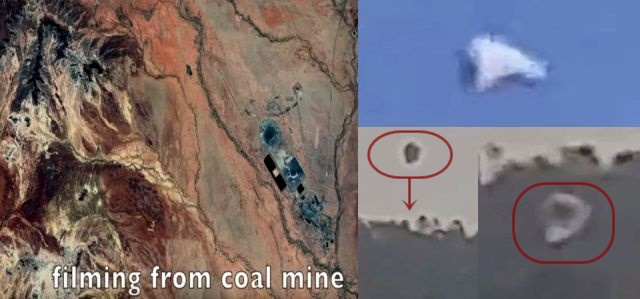
UFOs are often seen above silver, gold or other precious metal mines, leading some to believe they are harvesting the minerals for fuel or parts. UFOs are also seen over nuclear power plants, leading many to the same conclusion. Mexico’s active volcanoes seem to draw an unusual share of UFO sightings, prompting speculation they may somehow be harvesting the power of magma. UFOs weaving their wave through lightning storms suggest they may be run on electricity. UFOs are often seen over water, sometimes mysteriously connected to a waterspout, causing some to ponder whether they’re some kind of environmentally safe water-powered craft. This all leads us to recent sightings in Australia of a UFO hovering over … you’re not going to believe this … a coal mine. Was this some old Model T spacecraft powered by burning coal for steam? The SSS Space Stanley Steamer? Or something else?
“On Sunday July 28th and Monday 29th 2019 at a work site near Middlemount, Queensland, Australia, two workers spotted a strange object in the sky estimated at 500m (1500ft) altitude. The object was seen on two separate days and at one point was said to have a smaller piece break off and descend to the ground (beginning of clip 9).”
For a change, the two unnamed witnesses took long recordings of their UFO sightings on back-to-back days (you can see the original video here), which ended up in the hands of multiple UFO investigators who posted them on the Internet in both unadulterated and stabilized modes (you can see a stabilized and magnified video here). Somewhere in that process, the location of the unnamed mine (Middlemount, Queensland – home of three mines: Foxleigh, German Creek and Grasstree, which is said to be the world’s largest underground coal mine) was changed to Middleton, which is a nearly deserted town also in Queensland. What was said to be a third video was also posted (watch it here). There is also audio of the witnesses commenting on what they’re watching.
Fortunately, one of the UFO investigations groups to get its hands on the video was UFOs – Documenting The Evidence. The team of Brad Morris, Keith Basterfield and Paul Dean interviewed the witnesses extensively – their excellent report and summary can be read on their website. The sightings occurred in the morning at about the same time, and there was only one object in the sky, except for the occasion when a small piece appeared to break off and make a “controlled descent.” The witnesses (there were more who saw the UFO besides the two who took the videos) also saw the main pyramid-shaped UFO descend to the ground – there’s no indication that any of them ventured to the location to find it.
Based on the witness accounts, careful analysis of the videos and investigation of weather patterns and aircraft records, the UFOs – Documenting The Evidence team eliminated aircraft, helicopter and drone as possibilities. While it could have been a large parachute, a balloon seemed to be the best choice for a non-ET cause. While its movement and shape suggests either a hot-air or gas-powered balloon with a gondola, the team ended the report with the possibility of the UFO being a Google ProjectLoon balloon. However, they could not find enough evidence to support either balloon theory.
Which leaves us with an alien spacecraft looking for coal. The Appalachian UFO Research Society says there are many reports of UFOs over coal mines. In 2008, there was a famous UFO sighting (“… a craft as the size of a football field, while others said they were nearly a mile long, similar to the Phoenix lights mass sightings”) over the coal mining town of Stephenville, Texas. With carbon being the fourth most abundant element in the universe by mass (after hydrogen, helium, and oxygen), it’s certainly conceivable that other civilizations would use it as fuel, and those that are more advanced than us would have figured out how to use it efficiently for space travel – despite the efforts of Mad Mike Hughes, steam-powered rockets don’t get very far. One other possibly – like the theory that benevolent aliens hover over nuclear plants to protect humanity or possibly regulate its use of that fuel, this UFO could be dissuading humans from burning coal and destroying the planet.
Environmentally-friendly extra-terrestrials? It’s not the most far-fetched idea out there.
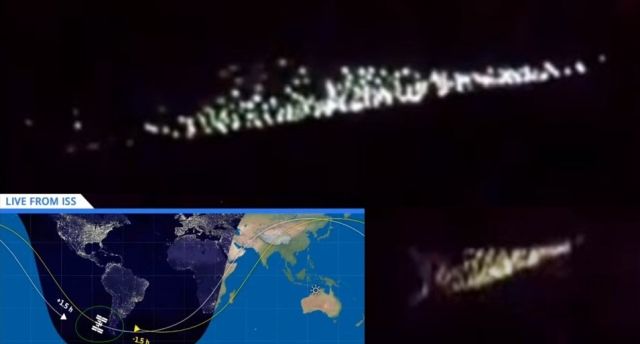
Glowing UFO Fleet Seen Over Pennsylvania On Feb 15, 2020, UFO Sighting News.
Date of sighting: Feb 15, 2020 Location of sighting: King of Prussia, Pennsylvania, USA Source: MUFON The eyewitness saw a fleet of glowing UFOs flying over the freeway in the city of King of Prussia yesterday. The UFOs were moving slowly, glowing and following the same path. I do not hear the objects over the sound of the cars on the freeway. This must have been recorded by others. Thousands of people must have seen this so I am expecting a few more videos to come in. Awesome sighting. There is no doubt that this video is real, but what those objects are...remains a mystery. Scott C. Waring Eyewitness states:
Personally observed with my family on the way home from the King of Prussia Mall, heading eastbound multiple bright lights in the sky remaining stationary. Have video taken in car while observing. This is unexplainable unless there is some type of unknown military aircraft I am unaware of.
UFOs Over Staford Upon Avon, Great Britain, Video, Dec 3, 2019, UFO Sighting News.
Date of sighting: Dec 3, 2019 Location of sighting:Staford Upon Avon, Great Britain Source: MUFON The eyewitness and his family were looking out from their back yard and saw two glowing objects over the distant hills. The shimmering glowing objects were large and hovering in place. The eyewitness said one of the glowing objects disappeared before he could record it. Still this is an amazing capture. I believe these UFOs came from an underground base directly below this area. Their technology allows them to transport entire ships from the underground base, directly into the sky. At this point the ships then hover to get their bering and then leave. Also, it looks like there is another third UFO...dark...not glowing at the center of the video. Amazing catch, just amazing! Scott C. Waring - Taiwan
Multiple lights were seen and filmed over Pennsylvania on 15th Februar 2020.
Witness report:
Personally observed with my family on the way home from the King of Prussia Mall, heading eastbound multiple bright lights in the sky remaining stationary. Have video taken in car while observing. This is unexplainable unless there is some type of unknown military aircraft I am unaware of.
Steve Quayle: Vatican UFO Disclosure - Light Orbs Phenomenon
Steve Quayle Interviews (02/01/2020) — The Responsibility Of The Vatican For The Flow Of Disclosure Information
Steve Quayle is a researcher and author of over a dozen books dealing with advanced ancient technology and civilizations. His documentary film production company Gensix Productions films the “True Legends The Series” all over the world in search of the Lost Cities and the giants of history who were the builders of the great megalithic structures of the ancient world.
Steve is a former talk radio show host who has been warning against genetic armageddon and the end of the human race for decades. He claims transhumanism and the hybrid age is the most dangerous advancement in the technological war against humanity in history.
The government can’t keep its story straight about its involvement with UFO research. After a yearlong investigation, we bust open the files, break through the noise, and reveal the definitive, staggering truth.
As I sit in a small cafe in the shadow of the ancient Roman gates in Trier, Germany, talking to a person whose credibility seems beyond reproach, but who will only agree to talk to me if provide absolute assurances of anonymity, I can’t help but feel like I’m trapped in a Dan Brown novel. The Da Vinci Code, however, never dealt with unidentified flying objects.
“Was it about UFOs? Of course,” this person whispers with a grin of melodrama.
After almost a year of investigating the U.S. government’s interest in UFOs, what they’ve just said should neither be shocking, nor revelatory. Unbeknownst to them, they’ve only further confirmed what over a dozen other people with backgrounds inside the government and the now-defunct Bigelow Aerospace Advanced Space Studies (BAASS) have already admitted to me.
Just like the fictional Robert Langdon, the path to understanding these mysterious government programs has taken me through the catacombs of informal secret societies, whose surprising memberships include accomplished professionals from the military, aerospace, academic, medical, and intelligence communities.
Though diverse or abstinent in how they define exactly what it all means, each of these enigmatic characters shares one common belief: unidentified flying objects are neither myth nor figment of overactive imaginations. With absolute conviction, they’ve all told me that UFOs are real.
Now, after two years of scant details and a myriad of contradictory statements, Popular Mechanics is ripping open the U.S. government’s massive UFO problem. What follows is a deep, unprecedented well of information that’s only been known by a very small select group of insiders—until now.
PART I. THE DISCLOSURE
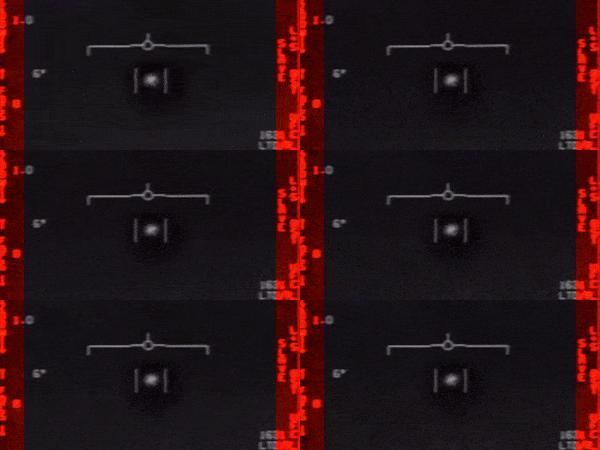
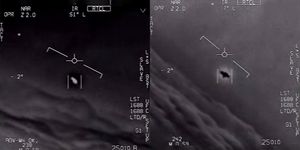
On December 16, 2017, the New York Times disclosed that the Pentagon had secretly funded research into UFOs through the Advanced Aerospace Threat Identification Program, or AATIP. As if the U.S. government quietly investigating UFOs wasn’t enough, for the first time, the public also got a chance to see three videos captured by the U.S. Navy showing what has been claimed to be “Unidentified Aerial Phenomena,” or UAP.
In an instant, UFOs were no longer relegated to society’s nihilistically curious, and for the first time in decades, droves of the mainstream public suddenly found themselves peering skyward with wonder.
But almost as quickly as the excitement of mysterious black budget UFO programs crashed ashore, so, too, came vexing waves of criticism, confusion, and controversy.
From the onset, disarray and debate raged on whether the second “A” in AATIP officially stood for Aerospace or Aviation, with the former “Aerospace” eventually proving to be correct. Adding to the chaos, an entirely different program moniker emerged: the Advanced Aerospace Weapons Systems Applications Program, or AAWSAP. For over two years, no one has been able to adequately explain whether AAWSAP and AATIP were two separate programs, or the same intuitive under two separate names.
To muddle matters more, a revolving door of Pentagon spokespeople have successfully issued waves of contradictory statements about what the Department of Defense (DoD) did or didn’t do when it came to studying UFOs.
Initially, the Pentagon said, AATIP had indeed investigated UFOs under the leadership of Luis Elizondo, a former senior member of the Office of the Under Secretary of Defense for Intelligence (OUSDI). Eventually, in a complete reversal of official stances, the Pentagon’s newly crowned UFO point person, Senior Strategic Planner and Spokesperson Susan Gough, recently told The Black Vault, “neither AAWSAP nor AATIP were UAP related,” “Elizondo was not the director of AATIP,” and he didn’t have “assigned responsibilities” within the program.
In some consolation to the UFO faithful, the DoD has consistently been willing to say they consider the curious objects shown in the 2017 videos to be unexplained UAP. What exactly that means, however, has been open for interpretation and debate.
After months of conducting interviews and uncovering previously undisclosed materials, Popular Mechanics is revealing here that the U.S. government does indeed have a definite interest in UFOs.
Provided, of course, that nobody says it out loud.
The Bigelow Aerospace headquarters in Las Vegas, Nevada.
PART II. THE SEEDS
The path to truly understanding the Pentagon’s current UFO problems doesn’t begin in 2008 with the Defense Intelligence Agency (DIA) and the AAWSAP, but rather, a decade earlier and some 2,000 miles from the nation’s capital at the doorstep of a billionaire Nevada entrepreneur.
Robert T. Bigelow, the owner of Budget Suites of America and founder of the space technology company Bigelow Aerospace, has never shied away from amplifying his interest in UFOs. In a 2017 interview, Bigelow told CBS’s 60 Minutes he was “absolutely convinced” aliens exist, before passionately declaring, “I don’t give a damn!” when asked if it was risky to publicly say he believes in UFOs and aliens.
In 1995, four years before founding his aerospace startup, Bigelow established the National Institute for Discovery Sciences (NIDS). From the company’s cached website, NIDS described itself as “a privately funded science institute engaged in research of aerial phenomena, animal mutilations, and other related anomalous phenomena.
The cached website of the now-defunct National Institute for Discovery Sciences.
Before ultimately disbanding in 2004, NIDS conducted research into a host of various paranormal topics, such as cryptid encounters, cattle mutilations, and especially UFOs. The group’s most recognized research was the investigation of a purported paranormal Utah homestead owned by Bigelow called Skinwalker Ranch, which would later play a significant role in the DIA’s UFO interest.
Robert Bigelow.
NASA/BILL INGALLS
In a 2018 interview with New York magazine, former Nevada Senator Harry Reid told an interesting tale about a curious letter Bigelow received from a senior official from a federal national-security agency. “I’m interested in talking to you, Mr. Bigelow. I have an interest in what you’ve been working on. I want to go to your ranch in Utah,” Reid recounted.
After vetting the letter’s author, the individual Reid described as a “very low-key scientist” was granted a pass to visit Bigelow’s ranch. In a lecture at “UFO MegaCon” in 2019, KLAS Las Vegas reporter George Knapp told the crowd these events occurred in 2007, and claims the person, described by Knapp as a “DIA scientist,” had an “experience” while visiting the supposed paranormal site.
In an interview with researcher Joe Murgia, former AAWSAP contractor and astrophysicist Eric Davis shared what colleagues had told him of the DIA scientist’s experience:
“In the living room of the former NIDS double wide observation trailer/staff quarters. A 3D object appeared in mid-air in front of him and changed shape like a changing topological figure. It went from pretzel-shaped to Möbius strip shaped. It was 3D and multi-colored. Then it disappeared.”
According to Reid, whatever happened at Skinwalker was enough to convince the DIA to seriously investigate paranormal and UFO phenomena. “‘Something should be done about this. Somebody should study it.’ I was convinced he was right,” Reid told New York.
In an interview with Popular Mechanics, Hal Puthoff, a former subcontractor for the AATIP, confirms the scientist’s visit, but was unsure how significant a role it played in the origins of AAWSAP.
“Reid is correct that early on there was a DIA scientist who expressed interest in hearing of the Skinwalker Ranch and did visit,” Puthoff says. “The degree to which this influenced initiation of the AAWSAP Program, however, or was just a side issue, I don’t know.”
While we don’t know how pivotal the Skinwalker visit was in the formation of the DIA’s UFO studies, we do know AAWSAP and AATIP were already taking shape almost a year before funding was established and the solicitation was issued.
Navy fighter pilot Cdr. David Fravor has arguably become the face of the famous UFO encounters by the Nimitz Strike Carrier Group, it was actually Marine Lt. Col. Douglas “Cheeks” Kurth who was first directed to investigate the strange airborne contacts that radar operators captured in November 2004.
On his LinkedIn profile, Kurth indicates he worked as a program manager for Bigelow Aerospace Advanced Space Studies, LLC (BAASS) until June 2013. Interestingly, Kurth began working for BAASS in December 2007—a month before Bigelow officially established his LLC in January 2008. That might be because Nevada state records show BAASS was technically a subsidiary of another business owned by Bigelow: International Space Hardware Services (ISHS). According to the Nevada Secretary of State’s Office, ISHS was incorporated on October 31, 2007.
Hal Puthoff.
TO THE STARS ACADEMY OF ARTS & SCIENCE
Puthoff, who entered the BAASS fold in 2008, tells Popular Mechanics he was aware that Kurth was involved in the Nimitz events in 2004, but he didn’t believe BAASS specifically recruited Kurth because of it. “I think that it was just because of his experience he reached out to join [BAASS],” says Puthoff, who later founded and now runs the advanced concepts research
Puthoff says he believes the DIA had expressed a need for what would become AAWSAP in 2007, but isn’t sure if the organization ever made a formal request. “I think that anything from 2007 was likely quite informal—discussions, letters, emails—but I’m not certain,” he says.
Regardless, roughly six months after BAASS opened up shop, with the support of late senators Ted Stevens and Daniel Inouye, Reid set up funding for AATIP and the AAWSAP contract in the Supplemental Appropriations Bill of July 2008. “It would be black money, we wouldn’t have a big debate on the Senate floor over it,” Reid told New York. “The purpose of it was to study aerial phenomena. The money was given, a directive was given to the Pentagon, to put this out to bid, which they did.”
On August 18, 2008, the contracting arm of the DIA issued a 32-page solicitation/contract/order for commercial items for the AAWSAP. When bidding closed three weeks later on September 5, as the sole bidder, BAASS was awarded $10 million dollars for the guaranteed first year, of a five-year option, for the contract.
On September 13, 2008, Bigelow Aerospace began listing career opportunities with BAASS in 14 different disciplines related to aerospace and research sciences.
A statement of objectives for AAWSAP.
BIGELOW AEROSPACE
Absent from the AAWSAP solicitation is any language related to UFOs or UAP. Instead, as originally outlined in the July Supplemental Appropriations Bill, the “primary focus is on breakthrough technologies and applications that create discontinuities in currently evolving technology trends. The focus is not on extrapolations of current aerospace technology.”
In past interviews, Reid has indicated the interested parties at the DIA felt it prudent to avoid any language that might cause someone to realize the underlying focus of the AATIP program was UFOs. According to Reid, a representative with the DIA told him, “What I will do is prepare something for you that anyone can look at it that wants to, it’s strictly science.”
On multiple occasions over the past two years, both the government and former contractors have used the terms AATIP and AAWSAP almost interchangeably. This has caused significant confusion of whether AATIP and AAWSAP were two separate programs, or the same activity under differing names. In a recent statement, Pentagon spokesperson Susan Gough told longtime researcher John Greenewald, “[AATIP] was the name of the overall program. [AAWSAP] was the name of the contract that DIA awarded for the production of technical reports under AATIP.”
While all sources associated with the programs confirm Gough’s statement with Popular Mechanics—AAWSAP was the contract component of the broader umbrella program dubbed ATTIP—they dismiss the latter sentiment expressed by Gough that “neither AATIP nor AAWSAP were UAP related.”
The evidence collected here overwhelmingly suggests the government was indeed studying UFOs and not, as the Pentagon has said, “investigating foreign advanced aerospace weapons system applications with future technology projections over the next 40 years, and to create a center of expertise on advanced aerospace technologies.”
The cover of BAASS’s Ten Month Report, issued in July 2009.
PART III. THE REPORT
In July 2009, BAASS provided a comprehensive report to the DIA at the conclusion of the first-year option of the AAWSAP contract. The 494-page “Ten Month Report,” as it’s called, is chock full of strategic plans, project summaries, data tables, charts, descriptions of biological field effects, physical characteristics, methods of detection, theoretical capabilities, witness interviews, photographs, and case synopses—each one entirely, explicitly about unexplained aerial phenomena.
Throughout the report, “the sponsor” is mentioned, however, the DIA is never explicitly named.
The first pages list the names of every contractor working for BAASS with appropriate security clearances to have access to the program. Amongst dozens of credentialed names, some of those listed are very familiar to the UFO community, including Puthoff, Davis, Jacques Vallee, and Colm Kelleher. Regardless of one’s existing opinions of the UFO phenomena, the sheer volume of content in the BAASS Ten Month Report is astounding.
Some of the notable content of the 2009 BAASS Ten Month Report includes:
Overview of the BAASS Physics Division’s efforts to conduct research on advanced aerospace vehicles, including the development of standardization for measurement of physical effects and signatures associated with UAP.
Overview of BAASS research for measuring and gleaning the effects on biological organisms from UAP.
Mention of Skinwalker Ranch in Utah as a “possible laboratory for studying other intelligences and possible interdimensional phenomena.”
Strategic plans to organize a series of intellectual debate forums targeted to broad audiences pertaining to the “potential disclosure of an extraterrestrial presence.”
Plans to create a “medical physiological UAP effects program.”
Mention of BAASS program dubbed “Project Northern Tier,” which involved securing documents related to instances where dozens of UFOs flew over restricted airspaces of facilities housing nuclear weapons.
A possible UAP landing reported to BAASS by the Mutual UFO Network (MUFON) and its STAR Team (rapid response field investigators funded by BAASS in March 2009).
Project databases of UAP-related materials compiled through various partnerships, and the intent to expand these databases by coordinating with foreign governments.
Summaries of multiple UAP events both inside the U.S. and in foreign countries.
Photographs of UAPs provided by various sources, including foreign governments.
Photograph of page 317 of the BAASS Ten Month Report.
BIGELOW AEROSPACE
From cover to cover, the BAASS report references the government’s new buzzword for UFOs: UAP. However, nowhere could Popular Mechanics find a single reference to foreign (terrestrial) advanced aerospace weapon systems, or projected technological innovations based on current industry trends.
Sources tell Popular Mechanics the BAASS Ten Month report was only a sample of the materials the organization provided to the DIA. “Monthly reports were being sent to the Pentagon, in addition to annual program updates, that were all about UAP or anomalous phenomena,” says one former BAASS contractor.
Chris Bartel, a security officer and investigator for BAASS (later Bigelow Aerospace) from 2010 to 2018, confirms the accounts of former BAASS and AATIP employees with Popular Mechanics. He says he indeed encountered some fairly dramatic paranormal events while working at the Skinwalker Ranch, and says he’d also heard mumblings of BAASS being interested in studying paranormal activity in hopes it could lead to technology research. However, Bartel says he didn’t know anything about AAWSAP or AATIP until last fall. “I was a bit taken back, to say the least,” he says.
Photograph of page 17 of the BAASS Ten Month Report.
BIGELOW AEROSPACE
Though unaware of any formal contract with the DIA, Bartel confirms that reports generated about paranormal events on the ranch were being faxed to both Bigelow and the Pentagon on a regular basis. (“I would hate to think my experiences up there were somehow manipulated by outside man-made forces,” Bartel says. “I truly believe the ranch to be hallowed Native land.”)
Some have suggested the “paranormal” events associated with Skinwalker Ranch or AAWSAP could be associated with secret and highly advanced weapons testing. While Bartel says it’s possible weapons were being tested, nothing he observed was consistent with his experiences of top secret testing.
Puthoff also says he saw no evidence that BAASS was involved in weapons testing during his tenure with the organization—“a statement I’m certain Mr. Bigelow would support,” he says. (Bigelow could not be reached for comment.)
Jesse Marcel, who initially investigated the Roswell UFO site 1947.
PART IV. THE SECRETS
The revelations in the BAASS report beg the question: Why is the government now insistent it never studied UFOs, and why aren’t these documents being discussed or made available through Freedom of Information Act (FOIA) requests?
Individuals who worked on the AATIP program say the current uncertainty and confusion was by design and involved a dizzying shell game that’s entirely consistent with how black budget intelligence programs are run. “What you’re dealing with is the very core of government secrecy and how things they absolutely don’t ever want to discuss are kept hidden away,” one former AATIP contractor tells Popular Mechanics.
Sources say the key to understanding current denials of UFO studies in AATIP comes from a phrase stamped on each page of the BAASS Ten Month Report obtained by Popular Mechanics:
“The information is proprietary and cannot be disseminated or used without prior written consent from the Operating Manager of BAASS.”
According to several former AATIP contractors, the “product” being produced for the DIA was technical reports on exotic and potential “game-changing” aerospace technologies, and the manner of determining what areas these radical airborne breakthroughs might emerge was through the research of UFOs.
In exchange, not only would the DIA get the agreed-upon technical reports, but it would also gain access to the extensive research BAASS was gathering on UFOs. While the DIA had access to the volumes of UFO data, the materials were actually commercial property of BAASS, as a subsidiary of Bigelow Aerospace.
The idea of using an aerospace research project as a cover for a secret UFO program may seem unscrupulous. “But this all rings very familiar,” Neil Gordon, an investigator with the Project on Government Oversight, tells Popular Mechanics.
“WHAT YOU’RE DEALING WITH IS THE VERY CORE OF GOVERNMENT SECRECY AND HOW THINGS THEY ABSOLUTELY DON’T EVER WANT TO DISCUSS ARE KEPT HIDDEN AWAY.”
Gordon, whose area of expertise is in federal contractor misconduct, contractor accountability, and government privatization, says running the “commercial in confidence” program through AATIP is consistent with how the DoD deals with programs it wants to keep secret. “Whether it’s right or not is another story,” Gordon says, “but everything sounds very common for how black budget programs run.”
The DIA may have had extensive access to the UFO materials, but because all of the data technically belonged to BAASS, under the Economic Espionage Act of 1996, disclosing or releasing proprietary materials provided to the government in confidence is a federal crime. Essentially, the DIA’s UFO program was set up to circumvent FOIA requests and avoid having to discuss UFOs publicly.
Out of concern for providing Popular Mechanics access to the 2009 BAASS Ten Month Report, the person who made these materials available did so only under the guarantee of anonymity. It’s worth noting this person is not a current government employee, nor were they involved with BAASS or the AAWSAP contract.
“Unfortunately, the government attempting to evade FOIA by contracting out its responsibilities is nothing new,” Josh Budray, an attorney who specializes in FOIA and First Amendment cases, tells Popular Mechanics. “Both federal and state FOIA statutes strive to eliminate such obvious gamesmanship—avoiding transparency and disclosure obligations by contracting out functions—but whether they are successful in doing so is an entirely different story.”
Davis, the astrophysicist and former AAWSAP contractor, says his work on the AATIP program was entirely consistent with all of the technological intelligence programs he’d previously worked on over the last 30-plus years. “Indeed, science is applied, but right now there’s not enough data on UAP to make examining it a scientific endeavor. It’s an intelligence issue, not a scientific endeavor,” he says.
Puthoff, meanwhile, says BAASS produced “stacks of material to the ceiling,” but because of the way things were done, he was surprised to hear any of it had become public. “To be honest, I didn’t think this stuff would ever see the light of day,” he says.
“TO BE HONEST, I DIDN’T THINK THIS STUFF WOULD EVER SEE THE LIGHT OF DAY.”
When reached for comment, Colm Kelleher, the former Deputy Director of BAASS, said, “I am unable to discuss this topic.” Multiple other requests to Bigelow Aerospace for comment went unanswered.
The entire manner in which the DIA partnership allegedly operated raises an important question: Could the reason for the Pentagon’s recent denials of AATIP or AAWSAP conducting UFO research be the result of the current DoD administration being naive to the program’s underlying and commercially secret hidden purpose? It seems like a plausible theory … if it wasn’t for something else Popular Mechanics uncovered.
PART V. THE ADMISSION
Last year, Steven Aftergood of the Federation of American Scientists obtained via FOIA request and published a January 2018 letter that the DIA Congressional Relations Division sent to members of Congress. In the letter, the DIA provided “a list of all products produced under the AATIP contract for the DIA to publish.” The referenced list includes 38 technical papers, called Defense Intelligence Reference Documents (DIRDs), which cover a range of advanced, exotic, and theoretical aerospace topics.
Given what’s been said about the commercially confidential nature of AATIP, the phrase “for the DIA to publish” may be a critical play on words. Nevertheless, a source with access to the materials provided Popular Mechanics with a copy of a previously unreleased technical paper listed as one of AATIP’s products.
While the DIA refers to the paper as “Field Effects on Biological Tissue,” the original title for the submitted paper appears to actually have been “Clinical Medical Acute & Subacute Field Effects on Human Dermal & Neurological Tissues.” According to the study’s introduction, the paper is an examination of “clinical medical signs and symptoms and biophysics of injury known and expected from near-field (mostly ultra-high), NIEMR Microwave, Thermal, from unintended exposure to anomalous systems.”
You can read the entire study below.
In light of the cumbersome clinical language, just a cursory scan reveals the entire focus was on examining injuries that may have occurred after contact with UFOs or UAP. In fact, the very term “UFO” appears 16 times in the report; the word “anomalous” is used 27 times (most often with the word “aircraft,” “aviation,” or “aerospace” immediately following); and the phrase “Advanced Aerospace Systems Applications Program” is mentioned in bold on four occasions.
Popular Mechanics spoke with the study’s author, Christopher “Kit” Green, a forensic clinician and neuroscientist. Green was surprised to learn his research paper had become publicly known, because he was under the impression it was never included in the distributed set, nor was it finally peer-reviewed.
Green confirms his paper wasn’t cited correctly in the letter to Congress, however, he says the 54-page document Popular Mechanics obtained appeared to be the same paper he was requested to provide as a product of AAWSAP.
“This focused on forensically assessing accounts of injuries that could have resulted from claimed encounters with UAP,” says Green. “I didn’t work for BAASS, other than as a contractor for my paper, and I wasn’t a part of AAWSAP. However, it is my understanding this program was a UFO study that outwardly was not supposed to look like it had anything to do with UFOs.”
“THIS PROGRAM WAS A UFO STUDY THAT OUTWARDLY WAS NOT SUPPOSED TO LOOK LIKE IT HAD ANYTHING TO DO WITH UFOS.”
Green cautions some past speculations about his paper were inaccurate, including the claims it was an effort to understand or reverse-engineer UAP technology. Green also stresses that while his work focused on encounters with unknown or unidentified aerial objects, all of the injuries he assessed could be accounted for by known terrestrial means, and did not provide any evidence for extraterrestrial or non-human technologies.
Could the 38 technical reports BAASS produced for AATIP represent what it determined accounted for UAP?
“Many of the topics could be called ‘dual-use’ given that, say, papers on advanced plasma propulsion and invisibility cloaking could apply to our own advanced aerospace development as well as possibly some UAPs,” says Puthoff. But his “spacetime metric engineering paper, the warp drive and wormhole papers, and specifically the Statistical Drake Equation paper are essentially applicable only to UAPs.”
Davis, who worked with Puthoff and authored four of the DIRDs, offers a particularly intriguing detail about the DIA’s 38 reference papers.
“This wasn’t focused on whether or not [UAP] are real. It’s already been well established that UAP are real by a preponderance of evidence. Some classified and some proprietary [that] I can’t talk about,” he says.
Instead of investigating if UAP are real, the 38 technical papers for the AAWSAP contract were also an intelligence assessment to measure just how far advanced UAP could be from current and projected scientific understandings. “Me, Hal [Puthoff], and an aerospace executive who had access to materials worked on that assessment for the DIA,” Davis says.
Ultimately, aside from the wealth of BAASS proprietary evidence, Green’s study alone—which the DIA told Congress was a product of AATIP that it would “be happy to provide upon direct request”—seems to completely dispute the Pentagon’s recent claims that neither AATIP or AAWSAP were related to UFOs.
In an exchange of emails between Gough, the Pentagon spokesperson, and Swedish research Roger Glassal, which were provided and published by research analyst Keith Basterfield, Gough said AAWSAP commenced in the fiscal year (FY) 2008 with a designated $10 million dollars of funding. Since the bid solicitation wasn’t issued until August 2008, we now know that Gough was mistaken, and the program actually began in FY2009, which began October 1, 2008.
In the same email exchange, Gough indicated the first 26 technical reports were completed in late 2009 and an additional $12 million dollars was designated in the FY2010 Defense Appropriations Act for 12 additional reports. (Editor’s note: In the original email, Gough indicated “late 2008.” It’s assumed this was also said in error since BAASS didn’t receive the AAWSAP contract until September 2008 and Green’s technical paper is dated May 2009.)
“After an OSD/DIA review in late 2009, it was determined the reports were of limited value to DIA and there was a recommendation that upon completion of the contract the project could be transited to an agency or component better suited to oversee it.
Funding for the program at the DIA ended in 2012 and DoD elected not to continue the program after the work contracted under the FY2010 NDAA was completed.”
Indeed, every source Popular Mechanics spoke to for this story agrees the partnership between BAASS and AAWSAP had concluded by 2012.
But here’s where things get messy: Gough says when DIA funding dried up in 2012, the overarching AATIP program closed up shop as well. Every source we spoke to, however, says not only did AATIP not end in 2012, but the program is still ongoing to this day.
Core to the contention of whether or not the government maintained an interest after 2012 is the man the DoD says “had no responsibilities” with AAWSAP or AATIP: former senior Pentagon intelligence executive Luis Elizondo.
Who, exactly, is Elizondo? A patriotic whistleblower putting his reputation at stake for something he says the American public must know about? Or a huckster using his former position for his own benefit, as the Pentagon seemingly implies?
The government can’t keep its story straight about its involvement with UFO research. After a yearlong investigation, we bust open the files, break through the noise, and reveal the definitive, staggering truth.
Left: Luis Elizondo in South Korea in 1996. Right: Elizondo in Kandhar in late 2001.
PART VI. THE LEADER
After serving a stint as a counterintelligence agent for the U.S. Army, in the late 1990s, Elizondo would be recruited into the ranks of the enigmatic U.S. intelligence community.
Elizondo’s first stop as an intelligence operations specialist was running counterinsurgency and counternarcotics operations in Latin America. “We dealt with a lot of stuff, like coup d’etats, black market terrorism, violent drug cartels, all that kind of stuff,” Elizondo says.
Following the attacks of September 11, 2001, Elizondo was then redirected toward East Asia, where he served an advisor of a small intelligence unit assigned to support General James Mattis during his command of Marine Expeditionary Unit (MEU) Task Force 58 (TF-58) in the War on Terrorism. In a case study published by the Naval War College in 2016, Lt. Col. Damian Spooner describes the analysis and products produced by intelligence sections under Gen. Mattis as being “indispensable” in driving TF-58 planning and operations.
Later, while continuing to support the U.S.-led war on terrorism, Elizondo, the son of a Cuban exile, found himself in Cuba dealing with some of the most dangerous terrorists in the world at Guantanamo Bay’s infamous “Camp Seven,” the prison constructed for the sole purpose of housing 14 “high-value detainees.”
In early 2008, James Clapper, then the Deputy Secretary of Defense for Intelligence, asked Elizondo to come to the Pentagon to help coordinate information sharing and partnership engagement being run by the Secretary of Defense’s Office. Though the promise of cutting his daily commute in half was one of the biggest selling points, Elizondo’s decision to set up shop at the Pentagon would end up putting him directly in the path of recruitment for a special program the DIA had just started running: AAWSAP.
Though the BAASS Ten Month Report includes an abundance of UAP information, nothing within the text contains any data or information provided by the U.S. government. Conversely, there are a number of requests made by BAASS for access to specific UAP information being held within the DoD and other U.S. agencies. Sources say this is key to understanding how Elizondo entered the picture.
“If they [BAASS] wanted access to info that I’m not saying does exist, but it might have been highly classified, you need someone who had the tickets to make sure the contractors weren’t actually looking at Special Access Program (SAP) stuff thinking it was UFOs,” says an intelligence official who is not authorized to speak on the record.
“Plus,” the official tells Popular Mechanics, “I’m not saying it was, but they might have been looking into something that was of significant interest to foreign advisories and a high-value target for espionage. Bottom line, you needed a counterintel guy.”
Elizondo tells Popular Mechanics that he never wanted to be a part of AATIP. However, as a senior official at OUSDI with a background in counterintelligence, he found himself being recruited into the ongoing UFO effort.
“In 2008,” Elizondo says, “two guys came by my office and said, ‘Are you Lue Elizondo?’ The first thing I thought was, ‘Oh no, what did I do?’ They told me, ‘You came highly recommended as a former senior CI guy with some background in advanced avionics.’ Which is true—I worked some on the Open Skies Treaty. I worked with Raytheon, Boeing, and some other stuff. That was my portfolio.”
Elizondo was told AATIP needed a counterintelligence support and security guy for a very special program. Within a month, after a series of meetings, Elizondo finally met with the then-director of AATIP, who asked him what seemed like a strange question at the time:
“What do you think about UFOs?”
Elizondo was flummoxed. “I was like, ‘What the hell?’ I thought it was a test or something. So I told the truth: I don’t. I don’t think about UFOs. I don’t know if they’re real or not. I don’t think about them. I’m too busy trying to catch terrorists and bad guys.”
Elizondo’s ambivalence was evidently exactly what those running the program wanted to hear. Soon enough, Elizondo joined AATIP. “Seriously, for awhile, I still didn’t know if it was a test,” he says. “It wasn’t until I started examining the security posture of the portfolio that I suddenly realized these things are really unidentified.”
One of Elizondo’s performance evaluations.
Not long after Elizondo was on board, in June 2009, Sen. Harry Reid submitted a letter to then-Deputy Secretary of Defense William Lynn III requesting AATIP be granted restricted SAP status. Though ultimately denied, had Reid’s request been granted, it would have further tightened security and secrecy around AATIP.
Last year, KLAS Las Vegas reporter George Knapp published Reid’s letter showing Elizondo’s name on the list of “preliminary government personnel” who would have had access to AATIP. In addition to Elizondo, Reid, and the late Senator Daniel Inouye, seven other names of government employees (which have not been released) would have had access to the proposed AATIP SAP. Notably, only three “contractor personnel” made the cut.
According to a source with knowledge of the letter, the three contractor personnel Reid wanted to grant preliminary access to were Bigelow, Kelleher, and Puthoff. Puthoff confirms with Popular Mechanics that he was one of the three approved contractors on the list. The Pentagon later confirmed the letter published by Knapp was authentic.
Sources say the limited number of contractors listed with access is yet another breadcrumb left on the trail of secrecy showing AATIP was indeed slightly different from the AAWSAP contract.
According to multiple sources, including individuals working within the Pentagon—and confirmed by Elizondo—in 2010, when the DIA cut off funding for AATIP’s contract, a DIA program manager asked Elizondo if he would keep the UFO project running. “I wasn’t a DIA employee,” Elizondo says, “so I’d have to run it wearing my OSD hat at the Pentagon. We all agreed this was the best thing to do, so that’s what we did.”
By all accounts, Elizondo was now “bootstrapping” AATIP from the OUSDI, meaning he added the program to the list of his existing intelligence portfolios.
Popular Mechanics has learned the post-BAASS era of AATIP was an even more closely guarded program and consistent with how highly classified intelligence projects are conducted.
“Ninety percent of people don’t understand how the general government runs, and even less understand the intelligence community,” a former senior Special Operations and Intelligence Officer tells Popular Mechanics. “Because this program would have now been out of the Front Office, your guy [Elizondo] would have had the ability to muster up people from various areas of the Intelligence Community. You would have wanted to include the least possible, but best people for the specific mission. You could have had people from the DIA, ONI [Office of Naval Intelligence], and OSI [Office of Special Investigations] all working separately, but together on the same mission.”
Elizondo says when he took over the AATIP, he ran it like a traditional government effort. “We greatly reduced the number of contractors to just what we might have needed, but this was going to be government to government, looking on government systems at government data,” he says.
According to Elizondo, unlike most of the BAASS personnel, the post-2012 AATIP crew did have access to highly classified government information to adequately assess the situation. While the Pentagon denies that AATIP continued after 2012, Elizondo says the post-BAASS AATIP was not unsanctioned, and not just a group of government UFO enthusiasts. “Very, very few people in the building knew what we were doing, but the Front Office (Office of the Secretary of Defense) was in the loop,” he says.
Popular Mechanics has learned the ONI was one of the major backers that wanted to see AATIP continued, which sources say is why the Navy has been so willing to take the most public lead on the UAP issue today.
Elizondo’s critics have repeatedly asked an important question: If AATIP was such a secret program, why is Elizondo now talking about it publicly?
By denying AATIP SAP status back in 2009 and not ever officially blanketing it under a security classification, Popular Mechanics has learned that the government effectively allowed for the program itself to now be discussed.
“There’s a lot they can’t talk about, like sources, methods, etc., but the program itself is unclassified and fair game for public disclosure,” a source with knowledge of the program tells Popular Mechanics. Elizondo confirms this is correct. “I’ve never once violated, nor am I willing to violate my security oaths, so anything I’ve discussed is indeed unclassified,” he says.
In one of Elizondo’s employee performance evaluations, which Popular Mechanics obtained, it lists his primary “mission goals” as managing and administering information, access controls, and security of national-level SAPs for the Secretary of Defense. Elizondo confirms his position allowed him access to the most highly secretive and reclusive programs being run by the U.S. “The stuff we were seeing was truly unidentified. It wasn’t related to anything we were doing,” he says.
In October 2017, Elizondo resigned from the DoD to join former Blink-182 frontman Tom DeLonge’s UFO research group To the Stars Academy of Arts & Science, which would soon release the Navy’s “Flir1” video to the world and properly kick off a ufological renaissance. Elizondo now works as the company’s Director of Global Security and Special Programs.
Why did Elizondo leave his government job? Because he realized the Pentagon’s top brass would never treat UAP with the importance they deserved. A senior Pentagon official tells Popular Mechanics they were aware that Elizondo briefed a White House intelligence aide and two senior aides to Mattis, then the Secretary of Defense, in the spring of 2017.
The official, who is not authorized to speak on the record, says the White House aide was uncomfortable with the prospect of UFOs being real. To their knowledge, the White House aide did not pass the information along. The aides to Mattis, meanwhile, acknowledged UFOs were a real issue, but they were concerned with the political optics should it ever come out that the Secretary of Defense had been briefed about them. Elizondo confirms the accuracy of these accounts. “I resigned only after multiple attempts to brief the Secretary [of Defense] failed,” he previously told Popular Mechanics.
Finally, while the Pentagon has denied AATIP’s existence after 2012 and that Elizondo was never involved in looking into UFOs, Popular Mechanics has obtained documentation that seems to unambiguously show AATIP was active after the closing of the BAASS AAWSAP contract, Elizondo was running this extension of AATIP, and the efforts to examine UFOs are still currently underway.
Though the documents were unclassified, they contained sensitive information, and the person sharing them did so only under the guarantee that Popular Mechanics would not make them publicly available. The person said they only were willing to share the materials to support Elizondo’s claims, which they say have been unfairly challenged over the last two years. The individual, who is not a government employee, did approve the release of a small section from one of the documents showing the changing of responsibilities before Elizondo left the DoD.
F-35Bs begin night flights on HMS Queen Elizabeth.
PART VII. THE UNKNOWN
In June 2019, the Office of Sen. Mark Warner (D-Va.), vice chairman of the Senate Intelligence Committee’s office, confirmed that closed door meetings on UAP have occured. More recently, last December, when asked by Conway Daily Sun reporter Daymond Steer about the Navy UAP encounters, recent presidential candidate and current member of the Senate Select Committee on Intelligence, Sen. Michael Bennet, was cautious in saying he wouldn’t share anything he’d learned on the Intelligence Committee. However, Bennet said, “Our guys are seeing stuff that’s unidentified. They don’t know what it is, I don’t know what it is … We’re trying to learn more about it. The Air Force is trying to learn more about it.”
Popular Mechanics has since learned in October 2019, staffers with the Senate Select Committee on Intelligence and the Senate Armed Service Committee were briefed on current UAP issues. According to people with knowledge of these briefings, some former BAASS contractors and current AATIP leadership were in attendance.
Insiders also say this past year, during a closed-door meeting with the Senate Intelligence Committee, Brigadier General Richard Stapp, Director of the DoD Special Access Program Central Office, testified the mysterious objects being encountered by the military were not related to secret U.S. technology. The Pentagon did not respond to requests by Popular Mechanics to confirm Stapp’s testimony before the Intelligence Committee.
In only the second time publicly discussing the event, Popular Mechanics spoke with the Navy fighter pilot who was Cdr. David Fravor’s wingman during the now-famous 2004 Nimitz UFO encounter. Agreeing to talk only under the condition of anonymity, the fighter pilot confirmed they testified in front of congressional leadership about their encounter. “I’ve been requested repeatedly to go to the Pentagon and asked, ‘Is this what you saw?’.”
During a series of email exchanges, Popular Mechanics provided specific information to Gough, the Pentagon spokesperson, in an effort to see if this might influence the DoD’s current position. Initially, Gough said she would examine the information and see if she could provide a statement in response. However, Gough has not responded to repeated follow-up requests from Popular Mechanics.
“IT WOULD BE HARD TO ARGUE THAT EITHER THE MILITARY OR THE PUBLIC GOT THEIR MONEY’S WORTH.”
On its own, the evidence showing the Pentagon is interested in UFOs is unlikely to change the minds of many who are skeptical of the idea that mysterious, apparently intelligent, and possibly otherworldly objects might be buzzing around the skies above Earth.
“The whole contracting process for this program was irregular from start to finish,” Steven Aftergood, Director for the Federation of American Scientists Project on Government Secrecy, tells Popular Mechanics. “[The AAWSAP contract] sounds like it was a good deal for the contractor. But it would be hard to argue that either the military or the public got their money’s worth.”
Meanwhile, William Culbreth, an engineering professor at the University of Nevada Las Vegas who authored two of the 38 technical papers provided in the AAWSAP contract, offers a different opinion. He says he was unaware of the UFO background of AAWSAP, but very familiar with BAASS’s UFO interest.
“I had some graduate students who worked for BAASS during that time and I know Bigelow has an interest in the topic, but no one mentioned anything about UFOs when they asked me to write the papers,” Culbreth says.
Regardless of where the underlying motivation may have come from, Culbreth says his work on the two papers—“Detection and High Resolution Tracking of Vehicles at Hypersonic Velocities” and “Aneutronic Fusion Propulsion II”—led to his examination of new approaches to nuclear propulsion technology, which might not have been inspired otherwise.
“We’re looking into these propulsion technologies today, and this area alone led to several of my students pursuing PhDs who I don’t think otherwise would have,” Culbreth says.
With the wealth of data collected by BAASS, and almost assuredly more information being gathered by AATIP, it raises the question: Is the UAP issue being closely guarded because we don’t believe it’s real, or because we’re afraid we can’t understand it?
Mick West, the author of Escaping the Rabbit Hole: How to Debunk Conspiracy Theories Using Facts, Logic, and Respect, suggests the public availability and confirmation of rigorous empirical studies by AATIP could change the entire UFO dynamic. “It would be fantastic if there was some good evidence of something new to science. So far there isn’t,” he tells Popular Mechanics.
While he faces considerable angst for trying to debunk UFOs, West says he’d be as thrilled as anyone else if he was able to actually come across something that was truly unexplainable and unknown. “There’s no hard feelings,” he says. “I understand people are passionate—especially experiencers.”
So was this a matter of the government discovering something it didn’t understand, and therefore opting to avoid it altogether? Nick Cook, the former aviation editor of Jane’s Defense Weekly and author of The Grid, tells Popular Mechanics this idea reminds him of a conversation he had with Ben Rich, the former director of Lockheed Skunkworks and the “father of stealth.”
Cook says Rich told him when the ability for stealth aircraft was discovered, but not yet understood, there was considerable debate on what to do next. “Do you put a bunch of money into developing something and end up not being successful because you don’t understand it, or do you table the entire idea until you have more science, which runs the risk of someone else figuring it out first?”
With stealth technology, the U.S. military ultimately made the decision to move forward, which led to the development of the world’s first stealth aircraft, the F-117 Nighthawk. “I guess it would depend on how wide a knowledge gap you thought there was and how high was the risk for success,” Cook says. “Could I see how something could come up, and the decision would be made to tuck something away like the final scene of Raiders of the Lost Ark? Yes, I could see how it could be possible.”
“Throughout history, many inventions have preceded an understanding of the science that makes them work,” Matthew Hersch, a history of science and technology professor at Harvard University, tells Popular Mechanics. “Engineers often ‘do science’ in the course of their work, just as scientists ‘invent.’ It’s inevitable that we as a species will continue inventing things without a real understanding of how they work, at least until our science catches up.”
Being unable to explain something with current science, Hersch says, is merely an invitation to do more science—not a rejection of the scientific worldview as a whole. “Suppressing good, non-fraudulent science because it challenges our beliefs is extremely dangerous,” he says. “Nobody has a right to do that, and it is contrary to the interests of humanity—that’s what science is for. Fortunately, there is no vast scientific conspiracy to suppress divergent ideas. More often, good science is suppressed by non-scientists for political reasons.”
Any discovery of extraterrestrial science or technology, then, is no reason to flush our political norms down the toilet, says Hersch.
“Human beings have believed in the existence of extraterrestrial life for millennia,” he says. “I suspect that any revelation that [UFOs] exist would be met with something close to a shrug.”
This week, NASA is celebrating the 10th anniversary of its Solar Dynamics Observatory (SDO), a sensitive spacecraft that has shown the world never-before-seen imagery of the sun.
The mission launched on Feb. 11, 2010, and during the spacecraft's first decade in orbit, it has viewed planets crossing in front of the sun, studied the activity of sun's scorching outer atmosphere (known as the corona) and witnessed nearly an entire 11-year solar cycle.
To celebrate 10 years of solar science from SDO, NASA has highlighted the top 10 most amazing discoveries to come out of the data and scientific imagery collected by the spacecraft over the past decade.
SDO has spotted raging solar flares erupting from the sun's surface. The spacecraft's cameras and science instruments are zeroed in on the sun to catch these scorching filaments of solar plasma when they appear. The $850 million observatory studies Earth's closest star through multiple wavelengths of light to produce incredible footage of the sun's activity. According to NASA, SDO saw nearly 200 solar flares in its first 18 months, allowing scientists to spot a "late phase flare" pattern and thus help them better understand how much energy the sun releases during a flare.
This image shows an M1.5-class solar flare (lower left) on July 3, 2013. The solar flare erupted at about 3 a.m. EDT (0700 GMT) and was spotted by SDO, which snapped a photo of that month's solar storm.
Though Earth tornadoes can reach powerful speeds of up to 300 mph (482 km/h),tornado prominences far outrank the terrestrial storms with speeds of up to 186,000 mph (300,000 km/h), according to NASA.
The video above shows a close-up view of a magnetic tornado in the sun's atmosphere, as seen by SDO in February 2012.
EIT waves are the peaks and valleys of hot and electrically charged gas, called plasma, that roll across the sun's surface, according to NASA. The waves are named after the instrument that discovered them: the Extreme Ultraviolet Imaging Telescope onboard an SDO predecessor called the Solar and Heliospheric Observatory.
SDO's observations of EIT waves during its first year in space showed for the first time how the EIT waves move across the star's surface, according to NASA. Coronal mass ejections, or volatile stellar "burps" that carry solar plasma out from the sun and into the solar system, might be what triggers EIT waves, the space agency said.
4. Comets
(Image credit: NASA/SDO)
Icy comets that originate in the outskirts of the solar system sometimes swing by the sun, and scientists like to watch these approaches to see which comets survive the close encounters and which ones evaporate and disintegrate.
In December 2011, SDO caught images of Comet C/2011 W3 Lovejoy as it skimmed over the sun's surface. SDO's images of Lovejoy were the first to show a comet traveling so low in the sun's atmosphere, according to NASA, and SDO's instruments collected new information about how the sun interacts with comets.
5. Global circulation
(Image credit: Stanford)
SDO helps scientists learn more about the sun's plasma. The sun is more complicated than scientists once thought, SDO data suggest. The spacecraft's Helioseismic and Magnetic Imager instrument, which is operated by scientists at Stanford University, watches the motion of plasma waves, just like scientists study seismic waves that travel below the surfaces of Earth and Mars The observations revealed new details about the conveyor-like mechanism that transports plasma throughout the sun, called meridional flow.
The sun's meridional circulation is shown in this artist's illustration, which is based on research at Stanford's Hansen Experimental Physics Laboratory. This circulation pattern is linked to sunspot production and may explain why one solar hemisphere might have more sunspots than the other at certain times, according to NASA.
6. Coronal mass ejections
(Image credit: NASA/SDO/GSFC)
SDO took this image of the sun on Jan. 28, 2011, as it fired off two solar flares. The midsize M-1 flare on the right was accompanied by a coronal mass ejection (CME) that blasted into space.
A CME is an outpouring of material that can be hazardous to astronauts and spacecraft if it erupts in Earth's direction. NASA researchers have used SDO data to predict how these blasts could affect Earth and to model the solar wind's three-day journey to Earth.
7. Coronal dimming
CMEs can be accompanied by coronal dimmings. CMEs, like the one depicted in this video from a solar storm in 2012, can send billions of tons of plasma particles into space, and this evacuation of solar stuff is linked to dimming regions on the sun.
To predict when this charged material might head toward Earth, scientists developed a statistical analysis of several events spotted by SDO. Researchers also hope to use the science of coronal dimming to view CMEs from stars that are too far away for scientists to directly measure the eruptions, according to NASA.
8. Almost an entire solar cycle
(Image credit: NASA/SDO/GSFC)
SDO has been in space for a decade, so it has viewed nearly a complete 11-year solar cycle. This year, the sun is exiting its dormant period, or solar minimum, and will slowly reawaken to its more active period, or solar maximum.
These side-by-side images, taken by SDO, show the sun when it's at almost opposite ends of its 11-year cycle of activity. Solar minimum is on the left, and solar maximum is on the right. SDO's years of observations are helping scientists understand the evolution of a solar cycle, according to NASA.
9. Polar coronal holes
(Image credit: NASA/SDO)
Massive coronal holes on the solar surface, like the one seen in this March 24, 2016, image taken by SDO, are interesting to scientists because charged particles can escape from these gaps in the sun's outer atmosphere.
Scientists also focus on these features because, when these holes disappear after forming near the sun's north or south pole, it can hint to scientists that the star's magnetic field has reversed, marking a more exact moment of solar maximum, according to NASA.
A previously unknown kind of solar process, called forced magnetic reconnection, was seen for the first time in SDO imagery. The spacecraft's Atmospheric Imaging Assembly instrument captured the X-shaped event that happened on May 3, 2012. It's a type of magnetic explosion caused by a solar prominence, a large loop of material that erupts over the sun's surface.
Although scientists had predicted over a decade before its discovery that forced magnetic reconnection did, in fact occur, SDO was the first to view it directly. This new finding was made just a few months ago, in December 2019.
NASA's automated asteroid tracking systems have their eyes on a potentially cataclysmic rock dubbed 163373 (2002 PZ39), which is estimated to measure up to about 3,280ft (one kilometre) across. The asteroid is barreling through space at speeds of more than 35,500mph (57,240km/h).
At this rate, NASA said the asteroid will make a "close approach" to Earth tomorrow before noon (Saturday, February 15).
According to the space agency, any rock this big has the potential to kill untold millions upon impact.
NASA said: “If a rocky meteoroid larger than 25m but smaller than one kilometre – a little more than half-a-mile – were to hit Earth, it would likely cause local damage to the impact area.
“We believe anything larger than one to two kilometres – one kilometre is a little more than one-half mile – could have worldwide effects.”
Asteroid alert: A potentially cataclysmic rock is heading past Earth next week
(Image: GETTY)
Asteroid alert: NASA is tracking the rock on an 'Earth close approach' trajectory
(Image: GETTY)
The destructive potential of such asteroids was also outlined in a 2018 White House report on so-called near-Earth objects or NEOs.
The National Near-Earth Object Preparedness Strategy and Action Plan warned asteroids up to 3,280ft (1km) across can initiate a chain of devastating natural cataclysms.
The report reads: “Objects close to and larger than one kilometre can cause damage on a global scale.
“They can trigger earthquakes, tsunamis, and other secondary effects that extend far beyond the immediate impact area.
“An asteroid as large as 10 kilometres across is thought to have caused the extinction of the dinosaurs when it struck the Yucatan peninsula some 65 million years ago.”
On February 15, Asteroid 2002 PZ39 is expected to approach the planet around 11.05am GMT (6.05am EST).
Objects close to and larger than one kilometre can cause damage on a global scale
National Near-Earth Object Preparedness Strategy and Action Plan
When this happens, the rock will swing by the planet at speeds of about 15.19km per second or 35,567mph (57,240km/h).
Based on its observations of the rock’s trajectory, NASA estimates the asteroid measures somewhere between 1,443ft and 3248ft (440m to 990m) in diameter.
At both ends of the scale, any impact with the asteroid could be absolutely devastating.
NASA said: “Since their orbital paths often cross that of the Earth, collisions with near-Earth objects have occurred in the past and we should remain alert to the possibility of future close Earth approaches.
“It seems prudent to mount efforts to discover and study these objects, to characterise their sizes, compositions and structures and to keep an eye upon their future trajectories.”
But does the US space agency expect the asteroid to come crashing into Earth this week?
Thankfully the colossal rock will miss our planet by a safe margin of about 0.03860 astronomical units.
Leaked Documents Show Pentagon Was Studying UFO-Related Phenomena
Newly leaked documents published by Popular Mechanics show that a shadowy Pentagon program produced reports investigating phenomena such as injuries from 'exotic' propulsion that mention UFOs.
Newly leaked documents show that the Department of Defense funded a study concerning UFOs, contradicting recent statements by the Pentagon.
In 2017, The New York Times revealed the existence of $22 million dollar UFO investigation program called the Advanced Aerospace Threat Identification Program, or AATIP. A twist came two months ago, however, when Pentagon spokesperson Susan Gough told John Greenewald—curator of the Black Vault, the largest civilian archive of declassified government documents—that AATIP had nothing to do with UFOs. Greenewald also wrote that the Pentagon told him that another program, the Advanced Aerospace Weapons System Application Program or AAWSAP, was the name of the contract that the government gave out to produce reports under AATIP.
In a new Popular Mechanics article, journalist Tim McMillan acquired documents from Bigelow Aerospace’s exotic science division, Bigelow Aerospace Advanced Space Studies, or BAASS, indicating that the organization did explore strange phenomena under the auspices of the AATIP program.
One BAASS report, leaked to McMillan by an unnamed source, previously appeared on a list of products produced under the AATIP contract "for DIA to publish" that was obtained via FOIA laws. The report was cited incorrectly on that list, but Popular Mechanics tracked down its author, who confirmed its authenticity. The report investigated "exotic" propulsion via injuries sustained by people who experienced "exposure to anomalous vehicles." The text mentions UFOs several times.
"What can not be overly emphasized, is that when one looks at the literature of anomalous cases, including UFO claims from the most reliable sources, the extent and degree of acute high but not necessarily chronic low-level injuries are consistent across patients who are injured, compared to witnesses in the far-field, who are not," the report states.
Notably, the report's author—Christopher “Kit” Green—told Popular Mechanics that he was not contracted by BAASS except to produce this report and that it provides zero evidence for extraterrestrial or non-human technologies.
Another BAASS report from 2009 and published by Popular Mechanics that doesn't mention DIA by name, only a "sponsor," is even more explosive. It shows that, around the time that BAASS would have been producing reports under AATIP, it explored a vast assortment of strange phenomena including “physical effects” of unknown aerial phenomena, or UAP; the “biological effects” of UAP encounters on biological organisms; a request for documents from the Air Force’s UFO investigation program, Project Blue Book; the mention of several UAP incidents, including violations of restricted airspace near a nuclear weapons facility; and that Utah’s infamous Skinwalker Ranch is a “possible laboratory for studying other intelligences and possible interdimensional phenomena.”
Last month, Motherboard was granted exclusive access to Skinwalker Ranch. Currently, the ranch is owned by an anonymous individual engaged in private scientific research. “Skinwalker Ranch continues to be one of the best locations to study and record UAP activity,” the owner told Motherboard in an interview. “Where else in the world do you have constant monitoring with instrumentation recording across a broad spectrum?”
A curious side note in this story is the role of Luis Elizondo, a former Pentagon staffer who claims to have run the AATIP program. In statements earlier this year, the Pentagon told Motherboard that Luis Elizondo was in no way involved in AATIP. McMillan received documentation from an unnamed source that allegedly supports Elizondo's claims, but did not publish them in full, only a snippet of a memo that alludes to responsibilities under AATIP but does not mention Elizondo by name.
In a statement to Motherboard, Elizondo claimed that while the AAWSAP and AATIP programs are no longer active, the Pentagon is still engaged in investigating sightings of and encounters with unknown aerial phenomena under a different program portfolio. He also said he believes the largely unpublished documentation is "vindication," adding, "the truth always prevails."
Motherboard reached out to the Pentagon for an official statement on the leaked documents and Elizondo's alleged role in the program. Pentagon spokesperson Susan Gough told Motherboard that the Pentagon will release a new public statement in the following weeks concerning the AAWSAP/AATIP programs.
Ancient aliens? NASA’s Mars 2020 mission landing site could contain fossilized signs of life
The landing site selected for NASA’s upcoming Mars 2020 rover could well be one of the best chances we have of discovering whether the Red Planet was once home to life and whether it could be again.
The 28-mile (45km) wide Jezero crater was selected as the landing site for the new rover in late 2018, and has been found to contain vast deposits of hydrated silica and minerals called carbonates, according to a newly published study.
Once the site of a lake more than 3.5 billion years ago, scientists now believe that Jezero, thanks to its carbonate supplies, will likely contain structures that can survive for billions of years, such as shells, coral and certain types of rock formed by microbial life.
Deltas here on Earth are known to be hubs for preserved biomarkers and signs of life, and the presence of the hydrated silica suggests Mars is likely to be even better in this regard.
“Using a technique we developed that helps us find rare, hard-to-detect mineral phases in data taken from orbiting spacecraft, we found two outcrops of hydrated silica within Jezero crater,” said the study’s lead author, Jesse Tarnas, a PhD student at Brown University in Rhode Island, US.
We know from Earth that this mineral phase is exceptional at preserving microfossils and other biosignatures, so that makes these outcrops exciting targets for the rover to explore.
The intel about the site, and the surrounding delta, replete with mineral deposits, was provided by data from the Compact Reconnaissance Imaging Spectrometer for Mars (CRISM) instrument that flies aboard NASA’s Mars Reconnaissance Orbiter.
“The material that forms the bottom layer of a delta is sometimes the most productive in terms of preserving biosignatures,” explained Jack Mustard, professor at Brown and study co-author.
“So if you can find that bottomset layer, and that layer has a lot of silica in it, that’s a double bonus,” he added.
The rover will land on Mars on February 18, 2021 when it will begin taking rock core samples that will be deposited in metal tubes on the Martian surface, waiting to be shipped back to Earth for analysis during a later mission.
“I’m not saying it was aliens … but it was aliens” is the quote by Giorgio A. Tsoukalos that launched a thousand memes and will probably be on his tombstone. While Tsoukalos has somewhat backed away from the saying, another scientist has picked up the philosophy, if not the actual quote, and applied it to interstellar comets and asteroids, unexplained radio signals from deep space and other strange space phenomena. That scientist is Abraham “Avi” Loeb — theoretical physicist, Professor of Science and Chair of the Harvard Astronomy department.
Loeb has previously stated that he’s open to the idea that the cigar-shaped interstellar asteroid ‘Oumuamua could be an alien spaceship, saying ““the more I study this object, the more unusual it appears, making me wonder whether it might be an artificially made probe which was sent by an alien civilization.” More recently, he’s been studying the fast radio bursts that are being discovered at an accelerated pace now that astronomers have better equipment and no longer have to rely on after-the-fact analysis – they now know approximately where to look. In 2017, Loeb speculated that fast radio bursts are signs that extraterrestrials are using massive laser beams to propel some form of giant light sail-powered ships to traverse the stars. Loeb defends the idea like this:
“Science isn’t a matter of belief, it’s a matter of evidence. Deciding what’s likely ahead of time limits the possibilities. It’s worth putting ideas out there and letting the data be the judge.”
Not quite … but you get the idea
That sounds like a “throw stuff against the wall and see what sticks” kind of astronomy and astrophysics. But that hasn’t stopped Loeb when it comes to fast radio bursts, and the theory seemed to be reinforced when it astronomers recently discovered repeating radio burst coming from the same source were able to trace a few back to their galaxy. However, the patterns seemed to be random – not the kind one would expect when propelling a ship through space. That changed last week when astronomers revealed that FRB 180916, which had recently been traced to a medium-sized spiral galaxy, is sending its signals in a regular, predictable pattern of bursts and pauses in 16-day repeating cycles. All together now … it’s aliens!
“But at the moment we do not have a smoking gun that clearly indicates the nature of FRBs. So all possibilities should be considered, including an artificial origin.”
In an email to Futurism discussing the discovery, Loeb threw his alien stuff against the wall once again. He’s right – the regular repeating bursts from FRB 180916 are not a smoking gun, but they’re the kind of signals one would expect from a civilization sending propulsion power to a sailing ship traversing the galaxies.
Waiting for the next burst from home?
Avi Loeb is a highly respected theoretical physicist in the fields of astrophysics and cosmology, with an obvious emphasis on “theoretical.” Many of his theories have eventually been proven, such as his prediction that there are stars moving near the speed of light throughout the universe, He doesn’t have wild hair, a fake tan and his own television show … in other words, he’s not meme-worthy. But he just may be worthy of attention. At the rate new fast radio bursts are being discovered, he may be proven right on this one too.
If that happens, which will he change first – his hair or his tan?
What sank the lost continent of Zealandia? If you said its crust was too thin to support this land mass – only recently (2017) confirmed to be a continent and not a piece broken off of the ancient supercontinent original continent of Gondwana – then you’re a follower of the conventional wisdom shared by most modern geophysicists (a good crowd to be in). However, this conventional wisdom may have been upended by an unconventional new theory that the demise of Zealandia was actually caused by the birth of something we’re still dealing with – not to mention fearing – today … the circle of active volcanoes known as the Pacific Ring of Fire.
“We propose a “subduction resurrection” model in which a subduction rupture event activated lithospheric-scale faults across a broad region during less than ~5 m.y., and tectonic forces evolved over a further 4–8 m.y. as subducted slabs grew in size and drove plate-motion change. Such a subduction rupture event may have involved nucleation and lateral propagation of slip-weakening rupture along an interconnected set of preexisting weaknesses adjacent to density anomalies.”
Run that paragraph, from a new study published in the journal Geology, through Google’s Geophysicist-to-English translator, and you’ll find it means that one tectonic plate converged on another and sank it (subduction) back deep into the earth, causing violent plate movements that enlarged a ring of pre-existing small ruptures until they simultaneously created a string of new supervolcanoes that became the Pacific Ring of Fire. If your browser doesn’t support the Geophysicist-to-English translator, study authors Rupert Sutherland, Professor of tectonics and geophysics and Victoria University of Wellington, and Gerald Dickens, Professor at Rice University in Houston, do a nice job in The Conversation of explaining what happened next.
“The subduction rupture event included unique geological phenomena that that have no present-day comparison, and there may have been fewer than 100 such massive events since Earth formed. Our new evidence from Zealandia shows these events can dramatically alter the geography of continents.”
“Alter” in this case means turn a continent into a lost continent. Zealandia today is 94% submerged under the Pacific, making it difficult to study. This is why it took until 2017 to confirm it was actually a continent. That’s when Sutherland, Dickens and a team of 32 scientists formed the Tasman Frontier Subduction Initiation and Paleogene Climate International Ocean Discovery Program Expedition (try fitting that on a T-shirt) to obtain new fossil samples that might better explain what sank Zealandia. They drilled holes up to 864 meters (2835 feet) deep where the water was up to 5 km (3.1 miles) deep at six remote sites to collect sediment samples from the center of the lost continent. Those samples contained the birth announcement of the Pacific Ring of Fire.
“We don’t know where or why, but something happened that locally induced movement, and when the fault started to slip, like in an earthquake the motion rapidly spread sideways onto adjacent parts of the fault system and then around the western Pacific.”
As Sutherland explained in a press release, this movement caused portions of northern Zealandia to rise 1-2 km (.6 to 1.2 miles) while other parts dropped underwater by the same amount sections until the entire continent sank to twice that depth and more. The study shows that this event coincided with “the bend in the Emperor-Hawaii seamount chain, the reorientation of numerous mid-ocean ridges, and the onset of subduction—and the related volcanism and seismicity” – events that signified the birth of the Pacific Ring of Fire, where today about 90% of the world’s earthquakes occur and where all but three of the world’s 25 largest volcanic eruptions of the last 11,700 years have taken place.
If the Ring of Fire caused one continent to sink, can it happen again? Sunderland admits that similar subduction rupture events have not been found … yet. But, now that they know what kind of geological records to look for, that may change. In the meantime, his group will be studying Zealandia to determent precisely how and why it sank and “what the consequences were for animals, plants, and global climate.”
Sutherland has an excellent philosophy that we all should consider:
“Geologists generally assume that understanding the present is the key to understanding the past. But at least in this instance, this may not hold.”
In the farthest, most frigid region of our planet’s southern hemisphere, sprawls the highest, coldest, driest, and most isolated place on earth. Antarctica is a vast land of mountains, ice, tundra, and extreme, inhospitable cold that has kept it relatively unexplored and uninhabited even nearly 200 years after its initial discovery. Yet as technology improves and humankind’s ever growing desire to push at the boundaries of our understanding of our planet propels us forward, we are just starting to scratch at the surface of Antarctica’s myriad mysteries. What we are finding is that Earth’s most remote and extreme continent is even stranger than we had ever thought. All manner of weirdness, everything from Nazi bases, to crashed UFOs, to hauntings, to ghost ships that seem to have appeared from nowhere have been claimed in this remote place, and here we will look at the time alien skulls were apparently found here as well.
Before getting into it, it is perhaps important to first understand just how much of a vast, forbidden, inhospitable realm this is. Antarctica covers an area of 14.0 million km2 (5.4 million sq. mi), which is roughly twice the size of Australia or one and a half times the size of the United States, making it the fifth largest continent in the world. Although it is 98% covered with ice, which is well over a mile thick in most places, Antarctica is considered to be one of the driest places on earth, with only 200 mm (8 inches) of annual precipitation along its coast and even less inland. The cold in this wind-blasted land is staggering, with recorded temperatures reaching a deadly −89 °C (−129 °F). For this reason, human habitation of the continent is limited, and there are no permanent settlements. For the most part, the extent of human habitation consists of research stations representing many countries found peppered throughout the continent and engaged in various scientific pursuits.
For such a large landmass Antarctica long remained a mere myth, a lost land that was once known as Terra Australis Incognita, or the “Unknown Southern Land,” the existence of which for a long time remained almost a legendary quest and the doom of many failed expeditions to locate it. Although speculation and legends of its existence go far back, and there were discoveries of some of its satellite icebergs and islands, the Antarctic mainland was not really properly discovered until 1820, when a continental ice shelf was spotted by a Russian expedition led by Fabian Gottlieb von Bellingshausen and Mikhail Lazarev aboard the Vostok and Mirny. Even upon this discovery, the icy continent remained mostly neglected and forgotten at the bottom of the world since no one was willing to brave the extremely hostile conditions of this uncharted, extreme wilderness. It wasn’t until 1911 that the first human beings successfully penetrated the interior of Antarctica, when Norwegian explorer Roald Amundsen and four other expedition members became the first to reach the South Pole after a perilous overland journey.
In the ensuing century, Antarctica largely remained an unexplored, poorly understood realm of cold and ice, and it has only been recently that improving technology and satellite imagery have helped us to really start scratching the surface of its frigid mysteries. Even so, Antarctica’s mysteries run deep, and what we are uncovering here at the very bottom of the world is mostly posing more questions than answers. As we look deeper into the ice and probe more thoroughly at the edges of what we know about this hostile and perilous place, Antarctica is proving to be much more than the enormous chunk of ice it was once thought to be. Yet among all of the genuine discoveries being made all of the time are the more fringe accounts, and here is where we come to the alien skulls.
In 2014 a seemingly amazing and shocking story began making the rounds when it was announced that out in this bleak frozen wasteland, supposedly in the area of what was called La Paille, Antarctica, there had been discovered three unusual skulls, described as having elongated craniums and enlarged eye sockets and as being possibly up to a thousand years old. Giving the story weight was that not only were these bizarre skulls dug up in the first place, but they had been discovered by respected Smithsonian archaeologist Damian Waters and his intrepid team. Waters was quoted in initial articles on the matter as excitedly proclaiming:
We just can’t believe it. We didn’t just find human remains on Antarctica, we found elongated skulls. I have to pinch myself every time I wake up, I just can’t believe it. This will redefine our view of mankind’s history as a whole.
As soon as the story got out into the open, there was immediate speculation as to what it could all mean. One idea was that these were the remains of ancient people who practiced skull deformation, a tradition present in some cultures in which the skull is bound or otherwise impeded in its growth to cause it to become misshapen for various religious or cultural reasons. If this were true, it was seen as a mind blowing discovery as the age of the mystery skulls would suggest that humans had visited Antarctica far before the earliest known human discovery of the frozen continent. Of course there was also the idea that these weren’t human skulls at all, but rather the remains of alien beings or even human-alien hybrids of some sort. This is a notion thrown around for a variety of anomalous elongated skulls that are discovered from time to time all over the world, in such far flung places as Peru, Egypt, Malta, the United Kingdom, and others, and the archeologist Waters himself supposedly believed this possibility, saying of the Antarctica skulls:
These elongated skulls are much, much larger than normal human skulls would be. Purposeful cranial deformation can change the shape of a skull, but it cannot increase the volume of the skull. In addition, these skulls have quite a few other important physical characteristics that greatly set them apart from normal human skulls.
Anomalous skulls on display in Peru
The bizarre story soon became viral and was being discussed all over the place, but if you are skeptical of the possibility of ancient alien skulls being found buried in Antarctica then you are not alone. While many on the Internet were buying the fantastical tale hook, line, and sinker, only helped along by the purported scientific pedigree of the one who discovered them and his seemingly authoritative statements on the matter, others were not satisfied and began to see cracks in the whole thing. One of the things that was noticed is that it is unclear whether the place where the skulls were claimed to have been found, La Paille, is even a real place at all. Jason McClellan of openminds.tv has said of this “Approximately ninety eight percent of the continent of Antarctica is covered by ice. Antarctica has research stations, but not cities, so it is unclear where La Paille, Antarctica is supposed to be.” Blunter still is an article on the site Skeptophilia, which dismisses it as a real place outright, saying,
There seems to be no region called La Paille in Antarctica. Paille is French for straw, something I haven’t seen much of in photographs I’ve seen of Antarctica, so it’s a little hard to see why someone would name a place down there La Paille.
If this is not a real place, then it already sends up a red flag on the veracity of the report. Perhaps more glaring still is that the story originates with an article titled “3 Elongated Skulls Found in Antarctica,” posted on April 2, 2014 on an entertainment news site called American Live Wire, which has been criticized for publishing fake news in the past, and this piece was followed by an almost identical article on World News Daily, which is also not considered to be the most reliable source. Both articles show the same pictures of the skulls and make the same claims, and neither one of them gives any concrete source for their information, which is made even more interesting in that it has been found that the Smithsonian itself has never published an account of the discovery. If it is such a groundbreaking discovery, then why would it only be published on these two questionable news sites and not in the Smithsonian’s Newsdesk? Instead every story on the Antarctic skulls can be traced back to these two original articles, the first of which was posted on April 2, right around April Fool’s Day.
There is more. When Skeptophilia did its own investigation into the story they did not have to do much digging to find out that not only were the pictures of the skulls in the two original articles actually pictures of completely different elongated skulls kept at the Regional Museum of Ica in Peru, but nowhere could they find any evidence of a Damien Waters with the Smithsonian. Taken with everything else that is off about the whole thing and it becomes easy to imagine that this was probably a completely fabricated account that managed to worm its way into people’s minds with the promise of alien mysteries in this far away frigid domain and then took on a life of its own. Skeptophilia would rather amusingly say of Waters and his Antarctica alien skulls:
I suspect that he (Waters) was made up, along with the skulls and La Paille and everything else about the story. It’s a shame, really. Given the cachet that Antarctica has, it would be cool if there was some kind of weird mystery down there, or at least something other than penguins and leopard seals and high winds and a crapload of ice.
Yes, it would certainly be cool, and Antarctica is one of those places that sparks the imagination on such things. Despite all of the skepticism, there are still plenty of people who entertain the idea that these skulls are the real deal, and one does not have to look far to find chatrooms and threads devoted to such talk, with accusations of cover-ups thrown around liberally. In the end, all of the evidence shows it is most likely that this was an elaborate hoax of some sort, yet it is curious to see how much the public is willing to latch on to such fake stories and hold them up as real without really checking the facts. Were there ever any alien skulls in Antarctica? Maybe, maybe not, but regardless of what the truth may be, this vast expanse of barren land far from civilization will no doubt continue to drawn to itself such tales for some time to come.
Puma Punku: een nog groter mysterie dan de piramides
Pumapunku of Puma Punku is onderdeel van een tempelcomplex in Bolivia waar de afgelopen tijd steeds meer aandacht voor is gekomen. De naam betekent volgens archeologen ‘deur van de poema’.
De enorme blokken steen waar Puma Punku uit bestaat, zijn met uiterste precisie vervaardigd.
De megalieten behoren tot de grootste die op aarde zijn gevonden. Sommige wegen enkele tonnen en zijn meer dan zes meter hoog.
Lego-doos
De meeste liggen verspreid over het complex, waardoor onderzoekers moeite hadden een beeld te vormen van hoe Puma Punku er vroeger uitzag.
Daar kwam verandering in toen wetenschappers van de Universiteit van Californië – Berkeley het complex met behulp van een 3D-printer en een virtuele reconstructie van archeoloog Alexei Vranich namaakten.
Vranich zei dat de ruïnes hem deden denken aan een gigantische Lego-doos.
15.000 jaar oud
Spaanse conquistadores die het complex in de 16e en 17e eeuw bezochten, omschreven het als een ‘wonderlijk bouwwerk met poorten en ramen die uit één blok steen waren gehouwen.
Vlak na de Tweede Wereldoorlog claimde de Oostenrijkse archeoloog Arthur Posnansky dat Puma Punku veel ouder was dan algemeen werd aangenomen.
Hoe is Pumapunku gebouwd en door wie? Wetenschappers hebben meer vragen dan antwoorden.
Een ander opmerkelijk aspect is dat de mummies van Puma Punku bewijzen dat de bewoners van het complex – van kinderen tot ouderen – geregeld psychoactieve, hallucinogene planten gebruikten.
Kan een bacterie die alleen op Paaseiland is te vinden veroudering genezen?
In de jaren zestig reisden onderzoekers af naar Paaseiland, waar de mythische Moai staan, om bodemmonsters te verzamelen.
Eén van de onderzoekers ontdekte er de sleutel tot de genezing van veroudering.
De Canadese microbioloog Suren Sehgal bracht een bacterie genaamd Streptomyces hygroscopicusmee terug, die hij rapamycine noemde, naar de oorspronkelijke naam van Paaseiland: Rapa Nui.
Gesloten
Deze bacterie is alleen te vinden op Paaseiland.
Hij bestudeerde de monsters jarenlang en raakte geïntrigeerd door de eigenschappen van de bacterie.
Zijn laboratorium werd uiteindelijk gesloten en Sehgal moest al zijn onderzoek vernietigen.
Hij zette zijn onderzoek buiten het laboratorium voort.
Tegen kanker
Sehgal isoleerde uit één van zijn bacteriekweken een nieuw middel tegen schimmelvorming.
De stof bleek te helpen tegen afstootreacties tegen donororganen.
Hij wordt ook ingezet tegen kanker, aangezien hij de groei en vermenigvuldiging van kankercellen kan voorkomen.
Rapamycine onderbreekt namelijk de activiteiten van het enzym mTOR, dat kankercellen doet groeien.
Vijf jaar
De stof bleek bovendien de levensduur van vliegen, wormen en knaagdieren te verlengen.
Later in zijn leven werd Sehgal gediagnosticeerd met vergevorderde darmkanker. Artsen gaven hem nog twee jaar.
De microbioloog begon rapamycine in te nemen en leefde nog vijf jaar.
Hij besloot ermee te stoppen om te achterhalen of het de bacterie was die de kanker bestreed. Sehgal stierf twee maanden later.
De afgelopen tien jaar kom je het woord asteroïde steeds vaker tegen in het nieuws en dat is niet voor niets. In 2019 kwam er een record aantal van deze objecten richting onze aarde en het is een kwestie van tijd voordat er één ons gaat raken.
Het is misschien wel het meest onderschatte probleem van onze tijd, want het verdwijnt niet en wordt alleen maar ieder jaar groter wordt.
Grote en kleine stukken "ruimtepuin" die richting aarde stormen en ons soms op een haar na missen. Zolang een object nog in de ruimte verblijft en niet de atmosfeer van de aarde is binnengedrongen spreken we van een asteroïde of een meteoor en op het moment dat ze de dampkring binnenkomen worden ze meteorieten genoemd. De meeste meteorieten branden op in de atmosfeer en zijn dan zichtbaar als een soort vuurbol in de lucht.
Soms echter zijn de brokstukken dermate groot dat ze niet opbranden en inslaan op het aardoppervlak en dit zijn uiteraard de voor ons gevaarlijke situaties.
Steeds vaker komen asteroïden onze kant op en wij als mensheid merken sommigen op, maar ook velen worden totaal gemist, zoals dat bijvoorbeeld het geval was bij de explosie van een meteoriet boven Chelyabinsk in Rusland in 2015, toen NASA dit moest gewaarworden via Twitter.
Hoe meer vuurbollen wij in de lucht waarnemen, des te meer objecten komen er richting aarde. De waargenomen vuurbollen hebben dan geen schade veroorzaakt doordat ze zijn opgebrand in de atmosfeer, maar het geeft wel een goede indicatie van het aantal objecten dat richting aarde komt.
En wat dat betreft, was 2019 een absoluut recordjaar.
Wat opvalt bij de vuurbollen is dat er na eind 2012 een spectaculaire toename plaatsvindt van het aantal waarnemingen. Dit is vergelijkbaar met de ware explosie aan aardbevingen na eind 2012.
Eind 2012 was uiteraard ook de datum van de beruchte Maya voorspelling die door velen werd geïnterpreteerd als het einde van de wereld en waarbij iedereen dacht dat die Maya's het helemaal fout hadden, want er gebeurde "niets".
Er gebeurde wel degelijk heel veel en dat is dat eigenlijk vanaf dat moment alle heftige aardveranderingen in een stroomversnelling zijn terechtgekomen.
Er gaat tegenwoordig bijna geen week voorbij of je kunt wel berichten lezen over potentieel gevaarlijke objecten die richting aarde stormen en dan, gelukkig voor ons, langs onze planeet scheren. Zoals dat bijvoorbeeld gebeurde op woensdagochtend toen asteroïde 2020 CH langs kwam. Een asteroïde die pas op het laatste moment werd ontdekt en waarvan men eerst niet zeker was of deze wel of niet de aarde zou raken.
Enkele dagen daarvoor een vergelijkbare situatie met asteroïde 2020 BX12 die recht op de aarde leek af te koersen.
Zal het duren tot 2032 voordat de aarde werkelijk wordt geraakt zoals wij eerder schreven of zal dat toch eerder gebeuren omdat de kansen daarop ieder jaar nogal drastisch toenemen?
Echter, de dag dat één van de ons bekende asteroïden op aarde zal knallen, is al bekend.
In oktober 2013 wordt er in de wereldmedia melding gemaakt van het feit dat er een nieuwe asteroïde is ontdekt en dat de kans groot is dat deze in 2032 de aarde zal raken.
Het volgende is onder andere wat wij schreven in 2013:
Natuurlijk weet je dat wanneer iets dergelijks gebeurt NASA onmiddellijk zal ingrijpen en verklaren dat al die astronomen die dat hadden berekend het fout hadden en dat zij hebben gecalculeerd dat deze asteroïde niet of nauwelijks een gevaar zal opleveren.
Normaal gesproken is het dan een beetje einde verhaal, want NASA is voor de meeste mensen net de bijbel of de koran, wat zei zeggen, is waar.
Echter, er is nog een naar onze mening overtuigend argument om aan te nemen dat deze asteroïde wellicht de aarde wel degelijk zal raken in 2032.
En dat argument is afkomstig van een weblog dat in 2005 werd geschreven door een man die zei dat hij uit de toekomst kwam en op aarde was met een bepaalde missie en dat hij vanaf dat moment gerekend over enkele weken weer zou vertrekken naar waar hij vandaan kwam.
Al enkele jaren lang schrijven wij over een tijdreiziger uit het jaar 2063 die naar onze aarde is gekomen in het jaar 2005 op een speciale missie.
Die missie duurde niet zo gek lang en tijdens zijn verblijf in onze tijd schreef deze tijdreiziger onder de naam Scott op een blog waar hij diverse dingen onthulde betreffende onze toekomst.
Mijn codenaam is Qronos1 en mijn werkelijke naam is Scott. De eenheid waartoe ik behoor bestaat uit vier mensen die hier nu in deze tijd zijn. Wij zijn hier op een geheime missie. Er zijn in deze periode ook andere tijdreizigers en ongetwijfeld zullen er meer volgen in de toekomst. De wereld die ik ongeveer een jaar geleden verliet is anders en toch hetzelfde. De vooruitgang in tijdreizen heeft het mogelijk gemaakt dat we nu precies daar naartoe reizen waar we willen.
Er worden op dat blog berichten geplaatst in de periode van 10 september 2005 tot en met 21 september 2005. Daarna stopt het.
Het eerste wat men dan al snel roept is: “Ja, maar dat blog is net gemaakt en ze hebben de data veranderd om het oud te doen lijken”. Dit is echter niet het geval. Want al in de jaren 2006, 2007 etc. werd er op diverse fora al over dit blog gediscussieerd. Voor een voorbeeld van een forum uit 2007 klik hier. Als er dus in die jaren al over werd geschreven, mogen we aannemen dat het blog daadwerkelijk in 2005 is geschreven.
Als Scott geen tijdreiziger was dan wist hij toch heel nauwkeurig te voorspellen wat er de komende jaren zou gaan gebeuren.
Zo voorspelde hij dat 2007 een heel slecht jaar zou worden, dat er in 2009 in de VS een president zou worden geïnstalleerd die niet van Amerikaanse oorsprong was en dat er in 2010 een grote olieramp zou plaatsvinden in de Golf van Mexico.
Echter, iets dat hij ook voorspelt, is het volgende:
“Yes WW3 took allot from us and the asteroid that hit the earth in 2032 also did some bad things, but we have come out off all that ok”.
Het blog waarop dit geschreven is, stamt daadwerkelijk uit 2005, ver voordat asteroïde 2013 TV135 door astronomen werd ontdekt. Astronomen die hiervan schrikken en bekendmaken dat er een kans is dat deze asteroïde de aarde kan raken in 2032, hetzelfde jaar dat dit in 2005 door Scott de tijdreiziger wordt voorspeld.
In dit geval hopen we dat NASA een keer gelijk heeft, maar gezien de vele leugens die ze in de loop der jaren hebben rondgestrooid, houden we het er vooralsnog op dat onze tijdreiziger volkomen gelijk heeft.
Unknown Winged Creatures Angels Caught on Camera in Germany, Brazil and Argentina
A luminous apparitions tumbling to the ground and then soaring up again has been caught on a closed circuit television video in many countries. Mystics are claiming it to be an angels.
The “angels” appears for just a second but can be seen quite clearly.
The Big Ancient Egyptian Question... Time Travelers From the Future?
Ancient Egypt excelled in construction, mathematics, and just about everything else they did. This evidence suggests that these advances were not independently achieved. Author Bruce Goldberg explains his findings that show people from the future, helped develop ancient civilizations.
The Big Ancient Egyptian Question…Time Travelers From The Future? What do you think about this theory? Sounds like they are definitely advanced but not so sure about time travelers.. Perhaps advanced souls from out there in the perimeter.
For someone who just stumbled upon this video, a short summary of the sources would be nice.Does he know this because of a dream, a book, a talk with aliens, an abduction or a LSD trip? NinjaDeathTrap
UFO Seen Heading To Mount Shasta, Holy Mountain, California, UFO Sighting News.
Date of sighting: Feb 13, 2020
Location of sighting: Trinity National Forest, California, USA
Source: Twitter
This was posted by a US gov worker at the national forest at Mount Shasta. The photo shows a glowing orange UFO near Shasta. The UFO even has a rim all around it. The forest around Mount Shasta is named after the Trinity. The father, son and holy ghost...three parts of got divided into three. Funny the forest is named after it. I too have heard the stories of the famous Saint Germain with a ultraviolet light glowing around him coming out of the caves entrances and speaking to hikers on the trail. There are dozens of huge caves that go deep below the mountain, some never explored and many people have gotten lost down there never to be seen again. I believe Saint Germain is just a person, an alien being who heads the alien city that resides 4-7km below this volcano.
Weird UFO lands in canyon near coal mining site in Australia
This video was captured by mining workers over two consecutive days last year and shows at least two UFOs from which at least one seems to land in the canyon near a coal mining site in the Middleton Queensland in Australia.
Day 1 - The first sighting shows a craft which almost looks like an upside down pyramid and is a few miles away from the coal mine and probably a couple of hundreds feet width when it goes down in the canyon
Day 2 - The second sighting shows another weird craft surrounded by some sort of energy field. This craft remains motionless in the air for a while before it appears to descend into the canyon too.
Listen to the mining workers when they talk about the craft which apparently seems to land in the canyon.
The famed Tic Tac shaped craft captured on video and sighted by multiple US Navy pilots beginning in 2004 are advanced US Air Force spacecraft capable of traveling at 500 mph underwater and 24,000 mph into space according to a former intelligence specialist in electronic communications.
Mike Turber claims that he served with the USAF as an intelligence specialist and later with various defense contractors where he had Top Secret security clearance and access to various Special Access Programs (SAP’s) and Sensitive Compartmented Information (SCI) projects.
Turber came forward in two interviews he gave on November 4 and December 2, 2019, where he presented information he has received from “official government” sources that the Tic Tac sightings are USAF hybrid aerospace craft capable of traveling underwater, in the air and into outer space.
He says that the incredible speeds the USAF craft can achieve both in the atmosphere and underwater is due to its ability to utilize the principle of supercavitation [timestamp 39:40], where a cavitation bubble is created around a craft moving water molecules out of the craft’s flight path and eliminating friction as explained by Wikipedia:
A supercavitating object is a high-speed submerged object that is designed to initiate a cavitation bubble at its nose. The bubble extends (either naturally or augmented with internally generated gas) past the aft end of the object and prevents contact between the sides of the object and the liquid. This separation substantially reduces the skin friction drag on the supercavitating object.
According to Turber, the Tic Tac craft were assembled in Palmdale, California at a highly classified Air Force facility called “Plant 42”. According to Global Security, a number of major aerospace companies operate out of this enormous facility:
Air Force Plant 42 is at Palmdale, CA, north of Pasadena in Los Angeles County. It is operated by Lockheed, Rockwell International, Northrop, and Nero. AFP 42 is located in the northeastern portion of Los Angeles County, California, within the Antelope Valley of the Mojave Desert, approximately 80 miles north of Los Angeles. It has over 6,600 acres (the government owns 85%) and includes approximately 4.2 million square feet of floor space (the government owns 45%). The site includes multiple high bay buildings and airfield access with flyaway capability. The facility also has one of the heaviest load-bearing runways in the world.
The most well-known corporation is Lockheed Martin’s famed Skunk Works which moved to Plant 42 from Burbank, California, in 1989.
According to Turber, he worked at Plant 42 after his Air Force career and realized that some of the craft being secretly constructed there were related to the Tic Tac sightings which he first learned about in 2005. He says that at the time he worked with the Air Force and was analyzing radio communications from Navy pilots discussing their sightings of UFOs that could maneuver both in the air and sea.
Turber says that he knows of at least three models of hybrid air, sea and space vehicles that have been built at Plant 42. He asserts that at least 20 of these had been built and deployed during the time he worked at Plant 42. The largest is 46 feet long which allows it to be easily loaded onto trucks for easy transportation along California’s highway system.
He asserts that the USAF Tic Tac craft use advanced stealth and invisibility technology, and that the USAF deployed them near Navy ships to test pilot reactions, and to essentially “mess with the Navy”.
Turber says that the Navy has now developed similar craft, and that major nations such as China and Russia have developed the exact same craft [timestamp 17:50]. China’s hybrid spacecraft are more evolved than Russia’s and quickly catching up to the USAF craft.
The Tic Tac craft are not reverse engineered from extraterrestrial spacecraft, according to Turber. Instead they were first developed in the 1950s from civilian sources such as Dundee University, before finding their way to institutions such as the Defense Advanced Research Projects Agency (timestamp 32:25). In contrast, multiple insiders claim that advanced aerospace technologies were reverse engineered from captured extraterrestrial spacecraft.
Turber says that several of the Tic Tac shaped hybrid craft were deployed over North Korea in November 2017, to intimidate its paramount leader, Kim Jung-Un, and President Donald Trump was informed of the craft’s deployment and purpose.
Turber’s testimony is important since it explains the origins and performance of the Tic Tac UFOs that major media outlets began to report in detail back on December 16, 2017, after the New York Times and Politico covered the issue in major stories.
According to Turber, the media’s tepid response to the revelation was a major factor in him coming forward. He insists that rather than being a whistleblower, he has been encouraged to come forward by official sources to reveal his testimony and prepare the public for the major revelations that lie ahead.
Unfortunately, Turber has not shared any official documents confirming his Air Force career and work with different military contractors. This is puzzling since other former USAF personnel and corporate employees, such as Edgar Fouche, have publicly released such documentation when they have come forward to reveal their insider knowledge of the TR-3B and Aurora Project without suffering any repercussions.
What Turber did share with his interviewer, Jim Breslo, was data from the Google Maps timeline feature that showed that on November 18, 2017, his phone recorded a flight from Ontario, California to the US East Coast that lasted one hour and 24 minutes [timestamp 1:17:40]. Turber alluded to the incident as objective evidence that he was involved in a highly classified aerospace project at the time but was not able to reveal more details.
The phone data timeline indeed does corroborate his core claim of having worked on classified aerospace projects since it is difficult to explain how anyone using a conventional aviation transport can travel from the West to East coast in 84 minutes. Nevertheless, the Google Maps travel timeline isn’t sufficient to corroborate what his “official” sources told him, so hopefully Turber will share some of his documentation to substantiate his military and aerospace career.
Breslo brought up the remarkable similarity between the flight performance of the Tic Tac craft and a Navy patent for a Hybrid Aerospace Underwater Craft (HAUC) which I have previously discussed, and which Brett Tingley and Tyler Rogoway, writing for The Drive, have connected to the Tic Tac incidents.
The Navy patent explains how the craft is able to travel without friction under water and through the air by creating a quantum vacuum bubble around it: as explained by Tingley:
In the Navy’s patent application for the HAUC, it’s claimed that the radical abilities of propulsion and maneuverability are made possible thanks to an incredibly powerful electromagnetic field that essentially creates a quantum vacuum around itself that allows it to ignore aerodynamic or hydrodynamic forces and remove its own inertial mass from the equation. Thus, the ability to generate such high-frequency electromagnetic waves is key to the alleged abilities of this theoretical hybrid craft that can soar near effortlessly through air and water at incredible speeds with little to no resistance or inertia.
Turber dismissed the Navy patent as bogus [timestamp 36:18], yet the principle of a quantum vacuum around the craft being generated by electromagnetic energy makes for a compelling explanation for how such craft could achieve supercavitation when traveling through different mediums such as water, air, and space.
Turber’s testimony is very helpful since it directly points to the Tic Tac craft being part of a USAF secret space program, and that these assets are now in the process of being handed over to the new Space Force, just as predicted in the US Air Secret Space Program: Shifting Extraterrestrial Alliances and Space Force. That means exciting times lie ahead as Space Force unveils the secret space program it has inherited from the USAF.
[Special Note: I will be presenting the revolutionary Navy patents and their relevance to Secret Space Program disclosure at my upcoming Webinar with Portal to Ascension on March 21, 2020. You can register here.]
Earlier this month, Canadian researchers announced they’d discovered a powerful radio signal, emanating from a distant galaxy in bursts every 16 days.
And Avi Loeb, the chair of Harvard University’s astronomy department, told Futurism this week that he thinks one possibility is that the signals are coming from an alien civilization.
To be clear, Loeb also acknowledged that the signals — “fast radio bursts,” or FRBs — could be generated by young neutron stars called magnetars, or by another, yet-undiscovered natural phenomenon.
“But at the moment we do not have a smoking gun that clearly indicates the nature of FRBs,” he wrote in an email. “So all possibilities should be considered, including an artificial origin.”
One concrete possibility, he said, is an extraterrestrial civilization using a beam of energy to propel cargo through space — and that the Canadian researchers picking up radiation leaking away from it.
Loeb pointed out that he previously examined that concept in a 2017 paper, however, and found that the energy required to move cargo with energy beams would be absolutely staggering. In fact, he said, such a beam would require about as much energy as the entirety of sunlight that hits the Earth.
“This would require a huge engineering project, far more ambitious than we currently have on Earth,” he wrote. “So the main technological challenge is in the huge power that the radio beam need[s] to carry.”
The Canadian researchers themselves acknowledged, in a followup press release about the findings, that “non-professionals have suggested they are messages from aliens.”
Loeb, though, thinks the possibility is worth seriously considering — in addition, of course, to natural causes. He also pointed out that different FRBs could conceivably be caused by different phenomena.
“An advanced technological civilization is a good approximation to God,” he told the New Yorker at the time. “Suppose you took a cell phone and showed it to a caveperson. The caveperson would say it was a nice rock. The caveperson is used to rocks. So now imagine this object — ‘Oumuamua— being the iPhone and us being the cave people.”
The first flight of NASA's Space Launch System (SLS) megarocket and Orion crew capsule — and the first big step in putting astronauts back on the moon — was originally scheduled to launch this year, but the mission is now expected to slip to 2021.
A new document from NASA explaining President Donald Trump's fiscal year 2021 budget request for the agency lists the uncrewed test flight, known as Artemis 1, as scheduled to launch in 2021. Although NASA Administrator Jim Bridenstine and other agency officials have said they expect the mission to be delayed, an updated launch target has not yet been officially announced.
An updated timeline for that mission is currently under review, and NASA expects to present its new plan to Congress about six weeks from now, Doug Loverro, the director of NASA's Human Exploration and Operations Mission Directorate, told reporters at a State of NASA event at the Johnson Space Center in Houston on Monday (Feb. 10).
This NASA infographic shows the timeline for the agency's Artemis program. (Click the top right corner to enlarge the image.) (Image credit: NASA)
Despite the delays, NASA is still aiming to put "the first woman and the next man on the moon by 2024" with its Artemis program, Bridenstine said during his State of NASA speech at NASA's Stennis Space Center in Mississippi on Monday, repeating a motto that he shares just about every time he has a microphone and an audience.
According to a graphic published in NASA's FY 2021 budget documents, the first crewed flight of SLS and Orion, called Artemis 2, is poised to launch on a lunar flyby mission in 2022, followed by a crewed lunar landing, Artemis 3, in 2024.
An artist's illustration of a lunar lander's ascent vehicle separating from the descent vehicle and departing the lunar surface. (Image credit: NASA)
While NASA prepares to put astronauts on the lunar surface, the agency will also be working to launch the various components of its Lunar Gateway, a small space station that will serve as an orbiting outpost near the moon. To reach the lunar surface, astronauts will first dock with the Gateway in their Orion spacecraft before boarding a lander that will ferry them the rest of the way down to the moon.
So, the Gateway — or at least a few vital components of it — will need to be assembled in lunar orbit before astronauts can land on the moon. The first piece of the Gateway, its power and propulsion element (PPE), is scheduled to launch in 2022. Then, in 2023, NASA plans to launch the habitation and logistics outpost (HALO) module, which will serve as the crew quarters for astronauts at the Gateway.
In this illustration, NASA's Orion spacecraft (left) approaches the Gateway in lunar orbit. (Image credit: NASA)
During the last few months before NASA launches Artemis 3, three additional components will join the Gateway via three separate commercial rocket launches. Those launches will transport a transfer vehicle that will ferry landers from the Gateway to a lower lunar orbit, a descent module that will bring the astronauts to the lunar surface and an ascent module that will bring them back up to the transfer vehicle, which will then return them to the Gateway.
Once all of those pieces are put together in orbit, NASA will have all the infrastructure it needs to send astronauts to the lunar surface, which Loverro said he is confident the agency will do by the end of 2024.
However, some continue to criticize NASA's ambitious timeline for the moon landing. Years of SLS delays aside, the agency has barely started constructing critical elements of the Gateway, and NASA has yet to begin building a human-rated lunar lander.
An artist's depiction of Blue Origin's lunar lander, called Blue Moon.
(Image credit: Blue Origin)
An artist's concept of a Boeing moon lander for astronauts for NASA's Artemis program. (Image credit: Boeing)
The agency solicited proposals for crew landers last fall, and so far Boeing and a team led by Blue Origin have revealed their ideas. Once NASA chooses which lander (or landers) it will use for the Artemis program, construction will begin at the agency's Marshall Space Flight Center in Huntsville, Alabama.
Meanwhile, Boeing is still working on building the first SLS rocket for Artemis 1, and NASA has requested that the company build at least 10 more SLS rockets for the entire Artemis program. With Artemis, NASA aims to build a sustainable human presence on the lunar surface after the landing in 2024.
New photos that have been released show the heavily-cratered Pallas and why it’s been nicknamed the “golf ball asteroid”. It actually does look like a golf ball because countless impacts created many craters on its surface that were probably caused by its highly unusual orbit.
Numerous large craters are visible on both hemispheres, and a bright spot reminiscent of salt deposits on Ceres is found on the southern one
In order to study the asteroid’s surface and shape, scientists used the Spectro-Polarimetric High-contract Exoplanet Research (or SPHERE) imager on the Very Large Telescope that’s located in the Atacama Desert in Chile.
By studying eleven pictures taken of the surface of Pallas, scientists found a large amount of craters that measured between 18.5 and 75 miles wide (Pallas’ diameter averages around 318 miles). In fact, it’s been impacted so many times that it has approximately twice as many craters as the largest asteroid Ceres and around three times as many as the second-largest asteroid Vesta.
According to the researchers (their paper can be read here), the two huge craters on Pallas, which are located near the south pole and by the equator, show that the asteroid was hit in a sideways impact with projectiles that measured between 37 and 65 miles in diameter. The impact near the equator was so strong that it could have possibly created a “family” of several hundred smaller craters that measure less than 12 miles in width.
Miroslav Broz, who is an astronomer at Charles University in the Czech Republic as well as a co-author of the study, told Space.com, “We performed numerical simulations to determine the most probable age of the family, which is 1.7 billion years, and this should correspond to the surface age of Pallas, or at least a substantial part of it.”
According to the researchers, since Pallas travels through space in a tilted and elongated orbit, that’s probably why it is being impacted by objects at an exceptionally high speed of around 25,725 mph compared to the average speed of approximately 12, 975 mph. Pallas’ odd orbit and fast impacts would explain why it is so heavily cratered. Pictures of Pallas can be seen here.
Pallas
The researchers found another interesting fact about Pallas. They created a 3D model of the asteroid and discovered that it is denser than Ceres but less dense than Vesta which indicates that it has a much bigger rock to ice proportion than Ceres. It also indicates that Pallas has a composition that is quite similar to a type of meteorite that’s called CM chondrite. Chondrites are meteorites that are composed of small round shaped pellets that are called chondrules and they are created when droplets of molten minerals cool off very fast while in space. This new information suggests that the interior of Pallas was never hot enough to create a silicon-heavy rocky core with a water-rich mantle so it probably contains a mixture of ice and rock instead.
Features tracked throughout multiple rotation phase angles are in yellow and named after ancient Greek names of weapons
IS EARTH DUE FOR A MAJOR ASTEROID IMPACT?
Researchers have discovered most of the asteroids that are about a kilometers in size, but are now on the hunt for those that are about 140m - as they could cause catastrophic damage.
Although nobody knows when the next big impact will occur, scientists have found themselves under pressure to predict - and intercept - its arrival.
Artist's impression pictured
'Sooner or later we will get... a minor or major impact,' said Rolf Densing, who heads the European Space Operations Centre (ESOC) in Darmstadt
It may not happen in our lifetime, he said, but 'the risk that Earth will get hit in a devastating event one day is very high.'
A new study was able to uncover why an asteroid that's big enough to wipe out an entire planet is covered in impact craters. The researchers attributed the massive asteroid's violent history to its natural orbit.
A study recently published in the journal Nature centred on Pallas, which is one of the largest known space rocks in the asteroid belt. It has an estimated diameter of 512 kilometres and is regarded as the largest asteroid that's not yet visited by a spacecraft.
Impact Craters On Pallas
Asteroid collisionNASA
Since it has not yet been observed up-close, researchers used the Very Large Telescope (VLT) in Chile to collect data on the asteroid. They discovered that the surface of the massive spherical asteroid is covered in craters that are about 29 to 121 kilometres wide. Based on computer simulations and data collected by the VLT, the researchers estimated that Pallas three times as many impact craters as Vesta, which is the second-largest known asteroid.
Due to the shape of the asteroid and the number of its craters, it looks like a giant golf ball floating in space. "Pallas is heavily cratered," the study's co-author Miroslav Broz told Space.com. "Its surface might resemble a golf ball."
Artist's rendering of asteroids and space dustNASA/JPL-Caltech
Pallas's Unusual Orbit
According to the researchers, most of the craters that collided with Pallas hit the asteroid while travelling sideways. Previous computer simulations revealed that the asteroids that pelted Pallas were travelling at speeds of over 40,000 kilometres per hour. This figure far exceeds the average speed of impacts in the asteroid belt, which is less than 21,000 kilometres per hour.
The researchers noted that Pallas' unusual orbit might have caused impact velocity and direction of the collisions. Through their observations, the researchers discovered that the massive asteroid travels at a tilted and elongated orbit.
The researchers explained that the asteroid's orbital inclination and eccentricity could be the main reasons why other space rocks are hitting it at high speeds. Since high-speed impacts are more likely to cause craters than slow ones, this could also explain why Pallas appears more pockmarked than other known asteroids such as Ceres and Vesta.
NASA Found Exotic Organic Molecules on Ancient Space Object 'Arrokoth'
The latest data from ancient "Arrokoth," the most distant object ever visited by spacecraft, supports the idea that it's covered in organic molecules called "tholins" and gives us a window into deep cosmic time.
As NASA’s New Horizons spacecraft presses on into the dark and distant reaches of the Kuiper Belt, scientists have been exploring the trove of data collected during its recent encounter with Arrokoth, a mysterious and ancient space rock that, at 4.1 billion miles from Earth, is the farthest object ever visited by a spacecraft.
This week, three papers publishedin the journalScience report new findings on the ancient object that give us a unique window into deep cosmic time, including insights into how it formed and details on the exotic organic molecules that give it its red color.
With roughly ten times more data than was available for an initial report last year, the studies explore the distant rock’s geology, composition, and history in far greater detail. Among the highlights are a clearer picture of how Arrokoth formed in the early solar nebula, a cloud of gas and dust that surrounded the sun 4.5 billion years ago, and details of its chemistry, which seems to include both simple organic molecules and “tholins,” a class of carbon-based polymers that are believed to be prevalent throughout the Kuiper Belt.
The hazy ring is an artist’s view of the Kuiper Belt. The rocks that populate it revolve about the sun. They are known as KBOs, short for Kuiper Belt objects. The New Horizons spacecraft, which launched in 2006, has been bringing photos of the solar system’s outer reaches, including Pluto in 2015.
NASA; ADAPTED BY L. STEENBLIK HWANG
Overall, the new findings support the idea that Arrokoth is a primordial time capsule that can help lift the fog on the earliest chapters of our cosmic history.
Most of the new clues to Arrokoth’s origin story come from its outward appearance. As New Horizons approached Arrokoth in the lead up to the flyby, it became clear the object was bi-lobed; a “contact binary” that formed when two rocks touched. Using numerical models, a team led by astronomer Will McKinnon of Washington University in St. Louis has now fleshed out the picture further. Their results suggest the merger was less of a collision and more a very gentle joining of two objects that co-evolved as a cloud of nebula material collapsed under its own gravity.
According to McKinnon, the idea that objects like Arrokoth can form from collapsing dust clouds has been around for a while. But without seeing one up close, it was hard to rule out other theories, like a series of more violent collisions. With the alignment and shape of Arrokoth’s two lobes matching this calmer formation model, astronomers can be more confident that other Kuiper Belt Objects formed similarly.
Three images of the space rock. Methane or nitrogen ice may give the this Kuiper Belt object its reddish color.
SWRI/JHU-APL/NASA
A separate paper focused on Arrokoth’s geology argues that its cratering history is consistent with an object that formed over 4 billion years ago in the solar nebula. Finally, Arrokoth’s relatively uniform chemical composition and color support the idea that it evolved from a single blob of particles rather than a more jumbled assortment of rocks.
“All the characteristics of Arrokoth fit this theory,” McKinnon said. “And they don’t fit the other theory of something building up from small to large in a sequence of impacts.”
“I think Arrokoth is really neat because we’ve never seen an object that looks the way it would have right after forming by this mechanism,” said Lowell Observatory astronomer Will Grundy, who led up the analysis of Arrokoth’s chemistry.
But while Grundy’s results help solve the mystery of how Arrokoth formed, they also raise new questions about where the space rock’s exotic organic compounds came from.
As early as 2016 scientists had hints that Arrokoth was red. A study published last year confirmed this to be the case. At the time, the researchers’ best explanation was that Arrokoth was rich in tholins, complex organic polymers that are reddish in color and form in chilly outer solar system environments—including, scientists think, in Pluto’s atmosphere—when simpler carbon-bearing molecules interact with UV light or cosmic rays.
The new analysis, which examines far more of the data collected by the color camera and infrared spectrometer on New Horizons’ Ralph Instrument, supports the idea that Arrokoth is chock full of tholins. The study also found that Arrokoth is rich in methanol ice, a simpler organic molecule, and surprisingly little, if any, water ice.
Unpacking the history of Arrokoth’s exotic organics offers a different sort of window into deep time. Tholins, Grundy says, could have formed on Arrokoth’s surface or in the solar nebula. Or they could hail from even further back in time, to the giant molecular cloud that collapsed to form our Sun.
Ashley Walker, an aspiring astrochemist who did her senior thesis studying tholins on Saturn’s moon Titan with Johns Hopkins planetary scientist Sarah Hörst, said that even though we expect to these molecules to form in the outer solar system, “it’s really intriguing to see them in further out, colder places.” Sleuthing out their origins in the ancient proto-solar system, she said, “can give us clues to our very own Earth.”
While these latest papers “wrap up the [Arrokoth] encounter with a nice bow,” as McKinnon put it, the story isn’t over for New Horizons. The spacecraft continues to sail deeper into the Kuiper Belt on its way to interstellar space. And while there are no further encounters on the agenda for now, this summer, astronomers will use the Subaru telescope in Hawaii to scan the sky for any additional objects in the spacecraft’s vicinity. If they find one, they might be able to arrange a third rendezvous.
“It’s a low probability, but if we don’t look, the chances of us finding an object are zero,” McKinnon said. “So, we’re going to look, and we’ll tell you in a few months if we’ve found a target. It’s not over till it’s over.”
If you like to lie on an inflatable raft in your swimming pool and scan the night sky for UFOs, you may want to read this before you jump in again. A large triangular UFO was seen recently by multiple witnesses hovering over swimming pools at a sports and social club in Mechita, Argentina, on what was described as an extremely hot night (it’s summer in Argentina). The next morning, a club worker discovered that water had been splashed out of the pools and, despite an entire night of intense heat, had not evaporated. Was the UFO attracted to the pools? Did it splash the water? What could it have done to give the water such power?
“They were 10:30 pm on the last Friday 22nd, I was next to a friend kneading pizzas inside his house with tremendous heat so I decided to leave and when I leaned against a car, I looked up and saw a huge object in the form of black triangle darker than the sky and with red tips. It moved from left to right and made no noise, there was no engine or turbine sound and it was located about 50 meters above the trees. ” (Google translation)
Witness Diego Sarquís told La Trocha what he saw on that hot January night – a triangle “about 10 or 15 meters in diameter” (33 to 50 feet) hovering 164 feet above the club’s large pools and making no noise. He called for friends who came out but may or may not have seen it “traveling very slow and rotating with an apparent SE-NW heading, going toward Junín.” Junín is about 90 km (56 miles) from Mechita – both cities are in the province of Buenos Aires and Junín has had a number of UFO sightings, according to Luis Burgos, a UFO investigator for FAO (Argentine Foundation for Ovnilogy). He talked to both Diego and other witnesses he uncovered.
“In Diego’s observation, the object is completely silent and when this family sees it about 600 or 700 meters from the place, it already perceives a rather intense noise as if it were a helicopter. It is the only difference there would be between both visions. This is not a contradiction since it could have been a bit of propulsion or the escape of the object that Diego did not perceive, because he was completely silent when he could see it.” (Google translation)
The most intriguing witness by far was a manager in charge of the pools at the Mechita Swim Club. She gave Burgos a photograph taken the morning after the UFO appeared showing the concrete surrounding the pools. Something splashed water out of the pools and, despite this being many hours later and the temperature being extremely hot, none of the water had evaporated. (See the photo here) Burgos explained to Noticia Baires that Argentine UFO’s are most seen above water (70% of them are over water), particularly swimming pools.
“It happens that when objects approach land or produce a landing, they are looking for something . When we do a zonal survey, the first thing we look for, beyond the witnesses, the geographical location and the environment, are the poles of attraction . We find swimming pools, Australian tanks, mills, laurel trees, eucalyptus mountains, railways, power lines.” (Google translation)
The “Mechita triangle” appeared over and splashed water out of swimming pools, not nearby lagoons. Burgos also noted that this geographic area, particularly along nearby Route 5, has historically had “a lot of UFO activity.”
“There in Bragado people remember the observation that the famous director, composer and pianist José Basso had in 1958 , who traveled with his orchestra one night in the vicinity of Bragado and observed a flying plate practically perched on the ground . Some of his musicians approached because the bus driver stopped the march and saw an object practically landed in a field. On the way back they stopped at the same place and noticed that there was a large area of calcined grass that was where the device had been. That case became very famous because the witness was very well known, but cases like that there are a lot.” (Google translation)
“Ufos and Water: Physical Effects of Ufos on Water Through Accounts by Eyewitnesses” by Carl W. Feindt contains many accounts of UFOs above, below, entering and exiting water, and the recent Tic Tac UFOs seen by Navy pilots were over the ocean. One popular theory is that these spaceships are water-fueled. However, the only water that seemed to be lost in the “Mechita triangle” pool incident was that splashed out of the pool. Was the UFO spooked by Diego Sarquís and the other witnesses? Could it have accidentally dumped something during the process into the pool, causing the water to resist evaporation? None of the accounts say the water was sampled and analyzed, and there don’t appear to be any follow-up investigations.
That’s too bad. This is one of the closest and most unusual triangle UFO sightings. Was it alien or of Earth? Whichever caused it, what happened to the water in the pool? Is what Burgos found enough to make you quit watching for UFOs from your pool or hot tub? What about bathtubs under skylights? Standing in a puddle? Snow? Drinking a cold glass of H2O? Should astronomers double down on searching for water on other planets?
Ten things we’ve learned about the sun from NASA’s SDO this decade
This image from NASA’s Solar Dynamics Observatory on March 16, 2015, shows two dark spots, called coronal holes. The lower coronal hole, a polar coronal hole, was one of the biggest observed in decades.
Credit: NASA/SDO
In February 2020, NASA’s Solar Dynamics Observatory—SDO—is celebrating its 10th year in space, reports Phys.org.
Over the past decade the spacecraft has kept a constant eye on the sun, studying how the sun creates solar activity and drives space weather—the dynamic conditions in space that impact the entire solar system, including Earth.
Since its launch on Feb. 11, 2010, SDO has collected millions of scientific images of our nearest star, giving scientists new insights into its workings.
SDO’s measurements of the sun—from the interior to the atmosphere, magnetic field, and energy output—have greatly contributed to our understanding of our closest star.
SDO’s images have also become iconic—if you’ve ever seen a close up of activity on the sun, it was likely from an SDO image.
SDO’s long career in space has allowed it to witness nearly an entire solar cycle—the sun’s 11-year cycle of activity.
Here are a few highlights of SDO’s accomplishments over the years.
SDO has witnessed countless astounding flares—giant outbursts of plasma released from the solar surface—many of which have become iconic images of the ferocity our nearest star. In its first year and a half, SDO saw nearly 200 solar flares, which allowed scientists to spot a pattern. They noticed that around 15% of the flares had a "late phase flare" that would follow minutes to hours after the initial flare. By studying this special class, scientists gained a better understanding of just how much energy is produced when the sun erupts.
Credits: NASA's Goddard Space Flight Center
2. Solar Tornadoes
In February 2012, SDO captured images showing strange plasma tornados on the solar surface. Later observations found these tornadoes, which were created by magnetic fields spinning the plasma, could rotate at speeds up to 186,000 miles per hour. On Earth, tornadoes only reach speeds of 300 miles per hour.
3. Giant Waves
The churring sea of plasma on the solar surface can create giant waves that travel around the sun at up to 3 million miles per hour. Theses waves, named EIT waves after an instrument of the same name on the Solar and Heliophysics Observatory spacecraft that first discovered them, were imaged at high resolution by SDO in 2010. The observations showed for the first time how the waves move across the surface. Scientists suspect these waves are driven by coronal mass ejections, which spew clouds of plasma off the surface of the sun into the solar system.
This video, assembled from images taken by NASA’s SDO spacecraft, shows possible plasma tornadoes over a 30-hour period. Credit: NASA's Goddard Space Flight Center
4. Combustible Comets
Over the years, SDO has watched two comets fly by the sun. In December 2011, scientist watched as Comet Lovejoy managed to survive the intense heating as it passed 516,000 miles above the solar surface. Comet ISON in 2013 didn't survive its encounter. Through observations such as these, SDO has provided scientists with new information about how the sun interacts with comets.
5. Global Circulation
Having no solid surface, the entire sun is continually flowing due to the intense heat trying to escape and the rotation of the sun. Moving about at the mid-latitudes are large-scale circulation patterns called Meridonial circulation. SDO's observations revealed that these circulations are much more complex than scientists initially thought and are linked to sunspot production. These circulation patterns may even explain why at times one hemisphere might have more sunspots than another.
Comet Lovejoy is seen here exiting from behind the right side of the sun, after an hour of travel through its closest approach to the sun. By tracking how the comet interacts with the sun's atmosphere, the corona, and how material from the tail moves along the sun's magnetic field lines, solar scientists hope to learn more about the corona. This movie was filmed by the Solar Dynamics Observatory (SDO) in 171 angstrom wavelength, which is typically shown in yellow. Credit: NASA/SDO
6. Predicting the Future
The sun's outpouring of material from coronal mass ejections, or CMEs, and the solar wind speed across the solar system. When they interact with Earth's magnetic environment, they can induce space weather, which can be hazardous to spacecraft and astronauts. Using data from SDO, NASA scientists have worked on modeling the path of a CME as it moves across the solar system in order to predict its potential effect on Earth. The long baseline of solar observations has also helped scientists form additional machine-learning models to try to predict when the sun might release a CME.
7. Coronal Dimmings
The sun's wispy superheated outer atmosphere—the corona—sometimes dims. Scientists studying coronal dimming have found that they are linked to CMEs, which are the main drivers of the severe space weather events that can damage satellites and harm astronauts. Using a statistical analysis of the large number of events seen with SDO, scientists were able to calculate the mass and velocity of Earth-directed CMEs—the most dangerous type. By linking coronal dimming to the size of CMEs, scientists hope to be able to study the space weather effects around other stars, which are too distant to directly measure their CMEs.
Forced magnetic reconnection, caused by a prominence from the Sun, was seen for the first time in images from NASA’s Solar Dynamics Observatory, or SDO. This image shows the Sun on May 3, 2012, with the inset showing a close-up of the reconnection event imaged by SDO’s Atmospheric Imaging Assembly instrument, where the signature X-shape is visible. Credit: NASA/SDO/Abhishek Srivastava/IIT(BHU)
8. Death and Birth of a Solar Cycle
With a decade of observations, SDO has now seen nearly a complete 11-year solar cycle. Starting near the beginning of Solar Cycle 24, SDO watched as the sun's activity ramped up to solar maximum and then faded to the current ongoing solar minimum. These multiyear observations help scientists understand signs that signal the decline of one solar cycle and the onset of the next.
9. Polar Coronal Holes
At times the sun's surface is marked by large dark patches called coronal holes where extreme ultraviolet emission is low. Linked to the sun's magnetic field, the holes follow the solar cycle, increasing at the solar maximum. When they form at the top and the bottom on the sun they're called polar coronal holes and SDO scientists were able to use their disappearance to determine when the sun's magnetic field reversed—a key indicator of when the sun reaches solar maximum.
Capturing an image in 10 different wavelengths of light every 12 seconds, NASA’s Solar Dynamics Observatory — SDO — has provided an unprecedentedly clear picture of how massive explosions on the sun grow and erupt ever since its launch on Feb. 11, 2010. The imagery is also captivating, allowing one to watch the constant ballet of solar material through the sun's atmosphere, the corona. This year marks the 10th anniversary of SDO's launch and the start of its decade watching the sun. Credit: NASA's Goddard Space Flight Center
10. New Magnetic Explosions
At the end of the decade in December 2019, SDO observations enabled scientists to discover a whole new type of magnetic explosion. This special type—called spontaneous magnetic reconnection (versus previously observed more general forms of magnetic reconnection)—helped confirm a decades-old theory. It also may help scientists understand why the solar atmosphere is so hot, better predict space weather, and lead to breakthroughs in controlled fusion and lab plasma experiments.
In its 10th year, SDO will be joined by a new joint ESA-NASA mission, Solar Orbiter. With an inclined orbit, Solar Orbiter will be able to see the polar regions for which SDO has limited coverage. Solar Orbiter also has complementary instruments that will allow the two missions to work together to create 3-D images of structures below the visible surface of the sun, giving scientists an even greater understanding of solar activity in the years to come.
APReconstructie van een mannelijke en een vrouwelijke neanderthaler.
WETENSCHAP Wetenschappers hebben sporen gevonden van een onbekende voorouder van de mens in de genomen van West-Afrikaanse volkeren. Dat is bewijsmateriaal voor een ‘spookpopulatie’ die een half miljoen jaar geleden in Afrika leefde en waarvan de genen vandaag nog altijd terug te vinden zijn in de mens.
Onderzoekers University of California in Los Angeles ontdekten in de genomen van vier West-Afrikaanse populaties dat tot een vijfde van hun DNA afkomstig bleek van de ontbrekende, onontdekte voorouders. Genetici vermoeden dat de voorouders van de moderne West-Afrikanen tienduizenden jaren geleden zich genetisch vermengden met een archaïsche bevolking die nog niet bekend is en die zich nog voor de splitsing tussen neanderthalers en de moderne mens zou hebben afgescheiden. Net zoals de oer-Europeanen ooit paarden met neanderthalers.
Vandaag kennen we nog enkel de moderne mens, maar ooit liepen er op aarde verschillende mensensoorten rond. Als die elkaar tegenkwamen, waren seksuele contacten tussen beide niet uitgesloten. Als gevolg daarvan dragen wij hedendaagse Europese mensen in ons DNA nog altijd een beetje genen van de neanderthalers, zoals oorspronkelijke Australiërs, Polynesiërs en Melanesiërs die van de Denisovamens nog in kleine mate in zich hebben.
Eerdere studies wezen er al op dat een andere oude mensensoort ooit Afrika bevolkte, maar wetenschappers vonden nooit fossielen of DNA om het te bewijzen. Onderzoekers Arun Durvasula en Sriram Sankararaman lieten nu statistische technieken los op 405 genomen uit vier West-Afrikaanse volkeren om na te gaan hoe waarschijnlijk het was dat de aanvoer van genen door kruising in het verre verleden had plaatsgevonden. Uit hun analyse bleek dit wel degelijk in alle gevallen zo te zijn.
Daarna zochten ze in de Afrikaanse genomen naar stukjes DNA die er anders uitzagen dan de moderne menselijke genen. Zo konden ze er DNA-sequenties uithalen die heel waarschijnlijk van een of andere voorouder kwamen. Vergelijking met de genen van neanderthalers en van Denisovamensen leerde dat het DNA van een onbekende uitgestorven mensensoort moest komen.
Spookgenen met grote impact
“Ze hebben blijkbaar een behoorlijk grote impact gehad op de genomen van de moderne personen die we hebben bestudeerd”, aldus Sankararaman over die onbekende genen. “Ze vertegenwoordigen 2% tot 19% van hun genetische afkomst.” De vier bestudeerde volkeren kwamen uit drie landen: twee uit Nigeria, een uit Sierra Leone en een uit Gambia.
De wetenschappers schatten dat de spookpopulatie zich tussen 360.000 en 1 miljoen jaar geleden afsplitste van de voorouders van neanderthalers en van de moderne mens. De groep van misschien 20.000 individuen zou zich dan ergens tijdens de afgelopen 124.000 jaar voortgeplant hebben samen met de voorouders van moderne West-Afrikanen.
Sankararaman voegt eraan toe dat dit niet de enige verklaring is: “De kans is groot dat het ware plaatje veel ingewikkelder is”. Er kunnen ook verscheidene golven van voortplanting geweest zijn over een periode van duizenden jaren. Of misschien waren er verschillende populaties van tot nu toe onbekende prehistorische voorouders.
De onderzoekers willen zich nu storten op de functies van die oude genen. Mogelijk hebben moderne West-Afrikanen ze behouden omdat het hen hielp om te overleven en zich voort te planten.
BUITENAARDS BEZOEK VOOR AMERIKAANSE LUCHTMACHTBASIS? ( VIDEO )
De Amerikaanse luchtmachtbasis in de buurt van Las Vegas is bij kenners beroemd vanwege de buitenaardsen die daar zijn gelegerd. Het is dan misschien ook niet zo vreemd dat er bij Nellis Airforce Base een groot ruimteschip opduikt.
Al heel lang doen er verhalen de ronde over buitenaardsen die zouden zijn gevestigd op de Amerikaanse luchtmachtbasis Nellis AFB, vlakbij Las Vegas in de stad Nevadea.
Grote ruimteschepen zouden enorm opvallen en wanneer er één van een kilometer lengte door talloze mensen zou worden waargenomen, dan zouden we een situatie krijgen die vergelijkbaar is met wat er in 1938 gebeurde door een hoorspel van Orson Welles waarin melding werd gemaakt van de landing van Marsmannetjes.
Dus, wat doen die schepen? Die verbergen zich, door zich onzichtbaar te maken, cloaken in het Engels. Een manier om dat te doen is om zich voor te doen als een wolk of zich verbergen in een bestaande wolk.
En dan krijg je iets wat er als volgt uit ziet:
Een beeld dat we al veel vaker hebben gezien: een wolkeloze lucht met daarin één (grote) wolk die daar niet thuis hoort.
Deze opname is gemaakt op een weg die men de "extraterrestrial highway" noemt, op een plek die ze noemen in "the middle of nowhere", op zo'n 150 kilometer afstand van Las Vegas, met daar vlakbij de Nellis AFB.
Volgens de berekeningen van Scott Waring is dit ruimteschip ongeveer een kilometer lang en volgt het de bergketen die je ziet in de achtergrond. En wanneer je dat doet, kom je rechtstreeks uit bij Nellis AFB.
Voor hen die denken dat zoiets niet kan, hierna nog even een voorbeeld uit een eerder artikel: van een wolk in een stralend blauwe lucht die geen wolk blijkt te zijn.
Een prachtig voorbeeld van een vermomming van een buitenaards ruimteschip vinden we in een waarneming dat is ingediend bij Mufon onder nummer 91551 door een man uit Ashburn in de Amerikaanse staat Virginia.
De man in kwestie is bouwvakker en stond op 15 maart van dit jaar op de vijfde verdieping van een gebouw in aanbouw, toen hij besloot een foto te nemen. Hij was het verder vergeten en pas op 21 april heeft hij de foto bekeken.
Tot zijn grote verbazing ontdekte hij een wel hele vreemde wolk in de lucht. De foto die hij nam ziet er zo uit.
Wanneer je de wolk dichterbij haalt, dan zie je de bekende UFO vorm en ook dat het allesbehalve een wolk is.
Ship Found On Mars Using Google Map, UFO Sighting News.
Date of discovery: February 12, 2020
Location of discovery: Mars
Source: Google Mars map
Google coordinates: 0°51'6.25"S 18°30'21.02"W
While searching Google Mars map, I found something that just was irritating...because it shouldn't be there and yet...it was. I found a ship with structures along it sailing through the sand. I am confident that these are structures sticking up from the ship. Its possible that this ship was taken from Earth and left here when they were done with it. Thousands of ships have been lost at sea, never again being seen. This would explain some of those loses. The ships metallic grey metal is shiny and stands out really well, much like a WWI or WWII battleship. The back part of the ship is partly buried under the sand, so it is pointy like the front...just partly hidden.
This could also be proof of an ancient ocean on Mars. This could be a sea vessel that they used long ago and it kept its shape. Perhaps they used some kind of rust proof material that cannot degrade.
UFO Fleet Seen During Overcast Weather At Yuma, Arizona, Video, UFO Sighing News.
Date of sighting: Jan 20, 2020 Location of sighting:Yuma, Arizona, USA This video was posted by my friend on Youtube going by the name of Willease. He's a trustworthy guy who insures he posts original and authentic footage. This UFO fleet was recorded by a eyewitness who watch as one by one the lights in the sky disappeared. UFOs such as these have been seen around the world from Taipei city to Rapid City, South Dakota, similar sightings have occurred. However we have to take into account that there is a Marine Core Air Station in Yuma which could be dropping flares over their 3,000 acres of military land. Its hard to say unless the eyewitness went in that direction to find out. I really wish he did or gave us some indication of the exact location. Can these be UFOs? Oh hell yeah, such reports, videos and photos of this type of glowing alien craft exist going back many decades. I just cant see the military flying and dropping flares in such bad overcast foggy weather...so I'm calling it a UFO fleet. Also the fact that these lights are in triangle formation makes me confident its not flares. Flares are most often dropped in lines. Scott C. Waring
Star Wars Ship Seen About Taipei 101 Building, Taiwan, Feb 2020, UFO Sighting News.
Date of sighting: Feb 2, 2020 Location of sighting: Taipei, Taiwan Source:Me Hey guys, sorry I forgot to post this on my site, but I did post it on my twitter feed. I was looking outside the window and took a picture of the famous Taipei 101 building, once the world 2nd tallest, and noticed a strangely shaped cloud above the building. The could resembles the Star Wars Tie fighter ship used by Darth Vader. After I took the photo, I realized the cloud may be a ship, so I switched my phone to video, but before I could aim...the cloud disappeared. Now I watched this area and never saw any other cloud disappear with such speed. I say I had less than 30 seconds before it was gone. I'm sorry, I just don't believe it. Its not a cloud at all. Only a cloaked alien ship could disappear that fast. As I have said before, UFOs often cloak and become invisible, but also make themselves look like clouds in order to get up close and personal...to see with their own eyes, instead of computer screens. Yet, time and time again, people catch this cloud cloaked UFOs. It appears that aliens are less intelligent than we give them credit for. Why would aliens want to visit Taipei? Its the capital of Taiwan, its 30 min flight from China, so they may be checking to see how neighboring countries deal with the threat of the coronavirus. Its an amazing city all around. Scott C. Waring - Taiwan
Meer van UFO'S of UAP'S, ASTRONOMIE, RUIMTEVAART, ARCHEOLOGIE, OUDHEIDKUNDE, SF-SNUFJES EN ANDERE ESOTERISCHE WETENSCHAPPEN - DE ALLERLAATSTE NIEUWTJES


 Ghost DNA Shows Human Ancestors Interbred With Mysterious Unknown Hominins


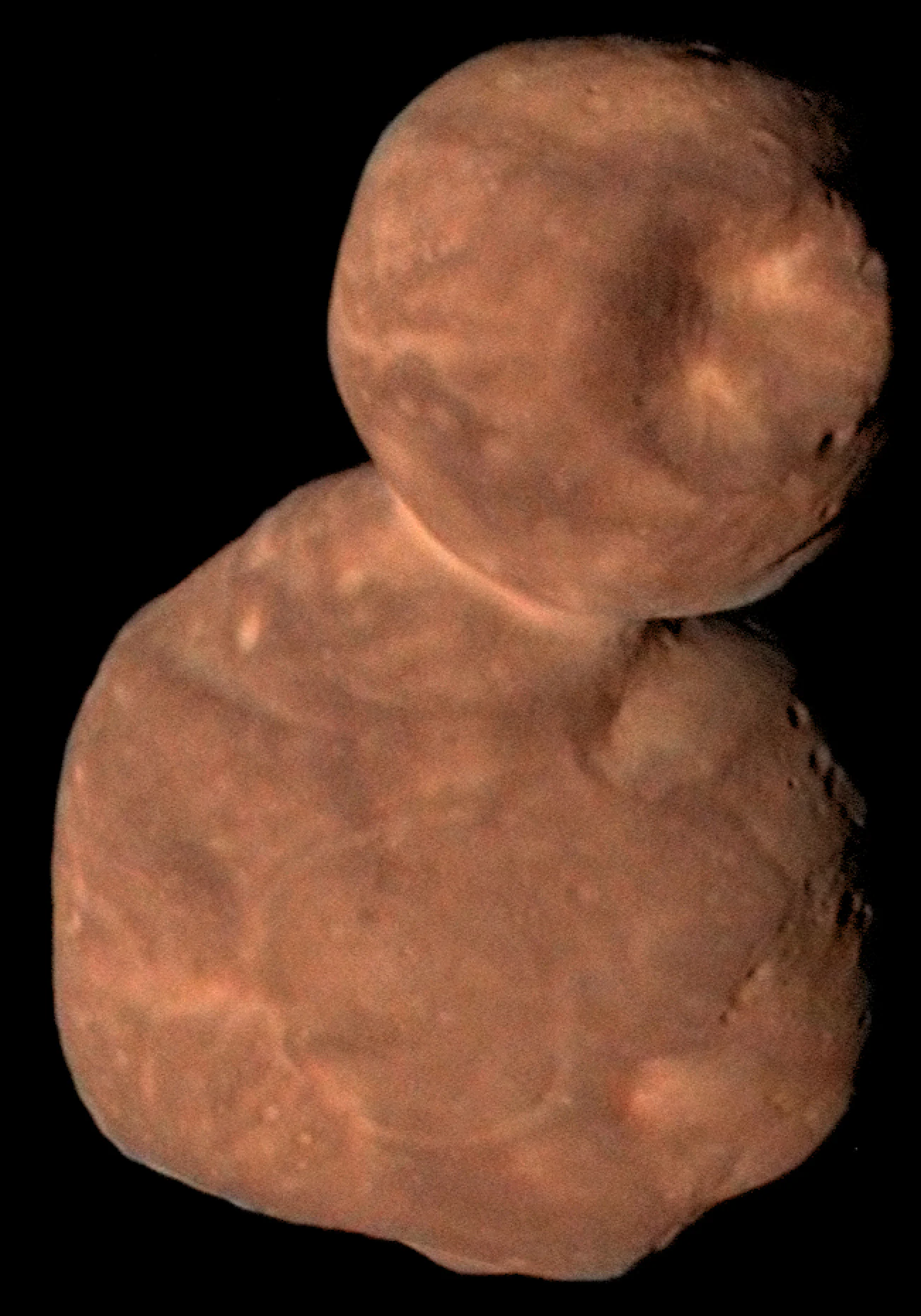


 Amazing close-up images of Mars show the blackened crater...
 AI spots a mysterious 'square structure within a triangular...
 Incredible before and after images of NASA's Curiosity rover...