Ontdek de Fascinerende Wereld van UFO's en UAP's: Jouw Bron voor Onthullende Informatie!
Ben jij ook gefascineerd door het onbekende? Wil je meer weten over UFO's en UAP's, niet alleen in België, maar over de hele wereld? Dan ben je op de juiste plek!
België: Het Kloppend Hart van UFO-onderzoek
In België is BUFON (Belgisch UFO-Netwerk) dé autoriteit op het gebied van UFO-onderzoek. Voor betrouwbare en objectieve informatie over deze intrigerende fenomenen, bezoek je zeker onze Facebook-pagina en deze blog. Maar dat is nog niet alles! Ontdek ook het Belgisch UFO-meldpunt en Caelestia, twee organisaties die diepgaand onderzoek verrichten, al zijn ze soms kritisch of sceptisch.
Nederland: Een Schat aan Informatie
Voor onze Nederlandse buren is er de schitterende website www.ufowijzer.nl, beheerd door Paul Harmans. Deze site biedt een schat aan informatie en artikelen die je niet wilt missen!
Internationaal: MUFON - De Wereldwijde Autoriteit
Neem ook een kijkje bij MUFON (Mutual UFO Network Inc.), een gerenommeerde Amerikaanse UFO-vereniging met afdelingen in de VS en wereldwijd. MUFON is toegewijd aan de wetenschappelijke en analytische studie van het UFO-fenomeen, en hun maandelijkse tijdschrift, The MUFON UFO-Journal, is een must-read voor elke UFO-enthousiasteling. Bezoek hun website op www.mufon.com voor meer informatie.
Samenwerking en Toekomstvisie
Sinds 1 februari 2020 is Pieter niet alleen ex-president van BUFON, maar ook de voormalige nationale directeur van MUFON in Vlaanderen en Nederland. Dit creëert een sterke samenwerking met de Franse MUFON Reseau MUFON/EUROP, wat ons in staat stelt om nog meer waardevolle inzichten te delen.
Let op: Nepprofielen en Nieuwe Groeperingen
Pas op voor een nieuwe groepering die zich ook BUFON noemt, maar geen enkele connectie heeft met onze gevestigde organisatie. Hoewel zij de naam geregistreerd hebben, kunnen ze het rijke verleden en de expertise van onze groep niet evenaren. We wensen hen veel succes, maar we blijven de autoriteit in UFO-onderzoek!
Blijf Op De Hoogte!
Wil jij de laatste nieuwtjes over UFO's, ruimtevaart, archeologie, en meer? Volg ons dan en duik samen met ons in de fascinerende wereld van het onbekende! Sluit je aan bij de gemeenschap van nieuwsgierige geesten die net als jij verlangen naar antwoorden en avonturen in de sterren!
Heb je vragen of wil je meer weten? Aarzel dan niet om contact met ons op te nemen! Samen ontrafelen we het mysterie van de lucht en daarbuiten.
Berichten van 1 februari 2020 tot 29 februari 2020
Giant UFO Or Moon Passes In Front Of Sun Then Turns Around! UFO Sighting News.
Date of sighting: Feb 23, 2020 Location of sighting: Earths sun
I was using SOHO helioviewer to look at the sun and found this very interesting object passing front of the sun and then do a 180 degree reversal. Its odd, I have never seen that before. The object reversed directions like it was on rails. Since it didn't orbit the sun we know its not a planet like Mercury, Venus or Earth. Perhaps its a moon? Because the moons of these three planets do rotate and could perhaps be seen at a curving edge of the rotation around a planet...poking itself in front of the sun for a quick selfie...but that just a guess. There are a lot of UFOs out there, some planet size and this is crazy cool. I just don't know...the fact that it reversed itself really makes me think massive UFO...but my theory of the moon could hold up. I guess we will never know for sure. Scott C. Waring
Dark Round UFO In Low Orbit Over Moon, Feb 25, 2020, Video, UFO Sighting News.
Date of sighting: Feb 25, 2020 Location of sighting: earths moon Here is a great video by Youtube user Skywatch International. He caught a round UFO flying in low orbit over the moons surface. He said he used a Nikon P900 camera to catch it and the detail is amazing. Check out the video below and see for yourself. There is a lot of alien activity this week on our moon. Scott C. Waring
Sky-watcher spotted Secret Base in the Apenine Lunar Mountains
Constructed lines running parallel to one another in the Apenine Lunar Mountains could be an indication that someone has built a secret space base on the moon.
Coincidence or not but almost similar constructed lines running parallel to one another have also been spotted in in Antarctica.
This enormous structure of 600 x 600 meters also could be an operational base, but who has built it and why in the middle of nowhere? Is it a research station or is it used for other more secret purposes?
Not only you have to zoom all the way to the surface to find this structure but normally Google Earth mentions the name of the base, but not in this case which is very strange if you have nothing to hide.
The video below shows the moon base and more surface close up's in 5K. high quality.
This is an old UFO footage recorded on 3rd August 2018 but it was just now submitted to MUFON. This happened in Denia, Spain.
Witness report:
Unknown Orb/Light object travelling at steady speed along the coast of Denia, Spain. My wife, my son (7 years old at that time) and I were on the beach in Denia (38°51’02.3″N 0°05’59.5″E) having a relaxing afternoon while on holidays, when at around 17:30, my wife noticed on her right-hand side, a bright object cruising slowly just around above the Castle of Denia (38°50’50.6″N 0°06’49.0″E) towards our position, following the coastline in a South-East North-west path (38°53’53.9″N 0°03’54.0″E). In the beginning, we thought it was just a drone, but the object seemed too big and too bright from the distance to be just a drone, despite the sun could well reflect on metallic objects depending on the angle and position. As the object was approaching, the brightness didn’t seem to change but rather pulsate, which we started to think about something unusual. A commercial flight was around at that time but it was at a much further and a higher altitude and didn’t interfere in any way with the object. I decided to get my phone and record it. I was a bit frustrated because in previous years I bring my camcorder with me for holidays and I like to record events and fun times. That particular year I decided not to get the camcorder and rely on solely on my smartphone. With the camcorder, I could have used the powerful optical zoom and better quality image to record the event.
The object was travelling on a steady speed and steady path position (The object didn’t move on the sky up and down, it was me trying to steady my phone). I estimate the object was travelling in between 100-200 miles/h and an altitude of around 3000 feet or possibly less, with an angle with respect of the horizon of around 35 degrees.
The object seemed to be pulsating and was really quickly intermittently disappearing and appearing with black shades in contrast with its brightness.
As the sky was so clear cloudless, there is no appreciation of the object moving. Only at 2:21 in the video, I did a quick shot of the beach as a point of reference because I didn’t want to lose track of it.
It took my attention that while we were on the beach, no one noticed anything or no one noticed that we were very excited looking and filming this object in the sky like they weren’t aware that we were there. There was a couple just sitting 4 meters in front of us, facing nearly our direction and they didn’t seem to care about our excitement or our finding in the sky…. They didn’t even bother to look at what was going on in the sky… Weird! In fact, no one on the beach, and there were quite a few people, seemed to notice the strange event.
We believe we sighted a very good case of an unknown object of unknown origin but you can prove us wrong of course.
The object seemed to be flickering even more as it was disappearing in the distance towards Valencia. At one point we couldn’t see it anymore.
SCIENTISTS REVEAL 3 STEPS TO DEFEND EARTH FROM CATASTROPHIC ASTEROID IMPACTS
t is time to get serious about our plans to save the world.
In 1998's Armageddon, humanity’s only chance of survival hung on Bruce Willis blowing up an asteroid in space, seconds before it collided with Earth and ended the human race. Unfortunately, back in the real world and more than two decades on, the real-life plans to deflect any potential asteroid on a collision course with Earth are not much more advanced — and Bruce Willis tends to get lucky.
Now, scientists at the Massachusetts Institute of Technology have developed three strategies that could help save Earth — and our species — from a devastating asteroid impact. And here's the thing: One of them might actually work.
Armageddon may be fiction, but the fact is we have good reason to worry about asteroid impacts. Some 65 million years ago, a massive asteroid hit Earth and wiped out the dinosaurs. It could happen again — and, if it does, it would have catastrophic consequences for life on Earth. Teams of scientists monitor the skies for these giant asteroids, tracking the objects that zip through our Solar System and their chances of collision with Earth.
Current deflection methods rest on a one shot, one-opportunity style strategy that bets life as we know it on the success of a first, and only, try. But in a new study, the MIT researchers advocate scrapping this all-or-nothing approach and outline three steps that could help deflect asteroids bound for Earth.
THEY ARE:
A remote-sensing orbiter to characterize the asteroid's shape, mass distribution, surface properties, and materials.
A sensor to measure its trajectory.
An impactor (i.e. a missile of some kind) to nudge the asteroid off course and back out into space.
“Most of the research in understanding and deflecting asteroids that could threaten the Earth, this goes under the heading of planetary defense,” Olivier de Weck, professor at MIT and lead author of the new study, tells Inverse.
“Most everything you will find there is predicated on the idea of a one shot. You get one shot at this and that is it. That is what we wanted to challenge, no you don’t just get one shot at it,” he says.
The new guidelines are detailed in a paper published this week in the journal Acta Astronautica.
3-STEP PLAN
Rather than relying on the success of one, all-or-nothing mission, the ideal asteroid deflection mission is instead a three-step process, the researchers say.
“If you have enough time and you want a high probability of success, what you do is you send three missions,” de Weck says.
MISSION ONE: CHARACTERIZE
The first mission would involve a preliminary remote-sensing orbiter to characterize the asteroid's shape, mass distribution, surface properties, and the material that it’s made of.
This initial step would be similar to NASA’s OSIRIS-REx, which launched in 2016 and is currently orbiting around Bennu, a potentially hazardous asteroid that could one day threaten Earth. OSIRIS-REx is designed to map the asteroid and bring back a sample from its surface to Earth for scientists to study.
OSIRIS REx is orbiting around asteroid Bennu to characterize this threatening rock.NASA
Once the orbiter characterizes the asteroid, step two begins.
MISSION TWO: TRAJECTORY
The next step involves a small impact mission designed to hit the asteroid just enough to measure its trajectory — this impact would not be powerful enough to actually deflect the asteroid or change its course.
These two first steps are crucial before the final step to fully deflect the asteroid. Together, they will help scientists account for different variables and uncertainties, the researchers say.
“Nobody has really seriously looked at the impact of uncertainty, what if you don’t know the asteroid really well?” de Weck says.
“You could actually make things worse instead of making them better.”
In the worst case scenario, he compares the asteroid to an apple getting shot by a bullet. The bullet would go straight through, and have very little impact on the apple itself.
In the best case scenario, scientists would know enough about the asteroid ahead of time to enable phase three — the impact.
An artist's impression of the 3-step plan to defend Earth from asteroids in action.MIT
MISSION THREE: IMPACT
Once steps one and two are complete, step three is to launch a counter defense. The ideal impactor is a basic kinetic impactor, the researchers say, which works by shooting a projectile into space to nudge the asteroid in a different direction.
This would essentially be a missile capable of creating a large enough impact on the asteroid that it would not blow through it, but instead would throw it off course and back out into space.
This last and final phase will hopefully rescue the fate of humanity and not lead to our fiery deaths by asteroid (or by accident).
But this strategy still depends on how much time you have before collision.
WARNING TIME
The researchers based the new 3-step plan on two asteroids, Bennu and Apophis.
Apophis is a near-Earth asteroid that stretches 370 meters in diameter. Named after the ancient Egyptian god of chaos, the asteroid caused panic in December 2014, when scientists estimated a 2.7 percent chance that it might hit Earth in 2029.
This animation shows how close Apophis will get to Earth during its 2029 approach.NASA, JPL
These fears rested on the idea that Apophis would pass through a gravitational keyhole — an area in Earth’s gravitational field that would essentially tug on the asteroid’s trajectory.
Once an asteroid goes through a keyhole, that means it is almost guaranteed that it will collide with Earth during its next orbit around the Sun. Which, in the case of Apophis, would be the year 2036.
“The optimal strategy depends on how much warning time you have before keyhole passage,” says de Weck.
Thankfully, subsequent observations have put these fears to rest — Apophis is not on a collision course with Earth. But six years ago, the odds of a collision were 1 in 300 — worryingly close, if you ask us.
If there is ample time, the biggest hurdle would be to change the general attitude around space missions, de Weck says.
Planetary defense research is a young field, spanning just the last two decades, he says. As a result, it is not that far advanced. More time means more hard science to base any Earth-saving missions on — and a higher chance of success.
At the same time, there is a cultural problem in how we conceive of space missions — we tend to send out only one spacecraft at a time, wait for the results, and then send a follow-up mission. This one-by-one approach may hold scientists back in the event of an emergency.
“Part of the work here is to change the thinking and basically think about it with a campaign approach, where you are sending multiple satellites to accomplish a goal that a single satellite couldn’t accomplish,” de Weck says.
“As soon as you think of it as a campaign, you have a lot more degrees of freedom, there’s a lot more possibilities on how you can solve a problem.”
The first official science results from NASA's quake-hunting InSight Mars lander just came out, and they reveal a regularly roiled world.
"We've finally, for the first time, established that Mars is a seismically active planet," InSight principal investigator Bruce Banerdt, of NASA's Jet Propulsion Laboratory (JPL) in Pasadena, California, said during a teleconference with reporters Thursday (Feb. 20).
Martian seismicity falls between that of the moon and that of Earth, Banerdt added.
"In fact, it's probably close to the kind of seismic activity you would expect to find away from the [tectonic] plate boundaries on Earth and away from highly deformed areas," he said.
Probing the Martian subsurface
InSight touched down near the Martian equator in November 2018, kicking off a two-year, $850 million mission to probe the Red Planet's interior in unprecedented detail.
The stationary lander carries two main science instruments to do this work: a supersensitive suite of seismometers and a burrowing heat probe dubbed "the mole," which is designed to get at least 10 feet (3 meters) below the Red Planet's surface.
Analyses of marsquake and heat-transport measurements will allow the mission team to construct a detailed, 3D map of the Martian interior, NASA officials have said. In addition, InSight scientists are using radio signals beamed from the lander to track how much Mars wobbles on its axis over time. This information will help researchers determine how big and dense the planet's core is. (The mission's full name — Interior Exploration using Seismic Investigations, Geodesy and Heat Transport — references these various lines of investigation.)
Overall, InSight's observations will help scientists better understand how rocky planets such as Mars, Earth and Venus form and evolve, mission team members have said.
The mission's initial science returns, which were published today (Feb. 21) in six papers in the journals Nature Geoscience and Nature Communications, show that InSight is on track to meet that long-term goal, Banerdt said. (We have gotten a taste of these results over the past year or so, however, as mission team members have released some findings in dribs and drabs.)
The new studies cover the first 10 months of InSight's tenure on Mars, during which the lander detected 174 seismic events.
These quakes came in two flavors. One hundred and fifty of them were shallow, small-magnitude tremors whose vibrations propagated through the Martian crust. The other 24 were a bit stronger and deeper, with origins at various locales in the mantle, InSight team members said. (But even those bigger quakes weren't that powerful; they landed in the magnitude 3 to 4 range. Here on Earth, quakes generally must be at least magnitude 5.5 to damage buildings.)
That was the tremor tally through September 2019. InSight has been busy since then as well; its total quake count now stands at about 450, Banerdt said. And all of this shaking does indeed originate from Mars itself, he added; as far as the team can tell, none of the vibrations were caused by meteorites hitting the Red Planet. So, there's a lot going on beneath the planet's surface.
But that activity is quite different from what we're used to on Earth, where most quakes are caused by tectonic plates sliding against, over or under each other. Mars doesn't have active plate tectonics, the researchers said, so both types of quakes are caused by the long-term cooling of the planet since its formation 4.5 billion years ago.
"As the planet cools, it contracts, and then the brittle outer layers then have to fracture in order to sort of maintain themselves on the surface," Banerdt said. "That's kind of the long-term source of stresses."
And some Martian locales are more stressed than others. One particularly active region is the Cerberus Fossae fracture system, which lies about 1,000 miles (1,600 kilometers) east of InSight's Elysium Planitia landing site.
The mission team traced two of the largest detected marsquakes to Cerberus Fossae, which "contains faults, volcanic flows and liquid water outflow channels with ages as recent as 2-10 Ma [million years ago], and possibly younger from impact crater counts," Banerdt and his colleagues wrote in one of the new studies.
"So, it's possible that there's actual magma at depth that's cooling," InSight deputy principal investigator Sue Smrekar, also of JPL, said during Thursday's teleconference. That cooling would lead to the contraction of the magma chamber, causing deformation of the crust, she added.
But Smrekar stressed that this is a hypothesis, not a definitive determination of what's going on at Cerberus Fossae. Indeed, though mission team members think they understand Martian seismicity in broad strokes, they're still trying to nail down how it works in detail.
A wealth of information can be gleaned from InSight's quake measurements. For example, analyses of how the seismic waves move through the Martian crust suggest there are small amounts of water mixed in with the rock, mission team members said.
"Our data is consistent with a crust which has some moisture in it, but we can't say one way or the other whether there [are] large underground reservoirs of water at this point," Banerdt said.
The new papers report a variety of other discoveries as well. For example, InSight is the first mission ever to tote a magnetometer to the Martian surface, and that instrument detected a local magnetic field about 10 times stronger than would be expected based on orbital measurements. (Mars lost its global magnetic field billions of years ago, however. This allowed solar particles to strip away the once-thick Martian atmosphere, which spurred the planet's transition from a relatively warm and wet world to the cold desert it is today.)
InSight is also taking a wealth of weather data, measuring pressure many times per second and temperature once every few seconds, Banerdt said. This information helps the mission team better understand environmental noise that could complicate interpretations of the seismic observations, but it also has considerable stand-alone value.
"This is really going to, I think, revolutionize our understanding of the interaction of the atmosphere with the surface of Mars," Banerdt said. "That's one of the things that's really going to open up a whole new window of research on Mars."
Mole update
Not everything has gone smoothly for InSight, however. Notably, the mole has been unable to get down to its prescribed depth because the Martian dirt is proving more slippery than mission team members had anticipated. (The mole's self-hammering burrowing system requires a certain amount of friction to work.)
The mission team has tried several strategies to get the mole moving, including pressing on the side of the probe with InSight's robotic arm to generate the required friction. This latter tactic has generated some halting success, but the mole remains stranded too close to the surface.
So, in the next six to eight weeks, mission team members aim to try a modification of the arm-pressing strategy, in which they'll push on the mole's back rather than its side. The goal is to get the mole about 16 inches (40 centimeters) down, at which point it will hopefully be able to start digging on its own, Banerdt said.
The InSight team would also like a bit more cooperation from Mars on the seismic side of things, if possible. The lander has not yet spotted any truly big quakes, which have the potential to paint a clearer picture of the planet's deep interior for mission scientists.
The lack of powerful quakes is no surprise, Banerdt stressed; big tremors are much rarer than their smaller counterparts here on Earth, after all. So, the team may have to wait a while to get one.
But such issues aren't derailing the mission; the team is excited about how things have gone thus far, Banerdt said.
"I think we're well on our way to getting most, if not all, of the goals that we set for ourselves 10 years ago when we started this mission," he said.
Just like any small child, a tiny star had a huge yet unexpected temper tantrum.
The little star, which is only about 8% of the sun's mass, belched a huge "superflare" of X-rays. It's a strange thing to observe for astronomers, who thought a star that small couldn't create such a large emission in that wavelength of light.
This star is very diminutive by cosmic standards. Known as J0331-27, the star is an L dwarf, the category of star so small that each star's mass is just barely enough to allow for nuclear fusion. ("Failed stars" that don't meet the mass threshold are called brown dwarfs.)
The strange flare also went unnoticed for more than a decade after it happened on July 5, 2008. It was caught by the European Space Agency's XMM-Newton X-ray observatory, but lay in an archive until a search turned up the event. It was quite the event, too, since the little star sent out more than 10 times the energy of the most intense flare sent out by our own sun.
"This is the most interesting scientific part of the discovery, because we did not expect L-dwarf stars to store enough energy in their magnetic fields to give rise to such outbursts," Beate Stelzer, a co-author on a new paper describing the event and an astrophysicist at Germany's Institute for Astronomy and Astrophysics and at Italy's Astronomical Observatory of Palermo, said in an ESA statement.
Scientists don't really understand how this flare could have arisen. L dwarfs only have a surface temperature of about 3,320 degrees Fahrenheit (1,830 degrees Celsius). That's about a third of the sun's surface temperature of 10,340 F (5,730 C). At the lower temperatures of an L dwarf, astronomers' models suggested that there isn't enough energy to fuel a star's magnetic field, which would govern the flare. "We just don't know — nobody knows," Stelzer said of why the event happened.
But the astronomers did point out that XMM-Newton observed the star for 40 days and only saw the one flare, which suggests that an L dwarf takes a longer time to build up energy than the sun does — perhaps contributing to the size of the flare.
"A number of similar stars had been seen to emit super flares in the optical part of the spectrum, but this is the first unambiguous detection of such an eruption at X-ray wavelengths," ESA added in the same statement. "The wavelength is significant because it signals which part of the atmosphere the super flare is coming from: optical light comes from deeper in the star's atmosphere, near its visible surface, whereas X-rays come from higher up in the atmosphere."
Over 100 Stars Are Missing! Sky Quakes, Artificial Dimensions, Machine Elves & Ghosts
Anyone looking for something to binge watch? Here’s some MIND BLOWING stuff! Full version of a new 5 part series… Where are the stars going? Does Time exist? The 33rd Parallel, Megaliths, Missing stars, New Constellations, 13th sign of the zodiac, Strange sounds in the sky,
A.I. Artificial intelligence, machine learning, machine elves, deepDream machine art, chakras, dimensions, New Age Horoscopes, light workers and energy workers, bad trips, the “trip” gatekeeper… and so much MORE! (Please stick around to the end… saved the best for last
Inexplicable Ancient Artifacts... Experts Are Still Trying to Explain These Relics
One of the world’s leading experts on ancient Artifacts shares his unique collection of relics from long lost civilizations that appear to have been more advanced than we thought.
This information is amazing , where did you find this guy he’s a gift from the gods.I never realized how many private collectors are out there hording our history , the same history that has been hidden from us for thousands of years , but i’m glad they do because they preserve it instead of the establishment destroying it! Tim O’Ney
Inexplicable Ancient Artifacts…Experts Are Still Trying To Explain These Relics
Black Disk Shoots Past Moon While Youtube Livestreams! Feb 10, 2020, Video, UFO Sighting News.
Date of sighting: Feb 10, 2020
Location of sighting: Earths moon
This was brought to my attention by a Youtuber named Willease. He posted this video of a persons live streaming...where a UFO suddenly appears for a split second. The UFO is oval shaped and looks like a disk. Its only visible for a second so you have to watch the video carefully. Stop the video at 57 sec mark to see the UFO well. An awesome example of a disk. This is not a satellite, because it has no antennas or solar panels, its not the space station, because its totally the wrong shape...wow, just wow!
UFO On The Coast Of Denia, Spain 2018-08-03, UFO Sighting News.
Date of sighting: 8-3-2018 Location of sighting:Denia, Spain Source: MUFON 106337 Here is a great UFO video. Why is it great? I was taken in the daytime with a high quality camera and has an excellent eyewitness description to go with it. Three things I really like. This person was at the beach in Spain and noticed a flying object in the sky. Its whitish silver and highly reflective as it changes its shape. The shape and the movement of the object reminds me of some UFO videos released by the military in infrared. These are drones...able to change shapes at whim. Sent by aliens to record and retrieve data...and they record everything...ocean temps, pollutants, animals, insects wind speed...everything. So don't think we are so important they are here for us all the time...because there are other things on earth too they are highly interested in learning about. This drone was heading out into the ocean, probably towards the location of an under the ocean alien base not far off the coast of Spain. Scott C. Waring
Eyewitness states:
My wife, my son (7 years old at that time) and I were on the beach in Denia (38°51'02.3"N 0°05'59.5"E) having a relaxing afternoon while on holidays, when at around 17:30, my wife noticed on her right-hand side, a bright object cruising slowly just around above the Castle of Denia (38°50'50.6"N 0°06'49.0"E) towards our position, following the coastline in a South-East North-west path (38°53'53.9"N 0°03'54.0"E). In the beginning, we thought it was just a drone, but the object seemed too big and too bright from the distance to be just a drone, despite the sun could well reflect on metallic objects depending on the angle and position.
As the object was approaching, the brightness didn't seem to change but rather pulsate, which we started to think about something unusual. A commercial flight was around at that time but it was at a much further and a higher altitude and didn't interfere in any way with the object. I decided to get my phone and record it. I was a bit frustrated because in previous years I bring my camcorder with me for holidays and I like to record events and fun times. That particular year I decided not to get the camcorder and rely on solely on my smartphone. With the camcorder, I could have used the powerful optical zoom and better quality image to record the event.
The object was travelling on a steady speed and steady path position (The object didn't move on the sky up and down, it was me trying to steady my phone). I estimate the object was travelling in between 100-200 miles/h and an altitude of around 3000 feet or possibly less, with an angle with respect of the horizon of around 35 degrees. The object seemed to be pulsating and was really quickly intermittently disappearing and appearing with black shades in contrast with its brightness.
As the sky was so clear cloudless, there is no appreciation of the object moving. Only at 2:21 in the video, I did a quick shot of the beach as a point of reference because I didn't want to lose track of it. It took my attention that while we were on the beach, no one noticed anything or no one noticed that we were very excited looking and filming this object in the sky like they weren't aware that we were there.
There was a couple just sitting 4 meters in front of us, facing nearly our direction and they didn't seem to care about our excitement or our finding in the sky.... They didn't even bother to look at what was going on in the sky... Weird! In fact, no one on the beach, and there were quite a few people, seemed to notice the strange event. We believe we sighted a very good case of an unknown object of unknown origin but you can prove us wrong of course. The object seemed to be flickering even more as it was disappearing in the distance towards Valencia. At one point we couldn't see it anymore.
This is an old UFO footage recorded on 3rd August 2018 but it was just now submitted to MUFON. This happened in Denia, Spain.
Witness report:
Unknown Orb/Light object travelling at steady speed along the coast of Denia, Spain. My wife, my son (7 years old at that time) and I were on the beach in Denia (38°51’02.3″N 0°05’59.5″E) having a relaxing afternoon while on holidays, when at around 17:30, my wife noticed on her right-hand side, a bright object cruising slowly just around above the Castle of Denia (38°50’50.6″N 0°06’49.0″E) towards our position, following the coastline in a South-East North-west path (38°53’53.9″N 0°03’54.0″E). In the beginning, we thought it was just a drone, but the object seemed too big and too bright from the distance to be just a drone, despite the sun could well reflect on metallic objects depending on the angle and position. As the object was approaching, the brightness didn’t seem to change but rather pulsate, which we started to think about something unusual. A commercial flight was around at that time but it was at a much further and a higher altitude and didn’t interfere in any way with the object. I decided to get my phone and record it. I was a bit frustrated because in previous years I bring my camcorder with me for holidays and I like to record events and fun times. That particular year I decided not to get the camcorder and rely on solely on my smartphone. With the camcorder, I could have used the powerful optical zoom and better quality image to record the event.
The object was travelling on a steady speed and steady path position (The object didn’t move on the sky up and down, it was me trying to steady my phone). I estimate the object was travelling in between 100-200 miles/h and an altitude of around 3000 feet or possibly less, with an angle with respect of the horizon of around 35 degrees.
The object seemed to be pulsating and was really quickly intermittently disappearing and appearing with black shades in contrast with its brightness.
As the sky was so clear cloudless, there is no appreciation of the object moving. Only at 2:21 in the video, I did a quick shot of the beach as a point of reference because I didn’t want to lose track of it.
It took my attention that while we were on the beach, no one noticed anything or no one noticed that we were very excited looking and filming this object in the sky like they weren’t aware that we were there. There was a couple just sitting 4 meters in front of us, facing nearly our direction and they didn’t seem to care about our excitement or our finding in the sky…. They didn’t even bother to look at what was going on in the sky… Weird! In fact, no one on the beach, and there were quite a few people, seemed to notice the strange event.
We believe we sighted a very good case of an unknown object of unknown origin but you can prove us wrong of course.
The object seemed to be flickering even more as it was disappearing in the distance towards Valencia. At one point we couldn’t see it anymore.
Posted by Andy Briggs in ASTRONOMY ESSENTIALS | SPACE
Dark matter doesn’t emit light. It can’t be directly observed with any of the existing tools of astronomers. Yet astrophysicists believe it and dark energy make up most of the mass of the cosmos. What dark matter is, and what it isn’t. here.
Since the 1930s, astrophysicists have been trying to explain why the visible material in galaxies can’t account for how galaxies are shaped, or how they behave. They believe a form of dark or invisible matter pervades our universe, but they still don’t know what this dark matter might be.
Dark matter is a mysterious substance thought to compose perhaps about 27% of the makeup of the universe. What is it? It’s a bit easier to say what it isn’t.
It isn’t ordinary atoms – the building blocks of our own bodies and all we see around us – because atoms make up only somewhere around 5% of the universe, according to a cosmological model called the Lambda Cold Dark Matter Model (aka the Lambda-CDM model, or sometimes just the Standard Model).
Dark matter isn’t the same thing as dark energy, which makes up some 68% of the universe, according to the Standard Model.
Dark matter is invisible; it doesn’t emit, reflect or absorb light or any type of electromagnetic radiation such as X-rays or radio waves. Thus, dark matter is undetectable directly, as all of our observations of the universe, apart from the detection of gravitational waves, involve capturing electromagnetic radiation in our telescopes.
Yet dark matter does interact with ordinary matter. It exhibits measurable gravitational effects on large structures in the universe such as galaxies and galaxy clusters. Because of this, astronomers are able to make maps of the distribution of dark matter in the universe, even though they cannot see it directly.
They do this by measuring the effect dark matter has on ordinary matter, through gravity.
This all-sky image – released in 2013 – shows the distribution of dark matter across the entire history of the universe as seen projected on the sky. It’s based on data collected with the European Space Agency’s Planck satellite. Dark blue areas represent regions that are denser than their surroundings. Bright areas represent less dense regions. The gray portions of the image correspond to patches of the sky where foreground emission, mainly from the Milky Way but also from nearby galaxies, prevents cosmologists from seeing clearly.
There is currently a huge international effort to identify the nature of dark matter. Bringing an armory of advanced technology to bear on the problem, astronomers have designed ever-more complex and sensitive detectors to tease out the identity of this mysterious substance.
Dark matter might consist of an as yet unidentified subatomic particle of a type completely different from what scientists call baryonic matter – that’s just ordinary matter, the stuff we see all around us – which is made of ordinary atoms built of protons and neutrons.
The list of candidate subatomic particles breaks down into a few groups: there are the WIMPs (Weakly Interacting Massive Particles), a class of particles thought to have been produced in the early universe. Astronomers believe that WIMPs might self-annihilate when colliding with each other, so they have searched the skies for telltale traces of events such as the release of neutrinos or gamma rays. So far, they’ve found nothing. In addition, although a theory called supersymmetry predicts the existence of particles with the same properties as WIMPs, repeated searches to find the particles directly have also found nothing, and experiments at the Large Hadron Collider to detect the expected presence of supersymmetry have completely failed to find it.
Several different types of detector have been used to detect WIMPs. The general idea is that very occasionally, a WIMP might collide with an ordinary atom and release a faint flash of light, which can be detected. The most sensitive detector built to date is XENON1T, which consists of a 10-meter cylinder containing 3.2 tons of liquid xenon, surrounded by photomultipliers to detect and amplify the incredibly faint flashes from these rare interactions. As of July 2019, when the detector was decommissioned to pave the way for a more sensitive instrument, the XENONnT, no collisions between WIMPs and the xenon atoms had been seen.
Although WIMPs have long been the favored candidate for dark matter, they’re not the only candidates. The failure to find WIMPs, and the attendant frustration with not being able to account for a significant percentage of the universe’s mass, has led many scientists to look at possible alternatives.
At the moment, a hypothetical particle called the axion is receiving much attention. As well as being a strong candidate for dark matter, the existence of axions is also thought to provide the answers to a few other persistent questions in physics such as the Strong CP Problem.
Astronomer Fritz Zwicky first predicted the existence of dark matter in the 1930s following his observations of the Coma galaxy cluster.
The idea that there might be things in the universe which are invisible to us, that emit no light, has a long history going back hundreds of years to the days of Newton. With the discovery of so-called “dark nebulae” – clouds of interstellar dust blocking the light from background stars – and Pierre Laplace’s 18th-century speculations about objects which might swallow light, later to become known as black holes, astronomers came to accept the existence of a so-called “dark universe.”
But in modern times, it was astronomer Fritz Zwicky, in the 1930s, who made the first observations of what we now call dark matter. His 1933 observations of the Coma Cluster of galaxies seemed to indicated it has a mass 500 times more than that previously calculated by Edwin Hubble. Furthermore, this extra mass seemed to be completely invisible. Although Zwicky’s observations were initially met with much skepticism, they were later confirmed by other groups of astronomers.
Thirty years later, astronomer Vera Rubin provided a huge piece of evidence for the existence of dark matter. She discovered that the centers of galaxies rotate at the same speed as their extremities, whereas, of course, they should rotate faster. Think of a vinyl LP on a record deck: its center rotates faster than its edge. That’s what logic dictates we should see in galaxies too. But we do not. The only way to explain this is if the whole galaxy is only the center of some much larger structure, as if it is only the label on the LP so to speak, causing the galaxy to have a consistent rotation speed from center to edge.
Vera Rubin, following Zwicky, postulated that the missing structure in galaxies is dark matter. Her ideas were met with much resistance from the astronomical community, but her observations have been confirmed and are seen today as pivotal proof of the existence of dark matter. In honor of this crucial and historic piece of detective work toward establishing the existence of dark matter, the revolutionary Large Synoptic Survey Telescope, currently under construction in Chile and scheduled to see first light next year, was recently renamed the Vera C. Rubin Observatory.
Dark matter pioneer Vera Rubin (1928-2016). This image – taken at Lowell Observatory – is from 1965.
Some astronomers have tried to negate the need the existence of dark matter altogether by postulating something called Modified Newtonian dynamics (MOND). The idea behind this is that gravity behaves differently over long distances to what it does locally, and this difference of behavior explains phenomena such as galaxy rotation curves which we attribute to dark matter. Although MOND has its supporters, while it can account for the rotation curve of an individual galaxy, current versions of MOND simply cannot account for the behavior and movement of matter in large structures such as galaxy clusters and, in its current form, is thought unable to completely account for the existence of dark matter. That is to say, gravity does behave in the same way at all scales of distance. Most versions of MOND, on the other hand, have two versions of gravity, the weaker one occurring in regions of low mass concentration such as in the outskirts of galaxies. However, it is not inconceivable that some new version of MOND in the future might yet account for dark matter.
Although some astronomers believe we will establish the nature of dark matter in the near future, the search so far has proved fruitless, and we know that the universe often springs surprises on us so that nothing can be taken for granted.
The approach astronomers are taking is to eliminate those particles which cannot be dark matter, in the hope we will be left with the one which is.
It remains to be seen if this approach is the correct one.
Bottom line: Dark matter makes up some 27% of the universe according to astronomical theories. It cannot be seen or detected directly via the existing tools of astronomers, but its effect can be measured via its gravitational pull on ordinary matter.
Molecular oxygen has been spotted beyond the Milky Way for the first time
The elusive molecule turned up in a quasar more than half a billion light-years from Earth
Astronomers finally found molecular oxygen beyond the Milky Way, but they had to look at a galaxy far, far away: the quasar Markarian 231, shown here in an image from the Hubble Space Telescope.
NASA, ESA, THE HUBBLE HERITAGE TEAM (STSCI/AURA)-ESA/HUBBLE COLLABORATION, AND A. EVANS (UVA/NRAO/STONY BROOK UNI.)
For the first time, astronomers have found molecular oxygen — the same gas humans need to breathe — in a galaxy outside the Milky Way.
Oxygen is the third most common element in the cosmos, after hydrogen and helium. So astronomers once thought molecular oxygen, O2, would be common in the space between the stars. But despite repeated searches, no one had ever seen molecular oxygen beyond our galaxy — until now.
Junzhi Wang, an astronomer at Shanghai Astronomical Observatory in China, and his colleagues spotted the molecule’s calling card in a galaxy named Markarian 231. Lying 560 million light-years away in the constellation Ursa Major, Markarian 231 is the nearest galaxy to Earth that contains a quasar, where gas whirls around a supermassive black hole and gets so hot that it glows brilliantly. (SN: 8/31/15).
Using radio telescopes in Spain and France, the astronomers saw radiation at a wavelength of 2.52 millimeters, a signature of O2’s presence, the team reports in the Feb. 1 Astrophysical Journal. “This is the first detection of molecular oxygen in an extragalactic object,” Wang says.
It’s also the most molecular oxygen ever seen outside the solar system. Previously, astronomers had seen the molecule in just two star-forming clouds within the Milky Way, the Orion Nebula and the Rho Ophiuchi cloud (SN: 1/28/20). Astronomers think the shortage of interstellar O2 is due to oxygen atoms and water molecules freezing onto dust grains, locking up the oxygen. In these stellar nurseries, though, shocks from bright newborn stars can rip water ice from the dust, freeing oxygen atoms to find each other and form molecules.
But even in the Orion Nebula, molecular oxygen is rare, with hydrogen molecules outnumbering oxygen molecules a million to one. Hydrogen also dominates in Markarian 231. But molecular oxygen spans the outskirts of the galactic disk at abundances more than 100 times greater than in the Orion Nebula.
That’s “very high,” says Gary Melnick, an astrophysicist at the Harvard-Smithsonian Center for Astrophysics in Cambridge, Mass., who was not involved in the work. “There is no known explanation for an abundance of molecular oxygen that high.” To confirm that the radiation really arises from O2, Melnick says the observers should look for a second wavelength from the molecule.
That won’t be easy, Wang says, because other molecules also emit radiation at those wavelengths. To shore up the case for O2, the scientists went through the many molecules that give off wavelengths similar to the one detected and found that nobody had ever seen any of those molecules in space — except for O2. “It is guilt by elimination, if you will,” says team member Paul Goldsmith, an astronomer at the Jet Propulsion Laboratory in Pasadena, Calif. One possible explanation for all the O2 is that Markarian 231 goes through a more vigorous version of the Orion Nebula’s oxygen-forming process. The galaxy is a prolific star factory, spawning new stars 100 times as fast as the Milky Way and spewing out 700 solar masses of gas per year. High-speed gas from the galaxy’s center may slam into gas in the disk, shaking water ice from dust grains so that molecular oxygen can form.
In turn, that oxygen could keep the galaxy hyperactive: Radiation the molecule emits helps cool the gas so that some of it can collapse and create even more new stars in the galaxy.
The earliest known hominid interbreeding occurred 700,000 years ago
Neandertal-Denisovan ancestors migrating to Eurasia heralded hookups with a resident Homo group
A Homo erectus skull dating to around 1.8 million years ago, found at the Dmanisi site in the nation of Georgia, may come from a population that later interbred with ancestors of Neandertals and Denisovans, researchers say.
Ancestors of Neandertals and Denisovans left Africa for Eurasia around 700,000 years ago and then interbred with a Homo population that had exited Africa long before, according to a new genetic study. The finding reveals the oldest known case of interbreeding among members of the genus that includes people today, Homo sapiens.
Evidence of genetic exchanges between distinct hominid populations roughly 400,000 years before H. sapiens evolved highlights a role for interbreeding in Homo evolution long before ancient people occasionally mated with Neandertals and Denisovans.
The scenario begins with an early Homo species making its way into Eurasia roughly 1.9 million years ago, in what was probably the first Homo migration out of Africa, scientists report February 20 in Science Advances. Those now-extinct travelers may have been members of Homo erectus, a species that includes Eurasian fossils dating to about 1.8 million years ago (SN: 10/17/13), or Homo antecessor, a controversial species designation based on 1.2-million- to 1.1-million-year-old fossils found in Spain (SN: 3/26/08). Or they could have been part of another Homo population unknown from any fossils.
Then ancestors of Neandertals and Denisovans trekked out of Africa about 700,000 years ago, say the researchers, led by anthropologist and population geneticist Alan Rogers of the University of Utah in Salt Lake City. That timing would also have allowed for the evolution of Neandertals or their direct ancestors in what’s now northern Spain around 430,000 years ago (SN: 3/14/16). Some previous research had suggested that Neandertals originated roughly 300,000 years ago, raising questions about the evolutionary identity of older, Neandertal-like fossils in Spain.
Rogers refers to ancestors of Neandertals and Denisovans as “neandersovans.” That genetically distinct population existed for a brief period of perhaps 15,000 years, Rogers estimates. Neandersovans’ numbers declined sharply after they left Africa around 700,000 years ago, he suspects. Survivors interbred with members of the Homo population that had long inhabited Eurasia, before largely replacing them and separating into eastern and western populations — Denisovans and Neandertals, respectively. Neandersovans inherited at least 2 percent of their DNA from the older Eurasian Homo population, Rogers calculates.
“It’s interesting that signals of interbreeding that far back can be seen in our genomes,” says UCLA geneticist Sriram Sankararaman. Further research needs to look for genetic links between members of that probable first Homo departure from Africa, identified in Rogers’ study, and a previously unknown Homo population that lived 1 million years ago or more and left a genetic mark on present-day West Africans, Sankararaman suggests (SN: 2/12/20). A genetic analysis by the UCLA researcher’s team identified the latter Homo group.
The new findings rest on a novel analysis of particular sets of gene variants found in people today, as well as in Neandertal and Denisovan fossils. Rogers previously determined that these gene forms had not undergone recent changes and thus could be traced back to ancient populations. A software program compared frequencies of the gene variants in DNA from three modern West African Yorubans, five French individuals, two English people, a Neandertal from Croatia’s Vindija Cave, a Neandertal from Siberia’s Denisova Cave and a Denisovan from the same Siberian site.
The researchers identified the best of eight simulations of how ancient interbreeding could have produced the shared genetic variants observed in both the modern and ancient individuals. Estimates of the rate at which genetic mutations accumulate enabled the scientists to gauge the timing of the ancient African departures.
While the newly proposed timing of interbreeding around 700,000 years ago seems reasonable, Rogers’ genetic data deserve closer scrutiny with alternative statistical techniques, says zoologist and evolutionary geneticist Peter Waddell of the Ronin Institute, a nonprofit research center in Montclair, N.J. Waddell previously found signs of a small amount of ancestry in Denisovan DNA from a much older Homo species, possibly H. erectus.
Rogers and his colleagues also suggest that a third major expansion out of Africa, involving H. sapiens, occurred around 50,000 years ago. As with the neandersovan expansion, the genetic evidence is consistent with H. sapiens arriving in Eurasia and then interbreeding with resident Neandertals and Denisovans before replacing those populations, the scientists say. Other fossil and ancient DNA studies, though, indicate that some H. sapiens reached Southeast Asian islands more than 60,000 years ago (SN: 8/9/17).
There was a lot of activity in the skies this past week, including some which directly affected our own planet, so let’s check things out and see if we need to open a metal umbrella.
“Empirical evidence indicates that at least one supernova has rained heavy elements on Earth in the past. Supernovae are known to release significant quantities of dust at sub-relativistic speeds. We also see evidence of clumpiness or ‘bullets’ in supernova ejecta.”
That astronomer-speak comes from astronomer Amir Sira, co-author of the paper (submitted to the submitted to the Astrophysical Journal) “Observational Signatures of Sub-Relativistic Meteors” with Abraham Loeb, who’s made a name for himself recently with his theories on extraterrestrial life forms, alien space ships and more. Sira and Loeb’s latest theory is that Earth’s atmosphere is being bombarded by large meteors – 1 mm to 10 cm (0.04 to 4 inches) – that are traveling at a tremendous speed – up to 1% of the speed of light or 100 times faster than most meteors.
Sira and Loeb refer to clumps of them with a scary “bullets” description and proposed a way to detect them with a global network of 600 infrasound microphones and optical-infrared instruments to detect the acoustic signature and optical flashes and physical explosions created by these “bullets” as they enter our atmosphere. Are we in any danger? Only of learning more about our solar system and universe. Kudos to Sira and Loeb for promoting more ways to entice kids to become astronomers and create jobs for them.
Moving on to the colliding black holes …
Astronomers who study colliding galaxies refer to something known as the “final parsec problem.” While they can see the massive physical destruction of the merger, they are unclear about what happens when the central black holes of each galaxy are within one parsec (3.26 light-years) of each other. The good news (maybe) is, they may find out in April. Scientific American interviews astrophysicists Daniel D’Orazio and Rosanne Di Stefano who in 2017 predicted that the black holes entering the area of the final parsec would produce a flare that could be detected by gravitational lensing if the black holes line up with earth as one passes in front of the other, thus distorting and magnifying the light of the black hole in the rear. A 2018 study of Kepler space telescope data found an active galactic nuclei (AGN) called KIC 11606854 that appears to be a pair of merging black holes. The astronomers were so excited, they called it “Spikey.”
It gets better. According to their preprint paper, “Spikey” may flare again in April 2020, so the astronomers have reserved NASA’s Chandra X-ray Observatory to watch it. Are we in any danger? Only of disappointment should Spikey not live up to its name. On the other hand, a flare will push the theory closer to fact and give future space telescope missions better data to work with and more likely locations to point to.
Then there’s the mysterious Milky Way gas …
“The absence of stellar counterparts indicates that the point-like object may be a quiescent black hole. This discovery adds another intermediate-mass black hole candidate in the central region of our Galaxy.”
Astrophysicist Shunya Takekawa of the National Astronomical Observatory of Japan and colleagues were studying the motion of a high-velocity gas cloud in the center of the Milky Way called HCN-0.085-0.094 when they noticed that one of the three clumps that made up the cloud appeared to be swirling around a black hole. Its actions suggested this is an unusual quiet black hole, but its size is what got them excited — 100 to 100,000 solar masses. That would make it an intermediate-mass black hole, something that has been theorized but never actually proven or seen. In this case, that’s because it’s quiescent – giving off no detectable radiation because it’s not feeding. As they write in their preprint paper, this is the closest potential intermediate black hole ever found and that discovery itself is amazing, considering the possible event horizon (outer boundary) of this black hole is only the size of Neptune or Uranus.
Yes indeed, it was a busy week for black holes, supernovas and astronomers.
Secret chamber found inside King Tut’s famous tomb may solve hunt for Nefertiti
Egyptologists are on the verge of solving one of history’s biggest mysteries — the location of Queen Nefertiti’s elusive tomb.
Jamie Seidel
Tantalising radar shadows have revived hopes that one of history’s most beautiful, and controversial, women — Queen Nefertiti — may indeed be buried in secret chambers within King Tut’s famous tomb.
British and Egyptian Egyptologists earlier this week conducted a three-day radar scan of the world-famous tomb discovered by Howard Carter in 1922.
Upon opening its still-sealed door, he declared he saw “wonderful things”. Everywhere was the glint of gold and priceless examples of some of history’s most exquisite art.
But, since then, the tomb has presented something of a mystery.
It was immediately odd that so many of the statues attributed as Pharoah Tutankhamun had hips and breasts. And more recent, closer, examination reveals a significant proportion of the artwork to have been rebadged, and repurposed, from previous rulers.
In 2015, a ground-penetrating scan of the 3300-year-old tomb was conducted by controversial radar technician Hirokatsu Watanabe. He declared he had detected, with “90 per cent certainty”, several hollow spaces along with “metallic” and “organic” objects.
The world erupted in excitement.
Could another extraordinary discovery be tantalisingly within reach?
Would one of Egypt’s greatest mysteries finally be solved?
Egyptologists were immediately doubtful. His radar scan images seemed uninterpretable — just a mass of blue lines with the occasional red dot. Nobody other than Watanabe seemed able to determine what the scans revealed.
So, the Egyptian Antiquities department organised a second scan — this time with the assistance of National Geographic — in 2016. It found … nothing.
“If we had a void, we should have a strong reflection,” geophysicist Dean Goodman of GPR-Slice software told National Geographic News. “But it just doesn’t exist.”
The locations of speculative chambers have been supported by infra-red and radar scans of Tut’s tomb.
Egyptian technicians from the Centre for Sound Vibration and Smart Structures at the Faculty of Engineering, Ain Shams University, joined a team from the English Terravision Centre to scour the rock for any trace of hidden chambers.
It’s part of an assessment that is due to be completed by the end of the year.
Egyptian archaeologist Francis Amin told the Egypt Independent the most recent radar survey, conducted by the University of Turin, had revealed spaces behind the walls.
But the resolution of the images did not confirm if these were man-made or natural cavities in the rock.
“The results of previous radar surveys have found evidence of the existence of spaces and organic material behind the walls of the cemetery,” Amin said. He added that specialist chemists will need to help analyse the radar survey results.
BOY KING OR PR STUNT?
Pharaoh Tutankhamun’s tomb doesn’t follow the well-established pattern applied to other Egyptian god-kings. It’s unusually small. And it is shaped more like a burial chamber intended for a queen. And why do so many of the statues and images attributed as King Tutankhamun have feminine hips and breasts?
Some have theorised Tutankhamun suffered from his royal inbreeding and had deformities such as breasts and female hips.
Source:Supplied
British Egyptologist Nicholas Reeves put these clues together, including the discovery of partially erased royal names, to suggest the tomb — and much of its contents — was initially intended for Tut’s stepmother, Nefertiti.
About the same time, a high-resolution 3D laser scan made to help preserve the tomb indicated there may be “hollows” hidden behind the tomb’s plasterwork and paintings. Were these sealed doors?
“The implications are extraordinary: for, if digital appearance translates into physical reality, it seems we are now faced not merely with the prospect of a new, Tutankhamun-era storeroom to the west; to the north appears to be signalled a continuation of tomb … and within these uncharted depths an earlier royal interment — that of Nefertiti herself, celebrated consort, coregent, and eventual successor of pharaoh Akhenaten,” Dr Reeves wrote.
While the evidence was circumstantial, it was enough to pique the interest of the Egyptian Antiquities department to invite Dr Reeves — and others — to examine the tomb more closely.
“Each piece of evidence on its own is not conclusive but put it all together, and it’s hard to avoid my conclusion,” Dr Reeves said. “If I’m wrong, I’m wrong, but if I’m right, this is potentially the biggest archaeological discovery ever made.”
British archaeologist Nicholas Reeves believes the new chamber could be the last resting place of Queen Nefertiti, King Tut's mother-in-law.
Source:Supplied
GREAT EXPECTATIONS
Dr Reeves has been chasing Nefertiti’s ghost for almost two decades.
In 2000, Dr Reeves led a radar examination of the ground around Tutankhamun’s tomb in a search for Nefertiti’s burial. He reported finding a “void”. But digs failed to locate anything.
His continued enthusiasm, however, has proven contagious.
In 2016, Egypt’s tourism minister enthused: “We do not know if the burial chamber is Nefertiti or another woman, but it is full of treasures … It will be a ‘Big Bang’ — the discovery of the 21st century.”
An interior view of the King Tutankhamun burial chamber in the Valley of the Kings, Egypt.
Source:AAP
So far, the Big Bang hasn’t happened.
And Egyptian Antiquities Minister Khaled El-Enany has insisted no invasive exploration would be allowed to damage the priceless tomb. “It is essential to perform more scans using other devices and more technical and scientific methods,” Mr El-Enany said.
The challenge has since been one of developing the technology capable of achieving that task.
Former Egyptian antiquities minister and high-profile archaeological personality Zahi Hawass has long been a sceptic of the hidden chamber theory.
“If there is any masonry or partition wall, the radar signal should show an image,” he reportedly told National Geographic News.
“We don’t have this, which means there is nothing there.”
Jamie Seidel is a freelance writer. Continue the conversation @JamieSeidel
One of the great mysteries of ancient Egypt is the whereabouts of Nefertiti – she of the famous bust. Her tomb has never been found, leading to various theories that the sparse records of her time as a powerful partner in the reign of her husband, Pharaoh Akhenaten, and her own reign as pharaoh may have been covered up for some reason. The small size of her stepson King Tut’s tomb have caused many to believe it has hidden chambers, resulting in many unsuccessful searches using various non-invasive methods, including an extensive search with ground-penetrating radar in 2018. However, it’s never say never with Nefertiti, so yet another search was just completed and this time they found a hidden chamber. Is this the big one?
Queen Nefertiti
“Clearly there is something on the other side of the north wall of the burial chamber.”
In a review by Nature of an unpublished report by archaeologist Mamdouh Eldamaty, a former Egyptian minister of antiquities, Ray Johnson, an Egyptologist at the University of Chicago’s Oriental Institute who wasn’t involved in the research, confirmed that the radar found something, but what that ‘something ‘ is will require further scans. So far, it looks like a corridor a few meters east of Tut’s burial chamber. The space is 2 meters (6.5 feet) high, 10 meters (33 feet) long and at the same depth and direction as the tomb’s actual entrance.
The depth and location of this new chamber suggest a number of things. Being parallel to the entrance tunnel and perpendicular to the main chamber puts in in the tomb’s orientation, which would indicate it’s a part of the tomb and not an extension of another tomb – nearby tombs generally don’t line up with each other. The depth reinforces that theory and implies that the chamber was (or perhaps still is) connected to the main chamber at one end. Which leads to the obvious question: what’s at the other end?
“If Nefertiti was buried as a pharaoh, it could be the biggest archaeological discovery ever.”
British Egyptologist Nicholas Reeves has long supported the idea that Tut’s tomb is bigger and Nefertiti is buried somewhere in it. However, he thought the location was north, not east. Could this mean there are hidden chambers all around KV62, the un-sexy Egyptological designation for Tut’s tomb? Eldamaty plans to find out, especially since his ground-penetrating radar search was more successful than previous scans from inside the tomb. Still smarting from being replaced as Minister of Antiquities by a cabinet reshuffling, he plans to test Reeves’ north chamber theory after failing on his previous attempt due to not a mummy’s curse but a modern curse — interference from nearby air-conditioning units.
As always, it’s important to note the tremendous effort the government of Egypt puts into preserving these historic tombs and their artifacts from destructive physical invasions by even the most careful archeologists. Let’s hope this continues without interference from those with money who want to make more money on these priceless historical locations. They should be preserved for all, not just for the rich.
Nefertiti would certainly approve of this message.
Some of the most remarkable UFO encounter reports are those that have left behind some sort of physical evidence for us to look at and try to make sense of. Such accounts have occurred all over the world, always leaving something behind, although this has not necessarily led to any concrete answers. One place that has its share of cases like this is the country of France, and here we will take a look at some of the more well-known perplexing cases of UFOs that not only baffled, but left something physical behind.
Our earliest report comes from the year 1954, at Quarouble, Nord, France. On the night of September 10, 1954, railroad worker Marius Dewilde was woken by his dog barking frantically at something in the night. Dewilde groggily got out of bed, grabbed his flashlight, and ventured outside to see what was going on, not really expecting to find much other than maybe a stray cat or some other animal running around. He decided to walk out towards the nearby railway tracks and that is when he would claim he saw something large resting on the ground not far away. Almost as soon as he noticed this anomalous object he heard footsteps behind him, which caused him to whip his flashlight around.
There, standing in the beam were allegedly two small humanoid beings only about 3 feet tall, which were wearing some sort of helmets on that reflected the light of the beam. Things would get intense when he says that the large landed object then suddenly emitted a beam that trained on him and seemed to paralyze his entire body. It was also noticed that his flashlight flickered out as if it’s batteries had been suddenly drained. He collapsed to the ground, but was able to witness the two figures make their way towards the craft and board it, after which the object changed colors and hot off into the sky. Shortly after, Dewilde would gain control of his limbs once again and make his way home to frantically tell his wife about what had happened. He would later lead police to the scene, but found that he was unable to approach the site, as he was overcome with an incapacitating nausea every time he tried to do so, although no one else experienced such symptoms.
They were nevertheless able to find some odd details, such as a deep indentation and small rocks under the site that were all carbonized on the depression. Spookily there were also later found cows in the area that had been killed and drained of blood. Dewilde himself would go on to suffer from myriad health problems such as respiratory problems and chronic headaches throughout his life, and it would later be found that other locals had seen something odd in the sky as well, and some even said they had seen the same strange entities wandering around. What are we to make of this odd case?
In July of 1965 a very weird series of events went down in the quaint region of Valensole, Alpes-de-Haute-Provence, France. It all started near the small village of Valensole, and on July 1, 1965, a farmer by the name of Maurice Masse was taking a cigarette break before starting his morning chores. As he puffed out wisps of smoke into the air, something caught his attention through the haze of cigarette smoke, and he could see some sort of strange object descend from the sky to land in a field of lavender flowers not too far away. At this point he did not take it to be a UFO, thinking it instead to be a helicopter, but when he extinguished his smoke and took a look out across the field, his eyes met with an oval shaped object perched up on four leg-like apparatuses. Stranger still was that there appeared to be two humanoid figures standing in front of it.
The figures were described as standing approximately 4 feet high, and dressed in tight gray-green clothes, seemingly not human. Their heads were oversized and bald, holding within them large, almond shaped eyes and small, pointed chins, and they seemed to be making some sort of low grumbling noise. As the farmer stood there mouth agape in awe, one of these curious figures allegedly turned to him and raised into the air a device of some kind, which looked cylindrical and “pencil-like” in nature. Before Masse could even really register what was going on he says that the device projected some sort of beam that caused him to lose all control of his limbs and go crumpling to the ground in a heap. He would claim that as he lay there in a daze the figures boarded their craft and then flew off at great speed. It would later be found that the ground had a deep indentation in it and a hardened area like concrete. It would also be found that Masse was honest, very sincere, and was considered to be telling the truth.
A rather similarly weird alien encounter report would be made in 1967, with a 13-year-old boy and his 9-year-old sister in Cussac, Cantal, France, who claimed that they had seen four small, black entities in a field measuring a mere 3 feet high. Above them was apparently a large disc hovering, towards which the mysterious figures floated up off the ground towards, disappearing within. The object then took off with great speed, and when the children brought back investigators it was found that the area was redolent with a “sulfur odor” and that the grass beneath was oddly all dried out for reasons that could not be explained.
Another famous French case supposedly occurred at Trans-en-Provence,Var, France, in January of 1981. Another farmer, this one by the name of Renato Nicolaï, who on January 8, 1981 at 5pm was at work on his property when an eerie whistling sound caught his attention. When he looked around to see what was going on he apparently witnessed a large, saucer-shaped craft come down to rest upon a parch of nearby field, before once again lifting off to fly away. The farmer would describe it as follows:
The device had the shape of two saucers, one inverted on top of the other. It must have measured about 1.5 meters in height. It was the color of lead. This device had a ridge all the way around its circumference. Under the machine I saw two kinds of pieces as it was lifting off. They could be reactors or feet. There were also two other circles which looked like trapdoors. The two reactors, or feet, extended about 20 cm (8 in) below the body of the machine.
When the area was later investigated it was found that the location where the mysterious craft had landed held within it strange scorch marks that could not be identified. It was also found by authorities that there was a patch of ground that had been heavily compressed by something weighing several tons, and had been heated to around 300 and 600 °C (572 and 1,112 °F). A two year investigation into the incident would fail to turn up any definitive answers, and the case remains unsolved.
The very following year, in 1982, one of the most famous UFO cases in French history would go down in the region of Nancy, France. On October 21, 1982, an anonymous cell biologist known only as “Mr. Henri” was with his wife in the modest garden of their home in the small town of Laxou, near Nancy in northeast France, on a clear day when a highly reflective, glinting ovoid object came floating down out of the sky. The object apparently headed straight toward them, causing them to step back warily, before it came to a hovering position right over their home. It was described as being very smooth and metallic, “similar to Beryllium,” as well as completely silent the entire time. Mr. Henri would claim that he had tried to take a photograph as it hovered there, but that something had caused the device to malfunction. The object would descend to just three feet over the ground and simply stay there for a full 20 minutes before ascending again to fly off into the distance, seeming to pull up the grass beneath it as it did so. The plants of the garden were then found to be dried up and withered as if some sort of force had affected them, with some of the fruit of the trees burst open and “cooked” as if by some high heat. Investigators at the scene would come to the conclusion that the vegetation had been affected by some sort of intense “electromagnetic wave of energy.” What was going on here? Who knows?
This has been just a selection at some of the stranger UFO reports to come out of France, and which are remarkable in that they all left behind some sort of physical evidence, although that that entails is largely open for debate. In the end we are merely left with more truly weird cases of possible brushes with things from beyond our understanding and possibly from beyond our world, adding to the mystique of the UFO phenomenon in general and still without solid answers.
UFO Abducts Plane Over Fiji Islands! Video, UFO Sighting News.
Date of discovery: Feb 22, 2020 Location of sighting: Fiji islands Google coordinates: 18° 3'22.84"S 178°41'8.51"E I was looking at Google Earth map when I found this mysterious glowing object in front of a plane. The objects color is what really stands out. It the back of the UFO its pinkish like a half circle and in the front its glowing white. I believe this is because the UFO has lowered part of its shield so that they could bring things in and out of the plane into the UFO. This may be a frozen in time event, a moment in time frozen because the aliens erase the memories of the people on board and then put them back hours later. This is an example of an alien abduction taking place over the ocean in a plane. 100% proof that aliens are abducting humans. Scott C. Waring
NASA tracks cone-shaped UFO before it disappears into deep space
The ISS live feed cam captures a cone-shaped metallic object for about 22 minutes before it moves upwards and disappears into deep space.
The stunning footage, recorded on February 21, 2020, has led to many speculations about what the object could be.
While many people suggest that it is a real UFO, whether alien or a man-made spacecraft belonging to the space fleet, others say that the cone-shaped object is a satellite or a probe intended for experimental purposes in deep space, released by the ISS.
The Top Secret Area 51 Military Base with UFOs and Experimental Aircrafts
Area 51, secret U.S. Air Force military installation located at Groom Lake in southern Nevada. It is administered by Edwards Air Force Base in southern California. The installation has been the focus of numerous conspiracies involving extraterrestrial life, though its only confirmed use is as a flight testing facility.
For years there was speculation about the installation, especially amid growing reports of UFO sightings in the vicinity. The site became known as Area 51, which was its designation on maps of the Atomic Energy Commission. Conspiracy theories gained support in the late 1980s, when a man (Bob Lazar) alleging to have worked at the installation claimed that the government was examining recovered alien spacecraft.
Lenticular cloud over Mount Shasta. February 12, 2020.
Photo Credit: Shasta-Trinity National Forest.
Unusual UFO-shaped formations were observed in the skies over Mount Shasta.
These were actually lenticular clouds that often look like lenses or flying saucers.
This volcano peak in California has long been the subject of conspiracy theories.
Mount Shasta in California has become a nexus of conspiracy theories and unusual events. The latest viral sensation from the area has been a UFO-shaped object that appeared in the skies above the potentially active volcano peak of 14,179 feet on the morning of February 12th.
Upon closer look, this was not an alien spaceship but a beautiful lenticular cloud, the kind that is often shaped like lentils or UFOs, depending on your perspective. It was so convincing, however, that the U.S. Forest Service had to deny its extraterrestrial origins in a statement.
The flying saucer or lens shape of these clouds is caused by their development along the downwind sides of mountains. When moist and stable air goes over a mountain, oscillating waves are created. The crest of the waves causes condensation of vapor, which evaporates through the troughs, explains Weather Underground. These evaporations take the form of lenses and spaceships, looking layered.
Mount Shasta, in particular, has seen its share of lenticular cloud sightings, leading to its status as a new focal point for alien hunters much like Roswell, New Mexico. The latest UFO cloud quickly became a social media sensation, as you can see in these posts of the enigmatic formations:
Mount Shasta has also seen other unusual happenings, with a mysterious side hole that appeared over 10 years ago becoming the subject of a documentary. Its sudden emergence connected with local legends about a lost continent of Lemuria supposedly hidden under the mountain. This mythical kingdom would be there along with its capital city Telos.
The first thought of the documentary filmmaker Elijah Sullivan about the giant hole was that it was from people trying to find Lemuria.
"You'll hear a lot of people talking about Lemuria, maybe even asking for directions," he told the news in 2018. "People make pilgrimages here — it's like a New Age mecca."
It is also known to be sacred to the Native American Winnemem Wintu tribe, indigenous to this area.
If you're in the mood to check out the stunning area for yourself and see some aliens in the skies above, you can come to the nearby town of McCloud for the "Meet the Venusians — We Are in Contact" conference from August 25-30 of this year. It promises to be a "tribute to honor of all the Venusians & Pleiadean's who have taken the time to present themselves" with a schedule of speakers and events focused on healing and consciousness.
USS Nimitz captain reveals Navy pilots DO have to watch out for UFOs after one of the carrier's planes captured secret unreleased video of 2004 encounters with a 'Tic Tac-shaped' mystery aircraft
Captain Max Clark, commanding officer of the USS Nimitz, tells DailyMail.com it is important his ship and everybody on it is kept safe from UFOs
'From my perspective we have an obligation to make sure the airspace is clear, whether it's UAP (Unidentified Aerial Phenomenon) or UAV (Unmanned Aerial Vehicle),' he says
This comes just weeks after the Office of Naval Intelligence revealed the existence of a classified, unreleased video of a UFO
The video was related to the notorious USS Nimitz carrier group's 2004 encounters with a 'Tic Tac'-shaped UFO
The encounters remain a mystery and the object's incredible speed and movements have led to speculation that it was extraterrestrial
The commanding officer of the US Navy supercarrier, the USS Nimitz, has revealed his crew has an 'obligation' to make sure the airspace is clear of UFOs.
In an exclusive interview with DailyMail.com, Captain Max Clark said it's important his ship and everybody on it is kept safe from Unidentified Aerial Phenomenon (UAP) - the term for UFOs used by the Navy.
This comes just weeks after the Office of Naval Intelligence revealed the existence of a classified, unreleased video relating to the Nimitz carrier group's 2004 encounters with a 'Tic Tac'-shaped UFO.
The existence of the video was revealed in a response to a Freedom of Information Act request made by researcher Christian Lambright, and published by Lambright's friend Paul Dean.
The video is likely the full version of a leaked 76-second video clip that the Defense Department admitted in 2017 was authentic.
Captain Max Clark, commanding officer of the USS Nimitz, tells DailyMail.com it is important his ship and everybody on it is kept safe from UFOs after the Nimitz carrier group had an encounter with a UFO in 2004
This comes just weeks after the Office of Naval Intelligence revealed the existence of a classified, unreleased video of a UFO. The classified video is likely the full version of the leaked 76-second clip (above) which circulated online from 2007, and was confirmed as authentic in 2017
The footage was taken by a pilot using a Forward Looking Infrared (FLIR) gun-pod camera on an F/A-18 Super Hornet flying over the Pacific Ocean.
Speaking to DailyMail.com on the bridge of the Nimitz, Captain Clark said of the bizarre encounter: 'From my perspective we have an obligation to make sure the airspace is clear, whether it's UAP (Unidentified Aerial Phenomenon) or UAV (Unmanned Aerial Vehicle), this is part of the air space.
Nick Pope, who investigated UFOs for Britain's Ministry of Defence in the 1990s, said Captain Clark's comments come as a surprise because there are 'huge sensitivities' over the Nimitz incident
'It adds another level of... from a pilot's point of view, to see and avoid, and also our radar systems looking for things like that too, just to make sure everybody's safe.'
Philadelphia native Captain Clark, who assumed command of Nimitz on August 1, 2019, wasn't on board the Nimitz when the unusual sighting was recorded 16 years ago.
And the experienced officer wouldn't be drawn further on the video or the Navy's close encounters of the third kind.
Nick Pope, who investigated UFOs in an official capacity for Britain's Ministry of Defence in the 1990s, said Captain Clark's comments come as a surprise.
The commentator told DailyMail.com: 'These are fascinating comments and it's interesting they were made at all, because the Department of Defence recently took over responding to all UFO-related questions from the media, following some tension between them and the US Navy.
'But ship's captains are strong-willed characters who don't take kindly to being muzzled.
'That said, the captain was totally on-message, because the official line involves talking in general terms about the need to guard against unauthorized incursions into restricted military airspace, with the aim of promoting safety.
'What's being downplayed by everyone is the staggering fact that the US government still doesn't know what these objects are.
'The DOD's line is that the objects seen by naval aviators during the USS Nimitz incident remain "unidentified".'
Pope added that there are 'huge sensitivities' over the Nimitz incident and the recent admission by the US Navy that it has the secret unreleased video has put the affair back in the spotlight. And Captain Clark's comments further fuel the speculation surrounding the footage which has baffled the world.
At least six Super Hornet pilots made visual or instrument contact with the UFO on November 14, 2004.
The encounters, which are documented in numerous interviews with first-hand witnesses, remain a mystery, and the object's incredible speed and movements have led to speculation that it was extraterrestrial in origin.
Chad Underwood, the former Navy aviator who shot the famous leaked video clip, broke his silence last month in an interview with New York Magazine
Underwood was flying in an F/A-18F Super Hornet as part of the USS Nimitz (above) carrier group when he encountered an 'unidentified aerial phenomena'
A map shows the rough location of the USS Nimitz carrier group during the 2004 encounter
The original FLIR video from the Nimitz encounters leaked online as early as 2007.
Witnesses say that clips of the video had been circulated widely on the Navy's intranet - used to communicate between ships in the carrier group - and an unknown sailor in the group likely first leaked it.
The clip became one of the most-touted pieces of evidence in the UFO community when the Pentagon confirmed its authenticity in 2017.
Last month, Chad Underwood, the former Navy aviator who shot the famous leaked video clip, broke his silence in an interview with New York Magazine.
He said the oblong, wingless 'Tic Tac' shaped object was spotted off the coast of Mexico over the Pacific.
He also revealed that for about two weeks, the Ticonderoga-class guided missile cruiser USS Princeton, part of Carrier Strike Group 11, had been tracking mysterious aircraft intermittently for two weeks on an advanced AN/SPY-1B passive radar.
The radar contacts were so inexplicable that the system was even shut down and restarted to to check for bugs - but operators continued to track the unknown aircraft.
Then on November 14, Commander David Fravor says he was flying in an F/A-18F Super Hornet when he made visual contact with the object, which seemed to dive below the water, resurface, and speed out of sight when he tried to approach it.
As Fravor landed on the deck of the Nimitz, Underwood was just gearing up to take off on his own training run.
Fravor told Underwood about the bizarre encounter, and urged Underwood to keep his eyes open.
He recalls how he suddenly saw a blip on his radar before tracking it on his FLIR camera.
'The thing that stood out to me the most was how erratic it was behaving,' Underwood told the magazine.
'And what I mean by “erratic” is that its changes in altitude, air speed, and aspect were just unlike things that I’ve ever encountered before flying against other air targets.'
The FOIA response letter above revealed that Office of Naval Intelligence has 'TOP SECRET' briefing slides and 'SECRET' video related to the 2004 USS Nimitz carrier group encounters
Underwood says the object wasn't obeying the laws of physics and dropped from 50,000 feet altitude to 100 feet in seconds, which he says, 'isn't possible'.
Underwood added that he saw no signs of an engine heat plume or any sign of propulsion.
The pilot refuses to speculate as to whether the object is an alien spacecraft or not, however.
'That’s not my job. But I saw something. And it was also seen, via eyeballs, by both my commanding officer, Dave Fravor, and the Marine Corps Hornet squadron commanding officer who was out there as well.'
DailyMail.com spoke to Nimitz commanding officer Captain Clark about the incident after being invited onboard the awesome 95,000 ton vessel earlier this month.
We joined the crew on a five day training mission in the Pacific Ocean and witnessed first hand it's awesome capabilities.
Capable of reaching more than 30 knots (35mph) the Nimitz-class supercarrier is one of ten nuclear-powered aircraft carriers in the US Fleet.
We observed flight operations as F/A-18 Super Hornets, EA-18G Growlers and a handful of F-35C stealth strike fighters were launched off the ship and brought in to land.
The Nimitz is the lead ship of her class, one of the largest warships in the world and the flagship of Carrier Strike Group Eleven (CSG-11) with Carrier Air Wing Seventeen (CVW-17) embarked.
Its homeport is Naval Base Kitsap in Washington and the vessel is named for legendary fleet admiral Chester W. Nimitz (1885–1966), who helped the US defeat the Japanese Navy in World War II.
A new study from the Planetary Research Institute suggests that briny water could temporarily form on Mars’ surface in the shadows of boulders for just a few days each Martian year.
Field of large boulders as seen by the Mars Pathfinder lander on Mars in 1997. A new study suggests that small pools of liquid water may be able to briefly form in the shadows of such boulders at mid-latitudes in the springtime.
Mars is a cold, very dry, desert world. Although it has ice caps of water ice (as well as carbon dioxide ice) and vast amounts of ice below its surface, no liquid water has been found on Mars’ surface. But there might be some. We might just need to look behind large boulders, in springtime.
A new study from the Planetary Science Institute (PSI) in Tucson, Arizona – announced on February 12, 2020 – adds to previous evidence that small amounts of briny (salty) water might be able to form on the Martian surface under just the right conditions.
The possibility of liquid water on present-day Mars has been debated for half a century. Melting is physically difficult under Martian environmental conditions, because with the total pressure of the atmosphere near the triple point pressure of water, evaporative cooling of ice is high near the melting point.
According to the study, the briny water might be possible for only a few days of each Martian year. The trick is that this can only happen under just the right circumstances. Schorghofer said:
Mars has plenty of cold ice-rich regions and plenty of warm ice-free regions, but icy regions where the temperature rises above the melting point are a sweet spot that is nearly impossible to find. That sweet spot is where liquid water would form.
Three-dimensional computerized view of the Martian surface temperature around a boulder at latitude 30° south. On the side opposite to the sun, temperatures are around -128 degrees Celsius. As the sun rises, this area heats up rapidly, melting frost on the salty ground. This could briefly create small amounts of briny water that later goes back into the atmosphere, via sublimation.
This sweet spot would involve protruding topography, such as boulders, at mid-latitudes. During the winter, a boulder might cast a continual shadow, where water ice can accumulate as frost. When spring came again, the temperature can increase quite quickly. In the computer models used, temperature would rise from -198° Fahrenheit (-128° Celsius) in the morning to -14° Fahrenheit (-10° Celsius) at noon. That is a short enough time that not all the frost would sublimate – pass directly from the solid to vapor state – as it normally does in the very thin, cold atmosphere. From the paper:
Protruding topography creates locations that experience a rapid transition from conditions where water frost accumulates to high solar energy input. Beyond the pole-facing side of a boulder, carbon dioxide and water frost can accumulate seasonally, and once the sun reemerges and the carbon dioxide frost disappears, the water frost is heated to near melting temperature within one or two sols [days on Mars].
The scientists said it is dust within the carbon dioxide frost that helps keep it from sublimating back into the atmosphere as temperatures rise. From the paper:
Overall, melting of pure water ice is not expected under present-day Mars conditions. However, at temperatures that are readily reached, seasonal water frost can melt on a salt-rich substrate.
The whole cycle would repeat, year after Martian year.
In 2008, what appeared to be small drops of briny liquid water were seen on the legs of the Phoenix Mars Lander. These images show changes in the drops over 36 days.
As mentioned above, carbon dioxide ice can also form behind large boulders on Mars. That ice, too, will sublimate in the spring. Scientists have a name for the first day in spring when the carbon dioxide ice disappears. They call it the crocus date.
Water ice melting also occurs either on or just after that date. Thus it is referred to as crocus melting. According to Schorghofer:
Answering the question whether crocus melting of seasonal water ice actually occurs on Mars required a slew of detailed quantitative calculations, the numbers really matter. It took decades to develop the necessary quantitative models.
Today, Mars’ atmosphere is too cold and too thin for water to last long on the surface, even briny water. But there have been other hints that it may occur when conditions are right.
The famous recurring slope lineae on Mars may be evidence of seasonal briny water on Mars. The slope linae are dark streaks that occur on steep slopes during the warmer months and keep recurring in the same locations each year. It still isn’t known exactly what causes them, but theories have ranged from small amounts of flowing briny water to dust slides. If water is involved – not a certainty yet – it could come from the atmosphere, ice pockets or subsurface aquifers.
Norbert Schorghofer at the Planetary Science Institute.
During the Mars Phoenix Lander mission, which landed near the north pole in 2008, images showed small droplets forming on the legs of the spacecraft. While not proven, they certainly looked like drops of briny water that later sublimated away.
Last year, NASA’s InSight lander found possible evidence of current reservoirs of liquid water below the surface. If confirmed, that would be an exciting discovery, in particular for the potential of subsurface life, which would be protected from the severe conditions on the surface. In 2018, it was announced that the European Space Agency’s Mars Express orbiter had found evidence of a salty subsurface lake beneath the ice at the south pole.
If there really are brief pools of liquid water hiding behind Martian boulders at times, that also would be exciting, as Mars would then be the only place other than Earth in our solar system where water would be known to be able to exist on the surface. This could have significant implications for the possibility of microbial life on an otherwise dry and hostile world.
Bottom line: A new study from the Planetary Research Institute suggests that briny water could temporarily form on Mars’ surface under certain conditions.
Whales are masters of the oceans, the marine mammals are the largest of living creatures found on the planet, they cover huge distances in their migrations.Sadly from time to time, things do not go as they should for these with the animals ending up beached.Everything from changes in the tides, melting icebergs and shifting food sources have been claimed o force whales to veer off course. This causing them to swim into unfamiliar and shallow waters and possibly even beach themselves.Some say human involvement is to blame, in some cases, a whale may end up beached because it has already died and the tide washed its body ashore. So how could the remains of an animal of such size be found miles from a beach, why are whales showing up in random locations?Let’s take a look.
Starting here in Thailand and the sad news that the rotting carcass of a Bruda whale was found by local residents deep in a mangrove forest in tambon Bang Poo Mai of Samut Prakan's Muang district.The Bruda whale is a cetacean that can reach 40- 55 feet in length it is found worldwide in warm temperate and tropical waters, just like those of the Gulf of Thailand which Samut Prakan is located near.Samut Prakan is a stone’s throw from the capital city of Bangkok and is at the junction of the Phraya River and the Gulf of Thailand.On Januray 26th the carcass of a female whale, measuring in at around 12 meters long and weighing over 15 tonnes.
The remains were examined and found to be free from injury.Namanok Bancherdhiransamut, of the Upper Gulf of Thailand Conservation Group, said he was told three days prior that a deceased Bruda whale had been seen floating in the Gulf near the river mouth, some 15 kilometres from the Samut Prakan coastline. He and team Members had searched for it, but were unsuccessful in finding the animal.It then came to his attention that villagers had found a large whale carcass washed aground in a mangrove swamp about 500 metres from the road to tambon Bang Poo Mai.
The following Monday, the Chon Buri-based 2nd Marine and Coastal Resources Office coordinated with volunteers for marine protection in tambon Bang Poo Mai to remove the whale carcass to an appropriate area for examination to establish the cause of death.The investigation is still ongoing.Now this report does not seem too extraordinary even with a suspicious cause of death but it sent me on the search and I hit upon two more stories of beached whales, the difference with these marine mammals is that their remains were found miles from the ocean.Digging deeper I uncovered a theory that possibly points to alien involvement!The first case did receive a lot of attention online, a dead humpback whale left researchers dumb founded after it was discovered deep in Brazil’s Amazon jungle.The whale lay approximately 15 metres from the shore of Araruna Beach along the Marajó Bay in Soure, Brazil.
Local authorities commented when quizzed on the whale saying that the spotting a whale in the region at that time of year was quite rare.This whale was of a similar size to the animal found in Thailand measuring about eight meters long and 10 tonne in weight.And in yet another similarity with the Thai whale a team from the region’s Municipal Secretariat of Health, Sanitation, and Environment said the carcass didn’t appear to have any visible injuries.The two prevailing theories as to how the whale ended up in the brush are either:A powerful tide launched the whale inland, orThe whale died at sea and was carried onto the land by peopleCould there be a third choice? A choice which would need us to look to the stars to find an answer?Before I look at the extraterrestrial connection let’s hear the about the third whale.
A dairy farmer from the small town of Farmington near the Great Salt Lake in Utah made an unexpected and remarkable discovery on his property while out looking for a cow that had wondered off.The 69-year-old farmer a one Michael Woodson, found a 12-meter-long humpback whale laying lifeless in the middle of one of his fields, hundreds of kilometers away from its natural habitat.Again an animal around the same dimensions, there seems to be a pattern forming here!Police were called as the man thought this maybe a creepy prank by some neighborhood kids.
This idea was quickly put to bed as there were no traces of vehicles or movement of the beast.The police admitting that they were at a loss as to how the carcass got there. “We have to admit that we find this case very puzzling,” said Captain Terry Dawson from the Farmington police. “It is certainly the first time that we see anything like this in our city, and we have very little information for now as to how the animal got there.”And this is when are old friends from outer space enter the story.A few witnesses reported seeing some strange flying object in the area over the last two days and the authorities have confirmed that the 911 operators have received a few dozen calls from all over the region reporting such sightings.
“We are verifying every clue and information that we have, and I assure you that we will explore every other possibility before we conclude that a UFO has anything to do with the case” added Captain Dawson.A team of biologists from the nearby University of Utah were called to the site to examine the remains of the whale. The scientists are trying to determine if the animal could have actually lived in the Great Salt Lake which is only a few kilometers away from the farm.This case taking a turn for the cryptid as lake living whales have been proposed as an answer to the many sighting of lake monsters around the globe. As for what killed the animal, you guessed it, no injuries were found and the biologists are still testing the whale to find out what killed the humpback whale.Let’s look at the alien angle to this story, the practice of cattle mutilation has long been reported and it is not just bovine animals that are targeted, everything from horses to people have been said to be victims of extraterrestrial abduction and experimentation.Aliens abducting whales to analyze them, fits with the pattern of reported behavior.Ufologist and youtuber Scott C Waring, wrote in his blog UFO Sightings Daily: “Whales are often taken by UFOs, analyzed, and then returned.“But sometimes animals are returned to a location that is not hospitable to them.
Apparently the alien who took this whale had no idea that they only live in the water.“It looks like aliens make a lot more mistakes than I thought.”This alleged mistake of returning the whales to the wrong place makes no sense, the extraterrestrials would understand the animals need to be in a certain environment to survive, I think it shows more of a disregard for the animal.Once they had learned what they needed they unceremoniously dumped the carcass, this also highlighting the lack of concern that they have in regards to us (humanity) learning of their existence and what they are doing.Some more down to earth reasons have been given, these include stranded calves.
These animals may have been travelling with mothers and could have gotten lost or separated during the migratory cycle between the two continents.These animals alone failed to survive died and were washed in land along rivers by the tides and weather, maybe large waves pushed the bodies far inland?Now that has me more confused, it would have to be some wave to carry the remains of a humpback whale 5 miles in land through a populated area and deposit it on a farm in Farmington Utah all with no witnesses!!What do you think is moving these whales to locations they have no place being, is it extraterrestrials bad weather or just pranksters?Let me know what you think in the comments below.
Jupiter appears to have more water than anyone expected.
Newly released data from NASA's Juno probe shows that water may make up about 0.25% of the molecules in the atmosphere over Jupiter's equator. While that doesn't sound like much, the calculation is based on a prevalence of water's components, hydrogen and oxygen, three times more than at the sun. The new measurements Juno obtained are much higher than a previous mission suggested.
The surprise result has scientists delving deep again into results from NASA's Galileo mission to Jupiter, which obtained drier results in 1995 when engineers deliberately threw the spacecraft into Jupiter's atmosphere. (Galileo was low on fuel and NASA didn't want to take the chance, even if it was a slight one, of the spacecraft accidentally crashing on a potentially habitable icy moon.)
Reconciling the results from Galileo and Juno is key for scientists to better understand how our solar system came together, NASA said in a statement. Since Jupiter was probably the first planet to form, it could have sucked up most of the gas and dust that the sun's formation left behind. How much water Jupiter soaked up, then, should help scientists identify the most plausible theories to explain its formation.
And understanding Jupiter's birth would in turn help scientists understand how the planet's wind currents move and what its insides are made of. Scientists should be able to generalize findings at Jupiter to certain kinds of large exoplanets to learn how other solar systems formed.
Galileo's results were a puzzle even back in the 1990s. The spacecraft sent back data showing 10 times less water than scientists predicted, and more weirdly, the amount of water appeared to increase the deeper Galileo went into Jupiter's atmosphere, according to the NASA statement. Scientists had expected that by the time it stopped transmitting data, at a depth of about 75 miles (120 kilometers), the atmosphere around it should have been well-mixed with an unchanging composition.
A ground-based infrared telescope was able to measure water concentrations at Jupiter at the same time as Galileo's plunge and showed that Galileo may have accidentally hit a dry spot, meaning water is not well-mixed deep in Jupiter's atmosphere.
Juno's first eight flybys also showed a lack of atmospheric mixing. The spacecraft's radiometer obtained data even deeper than Galileo's measurements, at 93 miles (150 km) down, and found more water at the equator than Galileo did.
Scientists are now waiting to compare Juno's equatorial measurements with observations at the north of the planet; Juno's 53-day orbit is gradually moving northward to examine more of that hemisphere with each flyby. The spacecraft's next science flyby will be on April 10.
"Just when we think we have things figured out, Jupiter reminds us how much we still have to learn," Scott Bolton, Juno principal investigator at the Southwest Research Institute, said in the NASA statement. "Juno's surprise discovery that the atmosphere was not well mixed even well below the cloud tops is a puzzle that we are still trying to figure out. No one would have guessed that water might be so variable across the planet."
The new research is described in a paper published Feb. 10 in the journal Nature Astronomy.
Russia Strange UFO Encounters and Weird Submerged Discoveries
COAST TO COAST AM –
UFO and paranormal expert Paul Stonehill discussed ongoing strange encounters and discoveries in Russia, as well as previous Soviet incidents. Recently, on the volcanic island of Matua in the Sea of Okhotsk, the Russian army found a sunken submarine that may be either American or Japanese, he reported. The nearby area has seen a lot of UFO and USO (unidentified submerged object) activity-more in this video from his YouTube channel.
A media phenomenon, Coast to Coast AM deals with UFOs, strange occurrences, life after death, and other unexplained (and often inexplicable) phenomena.
The subsurface offers a protected, and possibly habitable, environment.
The U.S. Geological Survey's (USGS) Astrogeology Science Center has released the locations of more than 1,000 cave-entrance candidates on Mars. The dots indicate the location of possible caves in the Tharsis region on Mars.
The search for present-day life on Marsis heating up. And for good reason: An improved knowledge of Mars' geologic diversity and history, a better appreciation of life in extreme environments here on Earth, and a sharp focus on sensitive life-detection measurement methods are all bolstering the Mars-life hunt, giving scientists more reason to think that they just might find something.
Still, the issue of life on Mars demands new scientific concepts and knowledge concerning where to explore on the Red Planet and what to measure.
Astrobiologists and other experts tackled some of these issues last November during a conference at the National Cave and Karst Research Institute in Carlsbad, New Mexico.
On the meeting agenda was a discussion of how best to test for extant life on Mars, with or without the benefit of collection systems. Such systems include a complex and pricey Mars sample-return effort that officially kicks off this summer with the launch of NASA's Mars 2020 rover.
Geological environments
ls there life on Mars today? It's a credible query in search of an answer, said Michael Meyer, lead scientist for NASA's Mars Exploration Program at agency headquarters.(Image credit: Barbara David)
Conference attendees generally agreed that the best places to look for extant Mars life are in the deep subsurface caves, and in salt and ice.
While the cold, dry surface of Mars, with its harsh radiation environment, is widely considered to be uninhabitable, the subsurface has been hypothesized to be a viable, long-lived habitable environment, protected from the punishing surface conditions of Mars and a place where water could be stable.
Vlada Stamenković, a research scientist at NASA's Jet Propulsion Laboratory in Pasadena, California, backed the underground approach at the conference.
"The surface of Mars is a very oxidizing, radiation-heavy environment where liquid water is not really stable for an extended amount of time," Stamenković said. "It's the worst place to look for life-sites on Mars. Groundwater might be the only habitat for extant life on Mars, if it still exists today."
To that end, Stamenković outlined at the meeting two potential Mars lander missions: Volatiles And Life: Key Reconnaissance & In-situ Exploration (VALKYRIE) and TH2OR (Transmissive H2O Reconnaissance), a small impact-lander platform that would remotely sense and study liquid subsurface groundwater via low-frequency electromagnetic waves. (Stamenković is the TH2OR principal investigator.)
Lava tubes, cave entrances
Over the years, researchers have spotted pit craters on the surface of Mars. These features are locations where the roof of a lava tube has partially collapsed and created a "skylight."
Researchers at the meeting pointed out that Mars-circling spacecraft have imaged numerous potential cave entrances. Shielded underground as they are, could lava tubes be prime microbial real estate on Mars?
Here on Earth, cave-exploring scientists have gathered evidence of microbial activity in the form of biofilms, slime, and microbially induced or precipitated minerals. Conditions in caves, the researchers have found, are typically far different, more consistent and more benign than on the surface.
An international group of experts recently met in Carlsbad, New Mexico, to discuss what's next in the effort to determine if life has been, or is now, resident on the Red Planet. (Image credit: Barbara David)
Systematic campaign
"It's pretty clear to me that there's much to be done to seek extant life, and certainly extinct life, in a variety of environments on Mars," said Penny Boston, senior advisor for science integration at NASA's Ames Research Center in Mountain View, California.
As an astrobiologist, Boston has been a "cave diver" for some 25 years. "I think we all recognize that there's not just a single way to go" to search for life on Mars, she told Space.com.
"My own personal opinion is that it's time to line up missions with what the community is seeing in terms of return on investment versus the difficulty of accessing any particular environment," Boston said. "It has been shown, with Mars, a campaign to systematically look for the water and now probe other aspects of habitability have yielded a tremendous amount of science."
And caves aren't as dangerous to explore as some people think, she added.
"I think people are often leery of the idea, because they may think of caves as mines. Mines are dangerous because we've recently made those mines and they are shored up by human structure," Boston said.
"But in the case of natural caves, they have had geologically long periods of time to stabilize," she added. "It's probably more likely that a cathedral is going to collapse on you than a natural cave. There are some exceptions to this. Obviously, caves in a pretty seismically active area, you'd have to be more leery."
Caves are some of the most exciting environments in the search for signs of present and past life on Mars, said Kevin Webster, a research scientist at the Planetary Science Institute in Tucson, Arizona.
Webster is studying cave air as a biosignature, looking into the concentration of trace gases in caves he has measured across the United States.
When thinking about caves on Mars, a biological signature might come in the form of the removal of reactive components from the atmosphere, Webster explained. Researchers have found several candidates for lava tube caves on Mars and continue to detect them. The exploration and the measurement of cave air on Mars might be pursued through either remote means or on-the-spot methods, he said.
The Small High-Impact Energy Landing Device (SHIELD) is a proposed new technology for inexpensively bringing small payloads to the Martian surface. (Image credit: JPL/Corby Waste)
How life may be operating
Biosignatures in the air offer a way to search for life that does not depend on genetics "but something that is broad enough to how life may be operating, even if it doesn't share our same biochemistry," Webster said.
So, Martian caves should be pursued, Webster said.
"I have spent my time trying to develop one particular biosignature that people may use in the search for life," Webster told Space.com. "I'm trying to understand how cave air differs from that of the atmosphere on Earth and why we might want to look at that on Mars. I love seeing new ways to find life. That's really exciting and in the vein of what I've been doing."
Leonard David is the author of the book"Moon Rush: The New Space Race," published by National Geographic in May 2019. A longtime writer for Space.com, David has been reporting on the space industry for more than five decades. Follow us on Twitter@SpacedotcomorFacebook.
LightSail 2 has been orbiting Earth for eight months now, and it has captured some stunning shots of our home planet during that time.
The Planetary Society built the spacecraft, which launched in June 2019 on a SpaceX Falcon Heavy rocket, to prove the potential of solar sailing. Rather than relying on conventional fuel, LightSail 2 uses a massive sail to catch photons (light particles) from the sun to power the spacecraft's orbit. The goal is for LightSail 2 to remain in orbit for about a year.
Spacecraft personnel have been evaluating LightSail 2's success throughout the mission and recently summarized what they've learned from the flight and how they've handled the anomalies that have occurred.
Based on the flight to date, those personnel have recommended that future solar sails feature solar panels on both sides of the sail, rather than on only one side. That's becauseLightSail 2 uses the one-sided design, and it's caused a few power-production problems for the spacecraft, according to the new report from the team.
The LightSail 2 mission team also recounted the spacecraft's difficulty in navigating Earth's cushy atmosphere, even at altitudes of 450 miles (720 kilometers). Those struggles suggest that solar sail missions will be most successful when targeting even higher altitudes around Earth or venturing into deep space.
But these missions might not be able to take quite as nice photos of Earth.
(Image credit: The Planetary Society)
An image from LightSail 2 shows the west coast of India on Jan. 21, 2020.
(Image credit: The Planetary Society)
An image of the northeast coast of South America taken by LightSail 2 on Jan. 11, 2020.
(Image credit: The Planetary Society)
A LightSail 2 image shows the Himalayas, Tibet and India on Jan. 31, 2020.
(Image credit: The Planetary Society)
An image of the Gulf of Oman and the Persian Gulf taken by LightSail 2 on Dec. 14, 2019.
(Image credit: The Planetary Society)
An image of the Horn of Africa and the Gulf of Aden taken by a camera on LightSail 2 on Jan. 19, 2020.
China's Yutu-2 lunar rover has discovered what appear to be relatively young rocks during its recent exploration activities on the lunar far side.
The Chang'e-4 mission's rover imaged the scattered, apparently lighter-colored rocks during lunar day 13 of the mission, in December 2019, according to the Chinese-language 'Our Space' science outreach blog.
The specimens, which are quite different from those already studied by the rover, could round out the team's insights into the geologic history and evolution of the area, called Von Kármán crater.
Closer inspection of the rocks by the rover team revealed little erosion, which on the moon is caused by micrometeorites and the huge changes in temperature across long lunar days and nights. That anomaly suggests that the fragments are relatively young. Over time, rocks tend to erode into soils.
The relative brightness of the rocks also indicated they may have originated in an area very different to the one Yutu-2 is exploring.
Chang'e-4 made a historic, first-ever soft landing on the far side of the moon in January 2019. Von Kármán, a roughly 110-mile-wide (180 kilometers) crater, is around 3.6 billion years old. Lava has flooded it multiple times since its formation, leaving it relatively smooth and dark. The crater itself lies within the South Pole-Aitken Basin, an even more massive and more ancient impact crater.
A rock fragment viewed by a Yutu-2 obstacle-avoidance camera. (Image credit: CNSA/CLEP/Our Space)
Dan Moriarty, NASA Postdoctoral Program Fellow at the Goddard Space Flight Center in Maryland, said the size, shape and color of the rocks provide clues to their origin.
"Because [the rocks] all look fairly similar in size and shape, it is reasonable to guess that they might all be related," he told Space.com. "Chang'e-4 landed on a volcanic mare, [a] basalt patch, and those volcanic materials are much darker than normal lunar highlands crust. If these rocks are indeed brighter than the soil, it could mean that they are made up of a higher component of bright, highlands crust materials than the surrounding volcanic-rich soils."
Image of the surface of Von Kármán crater from Yutu-2, released in February 2020. (Image credit: CNSA/CLEP)
Moriarty noted that higher-resolution images of the rock would provide more information. "If the rock has the appearance of many heterogeneous fragments 'welded' together, this would indicate a regolith breccia," which are formed by the immense heat of a meteorite impact, he said. "If the rock appears more coherent, then it might be a primary crustal rock excavated by the impact."
China recently published a huge batch of data and amazing images from the Chang'e-4 lander and Yutu-2 rover. However, the release did not include data from day 13, meaning high-resolution images of these intriguing specimens are not yet public.
Regarding the age of the rocks, Moriarty said that "fresh" is a relative term: In this case, it means that the rocks formed after the major resurfacing events in Von Kármán crater. "So that could be 10-100 million years [ago] or 1-2 billion years. It's really hard to say definitively."
To learn more, the Yutu-2 team navigated the rover in order to analyze one of the specimens with its Visible and Near-infrared Imaging Spectrometer (VNIS) instrument, which detects light that is scattered or reflected off materials to reveal their makeup.
Because the fragments are small and the lunar terrain is very challenging, the team made careful calculations and fine adjustments in order to get the rocks into the VNIS field of view, according to Our Space. This may account for the relatively short distance Yutu-2 traveled during lunar day 13: 41.3 feet (12.6 meters). Overall, Yutu-2 has driven 1,170 feet (357 m) since arriving in Von Kármán crater.
Yutu-2 looks back over tracks it made in the lunar soil. (Image credit: CNSA/CLEP)
Earlier in 2019, Yutu-2 made numerous approaches to an unidentified rock sample, which Our Space described as "gel-like."
The Chang'e-4 lander and Yutu-2 completed their 14th lunar day of science and exploration on Jan. 31, ahead of sunset over the landing area in Von Kármán crater. Day 15 began on Feb. 17, with Yutu-2 due to head to the northwest and then southwest to reach a designated target point.
China plans to launch Chang'e-5, a sample-return mission, in the second half of this year. It will collect around 4 lbs. (2 kilograms) of samples from Oceanus Procellarum on the moon's near side before returning to Earth. If this is successful, the backup Chang'e-6 mission could attempt to retrieve samples from the South Pole-Aitken Basin or the lunar south pole around 2023.
Third Navy crew saw 2004 Nimitz UFO 'forming' – but were 'ordered to stay quiet'
The Nimitz UFO encounter in November 2004 is one of the most famous sightings in history. Now, a previously-unknown witness has come forward to say he saw it "form" in front of his Navy craft
A third US Navy craft witnessed the infamous tic-tac UFO in 2004 “form” in front of them, but the crew on board were ordered to “never talk” about what they saw.
It is widely believed two F/8-18E Super Hornets from the USS Nimitz were the first to witness the infamous UFO off the coast of San Diego on November 14, 2004, before a second team were sent out later and caught the object on camera.
Commander David Fravor, piloting one of the Super Hornets, has gained worldwide fame after his testimony was included in a bombshell New York Times article exposing the encounter in 2017.
The Nimitz UFO supposedly moved at speeds never seen before(Image: YOUTUBE)
But there are now claims a third aircraft was in the area at the time of the original sighting, with those onboard supposedly witnessing the craft “form in front of them”.
Dave Beaty – who has interviewed several pilots and witnesses of the UFO as part of his Nimitz Encounters documentary – told Jim Breslo on The Hidden Truth Show that the crew were on the surveillance plane E-2 Hawkeye.
“The gentlemen I spoke to, I checked his background and he did fly in the Hawkeye,” he explained.
“The reason he didn’t want to come forward was because he had to sign a document right after the incident saying to not talk about.
“Even going out on a limb and speaking to me was sketchy for him.”
Dave explained that the Hawkeye crew heard the radio calls from Princeton … Kevin Day instructing Fravor to intercept the tic-tac.
“At that time, the entire air crew noticed one of these objects form up on their plane before taking off,” he continued.
“All five aircrew would have seen that object.”
But when the crew landed, things took a weird turn. The director says they were led to a secure briefing room different to the normal one after training exercises.
They were then told to sign non-disclosure agreements.
“It wasn’t really a volunteer process, it was more a ‘sign this and don’t ever talk about what you saw’,” he explained.
It comes after Daily Star Online revealed how a US Navy submarine also spotted the same UFO some four years later underwater.
Third Navy crew ‘ordered to stay quiet’ about 2004 USS Nimitz UFO incident
A screenshot from a Navy video published by former Blink-182 guitarist Tom DeLonge's company "To the Stars Academy" shows what the Navy is now calling an "unidentified aerial phenomenon." (U.S. Navy/San Diego Union-Tribune/TNS)
There is possibly a third aircraft to have witnessed one of the most infamous UFO sightings in recent history, according to a person familiar with the matter.
As part of his Nimitz Encounters documentary, Dave Beaty told Jim Breslo on The Hidden Truth Show on Feb. 10, that he interviewed witnesses of the UFO that were “ordered to stay quiet” and signed non-disclosure type agreements immediately after the incident occurred on Nov. 14, 2004, off the coast of San Diego.
See the full interview below:
“The gentlemen I spoke to, I checked his background and he did fly in the [surveillance plane E-2 Hawkeye],” Beaty said.
The Hawkeye would be the third aircraft to have been in the area to witness the event, with the other two being the F/8-18E Super Hornets, one of which Commander David Fravor piloted, as the Daily Star reported.
Fravor brought the incident to the public’s attention in 2017 in a New York Times report that detailed his experience in the encounter.
Since Fravor’s report, others have come forward as witnesses of the incident on that day.
Beaty said that the individual he interviewed didn’t want to come forward because he signed a document that compelled him to stay quiet.
“Even going out on a limb and speaking to me was sketchy for him,” Beaty explained. “It wasn’t really a volunteer process, it was more a ‘sign this and don’t ever talk about what you saw.’”
In what is possibly the most credible UFO sighting in human history, five other former sailors have also come forward as witnesses to the “Tic Tac” occurrence.
These five witnesses, Gary Voorhis, Jason Turner, Patrick Hughes, Ryan Weigelt and Kevin Day, say more evidence beyond the publicly available footage was destroyed by unknown officials.
The only footage available is a grainy black and white video that shows the “Tic Tac” shaped object moving in a way that defies known physics.
As Commander Fravor put it, the strange object he saw was “something not from this world.”
“A white Tic Tac, about the same size as a Hornet, 40 feet long with no wings,” Fravor described, according to The Washington Post. “Just hanging close to the water.”
“As I get closer, as my nose is starting to pull back up, it accelerates and it’s gone,” he said. “Faster than I’d ever seen anything in my life. We turn around, say let’s go see what’s in the water and there’s nothing. Just blue water.”
While Fravor doubts the story of the five sailors, Hughes and the others were ordered to turn over data they collected while performing routine tasks.
Hughes stored hard drives that had the extra footage, but claimed that his commanding officer and two unknown individuals asked him to turn over the data.
“They were not on the ship earlier, and I didn’t see them come on. I’m not sure how they got there,” said Hughes of the two men.
Voorhis said he had a similar encounter, but he was also asked to wipe the tapes clean.
“These two guys show up on a helicopter, which wasn’t uncommon, but shortly after they arrived, maybe 20 minutes, I was told by my chain of command to turn over all the data recordings for the AEGIS system,” he said. “They even told me to erase everything that’s in the shop—even the blank tapes.”
Although Fravor has been ridiculed for his theories, and was even asked by people close to him to not tell it because of the perception and backlash that it would create, the U.S. Navy has admitted that a series of UFO videos are real, WDTV reported.
Fravor has been witness to another, less well-known incident. Speaking on Joe Rogan’s popular podcast on Oct. 5, Fravor described a mystery “dark mass” that emerged from the ocean depths and swallowed a torpedo whole when a sailor was diving in the water to inspect a torpedo.
“This big object, kind of circular, is coming up from the depths and [a sailor] starts screaming through the intercom system to tell them to pull the diver up, and the diver’s only a few feet from the water,” he said.
“They reverse the winch and the diver’s thinking: ‘What the hell is going on?’ And all of a sudden he said the torpedo just got sucked down underwater, and the object just descended back down into the depths.”
The torpedo “didn’t sink,” it “literally looked like it got sucked down,” Fravor said a witness claimed.
UFO At Space Station 22 Mins! Shoots Out Into Space, UFO Sighting News. Amazing Footage!
Date of sighting: Feb 22, 2020
Location of sighting: Earths orbit, space station
Source: NASA Live Cam
I was watching the NASA live space station cam when I noticed the camera zooming in on a strange object coming from below the space station. At first I thought it was a capsule or satellite, but its speed increased and after 22 minutes it shot up and into deep space. I believed if it was a capsule it would have gone into low earth orbit then lower to land. But when this object shot upward into deep space, it literally blew my mind. This could be USAF top secret alien tech fused craft, but I don't think so, the person on the camera seemed dismayed and unprepared for its sudden appearance.
The objects shape is more like an ice cream cone...pointy in the back and rounded in the front. It matches perfect speed with the space station for over 22 min. Also, on the next video I release it the full 22 minutes and I hear them talking about replacing the battery but I don't hear them say a single thing about the UFO floating outside the station.
Also...this coronavirus is spreading like a wildfire out of control, its possible that aliens know what going to happen and they decided abandon the earth. The virus may be very dangerous to aliens too. If this is true, expect to see a big rise in UFO sightings as they appear from underground bases and leave earths atmosphere.
A curious landing report, in New York state on Aug. 19, 1965, has been thoroughly checked by NICAP, state police, and a five-man AF team. This sighting, which occurred on the William Butcher dairy farm near Cherry Creek, N.Y., involved three members of the Butcher family and a fourth witness. Here is their report:
At 8:20 PM, Harold Butcher, 16, was operating a milking machine in a dairy barn housing 17 cows. A portable radio on the wall was turned to a newscast, when a sudden static-like interference drowned it out.
Then the tractor which ran the milking machine abruptly stopped. A moment later, a Holstein bull secured outside began to bellow and pull at a steel bar to which it was chained.
Young Butcher ran to a window and saw a large elliptical object near the ground, a fourth of a mile away. A reddish vapor could be seen underneath, and he heard a steady beep-beep sound. The UFO was on the ground only a few seconds, then it shot straight up, disappearing in low clouds.
When the other witnesses came out, after Harold Butcher phoned the house, they noticed a strange odor, also a greenish glow in the clouds where the UFO had vanished. Meantime, it was found that the bull had bent the steel bar in his efforts to get loose.
Half an hour later, when the strange craft reappeared, circling the area, Mrs. Butcher called the State police. Two troopers investigated, notified the AF. Next day, Capt. James Dorsey, Operations Officer, 4621st AF Group, arrived with four AF technicians.
When they examined the ground, an odd, purplish liquid substance was discovered at several places. Small unexplained marks, two inches wide and two inches apart, also were found, along with patches of singed grass and foliage.
After the AF team left, NICAP member Jeffrey Gow obtained samples of the purplish substance and singed foliage, and samples were studied by the Kawecki Chemical Co., whose president is a NICAP adviser.
Spectrographic analysis showed the main elements of the liquid to be aluminum, iron and silicon. Some phosphorous was found in the weed samples, which the analyst said might cause a phosphate smell, explaining the odor.
On the night following the Cherry Creek incident, State Trooper Richard Ward, a few miles from this area, watched an object with eight circular lights in line flying twice as fast as a jet. It emitted a faint, unfamiliar, purring sound.
Dr. Fred C. Fair and John Maxwell, of NICAP New York Subcommittee No. 2, carefully checked the Cherry Creek site and questioned the witnesses.
On the basis of present evidence, they believe the report is genuine. Dr. Fair has confirmed that two state troopers who investigated also seem to be convinced.
Animal Reaction Feature:
A 3-year-old Holstein bull was secured to a steel bar outside of a dairy barn containing 17 cows. About 8:20 PM, Harold Butcher, 16, was operating the milking machine when the radio had static-like interference and the tractor motor running the milking machine cut off.
The bull made a noise “like I have never heard come from an animal before.”
Harold looked out the window at the bull, which was trying to get lose, and he saw an elliptical object nearing the ground with a “beep-beep” sound about a quarter of a mile away (1320 feet). After hovering briefly on or near the ground, the object shot up into low clouds.
As the object rose, the noise pitch increased to a level approximating a sonic boom. The cows produced only one can of milk that evening rather than the normal 2 ½ cans. Later examination of the bar to which the bull was secured found it bent.
Joan Woodward, Animal Reaction Specialist:
The object was metallic-looking, football shaped, and estimated to be 50 feet long and 20 feet thick. A reddish vapor was emitted from the bottom area and when the object rose, the red vapor shot toward the ground and bounced back toward the object.
The clouds had a greenish glow where the object had vanished.
At 9 PM, the object was seen again by several people at the farm. It now had a glowing yellow vapor trail.
The clouds still appeared to have a green glow. State police were called and investigated and the Air Force investigated. This incident involved EM effects. A tractor motor shut down, the barn radio and house radio had static-like interference, but a telephone between the barn and house apparently worked.
Physical traces included an odor, ground marks, a purple liquid, and grass bent over and singed.
Physiological effects included Harold and his younger sister having upset stomachs, and the cows giving less than normal amounts of milk.
The U.F.O. Investigator (NICAP), Vol. III, No. 4, August-September 1965, page 7:
The Unexplained Cherry Creek UFO Landing Incident in 1965
In the summer of 1965, an apparent landing of a UFO would unfold in Cherry Creek, New York, witnessed at first by a teenage son, Harold Butcher, of the farm’s owners, and then, when it reappeared, by the entire family. What’s more, the incident was investigated by the New York police, the United States Air Force, and the National Investigations Committee on Aerial Phenomenon (NICAP). At around 8:20pm on the evening of August 19th 1965, 16-year-old Harold Butcher had been in a barn milking cows when he spotted a silver saucer-shaped object in the sky outside. Describing it as a “football-shaped object hovering just above tree-level”, Butcher watched as the craft descended slowly emitting a red vapor downward from around the edges. He later described it as having a pair of vertical seams running up and down the side, said retired transportation safety researcher Robert Galganski who has extensively analyzed the case.
Meet Arrokoth – the most distant object yet visited by earthlings – seen by the New Horizons spacecraft in early 2019. It’s very old, one of the first generation of objects in our solar system. Here’s why it looks like a snowman.
Arrokoth, formerly known as 2014 MU69. Astronomers call it a primordial contact binary: it’s old, and it’s 2 objects stuck together. It’s also the most distant object yet visited by an earthly spacecraft (New Horizons, January 2019). This composite image was featured on the cover of the May 17, 2019, issue of the journal Science. The image shows Arrokoth’s color as close to what the human eye would see.
Image via NASA/ Johns Hopkins/ Southwest Research Institute/ Roman Tkachenko.
By Monica Grady, The Open University
Just over a year ago, courtesy of NASA’s New Horizons mission, we were treated to images of 2014 MU69, a small object 6.6 billion kilometers (4.1 billion miles) from the sun – making it the most distant object to have ever been visited by a spacecraft. It was described, variously, as a snowman, a bowling pin or a peanut. What we were seeing was a picture of one of the oldest and most primitive bodies in the solar system.
New Horizons took only a handful of minutes to fly past the object at its closest approach of about 2,200 miles (3,500 km), but those minutes were well spent, recording a huge amount of information. It has taken many months to download the data from the spacecraft because of its distance from Earth and slow rate of data transfer.
Now, though, a series of papers from the mission team, published in Science (see here and here), illustrate what can be learned with a few minutes of carefully planned and coordinated recording time. The papers give a detailed description of the object. It hasn’t changed in shape, but now we know why it has the shape it does. And the explanation will help us understand more about the most unaltered objects in the solar system.
The object resides in the Kuiper Belt. “Kuiper Belt Objects” form a belt of small bodies that extends way out beyond the orbit of Neptune. They are the cold and rocky remnants of solar system formation. The body in question is dark and a bit reddish in color. Its double-lobed appearance resembles comet 67P/Churyumov-Gerasimenko, the target of ESA’s incredibly successful Rosetta mission.
But before we get into what the 36-km-long (22-mi-long) body can tell us, we should know how to refer to it correctly. What is it called? Its official name is still 2014 MU69, but, as is common with important astronomical objects, it has been given a more memorable label. For many months following the fly-by, 2014 MU69 was referred to as Ultima Thule, meaning a far distant land, and 2014MU69 certainly was (and is) a far distant land.
But this nickname was rather controversial, as it has links to Nazism, with “Thule” referred to as the original origin of the “Aryan race” according to far-right mythology. The New Horizons team also wanted something more specific. In November 2019, the International Astronomical Union (the organization that oversees the naming of astronomical objects) agreed to name 2014 MU69 Arrokoth.
Why Arrokoth? The beauty of the night sky has inspired generations of poets and songwriters; it is the backdrop for myths and legends and is a “free-to-view” panorama of celestial entertainment. The sky is, of course, a boundless horizon, which is why, when the New Horizons mission team was searching for a name for their latest target, they turned to the sky for inspiration.
Arrokoth is a Native American term meaning “sky,” and as Alan Stern, the principal investigator of the New Horizons mission, explained::
The name ‘Arrokoth’ reflects the inspiration of looking to the skies and wondering about the stars and worlds beyond our own.
Gentle merger
Back to what Arrokoth has shown us. It is described as a contact binary, which means that it has two lobes that are stuck together. We have known that since the flyby, but now that higher-resolution images have been received, we can see that the surface of Arrokoth is quite smooth and has very few craters.
One of the most important aspects, though, is the way the two lobes are joined. The neck between the two lobes is well defined, but now also seen to be smooth. There is no indication of any fracturing. This is important, as fracturing would be the case if the two lobes had smashed together in an energetic impact or were collisional fragments from a larger body.
The implication is that the individual lobes were already bound to each other by gravity, rotating slowly before coming together in a gentle collision at a velocity of only a few meters per second. At the time of the collision, there would still have been sufficient gas present to slow down the rotation and help to move the bodies together, hence the gentle impact.
Even though the lobes are thought to be single bodies, and not accretions of smaller units, they can still be mapped into different terrains marked by changes in color, slope and smoothness. We do not have sufficient information to determine whether these units have differing mineralogies, but data show that even though the changes in color are quite subtle, they can be distinguished.
Deposits of methanol ice and complex organic compounds cover Arrokoth’s surface. The organics are likely to be material derived directly from the primordial cloud from which the sun was born, mixed with more complex compounds produced by radiation-driven reactions on the surface. Although water and ammonia ices have not been identified, they might be present below the surface layer of dust and organics. However, given the freezing temperatures in the Kuiper Belt, Arrokoth is very unlikely to host any life.
Arrokoth’s two lobes would each have formed by aggregation of dust in the primordial cloud. This makes Arrokoth a first-generation occupant of the solar system, having been little disturbed for 4,567 million years.
The sky is not the limit for the New Horizons mission. Even though the data from Arrokoth have not yet all been downloaded, planning is in progress for the spacecraft’s next target. I wonder what shape that might turn out to be – snowman, bowling pin or peanut?
Bottom line: Images from NASA’s New Horizons mission of 2014 MU69, aka Arrokoth. It’s been described, variously, as a snowman, a bowling pin or a peanut. What we were seeing was a picture of one of the oldest and most primitive bodies in the solar system.
Our solar system could have hosted ancient alien civilizations
Written by Luca Praderio
Is it possible that our solar system hosted other developed civilizations and if so when would it happen and what would happen to them?
To wonder if there is the possibility that the solar system has hosted another developed civilization, from which the human race may have originated, was the astronomer Jason Wright, of the Penn State University.
In a paper the astronomer exposed his theory: advanced civilizations could have lived in our solar system well before the appearance of man on earth.
INDIGENOUS TECHNOLOGICAL SPECIES IN THE SOLAR SYSTEM
Wright called these civilizations “indigenous technological species” underlining that if these civilizations really existed they would have to leave “technosignatures”, i.e. remains of their ancient technology that can withstand deterioration far more than organic materials.
These “technosignatures” would be over millions of years buried under the surface of the earth or other planets like Mars or Venus. The “indigenous technological species” should have developed during the Cambrian period.
At times on earth complex life forms spread in a sort of acceleration of the evolution that could be the answer to some cosmic cataclysm that destroyed the previous forms of life, obliging the terrestrial biosphere to generate new forms of living organisms.
TECHNOSIGNATURES HID FOR MILLIONS OF YEARS
We know moreover, notes Wright, that on Mars millions of years ago there were oceans of water in the liquid state and maybe even Venus presented conditions suitable for the development of life, before seeing temperatures rise and become that hell that is today.
Although there is no evidence to support Wright's theory, one can not but admit the appeal of his hypothesis.
According to Wright, it is also possible that we have already come into contact with the remains of some “technosignatures”, but that we have not been able to recognize them for such.
Or that some evidence is still traceable on some rocky satellites around Saturn or Jupiter as Encedalus or Europe, under the frozen surface of which oceans of water are kept in the liquid state.
Who knows, then, if we will find evidence in the next few years or decades of any “ancient aliens” that preceded the man in the colonization of the solar system and, maybe, have had a direct or indirect role in the origin of our species. Any reference to myths and legends could be not purely coincidental.
DEFORMED OBJECT IN THE KUIPER BELT DEFIES PLANETARY FORMATION THEORY
Arrokoth is weird — it is also proving revelatory.
As it flew by Pluto in 2015, NASA’s New Horizons mission spotted something weird: An ancient, deformed planetary body the size of Seattle swam into view, perplexing scientists here on Earth.
This strange encounter turned out to be a scientific boon. Data from the object reveals new details about how planetary bodies, including our own Earth, formed in the early Universe, offering rare insight into the ancient cosmos.
Dubbed Arrokoth, this weird rock is the furthest, most primitive object ever visited by a spacecraft.
Located some billion miles from Pluto, the object lies in the Kuiper Belt, a region beyond the Solar System. The Belt is believed to contain the leftover remains of the Solar System's early formation.
On New Year’s Day, 2019, New Horizons approached Arrokoth at a distance of 2,200 miles, flying directly past it. For reference, New Horizons was four billion miles away from Earth at this point.
NASA's data from the close encounter were published Thursday in three studies in the journal Science. Together, the research supports an unlikely theory of how planetary bodies formed in the early universe.
CLOSE ENCOUNTER
Arrokoth is around 22 miles wide, and is a binary object made up of two lobes that sort of looks like a misshaped, red snowman. It is classified as a "planetesimal" — an object believed to have formed around 3.8 billion years ago, during the Solar System's infancy.
Arrokoth is not the only object that dates to the time. Ancient comets and asteroids which also date from this febrile time have come closer to Earth, but because their orbits bring them near the Sun, they have also been affected by the star's radiation. As a result, they have been severely altered, obscuring some of the data scientists might gain on how they formed. But the Kuiper Belt is cold, and far from the Sun's harmful rays. It also contains some of the first planetary bodies ever formed in the Solar System, making it a potential astrophysics goldmine.
This brief animation moves between two New Horizons spacecraft views of Arrokoth, the spacecraft's New Year's 2019 flyby target in the Kuiper Belt.NASA/Johns Hopkins University Applied Physics Laboratory/Southwest Research Institute/Roman Tkachenko
“These Kuiper Belt objects are a much better preserved sample or window back into the formation stage of planets, or planetesimals,” Alan Stern, principal investigator of New Horizons, said during a press conference to announce the findings on Thursday.
Arrokoth not only reveals some of the secrets of this process, but the data also defy the conventional theory of how planets form.
SLOW AND STEADY
The argument over how planets form has various competing theories, but the two at the center of this new research are the theory of hierarchical accretion and the cloud collapse hypothesis. Hierarchical accretion is a process whereby planetary bodies formed through high speed collisions of small rocks and grains. Cloud collapse, by contrast, is an altogether more gentle process.
Cloud collapse suggests that particles were gradually drawn to each other, until they suddenly collapsed under their gravitational pull, forming massive bodies over time.
The uniform color and composition of Arrokoth’s surface shows the Kuiper Belt object formed from a small, uniform, cloud of material in the solar nebula, rather than a mishmash of matter from more separated parts of the nebula. The former supports the idea that Arrokoth formed in a local collapse of a cloud in the solar nebula.NASA/Johns Hopkins University Applied Physics Laboratory/Southwest Research Institute/Roman Tkachenko
According to the new data dump, the science supports the second theory. Arrokoth's two lobes were formed from the same cloud of material — as separate entities, they orbited around each other before they fused together to form the binary shape, the scientists reveal.
To make the conclusion, the researchers looked at different numerical simulations of interacting bodies at different speeds and angles. The models suggest that an object of this size most likely came together at a low speed — consistent with cloud collapse theory, and not hierarchical accretion.
Other data collected during the flyby jibes with this result: Arrokoth has no signs of a violent origin, and no large craters or fractures — suggesting that it had a rather gentle birth.
“The only way to account for this body is the merger speed was very low,” William McKinnon, NASA's deputy leader of the Geology and Geophysics Investigation team for New Horizons, said Thursday.
“The shape is simply inconsistent with higher velocity accretion, but it does match what we expect to see in the low velocity merger.”
New Horizons launched in January, 2006. The spacecraft was designed to peer into the outskirts of the Solar System by flying by Pluto and venturing on into the Kuiper Belt. Arrokoth was not on the original agenda for the mission, but in this one flyby, the misshapen object ca now be added to its magnificent scientific legacy.
NASA'S JUNO CORRECTS A 25-YEAR-OLD MISCONCEPTION ABOUT JUPITER
The gas giant's atmosphere contains way more water than scientists previously thought.
Some 4.5 billion years ago, gravity pulled swirling gas and dust together to form a giant planet more than twice as massive as all other planets in the Solar System — Jupiter.
And, unlike the other planets, Jupiter formed from the leftover material that created the Sun. Shrouded in its gaseous layers are secrets of the Solar System's earliest years. Now, new data from NASA's Juno mission to study the planet reveal just how little we really know about this iconic giant. Turns out that on one crucial point — whether Jupiter's atmosphere contains water — we have been dead wrong for decades.
In a study published this week in the journal Nature Astronomy, scientists reveal the most-accurate measurements of the water in Jupiter's atmosphere ever taken. The data come from NASA's Juno satellite, which began to study the planet in 2016.
For 25 years, scientists believed that water was very scarce in Jupiter's atmosphere — even less than the amount of water in the Sun’s atmosphere. But the new measurements put paid to those assumptions, showing that, far from being scarce, Jupiter has three times as much water in its atmosphere as the Sun.
"Just when we think we have things figured out, Jupiter reminds us how much we still have to learn," Scott Bolton, Juno's principal investigator at the Southwest Research Institute in San Antonio, said in a statement.
In the new observations, Juno's cameras captured images of Jupiter's equatorial zone with its thick white clouds. NASA/JPL-Caltech/SwRI/MSSS/Kevin M. Gill
Cracking the mystery of how much water truly exists in Jupiter’s atmosphere could provide a rare glimpse at the conditions in the Solar System during its earliest years.
WATER WORLD
As it orbits Jupiter, Juno looks for water in the planet’s atmosphere by tracing oxygen and hydrogen molecules. Based on Juno's data, water makes up around 0.25 percent of the molecules in Jupiter’s atmosphere. That is almost three times the amount of water in the Sun’s atmosphere.
The data clear up a conundrum in Jupiter's origin story: Earlier measurements suggested that water was largely missing from Jupiter's atmosphere — which ran contrary to theories about how the planet formed.
Hydrogen and helium are the most common elements in Jupiter, followed by oxygen. Scientists believe that oxygen may have been the primary evaporating gas of the protoplanetary disk, which is a rotating disk of gas and dust that surrounds a newly formed star. As a result, Jupiter should have at least some water in its atmosphere.
But in 1995, data from NASA’s Galileo mission to Jupiter suggested the planet's atmosphere contained 10 times less water than expected.
STORMY PLANET
This wasn't the only problem with the old data — the amount of water in Jupiter's atmosphere also controls its weather.
In March, 1979, NASA’s Voyager 1 spacecraft flew by Jupiter, detecting a strange, Earth-like phenomenon — lightning.
For there to be lightning on a planet, there needs to be an abundance of water in its atmosphere. Other key characteristics of Jupiter’s meteorology also rely on water, such as its powerful storms.
Jupiter’s famous Great Red Spot is the largest storm of its kind in the entire Solar System. It has been raging on for years. The winds on Jupiter can reach up to 335 miles per hour, according to NASA.
Jupiter's Giant Red Spot storm has been observed for the past 300 years.NASA
In addition, the lines that seem to swirl around the giant planet are thought to be cold, windy clouds of ammonia and water.
ENTER, JUNO
Juno launched in 2011. One of the mission’s main objectives is to determine how much water is in Jupiter’s atmosphere. Doing so will give scientists a better understanding of how planets formed early on in the Solar System.
Juno has been orbiting Jupiter since 2016. NASA, JPL
The spacecraft orbits Jupiter every 53 days, using its Microwave Radiometer instrument to observe the planet from above. The tool features six antennas that measure atmospheric temperature at multiple depths simultaneously. Because both water and ammonia absorb microwave radiation, these temperature measurements show their abundance in Jupiter’s atmosphere.
These most-recent — and revealing — measurements were conducted at Jupiter’s equator. It is a unique region to the planet that may have its own distinct weather and atmospheric features, so further measurements are needed in order to determine whether they apply to the planet as a whole.
Juno has been a game-changer for astronomers studying the giant planet. Among its recent findings have been the first views of Jupiter's moon Ganymede's north pole, and documenting a particularly chaotic region of the planet's storms, suggesting that wind systems similar to those found on Earth run deeper and last longer on Jupiter than they do on our own planet.
ESAEen simulatie van een exoplaneet die dicht rond zijn ster draait.
WETENSCHAP & PLANEET Wetenschappers hebben een exoplaneet ontdekt die wel heel snel rond haar moederster draait. Dat staat te lezen in het wetenschappelijk tijdschrift Monthly Notices of the Royal Astronomical Society. Een ‘jaar’ op NGTS-10b - dat is de tijd die nodig is om één keer rond de zon te draaien - duurt er maar achttien uur.
NGTS-10b bevindt zich op zowat 1.000 lichtjaar (ongeveer 9,5 biljoen kilometer) van ons. De ontdekking werd gedaan met de transitmethode, die gebaseerd is op het feit dat de helderheid van een ster afneemt als er een object of planeet voor passeert.
Het oog van wetenschappers van de universiteit van Warwick viel nu op een ster waarvan de helderheid heel frequent even afnam. Ze kwamen tot de vaststelling dat dit veroorzaakt wordt door een planeet die zeer dicht rond haar moederster draait. NGTS-10b zou maar zo’n 2 miljoen kilometer van haar ster verwijderd zijn. Ter vergelijking: Mercurius, de planeet die in óns zonnestelsel het dichtste bij de zon staat, is er wel 58 miljoen kilometer van verwijderd. En de Aarde bevindt maar liefst bijna 148 miljoen kilometer van de zon.
Het gevolg is dat NGTS-10b maar achttien uur nodig heeft voor een omloop rond haar zon en dat is een nieuw record. Ons ‘jaar’ duurt een pak langer: 365 dagen, 6 uren, 9 minuten en 10 seconden.
De planeet zou twintig procent groter zijn dan ‘onze’ Jupiter en ongeveer twee keer zoveel massa hebben. Eén kant van NGTS-10b is wellicht de hele tijd naar de ster gericht en dus de hele tijd heet. De temperatuur bedraagt er waarschijnlijk meer dan 1.000 graden.
Toekomst
Doordat NGTS-10b zo dicht bij haar zon staat, is het mogelijk dat de zwaartekracht van de ster de planeet op termijn uiteen rukt. De wetenschappers willen de exoplaneet de komende jaren in de gaten blijven houden om te zien of ze verzwolgen wordt door haar ster dan wel of hij erin slaagt alsnog rondjes te blijven draaien.
Vlaanderen ziet ze vliegen: ’UFO-treintje’ blijken satellieten van Elon Musk - HLN.be
astroblog.nlDe lichtjestrein was ook te zien in Zeeland.
WETENSCHAPHet Belgisch UFO-meldpunt kreeg vrijdag meer dan tien meldingen van over heel Vlaanderen over een lichtjestrein die minutenlang aan de hemel stond. De mysterieuze lichtjes blijken geen UFO’s, maar satellieten van Starlink, gemaakt door SpaceX, het ruimtevaartbedrijf van Elon Musk.
“De weersomstandigheden waren natuurlijk ideaal, er was geen wolkje aan de lucht”, zegt Frederick Delaere, coördinator van het Belgisch UFO-meldpunt. “Aan de beschrijving te horen, was mij meteen duidelijk wat al die mensen tijdens de vroege ochtendspits hadden waargenomen: op Cape Canaveral in Florida heeft SpaceX met een Falcon raket opnieuw 60 satellieten gelanceerd en die konden we nu toevallig zien vanuit Vlaanderen. Het is al de vijfde lancering, er draaien er dus al 300 rond de aarde. Wat we zien is de reflectie van de zon op de satellieten van 260 kilogram per stuk.”
Volgens de website Heavens Above is de kans groot - als de weersomstandigheden meezitten - dat we nog wel vaker dat treintje aan het Vlaamse firmament zien passeren. “Starlink wil in totaal12.000 satellieten op enkele honderden kilometer boven de aarde rondjes laten draaien want Musk wil dat snel internet in 2024 voor iedereen in de wereld bereikbaar wordt”, zegt Delaere. Musk krijgt behoorlijk wat tegenwind van wetenschappers van onder meer NASA omdat er al zoveel satellieten en ruimtetuigen in een baan rond de aarde draaien en de kans op botsingen daardoor alleen maar groter wordt.
Noah’s Ark Found? A Researcher's Journey to Mount Ararat, Turkey
Technology and ancient lore converge in an attempt to unearth the final resting place of Noah’s ark. Satellite imaging and ground penetrating radar may give credence to anecdotal accounts attesting that the legendary ark rests atop Mt. Ararat. Aaron Judkins recounts the trials and tribulations of his valiant quest in search of Noah’s Ark.
Noah’s Ark is the vessel in the Genesis flood narrative through which God spares Noah, his family, and examples of all the world’s animals from a world-engulfing flood. The story in Genesis is repeated, with variations, in the Quran, where the ark appears as Safina Nūḥ.
Noah’s Ark FOUND? A Researchers Journey to Mount Ararat, Turkey
Archeologen vinden in Wichelen grootste grafcirkel ooit in Vlaanderen: "Hij is even oud als de piramides"
Archeologen hebben twee grafcirkels gevonden onder de voetbalterreinen van KVV Schelde in Schellebelle bij Wichelen. De oude grafmonumenten stammen uit de bronstijd en zijn meer dan 3.000 jaar oud. Een van de gevonden grafcirkels is de grootste ooit gevonden in Vlaanderen.
Manon Dupont
Duizenden jaren geleden woonden in Schellebelle, bij Wichelen, al mensen. Dat bewijzen gevonden grafmonumenten uit de bronstijd. Ze bevatten verbrande restanten van botten.
Geen skeletten, wel urnen
Archeologenbedrijf Ruben Willaert voert de opgravingen uit en is erg enthousiast over de vondsten. "Ze zien er misschien niet zo spectaculair uit, je ziet eigenlijk enkel verkleuringen op de bodem maar ze wijzen wel op eeuwenoude beschaving. Ze leren ons ook veel over de begraafrituelen toen", zegt Clara Thys van het archeologenteam. “In die tijd werden doden gecremeerd. We vinden wel urnen, assen en verbrande botten terug.”
De grafcirkels zijn even oud als Stonehenge en de piramides van Gizeh
Clara Thys, directeur van het archeologenbedrijf Ruben Willaert
Grootste grafcirkel ooit
In Vlaanderen zijn er al vaker grafcirkels gevonden, maar toch zijn die in Schellebelle opmerkelijk, zegt Thys: “Een van de gevonden cirkels heeft een diameter van 55 meter, dat is de grootste ooit in Vlaanderen.”
(Lees verder onder de foto.)
Radio 2
Voetballen op heilige grond
Ondanks de ongebruikelijke vondst kunnen de spelertjes van KVV Schelde binnenkort toch weer voetballen op de site. “Wij meten alles op en houden dat netjes bij. Iedereen zal kunnen nalezen wat er hier ooit heeft gestaan of gelegen”, zegt Thys. Voor alles opnieuw onder de voetbalvelden verdwijnt, mogen alle scholen van Wichelen wel nog langskomen voor een rondleiding door de archeologen.
UFO Recorded Flying Over Car In Santa Clara, California, Video, UFO Sighting News.
Date of sighting:Feb 16, 2020 Location of sighting: Santa Clara, California, USA Source:MUFON #106274 Here is an interesting video just into MUFON a few hours ago. Someone was recording themselves in the car and accidentally caught something white moving above him. The object shoot across the sky and has a white cloud like color, although its shape and speed is nothing like a cloud. The long shape and the reflective white surface of the craft reflects the details of many past UFO reports. Also compounded with the fact that Santa Clara is connected to the ocean, its highly probable that this UFO came from an under water base not far away. There is a very high probability that this is a real UFO. Scott C. Waring - Taiwan
Strange space vehicles seem to appear out of flashes of light- There is a big cover up underway?
Strange things going on in space lately.
The following video recorded from the ISS live feed cam shows multiple flashes of light in space on which several unidentified flying objects seem to appear out of these flashes.
Where do these strange space vehicles come from and who are the pilots? They were teleported through time from another dimension?
And could it be that these advanced machinery have anything to do with the strange green / yellow anomalies / craft that have been seen in space in recent weeks? if so, then what could be the reason for their arrival?
Now, there are rumors that there is a big cover up underway, these green/yellow craft and the strange space vehicles are but a few of of these types of alien spacecraft. It seems there are larger spacecraft en route to Earth and the global military powers, British, USA, China, Russia, etc. are gearing up for a code red alert "Status unknown spacecraft."
The following video recorded by Jujubee's Adams last week, using the ISS live feed app, shows at first the green/yellow anomalies/craft, then (starting around the 5.45 mark till the end of the video before NASA shut down the live feed) a series of flashing lights on which several UFOs seem to appear out of these flashes.
UFOs caught on tape over Seattle, Washington 20-Feb-2020
This footage of a multiple unidentified flying objects flying over Seattle, Washington was submitted to me through our Facebook page. This happened on 20th February 2020.
USS Nimitz captain reveals Navy pilots DO have to watch out for UFOs after one of the carrier's planes captured secret unreleased video of 2004 encounters with a 'Tic Tac-shaped' mystery aircraft
Captain Max Clark, commanding officer of the USS Nimitz, tells DailyMail.com it is important his ship and everybody on it is kept safe from UFOs
'From my perspective we have an obligation to make sure the airspace is clear, whether it's UAP (Unidentified Aerial Phenomenon) or UAV (Unmanned Aerial Vehicle),' he says
This comes just weeks after the Office of Naval Intelligence revealed the existence of a classified, unreleased video of a UFO
The video was related to the notorious USS Nimitz carrier group's 2004 encounters with a 'Tic Tac'-shaped UFO
The encounters remain a mystery and the object's incredible speed and movements have led to speculation that it was extraterrestrial
The commanding officer of the US Navy supercarrier, the USS Nimitz, has revealed his crew has an 'obligation' to make sure the airspace is clear of UFOs.
In an exclusive interview with DailyMail.com, Captain Max Clark said it's important his ship and everybody on it is kept safe from Unidentified Aerial Phenomenon (UAP) - the term for UFOs used by the Navy.
This comes just weeks after the Office of Naval Intelligence revealed the existence of a classified, unreleased video relating to the Nimitz carrier group's 2004 encounters with a 'Tic Tac'-shaped UFO.
The existence of the video was revealed in a response to a Freedom of Information Act request made by researcher Christian Lambright, and published by Lambright's friend Paul Dean.
The video is likely the full version of a leaked 76-second video clip that the Defense Department admitted in 2017 was authentic.
Captain Max Clark, commanding officer of the USS Nimitz, tells DailyMail.com it is important his ship and everybody on it is kept safe from UFOs after the Nimitz carrier group had an encounter with a UFO in 2004
This comes just weeks after the Office of Naval Intelligence revealed the existence of a classified, unreleased video of a UFO. The classified video is likely the full version of the leaked 76-second clip (above) which circulated online from 2007, and was confirmed as authentic in 2017
The footage was taken by a pilot using a Forward Looking Infrared (FLIR) gun-pod camera on an F/A-18 Super Hornet flying over the Pacific Ocean.
Speaking to DailyMail.com on the bridge of the Nimitz, Captain Clark said of the bizarre encounter: 'From my perspective we have an obligation to make sure the airspace is clear, whether it's UAP (Unidentified Aerial Phenomenon) or UAV (Unmanned Aerial Vehicle), this is part of the air space.
Nick Pope, who investigated UFOs for Britain's Ministry of Defence in the 1990s, said Captain Clark's comments come as a surprise because there are 'huge sensitivities' over the Nimitz incident
'It adds another level of... from a pilot's point of view, to see and avoid, and also our radar systems looking for things like that too, just to make sure everybody's safe.'
Philadelphia native Captain Clark, who assumed command of Nimitz on August 1, 2019, wasn't on board the Nimitz when the unusual sighting was recorded 16 years ago.
And the experienced officer wouldn't be drawn further on the video or the Navy's close encounters of the third kind.
Nick Pope, who investigated UFOs in an official capacity for Britain's Ministry of Defence in the 1990s, said Captain Clark's comments come as a surprise.
The commentator told DailyMail.com: 'These are fascinating comments and it's interesting they were made at all, because the Department of Defence recently took over responding to all UFO-related questions from the media, following some tension between them and the US Navy.
'But ship's captains are strong-willed characters who don't take kindly to being muzzled.
'That said, the captain was totally on-message, because the official line involves talking in general terms about the need to guard against unauthorized incursions into restricted military airspace, with the aim of promoting safety.
'What's being downplayed by everyone is the staggering fact that the US government still doesn't know what these objects are.
'The DOD's line is that the objects seen by naval aviators during the USS Nimitz incident remain "unidentified".'
Pope added that there are 'huge sensitivities' over the Nimitz incident and the recent admission by the US Navy that it has the secret unreleased video has put the affair back in the spotlight. And Captain Clark's comments further fuel the speculation surrounding the footage which has baffled the world.
At least six Super Hornet pilots made visual or instrument contact with the UFO on November 14, 2004.
The encounters, which are documented in numerous interviews with first-hand witnesses, remain a mystery, and the object's incredible speed and movements have led to speculation that it was extraterrestrial in origin.
Chad Underwood, the former Navy aviator who shot the famous leaked video clip, broke his silence last month in an interview with New York Magazine
Underwood was flying in an F/A-18F Super Hornet as part of the USS Nimitz (above) carrier group when he encountered an 'unidentified aerial phenomena'
A map shows the rough location of the USS Nimitz carrier group during the 2004 encounter
The original FLIR video from the Nimitz encounters leaked online as early as 2007.
Witnesses say that clips of the video had been circulated widely on the Navy's intranet - used to communicate between ships in the carrier group - and an unknown sailor in the group likely first leaked it.
The clip became one of the most-touted pieces of evidence in the UFO community when the Pentagon confirmed its authenticity in 2017.
Last month, Chad Underwood, the former Navy aviator who shot the famous leaked video clip, broke his silence in an interview with New York Magazine.
He said the oblong, wingless 'Tic Tac' shaped object was spotted off the coast of Mexico over the Pacific.
He also revealed that for about two weeks, the Ticonderoga-class guided missile cruiser USS Princeton, part of Carrier Strike Group 11, had been tracking mysterious aircraft intermittently for two weeks on an advanced AN/SPY-1B passive radar.
The radar contacts were so inexplicable that the system was even shut down and restarted to to check for bugs - but operators continued to track the unknown aircraft.
Then on November 14, Commander David Fravor says he was flying in an F/A-18F Super Hornet when he made visual contact with the object, which seemed to dive below the water, resurface, and speed out of sight when he tried to approach it.
As Fravor landed on the deck of the Nimitz, Underwood was just gearing up to take off on his own training run.
Fravor told Underwood about the bizarre encounter, and urged Underwood to keep his eyes open.
He recalls how he suddenly saw a blip on his radar before tracking it on his FLIR camera.
'The thing that stood out to me the most was how erratic it was behaving,' Underwood told the magazine.
'And what I mean by “erratic” is that its changes in altitude, air speed, and aspect were just unlike things that I’ve ever encountered before flying against other air targets.'
The FOIA response letter above revealed that Office of Naval Intelligence has 'TOP SECRET' briefing slides and 'SECRET' video related to the 2004 USS Nimitz carrier group encounters
Underwood says the object wasn't obeying the laws of physics and dropped from 50,000 feet altitude to 100 feet in seconds, which he says, 'isn't possible'.
Underwood added that he saw no signs of an engine heat plume or any sign of propulsion.
The pilot refuses to speculate as to whether the object is an alien spacecraft or not, however.
'That’s not my job. But I saw something. And it was also seen, via eyeballs, by both my commanding officer, Dave Fravor, and the Marine Corps Hornet squadron commanding officer who was out there as well.'
DailyMail.com spoke to Nimitz commanding officer Captain Clark about the incident after being invited onboard the awesome 95,000 ton vessel earlier this month.
We joined the crew on a five day training mission in the Pacific Ocean and witnessed first hand it's awesome capabilities.
Capable of reaching more than 30 knots (35mph) the Nimitz-class supercarrier is one of ten nuclear-powered aircraft carriers in the US Fleet.
We observed flight operations as F/A-18 Super Hornets, EA-18G Growlers and a handful of F-35C stealth strike fighters were launched off the ship and brought in to land.
The Nimitz is the lead ship of her class, one of the largest warships in the world and the flagship of Carrier Strike Group Eleven (CSG-11) with Carrier Air Wing Seventeen (CVW-17) embarked.
Its homeport is Naval Base Kitsap in Washington and the vessel is named for legendary fleet admiral Chester W. Nimitz (1885–1966), who helped the US defeat the Japanese Navy in World War II.
An illustration of Lightsail 2 being tested above Earth.
JOSH SPRADLING / THE PLANETARY SOCIETY
It has long been a dream of humanity to travel among the stars. Perhaps someday, if we survive as a species, we can explore the galaxy on great starships. It's a big dream, and it would be a tremendous engineering feat.
One of the greatest challenges is how we could even reach other stars. Our solar system is vast, but it is dwarfed by stellar distance. Even light takes years to reach the nearest stars. For humans to make such a journey in a reasonable timeframe, our starships will need to travel at relativistic speeds. But this would take far more energy than we currently produce.
While engineers have envisioned powerful rockets to reach relativistic speeds, they have also looked at alternatives such as solar sails to harness the momentum of light, or ways to capture the stream of charged particles that stream through interstellar space. After all, there are powerful natural energy sources in the universe. Why not harness them?
Recently a team looked at these ideas and explored one step further. If humans someday use natural powerhouses to travel the stars, wouldn't other advanced civilizations? If they did, could we see evidence of advanced aliens sailing between the stars?
Their paper looks at two technologies: light sails, which use light to push a starship into space, and electric sails, which use an electric field to deflect charged particles in space to accelerate the starship. They found that with light sails, the maximum speed of a starship depends upon the luminosity of the light source. By harnessing the light of a star, a light sail ship could only reach a small fraction of light speed. However, harnessing the light of microquasars or supernovae could accelerate a ship up to a few percent of the speed of light. An electric sail could achieve similar speeds from a star but performs better with powerful sources. By harnessing a microquasar, for example, an electric sail could achieve more than 10% of light speed.
Even at these speeds, a starship would take decades or centuries to reach another star. But forward-thinking species, it could be worth doing. If aliens are using such technology, how might we detect them? The team notes that one way would be to focus on powerful astrophysical sources such as microquasars. If aliens are reflecting light with a solar sail, or deflecting streams of ionized gas with an electric sail, there could be signatures in the light spectra hinting at an artificial source. But the team also notes that the best way to see these starships would be to look for radio signals.
Finding evidence of aliens in this way is a long shot. Even a galactic fleet would be very difficult to detect. But it is interesting to speculate about what we might find. And someday we might be pleasantly surprised.
Reference:
Lingam, Manasvi, and Abraham Loeb. "Propulsion of Spacecrafts to Relativistic Speeds Using Natural Astrophysical Sources." arXiv preprint arXiv:2002.03247 (2020).
Meer van UFO'S of UAP'S, ASTRONOMIE, RUIMTEVAART, ARCHEOLOGIE, OUDHEIDKUNDE, SF-SNUFJES EN ANDERE ESOTERISCHE WETENSCHAPPEN - DE ALLERLAATSTE NIEUWTJES


 Giant UFO Or Moon Passes In Front Of Sun Then Turns Around! UFO Sighting News.





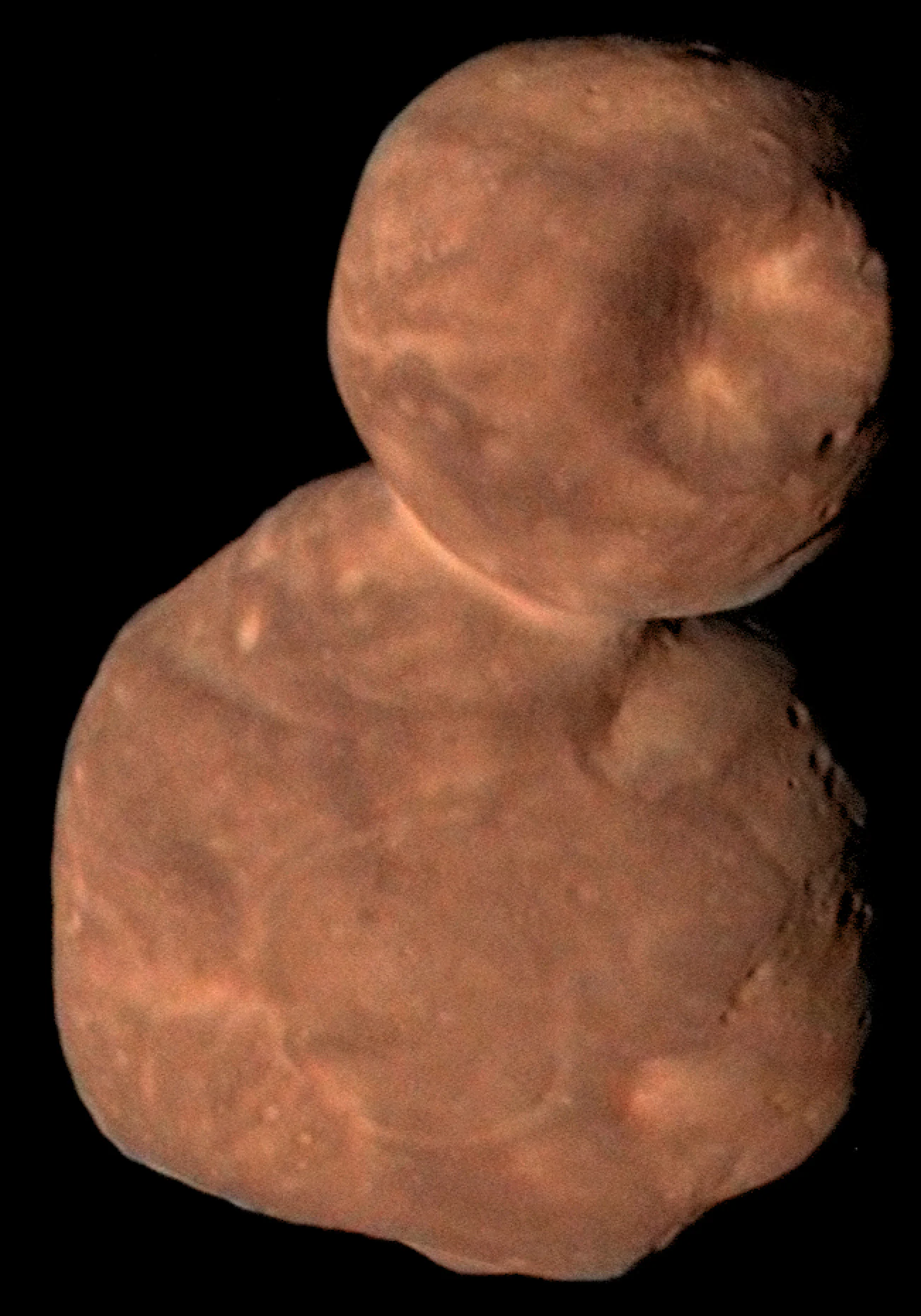






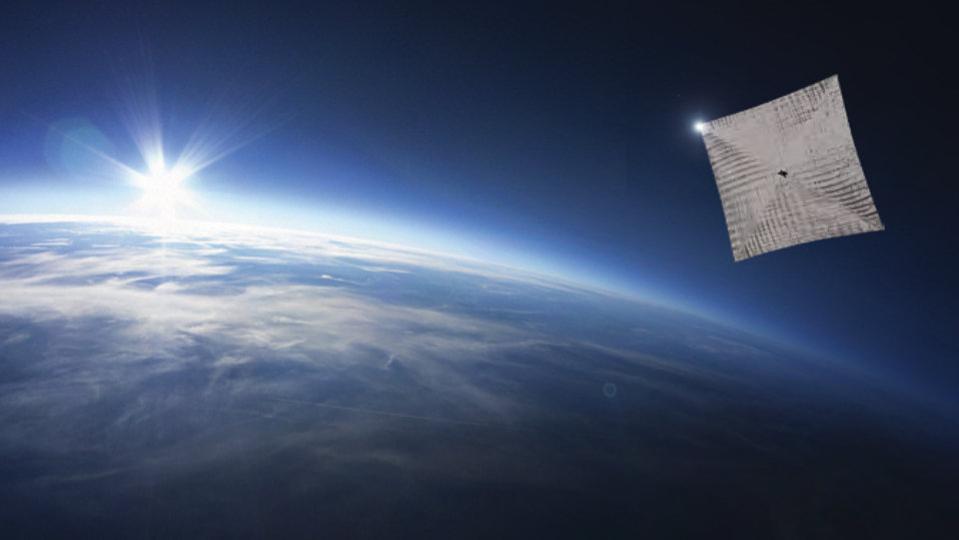
Tantalising radar shadows have revived hopes that one of history’s most beautiful, and controversial, women — Queen Nefertiti — may indeed be buried in secret chambers within King Tut’s famous tomb.
British and Egyptian Egyptologists earlier this week conducted a three-day radar scan of the world-famous tomb discovered by Howard Carter in 1922.
Upon opening its still-sealed door, he declared he saw “wonderful things”. Everywhere was the glint of gold and priceless examples of some of history’s most exquisite art.
But, since then, the tomb has presented something of a mystery.
It was immediately odd that so many of the statues attributed as Pharoah Tutankhamun had hips and breasts. And more recent, closer, examination reveals a significant proportion of the artwork to have been rebadged, and repurposed, from previous rulers.
And that includes his iconic burial mask.
WHAT LIES BENEATH
In 2015, a ground-penetrating scan of the 3300-year-old tomb was conducted by controversial radar technician Hirokatsu Watanabe. He declared he had detected, with “90 per cent certainty”, several hollow spaces along with “metallic” and “organic” objects.
The world erupted in excitement.
Could another extraordinary discovery be tantalisingly within reach?
Would one of Egypt’s greatest mysteries finally be solved?
Egyptologists were immediately doubtful. His radar scan images seemed uninterpretable — just a mass of blue lines with the occasional red dot. Nobody other than Watanabe seemed able to determine what the scans revealed.
So, the Egyptian Antiquities department organised a second scan — this time with the assistance of National Geographic — in 2016. It found … nothing.
“If we had a void, we should have a strong reflection,” geophysicist Dean Goodman of GPR-Slice software told National Geographic News. “But it just doesn’t exist.”
The locations of speculative chambers have been supported by infra-red and radar scans of Tut’s tomb.
Source:Getty Images
THIRD TIME LUCKY?
The Egypt Independent reports the latest scan of Tut’s tomb concluded on Wednesday.
Egyptian technicians from the Centre for Sound Vibration and Smart Structures at the Faculty of Engineering, Ain Shams University, joined a team from the English Terravision Centre to scour the rock for any trace of hidden chambers.
It’s part of an assessment that is due to be completed by the end of the year.
Egyptian archaeologist Francis Amin told the Egypt Independent the most recent radar survey, conducted by the University of Turin, had revealed spaces behind the walls.
But the resolution of the images did not confirm if these were man-made or natural cavities in the rock.
“The results of previous radar surveys have found evidence of the existence of spaces and organic material behind the walls of the cemetery,” Amin said. He added that specialist chemists will need to help analyse the radar survey results.
BOY KING OR PR STUNT?
Pharaoh Tutankhamun’s tomb doesn’t follow the well-established pattern applied to other Egyptian god-kings. It’s unusually small. And it is shaped more like a burial chamber intended for a queen. And why do so many of the statues and images attributed as King Tutankhamun have feminine hips and breasts?
Some have theorised Tutankhamun suffered from his royal inbreeding and had deformities such as breasts and female hips.
Source:Supplied
British Egyptologist Nicholas Reeves put these clues together, including the discovery of partially erased royal names, to suggest the tomb — and much of its contents — was initially intended for Tut’s stepmother, Nefertiti.
Dr Reeves’ 2015 academic paper The Burial of Nefertiti quickly grabbed international attention.
About the same time, a high-resolution 3D laser scan made to help preserve the tomb indicated there may be “hollows” hidden behind the tomb’s plasterwork and paintings. Were these sealed doors?
“The implications are extraordinary: for, if digital appearance translates into physical reality, it seems we are now faced not merely with the prospect of a new, Tutankhamun-era storeroom to the west; to the north appears to be signalled a continuation of tomb … and within these uncharted depths an earlier royal interment — that of Nefertiti herself, celebrated consort, coregent, and eventual successor of pharaoh Akhenaten,” Dr Reeves wrote.
While the evidence was circumstantial, it was enough to pique the interest of the Egyptian Antiquities department to invite Dr Reeves — and others — to examine the tomb more closely.
“Each piece of evidence on its own is not conclusive but put it all together, and it’s hard to avoid my conclusion,” Dr Reeves said. “If I’m wrong, I’m wrong, but if I’m right, this is potentially the biggest archaeological discovery ever made.”
British archaeologist Nicholas Reeves believes the new chamber could be the last resting place of Queen Nefertiti, King Tut's mother-in-law.
Source:Supplied
GREAT EXPECTATIONS
Dr Reeves has been chasing Nefertiti’s ghost for almost two decades.
In 2000, Dr Reeves led a radar examination of the ground around Tutankhamun’s tomb in a search for Nefertiti’s burial. He reported finding a “void”. But digs failed to locate anything.
His continued enthusiasm, however, has proven contagious.
In 2016, Egypt’s tourism minister enthused: “We do not know if the burial chamber is Nefertiti or another woman, but it is full of treasures … It will be a ‘Big Bang’ — the discovery of the 21st century.”
An interior view of the King Tutankhamun burial chamber in the Valley of the Kings, Egypt.
Source:AAP
So far, the Big Bang hasn’t happened.
And Egyptian Antiquities Minister Khaled El-Enany has insisted no invasive exploration would be allowed to damage the priceless tomb. “It is essential to perform more scans using other devices and more technical and scientific methods,” Mr El-Enany said.
The challenge has since been one of developing the technology capable of achieving that task.
Former Egyptian antiquities minister and high-profile archaeological personality Zahi Hawass has long been a sceptic of the hidden chamber theory.
“If there is any masonry or partition wall, the radar signal should show an image,” he reportedly told National Geographic News.
“We don’t have this, which means there is nothing there.”
Jamie Seidel is a freelance writer. Continue the conversation @JamieSeidel