Ontdek de Fascinerende Wereld van UFO's en UAP's: Jouw Bron voor Onthullende Informatie!
Ben jij ook gefascineerd door het onbekende? Wil je meer weten over UFO's en UAP's, niet alleen in België, maar over de hele wereld? Dan ben je op de juiste plek!
België: Het Kloppend Hart van UFO-onderzoek
In België is BUFON (Belgisch UFO-Netwerk) dé autoriteit op het gebied van UFO-onderzoek. Voor betrouwbare en objectieve informatie over deze intrigerende fenomenen, bezoek je zeker onze Facebook-pagina en deze blog. Maar dat is nog niet alles! Ontdek ook het Belgisch UFO-meldpunt en Caelestia, twee organisaties die diepgaand onderzoek verrichten, al zijn ze soms kritisch of sceptisch.
Nederland: Een Schat aan Informatie
Voor onze Nederlandse buren is er de schitterende website www.ufowijzer.nl, beheerd door Paul Harmans. Deze site biedt een schat aan informatie en artikelen die je niet wilt missen!
Internationaal: MUFON - De Wereldwijde Autoriteit
Neem ook een kijkje bij MUFON (Mutual UFO Network Inc.), een gerenommeerde Amerikaanse UFO-vereniging met afdelingen in de VS en wereldwijd. MUFON is toegewijd aan de wetenschappelijke en analytische studie van het UFO-fenomeen, en hun maandelijkse tijdschrift, The MUFON UFO-Journal, is een must-read voor elke UFO-enthousiasteling. Bezoek hun website op www.mufon.com voor meer informatie.
Samenwerking en Toekomstvisie
Sinds 1 februari 2020 is Pieter niet alleen ex-president van BUFON, maar ook de voormalige nationale directeur van MUFON in Vlaanderen en Nederland. Dit creëert een sterke samenwerking met de Franse MUFON Reseau MUFON/EUROP, wat ons in staat stelt om nog meer waardevolle inzichten te delen.
Let op: Nepprofielen en Nieuwe Groeperingen
Pas op voor een nieuwe groepering die zich ook BUFON noemt, maar geen enkele connectie heeft met onze gevestigde organisatie. Hoewel zij de naam geregistreerd hebben, kunnen ze het rijke verleden en de expertise van onze groep niet evenaren. We wensen hen veel succes, maar we blijven de autoriteit in UFO-onderzoek!
Blijf Op De Hoogte!
Wil jij de laatste nieuwtjes over UFO's, ruimtevaart, archeologie, en meer? Volg ons dan en duik samen met ons in de fascinerende wereld van het onbekende! Sluit je aan bij de gemeenschap van nieuwsgierige geesten die net als jij verlangen naar antwoorden en avonturen in de sterren!
Heb je vragen of wil je meer weten? Aarzel dan niet om contact met ons op te nemen! Samen ontrafelen we het mysterie van de lucht en daarbuiten.
During the streamed launch of SpaceX Starlink 3/18/2020, during the decent of first stage rocket and seconds before the re-entry burn, an object is seen from under the rocket. The object is either stationary and the rocket is falling passed it or the object is traveling in a vertical direction (unknown if up or down). It appears to have the shape of a dodecahedron and silver-grey metallic surface that is reflective (yet not mirror reflective). This object was Danger close to their reentry vehicle and would expect some sort of report on it.
Paul Kyberd, Senior Lecturer in Particle Physics Informatics, Brunel University London
The fact that we are here at all is one of the greatest puzzles of physics. We are made from normal particles such as electrons, but every such particle also has an antimatter companion that is virtually identical to itself, but with the opposite charge. When matter andantimatter come into contact, they annihilate each other in a flash of light.
Physics suggests that matter and antimatter were created in almost equal quantities in the Big Bang. So how come there’s almost only matter left today – why didn’t the matter and antimatter annihilate each other to render the universe lifeless? Our new research has enabled scientists to build a new type of accelerator, based on particles called muons, that could help us find out.
A muon is almost identical to an electron, except that it is 207 times heavier. What’s more, it decays into other particles in two millionths of a second. This lifetime, although short for us, is quite a long time for an unstable fundamental particle, and this explains why muons make up almost all the charged cosmic rays which reach the Earth’s surface.
Much of our ability to investigate the structure of matter at the shortest distances depends on creating beams of particles and accelerate them to high energies. However there are only four stable particles which can be used in this way, the electron and its anti-particle (positron), and the proton and its antiparticle (antiproton).
Particle beams consisting of those have been used for many years, yet both of these pairs have drawbacks. The electron and its partner are very light – when we try to accelerate them, they radiate electromagnetic energy. This is can be useful for applications such as TV but makes it hard to reach the sort of energies which we need to improve our understanding of the universe.
Unlike electrons, the proton and the anti-proton are made up of more fundamental particles – quarks and gluons. In a collision between a proton and anti-proton it is these fundamental particles which actually collide, resulting in a lower energy crash than you would have got if protons had been truly fundamental particles.
Each particle also has an antiparticle, not included here. (Image credit: Publicdomainpictures.net)
The muons are heavy enough that they radiate much less energy, but fundamental (not made up of smaller particles) so that all their energy is available for the investigation. When scientists created the Nobel-prize winning Higgs particle with protons, they needed a machine 10km in diameter: the Large Hadron Collider. A muon machine, however, could achieve this with a circumference of just 200 metres.
The disadvantage of muons is that, unlike electrons and protons, they are unstable and need to be produced and then rapidly used before they all decay. We can produce muons by taking a narrow, high-intensity beam of protons and running it into a target made of a metal, such as titanium. This produces a beam of another fundamental particle called the pion.
Pions form a beam which fans out. If the original proton beam looks like a laser pointer, the pion beam looks more like a torch beam – with intensity dropping rapidly with distance. The pions then decay to produce the muons, meaning the beam spreads even more – resembling a light bulb.
We cannot accelerate such a beam in a machine like the LHC, so we need to create a beam which spreads out much less. This is challenging given that we have only have two millionths of a second to produce, accelerate and collide it.
But our team of physicists and engineers, from around the world – known as the Muon Ionisation Cooling Experiment (MICE) – has now shown that it is possible. We used a process known as cooling to help compress the beam. This involves passing the muons through a container with liquid hydrogen at -250°C, slowing the particles down. We then passed them through an electromagnetic cavity, which caused the beam to accelerate in the required direction.
By repeating this several times it is possible to create a beam which spreads out much less and has a dense core. This beam can be injected into a particle accelerator to produce a high-energy muon beam. Such a beam can either be collided or left to circulate until the muons decay into an intense beam of neutrinos – far in excess of any neutrino beam which can currently be produced.
Probing the universe
In fact, a neutrino beam created from muons is part of a planned Neutrino Factory, which would allow us to answer many questions related to the origin and evolution of the universe – such as the mysterious imbalance between matter and antimatter.
Neutrinos could also help us understand the details of how life-essential elements such as oxygen, carbon and silicon, which are formed in stars, spread across universe. These heavier elements were not produced in the Big Bang and yet are responsible for the planet we live on and all the life around us. We know that bursts of neutrinos, which are released in star explosions (supernovas), are responsible.
We could also collide two beams of muons in the same way as we collide protons at the LHC. The muons, being simpler than the protons, would allow for more precise determination of the properties of the Higgs particle, for example.
The properties of the muon also makes it an invaluable tool in the field of material physics. The ability to create more closely focused beams may improve the current measurements and open up new diagnostic methods.
Our method may also be used to help increase the intensity of any other charged particle beams. It has been a long project lasting over a dozen years, but it has been worth the effort when we consider what a powerful tool we have created.
Follow all of the Expert Voices issues and debates — and become part of the discussion — on Facebook and Twitter. The views expressed are those of the author and do not necessarily reflect the views of the publisher
CURIOSITY’S AWESOME 360-DEGREE VIDEO MAKES YOU THINK YOU'RE STANDING ON MARS
We may havelost an Opportunity on Mars, but that isn’t holding Curiosity back. After hanging out at Vera Rubin Ridge on Mount Sharp since 2017, NASA’s Curiosity rover is crawling over the dusty terrain of the Red Planet again — but not before the Curiosity team released a panoramic video that will really make you think you’re standing right there in moon boots (because we don’t know what Mars boots look like yet).
For some perspective, I took this shot of the clean room within which Curiosity and its accompanying spacecraft were built back in 2011. One can see the heat shield being built toward the right (the white dome) while the rover sits behind it, its black legs sprawling out without wheels (at the time).
The video not only gives you a 360-degree view of Mars from the rover’s point of view, but also a closeup of the dust and regolith its wheels have to contend with as it explores what could be a future destination for astronauts. You can see why the drill site it’s standing on is appropriately nicknamed “Rock Hall”. The feeling of actually standing on a planet some 34 million miles from Earth is kind of mind-blowing.
Gaze out into the distance and you will experience a view of the ruddy peak of Mount Sharp, which the rover has been relentlessly climbing since 2014. You can also see the geological features that are Curiosity’s next destinations, including Glen Torridon, which the team believes is a “clay-bearing unit”, and the floor of Gale Crater, from which Mount Sharp rises.
In the wake of Curiosity taking off from Vera Rubin Ridge, the team is using its data in an attempt to figure out how exactly the ridge formed. It has mysteriously resisted erosion while the bedrock was slowly worn away by solar radiation blasts and other factors.
There is still no definite answer as to why the ridge itself has refused to go down, but Curiosity’s observations provided proof that the rocks on the ridge came into being from sediment settling in a lake that evaporated eons ago.
"We've had our fair share of surprises," Curiosity science team member Abigail Fraeman said. "We're leaving with a different perspective of the ridge than what we had before."
Curiosity has also unearthed proof of ancient water on Mars. The rover teamed up with a NASA orbiter exploring Vera Rubin Ridge from above, and when the orbiter picked up on a strong signal for hematite, which often forms in water, Curiosity zoomed in closer. It was able to not only confirm the presence of hematite but also find crystals and other evidence of groundwater that had long since dried up. Because these mineral deposits appeared in patches, the team believes that the flow of groundwater had different impacts on various parts of the ridge.
What the rover saw didn’t always match the view from space. This is why you need more than one robotic eye when it comes to studying the geology of another planet.
"The whole traverse is helping us understand all the factors that influence how our orbiters see Mars," said Fraeman. "Looking up close with a rover allowed us to find a lot more of these hematite signatures. It shows how orbiter and rover science complement one another."
Curiosity has also discovered organic molecules, which may or may not mean that Mars ever supported life, but it could have at least been habitable if the vast desert we see now was once a lush alien paradise. From the POV of that video, even the desert is fascinating.
DIERENIn 2017 zijn er plotseling 900.000 pinguïns van de aardbol verdwenen. Terwijl er eerst meer dan een miljoen koningspinguïns op het onbewoonde eiland Île aux Cochons leefden, waren dat er in 2017 amper 200.000. Zelfs drie jaar later houdt het mysterie biologen nog steeds bezig.
Ile aux Cochons is een onbewoond eiland, gelegen in de zuidelijke Indische Oceaan. Het ligt ergens tussen Madagaskar en Antarctica, en het was de thuis van wel 500.000 koppels koningspinguïns, de op een na grootste pinguïnsoort met een gele kraag. De kolonie op Île aux Cochons was daarmee ook de op een na grootste kolonie ter wereld. Totdat er plots 900.000 pinguïns verdwenen. Plots, zonder enig spoor na te laten. Dat moest blijken uit enkele satellietbeelden, want het eiland is zeer moeilijk bereikbaar.
Maar omdat het mysterie zo groot is, beslisten enkele onderzoekers van het Centre national de la recherche scientifique (CNRS) om een nieuwe expeditie te organiseren, de eerste naar het onbewoonde eiland in 37 jaar tijd.
Een vijftal maanden geleden, in november 2019, werden de onderzoekers met een helikopter gedropt op het afgelegen eiland. Ze hadden in totaal zo’n 700 kilogram aan onderzoeksmateriaal met zich meegebracht en arriveerden te midden van het broedseizoen. Die periode voeren vader en moeder pinguïn continu afwisselende taken uit: terwijl de ene de eieren uitbroedt, gaat de andere op zoek naar voedsel. Om de jacht naar voedsel te ‘tracken’ bevestigden de onderzoekers enkele elektronische tags bij tien verschillende pinguïns.
Er werden stalen bloed genomen, om te controleren op ziektes. En de onderzoekers controleerden of er plotseling roofdieren aanwezig waren op het eiland. Zo werden er nachtcamera’s geïnstalleerd in de buurt van de broedende pinguïns om de aanwezigheid van andere dieren te checken. Daarnaast bestudeerden ze de botten van enkele dode dieren om die te testen op veranderingen in het voedselpatroon van de pinguïns. Dat bleek niet zo te zijn.
Ook was er geen sprake van roofdieren die de pinguïns fataal zijn geworden. En in het bloed van de dieren werden geen aanwijzingen gevonden voor ziektes. De levende pinguïns zagen er overigens gewoon gezond uit.
Wat gebeurde er dan wel met de, bijna 1 miljoen, verdwenen pinguïns? Bij het afronden van hun (eerste onderzoek) kunnen de Franse biologen het nog niet met zekerheid zeggen, maar vermoedelijk leidden veranderingen in de omgeving tot het verlies van de pinguïns. Omdat de oceanen opwarmen, wordt het voedsel schaarser en moeten pinguïns steeds verdere zwemmen. Zo blijkt uit de data die de bevestigde tags registreerden, dat de zoektocht naar voedsel hen hen tot wel 500 kilometer ver kan brengen. Zo’n tocht kan er evengoed een zijn waarvan ze nooit meer terugkeren, zo stellen de onderzoekers.
Among the cases of supposed UFO crashes, the infamous one at Roswell, New Mexico, seems to always take the spotlight. After all, this is the event that even people who know nothing of the UFO phenomenon at large know about, so iconic is it in scope. Yet, what many people might not realize is that Roswell is by far not the only supposed UFO crash in history, and not even the earliest. One very intriguing report comes from many years before the Roswell incident, and while not as famous, it is every bit as strange.
The story goes that in the spring of 1941, a Reverend William Huffman, of the Red Star Baptist Church in Cape Girardeau, Missouri, was asked by the local Sheriff to come and help give last rites to the victims of a plane crash on the outskirts of town. Huffman then dutifully made his way out to the supposed crash site to find the place crawling with police, FBI agents, fire fighters, and military medical personnel who were all buzzing around a twisted mass of metal wreckage. At this point it seemed as if this was exactly as he had been told, a plane crash, but things would soon take a turn for the bizarre.
The reverend soon noticed that some of the pieces of the crashed craft were not as one would expect, and that rather than jagged as one would suspect, they seemed to have “a rounded shape with no edges or seams, and a very shiny, metallic finish.” This was decidedly odd, and did not seem to be a typical airplane, yet as he examined the wreckage further it got even weirder still. Charlette Mann, the reverend’s granddaughter and the one who first brought the case to attention after being told the story by her grandmother on her deathbed, would tell UFO researcher Leonard Stringfield of what he had seen in that wreckage thusly:
Upon arrival it was a very different situation. It was not a conventional aircraft, as we know it. He described it as a saucer that was metallic in color, no seams, did not look like anything he had seen. It had been broken open in one portion, and so he could walk up and see that. In looking in he saw a small metal chair, gauges and dials and things he had never seen. However, what impressed him most was around the inside there were inscriptions and writings, which he said he did not recognize, but were similar to Egyptian hieroglyphics.
Taking this further into the realm of the outlandish was when Huffman was allegedly asked to come look at and pray over three dead bodies, but these did not appear to be human. The beings were described as being of almost childlike stature, with hairless large heads, big oval-shaped eyes, incredibly long arms and fingers, tiny mouths and ears, no discernible noses, and dressed from head to toe in what seemed to be a shiny material like “wrinkled aluminum foil.” Mann says of the state of the bodies:
There were 3 entities, or non-human people, lying on the ground. Two were just outside the saucer, and a third one was further out. His understanding was that perhaps that third one was not dead on impact. There had been mention of a ball of fire, yet there was fire around the crash site, but none of the entities had been burned and so father did pray over them, giving them last rites.
Huffman purportedly did administer last rites to these strange creatures, after which he was approached by some military personnel and told in no uncertain terms to keep it all total secret. He doesn’t seem to have done a very good job of this, because he apparently went home and immediately told his family what he had seen. However, they would not say a word about it to anyone, and Huffman’s wife would keep it all to herself until she came down with cancer and on her death bed in 1984 confided in Mann of what he had told them on that strange day, and she had apparently even seen a picture of one of the alien bodies, which was in the possession of her father. She has said of this picture:
Well, the first awareness that I had of it (the dead bodies) is actually a picture that my father had and it was at a dinner party. And, I had heard rumors, and bits and pieces over conversations, but it was a picture, an old picture, because it had … it was like the old Kodaks, with little lines and scallops around it. There were two men holding up a non-human, is the best way I can describe it. A little entity, a little person who appeared to be about 4 feet tall. They had him underneath the armpits with arms outstretched on either side of him.
When Stringfield heard the story of the crash he immediately launched an investigation into the case. Stringfield found that other living witnesses such as Mann’s sister and the living brother of the Cape Girardeau County sheriff in 1941 were both able to corroborate the story. He also was able to uncover fire department records of a plane crash in the area at the specified time, and he even managed to track down a photograph of the alleged alien, which was kept by Guy Huffman, the reverend’s son and Charlette’s father. Stringfield would publish his findings in an article for the UFO publication Status Report, and he would later include the account in his book UFO Crash / Retrievals: The Inner Sanctum.
It is hard to know what to make of this case. The account comes from a woman who got it from her grandmother, who got it from her grandfather, so already we have this as a third hand account at best. Stringfield found that others corroborated the account, but that still leaves the chance that Huffman himself was spinning tall tales. There is evidence that a crash did happen at the time, but it is clearly and unambiguously described as an airplane crash, with no mention of dead alien bodies. The photograph that Mann and Stringfield claimed to have seen remains elusive, and no one has been able to track it down, leaving it in limbo. There just doesn’t seem to be much solid evidence that this ever happened, and yet what if it did? Was this another Rosewell UFO crash that in this case managed to slip between the cracks and be successfully brushed under the carpet by the government? What did Huffman encounter out there, if anything? These are questions destined to remain unanswered, and this story of a lesser known UFO crash will probably remain even more shrouded in shadows than its more famous cousin.
Out in the West Texas town of El Paso I fell in love with a Mexican girl Nighttime would find me in Rosa’s Cantina Music would play and Feleena would whirl
El Paso, Texas, owes a debt of gratitude to the late country singer Marty Robbins for writing and recording a song that was his best and still the best-loved song about the West Texas city. (Sing along with Marty here.) However, it was released in 1960 and a lot has happened since then in El Paso beyond gunfights over a beautiful girl. Maybe it’s time for a new song about the latest phenomenon to hit El Paso – UFOs. Garth, Keith, Miranda, Carrie … are you listening?
A video of an alleged fleet of UFOs flying over El Paso on March 17, 2020, was uploaded by the YouTube channel The Hidden Underbelly 2.0, which regularly posts a variety of paranormal videos. This one is said to have come from a Mario Rios who was driving at 7:15 pm on an unnamed El Paso freeway when he spotted the lights moving slowly low in the sky. That’s about all an excited Mario has to say about them. (Watch the video for yourself here.) While you ponder what you think the lights might be, here’s what Hidden Underbelly 2.0 has to say.
“In this footage, we can see these red orbs following some sort of flight path as they go over this building. Now, I know we could write these off as Chinese lanterns, but they don’t seem to be flickering and seem to be following a path. If you look at the two at the front, they seem to be very tight together. It’s not so easy to write this off as Chinese lanterns. And also, Mario does sound a bit scared.”
Yes, that’s a good argument against Chinese lanterns, especially as bright as these lights are at the distance they seem to be recorded from. There’s too many to be Venus or another planet and they’re too bright to be Elon Musk’s satellites that have been mistaken for UFOs so often recently. Space force testing? Aliens? There’s a lot to be scared or anxious about these days, so Mario’s excited voice can be excused, but that doesn’t mean he’s looking at alien spaceships.
Out through the back door of Rosa’s I ran Out where the horses were tied I caught a good one, it looked like it could run Up on its back and away I did ride Just as fast as I could From the West Texas town of El Paso Out to the badlands of New Mexico
Marty Robbins’ El Paso cowboy had a good reason for jumping on a horse and riding out of town … murder charges. These El Paso orbs could be law enforcement as well – El Paso is a Mexican border town and there are plenty of police and DEA helicopters patrolling the area, but four at a time? And moving so slowly?
What about weather balloons? A UFO over El Paso in December 2019 was eventually identified as one of those, but they usually ride alone like the guy in the song. There was another ‘fleet’ of UFOs seen by many people in El Paso in January 2020. Those turned out to be flares – not surprising since El Paso is home to Fort Bliss, the huge U.S. army base known for missile and artillery training and testing. It’s most likely that those are what Mario saw, although no one has offered definitive proof.
That shouldn’t stop any aspiring country songwriters from penning lyrics to a tune called “UFOs Over El Paso.” Here’s a start to the music of the Marty Robbins classic …
Over the skies of the town of El Paso UFOs flying, my eyes opened wide Looked at my pickup and boy was I jealous I hoped they’d see me and give me a ride.
13,000 Year Old Black Knight Satellite UFO That NASA Knows About
13,000 Year Old Black Knight Satellite UFO That NASA Knows About
Something highly secret is being monitored by NASA, an ancient satellite orbiting earth that’s not ours! First detected by Nikola Tesla and then by astronomers around the world, this strange polar orbiting craft may still be producing signals…
Presented by David Wilks at Awakening UFO & Conspicuous Life Expo, Manchester, UK.
Bright elongated UFO releases orbs filmed by plane passenger
Acommercial airliner is flying at a high altitude when a passenger notices an elongated UFO in the sky on which he decided to film it.
Although the location and date of the sighting is unknown, the first part of the video shows the original footage captured by the passenger. With the second part slowed down and enhanced you will be able to see the orbs form a triangle.
Could it be that this unidentified flying object is a secret craft equipped with the latest cloaking technology tested by the military similar to the infamous tic-tac UFOs?
Farmington reaches 70th anniversary of mass UFO sighting
Mike EasterlingFarmington Daily Times
The front page of The Daily Times on March 18, 1950, chronicles the appearance of several strange objects in the sky above Farmington.
Courtesy image
FARMINGTON — Farmington has reached the 70th anniversary of one of the more sensational events in its history this week, but it's a safe bet to say few residents will pay much attention to that milestone – or even be aware of it.
From March 16 to March 18 in 1950, the city experienced a mass UFO sighting, with some reports indicating "hundreds" of residents saw strange objects in the sky in broad daylight over the three-day period.
Their accounts were reported in breathless fashion not just in this publication — "HUGE 'SAUCER' ARMADA JOLTS FARMINGTON" screamed the banner headline on page 1 of The Daily Times on March 18, 1950 – but in many others as well. Those include The Santa Fe New Mexican ("Farmington 'Invaded' by Saucer Squadron") and the Las Vegas (New Mexico) Daily Optic ("'Space Ships' Cause Sensation").
An account of the incident by The Associated Press was picked up by newspapers across the country.
It's a fantastic story, one that might have seemed destined to leave an indelible impression on UFO history and the sizable community of amateur sleuths and researchers who have made it their duty to investigate and publicize such incidents.
And, yet, the Farmington UFO incident of 1950 largely has been lost to history, especially when it is compared to its in-state counterpart, the famed, alleged crash of an alien spacecraft on a ranch northwest of Roswell in June 1947.
While that incident — sketchy as its details may be — is widely regarded as the most famous UFO-related event in history, having achieved legendary status over the years, the Farmington event that took place a few years later barely registers on anyone's radar.
With seven decades having passed, that remains true, even though Farmington's brush with UFO fame, or infamy, holds up to scrutiny far better than most other incidents, many of them much better known. That's the assessment of an Albuquerque man who studies such phenomena, but who acknowledges the need to take a skeptical approach to most UFO reports.
David Marler
Courtesy photo
David Marler, an independent UFO researcher and author who works in the health care field, has spent years studying the Farmington UFO incident, delivering his findings in the form of a website that serves as the most exhaustive and in-depth report on the event. He labels it "one of the most dramatic and well-documented cases in the history of UFO phenomenon" and said his research has uncovered dozens of similar sightings in the American Southwest, Mexico and Central America during that same time period.
"There was a lot more other than Farmington going on (during March 1950)," he said.
Marler isn't alone in feeling compelled to gain a better understanding of the incident. Many people who take a keen interest in the history of San Juan County share that fascination, and some of them have direct ties to the mass sighting that has become part of their family lore.
Patty Tharp of the San Juan County Historical Society is the niece of one of the witnesses to the incident, Clayton Boddy, who served as the business manager of The Daily Times in 1950. She recalls her late uncle regularly talking about the sighting when she was growing up and said the tale of the UFO armada is well known among the county's older residents.
She remembers her uncle as a man not given to exaggeration, and said he wasn't the kind to call attention to himself by manufacturing outlandish stories. He definitely believed he witnessed something out of the ordinary that day, Tharp said.
"He described the object and said several other people saw it, as well," she said.
A well-documented event
Marler said there are several elements that separate the Farmington UFO incident from so many others, mostly the fact that so many people claim to have witnessed it. The sightings took place between 11 a.m. and noon each day in the skies over San Juan County, not at night in some remote location where they were witnessed by only a single person or a handful of people.
Farmington was a much smaller community in those days — it had a population of between 3,600 and 5,000 people then, according to Marler — but the incident was by no means restricted to just a few sets of eyeballs. Marler also notes the sightings were thoroughly documented and reported in various newspapers at the time, and references to it exist in a great many government documents, as well.
The Daily Times' account chronicles how pedestrians along Main Street could be seen looking skyward and pointing, and the paper reportedly was "deluged" with calls from readers reporting the objects, although the story explains that high winds and a dust storm prevented clear vision.
The account explains how the objects appeared to play tag, traveling at "almost unbelievable speeds." The paper quoted Boddy, a former Army captain, who said he was on Broadway Avenue when he became aware of the phenomenon.
"All of a sudden, I noticed a few moving objects high in the sky," he is reported as having said. "Moments later, there appeared to hundreds of them."
Boddy declined to estimate the size or speed of the objects, but he said they appeared to flying at an altitude of approximately 15,000 feet.
Several other witnesses were quoted in the story, as well, including merchants, housewives, mechanics, insurance agents and Harold F. Thatcher, head of the Farmington unit of the Soil Conservation Service. Thatcher was quoted as emphatically denying a theory that the objects people had seen were bits of cotton floating in the air.
Many of those witnesses reported seeing a single red object that appeared to be leading the others. In his investigation of the incident, Marler would go on to dub that object "Red Leader" — a reference he believed "Star Wars" fans would appreciate.
Also quoted in The Daily Times story was Marlo Webb, then a 26-year-old manager in the parts department at the Perry Smoak Chevrolet Garage on Main Street in downtown Farmington. Webb told the paper he estimated the objects were small, about the size of a dinner plate, and noted the objects moved in an unusual way — "sideways, on edge and at every conceivable angle," he said. "This is what made it easy to determine that they were saucer-shaped."
Webb's testimony lends the event considerable credibility. He went on to become the town's mayor in the 1970s and now, at the age of 96, serves as chairman of the boards at Farmington's Webb Chevrolet, where he still works nearly every afternoon.
Webb seems willing enough to discuss his memory of the incident these days with anyone who asks. But, as a World War II Naval aviator used to seeing unusual things, he seems to regard the event as little more than a curiosity.
"I know how easy it is to be deceived by something in the sky," he said.
In fact, when he was contacted by The Daily Times last week, Webb said he had no idea the 70th anniversary of the incident was approaching and insisted he couldn't remember the last time he had thought about it.
"I can tell you everything I know about it in five seconds because I don't know much," he said.
Webb said he was working at his stepfather's Chevy dealership across the street from the Totah Theater on March 17, 1950, when someone told him they had seen some saucer-shaped objects in the sky. Webb went out to have a look, and when he turned his eyes to the north, he said he could make out 12 to 20 objects. He said they were loosely arranged, certainly not flying in formation, but moving steadily from east to west.
"They were darting around almost like leaves in the sky being blown around," he said.
Webb watched the objects for approximately 10 to 15 minutes, then went back inside to work.
"I couldn't leave my department uncovered," he said.
He said the duration of the event seemed to last much longer than that, however, because he recalled seeing people on Main Street looking into the sky for a long time afterward. He recalled many of those witnesses seemed a lot more taken by the event than he was, discussing what they had seen for years afterward.
"They almost made a career out of repeating what they saw," he said.
Webb wasn't one of those people.
"I never thought about it," he said, when asked what kind of significance he attached to the event. "There are a lot of things happening in the sky we're not aware of. I just won't waste my energy. I can't do anything about it anyway. … I don't have the background to research it and decide what it is."
Webb said he spoke to a military investigator after the incident and told him the same story. He understands some people want to draw other conclusions from what they've heard about the event, but he said he never felt the urge to do that.
"I've never said what I thought it was or made a judgment on it," he said.
A matter of family history
The Daily Times story about the event quoted approximately a dozen witnesses by name, but numerous other accounts have lived on through accounts passed down among family members.
Zang Wood, former president of the San Juan County Historical Society, was a Farmington High School student in the fall of 1950 and said he never saw a thing.
"A lot of kids said they did," he said. "I don't know if it was mass hysteria or what."
But Wood's mother, who was a San Juan County employee, was driving to work with another woman to Aztec from Farmington that day. When they got to Flora Vista, they said an object appeared above them and passed directly over their car.
"I'm not going to call my mom a liar," he said, recalling her as "a pretty level-headed lady. She didn't see things."
Wood said he doesn't buy the flying saucer stories because he didn't see them himself. But he refuses his dismiss his mother's account.
"If she saw something, she saw something," he said.
Another well-known authority on local history, Marilu Waybourn, author of "Homesteads to Boomtown — A Pictorial History of Farmington, New Mexico, and Surrounding Area," said she was in college in Missouri in the spring of 1950 when the incident took place. But she got an earful about it from her friends when she returned to Farmington at the end of the semester.
Waybourn wound up writing about the mass sighting on its 40th anniversary in the March 1990 edition of CrossCurrents, an independent publication that described itself as "A Journal of Life in the Four Corners."
In her story, Waybourn recounts that she heard the story at least a dozen times after she returned from college, and a group of her friends took her to a location that was purported to be a landing site of one of the objects. She described it as "a large circle, about 60 feet in diameter, with the sagebrush flattened out and singed weeds around the edge."
Waybourn also quoted a Farmington resident named Pauline McCauley who said she was a little girl at the time of the sighting. McCauley said she was herding sheep south of town that day in the spring of 1950 when she heard a sound above her, looked up and spied a circular object that looked like an upside-down bowl. McCauley told Waybourn the object had windows, and she could see three people inside wearing striped caps and navy blue uniforms with brass buttons.
Waybourn heard various other stories over the years, many of them from people who didn't want their names used for fear of being ridiculed. She said the incident sparked a great deal of curiosity at the time and remains a topic of discussion for older folks today.
"They took it for what it was," she said. "That it was something they wanted to know more about."
Rio Rancho resident Ron Boddy, the son of witness Clayton Boddy, said his father talked about the incident occasionally over the years, but he never made a big deal of it.
"The last time I really talked to my dad about that was probably 40 years ago," he said, adding that his father, a veteran of World War II and the Korean War, was not easily impressed. "It was unusual to him, but not earth shattering or life changing."
Ron Boddy said his father was still a major in the Army Reserve at the time of the incident, and he recalled his father getting a phone call later from a military official asking him to refrain from doing any more interviews on the subject.
"I remember him saying he was asked not to bring it up or talk about it," Ron Boddy said.
But the younger Boddy regrets not pressing his father for details about the incident now.
"I wish now, looking back, I wish I had talked to my dad about it more," he said, explaining that he never got the sense his father thought the objects he saw were extraterrestrial in nature.
"To him, it was an unidentified flying object, not a spacecraft," Ron Boddy said.
Tharp, Clayton Boddy's niece, also has taken a keen interest in the event. She said the wire services picked up the stories on the incident from the New Mexico papers, and she has collected clippings that mention her uncle from newspapers all over the country. She agreed with her cousin Ron Boddy that her uncle didn't consider the appearance of the strange objects to be an alien visitation.
"He seemed to think it wasn't something from another planet — that it was a military deal," she said.
What to make of all this?
The quality and quantity of the information surrounding the Farmington UFO event has always impressed Marler. He said the accounts of the witnesses who were quoted in The Daily Times were remarkably consistent, and when those people talked about their memories of that day years later, their stories did not change.
"I'm really struck by the sincerity and honesty of the people I interviewed," he said. "They're not saying they saw flying saucers, but they saw something."
That separates them from the principals in other UFO stories he has investigated, many of whom are not nearly as credible.
"It really smacks of realism," he said, adding that the children of the witnesses he has spoken to unfailingly recall their parents as grounded, level-headed people who weren't looking for attention.
He also notes that an account of a UFO sighting occurred that day in Tucumcari, an event reported in the March 18, 1950 edition of the Tucumcari Daily News, and an Air Force captain and two technical sergeants at Kirtland Air Force Base in Albuquerque reported seeing three strange objects in the sky that afternoon.
Marler also has collected newspaper accounts of UFO sightings from that time period not just across New Mexico, but all over Texas and well into Mexico.
His website explains that, after an official investigation, a government official responded to the public curiosity over the event by claiming the objects that people had seen were the remnants of a ruptured, high-altitude U.S. Navy Skyhook balloon. Marler, who has presented several lectures on his findings, flatly dismisses that theory, explaining that it might have been plausible for one day of UFO sightings, but not three. He also points to research that shows there were no documented Skyhook balloon launches around that time frame.
Given the technological limitations or that era, no photos or film footage of the Farmington incident are known to exist. Marler points out that if such an event were to happen now, there likely would be an abundance of such material. But he takes the mass UFO sighting here much more seriously than he does many other events he has investigated and said he is not sure why it hasn't gotten the attention he thinks it deserves.
He said the Farmington incident is well known in UFO researcher stories, but he acknowledged it is not nearly as well known as the Roswell incident or even the alleged crash of a UFO outside Aztec in 1947 — an event commemorated through an annual mountain bike race and etched in local pop culture.
Through his research, Marler said he has tried to eliminate various possible explanations for what happened in Farmington in the spring of 1950.
"When you eliminate those prosaic explanations, it's like checking off a list," he said. "What you're left with is an unknown. But unknown does not equal extraterrestrial."
The question of why the Farmington incident never captured the public's imagination the way Roswell did is a riddle to Marler and some others interviewed for this story. He gives some credence to the idea that Farmington is a very conventional town and perhaps has collectively downplayed the incident for fear of being labeled the same way Roswell has been.
But Tharp doesn't see it that way.
"I would disagree with that," she said. "Roswell is just as conservative as Farmington. There were so few people in 1950 who lived here. … Maybe it just kind of went by the wayside."
Wood agrees that Farmington is a conservative place that likely would bristle at being associated with little green men. But mostly, he thinks folks here have just decided to leave the incident behind.
"It's just like so many other things," he said. "Just like coronavirus — they'll talk about it for a year, then move on. … We have other things to worry about."
Mike Easterling can be reached at 505-564-4610 or measterling@daily-times.com.
For years, amateur astronomers have been waiting for a bright, naked-eye comet to pass by Earth— and finally, such an object may have arrived.
The possible celestial showpiece is known as Comet ATLAS, or C/2019 Y4. When it was discovered on Dec. 28, 2019, it was quite faint, but since then, it has beenbrightening so rapidly that astronomers have high hopes for the spectacle it could put on. But given the tricky nature of comets, skywatchers are also being cautious not to get their hopes up, knowing that the comet may fizzle out.
It's been awhile since a comet gave skywatchers a good show, particularly in the Northern Hemisphere. In March 2013, Comet PanSTARRS was visible right after sunset, albeit low in the western sky. But although it briefly attained first magnitude with a short, bright tail, its low altitude and a bright, twilight sky detracted from what otherwise would have been a much more prominent object. Comet Lovejoy in 2011 and Comet McNaught in 2007 both evolved into stunning objects, but unfortunately, when at their best, were visible only from the Southern Hemisphere.
It has now been nearly a quarter of a century since we have been treated to a spectacularly bright comet: Comet Hale-Bopp passed by during the spring of 1997 and Comet Hyakutake did so exactly one year earlier. Both were truly "great" comets, very bright and fantastically structured; in very dark conditions, Hyakutake's tail appeared to stretch more than halfway across the sky.
So now, after a "comet drought," Comet ATLAS may finally enliven the evening skies of early spring. Or then again, maybe not.
When astronomers first spotted Comet ATLAS in December, it was in Ursa Major and was an exceedingly faint object, close to 20th magnitude. That's about 398,000 times dimmer than stars that are on the threshold of naked-eye visibility. At the time, it was 273 million miles (439 million kilometers) from the sun.
But comets typically brighten as they approach the sun, and at its closest, on May 31, Comet ATLAS will be just 23.5 million miles (37.8 million km) from the sun. Such a prodigious change in solar distance would typically cause a comet to increase in luminosity by almost 11 magnitudes, enough to make ATLAS easily visible in a small telescope or a pair of good binoculars, although quite frankly nothing really to write home about.
Except, since its discovery, the comet has been brightening at an almost unprecedented speed. As of March 17, ATLAS was already magnitude +8.5, over 600 times brighter than forecast. As a result, great expectations are buzzing for this icy lump of cosmic detritus, with hopes it could become a stupendously bright object by the end of May.
Another factor buoying hopes for ATLAS as a potential dazzler is that its orbit is nearly identical to that of the so-called Great Comet of 1844.
Like the 1844 comet, ATLAS follows a trajectory that would require 6,000 years per orbit and take it to beyond the outer reaches of the solar system, roughly 57 billion miles (92 billion km) from the sun. Probably in the far-distant past, a much larger comet occupied this same orbit, but fragmented into several pieces — including the 1844 comet and ATLAS — upon rounding the sun.
But any comparison is dangerous. The 1844 comet was not discovered until shortly after perihelion, so we have no knowledge of its brightness behavior beforehand. But that information is currently all we know about ATLAS, and we won't be able to see the object after it reaches the sun.
And let's not forget some of the comets of the past that seemingly had "glory" written all over them, only to utterly fail to live up to expectations: Comet ISON in 2013, Comet Austin in 1990 and Comet Kohoutek in 1974.
So what's ahead?
John Bortle, who has observed hundreds of comets and is a well-known expert in the field, got his first look at Comet ATLAS through 15 x 70 binoculars on Sunday night (March 15). And he's stumped, he wrote. "For the first time in many years I am left at a bit of a loss as to what honestly worthy advice I can offer would-be observers. I really don't know quite what to make of this object."
The head (or coma) of Comet ATLAS is big, albeit "very faint and ghostly," Bortle said, which doesn't make sense. "If it's a truly significant visitor, it should be considerably sharper in appearance. Instead we see, at best, a quite modestly condensed object with only a pinpoint stellar feature near its heart."
The unpredictability of comets is an old story. Astronomers use special formulas to try to anticipate how bright a comet will get. Unfortunately, comets' individual behavior and characteristics can be as varied as people: No two are alike.
Now, here is the conundrum regarding Comet ATLAS: Until a couple of weeks ago, it was brightening at an astounding rate. That brightening has slowed somewhat, but it is still an impossible rate of brightening to maintain. Were ATLAS to continue to brighten at this rate all the way to its closest approach to the sun at the end of May, it would end up rivaling the planet Venus in brightness!
"We should expect the rate of increase to slow again," Carl Hergenrother, an assiduous comet observer based in Arizona, said. "This is where it gets tricky for predicting just how bright it will get." Right now, no one can predict how long it will continue to quickly brighten and how dramatically that brightening will slow.
The only thing left to do is to track Comet ATLAS in the days and weeks ahead. Fortunately, its path in March and April will be very favorable for Northern Hemisphere observers, as it will be circumpolar and always remain above the horizon. As darkness falls, it will be positioned more than halfway up in the north-northwest sky. Right now, the comet is in western Ursa Major, and it will shift into the boundaries of Camelopardalis the Giraffe — a rather dim, shapeless star pattern — by March 29. There it will stay, right on through the month of April.
As to how bright Comet ATLAS will get, that's anybody's guess. It might become faintly visible to the naked eye under dark sky conditions by mid- or late April. By mid-May, when it disappears into the bright evening twilight, perhaps it will have brightened to second magnitude — about as bright as Polaris, the North Star.
Whether ATLAS continues to overperform and shines even brighter, develops a significant tail or suddenly stops brightening altogether and remains very faint and ghostly are all unknown right now. We'll just have to wait and see.
"It's going to be fun the next few weeks watching Comet ATLAS develop (and provide a nice distraction from the current state of the world), Hergenrother wrote. "Here's to good health and clear skies!"
The Curiosity rover has found organic molecules called thiophenes, which, on Earth, are associated with biological systems. Are they evidence for once-living microbes on Mars?
This is Mars, the planet next door, as seen through the robot eyes of the Curiosity rover. This is where the Curiosity rover found ancient organic molecules in Martian mudstones.
The search for evidence of life on Mars, past or present, just took an interesting new twist. Researchers studying the data sent back by NASA’s Curiosity rover have found evidence for organic molecules called thiophenes, which, on Earth at least, are primarily a result of biological processes. The researchers are not claiming proof of life, but the discovery is certainly intriguing. The finding is being called “consistent with the presence of early life on Mars.”
The findings were announced by researchers from Washington State University, and the peer-reviewedpaper was published in the journal Astrobiology on February 24, 2020.
On Earth, thiophenes are often found in coal, crude oil, kerogen and even a species of mushrooms called white truffles. They can also be found in stromatolites and microfossils. On Mars, they were found by Curiosity, along with other organics, in an ancient mudstone formation called the Murray Formation.
The new paper explores some of the ways that thiophenes could be created on Mars, either biologically or abiotically (without life). As astrobiologist Dirk Schulze-Makuch, one of the two authors, explained in a statement:
We identified several biological pathways for thiophenes that seem more likely than chemical ones, but we still need proof. If you find thiophenes on Earth, then you would think they are biological, but on Mars, of course, the bar to prove that has to be quite a bit higher.
A slab of mudstone called Old Soaker in the Murray Formation. Curiosity took these images on December 31, 2016. The mudstone shows what are thought to be mud cracks from when the region was once wet and then dried up a few billion years ago.
Thiophenes are essential to biology, containing four carbon atoms and one sulphur atom in a ring. They can, however, occur without any connection to life. On Mars, this could be from meteor impacts or perhaps thermochemical sulphate reduction (TSR), where a set of compounds is heated to 248 degrees Fahrenheit (120 degrees Celsius) or more. This could conceivably have happened during volcanic activity on early Mars.
There are several ways that thiophenes can be formed biologically, however, which is what makes them of such interest to scientists looking for evidence of Martian life. Bacteria can create a sulphate reduction process – biological sulphate reduction (BSR) – that results in thiophenes. The thiophenes themselves can also be broken down by bacteria in several ways.
One interesting aspect of the Martian thiophenes is that the geological processes that can create them require the sulphur to be nucleophilic, where sulphur atoms donate electrons to form a bond with their reaction partner. But most of the sulphur known to exist on Mars is non-nucleophilic. TSR could reduce them to nucleophilic sulphides, but so could BSR.
One problem is that while Curiosity can detect molecules such as thiophenes, it is limited in how much detailed analysis it can do. The onboard lab it uses – the Sample Analysis at Mars (SAM) instrument – primarily breaks down large molecules into smaller pieces using heat, although some additional testing can be done using wet chemistry.
So how can scientists tell if these thiophenes are biological or non-biological in origin?
It isn’t easy with the tools that Curiosity has, so an answer will probably have to wait for a follow-up mission such as NASA’s Perseverance rover, set to launch this July, or Europe’s Rosalind Franklin rover, also scheduled to launch in July or August 2020.
Self-portrait of Curiosity taken on February 3, 2013.
Rosalind Franklin, in particular, will use the Mars Organic Molecule Analyzer (MOMA) to analyze these kinds of molecules with additional non-destructive methods.
One big clue can come from the carbon and sulphur isotopes of the molecules. Lighter variations of isotopes – with fewer neutrons – are preferred by living organisms. Schulze-Makuch said:
Organisms are “lazy.” They would rather use the light isotope variations of the element because it costs them less energy.
Interestingly, as noted in an Air & Space article by Schulze-Makuch, the isotopic signature of sulphur-containing sediments found by Curiosity is very similar to that found in rocks from the Haughton impact crater in Nunavut, Canada … which are thought to result from BSR.
If one of the rovers found these or similar molecules with the lighter isotopes, that would be very suggestive of a biological origin, although perhaps still not proof. Additional analysis would still be needed to definitively determine whether the molecules were associated with once-living microbes. Better yet, of course, would be finding actual microfossils of ancient microbes.
Until then, we have tantalizing clues and hints at possible former life, but more research is needed. A biological explanation does seem at least plausible when other factors are taken into account, including now well-established evidence that conditions on Mars were once much more habitable on the surface then they are now. In Gale crater, the Curiosity rover has found that there used to be lakes and streams; it even found riverbed gravel left over from an ancient stream that used to empty into the crater lake.
Dirk Schulze-Makuch at Washington State University.
The rover also found a variety of organic compounds in rocks, not just the thiophenes, and confirmed that both methane and oxygen increase and decrease on a seasonal cycle in that area. This is still not proof of life, but taken all together, these lines of evidence may be starting to paint an intriguing picture. As Schulze-Makuch noted:
As Carl Sagan said ‘extraordinary claims require extraordinary evidence.’ I think the proof will really require that we actually send people there, and an astronaut looks through a microscope and sees a moving microbe.
Bottom line: The Curiosity rover has found organic molecules called thiophenes, which may be evidence for ancient life on Mars.
A computational approach inspired by the growth patterns of a bright yellow slime mold has enabled a team of astronomers and computer scientists at UC Santa Cruz to trace the filaments of the cosmic web that connects galaxies throughout the universe.
Their results, published March 10 in Astrophysical Journal Letters, provide the first conclusive association between the diffuse gas in the space between galaxies and the large-scale structure of the cosmic web predicted by cosmological theory.
According to the prevailing theory, as the universe evolved after the big bang, matter became distributed in a web-like network of interconnected filaments separated by huge voids. Luminous galaxies full of stars and planets formed at the intersections and densest regions of the filaments where matter is most concentrated. The filaments of diffuse hydrogen gas extending between the galaxies are largely invisible, although astronomers have managed to glimpse parts of them.
None of which seems to have anything to do with a lowly slime mold called Physarum polycephalum, typically found growing on decaying logs and leaf litter on the forest floor and sometimes forming spongy yellow masses on lawns. But Physarum has a long history of surprising scientists with its ability to create optimal distribution networks and solve computationally difficult spatial organization problems. In one famous experiment, a slime mold replicated the layout of Japan’s rail system by connecting food sources arranged to represent the cities around Tokyo.
This intricate filamentary network (above) is a reconstruction of the cosmic web created by feeding data on the locations and masses of 37,000 galaxies into an algorithm based on the growth patterns of a slime mold. The images below are expanded views of small regions, showing the underlying galaxies on the left and, on the right, the filaments of the cosmic web superimposed on the galaxies. See larger image here.
(Image credit: Burchett et al., ApJL, 2020)
Slime mold algorithm
Joe Burchett, a postdoctoral researcher in astronomy and astrophysics at UC Santa Cruz, had been looking for a way to visualize the cosmic web on a large scale, but he was skeptical when Oskar Elek, a postdoctoral researcher in computational media, suggested using a Physarum-based algorithm. After all, completely different forces shape the cosmic web and the growth of a slime mold.
But Elek, who has always been fascinated by patterns in nature, had been impressed by the Physarum “biofabrications” of Berlin-based artist Sage Jenson. Starting with the 2-dimensional Physarum model Jenson used (originally developed in 2010 by Jeff Jones), Elek and a friend (programmer Jan Ivanecky) extended it to three dimensions and made additional modifications to create a new algorithm they called the Monte Carlo Physarum Machine.
Burchett gave Elek a dataset of 37,000 galaxies from the Sloan Digital Sky Survey (SDSS), and when they applied the new algorithm to it, the result was a pretty convincing representation of the cosmic web.
“That was kind of a Eureka moment, and I became convinced that the slime mold model was the way forward for us,” Burchett said. “It’s somewhat coincidental that it works, but not entirely. A slime mold creates an optimized transport network, finding the most efficient pathways to connect food sources. In the cosmic web, the growth of structure produces networks that are also, in a sense, optimal. The underlying processes are different, but they produce mathematical structures that are analogous.”
Elek also noted that “the model we developed is several layers of abstraction away from its original inspiration.”
Of course, a strong visual resemblance of the model results to the expected structure of the cosmic web doesn’t prove anything. The researchers performed a variety of tests to validate the model as they continued to refine it.
The slime mold Physarum polycephalum develops a network of interconnected tubes as it explores the environment for food. (Photo credit: Frankenstoen/CC BY)
Dark matter
Until now, the best representations of the cosmic web have emerged from computer simulations of the evolution of structure in the universe, showing the distribution of dark matter on large scales, including the massive dark matter halos in which galaxies form and the filaments that connect them. Dark matter is invisible, but it makes up about 85 percent of the matter in the universe, and gravity causes ordinary matter to follow the distribution of dark matter.
Burchett’s team used data from the Bolshoi-Planck cosmological simulation—developed by Joel Primack, professor emeritus of physics at UC Santa Cruz, and others—to test the Monte Carlo Physarum Machine. After extracting a catalog of dark matter halos from the simulation, they ran the algorithm to reconstruct the web of filaments connecting them. When they compared the outcome of the algorithm to the original simulation, they found a tight correlation. The slime mold model essentially replicated the web of filaments in the dark matter simulation, and the researchers were able to use the simulation to fine-tune the parameters of their model.
“Starting with 450,000 dark matter halos, we can get an almost perfect fit to the density fields in the cosmological simulation,” Elek said.
Burchett also performed what he called a “sanity check,” comparing the observed properties of the SDSS galaxies with the gas densities in the intergalactic medium predicted by the slime mold model. Star formation activity in a galaxy should correlate with the density of its galactic environment, and Burchett was relieved to see the expected correlations.
Now the team had a predicted structure for the cosmic web connecting the 37,000 SDSS galaxies, which they could test against astronomical observations. For this, they used data from the Hubble Space Telescope’s Cosmic Origins Spectrograph. Intergalactic gas leaves a distinctive absorption signature in the spectrum of light that passes through it, and the sight-lines of hundreds of distant quasars pierce the volume of space occupied by the SDSS galaxies.
“We knew where the filaments of the cosmic web should be thanks to the slime mold, so we could go to the archived Hubble spectra for the quasars that probe that space and look for the signatures of the gas,” Burchett explained. “Wherever we saw a filament in our model, the Hubble spectra showed a gas signal, and the signal got stronger toward the middle of filaments where the gas should be denser.”
In the densest regions, however, the signal dropped off. This too matched expectations, he said, because heating of the gas in those regions ionizes the hydrogen, stripping off electrons and eliminating the absorption signature.
“For the first time now, we can quantify the density of the intergalactic medium from the remote outskirts of cosmic web filaments to the hot, dense interiors of galaxy clusters,” Burchett said. “These results not only confirm the structure of the cosmic web predicted by cosmological models, they also give us a way to improve our understanding of galaxy evolution by connecting it with the gas reservoirs out of which galaxies form.”
Creative coding
Burchett and Elek met through coauthor Angus Forbes, an associate professor of computational media and director of the UCSC Creative Coding lab in the Baskin School of Engineering. Burchett and Forbes had begun collaborating after meeting at an open mic night for musicians in Santa Cruz, focusing initially on a data visualization app, which they published last year.
Forbes also introduced Elek to the work of Sage Jenson, not because he thought it would apply to Burchett’s cosmic web project, but because “he knew I was a nature pattern freak,” Elek said.
Coauthor J. Xavier Prochaska, a professor of astronomy and astrophysics at UCSC who has done pioneering work using quasars to probe the structure of the intergalactic medium, said, “This creative technique and its unanticipated success highlight the value of interdisciplinary collaborations, where completely different perspectives and expertise are brought to bear on scientific problems.”
Forbes’ Creative Coding lab combines approaches from media arts, design, and computer science. “I think there can be real opportunities when you integrate the arts into scientific research,” Forbes said. “Creative approaches to modeling and visualizing data can lead to new perspectives that help us make sense of complex systems.”
In addition to Burchett, Elek, Prochaska, and Forbes, the coauthors include Nicolas Tejos at the Pontifical Catholic University of Valparaiso, Chile; Todd Tripp at the University of Massachusetts, Amherst; and Rongmon Bordoloi at North Carolina State University. This work was supported by NASA.
How slime mold helped scientists map out the cosmic web
Astronomers have struggled to visualize the giant tendrils of matter that connect galaxies
The intricate patterns of this yellow slime mold can help tease out the structure of the vast strings of matter that connect galaxies in the universe’s cosmic web.
Creeping tendrils of slime seem to mirror the structure of the universe’s enormous filaments. That superficial similarity, in an organism called a slime mold, helped scientists map out the cosmic web, the vast threads of matter that connect galaxies.
Made up of gas and the unidentified substance called dark matter, the cosmic web began forming early in the universe’s history, as matter clumped together due to gravity. Computer simulations of that formation suggest that a tangled tatting should link galaxies, but the web is so ethereal that scientistsstruggle to image it directly (SN: 10/3/19).
The slime mold Physarum polycephalum develops a network of interconnected tubes as it explores the environment for food. (Photo credit: Frankenstoen/CC BY)
Enter the slime mold Physarum polycephalum, a single-celled organism that appears as a slimy yellowish lace, often seen bedazzling rotting tree trunks. Normally, a slime mold forms connections between sources of food. Its patterns have striking similarity to human-made networks, such as railroads (SN: 1/21/10).
Scientists produced this map of the universe’s cosmic web based on locations and masses of known galaxies and the lacy patterns of slime mold.J. BURCHETT ET AL/ASTROPHYSICAL JOURNAL LETTERS 2020
Astronomer Joseph Burchett and computer scientist Oskar Elek, both of the University of California, Santa Cruz, and colleagues adapted a computer method for producing slime mold–like patterns so that, instead of food sources, it could connect more than 37,000 known galaxies sprinkled throughout space. Surprisingly, that technique reproduced the kinds of structures seen in computer simulations of the cosmic web, scientists report March 10 in the Astrophysical Journal Letters.
The researchers compared their map with measurements that reveal the density of gas at certain points in the web. Brilliant sources of light called quasars shine through this network, which absorbs some of their light. By studying the amount of absorption, the team found that regions that the slime mold technique predicted should be somewhat denser also had more hydrogen gas.
New telescopes could help spot ‘photon ring’ of the first black hole ever imaged
Detecting the thin rings would reaffirm Einstein’s theory of gravity
A computer simulation of the black hole at the center of the galaxy M87 shows two rings: a thick orange line and a pixel-thin bright band at the inner edge of that thick line. New telescopes could help identify the presence of such rings, which were hidden in the previous black hole image.
Faint rings of light surrounding enormous black holes could be spotted with the help of a future generation of telescopes in space.
The doughnut-shaped glow spotted in the first image of a black hole, released in April 2019 by the Event Horizon Telescope collaboration (SN: 4/10/19), is more complex than the worldwide network of radio telescopes could discern. The black hole’s gravity is so intense that some particles of light, called photons, can circle the black hole partway — or once, twice or multiple times — before escaping to be picked up by telescopes. Those orbiting photons produce a “photon ring,” made up of a series of subrings — circles of light that appear successively thinner and harder for telescopes to pick out.
“It’s sort of like a hall of mirrors, where we’re getting an infinite series of images,” says astrophysicist Michael Johnson of the Harvard-Smithsonian Center for Astrophysics in Cambridge, Mass.
Now, Johnson and colleagues calculate that, with the help of new telescopes in space, the photon subrings theoretically could be observed around the supermassive black hole at the center of the galaxy M87, the subject of that first black hole snapshot.
The Event Horizon Telescope, or EHT, combines the powers of telescopes across the world, via a technique called very long baseline interferometry, so that they operate like one, larger telescope (SN: 4/10/19). But to tease out more details, such as black hole subrings, researchers would need to add telescopes separated by even larger distances.
A radio telescope orbiting Earth could capture the first subring, the team reports March 18 in Science Advances. But observing the second subring would require an even more distant telescope — on the moon. The third subring could be detected with a telescope even farther out, 1.5 million kilometers from Earth.
Scientists previously have proposed such telescopes, but the plans haven’t yet gotten off the ground. Johnson says that the new study provides new motivation for adding a space-based telescope to the EHT’s network.
Although the EHT wouldn’t directly photograph the subrings, it could detect their existence. That detection would reaffirm Einstein’s theory of gravity, the general theory of relativity, which predicts the rings’ existence. It also could allow for better measurements of the black hole’s mass and how fast it is spinning.
The idea “will be challenging, but it’s something to look forward to,” says astrophysicist Avi Loeb at Harvard University, who was not involved with the research. “It is an exciting goal for the next generation.”
An eye-opening event in the lives of most children occurs the day one of their precious toys or perhaps the television or an electronic device stops working and they bring it to their father to fix. Watching anxiously for him to carefully open it, do something inside, close it up and turn it on, a more likely scenario is that Dad holds it in one hand, takes the other and smacks it hard. If that doesn’t work, he may bash it against the table or hit it with something harder than his and as you look on in horror.
Of course, horror turns to admiration when the thing begins working again as Dad brags that it’s not how hard you hit it, it’s knowing WHERE to hit it. Well, NASA is obviously run by a few dads because that’s exactly what happened recently when a heat probe nicknamed “the Mole” didn’t dig a hole as its name suggests it should, so the Insight received instructions to … get ready … whack a Mole! Did it work?
NASA training lab?
The “Mole,” part of the Heat Flow and Physical Properties Package, is a 16-inch-long (40 cm) spike connected to a hammering mechanism that’s supposed to dig up to 16 feet (5 meters) into the Martian surface. Unfortunately, the soil in the area where InSight is parked is denser and rockier than expected, and the mole has twice popped back out of its hole before reaching 16 feet. This has been going on for a year and, after all other suggestions for fixing the problem failed, the NASA team decided to tell InSight to whack the mole with the shovel it’s supposed to use to scoop the dirt excavated by said mole. The whack was gentle – almost a push – so as not to damage the cover on the mole. Just like a dad, the team held its breath as it tried to activate the expensive excavation device again.
NASA InSight @NASAInSight Mar 13 A bit of good news from #Mars: our new approach of using the robotic arm to push the mole appears to be working! The teams @NASAJPL/@DLR_en are excited to see the images and plan to continue this approach over the next few weeks. 💪 #SaveTheMole
The mole was saved! The gentle tap worked and the mole is back to inserting the probe in order to measure heat under the Martian surface and help determine how the planet was formed.
Ready for a manned Mars mission
While NASA engineers are excited about whacking the mole back into operation, it’s also a bit depressing when you realize the project is a true metaphor for where our space program is today – we really are just barely scratching the surface of planetary exploration and are a long way from putting footprints on the ground and real probes deep into the planet.
When compared to the technology dreamed up in movies, TV series and sci-fi novels, we really are just at the Whack-a-Mole stage.
Now, go call your dad and thank him for preparing you for a career with NASA.
Incredible Video Of An Alien Craft Buzzing The Space X Rocket
DECEMBER 22, 2019 …….VANDENBERG AIR FORCE BASE , CALIFORNIA
Elon Musk‘s plan to deliver universal internet access via a network of low Earth orbit satellites has left some stargazers confused, after the first batch prompted hundreds of UFO reports.
The size of the satellites also mean it is unlikely that people looking up at the night sky will be able to see them with their naked eye.
Reports from some astronomers, however, suggest the solar panels on the Starlink satellites create a flare, causing them to appear brighter than any star that they are passing in front of.
Mr Musk, the CEO of the space firm, said the first 60 satellites deployed successfully but will not be operational until another 800 have been launched.
Below is a photo of the alien craft, it was extracted from the video
NASA Releases A Picture Of The Curiosity Rover With A Mysterious Shadow
In September 2012, Nasa released a pictureriosity, a rover that was exploring Mars. A regular photo of the rover’s exploration containing a mysterious shadow intrigued the internet and raised questions.
On Apollo 15, crewmembers could not see that they were descending onto the rim of a broad crater. After shutting off the engine, the lunar module rocked backward about 11 degrees into the crater until the rear footpad contacted the ground. The front footpad was then off the ground, bearing no weight. This 11-degree tilt was near the design limits for the lunar module.
Study teams have gone back to look at Apollo lunar landing data to appraise how much moon terrain was ejected into space.
Not only did Apollo landing crews get fogged out by the blown dust, making touchdowns troublesome, but substantial amounts of rock and debris were also sent flying during the rocket-powered landings.
NASA aims to put astronauts on the moon again by 2024, so what to do about the dust problem? Scientists are trying to devise the workarounds that appear needed if traveling to the moon is to become routine.
First, there are several historical accounts concerning safe touchdowns of humans on the moon, starting with the very first Apollo lunar landing, in July 1969. As Neil Armstrong, commander of the Eagle lunar module, reflected in a technical debrief, "at something less than 100 feet, we were beginning to get a transparent sheet of moving dust that obscured visibility a bit. As we got lower, the visibility continued to decrease."
Similarly, on Apollo 12, Pete Conrad ran into so much dust that he was blinded as he made his final descent to the surface. He later recounted that "the dust went as far as I could see in any direction and completely obliterated craters and anything else … I couldn't tell what was underneath me. I knew I was in a generally good area and I was just going to have to bite the bullet and land, because I couldn't tell whether there was a crater down there or not."
Several follow-on Apollo landing commanders noted similar concerns.
Dust being displaced by exhaust from the Apollo 15 mission's lunar lander, Falcon. (Image credit: NASA)
Making for a bad day
NASA hopes to apply the lessons from the Apollo era to future lunar missions.
"To paraphrase an old bromide, those who forget the past are doomed to land like it," said Chirold Epp, project manager for the Autonomous Landing and Hazard Avoidance Technology at NASA's Johnson Space Center in Houston.
"Having looked at the Apollo landings, I have come to two conclusions: One, those crews did a great job. Two, data from several of the landings support the idea that we must give future moon landers more information to increase the probability of mission success," Epp added.
Epp said that if a lunar module came to rest at an angle beyond 12 degrees, the astronauts might not be able to launch themselves off the surface. "So, if a crew landed on a hill or with a footpad or two on a large rock or in a crater, that could make for a bad day," he said.
During the Apollo 12 mission, astronaut Pete Conrad encountered so much dust that his final descent to the surface was done in the blind, landing on the rim of a crater. (Image credit: NASA)
Physics of rocket exhaust
"The moon is a low-gravity and airless body, which makes the rocket plume effects very different than what we experience on Earth," said Philip Metzger, a planetary scientist at the Florida Space Institute at the University of Central Florida (UCF) in Orlando.
"On Earth, rocks travel the farthest, while dust is stopped just a short distance away by the drag of Earth's atmosphere," Metzger told Space.com. "On the moon, it is the exact opposite, with the dust going the fastest and farthest. The dust can cause severe damage to the surfaces of materials if we land too close to other hardware on or orbiting the moon."
Lunar lander engine exhaust blows dust, soil, gravel and rocks at high velocity and will damage surrounding hardware — such as lunar outposts, mining operations or historic sites — unless the ejecta are properly mitigated, Metzger said.
Over the past 20 years, researchers have developed a consistent picture of the physics of rocket exhaust blowing lunar soil, "but significant gaps exist," Metzger said. "No currently available modeling method can fully predict the effects. However, the basics are understood well enough to begin designing countermeasures."
Apollo 14 close call: The mission's landing craft experienced a 7-degree tilt. (Image credit: NASA)
Wanted: launching pads
Metzger and other team members at UCF's Center for Lunar and Asteroid Surface Science (CLASS) say landing pads are needed for missions that repeatedly visit a lunar outpost.
For lunar landings, CLASS research has shown that the sandblasting that will occur at a lunar outpost is unacceptable, as it will excessively degrade optics, solar cells, thermal control surfaces and moving joints on mechanisms. Impacts of blowing rocks could also break hardware.
Florida Space Institute rsearchers are investigating methods to mitigate the effects of these blasts, such as sintering lunar regolith. They're also looking at robotics for bulldozing and building berms, as well as considering the use of gravel or pavers. And they're organizing a series of robotics competitions for landing pad construction technologies in conjunction with machine learning firms to further advance the necessary robotics capabilities.
"NASA takes the potential ejecta issues associated with rocket engine plume surface interaction very seriously," said Robert Mueller, senior technologist and principal investigator in the Exploration Systems and Development Office at NASA's Kennedy Space Center in Florida.
That's for good reason, Mueller said; future human landers will have more issues with plume effects than Apollo landers because of higher engine thrust. NASA researchers are developing concepts for lunar landing and launchpads for crewed landers as well.
The space agency is currently taking steps to evaluate the potential effects in a lunar vacuum environment, Mueller told Space.com, with new computer modeling codes that have been under development through NASA's Small Business Innovation Research and Small Business Technology Transfer programs.
Researchers are scoping out the need for landing pads for missions that repeatedly visit a lunar outpost. (Image credit: Rob Mueller, Swamp Works, NASA, KSC)
Caught on camera
There has not been any concerted effort to mitigate the lunar dust problem, ever, said Michelle Munk, entry, descent and landing system capability lead at NASA's Langley Research Center in Hampton, Virginia. "We have a 'production' code to predict what will happen — but it is not validated with data, so we really don't know how good the predictions are."
Munk said it is especially challenging to run a realistic ground test for the lunar environment, which would provide good "truth" data. NASA's Space Technology Mission Directorate recently started a project that has both ground-testing and computational-modeling components.
Additionally, Munk is the principal investigator for four stereo cameras that will be carried on board Intuitive Machines' Nova-C lunar lander, which is scheduled to launch in 2021 on a SpaceX Falcon 9 rocket under NASA's Commercial Lunar Payload Services program. The payload is called Stereo Cameras for Lunar Plume-Surface Studies (SCALPSS).
SCALPSS is being developed at NASA Langley and leverages camera technology used on the agency's Mars 2020 rover Perseverance, Munk said. The camera cluster will capture video and still-image data of the lander's plume as the plume starts to impact the lunar surface until after engine shutoff, which is critical for future lunar and Mars vehicle designs, she said.
Leonard David is the author of the book"Moon Rush: The New Space Race," published by National Geographic in May 2019.
A longtime writer for Space.com, David has been reporting on the space industry for more than five decades. Follow us on Twitter@SpacedotcomorFacebook.
We may not have been ready to fight the coronavirus invasion, but half of Great Britain is ready to take up arms and do battle with an extraterrestrial invasion – even though most don’t think we will win. Why are the British so afraid of attacks from outer space? Do ETs want their tea? Are they mad about Harry and Megan leaving too?
“To mark FOX tv’s new series, ‘War of the Worlds’, the network commissioned the polling company OnePoll to do a research study of 2,000 adults in the UK. The results show that half of Britons believe in the existence of extraterrestrial life and even expect an alien visitation before the year 2068. Londoners, the Welsh and those in the south west of England were the biggest believers in extraterrestrial life.”
Ah, War of the Worlds … the 1897 H.G. Wells sci-fi classic that continues to influence our thinking and stoke our fears over 100 years later. It’s still pertinent today, (spoiler alert!) especially with the demise of the Martian invaders due to a pathogen infection. Exonews covers the latest version of the novel – a new TV series – and a recent survey taken by OnePoll which found that 46% of those polled said they would join a resistance force to fight against malevolent ETs no matter where they came from. However, only 23% think they would be standing over the bodies of dead aliens at the end and over half thought it would be the end of humanity. Even worse, they believe they’d get little help from their (or any other) government.
Would you join the resistance?
“The study also found nearly three quarters of Brits believe that world governments know more about alien life than they’re letting on and are hiding information from the public. If these world leaders were aware of an impending attack, 58% think they would keep information secret to avoid panic. 67% polled think that our leaders need a plan for first contact with other life forms.”
Panic? Governments hiding information? The survey also found that 71% of those polled think that Earth has already been visited by ETs, either on scientific missions or to steal our natural resources. Where are the British getting these wild ideas? Someone who knows from the inside is Nick Pope, who was interviewed by The Sun for his views on the survey. The former member of the Ministry of Defence said, as he has many times before, that he has firsthand knowledge of authorities hiding information about UFOs. Pope also agrees with his fellow Brits that aliens aren’t our greatest threat. Is it the coronavirus?
“In the event of an alien invasion, a whopping 71% of Brits expected more danger still from their fellow humans.”
Yep. When we meet the enemy, he will be us. In the meantime, Pope doesn’t think governments are doing enough to prepare for an invasion, while 17% of those polled think we’ll see benevolent ETs sent to help us from killing ourselves with guns or greenhouse gases.
The last man?
What would you do if ETs invaded Earth? Would you go all gung-ho Will-Smith-Independence-Day on them … even if you didn’t have a fighter jet? Would you loot the possessions of the dead like The Narrator in the original “War of the World” novel, then go into hiding, hoping the coronavirus or something worse kills them before they or the virus kills us? Would you wait for government help? Would you not? Would you join an underground resistance like brave citizens around the world have in previous invasions, fighting even when they knew they couldn’t win?
GROOT OBJECT ONTDEKT OP DE MAAN VAN MARS ( VIDEO )
Eén van de meest mysterieuze zaken in de ruimte is de maan Phobos die zijn rondjes rondom de planeet Mars draait. Met een lengte van 11 kilometer is het een kleine maan, hol van binnen en volgens de Europese ruimtevaartorganisatie ESA geen natuurlijk object.
Voor wie nog nooit gehoord heeft van de Mars maan Phobos, hierna een klein stukje uit een eerder artikel:
Zelfs als je geen wetenschapper bent en je bestudeert bovenstaande foto dan kom je als snel tot de conclusie dat het meer lijkt op een soort metalen gedeukte en geblutste carrosserie van een ruimteschip of station dan op een planeet.
Dan is er nog een ander raadsel betreffende Phobos. Toen de Mars Reconnaissance Orbiter (MRO) de piepkleine maan van Mars in beeld bracht en foto’s naar de aarde stuurde, stonden op een gegeven moment alle wetenschappers te dansen van opwinding. Want, daar aan de oppervlakte van Phobos stond onmiskenbaar een uitsteeksel.
Het werd al snel een monoliet genoemd, een uitstekend stuk rots, maar zelfs kinderen in groep 3 geloven al niet meer dat er zomaar uit het niets een vierkant stuk rots de lucht in steekt.
De astrofysicusDr. Iosif Samuilovich Shklovsky was de eerste die de bewegingen van de omloopbaan van deze Mars satelliet berekende. Hij kwam tot de conclusie dat deze kunstmatig en hol is en dat het in feite niets anders is dan een gigantisch ruimteschip is.
De Russische astronoom Dr. Cherman Struve bracht maanden door met het uiterst nauwkeurig berekenen van de omloopban van de beide manen van Mars (Phobos en Deimos) aan het begin van de twintigste eeuw. Toen Shklovsky de aantekeningen van hem bestudeerde, kwam hij tot de conclusie dat naarmate de jaren en de decennia waren verstreken, de snelheid en de positie van de omloopbaan van Phobos niet meer dezelfde was als die zoals die door Struve was berekend.
Na een langdurige studie van de diverse invloeden zoals aantrekkingskracht en zwaartekracht kwam Shklovsky tot de conclusie dat er geen natuurlijke oorzaak was die het vreemde gedrag van beide manen kon verklaren en dan in het bijzonder het bizarre gedrag van Phobos. Beide manen waren kunstmatig; iets of iemand heeft ze gebouwd.
Tijdens een interview legde Shklovsky het volgende uit: “er is maar één manier waarop de voorwaarden voor de samenhang, de constante vorm en de buitengewone kleine dichtheid van Phobos kan worden verklaard. We moeten aannemen dat het een hol leeg lichaam is wat lijkt op een leeg blik”.
Decennia lang werd het werk van Shklovsky door de gevestigde wetenschap volkomen genegeerd, totdat ESA de vreemde kleine maan aan een nader onderzoek onderwierp. Het resultaat hiervan verscheen in 2010 in het "peer reviewed” Geophysical Research Letters en geeft aan dat Phobos niet datgene is wat astronomen en astrofysici generaties lang hebben geloofd, een asteroïde die gevangen is in een baan om Mars.
“Wij rapporteren onafhankelijke resultaten van twee subgroepen van het Mars Express Radio Team (MaRS) die los van elkaar de gegevens hebben geanalyseerd van de “Mars Express (MEX) radio tracking” met het doel om consequent de zwaartekrachtsaantrekking van de maan Phobos op het MEX ruimteschip te analyseren en zodoende de massa van Phobos vast te kunnen stellen. Wij concluderen dat de binnenkant grote lege ruimtes bevat. Wanneer wij de gegevens toepassen op de verschillende hypothesen met betrekking tot de oorsprong van Phobos, dan zijn de resultaten niet in overeenstemming met het gegeven dat het hier om een “gevangen” asteroïde zou gaan”.
Dit is precies hetzelfde als wat Dr. Shklovsky in de jaren zestig al concludeerde. Phobos werd kunstmatig gebouwd en in een omloopbaan om Mars gebracht. Maar waarom en door wie?
Hij begint met het verhaal van voormalig astronaut Buzz Aldrin die een jaar of zeven geleden heeft verklaard dat er zich op de maan Phobos een monoliet bevindt. Een kunstmatig gemaakte constructie van rotsen en dergelijke.
Hij zei toen verder, dat wanneer mensen die constructie ontdekken ze zich dan zullen afvragen wie die constructie daar heeft gebouwd. Want, wanneer eenmaal duidelijk is dat er sprake is van een kunstmatige constructie, dan is dat automatisch bewijs van buitenaards leven, want het is niet gevormd door de natuur, maar door een kustmatige intelligentie.
Tot nu toe ging men er van uit dat de constructie waar Aldrin op doelde het vreemde uitsteeksel is dat in bovenstaande foto te zien is, maar Scott zegt dat dit niet het geval is, maar dat het de ontdekking is die hij heeft gedaan op Phobos.
Wat hij heeft ontdekt is te vinden op een foto die niet door NASA is gemaakt, maar door de ESA.
Een groot object helemaal aan de bovenkant van de maan met een lengte van ongeveer 2,2 kilometer. Als je bedenkt dat de complete maan 11 kilometer lang is dan krijg je een idee van de grootte.
Het heeft wel wat weg van een soort ruimteschip en wanneer je ervan uit gaat dat Phobos een soort ISS is (International Space Station), dan zou dit schip daar aangemeerd kunnen liggen, net zoals onze ruimteschepen dat doen bij het ISS.
Dan blijft natuurlijk de vraag open wat er is gebeurd waardoor dit schip daar ogenschijnlijk verlaten is achtergelaten.
Heeft Scott daadwerkelijk een bijzondere ontdekking gedaan op Phobos? Kijk naar de volgende beelden en oordeel zelf.
Pleiadians vs. Reptilian Underground War! Researcher Says 800,000 Years Ago There Was an Alien War on Our Planet
COAST TO COAST AM –
Scholar of ancient cultures, Bruce Fenton, detailed evidence which he believes shows that ancient aliens visited this world almost 800,000 years ago, creating a race of hybrids by genetically altering primitive hominids. Around this time, a spaceship of 50,000 Pleiadian colonists was “crystallized” by an attacking group of Reptilians living underground, he suggested, and the remnants of the liquefied ship rained down on Earth in the form of anomalous spheres, which have been discovered in South Australia.
A media phenomenon, Coast to Coast AM deals with UFOs, strange occurrences, life after death, and other unexplained (and often inexplicable) phenomena.
On March 18, 2020 Falcon 9 lifted off from Launch Complex 39A (LC-39A) at NASA’s Kennedy Space Center in Florida, which was SpaceX sixth launch of Starlink satellites.
At the moment the first stage coming back to earth an unidentified flying object shoots straight past the rocket.
Since the object moves upward at high speed while the first stage is on its way back, it indicates that it is likely not a fairing or other part of the rocket.
Famous UFOlogist Says the World is Completely Unprepared for Possible Alien Invasion
An alien invasion is something humanity entirely unprepared, according to ufologist and former Ministry of Defence UFO investigator Nick Pope. He said that if aliens are drawing up plans toward Earth, then we are the other way around as we don’t have any plans for them. Mr. Pope, the man who has been considered as the real-life Fox Mulder, added that governments around the world have no alien invasion war plan.
Conspiracy theorists have claimed that there are plans kept secret within the governments, but Mr. Pope insisted there’s none as he would have been responsible for writing it.
Currently, the world’s greatest scientists are facing a somewhat tangible threat of the coronavirus, which is becoming more than a public health risk as it has the potential to trigger a societal breakdown.
Mr. Pope pointed out that the arrival of aggressive invasive aliens might bring the same associated threat.
He stated that extraterrestrial threat or real-life War of the Worlds would not only mean facing the danger of these aliens.
According to Mr. Pope, things can fall apart very quickly in our increasingly complex and interconnected world. Key points and critical infrastructures could come under pressure as aliens could knock out a grid, people could not get money from the cashpoints, petrol may run out, foods may run out, law and order could break down.
Mr. Pope explained that this is a worst-case scenario, but it is better to plan for the worst rather than assuming that everything will be fine. He said that it’s ironic people are searching for aliens, but we don’t have a plan for what we do if we find them.
The witness later explained she and her friend both thought the object was a plane at first.
But this soon changed. “We then noticed something even stranger,” the onlooker said.
“It wasn't actually stationary, but appeared to be moving horizontally of the direction a plane would normally move.
“While a plane moves along the nose and tail, this was moving from what appeared to be a wing.
“But it was very jarring as it was quiet that night due to the spreading of COVID-19.
“I personally don’t believe this was extra-terrestrial but government-based. I haven’t been able to find other reports on it and I think there is a reason for that.”
The sighting comes after similar “crafts” were recorded in Texas since the start of the year.
But viewers were split over the latest video. Some believed the UFO was proof of a government conspiracy.
One wrote: “This is why thy want people to stay inside their homes. It's not just the coronavirus.
“We have been having more sightings in the past few weeks than ever. Pay attention people!”
Another was more sceptical, though, suggesting it was nothing but “lights from spotlights on the clouds”.
Prehistoric Ostrich Egg Unravels Clues to Human Life 33,000 Years Ago
A team of scientists have discovered 33,000-year-old ostrich egg beads in the Lesotho Highlands, about a 1,000 kilometers away from where ostriches roamed. This establishes hitherto unknown prehistoric cultural exchange networks.
About 33,000 years ago, an ostrich in southern Africa’s Karoo Desert had its lunch of sweet grasses and flowers, then it laid an egg. Later that same night, the egg was lifted by a hunter-gatherer and after it was eaten, pieces of shell were drilled with holes and threaded onto an animal sinew cord and worn as a decorative string of beads. But this particular item of ancient jewelry travelled far to the east of where it was crafted and became treasured by a distant hunter-gatherer group living high in the eastern mountains.
Ostrich eggshell beads have been used to cement relationships in Africa for more than 30,000 years.
Now, 33,000 years after that ostrich egg was laid, stolen, crafted and exchanged, a University of Michigan study published in the Proceedings of the National Academy of Science by paleolithic archaeologist Brian Stewart and colleagues, details the discovery of the beads in what is now Lesotho. Stewart is assistant professor of anthropology and assistant curator of the U-M Museum of Anthropological Archaeology, and his new paper provides evidence not only for “where” these beads were made, but also for “how long” hunter-gatherers used such things as a kind of “social currency.
It was by measuring the atomic structure of the beads that details of the exchanging of these ornaments, over such long distances, were shown to have spanned much deeper into prehistory than previously thought. In the new study, which is available to read on PNAS, Stewart said “humans are just outlandishly social animals, and that goes back to these deep forces that selected for maximizing information, information that would have been useful for living in a hunter-gatherer society 30,000 years ago and earlier.”
Archaeologists work at rock shelters at Sehonghong and Melikane in southern Africa.
Lesotho is a small, high-altitude country consisting of a matrix of rivers cutting across dramatic mountain ranges, including the 3,482m (11,424 feet)-high peak of Thabana Ntlenyana. This landlocked kingdom is encircled by South Africa , and it has the highest average elevation in the African continent. Stewart said it would have been “a formidable place for hunter-gatherers to live.” However, the quantities of fresh water coursing through the country and its “belts of resources, stratified by the region’s elevation,” served as protection against climate and environmental changes for those who hunted there from as early “as 85,000 years ago,” according to the study.
Ostrich eggshell beads, and the jewelry items made from them, according to Stewart, are “ Stone Age versions of Facebook or Twitter likes,” in that they affirm connections with exchange partners and alert other groups to the status of those relationships. Anthropologists know that contemporary hunter-gatherers used ostrich eggshell beads as offerings to establish and cement relationships with other groups, and in Lesotho, archaeologists have found small ornaments made of ostrich eggshell, but no evidence exists of those ornaments having been made there.
Archaeologists work at rock shelters at Sehonghong and Melikane in southern Africa.
Finding eggshell beads “without” any evidence of production, the researchers ‘assumed’ that they had got to Lesotho through ancient exchange networks and testing their ‘suspicions’, the beads were examined using strontium isotope analysis. What this means is that the eggshell composition was analyzed to determine what and where the creature had been eating.
When animals graze strontium isotopes are absorbed into their tissues, and in this case in an eggshell, and Lesotho is situated in the Karoo Supergroup, which was created by relatively recent volcanic eruptions that formed the Lesotho Highlands. The researchers measured how much strontium was available in vegetation and soil samples, as well as rodent tooth enamel samples from museum specimens collected from across Lesotho and surrounding areas. They discovered that nearly 80% of the beads “could not” have originated from ostriches living near the highlands where the beads were found.
Archaeologists work at rock shelters at Sehonghong and Melikane in southern Africa.
The egg matched the strontium found in much older sedimentary rocks that surround the supergroup, the outermost ring of which is 325 (201 mi) and 1,000 (621 mi) kilometers away from the Lesotho sites, determining that the beads were exchanged during climactic upheaval, “about 59 to 25 thousand years ago.”
Around 50,000 years ago, according to Stewart, the climate was going through “enormous swings” and he thinks it might be no coincidence that that’s when this type of technology began. He thinks this exchange network was perhaps used for transferring “information” about the whereabouts of natural resources, the conditions of landscapes, animals, plant foods and other people, and perhaps for securing “marriage partners.”
Essentially, these ancient ostrich beads establish that relationships developed between hunter-gatherer groups, ensured shared resources, so that when one region’s climatology turned bad, they could lean on the other’s stock pots.
Top image: Ostrich eggshell beads have been used to cement relationships in Africa for more than 30,000 years. Source: John Klausmeyer, Yuchao Zhao & Brian Stewart / University of Michigan
Huge 1,500-Year-Old Arrowhead Released From Melting Glacier
Archaeologists in Norway have uncovered a 1,500-year-old iron arrowhead in a melting glacier.
The team of investigators inspecting Jotunheimen, a massive melting Norwegian glacier, have so far found over 2000 relics and now an arrowhead dating back to the Germanic Iron Age. Measuring seven inches long and weighing little over an ounce ‘ Climate Change ’ is being held responsible for revealing the ancient Viking's missed shot that had been embedded in a glacier for 1,500 years.
An Ancient Landscape of Unspeakable Beauty
The ancient Germanic Iron Age arrowhead was forged in iron and was discovered with its arrow shaft, and even a feather from its flight, locked in a glacier in southern Norway. The team of scientists noted that climate change has made its way to the Jotunheimen glacier and the warmer air temperature is causing the ice to melt which in turn freed the ancient artifacts.
Secrets Of The Ice@brearkeologi
Yesterday we posted a photo of a very large arrowhead from c. AD 500 found on one of our ice sites. Here is a video taken moments after it was discovered, showing both the projectile point and the arrowshaft close to the melting ice. We glacial archaeology
According to a report in GlacierHub.org, anthropologist Shoshi Parks, said three national parks converge in this region of central Norway, but “Jotunheimen is arguably the most spectacular, having 250 peaks over 1,900 meters high [one mile]” including Galdhøpiggen and Glittertind which are the two tallest in northern Europe. And furthermore, in a Daily Mail article the archaeologist descries the region as having “alpine lakes and shimmering turquoise glaciers, chequering an ancient landscape of unspeakable beauty.”
Climate Change Can ‘Reverse’ Archaeology
A Feb 2019 article in Norway Today said 2018 was a very bad year for the Norwegian glaciers which retreated “33 meters on average in the course of last year alone,” which according to heat records represented “the greatest decline since the measurements began.” With many of the nation’s glaciers experiencing dramatic melting over the past few years experts say this is being accelerated by climate change which is causing archaeologists to uncover ice-locked relics, but conversely, this situation will also destroy any artifacts that are not discovered in time.
Last year, the archaeological team excavating Jotunheimen found an ancient snowshoe for horses, which is estimated to date back to the Viking Age or the Medieval Period, and more than 2,000 artifacts have been found at the glaciers with the oldest being around 6,000 years old. The artifacts include man-made items like hunting tools, textiles, leather and clothing, as well as zoological remains like antlers, bones, and dung. But Lars Pilø, who is part of the Glacier Archaeology Program told CNN that “rapid melting causes bits and pieces of human history to “melt out in reverse time order.”
According to an article in Smithsonian Magazine Norway is not the only place where climate change is causing archaeological artifacts to emerge from ice, as Marissa Fessenden wrote for smithsonian.com in 2015, “bodies of soldiers lost during World War I have emerged from the Alps and Incan mummies have emerged from glaciers in the Andes.” National Geographic say melting permafrost in southwest Alaska has released “2,500 artifacts, including woven baskets and wooden masks” and while there are countless negative impacts of the changing climate, the recovery of these artifacts “could be an unexpected positive.”
Jørgen Hollesen, a researcher at the National Museum of Denmark, told Glacier Hub that melting ice is threatening archaeological artifacts locked in glaciers and that climate change is presenting different problems in the Arctic Circle. A 2018 study, coauthored by Hollesen, found there were around “180,000 registered archaeological sites in the Arctic” dating from the Stone Age to the medieval and more recent but there are also “settlements, cemeteries, churches and fishing villages of Norse, European, Inuit and Sami people .”
Climate-change related events are destroying a wide range of cultural sites with the resultant coastal erosion, landslides and melting permafrost and sea ice permits fierce waves and storms direct access to coastlines. What seems to be rising, or melting, from all this, is that our uncertain climate ‘future’ may inadvertently help archaeologists better understand our ‘past’.
Top image: Arrowhead recently found at Jotunheimen. Source: Secrets of the Ice
What is dark matter? No one knows. But it’s there, apparently, making up the vast majority of the mass of the universe. Or at least, that’s what the math says. Now some scientists think that the math might be wrong, and there might be another explanation for the apparent density of the universe. In some ways that’s a more likely scenario. After all, every one of science’s attempts to detect and conclusively prove the existence of dark matter has failed. Despite this lack of conclusive proof, the vast majority of physicists believe that dark matter is real and it does make up the majority of the universe. It’s just finding it that’s the problem.
Well, like a lot of impossible-to-find things, dark matter may have already been found. According to a paper recently published in the Journal of Physics G by physicists Mikhail Bashkanov and Daniel Watts, dark matter may be made of a subatomic particle called a d*(2380) hexaquark, or “d-star,” a six-sided quark which was probably discovered by German scientists in 2014. Quarks and gluons are the bizarre subatomic particles that form protons and neutrons.
Dark matter is thought to make up 85% of the universe.
Most other explanations for dark matter revolve around new and never-before-observed particles that lie outside the Standard Model of physics. But Bashkanov and Watts believe that dark matter might be made of these “d-star” quarks. On their own, the d-star quarks couldn’t explain dark matter. They would decay much too quickly. But Bashkanov and Watts believe that during a brief period of time at the beginning of the universe, these quarks could have formed together in a type of matter called a Bose-Einstein Condensate (BEC).
If this were true, it would explain why we can’t find dark matter. It would be impossible for us to interact with. The Bose-Einstein Condensate would have mass, but no electromagnetic charge. The force that keeps objects separate and allows interaction between them (like my fingers pressing the keys on my keyboard without going right through my computer) is the electromagnetic force holding the atoms together. A d-star BEC, the physicists write, could theoretically be perfectly neutral with no electromagnetic charge. Without that, dark matter would pass through other matter like a ghost without ever interacting with it. It would, however, exert a gravitational pull on the outside universe.
There was only a brief period in our universe’s life when this type of dark matter could have been made. In the time immediately after the Big Bang, the universe was a soup of quark-gluon plasma that hadn’t yet solidified into the particles that make up the known universe. Eventually, the universe cooled and the quark-gluon soup solidified into more stable particles. Bashkanov and Watts say this transitional period had all the right conditions for some of the d-star hexaquarks to form the hypothetical Bose-Einstein Condensate that we now call dark matter.
If this is the explanation for dark matter, the scientists say that we may be able to detect it. While BECs are extremely long-lived, they do sometimes decay around Earth. Bashkanov and Watts say that the decay of the dark matter BECs would have a particular signature that would look as if it was coming from every direction at once. Now, they say, the next step is to look for that signature.
Has the mystery been solved? Who knows. It’s worth pointing out again that literally every other time someone has said they knew how to detect dark matter, they’ve been completely wrong.
NASA scientists believe that if there is life on Mars it is likely to be found inside the red planet’s caves.
According to Space.com, NASA Jet Propulsion Laboratory research scientist Vlada Stamenković explained the Martian underground life theory at a recent astronomy conference. There were other astrobiologists and experts in attendance who expressed the theory and agreed that the best places to look for life on Mars are the subterranean caves and the salt and ice.
Speaking at the Mars Extant Life event at the National Cave and Karst Research Institute in Carlsbad, New Mexico last November, Stamenković reportedly stated, “The surface of Mars is a very oxidizing, radiation-heavy environment where liquid water is not really stable for an extended amount of time.”
“It’s the worst place to look for life-sites on Mars,” Stamenković said. “Groundwater might be the only habitat for extant life on Mars if it still exists today.”
The surface of Mars is very cold and dry. There is a lot of radiation on the red planet making it mostly inhabitable for current known organisms. Although, Space.com notes that there has been recent discoveries about life in extreme environments here on Earth.
More than 1,000 possible cave entrances have been mapped on Mars by the U.S .Geological Survey’s (USGS) Astrogeology Science Center just recently, Scientific Americanreported.
Some scientists believe that flexible robots should be created that could explore the cave systems on Mars. Yet that would be very costly to accomplish.
Instead, Stamenković suggested that NASA use a rover that could sense underground groundwater or chemicals associated with life from the surface.
NASA intends to send its 2,260 pound Perseverance rover to Mars later this year to gather samples of potential life that is either alive or extinct and then send it back to Earth for vigorous testing.
“Scientists have long known that there is water in the form of underground ice at the Martian poles. But the poles are a harsh environment – a cold place on a planet where the summer daytime temperature at the equator can approach a balmy 70 ºF, but the night time temperatures in the same location and on the same day can swing to -100 ºF. Winter temperatures on the Martian poles can get as low as -195 ºF. So, settling on the Martian poles to get at water isn’t in the cards,” Don Lincoln, a senior scientist at Fermilab, America’s flagship particle physics laboratory, previously wrote in Forbes.
Robots have been scoping out Mars for years investigating the surface for signs of past life and evidence of water while orbiters circling around Mars image and map out the planet. Underground martian ice was discovered by the Mars Odyssey orbiter (MOO) and then followed up on by the Mars Reconnaissance Orbiter (MRO).
Then in 2015, NASA’s Mars Reconnaissance Orbiter (MRO) provided strong evidence that liquid water flows intermittently on present-day Mars, according to NASA.
Finally in 2019, it was published in the journal Geophysical Research Letters that ice could be just an inch beneath the surface of the planet. NASA mapped out the entire planet’s water and ice locations last year. These areas of Mars housing water or ice near caves may be where extraterrestrial life lies in the form of microbial life and maybe even undiscovered still yet unknown organisms. But we better hurry up, as the desolate planet of Mars is quickly evaporating water from the surface.
Key UFO Seen Over Massachusetts This Week, Video, UFO Sighting News.
Date of sighting: March 8, 2020 Location of sighting: Plymouth County, Massachusetts, USA This key shaped UFO was seen over MA this week. The object seems to be made up of separate parts. The eyewitness called it many black orbs together. That may be so. My first though its its many black balloons tied together so they can't fly away, however they should not be lined up like this and if it were balloons it would not be able to accelerate and speed away, as the eyewitness says. Alien orbs however might take a shape bundling together like this and following each other in a hive like states. Odd for sure. Wish we had better video of it, more focused video would help us solve this immediately. Perhaps others have also recorded it. Time will tell. Scott C. Waring Eyewitness states:
The object flew parallel to our heads, I would say no further than the length of a football fieldaway from us. I saw that it was about the size of a helicopter, if not larger, but couldn't tell what it was. That is why I took my camera out and began filming. By the time I got my phone out, the object had already begun accelerating away from us. While it may appear to be hovering in the video, it is actually traveling forward at a great deal of speed.
According to Brazilian sky-watcher Tio Abadom an intrusive celestial body is being monitored by space telescopes and ground telescopes around world. The unknown object, currently near the planets Jupiter and Saturn seems to accelerate on average.
Coincidence or not but last week, a strange sky phenomenon has been captured in Trenton, New Jersey by Alonzo Ent, who was able to capture some sort of celestial object close to the sun (often called as a second sun).
Alonzo, who is an experienced cameraman stated: "It was moving extremely fast and although it was very hard to pull focus, I was able to keep it some what, steady... It only lasted about 5 minutes and then gone."
Although Tio talks about the infamous planet Nibiru we may wonder whether it could be a giant alien mothership.
Could it be that what is happening now on Earth is a direct link to this unidentified space object?
AMAZING: Really fast UFO filmed over Cisco, Texas 15-Mar-2020
This interesting footage of a bright and really fast unidentified flying object was filmed over Cisco, Texas on 15th March 2020.
Witness report:
Lighted object moving above tree line. I went outside & saw a lighted object moving above treeline. I went back inside my home to grab my cell phone. I was looking north west from my back yard watching the lighted object move around just above the treeline then it descended into the treeline. I did not actually see it land. I was able to record about 25 seconds of video that I am including in this report.
Archean Earth Was Covered by Global Ocean, New Study Suggests
The surface of Earth was likely covered by a global ocean 3.24 billion years ago (Archean Eon), according to a new studypublished in the journal Nature Geoscience.
An artist’s impression of a water-world planet.
Image credit: Sci-News.com.
“Our findings could help scientists to better understand how and where single-cell organisms first emerged on Earth,” said Dr. Boswell Wing, a researcher in the Department of Geological Sciences at the University of Colorado Boulder.
“The history of life on Earth tracks available niches. If you’ve got a waterworld, a world covered by ocean, then dry niches are just not going to be available.”
In the study, Dr. Wing and colleagues examined 3.24-billion-year-old hydrothermally altered oceanic crust from the Panorama district in the Pilbara Craton of Western Australia.
“There are no samples of really ancient ocean water lying around, but we do have rocks that interacted with that seawater and remembered that interaction,” said Dr. Benjamin Johnson, a scientist at Iowa State University.
“The process is like analyzing coffee grounds to gather information about the water that poured through it.”
To do that, the researchers analyzed data from more than 100 rock samples from across the dry terrain.
They were looking, in particular, for two different isotopes of oxygen trapped in stone: a slightly heavier atom called oxygen-18 and a lighter one called oxygen-16.
They discovered that the ratio of those two isotopes of oxygen may have been a bit off in seawater 3.24 billion years ago — with just a smidge more oxygen-18 atoms than you’d see today.
“Though these mass differences seem small, they are super sensitive,” Dr. Wing said.
Sensitive, it turns out, to the presence of continents.
“Today’s land masses are covered by clay-rich soils that disproportionately take up heavier oxygen isotopes from the water — like mineral vacuums for oxygen-18,” Dr. Wing said.
The study authors theorized that the most likely explanation for that excess oxygen-18 in the ancient oceans was that there simply weren’t any soil-rich continents around to suck the isotopes up. That doesn’t mean, however, that there weren’t any spots of dry land around.
“There’s nothing in what we’ve done that says you can’t have teeny, micro-continents sticking out of the oceans,” Dr. Wing said.
“We just don’t think that there were global-scale formation of continental soils like we have today.”
Which leaves a big question: when did plate tectonics push up the chunks of rock that would eventually become the continents we know and love?
The scientists aren’t sure. But they’re planning to scour other, younger rock formations at sites from Arizona to South Africa to see if they can spot when land masses first roared onto the scene.
“Trying to fill that gap is really important,” Dr. Johnson said.
Star Trek fans go wild over Texas UFO showing square 'Borg cube' in the clouds
Star Trek fans fear resistance is futile after a UFO video appears to show the hated robot baddies invading Earth above the top secret White Sans US base
Star Trek fans are going wild for a Texas UFO video that seems to depict a perfectly square "Borg cube" appearing from the clouds above.
The clip, filmed close to the top secret White Sands US base several years ago, clearly shows a strange object in the sky that looks just like the horror aliens’ spaceship in the hit sci-fi series.
It comes as the hated robot baddies currently star in the hit new Picard series on Amazon Prime.
Thousands of Star Trek fans have been sharing the UFO video after it was posted on ufosightingsfootage.uk
The Borg coined the show's catchphrase "Resistance is futile" and turn people into drones.
"Borg cube" appears above White Sands US base(Image: Secureteam10)
Jack Greminger said on Facebook: "It's a Borg cube, we're doomed I tell you, doomed. Resistance is futile."
Sebastian Meusel added: "No it's the Borg, we are all going to be drones... where is my cat I don't want him to be assimilated."
And Mike Drennan said: "It's the Borg, but when they arrived and saw what we were like as a species, they had no interest in adding our biological and technological distinctiveness to their own and immediately left."
The UFO website shared a 2015 clip which was shared by YouTube channel secureteam10.
It starts with images of the black cube emerging clouds over El Paso from "a black hole type portal".
A narrator claims two independent witnesses confirmed the sightings.
El Paso resident Walter C Lands captured the footage on his phone and said: "It began to get very windy out and I noticed a small portion of clouds begin to swirl and circle in on each other forming a portal shape - at which point the portal became jet black."
A second eye-witness, an accountant who did not wish to be named, also took a picture of the skies over El Paso. She said: "I noticed a square-shaped figure.
"It was a giant solid thing with designs around it and a faint magnetic oscillation type humming."
"Borg cube" appears above White Sands US base(Image: Secureteam10)
The secureteam10 narrator said: "We've got a doozy for you today.
"The images you see right now were sent into us by a source named Walter C Lance of El Paso, Texas, who thankfully snapped the images ... of what can only be described as a massive three-dimensional cube shape UFO.
"In the first image it can be seen almost shooting out at a pretty fair rate of speed at what looks like a massive black hole type portal or opening in within the the sky and surrounding clouds.
"The very fact that this UFO arrived by jumping through a suddenly appearing black hole in the sky leads us to believe that this isn't man-made."
The asteroid Ryugu has a texture like freeze-dried coffee
This porous space rock could reveal details of how planets formed
The Hayabusa2 spacecraft measured the maximum temperatures during one full rotation of the asteroid Ryugu and found that most of the asteroid stays cool. Blue regions are around 300 kelvins (27° Celsius) and yellow are around 330 kelvins (57° C). Just a few hot spots, in red, were dense boulders that reached 360 kelvins (87° C).
The asteroid Ryugu is light and fluffy. Images taken by Japan’s Hayabusa2 spacecraft suggest the whole asteroid is highly porous, scientists report in Nature on March 16.
“It is something like freeze-dry coffee,” says planetary scientist Tatsuaki Okada of the Japanese Aerospace Exploration Agency. If early protoplanets had similar structures, that could mean planets formed quickly.
As an ancient, carbon-rich asteroid, Ryugu is thought to be a time capsule of solar system history. To read that history, Hayabusa2 explored Ryugu from June 2018 to November 2019, and grabbed two samples from the asteroid to bring back to Earth (SN: 7/11/19).
Hayabusa2 observed how the asteroid’s surface retained and released heat, a clue to its composition and structure. Dense rocks take in heat slowly and hold that heat for longer; more porous rocks change temperature quickly, like sand on a beach.
Ryugu’s heat map shows that it’s about 50 percent porous, meaning half of it is holes, Okada and colleagues report. Even most of the asteroid’s large boulders appear porous.
That airiness fits with the idea that Ryugu is a rubble pile formed after the breakup of a larger body some 700 million years ago (SN: 3/20/19). But the new observations suggest that parent body might have been porous, too.
“This might be common for the asteroids and even for planetesimals in the early solar system,” Okada says.
If true, it could have big implications for how quickly planets formed. Planetary scientists think the early solar system was a violent place, with protoplanets colliding, breaking up and re-accumulating all the time. Porous protoplanets might fall apart and come together again more easily than dense ones, Okada says. That means “the timescale of planetary formation may be changed drastically,” and planets might have formed faster than scientists thought, he says.
This is one of the largest Ice Age structures made of mammoth bones
Hunter-gatherers in what’s now Russia constructed the massive ring around 25,000 years ago
Bones from at least 60 mammoths went into constructing this giant ring, one of the oldest and largest Ice Age structures made of the animals’ bones, a study finds.
Ancient people took on a mammoth project, in more ways than one.
Excavations at Russia’s Kostenki 11 site have uncovered one of the oldest and largest Ice Age structures made of mammoth bones. Hunter-gatherers assembled bones from at least 60 mammoths into an imposing ring around 25,000 years ago, say archaeologist Alexander Pryor of the University of Exeter in England and colleagues.
Building this structure, which measures about 12.5 meters across, required a huge investment of time and energy, the scientists report in the April Antiquity. Bones may have come from hunted mammoths or from carcasses of animals that died of natural causes. Sieving of soil samples identified charred wood from fires set inside the ring, but it’s unclear how its makers used the structure, Pryor’s team says.
Excavations at Russia’s Kostenki 11 site have uncovered the extensive remains of this ancient mammoth-bone structure.A. PRYOR
Circular mammoth bone structures, most dating to no more than 22,000 years ago, previously have been found across eastern Europe and western Russia (SN: 12/13/86). Researchers have often assumed that these constructions, including two others found at Kostenki 11 in the 1950s and 1960s, housed people during harsh winters.
The new discovery challenges that idea. A large, open space in the bone ring appears unsuitable for long-term occupation, in part because it would have been difficult to roof, Pryor’s group says. And only a few stone tools were found. Ice Age hunter-gatherers may have stored food or conducted ritual ceremonies in their mammoth creation, the researchers speculate.
Ice Age hunter-gatherers, foraging the bone-chilling, unforgiving steppes of what today is Russia, somehow completed a remarkable construction project: a 40-foot-wide, circular structure made from the skulls, skeletons and tusks of more than 60 woolly mammoths. The reason remains a mystery to archaeologists.
“The sheer number of bones that our Paleolithic ancestors had sourced from somewhere and brought to this particular location to build this monument is really quite staggering,” said Alexander Pryor, an archaeologist at the University of Exeter in England. “It does boggle my mind.”
Alexander Dudin, a researcher from the Kostenki Museum-Preserve, and a team of scientists began excavating the 25,000-year-old mammoth-bone circle in 2014 at a site called Kostenki 11, which is 300 miles south of Moscow. It is the third structure uncovered at the site. The discovery was published Monday in the journal Antiquity.
Archaeologists have unearthed about 70 mammoth-bone structures across Eastern Europe. But this one is the oldest on the Russian plain thought to be made by modern humans. Most of the previously identified structures were small, leading researchers to conclude they were most likely used as winter dwellings on a nearly treeless landscape.
But the researchers said this circle was too large for a roof, which might suggest it was used for a different purpose.
“There are more than 60 mammoths in this one structure” said David Beresford-Jones, an environmental archaeologist at the University of Cambridge and an author on the paper. He added, “It doesn’t make much sense, really, as a house.”
Layers of rock showing signs that fires were burned at the site. One hypothesis was that burning greasy mammoth bones aided hunter-gatherers as they tried to strip meat off the mammoths before wolves and foxes arrived to try to seize the haul.Credit...A.J.E. Pryor
The team suggested that the hunter-gatherers instead may have butchered massive mammoth carcasses at the site and then stored the meat and fat in nearby permafrost as if in an ancient refrigerator.
Dr. Pryor arrived at Kostenki 11 in 2015 and quickly went shoeless, tiptoeing so that he wouldn’t crush any of the hundreds of mammoth bones scattered around the site. The ring, which also included ribs, jaws and leg bones, had probably been piled 20 inches high before collapsing thousands of years ago, he said.
The team collected sediment samples from inside the bone circle and from three large pits located outside.
Through further processing, they identified more than 400 charcoal pieces, evidence of wood-burning. The charcoal came from conifers such as spruce, larch and pine, suggesting that trees still grew in the harsh, frozen environment. They also radiocarbon-dated the charcoal, which further supported that the site was about 25,000 years old.
They also found burned mammoth bones, which indicated that the Paleolithic people were probably starting fires with wood and then using the beasts’ greasy bones to feed the flames. Bone-fueled fires burn brighter than wood fires, but spread less warmth.
“You won’t produce a nice good fire for roasting your mammoth meat on,” Dr. Beresford-Jones said. But the flames would have allowed the hunter-gatherers to work through the night to hastily strip meat off mammoth bones before hungry wolves and foxes arrived to try to seize the haul.
The team also uncovered plant material similar to what is seen in modern parsnips, carrots and potatoes. This suggested that the Paleolithic people may have supplemented their mammoth meals with vegetable side dishes.
Excavating the Kostenki 11 site. When Dr. Pryor first arrived there in 2015, he removed his shoes, tiptoeing so that he wouldn’t crush any of the fragile bones scattered around the site.Credit...A.E. Dudin
Mietje Germonpré, an archaeozoologist at the Royal Belgian Institute of Natural Sciences in Brussels, and who was not involved in the study, called the paper a “truly unique discovery,” and said its findings were sound.
Paul Pettitt, an archaeologist at Durham University in England, applauded the team for the methods they used to recover ancient charcoal from the dirt. But he said it could not be ruled out that the structure might have been used as a cozy home during the long winters, which could reach minus 4 degrees Fahrenheit.
The team acknowledged that they did not fully solve the mystery of how the mammoth-bone circle was used. They still do not know whether the hunter-gatherers killed or scavenged the beasts, how long the location was used or if it held any ritualistic importance.
“These woolly-mammoth circular structures are really enigmatic, but they are hugely impressive,” Dr. Pryor said. “They speak to a time when our human ancestors were battling against the coldest and harshest and most difficult point of the last glacial cycle in Europe.”
Nicholas St. Fleur is a science reporter who writes about archaeology, paleontology, space and other topics. He joined The Times in 2015. Before that, he was an assistant editor at The Atlantic. @scifleur•Facebook
Alexander PryorMet de beenderen van zo'n 60 mammoets werd een constructie opgezet in de ijstijd.
WETENSCHAPEen nieuw ‘mammoethuis’ is opgedoken in Rusland. Het is het oudste en het grootste tot nu toe. Zo’n 25.000 jaar geleden maakten jager-verzamelaars met honderden botten van 60 mammoets een grote cirkelvormige constructie van 12,5 meter doorsnede. Waarom, dat weet niemand.
In de jaren 60 en 70 vonden onderzoekers al gelijkaardige maar kleinere constructies op dezelfde site, Kostenki 11, 500 km ten zuiden van Moskou. Het is inmiddels een museum.
In 2014 botsten archeologen op de nieuwe constructie op de site. Een jaar later begonnen de opgravingen, die drie jaar zouden duren. Pas deze week werden de bevindingen van de wetenschappers gepubliceerd in het vakblad Antiquity.
De beenderen van de mammoets komen uit de ijstijd. Ze werden in het verleden al in Oost-Europa aangetroffen. Tot nu toe werden de oudste beenderen gedateerd op 22.000 jaar geleden. De nieuwe fossielen zijn zo’n 25.000 jaar oud.
Alexander Pryor
Mogelijk dienden de constructies als huizen die hen beschermden tijdens de harde winters. De temperaturen konden dan zakken tot -20 graden. Dat zou een verrassende verklaring zijn, omdat de jager-verzamelaars uit de ijstijd nooit lang op dezelfde plaats bleven en zo’n bouwconstructie heel wat tijd in beslag moet hebben genomen. “Mammoetbotten zijn erg zwaar, en het bouwen van de cirkelvormige structuur was een enorme investering in tijd en energie”, legt Alexander Pryor, hoofdauteur en archeoloog aan de Universiteit van Exeter, uit.
De archeologen vonden 51 kaken en 64 schedels van mammoets. De ronde had geen duidelijke ingang. Binnen de cirkel was er bewijs dat er hout verbrand werd, maar verder geen aanwijzingen dat er mensen langere tijd in verbleven. Daarom denken de onderzoekers dat het niet dienst deed als winterverblijf. “Het betekende duidelijk iets voor hen en het had hoogstwaarschijnlijk met een ritueel te maken, ook al had de constructie blijkbaar ook een praktisch doel”, aldus Pryor.
Buzz Aldrin gave a interview on C-Span about 7 years ago where he stated, "visit the moon on Mars. Theres a monolith there. A very unusual structure on this little potato shaped object that goes around Mars once every 7 hours. When people find out about that, they are going to say, who put that there? Who put that there? Well, if you choose, the universe put it there." Needless to say, this got me and other UFO researchers excited years ago, so we have all been looking, searching for this Buzz Aldrin Monolith he speaks of. Last night, I decided to take a look at the ESA site and the first photo I came across was in HD...and was of the Mars moon Phobos. This ESA image was just put up for the public to see on Dec 6, 2016, so its the newest out. There was only 25% of the moon visible because there was a shadow over its other 25%. I thought I could add light to the HD photo in order to explore the other 25% and low and behold, I made a huge discovery...the Buzz Aldrin monolith. Its much bigger than any of us thought. We all assumed that the monolith was this tall rectangular structure that was found about 5 years ago, but it wasn't. That was nothing. This new structure is very big, and must have been smudged out using photoshop on most other Phobos photos in existence. The ESA editors must have missed this one, because its 100% evidence that aliens have constructed it and used the Mars moon as a space station...and may be controlling the moon, its orbit, speed even today. Phobos is 7 miles in radius, thats 11km. So if we use this full photo of Phobos and compare it to the structure, we find that the structures length is 1/5 that of Phobos, meaning the structure or ship is approximately 1.4 miles long or 2.2km. Thats huge! Buzz was right! Scott C. Waring
Looking though the gigapan Mars photos, I found something that closely resembles an ancient clay bottle. Its very similar to this 2,000 year old Roman bottle which I include into the photo for you to compare. Again I am showing you a NASA Mars photo which has been altered by NASA into a False Color...which makes the surface look red and brown. But in reality, Mars surface looks more similar to a desert on Earth. NASA adds False Color to hide from the public the fact that Mars is more hospitable than they want you to know. This way, there is no other country racing to Mars and NASA will have no competition...which gives them a lot of time to get there.
US General Warns of ‘Sinister Force' Scouting Earth
General Douglas MacArthur was an American war hero and one of the most popular armed service members of the 1940s and 50s.
But what few know about him is his strong interest in the UFO phenomenon, so much so that he warned of "sinister forces" beyond Earth three different times publicly in the last 15 years of his life.
Two of these warnings were given in speeches — the rarely heard audio is presented in this video.
So, what do you think? Was MacArthur's warning that UFOs were scouting Earth for future invasion just paranoia? Or could it have been a driver of early efforts to militarize space?
Time-Lapse Video Shows Mysterious Red Trails in the Sky Over Outer Banks
A new round of debate has emerged after a time-lapse video recorded over the Outer Banks appears to show that UFOs may have been frequenting the North Carolina’s barrier islands.
On February 18, photographer Wes Snyder posted a 2-minute video on YouTube, noting that it was made from a three-hour time-lapse of the Milky Way. The footage also shows Frisco’s famous Futuro home that resembles a flying saucer.
Snyder, an Outer Banks-based photographer, realized that he got more than he bargained after compiling the pictures into a video.
He said on YouTube that he seemed to have caught some mysterious unidentified red trails. He revealed that these strange things appeared for approximately 30 minutes during his 3-hour time-lapse.
Snyder has yet to get a good explanation or even a sound guess. The video was entirely created from photos taken on September 23. It took him months to compile into a video.
Snyder does not think those strange trails to be a plane as it moved in a chaotic pattern.
After getting thousands of views, the video was then featured on the syndicated TV show “Just This Minute,” wherein the show’s host Nick Calderone said that planes don’t fly like that.
Some commenters of the video speculated that it was the U.S. military conducting exercises. Others called it creepy, while a few said it was wickedly cool.
It existed just 900 million years after the Big Bang.
This radio image shows two jets shooting out of the center of Cygnus A, a galaxy not too far from our own. A new paper reports discovering a similar object in a much more distant, ancient galaxy. That galaxy has a bright, relatavistic jet emanating from its central supermassive black hole pointed at Earth, making it a blazar.
Nine hundred million years after theBig Bang, in the epoch of our universe's earliest galaxies, there was already a black hole 1 billion times the size of our sun. That black hole sucked in huge quantities of ionized gas, forming a galactic engine — known as a blazar — that blasted a superhot jet of bright matter into space. On Earth, we can still detect the light from that explosion more than 12 billion years later.
Astronomers had previously discovered evidence of primeval supermassive black holes in slightly younger "radio-loud active galactic nuclei," or RL AGNs. RL AGNs are galaxies with cores that look extra-bright to radio telescopes, which is considered evidence that they contain supermassive black holes. Blazars are a unique type of RL AGN that spit out two narrow jets of "relativistic" (near-light-speed) matter in opposite directions. Those jets emit narrow beams of light at many different wavelengths and have to be pointed right at Earth for us to detect them across such vast distances. This new blazar discovery moves the date of the oldest confirmed supermassive black hole to within the first billion years of the universe's history and suggests there were other, similar black holes in that era that we haven't detected.
"Thanks to our discovery, we are able to say that in the first billion years of life of the universe, there existed a large number of very massive black holes emitting powerful relativistic jets," Silvia Belladitta, a doctoral student at the Italian National Institute for Astrophysics (INAF) in Milan and co-author of a new paper on the blazar, said in a statement.
The discovery by Belladitta and her co-authors confirms that blazars existed during an epoch of our universe's history known as "reionization" — a period after a long, post-Big Bang dark age when the first stars and galaxies began to form.
And discovering one blazar strongly suggests there were many others, the authors wrote. If only one blazar existed in this early phase of the universe, it would be an extraordinarily lucky break for it to have pointed its narrow, visible beam at Earth. It's much more likely that there were many such blazars pointing in all sorts of directions, and that one of them happened to throw its light our way.
"Observing a blazar is extremely important. For every discovered source of this type, we know that there must be 100 similar, but most are oriented differently, and are therefore too weak to be seen directly," Belladitta said.
That information helps astrophysicists reconstruct the story of how and when these monster black holes formed.
It has become a bit of a cottage industry to rail against the current state of UFOlogy. The phenomenon seems beset with talking heads, poseurs and outright charlatans. So much so, it occasionally brings even the best of us to the brink of despair. But just when I thought there were no good men left to fight for answers to the UFO conundrum, I met up with Ted Phillips.
Ted Phillips is part of a rare breed. He is a UFO investigator – not a writer, not a theorist – a hard-core, old-school investigator. For the past forty-five years, he has traversed the United States, doing the arduous work of turning UFO testimony into hard, quantifiable evidence. He’s sifted through dirt, climbed trees, measured, photographed and measured again. The fruits of his efforts, some almost totally unknown to modern audiences, are nothing short of startling.
Phillips grew up in the great American Midwest, his radio tuned to the likes of Frank Edwards and Long John Nebel. A fascination grew within the man that, in 1964, finally prompted him to take action.
He packed up his Chevy and headed southwest for his very first UFO investigation – a trip that put him smack in the middle of the Lonnie Zamora sighting in Socorro, New Mexico. The then 22-year-old Phillips was one of the first serious researchers to talk with Zamora and the numerous other people who witnessed the now classic egg-shaped UFO. Phillips retains what must be considered the definitive collection of analysis and evidence from that case – one he still considers among the most compelling of all time.
While in Socorro, Phillips crossed paths with an astronomer from Northwestern University who was investigating UFOs for the U.S. Air Force. That man, of course, was Dr. J. Allen Hynek. This meeting proved to be the start of a professional relationship and close friendship that would last until Hynek’s death in 1986.
In the years that followed, Phillips honed his skills as a painstaking investigator. “My approach is the same one you now see on television shows like CSI,” he told Department 47. “You must always handle a UFO scene with care, as though it were a crime scene.”
He would need all of those skills in 1966 when he examined a harrowing close encounter at Roaring River State Park in Missouri. Three hunters observed a daylight object in the park and, upon returning to their camp site, found all of their camping equipment incinerated. Whatever caused the fire was hot enough to melt aluminum tent poles but selective enough not to ignite the dry trees overhead. As the hunters surveyed the damage, they heard a humming noise. To their amazement, a bizarre disk-shaped object came into view a mere 300 feet away. As the men watched, a tree near the object burst into flame. The UFO finally made a quick exit but not before one of the hunters snapped two photographs.
Phillips called in his friend Dr. Hynek to help interview the witnesses and analyze the Roaring River evidence. Despite their combined efforts, no prosaic explanation for the event has ever been determined.
“Afterwards, Dr. Hynek admitted to me that the UFO phenomenon was bigger than he thought and that people were needed who were willing to specialize,” Phillips explained. “It was he who encouraged me to focus on physical trace cases.”
Phillips took that advice to heart and, over the years, he’s been directly or indirectly involved with over 3000 UFO incidents that produced physical trace evidence. He has personally investigated hundreds of these, including the famous 1971 Delphos, Kansas incident and a 1979 case in which a UFO collided with a Minnesota sheriff’s patrol car.
All that careful analysis and attention to detail has paid dividends. Patterns and connections emerged in the evidence Phillips collected. For example, he learned from repeated compression tests on various landing marks that these alleged vehicles weighed from seven to fourteen tons. Similar tests of footprints found at UFO sites indicated that the entities who made them weighed about sixty pounds. All of this pointed to physical creatures with nuts-n-bolts technology – a hypothesis that, even in 2008, still strikes Phillips as the most logical answer.
The 1970s proved to be a hectic decade with so many cases that the tireless Phillips barely kept up. However, his investigations came to an abrupt halt with Dr. Hynek’s death in 1986. “It just wasn’t any fun without my friend,” he recalled.
Phillip’s self-imposed retirement continued until 1998 when he had a conversation with another icon of UFOlogy, Jacques Vallee. Vallee had known Phillips for years since he had included him as a member of the Invisible College, a blue-ribbon panel of UFO researchers. Vallee expressed concerns about the direction of UFOlogy and ultimately convinced Phillips to resume his important work.
So, that year, Ted Phillips founded The Center for Physical Trace Research (www.ufophysical.com). To his profound surprise, however, he discovered that, during his years of retirement, the phenomenon had undergone a radical change.
“Sometime during the late 1980s, the number of incidents involving large flying objects dropped considerably.” Phillips states. “At the same time, reports involving very small UFOs increased dramatically.”
Phillips also noticed that these miniature UFOs tended to appear repeatedly in a given area. This was a new facet of the phenomenon – one that may yet yield long-awaited answers. He knew only so much can be done with isolated, one-time UFO encounters. However, if an area of recurring activity could be identified, scientific methods and instruments might be brought to bear to measure and analyze the objects as never before.
To respond to this new opportunity, Phillips formed a Special Investigations Unit (SIU) within the CPTR. This small group of dedicated researchers functions like the Navy SEALS in that they are inserted into UFO hotspots armed with electronic and imaging equipment. In recent months, the SIU has been actively involved with an on-going investigation of a place that goes by the pseudonym of Marley Woods. Marley Woods has been visited on numerous occasions over the years by small, inexplicable lights. The lights vary in size, color, behavior and performance characteristics. More often than not, however, they appear to be the size of a beach ball. The objects have been seen by multiple, independent witnesses at close range. They have exhibited electromagnetic effects well known to most students of the phenomenon, including interfering with car ignitions, video cameras and even cell phones.
On several occasions in 2007, the SIU spent time in the Marley Woods. They are hoping to conduct additional research at the site later this year. Members of the SIU team include: Tom Ferrario, Adam Johnson, Debbie Ziegelmeyer and Chuck Zukowski. Ferrario and Ziegelmeyer are both certified divers, a skill that will be put to the test during the team’s next visit. Phillips explains that anomalous objects have, on more than one occasion, been seen to enter large farm ponds in the vicinity. The SIU divers will search those ponds to see if traces of the objects’ activity can be found.
Phillips admits he’s particularly intrigued by this component of the case. He cites a recent Michigan encounter where a small UFO purportedly bounced off the top of a woman’s car. That object left a strange, yellow residue, which the witness had the foresight to preserve. The substance was then subjected to chemical and bacteriological analysis indicating that, strangely enough, this object may also have spent time in a farm pond.
Funding for such projects is always scarce but the group is working to bankroll the purchase of new, more sophisticated imaging equipment. They also look to add an electromagnetic field generator to their arsenal – one that just might attract one of the Marley Woods’ objects. Phillips is somewhat philosophical about the funding challenges faced by his organization. “After all, Dr. Hynek only managed one, $4000 grant during his entire career,” he mused.
To that end, the Center is accepting monetary donations on its website. Just this month, the group began marketing a DVD of its first investigation at Marley Woods, the proceeds of which will go toward future expeditions.
You’d think that, after forty-five years, Ted Phillips might want to slow down a bit. However, one conversation with this man reveals an energy and enthusiasm equal to that of his much younger colleagues. The veteran investigator says he’s holding leads on three new sites, much like Marley Woods, that are just begging to be investigated. Somehow, I can’t help but think Ted Phillips is still the man to get the job done.
If you’re one of those who still believes or hopes that the strange cigar-shaped interstellar comet/asteroid/hybrid ‘Oumuamua is actually a spaceship … or if you wish we could have gotten a closer look at a visitor from another star while it was near Earth – you may be in luck. A scientific group that formed just two weeks after ‘Oumuamua was discovered in 2017 says it’s not too late. Project Lyra has issued a detailed paper describing how ‘Oumuamua can be caught and analyzed with existing technology and when the best time for a launch will be. Can it be done? Will the robotic crew on ‘Oumuamua see it fast approaching and hit the gas – or whatever might be powering it?
“We now know such a mission, at least in principle, is achievable. The possible scientific return would be tremendous and might fundamentally alter our understanding of our place in the universe.”
Software developer Adam Hibberd, a volunteer with the Initiative for Interstellar Studies who designed the software to determine the optimal dates and trajectory for the mission and is the lead author on the paper to be published in Acta Astronautica, described in Wired how this will be a “this changes everything” project. ‘Oumuamua is currently moving away from Earth at a speed of 26.33±0.01 km/s (16.36 miles/sec) or 500 million miles per year, which will have it crossing the boundary into interstellar space in the late 2030s.
A SpaceX Falcon Heavy rocket.
The Project Lyra model determined that a launched by the most powerful rocket — either SpaceX’sFalcon Heavyor NASA’s soon-to-be-available Space Launch System– would start the process. The spacecraft would have to be equipped with a booster rocket that would be fired as it makes its turn around the Sun – giving an extra boost to the Sun’s gravitational assist. It would then swing around Jupiter, getting another gravitational boost. That would give it enough speed to catch up to ‘Oumuamua. Since Falcon Heavy is ready, what are we waiting for?
“Unfortunately we can’t just launch any year we like. To make missions feasible using current technology, we are reliant on Jupiter taking up a certain point in its 12-year orbit around the sun, and so the opportunities follow approximately a 12-year cycle.”
Ah, yes. The limits of current technology – the bane of those raised on Star Trek. Because a conventional spacecraft needs a gravitational acceleration boost, the optimal launch date for the Project Lyra craft would be in 2033, putting its catch-‘Oumuamua date sometime in 2048. The good news is, that gives the Project Lyra team some time to find ‘Oumuamua in interstellar space – not a trivial task either.
Current technology
If existing technology can catch ‘Oumuamua, why not use it to catch the next interstellar object that comes past Earth instead? Again, that requires finding them early enough – a task space scientists have not yet mastered with existing telescopes. This highlights the importance of space research and development that’s not tied to government budgets or private space company profit margins. If we’re serious about space exploration, learning more about the universe, searching for other life forms, chasing interstellar objects and the like, we need to see them and their costs as an investment in the future of humanity.
The Dead Sea Scrolls, the first bundles of which were discovered in 1946 in the Qumran Caves in the Judaean Desert on the northern shore of the Dead Sea, date back to the 3rd century BCE and are believed to be some of the oldest known surviving manuscripts of books in the Hebrew Bible. Are they? Sixteen fragments of the Dead Sea Scrolls, currently in the possession of the Museum of the Bible in Washington, DC, were recently studied by art forgery experts and … get ready to be disappointed … were identified as excellent fakes. What does this mean for the Hebrew Bible?
“The Museum of the Bible is trying to be as transparent as possible. We’re victims. We’re victims of misrepresentation, we’re victims of fraud.”
If this story sounds familiar, it was just last year that of the Museum of the Bible – a non-sectarian museum in theory – was informed that six of its Dead Sea Scrolls fragments were forgeries. The collection was donated to the museum by founder and CEO Of Hobby Lobby Steve Green, who refuses to say where he obtained them nor how much he paid, but it’s estimated to be millions. Now it seems that even if Green kept the receipts, he admitted to the National Geographic that he was duped by unscrupulous sellers on his entire collection of scroll pieces.
“After an exhaustive review of all the imaging and scientific analysis results, it is evident that none of the textual fragments in Museum of the Bible’s Dead Sea Scroll collection are authentic. Moreover, each exhibits characteristics that suggest they are deliberate forgeries created in the twentieth century with the intent to mimic authentic Dead Sea Scroll fragments.”
Trust me.
At a recent conference in Washington, Colette Loll, founder and director of Art Fraud Insights, released a 200-page report on an investigation of the Green family’s scrolls. The report shows that the museum’s fragments were leather hide parchment, which may have come from ancient Roman shoes of the era. They were coated with a shiny substance, possibly glue, that came from one source, indicating all of these forgeries were handled by the same forger – even though the Green family says they came from four different sellers. This was one slick forger … the fragments were coated with minerals from the Dead Sea caves area.
While these scroll fragments fooled a number of so-called experts, CNN reports that the real ones used 3D microscopes, infrared spectroscopy and “energy dispersive X-ray analysis” and found some pretty glaring errors. Perhaps the biggest was discovered by labs in Germany which determined that the ink was recent and lettering was applied after the fake creases and tears were made to the leather.
Does this mean all of the estimated 100,000 Dead Sea scroll fragments may be fakes? Fortunately, most of those are in the Israel Museum in Jerusalem and those have undergone intense scrutiny for years to authenticate them. It’s the fragments showing up in black markets and on eBay that should be questioned.
Hey, you … look at this.
It’s too bad these forgers don’t actually read the documents they’re copying … especially the parts about stealing and bearing false witness. And those who try to own these antiquities for themselves should remember the part about coveting their neighbor’s goods. When it comes to ancient historical artifacts, religious or otherwise, we’re ALL neighbors.
I was looking at some footage of the sun and decided to take a closer look at the black triangle I discovered many months ago. The object is still there. Some people try to say its not a craft, but a dark spot on the sun...which is not possible...since the sun is rotating below the UFO, but the UFO only moves slightly to left and sometimes to the right. So clearly its in orbit. The dark triangle may have been there for a long time. I went back as far as 9 months and its still there! Perhaps its been there all along and NASA was just hoping that none would notice a moon size space ship in our suns orbit. Check out the video below I made. Scott C. Waring - Taiwan
What Caused This Enormous Discharge in Deep Space?
Last February, NASA's satellite Stereo A HI1 captured something strange in space for several days.
What we see is an immense force field coming in from the right, surrounded by some sort of energy ring. What follows is an enormous outburst or 'discharge' turning it into a giant bubble, even it is spinning, though it's almost imperceptible but watch it carefully.
While it is possible that this huge bubble is a lens flare from the huge planet moving from left to the right. due to its brightness it doesn't explain the outburst or 'discharge.'
My ques is that it has been caused by Nibiru due to an alignment. Since Venus rotates backwards to the other planets, like the Nibiru does; they both rotate clockwise, there may be a resonance between the Nibiru and Venus, and Venus would be affected more by the Nibiru than the other planets which rotate anticlockwise, e.g. Earth.
The Unexplained Deactivated Nukes Incident by UFOs at Malmstrom Air Force Base 1967
On March 24, 1967, men see an unidentified object hovering over Montana’s Malmstrom Air Force Base, home to nuclear weapons, which are all disabled simultaneously. Former Air Force Capt. Robert Salas, who was at Malmstrom Air Force Base in Montana in 1967 when 10 ICMs he was overseeing suddenly became inoperative – at the same time base security informed him of a mysterious red glowing object in the sky. The incidents were never officially explained.
All 4 of the gas giant planets in our solar system – Jupiter, Saturn, Uranus, and Neptune – are known to have rings. Could many of the so-called super-puff or cotton candy exoplanets have rings instead of super low densities?
Artist’s concept of a “super-puff” exoplanet with rings transiting in front of its star.
Among the strangest exoplanets discovered so far are the so-called super-pufforcotton candy planets. They appear to have extremely low densities, lower even than our solar system’s planet Saturn, which has long been said to be so “light” it could float on water, if you could find an ocean big enough to hold it. Researchers at Carnegie Institution for Science in Washington, D.C., have developed a new line of thought about these exotic worlds. They announced on March 2, 2020, that some super-puff planets aren’t as puffy as first thought.
What if there’s another explanation? Lead researcher Anthony Piro at Carnegie explained in a statement:
We started thinking, what if these planets aren’t airy like cotton candy at all? What if the super-puffs seem so large because they are actually surrounded by rings?
The associated peer-reviewed paper was published in The Astronomical Journal on February 28.
Super-puff or cotton candy planets are characterized by their large radii in contrast to their not-so-large masses. Their densities are very low. Their apparent differences from any planets in our solar system made them a surprising discovery when they were first began to be found, a few years ago.
Artist’s concept of the most extreme examples of super-puff planets known – the 3 giant planets orbiting the star Kepler-51 – discovered in 2012 and identified as super-puffs in 2014. They lie about 2,600 light-years from Earth.
Image via NASA/ ESA/ L. Hustak/ J. Olmsted/ D. Player/ F. Summers (STScI)/ Hubblesite.
It’s an interesting idea, that the super-puffs – at least some of them – might be more like Saturn and the other giant planets in our solar system than first thought. All four of the gas giant planets in our solar system – Jupiter, Saturn, Uranus, and Neptune – are known to have rings. Could many of the super-puffs have rings instead of super low densities?
Exoplanets are difficult to detect; it’s hard to see them in the glare of distant stars. Rings around exoplanets would be even more difficult. The researchers wondered if alien astronomers on distant exoplanets could look back at our solar system and see Saturn’s rings. Or, from a great distance away, would they mistake Saturn for a super-puff? According to Shreyas Vissapragada at Caltech:
We started to wonder, if you were to look back at us from a distant world, would you recognize Saturn as a ringed planet, or would it appear to be a puffy planet to an alien astronomer?
An ethereal view of Saturn’s rings as seen by Cassini on February 3, 2017. Do some cotton candy exoplanets have similar ring systems?
Image via NASA/ JPL-Caltech/ Space Science Institute/ NASA Science.
In thinking through this question, the researchers took into consideration how a large ringed planet would appear as it transited in front of its star, and the kind of ring material that might exist around super-puffs. Their conclusion is that rings might explain some of the super-puffs discovered, but probably not all of them. According to Piro:
These planets tend to orbit in close proximity to their host stars, meaning that the rings would have to be rocky, rather than icy. But rocky ring radii can only be so big, unless the rock is very porous, so not every super-puff would fit these constraints.
Three of these planets were studied recently by the Hubble Space Telescope, orbiting the sunlike star Kepler-51, about 2,600 light-years away. They are almost the size of Jupiter, but only 1/100th as massive. They have atmospheres composed of the lightweight gases hydrogen and helium, covered by a thick layer of methane haze.
Anthony Piro at Carnegie Institution for Science, lead author of the new study.
Those planets also appear to be rapidly shrinking, losing billions of tons of material into space every second, suggesting that the cotton candy characteristics may just be a transitory phase in their evolution. They may end up looking more like mini-Neptunes.
Determining whether any of these planets actually do have rings will require follow-up observations by NASA’s James Webb Space Telescope, which is scheduled to launch in 2021. If they do, that would help scientists learn more about how such worlds form and how they compare to actual super-puffs and other giant exoplanets, as well as the giant planets in our own solar system.
Bottom line: A new study suggests that some cotton candy exoplanets may not be as puffy as first thought, but instead have rings, like Saturn.
Meer van UFO'S of UAP'S, ASTRONOMIE, RUIMTEVAART, ARCHEOLOGIE, OUDHEIDKUNDE, SF-SNUFJES EN ANDERE ESOTERISCHE WETENSCHAPPEN - DE ALLERLAATSTE NIEUWTJES


 UFO spotted by Spacex rocket cam on re-entry




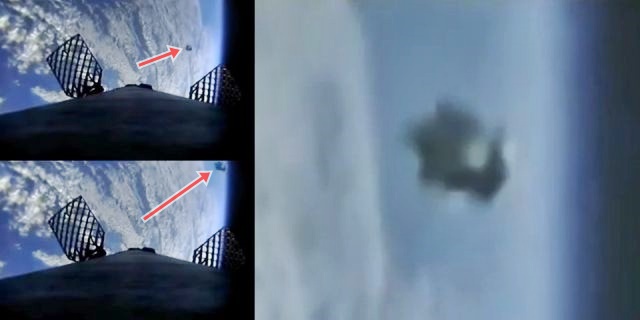








 glacial archaeology