Ontdek de Fascinerende Wereld van UFO's en UAP's: Jouw Bron voor Onthullende Informatie!
Ben jij ook gefascineerd door het onbekende? Wil je meer weten over UFO's en UAP's, niet alleen in België, maar over de hele wereld? Dan ben je op de juiste plek!
België: Het Kloppend Hart van UFO-onderzoek
In België is BUFON (Belgisch UFO-Netwerk) dé autoriteit op het gebied van UFO-onderzoek. Voor betrouwbare en objectieve informatie over deze intrigerende fenomenen, bezoek je zeker onze Facebook-pagina en deze blog. Maar dat is nog niet alles! Ontdek ook het Belgisch UFO-meldpunt en Caelestia, twee organisaties die diepgaand onderzoek verrichten, al zijn ze soms kritisch of sceptisch.
Nederland: Een Schat aan Informatie
Voor onze Nederlandse buren is er de schitterende website www.ufowijzer.nl, beheerd door Paul Harmans. Deze site biedt een schat aan informatie en artikelen die je niet wilt missen!
Internationaal: MUFON - De Wereldwijde Autoriteit
Neem ook een kijkje bij MUFON (Mutual UFO Network Inc.), een gerenommeerde Amerikaanse UFO-vereniging met afdelingen in de VS en wereldwijd. MUFON is toegewijd aan de wetenschappelijke en analytische studie van het UFO-fenomeen, en hun maandelijkse tijdschrift, The MUFON UFO-Journal, is een must-read voor elke UFO-enthousiasteling. Bezoek hun website op www.mufon.com voor meer informatie.
Samenwerking en Toekomstvisie
Sinds 1 februari 2020 is Pieter niet alleen ex-president van BUFON, maar ook de voormalige nationale directeur van MUFON in Vlaanderen en Nederland. Dit creëert een sterke samenwerking met de Franse MUFON Reseau MUFON/EUROP, wat ons in staat stelt om nog meer waardevolle inzichten te delen.
Let op: Nepprofielen en Nieuwe Groeperingen
Pas op voor een nieuwe groepering die zich ook BUFON noemt, maar geen enkele connectie heeft met onze gevestigde organisatie. Hoewel zij de naam geregistreerd hebben, kunnen ze het rijke verleden en de expertise van onze groep niet evenaren. We wensen hen veel succes, maar we blijven de autoriteit in UFO-onderzoek!
Blijf Op De Hoogte!
Wil jij de laatste nieuwtjes over UFO's, ruimtevaart, archeologie, en meer? Volg ons dan en duik samen met ons in de fascinerende wereld van het onbekende! Sluit je aan bij de gemeenschap van nieuwsgierige geesten die net als jij verlangen naar antwoorden en avonturen in de sterren!
Heb je vragen of wil je meer weten? Aarzel dan niet om contact met ons op te nemen! Samen ontrafelen we het mysterie van de lucht en daarbuiten.
Mars Express Sees Intriguing Geological Features in Moreux Crater
The High Resolution Stereo Camera on ESA’s Mars Express orbiter has captured stunning images of Moreux crater, a huge impact crater in the Terra Sabaea region of the Red Planet.
This image of Moreux crater comprises data gathered on October 30, 2019.
Known for its wide swathes of rippling, textured, gently sloping dunes, Mars’ Terra Sabaea region is home to many fascinating geological features — including the prominent Moreux crater, the star of a new image from ESA’s Mars Express.
Image credit: ESA / DLR / FU Berlin / CC BY-SA 3.0 IGO.
When compared to other impact craters on both Mars and Earth, Moreux crater appears a little misshapen and messy — the result of ongoing erosion over Martian history.
The crater is roughly 3 km deep, and spans 135 km from edge to edge.
Its central peak, created as material from the crater floor rebounded and rose upwards following the initial impact, is around 2 km in height.
Its egg-shaped rim is broken up, its dark walls are ridged, rippled and mottled.
Perspective view of the Moreux crater.
This image shows a feature on Mars’ surface named Moreux crater. It comprises data gathered on 30 October 2019 during orbit 20014. The ground resolution is approximately 16 m/pixel and the images are centered at about 44°E/42°N.
Image credit: ESA / DLR / FU Berlin / CC BY-SA 3.0 IGO.
The range of colors featured in the new images from Mars Express reveals much about the composition of a particular region, material or feature.
While the surrounding material is visible in hues of butterscotch and caramel, the crater’s walls are dark, resembling a smudged ring of ash or charcoal.
Dark brown and black dunes cover the crater floor, while the peak remains a pale yellow-orange.
Dark, prominent ejecta, comprising material flung outwards during the crater-forming collision, spread outwards from the crater rim, discoloring and encroaching upon the lighter surrounding terrain.
This varied color palette reflects an equally varied geological composition.
The dunes within and around the crater are thought to contain sandy material rich in pyroxene and olivine: rock-forming minerals that are mafic (containing magnesium and iron) and characterized by their typically dark appearance.
Perspective view of the Moreux crater.
Image credit: ESA / DLR / FU Berlin / CC BY-SA 3.0 IGO.
Martian winds are also thought to have swept and gathered fine, basaltic, volcanic sand and ash into and around the crater.
Basaltic rock is commonplace on both Mars and other celestial bodies. It is a key component of the maria, or seas, on the Moon, for instance, and causes them to appear visibly and notably darker than the lunar highlands.
Many of the features, such as dunes and flows, surrounding the central peak and southern region of Moreux crater (to the left of the first image) appear to have been formed by ice.
This is thought to have occurred in the form of substantial episodes of glacial activity over the past few million years.
Many other features show signs of wind erosion, or having been formed via wind-related processes — most notably, the dunes covering the crater floor.
These dunes are largely sickle-shaped (barchanoid), and reveal much about wind direction within and across the crater.
From the orientation of the dunes, scientists inferred a complex system of prevailing winds, likely influenced by the topography of the crater itself.
Dunes to the north and east of the central peak are largely influenced by winds coming from the northeast, while dunes sitting west of the park are controlled by winds from the northwest.
These cross-cutting winds create an interesting and unique dune morphology within Moreux crater, adding to the feature’s intrigue.
The moon and Earth may be more different than previously thought, challenging existing models for how the moon formed, a new study finds.
Earth originated about 4.5 billion years ago, and previous research suggested that the moon arose a short time after that. For the past three decades, the prevailing explanation for the moon's origin was that it resulted from the collision of two protoplanets, or embryonic worlds. One of those was the newborn Earth, and the other was a Mars-size rock nicknamed Theia, after the mother of the moon in Greek myth. "Once the dust settled, two bodies were left — Earth and the moon," new study co-author Zachary Sharp, a planetary scientist at the University of New Mexico in Albuquerque, told Space.com.
This "giant impact hypothesis" seemed to explain many details about Earth and the moon, such as the large size of the moon compared with Earth and the rates of rotation of the two bodies. However, in the past 20 or so years, evidence has emerged to challenge that hypothesis and suggest a multitude of alternatives.
Computer models of the giant-impact scenario often say that 70% to 90% of the moon should be made of material from Theia. The problem is that most bodies in the solar system have unique chemical makeups, and so the Earth, Theia — and therefore the moon — should too. However, rock samples that the Apollo missions returned from the moon show that the natural satellite's composition is uncannily similar to Earth's, much more similar than such models would predict for versions of elements called isotopes. (Isotopes of an element each have different numbers of neutrons in their atomic nuclei.)
This extreme similarity in isotopes of elements such as oxygen has raised great challenges for the giant-impact scenario. One possibility is that the proto-Earth and Theia were nearly identical to start with when it came to oxygen isotopes, which seems unlikely. Another is that the proto-Earth and Theia's oxygen isotopes were fully mixed in the aftermath of the collision, perhaps due to an impact so violent that it vaporized a large portion of the early Earth, with the moon emerging from the resulting, doughnut-shaped mass called a synestia. But this and other scenarios may require unlikely impact conditions, scientists have said.
In the new study, researchers conducted new high-precision measurements of oxygen isotope levels in a range of lunar samples. The researchers expanded on previous work by focusing on a wide variety of types of moon rock.
The scientists found that there were subtle but regular differences in oxygen isotopic composition depending on the kind of lunar rock tested, Sharp said. This suggested that prior work that averaged together lunar isotope data while ignoring differences in rock type might not have given an accurate picture of the differences between Earth and the moon.
"Going into this project, it was expected that our results would likely mirror that of previous studies," study lead author Erick Cano, a stable-isotope geochemist at the University of New Mexico, told Space.com. "The most surprising part of our results was finding the amount of variation that we did between the individual lunar samples."
To explain these findings, the researchers suggested that the giant collision between proto-Earth and Theia did indeed lead to mixing between the bodies. Still, the resulting moon and Earth had distinct compositions, albeit very similar ones, Sharp said.
Later, in the first 1,000 or so years after the impact, vaporized rock from the disk of debris left behind by the impact likely led "to lava raining down on the moon for hundreds of years," Sharp said. Complex physical and chemical interactions between this lava rain and the ocean of magma that covered the newborn moon could then have led to an oxygen isotopic composition in the uppermost lunar rocks that was more similar to Earth's. In contrast, samples that came from the deep lunar mantle had the most different oxygen isotopic composition of the lunar rocks tested when compared to Earth.
The most important implication from these findings is that giant-impact models no longer have to account for virtually indistinguishable oxygen isotopic compositions between Earth and the moon, Cano said. "I think this will open the door for an entirely new range of impact scenarios," he added.
Future research can expand on this new study by analyzing other lunar samples, Cano said. "The obstacles for this future research may be the limited quantities of material that we have from the Apollo missions," he said. "Some of these lunar rock types were only brought back in very small quantities and can be very difficult to obtain for study."
Cano, Sharp and study co-author Chip Shearer, a lunar scientist also based at the University of New Mexico, detailed their findings online Monday (March 9) in the journal Nature Geoscience.
BLUE ORIGIN'S JEFF BEZOS DETAILS HIS RADICAL VISION FOR COLONIES IN SPACE
These colonies would support all manner of ecosystems.
Blue Origin wants to build the tools to help humanity explore the solar system, ultimately expanding life out to take advantage of more resources and support over one trillion people.
Jeff Bezos, founder of both the space-faring firm and internet retailer Amazon, explained at a Thursday event why Blue Origin is working to reduce the cost of rocket launches. It’s all part of his long-term vision to enable humans to continue growing, exploring the stars instead of staying on Earth and gradually rationing its use of energy and resources. During the event, he unveiled the Blue Moon lander capable of sending humans to the moon by 2024.
Bezos, who forms part of a new commercially-driven space race, has a slightly different vision to his contemporary Elon Musk. While the SpaceX founder wants a city on Mars by 2050, Bezos is more interested in staying close to humanity’s home — echoed in the name of the company, “Blue Origin.” The company’s long-term goal is to build the tools so humans can create giant floating colonies around the Earth, supporting all manner of ecosystems.
A future space city in a colony.
Blue Origin
BLUE ORIGIN: WHY DOES JEFF BEZOS WANT TO BUILD A SPACE COLONY?
Bezos highlighted immediate problems on Earth like hunger, homelessness and climate change. However, he also noted long-range problems, like the fact that humans will run out of energy on Earth. Humans use 97 watts of power per person in their metabolic rate, but as humans in the developed world people use 10,500 watts per person.
The abundance of energy has enabled generations to live a better life than their predecessors, but it’s an unsustainable trend. Human energy use is compounding at three percent, essentially doubling energy use every 25 years. Global energy use today could be met by covering Nevada in solar cells, but in around 200 years at current trends, humanity would need to cover the entire Earth’s surface in solar cells to meet energy needs.
Humanity has focused on efficiency to meet energy demands. In the year 1800 a human had to work 84 hours to earn enough for one hour of artificial light, but in 2019 a human only has to work 1.5 seconds for the same amount of light. Similarly, air transport has seen a fourfold efficiency gain: the amount of fuel needed to fly one person from Los Angeles to New York City has dropped from 109 gallons to 24 gallons. Computers have grown one trillion times more efficient, completing more calculations per kilowatt-second than ever before. These efficiencies, however, mean humans simply use more of these products.
“So, we get to choose,” Bezos said. “Do we want stasis and rationing, or do we want dynamism and growth?”
BLUE ORIGIN: WHAT WILL JEFF BEZOS’ SPACE COLONIES LOOK LIKE?
Bezos envisions a trillion humans in the solar system, with “a thousand Mozarts, or a thousand Einsteins.” In his vision, they would be living in colonies similar to the ones developed by physicist Gerard K. O’Neill.
O’Neill explained that humans are unlikely to live on planetary surfaces, as they’re small, far away, and essentially unable to support real-time communication. They also lack Earth-like gravity. Instead, they would live on something like this:
O'Neill's vision of a space colony.Blue Origin
These colonies are vast, with the International Space Station a tiny dot in comparison. Centrifugal force would be used to create artificial gravity, similar to the structures in Stanley Kubrick’s 2001: A Space Odyssey. Each colony would hold one million people. These colonies could create “pleasant” places to live, similar to Earth-based cities.
An interior view of the colony.Blue Origin
Humans could create recreational colonies, with zero gravity for flying around for fun.
The high-speed transit system inside a colony, with a drone taking care of a farm.Blue Origin
They could replicate the most tropical regions of Earth, which Bezos described as “Maui on its best day.”
A more nature-themed colony.Blue Origin
“What does the architecture look like when it no longer has a primary purpose of shelter?” Bezos said. “We’ll find out.”
A future city.Blue Origin
The colonies can be stationed close to Earth, so people can travel to and from with ease. Earth would become zoned residential and light industry, a “beautiful” place to visit. Heavy, damaging industry can be done off-Earth.
The amount of energy required to go between these colonies would be very low and fast, described by Bezos as a “day trip.”
A future space colony city.Blue Origin
It’s a bold idea that goes beyond even many science fiction authors’ imaginations. In an interview with O’Neill played at the Blue Origin event, legendary writer Isaac Asimov said that science fiction basically never touched on ideas like these because many authors were “planet chauvinists,” adding that the closest he came was through asteroid mining.
To create these colonies, humans will depend on two factors: radically reducing the cost of space launches, and utilizing in-space resources. Lifting all resources from Earth would be too difficult.
Bezos admitted that he would not be the one to make the colonies. The children in the front row of the audience may, as will their children. Bezos described “entrepreneurial activity,” future companies expanding into this new market.
Unfortunately, the lack of infrastructure means society cannot currently support these future industries. Bezos compared it to Amazon, which could use existing postal services to support its initial company. It didn’t need to invent a new infrastructure, nor did they have to create computers, or payment systems, or telecom networks. These networks enabled Amazon to benefit from this existing work. Similarly, Bezos explained that his generation will create the infrastructure to colonize space, paving the way for future generations to create the space version of Amazon and the like.
As his firm continues work on space rockets like New Glenn and lunar landers like Blue Moon, Bezos is focusing on building this infrastructure to help support colonies he probably won’t live to experience.
HD 74423 bulges toward its companion star.Gabriel Pérez Díaz (IAC)
If any beings live in the solar system HD 74423, their young ones would sketch daytime scenes quite differently than human children do. Where we draw one sun, they’d draw two. And where we draw our star as a round orb, they’d likely draw one of their suns as a bulging teardrop. Gifted animators might even capture the bump’s motion as it stretches toward and recedes from its companion over a matter of hours.
This star’s outlandish shape and behavior are prominent enough to be detected from Earth, 1,600 light years away, astronomers announced on Monday with a publication appearing in Nature Astronomy. Theorists have long suspected such a system was possible, but HD 74423 is the first confirmed binary containing one star whose pulses reach out toward its partner. And because it represents a new way for two stars to interact, it could also help astrophysicists better understand what makes some stars ripple and contort while others stay largely motionless.
“Wow,” wrote Gerald Handler, an astronomer at the Nicolaus Copernicus Astronomical Center in Poland in an email to a colleague upon first seeing data containing the flickers of the bulging star. “I have never seen something like that before.”
Our sun appears pretty unchanging day after day, but that’s because we’re looking at it from so far away. Up close, boiling blisters on its surface reveal the star’s more variable, liquid side. Other stars experience internal churning and bubbling too, and under the right circumstances they can positively pulse with activity. (The field of asteroseismology uses these reverberations to infer what’s going on deep beneath a star’s surface.)
One dramatic case of stellar throbbing is the type of star known as a “heartbeat star.” They occur in pairs with elliptical orbits that bring the two stars alternatively nearer together and farther apart. When the partners draw close, they give each other an extra gravitational squeeze that then relaxes as they pull away. Overtime these regular squeezes cause one or both stars to undulate—stretching out like an egg and then collapsing back into a squat orange-like shape.
HD 74423, the new discovery, is a pair of stars that whip around each other in a roughly circular orbit once every 38 hours. They keep a pretty constant distance from each other, Handler says, which means they don’t fit the definition of heartbeat stars. Their behavior is even weirder.
Since the partners orbit each other so closely, one partner’s gravitational pull drags the surface of the other toward it, stretching the star out into a persistent teardrop shape. And the teardrop pulsates inward and outward toward the companion. In an upcoming publication, the astronomers will propose that this pulsation takes place because the tapered part of the star is “fluffier,” Handler says, and this fluffiness amplifies natural ripples from deeper in the sun in the direction of the partner.
Astrophysicist Donald Kurtz of the University of Central Lancashire in the UK first predicted that such a setup might be possible decades ago, but no astronomer had located one until now. "I've been looking for a star like this for nearly 40 years and now we have finally found one," Kurtz said in a press release.
And they almost didn’t find it. NASA’s Transiting Exoplanet Survey Satellite (TESS), which focuses on looking for exoplanets, made the discovery possible. In HD 74423, the companion star blocks light from the teardrop star much as an exoplanet might, but not similarly enough to get picked up automatically by NASA’s planet-hunting algorithms.
Instead, two volunteer citizen scientists—Robert Gagliano and Tom Jacobs—independently noticed anomalous flickers in the light coming from HD 74423 as the teardrop grew, shrunk, and turned. They flagged the system as a potentially interesting target, and Handler confirmed the details by observing it more closely with the South African Astronomical Observatory. “Without those guys we probably would never have found it,” he says.
And now that they have it, the next step is to look for more. While this case is largely an astronomical curiosity, finding other pulsating teardrop stars could help answer a larger question in the study of stellar vibrations: why do some stars quake while others remain still? Even in the twin stars of HD 74423, only one appears to be quivering. Astronomers would also like to figure out more about how much oomph is required to orient the pulsations in a given direction, and what the system will look like in billions of years—all questions that require deeper insight into the structure and behavior of the balls of plasma that dot our universe.
“We just need to keep looking,” Handler says. “We have more questions right now than answers.”
Hundreds of mysterious mini-planets found lurking in far reaches of the solar system
Jasper Hamill
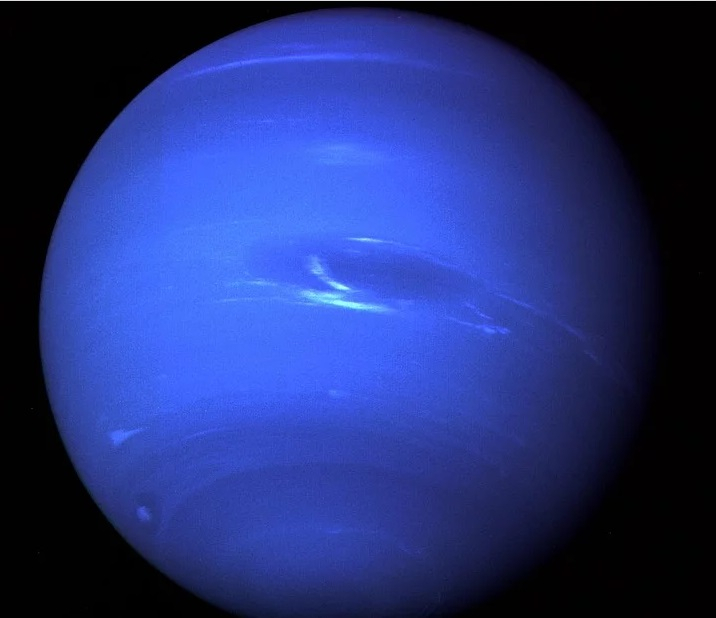
This is Neptune, a large and very cold gas giant which is almost three billion miles away from Earth
(Image: Nasa)
A vast swarm of micro-worlds has been found in a mysterious area of our solar system beyond the chilly ice giant Neptune’s orbit.
Astronomers spotted more than 300 ‘trans-Neptunian’ objects in the far reaches of humanity’s home star system.
These are minor planets and are part of a large population of objects orbiting in a region past Neptune.
The most famous trans- Neptunian object is Pluto, although this classification is controversial because some stargazers think it’s a proper planet even though it was downgraded to the status of ‘dwarf planet’ in 2006.
Researchers from Penn University were looking for dark matter when they observed the new micro-worlds.
It’s hoped that studying these new objects will help to solve the mystery of Planet 9 – a hypothetical huge world believed to exist way out towards the edge of our solar system.
Pluto is regarded as a trans-Neptunian object
(Image: Nasa)
Professors Gary Bernstein said: ‘There are lots of ideas about giant planets that used to be in the solar system and aren’t there anymore, or planets that are far away and massive but too faint for us to have noticed yet.
‘Making the catalogue is the fun discovery part. Then when you create this resource; you can compare what you did find to what somebody’s theory said you should find.’
Last year scientists offered a new theory to explain why they haven’t been able to see Planet 9, suggesting it was a ‘primordial black hole’ the size of a bowling ball with enough gravitational pull to affect the chunks of ice and rock way out in the reaches of space.
Primordial black holes haven’t been proven to exist yet – but it’s believed they are much smaller black holes that formed during the big bang.
Planet 9 has also not yet been officially discovered, but its presence was inferred by analysis of trans-Neptunian objects.
Observations of these objects revealed ‘gravitational anomalies’ which may have been caused by the push and pull of a large planet.
Astronomers have also glimpsed a number of ‘microlensing events’, which is a phenomenon caused when passing light ‘bends’ under the influence of a large object’s gravitational pull.
The Planet 9 object could be one rogue hole that was ‘captured’ by the sun and steered into orbit around it or part of a larger population.
In an early version of a study published on Arxiv, scientists wrote: ‘We highlight that the anomalous orbits of Trans-Neptunian Objects and an excess in microlensing events… can be simultaneously explained by a new population of astrophysical bodies with mass several times that of Earth.’
Primordial black holes haven’t actually been proven to exist yet
(Getty Images/iStockphoto)
‘We take these objects to be primordial black holes and point out the orbits of Trans-Neptunian Objects would be altered if one of these holes was captured by the Solar System, in line with the Planet 9 hypothesis.
‘Capture of a free-floating planet is a leading explanation for the origin of Planet 9 and we show that the probability of capturing a PBH instead is comparable.’
It’s hard enough to spot a planet at the fringes of our solar system, let alone a mini black hole. But these ancient holes may give off ‘annihilation signals’.
This doesn’t mean they sound an alarm before they decide to attack but is the name for a process predicted to take place within ‘dark matter halos’ believed to surround the holes.
While many sports use inflated balls that trace back to kicking or throwing inflated animal bladders, a game involving a hard rubber ball predates them all because rubber was only grown in Mexico and central America. That game carries the generic name “ballgame” and most people know about it because artwork shows the games were played in the nude and the losers may have been sacrificed – depictions used by European invaders to depict Mesoamericans ad brutal savages to be conquered and educated. As always, the uncovering of new evidence changes things and newly-discovered archeological finds show that Mesoamericans were playing their ballgames as early as 1443 BCE and the game itself was more ‘hip’ that once thought.
“We challenge the lowland paradigm by providing evidence that the earliest highland ballcourt dates to the Early Formative, nearly a millennium earlier than any previous highland architectural data and just over two centuries after the Paso de la Amada court. We contribute two types of ballgame data recently excavated at Etlatongo: remains of two formal superimposed architectural ballcourts and associated ballplayer ceramic figurines.”
A new study published in the journal Science Advances challenges the idea that organized ballgames with rubber balls were developed and played almost exclusively in coastal and lowland areas of Mexico and Central America. Excavations done from 2015 to 2017 by the Formative Etlatongo Project (FEP) in the Nochixtlán Valley of the Mixteca Alta, Oaxaca, Mexico, uncovered a ballcourt dating to 1374 BCE – just 200 years after the oldest known coastal court and centuries before other highland courts.
Athletes hit a rubber ball with their hips in a version of Mesoamerica’s ballgame.
(WIKIMEDIA COMMONS, CHRISTOPH WEIDITZ, GERMANISCHES NATIONALMUSEUM NÜRNBERG)
Even more interesting, figurines of players showed them wearing thick protective belts around their hips, which means they were playing a rare form of ballgame where competitors moved the ball forward and around by bouncing it off of their hips, with walls around the court allowing for bounces and rebounds similar to today’s hockey. The courts were long and narrow, which might make the game resemble a ‘hip’ version of handball.
Finally, there were none of the famous rings or hoops attached to the wall as targets or goals, which indicates this ballgame may have resembled volleyball, with players trying to get their opponents to miss in order to score. This indicates to the researchers that this was an early game in the process of transformation, just like the Mesoamerican society at the time, when warring leaders switched to trade and cooperation between regions and saw the sport as a great way to show power as well as teamwork and friendly competition.
Yeah, yeah, yeah … what about the human sacrifices?
Ah, yes … the part we all remember from history class. Figurines discovered at lowland game sites show players standing over captive opponents, leading to speculation that some sort of victory torture was involved in ballgame. With the known propensity for human sacrifice in other aspects Mesoamerican life, it was probably easy to connect the dots and imply this was an act of beheading and perhaps some games were continued with human heads for balls. No evidence has been found of ballgame-related human sacrifice or blood-spilling at Etlatongo, so it appears the practice evolved later as the game became more symbolic of war, fertility, religion and struggles with the underworld.
As a result of this discovery, archeologists expect to find more ballcourts in the Mexican highlands, which give more insight into life in pre-Columbian Mesoamerica, just like sports reflects real life today.
Daytime disc-shaped UFO VIDEO: Brooklyn, NY – March 2020
New footage of a solid black oval disc-shaped object flying in the sky above Brooklyn, New York on Saturday, 14th March 2020.
Witness report:
Very flat donut shaped disc, black in color, no noise, very quiet neighborhood other than birds and occasional cars passing by. I walk my dog every morning at 7am. Today i stepped out for no more than 60 seconds when the brightness of the moon caught my attention.As I glared at the moon for a bit, I saw this flat,black, disc shaped donut appear from over the houses across the street so I immediately took out my phone and started to record it. Got about 2mins on film and went online seeking disc shaped drones… Nothing resembled what I saw and what youre seeing in my video. Then I tried searching flat donut shaped UFOs and found a bunch of these objects like the one in my video. I cant say for sure what it is, but it’s definitely unidentifiable. I hope the public can help me figure out what I saw. Oh and excuse my language, it’s a NYC thing.
Paleontologists have found an exceptionally well-preserved and diminutive skull of a previously unknown bird-like dinosaur species in a piece of Cretaceous-period amber from northern Myanmar.
Photograph, computed tomography scans and interpretive drawings of the Oculudentavis khaungraaea specimen: (a) photograph of the amber piece with skull ventrolaterally exposed; scan (b) and drawing (c), left lateral view; scan (d) and drawing (e), rostral view; scan (f) and drawing (g), occipital view; scan (h) and drawing (i), dorsal view. Abbreviations: de – dentary, fr – frontal, hy – hyoid bone (or bones), jg – jugal, la – lacrimal, mx – maxilla, pa – parietal, pm – premaxilla, po – postorbital, qd – quadrate, sc – scleral ossicle, so – supraoccipital, sq – squamosal, th – teeth. Scale bars – 5 mm; longer scale bar below (b) applies to (b-i).
Image credit: Xing et al, doi: 10.1038/s41586-020-2068-4.
The newly-identified species, named Oculudentavis khaungraae, could represent the smallest known Mesozoic dinosaur in the fossil record.
“Amber preservation of vertebrates is rare, and this provides us a window into the world of dinosaurs at the lowest end of the body-size spectrum,” said Dr. Lars Schmitz, a researcher in the W. M. Keck Science Department at Claremont McKenna, Scripps and Pitzer Colleges.
“Its unique anatomical features point to one of the smallest and most ancient birds ever found.”
The piece of amber, just 31 x 20 x 8.5 mm, containing the skull of Oculudentavis khaungraae came from the Angbamo site near Tanai in the Hukawng valley of Myanmar’s Kachin province.
Dr. Schmitz and colleagues studied the specimen’s distinct features with high-resolution synchrotron scans to determine how the skull differs from those of other bird-like dinosaur specimens.
They found that the shape and size of the eye bones suggested a diurnal lifestyle, but also revealed surprising similarities to the eyes of modern lizards.
The skull also shows a unique pattern of fusion between different bone elements, as well as the presence of teeth.
Oculudentavis khaungraaea.
Image credit: Han Zhixin.
“The specimen’s tiny size and unusual form suggests a never-before-seen combination of features,” the scientists said.
“The discovery represents a specimen previously missing from the fossil record and provides new implications for understanding the evolution of birds, demonstrating the extreme miniaturization of avian body sizes early in the evolutionary process.”
The specimen’s preservation also highlights amber deposits’ potential to reveal the lowest limits of vertebrate body size.
“No other group of living birds features species with similarly small crania in adults,” Dr. Schmitz said.
“This discovery shows us that we have only a small glimpse of what tiny vertebrates looked like in the age of the dinosaurs.”
Archaeologists Unearth Long-Lost Capital of Ancient Maya Kingdom
Archaeologists excavating the site of Lacanja Tzeltal in Mexico have discovered the ruins of the capital of a kingdom....known as Sak Tz’i’ or “white dog”...
Map of architectural groups and stream channels at the site of Lacanja Tzeltal, Mexico.
Image credit: Golden et al, doi: 10.1080/00934690.2019.1684748.
The archaeological site of Lacanja Tzeltal is located in what is today the state of Chiapas in southeastern Mexico. It was likely first settled by 750 BCE and then occupied for over 1,000 years.
Sak Tz’i’ was by no means the most powerful of the Maya kingdoms, and its remnants are modest compared to the more well-known sites of Chichen Itza and nearby Palenque.
“Finding Sak Tz’i’ is still a major advance in our understanding of ancient Maya politics and culture,” said Dr. Charles Golden, an anthropological archaeologist at Brandeis University.
The residents of Sak Tz’i’ lived in the countryside harvesting a wide variety of crops and making pottery and stone tools.
The archaeologists found the remnants of what was likely the city’s marketplace where these goods were brought to be sold.
The kingdom’s residents also came to the city to attend ceremonial ball games in which players kept a solid rubber ball, sometimes as heavy as twenty pounds, bouncing back and forth across a narrow playing field using their hips and shoulders.
On the northeastern end of the city are the ruins of a 45-foot (13.7 m) high pyramid and several surrounding structures that served as elite residences and sites for religious rituals.
The center of religious and political activity was the Plaza Muk’ul Ton (Monuments Plaza), a 1.5-acre (0.6 ha) courtyard where the people gathered for ceremonies. A staircase leads from the plaza to a towering platform, where temples and reception halls were arrayed and members of the royal family once held court and might have been buried.
Sak Tz’i’ had the misfortune of being surrounded on all sides by more powerful states. For the inhabitants of the capital and countryside, this meant the perpetual threat of warfare and violent interruptions of daily life.
The researchers found evidence that the capital was surrounded on one side by steep-walled streams. On the other side, masonry walls were built to keep out invaders.
These fortifications weren’t always effective. Inscriptions on one monument tell of a time when at least a portion of the city was set ablaze during a conflict with neighboring kingdoms.
Ultimately, the survival of Sak Tz’i’ may have depended as much on its ability to make peace with its neighbors — and even play them off of each other — as its military strength.
“This is one of the reasons Sak Tz’i’ holds so much interest for researchers,” Dr. Golden said.
“Little is known about how mid-size Maya realms maneuvered and managed to persist in the face of constant hostilities from more powerful kingdoms.”
Drawing (left) and 3D model (right) of Panel 1 from the site of Lacanja Tzeltal, Mexico.
Image credit: Golden et al, doi: 10.1080/00934690.2019.1684748.
So far, dozens of sculptures have been found among the ruins at the Sak Tz’i’ site, though many have been damaged by looters or degraded over the millennia by rain, forest fires and lush tropical vegetation.
The best-preserved sculpture is a 2- by 4-foot (0.6 x 1.2 m) tablet. Its inscriptions tell stories about a mythical water serpent, described in poetic couplets as ‘shiny sky, shiny earth,’ and several elderly, stony gods whose names aren’t given. There are also accounts of the lives of dynastic rulers.
Another inscription tells of a mythic flood, while others list what are probably historic dates for the births and battles of various rulers, including a king named K’ab Kante’.
This intertwining of myth and reality is typical of Maya inscriptions and had special meaning for ancient scribes and readers.
At the bottom of the tablet is a dancing royal figure. The Maya believed royalty could become one with or even transform into a god. In this case, the ruler is dressed as the rain god connected to violent tropical storms, Yopaat.
In his right hand, he carries an axe that is the lightning bolt of the storm, which has a deified aspect named K’awiil. In his left hand, the figure carries a ‘manopla,’ a stone gauntlet or bludgeon used in ritual combat.
The team’s paper was published in the Journal of Field Archaeology.
Something Strange Police Dash Cam Footages in Texas and Georgia
Today we’re doing the top five mysterious and unexplained dashcam videos. Let us know what you think of these clips in the comments below! Some of them sure are creepy.
If NASA astronauts land on the moon as planned in 2024, they'll have an advantage their Apollo predecessors lacked: insights gathered by tiny robotic spacecraft that visit the moon before them.
NASA has announced the first two such projects selected to fly as part of the Artemis program to land astronauts on the moon: Lunar Flashlight and the Cislunar Autonomous Positioning System Technology Operations and Navigation Experiment (CAPSTONE). The missions represent the next step for the small spacecraft, known as cubesats, which became available for Earth orbit in the 1990s as electronics and sensors shrank to allow bread-box-sized (or slightly larger) satellites to perform scientific work. Since then, cubesats have become so powerful that they are used regularly for Earth observations. And the first interplanetary cubesats successfully flew to Mars in 2018 with the NASA InSight mission, so the spacecraft are becoming hardy enough for deep-space missions.
Thanks to their diminutive size, cubesats are both easy to pack on a rocket and cheap to launch. They often ride along with larger satellites. As NASA's Artemis program aims to return astronauts to the moon in 2024, NASA is planning to launch the first lunar cubesats in 2021.
"In the case of lunar exploration, cubesats are proving themselves to be increasingly capable platforms to precede human explorers on the moon and Mars," Christopher Baker, small spacecraft technology program executive within NASA's Space Technology Mission Directorate, said in a NASA statement.
The agency has said that a total of 13 cubesats will fly on the first flight in the program, Artemis I, which is currently scheduled for the second half of 2021 after timeline slips. That mission will send an Orion spacecraft on an uncrewed loop around the moon to test lunar technologies ahead of human landings.
One of those cubesats will be Lunar Flashlight, a collaboration among several NASA centers, which will look for ice deposits in permanently shadowed craters of the moon and try to estimate how much ice is there, using lasers. Explorers hope that water ice can address needs for drinking water or rocket fuel. (Water is also heavy to tote from Earth, so the ability to get water from lunar ice would reduce the cost of future exploration missions.) Another satellite with ground-penetrating radar, or some rover missions, could follow Lunar Flashlight to better characterize the depth of the deposits.
The second newly confirmed cubesat, CAPSTONE, is a commercial collaboration. And this cubesat won't launch on a NASA rocket; instead, it is scheduled to fly on a Rocket Lab Electron vehicle in early 2021. CAPSTONE will fly in the same lunar orbit planned for NASA'sGateway space station, to test entering the unusual orbit. Orbiting the moon is further complicated by mass concentrations under the lunar surface that perturb orbits, and NASA doesn't want to risk launching the larger and more expensive Gateway without a test. "No spacecraft has been placed there," Baker said. "We want to measure what it takes to get into and remain in that orbit," particularly fuel, he said.
CAPSTONE will also test future navigation without reliance on tracking from Earth, by figuring out the satellite's position relative to NASA's Lunar Reconnaissance Orbiter. This technique will allow missions to venture deeper into space without needing constant contact with Earth.
NASA is also looking at the possibility of using swarms of cubesats that work together to make observations and solve problems. Baker suggested that these cubesats could be used as a "quick reaction" tool to let researchers respond to the most pressing data as it comes in.
"Frankly, given the pace of the small spacecraft community, [along with] our academic and industry partners, there may well be an underestimation of what we can accomplish in the next five years," he said.
Can you really survive traveling through an enormous black hole? A team of physicists has been studying the notion.
(Roen Kelly/Discover)
One of the most cherished science fiction scenarios is using a black hole as a portal to another dimension or time or universe. That fantasy may be closer to reality than previously imagined.
Black holes are perhaps the most mysterious objects in the universe. They are the consequence of gravity crushing a dying star without limit, leading to the formation of a true singularity – which happens when an entire star gets compressed down to a single point yielding an object with infinite density. This dense and hot singularity punches a hole in the fabric of spacetime itself, possibly opening up an opportunity for hyperspace travel. That is, a short cut through spacetime allowing for travel over cosmic scale distances in a short period.
Researchers previously thought that any spacecraft attempting to use a black hole as a portal of this type would have to reckon with nature at its worst. The hot and dense singularity would cause the spacecraft to endure a sequence of increasingly uncomfortable tidal stretching and squeezing before being completely vaporized.
Flying Through a Black Hole
My team at the University of Massachusetts Dartmouth and a colleague at Georgia Gwinnett College have shown that all black holes are not created equal. If the black hole like Sagittarius A*, located at the center of our own galaxy, is large and rotating, then the outlook for a spacecraft changes dramatically. That’s because the singularity that a spacecraft would have to contend with is very gentle and could allow for a very peaceful passage.
The reason that this is possible is that the relevant singularity inside a rotating black hole is technically “weak,” and thus does not damage objects that interact with it. At first, this fact may seem counter intuitive. But one can think of it as analogous to the common experience of quickly passing one’s finger through a candle’s near 2,000-degree flame, without getting burned.
Hold your finger close to the flame and it will burn. Swipe it through quickly and you won’t feel much. Similarly, passing through a large rotating black hole, you are more likely to come out the other side unharmed.
(Credit:mirbasar/Shutterstock.com)
Hold your finger close to the flame and it will burn. Swipe it through quickly and you won’t feel much. Similarly, passing through a large rotating black hole, you are more likely to come out the other side unharmed. (Credit: mirbasar/Shutterstock.com)
My colleague Lior Burko and I have been investigating the physics of black holes for over two decades. In 2016, my Ph.D. student, Caroline Mallary, inspired by Christopher Nolan’s blockbuster film “Interstellar,” set out to test if Cooper (Matthew McConaughey’s character), could survive his fall deep into Gargantua – a fictional, supermassive, rapidly rotating black hole some 100 million times the mass of our sun. “Interstellar” was based on a book written by Nobel Prize-winning astrophysicist Kip Thorne and Gargantua’s physical properties are central to the plot of this Hollywood movie.
Building on work done by physicist Amos Ori two decades prior, and armed with her strong computational skills, Mallary built a computer model that would capture most of the essential physical effects on a spacecraft, or any large object, falling into a large, rotating black hole like Sagittarius A*.
Not Even a Bumpy Ride?
What she discovered is that under all conditions an object falling into a rotating black hole would not experience infinitely large effects upon passage through the hole’s so-called inner horizon singularity. This is the singularity that an object entering a rotating black hole cannot maneuver around or avoid. Not only that, under the right circumstances, these effects may be negligibly small, allowing for a rather comfortable passage through the singularity. In fact, there may no noticeable effects on the falling object at all. This increases the feasibility of using large, rotating black holes as portals for hyperspace travel.
Mallary also discovered a feature that was not fully appreciated before: the fact that the effects of the singularity in the context of a rotating black hole would result in rapidly increasing cycles of stretching and squeezing on the spacecraft. But for very large black holes like Gargantua, the strength of this effect would be very small. So, the spacecraft and any individuals on board would not detect it.
This graph depicts the physical strain on the spacecraft’s steel frame as it plummets into a rotating black hole. The inset shows a detailed zoom-in for very late times. The important thing to note is that the strain increases dramatically close to the black hole, but does not grow indefinitely. Therefore, the spacecraft and its inhabitants may survive the journey.
(Credit: Khanna/UMassD)
The crucial point is that these effects do not increase without bound; in fact, they stay finite, even though the stresses on the spacecraft tend to grow indefinitely as it approaches the black hole.
There are a few important simplifying assumptions and resulting caveats in the context of Mallary’s model. The main assumption is that the black hole under consideration is completely isolated and thus not subject to constant disturbances by a source such as another star in its vicinity or even any falling radiation. While this assumption allows important simplifications, it is worth noting that most black holes are surrounded by cosmic material – dust, gas, radiation.
Therefore, a natural extension of Mallary’s work would be to perform a similar study in the context of a more realistic astrophysical black hole.
Mallary’s approach of using a computer simulation to examine the effects of a black hole on an object is very common in the field of black hole physics. Needless to say, we do not have the capability of performing real experiments in or near black holes yet, so scientists resort to theory and simulations to develop an understanding, by making predictions and new discoveries.
The set-back - the latest in a long series for this project - has been signposted for some weeks.
All the hardware is built, but there remains an intimidating list of outstanding checks that must be completed before the mission can be declared flight-ready.
Chief among the obstacles in the timeline are some underperforming electronics boxes in the Russian descent and lander mechanisms that would put the rover safely on the ground; and also the overall flight software from Europe.
Full testing required to achieve confidence in these items necessarily pushes the project beyond July/August.
Matters have been further complicated in recent days by the international coronavirus crisis which has started to disrupt the engineering effort.
Image copyrightTHALES ALENIA SPACEImage captionAll the hardware to carry the rover to Mars is built
"We have made a difficult but well-weighed decision to postpone the launch to 2022. It is driven primarily by the need to maximise the robustness of all ExoMars systems," announced Russian space agency (Roscosmos) Director General, Dmitry Rogozin.
"I am confident that the steps that we and our European colleagues are taking to ensure mission success will be justified and will unquestionably bring solely positive results for the mission implementation."
European Space Agency Director General, Jan Wörner, added that coronavirus was having an impact on the preparations, "because people from different places of industry in Russia, in Italy and France cannot move easily as in the past. So, therefore, there is also an impact, but I would not like to say the coronavirus is the one and only reason - but... it has an impact on the mission, yes."
Launching in late 2022 means the rover will touch down in 2023, given the cruise time to the Red Planet.
NASA/JPL/UNIVERSITY OF ARIZONAImage caption
The rover was to be targeted at Oxia Planum on Mars. That won't change for 2023
Rosalind Franklin has been built to try to detect life, past or present, on the Red Planet.
Because of this, the rover and its instruments have been prepared to incredibly stringent levels of cleanliness. This status must now be maintained over the coming two years of storage.
The project's industrial prime contractor, Thales Alenia Space of Italy, will do this in an ISO-7 chamber at its Turin factory.
"We will have to make sure that we flush permanently the ultra-clean zone and maybe even have to make an outgassing activity to make sure pollutants are all evacuated before making the rover ready again to be transferred to [the launch pad in 2022], " explained Francois Spoto, Esa's ExoMars Team Leader.
Unclear is precisely how much the delay will cost, but Esa's Director of Human and Robotic Exploration, David Parker, said it wouldn't have a significant effect on his programmes.
"We have a budget, which includes a contingency margin for delayed launch to 2022," he told BBC News.
"Of course, that's based on our estimates; we now have to go and negotiate with industry to get the confirmed costs. But that's our normal life - we have to estimate the cost of things, define it and then negotiate with industry. But no, it should not be a financial crisis."
ESAImage caption
Artist's impression: The robot rover will search for life on Mars
First envisaged as a small technology demonstration mission, the robot vehicle was formally approved by European nations back in 2005, with a launch first pencilled in for 2011.
Then, as ambitions grew and the design was beefed up, the start date was put back. At first, it was shifted to 2013, but further problems saw slippage to 2016, and then again to 2018.
For much of its history, the rover project, codenamed ExoMars, has had to fumble through with budgets that were insufficient to maintain the promised timelines.
At one stage, back in 2009, Esa decided to join forces with America to try to make the mission happen, only to see Nasa walk away three years later when its priorities changed.
Even with this fresh impetus, however, the project continued to stumble. The Esa-Roscosmos 2018 target gave way to 2020. Now the launch date is being moved again.
The rover has been an important component of British space policy. The UK is the second biggest contributor to the ExoMars programme.
Graham Turnock, Chief Executive of the UK Space Agency, said: "ExoMars is an important, ambitious mission, with the UK-built Rosalind Franklin rover set to help us understand the past environment of Mars and search for evidence of life. To be successful, the mission must be carried out within an acceptable level of risk, so I support Esa's responsible decision to delay the launch for further testing."
Astronomers were using the Dark Energy Survey (DES) to detect dark energy in space but upon studying the data, they were surprised to come across another major discovery. By analyzing the first four years of data obtained when the DES was in operation (from August 2013 to January 2019), they were able to identify a total of 139 new minor planets.
These minor planets are located far beyond Neptune on the edge of our Solar System. A minor planet can be anything from an asteroid to a dwarf planet. Trans-Neptunian objects (or TNOs) are minor planets in our Solar System that orbit the sun at a farther distance than Neptune. And they’re not easy to find as they are quite small and are very far from us – for comparison, Neptune is 4.5 billion kilometers (30 AU or astronomical units) from the sun.
Gary Bernstein, who is a physicist and astronomer from the University of Pennsylvania as well as one of the authors of the research study, stated, “The number of TNOs you can find depends on how much of the sky you look at and what’s the faintest thing you can find.” The team certainly had a tough job as they studied 7 billion dots that could have possibly been minor planets. They were able to eliminate objects that were located in the same spot for several consecutive nights as they were not moving in the same manner as TNOs would. After extensive work, they were able to conclude that 316 of them were TNOs and 139 had not been previously documented.
The new TNOs were located at distances from 30 to more than 90 astronomical units from the sun – from around the same distance as Neptune is from our sun to more than three times further. As a matter of fact, seven of the new trans-Neptunian objects have been called extreme TNOs, meaning that they have an average orbital distance of more than 150 astronomical units. Once confirmed, these would be the most distance objects ever seen in our Solar System. So far, there have been approximately 3,000 TNOs identified in our solar system.
With the discovery of these new minor planets, and especially the extreme TNOs, researchers are hopeful to finally find evidence of Planet Nine which has been theorized to orbit at a distance of 200 astronomical units. “There are lots of ideas about giant planets that used to be in the Solar System and aren’t there anymore, or planets that are far away and massive but too faint for us to have noticed yet,” Bernstein noted.
With approximately a year and a half left of data still to study, who knows what the scientists will find – maybe they’ll discover hundreds more minor planets or perhaps even proof of the existence of Planet Nine. We’ll just have to wait and see.
INWONERS VAN NOORD NEDERLAND VERRAST DOOR DUBBELE MAAN AAN DE HEMEL
Een aantal inwoners van noord Nederland wreef zich een aantal dagen geleden in de ogen, want ondanks dat ze geen alcohol hadden gedronken zagen ze toch dingen dubbel. Het gebeurde ’s avonds en mensen die naar de maan keken, zagen opeens duidelijk twee exemplaren aan de hemel.
Als één iemand iets ziet, dan is het soms moeilijk om dat anderen te doen geloven, want men zegt al snel: “Je ziet dingen die er niet zijn”. Als er meerdere mensen zijn die iets vreemds zien, dan wordt het opeens wel echt en als er dan ook nog iemand foto’s neemt, dan heb je een echt mysterie.
Een dergelijk mysterie vond plaats afgelopen maandagavond in Emmen en op andere plaatsen in Noord Nederland.
Hierna wat een lezer uit Emmen ons vertelt (dank!):
Gisteren om 18.00 uur liep ik met mijn hond en keek ik ook naar de maan. Het leek alsof de wolken precies voor de Maan verdwenen. Ik verklaarde dat met lichtsterkte. Ik keek zelf wel heel raar naar de maan. Ik weet nog dat ik dacht dat het wel een tunnel leek.
Nu krijg ik van vrienden uit Breda met een Nikon p900 deze foto's toegestuurd. Ik dacht eerst dat ze ze zelf gemaakt hadden. Maar nee, wat bleek was dat ze de foto's hadden gekregen van iemand die notabene op steenworp afstand bij mij in de wijk woont
Dit zijn de foto’s:
Op onze vraag of het tweede object pas zichtbaar werd na het maken van de foto, krijgen we het volgende antwoord:
Nee zij nam de foto omdat zij het met het blote oog zag. Het was een zij. Was zelfs bij mij in de wijk hahaha. Ik zie ook wel eens gekke dingen maar heb nooit camera bij me. Neem vanaf nu mijn mobiel maar eens mee als ik mijn hond aan het uitlaten ben.
En dan nog de verdere toelichting:
Het zit dus verborgen achter de bewolking volgens de maker van de foto, en toen de bewolking wegtrok zag ze het en maakte een foto van de maan en het Licht dat op een maan lijkt. En toeval bestaat niet. Hier zit dus korte tijd tussen en ze vindt het vreemd dat de andere maan achter die wolk zat.
Wanneer een object zich achter een wolk bevindt en vanuit daar tevoorschijn komt zoals ook duidelijk op de foto’s is te zien, kan er ook geen sprake zijn van een lensflare. Bovendien heeft de dame die de foto maakte het tweede object ook met het blote oog gezien.
Klaarblijkelijk is zij niet de enige, want wij ontvingen nog de volgende aanvulling:
Ik heb inmiddels 5 getuigen in Noord Nederland die deze Maan ook hebben gezien.
Mochten er meer mensen zijn die dit hebben gezien of die denken te weten wat het is dat we hier zien, laat het ons weten via redactie (apenstaart) niburu.co
I was looking over a Mars photo when I noticed two objects that resemble shoes. Each shoe is different in size. One is large and the other small as if they were feet from a parent and child. Why would only feet be left is unknown, but nevertheless, they sit there in front of us. Long ago I suggested that Mars may have had a weapon that could turn flesh and bone into stone...a weapon that would leave statues as reminders of the fear that you should have of the enemy. I still believe this to be true, and in front of us is the evidence. Scott C. Waring
Impressive ... this is getting more and more exciting, these formations of UFOs and huge spacecrafts moving freely through space and close to the International Space Station.
The ongoing appearance of these clusters of extraterrestrial spacecrafts is no longer a coincidence, something is going on in deep space forcing these UFOs to move to other locations.
You can clearly see the structure and shape of some of these large alien ships.
A scientist who believes coronavirus came from space by meteor now says prevailing winds are spreading the disease to the hardest-hit countries.
Professor Chandra Wickramasinghe of the Buckingham Centre for Astrobiology has alleged that the meteor that exploded over China in October released viral particles.
Once in the upper stratosphere, the virus either fell to Earth or got caught up in the stratospheric air currents that circle the Earth, he told MailOnline.
From here, the virus has spread along 'a global band of between 40–60° latitude north', with all the 'main strong cases' appearing 'exactly along that range', he said.
Infectious disease experts have debunked Professor Wickramasinghe's claim, however, noting that COVID-19 is similar to other known coronaviruses.
This, they explained, would suggest that it was also transmitted to humans from animals — not from a recent meteorite fall.
Scroll down for video
The scientist who claimed that coronavirus came from space by meteor has said that prevailing winds are spreading the disease to the hardest-hit countries. Pictured, the fireball caused by a meteor burning up in the Earth's atmosphere above China on October 11, 2019
The virus has spread by the prevailing winds along 'a global band of between 40–60° latitude north', with all the 'main strong cases' appearing 'exactly along that range', Professor Wickramasinghe said. Experts have dismissed the claim that the virus could be spread by the air — noting that, even if it did, it would thin out travelling international distances
'The sudden outbreak of a new coronavirus is very likely to have a space connection,' Professor Wickramasinghe told The Express in February.
The astrobiologist is a proponent of 'panspermia' — the theory that life is seeded across the universe by travelling on meteors, comets and space dust.
A meteor was seen as a blazing, bright fireball flying across the sky in the north-east of the country at around 12:16 am on October 11, 2019.
The space rock — which reportedly shone so brightly that it made the night sky look light day — is thought to have disintegrated in the atmosphere.
'We consider the seemingly outrageous possibility that hundreds of trillions of infective viral particles were then released embedded in the form of fine carbonaceous dust,' he added.
In support of the theory, he highlighted the 'remarkable aspect' that the coronavirus outbreak occurred in the same region of China as where the fireball was seen.
He added that he thinks that the meteor 'contained, embedded within it, a monoculture of infective 2019-nCoV virus particles that survived in the interior of the incandescent meteor.'
'We believe infectious agents are prevalent in space, carried on comets, and can fall towards Earth through the troposphere. These, we think, can and have in the past gone on to bring about human disease epidemics.'
The MailOnline asked Professor Wickramasinghe whether the correlation of a single meteor sighting with a virus outbreak proved that the former caused the latter.
'It's an interesting connection to take note of, I suppose, but it certainly doesn't prove that that's the way that it took place necessarily,' Professor Wickramasinghe admitted.
The scientific community, however, has largely dismissed Professor Wickramasinghe's claims.
'The most compelling evidence that SARS-CoV-2 didn’t come from a meteorite is that it is so closely related to other known coronaviruses,' infectious disease specialist Dominic Sparkes of University College London told IFLScience.
'It’s closely related to the SARS (severe acute respiratory syndrome) virus that caused an outbreak in the early 2000s and the MERS (Middle Eastern respiratory syndrome) virus which still causes disease currently,' he added.
'SARS was found to be the result of bats transferring virus to civet cats which transferred on to humans, while MERS is known to be passed on to humans from camels.'
'It therefore is far less of a leap to assume the closely-related SARS-CoV-2 virus has been passed on to humans in the same way.'
The meteor, pictured, was seen as a blazing, bright fireball flying across the sky in the north-east of the country at around 12:16 am on October 11, 2019
Professor Wickramasinghe, however, has dismissed these arguments, suggesting that the similarity of the coronavirus sequences in humans and animals like bat is 'highly questionable' and is 'being re-analysed' — and that even if they were similar, this would not disprove the suggestion that the virus came from space.
Experts have also previously noted that coronavirus is not being spread by the wind.
'Even if the virus could be spread by air, it would be thinned largely to the extent that people could ignore it after it had travelled a few kilometres,' meteorologist Lam Chiu-ying said last month.
'Don’t believe it, preventing the local spread of the virus is the most important thing.'
COVID-19 only survives for 72 hours on surfaces and the US Centre for Disease Control has said that six feet is a safe distance to avoid person-to-person infection.
The space rock — which reportedly shone so brightly that it made the night sky look light day — is thought to have disintegrated in the atmosphere
'Viruses from space is an old chestnut that deserves to be roasted immediately,' said virologist Ian Jones of the University of Reading.
'The sequence of the Wuhan virus is very close to those previously observed in bats.'
'In contrast to the authors’ statement transmission among people is clear, as in the recent Brighton cases, and the epidemiology modelling clearly tracks back to the Wuhan seafood market in December last year.'
'The trouble with this sort of nonsense is that it detracts from the really detailed work that is currently ongoing to track, cope with and prevent infection.'
What the virus really demonstrates is the troublesome side of evolution, everything jostling to gain a toehold somewhere. Getting ahead of it needs a range of dedicated programs, not this sort of guff.'
'We consider the seemingly outrageous possibility that hundreds of trillions of infective viral particles were then released embedded in the form of fine carbonaceous dust,' Professor Wickramasinghe said. His theory has been rebutted by infectious disease experts
Professor Wickramasinghe — along with his colleague Sir Fred Hoyle of the University of Cambridge — has been a leading proponent of the panspermia hypothesis since the mid 1970s.
'The earth is not a disconnected entity in the biosphere — we are connected to the external universe,' Professor Wickramasinghe said.
In the eighties, he proved that some of the dust found in interstellar space contained organic material, most of which was carbon.
Together with Sir Hoyle, he further contended that lifeforms and genetic material continue to enter the Earth's atmosphere to account for new diseases, epidemic outbreaks and the creation of the genetic novelty needed for major-scale evolution.
Professor Wickramasinghe has previously suggested that other deadly diseases came from an extraterrestrial source — including the 1918 flu pandemic, certain strains of mad cow disease and polio, and SARS, which he connected to a 2002 meteorite that exploded over the border of China and Russia.
'There is growing evidence that says this DNA comes from space and it is carried into our atmosphere on micro-meteorites before dissipating,' he told The Express.
WHAT IS PANSPERMIA?
Panspermia is a theory that suggests life spreads across the known physical universe, hitchhiking on comets or meteorites.
Extremophiles, capable of surviving the inhospitable conditions of space, could become trapped in debris that is ejected into space after collisions between asteroids and planets that harbour life.
These dormant life-forms may then travel for an extended amount of time before colliding randomly with other planets.
One argument that supports the panspermia theory is the emergence of life soon after the heavy bombardment period of earth, between 4 and 3.8 billion years ago.
During this period, researchers believe the Earth endured an extended and very powerful series of meteor showers.
However, the earliest evidence for life on Earth suggests it was present some 3.83 billion years ago, overlapping with this bombardment phase.
These observations suggest that living things during this period would have faced extinction, contributing to the idea that life did not originate on Earth.
The idea of directed panspermia suggests lifeforms were deliberately sent out through the universe by intelligent civilisations.
Professor Francis Crick, one of the biologists who discovered the structure of DNA, examined the possibility of this in a paper in 1973.
However, Professor Crick and his colleagues concluded that the scientific evidence was 'inadequate at the present time to say anything about the probability'.
A Scientist Claims It’s Possible Novel Corona Virus Has A Space Connection
After the news that a US patient got a novel coronavirus (N-CoV) and its origin has baffled medical authorities, a scientist claimed that the coronavirus disease (COVID-19) is the first wave of space alien biological invasion of Earth.
On the evening of February 26, the Centers for Disease Control and Prevention (CDC) confirmed that the patient in California who has infected with the COVID-19 didn’t have a travel history in China and any other countries with confirmed cases. According to the CDC, the patient wasn’t exposed to everyone known to have the disease.
California Rep. John Garamendi said that the affected person is in severe condition. CDC Director Dr. Robert Redfield said that they already explained to doctors in the United States that a person needed to have travel history to any country with confirmed cases or be a near touch of an individual who had been in affected areas before with COVID-19 cases.
Meanwhile, Cambridge astrobiologist Dr. Chandra Wickramasinghe claims that the COVID-19 virus may have come from a fragment of a comet that exploded in North-East China in October last year.
In Wickramasinghe’s perspective, the sudden outbreak of a new coronavirus is very probable to have an extraterrestrial connection. The British scientist brings up the possibility that masses of trillions of infective viral debris that lived in the bright meteor has been then released embedded within the shape of sweet carbonaceous dust.
Wickramasinghe explains that infectious agents are known to be widespread in the area, which might be transported on comets and fell toward Earth through the troposphere.
No matter where people look, there are pyramids scattered across the globe.
And while Europe isn’t that famous for being home to ancient pyramids, the truth is there are quite a few scattered across the European continent.
Whether Pyramids around the globe are the result of an ancient global blueprint of structures or the teachings of an ancient civilization that predates popular ancient civilizations like the Ancient Egyptians or the Maya is a mystery.
For some reason, ancient cultures around the globe, all decided to build massive pyramids, for no apparent reason whatsoever.
One of the Pyramids of Tenerife. Image Credit: Shutterstock
In Europe pyramids are scarce, so every time we write about a pyramidal structure in Europe we try to learn as much as we can about those structures.
The Pyramids of Tenerife—and Historical landmark in Guimar, Canarias
While many were unaware of this fact, Spain has pyramids. However, the mystery structures scattered on a Spanish Island have not been recognized as such by the mainstream archeologists.
The Canary Islands, more specifically Tenerife, features up to 6 pyramids that according to many researchers are aligned astronomically and built, presumably, by a mysterious culture that has long since disappeared.
Explorer Thor Heyerdahl, and the Pyramids of Guimar
On the Island of Tenerife, there is a region called Guiamar the mystery pyramids are located. Today, these incredible structures are part of the Ethnographic Park which was created by explorer Thor Heyerdahl with the financial support of Fred Olsen.
Heyerdahl was the man who, after reading a newspaper report about the pyramids, moved to Tenerife to explore the Pyramids. He lived in Tenerife for the rest of his life.
The Pyramids of Tenerife are believed to be aligned astronomically. Image Credit: Shutterstock
The Norwegian explorer drew connections between the mysterious pyramids on Tenerife, and other similar stepped pyramids he had encountered across the globe.
Heyerdahl believed that such pyramids may have been built by an ancient civilization that had the ability to perform trans-oceanic voyages, and may be the missing link between ancient Egyptian and American Pyramids.
Thorugh his research and study of the Pyramids, Heyerdahl was convinced that the so-called Guanches, inhabitants of the island of Tenerife before the Castilian conquest, may have built those Pyramids initially.
Mainstream scholars disagree, with everything
Mainstream scholars, on the other hand, disagree with the ancient Pyramid theory and say that the alleged structure arent pyramids at all, but are piles of volcanic rocks that farmers erected when preparing their land for cultivation.
A side view of the Pyramids of Tenerife. Image Credit: Shutterstock.
According to mainstream scholars, the alleged pyramids are cultivational terraces and were built sometimes in the nineteenth century, based on ceramics discovered in the excavations carried out by archaeologists from the University of La Laguna.
One of those people was Philip Coppens, a man who visited the pyramids himself and found out that:
“On one plaza between two pyramids, archaeologists excavated into the structure, but stopped at a level they associated with the 18th century – and which was between 50 and 150 centimeters underground. From this, the mistaken conclusion was reached that they had dug down all the way to the bottom, and had realized the oldest layer was two centuries old. Nothing can be further from the truth.”
So, the question here is… why did they stop after digging only 150 centimeters? What was it that convinced them there was nothing noteworthy to be found if they had dug any deeper than that?
A sacred alignment?
The idea that the structures on Tenerife are more than just cultivational terraces has long existed among researchers and authors.
Heyerdahl and his flowers believed the six majestic pyramids of Tenerife were built following an intricate pattern and alignment which was created for ceremonial purposes.
Mainstream scholars disagree that these structures are Pyramids. Image Credit: Shutterstock
In 1991, researchers from the Canary Institute of Astrophysics Juan Antonio Belmonte Avilés, Antonio Aparicio Juan, and César Esteban López demonstrated how the longer sides of the terraces at Güímar were intricately placed in position to mark the direction winter and summer solstices.
Guanches—the builders of the Pyramids of Tenerife?
So, who built these astronomically aligned structures, if it wasn’t farmers?
According to many authors, the enigmatic structures were built by the so-called Guanches people.
The Guanches are a mystery as no one really knows how the white-skinned people came to live on islands so close to the African Continent.
Some archaeologists and anthropologists argue how the Guanche people are descendants of the Berbers from North Africa, and most likely Libya.
However, legends contradict that theory and suggest the Guanches are more than just descendants from the Berbers, and that they are the original inhabitants of Atlantis, and survived the cataclysmic events of the disappearance of the city/continent of Atlantis. The Guanches, aka Atlanteans, only survived because as Atlantis ‘Sank’, they were on the peaks of the mountains which we today refer to as the Canary Islands.
While today myths and history have merged on the Island of Tenerife, the truth is that there are many other structures on Tenerife that resemble Pyramids. The six pyramids at Guimar are just some of the many structures that we can find on Tenerife today. The Village of Santa Barabara has several other Pyramids that until this day have been ignored by experts.
Scott C. Waring, the founder of UFO Sightings Daily, claims he has come across a strange video recorded from the International Space Station's (ISS) NASA Space Cam that shows the moment an unidentified flying object rockets into orbit.
"I was watching the NASA live space station cam when I noticed the camera zooming in on a strange object coming from below the space station. At first I thought it was a capsule or satellite, but its speed increased and after 22 minutes it shot up and into deep space. I believed if it was a capsule it would have gone into low earth orbit then lower to land. But when this object shot upward into deep space, it literally blew my mind. This could be USAF top-secret alien tech fused craft, but I don't think so, the person on the camera seemed dismayed and unprepared for its sudden appearance,"Waring said in a blog post.
Waring operates the YouTube channel ET Data Base and judging by his past videos and commentaries - he's a tinfoil hat conspiracy theorist.
He told tabloid newspaper Daily Express, that at one point, the NASA live camera suddenly "notices something down there and begins to zoom in on it."
Waring said NASA was the one zooming in on the object in the video, "not me."
He said the ISS crew is as "baffled by it as I am. They don't know what it is or why it is there."
"It doesn't like any kind of object I have seen before. If it is military, then it is a top-secret US air force technology," he said.
One video commenter said, "Reminds me of the Defense Advanced Research Projects Agency's (DARPA) Falcon Hypersonic Technology Vehicle 2 (HTV-2). Capable of Mach 20 (13,000 miles/hr). What fascinates me in this video, though, is that it travels upwards away from Earth's orbit! Amazing video."
While the authenticity of the video remains of a question, the probabilities of an alien spaceship are slim to none, but instead could be a top-secret DARPA hypersonic vehicle.
As we've explained on several occasions, DARPA is actively testing these vehicles that can fly between Mach 5 (3,836 mph) and Mach 10 (7,672 mph).
The U.S. Army refused to release any records about its deal with Tom DeLonge’s UFO-hunting group To the Stars Academy (TTSA).
In October of 2019, the former Blink-182 frontman’s UFO organization joined forces with the US Army’s Combat Capabilities Development Command, a research and development body. According to the contract, the government is interested in studying some pretty exotic science such as active camouflage, inertial mass reduction, and quantum communication. In particular, the government is interested in the group’s ADAM Project, which Doug Halleaux, a spokesperson for the U.S. Army Combat Capabilities Development Command Ground Vehicle Systems Center described as “a global dragnet for the collection and evaluation of novel materials.” In 2018, TTSA put out a call for individuals and organizations to submit materials from alleged exotic sources as part of the project.
Knowing this, Greenewald instead filed a FOIA Request regarding a copy of all records and emails related to Dr. Joseph Cannon of U.S. Army Futures Command (who is working on the agreement) containing keywords such as "TTSA" and "To The Stars."
The Army got back to Greenewald telling him that 29 documents were found relating to his request, and each page was exempt from his request. The Army stated that it was not going to release any records. Motherboard reached out to Halleaux, the Army’s CCDC spokesperson, who said that any documents related to DeLonge’s organization would be classified as “trade secrets and commercial or financial information [that are] privileged or confidential.”
In other words, the public can’t know what the Army and TTSA is working on because of corporate and commercial secrets, namely intellectual property and finances. This includes related email communications. Halleaux told Motherboard that he personally had no idea what the Army and TTSA were up to, and if he did, he couldn’t talk about it.
TTSA now has roughly four-and-a-half years left on its five-year contract with the Army to research and develop future military technology. Halleaux told Motherboard in 2019 that the government believes the “key technologies or capabilities that [the Army] is investigating with TTSA are certainly on the leading edge of the realm of the possible” and comes at a low cost for the government. Regardless, mounting a complex exploration of the various projects outlined in the CRADA such as “adaptive camouflage,” “beamed energy propulsion,” and “quantum communication” will definitely take some serious collaboration, laboratory set-up, equipment gathering, research and time. It is highly unlikely that any actual technology development has occurred in the last six months.
IMAGE: THE BLACK VAULT
In a written statement to Motherboard, TTSA’s Chief Operating Officer and former director of Advanced Systems Development at Lockheed Martin's Skunkworks, Steve Justice, stated,
“It is easy to assume that TTSA's government [agreement] automatically ‘locks up’ the results of research. However, it must be noted that the discussions with the government that led to the contract language were completed with the knowledge that one of TTSA's prime objectives is public transparency and commercial applications. Note the contract language that specifically identifies two-way sharing of information. The benefit of the [agreement] is to gain access to otherwise inaccessible government laboratories and technical expertise to expose all attributes of unusual materials and share the results. If unusual attributes are found, TTSA may use that information to create applications for public benefit. We cannot speak for any actions the Army might take after studying the results.”
While the whole weird relationship between UFOs and the Army’s research and development arm has left many people scratching their heads, the real question is why would advanced space faring extraterrestrials keep crashing and leaving their scrap in the deserts of Nevada and New Mexico? Perhaps they are leaving humanity some technological breadcrumbs or they are just jerks dumping their garbage on our planet; whatever the case, the government isn’t saying much.
23 years ago today, the people of Arizona witnessed one of the most infamous UFO incidents in history.
A new documentary series by filmmaker Seth Breedlove takes an in depth look into the so-called “Phoenix Lights.” On the Trail of UFOs doesn’t try to prove that the incident was aliens or flares, but instead expertly explores the cultural ramifications of the event on the UFO community.
“As an event, the Phoenix Lights is important simply because it gained so much media attention, was witnessed by so many people, and today, can still not be precisely explained away,” Breedlove told Motherboard. “Every year more witnesses come forward; from airline pilots to military personnel to ordinary people living from places as far removed as downtown Phoenix to Las Vegas.”
On March 13th, 1997, hundreds of Arizonans called their local law enforcement and a popular UFO reporting hotline to report a series of strange lights moving over their cities and towns. The Phoenix Lights case remains one of the largest UFO sightings in history, and continues to be an established fixture of contemporary UFO discourse.
At roughly 7:00 pm, people in northwestern Arizona began reporting a large craft passing overhead. According to the National UFO Reporting Center, the first call they received came in at 8:16pm from a retired police officer in Paulden, Arizona, a town about two hours north of Phoenix. He reported seeing a series of reddish lights arranged in a V-formation.
Over the next couple days, calls continued to pour in regarding the sighting of multiple lights in the sky, some arranged in the shape of a boomerang, and others as odd moving lights with tails and “fireballs.” Ron Regehr, a veteran UFO researcher with the Mutual UFO Network and a former engineer with Boeing and Northrop Grumman, told Motherboard in an interview that he was part of the team that helped in developing the Defense Support Program Satellites (DSP), a series of infrared sensing tactical satellites that detect the launch of missiles, space launches, and nuclear detonations.
Regehr explained that he generated regular reports about what the DSP detected every 60 days. According to Regehr, he received a phone call from a colleague that the DSP picked up an object over South Eastern Nevada. It traveled in that direction until its signal became too weak, and it was lost over Tucson, Arizona.
Regehr told Motherboard that the event was “significant in that so many people witnessed the event and the extent authorities went to to denounce their experience. But, so many people were polarized that it took on an almost immediate ‘cult like’ life of its own. 23 years later folks are still talking about it!”
On the Trail of UFOs follows podcaster and author Shannon LeGro into the murky and weird UFO world. While it explores several other cases, the series spends its time analyzing the UFO community and the people who claim to have encounters with the anomalous. Breedlove’s previous documentary work includes Terror in the Skies (2019), The Bray Road Beast (2018), and The Mothman of Point Pleasant (2017). Much like his previous work, Breedlove’s focus is on the individuals caught up in the event, and how it altered their lives instead of trying to ascertain whether aliens or monsters are real. As for the Phoenix Lights, Breedlove points out that “it’s a culturally important event because it illustrates how at-risk witnesses were of being ridiculed if they came forward.”
“I’m not sure today that the response to the Phoenix Lights would be as over-the-top as it was in 1997 when you had the governor going on television with a man in an alien costume to poke fun at the very idea of a UFO,” Breedlove said. “Things have changed drastically in 23 years and the Phoenix Lights helps illustrate that fact.”
On the Trail of UFOs drops on March 20th on Prime Video.
Scientists Find The First-Ever Animal That Doesn't Need Oxygen to Survive
MICHELLE STARR
Some truths about the Universe and our experience in it seem immutable. The sky is up. Gravity sucks. Nothing can travel faster than light. Multicellular life needs oxygen to live. Except we might need to rethink that last one.
Scientists have just discovered that a jellyfish-like parasite doesn't have a mitochondrial genome - the first multicellular organism known to have this absence. That means it doesn't breathe; in fact, it lives its life completely free of oxygen dependency.
This discovery isn't just changing our understanding of how life can work here on Earth - it could also have implications for the search for extraterrestrial life.
Life started to develop the ability to metabolise oxygen - that is, respirate - sometime over 1.45 billion years ago. A larger archaeon engulfed a smaller bacterium, and somehow the bacterium's new home was beneficial to both parties, and the two stayed together.
That symbiotic relationship resulted in the two organisms evolving together, and eventually those bacteria ensconced within became organelles called mitochondria. Every cell in your body except red blood cells has large numbers of mitochondria, and these are essential for the respiration process.
They break down oxygen to produce a molecule called adenosine triphosphate, which multicellular organisms use to power cellular processes.
We know there are adaptations that allow some organisms to thrive in low-oxygen, or hypoxic, conditions. Some single-celled organisms have evolved mitochondria-related organelles for anaerobic metabolism; but the possibility of exclusively anaerobic multicellular organisms has been the subject of some scientific debate.
That is, until a team of researchers led by Dayana Yahalomi of Tel Aviv University in Israel decided to take another look at a common salmon parasite called Henneguya salminicola.
(Stephen Douglas Atkinson)
It's a cnidarian, belonging to the same phylum as corals, jellyfish and anemones. Although the cysts it creates in the fish's flesh are unsightly, the parasites are not harmful, and will live with the salmon for its entire life cycle.
Tucked away inside its host, the tiny cnidarian can survive quite hypoxic conditions. But exactly how it does so is difficult to know without looking at the creature's DNA - so that's what the researchers did.
They used deep sequencing and fluorescence microscopy to conduct a close study of H. salminicola, and found that it has lost its mitochondrial genome. In addition, it's also lost the capacity for aerobic respiration, and almost all of the nuclear genes involved in transcribing and replicating mitochondria.
Like the single-celled organisms, it had evolved mitochondria-related organelles, but these are unusual too - they have folds in the inner membrane not usually seen.
The same sequencing and microscopic methods in a closely related cnidarian fish parasite, Myxobolus squamalis, was used as a control, and clearly showed a mitochondrial genome.
These results show that here, at last, is a multicellular organism that doesn't need oxygen to survive.
Exactly how it survives is still something of a mystery. It could be leeching adenosine triphosphate from its host, but that's yet to be determined.
But the loss is pretty consistent with an overall trend in these creatures - one of genetic simplification. Over many, many years, they have basically devolved from a free-living jellyfish ancestor into the much more simple parasite we see today.
(Stephen Douglas Atkinson)
They've lost most of the original jellyfish genome, but retaining - oddly - a complex structure resembling jellyfish stinging cells. They don't use these to sting, but to cling to their hosts: an evolutionary adaptation from the free-living jellyfish's needs to the parasite's. You can see them in the image above - they're the things that look like eyes.
The discovery could help fisheries adapt their strategies for dealing with the parasite; although it's harmless to humans, no one wants to buy salmon riddled with tiny weird jellyfish.
But it's also a heck of a discovery for helping us to understand how life works.
"Our discovery confirms that adaptation to an anaerobic environment is not unique to single-celled eukaryotes, but has also evolved in a multicellular, parasitic animal," the researchers wrote in their paper.
"Hence, H. salminicola provides an opportunity for understanding the evolutionary transition from an aerobic to an exclusive anaerobic metabolism."
What you’re seeing, essentially, is part of a corona -- when a rainbow-like halo engulfs the sun or the moon -- and the bands and colors change as the cloud evolves.
The meteorological phenomenon, known as cloud iridescence, was seen above Ribeirao Claro, Brazil.
Andre Nassif
Iridescence is most often seen close to the sun.
It's usually spotted when part of a cloud is forming because that's when all of the water droplets have a similar history and similar size.
Police car films something strange on the road in Rabun County, Georgia. What is it?
In Rabun Conty, Georgia, residents have been thrown into a fright after a bizarre story emerged regarding cops being scared at a road location by what has been described as a “something strange”.
That and more strange events caught on tape. Real or fake?
A once-hidden island has been uncovered in Antarctica after melting glaciers caused by record high temperatures revealed its rocky shore to passing scientists.
A group of polar researchers from the Thwaites Offshore Research (THOR) project spotted the island as their ship passed through Pine Island Bay in Antarctica.
The island has been named Sif after the Norse goddess of fertility and family, who was also the wife of the warrior god Thor, by the THOR glacier research team.
Researchers on board the Nathaniel B. Palmer ship are studying the Thwaites glacier in Pine Island bay, one of the fastest-retreating glaciers in Antarctica.
The team don't know how long the 634,400 sq ft island has been exposed, but say it was likely revealed by higher than usual temperatures caused by climate change.
Scroll down for video
The new island has been named Sif by researchers who say it was uncovered due to warming temperatures causing ice sheets to melt
'After being the first visitors, we can now confirm that Sif Island is made of granite and that it is covered by remnant ice shelf, and a few seals,' said Julia Smith Wellner from the THOR expedition team
It is big enough for satellites to spot from space but the never-before-seen island has previously been hidden under thick layers of ice, and was only revealed after parts of the glacier broke off and melted.
Cartographers for the British Antarctic Survey estimate the island, made of granite, is about 1,240ft across by 520ft wide - roughly 634,400 sq ft or about the same size as Windsor Castle.
Researchers hope to be able to reveal more about the composition of the island and how it came to be uncovered when their journey finishes at the end of March.
Ships rarely travel as far south as the Palmer so the crew are probably the first to discover the island and may be the first humans to step foot on its rocky shore.
'After being the first visitors, we can now confirm that Sif Island is made of granite and that it is covered by remnant ice shelf, and a few seals,' said Julia Smith Wellner from the THOR expedition team.
+7
Cartographers for the British Antarctic Survey estimate the island, made of granite, is about 1,240ft across by 520ft wide - roughly 634,400 sq ft or about the same size as Windsor Castle
+7
This satellite image shows Sif Island and a series of icebergs - Sif is the large white block in the bottom middle of the image
They took samples from the island in the hope of getting a clearer picture of how the frozen continent is shifting, but won't know for sure until they get to a lab in March.
'This one island could hold a lot of clues,' University of Virginia in Charlottesville glacial geologist Lauren Simkins told Nature News.
As glaciers retreat they release pressure on the continent allowing the ground underneath the ice to rise up - a process called rapid rebound.
This sometimes stabilises the ice by anchoring it in place but can also accelerate the break up of the glacier by creating more cracks.
'Rapid rebound could increase stress on the remaining ice sheet, causing it to break apart more quickly', she said.
'But a rising continental shelf could also anchor glaciers, increasing their stability and slowing their march to the sea.'
When they first spotted the new island, there was a commotion on board as everyone rushed to see the rocky land amongst miles of water and ice.
'I think I see rocks,' shouted an officer aboard the ship.
They looked at charts and maps of the area and realised it was a 'brand new island' likely 'never seen before'.
'There was a commotion as everyone on board rushed to see the rocky, ice-covered outcrop and suggest potential names.
'But the hubbub quickly gave way to excitement about the scientific implications of the find,' says Wellner, a marine geologist at the University of Houston in Texas.
Thwaites Glacier is in West Antarctica and is sometimes called the Doomsday Glacier due to its potential impact on global sea levels
Climate scientist Peter Neff examined the new images and satellite data to try and determine how long it has been uncovered for.
He said it looks like 'Sif Island' has been slowly revealed since about 2010.
The THOR project is an international mission tasked with studying the stability of the massive Thwaites glacier in Pine Island Bay, Western Antarctica.
Researchers say the melting ice on the new rock will help them better determine how quickly changes are happening and what this means for the glacier.
Ships rarely travel as far south as the Palmer so the crew are likely the first to discover the island and may be the first humans to step foot on its rocky shore
'New islands emerging as ice sheets retreat is not particularly surprising', Paul Cutler, a programme director in glaciology at the US National Science Foundation in Alexandria, Virginia told Nature News.
'New islands have appeared over the past few years in the Canadian Arctic and Greenland' but this is 'an exciting opportunity to piece together the geological history of a vastly under-studied region of Earth'.
The new discovery comes as NASA recorded a record high temperature for the continent - at 64 degrees Fahrenheit with melted ice spotted from space.
This is also not the first island in Antarctica to be effected by rising temperatures.
The island is big enough for satellites to spot from space but the never before seen island has previously been hidden under thick layers of ice
Satellite images last week revealed 20 per cent of snow on Eagle Island melted in just 10 days due to the extreme temperatures.
The warm spell began on February 5 and ran through to February 13, peaking on February 6, with temperatures on the Antarctic Peninsula reaching 64.9°F (18.3°C).
'I haven’t seen melt ponds develop this quickly in Antarctica,' said glaciologist Mauri Pelto of Nichols College in Massachusetts.
'You see these kinds of melt events in Alaska and Greenland, but not usually in Antarctica.'
Sometimes called the Doomsday Glacier due to the potential impact its collapse could have on sea levels, Thwaites is unusually broad and fast.
Already, Thwaites accounts for about four per cent of global sea-level rise as warming waters cause it to melt from the underside.
Researchers have long held concerns that a tipping point in the stability at its foundations could result in a run-away collapse of the glacier.
There are multiple teams studying the glacier at the moment to determine the risk it poses to global sea levels and the newly uncovered island will feed into that work.
HOW MUCH WILL SEA LEVELS RISE IN THE NEXT FEW CENTURIES?
Global sea levels could rise as much as 1.2 metres (4 feet) by 2300 even if we meet the 2015 Paris climate goals, scientists have warned.
The long-term change will be driven by a thaw of ice from Greenland to Antarctica that is set to re-draw global coastlines.
Sea level rise threatens cities from Shanghai to London, to low-lying swathes of Florida or Bangladesh, and to entire nations such as the Maldives.
It is vital that we curb emissions as soon as possible to avoid an even greater rise, a German-led team of researchers said in a new report.
By 2300, the report projected that sea levels would gain by 0.7-1.2 metres, even if almost 200 nations fully meet goals under the 2015 Paris Agreement.
Targets set by the accords include cutting greenhouse gas emissions to net zero in the second half of this century.
Ocean levels will rise inexorably because heat-trapping industrial gases already emitted will linger in the atmosphere, melting more ice, it said.
In addition, water naturally expands as it warms above four degrees Celsius (39.2°F).
Every five years of delay beyond 2020 in peaking global emissions would mean an extra 20 centimetres (8 inches) of sea level rise by 2300.
'Sea level is often communicated as a really slow process that you can't do much about ... but the next 30 years really matter,' lead author Dr Matthias Mengel, of the Potsdam Institute for Climate Impact Research, in Potsdam, Germany, told Reuters.
None of the nearly 200 governments to sign the Paris Accords are on track to meet its pledges.
KLIMAATVERANDERING ONTHULT GLOEDNIEUW EILAND VOOR DE KUST VAN ANTARCTICA
Caroline Kraaijvanger
Het ons tot voor kort onbekende eiland was altijd bedekt met een dikke laag ijs, die door de opwarming van het gebied nu grotendeels is verdwenen.
Het eiland bevindt zich in de Pine Island-baai, die weer onderdeel uitmaakt van de Amundsenzee, gelegen voor de kust van West-Antarctica. In deze baai komen onder meer de beruchte Pine Island- en Thwaites-gletsjer uit. Beide gletsjers zijn de laatste tijd vaak in het nieuws door de snelle veranderingen die ze ondergaan. Zo laat de Pine Island-gletsjer regelmatig grote brokken ijs los en is de grote, snel smeltende Thwaites-gletsjer momenteel reeds verantwoordelijk voor zo’n 4% van de wereldwijde zeespiegelstijging.
International Thwaites Glacier Collaboration Wetenschappers houden de laatstgenoemde gletsjer – niet in de laatste plaats omdat deze in zijn eentje een zeespiegelstijging van zo’n 65 centimeter kan veroorzaken – nauwlettend in de gaten. En er werd zelfs een expeditie opgezet die helemaal om deze gletsjer en zijn omgeving draait. De International Thwaites Glacier Collaboration doet momenteel ter plekke onderzoek naar de stabiliteit van de gletsjer en de bijdrage die deze gletsjer en omgeving kan leveren aan de wereldwijde zeespiegel. Zo werden er eind vorig en begin van dit jaar diepe gaten in de gletsjer geboord, wat leidde tot de ontdekking van warm water dat het ijs van onderaf aantast en zo waarschijnlijk bijdraagt aan de versnelde smelt van de gletsjer die zich qua oppervlakte grofweg kan meten met Groot-Brittannië.
Nieuw eiland Wetenschappers die aan deze belangrijke onderzoeksexpeditie deelnemen, hadden – afgaand op wat we van de Thwaites-gletsjer weten – ongetwijfeld wel verwacht getuige te zijn van grote en snelle veranderingen in het gebied. Maar dat ze er op een gloednieuw eiland zouden stuiten..dat had niemand zien aankomen.
Sif De onderzoekers hebben het eiland ‘Sif-eiland’ gedoopt. “Ons project (dat onder de vlag van de International Thwaites Glacier Collaboration valt, red.) draagt de naam THwaites Offshore Research, of kortweg Thor,” vertelt onderzoeker Julia Wellner, vanuit Antarctica aan Scientias.nl. “Thor is een Noorse God en zijn vrouw Sif is de godin van de aarde. Haar naam leek goed te passen bij een stukje land dat we tijdens ons project hebben ontdekt.” Wellner is voornemens om de naam – na terugkeer in de bewoonde wereld – officieel in te dienen en hoopt dat deze door instanties bevoegd om het eiland een naam te geven, wordt omarmd. “Ik hoop dat Sif blijft hangen.”
Op Sif Natuurlijk hebben de onderzoekers kort na de ontdekking van het eiland hun werk even neergelegd om het eilandje te bezoeken. Daarmee zijn ze niet alleen de ontdekkers van het eiland, maar waarschijnlijk ook de eerste mensen die het eiland hebben bezocht. “Het eiland was in het verleden bedekt door een ijsplaat: gletsjerijs dat richting de oceaan is gestroomd en op het water is gaan drijven,” zo vertelt Wellner. “Het eiland lag altijd al boven de zeespiegel, maar we hebben het nooit gezien, omdat het onder het ijs lag. De ijsplaat heeft zich in de laatste jaren echter teruggetrokken, waardoor het eiland bloot is komen te liggen.”
Opwarming Onderzoek ter plaatse wijst uit dat het eiland nu slechts nog wat restjes van die ijsplaat herbergt. Het is allemaal zeer waarschijnlijk te herleiden naar de opwarming van de aarde, aldus Wellner. “De Thwaites-gletsjer is de snelst veranderende ijsmassa op West-Antarctica en de reden dat we hier zijn. Dus we wisten al dat het ijs zich hier terugtrekt. Dat is dan ook geen verrassing. Maar het eiland is dat wel.”
Julia Smith Wellner@houston_wellner
After being the first visitors, we can now confirm that Sif Island is made of granite and that it is covered by remnant ice shelf, and a few seals. Photos by CD Hillenbrand (BAS) and Laura Taylor (UH). @glacierthwaites@glacieroffshore@GAViglione#nbp2002@BAS_News@UHEAS
Waardevol En de ontdekking van het eiland kan wel eens heel waardevol blijken te zijn voor de missie van Wellner en collega’s. Ze hebben namelijk goede hoop dat het eiland meer kan vertellen over hoe het gebied er in het verleden uitzag en door de tijd heen veranderd is. Daarom hebben ze op het eiland onder meer al enkele stenen verzameld die later uitgebreid geanalyseerd kunnen worden. “Eén van de belangrijkste dingen die we zullen gaan doen, is het dateren van de periode waarin de gesteenten blootlagen. We willen achterhalen of ze in de laatste 100 of 1000 of 10.000 jaren ook al eens ijsvrij zijn geweest en zo meer te weten komen over hoe het ijs zich in het verleden heeft gedragen.”
Het komt niet elke dag voor dat onderzoekers een nieuw eiland ontdekken. Maar Wellner sluit niet uit dat het in de toekomst nog wel vaker gebeurt. “Het is zeker mogelijk dat er doordat het ijs zich steeds sneller terugtrekt, meer nieuwe eilanden worden ontdekt.”
Bronmateriaal:
Interview met Julia Wellner Afbeelding bovenaan dit artikel: Gui Bortolotto
DIT LIJKT EEN ONDERGRONDSE TUNNEL OP MARS TE ZIJN - EN WIE WEET WAT ER BINNEN TE VINDEN IS
Caroline Kraaijvanger
Het gaat mogelijk om een lavatunnel waarin het in een grijs verleden goed toeven was voor eventueel Martiaans leven.
Wie zijn ogen vluchtig over de door HiRISE – een instrument aan boord van de Mars Reconnaissance Orbiter – gemaakte foto laat glijden, ziet misschien enkel een zwarte vlek. Maar in werkelijkheid is het een diepe put, zo blijkt uit een vervolgopname, eveneens gemaakt door HiRISE. En mogelijk zelfs de ingang tot een tunnel die zich wellicht meters of zelfs kilometers onder het oppervlak van Mars uitstrekt.
Afbeelding: NASA / JPL / UArizona.
Ontstaan “We weten niet precies hoe de put is ontstaan,” vertelt onderzoeker Rosse Beyer, verbonden aan het NASA Ames Research Center. “Maar we denken dat deze op dezelfde manier ontstaan is als de putten die we in lavatunnels zien in vulkanische gebieden op aarde, zoals op Hawaii.” De tunnels waar Beyer naar verwijst, ontstaan tijdens erupties, waarbij lava zich ondergronds een weg baant en het oppervlak van de lavastroom afkoelt en als het ware een korst vormt, waaronder het warme, vloeibare lava kan blijven stromen. “Wanneer de vulkanische activiteit tot een einde komt, lopen deze grote tunnels leeg. Naarmate de tijd vordert, kan natuurlijke erosie ervoor zorgen dat een deel van de tunnel dat zich dicht bij het oppervlak bevindt, instort. Zo’n gat in het dak van de tunnel wordt ook wel een ‘skylight‘ genoemd. Van bovenaf gezien lijkt het een diepe put, tot je erin gaat en ziet dat een tunnel zich vanuit deze put in twee richtingen uitstrekt.”
Op de beelden die HiRISE heeft gemaakt, is niet goed te zien of we hier met zo’n ‘skylight‘ in een lavatunnel te maken hebben. In de wanden van de put die HiRISE in beeld heeft gebracht, zijn geen openingen te vinden. Maar wellicht bevinden die zich in de wanden die HIRISE niet kan zien. Beyer acht het in ieder geval heel aannemelijk dat we bij afdaling in deze put vertakkingen vinden die zich verder onder het oppervlak van Mars uitstrekken. “De put lijkt heel diep en afgaand op het feit dat deze zich bevindt in een gebied dat ooit vulkanisch actief was, denken we dat het wel om een ‘skylight‘ in een lavatunnel gaat.”
Afmetingen De put is ovaalvormig en zo’n 180 bij 114 meter groot. Van de diepte kan Beyer in dit stadium slechts een voorzichtige inschatting maken. “We weten waar de zon zich bevond (toen deze foto’s gemaakt werden, red.) en aangezien het zonlicht de bodem van de put niet raakt, moet deze zeker 100 meter diep zijn.”
Leven in een lavatunnel Voor onderzoekers zijn deze diepe putten en tunnels – waarvan er al meerdere op Mars, maar ook op de maan zijn aangetroffen – heel interessant. “Meer te weten komen over grotten op Mars en de maan is vanuit een geologisch standpunt heel nuttig, zeker als je beter wilt begrijpen hoe deze werelden door de tijd heen veranderd zijn.” Daarnaast worden de grotten ook wel gezien als een geschikte leefplek voor toekomstige Mars- en maankolonisten. “Waar aardse kolonisten op bijvoorbeeld Mars onder meer mee te maken krijgen, zijn extreem lage temperaturen en het feit dat Mars geen sterk magnetisch veld of een dikke atmosfeer heeft. De combinatie van de aardatmosfeer en het aardmagnetisch veld beschermt ons tegen zonnevlammen en kosmische straling, maar Mars heeft dat dus niet. Als je een leefgebied in een grot zou kunnen creëren, zou de temperatuur wat stabieler zijn; net zoals grotten op aarde een constante temperatuur hebben, zouden ook grotten op Mars dat hebben (ze zijn wel wat kouder dan op aarde, maar de temperatuur schommelt in ieder geval niet enorm). Verder zou ondergrondse huisvesting ook extra bescherming bieden tegen zonnevlammen en kosmische straling.”
Of we toekomstige Marskolonisten in de toekomst in deze lavatunnels aan gaan treffen, is – ondanks de ogenschijnlijke voordelen van een leven ondergronds – echter nog niet zeker. “Eén van de redenen dat we op aarde niet in grotten wonen, is het feit dat het wat onhandig is. En datzelfde zullen we op Mars zien; toegang krijgen tot deze lavatunnels kan wel eens lastig zijn en mogelijk bevinden ze zich ook niet in gebieden waar Marskolonisten willen zijn.”
Als het leven in deze lavatunnels – even afgezien van hun toegankelijkheid – voor ons vrij behaaglijk is, kan het dat natuurlijk ook zijn voor andere, buitenaardse levensvormen. En dat is nóg een reden om deze putten en tunnels eens van dichtbij te bekijken. “Het kunnen goede plekken zijn om te zoeken naar leven,” bevestigt Beyer. “We weten dat grotten op aarde vaak ook florerende ecosystemen kennen.” Maar hij wil daar wel een belangrijke kanttekening bij plaatsen. “Op aarde zien we vrijwel overal waar we kijken, leven en op Mars niet.” Met dat in het achterhoofd acht Beyer het niet zo heel waarschijnlijk dat we in deze grotten sporen van levende Martianen aan gaan treffen. “Misschien is het wel waarschijnlijker dat we er bewijs vinden van vergaan Martiaans leven, uit een tijdperk waarin de omstandigheden voor leven wat gunstiger waren.” Maar ook dat zou natuurlijk wereldnieuws zijn.
Bronmateriaal:
"Staring into a Pit" - HiRISE Interview met Ross Beyer Afbeelding bovenaan dit artikel: NASA / JPL / UArizona
Time Travel Technology is Real and We Can See The Future Now
Lurking deep within Einstein’s theories lie the secrets of time travel. We are all subject to the arrow of time as it perpetually pulls us forward into the future. Present moments crumble away into past memories and become times never to be seen or experienced again.
For some, this is simply not acceptable. Theoretical Physicist Ron Mallett explains the reality of time travel technology that we could see in the near future.
Researchers have found over 300 trans-Neptunian objects (TNOs), minor planets that are located in the far reaches of the solar system, including more than 100 new discoveries according to a new study published in The Astrophysical Journal Supplement Series.
The team of researchers, led by graduate student Pedro Bernardinelli and professors Gary Bernstein and Masao Sako, believe that the latest findings could aid future searches for the hypothetical Planet Nine and other undiscovered planets as the study describes a new approach to finding similar objects.
Pixabay
Usage of Dark Energy Survey
The researchers used the data from the Dark Energy Survey (DES), which completed six years of data collection in January, to discover the TNOs. However as DES was designed to study galaxies and supernovas, the researchers had to develop a new way to track the movement. The experts said that the dedicated TNO surveys take measurements as frequently as every hour or two, which allow researchers to more easily track their movements.
Pedro Bernardinelli said: "Dedicated TNO surveys have a way of seeing the object move, and it's easy to track them down. One of the key things we did in this paper was figure out a way to recover those movements."
Chances of finding 500 new TNOs
After several months of method-development and analysis, the researchers found 316 TNOs, including 245 discoveries made by DES and 139 new objects that were not previously published. Pluto, the best-known TNO, is 40 times farther away from the sun than the Earth is, and the TNOs found using the DES data range from 30 to 90 times the Earth's distance from the sun. Some of these objects are on extremely long-distance orbits that will carry them far beyond Pluto.
The researchers said that there are chances of finding new TNOs, possibly as many as 500, based on the data estimates, in the near future.
300 New Minor Planets Found Beyond Neptune in Our Solar System, Hunt for Planet X Continues
This updated catalog of trans-Neptunian objects and the methods used to find them could aid in future searches for undiscovered planets in the far reaches of the solar system.
Using data from the Dark Energy Survey (DES), researchers have found more than 300 trans-Neptunian objects (TNOs), minor planets located in the far reaches of the solar system, including more than 100 new discoveries. Published in The Astrophysical Journal Supplement Series, the study also describes a new approach for finding similar types of objects and could aid future searches for the hypothetical Planet Nine and other undiscovered planets. The work was led by graduate student Pedro Bernardinelli and professors Gary Bernstein and Masao Sako.
The goal of DES, which completed six years of data collection in January, is to understand the nature of dark energy by collecting high-precision images of the southern sky. While DES wasn’t specifically designed with TNOs in mind, its breadth and depth of coverage made it particularly adept at finding new objects beyond Neptune. “The number of TNOs you can find depends on how much of the sky you look at and what’s the faintest thing you can find,” says Bernstein.
Because DES was designed to study galaxies and supernovas, the researchers had to develop a new way to track movement. Dedicated TNO surveys take measurements as frequently as every hour or two, which allows researchers to more easily track their movements. “Dedicated TNO surveys have a way of seeing the object move, and it’s easy to track them down,” says Bernardinelli. “One of the key things we did in this paper was figure out a way to recover those movements.”
Using the first four years of DES data, Bernardinelli started with a dataset of 7 billion “dots,” all of the possible objects detected by the software that were above the image’s background levels. He then removed any objects that were present on multiple nights—things like stars, galaxies, and supernova—to build a “transient” list of 22 million objects before commencing a massive game of “connect the dots,” looking for nearby pairs or triplets of detected objects to help determine where the object would appear on subsequent nights.
With the 7 billion dots whittled down to a list of around 400 candidates that were seen over at least six nights of observation, the researchers then had to verify their results. “We have this list of candidates, and then we have to make sure that our candidates are actually real things,” Bernardinelli says.
To filter their list of candidates down to actual TNOs, the researchers went back to the original dataset to see if they could find more images of the object in question. “Say we found something on six different nights,” Bernstein says. “For TNOs that are there, we actually pointed at them for 25 different nights. That means there’s images where that object should be, but it didn’t make it through the first step of being called a dot.”
Bernardinelli developed a way to stack multiple images to create a sharper view, which helped confirm whether a detected object was a real TNO. They also verified that their method was able to spot known TNOs in the areas of the sky being studied and that they were able to spot fake objects that were injected into the analysis. “The most difficult part was trying to make sure that we were finding what we were supposed to find,” says Bernardinelli.
After many months of method-development and analysis, the researchers found 316 TNOs, including 245 discoveries made by DES and 139 new objects that were not previously published. With only 3,000 objects currently known, this DES catalog represents 10% of all known TNOs. Pluto, the best-known TNO, is 40 times farther away from the sun than Earth is, and the TNOs found using the DES data range from 30 to 90 times Earth’s distance from the sun. Some of these objects are on extremely long-distance orbits that will carry them far beyond Pluto.
The location of the objects found in the first four years of DES data. The outline shows DES’s search range and the color of each dot shows how far away the object is in astronomical unit (with one AU the equivalent of 93 million miles). Two of the detections were more than 90 AU, or over 8 billion miles away.
(Image: Pedro Bernardinelli)
Now that DES is complete, the researchers are rerunning their analysis on the entire DES dataset, this time with a lower threshold for object detection at the first filtering stage. This means that there’s an even greater potential for finding new TNOs, possibly as many as 500, based on the researchers’ estimates, in the near future.
The method developed by Bernardinelli can also be used to search for TNOs in upcoming astronomy surveys, including the new Vera C. Rubin Observatory. This observatory will survey the entire southern sky and will be able to detect even fainter and more distant objects than DES. “Many of the programs we’ve developed can be easily applied to any other large datasets, such as what the Rubin Observatory will produce,” says Bernardinelli.
This catalog of TNOs will also be a useful scientific tool for research about the solar system. Because DES collects a wide spectrum of data on each detected object, researchers can attempt to figure out where the TNO originated from, since objects that form more closely to the Sun have are expected to have different colors than those that originated in more distant and colder locations. And, by studying the orbits of these objects, researchers might be one step closer to finding Planet Nine, a hypothesized Neptune-sized planet that’s thought to exist beyond Pluto.
“There are lots of ideas about giant planets that used to be in the solar system and aren’t there anymore, or planets that are far away and massive but too faint for us to have noticed yet,” says Bernstein. “Making the catalog is the fun discovery part. Then when you create this resource; you can compare what you did find to what somebody’s theory said you should find.”
The Dark Energy Survey is supported by funding from the United States Department of Energy Office of Science; the National Science Foundation; funding agencies in the United Kingdom, Spain, Brazil, Germany, and Switzerland; and the participating institutions. A complete list of funding organizations and collaborating institutions is at The Dark Energy Survey website.
Other Penn researchers and graduates involved in this study are Matthew Belyakov, Dillon Brout, Tongtian Liu, Jennifer Locke, William Saunders, Lakshay Sharma, and Aditya Inada Somasundaram. The preprint version of this research article is available on ArXiv.
This research was supported by National Science Foundation grants AST-1515804 and AST-1615555 and Department of Energy grant DE-SC0007901.
Contacts and sources:
Erica K. Brockmeier
University of Pennsylvania
Publication:
Trans-Neptunian Objects Found in the First Four Years of the Dark Energy Survey. Pedro H. Bernardinelli, Gary M. Bernstein, Masao Sako, Tongtian Liu, William R. Saunders, Tali Khain, Hsing Wen Lin, David W. Gerdes, Dillon Brout, Fred C. Adams, Matthew Belyakov, Aditya Inada Somasundaram, Lakshay Sharma, Jennifer Locke, Kyle Franson, Juliette C. Becker, Kevin Napier, Larissa Markwardt, James Annis, T. M. C. Abbott, S. Avila, D. Brooks, D. L. Burke, A. Carnero Rosell, M. Carrasco Kind, F. J. Castander, L. N. da Costa, J. De Vicente, S. Desai, H. T. Diehl, P. Doel, S. Everett, B. Flaugher, J. García-Bellido, D. Gruen, R. A. Gruendl, J. Gschwend, G. Gutierrez, D. L. Hollowood, D. J. James, M. W. G. Johnson, M. D. Johnson, E. Krause, N. Kuropatkin, M. A. G. Maia, M. March, R. Miquel, F. Paz-Chinchón, A. A. Plazas, A. K. Romer, E. S. Rykoff, C. Sánchez, E. Sanchez, V. Scarpine, S. Serrano, I. Sevilla-Noarbe, M. Smith, F. Sobreira, E. Suchyta, M. E. C. Swanson, G. Tarle, A. R. Walker, W. Wester, Y. Zhang. The Astrophysical Journal Supplement Series, 2020; 247 (1): 32 DOI: 10.3847/1538-4365/ab6bd8
Shape shifting Farallon Islands lighthouse, San Francisco turns into statue of Christ the Redeemer, Brazil
This week, Mila Zinkova looked out over the ocean and saw a familiar sight: The statue of Christ the Redeemer in Rio de Janeiro, Brazil. Which is strange. Because she was standing almost 7000 miles away in San Francisco, California.
Credit image: Mila Zinkova.
"This is actually the Farallon Islands lighthouse west of San Francisco, it was shape-shifted by the Fata Morgana, it was a mirage, says Zinkova."
In this case, the mirage turned a California lighthouse into a Brazilian statue. "That's not all," says Zinkova. "Evidently Fata Morgana was not satisfied with this design because she kept changing it all the time, reports Spaceweather.
Then, a second sun exploded in the same atmospheric duct. At one point it was rectangular.
If you think the government has more information about UFOs than it’s letting on, you’re not alone. In fact, you’re in the majority. A 2019 Gallup poll revealed 68 percent of people feel that way. Thirty-three percent of all respondents said that they believe UFOs were built by aliens from outer space.
The Venn diagram center of those two groups clings to one of the most enduring conspiracy theories: The Government (it’s always with a capital G for believers) is squirreling away information about alien spacecraft. This idea appears, and has for years, on internet forums, social media, TV shows, memes, movies, and, of course, fiction, like Max Barry’s “It Came From Cruden Farm.”
Almost as interesting as any government secret is why it’s kept secret. And for alien UFOs, the conspiratorial answers span a whole spectrum: They’d cause too much peace, make too much chaos, give too many people too much technology, or, maybe—as is the case in Barry’s story—just be a real disappointment. Because the why here has so many potential answers, believers can choose the one that makes most sense to them or tick off “all of the above.”
The public doesn’t know what goes on inside Area 51. To think that there must be something truly incredible inside—that has the mouthfeel oftruth.
Even powerful politicians, it turns out, think there may be more to the saucer story than meets the public eye. That’s why, when presidents become presidents, sometimes they, too, take an interest in the extraterrestrial. On Jimmy Kimmel Live in 2014, for instance, Bill Clinton revealed that during his time in office, he’d asked his people to look into both the Area 51 and Roswell files. “If you saw that there were aliens there, would you tell us?” Kimmel asked.
“Yeah,” said Clinton. (But if you’re inclined to believe in a cover-up, isn’t this affirmative just further evidence of disinformation?)
The president in Max Barry’s story similarly uses his power to seek out ufological secrets—immediately after his inauguration. The Air Force chief of staff, to the president’s surprise but perhaps not the reader’s, confesses that, yes, there is a specimen from space. It is, just as last year’s would-be raiders suspected, tucked away inside Area 51, a notoriously secretive Air Force installation in Nevada, whose existence wasn’t officially acknowledged till 2013 (although, you know, we knew).
It makes a certain sense that in this story, and in popular consciousness, the government holds these celestial secrets. After all, it alone meets the classic criteria of guilt: Means. Motive. Opportunity. Those elements make the conspiratorial conviction feel juuuust plausible enough. And if a hypothetical narrative is juuuust plausible enough, adherents have juuuust enough ground to remain standing on it—which is part of why this conspiracy theory has long, sturdy legs.
First of all, the government has the means to pull off an alien cover-up. Unlike individual humans or companies attempting to enforce dubious nondisclosure agreements, the military and intelligence communities have the authority to classify information, making it an actual crime to spill the secrets. This confidential information, sequestered in a limited number of brains, can also be geographically sequestered: Military installations take up millions and millions of acres across the U.S. That’s a lot of land to hide behind.
Area 51 is the most famous home of aliens-on-Earth conspiracies. Together, this base and the “secret squirrel” spots it abuts span 2.9 million acres, which is nearly twice the size of Delaware. Guards can put a halt to curious civilians’ trespassing by using “deadly force,” also known as “killing them.” The public doesn’t know what goes on inside Area 51 today, and we probably won’t for decades to come. To think that there must be something truly incredible inside—that has the mouthfeel of truth.
The government is also generally better at cover-ups than your average Fortune 500 company or UFO-hunting individual. Take the real-world 1947 events in Roswell: After a rancher found crash debris on his land, the military first said it came from a flying saucer, then reversed course and called it a weather balloon. That wasn’t true, and officials knew it: The wreckage was from a classified project called Mogul, a high-altitude nuclear-test detector. The government wasn’t covering up aliens, but it did prove itself able to keep the truth hidden for decades.
Information stays shhh within government if it would damage national security. But some scientists have suggested that contact with ETs would actually increase the likelihood of peace on Earth: The existence of extraterrestrials could bring us all together as Earthlings—united not by nationality but by planetarity. We could connect with the cosmos, look at it with a new sort of wonder, and a gratitude that we are not—that none of us are—alone. Plus, whether they’re beaming blueprints through space or propelling their bodies through it, the others certainly have better tech than we do. They could teach us how they built warp drives, or developed self-contained life-support systems, or reined in their social media giants. And if they didn’t teach us, we could strip their spaceship to pieces, figure out how it worked, and reverse-engineer our own—kind of like pre-engineer children deconstruct the electronics in their houses for fun. It could be a renaissance, a high-tech respite from international conflict.
That’s a nice idea. But researchers don’t agree on how people would react to such a revelation. More importantly, no one really has any idea what would happen with the body politic, just as you can guess at how you’d behave if you met Bigfoot, but you don’t actually know. And besides, maybe it’s not in a government’s best interest to unite the people: After all, wars always balloon someone’s bank accounts, and a truly global society could topple country-level leaders. You could see a rationale behind keeping the cosmic visits quiet even if they’d ultimately be good for the little guy.
In the universe of Barry’s story, federal studies suggested that an alien visit wouldn’t swing positive or neutral but ultranegative. Researchers predict conflicts between the great powers, more spying, more assassinations, the dissolution of moderate religion, the blowup of radicalism, immigration issues, etc. These hypothetical woes have the same tenor as the government’s true fears about UFOs, at least in the past, according to a document called the Robertson Panel report. In 1953, the CIA sponsored a small group of scientists and military personnel to evaluate the national security risks UFOs did or did not pose and what to do about it. “The group believed that the Soviets could use UFO reports to touch off mass hysteria and panic in the United States,” National Reconnaissance Office Historian Gerald Haines wrote of the report. Governments don’t, in general, want any sort of hysteria or panic within their borders. Ergo, maybe they’d hide, cover up, lie about the potential source of that potential panic. Especially if—as in movies like War of the Worlds, Independence Day, and The Day the Earth Stood Still—the extraterrestrial visitors put forth an apocalyptic threat, rather than a peaceful “How do you do, cosmic cousins?”
Some, though, believe the government is hiding the greatest discovery in human history because its people want to hang on to those spoils. Maybe military engineers are reverse-engineering the saucer (or whatever) in secret. That would keep the technology hidden from foreign nations, giving the U.S. an unbeatable advantage.
Defensive or offensive alien innovation isn’t the only stuff conspiracists think the government might keep from us. Go on the right forums, or WikiLeaks databases, and you can find the idea that ETs have shown us how to get virtually free energy—by harnessing “zero-point energy,” or basically pulling power out of the ether. A government might hide that so it can keep its people poor and dependent, keep big companies in business, and keep the ultimate source of power (literal and figurative) for itself.
In Barry’s story, the motivation for secrecy overturns these tropes, which position the alien as competent and powerful. Instead, Barry’s ET, which the president calls a “sentient sofa,” is the extraplanetary version of an alt-right troll that failed to launch from its parents’ basement. Upon learning this, the president decides to keep the talking couch locked in Area 51. Regardless of the motive, though, the outcome is the same: A high-level politician chooses, as Barry’s does, to keep keeping secrets. “Bury it,” he says.
But if the government says it doesn’t have aliens, believers can say that’s just a lie, further proof of a cover-up. And let’s say 2 million people do one day raid Area 51, and they fail to find anything. Maybe they just didn’t see the secret basement door whose seams are so tight they don’t show up at all. Maybe the Air Force moved the sentient sofa as soon as rumors of a raid spun up. And if a president, like the one in Barry’s story, doesn’t speak of the alien secrets, maybe he just found the truth—and decided it didn’t deserve to be out there.
Ex-government adviser claims UFO cover-up as RAF prepare to release secret files
The Royal Air Force is set to declassify a cache of UFO sighting files this spring into the public domain – as the government faces calls for greater transparency
The UK Government's UFO unit closed in 2009 after concluding that in more than 50 years they had never received any hard evidence of a potential extraterrestrial threat.
A Ministry of Defence spokesman said: “It had been assessed that it would be better to publish these records, rather than continue sending documents to the National Archives, and so they are looking to put them onto a dedicated gov.uk web page.”
Ahead of the release, Nick Pope – who investigated UFOs for the MoD – has said the government should show greater transparency.
The UK Government's UFO unit closed in 2009 after concluding that they had not found any hard evidence of a potential extraterrestrial threat(Image: Getty Images)
He said: “I'm not surprised there's such a high level of belief in a government cover-up. I know from first-hand experience that the authorities haven't always been as forthcoming as they might have been about their level of interest in UFOs.
“This survey shows high levels of interest and belief in UFOs and extra-terrestrial life.
"I think it reflects a number of recent revelations, including the declassified videos of US Navy jets chasing UFOs, and the news that the UK government is about to release more of its UFO files.”
Pope is now calling on governments to take the matter seriously and enact contingency plans in the event of an alien invasion.
He added: “There needs to be a government plan for first contact with extraterrestrials - irrespective of whether they turn out to be hostile or friendly.
"Even if you think it's unlikely, it's common sense to have a plan for something when the consequences would be so impactful.”
It comes as a poll of 2,000 people found 50% believe in aliens and there is a real risk to world order from a War of the Worlds style extraterrestrial attack.
Those people also believe an attack within the next 50 years is possible.
The study also found nearly three quarters believe that worldwide governments are hiding information, fearing they know more about extraterrestrial life than they're letting on.
More than two-thirds reckon authorities should have a plan for first contact with other life forms.
Of the alien believers surveyed, 71 % think Earth has already been visited at some point by aliens, suspecting it happened thousands of years ago – but 29% imagine they’re yet to make their first landing.
The Filming of a UFO Shooting a Beam at an Airborne Missile As Recounted By Former Lt. Robert Jacobs | VIDEO
... Jacobs’ account has been entirely corroborated by another officer, retired Major (later Dr.) Florenze J. Mansmann, who carefully studied the Top Secret film at Vandenberg AFB, California prior to its confiscation by CIA agents. Mansmann said that his frame-by-frame analysis of the footage, using a magnifier, revealed that the UFO—which appeared to the unaided eye as small, white dot—was actually a domed, disc-shaped craft that had pivoted on is vertical axis before emitting each beam of light.
Half of us believe that aliens exist and that Earth will face an Independence Day-style attack in the next 50 years.
More than two thirds of believers say the Government must put a plan in place to deal with a sudden ET spaceship invasion, a poll reveals.
And worringly, 71% of them say this planet is already secretly hosting aliens, who may have first touched down on Earth thousands of years ago.
UFO expert Nick Pope said: “These fascinating findings say as much about distrust of government denials on UFOs as they do about people’s belief in extra-terrestrial visitation.
“This new survey supports my view that there needs to be a Government plan for first contact with extra-terrestrials, irrespective of whether they turn out to be hostile or friendly.
“Even if you think it’s unlikely, it’s common sense to have a plan for something when the consequences would be so impactful.”
Londoners, the Welsh and those in the South West of England were the biggest believers in extra-terrestrial life.
New sci-fi series War of the Worlds, that inspired the new study, airs on FOX at 9pm on Thursdays.
UFO investigator Nick added: “This intriguing new survey shows high levels of interest and belief in UFOs and extra-terrestrial life.
“I think it reflects a number of recent revelations, including the declassified videos of US Navy jets chasing UFOs, and the news that the UK government is about to release more of its UFO files.
“I’m not surprised there’s such a high level of belief in a government cover-up."
Coronavirus is Messing With the Hunt for Life on Mars
The ExoMars 2020 rover mission has been delayed until 2022 due to the need for more testing, and because the coronavirus epidemic has left "practically no possibility" for travel for European scientists.
The launch of the ExoMars 2020 rover mission has been postponed to 2022 primarily because the spacecraft requires more tests, troubles that have been amplified by the coronavirus epidemic that has left "practically no possibility" for travel, according to mission leads.
Developed jointly by the European Space Agency (ESA) and Russia’s space agency Roscosmos, the ExoMars 2020 mission, which was scheduled to launch in July, aims to put a European-built rover called Rosalind Franklin on Mars, which will be carried by a Russian-built lander called Kazachok.
The surface mission is tasked with hunting for signs of life on Mars in the Oxia region at the Martian equator. The mission was originally scheduled to launch in 2018, but was pushed back to 2020 because multiple components were not ready for that deadline. The new delay will push the arrival of the lander and rover on Mars back to 2023, at the earliest, because the best opportunities to travel from Earth to Mars occur roughly every two years.
ESA director general Jan Wörner announced the postponement in a press conference in Moscow on Thursday, after consultation with Roscosmos director general Dmitry Rogozin. The main reason for the holdup is that Kazachok’s software and parachute systems require more tests to ensure they will be ready for the critical entry, descent, and landing (EDL) sequence on Mars.
In addition to the need for more tests, Wörner and Rogozin both confirmed that the COVID-19 pandemic has amplified uncertainties about the ExoMars launch. One of this mission’s touted strengths is its collaborative spirit, but its international framework is now vulnerable to travel restrictions and potential quarantines to contain the outbreak
For instance, one of the rover’s control centers is located in Italy, where the population is currently quarantined, and several European Union nations have announced measures to curb travel and ban large public gatherings.
"We have made a difficult but well-weighed decision to postpone the launch to 2022,” Rogozin said in a statement. “It is driven primarily by the need to maximise the robustness of all ExoMars systems as well as force majeure circumstances related to exacerbation of the epidemiological situation in Europe which left our experts practically no possibility to proceed with travels to partner industries.”
While the pandemic remains an organizational wild card for mission leads, ESA spokesperson Ninja Menning confirmed in an email that “the delay is not primarily due to concerns over COVID-19.”
At the press conference, Wörner said that most of the spacecraft’s components are ready to launch, but he stressed that more “verification activities will ensure a safe trip” and that “we cannot allow ourselves any margin of error.” This high degree of caution about the EDL sequence is especially understandable considering that the first lander in the ExoMars program, called Schiaparelli, crashed during its attempt to touch down on Mars in 2016.
The pandemic has disrupted many other space agencies and industries. NASA’s Ames Research Center in California has told the majority of its staff to stay home after an employee tested positive for COVID-19, and industry conferences, such as Satellite 2020, have cancelled events as a precaution.
NASA’s Perseverance rover and China’s first Martian rover are both still scheduled to launch to Mars this summer at this time, with landings set for 2021.
WASP-76 b may be the most extreme exoplanet we know of.
This illustration shows a nightside view of the exoplanet WASP-76b. The ultrahot giant exoplanet has a dayside where temperatures climb above 4,350 degrees Fahrenheit (2,400 degrees Celsius), high enough to vaporize metals. Strong winds carry iron vapor to the cooler nightside where it condenses into iron droplets. To the left of the image, we see the evening border of the exoplanet, where it transitions from day to night.
There's a new contender for the "most exotic exoplanet" title.
The crown may have rested for a while now on the head of HD 189733 b, a cobalt-blue alien world where molten-glass rain whips sideways through the air at up to 5,400 mph (8,790 km/h). But a new study reports that iron rain likely falls through the thick, turbulent air of WASP-76 b, a bizarre "ultrahot Jupiter" that lies about 640 light-years from the sun, in the constellation Pisces.
WASP-76 b zips around its host star once every 1.8 Earth days, an orbit so tight that the gaseous planet is "tidally locked," always showing the star the same face. Temperatures on this dayside climb above 4,350 degrees Fahrenheit (2,400 degrees Celsius) — hot enough to vaporize metals — whereas the nightside is a much cooler (but still ridiculous) 2,730 F (1,500 C), researchers said.
"These are likely the most extreme climates we could ever find on a planet," said study lead author David Ehrenreich, an associate professor of astronomy at the University of Geneva in Switzerland.
"We have to stretch our understanding of what is a climate, what is a planetary atmosphere, to understand this object," Ehrenreich told Space.com.
WASP-76 b was discovered in 2013. The alien planet is about as massive as Jupiter but nearly twice as wide, likely because the massive radiation loads the exoplanet receives from its host star puff up its atmosphere considerably. (And one quick note about the object's distance: Some sources say that WASP-76 b is about 390 light-years away, but that number is inaccurate, Ehrenreich said. He and his colleagues calculated WASP-76 b's distance using data from Europe's ultraprecise star-mapping spacecraft Gaia.)
For the new study, the researchers studied WASP-76 b using the Echelle Spectrograph for Rocky Exoplanets and Stable Spectroscopic Observations (ESPRESSO), an instrument installed on the European Southern Observatory's Very Large Telescope in Chile.
ESPRESSO detected a strong signature of iron vapor at the "evening" border that separates WASP-76 b's dayside from its nightside. But no such signature was spotted at the "morning" border on the other side of the planet, where the nightside melds into day.
"Something must be happening on the nightside that makes iron disappear," Ehrenreich said.
The best explanation, he added, is that winds and WASP-76 b's rotation carry vaporized iron from the dayside to the nightside. The nightside is cool enough for the iron vapor to condense into clouds, which then dump rain into the air over there. That rain could consist of compounds such as iron sulfide or iron hydride.
But, "given the conditions, the most likely [scenario] is that iron condenses into liquid droplets of pure iron," Ehrenreich said. (This iron rain probably eventually makes its way back to the dayside again via atmospheric circulation, perpetuating the cycle, he added.)
And that rain probably isn't sprinkling down in a gentle mist, because the big temperature disparity between WASP-76 b's two halves generates winds of startling ferocity. The iron in the planet's dayside air, for example, is hurtling toward the nightside at about 11,000 mph (18,000 km/h), Ehrenreich said.
The dayside of the tidally locked "ultrahot Jupiter" exoplanet WASP-76 b may be much puffier than the nightside because of higher heat loads. The borders between these two hemispheres might thus feature towering cloudfalls that would rain iron droplets down onto any tourist (fool)hardy enough to visit this exotic world. (Image credit: Frederik Peeters)
WASP-76 b's exoticism doesn't end there. The dayside atmosphere may be much more puffed up than that of the nightside because of the higher heat loads, the researchers said. So the "evening" and "morning" borders between the two hemispheres might be marked by towering clouds that fall from the light toward darkness.
"And the drizzle of this fall would not be water droplets but iron droplets," Ehrenreich said.
The craziness of WASP-76 b has more than just gee-whiz appeal. The new information about this odd exoplanet should help scientists refine and test climate and global circulation models, leading to a better understanding of exoplanetary atmospheres in general, Ehrenreich said. And WASP-76 b also serves as a compelling reminder for researchers to keep an open mind, because nature churns out a dizzying diversity of worlds.
"Exoplanets are a real treasure trove full of surprises," Ehrenreich said. "The more you look, the more you find."
He and his colleagues aim to dig up more such surprises. The new results, which were published online today (March 11) in the journal Nature, come from the very first science observations ever made with ESPRESSO, back in September 2018. The researchers are now conducting a broad survey of exoplanet atmospheres using ESPRESSO, which could reveal if WASP-76 b is an outlier or a member of a very weird class of worlds.
"What we have now is a whole new way to trace the climate of the most extreme exoplanets," Ehrenreich said in a statement.
APEen illustratie van hoe de planeet en de ijzerwolken er mogelijk kunnen uitzien.
WETENSCHAP Wetenschappers hebben ontdekt dat op exoplaneet WASP-76b wel heel buitengewone weersomstandigheden voorkomen. Het kan er tot 2.400 graden Celsius worden, waaien tot snelheden van meer dan 16.000 kilometer per uur en bovendien valt er geregeld vloeibaar ijzer uit de lucht.
WASP-76b bevindt zich op 640 lichtjaren van ons vandaan. De planeet staat zo dicht bij zijn ster in het Pisces-sterrenstelsel dat het er enorm heet is op het planeetoppervlak. De planeet draait niet rond zijn eigen as, waardoor het langs één kant van WASP-76b altijd dag is, en langs de andere kant altijd nacht.
IJzerwolken
Aan de kant waar het altijd dag is, lopen de temperaturen hoog op waardoor ijzer verdampt tot wolken. Door de felle wind tussen de dag- en nachtkant blazen de ijzerwolken naar de kant waar het altijd nacht is en regent het ijzer daar uit. Aan de koude kant van de planeet is het ‘maar’ 1.500 graden Celsius.
De ontdekking is een van de eerste resultaten die astrologen konden vaststellen met een nieuwe telescoop, genaamd de Very Large Telescope in het Zuid-Amerikaanse Chili. Volgens de astrologen moet het onderzoeksapparaat ons meer inzicht geven in verre werelden buiten ons sterrenstelsel.
The Buache Map: A Controversial Map Which Shows Antarctica Without Ice
Buache map titled “Map of the southern lands between the Tropic of Capricorn and the Antarctic Pole, where one sees the New discoveries made in 1739 south of Cape of Good Hope by orders of the (French) East-India Company. Based on the journals and the original map of Mr de Lozier Bouvet, leader of this expedition. Extended with various Physical observations etc., 1754.”
The Buache Map is an 18th century map commonly claimed to accurately depict the continent of Antarctica before it was buried by ice. By extension, it has been claimed that this map is evidence that an ancient civilization had mapped Antarctica without ice, and the Buache Map was drawn based on this ancient source.
However, there are also arguments against this interpretation of the Buache Map and the claim that the continent of Antarctica was known to a highly advanced ancient civilization long before it was ‘re-discovered’ by modern man in the early part of the 19th century.
Philippe Buache, Creator of a Controversial Map
The Buache Map was drawn by a French geographer by the name of Philippe Buache de la Neuville, hence its name. The full title of this map (in French), however, is “Carte des Terres Australes comprises entre le Tropique du Capricorne et le Pôle Antarctique où se voyent les nouvelles découvertes faites en 1739 au Sud du Cap de Bonne Esperance,” which translates into English as “Map of the Southern Lands contained between the Tropic of Capricorn and the Antarctic Pole, where the new discoveries made in 1739 to the south of the Cape of Good Hope may be seen.” Although the Buache Map is often said to have been published in 1737, the date of publication on the map itself is given as September 3, 1739.
“Carte des Terres Australes Comprises entre le Tropique du Capricorne et le Pôle Antarctique” by Buache and published in 1739.
The man behind the map, Philippe Buache de la Neuville, was a cartographer and map publisher, as well as the “foremost theoretical geographer of his generation.” Buache began his career as a workshop assistant and apprentice of Guillaume de L’Isle, who was also an important and prolific cartographer.
When de L’Isle died in 1726, his publishing firm was taken over by Buache, who had also married his mentor’s daughter so that he was part of the family. In 1729, Buache was appointed as the Premier Geographe du Roi , roughly translated as the ‘first / principal geographer of the king.’ In the following year, Buache entered the Académie des sciences as the successor of Guillaume de L’Isle.
Buache was a pioneer of a new form of theoretical geography. Although Buache’s new system was arguably “defective in many instances,” it nevertheless “contributed greatly toward the progress of that science, and popularized it.”
To produce his maps, Buache is said to have employed “geographic knowledge, scholarly research, the journals of contemporary explorers and missionaries, and direct astronomical observation.” From these, he made a number of deductions. One of the deductions made by Buache which turned out to be true, for instance, was the existence of Alaska and the Bering Strait. Nevertheless, not all of Buache’s speculations were true. One example of this is the supposed existence of a central Antarctic sea.
Legends of the Buache Map – Antarctica Without Ice
Returning to the Buache Map, it has been suggested that it “accurately depicts the subglacial topography” of Antarctica, a claim said to have its origins in Charles Hapgood’s 1966 book, ‘ Maps of the Ancient Sea Kings .’ It has also been suggested that Buache used a map / maps that was / were either made by some highly developed ancient civilization or even by “alien cartographers.”
One argument against this interpretation is the fact that nobody knows for sure what the topography of subglacial Antarctica actually looks like. At present, there is no way to judge the veracity of the claim that the Buache Map provides an accurate representation of the subglacial Antarctic coastline. Additionally, there are numerous differences between the Buache Map and the Piri Re’is Map , another map purported to illustrate the topography of an ice-free Antarctica.
The French legends that cover the Buache Map also provide a clue as to the way the map may be read and understood. For example, the words conjecturée (conjectured) and soupçonnée (suspected) can be found on parts of the southern continent , indicating that this landmass was not copied from some ancient map, but was a hypothesis by Buache.
Additionally, the writings on the side of the map indicate that the French explorer Jean Baptiste Charles Bouvet de Lozier reported seeing many icebergs during his journey to the south. Therefore, Buache speculated that the icebergs were from somewhere in the south.
1753 world map by the French cartographer Philippe Buache.
Finally, there are two versions of the Buache Map, the first is shown without this speculated landmass, while the second depicts the hypothesized Antarctica . The former is said to be more common, and may have been an earlier version of Buache’s hypothesis, while the latter is thought to incorporate Buache’s later thoughts on the matter.
Alternatively, it has been suggested that the Buache Map with Antarctica may have been issued by another cartographer fraudulently, or may even be an outright modern forgery.
“The Bubble Boy” is a classic episode of the sitcom “Seinfeld” which centered on a boy living in a bubble that protected him from germs but not George Costanza. The sci-fi show “Under the Dome” put an entire city in a bubble, while Freeman Dyson’s Dyson Sphere theoretically enclosed a star inside a round container. While those ‘bubbles’ exist or are conceivable, a Swiss physicist has proposed that the Milky Way galaxy and a thousand or so galaxies around it are in a giant bubble that is protecting us from supernovae and miscalculations in the rate of the expansion of the universe. Is there really a multi-galactic bubble or is this Swiss scientist missing a few blades in his mental Army knife?
“A significant tension has become manifest between the current expansion rate of our Universe measured from the cosmic microwave background by the Planck satellite and from local distance probes, which has prompted for interpretations of that as evidence of new physics.”
Lucas Lombriser, a professor in the Theoretical Physics Department at the University of Geneva, is the author of “Consistency of the local Hubble constant with the cosmic microwave background,” a paper published in the journal Physics Letters B (and summarized in a press release), where he brings to light “tension” in the theoretical physics world caused by conflicting measurements of the expansion of the universe since the Big Bang. Specifically, the so-called “Hubble constant” — which is used to determine distances in a universe where galaxies move faster the farther away the get from a point in space – isn’t so ‘constant’ anymore.
Hubble telescope – named for Edwin Hubble, astronomer and inventor of the Hubble constant
Why is this a problem? Determining the history of the expansion of the Universe since the Big Bang is necessary to learn more about its energy composition, the validity of General Relativity and the cosmological principle which says that the distribution of matter in the universe is homogeneous and uniform on a large scale and there are no observable irregularities. However, the Hubble constant (50,400 mph per million light-years or 73.4 km/s/Mpc) is strangely different when using data from the European Space Agency’s Planck satellite, which comes from measuring the cosmic microwave background that is an echo of the Big Bang. That data puts the Hubble constant at 46,200 mph per million light-years or 67.4 km/s/Mpc. In 2019, researchers used the light of red giant stars to put the Hubble constant at 47,300 mph per million light-years or 69.8 km/s/Mpc. All three are valid … so which one is it?
“If we were in a kind of gigantic ‘bubble,’ where the density of matter was significantly lower than the known density for the entire universe, it would have consequences on the distances of supernovae and, ultimately, on determining H0.”
Rather than solve the problem, Lombriser fixes the numbers by introducing a giant bubble or ‘Hubble bubble’ with a diameter of 250 million light years that holds 1,000 galaxies, including our own, and has a lower density of matter than the rest of the universe. If the density of matter inside the Hubble bubble was 50% lower than for the rest of the universe, a new value would be obtained for the Hubble constant which would agree with the one obtained using the cosmic microwave background.
Is the Hubble bubble a physical boundary? Is it really round?
So, it seems Lombriser’s Hubble bubble isn’t really a physical structure as much as it’s just a defined area with a lower density than the surrounding rest of the universe. It conveniently fixes the existence of two or more Hubble constants by using two sets of numbers to avoid conflicting answers. This still sounds like he’s massaging the numbers to make them fit the answer rather than finding the cause of the differences in universe expansion speeds, but that could be due to the fact that understanding and explaining life, the universe and everything is a bit beyond this writer’s pay grade.
Did Lombriser fix a problem using a theoretical tool that’s one corkscrew shy of a Swiss Army knife?
“The probability that there is such a fluctuation on this scale is 1 in 20 to 1 in 5, which means that it is not a theoretician’s fantasy. There are a lot of regions like ours in the vast universe.”
Are there? If the universe suddenly stops expanding, we know who to blame.
On October 21, 1952, a Flight Lieutenant Michael Swiney of the Royal Air Force took off in his Meteor trainer jet on a training flight with a flight student. At the time he was a flight instructor at the RAF’s Central Flying School, at Little Rissington, Gloucestershire, England, and today his student was a Royal Navy Lieutenant, David Crofts. The two were engaged in a cross country flight that would take them on a route along the south coast of the country, after which they would turn around and head back. It was meant to be a routine flight and with the calm weather on a fairly calm afternoon there were no anticipated problems. Yet this was to be a flight into strangeness that neither one of the men would ever forget, and which would propel itself into the realm of some of the great UFO mysteries.
The flight went according to plan at first, with a perfect take off and climb up through the cloud cover. It was as they punched through the clouds at an altitude of approximately 12,000 feet that Swiney allegedly spotted three white spherical objects at an estimated altitude of 35,000 feet, directly ahead of them. It was the pilot’s first impression that these were parachutes, but as they drew closer it became very obvious that these were something far stranger. He would say of the objects:
It was something supernatural. I immediately thought of course, of saucers, because that’s actually what they looked like. They were not leaving a condensation trail as I knew we were. They were circular and appeared to be stationary. We continued to climb to twice that height [to 30,000 feet] and as we did so they did in fact change position. They took on a slightly different perspective. For example the higher we got they lost their circular shape and took on more of a ‘flat plate’ appearance – like when you hold a tea-saucer above your head and look at it, and then bring it down to your eye-level, it loses the circular shape and becomes a flat plate. At one time the objects, which were still very much in view, appeared to go from one side of us to the other, and to make quite sure it was not an illusion caused by us in our aeroplane moving to one side, I checked that we were absolutely still on a very steady heading, and sure enough they had moved across to the starboard side of the aircraft.
Swiney’s plane managed to climb to 35,000 feet, and they approached close enough to the anomalous objects to see that they were devoid of any wings, vents, portholes, fins, or anything else that would have been expected of a conventional aircraft, and it was all so outlandish that Swiney began to suspect he was perhaps suffering from a lack of oxygen and that he was possibly hallucinating. However, this was put to rest when his passenger, Crofts, saw them as well. Crofts would describe the strange objects thusly:
I looked straight through the D-window and there were three dots ahead…[initially] they wouldn’t have been bigger than my thumb-nail at arm’s length and there were certainly three of them. I looked up from time to time and saw they were approaching and getting further and further apart. What I saw looked like the bottom of a stemmed glass. They were lens shaped, like an ellipse and the sun was behind them, and there was no cloud at that height. It was impossible to tell the size of them or how far away they were.
This was all unsettling enough that the shaken Swiney decided to call off the training exercise and head back towards base, despite Crofts’ suggestion that they move to intercept. As they made their way back to base, Swiney radioed ground Air Traffic Control, and although Swiney wanted to get as far away from the objects as possible, ground control ordered them to turn around and approach the anomalies. Swiney dutifully banked around and reportedly blasted towards them at full speed, actually managing to gain on them before suddenly the objects turned at a sharp angle and sped away at a rate of acceleration that was far beyond anything known before vanishing, leaving both Swiney and Crofts completely puzzled.
In the meantime, it turns out that a Ground Control Interception radar in southern England designated Sopley had picked up the objects, which were moving at around 3,000 miles an hour over the countryside of the southwest of England. This was causing quite a bit of panic, as all aircraft in the area were meticulously tracked and accounted for, and these particular objects were nothing that was supposed to be there. Considering this was right in the middle of the Cold War and with tensions high, this meant that these unidentified, out-of-place aircraft were potentially a threat to national security. The response was to scramble any available fighter jets immediately in order to assess the potential threat and possibly engage, and two Meteors from RAF base Tangmere, in Sussex, were launched to join up with Swiney’s plane and offer support, however, they were unable to make visual confirmation, the objects vanished from radar somewhere off the coast of Kent, and the fighters returned to base.
After this incident the whole thing was kept remarkably quiet, even though it was also picked up on a private listening station and there has been evidence that GCHQ, the government’s own secret listening station at Cheltenham, in Gloucestershire, had also aware of the events as they unfolded. It seems that the RAF and the Air Ministry were keen to explain it all away and distance themselves from it all, despite the multiple radar confirmations at the same time as visual contact was made by Swiney and company. Indeed, at some point the entire file on the incident reportedly has since just sort of gone away, as if nothing ever happened on that fateful day at all. Yet those who were there insist that it indeed did happen, and speak of the thick layer of secrecy overlaying the incident. Indeed, not long after this supposedly happened, the Air Ministry issued a warning that restricted RAF personnel from discussing encounters with unexplainable phenomenon with anyone other than official superiors.
As a matter of fact, the practice of the British Ministry of Defense with regards to UFOs at the time was to typically regularly destroy and dispose of any files pertaining to such UFO incidents, as they were seen as largely explainable with mundane explanations and were not worthy of funneling resources into. Since this practice was only stopped in 1967, all official reports from before that year no longer exist in any form. However, Swiney claims that in 1974, after decades of the event weighing on his mind, he requested to see the file on the incident witnessed by he and his co-pilot, and much to his surprise it was actually shown to him. He explains of this:
I was then in a position to say that I wanted to see the report I had written in 1952. I simply said ‘I want to see it’ and the next thing was one of my staff (a RAF Group Captain) plonked it on my desk,” Swiney explained. The file was obtained from an Air Intelligence branch that had inherited D.D.I. (Tech)’s records, and the officer who recovered the file said it had been located “in the Blue Book. So I had a look at it. It was all there, and if I remember rightly I also saw David Croft’s report which was attached to it. I had a look at it and when I was satisfied I put it in the out-tray. I should have taken a copy there and then.
After this the report seems to have just vanished, and an attempt to take a look at it again in 2000 with the help of researcher Dr. David Clarke resulted in them being given the runaround through several agencies, all of who said they were unable to locate the requested file. They were also told that no files on UFOs from before 1967 were available in general because of the past policy of destroying them all, making his 1974 experience all the stranger. When confronted about this discrepancy they received no answer or further explanation from the government, and the file seems to have just disappeared into thin air. As far as the Ministry of Defense is concerned, it never happened. Yet Swiney has always remained adamant that this file did exist, that he saw something truly beyond explainable, and that it was no normal balloon, aerial phenomena, or other mundane cause, and he has said of this:
I had then been flying for about nine years and I had seen many funny reflections, refractions through windscreens and lots of other things, but this was nothing of the sort. We tried very hard to explain away what we were looking at but there was no way we could do that. There was something there, there is absolutely no doubt about it. It was NOT a reflection. I am completely open-minded. I don’t think there are little green men who are going to suddenly land and get out of peculiar-looking craft. But what I do know is that both David Crofts and I saw something, the like of which we had never seen before, and I have never seen since. I cannot explain it. But all I do know is that I did see, as did he, something which was most unusual.
In the meantime, what has gone on to be mostly known as the “Rissington Incident” has been much discussed in the UFO community and has appeared on such well-known TV programs as UFO Files the BBC’s Timewatch. What happened here with these pilots? Was this phenomenon, which was also clearly observed by ground radar, all caused by mundane causes, or was it something more? What happened to that file, and did it ever exist at all? The answers remain unclear, and the Rissington Inceident has gone on to become a regularly discussed unsolved UFO case that will likely invite debate for years to come.
Man Says "This Is Crazy, This Is Just Crazy!" As He Films What Look Like Wormholes Opening in Sky!
Man says “This is Crazy, This is just Crazy!” As he films what look like WORMHOLES opening in sky!
Possibly one of the BEST legitimate daytime “UFO” captures…..EVER!
We are living in very unique, changing times and during these times I have become more than intrigued by these changes and what is causing them. I’m referring to the earth changes, changes in our sun and how the earth’s atmosphere manages this what I believe to be a much different sunlight.
Over the last 10 years I have become very familiar with our planet, the mechanics of it and how it reacts to many different aspects of space weather and many other things as well. I monitor everything from the sea floor to the cosmos and everything in between. I am a full-time Watchman and as these uncertain times move forward I’ve got your back. When you really need to know…you’ll know.
Guys this just came up in the news about coronavirus. The mainland China authorities are warning that the virus not only could cause permanent damage to the lungs and immune systems, it could also possibly make men sterile. You heard me right. Further testing on more individuals who have caught the virus needs to be done, but if all males who catch the virus can't have children...and if this virus spreads across the population of humanity, it could cause humans to no longer be able to reproduce. That means eventual extinction. Thats just a worst case scenario and probably wont happen. But I wonder if females also get permentant damage to their reproductive systems? We need further testing and more info. I will keep you updated. I wonder if this virus was a weapon made in a lab. If it sterilizes males then its 100% that its a weaponized virus. Scott C. Waring News states:
The damage of the new coronavirus to the human body is mainly caused by the lungs and the immune system. However, the mainland authorities and the Hubei Provincial Government have also released the latest news to remind men who have been infected with new coronary pneumonia that fertility tests should be performed. They are worried that the new coronavirus may also cause men. Reproductive system damage.
UFOs Seen Entering And Leaving Mouth Of Volcano In Mexico, Video, UFO Sighting News.
Date of sighting: Feb 10, 2020 Location of sighting: Volcano popocatépetl, Mexico This is a great discovery of several UFO around the famous Mexican volcano Popocatepetl. One of the UFOs is seen leaving the mouth of the volcano and shooting straight up into space. Another comes down and enters the mouth of the volcano. Absolute proof of what we UFO researchers already knew...there is a alien base 5-6km below this volcano. An entire alien city of many species living there. Scott C. Waring - Taiwan
Black UFO Over California, Daytime Footage, Video, UFO Sighting Global News.
Date of sighting: Feb 22, 2020 Location of sighting: California, USA This raw footage was recorded by Yotuber Esmeralda Martinez. The person witnessed a black cone shaped object moving across the sky in California. The object at first looks like a bird, but its not. The shape is not right for a bird, and it has no wings...and no flapping. I also notice at one point...the UFO stops...hovers in place, turns and then continues on its way. This means its intelligently controlled. It doest look like any drone I have ever seen before. This is a UFO. Perhaps aliens are scanning the public for numbers on how many people are carrying the coronavirus. This is a monumental problem the whole world is currently facing. That would spark the interest of aliens. Scott C. Waring
While looking over some Mars photos, I noticed a bowl that was cracked and full of dirt. A bowl might not seem important to a lot of people, but to me its 100% proof that the aliens that lived here were intelligent. You see, they made a bowl...a tool or instrument to help serve the family food. This bowl is thicker on the center sides but thiner on the top and bottom. The bowl also has finger push marks in its side still visible. I'm sure the rover almost ran over this bowl...so why couldn't they have driven over, and pushed it using the rovers arm? Or even examined it closer with its camera to see more detail? Thats NASA...on mars for the ride, not for the discoveries.
Close Encounters of the Fifth Kind: Contact Has Begun
World Premiere of the film is April 6th in LA.
“Close Encounters of the Fifth Kind” is a feature documentary presented by Dr. Steven Greer, the global authority on extraterrestrials who created the worldwide disclosure movement and routinely briefs presidents and heads of state on the ET phenomenon. His previous works, Sirius and Unacknowledged, broke crowdfunding records and ignited a grassroots movement. In this film, Dr. Greer presents the most dangerous information that the architects of secrecy don’t want you to know: how forgotten spiritual knowledge holds the key to humans initiating contact with advanced ET civilizations. The film features groundbreaking video and photographic evidence and supporting interviews from prominent figures such as Adam Curry of Princeton’s PEAR Lab; legendary civil rights attorney Daniel Sheehan, and Dr. Russell Targ, who headed the CIA’s top-secret remote viewing program. Their message: For thousands of people, contact has begun. This is their story.
In 2013, Edward A. Dames, Major, U.S. Army (ret.) well known for his remote viewing capabilities, stated that he is very concerned about unprecedented events that will take place in the near future which will affect the whole world.
Edward A Dames - Quote from 2013: "I am far more concerned with a global pandemic breaking out, concomitant with a worldwide economic collapse, and leading to a devastating solar flare hitting the planet. To that end, the emergence of the H7N9 bird flu in China really fits as a candidate for the pandemic."
Seven years later, the year 2020: World Health Organization declares Coronavirus as a pandemic break out -The world economy is on the brink of a financial and economic collapse and yes the H7N9 bird flu fits as a candidate for the pandemic.
In 2013, the Coronavirus in its current form was not yet known, so Edward A. Dames called it the H7N9 bird flu, or would he be right after all?
Now, Ufospotlight.wordpress.com published a disturbing report in which “A Chinese Intelligence Officer reveals true magnitude of China’s fake “Coronavirus” Crisis”?
Quote: “I am a senior Chinese military intelligence officer and I know the truth about the “corona virus” outbreak. It is far worse than the media are telling you.”
Quote: “It is currently flu season in China. When we realized that we could no longer control the spread of the biological agent, we sent our men to all the hospitals and instructed all doctors to diagnose every case of the common flu as “Coronavirus”. We came up with a new name - 2019 - nCoV — and handed out “fact sheets” that described a made-up illness.”
So far it seems that Edward Dames got it right with his predictions but what about a devastating solar flare will hit the planet.
Currently we transit from Solar Cycle 24 to Solar Cycle 25. Quote: “While we are not predicting a particularly active Solar Cycle 25, violent eruptions from the sun can occur at any time,” said Doug Biesecker, Ph.D., panel co-chair and a solar physicist at NOAA’s Space Weather Prediction Center.
About the strange Ezekiels Wheel like UFO spotted next to the sun. This specific object is also depicted in ancient hieroglyphs, mentioned in the Mayan culture as well as in the Aztec culture and also depicted in crop circles.
It is a reference to the very nature of its existence, in ancient scrolls translated Eziekels Wheel posses immense power of destruction. According to scholars, when Ezekiels Wheel is near the sun it has the power to disrupt the sun.
We also have reported several times about the large formations of UFOs caught on the ISS live feed. So far it is unknown why they appear, only to pass Earth to travel further into space to all directions, or it must be that they are fleeing for something, because they know what's coming.
As Edward A. Dames predicted in 2013, there will be a precursor (Ezekiels Wheel?) to a solar storm, which will lead to a devastating solar flare, similar to the Carrington Event in 1859.
What is happening now, it looks like they use 'the worldwide Coronavirus (read biological agent) outbreak’ as a mind control tool for various purposes to further restrict people's rights and freedom, including to distract and to prepare the world population for a devastating solar storm in the near future.
Ed Dames will get it right with his prediction about an expected solar killshot? Time will tell!
Meanwhile, two days ago again a formation of UFOs appeared on the ISS live feed while passing - at a safe distance - the planet Earth.
Meer van UFO'S of UAP'S, ASTRONOMIE, RUIMTEVAART, ARCHEOLOGIE, OUDHEIDKUNDE, SF-SNUFJES EN ANDERE ESOTERISCHE WETENSCHAPPEN - DE ALLERLAATSTE NIEUWTJES


 Mars Express Sees Intriguing Geological Features in Moreux Crater



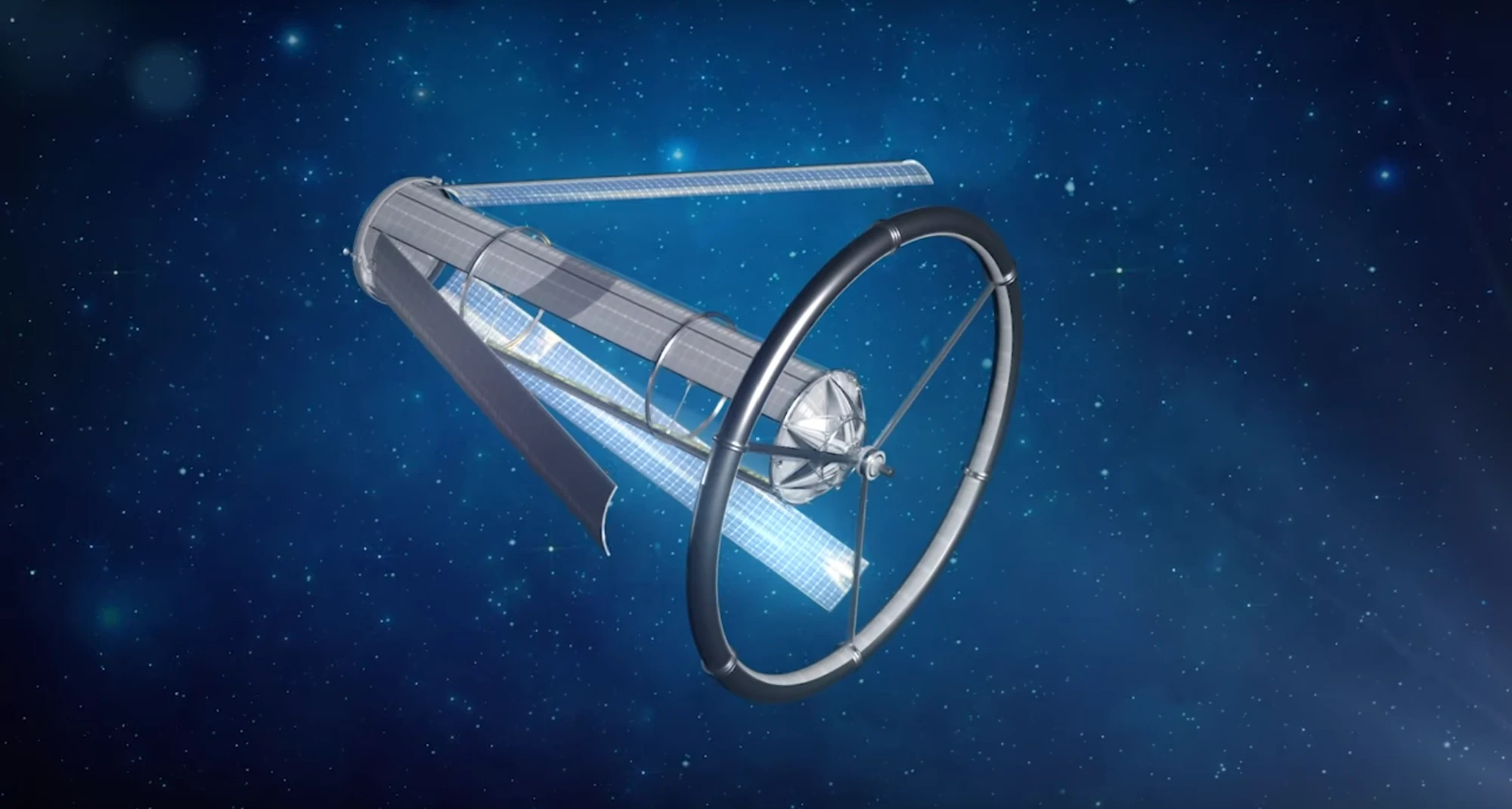







 Alien hunters are searching for signatures emitted from...
 Alien life could be much more common than previously...
 Men are far more likely than women to want a close encounter...










 Shocking satellite images reveal that 20 per cent of snow...
 New tests under Antarctica's 'doomsday' Thwaites glacier...