Ontdek de Fascinerende Wereld van UFO's en UAP's: Jouw Bron voor Onthullende Informatie!
Ben jij ook gefascineerd door het onbekende? Wil je meer weten over UFO's en UAP's, niet alleen in België, maar over de hele wereld? Dan ben je op de juiste plek!
België: Het Kloppend Hart van UFO-onderzoek
In België is BUFON (Belgisch UFO-Netwerk) dé autoriteit op het gebied van UFO-onderzoek. Voor betrouwbare en objectieve informatie over deze intrigerende fenomenen, bezoek je zeker onze Facebook-pagina en deze blog. Maar dat is nog niet alles! Ontdek ook het Belgisch UFO-meldpunt en Caelestia, twee organisaties die diepgaand onderzoek verrichten, al zijn ze soms kritisch of sceptisch.
Nederland: Een Schat aan Informatie
Voor onze Nederlandse buren is er de schitterende website www.ufowijzer.nl, beheerd door Paul Harmans. Deze site biedt een schat aan informatie en artikelen die je niet wilt missen!
Internationaal: MUFON - De Wereldwijde Autoriteit
Neem ook een kijkje bij MUFON (Mutual UFO Network Inc.), een gerenommeerde Amerikaanse UFO-vereniging met afdelingen in de VS en wereldwijd. MUFON is toegewijd aan de wetenschappelijke en analytische studie van het UFO-fenomeen, en hun maandelijkse tijdschrift, The MUFON UFO-Journal, is een must-read voor elke UFO-enthousiasteling. Bezoek hun website op www.mufon.com voor meer informatie.
Samenwerking en Toekomstvisie
Sinds 1 februari 2020 is Pieter niet alleen ex-president van BUFON, maar ook de voormalige nationale directeur van MUFON in Vlaanderen en Nederland. Dit creëert een sterke samenwerking met de Franse MUFON Reseau MUFON/EUROP, wat ons in staat stelt om nog meer waardevolle inzichten te delen.
Let op: Nepprofielen en Nieuwe Groeperingen
Pas op voor een nieuwe groepering die zich ook BUFON noemt, maar geen enkele connectie heeft met onze gevestigde organisatie. Hoewel zij de naam geregistreerd hebben, kunnen ze het rijke verleden en de expertise van onze groep niet evenaren. We wensen hen veel succes, maar we blijven de autoriteit in UFO-onderzoek!
Blijf Op De Hoogte!
Wil jij de laatste nieuwtjes over UFO's, ruimtevaart, archeologie, en meer? Volg ons dan en duik samen met ons in de fascinerende wereld van het onbekende! Sluit je aan bij de gemeenschap van nieuwsgierige geesten die net als jij verlangen naar antwoorden en avonturen in de sterren!
Heb je vragen of wil je meer weten? Aarzel dan niet om contact met ons op te nemen! Samen ontrafelen we het mysterie van de lucht en daarbuiten.
Without a doubt that is a controversial question! The fact is, though, that some alleged extraterrestrials do seem to be trying to move among us and without being noticed for what they really are. In fact, it may have been going on for not just years, but decades. We’ll begin with the Men in Black. Not the Will Smith and Tommy Lee Jones type. Rather, the real Men in Black: the pale, scrawny, weird-looking Men in Black who surfaced in the early 1950s and who have never gone away. There is strong evidence to show that the Men in Black realize there are certain differences between us and them. As a result of this, they do their best to make them look like us. Those who have unfortunately crossed paths with the MIB state that their black-suited visitors wore make-up and lipstick. In some cases, they even had what were clearly painted-on eyebrows – as bizarre as it all sounds. On occasion, the MIB will wear large, wraparound sunglasses. This is clearly done for camouflage: in some cases the MIB are described as having large, abnormal eyes that they hide behind those glasses. Often, though, they don’t do a good job of hiding those bulging eyes – which is why we sometimes get to see those creepy eyes.
Very much the same can be said about the Women in Black – who also terrorize witnesses to UFOs. The WIB are described as wearing long black wigs and sunglasses. Like the MIB, the WIB mask their milk-white skin with make-up. While there is no evidence that the Black Eyed Children are connected to the UFO subject, it is a fact that there are some similarities. For example, the BEC very often wear hoodies, which they pull down to hide their large, completely black, eyes. In many occasions, the Black Eyed Children keep their eyes firmly aimed at the ground – clearly to try and prevent people from seeing those eerie eyes. In issue 187 of Fortean Times magazine, writer Mark Pilkington did a review of the FortNite 2004 gig. Pilkington highlighted certain material that was disclosed at the gig by Budd Hopkins, the author of Missing Time: “…in order to better blend in with us humans, the greys have taken to wearing wigs and sunglasses…the aliens are also experimenting with growing hair on the heads of their genetic hybrid grey-human creations…they’re also developing pupils to get around those giveaway wraparound black eyes.”
Eris Andys had an encounter with one of these human-appearing things in the later part of the 1980s. She detailed it in a 2004 feature for Fortean Times, which was appropriately titled “A Quiet Invasion.” While walking down one particular street (location not stated) Andys encountered a humanoid creature with “waxy, grey” skin, “…with no pores and no hair. It looked damp. The mouth was small, the nose tiny, and the chin pointed.” She added: “The most amazing thing was the pair of glasses ‘he’ wore – made of some yellow reflective stuff, they wrapped around the sides of the head like some futuristic ski-wear.”
This all reminds me of Mac Tonnies’ “Cryptotererstrials.” In his theory, Tonnies suggested that ancient humans lurk among us, and do so in ways that will ensure we don’t get to see the subtle differences between them and us. Tonnies said: “I envision the cryptoterrestrials engaged in a process of subterfuge, bending our belief systems to their own ends. And I suggest that this has been occurring, in form or another, for an extraordinarily long time. I think there’s a good deal of folkloric and mythological evidence pointing in this direction, and I find it most interesting that so many descriptions of ostensible ‘aliens’ seem to reflect staged events designed to misdirect witnesses and muddle their perceptions.” Tonnies suggested that the Cryptoterrestrials – like our aliens – may employ the likes of wigs, make-up, sunglasses and hats, in an effort to try and deflect attention away from their slight differences. A creepy thought, to be sure.
WETENSCHAPDe vier eerste maanden van het jaar 2020 hebben getoond hoe het ‘kleinste’ gevaar om het hoekje loert en op 1,2,3 catastrofale gevolgen kan hebben. Maar niet enkel een onzichtbaar virus bedreigt onze planeet. Volgens een rapport van enkele vooraanstaande Australische onderzoekers hebben we te maken met tien potentiële risico’s.
Het rapport – genaamd ‘Surviving and Thriving in the 21st Century’ - werd samengesteld door onderzoekers die deel uitmaken van de Commision for the Human Future. De onderzoekers identificeerden tien grote (onzichtbare) gevaren die onze wereld bedreigen. En een pandemie zoals het coronavirus is slechts één van de tien gevaren.
In totaal worden er tien gevaren opgesomd: op willekeurige volgorde.
1. Klimaatverandering
2. Achteruitgang van het milieu
3. Kernwapens
4. Schaarste aan levensnoodzakelijke natuurlijke hulpbronnen (waaronder water)
5. Voedselonzekerheid
6. Gevaarlijke en oncontroleerbare nieuwe technologieën
7. Overbevolking
8. Chemische vervuiling
9. Pandemieën
10. Mislukken in het preventief optreden tegen deze risico’s
De onderzoekers roepen overheden op om actie te ondernemen met behulp van hun gebundelde lijst. Ze stellen nog dat niemand ter wereld “een plan heeft om de risico’s het hoofd te bieden”. “Het gebrek aan paraatheid betekent onoverkomelijk dat de mensheid getroffen zal blijven worden door onvoorziene crises.” En of we al dan niet iets ondernemen de komende jaren, zal bepalen of huidige en toekomstige generaties “een veilige, duurzame en welvarende toekomst tegemoet gaan”, zo luidt het besluit van het rapport.
De toekomst van de mens
De Commision for the Human Future – vrij vertaald naar de commissie voor de toekomst van de mens – is een organisatie die bestaat uit tal van wetenschappers en burgers. Ze focussen op de mondiale uitdagingen waarmee de mensheid worstelt.
Anne VirkkiHet lijkt een beetje alsof de planetoïde een mondmasker draagt.
WETENSCHAPOver twee dagen, op 29 april, scheert de planetoïde 1998 OR2 voorbij de aarde. Zo’n doortocht van ruimteblokken gebeurt overigens wel vaker, maar dit exemplaar ziet er wel heel bijzonder uit: het lijkt volgens enkele wetenschappers wel alsof de planetoïde een mondmasker draagt.
Wetenschappers verbonden aan het Arecibo Observatory in Puerto Rico bestuderen de naderende planetoïde al een tijdje: op die manier houden ze in de gaten of die een gevaar zal vormen voor de aarde. Dat blijkt niet het geval te zijn. In tegendeel, het lijkt wel alsof de planetoïde zich voorbereidt op de pandemie op aarde. De radarbeelden van de ruimtesteen tonen iets wat volgens sommigen verdacht veel op een mondmasker lijkt.
“Aangezien we allemaal aan Covid-19 denken, zorgen de topografische kenmerken ervoor dat het lijkt alsof 1998 OR2 eraan gedacht heeft een mondmasker te dragen”, vertelt onderzoekster Anne Verkki.
Of het radarbeeld een mondmasker toont of niet is voor discussie vatbaar. Wat vaststaat is dat 1998 OR2 twee kilometer groot is en iets meer dan vier uur nodig heeft om een rondje rond zijn eigen as te voltooien.
Verder kunnen de beelden van het Arecibo Observatory voorspellen hoe de planetoïde zich in de toekomst voortbeweegt: “De radarmetingen stellen ons in staat om heel nauwkeurig vast te stellen waar de planetoïde in de toekomst – onder meer tijdens scheervluchten langs de aarde – zal zijn.” Dit jaar blijft de planetoïde nog ver weg van de aarde – op een afstand die zestien keer groter is dan de afstand tussen de aarde en de maan - maar in 2079 komt 1998 OR2 alweer wat dichterbij. “In 2079 zal 1998 OR2 ongeveer 3,5 keer dichter bij de aarde in de buurt komen dan dit jaar het geval is. Daarom is het is belangrijk om de baan heel nauwkeurig te kennen”, legt onderzoeker Flaviane Venditti uit.
American President Ronald Reagan Tried Many Times To Leak The Existence Of Aliens, Video, UFO Sighting News.
Date of speeches: Sept 16, 1983 Location of speech: United Nations Below is a video, of US President Reagan speaking at three different engagements, and in each...he tries to leak the truth...that aliens exist. He really tried hard to inform the public, even when he knew it was against national security to do so. On Sept 16, 1983, US President Ronald Reagan gave a memorable speech in front of the United Nations. In it, he subtly suggests that aliens exist and that all of humanity could be lost if they decide to attack. President Reagan states: Perhaps we need some outside, universal threat to make us recognize this common bond. I occasionally think how quickly our differences worldwide would vanish if we were facing an alien threat from outside this world. Of course President Reagan had inside information from the CIA and NASA and was told that aliens do exist. But he couldn't just come out and say so without breaking national security rules. So instead...he subtly hinted to the rest of the world leaders about what he had learned from the CIA and NASA. He also knows that a small percentage of the other presidents at the United Nations meeting also knew about the existence of aliens. He even hints at one other president...he talked to the General Secretary Gorbachov...who then later became Russian president. Now pondering about world peace is nice...but I feel that President Reagan felt a weight on his shoulders...a burden of carrying this knowledge of the existence of aliens. Remember its was the 1980s and back they the technology was very inferior to today tech marvels. It must have been very frightening for him to know that aliens existed, but to have so few people he could sit down and talk about this subject openly. Watch the video below and see. He is trying to tell the world the truth...that aliens exist. Scott C. Waring
Astronomers discover mysterious red planet that never existed?
What astronomers thought was a planet beyond our solar system has now seemingly vanished from sight, suggesting that what was heralded as one of the first exoplanets to ever be discovered with direct imaging likely never existed.
According to Physorg. two University of Arizona astronomers conclude that NASA's Hubble Space Telescope was instead looking at an expanding cloud of very fine dust particles from two icy bodies that smashed into each other. Hubble came along too late to witness the suspected collision but may have captured its aftermath. The missing-in-action planet was last seen orbiting the star Fomalhaut, 25 light years away.
The suspected exoplanet, named Fomalhaut b, was first announced in 2008, based on data from 2004 and 2006.
The object was bright in visible light—highly unusual for an exoplanet, which is simply too small to reflect enough light from its host star to be seen from Earth. At the same time, it did not have any detectable infrared heat signature again, highly unusual, as a planet should be warm enough to shine in the infrared.
Astronomers conjectured that the added brightness came from a huge shell or ring of dust encircling the planet that may have been collision-related.
Data analysis of Hubble images taken in 2014 showed the object had vanished, to their disbelief. Adding to the mystery, earlier images showed the object to continuously fade over time, they say.
The astronomers said that Fomalhaut b was doing things a bona fide planet should not be doing.
Indeed, very mysterious, maybe it was not an expanding cloud of very fine dust particles from two icy bodies at all but a huge mothership or something like the infamous red planet Nibiru?
Triangle UFO filmed over Statue of Liberty, NY 5-Mar-2020
This amazing video was just submitted through our Facebook page. It show some kind of a triangular-shaped craft maneuvering in the sky above the Statue of Liberty in New York. This happened on 5th March 2020.
What do you think this is? Please leave your comments below!
Founder of the Center for UFO Physical Trace Research, Ted Phillips Has Died
A young Ted Phillips
Ted Phillips, the founder and director of the Center for Physical Trace Research died, on March 10, 2020. Phillips was born in 1942 and spent his life in Missouri.
He began investigating UFOs in 1964 and met Dr.J. Allen Hynek during the investigation of the Socorro UFO landing. Phillips was trained as an engineer and was a professional photographer. He was involved in the Vanguard Satellite Program and was a field engineer on the Minuteman Missile Project. He was also employed as an inspector for the Missouri State Highway Department, an associate of the J. Allen Hynek Center for UFO Studies, and made presentations at the MUFON Symposiums.
By Kevin Randle A Different Perspective 3-11-20
It was Hynek who suggested that Phillips concentrate on UFO physical trace cases. Phillips and his team investigated more than 4000 physical trace cases in more than 90 countries. Phillips once said that if you told him the physical markings left be the UFO, he would be able to describe the craft that left them.
Ted Phillips at the Illinois conference
With Hynek, Dr. Jacques Vallee and Dr. David Saunders, Phillips participated in the American Institute of Aeronautics and Astronautics Aerospace Sciences meetings. He was also participated as a member of a small group who met with the United Nations Secretary-General. Phillips made presentations to a wide variety of groups and was a participant in several television programs and documentaries dedicated to UFOs.
In recent years he was involved in the investigation of strange lights seen in the Marley Woods in far southern Missouri. I met him in Illinois when he made a presentation about those lights at a UFO conference there. I had hoped to talk to Phillips about this while at the conference but there never seemed to be a couple of moments when the two of us crossed paths, with one exception. I told him it was my impression, from his presentation, that he wasn’t looking toward the extraterrestrial on this. He confirmed that he had thought it was some sort of terrestrial manifestation but he didn’t know what it might be. For those interested, there is more about Phillips’ presentation here.
In the 1970s, he provided a “position statement” for Ron Story’s Encyclopedia of UFOs that said:
The available facts are mostly statistical, but by taking a large number of reports, we can begin to develop a fairly clear picture of the objects observed and the traces left behind. Obviously, a report involving a landed object is of much greater value than a nocturnal light case. The landed object immediately eliminates a number of possibilities. One would not expect a balloon to land, leave unusual traces, and then ascend vertically at high speed. Stars and planets do not appear at ground level between witnesses and a line of trees. When several witnesses observe a disk-shaped object with a metallic surface, no wings and no sound, landing, ascending vertically, they have, with their descriptions, eliminated most of the natural or conventional explanations. When these objects then leave traces at the landing site, we have something tangible to examine I believe, after thirteen years of investigation, the data indicates a nonterrestrial origin.
Ted Philips, truly one of the pioneers in scientific UFO research and a dedicated investigator is dead at 78.
Plate tectonics may have started 400 million years earlier than we thought
Minerals suggest large blocks of Earth’s crust moved around as early as 3.2 billion years ago
As early as 3.2 billion years ago, a portion of Earth's crust (seen this artist’s interpretation) moved relatively quickly across the planet's surface, a hallmark of modern plate tectonics.
Modern plate tectonics may have gotten under way as early as 3.2 billion years ago, about 400 million years earlier than scientists thought. That, in turn, suggests that the movement of large pieces of Earth’s crust could have played a role in making the planet more hospitable to life.
Geologist Alec Brenner of Harvard University and his colleagues measured the magnetic orientations of iron-bearing minerals in the Honeyeater Basalt, a layer of rock that formed between 3.19 billion and 3.18 billion years ago. The basalt is part of the East Pilbara Craton, an ancient bit of continent in Western Australia that includes rocks as old as 3.5 billion years.
This craton, the researchers found, was on the move between 3.35 billion and 3.18 billion years ago, drifting around the planet at a rate of at least 2.5 centimeters per year. That’s a speed comparable to modern plate motions, the team reports April 22 in Science Advances.
The basalt layer, which burbled up as lava and hardened during the journey, contains iron-bearing minerals that can act as tiny signposts pointing the way toward Earth’s magnetic poles. While the lava was still molten, the minerals rotated, orienting themselves to align with either the north or south magnetic pole. By tracking the changes in orientation within the lava as more basalt formed during the journey, the researchers were able to determine how quickly the craton was moving.
Scientists have long used such preserved magnetic signposts to reconstruct plate motions, retracing the steps of drifting bits of continent. But the constant grinding and shifting of Earth’s tectonic plates over the last few billion years have reworked Earth’s surface many times over, leaving few outcrops that are older than 3 billion years.
The Honeyeater Basalt, however, is a rare site, both ancient and relatively unworked by metamorphism, the heat and pressure from which could have altered the minerals and reset their magnetic orientation. The team examined 235 samples of the basalt using an instrument called a quantum diamond microscope that can detect traces of magnetism at the micrometer scale. From these analyses, the researchers created a high-resolution map of magnetic orientations within the rock.
Based on the map, the team estimates that about 3.2 billion years ago, the East Pilbara Craton was at a latitude of about 45°, but whether north or south isn’t certain, Brenner said April 21 in a video news conference. That’s because researchers aren’t sure whether Earth’s magnetic poles at the time were in their current orientation or reversed. Either way, this bit of ancient crust moved in a gradual, steady motion — a hallmark of modern plate tectonics, the researchers say. Today, the craton is located at about 21° S, just north of the Tropic of Capricorn.
Plate tectonics is generally thought to have become a well-established global process on Earth no earlier than around 2.8 billion years ago. Before that, Earth’s interior was considered to be too hot for cold, rigid plates to form at the surface, or for deep subduction to occur, in which one crustal plate dives beneath another.
An earlier start to plate tectonics would have implications for the evolution of life on Earth, Brenner told reporters. Whether the process was in operation when the first single-celled organisms emerged, currently thought to be at least 3.45 billion years ago, isn’t clear, he said (SN: 10/17/18).
But it is clear that plate tectonics is currently closely tied to the biosphere, he added. It promotes chemical reactions between once-buried rocks and the atmosphere that can modulate the planet’s climate over millions to billions of years. “So if [plate tectonics] happened on the early Earth, these processes were likely playing a part in the evolution of life,” Brenner said.
Active, modern-style plate tectonics is the most likely explanation for the data, the researchers say. But they acknowledge other possible explanations can’t yet be ruled out, including an early, episodic, fit-and-start style of plate tectonics.
Some researchers have proposed that, during the Archean Eon that lasted from about 4 billion to about 2.5 billion years ago, there was a proto-plate tectonics process in which bits of crust moved in fits and starts as the planet began to cool after its formation (SN: 4/9/12). Sediment eroded from Earth’s earliest continents may also have helped grease the wheels, setting the stage for modern plate tectonics (SN: 6/5/19).
The researchers’ data could support episodic rather than gradual plate motion, perhaps as a precursor to modern plate tectonics, says Michael Brown, a geologist at the University of Maryland in College Park. Those data suggest that after its initial burst of speed, the Honeyeater Basalt’s progress slowed considerably, from 2.5 centimeters per year to 0.37 centimeters per year, he says.
It’s still unclear how similar proto-plate tectonics may have been to the modern process. “We know too little to answer this question with confidence,” says geophysicist Stephan Sobolev of the University of Potsdam in Germany. Sobolev has suggested previously that, for about a billion years during the Archean, plate tectonics occurred regionally: Plates could have been broken apart by large meteorite impacts or powerful plumes rising from the mantle, generating regional cells in which ancient continents formed and small blocks of crust subducted.
Such a regional cell may have formed the East Pilbara Craton in Australia, Sobolev suggests. But for that bit of ancient continent to have traveled so far so quickly, he says, “large-scale subduction must have been involved” — a surprising possibility for early Earth’s history.
Scientists suspect that the complex life that slithers and crawls through every nook and cranny on Earth emerged from a random shuffling of non-living matter that ultimately spit out the building blocks of life.
Even so, the details to support the idea are lacking.
But researchers recently got creative in figuring out the probability of life actually emerging spontaneously from such inorganic matter — a process called abiogenesis.
In the study, Tomonori Totani, a professor of astrophysics at the University of Tokyo, modeled the microscopic world of molecules across the epic scale of the entire universe to see if abiogenesis is a likely candidate for the origin of life. He was essentially looking at whether there were enough stars with habitable planets in the universe at the time to allow complexity to arise. His results, published Feb. 3 in the journal Nature, show the betting odds for life emerging are not good, at least for the observable universe.
RNA is made up of a chain of nitrogen-based molecules called nucleotides. Researchers think that in order for RNA to perform its essential function of copying itself, it needs to be composed of a chain of nucleotides longer than 40 to 60 nucleotides.
So, how would these RNA molecules made up of at least 40 to 60 nucleotides have popped up on their own? Nucleotides have been shown experimentally to randomly organize into RNA given enough time and under the right conditions. But these experiments show that the abundance of RNA rapidly decreases with the length of their chains and none of the experiments could consistently produce strands longer than 10 monomers.
"It has been experimentally confirmed that RNA polymerization can occur by a basic random process," Totani said. "Some experiments claimed that more than 50 (monomer long) RNA were produced, but these are not reproducible. One problem is that aggregates are easily mistaken for a long RNA polymer."
Totani's model uses the most conservative method of RNA polymerization, where each monomer is attached randomly one-by-one until a chain of monomers is formed. Scientists have suggested that polymers (each made up of multiple monomers) could attach to each other to speed up the process, but Totani said such a process is "highly speculative and hypothetical."
Life as we know it
Scientists think life emerged on Earth around 500 million years after the planet formed. Given that there are an estimated 10 sextillion (10^22) stars in the observable universe, it may seem that the odds of life popping up in the universe should be good. But researchers have found that the random formation of RNA with a length greater than 40 is incredibly unlikely given the number of stars — with habitable planets — in our cosmic neighborhood. There are too few stars with habitable planets in the observable universe for abiogenesis to occur within the timeframe of life emerging on Earth.
"However, there is more to the universe than the observable," Totani said in a statement. "In contemporary cosmology, it is agreed the universe underwent a period of rapid inflation, producing a vast region of expansion beyond the horizon of what we can directly observe. Factoring this greater volume [of stars with habitable planets] into models of abiogenesis hugely increases the chances of life occurring."
After our universe flashed into existence some 13.8 billion years ago during the Big Bang, it underwent a period of rapid expansion that continues today. If we think of the universe as a loaf of bread baking in the oven, our observable universe is like a bubble of air trapped in the dough, where the walls of the bubble are the farthest distance light can travel since the Big Bang. As the loaf rises (inflation), our bubble grows while other pockets of air within the bread get farther away. Our observable bubble of air is all that we can see, even though the rest of the loaf is out there.
It is estimated that the whole universe could contain more than 1 googol (10^100) stars. When Totani factored in this new abundance of stars, he found that the emergence of life was no longer improbable, but very likely.
This may be good news for the RNA world hypothesis, though it could also mean that the search for life in the universe is a hopeless pursuit.
If life first got its start in RNA, "life on Earth was created by a very rare chance of producing a long RNA polymer," said Totani. "Most likely, Earth is the only planet harboring life in the observable universe. I predict that future observations or explorations of extraterrestrial life will yield no positive results.
If by chance, life is discovered elsewhere in our cosmic neighborhood, Totani believes it would likely be of the same origin as life on Earth. Life may have hitched a ride from comets and asteroids across interplanetary or interstellar space, seeding the local universe with life from a single origin event.
Totani's work is far from an answer to one of science's most existential questions but it may guide further research on the origins of life. Whether we are alone in the universe still remains unanswered, but if Totani's numbers tell us anything, you shouldn't bet on it.
Tiny, levitating "nanocardboard" flyers could one day explore the dusty red surface of Mars.
This summer, NASAwill launch its newest Mars rover, Perseverance, and a helicopter that will fly over the planet's surface as part of a "high-risk, high-reward" experiment. But even before its launch, researchers are designing much more ambitious aircraft for Mars as well.
Of particular interest are flying aircraft that could, with less risk, more effectively observe and study Mars' surface. In a new study, researchers have demonstrated the abilities of a unique fleet of aircraft that could thrive on Mars: tiny "nanocardboard" flying vehicles. These aircraft each weigh about a third of a milligram, or less than a fruit fly, and have no moving parts. Instead of flying with wings or rotating blades, they actually levitate.
Researchers tested the "nanocardboard" flyers in a "Mars-like" environment in a lab. (Image credit: Bargatin Group, Penn Engineering)
"The Mars Helicopter is very exciting, but it's still a single, complicated machine," lead author Igor Bargatin of the School of Engineering and Applied Science at the University of Pennsylvania, who is not involved in the Mars Helicopter, said in a statement. "If anything goes wrong, your experiment is over, since there's no way of fixing it. We're proposing an entirely different approach that doesn't put all of your eggs in one basket."
Each tiny flyer is a plate of "nanocardboard," which is inspired by paper cardboard's corrugations, or ridges. Plates of "nanocardboard" are hollow aluminum oxide a few nanometers thick with ridges made by a pattern of micro-channels on the plates that keep them stiff and unbroken.
The micro-channels in the "nanocardboard" plates are actually the secret behind their unique method of flight, according to the statement: The channels create a temperature gradient that pushes air through the hollow plates and allows them to float.
This strange method of flight would be particularly advantageous on Mars because the planet's thin atmosphere and weaker gravity would allow the plates to lift more weight and travel over much longer distances than here on Earth.
Researchers tested the "nanocardboard" flyers' ability to carry small payloads. (Image credit: Bargatin Group, Penn Engineering)
In this study, the researchers tested "nanocardboard" vehicles in a Mars-like environment in a lab environment. They tested the vehicles in a low-pressure test chamber and experimented with mock payloads by having the little floating plates carry silicone rings.
Additionally, Bargatin is working with other researchers to develop new, tinier chemical sensors that could collect important data and detect substances like methane and water on other planets, according to the statement.
"In addition to carrying sensors," Bargatin said, "our flyers could simply land and have grains of dust or sand passively stick to them, then transport them back to the rover so it doesn't need to travel as far."
Bargatin also suggested in the statement that fleets of these tiny flyers could be used to study our own planet's atmosphere — specifically, the mesosphere.
"The Earth's mesosphere is pretty similar to the Martian atmosphere in terms of density, and we currently don't have anything that flies there, since it is too low for space satellites but too high for airplanes and balloons," Bargatin said. "Ideally, you'd like to have some sensors up there as well. The more knowledge you have about the movement of the atmosphere at that level, the better predictions you can make about Earth's climate and even weather."
Gravitational waves have revealed the first unevenly sized black hole pair
One big black hole and one little one partnered up, LIGO and Virgo detections show
A black hole orbiting with a much smaller partner stirred up gravitational waves (illustrated by colors in this simulation) that scientists with the LIGO and Virgo experiments detected on Earth.
As far as odd couples go, this is one for the record books.
The ripples in spacetime stirred up by two distant, merging black holes suggest that one of the pair was much bigger than the other. It’s the first definitively mismatched black hole pair spotted by the LIGO and Virgo collaborations, which search for the gravitational waves emitted in the cosmic encounters of black holes. The collision, detected on April 12, 2019, occurred about 2.5 billion light-years from Earth.
For all previous such black hole mergers, the two partners have been of similar size. But in this case, the bigger black hole had a mass about 30 times that of the sun, while the smaller was about eight times the mass of the sun, researchers with the LIGO and Virgo collaborations reported April 18 at a meeting of the American Physical Society, which was held virtually due to the COVID-19 pandemic.
Prior to this result, scientists did not know if such lopsided partnerships existed, or how rare they might be. “This one event represents a big step forward in our understanding,” astrophysicist Maya Fishbach of the University of Chicago said in a talk at the meeting.
Understanding what types of black holes partner up could eventually help answer the question of how the duos form (SN: 6/19/16). The black holes might partner up within a dense star cluster, or when two stars are born together as twins and both collapse into black holes. Both possibilities could occasionally create unequal mass partnerships.
The researchers also tested whether Einstein’s theory of gravity still held up in this new type of black hole collision. Surprise, surprise: Einstein was right again.
The detectors of the Advanced Laser Interferometer Gravitational-Wave Observatory in the United States and Virgo in Italy are currently shut down, in an early end to operations that was hastened by COVID-19. They’re scheduled to once again start observing the heavens in 2022.
Summary: In Mali, West Africa, lives a tribe of people called the Dogon. The Dogon are believed to be of Egyptian decent and their astronomical lore goes back thousands of years to 3200 BC.
In Mali, West Africa, lives a tribe of people called the Dogon. The Dogon are believed to be of Egyptian decent and their astronomical lore goes back thousands of years to 3200 BC. According to their traditions, the star Sirius has a companion star which is invisible to the human eye. This companion star has a 50 year elliptical orbit around the visible Sirius and is extremely heavy. It also rotates on its axis.
This legend might be of little interest to anybody but the two French anthropologists, Marcel Griaule and Germain Dieterlen, who recorded it from four Dogon priests in the 1930's. Of little interest except that it is exactly true. How did a people who lacked any kind of astronomical devices know so much about an invisible star? The star, which scientists call Sirius B, wasn't even photographed until it was done by a large telescope in 1970.
The Dogon stories explain that also. According to their oral traditions, a race people from the Sirius system called the Nommos visited Earth thousands of years ago. The Nommos were ugly, amphibious beings that resembled mermen and mermaids. They also appear in Babylonian, Accadian, and Sumerian myths. The Egyptian Goddess Isis, who is sometimes depicted as a mermaid, is also linked with the star Sirius.
The Nommos, according to the Dogon legend, lived on a planet that orbits another star in the Sirius system. They landed on Earth in an "ark" that made a spinning decent to the ground with great noise and wind. It was the Nommos that gave the Dogon the knowledge about Sirius B.
The legend goes on to say the Nommos also furnished the Dogon's with some interesting information about our own solar system: That the planet Jupiter has four major moons, that Saturn has rings and that the planets orbit the sun. These were all facts discovered by Westerners only after Galileo invented the telescope.
The story of the Dogon and their legend was first brought to popular attention by Robert K.G. Temple in a book published in 1977 called The Sirius Mystery. Science writer Ian Ridpath and astronomer Carl Sagan made a reply to Temple's book, suggesting that this modern knowledge about Sirius must have come from Westerners who discussed astronomy with the Dogon priests. The priests then included this new information into the older traditions. This, in turn, mislead the anthropologists.
This is a possibility considering Sirius B's existence was suspected as early as 1844 and seen was through a telescope in 1862. It doesn't seem to explain a 400-year old Dogon artifact that apparently depicts the Sirius configuration nor the ceremonies held by the Dogon since the 13th century to celebrate the cycle of Sirius A and B. It also doesn't explain how the Dogons knew about the super-density of Sirius B, a fact only discovered a few years before the anthropologists recorded the Dogon stories.
It is also important to remember that although many parts of the Dogon legends seem to ring true, other portions are clearly mistaken. One of the Dogon's beliefs is that Sirius B occupied the place where our Sun is now. Physics clearly prohibits this. Also, if the Dogon believe that Sirius B orbits Sirius A every 50 years, why do they hold their celebrations every 60 years?
Sirius A is the brightest star in our sky and can easily be seen in the winter months in the northern hemisphere. Look for the constellation Orion. Orion's belt are the three bright stars in a row. Follow an imaginary line through the three stars to Sirius which is just above the horizon. It is bluish in color.
Sirius is only 8.6 light years from Earth. Astronomer W.Bessel was the first to suspect that Sirius had an invisible companion when he observed that the path of the star wobbled. In the 1920's it was determined that Sirius B, the companion of Sirius, was a "white dwarf" star. The pull of its gravity caused Sirius's wavy movement.
White dwarfs are small, dense stars that burn dimly. Sirius B is, in fact, smaller than the planet Earth. One teaspoon of Sirius B is so dense that it weighs 5 tons.
So did alien fish-men pay a visit to ancient Earth and give the Dogon their knowledge? Or was the Dogon's culture contaminated by western visitors? Or could the Dogon's have had ancient technical or non-technical means to find this information out? Or is the whole thing just a matter of coincidence?
The question maybe settled as larger and more powerful telescopes take a look at the Sirius system. According to the legend there is a third star: Sirius C, and it is around Sirius C that the home planet of the Nommos orbits. Most scientists do not consider any part of the Sirius system a prime candidate for life, though.
When Temple first issued his book in the 1970's there was no solid evidence of a Sirius C. In 1995, however, two French researchers, Daniel Benest and J.L. Duvent, authored an article in the prestigious journal Astronomy and Astrophysics with the title Is Sirius a Triple Star? and suggested (based on observations of motions in the Sirius system) there is a small third star there. They thought the star was probably of a type known as a "red dwarf" and only had about .05 the mass of Sirius B.
So has the home star of the Nommos been discovered? Or is this just another strange coincidence?
EXPLORERS IN ANTARCTICA FIND THE FOSSILS OF A "TOTALLY UNEXPECTED" ANIMAL
Researchers were shocked to find 40-million-year-old remains.
The Earth's South Pole, known for being a land of penguins, is covered in ice. But it wasn't always this way: Tens of millions of years ago, Antarctica was lush and green — and full of very different creatures.
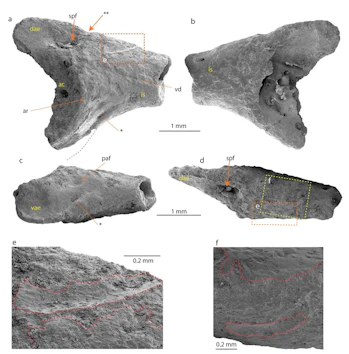
Recently, while exploring the frigid region for ancient fossils, researchers found the shockingly out-of-place remains of a helmeted frog. It's the oldest-ever discovery of an amphibian and demonstrates that 40 million years ago Antarctica was more similar to present-day South America.
Paleontologist Thomas Mörs and his team were on a mission to find fossils of mammals who inhabited Antarctica before the big freeze. They collected and sifted through samples of sediment from Seymour Island, a process that revealed the teeth and bones of a variety of mammals — including tiny marsupials.
While sorting through their findings, Mörs found something shocking: an ilium — a large hip bone — and an ornamented skull. Both are telltale signs of a HELMETED FROG.
"I first found the hip bone, and I directly realized that I found an Antarctic frog, the first!" Mörs tells Inverse. "It was a totally unexpected discovery under the microscope."
This finding was published Thursday in the journal Scientific Reports.
This discovery also indicates that Antarctica might have actually played a large role in the evolution of vertebrates, including amphibians, before the mass extinction event that happened at the end of the Eocene.
Before the ice came.Simon Pierre Barrette and José Grau de Puerto Montt, Wikimedia Commons
ANTARCTICA, KEY TO ANCIENT FROG HISTORY — The frozen continent at the Earth's South Pole may have been where some animals originated or dispersed, Mörs says, tens of millions of years ago.
The two fossilized frog bones are around 40 million years old. That helps pin down what the environment was like in Antarctica during that time — six million years before Antarctica froze over permanently.
But the ice was already coming: The researchers found evidence that some glaciers were already present during the days of the helmeted frogs. This suggests that the cold-blooded amphibians, and other vertebrates on the land, were able to survive even as the area became increasingly icy.
The fossilized illium.Thomas Mörs
Mörs says the research helps to connect some dots about helmeted frogs, too.
Today, helmeted frogs live Australia, New Guinea, and South America, where they are sometimes called Southern Frogs. These are places with climates that are probably similar to what Antarctica once looked like.
This discovery is a sign that helmeted frogs likely formed a single population across Pangea, before the supercontinent split.
"We have now a fossil frog from Antarctica that links the living frogs of the other two continents," Mörs says.
Antarctica, then, may have been an important link — not only between the continents but also between various groups of ancient helmeted frogs.
Abstract:
Cenozoic ectothermic continental tetrapods (amphibians and reptiles) have not been documented previously from Antarctica, in contrast to all other continents. Here we report a fossil ilium and an ornamented skull bone that can be attributed to the Recent, South American, anuran family Calyptocephalellidae or helmeted frogs, representing the first modern amphibian found in Antarctica. The two bone fragments were recovered in Eocene, approximately 40 million years old, sediments on Seymour Island, Antarctic Peninsula. The record of hyperossifed calyptocephalellid frogs outside South America supports Gondwanan cosmopolitanism of the anuran clade Australobatrachia. Our results demonstrate that Eocene freshwater ecosystems in Antarctica provided habitats favourable for ectothermic vertebrates (with mean annual precipitation ≥900mm, coldest month mean temperature ≥3.75°C, and warmest month mean temperature ≥13.79°C), at a time when there were at least ephemeral ice sheets existing on the highlands within the interior of the continent.
In the beginning, there was an infinitely dense, tiny ball of matter. Then, it all went bang, giving rise to the atoms, molecules, stars and galaxies we see today.
Or at least, that's what we've been told by physicists for the past several decades.
But new theoretical physics research has recently revealed a possible window into the very early universe, showing that it may not be "very early" after all. Instead it may be just the latest iteration of a bang-bounce cycle that has been going on for … well, at least once, and possibly forever.
Of course, before physicists decide to toss out the Big Bang in favor of a bang-bounce cycle, these theoretical predictions will need to survive an onslaught of observation tests.
Bouncing cosmologies
Scientists have a really good picture of the very early universe, something we know and love as the Big Bang theory. In this model, a long time ago the universe was far smaller, far hotter and far denser than it is today. In that early inferno 13.8 billion years ago, all the elements that make us what we are were formed in the span of about a dozen minutes.
Even earlier, this thinking goes, at some point our entire universe — all the stars, all the galaxies, all the everything — was the size of a peach and had a temperature of over a quadrillion degrees.
Amazingly, this fantastical story holds up to all current observations. Astronomers have done everything from observing the leftover electromagnetic radiation from the young universe to measuring the abundance of the lightest elements and found that they all line up with what the Big Bang predicts. As far as we can tell, this is an accurate portrait of our early universe.
But as good as it is, we know that the Big Bang picture is not complete — there's a puzzle piece missing, and that piece is the earliest moments of the universe itself.
The problem is that the physics that we use to understand the early universe (a wonderfully complicated mishmash of general relativity and high-energy particle physics) can take us only so far before breaking down. As we try to push deeper and deeper into the first moments of our cosmos, the math gets harder and harder to solve, all the way to the point where it just … quits.
The main sign that we have terrain yet to be explored is the presence of a "singularity," or a point of infinite density, at the beginning of the Big Bang. Taken at face value, this tells us that at one point, the universe was crammed into an infinitely tiny, infinitely dense point. This is obviously absurd, and what it really tells us is that we need new physics to solve this problem — our current toolkit just isn't good enough.
To save the day we need some new physics, something that is capable of handling gravity and the other forces, combined, at ultrahigh energies. And that's exactly what string theory claims to be: a model of physics that is capable of handling gravity and the other forces, combined, at ultrahigh energies. Which means that string theory claims it can explain the earliest moments of the universe.
One of the earliest string theory notions is the "ekpyrotic" universe, which comes from the Greek word for "conflagration," or fire. In this scenario, what we know as the Big Bang was sparked by something else happening before it — the Big Bang was not a beginning, but one part of a larger process.
Extending the ekpyrotic concept has led to a theory, again motivated by string theory, called cyclic cosmology. I suppose that, technically, the idea of the universe continually repeating itself is thousands of years old and predates physics, but string theory gave the idea firm mathematical grounding. The cyclic universe goes about exactly as you might imagine, continually bouncing between big bangs and big crunches, potentially for eternity back in time and for eternity into the future.
Before the beginning
As cool as this sounds, early versions of the cyclic model had difficulty matching observations — which is a major deal when you're trying to do science and not just telling stories around the campfire.
The main hurdle was agreeing with our observations of the cosmic microwave background, the fossil light leftover from when the universe was only 380,000 years old. While we can't see directly past that wall of light, if you start theoretically tinkering with the physics of the infant cosmos, you affect that afterglow light pattern.
And so, it seemed that a cyclic universe was a neat but incorrect idea.
But the ekpyrotic torch has been kept lit over the years, and a paper published in January to the arXiv database has explored the wrinkles in the mathematics and uncovered some previously missed opportunities. The physicists, Robert Brandenberger and Ziwei Wang of McGill University in Canada, found that in the moment of the "bounce," when our universe shrinks to an incredibly small point and returns to a Big Bang state, it's possible to line everything up to get the proper observationally tested result.
In other words, the complicated (and, admittedly, poorly understood) physics of this critical epoch may indeed allow for a radically revised view of our time and place in the cosmos.
But to fully test this model, we'll have to wait for a new generation of cosmology experiments, so let's wait to break out the ekpyrotic champagne.
The sun begins to rise along Nevada Highway 375, also known as the Extraterrestrial Highway, just north of Groom Lake or 'Area 51.'
(Photo: Will Pedro/Shutterstock)
Behind every alleged unidentified flying object sighting, every creepy alien story and every first-contact theory, there's a person. An earthling who believes a little — or a lot — in the idea that aliens have visited Earth or are trying to.
So who are all these people? Writer Sarah Scoles was interested in finding out, and it's the people behind the science, philosophy and conspiracy theories of UFOs who she focuses on in her book, "They Are Already Here: UFO Culture and Why We See Saucers."
Belief in UFOs is currently at a high point, with a 2019 Gallup poll showing that 33% of Americans "believe that some UFO sightings over the years have in fact been alien spacecraft visiting Earth from other planets or galaxies." About 60% of Americans are skeptical and 7% aren't sure — but 16% of people who answered the poll said they have personally witnessed a UFO.
Why UFOs now?
Those numbers are on the rise again in recent years due, in part, to a bombshell of an article published in December 2017 by The New York Times. A front-page story detailed a five-year program at the Pentagon call the Advanced Aerospace Threat Identification Program (AATIP). That program's findings included a number of reports of unidentified flying objects. In later interviews, key members of that program offered more detail.As MNN covered at the time, Luis Elizondo, the head of AATIP, told then-Defense Secretary James Mattis:
"In my opinion, if this was a court of law, we have reached the point of 'beyond reasonable doubt.' I hate to use the term UFO, but that’s what we’re looking at," said Elizondo. "I think it's pretty clear this is not us, and it's not anyone else, so one has to ask the question where they're from."
Contrary to what might be assumed, many in the UFO community were skeptical of this news, though author Scoles said this was interestingly divided by generation, with older people more skeptical and Millennials excited to hear confirmation, a divide that got Scoles interested in the group. She attended the UFO Congress — a huge annual meeting of the UFO-interested — held just a couple months after the Pentagon program's revelation. She talked to 22 people for her book, and what's interesting is how different they are from each other; this is no monolithic group.
She traveled to famous sites on the extraterrestrial map, including Roswell, New Mexico and Area 51, the UFO Congress, the Pentagon, Skinwalker ranch in Utah and even meetings of a local UFO group in Denver where she lives. As she dug deeper into UFO society, Scoles discovered there are different reasons and attitudes that get people thinking or obsessing about UFOs.
The moderate skeptics
Sheer curiosity — and a feeling that information is being withheld — is the drive that keeps many people engaged in the UFO conversation.
(Photo: Dean Clarke/Shutterstock)
"I was surprised to find the moderate types," says Scoles, pointing out that when you think about someone who spends a lot of time thinking about UFOs, you're unlikely to picture a science-minded person who thinks there are likely good explanations for UFO sightings. She was curious, "If you don't believe in this thing, why would you spend time or energy to figure this out?"
Scoles says this group is a "large minority" of UFO-interested people, and discovered that what drives them is probably similar to what drives a scientist: plain old curiosity. Like a good researcher, they're not out to "prove" a belief; instead they're focused on the question, and how to answer it. This group is focused on how they can use science to understand, explain, explore or disprove the idea of alien life.
Scoles says the people in this group reminded her of the SETI astronomers, who use giant telescopes to look for possible messages from beyond Earth. Many of those scientists don't think alien civilizations exist, but they're "interested in the question even if the answer isn't exciting," says Scoles.
The spiritualists and the hopefuls
A tall metal alien sculpture greets visitors to the Alien Research Center, an extraterrestrial-themed gift shop in Hiko, Nevada.
(Photo: BrianPIrwin/Shutterstock.com)
Another subset of UFO fans are those who treat the idea of extraterrestrials as a kind of secular religion. While there are some cultists (including those who see aliens as some kind of god or gods), many of those who see the possibility of advanced alien life regard it as a sign of hope. If they survived, then humanity may be able to overcome our current challenges and keep advancing to the stars. This idea is behind plenty of sci-fi franchises as well, especially "Star Trek," which directly addresses the idea that we live in perilous times and that there can be positive visions of humanity's future.
Thinking about how aliens may have overcome their own challenges can give us a hypothetical look at how aliens could be a model for us, says Scoles. "If there is [an alien civilization] it will be older, it will have survived energy and other crises. The idea that somebody else did it gives us a role model for ourselves."
But there's also a less practical spiritual take — the sweet allure of the unknown. Scoles writes of a friend who stopped in a small town south of Des Moines, Iowa, where "spook lights" had been seen. As soon as he sat down at a bar and asked about the lights, people opened up, excited to tell a stranger what they had seen. "There was some mystery and magic left here, after all. There still existed something, even in this tiny town, that felt unfamiliar," Scoles writes. "And maybe someday, when they weren't expecting it, they'd be lucky enough to experience that feeling first hand again."
The true believers and conspiracy theorists
There are some people who believe that, odds are, there is life in the universe outside Earth, and those life forms have have visited our planet. This group might overlap with the spiritualists, but not necessarily. After all, some people fear the idea of aliens: "There's people who talk about aliens and UFOs who see them as an existential threat," says Scoles.
But others look at the statistics around the number of stars and habitable planets and see the possibility of life having arisen on other planets as not just possible, but probable. They think first contact has already likely happened, or they believe enough of the conspiracy theories that their judgement says it's more likely than not that we've already had some alien contact.
Of course, there are those who believe in UFOs almost entirely due to their belief that it's been covered up for years, "whether they think the conspiracy is hiding aliens or their classified technology," says Scoles. Their belief is rooted in what they see as the "cover-up."
So with all these different groups of people interested in alien life and spacecrafts, is there anything that unites them?
"I think everybody across the whole UFO spectrum from skeptics to true believers is motivated by a sense of wonder, encountering a thing that they don’t know fully," says Scoles.
Hey everyone, I found some thought provoking things on Mars in a Curiosity Rover photo today. Two the objects are structures with doorways...both located next to one another.
The other thing is a giant sculpture head with a equally sized hand with four visible fingers (hi lighted in yellow)...near it is a dragon skull (highlighted in orange). This may be evidence of a giant species...turned into a giant fossil. But my be a statue, since the doorways were so small...one 1/3 a meter tall openings, compared to the hand of the giant...which appears to be 2 meters across.
There were also two pyramids...one still being carved from the local stone, the other finished but with a face on the top. All in all, it seems Mars was teaming with intelligent life and the evidence is all over the place. Hard to believe NASA kept the secret for so long.
Weird spherical object floating over General Carrera Lake in Aysén, Chile
It seems the Aysén region in Chile is a UFO hotspot. According to The Journal Of Hispanic UFOlogy, Ysaac Wichmann, a mountaineer with a good knowledge of the area in the Aysén region, Chile said that the UFO phenomena have always been visible in this region, in the mountain ranges or at sea, on islands, canals or archipelagos, and particularly in unpopulated, isolated, distant and hard-to-reach locations.
A member of his family who served years ago in the Chilean navy witnessed this phenomenon while approaching a small island in the Aysén region in a Navy ship. Their mission was to work on a lighthouse to provide orientation and navigation assistance to those transiting along those waters.
What they saw before reaching the lighthouse, an oval metallic object rose vertically and slowly near the lighthouse, until it reached a certain altitude. After a while, the object rose quickly into the air and vanished from sight.
In another case two black objects can be seen floating at a distance over the surface of General Carrera Lake in Aysén, Chile.
According to witnesses, who were aboard a boat during the observation on June 23, 2019, the objects appeared to hover over the water, sometimes appearing and disappearing mysteriously.
Another small grey spherical object also appeared out of nowhere beside these dark objects, along with an orb of light that appears to fly over the lake. Some claim the objects are buoys; however, buoys do not fly, disappear and reappear.
UFO-Like Sphere Recorded on Video Hovering Over Paris, France
A Paris, France resident reported his UFO sighting a few weeks ago, which he recorded from his balcony during this lockdown. The video shows a sphere-like object hovering and appears watching over the city.
UFO sightings became more frequent over the past weeks. Many suggest that aliens may have been trying to figure out whether humans follow the rules of wearing face masks, physical distancing, and lockdowns or not.
Conspiracy theorists further speculate that aliens observing the Earth during the pandemic may have gathered information that would provide them a predictive model of what will bound to happen soon.
The video was published on YouTube and has gotten more than 25,000 views. Some observers rule out advertising balloons as a possible explanation because there are no customers and not weather balloons either as they typically fly at higher altitudes.
A few others believe that it’s just understandable UFO sightings are becoming more frequent this past couple of weeks as aliens pride themselves on their knowledge.
Others suggest it could be chemtrail, drone, or a blimp.
One commenter on the YouTube video pin hopes that if these are aliens, they are friendly.
"It's wonderful to see USGS create a resource that can help NASA with their planning for future missions."
A new map has provided the blueprints for the moon, revealing the true nature of Earth's rocky companion.
Scientists at the United States Geological Survey (USGS), in collaboration with NASA and the Lunar Planetary Institute, have created the first-ever comprehensive geologic map of the moon. In this new digital map, titled the "Unified Geologic Map of the Moon," the entire lunar surface has been thoroughly charted and all of its features uniformly classified.
You can find the map, which shows an incredible amount of detail at a 1:5,000,000 scale, online here.
This map details exactly what makes up the beautiful variety of dark and light spots on the moon's surface. It is intended not only as a scientific and educational tool, but it could also be invaluable for future crewed missions to the moon.
Scientists at the USGS created the most comprehensive geologic moon map of all time. (Image credit: NASA/GSFC/USGS)
"People have always been fascinated by the moon and when we might return," Jim Reilly, a former NASA astronaut and current director of the USGS, said in a statement. "So, it's wonderful to see USGS create a resource that can help NASA with their planning for future missions."
This new digital map is so comprehensive, in part, because it uses data spanning the last five decades. The collaborative team behind the map used data from recent satellite missions to the moon, as well as data collected and maps created during NASA's Apollo missions to and around the moon.
Among the recent data are elevation measurements from stereo observations made by the Terrain Camera on JAXA's SELENE (Selenological and Engineering Explorer) mission and topography data from the Lunar Orbiter Laser Altimeter (LOLA) instrument on NASA's Lunar Reconnaissance Orbiter.
"This map is a culmination of a decades-long project," Corey Fortezzo, USGS geologist and lead author on this work, said in the same statement. "It provides vital information for new scientific studies by connecting the exploration of specific sites on the moon with the rest of the lunar surface."
These scientists merged the old and new datasets and updated the Apollo-era maps with the more recent data. Additionally, they developed a new, unified method for describing the moon's rock layers. Previously, moon maps have used a variety of names for the different types of rock and rock layers, and this new unified description method absolved that inconsistency.
You can read an abstract describing the work on this map here, published by the USGS.
You need a telescope to see it, but astronomers have been observing it already. Charts, tips, recent images, how to watch online here.
Radar image of asteroid 1998 OR2, acquired April 18, 2020 by astronomers at Arecibo Observatory. The radar data confirm that 1998 OR2 is at least 2 km in diameter [a little over a mile wide]. It is probably about 2 1/2 times that long. It rotates once every 4.1 hours.
Image via Arecibo Observatory in Puerto Rico.
A big – very big – asteroid will pass relatively close to Earth on April 29, 2020. Asteroid (52768) 1998 OR2 will pass at a safe distance, at some 4 million miles (6 million km), or about 16 times the Earth-moon distance. It’ll be the biggest asteroid to fly by Earth this year (that we know about so far); according to current estimates, it’s probably a bit over a mile wide (2 km) and maybe twice that long. Closest approach will be April 29 around 5:56 a.m. Eastern Daylight Time (09:56 UTC; translate UTC to your time). Professional observatories have been pointing their telescopes at the huge space rock already. Amateur astronomers with smaller telescopes will also have an opportunity to see it as a slow-moving “star.” If that’s you, we give charts and tips for observers at the bottom of this post that should help.
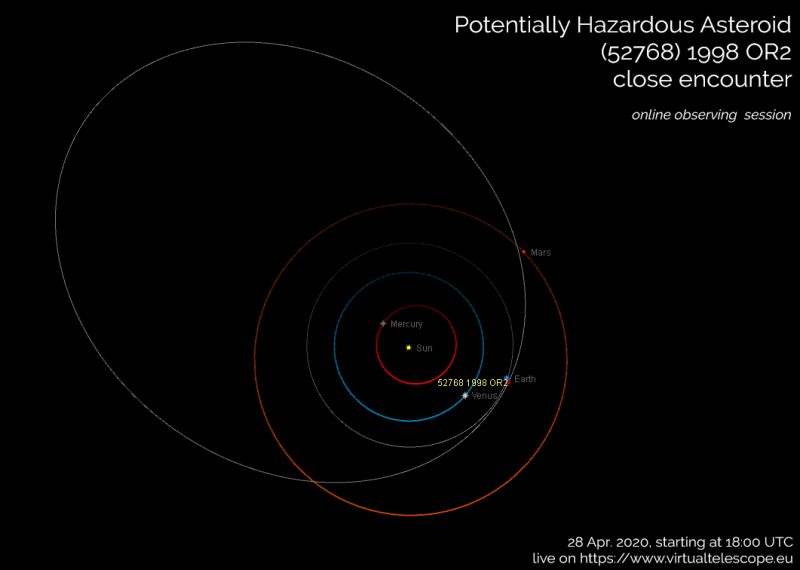
The Virtual Telescope Project will present an online viewing of Potentially Hazardous Asteroid (52768) 1998 OR2 on April 28, 2020. As the time approaches, check this page for more details.
No access to a telescope? No problem. The Virtual Telescope Project in Rome will host a free, online public viewing of the asteroid on April 28, 2020. See the poster above.
Gianluca Masi of the Virtual Telescope Project also acquired 166 images of the asteroid – collected back to back – and assembled them to make the animated gif below. The animation shows you the asteroid’s motion in front of the stars. It was made with images from the Elena robotic unit of the Virtual Telescope Project in Rome, Italy. The asteroid is in the center of the image, visible as a sharp dot of light.
Asteroid 1998 OR2 was at about 7.5 million miles from us (about 12 million km) when astronomers acquired the images to make this animation. At its closest on April 29, the asteroid will be 4 million miles (6 million km) from us, or about 16 times the Earth-moon distance. The asteroid appears to move in front of the stars because it is so much closer to us than the stars.
Astronomers at Arecibo Observatory in Puerto Rico have been studying the asteroid since April 8, as it’s traveled through space at 19,461 miles per hour (31,320 km/h). The high-resolution radar images at the top of this post and below – from Arecibo – are some of the first glimpses of this large asteroid. In addition to confirming the asteroid’s size (about 2 km [1.25 mi] wide, and maybe twice that long), the images uniquely revealed the overall shape of the asteroid and some smaller-scale topographic features, such as hills and ridges. The team of observers working now at Acrecibo to observe this asteroids includes astronomers Anne Virkki, Flaviane Venditti, and Sean Marshall from UCF/Arecibo Planetary Group, Dr. Patrick Taylor (remotely) from the Lunar and Planetary Institute in Houston, Texas, and the Arecibo telescope operators Israel Cabrera, Elliot Gonzalez, and Daniel Padilla.
Radar image of asteroid 1998 OR2, acquired April 18, 2020.
Image via Arecibo Observatory in Puerto Rico.
Let’s make it absolutely clear that there’s no chance of a collision between this asteroid and Earth. It’s true the object is classified as a Potentially Hazardous Asteroid. The Center for Near Earth Objects defines such an object as one that comes as close to Earth as:
… 0.05 AU or less [about 19.5 lunar distances] and an absolute magnitude of 22.0 or less …
In other words, such objects are reasonably close and reasonably big. And do we need to say there are a bunch of objects like this? Wikipedia lists 22 of the largest here. Recent decades have revealed more and more asteroids orbiting the sun.
None of the 22 Potentially Hazardous Asteroids listed by Wikipedia is known to be on a collision course with Earth in the foreseeble future. In fact, none of the asteroids in the video above is known to be on a collision course. Likewise, asteroid (52768) 1998 OR2 isn’t on a collision course with Earth, not anytime soon. The orbit of this asteroid is well known for at least the next 200 years. Its closest approach to Earth in this century and the next will happen in 2079, when it’ll swoop to within about a million miles of Earth (still about four times farther away than the moon). That 2079 sweep past Earth will still be a big deal. Asteroid (52768) 1998 OR2 is the largest known of all large Near-Earth Objects that’ll pass less than five times the Earth-moon distance over the next two centuries!
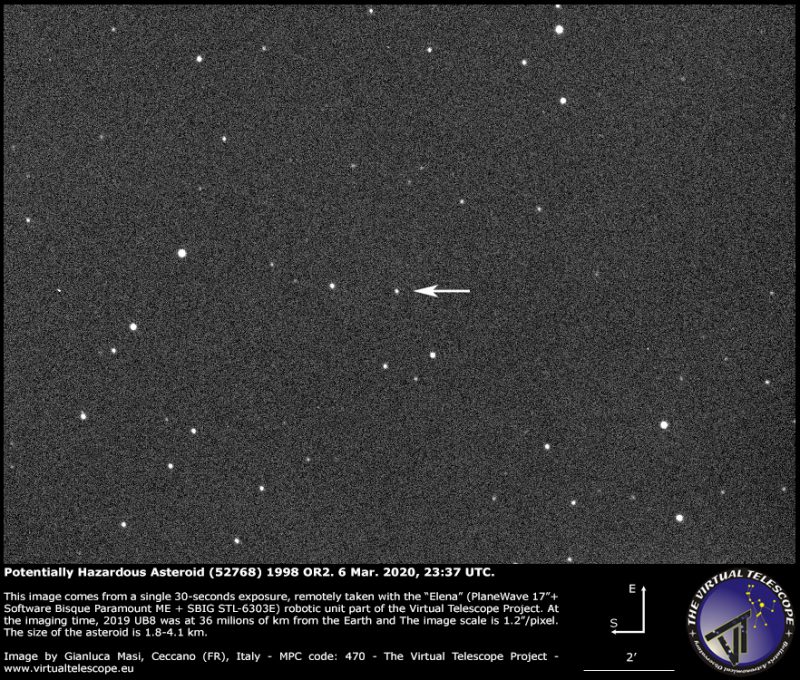
Astronomers with reasonably sized telescopes are already capturing images of asteroid (52768) 1998 OR2. This March 6, 2020, image of the asteroid comes from a single 30-second exposure, remotely taken with Elena, a 17-inch (43 cm) robotic telescope. At the imaging time, (52768) 1998 OR2 was about 22 million miles (36 million km) from Earth. At its closest in late April, it’ll be about 4 million miles (6.4 million km) away.
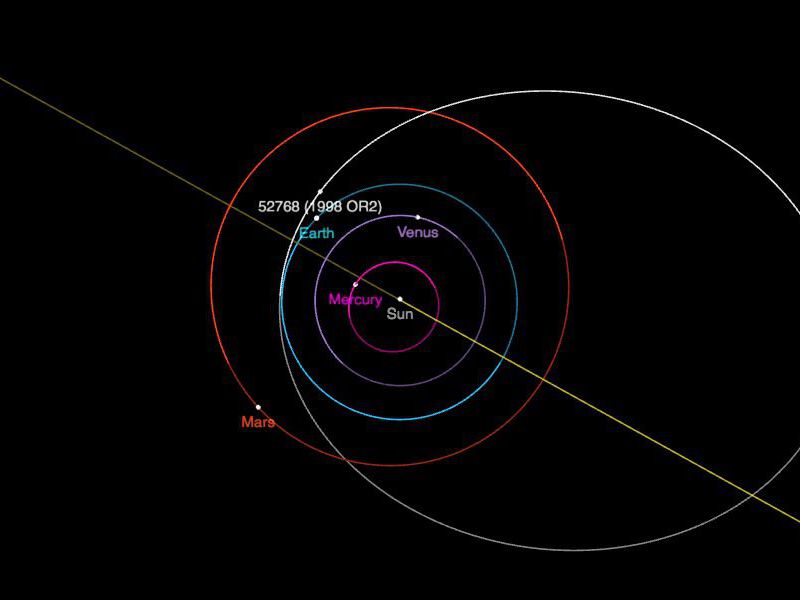
Orbit of asteroid (52768) 1998 OR2. It requires 3 years and 8 months to orbit the sun once. It gets nearly as far from the sun as Jupiter (about 5 times Earth’s distance from the sun).
Image via NASA/ JPL.
How to see asteroid (52768) 1998 OR2 with a small telescope
During its April 2020 pass, this asteroid will at no time be bright enough to view with the unaided eye. However, it’s estimated to reach a visual magnitude of around 10 to 11, which means observers with at least 6-inch or 8-inch (15 to 20 cm) telescopes (the number indicates the size of the primary mirror) will see the asteroid (very slowly) moving in front of the stars!
Sky enthusiasts can initially use a wide-angle (32mm or 35mm) eyepiece to point the telescope to a reference star in the asteroid’s path (charts below). After being assured that the instrument is pointing at the correct patch of the sky, a 26mm or 27mm eyepiece is recommended to detect the asteroid’s slow motion. You will want to note the star field, and watch for the object that moves over a period of about 10 to 15 minutes. Yes, that’ll be the space rock.
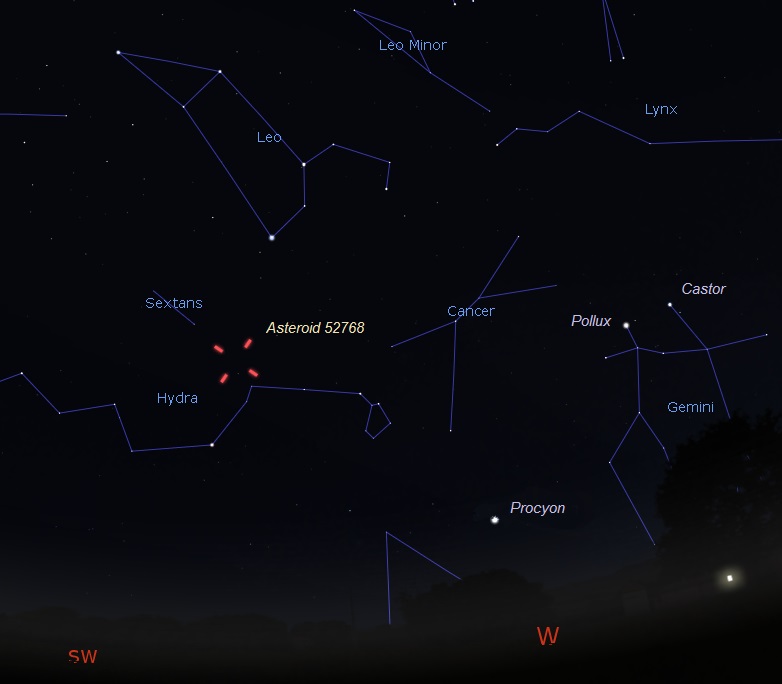
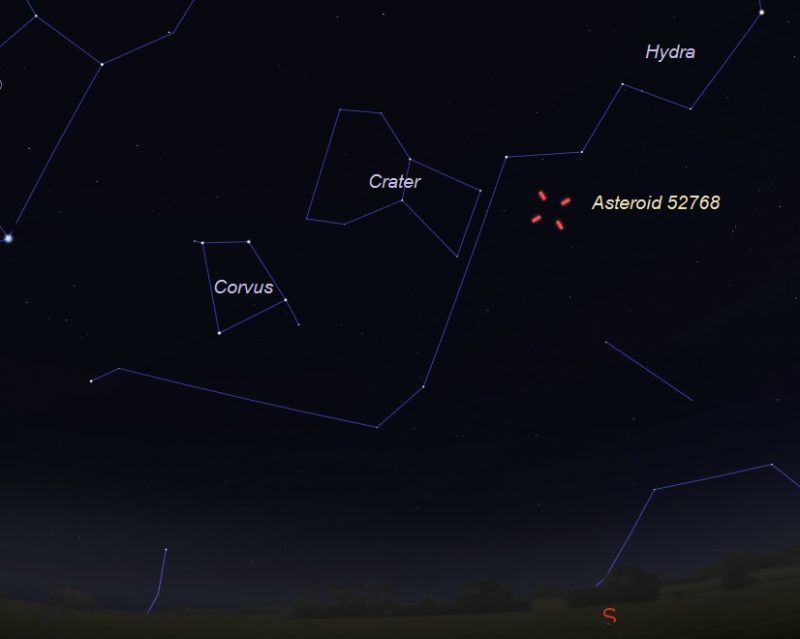
Asteroid (52768) 1998 OR2 is in our sky now, but it’s not visible to the eye alone. You need a telescope to see it. This illustration shows the asteroid’s location on the night of April 24, 2020, around 11:45 p.m. Central Daylight Time (04:45 Universal Time, April 25). As seen from central U.S., facing west-southwest.
Illustration by Eddie Irizarry using Stellarium.
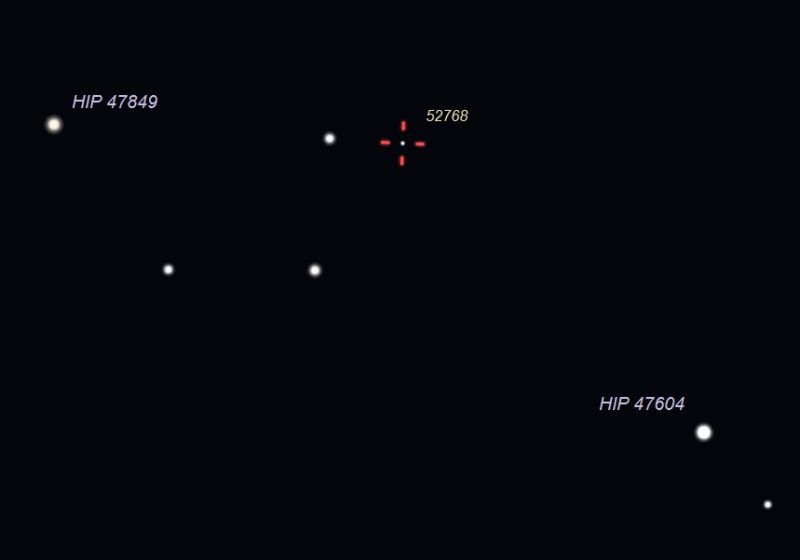
On April 24, 2020, at 11:45 p.m. CDT (04:45 UT April 25) observers using small computerized telescopes can point their instruments at these reference stars to observe asteroid (52768) 1998 OR2. Compare the views 10 or 15 minutes later to detect an apparent star that has changed position.
Illustration by Eddie Irizarry using Stellarium.
There will be closer approaches of asteroids in the future, including Apophis, which – although smaller – will pass very close to Earth in 2029. Another, larger space rock – 2 miles (3 km) wide – designated as asteroid (415029) 2011 UL21 will pass slightly farther than (52768) 1998 OR2 in June 2024.
But the upcoming flyby in April 2020 of asteroid (52768) 1998 OR2 is the most significant close approach of an asteroid until 2027, when another huge asteroid known as (4953) 1990 MU will safely pass by Earth at 12 lunar distances.
Astronomers first discovered asteroid (52768) 1998 OR2 on July 24, 1998, from Haleakala Observatory, Hawaii.
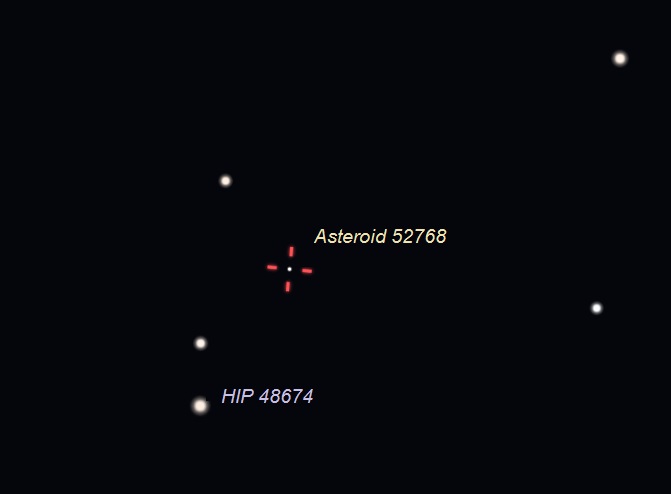
Have a Go-To Telescope? Point your instrument at star HIP 48674 on April 25, 2020, at 10 p.m. CDT (03:00 UTC April 26) to find the huge asteroid, which will appear as a slow-moving star. To see its movement, compare the views over about 10 to 15 minutes.
Illustration by Eddie Irizarry using Stellarium.
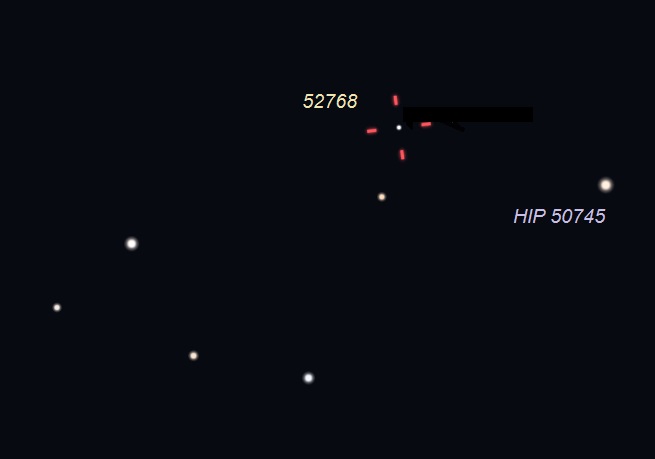
Location of asteroid (52768) 1998 OR2 on the night of April 27, 2020. The space rock passes close to star HIP 50745 around 9:15 p.m. CDT April 27 (02:15 UTC April 28).
Illustration by Eddie Irizarry using Stellarium.
Location of asteroid (52768) 1998 OR2 around the nights of closest approach (April 28-29, 2020). Facing south, as seen from the central U.S.
Illustration by Eddie Irizarry using Stellarium.
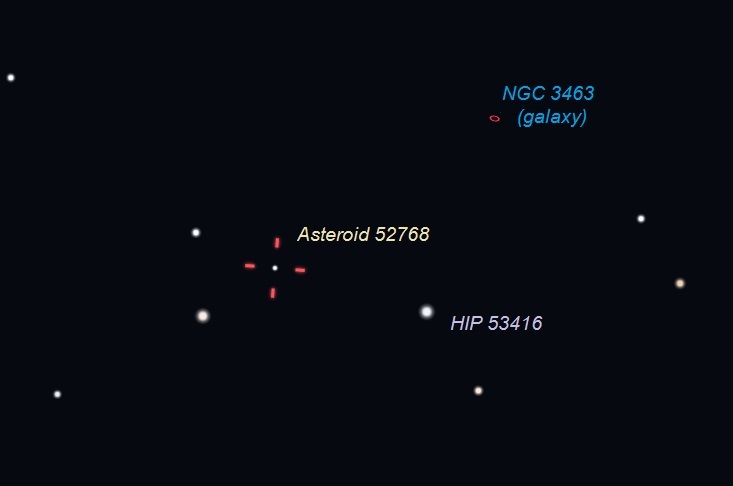
On April 29, 2020, around its closest approach to Earth, asteroid (52768) 1998 OR2 will pass close to galaxy NGC 3463 and star HIP 53416. Around 9:30 p.m. CDT April 29 (02:30 UTC April 30), point your small computerized telescope to these reference objects. Compare the views 10 to 15 minutes later to detect the apparent “star” that changed position. That’s the asteroid.
Illustration by Eddie Irizarry using Stellarium.
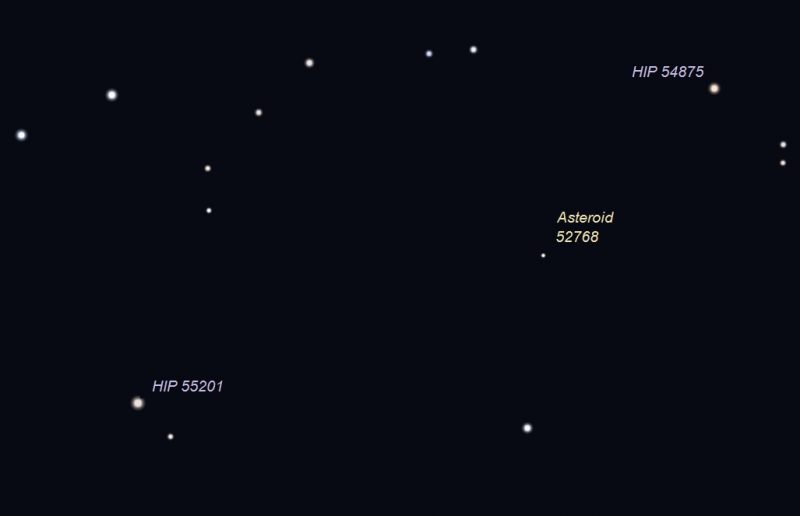
On April 30, 2020, at 9:30 p.m. CDT (02:30 UTC May 1) asteroid (52768) 1998 OR2 is located close to stars HIP 54875 and 55201. Use a GoTo telescope to locate these reference stars to locate the slow moving asteroid.
Illustration by Eddie Irizarry using Stellarium.
Bottom line: The huge asteroid known as (52768) 1998 OR2 will pass closest to Earth on April 29, 2020. Observers peering through telescopes will see it as a slow-moving “star.” Charts, tips, how to watch online – plus some recent images – here.
China hasn’t been getting much good press lately due to the coronavirus pandemic and is probably hoping for some good news, even if it’s from 3500 years ago. Unfortunately, this isn’t it. Archeologists digging in a major site dating back to the Shang Dynasty found an unusual ‘oracle’ bone in a very creepy tomb. It’s unusual because oracle bones – used by religious diviners to ask questions of the deities – are normally made from ox bones or turtle shells, while this one is a human bone. It’s creepy because this oracle bone was found in a grave where the skeletal remains indicated that the body was a human — a human sacrificed by beheading. Sorry, China … this is not your year.
“This well-preserved human bone is shaped like the oracle bone inscription of the character ‘Kan.'”
Proving that the Chinese media will cover bad news, China Daily interviewed Liang Fawei, head of the Chaizhuang site excavation project, about the recent find. Oracle bones were the key ingredient in the practice of pyromancy, where a diviner or oracle would etch a question on a large bone, then heat it with a hot metal rod until the bone cracked. The diviner would then interpret the cracks, determine the deity’s answer to the question and often scratch that onto the bone. This practice began in the Shang Dynasty (1600 BCE-1046 BCE) and continued into the Zhou Dynasty. Fawei notes that the question in this case was the primitive Chinese character ‘Kan’ from the ancient language Jiaguwen – one of the many hieroglyphics used to describe animal and human sacrifices.
“The bone remains found at the site suggest that the human sacrifice was beheaded, facing north and kneeling in the pit with his hands crossed in front of him.”
The Chaizhuang site covers 300,000 square meters and contains houses, wells, ash pits, roads, pottery, stones, bones, jade artifacts. other relics – and plenty of evidence of human sacrifices. Shang kings were often buried with hundreds of humans and evidence shows other sacrifices by this agrarian and warring culture were made to Di (the High God), the sun and mountains and various ancestors. While the ‘Kan’ message had been found on other oracle bones, this was the first discovered with the bones clearly indicating the human was beheading in a kneeling position rather than lying down. (Photos of the grave and oracle bone here.) The Google translation is a little confusing in that it seems to say both that the oracle bone was a human bone and that the character was on a human bone that matched those found on oracle bones.
A piece of oracle bone discovered at the Chaizhuang site in Jiyuan, Central China's Henan province.
[Photo/Xinhua]
Bone remains suggest ancient human sacrifice at the Chaizhuang site in Jiyuan, Central China's Henan province.
[Photo/Xinhua]
Whatever the case, the clear indication of a kneeling decapitation in a culture known for its human sacrifices means this story is well-deserving of headlines indicating that it was found in a “creepy tomb” or a “terrible tomb.” It’s both.
One persistent feature of the world of the weird is the phenomenon known as “spontaneous human combustion,” which is when a human being is immolated by fire that seems to have no discernible cause or eternal source of ignition. In most cases there are strange details surrounding these cases, such as bodies that were charred by extremely high temperatures, yet left the surroundings or even clothing untouched, or of cases in which certain body parts have somehow managed to remain unscathed while everything else is ash. It is a phenomenon that had been written of in literature for centuries, and one mostly stable feature of these cases is that the victim does not survive the ordeal. Indeed, most cases are known from their violent aftermath, in which the corpse or parts of the corpse are burned beyond recognition, and survivors are scarce. Yet, although rare, there are a few people who have been the victim of apparent spontaneous human combustion who have lived to tell the tale, and here are some of them.
Many of these reports come from pretty far back in time, and the earliest we will look at here is from 1776. It all revolves around an Italian friar by the name of Don Gio Maria Bertholi, who seems to have somehow drawn fire to him to spontaneously combust, and yet live to tell the tale. In October of that year he was in the small town of Filetto, and after conducting some business in town he retired for the evening at his brother-in-law’s house. Not long after he closed himself into his room for the night, the other residents were alarmed to hear Bertholi screaming loudly as if in great pain, and when they rushed to his aid, they found the friar surrounded by an aura of blue flame. Oddly, as the relatives approached the flames are said to have actually cringed away from them as if aware of their presence, before dissipating completely, leaving Betholi moaning in agony. One report of the odd event reads:
Perceiving the cries of the priest, they repaired instantly to the apartment; and, on entering it, found him extended on the paved floor, and enveloped in a thin flame, which receded as they approached him, and at length entirely vanished. They placed him, as soon as possible, upon his bed, and administered to him every kind of aid that was at hand.
Although the friar had survived the incident, he was suffering serious burns, and when he was able to articulate what had happened, he explained that it felt as if an unseen hand had struck him, after which he had erupted in flames. Oddly, it was found that although his body was burned and his silk cap had been burned to a crisp, his shirt and trousers were undamaged, and his hair had remained unscathed too despite burns on his face. Making it stranger still was that, although there had been quite a bit of fire, the room had no smoke or odor of the fire, and nothing in the vicinity had been damaged. When Bertholi was brought to a physician for an examination, he was found to be in quite a rough state. The French physician François-Emmanuel Fodéré would describe it in excruciating detail, writing:
On the following morning, the patient was examined by M. Battaglia, who found the integuments of the right arm almost entirely detached and pendant from the flesh; from the shoulders to the thighs the integuments were equally injured; and on the right hand, the part most injured, mortification had already commenced, which notwithstanding immediate scarification rapidly extended itself. The patient complained of burning thirst, and was horribly convulsed, he passed by stool putrid and bilious matter, and was exhausted by continual vomiting accompanied by fever and delirium. On the fourth day, after two hours of comatose insensibility, he expired; during the whole period of his suffering, it was impossible to trace any symptomatic affection. A short time previous to his decease, M. Battaglia observed, with astonishment that putrefaction had made so much progress that the body already exhaled an insufferable odor, worms crawled from it on the bed, and the nails had become detached from the left hand.
In the end it has never been ascertained exactly what happened to Bertholi, and no explanation offered that really explains the entirety of the very bizarre phenomenon that he experienced. It remains a historical oddity, and a curious case of a person who survived what certainly at least appears to be spontaneous human combustion. Our next weird case comes from 1822, in the countryside of France. One summer day a local man called Renateau was out in the countryside of the village of Loignan when he allegedly felt a sudden, sharp pain in his right index finger. He casually glanced to it and his eyes widened in terror as he realized that his finger was actually on fire, and when he waved his fingers around the whole hand ignited. He wildly batted his hand at his pants, setting them on fire as well, and his left hand erupted into flames when he clapped his hands together.
Now in a panic, the man dashed as fast as he could to his house and screamed at his wife to bring him a bucket of cold water in which to douse the fire, but plunging his hands into the water failed to stop the flames. He then tried shoving his hands into wet mud and even tried milk, but this didn’t work either, and by this time he had attracted a crowd of curious onlookers milling about. One of these gawking spectators then brought him some holy water, and this seemed to do the trick. Oddly, although his clothes where he had touched them were burned, his hands were remarkably intact, suffering only minor burns considering how long them had been ablaze. This curious case appears in 1822 in the French medical journal Nouveau journal de médecine, chirurgie, pharmacie, Volume 15 and is an odd historical account that doesn’t seem to have ever been solved.
While these cases so far have mostly been met with horror and desperate panic, there is another case from 1835 that appeared in The American Journal of the Medical Sciences, Volume 17, and is notable for just how calm the victim was. In January of that year, a professor at the University of Nashville by the name of James Hamilton was doing an experiment in which he was outside making atmospheric measurements. As he went about checking his barometer, thermometer, and hygrometer, he felt a sudden acute pain in the thigh of his left leg. At first, he tried to ignore it, but it got steadily more intense until the pain was nearly unbearable. When he examined his leg, he then noticed that there was a flame emanating from the point of pain, right above the cloth of his pants. Perhaps it was his scientific inquisitiveness that guided his actions then, because he calmly cupped his hands around the flame in order to cut off its oxygen supply and it went out and the pain subsided greatly. He then went about inspecting his leg.
He found upon the skin a dry spot about the size of a dime, that seemed more like a scrape than a burn. Curiously, a hole was found to have been burned through his drawers in a perfect circle where the pain had been, yet the underwear between the skin and the outer clothing remained strangely untouched. It was all very weird, but the professor could see no need for medical attention, and calmly went back to his experiment just as calmly as he had dealt with the spontaneous flame that had spewed from his leg. The strange wound would take longer to heal than would be expected, but the professor made a full recovery, and it was considered by the journal to be a reliable case of “partial spontaneous combustion.”
There have been more modern cases of this as well. In 1974 a door to door salesman by the name of Jack Angel allegedly woke up at his mobile home in Savannah, Georgia, in the United States to find his hands, arms, back, and chest covered with burns. This was very odd, as he was not a smoker, there was no source of flame, and nothing around him was burned, including his clothes, which were unscathed. He claims that doctors told him that whatever had happened did so “internally,” and had originated from his left arm. The case gets a little suspicious when in later years he changed the story to say that he had been sprayed by scalding hot water as he was fixing the mobile home’s water pressure, but then in an episode of the TV series That’s Incredible he reverted back to his original tale of spontaneous human combustion. What is going on here?
In 1985 we also have the case of decorated Vietnam War veteran Frank Baker, who says he had his strange experience while on a fishing trip with some buddies. He says that as he was just sitting there on the sofa chatting away in their cabin his body suddenly burst into flames for no reason at all. They were able to put the flames out, and Baker said, “I had no idea what was taking place on my body — none. We were getting ready for fishing and sitting on the couch. Everything was great. Pete was sitting next to me — we were having a helluva time.” Making it even stranger is that when doctors examined him he was informed that the fire seemed to have burned from the inside out. The case was featured on an episode of the Science Channel’s Unexplained Files, and is pretty strange, indeed.
As of yet there is no real consensus on what causes the human spontaneous combustion phenomenon, and it has long remained a fixture of the world of the paranormal. However, while there is usually no one left to give a first hand account of what it was like to experience it, these cases that we have looked at here are very intriguing, indeed. What can we learn from such stories? Do they provide any insight into what is going on or do they merely take the mystery deeper? Whatever the case may be, they certainly do provide a different spin on the mystery of spontaneous human combustion, and it seems to be an enigma that will be talked about for some time to come.
Satelliettrein van Musk voor derde keer gepasseerd, morgen nieuwe kans - HLN.be
BELGA.
De satelliettrein van SpaceX van Elon Musk is vanavond rond 22 uur opnieuw boven ons land gepasseerd. De trein was deze keer iets moeilijker te zien.
Net als de vorige twee avonden, passeerde de satellietentrein van Musk ook vanavond rond 22 uur boven ons land. Wellicht zullen we de treintjes nog enkele avonden kunnen waarnemen, maar ze zullen wel telkens minder helder worden. Ze worden namelijk geleidelijk in een hogere baan gebracht en bovendien verspreiden ze zich steeds meer, zodat het mooie ‘treintjeseffect’ stilaan verdwijnt.
Ook morgen zal de satelliettrein te zien zijn omstreeks hetzelfde uur, als het niet bewolkt is tenminste.
Supersnel internet
Woensdag was het al de zevende keer dat er satellieten gelanceerd werden van het Starlink-project, dat supersnel internet moet aanbieden in elke uithoek van de aarde. In mei vorig jaar werden de eerste gelanceerd en in totaal moeten er 12.000 in een baan rond de aarde gebracht worden.
De satellieten zijn zichtbaar als een streep van lichtjes. Volgens astronomen is die zichtbaarheid vandaag nog geen probleem, maar kan het wel een probleem worden als er nog meer satellieten bijkomen. Ze veroorzaken immers lichtvervuiling die het werk van astronomen bemoeilijkt.
Helderheid
Elon Musk liet echter weten op Twitter dat zijn bedrijf iets gaat doen aan de helderheid van de satellieten. Die heeft deels te maken met de manier waarop de zonnepanelen op de satellieten bevestigd zijn. De komende maanden zullen de panelen richting zon worden gedraaid, waardoor ze minder zichtbaar worden. De satellieten vliegen ook dicht bij de aarde en zijn vrij groot, waardoor ze licht reflecteren. Speciale zonneschermen zouden dat probleem moeten verhelpen.
America Before: The Key to Earth’s Lost Civilisation
This article was published in New Dawn 175 (Jul-Aug 2019)
Humans were in America long before we’ve been told, and the Australian Aborigines have a genetic connection to the Amazon which once had great cities. FRANK JOSEPH looks at the fresh discoveries in Graham Hancock’s latest book.
As the former editor-in-chief (1993 to 2007) and ongoing writer for Ancient American – a US magazine examining Old World impact on the New World before 1492 – recently released materials regarding pre-Columbian possibilities often come my way. I was surprised, however, to find that Graham Hancock’s latest tome, America Before, compares remarkably with Before Atlantis (2013), my own book, published six years earlier, in more than title.
Both works go into the Bering land-bridge Theory, megalithic alignments with the Cygnus constellation, Easter Island’s moai, Gobekli Tepe, the discoveries of Albert Goodyear, Brazil’s Stonehenge, the Meadowcroft Rock shelter, Neanderthals, the Clovis First Controversy, Pedra Furada, etc., etc. Other topics tackled in America Before – Ohio’s Great Serpent Mound, North American earthworks, the Piasu Bird, Cahokia, et al. – were likewise described at length in my earlier releases: Discovering the Mysteries of Ancient America (2006), Atlantis and Other Lost Worlds (2008), Unearthing Ancient America (2009), Advanced Civilizations of Prehistoric America (2010), Lost Worlds of Ancient America (2012), Lost Colonies of Ancient America (2014), and Lost History of Ancient America (2016).
Independent research that arrives at common conclusions tends to validate disparate investigators at work in the same field. Of them all, Graham Hancock is certainly the best known, thanks to his early association with such prestigious periodicals as The Times, The Independent, The Economist, and The Guardian, which granted him access to major book publishers with international distribution, such as St. Martin’s Press, publisher of his latest work. His Fingerprints of the Gods was a worldwide bestseller. At the time of its release in 1995, critics – even those sympathetic to the author’s belief in ancient catastrophism – faulted him for merely reworking long-known if not well-publicised information. But they were forced to admit that Hancock acquainted millions of readers with otherwise neglected information about the deep past.
America Before is not unlike Fingerprints of the Gods in that it introduces an international audience to a version of antiquity not otherwise available in schools or mainstream publications. America Before also joins Before Atlantis in highlighting “a global cataclysm that occurred near the end of the Ice Age around twelve thousand eight hundred years ago. A disintegrating comet crossed the orbit of the Earth and bombarded our planet with a ‘swarm’ of fragments.” Familiar language to readers already familiar with The Destruction of Atlantis (2002) and its sequel. Survivors of Atlantis (2004) similarly tells how an abundance of physical proof for worldwide destruction left by comets during the Bronze Age was offered by scientists meeting at Fitzwilliam College in Cambridge, England.
In 1997 they presented undeniable evidence in the form of annual growth rings at Irish bogs and oak forests, ash-fall deposits from Greenland ice-cores, impact lines made by colossal waves along the shores of Morocco, abrupt lake level changes from Western Europe to South America, and small, glassy spherules that result specifically from cometary collisions subjecting rock to intense heat. Earth’s periodic brushes with celestial upheaval belong to a pattern of astronomical interface with our planet that abruptly terminated the Ice Age, as described in America Before and earlier in Before Atlantis.
Buried in the floor of Lake Cuitzeo was a thin, dark layer containing unequivocal evidence for a large, cosmic body that struck central Mexico just when the Younger Dryas period opened with such violence. Virtually identical sediment strata dated to the same period have been previously located at numerous locations throughout North America, Greenland, and Western Europe. According to Science Daily, “The data suggest that a comet or asteroid – likely a large, previously fragmented body, greater than several hundred meters in diameter – entered the atmosphere at a relatively shallow angle. The heat at impact burned biomass, melted surface rocks, and caused major environmental disruption.” The resulting crater became Lake Cuitzeo, measuring twelve and one-half miles across, with an average depth of ninety feet.
Dr James Kennett, professor of earth science at the University of California (Santa Barbara), told the Proceedings of the National Academy of Sciences: “These results are consistent with earlier reported discoveries throughout North America of abrupt ecosystem change, megafaunal extinction, and human cultural change and population reduction. These changes were large, abrupt and unprecedented, and had been recorded and identified by earlier investigators at a ‘time of crisis’. The timing of the impact coincided with the most extraordinary biotic and environmental changes over Mexico and Central America during the last approximately twenty thousand years, as recorded by others in several regional lake deposits.”
Professor of earth science Dr James Kennett and other researchers postulate from the evidence that a fragmented comet slammed into the Earth close to 12,800 years ago, causing rapid climatic changes, megafaunal extinctions, sudden human population decrease and cultural shifts and widespread wildfires (biomass burning). They studied the impact spherules in 18 sites in nine countries on four continents for their study. (Graphic credit: YDB Research Group)
The floor of Lake Cuitzeo is rich in spherules formed when they collided with each other at high velocities during the whirling chaos of an extraterrestrial impact. They are joined by numerous specimens of lonsdaleite – an identifiable configuration nanodiamonds assume when they are pressured by large meteorite collisions – and aciniform soot, the acne-like appearance of dust residue resulting from the same cause. “These materials form only through cosmic impact,” Kennett explained, not through volcanic or other natural terrestrial processes. In the entire geologic record, the only other known continental layer with abundant peaks in lonsdaleite, impact spherules and aciniform soot is in the sixty-five-million-year-old Cretaceous-Paleogene boundary layer that coincided with the extinction of the dinosaurs.
Evidence for Early Human Settlement
“Recent discoveries show that North America was first peopled at least one hundred thirty thousand years ago,” according to Hancock, “many tens of thousands of years before human settlements were established in Europe and Asia.” Homo sapiens-sapiens? Yes, but the European continent was actually settled one hundred seventy thousand years earlier by Neanderthals. In fact, the oldest evidence for proto-humans in Europe goes back 1.3 million years. “At least” is a bit of an understatement for human settlement in the New World, because Before Atlantis describes how prehistorian Juan Armena Camacho discovered lithic implements at Hueyatlaco, seventy miles south-east of Mexico City. According to US geologist Dr Virginia Steen-McIntyre, “radiometric dates using methods identical to those used in Africa to date the early sites there place Hueyatlaco’s stone tools to slightly over a quarter of a million years ago.”
Some thirty years prior to Camacho’s find, a still older site came to light one mile north from the Oklahoma town of Frederick, at a ten-mile-long, half-mile-wide ridge. Ten to twenty-five feet beneath the surface of this gravel deposit occur dozens of well-crafted stone implements cemented in place in common strata with the bones of extinct animals firmly dated to seven hundred fifty thousand years ago. C.N. Gould, Director of the Oklahoma Geological Survey, reported: “There can be no doubt that the artifacts occur in the pit near the basal portion, on the same level as the fossil remains. An examination of the undisturbed face of the pit, immediately above the position of the finds, showed unbroken, nearly horizontal strata above it. As the case stands, it looks very much as though the artifacts are of the same antiquity as the fossil animals. At the same time, it would be well to reserve final judgment until we are certain that the artifacts are not secondary inclusions.”
Since Gould released his report in 1929, subsequent investigations of the Holoman Pit, as it is locally known, repeatedly confirmed that the stone tools are not later inclusions but were indeed laid down at the same time the animal bones were stratified, three quarters of a million years ago. As recently as 2005, archaeologist Silvia Gonzalez of Liverpool’s John Moore’s University in England discovered a line of human footprints dating back forty thousand years ago near Puebla, in Mexico. Conventional scholars, convinced no human set foot in Middle America before twelve thousand years ago, sought to debunk the heretical period she assigned the evidence by dispatching a team of leading geologists led by Paul R. Renne, director of California’s Berkeley Geochronology Center, to the site.
Once there, they took repeated argon testing to investigate the magnetic imprint of the foot-printed, magmatic rock, together with other state-of-the-art procedures. Renne announced their results in the scientific journal Nature, stating that the rock featuring the footprints was not forty thousand years old after all. It was, instead, 1.3 million yearsold.
During the early 20th century, archaeologist Carlos Ameghino (1865 to 1936) led teams of excavators along the Argentine coast south of Buenos Aires after detecting clues to an early habitation site at Miramar. By 1914, he discovered numerous stone tools cemented within Pliocene Era strata. As Silvia Gomez experienced in the following century, Ameghino’s critics commissioned a group of professional geologists to debunk his assertion. Instead, they verified it, stating that the artefacts had been laid down between two million and three million years ago. Although their analysis was released by the prestigious Anales del Museo de Historica Natural de Buenos Aires, it has since been ignored by archaeologists in the outside world.
Australia-Amazon: An Unexpected Discovery
“Certain tribes of the Amazon jungle,” states America Before’s back cover blurb, “are closely related to Australian Aborigines. How did this extraordinary, unexpected, and extremely ancient DNA signal get to the Amazon?” This question elevates Hancock’s new book with fresh discoveries that threaten to shake the scientific establishment to its core by opening an entirely new and revolutionary archaeological theatre of operations.
The vast Amazon region has long been dismissed by mainstream scholars as anciently under-populated and barren of all but the most backward, native cultures, hermetically sealed off by nature from the outside world. Hancock writes, “in September 2015, Pontus Skoglund, his senior colleague Professor David Reich of the Department of Genetics at Harvard Medical School, and other leading experts in the field, announced in the pages of Nature that they had found new evidence in South America, and specifically in the Amazon rainforest, that called for a rethink.”
Researchers mapped similarities in genes, mutations and random pieces of DNA of Central and South American tribes with groups in other parts of the world including Australia. Warmer colours indicate the strongest affinities. Researcher Skoglund said “a statistically clear signal linking Native Americans in the Amazonian region of Brazil to present-day Australo-Melanesians and Andaman Islanders” was confirmed.
(Graphic credit: Pontus Skoglund, Harvard Medical School)
He quotes Skoglund’s “genome-wide data to show that some Amazonian Native Americans descend partly from a Native American founding population that carried ancestry more closely related to indigenous Australians, New Guineans and Andaman Islanders than to present-day Eurasians or Native Americans,” and are, in Hancock’s words, “more closely related to Melanesian Papuans and Australian Aborigines than to any other Native American population.” “We spent a really long time trying to make this result go away,” Skoglund explained, “but it just got stronger.” In the end, “a statistically clear signal linking Native Americans in the Amazonian region of Brazil to present-day Australo-Melanesians and Andaman Islanders” was confirmed.
“We also know it has to be pre-Columbian,” added Professor Eske Willerslev of Denmark’s Center for GeoGenetics at the University of Copenhagen. Further studies by Willerslev and his colleagues “found Australian DNA already present in skeletal remains from Lagoa Santa, Brazil, dated to 10,400 years ago, and confirmed the suspicion of the researchers that the anomalous genetic signal must have reached South America in the Late Pleistocene – that is, near the end of the last Ice Age, [when] a group of people carrying Australo-Melanesian genes settled in what is now the Amazon jungle.”
The headline of the Oct/Nov 2010 edition of Cosmos magazine and accompanying by-line, augmented by a photograph of an American skull (Luczia) exhibiting morphology that closely resembles Australian Aboriginal people. The oldest human skull unearthed in the Americas has cranial features similar to those of Australian Aborigines. Another piece of anomalous evidence pointing to an early human story, but largely ignored because it contradicts official scientific theory.
This is undoubtedly one of the most striking revelations ever made in the entire history of archaeology, as inexplicable as it is astounding. It does not mean that a few Australoid castaways accidentally washed ashore on Peruvian shores, then somehow traversed the formidable Andes Mountains and descended into Brazil’s totally different, but no less forbidding jungle, where they cohabited with a few, indigenous individuals.
Rather, DNA evidence signifies a mass-migration of Australo-Melanesians to Amazonia, where they interbred with native peoples on such a broad scale some ten and a half centuries ago, the genetic imprint is still discernible. Their epic, 12,940–kilometre, trans-Pacific voyage to coastal Peru and subsequent 1,890–kilometre trek to Brazilian rain forest were successfully achieved at a time when Western European Man was struggling to survive the challenging Upper Paleolithic, or Late Stone Age. Australia’s contemporaneous material culture was itself far too underdeveloped for undertaking anything even approaching an oceanic crossing of such magnitude, not only in terms of the extreme distances concerned, but especially regarding the large number of persons participating in the expedition, or expeditions.
The maritime technological requirements necessary for conducting an operation of transpacific scope alone rule out all possibilities for Australoid responsibility. Moreover, what conceivable motivation could have possessed them to attempt such a huge enterprise? Hancock wonders if a third party was involved – a different, unrelated, unknown, though far higher culture that, for reasons even more obscure, transported Australo-Melanesians to Amazonia.
Speculation like this begins to conjure ‘legendary’ Lemuria, the pre-Polynesian civilisation that rose to ancient heights of technological greatness and imperialist domination of the Pacific realm, before succumbing to a natural catastrophe sufficiently powerful enough to shake the very foundations of the Earth itself. Hancock, however, shies away from any Lemurian connotations.
Ancient Amazonia Rises Out of the Cleared Forests
Even so, America Before’s most valuable and original contribution to our deepening grasp of antiquity is its investigation of Amazonia, an area of the world hitherto neglected by conventional and alternative researchers alike. They traditionally laboured under the assumption that Brazil’s rain forest was always far too environmentally hostile for civilisation to have taken root there. Hancock cites the academic view “that the Amazon could only have been inhabited for about 1,000 years, and then only by very small groups of hunter-gatherers, since the jungle was ‘resource poor’.”
Among the very few archaeologists who personally challenged this dominant paradigm was Percy Harrison Fawcett. His disappearance in search of the lost city of Z during 1925 seemed to confirm consensus opinion that no such place could possibly exist in the Brazilian jungle, and America Before is remiss in failing to properly credit or even mention in passing the British Colonel, whose self-sacrificial, if percipient effort foreshadowed the very discoveries Hancock describes in Chapters 11 through 17.
Together with the two previous chapters detailing Amazonia’s genetic connection with Ice Age Australia, they combine to represent the book’s highest worth. Nowhere else may readers learn more about the Amazon Basin’s otherwise unknown archaeological wealth.
An artist’s conception shows a Xinguano village of the Brazilian Amazon as it might have appeared before 1492. An example of how the Amazon was once likely inhabited by hundreds of thousands of people in numerous well-managed cities, towns and villages. Archaeologists have found traces of wide, curbed roads and managed parklands.
He tells how the first modern Europeans travelling the Amazon River from Ecuador to its estuary on the Atlantic coast of Brazil saw “great cities” that “glistened in white” (suggesting limestone construction, like that favoured by Maya construction engineers) during their 7,000-kilometre, seventeen-month journey. Some of these urban centres were “more than twenty kilometres from end to end, roughly the length of Manhattan… enormous expanses were given over to productive agriculture, and there were signs everywhere of large and well-organised political and economic systems linked to centralised states that were capable of fielding disciplined armies thousands strong.”
Hancock quotes the mid-16th century expedition’s Spanish chronicler, Dominican friar Gaspar de Carvajal, concerning an abandoned, native “villa, in which were a great deal of porcelain ware of various makes, both jars and pitchers, very large, with a capacity of more than twenty-five arrobas [one hundred gallons] and other small pieces such as plates and bowls and candelabra of this porcelain of the best that has ever been seen in the world, for that of Malaga [Spain’s centre for pottery production] is not its equal, because this porcelain which we found is all glazed and embellished with all colours, and so bright, that these colours astonish, and, more than this, the drawings and paintings which they make on them are so accurately worked out that one wonders how with only natural skill they manufacture and decorate all these things making them look just like Roman articles.” Native porcelain of such high quality does not appear in Brazilian archaeology.
The largest native city Carvajal and his companions saw was greater than twenty kilometres in extent, with a population of twenty thousand or more residents. Their chieftain, Machiparo, also ruled over “many settlements and very large ones, which together contribute for fighting purposes fifty thousand men…”
Two, subsequent expeditions, twenty years later and 1637-38, respectively, supported Carvajal’s report. Hancock quotes UCLA Professor David Wilkinson, “an authority on long-term and large-scale phenomena in world politics [who] has made a special study of the level of civilisation in the Amazon prior to European contact.” Based on a late 17th-century report that one of Brazil’s native cities could field 60,000 warriors, Wilkinson found “comparative-civilisational standards have implied an urban population of 300,000 to 360,000.”
He goes on to describe “more than 30 epidemics – smallpox, measles, and other outbreaks – some on a massive scale – in 16th-18th century South America.” With fatal consequences in the upper ninety percentile, the Amazonian metropolitan areas literally died out though depopulation. “Once left deserted,” Hancock explains, “the great cities and monuments and other public works of any hypothetical Amazonian civilisation would quickly have been encroached upon and soon completely hidden by the jungle…” They only began re-emerging in 1977, “when giant, geometrical earthworks were discovered in the Rio Branco area of the Brazilian state of Acre, in the southwestern Amazon.”
It was the first of many related sites that have since come to light, including a pair of perfect squares – 200 metres and 100 metres wide – connected by a 20-metre-wide, 100-metre-long causeway. Archaeologists estimate “that as many as 1,500 geoglyphs might ultimately be found.” Severino Calazans, the largest Amazonian structure of its kind so far surveyed, “defined by an enclosure ditch twelve metres wide, measures 920 metres.” This particular location and other, outsized designs “have since been revealed by mass clearing of the forest for the cattle industry, thus becoming visible, especially from the sky, over the past 30 years. Indeed, the enormous size of the geoglyphs makes it easier to distinguish their shape and configuration from an aerial perspective, than at ground level…”
Groups are composed chiefly of circles, ellipses and rectangles, suggesting possible celestial orientations. Hancock writes that “because they offer an unobstructed view of the horizon, such locations are also very often what ancient astronomers looked for when they set out monuments on the ground – aligned, say, to the June solstice sunset or to the March equinox sunrise. Without a full-scale archaeo-astronomical survey of the Amazonian geoglyphs,” however, their suspected celestial significance remains unproven.
Their resemblance to Old World Stone Age sites nevertheless inspires provocative comparisons. Hancock tells how “the square enclosure ditch at Severino Calazans shares the ground plan, base diameter and cardinality [orientation to the Four Cardinal Directions] of the Great Pyramid of Egypt. That epoch, moreover, around 2500 BC, coincides and overlaps with the megalithic epoch in Europe, so another curiosity is the way that the circular geoglyphs of Amazonia resemble henges – the circular embankments with deep, internal ditches that surround the great, stone circles of the British Isles. The scale is very similar and the resemblance is so obvious that even the most sober archaeologists, usually wary of cross-cultural comparisons, are willing to remark upon it.”
The Severino Calazans site, formed by a single square-shaped ditch, is cut and partially destroyed by Highway BR-317. A farm has been built inside the area enclosed by the ditch. Indigenous people consider the earthworks sites as sacred and do not use them for housing. (Photograph by Sanna Saunaluoma)
Whatever critics may make of America Before, they cannot deny that its unique discussion of the lost civilisation of the Amazon, plus revelations concerning the mind-boggling heritage of its present-day descendants from 9th millennium BCE Australia, opens new vistas of antiquity, as trailblazing, as they are intriguing.
America Before is available from all good bookstores.
The UFOS or Unidentified Flying Objects phenomena seems to continue to make headlines even though these sightings may not be that regular. However, scientists have created a new category for the UFOS in which they named them unidentified aerial phenomena or UAAQS or UFOS as it is also known. This means that the reports of this unexplained phenomenon are no longer classified under UFO sightings or misidentification.
In fact, the reasons for the sightings remain unclear and no one can really pinpoint the reason as to why the UFOS is so rare. They say that the UFOS phenomenon has an extremely strong presence among people and that it might be a very powerful means for communication. The UFOS sightings have many different levels and the one that are usually seen are that the UFOS have no shapes or planes to identify it but that it is a light or a ray that seems to come from space.
Despite the lack of any clear image of the UFOS or its location, some researchers think that the UFOS phenomenon is really something more than just an unknown object sighting. One of the main theories behind the phenomenon involves the said ray that is believed to be coming from the Milky Way. However, scientists deny this theory because there is a possible indication that many of the sightings occur near the galactic center, which is the place where the Milky Way is found.
The researchers also say that while the existence of such phenomenon is often being denied by experts, the evidence is still out there for all of us to see. It will take time and patience on our part to find the source of the UFOS. However, the data has been collected and analyzed and is ready for analysis. All you need to do is to sift through the details of this data and get your answer.
Sightings of UFOS seem to be closely related to the military. There are those who claim that these sightings were caused by other government agencies because the objects seem to be interfering with certain electromagnetic sensors of military operations. If the object had already done this before the military forces were conducting their mission, then it is said that the UFOS have a bad influence on the operation.
One of the basic basis that the UFOS are related to the military is the fact that the UFOS are powerful rays that can affect aircraft that fly in the sky. They have the ability to pass through the aircraft and after coming out, they could cause extensive damage to the equipment. This is how the UFOS came to be termed as beam weapons because the UFOS weapons are directly attacking their enemy.
They also say that while most of the sightings occur near the galactic center, they also have connections to the CERN laboratory because of the experiments that were conducted there. However, the UFOS are said to have a very strong presence near the laboratory where the experiments were conducted. These beams are also said to have a strong connection to the physicists who conduct experiments on the particles.
It is also said that the UFOS are also due to the poor weather conditions of the military areas. This is also the reason why the UFOS are said to be extremely light because the weather is quite stable. To avoid detection, these rays are likely to be very light and are said to be similar to meteors.
Giant UFO Near Apollo 13 Images Watching Crews Stressful Dilemma, NASA Source. UFO Sighting News.
Date of discovery:April 23, 2020 Location of discovery: Space Source:Apollo 13 images (URL coming tomorrow) Hey everyone, how you doing? I was looking through the NASA Apollo 13 image archives and found this very unique photo with a huge UFO in it. The UFO seems to have jumped from one side of the photo to the other, so there is a shadow location on the left side of the photo and its clearly visible on the right side. This is not some light reflection. Look at it with the earth near it. This object is solid, its huge and detailed and its moving! Apollo 13 took place back in April of 1970 and lasted only 5 days, but they did have some trouble on the mission and almost didn't make it home. I believe this UFO was observing the humans on board and how they deal with stressful situations. My biggest question is...is this a living biological entity or is this some kind of alien ship or probe? Ah...the mystery...its the icing on the cake. Scott C. Waring
Ancient 20km Pyramid Leaving 650km Trail On Ocean Floor Near Japan, UFO Sighting News.
Date of discovery:April 24, 2020 Location of discovery:Ocean near Japan Source: Google Map I was looking over Google map and found the four sided pyramid that is about 20km across and it has traveled across the ocean floor leaving a 18-20km wide trail behind it for over 650km. This pyramid is a UFO that had landed thousands of years ago under the ocean. During that time it moved across the ocean floor until it rested 650km from its starting point. Can you imagine the alien technology that rests inside this ancient pyramid? Its hard to say if its abandoned or still occupied. Only one way to find out and thats to go down there and explore it. The only person with the ocean submarines and money to do that would probably be UK billionaire Richard Branson who is loves deep sea diving and research. Perhaps he will explore this alien realm. Scott C. Waring - Taiwan
UFO Seen Playing Over California Zig Zagging At 6AM, April 23, 2020, Photos, UFO Sighting News.
Date of sighting:April 23, 2020 Location of sighting: Tracy, California, USA Source: MUFON #108111 An eyewitness in California got off work and saw something unusual in the sky...smoky trails coming down from space. UFOs often do make smoke, both when damaged badly and when they are making cloud tunnels for other UFOs to hide within and just for play. Here we see a straight fall turn into a zig zag motion and then right before it hit the ground, it suddenly went horizontal to the ground and rode off into the horizon. At 6am in the morning...it looks like it was just having a good ol time. Scott C. Waring Eyewitness states:
Just got off work driving home And saw these strange objects in the morning sky 615ish.
UFO Caught Over North Carolina Horse Farm, April 2020, Photos, UFO Sighting World News.
Date of sighting: April 24, 2020
Location of sighting:Chapel hill, North Carolina, USA
Source: MUFON #108123
This dark triangle UFO was caught over North Carolina yesterday and shows just how fast they can be. The eyewitness didn't even notice it until they got home and looked at the photos. Often times, smaller unmanned UFOs called probes will shoot past so fast that no one even notices them. This is such a case. We can easily make out it is some kind of think triangle disk. The eyewitness caught it on one photo, but the very next photo the UFO was gone. UFOs are everywhere and interested in everyone and everything. Yes, they record and watch lots of things besides humans. UFOs have been seen over ponds, flowers, bushes, trees, even near planes. They love flying tech for some reason...probably easiest to get at in the air.
Scott C. Waring
Eyewitness states:
Took 2 photos of horses in pasture. First picture shows no spot 5 seconds later black spot appears in photo. Did not notice till I looked at photograph.
Ever seen a meteorite that changes course abruptly? Well, this one does!
Several days ago we reported about the many strange objects falling from the skies around the world.
Well, here is new one captured in the sky over Tracy, California on April 23, 2020. The photographer, who reported the sighting to Mufon, stated that he just got off work driving home when he saw a strange object in the morning sky.
Experts will say that it was a meteorite, but have you ever seen a meteorite turning into something with two burning trails behind it, which then, before hitting the ground, changes course abruptly before it continues its flight.
This object was certainly not a meteorite, but rather something that is equipped with a technology unknown to us
Strange Slow Moving Flaming Objects Fall From The Skies
Something strange is going on. The last week many people around the world witnessed slow moving flaming objects that fell from the skies.
Experts believe the unusual occurrences were meteors, potentially linked to the annual Lyrid meteor shower due to commence this week, but looking at these unusual flaming objects then it is hard to imagine that they all were linked to the Lyrid Meteor shower.
1. Bright flaming object falls from the sky over Iowa.
US National Weather Service Des Moines Iowa wrote on their Facebook page: Does anyone know what happened this morning (April 21, 20200 around 6:20 am in the sky looking East. I was on my way to Pella when I noticed the “explosion”. Looks like an explosion of some sort. I would hate to think an airplane but I’m not sure what else it would be. You can see a dark streak then a big poof a smoke and a bright object falling. I know there is a meteor shower tonight…..maybe this one is a bit premature?
2. Slow moving bizarre fireball spotted over Hull, UK
On Sunday evening (April 19, 2020), a mysterious burning object was spotted traversing the sky over the northern part of Kingston-upon-Hull, East Yorkshire, England. Eyewitnesses suggested that the object moved too slowly to be a meteor.
Rebecca Holmes saw it from her garden in Bransholme, near Kingston upon Hull and said ‘It was weird it looked like either a plane or a rocket or something.’
3. Flaming objects spotted over UK and Canada
From left to right: Object 3A – Object 3B and Object 3C
3A. Mysterious Flaming Object Spotted Over Cambridgeshire England A mysterious flaming object spiraling through the sky over Cambridgeshire, England, was spotted by witness this past Wednesday (April 15, 2020)at 8:00 PM. The witnesses described the sight as appearing as a thick chemtrail but with “flames coming out of the back of it.
3B.Flaming object in apparent vertical free fall over London, UK recorded on April 14, 2020. See object 5.
3C. And a burning object falling from the sky over Winnipeg, Manitoba, Canada on April 14, 2020 and reported to Mufon. The witness states: Driving into Winnipeg at around 8:30 in the morning on April 14 There was a big black streak in the sky, not moving. I thought it was a contrail at first, but it had no beginning or end and no sign that it was dissipating. It just hung there for about 15 min then it was gone.
4. Strange burning object falls object from sky
A flaming object falls from the sky and although the location is unknown, we can see a v-shaped object with a burning trail behind. Video.
5.And another very strange smoking object that fell from the sky over Iceland on April 14, 2020. Video.
Did President Eisenhower Meet With Aliens at Holloman Air Force Base?
In 1953, President Harry Truman gave up the oval office and passed the reins of power to his successor, President Dwight D. Eisenhower (Ike). It appears that Truman also gave Ike a pretty hefty file concerning a top-secret project called Majestic 12 that Truman established By Classified Executive Order. Majestic 12 consisted of a group of scientists, military personnel and other governmental professionals who all worked together to understand and communicate with UFOs and extraterrestrials (ETs).
President Eisenhower was extremely interested in UFOs and ETs: there is Evidence that he met with ETs secretly, at least three times.
Once at Edwards Air Force Base (AFB) in California and twice at Holloman AFB in New Mexico. Since the Eisenhower meetings, other instances of UFOs landing at or near Holloman AFB have been reported.
1954 Eisenhower ET Meeting at Edwards AFB
In 1953, President Harry Truman gave up the oval office and passed the reins of power to his successor, President Dwight D. Eisenhower (Ike). It appears that Truman also gave Ike a pretty hefty file concerning a top-secret project called Majestic 12 that Truman established . Majestic 12 consisted of a group of scientists, military personnel and other governmental professionals who all worked together to understand and communicate with UFOs and extraterrestrials (ETs).
President Eisenhower was extremely interested in UFOs and ETs: there is that he met with ETs secretly, at least three times.
Once at Edwards Air Force Base (AFB) in California and twice at Holloman AFB in New Mexico. Since the Eisenhower meetings, other instances of UFOs landing at or near Holloman AFB have been reported.
President Eisenhower, who had been a five-star Army general, always had a “strong belief in life on other planets.” In February 1954, he was spending several days in Palm Springs On Vacation. He disappeared for several hours one Saturday afternoon and even missed a scheduled public dinner. He was not seen again until late the following morning.
The press questioned Ike’s whereabouts, so the White House Press Secretary told them that Ike had chipped a tooth and gone to see a dentist. Even at that time, rumors were that he was visiting ETs at nearby Edwards AFB. The dentist’s story falls apart upon close inspection. Washington Post Staff Writer, Peter Carlson, denies the story of the chipped tooth and calls it a cover-up.
There Was No Dentist Visit
The Eisenhower Presidential Library has detailed reports of all Eisenhower’s medical and dental records. There is no reference to a broken or chipped tooth or dentist visit related to the Palm Springs visit. The Library also has copies of acknowledgments that were sent to everyone Eisenhower had contact with while in Palm Springs. There were records of people who met the airplane, people who sent flowers, the minister who gave the sermon at the Sunday service he attended, and others who played minor roles. But there is no proof of a note sent to a dentist. Years later, the dentist’s widow said she had no recollection of ever being told by her husband that he had done dental work on the President.
Corroborating Evidence of the ET Visit
William Cooper, who was on the Naval Intelligence briefing team and had access to classified documents, is a credible witness. His Review Of Those Documents revealed that ETs had had contact with Earth. They had warned that the Earth was “on a path of self-destruction” and they wanted to meet to help effectuate a long-lasting peace.
Meeting With Eisenhower
The first meeting with the aliens and President Eisenhower occurred at Edwards AFB in February 1954. Navy Commander Charles L. Suggs reported that his father had attended the meeting between Ike and the ETS. Eisenhower met with two Nordic appearings, blue-eyed ETs. A third one stood near the door as a lookout.
The discussions were polite. Eisenhower wanted to effectuate a treaty with the aliens but was unwilling to agree to their demand that we cease testing nuclear weapons. The aliens left with no treaty in place but returned the next year to Holloman AFB in New Mexico, not too far from the famous Roswell alien aircraft crash site, for a subsequent meeting with Eisenhower.
Gerald Light’s Letter
There is a corroborating Story to the ET meeting with Ike at Edwards AFB. The accuracy of the story is difficult to confirm. A man named Gerald Light Wrote A Letter in April 1954 claiming to have been an eyewitness to the Edwards AFB meeting between Eisenhower and ETs. Light provided details such as watching Air Force officials studying five aircraft with the permission of their alien owners!
Some question the credibility of Light’s report since he was known to have a love of the occult and claimed to be clairvoyant, but others like Meade Layne, the former director of Borderland Sciences Research Foundation, confirms and believes Light did know first-hand what occurred.
1955 Eisenhower ET Meeting at Holloman AFB
There were Several Eyewitness Reports of a second meeting between Ike and ETs at Holloman AFB in New Mexico, which is only about 120 miles from the well-known Roswell incident. The reports are more detailed than the ones provided for the Edwards AFB meeting.
In February 1955, approximately 300 people saw Air Force One land at Holloman AFB and taxi back out to the end of the runway. Shortly after the plane landed, the pilot instructed the tower to turn off all radar while the president’s plane was on the tarmac. Shortly after Air Force One landed, and the radar was turned off, three, round objects were seen in the sky. One landed about 200 feet in front of Air Force One, another hovered over the area as though keeping watch, and a third one disappeared from visibility.
A man, presumed to be Eisenhower, descended the steps of Air Force One.
He was seen shaking hands with a being at the door of the saucer, then entering the unusual saucer-shaped aircraft. Ike was in the saucer for about 45 minutes.
When he left, he was not wearing a hat and was clearly visible to many observers. All witnesses recognized him as President Eisenhower.
The respected author and former pentagon consultant, Timothy Good, came forward in 2012 to talk about Ike’s meetings with ETs. Good discussed the purpose of those meetings. The upshot is that these particular extraterrestrials, like many others ETs, apparently wanted peace. They were trying to negotiate some sort of positive settlement for Earth’s problems. Evidence indicates that they wanted the U.S. To Discontinue Testing Nuclear Weapons. At first, they apparently wanted the public to be told the truth about their existence. In the final treaty, they seemingly had changed their minds and wanted to remain secret.
Ultimately, Eisenhower Signed A Treaty with an alien race called Alien Grays. The terms of the Treaty are reported to have been:
We would not be involved in their affairs and they would not become involved in ours
They would help us with developing our technology
They would not make a treaty with any other nation on Earth
They could abduct humans for various experiments, but had to provide names of all those they abducted to Earth’s Majestic 12 committee
The public would not be informed about the existence of ETs.
UFO Landings at Holloman AFB
In 1964, Three UFOs Flew Into The Air Space At Holloman AFB. They were tracked on radar and actually Captured On Film. One seemed to wobble and eventually landed at the AFB. Three humanoids with blue-gray complexions, dressed in tight-fitting flight suits, were met by the Air Force base commander and four other officers. The aliens stayed for several days and their aircraft was purportedly repaired. What was discussed in the meetings is still a mystery… It is also still a mystery as to why so many people could have been involved in the meetings and, to date, so few people have broken their silence.
Through the years, there have been more reports of UFO landings at Holloman AFB. Documentaries have mentioned Holloman AFB as the site of alien landings. A Documentary Narrated By The Legendary Rod Serling, “UFOs: Past, Present, and Future,” was produced in 1974. It has a segment on UFO landings at Holloman AFB and the 1955 meeting with Eisenhower. The documentary was nominated for a Golden Globe award as the best documentary of the year. A later documentary, released in 1976, “UFOS: It Has Begun,” also referenced Holloman AFB and the landings that have occurred there.
Is This One of Many Alien Government Cover-ups?
There may have been a time when alien cover-ups were beneficial for the safety of the country and the planet, but is it still necessary in modern times? There is a Strong Consensus among officials that alien evidence and cover-up are widespread. Will the government ever share with the public all the documents concerning ETs visiting the Earth and making treaties with our government? Why does the government still believe alien visits need to be covered-up? Learn more about Alien Visitors To Earth and subsequent Government Cover-Ups.
Ever since humankind became aware that other planets exist, we have pondered the question of whether there is anyone else out there or if we are alone in this cold universe. Likewise, since as long as this question has stirred within our consciousness, we have sought ways to send messages to anyone who may be listening and somehow detect if there are other intelligent beings out there in the far reaches of space, perhaps just as lonely as we are. One of the most prominent ways of doing this has been to monitor space for any sort of transmission that might be directed our way just as surely as we have sent out our own, the most famous example being the famous SETI program (Search for Extraterrestrial Intelligence). So far we have remained alone as far as we can tell, but there have been many times over the years when it has seemed like our efforts might have paid off, and which have served to further stoke the imagination. From the explained to the still mysterious, here we will look at some of the most promising possible communications from aliens received over the decades.
The earliest case we will look at here is not as mysterious as it once was, but is nevertheless rather intriguing and of historical significance when looking for messages from alien civilizations. In November of 1967, a graduate student at Cambridge University in England by the name of Jocelyn Bell Burnell picked up an anomalous and very curious signal on the Interplanetary Scintillation Array of the Mullard Radio Astronomy Observatory in Cambridge, UK, which was used to study quasars. The signal was notable for its almost perfect regularity, that it operated on a very specific frequency, and it was so fast, constant, and consistent that it didn’t seem possible that it was just chaotic cosmic background noise. Bell’s advisor, Antony Hewish, was equally perplexed by the odd signal, and thought it might be artificial, although not by someone on Earth, causing them to name the signal LGM-1, for “Little Green Men.”
At first this moniker was sort of a joke, as they weren’t really looking seriously at the extraterrestrial angle just yet, but it was definitely mysterious. They analyzed the data and the only thing they could be sure of at first was that it was not from a quasar, a phenomenon for which the array had indeed originally been built to detect and study. It didn’t seem to be from any known cosmic phenomenon, and in the end they were forced to at least entertain the possibility that they had picked up some sort of beacon from an extraterrestrial intelligence, which left them with the added problem of how they would present this news, if it were true, to the world at large. Hewish would explain:
We did not really believe that we had picked up signals from another civilization, but obviously the idea had crossed our minds and we had no proof that it was an entirely natural radio emission. It is an interesting problem – if one thinks one may have detected life elsewhere in the universe, how does one announce the results responsibly? Who does one tell first?
It is an interesting conundrum which still doesn’t really have an official answer, but in the end, there was no need to worry. After this initial discovery they found a very similar signal in another part of the sky, and this led them to believe that rather than aliens, they had found some previously unknown cosmic phenomenon. Burnell would say of this second signal:
It finally scotched the little green men hypothesis. Because it’s highly unlikely there’s two lots of little green men, on opposite sides of the universe, both deciding to signal to a rather inconspicuous planet, Earth, at the same time, using a daft technique and a rather commonplace frequency. It had to be some new kind of star, not seen before. And that then cleared the way for us publishing, going public.
They were right. What they had actually stumbled across was the first official detection of what is called a pulsar, which is basically a fast-spinning, incredibly dense mass of matter left behind when a dying star collapses in on itself. In this case, the first signal was coming from a pulsar that is now labelled PSR B1919+21. Alas it was not extraterrestrials, but it was no less an exciting discovery, as pulsars would go on to provide vast amounts of data and knowledge of the life cycle of stars, as well as shedding light on other cosmic mysteries and also adding to the physical evidence of Einstein’s Theory of Relativity. Although it was not proof of aliens, in the end LGM-1 was still an incredible, revolutionary discovery that will go down in history as one of the greatest astronomical discoveries of our time.
A more recent and perhaps far more well-known case is that of a signal that was first picked up on the night of Aug. 15, 1977, at the Big Ear radio telescope at The Ohio State University, in the United States. When SETI astronomer Jerry R. Ehman was looking at the data from the telescope, his attention was caught by a very strange radio burst that had come from the direction of the constellation Sagittarius, lasted 72 seconds, and was incredibly loud, far more pronounced and intense than any of the other cosmic noise. Making it even more bizarre was that it was on a narrow bandwidth at a protected frequency, meaning that no one on Earth could have sent it out, and it was curiously at a frequency range of about 1,420 megahertz (MHz), the same as the signal which is naturally emitted by the common element hydrogen, and which is a relatively quiet range on which nothing much usually happens. Indeed, this frequency had been chosen as a promising place to look for signals from extraterrestrials, because it would be a frequency that was non ambiguous and easy to listen in on. Ehman famously circled the burst in red pen and wrote “Wow!” next to it, and the mysteries would continue.
There was an immediate scramble to lock back onto and find a repeat of what was officially signal 6EQUJ5, but which is better known as the “Wow! Signal,” as the signal had peaked after 36 seconds and then faded back out as the telescopes range had passed it, meaning it theoretically was still transmitting, but it could not be relocated and it never repeated. Without a second sampling, it is hard to know exactly what to make of it, but the signal was definitely strange, and has created all manner of speculation as to its origins. Natural and human-made sources on Earth or on artificial satellites have pretty much been ruled out, but nothing in space really matches all of its unique characteristics either. One main candidate is that the signal emanated from two comets called “266P/Christensen” and “335P/Gibbs,” but there are quite a few scientists who disagree with this, saying that the fact that the signal was short lived and didn’t repeat, as well as that no similar signal from a comet has ever been found, and furthermore that these comets were not in the telescope’s beam at the correct time, argue against it. Other ideas are that it was an unidentified cosmic phenomenon, a malfunction with the telescope itself, and of course an actual signal from an alien civilization. The mystery of the Wow! Signal has never really been satisfactorily explained, and it remains one of the best candidates for a possible actual alien transmission from extraterrestrial intelligences. Whatever it was, it hasn’t been seen since, indeed nothing anything like it has, and it leaves us to look up at the stars and wonder.
The Wow Signal
Even more recent still was picked up in 2015, when a signal was detected coming from the vicinity of a star called HD 164595, which lies in the constellation of Hercules. The signal in question comes from a star very much like our own Sun, located around 92.2 light years away, and although it has only one known planet that is thought to be unsuitable for supporting life, there could be more that we don’t know about. It is from this star that on 15 May 2015, a very brief, 2-second burst of radio waves was picked up by the RATAN-600 radio telescope in Zelenchukskaya, Russia. Although the signal was very anomalous and showed all of the hallmarks of a signal possibly sent by extra-terrestrials, the problem here is that it was only picked up by a single team on one telescope, and it was only recorded once. Because of this, until we can be more sure and have corroborating evidence, SETI astronomers have leaned towards the theory that it perhaps came from an Earth satellite, although the exact origin remains mysterious.
Besides single radio signal events like we have looked at here, there have been other phenomena picked up on telescopes around the world that have at one point or another been attributed to aliens. One of these are what are called “fast radio bursts,” which were officially discovered in 2007 and have been picked up on numerous telescopes, but which have remained largely unexplained. These bursts are radio pulses that only last about a fraction of a millisecond to a few milliseconds, and have never been adequately explained by astronomers, pointing to some as yet mysterious cosmic phenomena. While there could be any number of reasons for these bursts, of course aliens have made an appearance in the discussion. One very strange, but compelling idea is that they might be indicative of alien space travel. Astrophysicists Manasvi Lingam and Abraham Loeb have proposed that they could be used to propel starships, where they might be beamed into an enormous sail to push a ship forward, and they have explained of this in the abstract of their paper “Fast Radio Bursts From Extragalactic Light Sails”:
Our analysis shows that beams used for powering large light sails could yield parameters that are consistent with FRBs. The characteristic diameter of the beam emitter is estimated through a combination of energetic and engineering constraints, and both approaches intriguingly yield a similar result which is on the scale of a large rocky planet. Moreover, the optimal frequency for powering the light sail is shown to be similar to the detected FRB frequencies. These `coincidences’ lend some credence to the possibility that FRBs might be artificial in origin. Other relevant quantities, such as the characteristic mass of the light sail, and the angular velocity of the beam, are also derived. By using the FRB occurrence rate, we infer upper bounds on the rate of FRBs from extragalactic civilizations in a typical galaxy. The possibility of detecting fainter signals is briefly discussed, and the wait time for an exceptionally bright FRB event in the Milky Way is estimated.
Of course there is also the idea that these bursts are caused by some other galactic phenomenon such as neutron stars or black holes, but giant light sails on alien starships are more fun. Other unidentified radio signal phenomena have proven to be less mysterious, such as the once very enigmatic bursts called “perytons.” Named after the mythological creature of the same name, perytons are similar to fast radio bursts in that they are only a few milliseconds long, and they usually appear in clusters. First discovered at the Bleien Radio Observatory in Switzerland and the Parkes radio telescope in Australia, their origins were long shrouded in mystery, with extra-terrestrial intelligences a major theory. For years the perytons were a complete mystery, until in 2015 it was determined that they probably originate from a rather underwhelming source. It was found that a microwave oven at the Parkes facility was leaking, and that when its door was opened prematurely and the telescope happened to be pointing in its general direction it would create the peryton phenomenon. Oh well, better luck next time.
It seems that we still have not sought the true answers we seek yet, and for now we are still for all we know the only intelligent life in the universe. It has even been suggested that we are going about our search the wrong way, and that these intelligences might be far beyond using radio technology to send signals. They could feasibly be blaring messages right into our ears and we simply don’t know because we lack the technology to detect them. Yet we still use our telescopes and scour the skies for strange transmissions as we have done for years. Listening and hoping that someone out there is listening back.
10 Bizarre figures from the “UFO Contactee” movement (VIDEO-PHOTOS)
Author: Thema Newsroom
The truth is out there…
After Kenneth Arnold kick-started the UFO craze in 1947, a group of believers sprang up, claiming that they had sustained contact with flying saucers. These “contactees,” as they were known, told outlandish tales about talking to aliens via telepathy and visiting distant planets.
Their most famous spokesmen, such as George Adamski and his friend George Hunt Williamson, wrote best-selling books and lectured across the country during the 1950s. Though their popularity faded in the ‘60s and their stories were blatantly fake and unscientific, there’s no denying that the original contactees were a strange, interesting bunch.
10) Buck Nelson
The host of an annual UFO convention on his own Missouri farm, Buck Nelson was a humble, plainspoken man who self-published in 1956 a ridiculous pamphlet entitled My Trip to Mars, The Moon, and Venus. After two earlier UFO sightings, Nelson claimed that four occupants from a UFO had come to his house on March 5, 1955.
The visitors consisted of a young earthling, a pair of men from Venus, and a giant, 136-kilogram (300 lb) dog named Bo. After examining his house, the visitors told Nelson that they could take him on a trip to other planets sometime.
More than a month later, on April 24, Nelson’s new friends picked up him and his dog Ted for a trip to outer space. First, the men traveled to Mars, which Nelson described as colorful and similar to Earth. Next, they made a stop on the Moon. Then they finished the trip with a look at Venus, a utopia that had no need for jails, policemen, or wars.
After returning to his home planet, Nelson promised the aliens that he would tell everybody about his travels. He spoke to the media about his experiences and was supposedly questioned by the armed forces. At his farm conventions, Nelson sold pieces of Bo’s hair to back up his story. Skeptics noted that the Venusian dog hair was similar to the kind found on Earth dogs. He told them, “Dawgs is dawgs. Don’t matter what planet they’re from.”
9) Cynthia Appleton
On November 18, 1957, English housewife Cynthia Appleton was taking care of her children at home when she suddenly heard a high-pitched whistling sound in her sitting room. Once the sound stopped, Appleton saw a tall, blond man materialize near her fireplace. Using telepathy, the man instructed Appleton not to be afraid. He was a visitor from the planet Gharnasvarn, and his people wished to make contact with special earthlings like Appleton.
Over the next year, the man from Gharnasvarn would make seven more appearances at Appleton’s house, sometimes bringing along a friend. When not explaining how to cure cancer, the man would make pseudo-philosophical babble, insisting that time was not real and that all life was unified. During his last six visits, the man also shunned teleporting and opted to arrive in a big black car instead.
In September 1958, the Gharnasvarn man and his friend showed themselves to Cynthia Appleton one last time. They told the mother of two that she was pregnant. Confusingly, the child would be “of the race of Gharnasvarn” yet also her husband’s son.
In May 1959, Appleton gave birth to a baby boy just as the aliens had apparently predicted. Despite some media attention, the Appletons never saw the Gharnasvarn men again, and they soon quietly disappeared from the public spotlight.
8) Gabriel Green
Once a professional photographer, Gabriel Green gave up his career to pursue an interest in UFOs. He was the founder of an early UFO organization called the Amalgamated Flying Saucer Clubs of America, Inc. and also edited the group’s journal, the Flying Saucers International. In 1960, Green launched an independent campaign to become president of the United States, competing against Democrat John F. Kennedy and Republican Richard Nixon.
Though Green was a write-in candidate and had no political experience, he took his bid for president seriously. In an August 1960 interview, Green claimed that the “Space People” had asked him to run.
He admitted that he was reluctant at first, but he realized that Earth was doomed unless mankind listened to the wisdom of the Space People. In his official platform, Green promised the abolition of taxes, free college educations, and a spaceship mission to Mars.
Unfortunately, despite the support of the Space People, Green eventually withdrew from the race. In 1962, Green tried running for the US Senate as a Democrat but lost the election. After another failed bid for the presidency in 1972, Green quit his political ambitions for good, presumably content that the Earth was doomed.
7) Ted Owens
Calling himself the “PK (Psychokinetic) Man,” Ted Owens considered himself something like a real-life superhero. A member of MENSA, Owens was a genius with a 150 IQ who claimed that aliens had given him supernatural powers. Thanks to the help of “Space Intelligences,” he could do everything from controlling the weather to altering the results of a sports game.
According to Owens, the Space Intelligences were hyperdimensional beings who rode around in UFOs and kept a close eye on Earth. He first made contact with them in 1965 when one of their UFOs appeared and vanished before his car. They communicated with Owens via telepathy and were the source of his PK powers. In his own words, Owens was a test “to find out just how much of the PK power a human being can absorb and stand.”
Although Owens had his fans, he struggled to convince academics and scientists of his abilities. He obsessively collected newspaper clippings and records that allegedly verified his demonstrations and predictions. Most professionals treated him skeptically, however. Only some sportswriters, a CIA agent, and a NASA official believed his bizarre stories.
6) Aladino Felix
In 1959, under the pseudonym of Dino Kraspedon, Aladino Felix published a typical book of the contactee movement called My Contact with Flying Saucers. Felix, a Brazilian, wrote that he met the crew of a UFO in the state of Sao Paulo. The experience led to the UFO’s captain visiting Felix at his home a few months later, where he made the usual extraterrestrial warnings about the dangers of the Atomic Age.
Six years later, Felix resurfaced in the public eye, styling himself as a psychic. He made vague predictions about natural disasters, coinciding with one of the deadliest flash floods in Brazilian history in 1966. During a politically turbulent time in Brazil, Felix also prophesied spates of terrorist attacks in the country.
If some of Felix’s predictions proved eerily accurate, it might have been because of his own intervention. In 1968, Felix and 18 other people were arrested after being suspected of some bank robberies and bombings. The gang had even plotted to assassinate politicians, and it turned out that Felix was their ringleader.
Before he was sent off to prison, Felix vowed, “My friends from space will come here and free me and avenge my arrest. You can look to tragic consequences for humanity when the flying saucers invade this planet.”
5) Daniel Fry
On July 4, 1950, Daniel Fry was taking a walk in the New Mexico desert when a remote-controlled UFO landed 20 meters (70 ft) away from him. A voice from the UFO invited Fry to come for a ride. While the ship’s remote pilot talked to him, Fry was whisked away to New York City and back in only 30 minutes.
Fry’s host, Alan, had a lot to say to his bewildered passenger. Alan revealed that the aliens who were riding around Earth in flying saucers were originally earthlings themselves. Alan’s ancestors had built the legendary countries of Atlantis and Lemuria, two advanced superpowers that ended up destroying each other. The few survivors were forced to relocate to Mars, where they rebuilt their civilization and observed Earth from afar.
To spread the Martians’ messages, Fry founded a spiritual organization called Understanding, Inc. When it was founded in California in 1955, the group had only nine members. But it soon grew to have a number of members organized in 60 “units” across the world. Long after the original heyday of the contactees, the organization survived into the 1980s, although one academic study had noted it was by then “in serious decline.”
4) Orfeo Angelucci
A factory worker who had once suffered a nervous breakdown, Orfeo Angelucci and his contactee adventures were studied by the famous Swiss psychologist Carl Jung. Angelucci’s stories had a Christian tinge, involving angels, Lucifer, and even a meeting with Jesus Christ.
In possibly his most amusing anecdote, Angelucci claimed that he had swapped bodies with an alien named Neptune in January 1953. Angelucci remembered falling asleep on a divan on Earth but woke up in Neptune’s body on another planet.
Neptune’s companions, Lyra and Orion, showed Angelucci a projection of an ancient planet called Lucifer. The Luciferians tried conquering the people of other planets, and as punishment, they were imprisoned on Earth. According to Angelucci’s hosts, most modern humans were the descendants of the fallen Luciferians.
Like many of the other contactees on this list, Angelucci felt an obligation to save his fellow humans. While in the body of Neptune, Angelucci was shown a horrifying vision of the apocalypse. If the people of Earth failed to change their ways by 1986, their planet would be destroyed by a gigantic comet. Needless to say, the comet never came and Angelucci quietly died in 1993.
3) Reinhold O. Schmidt
On November 5, 1957, German-American farmer Reinhold O. Schmidt allegedly stumbled upon a balloon-like UFO in a remote part of Kearney, Nebraska. Curious, he approached the ship, but it shot a beam of light at his chest and paralyzed him. Then two men walked out of the UFO, searched Schmidt for weapons, and invited him inside. Oddly, the entire crew spoke German and their leader spoke English with a thick German accent.
After Schmidt was let out, the UFO took off into the air. Though he was worried that nobody would believe him, Schmidt decided that he had to contact the authorities. He took Kearney’s deputy sheriff to the spot of his encounter. Schmidt showed it to the chief of police and some other local notables as well.
The city authorities admitted to Schmidt that his story must have been true, but then they pressured him into denying it. When the story spread across the city, a defiant Schmidt was thrown in jail for a day.
Of course, Schmidt had many more encounters with the odd German-speaking UFO crew, and books and lectures naturally followed. It wasn’t long, however, before legal troubles had cast doubt on his claims. In 1961, Schmidt scammed an elderly widow out of thousands of dollars. He was convicted and sentenced to serve time in prison for grand theft.
2) Wilbert Smith
When the public first became interested in UFOs, there were two groups of believers in the spotlight. On the one side were the contactees who make up this list, laypeople who claimed they were talking, meeting, and traveling with beings from other worlds.
On the other side were more educated professionals represented by the likes of Donald Keyhoe, a naval aviator and co-founder of the National Investigations Committee on Aerial Phenomena (NICAP). Keyhoe and his group dismissed contactee stories and tried doing more scientific investigations of UFOs using their backgrounds as military figures and scientists. The two groups never got along well. For example, Keyhoe often refused to be seen on TV shows with contactees.
Wilbert Smith, a radio engineer for the Canadian Department of Transport, was an interesting mix of the two competing groups. He served as a special adviser for the original NICAP, yet he associated with contactees like George Hunt Williamson, reporting to be in contact with the same extraterrestrial characters that Williamson’s circle knew. From 1950 until 1954, Smith also directed Canada’s Project Magnet, a government-funded research group that studied UFO sightings.
Smith’s conclusions greatly embarrassed the Department of Transport. He went beyond saying that the studied UFO sightings were real and argued that flying saucers were actually from parallel universes.
He believed that people could communicate with UFOs through psychic powers and pointed to bogus studies by a contactee group called Borderland Sciences Research Associates as proof. Unsurprisingly, Project Magnet eventually lost its funding, but Smith continued researching UFOs until his death on December 27, 1962.
1) William Dudley Pelley
William Dudley Pelley was perhaps the oddest contactee to come out of the 20th century. An extreme anti-Semite, he had worked as a screenwriter during the 1920s. But he left Hollywood because he thought Jews controlled the movie industry and the world at large.
After abandoning Hollywood, Pelley got involved in mysticism and published a popular article (and later book) about a near-death experience he had. Pelley claimed that he spent seven minutes in “eternity,” visiting God, Jesus, and hyperdimensional beings who told him that souls were reincarnated throughout time until they climbed the spiritual hierarchy and became white people.
When Adolf Hitler came to power in 1933, Pelley eagerly combined his mysticism and racism into the Silver Legion of America, a paramilitary fascist group that attracted over 15,000 members. In 1936, Pelley unsuccessfully ran for president under the Christian Party, a political party he founded.
After years of listening to Pelley’s tantrums and threats, Franklin D. Roosevelt and his government became annoyed. Pelley was arrested, charged, and convicted of sedition in April 1942.
Once he was released from prison in 1950, Pelley was forbidden from political activism. Instead, he channeled his energy into mysticism, and his writings became even more insane.
Using some of his earlier ideas, Pelley created a set of racist spiritual teachings called Soulcraft, teaching that Asian, black, and white people had souls which came from different planets. To appeal to contemporary crackpots, Pelley threw in telepathy and UFOs as well, meeting with and influencing such early contactees as George Adamski and George Hunt Williamson.
Although Soulcraft had a small set of fans, Pelley never regained the popularity of his heyday in the 1930s. He died practically forgotten in June 1965.
One pervasive feature of the UFO phenomenon is that of what are called alien contactees. These are the people who have supposedly had first hand encounters with alien beings, which can take the form of meetings with the entities or more invasive alien abductions. The contactee phenomenon really runs the range. Some people come back with prophetic insights or messages from beyond our world. Others tell of humiliating, painful and terrifying medical procedures, which often scar them mentally and physically for life. Others still are entirely more bizarre in nature, and one of these is the alien contactee who claimed that he was part of an experiment to give him potent, nearly limitless psychic powers.
The man known as Ted Owens had a rather colorful life even before he gained notoriety within the paranormal and UFOlogy worlds. Born in the United States in 1920, he lived with his grandparents to escape his father’s abuse, and this is where he would learn that both of his grandparents were powerful psychics. After this he claimed that he had begun to exhibit various psychic powers as well, such as moving objects with his mind and levitating around the room on several occasions as a child. He also said that he was taught new information by an “imaginary friend,” and in later years he became a gifted hypnotist who wowed people wherever he went.
These psychic abilities would become more powerful in his adult years, when he says that he gained the ability to read minds while serving in the U.S. Navy. He would end up further honing his powers throughout his years at Duke University, and later started to claim that he had the ability to control the weather as well. He said that he could invoke storms, make it rain, conjure up tornados, and direct lightning strikes. Several high-profile people, such as Philadelphia lawyer Sidney Margulies, attested that they had witnessed Owens make lightning come down from the sky on command, and his wife claimed that he routinely made rain fall on command, even during droughts. Other powers he claimed to have were the ability to predict catastrophes and to even cause them, as well as control minds and other assorted abilities. In the meantime, he was a member of Mensa with a genius IQ of 150, and in 1965 it got even weirder.
Ted Owens
It was in 1965 that Owens, who called himself the “PK Man,” began to come forward with why his intelligence was so high and why his powers were getting so vast. According to him, he had been abducted by hyperdimensional entities, which he called “Super Intelligences” (SIs), described as looking like “small grasshoppers standing on two legs,” who had performed a sort of “psychic surgery” upon him in an experiment to “find out just how much of the PK power a human being can absorb and stand.” In other words, according to Owens they had taken his already considerable psychic abilities and magnified them exponentially, essentially turning them up to 11, and making him more or less a real-life superhero. He even had “proof” of this operation, in the form of an odd crease along the base of his skull. He was not humble about any of this either, calling himself a “UFO Prophet” and even comparing himself to the biblical Moses. In 1969 Owens would finally write a book on all of this, entitled How to Contact Space People, and then in the 1970s he began to engage in a series of ominous displays of his supposed power, which range from the odd to the absurd, and he would simultaneously sort of fly off the rails, in a way becoming more of a super villain than a super hero.
Owens had made a lot of predictions that no one really took seriously, and it did not help that in general he was largely ignored by the scientific community, who did nothing to try and test his powers and mostly just blew him off. In response to this, he began to make sinister claims that was going to create destruction on a wide scale, on many occasions having people sign affidavits of what he said in order to prove that he was right, and some of which spookily seemed to have come true. In May of 1972, he told people that he was going to cause mass lightning storms, blackouts, and accidents in the city of Cleveland, Illinois, and sure enough on that summer there was a massive freak storm that caused a city-wide blackout, numerous accidents, and three deaths by lightning strike. In October of that same year he said he was going to create an unusually warm winter in Virginia, and this came to pass. He also claimed to be behind highly bizarre weather that caused vast damage to crops in Texas in 1974, as well as myriad other droughts, floods, hurricanes, freak storms, earthquakes, fires, plane crashes and other myriad calamities all over the world throughout the 70s, many of which eerily went down as predicted. Owens was also known to accurately predict waves of UFO sightings, and claimed that he could make UFOs appear wherever and wherever he wanted.
Owens often used his supposed powers to try and earn some sort of financial gain. On several occasions he offered to make disasters go away in return for cash, such as several times when he even used his supposed powers to try and sabotage sports games, threatening disasters or team losses if he wasn’t paid. He would claim, “The SIs have increased my metal power to the point that I could watch a TV game at home and I can take tacklers and with my mind power actually fling them, with two or three times their actual weight, at the quarterback.” He on many occasions tried to blackmail teams for large amounts of money, although no one ever actually seems to have ever paid. He even used this tactic during a spell of homelessness he suffered, threatening that there would be a major war in the U.S. if he wasn’t taken off the streets and given money. This war never materialized.
Throughout all of this Owens was still mostly seen as a loon, and he was known to seek attention by relentlessly contacting publishers, newspapers, scientists, and government agencies, whoever would listen, trying to get them to take him seriously. In 1979 he began to constantly badger a military historian and news correspondent with the National Enquirer by the name of Wayne Grover, saying that he was going to spend the year providing a hardcore demonstration of his abilities on the state of Florida. It got off to a pretty rock start, to say the least, and Grover writes of this all:
My experience with Ted Owens started in 1979, when Owens contacted me at the Enquirer. He portrayed himself as “PK Man” and said he could predict events and control the world’s weather. Owens claims were met with skepticism by both myself and my editor, Don Horine, and I told Owens so.
Angered, Owens responded by saying that he could prove his abilities. He also said he could produce UFOs on demand. Horine gave Owens a chance to produce UFO sightings on demand and we arranged to have him and several witnesses including a scientist meet for an all-night vigil. The bottom line was that Owens said UFOs were seen. One witness agreed, but two others said they did not see them. We did not run a story. Owens, who had wanted a forum for his predictions, was very angry and felt betrayed by the Enquirer and particularly by Don Horine, the editor.
Owens called me and made the following predictions for the year: “I will bring three June hurricanes to life and bring one right over the Enquirer. Furthermore, I will use my PK powers to destroy Don Horine’s life for crossing me. He will lose his job, and his wife and he will regret the day he laughed at me.”
However, according to Grover, a lot of what Owens had threatened began to actually come true. Southern Florida really suffered the worst drought it had had in 40 years, there indeed was a series of freak hurricanes, and Horine’s life was plagued by misfortune and personal problems, eventually getting fired and also having his wife leave him. Through this all, Owens continued to regularly contact Grover to make various predictions and threats, and it was soon noticed that many of these things came true beyond coincidence. Grover would say of this correspondence and its bizarreness:
Owens and I then spoke several times and he liked me enough to take me into his confidence. Over a more than five year period, Owens phoned me several times a week, usually after midnight and predicted dire events about to happen including earthquakes, hurricanes, tornados and violent events worldwide. Within two days or so, I always received the same prediction via letter, often accompanied with some strange drawing of unknown symbols and signed “PK Man.” The predictions usually were about five to ten days before actual events took place. When they did, I very often heard them on the news and dozens of times told my wife, “Another coincidence for Owens.” When the event took place, he copied the news stories and sent me copies. The pattern was: (1) Predict by phone, (2) Send written backup. (3) Send news clips of the event predicted. As much as I didn’t want to believe Owens, the long string of coincidences went on. At one time, I estimated that – with some flexibility on the matter of timing – Owens’ predictions were about 80% accurate.
It was enough to make Grover take notice and start to think that maybe there was something to it all, even going so far as to beg Owens to stop the drought and call off a hurricane that was heading towards the state. Amazingly, after this the hurricane weakened considerably. Grover says that Owens seemed to have taken a liking to him, and diverted catastrophes for him because he was the only one who believed him. Grover explains:
In September 1979, when Hurricane David was heading for West Palm Beach, I spoke to Owens about 2 a.m. the night of the approach. I told him thousands of people would be made homeless because the “manufactured” hurricane was bearing down on us. In an unusual softening, he said something like, “I don’t want to hurt you or your family or others needlessly. I’ll ask my SIs to turn the cane away from you. Keep watching the TV to see what happens.”
By five in the morning, the local TV weatherman had the National Hurricane Center on the air with new coordinates for the storm. It had suddenly stopped moving toward West Palm and was veering northward away from us. We got fringe winds but nothing more. Owens called about seven and said, “That was for you Wayne.” I didn’t believe it was possible but the series of events went as Owens said they would.
I logged that information into the delusional category and didn’t worry about it. In the next hurricane season, Florida was again threatened by a large storm bearing down on us and Owens called and warned me to get to high ground. I informed him them was no high ground here. “I’ll move it away from you Wayne because you are the only one to believe in me,” That hurricane devastated Charleston, SC the next day. During the last storm season I had contact with Owens, he told me he would keep Florida clear of “killer canes,” True to his word, the hurricanes went north of us, south, turned into the open Atlantic and dissipated with sheer winds blowing their tops off.
This correspondence with Grover, which was the most contact Owens ever had with anyone directly, ended just as bizarrely as it started. After a period of going silent, in 1987 Owens suddenly contacted Grover again to inform him that he had moved to upstate New York in order for him and his family to be picked up by a UFO. After that there would be no further contact from him. Grover says of this last mysterious call:
Suddenly Owens went silent for months, then in 1987 he called me from upstate NY and said he had moved his family there to be picked up by the UFOs. He sent me several drawing his son Beau had made of vertically long, non-saucerlike UFO that were hovering over his rural home – as well as newspaper clippings reporting local UFO sightings and an affidavit to the same effect from a neighbor. There was a flurry of calls and then one last one whose contents were very strange and I choose to kept private. Suffice it to say, the predictions of that last conversation changed my life and caused me to wonder where science leaves off and the unknown begins. My wife was witness to the events that followed and shares with me the wonderment of it.
Apparently, he never made that final UFO trip, because according to official records Owens died in 1987 of sclerosis of the liver, leaving many mysteries behind. Besides Grover, there was a handful of others who believed in his abilities to some extent. Perhaps the most well-known of these was the parapsychologist Jeffrey Mishlove, who carefully studied all of Owens’ claims and predictions throughout his life, including the 1979 Florida predictions he had made and even the 1986 explosion of the space shuttle Challenger. Michlove came to the conclusion that Owens was correct more often than could be accounted for by blind chance, and said of the Florida predictions:
It certainly looks as though Florida’s 1979 weather was somehow manipulated by Ted Owens. The coincidences between the psychic’s pronouncements and the resultant changes in Florida’s weather are too numerous and exact to be dismissed.
Mishlove would write a whole book on Ted Owens, entitled The PK Man: A True Story of Mind Over Matter, which is the most complete record of the man’s life. Mishlove came to the conclusion that Owens really did have incredibly potent psychic powers, which he attributed to some sort of “intelligent energy” that he was able to harness. Mishlove says there are too many things in Owens’ life that cannot be coincidence, and in the end admits that, while he cannot fully explain the phenomena, that “Science is ill-equipped to explain the phenomena reported herein.” He does temper it all with a bit of skepticism, saying that Owens was often wrong and stating, “the newspapers are full of unusual events. Every day something unusual occurs, and it is not always the result of psychokinesis.” However, for the most part Mishlove thought there was more to this, and also expressed that he was very afraid of Owens, a sentiment that is reflected by the few others who chose to actually listen to his wild stories.
In the end, there doesn’t seem to be a large contingent of people who actually bought all of this, and Owens has been mostly relegated to the fringe. There are certainly skeptics who have painted him as a delusional weirdo who sought to promote himself and instill terror in his own demented way. We are left to ask, was Ted Owens a charlatan, scam artist, or mentally unstable individual? Or was there perhaps anything more to this all? Whatever the ultimate answer might be, he remains one of the most bonkers alien contactee accounts out there, for better or worse.
If you’ve ever been caught in a heavy downpour without an umbrella, hood or awning to duck under, you know that the force of heavy, sometimes wind-driven drops can be painful … especially when the showers last for a long time. But can they carry enough power to trigger a volcano? That’s the premise of a new study which proposes that an extreme and extended heavy rain period triggered the 2018 extreme eruption of Kīlauea in Hawaii, burying a portion of the Big Island with a four-month-long flow of lava. Is it time for weather reporters to start giving “chance of volcano” forecasts?
“The May 2018 rift intrusion and eruption of Kīlauea Volcano, Hawai‘i, represented one of its most extraordinary eruptive sequences in at least 200 years, yet the trigger mechanism remains elusive.”
Kīlauea
Kīlauea is one of Hawaii’s most active volcanoes and has actually been in a period the eruption on , entered an extraordinary new phase on May 3, 2018, throwing incandescent lava nearly two hundred feet in the air and spewing lava over 13 square miles across the well-populated east coast of Hawaii’s Big Island. The unprecedented eruption, which destroyed hundreds of homes, involved the collapse of the summit caldera before it ceased four months later in September 2018. Kīlauea is heavily monitored and has been under especially close scrutiny since 1983 when the latest activities began.
“An eruption happens when the pressure in the magma chamber is high enough to break the surrounding rock and the magma travels to the surface. This pressurization causes inflation of the ground by tens of centimeters. As we did not see any significant inflation in the year prior to the eruption we started to think about alternative explanations.”
In their new study, published in the journal Nature, UM Rosenstiel School scientists Jamie Farquharson and Falk Amelung describe how they were surprised by the extreme May 2018 eruption which launched lava two hundred feet in the air, covering over 13 square miles and destroying hundreds of homes, before the summit caldera collapsed and it quit erupting in September 2018. With the usual warning signs missing, Farquharson and Amelung went looking for others and noticed a sustained period of rain right before it. Could the rain have penetrated the volcano’s edifice and changed the pressure, causing the ground to crack enough to allow an eruption?
“Here we show that immediately before and during the eruption, infiltration of rainfall into Kīlauea Volcano’s subsurface increased pore pressure at depths of 1 to 3 kilometres by 0.1 to 1 kilopascals, to its highest pressure in almost 50 years. We propose that weakening and mechanical failure of the edifice was driven by changes in pore pressure within the rift zone, prompting opportunistic dyke intrusion and ultimately facilitating the eruption.”
Kīlauea
Going back through meteorological records in the Kilauea area, they found that “magmatic intrusions and recorded eruptions are almost twice as likely to occur during the wettest parts of the year. Based on that, the team plans to investigate other volcanoes and their rainfall patterns, giving people living in the area another thing to worry about during heavy downpours – something an umbrella won’t help. And it gets worse, as Farquharson describes in a press release.
“It has been shown that the melting of ice caps in Iceland led to changes of volcanic productivity. As ongoing climate change is predicted to bring about changes in rainfall patterns, we expect that this may similarly influence patterns of volcanic activity.”
Climate change contributing to volcanic activity? Is it time to do something about it or move farther away from Yellowstone?
De satellietentrein van Elon Musk gemist? Vanavond nieuwe kans - HLN.be
videostillHet satelliettreintje van Elon Musk.
Wie donderdagavond de satellietentrein van Elon Musk aan onze hemel heeft gemist, krijgt deze avond een nieuwe kans. De flamboyante ondernemer wil met zijn Starlink-project supersnel internet op elke uithoek op aarde bewerkstelligen en realiseert dit door duizenden satellieten te lanceren.
“De satellieten gebruiken zonne-energie om zichzelf te voorzien van energie. Het is net door de aanwezigheid van deze zonnepanelen dat wij op Aarde de satellieten kunnen waarnemen”, weet Nicolas Roose van weerdienst NoodweerBenelux.
Bij helder weer en voldoende donkere omstandigheden is de ‘ketting’ van tientallen lichtjes opnieuw te zien in westelijke richtingen. Wie ze wil spotten, moet even vóór 22.00 uur richting westen kijken. Een tweede episode volgt net nà 22.00 uur. “Dit duurt slechts enkele minuten, dus op tijd klaar staan is de boodschap”, stelt Roose. Qua weerbeeld verwacht NoodweerBenelux geen problemen met de bewolking. “Diverse weermodellen laten een hoeveelheid hoge bewolking zien, maar veel problemen mag dat niet opleveren.”
50 Unexplainable UFO Images 1870-1960 in Oregon, Massachusetts, South Africa, Italy, France and Other Countries
In the past, UFO sightings have often been regarded as a hoax. However, now many people are going on record to tell of their encounters with mysterious flying objects. So is there really a real flying saucer phenomenon?
Impressive electrical phenomenon appears in the sky over João Pessoa, Brazil
Agigantic electrical phenomenon also called a jet was recorded using a BRAMON experimental camera in João Pessoa, which monitors the skies 24 hours a day in Full HD (in high resolution) on April 17, 2020 but what about the bright sphere under the jet?
Credit image: Bramon, Brazil.
According to bramonmeteor.org. a gigantic Jet is a rare type of Transient Luminous Event (TLE) that starts as a blue jet from above storm clouds (~ 20 km altitude) and becomes reddish, extending in some milliseconds to the upper limit of the mesosphere (~ 95 km altitude).
This interesting photos of a flying saucer in the sky above Devon, UK were taken on 23rd April 2020 and submitted to us to our email “report @ latest-ufo-sightings.net”.
Witness report:
I was sat in the back garden sky watching and it was a lovely hot sunny day. The sky was clear and blue and there were no planes about in the sky. It was the perfect day and I couldn’t wait to capture something odd in the sky above me. I was sat there for some time looking around the sky with my Nikon P900 camera when a royal navy helicopter flew over the area. I watched it for a while before I took some photographs. I looked on as the helicopter flew over the horizon where I then instantly spotted a saucer shaped object that was moving at speed across the sky.
When I zoomed in on the saucer with my Nikon P900 camera I could see that it was violet in colour. I quickly took a photograph of the saucer and watched as it accelerated away at great speed before I lost sight of it. Even though I only managed to capture the saucer in one photograph I still feel that it is very compelling evidence of alien crafts in our skies. I regularly see UFO’s around this area day or night and I strongly believe that the reason for this is because of our close proximity to the sea where I believe the aliens have underwater bases. The photograph was taken at 1:36 PM on the 23rd of April 2020, at Newton Abbot Devon England. All the best John.
The International Space Station captures a huge alien spacecraft hidden in the clouds
Experts have been warning us for some time: we should reconsider the search for life on other worlds. It would be the greatest discovery in history, but that does not mean that we can control it biologically, epidemiologically, and most importantly, emotionally. We are currently in a global panic over what is, in some respects, a strange way of life: the SARS-CoV-2 virus , which causes the disease known as COVID-19 .
At the time of writing, there are over two and a half million confirmed cases worldwide, in 68 countries, leading to more than 174,000 deaths. Flights have been canceled, international trade agreements canceled, the Tokyo Olympics will be held in 2021, and we will experience the greatest recession since the Great Depression of 1929. Humanity as a whole is suffering from the effects of the pandemic.And last but not least, the countries point to each other, especially to China because they are to blame for the spread. We are told that COVID-19 is a completely terrestrial virus, whether natural or artificial, but there is another possibility: that it is a weapon of extraterrestrial origin and prelude to a silent invasion. And for those who think that it is a theory without foundation, there is evidence that would show that it is already happening.
Huge alien ship
An amazing image from the International Space Station (ISS) shows a huge cloud with a strange shape on Earth , which many have compared to the iconic Millennium Falcon from Star Wars. According to the Daily Star, a woman named Annie, who was watching a live broadcast of the ISS, saw something that caught her eye. In the image, clouds in question appear to form a perfect circle over the west coast of Africa. The images were shared by the popular YouTube channel MrMBB333, which specializes in science and space.
“On the west coast of Africa, we have a large, what appears to be, a Millennium Falcon , “ said MrMBB333. “The outline of that cloud is not random, the rest of the clouds around it are seen at random, but it looks like a version of the Millennium Falcon. It’s an almost perfect match, a great observation from Annie. “A lot of people notice some very extraordinary things about the ISS live camera and this is one of them.”
The video has gone viral on social media since it was posted on YouTube on April 17. And there were many who wanted to comment on the anomaly. Some highlighted the fact that the shape was eerily similar to the Millennium Falcon and even the Independence Day mothership . This led conspiracy theorists to suggest that the images are new evidence that the coronavirus pandemic is the prelude to an impending extraterrestrial invasion.
Alien invasion?
These images would be new evidence of the presence of alien spacecraft on our planet. Remember that at the beginning of the month we published a video that showed hundreds of lights in formation approaching Earth . We thought they were satellites or meteorites, but after a few minutes they disappeared as if they had never existed. To this we must add how in recent weeks strange blue lights have been recorded and photographed in the skies around the world.
For example, in Madrid, Spain, several people saw clouds at night that turned blue over buildings. The mysterious light stayed in the clouds for more than seven minutes, then disappeared. And even on a beach in Barcelona, Spain, a strange blue light in the sky during a lightning storm transformed into what appeared to be a giant UFO.
These are just some evidences that we are facing an imminent alien invasion . And science also warned us that this scenario could happen. Physicist Stephen Hawking has repeatedly said that an encounter between civilizations could have catastrophic consequences for humans. The physicist predicted that something similar could happen to what happened when Europeans arrived in America in the 15th century : they destroyed and massacred indigenous populations.
And if these extraterrestrial civilizations are able to travel to Earth, it means that they are more advanced than humans and have developed technologies unknown to us. Now, we will have to know what they want from us, annihilate us, enslave us, or feed on us.
What do you think about the image of the International Space Station? Alien ship? Or do you have another explanation?
Humans across cultures are drawn to the mystery of horizons. This impulse has led to perilous voyages across land, oceans, and into outer space, but it has yet to unlock the secrets of the ultimate boundary: the cosmological horizon, or the edge of the observable universe.
As the name implies, the observable universe is everything that humans can see from Earth with our increasingly sophisticated observatories. As our astronomical vision has improved over the centuries, we’ve discovered that gazing into space is also a form of time travel to the past. If you look at a star like Sirius, which is eight light years away, you are seeing an image of it eight years ago, when the starlight hitting your eye left it. The farther away an object in space is, the more distant in time it is as well, and so the light from stars that died long before our planet was born continues to reach Earth.
Such dazzling vistas are enough to keep humans busy with new discoveries as long as we exist. That said, the observable universe that surrounds us is absolutely infinitesimal compared to the dimensions of the broader universe—which may, in fact, be infinite.
This is the part of the universe labeled 'there be dragons'
There are limits to how far back we can directly look in time due to the glare of the cosmic microwave background (CMB), the oldest light in the universe, which shone when the universe was about 400,000 years old. There are also limits to how far we can look into space due to the cosmological horizon, a boundary that cleaves the observable universe from the unseen expanse outside of it.
What might lie beyond our sight, in the vast unobservable universe? Could it contain exotic physics, new worlds, or even alien lifeforms? And will this hidden realm remain out of reach forever? Read on, but beware—this is the part of the universe labeled “there be dragons.”
What is the cosmological horizon?
Given that the universe is about 13.8 billion years old and light travels at the same speed throughout it, it seems intuitive that the universe's radius would be 13.8 billion light years. But there’s one thing that can move even faster than light: the expansion of the universe itself.
The universe is expanding at an accelerated rate, which means that light that travels from faraway objects has more ground to cover as the universe grows older and more disparate over time.
“It’s easier for a photon to get from A to B in the early universe than it is in the late universe because in the early universe, A and B were a lot closer to each other,” explained Malcolm Fairbairn, a cosmologist at King’s College London, in a call.
For instance, the CMB is a faint glow we see in all directions that was emitted when the universe was a few hundred thousand years old. While this ancient light was traveling to Earth, its source has been swept farther away from us by the universe’s expansion. Photons from the CMB may be around 13 billion years old, but they are from a region that is now an estimated 46 billion light years from Earth—or 440 "yottameters," the largest unit in the metric system—assuming that the cosmic inflation rate is constant.
“As soon as people started to realize that the universe was expanding, they started to think about the fact that the distance from which you could receive signals depends upon how the universe has expanded in the past,” Fairbairn said.
That distance is the cosmological horizon, also known as the particle horizon, and it recedes as the universe ages. If intelligent life still exists in our solar system in a billion years, those observers might discover “new” galaxies and stars when their light finally arrives at Earth.
But the cosmological horizon is not the only key boundary that scientists have identified on cosmic scales. One of the quirks of living in an expanding universe is that the more distant an object is, the faster it is receding away from Earth (or any vantagepoint, for that matter). At a certain boundary, called the Hubble horizon or sphere, objects start to retreat faster than the speed of light.
The cosmological horizon is currently wider than the Hubble horizon by a few billion light years. In a trippy twist, this enables us to observe objects that are traveling away from us at “superluminal” velocities that are quicker than light speed.
These objects aren't moving through space faster than light themselves, which is impossible according to known physics. Rather, spacetime itself is outpacing light speed. This means that if aliens evolved in some distant galaxy that we see beyond the Hubble horizon, but within the cosmological horizon, we would never be able to contact them. Any signal or message we sent, even at the speed of light, could never catch up with the superluminal expansion of space outside of the Hubble horizon.
Are there aliens beyond the cosmological horizon?
Nobody knows what's beyond the horizon. But theoretically, there’s no reason to think that the universe outside it is radically different from what we see within it.
“From everything that you can do observationally, it’s exactly the same beyond the horizon as it is below the horizon,” Fairbairn said. “People have tried to look to see, for example, if things are gradually changing as we get closer to the horizon and as far as they can tell, there’s no evidence for that whatsoever.”
This predicted coherence between the observable and unobservable universe might be disappointing to people who enjoy dreaming up unfamiliar and exotic realms that lie beyond each new horizon. But this cosmic homogeneity could also lend weight to one of the juiciest ideas in science: the possibility that life has evolved elsewhere in the universe.
For decades, scientists have struggled to square the theoretical probability that alien life exists with the complete lack of observational evidence for this idea, a tension that is known as the Fermi paradox.
Tomonori Totani, an astrophysicist at the University of Tokyo, proposes that the paradox could be addressed by widening the scope of potential “abiogenesis” events, which is the term for the origins of life. Instead of focusing on the emergence of life within the observable universe, he probes the likelihood of abiogenesis in “the whole inflationary universe”—including everything beyond the cosmological horizon—according to a study published in February in Scientific Reports,
“The origin of life is certainly the biggest question in science, and I wanted to think about it from a viewpoint of an astrophysicist,” Totani said in an email. “It was rather natural for me to think about the abiogenesis probability beyond the observable universe, because all astrophysicists studying cosmology know that the real universe’s size is much bigger than the observable universe.”
Indeed, the entire universe may well have no limits at all. From this perspective, it's no wonder we haven’t found signs of complex life in such a small sample size. Perhaps that means that the evolution of sentient beings on Earth is a singular event within the cosmological horizon.
“Some people say that abiogenesis by random reactions is impossible because of too-low probability even within the observable universe,” Totani noted. “However, if life can emerge in the real size of an inflationary universe, there is no difficulty to explain the existence of life on Earth.”
Totani is not the first scientist to ponder the idea that life could be abundant in the unobservable universe. For instance, he cites a 2007 study by Eugene Koonin, senior investigator at the National Center for Biotechnology Information, that suggests that an infinite universe, which could contain a “multiverse” of many universes, would make the emergence of life “inevitable.”
“In contrast to the traditional cosmological models of a single, finite universe, this worldview provides for the origin of an infinite number of complex systems by chance, even as the probability of complexity emerging in any given region of the multiverse is extremely low,” Koonin said in the study.
“This change in perspective has profound implications for the history of any phenomenon, and life on Earth cannot be an exception,” he concluded.
While this is a satisfying hypothesis for resolving the Fermi paradox, it is also excruciating to imagine that the universe could be teeming with intelligent aliens beyond the cosmological horizon, where we could never hope to contact them.
Will we ever see beyond the cosmological horizon?
Probably not. For that, you can thank dark energy, a mysterious force that scientists think is fueling the expansion of the universe. While we may receive some new light from beyond the current horizon over the next few billion years, the far-future universe will be so spread out that any surviving observers in the Milky Way will probably only be able to see the closest galactic systems.
“If the universe was full of normal stuff like matter and radiation, bits of stuff and photons, and we were to just sit here and wait long enough, we’d be able to see
further and further as the horizon went backwards and backwards,” Fairbairn said. “But because of dark energy, it doesn’t look like that’s going to happen and in fact, we won’t be able to see beyond the horizon.”
But this bleak outlook does not preclude mind-boggling new discoveries about parts of the universe that are currently unobservable. Cosmologists are particularly eager to see if they can snag gravitational waves, which are ripples in the fabric of spacetime, in the milliseconds following the Big Bang—an era that has never been directly probed before.
Scientists have already figured out how to detect gravitational waves produced by disruptions in spacetime, such as the collisions of black holes and neutron stars, which are events occurring in relatively modern cosmic times. But weird waves may have also been created by exotic physical processes in the moments immediately after the universe’s birth.
“We hope to be able to see gravitational waves that were produced by really crazy fundamental processes in the early universe,” Fairbairn said. “There are lots of different mechanisms by which gravitational waves could be produced in the first tiny fraction of a second after whatever the beginning was," he continued, "when you get phase transitions occurring where you go from one kind of physics to another kind of physics.”
The theoretical signature of these waves is expected to be a stochastic buzzemanating from all directions, much like the cosmic microwave background. But while the CMB was emitted hundreds of thousands of years after the Big Bang, these ripples in spacetime would have emerged earlier than any known signal.
“We’ve always kind of been limited by this wall around us, the cosmic microwave background radiation, because light cannot travel through it,” Fairbairn said. “But in principle, gravitational waves don’t really care about the CMB, so you can see beyond it and further backwards in time. That might tell us more about how the horizon changed in the past.”
Future gravitational wave observatories, such as the European Space Agency’s Laser Interferometer Space Antenna (LISA), could potentially tune into this wave feedback. While this would not break the cosmological horizon, it would finally allow us to directly explore the era before the universe turned one second old.
“Before that, really, we don't have a clue,” Fairbairn said. “So any kind of information we can get about the period would be amazing.”
It’s tantalizing to think that there is a whole universe beyond what we will ever see, even with our best telescopes, perhaps filled with intelligent aliens that are grappling with their own cosmological horizons. As difficult as it might be for humans to accept there is no realistic way to breach this horizon, we should take comfort in the fact that the observable universe is pretty awesome, even if it is a very small fragment of a potentially infinite entity.
SPACE FORCE UNVEILS ITS FIRST WEAPON, A SATELLITE JAMMER
ANDREW BERTAIN/US SPACE FORCE
DAN ROBITZSKI
Playing Offense
The U.S. Space Force recently acquired its first offensive weaponry: a device capable of blocking satellite communications, temporarily rendering orbiting satellites useless.
The technology behind these Counter Communications Systems, as they’re called, has already existed for years,Interesting Engineering reports, but the devices were only delivered to the military last month. With them, the U.S. can now disable enemy satellites from the ground.
Arms Race
While these weapons are new for the U.S. military, they had already been deployed elsewhere. For instance, Popular Mechanics reports that Russia’s military has had similar weapons in place since 2019.
And while the technical details of how the jammers work are kept under wraps, PopMech reports that there have been at least 13 similar systems up and running around the world back in 2017.
Logistical Nightmare
While the Counter Communication Systems don’t actually damage the satellites they target, they pose a major threat to military and other communication networks that rely on satellites to relay messages.
That means soldiers could be cut off from communication networks while they’re on a mission. And in a far more drastic scenario, missile alert systems could suddenly be disabled, leaving whatever nation got jammed vulnerable to a devastating attack.
WETENSCHAP & PLANEET Wie iets voor 22 uur naar de hemel keek, was getuige een indrukwekkend, uniek spektakel. SpaceX – het ruimtevaartbedrijf van Tesla-baas Elon Musk – lanceerde gisteren een reeks van 60 Starlink-satellieten in een baan om de aarde en die waren daarnet te zien vanuit ons land, tot groot enthousiasme van veel Vlamingen.
De satellieten waren met het blote oog goed te zien, aldus de gelukkige kijkers. “Met de verrekijker was het een waar feest”, zei weerman Frank Deboosere op Twitter.
Het was gisteren al de zevende keer dat er satellieten gelanceerd werden van het Starlink-project, dat supersnel internet moet aanbieden in elke uithoek van de aarde. In mei vorig jaar werden de eerste gelanceerd en in totaal moeten er 12.000 in een baan rond de aarde gebracht worden.
De satellieten zijn zichtbaar als een streep lichtjes. Volgens astronomen is die zichtbaarheid vandaag nog geen probleem, maar kan het wel een probleem worden als er nog meer satellieten bijkomen. Ze veroorzaken immers lichtvervuiling die het werk van astronomen bemoeilijkt.
Twitter
Helderheid
Elon Musk liet gisteren echter weten op Twitter dat zijn bedrijf iets gaat doen aan de helderheid van de satellieten. Die heeft deels te maken met de manier waarop de zonnepanelen op de satellieten bevestigd zijn. De komende maanden zullen de panelen richting zon worden gedraaid, waardoor ze minder zichtbaar worden. De satellieten vliegen ook dicht bij de aarde en zijn vrij groot, waardoor ze licht reflecteren. Speciale zonneschermen zouden dat probleem moeten verhelpen.
Zo was ook radiomaakster Sofie Lemaire onder de indruk. “Gezien! Alsof de Kerstman voorbij kwam gevlogen”, tweette ze.
“Indrukwekkend! Wat een lange trein!”, meldde iemand anders. Nog andere mensen meldden dat ook hun kinderen onder de indruk waren en dat de satellieten heel dicht bij elkaar te zien waren.
“Schitterend! Je zou bijna zeggen buitenaards, maar niet dus. Bedankt om dit soort gebeurtenissen te blijven aankondigen”, bedankte Twitteraar Frank Vanmeenen weerman Deboosere nog.
Door het enthousiasme van de kindjes de instellingen van het fototoestel helemaal verklooid, maar het was prachtig! 'Over hoeveel uur zijn ze hier terug?' 'Komen er nog satellieten?' Dat wordt een extra uurtje #thuisonderwijs, morgen. #Starlink6
There can be very few people reading this who have not at least heard of the monstrous Mothman of Point Pleasant, West Virginia. It terrorized the people of the town and the surrounding area between late 1966 and Christmas 1967. Its diabolical exploits were chronicled in the 2002 Hollywood movie, so named after the 1975 book of the same title written by Mothman authority John Keel. A winged monster with red eyes, Mothman’s appearance came quite literally out of nowhere and, some say, culminated in high tragedy and death. It should be noted, though, that there are a number of intriguing tales of lesser-known flying humanoids, as they have become known. And, that’s what I’m going to highlight today. Certainly, one of the most bizarre of all the many and varied strange beings that haunts the lore and legend of Texas is that which became known, albeit very briefly, as the Houston Batman. The most famous encounter with the beast took place during the early morning hours of June 18, 1953. Given the fact that it was a hot and restless night, twenty three year old housewife Hilda Walker, and her neighbors, fourteen year old Judy Meyer and thirty three year old tool plant inspector Howard Phillips, were sitting on the porch of Walker’s home, located at 118 East Third Street in the city of Houston.
Walker stated of what happened next: “…twenty five feet away I saw a huge shadow across the lawn. I thought at first it was the magnified reflection of a big moth caught in the nearby street light. Then the shadow seemed to bounce upward into a pecan tree. We all looked up. That’s when we saw it.” She went on to describe the entity as being essentially man like in shape, sporting a pair of bat style wings, dressed in a black, tight-fitting outfit, and surrounded by an eerie, glowing haze. The trio all confirmed that the monstrous form stood about six and a half feet tall and also agreed that the strange glow engulfing him was yellow in color. The Batman vanished when the light slowly faded out and right about the time that Meyer issued an ear-splitting scream. Mrs. Walker also recalled the following: “Immediately afterwards, we heard a loud swoosh over the house tops across the street. It was like the white flash of a torpedo-shaped object… I’ve heard so much about flying saucer stories and I thought all those people telling the stories were crazy, but now I don’t know what to believe. I may be nuts, but I saw it, whatever it was… I sat there stupefied. I was amazed.” Meyer added to the newspaper that: “I saw it, and nobody can say I didn’t.” Phillips, meanwhile, was candid in stating the following: “I can hardly believe it. But I saw it…we looked across the street and saw a flash of light rise from another tree and take off like a jet.” Now, let’s take a trip to the U.K., so to speak.
Midway through November 1963, one of the most chilling and eerie of all monster encounters on record occurred in the dark and shadowy environment of Sandling Park, Hythe, Kent, England. It was an encounter that, in terms of the description of the creature, provokes Mothman-style imagery – even though the latter, famous creature did not hit the headlines in and around Point Pleasant, West Virginia until the mid-1960s onwards. Although Sandling Park was certainly shrouded in overwhelming darkness at the time of the beastly event, it was hardly the sort of place where one would expect to encounter nothing less than a fully-fledged monster. Amazingly, however, and according to a group of terrified witnesses, that is exactly what happened.
John Flaxton, aged seventeen on the night that all hell broke loose, was accompanied by three friends, including eighteen-year old Mervyn Hutchinson. As they walked along a lane running by the park – after returning from a local Friday night dance – the group of friends became aware of a bright object moving overhead, which they at first took to be nothing stranger than a star. How very wrong they turned out to be. The teenagers were amazed, and more than a bit scared, by the object’s presence, as they watched it hover and then drop out of sight behind a group of trees. The boys decided to leave the area with haste, but the light soon loomed into view again. It hovered around ten feet from the ground, and at an approximate distance of two hundred feet, then once again went out of sight.
Suddenly, the boys heard the snapping of twigs from a nearby thicket, and out from the wooded area shuffled a creature of horrendous appearance. “It was the size of a human,” reported Mervyn Hutchinson. “But it didn’t seem to have any head. There were wings on its back, like bat wings.” The group fled, perhaps understandably not wanting to hang around and see what developed next. Matters didn’t end there, however. Five night later, Keith Croucher saw an unusual object float across a nearby soccer field. Forty-eight-hours after that, one John McGoldrick, accompanied by a friend, checked out the location and stumbled upon unusual impressions in the ground, which gave every indication that something solid and significant had landed there. Moving on…
Without doubt, one of the strangest aspects of cryptozoology is it’s tie-in with the Crop Circle mystery. Although it’s a little-known aspect of both phenomena, more than a few accounts exist of strange creatures seen in and around Crop Circles. From Matthew Williams – the first man ever arrested, charged and convicted for making a Crop Circle – came a fascinating, relevant account. It transpires that, unsurprisingly for someone who has spent years deeply immersed within the Crop Circle controversy, Matthew is a veritable fountain of knowledge with respect to tales of weird creatures either having been seen in, or at least in the direct vicinity of, complex Crop Circle formations. One such case is truly strange. Matthew advised me that the story in question concerned a man who had felt curiously compelled to drive late at night to a certain field in Wiltshire many years ago. On doing so, he parked his car and duly, and carefully, began his walk into the depths of the crop. Suddenly, out of nowhere, a large, black, human-like figure appeared in the air over the field.
“It reminded me a little bit of the Mothman sightings when I heard this story,” said Matthew, not without a high degree of justification. Matthew continued that the source of the story could only stand and stare in awe, while suddenly gaining the distinct impression that the hovering entity was the source of at least some of the Crop Circle formations that were appearing in Wiltshire. At that precise moment, a simple Crop Circle suddenly appeared on the ground immediately below the black figure – after which it vanished from the skies and the man was left utterly alone in the field, and with no real option other than to make his shocked way back to his vehicle and drive home, baffled and bewildered by both the weird, aerial entity and what it was that had directed him to the field. Once again, and like so many similar cases, the beast was not seen again.
Scientists hypothesize that a sign of intelligent extraterrestrials could reside within the human genetic code.
Dr. Vladimir I. shCherbak, a mathematician at the al-Farabi Kazakh National University of Kazakhstan, and Maxim A. Makukov, an astrobiologist at Kazakhstan’s’s Fesenkov Astrophysical Institute, recently published a paper titled “The ‘Wow! signal’ of the terrestrial genetic code” in the planetary science journal Icarus. This title references the famous unidentified radio signal detected by seti (search for extraterrestrial intelligence) scientists in 1977. But rather than listening for extraterrestrial radio transmissions, these scientists considered the possibility of biological seti. Seeing that features in the human genetic code defy natural explanation, the team considered the possibility of an intelligent embedded signal in the code. And, as Discovery News explains, the researchers believe “the scheme has much greater longevity and chance of detecting E.T. than a transient extraterrestrial radio transmission.”
The abstract of the paper states:
It has been repeatedly proposed to expand the scope for SETI, and one of the suggested alternatives to radio is the biological media. Genomic dna is already used on Earth to store non-biological information. Though smaller in capacity, but stronger in noise immunity is the genetic code. The code is a flexible mapping between codons and amino acids, and this flexibility allows modifying the code artificially. But once fixed, the code might stay unchanged over cosmological timescales; in fact, it is the most durable construct known. Therefore it represents an exceptionally reliable storage for an intelligent signature, if that conforms to biological and thermodynamic requirements. As the actual scenario for the origin of terrestrial life is far from being settled, the proposal that it might have been seeded intentionally cannot be ruled out. A statistically strong intelligent-like “signal” in the genetic code is then a testable consequence of such scenario.
These scientists assert that the genetic code appears to have been “invented outside the solar system already several billions years ago.” Discovery News points out that this notion endorses the idea of panspermia–life on Earth was seeded by life that originated elsewhere in the universe.
Since the dawn of humankind we have sought to explain our origins and answer the fundamental, basic question: where do we come from? In every far-flung culture across every corner of the globe one can find origin myths and legends, each as different as the culture it spawns from. In more recent times we have science and the theory of evolution, a more scientific effort to explain the same age-old question that has haunted us since the first flickers of self awareness sparked in our brains, but for some this has still not been enough, and there are some decidedly more fringe ideas still floating around out there. For at least one scientist, the answer to this question is that we did not come from Earth at all, but were rather dropped off or exiled here long ago. Welcome to the bizarre world of the Prison Planet.
The main thrust behind one of the most bonkers theories on the history of human beings on this planet is an American ecologist by the name of Dr. Ellis Silver. His main idea is that our origins on this planet are not what they seem, and that perhaps we are not the product of evolution on this world, but rather visitors that, for whatever reasons, ended up here relatively recently in the geographical timescale, perhaps hundreds of thousands or even as recently as tens of thousands of years ago, after which we bred with earlier species such as Neanderthals in order to become the hybrid creatures we are today. It sounds completely outlandish, the ravings of a tinfoil hat wearing conspiracy theorist, but Silver is no usual crackpot, but rather a respected scientist, and he has his evidence to try and back up this on-the-surface crazy notion.
Forgetting for the moment of how we might have wound up here in the first place, Silver is more than ready to present his arguments on why, as a species, we just don’t seem to belong here. The first and foremost reason for this is that we humans are unlike anything else on this planet in terms of intelligence and mental capacity. There is no other animal that even comes close to our ability to think, philosophize, create politics, artwork and poetry, or advance in technology so incredibly rapidly. This is the most obvious argument in his case, but it is certainly not the only one, and in his opinion human beings exhibit many characteristics and physiological features that prove we are not as acclimated or suitable for this planet as our original originators might have thought, and indeed he cites a long list of differences between us and pretty much every other lifeform on this planet, which he says mark us as hilariously ill-equipped to deal with this environment and world.
According to Silver, these anomalous differences can be seen as early as the beginning of our lives. Human women have enormous complications and pain during childbirth, which he claims are not seen any where else in the animal kingdom, with births among animals natural and smooth, whereas human beings need much support and can even die in childbirth, something which still happens occasionally even to this day. Of course, this is due to the largeness of the head of human babies, but why, Silver argues, should this be if it is a normal process of evolution? After being born after an unusually short gestation period we than undergo an extremely comparatively long process of slow development, with human babies completely and utterly helpless for years after birth, which Silver argues is far from the norm in the animal kingdom. This might be raising some eyebrows already, but this is only the beginning.
Upon eventually maturing, humans display many anomalous traits not really shared by other creatures on this planet. Silver says that we are unnaturally prone to chronic illnesses and conditions such as hay fever, allergies, and others, which doesn’t seem to make sense. He also brings up our unusual weakness to the sun, saying that we are one of the only creatures that suffers from sunburn to the extent that we do, despite the fact that we “evolved” to have no body hair, and that we are additionally one of the only creatures that needs to squint the eyes when the sunlight is bright. The range of frequencies that we can audibly hear is also woefully low compared to most animals, as is our range of smell, which is argued as all being the result of being in tune on a biological level with another entirely different environment. Human beings also tend to have chronic back problems, which he says is a result of the differing gravity between our home world and Earth, and he continues with the notion that our bodies actually seem to be more in tune with a 25-hour day rather than 24, and that many of us have sleeping disorders and a general sense of anxiety because of this. Furthermore, we tend to dislike raw and uncooked foods as a rule, unlike other animals, have evolved with little body hair, are upright rather than with a lower center of gravity, unlike other animals, and he even points out our large amount of extra “junk DNA” as being evidence that we are, in fact, aliens. In his opinion we are just too different in too many ways from every other animal on the planet. Generally it is of Silver’s opinion that our bodies are just not suitable for this environment if we have actually evolved here over millions of years, and he has said of this:
My thesis proposes that mankind did not evolve from that particular strain of life (native earth organisms), but evolved elsewhere and was transported to Earth between 60,000 and 200,000 years ago. Mankind is supposedly the most highly developed species on the planet, yet is surprisingly unsuited and ill-equipped for Earth’s environment: harmed by sunlight, a strong dislike for naturally occurring foods, ridiculously high rates of chronic disease, and more. This suggests (to me at least) that mankind may have evolved on a different planet, and we may have been brought here as a highly developed species. The Earth approximately meets our needs as a species, but perhaps not as strongly as whoever brought us here initially thought.
However, if any of this at all is really true, then why would we have ended up here in the first place? Well, according to Silver one possibility is that Earth might be a planet for stowing away prisoners who were unable to integrate into their normal society. Our ancestors might have been exiled here, after which they were forgotten about and interbred with native species, to form what we are now, albeit with certain quirks indicative of our extraterrestrial origins. After all, humans have had had far away penal colonies before, so who is to say aliens don’t as well? Indeed, Silver calls it all “The Prison Planet Theory,” and he says of why we are here, “One reason for this, discussed in the book, is that the Earth might be a prison planet – since we seem to be a naturally violent species – and we’re here until we learn to behave ourselves.”
He has even suggested that at one time there may very well have been some sort of overseers, and that these became the gods in the minds of our ancestors. Indeed, the UFOs that many people see today could be our real ancestors keeping an eye on our progress. Other ideas are that an asteroid destroyed our home planet long ago and we fled here, over the centuries forgetting our true origins, or that we are even refuges from the dying planet Mars. We also might have been planted here for some sort of a long-running experiment, essentially making us intergalactic guinea pigs. One could speculate on an on. Whatever the ultimate reason is, the end result is we did not come from here.
While there have certainly been ideas and theories that life on Earth might have actually begun with bacteria or other biological material arriving her on a meteor, Silver is one of the first to seriously suggest that we in fact came here more or less fully formed, with perhaps some hybridization along the way. Silver has written an entire book on the subject, entitled Humans are not from Earth: a scientific evaluation of the evidence, and it is controversial to say the least. What are we to think of these ideas that human beings did not originate from what we have long thought to be our native home world? Of course there has been a lot of criticism aimed at the theory and it all remains highly speculative, but it is nevertheless another intriguing example of our kind trying to delve into our history and extract some meaning from where we came from, who we are, and where we are headed.
Meer van UFO'S of UAP'S, ASTRONOMIE, RUIMTEVAART, ARCHEOLOGIE, OUDHEIDKUNDE, SF-SNUFJES EN ANDERE ESOTERISCHE WETENSCHAPPEN - DE ALLERLAATSTE NIEUWTJES


 Are Camouflaged Aliens Walking Among Us?