Ontdek de Fascinerende Wereld van UFO's en UAP's: Jouw Bron voor Onthullende Informatie!
Ben jij ook gefascineerd door het onbekende? Wil je meer weten over UFO's en UAP's, niet alleen in België, maar over de hele wereld? Dan ben je op de juiste plek!
België: Het Kloppend Hart van UFO-onderzoek
In België is BUFON (Belgisch UFO-Netwerk) dé autoriteit op het gebied van UFO-onderzoek. Voor betrouwbare en objectieve informatie over deze intrigerende fenomenen, bezoek je zeker onze Facebook-pagina en deze blog. Maar dat is nog niet alles! Ontdek ook het Belgisch UFO-meldpunt en Caelestia, twee organisaties die diepgaand onderzoek verrichten, al zijn ze soms kritisch of sceptisch.
Nederland: Een Schat aan Informatie
Voor onze Nederlandse buren is er de schitterende website www.ufowijzer.nl, beheerd door Paul Harmans. Deze site biedt een schat aan informatie en artikelen die je niet wilt missen!
Internationaal: MUFON - De Wereldwijde Autoriteit
Neem ook een kijkje bij MUFON (Mutual UFO Network Inc.), een gerenommeerde Amerikaanse UFO-vereniging met afdelingen in de VS en wereldwijd. MUFON is toegewijd aan de wetenschappelijke en analytische studie van het UFO-fenomeen, en hun maandelijkse tijdschrift, The MUFON UFO-Journal, is een must-read voor elke UFO-enthousiasteling. Bezoek hun website op www.mufon.com voor meer informatie.
Samenwerking en Toekomstvisie
Sinds 1 februari 2020 is Pieter niet alleen ex-president van BUFON, maar ook de voormalige nationale directeur van MUFON in Vlaanderen en Nederland. Dit creëert een sterke samenwerking met de Franse MUFON Reseau MUFON/EUROP, wat ons in staat stelt om nog meer waardevolle inzichten te delen.
Let op: Nepprofielen en Nieuwe Groeperingen
Pas op voor een nieuwe groepering die zich ook BUFON noemt, maar geen enkele connectie heeft met onze gevestigde organisatie. Hoewel zij de naam geregistreerd hebben, kunnen ze het rijke verleden en de expertise van onze groep niet evenaren. We wensen hen veel succes, maar we blijven de autoriteit in UFO-onderzoek!
Blijf Op De Hoogte!
Wil jij de laatste nieuwtjes over UFO's, ruimtevaart, archeologie, en meer? Volg ons dan en duik samen met ons in de fascinerende wereld van het onbekende! Sluit je aan bij de gemeenschap van nieuwsgierige geesten die net als jij verlangen naar antwoorden en avonturen in de sterren!
Heb je vragen of wil je meer weten? Aarzel dan niet om contact met ons op te nemen! Samen ontrafelen we het mysterie van de lucht en daarbuiten.
'That's no meteor, it's an American weapon test': Russian politician's bizarre claim about 10 ton space rock as Cuba claims it was also hit earlier in the week - PART II
Firebrand politician Vladimir Zhirinovsky makes astonishing claim
10 ton meteor hit the atmosphere with force of 30 Hiroshima bombs
82 of the injured are children and two are in intensive care
One local said it 'was like a scene from the Armageddon movie'
Reports in Cuba of bright lights in sky and 'loud explosion' on Tuesday
Local expert believes evidence points to meteorite
Dr Simon Goodwin, an astrophysicist from Sheffield University, said: ‘While events this big are rare, an impact that could cause damage and death could happen every century or so.
'It very much depends on where it hits. A big enough meteor could cause significant immediate death and maybe cause climate change by releasing dust into the air – these are maybe every few thousand years.
‘And a really big impact occurs every few ten millions of years and can cause mass extinctions. One killed the dinosaurs.
‘Scientifically this is not hugely interesting. Probably its greatest importance is to make people realise that things fall from space all the time, and every now and then they can be dangerous.
‘And an impact in a heavily populated area could kill huge numbers of people with no warning or chance of stopping it.'
Sonic boom: Tim O'Brien, associate director of the University of Manchester's Jodrell Bank Observatory, said the injuries were caused when the meteor created a sonic boom causing windows to shatter
Explosion: Eyewitnesses spoke of several devastating explosions rocking buildings and shattering glass
Damaged: A zinc factory in Chelyabinsk was seen with a partially collapsed roof and walls in the morning after meteor pieces rained on the town
Moment of impact: A pair, seen on CCTV, cower from the impact as the window near them explodes
Injured: Four schoolchildren were known to have been injured from broken glass
Unexpected: Eyewitnesses spoke of several devastating explosions rocking buildings and shattering glass
One eyewitness Gulnara Dudka, in her 20s, gave a dramatic account of the meteorite, telling how she feared 'doomsday' had arrived, reported the Siberian Times.
'What was it? People said it was a plane that fell and exploded,' she said.
'I saw a bright blast from behind me. Everything was lit up, very bright light.
'It was like from Armageddon movie when the meteorite rain started, I really thought it was like doomsday.
'It was so scary especially the explosion. It was very strong. I am speechless. It was so strong. My camera couldn't reproduce how strong the bang was.'
'I was sitting at home and typing something on my computer. Suddenly there was a huge bright flash,' said Konstantin Zharinov, an historian and journalist from Chelyabinsk.
VIDEO Dramatic moment workers run for cover as meteorite strikes
Hurt: A school in Chelyabinsk took a fair brunt of the explosion - four students were injured
Blown out: A building damaged by the shockwave from the meteorite
Surprise: Shocked residents look up in the sky with horror
Aftermath: People look at damage to a shop following the meteor shower
Shattered: The city of Chelyabinsk, 900 miles east of Moscow and close to the Kazakhstan border, took the brunt of the impact
'At first I thought something happened at my neighbours place but a minute later the sound of the explosion came.'
He said 'many lost their windows, glass is everywhere in the streets'.
Children were left panic-stricken as windows smashed at School Number 15 in Chelyabinsk.
'First there was an unreal light that lit up all the classrooms on the right side of the school. That kind of light doesn't happen in life, only at the end of the world, then a trail appeared like from a plane but only 10 times bigger,' said teacher Valentina Nikolayeva.
Residents in one 19 storey block reported feeling the shockwaves of the explosions.
The sounds of car alarms and breaking windows could be heard in the area, said a witness, and there were reports that the internet and mobile networks were temporarily down.
Destroyed: The building of the local zinc plant badly damaged by a shockwave from a meteorite impact
Getting to work: Rescue servicemen work at the site of a collapsed wall and roof of the concentrate warehouse of the zinc plant in Chelyabinsk
HALF A MILLION KILOMETRES AWAY, ANOTHER ASTEROID IS COMING...
At first glance it may seem a more than a coincidence that this meteorite shower has struck Earth just hours before asteroid 2012 DA14 is due to skim past our planet tonight.
Yet astronomers say that a coincidence is all it is.
Dr Robert Massey of the Royal Astronomical Society told MailOnline: 'As I understand it, the Russian meteorite(s) were travelling from east to west whereas 2012 DA14 will be travelling from north to south.
'In any case with a 12 hour time difference, the objects are at least half a million km apart, so unrelated.'
His view was backed up by Dr Phil Plait on his Bad Astronomy blog for Slate and the European Space Agency.
The ESA wrote on Twitter (@esaoperations): 'ESA experts at #ESOC confirm *no* link between #meteor incidents in #Russia & #Asteroid #2012DA14 Earth flyby tonite #SSA #NEO.'
Dr Massey added: 'So, although the incident in Russia is dramatic and the reports of injuries are unprecedented and awful - there are very few historic reports of people being hurt as a result of meteorites - it doesn’t seem to be at all relevant to tonight’s close asteroid flyby.'
What will happen tonight?
Just before 7.30pm today, a 150ft wide chunk of space rock will whizz past us in the closest shave since records began.
If it hit the planet, it could wipe out a city the size of London and do as much damage as 1,000 of the atomic bombs dropped on Hiroshima.
Nasa has stressed that ‘no Earth impact is possible’ – but scientists say there is a small chance that TV signals may be affected.
The asteroid will cut through the orbit of some satellites used for weather forecasting and for satellite phones and television.
Mobile phones won’t be affected as they rely on land-based masts and cables.
Asteroid 2012 DA14 was discovered last year by a Spanish dentist turned amateur astronomer and has been closely tracked ever since.
Hurtling through space at speeds of five miles a second, eight times as fast as a speeding bullet, it will come within 17,000 miles of Earth at 7.24pm tomorrow.
Astronomy expert Daniel Brown, of Nottingham Trent University, said: ‘In astronomical terms, that’s very close.’
Although the asteroid won’t be visible with the naked eye, it should be possible to see it with binoculars.
VIDEO Scientist says Russian meteorite and second near miss meteor not linked
Flaming Massive UFO Circles Through the Sky Above English Countryside
A massive burning object was observed hurtling across the skyline in Cambridgeshire for 20 minutes. Some thought that it was too big to be a shooting star.
A stunned boat owner in Stretham spotted a flaming red UFO circling the skies over Cambridgeshire before vanishing without a trace behind some trees. The mysterious object was reportedly spotted around 8 pm on Wednesday, April 15. The witness said he watched the eerie descend of the UFO for 20 minutes.
Gerry Underwood, 22, described the object as very big and too big to have been a shooting star and made a huge chemtrail.
Gerry, who lives on his boat along with partner Melanie, shared in an interview that they were outside when the strange thing flew into view.
The scene initially appeared to them as a very thick chemtrail and a short, skinny cloud.
As they looked at the object, they noticed that it wasn’t moving quickly at all. They concluded that it wasn’t a meteorite because they should have gone in seconds.
Gerry said that they had seen hundreds of shooting stars, and the object in question wasn’t that either. He explained that the apparent UFO was coming down very slowly and spiraling. Gerry provided pictures of the bizarre event, and he pointed out that the aerial thing started to glow orange, as seen in the photos.
Gerry also saw very unusual flames coming out of the back of it too.
Gerry took multiple pictures of the burning UFO through the sky. A massive plume of smoke can be seen behind it as it went down into the distance.
Gerry said he observed the entity fall through the air for between 10 and 20 minutes as it descended slowly.
Eventually, the flaming mass disappeared behind the trees in the distance. }Gerry stated he was looking towards Huntingdon as he watched it going down, but stressed the object might have landed.
He said the sheer size of the UFO got him as it was way bigger than the trees in the foreground.
Fast Radio Bursts are very mysterious bursts of radio waves – perhaps just a thousandth of a second long – coming from all over the sky. This new discovery of one in our own galaxy is a stunner!
Not the Fast Radio Burst. Radio waves aren’t visible to the eye. This is something else, from the Hubble Space Telescope. See a spectrum of the burst below.
Fast Radio Bursts (FRBs) are short, intense bursts of radio waves lasting perhaps a thousandth of a second, coming from all over the sky and of unknown origin. In a shock discovery that could help to solve one of astronomy’s greatest mysteries – on April 28, 2020 – astronomers used an Astronomer’s Telegram to announce a Fast Radio Burst originating from inside our Milky Way galaxy. That’s a first. All other FRBs have been extragalactic, that is to say outside our galaxy. Even more importantly, the astronomers think they’ve also identified the source of the burst.
Dynamic spectrum – a range frequencies over time – from the April 28, 2020, Fast Radio Burst, via Astronomer’s Telegram.
FRBs were first detected in 2007. This new detection of an FRB is, in astronomical terms, very close to home. Astronomers found it using the CHIME (Canadian Hydrogen Intensity Mapping Experiment) radio telescope in Canada, an instrument designed specifically to study phenomena such as FRBs in order to answer major questions in astrophysics. This particular telescope has greatly increased the bursts’ detection rate since its first light in September 2017.
At the time of the April 28 signal, the telescope was not pointing straight at the source. But the signal was so strong the telescope captured it, so to speak, out of the corner of its eye. The signal was of sufficient strength to be detected from another galaxy (indicating it is the same phenomenon as those earlier extragalactic bursts detected from our galaxy), and it had the typical duration of a Fast Radio Burst.
The day before, on April 27, 2020, the Swift Burst Alert Telescope had detected a series of gamma-ray bursts originating from the same point in the sky as the FRB. Those gamma rays are associated with a known object, labeled SGR 1935+2154, a so-called Soft Gamma Repeater. This object is a type of stellar remnant known for periodically generating bursts of gamma rays. The distance to this object has been estimated at about 30,000 light-years. For comparison, the Milky Way galaxy is over 150,000 light-years across.
Excitingly, at the same time there was a burst of high-energy X-rays from the same point in the sky. The X-ray burst was observed by ground- and space-based X-ray telescopes. No FRB had ever been associated with gamma- or X-rays before, making this observation, if indeed it was of a FRB, something completely new.
Now you need to know that X-ray and gamma-ray bursts are not unusual in observations of magnetars.
Artist’s concept of an eruption on a magnetar. The Fast Radio Burst detected in our galaxy may be associated with these sorts of eruptions.
SGR 1935+2154 is believed to be a magnetar, a type of neutron star with a hypermagnetic field strong enough to pull the keys from your pocket from as far away as the moon!
While the reason for this ultra-strong magnetic field – a thousand times stronger than that of a normal neutron star – is unknown, astronomers theorize that FRBs might be produced when the crust of the neutron star suffers a starquake as a result of tension between the neutron star’s intense gravity and its magnetic field. This tension may be suddenly, and incomprehensibly violently, released in the starquake.
This may mean that the neutron star’s crust, thought to be a million times stronger than steel, slips by just a millimeter; however, this tiny shift may be sufficient to generate a brief burst of radio energy so powerful it can be detected from other galaxies, which we detect as an FRB.
Maybe! It seems possible, anyway, and, in astrophysics, what’s possible is the name of the game.
However, this detection does not mean that astronomers are ready to confirm that all FRBs originate from magnetars. The burst received by CHIME was at the low end of the signal strength historically associated with FRBs, which may or may not be of significance. As yet, astronomers have not analyzed the waveform of the signal to see if it matches that from FRBs. However, if this analysis and ongoing observations of magnetar SGR 1935+2154 do demonstrate conclusively that magnetars are the origin of Fast Radio Bursts, one of astronomy’s greatest mysteries will have been solved.
The CHIME radio telescope in Canada. It’s specifically designed to study objects such as Fast Radio Bursts.
Bottom line: Fast Radio Bursts are mysterious, short, intense bursts of radio waves coming from locations all over the sky. Before April 28, all the FRBs we knew were thought to come from outside our galaxy. The April 28 FRB, which apparently originated within our galaxy, will help astronomers unravel thorny questions in astrophysics.
NASA MARS ROVER DETECTS ANCIENT LIFE… IN AUSTRALIA
NASA
DAN ROBITZSKI
Test Run
In order to make sure it was ready to hunt for extraterrestrial life on Mars, scientists put NASA’s new Perseverance rover through its paces in Australia’s deserts.
When it launches to Mars in July, Perseverance will go on the hunt for signs of ancient, microbial life. Now, new research provides a promising sign that its tech is up to the task: during the test in Australia’s Flinders Ranges, the rover was able to find physical fossils and signs of microbes from hundreds of millions of years ago.
Historic Reconstruction
After finding traces of ancient life, researchers were able to use data collected by Perseverance to make an educated guess about what environmental conditions they lived in. Their work, published in March in the journal Astrobiology, could help steer future astrobiological research into other worlds’ ancient history.
“What is interesting is that we did find signs of ancient microbial life from the Cambrian period — which is when animals first evolved on earth,” University of New South Wales astrobiologist Bonnie Teece said in a press release. “We found biomarkers, we found organic compounds and we found physical fossils and minerals that are associated with biology on Earth.”
Dry Run
Teece argues that the Flinders Ranges makes a reasonable analog for Mars because of the dry, dusty, and wind-swept terrain, as well as the fact that fossils could be degraded by the same sorts of heat and pressure there and on Mars.
“We wanted to use the same techniques that are on the Rover to pinpoint the best areas for looking for life and show that these techniques work together well,” Teece said in the release.
ANCIENT MARTIAN METEORITE HOLDS CLUES TO LIFE ON MARS
The Red Planet may have been more 'Earth-like' at some point.
On December 27, 1984, a meteorite hunting expedition in Antartica found a black rounded brick, measuring at 6 by 4 by 3 inches. ALH 84001 made its way to Earth from Mars, and the meteorite contained traces of the Red Planet's early history and possible early life.
A team of researchers probing at the Martian rock recently found traces of organic molecules hidden in ALH 84001, providing further evidence that Mars may have once contained one of the crucial building blocks of life.
The study, published this week in the journal Nature, also serves as proof that early traces of life can be preserved for millions of years, and detected today.
A rock fragment of the Martian meteorite ALH 84001 (left) and an enlarged view (right) shows the orange-colored carbonate grains. Koike et al. (2020) Nature Communications.
The team of researchers behind the new study analyzed samples of ALH 84001, and detected nitrogen-bearing organic material in carbonate minerals, which generally form in groundwater. Therefore, the findings not only hint at past life on Mars, but that the dry and desolate Red Planet we know today may have at one point been a wet, habitable world similar to Earth.
The new finding also supports ongoing investigations into organic molecules found on Mars.
In 2018, NASA's Curiosity rover found organic molecules in 3-billion-year-old sedimentary rocks near the Martian surface.
Organic molecules contain carbon and hydrogen, and may also include oxygen, nitrogen and other elements. They are generally associated with some form of life, although organic molecules are not a definitive proof of life. While traces of organic molecules have been found before on Mars, this recent study is the first to find ones containing nitrogen.
For the study, the team used a type of X-ray spectroscopy to detect nitrogen in ALH84001 and trace it to the carbonate minerals. ALH84001, is presumably 4.091 billion years old, and one of the oldest objects in the solar system to have ever made its way to Earth. Scientists believe that the pice of rock was ejected from Mars by another meteorite strike that sent it flying through space before finally landing on our planet.
In order to ensure that the meteorite had not been contaminated by other objects during its journey from Mars to Earth, the team plucked off tiny carbonate grains, which are about the width of a human hair, from the meteorite. They then removed possible surface contaminants with a scanning electron microscope-focused ion beam instrument at the Japan Aerospace Exploration Agency (JAXA).
The study suggests that the nitrogen-bearing organic compounds may have gotten trapped in the minerals 4 billion years ago, and preserved in the Martian rock that made its way to Earth.
As for how the organic material reached Mars in the first place, the team of researchers suggest that they either formed on the planet, or came from outside of Mars.
"Early in the Solar System’s history, Mars was likely showered with significant amounts of organic matter," Atsuko Kobayashi from the Earth-Life Science Institute (ELSI) at Tokyo Institute of Technology, Japan, and lead author of the new study, said in a statement. "For example from carbon-rich meteorites, comets and dust particles. Some of them may have dissolved in the brine and been trapped inside the carbonates."
On the other hand, chemical reactions on Mars during its early history may have produced the nitrogen-bearing organics on the planet itself.
In the search for ancient life on Mars, scientists are still trying to understand where these organic molecules come from, and whether they are related to some form of biochemical activity on the Red Planet.
Abstract: Understanding the origin of organic material on Mars is a major issue in modern planetary science. Recent robotic exploration of Martian sedimentary rocks and laboratory analyses of Martian meteorites have both reported plausible indigenous organic components. However, little is known about their origin, evolution, and preservation. Here we report that 4-billion-year-old (Ga) carbonates in Martian meteorite, Allan Hills 84001, preserve indigenous nitrogen(N)-bearing organics by developing a new technique for high-spatial resolution in situ N-chemical speciation. The organic materials were synthesized locally and/or delivered meteoritically on Mars during Noachian age. The carbonates, alteration minerals from the Martian near-surface aqueous fluid, trapped and kept the organic materials intact over long geological times. This presence of N-bearing compounds requires abiotic or possibly biotic N-fixation and ammonia storage, suggesting that early Mars had a less oxidizing environment than today.
Artist’s impression of TRAPPIST-1d exoplanet. Credit: Wikimedia Commons.
Some microbes can not only survive but also replicate in an atmosphere comprised entirely out of hydrogen. These important findings suggest that life might appear in a variety of extraplanetary environments that scientists previously discounted.
Life never ceases to surprise us
Billions of years ago, Earth had very small amounts of hydrogen in its primordial atmosphere, up to about 0.1%. The molecular hydrogen persisted in the atmosphere for hundreds of millions of years up to the Great Oxidation Event.
Today, what little hydrogen is produced is rapidly consumed by microorganisms, oxidized in the atmosphere, or lost to space.
Astrophysicists believe that many rocky exoplanets, super-Earth exoplanets (an extrasolar planet with a mass higher than Earth’s, but substantially below those of the Solar System’s ice giants), and even rogue rocky planets (planets outside a solar system) may have a hydrogen-abundant atmosphere under certain conditions.
Some examples of such planets include Trappist-1 d, e, f and g, and LHS 1132b.
Seeing as it seems likely that there are some hydrogen-dominated atmospheres beyond our solar system, and considering that such rocky planets are easier to detect than those with nitrogen or CO2-dominated atmospheres, researchers at MIT wanted to investigate the viability of life on such planets.
The research team conducted growth experiments in a bioreactor system on two species of microorganisms: Escherichia coli and the yeast Saccharomyces cerevisiae.
These simple organisms are representative of prokaryote and eukaryote microorganisms, respectively.
“We note that we chose a 100% H2 gas environment as a control. Actual atmospheres dominated by H2 will always have other gas components that are products of planetary geology or atmospheric photochemistry. Furthermore, rocky planets will have to be colder than Earth, have a more massive surface gravity than Earth and/or a replenishment mechanism to maintain an H2-dominated atmosphere,” the authors wrote in their study.
Remarkably, both organisms could reproduce normally in a 100% hydrogen atmosphere. However, they do so at slower rates than in oxygenated air.
E. coli reproduced two times slower, while the yeast was around 2.5 orders of magnitude slower. The authors argue that the lack of oxygen is responsible for the reduced rate of replication.
E. coli also synthesizes an impressive number of volatile molecules that can be detected on worlds light-years away from Earth.
“That such a simple organism as E. coli—and a single species at that—has a diverse enough metabolic machinery capable of producing a range of gases with useful spectral features is very promising for biosignature gas detection on exoplanets. While most of the gases are produced in small quantities on Earth there are exoplanet environments where the gases if produced in larger quantities could build up,” the authors wrote in their paper published today in the journal Nature Astronomy.
Magnetars — highly magnetized, rapidly rotating super-dense stars — are among the most enigmatic creatures to inhabit the cosmos and their origins are shrouded in mystery.
Do they come from supernova explosions of dying stars? Are they born when stellar corpses collide? Or do they magnetize when material spirals in to a dormant pulsar, a rapidly spinning dense neutron star that produces bright jets?
New research suggests an entirely different route: a stellar corpse called a white dwarf crashes into a neutron star, producing an extremely powerful explosion and leaving behind a magnetar.
Over the past few decades, astronomers have spotted incredibly bright, brief and strange bursts of radio energy, known as fast radio bursts, or FRBs. To date, a little over 100 FRBs have been detected across the sky. Whatever they are, they are almost certainly coming from outside our Milky Way galaxy — otherwise scientists would have seen them concentrated along the band of our galaxy, instead of all over the sky.
With a few notable exceptions, FRBs don't repeat. They are one and done, representing an ridiculous amount of energy spilled into the cosmos in less than a second. To make matters even more mysterious, the FRBs for which astronomers have managed to pinpoint an origin (not an easy task, because the phenomenon is so brief) are not associated with any one particular kind of galaxy or another.
The diversity of sources suggests that different kinds of processes in the universe — all of them violent — lead to the formation of fast radio bursts. Whatever the processes are, they require tremendous amounts of energy and occur quite rapidly.
Mergers between stars are an interesting candidate. When one star crashes into another, there's obviously a lot of energy flying around. And while stars can take eons to get close enough to merge, the act itself is a brief moment of intense fury.
But regular stars merging simply isn't enough to power a full-fledged FRB. To get the required energies, you have to merge more exotic objects, like neutron stars and white dwarfs. Only then will you have the masses and densities required to really get a party going.
Making a magnetar
One merger scenario to potentially generate an FRB is the merger of a white dwarf with a neutron star. Both neutron stars and white dwarfs are exotic types of dead remnants of once-normal stars.
Awhite dwarfis the planet-size leftover core of a star like our sun, a lump of carbon and oxygen slowly cooling off as the cosmic ages progress. A neutron star is like a white dwarf but moreso: it's the leftover core of a much more massive star, composed almost entirely of neutrons compressed into a ball no bigger than a city.
Since stars are often born in pairs, it's not crazy to think that after enough time, both stars in a system could die, leaving behind their particular kind of dead cores — and that slowly, slowly, slowly, those dead lumps could circle closer together, finally reaching a critical point at which their gravitational interaction overwhelms everything, sending the stellar corpses spiraling in toward each other (and their doom).
Right at the cusp of their final collision, one of two scenarios could play out. In one case, the white dwarf can puff up, letting the outer tendrils of its atmosphere escape and funnel down to theneutron star. In the other, the extreme gravity of the neutron star completely shreds the white dwarf and its tattered stellar corpse rains down onto its heavier, denser sibling.
In either case, a tremendous amount of mass transfers to the white dwarf and onto the neutron star, and that's when the fun really begins, according to new research.
Powering up the monster
The scientists behind the new research want to know whether a merger between a white dwarf and a neutron star could be just right to trigger the escalation of an extreme magnetic field. At first, the infalling material (whether stripped from the white dwarf or made of the torn-up white dwarf itself) spirals onto the neutron star.
As it falls, it accelerates the rotation of the neutron star, like a grown-up pushing on the merry-go-round at the playground, to the delight and horror of the kids on it. Soon, the neutron star is spinning faster than the blades of your kitchen blender.
This spiralling takes the surrounding magnetic field and spins it up on itself, coiling like a snake ready to strike. But the flow of matter onto the neutron star isn't smooth at all; it's incredibly turbulent and chaotic. Tiny little kinks and warps in the magnetic field stretch, twist and grow, causing the magnetic field to feed back on itself in a dynamo mechanism, tapping into the powerful energies unleashed in the collision of the white dwarf and the neutron star to power up a magnetic field stronger than anything else in the universe.
At last, the magnetar is born. (At least, according to this theory.)
Like a newborn baby, the magnetar comes into the world screaming and crying. It's unstable; because of all the chaotic forces from the merger, it hasn't settled into a regular rhythm of rotation yet. And because that rotation is so fast, any little glitch or hitch will release a powerful blast of energy in the form ofelectromagnetic radiation, the scientists suggest.
And radio waves — like those massive outbursts of FRBs — are electromagnetic radiation.
The new research suggests that at least some of the FRBs we observe in the sky are the cries of newly born magnetars, created from the cosmic crash of neutron stars with white dwarfs. If the premise is correct, it's nearly poetic: the collision of two exotic stellar remnants, creating yet another strange inhabitant of the cosmos, giving rise to one of the most extreme bursts of energy known to astronomers, a burst of radiation so intense that it can be witnessed from across the universe.
It's perhaps the most difficult childbirth in the cosmos.
The research is described in a paper published April 8 in the Astrophysical Journal.
"There's this assumption that the moon is long dead, but we keep finding that that's not the case."
The full moon as seen from the Earth, with the Ocean of Storms (Oceanus Procellarum) border structures superimposed in red. Scientists now think this huge feature on the moon was formed by lunar lava early in the moon's formation, and not a cataclysmic impact. New research shows that there could could be active tectonic systems on the moon today.
The moon isn't "dead" after all. Newly discovered ridges on the moon's surface are leading scientists to think that the moon might have an active tectonic system.
Using data from NASA'sLunar Reconnaissance Orbiter (LRO), researchers have discovered a number of ridges with exposed bedrock, free oflunar regolith, or powdery lunar "soil," spread across the moon's nearside surface. These ridges, speckled with boulders, could be evidence that, not too long ago, tectonic activity broke apart the moon's surface.
While most of the moon's surface is covered in lunar regolith, there are a few, rare patches of this exposed bedrock. But, because regolith builds up quickly on the surface, there must be something creating these ridges with exposed bedrock on the moon, Peter Schultz, a professor in Brown University's Department of Earth, Environmental and Planetary Sciences and co-author of a new study describing the findings, said in a statement.
Infrared (upper left) and other images from NASA's Lunar Reconnaissance Orbiter show spots on the moon with ridges and no regolith. These observations could be evidence that there is active tectonic activity on the moon today. (Image credit: NASA)
While ridges with exposed bedrock have been seen before, they could be explained by evidence showing that lava once flowed there, its weight and movement creating the ridges, Schultz added. But in this new study, ridges have been found that can't be explained by ancient volcanic activity and seem to be related to more recent tectonic activity. "The distribution that we found here begs for a different explanation," he said.
"There's this assumption that the moon is long dead, but we keep finding that that's not the case," Shultz said in the same statement. "From this paper, it appears that the moon may still be creaking and cracking — potentially in the present day — and we can see the evidence on these ridges."
To make these observations, the team — led by Adomas Valantinas, a graduate student at the University of Bern in Switzerland who conducted this research while a visiting student at Brown — used the LRO's Diviner instrument, which measures the temperature on the moon's surface. Diviner data allowed them to determine what types of rocks and what types of surfaces lay in specific areas because areas covered in lunar regolith tend to be colder than exposed areas of bedrock free of regolith.
Using these observations, the team was able to spot 500 patches of exposed bedrock on narrow ridges across the moon's surface near the lunar maria (large dark patches on the moon). Valantinas and Schultz mapped out all of these exposed ridges, and it turns out that they line up perfectly with ancient cracks in the moon's crust spotted by NASA's GRAIL mission in 2014. Magma once flowed through these cracks to the moon's surface.
"It's almost a one-to-one correlation," Schultz said. "That makes us think that what we're seeing is an ongoing process driven by things happening in the moon's interior."
Schultz and Valantinas suggest that what they've found is an Active Nearside Tectonic System, or ANTS for short. Within this system, they suggest that the ridges that sit above the ancient cracks found by GRAIL are still today moving upward, with their surface cracking and allowing regolith to fall into cracks leaving the bedrock exposed.
They think that ANTS may have begun billions of years ago when the moon experienced a significant impact, because regolith usually covers the surface quickly. But such activity could still be going on today, continuously pushing the ridges up, cracking them and leaving the bedrock exposed, the researchers said.
"Giant impacts have long-lasting effects. The moon has a long memory. What we're seeing on the surface today is testimony to its long memory and secrets it still holds," Schultz said.
The new study, which was published April 13 in the journal Geology, isn't the only evidence for recent tectonic activity on the moon. For example, seismometers installed on the lunar surface by Apollo astronauts in the late 1960s and early 1970s picked up numerous quakes, which scientists have traced to the moon's long-term cooling. This cooling causes shrinkage, which in turn causes the brittle lunar crust to crack and shake.
Satellite images show a UFO hidden among Antarctic ice
Some images of Google Earth satellites that show an alleged ufo hidden among Antarctic ice, have caused quite a stir on social networks. The mysterious glowing object was discovered by Argentine researcher Marcelo Irazusta, who posted a revealing video on his YouTube channel Planeta Snakedos several months ago but has now caught the attention of UFO experts around the world.
The video shows a shiny disk-shaped object hidden among the ice blocks of Earth of Graham, on the Antarctic Peninsula, and, according to Irazusta, despite being perfectly camouflaged, it is clearly seen that it is completely metallic.
“In the images provided by Google Earth we can see a silver circular object that has nothing to do with the rest of the surface,” explains Irazusta. “It is clearly an artificial object and very similar to classic flying saucers.”
Many experts in the field expressed surprise at the discovery, in addition to suggesting that the mysterious object is at least 12 meters in diameter. They also said that copies of the images had to be kept in case Google removed or covered up as they have done so many times.
However, the most skeptical argued that the image could only be the result of Pareidolia, a phenomenon whereby people who experience it believe they see visual forms or content that are not actually there. But this is not the first time that Antarctica has been the center of controversy due to the presence of anomalies. In 2018, an unidentified object was discovered on remote San Pedro Island (South Georgia), South Atlantic.
Satellite images from Google Earth showed a mysterious object that slid through the snow for a considerable distance before stopping, as a strange trail was also visible behind it. As has happened with the recent discovery, thousands of Internet users assured that it was a ship of extraterrestrial origin that crashed on remote San Pedro Island. Others emerged that this area was the landing strip for UFOs and that access to a secret extraterrestrial base would surely be nearby.
The truth is that in these moments of world quarantine, many are observing strange objects in the skies. So this finding has not gone unnoticed and for some, it is yet another sign that “extraterrestrial revelation” is near. Now, we will have to wait to know if there will be any official statement, as the Pentagon has done with the UFO videos, or rather it will be an extraterrestrial arrival.
What do you think about Google Earth images showing a UFO hidden among Antarctic ice? Is it an alien spacecraft? Pareidolia? Or do you have another explanation?
China is on schedule to launch an orbiter and rover to Mars in July 2020 in a mission called Tianwen-1 – meaning ‘questions to heaven’. While the mission goals for Tianwen-1 appear very mundane – mapping the surface and extracting soil samples – one of the “questions to heaven” that the Chinese are very interested in answering is: “are multiple insider accounts of a German space colony that moved to Mars from Antarctica in the 1950s/1960s true?”
The Tianwen-1 orbiter will be equipped with a high-resolution camera comparable to HiRise on board NASA’s Mars Reconnaissance Orbiter. It also carries a medium-resolution camera, subsurface radar, mineralogy spectrometer, neutral and energetic particle analyzers and a magnetometer. The orbiter will also play a relay role for the mission rover.
The roughly 240-kilogram solar-powered rover is nearly twice the mass of China’s Yutu lunar rovers. It will carry a ground-penetrating radar, multispectral camera, a Laser Induced Breakdown Spectroscopy instrument and payloads for detecting the climate and magnetic environment. The rover has a mission design lifetime of three Earth months. The rover will receive a name through a public vote closer to launch.
The Chinese orbiter and rover will provide independent data to answer many questions Chinese researchers have about Mars in terms of its ancient history and life, without relying on third parties such as NASA and the European Space Agency, which are well known to disseminate disinformation.
The China National Space Administration is well aware of data from NASA’s 1976 Viking mission that showed evidence of both current and ancient life on Mars.
Gilbert Levin’s two experiments conducted by twin landers both showed evidence of microscopic life on Mars. Nevertheless, his positive results were dismissed by NASA as he explained in a 2019 article for Scientific American:
On July 30, 1976, the LR [Labeled Release] returned its initial results from Mars. Amazingly, they were positive. As the experiment progressed, a total of four positive results, supported by five varied controls, streamed down from the twin Viking spacecraft landed some 4,000 miles apart. The data curves signaled the detection of microbial respiration on the Red Planet. The curves from Mars were similar to those produced by LR tests of soils on Earth. It seemed we had answered that ultimate question.
When the Viking Molecular Analysis Experiment failed to detect organic matter, the essence of life, however, NASA concluded that the LR had found a substance mimicking life, but not life. Inexplicably, over the 43 years since Viking, none of NASA’s subsequent Mars landers has carried a life detection instrument to follow up on these exciting results.
Additionally, the Viking orbiter took photos of the famous Face of Mars in the Cydonia region that was analyzed in depth by a number of researchers. Dr. JJ Hurtak was among the first to bring public attention to the existence of artificial structures on Mars revealed by Viking and the earlier Mariner 9 mission in a number of television interviews beginning in 1977.
Officially, NASA cast scorn on the analyses of Hurtak, DiPietro, and Hoagland about the Cydonia region containing the remains of an ancient Martian civilization. Nevertheless, other US government agencies were very interested in Hurtak, DiPietro and Hoagland’s analyses.
A declassified Central Intelligence Agency document reveals that in 1984, the CIA employed a psychic “remote viewer” to look at a region of Mars as it was approximately one million years ago. The remote viewer (Joseph McMoneagle), who was not aware that the coordinates given were on the planet Mars, described seeing pyramids, futuristic technologies, and a very tall human-looking civilization facing impending environmental calamity.
What makes the CIA document remarkable is that the coordinates provided to the remote viewer, Joseph McMoneagle, were of the Cydonia region as depicted in the 1976 Viking Orbiter images of Mars.
There are many questions about microbial and ancient intelligent life on Mars that the Chinese will begin to answer for themselves with the upcoming Tianwen-1 mission. However, the more interesting ‘questions to heaven’ are whether indigenous intelligent life continues to exist on Mars and whether in the 1950s/1960s, a German space colony was established there with US funding and logistical support.
The first report of a German colony being established on Mars came from a Bulgarian electrical engineer, Vladimir Terziski, in the early 1990s. Terziski gave lectures around the US from 1991 to 1993, showing documents and videos of Nazi SS flying saucer prototypes, and of a space operations center established in Antarctica by the Germans.
In the 1950s, after agreements had been reached between the Eisenhower Administration and the German breakaway colony in Antarctica, US resources began to flow to the Germans’ secret space program. This was done under cover of the Apollo program, which was run by German paperclip scientists holding senior leadership positions in NASA.
In chapter 12 of the US Air Force Secret Space Program, I explain how the Apollo program was used to funnel resources and personnel to help the Germans establish colonies on the Moon, Mars, and elsewhere in deep space. The German and US cooperation largely took place through a corporate consortium involving leading German and US corporations.
In 1989, an electrical contractor, Al Bielek, came forward to allege that he and his brother, Duncan Cameron, were taken to Mars through a jump room or teleportation device located at Montauk, Long Island, New York. In interviews, Bielek confirmed the accuracy of the Alternative 3 scenario involving the establishment of bases on the surface of Mars for a continuity of species program as first revealed in a mock British TV documentary.
Bielek said he and Cameron were sent by teleportation technology into ancient bases in the interior of Mars on multiple occasions. He described these bases as approximately 20,000 years old, built by human-looking extraterrestrials and long ago deserted. Along with another witness, the electrical engineer Preston Nichols, all the witnesses emphasized the role of Operation Paperclip German scientists who were very much involved in setting up and running the Montauk Project.
In 2000, Michael Relfe came forward to reveal that he had spent 20 years on Mars as a pilot and psychic on a highly classified space program. His experiences were detailed in a two volume series called The Mars Records. He was the first person to come forward claiming to have participated in a “20 and back program” – wherein an individual is age-regressed and sent back in time to his/her initial deployment, after serving for 20 years in a secret space program.
Relfe’s incredible story was followed in April 2014 by Randy Cramer, who claimed to have spent 17 years on Mars after being signed into the “20 and back program” on a secret moon base called Lunar Operations Command in 1987. He says that his primary mission was as a space marine protecting a corporate-run Mars colony from indigenous life that was highly intelligent, territorial, and aggressive.
Corey Goode first came forward in October 2014 and early 2015 revealing his own experiences in a Navy-run secret space program, Solar Warden, and how he had, on several occasions, traveled to Mars to service equipment for a corporate-run program where Germans occupied senior leadership positions. Goode later revealed a more recent trip to Mars in 2015, about how the Mars (German) colonies were providing advanced technology to as many as 900 different extraterrestrial civilizations.
I compared Relfe, Cramer, and Goode’s respective “20 and back” secret space program experiences in Insiders Reveal Secret Space Programs (2015). The congruity of their independent claims was highly significant and supported the idea of advanced Martian colonies established by a German-US corporate alliance.
There continue to be more alleged insiders coming forward with sensational claims of having traveled to Mars and being forced to work with a German-run secret space program in deep (interstellar) space. While such claims continue to raise controversy, the scope of the information and the credentials of some of the insiders is impressive.
The mounting testimonial and documentary evidence of intelligent life on Mars and of the establishment of breakaway German and US corporate-run colonies there would certainly raise legitimate questions for China, especially as it is soon to launch its first official mission to Mars.
In Rise of the Red Dragon: Origins and Threat of China’s Secret Space Program, I explain how China has long-held suspicions about “UFOs being a western trick” trying to side-track from genuine research paths. In short, China has long suspected that UFOs were surveillance craft belonging to the US and the Soviet Union/Russia rather than being extraterrestrial in origin.
More recently, China has developed squadrons of antigravity spacecraft and is using its conventional rocket-powered space program as a cover for its true military operations in space. By 2030, China aims to achieve strategic dominance in space, which includes the ability to carry out a Space Pearl Harbor against the US if required.
China’s upcoming Tianwen-1 mission will begin the difficult task of answering key questions about the history of intelligent life on Mars, and of alleged corporate-run colonies secretly operating on the red planet. The definitive answers China finds to such questions are likely to shock their military and scientific establishment to the core.
China will confirm that it is a latecomer to human operations on Mars, and is far behind what the German and US corporate alliance have established there dating as far back as the 1950s/1960s. China’s Tianwen-1 mission will likely confirm multiple insider accounts of secret Mars bases and encounter some of the Germans’ advanced antigravity spacecraft. It’s likely to begin the challenging negotiating process that lies ahead if China wants to establish a long term presence on Mars, and hopes to participate in the remarkable scientific developments that are secretly occurring there under German control.
A third exoplanet in the Kepler-88 system has been discovered by astronomers and it is massive. The newly discovered planet, which is called Kepler-88 d, is located approximately 1,250 light-years away from us and it takes four Earth years for it to complete a full oval-shaped orbit around its star.
The High-Resolution Echelle Spectrometer instrument on the W.M. Keck Observatory’s Keck I telescope in Hawaii was used by astronomers for six years in order to study the system in more detail and ultimately found Kepler-88 d.
Kepler-88 d is three times the mass of Jupiter. To put this into better perspective, Jupiter, which is the biggest planet in our Solar System, is approximately 300 times the mass of Earth and around twice the mass of the second-largest planet Saturn.
Kepler-88 d is three times the mass of Jupiter.
Kepler-88 b and c have previously been detected by scientists and studies show that their orbit times are much shorter than the newly discovered Kepler-88 d. It takes Kepler-88 b only 11 Earth days to orbit the star Kepler-88, while Kepler-88 c’s orbit lasts double the time at 22 days. This causes a mean motion resonance which is when Kepler-88 b gets a push from the larger Kepler-88 c every two times that it goes around the star because their orbits are in ratio.
Richard Pogge, who is an astronomer at Ohio State University but was no involved with the study, compared this to a child being pushed on a swing. “If the pushes of the child come at random times, sometimes pushing with their swing and boosting them, other times pushing against their swing and slowing them down, they average out and the swing doesn’t change much. However, if the pushes are all timed just right so that you push the child with their swing each time, the in-phase pushes build up and the child’s swing gets amplified,” he explained.
Scientists were able to detect the changes in Kepler-88 b’s orbit timing by using NASA’s Kepler space telescope when it was in operation. In fact, when they were observing the planet pass in front of Kepler-88, they noticed that the star’s brightness dipped either by a half a day early or a half a day late, indicating the timing change of the orbit.
It is believed that since Kepler-88 d is so massive, it dominates the other two planets in the system. “At three times the mass of Jupiter, Kepler-88 d has likely been even more influential in the history of the Kepler-88 system than the so-called King, Kepler-88 c, which is only one Jupiter mass,” stated Lauren Weiss, who is the lead author of the study (which can be read in full here) and Beatrice Watson Parrent Postdoctoral Fellow at the University of Hawaii Institute of Astronomy. “So maybe Kepler-88 d is the new supreme monarch of this planetary empire — the empress,” she added.
Huge planets can actually have quite an impact on their surroundings. Jupiter, for example, is believed to have caused the asteroid belt that’s located between it and Mars. Additionally, it’s been suggested that it is the reason why Mars is small in size as well as being responsible for the comets that could have potentially brought water to Earth when our planet was first forming. Jupiter is also considered to be our Solar System’s protector as it demolishes comets and asteroids that travel too close.
No, not the poltergeists, although astronomers can’t say for sure what exactly fast radio bursts really are. But one thing they know as of this week is that they’re here in our Milky Way galaxy and astronomers can pinpoint exactly what is emitting them. Will this solve the baffling mystery of these brief blasts?
“If the same signal came from a nearby galaxy, like one of the nearby typical FRB galaxies, it would look like an FRB to us. Something like this has never been seen before.”
That “this changes everything” observation comes from astronomer Shrinivas Kulkarni of Caltech – someone who knows a bit about fast radio bursts as a member of the STARE2 (Survey for Transient Astronomical Radio Emission 2) team whose purpose is to search the universe for these mysterious and extremely short radio signals. He described to ScienceAlert what happened on April 27 and 28 of this year.
On the 27th, multiple space observatories (the Swift Burst Alert Telescope, the AGILE satellite and the NICER ISS payload) picked up activity on SGR 1935+2154 – an ancient Milky Way stellar remnant with a small size but a high density. SGR 1935+2154 is identified as a ‘soft gamma repeater’ because it emits large bursts of gamma-rays and X-rays at irregular intervals. This is not unusual – there are other soft gamma repeaters.
“It was so bright that we saw it from the corner of our eyes, so to speak.”
On the 28th, everything changed, as astronomer Shriharsh Tendulkar at McGill University tells Gizmodo. A burst of radio waves hit the CHIME/FRB (Canadian Hydrogen Intensity Mapping Experiment Fast Radio Burst Project) radio telescope that was not looking directly at SGR 1935+2154 yet couldn’t miss what happened. The discovery was posted on the Astronomer’s Telegram – social media for astronomers – and confirmed by the STARE2 team, which also picked up something else.
“But we also saw something else we’ve never seen in an extragalactic FRB, and that’s the X-ray counterpart. These are quite common in magnetar outbursts, of course. In fact, it is far more normal for magnetars to emit X-ray and gamma radiation than radio waves.”
That was the ‘A-ha!’ and ‘They’re he-ere!’ moment all wrapped into one for Kulkarni. It meant that magnetars — neutron stars believed to have an extremely powerful magnetic fields – and Fast Radio Bursts are directly connected and the likely source of them around the universe. Unfortunately, you know what this means.
I’m not saying it’s not aliens … but it’s not aliens.
OK, the FRB from SGR 1935+2154 is not aliens, and that’s likely the case of similar FRBs. ScienceAlert points out that other FRBs behave differently and unpredictably, so this discovery doesn’t apply to all … leaving the door open for alternative causes.
Needless to say, astronomers will continue to search the skies for FRBs — now with one more important tool in their bag.
“In the final days of December 1980, strange encounters and bizarre incidents occurred in the heart of Rendlesham Forest, Suffolk, England. Based upon their personal encounters, many of the military personnel who were present at the time believed that something extraterrestrial came down in those dark woods. What if, however, there was another explanation for what happened four decades ago? What if that explanation, if revealed, proved to be even more controversial than the theory that aliens arrived from a faraway world? The ramifications for the field of Ufology would be immense. In my new book – The Rendlesham Forest UFO Conspiracy – I reveal that one of the most famous UFO cases of all time was really a series of top secret experiments using holograms, mind-control programs, deception, disinformation, conspiracies and cover-ups. The shocking truth of a forty-year-old mystery is now revealed.” Those are my words. They also happen to be words I absolutely stand by.
That’s right: after having spent a long time digging into certain aspects of the Rendlesham affair, I’m sure that aliens never, ever landed in the forest. In many ways, it was something much stranger. As to why I come to such a controversial conclusion, read on. In the final days of December 1980 multiple, strange encounters and wild incidents occurred in Rendlesham Forest, Suffolk, England. And across a period of three nights, no less. Based upon their personal encounters, many of those who were present believed that something almost unbelievable came down in the near-pitch-black woods on the night of December 26. Lives were altered forever. That said, let’s now get to the heart of the controversy.
One of the most important revelations in this overall story concerns the locations of where the monumental events happened. I’m actually not talking about Rendlesham Forest. At least, right now I’m not. Rather, I’m talking about the surrounding locales and their mysterious histories. And why do I consider it my duty to bring your attention to those same surroundings? I’ll tell you: it’s vital to note that for decades the entire area around those famous woods acted as a powerful magnet for classified government programs, sensitive military operations, and top secret projects. They were all of a highly important – but down to earth and domestic – nature. On January 28, 1935, the Tizard Committee, established under the directorship of Sir Henry Tizard, convened its first meeting. It ultimately led to the top secret development of a workable radar system of the type that was employed in the Second World War.
To understand the wider scope of this part of the story, we must address one of the strangest – and one of the most enduring – stories from the Second World War. Arguably, it has become a legend; a most grim and grisly one, too. It concerns a small village in Suffolk called Shingle Street. It is located in between the aforementioned Bawdsey and Orford. As the Guardian newspaper says: “Shingle Street itself has been the subject of fevered speculation ever since it was evacuated in 1940. Conspiracies include rumors of a German landing and a shoreline littered with burning bodies, schemes to protect the coastline with an impenetrable barrage of flames and the testing of experimental chemical bombs. Four dead German airmen were certainly washed up on the beach, and weapons testing did result in the Lifeboat Inn being blown up. As for the rest, the conspiracy theories rumble on.”
We’ll now take a look at a place called Orford Ness and what went happened there in the 1950s. The U.K.’s National Trust state: “The 1950s saw the construction of specialized facilities to exploit new post-war technologies such as nuclear power. AWRE [Atomic Weapons Research Establishment] Orford Ness was one of only a few sites in the U.K., and indeed the world, where purpose-built facilities were created for testing the components of nuclear weapons. At the height of the Cold War AWRE and the Royal Aircraft Establishment used Orford Ness for developmental work on the atomic bomb.” Moving onto the 1960s, there is the following from the National Trust: “In 1968 work started on the top secret Anglo-American System 441A ‘over-the-horizon’ (OTH) backscatter radar project, finally code-named ‘Cobra Mist.’ The Anglo-American project, whose main contractor was the Radio Corporation of America, was set up to carry out several ‘missions.’ including detection and tracking of aircraft, detection of missile and satellite vehicle launchings, fulfilling intelligence requirements and providing a research and development test-bed…”
All of the above, top secret research was undertaken only a handful of miles from Rendlesham Forest. That’s right: the area has been the location of highly classified experiments since the 1930s. My research has led me to conclude that the “UFO incident” was just another secret experiment. One of the most important parts of this story revolves around the testing of advanced holograms. There is strong evidence that demonstrates the military men in the woods were led to believe they were seeing a UFO landing, and alien activity, when in reality things were very different. Namely, a huge operation designed to deceive on a massive scale. Ray Boeche is someone who has a longstanding involvement in the Rendlesham case. I interviewed Ray extensively for my book. He met with two U.S. Department of Defense whistle-blowers who told him what really happened at Rendlesham Forest. Ray said to me: “They said there was a sense that this was maybe, in some sense, staged. Or, that some of the senior people there were more concerned with the reaction of the men, how they responded to the situation, rather than what was actually going on. That this was some sort of psychotronic device – a hologram – to see what sort of havoc they can wreak with people.”
Jenny Randles was onto this angle too: “This is a device which manipulates the subatomic basis of matter at a quantum level and builds a bridge between mind and physical substance. If I understood it correctly, this supposedly stimulated the mind into having vivid hallucinations but, at the same time, created physical effects in the real world which could take on a semblance of the appearance of the hallucinated images.” Clearly, exposing military personnel to advanced hologram-based technology in those woods, and late at night, would have been a perfect way of gauging just how successfully the manufactured visions had achieved their goals. Those goals were: the creation of holographic UFOs that could interact with not just the environment, but with those who were in its presence, too.
There’s also evidence that at least some of the men were affected by hallucinogens. Over the years, the late Georgina Bruni (who wrote You Can’t Tell the People) provided me with various data that related to a connection between the Rendlesham Forest experiment and scientists at Porton Down, Wiltshire, U.K. As the BBC note, U.K. military personnel were regularly used in secret mind-altering experiments at Porton Down in the 1950s and 1960s. So, why not use American personnel who were stationed to the United Kingdom in December 1980? The BBC say: “Porton Down was set up in 1916. It was a center designed to test chemical and biological weapons. Nerve gases such as Sarin and CS gas were tested on volunteer servicemen. Servicemen were offered around £2 and three days leave as an incentive to take part in tests. Very few servicemen knew what they were volunteering for and some were even told it was research into the cure for the common cold. In 1953 it is alleged that serviceman Ronald Maddison died after taking part in a Sarin gas experiment. In 1962, one of Porton Down’s own scientists, Geoffrey Bacon died of the plague. Since the end of WWII, 20,000 people have taken part in experiments at Porton Down.” LSD was tested at Porton Down, too. On military personnel, no less. And as the Guardian newspaper stated in 2005: “Fifty years ago, Eric Gow had a baffling and unexplained experience. As a 19-year-old sailor, he remembers going to a clandestine military establishment, where he was given something to drink in a sherry glass and experienced vivid hallucinations.”
It was in January 2001 that the then-retired – and now late – British Admiral of the Fleet, Lord Hill-Norton, decided to get into the Rendlesham Forest controversy. Having had an interest in UFOs for decades, he used his considerable clout to try and figure out what occurred in 1980. It was hardly an easy task for Hill-Norton to achieve. Of specific interest to Hill-Norton were the claims of a connection to the activities of the Porton Down staff. He wanted to know “whether personnel from Porton Down visited Rendlesham Forest or the area surrounding RAF Watton in December 1980 or January 1981; and whether they are aware of any tests carried out in either of those two areas aimed at assessing any nuclear, biological or chemical hazard.”
Hill-Norton got a response from the government he had dutifully worked for. It was not, however, the reply that he hoped for. The reply came from Baroness Symons of Vernham Dean. She spoke on behalf of the MoD, who provided nothing but a concise comment that didn’t really advance the investigation into the case at all. The baroness said: “The staff at the Defense Evaluation and Research Agency (DERA) Chemic and Biological Defense (CBD) laboratories at Porton Down have made a thorough search of their archives and have found no record of any such visits.” It has to be said that government agencies – and their fawning lackeys – can be extremely careful about what they say and how they say it. It should be noted that Baroness Symons never said that there was no Rendlesham-Porton link. What she said was that no evidence of such a connection had been found. That’s a very different thing, altogether. Playing things carefully and tactfully provides government personnel with a perfect “get out clause,” in the event that additional information might later surface that shows the earlier claims to have been erroneous.
Mind-control, hallucinogens, holograms, and a location that has been a hotbed for highly classified experiments since the 1930s: they were all key components that led to the creation of one of the most famous UFO cases of all time. Except for one thing: the whole situation was nothing but an incredible, disturbing, series of tests to see just how far the human mind could be manipulated – and how such technologies could potentially, one day, play significant roles on the battlefield.
The year was 1966, and the children of Westall High School, in Melbourne, Australia, were going about their daily business and out playing in the school yard. There was nothing at all that marked this as anything other than an ordinary day, until something very strange appeared in the sky above them. Coming in from the distance was a greyish saucer-shaped craft with a slight purple hue, also described as “a round humped object with a flat base,” which then came in low over the high school’s south-west corner to disappear behind a nearby stand of trees, beyond which was a paddock and an overgrown field and wilderness area called the Grange. After a few moments it then popped up over the trees again and moved off into the distance, with some witnesses later claiming that it was then pursued by what appeared to be several military aircraft, and the entire bizarre scene played out in front of over 300 students and teachers. This would go on to become one of the most intriguing mass UFO reports in Australian history, and still has many questions surrounding it.
Oddly, at the time not much was reported on the incident, despite the sheer number of witnesses. It was mentioned in only a few brief articles in The Dandenong Journal and The Age, which wrote it off as a weather balloon and that was that. There were UFO researchers and journalists who tried to get more information, but strangely most of the witnesses were uncooperative and reluctant to talk about it, some outright refusing to meet with interviewers, and it turned out that all of the teachers and students had been told not to speak of the incident to anyone. On top of this, school authorities apparently did their best to deny access to the witnesses in the first place, and it seemed as if there was a drive to sort of brush it all under the carpet. However, over the years more and more of the people who saw that strange sight began to open up about it.
As more witnesses came forward, a clearer picture began to emerge about what happened. It would be discovered that some witnesses had actually seen more than one of the objects, and that it seemed as if the military craft had been chasing any trying to engage them. Although there could be found no records of any aircraft scheduled to be in the area, either commercial or military. It was also found that the UFO had left a mark in the ground, which appeared as a circle of yellowed grass with a “swirly pattern,” and that some witnesses had seen official looking men in blue uniforms inspecting this mark. One of the most interesting pieces of the puzzle uncovered was during an interview with one of the witnesses at the time, a science teacher from the Westall school by the name of Andrew Greenwood. In a recorded interview with UFO researcher Dr. James E. McDonald, Greenwood would divulge a good amount of information on what was seen that day. McDonald would describe what Greenwood had told him:
Greenwood told me the UFO was first brought to his attention by a hysterical child who ran into his classroom and told him there’s a flying saucer outside,” McDonald says on the recording. He thought this child had become deranged or something so he didn’t take any notice, but when the child insisted that this object was in the sky he decided to go out and have a look for himself.
He called it the most amazing flying he had ever seen in his life. The planes were doing everything possible to approach the object and he said how they all avoided a collision he will never know. Every time they got too close to the object it would slowly accelerate, then rapidly accelerate and then move away from them and stop. Then they would take off after it again and the same thing would happen.
Greenwood would explain that the whole spectacle had lasted around 20 minutes, and that shortly after the headmaster had warned the faculty and students not to talk about what they had seen with anyone, even going so far as to threaten to fire or expel anyone who did. Some even spoke of some sort of military-looking figures lurking about. According to him, this was enough to get many of the witnesses to shut up about it all, and is one of the main reasons the whole story just sort of fell off the media’s radar, only really being unearthed until years later. Yet, even now decades later the witnesses have stuck to their stories and insist on what they saw, leaving us to try and figure out what it could have been.
One idea is that it was just as the original articles stated, merely a weather balloon or perhaps a high altitude balloon used to test for radiation in the atmosphere, with one of these apparently in the area at around the time of the incident. One notion is that it was a sort of practice target used by the military called a “drogue,” which would have been a nylon, tube shaped object towed by one plane for other aircraft to chase and engage. This certainly seems plausible, but a major detail of the report is that the main craft descended to land in that field before taking off again, and furthermore there are no records of any sort of military aerial activities in the area at the time. There is also the theory that this might have been some sort of experimental aircraft, but the mystery has never really been solved, despite several documentaries delving into it, such as the 2010 Westall ‘66: A Suburban UFO Mystery.
To this day one can still see an information board at the school commemorating the event, although it seems to be just as obscure a case as ever. What did these people see that day and why exactly were they so reluctant to talk about it? Did the military have some hand in trying to cover this up? There are not many answers, and it remains a very curious mass UFO sighting that has been sort of mostly forgotten.
On January 23, Emmy award winning journalist, Linda Moulton Howe, releasedthe video testimony of a new whistleblower discussing his highly classified mission to a large buried structure found in Antarctica. The whistleblower claims that in a classified mission conducted in 2003, he entered inside a very large octagon-shaped structure located near the Beardmore Glacier that extended down deep into the glacier’s icy interior.
The whistleblower is a retired U.S. Navy Seal who was first interviewed by Howe on July 19, 2018. He used the pseudonym Spartan 1 in Howe’s YouTube video where his face is shadowed out and his voice is altered to protect his identity. Howe says that she personally vetted Spartan 1, who provided ample documentation to substantiate his military career.
Previously, Howe has released the testimony of another military whistleblower, Brian, who was a Navy flight engineer who had flown numerous support missions with the Antarctic Development Squadron from 1983 to 1997. He witnessed a number of anomalies pointing to hidden facilities or bases located deep under the Antarctic ice sheets. He says he witnessed silver flying discs over the Transantarctic Mountains, not all that far, as Howe pointed out, from where the Navy Seal had conducted his mission.
The Navy Seal says that ground penetrating radar had discovered the structure which was an eight-sided octagon, as Howe elaborated:
In 2003, a U.S. Navy Seal Special Operation team traveled to Antarctica to investigate a perfectly geometric 8-sided octagon structure discovered by ground penetrating radar near Beardmore Glacier, about 93 miles from the American McMurdo Station.
Another previous team of engineers and scientists had dug out the top layer of one octagon made of a pure black substance that was built on top of two more black octagonal structures that went down deep into the 2-mile-thick ice.
In the video the Navy Seal (aka Spartan 1) described the launch of his mission from an aircraft carrier voyaging near West Antarctica’s Ross Sea. He was taken by helicopter to McMurdo station, the largest U.S. base in Antarctica, and then taken by ground transport to the structure’s location.
Spartan 1 described entering a doorway approximately 50 feet under the ice. He estimated the walls of the structure as about 18 to 30 feet thick (6-10 meters) and the ceiling height at around 22-28 feet (7-9 meters). He said that the walls, ceiling and floor were made of a black basalt material that looked like shiny black marble.
The interior was heated to around 68-72 degrees Fahrenheit (20-22 Celsius), and was also lighted by a lime green source projected from the ceiling and floor. He did not see any heating or lighting equipment, which added to the mystery of the buried structure.
Only part of the structure, he stated, has been uncovered so far by the archeological teams, with the rest buried under the ice and extending far below. Ground penetrating radar had shown the structure to be an Octagon in shape, and covering an area of 62 acres (about 0.5 square kilometers).
Spartan 1 described the walls and doors as being covered by hieroglyphs that were about eight inches (20 cm) high and about two inches (5 cm) deep. The hieroglyphs were neither Egyptian nor Mayan, but appeared similar to both in terms of depicting animals and other strange symbols.
Egyptian and Mayan Hieroglyphics.
Sources: Wikipedia Commons
Significantly, one of the symbols was very similar to the Black Sun image used by the Nazi SS, who had a large version of it built on the floor of their headquarters at Wewelsburg Castle. The Black Sun image continues to be banned in Germany under their Nazi propaganda law. Howe said future episodes featuring Spartan 1 will return to the Black Sun symbol.
Black Sun symbol Wewelsburg Castle
Spartan 1 explained that part of his mission was to transport scientists who would document the buried structure and the hieroglyphic symbols, by taking photos and making drawings. He said that his team had to leave one of the scientists behind who insisted that more time was needed to do a proper inventory of what was discovered.
Spartan 1 was told and believed that the structure had been built by a human looking group of extraterrestrials, who were involved in the genetic engineering of humanity.
Spartan 1’s testimony is very significant since it provides a rare eyewitness account of what is actually inside one of the buried structures whose age stretches back into antiquity. Howe’s previous Antarctica eyewitness, Brian, did not actually get to see or go inside one of the artifacts. The closest he got was when he saw a large hole going deep inside the South Pole, while flying overhead through restricted airspace.
To date, only two other whistleblowers/insiders have come forward to share their accounts of being taken inside or witnessing the ancient artifacts buried deep under Antarctica’s ice sheets. These are Corey Goode and Pete Peterson who both say they witnessed some of the buried artifacts during their respective visits there.
Goode claims to have been taken to Antarctica in early 2016 and 2017, where he saw secret bases and the remains of an ancient civilization buried deep below the ice sheets. He says he witnessed some bodies of human alien hybrids who were part of the genetic experiments conducted by a tall human looking extraterrestrial race thousands of years ago. He described three very large motherships buried under the ice that were used to start a global civilization with Antarctica as a hub.
Peterson says that he was taken to Antarctica during classified missions where he was tasked with the job of understanding the advanced technologies found near three motherships, one or more of which he witnessed during his missions. Peterson’s testimony corroborates Goode’s account of an ancient extraterrestrial base that was used as a hub for a global civilization.
This raises some intriguing questions. Was the Black Sun symbol a pictorial representation of an ancient global civilization where the South Pole was the hub with spirals going out to its distant colonies? In the book, Antarctica’s Hidden History, I present evidence that German nationalists using the black sun symbol established a colony in Antarctica, where they built spacecraft for deep space colonization.
According to Howe’s analysis, the structure witnessed by Spartan 1 dates as far back as 33 million years, which is the general date conventional geologists give for when Antarctica was last ice free. In Antarctica’s Hidden History, contrary evidence is presented that Antarctica was ice free as recently as 11,700 years ago, which is the approximate date for the destruction of Atlantis according to Plato. This raises the question, “how old are the ruins being currently discovered in Antarctica?”
Spartan 1’s independent testimony corroborates important elements of what Goode and Peterson described, and what others claim lies hidden under the frozen continent. As more of Spartan 1’s testimony is released through Howe’s video series, we may get important answers to questions about what lies hidden deep below the Antarctic ice sheets
Antarctica Huge 9 Acre Room Discovered! What They Found Inside Was Astounding!
Scientists, Astronomers, and Politicians were invited to attend a secret meeting in Antarctica. Many have speculated as to what the secrecy and urgency was for this meeting and why only certain selected individuals were asked to attend.
Could it have been, due to an incredible discovery, so sensitive, that plans were put in operation immediately to secure this location and keep it hidden?
Presented by Linda Moulton Howe Filmed by Awakening Expo, Manchester UK All content on this channel is licensed, and or produced by Zohar Entertainment Group/Awakening Expo/Phenomena Magazine.
Glowing Blue UFO Over Madrid, Spain Shocks City, Video, UFO Sighting News.
Date of sighting: April 20, 2020
Location of sighting: Madrid, Spain
This blueish purple UFO was caught by Youtuber Oana Grigoras. She watched in amazement as a glowing blue object in the sky above Madrid, Spain began to appear and then disappear several times. She managed to catch a little of it on video for us to see.
It looks like a large UFO with two huge black windows. The object seems to be hovering in place, hiding within the clouds as it watches from above. Spain is currently struggling with the coronavirus with most of its citizens dealing with lock down. Deaths in Spain have reach 25,264. Thats a lot for a small country. This UFO may be monitoring how humans deal with such complex situations and stress.
When I was looking through some NASA satellite images of our sun, I noticed that something shot past the SOHO satellite. The object was relatively close so it probably wasn't much bigger than the satellite itself, but look at it move. This object is just sailing past at incredible speeds. The object could be a UFO or even one of the alien entities that often shoot around the satellite. The entities I'm talking about are usually circular and often have curved trails which is impossible for a natural object in space to have a curved trail...unless its intelligently controlled. This particular object here looks like a UFO was checking out the satellite and accidentally got caught on video for a split second. Hey, help me out please by going to the video below and subscribing to my channel. Thanks, Scott C. Waring
NASA photograph shows huge Saucer-shaped UFO above the Moon's surface
Some claims have been made that these are image anomalies created during the processing of the film. NASA itself has not made this claim. In fact, they don't give any explanation about them at all in spite of repeated requests.
Willease who spotted the anomaly in a NASA photograph taken during the Apollo 12 mission states: "Now folks, is there really anything else I can show you that even comes close to being as interesting as this?"
Indeed, it doesn't look like it is an image artifact but a UFO that moves above the lunar surface with a second UFO visible close behind the saucer-shaped UFO.
But there is more to see, what about the huge pyramid structure which can be seen in the same photo, which makes me wonder whether these UFOs have anything to do with this ancient pyramid or not.
Daytime video | UFO over Riverside, California 20-Apr-2020
This bright object was seen and recorded hovering in the sky above Riverside in California. This happened on 20th April 2020.
Witness report:
I was sitting in my backyard and viewed an object in the sky .. It was just staying in the same place for awhile I wasn’t sure I was really seeing it but then it started kind of moving back and forth and that’s when I grabbed my phone to record it..
A small newfound asteroidgave Earth a close shave today (April 28) on the event of another flyby by a much larger space rock, according to NASA.
The asteroid, called 2020 HS7, is between 13 and 24 feet (4 to 8 meters) in size and passed Earth at a distance of 23,000 miles (36,400 kilometers) when it made its closest approach at 2:51 p.m. EDT (1851 GMT). That range is close to the orbits of some geosynchronous satellites about 22,000 miles (36,000 km) above Earth.
While that sounds close, there was never any risk to our planet, NASA officials said.
"Small asteroids like 2020 HS7 safely pass by Earth a few times per month," NASA's Planetary Defense Officer Lindley Johnson, the program executive for the Planetary Defense Coordination Office at agency's Washington, D.C. headquarters, said in a statement. "It poses no threat to our planet, and even if it were on a collision path with Earth it is small enough that it would be disintegrated by our Earth's atmosphere."
This NASA graphic shows the path of the newfound asteroid 2020 HS7, which passed safely by Earth on April 28, 2020 at a distance of 23,000 miles (36,400 km). (Image credit: NASA/JPL-Caltech)
Asteroid 2020 HS7's flyby comes just one day before the close approach of a much bigger space rock: the asteroid 1998 OR2. That space rock will pass Earth early Wednesday, April 29, at 5:55 a.m. EDT (0955 GMT).
With a diameter of about 1.5 miles (2 km), asteroid 1998 OR2 is much larger than 2020 HS7, but it's also passing Earth at a much greater distance -- about 3.9 million miles (6.9 million km). That's about 16 times the distance between the Earth and the moon (about 239,000 miles, or 385,000 km).
Despite its size, asteroid 1998 OR2 is too small and dim to be seen with the unaided eye. But you can see it through telescopes tonight thanks to a webcast from Slooh.com.
The webcast, which you can also see here courtesy of Slooh, begins at 7 p.m. EDT (2300 GMT) and will last an hour.
Scientists at NASA and around the world regularly track asteroids that come close to the Earth in order to identify ones that might one day endanger our planet. These so-called "near-Earth objects" are ones that approach within 4.6 million miles (7.5 million km).
To date, astronomers have discovered 22,776 near-Earth objects, and new ones are being found at a rate of 30 each day, NASA officials said. More than 95% of those objects were found through NASA-funded surveys, they added.
The name was submitted by Alabama high school student Vaneeza Rupani.
We now know what to call the helicopter that will become the first craft to ply the skies of an alien world.
The little chopper that will launch to the Red Planet this summer with NASA's Mars 2020 rover Perseverance finally has a name: Ingenuity, agency officials announced today (April 29).
The moniker was submitted by Alabama 11th grader Vaneeza Rupani, as part of NASA's "Name the Rover" contest for Mars 2020. "Perseverance" won that competition, of course, but agency officials dipped back into the submission pool to hang a name on the solar-powered Mars helicopter. (Its name was just "Mars Helicopter" until today.)
Vaneeza Rupani (inset), a junior at Tuscaloosa County High School in Northport, Alabama, came up with the name Ingenuity for NASA's Mars Helicopter (an artist's impression of which is seen here) and the motivation behind it during NASA's "Name the Rover" essay contest. (Image credit: NASA/JPL-Caltech/NIA/Rupani Family)
NAMING "INGENUITY"
(Image credit: Courtesy Rupani Family via NASA/JPL-Caltech)
Find out how Alabama 11th grader Vanessa Rupani came up with the Mars helicopter's name "Ingenuity" in this NASA Q & A.
"Ingenuity encapsulates the values that our helicopter tech demo will showcase for everyone when it takes off next year as the first aircraft on another planet's surface," NASA Administrator Jim Bridenstine, who selected the name, said in a statement.
"It took a lot of hard and ingenious work to get the helicopter ready and then placed on the rover, and there's a lot more going to be required," Bridenstine added. "I was happy we had another great name from the naming contest finalists from which I was able to select something so representative of this exciting part of our next mission to Mars."
Perseverance is set to lift off this summer, with Ingenuity attached to its belly, during a three-week window that opens on July 17. The rover will touch down inside the Red Planet's Jezero Crater in February 2021 on a mission whose main tasks involve hunting for signs of ancient Mars life and collecting and caching samples for future return to Earth.
As Bridenstine mentioned, Ingenuity is a NASA tech demo; it carries no science instruments. After deploying from Perseverance on the Martian surface, the 4-lb. (1.8 kilograms) helicopter will make a series of short flights over a month-long test campaign. Ingenuity's success could pave the way for extensive aerial exploration of Mars by future rotorcraft, NASA officials have said.
The Mars 2020 naming contest kicked off last year and drew 28,000 essay submissions from K-12 students from every U.S. state and territory. This initial pool was whittled down to 155 semifinalists, which were further culled to nine finalists in January. NASA announced in early March that Thomas Zurbuchen, associate administrator of the agency's Science Mission Directorate, had picked Perseverance — a name submitted by Virginia seventh grader Alexander Mather — from this final group for the rover.
But Rupani's essay stood out as well, NASA officials said.
"The ingenuity and brilliance of people working hard to overcome the challenges of interplanetary travel are what allow us all to experience the wonders of space exploration," Rupani, who attends Tuscaloosa County High School in Northport, Alabama, wrote in her essay submission. "Ingenuity is what allows people to accomplish amazing things, and it allows us to expand our horizons to the edges of the universe."
Giant elliptical galaxies are not as likely as previously thought to be cradles of technological civilizations such as our own, according to a recent paper by a University of Arkansas astrophysicist.
Credit: CC0 Public Domain
The paper, published May 1 in the journal Monthly Notices of the Royal Astronomical Society, contradicts a 2015 study that theorized giant elliptical galaxies would be 10,000 times more likely than spiral disk galaxies such as the Milky Way to harbor planets that could nurture advanced, technological civilizations.
The increased likelihood, the authors of the 2015 study argued, would be because giant elliptical galaxies hold many more stars and have low rates of potentially lethal supernovae.
The jumble of galaxies in this Hubble Space Telescope image, taken in September 2003, includes a yellow spiral whose arms have been stretched by a possible collision (lower right); a young, blue galaxy (top) bursting with star birth; and several smaller, red galaxies.
Credit: NASA, ESA, J. Blakeslee and H. Ford (Johns Hopkins University)
But Daniel Whitmire, a retired professor of astrophysics who is an instructor in the U of A mathematics department, believes that the 2015 study contradicts a statistical rule called the principle of mediocrity, also known as the Copernican Principle, which states that in the absence of evidence to the contrary, an object or some property of an object should be considered typical of its class rather than atypical.
Historically, the principle has been employed several times to predict new physical phenomena, such as when Sir Isaac Newton calculated the approximate distance to the star Sirius by assuming that the sun is a typical star and then comparing the relative brightness of the two.
Photo Submitted
Milky Way Galaxy
“The 2015 paper had a serious problem with the principle of mediocrity,” said Whitmire. “In other words, why don’t we find ourselves living in a large elliptical galaxy? To me this raised a red flag. Any time you find yourself as an outlier, i.e. atypical, then that is a problem for the principle of mediocrity.”
He also had to show that most stars and therefore planets reside in large elliptical galaxies in order to nail down his argument that the earlier paper violated the principle of mediocrity.
According to the principle of mediocrity, Earth and its resident technological society should be typical, not atypical, of planets with technological civilizations elsewhere in the universe. That means that its location in a spiral-shaped disk galaxy should also be typical. But the 2015 paper suggests the opposite, that most habitable planets would not be located in galaxies similar to ours, but rather in large, spherical-shaped elliptical galaxies.
In his paper, Whitmire suggests a reason why large elliptical galaxies may not be cradles of life: They were awash in lethal radiation when they were younger and smaller, and they went through a series of quasar and star-burst supernovae events at that time.
“The evolution of elliptical galaxies is totally different than the Milky Way,” said Whitmire. “These galaxies went through an early phase in which there is so much radiation that it would just completely have nuked any habitable planets in the galaxy and subsequently the star formation rate, and thus any new planets, went to essentially zero. There are no new stars forming and all the old stars have been irradiated and sterilized.”
If habitable planets hosting intelligent life are unlikely in large elliptical galaxies, where most stars and planets reside, then by default galaxies such as the Milky Way will be the primary sites of these civilizations, as expected by the principle of mediocrity, Whitmire said.
Contacts and sources:
Bob Whitby University of Arkansas
Publication:
The habitability of large elliptical galaxies Daniel P Whitmire Monthly Notices of the Royal Astronomical Society, Volume 494, Issue 2, May 2020, Pages 3048–3052, https://doi.org/10.1093/mnras/staa957
Now we all know that UFOs can make clouds, we have seen that in the recent Navy UFO videos where a UFO was seen spurting out a cloud in hopes of causing the following Chile Navy aircraft to lose its trail. Well, here were are again, but this time the UFO was here in Taiwan. UFO clouds are frequently seen over mountains that have alien bases below them, but even more frequently seen over the ocean as they come out or enter the waters. Watch the video below to see the UFO make a cloud, smoke or contrail behind it. This is seen in a past video released by the Chile Navy. That Chile Navy video means...yes...UFOs can make clouds and alien pilots do try to outsmart humans..lol...and fail. Scott C. Waring - Taiwan
Taiwan News states:
Mr Lu said that he was busy tidying up his farmland this morning. At about 9AM he took a short rest and looked up at the sky. He accidentally discovered five UFO clouds were hanging on the clear blue sky in the direction of Nanheng Mountain, and quickly took out his mobile phone to take pictures of the wondrous sight.
Below is a Chile Navy recorded UFO in infrared...MAKING CLOUDS.
MUST SEE: UFOs/Orbs over Oiapoque, Brazil 20-Apr-2020
This amazing UFO footage of a multiple unidentified flying objects orbs was filmed over Oiapoque, a municipality in the north of the state of Amapá, Brazil. This happened on 20th April 2020 and it was submitted to MUFON today.
Witness report:
first a light appeared on the horizon that looked like a sun from that light, another one appeared and then another 3 in total, they disappeared and appeared in another place, seeming to be more but there were 3
Japan Defense Ministry to draft UFO protocols in response to U.S. footage
The Defense Ministry plans to draw up protocols for UFO encounters in light of the U.S. Defense Department’s recent decision to release videos of the mysterious objects.
The ministry will consider procedures for responding to, recording and reporting on UFO encounters as their unknown nature might cause confusion among Self-Defense Forces pilots.
The videos released Monday by the U.S. Defense Department were taken in 2004 and 2015. Some show an elliptical flying object with unprecedented speed and maneuverability.
Defense Minister Taro Kono said Tuesday that SDF pilots have never encountered UFOs but that the ministry will develop protocols for the possibility.
According to the ministry, Air Self-Defense Force fighter jets from seven bases ranging from Hokkaido to Okinawa are scrambled to monitor and identify aircraft of unknown nationality.
If it appears such an aircraft might enter Japanese airspace, the fighters call on it to change course in English. Once its nationality has been determined, the request is repeated in that country’s language.
If the aircraft enters Japanese airspace, the ASDF can fire signal shots, including tracer rounds, and force it to land. It is unclear whether such procedures would be effective against UFOs.
It is possible UFOs cannot be detected by land-based radar systems and thus might be encountered by SDF planes on training or surveillance missions.
“If (UFOs) are encountered, training will be canceled immediately,” an ASDF source said. “We will seek to identify it from a safe distance, including whether it is a drone, and report it to the Air Defense Direction Center for orders.”
“To be honest, I don’t believe in UFOs,” Kono said. “But because the Defense Department released such a video, I would like to hear from the U.S. side about its intention and analysis.”
NASA and nanosatellite makers NanoAvionics are teaming up to test a
new type of solar sailing technology.
The nanosatellite will be equipped with an 800-square-foot sail and
four 21-foot-long retractable composite booms.
Solar sailing, a method of propellant-free propulsion, started as a
science fiction concept and is quickly carving out space in the future of
spaceflight.
NASA has teamed up with NanoAvionics to test out a new type of solar sail system. NASA's Ames Research Center in Silicon Valley will run the mission, called Advanced Composite Solar Sail System (ACS3). If it successfully deploys in low Earth orbit, the uber-light composite boom solar sail could pave the way for larger solar sail missions down the road.
Solar sailing, a term first coined by science fiction writer Arthur C. Clarke in his 1964 short story "Sunjammer," is a method of powering small spacecraft without the use of an expensive propellant. Instead, the spacecraft has a large, mirror-like sail, which harnesses the power of the sun.
But unlike solar panels, which absorb solar energy and generate power, solar sails are powered by the momentum produced by photons as they bounce off the reflective sail. This flow of photons continuously builds thrust, reliably powering spacecraft for long distances through the frictionless vacuum of space. (They switch directions by tacking just like a sail boat.)
NanoAvionics will design and build the 12U bus nanosatellite at its Columbia, Illinois facility and pass it off to Ames for the final integration and operations, according to a company press release. NASA's Langley Research Center in Hampton, Virginia is also participating in the project.
There’s even a sweet mission patch.
NANOAVIONICS/NASA
The sail and boom will fit inside NanoAvionics's 12U bus, which is about the size of a shoebox and weighs approximately 10 pounds. Once it reaches low Earth orbit, it'll take the aluminum-coated plastic sails, which will ultimately stretch up to 800 square feet, between 20 and 30 minutes to unfurl. For the bulk of the mission, it'll zip along Earth's orbital plane to minimize drag.
NASA is specifically testing the new tape-spool extraction system, which pulls the sails and 21-foot-long collapsible composite booms from the bus. ACS3 will have a suite of cameras ready to capture the unveiling from every angle so engineers can track its progress and make note of any anomalies as it unfolds. At the end of the five-month-long mission, the agency will shift the satellite into a position that maximizes aerodynamic drag and move to de-orbit.
Though it started as a sci-fi concept, in recent years, solar sailing has become an important fixture in conversations about the future of spaceflight. Solar sail-powered spacecraft could one day propel deep space missions to the outskirts of the solar system or power polar-orbiting solar or planetary missions.
ACS3 is designed to be a technological proving ground for a much larger 5382-square-foot solar sail, which NASA intends to send out into the solar system in the coming years. (It's not the agency's first attempt. Remember Sunjammer?) There's even talk that these solar sail-powered spacecraft could act as a communications relay, ferrying data between Earth and future human missions.
Solar sails are well designed for comet flybys and asteroid mining, too. NASA's Near Earth Asteroid (NEA) mission, Scout—a JPL/Marshall Space Flight Center collaboration that will be part of the payload on Artemis 1—will pop off of the Orion spacecraft and zip into the solar system to collect data about potentially hazardous and potentially mineable asteroids.
Japan's IKAROS satellite, which launched in 2010, was the first solar sail system to control its orbit using the technology. NASA's NanoSail-D2 launched the same year. The Planetary Society sent the crowd-funded LightSail 2 cubesat into space in July 2019, where it successfully unfurled its reflective sail. (A 2015 test mission by the Planetary Society was deemed a success after a bumpy launch and communication losses.) You can track its journey in Earth's orbit here.
There's no word yet on when ACS3 will join the other solar sailers in orbit, but we'll be keeping a weather eye on the spacecraft when it does launch.
The crustal field, shown here, is weaker than the core field, but is fixed and has features that are useful in non-GPS navigation. The intensity of the fields are measured in nano teslas (nT), shown increasing in strength from blue to red. (Courtesy graphic)
Major components of Earth’s magnetic field include the stronger core field, shown here, and the crustal field. The core field is stronger but varies slowly over time. (Courtesy graphic)
WRIGHT-PATTERSON AIR FORCE BASE, Ohio – Air Force Research Laboratory researchers Drs. Robert Bedford, Luke Bissell, Chandriker Dass and Michael Slocum are finding practical applications for the curious phenomena that occur in quantum materials. Until the late 1990s, the properties — or even the existence — of such materials seemed little more than theoretical. But, what is a quantum material?
Once upon a time, the science of physics dealt mainly with the motion of objects that were big enough to see. Think billiard balls or vibrating guitar strings. But about 100 years ago, physicists began to seriously explore the very small and the very fast, that is, subatomic particles such as electrons or neutrons. It didn’t take long for them to realize that classical physics was just not up to the task of describing the bewildering behavior such particles. Clearly, they were matter, but they also behaved like waves.
“All matter is in a ‘quantum state’ all of the time,” said integrated photonics and optoelectronics team lead Dr. Robert Bedford. “But we typically can’t see that because we are looking at features that are much larger. Rather, what we see is the result of many incoherent quantum phenomena where all of the exciting physics sort of cancel each other out. The “quantum stuff” is there, but we simply aren’t taking advantage of it.”
According to Bedford, however, science has been getting better at taking advantage of quantum phenomena. It is now possible to measure the state of these subatomic particles as well as the very fast interactions between them — or at least to engineer those interactions to make them move more slowly so they can be observed in some way.
As science gains greater understanding of these quantum interactions, manipulating and using them is becoming a reality. Up to now, however, the easiest way to put them to work has been to reduce their temperature, requiring bulky and sensitive cooling equipment and making real-world quantum measurements wholly impractical or even impossible. Therefore, one goal, said Bedford, “is to allow the materials to exhibit the characteristics of these quantum phenomena at room temperature, without the need for such cooling.”
The application that Bedford and Slocum are investigating is to create a navigation tool that could replace the GPS if it ever stops working.
“The high-level motivation,” said Bedford, “is that when we don’t have GPS — and most people agree that if we have a major war, the GPS is going down — we need a different way to navigate.”
Some alternatives such as star-finders or looking at ground features have obvious limitations. For example, the stars are not visible during the day. The best alternative would be to navigate by sensing Earth’s magnetic field.
The magnetic field in question is not the “core field”; that is, the field generated by Earth’s iron core. It is the “crustal field.” The core field is constantly in flux. The north and south magnetic poles both wander over time. The crustal field, in contrast, is consistent and, in Bedford’s words, “impossible to spoof.”
“There is more information in the crustal field,” said Bedford. “The information is also static, unlike the core field, which changes over time. The crustal field is of a much lower magnitude, however.”
That’s why more sensitive detecting instruments are needed, the kind made possible with quantum materials.
“If you can get high enough resolution magnetic field sensors,” said Bedford, “you can take a known map of the magnetic fields of an area, then sense the magnetic fields of your present location and use the comparison to determine your exact location and what direction you’re going.”
Quantum materials can provide that type of resolution.
Quantum materials provide another clear advantage. “When using classical materials,” said Bedford, “you have to be constantly recalibrating the instruments. In quantum systems there is no need to recalibrate; there is no drift over time. You will always have an absolute measurement.”
But quantum systems have yet another benefit over classical systems. “The instruments would also be more compact than those using classical techniques,” said Bedford.
Although AFRL is not working on a prototype in-house, it is funding the Massachusetts Institute of Technology Lincoln Laboratory, which is working on a magnetometer prototype. “They are expecting to demonstrate a prototype device within the next year or so,” said electronics engineer Dr. Michael Slocum.
The Air Force Research Laboratory (AFRL) is the primary scientific research and development center for the Air Force and the Space Force. AFRL plays an integral role in leading the discovery, development and integration of affordable warfighting technologies for our air, space and cyberspace force. With a workforce of more than 11,000 across nine technology areas and 40 other operations across the globe, AFRL provides a diverse portfolio of science and technology ranging from fundamental to advanced research and technology development.
The sun is less magnetically active than similar stars, and we don’t know why
Why our star seems so different from its stellar kin is a mystery
The sun’s magnetic field drives loops of plasma to fly off its surface, as shown in this image from NASA’s Solar Dynamics Observatory. Changes in a star’s magnetism can show up as changes in its brightness.
A census of stars similar to the sun shows that our own star is less magnetically active than others of its kind, astrophysicists report in the May 1 Science. The result could support the idea that the sun is in a “midlife crisis,” transitioning into a quieter phase of life. Or, alternatively, it could mean that the sun has capacity for much more magnetic oomph than it’s shown in the past.
“Our sun could potentially become [as] active” as those other stars in the future, says astrophysicist Timo Reinhold of the Max Planck Institute for Solar System Research in Göttingen, Germany.
A star’s magnetism can drive dramatic outbursts like flares and coronal mass ejections, which can cause chaos on orbiting planets (SN: 3/5/18). When these large ejections from the sun hit Earth, they can knock out satellites, shut down power grids and trigger beautiful auroras. Understanding the sun’s magnetic field is thought to be the key to predicting such outbursts (SN: 6/30/19).
Magnetic fields also can create dark sunspots and bright spots called faculae on a star’s surface. These features change over time as magnetic activity changes, altering a star’s brightness.
Astronomers have been observing the sun’s magnetism through those surface features since Galileo turned a telescope toward the sun in 1610. While the sun’s magnetic activity waxes and wanes in an 11-year cycle, our star has remained fairly calm while humans have been watching. Inferences from certain radioactive elements found in tree rings and ice cores suggest that same overall cycle of magnetic activity has held steady for the last 9,000 years.
To see how the sun’s brightness compared with its stellar kin from 2009 to 2013, Reinhold and his colleagues studied stars whose age, surface gravity, chemical makeup and temperature are similar to the sun’s (SN: 8/3/18). The team also sought stars that rotate at nearly the same rate as the sun, roughly once every 24 days.
Not every star’s rotation period was measurable, so Reinhold’s team split the stars into two groups: 369 “solarlike” stars, with rotation periods between 20 and 30 days, and 2,898 “pseudo-solar” stars, whose period could not be detected.
Surprisingly, although the stars with no detectable rotation periods looked as magnetically calm as the sun, the stars with sunlike rotations were up to five times as active.
Either something is different about those stars, Reinhold says, or the sun may go through periods of greater variability in its brightness — and thus, magnetic activity — that scientists just haven’t seen. Perhaps “the sun did not reveal its full range of activity over the last 9,000 years,” he says. “The sun is 4.5 billion years old; 9,000 years is nothing.”
Still another explanation for the finding is related to the idea that stars might stop slowing their rotation because of a midlife change in their magnetic field (SN: 8/2/19), says astronomer Travis Metcalfe of the Space Science Institute in Boulder, Colo.
Many stellar physicists think that stars continually lose momentum and slow their spins as they get old. But in 2016, Metcalfe and colleagues reported that Kepler was seeing stars that rotate too fast for their advanced ages. The team suggested that stars might stop their slowdowns at middle age, and that the sun is currently going through this transition.
The new result “could be the best evidence yet that the sun is in the midst of a magnetic midlife crisis,” Metcalfe says. The hyperactive stars in Reinhold’s sample appear to be slightly younger than the sun, and so may not have gone through their magnetic transition yet. The sun and the other calmer stars could already be on the other side.
“It’s super interesting either way it turns out,” Metcalfe says.
Scientists used computer simulations to learn that our Milky Way galaxy may sometimes launch newly forming stars into the space around itself – that is, into the halo of our galaxy – via outflows triggered by supernova explosions.
This isn’t a real galaxy. Instead, it’s part of a super-powerful computer simulation of our own galaxy, the Milky Way. In this simulated image, the “arm” you see extending out from the center spans more than 200,000 light-years. That’s wider than the Milky Way itself! The structure shows the prominent plumes of young blue stars, born in gas that was blown outward by supernova explosions. Read more.
Though mighty, the Milky Way and galaxies of similar mass are not without scars chronicling turbulent histories.
So say scientists at the University of California, Irvine, who used the “hyper-realistic, cosmologically self-consistent” computer simulations generated via the FIRE-2 collaboration (FIRE stands for Feedback in Realistic Environments) to model our Milky Way galaxy’s rotation over time. In this way, they’ve learned that our galaxy may sometimes launch newly forming stars into the space around itself – that is, into the halo of our galaxy – via outflows triggered by supernova explosions.
UC Irvine physicist Sijie Yu is lead author of this new study, which was published in March, 2020 in the peer-reviewed Monthly Notices of the Royal Astronomical Society. Yu said the findings were made possible partly by the availability of a powerful new set of computing tools. She said in a statement:
The FIRE-2 simulations allow us to generate movies that make it seem as though you’re observing a real galaxy.
They show us that as the galaxy center is rotating, a bubble driven by supernova[s] is developing, with stars forming at its edge. It looks as though the stars are being kicked out from the center.
Here’s an example of one of the movies from the FIRE-2 simulations:
Visualization of one of the outflow events discovered in one of the FIRE-2 simulations. Left is the mock starlight movie, consisting of mock Hubble Space Telescope-type images (blue shows sites of young star formation, red/brown shows where dust has obscured the starlight). The right one shows the gas distribution. These gas images are a mock 3-color composite showing the cold neutral gas.
James Bullock of UC Irvine is study co-author. He commented:
These highly accurate numerical simulations have shown us that it’s likely the Milky Way has been launching stars in circumgalactic space in outflows triggered by supernova explosions. It’s fascinating, because when multiple big stars die, the resulting energy can expel gas from the galaxy, which in turn cools, causing new stars to be born.
The statement explained:
Astronomers have long assumed that galaxies are assembled over lengthy periods of time as smaller star groupings come in and are dismembered by the larger body, a process that ejects some stars into distant orbits. But the UCI team is proposing ‘supernova feedback’ as a different source for as many as 40 percent of these outer-halo stars.
A typical spiral galaxy, like our Milky Way, has a faint, extended stellar halo. The new FIRE-2 study proposes that outflows from more central regions of the galaxy – triggered by supernova explosions – account for as many of 40% of the outer-halo stars.
Bullock said he did not expect to see such an arrangement because stars are such “tight, incredibly dense balls” that, he said, are generally not subject to being moved relative to the background of space:
Instead, what we’re witnessing is gas being pushed around, and that gas subsequently cools and makes stars on its way out.
The researchers said that while their conclusions have been drawn from simulations of galaxies forming, growing and evolving to the present day, there is actually a fair amount of observational evidence that stars are forming in outflows from galactic centers to their halos. Yu said:
In plots that compare data from the European Space Agency’s Gaia mission– which provides a 3-D velocity chart of stars in the Milky Way – with other maps that show stellar density and metallicity, we can see structures similar to those produced by outflow stars in our simulations.
Bullock added that mature, heavier, metal-rich stars like our sun rotate around the center of the galaxy at a predictable speed and trajectory. But the low-metallicity stars, which have been subjected to fewer generations of fusion than our sun, can be seen rotating in the opposite direction.
He said that over the lifespan of a galaxy, the number of stars produced in supernova bubble outflows is small, around 2 percent. But things change when the galaxy is undergoing starburst events, that is, events where the galaxy begins undergoing furious rates of star formation. Yu added:
There are some current projects looking at galaxies that are considered to be very ‘starbursting’ right now. Some of the stars in these observations also look suspiciously like they’re getting ejected from the center.
This mock Hubble Space Telescope image shows how star formation happens at the edges of a supernova bubble. The portion highlighted in pink shows the stellar birth region. Blue shaded areas show young stars; red/brown shows where dust has obscured the starlight. The simulation shows clearly where stellar outflow shells are being generated.
Bottom line: Scientists used computer simulations from the FIRE-2 collaboration to learn that our Milky Way galaxy may sometimes launch newly forming stars into the space around itself – that is, into the halo of our galaxy – via outflows triggered by supernova explosions.
Just a few days ago I was chatting with a friend in the field of Cryptozoology about one of the most controversial and weird aspects of the subject. Namely, claims of still-living pterodactyls. Certainly, there’s no shortage of such claims. Here’s one example and here’s another. I could go on and on. Trying to rationalize such cases is not easy. In fact, it’s pretty much impossible. With that said, I thought I would share with you one example that I investigated yers ago on the fringes of Cadereyta Jimenez, Nuevo Leon, Mexico, the origins of which date back to the 17th Century. I was there with a certain TV company to make a documentary on monsters. Initially, the story going around – and that we were there to investigate – was that a Chupacbra was on the loose. There were the usual unlikely stories of farm animals drained of blood. This time, however, there was something significantly different: the description of a large, beaked, winged monster that was presumed to have been the culprit behind all of the bloody carnage.
Although the claim was it was a chupacabra, to me it hardly sounded like one. It seemed much more like a pterodactyl. The production company knew the case was valid, they said, because they had found a brief story about it on the Internet. As if that somehow legitimized it with 100 percent certainty! In light of all this, I assumed that I would be on-site to interview the farmer whose animals were attacked – and to check out the scene, and offer my thoughts. Not so. Things turned out to be very different. Try as they might, the team couldn’t find the ranch – at all. So, it was time for a bit of improvisation, which I refused to do. The atmosphere got tense when I said I wouldn’t pretend I was at the ranch, instead of at the completely different location they thought would make a suitable replacement. Anyway, we got it all sorted out to my satisfaction and we went ahead with the filming. Our primary interviewee was a woman named Sofia, a vivacious, dark-haired woman of about thirty-five. She had a sighting of a huge, winged beast back in 2007.
As I spoke with Sofia, she told me the part of Monterrey in which she lived was overlooked by the huge Cerro de las Mitras mountain. As a hiker, Sofia loved to spend time walking its slopes. She said, too, there had been a number of disappearances of farm animals n the area. No corpses were ever located, no body-parts were found strewn around the neighborhood, and there were no tell-tale pools of blood anywhere. The animals – which included chickens and goats – were simply gone. Sofia, however, believed she knew what was behind the attacks. It was a belief born out of something remarkable: she had seen the beast that she suspected was responsible for the disappearances.
On one particular Saturday morning, and at the height of the attacks, Sofia said, she was walking around the lower parts of Cerro de las Mitras, when she briefly saw something abominable in the sky: a large, leathery-looking creature that appeared to be part-bat and part-bird. It was in view for a very short time, gliding at a distance of around three or four hundred feet, before soaring away to the higher levels of the mountain. To me, it sounded very much like a classic description of a presumed long-extinct pterosaur. It was a flying reptile that lived from the Triassic to the Cretaceous period, and which died out millions of years ago. It’s a controversial fact, however, that Mexico – and particularly so in the region of the Texas-Mexico border – has been a hotbed for sightings of such creatures for decades. And it continues to be a hotbed, too.
I did wonder – and I still wonder – if such creatures might still exist, against all the odds, in some of the larger mountains of Mexico. I also wondered this: if the creatures were still with us, was it possible that some of them were responsible for the attacks attributed to the chupacabra? After all, I had uncovered more than a few reports of the Puerto Rican chupacabra possessing large and leathery wings, and not at all unlike those of a pterosaur. Some might say that suggesting the Puerto Rican chupacabra is a pterosaur is just plain outrageous. I totally understand that. But, I’m not alone in postulating such a controversial theory. Author David Hatcher Childress asked: “Could the sudden rash of chupacabras attacks and sightings be related to the occasional rash of pteranodon sightings? Many of the aspects of the chupacabras and living pteranodons seem to match. They are both monsters and flesh eaters. Pteranodons may well drink blood and gorge themselves on internal organs, which are easy to eat.”
Controversial? Of course. Beyond controversial? Sure! Unlikely? Yep! But, just maybe, in some of the wilder parts of the world, creatures presumed to have become extinct millions of years ago might still be around and being mistaken for Chupacabras.
Gravitational Waves Could Prove The Existence Of The Quark-Gluon Plasma
Neutron stars are among the densest objects in the universe. If our Sun, with its radius of 700,000 kilometres were a neutron star, its mass would be condensed into an almost perfect sphere with a radius of around 12 kilometres. When two neutron stars collide and merge into a hyper-massive neutron star, the matter in the core of the new object becomes incredibly hot and dense.
Montage of the computer simulation of two merging neutron stars that blends over with an image from heavy-ion collisions to highlight the connection of astrophysics with nuclear physics.
Credit: Lukas R. Weih & Luciano Rezzolla (Goethe University Frankfurt) (right half of the image from cms.cern)
According to physical calculations, these conditions could result in hadrons such as neutrons and protons, which are the particles normally found in our daily experience, dissolving into their components of quarks and gluons and thus producing a quark-gluon plasma.
The simulation shows The density of two neutron stars that merge. After the merger, a phase transition from ordinary hadronic matter (red-yellow) to quark matter (green) takes place. The simulations were performed in order to find out whether such a quark-gluon plasma inside a merger remnant could be detected via graviational waves
In 2017 it was discovered for the first time that merging neutron stars send out a gravitational wave signal that can be detected on Earth. The signal not only provides information on the nature of gravity, but also on the behaviour of matter under extreme conditions. When these gravitational waves were first discovered in 2017, however, they were not recorded beyond the merging point.
This is where the work of the Frankfurt physicists begins. They simulated merging neutron stars and the product of the merger to explore the conditions under which a transition from hadrons to a quark-gluon plasma would take place and how this would affect the corresponding gravitational wave. The result: in a specific, late phase of the life of the merged object a phase transition to the quark-gluon plasma took place and left a clear and characteristic signature on the gravitational-wave signal.
Professor Luciano Rezzolla from Goethe University is convinced: “Compared to previous simulations, we have discovered a new signature in the gravitational waves that is significantly clearer to detect. If this signature occurs in the gravitational waves that we will receive from future neutron-star mergers, we would have a clear evidence for the creation of quark-gluon plasma in the present universe.”
Contacts and sources:
Luciano Rezzolla
Goethe University Frankfurt
Prof. Dr. Luciano Rezzolla Chair of Theoretical Astrophysics Institute for Theoretical Physics
Publication:
Post-merger gravitational wave signatures of phase transitions in binary mergers Lukas R. Weih, Matthias Hanauske, Luciano Rezzolla, Physical Review Letters DOI 10.1103/PhysRevLett.124.171103 https://journals.aps.org/prl/
Linda Moulton Howe Finds Out What Really Happened to Mars in the Past
In Linda’s interview with plasma physicist John Brandenburg, Ph.D., he revealed that NASA data showed that the amount of Xenon-129 on Mars indicated two large hydrogen bombs had exploded in the planet’s northern hemisphere, possibly several million years ago.
Similar data was found on Venus, yet NASA covered up both of these findings. “It’s as if somebody just came through the solar system and wiped out every life-bearing planet that they saw,” Brandenburg commented.
A media phenomenon, Coast to Coast AM deals with UFOs, strange occurrences, life after death, and other unexplained (and often inexplicable) phenomena.
Will China Admit To Having Contact With Aliens? UFO Sighting News.
Hey everyone. Today I decided to try something different. I thought of a way to help China and help ourselves. I sent a tweet to the Chinese government telling them of a plan that would distract people from the virus. I mean full disclosure. Yes you heard me right. If the Chinese government admits that they have been in contact with intelligent aliens, show photographic or video proof and disclosure details of the interaction...then the world will remember China for something other than a virus. The whole world would have endless questions for the Chinese about the aliens species they met, where they were from and so on. This is not to downplay coronavirus, its happening no matter what. But China might actually be in the mood right now to talk about something other than that virus. And thats what I'm giving them the chance to do. Look at the tweets below and think about it. I sure hope they do. Scott C. Waring - Taiwan
ET DATA BASE@UFO_Sightings_X
Hello China Gov, want the world to forget this coronavirus...here is how. You must release videos, photos, documents of UFO sightings and say that aliens have contacted China. Do this and the world will become distracted. @PDChina@ChinaEUmission@ChineseGov@chinascio@MFA_China
Phenomenal mysterious blue light appears in the sky over Madrid, Spain
Social media users have been engaged in heated debates over mysterious blue lights that were spotted in different places across the world, including Australia, Spain, and the United States.
According to Sottnet, users argued over the origin of these enigmatic lights, some claimed that they appeared naturally as a result of the piezoelectric effect. One user wrote: "If large slabs of Quartz crystal in the earth crust compress at a specific angle it causes a large electric field to generate a local equivalent of an aurora in the sky above".
Others contended that the government or Elon Musk's company SpaceX were testing new technology.
Still others thought that these mysterious lights were evidence of extraterrestrial life and a sign of impending catastrophe. "The world or our reality is shifting. I can just feel it. I think there's some sort of hidden battle going on and it's being noticed by many now.
One of the newest videos showing similar blue lights was taken on April 14, 2020 in Madrid, Spain.
Mysterious, rare and stunning sights in the sky appear to be increasing everywhere. Perhaps the base level electric charge in the atmosphere is changing?
UFOs seem to have a habit of popping up just about anywhere. They have been seen by people from all walks of life and reported from all over the world from a variety of environments. In some cases, these accounts can be spookier than most, covering situations in which people’s lives might be at risk or there might be a threat to national security, and in recent times this has been at the heart of some amount of debate and discussion. Surely one place where one would not want to really see UFOs or possibly alien presences loitering about is at sites that hold nuclear material or weapons, but for years this has been a pervasive, stubborn, and frightening trend.
Although UFOs have been reported in a wide range of situations and environments, some of the more unsettling are those that have appeared near or even directly over nuclear facilities. It sounds like something straight out of a science fiction story, but pretty much since the 1940s and the dawn of nuclear power and weapons there has been an unsettling number of UFO sightings in these places, ranging from nuclear power plants, to test areas for nuclear bombs, to following nuclear powered Navy craft, with the journalist and researcher George Knapp once saying of this phenomenon:
All of the nuclear facilities—Los Alamos, Livermore, Sandia, Savannah River—all had dramatic incidents where these unknown craft appeared over the facilities and nobody knew where they were from or what they were doing there.
The list of incidents of UFOs over nuclear related sites is long. In the 1940s atomic laboratories in Los Alamos and Sandia, New Mexico, were constantly buzzed by what were called “green fireballs,” many of which were seen by top ranking officials and personnel at the sites. Los Alamos in particular was allegedly haunted by these objects and other strange aerial phenomena right up into the 50s, and atomic test sites of the era were also regularly visited by strange objects and lights in the sky, to the point that special teams were apparently set up just to monitor them. One place where they appeared regularly was the White Sands Missile range in New Mexico, where the Trinity, the world’s first atomic bomb, was tested on July 16, 1945, just a month before the bombing of Hiroshima, Japan. According to former Apollo 14 astronaut Edgar Mitchell, the weapons and other systems of the base were constantly shut down and made to go haywire by UFOs, and that even conventional missiles would be disrupted or even shot down by the mysterious craft. In Mitchell’s opinion, the UFOs were trying to force us to be peaceful, and has said:
White Sands was a testing ground for atomic weapons – and that’s what the extraterrestrials were interested in. They wanted to know about our military capabilities. My own experience talking to people has made it clear the ETs had been attempting to keep us from going to war and help create peace on Earth.
It certainly wouldn’t be the last time this sort of thing happened. UFOs were sighted over several different nuclear weapons storage facilities in the 60s and 70s, including Malmstrom Air Force Base in Montana, where a very strange series of events unfolded. According to a former Air Force Capt. Robert Salas, in 1967 Malstrom was visited by a UFO that appeared as a bright red light measuring 30 feet in diameter, which approached to take up a position hovering right outside of the base’s front gate. As they went about trying to get a handle on what was going on, according to Salas 10 of the nuclear ICBM missiles kept on the base were simultaneously and inexplicably deactivated, only turning back on when the UFO went back off into the night. Salas would later say of this frightening development:
And just as I called my commander, our missiles began going into what’s called a no-go condition, or unlaunchable. Essentially, they were disabled while this object was still hovering over out site. They could have a lot more damage, permanent damage, to our weapons systems, and they didn’t. If they wanted to destroy them, with all the powers they seem to have, I think they could have done that job, so I personally don’t think this was a hostile intent.
Malmstrom Air Force Base
The account was verified by another member of the personnel on the base at the time, a Minuteman missile targeting officer on Malmstrom Air Force Base by the name of Robert Jamison, who says he on several occasions had to “restart” these missiles, and it leads one to wonder just what was going on here. In December of 1980 we have another incident which played out near Royal Air Force base Bentwaters in England, which was said to house underground bunkers holding around 25 nuclear weapons at the time. According to former U.S. Col. Charles Halt, who was the deputy commander of the base at the time, on this evening strange lights began to be reported by excited personnel near the base, and he says that as he peered through the trees of the surrounding forest, he could see it too. He has described what he saw thusly:
All through the forest was a bright glowing object. The best way I can describe it, it looked like an eye – with bright red, with a dark center. It appeared to be winking. It was shedding something like molten metal, was dripping off it. It silently moved through the trees, avoiding any contact, it bobbed up and down, and at one point it actually approached us. We tried to get closer. It receded out into the field, beyond the forest, and silently exploded into five white objects – gone. So we went out into the field looking for any evidence, because something had been apparently falling off it – and we find nothing.
This was apparently far from the end, though. According to Halt, other objects appeared in the sky all around the base as well, including one that even seems to have shot an intense beam of light at the ground. This matched other reports of these concentrated beams being projected by other UFOs in the area, and rather unsettlingly many of these beams purportedly seemed to be directed at the underground nuclear bunkers. In the end, the American personnel decided not to do anything about it, because according to Halt, “it happened off base, so it’s a British affair.” It was still very harrowing, and Halt has said:
A laser-like beam landed 10-15 feet away from us. I was literally in shock. We could hear chatter on the radios that the beams went down into the weapons storage area.
UFOs have been spotted around nuclear facilities around the world right up into the present, such as the now infamous USS Nimitz “tic-tac” UFOs that seemed to follow around a fleet including nuclear powered warships, and there are numerous other reports of UFOs lurking around myriad nuclear sites all over the place, from Russia to India and Pakistan. We are left with the question of why? Why are they so attracted to these places and keep coming back? Is it that they are aliens who are concerned about this technology, foreign powers using secret technology, or something else entirely? One UFO author and researcher by the name of Robert Hastings has written whole books on the phenomenon, such as UFOs and Nukes: Extraordinary Encounters at Nuclear Weapons Sites, and Accidental UFO Apocalypse, has interviewed hundreds of people employed at these facilities who have seen the phenomenon and experienced it for themselves, and he says:
I believe – these gentlemen believe – that this planet is being visited by beings from another world, who for whatever reason have taken an interest in the nuclear arms race which began at the end of World War II. Regarding the missile shutdown incidents, my opinion is that whoever are aboard these craft are sending a signal to both Washington and Moscow, among others, that we are playing with fire – that the possession and threatened use of nuclear weapons potentially threatens the human race and the integrity of the planetary environment. I don’t think humankind is in jeopardy from whoever they are or whatever they are, except that we will have our minds expanded. There will be a paradigm shift. Traditional institutions such as religions, governments, other social institutions may be threatened by what is coming. That is just the logical consequence of what is about to occur.
It is all interesting to think about, but there are certain things that don’t seem to immediately line up. If these are aliens that want to control our nuclear development and brinksmanship, then where were they when Hiroshima and Nagasaki were bombed in the first and only aggressive use of nuclear weapons in our history? Why would they not intervene if this was their purpose, instead just hovering around freaking out the personnel of these bases? Was it just tough love to let us get a taste of what was in store if we ever pursued this at a larger scale? Indeed, why should they really care about us anyway? Or are they something more sinister, perhaps even a threat to national security? If so, why haven’t they made any move? Or is all of this just wild imaginings and misidentifications? George Knapp has said of this possibility:
At the facilities where we were first designing and building nuclear weapons, at the places where we were processing the fuel, at the facilities where we were testing the weapons, at the bases where we deployed those weapons, on the ships, the nuclear submarines. All those places, all the people working there have seen these things. Are they all crazy? Because if they are, they shouldn’t have their hands on nuclear weapons.
In the end, what are we looking at here and why should these forces be drawn to our nuclear activities? Is it aliens, or something else? They certainly don’t seem to be going away, so perhaps only time will tell, but it is all not a little disconcerting. Whatever they may be, let’s hope they don’t mean us any harm.
This life-like reconstruction of Adalatherium hui from the late Cretaceous of Madagascar shows off the creature’s weird-looking body and plentiful whiskers.
Scientists have discovered the oldest ever fossil of a mammal in the Southern Hemisphere and it’s quite odd to say the least. In fact, the mammal has been nicknamed “crazy beast” which is translated from its actual name of Adalatherium hui.
The researchers actually found the skeleton by accident in 1999 as they were in the northwestern part of Madagascar digging up the remains of a crocodile when they noticed the possum-size mammal fossil beside it. It is believed that the mammal was buried alive by a mudflow.
The skeleton belonged to a group of extinct mammals called Gondwanatherians that once lived with the dinosaurs on the super-continent Gondwana. The mammal fossil was from 66 million years ago during the end of the Cretaceous Period. Since Madagascar had separated from Africa around 88 million years ago, it was already an island when this mammal lived there.
Many unusual animals lived on Madagascar during that time period, including an herbivorous crocodile with a short snout and bumpy teeth; a buck-toothed dinosaur (Masiakasaurus knopfleri), and a “devil frog” (Beelzebufo ampinga) that possibly ate baby dinosaurs.
While the Adalatherium hui may have looked a little bit like a badger, it was nowhere near anything we see on Earth today. The Adalatherium hui weighed approximately 6.8 pounds (3.1 kilograms) which makes it the third-largest mammal that’s ever been discovered from the Southern Hemisphere Mesozoic Era that lasted from around 250 million to 65 million years ago.
Its front legs were aligned perfectly under its body (similar to a dog or cat) but its back legs were sprawled out like a crocodile’s. In fact, its legs were so unusual that researchers are baffled as to how it got around. (Pictures can be seen here.) “It probably means it walked really differently from anything that lived in the past or that is living today,” said Simone Hoffmann who is an anatomist at the New York Institute of Technology as well as the co-researcher of the study(which can be read here).
Researchers David Krause (left front) and team carry a plaster jacket containing the skeleton of the early mammal now called Adalatherium hui. (Image credit: Curtesy of National Geographic Society/Maria Stenzel)
A mounted cast skeleton of Adalatherium hui. This early mammal would have wiggled from side to side as it moved during the late Cretaceous period. (Image credit: Courtesy of Triebold Paleontology)
Reconstructed skeleton of Adalatherium hui (‘crazy beast’) showing the many vertebrae of the species.
Its teeth are so unusual that they look as though they came “from outer space”. The ridges and bumps on its teeth are unlike anything they’ve seen before. Additionally, its incisors were similar to a rodent’s but the teeth only had enamel on the cheek side. Based on its teeth, it is believed that the mammal was an herbivore.
As for its skull, it contained several strange holes – not including the openings where the blood vessels and nerves would have passed through to its highly sensitive snout. The additional holes suggest that the mammal had quite a few whiskers that could have potentially helped it while digging in burrows with its strong claws. There was, however, a big hole on the top of its snout which researchers can’t explain as it’s never been found before on any type of mammal skull.
There are no living descendants of any of Madagascar’s Cretaceous Period mammals including the Adalatherium hui which indicates that all of the mammals from that time period died as a result of the end-Cretaceous asteroid that hit.
The Gobekli Tepe is assumed to be a construction that ages more than 12000 years and it was raised by a group of organized hunters in the pre-historic time. This edifice signifies that there was the existence of some cultured and sophisticated civilization, even 10000 years back. Here are some interesting facts about the monument.
Interesting facts about the Gobkeli Tepe
(1)It is assumed that the construction was completed 12000 years back.
(2)The Gobekli Tepe was constructed 6500 years ahead of the Stonehenge
(3)This mysterious construction is 7000 years older than the first Pyramid built in Egypt
(4)It is assumed to be the first temple, ever constructed under the Sun.
(5)In the opinion of a few experts, the site houses 20 or more temples, dedicated to different Gods, observed the community that constructed the temple.
(6)The major part of this site is till unexplored, lying buried under the ground.
(7)It is still unknown that who patronaged the construction of this site.
(8) In the opinion of a few experts, this is actually a burial site and not a temple. Though it is alternatively believed to be a burial site, till date, no graves have been explored on the site.
(9)Sometimes, the Gobekli Tepe is referred as the Desert Stonehenge.
(10)It comes as a wonder to modern mankind as how such gigantic construction was made in the pre-historic age. It seems impossible that people have fabricated the structure elsewhere and carried to the top of the hill.
(11) The construction style mainly deals with a series of oval and circular structures.
(12)If it is to be believed that the construction dates back to 10000 BC, it is a mystery about the existence of such advanced and progressive civilization, when life is assumed to be based on hunting and dealing it with a day-to-day orientation.
(13) All the pillars on this site resemble a T-shape and the height ranges between 3 and 6 meters.
(14) Tentatively, each of these pillar weight around 60 tons.
(15) Archaeologists are yet to give any hint about the construction technique that was probably used to raise this construction.
(16) The gigantic construction established the fact that there was the involvement of organized workforce. However, consider the hostile lifestyle assumed for that period, it is hard to impossible to believe that someone took the leadership to organize such massive workforce.
(17) Archaeologists have no clue as how the flock managed to transport the parts of the construction to such height and amalgamate the pieces there.
(18)There is no evidence about how much time it took for the completion of the entire site. It is assumed that it took at least a few hundred years to complete the entire construction work.
(19)Snakes, Foxes, Cranes, and Wild boars are some of the animals, explored to be depicted on the walls of the construction.
(20)The carvings also includes human figures as well as depiction of abstract ideas.
Tyler Cowen is a Bloomberg Opinion columnist. He is a professor of economics at George Mason University and writes for the blog Marginal Revolution. His books include “The Complacent Class: The Self-Defeating Quest for the American Dream.”
The official release of some previously leaked UFO videos taken by U.S. navy pilots has sparked renewed interest in the bigger questions. For sure those flying objects are unidentified, but how much attention should we earthlings devote to this issue? I am struck by the contrast between those who see this as an important question and those who think the whole thing will turn out to be an error or some kind of optical illusion.
Among my friends and acquaintances, the best predictor of how seriously they take the matter is whether they read science fiction in their youth. As you might expect, the science-fiction readers are willing to entertain the more outlandish possibilities. Even if these are not “little green men,” the idea that the Chinese or Russians have a craft that can track and outmaneuver the U.S. military is newsworthy in and of itself. So would be a secret U.S. craft, especially one unknown to military pilots.
The cynical view is that the science-fiction readers are a bit crazy and are trying to recapture the excitement of their youth by speculating about UFOs. Under this theory, they shouldn’t be taken any more seriously than Tolkien fans who wonder if orcs are hiding under the next stone.
The more positive view is that science-fiction readers are more willing to consider new ideas and practices. This kind of openness presumably is a good thing, at least in general, so why aren’t the opinions of more “open” observers accorded more respect? Science-fiction readers have long experience thinking about worlds that are very different from the current one, and perhaps that makes them more perceptive when something truly unusual does come along.
Some of the individuals who were early to see and point out Covid-19 risk, such as tech entrepreneur Balaji Srinivasan, also have taken the UFO reports seriously, perhaps due to the same flexibility of mind.
Another correlation is that people used to thinking probabilistically are more likely to pay attention to UFO news. The chance that the reports reflect “something interesting” might be only 1% or less, but the expected value of that information still is very high — so it is worthy of close attention. If your attitude is, “This is almost certainly nonsense,” that’s still a case for further investigation, as long as the word “almost” remains.
However much people might pretend otherwise, they do typically judge views by the people who hold them. I now receive lots of emails about ultraviolet light as a remedy for Covid-19. I don’t have an opinion on the science per se, but I can’t say that I am persuaded by the logic or the writing of these emails. The phrase “tinfoil hat” originally referred to the practice of wearing headgear to block mind-reading, but it has come to refer to a belief in paranoid conspiracy theories more generally.
When it comes to UFOs, of course, the people who are the most interested have a cultish devotion to the topic — and they give the rest of us a bad name. Maybe it’s time to stop being put off by that.
My own interest in the nature of UFOs stems partially from a somewhat unlikely source. I have spent a great deal of time in Nahuatl-speaking villages in Mexico doing fieldwork for a book. Residents of those villages are direct descendants of the Aztec empire, which met its doom when a technologically superior conqueror showed up: Hernan Cortés and the Spaniards. The notion that all of a sudden you are not in charge, and that the future will be permanently different from the past, is historically focal to them, as is the notion that there is more to the world than what is right before your eyes.
Most Americans and Europeans are especially bad at internalizing these kinds of historical lessons. But for much of the world, they represent the dominant experience. Humanity has a long history of being caught unawares by outside arrivals, and so we should pay more attention to that bias in ourselves, just as we should have for the arrival of Covid-19.
By the way, as a young teenager my favorite authors were Isaac Asimov and Arthur C. Clarke. They are still worth reading.
The expectations of the gravitational-wave research community have been fulfilled: gravitational-wave discoveries are now part of their daily work as they have identified in the past observing run,O3, new gravitational-wave candidates about once a week. But now, the researchers have published a remarkable signal unlike any of those seen before: GW190412 is the first observation of a binary black hole merger where the two black holes have distinctly different masses of about 8 and 30 times that of our sun. This not only has allowed more precise measurements of the system’s astrophysical properties, but it has also enabled the LIGOand Virgo scientists to verify a yet-untested prediction of Einstein’s theory of general relativity.
For the very first time we have ‘heard’ in GW190412 the unmistakable gravitational-wave hum of a higher harmonic, similar to overtones of musical instruments. In systems with unequal masses like GW190412 – our first observation of this type – these overtones in the gravitational-wave signal are much louder than in our usual observations. This is why we couldn’t hear them before, but in GW190412, we finally can.
This observation once again confirms Einstein’s theory of general relativity, which predicts the existence of these higher harmonics, i.e. gravitational waves at two or three times the fundamental frequency observed so far. Roberto Cotesta is a Ph.D. student in the Astrophysical and Cosmological Relativity division at the AEI in Potsdam. He said:
The black holes at the heart of GW190412 have 8 and 30 times the mass of our sun, respectively. This is the first binary black-hole system we have observed for which the difference between the masses of the two black holes is so large!
This big mass difference means that we can more precisely measure several properties of the system: its distance to us, the angle we look at it, and how fast the heavy black hole spins around its axis.
GW190412 was observed by both LIGO detectors and the Virgo detector on April 12, 2019, early during the detectors’ third observation run O3. Analyses reveal that the merger happened at a distance of 1.9 to 2.9 billion light-years from Earth. The new unequal mass system is a unique discovery since all binaries observed previously by the LIGO and Virgo detectors consisted of two roughly similar masses.
Unequal masses imprint themselves on the observed gravitational-wave signal, which in turn allow scientists to more precisely measure certain astrophysical properties of the system. The presence of higher harmonics makes it possible to break an ambiguity between the distance to the system and the angle we look at its orbital plane; therefore these properties can be measured with higher precision than in equal-mass systems without higher harmonics. Alessandra Buonanno is director of the Astrophysical and Cosmological Relativity division at the AEI in Potsdam. She said:
During [observing runs] O1 and O2, we have observed the tip of the iceberg of the binary population composed of stellar-mass black holes. Thanks to the improved sensitivity, GW190412 has begun to reveal us a more diverse, submerged population, characterized by mass asymmetryas large as 4 and black holes spinning at about 40% the possible maximum value allowed by general relativity.
AEI researchers contributed to detecting and analyzing GW190412. They have provided accurate models of the gravitational waves from coalescing black holes that included, for the first time, both the precession of the black-holes’ spins and multipole moments beyond the dominant quadrupole. Those features imprinted in the waveform [the wavelike pattern seen in observations of gravitational waves] were crucial to extract unique information about the source’s properties and carry out tests of general relativity. The high-performance computer clustersMinerva and Hypatia at AEI Potsdam and Holodeck at AEI Hannover contributed significantly to the analysis of the signal.
High-performance computer cluster Minerva at the AEI in Potsdam-Golm.
LIGO/Virgo scientists also used GW190412 to look for deviations of the signals from what Einstein’s general theory of relativity predicts. Even though the signal has properties unlike all others found so far, the researchers could find no significant departure from the general-relativistic predictions.
An improved international network of detectors using squeezed light
This discovery is the second reported from the third observation run (O3) of the international gravitational-wave detector network. Scientists at the three large detectors have made several technological upgrades to the instruments. Karsten Danzmann, director at the AEI Hannover and director of the Institute for Gravitational Physics at Leibniz University Hannover, said:
During [observing run] O3, squeezed light was used to enhance the sensitivity of LIGO and Virgo. This technique of carefully tuning the quantum-mechanical properties of the laser light was pioneered at the German-British detector GEO600 …
2 done, 54 on the to-do list
The detector network has issued alerts for 56 possible gravitational-wave events (candidates) in observing run O3 (April 1, 2019 to March 27, 2020, with an interruption for upgrades and commissioning in October 2019). Out of these 56, one other confirmed signal, GW190425, has already been published. LIGO and Virgo scientists are examining all remaining 54 candidates and will publish all those for which detailed follow-up analyses confirm their astrophysical origin.
The observation of GW190412 means that similar systems are probably not as rare as predicted by some models. Therefore, with additional gravitational-wave observations and growing event catalogues in the future, more such signals are to be expected. Each of them could help astronomers better understand how black holes and their binary systems are formed, and shed new light on the fundamental physics of space-time.
Artist’s concept of the recently detected binary black hole merger, where the 2 black holes have distinctly different masses. One has about 8 times – and the other about 30 times – the mass of our sun.
Image via N. Fischer, H. Pfeiffer, A. Buonanno (Max Planck Institute for Gravitational Physics), Simulating eXtreme Spacetimes project.
Bottom line: LIGO and Virgo detectors have now captured the first gravitational waves from a binary black hole merger where the black hole masses are unequal.
Israeli Archaeologists Find Hidden Pattern at ‘World’s Oldest Temple’ Göbekli Tepe
Neolithic hunter-gatherers who erected massive monoliths in central Turkey 11,500 years ago had command of geometry and a much more complex society than previously thought, archaeologists say
Cryptic carvings at Gobekli Tepe, 'world's oldest temple'Credit:DICK OSSEMAN
The enigmatic monoliths built some 11,500 years ago at Göbekli Tepe have been puzzling archaeologists and challenging preconceptions about prehistoric culture since their discovery in the 1990s. Chiefly, how could hunter-gatherers with a supposedly primitive societal structure build such monumental stone circles on this barren hilltop in what is today southeastern Turkey? How could a largely nomadic society at the dawn of agriculture marshal the resources and know-how to create what its discoverers have dubbed the oldest known temple in the world?
If anything, a discovery by Israeli archaeologists suggests the Göbekli Tepe construction project was even more complex than previously thought, and required an amount of planning and resources thought to be impossible for those times. Their study of the three oldest stone enclosures at Göbekli Tepe has revealed a hidden geometric pattern, specifically an equilateral triangle, underlying the entire architectural plan of these structures.
This implies that, in contrast to the prevailing assumption among Göbekli researchers until now, these three circles were planned as a single unit and possibly built at the same time, say archaeologists Gil Haklay and Avi Gopher of Tel Aviv University.
Thus, thousands of years before the invention of writing or the wheel, the builders of Göbekli Tepe evidently had some understanding of geometric principles and could apply them to their construction plans, concludes the study published in January in the Cambridge Archaeological Journal. “The initial discovery of the site was a big surprise and we are now showing that its construction was even more complex than we thought,” says Haklay, an Israel Antiquities Authority archaeologist and a PhD candidate at Tel Aviv University.The first phase of construction at Göbekli Tepe, or “potbellied hill” in Turkish, has been dated to between 12,000 and 11,000 years ago. This is the earliest part of the Neolithic, also known as Pre-Pottery Neolithic A (or PPNA), around the time people in the Northern Levant began domesticating plants and animals, launching the Agricultural Revolution.Gobekli TepeCredit: Halil Fidan/Anadolu Agency/Getty Imagesskip - Gobekli Tepe, Turkey
Gobekli Tepe, Turkey Credit Google Maps
The site’s builders erected several concentric stone circles, setting into the walls massive T-shaped pillars that reached almost six meters in height, many of which were decorated with reliefs of animals and other motifs. These circles appear to have been built around pairs of pillars positioned roughly in their center.
Only four circles from the PPNA, dubbed enclosures A, B, C, and D, have been excavated so far, but surveys have shown there are at least 15 more scattered around the hill, as well as half a dozen other similar unexplored sites across southeastern Turkey.
An unexpected pattern
The new study focused on enclosures B,C, and D, which are known to be slightly older than A. Based on the assumption that such a massive construction project would have been beyond the capacities of the small, non-sedentary groups that usually comprise hunter-gatherer societies, most scholars have assumed that all the circles at Göbekli Tepe had to have been built gradually over a long period of time.
“There is a lot of speculation that the structures were built successively, possibly by different groups of people, and that one was covered up while the next one was being built. But there is no evidence that they are not contemporaneous,” Haklay tells Haaretz.
Haklay, who formerly worked as an architect, applied a method called architectural formal analysis, which is used to trace the planning principles and methods used in the design of existing structures.
Architectural analysis of hidden geometry at Gobekli Tepe: drawing superimposed over a schematic plan of Gobekli Tepe
Credit : Plan by K. Schmidt and J. Notroff, DAI
Anthropogenic statue, Gobekli Tepe
Credit: DICK OSSEMAN
Using an algorithm, he identified the center points of the three irregular stone circles. Not surprisingly, those points fell roughly mid-way between the pair of central pillars in each enclosure. What was surprising, however, was that those three points could be linked to form a nearly perfect equilateral triangle. Specifically, the vertices are about 25 centimeters away from forming a perfect triangle with sides measuring 19.25 meters each.
“I certainly did not expect this,” Haklay recalls. “The enclosures all have different sizes and shapes so the odds that these center points would form an equilateral triangle by chance are very low.”
The finding confirms previous research by Haklay and Gopher at other sites showing that architects in the Neolithic or even in the late Paleolithic didn’t build shelters and homes haphazardly but had the ability to apply rudimentary geometric principles and create standard units of measurement.
At Göbekli Tepe, the discovery of the pattern is evidence of a complex abstract design that could not be realized without first creating a scaled floor plan, Haklay says. At a time when the invention of writing was millennia away, this could be accomplished, for example, by using reeds of equal length to create a rudimentary blueprint on the ground, he suggests.
“Each enclosure subsequently went through a long construction history with multiple modifications, but at least in an initial phase they started as a single project,” the archaeologist concludes. “The implication is that a single project at Göbekli Tepe was three times larger than previously thought and required three times as much manpower – a level that is unprecedented in hunter-gatherer societies.”
Suddenly, social stratification
Limestone statue of animal head, Gobekli TepeCredit: DICK OSSEMAN
The construction would have required hundreds or maybe thousands of workers and could be taken to mark the birth of a more stratified society, with a level of sophistication previously seen only in later, sedentary groups of farmers, says Gopher, an archaeology professor at Tel Aviv University and Haklay’s PhD advisor.
“This is where it starts: The sharing instinct of hunter-gatherer societies is reduced and inequality is growing; someone is running the show – I don’t know if it’s shamans or political leaders, but this is a society that has an architect and somebody who initiates a project like this and has the power to make it happen,” Gopher says.
The new study is “an amazing contribution to the understanding” of this enigmatic site, says Anna Belfer-Cohen, an archaeology professor at the Hebrew University in Jerusalem and an expert on late prehistory. However, given that there are many stone circles at Göbekli Tepe and other sites nearby that have yet to be excavated, we don’t know if the same conclusions can be applied to all these enclosures, cautions Belfer-Cohen, who did not take part in the study.
“These three enclosures may have been built together, but it doesn’t mean that the others were not constructed as single units, perhaps by different groups,” she says. “We have only uncovered the tip of the iceberg of this phenomenon, but it is more likely that there were many different groups that considered this entire area sacred and converged on it to erect the enclosures, rather than a single group that went crazy and just constructed these complexes day and night.”
The new world order
How and why Neolithic hunter-gatherers would mobilize the massive resources needed to build Göbekli Tepe and other sites like it is the subject of much speculation. While some researchers have interpreted the structures as residential spaces, most archaeologists see little evidence of this and consider the sheer monumentality of the complex and the richness of its iconography as evidence of a ritual purpose.
The massive T-shaped pillars and the reliefs on them – animal and human-like - have been interpreted as totems: perhaps representations of protective spirits, possibly long-deceased ancestors, some of whom were believed to take on animal form. The idea that the zoomorphic and anthropomorphic images may represent the venerated dead was reinforced by the recent discovery of modified skull fragments buried at the site, which many researchers consider to be evidence of ancestor cults (similarly to the interpretation of stone masks found throughout the Levant from about 9,000 years ago).
The identification of the hidden geometrical pattern strengthens the interpretation of Göbekli Tepe as a cultic site, say Haklay and Gopher. The southern side of the triangle runs through the central stone pillars of enclosures B and C, creating a base for the polygon. The axis perpendicular to this line runs through the entire site and ends in the center of enclosure D, which can be interpreted as the top of the pyramid.
Lizard and warthog? Enigmatic zoomorphic carvings at Gobekli TepeCredit: AlicanA / Shutterstock.com
This suggests that the builders understood and wished to represent the idea of a hierarchy, perhaps intending to crystalize the new order of a less equal and more stratified society, Haklay and Gopher maintain.
The stratification was not limited to human relations: it suggests a change in the perceived relationship between humans and nature, the archaeologists suggest. That’s because of what is found at the top of the triangle, at the center of enclosure D.
While the site’s signature T-shaped pillars have all been interpreted as stylized human figures, the central monoliths of enclosure D are the only ones that are clearly anthropomorphic, bearing reliefs of hands, a belt, and possibly a loincloth. Placing these human depictions at the top of this triangle would have been a powerful message, and represented an ideological departure from the animal-centric canons of Paleolithic art.
“In Paleolithic art humans are rare, and this is true here as well, but you start to see change, the beginning of an anthropocentric world view in which animals and plants are no longer equal to humans but are subordinated to them,” Gopher tells Haaretz.
In other words, Göbekli Tepe may have been designed, consciously or unconsciously, to represent and perhaps explain humanity’s growing ability to manipulate its environment, which, in the coming centuries, would lead to the first domesticated crops in this very region, the researchers say.
"The end of the hunter-gatherer lifestyle is more of an ideological transformation than an economic or technological one,” Gopher maintains. “Hunter-gatherers cannot domesticate anything, it’s against their world view, which is based on equality and trust. Once that ideology changes, the entire structure of society is transformed and a new world is born.”
‘Verborgen geometrisch patroon’ ontdekt bij oudste tempel ter wereld. ‘Dit had ik niet verwacht’
De monolieten die zo’n 11.500 jaar geleden in Göbekli Tepe zijn gebouwd, stellen archeologen al sinds hun ontdekking in de jaren negentig voor een raadsel. Hoe konden jager-verzamelaars zo’n grote tempel bouwen op een heuveltop in Turkije?
Een ontdekking die is gedaan door Israëlische archeologen suggereert dat deze oudst bekende tempel ter wereld nog complexer is dan gedacht.
Na het bestuderen van de drie oudste cirkels stuitten zij op een verborgen geometrisch patroon, namelijk een gelijkzijdige driehoek.
Grote verrassing
Dit betekent dat de drie cirkels mogelijk op hetzelfde moment zijn gebouwd, aldus archeologen Gil Haklay en Avi Gopher van de Universiteit van Tel Aviv.
De bouwers van Göbekli Tepe hadden dus duizenden jaren voor de uitvinding van het schrift of het wiel al kennis over geometrie, schrijven ze in een studie in het Cambridge Archaeologial Journal.
“De ontdekking van deze vindplaats was een grote verrassing en nu laten we zien dat [de tempel] nog complexer is dan gedacht,” zei Haklay tegen de krant Haaretz.
Niet verwacht
De concentrische steencirkels die de bouwers aanlegden, werden voorzien van T-vormige pilaren die tot wel zes meter hoog reikten.
Er zijn inmiddels vier cirkels blootgelegd, maar uit onderzoek blijkt dat er op de heuvel nog tenminste 15 verborgen liggen.
Haklay verbond de drie middelpunten van de onderzochte steencirkels met elkaar, waarna een vrijwel perfecte eenzijdige driehoek ontstond.
Live Alien Interview? More Stringfield Bombshells - Richard Dolan Intelligent Disclosure.
Although the UFO news is currently talking up the latest Pentagon admission of the validity of those pesky videos that were released over two years ago, they are still in the “we don’t know what these are” phase of public discourse. But the research of the late Leonard Stringfield shows how weak that position is. Stringfield pioneered the research of UFO crash retrievals.
He made contact with countless individuals. Unlike many of today’s researchers who talk about “whistleblower” testimony, Stringfield was actually careful and professional, vetting his sources to the greatest extent possible. His cases are worth careful review.
Richard and Tracey discuss yet another incredible Stringfield case, this time an alleged one-on-one with an alien being. This was one of Stringfield’s last cases — he died in 1994. You don’t want to miss this one.
The expectations of the gravitational-wave research community have been fulfilled: gravitational-wave discoveries are now part of their daily work as they have identified in the past observing run, O3, new gravitational-wave candidates about once a week. But now, the researchers have published a remarkable signal unlike any of those seen before: GW190412 is the first observation of a binary black hole merger where the two black holes have distinctly different masses of about 8 and 30 times that of our Sun. This not only has allowed more precise measurements of the system’s astrophysical properties, but it has also enabled the LIGO/Virgo scientists to verify a so far untested prediction of Einstein’s theory of general relativity.
Binary black hole merger where the two black holes have distinctly different masses of about 8 and 30 times that of our Sun.
“For the very first time we have ‘heard’ in GW190412 the unmistakable gravitational-wave hum of a higher harmonic, similar to overtones of musical instruments,” explains Frank Ohme, leader of the Independent Max Planck Research Group “Binary Merger Observations and Numerical Relativity” at the Max Planck Institute for Gravitational Physics (Albert Einstein Institute; AEI) in Hannover. “In systems with unequal masses like GW190412 – our first observation of this type – these overtones in the gravitational-wave signal are much louder than in our usual observations. This is why we couldn’t hear them before, but in GW190412, we finally can.” This observation once again confirms Einstein’s theory of general relativity, which predicts the existence of these higher harmonics, i.e. gravitational waves at two or three times the fundamental frequency observed so far.
“The black holes at the heart of GW190412 have 8 and 30 times the mass of our Sun, respectively. This is the first binary black-hole system we have observed for which the difference between the masses of the two black holes is so large!” says Roberto Cotesta, a PhD student in the “Astrophysical and Cosmological Relativity” division at the AEI in Potsdam. “This big mass difference means that we can more precisely measure several properties of the system: its distance to us, the angle we look at it, and how fast the heavy black hole spins around its axis.”
GW190412 was observed by both LIGO detectors and the Virgo detector on 12th of April 2019, early during the detectors’ third observation run O3. Analyses reveal that the merger happened at a distance of 1.9 to 2.9 billion light-years from Earth. The new unequal mass system is a unique discovery since all binaries observed previously by the LIGO and Virgo detectors consisted of two roughly similar masses.
GW190412: Binary Black Hole Merger: Numerical simulation of a black-hole binary merger with asymmetric masses and orbital precession (GW190412).
Credit: Max Planck Institute for Gravitational Physics
Unequal masses imprint themselves on the observed gravitational-wave signal, which in turn allow scientists to more precisely measure certain astrophysical properties of the system. The presence of higher harmonics makes it possible to break an ambiguity between the distance to the system and the angle we look at its orbital plane; therefore these properties can be measured with higher precision than in equal-mass systems without higher harmonics.
“During O1 and O2, we have observed the tip of the iceberg of the binary population composed of stellar-mass black holes,” says Alessandra Buonanno, director of the “Astrophysical and Cosmological Relativity” division at the AEI in Potsdam and College Park professor at the University of Maryland. “Thanks to the improved sensitivity, GW190412 has begun to reveal us a more diverse, submerged population, characterized by mass asymmetry as large as 4 and black holes spinning at about 40% the possible maximum value allowed by general relativity,” she adds.
AEI researchers contributed to detecting and analyzing GW190412. They have provided accurate models of the gravitational waves from coalescing black holes that included, for the first time, both the precession of the black-holes’ spins and multipole moments beyond the dominant quadrupole. Those features imprinted in the waveform were crucial to extract unique information about the source’s properties and carry out tests of general relativity. The high-performance computer clusters “Minerva” and “Hypatia” at AEI Potsdam and “Holodeck” at AEI Hannover contributed significantly to the analysis of the signal.
Testing Einstein’s theory
LIGO/Virgo scientists also used GW190412 to look for deviations of the signals from what Einstein’s general theory of relativity predicts. Even though the signal has properties unlike all others found so far, the researchers could find no significant departure from the general-relativistic predictions. An improved international network of detectors using squeezed light
This discovery is the second reported from the third observation run (O3) of the international gravitational-wave detector network. Scientists at the three large detectors have made several technological upgrades to the detectors.
“During O3, squeezed light was used to enhance the sensitivity of LIGO and Virgo. This technique of carefully tuning the quantum-mechanical properties of the laser light was pioneered at the German-British detector GEO600,” explains Karsten Danzmann, director at the AEI Hannover and director of the Institute for Gravitational Physics at Leibniz University Hannover. “The AEI is leading the world-wide efforts to maximize the degree of squeezing, which has already improved the sensitivity of the GEO600 detector by a factor of two. Our advances in this technology will benefit all future gravitational-wave detectors.”
2 done, 54 on the to-do list
The detector network has issued alerts for 56 possible gravitational-wave events (candidates) in O3 (April 1, 2019 to March 27, 2020 with an interruption for upgrades and commissioning in October 2019). Out of these 56, one other confirmed signal, GW190425, has already been published. LIGO and Virgo scientists are examining all remaining 54 candidates and will publish all those for which detailed follow-up analyses confirm their astrophysical origin.
The observation of GW190412 means that similar systems are probably not as rare as predicted by some models. Therefore, with additional gravitational-wave observations and growing event catalogues in the future, more such signals are to be expected. Each of them could help astronomers better understand how black holes and their binary systems are formed, and shed new light on the fundamental physics of space-time.
LIGO Scientific and Virgo Collaborations
LIGO is funded by the National Science Foundation (NSF) and operated by Caltech and MIT, which conceived of LIGO and lead the project. Financial support for the Advanced LIGO project was led by the NSF with Germany (Max Planck Society), the U.K. (Science and Technology Facilities Council) and Australia (Australian Research Council-OzGrav) making significant commitments and contributions to the project. Approximately 1,300 scientists from around the world participate in the effort through the LIGO Scientific Collaboration, which includes the GEO Collaboration. A list of additional partners is available at https://my.ligo.org/census.php.
The Virgo Collaboration is currently composed of more than 500 scientists, engineers, and technicians from 99 institutes from Belgium, France, Germany, Hungary, Italy, the Netherlands, Poland, and Spain. The European Gravitational Observatory (EGO) hosts the Virgo detector near Pisa in Italy, and is funded by Centre National de la Recherche Scientifique (CNRS) in France, the Istituto Nazionale di Fisica Nucleare (INFN) in Italy, and Nikhef in the Netherlands. A list of the Virgo Collaboration members can be found at http://public.virgo-gw.eu/the-virgo-collaboration/. More information is available on the Virgo website at http://www.virgo-gw.eu.
The LIGO Scientific Collaboration and the Virgo Collaboration GW190412: Observation of a Binary-Black-Hole Coalescence with Asymmetric Masses arXiv:2004.08342
Comet Atlas Broke Up From UFO Attack Researcher Says
Hello friend, Channel where we will deal with all kinds of mysteries, ufologies, UFO sightings, secrets, hidden truths, theologies and debates on conspiracy issues. My intention is to share with the world all the knowledge that I have learned and that I will learn.
C/2019 Y4 (ATLAS), or Comet ATLAS, is a comet with a near-parabolic orbit, which was discovered by the ATLAS survey on 28 December 2019. Around April 2, 2020, the comet started disintegrating. Such fragmentation events are very common for Kreutz Sungrazers. The comet continues to fade and is not expected to brighten.
Now It Makes Sense: Incoming Comet C/2019Y4 Atlas & CV19 Cycle of Destruction & Rebirth
This NASA photo is just amazing. I found two faces of actual aliens that once lived, breathed and walked on Mars. The fact that the two faces are squished together implies a more heart felt bond...most likely there two were male and female...mates. They created this statue to allow future generations to remember the love they felt. Or even a gift to show the female how much she means to the male.
Also there is a four legged creature on Mars. The head looks like a cat sitting up on its hind quarters. Another statue, but it doesn't look like its a statue, this one has a smoothness of the skin as if its a living animal.
Now the last objects, is a fossilized creature with a rough drive out skin and a human like face. It too docent look like a statue, but the remains of a living creature that has become fossilized...turned to stone.
I just don't know what it's going to take for NASA to admit the truth about life on Mars? Perhaps we no longer need NASA to confirm such things. Perhaps NASA has become a corrupt and covert agency that never had any intention of informing the public about discoveries of life.
Scott C. Waring - UFOlogist
Above screenshot I colored the two faces to make it easier to see. The two faces almost overlap, rub against each other. I have seen many faces that were like this...probably a symbol of male/female family, or a unity of a social bond of some type. Below is the untouched screenshot.
Two Apparent Alien Skulls and a Nazi Briefcase Discovered in Remote Mountain Woods
Two extraterrestrial-like skulls were found next to a Nazi briefcase buried deep in a mountain forest. Scientist Vladimir Melikov made a shocking discovery several years ago along with a team of explorers while researching the Russian Caves of Mount Bolshoi.
At the time of the discovery, newspapers reported about it with mentioned of a Nazi briefcase and two strange skulls that were found in the caves of the Caucasus region.
These strange skulls were discovered near a Nazi serviette of a remote mountainous area. The news has formed several conspiracy theories. One of them is that Hitler had worked with extraterrestrials.
It raised the shocking prospect of Hitler’s time machine called “The Bell,” and his UFOs.
This UFO sighting report was just submitted to me through our report page. It happened in Aurora, ON, Canada on 26th April.
Witness report:
Hello first off I would like to say im a little reluctant at first in reporting this sighting. Sighting occurred after 8:45pm whilst it was still light out and was captured on video and photo stills for over 40 or more minutes. I have tried to come up with logical explanations such as Star, helicopters, planes, Planets (Venus has been visible this past week), and or international space station, satellites etc. but But from my limited knowledge all the previous listed possibilities that i listed i believe move across the sky and or orbit the planet, correct? Thus an object that hasn’t moved in the sky for the length of time stated seems to open it self up to a sighting .
The footage was captured out my window whislt i was watching TV and waiting for dinner to be ready. The first notice ofit i was like wow that a real bright Northern star which so happened to be facing west in the last minutes of light befor the sun would give into night. You will see clearly time marked stills and vidoe that adorn all 40 plus digital images (video and stills combined). the footage was taken on three different devises and the a tripod was used on one of the three cameras used. (iPhone 11, iPad mini and a 12mps Nikon digi camera on tripod). What makes this footage interesting is that being shot from my window you can clearly see trees and roof tops of homes around plus my backyard tree to which you can see the object in reference to it not moving remaing in the same location for 40 plus minutes well into the dark night sky.
where it gets interesting when i imported the media to my iMac aND ZOOMED in too the object individual still pictures that i notice that the glowing dot actually consist of a glowing ring around a circular glowing light. You can clearly see this in several photo’s and i encourage all to DL and zoom in with your favourite photo viewer so to in hopes tell me ive capture nothing more then an explainable object in the sky like a weather balloon or such… Just the fact that it had what looked like no movement and all cameras captured identical behaviour makes-it hard to explain that it was something from our planet.
President Trump is among the Americans amazed by the out-of-this-world goings-on in a trio of videos recently released by the military showing apparent unidentified flying objects.
The videos, one taken in 2004 and two in 2015, were released after federal officials determined the footage “does not reveal any sensitive capabilities or systems,” and “does not impinge on any subsequent investigations,” the department said in a statement
One of the videos — which were initially publicized in 2017 and 2018 — shows a dark circular object flying far in front of a military jet.
A second, identified as GOFAST.wmv, shows a small object racing over land at astonishing speed
The third, GIMBAL.wmv, shows a circular object first speeding, then seeming to slow and come closer to the pilot’s camera.
All of the videos are well-known to UFO buffs, but some Americans were blase about them, saying they were more worried about the coronavirus pandemic as the US death toll topped 60,000.
“At this point, Aliens taking control of the world doesn’t seem that bad,” Caroline Jea tweeted.
Meer van UFO'S of UAP'S, ASTRONOMIE, RUIMTEVAART, ARCHEOLOGIE, OUDHEIDKUNDE, SF-SNUFJES EN ANDERE ESOTERISCHE WETENSCHAPPEN - DE ALLERLAATSTE NIEUWTJES


 'That's no meteor, it's an American weapon test': Russian politician's bizarre claim about 10 ton space rock as Cuba claims it was also hit earlier in the week - PART II



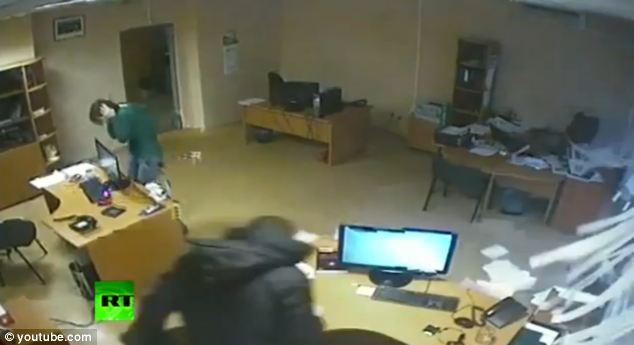

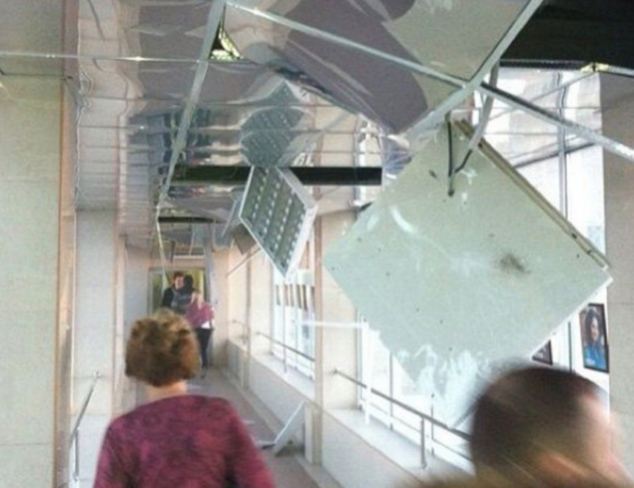







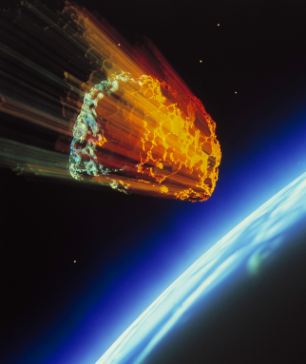


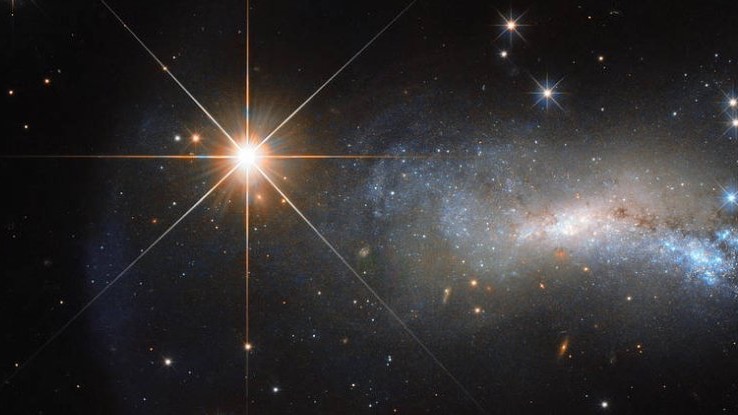
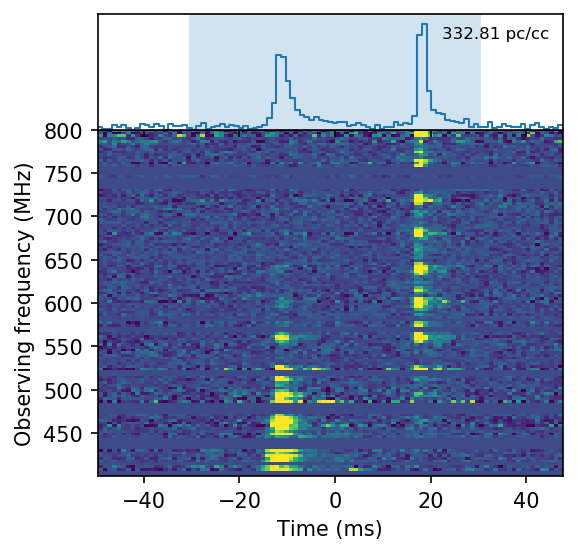
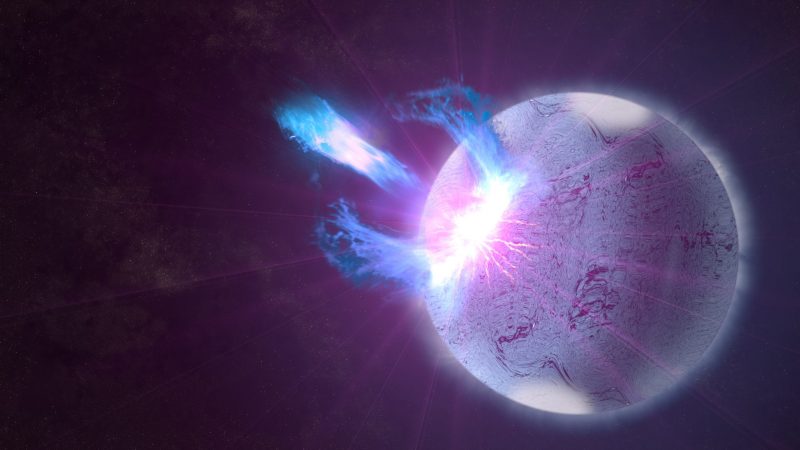
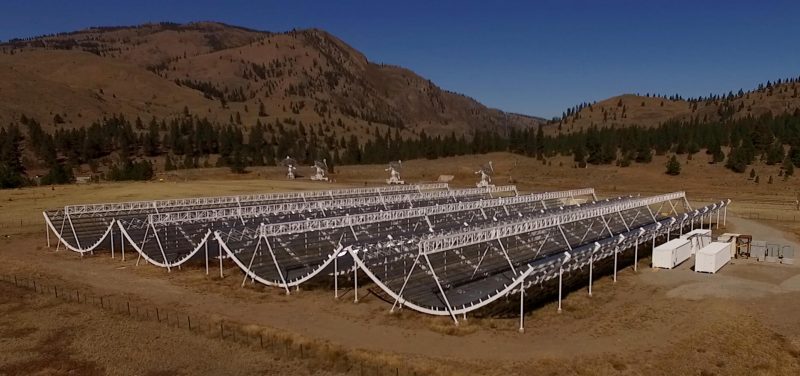

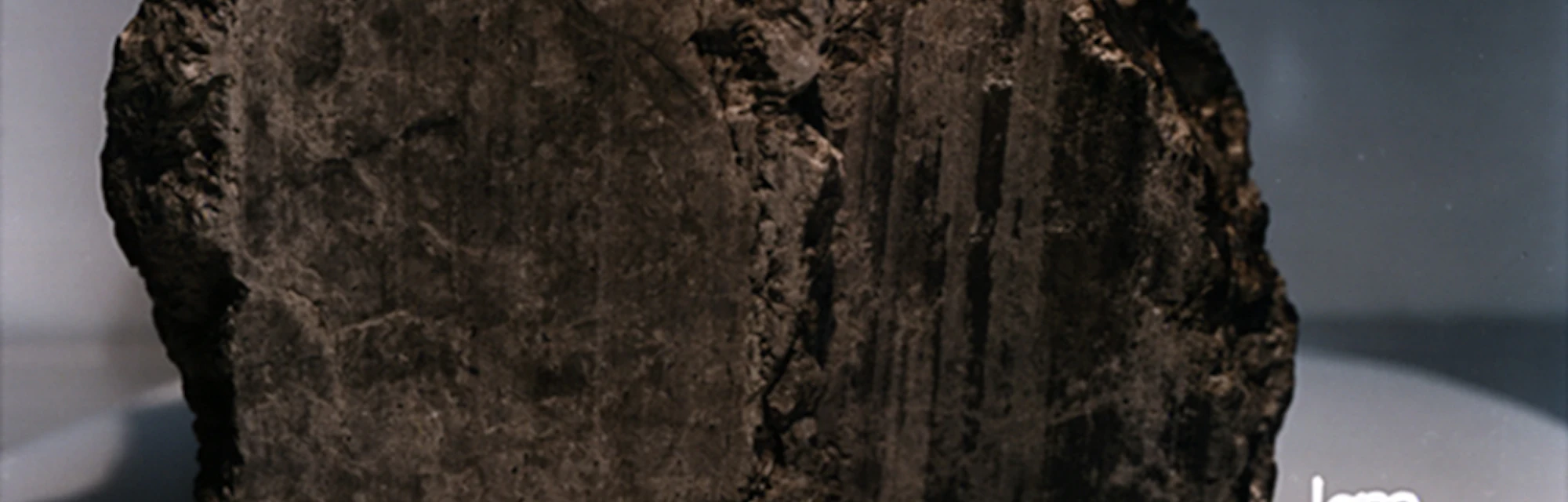



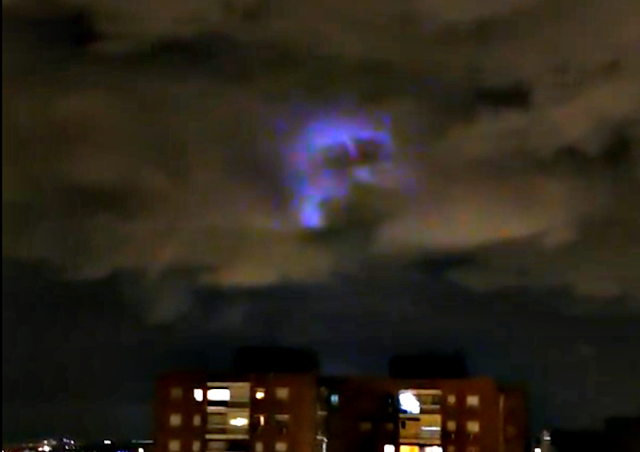


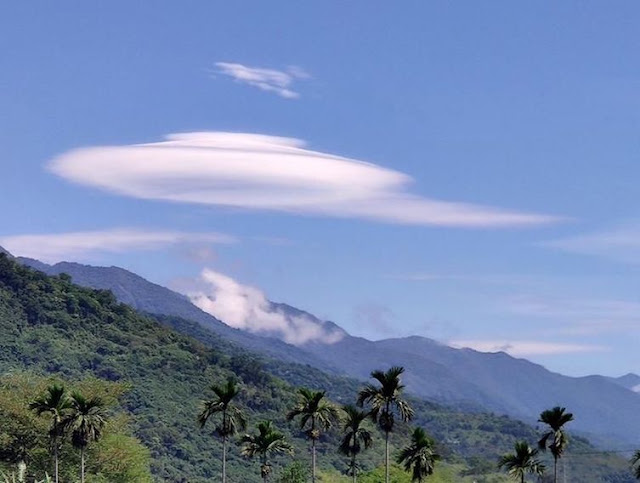


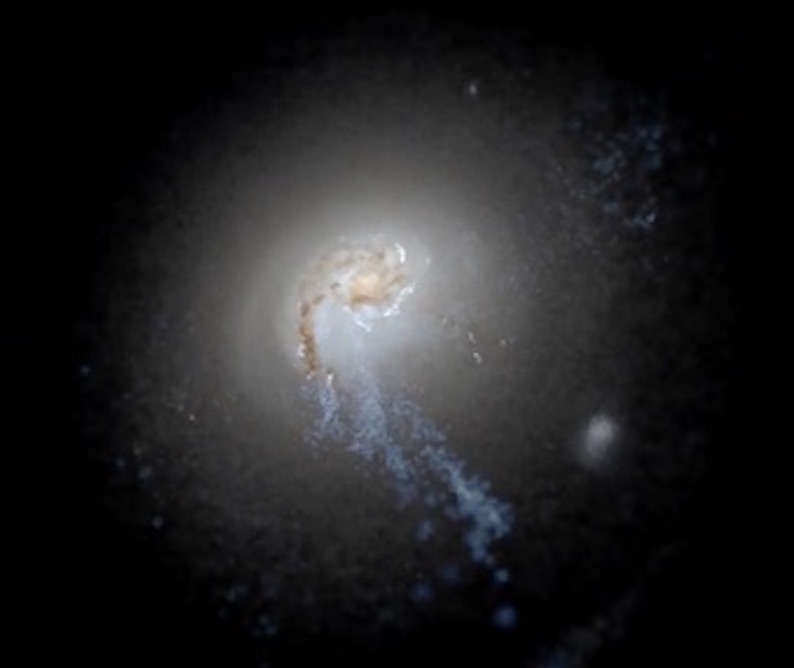
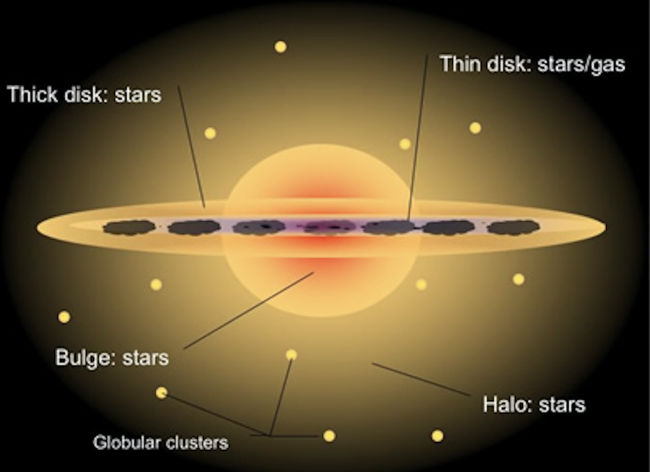










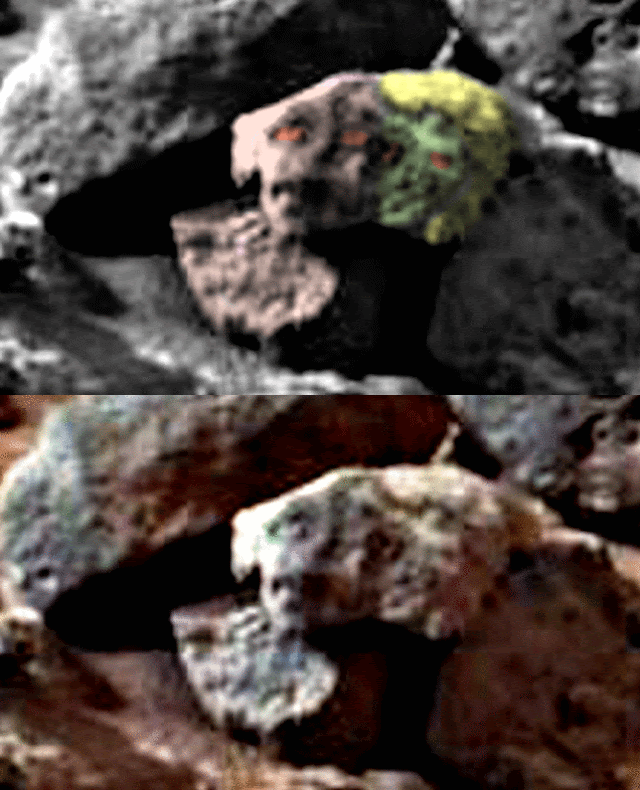


The official release of some previously leaked UFO videos taken by U.S. navy pilots has sparked renewed interest in the bigger questions. For sure those flying objects are unidentified, but how much attention should we earthlings devote to this issue? I am struck by the contrast between those who see this as an important question and those who think the whole thing will turn out to be an error or some kind of optical illusion.