Ontdek de Fascinerende Wereld van UFO's en UAP's: Jouw Bron voor Onthullende Informatie!
Ben jij ook gefascineerd door het onbekende? Wil je meer weten over UFO's en UAP's, niet alleen in België, maar over de hele wereld? Dan ben je op de juiste plek!
België: Het Kloppend Hart van UFO-onderzoek
In België is BUFON (Belgisch UFO-Netwerk) dé autoriteit op het gebied van UFO-onderzoek. Voor betrouwbare en objectieve informatie over deze intrigerende fenomenen, bezoek je zeker onze Facebook-pagina en deze blog. Maar dat is nog niet alles! Ontdek ook het Belgisch UFO-meldpunt en Caelestia, twee organisaties die diepgaand onderzoek verrichten, al zijn ze soms kritisch of sceptisch.
Nederland: Een Schat aan Informatie
Voor onze Nederlandse buren is er de schitterende website www.ufowijzer.nl, beheerd door Paul Harmans. Deze site biedt een schat aan informatie en artikelen die je niet wilt missen!
Internationaal: MUFON - De Wereldwijde Autoriteit
Neem ook een kijkje bij MUFON (Mutual UFO Network Inc.), een gerenommeerde Amerikaanse UFO-vereniging met afdelingen in de VS en wereldwijd. MUFON is toegewijd aan de wetenschappelijke en analytische studie van het UFO-fenomeen, en hun maandelijkse tijdschrift, The MUFON UFO-Journal, is een must-read voor elke UFO-enthousiasteling. Bezoek hun website op www.mufon.com voor meer informatie.
Samenwerking en Toekomstvisie
Sinds 1 februari 2020 is Pieter niet alleen ex-president van BUFON, maar ook de voormalige nationale directeur van MUFON in Vlaanderen en Nederland. Dit creëert een sterke samenwerking met de Franse MUFON Reseau MUFON/EUROP, wat ons in staat stelt om nog meer waardevolle inzichten te delen.
Let op: Nepprofielen en Nieuwe Groeperingen
Pas op voor een nieuwe groepering die zich ook BUFON noemt, maar geen enkele connectie heeft met onze gevestigde organisatie. Hoewel zij de naam geregistreerd hebben, kunnen ze het rijke verleden en de expertise van onze groep niet evenaren. We wensen hen veel succes, maar we blijven de autoriteit in UFO-onderzoek!
Blijf Op De Hoogte!
Wil jij de laatste nieuwtjes over UFO's, ruimtevaart, archeologie, en meer? Volg ons dan en duik samen met ons in de fascinerende wereld van het onbekende! Sluit je aan bij de gemeenschap van nieuwsgierige geesten die net als jij verlangen naar antwoorden en avonturen in de sterren!
Heb je vragen of wil je meer weten? Aarzel dan niet om contact met ons op te nemen! Samen ontrafelen we het mysterie van de lucht en daarbuiten.
Zaterdag 2 mei 2020
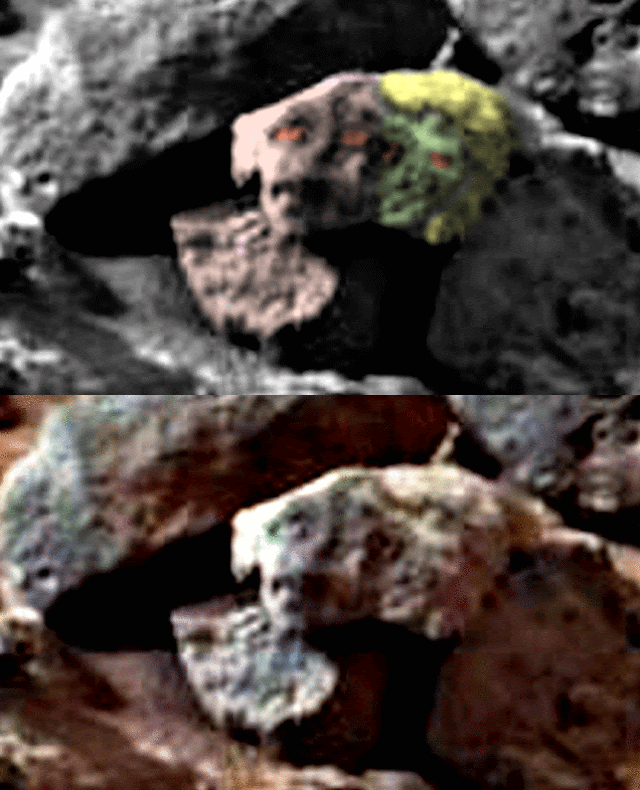
Alien Faces Found On Mars Near Two Animals, @NASA Photo, UFO Sighting News.
Alien Faces Found On Mars Near Two Animals, @NASA Photo, UFO Sighting News.
This NASA photo is just amazing. I found two faces of actual aliens that once lived, breathed and walked on Mars. The fact that the two faces are squished together implies a more heart felt bond...most likely there two were male and female...mates. They created this statue to allow future generations to remember the love they felt. Or even a gift to show the female how much she means to the male.
Also there is a four legged creature on Mars. The head looks like a cat sitting up on its hind quarters. Another statue, but it doesn't look like its a statue, this one has a smoothness of the skin as if its a living animal.
Now the last objects, is a fossilized creature with a rough drive out skin and a human like face. It too docent look like a statue, but the remains of a living creature that has become fossilized...turned to stone.
I just don't know what it's going to take for NASA to admit the truth about life on Mars? Perhaps we no longer need NASA to confirm such things. Perhaps NASA has become a corrupt and covert agency that never had any intention of informing the public about discoveries of life.
Scott C. Waring - UFOlogist
Above screenshot I colored the two faces to make it easier to see. The two faces almost overlap, rub against each other. I have seen many faces that were like this...probably a symbol of male/female family, or a unity of a social bond of some type. Below is the untouched screenshot.
Two Apparent Alien Skulls and a Nazi Briefcase Discovered in Remote Mountain Woods
Two extraterrestrial-like skulls were found next to a Nazi briefcase buried deep in a mountain forest. Scientist Vladimir Melikov made a shocking discovery several years ago along with a team of explorers while researching the Russian Caves of Mount Bolshoi.
At the time of the discovery, newspapers reported about it with mentioned of a Nazi briefcase and two strange skulls that were found in the caves of the Caucasus region.
These strange skulls were discovered near a Nazi serviette of a remote mountainous area. The news has formed several conspiracy theories. One of them is that Hitler had worked with extraterrestrials.
It raised the shocking prospect of Hitler’s time machine called “The Bell,” and his UFOs.
This UFO sighting report was just submitted to me through our report page. It happened in Aurora, ON, Canada on 26th April.
Witness report:
Hello first off I would like to say im a little reluctant at first in reporting this sighting. Sighting occurred after 8:45pm whilst it was still light out and was captured on video and photo stills for over 40 or more minutes. I have tried to come up with logical explanations such as Star, helicopters, planes, Planets (Venus has been visible this past week), and or international space station, satellites etc. but But from my limited knowledge all the previous listed possibilities that i listed i believe move across the sky and or orbit the planet, correct? Thus an object that hasn’t moved in the sky for the length of time stated seems to open it self up to a sighting .
The footage was captured out my window whislt i was watching TV and waiting for dinner to be ready. The first notice ofit i was like wow that a real bright Northern star which so happened to be facing west in the last minutes of light befor the sun would give into night. You will see clearly time marked stills and vidoe that adorn all 40 plus digital images (video and stills combined). the footage was taken on three different devises and the a tripod was used on one of the three cameras used. (iPhone 11, iPad mini and a 12mps Nikon digi camera on tripod). What makes this footage interesting is that being shot from my window you can clearly see trees and roof tops of homes around plus my backyard tree to which you can see the object in reference to it not moving remaing in the same location for 40 plus minutes well into the dark night sky.
where it gets interesting when i imported the media to my iMac aND ZOOMED in too the object individual still pictures that i notice that the glowing dot actually consist of a glowing ring around a circular glowing light. You can clearly see this in several photo’s and i encourage all to DL and zoom in with your favourite photo viewer so to in hopes tell me ive capture nothing more then an explainable object in the sky like a weather balloon or such… Just the fact that it had what looked like no movement and all cameras captured identical behaviour makes-it hard to explain that it was something from our planet.
President Trump is among the Americans amazed by the out-of-this-world goings-on in a trio of videos recently released by the military showing apparent unidentified flying objects.
The videos, one taken in 2004 and two in 2015, were released after federal officials determined the footage “does not reveal any sensitive capabilities or systems,” and “does not impinge on any subsequent investigations,” the department said in a statement
One of the videos — which were initially publicized in 2017 and 2018 — shows a dark circular object flying far in front of a military jet.
A second, identified as GOFAST.wmv, shows a small object racing over land at astonishing speed
The third, GIMBAL.wmv, shows a circular object first speeding, then seeming to slow and come closer to the pilot’s camera.
All of the videos are well-known to UFO buffs, but some Americans were blase about them, saying they were more worried about the coronavirus pandemic as the US death toll topped 60,000.
“At this point, Aliens taking control of the world doesn’t seem that bad,” Caroline Jea tweeted.
Four-billion-year-old carbonates in a Martian meteorite called Allan Hills (ALH) 84001 contain nitrogen-bearing organic molecules, according to a new studypublished in the journal Nature Communications.
A fragment of the ALH 84001 meteorite. The whole size is 1.5 cm.
Image credit: Koike et al, doi: 10.1038/s41467-020-15931-4.
Questions concerning life on Mars have driven intensive studies of the planet for decades, including focused investigation of possible organic molecules.
NASA’s rover Curiosity reported various organic materials including sulfur and chlorine-bearing hydrocarbons from 3.5-billion-year-old mudstones in Gale crater. Chlorine-bearing methane was also found from an earlier exploration by NASA’s Viking landers, which was considered to be of Martian origin.
These previous investigations suggested the existence of organic matter in the near-surface system on Mars. However, little is known about the origin, distribution, preservation, and evolution of such organics, as well as their possible relationship with Martian biological activity.
Along with robotic exploration, complementary knowledge has been obtained from detailed geochemical investigations of Martian meteorites.
“One meteorite in particular, ALH 84001, named for the region in Antarctica it was found in 1984, is especially important,” said Dr. Mizuho Koike of JAXA’s Institute of Space and Astronautical Science, Dr. Atsuko Kobayashi from the Tokyo Institute of Technology and Caltech and their colleagues.
“It contains orange-colored carbonate minerals, which precipitated from salty liquid water on Mars’ near-surface 4 billion years ago.”
“As these minerals record Mars’ early aqueous environment, many studies have tried to understand their unique chemistry and whether they might provide evidence for ancient life on Mars.”
“However, previous analyses suffered from contamination with terrestrial material from Antarctic snow and ice, making it difficult to say how much of the organic material in the meteorite were truly Martian.”
Orange-colored carbonate grains in the ALH 84001 meteorite.
Image credit: Koike et al, doi: 10.1038/s41467-020-15931-4.
In the study, the researchers analyzed several carbonate grains peeled off from a fragment of ALH 84001.
“We used state-of-the-art analytical techniques to study the nitrogen content of the ALH 84001 carbonates and found the first solid evidence for 4-billion-year-old Martian organics containing nitrogen,” the authors explained.
“After the careful contamination checks, we determined the detected organics were most likely truly Martian,” they added.
“We also determined the contribution of nitrogen in the form of nitrate — one of the strong oxidants on Mars today — was insignificant, suggesting the early Mars probably did not contain strong oxidants and was less-oxidizing.”
Nitrogen-bearing organic matter was either synthesized locally or delivered meteoritically on the early Mars. The former case requires an abiotic reduction of N (e.g., N2, NOx → NH3) to start the ammonia-related chemical reactions. The latter case is also possible if adequate amounts of nitrogen-bearing components were supplied. This organic matter survived in the 4-billion-year-old Martian (near) surface fluids and was trapped into ALH carbonates during precipitation. The carbonates resided in the subterranean system, preserving the organic components over long geological times.
Image credit: Koike et al, doi: 10.1038/s41467-020-15931-4.
“There are two main possibilities: either nitrogen-bearing organic molecules came from outside Mars, or they formed on Mars,” Dr. Kobayashi said.
“Early in the Solar System’s history, Mars was likely showered with significant amounts of organic matter, for example from carbon-rich meteorites, comets and dust particles. Some of them may have dissolved in the brine and been trapped inside the carbonates.”
“Alternatively, chemical reactions on early Mars may have produced the nitrogen-bearing organics on-site,” Dr. Koike said.
“Either way, these findings show there was organic nitrogen on Mars before it became the Red Planet we know today.”
“Early Mars may have been more Earth-like, less oxidizing, wetter, and organic-rich. Perhaps it was ‘blue’.”
_____
M. Koike et al. 2020. In-situ preservation of nitrogen-bearing organics in Noachian Martian carbonates.
Swarm of 19 mysterious ‘alien’ asteroids lurking near Jupiter from ANOTHER star system discovered
Harry Pettit, Senior Digital Technology and Science Reporter
A GROUP of 19 "alien" asteroids lurking between Jupiter and Neptune may have come from another star system, according to scientists.
The findings come more than two years after astronomers spotted the first interstellar visitor, the asteroid known as 'Oumuamua.
According to the scientists, unlike 'Oumuamua, these space rocks have been orbiting the Sun for more than 4.5billion years, since the birth of the Solar System.
The asteroids, part of a group of space objects known as Centaurs, may have been orbiting another star billions of years ago when stars were much closer to each other.
Fathi Namouni, of Observatoire de la Cote d'Azur in France and lead author of the study, said: "The close proximity of the stars meant that they felt each other's gravity much more strongly in those early days than they do today.
"This enabled asteroids to be pulled from one star system to another."
Nasa handout photo of an asteroid. The newly discovered space rocks have been orbiting the Sun for more than 4.5billion years
Credit: PA:Press Association
Image of the Lobster Nebula captured by the European Southern Observatory. Stars are closer together in nebulae, allowing them to capture objects from one another
Credit: PA:Press Association
Dr Namouni and co-author Maria Helena Morais, of the Universidade Estadual Paulista in Brazil, ran computer simulations going back in time to the days when the Solar System was still forming.
The simulations revealed the asteroids were orbiting the Sun on a plane perpendicular to planetary motion at that time.
These objects were also found to be located far from the disc that gave rise to the planets and other asteroids within the Solar System.
These two observations indicate the asteroids were captured from another stellar system, the researchers said.
The findings come more than two years after astronomers spotted the first interstellar visitor, the asteroid known as 'Oumuamua (artist impression)Credit: Getty - Contributor
What's the difference between an asteroid, meteor and comet?
Here's what you need to know, according to Nasa...
Asteroid: An asteroid is a small rocky body that orbits the Sun. Most are found in the asteroid belt (between Mars and Jupiter) but they can be found anywhere (including in a path that can impact Earth)
Meteoroid: When two asteroids hit each other, the small chunks that break off are called meteoroids
Meteor: If a meteoroid enters the Earth's atmosphere, it begins to vapourise and then becomes a meteor. On Earth, it'll look like a streak of light in the sky, because the rock is burning up
Meteorite: If a meteoroid doesn't vapourise completely and survives the trip through Earth's atmosphere, it can land on the Earth. At that point, it becomes a meteorite
Comet: Like asteroids, a comet orbits the Sun. However rather than being made mostly of rock, a comet contains lots of ice and gas, which can result in amazing tails forming behind them (thanks to the ice and dust vapourising)
Dr Morais said: "The discovery of a whole population of asteroids of interstellar origin is an important step in understanding the physical and chemical similarities and differences between Solar System-born and interstellar asteroids.
"This population will give us clues about the Sun's early birth cluster, how interstellar asteroid capture occurred, and the role that interstellar matter had in chemically enriching the Solar System and shaping its evolution."
The origin of Centaurs has been a mystery to astronomers since the first member of the group, called Chiron, was recognised in 1977.
Some believe they may have spent some time in the Kuiper Belt, a circumstellar disc in the outer Solar System, before moving inwards.
The new work is published in the journal Monthly Notices of the Royal Astronomical Society.
Nasa image of 2I/Borisov, a comet passing through the Solar System that once orbited a distant starCredit: Nasa
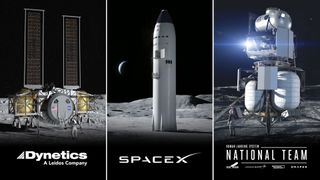
SpaceX, Dynetics and a Blue Origin-led team have different ideas for the moon.
NASA has selected a Blue Origin-led team, Dynetics and SpaceX's Starship to develop new moon landers for astronauts for the agency's Artemis lunar program.
The moon landers that three commercial teams are developing to ferry astronauts to and from the lunar surface for NASA are a diverse bunch.
On Thursday (April 30), NASA announced that it had awarded contracts to three commercial teams, each of which will develop a human landing system for use by the space agency's Artemis program. Artemis aims to put two astronauts down near the moon's south pole in 2024 and establish a sustainable presence on and around Earth's natural satellite by the late 2020s.
SpaceX, Dynetics and a team led by Blue Origin will split a total pot of $967 million, which will fund 10 months of development work. NASA will then tab one or more of these teams to mature their systems. In the end, the space agency will procure crewed lunar transportation services from the options that are left on the table.
The options are, at this early stage anyway, quite varied, for the commercial teams are taking very different approaches to their landers. SpaceX, for example, will continue developing its Starship deep-space transportation system, which Elon Musk's company envisions making Mars colonization and other bold exploration feats economically feasible.
SpaceX's Starship megarocket
The 165-foot-tall (50 meters) Starship will launch off Earth atop a giant rocket called Super Heavy. Both of these elements will be reusable; each Super Heavy will come back down for a vertical landing shortly after liftoff, and each Starship will fly many missions once it's aloft, Musk has said. (Starship needs Super Heavy only to get off our planet; the spacecraft will be powerful enough to launch itself off the surface of the moon or Mars.)
Starship will be capable of carrying up to 100 people at a time, Musk has said. NASA wouldn't come close to filling the possible seats on each Artemis flight — the 2024 landing mission, for example, will carry just two astronauts — but the agency would doubtless find a use for all of the vehicle's space and power. (Starship will be able to haul 100 tons of payload to the lunar surface.)
This SpaceX concept shows the company's massive Starship vehicle on the moon as a lunar lander for NASA Artemis astronauts. (Image credit: SpaceX)
Thursday's announcement deepens SpaceX's involvement with NASA's moon-exploration plans, which was already extensive. For example, the company is eligible to deliver robotic NASA payloads to the lunar surface using Starship, work the space agency says will help pave the way for crewed Artemis visits.
And last month, SpaceX secured a contract to supply Gateway, the small space station that NASA plans to build in lunar orbit as a jumping-off point for surface missions, using an extra-large version of its Dragon cargo capsule. Gateway is an important part of the agency's long-term moon plans but will probably not be involved in the 2024 landing, agency officials have said.
Whereas Starship represents a single-stage approach to lunar landing, Alabama-based Dynetics will develop "a two-stage architecture, with a common ascent and descent element and anytime abort capability," Lisa Watson-Morgan, Human Landing System program manager at NASA's Marshall Space Flight Center in Huntsville, Alabama, said in a teleconference with reporters on Thursday.
"It has a unique low-slung crew module, putting the crew very close to the lunar surface for safe access," Watson-Morgan added.
A moon lander concept from Dynetics, one of three U.S. contractors selected by NASA to develop Artemis lunar landers for astronauts.
(Image credit: Dynetics)
A moon lander concept from Dynetics, one of three U.S. contractors selected by NASA to develop Artemis lunar landers for astronauts.
(Image credit: Dynetics)
The Dynetics lander's crew module is designed to accommodate two astronauts on trips to and from lunar orbit, including stays on the moon's surface of about a week, representatives of the company, which is a wholly owned subsidiary of Leidos, said in a statement. But that's the nominal use case; the lander could also fit four fully suited astronauts on brief trips to or from the lunar surface if need be.
Blue Origin's 'National Team'
The third team is led by Jeff Bezos' Blue Origin, with participation from Lockheed Martin, Northrop Grumman and Draper. This group will develop a three-stage architecture, which features descent, ascent and transfer elements.
The descent stage will be based on Blue Origin's Blue Moon lander and BE-7 engine, which the company has been working on for a few years now. The ascent stage will leverage Lockheed's experience developing the Orion crew capsule. (Lockheed is prime contractor for Orion, NASA's next crewed vehicle, which will carry agency astronauts toward the moon and other deep-space destinations.)
This Artemis moon lander concept from Blue Origin's National Team includes systems by team partners Lockheed Martin, Northrop Grumman and Draper. (Image credit: Blue Origin)
The transfer element will be based on Northrop Grumman's Cygnus freighter, which flies robotic cargo missions to the International Space Station under a separate NASA contract. Draper, meanwhile, will lead descent guidance and provide flight avionics, Blue Origin representatives said in a statement.
NASA solicited proposals for human landing systems in late September 2019, and submissions were due in early November. At the time, the agency was hoping the call would inspire innovative concepts, Watson-Morgan said.
"And boy did they deliver," she said Thursday of the three awardees.
Watson-Morgan also highlighted the diversity of architectures, saying it achieves the "dissimilar redundancy of approaches that we wanted."
NASA has picked three companies to develop new lunar landers that will carry astronauts to the surface of the moon in 2024 and beyond.
The agency announced today (April 30) that it has awarded contracts to SpaceX, a Blue Origin-led team and Dynetics to design and build a human landing system for the Artemis program, which aims to establish a sustainable, long-term human presence on and around the moon by the late 2020s.
"With these contract awards, America is moving forward with the final step needed to land astronauts on the moon by 2024, including the incredible moment when we will see the first woman set foot on the lunar surface," NASA Administrator Jim Bridenstine said in a statement.
"This is the first time since the Apollo era that NASA has direct funding for a human landing system, and now we have companies on contract to do the work for the Artemis program," Bridenstine added.
This SpaceX concept shows the company's massive Starship vehicle on the moon as a lunar lander for NASA Artemis astronauts.
(Image credit: SpaceX)
This Artemis moon lander concept from Blue Origin's National Team includes systems by team partners Lockheed Martin, Northrop Grumman and Draper.
(Image credit: Blue Origin)
A moon lander concept from Dynetics, one of three U.S. contractors selected by NASA to develop Artemis lunar landers for astronauts.
(Image credit: Dynetics)
The awards, which were granted under NASA's Next Space Technologies for Exploration Partnerships (NextSTEP-2) program, are fixed-price contracts worth a total of $967 million for 10 months of work, agency officials said. NASA issued a call for proposals in September 2019, and submissions were due in early November of that year.
NASA did not name the submitters at the time, though some of the companies identified themselves. For example, Boeing announced in November that it had put in a proposal, which ended up being unsuccessful.
SpaceX's funded proposal centers on its huge Starship vehicle, which the company is already developing to help colonize Mars and enable a variety of other ambitious exploration feats. Starship will launch off Earth atop a huge rocket called Super Heavy, but the spacecraft will land on, and launch off, the moon and Mars on its own, without the need for any other vehicles.
Blue Origin will lead a so-called "National Team" that includes partners Lockheed Martin, Northrop Grumman and Draper. These companies together will build a three-stage system that includes a descent vehicle, an ascent vehicle and a transfer stage, NASA officials said.
Alabama-based Dynetics will build a two-stage system consisting of an ascent stage and a descent stage.
The variety of approaches represented by these three proposals is a major plus, providing significant design redundancy, Lisa Watson-Morgan, Human Landing System program manager at NASA's Marshall Space Flight Center in Huntsville, Alabama, said during a teleconference with reporters today.
NASA will work with the three commercial teams over the next 10 months, assessing their progress all the while. The agency will determine during that period which team(s) will perform initial demonstration missions. NASA will then tap one or more companies to mature their systems and fly additional test missions, officials said. The agency will procure operational flights, as a commercial transportation service, from the firms that made it through the development gauntlet.
The Artemis architecture relies on NASA's Orion crew capsule and huge Space Launch System (SLS) rocket, which will launch astronauts off Earth. NASA also plans to build a small space station in lunar orbit called Gateway, which will serve as a staging point for crewed and uncrewed missions to the lunar surface.
The landing system is the final major Artemis piece, so getting development work going on it soon is a big priority for the agency if it hopes to meet the 2024 touchdown goal, which was set by the Trump Administration in March 2019.
"We are on our way," Douglas Loverro, NASA's associate administrator for Human Explorations and Operations Mission Directorate in Washington, D.C., said in the same statement.
"With these awards, we begin an exciting partnership with the best of industry to accomplish the nation's goals," Loverro added. "We have much work ahead, especially over these next critical 10 months. I have high confidence that working with these teammates, we will succeed."
While Gateway is a big part of the long-term Artemis plan, it probably won't be involved in the 2024 crewed landing, Bridenstine said during today's telecon.
Artemis' vision doesn't end at the moon, by the way. NASA views the program as a steppingstone, teaching the agency skills and techniques that will be required to get astronauts to Mars in the 2030s.
If two black holes tango in space but astronomers cannot see them, can we still admire their flashy dance moves?
Because black holes have such a strong gravitational pull that not even light can escape, they can't be observed directly and are therefore difficult to study. But one pair of black holes has enamored astronomers with a complicated celestial dance that periodically produces extremely bright flashes of light — outbursts that are brighter than a trillion stars and even the entire Milky Way galaxy.
By studying the timing of these bright flashes of light, researchers have attempted to map out the complex choreography of the black holes' movements and predict exactly when the system will flare up again. After more than 120 years of observations and decades of building computer models, astronomers have finally figured out what these black holes are up to, thanks to data from NASA's now-retired Spitzer Space Telescope.
This artist's impression shows two massive black holes in the OJ 287 galaxy. (Image credit: NASA/JPL-Caltech)
The two "dancing" black holes are located 3.5 billion light-years from Earth at the center of a galaxy called OJ 287. The larger of the two is one of the biggest black holes ever found, weighing in at more than 18 billion times the mass of the sun. Orbiting around this big black hole is a much smaller black hole that's about 150 million times the mass of the sun. Twice every 12 years, the smaller black hole passes through the larger one's accretion disk, or the flat band of dust and gas falling into the black hole, creating brilliant flares of light.
Because the small black hole's orbit is irregular — its position shifts with each 12-year loop around its partner — these flashes don't occur on a regular schedule. Sometimes they might occur just one year apart, while other times up to a decade passes between flares. The seemingly random timing of the flares has made it difficult for astronomers to figure out exactly what kind of "dance" these black holes are doing.
One computer simulation in 2010 was able to predict the flares within one to three weeks. In 2018, another group of researchers led by Lankeswar Dey, a graduate student at the Tata Institute of Fundamental Research in Mumbai, published a new model that they claimed could predict the flares' occurrence within four hours. In a new study, published Tuesday (April 28) in The Astrophysical Journal Letters, Dey's group reports that Spitzer's observations of a flare on July 31, 2019, confirm that their model is correct.
This animation shows the orbit of the smaller black hole around its larger black hole companion in the OJ 287 galaxy. (Image credit: NASA/JPL-Caltech)
The Spitzer Space Telescope, which NASA decommissioned in January, just happened to be in the right place at the right time to observe the flare on that day, when no other telescopes on Earth or in space were able to see it. At the time, OJ 287 was on the opposite side of the sun from Earth's perspective.
Spitzer was 158 million miles (254 million kilometers) away from Earth at the time, and from its vantage point the telescope had a clear view of OJ 287 for a little over a month, from July 31 to early September, NASA officials said in a statement.
"When I first checked the visibility of OJ 287, I was shocked to find that it became visible to Spitzer right on the day when the next flare was predicted to occur," Seppo Laine, a scientist at Caltech/IPAC in Pasadena, California, who oversaw Spitzer's observations of the system, said in the statement. "It was extremely fortunate that we would be able to capture the peak of this flare with Spitzer, because no other human-made instruments were capable of achieving this feat at that specific point in time."
This artist's concept shows NASA's Spitzer Space Telescope. (Image credit: NASA/JPL-Caltech)
To come up with this accurate prediction, the researchers didn't just look at the orbital mechanics of the system. They also had to account for gravitational waves, or ripples in space-time created when massive objects move through space, warping their surroundings. Astronomers expect the black hole system in OJ 287 to generate gravitational waves that are strong enough to alter the smaller black hole's orbit, according to the statement.
By incorporating gravitational waves into their calculations, the researchers were able to predict a 1.5-day time frame in which the system will produce a flare. But they narrowed that down even further, to just four hours, by taking into account the "no-hair theorem" of black holes — an idea that Stephen Hawking famously doubted. This theorem posits that black hole surfaces are featureless and symmetric, rather than bumpy and irregular. (Black holes don't literally have a "surface," but rather an invisible boundary known as the event horizon, where not even light can escape the black hole's gravitational pull.)
If the large black hole at the center of OJ 287 were bumpy, with its mass unevenly distributed, its gravitational pull on the smaller black hole would be inconsistent, which would affect the smaller black hole's orbit and the timing of the flares. But the smaller object's symmetrical, spirograph-shaped orbit supports the no-hair theorem, the new study claims.
"It is important to black hole scientists that we prove or disprove the no-hair theorem," Mauri Valtonen, an astrophysicist at University of Turku in Finland and a coauthor of the study, said in the statement. "Without it, we cannot trust that black holes as envisaged by Hawking and others exist at all."
UFO crash researcher Leonard Stringfield's live interview with an alien being by Richard Dolan
Although the UFO news is currently talking up the latest Pentagon admission of the validity of those pesky videos commonly known by their filenames 'Flir,' 'Go Fast,' and 'Gimbal,' that were released over two years ago, they are still in the "we don't know what these are" phase of public discourse.
But the research of the late Leonard Stringfield shows how weak that position is. Stringfield pioneered the research of UFO crash retrievals. He made contact with countless individuals.
Unlike many of today's researchers who talk about "whistleblower" testimony, Stringfield was actually careful and professional, vetting his sources to the greatest extent possible. His cases are worth careful review.
Richard and Tracey discuss yet another incredible Stringfield case, this time an alleged one-on-one with an alien being. This was one of Stringfield's last cases. He died in 1994. You don't want to miss this one.
During the coronavirus shutdown there’s a lot of binge-watching being done, affording those who’ve never been able to it before watch all of the episodes of their favorite television programs or for those too young to have seen them the first time around to be introduced to some classics. The Museum of Binge-Worthy TV Shows ought to have a special wing for the various Star Trek series and this writer is one who has visited that wing regularly and recently saw (for the umpteenth time) “The Tholian Web,” the ninth episode of the third season of the original Star Trek. That could be why an article caught my eye shortly after comparing Elon Musk’s ever-growing network of small communications satellites to the Tholian Web.
The article (you can read it here in Soul:Ask) starts with the conspiracy theories that Elon Musk is in cahoots with the Pentagon, that the idea of a Starlink network of 12,000 satellites providing worldwide Internet links is just a cover-up (a “Trojan horse”), that the satellites will actually be able to connect to each other via lasers to create a web around the globe and that the lines of satellites clearly visible in the night skies around the world have already begun to cross paths like the Thorian web around the Enterprise and that the purpose of the two is the same – imprisonment of everyone inside. Whoa!
OK, those dots are much farther apart than the lines of Starlink satellites in the sky, and there’s no evidence that these small satellites have any more powers than Internet communications. However, the map of the 12,000 satellites (on up to 30,000 or more) does form a grid pattern around the Earth. And we’ve already seen many instances of equipment and events on Star Trek becoming reality. Could Gene Roddenberry have been predicting/warning about just such a space chain-link fence? Let’s take a look at The Tholian Web plot and see if there are any signs.
The USS Enterprise enters uncharted space (as always) searching for her sister ship, the USS Defiant. The Defiant is found adrift, and Captain Kirk, First Officer Spock, Chief Medical Officer Dr. McCoy, and Navigator Ensign Chekov transport to it wearing environmental suits for protection – sounds an awful lot like what’s going on around the world right now, doesn’t it? It appears the Defiant crew killed each other (panic caused by an invisible enemy?), but what’s worse is that the entire ship appears to be fading away (like out jobs?). due to equipment malfuntions (like the ventilators?), the group barely makes it back, but Kirk doesn’t and he and the Defiant vanish.
Spock determines that the local space is experiencing periods of “interphase” where two parallel dimensions touch each other and they just need to wait until it happens again. While waiting, the Enterprise is attacked by the Tholians (Iranians?) for violating their space and two Tholian ships commence building a Tholian web around the Enterprise (Starlink will imprison Earth with the U.S. and the Pentagon in control?). Uhura and Scott have visions of Kirk in his environmental suit telling them to hurry (leakers?). However, other crew members are showing signs of insanity from being infected by the Tholian space (coronavirus?). (Spoiler alert!) In the nick of time, Dr. McCoy develops an antidote (antidote!!), Spock finds Kirk and beams him aboard just as his oxygen runs out (the ventilator again?) and slips through the last tiny unfinished hole in the web.
Whoa! Roddenberry and his writers predicted the Starlink web AND the coronavirus epidemic. Or did they?
Starlink has a long way to go to become a Tholian web
That little fun exercise is the same process people go through when linking the prophecies of Nostradamus to current events – look at events after they happen for similarities. No one who’s watched The Tholian Web dozens of times could have predicted it was going to happen in 2020 … and it didn’t really happen. Starlink is a looooong way from a Tholian web prison, and Dr. McCoy always seemed to find an antidote for whatever was ailing the crew. The hazmat suit is definitely a twist you don’t see often on Star Trek, but we have seen them for years in many situations. Equipment failures and lack of oxygen are happening now and they’re killing people, just like Kirk’s dilemma, but was that really a prediction or a coincidence?
It might be fun to try and link some other Star Trek episodes to world events. On the other hand, most of us would prefer that the coronavirus, the lockdown and the binge-watching were over and we could all boldly go back to that comfortable charted space known as work.
There have been people throughout history who have made an indelible mark upon the landscape. Whether it be because of new ideas, technology, or any number of other endeavors, these people have managed to make their mark. Some have become more well-known while others have slipped into obscurity, but all have managed to shape history in some way. One person who has mostly managed to slip through the cracks was a very well-known inventor at the time, who had a curious life and who also just happens to have invented the world’s first functioning flying saucer.
The Dutch painter, sculptor, engineer, and inventor Alexander Weygers had a rather colorful life even before he started designing strange, outlandish flying machines. Weygers was born in the Dutch East Indies in 1901 and was raised in his childhood along with his six brothers and sisters on a sprawling remote sugar plantation on the island of Java, where his parents also owned a hotel. His family was well-off, and at the age of 15 they sent him to live in the Netherlands to go to school. It is here where he would become intensely interested in mechanical engineering, naval architecture, and blacksmithing, going on to graduate with a degree in shipbuilding before returning to Java in 1923 along with his wife, Jacoba, but here is where he would run into tragedy.
Alexander Weygers
Apparently Jacoba did not adjust well to life on the island and was deeply unhappy. He would then in 1926 decide to take her and move to Seattle, Washington, in the United States, where he pursued a career in engineering, yet these dreams would soon be dashed. In 1931, Jacoba would tragically die in childbirth, and Weygers had a rough time dealing with it all. He spiralled so deep into depression and despondency that he abandoned engineering altogether to pursue art, enrolling in courses at the Seattle Institute of Art and studying sculpting. He was very good at it, earning accolades from his peers and teachers and gaining a scholarship for his work in the process, eventually studying art in Chicago, travelling the world studying under several master sculptors, and then finally moving to Berkley, California to open his own studio. He did many exhibitions and became much sought after as a teacher, with people coming in from all across the country to study sculpting under him. His respected work would be included in the collection of the Smithsonian Institution in Washington, D.C., win various awards, and by 1940 Weygers was a world-renowned sculptor. However, his life was about to make another sharp change in course.
In 1941, World War II was looming over everything, and the then 40-year-old Weygers entered the U.S. Army, where he became involved in intelligence missions, mostly translating Malay, Dutch, Italian, German, and English. He would serve a 2-year stint in intelligence operations, after which he was discharged in 1943 and headed off to live in Carmel, California, where he would meet his second wife, Marian Weygers. It was during this time that he would become known as a bit of an eccentric, crafting a sprawling mushroom-shaped house that he called a “geodesic dome gone wild” out of pieces of wood, scrap metal, and various junk that he reworked and crafted with his formidable blacksmithing skills, even picking up new skills of wood carving, toolmaking, electrician and plumbing skills, and photography along the way. He also drove around in a homemade steam-driven car, kept bees on his property as an avid beekeeper, and this was all in keeping with his philosophy of self-sustaining living. In the meantime, he wrote several important books on blacksmithing and toolmaking, and it was also during this time that he became increasingly obsessed with creating an idea he had been long percolating for a new, groundbreaking aircraft he called the “discopter.”
The Discopter
For years Weygers had been making sketches of various fantastical machines in his notebooks, many of them which looked as if they had flown straight out of a Jules Verne novel. One of these in particular which he was very interested in actually building was the discopter, an idea he had been toying with since the 1920s. It was an odd-looking craft, saucer shaped with a pilot in the center and meant to be a vertical take-off and landing vehicle that was able to make precise sharp changes in direction and would replace the helicopter, which he felt was a flawed design. He would perfect the design for the discopter, and in 1944 he was granted a patent for his design from with the U.S. Patent Office. Weygers would say of his bizarre invention:
To a helicopter, a craft constructed on the principles of my invention bears a superficial resemblance in that both types are sustained by at least one horizontal rotor. From this point on, however, all similarity between the two types of flying craft ends. A craft embodying my invention is distinguished from a helicopter in that the rotor or rotors in my craft are enclosed within a substantially vertical tunnel, the rotor regarded as a whole is mainshaftless and the external form of the craft is not very different from the familiar discus of the athlete, in common with which the craft enjoys certain aerodynamic advantages characteristic of the passage of the discus thru the air. Not only the rotors and power plant compartments but all of the usual moving and fixed protruding parts, present in both airplanes and helicopters, such as stabilizing and directing means and otherwise, are entirely enclosed within the strikingly simple and cleanly streamlined contour line of the craft when regarded from exteriorly thereof in any elevation view, thereby concealing from the casual view such parts.
He also sent his designs freely to all branches of the military, but at the time no one was interested in mass producing such a craft. Weygers was very excited about his invention, and envisioned it as completely changing the landscape of aviation, but alas not even a prototype was ever actually built. However, in later years the discopter became popular again in the late 1940s and 1950s, when UFOs and flying saucers began to enter the public consciousness. Weygers’ design was dusted off and pretty soon trying to create flying saucer-type aircraft was all the rage. In particular the in the years between 1953 and 1956 the U.S. Patent Office was flooded with a deluge of patent requests for all manner of vehicles with a saucer or “UFO shape.” Even the military and NASA began experimenting with UFO-like vertical take-off and landing designs, to the point that Weygers even accused the Navy of patent infringement, and it was all inspired by the work that Weygers had pioneered. Although he had never created the discopter as a science fiction-themed project based around UFOs had never been on his radar at all, it got to the point where some skeptics were using this drive for making these vehicles as an explanation for the rash of UFO sightings reported through the late 1940s and 1950s.
While all this was happening, Weygers himself sort of quietly faded into the background and took up a simple life once again, focusing mostly on sculpting and blacksmithing at his studio in Carmel. He managed to attract a good number of students, who came to learn blacksmithing from him, and he wrote some of the most important works on blacksmithing out there, The Making of Tools and The Modern Blacksmith. Weyger would distance himself from the whole UFO and flying disc craze that he had helped to spark, teaching until the age of 83 before dying in 1989 at the age of 87 as a relative recluse, having never seen his discopter created. It was a sad end for a man about who the San Francisco Chronicle once wrote:
Alexander Weygers is a modern Leonardo da Vinci. He commands attention because he is a success by any standard of excellence in half a dozen professions… a sculptor of heroic dimensions, an inventor, a marine, mechanical, and aeronautic engineer, an artist with a camera, a designer and illustrator, and a virtuoso practitioner of endgrain half-tone wood engraving. He is also blacksmith, machinist, carpenter, electrician, plumber, toolmaker, and beekeeper. He is further a teacher and a reluctant prophet upon whom the admiring descend.
In later years the property and work of Weyger would be meticulously restored and preserved by art collector and dealer, Randy Hunter, who by the time of his own death had bought up almost all of Weygers’ work and turned the place into a sort of museum and shrine in memory of the great inventor, which one can still visit today. In the end the story of Alexander Weygers is a long and tragic one , yet compelling and somewhat inspiring story that will no doubt serve to fuel the imagination for sometime to come.
BIZARRE AUTOPSIE OP BUITENAARDSE MOGELIJK TOCH ECHT ( VIDEO )
De bekendste gebeurtenis met betrekking tot ufo’s en buitenaardsen is toch wel de ufo crash bij Roswell in 1947. Talloze getuigenverklaringen hebben ervoor gezorgd dat deze gebeurtenis niet onder het tapijt werd geschoven, maar er zijn ook meer dan interessante beelden.
In deze tijd van corona ellende is het ook wel leuk om eens naar wat anders te kijken en dat komt deze keer van de onvermoeibare ufoloog Scott Waring. Soms zit hij er finaal naast met zijn analyses, maar andere keren heeft hij toch heel interessante, kloppende informatie.
Zoals deze keer over een autopsie uitgevoerd op een buitenaards wezen na de crash met de Roswell ufo in 1947. De crash was op 8 juli 1947 en de autopsie dateert van dezelfde maand.
Nu circuleert er al langere tijd een video-opname op internet, maar daarvan wordt beweerd dat deze totaal nep zou zijn. Er is zelfs een Engelsman met de naam Ray Santilli die beweert verantwoordelijk te zijn voor het maken van deze nepvideo.
Echter, nu komt er een interessante ontwikkeling want Scott Waring zegt dat hij zijn hele reputatie op het spel zet door te zeggen dat deze video wel degelijk echt is. Volgens hem is Santilli betaald door de CIA of MI5 door te zeggen dat hij die video heeft gemaakt, waardoor het publiek er nu van overtuigd is dat de video nep is. Scott zegt dat in de jaren vijftig de CIA een speciaal programma had (Project Bluebird), waarbij ze mensen betaalden om dingen te schrijven of te zeggen die erop wezen dat alles met betrekking tot ufo’s en buitenaardsen totale onzin was.
Scott zegt dat er nog niet eerder een video is geweest die zo echt was en dat we hier absoluut met echte beelden te maken hebben. Hij geeft dan ook een aantal redenen waarom hij denkt dat het wel degelijk echt is.
Deze video is gemaakt in 1947, in een tijd dat er nog geen sprake was van nep Youtube filmpjes. De eerste nepvideo’s verschenen pas in 2008 en mensen deden dat om zo geld te kunnen verdienen met advertenties.
Scott heeft een uitgebreide analyse gedaan van de opname zelf en komt tot de conclusie dat het wel degelijk rond 1947 gefilmd moet zijn. Hij heeft de kwaliteit en kenmerken van de opname vergeleken met Hollywood films uit die tijd en de karakteristieken komen exact overeen.
De techniek zoals die door de artsen wordt gebruikt tijdens de autopsie in de video is exact hetzelfde zoals een arts die in die tijd zou uitvoeren.
De video toont de organen zodanig gedetailleerd op een manier zoals die pas in de jaren zeventig voor het eerst gebruikt werd.
Niet alleen zie je in de video de autopsie op het buitenaardse wezen, maar je ziet ook metalen delen zoals die werden verzameld op de plek waar de ufo is neergestort. Tussen 16:58 en 19:43 zijn deze metalen delen zichtbaar met daarop duidelijk een soort buitenaards schrift.
Rond 18:29 in de video zie je een stuk metaal afkomstig van de crash en je kunt zien aan het uiteinde van dit stuk metaal dat het onder grote druk is verbogen. Dit soort details komen alleen voor in echte opnames, want iemand die een nepvideo wil maken, neemt niet zoveel moeite om ook dat soort details helemaal goed te krijgen.
Rond de 18 minuten in de video zie je het controlemechanisme van de ufo in een stuk metaal. Dit werd geactiveerd doordat de alien daar zijn hand op kon leggen en op die manier het ruimteschip besturen.
Nog een andere indicatie dat de opname echt is komt door de merktekens die op de stukken metaal zijn aangebracht zoals W-337 en W-130. Scott zegt dat dit merktekens zijn die betrekking hebben op de locatie van de alien, in dit geval Wright-Patterson Airforcebase in Ohio.
Kortom, al met al is Scott er echt heilig van overtuigd dat deze opname echt is en hij zegt dat wat dat betreft niemand hem op andere gedachten kan brengen.
Kijk en oordeel zelf of Scott gelijk heeft en we hier toch te maken hebben met een authentieke opname.
De protoplanetaire schijven rond de sterren R CrA (links) en HD45677 (rechts). De banen zijn ter referentie toegevoegd, net als de sterren, aangezien het licht daarvan gereduceerd werd om een gedetailleerder beeld van de schijf te krijgen.
Een internationaal team van astronomen is erin geslaagd om vijftien beelden vast te leggen van de binnenste randen van planeetvormende schijven op honderden lichtjaren van onze planeet. Die schijven van stof en gas, in vorm vergelijkbaar met een dikke vinylplaat, vormen zich rond jonge sterren. De beelden werpen nieuw licht op de vorming van planetenstelsels en werden gepubliceerd in het tijdschrift Astronomy & Astrophysics.
Om te begrijpen hoe planetenstelsels, waaronder het onze, gevormd worden, moet je naar hun ontstaan kijken. Een jonge ster wordt gevormd als gas en stof opeenhopen in een interstellaire wolk . Een deel van dit invallende gas en stof blijft gevangen in een baan rond de ster. De stofdeeltjes in de schijven kunnen uitgroeien tot grotere lichamen, wat uiteindelijk leidt tot de vorming van planeten. Wetenschappers veronderstellen dat rotsachtige planeten zoals de aarde zich vormen in de binnenste regio’s van protoplanetaire schijven, minder dan vijf astronomische eenheden (vijf keer de afstand tussen de aarde en de zon) verwijderd van de ster waarrond de schijf is gevormd.
De vijftien beelden van schijven van stof en gas rond jonge sterren die aan de basis liggen van de vorming van planetenstelsels.
Er bestonden al enkele foto’s van dit soort schijven vóór deze nieuwe studie. Die werden echter gemaakt met de grootste enkelvoudige spiegeltelescopen, die niet in staat zijn om de kleinste details vast te leggen. “Op die foto’s zijn de gebieden dicht bij de ster, waar rotsachtige planeten ontstaan, slechts enkele pixels groot”, zegt hoofdauteur Jacques Kluska van het Instituut voor Sterrenkunde van de KU Leuven. “Deze details moesten verder zichtbaar gemaakt worden om te weten te komen hoe planeten ontstaan en om de eigenschappen van de schijven in kaart te brengen.” Dat vroeg om een hele andere observatietechniek. “Ik ben zeer blij dat we nu voor het eerst vijftien van deze beelden hebben”, vervolgt Kluska.
Beeldreconstructie
Kluska en zijn collega’s maakten de beelden in de Europese Zuidelijke Sterrenwacht (ESO) in Chili met een techniek genaamd infrarood-interferometrie. Met behulp van ESO’s PIONIER-instrument combineerden ze het licht van vier Very Large Telescopes om de schijven vast te leggen. Die techniek leverde echter geen beeld op van de schijven. “Het licht van de ster, verhinderde ons om de schijven in detail te bekijken, dat moest dus eerst verwijderd worden”, legt Kluska uit. Dat gebeurde aan de hand van wiskundige berekeningen, vergelijkbaar met de manier waarop het eerste beeld van een zwart gat werd gemaakt.
“Details onderscheiden op het niveau van de banen van rotsachtige planeten zoals de aarde of Jupiter (zoals je kan zien op de foto’s) – wat neerkomt op een fractie van de afstand tussen de aarde en de zon – is hetzelfde als een mens op de maan kunnen zien, of een haar kunnen onderscheiden op tien kilometer afstand”, bemerkt Jean-Philippe Berger van de Université Grenoble-Alpes, die de leiding had over het werk met het PIONIER-instrument. “Infrarood-interferometrie wordt steeds vaker gebruikt om de kleinste details van astronomische objecten bloot te leggen. Door deze techniek te combineren met geavanceerde wiskunde, kunnen we eindelijk de resultaten van deze waarnemingen omzetten in beelden.”
Onregelmatigheden
Sommige bevindingen springen meteen in het oog. “Je kan zien dat sommige plekken helderder of net minder helder zijn, zoals in de beelden hierboven: dat duidt op processen die tot planeetvorming kunnen leiden. De schijf kan bijvoorbeeld onregelmatigheden bevatten die op plaatsen waar ruimtestof opeenhoopt kunnen leiden tot wervelingen. Deze opeenhoping kan groeien en uiteindelijk evolueren tot een planeet.”
Het team zal verder onderzoek doen naar de mogelijke redenen achter deze onregelmatigheden. Verder zal Kluska ook nieuwe waarnemingen doen om een nog gedetailleerder beeld te krijgen en rechtstreeks getuige te zijn van planeetvorming in de regio’s binnen de schijven die dicht bij de ster liggen. Daarnaast staat Kluska aan het hoofd van een team dat onderzoek doet naar elf schijven rond andere, oudere soorten sterren die ook omgeven zijn door stofschijven. Men vermoedt immers dat die schijven ook zullen evolueren tot planeten.
AFP PHOTO /EUROPEAN SPACE AGENCY/HUBBLE/NASAIllustratiebeeld, gemaakt door de de Hubble-telescoop.
WETENSCHAP Een internationaal team van astronomen, onder leiding van Jacques Kluska van het Instituut voor Sterrenkunde van de KU Leuven, is er voor het eerst in geslaagd om vijftien beelden vast te leggen van de binnenste randen van planeetvormende fracties rond jonge sterren op honderden lichtjaren van onze planeet. De beelden zijn belangrijk voor de studie van de vorming van planetenstelsels.
Om te begrijpen hoe planetenstelsels gevormd worden, moet gekeken worden naar hun ontstaan. Een jonge ster wordt gevormd als gas en stof opeenhopen in een interstellaire wolk, waarbij een deel blijft cirkelen in een baan rond de ster. De stofdeeltjes kunnen uitgroeien tot grotere lichamen, wat uiteindelijk leidt tot de vorming van planeten. Zo veronderstellen wetenschappers dat rotsachtige planeten zoals de aarde zich vormen in de binnenste regio’s van protoplanetaire schijven, minder dan vijf keer de afstand van de aarde tot de zon verwijderd van de ster waarrond de schijf is gevormd.
Om dit proces te bestuderen zijn meer precieze beelden nodig dan die die tot nog toe gemaakt werden met de grootste enkelvoudige spiegeltelescopen, die niet in staat zijn om de kleinste details vast te leggen. Kluska en zijn collega’s konden de nieuwe beelden maken met de toepassing van een techniek genaamd infrarood-interferometrie, waarbij het licht van vier ‘very large telescopes’ uit de Europese Zuidelijke Sterrenwacht (ESO) in Chili gecombineerd wordt. Aan de hand van wiskundige berekeningen werd vervolgens het licht van de ster verwijderd die verhinderde om de schijven in detail te bekijken.
Het internationaal team zal nu verder onderzoek doen naar de mogelijke redenen achter de onregelmatigheden die in de beelden werden vastgesteld. Zo zijn sommige plekken helderder en andere minder helder, wat kan duiden op processen die tot planeetvorming kunnen leiden.
Kluska en co zullen verder nieuwe waarnemingen doen om een nog gedetailleerder beeld te krijgen en hierdoor getuige te zijn van de planeetvorming. Hij leidt ook een team dat onderzoek doet naar elf dergelijke schijven rond andere, oudere soorten sterren waarvan vermoed wordt dat die eveneens zullen evolueren tot planeten.
Explorers Shocked To Find Unbelievable Things In The Middle Of No Where In The Desert
Apparently a desert can look like a barren area of landscape with inhabitable living conditions but with all its lifelessness, deserts not only served as home to humans for centuries but also to various plants and animal species which have evolved over time. Approximately one-fifth of the Earth’s land area is covered with deserts, so it is not unusual to find natural habitat or man-made possessions. Today we are going to tell you about some of the most weird but yet wonderful things that have been discovered in the deserts.
This UFO video was seen and recorded in the sky above Bangkok, the capital and most populous city of Thailand. It was filmed back in 2018 and just today submitted to us through our Facebook page.
What do you think strange craft is? Please leave your comments below!
Possibly Active Tectonic System on the Moon Revealed by Research
Strange spots scattered across the Moon’s nearside where bedrock is conspicuously exposed are evidence of seismic activity set in motion 4.3 billion years ago that could be ongoing today, the researchers say.
Researchers have discovered a system of ridges spread across the nearside of the Moon topped with freshly exposed boulders. The ridges could be evidence of active lunar tectonic processes, the researchers say, possibly the echo of a long-ago impact that nearly tore the Moon apart.
Infrared (upper left) and other images from NASA’s Lunar Reconnaissance Orbiter revealed strange bare spots where the Moon’s ubiquitous dust is missing. The spots suggest an active tectonic process.
“There’s this assumption that the Moon is long dead, but we keep finding that that’s not the case,” said Peter Schultz, a professor in Brown University’s Department of Earth, Environmental and Planetary Sciences and co-author of the research, which is published in the journal Geology. “From this paper it appears that the Moon may still be creaking and cracking — potentially in the present day — and we can see the evidence on these ridges.”
Most of the Moon’s surface is covered by regolith, a powdery blanket of ground-up rock created by the constant bombardment of tiny meteorites and other impactors. Areas free of regolith where the Moon’s bedrock is exposed are vanishingly rare. But Adomas Valantinas, a graduate student at the University of Bern who led the research while a visiting scholar at Brown, used data from NASA’s Lunar Reconnaissance Orbiter (LRO) to spot strange bare spots within and surrounding the lunar maria, the large dark patches on the Moon’s nearside.
“Exposed blocks on the surface have a relatively short lifetime because the regolith buildup is happening constantly,” Schultz said. “So when we see them, there needs to be some explanation for how and why they were exposed in certain locations.”
For the study, Valantinas used the LRO’s Diviner instrument, which measures the temperature of the lunar surface. Just as concrete-covered cities on Earth retain more heat than the countryside, exposed bedrock and blocky surfaces on the Moon stays warmer through the lunar night than regolith-covered surfaces. Using nighttime observations from Diviner, Valantinas turned up more than 500 patches of exposed bedrock on narrow ridges following a pattern across the lunar nearside maria.
A few ridges topped with exposed bedrock had been seen before, Schultz says. But those ridges were on the edges of ancient lava-filled impact basins and could be explained by continued sagging in response to weight caused by the lava fill. But this new study discovered that the most active ridges are related to a mysterious system of tectonic features (ridges and faults) on the lunar nearside, unrelated to both lava-filled basins and other young faults that crisscross the highlands.
“The distribution that we found here begs for a different explanation,” Schultz said.
Valantinas and Schultz mapped out all of the exposures revealed in the Diviner data and found an interesting correlation. In 2014, NASA’s GRAIL mission found a network of ancient cracks in the Moon’s crust. Those cracks became channels through which magma flowed to the Moon’s surface to form deep intrusions. Valantinas and Schultz showed that the blocky ridges seemed to line up just about perfectly with the deep intrusions revealed by GRAIL.
“It’s almost a one-to-one correlation,” Schultz said. “That makes us think that what we’re seeing is an ongoing process driven by things happening in the Moon’s interior.”
Schultz and Valantinas suggest that the ridges above these ancient intrusions arestill heaving upward. The upward movement breaks the surface and enables regolith to drain into cracks and voids, leaving the blocks exposed. Because bare spots on the Moon get covered over fairly quickly, this cracking must be quite recent, possibly even ongoing today. They refer to what they’ve found as ANTS, for Active Nearside Tectonic System.
The researchers believe that the ANTS was actually set in motion billions of years ago with a giant impact on the Moon’s farside. In previous studies, Schultz and a co-worker proposed this impact, which formed the 1500-mile South Pole Aitken Basin, shattered the interior on the opposite side, the nearside facing the Earth. Magma then filled these cracks and controlled the pattern of dikes detected in the GRAIL mission. The blocky ridges comprising the ANTS now trace the continuing adjustments along these ancient weaknesses.
“This looks like the ridges responded to something that happened 4.3 billion years ago,” Schultz said. “Giant impacts have long lasting effects. The Moon has a long memory. What we’re seeing on the surface today is testimony to its long memory and secrets it still holds.”
Contacts and sources:
Kevin Stacey Brown University
Publication:
The origin of neotectonics on the lunar nearside. P.H. Schultz, A. Valantinas. Geology, 2020; DOI: 10.1130/G47202.1
Although I discovered this back in 2013, I had to check to make sure NASA didnt delete the source photo...and of course, they did. I did however find the same photo on the Wiki site. Lets see how long that lasts, shall we?
Mission: Apollo 9, 179 Nautical Miles above Earth, or 324km in orbit. Camera: HB Hasselblad, 80mm, Film: Kodac Ektachrome, Frame 23 UFOs that were over 2-3 km long have been seen and reported by pilots and other eyewitnesses, I myself have reported UFOs in NASA photos on the moons surface that were about 10km across in comparison with the nearby crater who's diameter is known. Here again are three UFOs, long and giant in size flying past the moon and recorded by none other than NASA! Its a glitch, a scratch, a cheap lens on your scope...sorry boys, NASA buys only the best quality and highest performance parts for its observations, but thank you for playing. Scott C. Waring - Taiwan
Just published for Den of Geek, Alejandro Rojas sat down with army veteran Colonel John Alexander and author Robert Powell to break down the Department of Defense’s recently declassified UFO videos, now formerly released by the Pentagon
Meer van UFO'S of UAP'S, ASTRONOMIE, RUIMTEVAART, ARCHEOLOGIE, OUDHEIDKUNDE, SF-SNUFJES EN ANDERE ESOTERISCHE WETENSCHAPPEN - DE ALLERLAATSTE NIEUWTJES


 Alien Faces Found On Mars Near Two Animals, @NASA Photo, UFO Sighting News.