Ontdek de Fascinerende Wereld van UFO's en UAP's: Jouw Bron voor Onthullende Informatie!
Ben jij ook gefascineerd door het onbekende? Wil je meer weten over UFO's en UAP's, niet alleen in België, maar over de hele wereld? Dan ben je op de juiste plek!
België: Het Kloppend Hart van UFO-onderzoek
In België is BUFON (Belgisch UFO-Netwerk) dé autoriteit op het gebied van UFO-onderzoek. Voor betrouwbare en objectieve informatie over deze intrigerende fenomenen, bezoek je zeker onze Facebook-pagina en deze blog. Maar dat is nog niet alles! Ontdek ook het Belgisch UFO-meldpunt en Caelestia, twee organisaties die diepgaand onderzoek verrichten, al zijn ze soms kritisch of sceptisch.
Nederland: Een Schat aan Informatie
Voor onze Nederlandse buren is er de schitterende website www.ufowijzer.nl, beheerd door Paul Harmans. Deze site biedt een schat aan informatie en artikelen die je niet wilt missen!
Internationaal: MUFON - De Wereldwijde Autoriteit
Neem ook een kijkje bij MUFON (Mutual UFO Network Inc.), een gerenommeerde Amerikaanse UFO-vereniging met afdelingen in de VS en wereldwijd. MUFON is toegewijd aan de wetenschappelijke en analytische studie van het UFO-fenomeen, en hun maandelijkse tijdschrift, The MUFON UFO-Journal, is een must-read voor elke UFO-enthousiasteling. Bezoek hun website op www.mufon.com voor meer informatie.
Samenwerking en Toekomstvisie
Sinds 1 februari 2020 is Pieter niet alleen ex-president van BUFON, maar ook de voormalige nationale directeur van MUFON in Vlaanderen en Nederland. Dit creëert een sterke samenwerking met de Franse MUFON Reseau MUFON/EUROP, wat ons in staat stelt om nog meer waardevolle inzichten te delen.
Let op: Nepprofielen en Nieuwe Groeperingen
Pas op voor een nieuwe groepering die zich ook BUFON noemt, maar geen enkele connectie heeft met onze gevestigde organisatie. Hoewel zij de naam geregistreerd hebben, kunnen ze het rijke verleden en de expertise van onze groep niet evenaren. We wensen hen veel succes, maar we blijven de autoriteit in UFO-onderzoek!
Blijf Op De Hoogte!
Wil jij de laatste nieuwtjes over UFO's, ruimtevaart, archeologie, en meer? Volg ons dan en duik samen met ons in de fascinerende wereld van het onbekende! Sluit je aan bij de gemeenschap van nieuwsgierige geesten die net als jij verlangen naar antwoorden en avonturen in de sterren!
Heb je vragen of wil je meer weten? Aarzel dan niet om contact met ons op te nemen! Samen ontrafelen we het mysterie van de lucht en daarbuiten.
What Does Russia Know? Translation and Analysis of a Soviet UFOlogist's Study of Naval Incidents - PART I
Adam Kehoe
UFOs have returned to the national conversation in the past several years. That conversation has often invoked national security concerns. The recent passage of an omnibus spending package included a Senate request for an unclassified report on the issue. The language reflects palpable anxiety about potential technological developments among competitors.
The report specifically requests the following:
Identification of any incidents or patterns that indicate a potential adversary may have achieved breakthrough aerospace capabilities that could put United States strategic or conventional forces at risk
However, former officials close to the topic emphasize an entirely different concern. They are less worried that the objects might be of Russian or Chinese origin, and more troubled by the possibility that other countries may be ahead in understanding them.
In this analytical formulation, UFOs pose two separate threats. Principally, there is a direct threat of having something unidentified and unknown both in terms of capability and intent in protected airspace. This is the national security issue most focus on, as it is obvious. However, former officials like Luis Elizondo also argue there is a secondary threat that competitor nations could learn something of value from studying these objects. In other words, "potential adversaries" may not have achieved a breakthrough today – but they might in the future, if they can learn something of defense significance from observing UFOs.
This is a dizzying premise for many; it requires us to presuppose that at least some UFOs represent a form of unknown technology. The strategic implication is that countries better positioned to learn from that technology stand a better chance at developing qualitative advantages. Likewise, countries that ignore the issue stand to be "strategically surprised" if a breakthrough is made.
This is a kind of defense equivalent of Pascal's wager. Either UFOs do represent a form of technology, or they don't. If they do, it appears significantly more advanced than known technology based on reports. Studying such reports seriously might lead to advances; ignoring them might lead to falling behind. The cost of studying them if they turn out to be nothing interesting is public ridicule and wasted resources – an arguably small price to pay for a paranoid defense planner raised in the context of the existential threat posed by nuclear weapons.
One logical approach to solving this problem is to discreetly study the issue with a minimum viable set of resources. A small footprint helps keep the issue out of the press, which avoids public ridicule and counterintelligence concerns, and also minimizes resources allocated to something that might not be viable. It also strongly suggests that the UFO programs of other countries would be of high interest. While any country would surely be happy to obtain a qualitative advantage, it is almost as important to deny major advantages to competitors. Secondarily, prosaic UFO sightings often are the result of experimental tests and the like. Tracking UFO sightings simultaneously provides insight into conventional programs while also hedging against the risk that there is actually substance to decades of odd reports.
One implication of this view is that we would expect to see a large number of foreign intelligence programs looking at UFOs. They would likely all be quite small and discreet – not because they are hiding any great secret, but rather because they exist largely as a kind of safeguard or counterweight. They would all be preoccupied and likely anxious about other competitors, and all would have an interest in forwarding conventional intelligence when they can obtain it.
Dr. Puthoff, a former contractor with AATIP, assessed that the Russians had a large, well-resourced program on the basis of an enigmatic set of documents known as Thread-3. In preparation for this piece, I independently obtained a copy of the Thread-3 documents. After communicating with George Knapp, I learned that he intends to publish them. Given his unique position to verify the provenance of the documents and provide their full context, I will defer to him to make them public and not reproduce them here. However, below I draw upon portions of Thread-3 as a source to examine the claim that the Soviet Union ran a large-scale UFO program.
To date, public Soviet sources have been characteristically difficult to parse. For example, propaganda produced by the Soviet Union neatly played both sides of the narrative, simultaneously treating the subject seriously, while also deriding it as an American obsession that thinly justified inflated defense budgets.
In this piece, I provide notes on my translation of Soviet submariner Vladimir Azhazha's book "Underwater UFOs" (original title: Подводные НЛО) to shed further light on the Russian UFO program. The puzzling book simultaneously provides a great deal of context on the Soviet study of UFOs, as well as multiple theories that strain credulity.
Notably, Azhazha's book contains a collection of case notes describing naval UFO incidents. The cases comprise 122 discrete incidents, spanning 600 BCE to 2006. I have compiled and translated these cases into a data set, available for the first time in English. They are also available in downloadable CSV format.
While Azhazha's work and data are intriguing, they also requires very strong caveats. Azhazha's presentation of theories in the book often appear ungrounded – even outlandish. They often cite quasi-mythological ideas and conspiracy tropes. It will take a great deal more time and more research attention to carefully examine his case notes. I offer a preliminary examination of two cases here, both involving the GOES-9 satellite system. These two cases involve incidents that appear to have been solved as prosaic by UFO enthusiasts at the time of the incidents. These two cases do not invalidate the other accounts, but they do underscore the need for caution in working with this material.
Despite these glaring issues, much of his account of the Soviet study of UFOs is corroborated – almost verbatim – by other Russian officials involved in the effort. Despite obvious differences in views, "skeptics" and "believers" alike appear to agree that the Soviet Union only superficially appeared to have a massive UFO program from 1976-1990 due to a military policy to record incidents of unusual phenomena. Azhazha and more skeptical officials tell the same story: in reality, the core program was very small and consistently hampered by a lack of resources and a hostile bureaucracy.
A preliminary note on language. I studied Russian briefly in college and have experience with other Slavic languages, but am by no means fluent. Throughout, I have largely relied on translation tools and only provided light editing to fix obvious transliteration errors or minor grammatical problems. In most cases, I deferred to machine translation rather than substituting my own. Due to the possibility of translation issues, I also retained the original Russian so that other researchers can do their own translation and see the original context. The same caveats apply throughout; it is possible I have mistranslated or misunderstood some concepts.
Recap: Who was Vladimir Azhazha?
Before examining Azhazha's book, it is important to revisit key details of his career. A scientist and former submariner, Azhazha was identified as head of a Soviet UFO research group in the early 1990s:
In the previous piece, I also provided an account from Dr. Jacques Vallée of meeting and speaking to Azhazha in the early 1990s. In the span of a few pages, Vallée gives an account of his conversation with Dr. Azhazha about official Soviet interest in the subject:
To learn more, I sought out information about Azhazha's subsequent writing about UFOs. Azhazha wrote at least seven books on the subject. His most recent appears to be "Underwater UFOs" (Подводные НЛО). The book was published along with Evgeny Litvinov. Publication dates vary with various editions; a digital version was published in 2018 and is the primary text I relied on for my translation.
According to Azhazha, his involvement in UFOs formally began around 1976. Azhazha states that in the 1970s Soviet submariners began observing unusual sonar returns that sounded like the croaking of frogs. Sailors apparently described the phenomena as "Квакеры" ("Quakers" perhaps a corruption of "Croakers.")
Initially, the explanation was that this noise was the product of an American anti-sub program or a new system of navigational aids. This explanation was challenged over time, primarily because the sources of the noise seemed to move. Additionally, Soviet defense planners calculated that a mass deployment of a similar technology would require tens of thousands of sources to be effective as an anti-submarine technology. These calculations led some to believe that the "Quakers" were not American technology.
Over time, the "Quakers" also appeared to behave in unusual ways. According to Azhazha, the source of the noise would sometimes appear to follow submarines, modulating the frequency and tone of signals. Attempts to send sonar messages back often provoked reactions. During this period, the Soviet Navy began to explore alternative explanations more seriously. Azhazha concedes that alien life or other exotic causes were not considered by many; the chief competing explanation appears to have been an unusual form of marine life.
Eventually, a Soviet engineer created a simple device that made a similar "croaking" noise in reaction to disturbances. A theory emerged that the "croakers" might be a kind of distributed sensor system. Azhazha admits that American anti-sub deployments often seemed to coincide with observations of the phenomena. The occurrence of the strange sounds appears to have peaked in the 1970s at high latitudes before ultimately becoming rare.
During this period, other accounts of unusual nautical phenomena became more prevalent. Azhazha cites a rash of UFO sightings, often featuring unusual objects coming into or out of bodies of water. According to Azhazha, by 1976 he was invited by Admiral Yuri Ivanov to examine some of these files.
Previously, Azhazha had served as head of scientific expeditions on the research submarine "Severyanka" (Russian: «Северянка»). Independent CIA reporting on Soviet scientific publications confirms his role as chief of expeditions on the submarine:
Given the apparent concern that the "croaker" phenomena could be a form of unusual marine life, it stands to reason that a submariner of Azhazha's background could be involved in investigating the issue. The formal reason for his inclusion was not stated, beyond his general expertise in underwater operations.
Azhazha claims that subsequent events changed the focus of the investigation away from the "Quaker" phenomena. He cites an incident where a cylinder with a length of several hundred meters (200 meters is equivalent to about 650 feet) was reported hovering over the water in a remote region of the Pacific ocean. The object was said to have a silver like color, and appeared to be a "hive-like" host to a large number of smaller objects. These objects periodically would dive into the water before returning into the cylinder. The cylinder then departed at high speed.
Azhazha records a number of other similar events in this period. According to him, a common feature of these incidents was that the object would be visible optically but completely invisible to radar. In several reported incidents, strange objects came extremely close to military vessels and submarines. The book describes some of the most harrowing episodes happening aboard submarines forced to rapidly maneuver to evade collision.
Azhazha writes "The (Russian) Navy's intelligence Department also received reports of UFOs, but they were scattered and random, which did not allow for an overall picture or analysis. It was decided to organize a systematic collection of information about the appearance of UFOs over the waters and in the depths of the sea." Eventually this led to an order providing instructions on how to better report these incidents, titled "Instructions for Observing UFOs from Ships and Vessels" (Russian: «Инструкция по наблюдению НЛО с кораблей и судов»)
Despite the willingness to gather data, Azhazha describes a fraught political and ideological situation. Potentially describing reactions to his own more "exotic" explanations, he remarks: "Attempts to explain this phenomenon were not taken seriously, and scientists who tried to do this were persecuted, accused of dilettantism and profanation of science."
Azhazha further recounts an exchange between Admiral V. N. Chernavin and other high ranking naval officials. An official responsible for political ideology complained that the UFO issue was nonsensical and representative of the kind of "mysticism" that Soviet ideology eschews.
It is vital to recall that under Marxist-Leninist views, religious or mystical belief is considered symptomatic of an oppressive economic order. Marx famously wrote, "Religion is the sigh of the oppressed creature, the heart of a heartless world, and the soul of soulless conditions. It is the opium of the people." Later, Lenin would write "Atheism is a natural and inseparable part of Marxism, of the theory and practice of scientific socialism." In practice, the issue of faith and pseudoscience were considerably more complex in the Soviet Union. The Soviet military relied on a "commissar" system, involving officers responsible for political and ideological conformity. Essentially, the Admiral was being confronted by a leader of commissars on ideological grounds.
Such conflicts were typically litigated through philosophical and political argumentation. Azhazha claims that the rebuttal from the admiral was as follows:
If we proceed from our Marxist-Leninist philosophy, then the world is boundless, infinite, without beginning and without end, and why not assume that somewhere there is a planet like, say, our Earth, with another, say, level of development - more or less?
Apparently this answer was not well received; the text is somewhat difficult to follow but it appears this political objection caused considerable problems in the implementation of orders to report and observe UFOs.
The issue became more pointed again within Naval circles in October of 1977, when Azhazha recounts being contacted by Soviet intelligence about an incident in the Barents Sea.
According to a duty officer, about 200 miles from the coast in the Barents Sea, a submarine group was overflown by nine unidentified objects approximately the size of a helicopter. Each was described as appearing to be metal disks, aggressively maneuvering for approximately 18 minutes. The crew was unable to communicate by radio with their main base.
This incident appears to have provoked some action. Given the ideological sensitivities however, Azhazha describes authorities as being loathe to use the term "flying saucer" or "unidentified flying object." In a move now familiar to American audiences, the issue was now described as "anomalous phenomena." The original Russian is provided below:
Официальные органы боялись, как черт ладана, не только термина летающие тарелки, но даже названия неопознанные летающие объекты, и все это драпировалось туманным названием аномальные явления. И инструкция была озаглавлена так: «Методические указания по организации в военно-морском флоте наблюдений аномальных физических явлений»
Though Azhazha focuses heavily on the apparent Barents Sea incident, it was likely less important to overall Soviet society than an event in September of 1977 known as the "Petrozavodsk phenomenon." The controversial phenomena involved mass sightings of unusual light phenomena and sightings over a vast geographic region over northwestern Russia and Finland. The phenomena is considered somewhat controversial, and is frequently explained by the launch of Soviet satellite Kosmos-955 – notably by Boris Sokolov and Yuli Platov, both also involved in the Soviet study of anomalous phenomena.
Credit: Primetime Live. Hat tip: Douglas Johnson
Sokolov and Platov co-wrote a brief history of the Soviet study of UFOs in this period. Their account is startlingly similar to the language used by Azhazha. In fact, the language is so close, portions appear nearly identical in terms of phrasing. Their piece, including some portions echoed by Azhazha, make a much more skeptical case of the Soviet program. Sokolov and Platov argue that the vast majority of the cases were easily solved, and were the result of mistaken balloons and weapons test programs.
Both Sokolov and Platov were interviewed for an investigative report about UFOlogy by WEWS News Channel 5 in Cleveland. The clip is available above, and largely echoes both Azhazha and Sokolov/Platov's comments about Soviet UFO policy.
According to both Sokolov/Platov and Azhazha, the Petrozavodsk incident provoked a wider study of "anomalous phenomena" at the time. By 1979, a directive was issued to scientific organizations to collect any potential observations of unusual phenomena. By 1980, the directive was extended to military units. Azhazha writes:
This directive allows for the collection of information on UFOs in a huge observation center via the Soviet army, and practically without any financial investment. Every soldier, no matter where he is, without knowing it, becomes one of the potential observers in this program, because in the event of observing any unusual phenomenon, he must report his observations in writing in accordance with an established form.
This "listening post" directive appears to have been an attempt at a low-cost method of collecting data from the Soviet military. This included rules for collecting data on rocket launches and other uses of space technology. Officials with expertise in studying the effects of radiation were appointed high positions in the effort.
According to Azhazha, a small group of four to five people was formed to directly carry out research. Other research problems were allocated to allied institutions as needed. The head scientific organization was the Institute of Terrestrial Magnetism, Ionosphere and Radio Wave Propagation (IZMIRAN).
Azhazha claims that the program activities ranged from collecting reports of UFO sightings, to analyzing materials and developing theoretical models of "various classes of anomalous phenomena." Importantly, both Azhazha and Platov/Sokolov agree that the funds for the research were allocated from the budget of the organizations involved; no specific funding for research was in place.
Ultimately, the Soviet Academy of Sciences considered three primary hypotheses:
UFOs are a product of human activity, i.e. the phenomena are of anthropogenic origin.
UFOs are the product of natural processes occurring on Earth, in the atmosphere Earth and near space.
UFOs are a manifestation of the activities of "extraterrestrial civilizations."
Azhazha and Sokolov/Platov note that "UFO" was never accepted in official documents. Instead, the term "anomalous phenomena" was always used. Additionally, the program was kept "closed" to the wider public. This was due to the four reasons:
The program was closely aligned with defense issues
The perceived "high probability of military-technical origin" of "observed strange phenomena"
The relatively frequent association of UFOs with military bases and concentrations of military equipment
The high degree of military interest in the specific properties of UFOs, primarily "lack of radar contrast" and high maneuverability.
Although it is unclear if the program was fully secret, Azhazha claims that the state directed minimal media coverage, and publications on UFOs were "recommended" to be sent for review by the Soviet Academy of Sciences. Over the years, the program received different codenames, including "Grid", "Galaxy" and "Horizon." In each case, the program was bifurcated between a military and a scientific component – often suffixed as either "MO" or "AN." According to Azhazha, the program was formally closed by 1990.
"Mythology" or insanity?
The tone of the book pivots sharply as Azhazha moves to providing an enumerated list of incidents and a corresponding analysis of their implications. The translation becomes significantly more complex in these later passages. In the "analytical" portions, it is sometimes unclear when Azhazha is summarizing, recapitulating mythology or making bald assertions.
For example, Azhazha spends considerable time describing "esoteric" theories that features a kind of Atlantean civilization that has partially transcended materiality. In other passages, he seems to argue that the Earth has undergone periods of extensive nuclear war in its deep history. Bewildering sections interpret the Mayan calendar as evidence for a nuclear cataclysm that altered the Earth's rotation.
Other mainstays of conspiracy thinking make appearances, including the supposed "Sphinx" on Mars and supposed lunar structures. In yet more confusing passages, a kind of partial history of a conflict between Venus, Mars and Earth is described. The sprawling theory again touches on Atlantean ideas, as well as incorporation of global myths about dragons. Throughout, there are quasi-spiritual ideas involving evolution and long forgotten environmental shifts. Very little discernible evidence is provided; the sections are frankly difficult to translate and to read.
Sprinkled throughout are occasional "bottom-line" analyses. For instance, Azhazha offers the following comment "I think that our civilization will not live long. Therefore, 'they' seek to slow down our scientific and technological development somewhat and deliberately do not allow us to discover the phenomena on which their technology is based." It is unclear from context whether "they" refers to an extraterrestrial species, an esoteric being of some kind, or a precursor Earth civilization.
Azhazha's Summary
The book is extraordinarily complex to summarize. Instead, I will offer Azhazha's own summary which he provides in nine enumerated points:
Azhazha emphasizes again a very large number of ocean-based UFO incidents
By Azhazha's estimation, nearly 40% of ocean UFO observations were subsurface. He regards this as evidence that "aliens prefer an aquatic environment...where they feel more secretive and safe."
He assesses the "croaker" phenomena to be caused by mobile UFOs that create a shifting, dynamic infrastructure grid. He further asserts the grid has a "psychotronic" aspect that is intended to keep both NATO and Soviet/Russian submarines away. He connects observations of "water columns," "domes of water disturbances", and various nautical light phenomena as also being related to UFOs
The occurrence of "aliens" in the ocean coincides with human activity, primarily with respect to the military. There is a preoccupation with nuclear and other weapons testing in the ocean.
The most "dense and dangerous contacts" occur near "bases" or "approaches to them." Further, he claims the largest number of "bases" are in the Atlantic ocean
The sixth point is somewhat difficult to decipher. Azhazha asserts "the existence of an underwater civilization on Earth has the right to exist." He cites a supposed "international patent" that appears not to exist.
Azhazha ponders the existence of truly massive UFOs. He asks why such huge structures would be built. Answering his own question, he writes: "[T]he author of this book has long matured the belief that all civilizations, having reached a certain technological stage of development, create and live in ship-bases, artificially created worlds adapted to any needs of their inhabitants, constantly maintained and improved. Such an artificial world is self-sufficient and does not depend on any planet or physical conditions. It is able to move for as long as it wants, apparently in any environment. 'Flying cities', which are apparently able to move even from one planetary system to another, are also observed over our Earth."
Without full transparency about the presence of "aliens on earth" it is impossible to have truly safe surface and subsurface transportation. Azhazha claims another book on this issue of "safety" will be forthcoming.
He closes by claiming that in order to ensure "normal coexistence" of human civilization with that "of Another Mind" it is necessary to carry out a large number of preparations. The first among them is a "properly organized planetary xenological education in a number of higher educational institutions." He claims this is already happening in a very complex way in the United States and in Russia, but that it is a separate and convoluted conversation.
To provide a flavor of the cases collected in the book, here are two examples from the early 1990s. Both reference the GOES-9 weather satellite, one of the National Oceanic and Atmospheric Administration's Geostationary Operational Environmental Satellites.
The cases reference apparently massive objects (350 and 400 kilometer diameters) supposedly captured in satellite imagery:
CASE NUMBER
YEAR
LOCATION
RUSSIAN DESCRIPTION
ENGLISH DESCRIPTION
105
1992
Pacific Ocean Chile
Инфракрасные камеры геостационарного спутника США и Чили «GOES-9» зафиксировали пролет гигантского на вид искусственного тела, диаметром около 400 километров над побережьем Чили.
Infrared cameras of the geostationary satellite of the United States and Chile "GOES-9" recorded the flight of a giant-looking artificial body, with a diameter of about 400 kilometers over the coast of Chile.
107
1993
Pacific Ocean
Тот же спутник «GOES-9» зафиксировал ДОП гигантских размеров, диаметром около 350 километров на скорости перемещения 10 000 км/час.
Satellite "GOES-9" recorded a giant UFO, with a diameter of about 350 kilometers and travel speeds of 10,000 km/h
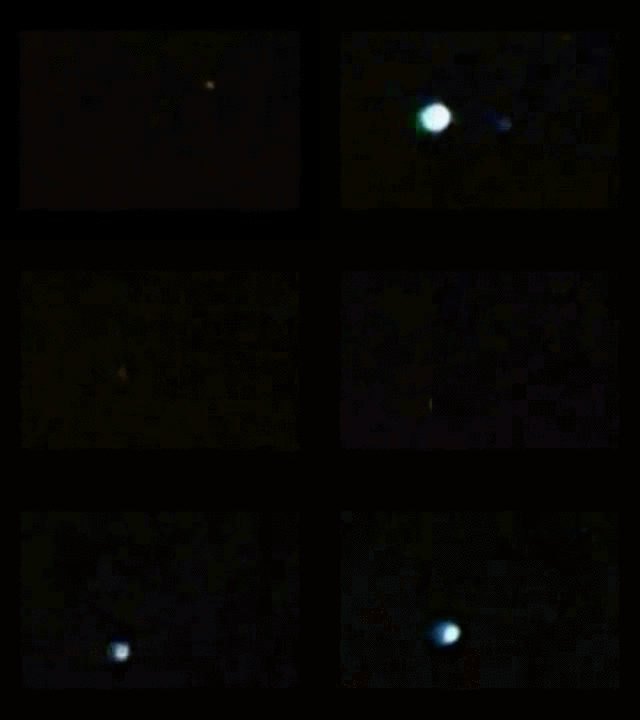
In 1997, a similar incident was recorded and discussed on email newsgroups. The image below shows a small number of white spots that were apparently interpreted as UFOs at the time:
Contemporaneously, these were identified as likely digital photo artifacts. A UFO researcher noted that the incident seemed to be the result of bad data rather than massive UFOs off the coast of Chile.
http://ufoupdateslist.com/1997/apr/m25-010.shtml
Azhazha's source for the earlier observations is not provided. However, it appears possible if not likely that Azhazha simply misinterpreted the data.
As mentioned above, I independently obtained a copy of these documents and have begun analyzing them. The documents are similar to Azhazha's book in some respects; they contain many interesting clues and pieces of information, but also contain odd statements and theories. Due to the complexities surrounding them, it is not possible to strictly "vet" these documents. However, I have verified that the copies I received are indeed the same that Knapp and Gresh obtained.
Azhazha is mentioned by name five times in the documents. In the first passage, he is described alongside Felix Zigel (discussed in my earlier piece, as well) as working on UFO problems as early as the 1960s. However, according to these documents most of that work involved making general arguments about the importance of the phenomena and tracking foreign research on the subject – particularly French and American. The narrative in Thread-3 also agrees that the "Petrozavodsk phenomenon" incited a wave of policy changes, as described above.
Azhazha appears again in the documents bearing copies of the "MJ-12" documents that have long circulated among conspiracy theorists. A manuscript of Azhazha's work is subsequently cited in a breathless passage about alleged cosmonaut encounters, and again in another section about aviation incidents. Finally, the documents reference Azhazha's approval as chairman of a group studying UFOs around 1979.
Interestingly, the documents seem to make no mention of the naval and submarine incidents cited by Azhazha. In sum, the Thread-3 material portrays Azhazha as being passionately involved in UFOlogy from an early date – but primarily as a promoter of the subject and conduit to foreign UFOlogists.
Preliminary Conclusions
This piece is not an attempt to exhaustively chronicle the Soviet program – such an effort would require far more translation work and access to sources than is currently practical. However, it does provide several things:
Notes on a previously untranslated book from a key figure in Soviet UFOlogy
The publication of a small data set of naval encounters
Initial cross-comparison with the activity of other governments (notably the aborted French outreach in the early 1980s)
Input from the not-yet public Thread-3 material
Taken together, there are a small number of preliminary conclusions:
The Soviet program superficially appeared massive due to the military "listening post" policy, but in practice was limited to roughly five or so people with no dedicated budget
According to Azhazha, a source known to exaggerate the importance of the topic, the pre-1976 program was scattershot and disorganized with respect to data
As in the modern American context, naming proved tricky. Intriguingly, Soviet officials also renamed UFOs to "anomalous phenomena" to make the topic more palatable
All sources appear to agree that the "Petrozavodsk phenomenon" was the single most important event in Soviet UFOlogy. There is lingering controversy today over the explanation; Sokolov and Platov contend that it was ultimately caused by a satellite launch.
Overall, the Soviet program appears to fit the strategic mold described above: a minimally resourced program designed to cheaply leverage observational resources as a hedge against there being anything of substance to stranger reports.
Participants like Sokolov and Platov also emphasized the conventional intelligence aspect of their work. Others like Azhazha have made strong claims, but with limited evidence. The program participants often appeared preoccupied with foreign reports, and with the possibility that what they were observing was American technology. They too struggled with the enduring question: who else knows? What do they know?
The preliminary answer seems to be: everyone has these reports in the international community, but no one knows all that much about them.
Appendix A: Bibliography
Given that Soviet and Russian UFOlogy is not well represented in the West, I have included the "literatura" or bibliography provided in the book. Copies of both the original Russian and English are provided, and give some insight into the sources Azhazha relied on:
Carlos Diaz: The Man Who Contacted And Filmed The UFO
One morning in January 1981, Mexican photographer Carlos Diaz pulled into a deserted car park at Ajusco Park near Mexico City. He was on an assignment for a magazine, and had arranged to meet a journalist who was yet to arrive.
Diaz sat in his car, preparing his camera for the job ahead. Although it was early in the morning, the air was thick with humidity which made even sitting still uncomfortable. Impatiently, Diaz began to look at his watch.
Suddenly, his attention was caught by a strange yellow glow coming from the valley below him. At first he thought it was a forest fire, but, an instant later, the source of light revealed itself to be a large, orange, oval-shaped UFO, slowly hovering about 30 metres from his car.
Unable to believe his eyes, Diaz quickly grabbed his camera. With it resting on his steering wheel, he began frantically firing off shots. Then, without warning, the whole car began to shake violently.
Diaz got out of the vehicle and took two more photographs before the craft sped up vertically into the sky, leaving Diaz in a state of shock. This encounter marked the beginning of what was to develop into one of he most fascinating and long-running contactee cases in the history of UFOlogy.
Carlos Díaz
Today, the case remains among a small minority of alledged extraterrestrial encounters to be supported by verified film documentation that has stood up to the scrutiny of a range of experts.
KEY ENCOUNTER
Indeed, the apparent credibility of Diaz’s claims has attracted the attention of some of the world’s top UFO researchers, including German author Michael Hesemann and abduction researcher Dr John Mack. Both concluded that Diaz’s story is completely credible.
Hesemann echoes the views of most researchers when he states: ‘The Carlos Diaz case is the most important case of documented alien-human contact to have emerged in modern times.’ Certainly, at the time of his initial encounter, Diaz little suspected what was to come.
The transition from a run-of-the-mill UFO sighting in an area now acknowledged as a UFO hot-spot, to one of the key cases of recent years did not occur until weeks later. In the days that followed this January sighting, Diaz remained preoccupied by his experience.
Unable to forget what he had seen, he repeatedly returned to the Ajusco Park location, hoping to secure more pictures. After a succession of fruitless visits, Diaz began to think that he was wasting his time. But then, on 23rd of March, his patience was rewarded.
RETURN TRIP
While roaming the greenery, Diaz was again alerted to the presence of a UFO by an orange glow, which he could see only dimly through the fog and rain that had saturated the forest in Ajusco Park. As he climbed up the walls of the valley, he managed to position himself within 45 metres of the object. Diaz watched the ‘craft’ hovering above him, eminating a bright orange light.
It was, he said, dome-shaped with a smooth ring in its centre. This, claimed Diaz, was covered with a number of half spheres, each around one metre in diameter. Crouching behind some rocks, Diaz thought his actions had gone unnoticed, but, as he continued to watch the craft, he felt someone grab his shoulder from behind.
Diaz immediately fainted, and, when he awoke, it was dark and the UFO was gone. He was shocked to discover that, despite heavy rain, his clothes were completely dry. At that point, he knew something strange had happened to him. When he returned to his car, Diaz noticed another car parked in front of him.
At this point, Diaz claimed, a humanoid entity with fair hair approached him and told him that if he wanted to know more about what he had just experienced, he should return to the same spot at noon the following day. Apparently, when Diaz returned the next day, he discovered the same entity sitting on the grass.
Diaz claimed that the being then turned to him and explained that it was he who grabbed his shoulder the previous day. Before leaving, the being also told Diaz that he had come from inside the craft and that Diaz would gradually recover his memory of what had happened while he was unconscious. Sure enough, over the next few months, Diaz’s memory returned, piece by piece.
According to his account, he recalled the craft hovered directly over his head. As he attempted to touch the craft, his hand seemed to pass through the yellow light and he seemed to merge with it. The next thing he recalled was seeing the craft parked on a platform inside a giant cave.
Diaz was filled with awe when he remembered what he had seen inside: ‘It was full of stalagmites, some of which were carved into what appeared to be Mayan sculptures,’ he stated.
‘I saw many people in the cave, some of whom waved to me and, in a state of shock, I waved back.’ Apparantly the being Diaz had encountered in the park then led him to a smaller cave which contained seven glowing, egg-shaped orbs, one of which Diaz was invited to step into. On entering, Diaz could at first only see yellow light.
But then he found himself surrounded by the image of a forest. ‘I could see all the details of the forest as if I was walking through it,’ said Diaz. ‘I couldn’t touch anything, but I could feel the temperature and moisture.
I could see and experience everything, yet I wasn’t physically there.’ His guide then told him that the orbs were also a system for storing information and that certain data had been imparted to him. Diaz was then returned to the ship and, in time, to the park.
CONTINUING CONTACT
According to Diaz, this was only the first of a series of contacts with the same beings, which continue to this day. Since 1981, Diaz has stated that his experience inside the orbs has enabled him to ‘travel’ to different regions of the Earth’s ecosystem – forest, desert, jungle, shoreline, even Arctic areas – with his ET contact.
Through this contact, Diaz claims to have been imbued with an awareness of the interconnectedness of all life and the need to preserve our environment.
To many UFOlogists, especially those who have had their ‘fingers burnt’ by alledged contactees before, these claims may appear far-fetched. However, Diaz is seen by many researchers as a highly reliable source, not least because of the strong body of photographic evidence he has amassed to support his claims.
INDISPUTABLE PROOF?
Mexican TV journalist and UFOlogist Jaime Maussan, who has been at the centre of UFO investigations in Mexico since the wave began in 1991, believes that Diaz’s UFO photographs are among the most impressive he has seen.
Maussan took Diaz’s photographs to Jim Dilettoso, an image processing expert at Village Labs, in Tucson, Arizona, who concluded they were genuine. After satisfying himself he was not dealing with a hoaxer, Maussan visited Diaz at his hime in Tepoztlan, Mexico. There, he spoke to a number of other witnesses who claimed to have seen exactly the same type of UFO.
The apparent credibility of the Diaz case has also attracted UFO researchers from further afield, who have attempted to glean insights into the alien agenda from Diaz’s contactee claims. German author Michael Hesemann, who first interviewed Diaz in June 1994, is convinced of the credibility of Diaz’s story.
‘Not only is he contacting these beings through encounters on the ships,’ says Hesemann, ‘but he claims to be meeting these beings socially, since he believes some of them are living among us.’ However Hesemann explains that, according to Diaz, the beings are reluctant to fully disclose their origins.
‘Apparently,’ says Hesemann, ‘they did, however, explain that they have been visiting Earth for thousands of years, and are particularly interested in our evolution which, compared to their own, has happened at a much faster rate. They are trying to learn why.’
Another UFO researcher intrigued by Diaz’s case is Professor of Psychiatry at Harvard Medical School, John Mack. Mack has a long history of dealing with abductees and contactees and believes that the Diaz case is among the most convincing he has come across.
In his book Passport to the Cosmos, he states: ‘Out of all the experiencers I have worked with, it is Carlos Diaz who seems to have developed the richest understanding of the interconnected web of nature. Diaz’s experience of connecting with living creatures is so intense that he seems literally to become the thing he is describing.’
Diaz’s experience, Mack claims constitutes an ‘awakening’, a process which, he says, is common in abductees. Diaz told Mack that his contact with the ETs had instilled in him a need to preserve the environment and the ability to ‘enjoy a beautiful planet’.
Whether or not an extraterrestrial influence was involved, Diaz’s new-found concern for the environment has certainly become a driving force in his life. he has repeatedly and passionately conveyed this environmental warning publicly, most notably at a UFO conference in Dusseldorf, Germany in 1995.
Diaz has revealed that he had been informed through his contacts that the civilization of the visiting extraterrestrial, like ours, had been threatened by its own history of destruction, but had somehow managed to survive.
He remains convinced that his contacts’ disturbing prediction for our future is only too real – a prediction that states with near certainty that humanity, on its current course, is headed for total extinction.
ALIEN MESSENGER
This outspokenness, coupled with the public nature of his experience, has le Diaz to assume visionary status in both his home town of Tepoztlan and UFO circles. however, Diaz has been quick to dispute this, claiming that he is not a unique visionary, but merely ‘a messenger’.
The real nature of Diaz’s current incarnation aside, for many UFOlogists, the Diaz case remains among the most convincing on record. Indeed, few UFO reports exist that boast such impressive and abundant photographic evidence. And fewer still have emerged that have stood up to the scrutiny applied to Diaz’s images.
PERFECT PICTURES
Expert analysis of Carlos Diaz’s UFO pictures has been extremely thorough. Mexican UFOlogist Jaime Maussan gave the original transparencies to Professor Victor Quesada at the Polytechnical Institute of the University of Mexico for examination.
Quesada stated: ‘We were shocked to discover that the spectrum of light from the object was unlike anything we have ever seen, it broke all previous parameters and didn’t match anything in our data banks.
The light was extraordinarily intense. There was no evidence of superimposition or a hoax. We estimated the object to be around 30 to 50 metres in diameter.’ Interestingly, the photographs were also analysed by Dr Robert Nathan at NASA’s Jet Propulsion Laboratory in California. Nathan, a notorious UFO sceptic, stated that he could find no evidence of a fake.
Certainly, for many who have examined the three images, the first shot is the most impressive. In it, the orange glowing craft can be seen through the windshield of the car, and light from the object is reflected both off the car’s bonnet and off the metal guard rail by the side of the road. These, in particular, are details that experts claim are extremely difficult to fake.
VIDEO EVIDENCE
Mexican UFOlogist Jaime Maussan was so intrigued by Carlos Diaz’s account of his experiences that he provided him with a video camera and asked him to see if he could record the UFO on tape when it next appeared. A few weeks later, Diaz awoke at 5 a.m. and grabbed his camera. He walked out and waited.
Apparently, within minutes, the craft appeared and hovered over the house, where Diaz filmed it. When Maussan saw the remarkable footage, he asked Diaz if he could get even closer to the craft while filming. Two months later, Diaz was once again able to film the craft, which this time hovered directly above him, without moving.
However it is Diaz’s third attempt to capture the craft on video that is the most spectacular. In this footage, Diaz having mounted his camera on a tripod, walks to the bottom of a field waving a flash light.
Responding to this, the craft suddenly materializes directly above Diaz’s head and sends beams of light down towards him. Then, the unidentified object remains motionless for 30 seconds, before blinking out. It is universally recognized that this video contains some of the best UFO footage ever taken.
UFO That Crashed In Roswell May Have Already Been Seen In Canada
It was already a humid summer, and on July 8, 1947, things had only managed to get hotter in the American Southwest.
Walter Haut, an Army Air Field public relations officer stationed near Roswell, New Mexico, had released a rather odd statement to the press, even for the summer of 1947: in short, Haut claimed that the field’s 509th Operations Group had managed to capture one of the curious “flying disks” that had been making news headlines throughout the Western world.
The object, according to Haut’s statement, had crashed landed at a ranch near the town of Roswell, owned by a local foreman named Mac Brazel.
At very least, this had been the initial story, for later that same day Roger Ramey, Commanding General of the Eighth Air Force, had changed the official story, and now insisted that the object retrieved by the 509th had merely been a “weather balloon.”
The claim would exist in infamy within UFO circles, and for years afterward, serious ufologists and conspiracy theorists would continue to ask whether the story of meteorological balloons recovered at Brazel’s ranch withstood the evidence provided by other witnesses to the bizarre events at Roswell, New Mexico, which seemed to indicate an encounter with something not of this world.
And all the while, though the Roswell incident would represent, along with pilot Kenneth Arnold’s encounter with strange flying objects over Mount Rainier one month earlier, a new era of clandestine avionics known as Ufology, there were similar reports emanating from Canada around the same time that, while less popular, would nonetheless manage to still raise a few eyebrows even today.
On July 3, 1947, just days before the report of the alleged object that crashed in New Mexico, the following report of an “unidentified flying object” was brought to the attention of the commanding officer of a local RCAF base, as compiled by Air Commodore W.W. Brown (whose signature appears near the bottom of the original memo).
The information was supplied by the Summerside Detachment of the RCMP, and confirmed by the Summerside reporter for the area Charlottetown Guardian. The memo reads as follows:
“Brenton Clark, a farmer in the vicinity of Augustive Cove, saw an object at approximately 10,000 ft east of his position moving southward at high speed. The time was approximately 17:45 hrs AST 3 Jul 47. It maintained level flight for some distance and then apparently dived earthward leaving a trail (apparently a vapor trail) behind it. After the object had disappeared the trail remained for some time. The object was round shaped and at the estimated distance appeared to be the “size of an apple”. It appeared to resemble a shooting star and there was a considerable reflection of light.”
The above report was confirmed by a local reporter who advised that he was informed by James Harris, a farmer in the vicinity of Summerside PEI, that he (Harris) and his hired man, Herman Linkletter, had seen an object in the same general position at the same time.
It was moving southwestward and there was such a brilliant reflection from it that its shape was indiscernible. It was visible for approximately ten seconds.
The object, while reminiscent of a falling star, is described here as being circular in shape, according to one witness account. All those who witnessed the craft said it left a vapor trail, and that the object was visible for only a few seconds, with the vapor trail remaining apparent behind it in the air for much longer.
All parties stated that the object seemed to reflect daylight as it traveled. But perhaps most compelling of all had been the fact that the object–whatever it had been–seemed to move parallel to the ground for a time, and then shoot off in the direction of the ground after that.
While we can’t assume that the craft had crashed like it’s anomalous vehicular cousin allegedly did at Roswell a few days later, it certainly makes the multiple witness report detailed above a bit more compelling (and in fact, there were other official Canadian UFO reports around the same time, such as this one, though it seems likely in the latter instance that the craft had likely been a meteor).
So what was the mystery object seen over Canada only days before the alleged crash of an object, reported by Air Force officials at Roswell, New Mexico as a “flying disc” just a few days later?
What Happened To Ancient Civilization That Lived On Venus Billion Years Ago
We all know that Earth is the only planet in our solar system where intelligent life exists. But some people seriously believe that life can be extraterrestrial. Most often, not only science fiction writers but also scientists make an assumption that life is likely to be on Mars.
Recently, scientists have put forward theories that billions of years ago, Venus was also populated not just by some organisms, but by an intelligent civilization that was smarter than human.
Back in 1996, amazing images were taken to the NASA center by the Venus Radar Mapper. This small spaceship was sent to Venus precisely for one purpose: to explore this planet and learn more about it.
This probe took a huge number of images of the Venus’ surface, and till today, these photos have made scientists scratch their heads. There were photos that depicted a winding canal with a length of more than 600 kilometers that resembled the fragments of ancient rivers that evaporated, like the atmosphere of Venus itself.
Nevertheless, a study of the soil of this planets showed that these channels were created much later than the rest of the relief of the planet
Some researchers generally put forward fantastic theories and say that these channels are nothing more than roads that were created not by nature, but by some kind of civilization.
Some experts believe that intelligent life and even a whole race could once exist on Venus. Researchers have long proved that once Venus was very similar to our planet.
Ancient Civilization on Venus
Even later, scientists again took pictures that depicted the silhouettes of the most real pyramids and a structure resembling the Sphinx, as in the Egyptian Giza.
Scientists saw the same pyramids on the surface of Mars and the Moon. So, is it possible to compare all these structures and say that on these planets, there once existed an intelligent race? Perhaps even the same one that once built the pyramids on Earth and then flew to other planets.
The past of the most beautiful planet in the solar system.
Already in our time, in 2003, another probe sent to Venus confirmed during the study of reliefs and soil that earlier, this planet had been covered by a huge ocean, and in an atmosphere that almost evaporated, traces of helium and nitrogen, as well as other elements were found that previously had been met only on Earth.
Even more, the atmosphere of Venus contains a lot of carbon dioxide which probably came as the result of the activity of not only the human body but also almost all living things on Earth.
Ancient Civilization on Venus
Therefore, it can be argued that, in the presence of water and other constituent components, highly developed creatures had previously lived on Venus. Maybe they were like us, or maybe they were much smarter if they built pyramids on different planets.
Until the end, it is not known exactly who lived on this planet, but scientists can say for sure that its past is very similar to the present Earth.
Today, believing in aliens is more a topic for memes than a real expectation to make contact with them. But throughout history, mankind has repeatedly turned to the idea of the existence of extraterrestrial civilizations, then romanticizing them, then using them as a horror story.
According to a recent survey, 20% of Americans believe that extraterrestrial species have already visited Earth, and 68% believe that extraterrestrial intelligence exists.
There is no single answer from science. Scientists will tell you that the probability of the origin of life in the vast expanses of space is huge, but there is no evidence.
Talking about aliens, a simple question arises: do you believe in them or not? But what do we actually believe or not when it comes to aliens? And why do these issues generally concern humanity so much?
The First Aliens
First aliens were Selenites Image credit: DeviantArt
The first aliens in history were the Selenites. Legendary Orpheus wrote about the “vast land” Selena (Moon), on which “there are many buildings, mountains, and cities.” Ancient Greek philosophers Thales, Heraclitus of Ephesus, Xenophon believed that this celestial body is inhabited by the nation, and it lives just like the earthly one. And another Heraclitus, from Pontus, was possibly even able to communicate with a resident of the moon that came to our planet.
Having learned, among other things, from the works of ancient Greek predecessors, the astronomers of New time found evidence of the correctness of their ancient mentors. Great Johannes Kepler, for example, wrote about the selenites in 1610: “… they dig huge areas, surrounding them with the ground, maybe to get the depths of moisture …” Today, any student will understand that this all is about a meteorite impact crater.
The possibility of life on other planets was also reflected in the science of the Renaissance period. For example, in the 15th century, Nicholas of Cusa suggested that the Universe is infinite, and we are not in its center. Accordingly, life must exist not only on Earth. So, the aliens appeared next to us in Antiquity and almost did not change until the 19th century. They lived on the moon, built cities, and even from time to time visited Earth to chat with the ancient Greek philosophers. And then, by the way, they did not have any super technologies, blasters and other special effects.
Alien life on was found a long time ago
Progress accelerated, and by the second half of the 19th century, it became obvious to astronomers that the Moon was a lifeless piece of stone. The aliens were evicted from there, but the former selenites moved to Mars.
Map of Mars’ south pole by Herschel Image credit: The Planetary Society
William Herschel spoke of the possibility of life on the Red Planet in the 17th century. He was the first to prove that the polar caps of Mars are decreasing and increasing depending on the season, and suggested that there is water, and therefore life.
So, the alien mind has found a new residence in the vicinity of the Earth. In 1877, Italian astronomer Giovanni Schiaparelli saw channels on the surface of Mars that he called “canali.” The image was blurry, but the scientist claimed to had seen straight lines there. He himself did not interpret his observations in any way, but many of Schiaparelli’s colleagues decided that these depressions were clearly originated artificially.
The saga with Martian channels lasted until the 70s of the 20th century. There were disputes in the professional community, some works were written both in defense of the hypothesis of artificial structures on Mars and against it. However, the analysis of images of the surface of the Red Planet taken by the Mariner 4 in 1965 showed that the very “straight lines” observed by astronomers of the past were just an optical illusion. In addition, there was no atmosphere or magnetic field on Mars. It became obvious that if our cosmic neighbor was once suitable for life, then these times passed millions of years ago.
However, even earlier, in the 1920s, astronomer Edwin Hubble proved the existence of other galaxies and made the Universe truly endless. Life does not have to huddle at the objects closest to the Earth – it can exist billions of light-years from us. This means that the habitat of extraterrestrial civilizations has expanded indefinitely.
Science and fiction
While scientists were arguing about life in the solar system, sci-fiction writers decided not to wait for the end of the battle and brought down an alien invasion on the heads of unsuspecting earthlings.
Image credit: Wiki Fandom
Herbert Wells’ The War of the Worlds (1897) was the first classic novel about the invasion of space aliens on Earth. Evil invaders from the vastness of the universe were, according to the writer, precisely the Martians. We can say that this book marked the beginning of the “era of invasions” on Earth.
For the first time, guests from outer space appeared in it as creatures completely alien to man. The novel not only gave rise to a lot of imitations, but also became a real bible for several generations of writers, and also inspired many prominent researchers.
In general, scientists and science fiction writers worked side by side and often combined these professions altogether. Wells himself was a biologist by education and, in addition to literature, seriously worked on the main specialty. Isaac Asimov studied chemistry, and Arthur Clarke graduated from King’s College London with degrees in physics and mathematics.
Why do we need aliens?
Why are aliens from distant worlds so firmly settled in our minds? What do we want from them? Why are we looking forward to this meeting and afraid of it?
This whole game to search for life on other planets has changed the meaning of god for the modern man. Now, they have replaced gods with aliens.
The Renaissance, the industrial and scientific revolutions of the eighteenth and twentieth centuries changed beyond recognition the archaic picture of the world with a paradise in heaven and hell underground. The man looked through a telescope and found neither God nor angels. Then he flew under the clouds, entered orbit, landed on the moon. Now, through the lenses of microscopes, we found bacterias and viruses cause diseases, not a punishment given by gods.
Hurricanes, floods, volcanic eruptions, and earthquakes – the favorite methods of influencing a person that the gods resorted to – are also quite explainable today. Scientific progress has triumphed on all fronts.
Aliens possess all the traits that we previously endowed with the gods. They are smarter than us, their civilizations are millions of years old, and the most brilliant inhabitants of the Earth often cannot comprehend the motives of guests from outer space. Sometimes, representatives of a higher race do not even pay attention to us.
Where are aliens?
No matter what science fiction authors invent or whatever people believe, the UFO problem in different years has been of interest to the military. Programs for the study of the unidentified flying objects existed in the UK, France, the USA, and the USSR.
From 1977 to 1990, the program of the Academy of Sciences for the study of UFOs and other “abnormal phenomena” worked in the Soviet Union. For 13 years, the commission has collected and analyzed hundreds of eyewitness accounts.
UFOs began to appear at the end of the 19th century and still remain a favorite topic of the yellow press and various interesting personalities. However, it is easy to trace a simple pattern. Interest in alien ships arises simultaneously with the beginning of the active development of aeronautics.
Then eyewitnesses described the alien transport as airships or “balloons in the sky.” By the end of the 1940s, UFOs began to appear in the form of “luminous lights” and “cigar-shaped objects” moving with great speed. It’s easy to guess jet planes and missiles in them. And if you recall that all this happened against the backdrop of a frenzy of fiction in those years, then the picture is quite clear.
Flying saucers are the most popular type of UFO among people. They tried to build disk-shaped aeronautics since the 1910s. Work on the creation of such machines was carried out by German and American designers in the 1930–50s. Nothing practical came of it, but photos of the prototypes became for many a proof that the USA military had contacts with extraterrestrial civilizations or tried to reproduce their technologies.
The peak of interest in aliens and UFOs occurred in the 60s, which is not surprising, given the rivalry in space and the arms race between the USSR and the USA – a lot of dangerous and mysterious things really flew across the sky. True, exclusively of terrestrial origin.
After the relative lull of the 1970–80s, in the 90s, there was a new surge of interest in the topic of aliens and UFOs. This was due to several circumstances.
In 1993, the most popular series The X-Files was launched. It involved millions of people in the “hunt for green men.” In 1995, the famous mystery film “Alien Autopsy” released, which for many years remained the Holy Grail for adherents of contact theory. Only in 2006, the creators of the fake confessed everything. However, as often happens, they did not dissuade many “believers.”
The increased interest in the other world in the 90s is easy to find more prosaic explanations. First, the Cold War ended, and the world was in a state of blissful relaxation. What else to do when the threat of a nuclear apocalypse has passed? Come up with a new one, of course! Just not so real.
Secondly, the massive spread of cheap photo and video equipment has spawned a shaft of new “UFO sightings”. Having watched all the same “X-Files” and films like “Independence Day,” people began to send their murky pictures to television with muddy photographs and trembling videos of Venus, Mars, jet planes and glare on glass.
But do not think that the search for extraterrestrial intelligence left at the mercy of ufologists and other exalted enthusiasts. The equation, drawn up in 1960 by astronomer Frank Drake, prompted serious scientists to search for alien civilizations. The SETI program has been running for almost 60 years, and although from time to time researchers catch some abnormal signals from space, they all end up being of natural origin.
With his equation, Drake tried to answer the Fermi paradox. The situation is really amazing: on the one hand, in our galaxy should be millions of worlds inhabited by intelligent creatures. And on the other hand, scientists have not even found a hint of at least some traces of their activities.
Today, one of the promising methods for detecting possible life in the Universe is the search for terrestrial exoplanets. These are celestial bodies that have a certain mass, density, and chemical composition and are located in the habitable zone of stars. In general, scientists are looking for planets that are similar in parameters to Earth, Mars, Venus, and Mercury.
Are we alone in the universe? Mankind may never find the answer to this question or will know it tomorrow. But we have so long and diligently invented aliens, endowed them with so many human and superhuman qualities that meeting with a real “alien mind” will undoubtedly be the most exciting adventure in history.
Thousands Of People Saw UFO Crash In Brazil But Military Shut Their Mouths And Seized Their Phones
In Brazil, thousands of people accidentally noticed the UFO that crashed into a lake near Rio de Janeiro. This unusual incident occurred in the small village of Pau Grande on May 13, 2020.
According to the witnesses from the small village of Pau Grande, the military urgently arrived at the crash site, cordoned off the lake, and began to seize smartphones and other devices of local residents, which were stored on the footage “with UFOs.”
Local residents saw flying luminous objects that were in the field of view of eyewitnesses for some time, and then one of them suddenly disappeared.
Urgently, the military arrived at the scene and began to close the square, restricting access to the reservoir. They also took smartphones and other devices from people, on which they were able to take shots of the UFOs.
Interestingly, at the moment, the military did not disclose any details. They are doing everything possible so that eyewitnesses do not inform the public of the details of the event. The whole internet connection was shut down in the area where the UFOs were seen, and even mobile connection stopped working.
British Woman Terrified After Seeing UFO With Two Nordic-Like Figures, Hovering Over Her Home In 1954
In 1954, a British woman named Jessie Roestenberg claimed to had seen a disc-shaped flying saucer of aluminum color, hovering over her cottage near Staffordshire. She also saw two Nordic figures that were sitting in the craft.
Jessie Roestenberg with a graphic sketch of two Nordic figures which she had seen inside the UFO hovered her cottage in 1954
Jessie Roestenberg, a wife of a young Dutchman named Tony lived with their two sons and a daughter in a small cottage at Vicarage Farm, Ranton, near Staffordshire, UK. It was a very remote area, and they had no electricity and indoor plumbing.
On October 21, 1954, at around 4:45 pm, she was inside her house with her 2-year old daughter Karin. Her two sons, Anthony (8) and Ronald (6) were playing outside in the garden. Suddenly, she heard a loud sound like an aircraft crash. As she stepped out, her sons were terrified and shouting: “Mommy, Mommy, there’s a flying saucer.” She saw a round UFO that was hovering above them.
The woman stated that the front part of the object was transparent, and she could see two human-like figures inside it. She described them as Nordics with long hair and long faces. Jessie saw them wearing a tight-fitting blue suits, and their heads were in transparent helmets.
Newspaper clippings showing the UFO sketch drawn by Mrs. Roestenburg
According to Express and Star, she told reporters that the UFO circled the house two times before it flew away at a high speed. She noted that the two creatures had pitiful faces.
“The boys were so terrified that they would not go out again last night,” she said. “The dog was nowhere to be seen. I think it must have bolted.”
“When I visited the Roestenberg’s house almost three weeks after the sighting…Jessie Roestenberg appeared. She seemed highly strained and nervous and her husband, coming in later, was also very strained. It was evident that something most unusual had occurred.”
Originally, Gibbons was a linguist and scholar. He called the flying saucers extraterrestrial space ships. He used the Sanskrit term “Vimanas” for the disc-shaped scout craft and “Vunu” for cigar-shaped UFOs.
In Gibbons’ opinion, Jessie encountered the UFO with aliens just like George Adamski had described. But the series of UFO encounters did not stop there.
A photograph of the Roestenberg family
Interestingly, Tony Roestenberg saw something unusual on the following Sunday (24 Oct), when he climbed the roof of his house. He saw a high-speed cigar-shaped UFO suddenly disappeared into the clouds. Another incident happened on December 15, 1954. Tony saw a bright ball, flying very silently in the sky. First, he measured the length of the UFO with his arm which was around two to three inches. But when he went to the other side of his house, its length was about 18 inches. The fireball was moving very slow at a low altitude. After some time, he heard the sound of an airplane, coming from the east. As the plane approached closer, the fireball flew away at an incredibly high speed, disappearing in no time.
Gibbons visited the Roestenbergs at their new home in Stafford many times in 1955, and he was assured that there was no motive for a hoax. They looked happy in the new house, and when Gibbons asked why they had left the old house, Tony replied that since the first UFO incident had happened, the house became haunted for them.
Here is the short clip of Jessie Roestenberg (aged 90) shot by John Hanson in 2015.
This past autumn, a professor at Wuhan University named Jau Tang was hard at work piecing together a thruster prototype that, at first, sounds too good to be true.
The basic idea, he said in an interview, is that his device turns electricity directly into thrust — no fossil fuels required — by using microwaves to energize compressed air into a plasma state and shooting it out like a jet. Tang suggested, without a hint of self-aggrandizement, that it could likely be scaled up enough to fly large commercial passenger planes. Eventually, he says, it might even power spaceships.
Needless to say, these are grandiose claims. A thruster that doesn’t require tanks of fuel sounds suspiciously like science fiction — like the jets on Iron Man’s suit in the Marvel movies, for instance, or the thrusters that allow Doc Brown’s DeLorean to fly in “Back to the Future.”
But in Tang’s telling, his invention — let’s just call it a Tang Jet, which he worked on with Wuhan University collaborators Dan Ye and Jun Li — could have civilization-shifting potential here in the non-fictional world.
“Essentially, the goal of this technology is to try and use electricity and air to replace gasoline,” he said. “Global warming is a major threat to human civilization. Fossil fuel-free technology using microwave air plasma could be a solution.”
He anticipates this happening fast. In two years, he says, he thinks Tang Jets could power drones. In a decade, he’d like to see them fly a whole airplane.
That would all be awesome, obviously. But it’s difficult to evaluate whether Tang’s invention could ever scale up enough to become practical. And even if it did, there would be substantial energy requirements that could doom aerospace applications.
One thing’s for sure: If the tech works the way he hopes, the world will never be the same.
Tang’s curriculum vitae flits between a dazzling array of strikingly disparate academic topics, from 4D electron microscopy to quantum dot lasers, nanotechnology, artificial photosynthesis, and, of course, phase transitions and plasmonics.
He’s held several professorships, done research at Caltech and Bell Laboratories, published scores of widely-cited papers, edited several scientific journals, and won a variety of awards. He holds a U.S. patent for a device he calls a “synchrotron shutter,” designed to capture electrons traveling near the speed of light.
Tang says he first stumbled onto the idea for the plasma thruster when he was trying to create synthetic diamonds. As he tried to grow them using microwaves, he recalls, he started to wonder whether the same technology could be used to produce thrust.
Other huge stories, like the coronavirus pandemic and the baffling saga of Elon Musk naming his baby “X Æ A-12,” were sucking a lot of oxygen out of the news cycle in early May, when Tang announced his invention to the world. A few outlets picked up Tang’s story, including New Atlas,Popular Mechanics, and Ars Technica, but no journalist appears to have actually talked to him.
Because of that, there was little fanfare surrounding the sheer scope of his ambition for the technology — and it went overlooked that Tang sometimes sounds as though he’s invented a hammer and is now seeing a lot of things as nails.
After describing his plans to conquer aerospace with his new thruster, for instance, he starts to describe plans to take on the automotive industry as well — with jet-powered electric cars.
“I think the jet engine is more efficient than the electric motor, you can drive a car at much faster speeds,” he mused. “That’s what I have in mind: to combine the plasma jet engine with a turbine to drive a car.”
But you wouldn’t want to drive behind it, he warned, because you could be scorched by its fiery jet stream.
Over the course of our interview, Tang also brought up the possibilities of using the technology to build projectile weapons, launch spaceships, power boats, and even create a new type of stove for cooking. On that last point, Tang said that he’s already built a prototype kitchen stove powered by a microwave air plasma torch — but it’s so deafeningly loud that it sounds like a constant lightning strike.
Technically, the Tang Jet is an attempt to build a “plasma thruster,” a concept that’s periodically gained attention in scientific circles. Michael Heil, a retired aerospace and propulsion engineer with a long career of Air Force and NASA research, told Futurism that Tang’s research reminds him of several other attempts to build air propulsion tech that he’s encountered over the years.
Plasma thrusters like those that would power a Tang Jet have been around for a while. NASA first launched a satellite equipped with plasma thrusters back in 2006, but its capabilities are a far cry from what Tang is proposing with his research.
Engineers have long dreamed of a plasma jet-powered plane, but every attempt has been smacked down by the technological limitations of the day. For example, New Scientist reported in 2017 that a team from Electrofluidsystems in Berlin attempted to build a similar thruster — but like every attempt over the previous decade, their work never became useful outside of the lab.
The problems with these attempts aren’t so much faults with the theory — the concept of generating thrust with a plasma torch is fairly sound. Rather, issues begin to pop up when working out the logistics of building a vehicle that actually works.
Tang has little interest in commercializing the jet himself. Instead, he wants to demonstrate its merits in hopes that well-funded government leaders or titans of industry will be inspired to take the ideas and run with them.
“The steps toward realization of a full plasma jet engine would cost lots of money, time and energy,” he said. “Such investment is beyond our present resources. Such tasks should be taken by aerospace industries or governmental agencies.”
That’s a common mindset for scientists, said Christopher Combs, an aerodynamics researcher at the University of Texas at San Antonio.
“That’s what us academics do, we figure out the physics and say ‘Well I don’t want to make a product,'” he told Futurism. “It’s kind of a common refrain to see people in academia who have had something that gets a lot of attention.”
Though he’s intrigued by the underlying principles of the Tang Jet, Combs says it’s unlikely that it will scale up to the size needed to lift a plane — in other words, the same challenges that proved insurmountable to previous plasma thrusters will rear their heads once again. The current prototype, for perspective, only produces about 10 Newtons of thrust — about the same as a medium-sized model rocket.
“You’re talking about scaling something by five orders of magnitude — more than 100,000 times!” Combs said. “Which almost never works linearly. Lots of engineering happens in the middle.”
And even if it were to scale perfectly, there’s the issue of power. Iron Man’s suit was powered by an “Arc Reactor,” and the flying DeLorean was powered by a “Mr. Fusion” unit that turned household trash into more than a gigawatt of power — both of which, unfortunately, are fictional.
Fossil fuels store vastly more energy by weight than batteries, and that’s unlikely to change any time soon. And that’s too bad, because the Tang Jet needs a whole lot of power.
According to a paper Tang and his collaborators published about the thruster prototype in the journal AIP Advances in May, the technology produces about 28 Newtons of thrust per kilowatt of power. The engines on the Airbus A320, a common commercial jet, produce about 220,000 Newtons of thrust combined, meaning that a comparably-sized jet plane powered by Tang Jets would require more than 7,800 kilowatts.
For perspective, that would mean loading an aircraft up with more than 570 Tesla Powerwall 2 units for a single hour of flight — an impractical load, especially because the A320’s payload could only carry about 130 of the giant battery units. Long story short, no existing battery tech could provide enough juice.
“Does this thing just become a flying Tesla battery?” Combs said. “With the weight of these batteries, you don’t have room for anything else.”
The battery weight issue doesn’t doom the Tang Jet, but it pushes options for its power source into the fringe. Tang is banking on improvements to battery technology over the next years and decades; those Electrofluidsystem researchers speculated about nuclear fusion. Unfortunately, any possible answers could be decades away or impossible.
It is worth noting that there exist compact nuclear fission reactors, like Russia’s KLT-40S, that produce enough power and weigh little enough that they could fit in a passenger plane or rocket.
But the safety and environmental implications of nuclear-powered aircraft are grim, and Heil was quick to point out that generating enough power isn’t the only problem facing a Tang Jet. Actually getting the electricity from the power source to the thrusters would pose its own difficulties, perhaps requiring superconducting materials that don’t exist yet.
“You need power to generate thrust. And how do you move that power around on the aircraft?” Heil said. “Moving and controlling megawatts from the reactor to the jet is a huge challenge. You have to use big thick copper wires, that adds a lot of weight.”
Overall, both Combs and Heil questioned the feasibility of a practical Tang Jet based on the technology we have today. Without a quick fix to the energy problem, it’s certainly a tall order.
But both said they were fascinated by the research and hoped to see future progress. They also pointed out that a plasma thruster could be useful for pushing satellites or spacecraft that are already in orbit — though at that point it would need to bring propellant with it rather than using atmospheric air, since there’d be none in the vacuum of space.
The bottom line, Heil and Combs agreed, is that we won’t have a firmer grasp of the future of the tech until Tang’s colleagues have evaluated and experimented with it.
“I’m rooting for this, and I’d love to see it pan out,” Combs said. “But the scientist in me has some questions and some concerns.”
Editor’s note 7/8/2020: This article originally misattributed credit for a past attempt to develop plasma thrusters. It has been corrected with proper credit
Océane only knew UFOs from movies and certainly didn’t believe in them. That changed on November 18, 2015, however, when she filmed strange lights over Lausanne, Switzerland from her balcony.
When she entered her kitchen that morning in the pre-dawn hours to make herself a cup of coffee, she realized she couldn’t see the neighbor’s house through the balcony door. “I was perplexed,” she says. “So I went out to see.” Beyond her balcony was a “pink cloud.”
“I could see the church, but not the house directly in front of me. The cloud rose and shifted toward the church steeple. Then I saw these white balls of light. They were spinning like a carousel in the cloud,” she recounts in her apartment in a suburb of Lausanne, a historic city on the shores of Lake Geneva. Océane is a pseudonym; the woman, who is between 50 and60 years oldand whose identity is known to this reporter, wishes to remain anonymous for fear of being ridiculed in her community as a “UFO lunatic.”
Nevertheless, she can back up her statements: She took several photos, as well as a video, showing the pinkish mist and the lights. The flying balls circle in the sky, rise in the air, and contract again. The strange spectacle lasts for several minutes.
“Then there were the small lights,” adds Océane. In the video, you can see bright dots swirling around the frame. “They made a soft sound when they hit the shutters, like the flapping of a bird’s wings. As they did so, they left behind a whitish liquid that looked a little like milk.”
A photo taken by the witness of the residue left on her shutter by an alleged unidentified aerial phenomenon.
Océane is left perplexed. And the sighting has not only disturbed her psychologically—she reports physical complaints as well, such as nosebleeds and bloodshot eyes. She goes to the doctor and has eye drops prescribed. “I was scared because I thought: If this leaves traces, will I get a disease?”
She browses the Internet for answers. Her roundabout journey brings her to Bruno Mancusi, a longtime UFO researcher from their region, Vaud. “It’s certainly the most interesting UFO sighting in Switzerland in recent decades,” Mancusi says. The researcher interviews Océane, and together they decide to call in the scientific community.
Rebuffed by the public sector
But science generally has a hard time with UFOs. Most scientists hold that there is nothing more than psychology behind them, that sightings are hallucinations, the result of confusion, or simply tall tales. This rejection of the phenomenon is greatest among the natural scientists, which is not surprising since verifiable physical traces that would prove the existence of flying objects from strange worlds do not yet exist.
For the discipline of science, UFOs are just not tangible enough. “Anyone who takes a closer look quickly realizes that the phenomenon is very complex,” says Bruno Mancusi. “There is probably not a single explanation for all the observations.” Incidentally, the UFO researcher does not believe that the eerie flying objects have an extraterrestrial origin. “There are too many sightings for that. It would mean that our planet is one galactic tourist attraction!”
Océane gets small containers and cotton swabs and takes samples of the residue the little balls of light left on the shutters and on a display case in the living room. Mancusi, who works professionally as a laboratory technician, emails the University of Lausanne, the Swiss Federal Institute of Technology in Lausanne (EPFL), and the environmental office of the western canton of Vaud.
But the parties he consulted declined to take a closer look at the traces. “They said this was the job of private laboratories. I understand their reaction, but I don’t like it. After all, this is something potentially novel that could be exciting for science,” he says.
Another section of video filmed by the witness in 2015.
Visit from a UFO pioneer
The search for interested scientists then expands outside of Switzerland. Mancusi learns of a study in the United States for which a certain Jacques Vallée is seeking samples. Vallée is a French-born astronomer and pioneer of UFO research who has lived in the U.S. for many years. “I contacted him because I had learned that he was looking for trace material from UFOs for laboratory studies,” Mancusi says. “He showed interest. So in March 2018, I went to Paris to give him the containers with the residue.”
Vallée took the samples back to California. “Some time later, he told me that he would like to meet Océane to learn more about the circumstances,” Mancusi reports. “So he came to Lausanne in September 2018.”
“Jacques came on a Saturday and went back to Paris the following Sunday,” Océane says, showing photos of the meeting. “He was sitting here on the couch, looking at the video and the photos. I told him everything in detail; he took a lot of notes. It was nice to see someone so familiar with this phenomenon take it seriously.”
Vallée has been investigating UFOs since the 1950s and has written several well-known books on the subject. Now 82, his attitude has long set him apart from many of his UFO colleagues: He preaches openness to the data acquired and skepticism in interpreting the phenomenon.
The Debrief reached out to Dr. Vallée for comment on our publication of this article. He said of this case, “In my opinion, there is no doubt the reports are sincere, and at this point I do not have a natural explanation for what took place.” However, he did note that “the case in Lausanne needs another site visit: just analyzing the residue may not tell us whether or not the phenomenon was man-made.”
The world of isotopes
According to Vallée, flying objects do leave physical traces every now and then. He distinguishes between structural parts, which come from alleged crash sites; material ejections and residues, as in Océane’s case; and particles and “implants,” which witnesses find on or in their bodies after sightings.
The ufologist wants clarity. As a tech investor who has funded a number of startups, he has access to the best labs in Silicon Valley. In his studies, he looks at isotopes, variants of a chemical element whose nuclei contain the same number of protons but different numbers of neutrons. Some isotopes occur naturally on Earth, while others exist only in space or can be produced exclusively in laboratories. By studying UFO debris using mass spectrometers, Vallée hopes to identify isotopes or even elements that are new to EarthThe Nolan Laboratory at Stanford University—named for Garry Nolan, a world leader in genetics, immunology and bioinformatics—is involved in Vallée’s research. While Nolan’s work is primarily in established research fields, he has also been involved in frontier science for decades. He is particularly interested in medical findings related to UFO sightings.
Both Nolan and Vallée, when asked, are cagey about news on the work. Nolan declined by email to be interviewed, saying the Covid-19 pandemic had “shifted his priorities.” In addition, he said, his experience has taught him that, “with UFO issues, you should not go public until the work is completed and clear facts are available.”
Vallée confirms, also by email, that the Lausanne samples are part of the study, but currently there are technological hurdles standing the way of getting consistent and meaningful results.
When contacted by The Debrief about the issue, Vallée explained, “My reason for not jumping into the current debates about retrieved materials from UFO events is simply that premature publicity about specific cases precludes serious attention from scientists and eventual publication in reviewed journals.”
The Debrief followed up with questions concerning the samples themselves. Vallée explained that the materials collected were “hard solids” and “stone-like.” He and his team recently filed a series of files and support materials to a scientific publication.
“We don’t know how many scientists will be asked to give a review and comments. The publisher may then decide not to go forward, or to request a round of updates,” Vallée told The Debrief, though he would not state the name of the publication. “So it could take 3 to 6 months, which is about the norm in science.”
Just a mirage?
The scientific proof is still outstanding, as is so often the case with the UFO phenomenon and related topics. The video that Océane recorded on that November morning, however, must be contended with. Even if it is not scientific proof, the four-minute recording is at least an indication that there was something there. But what?
We asked several meteorologists and atmospheric scientists that question, including from EPFL. All were willing to look at the video. The suggestions were varied and ranged from ball lightning to mere reflections of lights to an optical illusion.
Physicist and atmospheric scientist Markus Furger was especially curious. “The video is very interesting,” Furger wrote in an email after watching the recording several times. “I think the observer has captured something extraordinary.” But what is it? “Could it be that a temperature inversion caused light rays to be deflected?”
In the literature, this very rare weather event is called a “superior mirage,” he explains. Referring to the nearby highway, he writes that the way “the dots move suggests lights from moving cars.” A reflection in the sky, then, caused by unusual weather and car headlights?
The problem with this explanation is that, according to MeteoSwiss, the national weather service, there was no inversion in the region that morning. There are also no data to support a very local inversion near Lausanne.
Several of the interviewed researchers made clear that their quotes should not be interpreted as official statements of their universities. The explanation: “We do not do research in this area.”
By the way, no other witnesses to Océane’s early morning sighting could be found. A very well-connected member of the community expressed surprise when hearing about the sighting and knew nothing about it, nor could he explain it. The case was not a topic in the local press, nor in social media. For UFO researcher Mancusi, this is not unusual: “It’s not uncommon for UFO sightings to have only one or two witnesses.”
What did Océane observe on November 18, 2015? Even today, she is convinced that it was something out of the ordinary. “I don’t think it was a weather phenomenon. After all, that doesn’t leave any traces,” she says. “I want to find out what I saw and experienced. I’ve been carrying around this big question mark since 2015.”
She hopes the investigation in California will provide answers. And that people who have observed UFOs will no longer be looked at askance. “I think the only way to do that is with scientific evidence. That’s the only way witnesses will have something in their hands and dare to report what they’ve experienced and stand up with their names.”
A version of this article was originally published in Switzerland’s Aargauer Zeitung before being submitted in English to The Debrief. It has been edited for clarity and style, and additional comment from Dr. Jacques Vallée were added.
1,500-Year-Old Mummy Wearing Adidas Sneakers Believed To Be Time Traveler?
A recently unearthed mummy equipped with a well-preserved pair of ‘Adidas sneaker’ has intrigued archaeologists and conspiracy theorists alike. While some consider it to be only a lucky find, others have brought conclusive arguments as to why this could be the remnants of an actual time traveler.
Time travel has always been a fascinating topic, especially in present days when this concept doesn’t look so futuristic after all. With our current development in technology, we can dream of cruising through time in a couple hundred years. Until that day arrives, we’ll need to focus our attention on a very bizarre archaeological find from the Altai Mountains in Siberia, where an unusual mummy had recently been discovered.
So, what’s the connection between those mummified remains and time travel? Well, there’s a certain item on the deceased body that’s strongly resembling a pair of – you guessed it – Adidas sneakers. If the pair of shoes prove to be authentic, then the world will know that time travel is a real phenomenon. However, I’m inclined to think that people at that time were only skilled shoemakers. Or were they really?
The extremely well-preserved remains belong to a Turkik person that lived some 1,500 years ago in central Asia. The body was found alongside the remains of a horse, a pillow, and a sheep’s head. Archaeologists also found a saddle, bridle, clay vase, wooden bowl, trough, iron kettle, and four different ‘Dool’ (Mongolian clothes).
“It is the first complete Turkik burial at least in Mongolia – and probably in all Central Asia. This is a very rare phenomenon. These finds show us the beliefs and rituals of Turkiks,” said B. Sukhbaatar, researcher at Khovd Museum. “We can see clearly that the horse was deliberately sacrificed. It was a mare, between four and eight years old. Four coats we found were made of cotton.”
Researchers haven’t been able to determine the genre of the deceased so far, but they believe the remains belonged to a woman because they found no trace of a weapon inside the tomb, where male warriors were always buried alongside their bow.
The resting place was found at an altitude of 2,803 meters, and the mummy – still wrapped in felt – was resting its bones inside a 3-metre-deep grave. The body preserved extremely well because of the cold temperatures, together with the belongings and horse remains.
“The grave was located 2803 meters above sea level.This fact and the cool temperatures helped to preserve the grave,” said Sukhbaatar. “The grave was three meters deep. The finds show us that these people were very skilled craftsmen. Given that this was the grave of a simple person, we understand that craft skills were rather well developed.”
There are several things that don’t add up here.
First of all, Mongolians are well-known for their herds of horses, which in turn determines the wealth of their people. These noble animals were (and still are) essential to them, meaning that whenever someone died, they would leave behind a substantial herd.
The grave of the Turkik mummy is considered to be rich in possessions, but since only the remains of a horse were found inside, researchers are now insinuating that the mummy didn’t belong to the elitist class of the region. But how is that possible if four different garbs, together with a presumed pair of ‘Adidas sneakers’ and numerous other items including the wool originating from a camel were discovered inside the tomb? Could it be that this woman was of a different culture? A distant traveler with knowledge of time manipulation?
A Romanian archaeologist explains more about the burial ceremony in his book about Turkik nomads. It reveals that Turkik people preferred being buried with far less material possessions, but they sacrificed their horses to accompany them on the other side.
“When a man died, the survivors dug a pit as large as a house, in which they laid the deceased holding in his hand a wooden cup filled with a drink, as well as his belt, bow, and money…Following that, the dead man’s horses were killed, the number of horses sacrificed being an indication of his personal wealth.”
So how does a not-so-wealthy Turk woman end up in a strategically-placed grave atop of the Altai Mountains, together with rich possessions and a pair of sneakers from the future?Is it possible that archaeologists really stumbled across the mummified remains of a time traveler, or is this but a mere coincidence?
Famous German Engineer: “Flying Saucers” Were In The “Planning Stage As Early As 1941”
IN BRIEF
The Facts:
I obtained a document from the CIA's electronic reading room that details a story about a famous German Engineer, George Klein, describing his experience with "Flying Saucer" technology in Germany.
Reflect On:
Have we 'captured' or found technology from another planet and reverse engineered it? Does some of this technology originate from humans? Are many UFOs man made as well as 'extraterrestrial?'
Follow me on Instagram here.Make sure you follow Collective Evolution on Telegram as we have no idea how much longer we will be on Facebook.
“A German newspaper recently published an interview with George Klein, famous German engineer and aircraft expert, describing the experimental construction of ‘flying saucers’ carried out by him from 1941 to 1945.”
-->Listened to our latest podcast episode yet? Joe welcomed Charles Eisenstein on the show to discuss community, COVID, and making sense of our current chaotic times. Click here to listen!
There is no shortage of strange documents in the CIA’s Freedom of Information Act (FOIA) electronic reading room. Many reveal the agency’s efforts to keep tabs on the technological developments of other countries, especially during and after World War II.
One document brings up a famous German engineer named Georg Klein, who, as the document states, expressed that “though many people believe the ‘flying saucers’ to be a postwar development, they were actually in the planning stage in German aircraft factories as early as 1941.”
The document then goes on to mention an experiment described by Klein:
The “flying saucer” reached an altitude of 12,400 meters within 3 minutes and a speed of 2,200 kilometers per hour. Klein emphasized that in accordance with German plans, the speed of these “saucers” would reach 4,000 kilometers per hour. One difficulty, according to Klein, was the problem of obtaining the materials to be used for the construction of the “saucers,” but even this had been solved by German engineers toward the end of 1945, and construction on the objects was scheduled to begin, Klein added.
According to Klein, by 1944 the Germans had already built three saucers for testing. Were these the “foo” fighters all of these American pilots were reporting? The document describes the three discs:
One type actually had the shape of a disc, with an interior cabin, and was built at the (unidentified) factories, which had also built the V2 rockets. This model was 42 meters in diameter. The other model had the shape of a ring, with raised sides and a spherically shaped pilot’s cabin placed on the outside, in the center of the ring . . . [and] both models had the ability to take off vertically and to land in an extremely restricted area, like helicopters.
The engineers were ordered to destroy these saucers, including all of the plans for them.
“The engineers at the Mite factories in Breslau, however, were not warned in sufficient time of the Soviet approach, and the Soviets, therefore, succeeded in seizing their material. Plans, as well as specialized personnel, were immediately sent directly to the Soviet Union under heavy guard.”
Aviation writer Nick Cook is one of many to have investigated this topic, and in 2002 he came to the conclusion that the Nazis had experimented “with a form of science the rest of the world had never remotely considered” and which continues to be suppressed today. (source)
It makes you wonder what the United States received given that, through Operation Paperclip, a number of top German scientists were transported to the United States.
“[Italian researcher] Renato Vesco argued that Germans had developed antigravity. Disc-shaped and tubular craft were built and tested near the end of the Second World War, which, he argued, was the proper explanation of foo fighters. These concepts, he maintained, were developed by the Americans and Soviets and led directly to flying saucers.”
Dr. David Clarke is an investigative journalist, reader and lecturer at Sheffield Hallam University in England. He was also the curator for The National Archives UFO project from 2008–13, and regularly comments in national and international media on UFOs.
Even though they have been partly censored they can’t conceal the fact the UK military were interested in capturing UFO technology or what they coyly refer to as ‘novel weapon technology’… And the files reveal they were desperate to capture this technology – wherever it came from – before the Russians or the Chinese got hold of it first… Although this was 1997, Russia was still regarded as an undefeated enemy with a weapons programme regarded as a threat to the West.
The topic of UFOs continues to gain popularity, especially given the fact that it continues to be legitimized within the mainstream every single year. The intentions behind that are another subject, but one thing that remains certain, in my opinion, is that “The phenomenon is something real and not visionary or fictitious.”
Humanity has a history of believing one thing, and then having a paradigm-busting moment shattering that belief. Take, for example, prominent physicist Lord Kelvin, who stated in the year 1900 that, “There is nothing new to be discovered in physics now. All that remains is more and more precise measurement.” It wasn’t long after this statement when Einstein published his paper on special relativity. Einstein’s theories challenged the accepted framework of knowledge at the time, and forced the scientific community to open up to an alternative view of reality.
This type of thing will continue to happen throughout human history, and it’s happening more today than ever before in regards to a variety of different topics.
If you cast your mind back to school and can remember when your teacher shone light through a prism to create an artificial rainbow, then you'll probably already know the answer to this question.
"The entire sun and all of its layers are glowing," said Christopher Baird, an assistant professor of physics at West Texas A&M University in Canyon, Texas. "The 'color of the sun' is the spectrum of colors present in sunlight, which arises from a complex interplay of all parts of the sun."
So essentially, if we're trying to figure out what color the sun is, we need to dissect the sun's rays here on Earth and quantify them. There are a few different ways to do this and they aren't especially high-tech — in fact, most kids have probably done some version of this experiment.
"The color content of a beam of light can easily be identified by running the beam through a prism," Baird told Live Science. "These simple, cheap, handheld objects spread out the beam of light into its various pure color components. Each pure color has a distinct wave frequency." That's why scientists tend to use the words "color" and "frequency" interchangeably, because a ray of light's color is defined by its frequency — for visible light, red has the lowest frequency and violet has a highest. The range of colors, or frequencies in a beam of light is called a spectrum.
The electromagnetic spectrum, from highest to lowest frequency waves. (Image credit: Shutterstock)
When we direct solar rays through a prism, we see all the colors of the rainbow come out the other end. That's to say we see all the colors that are visible to the human eye. "Therefore the sun is white," because white is made up of all the colors, Baird said.
The slightly more sophisticated way of doing this is with a camera, which takes a quantitative measurement of the brightness of light hitting different pixels, and therefore gives us a way to plot the brightness of the different frequencies in the solar spectrum. If one particular frequency were consistently brighter than any of the others, we could conclude the sun is a shade of that color, but that's not the case. "When we do this, we find quantitatively that all of the visible colors are present in sunlight in approximately equal amounts," Baird said.
Critically, though, these frequencies aren't present in precisely the same amount, it's just that the variances aren't significant enough to be meaningful. "The color components of sunlight are so close enough to being present in equal amounts that it is much more correct to say that the sun is white than to say it is yellow, orange, or any other single, pure color," Baird said.
The Mars Ice Mapper is a proposed Mars satellite being developed by NASA in collaboration with the Canadian Space Agency. Its job is to create detailed geographic maps of water ice across the surface of the red planet.
Upper layers of frozen carbon dioxide have melted to reveal layers of frozen water ice at the south pole of Mars in this image taken by NASA’s Mars Reconnaissance Orbiter, via NASA/JPL-Caltech/University of Arizona.
A new Mars mission is finally underway. On December 20, 2020, the United States government’s two houses of Congress agreed on NASA’s final budget for fiscal year 2021, which includes plans for a Martian ice-mapping satellite currently targeting a 2026 launch. The budget request for the mission, formally called the Mars Ice Mapper, is reported to have surprised planetary scientists when it was submitted by the Trump administration in February 2020. Those initial documents gave only scarce details, making it hard to understand the mission. This is why announcements made at a November 30 virtual Planetary Science Advisory Committee meetingprovided exciting insight on the satellite, and on what the mission aims to accomplish for NASA, commercial space companies, and humanity.
According to TheSpaceReview.com, the mission is a precursor to support later human missions to Mars.
At the November 30 meeting, NASA said the Mars Ice Mapper will serve a host of purposes. In particular, it will use familiar technology to make new discoveries, creating the best geographic maps of water ice, geologic activity, and environmental changes on the surface of the red planet.
Adhering to the 2026 launch timeline is crucial to NASA’s preparation for human exploration of Mars. Eric Ianson, NASA’s planetary deputy director, commented:
Finding accessible ground ice is a critical in situ resource for exploration, and it will really help inform where the best places to land on Mars are. If we’re planning for human exploration in the mid-2030s, we need to start getting information as early as the mid-2020s on where we should be planning these future missions.
Another facet of the Mars Ice Mapper mission is the planned involvement from commercial space companies and international partners. The Canadian Space Agency, for example, will play an instrumental role in the mission planning, quite literally. They will provide the satellite with its vital radar instrument, which will have a complex antenna and software capable of the geometry necessary to perform detailed mapping.
Such an instrument would not be the first radar capability orbiting the red planet: Both the [European Space Agency’s] Mars Express spacecraft and NASA’s Mars Reconnaissance Orbiter carry shallow radar instruments. And Venus in particular has been the target of synthetic aperture radar instruments before, because its thick atmosphere makes studying the surface from a distance difficult.
Furthermore, Ianson said at the November 30 meeting:
There have been lots of studies that have identified near-surface ice – that is, the top 10 meters (33 feet) – as critical both for science as well as preparing for human exploration. It can tell us a lot about astrobiology, geologic and climate history and modern processes.
Ianson also noted that in addition to the Canadian Space Agency, other international partners in the Mars Ice Mapper project include the Japan Aerospace Exploration Agency and the Italian Space Agency. NASA officials also hinted that the mission could prompt commercial satellite deployment, pointing to SpaceX’s controversial Starlink satellites, which are designed to provide global broadband coverage for high-speed internet access for people in rural and remote areas. This wouldn’t be the first time satellites were released in tandem with a launch mission, but the discussion on this topic has so far been vague. Other statements hinted at a constellation of communication satellites in Mars orbit, to provide resourceful relay assets not only for Ice Mapper, but also for other spacecraft currently on Mars.
NASA’s Perseverance rover will land on the surface of Mars in February 2021. Subsequent plans are not completely settled, but include an endeavor to fetch samples collected by Perseverance, using multiple spacecraft, in the coming years. Mars Ice Mapper may fill some of the gaps in NASA’s future agenda, making it a relatively significant and important mission to look forward to. Lori Glaze, a planetary science director at NASA, commented:
NASA is currently working to establish the framework for enabling international, potential commercial partnerships for the implementation of the Mars Ice Mapper as part of the agency’s plan. We have to get those identified in order to understand what the mission architecture actually looks like.
Other documents in the Trump administration’s budget request lay out plans to cut funding for 2001 Mars Odyssey: the longest surviving, continuously active spacecraft in orbit around a planet other than Earth.
Mars Ice Mapper’s mission-planning process is still moving faster than the budgeting process that first brought the Mars Ice Mapper to the scene, despite the uncertainties caused by the ongoing Covid-19 pandemic. The proposal for the budget released in February is for the 2021 fiscal year, which began last October 1.
Bottom line: The U.S. government recently finalized NASA’s budget for fiscal year 2021. It includes plans for the Mars Ice Mapper, a proposed Mars satellite being developed by NASA in collaboration with the Canadian Space Agency. Its goal will be to create detailed geographic maps of water ice across the surface of the red planet.
2020’s science superlatives include the oldest, highest and grossest discoveries
The earliest known modern bird and other record-breaking animals are among the highlights
Vertebrate paleontologist Daniel Field of the University of Cambridge holds a 3-D printed skull of Asteriornis maastrichtensis, also known as the “Wonderchicken,” which lived nearly 67 million years ago and is the earliest known modern bird.
From the biggest merger of black holes to the world’s oldest string — fashioned by Neandertals, no less — discoveries in 2020 set new records that amazed and inspired.
1. Highest-temperature superconductor
After more than a century’s wait, scientists have found the first superconductor that works near room temperature. Superconducting up to about 15° Celsius (59° Fahrenheit), it’s made by squeezing carbon, hydrogen and sulfur between two diamonds and zapping the compound with a laser (SN: 10/14/20). The new material allows current to flow without any energy loss, but only at high pressures, which means practical applications are still a distant vision.
To make the first superconductor that works near room temperature, physicists squeezed to high pressure a material between the tips of two diamonds.ADAM FENSTER
2. Oldest, biggest Maya monument
Underneath a previously unexplored site in Mexico called Aguada Fénix, archaeologists uncovered an enormous raised ceremonial structure (SN: 6/3/20). Built about 3,000 years ago and featuring a 1,400-meter-long rectangular plateau with a platform longer than four American football fields, the discovery shows that the Maya civilization built big from its beginnings.
The ancient Maya site of Aguada Fénix, shown in this 3-D rendering, had a ceremonial plateau with a platform and mound in its center.TAKESHI INOMATA
3. Best evidence for anyons
Theoretical physicists have long predicted the existence of anyons, a type of bizarre quasiparticle resulting from the movements of electrons that together behave as a particle. In a mind-twisting discovery, physicists braided anyons, which exist only in two dimensions, by looping them around one another within complex layers of materials (SN: 7/9/20). The resulting disturbances observed in the 2-D sheets of material suggest that the quasiparticles are real.
4. Earliest modern bird
The nearly 67-million-year-old fossilized “Wonderchicken” (also known as Asteriornis maastrichtensis) is the oldest modern bird ever found, meaning that its descendants survived the asteroid impact that wiped out nonavian dinosaurs and led to the birds we see today (SN: 3/18/20). Wonderchicken did indeed look something like a chicken, if it were crossed with a duck and shrunk to the size of a quail.
5. Grossest discovery
For the first time, researchers observed a snake gnawing a hole in a toad’s belly, slithering inside and gorging on the innards — all while the toad was alive (SN: 10/2/20). The snake may have been avoiding poison that the toad releases from its neck and back, or finding a way to eat a meal too big to swallow whole.
After chewing a hole into the belly of a toxic toad, a small-banded kukri snake shoved its head inside to eat.WINAI SUTHANTHANGJAI, H. BRINGSØE ET AL/HERPETOZOA 2020
6. Oldest string
Not only was this scrap of cord handmade more than 40,000 years ago, but the hands that made it belonged to Neandertals, close human relatives who don’t often get props for creativity. The string, made from bark fibers, was found clinging to an ancient tool discovered in France (SN:4/9/20).
7. Biggest black hole merger
A detection of gravitational waves from two colliding black holes led to a bevy of records (SN: 9/2/20). It’s the first definitive evidence that midsize black holes — those with a mass between 100 and 100,000 times that of the sun — exist. The resulting merger is the most massive spotted so far using gravitational waves, as well as the farthest (17 billion light-years from Earth) and the most energetic: It radiated the equivalent in energy of about eight times the sun’s mass.
Two black holes orbited each another, sending out ripples of gravitational waves (illustrated in blue and pink in this computer simulation) before merging to form the first definitive example of a midsize black hole.DEBORAH FERGUSON, KARAN JANI, DEIRDRE SHOEMAKER, PABLO LAGUNA/GEORGIA TECH, MAYA COLLABORATION
8. Record-breaking animals
This year saw several record-breaking animal achievements, from the highest-living mammal — a yellow-rumped leaf-eared mouse found 6,739 meters above sea level in South America (SN: 7/29/20) — to the longest dive by a marine mammal, a nearly four-hour plunge by a Cuvier’s beaked whale (SN: 9/23/20). There was also the coldest bird, the black metaltail hummingbird, which chills to about 3° Celsius (37° Fahrenheit) overnight to conserve energy (SN: 9/8/20).
Researchers captured a yellow-rumped leaf-eared mouse (Phyllotis xanthopygus rupestris) at a record altitude of 6,739 meters, or 22,100 feet, above sea level. Jay Storz, an evolutionary biologist at the University of Nebraska–Lincoln, and mountaineer Mario Pérez Mamani discovered the animal at the summit of Volcán Llullaillaco, a dormant volcano on the border of Chile and Argentina.
In space, nobody can hear you scream — or explode, or collapse, or slowly collide with a neighboring galaxy. But now, thanks to a new "data sonification" program at NASA, you can at least get a sense of what some of the most extreme phenomena in the universe might sound like when converted to sound played by Earthly instruments.
To hear what that sounds like, we turn to NASA's Chandra X-ray center — which has been imaging distant galaxies with its Chandra X-ray observatory for 20 years now. (Apparently, just seeing the wonders of the cosmos was not enough for them.) In their new initiative, Chandra researchers have taken three iconic images from their archives and translated different frequencies of light into different pitches of sound.
Take the following video of the crab nebula (a supernova remnant powered by a windy neutron star). In NASA's data sonification of the nebula, X-ray light (blue and white) is represented by brass instruments; optical light (purple) is played by string instruments; and infrared light (pink) is represented by woodwinds. The pitch of each instrument family increases from the bottom of the image to the top, so many tones are audible at the same time. The sounds converge near the center of the nebula, where a rapidly swirling pulsar is blasting gas and radiation in all directions. Listen below:
The agency posted two more videos in a statement. One shows the Bullet Cluster — two clusters of galaxies slowly colliding with one another, about 3.7 billion light-years from Earth. This collision provided the first direct evidence of the existence of dark matter, which is causing distant galaxies in the two blue regions of the image to appear larger and closer through a process called gravitational lensing, according to NASA. Those blue, dark-matter-y regions are represented with the lowest sound frequencies in the video below, with X-ray light represented with the highest frequencies.
The final video shows a supernova explosion called Supernova 1987A, named for the year its light first reached Earth from the Large Magellanic Cloud (a satellite galaxy about 168,000 light-years away). Unlike the other two videos, which pan over the image from left to right, this supernova gets a special time-lapse treatment. As a crosshair swoops around the edge of the nova's gassy halo, the image gradually transforms to show the explosion's evolution between 1999 and 2013. The brighter the halo becomes, the higher and louder the pitches sound. The ring of gas reaches peak brightness as the supernova shock-wave ripples through it, according to NASA, resulting in the loudest, highest pitches at the video's end.
Orb Recorded Moving Through Living Room, Possible Alien Entity, 10-20-2020, UFO Sighting News.
Date of sighting: 10-20-2020
This orb was caught traveling through a guys living room and the person had his infrared camera recording at the time. The orb is an alien entity, a living being, superior to us in every way, and can even change themselves to look like us, but prefer this shape. Some call them spirit orbs, and in essence they are...the spirit...the energy...the being of an alien entity. Very amazing how it moves around the home so casually. 100% proof aliens not only watch outside our homes, but also enter our homes too.
UFO Tunnels Seen Over Central Serbia, Jan 4, 2021, UFO Sighting News.
Date of sighting: Jan 4, 2021 Location of sighting: Central Serbia
This is some amazing cloud transportation tunnels over Centeral Serbia today. I say transportation tunnels because my first UFO sighting...occurred with a similar beginning. I was in the USAF SAC Ellsworth AFB South Dakota, walked out to my parking lot...saw four long tunnel clouds that started, yes, started over the parking lot and disappeared over the horizon. About 20 of us were watching the sky directly above us...half were wearing a USAF uniform. The tunnel clouds where the only clouds in the sky and they were perfectly lined up side by side with a small space between. Each cloud was perfectly contained...no whiffs of cloud around it...just tunnel. A giant 747 size glowing ball inside the end of the cloud tunnel...then it began to move down it...still inside the cloud tunnel...faster and faster till it disappeared in the horizon. This happened 25 times before I had to leave, being late for work at the base back in 1989. At my base when I talked to my commander, he said its aliens and we don't talk about that here. So...never did, but did mention on my site several times.
White Sphere Caught On Door Cam, Franklin, Kentucky 1-3-2021, UFO Sighting News.
Date of sighting: Jan 3, 2021 Location of sighting: Franklin, Kentucky, USA
This is just in from MUFON. A persons door cam captured a glowing white sphere passing over the neighborhood. The glowing ball is flying low and looks to be car size. Strangely enough...the most commonly reported UFOs worldwide are white spheres. This is a great example of such a craft.
UFO's over Spain at Nerja, Costa Del Sol Over Ocean, 12-31-2020, UFO Sighting News.
Date of sighting: Dec 31, 2020 Location of sighting: Nerja, Spain
Glowing UFOs appeared over some buildings on Dec 31, but the UFO was not several objects but actually a single craft. When I put it into slow motion I can see a diamond shaped craft. It seems to have four corners and five or more glowing lights on it that light up at different times. I will try to put a close up of that above to better understand.
Blue UFO Crashing Into Ocean At Hawaii Was Top Secret Area 51 Spacecraft! Videos, UFO Sighting News.
Date of sighting: Jan 1, 2021 Location of sighing: Hawaii, USA
A blue UFO was seen falling very slowly in an almost controlled fall over Hawaii this week. I know what it is and I have reported a similar occurrence...back in 2008 when in Needles, California a similar blue object was seen falling over the desert and eyewitnesses reported that within 30 minutes they saw helicopters coming in with a cargo helicopter and carry it off...to area 51. I say Area 51, because at that same moment...two top secret Janet Planes landed at the Needles airport...which is unheard of. I lived in Needles when I was in elementary school for two years, but that was 20 years before this happend. This UFO over Hawaii...its from Area 51, its a top secret alien tech craft flown by a human pilot. But...it's still hard for humans to control it...since it's controlled by the mind. Yes, like bluetooth tying in the earphones with a computer, the alien craft links to the pilots mind...which can overwhelm the human pilots. This is 100% USAF technology. Check the FAA landings in Hawaii...I would bet money that two Janet planes landed there a few hours later.
Scott C. Waring - Taiwan
I will include a news video of the Needles, California 2008 info below for you to check it out and compare.
Mysterious space object catches fire before hitting the Moon
Alarge object approaches the moon, then before it catches fire, a jet flame comes out of the end of the object, going down and crashes into the surface of the moon.
According to sky-watcher Bruce Swartz who captured the object with his 14 inches telescope and infrared camera it looks like it is something like a small rocket, as the object's behaviors are similar to a NASA rocket that lands straight on the moon's surface or like a SpaceX rocket that lands straight on a platform.
Although it looks like the object crashed into moon, it could also have landed on the moon's surface.
Footage of the unknown space object starts at 2.02 minutes in the video.
Really good episode on UFOs on The Joe Rogan Experience – Jacques Vallée & James Fox
The Joe Rogan Experience #1574 – Jacques Vallée & James Fox
Jacques Vallée is a venture capitalist, technologist, and world-renowned figure in the field of unidentified aerial phenomena. James Fox is the director of The Phenomenon: a new documentary about UFOs and a global effort to conceal their existence.
Missions to Mars, the Moon and Beyond Await Earth in 2021
Here’s a preview of what to expect in space and astronomy in the year to come.
An illustration of NASA’s Perseverance rover casting off its spacecraft’s cruise stage before entering the Martian atmosphere.Credit...NASA/JPL-Caltech
About a month after the new year has started on Earth, three spacecraft will pull into the vicinity of Mars. These explorers, which launched in July last year, will be heralds of a busy year of space exploration, launches and astronomical occurrences.
What follows is a preview of some of 2021’s most notable expected events. Private companies and the world’s space agencies are likely to announce more. The Times’s Space and Astronomy Calendar will help you keep up with these dates, and you can subscribe to it here.
Sync your calendar with the solar system
Never miss an eclipse, a meteor shower, a rocket launch or any other astronomical and space event that's out of this world.
Martian meetup
A Chinese Long March-5 rocket carrying the Tianwen-1 Mars probe lifted off last summer from the Wenchang Space Launch Center in Hainan Province.Credit...Cai Yang/Xinhua, via Associated Press
The first to arrive will be the Emirati Hope orbiter, the first deep space explorer of the Arab country’s small but ambitious space program. The mission will study the Martian atmosphere, sending valuable data back to scientists on Earth. It is to reach its destination on Feb. 9.
Soon after, on Feb. 18, NASA’s Perseverance rover will arrive and immediately plunge toward the surface of Mars. If it lands successfully, the rover will seek signs of extinct life in a dried out crater lake and riverbed. But first it will deploy Ingenuity, a small helicopter. That device has its own mission of carrying out the first powered flight from the surface of another planet.
Locking on to the lunar surface
An illustration of the Astrobotic lander, which is expected to carry science and technology payloads for NASA to the lunar surface.Credit...Agence France-Presse — Getty Images
While China has landed spacecraft on the moon three times in the last seven years, NASA has not landed there since 1972, the last Apollo mission. That could change in 2021, deepening the commercial transformation of American space efforts.
NASA has in the past decade relied on private companies to build and operate spacecraft that could ferry cargo, and now people, to the International Space Station. It is trying a similar approach with Commercial Lunar Payload Services. The program has contracted with a number of private companies to build robotic lunar landers that will carry cargo from NASA and other customers to the moon’s surface.
The first company, Pittsburgh’s Astrobotic, is scheduled to launch its Peregrine lander to the moon in June. It could be followed in October by Nova-C, a spacecraft built by Intuitive Machines of Houston.
NASA also has its eye on returning astronauts to the moon this decade. Its first step will be an uncrewed test flight of the massive Space Launch System built for future American deep space launches. The rocket has faced numerous delays and ballooning costs, but NASA still plans a journey in 2021 known as Artemis-1. It will send Orion, a capsule for astronauts, around the moon and back to Earth. That test is tentatively scheduled for November.
Deeper into deep space
One of the mirrors of the James Webb Space Telescope array at the X-ray and cryogenic facility of the Marshall Space Flight Center in Huntsville, Ala.Credit...MSPC/NASA
Two other NASA explorers will also head out into the solar system.
The Double Asteroid Redirection Test spacecraft, launching in July, aims to test whether a spacecraft could deflect a future asteroid that was headed toward Earth’s surface. To do that, it will visit Didymos, a pair of near-Earth asteroids that travel around the sun together, and attempt a collision to nudge the orbit of the smaller rock.
A second mission, Lucy, will launch in October and travel much farther, making flybys through Jupiter’s orbital path. There it will study the Trojans — asteroids that travel in the same orbit as Jupiter but hundreds of millions of miles ahead or behind, trapped there by the giant planet’s gravity. Scientists think these space rocks could conceal secrets of how the solar system’s outer planets were formed.
Odysseys to orbit
An illustration of Boeing’s Starliner spacecraft in orbit.Credit...Boeing, via Associated Press
Human spaceflight was transformed in 2020 as SpaceX successfully launched a pair of crews to the space station. The company is likely to send more astronauts to orbit in 2021, and not all of them may be working for NASA and other government space agencies. Multiple companies are working with SpaceX to launch paying customers on the Crew Dragon capsule. One of them, Axiom Space, could send its first private tourists to the space station late in the year.
When NASA picked SpaceX to build transport for its astronauts, it also hired Boeing to do the same. During an uncrewed test to orbit in December 2019, a series of errors nearly led to the catastrophic loss of Boeing’s Starliner capsule. To make up for that unsuccessful flight, Boeing will carry out a second test flight as early as March.
Other human journeys to space also beckon this year. Virgin Galactic and Blue Origin may send paying customers on short trips to the edge of space and back in 2021. China could also start launching pieces of its next generation space station during the year, setting it on a course to have a regular human presence in low Earth orbit in the years to come.
Solar system showtime
A “ring of fire” solar eclipse viewed from Riau Province in Indonesia in 2019.Credit...Rifka Majjid/Associated Press
If 2020 taught people anything, it was to expect the unexpected. While Covid-19 darkened the world as it traveled around the sun, humanity was surprised by views of Comet NEOWISE in the summer months and enthralled with the conjunction of Jupiter and Saturn during the winter solstice. It’s a big universe, and there is so much of it to be seen from our small part of it.
A lunar eclipse on May 26 will overlap with a period when the moon is closer to Earth than usual, what some call a “super blood moon.” People in Australia and on Pacific islands as well as in the Western United States will get the best views of the occurrence, and some of the event will be visible in other parts of the Americas as well as East and South Asia.
Most people in North America will have to wait until 2024 to experience the next total solar eclipse like the one in August 2017. But on June 10, some North Americans will get a taste of what’s to come in three years when an annular solar eclipse darkens some skies.
Also known as a “ring of fire” eclipse, it happens when the moon is too far from Earth to fully obstruct the sun, leaving a halo of sunlight around its edges. This unusual eclipse will cross over the North Pole as it travels, and only people in small parts of Canada and Russia will get the full effect. But those willing to wake early enough on parts of the East Coast and wear their safety glasses will get to see a partial eclipse around sunrise that morning.
The ISS Recorded Again A Fleet Of Hundreds Of UFOs Approaching Our Planet
We have long believed, even claimed, that we are not alone in the cosmos, and scientists said a few months ago that there may be hundreds of intelligent alien societies not far from Earth. Any of them might also be enough advanced to engage with us.
Scientists at the University of Nottingham, UK, estimate that there are at least 36 extraterrestrial cultures highly advanced in the Milky Way, according to a report published in the science journal The Astrophysical Journal last June.
But they go on to claim that the calculation is simply conservative: it is based on the premise that intelligent life, using what they call the Astrobiological Copernican Limit, forms on other planets in a similar fashion as it does on Earth.
Researchers believed that the World is not special: if an Earth-like planet developed around a Sun-like star in an orbit identical to our planet, hosting a society that evolves technologically similar to humans, in our galaxy there will be around 36 civilizations.
In this scenario, in a timeframe close to that of humanity, other advanced cultures will also be transmitting messages, such as radio broadcasts from satellites and televisions, seeking to discover other modes of life. So if scientists are so convinced of the alien presence of our galaxy, images showing a fleet of hundreds of UFOs above Earth shouldn’t be shocking to us.
Fleet Of UFOs
Another A fleet of over 150 unidentified flying objects in Earth’s orbit has been captured by the International Space Station (ISS) camera. This is not, though the first time in recent months that a similar sighting has occurred.
The ISS was traveling in an undetermined location on Earth last April, as we had already published exclusively, but as the camera captured the progress, hundreds of formation lights were emerging in our path. Uh, earth.
In August, even the Russian cosmonaut Ivan Vagner, currently onboard the International Space Station (ISS), noticed the appearance of a number of unusual lights. The 60-second film, taken from inside the ISS, showed, from Vagner’s viewpoint, at least five unidentified objects traveling in formation, emerging behind Earth.
The arrival of the UFO fleet was caught by the ISS camera in this new sighting during the night of November 15. The appearance in the orbit of Earth of unusual objects is so many that they do not reach the field of view of the camera, but it can be seen that there are at least more than 150.
The most cynical Internet users have indicated that some city lights are these UFO formations, but because the ISS circles the Earth in about 93 minutes, doing 15.5 orbits every day we can see these types of supposed city lights every day on the live stream, but that’s not the case.
But it’s obvious that mysterious luminous objects are not the lights of major cities, and they’re not fishing boats or Starlink satellites because of their height.
It can also be added that on ISS live broadcasts, these light formations do not continuously appear, but rather appear suddenly and then vanish as if they never were. Today, the question that many are wondering is where do they go and in such numbers for what reason do they travel?
There are numerous hypotheses at this stage that might justify its real intent. One explanation is that owing to the coronavirus pandemic, it is alien spacecraft leaving our world in shape.
Another hypothesis, and one of the most famous, is that they are conclusive proof that some otherworldly civilization is preparing for a quiet attack, strategically positioning its fleet as if it were a chessboard. We should not rule out that it is the US Space Force, however.
It must be said that the Space Delta 9 unit of the Space Force was formally awarded its first mission: orbital warfare. It formally took charge of the enigmatic experimental unmanned mini space shuttle X-37B, which completed a number of classified orbits for unspecified reasons, the latest of which involved a Space Force mission, as part of the strengthening of the armament of the Space Force.
So it should come as no surprise that hidden Space Power instruments are the hundreds of objects stealthily flying about in Earth’s orbit.
The fact is that if more than 150 unexplained space objects travel in our planet’s orbit, apart from all these hypotheses, why does the National Aeronautics and Space Administration (NASA), the Russian Federal Space Agency (Roscosmos) or the European Space Agency (ESA) not feel it appropriate to clarify the mysterious objects that appear in the live broadcast of the ISS?
Bright blue UFO seen crashing into ocean near Hawaii prompts calls to 911, FAA
A skier was caught by rescuers after slipping off a chairlift and dangling by her jacket at an upstate New York resort.
HAWAII -- An unidentified flying object spotted in Hawaii caught enough people's attention to get the Federal Aviation Administration involved.
FAA agents confirm they did receive reports about the UFO from police, who were getting several 911 calls about it.
The callers all said they saw a large blue object fall out of the sky and into the ocean.
Multiple videos show the object flying in the night sky near Haleakala Avenue in Nanakuli.
"I look up and then I was like oh s***," Mistina Sape said in an interview with a local news station "(I) started calling my husband then because they were all in the garage. I was like 'hey. Come look up there. See if you see what I see.'"
They all did.
"I don't know what it was. This one was going so fast," Sape said.
ABC's Gio Benitez reports on the investigation into the UFO sightings.
Sape has never been a believer in UFOs, but the bright blue object intrigued her so much that she jumped in the car and followed after it.
Her investigation ended three miles later when the blue light, which she described as being larger than a telephone pole, appeared to fall into the ocean. It crashed through the water without making a sound. That's when Sape and her husband called 911. When officers arrived, they all spotted a second light in the sky.
"My husband went (to) look up and he saw the white one coming. The white one was smaller; (it) was coming in the same direction as the blue one."
The white light passed over a nearby town and disappeared from view.
Honolulu Police Department said it did not have any information about the case it could release. However, the FAA said it received a report from the department about a possible airplane down in the area.
The FAA said it did not have any aircraft disappear off the radar nor any reports of overdue or missing aircraft.
Insane Video of Triangle Shaped UFO Flying over Texas
A team of UFO enthusiasts have managed to film one of the best videos of the enigmatic triangle UFO.
The sighting took place in Longview, Texas on October 26, 2015, at approximately 20:50 P.M. When the witnesses saw the triangular craft quietly gliding “above Texas neighborhoods, unaware to the masses,” they immediately knew they had to film it.
One and a half minutes into the video, another triangular UFO made a silent entry into the picture and when they slowly distanced themselves, the guys filming the video jumped in the car and drove to a better vantage point.
Since the video is described as [Raw chase footage], the next three minutes are a mix of blurry, shaky footage and Guns N’ Roses. Whoever needs to complain about this must first understand that a certain amount of excitement accompanies UFO sightings and even professional hunters make mistakes. However, the video has two very good portions of footage at the beginning and near the end that make up for the shaky middle.
The UFO manages to cover a lot of ground (technically, sky) during the video. Coupled with its apparent size, the drone hypothesis seems to deteriorate. With what details can be gathered from the footage, the object fits the description of a classic triangle UFO. It is hard to discern whether this craft was built and operated by extraterrestrials or a military prototype such as the TR-3B.
As usual, the sighting sparked controversy on the internet, with users chipping in with their opinions on the matter.
“This is a few hours from where the Cash-Landrum incident happened,” one Reddit user commented. “I wonder if there is a military base in the area.”
The Cash-Landrum incident is one of the best documented UFO sightings to occur in the United States, one that left its witnesses in a state of shock and with palpable physical evidence.
Classified as a close encounter of the second kind, this incident involved Betty Cash, Vickie Landrum and her seven year-old grandson Colby. The three of them were traveling on an isolated road to their home in Dayton, Texas when they encountered a huge diamond-shaped object hovering above the treetops. The UFO spewed flames and emitted a large amount of heat; it was enough to make the metal parts of the car so hot they were painful to the touch.
The aftermath of the incident saw Cash fall ill and her symptoms were consistent with radiation poisoning. Large, painful blisters appeared on her body and she bagan losing patches of skin and clumps of hair.
We have strong evidence that these patients have suffered secondary damage to ionizing radiation. It is also possible that there was an infrared component as well.” – MUFON radiologist who examined the patient.
It is possible. The fact that the diamond-shaped UFO was closely followed by a squadron of unmarked military helicopters could attest to the presence of a nearby secret base. The UFO itself could have been a prototype they were testing out and for whatever reason they decided to see the effects of an interaction with humans.
If this is the case, the area might be home to a number of other anomalies and we should be on the lookout for skywatchers’ videos and testimonies.
World’s Most Famous ‘Alien Abductee’ Slams Skeptics – 16 Lie Detector Tests Prove His Theory is True
In case you didn’t know already, Travis Walton is by far one of the most famous alien abductees of all time because he’s been claiming his story to be real since 1975.
Recently however he came forth during an interview with the Sun Online where he actually told them that from the 16 lie detector tests that he’s undertaken so far, he has passed every single one of them.
His story begins alongside his five crew members as he was driving around his truck in the mountains of Arizona on November 5th, 1975.
This is when he heard a loud noise in the distance alongside a very bright light that he’d seen from a mile away.
He was quick to stomp out any fires started by the local teens but as he approached the scene, he couldn’t help but notice the fact that a massive flying saucer was right ahead of him.
Soon after he disappeared and the crew member hadn’t found him again until five days later when he began telling his story to the world.
That is when he talked about the creatures that took him to their ship and began experimenting on him.
He talks about how these creatures were the typical big-eyed, big-headed, small-bodied stereotypical Grey Aliens that we see everywhere nowadays. With his story confirmed, the father of four believes that he now truly has the upper hand over his haters.
Japan orders military pilots to report UFO sightings
Despite the Defense Ministry claiming there have been no official reports of military personnel encountering unidentified flying objects, UFO watchers insist that Japan is a hotbed of extraterrestrial activity.
Japan's Self-Defense Forces (SDF) have been issued with new protocols for what they should do when encountering an unidentified flying object (UFO) that could potentially pose a threat to national security.
Former Defense Minister Taro Kono told a press conference earlier in September that members of the military need to make a visual recording of any unexplained phenomena they encounter and that the footage must be analyzed to the fullest extent.
The military is also being tasked with looking into reports of UFO sightings from the public.
Kono has in the past expressed skepticism over the existence of alien craft from outer space visiting Earth, telling a press conference in April: "Frankly speaking, I don’t believe in UFOs."
Nevertheless, the issue was brought up when Kono met with US Defense Secretary Mark Esper in Guam in late August for a regularly scheduled talk on regional security issues.
The US side is understood to be keen to collaborate with Japan on UFOs, particularly after the Pentagon released three video clips in April captured by US pilots that apparently show "unidentified aerial phenomena."
The footage had already been circulating online, and US authorities have confirmed that they have been unable to positively identify the objects in the clips.
In 2008, 'The Science of Aliens' museum exhibit in Tokyo featured a model depicting an 'alien autopsy'
Government denies multiple sightings
According to the Japanese Defense Ministry, there are no known cases of SDF personnel encountering UFOs, although a leading UFO researcher said he was surprised the government would claim ignorance.
Greg Sullivan, director of the Japan Center for Extraterrestrial Intelligence (JCETI), said Kono and the ministry should be aware of at least six alleged encounters between Japanese pilots and UFOs, all of which he said have been reported to the government. Sullivan also cited a number of civilian UFO sightings across Japan.
"There were previously no protocols in place, as the pilot witnesses that I have spoken with have confirmed, so there was no way of officially reporting these sorts of incidents," Sullivan told DW.
"The reports were filed and the authorities have that data, but they did not previously know what to do with it, so I hope that is going to change now," he added.
One of the people that Sullivan has interviewed is Mamoru Sato, who served as a wing commander in the Air Self-Defense Force and who decided to collect testimonies from a number of other military pilots who had encounters with UFOs.
"Those reports were met with ridicule and the authorities refused to take him seriously," said Sullivan.
Among the incidents that Sato documented was a sighting of a flying "saucer" at close range before the craft disappeared at a rapid speed, and an entire squadron of Japanese pilots on the ground at an air base witnessing a series of highly reflective craft that were also moving at a speed beyond the capabilities of a conventional aircraft.
Shigeru Ishiba, a politician with the Liberal Democratic Party, also filed a request for information about UFO sightings while he was serving as defense minister in 2007.
Japan appears to be something of a hotbed for UFO sightings, with a "flashing green orb" reported in the skies above Niigata in November 2016 and "10 white globes" floating above Osaka in July 2015. "Mystery lights" were also witnessed by dozens of people over Okinawa in January 2014.
In September 2009, Miyuki Hatoyama, the wife of then-Prime Minister Yukio Hatoyama, attracted headlines over a book in which she claimed to have had an extraterrestrial experience 20 years previously.
"While my body was asleep, I think my soul rode on a triangular-shaped UFO and went to Venus," she wrote. "It was a very beautiful place and it was really green." Her husband reportedly told her that it was probably just a dream.
'Alternative explanations'
However, there are also UFO skeptics. For them, events like the sighting of a shiny sphere at high altitude over northern Japan earlier in the summer, and the Pentagon videos, are just unsolved mysteries.
This newspaper image shows a UFO over northern Japan in June 2020
"There are alternative explanations to at least some of these sightings," Jun Okumura, an analyst at the Meiji Institute for Global Affairs, told DW.
"Just as some crimes are 'unsolved,' some flying objects are 'unidentified' until they can be identified. And then they are no longer UFOs."
UFO enthusiast Sullivan said he has had countless interactions with Japanese who have sighted UFOs and are keen to know more about unexplained phenomenon.
There are numerous "sky-watching" events across the country for people who believe Japan is destination for intelligent life forms from outer space.
"Japan is one of the very few places in the world where four tectonic plates meet and there is a high level of volcanic activity," said Sullivan, claiming that UFO activity is often found around volcanoes.
Sullivan hopes that military personnel who may have been reluctant to report an encounter with a UFO for fear of being ridiculed will now be able to follow the official protocols and the data will be revealed to a wider audience.
Astronauts Spending Long Time in Space Have Greater Dementia Risk, Claims New Study
This article was originally published in Sputnik on 15 April 2020.
(Credit: NASA)
Researchers are now working to solve all these issues as space agencies prepare to launch manned missions to Mars. The journey to the Red Planet lasts between 200-300 days.
Astronauts, who spend long periods of time in space, have a greater risk of developing dementia, says a new study conducted by scientists from the University of Texas. They analysed MRI scans of 11 astronauts taken before and after their flights to the International Space Station and concluded that the lack of gravity in space makes their brains swell and cerebrospinal fluids expand.
“What we identified that no one has really identified before is that there is a significant increase of volume in the brain’s white matter from preflight to postflight”, said Dr Larry Krammer, the study’s lead author from the University of Texas. “White matter expansion in fact is responsible for the largest increase in combined brain and cerebrospinal fluid volumes postflight.”
Microgravity experienced by humans in space redirects blood from the arms and legs to the brain making the pressure inside the skull increase. Increased exposure to low gravity could cause the brain’s volume to balloon and the pituitary gland – which is part of the endocrine system – to shrink.
“We found that the pituitary gland loses height and is smaller postflight than it was preflight. In addition, the dome of the pituitary gland is predominantly convex in astronauts without prior exposure to microgravity but showed evidence of flattening or concavity postflight. This type of deformation is consistent with exposure to elevated intracranial pressures”, said Dr Krammer.
Moreover, the scientists noticed that cerebrospinal fluids ran faster thought the brain than before the space trip. They attributed such brain changes to hydrocephalus, a condition found in people on Earth who are not astronauts. In this condition, the brain ventricles enlarge anomalously. Researchers said changes may lead to walking issues, problems with bladder control, and a high risk of developing dementia.
Researchers are now working to solve all these issues as space agencies prepare to launch manned missions to Mars. The journey to the Red Planet lasts between 200-300 days. Artificial gravity is one of the solutions that can be implemented with large centrifuges. Another option is to impose negative pressure on lower limbs to balance the headward flow of fluid.
New threat for astronauts heading to Mars – dementia, brain damage
NASA’s 4-Year Twin Experiment Takes Us Closer To Mars Than Ever Before
Watch Elon Musk Reveal SpaceX’s Most Detailed Plans To Colonize Mars
Colonizing Mars may require humanity to tweak its DNA
If you look up in the southern sky you can see the "pointer" stars, pointing towards the Southern Cross. One of these pointers is Alpha Centauri, which is actually a pair of Sun-like stars that are too close together to tell apart by eye.
There is a third member of the Alpha Centauri system as well: Proxima Centauri (Proxima Cen for short), which circles the central two stars in a wide orbit. This is the Sun’s nearest neighbour, at a distance of just 4.2 light years.
It is possible one of Proxima Cen’s planets is suitable for life. However, we recently detected the signature of fierce space weather from Proxima Cen, which implies an orbiting planet could be blasted with hazardous particles and magnetic fields.
Our neighbour is not like the sun
Our sun is a relatively unremarkable yellow dwarf star, hosting the only known life-bearing planet in the Universe: our Earth.
Proxima Cen is very different. It is a red dwarf star, with a diameter only 15% of the sun's, and a surface temperature of 3,000 K (degrees Kelvin), much cooler than the sun's 6,000K.
Because Proxima Cen is relatively cool, the "Goldilocks zone" of orbits around it – where the temperature is just right for liquid water – is around one-twentieth the Earth's distance from the sun. We are interested in planets in a star's Goldilocks zone because liquid water is necessary for life as we know it.
We know Proxima Cen has at least two planets: Proxima Cen b, a rocky "super-Earth" located in the middle of Proxima Cen’s Goldilocks zone, and Proxima Cen c, a “sub-Neptune” located further out.
For years, astronomers have suspected planets like Proxima Cen b may be a dangerous home for life because they are so close to their host stars. Many red dwarf stars produce frequent, powerful flares – intense bursts of radiation travelling out into space. If planets like Proxima Cen b don’t have protective features such as a thick atmosphere or a strong magnetic field, they would be exposed to perilous levels of radiation.
But what’s the weather like around these stars?
The “space weather” of red dwarfs is another important factor in determining how hospitable they are to life. While flares involve intense bursts of light, space weather events mean the magnetic field and charged particles from the star can interact with planets directly.
The most energetic space weather events are known as coronal mass ejections (or CMEs). These massive eruptions escape the atmosphere of a star and travel through space at millions of kilometres per hour.
If the space weather conditions are extreme enough, the planetary atmosphere can be blown away and its magnetic field can be pushed backwards, leaving the surface exposed to deadly flare radiation.
CMEs have been detected around the Sun since the 1970s, but detecting space weather events around distant stars is much harder.
A sequence of powerful coronal mass ejections from the Sun, observed by the ESA/NASA Solar and Heliospheric Observatory (SOHO). The Sun is located behind the central masked circle. (Image credit: ESA/NASA/SOHO)
For updates on the weather, tune into the radio
CMEs on the Sun produce characteristic bursts of radio noise, such as “type II” and “type IV” bursts. By detecting similar signatures on other stars, we can indirectly identify stellar CMEs.
On the night of May 2, 2019, we observed a massive optical flare with an estimated total energy output of 16 septillion joules. (That’s nearly 17 million years’ worth of Australia’s current electricity output.) On the Sun, flares this big happen only once every decade or two. But on Proxima Cen, they happen every few weeks.
Using ASKAP, we observed a spectacular sequence of intense radio bursts.
Radio and optical data from Proxima Cen on the night of May 2 2019. The top panel shows the ASKAP ‘dynamic spectrum’, showing how the intensity varies with radio frequency and time. The bottom panel shows data from optical telescopes, revealing a powerful outburst of radiation. When paired together, the occurrence of powerful radio bursts associated with flaring activity becomes clear. (Image credit: Andrew Zic/University of Sydney/CSIRO)
With the amazing detail revealed with ASKAP, we could see we had detected the best example of a solar-like type IV radio burst from another star to date.
This blast of radio waves implies the space weather environment around Proxima Cen is quite violent.
‘One swallow does not make a summer’
In 1859, British astronomers Richard Carrington and Richard Hodgson made the first observations of a solar flare, which was followed by a massive space weather storm named the “Carrington event”. We now know the storm was caused by a massive coronal mass ejection hitting Earth.
Carrington noted the coincidence between these extraordinary events, but was cautious to draw any connection between them, famously stating “one swallow does not make a summer”. We now find ourselves in a similar situation to Carrington.
We have observed a radio burst signature implying a CME erupting from Proxima Cen. But to confirm the relationship of these stellar radio bursts with CMEs, we need to harness information from other wavelengths. Once we can do this, we should soon know exactly how hazardous it is to live next to a star like Proxima Centauri.
Follow all of the Expert Voices issues and debates — and become part of the discussion — on Facebook and Twitter. The views expressed are those of the author and do not necessarily reflect the views of the publisher.
Everyone needed a respite from 2020, and tales of discovery provided a happy distraction from the worries of the day. Here are a few reminders that we still live in a world full of wonders.
1. Flowers at the South Pole
Antarctica was once home to a diverse rainforest. The unearthing of traces of vegetation in 90-million-year-old sediments off the coast of West Antarctica shows just how radically different the planet was during the age of dinosaurs, with conifers, ferns and blooming flowers where an ice sheet sits today (SN: 4/1/20).
Roughly 90 million years ago, a diverse rainforest (shown in this artist’s reconstruction) flourished within about 1,000 kilometers of the South Pole.J. MCKAY/ALFRED WEGENER INSTITUTE (CC BY 4.0)
2. Life finds a way
Researchers are still identifying new species and cataloging the amazing diversity of life on Earth. This year saw the discovery that the sparkly “Elvis worm” of the deep sea is actually four different species (SN: 5/25/20). Other scientists found a bonanza of 10 new bird species and subspecies on remote Indonesian islands (SN: 1/9/20). And the first complete count of plant species on New Guinea revealed more than 13,600 species of vascular plants, the most of any island on Earth (SN: 8/18/20).
New Guinea’s impressive array of floral diversity includes this Syzygium plant, a member of the myrtle family.YEE WEN LOW, R. CÁMARA-LERET ET AL/NATURE 2020
3. Raining reptiles
During a cold snap in southern Florida, lizards started falling from trees, landing legs-up (SN: 10/30/20). The reptiles weren’t hurt, just so cold that they couldn’t move and lost their grip. Oddly, this may be good news for the six lizard species scientists examined. The ability to withstand temperatures down to about 5.5° Celsius may suggest some resilience to extreme weather caused by climate change.
This iguana fell out of a tree in Key Biscayne, Fla., after a cold snap in January. Scientists have learned that such lizards are more tolerant of the cold than previously thought.BRETT PIERCE
4. Super chill
Hot water can sometimes freeze more quickly than cold, a baffling phenomenon called the Mpemba effect. Scientists couldn’t explain it — and weren’t sure it was even real. Now researchers have demonstrated the bizarre effect for the first time in the laboratory by cooling glass beads as a proxy for the more complex freezing process of water. In some conditions, the researchers say, materials can take a cooling “shortcut” that allows warmer objects to cool faster than colder ones (SN: 8/7/20).
Astronomers have found the edges of the Milky Way, for the first time showing its enormous span and potentially helping to gauge its heft. Our home galaxy stretches almost 2 million light-years across, more than 15 times as wide as the Milky Way’s spiral disk of stars and planets (SN: 3/23/20). Beyond that disk lies a broad stretch of gas surrounded by a vast halo of invisible dark matter.
The vastness of the Milky Way (shown in a gamma-ray image) seems almost immeasurable, but this year, astronomers put limits on our home galaxy’s bounds.FERMI LAT COLLABORATION/DOE AND NASA
5. Go fly a snake
Paradise tree snakes can fling themselves 10 meters or more through the air, and engineers have now figured out how they stay aloft. Once the snakes are in the air, they undulate both side to side and up and down, giving them the stability needed to glide (SN: 6/29/20).
Scientists captured the undulating motion of paradise tree snakes as they glide through the sky. A computer simulation based on high-speed video shows that the undulation is necessary for stable flight.
6. Floats our boat
Here was a chance to witness the seemingly impossible: tiny toy boats floating along both the top and bottom of a levitating liquid. Physicists made this magic happen by shaking a container of liquid, thus keeping a fluid layer aloft above a layer of air and allowing the inverted flotation (SN: 9/2/20).
Physicists knew it was possible to keep a layer of liquid levitated over a cushion of air by vigorously shaking the layers up and down in a container. But new lab experiments have revealed a surprising effect of that antigravity trick. Toy boats and other objects are able to float along the bottom surface of a levitated liquid as well as its top.
7. Will to survive
One inspiring creature just refused to accept being eaten. The Regimbartia attenuata water beetle is the first prey known to survive a trip through a frog’s entire digestive system, not just by taking a ride (like the fish eggs found this year to survive ducks’ digestive systems) but by actively escaping through the back door (SN: 8/3/20; SN: 6/29/20).
About two hours before this video begins, this pond frog (Pelophylax nigromaculatus) ate a water beetle (Regimbartia attenuata). After traversing the digestive tract, the beetle emerges from the back end of the amphibian, alive. It’s the first documented example of prey actively escaping a predator through the digestive system.
8. Everybody smile
From grins to grimaces, facial expressions may be universal across human cultures, and from ancient times to the modern day. Just by looking at the faces of sculptures crafted between 3,500 and 600 years ago, without the context of the rest of the sculpture, present-day people correctly interpreted expressions such as anger in depictions of combat and pain in sculptures of people being tortured (SN: 8/19/20).
This ancient sculpture of a beaming Maya woman holding a child was among the artworks included in a study of universal facial expressionsPRINCETON UNIVERSITY ART MUSEUM 2003-26, GIFT OF G.G. GRIFFIN
9. Meet PigeonBot
A robotic bird made with real pigeon feathers can change the shape of its wings by fanning its feathers out or gathering them in, making for more birdlike flight. Using the robot, scientists discovered that a bird can steer into a turn by bending just one “finger” on one of its wings (SN: 1/16/20).
A robotic pigeon that can change its wing shape like a real bird paves the way for creating more agile aircraft, and offers a new way to study bird flight.
10. It’s alive!
Putting Rip Van Winkle to shame, microbes that had been buried in seafloor sediments for more than 100 million years revived and multiplied. All the microbes needed was food to pull them from their dormant state (SN: 7/28/20).
Seafloor sediment from beneath the Pacific Ocean contains still-living microbes (green in this microscopy image) that are more than 100 million years old.JAMSTEC
Ark of the Covenant: Device used to power the Great Pyramid of Giza
Is there a relationship between the Great Pyramid of Giza and the Ark of the Covenant? After it was discovered that it was not used as a tomb and that it stores electromagnetic energy inside … Is it possible that these two devices were connected ?
It is now official that the Great Pyramid of Giza was not used as a tomb. After many studies through ScanPyramids , it was detected that it contained thermal anomalies inside.
This posed a big question mark for archeology and science who believed that the temperature inside was constant .
Writer and filmmaker David Wilcock commented that the energy of the pyramids is related to gravity . Compare this energy to a river that flows constantly to Earth , which can be harnessed with a funnel-shaped construction . Thus, the energy swirls inside it and creates a vortex current.
Knowing this, there is no doubt that the Great Pyramid of Giza was built for the purpose of storing energy . The question is what for? With what technology? And the most important, are all the components of this great machinery still inside it ?
The Ark of the Covenant as an energy device
According to the book of Exodus, after the Israelites were liberated from Egypt, God summoned Moses on a sacred mountain, granting him two stone tablets that were carved with the ten commandments.
At that time, Moses was instructed to build the Ark of the Covenant , one of the most controversial devices in history.
The Ark of the Covenant not only contained the ten commandments, it was also believed to be the throne of God himself; where the Ark was, there would be the power of God.
The dimensions of the alliance were approximately 131 x 79 x 79 centimeters . It was plated with gold and its crown, also made of gold, was placed around it. It had four gold rings that were fixed at its feet where wooden staves were placed, also gold-plated and with which the device would be transported .
Some researchers suggest that if the details of the ark’s construction were patented in the past , then it is a device similar to an electrical capacitor , including two electrodes separated by insulators.
To this is added that it was placed in a “room” that had a magnetic field of 500 to 600 volts per vertical meter. In this way, the crown that surrounded the Ark of the Covenant was charged with energy , functioning as a capacitor.
The true power of the Ark
There are many theories about this device, but most historians agree that it generated a powerful and unknown force.
This is assumed due to the prohibition of touching it and that those who transported it had to wear a kind of protective suit while the rest kept their distance.
Even the descriptions in the Bible mention the enormous power that was dangerous to man.
Thus it is suggested that the Ark was actually part of a complex system of energy production , which could be used as a weapon , just as Jericho used it. As a means of communication , just as Moses used it to talk to God. Among other uses.
The proofs of this power are found in the reading of the instructions for the Assembly of the Tabernacle where the Ark was kept, as well as the exact rules to access its interior without endangering their lives.
Another clue can be found in the Battle of Qadesh , in Abu Simbel, where you can see how Ramses II uses a device with a description similar to the one we can read in the Bible about the Ark of the Covenant, with which they invoked « mysterious powers.
Connection with the Great Pyramid of Giza
If the Great Pyramid of Giza was not built to be a tomb or to store things, as some skeptics suggest, why was it built?
It is possible that the answer is found in many factors, with the coordinates of its construction ; these are aligned with north-facing precision, with only 3/60 degree of error.
Another surprising fact is that it is located exactly over the center of the land mass . The east / west parallel and the north / south meridian intersect in two places on the planet; one of these is the Great Pyramid of Giza.
As can be seen, the construction of this great monument was not a whim ; its shape, location and size were not made by chance and everything had a reason.
In fact, the pyramid’s cornerstone foundations possess a ball-and-socket construction that stands up to the expansion of heat and earthquakes. Foundations that were extremely large for human workers to displace thousands of years ago.
It is for that reason that it is believed that the Ark of the Covenant could have been the device used within the Great Pyramid of Giza, as a kind of capacitor or battery that would turn the entire structure into an ancient power plant.
Although they are only theories, there are too many connections to be taken for a simple “story”, as the skeptics of traditional history would have you believe.
JAPAN RELEASES STUNNING FIRST IMAGES OF ASTEROID RYUGU SAMPLES
Wait, is that tin foil?
ON DECEMBER 6, a piece of an asteroid was found in the middle of the Australian desert.
But this wasn't an act of nature. It was a well-choreographed, meticulous transaction which took years of planning and execution.
Japan's Hayabusa2 spacecraft, which traveled for nearly six years in space to tag and collect a sample from asteroid Ryugu, dropped off a small capsule containing pieces of the space rock for analysis here on Earth. The Japan Aerospace Exploration Agency (JAXA) opened up the capsule last week, revealing the precious space cargo to the world for the first time. And there was a surprise in store.
The images are the climax of the Hayabusa2 mission, which ended a five-year journey when it landed on asteroid Ryugu on February 21, 2019. The spacecraft arrived within range of Ryugu in June, 2018 and spent more than a year orbiting its rocky companion, collecting observations and images of Ryugu before its final touchdown.
The spacecraft collected a small sample of the asteroid, and dropped it off in the Woomera Prohibited Area in southern Australia. The 40-centimeter capsule landed on Earth on December 4, and the team behind the mission located and retrieved it two days later.
The capsule containing a piece of the space rock was found in the Australian desert.JAXA
After making its way to a lab in Japan, scientists finally opened the precious cargo on December 14, peering into a rare sample from the cosmos.
WHY ITS NEWSWORTHY
Inside the capsule was only the second asteroid sample that humans have managed to get their hands on throughout history. By studying the sample, scientists are hoping that it will help them better understand the origins of the Solar System.
Asteroids formed from the very same material that formed the Solar System, and may contain clues as to how water and other biological material made their way to Earth, and sparked life as we know it.
Most of what we know about asteroids comes from meteorites, which rain down to Earth as their parent comets and asteroids pass our planet. But this material may be significantly altered by virtue of Earth's atmosphere, water or weather.
So snagging a piece of an asteroid as it flies through space provides scientists with pristine material from billions of years ago when the Solar System was in its infancy.
WHAT'S NEW
As seen in the images, the capsule contains small, gravely pieces of the asteroid that were collected by the Hayabusa2 spacecraft.
Many particles larger than 1mm were found in both chambers A and C.JAXA
There was a total of three capsule chambers with the asteroid samples contained inside. The samples inside Chamber C were larger than the one found in Chamber A, and the scientists behind the mission believe that the Chamber C samples were collected during the spacecraft's second touchdown on the asteroid.
Another odd finding in Chamber C is an artificial object, which appears to be some sort of tin foil.
The tiny scraps may be aluminum that scraped off the spacecraft during landing, according to JAXA. But the jury's still out on what, exactly, this scrap of material is and where it came from. It does, however, appear to be artificial and thus, potentially space trash.
WHAT'S NEXT
Now that the capsule has been opened, scientists will spend years analyzing the samples in order to try and figure out the origins of asteroid Ryugu, as well as the origins of our own world.
It seems the spacecraft scooped up more than enough dirt for initial analysis, according to JAXA, suggesting it may hold a wealth of new information about asteroids.
Giants of Ancient Egypt: The lost legacy of the “No-Human” Pharaohs
How did humans move blocks of tons of weight when building the pyramids ? That and other questions have led us to question the existence of giants in Ancient Egypt.
History has led one to think many times that the rulers of ancient Kemet were not ordinary humans.
Elongated skulls , others described as almost spiritual beings, and others as giants . And to support this theory is one of the legends that tells how the Pyramids of Giza were built at the hands of a race of giants.
This theory was shared during a lecture called “Atlantis and the Ancient Gods” by the occultist and Mason, Manly P. Hall.
Hall stated that in AD 820, the Great Pyramid of Giza was opened by El-Rashid Al-Ma’mun, a descendant of the great El-Rashid of the Arabian Nights. He had been told that it was built by giants known as Sheddai and that within them awaited a treasure beyond human knowledge .
Although it is true that in the year 832 d. C. Al-Ma’mun traveled to Egypt and was the first to explore the Great Pyramid at a time when it was still covered with white limestone, who are the Sheddai is a mystery that continues to be present.
Some say they were the followers of Horus , others the King of Ad, who was said to be the ruler of the lost city of Iram of the Pillars . An account mentioned in sura 89 of the Qur’an, where he is mentioned as a giant.
The monumental constructions in Egypt and their relationship with the giants
The Book of Wonders is an Arabic compilation of ancient traditions in Egypt and the prediluvian world.
Here it is said that the people of ‘Ad were giants, so Shaddad could be one of them. It is said that he built the monuments in Dahshur with the stones that were carved in his father’s time.
Before that, the giant Harjit was the one who started construction. Previously, another giant named Qofṭarīm placed the ” secrets in the pyramids of Dahshur and other pyramids as had been done in the past .” It was also he who founded the city of Dendera.
The text also mentions that the city of Memphis was built by a group of giants who lived after the Great Flood and served King Misraim, who was also known as a giant.
The cult of Horus
The followers of Horus , who may have created the main mound of Giza long before the pharaohs, are believed to be giants.
This is believed because at the end of the IV millennium BC. C., those called Disciples of Horus were a powerful aristocracy that ruled Egypt.
The theory about its existence is supported by the discovery of predynastic tombs north of Upper Egypt. From the remains found, skulls and constructions much larger than the rest stand out. The difference is such that any kind of common racial strain is ruled out.
In fact, Professor Walter B. Emery , an Egyptologist who explored Saqqara in the 1930s, discovered the predynastic remains.
Emery discovered that the abnormally large remains belonged to people with blond hair and a much more robust complexion . He said that the strain was not native to Egypt, but that it was very important in his government.
He discovered that this group only mixed with other equally important aristocracies and were believed to be part of the Followers of Horus.
The 2.5 meter tall king
Khasekhemui was the last ruler of the Second Dynasty of Egypt , with its epicenter near Abydos. He was present in the construction of Hierakonpolis, the predynastic capital.
He was buried in the necropolis of Umm el-Qa’ab. His limestone tomb was investigated in 2001, surprising experts by the quality of the construction compared to the Step Pyramid of Djoser at Saqqara, which was dated to the beginning of the Third Dynasty.
Khasekhemui’s remains were never found, so it is believed that it was looted long before.
Flinders Petrie , who was the first to excavate the site, found evidence from the 3rd century BC. C., that the pharaoh almost reached 2.5 meters in height.
Representation of a giant in Saqqara
The third dynasty was responsible for the construction of the Step Pyramid of Saqqara, built with other temples in the complex.
Djoser, who was in charge of burying Khasekhemui, who is suspected of being his son , ruled Saqqara during the construction of the pyramid.
Within this complex it was possible to photograph a painting of a giant that clearly seemed to have an elongated skull.
However, this could be a representation of skeletons that were excavated in the 1930s of individuals with large skulls and complexions.
The Temple of Isis
In 1895 and 1896, the world’s newspapers published a strange story about a photograph of the Temple of Isis .
The first time the article appeared was in the Arizona Silver Belt under the title ” Prehistoric Egyptian Giants .”
The article read the following:
In 1881, when Professor Timmerman set out to explore the ruins of an ancient temple of Isis on the banks of the Nile, 16 miles below Najar Djfard, he opened a row of tombs in which some prehistoric race of giants had been buried . The smallest skeleton of about 60, which were examined during the time Timmerman was excavating at Najar Djfard, was seven feet eight inches long and the largest eleven feet one inch . The tombstones were discovered in great numbers, but there was no record that even hinted that they were in the memory of men of extraordinary size. The tombs are believed to date from 1043 BC “
Giant mummified finger
Giant finger found in Egypt revealed in 2002. Courtesy: ancient-origins.net According to the German daily BILD.de, Gregor Spörri , a millionaire who owns a Swiss nightclub, took several photos of a mummified giant finger in the late 1980s.
The owner was a retired grave robber who lived in Bir Hooker, near Sadat City. About 100 kilometers from Cairo.
The finger was 35 centimeters long , so it belonged to someone who easily exceeded 4 meters in height .
However, this finding was barely made public in 2012 , 24 years later and, since then, it has not been made official .
According to Spörri, the finger was found 150 years ago and had been in the family of the owner, who took the trouble to X-ray the finger to confirm that it was real .
The exact place where it was found was never said, but the owner mentioned a hidden room inside the Great Pyramid , where there are supposedly huge tombs , all empty.
The Million Mummies Cemetery and the skeleton of more than 2 meters Skeleton over 2 meters
Fag el-Gamous is a cemetery close to a pyramid that has been explored by archaeologists from Brigham Young University for the past 30 years .
A large number of mummies have been found, especially from the Roman or Byzantine Empire that ruled Egypt from the 1st to the 7th century AD. C.
However, the pyramid may be from 2500 BC. C. , time in which the others were built.
The number of burials in such a small place has raised many questions , especially since the pyramid is older than the cemetery.
Who they were and why they ended up buried there remains a mystery and has led to several hypotheses. Likewise, it is impossible to investigate further since the archaeologists who were working on it had their license revoked for no apparent reason
. Many say that the excavation was stopped because they had discovered the body of a giant and were revealing information .
Giants in Egyptian art
Egyptian art has many references from his day to day ; from wars to simple family meals. That is why it is not surprising that if they represented giants in them, it is because they lived with them.
In addition to art, according to various researchers, giant coffins are the most reliable proof of their existence.
In the Serepeum Saqqara there are 25 coffins made of granite and diorite that weigh up to 70 tons each and in them mummified Apis bulls were sealed as part of some ancient cult.
This has led to speculation that these coffins belonged to giants. Likewise, another huge sarcophagus was found, which is located under the Giza plateau , in a place called the “well of Osiris.”
We zagen ze nog nooit zo veel vliegen: tien opmerkelijke Belgische UFO-meldingen uit 2020 verklaard
MEULEBEKE/ANTWERPEN - Het Belgisch UFO Meldpunt in het West-Vlaamse Meulebeke kreeg vorig jaar 446 meldingen binnen van mensen die iets vreemds in de lucht hadden gezien. Dat is een stijging van 64 procent in vergelijking met 2019. Met dank aan de lockdown, waardoor we plots meer tijd hadden om naar de hemel te turen. En daar zitten enkele opvallende luchtverschijnselen tussen. Wij haalden de tien opmerkelijkste er voor je uit.
Valentijn Dumoulein
1. De satelliet-treintjes van Elon Musk (maart en april)
Dat er dit jaar een recordaantal meldingen binnenliep bij het Belgisch UFO Meldpunt heeft in grote mate te maken met SpaceX, het commerciële ruimtevaartbedrijf van Elon Musk. “Dertien meldingen bereikten ons op 29 maart. De avond voordien waren het er zelfs 22”, zegt Frederick Delaere van het UFO Meldpunt. “Al deze meldingen gingen over witte lichtstippen die in een lange rij traag langs de hemel bewogen. Het betrof een nieuwe uitzetting van de Starlink-satellieten van SpaceX, die in een ‘treintje’ door de lucht voorbij vlogen. Er kwamen in totaal 191 meldingen binnen over deze satellieten of het ISS-ruimtestation.”
2. Carnaval in het heelal... (omgeving van Aalst, 23 februari)
Paniek op zondagavond 23 februari in de omgeving van Grembergen, Aalst en Lebbeke. Een half uur lang zagen inwoners uit die regio en omgeving schimmige lichtobjecten langs de hemel vliegen. Zes lichtgevende bollen werden geteld, meestal bewegend in formaties van drie. Soms bijna roerloos, dan weer met een enorme snelheid van Aalst wegschietend om kort daarna weer op dezelfde manier terug te keren naar een vast punt boven de stad. “Vijf getuigen hadden video’s van het verschijnsel kunnen maken en die doorgestuurd naar ons”, zegt Frederick. “Het verschijnsel op de beelden is genoegzaam bekend: het gaat om het schijnsel op de wolken van kantelbare hallogeenspots die naar de lucht zijn gericht. De datum is niet toevallig: 23 februari was de dag waarop de 92ste editie van het driedaagse carnavalsfeest van Aalst werd ingeluid.”
Bekijk hier een filmpje van de waarneming:
3. Verschillende lichtgevende stippen (Kuurne, 3 maart)
In de late namiddag van 6 maart filmde een politiecommissaris boven de West-Vlaamse gemeente Kuurne verschillende lichtgevende, vreemd bewegende stippen die elkaar leken te volgen. De stippen verdwenen af en toe in de wolken. “Waarschijnlijk werden hier trossen witte ballonnen gefilmd”, legt Frederick uit. “De objecten vlogen langs dichte wolkenflarden. Die ontstaan doordat luchtstromen op die hoogte voortdurend van richting veranderen. Het verklaart waarom de ballonnen geen rechtlijnig traject volgden.”
Op 18 maart verscheen rond 7 uur in de hemel “nabij Antwerpen” (een preciezere locatie wordt door de waarnemer niet vermeld, nvdr) een sinusvormige witte sliert tussen de normale condenssporen. Diezelfde dag, maar dan rond 18.30 uur, werd een gelijkaardige langere witte sliert gefotografeerd vanuit Antwerpen-Deurne. Het gaat om een zeldzaam type condensspoor van een vliegtuig.
5. Bol met korte vleermuisarmen (Sint-Andries, 16 mei)
Op 16 mei kreeg het UFO Meldpunt deze melding binnen: ”Ik was aan het wandelen met mijn vriendin en onze zoon in het park. Mijn vriendin keek omhoog en zag het object boven ons vliegen. Ik keek ook en stond er versteld van. Het maakte geen lawaai en zweefde soepel.” De melder voegt er nog aan toe dat het object leek op “een bol met korte vleermuisarmen” en kleiner was dan een vliegtuig.
Twee foto’s werden aan het UFO Meldpunt bezorgd. Ze tonen niet alleen het merkwaardige object, maar ook een sportvliegtuig dat achter het object aanvliegt. “Dat laatste detail deed een lampje branden”, zegt Frederick. “Waarschijnlijk hadden de getuigen een Verhees-delta waargenomen. Sinds 2009 heeft dit experimentele vliegtuigtype al tientallen ufo-meldingen opgeleverd. Vaak worden de toestellen begeleid door een tweede vliegtuig. Nazicht op Planefinder bevestigde dat de tweezitsversie van de delta’s die middag langs Brugge was gevlogen. Opmerkelijk is dat de getuigen geen geluid hebben gehoord, terwijl de Verhees-delta’s toch bekend staan als vrij lawaaierige toestellen.”
6. Is het een vliegtuig, is het een vogel? (Overmere, 14 juni)
Rond 14 uur werd op 14 juni in het Oost-Vlaamse Overmere een foto van een bijzonnenring gemaakt, een optisch verschijnsel door de vorming van ijskristallen in de lucht. “Deze keer was er in de linker bovenhoek van een van de foto’s een ongewone schotelvorm te zien”, weet Frederick. “Vermoedelijk gaat het om een kleine vogel die tijdens de opname voor de camera zwenkte.”
7. Twee evenwijdige lichtgevende lijnen (Lanaken, 3 juli)
Een man uit Lanaken filmde op 3 juli rond 2.50 uur vanuit het dakvenster van zijn slaapkamer drie quasiparallelle ‘lichtlijnen', die ongeveer twintig minuten roerloos in de lucht bleven hangen. Het verschijnsel deed zich voor in zuidoostelijke richting. Op uitgezoomde beelden is boven de lijnen ook een stip te zien. “Het onderzoek, dat werd uitgevoerd met behulp van een hemelkaart en een foto genomen bij daglicht vanuit dezelfde slaapkamer, bracht aan het licht dat de stip de planeet Mars was”, verduidelijkt Frederick. “Daaruit kon ook de positie van de lichtlijnen worden afgeleid. Het bleek te gaan om reflecties van omgevingslicht op het raamkozijn van het dakvenster van de buren.”
8. De vlinder die te dicht kwam (Wilrijk, 27 juli)
“De vrouw die ons deze melding doorstuurde, ontdekte pas in november dat er zich een merkwaardig object bevond op een foto die ze op 27 juli van een bijzondere wolkenpartij had gemaakt. Ze gelooft zelf niet in UFO’s, maar volgens enkele van haar vrienden kan het alleen maar een UFO geweest zijn. Wij zien echter een vlinder”, glimlacht Frederick.
Op 20 november ontving het meldpunt een merkwaardige foto van een team van architecten, gevestigd in één van de hoogste flatgebouwen op Antwerpen Linkeroever. Volgens de melder was er een UFO op te zien. Meer info werd er niet verstrekt, behalve dan dat de UFO werd opgemerkt tijdens het middageten en ongeveer een half uur lang zichtbaar was geweest. Op 24 november volgden nog achttien foto’s van hetzelfde verschijnsel, nadat een aantal extra vragen naar het architectenteam was verstuurd. “Dat gaf een heel ander plaatje”, vertelt Frederick. “Een van de foto’s bevat een merkwaardig detail: aan de linkerkant van het object zijn twee uitsteeksels te zien. Waarschijnlijkheid zijn het de handvatten van een doorschijnende of witte pedaalemmerzak, zoals op de afbeelding rechts. Dit soort wegwerpzakken vinden we overal. Ze zijn bijzonder licht en worden makkelijk door de wind opgetild en meegevoerd. Dat de zak een half uur boven dezelfde plaats bleef rondcirkelen, verklaart zich doordat de zwakke westelijke wind loodrecht inbeukte op de twee flatgebouwen die de achtergrond van de foto’s uitmaken.”
Ontmoet Spot, de robothond die reeds schapen hoedde in Nieuw-Zeeland, wordt ingezet door de New York City Police Department (NYPD) en binnenkort ook Mars zal verkennen.
Spot is van Amerikaanse makelij en werd ontworpen door het bedrijf Boston Dynamics. Hij staat op vier poten en kan dus ook trappen lopen. Hij heeft een 360 gradenzicht waarmee hij hindernissen kan vermijden. Bovendien kan de robot worden ingezet op plaatsen waar robots op wielen niet geraken. En dat maakt het stalen beest net zo interessant voor het Amerikaanse ruimtevaartagentschap NASA.
Tot nu toe werden er vier robots met wielen naar de rode planeet gestuurd, een kleine beperking gezien zulke robots enkel de relatief vlakke delen van Mars kunnen verkennen. Omdat Spot op vier poten loopt, geniet hij een grotere vrijheid en kan hij het nog onbekende terrein in beeld brengen.
Om dat mogelijk te maken, werd de robothond nog uitgerust met een nieuw sensorenpakket, een warmtebeeldcamera en aangepaste software opdat hij gegevens naar de aarde kun sturen.
Doel van de missie
Wat moet Spot nu concreet gaan doen op Mars? Men vermoedt dat er op Mars ondergrondse lavagrotten zijn. Zulke grotten zijn ontstaan door (uitgedoofde) lavastromen en zouden een geschikte verblijfplaats kunnen vormen voor de mens, eenmaal er sprake is van permanente bewoning op Mars.
GERELATEERDE VIDEO'S, selected and posted by peter2011
I found a few objects on Earths moon using the NASA LROC moon map. The first object is a diamond shaped grey metal craft with a hump on its upper center. The hump has dark areas going across it that look like windows. Also the hump...when I add extreme focus...has 4 antennae like objects coming out of it. Bob Lazar did say that the classic disk he worked on in Area S4 had a single antenna for balance and controlling direction. This is much larger, so makes sense it has more.
Also found something that looks like a structure, not a built structure but a grown structure. Thats the reason its more fungi in appearance.
NASA deliberately added too much light making these objects almost invisible. However with just a little adjustments of adding sharpening and contrast...the truth stands in front of us.
Also a third craft, fungi like so it must be biomechnical...that means the ship was grown. Aliens are lazy...I can't emphasis that enough. They really don't want to do the work and want things done the easiest way possible. This is 100% proof that humanity is still in the dark about the truth of alien life.
On January 2, 2021, a resident of Pembroke Pine in Florida noticed strange lights in the sky through the clouds yet it was a clear night. While filming the sky phenomenon the lights changed color and shape.
Initially thinking that the sky phenomenon was something natural like an aurora, also called northern lights, a natural light display in the Earth's sky, but after re-viewing the images it turns out that these lights were caused by a cloaked rectangular device. Mufon.
The image above shows a cloaked rectangular device below such a green light.
Boston Dynamics, one of the leading global mobile robot developers, has recently released a video showing their highly popular robot lineup in action. In tackling some of the toughest robotics challenges, the company wanted to show the public just exactly what they’ve been up to lately. In the video below, Atlas, their humanoid robot, Spot, the dog-shaped robot, and Handle, the box-juggling robot, took center stage as The Countours “Do You Love Me” began to play. The dance that happened next needs to be seen to be believed.
BACKGROUND
Initially founded in 1992 after breaking off from the Massachusetts Institute of Technology, Boston Dynamics’ goal is to “combine the principles of dynamic control and balance with sophisticated mechanical designs, cutting-edge electronics, and next-generation software for high-performance robots equipped with perception, navigation, and intelligence.”
Their first major success came with its dog-like quadrupedal robots developed for DARPA, the Defense Department’s research and development organization. This would evolve into the commercialized version of the Spot robot, which is currently on the market.
In 2018, Boston Dynamics showcased the Spot robot attempting to do “The Running Man” dance to the popular song, “Uptown Funk.” The new video shows how far the company has come with all of the mobility issues they may have had in the past and how much the robots have evolved.
ANALYSIS
The purpose of showing off the “dancing robots” is two-fold for Boston Dynamics.
The first highlights the organic quality of stable motion that humans often associate with natural movement but implemented in robots with legs. Unlike wheeled or track robots, these robots can navigate and overcome the challenges of obstacles and rugged terrain with this dynamic mobility.
The second reason for showing off the smooth, perfectly choreographed dance chops of the robots is to bring fun to autonomous robots’ evolution. Many videos of these robots have left people feeling uncomfortable due to their rigid movements and focused tenacity at completing tasks.
Boston Dynamics wanted to go into the New Year with some light-hearted fun in an attempt to show how much their robots have evolved. On their official Twitter account, they stated that “Our whole crew got together to celebrate the start of what we hope will be a happier year.”
OUTLOOK
Currently, the “Dancing Robots” video has racked up over 20 million views on YouTube, showing no signs of slowing down. And neither do the robots or their creators. Boston Dynamics plans on posting more videos of the robots dancing. And while Spot is the only robot currently on the market, the prototypes of both Atlas and Handle are well on their way to becoming the next dance sensations.
With one of the most unusual and tumultuous years behind us, these three robots indeed show that anything is possible as we move forward. That is, of course, before the Terminator-like invasion begins to the soundtrack Dirty Dancing.
On Tuesday, December 1st, Elon Musk, CEO of SpaceX, said that he is confident that his company will be launching a crew to Mars by 2026 and teased that it could even be sooner.
Musk had been awarded the annual Axel Springer Award, which company representatives explained is “given to outstanding personalities who are particularly innovative, and who generate and change markets, influence culture and at the same time face up to their responsibility to society.” During the discussion, Musk also announced that an unmanned probe is set to head to the red planet by 2022.
Background
Founded in 2002, SpaceX designs, manufactures, and launches advanced rockets and spacecraft. SpaceX rockets and spacecraft were initially built to become reusable launch vehicles. Although a private company, Musk’s SpaceX also launches commercial and government payloads, including the recently launched Dragon spacecraft, to send NASA astronauts to the International Space Station. Now, their sights are set on Mars with a brand new vehicle known as the SpaceX Starship.
Analysis
The SpaceX Starship prototype is about 170 feet tall. It will be attached to a giant rocket known as Super Heavy, both of which will be reusable. Super Heavy will return to Earth, while Starship will fly to Mars and back to Earth by using a powerful launch system built directly into the spacecraft.
While SpaceX continues their development and testing phases for both Starship and Super Heavy, Musk stressed at the award ceremony that his “main focus is to ensure the technology is in place to allow a lot of people to go to Mars and make life interplanetary,” and that he thinks “it’s important that we aspire to have a self-sustaining city on Mars as soon as possible.”
“I want to help humanity become a multi-planet species,” he explained. With the recent SpaceX launch of Crew-1 and their working relationship with NASA firmly established, we may become Martians much sooner than we ever could have dreamed.
John Keel and the Men in Black: The Strange Side of Project Blue Book
During the 1960s, American author and UFO researcher John Keel had a problem: it involved reports of Men in Black, the mysterious strangers in dark suits said to appear after UFO sightings and intimidate witnesses.
Over the years, Keel told of arriving at the homes of UFO witnesses only a short time after they had been visited by these odd individuals, who were often described as having an olive complexion and stiff, almost robotic demeanor. The men were known for asking strange questions, and in some instances, the Men in Black even acted in an angry or threatening manner toward witnesses they approached.
John Keel pictured in 1985 with Jacques Vallee at an event in Costa Rica (Credit: Doug Skinner/JohnKeel.com).
Keel, unable to prove who the Men in Black (MIBs) were, nonetheless viewed these strangers as a focal point of the UFO mystery. “I realized that I would never be able to catch a flying saucer,” Keel wrote in his book The Eighth Tower, “but if the MIB were real, and the testimony of many people indicated they were, I might be able to head them off at some cosmic pass, and force their big black automobile to the side of the road.”
On a few occasions, Keel said he observed the “phantom Cadillacs” that he believed to have belonged to the Men in Black. Once on Long Island, he told of receiving an anonymous phone call he recieved which resulted in him confronting and chasing one of the cars, only to have had it disappear inexplicably on a dead-end road. Keel described these “phantom” automobiles as having “sinister-looking” passengers, who often had a foreign appearance.
So who were these ominous observers of the UFO phenomenon? Are stories of “Men in Black” really just folklore that has been built onto some of the unusual characters that ran in UFO circles throughout the 1960s? Or could some of them have a more down-to-earth explanation, which might even involve investigations by the U.S. Air Force during the years of Project Blue Book?
A selection from Keel’s handwritten notes on an MIB talk he gave at the third meeting of the New York Fortean Society on January 23, 1988 (Credit: Doug Skinner/John Keel.com).
In at least a few cases, it appears that some individuals Keel described as Men in Black in his books over the years turned up in other situations and were able to be identified. One notable example is a MIB Keel gave the nickname “Tiny”, who had a penchant for odd mannerisms and wearing a Russian-style fur hat. After Keel wrote about this “MIB” in his book The Mothman Prophecies, Charles Bowen, editor of Flying Saucer Review, wrote to Keel noting that a man possessing the same unmistakable characteristics came to visit him in the United Kingdom. Unlike in previous instances Keel had written about, his name was well known to Bowen. “Tiny” even stayed with the Bowen family during his short stay in England, who Bowen said “regarded him rather as they might do a cobra, and expressed a feeling of repugnance” toward him.
Another instance where Keel wrote about a visit from an alleged MIB appeared in chapter two of The Mothman Prophecies, titled “The Creep Who Came in from the Cold.” In it, Keel describes an incident that took place in May 1967, where a purported MIB visited a Mrs. Ralph Butler of Owatonna, Minnesota. In this famous case, which Keel would refer to many times over the years in his lectures and other appearances, the MIB in question attempted to pick up a bowl of Jell-O and drink it:
“Did you ever hear of anyone—especially an air force officer—trying to drink Jell-O?” [Butler] asked. “Well, that’s what he did. He acted like he had never seen any before. He picked up the bowl and tried to drink it. I had to show him how to eat it with a spoon.”
In this case, the MIB introduced himself as “Major Richard French of the U.S. Air Force,” and was said to have arrived in a white Ford Mustang. He was wearing civilian clothes, described later to John Keel as a “neat gray suit,” and that “everything else he was wearing appeared to be brand-new,” including the un-scuffed soles of his shoes. Mrs. Butler told Keel that French was “about five feet nine inches tall, with an olive complexion and a pointed face. His hair was dark and very long—too long for an air force officer.” Mrs. Butler found him to be a fluent conversationalist until at one point he complained of having stomach trouble. “When Mrs. Butler offered him the Jell-O,” Keel notes of the bizarre visit, “she suspected for the first time that something was out of kilter.”
Keel rather bluntly asserted that “Major Richard French” was not at all who he claimed to be:
Richard French was an imposter. One of the many wandering around the United States in 1967. For years these characters had caused acute paranoia among the flying saucer enthusiasts, convincing them that the air force was investigating them, silencing witnesses and indulging in all kinds of unsavory activities—including murder. When I first began collecting such reports I was naturally suspicious of the people making such reports. It all seemed like a massive put-on. But gradually it became apparent that the same minute details were turning up in widely separated cases, and none of these details had been published anywhere … not even in the little newsletters of the UFO cultists.
So who was Richard French, and is it possible that this MIB “impostor” might have actually been with the U.S. Air Force?
A panel of the comic strip “Our Space Age,” written by Otto Binder and illustrated by Carl Pfeufer, was distributed from 1960 to 1969, and occasionally featured material based on Keel’s work (Credit: Bell-McClure Syndicate/JohnKeel.com).
Decades later, answers to these questions might have turned up unexpectedly at the Citizens Hearing on Disclosure, an event held at the National Press Club in Washington in 2013. According to the event’s website, “Forty researchers along with military/agency/political persons of high rank and station came to the National Press Club in Washington, DC to testify to six former members of the United States Congress.”
A Washington Post article that covered the event noted that a retired Air Force colonel now in his 80s had been one of the men who testified at the event, describing him thusly:
“An Air Force colonel now in his 80s, Richard French, claimed to have been responsible for covering UFOs up. “I’d say it was swamp gas. Anything we could come up with to convince the general public. At that time there was an average of about three a week ufos… I went down there observed ’em just regularly.”
“Why is it now that you’re at the table?” asked former congresswoman Carolyn Kilpatrick.
“PROBABLY IT’S BECAUSE I’M IN MY 80s,” French said.
A Huffington Post article by Lee Spiegel also discussed the testimony French gave at the event in 2013, referring to him as, ”an alleged lead investigator of Project Blue Book in the 1950s.”
As Spiegel wrote at the time:
In Washington, D.C., recently, the 83-year-old retired officer testified at the Citizen Hearing On Disclosure panel of six former members of Congress about his work as a UFO debunker in 1952. French recounted how the Newfoundland incident unfolded decades ago, in the early 1950s, after two UFOs were seen by many people off the coast of St. John’s. French’s superiors ordered him to look into the situation.
Lt. Col. Richard French, pictured in 2016
(Credit: Nadine Y. Barclay/USAF/Public Domain).
Even prior to his appearance at the 2013 Citizen’s Hearing and subsequent media attention he received, a photo which appears to show a young lieutenant French in Air Force uniform was featured in a 2012 OpenMinds article, where writer and editor Antonio Huneeus expressed some skepticism about French’s claims about UFO investigations during the Blue Book era. However, what can be verified about French, according to records that were uncovered by Huneeus, is that he participated in Air Force operations including more than 600 missions during conflicts including the Korean War. French had also worked with the Air Force Office of Special Investigations (OSI), which was later referred to by ufologist Bill Moore as the agency from which many modern urban legends about “Men in Black” may have their origin.
According to Keel, several of the Men in Black had likely been posing as “military officers,” but serving the actual purpose of confusing the public, as well as ridiculing and intimidating UFO witnesses. In light of French’s claims in 2013 that he had once served as a UFO “debunker” for Project Blue Book, perhaps Keel was partially right: French may not have been a full-blown impostor, but if his claims are true, he certainly had been working to cover up the extent that UFO sightings were occurring in America at that time.
In any case, it seems that another of John Keel’s famous “MIBs” from the late 1960s has been positively identified, and very likely had been involved in UFO investigations undertaken by the U.S. Air Force at that time.
For more information about John Keel and his work, visit JohnKeel.com, a website maintained by Keel’s longtime friend Doug Skinner.
This article originally appeared in the TSL Telepath Newsletter.
ALL RELATED VIDEOS, selected and posted by peter2011
In May last year NASA Administrator Jim Bridenstine announced the agency will collaborate with Hollywood action movie actor Tom Cruise to film a movie at the International Space Station (ISS). “NASA is excited to work with Tom Cruise on a film aboard the Space Station! We need popular media to inspire a new generation of engineers and scientists to make NASA’s ambitious plans a reality,” Bridenstine stated via Twitter – “Should be a lot of fun!” the founder of SpaceX Elon Musk said in response. Cruise will launch aboard SpaceX’s Crew Dragon spacecraft, that will be launched into orbit atop the company’s Falcon 9 rocket.
Tom Cruise’s flight is managed by Axiom Space, a start-up from Houston, Texas, founded by Michael Suffredini who served as NASA’s Space Station Program Manager from 2005 to 2015. Axiom offers space tours for civilians to visit ISS. The company also has ambitious plans to build a space station in low Earth orbit to continue operations once NASA retires the ISS program and moves beyond the orbiting laboratory to focus operations on the lunar surface.
Axiom signed a deal with SpaceX to launch a crew of four passengers aboard SpaceX’s Crew Dragon spacecraft. Among the four passengers are Tom Cruise, film producer Doug Liman, and Israeli fighter pilot Eytan Stibbe; They will fly alongside NASA Astronaut Michael Lopez-Alegria, who will be mission commander. During the mission called 'AX-1', they will embark on a 10-day voyage to the Space Station and experience beautiful views of Earth. The AX-1 space tour is currently scheduled for October. “… Thanks to Axiom and their support from NASA, privately crewed missions will have unprecedented access to the space station, furthering the commercialization of space and helping usher in a new era of human exploration,” the President of SpaceX Gwynne Shotwell stated.
Axiom did not release details on how much it will pay SpaceX to fly its four-person crew to the orbiting laboratory this year. However, Dragon has a price-tag of around $55 million per seat, and NASA said last year it opened a path for commercial trips to the Space Station, stating it would charge $35,000 per person per day for private stays.
How life originated on Earth continues to fascinate scientists, but it's not easy peering back billions of years into the past. Now, evidence is growing for a relatively new hypothesis of how life began: with a very precise mix of RNA and DNA.
RNA and DNA both determine the genetic make-up of all biological life, with DNA acting as a genetic blueprint and RNA as a blueprint reader or decoder. For a long time, it was thought that RNA developed on Earth first, with DNA evolving afterwards – but mounting evidence suggests they may have emerged at the same time and both been involved in kickstarting life on the planet.
The latest study to back up this idea explains how the simple compound diamidophosphate (DAP) – which may have predated life on Earth – can knit together DNA building blocks called deoxynucleosides into basic DNA strands.
"This finding is an important step toward the development of a detailed chemical model of how the first life forms originated on Earth," says chemist Ramanarayanan Krishnamurthy form Scripps Research in California.
The findings add credence to the idea that both DNA and RNA developed together from the same sort of chemical reactions at the beginning of life on our planet, and that the first self-replicating molecules could have been mixes of both these nucleic acids – not just RNA, as suggested in the more established 'RNA world' hypothesis.
One of the big issues with the idea that RNA alone gave rise to life on Earth is how RNA was able to go through the necessary self-replication process – RNA usually requires enzymes to split, which evolved after RNA.
From what we know so far, it seems that RNA had some kind of helping hand in engineering life – and the latest experiments show that DNA could well have been it, creating "chimeric" molecular strands that can separate more easily than RNA alone.
The series of lab tests run by the researchers simulated what might have happened before the beginnings of life on Earth, and show how DAP could have feasibly formed basic DNA in much the same way as RNA can come together from chemical building blocks.
"We found, to our surprise, that using DAP to react with deoxynucleosides works better when the deoxynucleosides are not all the same but are instead mixes of different DNA letters such as A and T, or G and C, like real DNA," says chemical biologist Eddy Jiménez, from Scripps Research.
We may never know for sure whether DNA helped RNA to form the first lifeforms on our planet, considering this happened billions of years ago, but our understanding of these processes continues to develop.
The research isn't just useful in terms of how it relates to the origins of life, either – insight into the RNA-DNA relationship can have a whole host of applications in modern chemistry and biology.
"Now that we understand better how a primordial chemistry could have made the first RNAs and DNAs, we can start using it on mixes of ribonucleoside and deoxynucleoside building blocks to see what chimeric molecules are formed – and whether they can self-replicate and evolve," says Krishnamurthy.
Professor Abraham Loeb and a rendering of 'Oumuamua.
NY Post photo composite
When the first sign of intelligent life first visits us from space, it won’t be a giant saucer hovering over New York. More likely, it will be an alien civilization’s trash.
Avi Loeb, the chair of Harvard’s Department of Astronomy, believes he’s already found some of that garbage.
In his upcoming book, “Extraterrestrial: The First Sign of Intelligent Life Beyond Earth” (Houghton Mifflin Harcourt), out Jan. 26, the professor lays out a compelling case for why an object that recently wandered into our solar system was not just another rock but actually a piece of alien technology.
The object in question traveled toward our solar system from the direction of Vega, a nearby star 25 light-years away, and intercepted our solar system’s orbital plane on Sept. 6, 2017.
On Sept. 9, its trajectory brought it closest to the sun. At the end of September, it blasted at about 58,900 miles per hour past Venus’ orbital distance, and then, on Oct. 7, it shot past Earth’s before “moving swiftly toward the constellation Pegasus and the blackness beyond,” Loeb writes in the book.
The object was first spotted by an observatory in Hawaii containing the Panoramic Survey Telescope and Rapid Response System (Pan-STARRS) — the highest definition telescope on earth.
The space object was dubbed ‘Oumuamua (pronounced “oh moo ah moo ah”), which is Hawaiian for — roughly — “scout.”
As space travelers go, it was relatively small at just about 100 yards long, but it was a big deal in the scientific community.
For starters, it was the first interstellar object ever detected inside our solar system. Judging from the object’s trajectory, astronomers concluded it was not bound by the sun’s gravity — which suggested it was just traveling through.
No crisp photos could be taken, but astronomers were able to train their telescopes on the object for 11 days, collecting reams of other data.
The Observatory on Haleakala, Maui, which contains the world’s most powerful telescope, caught the image of ‘Oumuamua.Rob Ratkowski/PS1SC
At first, scientists thought it was an ordinary comet. But Loeb said that assumption ran the risk of allowing “the familiar to define what we might discover.”
“What would happen if a caveman saw a cellphone?” he asked. “He’s seen rocks all his life, and he would have thought it was just a shiny rock.”
Loeb soon opened his mind to another possibility: It was not a comet but discarded tech from an alien civilization.
A number of unusual properties about the object helped Loeb make this conclusion.
First were ‘Oumuamua’s dimensions.
Astronomers looked at the way the object reflected sunlight. Its brightness varied tenfold every eight hours, suggesting that was the amount of time it took for it to complete a full rotation.
Scientists concluded the object was at least five to ten times longer than it was wide — sort of like the shape of a cigar.
No naturally occurring space body we’ve ever seen has looked like it — or even close.
“This would make ‘Oumuamua’s geometry more extreme by at least a few times in aspect ratio — or its width to its height — than the most extreme asteroids or comets that we have ever seen,” Loeb writes in his book.
What’s more, ‘Oumuamua was unusually bright. It was at least “ten times more reflective than typical solar system [stony] asteroids or comets,” the author writes.
He likens its surface to that of shiny metal.
But the anomaly that really pushed Loeb toward his E.T. hypothesis was the way ‘Oumuamua moved.
“The excess push away from the sun — that was the thing that broke the camel’s back,” he said.
Using physics, scientists can calculate the exact path an object should take and what speed it should travel due to the gravitational force exerted by the sun. The sun’s pull will speed up an object massively as it gets closer, then kick it out the other side, only for the object to slow considerably as it gets farther away.
Combined telescope image of the first interstellar object `Oumuamua, circled in blue as an unresolved point source at the center. It is surrounded by the trails of faint stars, each smeared into a series of dots as the telescope snapshots tracked the moving `Oumuamua.ESO/K. Meech
But ‘Oumuamua didn’t follow this calculated trajectory. The object, in fact, accelerated “slightly, but to a highly statistically significant extent,” Loeb writes, as it moved away from the sun.
In other words, it was clearly being pushed by a force besides the sun’s gravity alone.
At first the explanation seemed simple. Comets show a similar acceleration, because as they approach the sun, their surface is warmed, releasing once-frozen gases, which act like a rocket engine.
Those released materials, however, form a comet’s distinctive tail. Scientists looked carefully for that tail or any sign of gases or dust that might propel ‘Oumuamua and came up empty.
Loeb calculated that with these and other anomalies, the chances that ‘Oumuamua was some random comet was around one in a quadrillion, leading him to his blockbuster hypothesis.
But what was it exactly?
One possibility, weirdly enough, could be found in technology we already have here on earth.
Some 400 years ago, astronomer Johannes Kepler observed comet tails blowing in what looked like a solar breeze and wondered if that same force could propel rocket ships through space like the wind pushes boats through water.
It was a smart idea that scientists now use to develop light sails for probes. Thin, reflective sheeting is unfurled in space to capture the particles streaming off the sun, propelling a ship at great speeds through the empty void. Alternatively, powerful lasers from earth could be aimed at the sail to make it go even faster.
Artist’s impression of possible shapes for `Oumuamua. Some experts believe it’s cigar shaped (above right) but Loeb contends it looks more like a sail (left).Mark Garlick/Science Photo Library
Loeb, who is involved in a light-sail project to send a tiny, unmanned craft to a nearby star, said if we earthlings have thought of this idea, then why couldn’t aliens?
He and a colleague crunched the numbers and hypothesized that ‘Oumuamua was not actually cigar-shaped but possibly a disk less than a millimeter thick, with sail-like proportions that would account for its unusual acceleration as it moved away from the sun.
As to its purpose, Loeb isn’t entirely sure. He speculated it could be “space junk” that once served as a kind of space navigation buoy used by a long-ago civilization.
“The only way to look for [alien civilizations] is to look for their trash, like investigative journalists who look through celebrities’ trash,” Loeb said.
Of course, not everyone in the scientific community agrees with his theory.
In July 2019, the ‘Oumuamua Team of the International Space Science Institute published an article in Nature Astronomy concluding, “We find no compelling evidence to favor an alien explanation for ‘Oumuamua.”
Loeb admits his theories have raised astronomers’ eyebrows, but he is resolute about his findings. “Some people do not want to discuss the possibility that there are other civilizations out there,” he told The Post. “They believe we are special and unique. I think it’s a prejudice that should be abandoned.”
‘Some people do not want to discuss the possibility that there are other civilizations out there.’
Avi Loeb, Harvard astronomer and author of “Extraterrestrial”
Loeb said the skeptics are bending over backwards to assign natural origins to the object and that the explanations they’ve given to explain its weird properties don’t stand up to scrutiny.
For example, some scientists have suggested that ‘Oumuamua’s acceleration was caused by frozen hydrogen on its surface turning to gas and driving it like a comet, and that hydrogen would have been invisible to Earth’s infrared cameras, which is why we didn’t detect it.
But Loeb and a colleague published a paper showing that “a hydrogen iceberg traveling through interstellar space would evaporate long before it reached our solar system.”
Whatever the truth, the stakes are high.
The acceptance that an alien race has made contact — even through its trash — would trigger a serious search for more trash, leading us to scour the moon and Mars, for example, for debris that might have crash-landed thousands or millions of years ago.
And if more evidence is found, we earthlings would have to start building tools to help us grapple with extraterrestrials, such as space treaties and academic fields like astro-linguistics and astro-economics.
But, perhaps more important, any further discoveries could redefine our place in the universe.
“It would put us in perspective,” Loeb said. “If we are not alone, are we the smartest kids on the block? If there was a species that eliminated itself through war or changing the climate, we can get our act together and behave better. Instead, we are wasting a lot of resources on Earth fighting each other and other negative things that are a big waste.”
Since ‘Oumuamua’s appearance, a second interstellar object known as 2I/Borisov was spotted entering the solar system by a Crimean telescope in 2019. But that turned out to be a plain old comet.
Until recently, our instruments have not been sensitive enough to pick up these kinds of visitors. But Loeb said technology will soon make it possible to locate more space travelers, and the only way the mystery of ‘Oumuamua will be settled is if a similar object is spotted and more thoroughly investigated with a probe.
He said his book “should motivate people to collect more data on the next object that looks weird.”
“If we find another and we take a photo and it looks like a light sail, I don’t think anyone will argue with that.”
Harvard-professor: Iets buitenaards bezocht ons in 2017
Een object dat recentelijk door ons zonnestelsel zoefde, was geen ruimterots, maar een stuk buitenaardse technologie. Dat beweert de gerenommeerde Harvard-professor Avi Loeb in een boek dat op 26 januari uitkomt, schrijft de New York Post.
Het object kwam uit de richting van Wega, een ster op 25 lichtjaar afstand, en werd in 2017 ontdekt. Op 7 oktober dat jaar schoot het langs de aarde, om vervolgens met bijna 100.000 kilometer per uur richting het sterrenbeeld Pegasus te verdwijnen.
Het ruimteobject kreeg de naam Oumuamua, wat Hawaiiaans is voor ‘verkenner’. Het betrof het eerste interstellaire object dat ooit in ons zonnestelsel is ontdekt. In eerste instantie dachten wetenschappers dat het een doodgewone komeet was. Professor Loeb had een andere theorie: het was geen komeet, maar een afgedankt stuk schroot van een buitenaardse beschaving.
Loeb kwam tot deze conclusie omdat het object een aantal ongewone eigenschappen heeft. Het veranderde in helderheid, zag eruit als een sigaar en was ongewoon helder. “We hebben nog nooit een ruimtelichaam ontdekt dat er zo uitzag.” De professor kwam ook tot de ontdekking dat het object werd ‘voortgedreven door een bepaalde kracht’.
De kans dat Oumuamua een willekeurige komeet was, is volgens professor Loeb één op een biljard. Hij zegt dat het object in werkelijkheid de vorm heeft van een schijf. Het zou kunnen gaan om een lichtzeil, een onderdeel van een ruimtevaartuig zonder eigen aandrijving. Loeb vermoedt dat het een stuk ‘ruimteafval’ is dat lang geleden door een beschaving is gebruikt om te navigeren in de ruimte.
In 2019 heeft een telescoop op de Krim een tweede interstellair object gespot in ons zonnestelsel. Dat object, 2I/Borisov geheten, bleek wel een komeet te zijn. Tot voor kort waren onze instrumenten niet gevoelig genoeg om dergelijke bezoekers te detecteren. Loeb zei dat het binnenkort mogelijk zal zijn om meer ruimtereizigers te vinden.
White Disk Over Nairobi, Kenya Jan 3, 2021, UFO Sighting News.
Date of sighting: Jan 3, 2021 Location of sighting: Nairobi, Kenya
I spoke to the eyewitness and he recorded this white craft moving in and out of the clouds above. He thought it might be the Google Loon wifi balloon but said it was a best guess. He also said it could be a UFO or even a shopping bag that got loose. However I dismissed the bag idea right away and the Google Loon project ballon should be carrying a transmitter that is about 1.5 meters across square shaped...I do not see it having from this white object. I believe this is a very large and alien craft that is taking a very close scan and recording the inhabitants of Nairobi. Fantastic and exciting proof that aliens were over Kenya Today!
Meer van UFO'S of UAP'S, ASTRONOMIE, RUIMTEVAART, ARCHEOLOGIE, OUDHEIDKUNDE, SF-SNUFJES EN ANDERE ESOTERISCHE WETENSCHAPPEN - DE ALLERLAATSTE NIEUWTJES


 What Does Russia Know? Translation and Analysis of a Soviet UFOlogist's Study of Naval Incidents - PART I