Ontdek de Fascinerende Wereld van UFO's en UAP's: Jouw Bron voor Onthullende Informatie!
Ben jij ook gefascineerd door het onbekende? Wil je meer weten over UFO's en UAP's, niet alleen in België, maar over de hele wereld? Dan ben je op de juiste plek!
België: Het Kloppend Hart van UFO-onderzoek
In België is BUFON (Belgisch UFO-Netwerk) dé autoriteit op het gebied van UFO-onderzoek. Voor betrouwbare en objectieve informatie over deze intrigerende fenomenen, bezoek je zeker onze Facebook-pagina en deze blog. Maar dat is nog niet alles! Ontdek ook het Belgisch UFO-meldpunt en Caelestia, twee organisaties die diepgaand onderzoek verrichten, al zijn ze soms kritisch of sceptisch.
Nederland: Een Schat aan Informatie
Voor onze Nederlandse buren is er de schitterende website www.ufowijzer.nl, beheerd door Paul Harmans. Deze site biedt een schat aan informatie en artikelen die je niet wilt missen!
Internationaal: MUFON - De Wereldwijde Autoriteit
Neem ook een kijkje bij MUFON (Mutual UFO Network Inc.), een gerenommeerde Amerikaanse UFO-vereniging met afdelingen in de VS en wereldwijd. MUFON is toegewijd aan de wetenschappelijke en analytische studie van het UFO-fenomeen, en hun maandelijkse tijdschrift, The MUFON UFO-Journal, is een must-read voor elke UFO-enthousiasteling. Bezoek hun website op www.mufon.com voor meer informatie.
Samenwerking en Toekomstvisie
Sinds 1 februari 2020 is Pieter niet alleen ex-president van BUFON, maar ook de voormalige nationale directeur van MUFON in Vlaanderen en Nederland. Dit creëert een sterke samenwerking met de Franse MUFON Reseau MUFON/EUROP, wat ons in staat stelt om nog meer waardevolle inzichten te delen.
Let op: Nepprofielen en Nieuwe Groeperingen
Pas op voor een nieuwe groepering die zich ook BUFON noemt, maar geen enkele connectie heeft met onze gevestigde organisatie. Hoewel zij de naam geregistreerd hebben, kunnen ze het rijke verleden en de expertise van onze groep niet evenaren. We wensen hen veel succes, maar we blijven de autoriteit in UFO-onderzoek!
Blijf Op De Hoogte!
Wil jij de laatste nieuwtjes over UFO's, ruimtevaart, archeologie, en meer? Volg ons dan en duik samen met ons in de fascinerende wereld van het onbekende! Sluit je aan bij de gemeenschap van nieuwsgierige geesten die net als jij verlangen naar antwoorden en avonturen in de sterren!
Heb je vragen of wil je meer weten? Aarzel dan niet om contact met ons op te nemen! Samen ontrafelen we het mysterie van de lucht en daarbuiten.
In a year whenmysterious monoliths literally appeared out of nowhere, you'd think the first real detection of alien life would be a stone's-throw away. Well, 2020 didn't bring any little green men, but it did bring astronomers closer to finding extraterrestrial life than ever before. From organic molecules turning up around the solar system to mysterious radio signals finally being traced back to their source, here are some of the biggest findings of the year about where aliens may be (and definitely aren't) hiding in the universe.
1. There could be alien life in the clouds of Venus
(Image credit: ESA/MPS/DLR/IDA)
In September, Venus became the most popular planet on Earth when scientists discovered possible traces of the molecule phosphine in the planet's atmosphere. On Earth, phosphine (made from one phosphorous atom and three hydrogen atoms) is mostly associated with non-oxygen-breathing bacteria, as well as some human activities. The molecule is produced naturally by gas giants, but there's no good reason why it should be on the hot and hellish world of Venus, the researchers concluded — unless, perhaps, there is some sort of life breathing it into the planet's mysterious clouds?
2. … But it's not likely
(Image credit: NASA)
Exciting as it was, the phosphine discovery was met with strong skepticism from the scientific community. For starters, it's not even clear that the researchers detected phosphine at all; their observations contained so much noise that something mimicking phosphine's chemical signature could have appeared by accident, John Carpenter, an observatory scientist at the Atacama telescope in Chile, previously told Live Science.
And even if the reading was accurate, phosphine could very easily be created totally randomly through a number of geological processes that don't involve life at all, said Lee Cronin, a chemist at the University of Glasgow in the United Kingdom. The processes that shape Venus' scorching surface and sky are largely a mystery, and one trace of an inexplicable molecule is, sadly, not enough to confirm alien life exists there. Significant study of the planet is required to solve this chemical conundrum.
3. There could be 36 alien civilizations sharing our galaxy
(Image credit: Angela Harburn/Shutterstock)
How many intelligent alien civilizations are lurking among the hundreds of billions of stars in the Milky Way? According to a study published June 15 in The Astrophysical Journal, the answer is 36.
How did the researchers arrive at that number? By taking a fresh stab at a decades-old alien-hunting riddle known as the Drake equation. Named for astronomer Frank Drake, who debuted the equation in 1961, the puzzle attempts to guess the likely number of alien civilizations in our galaxy based on variables like the average rate of star formation, the percentage of stars that form planets and the much-smaller percentage of planets that have the right stuff for life. Most of these variables are still unknown, but the authors of the new study tried to resolve them with the most up-to-date information on star formation and exoplanets available.
Their result? There are precisely 36 planets in the Milky Way that could host intelligence life similar to that on Earth. But even if the researchers nailed all those unknown variables, it'll still be a while before we meet one of our intelligence neighbors; assuming an even distribution of civilizations throughout the galaxy, the closest one is 17,000 light-years away from Earth.
4. And more than 1,000 alien stars could be watching us
(Image credit: NASA/NOAA)
Will they find us before we find them? We could find out in this lifetime. Two stars on the list host known exoplanets, one of which will have a direct line of sight to Earth in the year 2044.
But while we hunt for alien worlds, are aliens also hunting for us? That's the question that motivated an Oct. 20 study in the journal Monthly Notices of the Royal Astronomical Society, in which astronomers calculated the number of alien star systems that have a direct line of sight to Earth — and therefore could be watching us right now.
The team calculated that approximately 1,000 star systems within about 300 light-years of Earth could feasibly see our planet as it passes between their location and Earth's sun. Those sky-watching aliens would see our sun dim as Earth passes over it, just as humans have detected thousands of exoplanets by watching for suddenly-dimming stars in the night sky. What's more, if those alien astronomers have similar technology to ours, they could even detect traces of methane and oxygen in Earth's atmosphere, which would be potential signs of life, the researchers noted.
5. Aliens aren't responsible for FRBs (at least, not this one)
(Image credit: NASA/Goddard Space Flight Center Conceptual Image Lab)
Fast radio bursts (FRBs) are millisecond-long pulses of radio light that blast through space thousands of times a day. Until recently, nobody had any idea what they were. Could it be aliens, pulsing the jets on their hyper-speed spacecraft? The idea had crossed at least one astronomer's mind. But for better or worse, that idea may be dead after astronomers successfully traced an FRB to a known source in the Milky Way for the first time ever.
The source, it turns out, was a magnetar: the fast-spinning, highly magnetized corpse of a long-dead star. For thousands of years after their formation, these temperamental objects cycle through periods of violent activity, beaming powerful pulses of X-ray and gamma-ray radiation into the universe around them at seemingly random intervals. While astronomers were watching one such outburst, they also caught an FRB beaming out of the dead star. Perhaps not all FRBs in the universe come from magnetars (aliens, you're still on notice), but this discovery goes a long way toward solving a decade-old mystery of the cosmos.
6. White dwarfs may be alien strongholds
(Image credit: Shutterstock)
About 4 billion years from now, Earth's sun will swell into a red giant, then collapse into a small, smoldering white dwarf. This fate is inescapable, and the odds of humankind fleeing to another star system are near-impossible. Maybe, if we're still around at the time, we could find a way to harness the dim light of our dead star and keep on trucking as a civilization. And maybe, a paper published earlier this year to the preprint database arXiv suggests, other alien civilizations are already doing the same.
White dwarfs have been largely ignored in the search for extraterrestrial intelligence (SETI), the paper's authors claim, as a dead star is unlikely to host a thriving civilization. But white dwarfs do sometimes have planets in their orbit – and a highly advanced civilization might be able to make their tiny sun work for them, even after death. Astronomers therefore shouldn't cut white dwarfs out of their SETI equations, the authors write; in fact, maybe we should be looking to them first.
7. Aliens might not breathe oxygen
(Image credit: Shutterstock)
Another underrated target in the search for alien life: oxygen-free planets. While it has been long assumed that alien life needs air to breathe, a study published May 4 in the journal Nature Astronomy argues that maybe "air" and "oxygen" aren't always synonymous. Hydrogen and helium are far more common elements in our universe (Jupiter's atmosphere is 90% hydrogen, for example), so what if an alien species evolved to breathe that stuff instead?
It turns out, it may be possible. The study authors exposed a type of non-oxygen-breathing bacteria called E. coli to two different "atmospheres" fabricated inside some test tubes. One set of flasks was pure hydrogen, the other pure helium. They found that the bacteria were able to survive in both conditions, though their growth was stunted. This experiment "opens the possibility for a much broader spectrum of habitats for life on diverse habitable worlds," study author Sara Seager, a planetary scientist at MIT, wrote in the paper.
8. Aliens (probably) didn’t build 'Oumuamua
(Image credit: ZHANG Yun/background by ESO/M. Kornmesser)
The strange, cigar-shaped rock named 'Oumuamua has puzzled scientists since it was first spotted in our solar system in October 2017. The object was traveling too fast to have originated in our solar system, and seemed to be accelerating for no good reason. Some astronomers — particularly Harvard University astrophysicist Avi Loeb — said it could be an alien spacecraft, powered by a paper-thin sail. That theory met with ongoing skepticism this year, however, thanks to several studies that describe the object's potential natural origins.
One of the leading theories: 'Oumuamua is a "hydrogen iceberg" – essentially, a solid chunk of hydrogen gas that strayed away from its local star and into the icy heart of a giant molecular cloud. After leaving the core of the cloud, the berg was battered by radiation and molded into an elongated shape. Once it entered our solar system, hydrogen began boiling off of the icy rock, causing it to accelerate without leaving a visible trail of gas. It's a tantalizing theory that explains many of 'Oumuamua's quirks; still, Loeb believes aliens are the more likely explanation.
9. Four worlds hold the most promise
(Image credit: NASA/JPL-Caltech)
In our solar system, four worlds seem to have the right stuff for the possibility of life. The foremost is Mars — one of the most Earth-like worlds in our solar system. Earlier this year, a large lake was detected beneath the southern polar ice cap, giving new hope that tiny microbes could be present there (assuming they have something to eat).
The other three candidates are all moons: Jupiter's moon Europa, and Saturn's moons Enceladus and Titan. Like Mars, Europa hold the promise of water; its surface is a vast expanse of ice, which may conceal a gargantuan global ocean more than 60 miles (100 kilometers) deep. Enceladus, too, is an icy world that may holds liquid water deep beneath its surface. Recently, gargantuan geysers were spotted spraying water, grains of rocky particles and some organic molecules off of the moon and into space. Titan, meanwhile, is the only moon in our solar system with a substantial atmosphere, which is rich in nitrogen — an important building block of proteins in all known forms of life.
10. Alien hunting just got a little harder
(Image credit: University of Central Florida)
On Tuesday, Dec. 1, the Arecibo Observatory's iconic radio telescope in Puerto Rico finally collapsed, after hanging on by a literal thread for nearly five months (two mysterious cable-snapping incidents in August and November left the telescope in dire condition).
The tragic collapse ends Arecibo's 57-year legacy of searching the cosmos for signs of extraterrestrial life. In 1974, the telescope broadcast the now-famous "Arecibo Message," declaring the technical prowess of humanity to any intelligent extraterrestrials that might be listening. So far, there have been no answers – but that message to the stars inspired the 1997 film "Contact," in which the Arecibo telescope plays a starring role. The telescope's loss leaves a gap in SETI that won't easily be filled.
Alan Tudyk took clowning classes to prepare for the extraterrestrial role.
A new TV series follows the off-beat journey of a wayfaring alien (played by beloved "Firefly" actor Alan Tudyk) who's crash-landed on Earth and must complete an ominous mission before returning home.
"Resident Alien," a new comedic drama, premieres on Syfy Wednesday (Jan. 27) at 10 p.m. EST (Jan. 28 at 0300 GMT). The series, which is based on the popular Dark Horse Comics series by co-creators Peter Hogan and Steve Parkhouse. The show stars Tudyk ("Rogue One," "Doom Patrol") as an alien stranded in Colorado who takes on the identity of Dr. Harry Vanderspeigle. First, however, Vanderspeigle has to learn how to act like a human.
"Everything was from square one with him," Tudyk told Space.com in an exclusive interview. "Walking, sitting, dressing … he's a child in that way."
To prepare for the role of an alien masquerading as a human, Tudyk "took clowning class," he said, "which helped because clowns are supposed to be mainly like children that were never told no. They are very curious … but they're bumbling and they make mistakes."
Throughout the show, which falls somewhere between murder mystery, slapstick comedy and heartfelt drama, Vanderspeigle grapples with "the moral dilemma of his secret mission on Earth — ultimately asking the question, "Are human beings worth saving?'" a press release states.
The outrageous and sincere new series also features actors Sara Tomko ("Once Upon A Time") as nurse Asta Twelvetrees, Corey Reynolds ("The Closer") as the bold Sheriff Mike Thompson, Alice Wetterlund ("People of Earth") as local bartender D'arcy Bloom and Levi Fiehler ("Mars") as Mayor Ben Hawthorne.
Email Chelsea Gohd at cgohd@space.com or follow her on Twitter @chelsea_gohd. Follow us on Twitter @Spacedotcom and on Facebook.
EXPERTS: WE SHOULD HIDE FROM THE APOCALYPSE IN UNDERGROUND CITIES
JULIAN HERZOG
DAN ROBITZSKI
Planning Ahead
Even if we band together as a planet and prevent some of the worst impacts of climate change, some parts of the world could gradually become so hot that people can no longer live there.
That means that millions could find themselves in search of a new home. But instead of migrating as climate refugees, a growing number of researchers and design experts suspect they could stay put, according to OneZero — by digging into the Earth and building subterranean cities beneath the ones we live in today.
Digging In
In some places, people are already doing this. OneZero lists places like Coober Pedy, Australia, where the entire town exists in 30-foot-deep trenches and caves so people can escape the unbearable desert heat.
There are underground regions of cities in Japan, Mexico, China, and Finland. More are being constructed in places like Singapore and the United States. But architect Esteban Suárez has a grander vision: massive, underground cities that resemble upside-down skyscrapers.
“We thought it would be very interesting,” Suárez told OneZero, “instead of going up with a skyscraper, what would happen if we dug down through these layers of cities?”
Not Ready
Suárez originally wanted to build his so-called Earthscraper in the heart of Mexico City to mitigate low-income workers’ unsustainably-long commutes. But the city blocked it because he would have had to dig through culturally and historically-important sites.
“We need to go vertical in this city because urban sprawl cannot continue growing,” Suárez told OneZero.
Were Unveiled New English Government Documents, Previously Secret, Related To UFOs
Were unveiled new English government documents, previously secret, related to UFOs. They were published by the National Archives. The documents reveal atañidas cards with a massive UFO landing in the early sixties, involving multiple “places shock” throughout the country.
The documents were published as part of the wider dissemination of the Ministry of Defence (MoD). Among the thousands of pages of files is a letter to the Ministry of Defense of filmmaker John Keeling, who has been investigating the case, and the response of the MoD. The letter asks permission to speak with officials from the Ministry of Defence and the response of one of the officers says:
“Investigations of UFO sightings were one of my duties at that time. However, I say that the measure of my support may be limited by the requirements of the Official Secrets Act.
“When the original incident occurred there had been reports generated by witnesses, but all are lost. I was told some time that there is more information out ago, which is disappointing. It’s also instructive to see your name at the top of the secret archives of the Government! “
Police, scientists and Royal Air Force were sent to the area to examine a number of flying discs that had appeared in the fields of Britain. The documents reveal that Westland Whirlwind helicopter was sent from the RAF base at Manston to investigate the “alien spacecraft” who had “landed” in Sheppey.
They also show that 30 years after the incident senior officials of the Ministry of Defence thought muzzling the retired group captain of the Royal Air Force who was the intelligence officer who dealt with UFO sightings as part of their duties Ministry Defense at that time. National Archive files include letters of 1997 between the Ministry of Defense and the intelligence officer belonging to the Directorate of Scientific and Technical Intelligence.
The man claimed to have gone down to the police station and Bromley have examined a flying saucer that landed in that city, and wrote to the Ministry of Defense saying that he intended to participate in a television documentary on the case.
When he approached the Ministry of Defence in 1997, for permission to talk about the event, they considered gag him, but decided that would be the laughingstock if they did: “If we can not trust a former ripe official Defence Intelligence Secretariat, go astray, “he advised a senior defense chief.
The retired captain of the group, whose name is included in the files, described the deception as “very intelligent”.
“The fraud was executed with intelligence and seems destined to appear in a TV movie of the future and therefore deserves and needs accurately recorded. Can I get help with that goal? “.
Whitehall documents published in the National Archives show that in Whitehall “cheating flying saucer 1967″ was considered at the Ministry of Defense as a “bad joke obviously very successful.”
But let’s stop here for a moment. That summer of love, hippies and psychedelia, was also the year of an apparent alien invasion. The secret documents of the Ministry of Defense reveal fears of an alien invasion in the UK and details of a six flying saucers landing: Clevedon, Somerset; in Elm Tree, Lacock, Patterdown, Chippenham, Wiltshire farm; Welford, Newbury, Berkshire; in Nyewood House, Winkfield, Berkshire; in Bromley, Kent; and on the Isle of Sheppey, Kent.
Does the Ministry of Defence was trying to hide the facts? Did conceal the invasion and prevent the captain of the RAF speak? ¿As in Roswell, they labeled the case as a fraud, to hide the reality UFO? What he was behind that story?
THE NIGHT INVASION
It all started the night of 3 to 4 September 1967. The alien invaders arrived noiselessly. No spacecraft leaving gigantic shadows of miles wide about our great cities. They were not huge, circular ships, constructed from exotic alloys, but bright pods fiberglass and plastic that looked like giant fried eggs, and they were light enough to be carried by two burly men. There was no death rays or anything to make clear the prompt annihilation of mankind.
For beachhead on Earth, these modest aliens chose not Central Park in New York, or the gardens of the White House in Washington DC. Instead, this would be a close encounter very British. After traveling for tens of light years through interstellar space, a small armada of six flying saucers chose to land on the southern English soil, about equidistant points along the same latitude in the parallel 51 ° 30′N . Something magical and mysterious must have this parallel.
The flying saucer landed on the green of a golf course near Bromley, southeast London, and other areas scattered throughout the south of England and a hill in Somerset.
ThePiperAtTheGatesOfDawnPero see a little context that made their appearance these flying saucers. It was September 1967, three months before the appearance of the Magical Mystery Tour Beatles, and just a few weeks after the appearance of the first seminal disk space rock of Pink Floyd The Piper at the Gates of Dawn. The Cold War was at its peak. Five years ago the Cuban missile crisis had occurred and the space race kept everyone looking skyward. The interest in new technologies and innovations was at its highest point. UFOs were one of the hot topics in England. There were 360 ”sightings” British that year, almost one a day, and the media were taking seriously the issue of extraterrestrials.
It was also a time when the aliens had a prominent place in TV programming of the time, Dr. Who of the Quatermass series, a factor known to increase the reported sightings of aliens.
Under this context is not uncommon for a woman named Cynthia Tooth woke up in the middle of the night by a strange noise coming from the night sky. The woman got up and went to her bedroom window and saw a strange light, a UFO, she says, that “down behind some trees.” She alerted the local press the next day.
Bromley1Pero was not until the morning that a caddy named Harry Huxley, discovered an “egg” in the golf Bromley in South East London. Huxley had gone out early in search of lost balls. The boy decided to carry out the search of golf balls before reporting their finding.
But later that morning a policeman named Gordon Hampton ( “Flash” to his friends and colleagues Huxley saw while patrolling the streets around the area in his panda car. Huxley spoke of his encounter with the “egg”.
BromleyCuando Hampton police officer left his car, he heard a “creepy noise” from the UFO. He radioed the station, convinced that this was something alien, but at first was careful not to use the words “spaceship” or “UFO” on the airwaves (this was a time when police radios not were routinely encrypted and were heard by radio amateurs).
“I found a strange object” he told his boss, who asked him to describe. As the conversation was difficult, eventually the Hampton agent admitted that he had found a flying saucer. A support group was sent Bromley station to see if he was drunk or telling the truth.
BromleyMás later, the decision of the police to bring the dish through the streets of Bromley to the season, earned them a serious reprimand of senior Scotland Yard officers, who were concerned that might have contaminated the city.
Once the UFO was in custody, the officer in charge of the operation, Superintendent Sheppard, telephoned someone in Scotland Yard known as the “Back Hall Inspector”. BHI work was to answer the unusual requests of police forces in the country, and contact the relevant government departments. He called the bomb disposal team of Scotland Yard, in order to review it with portable X-ray equipment The report landed on a desk at the Ministry of Defense, just after 9 am.
The mystery deepened when several similar objects were found in other sites across southern England, spread in a line along the same latitude.
Clevedon1Cuando southern England awoke, they report that the country was under attack filtered. Clevedon, Somerset, in a paperboy, Neal Batey, 15 years old, he found a flying saucer in Dial Hill. This guy ran to his shop and told his boss. Everyone laughed. But in fact discovered on that hill of Somerset flying saucer eventually worked his way up the chain of command of the defense industry to be analyzed by the designer in chief of the division of guided weapons in the British Aircraft Corporation [but I had no idea what they were.
Clevedon2El Sergeant John Durston said it was “identical to the class of spaceships seen in the television science fiction.”
But Sergeant Durston was skeptical that the flying saucer had come from outer space.
“I think it’s a kind of experimental object, but what purpose ?, I’m afraid I do not know”.
The stories of people within the government or military coming forth with tales of encounters with UFOs or alien beings are numerous. They always seem to come from someone who claims to be in the know, and a first hand witness to what the government is up to behind closed doors, making them seem to be the best witnesses there are. Yet many times such reports go off to derail into the truly outlandish, to the point that even the most open-minded individual might take pause, and one of these must certainly be the story of an ex-Air Force man who tells of the mysterious entities he calls the “Tall Whites.”
One of the stranger stories to come from a supposed insider revolves around an ex-U.S. Air Force personnel by the name of Charles Hall, who says that in 1964 he was stationed at Nellis Air Force Base in Nevada when he first became aware that the government had had ongoing contact with extraterrestrials since the 1950s. He says that there were three main types of aliens on Earth talking with the military and meeting with them at a top secret base. According to him there are the Greys, some of which actually have yellow or orange skin, the Nordics, who look completely human and have 24 teeth, and then there are the very mysterious entities he calls the “Tall Whites.” It is the latter that Hall has spent much of his time talking about, and he says of his first acquaintance with them:
In 1964, when I was a weather observer at Nellis Air Force Base in Nevada, I witnessed interactions between the military and a group of mysterious tall, white, human-like extra-terrestrials. Their craft are capable of traveling faster than the speed of light because Einstein was wrong about relativity. When you encounter the ‘tall whites’ it’s such a shock, you are not sure if you are looking at a ghost or an angel, or if you are dreaming.
They are described as being 7 feet tall or over, very slender and with alabaster white skin, thin, straight blond hair, and large piecing blue eyes that gradually turn pink as they grow older, which can take a long time as they are claimed to live for up to 800 years. Despite their freakish height, Hall claims that they can more or less blend into human society with the right disguises, and although they communicate with each other with barking or whistling sounds, they are able to emulate human speech. They are so more or less human-looking in fact, they Hall has claimed that the Tall Whites would often head into Las Vegas to go to Casinos along with a CIA entourage, with the Stardust being their favorite place to go. One suspects they’d fit right in in Vegas.
Hall claims that the Tall Whites are from the star system called Arcturus, which is about 100 light-years from Earth, and that they gave the U.S. military much technology. In exchange for this, the U.S. built bases for the aliens, specifically designed for their height and with very precise environmental settings in order to make them as comfortable on our world as possible. Hall even says that there were play areas made for the Tall Whites’ children. However, according to Hall, the aliens only ever really spoke to higher level officials, and were very wary and nervous around human beings in general. He says that they were paranoid, and all carried with them a pencil-like device that could “influence ions in the human body” to stun or kill a person, mesmerize them, cause pain, or control their muscular responses, although they thankfully rarely used them. He would say of his experience living with them and trying to communicate with them:
You can’t go hunting for them or approach them. They have to come to you and the children are especially curious by nature. It was a traumatic experience being isolated in the desert, alone with someone so different and obviously more advanced than us. At first I thought I was going insane. But I learned over time how to communicate, how to approach them and to never try and force them to do anything. Their nervous systems operate very quickly and they are very protective, very suspicious of our intentions.
Hall claims he had some rather weird and often frightening incidents with the Tall Whites. He says that they would sometimes hypnotize him for reasons he couldn’t understand, and that they would often berate him, calling him a lesser being and a “teacher’s pet.” The most terrifying experience he had with them was the time he claims a group of Tall Whites jumped him in the desert and physically assaulted him. The aliens allegedly injured him very badly, explaining later that they had merely wanted to observe a human being in the midst of fighting for his life. In general, the Tall Whites seem to be rather indifferent to the humans, merely trying to maintain a peaceful, symbiotic relationship so that they may continue to use our planet as a stopover base and strategic location.
It all sounds like pure, science fiction mumbo jumbo, and indeed Hall originally wrote of the Tall Whites as fiction in his series of science fiction novels Millennial Hospitality, but according to him this is all real and he merely wrote the story under the guise of fiction because he had feared coming forward with his experiences. He has said that he has not seen the Tall Whites since he went off for a tour of duty in Vietnam, and that he did not feel truly safe to come forward with his information until his children had grown up and moved out. Hall, who also claims to be a nuclear physicist, has continued to give talks on his experiences with the Tall Whites and we are left to puzzle over what to make of all of this. It all seems so absurd, and to many it is, but there have been others who have held on to it as a genuine case. Is there anything to this at all, or is it just delusional ranting? No matter what one might think, the story of the Tall Whites has remained impressed upon the landscape of ufology, and will probably not go away any time soon.
Whitley Strieber’s Alien Abduction & Encounter With Stranger Who Told Him Universe Secrets
Born in Texas, USA, Whitley Strieber is famous for his horror novels “The Wolfen,” “The Hunger,” and “Communion.” He has been known for his fiction and non-fiction works, but the Communion is actually based on a real incident that happened with Strieber in the 1980s.
Strieber’s work was also featured in many movies and TV shows. He is a world-acclaimed best-selling author, but his popularity went up after his non-fiction novel “Communion” got published in 1987, which tells about the author’s encounter with non-human intelligent species. It became a big hit in Strieber’s career and was The New York Times’ No. 1 non-fiction bestseller novel.
Whitley Strieber
A movie based on the “Communion” book was created in 1989, starring Christopher Walken and Lindsay Crouse.
The author’s real encounter withalienshappened on December 26, 1985, when he was sleeping alone in his cabin in the woods, upstate New York. That night, he was awakened by an unusual noise. When he opened his eyes, he saw a small alien creature approaching his bed.
The next thing he remembered was that he felt disoriented and aggressive, as he had no clue what did happen. After few months, he went through regressive hypnosis and recalled that he had been abducted and physically assaulted by someone whom he designated as “Visitors” to keep the possibility of extraterrestrials’ involvement low.
Whatever he had recalled in the hypnosis became the story of his best-selling novel. Since that night, he was full of curiosity about the unknown visitors.
Cover page of Communion: A True Story by Whitley Strieber, showing the face of an alien that resembles the famous Grey aliens
Another strange incident witnessed by Streiber happened on June 6, 1988, at the Delta Chelsea Hotel in Toronto. It was 2:30 in the morning, and he woke up by the knock at the door. He thought it was room service, but there was a strange man.
Strieber said: “It was a man I described as about 5 and a half feet tall, older-looking, like someone in his 70s. He wore dark-colored clothing, a turtleneck and charcoal slacks.”
Strieber discussed this incident in his novel “The Key: A True Encounter,” published in 2000. He said the stranger stood near the window and did not move for long. He wrote everything that the strange man spoke.
“Mankind is trapped,” the stranger told Strieber. “I want to help you spring the trap.” He was not sure who this man really was, a “Master of Wisdom” or someone from a different dimension, but the one thing Strieber was sure in was that this encounter was real.
The conversation between them was about a life lesson, science, and ethics, where the stranger tried to tell him why humans had been caught in a cycle of repeat violence and self-destruction, and the small, but the very real, possibility for release.
When the author asked him about technologies, the strange man replied:
“An intelligent machine will always seek to redesign itself to become more intelligent, for it quickly sees that its intelligence is its means of survival.
At some point, it will become intelligent enough to notice that it is not self-aware. If you create a machine as intelligent as yourselves, it will end by being more intelligent.”
A lot of things happened that night in Toronto as Strieber said. He asked many questions, and the visitor told him many things in detail related to Universe and catastrophic events that occurred in the Earth’s history.
The most interesting part of the conversation was when the stranger told the author about the presence of multiple universes. “There are more galaxies in your universe than there are stars in your galaxy, and more universes in the firmament than there are galaxies in your universe,” the stranger told Strieber.
The conservation was 45 minutes long. The more the stranger spoke, the more author’s curiosity rose. At one point, Strieber wanted to ask him something else, but the stranger asked him to drink something that he was holding in his hand. He drank it without hesitating and fell asleep immediately.
The identity of the stranger has never been found out, and this incident made the author look into the future and think about where humanity is going. The stranger talked about science which is yet to be discovered by humans.
Strieber’s claim of alien abduction is still doubtful for many people, but John B. Alexander, a former Green Beret Commander and developer of weapons at Los Alamos, New Mexico said:
“For more than two decades, I have been interacting with Whitley Strieber and found him to be one of the most intelligent and thoughtful researchers in the field.”
Charlie Red Star: Alien Spaceship Visited Canadian Nuclear Site Every Night In 1975
A Winnipeg-based report says that in the last 200 years, 2000 UFO sightings have been reported in the Canadian province Manitoba. In the mid-1970s, there were hundreds of UFO sightings all over the US-Canadian border. The places where a huge number of UFOs were spotted are Ontario, Manitoba, Wisconsin, Minnesota, and North Dakota.
These sightings included the highest number of cattle mutilations, and the UFOs were often seen over restricted areas where nuclear activities were performed. Canadian UFO researcher Chris A. Rutkowski spent more than 25 years studying the UFO sightings in Canada. He concluded that Manitoba has a long history of close alien encounters.
He said:
“It’s not a recent phenomenon. It’s not a phenomenon that’s a product of television and movies that are going on right now. These things go back quite a number of years. People have been fascinated with things in the sky and wondering, ‘Are we alone in the universe?”‘
Rutkowski donated his UFO research, which contains 30,000 UFO reports, to the University of Manitoba in Canada. His reports include information about the Falcon Lake incident which, according to him, is the best-documented UFO case of Canada.
Author Grant Cameron published his book “Charlie Red Star: True Reports of One of North America’s Biggest UFO Sightings” in 2017, in which he described in detail how the Manitobans had witnessed the largest UFO sightings in history. The province was stunned by the object known by the name “ Charlies Red Star,” which had been seen almost every night in 1975.
Cameron said that he personally witnessed Charlie Red Star multiple times at night, even tried to chase it. According to him, a glowing red plasma-looking ball used to visit a small town called Carman, Manitoba, near Winnipeg almost every night. It is the same time period when Travis Walton claimed to have been abducted by UFO for 5 days.
Once, a Winnipeg TV station captured footage of Charlie Red Star which made Cameron chase it. He was in his car when the red ball flew very close in front of it. He said that moment had changed his life forever.
Photos of the “real” U.F.O. taken by the local paper photographer.
Cameron noted: “I took pictures and analyzed them painstakingly. I investigated the sites the object had reportedly landed. There were so many reports it was hard to talk to everyone.”
He stated that one of the US media outlets wanted to name Carman “The UFO Capitol Of The World,” but it never happened as the sightings suddenly stopped.
Cameron believes that Manitoba UFO sightings have connections with Nuclear weapons because 35 years later, he found out that there were restricted areas where the government secretly installed nuclear missiles and other weapons just south of the border at the beginning of 1975. Later in November, the missiles were removed and so the sightings also stopped.
In the last 75 years, military pilots have reported unexplained aerial phenomena (UAPs) near the sites associated with nuclear weapons, power, and technology.
According to journalist George Knapp, UFOs had been seen in almost every nuclear facility (Los Alamos, Livermore, Sandia, Savannah River).
The author thinks the nuclear technology that humans possess could be created after extraterrestrial contact.
Microsoft wil dode mensen terugbrengen als ‘chatbots’
Microsoft heeft een patent toegewezen gekregen dat rechtstreeks uit een aflevering van de dystopische serie Black Mirror lijkt te komen. Het patent stelt het bedrijf in staat om dode mensen te veranderen in AI-chatbots. Zo’n chatbot zou gebouwd worden aan de hand van afbeeldingen, de stem, social mediaberichten en andere persoonlijke informatie. Middels stemcommando’s of tekstberichten zou je vervolgens een gesprek kunnen voeren met de chatbot.
Volgens het patent kan de chatbot eruit komen te zien als een ‘historisch figuur, een beroemdheid, een vriend of familielid, of als de gebruiker zelf’. Dit doet heel sterk denken aan de aflevering ‘Be Right Back’ uit de serie Black Mirror, waarin een man om het leven komt bij een auto-ongeluk en zijn vriendin hem terugbrengt in de vorm van een kunstmatige intelligentie die praat en zich gedraagt als haar geliefde.
De transhumanistische elite droomt ervan om onsterfelijkheid te bereiken door het bewustzijn na de dood te uploaden naar een computer. In zijn boek ‘The Age of Spiritual Machines’ voorspelt futurist Ray Kurzweil dat mensen in 2045 hun bewustzijn kunnen opslaan op een computer en dat voor het eind van de eeuw lichamen worden vervangen door machines.
Niet te onderscheiden
We kunnen lichamen maken met behulp van nanotechnologie, we kunnen virtuele lichamen maken en een virtuele werkelijkheid die niet te onderscheiden is van de echte werkelijkheid. De virtuele lichamen zullen net zo gedetailleerd en overtuigend zijn als echte lichamen, zei Kurzweil.
Hij maakte duidelijk dat zulke technologie alleen beschikbaar zal zijn voor de rijke elite en dat de rest van de mensheid een soort slavenklasse zou worden of helemaal zou worden weggevaagd. De toekomst lacht ons tegemoet.
A record-breaking 28 trillion tonnes of ice — enough to cover the whole of the UK in a sheet over 300 feet thick — melted from the face of the Earth between 1994–2017.
Researchers from the University of Leeds carried out the first ever global survey of ice loss using data collected from satellites orbiting our planet.
The team found that the annual rate of ice loss increased by 65 per cent over the 23-year period — going from 0.8 trillion tons in the nineties up to 1.3 trillion tons.
The accelerating melt — which continues to get worse — has been driven largely by steep increases in losses from the polar ice sheets in Antarctica and Greenland.
Ice melt serves to raise sea levels across the globe, increases the risk of flooding to coastal communities and endangers natural habitats that wildlife depend upon.
Scroll down for video
A record-breaking 28 trillion tonnes of ice — enough to cover the whole of the UK in a sheet over 300 feet thick — melted from the face of the Earth between 1994–2017. Pictured, a stream of meltwater cuts through the ice sheet in Greenland, one of the areas examined in the study
Researchers from the University of Leeds carried out the first ever global survey of ice loss using data collected from satellites orbiting our planet, the results of which are pictured
'Although every region we studied lost ice, losses from the Antarctic and Greenland ice sheets have accelerated the most,' said paper author and earth scientist Thomas Slater, of the University of Leeds.
The ice sheets are now following the worst-case climate warming scenarios set out by the Intergovernmental Panel on Climate Change.'
'Sea-level rise on this scale will have very serious impacts on coastal communities this century.'
'Over the past three decades there's been a huge international effort to understand what's happening to individual components in Earth's ice system,' he added.
This endeavour, he explained, has been 'revolutionised by satellites which allow us to routinely monitor the vast and inhospitable regions where ice can be found.'
'Our study is the first to combine these efforts and look at all the ice that is being lost from the entire planet.'
According to Dr Slater and colleagues, the rising ice loss is due to the warming of Earth's atmosphere and oceans — which have, respectively, seen temperature increases of 0.5°F (0.26°C) and 0.2°F (0.12°C) each decade since the 1980s.
The majority — 68 per cent — of global ice loss was driven by atmospheric melting, while the remaining 32 per cent of losses have been driven by oceanic melting.
The team's survey covered 215,000 mountain glaciers spread around the planet, the polar ice sheets in Greenland and Antarctica, the ice shelves floating around Antarctica and sea ice drifting in the Arctic and Southern Oceans.
'Sea ice loss doesn't contribute directly to sea level rise but it does have an indirect influence,' said paper author and earth scientist Isobel Lawrence, also of Leeds.
'One of the key roles of Arctic sea ice is to reflect solar radiation back into space which helps keep the Arctic cool.'
'As the sea ice shrinks, more solar energy is being absorbed by the oceans and atmosphere, causing the Arctic to warm faster than anywhere else on the planet.
'Not only is this speeding up sea ice melt, it's also exacerbating the melting of glaciers and ice sheets which causes sea levels to rise.'
The accelerating melt — which continues to get worse — has been driven largely by steep increases in losses from the polar ice sheets in Antarctica and Greenland. Pictured: an artist's impression of a 1 trillion tonne cube of ice — each face 10 km wide — looming over New York City. The Earth's glaciers and ice sheets have lost 28 times this amount since the early nineties
Experts have estimated that for every centimetre of sea level rise, approximately a million people are placed at risk of being displaced from their low-lying homelands.
Despite storing only one per cent of the Earth's total ice volume, glaciers were found to have contributed to almost a quarter of the global ice losses over the study period — with all glacier regions around the world losing ice.
'As well as contributing to global mean sea level rise, mountain glaciers are also critical as a freshwater resource for local communities,' said paper author and climate scientist Inès Otosaka, also of the University of Leeds.
'The retreat of glaciers around the world is therefore of crucial importance at both local and global scales.'
The full findings of the study were published in the journal The Cryosphere.
WIND-BLOWN MINERAL DUST FUELS MICROBES ACCELERATING MELT OF GREENLAND ICE SHEET
Pictured: algal blooms on Greenland's ice
Phosphorus dust blowing across the Greenland ice sheet may be fuelling ever-larger blooms of microscopic algae that lower the reflectiveness — or 'albedo' — of the ice, resulting in faster melting, a study has found.
Researchers led from the University of Leeds took samples from the southwestern margin of the Greenland ice sheet over a two-year period.
The team found that phosphorus in surface dust — contained within a mineral known as 'hydroxylapatite' is a vital nutrient for the algal growth and is responsible for a low-albedo band of ice dubbed 'the Dark Zone'.
The melt season in the Dark Zone, the team explained, has been occurring earlier and lasting longer each year since the turn of the millennium.
The hydroxylapatite is being blown out onto the ice from local rock outcrops, the researchers explained — a trend which will increase with climate change as dryland areas in the northern latitudes become drier still.
'The photosynthesis rate of the ice algae improved significantly when we provided them with a source of phosphorus,' said paper author and geomicrobiologist Jenine McCutcheon.
'Our mineralogy results revealed that the phosphorus used by ice algae may be coming from the hydroxylapatite we identified in the mineral dust.'
'It's important to understand the controls on algal growth because of their role in ice sheet darkening.'
'Although algal blooms can cover up to 78 per cent of the bare ice surfaces in the Dark Zone, their abundance and size can vary greatly over time.'
'From one season to the next, algal blooms may change and vary in intensity, making them difficult to model year-to-year.'
'The findings of this study will improve how we predict where algal blooms will happen in the future, and help us gain a better understanding of their role in ice sheet albedo reduction and enhanced melting.'
Ice Is Disappearing Across the Planet at Record Rate
ByUNIVERSITY OF LEEDS
Meltstream cuts through Greenland ice sheet.
Credit: Ian Joughin
The rate of global ice loss is speeding up, according to new research.
And the findings also reveal that the Earth lost 28 trillion tonnes of ice between 1994 and 2017 – equivalent to a sheet of ice 100 meters thick covering the whole of the UK.
The figures have been published today (Monday, January 25, 2021) by a research team which is the first to carry out a survey of global ice loss using satellite data.
The team, led by the University of Leeds, found that the rate of ice loss from the Earth has increased markedly within the past three decades, from 0.8 trillion tons per year in the 1990s to 1.3 trillion tons per year by 2017.
Ice melt across the globe raises sea levels, increases the risk of flooding to coastal communities, and threatens to wipe out natural habitats which wildlife depend on.
The findings of the research team, which includes the University of Edinburgh, University College London and data science specialists Earthwave, are published in European Geosciences Union’s journal The Cryosphere.
The research, funded by UK Natural Environment Research Council, shows that overall, there has been a 65 % increase in the rate of ice loss over the 23-year survey. This has been mainly driven by steep rises in losses from the polar ice sheets in Antarctica and Greenland.
Lead author Dr. Thomas Slater, a Research Fellow at Leeds’ Centre for Polar Observation and Modelling , said: “Although every region we studied lost ice, losses from the Antarctic and Greenland ice sheets have accelerated the most.
“The ice sheets are now following the worst-case climate warming scenarios set out by the Intergovernmental Panel on Climate Change. Sea-level rise on this scale will have very serious impacts on coastal communities this century.”
Dr. Slater said the study was the first of its kind to examine all the ice that is disappearing on Earth, using satellite observations .
He added: “Over the past three decades there’s been a huge international effort to understand what’s happening to individual components in Earth’s ice system, revolutionized by satellites which allow us to routinely monitor the vast and inhospitable regions where ice can be found.
“Our study is the first to combine these efforts and look at all the ice that is being lost from the entire planet.”
The increase in ice loss has been triggered by warming of the atmosphere and oceans, which have warmed by 0.26°C and 0.12°C per decade since the 1980, respectively. The majority of all ice loss was driven by atmospheric melting (68 %), with the remaining losses (32%) being driven by oceanic melting.
The survey covers 215,000 mountain glaciers spread around the planet, the polar ice sheets in Greenland and Antarctica, the ice shelves floating around Antarctica, and sea ice drifting in the Arctic and Southern Oceans.
Rising atmospheric temperatures have been the main driver of the decline in Arctic sea ice and mountain glaciers across the globe, while rising ocean temperatures have increased the melting of the Antarctic ice sheet. For the Greenland ice sheet and Antarctic ice shelves, ice losses have been triggered by a combination of rising ocean and atmospheric temperatures.
During the survey period, every category lost ice, but the biggest losses were from Arctic Sea ice (7.6 trillion tons) and Antarctic ice shelves (6.5 trillion tons), both of which float on the polar oceans.
Dr. Isobel Lawrence, a Research Fellow at Leeds’ Centre for Polar Observation and Modelling, said: “Sea ice loss doesn’t contribute directly to sea level rise but it does have an indirect influence. One of the key roles of Arctic sea ice is to reflect solar radiation back into space which helps keep the Arctic cool.
“As the sea ice shrinks, more solar energy is being absorbed by the oceans and atmosphere, causing the Arctic to warm faster than anywhere else on the planet.
“Not only is this speeding up sea ice melt, it’s also exacerbating the melting of glaciers and ice sheets which causes sea levels to rise.”
Half of all losses were from ice on land – including 6.1 trillion tons from mountain glaciers, 3.8 trillion tons from the Greenland ice sheet, and 2.5 trillion tons from the Antarctic ice sheet. These losses have raised global sea levels by 35 millimeters.
It is estimated that for every centimeter of sea level rise, approximately a million people are in danger of being displaced from low-lying homelands.
Despite storing only 1 % of the Earth’s total ice volume, glaciers have contributed to almost a quarter of the global ice losses over the study period, with all glacier regions around the world losing ice.
Report co-author and PhD researcher Inès Otosaka, also from Leeds’ Centre for Polar Observation and Modelling, said: “As well as contributing to global mean sea level rise, mountain glaciers are also critical as a freshwater resource for local communities.
“The retreat of glaciers around the world is therefore of crucial importance at both local and global scales.”
Just over half (58 %) of the ice loss was from the northern hemisphere, and the remainder (42 %) was from the southern hemisphere.
Reference: “Earth’s ice imbalance” by Thomas Slater, Isobel R. Lawrence, Inès N. Otosaka, Andrew Shepherd, Noel Gourmelen, Livia Jakob, Paul Tepes, Lin Gilbert and Peter Nienow, 25 January 2021, The Cryosphere. DOI: 10.5194/tc-15-233-2021
Giant 'Book of The Dead' Scroll Discovered in Ancient Egyptian Burial Shaft
OWEN JARUS, LIVE SCIENCE
A funerary temple belonging to Queen Nearit has been discovered in the ancient Egyptian burial ground Saqqara next to the pyramid of her husband, pharaoh Teti, who ruled Egypt from around 2323 BCE to 2291 BCE, the Egyptian antiquities ministry said in a statement.
Made of stone, the temple has three mud-brick warehouses on its southeastern side that held offerings made to the queen and her husband.
Near the pyramid, the team of Egyptian archaeologists also found a series of burial shafts containing the remains of people who lived during the 18th and 19th dynasties of Egypt (1550 BCE - 1186 BCE), the ministry said in the statement, which was released Jan. 16.
These burials were likely part of a Teti-worshipping cult that formed after the pharaoh's death. The cult seems to have remained active for more than a millennium, with people wanting to be buried near the pharaoh's pyramid. So far, the team has uncovered more than 50 wooden coffins in these shafts, along with a wide array of objects.
One of the most fascinating objects found in the burial shafts is a 13-foot-long (4 meters) papyrus that contains Chapter 17 of the 'Book of the Dead', a manuscript that ancient Egyptians used to help guide the deceased through the afterlife.
The name of the papyrus's owner, Pwkhaef, is written on it; that same name was also found on one of the wooden coffins and on four shabti figurines meant to serve the deceased in the afterlife.
Though scientists are currently analyzing the text, other copies of Chapter 17 contain a series of questions and answers – a cheat sheet of sorts for people trying to navigate the afterlife. Whether the newly found copy of Chapter 17 has the same question-and-answer format remains to be seen.
Inside the burial shafts, the archaeological team discovered a stela that belonged to a man named Khaptah, who is identified as the overseer of the pharaoh's military chariot, and his wife, Mwtemwia.
The top part of the stela shows the couple paying homage to Osiris, the Egyptian god of the underworld, while the lower part shows the couple seated on chairs with six of their children in front of them. Their three daughters are shown seated and smelling lotus flowers, while their three sons are shown standing.
The archaeologists aren't certain which pharaoh(s) Khaptah served. It's possible that he served Ramesses II (who reigned from 1279 BCE to 1213 BCE), a pharaoh known for his military campaigns that expanded Egypt's empire as far north as Syria.
An inscription on the stela says that two of Khaptah's children are named after family members of Ramesses II. One of Khaptah's daughters is named Nefertari (the same name as Ramesses II's main wife) and one of his sons is named Khaemweset (the same name as one of Ramesses II's sons).
Board games and mummies
Other discoveries in the burial shafts near the pyramid included a bronze ax, board games, statues of Osiris and several mummies, including the mummy of a woman who appears to have suffered from familial Mediterranean fever, a genetic disorder that causes recurring fever and inflammation of the abdomen, joints and lungs.
(Egyptian Antiquities Ministry)
Above: The top of the stela shows the couple paying homage to Osiris; the bottom shows the couple seated with six of their children.
A shrine dedicated to Anubis – the god of the cemetery – was also found near the burial shafts, as were statues of the god.
The Egyptian team that made the discovery includes archaeologists from the Egyptian antiquities ministry and the Zahi Hawass Center of Egyptology at the Bibliotheca Alexandrina.
Encounters With Star People: Three Native Indians Describe An Encounter Of The “First Kind”
IN BRIEF
The Facts:
Dr. Ardy Sixkiller Clarke, a Professor Emeritus at Montana State University who is Cherokee/Choctaw has been researching the Star People, and collecting encounters between them and Native Indians for many years. This article shares one of many.
Reflect On:
Are we alone? If not, what are the implications when the public becomes fully aware of this? How will it change the way we look at the nature of reality and how we live here, and why we live the way we do?
Dr. Ardy Sixkiller Clarke, a Professor Emeritus at Montana State University who is Cherokee/Choctaw has been researching the Star People and collecting encounters between them and Native Indians for many years. In her book, “Encounters With Star People, Untold Stories of American Indians” she details many of these stories, and explains how her fascination with Star People came from stories told to her by her older relatives, like her grandmother, when she was a child. Be sure to visit her website to find out more about her work.
I’ve been reading the book for quite some time now and I find myself having a great deal of trouble actually finishing it because everytime I come across a new story, I want to share it with our readers. I’ve written multiple articles that take excerpts from her book. So far I’ve written about a story she shared regarding an elder who told her about a ship that crashed on his reservation. You can read that story here. I wrote about another elder who shared a story of a petrified alien heart, which he claimed belonged to the Star People, and you can read that one here. I’ve written one about an elder who claimed to have been told that humans were one of four violent species in the universe, you can read that here. I wrote about a fascinating story regarding a man who had an encounter during an Alaskan blizzard, you can read that here, and another one where a gentlemen was told “not to be afraid.” You can read that here.
This particular story comes from three American Indians who are military veterans. All three of them were stationed together at an Air Force base when this event occurred. An encounter of the “first kind” refers to a UFO sighting in close proximity.
Arlan:
Clarke knew Arlan 15 years before he told her his story. She describes how they first met while he served on the interview committee established by her school (Montana State University) in the hiring of a new faculty position that would recruit American Indian students and teach in the College of Education. Arlan was on the hiring committee, and after Clarke was hired she stayed in contact with him and became part of his extended family,
He frequently stopped by my office at the University on his monthly trip to Helena to meet with the governor’s liaison on Indian Affairs. On one such visit, we sat in my office discussing tribal politics, when I noticed he was staring at the poster hanging on the wall. It pictured a UFO with words underneath it that read, “I believe.” “Do you believe?” he asked, pointing to the poster. “I do,” I replied. “I believe too,” he began.”
“When I was in the service, I was in the Air Force, most indians join the army, but I joined the Air Force. One night the whole base was on alert. An unidentified object appeared on radar. It was headed straight for the base. Several jet fighters scrambled in pursuit. They returned but the base remained on alert. That meant we were all in full combat uniform and dispersed around the perimeters.”
This story corroborates with information that has now been declassified by multiple governments and intelligence agencies around the world. It’s a well known fact than when a UFO, or as they are termed within the mainstream now, “Unidentified Aerial Phenomenon” (UAP) is tracked on radar, the military scrambles jets to take a closer look. One (out of thousands of similar cases) great example comes from a case I’ve shared a number of times. This incident occurred on the night of September 18th, 1976. A U.S. Defense Intelligence Agency and NSA report describes the encounter in detail. Furthermore, both of the pilots involved discussed the event years later.
Residents of the city (Tehran, Iran) noticed a big bright object in the sky. The airport traffic controller also noticed, “it was an intensely bright object that was not supposed to be there.” The Iranian Air Force was contacted and they dispatched two F-4 fighter jets to check out the object.
Both of the F-4 interceptor pilots reported seeing the object visually, it was also tracked on their airborne radar. Both planes experienced critical instrumentation and electronics go offline at a distance of twenty-five miles from the object. Here is an excerpt from the report:
“As the F-4 approached a range of 25 nautical miles it lost all instrumentation and communications. When the F-4 turned away from the object and apparently was no longer a threat to it, the aircraft regained all instrumentation and communications. Another brightly lighted object came out of the original object. The second object headed straight toward the F4. ”
Back to the story. I just wanted to provide a brief example.
Arlan continues:
Around 2 a.m., a spacecraft appeared. It hovered over the base for a good 30 minutes. There were windows where you could see shadows moving, like someone walking around. We all stood there, our rifles ready to fire. The order never came. The UFO just hovered there, not moving, not making a sound. One foolish airman broke rank and ran in the direction of the craft, shouting and waving his rifle in the air. A beam of light shot out of the craft. He was frozen on the spot. When the light retracted, he fell on his face. A few seconds later, the craft flew away. Two hours later, we were called together and told it was a test and ordered not to talk about the event. I never did. I kept it a secret until this moment.”
“Why now” Clarke asked.
It’s that poster. That craft looked identical to the one we saw that night. “After the incident, did you ever talk to your buddies about it?” I asked. I never did. Within hours of the sighting, I was transferred to a different base. My friends were transferred out the same day. We were given 12 hours to prepare for our transfers. There was a lot of paperwork. We didn’t have much time to talk about the transfers or about the UFO. Some of us exchanged home addresses, but you know how it is when you’re 18. You think you’ll write, but you never do. I never saw or heard from any of those guys again.
Arlan did however know the names and addresses of the men when they were enlisted, and through that Clarke was able to track them down for a chat. Keep in mind this incident occurred decades ago.
Max:
Clarke asked Max about the UFO incident.
Yes, I remember. The brass told us never to talk about it. In fact, they said if we did talk, they would come after us. They told us we had witnessed a top-secret test to determine how we would react under unusual and stressful situations. I never believed them. It was a barefaced lie, and they thought we were so inexperienced and dumb that we would buy into anything…They said it was an experimental craft. It was all lies. Not even the big boys knew what that craft was or where it originated. They were shaking in their boots and the last thing they wanted was for the word to get out.
The idea that this could be some sort of experimental craft/technology that the military possesses is not so far fetched. There are documents, for example, that show the U.K. was “desperate” to get their hands on UFO technology. There are interesting statements from interesting people, like Apollo 14 astronaut Dr. Edgar Mitchell who once said that “yes, there have been crashed craft and bodies recovered.” Even an article in the New York Times from last year covered the story about retrievals of “off-world vehicles not made on this Earth” in a serious manner. (You can read more about “mainstream UFO disclosure” here.) In his book, “Forbidden Science 4,” Dr. Jacques Vallee explains how he came in possession documents showing that forced “UFO abductions” were conducted by the CIA as psychological warfare experiments. I obtained a document from the CIA’s electronic reading room that details a story about a famous German Engineer, George Klein, describing his experience with “Flying Saucer” technology in Germany, claiming that it’s been operational since 1941.
The point is there is a lot of information out there suggesting that governments, or even more powerful institutions have had and do have this type of capability.
But for some reason, I do believe Max in this case. Despite all of the evidence that we have suggesting some of this technology is in our possession, UFO lore is littered with stories like this from military bases and nuclear weapons facilities.
Max continues:
Arlan, Hank and me – we were sent to protect the entrance to the base. We took our positions and waited for an unknown enemy. We must have been there for over an hour. I was cold and my teeth were chattering. That’s when it happened. The craft came out of nowhere. Not a sound. Suddenly it just appeared hovering silently over the base. We didn’t know what to do. We are all nervous as hell. Our commanding officer told us not to fire, but to be ready to respond if something happened. This one guy, I don’t know if he lost his mind or what, went running toward the craft shooting. A light came out of the craft and he was stopped in his tracks for just a moment as though he was paralyzed, and then he dropped to the ground unconscious. A few moments later, the craft moved silently upward and disappeared into the night.”
A couple of years later, after I re-enlisted, I ran into one of the medics who was on-duty at the hospital that night when the UFO appeared. He told me that the guy was burned all over this face and body. He said he heard a doctor say it was radiation. He said they kept him in a sleep-induced coma for a while, and then they just let nature take its course. He died within a month of the incident.”
This is interesting and it also corroborates with other incidents out there. Stefan Michalak, for example, was involved in a UFO incident in Manitoba, Canada. It’s known the “Falcon Lake Incident” and is quite famous among Canadian UFO researchers. Stefan also suffered severe burns from the crafts he encountered.
According to Stefan’s son, Stan Michalak, who co-authored a book detailing his father’s encounter titled When They Appeared:“I recalled seeing him in bed. He didn’t look good at all. He looked pale, haggard. . . .When I walked into the bedroom there was a huge stink in the room, like a real horrible aroma of sulphur and burnt motor. It was all around and it was coming out of his pores. It was bad.”
Below. you can see the burn marks left from the encounter. Stefan is of many who have had this type of ‘evidence’ left on their body after an alleged encounter. Below is a sketch done by Stefan of the craft he encountered. You can read more about this story here.
Max continues:
Clarke asks Max to describe the craft.
It was huge. Bigger than anything I had ever seen. It just hung there in the sky. Like it was suspended on strings. It made no sound. I would say it was probably about 50 or 60 feet around. Maybe 25-to-35 feet tall. There were windows but you couldn’t see through them. Very small windows but only a dull light emitted from them. The craft was gray metal, perfectly smooth. No angles. Just a perfect circle. It was dark but all the lights at the base were on so we had a good view. I couldn’t see any seams on the craft. That was unusual. It was like it was one piece or there was a skin stretched over it to make it look that way. I saw blue and white lights when it hovered over the base. There were reddish-orange flashing lights that came on as it moved away. It flew upward at first and then disappeared into the night sky within seconds.”
We saw them in Vietnam sometimes. Frequently we would see several at a time, but they never came close. They just flew over, sometimes, in formation. It was like they were observing the war. The pilots talked among themselves. Those of us who worked on the planes heard their conversations. The pilots were concerned about the UFOs. At first they thought they were some kind of communist aircraft sent to scare us out of Vietnam. There were stories of jets that crashed when they pursued them, but most pilots knew what we all knew: these craft were not from this planet. We were no match for them.
Clake goes on to find the third man, Hank, and he tells the exact same story as Max and Arlan. If you want to read more stories like this, make sure you check out the book. The link is at the top of this article.
The Takeaway:
I’ve said it many before, so I apologize if this is a repeat for you but I’ll say it again, the ET phenomenon truly leaves no aspect of humanity untouched and greatly expands human consciousness and the way we perceive ourselves, the cosmos, and the nature of reality. Just think of all that would change when we consider not only the existence of off-world civilizations but also the technology they use to get here. Perhaps other races use their technology for discovery, advancement, service to others and more instead of simply using it to profit in some way, or use it to make weaponry like we do? I don’t know. At the end of the day what we need more on our planet is to question the way we live here, what we are doing here and why we live the way we do when we have so much potential to create a human experience where everybody can thrive. The question of “are we alone” is a big one, but thousands of other questions will come forth when we realize, for sure, that we’re not and that we are being visited and have been visited for quite some time.
Cover Photo Credit:
Billy Meier. Supposed authentic picture of a UFO he captured.
Microsoft has been granted a patent for technology that would “reanimate” the dead by re-creating them via social media posts, videos and private messages that could even be downloaded into a 3D lifelike model of the deceased.
Not creepy at all.
“The tech giant has raised the possibility of creating an AI-based chatbot that would be built upon the profile of a person, which includes their “images, voice data, social media posts, electronic messages,” among other types of personal information,” reports IGN. “It’s understood that the chatbot would then be able to simulate human conversation through voice commands and/or text chats.”
The patent explains that the chatbot could be a historical figure, a celebrity, a friend or relative or even a copy of “the user creating/training the chat bot.”
The patent is literally straight out of a Black Mirror episode, the dystopian series created by Charlie Brooker.
In an episode called Be Right Back, a young woman’s boyfriend called Ash is killed in a car accident but she decides to bring him back in the form of a technology which uses artificial intelligence to mimic her lover’s speech patterns, mannerisms and knowledge.
This virtual Ash is then downloaded into a synthetic body, but the woman struggles to accept it as a replacement for her actual boyfriend and ends up locking the android in an attic.
Transhumanist elitists have long dreamed of being able to achieve immortality by preserving their consciousness after death and uploading it to a computer.
In his book The Age of Spiritual Machines, futurist Ray Kurzweil predicted that humans will be uploading their minds to computers by 2045 and that bodies will be replaced by machines before the end of the century.
“We’re going to become increasingly non-biological to the point where the non-biological part dominates and the biological part is not important any more,” said Kurzweil. “In fact the non-biological part – the machine part – will be so powerful it can completely model and understand the biological part. So even if that biological part went away it wouldn’t make any difference.”
“We’ll also have non-biological bodies – we can create bodies with nano technology, we can create virtual bodies and virtual reality in which the virtual reality will be as realistic as the actual reality. The virtual bodies will be as detailed and convincing as real bodies,” he added.
Elsewhere in the book, Kurzweil made it clear that such technology would only be available to wealthy elites and that the rest of humanity would likely become a slave class or be wiped out altogether.
ALL RELATED VIDEOS, selected and posted by peter2011
Does FBI memo prove aliens DID crash near Roswell and THREE UFOs and were covered up?
UFO researchers in Japan stumbled across an FBI memo that some believe could prove the infamous Roswell flying saucer incident DID happen - and involved THREE flying saucers instead of just the suspected one.
In 1990 images emerged of a "secret US military alien autopsy" which was found to be hoaxed
An FBI memo that has come under scrutiny following freedom of information requests even suggests each "saucer" contained three bodies of three-foot tall aliens in the legendary "alien" incident.
The Roswell incident, in July 1947, went down in UFO folklore after the US Air Force announced it had found the remains of what was suspected of being a crashed flying saucer in the New Mexico desert near the town.
A single-page March 22, 1950 memo by Guy Hottel
Source: fbi.gov
The next day it retracted the statement amid claims it was later identified as a weather balloon.
UFO chasers have forever since believed it was a major cover-up and that the US military actually discovered the craft and the bodies of alien pilots.
The FBI memo now in the spotlight, dated from 1950 - three years after the Roswell incident - said each of three "saucers" contained three bodies of three-foot tall humanoid occupants, making nine aliens in total.
Museum workers stumbled across the document as as they were preparing to open the Hakui Centre for UFO Research in the coastal city of Hakui, 310 miles west of Tokyo, Japan, back in 1994.
FACEBOOK
Each year Roswell holds a festival to celebrate its UFO noteriety
But it has only come to light again after subsequent documents released under the US Freedom of Information Act suggested the FBI was so concerned about the museum opening, it opened up its own file on the proposals.
The original 1950 memo suggested the US military found three metallic, saucer-shaped objects, complete with occupants, near New Mexico, in the USA.
The memo revealed US radar equipment in the area was believed to "have interfered with the saucers and brought them down", according to the Journal Telegraph.
It said: "An investigator for the Air Forces states that three so-called flying saucers had been recovered in New Mexico.
"They were described as being circular in shape with raised centres, approximately 50 feet in diameter.
"Each one was occupied by three bodies of human shape but only three-feet tall, dressed in metallic cloth of a very fine texture."
The memo was sent by Federal special agent Guy Hottel, who was in charge of the FBI Washington Field Office, on March 22, 1950, to then FBI Director J Edgar Hoover.
GETTY
The FBI files has re-opened speculation into the Roswell incident
Each one was occupied by three bodies of human shape but only three-feet tall, dressed in metallic cloth of a very fine texture.
FBI report from 1950
The single-page memo begins with the name of the person who furnished the information about the flying saucers blackened out.
It said: "According to Mr (blackened out) informant, the saucers were found in New Mexico due to the fact that the Government has a very high-powered radar set-up in that area and it is believed the radar interferes with the controlling mechanism of the saucers.
"No further evaluation was attempted by SA [blackened out] concerning the above."
The document was among 10,000 reports museum staff has obtained and were preparing to allowed UFO researchers access to via the planned Hakui Centre.
But subsequent FBI papers dated from 1994 and now released under freedom of information requests, show the agency was apparently so concerned about what else may be contained within the files, it began monitoring the planned opening of the museum in 1994.
This further revelation has sent modern-day conspiracy theorists into overdrive, who now believe there has been a major US government cover up over contact with aliens over several years.
The FBI raised its concerns about the Hakui project in one memo dated January 7 1994, soon before the centre opened, saying the “main attraction” would be the library with the 10,000 documents available to read.
The bullet point memo states that the museum official, Toru Wada, said, “In the future, we hope the center will become a focus of international attention in terms of collecting and disseminating information on UFOS.”
SLIDEBOXMEDIA•YouTube
In May this year new pictures were released of the "Roswell alien" but they are thought to just be a
Mr Wada was quoted as saying: “The city has painstakingly acquired the documents over a 10-year period from such sources as the US Central Intelligence Agency (CIA).”
Also discussed in the memo is Josen Takano, then 38, a municipal employee and UFO enthusiast and investigator who had collected US information on UFOs.
The FBI memo added: "Takano said efforts are under way to gather even more information through a network of enthusiasts in 12 other countries.”
Topsecretwriters.com, which writes about conspiracies and cover ups, said: "The memo served to validate the fact that the US government was highly interested in any type of UFO related activity prior to the creation of Project Blue Book.
"The 1994 memo further validates suspicions that the monitoring of civilian interest and investigations of UFOs was still being carried out."
It is not clear if the FBI had any influence over what eventually opened at Hakui, but according to topsecretwriters.com, it does not appear to be as devoted to UFO study as the facility previously being worked on.
The centre which opened is called Cosmo Isle Hakui and in a UFO-shaped building said to house a UFO and NASA Space Research Museum.
But it doesn’t appear to house the in depth research documents it set out to host.
Writing for topsecretwriters.com, Sally Painter added: "While there are a couple of booth exhibits (on aliens and UFOs), the bulk of the museum appears to be dedicated to past and present space missions and explorations.
FBI: Three UFOs With One Humanoid Alien Inside Each Of Them Recovered In New Mexico In 1950 By Air Force
In the late 1970s, the FBI released a memo written by Guy Hottel on March 22, 1950. Hottel was the head of the FBI’s special department based in Washington.
Many of the memos for the entire study of aliens were addressed to Director J. Edgar Hoover, and then placed in the secret FBI archives. Now, they are declassified and stored as an open electronic file in the FBI archives.
One interesting memo describes the report made by Hottel. In it, he describes three “flying saucers” that were discovered in New Mexico.
Guy L. Hottel Image credit: FBI
The memo states that the three flying saucers recovered in New Mexico were approximately 50 feet in diameter. In each of them, there was one alien creature, and their figures resembled human bodies a lot, however, they were about three feet tall and dressed in peculiar metal suits.
A single-page March 22, 1950 memo by Guy Hottel Source: fbi.gov
It is one of the popular declassified information released by the FBI that has been viewed more than a million times. Besides, the incident happened three years after the famous Roswell incident, and both have no connection with each other as stated by the FBI.
The document also said that the aliens were peaceful and really reminded people in some way in their behavior.
The photo of two alien humanoids also became famous. It was taken before the intergalactic war between American intelligence and reptilians in 1979 at the Dulce Base in New Mexico.
Photo was taken prior to the Dulce base incident in New Mexico
There are other documents that have been hidden from the public for many years, and some of them are still strictly classified. Few of the CIA and FBI personnel have seen top-secret documentation involving alien life.
As for UFOs in the sky, they are tracked by various radar means. What maneuvers are performed by foreign aircraft is still a mystery.
Modern aircraft in this regard lag behind foreign technologies by several hundred years, and possibly even more. The movement of these objects in the sky is contrary to the human understanding of physics.
A curious video from New York City shows an odd trio of lights that appear to form a triangle in the night sky. The weird scenereportedly unfolded on Sunday evening over the Bronx and mystified the witness who captured it via his cell phone. In the footage, he can be heard marveling that the orange-looking orbs are "literally flying next to each other" in a triangular formation and slowly moving across the sky. The man then talks to some bystanders who are also watching the orbs and they all agree that they have no idea what the eerie aerial anomalies could be.
The video was subsequently picked up by several YouTube channels devoted to UFO videos where, as one might imagine, all manner of theories were offered for the nature of the odd lights. In addition to the extraterrestrial explanation, one fantastic hypothesis put forward by viewers is that the lights emanated from the mysterious TR-3B spy plane. More skeptically minded observers argue that the orbs were most likely lanterns. With that in mind, what's your best guess for what was spotted over the Bronx over the weekend? Share your theory with us at the C2C Facebook page.
The two former oil rigs (renamed Phobos and Deimos like the Martian moons) will now be used as launchpads for the SpaceX Starship rocket, which is designed to carry both crew and cargo to Earth orbit, the Moon, Mars and beyond.
Valaris plc has had a pretty lousy 2020. Like all oil companies, it suffered as the price of oil declined sharply, but Valaris seemed to take it worse than others, filing for bankruptcy in July. Turns out, before doing that, it sold two oil rigs for $3.5 million each to SpaceX.
SpaceX has long eyed launch and landing sites for its Starship launch system, and a water-based seaport would fit the bill excellently, especially since the ship will have a large blast area and would create a lot of noise (a common problem for populated areas). The two rigs in the Port of Brownsville, near SpaceX’s Starship development facility in Boca Chica, Texas, will not pose that problem.
Although the oil rigs were sold half a year ago, SpaceX didn’t openly announce it. NASA Space Flight magazine pieced things together, noticing that at the time the rigs were sold, SpaceX started advertising positions around Brownsville, including crane operators, electricians, and offshore operations engineers. In particular, one job advert called for applicants who can “install enhancements and major upgrades to offshore vessel electrical systems.” At the same time, founder Elon Musk confirmed that SpaceX was “building floating, superheavy-class spaceports for Mars, moon & hypersonic travel around Earth”. Now, the mystery has been lifted: the project involves SpaceX and its massive Starship, meant to send people to Mars and (maybe) back.
So far, the Starship prototype launched to about 40,000 feet (12,000 meters), but despite passing some of the checkpoints, it exploded when it reached the ground. It’s pretty much still a work in progress, although Musk has great hopes for it.
SpaceX plans to eventually send not one, but multiple Starships to Mars during a single launch window (the period when the orbit of Earth will help put the rocket on a trajectory to Mars — just a few weeks every 26 months). There’s still a lot of work to be done, but if everything goes smoothly, Phobos and Deimos can enter service in late 2021. Until then, the Starship launch system is already expected to become operational, for orbital flights.
“SpaceX is building floating, superheavy-class spaceports for Mars, moon & hypersonic travel around Earth,” Musk had previously tweeted in June 16, 2020
Based on the extensive work still needed to prepare the rigs, Phobos and Deimos will likely enter service after the initial orbital flights of the Starship launch system. The first orbital Starship launch from Boca Chica could occur in late 2021, pending successful Starship and Super Heavy testing throughout the year.
SpaceX also plans to eventually send multiple Starships to Mars during a single interplanetary transfer window. These flights will be in addition to perhaps hundreds of Starship missions to Earth orbit before carrying any people.
It’s no secret I’m a big believer in the theory there was once a Martian civilization; a civilization now long gone. Not at all unlike what we see in the final moments of the 1968 movie, Planet of the Apes, the Martian landscape appears, to me, to be littered with evidence of what was once at least one or several sprawling cities, but all now rendered pulverized and flattened. And a civilization collapsed. In the movie, such a city would turn out to be New York, as the presence of a ruined and pummeled Statue of Liberty makes abundantly and graphically clear. That’s when Charlton Heston’s astronaut character, “Taylor,” learns to his sudden horror that he is not on a faraway world, after all, but on Earth, thousands of years after the human race has all but decimated our world and its people. There’s another parallel with that classic movie, too. It concerns one of the primary characters in Planet of the Apes, Dr. Zaius, the Minister of Science. He has spent much of his life terrified by the possible revealing of the true history of the ape planet. Namely, that we, the human race, came first and that, in terms of technology, we were once far ahead of the apes’ society. Zaius’s fear is that opening the equivalent of Pandora’s Box will cause chaos in the world of the apes. So, he takes the only option he thinks is viable: Zaius buries everything, just in case, even if he’s not fully sure of what went on before his civilization emerged.
I sometimes ponder on the possibility that some of our scientists – not unlike Dr. Zaius in their mindsets – might be fearful of what the ramifications could be if history is changed by the opening of that aforementioned box. So, rather like the person who wakes up one morning and finds a lump under one of their armpits, and who refuses to go to the doctor for fear of what they might learn, the truth is ignored, with a hope that it will go away. But, it doesn’t go away. It just piles up more and more. Maybe, that’s how things are with NASA: a case of: “If we forget about the Face on Mars we won’t have to deal with it.” But, it’s clearly not going away. Nor are the many other anomalies that are scattered across the Red Planet. As a species, we are woefully unaware, and largely ignorant, of a series of incredibly ancient events that revolved around a nightmarish, irreversibly-collapsing Mars. And, of death on an almost incomprehensible scale for the Martians, most of them killed before they could flee their world for ours. When? Without doubt millennia ago – probably even way back further than that. Trying to place together a definitive, smooth timeline for when the Martians lived and died is impossible. At best, the timeline is absolutely chaotic in the extreme. As for that ignorance and unawareness I refer to above, in my view it’s solely due to the passage of time, to the distortion of incredible history to fanciful mythology, and to legend mutated into something that largely most people write-off as being just too good to be true.
When it comes to the scientific community, some are unwilling to address the mysteries of Mars in a fashion that just might have a potentially adverse bearing on their lofty, much-cherished reputations. Some, I suspect, are fearful of what they might find if they dare to go looking too closely: what we might call a skewed case of deliberate self-censorship. That point is something that also harks back to Planet of the Apes. As the movie comes to its chilling, unforgettable ending, Dr. Zaius cautions Charlton Heston’s character, Taylor, with these words: “Don’t look for it, Taylor. You may not like what you find.”
High speed object shoots down into the ocean near Lantana beach, Florida
A video taken at Lantana beach, Florida on 6/15/2020 shows an unknown object that pops out of the blue sky 1-2000 feet up and shoots down into the ocean without a splash in 1/4 of a second.
At first glance the witness thought that it was a kite, but after a watching the video again, the object appears to be some sort of craft and it shot out of the sky with tremendous speed, it did not just fall, according the witness who was absolutely enamored by the video his girlfriend took at the exact second.
The question remains what the object could have been, maybe space junk, maybe a UFO as it is known that there are UFOs (USOs) emerging from and diving into the oceans, but what really stands out is that this object shoots down into the ocean without a splash, something that is impossible when an object plunges into the water at high speed. Mufon.
Camera Captures a Long-White Object Streaking Over the Californian Sky
A video sparked intrigue and debate after a UFO enthusiast shared it online, showing an unidentified flying object streaking across California’s sky.
YouTube username Donald Sanders has uploaded a 40-second clip taken from what looks like a home security camera.
The camera appears to point outwards from a porch with a good view of the street and the sky.
On January 12, Tuesday, the camera caught a long object passing overhead, leaving many UFO believers convinced that it was an alien spacecraft.
The footage shows the dark sky with the glow of light pollution lighting up the screen’s left portion.
Stop-motion footage shows a cigar-shaped white object suddenly appears out of the lit area of the dark sky. The long object quickly disappears just above the eye-view above a palm tree.
A couple of seconds later, the object reappears in the same spot before streaking off across the sky and out of sight.
The object appears to have three lights, one at either end of the shape and a third in the center.
Mr Sanders captioned the clip online as: “Weird UFO.”
According to Bay News 9, California posts 10,015 UFO sighting reports, the highest in the USA.
Filer’s Files 4 2021 - Aliens Live Under the Sea - PART I
Major George A. Filer III ret. USAF
New Jersey State Director
MUFON Eastern Region Director
In special reports, this week’s files cover: Tehran, Iran 1976 UFO Intercept, Under Ocean UFOs (USOs), Iranian ICBMS: Israel and US Military in Range, Israel May Attack Iran’s Nuclear Facilities. New Media Propaganda Calls for Deprogramming Trump Supporters; Nostradamus Predicts a Rough Year in 2021, Space Force Letter, and Carbon 60.
Unidentified Aerial Phenomena sightings were reported over Arizona, California, Colorado, Delaware, Florida, Georgia, Missouri, Teas, and Washington.
Unidentified Aerial Phenomena sightings were reported over Argentina, France, Mexico, Northern Ireland, and England in the United Kingdom.
The Filer Research Institute feels the scientific study of UFOs is for the benefit of humankind and is an important endeavor. The US Air Force investigated UFOs publicly for more than twenty years under Project Blue Book; and I continue this advanced research. I believe the God of the universe has spread life throughout the cosmos and UFO’s are visiting us in ever-increasing numbers.
Forward these files to your friends and neighbors.
Special Projects
Tehran, Iran 1976 UFO Intercept
Generals, Pilots, and Government Officials Go on the Record, has some interesting quotes from both of Shah of Iran and the F-4 pilot who tried to shoot down the UFO.
Leslie Kean´s book on UFOs has a short chapter written by Jafari who was carrying 8 missiles: 4 x heat-seeking and 4 x radar. No mention of Vulcan cannon. He goes back to base quickly from home as he is the Squadron CO. He is quickly in the air and his plane weapons load-out indicates that Northern Iran was a front-line air defense identification zone hotspot.
Unlike the debunkers´ theories who claim ineptness in radar operation, he orders his weapons officer back seater to break radar lock on the object and re-paint it, to insure they are not picking up ground effect or a mountain. He says he selected and tries to fire a Sidewinder when he loses weapons panel, all instruments and communications. He is freaked out but does not lose his nerve at any moment.
At base USAF Colonel Mooy tells him “he is lucky he could not fire”…They have blood tests, both aircraft checked for radiation and a battery of questions for the crews over a period by Iranian scientists writing a scientific report.
The Shah visits the base: “When the base commander told the Shah that I was the pilot who had chased the UFO, the shah asked me, “What do you think about it?” I answered, “In my opinion they cannot be from our planet, because if anyone on this planet had such power, he would bring the whole planet under his own command.”He simply said, “Yes,” and told us this was not the first report he had received.”
Above worth a look: experienced U.S. military pilots fly a simulator (in aircraft) to evaluate Jafari´s claims.
This debunker make a number of claims of radar ineptitude, lack of experience night flying, Jupiter and U.S. contractors who they say stated that Jafari´s F4 was notorious for systems malfunctions and the maintenance shoddy. The same thing happened to two craft.
Still trying to find a bio for Jafari but a number of points: this was a high-speed frontline area; you do not get to fly top-notch interceptors with live warheads without being very competent; the IIAF received a lot of training and support from U.S. Iran´s pilots and their operational commanders in the Iran-Iraq war pulled off some daring and cunning complex ops against the Iraqis, despite the chaos of the revolution, purges and initial Iraqi successes. They did very well all things considered. Jafari is a general who went on the record and is not the only witness. I have to come down on his side against the debunkers. How would Jupiter be flying around his aircraft when he is at Mach etc??? Easy to debunk when you were not there. Plus all the official U.S. and Iranian interest in the fascinating case.
So my question is, if Jafari and apparently the Shah, do not believe the craft are terrestrial, then why have humans not been dominated by an ET species – that is – if we accept the possibility of the extraterrestrial hypothesis – whether these are space-faring humans from far away in time and / or space / intra-dimensional etc, or other species?
Lt Pirouzi also attempted to intercept the UFO and could not fire his weapons.
If one looks at the ETH, then judging by human behavior, which is the subjugation of the tech inferior by the tech superior, there are only a couple of valid theories as to why we have not been dominated / defeated yet.
ETs or “others” do not have hostile intent – but tell that to the hundreds of Western and probably Russian and Chinese and other pilots who have lost their lives in UFO encounters, plus the highly suspicious link between UFOs and nukes.
ETs or “others” are steadily infiltrating human societies as per Prof David Jacob´s “They Walk among Us” theories, because while they have the tech to defeat earth militaries, they want the planet, resources and population for their use; not killed or destroyed.
ETs or “others” know or believe that terrestrial earth militaries have an effective means of defense.
There is some ET balance of power, i.e., more than one ET race in play, who balance each other out and/or have alliances with terrestrial powers to prevent one side having an absolute advantage as to be able to physically take over the earth. We are already living in an ET-dominated scenario – we just do not know it – like the humans in The Matrix.
Editor’s Note: I briefed the 21st Air Force general staff that morning about the confidential UFO incident. Allegedly the incident was imaged on our satellites and the generals were very interested in the inability of the Sidewinder missiles s to fire. Later the F-4 weapons system was checked out and was functioning properly. I also flew with Iranian pilots and they seemed as competent as ours at the time before the Islamic Revolution of 1979 placed clergy in positions of power.
Under Ocean UFOs (USOs)
F-18s chase Craft that came out of the Ocean
Former U.S. Navy Commander David Fravor was a guest on the Joe Rogan Experience podcast. Fravor, who was the subject of a New York Times article about his 2004 UFO sighting, discussed a spooky new sighting a fellow pilot revealed to him after they were both out of the Navy.
According to Fravor, the eyewitness was a former pilot of the MH-53E Sea Dragon, the Navy version of the Marine Corps’ CH-53E Sea Stallion, based at Naval Station Roosevelt Roads, on the island of Puerto Rico. Twice while recovering spent practice munitions out of the water, the pilot spotted a weird underwater object.
In the first incident, the pilot saw a “dark mass” underwater as he and his team retrieved a flying practice drone. The pilot described the object as a “big” mass, “kinda circular,” and he was certain it wasn’t a submarine. In the pilot’s second sighting, a practice torpedo that the pilot was sent to recover was “sucked down” into the depths of the ocean in the presence of a similar underwater object. The torpedo was never seen again.
Elsewhere in the interview, Fravor reveals that a 79-year-old woman contacted him after his sighting went public. The woman explained that her father, a naval officer, was at one time based at the naval station in San Francisco in the 1950s. When she was a child, her father showed her a telegram that stated unidentified objects had been sighted going in and out of the water at a now forgotten set of latitude and longitude coordinates. The woman’s father told her, “We get these all the time, and it’s always in the same area.”
A BQM-174 high performance target drone similar to that recovered according to retired U.S. Navy Commander David Fravor.
DAN KITWOOD GETTY IMAGES
These sightings are similar to Fravor’s own sighting. According to the retired Navy pilot, the only reason he had seen the now-infamous “Tic Tac” UFO was because it was hovering above a mysterious larger object that was sighted underwater. Fravor describes the object as cross shaped and approximately the size of a Boeing 737 jetliner. He has further described the water above it as though it were “boiling” or “frothing,” and said the object disappeared after it caught his attention.
United Airlines 737-924 airliner.
ICON SPORTS WIREGETTY IMAGES
In 1970, biologist Ivan Sanderson published the book “Invisible Residents._ Sanderson, a noted student of unusual phenomena, devoted the book to sightings of what were later called Unidentified Submerged Objects, or USOs. USOs are defined as unknown craft that are sighted in the water, sighted rising up out of the water, or diving into the water. Sanderson catalogued scores of reports of USOs:
On the 19th of April, 1957, crew members aboard the Kitsukawa Maru, a Japanese fishing boat, spotted two metallic silvery objects descending from the sky into the sea (original emphasis). The objects, estimated to be ten meters long, were without wings of any kind. As the hit the water, they created a violent turbulence. The exact location was reported as 31° 15’ N and 143° 30’ E.
Sanderson also reports an incident that reportedly took place off the coast of Puerto Rico in 1963 during an anti-submarine warfare exercise.
This book is a groundbreaking contribution to the study of the UFO enigma, originally published over 30 years ago. In this book, Sanderson, a renowned zoologist with a keen interest in the paranormal, puts forward the curious theory that an OINTS”-Other Intelligences-live under the Earth’s oceans.
This underwater, parallel, civilization may be twice as old as Homo sapiens, he proposes, and may have an overdeveloped what we call space flight.” Sanderson postulates that the OINTS are behind many UFO sightings as well as the mysterious disappearances of aircraft and ships in the Bermuda Triangle. What better place to have an impenetrable base than deep within the oceans of the planet? Yet, if UFOs, or at least some of them, are coming from beneath our oceans or lakes, does it necessarily mean that there is another civilization besides our own that is responsible? In fact, could it be that since WWII a number of underwater UFO bases have been constructed by the very human governments of our planet? Whatever their source, Sanderson offers here an e exhaustive study of USOs (Unidentified Submarine Objects) observed in nearly every part of the world. He presents many well-documented and exciting case studies of these unusual sightings.
OINTS”-Other Intelligences-live under the Earth’s oceans
Stories of mermaids and mermen have continued for thousands years. Sources say a “list” of possible prosaic explanations for these mysterious airborne encounters was provided. However, the report expressly stated that the potential for UAP (UFO) to be “alien” or “non-human” or undersea technology
All sources interviewed confirmed that the Task Force issued an updated second UAP position report later in the summer of this year. Like the first, officials say this recent intelligence report was very widely distributed and shared amongst the Intelligence Community.
Cube shaped UFO (UAP) comes out of in Atlantic Ocean
“It went viral,” said one intelligence official who had read the report. It’s possible the object may be a GPS dropsonde, a sensor on a parachute that provides info on the vertical profile of a storm. But as McMillan points out (and confirms with an atmospheric researcher), the actual dropsonde doesn’t appear in the photo—just the potential square-cone parachute. And there would obviously have to be an aircraft above the object to drop it, and no such craft is visible in the image. A military pilot reportedly encountered the object while flying over the Atlantic Ocean on the East Coast of the U.S. in 2018 and captured it with their personal cell phone. It’s likely that a backseat weapons system operator on an F/A-18F Super Hornet took the photo of the object, which McMillan calls “inverted” and “bell-shaped,” and describes it having “ridges or other protrusions along its lateral edges, extending toward its base.”
The launch of a ballistic missile from under water
Iran’s Islamic Revolutionary Guard Corps (IRGC) held a two-day drill named Great Prophet 15 which culminated on Saturday with the launching of two anti-warship ballistic missiles at a simulated target in the northern Indian Ocean.
According to Iranian media reports, the missiles fired from central Iran successfully hit a target at a distance of 1,120 miles, putting Israeli and US military targets in range. The US frequently has carrier strike groups in the region to ensure safe and free shipping through the vital Strait of Hormuz.
“Long-range missiles for maritime targets indicates that if the enemies … show any ill will towards our national interests, maritime trade routes or territory, they will be targeted and destroyed by our missiles,”
Iran Nuclear Facilities
Armed forces chief of staff Major General Mohammad Bagheri as saying. “This is Iran’s third military exercise in less than two weeks after a naval exercise in the Gulf of Oman on Wednesday and Thursday, and an army drone drill on January 5-6, 2021. Last week’s drill included a bomb-carrying drone attack on a missile defense system followed by the launch of a barrage of “new generation” surface-to-surface Zolfaghar and Dezful solid-fuel ballistic missiles.”
Biden Team Holding Secretive Talks with Iran to Return to Nuclear Deal
Officials in the incoming Biden administration have already engaged in talks with Iran regarding a return to the 2015 nuclear accord, and have updated Israel on those discussions, Israel’s Channel 12 News reported on Saturday.
The station offered no sourcing for the report, and didn’t provide details on the content that was allegedly discussed.
US President Joe Biden has expressed his desire to return to the deal, while Jerusalem is advocating that any return to the deal must include new restrictions on Iran’s ballistic missile program that allegedly can now hit Israel’s well as its support for terrorism and destabilization worldwide.
On Wednesday, the Walla News site reported that Israeli Prime Minister Benjamin Netanyahu is putting together a team to strategize for a round of initial talks with the Biden administration regarding Tehran’s nuclear program.
Israel will likely attempt to destroy Iranian facilities when they feel Iran is ready to load a nuclear weapon on a long range missile? Netanyahu trusted Trump but it is doubtful they trust Biden after Obama gave Iran billions of dollars cash enough to buy the latest Rumanian Air Defense System.
S300 Russian Air Defense Weapons
US President Joe Biden is anticipated to assume a more appeasing approach to Iran than did the Trump cabinet and has said that if Tehran returns to the terms of the 2015 nuclear agreement, the US would also rejoin, nullifying the tight economic sanctions that have devastated Iran’s economy for the past two years.
Israel May Attack Iran’s Nuclear Facilities
The British Sunday Times reported, “Israeli Air Force pilots have completed their mission training and fighter jets have been prepared for an Israeli attack on Iran. The article reported that “the elite Hammers Squadron, the 69 Strategic Defense Squadron stationed at “Hatzerim Air Base, will likely lead the attack. The F-15’s are equipped with weapons that will be tested in combat for the first time, and that two missile submarines were on standby: one in the Persian Gulf and the second in Haifa Bay. A few years ago, The Israeli Air Force flew a formation of fighter bombers over Tehran on a practice mission. Iran failed to fire a shot at the invading Israeli formation and the head of Iran’s Air defenses was fired and some updates were made.
In 1981, the Israeli Air Force destroyed the Iraqi nuclear reactor Osirak but unlike Iraq’snuclear reactor Iran’snuclear facilities are scattered and hardened under deep rock and concrete and dispersed at some 40 underground sites. The Times also said that special Israeli Defense Forces would also be helicoptered into Iran to take out targets that could not be destroyed in an air strike. Covert action by the Mossad is also possible. The day Iran gets a nuclear weapon; Israel will have no choice but to attack. Watch the UFO reports because they tend to flock to the world’s trouble spots. British Sunday Times
The New Media Propaganda Calls for Deprogramming Trump Supporters;
Democrats, members of the mainstream media and Big Tech are elevating their rhetoric about their political opponents to alarming heights, Sean Hannity said Monday. “This kind of rhetoric is now commonplace on the left,” Hannity said “[Robinson] wondered [on MSNBC] how mostly White, mostly Republican voters, how do we deprogram them? Into what? Little socialists like you? The News media lies and exaggerates so I refuse to buy anything they advertise.?
Drug overdose deaths far outpace COVID-19 deaths in San Francisco
Drug deader caught with 2 Kilos
SAN FRANCISCO — San Francisco Chronicle reporteda record 621 people died of drug overdoses in San Francisco so far this year, a staggering number that far outpaces the 173 deaths from COVID-19 the city has seen thus far.
The crisis fueled by the powerful painkiller fentanyl could have been far worse if it wasn’t for the nearly 3,000 times Narcan was used from January to the beginning of November to save someone from the brink of death, the San Francisco Chronicle reported Saturday. San Francisco just completed its 30th year as a sanctuary city, with policies prohibiting local authorities from cooperating with ICE officials who attempt to arrest the drug managers.But illegal immigrants and their political allies keep the flow of drugs into the city at a high rate since the police are told not to arrest the drug dealers. Those on drugs often have to steal, rob and even kill to buy the drugs. Expect a 100,000 drug deaths this year as the drug trade will flourish.
26,000 Troops have to Sleep on Cement Floors in D.C.
For almost a week the new Democratic unity has 26,00 National Guard troops sleeping together on the cold cement floors of parking garages.
Capitol Hill, members of the National Guard could be seen huddled in groups; trying to get some sleep on the floor of our capital’s parking garages in freezing temperatures. For unity the building of the border wall has been stopped the borders are now open to new disease and drug smuggling and criminals will no longer be sent back to their home country. Few if any bathrooms can be found. One soldier was nearly hit by a car.
The 26,000 National Guard presences was aimed at maintaining security for the one thousand people attending the presidential inauguration using more soldiers to guard Washington D.C. had more than President Lincoln used to guard the city during the Civil War.
Lawmakers were expected to start the trial for impeachment effort against outgoing President Donald Trump.
The 128 page Democratic Party’s Manifesto is very similar to the1936 Soviet Constitution that allowed Joseph Stalin to rule Communist Russia with an Iron Hand.We Pray for the he Lives Lost to the Corona Virus and for the...
Nostradamus Predicts a Rough Year in 2021
Nostradamus is the world’s most famous prophet and presumed mystic who predicted a worldwide Plague in 2020. He predicted 2020 marks a sacred moment, favorable and, at the same time, dangerous in the history of mankind, meant to bring both disasters and revelations.
2021 Predictions of Michel De Nostradamus
Getty Images
For 2021 Nostradamus predicts a major earthquake will hit the area between California, USA, and Vancouver, Canada. The Europeans and Americans will face the immigrant issue, and the terrorist attacks will be increasingly high
World-ending asteroids, zombies and ruinous famine are on deck for 2021, according to French philosopher Michel de Nostradamus, whose track record for predicting the future has been freakishly accurate.
Nostradamus, who died in 1566, has famously prophesied calamitous events through his “Les Prophéties,” a collection of poetic quatrains. The Renaissance-era seer alluded to such events as the French Revolution, the development of the atomic bomb and the Sept. 11 terrorist attacks.
He foresaw a 2021 has an even more destructive than last year when millions died from biological warfare.
In his writings, he mentions “Few young people: half-dead to give a start.” “Fathers and mothers dead of infinite sorrows / Women in mourning, the pestilent she−monster: / The Great One to be no more, all the world to end,” the philosopher went on, ominously.
Nostradamus also appears to allude to the corona virus pandemic of 2020 — but writes that the following year will be even more destructive, perhaps bringing famine to the world. Already, the pandemic has resulted in millions of Americans heading to food banks for the first time. And the UN has warned that food insecurity will be an even bigger problem in 2021.
Nostradamus wrote. “The Great Mover renews the ages: / Rain, blood, famine, steel, and plague, / is the heavens fire seen, a long spark running.”
Editors Note: Nostradamus trail of sparks could be referring to missiles. Others are predicting Washington D.C. is nit by a large bomb or missile.
Letter from D Jackson on Space Force
I had sent a previous message, but had to end it at the point that I did, for concerns over “too much text” in a particular sending. While reading through one of the little “sub-articles” found on the NUFOC website link from my most recent “Filer’s Files”, I found within the January18, 1978 Ft. Dix/McGuire AFB “alien shooting” incident article mention towards the main witness having been in the same career field within the Air Force that I had myself, and it sort of struck a cord with me when reading about his fears of being “Court Marshaled” under UCMJ if he divulged information to anyone about the event. I can remember my time in the Air Force having plenty of time hanging around what we called CSC (Central Security Control), our version of the “Police Station”/motor pool/armory, reading through the thick book of USAF UCMJ Regulations that we had there, to kill spare time. Having been an officer in the Air Force yourself, you are likely quite familiar with such, as well as the fact that each branch of the military has its own UCMJ coded regulations, and likely extends in various versions over the Coast Guard, FBI, CIA, DHS, etc. Anyway, I can remember encountering multiple coded regulations within the Air Force version specifically prohibiting its individual members from relaying ANY unauthorized release/discussion of sighting/encounter information with “outside sources”, to include subjects of UFOs/aliens/evidence, and I think also dealing with prohibiting the withholding of information/evidence from superiors concerning such as contacts/physical evidence/descriptions/observations, etc. I think there is even prohibition of conversation contact with an alien.
Space Force photo of large Ship
With all of that in mind, I think it becomes obvious that the 2017 Navy UFO encounter releases represents a “controlled release” of information, likely to justify the soon-to-follow “formation” of the new U.S. Space Command. If the “powers that be” are coming clean about the existence of UFOs, then why did they use basically “generic” UFO sighting information, instead of including such things as reputed crash/recoveries, alien body recoveries, back-engineering efforts, etc.? I have a feeling, that the reason includes, after the successful public justification/launch of the Space Command, the UFO subject has been returned to a “need to know” basis, outside of those “powers that be”. The continued existence of those afore-mentioned UCMJ regulations “encourages” branch members from divulging true “information”. Being fairly high up in the MUFON echelon as US Eastern Section Director, perhaps you could determine to speak with whatever MUFON “political people” the organization has, about a concentrated drive to get those annoying regulations officially stricken/repealed, even if through Presidential decree.
I would hope that MUFON is beginning some very in-depth research/observation of the new Space Command, in areas of Statement of Mission, recruitment qualifications, funding, available equipment/technologies in network, etc. Might be interesting just to find out how much of a “Top Secret/Eyes Only” wall that may be encountered. I had better let you go, again! Take care! Thanks to Jackson
Strange Craft
The True Story of Major George Filer an Air Force Intelligence Officer and flyer’s Life with UFOs.
Filer belongs to the generation of pilots and airmen who first became aware of the strange aircraft showing up in the Earth’s atmosphere. These men – military professionals began to whisper amongst themselves about encounters with suspected extraterrestrial aircraft.
Award-winning investigative reporter John Guerra spent four years interviewing Filer, a decorated intelligence officer.
Filer’s most memorable case – the shooting of an alien at Fort Dix Army Base/ McGuire AFB in 1978 – is fully recounted. UFO information, for the first time, after decades of denying what its intelligence officers, pilots, and air traffic control personnel know to be true, the military finally admitted to what Filer describes in this incredible book. By John L. Guerra (Author) click on this link: https://amzn.to/2SmCKMy
Filer’s Files 4 2021 - Aliens Live Under the Sea - PART II
Major George A. Filer III ret. USAF
New Jersey State Director
MUFON Eastern Region Director
In special reports, this week’s files cover: Tehran, Iran 1976 UFO Intercept, Under Ocean UFOs (USOs), Iranian ICBMS: Israel and US Military in Range, Israel May Attack Iran’s Nuclear Facilities. New Media Propaganda Calls for Deprogramming Trump Supporters; Nostradamus Predicts a Rough Year in 2021, Space Force Letter, and Carbon 60.
Unidentified Aerial Phenomena sightings were reported over Arizona, California, Colorado, Delaware, Florida, Georgia, Missouri, Teas, and Washington.
Unidentified Aerial Phenomena sightings were reported over Argentina, France, Mexico, Northern Ireland, and England in the United Kingdom.
The Filer Research Institute feels the scientific study of UFOs is for the benefit of humankind and is an important endeavor. The US Air Force investigated UFOs publicly for more than twenty years under Project Blue Book; and I continue this advanced research. I believe the God of the universe has spread life throughout the cosmos and UFO’s are visiting us in ever-increasing numbers.
Forward these files to your friends and neighbors.
UFO Sightings in the United States
Sightings are from MUFON CMS
Arizona Light
Grand Canyon – on January 6, 2021, I have photos with several strange things going on in the photos. Some round objects move very quickly on the left section in the live photos. Also spot light appear shining from possible unknown craft. Curious if my camera was malfunctioning or if something else was happening in photos. Please investigate. Thank you!
California Object
Glenn– November 29, 2020, walked out on my porch and across the way there was a huge disc sitting ominously. I’ll let you guys decide for yourselves what it is.
Colorado Green Light
Cannon City — While walking my dogs at the Arkansas River walk on January 13th, 2021 at 4 pm, my one dog sat down and refused to walk. She does this when we cross paths with mountain lions or bears. When I surveyed the immediate area I saw a large green orb on the River Bluff trail. It was close to ground level and started to rise, then changed course going to its left and towards us. As it approached my other dog started howling and barking, and my dog that had sat down was shaking in fear. I didn’t hear or smell anything, when my dog started howling. It paused, then changed course again back towards the trees, dropping to ground level. It seemed to grow in size again, and then shrank, seeming to wink out of existence. My dogs refused to walk any further on that trail.
Delaware Triangle
Milford— on January 1-, 2021, observed bright silvery star like object that was blinking. Watched for some time, took video, Watched it morph, go stealth, change characteristics, move, change colors. I have seen a similar object before in September and October, 2020,
Florida Boomerang
Sebastian – On October 15, 2020, a very large football Field size boomerang shaped craft about 200 feet above us flew over our community silently around 8o’clock at night. It was translucent on the bottom and the only reason we saw it was the clouds were wrapping around it as it broke through the cloud cover .It change the direction towards a very large lightning storm as we jumped in the car tried to follow it. At the river’s edge we parked the car as it flew towards a very large lightning storm and was gone.
Tampa– January 17, 2021, driving down Cypress going west and I was taking pictures of the sky and I caught a photo of what I believe to be a ufo. After the live feed of the photo the craft was seen.
Georgia Light
Lawrenceville– on January 1, 2021, I saw these formations, near Orion and clustering around Aldebaran and Theta Tauri. The brightness and shape of the V in the Taurus Constellation changed frequently
Missouri Object
Red Oak – on January 1, 2021, am submitting, by proxy, this account of the sighting my 15 yr old niece encountered about a half a mile from Red Oak ,Missouri on the 12th of January, 2021. She went outside to feed her calf at 7:15 am. She happened to see a cross shaped object with very odd wings with various pulsating lights. The body had a long rear fuselage that was a glowing red, and had thick trails of deep, blood red smoke emanating from each of the side protrusions. This object rose up, and traveled over her and traveled west silently. My niece is a very Christian, and honest young lady who would never make up a story like this. Kaili was very shaken by this and was having a hard time trying to process it all. She said it was like a slow silent horror movie.
Texas Cigar
University Park – on January 14, 2021, while driving to work eastbound at about 7:30am, I observed a white, fuzzy, cigar shaped object high in the sky. It did not move during the several minutes that I watched it. There was at least one plane moving off in the distance. I snapped a couple of pictures of the object with my iPone and went off to work. I didn’t mention it to anyone, except my husband.
Washington Objects
Olympia – On October 13, 2020, when I finished pouring concrete at a house job sight I took a few pictures of the area. I didn’t notice the object until I reviewed my pictures. I had no idea that I had taken a picture of this object.
Mr. Lanier – on January 8, 2019, when I took the picture I could not nor could anyone else see any clouds besides the ones starting to engulf Mt Rainier. None of us heard anything and not one person saw the saucer shaped cloud beforehand or afterward I took the picture. We didn’t notice the saucer looking cloud until reviewing the photographs and some say they see the U.S.S Enterprise from Star Trek.
Worldwide UFO Sightings
Argentina 1950 Disc
Mendoza– on March 22, 1950, this is a photograph taken in 1950 at ”Bodega Trapiche”, located in the province of Mendoza, Argentina. The kid in the photo is my grandmother. At the moment the photo was taken they didn´t realize that there was a ”saucer” shaped object behind them.
France Cylinder
Nimes — December 7, 2019, I turn to you after several contacts at http://www.cnes-geipan.fr … He does not answer me so I want to testify, there are 3 unidentified objects every evening.
Mexico Triangle
Sonora– on April 13, 2015, when accessing Google Maps, I captured several images and I have attached one of them that required me to zoom and pan around the sky and surrounding areas. The longitude and latitude coordinates are included. When I returned to view some of them again a few were gone.
Northern Ireland Bright Light
Belfast – on January 25, 2020, I was walking home along the river just after dark and suddenly noticed 3-5 very bright lights appear in front of me about 100 yards ahead. The lights were weird looking, very bright green and staggered in different levels and all about 6-8 feet from the ground. They disappeared and within a minute an extremely bright green light reappeared directly inform of me.
UK/England Objects
Atherstone – on August 8, 2020, I have the pictures which were live photo’s from my iPhone. They were edited to zoom in to take Live Photo stills of the craft. At first look we hadn’t caught them until I recheck months later when I was considering deleting them. I am disabled and don’t usually leave my home. I was with my daughter and as I am now learning there are things in the sky which we have both witnessed. This is now my 6th sighting of something I can’t explain. As we were driving, to my left I noticed something darting around in the sky. It was darting forward, back, up, down. It was stopping and able to change direction instantly. I couldn’t stop driving due to any angry man in a van behind me. I saw the craft stop in mid air and I saw 3 silver orb like objects streak off the craft. My daughter was getting footage. The main craft appeared grey and I saw the top of the main craft decrease in size as 3 little craft flew off it. The main craft then just disappeared, like poof! The biggest was the large, completely silent triangle craft going over me.
Kings Lynn – on December 21, 2004, unknown craft travelling slowly and silently were observed. Sound on the video is my central heating boiler I was standing near to.
Support Earth Changing Research
Help us increase our reach
Our outreach relies on the generosity of our supporters. Join us today. I have put together a DVD or flash drive of the last twenty years of Filer’s Files for you with hundreds of great photographs and UFO sightings that will explain the phenomena and the importance to your life and your family. Additionally, I have included my book within the DVD that includes George Ritter’s exciting abduction story told by Linda Moulton Howe. Broadcaster David E. Twichell joined me to write the book. We are asking for a donation of only $50 that includes next year’s subscription and our book. Please include your e-mail address and mailing address.
Buy a Great DVD
I have put together a DVD of the last twenty years of Filer’s Files for you with hundreds of great photographs and UFO sightings that will explain the phenomena and the importance to your life and your family. Additionally, I have included my book within the DVD that includes George Ritter’s exciting abduction story told by Linda Moulton Howe. Broadcaster David E. Twichell joined me to write the book. We are asking for a donation of only $50 that includes next year’s subscription and our book. Please include your e-mail address and mailing address.
Our research is uncovering amazing truths by solving challenging projects deemed too difficult by other firms. We have had some success in finding missing persons. We could use your help in getting more results from our research. I have put together a DVD of the last seventeen years of Filer’s Files for you with hundreds of great photographs and UFO sightings. Additionally, I have decided to include my book within the DVD that includes George Ritter’s exciting abduction story told by Linda Moulton Howe. Broadcaster David E. Twichell joined me to write the book. We are asking for a donation of only $50 that includes next year’s subscription and our book. Please include your e-mail address and mailing address.
Have been digging through the giant DVD you sent recently. As a relatively recent joiner, I was unaware of the years’ worth of consistent reports of the same types of objects all over. This has been very educational. Just wanted to thank you for all you’ve done. Bruce W. Freeman Attorney at Law
Sign me up right now for Filer’s Files.
JOIN MUFON!
Become a MUFON member today! Benefits of membership include a subscription to the monthly UFO Journal that contains current investigations, sightings reports, articles by world-renowned researchers and more. To join now, click here JOIN NOW
Filer’s Files is copyrighted 2015 by George A. Filer, all rights reserved. Readers may post the COMPLETE files on their Web Sites if they credit the newsletter and its editor by name, and list the date of issue. These reports and comments are not necessarily the OFFICIAL MUFON viewpoint. Send your letters to Majorstar Sending mail automatically grants permission for us to publish and use your name. Please state if you wish to keep your name or e-mail confidential. CAUTION MOST OF THESE ARE INITIAL REPORTS AND REQUIRE FURTHER INVESTIGATION. If you wish to stop receiving these files, please send a message to Majorstar
Filer’s Files salutes our fighting men and women; God Bless Our Troops, and Georgie, Elizabeth, and Victoria Filer, and Eddie Pedrick. May the Angels be your guide and take you to paradise.
Put another way, a young person in the U.S. is nearly 11 times as likely to die in a swimming pool than in a school shooting. Few public officials would say pools are doing a poor job protecting swimmers, but the statistics suggest that we need “more lifeguards at pools, as opposed to guards at schools,” Fox said
The Filer Research Institute feels the scientific study of UFOs is for the benefit of humankind and is an important endeavor. The US Air Force investigated UFOs publicly for more than twenty years under Project Blue Book; and I continue this advanced research. I believe the God of the universe has spread life throughout the cosmos and UFO’s are visiting us in ever-increasing numbers.
CAUTION MOST OF THESE ARE INITIAL REPORTS AND REQUIRE FURTHER INVESTIGATION. If you wish to stop receiving these files, please send a message to Majorstar@verizon.net.
Filer’s Files salutes our fighting men and women Georgie Filer and Eddie Pedrick my grandsons who both drowned. We pray that God will bless those who read these files spiritually.
A few months ago a group of NASA exoplanet astronomers, who are in the business of discovering planets around other stars, called me into a secret meeting to tell me about a planet that had captured their interest. Because my expertise lies in modeling the climate of exoplanets, they asked me to figure out whether this new planet was habitable – a place where liquid water might exist.
These NASA colleagues, Josh Schlieder and his students Emily Gilbert, Tom Barclay and Elisa Quintana, had been studying data from TESS (Transiting Exoplanet Survey Satellite) when they discovered what may be TESS’ first known Earth-sized planet in a zone where liquid water could exist on the surface of a terrestrial planet. This is very exciting news because this new planet is relatively close to Earth, and it may be possible to observe its atmosphere with either the James Webb Space Telescope or ground-based large telescopes.
The habitable zone is the not-too-hot, not-too-cold region around a star where liquid water can exist on a planet’s surface. Liquid water is a key ingredient for life as we know it, so exoplanets in their stars’ habitable zones are compelling places to search for life.
Habitable zone planets
The host star of the planet that Gilbert’s team discovered is called TESS of Interest number 700, or TOI-700. Compared to the Sun, it is a small, dim star. It is 40% the size, only about 1/50 of the Sun’s brightness and is located about 100 light-years from Earth in the constellation Dorado, which is visible from our Southern Hemisphere. For comparison, the nearest star to us, Proxima Centauri, is 4.2 light-years away from Earth. To get a sense of these distances, if you were to travel on the fastest spacecraft (Parker Solar Probe) to reach Proxima Centauri, it would take nearly 20,000 years.
There are three planets around TOI-700: b, c and d. Planet d is Earth-size, within the star’s habitable zone and orbits TOI-700 every 37 days. My colleagues wanted me to create a climate model for Planet d using the known properties of the star and planet. Planets b and c are Earth-size and mini-Neptune-size, respectively. However, they orbit much closer to their host star, receiving 5 times and 2.6 times the starlight that our own Earth receives from the Sun. For comparison, Venus, a dry and hellishly hot world with surface temperature of approximately 860 degrees Fahrenheit, receives twice the sunlight of Earth.
Until about a decade ago, only two habitable zone planets of any size were known to astronomers: Earth and Mars. Within the last decade, however, thanks to discoveries made through both ground-based telescopes and the Kepler mission (which also looked for exoplanets from 2009 to 2019, but is now retired), astronomers have discovered about a dozen terrestrial-sized exoplanets. These are between half and two times larger than the Earth within the habitable zones of their host stars.
Despite the relatively large number of small exoplanet discoveries to date, the majority of stars are between 600 to 3,000 light-years away from Earth – too far and dim for detailed follow-up observation.
Why is liquid water important for habitability?
Unlike Kepler, TESS’ mission is to search for planets around the Sun’s nearest neighbors: those bright enough for follow-up observations.
Between April 2018 and now, TESS discovered more than 1,500 planet candidates. Most are more than twice the size of Earth with orbits of less than 10 days. Earth, of course, takes 365 days to orbit around our Sun. As a result, the planets receive significantly more heat than Earth receives from the Sun and are too hot for liquid water to exist on the surface.
Liquid water is essential for habitability. It provides a medium for chemicals to interact with each other. While it is possible for exotic life to exist at higher pressures, or hotter temperatures – like the extremophiles found near hydro-thermal vents or the microbes found half a mile beneath the West Antarctic ice sheet – those discoveries were possible because humans were able to directly probe those extreme environments. They would not have been detectable from space.
When it comes to finding life, or even habitable conditions, beyond our solar system, humans depend entirely upon remote observations. Surface liquid water may create habitable conditions that can potentially promote life. These life forms can then interact with the atmosphere above, creating remotely detectable bio-signatures that Earth-based telescopes can detect. These bio-signatures could be current Earth-like gas compositions (oxygen, ozone, methane, carbon dioxide and water vapor), or the composition of ancient Earth 2.7 billion years ago (mostly methane and carbon dioxide, and no oxygen).
We know one such planet where this has already happened: Earth. Therefore, astronomers’ goal is to find those planets that are about Earth-size, orbiting at those distances from the star where water could exist in liquid form on the surface. These planets will be our primary targets to hunt for habitable worlds and signatures of life outside our solar system.
Possible climates for planet TOI-700 d
To prove that TOI-700 d is real, Gilbert’s team needed to confirm using data from a different type of telescope. TESS detects planets when they cross in front of the star, causing a dip in the starlight. However, such dips could also be created by other sources, such as spurious instrumental noise or binary stars in the background eclipsing each other, creating false positive signals. Independent observations came from Joey Rodriguez at Center for Astrophysics at Harvard University. Rodriguez and his team confirmed the TESS detection of TOI-700 d with the Spitzer telescope, and removed any remaining doubt that it is a genuine planet.
My student Gabrielle Engelmann-Suissa and I used our modeling software to figure out what type of climate might exist on planet TOI-700 d. Because we do not yet know what kind of gases this planet may actually have in its atmosphere, we use our climate models to explore possible gas combinations that would support liquid oceans on its surface. Engelmann-Suissa, with the help of my longtime collaborator Eric Wolf, tested various scenarios including the current Earth atmosphere (77% nitrogen, 21% oxygen, remaining methane and carbon dioxide), the composition of Earth’s atmosphere 2.7 billion years ago (mostly methane and carbon dioxide) and even a Martian atmosphere (a lot of carbon dioxide) as it possibly existed 3.5 billion years ago.
Based on our models, we found that if the atmosphere of planet TOI-700 d contains a combination of methane or carbon dioxide or water vapor, the planet could be habitable. Now our team needs to confirm these hypotheses with the James Webb Space Telescope.
Bacteria living in harsh conditions like this geothermal basin in Yellowstone National Park provide clues about habitable zones on other planets.1tomm/Shutterstock.com
Strange new worlds and their climates
The climate simulations our NASA team has completed suggest that an Earth-like atmosphere and gas pressure isn’t adequate to support liquid water on its surface. If we put the same quantity of greenhouse gases as we have on Earth on TOI-700 d, the surface temperature on this planet would still be below freezing.
Our own atmosphere supports a liquid ocean on Earth now because our star is quite big and brighter than TOI-700. One thing is for sure: All of our teams’ modeling indicates that the climates of planets around small and dim stars like TOI-700 are very unlike what we see on our Earth.
The field of exoplanets is now in a transitional era from discovering them to characterizing their atmospheres. In the history of astronomy, new techniques enable new observations of the universe including surprises like the discovery of hot-Jupiters and mini-Neptunes, which have no equivalent in our solar system. The stage is now set to observe the atmospheres of these planets to see which ones have conditions that support life.
A new study of the seven Earth-sized exoplanets around TRAPPIST-1 indicate that all 7 planets are extremely similar to each other in makeup, but potentially quite different from Earth.
The 7 planets of the TRAPPIST-1 system orbit their star at a distance that would easily fit within the orbit of Mercury. The system is actually more similar to Jupiter and its moons (top) than our solar system. Planets e, f and g are located within the habitable zone of TRAPPIST-1.
An exciting discovery by the Spitzer Space Telescope in 2017 revealed seven Earth-sized planets orbiting the nearby star TRAPPIST-1, less than 40 light-years away. Details about these planets have been hard to come by, but astronomers have wondered, are any like Earth? Are some like Venus? Do any have clouds or even surface water? Late last week (January 22, 2021), astronomers added another piece to the puzzle of TRAPPIST-1’s planets, when they published a paper in the peer-reviewedPlanetary Science Journal detailing these worlds’ compositions. The team found them to be made of similar stuff to each other, but quite unlike the planets in our solar system.
TRAPPIST-1 is a red dwarf star, by far the most common type of star in our Milky Way galaxy. Three of the TRAPPIST-1 planets are firmly within the star’s habitable zone – aka the Goldilocks’ Zone – in which liquid water can exist on a planet’s surface. At present, the feeling among astronomers is that it’s unlikely water will be found on the surfaces of TRAPPIST-1’s three innermost planets, and, if the four outermost planets do have surface water, it isn’t much. The discovery contradicts an early belief among astronomers that low-density planets like these must be abundant in water. It also raises questions about just how Earth-like and habitable the seven exoplanets might be.
Astrophysicist Martin Turbet of the University of Geneva is a co-author on the new study. He said in a statement:
By combining the planetary interior models from the Universities of Bern and Zürich with the planetary atmosphere models we are developing at the University of Geneva, we were able to evaluate the water content of the seven TRAPPIST-1 planets with a precision literally unprecedented for this category of planet.
Our internal and atmospheric structure models show that the three inner planets of the TRAPPIST-1 system are likely to be waterless, and that the four outer planets have no more than a few percent water, possibly in liquid form, on their surfaces.
Now let’s think a moment about the eight planets in our solar system. They vary widely in density, with the large gas and ice giants (Jupiter, Saturn, Uranus, Neptune) being less dense, and the terrestrial planets (Mercury, Venus, Earth, Mars) being more dense. Since the seven bodies in TRAPPIST-1 were known to share a relatively similar density to each other, researchers were met with a quandary when comparing these exoplanets to Earth. If indeed any of them did have surface water, astronomers’ density estimates would need to change.
That’s why, at the outset of the study, researchers worked to determine whether the lower density of the seven exoplanets was the result of water or their interior makeup, both of which would determine whether the planets are very or only somewhat Earth-like in nature. According to a statement about the research, the exoplanets are roughly 8% less dense than Earth. For the lower density of the planets to be the result of surface water, roughly 5% of each planet’s mass would have to exist as surface water.
That’s a lot! In comparison, water represents just 0.1 percent of Earth’s mass. So you can see right away that these worlds are compositionally quite different from Earth.
Martin Turbet is an astronomer at the University of Geneva and a co-author on the study that calculated the densities of the exoplanets in TRAPPIST-1.
Eric Agol is an astronomer at the University of Washington and the lead author on the study that calculated the densities of the exoplanets in TRAPPIST-1.
Image via The Daily at the University of Washington.
But, as it turns out, even the potential for a few percent of water mass is questionable. Astronomer Eric Agol at the University of Washington is lead author on the research. He added in the statement that the planets are likely to have less than a few percent of water mass; otherwise, the similar densities within the group would be an extraordinary coincidence.
To answer this quandary, researchers examined the composition of the seven exoplanets, looking for similarities in the group and between the group and Earth. Most rocky planets are believed to be made of metals like magnesium, iron and nickel, and non-metals like sulfur, oxygen, and silicon. Due to the discrepancy in density between the group and Earth, researchers surmised that the TRAPPIST-1 exoplanets may have a similar makeup to Earth but with significantly different ratios, for example, a lower percentage of iron. While iron represents 32% of Earth’s total mass, the study indicates that iron should represent about 21% of the mass of each TRAPPIST-1 exoplanet.
Agol told EarthSky:
The lower density indicates that these planets have a different make-up, and hence a different history, than our solar system’s terrestrial planets. Perhaps the star + disk started off with less iron? Or perhaps the iron core never formed, and the iron remained oxidized in the mantle?
Artist’s concept of the similar densities of the 7 exoplanets in the TRAPPIST-1 star system. Their similar densities suggests they all have a similar composition. The new study has led scientists to believe that the planets have rocky surfaces and iron-rich cores. Their cores are likely smaller than Earth’s, since the planets each have a mass roughly 8% less than Earth’s. Previous theories considered deep ocean layers on the surface of each planet, or planets with no core.
To determine the mass of each planet, scientists measured changes in their orbital periods. They measured how long it took for each planet to orbit TRAPPIST-1 and to cross in front of the star as seen from Earth. This process is called transit timing. Combined with radius measurements of each planet, scientists were able to calculate the densities of the planets with more precision. Using a comparison against Earth’s mass, the team was able to calculate the percentage of iron likely to be present in each of the seven exoplanets.
Using data from the now decommissioned Spitzer Space Telescope, astronomers determined that all 7 of the planets orbiting TRAPPIST-1 have similar densities. This finding helped the astronomers characterize the composition of these exoworlds in comparison to Earth. While all 7 planets are considered to be roughly Earth-sized, they are each about 8% less dense than our home planet, meaning their makeup, while potentially similar to Earth, in terms of elements like iron, is significantly different in percentages.
Combining these data with radius measurements of each planet, scientists calculated the densities of the planets with more precision than before. Using a comparison against Earth’s mass, the team was able to calculate the percentage of iron likely to be present in each of the seven exoplanets.
Agol said:
We found that about 2/3 of the iron is required compared with Earth since these are lower density.
Whether the differences between Earth and the TRAPPIST planets change the potential for life somewhere in the TRAPPIST-1 system is a complicated question. While the presence of liquid water could signal the potential for life, other factors contribute to a planet’s suitability for life to arise, thrive, and survive. On Earth, for example, a strong magnetic field protects our planet and life from high-energy particles from the sun. Our atmosphere is filled with sufficient oxygen and carbon as well as other gases required for animal life, photosynthesis and habitable surface temperatures.
Despite these challenges, Agol is not discounting the potential for life on TRAPPIST-1 exoplanets just yet. He said:
The connection to habitability isn’t clear yet. The structure of the planets might affect their ability to have plate tectonics, to carry a magnetic field, and other possible implications. These aspects of Earth affect the presence and change of life on Earth.
So, lots of questions left to explore.
The study was made possible by data sets taken by the Spitzer Space Telescope since the discovery of the star system more than four years ago. Between 2016 and 2020, when the telescope was decommissioned and stopped collecting data, Spitzer recorded 1,075 hours of observing time for TRAPPIST-1. Although the decommissioning of Spitzer has put a hold on observations, it does not mark a permanent end to TRAPPIST-1 studies.
Agol said:
If the James Webb Space Telescope is successfully launched and commissioned later this year, then we plan to continue monitoring the transits with that telescope to try to detect the atmospheres withtransit transmission spectroscopy. Each transit will provide a timing, so we can continue to refine the masses of the planets.
After the discovery of exoplanets orbiting TRAPPIST-1 in 2016, the Spitzer Space Telescope logged 1,075 observing hours on the star system, generating enough data for astronomers to accurately determine the densities and makeup of each planet. The Spitzer Space Telescope was decommissioned in January 2020.
Bottom line: A new study of the seven Earth-sized exoplanets in the TRAPPIST-1 system indicate that all seven planets are extremely similar to each other in makeup, but potentially quite different from Earth.
Big discovery! NASA’s Spitzer Space Telescope has revealed 7 Earth-sized planets orbiting a tiny star only 40 light-years away. Three of them are firmly in the habitable zone.
At a news conference in Washington D.C. today (February 22, 2017), NASA announced that its Spitzer Space Telescopehas observed the first known system of seven Earth-size planets around a single star. Three of these planets are firmly located in what’s called the habitable zone, the area around the parent star where a rocky planet is most likely to have liquid water – key to life as we know it. The discovery sets a new record for greatest number of known planets in a star’s habitable zone. After all, our solar system has only two planets in the habitable zone: Earth and Mars. This exoplanet system – called TRAPPIST-1 – has three.
Because they are located outside of our solar system, these planets are scientifically known as exoplanets.
This illustration shows the possible surface of TRAPPIST-1f, one of the newly discovered planets in the TRAPPIST-1 system. Scientists using the Spitzer Space Telescope and ground-based telescopes have discovered that there are seven Earth-size planets in the system.
Only about 40 light-years (235 trillion miles) from Earth, in the direction to our constellation Aquarius, TRAPPIST-1 – classified as an ultra-cool dwarf. It’s so cool that liquid water could survive on planets orbiting very close to it, closer than is possible on planets in our solar system. All seven of the TRAPPIST-1 planetary orbits are closer to their host star than Mercury is to our sun. According to a NASA statement:
The planets also are very close to each other. If a person was standing on one of the planet’s surface, they could gaze up and potentially see geological features or clouds of neighboring worlds, which would sometimes appear larger than the moon in Earth’s sky.
The researchers say that the planets might also be tidally locked to the TRAPPIST-1 star. That means that the same side of the planet is always facing the star, therefore each side is either in perpetual day or night. If that’s true, the planets could have weather patterns totally unlike those on Earth, such as strong winds blowing from the day side to the night side, and extreme temperature changes.
The TRAPPIST-1 star, an ultra-cool dwarf, has seven Earth-size planets orbiting it. This artist’s concept appeared on the cover of the journal Nature on February 23, 2017.
According to the study – published today in the journal Nature – all of the TRAPPIST-1 planets are likely to be rocky. Further observations will hopefully reveal whether any have liquid water on their surfaces. The mass of the seventh and farthest exoplanet hasn’t yet been estimated. Scientists believe it could be an icy, “snowball-like” world.
Michael Gillon, lead author of the paper and the principal investigator of the TRAPPIST exoplanet survey at the University of Liege, Belgium. Gillon said in a statement:
The seven wonders of TRAPPIST-1 are the first Earth-size planets that have been found orbiting this kind of star. It is also the best target yet for studying the atmospheres of potentially habitable, Earth-size worlds.
This artist’s concept shows what each of the TRAPPIST-1 planets may look like, based on available data about their sizes, masses and orbital distances.
Following up on the Spitzer discovery, NASA’s Hubble Space Telescope has initiated the screening of four of the planets, including the three inside the habitable zone.
This 360-degree panorama depicts the surface of a newly detected planet, TRAPPIST 1-d, part of a seven planet system some 40 light years away. Explore this artist’s rendering of an alien world by moving the view using your mouse or your mobile device.
Thomas Zurbuchen is associate administrator of NASA’s Science Mission Directorate in Washington. He said in a statement:
This discovery could be a significant piece in the puzzle of finding habitable environments, places that are conducive to life. Answering the question ‘are we alone’ is a top science priority and finding so many planets like these for the first time in the habitable zone is a remarkable step forward toward that goal.
This poster imagines what a trip to TRAPPIST-1e might be like.
Bottom line: NASA’s Spitzer Space Telescope has observed 7 Earth-sized planets orbiting a tiny star called TRAPPIST-1. Three of them are firmly in the habitable zone.
In the animation in this post, the rhythmic movement of newly discovered planets around the star TOI-178 is represented through a musical harmony, created by attributing a note (in the pentatonic scale) to each of the planets. Hear the music of these planets.
The animation above represents the orbits and movements of the planets in the TOI-178 star system. All but one of these six exoplanets one locked in rare resonance orbits. This star is about 200 light-years away. As the planets orbit the star, they make patterns that repeat themselves rhythmically, with some planets aligning every few orbits. The European Space Agency – which announced the new finding today (January 25, 2021) – said the planets were found in data collected by its Cheops planet-watcher, a telescope in space. Their release said that the finding:
… challenges current theories of planet formation.
The results were published today (January 25, 2021) in the journal Astronomy and Astrophysics.
In the artist’s animation above – which is through the European Southern Observatory – the rhythmic movement of the planets around their central star is represented by a musical harmony:
… created by attributing a note (in the pentatonic scale) to each of the planets. This note plays when a planet completes either one full orbit or one half orbit; when planets align at these points in their orbits, they ring in resonance.
So five of the worlds in the TOI-178 system create a kind of music of the spheres. In the meantime, ESA said, the planets have very different compositions from one another.
This graphic is a representation of the TOI-178 planetary system, as revealed by ESA’s exoplanet watcher Cheops. The system consists of 6 exoplanets, 5 of which are locked in a rare rhythmic dance as they orbit their central star. The 2 inner planets have terrestrial densities (like Earth) and the outer 4 planets are gaseous (with densities like Neptune and Jupiter). The 5 outer planets follow a rhythmic dance as they move in their orbits.
These distant planets aren’t the only objects in space known to follow resonance orbits. Three of Jupiter’s moons – Io, Europa and Ganymede – do something similar. For every orbit of Europa, Ganymede completes two orbits, and Io completes four. Astronomers would say this is a 4:2:1 pattern. ESA explained:
In the TOI-178 system, the resonant motion is much more complex as it involves five planets, following a 18:9:6:4:3 pattern. While the second planet from the star (the first in the pattern) completes 18 orbits, the third planet from the star (second in the pattern) completes nine orbits, and so on.
Three of Jupiter’s Galilean moons exhibit a 3-body resonance. Conjunctions are highlighted by brief color changes. There are two Io-Europa conjunctions (green) and three Io-Ganymede conjunctions (grey) for each Europa-Ganymede conjunction (magenta). This diagram – not to scale – is via Wikimedia Commons.
Astrophysicist Adrien Leleu of the University of Bern, the University of Geneva and the National Center of Competence in Research PlanetS led the research. His team found the relationships between five of six planets orbiting the star TOI-178. Leleu said:
This result surprised us, as previous observations with the Transiting Exoplanet Survey Satellite (TESS) of NASA pointed toward a three-planets system, with two planets orbiting very close together. We therefore observed the system with additional instruments, such as the ground based ESPRESSO spectrograph at the European Southern Observatory (ESO)’s Paranal Observatory in Chile, but the results were inconclusive.
When Leleu and his colleagues first proposed to investigate the system more closely, they weren’t sure what they’d find. Leleu said:
After analyzing the data from 11 days of observing the system with CHEOPS, it seemed that there were more planets than we had initially thought.
The team had identified at least five planets. They decided to invest another day of precious observation time on the system to confirm. They found that there were indeed five planets present with orbital periods of around 2, 3, 6, 10 and 20 days respectively.
While a system with five planets would have been quite a remarkable finding in itself, Leleu and his colleagues noticed that there might be more to the story: the system appeared to be in harmony. Leleu explained:
Our theory implied that there could be an additional planet in this harmony; however its orbital period needed to be very nearly 15 days.
Adrien Leleu of the Center for Space and Habitability (University of Bern, the University of Geneva and the National Center of Competence in Research PlanetS).
Image via University of Bern.
To check if their theory was in fact true, the team scheduled yet another observation with CHEOPS, at the exact time that this missing planet would pass by, if it existed. But then, an accident threatened to cancel their plans. Co-author Yann Alibert at the University of Bern commented:
Just before the time of the observation, a piece of space debris threatened to collide with the CHEOPS satellite.
Therefore, the control center of the European Space Agency (ESA) initiated an evasive maneuver of the satellite and all observations were interrupted. Another co-author, Nathan Hara of the University of Geneva, said:
But to our great relief, this maneuver was done very efficiently and the satellite could resume observations just in time to capture the mysterious planet passing by. A few days later, the data clearly indicated the presence of the additional planet and thus confirmed that there were indeed six planets in the TOI-178 system.
With that came another surprise: compared to the harmonic, orderly way the planets orbit around their star, their densities appear to be a wild mixture. ESA Project Scientist Kate Isaak said:
It is the first time we observed something like this. In the few systems we know with such a harmony, the density of planets steadily decreases as we move away from the star. In the TOI-178 system, a dense, terrestrial planet like Earth appears to be right next to a very fluffy planet with half the density of Neptune followed by one very similar to Neptune.
Adrien Leleu concluded:
The system therefore turned out to be one that that challenges our understanding of the formation and evolution of planetary systems.
Artist’s concept of the TOI-178 system with the planet in the foreground orbiting most distantly around the star.
Bottom line: The star system TOI-178 now is known to have 6 exoplanets, with all but one locked in rare resonance orbits. As the planets orbit the star, they make patterns that repeat rhythmically, with some planets aligning every few orbits. The European Space Agency announced the finding on January 25, 2021. It said the planets were found in data collected by its orbiting CHEOPS planet-hunter telescope.
At the request of President Joe Biden, a moon rock is now on display in the Oval Office.
Lunar sample 76015,143 is a remnant from a violent asteroid impact on the moon’s surface.
Astronauts collected the sample during Apollo 17, the final mission to the moon.
As President Joe Biden took the oath of office on the steps of the Capitol building on Wednesday, White House staffers busily prepared the Oval Office for his arrival. They added a bust of Caesar Chavez behind the resolute desk, swapped out one set of gold curtains for another, and replaced a portrait of Andrew Jackson with that of Benjamin Franklin, among other changes.
The White House team also added an alien artifact to the shelves of the Oval: a Hacky Sack-sized chunk of the moon.
According to a Washington Post report, Biden selected the lunar sample in hopes that it might "remind Americans of the ambition and accomplishments of earlier generations." The sample is on loan from NASA's Johnson Space Center in Houston, Texas, the agency says.
“I’m so jazzed, as are a lot of my colleagues,” Noah Petro, a Lunar Reconnaissance Orbiter project scientist at NASA’s Goddard Space Flight Center, tells Popular Mechanics. “The first thing everybody wanted to know was ‘Which sample is it?’”
The answer: Lunar Sample 76015,143.
This content is imported from {embed-name}. You may be able to find the same content in another format, or you may be able to find more information, at their web site.
Astronauts Harrison “Jack” Schmitt (the only geologist to ever visit the moon) and Eugene Cernan collected sample 76015,143 during Apollo 17, the final crewed mission to the moon. Notably, Apollo 17 took place in December 1972, the same month President Biden lost his first wife, Neilia, and daughter, Naomi, in a car accident.
NASA astronaut Jack Schmitt snapped this image of astronaut Eugene Cernan exploring Station 6, the field location where sample 76015,143 was collected.
NASA
Between 1969 and 1972, Apollo astronauts collected 842 pounds of lunar samples from the surface of the moon. “Every single piece of moon rock that was collected tells us something important about the history of the moon,” Petro says.
Schmitt chipped sample 76015,143 off of a boulder at Station 6, a field site at the base of the North Massif, a mountain on the northern side of the Taurus-Littrow Valley. You can actually watch Schmitt and Cernan traipse across the lunar surface and discuss the sample site on the website Apollo 17 in Real Time. The 3.9 billion-year-old sample, a type of rock called an impact melt breccia, tells the catastrophic tale of the last great asteroid impact on the near side of the moon.
When a meteor or asteroid hits the surface of the moon, it transfers an enormous amount of energy to the lunar surface, which can fracture and melt rock in the moon's crust, Petro explains. "That rock, when it melts, forms in a geologic instant," he says.
According to NASA, sample 76015,143 can be traced to the impact that created the Imbrium Impact Basin, a crater that's 711.5 miles in diameter. (Petro, however, argues the origin of sample 76015 is still up for interpretation.)
In any regard, samples like 76015,143 act as an important time capsule. "Since big impact events ‘reset’ the age of the rock, any date we measure from the sample can tell us when the impact happened," Michelle Thompson, a planetary scientist at Purdue University, tells Popular Mechanics. "By doing this for lots of different rocks, we can understand the bombardment history of the moon."
A lunar roving vehicle parked at Station 6.
NASA
Most of the lunar samples collected during the six Apollo missions are tightly sealed in storage containers at the Lunar Sample Laboratory Facility at NASA's Johnson Space Center in Houston, Texas. Some of the samples were split into small pieces or sliced into thin sections and examined as soon after they arrived on Earth. Others remain untouched, preserved until technological advances can reveal even more about their origin. Scientists opened one sample, also from Apollo 17, just two years ago, months after the 50th anniversary of Apollo 11.
“What we learn from these samples is kind of the same stuff that we learn from samples on the Earth,” Petro says. “How did that material form? What is it made of? What kind of rock is it?”
But unlike rocks collected on Earth, lunar rock samples are extremely old. The moon, which researchers estimate to be at least 4.5 billion years old, doesn’t have rock-recycling plate tectonics like Earth does, and there aren’t the same erosive properties that eat away at Earth-bound rock outcrops. This means the lunar surface is home to some of the oldest rocks we can get our gloves on.
These samples also help researchers better understand the harsh environment of space. "If you look at the surface of the rock under a microscope, you can see all of these micro craters, produced by hypervelocity dust particles impacting the surface," Thompson says. "While Earth has an atmosphere to protect us, the moon doesn’t, and it's constantly bombarded with this dust."
President Bill Clinton holds a lunar sample given to him by Apollo astronauts Buzz Aldrin, Neil Armstrong and Michael Collins on the 30th anniversary of the mission.
TIM SLOANGETTY IMAGES
At times, NASA has struggled to keep track of all these samples, many of which have been cleaved apart into tinier pieces and loaned to museums and other research institutions around the world. President Richard Nixon gave several lunar souvenirs away as gifts to foreign dignitaries, who subsequently misplaced them. In 2002, three Johnson Space Center interns brazenly stole $2 million worth of moon rocks. The FBI later recovered the samples when the ringleader of the heist tried to sell them on the internet.
Sample 76015,143 isn’t the first lunar sample that has made its way into the Oval Office. On July 20, 1999, Neil Armstrong, Buzz Aldrin, and Michael Collins presented President Bill Clinton with sample 10057,30, a sizable moon rock they collected during their historic mission to the lunar surface. (A 2.375-inch sliver pulled from the sample’s parent rock, 10057, was sandwiched between two panes of nitrogen-filled glass and fitted into a stained glass window at the Washington National Cathedral in 1974.)
The placement of sample 76015,143 in the Oval Office may signify more than Biden's commitment to science and technology; it may also hint at the direction in which he'll steer NASA.
In 2019, NASA unveiled the Artemis Program, which aims to send the first woman and next man to the moon in 2024. It's a tight deadline, and the program has already experienced a number of delays and cost overruns. Many havequestioned whether the Biden administration will choose to refocus efforts elsewhere in the solar system.
In its press release announcing the placement of sample 76015,143, NASA claimed the sample signifies a "support for America’s current moon to Mars exploration approach."
Sample 76015,143 may be as much of a window into the future as it is into the past.
In symbolic recognition of earlier generations’ ambitions and accomplishments, and support for America’s current Moon to Mars exploration approach, a Moon rock now sits in the Oval Office of the White House. At the request of the incoming Biden Administration, NASA loaned the Moon rock that was put on display in the Oval Office Jan. 20. It is from the Lunar Sample Laboratory Facility at NASA’s Johnson Space Center in Houston, and its display case is inscribed with the following:
Lunar Sample 76015,143
Apollo 17 astronaut Ronald Evans and moonwalkers Harrison Schmitt and Eugene Cernan, the last humans to set foot on the Moon, chipped this sample from a large boulder at the base of the North Massif in the Taurus-Littrow Valley, 3 km (almost 2 miles) from the Lunar Module. This 332 gram piece of the Moon (less than a pound), which was collected in 1972, is a 3.9-billion-year-old sample formed during the last large impact event on the nearside of the Moon, the Imbrium Impact Basin, which is 1,145 km or 711.5 miles in diameter.
The irregular sample surfaces contain tiny craters created as micrometeorite impacts have sand-blasted the rock over millions of years. The flat, sawn sides were created in NASA’s Lunar Curation Laboratory when slices were cut for scientific research. This ongoing research is imperative as we continue to learn about our planet and the Moon, and prepare for future missions to the cislunar orbit and beyond.
News travels fast — at the lickety-split speed of light, potentially. Back in December, great attention was paid to a report that a mysterious radio signal appeared to have come from the vicinity of Proxima Centauri, the closest star to Earth.
Proxima Centauri, which is just 4.2 light-years from us, is known to host two planets. One of those two worlds, Proxima b, is slightly more massive than Earth and might be capable of supporting life as we know it.
The Breakthrough Listen project, part of the Breakthrough Initiatives group, made the recent detection using the Parkes radio telescope in Australia, dubbing the signal BLC1 for "Breakthrough Listen Candidate 1."
Breakthrough Initiatives is backed by Yuri Milner, a science and technology investor and philanthropist who founded the organization. Its Breakthrough Listen activity is a $100 million program of astronomical observations and analysis, the most comprehensive ever undertaken in the search for evidence of technological civilizations in the universe.
Space.com recently talked with Breakthrough Initiatives executive director Simon Peter "Pete" Worden about BLC1 and the search for alien "technosignatures" more generally; the protocols for announcing an ET detection; and the latest about the prospects for life on Venus, another study effort being undertaken by Breakthrough Initiatives.
Spoiler alert: Don't be heartbroken in learning how tough "radio-waving" between civilizations truly is!
Space.com: What's the latest on the purported Proxima Centauri signal?
Worden: We're about to submit our papers on the signal. We're virtually certain now that it's interference. I can't get into the details. However, our intent was that this was kind of a pathfinder, so we're happy with the opportunity. It's the first signal that passed our basic test.
Space.com: That basic test comes down to what elements?
Worden: The key thing for us is that we have gone through the "what if" — what if it's this, what if it's that? What are the sources of interference? So we're just about completed with that. An internal review team is looking at our papers, one on the approach we've taken, and the other is on the actual data collected. Then we'll submit them to a journal. But we're virtually certain that it was interference.
The Parkes radio telescope is an icon of Australian science, and one part of the Australia Telescope National Facility. (Image credit: Parkes Radio Telescope/Australia Telescope National Facility)
Space.com: So it was a good test of the procedures that you have set in place?
Worden: Yes, but it's a technical thing too. Ultimately, this underscores that we need to have several different instruments. We're just in the process of bringing online the South African MeerKAT radio telescope, the first phase of the Square Kilometer Array (SKA) set of radio dishes. In fact, we're probably going to do some coordinated observations, both with MeerKAT and the Parkes radio telescope in the next couple of months. In general, we're learning what it is that we expect to see in terms of a technosignature.
Space.com: The Parkes telescope in Australia, used to pick up the signal, reportedly has had trouble in the past with interference. Why so?
Worden:That's true of any radio telescope. A big issue a decade ago — whenfast radio bursts[FRBs] were detected, there were two kinds of FRBs. One of them we now understand as a fast radio burst … the other one turned out to be due to microwave interference. There's all sorts of interference that you have to track down. The real answer is that when you see these things you need to very quickly bring a second instrument online.
S. Pete Worden, executive director of Breakthrough Initiatives. (Image credit: S. Pete Worden)
Space.com: The Proxima Centauri signal story first broke in the media. Should there be a look at protocols for handling release of information that, indeed, a technosignture has been discovered?
Worden: The only protocol we have is the "Declaration of Principles Concerning Activities Following the Detection of Extraterrestrial Intelligence," which was developed by the International Academy of Astronautics (IAA). So our next task is to set up something, probably very comparable to the Central Bureau for Astronomical Telegrams. That hasn't been set up as yet. There are no government protocols for this. Then there's a related issue that has to do with managing the messaging to extraterrestrial intelligence.
Space.com: What lessons learned can you glean from this Breakthrough Listen Candidate 1 incident?
Worden: This was the first red-alert process. It mostly worked OK. We were reasonably pleased. It leaked to the press. There were probably about 20 people on the team. So it's hard to figure out why it wouldn't leak.
S. Pete Worden, executive director of Breakthrough Initiatives, with Knight-Commander of the Luxembourg Legion of Merit. (Image credit: S. Pete Worden)
Obviously, job one is to set up networks to validate that a signal is a technosignature or could be. We're working through that. No matter how interesting an individual signal is, it's still a random signal until it is validated by different instruments, different researchers. So the question is how to get other people quickly on the sky to look at these things. As we have more and more instruments and better and better detectors, we're going to get a lot of things like this. So don't get too excited when there's an alert for a bunch of people to go take a look at things. As for a bottom line, we really want to make the technosignature area a legitimate scientific concern once again. It's now on the way to being that.
Space.com: Lastly, Breakthrough Initiatives is also studying a look at the findings that the upper atmosphere of Venus may be a hot spot for life. What is the status of your study?
Worden: It is going pretty well. Sara Seager, an astrophysicist and planetary scientist at MIT, is leading that. We're doing a design study as well as some lab work about what to look for at Venus. We're getting back to Yuri Milner in the next month or two and see if he wants to go forward with some sort of mission. We're looking at small, medium and large missions. We have been working with a number of people, including Rocket Lab and their interest in this area.
Venus in ultraviolet light, as seen by NASA's Pioneer-Venus Orbiter in 1979. Does life lurk within the planet's top cloud layer? (Image credit: NASA)
Space.com: What's your personal take about the life-in-the-Venus-clouds proposition?
Worden: There's something very interesting [at Venus]. I think the only way we're going to figure it out is actually send a probe there. What do you look for? It turns out we can probably send a small probe fairly quickly and fairly cheaply, for tens of millions of dollars. The question is how definitive is the result that it gets. Then the question has to be followed up with a larger thing that gets into the atmosphere of Venus. Ultimately, you want to grab something, put it under a microscope, obtain a detailed chemical analysis and image it. So that's where we are.
Leonard David is author of the recently released book, "Moon Rush: The New Space Race," published by National Geographic in May 2019. A longtime writer for Space.com, David has been reporting on the space industry for more than five decades. Follow us @Spacedotcom, Facebook. This version of the story published on Space.com.
The Wendigo is without doubt a highly dangerous creature, one which is a staple part of the folklore and legend of the Native American tribe known as the Algonquin. The monster is typically described as a tall, crazed and violent thing that roams the forests of the Pacific Northwest, the northernmost states of the U.S., and Canada. It is a large, humanoid beast that dines on human flesh. There is, however, another aspect to the lore surrounding the Wendigo. Namely, that if a person eats human flesh, he or she can shapeshift into a Wendigo. Adding to the legend, the Wendigo has the ability to take control of our minds – always for terrible and horrific reasons. In that sense, as well as a shapeshifting angle, there is what we might term a mind-shifting process, too.
Legends of America state: “The legend lends its name to the disputed modern medical term Wendigo psychosis, which is considered by some psychiatrists to be a syndrome that creates an intense craving for human flesh and a fear of becoming a cannibal. Ironically, this psychosis is said to occur within people living around the Great Lakes of Canada and the United States. Wendigo psychosis usually develops in the winter in individuals who are isolated by heavy snow for long periods. The initial symptoms are poor appetite, nausea, and vomiting. Subsequently, the individual develops a delusion of being transformed into a Wendigo monster. People who have Wendigo psychosis increasingly see others around them a being edible. At the same time, they have an exaggerated fear of becoming cannibals.”
Business Standard say: “Despite their gaunt physiques, Wendigo are described by some as giants, measuring at about 14.8 to 15 feet in height. Whilst there are slight variations as to the physical description of this creature amongst the different Algonquian peoples, it is generally agreed that Wendigo have glowing eyes, long yellowed fangs and long tongues. Most Wendigo are also said to have sallow and yellowish skin, though others say that they are matted with hair or have decaying skin. According to ethno-historian Nathan Carlson, it’s also been said that the wendigo has large, sharp claws and massive eyes like an owl. However, some other people simply describe the wendigo as a skeleton-like figure with ash-toned skin.”
One of the more intriguing theories for what may have provoked the legends of the Wendigo is that they were based upon early, centuries-old reports of Bigfoot encounters. Certainly, there are more than a few reports in which Bigfoot-type beasts have acted violently in the presence of people. There are even reports of people vanishing in the woods and forests of the United States – amid theories that the Bigfoot, when food is scarce, will feed on just about anything. And that includes us. Of the various stories that surround the Wendigo, certainly the most horrific revolves around a Cree Native American named Swift Runner, who lived with his family in an area of forest close to Edmonton, Canada.
As 1878 rolled over into 1879, Swift Runner turned up in the city of St. Albert, Canada. He told a bleak and harrowing story of how all of his family – his wife, his six children, and his mother and brother – had fallen victim to the recent, hostile winter, in which food was beyond scarce and temperatures plunged. As plausible as the story told by Swift Runner to a group of Catholic priests sounded, there was a significant red flag. Swift Runner hardly looked emaciated. In fact, he looked very well fed. That’s because he was: Swift Runner spent the winter devouring his entire family, eating their flesh and gnawing on their bones – as the St. Albert police found to their horror when they traveled to the site of his home in the woods. Suspicions soon began to surface that Swift Runner was possessed by a Wendigo: he began to exhibit bizarre activity, such as howling, growling, and screaming in savage fashion. Tales circulated that, on one occasion, Swift Runner was seen to transform into a savage-looking humanoid, a definitive Wendigo – something caused by his taste for human flesh.
The Wow! signal owes its name to the exclamation written on a paper printout from Ohio State’s Big Ear Radio Telescope in1972 that was evidence of a strange 72-second signal that stunned astronomer Jerry Ehman, and its lasting fame to the fact that it’s never been explained and never been picked up again. A recent paper claimed to have traced the signal to the star 2MASS 19281982-2640123 in the Sagittarius constellation 1800 light-years from Earth, but it’s still a theory. Now, another astronomer has proposed to have identified Wow! as leakage from a power beam propelling an extraterrestrial spacecraft. Time to drop the mic and yell “Wow!”?
“The most observable leakage radiation from an advanced civilization may well be from the use of power beaming to accelerate spacecraft and transfer energy. Power beams are now more credible because we’re building our own: The Starshot project plans launching probes to nearby stars in this century, making power beaming a credible source concept. And power beaming is being developed for military applications, where it is termed ‘directed energy’.”
James Benford, a plasma physicist and CEO of Microwave Sciences, summarizes in Centauri Dreams the paper he’s presented to the journal Astrobiology. He compares the Wow! signal to the powerful laser beams being proposed to power laser sails to nearby stars and to the ‘directed energy’ weapons being developed by militaries to attack and destroy without explosives. In his summary, Benford proposes that leakage – energy that doesn’t directly hit the propelled object – could be powerful enough to be seen by other nearby intelligent species, and shows how it would explain the four parameters of the Wow! signal — the power density received, the signal’s duration, its frequency and its revisit time. The last parameter is the interval until the signal is seen again and Benford explains that it’s the least discussed but possibly the strongest argument for power beam leakage.
“The Wow! observation has never recurred. I take this absence as a clue to its origin.”
Leakage of a highly directed high power beam from around the vehicle would still be powerful, explaining parameter 1. The Big Ear was fixed in orientation, rotating with the Earth, and the duration of the Wow! signal – 38 seconds – matched the duration of a model of a power beam from another star system – 36 seconds, explaining parameter 2. The Wow! Signal was at the 1.42 GHz frequency, a protected radio astronomy bandwidth, so it couldn’t be a transmission from Earth or its satellites – parameter 3. Finally, there’s the recurrence factor.
“The angle of the radiated beam with respect to the light path between the two stars is larger than the width of the beam. Thus, the beam is generally not observable from the target planetary system. If the Wow! was driving a probe to a star, that star was at that time far from the direction of the beam. Earth could accidentally receive the leakage from the beam, since stars move relative to each other. So leakage radiation from star probe launches using the Wow! beam will not be seen again from Earth. This fits the non-observations to date.”
laser sail depiction
Wow! Benford concludes that power beams are the most credible explanation for Wow! because we’re building our own, thus proving they can existence. He also builds a case for treating SETI as a search for these random power beams rather than communications signals – a case that will take a lot more convincing of the astronomy and SETI worlds focused on those types of signals.
It’s not time to drop the mic – but James Benford definitely builds a case for tossing it in the air or spinning it around on its cord (for fans of a certain age).
Banned Disney UFO Documentary: Alien Encounters From New Tomorrowland 2021
“Alien Encounters From New Tomorrowland” BANNED DISNEY UFO DOCUMENTARY In March of 1995, without warning, Disney aired a family special. the documentary was so controversial that it was pulled from the airwaves and banned from ever being shown again. Robert Urich, the legendary Jim Street in S.W.A.T. (1975), is the host of this voyage around the UFO’s and its mystery.
From New Tomorrowland, in Disneyland, Urich talks about UFO, contacts, evidence of it arrives, abductions, military documents, and other things that surround this controversial thematic. From the 30′s years ahead, the UFOs always have been there very close to us, every day, every time. Exist the aliens?,in truth, they come to planet Earth? Could it be a fiction created by the military?
And the last and most important question: if they exist, would they will be our friends…or our enemies? Written by Chockys
Nog een maatje groter: zwarte gaten kunnen volgens astronomen ‘Stupendously’ zwaar worden
Er zijn zwarte gaten, zware zwarte gaten, superzware zwarte gaten, en vanaf heden zijn er ook belachelijk grote, krankzinnige of kolossale zwarte gaten: ‘Stupendously Large Black Holes‘ werden ze gedoopt, kortweg SLAB’s. Deze exemplaren kunnen volgens onderzoekers wel 100 miljard keer zwaarder zijn dan de zon.
Het is wellicht een van de meest fascinerende verschijnselen in de ruimte: een zwart gat of een gebied in de (astronomische) ruimte waar de zwaartekracht zo sterk is dat het alles in zijn buurt genadeloos opslokt, zelfs de meest heldere sterren. Fascinerend, maar ook ontzettend mysterieus.
Zo mysterieus dat wetenschappers van de Queen Mary University of London in hun recent onderzoek - gepubliceerd in The Monthly Notices of the Royal Astronomical Society - ‘hypothetische’ zwarte gaten omschrijven. “Hoewel er momenteel geen enkel bewijs is gevonden voor het bestaan van SLAB’s, is het geloofwaardig dat ze bestaan”, aldus astronoom en onderzoeker Bernard Carr.
Massa en omvang van
Hoe zit dat dan precies met die massa van zwarte gaten? Zwarte gaten kunnen onderverdeeld worden in verschillende categorieën, afhankelijk van hun massa. Zo zijn er minuscule zwarte gaten. Hun massa varieert van enkele gram tot het gewicht van de maan. Daarnaast zijn er stellaire zwarte gaten met een massa van 5 tot wel 100 zonsmassa’s - een standaardeenheid, gelijk aan de massa van de zon. Planeten zijn overigens veel lichter dan de zon. Zo is een zonsmassa gelijk aan 328.901 maal de massa van de aarde. Middelgrote zwarte gaten hebben een massa van 500 tot 1.000 zonsmassa’s.
Superzware zwarte gaten hebben tot slot een massa tot (vele) miljoenen de massa van de zon. Messier 87 (M87) is daar een - inmiddels wereldberoemd - voorbeeld van. Dit monster is wel 6,5 miljard keer zo zwaar als onze zon en werd op 10 april 2019 als eerste zwarte gat gefotografeerd.
En daar zou het stoppen, zo redeneerden astronomen tot voor kort. Er zou een limiet op de massa van zwarte gaten zitten: ze groeien en trekken materie aan, maar door te groeien wordt hun omgeving ook ‘schoongeblazen’ wat ervoor zorgt dat ze uiteindelijk niet meer groter worden. Althans, dat dacht men.
SLAB’s
Maar nu komen de SLAB’s om de hoek loeren, hypothetische primordiale zwarte gaten die miljarden keren zwaarder dan de zon kunnen zijn. Waar dat idee plotseling vandaan komt? Volgens het recente onderzoek zouden de zwarte gaten toch nog kunnen groeien dankzij ‘Weakly Interacting Massive Particles’ (WIMPs) of hypothetische deeltjes donkere materie - nog zo’n mysterieus gegeven. Deze deeltjes materie reageren niet met licht (waardoor we ze ook niet kunnen waarnemen) wat in het voordeel van de zwarte gaten speelt. Waar andere (kleinere) zwarte gaten groot worden door stervende sterren te verslinden en/of samen te smelten met andere zwarte gaten, groeit een SLAB dankzij de zwarte materie.
GERELATEERDE VIDEO'S, uitgekozen en gepost door peter2011
Ruimtetelescoop CHEOPS onthult uniek planetair systeem: “Eerste keer dat we dit waarnemen”
De Zwitsers-Europese ruimtetelescoop CHEOPS heeft een uniek planetair systeem onthuld, zo heeft het Europese Ruimtevaartburea ESA maandag bekendgemaakt. De vondst stelt trouwens de huidige planeetvormingstheorieën op de proef.
De ontdekking van een toenemend aantal planetenstelsels, die niet op ons eigen zonnestelsel lijken, blijft ons begrip van de vorming en evolutie van planeten verbeteren. "Een indrukwekkend voorbeeld is het planetenstelsel TOI-178, zo'n 200 lichtjaar van ons vandaan in de Beeldhouwer-constellatie", zegt ESA maandag.
Astronomen verwachtten al dat ster TOI-178 twee of meer exoplaneten zou herbergen nadat ze deze hadden geobserveerd met NASA's Transiting Exoplanet Survey Satellite (TESS). Nieuwe, zeer nauwkeurige waarnemingen met de in 2019 gelanceerde CHEOPS laten nu zien dat de ster minstens zes planeten herbergt en dat dit vreemde zonnestelsel een zeer unieke structuur kent.
Een van de bijzondere eigenschappen is dat de planeten - behalve de planeet die het dichtst bij de ster staat - een ritmische dans volgen als deze zich in hun banen bewegen. Dit verschijnsel heet ‘orbitale resonantie’, en houdt in dat er patronen zijn die zich herhalen terwijl de planeten rond de ster draaien, waarbij sommige planeten om de paar draaiingen op één lijn komen te staan.
Een soortgelijke resonantie wordt volgens ESA waargenomen in de banen van drie manen van Jupiter: Io, Europa en Ganymedes. Voor iedere draaiing van Europa maakt Ganymedes twee draaiingen, en Io maakt er vier (dit is dus een 4:2:1 patroon).
Een van de exoplaneten, een dichte, aardse planeet zoals de onze, ligt vlak naast een even grote en pluizige planeet - zoals een kleine Jupiter, en daarnaast ligt een planeet die erg op Neptunus lijkt
Veel complexer
In het TOI-178 systeem is de resonante beweging veel complexer aangezien er vijf planeten bij betrokken zijn, die een 18:9:6:4:3 patroon volgen. Terwijl de tweede planeet van de ster (de eerste van het patroon) 18 draaiingen voltooit, voltooit de derde planeet van de ster (tweede van het patroon) negen draaiingen, enzovoort.
Hoewel de planeten in het TOI-178 systeem op een zeer ordelijke manier rond hun ster draaien, volgen hun dichtheden geen bepaald patroon. Een van de exoplaneten, een dichte, aardse planeet zoals de onze, ligt vlak naast een even grote en pluizige planeet - zoals een kleine Jupiter, en daarnaast ligt een planeet die erg op Neptunus lijkt.
ESA/CHEOPS Mission Consortium/A. Leleu et al.
Onverwacht
"Dit is niet wat we verwacht hadden, en het is de eerste keer dat we zo'n opstelling in een planetenstelsel waarnemen", zegt Adrien Leleu van de Universiteit van Bern en Genève.
"In de weinige systemen die we kennen waar de planeten in dit resonantieritme ronddraaien, nemen de dichtheden van de planeten geleidelijk af naarmate we ons verder van de ster verwijderen, en dat is ook wat we op grond van de theorie verwachten."
Geen catastrofale gebeurtenis
Catastrofale gebeurtenissen zoals reusachtige inslagen zouden de grote variaties in de dichtheden van de planeten kunnen verklaren, maar het TOI-178 systeem zou niet zo evenwichtig zijn als dit het geval zou zijn geweest. "De draaiingen in dit systeem zijn zeer goed geordend, wat ons vertelt dat dit systeem sinds de geboorte vrij rustig geëvolueerd is", zegt Yann Alibert van de Universiteit van Bern.
De ontdekking van de complexe structuur van het TOI-178 systeem stelt zodoende de huidige theorieën over planeetvorming op de proef.
Pilot Captures Foo Fighter Near His Plane Over Karachi, Pakistan 1-23-2021, UFO Sighting News.
Above screenshot has a pakistan png plane added to give you an idea of what he was flying.
Date of sighting: 1-23-2021
Location of sighting: Over Ocean area near Karachi, Pakistan
Source: MUFON, reported today.
Wow, just wow! Guys this is 100% an actual foo fighter. The legendary WWII orbs that would ride along side the planes and follow them over the ocean. This sighting took place along the coast near the city of Karachi, Pakistan. Look carefully at the screenshot above. Do you notice it has a metal ring around it and a brilliant white light coming from its center? That is the most focused Foo fighter photo in the history of UFO research! Absolute proof aliens are still following planes and keeping an eye on humanities activities. Best freaking sighting in several months.
Scott C. Waring - Taiwan
Eyewitness states:
We were flying at 35000 feet.Operating Captain was just in the process of sitting down on his seat and the aircraft started to turn on the route which enabled him to see this brilliant white round object above and to the right of the aircraft.It could either have been hovering or moving slowly (difficult to tell due relative motion).Cell phone cameras were put in action fat to capture the object.After landing was found out that it had been seen/filmed in different areas as well.
Is there anyone out there? What is the alien agenda? And why has the government gone to such great lengths to stifle the overwhelming evidence that otherworldly creatures exist? Some of our greatest minds ask these questions and more in a quest to unveil the truth behind this massive cover-up–and whether Earth can afford to ignore the extraterrestrial messages much longer.
Enlarge/ Three barrels welded together are lowered onto a pressure dome for SN2 at the South Texas Launch Site this week.
BOCA CHICA BEACH, Texas—How badly does Elon Musk want to get to Mars? Let me tell you a story. On Sunday, February 23, Musk called an all-hands meeting at the South Texas site where SpaceX is building his Starship spacecraft.
It was 1am.
At an hour when most Americans were throwing down their last shots before closing time, at home in bed, or binge-watching The Office before it leaves Netflix, Musk brought his team together. He wanted to know why the Starship factory wasn’t humming at all hours. Why steel sheets weren’t getting welded into domes and fuel tanks, why tanks were not being stacked into rockets, why things weren’t going as fast as he wanted.
Musk always wants to go fast. He will not live forever, and the money may eventually run dry. He knows this. One day, the window to spread humanity to Mars may close, but Musk doesn’t know when. So he needs to squeeze through before the window shuts.
To really accelerate, his bleary-eyed engineers and technicians responded, they needed enough employees to assign workers to particular stations within the burgeoning factory, allowing each person to specialize. This would require a lot more hands that could build things.
“I said, ‘OK no problem,’” Musk recalls. “I said, ‘You can hire people—just know your reputation is on the line. Don’t bring your brother-in-law who can’t ever get a job. Not that person, OK? You’re going to be responsible for them. Everyone’s got their relatives that they know at the family gathering who, man, I sure as hell wouldn’t want to work with that person. Don’t bring that person. Bring the person who you’d put your reputation on the line for.’”
SpaceX had held a much publicized “career day” in early February, and the company hired several dozen new employees. By contrast, this Starship factory’s scale-up would be all word of mouth. And it would happen immediately.
Musk told his team members they would have a recruitment gathering just 12 hours later, at 1pm that Sunday. They would have another one on Monday at 1pm and then again at 8pm. Long lines of people showed up, family members and friends, mostly local. Cars and trucks jammed the roadside up and down Boca Chica Highway. At 11pm on Monday night, SpaceX was still hiring.
All told, the company added 252 people to its South Texas Launch Site on that Sunday and Monday. It doubled the workforce, just like that, to more than 500 workers. Most of the new hires, even those who had inked contracts at midnight, were told to report for work the next morning. A year ago, perhaps a dozen or so people worked on site. Soon, the Texas factory will probably be SpaceX’s largest location outside of its headquarters in Hawthorne, California.
Elon Musk will spend money to go fast, and in South Texas he is proving it. In a matter of weeks, SpaceX has built a small city down here, hard by the Rio Grande River. It is all rather astonishing. And maybe, just maybe, this new Muskville really will serve as a launch pad to the first city on Mars.
Meet the chief engineer
This past weekend, following the hiring spree, I visited the company’s facilities at Musk’s invitation. My tour included a visit to the launch pad. You may have seen the video footage of a Starship prototype known as Serial Number 1 (SN1) blowing apart during a pressurization test. This happened the night before my arrival. Engineers had loaded liquid nitrogen into the vehicle’s fuel tanks to determine their ability to hold very cold liquids at high pressure. The answer: not very well.
Starship SN1 test failure.
Bent, blackened, and charred, steel wreckage was strewn about the site. At first glance, it looked bad. But upon closer inspection, not all seemed lost. The launch tower for the vehicle appeared largely undamaged. The ground systems and fuel tanks that support Starship on the pad were located behind a berm and bore only a few scars from rocket shrapnel.
SN1 was never destined to fly, anyway. The plan for this vehicle, had it survived the pressurization test, was to install a Raptor engine and perform a static test firing. If everything looked just right on this test, Musk might have greenlighted a test with three Raptor engines. But probably not. The attitude of engineers working on the program boiled down to this: it sucks to lose SN1, but the next vehicle in line is already outpacing it. SN2 will soon be ready for tank testing.
Not that Musk felt particularly happy about losing a Starship. On Saturday and Sunday, he huddled with his engineers inside the University of Texas’ Stargate building, at the periphery of the company’s South Texas footprint. A year ago, the few rooms SpaceX leased on the building’s second floor were the only facilities on site aside from a few construction trailers. Now it is merely the front door. SpaceX has taken over the entire building, turning it into a mix of offices and storage.
On Sunday afternoon, I met Musk inside a Stargate conference room where he sat at a long table, wearing an “Occupy Mars” T-shirt and drinking a Diet Coke.
This gallery shows the aftermath of SN1's pressure test failure. This piece flew more than 100 meters, and across Boca Chica Highway.
Eric Berger
Just a shot showing Starhopper's proximity to the launch pad. It survived!
This rocket has ceased to be. It rests in peace. This is an ex-rocket.
A close-up view of Starhopper, just because. We were told that the landing legs were made of the biggest pipe an engineer could order online, and get delivered within 48 hours.
Here's an upper view of hopper. She was a pig. Her walls were made from 13mm-thick steel. SN2 will be made with 4mm thick walls.
Things got a bit hot coming in for a landing.
More views of SN1 here.
Launch stand is mostly good, however.
So is the ground support equipment (although we passed a few chunks of debris that ended up there).
The nearby landing site is unharmed.
A second shard of debris on the other side of the highway.
“Well, I just had a lot of talks with the team about that today,” he said of the SN1 failure. “It’s what you might call the thrust puck—there’s an inverted cone where we mount the three sea-level engines. In fact, it’s drawn on that whiteboard over there.”
He walked up to the whiteboard and pointed to a frowning face. “This is my drawing,” he said with a smirk. Then, with a dry-erase marker in hand, Musk proceeded to lecture about rockets.
“There’s a sad face because we have an inverted cone,” he said. “It’s such a dumb design. It’s one of the dumbest things on the whole rocket because it’s heavy, expensive, and unreliable.”
Basically, the SN1 failure boiled down to bad welds in a weak section of Starship near the engine. When exposed to pressure, the welds burst.
Musk was not happy because he had not heard about this specific issue, in this section of Starship, before the test failure. Do you think Musk addressed that with his team? Yeah, he addressed that.
“We sent out a note to the team that this was badly designed, badly built, and badly checked,” he said. “That’s just a statement of fact. I met with the whole quality team, and I said, ‘Did you think that that thing was good?’ They said, ‘No.’ I told them that, in the future, you treat that rocket like it’s your baby, and you do not send it to the test site unless you think your baby’s going to be OK. They said that they did raise the concern to one of the engineers. But that engineer didn’t do anything. ‘OK,’ I said, ‘then you need to email me directly.’ Now they understand. If you email me directly, and if I buy off on the risk, then it’s OK. What’s not OK is they think that the weld is not good, they don’t tell me, they take it to the pad and blow it up. Now I have been clear. There’s plenty of forgiveness if you pass me the buck. There is no forgiveness if you don’t.”
What you need to understand about Musk is that he is the chief engineer of SpaceX—and that’s not a courtesy title. Musk previously told me that at the very beginning of SpaceX, no great engineers would take the job, and what’s the point of hiring someone to be chief engineer who isn’t great? So he became the chief engineer of SpaceX. Almost every technical rocket decision made at SpaceX comes to him eventually. Especially the hard ones. He has spent many, if not the majority, of his days since December in South Texas. During Christmas, employees there say, he worked all-nighters alongside them to get the dome structure and the welds right for SN1.
Yet Musk has not been spending so much of his time in South Texas just to build a Starship. Rather, he’s trying to build a production line for Starships. He wants to build a lot of them. And fast, always fast.
“Production is at least 1,000 percent harder than making one of something,” he said. “At least 1,000 percent harder.”
Musk should know. He lived through “production hell” at Tesla in 2017 and 2018, building up factories, changing processes, spending many sleepless nights and going through all manner of mental agony. Now, Tesla is making as many as 10,000 cars a week.
He wants to implement a similar system in South Texas. Musk, in fact, aims to reach a point where the company builds a Starship a week by the end of this year. And after that? Maybe they’ll go faster. SpaceX is designing its factory here to build a Starship every 72 hours.
The knuckle seamer
In addition to hiring, SpaceX has rapidly expanded its facilities in South Texas in recent months. The company has built two large windbreaks, which will essentially serve as “high bays” for stacking the Starship vehicle. In just the last six weeks, SpaceX completed construction of two football-field sized tents and is working on a third. Although they are huge, the tents were not quite tall enough for SpaceX’s needs. So the first two are stacked on a single row of sea vans, the intermodal containers used to ship material around the world. Eventually, SpaceX plans to cut windows in the sea vans and make offices. Because the third tent needs to be even higher, it is stacked on a double row of sea vans.
Musk wants a linear flow through the tents, whereby rocket parts come into one end of the factory and move from station to station until large chunks of Starship end up in a high bay for stacking into a vehicle.
The process of building a Starship on site begins with large “barrels.” Each of these is about two meters tall and nine meters in diameter. To make a barrel, a length of 301 full hard stainless steel is unspooled, cut once, and welded along this seam into a cylinder. In an unpressurized state the barrels are cumbersome, as each weighs nearly 1,600kg. To construct the outer skin of Starship, 17 barrels are stacked and welded together, with a nose cone on top. As of Saturday, since manufacturing operations began in Boca Chica about 11 months ago, the company has built 50 barrels. But the process is accelerating. The company can now make two barrels a day, and it aims to reach a production cadence of four barrels a day.
The first of the big new tents, erected in January, is filled with tank domes for the SN2 and SN3 vehicles. Pressurized domes are difficult because they cap off the ends of fuel tanks and must hold chilled rocket propellant—in Starship’s case, methane—and liquid oxygen at high pressures. So they must be made with care. The current process for building a pressure dome takes about a week; 1 or 2 days to tack up and fit steel sheets, 4 days to weld the sheets together, and 1 to 2 days for X-ray inspections and repairs. But in Muskville, taking a week to make a dome is way too slow.
So Musk has challenged his team to find ways to go faster, to cut production time, and to improve weld qualities. He has let his engineers engineer. And they think they’re close to a solution for dome welding with a tool called a “knuckle seamer.” They built a prototype in the second tent.
The knuckle seamer looks something like a giant zipper that articulates over the front and back of a dome, like a taco shell around its filling. On the front, the seam to be welded is designed to line up along the zipper, which clamps down for a precise fit. Then, in about 10 minutes, an automated torch will trace down the length of the curve, providing a precise weld. Following this, the dome is rotated to bring the next seam into view.
Other engineers have built an in-house, shielded machine to X-ray the welds. Presently, an X-ray team shows up, quarantines a work area, the premises are vacated, and then radiation tests look for imperfections. With this new X-ray machine, SpaceX hopes to compress a process that can take a day down to a few hours.
This is all happening so fast. These machines existed only in the minds of engineers four weeks ago. The tent they’ve installed them in for testing was built less than three weeks ago. Musk has always had a knack for hiring brilliant young engineers, and those in the Boca Chica tents were mostly in their 20s, busting their tails for the boss. Willingly. Why? Because Musk empowers them to go fast, do cool things, and, very soon, to see their machines fly.
Absolutely mad
Why the hell does Elon Musk need to build so many Starships, anyway?
Because he’s actually serious about settling Mars. It’s not a joke. It’s not a con for more government money (although Musk won’t turn that down). No, Mars is the raison d’être for SpaceX. And now, in South Texas, Musk is getting close enough to Mars that he can almost taste its red dirt.
Let’s just step back for a moment to acknowledge how nuts this is. Starship is only the upper stage for SpaceX’s Super Heavy rocket, but it is arguably the most novel spacecraft ever built. No one has ever built a fully reusable rocket, and the second stage that goes into space is the hardest part. SpaceX remains a long way from making the interior of Starship habitable for humans on a journey to Mars. But even building a fully reusable vehicle that can lift 150 tons into low Earth orbit would be a marvel. That’s more throw capacity than the Apollo Program’s Saturn V rocket had.
Compare that to NASA and its Space Launch System, the big rocket that the space agency has been developing for a decade and for which Boeing only recently completed a single core stage. This core stage is about 15 meters taller than Starship but lacks its complexity. NASA will, in fact, toss each SLS core stage into the ocean after a single use. And Boeing doesn’t have to make the engines, as the rocket uses 40-year-old space shuttle main engines. Despite this, and with nearly $2 billion in annual funding from NASA, Boeing’s stretch goal for building core stages is one to two per year... some time in the mid-2020s.
SpaceX’s stretch goal is to build one to two Starships a week, this year, and to pare back construction costs to as low as $5 million each.
“That’s fucking insane,” I said.
“Yeah, it’s insane,” Musk replied.
“I mean, it really is.”
“Yeah, it’s nuts.”
“As I look across the aerospace landscape, nobody is doing anything remotely like this,” I said.
“No, it’s absolutely mad, I agree,” Musk said. “The conventional space paradigms do not apply to what we’re doing here. We’re trying to build a massive fleet to make Mars habitable, to make life multi-planetary. I think we need, probably, on the order of 1,000 ships, and each of those ships would have more payload than the Saturn V—and be reusable.”
Musk has thought about this a lot, obviously.
“The point at which one says the goal is to make life multi-planetary, it means that we need to have a self-sustaining city on Mars,” Musk said. “That city has to survive if the resupply ships stop coming from Earth for any reason whatsoever. Doesn’t matter why. If those resupply ships stop coming, does the city die out or not? In order to make something self-sustaining, you can’t be missing anything. You must have all the ingredients. It can’t be like, well this thing is self-sustaining except for this one little thing that we don’t have. It can’t be. That’d be like saying, ‘Well, we went on this long sea voyage, and we had everything except vitamin C.’ OK, great. Now you’re going to get scurvy and die—and painfully, by the way. It’s going to suck. You’re going to die slowly and painfully for lack of vitamin C. So we’ve got to make sure we’ve got the vitamin C there on Mars. Then it’s like, OK, rough order of magnitude, what kind of tonnage do you need to make it self-sustaining? It’s probably not less than a million tons.”
Enlarge/ SpaceX will need to send many, many ships to settle Mars.
SpaceX
That’s not a precise number, of course. It’s a rough estimate. But Mars settlers will need vast quantities of stuff. The settlers will need to build an entire industrial base to mine the Red Planet, and there are many steps in mining. To make consumer products requires a huge infrastructure base to refine and shape materials.
“I’ll probably be long dead before Mars becomes self-sustaining, but I’d like to at least be around to see a bunch of ships land on Mars,” Musk said.
A machine to build a machine
SpaceX engineers and technicians in Boca Chica needed eight months, from last April through November, to build the first Starship prototype, MK1. (It blew its top, too.) But the workers in South Texas only needed a month, from late January to late February, to assemble SN1. And SN2 is following only about two weeks behind SN1.
“The problem with the MK1 stuff was that I didn’t have my eye fully on the ball, because I was still taking care of a lot of Tesla stuff,” Musk said. “Now Tesla, I think, is in a good situation here, so that’s why I’m pretty much camped out in Boca. The MK1 was a failure not because the rocket failed at low pressure, but because we failed to build a production line.”
Now he has built the production system. It’s not finished. It’s not perfect. But it’s starting to pay dividends. The factory is beginning to flow linearly, from one station to another. And after last week’s flurry of hiring, the company has the workers it needs to produce rockets one after another.
“If you’re just trying to make one of something, it can all basically just be made by the engineering team,” he said. “But if you want to actually make something at reasonable volume, you have to build the machine that makes the machine, which mathematically is going to be vastly more complicated than the machine itself. The thing that makes the machine is not going to be simpler than the machine. It’s going to be much more complicated by a lot. Things need to be translated into instructions that the average person can understand. You can’t have somebody with an engineering master’s degree from MIT hand-making every single part. It’s not possible. There just aren’t enough. MIT’s not graduating enough people.”
So Musk is making the machine to make the machine. Musk has brought lessons learned from Tesla’s assembly line so workers do not burn out. They will work three 12-hour days and then have a four-day weekend. Then they’ll work four 12-hour shifts with a three-day weekend. Thus, with four shifts, the Boca Chica site can operate at full capacity 24 hours a day, seven days a week. SpaceX is throwing in hot meals every three to four hours, for free.
The company is building toward a critical test flight later this spring, a hop to about 20km that will prove the Starship vehicle can fly in a controlled manner and safely return to Earth. After this, Musk has set an aspirational goal of flying an orbital mission—maybe with SN5 or SN6, he really doesn’t know—before the end of 2020.
Despite the velocity at which SpaceX is moving, this seems unlikely, because SpaceX has yet to build its Super Heavy rocket. This is the mammoth, reusable first stage that will kick Starship into orbit. It will be powered by as many as 37 Raptor engines. This sure seems like a lot of engines, but the Falcon Heavy has shown the way, flying successfully with 27 Merlin engines of its own.
Enlarge/ If the Falcon Heavy can fly with 27 engines—can 37 be that hard?
SpaceX
“If we’re making tanks for the ship, the booster’s just a longer tank with more engines on the base and no heat shielding,” Musk said. “We’ll bring it back and land it just like the Falcon 9. We’ll make the booster using the same domes and cylinder sections that we do for the ship. If you build a ship line, you’re kind of building the booster line anyway. The only thing that really changes is the aft dome where you’re transferring thrust load into the booster. You’ve got like 31 engines, potentially 37—that thrust dome obviously has to be unique, relative to the rest of the vehicle. It would use the same, or similar legs, as the ship. It’s less complicated in that it doesn’t need any heat shielding, but more complicated on the engine side.”
Let’s be honest: it’s pretty darn complicated. But the one thing SpaceX has shown over the last two decades is an increasing competence in building rockets. When it comes to innovation in rocket science is there anyone better in the world? Probably not.
Just iterate, baby
I’ve spoken with plenty of the earliest engineers who worked at SpaceX, and almost all of them have noted that Musk tackles the hardest engineering problems first. For Mars, there will be so many logistical things to make it all work, from power on the surface to scratching out a living to adapting to its extreme climate. But Musk believes that the initial, hardest step is building a reusable, orbital Starship to get people and tons of stuff to Mars. So he is focused on that.
He knows he won’t get Starship right at first. He employs some of the smartest engineers on this planet, and they’re still, in many ways, fumbling toward solutions for the extremely hard problem of getting a super-large vehicle out of Earth’s gravity well into orbit—then to land it and fly it again. Musk has come to believe the only way to realistically achieve this is through trial and error, by iterating closer and closer to the right design.
The hardest part of any rocket is the engine. And SpaceX is almost there with the Raptor engine iterations. “We’ve done this with Raptor,” he said. “Like, we’re on Raptor engine 23 or something, Maybe 24. It’s lighter, cheaper, better in almost every way than Raptor version one, which sucked and blew up, basically. One of about six or seven Raptors that blew up, I’ve lost count.”
The point is, Raptor is now in a good place. The next step involves building a spaceship with the tanks and plumbing to harness the power of six Raptor engines. The first two Starships have blown up during pressurization tests, but with each new iteration of Starship, Musk and his band of engineers are learning.
“A high production rate solves many ills,” he said. “If you have a high production rate, you have a high iteration rate. For pretty much any technology whatsoever, the progress is a function of how many iterations do you have, and how much progress do you make between each iteration. If you have a high production rate then you have many iterations. You can make progress from one to the next.”
None of this is cheap. Boca Chica is a fairly remote location to ship materials into. And the company has gone really fast, sparing few expenses. How long can it go like this, and how is he paying for all of this? Musk declined to offer specifics.
“We’re just paying for it internally,” he said. Then he paused and added, “Success is not assured.”
It is not. But when it comes to space and automobile production, history has shown that Musk pushes through difficult financial and technical challenges. The Falcon 1 rocket failed three times before it finally reached orbit. Tesla faced bankruptcy on several occasions. Musk has always pulled through. He now flies the most powerful rocket in the world, the Falcon Heavy, and the most cost-efficient (and only) reusable orbital rocket, the Falcon 9. Tesla is the world’s biggest electric car company.
Even so, maybe you think Elon Musk is going to fail in his Mars ambitions. Any reasonable person might. This kind of thing makes the Apollo Program look like child’s play, and the Moon Landing is regarded as perhaps the most significant technical achievement of the 20th century. But should we really be working on a repeat of Apollo half a century after we already did it? Maybe we should reach higher and further.
Walking through those tents in South Texas, amid the bustle of those workstations, surrounded by rolls of stainless steel, it becomes easier to believe that we should and that we can. The place feels the way a US Navy shipyard must have felt in the weeks after Pearl Harbor—insanely busy but also purposeful.
These kids and swarms of recently hired technicians are fighting against impossible odds every day, and they’re determined to win. Don’t tell them it can’t be done. They’re not having any of that in Muskville.
24-year-old Lauren Nevil of Farmington, New York, contacted the Singular Fortean Society earlier this month to report a sighting of strange, white aerial lights seen during a power outage last November.
The outage came as a result of a stormfront with high winds which knocked out power for thousands of residents in western New York on November 15th, 2020.
In an interview with investigator Tobias Wayland, Nevil said she was preparing to go to bed that evening when her mother alerted her to something strange happening outside.
"I remember specifically because I was trying to get to sleep, and it was a windy night, and all the power went out. I live in a townhouse complex. I remember the power going out and my mom came upstairs [calling my name]. I said, ‘What? I’m trying to go to sleep because I have to get up for work the next morning.’ She said, ‘Look outside!’ She was freaking out," said Nevil.
"I looked out my bedroom window, facing towards the parking lot, and I saw all of these strange lights in the sky,” she continued. “My mom was flipping out, and I was like 'What is going on?' She called my sister into my room, and we could see everything because there was no light pollution, so it was clear. It was a clear sky. We didn’t know what was going on. We didn’t know if it was satellites. My sister counted 10 to 15 lights. I’m not sure how long it lasted, maybe about 10 to 15 minutes."
Historical weather data for that evening shows that at the time of the sighting, which Nevil believed took place between 10 and 10:30 p.m., the sky over Farmington was mostly cloudy, meaning that while a small portion of the sky might have been visible, it would have been mostly obscured.
"It was just a bunch [of lights] all clustered together," she explained. "They were bright, [and] they were just sitting there. I think the oddest thing was that they were clustered together in a group—not in any sort of formation. It was very strange."
Weather conditions that evening make it likely that the lights were below the cloud cover, given Nevil's description of events.
"This wasn’t like any star or anything," she said of the lights.
After the three women spent “10 to 15 minutes” observing the stationary lights, they “all just kind of disappeared,” said Nevil.
"[The lights disappeared] kind of like one at a time," she said.
Nevil told Wayland that she had done some research of her own prior to contacting the Singular Fortean Society.
"I’ve looked up websites where people report UFOs, and in the area that I live people have seen stuff, although that’s the first time I’ve ever really seen anything," she said. "I’m kind of freaked out."
Wayland found five reported sightings from Farmington in the case files of the National UFO Reporting Center (NUFORC).
NUFORC's files also showed that the city of Rochester, only 20 miles northwest of Farmington and located directly adjacent to Lake Ontario, has had many dozens of reported UFO sightings going back decades.
This sighting isn’t the only unusual encounter had by Nevil, who said she and her sister have also experienced a string of nighttime visitations by unknown entities.
"When we used to live in our old house, before we moved, my sister and I would sometimes feel like someone was sitting on our bed, like the pressure. It felt like someone was sitting there. That happened every once in a while," she said. "Our beds would shake, too. We don’t know what that was."
Her sister, said Nevil, had even woken up to find "someone was standing over her, leaning over to look at her," although "that hasn’t happened in a long time."
Nevil said that, despite having been in bed when she experienced the paranormal events, she was sure that she was "fully awake” at the times they occurred.
If you could fly two billion miles in the direction of the Pegasus constellation, and knew where to look, you would find a thin, flat object, about the size of a football field and up to ten times more reflective than the average comet. If you watched it for a while, you would notice that it is tumbling as it moves away from the sun, turning end over end roughly every seven hours.
This object passed the Earth in October 2017. As it began its return to interstellar space, the Canadian astronomer Robert Weryk identified it among the images from what was then the world’s most powerful camera, a telescope in Hawaii called Pan-STARRS1. The astronomers in Hawaii called it ‘Oumuamua, a Hawaiian word meaning “first scout from a distant place”.
‘Oumuamua was the subject of great excitement. It was the first object humans have observed travelling through the solar system from interstellar space. But it also became controversial: its shape, the way in which it approached us, and the way it moved away are not consistent with the behaviour of an asteroid or comet. For 11 days, the world’s telescopes searched for meaning from this strange visitor.
A year later, the debate about ‘Oumuamua intensified when one of the world’s foremost astronomers, Avi Loeb, submitted a paper to the Astrophysical Journal Letters. In it, Loeb and his colleague, Shmuel Bailey, argued that ‘Oumuamua’s strange properties indicated that it was “a new class of thin interstellar material, either produced naturally, through a yet unknown process […] or of an artificial origin”. Since then, Loeb has maintained that the most rational, conservative explanation is that ‘Oumuamua was produced by an alien civilisation.
We will almost certainly never see ‘Oumuamua again, because it is heading away from the solar system at 30 kilometres a second. But Loeb says scientists must prepare now for what happens when the next such object arrives, as he believes it will very soon. If he is right, these objects surround us in numbers that are almost unimaginable.
***
Avi Loeb is a fast talker; he has the rapid fluency of someone who has spent decades giving lectures, but there is also an unpractised enthusiasm to his speech. He keeps the accent of his native Israel, though he has lived in the US since 1988, when he took a fellowship at Princeton University. His first interview was with the famous physicist Freeman Dyson, who was also well known for theorising about alien civilisations.
Loeb spent almost a decade as chair of Harvard’s astronomy department, the longest any scientist has held that position. He has made or helped to make a number of major breakthroughs in our understanding of the universe, including different ways of detecting exoplanets – planets orbiting stars other than the sun. He has correctly predicted incredible phenomena, such as stars that streak across the depths between galaxies at nearly half a billion miles an hour. He is the founding director of Harvard’s Black Hole Initiative, part of the Event Horizon Telescope project that in April 2019 presented to the world the first photograph of a black hole.
Practically all of Loeb’s predictions have had the backing of his peers, except one.
In the autumn of 2019, Loeb and a colleague – a senior astronomer at Harvard – attended a seminar on ‘Oumuamua. “After it ended,” Loeb told me, “I left the room together with a colleague of mine who is a conservative, mainstream astronomer, and he said: ‘This object is so weird – I wish it never existed.’”
This is, Loeb says, “a terrible thing to say for a scientist… you should accept with open arms anything that nature gives you”. But he has also found such attitudes to be common. There is, he says, a widespread “taboo” on talking about extraterrestrial intelligence.
Why does Loeb believe that ‘Oumuamua was alien technology?
First, unlike most things in space, ‘Oumuamua was not moving relative to what astronomers call the local standard of rest. Loeb calls this a “very special frame of reference, sort of the galactic parking lot”. It was not that ‘Oumuamua visited us but that the sun and its attendant planets, moving through space at 450,000 miles an hour, moved past it, the sun’s gravity bumping it as a ship’s wake disturbs a piece of flotsam.
But what really excites Loeb is what happened next. ‘Oumuamua “showed an excess push away from the sun, in addition to the sun’s gravitational force acting on it”. This happens with comets, which can speed up as the frozen material on them vaporises, causing them to swerve through space and producing a distinctive “tail”. Based on the change in its speed, Loeb says ‘Oumuamua would have had to lose “about a tenth of its mass. That’s quite a lot… we should have seen a very clear cloud of gas around it.”
But ‘Oumuamua had no tail. Close observation by the Spitzer Space Telescope saw nothing around it; it did not even radiate any heat. And it did not move erratically, as comets do, but accelerated smoothly away from the sun. The most rational explanation for this, Loeb says, is that it was pushed by sunlight itself.
‘Oumuamua’s shape is also distinct from almost everything else we have observed in space. Its brightness varied by a factor of ten every eight hours, suggesting “a very extreme geometry”. The most popular depiction of ‘Oumuamua is of a long, cigar-shaped rock, but research by Sergey Mashchenko, a computational astrophysicist at McMaster University in Canada, suggests a 91 per cent chance that it is disc-shaped.
Each of these factors is highly unlikely for any astronomical object. Taken together, Loeb says, they make ‘Oumuamua “a very rare object, if it’s coming from the same reservoir of objects [asteroids and comets] that we are familiar with”.
For Loeb, the rational answer is to find something that fits the data and is familiar to us.
Astronomers were able to do this in September, when another object, called 2020 SO, was discovered in orbit around the Earth. Just like ‘Oumuamua, 2020 SO appeared to have been pushed from its gravitational course by sunlight. And this time, Nasa confirmed that 2020 SO was artificial. It was a piece of a Centaur rocket, launched from Florida in 1966, that had been recaptured by the Earth’s gravity.
For Loeb, 2020 SO “illustrates the fact that we can identify an object that behaves in a peculiar fashion, that has no cometary tail, and yet it exhibits an extra push. And if ‘Oumuamua, indeed, was that kind of an object, the question is: who produced it?”
***
Loeb’s biggest concern about ‘Oumuamua is not that it has disappeared from sight, but that the response to it “betrays the culture of science”. The Copernican principle, the change in thinking that allowed humanity to begin modern astronomy, states that we are not at the centre of the universe. To pretend, in the face of confounding data, that ‘Oumuamua is just another asteroid is to act as if we are.
Loeb’s sense of scale and probability is informed by a long study of the early universe. In a 2014 paper, he described the likelihood that rocky planets with liquid water provided the chemistry to support life when the universe was as little as ten million years old. In the 13.8 billion years since that time, billions of galaxies – each home to billions of Earth-like planets – have formed. To say that life, intelligence and civilisation have emerged only once in such an expanse of time and space is, he argues, a radical view.
“There is nothing more conservative than saying that if you arrange for the same circumstances, you get the same outcome,” he says. For Loeb, the conservative assumption about humanity is “that we are a middle-of-the-road kind of life that exists everywhere. I don’t think that we are special or unique.”
But if we are not unique, it follows that ‘Oumuamua is not unique, either.
Pan-STARRS began searching for near-Earth objects in early 2014, and discovered ‘Oumuamua in under four years. Applying the Copernican principle, we should assume that we will see another object once every three or four years. But this frequency may change, because our ability to see them is about to increase.
This year, the telescope at the Vera C Rubin Observatory in Chile will take its first test pictures – astronomers call this “first light” – of the night sky. Even more powerful than Pan-STARRS, this will repeatedly photograph everything visible in the sky using a mirror more than eight metres across and the biggest digital camera in the world.
“We could then find one such object every month,” says Loeb, “because, you know, there should be many more out there.”
The question of how many ‘Oumuamuas are out there is the point at which the inferences become dizzying. If we see one every few years, Loeb infers that “there should be one in every volume roughly the size of the orbit of the Earth around the sun”. This is a vast area in human terms, but in the immensity of space, “it’s pretty small. So it means that there are plenty of them, a quadrillion of them, inside the Oort cloud. Inside the solar system. There are lots of them.”
It is difficult to reconcile the idea that we are surrounded by trillions of pieces of alien technology with scientific conservatism. Humanity’s understanding of itself would be radically changed if we knew that other life had once built such things.
But Loeb believes, as he explains in his compelling and personal new book on ‘Oumuamua, Extraterrestrial: The First Sign of Intelligent Life Beyond Earth, that humanity’s understanding of itself should change now. The book is not so much a claim for one object as an argument for a more open-minded approach to science – a combination of humility and wonder that he worries has been supplanted by elitism and “intellectual gymnastics”.
“The crime here,” he tells me, is that a whole branch of astronomy, “a subject that is so appealing to the public, that the scientific community can address with its instruments and methodology, is not being addressed at all.”
But if Loeb is right, we may soon have no choice but to wonder. Next month, on 18 February, the Perseverance rover will land on Mars to search for signs of life. Any evidence, even of ancient microbes, on our celestial neighbour would suggest that life is far more abundant than is generally accepted.
“We might learn much more in the coming year,” says Loeb. “So, let’s wait and see.”
L'étrange espace qui se trouve en dehors de notre système solaire
Patchen Barss / BBC Future
Espace
CRÉDIT PHOTO,NASA/STSCI/AURA
Loin de l'étreinte protectrice du Soleil, le bord de notre système solaire semble être un endroit froid, vide et sombre. On a longtemps pensé que l'espace qui nous sépare des étoiles les plus proches est une vaste étendue de néant effrayante.
Jusqu'à récemment, c'était un endroit que l'humanité ne pouvait voir que de loin. Les astronomes n'y prêtaient qu'une attention passagère, préférant concentrer leurs télescopes sur les masses lumineuses de nos étoiles et galaxies voisines.
Mais depuis quelques années, deux vaisseaux spatiaux, construits et lancés dans les années 1970, nous renvoient nos premiers aperçus de cette étrange région que nous appelons l'espace interstellaire. Premiers objets fabriqués par l'homme à quitter notre système solaire, ils s'aventurent dans des territoires inexplorés, à des milliards de kilomètres de chez nous. Aucun autre vaisseau spatial n'a encore parcouru une telle distance.
Et ils ont révélé qu'au-delà des limites de notre système solaire se trouve une région invisible d'activité chaotique et moussante.
"Lorsque vous regardez différentes parties du spectre électromagnétique, cette région de l'espace est très différente de l'obscurité que nous percevons avec nos yeux", explique Michele Bannister, astronome à l'université de Canterbury à Christchurch, en Nouvelle-Zélande, qui étudie les confins du système solaire. "Les champs magnétiques se battent, se poussent et s'attachent les uns aux autres. L'image que vous devriez avoir est comme le bassin de plongée sous les chutes du Niagara".
NASA/HUBBLE
Des explosions comme celles des supernovae lancent des rayons cosmiques dans toutes les directions dans l'espace interstellaire
Cependant, au lieu de faire culbuter l'eau, la turbulence est le résultat du vent solaire - un flux constant et puissant de particules chargées, ou plasma, qui est projeté dans toutes les directions depuis le Soleil - lorsqu'il s'écrase sur un cocktail de gaz, de poussière et de rayons cosmiques qui souffle entre les systèmes stellaires, connu sous le nom de "milieu interstellaire".
Au cours du siècle dernier, les scientifiques ont pu se faire une idée de la composition du milieu interstellaire, en grande partie grâce à des observations effectuées à l'aide de radiotélescopes et de télescopes à rayons X. Ils ont révélé qu'il est composé d'atomes d'hydrogène ionisés extrêmement diffus, de poussière et de rayons cosmiques, entrecoupés de nuages moléculaires denses de gaz que l'on pense être le lieu de naissance de nouvelles étoiles.
Mais sa nature exacte, juste à l'extérieur de notre système solaire, est restée en grande partie un mystère, principalement parce que le Soleil, les huit planètes et un lointain disque de débris connu sous le nom de ceinture de Kuiper, sont tous contenus dans une bulle protectrice géante formée par le vent solaire, appelée héliosphère. Lorsque le Soleil et les planètes qui l'entourent se précipitent à travers la galaxie, cette bulle se heurte au milieu interstellaire comme un bouclier invisible, empêchant la majorité des rayons cosmiques nocifs et autres matériaux d'entrer.
Mais ses propriétés vitales rendent également plus difficile l'étude de ce qui se trouve au-delà de la bulle. Il est même difficile de déterminer sa taille et sa forme de l'intérieur.
"C'est comme si vous étiez à l'intérieur de votre maison et que vous vouliez savoir à quoi elle ressemble. Il faut aller dehors et jeter un coup d'œil pour vraiment savoir", explique Elena Provornikova, chercheuse postdoctorale au laboratoire de physique appliquée de l'université Johns Hopkins. "La seule façon d'avoir une idée est de voyager loin du Soleil, de regarder en arrière, et de prendre une image de l'extérieur de l'héliosphère".
Ce n'est pas une tâche facile. Comparé à l'ensemble de la Voie lactée, notre système solaire semble plus petit qu'un grain de riz flottant au milieu du Pacifique. Et pourtant, la limite extérieure de l'héliosphère est encore si lointaine qu'il a fallu plus de 40 ans aux vaisseaux Voyager 1 et Voyager 2 pour l'atteindre en provenance de la Terre.
Voyager 1, qui a emprunté une route plus directe à travers le système solaire, s'est évanoui dans l'espace interstellaire en 2012, avant que Voyager 2 ne le rejoigne en 2018. Actuellement à environ 13 milliards et 11 milliards de kilomètres de la Terre respectivement, ils dérivent maintenant, toujours plus loin dans l'espace au-delà de notre système solaire, en renvoyant plus de données comme ils le font.
NASA/JPL-CALTECH
Le vaisseau spatial Voyager, de la taille d'une voiture, a été lancé en 1977 et renvoie aujourd'hui des données depuis l'espace interstellaire
Ce que ces deux sondes vieillissantes ont révélé sur la frontière entre l'héliosphère et le milieu interstellaire a fourni de nouveaux indices sur la façon dont notre système solaire s'est formé, et comment la vie sur Terre est même possible. Loin d'être une frontière distincte, la limite même de notre système solaire est en fait le siège de champs magnétiques tourbillonnants, de tempêtes de vent stellaire, de tempêtes de particules de haute énergie et de radiations tourbillonnantes.
La taille et la forme de la bulle de l'héliosphère se modifient au fur et à mesure que la production du Soleil change et que nous traversons différentes régions du milieu interstellaire. Lorsque le vent solaire monte ou descend, il modifie la pression exercée sur la bulle vers l'extérieur.
En 2014, l'activité du Soleil a connu une forte hausse, envoyant ce qui équivalait à un ouragan de vent solaire dans l'espace. L'explosion a rapidement balayé Mercure et Vénus à près de 800 km par seconde (497 miles par seconde). Après deux jours et 150 millions de km, il a enveloppé la Terre. Heureusement, le champ magnétique de notre planète nous a protégés de son rayonnement puissant et dommageable.
La rafale a dépassé Mars un jour plus tard et a continué à travers la ceinture d'astéroïdes vers les géantes gazeuses lointaines - Jupiter, Saturne, Uranus et après plus de deux mois, Neptune, qui orbite à près de 4,5 milliards de km du Soleil.
A regarder :
Oubliez tout ce que vous pensiez savoir sur la formation des planètes
Après plus de six mois, le vent a finalement atteint un point situé à plus de 13 milliards de km du Soleil, connu sous le nom de "choc de terminaison". Ici, le champ magnétique du Soleil, qui propulse le vent solaire, devient suffisamment faible pour que le milieu interstellaire puisse le pousser contre lui.
La rafale de vent solaire issue du choc de terminaison se déplace à moins de la moitié de sa vitesse précédente - l'ouragan est alors déclassé en tempête tropicale. Puis, fin 2015, il a dépassé la forme irrégulière de Voyager 2, qui est à peu près de la taille d'une petite voiture. La surcharge de plasma a été détectée par les technologies de détection de Voyager, vieilles de 40 ans, alimentées par une batterie au plutonium se décomposant lentement.
La sonde a renvoyé des données vers la Terre, qui, même à la vitesse de la lumière, a mis 18 heures pour nous atteindre. Les astronomes ne pouvaient recevoir les informations de Voyager que grâce à un réseau massif d'antennes paraboliques de 70 mètres et à une technologie avancée qui n'avait pas été imaginée, et encore moins inventée, lorsque la sonde a quitté la Terre en 1977.
NASA
Le Soleil produit un barrage constant de particules à haute énergie, connu sous le nom de vent solaire, qui peut monter et descendre avec l'activité de notre étoile
La vague de vent solaire a atteint Voyager 2 alors qu'il était encore juste à l'intérieur de notre système solaire. Un peu plus d'un an plus tard, les derniers souffles du vent mourant ont atteint Voyager 1, qui avait traversé l'espace interstellaire en 2012.
Les différentes routes empruntées par les deux sondes signifiaient que l'une se trouvait à environ 30 degrés au-dessus du plan solaire, l'autre à la même hauteur en dessous. Le vent solaire a atteint les sondes dans différentes régions à différents moments, ce qui a fourni des indices utiles sur la nature de l'héliopause.
Les données ont révélé que la limite de turbulence est épaisse de plusieurs millions de kilomètres. Elle couvre des milliards de kilomètres carrés autour de la surface de l'héliosphère.
L'héliosphère est également d'une taille inattendue, ce qui suggère que le milieu interstellaire dans cette partie de la galaxie est moins dense que ce que l'on pensait. Le Soleil se fraye un chemin à travers l'espace interstellaire comme un bateau qui se déplace dans l'eau, créant une "vague de proue" et étirant un sillage derrière lui, éventuellement avec une (ou des) queue(s) de formes similaires à celles des comètes. Les deux voyageurs sont sortis par le "nez" de l'héliosphère, et n'ont donc fourni aucune information sur la queue.
"Selon les estimations des Voyagers, l'héliopause a une épaisseur d'environ une unité astronomique (93 millions de miles, soit la distance moyenne entre la Terre et le Soleil)", explique Mme Provornikova. "Ce n'est pas vraiment une surface. C'est une région avec des processus complexes. Et nous ne savons pas ce qui s'y passe".
Non seulement les vents solaires et interstellaires créent une turbulente lutte à la corde dans la région frontalière, mais les particules semblent échanger leurs charges et leur élan. En conséquence, une partie du milieu interstellaire se transforme en vent solaire, ce qui augmente la poussée de la bulle vers l'extérieur.
Et si une poussée de vent solaire peut fournir des données intéressantes, elle semble avoir un effet étonnamment faible sur la taille et la forme globale de la bulle. Il semble que ce qui se passe en dehors de l'héliosphère importe beaucoup plus que ce qui se passe à l'intérieur. Le vent solaire peut augmenter ou diminuer avec le temps sans avoir l'air d'affecter la bulle de façon dramatique. Mais si cette bulle se déplace dans une région de la galaxie où le vent interstellaire est plus ou moins dense, alors elle va se contracter ou croître.
Mais de nombreuses questions restent sans réponse, y compris celles qui concernent la nature exacte de notre bulle de vent solaire protecteur.
NASA
L'héliosphère du Soleil forme une longue queue lorsqu'il se fraye un chemin à travers le milieu interstellaire lors de son voyage autour de la galaxie
Selon Mme Provornikova, une meilleure compréhension de notre propre héliosphère peut nous permettre de mieux savoir si nous sommes seuls dans l'univers.
"Ce que nous étudions dans notre propre système nous renseignera sur les conditions de développement de la vie dans d'autres systèmes stellaires", dit-elle.
Cela est dû en grande partie au fait qu'en maintenant le milieu interstellaire à distance, le vent solaire empêche également un bombardement de radiations et de particules mortelles de haute énergie - comme les rayons cosmiques - provenant de l'espace lointain. Les rayons cosmiques sont des protons et des noyaux atomiques qui traversent l'espace à une vitesse proche de celle de la lumière. Ils peuvent être générés lorsque les étoiles explosent, lorsque les galaxies s'effondrent en trous noirs et lors d'autres événements cosmiques cataclysmiques. La région située à l'extérieur de notre système solaire est épaisse d'une pluie continue de ces particules subatomiques à grande vitesse, qui seraient assez puissantes pour provoquer un empoisonnement par radiation mortel sur une planète moins abritée.
"Voyager a définitivement dit que 90% de ces radiations sont filtrées par le Soleil", explique Jamie Rankin, chercheur en héliophysique à l'université de Princeton, et première personne à écrire une thèse de doctorat basée sur les données interstellaires des Voyager. "Si le vent solaire ne nous protégeait pas, je ne sais pas si nous serions en vie."
Trois autres sondes de la NASA rejoindront bientôt les Voyagers dans l'espace interstellaire, bien que deux d'entre elles soient déjà à court d'énergie et aient cessé de renvoyer des données. Ces quelques minuscules piqûres dans la frontière géante ne fourniront jamais que des informations limitées par elles-mêmes. Heureusement, des observations plus étendues peuvent être faites plus près de chez nous.
L'International Boundary Explorer (Ibex) de la NASA, un minuscule satellite en orbite autour de la Terre depuis 2008, détecte des particules appelées "atomes neutres énergétiques" qui traversent la frontière interstellaire. Ibex crée des cartes en trois dimensions des interactions qui se produisent tout autour de la bordure de l'héliosphère.
NASA
La mission Ibex a détecté un ruban d'atomes à haute énergie qui sont réfléchis par le champ magnétique galactique depuis le bord de l'héliosphère
On peut considérer les cartes des Ibex comme une sorte de "radar Doppler" et les Voyagers comme des stations météo sur le terrain", dit Rankin. Elle a utilisé les données des Voyagers, des Ibex et d'autres sources pour analyser les petites poussées du vent solaire, et travaille actuellement sur un document basé sur l'explosion beaucoup plus importante qui a commencé en 2014. Déjà, les preuves montrent que l'héliosphère se rétrécissait lorsque Voyager 1 a franchi la frontière, mais qu'elle s'étendait à nouveau lorsque Voyager 2 a traversé.
"C'est une frontière assez dynamique", dit-elle. "C'est assez étonnant que cette découverte ait été saisie dans les cartes 3D d'Ibex, qui nous ont permis de suivre les réactions locales des Voyagers en même temps."
Ibex a révélé à quel point la frontière peut être dynamique. Dès la première année, il a détecté un ruban géant d'atomes énergétiques qui serpentait à travers la frontière et qui changeait au fil du temps, avec des caractéristiques qui apparaissaient et disparaissaient en six mois seulement. Le ruban s'avère être une région au nez de l'héliosphère où les particules du vent solaire rebondissent sur le champ magnétique galactique et sont réfléchies dans le système solaire.
NASA/JPL-CALTECH/GSFC
Lorsque Voyager 2 a quitté le système solaire, il a détecté un pic spectaculaire des rayons cosmiques dont l'héliosphère nous protège
Mais il y a un rebondissement dans l'histoire du Voyager. Bien qu'ils aient quitté l'héliosphère, ils sont encore à portée de beaucoup d'autres influences de notre Soleil. La lumière du Soleil, par exemple, serait visible à l'œil nu depuis d'autres étoiles. La gravité de notre étoile s'étend également bien au-delà de l'héliosphère, maintenant en place une sphère lointaine et éparse de glace, de poussière et de débris spatiaux, connue sous le nom de nuage de Oort.
Les objets de Oort sont toujours en orbite autour du Soleil, même s'ils flottent loin dans l'espace interstellaire. Alors que certaines comètes ont des orbites qui s'étendent jusqu'au nuage de Oort, une région de 186 à 930 milliards de miles (300 à 1500 milliards de km) est généralement considérée comme trop éloignée pour que nous puissions y envoyer nos propres sondes.
Ces objets éloignés ont à peine changé depuis le début du système solaire et peuvent être la clé de tout, de la formation des planètes à la probabilité que la vie se développe dans notre univers. Et avec chaque vague de nouvelles données, de nouveaux mystères et de nouvelles questions émergent également.
NASA/JPL-CALTECH
Voyager 1 a traversé l'espace interstellaire en 2012 100 unités astronomiques depuis le Soleil mais il a toujours le vaste nuage de Oort devant lui
Selon Mme Provornikova, il pourrait y avoir une couverture d'hydrogène couvrant une partie ou la totalité de l'héliosphère, dont les effets n'ont pas encore été décryptés. En outre, l'héliosphère semble se transformer en un nuage interstellaire de particules et de poussières, vestiges d'anciens événements cosmiques dont les effets sur la frontière - et sur ceux d'entre nous qui y vivent - n'ont pas été prédits.
"Cela pourrait changer les dimensions de l'héliosphère, elle pourrait changer sa forme", dit Mme Provornikova. "Elle pourrait avoir des températures différentes, des champs magnétiques différents, une ionisation différente et tous ces paramètres différents. C'est très excitant parce que c'est un domaine qui a fait l'objet de nombreuses découvertes, et nous en savons si peu sur cette interaction entre notre étoile et la galaxie locale".
Quoi qu'il arrive, deux assortiments de métal de la taille d'une voiture, boulonnés à de petites boîtes paraboliques - les intrépides sondes Voyager - seront l'avant-garde de notre système solaire, révélant toujours plus de choses sur ce territoire étrange et inexploré alors que nous avançons dans l'espace.
VIDÉOS LIÉES, sélectionnées et publiées par peter2011
Real UFO Appears On Live TV On A Huge Screen And The Presenter Is Stunned
This is what Argentinians call a real Ovni (UFO) sighting as it appears on Live TV on the news channel. Ovni if you don't know, means UFO. (Please stay at home).
You can hear the news reporter (male) saying Ovni, Ovni. The female news reader is the first one to actually point out the Ovni (which means UFO in Spanish) and she then enthusiastically starts pointing to it. The TV screen is so big, she's literally climbing on the screen pointing at it enthusiastically - so you cannot miss it.
This is the moment when the female news reporter notices the UFO:
The UFO is metallic and it's a sphere. The Ovni is hovering but then it starts to drift or fly away to the left of the screen and what a big screen that it so we get to see this UFO in detail.
If it was a "normal everyday screen" this probably wouldn't of been picked up (maybe) as it would probably be a bit to small to see?
Instinctively she points to it:
But it's a great encounter as it is Live TV in Argentina "on the news" and these are the best ones just like NASA's Live TV but the difference between both is that the NASA cut the Live feed - whereas the camera crew on the news just point and shout Ovni, Ovni.
This is what you'd expect NASA to do and zoom in, have a scientist on stand by to give us a quick analysis of the sight to behold - but instead they cut the feed and make contact on every known channel all by themselves in secrecy and every known frequency is used to get contact with the Alien occupants, hoping for a response. Here is the amazing UFO Ovni for all to see on Live TV:
That's what NASA does, you think the UFO goes away when they cut the feed, no it doesn't. It docks with the ISS as that's where the Live feed is usually and they have a cup of English tea. Maybe they have a scone or a rich tea biscuit. Who knows what they do after the cameras are cut is what I mean. The news crew acted very typical of a surprised people, they acted correct and that's why I know this wasn't scripted. You really see the surprise especially with the woman. I know if it's Live TV then someone could literally have a drone on stand by and fly it in to the shot once it is definitely on the telly right then. The video to the amazing daytime UFO encounter on Live TV over Argentina:
But that's highly unlikely as well, it's just improbable as I don't know of any instances of this ever happening and I've done a lot of research? If you know of a staged UFO sighting on Live TV please share it us here at USF, thank you. NASA should take a lesson from this and at least inspect the strange UFOs or zoom in and talk about the anomaly in the screen, instead of turning the screen off. It's almost like you can hear them say "nothing to see here, move along".
Please be safe in these troubling times. Especially the vulnerable people and the elderly people who are most at risk of the virus. I wish you, our loyal fans and followers a very, very safe time. Be with family and friends, stay at home and let's all get the time to reflect on the situation that's facing all of the world? We will always be a strong human race, no matter what happens. Source
Cette exoplanète « barbe à papa » remet en question les conceptions des astronomes
Nathalie Mayer / Journaliste
[EN VIDÉO] Interview : les exoplanètes sont-elles habitées ?Il pourrait y avoir au moins 100 milliards de planètes simplement dans notre galaxie. Difficile d’imaginer qu’aucune ne puisse abriter la vie. Le Cnes a interviewé Michel Viso, responsable des programmes d’exobiologie, afin qu’il nous parle des conditions d'apparition de la vie dans l'univers.
En observant notre Système solaire, les astronomes se sont fait une idée de la manière dont les planètes se forment. Ainsi, pensaient-ils, les planètes géantes doivent s'appuyer sur un cœur solide relativement massif. Pensaient-ils... car des observations réalisées sur une exoplanète baptisée Wasp-107b viennent aujourd'hui remettre cette conclusion en question.
Rappelons que Wasp-107b est une planète atypique. Elle a été découverte en 2017, à environ 212 années-lumière de notre Terre, dans la constellation de la Vierge. Elle est presque aussi grande que Jupiter, mais sa masse est largement inférieure. Wasp-107b est ce que les astronomes appellent une planète « barbe à papa ». Et son orbite est par ailleurs proche de son étoile, seize fois plus que notre Terre l'est du Soleil. Elle en fait le tour en 5,7 de nos jours seulement. Si bien qu'elle a du mal à retenir son atmosphère.
Grâce aux données obtenues à l'observatoire Keck (Hawaï), les chercheurs de l'université de Montréal ont pu mesurer avec précision le mouvement d'oscillation de son étoile hôte en raison de l'attraction gravitationnelle de Wasp-107b. Ils ont ainsi établi sa masse à environ le dixième de celle de Jupiter.
Un noyau incroyablement peu massif
Les astronomes ont ensuite effectué une analyse pour déterminer la structure interne de la planète. Leur conclusion : la masse du noyau solide de Wasp-107b ne doit pas dépasser quatre fois celle de la Terre. Ainsi donc, plus de 85 % de la masse de la planète se situerait dans l'épaisse couche de gaz qui entoure ce noyau. C'est étonnant. Car il faut savoir que Neptune, par exemple -- dont la masse se rapproche de celle de Wasp-107b -- ne présente pas plus de 15 % de sa masse dans cette couche de gaz.
Jusqu'ici, les chercheurs pensaient qu'un noyau relativement massif était indispensable à la formation de géantes gazeuses. Une condition sans laquelle la planète ne pourrait pas retenir autant de couches de gaz. Mais cette découverte concernant Wasp-107b laisse penser que les planètes géantes se forment beaucoup plus facilement que ne le pensaient les astronomes. Celle-ci en particulier pourrait s'être formée à distance de son étoile -- où le gaz est suffisamment froid pour faciliter l'accrétion -- avant de migrer jusqu'à sa position actuelle.
Le saviez-vous ?
Les chercheurs ont également découvert une compagne à Wasp-107b : Wasp-107c. Sa masse est le tiers de celle de Jupiter et elle fait le tour de son étoile en trois de nos années. Sur une orbite particulièrement excentrique qui laisse supposer un passé chaotique. Et conforte l’idée d’une migration de Wasp-107b vers son étoile hôte.
D'autres questions restent encore en suspens concernant Wasp-107b. L'atmosphère de ce type de planète, par exemple, devrait être riche en méthane. Or les observations deHubble, réalisées en 2018, semblent montrer le contraire. Les chercheurs comptent désormais analyser de nouveau ces résultats à la lumière de leurs nouvelles conclusions concernant la répartition de la masse de l'exoplanète. Et peut-être découvrir quel mécanisme pourrait expliquer une telle destruction de méthane.
VIDÉOS LIÉES, sélectionnées et publiées par peter2011
A redshift reveals how an object is moving in space and enables astronomers to discover otherwise-invisible planets and the movements of galaxies, and to uncover the beginnings of our universe.
Astronomers use redshifts to measure how the universe is expanding, and thus to determine the distance to our universe’s most distant (and therefore oldest) objects. What is a redshift? It’s often compared to the high-pitched whine of an ambulance siren coming at you, which drops in pitch as the ambulance moves past you and then away from you. That change in the sound of an ambulance is due to what’s called the Doppler effect. It’s a good comparison because both sound and light travel in waves, which are affected by their movement through air and space.
Sound can only move so fast through the air; sound travels at about 750 miles (1,200 kilometers) per hour. As an ambulance races forward and blares its siren, the sound waves in front of the ambulance get squished together. Meanwhile, the sound waves behind the ambulance get spread out. This means the frequency of the sound waves is higher ahead of the ambulance (more sound waves will strike a listener’s ear, over a set amount of time) and lower behind it (fewer sound waves will strike a listener’s ear, over a set amount of time). Our brains interpret changes in the frequency of sound waves as changes in pitch.
Like sound, light is also a wave traveling at a fixed speed: 186,000 miles (300,000 km) per second, or some one billion kilometers per hour. Light, therefore, plays by similar rules as sound.
But, in the case of light, we perceive changes in wave frequency as changes in color, not changes in pitch.
As a vehicle moves, sound waves in front of it get squished up while those behind get spread out. This changes the perceived frequency and we hear the pitch change as the vehicle goes by.
Credit: Wikipedia
Similar to sounds from a moving vehicle, as a star moves away from us, the light becomes redder. As it moves towards us, the light becomes bluer.
Image via Wikipedia.
For example, if a lightbulb were to move very rapidly through space, the light would appear blue as it approaches you and then become red after it passes. Measuring such slight changes in the frequency of light lets astronomers measure the speed – and therefore the distance – of everything in the universe! That’s true because the faster an object moves away from us, the farther away it is.
Thus, in our expanding universe, a measurement of speed translates to a measurement of distance.
Here’s a recent example. Astronomers said in early January 2020 that the most distant quasar known at this time – quasar J0313-1806 – has a record-setting redshift of z = 7.64. In accordance with astronomers’ interpretations of redshift, we’re seeing quasar J0313-1806 – a highly luminous galaxy nucleus in the early universe, thought to be powered by a supermassive black hole – just 670 million years after the Big Bang, or more than 13 billion light-years away.
Or consider an even more distant object, not a very bright quasar, but instead just a regular galaxy in the early universe. GN-z11 is a high-redshift galaxy found in the direction of the constellation Ursa Major, the Great Bear. GN-z11 is currently the oldest and most distant known galaxy in the observable universe, with a redshift of z = 11.09. That redshift corresponds to a distance of 13.4 billion light-years. So we see this object as it existed 13.4 billion years ago, just 400 million years after the Big Bang.
The object in the inset is currently the most distant known galaxy, called GN-z11. Its name is derived from its location in the GOODS-North field of galaxies – captured by the Hubble Space Telescope – and its high cosmological redshift number (GN + z11). It’s thought this galaxy will remain the most distant galaxy known until the James Webb Space Telescope is launched, hopefully in late 2021, and begins observing at even greater distances.
Of course, making these measurements is a bit trickier than just saying “that star looks redder than it should be.” Instead, astronomers make use of markers in the spectrum of starlight. This is the study of spectroscopy. If you shine a flashlight beam through a prism, a rainbow comes out the other side. But if you place a clear container filled with hydrogen gas between the flashlight and the prism, gaps appear in the smooth rainbow of colors, places where the light literally goes missing.
The dark absorption lines of a star at rest (left) get shifted towards red if the star is moving away from Earth (right).
Image via Wikipedia.
The hydrogen atoms are tuned to absorb very specific frequencies of light. When a beam of light consisting of many colors passes through the gas, those frequencies get removed – absorbed – from the beam. The rainbow becomes littered with what astronomers call absorption lines. Replace the hydrogen with helium, and you get a completely different pattern of absorption lines. Every atom and molecule has a distinct absorption fingerprint that allows astronomers to tease out the chemical makeup of distant stars and galaxies.
When we pass starlight through a prism (or similar device suitable for telescopes, such as diffraction gratings), we see a forest of absorption lines from hydrogen, helium, sodium, and so on. However, if that star is hurtling away from us, all those absorption lines undergo a Doppler shift and move toward the red part of the rainbow. This is what we call a redshift. For stars heading toward us, the opposite happens, and the lines are shifted toward the blue end of the spectrum; they are blueshifted (generally, astronomers only use the term redshift to simplify things, and just put a negative sign in front of it if it’s a blueshift).
By measuring how far away the lines are located from where they’re supposed to be in the spectrum, astronomers can calculate the speed of a star or a galaxy relative to Earth, and even how a galaxy rotates: by measuring a different redshift for one side of the galaxy compared to the other, you can see which side is moving away from you and which side is moving toward you.
With this tool, the motion of the universe is revealed and a host of new questions can be investigated.
And galaxies aren’t the only things that can be investigated with redshifts. Astronomers have learned to tease out the subtle tug of a distant planet on its parent star, thus revealing the planet to astronomers. If a star in our Milky Way galaxy has a hidden planet – and if astronomers see that the star sometimes exhibits a slight redshift and other times a slight blueshift – the astronomers infer that star is alternating between moving toward and away from us. They refer to this movement as a “wobble” of the star in space. Something must be pulling on the star, causing it to wobble. By measuring how far the absorption lines shift, an astronomer can determine the mass of the invisible companion and its distance from the star, and come to the conclusion that a planet is in orbit around the star!
As a planet orbits a star, it tugs the star back and forth with tiny movements. Astronomers see the star wobbling as an alternating red and blueshift of its spectrum.
Image via ESO.
In addition to finding other worlds, redshifts also led to one of the most important discoveries of the 20th century. In the 1910s, astronomers at Lowell Observatory and elsewhere noticed that the light from nearly every galaxy was redshifted: most galaxies in the universe were racing away from us! A Belgian scientist, Georges Lemaître, who was also a priest, recognized that the recession velocities of the galaxies could be explained by a startling truth: the universe is expanding! In 1929, American astronomer Edwin Hubble matched up redshifts with distance estimates to the galaxies and uncovered something remarkable: the farther away a galaxy, the faster it’s receding. This relation, the Hubble law, was renamed in 2018 by the International Astronomical Union to the Hubble–Lemaître law.
What came to be known as the cosmological redshift was the first piece of the Big Bang theory, and ultimately a description of the origin of our universe.
The list of the most distant astronomical objects is always changing as astronomers find higher and higher redshifted objects on the brink of the observable universe. Galaxies, quasars and even gamma-ray bursts travel for eons across the cosmos, delivering their faint red light, and revealing a little more of the secrets of the universe.
Edwin Hubble and colleagues found a correlation between distance to a galaxy (horizontal axis) and how quickly it’s moving away from Earth (vertical axis). The movement of galaxies in a nearby cluster adds some “noise” to this plot.
Image via William C. Keel/ Wikipedia.
Bottom line: A redshift reveals how an object in space (star/planet/galaxy) is moving compared to us. It lets astronomers measure a distance for the most distant (and therefore oldest) objects in our universe.
SATURN'S MOON RHEA HAS A MYSTERIOUS MATERIAL ON ITS SURFACE
A NEW STUDY REVEALS A CURIOUS RELATIONSHIP BETWEEN SATURN'S MOON RHEA AND ITS NEIGHBOR, TITAN.
THE SECOND LARGEST
planet of the Solar System, Saturn is adorned by icy rings and orbited by a veritable swarm of some 80 moons.
These satellites have their own unique properties, some so unusual and intriguing that they stand out from other lunar bodies found throughout the Solar System, including our own natural companion, the Moon.
One of these strange celestial bodies is Saturn's second largest moon, Rhea. The moon may be a cold, airless object, but it also possesses three narrow, dense rings — a mirror of its host planet. These rings are the first ever discovered around a moon. Rhea's unique features do not end there, however — previous spectroscopy studies had hinted at an unidentifiable substance on the moon's surface.
And now, old Cassini data may resolve this longstanding lunar mystery.
The new findings are detailed in a study published Friday in the journal Science Advances.
HERE'S THE BACKGROUND
Rhea is the second largest moon in orbit around Saturn — with a radius spanning 475 miles. The moon is tidally locked around Saturn, meaning that one side of Rhea constantly faces the large planet. It completes an entire orbit of the gas giant in 4.5 Earth days.
Rhea is a cold, harsh world. Its temperatures range from -281 degrees Fahrenheit on sunlit areas, to -364 degrees Fahrenheit on its dark side. In keeping with the cool temperatures, the moon is largely made up of water ice.
The mystery of Rhea's surface began decades ago, when NASA's Cassini spacecraft flew by Rhea as part of its mission to explore Saturn and its moons. Cassini performed a spectrographic analysis, collecting ultraviolet imaging data of the moon and its chemical make-up, confirming that its surface was made up of ice. But the data also showed evidence of an unidentifiable material.
A 3D model of Saturn's moon, Rhea, made by the NASA Visualization Technology Applications and Development.
HOW THEY DID IT
Bhalamurugan Sivaraman is an associate professor at the Physical Research Laboratory in India and co-author of the new study. He tells Inverse his team sought to investigate the chemical nature of this mysterious signal. To do that, the team turned back to the original Cassini data.
"We used data from the Cassini archive in order to understand exactly what's going on," Sivaraman says.
The team reanalyzed the data collected by one of Cassini's Rhea flybys, and ran experiments here on Earth to see if they could identify the chemical make-up of the molecules which produced the unknown absorption band.
The team behind the new study analyzed the data collected by Cassini's Rhea flyby, and ran lab experiments to test out different molecules and see which one would have produced the unknown signal.
Cassini detected an unidentifiable wavelength coming from Rhea, which scientists could not previously explain.Elowitz et. al
WHAT THEY FOUND
By running through possible candidates, the researchers eventually hit on the likely culprit: Hydrazine. This is the first time the compound has ever been detected on a moon, according to the study.
"When we did the experiment for hydrazine, it was a match," Sivaraman says.
Hydrazine is an inorganic compound, a colorless liquid with the same pungent smell as ammonia. Here on Earth, it is used in pharmaceuticals, agrochemicals, and as a propellant for spacecraft.
To understand where the hydrazine could've come from, Sivaraman and his colleagues essentially tried to recreate Rhea's surface conditions in the lab.
Curiously, these simulations suggest Rhea's lunar neighbor, Titan, Saturn's largest moon, may be have to do with the presence of hydrazine. Titan may be emitting nitrogen molecules towards Rhea, which would then interact with the radiation on the moon to convert nitrogen into hydrazine, the researchers suggest.
This kind of interaction between two moons is a rarity in our Solar System. But considering how large Titan is, it is likely the moon would exert some influence over its surrounding objects, Sivaraman explains.
The cratered plains of Saturn's moon Rhea are visible in this image obtained by NASA's Cassinispacecraft on Nov. 21, 2009.
Considering this is the first detection of hydrazine on a moon, the team behind the study want to further observe other moons to see if hydrazine forms anywhere else in the Solar System. They also suspect there may be more as-yet unknown chemistry waiting to be discovered, too.
"This particular work helps us identify another molecule, which we didn’t know existed before," Sivaraman says.
"We would like to look for molecules that are being absorbed in other wavelengths as well."
Abstract:
We present the first analysis of far-ultraviolet reflectance spectra of regions on Rhea’s leading and trailing hemispheres collected by the Cassini Ultraviolet Imaging Spectrograph during targeted flybys. In particular, we aim to explain the unidentified broad absorption feature centred near 184 nm. We have used laboratory measurements of the UV spectroscopy of a set of candidate molecules and found a good fit to Rhea’s spectra with both hydrazine monohydrate and several chlorine-containing molecules. Given the radiation-dominated chemistry on the surface of icy satellites embedded within their planets’ magnetospheres, hydrazine monohydrate is argued to be the most plausible candidate for explaining the absorption feature at 184 nm. Hydrazine was also used as a propellant in Cassini’s thrusters, but the thrusters were not used during icy satellite flybys and thus the signal is believed to not arise from spacecraft fuel. We discuss how hydrazine monohydrate may be chemically produced on icy surfaces.
RELATED VIDEOS, selected and posted by peter2011
NASA's cassini spacecraft has discovered oxygen and carbon dioxide on Saturn's moon Rhea. NASA's Cassini spacecraft has detected a very tenuous atmosphere known as an exosphere, infused with oxygen and carbon dioxide around Saturn's icy moon Rhea. This is the first time a spacecraft has directly captured molecules of an oxygen atmosphere -- albeit a very thin one -- at a world other than Earth.
Egypt was first ruled by beings who came down from heaven 5,300 years ago. They were gods like Set, Tot, Osiris, Horus Scorpion, and Horus Ka.
The pre-pharaonic period of Ancient Egypt is one of the enigmas of history. Despite the historical controversy regarding the existence of gods , ancient texts say that these powerful beings who “came from above” were the first rulers , before the first “human” pharaoh.
Historians have concluded that the first pharaoh was King Menes-Narmer , who established his rule in 3100 BC. C. Archaic history is more mysterious.
Archaic epoch with star gods pharaohs
The ancient history of Menes-Narmer’s predecessors is diffuse, and for this reason it is considered as a mythological dynasty . It is the so-called Protodynamic Period or Dynasty 0 .
The Egyptian gods were these first rulers , enigmatic beings of extraterrestrial character . They may have traveled from the constellation Orion , as they were associated with those distant stars.
According to Plutarch: Ra left for the heavens and Osiris became pharaoh of Egypt together with Isis and they built Thebes [present-day Luxor] ”.
From ancient texts it follows that Ra, Osiris, Isis, Thoth, and Horus were the most prominent ruling deities of this time of Ancient Egypt. The Royal Papyrus of Turin or List of Kings of Turin is a document that lists all the pharaohs.
By some estimates, these entire lineages would have lasted 13,000 years! Before 3,100 BC It has also been stated that Ptah was the first pharaoh in history .
Pharaoh Horus and “incarnations” of him
As we saw, Horus is among the main proto-dynastic pharaohs. The Palermo Stele says that it reigned millennia ago. There are also “incarnations” of this deity , (half divine and half human, perhaps? As hybrids ? ). Among them are names like Horus Scorpion I, Double Falcon and Horus Crocodile .
Another incarnation is Horus Ka , who reigned a generation before Menes / Narmer. Ka was buried in a double grave at Abydos . In finds from his tomb there are sherds with hieroglyphics of two raised hands . This sign was called “ka” and means “soul . ” Ka was the first pharaoh to adopt that hieroglyph and with a falcon on it .
Because of the powerful quality, either supernatural or technological , of the Egyptian gods, historians of the mainstream ( mainstream ) have never promoted the veracity of the story governments. Perhaps they were not mythological and in fact they reigned in person in Egypt .
Este artículo ha sido copiado del sitio web https://codigooculto.com – Puede leer más en: https://codigooculto.com/enigmas/quien-goberno-egipto-antes-faraones/?fbclid=IwAR1uGXRYptqGBiCpgEd_Ax4hs3t29pVCJ0-RQfFr34a1CI2TGYozMHtDi_g – Ningún contenido publicado en CodigoOculto.com puede ser copiado, distribuido, publicado, reescrito o utilizado de ninguna manera, en su totalidad o en parte, sin una autorización previa y por escrito de CodigoOculto.com
At around 11:45 AM On September 15, 2007, the residents of the village of Carancas in the remote highlands of Peru, near the Bolivian border and Lake Titicaca, had their normally quiet, uneventful day intruded upon by the sight of a fiery ball shooting across the sky trailing smoke, bright enough to be seen for miles around despite it being the middle of the day. It was quite the spectacle for the rural, superstitious locals, and it became even more intense when the object smacked down into the earth nearby, generating a mushroom shaped cloud and leaving behind a crater measuring 20 feet deep and 45 feet wide, from which spewed boiling water and noxious fumes, the whole of it surrounded by smoking black fragments. The impact from the object was so strong that the shockwave shattered windows up to one kilometer away, damaged buildings, knocked a man off of his bicycle, and its vibrations were picked up on seismographic and infrasound monitoring equipment as far away as Bolivia. It would have seemed almost like a catastrophic event for the scared locals, and they even thought it might be an attack. Yet it would get stranger still, as this particular meteorite would prove to have some strange properties, and it would go on to spark a mysterious illness that remains unsolved.
When officials and scientists arrived at the scene, they quickly ascertained that this was a large meteorite that had hit, estimated as being about 10 feet across, weighing12 tons, and hitting the earth at roughly 10,000 miles per hour. It was found to have been a chondrite meteorite, likely pulled from an asteroid belt between Mars and Jupiter, and although it was one of the largest meteorite impacts in modern history, considering its composition it was a puzzle as to why the thing had not burned up in the atmosphere. Indeed, for a chondrite meteorite such an impact and crater were deemed to be practically impossible, with Peter Schultz, a professor of geological sciences saying of it, “This meteor crashed into the Earth at three kilometers per second, exploded, and buried itself into the ground. Carancas simply should not have happened.” Indeed, the impact at Carancas is still classified as the only known such impact by a chondrite meteorite. It was also considered strange that the meteorite had hit so hot and with such fumes, rare for meteorite strikes, which actually hit quite cool and have no odor typically. But wait, it gets even weirder.
The impact site
In the days after the mysterious meteorite strike, many of the locals who had come to investigate right after it hit, numbering in the hundreds, began to come down with a mysterious illness. The unexplained sickness brought with it various symptoms including dermal injuries, rashes, nosebleeds, dizziness, nausea, headaches, diarrhea and vomiting, and soon the local hospital was packed with people suffering from the mysterious ailments, for which no cause could be discerned. So many people were being admitted, in fact, that auxiliary medical tents were set up to deal with the influx, and no one had any idea what was causing it. There were also reports that livestock were falling sick as well, with many of them bleeding from their noses and even dying. The government even considered declaring a state of emergency, but then a few days later everyone recovered as if nothing had happened.
Although the exact cause of the mysterious symptoms could not be determined even with blood tests, it was widely agreed that it had had something to do with the meteorite, as most people had begun to get sick just hours after approaching it. One theory was that the ground water had been contaminated somehow, but if that were the case, then why did the sickness only affect people and animals that had been near the meteorite impact? Another idea was that arsenic already present in the groundwater had been released as an aerosol by the steaming meteor, but the arsenic in the water was found to have been the same level as that of the drinking water in the rest of the areas where people did not get sick. It was also speculated that it had had something to do with the strong smell of sulfur reported near the crater, likely caused by the vaporization of a compound called troilite within the meteorite. Radiation was also considered, but soon ruled out when the readings from the crater were found to be no higher than normal. It could also have been a gas explosion or some unidentified hydrothermal activity, and Don Yeomans, head of the Near Earth Object Program at NASA’s Jet Propulsion Laboratory in Pasadena, California, has said of the mystery illness:
Statistically, it’s far more likely to have come from below than from above. The noxious fumes that have supposedly sickened curious locals who went to examine the crater would seem to indicate hydrothermal activity, such as a local gas explosion, because meteorites don’t give off odors.
The Carancas crater
Still another idea was that it was all psychosomatic, caused merely by the superstitious beliefs of the populous, who believed that it had come from the gods, was cursed, or was some supernatural portent of doom. The mayor of the village even had a shaman come to the impact site in order to perform a ritual to appease fears, going as far as to sacrifice a baby llama in the process. Fragments of the meteorite have been kept and studied, but they are completely normal, and there is no indication for why this particular event should have created such a sickness. To this day the mystery of the Carancas meteorite has never really been completely solved, and we are left to wonder just what was going on here.
ALL RELATED VIDEOS, selected and posted by peter2011
Sometimes, when I’m being interviewed on the matter of the Men in Black, I find that show-hosts want me to avoid talking about the paranormal aspects of the MIB mystery. Yes, really. Why? What I can say for sure is that at least some hosts seem embarrassed by the weirder side of the phenomenon. Too bad for them. I can only tell them as it is. The fact is, though, the “Secret Agent” angle of it all is about as far from the reality of the mystery than you, me, or anyone else could ever get. Indeed, the guy who began the whole MIB mystery – Albert Bender – was absolutely steeped in the worlds of the paranormal, the occult, and the supernatural. John Keel, too – of The Mothman Prophecies – quickly realized the Men in Black were not in the employ of the CIA, FBI, Military Intelligence, etc. They were way too strange and obviously non-human. They still are (yes, I still get a lot of MIB accounts to this day).
I find it fascinating that some people outright want to almost rewrite the history of the real Men in Black. That’s why I feel it’s important to let them know they’re talking out of their collective asses. For a lot of people in Ufology, bringing in the domain of the occult is similar to those Cryptozoologists who get mad when someone (like me, LOL) says Bigfoot is a shape-shifting Tulpa that can become invisible! I could go on and on when it comes to the weirder side of the MIB controversy. There’s a better way of getting the message over, though. It’s by sharing with you a classic, perfect example of why the MIB are far removed from the worlds of the Pentagon or Area 51.
Alison Spence, who I interviewed in 2013, had a very strange encounter with a Man in Black back in the latter part of 1973, when she was living in Pasadena, California. It’s notable, and probably relevant, for me to reveal that a major UFO wave was going on at that time, and all across the United States. While hiking in the California hills one Sunday morning, Alison encountered a classic, silver-colored flying saucer-style UFO which, at first, at least, was high in the sky. Suddenly, it dropped to around fifty or sixty above her, hanging there in an odd, wobbling fashion. Amazed, Alison could only stare as the silent craft bobbed around – like a boat on churning waters – and then shot away at high speed. Alison raced home and excitedly told her family of what had just taken place. They, apparently, weren’t the only ones who knew what had occurred on the fateful morning in 1973. Three days later, and after sunset, Alison had a visitor. Not a welcome one, I should stress. It was a Man in Black, a skinny – almost emaciated – old man, dressed in a shabby black suit, looking pale and ill, and wearing an old, 1950s-style fedora hat.
Alison said that she felt her mind was briefly enslaved, as the MIB near-hypnotically asked her to invite him into her home. In a slight daze, and to her eternal cost, she did exactly that. She retreated to the couch, stumbling slightly and feeling ice-cold. The old man followed her, and stood in the living-room, looming over her, as he warned her – in no uncertain terms – never to discuss her close encounter again. Ever. The MIB then turned around and headed to the door. At that exact same moment, Alison felt her mental faculties return to normal and she raced after him, just as he exited the door and closed it behind him. Alison threw the door open wide, only to find the old Man in Black gone. In his place, however, was something else: it was a large, black dog with bright red eyes. It snapped and snarled in Alison’s direction and in what was clearly a deeply malevolent, dangerous fashion.
Alison stared in horror as the glowing-eyed monster prowled around the yard, clearly intent on adding to the malevolent atmosphere that was already firmly in place. Suddenly, and as if out of nowhere, a large, black Cadillac – that looked decades-old in design – appeared and screeched to a halt outside of Alison’s home. It should be noted, here, that the MIB almost always drive such cars of that particular type, age and color. Alison watched, shocked and scared, as the back door on the driver’s-side opened and the fiendish black hound bounded across the front yard and leapt into the back of the Cadillac, which shot away at high speed!
Is it possible that some UFO encounters might not be what they initially appear to be – namely face to face confrontations with extraterrestrials from faraway worlds? Might they actually be carefully stage-managed, manipulated events? Perhaps our presumed aliens are, in reality, shapeshifters from our world; entities that toy with our minds and assume the roles and even the appearances of ETs. Today, when people ponder on the matter of extraterrestrial encounters, they typically think of so-called alien abductions and the Grays, those diminutive, large-headed entities with eerie, black eyes that are near-hypnotic in nature. Back in the latter part of the 1940s and the early 1950s, however, things were very different. Infinitely different, even. Back then, the Grays were in the sights of precisely no-one at all. That’s not to say people weren’t encountering aliens, however. They most assuredly were. Back then, however, they were known as the Space Brothers.
They were very human-looking aliens – sometimes slightly shorter in stature than us, and occasionally reaching heights of around seven feet. They wore long robes, or silver-outfits similar to the clothing worn by fighter-pilots. And their message was always the same: they were deeply concerned by our growing nuclear arsenals and wished us to lay down our weapons and live in peace and harmony with one another – some chance of that happening any time soon. Among the more well-known of all the Contactees were George Adamski (whose 1952 book, Flying Saucers Have Landed, became a huge hit with not just UFO devotees but with the public, too), George Van Tassel (who attracted significant FBI attention as a result of his UFO claims), and Frank Stranges, who maintained that human-like ETs had infiltrated the Pentagon. And then there were the lesser known Contactees, one of whom is central to the story that this particular article is focused on. His name was Orfeo Angelucci.
George Van Tassel’s legendary Integratron (Nick Redfern)
Although a fairly minor cog in the Contactee wheel, Angelucci wrote a number of well-received books, even though they failed to sell in large quantities. They included The Secret of the Saucers and Son of the Sun. The nature of Angelucci’s experiences will soon become very familiar to you. According to the man himself – who was born in 1912 and who worked for a New Jersey-based flooring company – it was in 1946 that his experiences of the other world variety began, something which Angelucci reveals in Son of the Sun. Angelucci had a big interest in science and aviation and, in August 1946, launched a large balloon array into the skies of Trenton, New Jersey. They were balloons filled with different kinds of mold – the reason being to determine if mold was affected by exposure to different altitudes, temperatures, and air pressure. Angelucci further maintained that it was this experience which caught the attention of the Space Brothers, and who specifically chose him to further their agenda on our planet.
Although Angelucci claimed numerous encounters with the cosmic brothers (and sisters, too), it was not so much the encounters, themselves, that were overly significant, but the means by which the entities from the stars manifested before him. It’s important to note that although Angelucci stressed it was in the summer of 1946 that aliens first took note of his work with high-altitude balloons, it was not until 1952 that the cosmic ones met with him, face to face. By this time, Angelucci had moved to California; specifically to Los Angeles. May 23, 1952 was the day – or, rather, the night – on which everything changed for Angelucci. It started out as a strange day – even before the ETs arrived on the scene. From the moment he woke up, Angelucci felt agitated, worried, and had a strange sense that the day was going to turn out very weird. He was right on target.
At the time, Angelucci was employed by the Lockheed Corporation – which, interestingly enough, George Van Tassel had also been employed at, albeit in the 1940s – and was working a night-shift. It was shortly after midnight on the evening in question that Angelucci got in his car and drove home. He didn’t know it then, but he was about to have a detour, and an experience, of a very weird kind. It was as Angelucci crossed a bridge over the Los Angeles River – a bridge that was eerily empty of any other vehicles, at the time – that he caught sight of a large, blue-colored ball of light that was clearly shadowing him. The beach-ball sized circle of light took a sudden turn, appearing directly in front of Angelucci’s car. Shocked to the core, Angelucci slowed his car to practically walking pace, and watched, amazed, as two small, green balls of light emerged from the larger one and floated towards him.
Via telepathy a booming voice informed Angelucci that he had indeed been watched ever since the day of that fateful balloon launch back in 1946. Angelucci was about to ask a question when the two balls closed in on each other, and eventually merging into one, larger, green light. In mere seconds, the ball changed into the disembodied images of a man and a woman – or, as Angelucci came to learn – the floating heads of a pair of aliens who could pass for you or I. Like so many of the Contactees, Angelucci was asked – in a noticeable and slightly bullying and patronizing fashion – to spread the word of the supposedly utterly benevolent ETs. “We’ll be back,” they said, when all was over, and in slightly Arnold Schwarzenegger-fashion. The ball of light raced into the sky and Angelucci, a nervous character at the best of times, raced home.
The aliens were good to their word and arranged a following meeting – again late at night – under Los Angeles’ Hyperion Avenue Freeway Bridge. As Angelucci patiently waited, he finally noticed a pair of small balls of green light approaching through the darkness. They were coming. The lights transformed into one single light, described by the man of the hour as something resembling a huge “soap bubble” that gave off a “pale glow.” A chummy chat about the Universe, destiny, life, death, and even the afterlife followed – although the chat was a strange one, given that Angelucci found himself speaking to a ball of light that spoke back to him. Then, suddenly, the light was gone and Angelucci was left to do nothing stranger than head back home.
Three weeks later, and undercover of overwhelming darkness, Angelucci was back at the bridge – as were the two green lights. On this time, however, they shapeshifted into the forms of a man and a woman, whose appearance, said Angelucci, put them both at around the age of thirty-five. The male, entity – named Neptune – warned Angelucci that our solar-system had been the home to numerous, earlier civilizations that had destroyed themselves, and that unless we changed our dangerous ways, we would surely be next on the long and sorry list of casualties. It was for that very reason, Neptune said, that Angelucci should write books on his experiences and get the word out to the public – which he duly and faithfully did, right up until his death in 1993, at the age of eighty-one.
Waarnemingen wijzen op neergestorte meteoriet in regio Aalst-Dendermonde: "Kans dat je hem vindt, is quasi onbestaande"
De kans bestaat dat er eergisteren een meteoriet is neergestort op Belgisch grondgebied. Dat meldt Volkssterrenwacht Mira op Twitter, op basis van bijna 200 waarnemingen van een vallend object, en dat zowel in België, Nederland, Engeland als Frankrijk. Daarnaast hebben 3 speciale camera's beelden gemaakt van het traject van dat vallende object. Op basis daarvan is er een zone afgebakend, tussen Aalst en Dendermonde, waar de meteoriet zou kunnen liggen. Wie op zoek gaat, blijft waarschijnlijk op zijn honger zitten. "De kans dat je die meteoriet vindt, is zo goed als onbestaande", zegt Philippe Mollet van Volkssterrenwacht Mira. Geoloog Steven Goderis (VUB) ging al op zoek, maar zonder resultaat.
Kirsten Sokol
Een meteoriet is een stukje ruimtepuin van amper enkele centimeter diameter met een grillige vorm, dat lijkt op een verbrand steentje nadat het is ingevallen op aarde. De voorbije 200 jaar zijn er in België officieel 5 meteorieten teruggevonden. De laatste vondst dateert van 1971, toen een meteoriet zich door het dak van een schuur had geboord, vertelt Philippe Mollet van Volkssterrenwacht Mira. Dat er een meteoriet in ons land wordt teruggevonden, is dus vrij uitzonderlijk, maar het fenomeen van vallende meteorieten is dat niet.
"Jaarlijks vallen er verschillende meteorieten neer op Belgisch grondgebied, maar omdat ons land zo dichtbevolkt is, verkleint dat de kans op een vondst. En op klaarlichte dag is een meteoriet zo goed als onmogelijk waar te nemen. Alle eerdere vondsten waren eerder toevallig. Dit zou letterlijk de eerste keer zijn dat er op basis van systematische waarnemingen én de moderne cameratechnologie effectief een meteoriet wordt teruggevonden", zegt Mollet.
"Het is geen kwestie van zoeken naar een speld in een hooiberg, maar naar een speld in een hooiveld. De kans is niet onbestaande, maar toch verwaarloosbaar klein. Want waarschijnlijk gaat het niet om één deeltje, maar om verschillende kleinere deeltjes die uit elkaar zijn gespat. Wie toch op speurtocht gaat: een meteoriet is een zwartgeblakerd steentje, qua gewicht iets zwaarder dan een "gewone" steen en met een ruw oppervlak, waar onderweg naar de aarde wat stukjes af zijn gevlogen."
Dit zou de eerste keer zijn dat er op basis van systematische waarnemingen effectief een meteoriet wordt teruggevonden.
Vrijdagochtend waren er "honderden waarnemingen" van wat Mollet "een mogelijk neergestorte meteoriet" noemt. "Waarnemingen van een bijzonder heldere vuurbol en dat zowel in het westen van ons land, als in het zuiden van Nederland, het noorden van Frankrijk en het zuidoosten van Engeland, ongeveer 200 in totaal. Op basis van de locaties van die waarnemingen, en observaties van het cameranetwerk FRIPON (Fireball Recovery and Interplanetary Observation Network, red.) in Brussel, Oostkapelle (Nederland) en Noordwijk (Nederland) kunnen we een gebied afbakenen tussen Aalst en Dendermonde waarin de meteoriet is neergestort."
Het is trouwens niet zo evident om een meteoriet te spotten. "Als wandelaar is de kans klein, dat je opmerkt wat er recht boven je hoofd aan het gebeuren is. Zelfs de meest ervaren waarnemers worden nog verrast. Het moeilijkste aspect, is om de hoogte in te schatten. Als mens is onze blik vrij horizontaal gericht. Daardoor lijkt wat we zien in de verte erg hoog, maar we schatten die hoogte vaak hoger in dan ze eigenlijk is."
De sneeuw heeft onze zoektocht vanmorgen aanzienlijk bemoeilijkt.
Geoloog Steven Goderis (VUB) ging vanmorgen in regio Aalst op zoek naar de meteoriet
Deze voormiddag zijn er al enkele geologen op zoek gegaan naar de meteoriet. "Maar een systematische zoektocht nu is bijzonder moeilijk, omdat alles er vochtig bijligt", zegt Mollet. "En dat materiaal is bijzonder broos, dus het gaat snel verweren." Geoloog Steven Goderis (VUB) is er deze voormiddag al op uitgetrokken in regio Aalst. "Door de sneeuw was het onmogelijk om iets te vinden. Dinsdag organiseren we een systematische zoektocht, samen met enkele doctoraatsstudenten."
Beeld van de meteoriet op 22 januari omstreeks 7.52 uur in Brussel
Meer van UFO'S of UAP'S, ASTRONOMIE, RUIMTEVAART, ARCHEOLOGIE, OUDHEIDKUNDE, SF-SNUFJES EN ANDERE ESOTERISCHE WETENSCHAPPEN - DE ALLERLAATSTE NIEUWTJES


 Here's what we learned about aliens in 2020
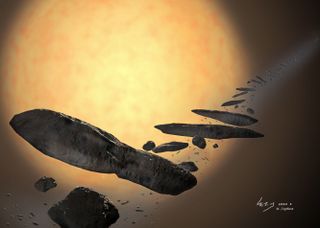







 How melting icebergs change ocean patterns: New study sheds...
 Nature's little kelpers: UK firm reveals plans for seaweed...
 COVID-19 lockdowns had a smaller impact on air quality than...
 Earth set to reach deadly 'tipping point': Planet's ability...