Ontdek de Fascinerende Wereld van UFO's en UAP's: Jouw Bron voor Onthullende Informatie!
Ben jij ook gefascineerd door het onbekende? Wil je meer weten over UFO's en UAP's, niet alleen in België, maar over de hele wereld? Dan ben je op de juiste plek!
België: Het Kloppend Hart van UFO-onderzoek
In België is BUFON (Belgisch UFO-Netwerk) dé autoriteit op het gebied van UFO-onderzoek. Voor betrouwbare en objectieve informatie over deze intrigerende fenomenen, bezoek je zeker onze Facebook-pagina en deze blog. Maar dat is nog niet alles! Ontdek ook het Belgisch UFO-meldpunt en Caelestia, twee organisaties die diepgaand onderzoek verrichten, al zijn ze soms kritisch of sceptisch.
Nederland: Een Schat aan Informatie
Voor onze Nederlandse buren is er de schitterende website www.ufowijzer.nl, beheerd door Paul Harmans. Deze site biedt een schat aan informatie en artikelen die je niet wilt missen!
Internationaal: MUFON - De Wereldwijde Autoriteit
Neem ook een kijkje bij MUFON (Mutual UFO Network Inc.), een gerenommeerde Amerikaanse UFO-vereniging met afdelingen in de VS en wereldwijd. MUFON is toegewijd aan de wetenschappelijke en analytische studie van het UFO-fenomeen, en hun maandelijkse tijdschrift, The MUFON UFO-Journal, is een must-read voor elke UFO-enthousiasteling. Bezoek hun website op www.mufon.com voor meer informatie.
Samenwerking en Toekomstvisie
Sinds 1 februari 2020 is Pieter niet alleen ex-president van BUFON, maar ook de voormalige nationale directeur van MUFON in Vlaanderen en Nederland. Dit creëert een sterke samenwerking met de Franse MUFON Reseau MUFON/EUROP, wat ons in staat stelt om nog meer waardevolle inzichten te delen.
Let op: Nepprofielen en Nieuwe Groeperingen
Pas op voor een nieuwe groepering die zich ook BUFON noemt, maar geen enkele connectie heeft met onze gevestigde organisatie. Hoewel zij de naam geregistreerd hebben, kunnen ze het rijke verleden en de expertise van onze groep niet evenaren. We wensen hen veel succes, maar we blijven de autoriteit in UFO-onderzoek!
Blijf Op De Hoogte!
Wil jij de laatste nieuwtjes over UFO's, ruimtevaart, archeologie, en meer? Volg ons dan en duik samen met ons in de fascinerende wereld van het onbekende! Sluit je aan bij de gemeenschap van nieuwsgierige geesten die net als jij verlangen naar antwoorden en avonturen in de sterren!
Heb je vragen of wil je meer weten? Aarzel dan niet om contact met ons op te nemen! Samen ontrafelen we het mysterie van de lucht en daarbuiten.
Meteoriet neergestort in België. Ligt hij in jouw achtertuin?
Volkssterrenwacht Mira deelt op Twitter mee dat er een meteoriet is ingeslagen op Belgisch grondgebied. De steen meet maximaal enkele centimeters doorsnee en werd voorlopig nog niet gevonden.
De meteoriet zou vrijdagochtend neergestort zijn in de regio Aalst-Dendermonde om 7.52 uur. De melding kwam binnen via het FRIPON-cameranetwerk. FRIPON staat voor Fireball Recovery and Interplanetary Observation Network. Camera’s in Brussel, Oostkapelle en Noordwijk legden een deel van het traject van de meteoriet vast.
Een meteoriet is een stukje ruimtepuin — afkomstig van een planetoïde, komeet of meteoroïde — dat inslaat op aarde. Het kleine gruis en puin komt van de oermaterie uit de wolk waaruit de zon en de rest van het zonnestelsel zijn ontstaan. Tijdens de val wordt het materiaal sterk afgeremd door onze atmosfeer en warmt het op, waardoor er een vallende vuurbal te zien is: dit is een meteoor, ook gekend als vallende ster. Het materiaal dat niet opbrandt en uiteindelijk op aarde neervalt, is een meteoriet. Jaarlijks komen zo’n 20.000 tot 80.000 meteorieten zwaarder dan 10 gram ergens op Aarde terecht. Maar het meeste materiaal dat zo op de Aarde valt, bestaat uit micrometeorieten die als stofjes neerdwarrelen. Goed voor naar schatting 35.000 tot 80.000 ton per jaar.
Het is van 1971 geleden dat er een meteoriet op Belgisch grondgebied werd gevonden. We leven dan ook in een erg klein land in verhouding tot onze hele planeet. Indien ook het exemplaar van vrijdag wordt gerecupereerd, zou het de zevende keer dat er in ons land een meteoriet wordt aangetroffen.
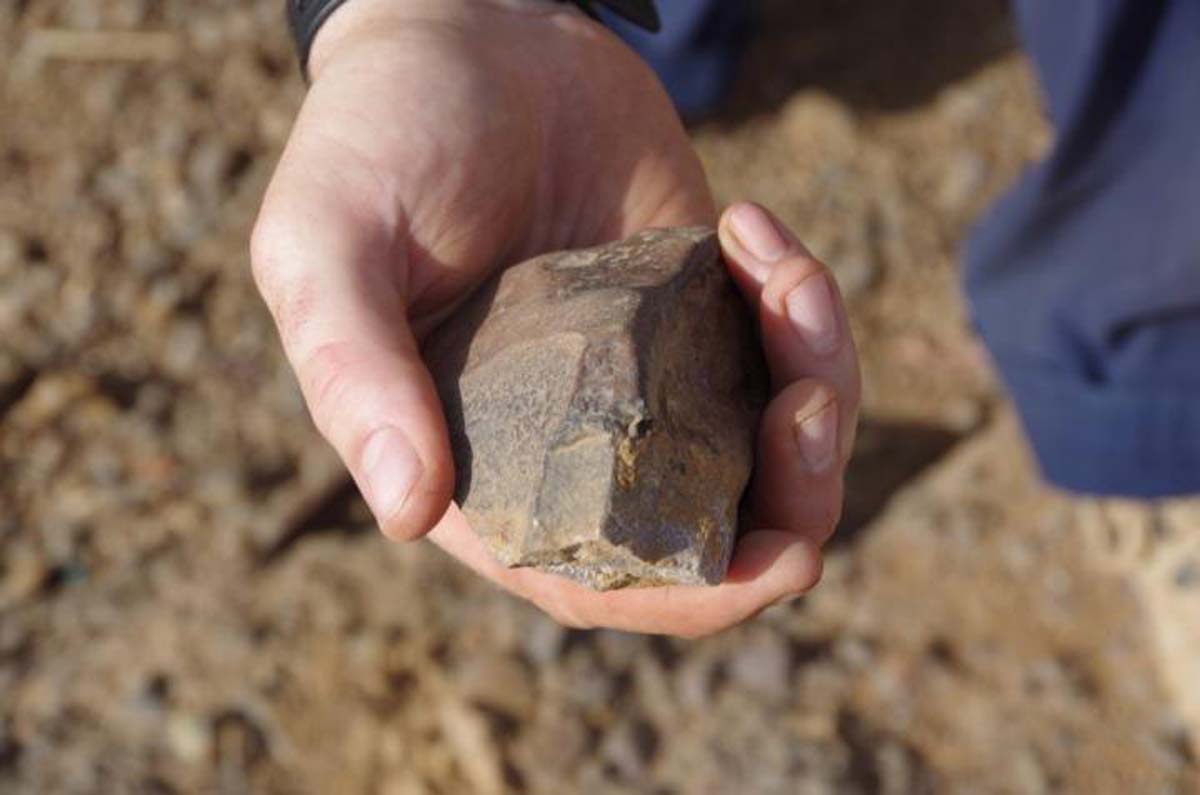
Zo kan de meteoriet eruit zien. Dit is de zesde Belgische meteoriet tentoongesteld in Museum voor Natuurwetenschappen.
Er bestaan verschillende soorten meteorieten en het is niet zo eenvoudig om te bepalen wanneer het effectief om een meteoriet gaat. WikiHow geeft enkele tips om een meteoriet te onderscheiden van andere stenen en metalen.
Zo is er de kleur. Als het gevaarte nog maar net uit de lucht is gevallen, is de kleur blinkend zwart, door de verbranding in de atmosfeer. Door zijn verblijf op de aarde wordt het materiaal na verloop van tijd roestbruin. Dan is er ook de vorm. Die is meestal grillig, onregelmatig.
Er is de smeltkorst. “Als het oppervlak van je steen eruitziet alsof het is gesmolten en veranderd, kan het een meteoriet zijn”, schrijft WikiHow. Op die glazige, donkere buitenlaag komen ook vaak kleine streeplijnen voor. Verder zitten er soms ook putjes in het materiaal, maar nooit gaten.
Magnetisch
Meteorieten zijn ook nooit poreus, maar vast. Ze voelen zwaarder aan dan andere gesteenten en zijn meestal magnetisch. Dat komt door de hoge concentratie aan het overgangsmetaal nikkel en het onedel metaal ijzer binnenin. Ook aan de buitenkant zie je vaak korrels als sporen van dat nikkel en ijzer.
Een echte meteoriet laat verder geen duidelijke strepen achter - behalve eventueel een klein beetje grijs - als je die tegen een onbehandelde keramische steen schraapt. Daarvoor kan de achterkant van een keramische tegel of van een koffiekopje of de binnenkant van een toiletreservoir dienen. Let wel: ook veel aardse gesteenten laten geen sporen na op onbehandelde keramiek. De test dient dus enkel om een meteoriet uit te sluiten.
Een meteoriet is niet gevaarlijk. Het is een fabeltje dat het gesteente gloeiend heet zou zijn bij ‘de landing’, want de meteoriet is tegen dan al lang afgekoeld en voelt hoogstens nog een beetje warm aan.
Eerlijke vinder
De eerlijke vinder is in principe eigenaar van de meteoriet als hij/zij die op het eigen domein vindt. De oorspronkelijke eigenaar heeft dan wettelijk drie jaar de tijd om het voorwerp op te eisen, maar in dit geval bestaat die niet en blijft de nieuwe eigenaar in het bezit van het materiaal. Als de ruimtesteen op privéterrein wordt gevonden, dan moet die normaal wel aan de gemeente worden overgemaakt.
Vond jij de meteoriet? Laat het onze redactie weten viaredactie@hln.be.
UFOs During Sunrise Over San Diego de Alejandría, Mexico 1-13-2021 ,UFO Sighting News.
Date of sighting: Jan 13, 2021 Location of sighting: Alejadria, Mexico
UFOs are frequently seen around Mexico, and I believe it is because alien bases were made thousand of years ago below several of the volcanos in the region. Volcanos such as Colima, Popocatepetl, Cofre De Perote, La Malinche, Nevado De Toluca, Pico de Orizaba (major UFOs seen here) and Tacana. All of which have past UFO reports of object exiting and entering the mouth of the volcanos in Mexico. 100% proof that there are more frequently seen UFO sightings DUE TO THE FACT, that aliens made more bases 6km below the volcanos...all of which were made thousands of years ago.
Scott C. Waring - Taiwan
Eyewitness states:
Greetings, they just appeared out of nowhere and at first they seemed only 3 lights then they lengthen (they advance) but very slowly it seems that they do not move and believe me it is not the first time I see them and in person their glow is fascinating, the place is in the highlands of Jalisco in a place called San Diego de Alejandria, it was between 7 and 8 in the morning, January 13, 2021.
UFO Enters/Exits Cloud Over Picos-Piaui, Brazil Jan 15, 2021, UFO Sighting News.
Date of sighting:Jan 15, 2021 Location of sighting: Picos, Brazil
The eyewitness Luan Silva of Youtube noticed something strange in the sky above. A large whitish object was moving in and out of the clouds every few seconds, as if it were playing peekaboo with him. He pulled out his cell phone and caught a 20 seconds of the interesting encounter the UFO was playing with them. Its almost like a child, playing with them. Very odd behavior, but some alien species are playful, and yet this also could be controlled by AI which is alive, but worried it may frighten the people below so reveals itself little by little to get the people use to it. Nevertheless...its the very cute to watch.
Missing 411: Three People Missing Just South of Yosemite National Park
This is the story of James Arthur, Theresa Bier, and Doug Pearce all missing under unusual circumstances in the region south of Yosemite National Park.
David Paulides is a former police officer who is now an investigator and writer known primarily for his self-published books, one dedicated to proving the reality of Bigfoot, and his Missing 411 series of books, in which he documents the disappearance of people in national parks and elsewhere.
Paulides attributes mysterious, unspecified causes to these disappearances, while data analysis suggests that these disappearances are not statistically mysterious or unexpected.
Bright UFO filmed from a plane over Karachi, Pakistan 23-Jan-2021
This video was filmed high above the Karachi in Pakistan on 23rd January 2021.
Witness report:
We were flying at 35000 feet.Operating Captain was just in the process of sitting down on his seat and the aircraft started to turn on the route which enabled him to see this brilliant white round object above and to the right of the aircraft.It could either have been hovering or moving slowly(difficult to tell due relative motion).Cell phone cameras were put in action fat to capture the object.After landing was found out that it had been seen/filmed in different areas as well.
The sandworms on the planet Arrakis are considered by many to be the real stars of the Dune novels of Frank Herbert. Reaching anywhere from 400 meters (1,300 ft) to a reported “half a league” (1.5 miles (2.4 km)) in length and 40 meters (130 ft) in diameter, they’re responsible for the treasured drug melange and featured in many action sequences because of their rideability and aversion to intruders.
Fortunately, these sandworms are fictional, but a smaller and equally vicious version does exist right here on Earth in the form of the Bobbitt worm (Eunice aphroditois) – a 10-foot-long bristle worm that burrows in the soft sediment of the ocean floor, waiting to ambush its prey by exploding out of the sand, grabbing their catch in vise jaws and dragging them back into the sediment for consumption. (Photos and videos here.) Fortunately, their favorite prey is fish and their larvae don’t excrete melange or any other spices. However, they don’t appear to have any natural enemies, which explains why they’ve lived nearly unchanged for 20 million years, according to a new study in the journal Scientific Reports.
A modern Bobbit worm hunts on the sea floor with just its head exposed. Researchers have found fossils suggesting they were terrorizing the ocean the same way 20 million years ago.
(Chutinun Mora)
The fossil burrow opening, left, is compared to a modern Bobbit worm burrow opening. The researchers found that the fossil and modern burrows were similar.
An animation shows how the trace fossil would have formed.
(Yu Yen Pan)
The top part of the fossil burrow, seen from the side, is funnel shaped, with feathery lines from the disturbance of the soil that's thought to be caused by the worm pulling prey into the burrow.
This is an artistic reconstruction of Websteroprion armstrongi, a Bobbit worm that lived 400 million years ago in Ontario. Its fossil jaws were discovered and reported by a team of researchers that included David Rudkin at the Royal Ontario Museum in Toronto.
(James Ormiston)
“This trace fossil consists of an up to 2 m long, 2–3 cm in diameter, L-shaped burrow with distinct feather-like structures around the upper shaft. A comparison of Pennichnus to biological analogs strongly suggests that this new ichnogenus is associated with ambush-predatory worms that lived about 20 million years ago.”
How big?
Because they were squishy worms, no skeletal fossils of this species exist, but researchers led by National Taiwan University sedimentologist Ludvig Löwemark found trace fossils – burrows, prints and squiggles made by something on the floor of the ocean near Taiwan. By eliminating the traces being made by shrimp or snails – their burrows are longer and two-way – the researchers concluded they’d discovered the burrows of the ancestor of the modern Bobbitt worm.
We know what you’re dying to ask – yes, they’re named for Lorena Bobbitt, who in 1993 sliced off her sleeping husband’s penis after years of abuse. The nickname came from divers who witnessed the worms slicing fish in half with their jaws.
The 319 trace fossils discovered at two sites pointed to an ancient Bobbitt worm for a number of reasons. They were high in iron, which came from the mucous they used to stabilize the burrows. The tunnels were L-shaped, which is typical for soft worms that can’t dig too far down before hitting hard dirt and going horizontal. Finally, they look very much like the burrows of modern Bobbitt worms.
If that’s not your hand on my leg …
Despite not providing melange or being large enough to ride, Löwemark and his team plan to search for more trace fossils of the ancient worms, now that they know what to look for. They’ve named the trace fossils Pennichnus formosae, meaning “beautiful feather trace,” which refers to the feathery patterns left when the worm re-enters the burrow with its prey.
Ancient Bobbitt worm (Ubi vermis antiquis bobbitt) is far easier to remember.
According to a book called “The Ends of the World” that was written by an award-winning science journalist named Peter Brannen, dinosaurs may have beat humans to the moon – or at least their bones may have. An excerpt of Brannen’s book was recently shared on Twitter by a blogger named Matt Austin.
We all know that the dinosaur-killing asteroid that struck the Earth about 66 million years ago was incredibly massive, but was it powerful enough to send pieces of the dinosaurs into space? According to Brannen, the answer is yes.
He claimed that since the asteroid sent up large volumes of earth into space, it’s very possible that “bits of dinosaurs” were mixed in with it. And since the soil that was flung into space landed on the moon, it’s very plausible that the pieces of dinosaurs went with it, therefore, dinosaurs made it to the lunar surface millions of years before humans.
Did the asteroid impact send dinosaur remains onto the moon?
In his book, he described that when the asteroid impacted Mexico’s Yucatán Peninsula, it was speeding towards Earth approximately 20 times faster than a speeding bullet. It read in part, “This is so fast that it would have traversed the distance from the cruising altitude of a 747 to the ground in 0.3 seconds.”
It went on to read, “As the asteroid collided with the earth, in the sky above it where there should have been air, the rock had punched a hole of outer space vacuum in the atmosphere.” “As the heavens rushed in to close this hole, enormous volumes of earth were expelled into orbit and beyond — all within a second or two of impact.” And when Brannen posed the question, “So there’s probably little bits of dinosaur bone on the moon,” geophysicist Mario Rebolledo from the Centro de Investigación answered with, “Yea, probably.”
Scientists did reveal what they believe happened during the impact. When the asteroid struck Earth, it left a gigantic crater (called the Chicxulub crater) and upon impact it sent massive amounts of carbon dioxide as well as sulfur into the atmosphere. At that point, the sun would have been blocked by a major dust cloud, probably causing an immediate “nuclear winter” as temperatures on Earth would have dropped dramatically in addition to acid rain falling to the ground.
Mark Richards who is an earth and space science professor at the University of Washington explained this further, “It would have felt like the ground beneath your feet had become a ship in the middle of the ocean.” “Then rocks would have bombarded you from a boiling sky that was beginning to take on a hazy glow. It would have seemed like the end of the world.”
While no dinosaur bones have been found on the moon as of yet, the next astronauts to travel to the lunar surface should definitely consider looking for the remains. Wouldn’t that make for the next great science movie?! The excerpt that Austin posted from Brannen’s book can be read here and on his Twitter page.
Real Reptilian Alien Shapeshifters!... The Subject No One Wants To Talk About
It is written that these entities came from the darkness and were formless. They hide amongst us and have now learned to appear as we do. These we call ‘shape-shifters’. Sounds like a horror novel doesn’t it? But the truth of the matter is, mysterious entities may in fact be interacting with humanity. Entities which are extraterrestrial, interdimensional or something else which seem to be closely associated with the UFO phenomena.
They have been described as reptilian in appearance and can change and modify their appearance. Could they really be living amongst humanity. Some believe not only are they here, but that they have been for a very long time.
This channel is managed by Zohar Entertainment Group UK, Zohar Entertainment Group International Inc, USA and AdRev, USA.
Dr. Steven Greer: Remote Viewing, Higher State of Consciousness, and The Contact
Dr. Steven Greer on Remote Viewing, Higher State of Consciousness, and The Contact
The work that medical doctor, researcher and author Steven Greer continues to do through the organization CSETI has made some tremendous breakthroughs in establishing contact with an intelligent phenomena, often perceived as UFOs, Light Phenomena and strange looking entities.
Steven demonstrates that there is a conscious connection being established with this phenomena and on many occasions they are being caught on camera.
Nick Pope, RH Negative Blood, ET Abduction & UFO's, Next Level Disclosure via Leak Project
Nick Pope, RH Negative Blood, ET Abduction & UFO’s, Next Level Disclosure
The Rh blood group system is a human blood group system. It contains proteins on the surface of red blood cells. It is the second most important blood group system, after the ABO blood group system. The Rh blood group system consists of 49 defined blood group antigens, among which the five antigens D, C, c, E, and e are the most important. There is no d antigen.
Rh(D) status of an individual is normally described with a positive or negative suffix after the ABO type (e.g., someone who is A Positive has the A antigen and the Rh(D) antigen, whereas someone who is A Negative lacks the Rh(D) antigen). The terms Rh factor, Rh positive, and Rh negative refer to the Rh(D) antigen only. Antibodies to Rh antigens can be involved in hemolytic transfusion reactions and antibodies to the Rh(D) and Rh antigens confer significant risk of hemolytic disease of the fetus and newborn. Wikipedia
Near Collision with UFO Recorded on Video by a Plane Passenger
A video taken from a plane depicts a passenger thinking a UFO may have been zooming past them. It further shows the pilot seems to dodge something in the air.
On January 17, Singapore Airlines was going to Zurich Airport in Switzerland. The unnamed passenger decided to record the plane’s landing in Zurich. At some point between 7:30 am, and 7:50 am, they were surprised when they captured what they believe was a near collision with a UFO while preparing their camera.
The clip shows lakes and fields of the distant landscape around Zurich before the plane starts to tilt to the right.
A tiny white object then suddenly zips past the aircraft, just below its flight path.
The pilot roared the plane’s engines as part of the safety protocol while passengers started to panic.
Fortunately, the pilot successfully avoided the UFO and later made a safe landing at the destination.
Don’t forget to follow us on Facebook for the latest UFO news, videos & photos.
Earlier this month, UFO expert Nick Pope said he believed new revelations that could have global significance would happen soon.
He explained how the U.S. government task force had shared some findings with its British counterparts.
Pope claims that the Ministry of Defence (MoD) is investigating UFO sightings despite its official statement that it has no interest in such things.
He said that the Senate Intelligence Committee demanded a report on the UFO phenomenon from the Director of National Intelligence, and the clock is now ticking. He stated that a response is due within 180 days of the Covid-19 relief bill’s enactment. Pope explained that this bill contained the Intelligence Authorization Act, where the UFO requirement was articulated.
Pope, a former MoD official, believes British officials have already looked at the U.S. research. He said that he’s aware that the UAP Task Force has shared some initial findings with the U.K. and other allies but not sure if the MoD has formally engaged with the U.S. on this or has just noted the conclusions.
Space station detectors found the source of weird ‘blue jet’ lightning
A ‘blue bang’ sparks an unusual type of lightning in the upper atmosphere
The International Space Station spotted an exotic type of upside-down lightning called a blue jet (illustrated) zipping up from a thundercloud into the stratosphere in 2019.
Scientists have finally gotten a clear view of the spark that sets off an exotic type of lightning called a blue jet.
Blue jets zip upward from thunderclouds into the stratosphere, reaching altitudes up to about 50 kilometers in less than a second. Whereas ordinary lightning excites a medley of gases in the lower atmosphere to glow white, blue jets excite mostly stratospheric nitrogen to create their signature blue hue.
Blue jets have been observed from the ground and aircraft for years, but it’s hard to tell how they form without getting high above the clouds. Now, instruments on the International Space Station have spotted a blue jet emerge from an extremely brief, bright burst of electricity near the top of a thundercloud, researchers report online January 20 in Nature.
Understanding blue jets and other upper-atmosphere phenomena related to thunderstorms, such as sprites (SN: 6/14/02) and elves (SN: 12/23/95), is important because these events can affect how radio waves travel through the air — potentially impacting communication technologies, says Penn State space physicist Victor Pasko, who was not involved in the work.
Cameras and light-sensing instruments called photometers on the space station observed the blue jet in a storm over the Pacific Ocean, near the island of Nauru, in February 2019. “The whole thing starts with what I think of as a blue bang,” says Torsten Neubert, an atmospheric physicist at the Technical University of Denmark in Kongens Lyngby. That “blue bang” was a 10-microsecond flash of bright blue light near the top of the cloud, about 16 kilometers high. From that flashpoint, a blue jet shot up into the stratosphere, climbing as high as about 52 kilometers over several hundred milliseconds.
The spark that generated the blue jet may have been a special kind of short-range electric discharge inside the thundercloud, Neubert says. Normal lightning bolts are formed by discharges between oppositely charged regions of a cloud — or a cloud and the ground — many kilometers apart. But turbulent mixing high in a cloud may bring oppositely charged regions within about a kilometer of each other, creating very short but powerful bursts of electric current, Neubert says. Researchers have seen evidence of such high-energy, short-range discharges in pulses of radio waves from thunderstorms detected by ground-based antennas.
Scientists on the International Space Station spotted a bright-blue lightning bolt shooting upward from thunderclouds.
Blue jets can be difficult to spot from the ground, since the electrical discharges erupt from the tops of thunderclouds. But from space, scientists can peer down at this cerulean lightshow from above. On Feb. 26, 2019, instruments aboard the space station captured a blue jet shooting out of a thunderstorm cell near Nauru, a small island in the central Pacific Ocean. The scientists described the event in a new report, published Jan. 20 in the journal Nature.
The scientists first saw five intense flashes of blue light, each lasting about 10 to 20 milliseconds. The blue jet then fanned out from the cloud in a narrow cone shape that stretched into the stratosphere, the atmospheric layer that extends from about 6 to 31 miles (10 to 50 kilometers) above the Earth's surface.
Blue jets seem to appear when the positively-charged upper region of a cloud interacts with the negatively charged boundary between the cloud and the air above, according to the report. The blue jet appears as a result of this "electric breakdown," where the opposing charges swap places in the cloud and briefly equalize, releasing static electricity. However, the properties of blue jets and the altitude to which they extend above clouds "are not well characterized," the authors noted, so this study adds to our understanding of the dramatic phenomenon.
Four of the flashes preceding the blue jet came with a small pulse of ultraviolet light (UV), the scientists noted. They identified these emissions as so-called "elves," another phenomenon seen in the upper atmosphere.
"Elves" — an acronym that stands for Emissions of Light and Very Low Frequency Perturbations due to Electromagnetic Pulse Sources — are light emissions that appear as rapidly expanding rings in the ionosphere, a layer of charged particles that extends from roughly 35 miles to 620 miles (60 to 1,000 km) above the planet surface. Elves occur when radio waves push electrons through the ionosphere, causing them to accelerate and collide with other charged particles, releasing energy as light, the authors wrote.
The team observed the flashes, elves and blue jet using the European Space Agency's Atmosphere-Space Interactions Monitor (ASIM), a collection of optical cameras, photometers, X-ray detectors and gamma-ray detectors attached to a module on the space station.
"This paper is an impressive highlight of the many new phenomena ASIM is observing above thunderstorms," Astrid Orr, physical sciences coordinator for human and robotic spaceflight with the European Space Agency (ESA), said in a statement. Experts also suspect that upper atmosphere phenomena, like blue jets, may affect the concentrations of greenhouse gases in the atmosphere, since the ozone layer sits within the stratosphere where they occur, according to the ESA statement.
Trees Spotted on Mars Reveal Massive NASA Cover-Up
A wild theory has recently resurfaced, claiming that a high resolution photo made available by NASA shows patches of trees growing over the Martian terrain.
The intriguing picture has been publicly available for some time now, and it has been subject of debate ever since it was published on the University of Arizona site. Ever since it began circulating the internet in 2010, scientists have proposed different theories as to what the mysterious formations present in the picture could be. The official explanation however, is not sufficient enough to please the UFO community that, after thoroughly analyzing the presented material, reached a contrary conclusion to the scientific community. So what’s so unusual about the NASA picture you might ask?
Let’s start with what the UFO community has to say about this. The highlighted picture shows bizarre areas over the arid dunes of Mars. When zooming in on the anomalies their features become clearer, revealing a strong resemblance to the trees found on Earth. There are also silver areas around them, which analysts consider to be remains of frozen water embedded on the surface. If proven to be true, this fact should explain how the alleged trees get to grow on the surface of the planet.
Opinions are now split between the two communities, as science refers to the anomalous dark lines as dark streaks of material running down the side of the sand dunes due to carbon dioxide frost evaporation. NASA also admits to altering the picture so that the dark streaks appear more prominent. But can the scientific community be trusted with this explanation?
According to various analysts, the strong resemblance between the dark patches and trees is a clear indicator of life still evolving on the Martian terrain. They now believe that NASA is once again covering this up for unclear reasons. Their claims are fueled by a recent event in which the renowned space agency announced the presence of liquid water on Mars after at least a decade after its discovery. The multitude of bizarre artefacts spotted on the Red Planet is another reason why some people consider the trust in official explanations to be an unhealthy practice.
To furtherly dismiss the ‘tree speculation’ as pure nonsense, skeptics have wondered about all the dead leafs that are seemingly missing from the picture, but at the same time they have provided an answer to their question. Understanding that Mars used to have the right conditions for life to develop in the distant past is the first step, and presuming that this habitable past hadn’t been as far as they want us to believe may provide the next answer.
In other words, the alleged trees may lack the leafs on both the branches and on the ground because they are already dead, with the wind scattering any visible leaf traces across the vast Martian dunes, blending them with the sand. If this proves to be correct, then life on Mars may had ended sooner rather than later, and there is countless evidence to support this hypothesis.
YouTube user ‘Thor’ has brought more evidence supporting the Martian trees hypothesis. He asserted that “there are almost identical geographic formations in the tundra of Siberia. Now there is unequivocal proof that high salinity, liquid water does exist on Mars it’s guaranteed that the geological and meteorological processes that cause these formations on Earth are replicated on the surface of Mars too.”
There is ample evidence to support both community claims, leaving room for plenty of speculation. It remains up to the open-minded people to filter the information and eventually reach their own conclusions.
RELATED PHOTOS AND VIDEOS, selected and posted by peter2011
A cross-section of underground ice is exposed at the steep slope that appears bright blue in this enhanced-color view from the HiRISE camera on NASA's Mars Reconnaissance Orbiter. The scene is about 550 yards wide. The scarp drops about 140 yards from the level ground in the upper third of the image.
Massive, AI-Powered Robots Are 3D-Printing Entire Rockets
Relativity Space may have the biggest metal 3D printers in the world, and they're cranking out parts to reinvent the rocket industry here—and on Mars.
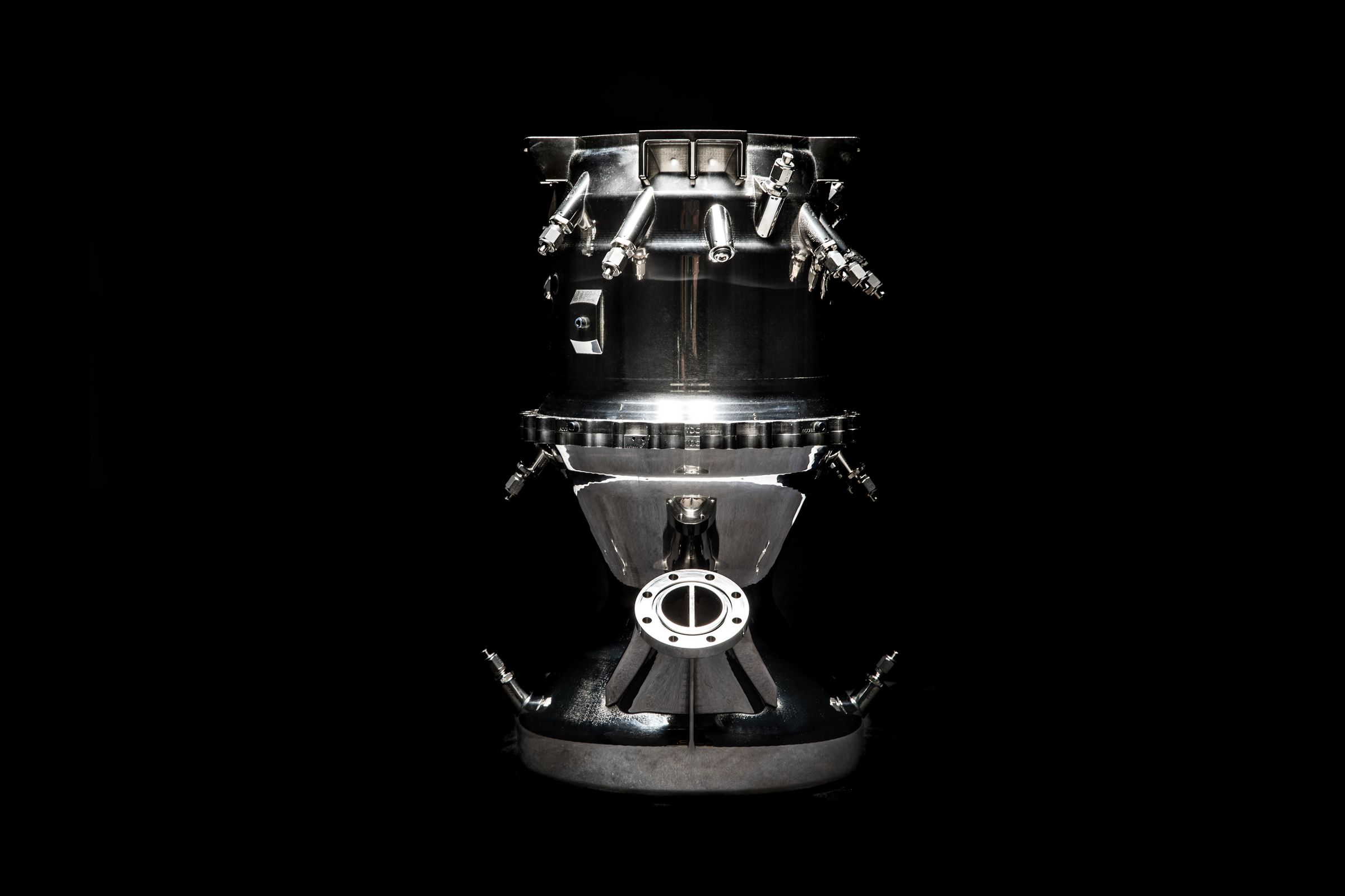
To make a 3D-printable rocket, Relativity Space simplified the design of many components, including the engine.PHOTOGRAPH: RELATIVITY
FOR A FACTORY where robots toil around the clock to build a rocket with almost no human labor, the sound of grunts echoing across the parking lot make for a jarring contrast.
“That’s Keanu Reeves’ stunt gym,” says Tim Ellis, the chief executive and cofounder of Relativity Space, a startup that wants to combine 3D printing and artificial intelligence to do for the rocket what Henry Ford did for the automobile. As we walk among the robots occupying Relativity’s factory, he points out the just-completed upper stage of the company’s rocket, which will soon be shipped to Mississippi for its first tests. Across the way, he says, gesturing to the outside world, is a recording studio run by Snoop Dogg.
Neither of those A-listers have paid a visit to Relativity’s rocket factory, but the presence of these unlikely neighbors seems to underscore the company’s main talking point: It can make rockets anywhere. In an ideal cosmos, though, its neighbors will be even more alien than Snoop Dogg. Relativity wants to not just build rockets, but to build them on Mars. How exactly? The answer, says Ellis, is robots—lots of them.
Roll up the loading bay doors at Relativity’s Los Angeles headquarters and you’ll find four of the largest metal 3D printers in the world, churning out rocket parts day and night. The latest model of the company’s proprietary printer, dubbed Stargate, stands 30 feet tall and has two massive robotic arms that protrude like tentacles from the machine. The Stargate printers will manufacture about 95 percent, by mass, of Relativity’s first rocket, named Terran-1. The only parts that won’t be printed are the electronics, cables, and a handful of moving parts and rubber gaskets.
Jordan Noone, Relativity's CTO and cofounder, stands beside the second version of the Stargate 3D printer at the company's headquarters.
PHOTOGRAPH: RELATIVITY
To make a rocket 3D-printable, Ellis’s team had to totally rethink the way rockets are designed. As a result, Terran-1 will have 100 times fewer parts than a comparable rocket. Its Aeon engine, for instance, consists of just 100 parts, whereas a typical liquid-fueled rocket would have thousands. By consolidating parts and optimizing them for 3D printing, Ellis says Relativity will be able to go from raw materials to the launch pad in just 60 days—in theory, anyway. Relativity hasn’t yet assembled a full Terran-1 and doesn’t expect the rocket to fly until 2021 at the earliest.
“A full-scale test will be the biggest milestone for them to prove this new technology,” says Shagun Sachdeva, a senior analyst at Northern Sky Research, a space consultancy. Then the company can start to address the other questions about its approach, such as whether there’s a need for a new rocket to pop into existence every 60 days.
Relativity thinks it will find its niche. Fully assembled, Terran-1 will stand about 100 feet tall, and be capable of delivering satellites weighing up to 2,800 pounds to low Earth orbit. That puts it above small satellite launchers likeRocket Lab’s Electronbut well under the payload capacity of massive rockets likeSpaceX’s Falcon 9. Ellis says it will be particularly well-suited to carrying medium-sized satellites.
Relativity isn’t the only rocket company using 3D printing—SpaceX, Blue Origin, Rocket Lab, and others also use it to print select parts. But Ellis thinks the space industry needs to think bigger. In the long term, Ellis sees 3D-printed rockets as the key to transporting critical infrastructure to and from the surface of Mars. These rockets could, for example, be used to loft science experiments into orbit around Mars or return samples to Earth.
Ellis, 29, and his cofounder, 26-year-old Jordan Noone, have been building rockets since college, where they worked on the University of Southern California’s prestigious rocketry team before taking jobs at Blue Origin and SpaceX. At Blue Origin, Ellis helped set up the company’s additive manufacturing program. While there, he began to envision a robotic rocket factory that barely needs a human’s hand.
First, though, he needed to get some giant 3D printers. At the heart of Relativity’s robotic rocket factory is Stargate, which Ellis claims is the largest metal 3D printer in the world. The first version of Stargate is about 15 feet tall and consists of three robotic arms. The arms are used to weld metal, monitor the printer’s progress, and correct for defects.
To print a large component, such as a fuel tank or rocket body, the printer feeds miles of a thin, custom-made aluminum alloy wire along the length of an arm to its tip, where a plasma arc melts the metal. The arm then deposits the molten metal in thin layers, orchestrating its movements according to patterns programmed in the machine’s software. Meanwhile, the printer head at the tip of the arm blows out a non-oxidizing gas to create a sort of “clean room” at the deposition site.
Every new iteration of the Stargate printer has been significantly bigger than the last, allowing it to churn out very large rocket parts in one piece.
VIDEO: RELATIVITY
Relativity now has a new version of Stargate that can, in a single go, print even bigger components, like the rocket’s fairing or fuel chambers. It stands twice as tall and has only two arms, which can each perform more tasks than their predecessors. Ellis said its next Stargate will double in size yet again, which will eventually allow the company to produce larger rockets.
The Stargate printers work well when you need to print large parts quickly, but for parts that require more precision, such as the rocket’s engine, Relativity uses the same commercially available metal 3D printers that other aerospace companies use. These printers use a different printing technique, in which a laser welds together layers of ultra-fine stainless steel dust.
Ellis says the real secret to Relativity’s rockets is the artificial intelligence that tells the printer what to do. Before a print, Relativity runs a simulation of what the print should look like. As the arms deposit metal, a suite of sensors captures visual, environmental, and even audio data. Relativity’s software then compares the two to improve the printing process. “The defect rate has gone down significantly because we’ve been able to train the printer,” Ellis says.
With every new part, the machine learning algorithm gets better, until it will eventually be able to correct 3D prints on its own. In the future, the 3D printer will recognize its own mistakes, cutting and adding metal until it produces a flawless part. Ellis sees this as the key to taking automated manufacturing to other worlds.
Stargate in Septermber 2018.
“To print stuff on Mars you need a system that can adapt to very uncertain conditions,” Ellis says. “So we're building an algorithm framework that we think will actually be transferable to printing on other planets.”
Not everyone is convinced that Relativity’s approach to rocket manufacturing is the way forward, at least for Earthly concerns. Max Haot, the CEO of Launcher Space, a startup that also uses 3D printing, says “everyone is leveraging 3D printing as fast as they can” in the aerospace industry, in particular for engine components. “The question is whether 3D printing aluminum tanks is worth it when compared to the traditional tank manufacturing methods,” Haot says. “We don't think so, but let's see where they take it.”
Relativity has already inked deals worth several hundred million dollars with several major satellite operators, including Telesat LEO and Momentus. But Arjun Sethi, a partner at Tribe Capital, which invested in Relativity, sees more than launch services in its future. He compared it to Amazon Web Services in the way it could provide critical infrastructure to smaller space companies.
Sachdeva, of Northern Sky Research, thinks Relativity’s expertise in aerospace 3D printing could have lasting value beyond its rockets. “Even if we don't get to the point of full rocket manufacturing on Mars, Relativity may be able to manufacture other components in orbit,” Sachdeva says. “That’s a pretty big development for the industry as a whole.”
The company is testing its components as it builds its way up to a full rocket.
VIDEO: RELATIVITY
Still, rockets are its first goal. So far it’s been testing its 3D-printed engine, pressure tanks, and turbopumps. But there’s plenty more to do.
Once they have a complete rocket, Ellis and his team will be ready to ship it to Launch Complex-16 at Kennedy Space Center, in Florida, where Relativity holds a long-term launchpad lease, alongside SpaceX, Blue Origin, and the United Launch Alliance. The first flight of an entirely 3D printed rocket will be a major moment in space exploration, but for Relativity it will be just the start of its long journey to Mars.
There's a strange relationship between fact and fiction in the UFO business. J. Allen Hynek consulted for the film Close Encounters of the Third Kind, had a cameo role, and he also wrote the epilogue for the novelization. The publisher, Dell, also issued the non-fiction The Hynek UFO Report, which is regarded as a classic. Without Hynek, there might not have been a CE3K, and if not for the film, the Hynek book might not exist. Or some other commercial products.
Panama City News, March 28, 1966
Dr. Hynek began working for a consultant for the Air Force in 1948, providing them with explanations for UFO sightings based on his knowledge of astronomy, but did so in relative obscurity. At the Detroit Press Club, on March 26, 1966 Hynek was propelled into the public spotlight, initially unfavorably, due to his remarks about “swamp gas.” Nevertheless, he became the top authority on the UFO topic, and in demand, and in a heel/face turn, he went from being the Air Force’s senior debunker to bring the most famous UFO advocate. Jacques Vallee, from Forbidden Science Vol. I, his entry for 11 April 1967:
"I miss the days when he was not such a celebrity... The topic has become fashionable entertainment, not serious science. Media men hire Allen as they would hire a guitar player. He rushes wherever he sees a spotlight, and if the spotlight moves he moves with it."
Jacques Vallee described Hynek’s gig as a consultant for Stephen Spielberg’s UFO movie in Forbidden Science Vol. II, in his entry for Friday 27 August 1976:
“Allen called me last night, cheerful... Dell is sending two writers to help him with a hurriedly-compiled paperback about Project Blue Book. As for the Spielberg movie, he will indeed have a silent role in it, making his way to the front of a crowd of technical people who surround the first landed saucer. I'd love to see the out-takes: They shot a sequence where Aliens surrounded him, pulled on his beard, took his pipe and poked it into their nose.”
Hynek took an active role in helping promote the film and appeared in the theatrical trailer for it.
The book he and the ghost writers cranked out was The Hynek UFO Report, which hit the marketin late 1977 to cash in on Close Encounters of the Third Kind, and his epilogue for the movie novelization closed with a plug for his Center for UFO Studies (CUFOS) and their magazine, International UFO Reporter.
UFO Encounters: The Record Album
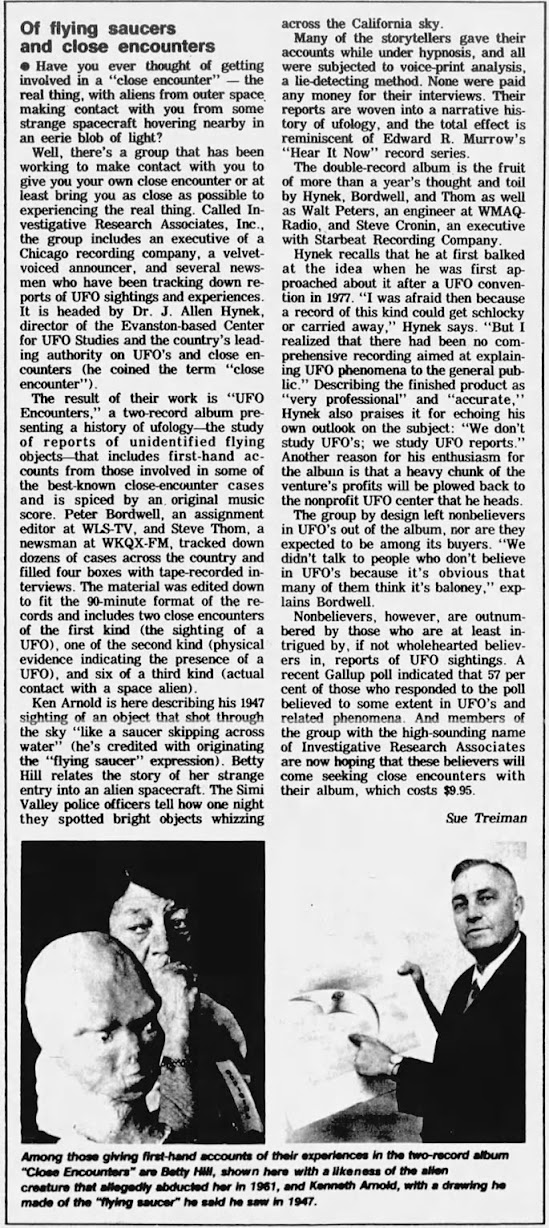
J. Allen Hynek and his Center for UFOs Studies were partners in the production of a double LP audio documentary, Factual Eyewitness Testimony of: UFO Encounters. A news story in The Chicago Tribune, Jan. 14, 1979, told how the project began when Investigative Research Associates approached Hynek at a UFO convention in 1977. Hynek was initially reluctant, fearing it would be “schlocky,” but IRA convinced him of their sincerity, so together they set out to cover the most significant cases and record first-hand testimony about them.
The Chicago Tribune, Jan. 14, 1979
Factual Eyewitness Testimony of: UFO Encounters was a two-disc LP, also released on cassette and 8-track tape. It was released in 1978 on the IRA label.
It was reviewed in UFO publications such as the A.P.R.O. Bulletin, but the most comprehensive review was in the MUFON UFO Journal, Feb. 1980,“In Others' Words” by Lucius Farish:
“A new 2-album record set, "UFO Encounters," presents an interesting selection of testimonies and opinions by UFO witnesses and researchers. Contributors to the album include Kenneth Arnold, Colonel Robert Friend (former Project Blue Book Director), Bill Pecha, Ted Phillips, Travis Walton, Father William Gill, Herbert Schirmer, former Air Force Major Paul A. Duich, Louise Smith, Leonard Stringfield, Dr. R. Leo Sprinkle, Betty Hill, Marjorie Fish, Stanton Friedman, former astronaut Gordon Cooper, Jacques Vallee, David Saunders, and others. An additional bonus is President Carter's personal recounting of his 1969 UFO sighting. A special section inside the album cover contains 6 pages of UFO photographs, plus photos of most of the persons heard in the records. Some of the material relating to "crashed saucer" stories seem questionable, but all in all, this is a good selection of recorded UFO material. Available from: Investigative Research Associates, Inc., Suite W, 430 West Diversey Parkway, Chicago, Illinois 60614; the price is $8.95.”
Crashed Saucer Investigation
The red banner across the cover of the album touted “Crashed Saucer Investigation,” and the interior, a described the track:
“Since the 1940s, rumors have circulated indicating the possibility that extraterrestrial spacecraft have crashed on Earth and have been recovered by the American military. Investigative Research Associates decided to pursue these reports…”
The segment is interesting in that it documents the marketability of crashed UFO stories even before the revival of the Roswell incident. I had begun when Robert Spencer Carr rekindled interest in a discredited aspect of ufology in 1974 by reviving the story of little men found in a saucer in Aztec, New Mexico. Leonard Stringfield was the chief crashed UFO researcher, but for the album, even Dr. Hynek got in on the act.
The “Crashed Saucer Investigation” was the next to last track on the album. It opened with former astronaut Col. Gordon Cooper vaguely discussing second-hand rumors he’d heard about saucer crashes:
“There were some accident involving a UFO, and from there it varies greatly. There were occupants and in each of the rumors that I've heard, but from there on, it varies greatly as to whether they were all alive, or some alive, or what the extent of damage was to them, and then as to what happened to them is quite variable. The particular rumors aren't necessarily from people who've been involved, but they come from so many different sources, that it would lead you to believe that it certainly is worth investigating a little further.”
Dr. Hynek shared his view:
“Over the years, these rumors have persisted. Hardly a week goes by without my being asked about the ‘crashed saucer’ stories. My response to these rumors has always been complete skepticism. Recently however, some of my colleagues, Investigative Research Associates, have probed into these stories and some intriguing information has surfaced. I believe it is quite worthwhile to let listeners to this record have the benefit of some preliminary findings.”
Next, Herbert Coyer told about a story he heard from an aide to an Army general about a 1951 saucer crash at White Sands where alien bodies were recovered and an autopsy was performed. Both Willingham and Coyer’s stories featured metal from the UFO that was incredibly tough and could not be burned or cut, a detail we’d see hear again when the Roswell crash was resurrected.
The Final Track: Summaries and Theories
The final segment was “Summaries and Theories,” which featured comments from Stanton Friedman, Dr. J. Allen Hynek, Dr. Jacques Vallee, and Dr. David Saunders. Hynek suggested that UFOs might be from another dimension or a parallel reality rather than being something from another faraway planet. He was the researcher given the last word on the album and drifted a bit into mystic concepts:
“The idea of other intelligences in space is not so radical or new. It's in both the ancient Eastern religions and the more modern faiths. The prophets in the Bible and many philosophers have been telling us for centuries that there are other planes of existence. So why do we find it so difficult to acknowledge that there might be other highly developed life forms or forms of consciousness that might surpass our own? In fact, it is now widely accepted that the universe may well be teeming with life.”
Factual Eyewitness Testimony of: UFO Encounters is worth a listen, for the chance to hear rare recordings with witness and researchers, and for a look at the state of serious ufology at the time it was recorded. The full album is available via YouTube.
UFOs and science fiction have a complicated history together, and there’s no doubt there has been a mutual exploitative relationship. That’s show business, and it makes for some strange bedfellows.
Dr. Hynek with characters from Star Wars, and with Leonard Nimoy of Star Trek fame.
Track Listing and Credits
Below are the track titles and lengths to Factual Eyewitness Testimony of: UFO Encounters, followed by the album’s credits.
Introduction 4:24
Foo Fighters 2:08
Kenneth Arnold Sighting 3:40
Government Involvement 2:04
Simi Valley Sighting (CE-I) 5:08
Pecha Case (CE-I) 5:44
James Richard Case (CE-II) 6:59
Travis Walton Abduction (CE-III) 15:44
Father William Gill Sighting (CE-III) 4:51
Officer Herbert Schirmer Abduction (CE-III) 8:29
Louise Smith / Kentucky Women Abduction (CE-III) 7:20
Charles R McQuiston PSE Evaluation Summary 1:14
Betty and Barney Hill Abduction (CE-III) 7:42
Crashed Saucer Investigation 10:09
Summaries and Theories 4:46
Credits, as listed on the back cover:
Produced by: Investigative Research Associates, Inc., Chicago, Illinois. Producer: Steve Cronen. Exec. Prod.: Ben Christ.Scientific Consultants: Center for UFO Studies, Evanston Illinois, Dr. J. Allen Hynek, ShermanJ. Larsen.Investigation, Research, Writing: Peter Bordwell, Steve [Thom].Narration: Walt Peters.Music: DeWolfe Music, Inc. Music Coordination: Walt Peters. Musical Effects: Ron Figura.Recorded at: Starbeat Recording Studios, Deerfield, Illinois. Engineering, Editing & Mix: Steve Cronen.Album Design: Steve Schaul.Album Cover Trifid Nebula Photo: Copyright by the California Institute of Technology and the Carnegie Institute of Washington. Reproduced by permission from the Hale Observatories UFO Photos & Documents: Center For UFO Studies.
. . .
Close Encounters: The Slide Show
Dr. Hynek had been involved in some other commercial enterprises before the Spielberg movie. In 1976 he had produced a set of UFO slides and audiotapes for Edmund Scientific, but with release of CE3K, it was a hotter item.
It was advertised in Popular Scienceand was featured in an article in the April 1978 debut issue of Future magazine (the companion to Starlog). Below is a YouTube video of the Hynek audio, sadly without the accompanying slides shown.
Pourquoi Cérès est le meilleur endroit pour installer une colonie humaine ?
Nathalie Mayer -Journaliste
[EN VIDÉO] Un survol détaillé et en couleurs de la surface de CérèsCérès est le plus gros objet de la ceinture d’astéroïdes. Depuis décembre, cette planète naine est survolée par Dawn, un satellite de la Nasa. L’orbiteur a pu réunir de nombreuses images à couper le souffle qui sont présentées ici en vidéo.
À la recherche d'une nouvelle Terre ? D'une planète B ? Oubliez la Lune et laissez Mars derrière vous. Mais pas trop, tout de même. Un physicien vous propose de partir vous installer sur une méga station spatiale en orbite autour de Cérès, la planète naine la plus proche de la Terre.
Imaginez une gigantesque structure composée de milliers d'engins cylindriques, tous reliés à un cadre en forme de disque par des attaches magnétiques. Le tout éclairé, alimenté -- et protégé des météoroïdes submétriques -- par des miroirs géants ajustables permettant d'exploiter l'énergie du Soleil. Et en orbite autour de Cérès, cette planète naine située dans la ceinture d'astéroïdes, entre Mars et Jupiter, à quelques centaines de millions de kilomètres de nous seulement. Ça y est ? Vous y êtes ? Parfait. Car à en croire Pekka Janhunen, physicien à l'Institut météorologique finlandais, c'est à ça que pourrait ressembler... notre planète B !
Cérès est une planète naine située dans la ceinture d’astéroïde, entre Mars et Jupiter. Selon Pekka Janhunen, physicien à l’Institut météorologique finlandais, elle pourrait accueillir une colonie humaine.
Dans chacun des cylindres, une atmosphère artificielle et une gravité semblable à celle de la Terre grâce à la force centrifuge générée par sa propre rotation. Et surtout, tout l'espace nécessaire à quelque 50.000 humains. Ainsi que la possibilité de rejoindre les cylindres voisins grâce à des trains à sustentation magnétique. Mais attention au mal de l'espace. De telles liaisons se feront en apesanteur.
Sur ce photomontage, les tailles respectives de la Terre, de la Lune et de Cérès, en bas à gauche.
Pour les matériaux de construction attendez-vous à une livraison directe et économique depuis Cérès. Par un ascenseur spatial long - rendu faisable par la faible gravité et la vitesse de rotation rapide de la planète naine - d'un peu plus de 1.000 kilomètres de diamètre lui aussi alimenté par des panneaux solaires. Déposés à la surface de la planète naine, cette fois.
Dans les années 1970, un physicien de Princeton (États-Unis) a imaginé le même type d’habitat spatial que Pekka Janhunen. On appelle depuis ces habitats, des cylindres O’Neill.
Avec ses plans, Pekka Janhunen parvient à résoudre -- sur le papier au moins -- un certain nombre de difficultés qui se sont posées par le passé à ceux qui ont imaginé une colonie humaine dans le Système solaire. Les problèmes d'adaptation à de faibles gravités -- sur Mars ou sur la Lune -- ainsi que les problèmes de liaisons ou, à l'inverse, de collisions entre des colonies en orbite autour d'un même corps céleste -- comme le Soleil.
Le saviez-vous ?
Cérès, avec son diamètre de quelque 950 kilomètres, est à la fois l’astéroïde le plus gros du Système solaire et la seule planète naine plus proche de notre Soleil que Neptune.
Lorsqu’il est question de colonisation, Cérès peut apparaître comme une cible intéressante, « une alternative plausible », car l’objet est connu pour être riche en azote — comme l’atmosphère de notre Terre — et possiblement en eau.
Le physicien nous promet des colonies urbaines et d'autres plus rurales. Avec des sols allant jusqu'à quatre mètres de profondeur. De quoi faire pousser des plantes et même des arbres. Le tout sans craindre d'événement météorologique extrême ou autre catastrophe naturelle. Le paradis... ailleurs que sur Terre ?
Voici à quoi pourrait ressembler une colonie humaine en orbite autour de Cérès.
C'est sans compter le fait que ni la gravité artificielle, ni les ascenseurs spatiaux, ni les miroirs géants, ni même les blindages contre les radiations cosmiques n'ont encore pu être mis au point. Et ne parlons même pas de la logistique nécessaire à transporter l'humanité au-delà de Mars. Mais, Pekka Janhunen promet qu'une fois toutes ces questions résolues, il ne faudra pas plus d'une vingtaine d'années pour construire la méga station spatiale de ses rêves autour de Cérès.
VIDÉOS LIÉES, sélectionnées et publiées par peter2011
This artist's concept depicts Kepler-62f, a different super-Earth-size planet in the habitable zone of a star smaller and cooler than the sun, located about 1,200 light-years from Earth in the constellation Lyra.
NASA Ames/JPL-Caltech
Toward the center of our galaxy, in a star system far away, is a planet with features that remind us of home.
Astronomers at New Zealand's University of Canterbury (UC) discovered a particularly rare super-Earth. "The new planet is among only a handful of extra-solar planets that have been detected with both sizes and orbits close to that of Earth," said UC in a release on Monday.
"Extra-solar planet" is another term for exoplanet, which describes a planet located outside our solar system. We only have artists' impressions of what these planets might look like, but they continue to fuel our curiosity as we seek out distant worlds that feel familiar.
The newly spotted exoplanet's year lasts about 617 days and it travels around a much less massive star than the sun. It's located near the Milky Way's central bulge of stars. For scale, Earth is about 25,000 light-years away from the galactic center.
The super-Earth discovery was a fortuitous event that UC described as "one in a million."
The astronomers used a gravitational microlensing technique to spot the planet. "The combined gravity of the planet and its host star caused the light from a more distant background star to be magnified in a particular way. We used telescopes distributed around the world to measure the light-bending effect," said UC astronomer Antonio Herrera Martin.
There's a lot of hope wrapped up in a term like "super-Earth," but there are no guarantees a planet in this category will look anything like our own. NASA describes super-Earths as "up to 10 times more massive than Earth," but says they may vary in composition from water worlds to icy planets to ones made mainly of gas.
A Pakistani pilot flying near the city of Karachi was left scratching his head on Friday when he spotted a UFO flying near his plane. The intriguing encounter reportedly occurred during what had been an otherwise run-of-the-mill flight to the city of Sukkur. Shortly after taking off, however, the pilot noticed something odd sharing the sky with him and contacted air traffic controllers about the sighting.
According to the witness, the object was dark brown or black and seemed to be located around 150 feet above his aircraft. Perhaps the most fantastic aspect of the case is that he told ATC operators that the oddity "looked like a spaceship." Clearly committed to his craft rather than chasing UFOs, the pilot promptly adjusted his flight path after reporting the sighting and then departed the scene without even taking a picture of the strange object.
As to what it may have been, officials with the civil aviation authority in Pakistan theorized that the pilot simply spotted a drone in the sky and turned the case over the local police to investigate the situation. The possibility that the UFO was a weather balloon has also been raised by some observers, but that answer was dismissed by a meteorologist who argued that the witness would have known the nature of the object due to his training. Strangely enough, the incident comes on the heels of another weird aerial event in Pakistan in which pilots flying in that same general area reported seeing inexplicable laser beams in the sky.
Ovnis : tous les documents déclassifiés de la CIA sont là
Nathalie Mayer - Journaliste
EN VIDÉO] Quel est cet ovni filmé depuis l'ISS ?Régulièrement, les caméras de la Station spatiale internationale (ISS) filment des objets volants non identifiés, alias ovnis. Satellites, débris ou étages de lanceurs, quand ce ne sont pas de simples reflets dans les vitres : ces images font le bonheur des ufologues. Ici, on voit un objet allant dans le même sens que l’ISS, un peu plus bas et (logiquement) un peu plus rapide. Rêvons un peu.
En 2020, le nombre de signalements d'Ovnis a littéralement explosé dans plusieurs parties du monde. Le thème est à l'affiche d'une nouvelle série dont la diffusion vient d'être lancée sur Canal+. Le moment idéal pour le site The Black Vault de diffuser enfin plus de 2.700 documents déclassifiés par la CIA.
Les extraterrestres sont-ils (déjà) parmi nous ? Certains se posent la question. Et peut-être trouveront-ils des réponses dans les documents déclassifiés par la CIA et désormais librement disponibles au téléchargement. Grâce à l'acharnement, à la patience et au travail de John Greenewald Jr., l'ufologue qui alimente le site The Black Vault, ce sont donc plus de 2.700 nouvelles pages qui deviennent consultables. Et qui s'ajoutent aux plus de 2,2 millions de documents déjà regroupés sur le site.
Ces pages relatent des dizaines d'incidents. Un mystérieux « quelque chose » concernant un ovni -- pour objet volant non identifié -- remis en main propre au sous-directeur adjoint de la science et des technologies à la CIA dans les années 1970. Un réfugié bosniaque qui raconte une rencontre du troisième type. Ou encore de mystérieuses explosions en pleine nuit dans une petite ville russe. Tout y est. C'est du moins ce que prétend la CIA.
Encore des révélations à venir ?
John Greenewald Jr. promet par ailleurs de poursuivre son travail en demandant que soient éclaircies les trop nombreuses parties noircies qui demeurent sur beaucoup de ces documents. D'autant que l'intérêt pour la question semble récemment relancé. Après la déclassification récente de vidéos datant de 2004 et de 2015 (voir plus bas). Mais aussi après une recrudescence des observations rapportées aux États-Unis.
Le tout à quelques semaines d'une nouvelle obligation faite aux responsables du département américain de la Défense et aux agences de renseignement. Le Congrès leur a en effet demandé, fin décembre 2020, de lui soumettre un rapport sur tout ce qu'ils savent concernant les phénomènes aérospatiaux non identifiés (PAN), parmi lesquels, ceux que nous appelons les Ovnis.
POUR EN SAVOIR PLUS
Le Pentagone rend public huit rapports de rencontres avec des « phénomènes aériens inexpliqués »
Dans le cadre de la loi américaine sur la liberté de l'information, l'U.S. Navy a été contrainte de rendre publics huit rapports d'incidents entre ses pilotes et des phénomènes aériens non identifiés. Pas de soucoupe volante, mais pour l'un des espaces aériens les mieux surveillés au monde, l'existence de ces phénomènes récurrents aériens non identifiés est un sujet de préoccupation majeure.
Aux États-Unis, la loi sur la liberté de l'information, datant de 1966, oblige les agences fédérales et les forces armées à déclassifier et à transmettre leurs documents à tout citoyen américain qui en fait la demande. Cette liberté est toutefois restreinte par différents critères, dont la mise en danger de la sécurité nationale, pour empêcher la publication de ces documents. Dans les faits, obtenir des documents sensibles, demande beaucoup de patience tant la demande s'apparente à un parcours de longue haleine et une course d'obstacles.
Mais, à force de persévérance, des citoyens américains ont contraint le département de la Défense à rendre public de nombreux dossiers, dont des photos et des vidéos qui traitent des phénomènes aériens non identifiés et plus communément appelés Ovni. Il ne s'agit évidemment pas nécessairement d'extraterrestres dans ces documents en question.
Seulement quelques jours après que le Pentagone a déclassifié trois vidéos de l'U.S. Navy, cette dernière a rendu publics huit rapports de rencontre de ses pilotes avec des phénomènes aériens non identifiés en plein vol, sur la côte est des États-Unis.
Un des huit rapports de rencontre, rendu public en mai 2020, entre un pilote de l'U.S. Navy avec un phénomène aérien non identifié.
Sept d'entre eux impliquent des Super Hornets F / A-18E / F et se sont produits à différents moments entre 2013 et 2014 au large des côtes de la Virginie et de la Caroline du Nord. Le huitième incident a eu lieu en 2019 et impliquait un avion de guerre électronique Boeing EA-18G Growler volant au large de la côte du Maryland.
Sans surprise, aucun de ses huit rapports, disponibles sur de nombreux sites Internet, ne met en évidence l'existence de soucoupes volantes ou d'une quelconque technologie extraterrestre. Cela dit, l'existence encore aujourd'hui de phénomènes aériens inexpliqués est tout de même un sujet d'inquiétude au sein du gouvernement américain et une préoccupation de sécurité nationale beaucoup plus grande qu'il n'y paraît à première vue pour l'U.S. Air Force, en charge de la défense aérienne des États-Unis.
Ovni : le Pentagone rend publiques trois vidéos de « phénomènes aériens non identifiés »
Article de Rémy Decourt publié le 30/04/2020
Le Pentagone a déclassifié trois vidéos de l'U.S. Navy, déjà rendues publiques, montrant ce qui semble être des objets volants non identifiés. Une initiative qui ne correspond à aucune logique, si ce n'est de rappeler à tout un chacun l'existence de phénomènes aériens toujours inexplicables !
Le Pentagone a diffusé le 27 avril trois vidéos de l'U.S. Navy qui avaient été rendues publiques en septembre 2019 par l'organisation TTSA (To The Stars Academy) de recherche sur les Ovni de Tom DeLonge, ancien chanteur de Blink-182. Ces vidéos, toutes acquises par des pilotes de l'U.S Navy en vol, les montraient confrontés à des objets volants non identifiés, à plusieurs reprises, réalisant des manœuvres incompatibles avec les performances de tous les engins volants connus (accélérations, arrêts brutaux, virages instantanés).
À l'époque, l'U.S Navy avait été contrainte par une loi américaine sur la liberté d'information de s'expliquer sur ces vidéos. Le 10 septembre 2019, son porte-parole, Joseph Gradisher, a admis que le « phénomène montré dans ces vidéos n'est pas identifié » et reconnu qu'il s'agit « d'objetsinconnus violant l'espace aérien américain ». Mais, plutôt que de parler d'objets volants non identifiés (Ovni), la marine américaine a préféré utiliser les termes moins polémiques de « phénomènes aériens non identifiés ».
Les phénomènes aériens observés dans les vidéos restent caractérisés comme « non identifiés ».
Des phénomènes aériens bien réels mais inexplicables
Aujourd'hui, le Pentagone justifie son initiative de « transparence » pour couper court à «toutes les idées fausses qui circulent sur les Ovni » explique la porte-parole du Pentagone Sue Gough. Comme l'U.S Navy, après enquête le Pentagone a reconnu que les phénomènes aériens vus sur ces images étaient classés comme non identifiés. On se demande bien comment il aurait été possible de les expliquer différemment sans admettre l'existence d'une technologie supérieure aux capacités militaires américaines !
«Après une analyse minutieuse, nous avons estimé que le partage autorisé de ces vidéos ne révèle aucun système ou aucune capacité sensibles et n'a pas d'effet sur d'éventuelles investigations à venir au sujet d'incursions de phénomènes aériens non identifiés dans l'espace aérien militaire », conclut Sue Gough.
Ovni : l’U.S. Navy dévoile des vidéos de « phénomènes aériens non identifiés »
Article de Rémy Decourt publié le 21/09/2019
Alors que plus de 2 millions de personnes veulent forcer l'entrée de la zone 51 aux États-Unis ce week-end, l'U.S. Navy a confirmé officiellement le 10 septembre l'authenticité de trois vidéos montrant des objets volants non identifiés. Ces vidéos, acquises en vol par des pilotes américains avaient été rendues publiques par l'organisation TTSA (To The Stars Academy) de recherche sur les Ovni de Tom DeLonge, ancien chanteur de Blink-182.
En novembre 2014 et en janvier 2015, au large des côtes de San Diego et de Jacksonville, des pilotes de la marine américaine, à bord d'avions de chasse, ont été confrontés à des objets volants non identifiés à plusieurs reprises réalisant des manœuvres incompatibles avec les performances de tous les engins volants connus (accélérations, arrêts brutaux, virages instantanés).
Les enregistrements réalisés lors de ces vols montrent clairement la présence de structures volantes se déplaçant à très grandes vitesses et l'on peut entendre l'étonnement et la surprise des pilotes face à ces objets aux performances inenvisageables, et surtout leur incapacité à déterminer leur origine.
Ces enregistrements avaient été rendus publics deux ans plus tard par TTSA (To The Stars Academy), l'organisation de recherche sur les Ovni de Tom DeLonge, ancien chanteur de Blink-182. Ils avaient également fait l'objet d'une couverture médiatique aux États-Unis. À l'époque, l'U.S. Navy parlait de drones et de ballons (certainement une version plus moderne du ballon météo de Roswell !) pour expliquer leur présence.
L'U.S. Navy se veut pragmatique et admet, enfin, l'évidence
Mais, contrainte par la loi américaine sur la liberté d'information, l'U.S. Navy a dû apporter des explications plus convaincantes et sérieuses. Le 10 septembre, son porte-parole, Joseph Gradisher, a admis que le « phénomène montré dans ces vidéos n'est pas identifié » et reconnu qu'il s'agit « d'objetsinconnus violant l'espace aérien américain ». Mais, plutôt que de parler d'objets volants non identifiés (Ovni), la marine américaine a préféré utiliser les termes moins polémiques de « Phénomènes aériens non identifiés ».
Cette annonce a agréablement surpris la communauté ufologique mondiale, saluant la déclaration de l'U.S. Navy, rompant de fait avec la position officielle du gouvernement des États-Unis qui n'a jamais souhaité reconnaître de tels « phénomènes » en utilisant les termes aussi précis employés par l'U.S. Navy.
Cela dit, si l'authenticité des images a pour la première fois été attestée officiellement, elles n'indiquent en rien une origine extraterrestre. En effet, ces objets peuvent aussi évoquer des drones militaires très avancés qui a priori ne seraient pas américains.
The Republican chairman of the Senate Intelligence Committee is leading the charge to declassify and make public what the intelligence community knows about “unidentified aerial phenomena."
Sen. Marco Rubio of Florida is pushing legislation that would require the Office of the Director of National Intelligence, which oversees the intelligence community’s 17 intelligence agencies, to work with the Pentagon and other relevant agencies to produce a detailed report outlining what the U.S. government knows about UFOs, including their origin, frequency, and potential threat to U.S. national security.
Rubio’s efforts follow the April release by the Navy of three unclassified UFO videos that previously leaked online.
“Look, here’s the interesting thing for me about all this and the reason why I think it’s an important topic, OK? We have things flying over our military bases and places where we’re conducting military exercises, and we don’t know what it is, and it isn’t ours. So, that’s a legitimate question to ask,” Rubio said in a Thursday interview with Jim DeFede of CBS4 News in Miami. “I would say that, frankly, that if it’s something outside this planet, that might actually be better than the fact that we’ve seen some technological leap on behalf of the Chinese or the Russians or some other adversary that allows them to conduct this sort of activity.”
Rubio added: “But the bottom line is: If there are things flying over your military bases and you don’t know what they are because they’re not yours, and they exhibit, potentially, technologies that you don’t have at your own disposal, that to me is a national security risk and one that we should be looking into.”
In late June, the Senate Intelligence Committee, led by Rubio, approved the Intelligence Authorization Act for Fiscal Year 2021, which still has to be approved by the Senate. A section of the proposed bill deals with UFOs and calls for answers within 180 days of the law’s passage.
“The Committee directs the DNI, in consultation with the Secretary of Defense and the heads of such other agencies as the Director and Secretary jointly consider relevant, to submit a report within 180 days of the date of enactment of the Act, to the congressional intelligence and armed services committees on unidentified aerial phenomena (also known as ‘anomalous aerial vehicles’), including observed airborne objects that have not been identified,” the bill states, adding, “The report shall be submitted in unclassified form, but may include a classified annex.”
The report that the proposed law would direct the intelligence community and the Pentagon to produce would cover a host of UFO-related topics, including: a “detailed analysis of unidentified aerial phenomena data and intelligence reporting collected or held by the Office of Naval Intelligence, including data and intelligence reporting held by the Unidentified Aerial Phenomena Task Force”; a “detailed analysis” of UFO data collected by geospatial, signals, human, and other intelligence; and a “detailed analysis” of data the FBI might have that “was derived from investigations of intrusions of unidentified aerial phenomena data over restricted United States airspace.”
This proposed intelligence analysis would also include the “identification of potential aerospace or other threats posed by the unidentified aerial phenomena to national security” and whether any of the UFO activities “may be attributed to one or more foreign adversaries” as well as the “identification of any incidents or patterns that indicate a potential adversary may have achieved breakthrough aerospace capabilities that could put United States strategic or conventional forces at risk.”
Rubio shed new light on why the committee wanted these answers.
“It has impacted the Navy, for the most part. I’ve seen reports on this now for the better part of a decade. Other countries have had similar reports. But our perspective is: There is someone flying in the airspace that no one else is allowed to fly in, and we don’t know who it is, and it isn’t something we have. We need to know what that is,” Rubio told DeFede. “I mean, in my mind, I don’t understand why we wouldn’t want to know what it is. Maybe there’s a completely sort of boring explanation for it, but we need to find out. And so, that’s really what we’re asking about, and we’re asking to make public as much as possible that information. None of it fits into the mold of classified, per se.”
Earlier this year, videos from the Navy were released through the Freedom of Information Act that showed UFOs moving at incredible speeds and performing seemingly impossible aerial maneuvers. One of the videos was shot in November 2004; the other two were shot in January 2015. The three videos were code-named “FLIR1,” “Gimbal,” and “GoFast.” In the 2015 videos, Navy pilots can be heard expressing disbelief.
All three UFO videos were captured by Navy F/A-18 Super Hornets.
The videos were made public and published because of efforts by the New York Times, as well as through efforts by the To The Stars Academy, which was founded by Tom Delonge, the founder and lead vocalist for the bands Blink-182 and Angels & Airwaves.
Last year, Joseph Gradisher, spokesman for the deputy chief of naval operations for information warfare, told the Black Vault, a blog, that “the Navy designates the objects contained in these videos as unidentified aerial phenomena.”
When asked why the military preferred that phrasing over “UFO,” he responded: “The ‘Unidentified Aerial Phenomena’ terminology is used because it provides the basic descriptor for the sightings/observations of unauthorized/unidentified aircraft/objects that have been observed entering/operating in the airspace of various military-controlled training ranges.”
DeFede asked Rubio on Thursday: “So, what’s your gut? Are we alone in the universe, or is there something else out there?”
“I don’t have a gut feeling about it because it’s a phenomenon,” Rubio said. “It’s unexplained. I just want to know what it is, and if we can’t determine what it is, then that’s a fact point that we need to take into account. I wouldn’t venture to speculate beyond that.”
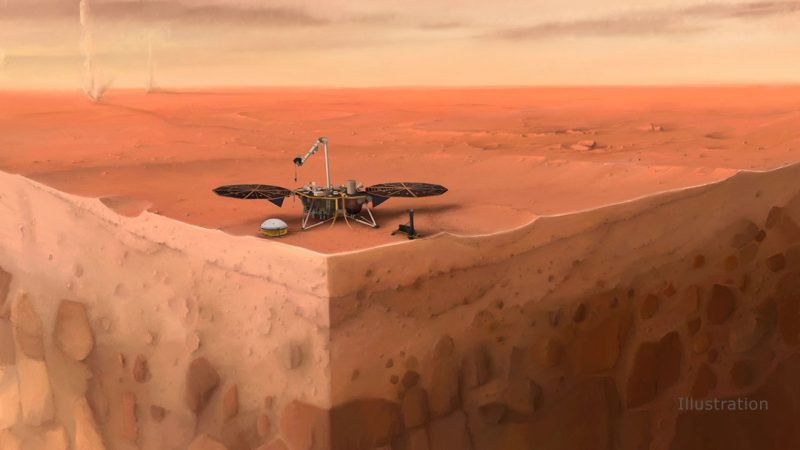
The mission team for NASA’s InSight lander called off its attempts to try to dig deeper into Mars with the heat probe known as “the mole.” Meanwhile, the rest of the mission gained an extension to December 2022.
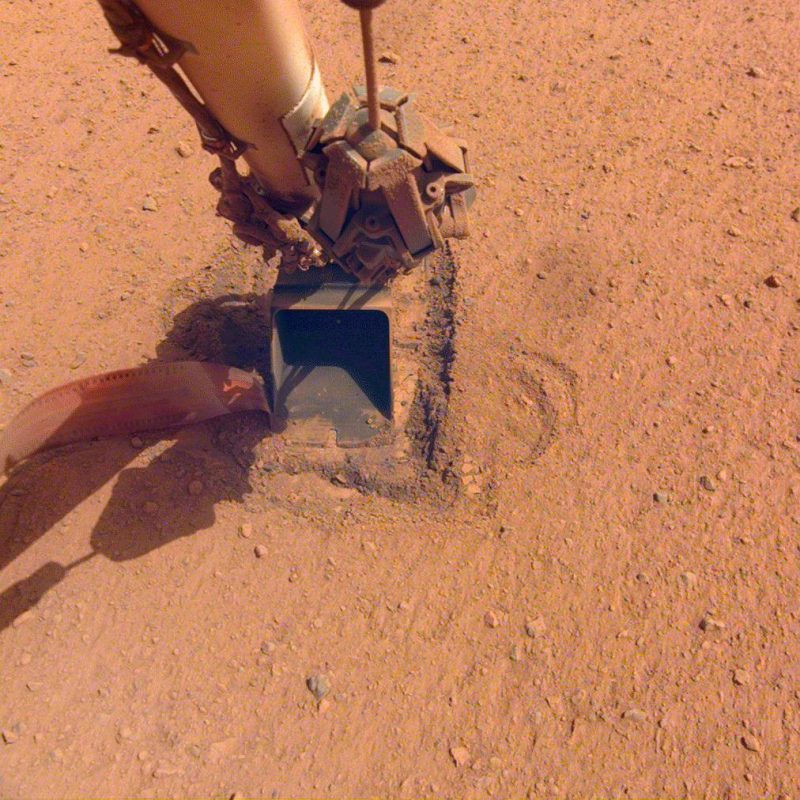
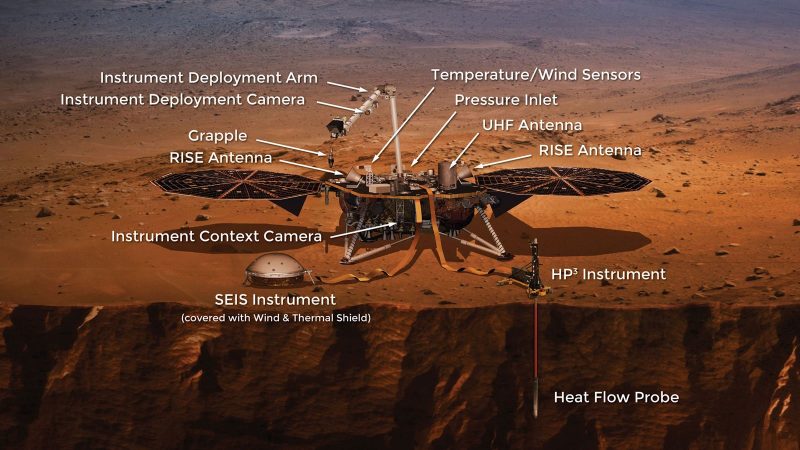
Here’s the NASA’s InSight lander’s heat probe – nicknamed “the mole” – on October 3, 2020, when the spike-like mole was still trying to burrow into the red Martian soil. The copper-colored ribbon attached to the mole has sensors to measure the planet’s heat flow. Now NASA engineers have called a halt to this part of the mission.
One key aspect of NASA’s InSight mission on Mars sadly came to an end last week. NASA announced that InSight’s HP3 heat probe – aka the mole – hasn’t been able to gain the friction it needs to dig as deeply as planned into Mars’ surface. Now mission engineers have finally ended attempts, NASA said, to get the probe to burrow deeper into the soil. However, there’s also good news. The mission has been granted an extension, giving it more time on Mars’ surface to carry out its other tasks.
The mole – known officially as the Heat Flow and Physical Properties Package – was designed to dig down as far as 16 feet (5 meters). The goal was to take measurements of the internal temperature of Mars, providing vital clues as to how geologically active Mars still is and how much heat it still retains in its interior.
The problem was that the mole required friction from the surrounding soil to be able to continue digging deeper. As it turns out, the soil on that part of Mars was more clumpy than had been expected, meaning less friction. The mole would penetrate a couple of centimeters or so,less than an inch, and then it would tend to pop back up again. Eventually, the mission team started trying to push the mole farther down with the scoop on the lander’s robotic arm. Soil would be scraped onto the mole, and then the scoop would be used to tamp it down with “hammering strokes,” hopefully providing more friction. That worked to some degree, for a while, but still wasn’t enough to get the mole to continue digging deeper on its own.
By January 9, 2021, over 500 such hammering strokes had been conducted, to no avail. At that point, the mission team called an end to the effort.
It’s unfortunate, but – as you can imagine – unexpected problems often arise when exploring worlds that are hundreds of millions of miles away. As Tilman Spohn of German Aerospace Center (DLR), which built the mole, stated:
We’ve given it everything we’ve got, but Mars and our heroic mole remain incompatible. Fortunately, we’ve learned a lot that will benefit future missions that attempt to dig into the subsurface.
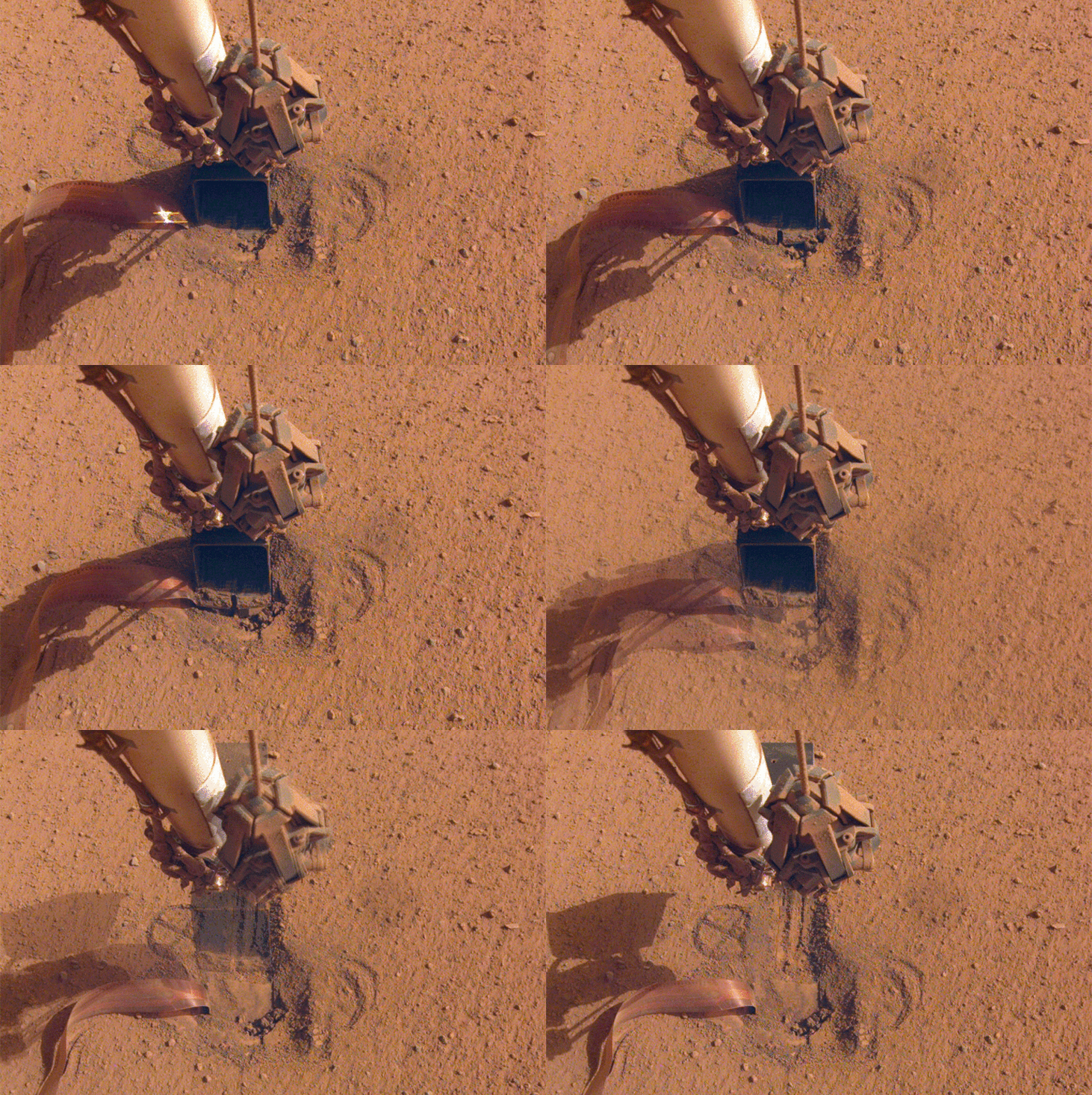
The mission team used the scoop at the end of the robotic arm to try to hammer the heat probe deeper down into the soil. The attempts were unsuccessful, however, because of the lack of friction in the soil due to clumpiness.
Other landers and rovers have used scoops to dig into the surface layers of soil to obtain samples, but InSight’s mole was meant to burrow down significantly deeper. The failure to dig deep enough is disappointing, but it certainly wasn’t for lack of trying, and is still a success in other ways. As Thomas Zurbuchen, associate administrator for science at NASA, said:
We are so proud of our team who worked hard to get InSight’s mole deeper into the planet. It was amazing to see them troubleshoot from millions of miles away. This is why we take risks at NASA, we have to push the limits of technology to learn what works and what doesn’t. In that sense, we’ve been successful: We’ve learned a lot that will benefit future missions to Mars and elsewhere, and we thank our German partners from DLR for providing this instrument and for their collaboration.
So what went wrong?
The clumpiness of the soil was surprising, since testing of the instrument back on Earth was based on properties of the Martian soil seen by previous missions to Mars. But the soil at InSight’s landing site, in Elysium Planitia, proved to be different from that seen at any other landing site. According to Troy Hudson, a scientist and engineer at NASA’s Jet Propulsion Laboratory (JPL):
The mole is a device with no heritage. What we attempted to do – to dig so deep with a device so small – is unprecedented. Having had the opportunity to take this all the way to the end is the greatest reward.
InSight has many different scientific instruments. The heat flow probe, shown on the right, was supposed to burrow down about 16 feet (five meters) into the ground.
All is not lost, however. The setback provided the mission team with more experience using the robotic arm as well as the chance to learn more about the soil at this location. What makes it more clumpy?
Another task in the near future will be to use the robotic arm to bury the tether that connects the seismometer instrument – called the Seismic Experiment for Interior Structure (SEIS) – to the lander. It is hoped that doing so will reduce the amount of cracking and popping sounds heard in the seismic data due to temperature changes.
SEIS takes the “pulse” of Mars, listening for seismic activity below the surface, and has recorded over 480 marsquakes so far. By far most are very small, but they tell scientists how active Mars is below the surface. So far, it seems to be somewhere between the Earth and moon. Some of the seismic activity detected by InSight has come from regions with still-active faults and ancient volcanoes, suggesting that Mars may still be volcanically active to some degree, at least below the surface.
The lander itself continues to be in overall excellent health, which is good news, and the mission has been extended another two years, until December 2022. That means there is still a lot more science that can be done with all of InSight’s other instruments.
InSight’s mission is primarily to study the interior of Mars and determine if the planet is still geologically active.
InSight’s overall mission is to study the interior of Mars, to determine how geologically active the planet still is, and how it formed and has changed over the past several billion years. A radio experiment onboard called Rotation and Interior Structure Experiment (RISE) is designed to find out if Mars’ core is still liquid or if it is solid, and what its overall composition is, including iron.
InSight also monitors Martian weather above the surface, with some of the most advanced weather sensors ever sent to the planet. The Curiosity rover also monitors the atmosphere and weather, as will the Perseverance rover when it lands next month, on February 18. All three together will create the first meteorological network on another planet, another huge accomplishment.
The mole may not be digging anymore, but the mission is far from over, with a lot of good science still to come!
Bottom line: The mission team for NASA’s InSight lander on Mars has called off any further attempts to try to dig deep into the soil with the heat probe instrument called “the mole.” The rest of the mission continues, however, with an extension to December 2022.
2,000-Year-Old Limestone Pyramid Tomb Discovered in Lebanon
An ancient pyramid-shaped megalithic burial has been discovered in North Lebanon dating back to 2,000 years before the pyramids of Egypt. What’s more, it is speculated that this, and other similar pyramid tombs in Lebanon, might have inspired the rulers of Egypt to construct their world famous pyramidal super-structures.
A Blazing White Pyramid among the Blackness
This very well-preserved ancient megalithic stone tomb was discovered by Abdulaziz Al-Zein, the Environment Council's mountain guide, while he was hiking near the village of Akrum in the Akkar District of North Lebanon. This region has been inhabited for around 6,000 years and the pyramidal tomb was discovered on the high grounds of Wadi El-Deir.
A report in The 961 says the 3-meter-high (9.84 ft) burial structure is “very well-preserved” and relatively untampered with, considering its age. What’s more, this particular sepulchral monument is different from all the others that have been found in the Akkar District, because it was constructed with tall, flat, white limestone, where most others were built with basalt.
Could it really be true that the pyramid tombs at Akrum inspired the Pharaohs to build the famed Egyptian pyramids?
The tombs at Akrum predate the pyramids of Egypt by about 2,000 years. Historical researcher Dr. Imad Younis told the NNA that he thinks the Pharaohs of Egypt were “probably inspired by the idea of the pyramid burial from the Akrum burials.” While this is speculation, the researcher points out that “the ancient Egyptians visited the region and stayed there repeatedly.”
This entire area is abundant with megalithic cemeteries and, according to a report in Lebanon24, the archaeological sites near the villages of Menges and Fereidis in Akkar “date back 4000 years before Christ.” Al-Zein notes that what is striking about this Akrum pyramid shaped burial tomb is that it is made of tall, flat, white limestone, while all other examples that have been discovered were constructed of dark basalt rocks.
Remains of a basalt dolmen in the Akkar District, North Lebanon.
Dr. Antoine Daher is head of the Environment Council in Kobayat - Akkarsay and he says there are three pyramid cemeteries in the outlying area of the town of Akrum al-Dayaa close to the border with Syria. However, he said that many of these forgotten treasures have been lost “due to people's ignorance of the value of these ancient constructions.” In a Lebanon24 article, professor Daher highlighted the importance of the region saying there are the paintings of Wadi al-Saba that belong to the campaign of Nebuchadnezzar before the time of Christ, and at the fortress of Husayn “Roman temples are still standing.”
The professor is calling out to authorities to protect and preserve the ancient monuments of the Akrum, and to “put an end to the sabotage that affects them.” He asked: “Can the Antiquities Directorate move with the municipalities of Mount Akrum, which has modest financial capacity, and with all interested parties and volunteers to protect these treasures, which are the memory of humanity and the pillar of the economy for the future?”
Kamouh el Hermel, also known as the Pyramid of Hermel, is a famous pyramid tomb in Lebanon dating back to the second century BC.
Lebanon is no stranger to ancient pyramid-shaped tombs and perhaps the most famous example is Kamouh el Hermel (the Pyramid of Hermel) located 6 kilometers (3.7 mi) south of Hermel in Baalbek-Hermel Governorate. Dating to the second century BC, this pyramid sits on top of a hill and measures between 19.6 meters (64 ft) and 27 meters (89 ft) high, sitting on a base measuring around 1.1 meters (3.6 ft) with three steps made from black basalt. This pyramid was heavily vandalized by locals between 2000 and 2018 when all four faces of the base were covered with graffiti.
Only three other pyramidal burials have been discovered in the Akrum area similar to the one discovered by Al-Zein, and all of these structures were recently renovated and opened for visitors and tourists. Unfortunately, according to the professor, “the ignorance and negligence” of the government, combined with their lack of proper efforts to preserve and protect the monuments, means that some of those “historical treasures” have also fallen to vandalism.
Top image: The megalithic pyramid tomb in Akrum (Akkar District), Lebanon, was built with limestone. Experts believe that the Lebanese pyramid tombs inspired the great pyramids of Egypt. Source: NNA
Has the Function of the Great Pyramid of Giza Finally Come to Light?
About 150 years after the establishment of Egyptology as an academic field, there still appears to be no agreement between scholars on the function of the Great Pyramid of Giza. Yet several different hypotheses have been proposed. The tomb hypothesis appeared when research began on the pyramid, with a popular belief saying the primary function of the pyramid was to be the final resting place for the second ruler of the 4th dynasty - Khufu.
Other competing theories were proposed as well: the granary, the power house, heaven’s mirror, water pump, and the Orion belt, among others. Reviewing all the main hypotheses with an open mind I came to conclusion that I cannot agree with any of those, so I propose my own. Certain aspects of the hypothesis were already voiced by others but not substantiated enough. I tried to fill the gaps where needed with additional facts and evidence.
It is well known that the Great Pyramid is located at the maximum geographical center of Earth (or close to it). No proposed hypothesis tends to explain why - most tend to ignore this fact or downplay it. If the pyramid is indeed built as a tomb, how did Khufu end up picking the location for the tomb to be at, or close to, the geographical center of Earth? With the pyramid construction estimated at 20 years, is mapping and charting the planet factored into the pyramid construction time?
How long did it take Khufu to survey the planet to determine that location? Similarly, how did the granary or power house end up at the center of Earth and for what reason? All the proposed hypotheses lack an explanation for this important aspect, and beyond any doubt it is critical in understanding the function of the Great Pyramid of Giza .
Light can be created by any system if it can emit charged particles into the ionosphere. The Aurora Borealis is the phenomena caused by the same process in which where electrons created by the sun collide with air molecules to create light. So, what would it take for the Great Pyramid of Giza to create similar light?
First, let’s talk about the construction material used in the Great Pyramid of Giza. If in the ancient past someone decided to build a system to emit electrons and create light, the person would definitely face a dilemma with the choice of construction materials. To accomplish that goal, high conductivity material at high frequency is needed. Copper has excellent conductivity and we know Ancient Egyptians had it in their toolbox, though at high frequency copper would overheat and melt within a few seconds. What other materials could be used?
Nummulitic limestone from the Abu Rawash area was analyzed by the National Research Center of Cairo. It was found its conductance improves at higher frequency - to the point where it is exceptional. If the conductivity of a material needs to be about 600 Tera Hz, in addition to structurally strong, there could not be better material than limestone.
One of the original casing stones for the Great Pyramid (circa 2570 BC), most of which were removed during medieval times. This block was found in the rubble surrounding the pyramid.
The Great Pyramid is located at the geographical center of Earth , as noticed by Charles Smyth and reported in this book “Our Inheritance in the Great Pyramid” in 1864. The fact that the geographical center of Earth is at the location of the Great Pyramid is startling.
Now, for a structure to emit high frequency radiation (which is really light), it must be surrounded by a large land mass. This is the fundamental requirement for systems emitting electromagnetic radiation , of which any antenna design engineer is aware. If the pyramid needs to emit electromagnetic radiation on a scale of the whole planet, the maximum land mass location is ideal!
Antennas of the Atacama Large Millimeter/submillimeter Array (ALMA), on the Chajnantor Plateau in the Chilean Andes. The Large and Small Magellanic Clouds, two companion galaxies to our own Milky Way galaxy, can be seen as bright smudges in the night sky, in the centre of the photograph.
The electrons emitted by the pyramid need to reach the ionosphere and there is about a 100-km air gap between the peak of the pyramid and the ionosphere. The earth is a spherical capacitor, which means electrons at high frequency would propagate through the air with little impedance. Also, the ionosphere has negligible impedance, which means electrons can travel along the layer of the ionosphere to the other side of the planet with practically no restriction. However, they need to come back to the base of the pyramid to complete the closed path.
Passing through the ionosphere, the electrons would be colliding with atoms of various gasses, creating air glow similar to Aurora Borealis. The electrons travel back toward Earth from the ionosphere through elevation points of the planet.
It is interesting to note that many ancient cultures across the planet have had pyramid like structures. With the ionosphere saturated with charged particles, building a pyramid would provide a path for electrons to come back to the Earth’s surface - creating intense light glow over the structure. Reaching the surface, the electrons would return to the pyramid base through the mantle of the planet, the impedance of which is also negligible.
As the electrons approach the Giza plateau, they would pass through caves filled with water. The finding of the caves was reported by Andrew Collins and Dr. Hawass. Another process took place there known as electrolysis, causing water molecules to split into hydrogen and oxygen gas. The gas mixture filling the caves caused air pressure build up on the bed rock, creating earth trembling and noise. It is interesting to note that the Pyramid Text has multiple references to quakes and trembles.
The Function of the Great Pyramid of Giza
The Great Pyramid of Giza has a few chambers, shafts, and passages. Each of the elements played an important role in producing light. I provide a description of the functions of the main components in the system below.
Great Pyramid of Giza plan.
(Author provided)
Subterranean Chamber
The function of the subterranean chamber was to split water molecules into oxygen and hydrogen gas. For that you need to have water, terminals, and voltage. Hydrogen would accumulate around one voltage terminal (cathode) and oxygen would be around the other terminal (anode), but only hydrogen is needed for light, so oxygen needs to be rejected from the system. The front view of the subterranean chamber shows two hills made of limestone - those are two necessary terminals.
The top view of the chamber shows some similarities between the terminals: the two terminal bases are about the same size and the division between the two plateaus is exactly centered. All this points to intelligent design of the subterranean chamber. You can also notice some differences which are intentional.
Top view of the subterranean chamber.
(Author provided)
Note that the terminal on the left has a wider area compared to the terminal on the right. This means more electrons would pass through the terminal on the left side than right terminal. This would cause a voltage potential in which negative is on the right side, with the hydrogen gas accumulating there, and oxygen is on the left. Also, you can notice that the left and right shafts exiting the subterranean chamber are not leveled.
Hydrogen gas being lighter than the air, it would exit to the right and pass toward the ascending passage. Oxygen gas is heavier than air and would tend to concentrate at the bottom of the chamber. The granite block on the floor at the right shaft would prevent oxygen passing through. Some mixture would pass along, but it would not cause combustion. The gas built in the caves came out from the floor pit. This was not a steady process of gas and water slowly pouring out; it was a process of gas and water blasting out of the pit with high pressure.
For the pyramid to create light, free electrons are needed, and hydrogen was used for that. To get electrons from hydrogen it can be pressurized, subjected to high voltage, or hit with EM radiation. All three processes were used in the pyramid. As the air pressure in the subterranean chamber increased, the hydrogen gas got pressurized in the Queen’s chamber - filling the southern and northern shafts. The shafts are blocked by Gantenbrinks doors, so it stayed there.
With pressure mounting, the temperature of the gas increased, and partial release of electrons took place. There are copper terminals in the doors to channel the EM radiation of stars into the system. Those align with the shafts. The alignment does not need to be perfect, just enough for X and gamma rays (which can pass through the blockage) to reach the copper. Then the ionization of hydrogen took place.
The purpose of the King’s chamber was to collect all free electrons produced in the Queen’s chamber and push those toward the top of the pyramid. The granite beams in the King’s chamber are made of red granite, which has high crystal content when exposed to vibration and creates an electric field, pulling electrons from the Queens’ chamber toward the peak of the pyramid.
Opening to the King’s Chamber shaft. Morton Edgar, 1910.
The function of the portcullis in the antechamber was to control the hydrogen gas flow toward the King’s chamber and control pressure in the pyramid. Essentially, closing those would prevent the gas flowing out of the pyramid through the King’s chamber shafts. Controlling how much the portcullis closed, someone would also control pressure in the Queen’s chamber and how much light the pyramid would produce.
A Coffer in the King’s Chamber
The coffer in the King’s chamber is an important feature. What it was used for and why was it placed there are questions that still puzzle many scholars. The purpose of the coffer was to create high voltage in the King’s chamber to ionize the hydrogen and make that space conductive. Without a high voltage source in the chamber, the pyramid would not work. A device similar to the Baghdad battery could have been used. Or a device similar in construction to the Ark of the Covenant would also work.
There are three granite plugs in the bottom portion of the ascending passage. It appears the prevalent number of discussions support the theory that those were slid down to block the entrance to the ascending passage and were held there with wooden beams. There is, however, no agreement on the function of those plugs.
I believe those were used to shut down the pyramid at any instant if needed. It worked as an emergency stop. The three granite slabs would be slid down the descending passage to block hydrogen passing through and shut down the process. The fact that those plugs are blocking the passage now means they were used at least once.
Thus, I propose the function of the Great Pyramid of Giza was to emit free electrons to the Ionosphere, with the purpose to create light on the planet . The hydrogen gas produced in the subterranean chamber was used as a source of electrons needed for the process.
Top Image:The Great Pyramid of Egypt. Credit: BigStockPhoto
Until now the Middle Stone Age is thought to have ended about 30,000 years ago. However, new evidence unearthed in Africa suggests the tools which define this period of African prehistory between the Early Stone Age and the Later Stone Age - continued to be produced for another 20,000 years.
Recent archaeological digs in Africa found evidence of Middle Stone Age tools dating to just 11,000 years ago, about 20,000 years after these tools were traditionally believed to have stopped being produced. This means groups of ancient humans moved to using newer tools at different speeds, and that early human hunters lived in relative isolation from each other.
Questioning Human Evolution in the Middle Stone Age
All previous archaeological and anthropological discoveries in Africa have supported the belief that humans in Africa stopped using simple points and scraper tools and developed more complex weapons , tools and craft appliances about 30,000 years ago. However, researchers from Germany’s Max Planck Institute have published their new findings in the journal Scientific Reports claiming the latest evidence gathered at sites in Senegal, on the West coast of Africa, are “fueling a rethink of the passage of human evolution.”
The new paper suggests some ancient people living in Africa 11,000 years ago were still using simple tools, while other groups had developed more advanced technologies 20,000 years previously. This directly challenges the traditional theory that humans evolved in a linear fashion, making technological advances together, and proves humans evolved at greatly different rates around Africa, and the world.
Team fieldwalking along the Gambia River, Senegal.
Putting recent human evolutionary history in a nutshell: the period before Homo sapiens is known as the Lower Stone age, and that gave way to the Middle Stone Age, where we began developing simple stone, wood and rope tools. In the Late Stone Age, the skill sets that were developed using these tools became craft disciplines, and the rapid advancements in technologies started at that time haven’t stopped since, leading to our current state, as tool wielding monkeys with big aspirations.
The archaeologists wrote that for most of humanity's prehistory groups of humans were relatively isolated from each other. This conclusion was derived from the fact that most Middle Stone Age finds in Africa date to between 300 thousand and 30 thousand years ago and after this time they largely vanish. However, the new finds show primitive tool production continued in some isolated areas much later in the Late Stone Age, “when the Neolithic became the Bronze age around 3,500 BC,” said the researchers.
The lead author of the new study, Dr Eleanor Scerri, said that up to now almost everything that is known about ancient human origins has been extrapolated from discoveries in small parts of eastern and southern Africa. Now, this new work highlights the importance of investigating the entirety of the African continent so to construct a clearer and more reality-based picture of human evolution.
Lithics from Laminia (A-D) and Saxomununya (E-H). (A) unretouched flake; (B) bifacially retouched flake; (C) Levallois core evidencing a step fracture; (D) side retouched flake/scraper; (E, F) Levallois cores; (G) bifacial foliate point; (H) bifacial foliate.
The team are currently unclear as to “why” some groups of West Africa's Stone Age hunters were left standing in time while others rapidly advanced. However, they think “geographical isolation” has a lot to do with it. And we can still see the effects of geographical isolation in the modern world, for example, we have 20 years olds in San Fransisco walking about with Google Glasses being fed big data in live streams, while other 20 year olds around Yaohnanen village on the southern island of Tanna in Vanuatu worship Prince Philip, Duke of Edinburgh, the consort to Queen Elizabeth II, as a divine being.
The researchers also suggests that perhaps the people with less advanced technologies experience fewer changes in climate, therefore, they were not under such intense pressure to survive and adapt. Either way, the study presents “a newer view of human evolution:” one in which groups of Stone Age survivalists lived and developed separately, and maybe even had “cultural boundaries,” living “in slightly different ecological niches,” wrote the researchers.
Top image: Freshly found artifact of the Middle Stone Age from Laminia, Senegal. Source: Eleanor Scerri / Max-Plank Institute
Mexican Farmers Unearth Ancient Statue of Elite Mesoamerican Woman
Farmers tilling the soil in a citrus grove in the Huasteca region along Mexico’s Gulf Coast unearthed something ancient and unusual. Hitting a hard object they assumed was a rock, the farmers dug down deeper to remove it. According to PHYS.org, what they had actually found was a six-foot-tall (1.8 meters) white stone statue of a Mesoamerican woman. She was buried in a position of peaceful repose, but facial features were contorted by an open-mouthed, wide-eyed expression that suggested she’d seen something shocking and unforgettable.
The farmers discovered the statue of a Mesoamerican woman in the Huasteca region in Mexico by chance when tilling the soil.
After removing the statue from the ground, the farmers quickly notified local authorities. Word was eventually passed on to Mexico’s National Institute of Anthropology and History, which dispatched archaeologists to investigate the discovery. These experts confirmed the statue’s antiquity, deducing that it was constructed and erected sometime between the years 1450 AD and 1521 AD, presumably by the Huastec people who had inhabited the region at that time.
If this is correct, the statue would date to the era just before the Spanish conquistadors arrived on the Gulf Coast. The Huastec region was the site of one of the most appalling episodes associated with the Spanish conquest , when the brutal and fanatical conquistador Gonzalo de Sandoval had 400 Huastec nobles and 60 chiefs burned to death to intimidate the Huastec people into submitting to his authority. He later sold 20,000 Huastecs into slavery, decimating the population and leaving Huastec society in ruins.
Assuming the statue is accurately dated, it is a relic that foretells an epic tragedy. The wide-eyed look of shock and horror that animate the woman’s features could be seen as prophetic, as if the person who carved the statue somehow anticipated the coming apocalyptic disaster. The statue is a relic from a society that was on the verge of being utterly destroyed by ruthless invaders who would murder their leaders, enslave the strong, and rule the rest with an iron hand defined by its intolerance and contempt.
The citrus farmers then alerted authorities of their discovery. Experts are now trying to work out who or what the statue of the Mesoamerican woman represents.
Deciphering the Identity of the Mesoamerican Woman
According to National Institute of Anthropology and History officials, this is the first statue of this type found anywhere in the Huasteca region. Based on the elaborate headpiece and fine clothing the woman represented in the statue is wearing, Institute archaeologist Maria Eugenia Maldonado Vito believes the statuesque woman was someone of elite status .
“This could be a ruler, based on her posture and attire, more than a goddess,” Maldonado wrote. Alternatively, she said the statue may represent “a late fusion between the Teem goddesses and women of political or social status in the Huasteca.” The goddesses she mentions were associated with fertility cults. Statues and figurines that venerate and immortalize fertility goddesses have been found all across the globe and represent a common motif from ancient times. Consequently, it is reasonable to hypothesize that the Huasteca statue may have some connection with fertility rites and observances.
But that is only one possibility, and maybe not the most likely explanation. “There are quite a few pre-Hispanic depictions of elite women and female rulers elsewhere,” explained Susan Gillespie, an anthropology professor asked to comment on the discovery of the Huasteca statue. “[They are] best known among the Classic Maya, but also in Classic Zapotec bas-reliefs and Post-Classic Mixtec codices.”
The Huastecs were originally descended from the Maya . They created their own distinct culture following their separation from their progenitors, which occurred approximately 2,000 years before the time when the statue of the woman was constructed. But they likely preserved at least some cultural traditions from ancient times, meaning that overlaps between their cultural practices and those of the Maya were to be expected.
Interestingly, the statue seems to reveal some Aztec influence . The Aztecs were just beginning to make intrusions in Huastec territory by the middle of the 15 th century AD, in military campaigns that were destined to bring the Huastecs into the Aztec Empire before the century ended. Given the contact between the Huastecs and the Aztecs that was occurring at this time, a cultural fusion that would help shape artistic choices was inevitable.
“Colonial era Aztec documents mentioned women ‘rulers’ or at least holders of the crown to pass on to their successors,” Gillespie is quoted as saying in PHYS.org. “Women were highly valued in the pre-Hispanic era, drastically losing their status only after the conquest.”
The statue of the Mesoamerican woman has an open mouth and a wide-eyed expression. Experts are trying to work out who or what she represents.
Since the Mesoamerican statue bears no inscriptions or identifying markings of any type, it is impossible to tell who the woman is or what exactly her status might have been. Unfortunately, it is also impossible to know for sure if she really was carved by a Huastec artist, or even if the statue was constructed in the Huastec region.
Not only is this the only such statue ever found there, but the place where it was found has never before produced any notable archaeological finds. This raises the possibility that the find was not legitimate, and that the statue was transported to Huastec from another location by unidentifiable sources at an unknown date.
“If there is only one such find, it’s hard to say whether it is significant, or even correctly identified,” Gillespie confirmed. “Archaeology works best with repeated occurrence, to show a pattern.” Of course, archaeologists haven’t yet had much of an opportunity to identify such a pattern, if it exists. This may be the first such statue ever found in Huastec, but that doesn’t mean it will be the only one.
Its discovery may launch an exciting new era of exploration—now that archaeologists know where to look, there is no telling what they might find in the months and years ahead. Today’s brand new archaeological site may be tomorrow’s treasure trove of invaluable artifacts, which would have remained hidden indefinitely if not for that first fortuitous discovery by citrus farmers.
Top image: The statue of a Mesoamerican woman was discovered in Álamo Temapache, Veracruz in Mexico by citrus farmers.
VIDEO: ONE OF NATURE'S MOST DECEPTIVE INSECTS IS HELPING BUILD A BETTER ROBOT
A CLICK BEETLEROLLING AROUND on its back may look pitiful — but do not be deceived. Beyond the hard exterior of their bodies lies a jack-in-the-box-like mechanism that, once snapped, springs them high into the air with a signature click!
Scientists have known of this click-trick, but what they've struggled to understand is precisely how and whythese beetles spring into the air. However, using high-speed x-ray technology and fundamental equations of motion, a team of mechanical engineers recently examined how this action takes place and what its limits are.
A better understanding of this elegant, biological mechanism not only reveals insight into a natural phenomenon — it may help roboticists super-charge the strength of future machines without increasing their "muscular" strength.
The findings were published Monday in the journal Proceedings of the National Academy of Sciences.
They might look helpless, but these beetles are poised to pop at any moment.
HERE'S THE BACKGROUND
We typically imagine springs and latches are something human-designed — doodads used to close doors or accelerate pinballs into obstacle courses. But in fact, click beetles are far from outliers when it comes to natural examples of these mechanisms.
Venus flytraps, for example, use a similar biological spring to close their leafy lips around their prey. Meanwhile, mantis shrimp can snap their claws so quickly they create tiny sonic booms in the ocean.
When it comes to click beetles (which encompass a family of beetle called Elateridae discovered by an English zoologist in 1815), scientists have studied its kinematics (the beetles' resultant acceleration) as well as the geometry of the beetles' biological latch. However, the researchers behind this new study argue the question of how this motion arises from the beetles' biology is still largely unexplored.
"Previous studies have focused on the [click beetle] jump, in this paper, we are focused on the bending maneuver referred to as the click because of the audible click it produces," Aimy Wissa, assistant professor of mechanical science and engineering at the University of Illinois Urbana-Champaign, tells Inverse.
"The bending movement happens in a hinge in the thorax and only takes a few milliseconds. In the paper, we identify and characterize the different phases of the click and we identify the forces governing the energy release phase of the click."
With four beetles on loan for the University of Illinois Urbana-Champaign's permanent research sites, the team began the process of learning exactly what makes these beetles tick (or click).
The beetles' strong elastic energy through the latch mechanism as they twist their body and then release it all at once to spring upward.Wissa et al. / PNAS
WHAT THEY DID
Because only a number of milliseconds separate a still click beetle from a click beetle pirouetting through the air, the researchers used a high-speed x-ray imager to slow down the process for analysis.
The team zeroed in on a small cavity in the beetle's thorax that transforms into a latch when they begin to twist back and forth.
With this visual data, the team had three big questions they wanted to answer:
1) What are the phases of the clicking motion?
2) What are the elastic energy storage and release mechanisms in click beetles?
3) Can the energy release mechanism be inferred from the latch dynamics during the energy release phase?
WHAT THEY DISCOVERED
Examining the motion of these four beetles, the researchers identified three distinct phases of behavior that predicate the clicking spring: latching, loading, and energy release.
Based on this behavior, the researchers were able to classify this mechanical movement as "elastic recoil," which is a fast release of stored elastic energy. Essentially, as the beetle twists its body, its latch creates more and more elastic energy. This energy is eventually released when the latch breaks free, creating the springing movement.
Studying this motion, the researchers observed that the loading phase (where a peg tip was wedged into the cavity) took up to 235 milliseconds while the energy release took only 17.4 milliseconds at most.
This means that after a relatively slow build-up of elastic energy, the beetle expells it all at once for maximum recoil.
Because the beetle's writhing dance appears to be the main determinant of when how and this movement takes place, the researchers were able to closely model the oscillatory movement of the beetle post-jump as a one-degree-of-freedom system.
Being able to match the biological motion to an existing model will make it easier to replicate this motion in non-living systems as well.
"Learning about how small organisms can generate extreme acceleration will lead to breakthroughs in the field of insect-scale robotics and other small devices," Wissa tells Inverse. "Microrobots currently suffer from severe actuation limitations and cannot move nearly as fast as even the slowest [spring-equipped] biological organism"
Using a mechanism similar to that of the click beetles could enable robotics to have more "strength" without requiring stronger biological muscles.Shutterstock
WHAT'S NEXT
While the researchers were able to answer a number of important questions about this mechanism, there are still outstanding questions yet to be explored.
For example, the external latch that they identified is likely only part of an interior spring mechanism. What exactly that mechanism is and how it works is something they hope to explore in future studies.
In the future, the researchers write that they hope this understanding can help build a symbiotic relationship between advancing robotics and advancing the study of biological life as well. Eventually, this understanding could "enable the creation of a new generation of insect-inspired robots capable of generating and sustaining high-acceleration movements," the study team writes.
"Such robots will also serve as research platforms to answer critical questions about their biological counterparts."
Abstract:
Many small animals use springs and latches to overcome the mechanical power output limitations of their muscles. Click beetles use springs and latches to bend their bodies at the thoracic hinge and then unbend extremely quickly, resulting in a clicking motion. When unconstrained, this quick clicking motion results in a jump. While the jumping motion has been studied in depth, the physical mechanisms enabling fast unbending have not. Here, we first identify and quantify the phases of the clicking motion: latching, loading, and energy release. We detail the motion kinematics and investigate the governing dynamics (forces) of the energy release. We use high-speed synchrotron X-ray imaging to observe and analyze the motion of the hinge’s internal structures of four Elater abruptus specimens. We show evidence that soft cuticle in the hinge contributes to the spring mechanism through rapid recoil. Using spectral analysis and nonlinear system identification, we determine the equation of motion and model the beetle as a nonlinear single-degree-of-freedom oscillator. Quadratic damping and snap-through buckling are identified to be the dominant damping and elastic forces, respectively, driving the angular position during the energy release phase. The methods used in this study provide experimental and analytical guidelines for the analysis of extreme motion, starting from motion observation to identifying the forces causing the movement. The tools demonstrated here can be applied to other organisms to enhance our understanding of the energy storage and release strategies small animals use to achieve extreme accelerations repeatedly.
The Voynich Manuscript is an enigmatic 240-page book penned in the early part of the 1400s, and which has consistently defied the world’s finest code-breakers, who have spent decades trying to decipher the odd text. It takes its name from a man named Wilfrid Voynich, a dealer of books who obtained the manuscript back in 1912. As for the contents of the Voynich Manuscript, they include a great deal of material relative to botany – as well as close to thirty- pages of imagery of the heavens: stars, planets and moons. But, as for why, and what the attendant text says, no one knows. As to how it fell into Voynich’s hands, we have this from the man himself:
“In 1912 I came across a most remarkable collection of preciously illuminated manuscripts. For many decades these volumes had lain buried in the chests in which I found them in an ancient castle in Southern Europe. While examining the manuscripts, with a view to the acquisition of at least a part of the collection, my attention was especially drawn by one volume. It was such an ugly duckling compared with the other manuscripts, with their rich decorations in gold and colors, that my interest was aroused at once. I found that it was written entirely in cipher. Even a necessarily brief examination of the vellum upon which it was written, the calligraphy, the drawings and the pigments suggested to me as the date of its origin the latter part of the thirteenth century. The drawings indicated it to be an encyclopedic work on natural philosophy.
“The fact that this was a thirteenth century manuscript in cipher convinced me that it must be a work of exceptional importance, and to my knowledge the existence of a manuscript of such an early date written entirely in cipher was unknown, so I included it among the manuscripts which I purchased from this collection. Two problems presented themselves – the text must be unraveled and the history of the manuscript must be traced. It was not until sometime after the manuscript came into my hands that I read the document bearing the date 1665 (or 1666), which was attached to the front cover. This document, which is a letter from Joannes Marcus Marci to Athanasius Kircher making a gift of the manuscript to him, is of great significance.”
Notably, a theory exists that the manuscript was the work of a secret society based in Italy – one with a very long and clandestine lineage – that extended back to the time when the Roman Empire was at its height. It apparently still existed when the Voynich Manuscript was compiled, and was said to have been just one of dozens of such manuscripts – only one of which is, today, known.
It’s intriguing to note that the National Security Agency – the former bosses of the world’s most infamous whistleblower, Edward Snowden – has taken a very deep interest in trying to crack the code of the Voynich Manuscript. Via the terms of the Freedom of Information Act, the NSA has declassified into the public domain several important papers penned by those agency personnel who tried to tackle the mystery for themselves. One being “The Most Mysterious Manuscript in the World,” written by Brigadier John H. Tiltman, a man who worked for the United Kingdom’s equivalent to the NSA, the Government Communications Headquarters (GCHQ) at Cheltenham, England. As evidence of Tiltman’s skills as a code-breaker, he was the first non-American to become a member of the NSA’s Hall of Honor. But, for all of the NSA”s skills in code-breaking, cipher-cracking, and spying, the Voynich Manuscript remains the mystery that it did when it fell into the hands of Wilfrid Voynich more than a century ago.
Some of the most fascinating, and often very bizarre accounts of UFO and alien encounters come to us from the so-called whistleblowers, the ones that claim to come from positions right in the thick of things. These are the ones who are supposedly in the know, with often very impressive credentials and apparent inside information on what is really going on. Such tales run the range from the compelling to the completely flat-out bonkers, and everywhere in between, yet even among these there are some that truly stand out among the rest. A good example of such accounts comes from a man who claims to have been part of an elite secret government cabal tasked with investigating and retrieving fallen UFOs, and his story is at once intriguing and totally outlandish.
One very incredible tale of aliens and secret government operations comes from retired U.S. Army sergeant Clifford Stone, who says his story begins when he was just a child. When he was very young, he claims he had several encounters with aliens, after which he was frequently visited by two military men, in particular an Air Force captain who told him he was being watched due to his remarkable ability to “interface with extraterrestrial biological entities.” The mysterious stranger would appear often to encourage him to pursue the study of UFOs, visiting him at least once a week and eventually influencing him to join the military in his older years. Stone would go on to serve in the Army from between the years of 1968 to 1990, although not in what one would call a traditional capacity.
Clifford Stone
Upon entering the military, Stone claims that he was first given training at a Nuclear, Biological and Chemical Warfare facility at Fort Lee, Virginia, after which he was recruited into a secret elite government organization called the Interplanetary Phenomena Research Unit, which apparently had been started back in 1943 by General Douglas MacArthur for the purpose of gathering intelligence on alien activities on Earth, studying alien entities and their technology, and retrieving the wreckage of downed UFOs. According to Stone, the unit had been formed in response to the large number of UFO sightings that were occurring during the war, often called Foo Fighters, speculated to be due to the entities studying the human conflict. It was thought that there was an urgent need to study this presence in order to determine if the aliens were hostile and what they wanted, and so the unit was formed.
Stone has revealed, largely through interviews with such renowned ufologists as Dr. Michael Salla, Dr. Steven M. Greer, and Paola Harris, much about what his duties and experiences were like with the shadowy organization. He says that he was typically assigned to the nuclear, biological, and chemical retrieval and abatement detail at Fort McClellan Army post in Alabama, and would be called away when there was a top-secret assignment for a retrieval. According to him, his team was not originally completely devoted to alien spacecraft, but rather to retrieving any suspicious foreign objects that crashed to Earth, but this evolved as the project went on through the years. He says of this:
This unit was initially organized as a 4602nd Air Intelligence Service Squadron. Among its peacetime missions was operation Blue Fly. Operation Blue Fly was to recover objects of unknown origin that fell to Earth. It is very important that you remember these were specifically objects that fell to Earth- because we didn’t have any spacecraft up there at this time. As a result of this, they had monitors right there at Wright Patterson that when UFO reports came in they were looked at very closely to see if there was any possible necessity of sending out teams to recover any of this fallen debris. The Air Force states they never used them. I’m telling you I know they did. But the intent of the Operation Blue Fly peacetime project was to go out and recover objects of unknown origin that impacted with the Earth.
Later it would be expanded in 1957 to cover all objects of unknown origin meaning spacecraft too. And it would become part of what they would call in the October of 1957 timeframe, Project Moon Dust. Project Moon Dust is the overall field exploitation to recover only two items: First, objects of non-U.S. origin that survives re-entry into the Earth’s atmosphere and impacts with the Earth and objects. Naturally, we would be interested in those items from a technical, scientific intelligence basis to determine, or try to ascertain the technical capabilities of any potential enemy since our known enemy of the U.S., the USSR at that time that was launching space vehicles into space. The other area of interest was objects of unknown origin. Now we find that there were quite a few objects of unknown origin that did not correlate with any known space launches, impact times, or any known space debris falling back to Earth. In short, under Project Moon Dust and under Blue Fly, we have recovered alien debris not of this Earth.
Indeed, Stone claims that throughout his career he was involved with several such retrievals of alleged alien debris, always under the guise of a nuclear containment team, which is what he was ostensibly trained for. According to him, these retrievals were carefully orchestrated to make it appear as if they were checking out crashed aircraft or a nuclear incident, even using fake news reports planted in the media to complete the ruse. He explains the thought process of these retrievals:
Now, in order to prepare me for this, very early on in my career they sent me to NBC School at Fort McCullen [sp], Alabama. It’s a three-week school. It’s for NBC personnel, NBC meaning Nuclear, Biological, and Chemical. And it would always be in the context of an NBC unit that I would be involved in UFO retrievals. You would go ahead and deploy as though it was a nuclear accident. There are procedures already established on nuclear or biological or chemical accidents. So you would proceed in that way. If you could get in there and do recoveries, if you could go in and extract the debris that are there quietly behind the scenes and no one knows, you’d do it. If you needed an officially sanctioned deception program to come into play, such as a bogus news release, you could do this also.
For example, if you have an airplane accident we have standard procedures on how we handle that. Those same procedures are utilized when you do a recovery or extraction of a crashed ET spacecraft or debris thereof. And I have to stress debris simply because these are highly advanced technical machines. There were not that many crashes. They are flawed because they are made by an intelligence that is as mortal as you or me. Being mortal, we are subject to error. Now, we are talking about a highly intelligent civilization, not a highly incompetent civilization. We take steps and they take steps. But at the same time, when you go out, you make a recovery. And when you make that recovery, you handle it the same way you would as if you were out there on an airplane accident or you have a hazardous material type situation, because it works. It is all set up.
He is meticulously detailed when he explains how all of this works. He goes into depth about how the material is concealed and how they ship it. He talks of tracking the trucks carrying the objects, code words used during these shipments, and many other finer points of the operations. He even claims that he has secretly taken some of the material found at these sites. For instance, according to him, at one purported UFO crash in 1973 he hid a small fragment of metal from the craft in his shoe, later burying it on property near his home in New Mexico. He says of the object:
Yes, I have it and wouldn’t dare to keep it in the house. I had it here to show some people where I kept it, a day longer than I should have and then somebody actually came here and tried to take it. That was some tense moments, I almost shot somebody that day. I can’t replace this, you don’t go to the store and buy this and I took a big chance when I went ahead and got it.
Stone claims that while debris was not totally uncommon, cases of whole crashed spaceships or recovering alien bodies were actually pretty few and far between, and that one of the reasons they crashed in the first place was that Earth radar interfered with some of their systems. He says he only actually was called out to a handful of whole crashed UFOs, and when asked to estimate how many craft had crashed on Earth when he first joined the unit, he says:
Not more than two-dozen UFOs had been retrieved by 1969 when I was briefed first. We were informed that there had only been a couple dozen tops- that there were several in the ‘40’s and the early 50’s. And to make it perfectly clear about those events that took place then, it sounds crazy but our radar wreaked havoc on the ET guidance systems and they had to make adjustments to their guidance systems for that. How many bodies had been recovered? Don’t know. How many crashes have occurred in which we only got debris because the ET’s came and did their recovery before we got there? Don’t know but it has happened. It has happened. When they had problems, just like we send out a distress call, they send out a distress call, which is something that a lot of people don’t think about; it’s a question that’s never asked.
Another topic he speaks of are the specialized teams that would join them when there was any sort of biological component, meaning an alien body, and the measures they took to make sure there wasn’t any kind of contamination. With regards to finding aliens, he said that they would find both dead ones and occasionally even living ones, which he says he has a gift for communicating with. Some of his stories are fairly spectacular, such as the time they allegedly fired on an alien and it deflected the bullet with some sort of force field, the time he helped some aliens escape during a crash retrieval in Vietnam during the war, and another occasion when he was shown an alien entity at the Pentagon and the alien teleported him to his friend’s office at Fort Meade. According to Stone, there are a total of 57 different known species of aliens that had been catalogued by the time he retired, coming in various shapes and sizes, with some of them reportedly practically indistinguishable from human beings. The military allegedly had a whole manual on the aliens, a 3-inch thick book called the “EBE Guidebook,” which contained the physiology, food requirements and medical information for each species.
He claims that the government is very secretive on all of this, and that they even distorted his service records to list him as being merely a clerk and typist. One of his main reasons for coming forward with this information, even though it is at great risk to him, is to help along with government disclosure and try to convince the world of what is really going on. He claims that the attitudes of the general populace make it easy for the government to keep these secrets because there is the tendency to treat UFOs and aliens as flights of fancy and to try and debunk it all. It is skeptics and debunkers who, according to him, are making it easy for the government to keep wraps on it all, and he explains of this:
During the discussion of UFO’s, the question ultimately is going to come up can any government keep secrets let alone the U.S. Government? And the answer to that is unequivocally yes. But one of the greatest weapons the intelligence community has at their disposal is a predisposition by the American people, the American politicians, and the debunkers- people who wish to try to debunk UFO information. They immediately come out and say oh we can’t keep secrets, we can’t keep secrets. Well, the truth is, yes we can. And we are conditioned by our own paradigms not to accept the possibility or probability of a highly advanced intelligent civilization coming here to visit us. You have evidence in the form of highly credible reports of objects being seen, of the entities inside these objects being seen. Yet, we look for a prosaic explanation and we throw out the bits and pieces of the evidence that doesn’t meet our paradigm. So it is a self-keeping secret. You can conceal it in plain sight. It is political suicide to go and start hitting up intelligence agencies to get this information released. So most of your members of Congress, and I know I’ve worked with a lot of them along that line, will balk and try not to do it. I can name you three members of Congress that were point blank asked to have a congressional inquiry on what happened here at Roswell.
Stone has written a whole book on his wild career and strange experiences, his 1997 UFOs Are Real, and he has continued his crusade for the cause of full government UFO disclosure, pursuing relentless requests under the Freedom of Information Act and constantly giving talks about it all. For many in the UFO field he is a champion of disclosure, however, as with many such alleged whistleblowers he has also gained his share of criticism. One is that he has very few actual hard documents or evidence to back these claims up. For instance, the alleged EBE Guidebook he has only seen on occasion, and has never managed to get an actual copy of it. He has managed to gather some documentation admitting to classified projects called Blue Fly and Moon Dust through the Freedom of Information Act, but it is unclear how much it actually proves that they were involved in retrieving aliens and alien spacecraft, and there has been debate on just how real any of his documents are. He also refuses to present the purported piece of UFO debris he has, saying that it is too dangerous to do so at this time, so for many there is just very little concrete corroboration or evidence for his extraordinary claims. There is also the fact that, although he claims that his service record has been altered to hide his true background, he is still only officially listed as a military typist and clerk, with no way to prove otherwise. Yet he definitely has his supporters, and Dr. Michael Salla says of him:
In my interview Sgt Stone comes across as very meticulous in his statements, very clear about the information he is revealing, and refuses to speculate on subjects he did not directly experience. The information he provided in the interview was very consistent with earlier interviews conducted by other investigators such as Paola Harris. Furthermore, Sgt Stone had no desire to gain financial profit for his evidence or appeared in any way to be a publicity seeker. He came across as an individual of great integrity desiring to let the American public learn the truth about UFOs and the ETH. My overall conclusion is that Stone is very credible due to the meticulous nature of his testimony, the consistency in his story, his obvious integrity, and because of the documents he has been able to provide.
We are left to wonder. Is there anything to Stone’s claims? Certainly he seems sincere and has been embraced by many in the UFO field, and his attitudes towards government disclosure seem to be in the right place. However, is he for real, or is he just spinning wild stories? Whatever the case may be, Stone has made many good points on the topic of government UFO disclosure, and whether any of his claims are true or not, he remains a fascinating, strange, and often eyebrow-raising figure upon the landscape of ufology.
A Legend That Turns Out to Be Real? Hibernating Alien Discovered Inside Secret Chamber in the Great Pyramid
Would you believe a story about an alien mummy being found in the Great Pyramid of Giza? In the March 2000 issue of the Egyptian magazine Rose al-Yūsuf, a strange article posed the same question.
As the story goes, in the year 1988, a French Egyptologist named Louis Caparat was exploring the interior of the Great Pyramid when he accidentally discovered a secret chamber. The room had been sealed right after the pyramid was completed, more than 4,500 years ago, and it contained “a crystalline transparent case.”
Apparently, the crystalline case served as life-support for a small humanoid alien or human-alien hybrid, which Caparat believed was hibernating or in a stage of suspended animation. The discovery of a previously unknown chamber inside the Great Pyramid sounds intriguing, but finding an actual alien being inside it would be an extraordinary event, if we are to trust this particular account.
Further inspection of the chamber revealed clues about the identity of its millennial occupant when archaeologists found a papyrus scroll. According to hieroglyphic inscriptions on the scroll, the creature was in fact an extraterrestrial messenger that had arrived in ancient Egypt during Pharaoh Khufu’s reign. His mission was to announce the arrival of his brethren, who expressed their interest towards the Egyptian people.
Apparently, the Pharaoh held the visitor in high regards, since the papyrus claimed the Great Pyramid was actually built as a receptacle for the crystal capsule containing the small humanoid. The fact that the life support system was still working after thousands of years supports the theory that the pyramids were built with the aid of advanced alien technology and it also gives credence to the idea that the pyramids acted as energy receivers.
Shortly after his discovery, Caparat called his friend and colleague, biologist F. de Braga, who was in Spain at the time. He boarded the next plane to Cairo, hoping to obtain blood, tissue and DNA samples from the hibernating alien. But when his plane landed, de Braga was promptly sent back to Madrid by the Egyptian authorities. The alien and its crystal coffin were ultimately confiscated by the State Security Investigations Service and taken to an undisclosed location and that’s where the trail stops.
No further mentions of Caparat or the secret chambers are made and Egypt has offered no official statement regarding this episode.
But this is neither the first nor the only incident when a decidedly non-human body was found in a pyramid.
According to legend, the first man to break into the Great Pyramid of Giza was a powerful caliph named Abdullah al-Ma’mun, the son of Harun al-Rashid. In 813 CE, after weeks of arduous manual drilling, his team of hired Egyptian laborers broke through several blocks of granite and into a burial chamber that contained the remains of a humanoid alien. The alien had been buried with great respect and was surrounded by precious items.
In Secrets of the Great Pyramid, author Peter Tompkins mentions the event:
SOME ARABIAN AUTHORS HAVE REPORTED THAT AL MA’MUN FOUND IN THE SARCOPHAGUS A STONE STATUE IN THE SHAPE OF A MAN. THEY SAY THAT WITHIN THE STATUE LAY A BODY WEARING A BREASTPLATE OF GOLD SET WITH PRECIOUS STONES, AN INVALUABLE SWORD ON HIS CHEST, AND A CARBUNCLE RUBY ON ITS HEAD THE SIZE OF AN EGG, WHICH SHONE AS WITH THE LIGHT OF DAY.
Another mysterious mummy of an otherworldly being was allegedly uncovered in a small pyramid in El-Lahun, just south of Pharaoh Senusret the Second’s tomb. As the story goes, Viktor Lubek, a retired University of Pennsylvania University professor made this discovery on 1997 but there is very little information available.
The mummy was that of a frail creature measuring around 5 feet in length. It had been buried with special honors, and a number of intriguing objects were found inside the tomb. According to an article published in a 2003 issue of Weekly World News,
THE MUMMY DATES FROM ABOUT 1880 B.C. AND IS HUMANOID, BUT CLEARLY NOT HUMAN. IT’S UNCLEAR WHAT SE*X IT WAS, BUT WE KNOW IT HAD UNUSUAL REPTILIAN-LIKE SKIN, NO EXTERNAL EARS AND OVERLY-LARGE, ALMOND-SHAPED EYES.
Inscriptions inside the tomb read that the mummy belonged to an important being that had been appointed counselor to the king. Its name was Osirunet, ‘meaning star – or heaven-sent.’
The body of Osirunet had been preserved in a very unusual manner, and it was covered with linen wraps and a mixture of clay and gold.
As for the unknown objects found inside the pyramid, they were described as “devices made of a tough synthetic-type material that no one has been able to identify, and the uses of these strange machine-like items are a complete mystery.”
This finding was particularly upsetting for many Egyptian officials who insisted that it remain secret until a plausible explanation was found. The mummy was allegedly flown to Florida for an in-depth analysis but that’s the last time anybody’s heard of Osirunet.
A similar incident involved a 15-inch long mummified finger discovered in 1988.
Even if these stories sound far-fetched or offer little evidence to support their claims, when considering the greater picture offered by Egypt’s many mysteries, they seem possible. Some would say unlikely, but possible.
When (and if) the ancient Egyptians built the Pyramids of Giza, they exhibited great engineering, mathematical and astronomical skills and we can easily see how the magnificence and precision of their monuments could be attributed to external influence.
But in the end, you could say it’s really a matter of perspective.
UFO Seen Twice! Over Medellin, Colombia In 2020! 2 Videos, UFO Sighting News.
Date of 1st sighting: Jan 29, 2020
Date of 2nd sighting: Oct 6, 2020 6AM
Location of sightings: Medellin, Colombia
A new video was posted this week of a sighting back in Oct 6, 2020 over the city of Medellin, Colombia. This sighting is new to me. The eyewitness Diego Penagos states, "I myself recorded it on October 6 at 6 am in Medellin while I was climbing one of the highest hills in the city of Medellin. It was on the hill of the 3 crosses. I tried to send it to various media but no one answered me."
This is 100% confirmation that the earlier Jan 29, 2020 pilot sighting was 100% authentic and real. This newer video by Diego is absolute proof that dark grey hexagon shaped UFOs frequently scan the inhabitants of Medellin, and may even have an alien base 5km below the city itself...where thousands of aliens from dozens of worlds could be currently living right now!
ISS live feed captured squadron of UFOs flying through the clouds
On January 21, 2021 the ISS live feed captured a fleet of UFOs flying through and under clouds.
While watching the ISS live feed on TV, the witness noticed several UFOs flying through and under the clouds below the ISS on which he grabbed his phone to record the remarkable event.
Then all of a sudden the live feed switched over to another camera and remained off for awhile afterwards, something which often happens when UFOs come into view. Mufon.
This UFO video was was filmed back on 11th July 2020 but it was just posten on MUFON’s website today. It shows this black UFO flying over Orlando in FL.
Witness report:
It was circling it had no lights it looked big & kinda of shaped like a saucer eventually it disappeared I ended the video & ran to my girlfriend to show her by the time we came back outside it was gone that’s the best description I could give you with the naked eye
HACKER DISCOVERED ALL THE “UFO SECRETS” OF NASA AND THE ELITE (VIDEO)
A hacker, one of the most recognized in the world, saw all the jealously guarded “UFO secrets” of NASA and the elite.
From ” non-terrestrial ” officials to photographs of UFOs . What Gary McKinnon discovered that year 2001 was as revealing to the rest as it was dangerous to him. His life from then on became a legal ordeal, but he opened the door to many theories.
Anyone who is at least curious about aliens and UFOs has heard of Gary McKinnon , a hacker who managed to break into 97 computers of the United States government, which included the Navy and NASA.
However, unfortunately for everyone, it was discovered before I could make the findings publicly known …
Who is Gary McKinnon?
Gary McKinnon, not one of the most recognized hackers in the world. (Public domain) Gary McKinnon, known in the cyber world under the pseudonym ” Solo “, was born on February 10, 1966 in Glasgow, United Kingdom.
He became one of the most recognized hackers when he was accused by the United States of having breached the security of the military system , becoming the largest computer assault to date.
How did you become one of the most recognized hackers?
At the beginning of the 2000s, McKinnon began researching UFOs and aliens on the Deep web , until it reached the servers of different agencies in the United States.
What would have been crazy to anyone, to McKinnon was the obvious; he hacked into 97 computers from NASA, the Pentagon, the Navy and the United States Defense Service with the intention of finding classified information on aliens.
The country estimated that the damages caused by the hacker were presumed to be about $ 700,000 , an amount that was extremely high to date. For that reason, their e xtradition to the United States was requested .
If that had happened, McKinnon would have had to serve a sentence of at least 70 years and, in fact, many times expressed his fear of being forcibly taken to Guantánamo .
How did you get access to the systems?
In an interview he gave to the BBC, McKinnon explained that he was able to access the different systems thanks to a “Perl” programming language script .
In addition, he also mentioned that several of the computers of the different services in the United States continued to use their default passwords , which greatly facilitated his work.
The extradition request
The “Solo” journey quickly turned into a nightmare. Jon Ronson , a journalist and writer, mentioned that McKinnon practically stripped the network servers of the highest levels of security of the US government, which had not even bothered to create passwords.
Although McKinnon continues to live in the UK, the United States made it clear that it wanted him to be extradited to the country as soon as possible. They even mentioned the case they had already prepared, and the prison time that was to be requested.
The United States claimed that several of the servers it had accessed had been deliberately damaged , something McKinnon has always denied.
What did McKinnon find?
In a statement to RichPlanet TV , he stated that he had used a program called ” Landsearch ” to find information. Thus he managed to access several NASA folders where there was an EXCEL file with different names.
The funny thing is, the file was called ” Non-Terrestrial Officers .” During the interview, McKinnon said that he thinks spacecraft pilots are involved . In previous interviews, the hacker mentioned two names of “ships”; the ” USSS LeMay ” and the ” USSS Hillenkoetter “. ‘
Usually, American ships only have 2 “S” in their names, an acronym for “Ship of the United States”, but this time it is 3 , possibly for ” Space Ship of the United States ” or “Ship Space”.
McKinnon looked for the names of those officers in the list of NASA workers that are publicly available, but there were none of them, so it was confidential information.
He also spoke about Donna Hare, the former NASA contractor who at the beginning of the 21st century made it public that the space agency retouched photos of unidentified flying objects.
One of the most important statements is where he mentions that he managed to see an image of a spaceship in perfect condition in the shape of a cigar , in addition to reports that mentioned how they had managed to create anti-gravity propulsion systems by applying reverse technology to the remains of extraterrestrial ships.
McKinnon believes that the only reason to keep this fact hidden is because it would generate the possibility of generating free energy , thus ending dependence on oil and other fuels.
How was it captured?
Due to human error; In March 2002 McKinnon confused the schedules and accessed the servers while there were still personnel in the areas.
The workers noticed how the computer followed commands that they had not entered, so security immediately disconnected the computer from the Internet and managed to locate its IP.
Gary McKinnon has become a legend for fans of the UFO and extraterrestrial theme, who fervently believe in his story. However, no evidence was ever shown about what he saw, which makes him a bit doubtful about his version. Despite this, one thing is certain: NASA hides information from the public.
FAST’s 500-meter (1,640-foot) dish makes it the world’s largest single-dish radio observatory. It’s expected to open to international observers in 2021.
Photo from January 11, 2020, showing the Five-hundred-meter Aperture Spherical radio Telescope (FAST) in China.
Radio astronomy suffered a blow in late 2020 when the legendary Arecibo telescope in Puerto Rico – damaged by recent hurricanes – became non-functional. The National Science Foundation had just announced, in November 2020, that Arecibo would be dismantled. Then, on December 1, all hopes of saving the beloved telescope were dashed when its 900-ton receiver platform fell onto the giant reflector dish below. In recent years, Arecibo – once the world’s largest radio telescope comprising of one single dish – had been overtaken by a larger telescope, built in southwest China. Now astronomers requiring high sensitivity radio data have their interest pinned on that telescope – the Five-hundred-meter Aperture Spherical Radio Telescope, or FAST – which was declared fully operational as recently as January 2020. Now there’s more news. XinhuaNet.com reported on January 4, 2021, that FAST is opening up to foreign observers, with proposals for observing projects due on April 1, 2021.
Around 10% of the observation time is expected to be awarded to international observation projects, with those observations slated to start on August 1, 2021.
FAST was built in a remote valley in China’s Guizhou province between 2011 and 2016. Its diameter is a whopping 1,640 feet (500 meters). FAST saw what astronomers call first light in September 2016; afterwards, it underwent extensive testing.
A section of FAST’s antenna dish seen from the side, revealing aluminum triangular panels, each with a side of 36 feet (11 meters). Image via astronomer Liyuan Lu from the Galaxy and Cosmology Group at Xiamen University, who captured this and the following images in 2017. Digital cameras are now not allowed at the site, in order to keep the the region radio silent so as not to disturb the astronomical observations.
Triangular panels with a side of 11 meters (36 feet), making up the FAST dish of the antenna.
Image via Liyuan Lu.
How does this telescope compare with Arecibo? The two observatories are quite similar in that both were built in natural bowl-shaped depressions in a landscape. Thus both FAST and Arecibo only stare – more or less – straight up (at what astronomers call the zenith of the sky). The telescopes follow the rotation of the Earth to change the direction of view. I write “more or less” because the direction can actually be changed a little bit. The detectors suspended above each telescope’s wide dish, in a structure called a cabin, can be moved to follow an object for a few hours at a time. Also, in the case of FAST, the entire detector cabin can move, and, in addition, the dish itself is flexible, consisting of roughly 4,400 individual aluminum panels that can be pointed in different directions, making the dish able to focus on different areas of the sky. In contrast, Arecibo’s dish was stationary. This, together with the greater depth of the dish, makes FAST able to image a larger part (2-3 times) of the sky than Arecibo was able to.
FAST 500 meter dish with the mobile receiver assembly suspended above.
Image via Liyuan Lu.
With its 500-meter (1,640-foot) dish, FAST has roughly twice the collecting area of Arecibo, which measured 305 meters (1000 feet) across. This makes it twice as sensitive. However, it is important to keep in mind that the effective diameter is never as large as the full diameter, and in the case of FAST, it is closer to 300 than 500 meters at any one time, due to its ability to follow a target for a longer time. The same was the case with Arecibo, but to a smaller extent, rendering it an effective diameter of 221 meters.
Can FAST be seen as a replacement to Arecibo? Indeed, FAST is the only other telescope that can observe to a similar (and better) sensitivity at similar wavelengths. Arecibo operated from a wavelength of 3 centimeters to 1 meter (1 to 39 inches, a little bit shorter to not fully as long as the wavelengths observed by FAST). But in addition, Arecibo was equipped with a transmitter able to send out strong radar signals. NASA had funded Arecibo’s Planetary Radar System, which let Arecibo study solid objects from Mercury to Saturn, and to perform very accurate orbit determinations on near-Earth objects, particularly potentially hazardous objects. It also let Arecibo send out a powerful interstellar message in 1974, our first intentional contact message to the cosmos. Such powerful transmitters are too large and heavy for FAST’s smaller receiver cabin.
The effective aperture of FAST is 300 meters.
Image via Phoenix7777, CC BY-SA 4.0, via Wikimedia Commons.
A radio telescope is like a giant radio receiver, listening for exceedingly faint radio wavelengths from space. Because radio is emitted at much longer wavelengths than visible light, the telescope must be much larger than an optical telescope to achieve sufficient resolution – detail – of what you observe. In the case of FAST, it is able to observe wavelengths from 10 cm to 4.3 meters (4 inches to 14 feet), a range that makes it possible to study areas of research including, but not limited to:
– Pulsars, not only local to the Milky Way, but also in other galaxies. Extragalactic pulsars were not possible to observe before, due to their distant signals being too faint for other telescopes. Since the commissioning of FAST, it has, to date (January 2021), discovered and measured 240 pulsars.
– Gravitational waves. Through monitoring pulsars, FAST contributes to an international collaboration that looks for low frequency gravitational waves.
– Fast radio bursts. In August and September of 2020, FAST detected a fast radio burst called FRB 121102, which is too faint to have been detected by any other telescopes.
– Exoplanets have not before been (conclusively) detected at radio wavelengths. FAST is, however, powerful enough to detect polarized radio emission. Such emission would indicate a planet harboring a strong magnetic field, something astronomers believe is likely necessary to protect potential life (as for Earth). Even the large size of FAST does not give enough resolution to pinpoint something as small as a planet, but this will be helped by adding on 36 small 5-meter dishes into an array, which will increase the resolution (ability to see clearly) by 100 times.
– Neutral hydrogen – the most abundant element in the universe, emitting at 21 cm – in both the interstellar medium of our Milky Way galaxy and in other galaxies.
The telescope will also be part of interferometry observations in which it will be connected with other telescopes in the world, such as the VLBI network.
The 305-meter (1000-foot) dish and receiver assembly of the previous largest single-dish telescope in the world, Arecibo in Puerto Rico, a few years before it collapsed. Image by Theresa Wiegert.
Bottom line:FAST, located in southwestern China, is the world’s largest single-dish radio observatory with its 500-meter (1640-foot) diameter. It is now fully operational and has started receiving observation proposals from international astronomers as of 2021.
As anyone who has witnessed the aurora australis or aurora borealis, the lights created by solar winds meeting Earth’s magnetic field are a beautiful site to behold. As any who has lived through power outages, haywire computers and disrupted communications can attest, the meeting of solar winds and magnetic fields can also be catastrophic. If only there was a place where their effects were lessened of minimized. It turns out there is. New research using data from the European Space Agency’s (ESA)’s Swarm satellite constellation found a “surprising” imbalance, with solar winds heading to the North Pole far more frequently than the South Pole. Are reindeer antlers acting as solar lighting rods? The actual reason is just as strange and mysterious.
Northern lights
“Here we advance a paradigm which can explain the observed persistent asymmetry and northern preference for incoming Poynting flux at Swarm altitudes based on the known offset of the magnetic dipole moment from the centre of the Earth towards the northwest Pacific. This offset generates different relative effective solar illumination of the auroral ovals in the northern and southern hemispheres arising from the rotation of the Earth. The offset can also introduce asymmetries in the magnetic fields in the auroral zones as well.”
What? Fortunately, a University of Calgary press release gives a simpler summary of the paper, published in Nature Communications, written by a team from that school and the University of Alberta. The University of Calgary developed and operate the electric field instruments (EFIs) on the three Swarm satellites. The EFIs give precise measurements of ionospheric winds and temperatures – measurements which show a clear preference of north over south by solar winds. “North” and “south” in this case refer to the magnetic field poles. In an ESA press release, lead author Ivan Pakhotin attempts to explain the preference.
“Because the south magnetic pole is further away from Earth’s spin axis than the north magnetic pole, an asymmetry is imposed on how much energy makes its way down towards Earth in the north and south. There seems to be a differential reflection of electromagnetic plasma waves, known as Alfven waves. We are not yet sure what the effects of this asymmetry might be, but it could also indicate a possible asymmetry in space weather and perhaps also between the Aurora Australis in the south and the Aurora Borealis in the north. Our findings also suggest that the dynamics of upper-atmospheric chemistry may vary between the hemispheres, especially during times of strong geomagnetic activity.”
Southern lights
In simpler terms, somehow the Earth’s magnetic field itself is routing more energy, in the form of plasma waves, north rather than south. It could be caused by space weather anomalies, unexplained differences in upper atmospheric chemistry or even some kind of weird preference by the Sun for the northern hemisphere. Whatever the reason, us non-scientists can see the difference in the Northern and Southern lights, especially during different seasons.
Ultimately, it starts with the magnetic South Pole being father way from the axial South Pole than the magnetic North pole is from its axial counterpart. More research is needed, especially because it will tell us how to interpret solar winds and electromagnetic fields when searching on other planets for life or possible settlement sites. Finally, it leads us to potentially safer locations on Earth when that apocalyptic solar flare ultimately hits.
Throughout human history the art and weapons of warfare have evolved continuously, and much as with natural evolution itself, warring sides have been locked in a never-ending cycle of increasing one-upmanship. Our relentless arms race goes way back to ancient times, going from clubs, to spears, to arrows, and beyond, in modern days bringing us firearms, missiles of increasing lethality, and of course nuclear weapons, but even this is not seen as the ultimate weapon of devastation. Research and development has continued to find and refine better ways to kill each other, to beat the other guy, and among these the realm space has been seen as a sort of last frontier of warfare. What if you could wield weapons of mass destruction orbiting in space where the enemy would be helpless to do anything about it, and what if you could whisk these weapons to anywhere on the globe in minutes to rain down death from above? To the military this is almost too good to pass up, and it might be disturbing to many readers that this science fiction scenario has been hotly pursued. Let’s take a look.
One of the main problems with using space as a battlefield is that it is technically banned, in a sense. The Outer Space Treaty, which was signed by 107 countries in 1967 prohibits nuclear, biological, or chemical weapons from being placed in or used from Earth’s orbit. This is a bummer for warmongers, but there is a loophole. What if the weapon wasn’t nuclear, biological, or chemical? How could we devise something that skirted the treaty, yet was still utterly devastating? Lasers have been proposed in the past, but far from what you see in the Death Star in the Star Wars films, lasers just haven’t proven to be that effective at blowing things up. They require too much power to focus, are ineffective at long distances, and simply cost too much to develop. Laser technology for warfare, especially that from space, has been considered largely a dead end, and our technology in this area is woefully inadequate for anything other than perhaps burning through a piece of plywood with a concentrated burst at short range for sustained periods on an unmoving object, or perhaps shining a little mini cat toy laser in an enemy’s eyes. But what if you could just drop something heavy on them from space? It might sound absurd, like something Wile. E. Coyote might try, but this is a very real, and very frightening area of research, and far more powerful than you might think.
It’s called “Kinetic Bombardment,” also known as a “Kinetic Orbital Strike,” which is a lot scarier-sounding than “big heavy thing dropped from space,” and indeed it is scary. The basic premise behind it involves using an inert projectile, no explosives, no moving parts, propellants, or chemicals, just a, well, big solid heavy thing, to drop down from orbit at a target. The idea is that a satellite would carry a magazine of these objects, most likely tungsten rods about the size of a telephone pole and weighing around 9 tons, with fins attached to keep them straight, and more or less just drop them towards a target. So, it’s just a big heavy object falling towards earth, right? You’d just have to get out the way and you’d be fine, right? Well, not exactly.
As it travelled towards the surface of the earth powered by gravity alone, the projectile would gain tremendous velocity and speed, going 8 kilometers per second in orbit and eventually getting up to an impact speed of about Mach 10. When just one of these “rods from God” hit the surface, it would penetrate hundreds of feet into the ground, while releasing its built up kinetic energy to create an explosion roughly on par with over 11.5 tons of TNT (or 7.2 tons of dynamite). If more than one was dropped over an area, they could create incredible devastation on par with a tactical nuclear strike. For instance, one hundred rods would have the total destructive power of 1,150 to 14,000 tons of TNT, approaching the yield of the atomic bomb dropped on Hiroshima, all without the fallout, no radiation, and no need for actual explosives of any kind. Often called Project Thor, there are envisioned to be between 6 to 8 satellites in orbit at any given time carrying these projectiles, giving them the capability to hit any target on the planet’s surface within 10 to 15 minutes from order to launch to impact. This would give the enemy very little time to prepare, and furthermore the launch would be difficult to detect, the rods would be hard to see on radar, and they would be moving so fast that they would be nearly impossible to defend against. It sounds horrifying, and there would not really be much an enemy could do to predict or stop such attacks, but surely this is all just science fiction speculation, right? Again, not exactly.
It does sound a lot like science fiction, and indeed the rods from God have appeared in many science fiction stories and were even originally conceived of by Boeing employee turned science fiction writer Jerry Pournelle back in the 1950s, but make no mistake this is not purely fantasy. Indeed, not only is the concept and theory behind it totally sound and achievable, but kinetic strikes in one form or another have already been used in real life. Using heavy solid objects dropped from great heights has been going on since World War I, when masses of metallic objects, called flechettes, were dropped in great numbers on enemy positions from aircraft, with the effect being on par to machine gun fire. During the Vietnam and Korean wars, the U.S. occasionally used what were called “Lazy Dog bombs,” which scattered hundreds of little solid hunks of metal with fins of sheet metal welded on to allow a straighter fall and higher velocity, with each one hitting with enough force to penetrate 9 inches of concrete after being dropped from as little as 3,000 feet. In as recently as 2020, a kinetic weapon, in this case basically a 100 pound modified missile fitted with detachable blades for added lethality, was dropped from an aircraft to obliterate a vehicle carrying a senior Al Qaeda official.
This technology is very real, the theory is sound, and it really works. The rods of God of Project Thor could definitely be a reality today, and the only reason it isn’t is down to money. It just simply costs too much to haul such heavy projectiles into space, making it too cost-prohibitive, with it costing at least $10,000 to carry just one pound into space at the moment. To carry hundreds of 9 ton rods into orbit would be astronomically expensive, and this is likely the only reason Project Thor has not been more seriously pursued. Yet, the plan has continued to come across the table of military officials, and has been reconsidered on more than one occasion, if even in a limited capacity as a bunker busting weapon. If the cost wasn’t so exorbitant, they would absolutely pursue this to fruition, and if they can work this out, then who knows? For now we are probably safe, but it does make one look up and hope there is not a satellite up there with a rod aimed at you.
On the back of my new “four theories” article for what happened at Roswell, New Mexico in 1947, I thought I would share with you some lesser-known theories for what happened in Rendlesham Forest in December 1980. In my 2020 book, The Rendlesham Forest UFO Conspiracy, I wrote: “What if that explanation, if revealed, proved to be even more controversial than the theory that aliens arrived from a faraway world? The ramifications for the field of Ufology would be immense.” I added that the book reveals that “one of the most famous UFO cases of all time was really a series of top secret experiments using holograms, mind-control programs, deception, disinformation, conspiracies and cover-ups. The shocking truth of a forty-year-old mystery is now revealed.” Certainly, (A) the UFO theory and (B) the secret experiment scenario are the two, most well-known angles. There are, however, others. And here they are:
Number One: Formerly of the U.S. Air Force, and one of the key military players in the famous UFO encounter at Rendlesham Forest, Suffolk, England in December 1980, Sergeant Jim Penniston – in 1994 – underwent hypnotic regression, as part of an attempt to try and recall deeply buried data relative to what occurred to him during one of Britain’s closest encounters. Very interestingly, and while under hypnosis, Penniston stated that our presumed aliens are, in reality, visitors from a far-flung future. That future, Penniston added, is very dark, in infinitely deep trouble, polluted and where the Human Race is overwhelmingly blighted by reproductive problems. The answer to those same, massive problems, Penniston was told by the entities he met in the woods, is that they travel into the distant past – to our present day – to secure sperm, eggs and chromosomes, all as part of an effort to try and ensure the continuation of the severely waning Human Race of tomorrow.
Carrying on, The BBC says, “Writer Brenda Butler, of Leiston, Suffolk, has been amused by some of the UFO tourism that has grown up around the forest. You realise we’ve got eight landing sites down here, she says. ‘Everybody has got their own take on it. If you go down there with any of the witnesses, they’ll take you to somewhere else.”‘ Ms Butler, who co-wrote the 1986 book on the case, Sky Crash, believes the US may have recovered a Russian satellite [italics mine]. It has got to be something to do with the Americans or the Russians or the Cold War,’ she says. ‘There are loads of files still to be released, but there has been such a big cover-up, nobody will ever know what happened. ‘I’d like to get to the bottom of it all but I guess we never will.'”
Other theories that have been put forward include a malfunctioning early Stealth plane that came down in the woods, and that had to be hastily retrieved. A similar scenario replaces a high-tech Stealth plane with an equally early drone that went off-course.I have also heard that a “silent helicopter” was flying around the woods on the first night of activity. Could that be the answer? Moving on, I’ve heard that because the Rendlesham affair occurred in the U.K. at roughly the same time as the equally controversial Cash-Landrum incident in the United States, there must have been some kind of a connection. A scenario that involves events on both sides of the pond and that has yet to be resolved? Someone, I suggest, should take a deeper look at the two events. Something intriguing may surface, even after forty-one years. As all of this shows, there are multiple theories for what happened at Rendlesham. And there are multiple researchers with their own ideas. Including me!µ
There are countless strange conspiracies theories swirling about the government and shadowy organizations lurking out in the gloom past what we usually see. Everything from mind control, to hidden spaceships, to weird government experiments, and much, much more, the field of conspiracy theories is a minefield. One of the more bizarre and pervasive of these in recent times has been the idea that the government, Illuminati, whatever you want to call “them,” is using advanced weaponry to cause forest fires around California.
On December 4, 2017, a blaze ignited near the city of Santa Paula, in Ventura, California, and while normally it might not have been the tragedy it was to become, aided by record Santa Ana winds the fire proved to be extremely fast. In an alarmingly short amount of time the fire exploded outward, expanding out of control to engulf large swaths of both Ventura and Santa Barbara counties while creating other offshoot blazes along the way. The hungry fire and its spawn were well fed with the dry brush of the rugged mountain terrain, and it was all was soon a hulking beast of a fire the likes of which no one had ever seen. By the time what would collectively be called The Charles Fire was finally contained on January 12, 2018, it had devastated approximately 281,893 acres, forced over 100, 000 people to evacuate, and had caused immeasurable destruction of property and agriculture, vast economic damage, and dozens of tragic deaths. It was the largest wildfire in modern California history, even generating its own weather, and at one point fought by an army of over 8,500 firefighters, the largest mobilization in history, who fought battles with multiple fires on many fronts.
In the wake of the Charles Fire, authorities began a full investigation into how the fire had started and spread, but as this was going on there were some strange conspiracies brewing. One was that it was terrorists or drug cartels from Mexico or South America trying to destroy the region’s extensive marijuana farms, and another was that it was due to the Illuminati, but although eyebrow raising these pale in comparison to another insidious conspiracy that began doing the rounds on the Internet and sites such as YouTube. People began talking about how the fires had not only been intentionally started, but that they had been started by the U.S. government using giant lasers from outer space. Wait, what?
The idea is that the fires had been deliberately started by weapons called “directed energy weapons” (DEW), basically giant laser beams, which had been mounted on either planes or satellites to be fired upon the area. Why would the government do this? Well, according to the conspiracy theorists there are several possible reasons. One is that it was a show of force, while another is that it could have been done as a media distraction to keep eyes off of something else going down. Yet another idea is that it was done to clear people out of the area for some nefarious purpose, or according to one theory as a way to make room for a high-speed rail system. Even the conspiracy theorists can’t even really agree as to the whys of it all, with many picking whatever version fits their own agenda, but the ones who began spreading these stories and theories also come armed with what they claim to be “evidence.”
The main form this evidence comes in is from many alleged witnesses and firefighters who supposedly claimed that the fire did not behave or burn things in a normal way. It was noticed that in some areas only human structures seemed to have suffered the wrath of the blaze, while the surrounding trees, vegetation, and even other buildings were untouched. The conspiracy crowd speculates that this could only have been through the use of actual targeted, directed laser attacks on the buildings themselves, and one conspiracy theorist by the name of Matt Procella has said of this:
You’ll notice here that stores and restaurants are wiped out, while other things are still in perfect shape. Other buildings are fine, trees are untouched, but specific structures are just devastated. You gotta ask yourself, what’s up with that … Is this the result of direct energy weapons? Ranged weapons that inflict damage on a target by emitting highly-focused energy? The answer is most likely yes.
The idea of attack lasers being at work soon expanded to be applied for other wildfires that occurred in 2017 and 2018 throughout California, and making it even weirder still were people who came forward with stories that they had actually seen blue beams shooting down from the sky before fires broke out, further fueled by eerie photos or videos of these beams that began making the rounds. Proper fire authorities speculated that the fire and others like it had actually likely been caused by downed power lines, but of course not everyone bought this.
Although these conspiracy theories have flourished online, there are some rather good skeptical points to be made here. For one, there is very little evidence put forward for the giant laser angle. Some usually unnamed and unverified witnesses, as well as some photographic and video evidence that is inconclusive at best and obviously photoshopped at worst. Even if there really are these mysterious unburned areas, it could be attributable to moisture in the vegetation or the rather unpredictable winds at the time. However, most damning of all is that, although they look really awesome and powerful in science fiction films, it turns out that in real life lasers are not nearly as destructive and almighty as we have been led to believe by fiction. In reality we are woefully behind in any breakthroughs for super-powerful lasers, and they are decidedly worse at blowing stuff up than was once thought. The fact is, we seem to be a long way from producing a laser of this magnitude, making it less plausible that there is someone going around strafing whole areas with them. But then again, it’s the government, so there are plenty of people who say that the technology does exist, but is top secret. What is going on here? Is there any truth to this at all or is it just looney conspiracy nonsense for some agenda or other? Who knows, but it is definitely eye-opening, and another weird conspiracy theory to add to the pile.
Scientists analyzed data obtained by NASA’s New Horizons mission to Pluto and the Kuiper Belt and their results were rather surprising – there are a lot fewer galaxies in the universe than previously thought.
It was previously stated that there are about 2 trillion galaxies in the universe but new research has revealed that there are hundreds of billions. That is still a huge number but much less than the original estimate.
If you look very far off into space, it is incredibly dark but not completely black as there are faint lights from very distant galaxies and stars. And studies of those very faint glows are what revealed to scientists that there aren’t as many galaxies gathered in the universe.
Marc Postman from the Space Telescope Science Institute in Baltimore, Maryland, and an author of the study, stated, “It’s an important number to know – how many galaxies are there?,” adding, “We simply don’t see the light from two trillion galaxies.”
New Horizons spacecraft
As for their original estimate of two trillion galaxies, scientists came up with that number by using data from NASA’s Hubble Space Telescope and while the majority of galaxies were too far off and faint to be detected by the telescope, they used mathematical models to predict that 90% of galaxies were too far to be seen by the Hubble.
Postman went on to say, “While the cosmic microwave background tells us about the first 450,000 years after the big bang, the cosmic optical background tells us something about the sum total of all the stars that have ever formed since then.” “It puts a constraint on the total number of galaxies that have been created, and where they might be in time.”
Tod Lauer from NSF’s NOIRLab and another author of the study, weighed in by saying, “Take all the galaxies Hubble can see, double that number, and that’s what we see – but nothing more.”
The Hubble’s ability to observe distant galaxies was affected by light pollution from pieces of comets, asteroids, and small dust particles that are in our solar system. These small objects reflect the sunlight, making a glow (called zodiacal light) which made it hard for the telescope to completely observe the far areas into space.
Hubble Space Telescope
Thankfully, the New Horizons spacecraft is far enough away from the zodiacal light that it was able to make more precise observations of the universe. In fact, when the spacecraft was at a distance of more than 4 billion miles away from Earth, it observed the universe at about 10 times darker than when the Hubble made its observations.
Lauer explained how exciting these observations were, “These kinds of measurements are exceedingly difficult. A lot of people have tried to do this for a long time.” “New Horizons provided us with a vantage point to measure the cosmic optical background better than anyone has been able to do it.”
After the scientists removed all of the excess glows from expected galaxies as well as the light from the stars in the Milky Way, they still had some leftover glows which could be from dwarf galaxies, diffuse halos of stars from galaxies, or rogue, intergalactic stars. Or there might possibly be even more undetected galaxies.
The CIA has released all publicly available U.S. government documents collected on unidentified flying objects (UFO) over the course of three decades that can now be downloaded by any curious users.
According to reports, the massive trove of data on UFOs includes over 2,700 pages of information collected and recorded by government agencies over the course of decades, with some declassified documents dating back as far as the 1980s.
The information was released thanks to numerous requests filed under the Freedom of Information Act (FOIA) over the past 25 years.
The downloadable archives are available on the website The Black Vault, which has collected every piece of data recording sightings of UFOs. The site’s founder, John Greenewald Jr., purchased a disc which the CIA claims contains the entirety of its archives, but Greenewald notes that “there may be no way to entirely verify that.”
“Research by The Black Vault will continue to see if there are additional documents still uncovered within the CIA’s holdings,” Greenewald added.
The U.S. government has been increasingly open in its discussions of UFOs since September 2019, when the U.S. Navy admitted that widely-circulated video footage captured by Navy pilots purportedly showing UFOs flying through the skies did depict actual “unknown” objects that flew into U.S. airspace.
While officials admitted that they have been baffled by the unknown flying objects, they also admit that past encounters with them have been frequent. They also said that rather than calling them “UFOs,” they prefer the term unidentified aerial phenomena or UAPs.
The Guardian reports that a range of bizarre incidents are recorded in the documents, some of which are hard to decipher and are extremely disorganized.
One document reports a series of inexplicable explosions in a Russian town, while another reports a first-hand account of a sighting of an unidentified aerial phenomenon near Baku, the capital of Azerbaijan.
LiveScience has also reviewed the files, and reports that the documents cover a range of other incidents such as a “1976 account of the government’s then-Assistant Deputy Director for Science and Technology being hand-delivered a mysterious piece of intelligence on a UFO.”
However, Greenewald has expressed annoyance over the manner in which the agency packaged the documents, including the fact that they were burned onto CD-ROM, a medium that he called “outdated.”
“The CIA has made it INCREDIBLY difficult to use their records in a reasonable manner,” he wrote to Vice’s Motherboard. “This outdated format makes it very difficult for people to see the documents, and use them, for any research purpose.”
The arrival of the dump comes as UFOlogists and alien aficionados eagerly anticipate hearings before Congress where Pentagon and intelligence agency officials will report all of their findings on UAPs, according to the New York Post.
A provision tucked into the roughly 5,600-page coronavirus relief bill passed in December requires that government agencies “submit a report within 180 days … to the congressional intelligence and armed services committees on unidentified aerial phenomena.”
Also last June, outgoing President Trump told his son Don Trump Jr. that he had heard some “interesting” things about supposed UFOs and the secretive Area 51 base near Roswell, New Mexico, that some theorists claim was a crash site for a UFO.
Nikola Tesla Secrets You Had No Idea About, Death Ray, Particle Weapon, Plasma Lasers, Marc Seifer
Nikola Tesla Secrets You Had No Idea About, Death Ray, Particle Weapon, Plasma Lasers, Marc Seifer
Dr. Marc Seifer is the preeminent authority on the life and times of Nikola Tesla as evidenced through his exhaustively researched best seller: Wizard. Dr. Seifer ’s wide ranging and meticulously researched published articles, novels and books span subjects ranging from metaphysics, behavior analysis to science fiction.
Besides his authoring, he is a forensic expert and published master of handwriting analysis.
Nikola Tesla, Ether, Gravity & Dark Matter Explained, Marc Seifer
Nikola Tesla, Ether, Gravity & Dark Matter Explained, Marc Seifer
Dr. Marc Seifer is the preeminent authority on the life and times of Nikola Tesla as evidenced through his exhaustively researched best seller: Wizard. Dr. Seifer ’s wide ranging and meticulously researched published articles, novels and books span subjects ranging from metaphysics, behavior analysis to science fiction. Besides his authoring, he is a forensic expert and published master of handwriting analysis.
Near collision with UFO captured on camera by airline passenger
Passenger captured a UFO on video while on board the Singapore Airlines plane heading to Zurich Airport. The passenger was about to record the landing but after minutes he witnessed a near collision with a UFO.
This video proves that the pilot is aware and prepared to dodge the UFO. The pilot followed safety protocol, the engines roared, and passengers panicked.
The pilot managed to avoid the unidentified flying object and made a safe landing at Zurich Airport later on. Date and time of the event: January 17th, 2021 between 7:30 and 7:50 am.
RELATED INFORMATION, selected and posted by peter2011
Here's what discovered about that alleged "Near collision with UFO captured on camera by Singapore Airlines passenger". Details in comments
Three lights appeared over South Carolina 20-Jan-2021
This was filmed over Myrtle Beach in South Carolina on 20th January 2021 at 7:30pm.
Witness report:
After seeing all of the replies of flairs I should probably add this happened multiple times, around the exact same place. I had already seen these lights twice by the time I took this video.
Bright UFO making maneuvers over Colton, CA 19-Jan-2021
This bright unidentified flying object was flying over Colton, California on 19th January 2021.
Witness report:
Witnessed a bright light moving at variable speeds, direction, heights and brightness for a few minutes. Remembered to record a video using my phone after viewing for awhile and took a 1minute, 28 second video. The light was flying around the flight path for Ontario Airport arriving and departing aircraft although non were witnessed during this event.
Virgin Orbit's LauncherOne rocket blasts its way toward space after separating from its carrier plane during the successful Launch Demo 2 mission on Jan. 17, 2021.
"Payloads successfully deployed into our target orbit! We are so, so proud to say that LauncherOne has now completed its first mission to space, carrying 9 cubesat missions into low Earth orbit for our friends @NASA. #LaunchDemo2," Virgin Orbit announced via Twitter today. (One of the nine missions featured two cubesats, so the total number of spacecraft lofted was 10.)
The 70-foot-long (21 meters), two-stage LauncherOne, which is capable of delivering up to 1,100 lbs. (500 kilograms) to orbit, took off from California's Mojave Air and Space Port today at about 1:50 p.m. EST (1850 GMT; 10:50 a.m. local California time). The rocket left the ground beneath the wing of its Boeing 747 carrier plane, known as Cosmic Girl.
This air-launch strategy — which Virgin Orbit's sister company Virgin Galactic also employs with its suborbital space plane, SpaceShipTwo — increases flexibility and responsiveness compared to traditional vertically launched rockets, Virgin Orbit representatives have said.
Pilots Kelly Latimer and Todd Ericson took Cosmic Girl southwest, cruising out over the Pacific Ocean toward a drop point about 50 miles (80 kilometers) south of the Channel Island. About an hour after liftoff, at an altitude of roughly 35,000 feet (10,700 m), LauncherOne separated from the plane, then lit up its first-stage NewtonThree engine to make its own way to space.
But today, LauncherOne just kept on checking boxes. The rocket's upper stage separated successfully and fired its NewtonFour engine as planned, and LauncherOne slipped into orbit around our planet.
Virgin Orbit's LauncherOne rocket lifts off beneath the wing of the Cosmic Girl carrier plane from California's Mojave Air and Space Port on Jan. 17, 2021. (Image credit: Virgin Orbit via Twitter)
About 45 minutes after its first burn, the NewtonFour blazed up again, circularizing the upper stage's orbit. Shortly thereafter, the upper stage deployed the 10 tiny satellites, which were provided by eight different university groups and NASA's Ames Research Center in Silicon Valley.
This was a huge accomplishment for Virgin Orbit, which is now fully up and running.
"With this successful demonstration in the books, Virgin Orbit will officially transition into commercial service for its next mission. Virgin Orbit has subsequent launches booked by customers ranging from the U.S. Space Force and the U.K.'s Royal Air Force to commercial customers like Swarm Technologies, Italy’s SITAEL and Denmark’s GomSpace," Virgin Orbit representatives wrote in an emailed update after today's flight.
"The company's next few rockets are already well into integration at its Long Beach manufacturing facility," they added.
Virgin Orbit also commemorated the life of Eve Branson, the mother of the company's founder Sir Richard Branson, by flying her name to orbit on the rocket. Eve Branson died this month at age 96 from COVID-19.
Virgin Orbit aims to claim a sizable portion of the growing small-satellite launch market. That market is currently dominated by Rocket Lab, whose Electron booster has been operational since 2018.
But the competition seems poised to start heating up considerably, and not just from Virgin Orbit. For example, California startup Astra's 38-foot-tall (12 meters) Rocket 3.2 reached space for the first time last month, on the company's second orbital test flight. And several other companies, such as Firefly Aerospace and Relativity Space, will start flying their own small-satellite launchers in the near future, if all goes according to plan.
The above vehicles are all designed to give dedicated rides to relatively small spacecraft. That's not the only way for such satellites to fly; they can also hitchhike as secondary payloads on big rockets like SpaceX's workhorse Falcon 9. But such missions are tailored to the big primary payloads, so they generally don't provide as precise a delivery for the small satellites riding piggyback.
Editor's note: This story was updated at 8:30 p.m. EST with more details about the flight from Virgin Orbit.
Mike Wall is the author of "Out There" (Grand Central Publishing, 2018; illustrated by Karl Tate), a book about the search for alien life. Follow him on Twitter @michaeldwall. Follow us on Twitter @Spacedotcom or Facebook.
The experimental engine is Chinese, but based on American ideas dating back 40 years or more.
Turning sonic booms into combustion addresses a key, "fatal" flaw in scramjet designs.
A Chinese-made "sodramjet" engine has reached nine times the speed of sound in a wind tunnel test. The engine could power an aircraft to reach anywhere in the world within two hours, the makers say.
Scientists say the sodramjet (short for “standing oblique detonation ramjet engine”) could be the first real hope for hypersonic flight—many times the speed of sound, and something that would bring both global travel and space travel much closer to home.
"With reusable trans-atmospheric planes, we can take off horizontally from an airport runway, accelerate into orbit around the Earth, then reenter into the atmosphere, and finally land at an airport," the scientists, from the Chinese Academy of Sciences’ Institute of Mechanics, write in a new study published in the Chinese Journal of Aeronautics. "In this way, space access will become reliable, routine and affordable."
The idea is a decades-old theoretical variation on a scramjet, itself a variation on the ramjet, building on generations of work on high-speed flight.
Many commercial aircraft today have turbofans or, for smaller jets, turboprops. These have descended from the idea of the turbojet, and on the family tree of jet propulsion, the turbojet and ramjet are something like cousins.
This content is imported from {embed-name}. You may be able to find the same content in another format, or you may be able to find more information, at their web site.
The same way that, say, researchers continue to work on stellarators along with tokamaks and salt-cooled along with lightwater reactors, research on the lower profile idea of the ramjet has continued since the interwar period. Because of their design, turbojets, turbofans, and turboprops work better in the zone we’ve decided is right for passenger flight. For the most part, that’s subsonic flight within Earth’s atmosphere.
The sodramjet is the latest bleeding edge of a completely different use case. The ramjet led to the scramjet, which was designed to go as much as 15 times the speed of sound. Like the fastest combustion and even rocket cars, the secret is in dropping a great deal of weight from the craft—the scramjet scoops up oxygen from the air instead of in condensed form from a tank.
But that means a more fragile cycle of combustion that, it turns out, can be woofed out by the very sonic boom the engine creates. The scramjet just never reached its full potential.
South China Morning Post (SCMP) reports that the sodramjet follows decades of work on scramjets that began in the United States. But in China, development of scramjet concepts has continued, too. Even so, lead researcher Jiang Zonglin grew frustrated with scramjets and decided to go his own way, based on a theory published by NASA in 1980:
“Jiang and colleagues said they were fed up with scramjets’ fatal design weakness. The scramjet could barely generate any thrust at the speed of Mach 7 or beyond. The fuel consumption was so high that no commercial aviation company could possibly foot the bill. And the pilots—not to mention passengers—could suffer heart attacks if they were required to restart the engine from time to time during a flight.”
Concept demonstration model of the sodramjet engine and its installation in a wind tunnel.
ZONGLIN JIANG, ET. AL./CHINESE JOURNAL OF AERONAUTICS
The key difference in the sodramjet is that the new design uses the sonic boom to add combustion, not blow it out.
“Turning the shock wave from their enemy to their friend helped them sustain and stabilise combustion at hypersonic speed,” SCMPreports. “The faster the engine flew, the more efficiently the hydrogen fuel burned. The new engine was also much smaller and lighter than previous models.”
Nothing is certain about this design, which can’t even be tested in a full-speed wind tunnel yet—one simply doesn’t exist. A lot remains to be seen, studied, and proven.
The sodramjet, however, seems to be a hypersonic contender at the beginning of an era where this technology will be critical to travel and exploration.
Meer van UFO'S of UAP'S, ASTRONOMIE, RUIMTEVAART, ARCHEOLOGIE, OUDHEIDKUNDE, SF-SNUFJES EN ANDERE ESOTERISCHE WETENSCHAPPEN - DE ALLERLAATSTE NIEUWTJES


 Meteoriet neergestort in België. Ligt hij in jouw achtertuin?


 Een camera in Brussel registreerde de meteoriet.
© FRIPON