

Date of sighting: October 23, 2021
Location of sighting: St Albans, England
Scott C. Waring - Taiwan


 Fungus May Be the Key to Safe Travel to the Moon, Mars and Beyond

With the latest and unequivocally best movie version of “Dune” in the theaters, most reviews make note that novelist Frenk Herbert was a fan of psilocybin ‘magic’ mushrooms and may have been inspired by the psychedelic ‘shrooms when he came up with the idea for mélange or ‘spice’ – the key reason for the fight over the planet Arrakis. Interest in real space travel has been stimulated by the progress of private space companies and the desire of SpaceX founder Elon Musk and NASA to travel to Mars and eventually colonize Mars, progress has been severely restricted by the challenge of protecting astronauts from cosmic radiation. While the mushrooms used may not be ‘magic’, researchers recently discovered a fungus that not only thrives in high cosmic radiation in space but feeds on it and could be used to grow radiation shields in space. Magic or science?

Future Mars base?
“Certain fungi thrive in high-radiation environments on Earth, such as the contamination radius of the Chernobyl Nuclear Power Plant. Analogous to photosynthesis, these organisms appear to perform radiosynthesis, utilizing ionizing radiation to generate chemical energy. It has been postulated that the absorption of radiation is attributable to the pigment melanin. It is further hypothesized that this phenomenon translates to radiation-shielding properties.”

Cladosporium sphaerospermum, a radiotrophic fungus, could act as a radiation shield on deep space missions.
Image Credit: Wikimedia Commons, Medmyco.
Something good has finally come from the Chernobyl disaster – a study published in the preprint journal bioRxiv announces the discovery that Cladosporium sphaerospermum, found thriving in the contamination zone, also enjoy space radiation. A shipment of them was sent to the International Space Station in 2019 where they spent 30 days next to a control bed with no fungus. When returned to Earth, it was found that the radiation levels underneath the fungus were 2.17% lower than the control bed. Even more exciting, the fungi grew 21% faster than on Earth. In other words, when it comes to cosmic radiation … they like it! Are Cladosporium sphaerospermum the ‘spice’ of real space travel?
“To increase density and thus the LAC, fungal biomass or melanin itself could be integrated with in-situ resources that are abundant at destination, such as regolith. In a case study we estimated that a ~ 2.3 m layer of melanized fungal biomass (8.6% [wmelanin/wCWW] melanin-content) would be needed to lower Martian radiation levels to those on Earth (from 234 mSv/a to 6.2 mSv/a, whereas an equimolar composite of melanin and Martian regolith would only require a layer of ~ 1 m for the same reduction of radiation.”
In simple terms, the thicker the fungus, the better the radiation protection. To grow a suitable radiation shield (LAC is linear attenuation coefficient — a measure for the fungus’ capacity to shield against ionizing radiation) on the surface of Mars to protect astronauts underneath it would require a layer 2.3 meters (7.5 feet) thick. For comparison, the same protection could be achieved by building structures under 3 meters of regolith (Martian surface dirt and rocks). The benefits to growing a renewable shield on the surface versus living underground are obvious – the problem is that the fungi shield hasn’t been tested yet.

Future Martians?
The study researchers, led by Graham K. Shunk of the Physics Department at the North Carolina School of Science and Mathematics, tip their hats to nature for providing what may be an excellent and elegant solution to the problem of space travel radiation.
“Often nature has already developed surprisingly effective solutions to engineering and design problems faced as humankind evolves – biotechnology could thus prove to be an invaluable asset for life support and protection of explorers on future missions to the Moon, Mars and beyond.”
Cladosporium sphaerospermum may not be ‘spice’ but it could be just as beneficial to space travel … and it’s right here on Earth. However, leaving Earth means leaving one of our best sources of innovation — nature — behind. Would we be better off staying here?
Green Meteor Seen Over Entire US East Coast, Timed With Space X Launch!!Now follow along and slow down and reread if you lose the enormity of what is taking place. Green meteors are Ashtar Command spacecraft “pretending” to be meteors and fireballs. 3. Green meteors are sent to send a message to the earthlings below that particular area, to pay attention… something is going to happen. 4. A green meteor seen over the entire east coast is extraordinary, and that it was timed for Space X launch for extra exposure, is sending an even louder message… watch out east coast. 5. You’ve heard of the La Palma volcano in Canary Islands? It’s been a known scenario for quite some time, that if it fractures and part of it falls into the ocean, it would set off a chain reaction. They are trying to set this off right now… earthquakes forming in grid pattern… this is simply unheard of…
Unknown Things Happening Underground - Top U.S. Spy Breaks Silence On Alien Phenomenon! Giant UFO Passes Moon..
Unknown Things Happening Underground – Top U.S. Spy Breaks Silence On Alien Phenomenon! Giant UFO Passes Moon..
From it’s humble beginnings as a mere idea, to the establishment of the channel you see today – Secureteam has become the information source to which millions of answer-seeking individuals have come. Secureteam is the #1 channel for breaking reports on the many mysteries of our universe, so stay tuned and prepare to discover the truth, one puzzle piece at a time!
Much more to come. Stay tuned for more at BIN news. Thanks for stopping by and keep up to date with more important news!
A Black Hole has been Found Lurking Just Outside the Milky WayAstronomers have found a smaller, stellar-mass black hole lurking in a nearby satellite galaxy of our own Milky Way. The black hole has been hiding in a star cluster named NGC 1850, which is one of the brightest star clusters in the Large Magellanic Cloud. The black hole is 160,000 light-years away from Earth, and is estimated to be about 11 times the mass of our Sun.
Using the European Southern Observatory’s Very Large Telescope in Chile, astronomers found the black hole when they noticed a star with a peculiar motion among the star cluster, where other stars weren’t behaving the same way. Further investigation revealed the gravitational influence came from a stellar mass black hole.
This is the first time astronomers have used this detection method to reveal the presence of a black hole outside of our galaxy. Astronomers say this method could be helpful in locating other hidden black holes in the Milky Way and nearby galaxies, and it can also help shed light on how these mysterious objects form and evolve.
Usually, black holes can be detected by the X-ray glow they emitted as they swallow matter, or from the gravitational waves generated as black holes collide with one another or with neutron stars.
But most smaller stellar-mass black holes don’t give away their presence through X-rays or gravitational waves.
“The vast majority can only be unveiled dynamically,” says Stefan Dreizler, one of the team members who contributed to the new paper, published in the Monthly Noticed of the Royal Astronomical Society. “When they form a system with a star, they will affect its motion in a subtle but detectable way, so we can find them with sophisticated instruments.”
The team said they have been acting as detectives, trying to track down a criminal gang from their missteps.
“We are looking at every single star in this cluster with a magnifying glass in one hand trying to find some evidence for the presence of black holes but without seeing them directly,” said Sara Saracino from the Astrophysics Research Institute of Liverpool John Moores University in the UK, who led the research. “The result shown here represents just one of the wanted criminals, but when you have found one, you are well on your way to discovering many others, in different clusters.”

NGC 1850 is an unusual double star cluster that lies in the bar of the Large Magellanic Cloud, a neighbor galaxy of our own Milky Way. NGC 1850 is the second brightest star cluster in the LMC, and contains thousands of stars.
A specialized instrument on the VLT, the Multi Unit Spectroscopic Explorer (MUSE) allowed the researchers to observe the very crowded star cluster and analyze the light of every single star in the vicinity.
“The net result is information about thousands of stars in one shot, at least 10 times more than with any other instrument,” said co-author Sebastian Kamann, also from Liverpool’s Astrophysics Research Institute.
ESO’s Extremely Large Telescope in Chile, set to start operating later this decade, will allow astronomers to find even more hidden black holes.
“The ELT will definitely revolutionise this field,” says Saracino. “It will allow us to observe stars considerably fainter in the same field of view, as well as to look for black holes in globular clusters located at much greater distances.”
The post A Black Hole has been Found Lurking Just Outside the Milky Way appeared first on Universe Today.
Source:Three UFOs Caught On Door Cam Over England, Oct 23, 2021, Video, UFO Sighting News.Date of sighting: October 23, 2021
UFO Uncloaks Over Mount Fuji, Japan On Live Cam! Nov 2021, Video, UFO Sighting News.
 UFO Fleet Passes Orion Nebula, Nov 15, 2021, UFO Sighting News.

UFO Fleet Passes Orion Nebula, Nov 15, 2021, UFO Sighting News.
Fleet of UFOs traveling through space next to the Orion Nebula
 Amazing triangle UFO sighting in St. Albans, UK 23-Oct-2021

This amazing triangle-shaped UFO formation was filmed in the sky above St. Albans in UK with a security camera on 21rd October 2021 at 7:55pm.
NASA's first ever 'planetary defence' mission to launch THIS MONTH
NASA's first planetary defence mission will launch later this month, sending a spacecraft hurtling into the side of an asteroid at more than 15,000 miles per hour.
Known as the Double Asteroid Redirection Test (DART) mission, it will involve sending the DART spacecraft out to the Didymos binary asteroid system.
It will launch at 01:20 ET (05:20 GMT) on November 24 at the earliest, aboard a SpaceX Falcon 9 rocket from Vandenberg Space Force Base in California.
The US space agency says it will hit one of the two asteroids, known as Dimorphos on October 2, 2022, changing the speed of the space rock by a fraction of a per cent.
While only a tiny correction, it is enough for NASA to measure its altered orbit, and feed into future missions that could one day save Earth from a deadly impact.
NASA says this asteroid poses no danger to the Earth and any changes they make won't lead to it posing any danger to the planet, but hope the lessons they learn can be used in the future if a large space rock does pose a threat.

Ahead of the launch in the next few weeks, NASA has provided fresh details of the DART mission, which carries a price tag of $330 million (£244 million).
'Although there isn't a currently known asteroid that's on an impact course with the Earth, we do know that there is a large population of near-Earth asteroids out there,' said Lindley Johnson, NASA's Planetary Defense Officer.
At roughly 160 meters (524ft) wide, Dimorphos orbits a much larger space rock known as Didymos that is approximately 780 meters (2,559ft) across.
Dimorphos came relatively close to Earth in 2003, coming within 3.7 million miles, which, despite being 15 times farther away than the moon, is still considered a 'Near-Earth object' by NASA.
There are more space rocks the size of Dimorphos than Didymos, according to NASA and the Center for Near-Earth Object Studies (CNEOS).


According to the US space agency, there are just over 25,000 NEOs, but many more are waiting to be discovered.
DART will be joined on its trip to Dimorphos by a CubeSat, weighing just 31 pounds and measuring 'roughly the length of an adult's hand and forearm.'
DART is the first part of NASA's asteroid defense strategy, designed in collaboration with the European Space Agency to protect Earth from a possible impact from a 'hazardous asteroid.'
'The key to planetary defence is finding them well before they are an impact threat,' Johnson said. 'We don't want to be in a situation where an asteroid is headed towards Earth and then have to test this capability.'
Johnson said Dimorphos was an ideal candidate for the test because of the ability to observe it with ground-based telescopes.
Images will also be collected by the miniature camera-equipped satellite contributed by the Italian Space Agency that will be ejected by the DART spacecraft 10 days before impact.
Nancy Chabot of the Johns Hopkins Applied Physics Laboratory, which built the DART spacecraft, the DART spacecraft, which will weigh 1,210 pounds at the time of impact, will not 'destroy' the asteroid.
'It's just going to give it a small nudge,' she said. 'It's going to deflect its path around the larger asteroid.'
'It's only going to be a change of about one percent in that orbital period,' Chabot said, 'so what was 11 hours and 55 minutes before might be like 11 hours and 45 minutes.'
It is a test of how much momentum is needed in order to deflect an asteroid.
'We are targeting to be as nearly head on as possible to cause the biggest deflection,' Chabot said.
The total amount of deflection depends on the composition of the asteroid itself - and right now scientists can't say how porous the space rock is.


The binary asteroid pairing they are visiting is the most common type of asteroid in space and is some 4.5 billion years old, Chabot said.
'It's like ordinary chondrite meteorites,' she said. 'It's a fine grain mixture of rock and metal together.'
The mission is being managed by NASA's Planetary Defense Coordination Office and the Science Mission Directorate's Planetary Science Division at NASA headquarters.
In August, a study from researchers in California said that several bumps would be needed to change the course of an asteroid, such as Bennu.
NASA has previously said that Bennu has a one in 1,750 chance of hitting Earth in the next 300 years.
Carbon Dioxide Fertilization Greening Earth, Study Finds
From a quarter to half of Earth’s vegetated lands has shown significant greening over the last 35 years largely due to rising levels of atmospheric carbon dioxide, according to a new study published in the journal Nature Climate Change on April 25.
An international team of 32 authors from 24 institutions in eight countries led the effort, which involved using satellite data from NASA’s Moderate Resolution Imaging Spectrometer and the National Oceanic and Atmospheric Administration’s Advanced Very High Resolution Radiometer instruments to help determine the leaf area index, or amount of leaf cover, over the planet’s vegetated regions. The greening represents an increase in leaves on plants and trees equivalent in area to two times the continental United States.

This image shows the change in leaf area across the globe from 1982-2015.
Credits: Boston University/R. Myneni
Green leaves use energy from sunlight through photosynthesis to chemically combine carbon dioxide drawn in from the air with water and nutrients tapped from the ground to produce sugars, which are the main source of food, fiber and fuel for life on Earth. Studies have shown that increased concentrations of carbon dioxide increase photosynthesis, spurring plant growth.
However, carbon dioxide fertilization isn’t the only cause of increased plant growth—nitrogen, land cover change and climate change by way of global temperature, precipitation and sunlight changes all contribute to the greening effect. To determine the extent of carbon dioxide’s contribution, researchers ran the data for carbon dioxide and each of the other variables in isolation through several computer models that mimic the plant growth observed in the satellite data.
Results showed that carbon dioxide fertilization explains 70 percent of the greening effect, said co-author Ranga Myneni, a professor in the Department of Earth and Environment at Boston University. “The second most important driver is nitrogen, at 9 percent. So we see what an outsized role CO2 plays in this process.”
About 85 percent of Earth’s ice-free lands is covered by vegetation. The area covered by all the green leaves on Earth is equal to, on average, 32 percent of Earth’s total surface area – oceans, lands and permanent ice sheets combined. The extent of the greening over the past 35 years “has the ability to fundamentally change the cycling of water and carbon in the climate system,” said lead author Zaichun Zhu, a researcher from Peking University, China, who did the first half of this study with Myneni as a visiting scholar at Boston University.
Every year, about half of the 10 billion tons of carbon emitted into the atmosphere from human activities remains temporarily stored, in about equal parts, in the oceans and plants. “While our study did not address the connection between greening and carbon storage in plants, other studies have reported an increasing carbon sink on land since the 1980s, which is entirely consistent with the idea of a greening Earth,” said co-author Shilong Piao of the College of Urban and Environmental Sciences at Peking University.
While rising carbon dioxide concentrations in the air can be beneficial for plants, it is also the chief culprit of climate change. The gas, which traps heat in Earth’s atmosphere, has been increasing since the industrial age due to the burning of oil, gas, coal and wood for energy and is continuing to reach concentrations not seen in at least 500,000 years. The impacts of climate change include global warming, rising sea levels, melting glaciers and sea ice as well as more severe weather events.
The beneficial impacts of carbon dioxide on plants may also be limited, said co-author Dr. Philippe Ciais, associate director of the Laboratory of Climate and Environmental Sciences, Gif-suv-Yvette, France. “Studies have shown that plants acclimatize, or adjust, to rising carbon dioxide concentration and the fertilization effect diminishes over time.”
“While the detection of greening is based on data, the attribution to various drivers is based on models,” said co-author Josep Canadell of the Oceans and Atmosphere Division in the Commonwealth Scientific and Industrial Research Organisation in Canberra, Australia. Canadell added that while the models represent the best possible simulation of Earth system components, they are continually being improved.
Read the paper at Nature Climate Change.
For more information about NASA’s Earth science activities, visit:
Source
RELATED VIDEOS, selected and posted by peter2011
PUZZLING PLANETS PERPETRATING PERPENDICULAR PATHS PERPLEX PEOPLE
Nearby star HD 3167 has planets orbiting at right angles
One of the most obvious things about our solar system is that all the big planets orbit the Sun in very nearly the same plane. If you looked at the solar system “from the side” it would look very nearly flat.
This is a consequence of how our planets formed. Billions of years ago, a cloud of gas and dust started to collapse. Any rotation in that material would get amplified as it shrank (think of an ice skater spinning more rapidly when they bring their arms in), and (due to centrifugal force) any stuff in the plane of that rotation has a harder time falling to the center than stuff near the poles. You wind up with a huge disk of gas and dust billions of kilometers across, with the forming Sun in the center and the planets all orbiting in the plane of the disk. Not only that, because of all this the star rotates in the same direction the planets go around, and the orbits of the planets align with the star's equator (we say they’re coplanar).
That’s true for other solar systems as well. We see these disks everywhere stars and planetary systems are forming, and it’s a decent bet that planets will all align to that disk.
… but it’s not always the case. And it’s really super not the case for the nearby star HD 3167. We know of three planets orbiting it, and two of them actually orbit perpendicular to the other one!
HD 3167 is a K star, just a slightly bit smaller, cooler, and dimmer than the Sun, located about 150 light years from us. In 2016 two planets were announced orbiting the star, found using that transit method.
The inner one, called HD 3167b, is a super-Earth, about 1.7 times the diameter of our homeworld and five times its mass. It’s on an orbit very close to the star, taking just 0.96 days to go around once. It’s surface temperature is likely around 1500°C (2,700°F) so Earth-like it very much ain’t.
The outer one, called HD 3167c, is a mini-Neptune, about 3 times wider than Earth and 10 times its mass. It takes about a month to orbit the star once, and while it’s farther out it’s still close enough to the star to have a temperature hot enough to boil water.

Not long after, it became clear there must be a third planet in the system (discovered by my friend Jessie Christiansen!). It doesn’t transit the star, but planets have gravity, and as they orbit the star they tug on it. This makes the star do a little reflex circle as the planets swings around in its orbit, and while the orbit is too small to see directly, the velocity of the star as it moves around is measurable as a Doppler shift. This planet is called HD 3167d and it orbits in between the other two, circling the star once every 8.5 days (note that the planets are named in order of discovery, not distance from the star, so the order here out from the star is b, d, c).
The discovery paper shows that the orbit of planet d is weird, and it didn’t take long to show this whole system is weird: While planet b orbits around the star over its equator and in the same direction the star spins, planet c is very nearly in a polar orbit, perpendicular to it. Not only that, but so is planet d!
That’s truly bizarre. To understand this better, a new paper has come out analyzing the system very carefully. They use a refined technique to confirm that planets c and d are in polar orbits, with tilts pretty close to one another (the angle between the two orbits is between 2 and 21°).
How did they do this? Using a technique called the Rossiter-McLaughlin effect.

Imagine you’re looking at a star over its equator, so the north pole of the star is at the top and the south pole at the bottom. It’s spinning left to right. That means the left side of the star is rotating toward you, and the right side rotating away from you. This induces a Doppler effect in the star’s light; light coming from the left side has a very slightly shorter wavelength (we call this blueshift) and the right hand side has a very slightly longer wavelength (redshift). A spectrograph can break the star’s light up into thousands of individual wavelengths (colors), and what it sees in a case like this is the wavelengths are slightly smeared out, since it sees the whole star’s motion all at once.
Now say a planet transits the star, and it orbits in the same direction as the star spins (left to right). It first blocks a little bit of the star on the left, then moves to the star’s center, then blocks the light to the right. If you take spectra during the transit, you’ll see some of the blueshifted light from the star dim first, and the redshifted light dim later. That tells you the planet orbits the star prograde, in the same direction it spins.
In some cases we see the opposite: The redshifted light dims first, then the blueshifted light. That means the planet orbits retrograde, backwards.
If the planet is orbiting tilted with respect to the star’s equator you get a variation on this, with slightly different blueshifted and redshifted light dimming at different times. It’s incredibly difficult and exacting work, but it’s possible to get the orbital tilts of the planets this way.

And that’s what they did in the new paper. Planet b orbits prograde like a good little planet, but the other two orbit perpendicular to it, over the star’s poles: a polar orbit.
That’s so weird! How can this happen?
They think that all three planets formed normally, like ours did, and all started out life orbiting in the same plane. But they posit a fifth object in the system orbits farther out, which could be a very low-mass star or a fourth planet. The details are complex, but objects on elliptical and slightly tilted orbits can change the shape and tilt of other objects in the system. Over time, this other object gravitationally interacted with planets c and d, flipping them up into these polar orbits. Planet b was too close to the star to be affected.
This may happen in other systems, too, where we see retrograde or polar planets. WASP-79b is an example of this, and it can happen in binary star systems as well.
The trick now is to find that other object. That may be impossible with current tech; it may not transit and it may also be too faint and too far out to detect otherwise. At least for now. Astronomers are clever folks and keep getting better at figuring out how to do things like this.
And oh how I love this news! Our solar system is amazing and wondrous and fascinating, and yet compared to some others it’s pretty vanilla. Nature has a way of bollixing things up, of throwing a curveball into what we might consider “normal.”
But normal is just an average, a spot on a graph you pick because lots of things hang out around it. But lots of things don’t, and the more we learn about them the more we can understand what normal really means.
Strange Star System Has Planets Orbiting at Right Angles
Anyone who has ever had to build a model of our Solar System for a science project knows one thing that makes the job easy – all of the planets orbit the Sun in the same plane. Imagine how hard this would be – and how much bigger the model would have to be – if the orbits of Venus, Mars and Uranus were horizontal while the rest were vertical? Now, imagine how this could possibly happen during the creation of a solar system. Impossible? Meet HD 3167 – a little brother of our Sun with three planets – two in horizontal orbits and one strange outlier flying perpendicular to the other two … or is it vice versa?
“If you had a telescope and you were looking at the trajectory of the other planets in the system, they would be going vertically in the sky.”

An artist’s concept of one of the kinds of planets that is orbiting the star HD 3167.
(Credit: NASA)
University of Geneva astronomer Vincent Bourrier, lead author of the report published in the journal Astronomy & Astrophysics, described to The New York Times what one would see gazing at the sky from the surface of standing on the surface of HD 3167 b, c or d … if one survived landing on one of these uninhabitable exoplanets. Using ESPRESSO – an echelle spectrometer on Chile’s Very Large Telescope used for detecting unusual light diffractions – Bourrier and his team tracked the innermost planet, HD 3167 b, as it passed in front of its star and found its orbit was perpendicular to the polar orbits of the other two exoplanets in the system. This super-Earth planet is closer to its star than Mercury is to our sun – completing an orbit once a day. In fact, all three would be within the orbit of Mercury in our solar system – mini-Neptune HD 3167c takes 30 days and HD 3167d has an 8.5-day orbit. What knocked HD 3167 b 90 degrees out of orbital whack?
“A Jupiter-sized planet could be massive enough to tilt the planets.”
University of Exeter astronomer Shweta Dalal, who was not part of the study but has researched the HD 3167 system speculated to The New York Times that the cause is a yet-to-be-seen fourth planet the size of Jupiter whose gravity is twisting the orbits of HD 3167 c and d. HD 3167, located 150 light years away, is smaller and dimmer than the Sun so SyFy Wire says finding that disruptive planet may be impossible with current telescopes.

An example of perpendicular orbits
(Credit: NASA)
While we wait to see HD 3167 e, one can still impress their science teacher with a display of the perpendicular orbits of the exoplanets of HD 3167 – all it takes is a lot of glue, strong wires, foam balls and good balance.
Never-Before-Seen Mineral Found Inside of a Diamond
A diamond discovered deep beneath Earth’s surface contains a mineral that has never been found before on our planet. The mineral has been named davemaoite after geophysicist Ho-kwang (Dave) Mao.
While davemaoite is the first ever discovery of a high-pressure calcium silicate perovskite (CaSiO3) on our planet, another CaSiO3 named wollastonite is plentiful on Earth. Davemaoite, however, can only form by high temperatures and a lot of pressure in the mantle of our planet.
It was long believed that Earth did contain davemaoite but experts never found any evidence of it – until now. Since davemaoite breaks into different minerals as it gets closer to the surface, finding proof of it is exceptionally difficult, but a diamond in Botswana has finally provided scientists with the evidence they needed.

(Not the diamond mentioned in this article.)
The diamond formed in Earth’s mantle approximately 410 miles (660 kilometers) below the surface. And inside of the stone was a very tiny piece of davemaoite – only a few micrometers (millionths of a meter) in size. Oliver Tschauner, who is a mineralogist at the University of Nevada, Las Vegas, and his colleagues, used synchrotron X-ray diffraction in order to find the never-before-seen mineral inside of the diamond. In an interview with Live Science, Tschauner stated that the discovery “…came as a surprise”.
Since scientists believe that davemaoite might contain additional elements that can give off heat by radioactive decay (such as thorium and uranium), the mineral could possibly aid in providing a significant dose of heat in Earth’s mantle. Additionally, this means that diamonds can grow much farther down below Earth’s surface than previously believed and these stones could possibly lead to even more discoveries of never-before-seen minerals.
Yingwei Fe, who is a geophysicist at the Carnegie Institution for Science in Washington, D.C., but was not part of the study, weighed in on the discovery by saying, “The work by Tschauner et al. inspires hope in the discovery of other difficult high-pressure phases in nature.” “Such direct sampling of the inaccessible lower mantle would fill our knowledge gap in chemical composition of the entire mantle of our planet.”

(Not the diamond mentioned in this article.)
The discovery has led the International Mineralogical Association to confirm davemaoite as being a new mineral. A picture of the diamond that contained davemaoite can be viewed here.

This diamond holds tiny black specks of davemaoite, a mineral formed at high temperature and pressure in the deep Earth.
Credit: Aaron Celestian, Natural History Museum of Los Angeles County
The study was published in the journal Science where it can be read in full.
UFO Disinformation: How Much is Real? How Much Isn’t?
Paul Bennewitz was a scientist who, in the 1970s, ran a company in Albuquerque called Thunder Scientific – a company that quite literally backed onto the well-guarded fences of Kirtland Air Force Base. It was around 1978 that Bennewitz – who had a pre-existing interest in UFOs – began to hear of more and more so-called alien abduction events in and around Albuquerque and further up into northern New Mexico. On top of that, strange signals were picked up by Bennewitz on his radio equipment. He saw weird-looking aircraft soaring silently across the skies over Kirtland late at night and in the early hours of the morning. He was given accounts of abductees being secretly taken to Kirtland and grilled by U.S. intelligence agents, who were deeply concerned about the growing number of people seemingly being kidnapped from their homes and subjected to terrifying and bizarre experiments of a genetic nature. As the weeks and months progressed Bennewitz came to believe something incredible: that deadly ETs were secretly getting ready to take over the planet. They were planning on doing so from their command post deep below the town of Dulce. Worldwide invasion and the enslavement of the human race were lurking just around the corner – as Bennewitz saw it, at least. Suspecting that the end really was possibly getting nearer and nearer, Bennewitz prepared a dossier on his findings and theories. He called it Project Beta. Bennewitz mailed copies of the controversial report to the FBI, to the CIA, to the NSA, to every branch of the military, and even to the White House. People had to be warned – and warned now, Bennewitz wrote.

Greg Bishop at the grave of Paul Bennewitz
(photo courtesy of Nick Redfern)
Notably, Bennewitz was not written off as a crank, as many might expect him to have been. In fact, quite the opposite was the case: intelligence agents at Kirtland Air Force Base quickly established a secret liaison with Bennewitz. They warned him about digging any further into things that could be dangerous – even to Bennewitz’s life, no less. But, those same agents also confided in Bennewitz something incredible: that he was on the right track. They did all they could to keep Bennewitz quiet, almost to the point of begging him to keep his mouth shut on what he knew. For Bennewitz, though, this was like a red rag to a bull: the somewhat veiled threats to keep his nose out of things only served Bennewitz to push further for answers.
As a result, U.S. intelligence fed Bennewitz more and more horror stories of what was supposedly going on several miles below Dulce, including tales of the aliens using captured people – in their thousands – as food. It’s no wonder – given the nature of the stories and that they were coming directly from the military – that Bennewitz became more and more paranoid. Eventually, he became completely unhinged, and to the point where he ended up spending time in a local medical facility, where he was treated for stress, anxiety, and, finally, what practically amounted to a complete mental collapse. Thankfully, he recovered, but was careful kept his distance from Ufology. Today, some UFO researchers dismiss Bennewitz’s theories and conclusions – preferring, instead, to suspect that Bennewitz had stumbled on not alien activity but top secret programs of the U.S. military and intelligence community. By steering Bennewitz down a path filled with fictitious tales of dangerous aliens, the government would be able to divert him away from the far more down to earth truth, so the theory goes. On the other hand, Bennewitz, who died in 2003, still has a huge following of UFO sleuths who are absolutely certain that below Dulce something abominable is going on – and has been for years. Maybe even for centuries.

While Bennewitz’s Project Beta report does read like something straight out of the early years of The X-Files, there is absolutely no doubt that Dulce itself is a very weird place, one where strange activity has been reported for years. For example, in the 1960s the area around Dulce became the site of a classified U.S. Atomic Energy Commission program called Gasbuggy. It was part of a larger operation code-named Plowshare. The plan was to explode a significantly-sized atomic device, underground, deep below the Carson National Forest, which just happens to be only a few miles from Dulce. The reason was to try and access massive and precious supplies of natural gas. The bomb was detonated on December 10, 1967 – more than four thousand feet below the surface. Although the Plowshare program continued in the area until the late 1970s, even today digging underground in the area is strictly forbidden. In light of all of Bennewitz’s findings, it’s not at all surprising that there are those in the UFO community who believe that the Plowshare program was actually a cover story – one created to mask the fact that the U.S. Government had tried to destroy the alien base under Dulce with a nuclear weapon. That just such a weapon really was exploded, underground, and only a few minutes’ drive from Dulce, only ensures that the rumors of an alien presence in the area continue to thrive. The story is, without doubt, fascinating. Greg Bishop (see the photo above) is the expert in this arena of disinformation. His findings make for incredible reading. Such is the extent to which this bizarre program went on, the whole thing still rumbles along
A Strange Military UFO Encounter Over Japan
One big area of the UFO phenomenon has always been the evidence of radar signatures, or sometimes the lack of. Ever since we have been able to patrol the skies with radar, strange thing have managed to creep up, and one one these holds the distinction of being among the first. The year was 1948, and at the time the Northrop P-61 Black Widow, developed during World War II, was the first operational U.S. warplane designed as a night fighter, and the first aircraft designed to use radar. The aircraft held a crew of three, a pilot, gunner, and radar operator, and at the time it was pretty revolutionary, seeing action during the war in the European Theater, Pacific Theater, China Burma India Theater, and Mediterranean Theater, where it served well as a long-range, all-weather, day/night interceptor. In 1948, the P-61 was still in use, and one evening in October of 1948 a crew aboard one of these planes would have one of the first radar contacts with a UFO in the skies of Japan, which would also turn out to be one of the earlier UFO “dogfights.”
On October 15, 1948, a USAF P-61 Black Widow was on a routine patrol over the skies of Fukuoka, an island in southeastern Japan. This was a totally normal patrol during which none of the crew had expected to encounter any trouble, certainly not the strangeness they were about to witness. At approximately 11:05 p.m., the plane’s radar operator obtained a radar pickup on an unknown target at an altitude of around 6000 feet, and an initial range of about 10 miles. The object was initially moving at about 200 m.p.h. and although the radar return seemed comparable to that of a conventional aircraft, when it was visually spotted it was described as not a conventional aircraft, but rather about 20 to 30 feet long and shaped like a “rifle bullet,” with no discernible wings or tail structures and “a dark or dull finish.” Curious as to what this intruder might be, the decision was made to approach the object, upon which it began sharp acceleration and various impressive aerial acrobatics.

Northrop P-61 Black Widow
It seems that every time the P-61 tried to close in, the unidentified object would rapidly accelerate away, far beyond what a normal aircraft should have been capable of, quickly reaching a speed of 1,200 m.p.h., and would also abruptly dip and dive under them. It was all quite puzzling to the crew of the plane, with six attempts to make a pass at the unknown object that were thwarted by its maneuverability, and one report from the Far East Air Forces intelligence would say:
The radar observer estimated that on three of the sightings, the object traveled seven miles in approximately twenty seconds, giving a speed of approximately 1200 mph. When the F-61 approached within 12,000 feet, the target executed a 180 degree turn and dived under the F-61. The F-61 attempted to dive with the target but was unable to keep pace. It could go almost straight up or down out of radar elevation limits. It is believed that the object was not lost from the scope due to normal skip null-zones common to all radar equipment. The pilot and observer feel that it was the high rate of speed of the object which enabled it to disappear so rapidly. This aircraft seemed to be cognizant of the whereabouts of the F-61 at all times. It had a high rate of acceleration and could go almost straight up or down out of radar elevation limits. There was sufficient moonlight to permit a silhouette to be discerned although no details were observed. At the time of only visual sighting, target was on a level with observing aircraft. Under night visibility all that was visible was a silhouette. Type of tail stabilizers is unknown. General classification – very short body giving a stubby appearance. Canopy, if present, was formed into aircraft body to give the object clean-cut lines and was not discernible.
The object would continue this cat and mouse game, as if playing with the P-61, usually pulling off its seemingly impossible evasive maneuvers whenever the American plane closed to within 400 yards. Indeed, the object seemed to jump around so much that the crew began to think that they were dealing with more than one bogey. The pilot of the P-61, a 1st Lt. Oliver Hemphill, would say of their six passes at the radar target:
The target put on a tremendous burst of speed and dived so fast that we were unable to stay with it. The aircraft immediately outdistanced us. The third target was spotted visually by myself. I had an excellent silhouette of the target thrown against a very reflective undercast by a full moon. I realized at this time that it did not look like any type of aircraft I was familiar with, so I immediately contacted my Ground Control Station. The fourth target passed directly over my ship from astern to bow at a speed of roughly twice that of my aircraft, 200 mph. I caught just a fleeting glimpse of the aircraft; just enough to know that he had passed on. The fifth and sixth targets were attempted radar interceptions, but their high rate of speed put them immediately out of our range.

Rather strangely, although the P-61 was picking up the mysterious object on radar, USAF ground-radar stations at Shigamo-Shima and Fukae-Shima were only able to see the American aircraft, but not the anomalous object. The duration of the six attempted intercepts is given as 10 minutes, after which the object or objects left the area to disappear. The case would go on into the files of Project Blue Book, and be studied by the head of the organization, Edward Ruppelt, who would write of it in his book The Report on the Unidentified Flying Objects (1955), as well as Senior Physicist, Institute of Atmospheric Physics, and professor, Department of Meteorology, The University of Arizona, Tucson, Arizona, Dr. James E. McDonald. It has gone on to become a case known as one of the first times that pilots used airborne radar to track a UFO, and so it is a unique addition to the history of Ufology and an important but little-known case.
Not Saying it was Aliens, but ‘Oumuamua Probably Wasn’t a Nitrogen Iceberg…On October 19th, 2017, astronomers made the first-ever detection of an interstellar object (ISO) passing through our Solar System. Designated 1I/2017 U1′ Oumuamua, this object confounded astronomers who could not determine if it was an interstellar comet or an asteroid. After four years and many theories (including the controversial “ET solar sail” hypothesis), the astronomical community appeared to land on an explanation that satisfied all the observations.
The “nitrogen iceberg” theory stated that ‘Oumuamua was likely debris from a Pluto-like planet in another solar system. In their latest study, titled “The Mass Budget Necessary to Explain ‘Oumuamua as a Nitrogen Iceberg,” Amir Siraj and Prof. Avi Loeb (who proposed the ET solar sail hypothesis) offered an official counter-argument to this theory. According to their new paper, there is an extreme shortage of exo-Plutos in the galaxy to explain the detection of a nitrogen iceberg.
In the paper where he broached the possibility, Loeb indicated that ‘Oumuamua’s unusual character and behavior were consistent with a solar sail. This included the highly-reflective nature of the object and its profile, which appeared to be either cigar-shaped or pancake-like. More importantly, its sudden acceleration and deviation from its expected orbit appeared to be the result of radiation pressure, which is precisely how solar sails achieve propulsion.
There was also the way it entered our Solar System, which allowed it to make a flyby of Earth after passing closest to our Sun (perihelion). In other words, its orbital dynamics allowed it to get a close look at the only habitable planet in our Solar System, which is precisely what one might expect of an interstellar probe. These arguments were detailed further in Loeb’s book, Extraterrestrial: The First Sign of Intelligent Life Beyond Earth, which we reviewed in a previous article.
At the time of the book’s writing, all attempts to explain ‘Oumuamua in terms of natural phenomena fell short. Basically, there was no single explanation that could account for its brightness, profile, and acceleration while acknowledging that there was no evidence of outgassing. In addition, the sudden acceleration could not be attributed to gravitational forces since these should have been slowing ‘Oumuamua down at the time.
In March of 2021, two researchers from the School of Earth and Space Exploration (SESE) at Arizona State University (ASU) offered a new hypothesis. In two published studies, SESE Exploration Fellow Alan Jackson and Professor Steven Desch argued that ‘Oumuamua may have been a nitrogen ice fragment ejected from a young star system (possibly in the Perseus Arm of our galaxy) ca. 400 to 500 million years ago.
In their first paper, Jackson and Desch addressed the size and compositional constraints of ‘Oumuamua and showed how ‘Oumuamua’s albedo was similar to the nitrogen ices on the surface of Triton and Pluto. In their second paper, they showed how these types of nitrogen ice fragments could be generated by the collision of extrasolar objects similar in composition to Pluto and Kuiper Belt Object (KBOs).

By their estimates, these collisions would generate and eject around 100 trillion (~1014) objects into interstellar space, half of which would be composed of water ice and the other half of nitrogen (N2). This population would be enough to satisfy the statistical significance of ISOs necessary to explain the detection of ‘Oumaumua. Equally important was the fact that an object composed of N2 would not form a tail as it neared our Sun, as there would be no water vapor or CO/CO2 to sublimate. As Siraj explained to Universe Today via email:
“The attraction of the nitrogen iceberg hypothesis is primarily in explaining ‘Oumuamua’s non-gravitational acceleration. Just like for a hypothetical hydrogen iceberg, a nitrogen iceberg’s outgassing activity would not have been detectable in the measurements that were taken of ‘Oumuamua by the Spitzer Space Telescope, which simply limited the abundance of carbon-based molecules around ‘Oumuamua. As a result, the sublimation of material could conceivably power the object’s observed non-gravitational acceleration.”
One of the main points made by Loeb in his proposal paper was that regardless of ‘Oumuamua’s true nature, its detection implied a massive population of similar objects in our galaxy. In their rebuttal paper, which was recently accepted for publication in the journal New Astronomy, Siraj and Loeb addressed whether there is enough material in the Milky Way galaxy to create such a population of nitrogen icebergs.
A consequence of Jackson and Desch’s assessment was that there must be a robust population of “exo-Plutos” in our galaxy. For that to be the case, stars in the Milky Way would need to have enough material left over from star formation (i.e., a mass budget) to accommodate the formation of these planets. To test this, Siraj and Loeb took the nitrogen iceberg model and examined what amount of stellar material is required to make it work.

“Our calculation is very straightforward,” said Siraj. “We take all of the nitrogen iceberg model parameters, the required abundance of ‘Oumuamua-like objects to explain its detection by Pan-STARRS, and basic facts about stars in the Galaxy, and derive from these values the total mass of solar metallicity material required to be converted into exo-Plutos, to make the nitrogen model plausible.”
What they found was that even under the most optimistic assumptions possible, the model fails by several orders of magnitude. In short, a star system would not have enough nitrogen ice to allow for such a robust population of exo-Plutos, which means that statistically, there simply cannot be enough ISOs composed of N2 to account for the fortuitous detection of ‘Oumuamua.
The model becomes even more unlikely when one considers how cosmic rays naturally erode ISOs. According to other recently-published research, this process imposes a much shorter lifespan on ISOs than previously thought. As Siraj explained:
“The primary issue with a nitrogen iceberg model is that producing the required population of such objects would require more than ten times the entire mass of stars in the Milky Way Galaxy to be converted directly into exo-Plutos — and when we properly account for inevitable cosmic ray erosion of nitrogen icebergs, we need a thousand times the Galaxy’s stellar mass. These numbers render the nitrogen model untenable, since only a small fraction of the stellar mass in the Galaxy goes towards the production of exo-Plutos.“
 Project Starshot, an initiative sponsored by the Breakthrough Foundation, is intended to be humanity’s first interstellar voyage.
Credit: breakthroughinitiatives.org
In addition, Siraj and Loeb cite research that appeared shortly after their study appeared on the arXiv that casts doubt on the prevalence of nitrogen icebergs in our galaxy. In a study titled “Constraints on the Occurrence of ‘Oumuamua-Like Objects,” which appeared in the October issue of Bulletin of the American Astronomical Society (BAAS), authors Levine et al. argue that both the hydrogen iceberg and nitrogen iceberg hypotheses suffer from critical flaws.
Whereas the temperature requirements for the former theory make it untenable, the necessary formation efficiency does the same for the latter. In the end, they also determined that the mechanism for producing N2 ice fragments (impacts on extrasolar Kuiper Belt analogs) was insufficient to create objects as large as ‘Oumuamua, and several orders of magnitude too low to create a population of 1014 objects.
What does this mean for ‘Oumuamua and the more “exotic” explanation of its origin – i.e., that it might have been an ET solar sail? For starters, it does not mean “it was aliens,” nor is anyone in the astronomical community making that assertion. But it does mean that this latest attempt to explain ‘Oumuamua in terms of natural phenomena does not fit all of the requirements – contrary to what many suspected previously.
“The nitrogen model is now off the table,” said Siraj. “This means that the ‘Oumuamua mystery remains wide open, motivating even more strongly the study of objects like ‘Oumuamua in the future. This is the goal of the interstellar object branch of the Galileo Project, which I have the privilege of leading — to discover and characterize objects like ‘Oumuamua, and ultimately to understand their nature.”

The Galileo Project (described in a previous article) is a non-profit research initiative founded by Prof. Loeb and Frank H. Laukien, a visiting scholar to Harvard University and the Chairman, President, and CEO of the Bruker Corporation (a manufacturer of scientific instruments). This multi-national, multi-institutional project is made of volunteer experts, including Amir Siraj as its Director of Interstellar Object Studies.
Together, they are working to bring the search for extraterrestrial intelligence (SETI) and technosignatures into the mainstream. They are joined by astronomers and observatories worldwide that are looking forward to the next few years when next-generation observatories will become operational in the coming years. This includes the Vera C. Rubin Observatory (formerly the Large Synoptic Survey Telescope), which is finishing construction in Chile and is expected to commence operations sometime next year (or possibly 2023).
Using its 8.4-meter (27 foot) mirror and 3200-megapixel camera, this observatory will conduct a 10-year survey, during which time it will observe an estimated 37 billion stars and galaxies. The Rubin Observatory will also explore our Solar System and provide regular alerts concerning newly-discovered objects, including an estimated 5 ISOs a month! NASA and the ESA are also developing missions that will rendezvous with ISOs in the near future and study them up close.
Once again, the true nature and origins of ‘Oumuamua’s have confounded explanation. In many ways, this is good news. If there is one thing the entire astronomical community can agree on, it’s the fact that ‘Oumuamua represents a class of previously-unknown objects. The fact that such objects pass through our Solar System regularly (and that some end up staying) presents immense opportunities for future study!
To put it in TL:DR terms, we’re not saying it was aliens. But either way, we are sure to find out very soon!
The post Not Saying it was Aliens, but ‘Oumuamua Probably Wasn’t a Nitrogen Iceberg… appeared first on Universe Today.
Source:RELATED VIDEOS, selected and posted by peter2011
Not Saying it was Aliens, but ‘Oumuamua Probably Wasn’t a Nitrogen Iceberg…On October 19th, 2017, astronomers made the first-ever detection of an interstellar object (ISO) passing through our Solar System. Designated 1I/2017 U1′ Oumuamua, this object confounded astronomers who could not determine if it was an interstellar comet or an asteroid. After four years and many theories (including the controversial “ET solar sail” hypothesis), the astronomical community appeared to land on an explanation that satisfied all the observations.
The “nitrogen iceberg” theory stated that ‘Oumuamua was likely debris from a Pluto-like planet in another solar system. In their latest study, titled “The Mass Budget Necessary to Explain ‘Oumuamua as a Nitrogen Iceberg,” Amir Siraj and Prof. Avi Loeb (who proposed the ET solar sail hypothesis) offered an official counter-argument to this theory. According to their new paper, there is an extreme shortage of exo-Plutos in the galaxy to explain the detection of a nitrogen iceberg.
In the paper where he broached the possibility, Loeb indicated that ‘Oumuamua’s unusual character and behavior were consistent with a solar sail. This included the highly-reflective nature of the object and its profile, which appeared to be either cigar-shaped or pancake-like. More importantly, its sudden acceleration and deviation from its expected orbit appeared to be the result of radiation pressure, which is precisely how solar sails achieve propulsion.
There was also the way it entered our Solar System, which allowed it to make a flyby of Earth after passing closest to our Sun (perihelion). In other words, its orbital dynamics allowed it to get a close look at the only habitable planet in our Solar System, which is precisely what one might expect of an interstellar probe. These arguments were detailed further in Loeb’s book, Extraterrestrial: The First Sign of Intelligent Life Beyond Earth, which we reviewed in a previous article.
At the time of the book’s writing, all attempts to explain ‘Oumuamua in terms of natural phenomena fell short. Basically, there was no single explanation that could account for its brightness, profile, and acceleration while acknowledging that there was no evidence of outgassing. In addition, the sudden acceleration could not be attributed to gravitational forces since these should have been slowing ‘Oumuamua down at the time.
In March of 2021, two researchers from the School of Earth and Space Exploration (SESE) at Arizona State University (ASU) offered a new hypothesis. In two published studies, SESE Exploration Fellow Alan Jackson and Professor Steven Desch argued that ‘Oumuamua may have been a nitrogen ice fragment ejected from a young star system (possibly in the Perseus Arm of our galaxy) ca. 400 to 500 million years ago.
In their first paper, Jackson and Desch addressed the size and compositional constraints of ‘Oumuamua and showed how ‘Oumuamua’s albedo was similar to the nitrogen ices on the surface of Triton and Pluto. In their second paper, they showed how these types of nitrogen ice fragments could be generated by the collision of extrasolar objects similar in composition to Pluto and Kuiper Belt Object (KBOs).
By their estimates, these collisions would generate and eject around 100 trillion (~1014) objects into interstellar space, half of which would be composed of water ice and the other half of nitrogen (N2). This population would be enough to satisfy the statistical significance of ISOs necessary to explain the detection of ‘Oumaumua. Equally important was the fact that an object composed of N2 would not form a tail as it neared our Sun, as there would be no water vapor or CO/CO2 to sublimate. As Siraj explained to Universe Today via email:
“The attraction of the nitrogen iceberg hypothesis is primarily in explaining ‘Oumuamua’s non-gravitational acceleration. Just like for a hypothetical hydrogen iceberg, a nitrogen iceberg’s outgassing activity would not have been detectable in the measurements that were taken of ‘Oumuamua by the Spitzer Space Telescope, which simply limited the abundance of carbon-based molecules around ‘Oumuamua. As a result, the sublimation of material could conceivably power the object’s observed non-gravitational acceleration.”
One of the main points made by Loeb in his proposal paper was that regardless of ‘Oumuamua’s true nature, its detection implied a massive population of similar objects in our galaxy. In their rebuttal paper, which was recently accepted for publication in the journal New Astronomy, Siraj and Loeb addressed whether there is enough material in the Milky Way galaxy to create such a population of nitrogen icebergs.
A consequence of Jackson and Desch’s assessment was that there must be a robust population of “exo-Plutos” in our galaxy. For that to be the case, stars in the Milky Way would need to have enough material left over from star formation (i.e., a mass budget) to accommodate the formation of these planets. To test this, Siraj and Loeb took the nitrogen iceberg model and examined what amount of stellar material is required to make it work.
“Our calculation is very straightforward,” said Siraj. “We take all of the nitrogen iceberg model parameters, the required abundance of ‘Oumuamua-like objects to explain its detection by Pan-STARRS, and basic facts about stars in the Galaxy, and derive from these values the total mass of solar metallicity material required to be converted into exo-Plutos, to make the nitrogen model plausible.”
What they found was that even under the most optimistic assumptions possible, the model fails by several orders of magnitude. In short, a star system would not have enough nitrogen ice to allow for such a robust population of exo-Plutos, which means that statistically, there simply cannot be enough ISOs composed of N2 to account for the fortuitous detection of ‘Oumuamua.
The model becomes even more unlikely when one considers how cosmic rays naturally erode ISOs. According to other recently-published research, this process imposes a much shorter lifespan on ISOs than previously thought. As Siraj explained:
“The primary issue with a nitrogen iceberg model is that producing the required population of such objects would require more than ten times the entire mass of stars in the Milky Way Galaxy to be converted directly into exo-Plutos — and when we properly account for inevitable cosmic ray erosion of nitrogen icebergs, we need a thousand times the Galaxy’s stellar mass. These numbers render the nitrogen model untenable, since only a small fraction of the stellar mass in the Galaxy goes towards the production of exo-Plutos.“
Project Starshot, an initiative sponsored by the Breakthrough Foundation, is intended to be humanity’s first interstellar voyage.
Credit: breakthroughinitiatives.org
In addition, Siraj and Loeb cite research that appeared shortly after their study appeared on the arXiv that casts doubt on the prevalence of nitrogen icebergs in our galaxy. In a study titled “Constraints on the Occurrence of ‘Oumuamua-Like Objects,” which appeared in the October issue of Bulletin of the American Astronomical Society (BAAS), authors Levine et al. argue that both the hydrogen iceberg and nitrogen iceberg hypotheses suffer from critical flaws.
Whereas the temperature requirements for the former theory make it untenable, the necessary formation efficiency does the same for the latter. In the end, they also determined that the mechanism for producing N2 ice fragments (impacts on extrasolar Kuiper Belt analogs) was insufficient to create objects as large as ‘Oumuamua, and several orders of magnitude too low to create a population of 1014 objects.
What does this mean for ‘Oumuamua and the more “exotic” explanation of its origin – i.e., that it might have been an ET solar sail? For starters, it does not mean “it was aliens,” nor is anyone in the astronomical community making that assertion. But it does mean that this latest attempt to explain ‘Oumuamua in terms of natural phenomena does not fit all of the requirements – contrary to what many suspected previously.
“The nitrogen model is now off the table,” said Siraj. “This means that the ‘Oumuamua mystery remains wide open, motivating even more strongly the study of objects like ‘Oumuamua in the future. This is the goal of the interstellar object branch of the Galileo Project, which I have the privilege of leading — to discover and characterize objects like ‘Oumuamua, and ultimately to understand their nature.”
The Galileo Project (described in a previous article) is a non-profit research initiative founded by Prof. Loeb and Frank H. Laukien, a visiting scholar to Harvard University and the Chairman, President, and CEO of the Bruker Corporation (a manufacturer of scientific instruments). This multi-national, multi-institutional project is made of volunteer experts, including Amir Siraj as its Director of Interstellar Object Studies.
Together, they are working to bring the search for extraterrestrial intelligence (SETI) and technosignatures into the mainstream. They are joined by astronomers and observatories worldwide that are looking forward to the next few years when next-generation observatories will become operational in the coming years. This includes the Vera C. Rubin Observatory (formerly the Large Synoptic Survey Telescope), which is finishing construction in Chile and is expected to commence operations sometime next year (or possibly 2023).
Using its 8.4-meter (27 foot) mirror and 3200-megapixel camera, this observatory will conduct a 10-year survey, during which time it will observe an estimated 37 billion stars and galaxies. The Rubin Observatory will also explore our Solar System and provide regular alerts concerning newly-discovered objects, including an estimated 5 ISOs a month! NASA and the ESA are also developing missions that will rendezvous with ISOs in the near future and study them up close.
Once again, the true nature and origins of ‘Oumuamua’s have confounded explanation. In many ways, this is good news. If there is one thing the entire astronomical community can agree on, it’s the fact that ‘Oumuamua represents a class of previously-unknown objects. The fact that such objects pass through our Solar System regularly (and that some end up staying) presents immense opportunities for future study!
To put it in TL:DR terms, we’re not saying it was aliens. But either way, we are sure to find out very soon!
The post Not Saying it was Aliens, but ‘Oumuamua Probably Wasn’t a Nitrogen Iceberg… appeared first on Universe Today.
Source:RELATED VIDEOS, selected and posted by peter2011
More and more people are seeing strange orange lights in the sky
 LATEST UFO SIGHTINGS AND VIDEOS

LATEST UFO SIGHTINGS AND VIDEOS
Belgium General says incredible UFO case is a mystery - Exclusive
In this video, retired Belgian Air Force General Wilfried De Brouwer discusses a wave of triangular UFOs he investigated in 1989 and 1990. He was in charge of the Belgian Air Force's official investigation. They never came to a definite conclusion as to where the mysterious triangles came from. De Brouwer also discusses the controversial photograph that was allegedly taken in Petit-Rechain.
Get more UFO News at: http://www.openminds.tv
Follow Open Minds on Twitter: http://www.twitter.com/openmindstv
REACTIONS
Amazing 1989 Nashville UFO Photos
This short clip is showing photographs of a UFO. The pictures were provided by Commander Graham Bethune of the US Navy. He obtained these photographs of an FS-143 saucer from a close friend who claimed to have rendezvoused with another intelligence and requests anonymity. What do you think it is?
Near-Earth Object May Be a Broken Piece of Our Moon
A space object that orbits near Earth may actually be part of our moon that broke off in ancient times when an asteroid collided with it. Known as Kamo’oalewa, this mysterious space object was first noticed back in 2016.
Kamo’oalewa, which measures 40 meters in width (130 feet), is referred to as Earth’s quasi-satellite. It orbits the sun in a very similar pattern to our planet so it is always located fairly close to us. Its closest distance to us is approximately 40 times further than the moon. It is believed that it has been accompanying our planet for at least a century which is very odd as other quasi-satellites normally stay around for several months to a couple of years.

(Not Kamo’oalewa)
Vishnu Reddy, who is an associate professor in cosmochemistry and planetary astronomy at the University of Arizona, as well as PhD student Benjamin Sharkey have been studying the object and recently made a very interesting discovery. In an interview with Space.com, Reddy explained what they found, “We couldn’t believe the way it was looking because it was unlike anything we’ve seen before,” adding that the object was very different from the other 2,000 near-Earth asteroids that have previously been studied.
By using the Large Binocular Telescope (this is one of the biggest optical telescopes in the United States) as well as the infrared Lowell Discovery Telescope, they were able to analyze how the space rock reflected light. They realized that the light spectra on Kamo’oalewa had a lot of common with samples collected from the moon in the 1960s and 1970s during the Apollo missions. In fact, 382 kilograms (842 pounds) of lunar samples were collected and brought back to Earth during six Apollo missions between 1969 and 1972.
Sharkey reiterated this by telling Space.com, “The spectral properties of this object look very similar to that of the moon.” “It’s not that there couldn’t be other asteroids [with such spectra], but we haven’t found anything so far that looks similar to it.”
But considering its close proximity to our planet and our lunar companion, it’s very possible that Kamo’oalewa was once part of the moon. “If you look at the moon through a telescope, you see thousands of craters,” Reddy explained, “The material ejected during these impact events should be all over the place. But nobody has found it so far.”

Is Kamo’oalewa part of the moon?
China is planning to launch a mission in 2024 that will collect a sample from Kamo’oalewa and return it to Earth, so we may definitively find out in a few years if Reddy and Sharkey’s theory is correct. Their study was published in the journal Communications Earth & Environment where it can be read in full.
An artist’s impression of Kamo’oalewa can be seen here.
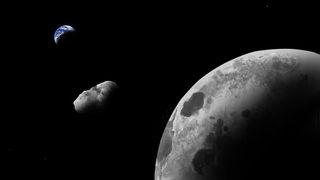
An artist impression of Earth quasi-satellite Kamo`oalewa. Astronomers using the Large Binocular Telescope have shown that it might be a lost fragment of the moon.
(Image credit: Addy Graham/University of Arizona)
British Astronomer Claims to Have Discovered the Mysterious Planet 9
Many great discoveries occur when researchers go back over old data for a second or third or fourth or nth look. A famous British astronomer claims he took another look at data collected nearly 40 years ago using the first space telescope to perform a survey of the entire night sky at infrared wavelengths and thinks he’s found the holy grail of astronomy – Planet 9.
“In 1983, while working on the preparation of the IRAS Point Source Catalog, I undertook a systematic search for Planet X in the IRAS data. The search was unsuccessful though it did yield a detection of Comet Bowell (Walker and Rowan-Robinson 1984).”

Michael Rowan-Robinson is an astronomer, astrophysicist and professor of astrophysics at Imperial College London perhaps best known as the doctoral advisor to the most rocking astrophysicist ever – guitarist Dr. Brian May of the band Queen. His work in the early 1980s with data from the Infrared Astronomical Satellite (IRAS) yielded an asteroid but no mysterious planet messing up the orbit of Neptune. Rowan-Robinson moved on from Planet X (his research took place when Pluto was still a planet), but after seeing all of the attention given to Konstantin Batygin and Mike Brown of the California Institute of Technology after they proposed 2016 that the strange orbits of six trans-Neptunian objects could be caused by a Planet 9, he decided to review the old data again. Since no one had found it yet by looking where Brown and Batygin said it would be, Rowan-Robinson aimed his search elsewhere.
After filtering out background sources of infrared radiation like stars and galaxies, Rowan-Robinson looked for objects that could disrupt the trans-Neptunian orbits and found several hundred. However, none matched the Planet 9 criteria of Brown and Batygin and all were much closer to Earth than they predicted. He found three that looked promising and one of them met all of his criteria for a Planet 9 – it was in the direction of the Constellation Cepheus, was between 3 and 5 Earth masses and orbited the Sun at a distance of 225 Astronomical Units. That object is R20593 + 6413 and the evidence was convincing enough to Rowan-Robinson to publish it in arXiv open access archive – the paper is also accepted for publication in the Monthly Notes of the Royal Astronomical Society. Is this a drop-the-mic-we-found-Planet-9 moment?

“Balderdash!” or whatever astronomers say when contradicted. At Olhar Digital, Mike Brown says that R20593 + 6413 would not be able to gravitationally disturb the trans-Neptunian objects like his definition of Planet 9 would. However, he admits R20593 + 6413 could be real – it’s just not Planet 9. Rowan-Robinson concedes that the IRAS images are old and a new look with stronger telescopes would help.
In other words, hang onto the mic and hold off on the Queen concert for the time being.
Are There Really Dead Aliens Stored Away in Military Facilities?
Although, as you may well know, I don’t have much faith in the theory that UFOs have crashed to Earth and that their mangled crews are stored away in some kinds of “cryogenic tanks.” But, I guess it’s not impossible. Today, there aren’t many reports of this particularly type. Back in the 1950s and 1960s, however, such stories were all over the place. As you’ll see now. Consider these words: “The subject of UFOs is one that has interested me for some long time. About ten or twelve years ago I made an effort to find out what was in the building at Wright-Patterson Air Force Base where the information is stored that has been collected by the Air Force, and I was understandably denied this request. It is still classified above Top Secret.” Intriguing words; and they are made even more intriguing by the fact that they were set forth in a 28 March 1975 letter to the UFO investigator Shlomo Arnon by none other than the late Senator Barry Goldwater, formerly the chairman of the U.S. Senate Intelligence Committee. For years, it has been rumored that at Wright-Patterson Air Force Base, Dayton, Ohio, there exists a highly-classified (and decidedly off-limits) series of rooms, aircraft hangars and underground chambers, where the preserved remains of a number of dead alien creatures are stored along with the wreckage of their crashed and recovered spacecraft. In specifically generic and folkloric terms, the location of this astonishing evidence has become popularly known as Hangar 18.

Of those who attempted to force open the doors of Hangar 18, the late Leonard Stringfield was certainly the most active. A United States Air Force Intelligence officer during the Second World War, Stringfield collected a huge amount of data that, if true, suggested that at Wright-Patterson AFB there existed an absolute wealth of UFO material, debris and even alien bodies, locked away from prying eyes. Of the many accounts that were brought to Stringfield’s attention, two came from the researcher Charles Wilhelm. As Stringfield recalled, “In 1959, a lady living alone in Price Hill, Cincinnati, had hired young Charles to cut her grass all summer. She knew of his interest in the UFO [subject] but said little about it until she became ill with cancer. Knowing that she had a short time to live, she called Charles to her bedside to reveal a startling story. She said that she had had a Top Secret clearance in her past work at Wright-Patterson and had seen two saucer-shaped craft in a secret hangar. One craft was intact; the other, damaged. She also knew of two ‘small creatures’ preserved inside another secret building, and had personally handled the paperwork on their autopsy report. She told Charles, ‘Uncle Sam can’t do anything to me after I’m in the grave.'”
The second revelation came to Stringfield from Wilhelm following his acquisition of sensitive intelligence data in 1966: “Wilhelm got the story from a friend in the Army Reserve whose father worked with Project Blue Book at Wright-Patterson Field and held high security clearance,” stated Stringfield. “On his deathbed, he related to his son that he had seen two disc-shaped craft, one intact and one damaged, and four preserved, small alien bodies ‘packed in chemicals.'” But from where had Wright-Patterson acquired this incredible material evidence? Much of the witness testimony suggested that its point of origin was the New Mexico desert, circa July 1947: Roswell. There are long-standing allegations to the effect that during the summer of 1947, a UFO crashed in the deserts of New Mexico and, along with its dead crew was whisked away under cover of overwhelming secrecy to Wright-Field (later re-named Wright-Patterson), where both the UFO and the alien bodies were placed into storage for preservation and analysis.

(Nick Redfern),
Roswell, New Mexico, 2017
For example, from ex-military man, Norman Richards, formerly of the U.S. 25th Tropic Lightning Division, there came an account based upon his recollections of events that occurred in the post-World War Two era: “In 1950, I was in the ROTC program of the Air Force at Indiana University. We were sent to Lowry Air Force Base for six weeks training that summer. One day, we had a lecture by a colonel from Wright-Patterson AFB. He outlined many changes and new experimental aircraft being tested. During the question and answer session, he was asked if UFOs were real. He got very excited and said we better believe it. He went on to tell us of the crash, and retrieval of the parts, and the humanoids found at the site. He said they were under investigation at Wright-Patterson after being flown from Roswell, New Mexico.”
As Leonard Stringfield’s inquiries into Wright-Patterson’s involvement in the crashed UFO issue deepened, further sources came forward with additional data. Citing one such source, Stringfield asserted, “My informant is self-employed after serving a long career with the Air Force, retiring with the rank of major. During one of our several discussions of the UFO problem, when I cited some of the medical information relative to the recovered alien humanoids, he confided in me that in 1952 he had attended a high-level secret meeting at Wright-Patterson AFB and saw in an underground chamber one of the deceased alien bodies in deep-freeze preservation. The body was about four feet tall. The head was large by human standards, and the skin on the face appeared smooth and gray. No bone structure was evident; eyes were open, no hair. The feet, he said, were like an orangutan.” What was perhaps the most fantastic account related to Stringfield, however, concerned an allegedly live alien on the loose at the Air Force Museum in Fairborn, Ohio, that had supposedly escaped from its confines within the bowels of Wright-Patterson. It was a Sunday in 1965 when “R.M.” and his wife decided to pay a visit to the museum. With his wife engrossed in examining a German V-2 rocket, R.M. wandered off and found himself lost and heading down a corridor with a double door marked OFF LIMITS.
RELATED VIDEOS, selected and posted by peter2011
Aliens Are Interdimensional Demons: Exposing The Strong Delusion
By Lee Austin
Haim Eshed, former head of Israeli’s Defense Ministry space directorate admitted that Israel has made contact with extraterrestrials. ”The Unidentified Flying Objects have asked not to publish that they are here, humanity is not ready yet,” said Mr. Eshed. Further adding cooperation agreements had been signed between humans and extraterrestrials. ”There is an agreement between the U.S. government and the aliens. They signed a contract with us to do experiments here, They have been waiting until today for humanity to develop and reach a stage where we will understand, in general, what space and spaceships are, The Unidentified Flying Objects have asked not to publish that they are here, humanity is not ready yet,” Eshed said, referring to the galactic federation.
A respected professor and retired general, Eshed stated the aliens were also interested in humans and were seeking to understand the fabric of the universe.
So who are these aliens and where did they come from?
Actually, “aliens” is a misnomer. These extraterrestrials are in fact Interdimensional beings, known as demons, dating back to the days of antiquity. Let’s first clarify the difference between a demon and a dark angel.
Demons are persons without bodies. They are the disembodied, fierce spirits set loose upon and below the earth after the flood spoken of in the book Genesis. When two hundred rebel watcher angels took on a garment of flesh and had intercourse with woman, a race of half angel. half human hybrids called the Nephilim were created. After God flooded the earth, all of the Nephilim were killed. However. the disembodied spirits of the Nephilim continued to live, because angels are eternal beings. These fierce spirits became what we now refer to as demons, whose purpose is to steal, kill and destroy.
Soon after the flood, Noah’s sons complained to their father, the demons were oppressing everyone. When Noah plead to God for a resolution, the Lord decided to send ninety percent of the demons into the abyss under the earth. And allow the other ten percent of the demons to remain on the earth. Therefore a demon is always seeking to inhabit a human, animal or material object. In that order.
Demons are more effective when operating within a human host. Many times when someone who has a demon inside of them dies, the demon will leave the deceased and take up residence in the offspring. This is known as a familiar spirit. A spirt familiar with a family’s sins and generational curses
Angels on the other hand are spirits created by God, sent to earth to assist the heirs of salvation. Angels have a celestial body hosting their spirit, and can also transform their heavenly body into a human body, unbeknownst to man. Even a dark angel will have it’s own type of celestial body, and therefore not have a need to search out a human host to inhabit. A demon is a lower terrestrial spirit, limited to our first heavenly plane of existence and the abyss. Angels can access all of the multiple heavens in the universe.
I don’t doubt the former head of Israeli’s Defense Minister space directorate has been in direct contact with interdimensional beings. Israel is renowned for being a ”thin place.” A thin place is a location where the veil between this world and the eternal world is thin. A thin place is where one can walk in two worlds – the worlds are fused together, knitted loosely where the differences can be discerned or tightly where the two worlds become one. With Jerusalem being the spiritual epicenter of the world, it is a very thin place. Home to all three of the major religions, Christianity, Judaism and Islam. And it is where the third temple will be built and the coming Anti-Christ will rule and reign for seven years.
The end time strong delusion will be disclosure and the lie of Panspermia. The theory that life on the earth originated from microorganisms or chemical precursors of life present in outer space and able to initiate life on reaching a suitable environment. I believe these dark angels are consorting with the Luciferian elite mainly in Jerusalem, Rome, London and Washington D.C. to orchestrate the illusion of our alien overlords. In essence the panspermia lie is as follows. “We are your creators. The great architect who also made this world and everything in it. We’ve been observing you, and in your time of greatest need, we are here to help you and reveal the secrets of the universe.”
The coming “Great Reset” will not just be economical, but spiritual. The Great Whore of Babylon is on the horizon
Lee Austin is the author of “Morning Star’s Tale” https://morningstarstale.com/
Alien Base Or UFO On Side Of Mountain of Mars, UFO Sighting News

 UFO Over BBQ In Murviel, France Nov 9, 2021, UFO Sighting News.
 TOP U.S. Spy Breaks Silence On Alien Phenomenon!

UFOs buzzing US warships may be aliens: Top spy chief.
RELATED VIDEOS, selected and posted by peter2011
WAT VEROORZAAKTE DE EERSTE GROTE VERWOESTENDE MASSA-EXTINCTIE DIE DE AARDE DOORMAAKTE?
Zo’n 445 miljoen jaar geleden werd zo’n 85 procent van de mariene soorten bruut van de aardbodem geveegd. Maar wat lag er aan de teloorgang van al dit leven ten grondslag?
De meesten zullen weten dat de dinosaurussen uitstierven tijdens een grote massa-extinctie. Maar wist je dat de aarde ook andere massa-extincties heeft doorgemaakt? In totaal hebben er vijf de revue gepasseerd – bekend als de ‘big five’ – waarbij tenminste driekwart van alle soorten die op aarde leefden met uitsterven werd bedreigd. In dit artikel haken we in op de eerste massa-extinctie die de aarde doormaakte: de zogenaamde Laat-Ordovicische massa-extinctie. Want wat lag hier precies aan ten grondslag?
Oorzaak van massa-extincties
Wetenschappers zijn al langer geïnteresseerd in het achterhalen van de oorzaak van massa-extincties. Dat komt omdat het begrijpen van de omgevingsomstandigheden die in het verleden geleid hebben tot de uitroeiing van de meeste soorten, ons zou kunnen helpen voorkomen dat een soortgelijke gebeurtenis zich in de toekomst herhaalt. Bovendien denken veel wetenschappers dat we ons momenteel middenin een zesde massa-extinctie bevinden. En dus is het bestuderen van dit fenomeen belangrijker dan ooit.
Laat-Ordovicische massa-extinctie
De Laat-Ordovicische massa-extinctie vond zo’n 445 miljoen jaar geleden plaats. Tijdens deze massale uitsterving verdween ongeveer 85 procent van de mariene soorten, waarvan de meeste in ondiepe wateren voor de kust van continenten leefden, van de aardbodem. En dat terwijl daarvoor, ten tijden van de Ordovicium-periode, de zeeën vol biodiversiteit zaten. “Als je in een Ordovicische zee was gaan snorkelen, zou je een aantal bekende dieren hebben gezien, zoals mosselen, slakken en sponzen,” schetst onderzoeker Seth Finnegan. “Maar je zou ook veel andere soorten zijn tegengekomen die nu zeer beperkt in diversiteit zijn of volledig zijn uitgestorven, zoals trilobieten, armpotigen en zeelelies.”

Fossielen uit de Ordovicium-periode, gevonden op het Canadese eiland Anticosti.
Afbeelding: André Desrochers, University of Ottawa
Maar dan gebeurt er iets rampzaligs. In tegenstelling tot de massa-extinctie waarbij de dinosaurussen vrij plotseling uitstierven, speelde de Laat-Ordovicische massa-extinctie zich af over een vrij lange periode. Mogelijk strekte deze massale uitsterving zich zelfs uit over twee miljoen jaar. Maar wat lag er aan de teloorgang van al dit leven ten grondslag?
Vraagteken
We weten dat het klimaat destijds afkoelde. Maar kan dat het verlies van maar liefst 85 procent van het zeeleven hebben veroorzaakt? “Van verschillende geologische recentere massa-extincties is bekend dat ze zijn veroorzaakt door vulkanisch aangedreven snelle opwarming en het daaruit voortvloeiende verlies van zuurstof in de oceanen,” vertelt Finnegan in gesprek met Scientias.nl. “Maar wat met name opvalt aan de Laat-Ordovicische massa-extinctie is dat de combinatie van veranderingen in het milieu die gepaard gaan met het uitsterven, ongebruikelijk en moeilijk te begrijpen zijn.”
Gebrek aan zuurstof
Eén van de belangrijkste discussies rond de Laat-Ordovicische massa-extinctie is of gebrek aan zuurstof in het zeewater de oorzaak van de massa uitsterving is geweest. Om die vraag te onderzoeken, maten de onderzoekers de concentratie jodium in carbonaatgesteenten uit de Laat-Ordovicische periode. De concentratie van dit element in carbonaatgesteenten dient namelijk als een belangrijke indicator voor veranderingen in het oceanische zuurstofniveau.
Ondiepe wateren
Het leidt tot een interessante ontdekking. “In ons artikel tonen we aan dat het inderdaad waar lijkt te zijn dat de hoeveelheid opgeloste zuurstof in de diepe oceaan afnam,” vertelt Finnegan. “Maar, we vonden geen bewijs voor een afname van zuurstof in ondiepe wateren. En juist hier leefden de meeste diersoorten die uitstierven. Het betekent dat een afname van zuurstof de massa-extinctie waarschijnlijk niet kan verklaren.”
Maar als de massa-extinctie niet in gang werd gezet door zuurstofgebrek, wat lag er dan aan ten grondslag? Hoewel de onderzoekers hier geen volledig uitsluitsel over kunnen geven, vermoeden ze dat koudere omstandigheden tijdens het late Ordovicium, gecombineerd met aanvullende factoren, waarschijnlijk verantwoordelijk waren voor de ondergang van talloze diersoorten.
Klimaatkoeling
“De veroorzaker kan dus goed de klimaatkoeling zelf zijn geweest,” onderstreept Finnegan. “We zien aanwijzingen voor zeer substantiële klimaatkoeling en uitbreiding van ijskappen, met een grote bijbehorende zeespiegeldaling. Deze afkoeling en daling van de zeespiegel kunnen aanzienlijk veelomvattender zijn geweest dan tijdens recentere ijstijden. Dit betekent dat verlies van leefgebied verantwoordelijk kan zijn geweest voor een deel van de uitsterving. De vraag is echter of zoveel uitsterving (85 procent van de mariene soorten, red.) aan het verlies van leefgebied kan worden toegeschreven.”
Zullen we het ooit weten?
De vraag is of we het mysterie van de Laat-Ordovicische massa-extinctie ooit volledig zullen ontrafelen. “Een gevolg van de daling van de zeespiegel is dat de mariene sedimentaire gesteenten vrij schaars zijn geworden,” zegt Finnegan. “Dus om te begrijpen wat de meeste uitsterving veroorzaakte, moeten we die gebieden in detail bestuderen, maar ook modellen gebruiken om te proberen te begrijpen wat er is gebeurd in de delen van de wereld waarvoor we geen goed bewaard gebleven sedimentaire gegevens hebben. Het is een zeer uitdagend probleem. Maar ik ben optimistisch dat we er als gemeenschap grip op beginnen te krijgen.”
Wat de onderzoekers in hun studie in ieder geval hebben aangetoond, is dat één van de vaakst aangevoerde verklaringen – zuurstofgebrek in de oceanen – waarschijnlijk de Laat-Ordovicische massa-extinctie niet kan verklaren. Toch moeten we volgens onderzoeker Zunli Lu onze zuurstofrijke wereld ook zeker niet als vanzelfsprekend beschouwen, zo vertelt hij in een interview met Scientias.nl. “Veel is nog onbekend over eerdere massa-extincties. We begrijpen deze gebeurtenissen nog lang niet volledig. Het zou verstandig zijn om het oceaanmilieu en het klimaatsysteem niet verder drastisch te verstoren voordat de menselijke samenleving in staat is om uitgebreide veranderingen in het aardsysteem beter te voorspellen en te verminderen,” besluit hij.
GERELATEERDE VIDEO'S, uitgekozen en gepost door peter2011
'TSUNAMI' AAN ZWAARTEKRACHTSGOLVEN GEDETECTEERD NASA Tries to Save Hubble, Again
THE HUBBLE SPACE telescope, one of the most famous telescopes of the 20th and 21st centuries, has faltered once again. After a computer hardware problem arose in late October, NASA engineers put Hubble into a coma, suspending its science operations as they carefully attempt to bring its systems back online.
Engineers managed to revive one of its instruments earlier this week, offering hope that they will end the telescope’s convalescence as they restart its other systems, one at a time. “I think we are on a path to recovery,” says Jim Jeletic, Hubble’s deputy project manager.
The problem began on October 23, when the school bus-sized space probe’s instruments didn’t receive a standard synchronization message generated by its control unit. Two days later, NASA engineers saw that the instruments missed multiple such messages, so they put them in “safe mode,” powering down some systems and shuttering the cameras.
Some problems are fairly easy to fix, like when a random high-energy particle hits the probe and flips a bit on a switch. But when engineers encounter an unknown problem, they’re meticulous. The slow process is designed to protect Hubble’s systems and make sure the spacecraft continues to thrive and enable scientific discovery for as long as possible. “You don’t want to continually put the instruments in and out of safe mode. You’re powering things on and off, you’re changing the temperature of things over and over again, and we try to minimize that,” Jeletic says.
In this case, they successfully brought the Advanced Camera for Surveys back online on November 7. It’s one of the newer cameras, installed in 2002, and it’s designed for imaging large areas of the sky at once and in great detail. Now they’re watching closely as it collects data again this week, checking to see whether the error returns. If the camera continues working smoothly, the engineers will proceed to testing Hubble’s other instruments.
Hubble has had its share of hiccups over its long and productive career, during which it has documented everything from ancient galaxies to the birth and death of nearby stars. It launched in 1990, just a few months after the fall of the Berlin Wall, and it was deployed by the crew aboard the space shuttle Discovery. It now orbits about 340 miles above the Earth. On five occasions since its deployment, astronauts on NASA shuttles have conducted servicing missions to repair and upgrade its systems, boosting the impressive longevity of the telescope, which was originally expected to only last about a decade. Astronauts aboard the shuttle Atlantis completed the final such mission in May, 2009, when they repaired its spectrograph, among other things. Since then, all other reboot attempts have been conducted from Earth; engineers are no longer able to replace the telescope’s hardware.
Jeletic and his team also try to anticipate potential mishaps. For example, they found that the thin wires Hubble’s gyroscopes depend on gradually corrode and break, and three of its six gyros have failed. Without gyros, Hubble can’t target anything properly. But on the last servicing mission, astronauts replaced the gyros and enhanced the wires so that they can’t corrode, solving the problem.
Nevertheless, each new hitch inevitably raises concerns about the aging telescope, which has been instrumental in so many astronomical accomplishments, including pinning down the age of the universe and discovering the smaller moons of Pluto. “I think it’s been utterly transformational,” says Adam Riess, an astronomer at Johns Hopkins University in Baltimore. He shared the 2011 Nobel Prize in Physics for showing how measurements of exploding stars, or supernovas, reveal the accelerating expansion of the universe, a project that benefited from Hubble data. To this day, the telescope continues to be oversubscribed by at least fivefold, Riess says, meaning astronomers have more than five times as many proposals for using Hubble as there is available telescope time.
The space telescope has also served as an educational tool and kindled public interest in space science for a whole generation. “Everybody knows Hubble,” says Jeyhan Kartaltepe, an astronomer at the Rochester Institute of Technology, whose work on multiple galaxy surveys makes extensive use of Hubble images. “It has become a household name. People enjoy reading articles about what Hubble has discovered, and they enjoy seeing the pictures. I think people have an immediate association of Hubble with astronomy.”
Hubble’s latest hardware challenges come just a month before its successor, the James Webb Space Telescope, is scheduled to launch into orbit. Like its iconic predecessor, the new telescope will collect troves of spectacular images, though it’s designed to probe wavelengths more in the infrared range, allowing it to penetrate dusty parts of galaxies and stellar nebulae. Riess expects it to be similarly popular with astronomers and with the public.
Hubble has easily surpassed its expected lifespan, and the same goes for NASA’s Chandra X-ray Observatory, which launched in 1999 and remains operational, although it was designed to last only five years. This is a good sign for Webb, similarly planned for a five-year lifespan. Unlike Hubble, however, it will orbit much farther away, making it inaccessible to astronauts. That means any problems that arise will have to be fixed remotely.
But Hubble helped set the stage for its successor. For example, after Hubble launched, engineers realized that its mirror wasn’t curved properly, initially resulting in blurry images. Webb’s design allows for engineers to adjust the curvature remotely if an error like that crops up.
Astronomers appreciate the hard work of Hubble’s engineers and operators. “Their dedication to keep on rescuing the telescope from all its fits of pique and changes of mood is fantastic. I’m so proud of them backing the scientists who are using the data,” says Julianne Dalcanton, an astronomer at the University of Washington who has used Hubble frequently throughout her career, including to map Andromeda, our galactic neighbor. She, Kartaltepe, and other astronomers look forward to a time when both Hubble and Webb are in the sky, taking observations together, especially as they’ll learn different things from the telescopes’ respective instruments and wavelength coverage.
While Jeletic and his team don’t yet know when Hubble will be back online, he expects all systems to eventually be up and running once again. “Some day Hubble will die, like every other spacecraft,” he says. “But hopefully that’s still a long ways off.”
EXCLUSIVE: Striking video shows pulsating orb drop down from the sky and cruise alongside two FedEx pilots flying over Mexico that experts believe is a UFO with a plasma forcefield to deflect radar
A video exclusively obtained by DailyMail.com shows a pulsating orb caught on camera by FedEx pilots flying over Mexico – which experts say could be a UFO with a plasma forcefield that may help it fly or deflect radar.
On March 19, 2020 two FedEx pilots were flying a cargo airplane near Monterrey, Mexico, when they saw a bright light drop down from the sky, stop at their altitude, shoot them with a beam of light, then move in tandem with the plane for over 30 minutes before flying away.
The captain shot a stunning video of the encounter, which was analyzed in a report by the National Aviation Reporting Center on Anomalous Phenomena (NARCAP), a nonprofit organization that studies pilots' brushes with UFOs to help develop safety procedures.
The report did not name the pilots, as many in the aviation industry are still wary of the stigma around UFOs despite official acknowledgement of the phenomena by the U.S. and other governments.
But NARCAP executive director Ted Roe, the author of the report, told DailyMail.com that the pilots' account was 'very consistent with what pilots have been reporting for over 100 years.'
On March 19, 2020 two FedEx pilots flying a cargo airplane near Monterrey, Mexico, saw a bright light drop down from the sky

The UFO stopped at their altitude, shot them with a beam of light, then moved in tandem with the plane for over 30 minutes before flying away

Mysteriously, the UFO did not show up on the plane's radar. Experts say it could be a UFO with a plasma forcefield that may help it fly or deflect radar
The captain of the Boeing 767 cargo plane is 'a career pilot with 19 years of experience flying wide-body aircraft for a major cargo company with an additional 10yrs flying KC-135 refueling tankers for the US Air Force,' according to the report, while the first officer was a 'career fighter pilot that flew f-15s before working in the private sector.'

NARCAP executive director Ted Roe told DailyMail.com that the pilots' account was 'very consistent with what pilots have been reporting for over 100 years'
They were described as 'competent airmen, highly experienced with observing and identifying aircraft, and are capable of determining normal observations and incidents from unusual ones.'
The plane left Queretaro International Airport north of Mexico City at 8.05pm, and was about 150 miles south of Monterrey on its way to Memphis, Tennessee, when the unidentified object appeared.
'The incident began when the First Officer, looking across to the left side of the cockpit, saw a yellowish white light descend into view from above,' the report said.
'He first believed that it was a meteor and began to say so when it suddenly stopped near the same altitude as their aircraft. The UAP [unidentified aerial phenomenon]/Light then projected an illuminating beam of bright, white, light on their aircraft, and appeared to take a collision heading.
'At this moment the Captain also saw the beam of light projected onto their aircraft from the UAP/Light. Both crewmen, in the belief that an aircraft with its landing lights on had turned onto a collision heading with their aircraft, took a defensive attitude and prepared for evasive control inputs.'
But instead of heading to crash into them, the UFO then started to move in tandem with the plane between 1,000 and 2,000 ft away.
'As they prepared to avoid the apparently approaching UAP/Light, the beam of light illuminating their aircraft ceased, and the UAP/Light suddenly accelerated to the same speed and heading of the aircraft, maintained separation, and paced the aircraft,' the report said.
In the video the captain can be heard expressing his shock and excitement at seeing a UFO, which he described as 'a brilliant yellow white plasma object, teardrop shaped.'
The report said it had 'no navigation lights or other features associated with airplanes'.
The captain took a five-minute video of the object, three other clips and eight photographs.
Mysteriously, the UFO did not show up on the plane's radar.
'I thought it was a shooting star but then it stopped,' the former Air Force pilot said in the video.
'It's like an orb man, look at that s**t. It's pulsating. This is awesome. And he's not on TCAS [the plane's radar].
'That is s**t hot… Oh man, look at that thing dude.
'That is an unidentified flying object bro, I can finally say I saw one. That is cool.'
'You saw it just drop out of the sky and just stop?' he asked his copilot.
'Yeah. I thought it was a shooting star and then it stopped,' the former F-15 pilot replied.

The plane left Queretaro International Airport north of Mexico City at 8.05pm, and was about 150 miles south of Monterrey on its way to Memphis, Tennessee, when the unidentified object appeared

The captain was flying a similar Boeing 767 cargo plane. He was described as a 'a career pilot with 19 years of experience flying wide-body aircraft for a major cargo company'
Discussing whether it could be a weather balloon, the captain said: 'The only weather balloon we have is near [inaudible], it's 15,000 ft AGL [above ground level]. This thing's above our altitude.'
The 767 was flying at approximately 575 mph at 37,000 ft when the encounter happened.
'As the aircraft and its attendant UAP/Light approached the Mexico/US border the UAP/Light began to flicker, it changed colors from yellow-white to pinkish/purple, and turned on a perpendicular heading away from the aircraft and parallel to the border without crossing into the United States,' the report said.
'We're going to lose him in the clouds, son of a b***h,' the captain said towards the end of the video.
'There's weather about 40 miles off our left wingtip where this thing seems to have disappeared. It didn't have strobes or beacon or nothing.'
The captain filmed his radar screen showing no sign of the UFO, just patches of clouds to the west of the 767.
Aviation experts on the website Metabunk, including renowned UFO debunker Mick West, tried to explain the light as the planet Venus, and the pulsating as a deceptive effect from the camera autofocus adjusting its lens in the dark.
Although the flight was not identified in the NARCAP report, West identified it from flight records matched to the times in the report as FedEx flight FDX82, which departed Queretaro 50 minutes late at 8.55pm and arrived in Memphis around 12.20am.
West dug out star maps showing Venus was in a similar location in the sky to where the pilots saw the pulsating light, sitting about 10 degrees above the horizon at that time of night.
'Out of focus with atmospheric distortion and focus seeking, it looks like a wobbly pulsating blob,' he wrote.
West posted videos on the debunking forum showing how stars can appear to flash or ripple on camera from atmospheric distortions or heat shimmer, exaggerated by an autofocus lens coming in and out of focus.
However, the pilots told NARCAP they saw the pulsing, plasma-like appearance with their own eyes as well as capturing it on camera, and described seeing the pulsing light, as well as the inexplicable movement of the object – dropping from the sky, coming to a complete stop in mid-air and then matching their speed and direction.
NARCAP executive director Ted Roe says, 'We have a database going back to 1916. It describes four basic types of UAP encounters and they are balls of light, spheres, cylinders and discs,' he said.
'I went through the analysis. There was some argument that it could have been an astronomical effect. Venus was quite bright that night.
'But when you take the entire narrative of how they describe it dropped in vertically, stopped at their altitude and then paced their aircraft, that is a very consistent story. We've had many of those.
'They flew northbound out of Queretaro Airport. Venus was quite high in the western sky at that point and bright, they were well aware of it. They were at 37,000 ft.
'When he turns the camcorder towards his radar, which is probably the most important aspect of this case and really the only reason I took it on, it confirmed what I've been saying all along which is that UAP are intermittently detected on radar. He turned his camera on his radar monitor and there was no detection.
'It also showed there were clouds to the West, and if Venus was parallel to his aircraft, appearing to be at his altitude, the clouds would have obstructed it.'
Roe said both the 'teardrop' shape that the UFO made as it moved through the air and the lack of radar return could be due to plasma surrounding it.
'We didn't get a clearly defined video of what this phenomenon was. But we have the description. It was teardrop shaped, white/yellow. I'm guessing that these things are plasma or have plasma involved in them,' he said.
'We use plasma to cut the radar cross-section on the reflectable parts of a stealth aircraft. They might use plasma actuators to absorb that signal rather than allow it to reflect.'

The plane left Queretaro International Airport (pictured) north of Mexico City at 8.05pm on its way to Memphis, Tennessee
In 2011, researchers at the University of Florida wrote a report on a 'proof-of-concept demonstration' of how plasma could be used to make a wingless object 'selflift, hover and fly'.
Their experiments, sponsored by the Air Force Office of Scientific Research, involved 'building, characterization, testing, and simulation of plasma actuators, aerodynamics, power and propulsion systems, micromachining and microfabrication.'
NARCAP was founded in 1999 specifically to investigate and document the safety implications of pilots' encounters with reports of UFOs,
It has a staff of about 50 specialists that conduct 'investigations, analysis, publications and activism related to UAP and aviation safety.'
NARCAP's chief scientist, Dr. Richard Haines, has collected 'over 3,400 cases of aviation-related observations and incidents involving unidentified aerial phenomena' according to the organization.
Roe told DailyMail.com that one of his continued frustrations is that the Federal Aviation Administration (FAA) refuses to document incidents like those of the FedEx pilots.
'The FAA literally will not accept their reports,' he said. 'The aeronautical instruction manual, which is the primary manual for air crews, tells them if they want to report a UFO they can contact a civilian UFO reporting center.
'This has been going on for decades. The information is lost to the aviation system and safety planners because the data is never presented to the aviation system to begin with.
'Recently we've had this UAP Task Force and government activity on the subject. In the report, the Director of National Intelligence on June 25 stated that UAP are a hazard to aviation, and they were rather clear about it.
'When they were out looking for data, I can't imagine what it was like going into the FAA's offices, and saying 'you guys must have all this great UFO data, we need it now,' and there isn't any because they've been telling the pilots they don't take those reports.'
Watch that video below…
FedEx Pilots Film ‘Pulsating’ UFO Following Their Plane, Expert Calls It ‘A Threat To Safe Aviation’
BY
ISTOCKPHOTO
Two FedEx pilots flying a cargo plane near Monterrey, Mexico had an encounter at 37,000 feet with a UFO that has experts perplexed.
The pilots claim that as they were flying near Monterrey, Mexico a bright light dropped down from the sky, stopped at their altitude, shot them with a beam of light, then moved in tandem with the plane for over 30 minutes before flying away, reports DailyMail.com.
The UFO incident, which occurred on March 19, 2020, was captured on video, along with audio revealing their dialogue during the sighting.
While the two pilots remain unnamed, the captain of the Boeing 767 cargo plane is “a career pilot with 19 years of experience flying wide-body aircraft for a major cargo company with an additional 10yrs flying KC-135 refueling tankers for the US Air Force,” according to a National Aviation Reporting Center on Anomalous Phenomena (NARCAP) report. The first officer is “a career fighter pilot that flew f-15s before working in the private sector.”
The initial reporting of this UFO sighting shed little light on the details surrounding it, but this week NARCAP executive director Ted Roe spoke with DailyMail.com and offered up some new insight.
‘The FAA literally will not accept their reports,’ he said. ‘The aeronautical instruction manual, which is the primary manual for air crews, tells them if they want to report a UFO they can contact a civilian UFO reporting center.
‘This has been going on for decades. The information is lost to the aviation system and safety planners because the data is never presented to the aviation system to begin with.
‘Recently we’ve had this UAP Task Force and government activity on the subject. In the report, the Director of National Intelligence on June 25 stated that UAP are a hazard to aviation, and they were rather clear about it.
‘When they were out looking for data, I can’t imagine what it was like going into the FAA’s offices, and saying ‘you guys must have all this great UFO data, we need it now,’ and there isn’t any because they’ve been telling the pilots they don’t take those reports.’
Footage of the UFO incident near Monterrey, Mexico taken by the FedEx pilots, described as “competent airmen, highly experienced with observing and identifying aircraft, and are capable of determining normal observations and incidents from unusual ones,” was analyzed by Roe’s group at the NARCAP.
In the video, one of the pilots can be heard talking about “a brilliant yellow white plasma object teardrop shaped” object in the sky.
They were so concerned about what they were seeing that the daptain engaged the Combined TCAS and cockpit display and activated the Airborne Collision Avoidance System SSR (Secondary Surveillance radar) system.
Radar did not detect anything in the sky.
According to the NARCAP report, “The UAP/Light came from above and stopped/hovered near FL37, about the same altitude as the aircraft, shone a light on the 767 and briefly approached the aircraft. Then it instantly matched the speed, and heading of the aircraft and maintained a consistent separation.”
a. The light descended vertically, stopped abruptly, and shone a light on the 767 causing the crew to believe that there was another airliner on a collision heading with its landing lights on.
b. It changed direction from vertical descent to a sudden stop/hover, to approaching the aircraft briefly, to taking the same heading and speed of the aircraft at about the same altitude and an estimated distance of 1-2k ft.
c. It matched the altitude, speed, and heading of the aircraft, 575mph and at 37,000ft for over 32 minutes.
d. The UAP/Light changed colors and turned away from the aircraft on a perpendicular heading, West, just inside the Mexico/US border.
e. The UAP/light did not have wings or running lights. It was a new and unique observation to the experienced air crew.
These movements, the report explains, “are not consistent with known aerial phenomena but they are characteristic movements of UAP.”
“We have a database going back to 1916. It describes four basic types of UAP encounters and they are balls of light, spheres, cylinders and discs,’ Roe told DailyMail.com.
“I went through the analysis. There was some argument that it could have been an astronomical effect. Venus was quite bright that night.
“But when you take the entire narrative of how they describe it dropped in vertically, stopped at their altitude and then paced their aircraft, that is a very consistent story. We’ve had many of those.”
Roe also added that the FedEx pilots’ account of their UFO experience is “very consistent with what pilots have been reporting for over 100 years.”
“The primary difference being that this case is on video. Now there are cameras in the cockpits and they are validating what pilots have been describing anecdotally for over 80 years and the work of NARCAP over the last 20 years,” reads the report.
Watch that video below…
Gamma rays detected from UFOs in several nearby galaxies
The gamma-ray discovery could advance understanding of UFOs’ role in the evolution of galaxies.
 Image: Clemson University
Scientists- using data gathered by the Large Area Telescope onboard NASA’s Fermi Gamma-ray Space Telescope- for the first time, have detected gamma rays from UFOs in several nearby galaxies. This discovery was made possible by using a stacking technique combining signals too weak to observe independently.
UFOs stand for ultra-fast outflows, which are strong winds launched from very near supermassive black holes. These UFOs are believed to play a vital role in adjusting the growth of the black hole itself and its host galaxy.
Chris Karwin, a postdoctoral fellow in the College of Science’s Department of Physics and Astronomy and leader of the study, said, “Although these winds are challenging to detect, it is thought that they play a significant role in how a massive black hole and the host galaxy itself grow. Our gamma-ray observations show how supermassive black holes can transfer a large amount of energy to their host galaxy. These UFOs create shock waves, which act like pistons and accelerate charged particles, known as cosmic rays, to near the speed of light.”
Marco Ajello, an associate professor in Clemson College of Science’s Department of Physics and Astronomy who is co-leading the study, said, “While traveling through the galaxies, the winds gradually disable star formation. The effect on the galaxy is dramatic. The black hole at the center of the galaxy and the galaxy itself have a mechanism to grow together in mass — and this is the mechanism.”
Karwin said, “Because cosmic rays produce the gamma rays detected accelerated at the shock front. It attests to the onset of the wind-host interaction and that the UFOs can energize charged particles up to the transition region between galactic and extragalactic cosmic rays.”
According to scientists, the discovery could help us understand what happened in our own Milky Way galaxy.
Karwin said, “Today, our black hole, Sagittarius A*, is not active, but it’s possible it was active in the recent past, maybe up until a few hundred years ago. Our model supports the hypothesis that these Fermi bubbles may be remnants of past UFO-like activity from the supermassive black hole in the center of our galaxy.”
Ajello said, “future work includes studying galaxies that have had active UFO winds for 10s of millions of years that have already traveled to the outskirts of the galaxy.”
Director of National Intelligence Avril Haines on UAP: “We don’t understand everything that we’re seeing.”In Washington on Wednesday night, the Director of National Intelligence (DNI) spoke extensively on the UAP issue during a panel discussion held at the Washington National Cathedral.
The event, called “Our Future in Space” featured DNI Avril Haines, along with NASA Administrator Bill Nelson (who provided pre-taped responses to questions), Blue Origin founder Jeff Bezos, Rev. Prof. David Wilkinson of St. John’s College, Durham University, and Harvard Professor Avi Loeb, who heads the Galileo Project.
After moderator David Ignatius of the Washington Post provided a brief introduction, he was joined on stage by Haines, to whom he wasted no time directing questions regarding unidentified aerial phenomena.
“On this topic of life out there, you issued an extraordinary preliminary assessment in June on unidentified aerial phenomena,” Ignatius told Haines. “I want to ask you to share with the audience your takeaway after the completion of that report,” Ignatius said, “and what your own view is once you look at the evidence?”
“I think the bottom line is that we don’t understand everything that we’re seeing,” Haines told Ignatius during the event. “And that’s probably not surprising to anybody in many respects.”
Haines, who was appointed to the position of Director of National Intelligence by the Biden Administration and was sworn in by Vice President Kamala Harris on January 21, 2021, said that the report, delivered by the Navy’s UAP Task Force in June to the Office of the Director of National Intelligence, was produced at the direction of Congress based on concerns many lawmakers have about the phenomenon.
“It was a report that, really, Congress asked us to produce a report that assessed what we saw as the threat, essentially, from unidentified aerial phenomenon,” Haines said, “and what our sort of best understanding was of the different reports that we had identified. And it stretched over from, I think 2004 until 2021…. and we had different categories, as you said.”

Director of National Intelligence Avril Haines
(Public Domain).
“The fifth one was ‘other’,” Haines added. “And that basically indicated that we were pretty sure we weren’t going to be able to characterize every single one of these reports in the various categories that we’d identified because, frankly, we were not able to understand everything about it.”
“A large portion of that is based on the fact that we don’t have a consistent way of reporting this information,” Haines further stated. “We need to integrate, frankly, a lot of data that we get. We need to get better at collecting data that’s useful to us from different sensors that are available to us, and we need to deepen our analysis in these areas.”
As far as the primary focus of the report, and what the intelligence community has managed to gather about UAP, Haines said, “The main issues that Congress and others have been concerned about are safety of flight concerns and counterintelligence issues.”
“But of course,” Haines added, “there’s always the question, ‘of is there something else that we simply do not understand,’ that might come extraterrestrially.”
Later during the event, Haines also said that in her view, there could end up being several ways that evidence of extraterrestrial intelligence may be discovered.
“I think that there’s a lot of different ways in which that might be revealed,” Haines said, “but certainly, we’re working to make sure that we understand what we do see, and what phenomenon is identified.”
Ignatius also asked Haines about what the “coolest thing” was that the intelligence knew about that she could openly discuss, although the DNI remained mum on such matters.
“I’m gonna get fired if I talk about the coolest thing that you don’t know about,” Haines joked with Ignatius, adding that those who would like to know should apply for jobs with U.S. intelligence to find out for themselves.
“We have some phenomenal stuff that we will show you,” Haines told the audience, “once you get your clearance.”
There’s Enough Oxygen on the Moon for 8 Billion People for 100,000 Years – But …
Take a deep breath anywhere on the surface of planet Earth. No matter how high, how low or how polluted it is, you’ll still get enough oxygen to sustain you for a while. Plant your face in a pile of dirt and take a deep breath (metaphorically please) and you get lungs filled with dirt. Take a deep breath anywhere on the surface of the Moon and you’re about to die from lack of oxygen. Plant your face in a pile of Moon dirt and, with the right equipment, you and your descendants will be breathing for 100,000 years. Don’t believe it? Meet Dr. John Grant, lecturer in Soil Science at Australia’s Southern Cross University.
“Although the Moon does have an atmosphere, it’s very thin and composed mostly of hydrogen, neon and argon. It’s not the sort of gaseous mixture that could sustain oxygen-dependent mammals such as humans. That said, there is actually plenty of oxygen on the Moon. It just isn’t in a gaseous form. Instead it’s trapped inside regolith — the layer of rock and fine dust that covers the Moon’s surface. If we could extract oxygen from regolith, would it be enough to support human life on the Moon?”

In an article published in The Conversation, Dr. Grant explains where the Moon’s oxygen is hiding – in the blanket of soil, dust and broken rocks above the next layer, which is solid bedrock. Regolith, whose Greek roots means ‘blanket rock’, has been in the space news lately as China’s lunar rover and NASA’s Perseverance Mars rover have been taking samples from their respective regoliths. According to Grant, this is a good – potentially lifesaving – idea on the Moon because its regolith is made up of approximately 45% oxygen. That’s where the headline-grabbing calculation of “there’s enough oxygen on the Moon for 8 billion people 100,000 years comes from.
However, there’s a “but” — that oxygen is tightly bound into oxygen-bearing silica, aluminum, iron oxide and magnesium oxide and energy is needed to free it. Fortunately, Grant knows how, which is why in October 2021 the Australian Space Agency and NASA signed a deal to send an Australian-made rover to the Moon under the Artemis program to collect lunar rocks filled with what might someday release their breathable oxygen.
“Extracting oxygen from regolith would also require substantial industrial equipment. We’d need to first convert solid metal oxide into liquid form, either by applying heat, or heat combined with solvents or electrolytes. We have the technology to do this on Earth, but moving this apparatus to the Moon – and generating enough energy to run it – will be a mighty challenge.”
Grant assumes the equipment will be solar-powered, although some other Moon-derived energy might be feasible. It would require digging a cubic meter of lunar regolith and breaking down the 1.4 tons of minerals which the cube would contain on average. That operation would release about 630 kg of oxygen. NASA’s plans call for providing 800 grams of oxygen a day to the next lunar astronauts, so 630 kg oxygen would last one person a little over two years. Extrapolating further, removing the regolith down an average of ten meters and extracting all of the oxygen would give 8 billion people 100,000 years of oxygen.

Which would you prefer?
What are we waiting for? Well, besides the surmountable technical challenges, there’s the ethical dilemma – removing the top ten meters of regolith on the Moon will make it look like the scarred areas of the Earth that have been strip-mined for their oxygen-killing coal and other minerals. Making that decision would undoubtedly depend on why 8 billion humans were trying to escape Earth for some fresh air.
Are we ready to breath dirt? Or are we breathing it already?
THE METAL MAN (Extraterrestrial incident from 1973 )
MEN IN BLACK CONSPIRACY .- En Falkville, Alabama, el 17 de octubre de 1973; se avistó una nave espacial en un campo. Cuando las autoridades se involucraron, el jefe Jeff Greenhaw no vio una nave espacial, sino algo que luego lamentaría haber visto: un extraterrestre.
RELATED VIDEOS, selected and posted by peter2011
Fish-Like UFO Seen Over Ocean, Key West, Florida Keys, Nov 4, 2021, Photos, UFO Sighting News.


 France UFO videos from 9 November Multiple videos from different angle, including one sudden vanish. Still unexplained.

This strange cigar-shaped bright UFO was filmed by at least three different witnesses in the skies near the Mediterranean coast in the places like Andorra, Narbonne, Perpignan Montpellier, Cournonterral, Palavas-les-Flots and even Sète. This happened on 9th November 2021.
What do you think this is?
Multiple metallic UFOs over Aurora, Colorado | Daytime UFO sighting 10-Nov-2021
This interesting footage of some kind of metallic UFOs flying over Aurora, Colorado was filmed on 10th November 2021. Interesting fact: In 1897 there was an alleged UFO crash in Aurora, CO:
Witness report:
Some notes for the viewer. This was taken yesterday, starting at 2:37pm. I live in SE Aurora, close to Buckley AFB, and there is also a landfill a couple of miles from my home, yesterday was an extremely windy day. I thought at first these were silver Mylar balloons, but there must have been hundreds of them. They appeared to be orbs, metallic, reflective and very bright. They moved in the general direction of the wind, but within clusters they would
Move every which direction, and seemed to go invisible for brief moments.
UFO fireballs flying over Philadelphia, PA 25-Jul-2021
These bright orbs were filmed flying across the night sky above Philadelphia, Pennsylvania’s largest city on 25th July 2021.
Witness report:
Orange lights like fireballs were in the sky, first were three in form of triangle then another one behind them, next group were vista versa
Propionamide Detected in Space for First TimePropionamide (C2H5CONH2), a complex alkyl amide with twelve atoms, is the largest peptide-like molecule detected in space, according to a new study led by Dr. Juan Li from Shanghai Astronomical Observatory and the Chinese Academy of Sciences.
Sagittarius B2 is a giant molecular cloud of gas and dust that is located about 390 light-years from the center of the Milky Way Galaxy. Sagittarius B2 is the bright orange-red region to the middle left of the image, which is centered on the Galactic center.
Image credit: ESO / APEX / MSX / IPAC / NASA.
“Proteins, as the building blocks of living cells, are an essential component of living systems on Earth,” Dr. Li and his colleagues from China, Japan, France, Germany, the United States and Ukraine wrote in their paper.
“Proteins are polymers of amino acids joined together by the peptide bond, -NHCO-.”
“Due to the high molecular weight and extremely low gas-phase abundance, detection of proteins in the interstellar medium at the current stage of development of observation facilities looks like a formidable task.”
“Therefore, molecules with peptide-like bonds are of particular interest for our understanding of possible routes of protein formation in space.”
In their study, the astronomers focused on the giant molecular cloud complex Sagittarius B2 (Sgr B2).
“Sgr B2 is the massive star-forming region located close to the Galactic center,” they wrote.
“It has been found to be one of the best hunting grounds for complex organic molecules in the interstellar medium.”
“Many prebiotic molecules have been detected in this source, such as the branched molecule i-C3H7CN and the chiral molecule CH3CHCH2O.”
“Sgr B2 contains two main sites of star formation, Sgr B2(N) and Sgr B2(M), both of which host several dense, compact, hot cores.”
They analyzed spectra of Sgr B2 obtained with the Institut de Radioastronomie Millimetrique (IRAM) 30-m telescope on Pica Veleta, Spain.
They also used the archival interferometric data from the ReMoCA (Re-exploring Molecular Complexity with ALMA) survey.
“Our results provide strong evidence for warm, compact propionamide with high abundance in the hot cores of the Sgr B2 cloud complex,” the researchers wrote.
“From a chemical perspective, the presence of propionamide is not surprising.”
“As a substituted acetamide and the third member of the amide chemical family, propionamide is likely to have formation mechanisms that are similar to or associated with those of the two smaller amides: formamide and acetamide.”
“This detection suggests that large peptide-like molecules can form and survive during star-forming process and may form more complex molecules in the interstellar medium.”
A paper on the findings will be published in the Astrophysical Journal.
_____
MYSTERIEUZE RUIMTESTEEN LICHT OP IN DE NABIJHEID VAN DE ZON - EN ONDERZOEKERS DENKEN NU TE WETEN WAAROM BREUK ONTDEKT IN ÉÉN VAN DE ARMEN VAN ONZE MELKWEG

Het gaat om een groepje jonge sterren en gaswolken die, vergelijkbaar met een splinter in een houten plank, uit één van de spiraalarmen steken.
Wetenschappers hebben een tot voor kort onbekend kenmerk van onze Melkweg ontdekt. In één van de spiraalarmen blijkt namelijk een heuse breuk te zitten; een uitsteeksel bestaande uit een groepje jonge sterren en stervormende gaswolken. Een bijzondere ontdekking. Want het is voor het eerst dat onderzoekers een grote structuur ontdekken die zo’n andere kant op wijst dan de arm zelf.
De Melkweg
Astronomen krijgen inmiddels een steeds beter beeld van onze eigen Melkweg; het sterrenstelsel van gemiddelde grootte, waarin het zonnestelsel met de aarde zich bevindt. We hebben daarom wel een idee van de grootte en de vorm van de armen. Maar veel is ook nog onbekend. Dat komt omdat we de volledige structuur van ons eigen sterrenstelsel niet zien omdat de aarde erin zit. Vanuit de positie van de aarde is het nou eenmaal heel moeilijk om de grootschalige structuur van de Melkweg heel precies te bestuderen.
Sagittariusarm
Om meer over ons eigen Melkwegstelsel te ontraadselen, tuurden astronomen in een nieuwe studie door de ondertussen gestorven Spitzer-telescoop naar een nabijgelegen deel van de Sagittariusarm; een van de vier grote spiraalarmen van het Melkwegstelsel. Ze zochten naar pasgeboren sterren, genesteld in de gas- en stofwolken (nevels genaamd) waar ze zich vormen. Spitzer detecteerde infrarood licht dat door dergelijke dicht bepakte wolken kan dringen, terwijl zichtbaar licht wordt tegengehouden.
Van jonge sterren en nevels wordt gedacht dat ze nauw aansluiten bij de vorm van de armen waar ze zich in bevinden. Maar niet in de Sagittariusarm. De onderzoekers ontdekten namelijk een lang en dun uitsteeksel bestaande uit jonge sterren die duidelijk een andere kant op wijzen. De gehele structuur is maar liefst 3000 lichtjaar lang.
Hellingshoek
“Een belangrijke eigenschap van spiraalarmen is hoe strak ze zich rond een sterrenstelsel winden,” legt onderzoeker Michael Kuhn uit. “Een cirkel heeft een hellingshoek van 0 graden. Naarmate de spiraalarm meer open staat (dus losser zit, red.), wordt de hellingshoek groter. De meeste modellen van de Melkweg suggereren dat de Sagittariusarm een hellingshoek heeft van ongeveer 12 graden. Maar de structuur die we hebben onderzocht, wijkt af met een hoek van bijna 60 graden.”

De breuk in de Sagittariusarm.
Afbeelding: NASA/JPL-Caltech
Niet de enige
Overigens is de Sagittariusarm niet de enige met een vergroeiing. Vergelijkbare uitsteeksels worden vaak aangetroffen bij andere spiraalstelsels. Decennialang hebben onderzoekers zich dan ook afgevraagd of de spiraalarmen van onze Melkweg ook bezaaid zijn met uitpuilende delen. En dat blijkt nu inderdaad het geval. “Met de nieuwe gedetailleerde driedimensionale kaart, kunnen we zien dat deze regio behoorlijk complex is,” aldus Kuhn. Bovendien blijkt het nieuw ontdekte uitsteeksel vier bekende nevels te herbergen, namelijk de Adelaarsnevel, de Omeganevel, de Trifidnevel en de Lagunenevel.

De Adelaarsnevel, de Omeganevel, de Trifidnevel en de Lagunenevel, vastgelegd door NASA’s Spitzer-ruimtetelescoop. Deze nevels maken deel uit van een uitsteeksel in de Sagittariusarm.
Astronomen begrijpen nog niet helemaal wat de oorzaak is van de vorming van spiraalarmen in sterrenstelsels zoals het onze. Hoewel we de volledige structuur van de Melkweg niet kunnen zien, is het vermogen om de beweging van individuele sterren te meten – zoals met behulp van de Gaia-missie – heel nuttig om daar meer over te weten te komen. “Uiteindelijk herinnert dit ons eraan dat er nog veel onzeker is over de grootschalige structuur van de Melkweg,” aldus onderzoeker Robert Benjamin. “We moeten naar meer details kijken om het grotere plaatje te begrijpen. Het uitsteeksel is een klein stukje van de Melkweg. Maar het zou ons iets belangrijks kunnen vertellen over de Melkweg als geheel.”
Unearthing San Antonio's reported UFO sightings with an ex-military expert
The U.S. government has begun taking UFOs more seriously recently, even though they are probably not real. Probably, right?
Dreamstime /Dreamstime
Ken Jordan, state director of the Texas division of MUFON and head of the San Antonio chapter, was happy to oblige. Jordan is among the local experts who have studied evidence of UFOs whizzing through San Antonio airspace.

Alien in a car at Baker, San Bernardino County, California, USA
Feifei Cui-Paoluzzo/Getty Images
"In the last 20 years, we've had 311 reports specifically out of San Antonio, and a little bit over 8,000 in the state of Texas," Jordan tells me, while combing through a meticulous MUFON database. "About 90 percent of what we investigate is mundane, or can be explained as natural or man-made incidents, but the rest we can't explain."
NASA waarschuwt: asteroïde even groot als Eiffeltoren komt (in december) op aarde af
Een asteroïde zo groot als de Eiffeltoren stevent momenteel op de aarde af, dat zegt de NASA. Er is echter geen paniek nodig: volgens de Amerikaanse ruimtevaartorganisatie zal de rots onze planeet met 3,8 miljoen kilometer missen.
De 330 meter brede asteroïde 4660 Nereus zou de aarde passeren op 11 december. Volgens de NASA is de kans klein dat de rots een gevaar vormt: uit berekeningen zou blijken dat de asteroïde onze planeet de komende decennia nog 12 keer voorbijvliegen, op 14 februari 2060 het dichtst: op “amper” 2 miljoen kilometer. Ter vergelijking: de afstand tussen de aarde en de maan is 384.400 kilometer.
Het bestaan van de asteroïde werd in 1982 ontdekt. Die is interessant voor wetenschappers, omdat ze door haar dichte baan bij de aarde potentieel bereikbaar is voor ruimtetuigen. Er bestaan momenteel geen plannen voor zo’n expeditie, maar dat scenario werd in het verleden al meermaals overwogen.
Het is niet ongewoon dat grote asteroïden de aarde naderen. In maart kwam nog een rots zo groot als de Golden Gate-brug in San Francisco op 2 miljoen kilometer van onze planeet. NASA classificeert asteroïdes als “potentieel gevaarlijk” als ze de aarde naderen op minder dan 7,5 miljoen kilometer en een diameter van meer dan 150 meter hebben.
GERELATEERDE VIDEO'S, uitgekozen en gepost door peter2011
This man ran the Pentagon's secretive UFO programme for a decade. We had some questions
There was a time when UFOs were for cranks. A time when serious news organisations wouldn’t cover them. A time when congress wasn’t demanding Defense Department reports on them. A time when their existence wasn’t freely acknowledged by American presidents (“There is footage and records of objects in the skies that we don’t know exactly what they are,” said Barack Obama in May) and also by ex-spy chiefs (“There are a lot more sightings than have been made public,” said former director of national intelligence John Ratcliffe in March). When it came to UFOs, there was a time when the US government’s official line was that it didn’t study them.
Luis Elizondo was instrumental in changing that.
In late 2017, he met with the freelance journalist Leslie Kean and revealed the existence of a $22 million (£16m) Pentagon programme investigating military reports of UFOs – a programme he had been in charge of since 2010. He had left the job the day before and decided to turn whistle-blower in the name of national security. As he put it in his resignation letter to secretary of defense Jim Mattis: “Bureaucratic challenges and inflexible mindsets continue to plague the department at all levels... The department must take serious the many accounts by the Navy and other services of unusual aerial systems interfering with military weapon platforms and displaying beyond next-generation capabilities... There remains a vital need to ascertain the capability and intent of these phenomena for the benefit of the armed forces and the nation.”

Luis ‘Lue’ Elizondo
Roger Kisby/New York Times/Redux/eyevine
Kean joined forces with two other reporters, one from the New York Times, and on 16 December 2017 the story appeared on the paper’s front page. It detailed the “Advanced Aerospace Threat Identification Program” set up in 2007 to investigate unidentified aerial phenomena or “UAP”, the term that has replaced the now stigmatised “UFO”. Many UAPs, the Times reported, appeared impossible to explain, lacking any visible means of lift but able to travel at unfathomable speed. What’s more, the story stated, Elizondo and his colleagues had “determined that the phenomena they had studied did not seem to originate from any country”.
But the reader didn’t have to take the Times’ word for all this. There were videos. An ally of Elizondo’s, former deputy assistant secretary of defense for intelligence Chris Mellon, had helped the reporters obtain footage shot from the cockpits of US Navy fighter jets. One of the videos corroborates arguably the most compelling UAP episode ever to come to light.

An F/A-18 Super Hornet
Ian Hitchcock
According to reports, it took place in November 2004, when pilots were flying training missions from the USS Nimitz aircraft carrier. While squadron leader commander David Fravor was in the air, he was asked to intercept a mysterious aircraft. Upon arrival at its coordinates, what he saw was extraordinary: a 40-foot object, resembling a huge white Tic Tac, that had no visible propulsion system, rotors, wings or exhaust plume. Yet Fravor says it was able to jam radar, react to his movements and run rings around his F/A-18 Super Hornet fighter jet – turning so sharply it was as if the UAP had no inertia – before flying away faster than anything he had ever seen. Simply put, it defied the known laws of physics. Not only were there multiple eyewitnesses – including another pilot who filmed the Tic Tac using his plane’s targeting camera (this was the footage passed to the Times) – but the UAP was also detected by the radar of the nearby USS Princeton, an Aegis-class missile cruiser with state-of-the-art sensor systems.

Cmdr. David Fravor
New York Times / eyevine
It hasn’t all been plain sailing: in 2019, a Pentagon spokesperson called into question Elizondo’s claim to have worked on AATIP. In response, former Senate Majority Leader Harry Reid sent a letter to NBC News vouching for Elizondo’s story. “As one of the original sponsors of AATIP, I can state as a matter of record Lue Elizondo’s involvement and leadership role in this program,” Reid wrote.

A still from one of the US Navy videos showing a UAP
U.S. Department of Defense
Now, Elizondo’s hopes for government action have started to be realised. On 27 April 2020, the US Department Of Defense confirmed the veracity of the Times’ UAP videos and released them officially into the public domain. In a statement, the Pentagon said, “The aerial phenomena observed in the videos remain characterized as ‘unidentified’.” In August that same year, the Pentagon announced a new UAP Task Force “to detect, analyse and catalogue UAPs that could potentially pose a threat to US national security”. And in June 2021, the Office Of The Director Of National Intelligence released a report to congress about the government’s work on the UAP issue. Of the 144 encounters studied, it stated, 143 could not be explained. It didn’t blame extraterrestrials, but nor did it rule that explanation out.

Luis Elizondo
Roger Kisby/New York Times/Redux/eyevine
One of the consequences of his efforts, he says, is a significant piece of legislation that is going through congress. The 2022 National Defense Authorization Act contains important developments for the study of UAPs. It requires that the secretary of defense sets up a permanent office to carry out the duties currently performed by the UAP Task Force but on a department-wide basis. This new office would have to submit an annual report to congressional committees on a range of its findings, including updates on efforts to track, understand, capture and exploit UAPs – as well as an assessment of health-related effects on those who encounter these strange flying objects. Elizondo calls it “historic”.
GQ spoke to Elizondo as he prepared to head to Washington, DC, to brief members of congress on how to work with foreign allies on the issue.
GQ: What makes you convinced that these flying objects haven’t been made by the US, the Chinese or any other government?
Luis Elizondo: We know it’s not the US because the US has already come out and admitted it’s not us. So now let’s talk about the potential for it to be a foreign adversarial technology. Well, if that were the case, this would be the greatest intelligence failure that this country has ever faced, including that of 9/11. Because some country, for more than 70 years, has managed to be able to conduct operations with a technology that surpasses anything that we’ve ever had or currently have. And they’ve been able to operate in and around our restricted airspace unchallenged.
But the second reason is there’s a time aspect. I have in my possession official US government documentation that describes the exact same vehicle that we now call the Tic Tac [seen by the Nimitz pilots in 2004] being described in the early 1950s and early 1960s and performing in ways that, frankly, can outperform anything we have in our inventory. For some country to have developed hypersonic technology, instantaneous acceleration and basically transmedial travel in the early 1950s is absolutely preposterous.
“SOMETIMES YOU’D HAVE SEVEN OR EIGHT UAP INCIDENTS IN A SINGLE DAY.”
The proposed new UAP office would have to report on health-related effects for individuals who have experienced UAPs. What kind of thing might happen if you were near one?
A lot. Let me give you a notional... I’ve got to be careful, I can’t speak too specifically, but one might imagine that you get a report from a pilot who says, “Lue, it’s really weird. I was flying and I got close to this thing and I came back home and it was like I got a sunburn. I was red for four days.” Well, that’s a sign of radiation. That’s not a sunburn; it’s a radiation burn. Then [a pilot] might say, if [they] had got a little closer, “Lue, I’m at the hospital. I’ve got symptoms that are indicative of microwave damage, meaning internal injuries, and even in my brain there’s some morphology there.” And then you might get somebody who gets really close and says, “You know, Lue, it’s really bizarre. It felt like I was there for only five minutes, but when I looked at my watch 30 minutes went by, but I only used five minutes’ worth of fuel. How is that possible?” Well, there’s a reason for that, we believe, and it probably has to do with warping of space time. And the closer you get to one of these vehicles, the more you may begin to experience space time relative to the vehicle and the environment.
Have you personally ever had a UAP sighting?
I prefer not to answer that. I do not want my own personal experiences or opinions or perspectives to skew the collection of data.
Before you were approached to be part of AATIP, you were a counterintelligence special agent hunting terrorists and drug traffickers. Why did they approach you?
I have no idea. I think probably because I wasn’t prone to any flights of fancy. I wasn’t a particular fan of science fiction. I do have some background in advanced aerospace technology. When I was a young special agent, I did “tech protect” [counterintelligence work to stop US technology from falling into enemy hands] of advanced avionics and my background was a scientist. At university, I had three majors: microbiology, immunology and parasitology.
You came to this not particularly caring about UFOs, but I have read there was a moment where you said to yourself, “Holy f***. This is real.” What was that moment?
It’s funny because the people in the office kind of giggled and they were like, “Oh, he just had his epiphany,” because everybody has one eventually in that office.
But what convinced you it was a real thing?
It was the overwhelming weight of evidence and data. I was talking to pilots routinely. There’s videos out there [in government, that the public haven’t seen] – there’s one that’s 23 minutes long. There’s another one where this thing is 50 feet away from the cockpit. I mean, it ain’t ours. We know that. Sometimes you just couldn’t believe it – you’d have seven or eight incidents in a single day. I’d get these emails from an admiral or a ship’s captain saying, “Lue, what do you want me to do? I can’t keep people below deck forever. These things are swarming my ship, they’re all over the place.” That’s tough. I kept promising the cavalry was coming and I’d have answers for them and the cavalry never came. Senior leadership didn’t want to deal with it.
“I WAS GETTING CALLS THAT THE FBI WAS GOING TO COME AND SWAT MY HOUSE”
Some people say the Times videos don’t show anything particularly amazing. What do you say to them?
The government has already admitted not only that they’re real, but that they truly are unidentified objects and they’re behaving in a very peculiar way. For example, you have an object that is at altitude, going at 120 knots against the wind, that is rotating at 90 degrees without losing altitude. Anybody who understands aerodynamics, when you’re flying an aircraft and you turn 90 degrees you lose lift, unless you’re in a hard bank. What makes those videos more compelling is not so much what you see, but what you don’t see. It’s the radar signatures, it’s the call signs from pilot to pilot, and pilot to ship, saying, “Hey, we’ve got a bogey up here.” And in one case you hear one of them say, “Look, we have a whole fleet of these things on the ASA [radar display].” Some of the pilots have come out and said there was actually a whole fleet of these things manoeuvring right off camera. The pilots are trained observers. They are trained to identify an aircraft silhouette at 20 miles away – an SU-22, a European Tornado, a Harrier or even an F-16 – and literally within a split moment’s notice be able to identify friend or foe and shoot it down. What they’re reporting doesn’t fit any type of parameters of any type of conventional aircraft that we know of.
When you initially spoke to the New York Times, were you worried about repercussions?
I was getting calls all the time that the FBI was going to come and Swat my house. There was a point when I got a call like, “Hey, dude, you might have people visit you, like, in the next hour.” So in the middle of the night, I had to stash everything [copies of emails] in my neighbour’s barbecue grill just in case, because that was all the proof and the evidence of the fact that our government was really involved in this topic. It wasn’t easy. It caused a lot of stress on my wife and my daughters. Until recently they were still trying to come after my security clearance.
Do you have a sense of why they didn’t raid you and throw you in jail and instead let you carry on talking?
My personal opinion, which I rarely give because I have no way to substantiate this, [is] there were enough people on the inside that said, “Look, he was briefing the senior brass and you need to be careful because if you squeeze Lue too hard, you’re gonna have very, very senior people come to his defence.”
In your interviews, you tend to emphasise the interdimensional hypothesis that UAPs might not be from “outer space” but from another dimension. Do you think that the extraterrestrial hypothesis is even likely?
I think it’s just as likely as something that is interdimensional. I also think it’s possible that it’s something that has been on Earth for a very long time.
But you don’t have data that has particularly led you to think it could be interdimensional?
There’s information that both supports and negates that. What we do know is there’s a correlation with [UAPs being near or emerging from] water and then there’s also a correlation toward [UAPs appearing near] nuclear technology.
What’s your theory about the water correlation?
Could be as simple as a fuel stop. If you wanted to warp space time, there’s only two ways to do it: lots of energy or lots of mass. So if you wanted to mine something for its energy, you would start with hydrogen, because it’s a simple element. Even though hydrogen is abundant in the universe, it’s found primarily in a gaseous state, which makes it hard because it might take you 100 years to mine a nebula cloud sufficiently to use it as fuel. There is only one type of hydrogen configuration that is super dense that’s found in the universe and that’s liquid water. So in a relatively small amount of time you can mine enough hydrogen to do whatever you need to do with literally a bucket of water.
“I SUSPECT [UAPS] HAVE THINGS INSIDE THEM.”
Let’s talk about crash retrievals and debris. Do you believe we have recovered a craft?
I have been told I have to be very careful how I answer this question. I am not allowed to expound upon anything I’ve already said. What I have said is that it is my opinion, my belief – a strong belief, hint, hint – that the US government is in possession of exotic material associated with UAPs. That is all I’m allowed to say.
Do you believe organic matter or beings have been recovered?
I am respectfully going to pass on that question. There’s a couple questions that I’m really not at liberty to discuss. That’s one of them.
Do you believe these ships may be manned?
They’re intelligently controlled, for sure, because they’re responding and reacting to our actions. That is for certain. They are absolutely intelligently controlled by something.
Is it your opinion that they’re more like drones or do you think they’ve got things inside them?
I suspect they have things inside them.
Why do you think they seem interested in military sites, nuclear sites particularly?
I’ve got some very specific theories. Nuclear technology is a gateway to understanding unlocking the atom. And once you do that, you have a potentially limitless supply of energy. It could very well be that we are a violent species that is on the cusp of understanding space-time and no longer going to be stuck in our little cage. And that could be a problem for an advanced species. Because, you know, we are not necessarily very peaceful to each other.
“I KNOW, AS A MATTER OF FACT, THREE PRESIDENTS HAVE BEEN BRIEFED”
What’s the consensus around how these things fly?
Right now one of the leading theories out there is that someone has figured out a way to manipulate space-time and, in essence, master the idea of antigravity.
So if you see a UAP moving left to right, it’s not “flying” left to right, it’s bending that space towards it?
Correct. Current hypothesis is that it creates a bubble around it and that bubble is insulating itself from the space-time that all of us experience. And so, therefore, the way it experiences space-time within the bubble is fundamentally different from outside the bubble.
How many presidents have been briefed on the issue and do you know who engaged the most?
I know, as a matter of fact, three presidents have been briefed at some point, but I’m not going to disclose who they were and what was discussed. That’s not up for me to talk about.
In cultural depictions of UFOs, who do you think has got the closest to reality?
I would have to say Close Encounters Of The Third Kind. I just recently saw it for the first time and I was shocked at some of the performance characteristics and how they depicted the UAPs, because that is exactly how they’ve been described in some, up until recently, very classified US documents.
What in particular?
The description of how they do right-angle turns at very fast velocity, the illumination, the shapes of some of these craft. [Steven] Spielberg definitely had somebody on the inside that was giving him information, for sure. I mean there’s a lot of that movie that, if you know what you’re looking at, is very, very close to real life.
“CERTAIN ELEMENTS WITHIN THE [UK] ROYAL FAMILY WERE VERY INTERESTED IN THIS TOPIC”
Some suggest that the post-2017 UAP disclosure narrative is actually just a government disinformation effort or psyops campaign. What do you say to that?
At no time since I’ve been involved with AATIP has my government been involved in an active disinformation campaign, other than initially denying that it was real. The United States government is not in the habit of conducting disinformation on American citizens. There was a time when our government did do that and got caught and so congress passed laws to make sure that will never happen again.
What can you tell us about what’s coming up in 2022, in terms of new evidence that may come to light or new developments?
I think we’ll see a lot more participation by the international community and a lot more transparency. We’re going to begin sharing information a lot more and I think people may be surprised just how much information is possessed on this topic by other countries. My only hope is that the UK will be able to do the same thing. Much for the same reason that the United States didn’t want to admit that UFOs were real, I suspect the UK [doesn’t] as well. What I can tell you is during my time in AATIP it was very apparent to me that there were certain elements within the royal family that were very interested in this topic. I will not elaborate any more than that. And I hope that those voices within the royal family can be heard, because it is an important topic, perhaps one of the greatest topics that affects all of mankind, all of humanity. And I think if we’re smart, this will be a topic that will help unify us and not divide us.
Luis Elizondo Says Tic Tac UFOs Have Been Here Since the 1950s
“I have in my possession official US government documentation that describes the exact same vehicle that we now call the Tic Tac [seen by the Nimitz pilots in 2004] being described in the early 1950s and early 1960s and performing in ways that, frankly, can outperform anything we have in our inventory. For some country to have developed hypersonic technology, instantaneous acceleration and basically transmedial travel in the early 1950s is absolutely preposterous.”
If he did nothing else, Luis Elizondo – the former head of the Department of Defense’s ‘Advanced Aerospace Threat Identification Program (AATIP)’ – would still go down in history as being instrumental in revealing UFO/UAP encounters that military pilots and Navy ship crews witnessed, recorded and reported … only to have them covered up for years until they were exposed by The New York Times. Those so-called ‘Tic Tac’ UFOs were new to the public … but not to the government, according to an interview Elizondo gave to GQ magazine. In it, he claims these transmedial (both aerial and underwater) vehicles have been known to the government and the military since the 1950s. Elizondo then states the obvious – if these crafts belong to a foreign country, it’s the greatest security failure since 9/11.

Luis Elizondo
“You know, Lue, it’s really bizarre. It felt like I was there for only five minutes, but when I looked at my watch 30 minutes went by, but I only used five minutes’ worth of fuel. How is that possible?”
Elizondo then talks about radiation burns, brain malfunctions and time-space warps pilots have told him about after UAP encounters … conditions that could only have been caused by getting too close to the UAP or its weapons. He claims this is not hearsay – he’s seen evidence like a 23-minute video of an encounter or another that was 50 feet away from the cockpit. However, what’s truly shocking is his accounts of the capabilities of the Tic Tac as reported by trained military pilots with onboard equipment that can help “identify an aircraft silhouette at 20 miles away – an SU-22, a European Tornado, a Harrier or even an F-16 – and literally within a split moment’s notice be able to identify friend or foe and shoot it down” – yet they can’t identify the Tic Tacs that he says both pilots and ship captains have told him they’ve encounter in “fleets” and “swarms.”
“I think it’s just as likely as something that is interdimensional. I also think it’s possible that it’s something that has been on Earth for a very long time.”
If it’s not ours or an Earthly theirs, Elizondo speculates that the Tic Tacs may not be from space but from another dimension. He believes “They are absolutely intelligently controlled by something” and suspects “they have things inside them”” … things being beings of some sort. When asked what sci-fi crafts they might resemble, he referred to “Close Encounters Of The Third Kind.
“I just recently saw it for the first time and I was shocked at some of the performance characteristics and how they depicted the UAPs, because that is exactly how they’ve been described in some, up until recently, very classified US documents.
The description of how they do right-angle turns at very fast velocity, the illumination, the shapes of some of these craft. [Steven] Spielberg definitely had somebody on the inside that was giving him information, for sure. I mean there’s a lot of that movie that, if you know what you’re looking at, is very, very close to real life.”
Whoa! If you haven’t seen the movie, now would be a good time … so you know what to look for. Elizondo avoided answering a number of questions about his own personal experiences and about the existence of crashed spacecrafts. He confirmed that “I know, as a matter of fact, three presidents have been briefed at some point, but I’m not going to disclose who they were and what was discussed.”

There are many who believe Luis Elizondo and wonder why some powers that be – ours, theirs or alien – haven’t silenced him There are those who don’t believe him and would be happy to have him silenced. In the relatively short time he’s been in the public eye – not just the UFO/UAP Public but the general public – Elizondo probably has done more to either expose or at least generate interest in UFOs than any other person in recent history.
If you take away nothing else from Luis Elizondo’s interview with GQ (available in its entirety here), listen to him and watch “Close Encounters of the Third Kind.” Then watch a video of the Tic Tacs. Then go to a quiet place and think.
Earth’s First Continents Formed Nearly a Billion Years Earlier Than Previously Thought
The first continents on our planet began forming hundreds of millions of years earlier than previously estimated. These first continents, which are called cratons, rose up from the ocean sometime between 3.3 and 3.2 billion years ago. Previous studies claimed that this event occurred about 2.5 billion years ago.
Scientists came up with this new timeline based on sedimentary rocks at the Singhbhum Craton in the eastern part of India that date back over 3 billion years. These rocks would have only been created when land came up through the oceans’ surface. In fact, they believe that large whole cratons – and not small portions of land – came up from the oceans even though Earth didn’t have “modern-style plate tectonics” that could have helped them emerge.

In an interview with Live Science, Priyadarshi Chowdhury, who is a postdoctoral research fellow at Monash University’s School of Earth, Atmosphere and Environment in Melbourne, Australia, went into further details, “When we joined all the sedimentary pockets together, we found that all of them kind of formed simultaneously” in a beach-like or river environment, adding that the craton would have been exposed to water and air at the exact same time.
The team then used a laser to analyze small crystals named zircons that contain uranium. Since uranium decays into lead over a specific time frame, the researchers were able to determine that the craton emerged from the ocean between 3.3 and 3.2 billion years ago.
Their next task was to find out what caused the Singhbhum Craton to emerge from the water, so they analyzed the chemical composition of igneous rocks from the craton (these are rocks that are created by hot magma crystallizing) that are located not far beneath the sedimentary rocks. They found that hot plumes of magma were present underneath the crust between 3.5 and 3.2 billion years ago that caused some parts of the craton to become much thicker and had numerous buoyant, lightweight materials such as quartz and sicilia. That’s when the craton emerged from the water.

Since several other cratons, including the Kaapvaal Craton in South Africa and Pilbara Craton in Australia, have sedimentary rock that date back to around the same time as the Singhbhum Craton in India, they might have also fully emerged from the water during that period.
While this is a very important discovery, several questions still remain, like how long these cratons remained above the water and how many of them were visible at the same time. The study was published in the journal Proceedings of the National Academy of Sciences (PNAS) where it can be read in full.
Possible Reptilian Entity Encounter in Venezuela
How do you know if a shapeshifting Reptilian has been in your house while you were out? Footprints might be a good hint … especially if they’re 10 inches (25 cm) long and have odd abnormal toes. The fact that the footprints seem to appear and disappear would be another clue … especially if the doors were locked, the windows barred, and no one was inside the residence. Welcome to the twilight zone of Adrián Escalante, a resident of Caracas, Venezuela, who seems to have had a close encounter with a Reptilian.
“Reptilians among us?: A strange footprint appears in a house in Caracas.” (Google translation)
Hector Escalante, a well-known South American UFO researcher and journalist, revealed the account told to him by Adrián Escalante on Instagram. The incident took place on November 6, 2021, in a house in the center of Caracas. Adrián Escalante told him the prints (images here) were found on the second floor – an unusual place that would have led one to look for prints on the stairs, at the door, near a window and outside. Hector Escalante is a thorough investigator and checked all of those places … and found no other prints. The only two prints in the house were the 10-inch ones made of dark mud that had already dried by the time he saw them. Did this creature arrive while it was raining?

“It hadn’t rained, therefore, it was impossible for someone to have stepped on the swamp on the street and left those marks.”
Venezuela has had its share of Chupacabra sightings, but Hector Escalante doesn’t seem to think that’s what made these prints. The country has a bigfoot-like creature called the Mono Grande but these don’t look like humanoid or primate prints. The closest cryptid might be the giant caiman, which is said to resemble a regular 16-foot caiman but grows up to three times as large and is capable of crushing boats and swallowing humans whole. A beast of that size would have left a path of destruction in a house, so that gets ruled out too.

Not a caiman?
“A practical joke, large animal, interdimensional entities of a reptilian nature? You decide. “
Hector Escalante throws “interdimensional entities of a reptilian nature” into the realm of possibilities … because there’s nothing else to blame other than a hoax. Could a Reptilian have entered the house of Adrián Escalante? If so … why? Caracas is the capital of Venezuela and has had major political problems for years. Could the Reptilians be causing them?
Unfortunately, that’s all the data provided by Hector Escalante on the mysterious reptile-like footprints found in Caracas. If it was a hoax, it was impressively executed. If it was a Reptilian … let’s hope Hector keeps an eye on the situation and keeps us informed.

I witnessed what is being described on march 31th 1990 at 20h30 on a bridge over the Schelde in Heusden-Destelbergen(Belgium) for several minutes as I stepped down from my bike.A slowly hovering triangular set of lights