Ontdek de Fascinerende Wereld van UFO's en UAP's: Jouw Bron voor Onthullende Informatie!
Ben jij ook gefascineerd door het onbekende? Wil je meer weten over UFO's en UAP's, niet alleen in België, maar over de hele wereld? Dan ben je op de juiste plek!
België: Het Kloppend Hart van UFO-onderzoek
In België is BUFON (Belgisch UFO-Netwerk) dé autoriteit op het gebied van UFO-onderzoek. Voor betrouwbare en objectieve informatie over deze intrigerende fenomenen, bezoek je zeker onze Facebook-pagina en deze blog. Maar dat is nog niet alles! Ontdek ook het Belgisch UFO-meldpunt en Caelestia, twee organisaties die diepgaand onderzoek verrichten, al zijn ze soms kritisch of sceptisch.
Nederland: Een Schat aan Informatie
Voor onze Nederlandse buren is er de schitterende website www.ufowijzer.nl, beheerd door Paul Harmans. Deze site biedt een schat aan informatie en artikelen die je niet wilt missen!
Internationaal: MUFON - De Wereldwijde Autoriteit
Neem ook een kijkje bij MUFON (Mutual UFO Network Inc.), een gerenommeerde Amerikaanse UFO-vereniging met afdelingen in de VS en wereldwijd. MUFON is toegewijd aan de wetenschappelijke en analytische studie van het UFO-fenomeen, en hun maandelijkse tijdschrift, The MUFON UFO-Journal, is een must-read voor elke UFO-enthousiasteling. Bezoek hun website op www.mufon.com voor meer informatie.
Samenwerking en Toekomstvisie
Sinds 1 februari 2020 is Pieter niet alleen ex-president van BUFON, maar ook de voormalige nationale directeur van MUFON in Vlaanderen en Nederland. Dit creëert een sterke samenwerking met de Franse MUFON Reseau MUFON/EUROP, wat ons in staat stelt om nog meer waardevolle inzichten te delen.
Let op: Nepprofielen en Nieuwe Groeperingen
Pas op voor een nieuwe groepering die zich ook BUFON noemt, maar geen enkele connectie heeft met onze gevestigde organisatie. Hoewel zij de naam geregistreerd hebben, kunnen ze het rijke verleden en de expertise van onze groep niet evenaren. We wensen hen veel succes, maar we blijven de autoriteit in UFO-onderzoek!
Blijf Op De Hoogte!
Wil jij de laatste nieuwtjes over UFO's, ruimtevaart, archeologie, en meer? Volg ons dan en duik samen met ons in de fascinerende wereld van het onbekende! Sluit je aan bij de gemeenschap van nieuwsgierige geesten die net als jij verlangen naar antwoorden en avonturen in de sterren!
Heb je vragen of wil je meer weten? Aarzel dan niet om contact met ons op te nemen! Samen ontrafelen we het mysterie van de lucht en daarbuiten.
A large top hat shaped UFO was seen over the city of Veria, Greece yesterday. The UFO caught so much attention that it made it to a Veria news site. It's a well known fact to UFO researchers worldwide that UFOs do create clouds and use those clouds both as a distraction and as camouflage. This is absolutely amazing and there is an alien base just a few hundred km away below Rocca Pia, Italy (friendship case) that extends out into the ocean...(cites friendship case report).
Scott C. Waring - Taiwan
News states:
For a long time a cloud in the shape of a submissive disk stood on Veria Imathia. Time passed but still did not change shape. A flying saucer with a white hat… A strange phenomenon on New Year's day…
Guys, lets face it, the earth is covered 75% in water and alien craft can fly through space and even faster than light...so it stands to reason those alien craft can also move underwater. I believe that the safest location for an alien base is the floor of the ocean where they can come and go unnoticed by human eyes. However this alien base is off the Florida coast where its a hotbed of UFO activity. Its clear to me that these are 100% alien craft and the colors, shapes and time of day matches dozens of past sightings off the Florida coast.
Scott C. Waring - Taiwan
News states:
We see all kinds of things in the sky, but one Naples man is perplexed by what he saw on Wednesday. “They were kind of glowing and flickering a little bit,” said Matt Krauss. It was Wednesday evening when he and his wife looked up. They didn’t see the moon, but instead a single bright light. “New lights appeared near it and they got very, very bright at that point,” he said. “There were four of them and they kind of moved in different directions.”According to Krauss, the lights didn’t make any sound and seemed to be hovering in place. “What I can’t explain is why they were so bright, why they were stationary for, one of them was stationary for 15 minutes,” he said. Southwest Florida International Airport shared if anything abnormal was going on. They deferred us to the FAA. The FAA says we’d have to ask the military.
Astonishing Aircraft At Seatac Airport, Washington, UFO Sighting News.
Date of discovery:Jan 2, 2022
Location of discovery: Seatac Airport, Washington, USA
Source:Google Earth map
This seems like it might be a Google glitch at first, but if so then it would not make any sense of why it happened? You see the planes in front and in back of the aircraft are both normal. The planes on the runway about to take off are all normal. This one aircraft however appears different than the rest. Maybe it is a normal aircraft, but what is the phenomenon that was the catalyst for this situation? I have heard a lot about UFOs disguising as normal aircraft, and this could be one of them. But also, it could be a super top secret project within this craft...something with a lot of energy within it...something that could cause a reflective bubble that could do this...like an experimental new radar or cloaking device. It may even be that a single passenger on this aircraft was not human, but alien with abilities to....slow time or speed it up perhaps. One thing I do know...this is not a normal glitch by far. There is something mysterious is happening with this aircraft.
On a geologic timescale, the emergence of the human “dataome” is like a sudden invasion by extraterrestrials or an asteroid impact that precipitates a mass extinction
Something very old, very powerful and very special has been unleashed on Earth.
Humans are strange. For a global species, we’re not particularly genetically diverse, thanks in part to how our ancient roaming explorations caused “founder effects” and “bottleneck events” that restricted our ancestral gene pool. We also have a truly outsize impact on the planetary environment without much in the way of natural attrition to trim our influence (at least not yet).
But the strangest thing of all is how we generate, exploit, and propagate information that is not encoded in our heritable genetic material, yet travels with us through time and space. Not only is much of that information represented in purely symbolic forms—alphabets, languages, binary codes—it is also represented in each brick, alloy, machine, and structure we build from the materials around us. Even the symbolic stuff is instantiated in some material form or the other, whether as ink on pages or electrical charges in nanoscale pieces of silicon.
Altogether, this “dataome” has become an integral part of our existence. In fact, it may have always been an integral, and essential, part of our existence since our species of hominins became more and more distinct some 200,000 years ago. This idea, which I also pursue in my upcoming book, The Ascent of Information, leads to a number of quite startling and provocative proposals.
For example, let’s consider our planetary impact. Today we can look at our species’ energy use and see that of the roughly six to seven terawatts of average global electricity production, about 3 percent to 4 percent is gobbled up by our digital electronics, in computing, storing and moving information. That might not sound too bad—except the growth trend of our digitized informational world is such that it requires approximately 40 percent more power every year. Even allowing for improvements in computational efficiency and power generation, this points to a world in some 20 years where all of the energy we currently generate in electricity will be consumed by digital electronics alone.
And that’s just one facet of the energy demands of the human dataome. We still print onto paper, and the energy cost of a single page is the equivalent of burning five grams of high-quality coal. Digital devices, from microprocessors to hard drives, are also extraordinarily demanding in terms of their production, owing to the deep repurposing of matter that is required. We literally fight against the second law of thermodynamics to forge these exquisitely ordered, restricted, low-entropy structures out of raw materials that are decidedly high-entropy in their messy natural states. It is hard to see where this informational tsunami slows or ends.
All of which raises the question: Why exactly are we doing this?
An unexpected answer is that it’s not just us doing this. Our dataome looks like a distinct, although entirely symbiotic (even endosymbiotic), phenomenon. Homo sapiens arguably only exists as a truly unique species because of our coevolution with a wealth of externalized information; starting from languages held only in neuronal structures through many generations, to our tools and abstractions on pottery and cave walls, all the way to today’s online world.
But symbiosis implies that all parties have their own interests to consider as well. Seeing ourselves this way opens the door to asking whether we’re calling all the shots. After all, in a gene-centered view of biology, all living things are simply temporary vehicles for the propagation and survival of information. In that sense the dataome is no different, and exactly how information survives is less important than the fact that it can do so. Once that information and its algorithmic underpinnings are in place in the world, it will keep going forever if it can.
A very simple example can be seen in any of the great works of human literature, from Lao Tzu to Shakespeare. These writings, these informational packages, have found a way to persist through time by attaching themselves to us. We eagerly read them, restructuring our brains to remember them, and we go to great lengths to copy and reproduce these works, again and again across the centuries and in many languages and forms. But these texts aren’t just memes; they’re more like parts of a budded-off extended human phenotype that has its own processes and its own capacity to pressure the world around it to try to ensure its survival.
In the course of life’s three-to-four-billion-year history on Earth, it doesn’t seem that anything exactly like this has actually happened before. On a geologic timescale, the emergence of the human dataome is like a sudden alien invasion, or an asteroid impact that precipitates a mass extinction—changing how energy flows and how the biosphere functions. It’s not just flesh-and-blood life on this world anymore. By a quirk of evolution, our very existence as clever talkative apes has gone hand-in-hand with the unleashing of something else, a new trick for the restructuring of matter in service of a phenomenon with very deep roots in the statistical arrangement of atoms and molecules, in their order and disorder or dispersal: in entropy and its cousin, information.
Look around where you are right now, at the walls of your room, or the chair you’re sitting on. Or the light you’re reading by, and the screen or paper you’re reading these words from. In the end, all of these things are here in support of data, of ideas and of the most potent quantity in the universe: information. Our very alien dataome may just be the harbinger of things to come.
Scientists Say There May Be “Humans” All Over the Universe
In a galaxy far, far away...
Image by Getty Images
Imagine, if you will, that future humans manage to travel to other worlds and find… more humans.
According to one University of Cambridge astrobiologist, that scenario may be more likely than you’d think.
In a new interview with the BBC‘s Science Focus magazine, an evolutionary palaeobiologist at the institution’s Department of Earth Sciences named Simon Conway Morris declared that researchers can “say with reasonable confidence” that human-like evolution has occurred in other locations around the universe.
The core of Morris’ belief comes from the theory of convergent evolution, which claims that, as Science Focus put it, “random effects eventually average out so that evolution converges, tending to produce similar organisms in any given environment.” The magazine used the examples of flight, which “has evolved independently on Earth at least four times — in birds, bats, insects and pterosaurs.”
In short, convergent evolution theory posits that evolution itself is a law of nature — and, as a logical endpoint, it’s likely that evolution would operate the same way on different planets as it does here on Earth. In other words, it’s theoretically possible that the blue and green alien humanoids you see on “Star Trek” could be, well, actually out there.
Morris isn’t the only Cambridge man who believes alien life would have evolved in ways “analogous to a human.”
Arik Kershenbaum, a zoologist at the rarified British institution, wrote a whole book about the concept of alien evolution.
“Because evolution is the explanatory mechanism for life everywhere,” Kershenbaum told Quanta magazine earlier this year, “then the principles that we uncover on Earth should be applicable in the rest of the universe.”
Kershenbaum argued that while it’s “tempting” to envision alien races who don’t have the same cultural interests humans have, such as philosophy and literature, we have to remember that they didn’t just spring up out of a vacuum as advanced technological beings. Even alien lifeforms with greater technology than humans, Kershenbaum said, would have “evolved from a pre-technological species.”
“If that pre-technological species went on to develop all the things that we have now, chances are that they were built on building blocks that served that social purpose — things like bonding between group members, transmission of information and useful ideas between group members,” he told Quanta. “A pre-technological alien civilization could be singing and dancing and telling stories just like pre-technological human civilization did, because it serves the same purpose.”
It’s compelling to imagine other worlds where humanoid lifeforms, in Kershenbaum’s wording, are “singing and dancing and telling stories” just like on Earth. And if the laws of evolution are as strong as Darwinists like Kershenbaum and Morris believe, that ups both our propensity for relating to and communicating with aliens — and, unfortunately, for warring with them as well.
It's one of the most well-known pieces of speculative technology in science fiction: the Stillsuit.
As an essential feature of Frank Herbert's Dune, the Stillsuit is the body-fluid recycling full-body suit worn by the Fremen of Arrakis, a technological adaptation to a desert world with almost no water but home to an extremely valuable resource that leads to human colonization of the barren planet.
While there isn't any of the spice melange on Mars (at least none that we know of), Dune's Arrakis has some very strong parallels to the red planet just down the way from us, and some important lessons to teach about survival in such an unforgiving environment.
Arrakis as a stand-in for Mars
When Herbert wrote Dune in the 1960s, he drew on plenty of real-life places and events to build the universe in his series of novels. The most obvious inspiration is the Arabian Peninsula, under whose deserts lie vast deposits of another natural resource that has fueled the engines of empire oil.
Mars is also another obvious analog. It has been known since the late 19th and early 20th century that Mars was, at best, an inhospitably cold, dusty planet with little evidence of water on its surface beyond its polar ice caps (Percival Lowell's fantastical Martian canals aside).
By the time Herbert was writing Dune, Mars had already been the setting for some of the most formative science fiction literature of the 19th and 20th centuries, including some of the pioneering works of Edgar Rice Burroughs.
So it shouldn't be surprising that Herbert might draw inspiration from the science fiction tropes that had been long established by the time he was writing in the 1960s.
Recreating our well-known desert neighbor as a far-away sand world full of colossal sandworms, deadly political intrigue, and Stillsuit wearing Fremen doesn't diminish its capacity to inspire solutions to the genuinely pressing challenge of our current moment in space exploration.
The challenge of water
Water is second only to oxygen as the most precious resource the human body requires to function, but it is just as evanescent, sometimes quite literally. The body uses water to filter and carry away various impurities in our body through sweat, tears, urine, and various other bodily functions, and it is surprisingly liberal with its liquid use, with adults losing around 2 to 3 liters of water a day.
As a result, the body is designed to take in freshwater regularly to replace the water it has lost, which obviously poses a problem if there isn't any freshwater to drink. With any number of bodily functions slowly draining away the body's water supply, dehydration can set in within hours in some conditions, with severe dehydration following quickly after, and death coming within around three to five days.
We know Mars has some water, but whether any exists outside of its icecaps is still an open question. However, if there is any, it will likely be very difficult for human explorers to access.
Most of the water on Mars that we know of exists in the planet’s cold polar regions as ice, but with the temperatures at the poles reaching nearly -200 °Fahrenheit (-128 °C), getting to that water would take an industrial operation that would probably involve years of effort after the first footfall of human explorers on the red planet.
The first humans on Mars will likely need to bring water with them, or at least the means to make or filter out freshwater from other sources. Enter the idea of the Stillsuit.
In Herbert's novel, Stillsuits were designed to not just cool the body to limit water loss, but more importantly, to capture any water lost through the body's natural functions and recycle it. The fictional suit consisted of various layers that absorb the moisture lost through sweating, breathing, and urination, and then filter the impurities to produce drinkable water that would be stored in the suit. The wearer could then drink the reclaimed water from a tube attached to their neck.
In Herbert's novel, it was claimed that a well-made Fremen Stillsuit was so good at recycling its wearer's water, that the wearer would lose only a thimbleful of water a day on a desert world like Arrakis. The suit is described in the book by planetologist Liet Kynes:
"It's basically a micro-sandwich — a high-efficiency filter and heat-exchange system. The skin-contact layer's porous. Perspiration passes through it, having cooled the body ... near-normal evaporation process. The next two layers . . . include heat exchange filaments and salt precipitators. Salt's reclaimed. Motions of the body, especially breathing and some osmotic action provide the pumping force. Reclaimed water circulates to catchpockets from which you draw it through this tube in the clip at your neck... Urine and feces are processed in the thigh pads. In the open desert, you wear this filter across your face, this tube in the nostrils with these plugs to ensure a tight fit. Breathe in through the mouth filter, out through the nose tube. With a Fremen suit in good working order, you won't lose more than a thimbleful of moisture a day..."
Whether we could ever engineer a suit for Martian explorers that was as efficient at water reclamation remains to be seen. But if we're being honest, any Martian explorer will likely need something about as efficient, if not more so, if they have any hope of surviving on Mars.
How feasible are actual Stillsuits for future astronauts on Mars?
Fortunately, we've been doing something similar to Dune's Stillsuits for a while now on the International Space Station.
"There is an entire closed-loop system onboard the [International Space Station] dedicated to water," NASA says. "First, Astronaut wastewater is captured, such as urine, sweat, or even the moisture from their breath. Then impurities and contaminants are filtered out of the water. The final product is potable water that can be used to rehydrate food, bathe, or drink. Repeat. The system sounds disgusting, but recycled water on the ISS is cleaner than what most Earthlings drink."
This makes a lot of sense since there isn't a whole lot of water in low Earth orbit, so in many ways, the International Space Station is an Arakis – or Mars – in miniature, minus the giant sandworms.
This gives us a sense of what future exploration of both Mars and the Moon will look like. Since both worlds lack a breathable atmosphere, any astronauts on either the Moon or Mars will effectively be existing in an enclosed, airtight environment that would be perfectly capable of capturing any liquids, moisture, or vapor produced by the astronauts within it.
From there, it really is just a matter of separating out the potable liquid water from the waste material, which is something we are already doing. By the time we put humans on Mars sometime in the 2030s or later, the technology for reclaiming human wastewater will almost certainly have advanced enough that it might even make Dune's Stillsuits look downright wasteful.
WATCH: American Airlines flight has close encounter with UFO – Feb 25, 2021
An unidentified flying object reportedly whizzed past an American Airlines passenger flight over New Mexico in a close encounter captured in a radio transmission from the pilot.
The incident happened around 1 p.m. local time on Sunday, while American Airlines flight 2292 was en route from Hebron, Ky., to Phoenix, Ariz.
A 15-second audio clip captures the pilot’s excited voice as he tries to make sense of something he spotted above the clouds during the flight.
“Do you have any targets up here?” he says over the radio. “We just had something go over the top of us that — I hate to say this — looked like a long cylindrical object.”
The pilot describes the object as a “cruise missile type of thing” that was “moving really fast.”
He adds that the object “went right over the top of us.”
Steve Douglass, an airline radio enthusiast, first captured the audio chatter for his blog. American Airlines later confirmed that the audio was authentic, and referred all further questions to the FBI.
“Following a debrief with our Flight Crew and additional information received, we can confirm this radio transmission was from American Airlines Flight 2292 on Feb. 21,” American Airlines said in a statement to several outlets. “For any additional questions on this, we encourage you to reach out to the FBI.”
Douglass said he was listening to the airwaves on Sunday when he heard the strange tone of the pilot’s voice.
“I heard this aircraft, basically, above all other aircraft because the tone in his voice was so excited,” Douglass told local station ABC 7.
He added that it’s unlikely that the object was a missile, because Sundays are a “day off” for the military.
No military test notifications were made ahead of time, ABC 7 reports.
Advice for Canadians who booked Spring Break travel that’s been cancelled – Feb 4, 2021
White Sands Missile Range, which operates in the area, did not respond to a request for comment from Fox News.
Cockpit audio recordings have captured a handful of close encounters over the years, though some have been more obviously terrestrial than others.
Last year, for example, pilots reported seeing a man with a jetpack around Los Angeles International Airport on two separate occasions.
Pilot sees man in jetpack while approaching LAX airport – Sep 1, 2020
Nevertheless, the close encounter sparked some speculation about aliens on social media, especially given that New Mexico is the site of the infamous alleged Roswell UFO incident.
The so-called UFO involved in Sunday’s encounter remains, by definition, an unidentified flying object.
The Pentagon in recent years has confirmed several recordings and encounters with UFOs, which it calls Unidentified Aerial Phenomena (UAP). Officials say they want pilots to be more comfortable with reporting such encounters due to the potential danger they might represent.
Pilot claims UFO spotted while flying over Arizona – Mar 29, 2018
The government recently released a vast trove of documents about UFO sightings over the past several decades, although enthusiasts are still combing over those documents for evidence of alien visitors.
U.S. defence officials have not said that UAPs or UFOs are proof of alien visitors, despite rampant speculation that the truth is out there.
August 2000 in the skies above Brighton, a team of Sussex police offers came across something which looked very strange.
A bright light was picked up on thermal imaging flying across the sky.
It clearly wasn’t an aircraft as the shape didn’t match and the lights on the object were something they’d never seen before.
But what could it be?
Was it a UFO?
Absolute Documentaries YouTube
‘Paranormal Files’ is a series that examines some of the most controversial cases recorded in the UK. Alien abductions, UFO sightings, and paranormal activity are all shared in this series that will keep you hooked. Absolute Documentaries brings you the best of entertaining and fascinating documentaries for free. Whether you’re into true crime, stories from around the world, family and social life, science or psychology, we’ve got you covered with must-see full-length documentaries every week.
The tiny probe made its way through the star’s upper atmosphere, taking important readings of its surroundings.
It even took the time to capture tons of images during its amazing stunt, which scientists stitched together for an incredible video with the Milky Way peeking out behind a stream of highly energized particles — an unprecedentedly close and fascinating look at our star.
Eye of the Storm
It must have been quite the experience for the Solar Probe as it made its way through a feature of the Sun’s atmosphere called a pseudostreamer, which are huge ribbon-like structures that are visible during solar eclipses.
“Passing through the pseudostreamer was like flying into the eye of a storm,” reads NASA’s statement. “Inside the pseudostreamer the conditions quieted, particles slowed and the number of switchbacks dropped — a dramatic change from the busy barrage of particles the spacecraft usually encounters in the solar wind.”
Switchbacks are zig-zag-like magnetic structures, the result of dramatic magnetic explosions occurring in the Sun’s atmosphere. The Parker probe recently found that they were a common feature of the solar wind, and not nearly as rare as previously thought.
“We see evidence of being in the corona from magnetic field data, solar wind data, and visually in white-light images,” said Nour Raouafi, the Parker Solar Probe project scientist at the Johns Hopkins Applied Physics Laboratory, in the statement.
It’s an amazing video — especially considering the probe was screaming through the Sun’s atmosphere at over 142 kilometers per second. Now, what it discovered could change our understanding of the Sun forever.
Updated to fix error in how fast the probe was traveling.
Paranormal investigator Joshua Warren claims he found a place in the desert north of Las Vegas where time would slow down for 20 milliseconds. Warren is convinced that it is a gravitational anomaly. In this place there could be a Dimensional Portal or a Wormhole representing a gravitational-time dilation, which is the effect that time flows at different speeds in regions of different gravitational potential, and the greater the gravitational potential (e.g. in the vicinity of a black hole), the slower time will flow.
Warren, interviewed by the Travel Channel\’s Paranormal Paparazzi, claims to have measured the “time lapse” in specific areas between Las Vegas and A̳r̳e̳a̳ 51: using a “differential time meter”, Warren recorded a measurement, able to show that time had slowed down at that point.
Time dilation and DT meter
Gravitational time dilation is the effect whereby time flows at different speeds in regions of different gravitational potential, and the greater the gravitational potential (for example in the vicinity of a black hole), the slower time will flow. Albert Einstein included this effect in the Theory of Relativity, and since then, the time dilation has been confirmed by the evidence of “general relativity”: some solutions of Einstein\’s equations predict the possibility of space-time travel, but the most extraordinary predictions of this theory has not yet been fully verified.
The meter used by Warren is a DT Meter, precisely a differential time meter, invented by Silicon Valley engineer Ron Heath. According to Warren, the measurement carried out reveals an inexplicable dilation of the measured time, which could only occur in the presence of black holes or wormholes: Warren also argues that such an event should not occur under normal conditions, as its temporal measurement would be challenging. far the laws of physics: “This shouldn\’t happen unless there is some kind of unknown technology to be tested nearby that could affect the environment.”
It is not yet officially clear what is really behind this strange phenomenon recorded by Warren, but the investigator is determined to conduct an investigation in Nevada, hoping to identify what lies behind the temporal anomaly. Certainly these areas that are close to AREA 51 are themselves the epicenter of mysterious U̳F̳O̳ sightings, of mysterious objects emerging from the mountains. Maybe these gravitational anomalies are due to the presence of real Stargates connected to the S4 base? Or are there unknown underground bases that we don\’t know if they are of a̳l̳i̳e̳n̳ or terrestrial origin? The latest indications of the studies done by Warren in the area close to A̳r̳e̳a̳ 51, hypothesize that in the super secret base a gravitational shield is used to hide a large dimensional portal. The Portal or Stargate could be used for the travel of interstellar ships built with A̳l̳i̳e̳n̳ Retrotechnology. This is one of the reasons why there is maximum surveillance in a place where if you enter, they first kill you and then interrogate you.
The year 2021 gave truth-seekers and alien hunters no shortage of mysteries to ponder. But it also gave them answers — from a hotly anticipated Pentagon report on military UFO sightings, to new insights on habitable exoplanets, to the truth about a so-called "alien signal" from the sun's nearest neighboring star. Here are 9 things we learned about aliens (and where to look for them) in 2021.
1. UFOs are real (and the government knows it)
(Image credit: Bettmann/Getty Images)
In June, the Pentagon released a highly anticipated report detailing 144 UFO encounters between 2004 and 2021. The report was meant to assess "the threat posed by unidentified aerial phenomena (UAP)," and officially confirmed several UFO sightings that had, until then, only been shared through viral media. On one hand, the brief, 9-page assessment confirmed that "most of the UAP reported probably do represent physical objects," which range from birds and balloons to foreign surveillance equipment and top-secret U.S. government projects. However, anyone hoping for an acknowledgement of extraterrestrial intelligence may have been let down when the report failed to link any of the 144 encounters to alien activity.
While alien hunters spend plenty of time searching for habitable planets beyond our solar system, a study published in July in the journal Monthly Notices of the Royal Astronomical Society warns that scientists shouldn't overlook nature's most extreme objects: Black holes. Because black holes can radiate up to 100,000 times more energy than a star like our sun, they may make tempting targets for alien civilizations looking to power their interstellar enterprises, the study authors wrote. To do this, aliens could use high-tech structures called Dyson spheres (giant, energy-siphoning orbs first proposed in the 1960s) to steal energy from the disc of white-hot matter swirling around a black hole's horizon, then radiate that energy outward into space. That re-radiated energy would create a distinct wavelength signature that astronomers could detect from Earth, the study authors suggested. The researchers are currently developing algorithms to search through existing telescope data in search of those telltale signatures
Typically, the search for alien life begins with the search for Earth-like planets — but there may be another class of alien world that is just as conducive to life, a study published in the Astrophysical Journal in August contends. "Hycean" planets, which are up to 2.5 times larger than Earth and sport huge oceans of liquid water beneath hydrogen-rich atmospheres, could be the ideal spot for microbial life similar to the "extremophiles" that thrive in some of Earth's harshest environments (such as hydrothermal vents), the study authors said. Not only are these planets abundant in the Milky Way galaxy, but they are also incredibly diverse, some orbiting very close to their host star, others orbiting far away. Both could potentially host itty-bitty life beneath their waves, the authors wrote, meaning there may be a whole new avenue of exploration for alien planet hunters.
4. One of Saturn's moon still holds potential for life
(Image credit: NASA/JPL-Caltech)
The methane wafting from Enceladus, Saturn's sixth largest moon, may be a sign that life teems in the moon's subsurface sea, a June study found. In 2005, NASA's Cassini Saturn orbiter discovered geysers blasting particles of water ice into space from "tiger stripe" fractures near Enceladus' south pole. That material is thought to come from a huge ocean of liquid water that sloshes beneath the moon's icy shell — but it wasn't just water the orbiter found; numerous other compounds, including dihydrogen (H2) and a variety of carbon-containing organic compounds, including methane (CH4), also appeared in the geysers.
In the new study, researchers ran a series of models to determine whether those compounds could be evidence of microbes that "eat" dihydrogen and produce methane as waste. The team found that methane-farting microbes could indeed be contributing to the planet's gassy geysers — meaning life can't be ruled out on the icy moon.
5. Scientists may be ignoring "alien junk" in our own solar system
(Image credit: VICTOR HABBICK VISIONS/SCIENCE PHOTO LIBRARY via Getty Images)
According to Harvard astrophysicist Avi Loeb's recent book "Extraterrestrial: The First Sign of Intelligent Life Beyond Earth" (published in January by Mariner Books), the strange, cigar-shaped object 'Oumuamua — which zoomed through our solar system in 2017 — is almost certainly a piece of alien technology. In his book, Loeb argues that the object's unusual, elongated shape (unlike any known comet), extreme brightness and apparent acceleration away from the sun suggest that 'Oumuamua is not natural in origin, but a piece of alien technology — possibly jettisoned into our solar system accidentally.
"A buoy. A grid of pods for communication… Other intelligent living organisms' defunct technology or discarded technological trash," Loeb wrote. "These all are plausible explanations for the 'Oumuamua mystery — plausible because here on Earth, humanity is already doing these things, albeit on a far more limited scale." (A majority of astronomers who have studied the object favor natural explanations, calling it a cosmic "dust bunny" or just a really odd comet).
While human efforts to find alien civilizations among the stars have only kicked off in the last century or so, more than 1,700 alien civilizations could have been watching us for thousands of years prior. According to a study published in June in the journal Nature, 1,715 nearby star systems have had a perfect viewing angle of Earth over the last 5,000 years — and more than 1,400 of them still have a clear view today.
All of these stars sit within about 300 light-years of our planet, and 75 of them orbit less than 100 light-years away. Given that humans have been transmitting radio signals for about 100 years, any of those 75 star systems are near enough that "our radio waves would have washed over them already," lead study author Lisa Kaltenegger, an associate professor of astronomy and director of the Carl Sagan Institute at Cornell University, told Live Science at the time. Whether or not any hypothetical civilizations living in those star systems want to communicate with us is another question.
7. There's no "best" way to communicate with aliens
(Image credit: Getty)
If aliens are watching us from relatively closeby, what's the best way to tell them where we live? Live Science writer Joanna Thompson investigated this question in December, finding that no one method is flawless. On one hand, radio waves are a tempting way to communicate with extraterrestrials because these signals fit in a convenient gap in the electromagnetic spectrum called the "water hole" — a frequency between 1420 and 1720 megahertz that's relatively free of cosmic background noise.
On the other hand, radio waves broaden as they travel, meaning any message we send will become more diluted the farther from Earth it gets. Laser light does not have this problem — however, laser signals require incredible precision, and are unlikely to reach any alien observers unless we target our message directly to their star system. Both methods have their advantages — and neither are perfect.
On April 29, 2019, astronomers detected a signal beaming toward Earth, it seemed, from Proxima Centauri — the nearest star system to our sun and home to at least one potentially habitable planet. Because the signal fell into a narrow band of radio waves that are rarely made by human aircraft or satellites, researchers interpreted it as a possible sign of alien technology. But the signal never repeated — and a study published this October in the journal Nature Astronomy explains why: The signal was actually coming from a malfunctioning computer or cellular device located near the telescope that detected it.
In the new study, the researchers looked over the 2019 data again and found several "lookalike" signals that seemed to be missing components of the so-called alien transmission; together, these signals fit a range of frequencies "consistent with common clock oscillator frequencies used in digital electronics," the researchers wrote. In other words, this alien message seems to have been a human computer on the fritz — but studying and identifying it still gives scientists valuable experience in separating real deep-space signals from Earthly noise.
Lucid dreaming, in which people are partially aware and can control their dreams during sleep, could explain so-called alien abduction stories, a study from July suggests. Claims of such abductions date to the 19th century; the circumstances of the kidnappings often sound dreamlike and trigger feelings of terror and paralysis. Certain dream states are also known to produce such feelings, so Russian researchers wondered whether dream experiments could provide clues about alleged extraterrestrial experiences.
The scientists prompted 152 lucid dreamers to dream about encounters with aliens or UFOs, and found that a number of sleepers reported dreams that resembled actual descriptions of alleged alien abductions. Of those who described their dream encounters as "realistic," 24% also experienced sleep paralysis and intense fear. Such emotions often accompany reports of supposed alien abductions, and though individuals who describe being kidnapped by aliens might truly believe that what they experienced was real, these people were likely experiencing an extraterrestrial meeting while in a lucid dream, the study authors reported.
HARVARD SCIENTIST SUGGESTS THAT OUR UNIVERSE WAS CREATED IN A LABORATORY
IT’S A COMPELLING (AND SCARY) THEORY.
NEEDPIX
Advanced Civilizations
A Harvard scientist has an interesting theory as to how our universe was formed: in a laboratory by higher “class” of lifeform.
Avi Loeb, bestselling author and the former chair of Harvard’s astronomy department, penned an op-ed in Scientific American this week positing that the universe could have been formed in a lab by an “advanced technological civilization.” If true, he said the origin story would unify the religious idea of a creator with the secular idea of quantum gravity.
“Since our universe has a flat geometry with a zero net energy, an advanced civilization could have developed a technology that created a baby universe out of nothing through quantum tunneling,” Loeb wrote.
Class A Civilization
One of the more interesting ideas posited in an article chock full of them is the civilization classification system. Loeb said that as a low-level technological civilization, humans are class C (or a civilization dependent on its host star).
If and when our technology progresses to the point where we can become independent of the Sun, we’d be class B. If we can create our own baby universes in a laboratory (like our theoretical creators) we’d be class A.
Of course, there’s a wide number of things in our way — the biggest hurdle being our inability to create a “large enough density of dark energy within a small region,” said Loeb. However, if and when we do ever get there, we’d be able to join our theoretical creators in class A!
In any case, the theory is compelling, humbling, and a little bit frightening as well. If Loeb’s past theories are also to be believed, we’re likely not the only ones out there gunning for class A status either.
Mushroom shaped Object Over Sydney, Australia 7-27-2018, VIDEO, UFO Sighting News.
Date of sighting: 7-27-2018
Location of sighting: Sydney, Australia Source: MUFON
This is a very short video, but I feel even a few seconds of footage really gives us an idea of what the eyewitness and others saw that day. This report just came in today, however it was recorded in 2018. I made a close up of the UFO and slowed it down 10X so we can see the UFO shape, color and size. I have never seen a UFO this shape before and this clear. Amazing and 100% real raw footage of an alien craft.
Scott C. Waring - Taiwan
Eyewitness states:
At the park with my kids, I saw out of the corner of my eye behind the trees in the distance I turned around and it quickly move behind the tree. I looked away again and as I did it came out in front of me( still vertical), hovered for 2 seconds as I pulled out my phone to video and hit record it turned to it's side and took off. In the video you can hear me call out to my daughter as I do it slows down and then takes off again.
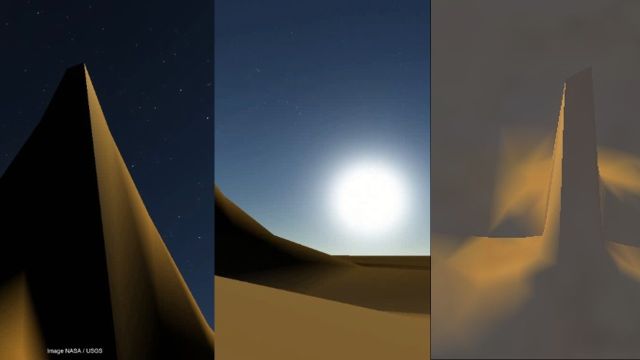
A1,200-meter-high monolith discovered on Mars. While other objects near the monolith are unrecognizable and blurred, this object is clearly present since a shadow on the monolith appears on opposite side from the sun.
Therefore it seems unlikely that the monolith is the result of a digital image artifact, stitching error or glitch.
Google Mars coordinates:31° 3'48.78"S 74°15'18.46"E
Skinwalker Ranch, also known as Sherman Ranch, is a property located on approximately 512 acres southeast of Ballard, Utah, that is reputed to be the site of paranormal and UFO-related activities. Its name is taken from the skin-walker of Navajo legend concerning vengeful shamans.
Meer van UFO'S of UAP'S, ASTRONOMIE, RUIMTEVAART, ARCHEOLOGIE, OUDHEIDKUNDE, SF-SNUFJES EN ANDERE ESOTERISCHE WETENSCHAPPEN - DE ALLERLAATSTE NIEUWTJES


 White UFO Disk Over City of Veria, Greece Jan 1, 2022, Photos, UFO Sighting News.