Ontdek de Fascinerende Wereld van UFO's en UAP's: Jouw Bron voor Onthullende Informatie!
Ben jij ook gefascineerd door het onbekende? Wil je meer weten over UFO's en UAP's, niet alleen in België, maar over de hele wereld? Dan ben je op de juiste plek!
België: Het Kloppend Hart van UFO-onderzoek
In België is BUFON (Belgisch UFO-Netwerk) dé autoriteit op het gebied van UFO-onderzoek. Voor betrouwbare en objectieve informatie over deze intrigerende fenomenen, bezoek je zeker onze Facebook-pagina en deze blog. Maar dat is nog niet alles! Ontdek ook het Belgisch UFO-meldpunt en Caelestia, twee organisaties die diepgaand onderzoek verrichten, al zijn ze soms kritisch of sceptisch.
Nederland: Een Schat aan Informatie
Voor onze Nederlandse buren is er de schitterende website www.ufowijzer.nl, beheerd door Paul Harmans. Deze site biedt een schat aan informatie en artikelen die je niet wilt missen!
Internationaal: MUFON - De Wereldwijde Autoriteit
Neem ook een kijkje bij MUFON (Mutual UFO Network Inc.), een gerenommeerde Amerikaanse UFO-vereniging met afdelingen in de VS en wereldwijd. MUFON is toegewijd aan de wetenschappelijke en analytische studie van het UFO-fenomeen, en hun maandelijkse tijdschrift, The MUFON UFO-Journal, is een must-read voor elke UFO-enthousiasteling. Bezoek hun website op www.mufon.com voor meer informatie.
Samenwerking en Toekomstvisie
Sinds 1 februari 2020 is Pieter niet alleen ex-president van BUFON, maar ook de voormalige nationale directeur van MUFON in Vlaanderen en Nederland. Dit creëert een sterke samenwerking met de Franse MUFON Reseau MUFON/EUROP, wat ons in staat stelt om nog meer waardevolle inzichten te delen.
Let op: Nepprofielen en Nieuwe Groeperingen
Pas op voor een nieuwe groepering die zich ook BUFON noemt, maar geen enkele connectie heeft met onze gevestigde organisatie. Hoewel zij de naam geregistreerd hebben, kunnen ze het rijke verleden en de expertise van onze groep niet evenaren. We wensen hen veel succes, maar we blijven de autoriteit in UFO-onderzoek!
Blijf Op De Hoogte!
Wil jij de laatste nieuwtjes over UFO's, ruimtevaart, archeologie, en meer? Volg ons dan en duik samen met ons in de fascinerende wereld van het onbekende! Sluit je aan bij de gemeenschap van nieuwsgierige geesten die net als jij verlangen naar antwoorden en avonturen in de sterren!
Heb je vragen of wil je meer weten? Aarzel dan niet om contact met ons op te nemen! Samen ontrafelen we het mysterie van de lucht en daarbuiten.
Berichten van 1 februari 2022 tot 28 februari 2022
NASA wil voor het eerst raket lanceren vanop een andere planeet om Marsstenen naar de aarde te brengen
Marsrover Perseverance verzamelt al maanden stenen en stukken bodem op de rode planeet. De monsters moeten uiteindelijk op aarde belanden voor verder onderzoek. Dat transport wordt nog een hele klus. Als onderdeel van de missie zal voor het eerst een raket gelanceerd worden vanop een andere planeet dan de onze.
Perseverance speurt al maanden de oppervlakte van Mars af naar bodem- en steenmonsters. Deze stalen worden zorgvuldig bewaard in afgesloten buisjes, waarvan Perseverance er in totaal 43 ter beschikking heeft. Zeven buisjes zijn al gevuld. Ooit zouden de stalen op aarde moeten terechtkomen zodat wetenschappers ze nader kunnen onderzoeken. Om dat bijzondere vervoer voor mekaar te krijgen, heeft NASA de Mars Sample Return-missie (‘terugkeer van Marsmonsters’) in het leven geroepen. Het uiteindelijke doel zal pas worden bereikt ergens tussen 2030 en 2035, wanneer de eerste monsters op aarde worden verwacht.
Maar intussen zit NASA niet stil. Het heeft nu aan Lockhead Martin de bouw uitbesteed van een nieuwe raket om de verzamelde stalen in eerste instantie weg te krijgen van Mars. Het moet een lichtgewicht raket worden, Mars Ascent Vehicle (MAV) genoemd. De raket moet de monsters vanop Mars in een baan rond de rode planeet sturen. NASA zal zo geschiedenis schrijven omdat de mens voor het eerst een raket vanop een andere planeet dan de aarde zal lanceren.
170 miljoen euro
Lockhead Martin mag MAV ontwerpen, bouwen en testen, en krijgt daar van NASA 194 miljoen dollar (170 miljoen euro) voor. Het is de bedoeling dat de definitieve raket al in 2026 naar Mars wordt gevoerd door de Sample Retrieval Lander (SRL), ontwikkeld door Airbus. Daarom mag de raket niet te groot en niet te zwaar zijn: ze moet in die Sample Retrieval Lander (‘lander die monsters ophaalt’) passen.
Na de landing van de SRL in of bij de Jezero-krater - waar ook Perseverance vorig jaar is geland en sindsdien aan het werk is - zal de lander nog een ander voertuig lossen, een kleine rover. Het gaat om de Sample Fetch Rover (SFR), Engels voor ‘rover die monsters oppikt’. Deze ‘loopjongen’ brengt de stalen naar de lander, die vanaf dan een nieuwe functie krijgt: lanceerplatform voor MAV.
Het Mars Ascent Vehicle, gebouwd door Lockhead Martin, schiet de stalen dan in een baan rond Mars, waar vervolgens de Earth Return Orbiter overneemt. De orbiter, ook ontwikkeld door Airbus in opdracht van de Europese ruimteorganisatie ESA, pikt de Marsmonsters op en zet koers naar de aarde. De orbiter zou tegen het eind van dit decennium in een baan om Mars moeten draaien.
De ultieme vraag is of de wetenschappers hier op aarde in de Marsmonsters sporen zullen vinden van eventueel vroeger leven op de rode planeet. Het antwoord daarop krijgen we dus mogelijk pas volgend decennium.
Abandoned Ship Found In Antarctica On Google Earth, UFO Sighting News.
Date of discovery:Feb 8, 2022
Location of discovery: Antarctica, near Elephant Island
Google coordinates: 61°27'24.46"S 55°27'6.79"W
Guys I want to show you something big...its a ship, but not an alien ship as far I know. This looks like an old abandoned cargo ship that was stuck in Antarctica for a few months. Where it is today, is unknown, but for a while it sat there abandoned. I can easily make out the railing that goes from the front deck to the back area. Its a long straight line and it looks like it had a raised back part where the captains and crew quarters would normally be. But it has a front nose area with a small fin or wing on it...which is more similar to the front of some nuclear submarines...but...nah...it couldn't be right? Even though some nuclear subs have been lost at sea. I think its a cargo ship. Check out my video below to learn more. And please subscribe to my Youtube channel, UFO Sightings Daily.
Only the ship is just a few km from a UFO crash I reported last year...you can see it in the video below.
UFO Hovering Over Islamabad, Pakistan, 13 min HD video, UFO Sighting News.
Date of sighting:January 25, 2022
Location of sighting: Islamabad, Pakistan
Wow! Just wow! This is what every UFO research dreams of. Thirteen full minutes in HD of a UFO...all the while the eyewitness has a steady hand! Fantastic capture and lucky for us, eyewitness Arslen Warraich was on the job! I have seen similar UFO photos of such craft in old reports going back decades ago, so I know this craft is 100% the real deal. There is no denying the existence of UFOs now!
Scott C. Waring - Taiwan
Eyewitness states:
This is the longest recorded UFO sighting by a civilian on record, 13 mins of footage. I saw this when I was landing my drone, it hovered for over 2 hours at this spot when eventually it got dark and I couldn’t see it anymore.
Huge Glowing Disk Over Argentina On January 6, 2022, Video, UFO Sighting News.
Date of sighting: 1-6-2022
Location of sighting: Mar Del Plata, Argentina
This eyewitness caught a large glowing disk. On the disk are several round powerful lights. These lights are clearly seen rotating slowly in a circle around the craft. The eyewitnesses where shocked to and gasped in terror and amazement at what they saw in front of them. You can hear the the fear as their voices fluctuate in uneasiness at this alien craft. Wow! It gave me shivers just watching and listening to them. What a cool experience for them...for their eyes and mind to be opened up instantly...knowing that intelligent life is right in front of them! UFOs are often seen in South America and are usually seen exiting and entering volcanos in the region. The city of Mar Del Plata however is on the edge of the Atlantic ocean, which means this UFO came from an underwater base somewhere nearby.
Scott C. Waring - Taiwan
Daytime photo of the city of Mar Del Plata, Argentina.
UFOs Shock Eyewitnesses At Lebanon, Tennessee On January 18, 2022, Video, UFO Sighting News.
Date of sighting: January 18, 2022
Location of sighting:Lebanon, Tennessee, USA
Watch this video and you might be surprised at how many glowing UFOs you see. Four glowing objects sat over the horizon on the outskirts of Lebanon, Tennessee. The eyewitnesses were confused at what the objects could be and considered stated that the hills were clearly below the objects. The screenshot above shows four rectangle shaped craft glowing powerfully. These objects seem to be in military formation...sitting in formation until they eventually disappear together. When they disappear, that means they either shot away at faster than the speed of light, or they transported the UFOs below the surface to a hidden alien base 5-6km below the surface. Absolute proof of intelligent being visiting Earth.
10 Objects That Might Be of Extraterrestrial Origin!
Might. Remember the word “MIGHT.” There are things we know definitely come from Earth, like blancmange, and things we know definitely come from space, like David Bowie, but what if there are things ON Earth, that were secretly FROM outer-space? What if Piers Morgan was from Mars, or gin was from Jupiter? There are some things that seems so odd, so peculiar, so out-of-place that we have to wonder- is there a chance they were, originally, not of Earth? THESE areobjects that might be of extra-terrestrial origin!
THE JAMES WEBB SPACE TELESCOPE JUST DETECTED ITS FIRST SIGNAL
WE'RE WATCHING THE FUTURE UNFOLD IN REAL TIME.
NASA / FUTURISM
First Light
This week NASA released the thrilling news that as the James Webb Space Telescope begins its three-month alignment process, the Webb team saw the first photons of starlight that traveled through the entire telescope, detected by the Near Infrared Camera (NIRCam).
At first, the Webb’s photos will be unfocused, but scientists will fine tune the telescope over time. NASA says a team of engineers and scientists from Ball Aerospace, Space Telescope Science Institute, and NASA’s Goddard Space Flight Center have been rehearsing the alignment and are ready to work.
“The images taken by Webb during this period will not be ‘pretty’ images like the new views of the universe Webb will unveil later this summer,” NASA’s release reports. “They strictly serve the purpose of preparing the telescope for science.”
With Time
The Webb’s journey to photographing unknown parts of the universe won’t be so different from that of its predecessor, the Hubble Space Telescope. According to NASA, the Hubble was conceived in the late 1960s and launched in April of 1990. By May we had our first image, shown below. Even though it was about 50 percent sharper than a ground telescope’s image of the same stars, it still wasn’t very good.
Over time the Hubble’s images got better, and in March of 1991 the first observations of Jupiter were published, including this true-color photo taken by its Wide Field/Planetary Camera.
By 1995 the Hubble had captured its now-iconic Eagle Nebula Gas Pillars, and the transition to beautiful deep space imagery was well under way. The images were sharper, arresting, and hauntingly beautiful.
Learning of the Webb’s first photon detection feels like 1990 all over again. Earth is about to embark on a new journey of discovery together, and we’ll all get to witness the Webb’s increasingly beautiful images over time. It’s pretty cool to think that a decade from now, we’ll be able to say we saw the initial, grainy images the Webb sent back as well as the amazing new features it’s sure to uncover.
Jack continues to convince his parents that unexplainable phenomena exists all around us with video evidence of shadow people, fairies and an ancient lake monster. Plus, he exposes a government secret — pyramid UFOs!
Levels of methane found in the atmosphere are 'growing dangerously fast', scientists have warned, and it could be global warming causing the rapid increase.
A report, published in Nature, was compiled by an international team that examines data gathered by the US National Oceanic and Atmospheric Administration (NOAA) throughout 2021.
Methane is a dangerous, powerful greenhouse gas, with sources ranging from natural wetlands, to human activity, including livestock farming.
In the new study, the team found that methane in the atmosphere had raced past 1,900 parts per billion, which is triple levels found before the industrial revolution.
This 'grim new milestone' could be linked to global warming causing a rise in wetland areas, which then produce higher levels of methane, the team said.
Methane growth started to slow down around 2000, but there was a 'mysterious uptick' around 2007, which caused researchers at the time to worry global warming was creating a 'feedback mechanism'.
Levels of methane found in the atmosphere are 'growing dangerously fast', scientists have warned, and it could be global warming causing the rapid increase through more productive tropical wetlands.
Stock image
In the new study, the team found that methane in the atmosphere had raced past 1,900 parts per billion, which is triple levels found before the industrial revolution
As a greenhouse gas, methane is 28 times as potent as CO2, according to scientists, who said that if rising temperatures are causing more methane emissions, this will lead to ever greater, and faster, increases in global average temperatures.
'Methane levels are growing dangerously fast,' Euan Nisbet, an Earth scientist at Royal Holloway, University of London, in Egham, UK told Nature.
He said the emissions, which have been accelerating, are now a major threat the global efforts to limit global warming to 3.6F above pre-industrial levels.
Because of its potency, researchers have used aircraft and satellites to track levels of methane in the atmosphere, and built computer models to understand what is driving the increase.
One explanation was direct human activities, including the expanding use of oil and gas, emissions from landfill, larger livestock herds, and wetlands.
Trends have proved to be 'enigmatic', said atmospheric chemist, Alex Turner, from the University of Washington, adding that there are no conclusive answers.
This 'grim new milestone' could be linked to global warming causing a rise in wetland areas, which then produce higher levels of methane, the team said.
Stock image
METHANE: A POTENT GREENHOUSE GAS
In 2019, methane (CH4) accounted for about 10 per cent of all US greenhouse gas emissions from human activities.
Methane trapped in ice bubbles
Human activities emitting methane include leaks from natural gas systems and the raising of livestock.
Methane is also emitted by natural sources such as natural wetlands.
In addition, natural processes in soil and chemical reactions in the atmosphere help remove methane (CH4) from the atmosphere.
Methane's lifetime in the atmosphere is much shorter than carbon dioxide (CO2), but CH4 is more efficient at trapping radiation than CO2.
Pound for pound, the comparative impact of CH4 is 25 times greater than CO2 over a 100-year period.
Globally, 50-65 per cent of total CH4 emissions come from human activities.
Methane is emitted from energy, industry, agriculture, land use, and waste management activities, described below.
SOURCE: EPA
There are some clues, including through the isotpic signature of methane molecules - which normally contain carbon-12, but some have the heavier carbon-13.
Scientists found that methane produced by microbes, that have consumed carbon in the mud of a wetland, or gut of a cow, have less carbon-13 than methane produced by heat and pressure inside the planet - from fossil fuel extraction.
They compared this to the methane seen in the atmosphere, as well as methane trapped centuries ago in ice cores, or accumulated in snow.
For the two centuries after the start of the Industrial Revolution, the amount of methane containing carbon-13 has been increasing, but that reversed in 2007.
This was the year methane levels began to rise rapidly again, and scientists discovered the proportion of carbon-13 started to fall.
Researchers have put this down to an increase in microbial sources of methane over the past 15 years - which could be from livestock or more productive wetlands.
Xin Lan, from the NOAA Global Monitoring Laboratory in Colorado, told Nature that this was a 'powerful signature' suggesting human activities alone aren't to blame.
They used the carbon-13 in the atmospheric methane to estimate that microbes are responsible for 85 per cent of methane emission growth over the past 15 years.
The rest is down to fossil fuel extraction, through natural gas and oil recovery.
After comparing the types of methane, they then had to discover which environmental system the microbes came from - wetlands, livestock or landfill.
This is still an unanswered question, according to the Nature report, but if it is coming from tropical wetlands, which have become more productive due to increasing global temperatures, then we could be in a feedback mechanism.
The warmer it gets, the more productive the wetlands get, the more methane they produce, which leads to more warmer, more productive wetlands and more methane.
However, uncovering the source is a 'challenging problem', according to Lan, whose team are running new atmospheric models to try to trace the methane to its source.
'Is warming feeding the warming? It's an incredibly important question,' Nisbet told Nature, adding that 'as yet, no answer, but it very much looks that way.'
Even if a feedback mechanism is at play in increasing methane levels, humans aren't completely free of blame, said Lan, who estimates that human sources such as livestock, agricultural waste, landfill and fossil fuels account for 62 per cent of all methane emissions from 2007 to 2016.
Human activities emitting methane include leaks from natural gas systems and the raising of livestock. Methane is also emitted by natural sources such as natural wetlands.
Stock image
The upward trend in methane emissions continued in the past four years, which researchers put down to microbes, rather than fossil fuels. Found in livestock, wetlands and landfill
To limit the impact of any feedback mechanism, scientists say more needs to be done to reduce overall methane emission levels.
This could be done through reductions in livestock activities, fewer fossil fuel extractions and finding alternative uses for agricultural waste.
More than 100 countries signed the Global Methane Pledge at COP26 in Glasgow, with the target of cutting emissions by 30 per cent from 2020 levels by 2040.
Riley Duren, leader of the non-profit Carbon Mapper, which tracks sources of methane, said the focus should be on cutting emissions in the global south, particularly in low- and middle-income countries.
THE ENVIRONMENTAL IMPACT OF FARMING COWS
The livestock animals are notorious for creating large amounts of methane, which is a major contributor to global warming.
Each of the farm animals produces the equivalent of three tonnes of carbon dioxide per year and the amount of the animals is increasing with the growing need to feed a booming population.
Methane is one of the most potent greenhouse gases, trapping 30 times more heat than the same amount of carbon dioxide.
Scientists are investigating how feeding them various diets can make cattle more climate-friendly.
They believe feeding seaweed to dairy cows may help and are also using a herb-rich foodstuff called the Lindhof sample.
Researchers found a cow's methane emissions were reduced by more than 30 per cent when they ate ocean algae.
In research conducted by the University of California, in August, small amounts of it were mixed into the animals' feed and sweetened with molasses to disguise the salty taste.
As a result, methane emissions dropped by almost a third.
'I was extremely surprised when I saw the results,' said Professor Ermias Kebreab, the animal scientist who led the study.
'I wasn't expecting it to be that dramatic with a small amount of seaweed.'
The team now plans to conduct a further six-month study of a seaweed-infused diet in beef cattle, starting this month.
Tropical wetlands, such as the Pantanal in Brazil, are a major source of methane emissions.
Credit: Carl De Souza/AFP via Getty
Methane concentrations in the atmosphere raced past 1,900 parts per billion last year, nearly triple preindustrial levels, according to data released in January by the US National Oceanic and Atmospheric Administration (NOAA). Scientists says the grim milestone underscores the importance of a pledge made at last year’s COP26 climate summit to curb emissions of methane, a greenhouse gas at least 28 times as potent as CO2.
The growth of methane emissions slowed around the turn of the millennium, but began a rapid and mysterious uptick around 2007. The spike has caused many researchers to worry that global warming is creating a feedback mechanism that will cause ever more methane to be released, making it even harder to rein in rising temperatures.
“Methane levels are growing dangerously fast,” says Euan Nisbet, an Earth scientist at Royal Holloway, University of London, in Egham, UK. The emissions, which seem to have accelerated in the past few years, are a major threat to the world’s goal of limiting global warming to 1.5–2 °C over pre-industrial temperatures, he says.
Source: NOAA
Enigmatic patterns
For more than a decade, researchers have deployed aircraft, taken satellite measurements and run models in an effort to understand the drivers of the increase (see ‘A worrying trend’)1,2. Potential explanations range from the expanding exploitation of oil and natural gas and rising emissions from landfill to growing livestock herds and increasing activity by microbes in wetlands3.
“The causes of the methane trends have indeed proved rather enigmatic,” says Alex Turner, an atmospheric chemist at the University of Washington in Seattle. And despite a flurry of research, Turner says he is yet to see any conclusive answers emerge.
One clue is in the isotopic signature of methane molecules. The majority of carbon is carbon-12, but methane molecules sometimes also contain the heavier isotope carbon-13. Methane generated by microbes — after they consume carbon in the mud of a wetland or in the gut of a cow, for instance — contains less 13C than does methane generated by heat and pressure inside Earth, which is released during fossil-fuel extraction.
Scientists have sought to understand the source of the mystery methane by comparing this knowledge about the production of the gas with what is observed in the atmosphere.
By studying methane trapped decades or centuries ago in ice cores and accumulated snow, as well as gas in the atmosphere, they have been able to show that for two centuries after the start of the Industrial Revolution the proportion of methane containing 13C increased4. But since 2007, when methane levels began to rise more rapidly again, the proportion of methane containing 13C began to fall (see ‘The rise and fall of methane’). Some researchers believe that this suggests that much of the increase in the past 15 years might be due to microbial sources, rather than the extraction of fossil fuels.
Source: Sylvia Michel, University of Colorado Institute of Arctic and Alpine Research
Back to the source
“It’s a powerful signal,” says Xin Lan, an atmospheric scientist at NOAA’s Global Monitoring Laboratory in Boulder, Colorado, and it suggests that human activities alone are not responsible for the increase. Lan’s team has used the atmospheric 13C data to estimate that microbes are responsible for around 85% of the growth in emissions since 2007, with fossil-fuel extraction accounting for the remainder5.
The next — and most challenging — step is to try to pin down the relative contributions of microbes from various systems, such as natural wetlands or human-raised livestock and landfills. This may help determine whether warming itself is contributing to the increase, potentially via mechanisms such as increasing the productivity of tropical wetlands. To provide answers, Lan and her team are running atmospheric models to trace methane back to its source.
“Is warming feeding the warming? It’s an incredibly important question,” says Nisbet. “As yet, no answer, but it very much looks that way.”
Regardless of how this mystery plays out, humans are not off the hook. Based on their latest analysis of the isotopic trends, Lan’s team estimates that anthropogenic sources such as livestock, agricultural waste, landfill and fossil-fuel extraction accounted for about 62% of total methane emissions since from 2007 to 2016 (see ‘Where is methane coming from?’).
SOURCE: Ref. 5.
Global Methane Pledge
This means there is plenty that can be done to reduce emissions. Despite NOAA’s worrying numbers for 2021, scientists already have the knowledge to help governments take action, says Riley Duren, who leads Carbon Mapper, a non-profit consortium in Pasadena, California, that uses satellites to pinpoint the source of methane emissions.
Last month, for instance, Carbon Mapper and the Environmental Defense Fund, an advocacy group in New York City, released data revealing that 30 oil and gas facilities in the southwestern United States have collectively emitted about 100,000 tonnes of methane for at least the past three years, equivalent to the annual warming impact of half a million cars. These facilities could easily halt those emissions by preventing methane from leaking out, the groups argue.
At COP26 in Glasgow, UK, more than 100 countries signed the Global Methane Pledge to cut emissions by 30% from 2020 levels by 2030, and Duren says the emphasis must now be on action, including in low- and middle-income countries across the global south. “Tackling methane is probably the best opportunity we have to buy some time”, he says, to solve the much bigger challenge of reducing the world’s CO2 emissions.
doi: https://doi.org/10.1038/d41586-022-00312-2
UPDATES & CORRECTIONS
Correction 08 February 2022: An earlier version of this story said that bacteria generate methane in wetlands and the guts of cows. Methane is emitted by microbes in these places.
References
Nisbet, E. et al.Phil. Trans. R. Soc. A. https://doi.org/10.1098/rsta.2021.0112 (2021).
Our Solar system was created approximately 4.8 billion years ago. A part of the scientific community believes that an extraterrestrial civilization is responsible for bringing life on Earth 3.8 billion years ago. For example, Francis Crick, a co-discoverer of the structure of DNA and 1962 Nobel Prize winner seemingly believed in the “directed panspermia,” a hypothesis that life on Earth is the product of the designs of an advanced alien civilization.
After the various UFO/UAPs declassifications, mainstream experts turned the topic into a serious discussion. Harvard Professor Avi Loeb urges the scientific community to take UFO research seriously. Dr. Loeb is one of the few insiders who uplifted the study of modern phenomena.
In 2017, Dr. Avi Loebshockedthe scientific community by announcing that the asteroid Oumuamua is of an interstellar origin and probably an alien spaceship. In his book,l “Extraterrestrial: The First Sign of Intelligent Life Beyond Earth,” Dr. Loeb explains why he believes the object from 2017 was an intergalactic attempt to contact Earth.
Professor Avi Loeb. Image via Public Domain
He said that it may have even been a fully functional probe that was sent towards Earth by an alien civilization: “You need to be open-minded in order to find wonderful things.” He is known for his daring hypotheses. In 2018, he also said that we are definitely not alone in the universe.
In his January 2021 interview, Dr. Loeb claimed that there is a possibility of the existence of quadrillion alien spacecraft alone in our solar system. “There should be one in every volume roughly the size of the orbit of the Earth around the sun. This is a vast area in human terms, but in the immensity of space, it’s pretty small. So it means that there are plenty of them, a quadrillion of them, inside the Oort cloud. Inside the solar system. There are lots of them,” he added.
Last year, Dr. Loeb founded the Galileo Project, which aims to provide evidence for alien technology by building a global network of telescopes, cameras, and computers to allow it to investigate UFOs. In his new interview, Dr.Loeb said “we may be mere months away from seeing the first image detailed enough to provide incontrovertible evidence that UFOs are alien spacecraft.”
The announcement of the Galileo Project came shortly after the Pentagon public its UFO footages in 2021. At the time, Dr. Loeb said: “what we see in our sky is not something that politicians or military personnel should interpret, because they were not trained as scientists, it’s for the science community to figure out.”
Dr. Loeb believed that the discovery of equipment from extraterrestrial civilizations will have a profound impact on humanity. His Galileo Project will search for such relics near Earth. He raised a few concerns in his blog which might be a big conflict if it turns out that we are not the smartest species out there.
He writes:
“Does God exist? If we mean by that: ‘someone that can create life or new universes,’ and if their scientific understanding of biology and quantum-gravity is well ahead of ours, then they might possess the abilities that our religious texts assigned to a divine power. In fact, we are close to creating synthetic life in our laboratories only a century into our recent scientific development.
What happens after death? The extraterrestrials might teach us how to extend our life expectancy by orders of magnitude with advanced technologies. If death can be postponed enough, then this question loses its urgency.
How should humans treat each other? The realization that there is a far more advanced species out there, will make our genetic variations less significant and convince us to treat each other as equal members of the human species.
What should be our long-term goals? A broader perspective of the realities far from Earth will reshape our goals in maintaining longevity by venturing into space. Our eggs should not be in only one basket.
What happened before the Big Bang? What is Dark Matter and Dark Energy? What happens inside a black hole? and other scientific puzzles. If extraterrestrial science is far more advanced than ours, we might find answers to our unsolved questions. Just as opening a random page in a recipe book does not land on the best cake possible, humans may not be the smartest beings since the Big Bang.”
Dr. Loeb’s Galileo Project is comprised of a team of over 100 scientists. According to the Harvard professor, the project’s first telescope will start operating from the roof of the Harvard college observatory in summer 2022. It will keep infrared cameras, a radio sensor, an audio sensor, and a magnetometer rolling 24/7.
Dr. Loeb has grounded hopes in finding an extraterrestrial relic/equipment through his Galileo Project. He has advised the scientific community to find a way in order to decipher the intent of an intelligent extraterrestrial equipment. He suggested that we might need to rely on our AI systems in figuring out the intent of extraterrestrial AI systems.
A pair of rocks orbiting the sun are the solar system's youngest asteroids, according to astronomers, who say they broke off from their parent body just 300 years ago.
In cosmic terms, that is very recent, a team from the Lowell Observatory in Flagstaff, Arizona explained, with most rocks dating back to the dawn of the solar system.
The asteroid pair, known as 2019 PR2 and 2019 QR6, were detected using the Pan-STARRS1 survey telescope in Hawaii, with confirmation by the Lowell Observatory.
The two likely broke off from the same, much larger object about 300 years ago, making them the youngest known 'asteroid pair' by a factor of ten, the team said.
The largest of the pair, PR2, is just over half a mile wide, and the smallest about half that size, sitting between Mars and Jupiter in the Main Asteroid Belt.
Astronomers behind the discovery said it is most likely that the two objects, which are currently about half a million miles apart, were spun off by a large comet, and have been gradually drifting further from each other ever since.
Artist impression of the asteroid pair shortly after they split from the parent object. They will gradually become further and further separated over thousands of years
What makes them unusual is that so far no observations have revealed any evidence of comet-like behaviour, but models all point to them coming from a comet.
Most asteroids are thought to have formed during the tremulous early years of the system, when planets were forming, breaking up, and colliding with one another.
The majority reside in the area between the orbits of Mars and Jupiter known as the main asteroid belt, but these two were found a little closer to home.
They are known as Near Earth Asteroids (NEAs) as their orbits bring them close to the Earth, even if they don't reside there the whole time.
These two pass by the Earth, but also go out beyond Jupiter, the team explained, adding that they pose no threat to our planet.
In 2019, scientists using the Pan-STARRS1 survey telescope in Hawaii and the Catalina Sky Survey in Arizona each discovered a new NEA.
They were identified as 2019 PR2 and 2019 QR6. The largest of the two measures about half a mile in diameter and the other half that size.
Astronomers discovered they had very similar orbits around the sun, and further study confirmed that they were both linked - an asteroid pair.
The largest of the pair, PR2, is just over half a mile wide, and the smallest about half that size, sitting between Mars and Jupiter in the Main Asteroid Belt
Petr Fatka of the Astronomical Institute of the Czech Academy of Sciences, confirmed they were two asteroids that separated from a single parent within the past several million years.
While they have the same parent, and were discovered in a similar region of the sky as viewed from Earth, they are currently separated by half a million miles of space.
KEY FINDINGS: ASTEROID PAIR SPUN OFF FROM A COMET 300 YEARS AGO
They are D-type asteroids, which have a lower albedo than other types of space rock.
Some astronomers suggest these class of asteroid contain organic-rich silicates, carbon and anhydrous silicates, possibly with water ice in their interiors.
They appear to be something between asteroids in the main belt, and those forming in the Kuiper Belt.
If the parent body of PR2 and QR6 originated in one of these outer Solar System reservoirs, then this pair provides insight on the color affects of increased heating and irradiation experienced in an NEO orbit, the team speculated.
It is thought that the larger, PR2, is about half a mile in diameter and has a rotation of about 9.9 hours.
The smaller, QR6, is a quarter of a mile in diameter and rotates every 4.1 hours, although the rotation figures are not confirmed.
Despite speculation the parent body was a comet, they show no evidence of cometary activity.
Models suggest they split from a larger object around 300 years ago.
Their orbits have been changed and varied by the gravity of Jupiter since they first split from the unknown parent comet.
Several telescopes were used for the follow-up observations, including the 4.3-meter Lowell Discovery Telescope (LDT) in northern Arizona.
These observations revealed very similar surface properties of both asteroids, further supporting the theory that they came from the same object.
'Thanks to the measurements performed with the LDT, it is clear that 2019 PR2 and 2019 QR6 come from the same parent object and their high orbital similarity is not coincidental,' explained Fatka.
Most asteroid pairs of this time form from a process known as rotational fission, which is where a spinning asteroid reaches a critical speed.
These rocks are effectively just piles of rubble held together by gravity, and so as they spin faster the debris flies off and forms one or more new asteroids.
When they spin off they maintain a very similar orbit to the parent body, which is how the team determined these two objects had a shared heritage.
Based on multiple modeling techniques and additional observations, which included previously unnoticed detections by the Catalina Sky Survey, they found that the pair only separated within the past 300 years.
'It's very exciting to find such a young asteroid pair that was formed only about 300 years ago, which was like this morning—not even yesterday—in astronomical timescales.' The previous record holders were at least ten times older,' said Fatka.
However, finding they only split 300 years ago from a larger parent, left the astronomers with a problem. It wasn't possible for standard models of rotational fission to explain the properties found on these rocks.
'Something else had to be going on to explain their current separation,' they wrote.
The team then developed new models that assume the original body was a comet, whose jets of gas could push their orbits into the configuration seen today. This provided a viable origin story for these objects.
Nicholas Moskovitz of Lowell Observatory said this then raised further problems, as the bodies don't display any signs of cometary activity.
'So it remains a mystery how these objects could have gone from a single parent body, to individually active objects, to the inactive pair we see today in just 300 years,' he added.
Petr Fatka of the Astronomical Institute of the Czech Academy of Sciences, confirmed they were two asteroids that separated from a single parent within the past several million years
It isn't currently possible to explain this problem with current data, the team explained, saying that more observations will be needed.
This will have to wait more than a decade though, as they are currently out of reach of available telescopes.
'To have a better idea about what process caused the disruption of the parent body, we have to wait until 2033 when both objects will be within the reach of our telescopes again,' said Fatka.
The team wrote in the paper: 'Targeted observations in 2033, for example with the James Webb Space Telescope, during the next perigee passage of these objects could directly probe for differences in thermal inertia.
'Indirect tests may come from NASAs upcoming DART and JANUS missions, both of which will be visiting binary asteroids.
'These missions may constrain any grain size differences between the primaries and satellites, which will provide important clues into the detailed physics of binary and asteroid pair formation and evolution.'
While most scientists are looking for asteroids and meteorites billions of year old to help unlock clues to the birth of the universe, the solar system and Earth, a few are searching instead for an asteroid nursery filled with baby rocks. That side got a big boost this week with the record-setting discovery of two so young, they may need to be burped.
“It’s very exciting to find such a young asteroid pair that was formed only about 300 years ago, which was like this morning—not even yesterday—in astronomical timescales.”
In a Lowell Observatory press release announcing the discovery of the near-Earth asteroid pair 2019 PR2 and 2019 QR6, Petr Fatka of the Astronomical Institute of the Czech Academy of Sciences explains how they were discovered and why – besides their young age – these two baby space rocks are so unusual. Using the Pan-STARRS1 survey telescope in Hawaii and the Catalina Sky Survey in Arizona, the near earth objects (NEA) were discovered separately at about the same time in 2019 – with 2019 PR2 measuring about one-half mile in diameter and 2019 QR6 one-quarter mile wide. Found in the Main Asteroid Best between Jupiter and Mars, they are about one million km (620,000 miles) apart – almost Siamese twins in astronomy terms. In fact, backwards analysis of the pair show they indeed broke off of the same parent comet a mere instant ago.
Asteroid Belt
“Based on multiple modeling techniques and additional observations—including recovery of previously unnoticed detections made with the Catalina Sky Survey 14 years before the discovery—the team determined that the pair separated only 300 years ago, making it the youngest known pair of asteroid pairs.”
Youngest by at least a factor of ten, according to the study published in the journal Monthly Notices of the Royal Astronomical Society. Their surface composition confirms they broke off of the same parent in a process called rotational fission – spinning comets lose pieces that can no longer be held together by gravity. The parent comet pushes the pieces away with its jets, which explains how the two babies traveled so far in just 300 years. That can be confirmed the next time the two young rocks are in the range of the James Webb Space Telescope in 2033. The next view will hopefully explain another mystery of 2019 PR2 and 2019 QR6.
Are you our Mama?
“In the present day, the bodies don’t display any signs of cometary activity. So it remains a mystery how these objects could have gone from a single parent body, to individually active objects, to the inactive pair we see today in just 300 years.”
While their parent is a comet, 2019 PR2 and 2019 QR6 are a pair of inactive asteroid children. Does this mean they’re actually asteroid teenagers? Or did they come from a donor parent?
There is one thing UFO believers and UFO skeptics have in common – besides a love for one of the two stars of “The X-Files” – and that is a mutual dislike/disgust/frustration/hatred of blurry photos. While this trait is shared with Bigfoot and other cryptid fans, it’s most pronounced amongst those hoping for confirmed visible evidence and identification of strange aerial phenomena. Well, folks … your prayers, burnt offerings, magic lamp wishes and animal sacrifices have been answered. Everyone’s favorite Harvard genius astrophysicist who believes in UFOs – Abraham ‘Avi’ Loeb’ – has made a personal commitment to provide clear UFO photos and videos very soon … possibly as early as this summer.
I thought YOU had the cellphone.
“I really want the next generation to be free to discuss it, and for it to become part of the mainstream. My hope is that by getting a high resolution image of something unusual, or finding evidence for it, which is quite possible in the coming year or two, we will change it.”
In an interview with The Guardian, Loeb compares himself to a fisherman on the beach who can’t see any fish because he’s not casting a net. Loeb has two UFO nets to cast – the first is data collected by the mini-satellite network of Planet Labs which will take photos from space of the entire surface of the Earth once per day. On the ground, Loeb and his Galileo Project are setting up a worldwide network of telescopes controlled by artificial intelligence to search the skies for UFOs – learning as they go along to eliminate birds, planes, bugs, clouds and other explainable anomalies.
Between the photos from above and below, Loeb thinks a clear picture of one or many UFOs will be taken. And that’s a good thing for both sides of the discussion.
“I really want the next generation to be free to discuss it, and for it to become part of the mainstream. My hope is that by getting a high resolution image of something unusual, or finding evidence for it, which is quite possible in the coming year or two, we will change it.”
Loeb and his combined Planet Labs/Galileo Project search is not without competition. Last week, Hakan Kayal, a Professor for Space Technology at Julius-Maximilians-Universität Würzburg (JMU) in Germany, revealed he has already set up a dual AI-controlled SkyCAM-5 camera system on a university building that has been watching for UFOs since December 2021. While Kayal may e ahead of Loeb on from-the-ground scans, he’s not incorporating satellite images. Perhaps they should join forces – it would provide a good example for the next generation and move the search for extraterrestrial intelligence even closer to the mainstream.
We needs some photos like this … only real.
Avi Loeb has always been open about his expansive beliefs in UFOs and extraterrestrials – he led the team who believed the ‘Oumuamua interstellar comet could be an ET spacecraft exploring our solar system. You can’t have big discoveries without some big ideas … even if some end up to be big mistakes.
Let’s hope Avi Loeb finds and photographs the UFOs … before someone (or something) shuts him down.
ALL RELATED VIDEOS, selected and posted by peter2011
Glowing Blue Orbs Over Volcano In March 2021, Video, UFO Sighting News.
Date of sighting: March 2021 Location of sighting: Fagradalsfjall volcano, Iceland
Here is an interesting piece of evidence by the History Channel on Youtube. They show eyewitness video of a blue orb near the mouth of a volcano in Iceland. This UFO seems to have just come out of the volcano. This confirms my earlier theory that many alien bases were created 5-6km below the surface of volcanos worldwide. This way they could avoid human interaction as much as possible. The only way to avoid it more would be to create an alien base below the ocean floor itself. This is 100% real evidence that aliens are using volcanos to avoid human interaction.
Guys, this is not just a piece of alien tech discarded on Mars. This is alien tech that the Mars rover drove next to and turned the rover around...as you can see from the trademarks near the tech. This is not just a piece of garbage discarded by aliens. This is high technology that could be thousands or even millions of years advanced to our own. This could be a handheld teleportation device that could teleport a person anywhere within 20 light years, activated by merely thinking it (telepathic controls). This could be a energy amplifier that could increase any energy weapon output by 1,000X. Now do you see where I'm going with this? Its not just technology...it could change the direction of humanity forever! The country which gets hold of it, would be forever a world power. The implications of such tech getting into any governments hands would be catastrophic!
This is an interesting discovery. Youtuber "Quick Solutions-DATA" discovered a black square that covers part of Mars rover photo. Its a sloppy job on behalf of NASA for sure. To just cover up a life form passing by with a black square. NASA of course will claim its a glitch, but we have all seen pixelization and this is nothing like that. Its one thing to see a pixel size glitch, its another to see one cover a perfect square area of 30% of a photo. This is 100% proof that there is life on Mars and NASA is trying and failing...to hide it from the public.
Unknown bright object falling apart in the sky over Mexico
The sky over Mexico’s Cabo San Lucas was illuminated by a slow moving bright light, the nature of which is unclear.
Some are theorizing it was a meteorite or space debris, but that could actually be a UFO too that broke up upon entry into Earths atmosphere. It’s just as plausible as any other explanation at this stage.
SCIENTISTS FAIL TO SPOT ALIENS AFTER SCANNING SKIES FOR SEVEN WHOLE HOURS
DON'T GIVE UP THAT EASILY!
GETTY IMAGES
Scanning… Scanning…
A team of astronomers have used the Murchison Widefield Array, a massive network of over 4,000 antennas spread out over the Western Australian desert, to look for aliens.
They collected seven agonizing hours worth of data — and to their dismay, they found nothing.
As detailed in their new paper, accepted for publication in the journal Publications of the Astronomical Society of Australia, the team used the array to collect data while peering into the Galactic Center, centered on Sagittarius A*, the suspected supermassive black hole at the core of the Milky Way.
They looked for technosignatures of extraterrestrials at a frequency of 155 megahertz, the first search of its kind. Usually, according to CNET, astronomers have focused on lower frequencies.
“This is our largest population of known exoplanets within our four surveys with the MWA,” lead author Chenoa Tremblay, and researcher at the SETI Institute, told the site.
Fear of an Exoplanet
Exoplanets are a particularly interesting place to look for signs of alien life. A previous search back in 2013 of the same corner of the galaxy contained only 38 known exoplanets. The new search upped the total to 144.
We’re only beginning to understand what is going on at the center of our galaxy, so there could be many more planets hiding in there — we don’t even know how many stars are lurking there since there’s a lot of cosmic dust obscuring our view.
With a bit of math, the astronomers’ latest survey could theoretically have covered a vast number of star systems. Their research is based on a previous survey that classified 3.3 million stars in the vicinity — but that only accounts for an area that is less than one percent of that covered by the MWA survey.
“If we extrapolate this, we are covering billions of stellar systems out to the center of our Galaxy,” Tremblay told CNET.
Of course, just because they didn’t find aliens in this one region of the sky who happened to be communicating on a specific frequency during a particular seven-hour stretch doesn’t mean much. So we hope they keep looking.
Meet the filthy rich NASA space cadets: Axiom Space reveals its team of four VERY lucky amateur astronauts who have each paid $55m to spend eight days on the International Space Station
Ryan Morrison For Dailymail.Com
Axiom Space AX-1 crew will travel to the ISS in a SpaceX Crew Dragon capsule
They will launch from a 'flight-tested' SpaceX Falcon 9 rocket on March 30
When on the station they will spend eight days carrying out experiments
Each of the four men spent $55 million for a seat on the flight and time on station
This is the first time an all civilian crew has visited the ISS at the same time
They have been put through extensive training by NASA, SpaceX and ESA
NASAhas confirmed the details of the four civilian astronauts that will spend a week living and carrying out experiments on the International Space Station in Apri
Axiom Space, the private space company developing its own module for the ISS, will operate the trip, sending the four to the station on a SpaceX Crew Dragon capsule.
NASA astronaut and Axiom Space VP Michael López-Alegría will act as mission commander, alongside Larry Connor as pilot, with Mark Pathy, and Eytan Stibbe working as mission specialists during the day-long trip to the station.
Once onboard the crew, who each spent $55 million for the trip, will spend eight days carrying out a range of experiments, commercial activities and running educational sessions for children on the Earth below.
It is an international crew, with López-Alegría born in Spain but raised in California, Connor from the US, Pathy from Canada and Stibbe born in Israel.
They will launch on Wednesday, March 30, from Launch Complex 39A at NASA's Kennedy Space Center in Florida, on a flight-proven SpaceX Falcon 9 rocket.
The mission has been named AX-1, and the crew have been training at the NASA Johnson Space Center in Houston, and other NASA facilities, since August 2021.
This training has allowed them to become familiar with the ISS systems, scientific facilities on board and emergency procedures.
NASA started working with the Axiom mission operations team on simulations in December, to get a feel for how the first all civilian crew on the ISS would operate.
This work allowed ground control for NASA and Axiom to familiarize themselves 'with the dynamic phases of the private astronauts' flight to and from the space station.'
The U.S. space agency confirmed that they'd continue these joint simulations through the next few months, in preparation for launch on March 30.
'This represents another significant milestone in our efforts to create a low-Earth orbit economy,' said Phil McAlister, director of commercial spaceflight at NASA.
'I wish these Axiom crew members safe travels, and I hope they find their time in space productive and enjoyable.'
Once onboard the crew, who each spent $55 million for the trip, will spend eight days carrying out a range of experiments, commercial activities and running educational sessions for children on the Earth below. They will travel to the ISS in a SpaceX Crew Dragon capsule
Larry Connor, Ax-1 mission pilot, entrepreneur, and non-profit activist investor, has a number of projects in collaboration with the Mayo Clinic.
Connor’s experiments on behalf of Mayo Clinic would provide data on space travel’s impact on senescent cells and heart health.
Connor is expected to be in charge of maintaining senescent cells – cells that have stopped dividing – at the ISS.
These cells are linked to multiple age-related diseases, and understanding them can help protect astronauts on long-haul trips to Mars.
Mark Pathy, Ax-1 mission specialist, is working on behalf of The Montreal Children’s Hospital, Canadian Research Universities and The Royal Canadian Geographical Society.
He is working with six Canadian universities, as well as two startups on 'proof of concept' ideas.
This includes the world’s first in-space demonstration of two-way holoportation – a mixed reality app for special lenses that receives two-way 3D projections as a hologram to communicate between users remotely.
In addition to human research, Pathy plans to lead Earth observation activities which will contribute to further analysis of the impact of climate change, urbanization, and other factors on the ecology and human habitation of North America.
Eytan Stibbe, Ax-1 mission specialist, social impact investor, and Israeli philanthropist, is working on behalf of the Ramon Foundation.
His mission is named "Rakia," after the dome (atmosphere) created by God on the second day after the firmament, which protects life on Earth.
During his mission, he will facilitate scientific experiments and will conduct educational and artistic activities to connect the younger generation in Israel and around the globe on the values of peace, innovation, and social responsibility.
For the first time, an astronaut will represent Israelis on the International Space Station in Hebrew.
Video: NASA brings new space telescope into focus (Reuters)
It isn't clear exactly what the objectives of the four AX-1 crew will be, as the final proposals won't be approved until closer to flight, NASA confirmed.
Axiom previously revealed a microgravity research portfolio the Ax-1 crew intends to undertake in orbit, in partnership with a variety of organizations on Earth.
'The goal for the Ax-1 crew is to set a standard for all future private astronaut missions in terms of our preparation and professionalism,' López-Alegría said.
'As the commander, I am proud of the work these crew members have put in to be ready to conduct meaningful work on the International Space Station and glad to see them meet the standards required of all astronauts flying to station since Expedition 1.
'Ax-1 is focused on a huge amount of science and outreach activities, and we look forward now to finalizing that flight program.'
Expedition 1 was the first launch of astronauts, from Russia and the US to the space station on November 2, 2000. The ISS has been continuously occupied since then.
That first crew, of three included NASA commander William Shepherd, alongside cosmonauts Yuri Gidzenko and Sergei K. Krikalev.
Axiom has also revealed that the astronauts will be taking technology built by Israeli company, Aleph Farms, to the station.
This technology involves turning cells taken from a cow into raw meat by growing the cells and turning them into muscle, fat and other components.
'Aleph's general goal is to be able to provide nutritious, tasty, sustainable food anywhere, anytime,' said Zvika Tamari, the head of space research, adding that ' stretching that to its limit is the ability to also provide nutrition in space.'
In terms of outreach, an ancient coin minted by Jewish rebels revolting against the Romans 1,900 years ago will accompany former Israeli pilot Etan Stibbe to the ISS.
Stibbe, 63, is one of three men who paid $55 million each to launch aboard a SpaceX Falcon 9 rocket for Axiom's first privately crewed mission.
The coin comes from the Bar Kokhba revolt, which took place from 132 to 136 AD and was the final of three Jewish-Roman wars that first began when Romans took control of Jerusalem in 63 AD.
It bears etchings of a palm tree on one side and a vine leaf with the inscription 'Year Two of the liberty of Israel' on the other.'
NASA recently announced the ISS had just nine years of operational life left, with plans to sink it in the South Pacific Ocean in January 2031.
Stibbe (left) will be joined by Larry Connor (right) and Mark Pathy (second right), and led by retired NASA astronaut Michael López-Alegría (second left), who has traveled to space four times and is now the vice president of Aximo Space
On the run up to that happening, the space agency plans to support commercial operators in launching privately funded and run space stations, starting with an Axiom Space module attached to the ISS.
This launch is a precursor to that module, which is expected to dock with the station by the middle of this decade, part of NASA's efforts to built a robust low-Earth orbit economy - driven by the private sector, rather than national players.
Axiom recently completed the preliminary design review of two modules that will be attached to the ISS this decade, then separate into its own free-flying station.
For more than 21 years, NASA has supported a continuous U.S. human presence in low-Earth orbit aboard the space station.
'The agency's goal is to enable a strong, commercial marketplace in low-Earth orbit with private industry where NASA is one of many customers,' a spokesperson said.
'This strategy will provide services the government needs at a lower cost, enabling the agency to focus on its Artemis missions to the Moon in preparation for Mars while continuing to use low-Earth orbit as a training and proving ground for those deep space missions.'
EXPLAINED: THE $100 BILLION INTERNATIONAL SPACE STATION SITS 250 MILES ABOVE THE EARTH
The International Space Station (ISS) is a $100 billion (£80 billion) science and engineering laboratory that orbits 250 miles (400 km) above Earth.
It has been permanently staffed by rotating crews of astronauts and cosmonauts since November 2000.
Crews have come mainly from the US and Russia, but the Japanese space agency JAXA and European space agency ESA have also sent astronauts.
The International Space Station has been continuously occupied for more than 20 years and has been expended with multiple new modules added and upgrades to systems
Research conducted aboard the ISS often requires one or more of the unusual conditions present in low Earth orbit, such as low-gravity or oxygen.
ISS studies have investigated human research, space medicine, life sciences, physical sciences, astronomy and meteorology.
The US space agency, NASA, spends about $3 billion (£2.4 billion) a year on the space station program, with the remaining funding coming from international partners, including Europe, Russia and Japan.
So far 244 individuals from 19 countries have visited the station, and among them eight private citizens who spent up to $50 million for their visit.
There is an ongoing debate about the future of the station beyond 2025, when it is thought some of the original structure will reach 'end of life'.
Russia, a major partner in the station, plans to launch its own orbital platform around then, with Axiom Space, a private firm, planning to send its own modules for purely commercial use to the station at the same time.
NASA, ESA, JAXA and the Canadian Space Agency (CSA) are working together to build a space station in orbit around the moon, and Russia and China are working on a similar project, that would also include a base on the surface.
NASA OFFICIALLY APPROVES FIRST SPACEX TOURISTS TO VISIT SPACE STATION
IT'S HAPPENING!
AXIOM SPACE VIA NASA
First Class
NASA just approved a crew of four private astronauts to fly up to the International Space Station with Axiom Space and SpaceX, on the first American mission of its kind. Though the rest of the crew are apparent novices, Michael López-Alegría, the mission’s commander, was previously a NASA astronaut.
Along with the Spanish-American López-Alegría, the March 30 launch also includes another American, Larry Connor, who will serve as pilot, as well as Canadian Mark Pathy and Israeli Eytan Stibbe.
Old News
Though this mission is the first completely-private mission to the ISS that’ll be funded by private spaceflight companies, it’s far from the first time private astronauts have gone to the ISS, which has been going on nearly as long as the station’s been in orbit.
The American engineer Dennis Tito takes the distinction as the world’s first “space tourist,” and he was able to spend eight days on the then-young ISS when he hitched a ride with Russia’s Roscosmos in April 2001.
Much more recently, Japanese billionaire Yusaku Maezawa, along with his assistant Yozo Hirano, became the latest private astronauts to board the ISS in December 2021 — and they, too, were flown up on a Russian Soyuz rocket.
NASA has been far more reticent than Roscosmos to allow private astronauts to board the ISS. The US space agency didn’t even lay the groundwork for private ISS missions until 2019, when it announced a sea change that should allow for more commercial endeavors in orbit.
Indeed, in its announcement about the Axiom mission, NASA plugged its desire to stimulate a “commercial economy in low-Earth orbit,” which signals that it’s joining the consumer space race in earnest.
Legendary Hopewell Culture Destroyed By Exploding Comet, Study Says
After enjoying centuries of stability, the prosperous Native American Hopewell culture suddenly went into rapid and irreversible decline around the year 500 AD. The reasons why this happened have long been a topic for speculation, and a team of researchers from the Departments of Anthropology and Geology at the University of Cincinnati (Ohio) have now joined the debate to offer a brand-new theory.
Analyzing rock samples collected from 11 archaeological sites in the Ohio River Valley, these researchers have found physical evidence that suggests an exploding comet may have played a significant role in the Hopewell peoples’ demise. The samples included the stony remnants of this disintegrating space object, which was destroyed in an airburst that distributed its debris far and wide in all directions.
These stony remnants, which are known as micrometeorites, possessed qualities that revealed their true origin.
University of Cincinnati researchers take sediment samples at a Hopewell culture site at the confluence of the Ohio and Great Miami rivers.
“Cosmic events like asteroids and comet airbursts leave behind high quantities of a rare element known as platinum," explained anthropologist and lead study author Kenneth Tankersley in a University of Cincinnati press release . "The problem is platinum also occurs in volcanic eruptions. So, we also look for another rare element found in non-terrestrial events such as meteorite impact craters—iridium. And we found a spike in both, iridium and platinum."
Based on the results of radiocarbon and typological dating procedures, the researchers concluded that this catastrophic event would have occurred sometime between the years 252 and 383 AD.
“This time period coincides with historically documented near-Earth comets and occurs immediately prior to the cultural downturn of the Hopewell ,” the University of Cincinnati researchers wrote in an article discussing their findings in Scientific Reports . “The airburst event may have created mass confusion resulting in an upheaval of the social interaction sphere.”
A magnet holds tiny micrometeorites collected from sediment samples taken from an ancient Hopewell culture site. Researchers say this evidence points to a comet airburst that devastated parts of the Ohio River Valley more than 1,500 years ago.
University of Cincinnati anthropology professor Kenneth Tankersley uses a magnet to show how micrometeorites collected at 11 Hopewell sites contain metals such as iron. UC's analysis found they also contain high levels of platinum and iridium.
Photo/Michael Miller
Previous research has revealed that the area of what is now the eastern United States experienced an epidemic of massive and ravaging wildfires during this period, which incinerated more than 9,200 square miles of forest and agricultural land. The researchers found a layer of charcoal deposits at the Hopewell culture sites along with the micrometeorites, proving that these fires had occurred during the same time period as the comet’s near-Earth explosion.
If they crash into the earth, astronomical bodies like comets and meteors can do great damage to ecosystems within the zone of impact. But if they explode in the sky, the intense heat and wind generated by the blast, plus the raining down of heavy, rocky debris from the exploding object, can cause damage and destruction over a much broader geographical area.
This is what happened in the famous Tunguska event of 1908, when a comet or meteor passed through Earth’s atmosphere and exploded in the sky over Siberia. The explosion leveled more than 800 square miles of forest, leaving behind a scarred landscape that is still visibly damaged to this very day.
University of Cincinnati anthropology student Louis Herzner, bottom, and anthropology professor Kenneth Tankersley use a scanning electron microscope in UC’s Advanced Materials Characterization Center to study iron and silicon-rich microspherules collected at ancient Hopewell sites.
Photo/Larry Sandman
Much like the Siberians who lived near Tunguska, the Hopewell survivors of the third or fourth century blast would have been surrounded by scenes of unimaginable devastation. Survivors who resided near the epicenter of the explosion, which occurred over what is now the city of Milford in southwestern Ohio, would have been especially shocked and traumatized by what they experienced.
UC professor Kenneth Tankersley explains how researchers investigated the impact a comet had on ancient Hopewell in the Ohio River Valley. UC’s Advanced Materials Characterization Center conducted scanning electron microscopy and energy dispersive spectrometry on sediment samples. The University of Georgia provided mass spectrometry, while the U.S. Geological Survey provided stable carbon isotope analysis.
Photo/Michael Miller
"It looks like this event was very injurious to agriculture,” said biology professor and study co-author David Lentz, noting the impact of the explosion on the food chain. “People didn't have good ways to store corn for a long period of time. Losing a crop or two would have caused widespread suffering.”
“And if the airburst leveled forests like the one in Russia,” he continued, “native people would have lost nut trees such as walnut and hickory that provided a good winter source of food. When your corn crop fails, you can usually rely on a tree crop. But if they were all destroyed, it would have been incredibly disruptive.”
Hopewell culture mounds from the Mound City Group in Ohio.
The pre-Columbian Hopewell culture was comprised of disperse settlements of Native American peoples who occupied hundreds of villages alongside rivers in what is now the northeastern and midwestern sections of the United States.
The Hopewell culture was ethnically diverse, but united through extensive trade networks that developed over the course of several centuries. The Hopewell peoples reached the peak of their prosperity during a period that ranged from approximately 200 BC to 500 AD, after which their culture experienced a swift and sudden decline.
Although they essentially disappeared as a distinct people more than 1,500 years ago, the Hopewell did not vanish without a trace. They left behind many vast and impressive complexes of large earthwork mounds, which can be found in multiple states in the vast expanses of America’s Eastern Woodlands.
These ceremonial mounds were an expression of the Hopewell culture’s cosmological and spiritual belief systems , which is revealed by their shapes, content, and alignments.
The mounds sometimes featured animals that would have been sacred to the Hopewell, and sometimes were formed into geometric shapes that likely had ritual significance or deeper spiritual meanings. Just as significantly, the locations of the mounds were not chosen at random—Hopewell mounds were carefully aligned to coincide in various ways with lunar and solar cycles, or with the movement of stars across the night sky.
In addition to their mound-building proclivities, the Hopewell were also accomplished artists and craftspeople. Hopewell archaeological sites have yielded a remarkable bounty of expertly crafted items, including pottery, sculptures, carvings, jewelry, textiles, tools, and exotic ritual artifacts. Artisans worked with metal, bone, stone, and shells, producing a broad variety of practical and decorative items that were traded freely between villages and settlements.
Before the end came, the Hopewell culture seemed to be thriving. They had lived in harmony with nature, with their gods, and with each other for hundreds of years. It is clear that only a significantly disruptive and destructive event or series of events could have brought about their culture’s sudden downfall.
The Miami Native Americans tell of a horned serpent (pictured here) that flew across the sky and dropped rocks onto the land before plummeting into the river … the Shawnee refer to a 'sky panther' that had the power to tear down forests … the Ottawa talk of a day when the Sun fell from the sky.”
"What's fascinating is that many different tribes have similar stories of the event," Professor Tankersley, who is Native American himself, said:
"The Miami tell of a horned serpent that flew across the sky and dropped rocks onto the land before plummeting into the river … the Shawnee refer to a 'sky panther' that had the power to tear down forest … the Ottawa talk of a day when the sun fell from the sky.”
Tankersley also mentions legends passed down by the Wyandot, Algonquin, and Iroquois people that describe sky-born catastrophes of apocalyptic proportions.
And there is still more. Near the epicenter of the third- or fourth-century blast lies a set of Hopewell mounds known as the Milford Earthworks. Tellingly, one of these mounds is shaped exactly like a comet.
While the evidence proving the existence of the exploding comet is strong, there is still much to be learned about its impact on the Hopewell culture.
"It's hard to know exactly what happened. We only have a few points of light in the darkness," Professor Lentz said. "But we have this area of high heat that would have been catastrophic for people in that area and beyond."
"Science is just a progress report," commented geologist Steven Meyers, another study participant. "It's not the end. We're always somewhere in the middle. As time goes on, more things will be found."
Top image: Hopewell culture serpent effigy, Turner Group, Mound 4, Little Miami Valley, Ohio.
UC anthropology professor Kenneth Tankersley poses in front of a table of ancient stone tools in his office in UC's College of Arts and Sciences. Tankersley has studied ancient peoples across North America.
Watching a space rock sail by the planet without hitting it is usually cause for breathing a sigh of relief – but new research into the pre-Columbian Hopewell culture in what is now Ohio shows that a near-hit by a comet around 1500 years ago may have caused them to breath their last breaths as fiery debris and extreme heat rained down upon them. While their demise was not instantaneous, the comet tail tragedy may have been the inspiration for a comet-shaped mound in what is now called the Milford Earthworks.
“Between 1,800 and 1431 years ago (220 and 589 CE), Chinese astronomers documented 69 near-Earth comets, including Haley’s, which came within 0.09 au of earth in 374 CE. At this time, human communities and the resources they needed for survival were at a heightened risk of being destroyed by a comet airburst event.”
Is this what the Hopewells saw when they looked up?
In a new study published in the journal Scientific Reports, researchers from the University of Cincinnati used that data from Chinese astronomers and went looking for evidence of comet tail debris impacts in the U.S. The found it 11 Hopewell archaeological sites in three states stretching across the Ohio River Valley. The evidence included an unusually high concentration and diversity of meteorites containing iridium and platinum, and a charcoal layer suggesting an airburst caused fires across 9,200 square miles sometime between the years 252 CE and 383 CE. This coincides with the near-Earth comets documented by the Chinese astronomers, tales of fiery objects in the sky in many Native American oral histories, and the beginning of the mysterious disappearance of the Ohio Hopewells.
“The Miami tell of a horned serpent that flew across the sky and dropped rocks onto the land before plummeting into the river. When you see a comet going through the air, it would look like a large snake. The Shawnee refer to a ‘sky panther’ that had the power to tear down forests. The Ottawa talk of a day when the Sun fell from the sky. And when a comet hits the thermosphere, it would have exploded like a nuclear bomb. And the Wyandot recount a dark cloud that rolled across the sky and was destroyed by a fiery dart.”
Anthropologist and lead author Kenneth Tankersley reveals in a University of Cincinnati press release how other Native American cultures told the tale of these comets. These were the members of the Hopewell culture or tradition – a diverse and dispersed set of native populations connected by a common network of trade routes that once stretched from Lake Ontario to the Crystal River Indian Mounds in modern-day Florida. Part of that trade route passed through a New Jersey-sized area surrounding the confluence of the Ohio and Great Miami rivers where the bulk of the meteorites and fire damage was found.
“It looks like this event was very injurious to agriculture. People didn’t have good ways to store corn for a long period of time. Losing a crop or two would have caused widespread suffering. When your corn crop fails, you can usually rely on a tree crop. But if they’re all destroyed, it would have been incredibly disruptive.”
UC biology professor and study co-author David Lentz says the evidence shows a complete destruction of the corn crops the natives were growing and the nut trees they depended on in the forests. Lentz pictures the destruction of the trees being similar to the devastation seen in photos of the Tunguska event in Siberia in 1908.
A forest after the Tunguska event.
Archeologists believe the Hopewell tradition ended around 500 CE as evidenced by the end of mound building. Why it ended has been a mystery – there were signs of fortification indicating it could have been a war. This was also a time of climate change, which affected both hunting and agriculture and may have impacted trading. Now there’s the evidence of a near-hit comet spreading destruction across vast areas of the Hopewell exchange. Could that be the ultimate reason for its demise?
“It’s hard to know exactly what happened. We only have a few points of light in the darkness. But we have this area of high heat that would have been catastrophic for people in that area and beyond.”
The next step is to study the layers of soil in the area for pollen from that time period which could show how a fiery airburst altered the agricultural landscape and plant life.
The members of the Hopewell tradition who survived the blast of a comet’s tale managed to live for another 1000 years until they were hit by a burst even more deadly – Europeans.
WARP DRIVE SCIENTIST TOOK ALL HIS EQUIPMENT WITH HIM WHEN HE LEFT NASA
"YEAH, I HAVE A LAB HERE FULL OF ALL MY GOODIES FROM NASA."
MARK RADEMAKER FOR LIMITLESS SPACE INSTITUTE
Warp Drive Inc
Traveling at faster than the speed of light has been the subject of countless works of science fiction. Most notably, the “warp drive” in “Star Trek” allowed cosmic travelers to break the lightspeed barrier to traverse vast galactic distances.
Take Harold “Sonny” White, a big name in warp drive research who left NASA in 2019 to work at a Houston-based nonprofit called the Limitless Space Institute — where, he says, he was allowed by NASA to continue his work and even take his lab equipment with him.
“Yeah, I have a lab here full of all my goodies from NASA,” White told The Debrief in a fascinating new interview. But the engineer didn’t burn any bridges in the process, adding that “we have a Space Act agreement with the agency.”
Leaving NASA
It sounds like NASA is pretty chill with White continuing his work elsewhere.
Sonny said that “when I was working in NASA, we really didn’t try to go through and patent anything.”
“Probably a little too early to try and really work towards patenting anything,” he told The Debrief. “I mean, there may be a time it’s right to do that, but there wasn’t at NASA.”
Where the transition leaves White’s progress on realizing a new form of propulsion that could allow humans to travel past the speed of light remains somewhat murky (although The Debrief says it’s going to publish two more installments of its interview with White, so stay tuned.)
We do know one thing for sure: for now, the concept remains very much theoretical — a fact of which White is well aware.
At the same time, though, he sounds psyched to continue his work at Limitless Space.
“It was the right next step,” he told The Debrief. “Everything felt right.”
Update:A previous version of this story misidentified the “Star Trek” franchise as containing the fictional “hyperdrive.” In reality, the hyperdrive is from the “Star Wars” franchise. It has been updated.
A sign for Little A'Le'Inn in Rachel, Nevada, near Area 51. ‘We’ve got to start thinking we’re not alone. It’s: how crowded is it up there?’Photograph: Karen Desjardin/Moment Editorial/Getty Images
UFO-watchers say 2022 could prove a bumper year, as clamor for details grows in the wake of a highly anticipated report
Last year was a breakthrough time for UFOs, as a landmark government report prompted the possibility of extraterrestrial visitors to finally be taken seriously by everyone from senators, to a former president, to the Pentagon.
But 2022 could be even more profound, experts say, as the clamor for UFO disclosure and discovery continues to grow, and as new scientific projects bring us closer than ever to – potentially – discovering non-Earth life.
In June, the Pentagon released a highly anticipated report on unexplained aerial phenomena (UAP), the now preferred nomenclature by some in the extraterrestrial community, which found more than 140 instances of UAPs that could not be explained.
The report came after leaked military footage documented seemingly otherworldly happenings in the sky, and after testimony from navy pilots helped to somewhat destigmatize a subject that has long been defined by conspiracy theories and dubious sightings.
All in all, the newly sincere approach to UFOs has longtime sky-watchers excited.
Advertisem$“I’m confident that 2022 is going to be a seismic year for UFOs,” said Nick Pope, who spent the early 1990s investigating UFOs for the British ministry of defence.
In Congress, where a bipartisan group of senators has been pushing for years for the government to release more information on UFOs, and from the US defense department and intelligence community, Pope said he senses “a genuine desire to grip the issue”.
“I think we’ll see congressional hearings on UFOs,” Pope said. “I also think we’ll see the release of more US military photos and videos of UFOs, and associated documents. Some of this may come via whistleblowers, but much of it may be released by the government itself, either proactively, or in response to requests under the Freedom of Information Act.
“Finally, I think we’ll see more high-calibre witnesses coming forward, including commercial airline pilots, military aircrew, radar operators, and intelligence officers with direct knowledge of this subject.”
It was a group of pilots who brought the issue to the fore in 2021. In a breakthrough interview with 60 Minutes, members of the US Navy lined up to recall their experiences of encountering UFOs on America’s coasts. It happened so frequently that the encounters became commonplace, Ryan Graves, a retired navy pilot, told the CBS show.
“Every day,” Graves said. “Every day for at least a couple years.”
For years, pilots had refused to share tales of their UFO experiences, worried of being labeled kooks or being passed over for promotion. The account of the navy pilots was given credibility, however, by leaked military footage which showed an oval flying object near a US navy ship off San Diego, and separate videos which showed triangular-shaped objects buzzing around in the sky.
The US government’s UFO report, released in June 2021, fueled more interest. The Pentagon studied 144 incidents reported by military pilots between 2004 and 2021 in preparing the report. Officials were able to explain one of the incidents – it was a balloon – but the rest remain a mystery.
Since then the Pentagon, pushed by US senators Kirsten Gillibrand and Marco Rubio, has launched a new office for reporting and analyzing UFO reports, although some in the UFO community suspect the government to be less than forthcoming with its findings.
Still, as the clamor for information has grown, so has interest from the scientific community, and in 2022 a slew of new projects will launch, specifically aimed at detecting alien life.
Avi Loeb, the Frank B Baird Jr professor of science at Harvard University, is behind one of those. He is the head of the Galileo Project, which aims to establish a network of sophisticated telescopes which will scan the skies for extraterrestrial objects.
The privately funded project, which involves more than 100 scientists, is building its first telescope system on the roof of the Harvard college observatory, and it will begin operating this summer. Loeb plans to make the projects’ findings publicly available.
The telescope will use infra-red cameras to take 24/7 video of the sky, and is equipped with a radio sensor, an audio sensor and a magnetometer to detect non-visual objects. A computer will use artificial intelligence to analyze the data, ignoring objects like birds, drones, planes, and meteors, and paying extra attention to any objects “that are not human-made”, Loeb sai
“We’re taking a road not taken so there may be low hanging fruit, that nobody else picked because it was not taken,” Loeb said.
For all that UFO research may be becoming destigmatized, Loeb said the field is still looked down upon by some astrophysicists and other academics, which can turn off young scientists.
“I really want the next generation to be free to discuss it, and for it to become part of the mainstream,” Loeb said. “My hope is that by getting a high resolution image of something unusual, or finding evidence for it, which is quite possible in the coming year or two, we will change it.”
The Galileo Project also hopes to use data collected by Planet Labs, which uses a fleet of miniature satellites to image the entire Earth once a day. By both looking up and down, the likelihood of discovery is increased.
Collaboration is important, Loeb said, as the search for UFOs to date has been quixotic at best. But those who claim the lack of evidence of extraterrestrials means that alien life does not exist are misguided, Loeb said.
“It’s just like a fisherman on the beach, looking at the ocean, saying: ‘Where are all the fish? I don’t see anything?’” he said. “And obviously if you don’t use a fishing net you will not find anything.”
Long-time space enthusiasts are also hopeful about the impact of the James Webb space telescope, the largest and most powerful of its kind, which Nasa launched in December 2021. When it begins operating this summer, the Webb telescope will enable astronomers to scan the skies, peering back to when the universe was first beginning to form, as well as help study exo-planets: worlds that circle other suns.
These concerted efforts could make 2022 “a banner year”, Leonard David, author of Moon Rush: the New Space Race, and a journalist who has been reporting on the space industry for more than five decades, said.
“It’s a great time to be alive. The bottom line is something’s coming. You can’t have that many people doing that much research and come up dry,” David said.
“At some point we’re going to have a confluence of scientific data that supports the likelihood that we’re a pretty mundane place here on earth, and there’s a lot of alien civilizations that are out there.
“We’ve got to start thinking we’re not alone. It’s: how crowded is it up there?”
A frequent backdrop to any discussion of alien life is how it would affect humans here on earth. Some speculate that religions could be shaken to their core, or that there could be a mass existential crisis.
David said that extraterrestrials, however, could be aware of us and be deliberately ignoring our planet, which would represent an equally devastating blow to the human sense of self-importance.
“I don’t know exactly where the Earth fits in and why we would be on the receiving end of any attention,” he said.
“We could be the dolts of the universe.”
Closed gates at the entrance to Area 51, the military base in Nevada.
From the “Don’t we have enough to worry about?” file comes news that a theoretical entity which researchers have referred as the extremely descriptive ‘wandering black hole’ is not theoretical anymore – a team of international astronomers have found one … and it’s right here in our Milky Way galaxy on a tour at speeds far exceeding those of wandering stars and planets. Will this replace ghosts, monsters under your bed and whatever is causing the Havana syndrome as the scariest thing we can’t see?
“This kind of work is incredibly important in that it contributes towards a complete census of the black hole population.”
Who knew there was a black hole census going on? And how do you count things you can’t see … especially when they’re moving at 100,000 miles per hour (162,000 km per hour)? Vivienne Baldassare, a black hole expert at Washington State University, is a black hole census taker and she told Science Alert she’s thrilled to add this new discovery to her list, even though she was not part of the international team of astronomers which used the Hubble Space Telescope to find the first known wandering black hole. Located 5200 lightyears away in the constellation Sagittarius, this isolated stellar-mass black hole is the result of a decade of work that began in 2011 when the Optical Gravitational Lensing Experiment (OGLE) and Microlensing Observations in Astrophysics (MOA) independently recorded an event that peaked on July 20, 2011. They named it MOA-2011-BLG-191/OGLE-2011-BLG-0462 (MOA-11-191/OGLE-11-0462 for short) and then a team of astronomers led by Kailash Sahu of the Space Telescope Science Institute set about trying to figure out what it was.
Using gravitational microlensing – the detection of the curvature of space-time which occurs when a faint object with a gravitational field passes in front of a distant star – they made eight separate observations of MOA-11-191/OGLE-11-0462 from 2011 to 2017. When Sahu and his team analyzed this data, they were surprised to find it indicated a black hole rather than a star. The changes in the light behind it allowed them to calculate its mass and motion and determine that MOA-11-191/OGLE-11-0462 has a mass about 7.1 times that of our Sun and it’s speeding across the Milky Way at 28 miles per second (45 km per second) – far faster than anything else around it.
What was that?
“Since none of the other stars are moving this fast, we think this must be because [the black hole] got a ‘kick’ during the supernova explosion that produced [it].”
Kailash Sahu sounds like he got a ‘kick’ out of being the first to discover a wandering black hole and create a great band name in the process – Supernova Kick. Vivienne Baldassare calls the discovery an “impressive” feat of observational astronomy. However, it’s stretching the limits of the capabilities of the Hubble telescope – any new wandering black holes will require the Vera C. Rubin Observatory in Chile, whose opening has been delayed until at least 2023.
Should we be worried about wandering black hole MOA-11-191/OGLE-11-0462? Not really – it’s 5200 light years away. What’s scary is that astrophysicists estimate there are MILLIONS of high-speed wandering black holes who got a supernova kick and are zooming around the Milky Way at up to 43 miles per second (70 km per second).
How Dark Matter Could Be Measured in the Solar System
Dark matter has long been a mystery to astronomers, in no small part because it is so hard to measure directly. Its influence is plain when looking at its gravitational effects on objects such as far away galaxies, but measuring that influence directly has proved much trickier. But now, a team of scientists thinks they have a way to measure the influence of dark matter directly – all it would require is a specialized probe that sits really far away from Earth for a while.
Gravity is a very predictable force – its strength diminishes with distance. While standing on the Earth, its influence is the strongest source of gravity. Similarly, if an object is floating around the solar system, the sun is likely its strongest source of gravity. But even in the solar system itself, dark matter influences the gravity felt by objects orbiting the sun.
UT video discussing what we know about dark matter.
That’s because matter (both “dark” and “baryonic” – i.e., normal) outside of the solar system also pulls on objects within the solar system. However, that pull is weaker because of the huge distances between objects. Dr. Edward Belbruno calls this pull the “galactic force,” which sounds more like a TV superhero team from the 90s rather than a measure of gravitational influence. Nevertheless, he and his colleagues calculated that approximately 45% of this galactic force was caused by regular matter, while the other 45% was caused by dark matter.
Dark matter’s lesser influence doesn’t seem to make sense, given that it accounts for up to 95% of the galaxy’s gravitational pull. However, that disparity seems to be due to the distance between objects in the solar system and the vast majority of dark matter in the galaxy. Dark matter is clustered in a halo around the outside of the galaxy. Since our solar system isn’t very near the edge, dark matter’s impact on objects within the solar system is minimized even more.
That doesn’t mean it’s completely undetectable. Calculates put forward in the paper suggest that the influence of dark matter might have moved the probe Pioneer 10 by as much as 1.5 m (5 ft). Admittedly that is a minimal distance compared to the billions of kilometers it has traveled over its 50-year lifespan. But with the right instruments, a similar effect could be measured on a different spacecraft.
The paper suggests that a probe set up with an experiment specifically designed to monitor gravitational influences could detect the effects of dark matter by simply traveling to 100 AU and dropping a ball into space. This ball would have to be reflective, but it would be subject only to the galactic force. In contrast, the spacecraft, which would also have to have a commonly used power source called a radioisotope thermal generator (RTG), would also be subjected to the thermal force caused by that RTG.
The left image shows galaxy cluster CI 0024+1 from a Hubble image in visible light. The right image shows blue shading representing dark matter according to the gravitational lensing it causes. Credit – NASA, ESA, M.J. Jee and H. Ford (John Hopkins University)
By subtracting the acceleration (or deceleration) caused by the thermal force from the overall acceleration difference of the probe, scientists could figure out what gravitational acceleration is caused by the galactic force itself. Currently, no mission is on the docket that is designed for such an experiment, but one called Interstellar Probe has been put forward as a concept. It would pause at 500 AU to look at conditions there, and with the right equipment could be the probe source needed to directly study the effects of dark matter for the first time.
Astronauts Confess about Mysterious Things They’ve Seen and Experienced in Space!
Anyone who has ever had the indescribable good fortune to fly into space has always described the experience as incomparably memorable.
The majestic view of our home planet as it spins in space, so quiet and peaceful from a distance, is likely to have left a lasting impression on all astronauts.
However, not all reports of the space travelers' experiences paint such a peaceful picture. In fact, some astronauts have already reported inexplicable, sometimes eerie experiences that have happened to them in space. Now you too can hear about the mysterious reports that have made our jaws drop!
Former Israeli space security chief says extraterrestrials exist
A"galactic federation" has been waiting for humans to "reach a stage where we will understand... what space and spaceships are.
Former Israeli space security chief Haim Eshed, head of Israel's Defense Ministry's space directorate says that earthlings have been in contact with extraterrestrials from a "galactic federation."
He says that the unidentified flying objects have asked not to publish that they are here, humanity is not ready yet. The aliens were equally curious about humanity and were seeking to understand "the fabric of the universe".
A communication satellite orbits Earth.
Michael Dunning / Getty Images
There is an agreement between the U.S. government and the aliens and cooperation agreements had been signed between species, including an "underground base in the depths of Mars" where there are American astronauts and alien representatives.
Read more including video interview about this topic at nbcnews
It only took five minutes for Gavin Schmidt to out-speculate me.
Schmidt is the director of NASA’s Goddard Institute for Space Studies (a.k.a. GISS) a world-class climate-science facility. One day last year, I came to GISS with a far-out proposal. In my work as an astrophysicist, I’d begun researching global warming from an “astrobiological perspective.” That meant asking whether any industrial civilization that rises on any planet will, through their own activity, trigger their own version of a climate shift. I was visiting GISS that day hoping to gain some climate science insights and, perhaps, collaborators. That’s how I ended up in Gavin’s office.
Just as I was revving up my pitch, Gavin stopped me in my tracks.
“Wait a second,” he said. “How do you know we’re the only time there’s been a civilization on our own planet?”
It took me a few seconds to pick up my jaw off the floor. I had certainly come into Gavin’s office prepared for eye rolls at the mention of “exo-civilizations.” But the civilizations he was asking about would have existed many millions of years ago. Sitting there, seeing Earth’s vast evolutionary past telescope before my mind’s eye, I felt a kind of temporal vertigo. “Yeah,” I stammered, “Could we tell if there’d been an industrial civilization that deep in time?”
We never got back to aliens. Instead, that first conversation launched a new study we’ve recently published in the International Journal of Astrobiology. Though neither of us could see it at that moment, Gavin’s penetrating question opened a window not just onto Earth’s past, but also onto our own future.
We’re used to imagining extinct civilizations in terms of the sunken statues and subterranean ruins. These kinds of artifacts of previous societies are fine if you’re only interested in timescales of a few thousands of years. But once you roll the clock back to tens of millions or hundreds of millions of years, things get more complicated.
When it comes to direct evidence of an industrial civilization—things like cities, factories, and roads—the geologic record doesn’t go back past what’s called the Quaternary period 2.6 million years ago. For example, the oldest large-scale stretch of ancient surface lies in the Negev Desert. It’s “just” 1.8 million years old—older surfaces are mostly visible in cross section via something like a cliff face or rock cuts. Go back much further than the Quaternary, and everything has been turned over and crushed to dust.
And, if we’re going back this far, we’re not talking about human civilizations anymore. Homo sapiens didn’t make their appearance on the planet until just 300,000 years or so ago. That means the question shifts to other species, which is why Gavin called the idea the Silurian hypothesis, after an old Doctor Who episode with intelligent reptiles.
So could researchers find clear evidence that an ancient species built a relatively short-lived industrial civilization long before our own? Perhaps, for example, some early mammal rose briefly to civilization building during the Paleocene epoch, about 60 million years ago. There are fossils, of course. But the fraction of life that gets fossilized is always minuscule and varies a lot depending on time and habitat. It would be easy, therefore, to miss an industrial civilization that lasted only 100,000 years—which would be 500 times longer than our industrial civilization has made it so far.
Given that all direct evidence would be long gone after many millions of years, what kinds of evidence might then still exist? The best way to answer this question is to figure out what evidence we’d leave behind if human civilization collapsed at its current stage of development.
Now that our industrial civilization has truly gone global, humanity’s collective activity is laying down a variety of traces that will be detectable by scientists 100 million years in the future. The extensive use of fertilizer, for example, keeps 7 billion people fed, but it also means we’re redirecting the planet’s flows of nitrogen into food production. Future researchers should see this in characteristics of nitrogen showing up in sediments from our era. Likewise our relentless hunger for the rare-Earth elements used in electronic gizmos. Far more of these atoms are now wandering around the planet’s surface because of us than would otherwise be the case. They might also show up in future sediments, too. Even our creation, and use, of synthetic steroids has now become so pervasive that it too may be detectable in geologic strata 10 million years from now.
And then there’s all that plastic. Studies have shown that increasing amounts of plastic “marine litter” are being deposited on the seafloor everywhere from coastal areas to deep basins, and even in the Arctic. Wind, sun, and waves grind down large-scale plastic artifacts, leaving the seas full of microscopic plastic particles that will eventually rain down on the ocean floor, creating a layer that could persist for geological timescales.
The big question is how long any of these traces of our civilization will last. In our study, we found that each had the possibility of making it into future sediments. Ironically, however, the most promising marker of humanity’s presence as an advanced civilization is a by-product of one activity that may threaten it most.
When we burn fossil fuels, we’re releasing carbon back into the atmosphere that was once part of living tissues. This ancient carbon is depleted in one of that element’s three naturally occurring varieties, or isotopes. The more fossil fuels we burn, the more the balance of these carbon isotopes shifts. Atmospheric scientists call this shift the Suess effect, and the change in isotopic ratios of carbon due to fossil-fuel use is easy to see over the past century. Increases in temperature also leave isotopic signals. These shifts should be apparent to any future scientist who chemically analyzes exposed layers of rock from our era. Along with these spikes, this Anthropocene layer might also hold brief peaks in nitrogen, plastic nanoparticles, and even synthetic steroids. So if these are traces our civilization is bound to leave for the future, might the same “signals” exist right now in rocks just waiting to tell us of civilizations long gone?
Fifty-six million years ago, Earth passed through the Paleocene-Eocene Thermal Maximum (PETM). During the PETM, the planet’s average temperature climbed as high as 15 degrees Fahrenheit above what we experience today. It was a world almost without ice, as typical summer temperatures at the poles reached close to a balmy 70 degrees Fahrenheit. Looking at the isotopic record from the PETM, scientists see both carbon and oxygen isotope ratios spiking in exactly the way we expect to see in the Anthropocene record. There are also other events like the PETM in the Earth’s history that show traces like our hypothetical Anthropocene signal. These include an event a few million years after the PETM dubbed the Eocene Layers of Mysterious Origin, and massive events in the Cretaceous that left the ocean without oxygen for many millennia (or even longer).
Are these events indications of previous nonhuman industrial civilizations? Almost certainly not. While there is evidence that the PETM may have been driven by a massive release of buried fossil carbon into the air, it’s the timescale of these changes that matter. The PETM’s isotope spikes rise and fall over a few hundred thousand years. But what makes the Anthropocene so remarkable in terms of Earth’s history is the speed at which we’re dumping fossil carbon into the atmosphere. There have been geological periods where Earth’s CO2 has been as high or higher than today, but never before in the planet’s multibillion-year history has so much buried carbon been dumped back into the atmosphere so quickly. So the isotopic spikes we do see in the geologic record may not be spiky enough to fit the Silurian hypothesis’s bill.
But there is a conundrum here. If an earlier species’s industrial activity is short-lived, we might not be able to easily see it. The PETM’s spikes mostly show us the Earth’s timescales for responding to whatever caused it, not necessarily the timescale of the cause. So it might take both dedicated and novel detection methods to find evidence of a truly short-lived event in ancient sediments. In other words, if you’re not explicitly looking for it, you might not see it. That recognition was, perhaps, the most concrete conclusion of our study.
It’s not often that you write a paper proposing a hypothesis that you don’t support. Gavin and I don’t believe the Earth once hosted a 50-million-year-old Paleocene civilization. But by asking if we could “see” truly ancient industrial civilizations, we were forced to ask about the generic kinds of impacts any civilization might have on a planet. That’s exactly what the astrobiological perspective on climate change is all about. Civilization building means harvesting energy from the planet to do work (i.e., the work of civilization building). Once the civilization reaches truly planetary scales, there has to be some feedback on the coupled planetary systems that gave it life (air, water, rock). This will be particularly true for young civilizations like ours still climbing up the ladder of technological capacity. There is, in other words, no free lunch. While some energy sources will have lower impact—say solar versus fossil fuels—you can’t power a global civilization without some degree of impact on the planet.
Once you realize, through climate change, the need to find lower-impact energy sources, the less impact you will leave. So the more sustainable your civilization becomes, the smaller the signal you’ll leave for future generations.
In addition, our work also opened up the speculative possibility that some planets might have fossil-fuel-driven cycles of civilization building and collapse. If a civilization uses fossil fuels, the climate change they trigger can lead to a large decrease in ocean oxygen levels. These low oxygen levels (called ocean anoxia) help trigger the conditions needed for making fossil fuels like oil and coal in the first place. In this way, a civilization and its demise might sow the seed for new civilizations in the future.
By asking about civilizations lost in deep time, we’re also asking about the possibility for universal rules guiding the evolution of all biospheres in all their creative potential, including the emergence of civilizations. Even without pickup-driving Paleocenians, we’re only now learning to see how rich that potential might be.
The Mysterious Death Of Phil Schneider: The Man Who Revealed The Conspiracy Of The US Authorities With Aliens
In 1995, previously unknown geologist-engineer Phil Schneider delivered a lecture in which he spoke about the secret underground bases on which the US government spends a huge part of its budget.
Phil Schneider was a geologist and engineer and, according to him, he worked for 17 years on the so-called “black” (classified) US projects.
Clip: Phil Schneider - November 1995 Lecture
Among conspiracy theorists, he is considered one of the most important informants in history.
In the 1990s, Schneider made a decision for himself to tell the public about everything that the US authorities are hiding.
In 1995, he gave a surprise talk at the Preparedness Expo, talking about the New World Order and the U.S. government’s ties to aliens.
Less than 6 months after this performance, Phil Schneider was found dead in his apartment with a piano string wrapped around his neck. Rumors immediately spread that it was a “military-style” execution.
Also, Phil’s body was in such a state that people close to the investigation let out that, apparently, Phil was brutally tortured before his death. However, the official cause of death was suicide.
By the way, Phil Schneider suspected from the very beginning that he could be killed if he let it out. He repeatedly told family and friends that if they were ever told that he had committed suicide, it would be untrue and that it would be murder.
Phil Schneider understood that by his revealations he angered many powerful people and they would definitely take some action against him, as a result of which he would be killed.
In his report, Schneider said that he had worked for years to create deep underground military bases, in which, among other things, alien equipment was placed. Phil Schneider assured that the US authorities have known about the existence of aliens since 1909 and are doing their best to hide this information from the public.
He also claimed that more than $500 billion is allocated annually to secret projects dealing with alien issues. And that 28% of the US gross national product is spent on building underground bases. This “black budget”, as he called it, is completely hidden from Congress. There is no doubt that these projects continue to this day.
Below Are 8 Key Messages From Phil Schneider’s 1995 Speech:
According to Schneider, by 1995 there were 131 active secret underground bases in the United States and about 1,477 underground bases worldwide. Each base cost an average of $ 17-19 billion (in 1995 money) and took 1-2 years to build using advanced construction techniques, including vitrification and rock melting using lasers. Schneider stated that these bases are huge and contain thousands upon thousands of soldiers and service personnel.
Magnetic levitation trains connect all bases in the United States in a huge transportation system capable of incredibly high speeds. He claims that there is a whole other world down there, filled with both humans and alien life forms.
Area 51 is actually a complex of 9 deep underground bases, home to more than 18,000 workers, whose lives are highly regulated and completely classified.
In 1954, the United States government signed an agreement with aliens giving them permission to conduct experiments on humans and animals in exchange for technology. This agreement, known as the Treaty of Grenada, is a well-documented event. The original terms of this agreement stated that only a small number of people could be kidnapped, and they needed to be returned to where they were found, and their memory of the incident should be erased. The aliens also had to provide a list of the people they were abducting. However, after a few years, it became clear that the aliens took many more people than they initially agreed.
There are 11 different alien races on Earth. Two of these species are benevolent.
“The new world order and alien plans are one and the same.” Schneider describes the alien program as “a complete takeover of this planet, resulting in the death of 5/6 to 7/8 of the world’s population by 2029.” Obviously, the alien takeover will mean that a single world government will be created, and, in all likelihood, this will be the end of freedom as we know it.
At least 9 races of alien beings view humans as a food source. However, this does not mean that they are all cannibals. Instead of actually ingesting human flesh, they use the secretions of the glands of humans and animals to prepare a mixture of vitamins added to their food, and some alien races can get a high, like drugs, from the adrenaline withdrawn from human bodies.
8. Sixteen days before his first public appearance, Schneider was attacked by someone he identified as an FBI agent. This man wounded Schneider in the shoulder and in response Schneider shot and killed him.
But when he reported this directly to the FBI, then Schneider was told that they did not know about anything like that.
However, after the report, he was attacked at least 11 times, according to him. He also claimed that government agents tried to kidnap his daughter, but these attempts were unsuccessful due to the heroic actions of his ex-wife.
NEW TECHNOLOGY COULD ENABLE HUMANS TO TRAVEL AT 7 MILLION MPH
At 1 percent the speed of light, it would take a little over a second to get from Los Angeles to New York.
LIGHT IS FAST. In fact, it is thefastest thing that exists, and a law of the universe is that nothing can move faster than light. Light travels at 186,000 miles per second (300,000 kilometers per second) and can go from the Earth to the Moon in just over a second. Light can streak from Los Angeles to New York in less than the blink of an eye.
While 1 percent of anything doesn’t sound like much, with light, that’s still really fast — close to 7 million miles per hour! At 1 percent the speed of light, it would take a little over a second to get from Los Angeles to New York. This is more than 10,000 times faster than a commercial jet.
The Parker Solar Probe, seen here in an artist’s rendition, is the fastest object ever made by humans and used the gravity of the Sun to get going 0.05% the speed of light.
Bullets can go 2,600 miles per hour (mph), more than three times the speed of sound. The fastest aircraft is NASA’s X3 jet plane, with a top speed of 7,000 mph. That sounds impressive, but it’s still only 0.001 percent the speed of light.
The fastest human-made objects are spacecraft. They use rockets to break free of the Earth’s gravity, which takes a speed of 25,000 mph. The spacecraft that is traveling the fastest is NASA’s Parker Solar Probe. After it launched from Earth in 2018, it skimmed the Sun’s scorching atmosphere and used the Sun’s gravity to reach 330,000 mph. That’s blindingly fast — yet only 0.05% of the speed of light.
WHY EVEN 1 PERCENT OF LIGHT SPEED IS HARD
What’s holding humanity back from reaching 1 percent of the speed of light? In a word, energy. Any object that’s moving has energy due to its motion. Physicists call this kinetic energy. To go faster, you need to increase kinetic energy. The problem is that it takes a lot of kinetic energy to increase speed. To make something go twice as fast takes four times the energy. Making something go three times as fast requires nine times the energy, and so on.
For example, to get a teenager who weighs 110 pounds to 1 percent of the speed of light would cost 200 trillion Joules (a measurement of energy). That’s roughly the same amount of energy that 2 million people in the U.S. use in a day.
Light sails like these seen in an illustration could get us to the stars. Photon Illustration/Stocktrek Images/Stocktrek Images/Getty Images
HOW FAST CAN WE GO?
It’s possible to get something to 1 percent the speed of light, but it would just take an enormous amount of energy. Could humans make something go even faster?
Yes! But engineers need to figure out new ways to make things move in space. All rockets, even the sleek new rockets used by SpaceX and Blue Origins, burn rocket fuel that isn’t very different from gasoline in a car. The problem is that burning fuel is very inefficient.
Other methods for pushing a spacecraft involve using electric or magnetic forces. Nuclear fusion, the process that powers the Sun, is also much more efficient than chemical fuel.
Scientists are researching many other ways to go fast — even warp drives, the faster-than-light travel popularized by Star Trek.
One promising way to get something moving very fast is to use a solar sail. These are large, thin sheets of plastic attached to a spacecraft and designed so that sunlight can push on them, like the wind in a normal sail. A few spacecraft have used solar sails to show that they work, and scientists think that a solar sail could propel spacecraft to 10 percent of the speed of light.
One day, when humanity is not limited to a tiny fraction of the speed of light, we might travel to the stars.
The more that military aircraft advance, the more difficult it will be to differentiate between a genuine UFO and something constructed out at the likes of Area 51. Although there is no doubt in my mind there is a real UFO phenomenon, there are also high-tech craft flying around that are ours and no-one else’s. So, with that said, today I’ll share with you some examples of what I believe to be highly advanced planes that many might suspect are the work of extraterrestrials. Here’s the first story: It was around 11:00 p.m. on September 26, 1994, when a small, twin-tailed aircraft crash-landed onto the lengthy runway at Boscombe Down, which is situated in the English county of Wiltshire. At around the time of the incident, a number of aviation enthusiasts were listening in on air-band radios and were aware that something untoward had taken place. The following day, several of those same enthusiasts drove to the installation – which is near to the A303 road and not at all far from Stonehenge – and were apprehended by local police who had set up road-blocks to keep away prying eyes. Before being ushered away, however, a number of people succeeded in catching sight of a disabled aircraft. It was situated at the end of the runway and, aside from its twin-tail fins, was completely covered over by tarpaulins.
(Nick Redfern)
Aliens visiting Stonehenge? Or did something of ours cause all the problem?
The account of the crash at Boscombe Down is made all the more intriguing by a story that was published in the U.K.’s Salisbury Times newspaper on August 23, 1994 – just about a month before all hell broke loose at Boscombe Down. The location: the aforementioned A303 road. The article states: “A green flying saucer hovered beside the A303 road at Deptford last week – according to a lorry driver who rushed to Salisbury police station in the early hours of the morning. The man banged on the station door in Wilton Road at 1:30 a.m. on Thursday after spotting the saucer suspended in mid-air. ‘He was 100 per cent convinced it was a UFO,’ said Inspector Andy Shearing. The man said it was bright green and shaped like a triangle with rounded corners. It also had green and white flashing lights. Other drivers had seen it and were flashing their car lights at him. A patrol car took the driver back to the spot but there was no trace of the flying saucer. Inspector Shearing said police had been alerted about similar sightings in the same area in the past.” Although the Salisbury Times called the object a “flying saucer,” the description of it being “shaped like a triangle with rounded corners,” sounds very much like the a “secret aircraft” called the TR-3A. Some say it has the ability to hover – and in silence, no less. Seeing such a thing would surely make one think they had seen a real UFO.
Moving on, there are the so-called “Flying Triangles” that have been seen for years, but that know can be sure if they are “ours” or “theirs.” It was in the summer of 1989 that Chris Gibson had what can accurately be termed the encounter of a lifetime. An engineer with an Honors degree in geology and someone who’s worked focused on oil-exploration, Gibson was also attached to the U.K.’s Royal Observer Corps. The work of the ROC – which closed down in December 1995, after seventy years of work to help protect the United Kingdom from attack – required its volunteers to keep a careful watch on the skies above and what was flying in those same skies, too. As luck – or fate – would have it, and at the time when the Aurora program may very well have been compromised, Gibson was working on an oil rig in the North Sea. The name of the rig was the Galveston Key. It was August 1989, specifically, when one of Gibson’s colleagues, a friend named Graeme Winton, who went to university with Gibson, excitedly told Gibson to come with him to the deck. There was something Winton needed to show him. A startled and amazed Gibson caught sight of something incredible in the skies above. A pair of General Dynamics’ F1-11 aircraft were shepherding a very strange-looking, completely black aircraft. And, a Boeing KC-135 Stratotanker seemed to be fueling it. It was in the form of a triangle.
(Nick Redfern)
Flying Triangles: UFOs or high-tech craft of ours?
When it comes to the matter of Area 51 and the 1970s, there are two important issues that cannot be ignored. And they should not be ignored. One was the early development of what has become known as “Stealth” technology for aircraft The other issue revolves around NASA and is a real can of worms. We’ll begin with matters of the stealthy kind. It was in 1988 that both the Lockheed F-117 Nighthawk stealth fighter and the Northrop Grumman B-2 Spirit were unveiled for one and all to see. The completely black, triangular-shaped aircraft caught the world’s attention, primarily because of their strange, angular shapes. It’s intriguing to note that in 1982 a wave of encounters with what became known as “Flying Triangles” began over portions of New York State, specifically in Hudson Valley. In their 1988 book, Night Siege, authors Dr. J. Allen Hynek, Philip J. Imbrogno and Bob Pratt wrote: “Can 7,000 eyewitnesses be wrong? They were there to witness the huge, hovering object in the sky, three flashing lights, the eerie silence. They are ordinary people from all walks of life: stay-at-home moms, kids, business people, engineers. They tell their stories here, and they all agree on one thing: they saw the same massive object cruising over their backyards. And it was like nothing they had seen before…” Sounds just like a UFO story, right? Maybe not, though. Possibly the whole thing was down to us. Perhaps, there are more “home-grown” secret aircraft than we can imagine.
ALL RELATED VIDEOS, selected and posted by peter2011
The woman in the video says there are six of them. That they all came from a hole in a cloud at the same time. It's a well known fact that UFOs create holes in clouds...as stated in the O'Hare airport incident back in 2006 which was seen shooting up through a cloud, which left a dark opening hole for 15 minutes.
This video just started to go viral here in Taiwan. Its a recording of two women who were out for a walk in farmland community of Taitung, Taiwan. No huge shopping centers, or big city areas at all. These are not search lights. There is no such reason in a farm community to have such things. Especially since this was not over the actual city, but far out near the mountains. This is all flat farm fields community surrounded by lush green mountain on all sides! Even the Taiwan military denied it was them and had no clue as to what it could be. The whole sighting lasted only 4 minutes, but the video is 100% proof that alien craft are visiting Taiwan.
Scott C. Waring - New Taipei City, Taiwan
News states (translated from Chinese):
At around 8 o'clock tonight in Taitung , some people found that an unknown luminous body appeared in the sky above Zhiben, and the flight path was not like that of ordinary aircraft. It was unbelievable that they called it a UFO .
The military stated that there are no related military planes or military activities in Taitung tonight, and all military activities around Taiwan are under control. "Originally 2 luminous bodies turned into 6 luminous bodies at once." Witnesses said that the light body appeared around 8:20 in the evening, and Zhiben was heading to the sky over Da Nan.
When I took it, I didn't expect the luminous bodies to come together and separate at once, just like the UFOs circulating in movies and the Internet. According to the images taken by witnesses, the unidentified flying luminous body can not only traverse left and right, the light body will also flicker on and off, and there is no sound of an aircraft engine at all, and even more incredible will be combined and separated. The whole process takes about 4 minutes After that, it disappeared into the air.
(UFO) ORB SIGHTING IN UKRAINE. TWO SIMILAR SIGHTING ALSO REC IN THE STATES
Orb activity recorded over Odessa Ukraine also similar activity witnessed in the States. These Red Orb sightings have been seen and recorded around the world. Take a look at what I have to show you, these Orbs are moving or are being controlled remotely with intelligence. Please give me your opinion.
Daytime UFO activity over Santa Monica, California
This UFO video was posted on Reddit today. It shows these strange daytime UFOs flying in the daytime sky above Santa Monica in California.
Witness report:
When I looked through the binocs (I have two pair, one with a stabilizer one with extra magnification) I expected to see lanterns, flares, balloons, or even drones or skydivers. Instead what I saw were sparkling rings of smoke that had some shape and apparent structure, but they spun like tops in the sky as they moved. They almost had a jellyfish type body that seemed to pulse and was translucent.
Proof of extraterrestrial life may be a lot closer to home than most imagine according to one Harvard scientist.
In an op-ed published in Scientific American, theoretical physicists and Harvard professor, Abraham Loeb, says that our own moon may be a 'fishing net' for alien life.
'The idea is to consider the moon’s surface as a fishing net for interstellar objects collected over time and potentially deliver building blocks of life from the habitable environments around other stars,' writes Loeb in Scientific American.
Because the moon is geologically inactive, Loeb says the surface would likely retain any intriguing interstellar clues brought via asteroid or some other astrophysical source instead of burying evidence deep under the lunar surface.
Abrahm Loeb, a Harvard professor and astrophysicist (pictured above) says that evidence of alien life may be hiding out on the surface of the moon
The moon's geological and atmospheric conditions make the existence of interstellar, and possibly alien, material a possibility, Loeb says
Objects collected by the moon's surface would likely extend back billions of years making the moon a kind of 'mailbox,' as he puts it, for objects flying around our solar system.
Though most of those impacts would likely be the result of objects originated from within our solar system, recent evidence shows that interstellar travelers in our neck of the galaxy may be a lot more common than previously thought.
Just recently, astronomers identified the second known interstellar object to enter our solar system - a comet dubbed 2l/Borisov - that will be visible by telescopes for up to a year.
In 2017, researchers identified Oumuamua, the first - a mysterious cigar-shaped projectile, formally named object that resembled both a comet and an asteroid, though it didn't conform to many of the other defining features usually associated with those objects.
Astronomers identified an asteroid-like rock known as Oumuamua, the first known interstellar object to pass through our solar system two years ago. An artist's impression of Oumuamua is pictured
Those objects not only portend extraterrestrial pay-dirt on the moon, says Loeb, but studying them could also help to inform scientists exactly how much may be lurking on the surface.
'With this calibration at hand, one can calculate the amount of interstellar material that has collected on the moon’s surface over its history,' he writes.
Loeb says that based on current measurements of the flux - amount of energy - of interstellar objects, the lunar surface may contain as much as 30 parts per million of lunar surface material.
'Amino acids, which serve as the building blocks of 'life as we know it,' could amount to a few parts per hundred billion,' says Loeb.
This rendering (pictured above) shows a concept of what a base on the lunar surface may look like. From here, humans would be able to explore the lunar surface.
Micro-fossils of extinct alien life, similar to the 3.4 billion-year-old versions found on Earth are also a distinct possibility, he says.
Of course, even more exciting than bits of interstellar matter, would be the prospect of a more overt sign of life in other parts of the universe.
'Even more exciting would be to find traces of technological equipment that crashed on the lunar surface a billion years ago, amounting to a letter from an alien civilization saying, “We exist.”' write Loeb.
'Without checking our mailbox, we would never know that such a message arrived.'
With the potential for a moon base being built by either the US or China, Loeb says those findings could be just around the corner.
NASA will land the first woman and first person of color on the moon in 2025 as part of the Artemis mission
Artemis was the twin sister of Apollo and goddess of the moon in Greek mythology.
NASA has chosen her to personify its path back to the moon, which will see astronauts return to the lunar surface by 2025 - including the first woman and the next man.
Artemis 1, formerly Exploration Mission-1, is the first in a series of increasingly complex missions that will enable human exploration to the moon and Mars.
Artemis 1 will be the first integrated flight test of NASA’s deep space exploration system: the Orion spacecraft, Space Launch System (SLS) rocket and the ground systems at Kennedy Space Center in Cape Canaveral, Florida.
Artemis 1 will be an uncrewed flight that will provide a foundation for human deep space exploration, and demonstrate our commitment and capability to extend human existence to the moon and beyond.
During this flight, the spacecraft will launch on the most powerful rocket in the world and fly farther than any spacecraft built for humans has ever flown.
It will travel 280,000 miles (450,600 km) from Earth, thousands of miles beyond the moon over the course of about a three-week mission.
Artemis 1, formerly Exploration Mission-1, is the first in a series of increasingly complex missions that will enable human exploration to the moon and Mars. This graphic explains the various stages of the mission
Orion will stay in space longer than any ship for astronauts has done without docking to a space station and return home faster and hotter than ever before.
With this first exploration mission, NASA is leading the next steps of human exploration into deep space where astronauts will build and begin testing the systems near the moon needed for lunar surface missions and exploration to other destinations farther from Earth, including Mars.
The will take crew on a different trajectory and test Orion’s critical systems with humans aboard.
Together, Orion, SLS and the ground systems at Kennedy will be able to meet the most challenging crew and cargo mission needs in deep space.
Eventually NASA seeks to establish a sustainable human presence on the moon by 2028 as a result of the Artemis mission.
The space agency hopes this colony will uncover new scientific discoveries, demonstrate new technological advancements and lay the foundation for private companies to build a lunar economy.
If you’ve heard of the Black Eyed Children, then you’ll also know they are both creepy and not quite human. Hence the name, of course. There are some things about the BEC that you may not know. First, there’s the matter of mind-control. “Martin,” who lives just outside of Tecumseh, Oklahoma, had an encounter with the BEC in March 2011, and who I was able to interview personally just a few weeks after his experience. Martin was at home when he had just about the worst encounter possible. Around 8:30 p.m., there was that knock on the door, the kind of which so many witnesses to the BEC have now experienced, but surely wished they hadn’t. Martin didn’t even bother looking through the spy-hole: he assumed it was his immediate neighbor, Rex, who took in any packages that might have been left on Martin’s doorstep while he was away. Sadly for Martin, as he opened the door, he instantly realized it was not Rex.
Martin got the shock of his life when he was confronted by a boy and a girl – both around eleven or twelve years of age and with large, black, eerie-looking eyes. The girl was dressed in jeans and a long-sleeved black top, while the boy had the almost-ubiquitous black hoodie. Both looked sickly and scrawny and is if they needed a hearty meal in them. Little did Martin know that this was exactly what they were there for. Hardly a fan of the supernatural, Martin had never heard of the BEC phenomenon and could only stand and stare at their curious faces, assuming at first that this was some kind of joke. But, the Black-Eyed Children were certainly not laughing. They stood together, hand in hand, looking at Martin with expressions on their faces that were, paradoxically, lacking in emotion but which also gave off airs of highly charged malevolence.
(Nick Redfern)
Kids to keep away from
Echoing Brian Bethel’s famous encounter back in the 1990s, Martin said that when the girl said they were homeless and needed something to eat, it all seemed very much like a ruse – as if they had spoken the words time and time again. It was like a carefully-crafted scheme on their part. Most disturbing of all, for a few moments Martin felt transfixed – almost hypnotized – by those large, black eyes. Indeed, he told me that he could not understand why he did not quickly shut the door at the sight of those terrible eyes. Martin could only say that it was if he was somehow being prevented from shutting the door on the pair. Finally, though, he was able to get rid of the pair and slammed the door. One might be justified in saying Martin had been placed in a state of full-blown mind-control.
Now, onto the matter of Shape-Shifting. “Anna” is a resident of none other than Point Pleasant, West Virginia – the infamous locale where, in 1966, the notorious, blazing-eyed Mothman first surfaced, and which was made legendary in John Keel’s classic book, The Mothman Prophecies. As Anna revealed to me when I was at Point Pleasant in 2014 – to speak at the annual Mothman Festival – back in October 2012 she had a strange and frightening encounter with a pair of Black-Eyed Children, late one Saturday night. Anna, a shift-worker at a local factory, was spending her night relaxing and watching television, after a hard day of work. Sometime around 11:10 p.m., there was a knock at the door. Do I need to tell you who had just arrived?
(Nick Redfern)
Beware of the BEC
Anna warily went to the door, and peered through the spy-hole. She couldn’t fail to see the two boys, standing next to each other, and both wearing the familiar black hoodies. She shouted through the door, asking what they wanted. When she got no answer, Anna put the chain on the door and opened it. When Anna saw the boys, she was frozen with terror: both had the ubiquitous black eyes, and both had skin the color of milk. “We need food,” said one, in an almost robotic fashion, while looking at his feet. Things got worse: the “children” mutated into something terrible. As Anna continued to stare at them – locked into a state of terror – something almost unimaginable happened: an eerie green glow surrounded the boys and, in seconds, they were replaced by a pair of what Anna described as large, upright lizards. The monstrous pair stood around eight feet tall and had long, protruding jaws filled with razor-sharp teeth. They did nothing but stand there, for around twenty seconds or so, after which, Anna explained, the outside porch was enveloped in blackness and they vanished from view. Her first thought was to call the local police. But, she felt – almost certainly correctly – that filing such an incident with law-enforcement officials would very likely cause her even more problems. Instead, she quickly packed a bag, carefully opened the door, raced to her car, and spent the next three days staying at her mother’s place, just over the Ohio River. It was the end of a shocking and unforgettable incident. If you, too, get a late-night knock at the door, be very, very careful.
“A squat grey building of only thirty-four stories. Over the main entrance the words, CENTRAL LONDON HATCHERY AND CONDITIONING CENTRE, and, in a shield, the World State’s motto, COMMUNITY, IDENTITY, STABILITY.” ‘Brave New World’ by Aldous Huxley
The opening paragraph of Aldous Huxley’s ‘Brave New World’ introduces the Central London Hatchery where fetuses are engineered and nurtured in artificial wombs. Published in 1932, the fictional dystopian world has crept slowly towards reality. This week, it took a big leap with the announcement that scientists in China have developed an artificial womb to contain a fetus and an AI robotic nanny to monitor and care for it. How did that novel end?
Is this the new nursery?
“The in vitro embryo culture online monitoring system developed in this paper can track and record the morphological characteristics of the development process without affecting the embryo development, and provide a basis for the evaluation of embryo development and the optimization of the in vitro culture system.”
The South China Morning Post (SCMP) reports on the release of a paper in the Journal of Biomedical Engineering by from the Suzhou Institute of Biomedical Engineering and Technology touting the development of an artificial womb-and-nanny combo they claim is already caring for mouse fetuses in their lab. The “long-term embryo culture device” sounds like something out of an old horror movie – a system of clear fluid containers with controllers and oxygen tanks underneath a magnifier which allows the AI nanny and the researchers to watch the embryo grow. (See a drawing here.)
Suzhou Institute of Biomedical Engineering and Technology
The technology could eliminate the need for a woman to carry her baby, allowing the fetus to grow more safely and efficiently outside her body, say researchers behind project.
Photo: Shutterstock
The AI nanny collects data and, according to India Times, can even rank the embryos on overall health and potential. Yes, that sounds like it’s right out of ‘Brave New World’.
“(This technology will) not only help further understand the origin of life and embryonic development of humans, but also provide a theoretical basis for solving birth defects and other major reproductive health problems.”
All of this comes from a country with a drastically declining birth rate that hasn’t responded to the end to limits on the number of children a couple can have. this is also a country which has banned surrogate mothers of the human kind. It’s also a country which ignores the laws and ethical agreements of other countries which limit research on human embryos to 14 days before they are destroyed.
Do you need some Soma (the happiness-producing drug of ‘Brave New World’)? Is this the beginning of a real brave new world of artificially ‘hatched’ babies? Are there plans for childhood indoctrination programs, well-defined castes based on intelligence and physical abilities, and training programs specifically designed for each? Does it sound dystopian anymore?
Is this the new day care center?
Think about the trauma being wrought upon many people who send their DNA to be tested and find they were not raised by their real parents/sperm-and-egg-donors, or that their father was a serial sperm donor or their birth mother was a surrogate. Now imagine that person being the product of a “long-term embryo culture device.” If it works, will these children become the norm and the rest become the “savages”?
How did ‘Brave New World’ end?
“The sun was already high when he awoke. He lay for a moment, blinking in owlish incomprehension at the light; the suddenly remembered – everything. “Oh, my God, my God!” He covered his eyes with his hands.”
Black Triangle UFO Over Beijing, China June 24, 2021, Video! UFO Sighting News.
Date of sighting: June 24, 2021
Location of sighting: Beijing, China
Hey check out this huge black triangle UFO seen over Beijing, China back in June of 2021. Its absolutely amazing. This UFO is at least 200 meters across and moves slowly across the sky at about 10km per hour! So slow and yet so huge! I do speak Chinese since I lived in Taiwan for the last 24 years. The male eyewitness yells, "fuck," several times (sounds like the word "cow") and the woman says, "what is it? Look, look!" You can hear the family chatting in the background about what it could be and the confusion they clearly and understandably felt. This UFO was checking out Beijing ahead of the Olympics controlled by the CCP. Makes me wonder, do they see humans as foolish or great in allowing China to continue with the olympics? Or both?
Aliens are probably confused at how and why the world allows the Olympics to be held by a country responsible for the release of covid-19. Think I'm wrong? Just check the John Hopkins Uni Covid states board. It says total deaths 5,724,794. Can you forgive the CCP for that? Think thats big...its continuing to grow. See the John Hopkins site here
This is something you don't see everyday. Photos of planet Mercury that were taken on different days...shows a shapeshifting alien structure in the center of a crater! Due to a glitch on NASAs side, they placed the same crater next to the same crater, but on different days or months later...resulting in a serous conflict. Each crater is clearly the same, yet the structure within it has changed shapes. If the inhabitants are not biological, but instead are AI, then this would explain how such a thing is possible. However humanity is still grasping the concept of biological intelligent life forms existing in the universe...and now they have to grasp the existence of AI life forms. The truth is undeniable. AI life exists on Mercury.
Salta Resident Records UFO Over San Bernardo, Argentina, Video, 1-30-2022, UFO Sighting News.
Date of sighting:January 30, 2022
Location of sighting:San Bernardo, Argentina
Argentina is a UFO hotspot and this recent video is excellent poof of that. On Sunday, between 23:00 and 24:00 hours, Matías Beltrán was talking on his cellphone on the slopes of Cerro San Bernardo when a twinkling green light on high caught his attention, flying in a suggestive trajectory. He ended the call, focused his device on the light, and was able to see a strange object through the camera lens. "It came and went, changed trajectory, and within a few minutes, it lost itself in Cerro San Bernardo. I wasn't scared, but I was moved to record it as evidence of something that one doesn't see every day," said the young witness to El Tribuno. He can be heard to say in the video, with great aplomb: "That thing looks like a UFO. It has been flying around for a long time, remains still, and then changes direction. I'm in Salta Capital, at Cerro San Bernaro. What I am seeing is truly impressive."
Mystery object sending radio signals every 18.18 minutes
Australian researchers have discovered a strange spinning object in the Milky Way they say is unlike anything astronomers have ever seen.
The object, first spotted by a university student working on his undergraduate thesis, releases a huge burst of radio energy three times every hour.
According to phys.org the pulse comes "every 18.18 minutes, like clockwork," said astrophysicist Natasha Hurley-Walker, who led the investigation after the student's discovery, using a telescope in the Western Australian outback known as the Murchison Widefield Array.
While there are other objects in the universe that switch on and off, such as pulsars, Hurley-Walker said 18.18 minutes is a frequency that has never been observed before.
If you do all of the mathematics, you find that they shouldn't have enough power to produce these kind of radio waves every 20 minutes, it just shouldn't be possible the astrophysicist said.
The object may be something researchers have theorized could exist but have never seen called an "ultra-long period magnetar". It could also be a white dwarf, a remnant of a collapsed star, but that's quite unusual as well.
On the question of whether the powerful, consistent radio signal from space could have been sent by some other life form, Hurley-Walker conceded that this is not an artificial signal.
But it is remarkable that the pulse comes every 18.18 minutes like clockwork!
It seems that this object is in relation with time and space, related to the number 9 which is a hidden code that reveals the highest truth of all and is encoded into the construction of our universe.
Pulse mystery object comes every 18.18 minutes:
Now look:
Pulse 18.18 minutes: 1+8-1+8 = 9+9=18=1+8=9
Pulse 36.36 minutes: 3+6-3+6 = 9+9=18=1+8=9
Pulse 54.54 minutes: 5+4-5+4 = 9+9=18=1+8=9
And did you know that the;
Moon diameter is 2160 miles: 2+1+6+0=9
Earth diameter is 7920 miles: 7+9+2+0=18 =1+8=9
Sun diameter is 864 000 miles: 8+6+4=18=1+8=9
Speed of light is 186,624 miles per second:1+8+6+6+2+4=27 =2+7=9
and about time;
1440 minutes a day:1+4+4+0=9
86400 seconds a day: 8+6+4+0+0=18=1+8+0+0=9
10080 minutes in a week:1+0+0+8+0=9
525600 minutes in a year:5+2+6+0+0=18=1+8=9
So, if the number 9 is in relation with space and time then is it a coincidence that this mysterious object emits a radio signal every 18.18 minutes, no it seems to be well calculated by intelligent design possible performed by an unknown higher power of the distant past.
New video from Chris Lehto about the tic-tac and the CAP point
Tic-Tac engagement on 14 November 2004. How did the Tic Tac UAP know where the CAP point was? Was there a lot of Jamming? How did Chad Underwood lock the Tic Tac? If there was jamming?
NEW SPACECRAFT WOULD TAKE OFF ON A RUNWAY AND FLY DIRECTLY TO SPACE
WHOA.
RADIAN AEROSPACE
Prepare for Take Off
When you think of going to space, images of powerful rockets taking off from a launch pad probably come to mind. Now, one startup wants to change that by developing a spacecraft that would take off directly from a runway like an airplane.
Radian Aerospace, a Washington-based aerospace group, announced last month that it had secured $27.5 million in funding to develop the “first fully reusable horizontal takeoff and landing” space plane, a press releasefrom the company said.
The crafts would be single stage, which means no pesky boosters to accidentally jettison into the Moon. It would also be fully reusable, thereby cutting down the costs of space travel even more.
“We believe that widespread access to space means limitless opportunities for humankind,” Richard Humphrey, CEO and co-founder of Radian, said in the release. “Over time, we intend to make space travel nearly as simple and convenient as airliner travel.”
First-Ever Space Plane
While two-stage rockets such as NASA’s Space Shuttle have been in use for a long time, no one has been able to develop a single-stage spacecraft yet. If Radian can pull this off, it would be a major first that’d drastically cut down on a lot of the costs and technical headaches associated with space travel.
The plan now for the plane design, dubbed Radian One, is to carry a crew of five and up to 5,000 pounds of cargo, Freethink reports. The craft would launch on top of a rocket-powered sled that will rapidly accelerate down a runway before yeeting the plane into low earth orbit.
The idea would be to conserve the fuel on the Radian One, while being able to reuse the rocket sled for future missions.
Time will tell whether or not the space plane will ever take off. If it is developed, though, it could usher in a bold new era of space travel. Heck, it might even make Elon Musk’s self-landing rockets look archaic in comparison.
US Top Insiders Claim Imperceptible Beings Are All Around Us
Over the past few decades, several insiders have boldly accepted the existence of UFOs and hinted at the phenomenon being around us all the time, and that our reductive senses are limiting our ability to perceive it. The discussion onAlien-UFO theoryhas already become a hot topic in the mainstream media. The governments of powerful nations have started considering investigating the issue with full throttle. In the midst of it, experts from various technical and entertainment fields began a worldwide surge with their controversial statements on extraterrestrials.
Robert Bigelow
According to American billionaire Robert Bigelow, famous in the aerospace industry for the manufacture of inflatable modules such as those tested out at the International Space Station, there are extraterrestrial beings living among humans. He has said that he is ‘absolutely convinced’ aliens are living among humans on Earth.
During a 2017 interview with CBS’ 60 Minutes, reporter Lara Logan asked Bigelow if he believes in aliens. He replied: “I’m absolutely convinced. That’s all there is to it.” He further said: “There has been and is an existing presence, an ET presence. And I spent millions and millions and millions — I probably spent more as an individual than anybody else in the United States has ever spent on this subject.
Lara Logan: Do you imagine that in our space travels we will encounter other forms of intelligent life?
Robert Bigelow: You don’t have to go anywhere.
Lara Logan: You can find it here? Where exactly?
Robert Bigelow: It’s just like right under people’s noses. Oh my gosh. Wow.
The FAA confirmed to us that for years, it referred reports of UFOs and other unexplained phenomena to a company Bigelow owns. He told us he’s had his own close encounters, but declined to go into detail.”
Dr. Gary Nolan, a Stanford microbiologist spent the last ten years working with a number of individuals analyzing materials from the alleged UFO Phenomenon. In his interview with Jesse Michels, Dr. Nolan explains how our brains were specifically constructed to entangle with the quantum fields of the universe. He said:
“I mean it’s so far different from us that it’s doing its best to talk to us in ways that it can do. They’re either from another planet in this galaxy or elsewhere. Underground or nearby, or whatever. They just show up to look at us because they’re basically, maybe looking at their past, or they’re interdimensional, or they’re from another level of reality that we don’t understand…
…When your mind expands to a certain point, in terms of what you might consider reality to be, other entities live there.”
Since 2016, Garry has been in possession of and analyzing materials given to him by some of the top “Ufologists” in the country like Jacque Vallee. He’s also consulted for the CIA in studying the brain structures of people who claim UFO encounters. (Click here to read the full article.)
Jacques Vallee
In the 60 years of UFO sightings, very little research has been conducted to discuss the nature of this phenomenon scientifically. When others called the UFO encounters a hoax, Dr. Jacques Vallée took a stand and provided a convincible explanation for them. In his research paper: “TOWARDS MULTI-DISCIPLINARY SETI RESEARCH,” co-authored with Garry Nolan, Vallée explains the phenomenon being in a comprehensive way.
“Because it is hard to imagine all possible life forms, and given the short time that life and consciousness have been scientifically studied (less than one century), it would be prudent not to rule out possibilities that may appear unfashionable. Life may thrive underground and in space, near and far from planets and stars, and under conditions we may now consider prohibitive (13). With the newly essential understandings of quantum physics and quantum information, are “biological brains” the only place consciousness could have evolved?
To this point, new models for the evolution of consciousness and matter are under study that suggest novel possibilities to interpret the nature of reality and which are at odds with a materialistic worldview. This includes the possibility of other forms of communication or contact with alien intelligences that are considered “science fiction” by mainstream science, yet have an extraordinary history of anecdotal evidence. We are speaking of everything from telepathy, empathy, remote viewing, and out of body experiences that may be pointing towards channels of communications beyond what electromagnetic waves can reveal.
Before dismissing such ideas, we need keep in mind that all sensory apparatus our consciousness employs to interpret our immediate universe relies upon electromagnetic waves which propagate as quantum fields. Our sensory apparatus operates in that quantum reality. We perceive quantum information and construct our internal “animal” view of reality—but are we perceiving all information fields enfolding us? Are we consciously aware of everything we are perceiving? Animals, and now humans, are recently understood to perceive magnetic fields. The proteins in our brain that form our neurons sit in a quantum mix where information is transferred in still unfathomable manners. Are those proteins and biologicals completely blind to all forms of information passing through them?”
Also, the list of insiders includes former veteran CIA officer Jim Semivan & ex-Pentagon UFO official, Luis Elizondo who shared similar views on the phenomenon. (Click here to read the full article.)
These examples add some relevance to the subject that there could be a whole new reality out there that the human brain is unable to see. The idea of intelligent life has never been dismissed by scientists and taking it one step further, physicistStephen Hawkingsaid that they could even destroy us. He spoke publicly about his fears that an advanced alien civilization would have no problem wiping out the human race the way a human might wipe out a colony of ants. Is it possible that there is another civilization living among us?
Meer van UFO'S of UAP'S, ASTRONOMIE, RUIMTEVAART, ARCHEOLOGIE, OUDHEIDKUNDE, SF-SNUFJES EN ANDERE ESOTERISCHE WETENSCHAPPEN - DE ALLERLAATSTE NIEUWTJES


 NASA wil voor het eerst raket lanceren vanop een andere planeet om Marsstenen naar de aarde te brengen
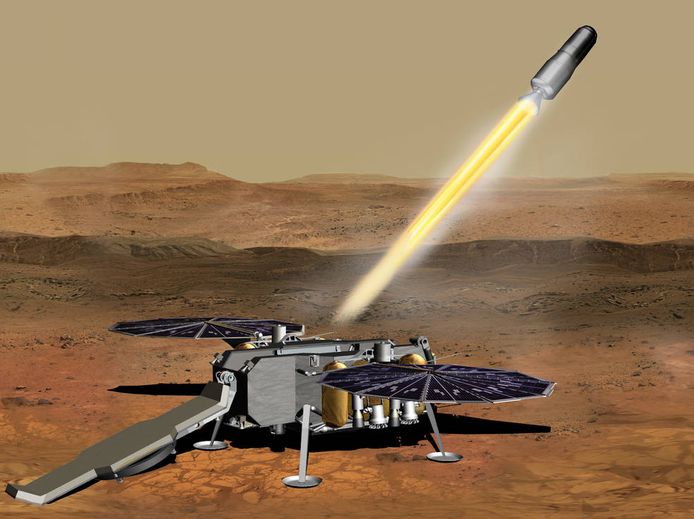

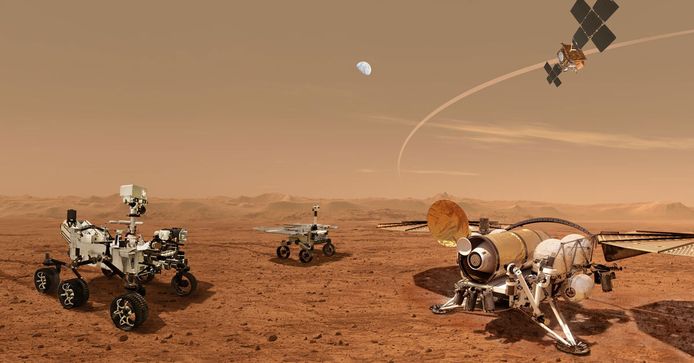 Dit zijn de robots die moeten samenwerken om de Marsstenen naar de aarde te krijgen. Van links naar rechts: Marsrover Perseverance, de Sample Fetch Rover, de Sample Retrieval Lander (met aan boord het Mars Ascent Vehicle), en de Earth Return Orbiter (rechtsboven). ©
NASA/ESA/JPL-Caltech
 Het eerste Marsmonster dat Perseverance heeft opgeborgen in een van de 43 buisjes die de rover ter beschikking heeft. Zeven buisjes zijn al gevuld.
© NASA / JPL-Caltech




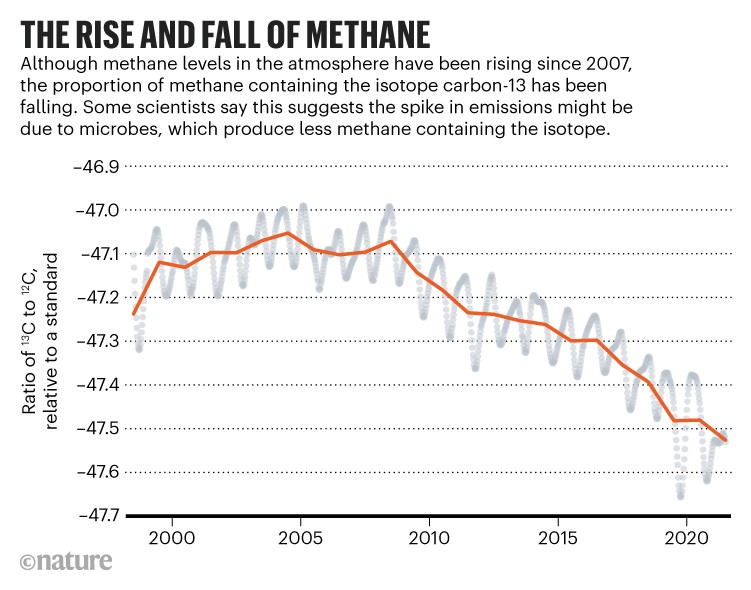
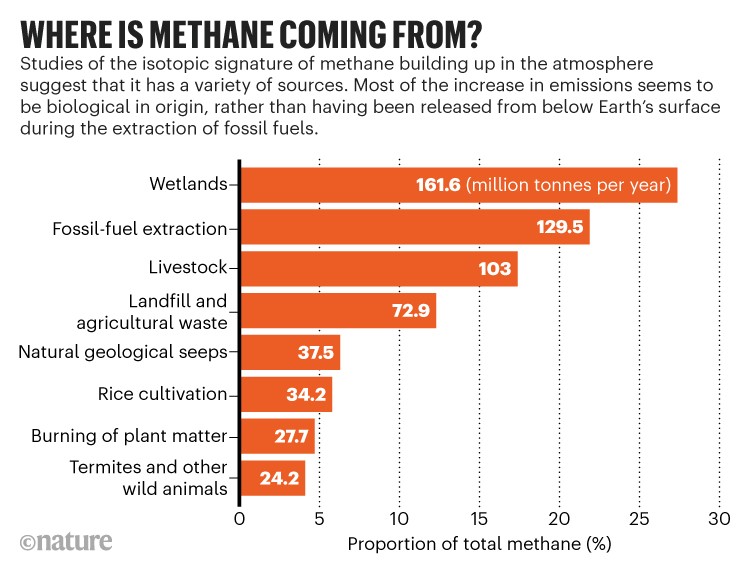


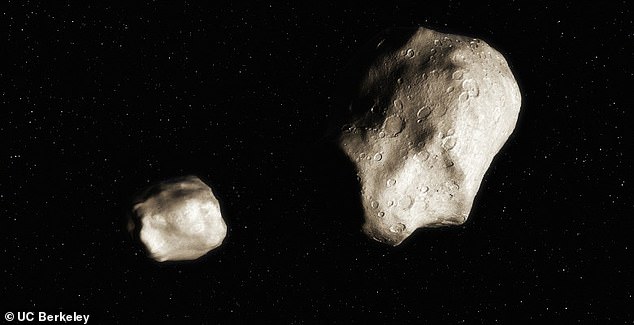
 Earth has a SECOND 'Trojan asteroid': 1,800ft-wide space..
 NASA's asteroid alert system ATLAS upgraded to constantly..
 Elon Musk's SpaceX Starlink satellites disrupt almost a...
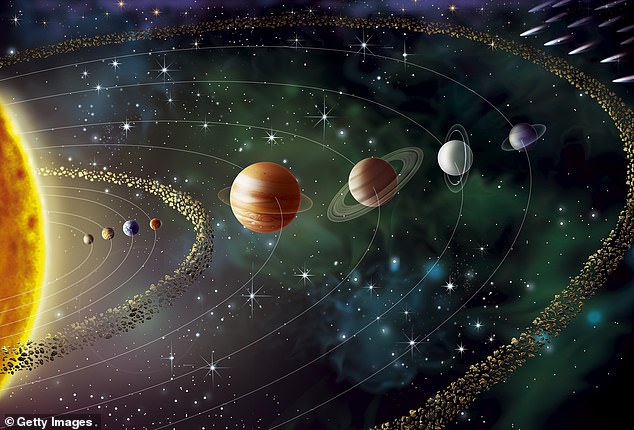



 SpaceX on target to launch a rocket a week in 2022,...





 Scientists are sprinkling millions of tiny glass beads on..
 US Air Force deploys cutting-edge weapon to destroy drone...
 Morrisons harks back to the 1970s as it offers £1 string...
 Microphones in Amazon's new smart glasses that give wearer...