Naar de inhoud

UFO'S of UAP'S, ASTRONOMIE, RUIMTEVAART, ARCHEOLOGIE, OUDHEIDKUNDE, SF-SNUFJES EN ANDERE ESOTERISCHE WETENSCHAPPEN - DE ALLERLAATSTE NIEUWTJES

UFO's of UAP'S in België en de rest van de wereld
akke.beakke.be
Ontdek de Fascinerende Wereld van UFO's en UAP's: Jouw Bron voor Onthullende Informatie! Ben jij ook gefascineerd door het onbekende? Wil je meer weten over UFO's en UAP's, niet alleen in België, maar over de hele wereld? Dan ben je op de juiste plek! België: Het Kloppend Hart van UFO-onderzoek In België is BUFON (Belgisch UFO-Netwerk) dé autoriteit op het gebied van UFO-onderzoek. Voor betrouwbare en objectieve informatie over deze intrigerende fenomenen, bezoek je zeker onze Facebook-pagina en deze blog. Maar dat is nog niet alles! Ontdek ook het Belgisch UFO-meldpunt en Caelestia, twee organisaties die diepgaand onderzoek verrichten, al zijn ze soms kritisch of sceptisch. Nederland: Een Schat aan Informatie Voor onze Nederlandse buren is er de schitterende website www.ufowijzer.nl, beheerd door Paul Harmans. Deze site biedt een schat aan informatie en artikelen die je niet wilt missen! Internationaal: MUFON - De Wereldwijde Autoriteit Neem ook een kijkje bij MUFON (Mutual UFO Network Inc.), een gerenommeerde Amerikaanse UFO-vereniging met afdelingen in de VS en wereldwijd. MUFON is toegewijd aan de wetenschappelijke en analytische studie van het UFO-fenomeen, en hun maandelijkse tijdschrift, The MUFON UFO-Journal, is een must-read voor elke UFO-enthousiasteling. Bezoek hun website op www.mufon.com voor meer informatie. Samenwerking en Toekomstvisie Sinds 1 februari 2020 is Pieter niet alleen ex-president van BUFON, maar ook de voormalige nationale directeur van MUFON in Vlaanderen en Nederland. Dit creëert een sterke samenwerking met de Franse MUFON Reseau MUFON/EUROP, wat ons in staat stelt om nog meer waardevolle inzichten te delen. Let op: Nepprofielen en Nieuwe Groeperingen Pas op voor een nieuwe groepering die zich ook BUFON noemt, maar geen enkele connectie heeft met onze gevestigde organisatie. Hoewel zij de naam geregistreerd hebben, kunnen ze het rijke verleden en de expertise van onze groep niet evenaren. We wensen hen veel succes, maar we blijven de autoriteit in UFO-onderzoek! Blijf Op De Hoogte! Wil jij de laatste nieuwtjes over UFO's, ruimtevaart, archeologie, en meer? Volg ons dan en duik samen met ons in de fascinerende wereld van het onbekende! Sluit je aan bij de gemeenschap van nieuwsgierige geesten die net als jij verlangen naar antwoorden en avonturen in de sterren! Heb je vragen of wil je meer weten? Aarzel dan niet om contact met ons op te nemen! Samen ontrafelen we het mysterie van de lucht en daarbuiten.

Berichten van 1 juni 2022 tot 30 juni 2022

Astronomen ontdekken snelgroeiend zwart gat dat elke seconde het equivalent van onze aarde opslokt

Illustratiebeeld Illustratiebeeld  © VIA REUTERS

Astronomen ontdekken snelgroeiend zwart gat dat elke seconde het equivalent van onze aarde opslokt

Astronomen hebben het snelst groeiende zwart gat van de laatste negen miljard jaar ontdekt, zo heeft de Australian National University (ANU) bekendgemaakt. Geen wonder dat het zo snel groeit, het zou elke seconde het equivalent van maar liefst een hele aardbol opslokken. 

HERBEKIJK

Astronomers capture 1st image of Milky Way's black hole | World Latest News | WION

HERBELUISTER OOK:

What do black holes sound like? NASA releases recording of black hole in distant galaxy

GERELATEERDE VIDEO'S

{ https://www.hln.be/ }

Hoe vind je dit bericht?
Geschreven door peter om 23:44 Stuur door

This is What the Metal Asteroid Psyche Might Look Like

This is What the Metal Asteroid Psyche Might Look Like

MIT-Psyche-Maps-01-press_0.jpg

If you wanted to do a forensic study of the Solar System, you might head for the main asteroid belt between Mars and Jupiter. That’s where you can find ancient rocks from the Solar System’s early days. Out there in the cold vacuum of space, far from the Sun, asteroids are largely untouched by space weathering. Space scientists sometimes refer to asteroids—and their meteorite fragments that fall to Earth—as time capsules because of the evidence they hold.

The asteroid Psyche is especially interesting, and NASA is sending a mission to investigate the unusual chunk of rock. In advance of that mission, a team of researchers combined observations of Psyche from an array of telescopes and constructed a map of the asteroid’s surface.

Astronomers divide asteroids into three categories. Carbonaceous or C-type asteroids are the most common type. They make up about 75% of known asteroids and contain large amounts of carbon. The carbon makes them dark, and they have low albedoes. Silicaceous or S-type asteroids are the second most common type. They make up about 17% of known asteroids and are mostly made of iron and magnesium silicates.

Metal or M-type asteroids are the rarest types of asteroids and make up about 8% of known asteroids. They appear to contain more metal than the other asteroid types, and scientists think they’re the source of iron meteorites that fall to Earth. M-type meteorites were one of the earliest sources of iron in human history.

King Tut's iron dagger was concealed in the wrappings surrounding the boy-king's mummy. Image: Daniela Comelli/Polytechnic University of Milan

King Tut was buried with an iron dagger made from an M-type meteorite. Image: Daniela Comelli/Polytechnic University of Milan

Psyche (16 Psyche) is an M-type asteroid. It’s also called a dwarf planet because it’s about 220 kilometres (140 mi) in diameter. It’s referred to as 16 Psyche because it was the 16th minor planet discovered. (Larger asteroids like Psyche are also known as minor planets.) Psyche is sometimes called the ‘Gold-mine asteroid’ because of the wealth of iron and nickel it contains. Though to be clear, nobody thinks it’s rich in gold.

Visible light images of Psyche don’t tell us much. The European Southern Observatory’s VLT captured some pictures of the asteroid, but they didn’t reveal any detail.

The Very Large Telescope captured this image of 16 Psyche in August 2019. Image Credit: By ESO/Vernazza et al./MISTRAL algorithm (ONERA/CNRS) - Cropped from: Kalliope and Psyche, CC BY 4.0, https://commons.wikimedia.org/w/index.php?curid=111158926

The Very Large Telescope captured this image of 16 Psyche in August 2019. Image Credit: By ESO/Vernazza et al./MISTRAL algorithm (ONERA/CNRS) – Cropped from Kalliope and Psyche, CC BY 4.0, https://commons.wikimedia.org/w/index.php?curid=111158926

Psyche’s history is a history of uncertainty. For a long time, astronomers thought it was the exposed iron core of a much larger body. In this hypothesis, a powerful collision or series of collisions stripped away the body’s crust and mantle. The larger body would’ve been fully differentiated and measured something like 500 km (310 miles) in diameter. With the crust and mantle gone, only the iron-rich core remained.

That idea fell out of favour as time passed and astronomers continued observing it. Evidence showed that it wasn’t dense enough to be solid iron and is likely porous.

Other researchers suggested that Psyche was disrupted somehow and then re-accreted as a mix of metals and silicates. One study indicated that Psyche isn’t as metal-rich as thought and is more of a rubble pile. In that scenario, collisions with more common C-type asteroids deposited a layer of carbon and other materials onto Psyche’s surface.

The most exotic idea behind Psyche’s origins is the Ferro-volcanic idea. A 2019 study presented evidence that Psyche was once a molten blob. In that scenario, the outer layers cooled and formed stress cracks, and the buoyant molten core erupted as iron volcanoes.

This graphic of 16 Psyche is from a 2021 study. It's a smoothed and contour-filled optical albedo map with purported topographical and albedo features labelled. It shows some of the asteroid's surface features like the depressions Eros, Foxtrot, and Panthia. Names with question marks are indeterminate features. The three blurred white spots are optical bright spots and the white circles are radar echo centers. Image Credit: By Michael K. Shepard et al., Asteroid 16 Psyche: Shape, Features, and Global Map (2021), figure 10. https://iopscience.iop.org/article/10.3847/PSJ/abfdba#psjabfdbaf9, CC BY-SA 4.0, https://commons.wikimedia.org/w/index.php?curid=113172869

This graphic of 16 Psyche is from a 2021 study. It’s a smoothed, contour-filled optical albedo map with labelled topographical and albedo features. It shows some of the asteroid’s surface features like the depressions Eros, Foxtrot, and Panthia. Names with question marks are indeterminate features. The three blurred white spots are optical bright spots, and the white circles are radar echo centers. Image Credit: Michael K. Shepard et al., Asteroid 16 Psyche: Shape, Features, and Global Map (2021), figure 10. https://iopscience.iop.org/article/10.3847/PSJ/abfdba#psjabfdbaf9, CC BY-SA 4.0, https://commons.wikimedia.org/w/index.php?curid=113172869

The only way to find out for sure what Psyche is is to go and look at it. So that’s what NASA is doing.

The mission is called Psyche and is scheduled for launch sometime in Fall 2022. The spacecraft will rely on solar-electric propulsion and a gravity-assist maneuver with Mars to arrive at Psyche in 2026. It’ll spend 21 months studying the asteroid and will follow four separate orbital paths, each successive one closer than the previous. As it moves closer to the asteroid, it’ll focus on different scientific objectives.

A team of researchers constructed a new map of Psyche’s surface to help prepare for the mission. The map is in a paper published in the Journal of Geophysical Research: Planets. The title is “The Heterogeneous Surface of Asteroid (16) Psyche,” and the lead author is Saverio Cambioni from MIT’s Department of Earth, Atmospheric and Planetary Sciences (EAPS).

“Psyche’s surface is very heterogeneous,” Cambioni said in a press release. “It’s an evolved surface, and these maps confirm that metal-rich asteroids are interesting enigmatic worlds. It’s another reason to look forward to the Psyche mission going to the asteroid.”

In this study, the authors used the Atacama Large Millimeter/submillimeter Array (ALMA) to better look at 16 Psyche. ALMA is a radio telescope composed of 66 high-precision antennae. The separate antennae operate together as an interferometer with a high resolution. ALMA operates at wavelengths sensitive to the temperature and some electric properties of materials on Psyche’s surface.

“The signals of the ALMA antennas can be combined into a synthetic signal that’s equivalent to a telescope with a diameter of 16 kilometres (10 miles),” said co-author Katherine de Kleer, an assistant professor of planetary science and astronomy at Caltech. “The larger the telescope, the higher the resolution.”

The new map is based on two types of measurements. One is thermal inertia, which is how long a material takes to reach the temperature of its environment. Higher thermal inertia means it takes longer.

The second is the dielectric constant. The dielectric constant describes how well a material conducts heat, electricity, or sound. A material with a low dielectric constant conducts poorly and is a good insulator and vice versa.

The researchers took the ALMA observations of thermal inertia and dielectric constant and ran hundreds of simulations to see which combinations of materials could explain them. “We ran these simulations area by area so we could catch differences in surface properties,” Cambioni says.

Pure iron has an infinite dielectric constant. By measuring the dielectric constant on Psyche, the researchers could map the surface and locate regions richer in iron. Iron also has high thermal inertia because it’s so dense. So combining thermal inertia and dielectric constant measurements gives a good idea of which surface regions on Psyche are rich in iron and other metals.

This figure from the study shows the thermal inertia (L) and dielectric constant (R) of 16 Psyche's surface as measured by ALMA. Image Credit: Cambioni et al. 2022.

This figure from the study shows the thermal inertia (L) and dielectric constant (R) of 16 Psyche’s surface as measured by ALMA. Image Credit: Cambioni et al. 2022.

The researchers call a curious feature on Psyche the Bravo-Golf region. That region has a systematically lower thermal inertia than the highland regions. The Bravo-Golf region is the depression just to the right of the asteroid’s prime meridian in the image below.

This figure from the paper combines thermal inertia with elevation. The low-elevation Bravo-Golf region is clearly visible. Image Credit: Cambioni et al. 2022.

This figure from the paper combines thermal inertia with elevation. The low-elevation Bravo-Golf region is visible. Image Credit: Cambioni et al. 2022.

Why does a low-elevation area have lower thermal inertia? Other studies show that the region is also radar-bright. Why is that? The researchers came up with three possibilities.

The lowlands could be metal-rich but covered with fine, porous regolith that lowers their thermal inertia compared to the highlands covered in coarser regolith. Thermal inertial increases with particle size. In this scenario, finer-grained regolith would’ve pooled in the lowlands.

“Ponds of fine-grained materials have been seen on small asteroids, whose gravity is low enough for impacts to shake the surface and cause finer materials to pool,” Cambioni said. “But Psyche is a large body, so if fine-grained materials accumulated on the bottom of the depression, this is interesting and somewhat mysterious.”

The second hypothesis is that the surface material covering the lowlands is more porous than the highlands. Thermal inertia decreases as rock porosity increases. Impact fractures could make the lowlands more porous too.

The third hypothesis is that the lowlands have more silicate-rich materials than the highlands, giving them a lower dielectric constant than some areas of the highlands. The idea is that the Bravo-Golf depression could’ve been formed by an impact with a silicate-rich impactor and left silicate-rich residue behind.

This figure from the study illustrates the three scenarios that might explain the low-thermal-inertia detected in the Bravo-Golf region. Image Credit: Cambioni et al. 2022.

This figure from the study illustrates the three scenarios that might explain the low-thermal-inertia detected in the Bravo-Golf region. Image Credit: Cambioni et al. 2022.

Overall, the study shows that 16 Psyche’s surface is covered in a large variety of materials. It also adds to other evidence showing that the asteroid is metal-rich, though the abundance of metals and silicates varies significantly in different regions. It also suggests that the asteroid might be a remnant core of a differentiated body that lost its mantle and crust long ago. “In conclusion, we provide evidence that Psyche is a metal-rich asteroid whose surface is heterogeneous, shows both metal and silicate materials, and appears evolved by impacts,” the authors conclude.

Simone Marchi is a staff scientist at the Southwest Research Institute and a co-investigator on NASA’s Psyche mission. Marchi wasn’t involved in this study but commented on its significance in a press release. “These data show that Psyche’s surface is heterogeneous, with possible remarkable variations in composition. One of the primary goals of the Psyche mission is to study the composition of the asteroid surface using its gamma rays and neutron spectrometer, and a colour imager. So, the possible presence of compositional heterogeneities is something that the Psyche Science Team is eager to study more.”

This animation from the paper shows thermal inertia on 16 Psyche’s surface. The low-elevation Bravo-Golf region is of particular interest. Credit: Cambioni et al. 2022.

It’ll be up to NASA’s Psyche mission to confirm these findings more rigorously.

But sending a spacecraft all the way to Psyche to understand it in more detail is about more than just Psyche itself.

If Psyche is the remnant core of a rocky, differentiated planetesimal, it’ll reveal something about our planet and how differentiated bodies form. Will it contain some of the same light elements that we expect are in Earth’s core? Earth’s core isn’t dense enough to be pure iron and nickel. Scientists think it contains lighter elements like sulphur, silicon, oxygen, carbon and hydrogen.

The Psyche mission will also determine whether the asteroid formed under conditions more oxidizing or more reducing than Earth’s core. That will tell us more about the solar nebula and the protoplanetary disk.

People sometimes refer to Psyche as the Gold Mine Asteroid because it’s so metal-rich. An object its size would contain an enormous amount of iron, though that value is unlikely to be realized or accessible any time soon.

But if knowledge is as valuable as iron, then 16 Psyche might still be a gold mine.

More:

The post This is What the Metal Asteroid Psyche Might Look Like appeared first on Universe Today.

Source: 

{ https://beforeitsnews.com/ }

Hoe vind je dit bericht?
Geschreven door peter om 23:18 Stuur door

Andromeda Tore Apart and Consumed a Neighbor Galaxy

Andromeda Tore Apart and Consumed a Neighbor Galaxy

Things may seem quiet and peaceful in the Andromeda Galaxy when you gaze at it in the sky. However, if you know what to look for, there’s evidence of a violent rumble in this galaxy’s past. That’s the takeaway from research by Ivanna Escala, an astronomer at Carnegie Institution for Science in Pasadena. She found telltale clues for a merger a few billion years ago. That’s when Andromeda actively cannibalized another galaxy.

Collisions between galaxies create tidal artifacts with all sorts of shapes. This new work from Ivanna Escala found conclusive evidence that Andromeda's Northeast, West, and Southeast shelfs and Giant Stellar Stream are the result of a collision with another galaxy. Studying these tidal features can teach us about how galaxies grow and evolve over time as they accrete new material. This composite image of 12 galaxy mergers is courtesy of NASA, ESA, the Hubble Heritage Team (STScI/AURA)-ESA/Hubble Collaboration and A. Evans (University of Virginia, Charlottesville/NRAO/Stony Brook University), K. Noll (STScI), and J. Westphal (Caltech).

Collisions between galaxies create tidal artifacts with all sorts of shapes. This new work from Ivanna Escala found conclusive evidence that Andromeda’s Northeast, West, and Southeast shelfs and Giant Stellar Stream are the result of a collision with another galaxy. Studying these tidal features can teach us about how galaxies grow and evolve over time as they accrete new material. This composite image of 12 galaxy mergers is courtesy of NASA, ESA, the Hubble Heritage Team (STScI/AURA)-ESA/Hubble Collaboration, and A. Evans (University of Virginia, Charlottesville/NRAO/Stony Brook University), K. Noll (STScI), and J. Westphal (Caltech).

Mergers Make Galaxies

When galaxies collide (and wouldn’t that be a great movie title?), they basically gobble up material from whatever is around—the galaxies themselves, globular clusters, nebulae, whatever’s in the way. They also shove material around rather violently at times. That produces profound disturbances in the wake of the collision. If you look at the sites of galaxy clashes, you can find knots of star birth, for example. They boil up as material is compressed and shocked by the forces of the collision into active star formation regions.

Collisional Pileups

It also creates stellar associations called tidal features. They can look like streams or arcing shells of stars moving along in the wake of the collision. Sometimes they create “pileups” that look like ripples (or arcs of ripples) similar to when you toss a rock into a pond. If you know how to interpret those clues, you can figure out something about the collisions that caused them.

That’s what Escala and her team did. “The remnants of each crash can be identified by studying the movement of the stars and their chemical compositions,” she explained. “Together this information serves as a kind of fingerprint that identifies stars that joined a galaxy in a collision.”

Diving into Andromeda’s Past

The Andromeda Galaxy is about 10 billion years old. By comparison, the Milky Way Galaxy is about 13.6 billion years old. Like most other galaxies, Andromeda grew by multiple collisions with smaller protogalaxies and subsequent mergers with larger ones. The Milky Way is currently gobbling up at least one dwarf galaxy and also formed by mergers.

The trick to figuring out the merger history is, as any crime scene detective knows, buried in the details. Astronomers look at the chemical components of stars and figure out which are native to the galaxy and which are not. Stellar motions can reveal intruders. If the merger is particularly violent, streams of stars and gas and dust will form observable features.

Digging Into Andromeda’s Stars

Escala and her collaborators looked deep into Andromeda at a feature called the Northeast Shelf. They analyzed 556 red giant branch stars within it. “We performed the first detailed characterization of the chemical composition and geometric motion of the stars in this region of our neighboring galaxy, demonstrating conclusively that the NE shelf is a tidal shell predominately composed of debris from the aftermath of a collision,” Escala explained during a press conference at the American Astronomical Society Meeting in Pasadena, CA.

This image shows NASA/ESA Hubble Space Telescope images of a small part of the giant stellar stream of the Andromeda Galaxy. The stream is a long structure thought to be the remains of a companion galaxy torn apart by the Andromeda Galaxy’s gravity and engulfed in it. By studying details of the stars in the stream, astronomers can determine the chemistry and ages of the stars in each part of the Andromeda Galaxy.

They also showed that this ledge is part of a multi-shell system, along with the galaxy’s west and southeast shelves. The material in these regions is consistent with that of Andromeda’s Giant Stellar Stream, created during the recent large collisions. It’s likely that all those tidal features could have come from the same source. “Our results are in line with modeling that predicted the Giant Stellar Stream is the first loop of material from a collision and the NE shelf is the second layer wrap-around,” Escala concluded. The wrap-around she mentions points toward multiple encounters during the collision/cannibalization event.

Gravitational interactions at the time shaped the streams. The analysis done by Escala and her team is an important step toward confirming predictions about this galaxy’s violent past. Collisions are an important part of that history. More evidence about these actions gives a deeper understanding of the many features left behind long after the merger ends.

For More Information

{ https://beforeitsnews.com/ }

Hoe vind je dit bericht?
Geschreven door peter om 18:52 Stuur door

NASA discovers two rocky 'super-Earths' orbiting a nearby dwarf star that could provide vital clues in the search for alien life

NASA discovers two rocky 'super-Earths' orbiting a nearby dwarf star that could provide vital clues in the search for alien life

  • Astronomers have spotted two rocky 'super-Earths' orbiting a nearby dwarf star
  • Is one of closest known multi-planet systems to Earth, about 33 light-years away
  • The rocky worlds are likely not habitable because their orbits are relatively tight
  • This exposes the planets to temperatures too high to sustain liquid surface water

The discovery of at least two rocky 'super-Earths' orbiting a nearby dwarf star could provide vital clues in the search for extra-terrestrials, astronomers say.

While the worlds are unlikely to be habitable for life as we know it, the star and its exoplanets are among the closest multi-world systems to Earth, at just 33 light-years away.

This makes the system an excellent target for further investigation, in part because it could contain more planets, including the potential for one in the habitable zone.  

'There are many multi-planet systems hosting five or six planets, especially around small stars like this one,' said astrophysicist Avi Shporer, of MIT's Kavli Institute for Astrophysics and Space Research.

'Hopefully we will find more, and one might be in the habitable zone. That's optimistic thinking.'

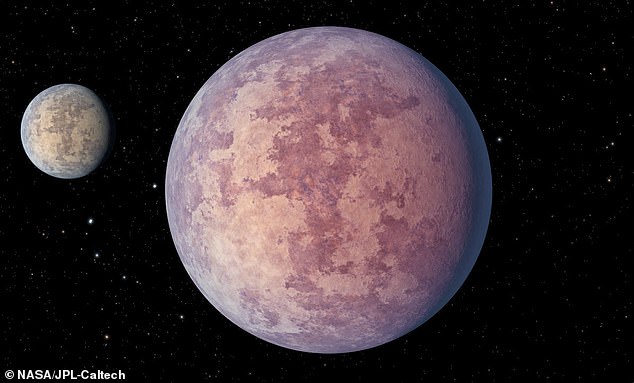
The discovery of at least two rocky 'super-Earths' (pictured in an artist's impression) orbiting a nearby dwarf star could provide vital clues in the search for extra-terrestrials, astronomers say

The discovery of at least two rocky 'super-Earths' (pictured in an artist's impression) orbiting a nearby dwarf star could provide vital clues in the search for extra-terrestrials, astronomers say

KEY FACTS ABOUT THE NEWLY-DISCOVERED 'SUPER-EARTHS'

HD 260655b

Average temperature: 816° Fahrenheit

Orbit time: Circles star every 2.8 days

Size: About 1.2 times as big as Earth

Mass: Twice as massive and slightly denser than Earth

Composition: Terrestrial/rocky

HD 260655c

Average temperature: 543° Fahrenheit

Orbit time: Circles star every 5.7 days

Size: About 1.5 times as big as Earth

Mass: About three Earth masses but a bit less dense

Composition: Terrestrial/rocky 

Even though the star HD 260655 is cooler and dimmer than our sun, the proximity of the planets to the red dwarf means the worlds would be way too hot for life. 

HD 260655b has an average temperature of 816 degrees Fahrenheit (435 degrees Celsius), while HD 260655c is milder but still a fiery 543 degrees Fahrenheit (284 degrees Celsius).

'We consider that range outside the habitable zone, too hot for liquid water to exist on the surface,' said astronomer Michelle Kunimoto, of MIT's Kavli Institute for Astrophysics and Space Research.

Nevertheless, scientists are excited about this system because the proximity and brightness of its star will give them a closer look at the properties of the planets and signs of any atmosphere they might hold. 

'Both planets in this system are each considered among the best targets for atmospheric study because of the brightness of their star,' said Kunimoto.

'Is there a volatile-rich atmosphere around these planets? And are there signs of water or carbon-based species? These planets are fantastic test beds for those explorations.' 

The new planetary system was initially identified by NASA's Transiting Exoplanet Survey Satellite (TESS), an MIT-led mission that is designed to observe the nearest and brightest stars, and detect periodic dips in light that could signal a passing planet.

In October 2021, Kunimoto, a member of MIT's TESS science team, was monitoring the satellite's incoming data when she noticed a pair of periodic dips in starlight, or transits, from the star HD 260655.

She ran the detections through the mission's science inspection pipeline, and the signals were soon classified as two TESS Objects of Interest, or TOIs — objects that are flagged as potential planets. 

The process of classifying and subsequently confirming new planets can often take several years, but for HD 260655 that process was shortened significantly with the help of archival data.

The fully integrated Transiting Exoplanet Survey Satellite (TESS), which launched in 2018 to find thousands of new planets orbiting other stars

The fully integrated Transiting Exoplanet Survey Satellite (TESS), which launched in 2018 to find thousands of new planets orbiting other stars

Soon after Kunimoto identified the two potential planets around HD 260655, Shporer looked to see whether the star was observed previously by other telescopes. 

As luck would have it, HD 260655 was listed in a survey of stars taken by the High Resolution Echelle Spectrometer (HIRES), an instrument that operates as part of the Keck Observatory in Hawaii. 

HIRES had been monitoring the star, along with a host of other stars, since 1998, and the researchers were able to access the survey's publicly available data.

In the end, this collaborative effort quickly confirmed the presence of two planets around HD 260655 in about six months.

The team then looked more closely at TESS data to pin down properties of both planets, including their orbital period and size. 

They determined that the inner planet, dubbed HD 260655b, orbits the star every 2.8 days and is about 1.2 times as big as the Earth. 

The second outer planet, HD 260655c, orbits every 5.7 days and is 1.5 times as big as the Earth.

From the archival data, researchers were then able to calculate the planets' mass and density.

They found the inner planet is about twice as massive and slightly denser than Earth, while the outer planet is about three Earth masses but a bit less dense. Both planets, based on their density, are likely terrestrial, or rocky in composition, the astronomers said.

So far, more than 5,000 exoplanets have been confirmed in our Milky Way galaxy, with experts especially interested in finding terrestrial, or rocky, worlds like Earth, Venus, and Mars.

The researchers presented their findings at the 240th meeting of the American Astronomical Society.

WHAT IS THE TESS SPACECRAFT?

NASA's 'planet hunter,' spacecraft, is equipped with four cameras that will allow it to view 85 per cent of the entire sky, as it searches exoplanets orbiting stars less than 300 light-years away.

By studying objects much brighter than the Kepler targets, it's hoped TESS could uncover new clues on the possibility of life elsewhere in the universe.

Its four wide-field cameras will view the sky in 26 segments, each of which it will observe one by one.

In its first year of operation, it mapped the 13 sectors that make up the southern sky, and scoured the northern sectors the following year.

Since it was launched in 2018, TESS has found over 170 confirmed exoplanets, and has a catalogue of over 4,700 yet to be verified.

It has also discovered other strange phenomena including supernova and triple star systems since it was launched. 

Tess is 5 feet (1.5 meters) wide and is shorter than most adults.

The observatory is 4 feet across (1.2 meters), not counting the solar wings, which are folded for launch, and weighs just 800 pounds (362 kilograms). 

NASA says it's somewhere between the size of a refrigerator and a stacked washer and dryer.   

Read more:

{ https://www.dailymail.co.uk/ }

Hoe vind je dit bericht?
Geschreven door peter om 18:37 Stuur door

NASA confirms there are more than 5,000 planets beyond our solar system including several 'hot Jupiters', 'super-Earths' and 'mini-Neptunes'

NASA confirms there are more than 5,000 planets beyond our solar system including several 'hot Jupiters', 'super-Earths' and 'mini-Neptunes'

  • There are at least 5,005 planets outside our solar system, NASA has announced
  • The milestone comes 30 years after the first exoplanets were found back in 1992
  • The James Webb Telescope will lead efforts to map atmospheres of exoplanets 

NASA has confirmed that there are more than 5,000 known planets outside our solar system, known as exoplanets. 

The US space agency has added another 65 exoplanets to the online NASA Exoplanet Archive, bringing the grand total to 5,005.

Exoplanets found so far include small, rocky worlds like Earth, gas giants many times larger than Jupiter, and 'hot Jupiters' in scorchingly close orbits around their stars. 

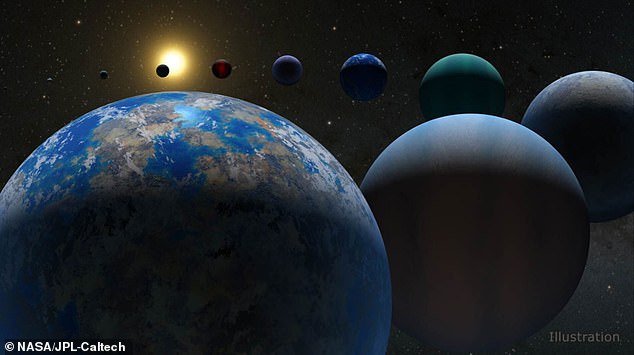
NASA confirms there are more than 5,000 planets beyond our solar system including several 'hot Jupiters', 'super-Earths' and 'mini-Neptunes'. An artist's impression of the variety of different exoplanets are depicted here

HOW MANY EXOPLANETS ARE THERE? 

An exoplanet is any planet beyond our solar system. Most orbit other stars, but free-floating exoplanets, called rogue planets, orbit the galactic center and are untethered to any star. 

5,005 exoplanets have been confirmed since the first exoplanet discoveries in the early 1990s, as of March 22, 2022.

The majority of these exoplanets are gaseous, like Jupiter or Neptune, rather than terrestrial, according to NASA's online database. 

The closest exoplanet is called Proxima Centauri b, around 4.2 light years away from our Sun. 

'It's not just a number,' said Jessie Christiansen, research scientist with the NASA Exoplanet Science Institute at Caltech in Pasadena, California.

'Each one of them is a new world, a brand-new planet. I get excited about every one because we don't know anything about them.'  

The majority of exoplanets are gaseous, like Jupiter or Neptune, rather than terrestrial, according to NASA's online database.  

The archive records exoplanet discoveries that appear in peer-reviewed, scientific papers that have been confirmed using multiple detection methods or by analytical techniques.   

Among the most recently confirmed  exoplanets are K2-377 b, a 'super Earth' with a mass of 3.51 Earths that takes 12.8 days to complete one orbit of its star.  

Another, called TOI-1064 b, is a 'potentially rocky world larger than Earth, according to NASA. 

Most exoplanets are found by measuring the dimming of a star that happens to have a planet pass in front of it, called the transit method. 

Another way to detect exoplanets, called the Doppler method, measures the 'wobbling' of stars due to the gravitational pull of orbiting planets. 

The more than 5,000 exoplanets confirmed in our galaxy so far include a variety of types - among them a mysterious variety known as 'super-Earths' because they are larger than our world and possibly rocky

The more than 5,000 exoplanets confirmed in our galaxy so far include a variety of types - among them a mysterious variety known as 'super-Earths' because they are larger than our world and possibly rocky

NASA's milestone comes 30 years after the first exoplanets were discovered, back in 1992. 

THREE 'EXOPLANETS' ARE ACTUALLY STARS 

Scientists have been examining the thousands of exoplanet discoveries confirmed within the Milky Way Galaxy, and three of them have turned out to be stars. 

A team from MIT in Cambridge looked through planets discovered using the NASA Kepler Space Telescope, double checking the measurements to see which match known planet sizes.

They identified three objects that are simply too big to be planets, based on new, more accurate measurements taken by the European Space Agency Gaia telescope.  

Read more: Three 'exoplanets' are actually stars 

In January that year, Aleksander Wolszczan and Dale Frail announced the discovery of two rocky planets orbiting PSR B1 257+12, a pulsar in the constellation Virgo. A further planet was discovered in the system in 1994.  

Finding just three planets around this spinning star essentially opened the floodgates for exoplanets, said Wolszczan, who still searches for exoplanets as a professor at Penn State.

'If you can find planets around a neutron star, planets have to be basically everywhere,' he told NASA. 'The planet production process has to be very robust.'     

Some of the exoplanets that have been discovered since, such as Kepler 16-b, orbit two stars at once, like the planet of Tatooine in 'Star Wars'. 

Around 200 light years away, Kepler-16b weighs about a third as much as Jupiter and has a radius three-fourths that of Jupiter, making it similar to Saturn in both size and mass. 

Another exoplanet called WASP-121b, around 850 light years from Earth, is an example of a 'hot Jupiter' – a Jupiter-like giant gas planet on a close orbit around its parent star. 

WASP-121b has one of the shortest orbits detected to date, circling its star in just 30 hours. 

It is tidally locked, meaning the same side always faces its star, while its colder 'night' side is turned forever toward space. 

Gliese 486b, meanwhile, is an example of a 'super Earth' – a planet larger than Earth but smaller than the four gas giants Jupiter, Saturn, Neptune and Uranus. 

Some exoplanets orbit two stars at once, like the planet of Tatooine in the 1977 film 'Star Wars' (pictured)

Some exoplanets orbit two stars at once, like the planet of Tatooine in the 1977 film 'Star Wars' (pictured)

Artist's impression of exoplanet Kepler-16b, the most 'Tatooine-like' planet yet found in our galaxy. Kepler-16b is depicted as a small black circle circling two stars. The largest of the two stars, a K dwarf, is about 69 per cent the mass of our sun, and the smallest, a red dwarf, is about 20 per cent the sun's mass

Artist's impression of exoplanet Kepler-16b, the most 'Tatooine-like' planet yet found in our galaxy. Kepler-16b is depicted as a small black circle circling two stars. The largest of the two stars, a K dwarf, is about 69 per cent the mass of our sun, and the smallest, a red dwarf, is about 20 per cent the sun's mass

Gliese 486b is the only planet so far detected orbiting the small star and has a radius 1.3 times larger than the Earth but is 2.8 times more massive.

The planet has an iron-silicate composition similar to the makeup of Earth but is much hotter, with a surface temperature of 802°F (428°C), according to a 2021 study.

GJ 367 b, meanwhile, is exposed to a huge amount of radiation, due to its small distance to its star – about 620,000 miles – which it orbits in just eight hours. 

With a diameter of 5,560 miles, GJ 367 b is slightly bigger than Mars (4,200 miles) but has the makeup of Mercury. 

NASA said its James Webb Space Telescope (depicted here in space) will capture light from atmospheres of exoplanets to read which gases are present to potentially identify tell-tale signs of habitable conditions

NASA said its James Webb Space Telescope (depicted here in space) will capture light from atmospheres of exoplanets to read which gases are present to potentially identify tell-tale signs of habitable conditions

Scientists are still trying to learn more about what exactly exoplanets and their atmospheres are made up of. 

NASA said its James Webb Space Telescope will capture light from the atmospheres of exoplanets to read which gases are present to potentially identify tell-tale signs of habitable conditions. 

The $10 billion (£7.4 billion) observatory, which launched on Christmas Day, will explore the universe in the infrared spectrum, allowing it to gaze through clouds of gas and dust where stars are being born. 

EXOPLANETS HAVE 'EXOTIC' ROCKS THAT CAN'T BE FOUND IN OUR SOLAR SYSTEM 

Rocky planets outside our solar system, known as exoplanets, are composed of 'exotic' rock types that don't even exist in our planetary system, a 2021 study shows. 

Researchers have used telescope data to analyse white dwarfs – former stars that were once gave life just like our Sun – in an attempt to discover secrets of their former surrounding planets. 

Roughly 98 per cent of all the stars in the universe will ultimately end up as white dwarfs, including our own Sun. 

The experts found that some exoplanets have rock types that don't exist, or just can't be found, on planets in our solar system.

These rock types are so 'strange' that the authors have had to create new names for them – including 'quartz pyroxenites' and 'periclase dunites'. 

Some 4,374 exoplanets have been confirmed in 3,234 systems since the first exoplanet discoveries in the early 1990s.

The majority of these exoplanets are gaseous, like Jupiter or Neptune, rather than terrestrial, according to NASA's online database. 

Read more: Rocky exoplanets are even stranger than we thought, study suggests

Hoe vind je dit bericht?
Geschreven door peter om 18:19 Stuur door

Two New Rocky Planets Discovered Close to the Solar System

Two New Rocky Planets Discovered Close to the Solar System

TESS has struck paydirt again. NASA’s planet-hunting spacecraft has found two new super-Earths orbiting a star only 33 light-years away. These are two of the closest rocky planets ever found.

The star’s name is HD 260655. It’s a bright M dwarf star, sometimes called a red dwarf. Both planets are rocky super-Earths, and though the word “Earth” is suggestive, neither world is likely to support life due to their extremely high temperatures. But scientists still think they’re worthy of further observations.

A new paper titled “The HD 260655 system: Two rocky worlds transiting a bright M dwarf at 10 PC” announced the discovery. The lead author is Rafael Luque of the Institute of Astrophysics of Andalusia, Spain, and the University of Chicago. The journal Astronomy and Astrophysics will publish the paper, but it’s currently available online at the pre-press site arxiv.org.

HD 260655b is closest to the star with an orbital period of 2.7 days. Its radius is 1.2 Earth radii, and its mass is 2.14 Earth masses.

HD 260655c has an orbital period of 5.7 days. Its radius is 1.5 Earth radii, and its mass is 3.09 Earth masses.

Their temperatures are almost certainly too high to support any life. Planet b’s temperature is approximately 435 Celsius (816 Fahrenheit), and planet c’s temperature is about 284 Celsius (543 Fahrenheit.) Those temperature estimates are dependent on any atmospheres the planets may have.

Their potential atmospheres are part of what makes these planets interesting.

“The HD 260655 system presents a unique opportunity for comparative planetology studies of rocky worlds.”

From “The HD 260655 system: Two rocky worlds transiting a bright M dwarf at 10 PC.”

When the James Webb Space Telescope begins science operations (soon, people, soon), it’ll have the capability to examine the atmospheres of exoplanets like these. The results will show us how different rocky planets can be from each other and will provide clues to how rocky planets form.

The opportunity to study two rocky planets in the same system is too good to pass up.

“Multiplanetary systems offer a unique opportunity for characterization via comparative planetology, as
they have formed within the same protoplanetary disk,” the authors write. And since the host star is so small, only about 0.4 solar masses, the super-Earths exhibit more influence on it. This makes measuring the planets’ masses and densities easier.

The star is a red dwarf, and it’s much dimmer than a star like our Sun. But for its type, HD 260655 is pretty bright. “It is among the brightest early-type M dwarfs in the sky, with an apparent magnitude in the J band of 6.7 mag.,” the authors write. The J-band is in the near-infrared, part of the electromagnetic spectrum that James Webb is designed to observe.

And at only 33 light-years away, the JWST easily has the power to examine the planets’ atmospheres spectroscopically. The telescope’s Near-Infrared spectrograph (NIRSpec) can perform three types of spectroscopic observations in the NIR. It can obtain the spectra of over 100 targets simultaneously in one of its modes. Combined with its other instruments and modes, no exoplanet atmosphere will be safe. Certainly none at this distance anyway.

But decisions on which planets are suitable for atmospheric characterization by the JWST come down to specific metrics. The authors computed two values for these rocky exoplanets and compared them to their peers in NASA’s Exoplanet Archive. The values are the Transmission Spectroscopy Metric (TSM) and Emission Spectroscopy Metric (ESM.) Both planets are in the top quartile of desirable targets for JWST spectroscopy. HD 260655 b is among the top 10 terrestrial planets for atmospheric characterization. (Note that in this metric, the inner planet (HD 260655 b) is considered a terrestrial planet and the outer planet (HD 260655 c) is regarded as a super-Earth/sub-Neptune.)

This figure from the study shows the Transmission Spectroscopy Metric (TSM) for both rocky super-Earths compared to their peers in NASA's Exoplanet Archive. These numbers place both targets in the top quartile in their respective categories, making them excellent candidates for follow-up spectroscopy with the JWST. Image Credit: Luque et al. 2022.

This figure from the study shows the Transmission Spectroscopy Metric (TSM) for both rocky super-Earths compared to their peers in NASA’s Exoplanet Archive. These numbers place both targets in the top quartile in their respective categories, making them excellent candidates for follow-up spectroscopy with the JWST. Image Credit: Luque et al. 2022.

For these reasons, the team behind this discovery says that the pair of super-Earths are among the top 10 terrestrial exoplanet candidates for atmospheric characterization. There’s no certainty that the planets have atmospheres, but there’s some reason to believe they do. Because even though they were discovered with TESS, which detects exoplanet transits, the team used data from other ground-based facilities to learn as much as possible.

The team measured the wobble exhibited by the star as the orbiting planets tugged on it. Those measurements reveal the planets’ masses. By combining their masses with their sizes, the researchers found their densities. That led to the conclusion that they’re rocky planets. It also means that if the planets do have atmospheres, they’re likely not extended hydrogen atmospheres.

This figure from the study shows HD 260655 b and c in the context of other transiting exoplanets with well-known masses. Planets orbiting red dwarfs are shown in orange and others are shown in grey. It also shows theoretical models for their internal compositions. Image Credit: Luque et al. 2022.

This figure from the study shows HD 260655 b and c in the context of other transiting exoplanets with well-known masses. Planets orbiting red dwarfs are shown in orange, while others are in grey. It also shows theoretical models for their internal compositions. Image Credit: Luque et al. 2022.

The team surmised that the inner planet, HD 260655 b, has a bulk density composition in perfect agreement with Earth’s. But planet c is different. “HD 260655 c is more consistent with an internal composition void of iron and fully made of silicates if it is assumed to be free of volatiles,” the paper states. The team says that the density difference between the planets is either due to different concentrations of volatiles or to observational uncertainties.

Another interesting fact about these planets concerns what exoplanet scientists call the small planet radius gap. It’s an “… observed scarcity of planets with radii between 1.5 and 2 times Earth’s radius,” as Wikipedia defines it. Scientists think that the gap could be due to photoevaporation. Different researchers have defined the gap differently in terms of planet radii, but both planets in the system are less than 1.5 Earth radii. This suggests that both worlds have lost their atmospheres, which is expected for planets this close to their stars.

The two grey lines represent the small planet radius gap as defined by different researchers. Both HD 260655 b and c are in the gap, meaning they've likely had their atmospheres stripped away by the star. Image Credit: Luque et al. 2022.

The two grey lines represent the small planet radius gap as defined by different researchers. Both HD 260655 b and c are in the gap, meaning they’ve likely had their atmospheres stripped away by the star. Image Credit: Luque et al. 2022.

This paper shows that planet c’s atmosphere, if it had one, was likely a Hydrogen/Helium atmosphere that was stripped away. But if they’re wrong about the composition, and it’s more like Earth’s, then it may have held on to a water-dominated atmosphere.

Planet b is different. Since it’s so much closer to its star, it’s unlikely to have much of an atmosphere. In both cases, if the planets have atmospheres, they’re highly unlikely to have extended hydrogen atmospheres.

These planets are not targets in the search for life. They’re too hot. But they’re scientifically desirable targets in other ways. “The HD 260655 system presents a unique opportunity for comparative planetology studies of rocky worlds,” the authors write. As pointed out earlier, they’re both prime targets for follow-up spectroscopy with the JWST. “These follow-up observations will improve our knowledge about the formation and evolution history of the system,” the authors write. Those observations could “… open a new observational avenue to study the magnetic fields of low-mass stars and their imprint in planetary systems.”

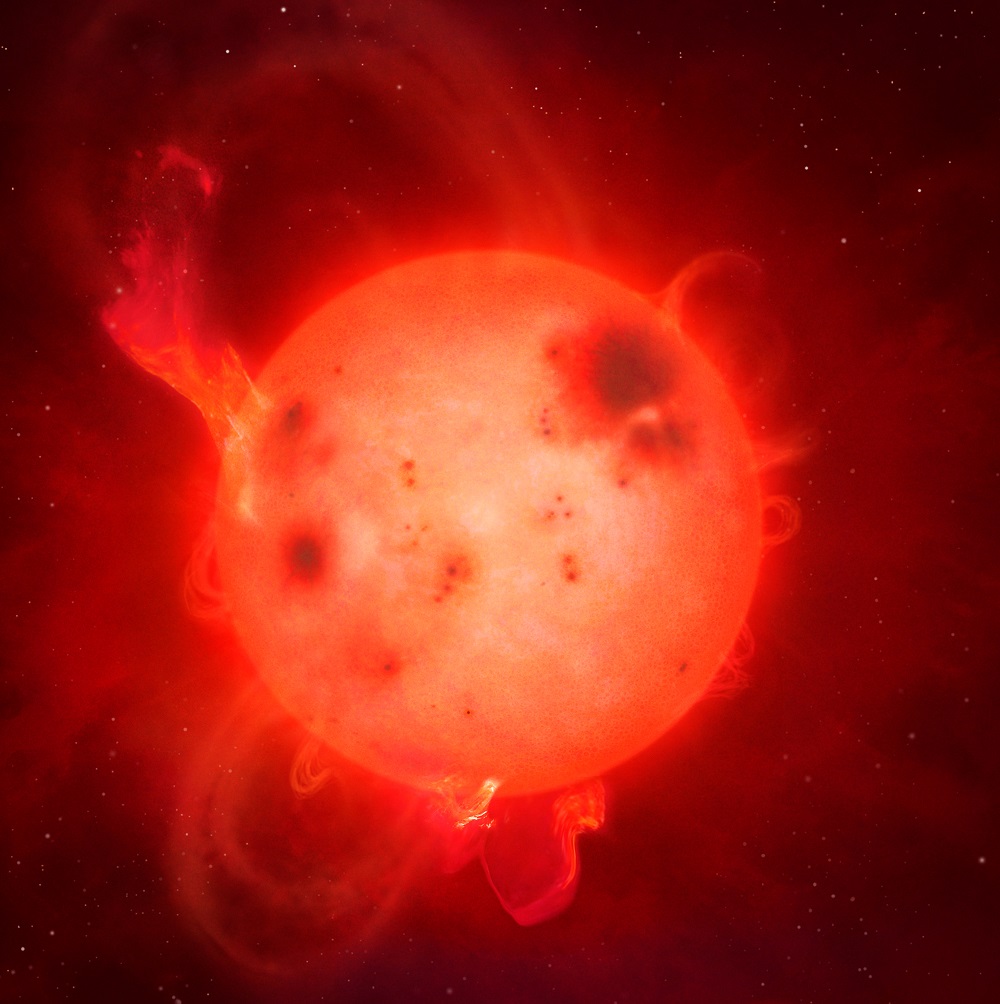
An artist's conception of a superflare event, on a dwarf star. Image credit: Mark Garlick/University of Warwick

An artist’s conception of a superflare event on a dwarf star. Image credit: Mark Garlick/University of Warwick

Evidence from HARPS (High Accuracy Radial Velocity Planet Searcher) shows that 40% of red dwarfs host Earth-like planets in their habitable zones. The problem is that red dwarfs can flare violently, rendering their habitable zone uninhabitable, or so we think. But we just don’t have a complete picture.

So while these two planets are far too hot for surface water and life, astronomers can use them to learn more about all those other planets orbiting all those other red dwarfs.

More:

The post Two New Rocky Planets Discovered Close to the Solar System appeared first on Universe Today.

Source: 

{ https://beforeitsnews.com/ }

Hoe vind je dit bericht?
Geschreven door peter om 17:58 Stuur door

Richard Dolan on USOs consistently seen in Earth's bodies of water

Richard Dolan on USOs consistently seen in Earth's bodies of water

We live in a world of deceptive narratives coming from the very sources we were once taught to trust. One of those narratives deals with UFOs. 
USO%20UFO%20UAP.jpg

Something completely left out of our public discussion of the UFO phenomenon are those objects consistently seen in Earth's bodies of water. 
These UFOs/USOs flying into and out of the oceans, unknown craft that are able to travel underwater, so it’s quite possible that there are some UFO/USO (whether of extraterrestrial origin or military) bases hidden deep within the oceans. 
Another remarkable detail, most of these underwater bases are located off coast and connected via tunnels with a base on land which indicates that such secret underwater bases are built by governments or certain organizations who are working together with extraterrestrials. 
Unidentified Submersible Objects (USOs) have been with us for as long as airborne UFOs have. We need to recognize and understand this. 
What better place to have an impenetrable base than deep within the oceans of the planet.
  
Hoe vind je dit bericht?
Geschreven door peter om 17:34 Stuur door

Astronomers Caught Betelgeuse Just Before it Started Dimming and Might Have Seen a Pressure Wave Rippling Through its Atmosphere

Astronomers Caught Betelgeuse Just Before it Started Dimming and Might Have Seen a Pressure Wave Rippling Through its Atmosphere

A couple of years ago, Betelgeuse generated much interest when it started dimming. That caught the attention of astronomers worldwide, who tried to understand what was happening. Was it about to go supernova?

Evidence showed that dust was the most likely culprit for the red supergiant’s dimming, though there are still questions. A new study shows that the star was behaving strangely just before the dimming.

The optical dimming that Betelgeuse—or Alpha Orionis—exhibited in late 2019 and early 2020 was unprecedented. Betelgeuse often undergoes periodic optical dimming, which happens in timescales of ~300-500 days and ~2000 days. But the Great Dimming, as it came to be known—when the star dimmed to about two-thirds of its normal brightness— was the faintest that the star had become in almost 200 years of observations.

Researchers got to work generating possible explanations for the dimming. Some hypothesized that dust caused the dimming, others hypothesized that a reduction in photosphere temperature caused it, and some thought both played a role.

Astronomers continued studying it, and evidence showed that temperature decrease alone couldn’t be the culprit. Episodic mass loss was proposed as the cause, paired with a rise in large grain dust in the line of sight. Others argued that large inhomogeneities in the photosphere caused the dimming. Another suggested a critical shift in Betelgeuse’s pulsation dynamics caused the Great Dimming. If feedback from UT readers is any indication, there’s still confusion around the cause of the dimming event.

Betelgeuse, as seen by the Hubble Space Telescope. Credit: NASA

Betelgeuse, as seen by the Hubble Space Telescope. Credit: NASA

But there were really two dimming events, and that’s helped create some of the confusion. The scientific community has settled on dust as the cause of the first dimming. “We know the first dimming event involved a dust cloud,” said Dr. Meridith Joyce from The Australian National University in 2020.

According to Dr. Joyce, the second dimming event had a different cause: “We found the second smaller event was likely due to the pulsations of the star.”

Now a new paper presents observations of Betelgeuse just before the Great Dimming. Its title is “SPATIALLY RESOLVED OBSERVATIONS OF BETELGEUSE AT ?7 MM AND ?1.3 CM JUST PRIOR TO THE
GREAT DIMMING.” The Astrophysical Journal will publish it, but for now, it’s available on the pre-press site arxiv.org. The authors are Dr. Lynn D. Matthews of MIT’s Haystack Observatory and Andrea Dupree from the Harvard and Smithsonian Center for Astrophysics. The paper is based on observations of Betelgeuse with the Karl G. Jansky Very Large Array.

“Our measurements suggest recent changes in the temperature and density structure of the
atmosphere,” the authors write. The star’s photosphere “… is ~20% dimmer than in previously published
observing epochs between 1996–2004.” This is … lower than previously reported temperatures at comparable radii and >1200 K lower than predicted by previous semi-empirical models of the atmosphere.”

Betelgeuse is known for pulsating, as it swells and shrinks symmetrically. These are Hubble images of the star from 1998 and 1999. Image Credit: NASA/ESA/Hubble

Betelgeuse is known for pulsating, as it swells and shrinks symmetrically. These are Hubble images of the star from 1998 and 1999. Image Credit: NASA/ESA/Hubble

The researchers also found that the measured brightness temperature was cooler than expected and that there were “… no obvious signatures of giant convective cells or other surface features.” The star’s brightness profile was also more complex than a uniform elliptical disk (A uniform elliptical disk is a tool astrophysicists use to characterize the mean properties of a star.) Their observations were from about six weeks before ultraviolet measurements found increases in electron density in Betelgeuse’s southern hemisphere, coupled with a large-scale outflow.

So what does all that mean?

“We discuss possible scenarios linking these events with the observed radio properties of the star, including the passage of a strong shock wave.”

Researchers in the astrophysical community have postulated that a shock wave could’ve caused the Great Dimming. A 2021 paper found that Betelgeuse’s photosphere experienced successive shock waves in February 2018 and January 2019, with the initial shock amplifying the second one. Other research showed that a shock wave passed through the southwestern portion of Betelgeuse’s chromosphere between 2019 September and November. Since the photosphere is under the chromosphere, it’s reasonable to think that the two shock waves are related.

This diagram of a star's layers shows how the photosphere is below the chromosphere. The photosphere is the lowest layer of a star's atmosphere and also the lowest observable layer. Image Credit: ESA

This diagram of a star’s layers shows how the photosphere is below the chromosphere. The photosphere is the lowest layer of a star’s atmosphere and the lowest observable layer. Image Credit: ESA

The researchers say they can’t conclude that their observations are directly responsible for the Great Dimming, even though their data suggests “… recent changes in the density and/or temperature structure of the atmosphere…” But a large-amplitude shock or pressure wave passing through Betelgeuse’s atmosphere could cause changes in density and temperature.

The authors are cautious and inconclusive, but they do point out that the pressure wave they observed could’ve caused Betelgeuse’s Great Dimming. “Such an event may be linked to a largescale mass ejection from the star that has been postulated as an explanation for the steep decline in optical magnitude associated with the Great Dimming.”

There’s no question that Betelgeuse will explode as a Type IIP supernova, likely in the next 100,000 years or so. It’s the 10th brightest star in the night sky and is giving astronomers an opportunity to study intensely the behaviour of a star as it approaches its cataclysmic end.

The familiar constellation of Orion. Orion's Belt can be clearly seen, as well as Betelgeuse (red star in the upper left corner) and Rigel (bright blue star in the lower right corner) Credit: NASA Astronomy Picture of the Day Collection NASA

The familiar constellation of Orion. Orion’s Belt can be clearly seen, as well as Betelgeuse (red star in the upper left corner) and Rigel (bright blue star in the lower right corner). Credit: NASA Astronomy Picture of the Day Collection NASA

This study won’t be the final word on Betelgeuse and its dynamic behaviour. The star is still up there, anchoring the Orion the Hunter’s right shoulder. Generations and generations of astronomers are bound to keep watching it.

If humanity lasts long enough, our distant descendants will get to watch it explode.

More:

The post Astronomers Caught Betelgeuse Just Before it Started Dimming and Might Have Seen a Pressure Wave Rippling Through its Atmosphere appeared first on Universe Today.


Source: 

{ https://beforeitsnews.com/ }

Hoe vind je dit bericht?
Geschreven door peter om 23:53 Stuur door

Dome Found on Moons Near Face, NASA Source! HD, Video, UFO Sighting News.

Dome Found on Moons Near Face, NASA Source! HD, Video, UFO Sighting News.

2343434%20copy%204.png
Date of discovery: 2011, but made into HD today.
Location of discovery: Earths moon

http://www.lpi.usra.edu/resources/apollo/frame/?AS17-P-

1928 http://www.lpi.usra.edu/resources/apollo/frame/?AS17-P-1923

Hey guys hope all is well with all of you worldwide. I wanted to make this into HD since I found it back in 2011 and it really needed updating its graphics quality. 
 
The two objects in the photo are a shiny dome in the center of a crater and an old mans face right next to it. The old man must have been very important, maybe the leader of the colony in this crater and as a monument to his great leadership, they made this face near the city...even bigger than the city itself. The face resembles a humanoid being. They...look...like...us! Still scared of them? Nothing like in the movies huh? 
 
The dome over the city is perfectly placed at the center of the crater. The dome has an outer reflectiveness like that of a mirror, which is proof that the aliens living inside were worried about the suns light being too bright. 
Scott C. Waring - Taiwan 

{ https://www.ufosightingsdaily.com/ }

Hoe vind je dit bericht?
Geschreven door peter om 23:16 Stuur door

China's Sky Eye telescope detects possible alien signals, then China suddenly deletes report

China's Sky Eye telescope detects possible alien signals, then China suddenly deletes report

According to Dailymail, China has claimed that it may have received a message from an alien civilization using its Sky Eye telescope, according to reports. 
alien%20signal.jpg

Sky Eye, a 1,640-foot-diameter telescope based in China's Guizhou province, has detected unusual electromagnetic signals that scientists claim could have alien origins. 
Professor Zhang Tongjie, chief scientist of the China Extraterrestrial Civilization Research Group of the Department of Astronomy and Extraterrestrial Civilization Research Group of Beijing Normal University, revealed that his team used the "Chinese Sky Eye" to discover several cases of possible technological traces and extraterrestrial civilizations from outside the earth. 
Zhang Tongjie said that these are several narrow-band electromagnetic signals different from the past, and the team is currently working on further investigation. 
The news was revealed in a report by Science and Technology Daily, the official newspaper of China's Ministry of Science and Technology, based in Beijing, but according to Bloomberg, Science and Technology Daily deleted the report shortly after it was posted, although it's uncertain why.

{ http://ufosightingshotspot.blogspot.com/ }

Hoe vind je dit bericht?
Geschreven door peter om 23:06 Stuur door

LATEST UFO SIGHTINGS AND VIDEOS

LATEST UFO SIGHTINGS AND VIDEOS

UFO SIGHTING (Triangular Shaped UFO Over Grand Prairie Texas!)

WITNESS DESCRIPTION

I’m not sure where to begin. But at approximately 8:28 PM June 4 I walked off the porch after talking to my mom and looked up into the sky for some reason and saw this massivecraft just hovering motionlessly with no sound probably 5 miles northeast of me and at an elevation of definitely 20-30,000 feet at least. Like what.
I immediately yelled to my mother sitting 10 feet away to come stand exactly where I am on our sidewalk underneath the tree and look up at what I’m seeing over our and the tree in the backyard.
At 8:29 PM I pulled out my iPhone and began recording and documenting everything I saw. I captured the object on film for 49 seconds. Me and my mom observed this thing for approximately three minutes before it disappeared when an airliner breached the horizon/ the airspace. One of my questions about tonight is how long was it there for before I noticed it?
So I will describe what I saw the best I can. It was definitely triangular in shape. It had texture and depth to it like edges and geometric angles but triangular from what I could see in elevation and distance. It was a dull black gray but there were variations between where the gray and the black were that made me feel like it had dimensional depth to its structure.
It had no operational lighting like aircraft have. Me and my mother both observed that it had what appeared to be some kind red light that would blink on and off and shade in intensity randomly for no reason. I don’t feel this had anything to do with the propulsion system. It was just a random red light on the right hand side of the craft kind of in the middle but towards the back.
As we observed it hovering for three minutes it made no sounds. And in that three minutes we saw no air travel which is strange on a Saturday considering I live 10 miles away from an international airport in Dallas Fort Worth. And there’s also love field to the east of me. So it hovered for three minutes undisturbed in commercial airspace and made no sound. It moved once and drifted upwards to the right about half an inch from my perspective. It made no sound. I saw no exhaust. But me and my mother both noticed that it had this white ring or aura around it. Like it was circulating around the craft like a halo. I don’t believe it was a reflection of light. I believe the craft is generating it. I’ve never seen anything like it in my life.
As stated above after about three minutes we’re both sitting there looking at it and talking completely in awe, an airplane we can hear approaching comes up over our house/vantage point and then this object goes from sitting absolutely still and accelerates faster than any aircraft taking off from a runway, in the sky from a dead stop. This defies physics as I know them. Objects do not behave like that in space or on on earth.
And when it departed it didn’t just zip away, it looks like it accelerated out into the distance and fell but almost curved. As I filled this out I saw something that described it like a falling leaf. But it was not headed towards the ground it went away but around if that makes sense. Considering its velocity from a dead stop it was covering massive distances to the naked eye.
Whatever this craft was it was massive. Considering where I was standing and it’s distance from me, as well as elevation, this thing on film appeared small but it was big considering how far away it was in elevation. My mom thought it was a drone and I’m like that’s not a drone I fly those. For that thing to have been a drone it would’ve had to been the size of my house to be that visible in the sky from a couple miles away. I mean this thing had to have been 100 feet or more. Definitely more. I don’t know it was crazy big. And it was triangular in shape. But looking at it with that white circular halo it almost looked like it shifted shapes kinda as we watched. Like blurred morphing edges and energy. And when I go back and look at the video and Screenshots it does change shape.
I’m not sure what else to say I’m still kind of in shock because this thing defies all modern physics that I know of. When I immediately saw the object I tried to rationalize it and explain it but I couldn’t.

Highly Reflective UFOs Over Henderson Colorado.

Extremely reflective UFOs witnessed and REC over Henderson Colorado.
Video source MUFON Case # 122475

UFO Witnessed And REC By Three Different People Miles Apart In the State Of Missouri

Cylinder or Cigar shaped UFO witnessed and recorded by three different people miles apart in the state of Missouri

UFO Captured On Camera Traveling At Hype Speed During Slow Motion Video. May 13, 2022

This footage was captured at Moore Park Beach, A coastal rural town in Queensland, Australia on May 13, 2022. This object was sighted when the witness was filming the rain in "Slow Motion" mode on his phone and giving that this UFO was traveling super fast on slow mode just imagine how this object would have been moving at normal speed, It would have been unseen to the eye. What could this object be? Well, judging from the distance this would have to be a fairly large object as it flying behide the trees not in front and the speed and movement was incredible.

Thanks to Lainey Ferrari for allowing me the use of his footage and to view the original: https://www.facebook.com/1534076576/v...

Cigar Shaped UFO Seen On The TV Show Catfish & Cylindrical Object Sighted Over Massachusetts

Clip one comes from the MTV show Catfish and this black cylindrical shaped UFO was spotted in an insert of season 8, episode 49. This is timelapped footage but i felt that we should take a look at it as it doesn't seem to be a blimp or balloon and i wonder if the people at Catfish spotted this?

To view the original clip: This was in season 8, episode 49 at the 21:08 mark. Thanks to MTV & The guys at Catfish.

Thanks to Victor Escobedo for spotting this... Clip two was sighted over Norwood in Massachusetts on May 20, 2022 and the witness stated the following " I recorded it during my lunch break last Friday and the clouds weren’t anything special at all when I recorded this actually. I’m that weirdo who is just always randomly filming the sky no matter how uninteresting it may look. Lol. But yesterday I kept getting weather alerts and was so badly hoping for something exciting to happen but the storms didn’t hit where I was. There was a tornado warning for somewhere in Maine all day yesterday, thought that was interesting. I took this video of the clouds then messed w/ the exposure. I don’t know how to circle the spot I’m trying to show you on a video… but it’s on the right hand side of the screen, down by where the tree is, in between two branches."

Thanks to Jillian for allowing me the use of her footage and to view the original: https://www.reddit.com/r/UAP/comments...

{,https://www.youtube.com/ }

Hoe vind je dit bericht?
Geschreven door peter om 22:48 Stuur door

China announces via state media that it may have detected signals from an ALIEN CIVILISATION – before mysteriously deleting the report

China announces via state media that it may have detected signals from an ALIEN CIVILISATION – before mysteriously deleting the report

  • China detected unusual signals using its Sky Eye telescope in Guizhou province
  • The news was announced then deleted by China's state-backed science website 
  • Sky Eye launched back in September 2020 to search for extraterrestrial signals 

China has claimed that it may have received a message from an alien civilisation using its $180 million Sky Eye telescope, according to reports. 

Sky Eye, a 1,640-foot-diameter telescope based in China's Guizhou province, has detected unusual electromagnetic signals that scientists claim could have alien origins.

The news was revealed in a report by Science and Technology Daily, the official newspaper of China's Ministry of Science and Technology, based in Beijing. 

But according to Bloomberg, Science and Technology Daily deleted the report shortly after it was posted, although it's uncertain why. 

China claims to have received a message from an alien civilisation, mysterious radio signals suggest (file photo)

China claims to have received a message from an alien civilisation, mysterious radio signals suggest (file photo)

Five-hundred-meter Aperture Spherical Telescope, also known as FAST or Sky Eye, is based in a natural basin in Guizhou

Five-hundred-meter Aperture Spherical Telescope, also known as FAST or Sky Eye, is based in a natural basin in Guizhou

The FAST telescope 

Five-hundred-meter Aperture Spherical Telescope, also known as FAST or Sky Eye, is a telescope in Guizhou, China.

With a diameter of 500 meters (1,640 feet), it's the world's largest full dish radio telescope.

It's based in the Dawodang depression, a natural basin in Guizhou.

It was launched in September 2020 specifically to search for alien life and potentially habitable exoplanets – planets outside our solar system. 

'Sky Eye telescope may have picked up signs of life beyond Earth, according to a report by the state-backed Science and Technology Daily, which then appeared to have deleted the report and posts about the discovery,' Bloomberg says.

'The news had already started trending on social network Weibo and was picked up by other media outlets, including state-run ones.' 

The Science and Technology Daily report cited Zhang Tonjie, chief scientist of an extraterrestrial civilization search team co-founded by Beijing Normal University, the National Astronomical Observatory of China and the University of California, Berkeley. 

The team detected two sets of suspicious signals in 2020 while processing data collected in 2019, and found another suspicious signal in 2022 while observing exoplanets – planets outside our solar system.  

Zhang said the suspicious signals could also be some kind of radio interference, so further investigation is required. 

MailOnline has contacted the National Astronomical Observatory of China for comment. 

Currently, no life beyond Earth has ever been found, but this does not mean that the universe is lifeless other than on Earth, according to NASA. 

The US space agency says: 'While no clear signs of life have ever been detected, the possibility of extraterrestrial biology – the scientific logic that supports it – has grown increasingly plausible.'

Due to its size, Five-hundred-meter Aperture Spherical Telescope, also known as FAST or Sky Eye, has one of the best chances of discovering alien life. 

It was launched in September 2020 specifically to search interstellar communication signals that suggest alien life and potentially habitable exoplanets. 

As its official name suggests, FAST has a diameter of 500 meters (1,640 feet), making it the world’s largest full dish radio telescope. 

The dish-like telescope, as large as 30 football fields, costed 1.2 billion yuan (about $180 million)

The dish-like telescope, as large as 30 football fields, costed 1.2 billion yuan (about $180 million)

Engineers work at the control centre for the Five-hundred-meter Aperture Spherical radio Telescope (FAST) on February 3, 2021 in Pingtang County, Qiannan Buyei and Miao Autonomous Prefecture, Guizhou Province of China

Engineers work at the control centre for the Five-hundred-meter Aperture Spherical radio Telescope (FAST) on February 3, 2021 in Pingtang County, Qiannan Buyei and Miao Autonomous Prefecture, Guizhou Province of China

It's able to scan twice the sky area covered by the Arecibo Observatory in Puerto Rico, the previous record holder for the largest single-aperture radio telescope in the world. 

FAST can deliver readings between three and five times more sensitive than those from Arecibo Observatory, which is why scientists have been hopeful the telescope could lead to a breakthrough in the search for alien life. 

A 65-person village was destroyed before construction of FAST began, and more than 9,000 people in the surrounding countryside were forced to relocate to create a three-mile radius around the telescope without any electromagnetic interference.

According to government officials, each person was given the equivalent of $1,800 in compensation for the relocation. 

ALIEN LIFE MAY BE TOO SCARED OF 'DANGEROUS' HUMANS, EXPERT CLAIMS 

Sci-fi films and TV shows have routinely depicted a brutal race of aliens visiting Earth in their spaceships and enslaving unfortunate Earthlings.  

But according to one expert, extraterrestrial life may actually be too scared of 'dangerous' and 'violent' humans to want to come here. 

Dr Gordon Gallup, a biopsychologist at the University of Albany, argues that humans are 'dangerous, violent and ceaselessly engage in endless bloody conflicts and war'. 

As an example, Dr Gallup cites 'the total destruction of the highly advanced Aztec and Inca civilizations' and the subsequent genocide of the native people, their temples and buildings destroyed and their wealth and natural resources stolen. 

For this reason, aliens with the technological capability of making a visit to Earth – if they exist – are likely inclined to stay away for fear of death and genocide, according to Dr Gallup. 

Read more

Hoe vind je dit bericht?
Geschreven door peter om 00:00 Stuur door

Disk Falls, Stops, Spits Out Smaller Object, Lake Elsinore, California June 8, 2022, UFO Sighting News.

Disk Falls, Stops, Spits Out Smaller Object, Lake Elsinore, California June 8, 2022, UFO Sighting News.

ovni,%20omni,MUFON,%20%E7%9B%AE%E6%92%83%E3%80%81%E3%82%A8%E3%82%A4%E3%83%AA%E3%82%A2%E3%83%B3,%20%20UFO,%20UFOs,%20sighting,%20sightings,%20alien,%20aliens,%20ET,%20anomaly,%20anomalies,%20astrobiology,%20paleontology,%20waarneming,%20vreemdelinge,%20%20.png

UAP,%20%E0%A4%89%E0%A4%AB%E0%A5%8C%20,%20%E0%A6%87%E0%A6%89%E0%A6%8F%E0%A6%AB%E0%A6%93,%20%C4%91i%CC%83a%20bay,%20MUFON,%20%E7%9B%AE%E6%92%83%E3%80%81%E3%82%A8%E3%82%A4%E3%83%AA%E3%82%A2%E3%83%B3,%20%20UFO,%20UFOs,%20%D0%9D%D0%9B%D0%9E%20,%20NLO,%20sighting,%20sightings,%20alien,%20aliens,%20ET,%20anomaly,%20vreemdelinge,%20%203%20.png
Date of sighting: June 8, 2022
Location of sighting: Lake Elsinore, California, USA
Source: Email
 
Guys, check this out. This eyewitness was recording the sky as some objects were both falling and rising in different locations. First we notices inside the red circle...an object is falling, stops, then spits out another object, which then turns and heads straight to the ground below. The object that stops, is a visible dark disk for about 3 seconds before it creates a cloud cloak all around it. UFOs do make clouds as I have said on many occasions. This is clearly a UFO dropping of people and supplies and awaiting return of similar items over an alien base. The base may only be a few hundred people or it could be a larger base of tens of thousands. One thing is undeniable...there is an alien base 4-6km below Lake Elsinore.
Scott C. Waring - Taiwan 
 
Email states: 
I usually take time lapse videos of the sunrise in the mornings over Lake Elsinore California . I usually take the video from my second story window. On this morning I recorded what looked like something dropping out of the sky and turning into a cloud then another what appeared to be a UFO appears above that cloud, then that cloud shoots what looks like a cloud covering the UFO or cloaking it with the cloud substance! Whatever dropped those two unidentified objects went through the clouds and continued toward the Earth too! Unfortunately to be able to see it clearly you will have to zoom in to see what I am talking about. I circled where in the video that I'm talking about and where the UFO will be found. At least this is what I think is a UFO being cloaked by a cloud!

{https://www.ufosightingsdaily.com/ }

Hoe vind je dit bericht?
Geschreven door peter om 23:53 Stuur door

Alien Ship Near Earths Orbit In Old NASA Photos, June 14, 2022, UFO Sighting News

Alien Ship Near Earths Orbit In Old NASA Photos, June 14, 2022, UFO Sighting News

ring%252C%2Bearth%252C%2BAI%252C%2Bartificial%2BIntelligence%252C%2Btank%252C%2Barcheology%252C%2BGod%252C%2BNellis%2BAFB%252C%2BMoon%252C%2Bunidentified%2Bflying%2Bobject%252C%2Bspace%252C%2BUFO%252C%2BUFOs%252C%2Bsighting%252C%2Bsightings%252C%2Balien%252C%2Baliens%252C%2BFox%252C%2BNews%252C%2Bastronomy%252C%2Btreasure%252C%2B.png
Location of sighting: Earths orbit
Apollo 10 date: May 18-24, 1969
Photo source: 
 Here is an amazing capture during Apollo 10 mission. In the NASA archives there is this great photo of an alien craft in Earths orbit. The craft has a raised center dome in the craft, and the front 80% is a disk, while the back 20% is flat, which indicates it the back of the ship, compounded by the fact that the thin rounded side is facing the Earth, I have easily determined which is the front and which is the back side of this craft. Its hard to believe that such obvious evidence is right in front of us in NASA photos, in easy reach of the public, and yet, 99.9% of the Earths population will never see any of this evidence.  This NASA photo is 100% evidence that earth is being visited by alien from another world. 
Scott C. Waring
 
amazing%252C%2Bcool%252C%2BAI%252C%2Bartificial%2BIntelligence%252C%2Btank%252C%2Barcheology%252C%2BGod%252C%2BNellis%2BAFB%252C%2BMoon%252C%2Bunidentified%2Bflying%2Bobject%252C%2Bspace%252C%2BUFO%252C%2BUFOs%252C%2Bsighting%252C%2Bsightings%252C%2Balien%252C%2Baliens%252C%2BFox%252C%2BNews%252C%2Bastronomy%252C%2Btreasure%252C%2B.png
strange%252C%2Bgossip%252C%2BAI%252C%2Bartificial%2BIntelligence%252C%2Btank%252C%2Barcheology%252C%2BGod%252C%2BNellis%2BAFB%252C%2BMoon%252C%2Bunidentified%2Bflying%2Bobject%252C%2Bspace%252C%2BUFO%252C%2BUFOs%252C%2Bsighting%252C%2Bsightings%252C%2Balien%252C%2Baliens%252C%2BFox%252C%2BNews%252C%2Bastronomy%252C%2Btreasure%252C%2B.png

{https://www.ufosightingsdaily.com/ }

Hoe vind je dit bericht?
Geschreven door peter om 23:37 Stuur door

Alien Outpost On Ceres Discovered In Latest NASA Photo, Photos, UFO Sighting News.

Alien Outpost On Ceres Discovered In Latest NASA Photo, Photos, UFO Sighting News.

Ceres%252C%2Bwall%252C%2Bcrater%252C%2Bmoon%252C%2Blunar%252C%2Bcool%252C%2Bwth%252C%2Bsurface%252C%2Bapollo%252C%2Bmap%252C%2Btop%2Bsecret%252C%2Bamerican%252C%2BUSA%252C%2Bmilitary%252C%2Bhack%252C%2Bhackers%252C%2Bnews%252C%2Bmedia%252C%2Bcnn%252C%2Bbase%252C%2Bbuilding%252C%2Bstructures%252C%2Ba11.png
Date of discovery: June 14, 2022
Location of discovery: Dwarf Planet Ceres
NASA URL:
 
This is a photo of Ceres, given to the public on the NASA. There is a very tall building and thin structure that looks like a great wall. The shadow really gives away its incredible hight. Built next to a small crater, this structure may have once been an alien outpost on this dwarf planet. 
 
This is the same planet with the glowing white structures, click here to see them in high detail. 
Scott C. Waring
 
dwarf%2Bplanet%252C%2BCeres%252C%2Bwall%252C%2Bcrater%252C%2Bmoon%252C%2Blunar%252C%2Bcool%252C%2Bwth%252C%2Bsurface%252C%2Bapollo%252C%2Bmap%252C%2Btop%2Bsecret%252C%2Bamerican%252C%2BUSA%252C%2Bmilitary%252C%2Bhack%252C%2Bhackers%252C%2Bnews%252C%2Bmedia%252C%2Bcnn%252C%2Bbase%252C%2Bbuilding%252C%2Bstructures%252C%2Ba12.png

physics%252C%2BCeres%252C%2Bwall%252C%2Bcrater%252C%2Bmoon%252C%2Blunar%252C%2Bcool%252C%2Bwth%252C%2Bsurface%252C%2Bapollo%252C%2Bmap%252C%2Btop%2Bsecret%252C%2Bamerican%252C%2BUSA%252C%2Bmilitary%252C%2Bhack%252C%2Bhackers%252C%2Bnews%252C%2Bmedia%252C%2Bcnn%252C%2Bbase%252C%2Bbuilding%252C%2Bstructures%252C%2Ba13.png

{https://www.ufosightingsdaily.com/ }

Hoe vind je dit bericht?
Geschreven door peter om 23:31 Stuur door

UFO and Extraterrestrial Secrecy

UFO and Extraterrestrial Secrecy

During a recent interview, Jeremy Corbell talks about UFO secrecy. Understand that throughout modern UFO history the highest number of close encounters with true UFO/UAP have been in relation to our military operations globally. With an increased frequency. 
ufo%20extrerrestrial%20secrecy.jpg

Our service members have been silenced. Silenced not only by a necessary strategic defense methodology - but also by unintentional mechanisms of bureaucracy. The bottleneck is real when it comes to UFO reporting in our government. 
But is it possible that now with the US congress UFO hearing, the Pentagon UFO report, the uptick of daily UFO reports from the mainstream media including the many interviews with well known UFO researchers, we come to the point that a path has been forged towards discovery and UFO transparency? 
Discovery and UFO transparency? 
Taking into account that the US has been conducting intensive research into the UFO/extraterrestrial phenomenon since 1947 through various projects with overwhelming evidence that craft of extraterrestrial origin and aliens of extraterrestrial origin are real, which till now they keep it secret for the public, so a path has been forged towards discovery and UFO transparency? It is not going to happen! 
I recommend you to read a recent article including official documents and images from Linda Moulton Howe, titled: 
Below a small summary from Linda's article which proves that the US has already obtained a lot of information that Extraterrestrial UFOs and Aliens are real. 
In 1947, an aircraft of extraterrestrial origin crashed in the desert of New Mexico. One alien of extraterrestrial origin survived the crash. 
Established in 1947: Air Force initiated created a program to investigate incidents involving UFOs. The program was operated under three different code names: GRUDGE, SIGN and finally BLUE BOOK. 
In 1949, another alien aircraft crashed in the United States and was recovered partially intact by the military. 
Established in 1949: Project BANDO Project to collect and evaluate medical information from the surviving aliens creature and the recovered alien bodies. 
Established in 1953: Project GLEEM, A reporting system for UFO sightings and incidents 
Established in 1954: Project SIGMA: Originally established as part of Project Gleem in 1954. Became a separate project in 1976. Its mission was to establish communication with aliens. 
In 1958, the United States recovered a third Alien aircraft from the desert of Utah. 
Established in 1966: Project AQUARIUS Project AQUARIUS replaced the 1953, Project GLEEM Reports collected under Project Aquarius were considered actual sightings, of alien aircrafts or contacts with alien life forms. Most reports were made by reliable military and defense department civilian personnel. 
Established in 1968: Project POUNCE: Evaluation of all UFO/IAC information pertaining to space technology. PROJECT POUNCE continues. 
Established In 1972: Project SNOWBIRD. Its mission was to test fly a recovered Alien aircraft.
  
Hoe vind je dit bericht?
Geschreven door peter om 23:00 Stuur door

Two UFO sighting within ten minutes over Kansas City YESTERDAY

Two UFO sighting within ten minutes over Kansas City YESTERDAY

Strange UFO activity in the sky above Kansas City in Missouri. This happened on 13th June 2022.

Witness report: 

The ufo mad a laugh humming g mix with buzzing sound, flew very low and was extremely large. The ufo was also followed by Blackhawk military helicopter which makes me believe it could be man made, and after the incident we had two flyover by military

{ https://www.latest-ufo-sightings.net/ }

Hoe vind je dit bericht?
Geschreven door peter om 22:11 Stuur door

Ruimtetelescoop Gaia toont meest gedetailleerde kaart van onze Melkweg tot nu toe

Deze afbeelding toont vier kaarten die zijn gemaakt met de nieuwe ESA Gaia-gegevens die op 13 juni 2022 zijn vrijgegeven. Deze afbeelding toont vier kaarten die zijn gemaakt met de nieuwe ESA Gaia-gegevens die op 13 juni 2022 zijn vrijgegeven.  © ESA/Gaia/DPAC; CC BY-SA 3.0 IGO, CC BY-SA 3.0 IGO

Ruimtetelescoop Gaia toont meest gedetailleerde kaart van onze Melkweg tot nu toe

Het Europees Ruimteagentschap ESA onthult vandaag de nieuwe onderzoeksresultaten van haar Gaia-missie. Het doel van deze ruimtetelescoop is om de meest nauwkeurige en complete kaart te maken van onze Melkweg. Heel wat nieuwe gegevens zijn hier nu aan toegevoegd en dat zorgt voor nieuwe fascinerende inzichten in het sterrenstelsel waarin wij leven. Van vreemde ‘sterbevingen’ tot het DNA van de Melkweg. 

{ https://www.hln.be/ }

Hoe vind je dit bericht?
Geschreven door peter om 00:21 Stuur door

Doorcam Records UFO And Flashing Lightings On Ground, June 12, 2022, UFO Sighting News.

Doorcam Records UFO And Flashing Lightings On Ground, June 12, 2022, UFO Sighting News.

Screen%20Shot%202022-06-13%20at%2011.12.00%20AM%20copy.png

Screen%20Shot%202022-06-13%20at%2011.12.00%20AM.png
Date of sighting: June 12, 2022
Location of sighting: Frederick, Maryland, USA
 
Watch this UFO recorded by Ringcam and you will see it turn while flashing lights are seen on the ground, possibly reflecting the crafts brightness or even electrical devices turned on and off by the UFO which has been proven to happen in some UFO reports. The object looks like a tilted disk and moves extremely fast and passed in front of the Ringcam at 2:12 AM. 
Scott C. Waring - Taiwan 
Eyewitness states:
I caught the video on my ring video which is set up to detect motion, the object was extremely fast changed direction slightly while in flight and did not make a sound as it travel a distance of over a mile in less than 5 seconds. I am not sure but there seems to have been a bright reflection on the roofs of cars approximately 400 feet from me as the object passed over head which gives credence to this being a physical object that was giving off intense light and rapidly changing direction as it flow over my house early this morning. 

{ https://www.ufosightingsdaily.com/ }

Hoe vind je dit bericht?
Geschreven door peter om 23:38 Stuur door

NASA (Never A Straight Answer) plans to join UFO research efforts

NASA (Never A Straight Answer) plans to join UFO research efforts

NASA plans to join UFO research efforts with 'open mind' The study would try to scientifically examine identifying available data, ascertain how to best collect future data, and how NASA can use these data to move scientific understanding Unidentified Aerial Phenomena. 
ufo%20research%20nasa.png

And of course how could it be otherwise, NASA came up with their "Never A Straight Answer" and stated that UFOs almost certainly are not alien visitors buzzing Earth's skies, but that NASA is still financing a study that will look at unexplained sightings with an open mind. 
During a presentation on Thursday to the National Academies of Sciences, Engineering and Medicine, Thomas Zurbuchen, NASA's associate administrator for science, said the study would try to scientifically examine what the federal government calls unidentified aerial phenomena, or UAPs. 
The study, which is to cost less than $100,000 and begin in the fall, “will focus on identifying available data, how to best collect future data and how NASA can use these data to move the scientific understanding of UAPs forward,” Zurbuchen said during a telephone news conference on Thursday afternoon. 
Zurbuchen said that examining UFO reports could be “high-risk, high-impact kind of research,” possibly uncovering some entirely new scientific phenomenon — or possibly coming up with nothing new or interesting at all. 
black%20knight%20ufo%20nasa.jpg

Bearing in mind that for so many years NASA has been covered up everything that points to the existence of UFOs not from earth and extraterrestrial intelligent life then it is remarkable that NASA plans to join UFO research which is more than suspicious, because NASA does nothing without an underlying agenda.
  

{ http://ufosightingshotspot.blogspot.com/ }

Hoe vind je dit bericht?
Geschreven door peter om 23:31 Stuur door

Circular Shaped UFO with Multicolour Bright Lights Sighted over Orangeburg in South Carolina

Circular Shaped UFO with Multicolour Bright Lights Sighted over Orangeburg in South Carolina

This brightly lit object was sighted on January 6, 2022 over Orangeburg in South Carolina. The witness noticed this object when he went out for a smoke of the front yard of his house. The craft was pulsating multicolour lights and looked like circular shaped. It was cruising slowly in the sky until it disappeared out of view.

➨ Original Source:

Witness testimony:

"Went out for a smoke and took pictures of the front yard, as I see frequent UFO activity and like to record proof. I have seen many UFOs that were far off but this was the first time anything has come so close. The craft came from the tree line pulsing multicoloured lights. After a few seconds, two orbs came out of it and began to pulse/blink red. It was like they were trying to memos a large aircraft. However, I worked on C-17s in the Air Force and I know that this no aircraft."

{ https://www.youtube.com/ }

Hoe vind je dit bericht?
Geschreven door peter om 01:34 Stuur door

Expert says Humans are Aliens—and we were brought to Earth hundreds of thousands of years ago

Expert says Humans are Aliens—and we were brought to Earth hundreds of thousands of years ago

What if  Humans are the aliens we’ve been looking for all along? According to experts, humans were most likely crossbred with another species, perhaps from the star system Alpha Centauri –which is one of the closest solar systems to Earth—in the distant past, giving birth to modern humans.

Tell Al-Uhaymir modern-day Iraq, where the ancient Sumerian city of Kish used to be, archaeologists found one of the oldest ancient documents on the planet, the tablet of Kish which is believed to date back to the year 3500 BC.

The Sumerian king list states that Kish was the first city to have kings following the deluge, beginning with Jushur.

Jushur’s successor is called Kullassina-bel, but this is actually a sentence in Akkadian meaning “All of them were lord”. Thus, some scholars have suggested that this may have been intended to signify the absence of a central authority in Kish for a time.

This ancient document is believed to precede the cuneiform writing of the Sumerians, and the Egyptian hieroglyphs for almost one hundred years.

Developing the ability to express thoughts through written language is one of the first ways in which man differed from the animal kingdom.

Five thousand years since, humans have developed electricity, divided the atom, developed computers, and led man to the moon. We have achieved things that other species have still not.

No other species on earth can attribute such unique achievements in such a short period of time. Interestingly, compared to other species of the earth, our ‘evolution’ is relatively short.

It has been a short period of time, most likely a few million years since the first hominid walked on Earth. Precisely this is one of the biggest scientific questions of all times: Why have only our species emerged to this truly advanced technological intelligence?

Evidently,  there is nothing more advanced than humans on planet Earth.

Image Credit

While there are different ‘intelligent’ species on Earth, none of them makes use of technology like us.

Just imagine for a second, if for some reason, mankind had to return to the jungle, and survive there. Many experts agree that most of them would not survive for a very long period of time.

Many scientists agree that humans, in addition to their intelligence, are not very capable to occupy a wide range of environments. In other words, we are very limited when it comes to our planet.

In addition to our fascinating intelligence, biologists have also noticed contrasts between human physiology and that of other animals on earth. Many scientists agree that compared to other species on earth, humans are rather strange. For example, a baby horse when born is able to walk and function almost independently, but this a human baby cannot do, which makes us quite helpless. In other words, we are born before being neurologically ready for life.

Many researchers agree that there are many vulnerabilities that accompany our intelligence.

Humans on earth eventually became bipeds, which freed up our superior extremities allowing us to manipulate objects, create tools and much more. But for all this, experts believe that our species has paid an expensive price. Lumbar pain a sign that according to many experts could tell us a lot about our species. Curiously, other animals on Earth do NOT have this problem. It’s as if only humans are affected by some of these problems.

So what does all of this mean? According to one expert, it means that we are the aliens we’ve we been looking for all along.

A new theory proposed by Dr. Ellis Silver states that there are several tell-tale signs present in the human race that suggest human beings did not evolve ALONGSIDE other lifeforms on Earth.

The book called ‘Humans are not from Earth: a scientific evaluation of the evidence’ is basically a resume of theories for and mostly against man’s evolution on Earth. In the book, leading environmentalist and ecologist Dr. Ellis Silver goes through an evaluation of thirteen leading hypothesis and seventeen factors which suggest HUMANS ARE NOT FROM EARTH.

Mankind is supposedly the most highly developed species on the planet, yet is surprisingly unsuited and ill-equipped for Earth’s environment: harmed by sunlight, a strong dislike for naturally occurring foods, ridiculously high rates of chronic disease, and more said Dr. Ellis in an interview.

According to Dr. Ellis, humans might suffer from back pain because our species initially evolved on another planet with a lower gravity, adding to the mysteries, Dr. Ellis also indicates that it is strange that newborns have large heads and make it difficult for mothers to give birth, which can result in fatalities for both mother and child.

So where do we come from? According to Dr. Ellis, Neanderthals were most likely crossbred with another species, perhaps from the star system Alpha Centauri –which is one of the closest solar systems to Earth— in the distant past, giving birth to modern humans.

According to Dr. Ellis, there are millions of people around the globe who ‘feel’ that they do not belong on Earth.

Dr. Ellis explains: “This suggests (to me at least) that mankind may have evolved on a different planet, and we may have been brought here as a highly developed species. One reason for this … is that the Earth might be a prison planet since we seem to be a naturally violent species and we’re here until we learn to behave ourselves.”

Dr. Ellis concludes that mankind did not evolve from that particular strain of life, but evolved elsewhere and was transported to Earth (as fully evolved Homo sapiens) between 60,000 and 200,000 years ago.

Furthermore, as noted by Robert Sepher, according to modern DNA sequencing, it is demonstrated that humanity as we know it, isn’t just ONE single ‘race’ that descended from the same ancestor in Africa, but a hybridized species, with a far more enigmatic truth behind it all.

Many questions have been raised in the discussion about Rh negative blood. If mankind did, in fact, evolve from a mutual ancient African ancestor, theories state that everyone’s blood would be compatible, but regrettably, this is not the case. This raises numerous questions that science alone has not been able to fully answer. Where did Rh-negative blood come from? And why is it that a Rh-negative mother carrying Rh positive children tries rejecting her own offspring? Is it possible that this can be explained by a rather controversial theory? A theory which suggests that humanity isn’t in fact one race, but a hybridized species.

The book was written by Robert Sepehr, Species with Amnesia: Our Forbidden History tells us more about the enigmatic blood type Rh-negative. Not only does Species with Amnesia suggest mankind is, in fact, a hybridized species, the author suggests that highly advanced civilizations have been on Earth before us, just to be destroyed by some great global catastrophe, as mysteriously, history tells us.

Sepehr argues that for each race that has died out, another has taken its place, with a selected few holding on to the memories and sacred knowledge of the past race. In our vanity, we think we have discovered some of the great truths of science and technology, but we are in fact only just beginning to rediscover the profound wisdom of past civilizations. In many ways, we are like an awakening Species with Amnesia, yearning to reclaim our forgotten past. –

The Basque people of Spain and France have the highest percentage of Rh-negative blood. About 30% have (rr) Rh negative and about 60% carry one (r) negative gene.

“There are 612 primate species and subspecies recognized by the International Union for Conversation of Nature (IUCN), and not one has Rh-negative blood”. – Robert Sepehr, Species with Amnesia: Our Forbidden History

{ https://www.ancient-code.com/  }

Hoe vind je dit bericht?
Geschreven door peter om 23:41 Stuur door

New Research May Finally Solve the "Chicken or Egg First" Paradox

New Research May Finally Solve the "Chicken or Egg First" Paradox

New Research May Finally Solve the "Chicken or Egg First" Paradox

It is often said that the first question a human ever asked was, “Hi, I’m Adam … what’s your name?” Many believe the second-oldest question is, “Which came first … the chicken or the egg?” While the debate on the answer to the first will probably never end, the answer to the second may have been determined by a new study (really!) which resolved the poultry paradox with science.

Place your bets - chicken or egg?

“Little is known about the early history of the chicken (Gallus gallus domesticus), including the timing and circumstances of its introduction into new cultural environments. To evaluate its spatio-temporal spread across Eurasia and north-west Africa, the authors radiocarbon dated 23 chicken bones from presumed early contexts.”

The study, published in the journals Antiquity and The Proceedings of the National Academy of Sciences (PNAS) and led by Professor Joris Peters from the Ludwig Maximilian University of Munich, set out to prove or disprove the commonly held idea that wild chickens were domesticated in either China, India or southeast Asia 10,000 years ago, and were brought to Europe more than 7000 years ago. These dates were easily accepted because domesticated chickens are everywhere and seemingly everyone in every culture eats their meat and their eggs – making them the world’s most domesticated animal. That made it easy for the geographically dispersed research team to collect chicken remains from more than 600 sites in 89 countries – not just bones but also records of burial locations and historical data. Carbon dating of the bones fried the previous chicken domestication estimates.

“Of the 23 dated chicken bones, only five were consistent with their reported stratigraphic phasing. The radiocarbon dates associated with the remaining 18 were more recent than their reported dates.”

Not only were they “more recent,” they were much more recent – bones from Greece thought to date to 1250–1100 BCE were determined to be “post-1954.” That put the researhcers on alert and they used modern chicken bone comparisons to change the date on other alleged Bronze Age fossils. Upon completion of the carbon dating, the first confirmed evidence for a close relationship between humans and chickens came from complete skeletons placed alongside Bronze Age human burials in Dasikongcun, China (1320–1046 BCE), and Ban Non Wat, Thailand (800 BCE). You don’t need a calculator to do the math – that’s nearly 7,000 years after the previously accepted date of 10,000 years ago for the first domesticated chickens in China.

What about Europe and Africa?

“Radiocarbon dating also helped establish age of 23 of the earliest-known chickens in western Europe and northwest Africa. The results show that domesticated chickens arrived in Europe only about 2800 years ago and took another 1000 years to reach the colder climates in the continent’s north.”

The study found chickens in Italy by the eighth century BCE and on the Balearic Islands off eastern Spain between the eighth to sixth century BCE – it’s believed they arrived via early Greek, Etruscan and Phoenician maritime trade routes across the Mediterranean. Moving inland, a skeleton from the Czech Republic and data from Bulgaria show their arrival in the sixth to fifth centuries BCE, with the same time period for France and southern Britain. It looks like chickens didn’t appreciate cold weather -- it took almost 1000 years longer for their arrival in Scotland, Ireland, Scandinavia and Iceland around 800 CE. It appears chickens arrived on the Horn of Africa (the Somali Peninsula in east Adrica) between the ninth and sixth centuries BCE and spread very slowly – not arriving in the north-west until the first century BCE and possibly as late as the medieval period around 500 CE.

Who won?

“The expansion of the Roman Empire helped to popularise chickens and eggs as foodstuffs.”

While their domestication in China and southeast Asia is directly attributable to rice farming and the availability of dried rice for feed, the study credits the Romans for spreading the world’s favorite breakfast dish and dinner meat. Which brings us back to the question: which came first – the chicken or the egg? If we’re talking food, the egg wins – the study shows that chickens were used for ceremonial purposes before being eaten, while humans saw how easily animals ate eggs and followed suit by consuming the eggs of wild chickens, ducks, geese, ostriches, quails and many other larger birds.

What answer did Adam get? That’s for another study to solve.

{ https://mysteriousuniverse.org/ }

Hoe vind je dit bericht?
Geschreven door peter om 22:55 Stuur door

A Strange Report of Alien Encounters at Underground Military Bases

De bronafbeelding bekijken

A Strange Report of Alien Encounters at Underground Military Bases

Military bases, with their secretive natures and security clearances, often seeming to operate in the dark beyond the public eye, have always drawn to them tales of conspiracies. It sometimes seems that there is not a single military base that doesn't have at least some dark rumors swirling about it involving strange experiments, UFOs, and aliens. For the most part these just remain lore and more or less urban legends, but they become more interesting when actual people who were supposedly there step forward to talk about the outlandish things they've seen at such places. One such very odd case comes from a witness who claims to have had several surreal encounters with aliens in secret underground facilities beneath two U.S. military bases. 

The report in question was released by the radio station KPFA-FM, in Berkeley, California, during a 4-hour show on UFO phenomena. The station itself is part of the Pacifica Foundation, which was founded in 1947 and is a non-profit organization that owns several non-commercial, largely non-censored, alternative listener-supported radio stations. These stations are known for being rather off the grid and the last bastion for free speech and activism, as well as pioneers of First Amendment rights, so it makes sense that they might be more inclined to open up about their more fringe experiences on such a station. According to UFO researcher Elaine Douglass, in this case, KPFA-FM had acquired tapes of an interview taken in April of 1981 with a man who claimed to be a Vietnam veteran, former Green Beret, military medal-holder, and construction contractor who had done work at military facilities such as Nellis, Scott, Edwards, and Andrews Air Force Bases, and had quite the tale to tell. According to him, he had had two separate encounters with alien beings there, the first being at Edwards Air Force Base, in the Antelope Valley of Southern California.

Edwards Air Force Base

Edwards Air Force Base is the home of the Air Force Test Center, Air Force Test Pilot School, and NASA's Armstrong Flight Research Center, and is involved in all manner of research and development of flight technology, as well as testing and evaluating aerospace systems from concept to combat. Many experimental aircraft are tested here, with some historic occasions such Chuck Yeager's flight that broke the sound barrier carried out at the base. According to this witness, it also has an expansive underground network of tunnels and labs that are up to top-secret research involving crashed extraterrestrial spacecraft and aliens. 

On the tape, the witness claims that the underground facilities he had seen during his contract work were “definitely not normal military structures,” and that they featured very thick concrete walls, unorthodox oval door ways with doors that electronically slid open and shut, and arrays of bizarre equipment the likes of which he had never seen. He describes various laboratories and high-security areas he was not allowed to access, the whole place giving off a sinister vibe and feeling very much like a place he didn’t feel welcome in. The size of the facility itself he could not say, but he estimated, judging by the time it took them to get from the top of the elevator to the bottom, that it went at least 30 stories down. It was as he walked the halls with his colleague that they wandered into an area they felt they were perhaps not supposed to be in, and that was when they had their bizarre encounter with an alien. The witness says:

We were walking down a hall, and these doors opened and there was a very particular person or things that caught my eye for an instant. This man was over seven feet tall. I’d say between 8 and 9 to 10 feet, wearing a lab jacket and talking to two human engineers. This man’s arms were almost down to his knees! It threw me into shock. It was definitely not human. He had big slanted eyes. A big head. Fingers were extremely long. Greenish skin. I saw him for just a few seconds. Three-quarters of its face is what I saw and I said, this guy would make a hell of a basketball player! And then the doors closed. Security saw us and told us to get out of there. The next day I walked off the job. After that I said, ain’t nobody pulling the blanket over my head anymore. l know what’s going on now. l know what I saw at Edwards is real. Somebody’s playing games with us.

The witness’s second encounter allegedly happened at the China Lake Naval Air Weapons Station, located in the Western Mojave Desert region of California, approximately 150 miles north of Los Angeles. The base was originally called the Naval Ordnance Test Station, and is involved in a variety of research, testing and evaluation programs for the U.S. Navy. The sprawling site covers a massive 1,100,000 acres, an area larger than the state of Rhode Island, has 19,600 square miles of restricted and controlled airspace, and according to the witness it also has a vast secret underground facility holding aliens and alien tech. It was as he was doing work there with some colleagues that he purportedly saw aliens for the second time in his life, and he explained of what happened:

They security thought we had left–me and two other guys. But we decided to stay over and finish this job. We walked past a hangar and we could see through a window,” the witness said. One of the guys I was with, Paul, he saw them first. He said, ‘Come here! Hurry up! I want to show you something!‘ And we looked in the window and there are these four little grey guys about 3 feet tall. Right then, security saw us and they told us, ‘We thought you guys left.’ And they escorted us and said, ‘You’re not allowed around this hangar. This hangar is off- limits to everybody. You’ll get yourself shot.‘ And it messed with Paul’s mind so much that every chance he got he snuck over there. He finally got caught and was kicked off the base. About three months later they found him mysteriously dead in Orange County. This kind of put a scare in me. I know why not to mess with something.

The witness insists that his story is true, and apparently throughout the interview seems very sober and sincere. When the segment was originally aired on the KPFA-FM UFO program it generated so much interest that were planning on broadcasting it again, but shortly before they were to do this they allegedly got a message from the KPFA-FM program producer Ralph Steiner, somberly stating, “Do not re-broadcast the tape. Persons whose testimony is on the tape have been threatened and their lives are in danger.” Was the radio station silenced, and if so by who? There is very little to verify any of this, and it could all very well be someone playing a hoax and having a laugh at everyone's expense, but it does certainly add to the already rich lore of secret, ominous military bases and their supposed bizarre dealings with extraterrestrials. 

RELATED VIDEOS, selected and posted by peter2011

{  https://mysteriousuniverse.org/ }

Hoe vind je dit bericht?
Geschreven door peter om 22:42 Stuur door

Pharaoh Akhenaten, His Elongated Skull and Possible Alien DNA

Pharaoh Akhenaten, His Elongated Skull and Possible Alien DNA

Pharaoh Akhenaten, His Elongated Skull and Possible Alien DNA

Paul Seaburn

One of the more unusual ancient Egyptian pharaohs was Akhenaten – the tenth ruler of the Eighteenth Dynasty who reigned for seventeen years during the early to mid-1300s BCE. Akhenaten’s short time on the throne nonetheless had some major and historical accomplishments – he changed his name to Amenhotep IV, was married to Nefertiti, probably fathered Tutankhamun, and abandoned Egypt's traditional polytheism and introduced a monotheistic religion worshiping the god Aten. Oh, and he had an elongated skull that may have been found in 1907. Because Akhenaten’s history was seemingly wiped out after his death – and Egypt’s religion returned to polytheism, some have suggested there may have been something unusual about him that a DNA test on his mummy could possibly prove – that he was an alien.

“Unlike the rest of the pharaohs who ordered artists to sculpt and paint his figure with large shoulders and a narrow waist, he ordered that he be represented as he was. This has allowed Egyptologists to know exactly what his appearance was; bulging belly, narrow body and very long and thin limbs . All crowned with a large and elongated head.”

Does that description sound like an alien?

A recent article in UFO Spain (in Spanish) brings to light the question of why the mummy thought to belong to Akhenaten has not been studied further … especially with the possibility that it might contain alien DNA. While ancient Egyptians may have performed the childhood head-binding that resulted in elongated skulls in adults, historians have never been certain that the large heads of Akhenaten, Nefertiti and many of her children, including Tutankhamun, were due to the painful practice or something else. One sign often attributed to Egyptians having elongated heads are the statues and artwork depicting people wearing large cone-shaped headgear. In 2019, a study revealed a probable cause – two mummies found in graves in Akhetaten had wax cones on their heads that were held in place by the headgear. Why? Either as fertility devices or as part of their outfits as dancers.

What about Akhenaten and Nefertiti -- he was a male, she had plenty of children and both had real elongated heads?

Good question. Many Egyptian scholars believe Akhenaten’s unusual head and body shapes were due to a genetic abnormality. Early diagnoses pointed to Frölich's syndrome, which can cause obesity, delayed sexual development, atrophy of the gonads, and altered secondary sex characteristics. While Akhenaten had a feminine appearance and a big belly, Frölich's syndrome also causes infertility and he had many children. That led to researchers suspecting Marfan syndrome, which can cause a sufferer to be taller than average, have a long, thin face, an elongated skull, overgrown ribs, a large pelvis, enlarged thighs and spindly calves – all descriptions of Akhenaten. In addition, Marfan syndrome has a 50% chance of being passed on  to the next generation. However, while he had an elongated skull, DNA tests on Tutankhamun in 2010 were negative for Marfan syndrome.

Which brings us back to DNA testing Akhenaten’s mummy for Marfan, Frölich … or alien DNA.  UFO Spain offers this speculation:

“Furthermore, Nefertiti and her children also had elongated skulls. This has led to a theory; there may have been extraterrestrial DNA in Egypt, or at least past lineages. This hypothesis gains strength when the history of Egypt is analyzed and it is realized that the only reign that practically mysteriously disappeared from the records was that of Akhenaten. It is not known if he was killed or if he fled, since there is no way to clarify it.”

Bust of Nefertiti

In 1907, Edward R. Ayrton  found a mummy in tomb KV55 in the Valley of the Kings. Genetic tests in 2010 confirmed that the person was both the son of Amenhotep III and the father of Tutankhamun, and the age at the time of his death was consistent with that of Akhenaten. However, the results have been disputed. Why? What if the tests showed alien DNA? Could the Egyptian government – or some other world powers – be covering it up? After all, ancient Egyptians seem to have tried to wipe the existence of Akhenaten out of their own history. Nefertiti, who also had an elongated skull, was believed by some to have been Akhenaten’s sister before becoming his wife and Tut’s mother. A mummy thought to be hers was found but never confirmed and her history has all but disappeared as well. Another coverup?

Would another modern and more extensive DNA test on the mummy believed to be Akhenaten answer the question of its possible alien origin? Maybe. Will it ever happen? Many people have kept Akhenaten’s origin secret for thousands of years. There is obviously a reason why.

{ https://mysteriousuniverse.org/ }

Hoe vind je dit bericht?
Geschreven door peter om 22:15 Stuur door

Robots Can Now Have Human Skin -- Terminator Time?

Robots Can Now Have Human Skin -- Terminator Time?

Robots Can Now Have Human Skin -- Terminator Time?

Paul Seaburn

A memorable scene in Terminator 2: Judgment Day is the one where Dr. Miles Dyson, a cybernetics expert, the Cyberdyne Systems Model 101 (T-800) played by Arnold Schwarzenegger cuts into his arm and removes its skin to show its mechanical insides and convince Dyson it is indeed a Terminator. Terminator 2: Judgment Day was released in 1991 and the movie partly takes place in 2029 – the year the T-800 and T-1000 are sent from. It is now 2022. While we’re a long way from making Terminators (hopefully), tissue engineers at the University of Tokyo have successfully covered a three-jointed, functioning robot finger with lab-grown human skin. Is it too early to call Sarah Connor?

Is it time to point fingers - real and robotic?

“These findings show the potential of a paradigm shift from traditional robotics to the new scheme of biohybrid robotics that leverage the advantages of both living materials and artificial materials.”

In a new study, published in the journal Matter, Tokyo University researchers explain what most people already knew – humans prefer robots that look like them. While firms like Boston Dynamics have successfully created robots that move like living dogs and humans, they still look like mechanical machines. That’s because the most difficult organ of the human body to replicate is the skin – the feeling, flexible covering that keeps everything inside protected while moving seamlessly with the mechanical parts and healing itself after injuries. It’s the holy grail with nails and the researchers decided that it was time to adopt a “if you can’t beat ‘em, join ‘em” approach by ditching the quest for artificial human skin and instead growing the real deal in a way that can be used as a robot package.

“The finger looks slightly ‘sweaty’ straight out of the culture medium. Since the finger is driven by an electric motor, it is also interesting to hear the clicking sounds of the motor in harmony with a finger that looks just like a real one.”

Study co-author Professor Shoji Takeuchi admits what the team created is only a finger … but what a finger it is. To achieve the bond between living cells and robotic metal, the team submerged their well-designed robotic finger in a cylinder filled with a solution of collagen and human dermal fibroblasts, the two main components of the skin’s underlying connective tissues. That was the secret to fitting the skin seamlessly to the finger – the mixture shrank and tightly bonded to the finger bot. This formed the base foundation for the top coating of human epidermal keratinocytes, which make up 90% of the outermost layer of skin and give it its self-healing properties. The end result was a robotic finger with the texture, moisture-retaining properties and protection of human skin.

How realistic was it? (Watch the video.)

According to the press release, the lab grown skin stretched and bent but did not break as it matched the movement of its robotic exoskeleton. For a creepy factor, the skin could be lifted and stretched with a pair of tweezers, then snapped back and repelled water. (Photos here.) And then came the Terminator effect.

IMAGES: KAWAI ET. AL. 

IMAGE: KAWAI ET. AL.

“When wounded, the crafted skin could even self-heal like humans’ with the help of a collagen bandage, which gradually morphed into the skin and withstood repeated joint movements.”

So, we ask again … IS it time to call Sarah Connor? Not quite … but keep her number handy.  Takeuchi admits that, while impressive, the lab grown robotic skin is much weaker than its homegrown counterpart. It also requires assistance to feed it nutrients and remove waste. Finally, it needs fingernails, hair follicles and sweat glands – not just for their cosmetic value, although that’s important for humans to accept humanoid robots, but to replace the artificial feeding, circulation and protection the scientists still had to provide for the skin.

How far away are we from this being a robot's hand? 

“I feel like I'm gonna throw up.”

“I think living skin is the ultimate solution to give robots the look and touch of living creatures since it is exactly the same material that covers animal bodies.”

Does the thought of human skin covering a robot make you feel like Dr. Mike Dyson in “Terminator 2: Judgment Day“ (the first quote) or Dr. Shoji Takeuchi in his lab at the University of Tokyo?

Either way, the future is no longer in OUR hands.

{ https://mysteriousuniverse.org/ }

Hoe vind je dit bericht?
Geschreven door peter om 21:55 Stuur door

When the UFO Phenomenon Becomes Fatal: Mysterious Deaths in the Subject

When the UFO Phenomenon Becomes Fatal: Mysterious Deaths in the Subject

When the UFO Phenomenon Becomes Fatal: Mysterious Deaths in the Subject

Nick Redfern

The UFO subject can, at times, be a strange one. On other occasions it can be sinister. But, what about downright fatal? In other words, mysterious deaths and getting too close to the truth of the UFO phenomenon. That's the theme of today's article. We'll begin with a man named Danny Casolaro. It was the summer of 1991 – specifically August 1 of that year – when the body of a middle-aged man was discovered in a hotel room in the Martinsburg, West Virginia Sheraton Inn. His body was lying in the shower. It was a grim sight for the maid that made the discovery. The man, it seemed, had committed suicide: his wrists were cut deep, something which effectively meant that without anyone to help him, the man was doomed. And, he was. It didn’t take more than a few moments for hotel staff to figure out who, exactly, the man was. He was identified by the person on the front-desk as Danny Casolaro. For around a year and a half leading up to the point of his reported suicide, Casolaro had been looking into a powerful group of people who sound very much like candidates for a New World Order. Casolaro termed this group, “The Octopus.” Appropriately, but unfortunately and tragically, the Octopus soon got its tentacles into Casolaro and dragged him down to an untimely death.

On the Area 51 angle, things got even more controversial. Casolaro was told that a secret group, known as Majestic 12, oversaw at Area 51 the wreckage and alien bodies said to have been found in New Mexico in the summer of 1947 – the legendary Roswell affair, of course. For the record, the Majestic 12 issue has been an integral one to the field of Ufology for decades. For some UFO investigators, Majestic 12 is the real deal. For others, though, it’s nothing but government disinformation designed to confuse the Roswell incident even further. Unfortunately, Casolaro did not live to see the truth of the Octopus unveiled – by himself, he hoped. The matter of his death in August 1991 ensured that. While Casolaro’s death could have been due to suicide – certainly, that’s what it looked like – there were solid and valid reasons to suggest that his death was due to something very different. At the time of his passing, Casolaro was certainly not in a state of woe or depression. It was the exact opposite: he was energized by new leads, and new revelations, in his quest to find the truth of the Octopus, its activities, and its motivations. The mystery remains exactly that: a mystery.

Note: As this map was created by the U.S. government, it is in the public domain

Now, let's jump back to the 1960s and a journalist named Dorothy Kilgallen, who had an interest in the UFO subject. For Kilgallen, it was when she started to dig into the assassination of President John F. Kennedy - at Dallas’ Grassy Knoll - that things began to get dicey for her. She was particularly interested in the connections between JFK’s alleged murderer, Lee Harvey Oswald, and Dallas strip-club-owner, Jack Ruby; a man who knew all the influential, powerful, and murderous characters – including the Mob - who called Dallas their home. When Oswald was shot and killed by Ruby on November 24, 1963, Kilgallen really sat up, suspecting that Oswald had been killed to prevent him from revealing what he knew of the complexities surrounding the president’s death.

Things got even more intriguing when Kilgallen got her hands on an advance copy of the controversy-filled Warren Report that investigated the death of JFK. How she got a hold of that is still a much-debated issue for those who haven’t given up on the matter of who was behind the president’s killing. Kilgallen even managed to secure an interview with Ruby, himself. Kilgallen was no fool: she knew that, by that time, her life was in a fair degree of danger. Kilgallen’s hairdresser, Marc Sinclaire, made no bones about it: “Her life had been threatened.” The threats became more and more. Then, on November 8, 1965, Kilgallen was found stone cold dead. As well as looking deep into the JFK assassination, Kilgallen was also tied to the UFO mystery. There’s little doubt at all Dorothy Kilgallen had an interest in the UFO phenomenon; in 1954, she said, in a press article, that: “Flying Saucers are regarded as of such vital importance that they will be the subject of a special hush-hush meeting of the world military heads next summer.” If such a thing went ahead, it was carefully hidden to the media and the public.

(Nick Redfern) Marilyn Monroe murdered for what she knew about UFOs?)

Sadly, Kilgallen died at a young age and under suspicious circumstances. Was it an accidental case of Kilgallen being fatally fueled by too much booze and too many pills? A suicide? Or, a skillful murder made to look like one of the two scenarios above? Just like Marilyn Monroe’s death, the questions – even now, decades later - are many, but the answers are sorely lacking. The mystery remains. As does Kilgallen’s involvement in controversies of the UFO kind. And, talking about Marilyn, what about her link to the UFO phenomenon? Murders made to look like suicides and accidents. Classified government documents fallen into the wrong hands. Stolen diaries; some of them burned and shredded for fear of what, one day, they might reveal. Powerful people with dangerous agendas. Famous faces. The Feds prowling around. Hollywood conspiracies. CIA agents keeping watch. Frightened people with secrets to hide. Wild sex. Drugs. Crazy parties and flowing booze. And, an incredible story of UFOs, aliens, Roswell, Area 51, Flying Saucers, and the death of a beautiful, but tragically scarred, icon. They all appear in the final years of Marilyn's life.

In 1955, one of the most controversial of all the many and varied UFO books published in the fifties was released – and, for the UFO field, to a distinct fanfare. Its title was The Case for the UFO. The author was Morris K. Jessup. His book was a detailed study of the theoretical power-sources for UFOs: what was it that made them fly? How could they perform such incredible, aerial feats, such as coming to a complete stop in the skies, hovering at incredible heights? Jessup believed that the vitally important answers lay in the domain of gravity. Or, as he saw it: anti-gravity. Jessup may well have been onto something, as it wasn’t long at all before the world of officialdom was on Jessup’s back – specifically senior figures in the U.S., Navy. And it was one particularly intriguing office of the Navy that was watching Jessup – a “special weapons” division. Clearly, someone in officialdom was interested in, and perhaps even concerned by, Jessup’s findings and theories. 

In the early evening of April 20, 1959, the lifeless body of Morris Jessup was found in his car, which was parked in the Matheson Hammock Park in Miami, Florida. The car’s engine was still running and a hosepipe, affixed to the exhaust, had been fed through the driver’s side window. Jessup was dead from the effects of carbon-monoxide. Jessup’s body was found by a man named John Goode, who worked at the park. Shocked at the sight before him, Goode quickly called the police, who arrived in no time at all. While it certainly looked as if Jessup had killed himself, not everyone was quite so sure that things were as clear cut as that. The window through which the hose was stuffed with a couple of towels, to prevent air from getting in and carbon-monoxide from getting out. Curiously, Mrs. Jessup - Rubeye – confirmed that the towels were not theirs.

Why, if Jessup took his own life, did he not take towels from the family home? What would have been the point of buying new towels? And, if he did buy such towels, where was the receipt from the store they were purchased from? It certainly wasn’t in the car, or in any of Jessup’s pockets. Equally suspicious is the fact that on the very night before his death, Jessup was in a very upbeat, fired-up mood: he spent more than an hour chatting on the phone with a good friend, Dr. Manson Valentine, expressing his enthusiasm for his latest work and plans for further investigations. Jessup even told Valentine that they should have lunch together the next day, as Jessup had something incredible to reveal. Valentine never got to see what it was that Jessup had uncovered – and he never saw Jessup again, either. Suicide or murder? The jury still can’t make its mind up, decades later.

May 22, 1949 was the date on which the first U.S. Secretary of Defense, James Forrestal, died. Specifically at 1:50 a.m. As will quickly become apparent, the circumstances surrounding Forrestal’s final hours are swamped in controversy. All that we know with absolute certainty is that in the early hours of the 22nd, Forrestal’s body was found on a third-floor canopy of the Bethesda Naval Hospital, Maryland. Did he take a fatal leap out of the window of the 13th floor of the hospital, his mind in turmoil and suicide on his mind? Was it an accident? Or, was Forrestal assassinated? For years, there have been rumors to the effect that Forrestal lost his life to an assassin - and because of what he knew of UFOs. And what he might have been on the verge of revealing what he knew. Ufology: sometimes it just might be deadly. Consider that when you do your next investigation into the subject of aliens and UFOs.

{ https://mysteriousuniverse.org/ }

Hoe vind je dit bericht?
Geschreven door peter om 21:32 Stuur door

Keyhole: Unlocking the Secret Geometry of the UFO Enigma

Keyhole: Unlocking the Secret Geometry of the UFO Enigma

In my latest book Ancient Alien Ancestors, I present several discoveries one of which I want to go over briefly. I say ‘discovery’, implying, more or less, that I went through a process of research and tracked it down.

It kind of happened that way but not quite. I had been studying the Great Pyramid of Giza in Egypt for a long time, but the Byzantine nature of the puzzle started causing me an overload. The enigmas of that edifice are many, entangled and impossibly complex. Stopping short of a mental meltdown, I let it go for a while.

One morning I woke up with the compelling thought to experimentally shift the prime meridian from Greenwich 0 to Giza, 31 E longitude. That made Giza the new 0 longitude (actually, Giza/Nile River delta). I did not plot out this scenario; the idea came to me first thing when I woke up. 

Next, I got a map and looked at Mississippi River delta, 89 W longitude. Then I added 31 to that and came up with 120 degrees! That is a very significant number in geometry, especially when we are talking about the Earth and the Great Pyramid.

The Greenwich prime had obscured that fact, and nobody was pointing out this exact relationship between the Nile and Mississippi deltas. They both sit on 30 N latitude, precisely 120 degrees apart. 

Now consider that the Nile flows from south to north; the Mississippi from north to south. I realised they were inverted mirror images of each other. Something was going on with this. I also realised it was a very big anomaly. So is the 30 N latitude which is seldom mentioned.

I then found that the Tigris-Euphrates was exactly 15 degrees east of Giza; the Yangtze delta 90 E degrees also and both on the 30 N parallel. The question that popped into my head: what is behind these rivers flowing into deltas, all along a single northern latitude around the globe?

I know of no geological dynamics that logically explains this and I have never heard a geologist try. Erosion, deposition, floods – they are all random processes. Then there was the fact that the earliest civilisations emerged in these river valleys on 30 N latitude. Another anomaly.

When a whole bunch of facts added together turns up an enigma, people either dig for the answer or chalk it up to ‘coincidence’. A quaint shallow concept that explains nothing unless one has a simple mind. It reveals a bias toward thinking the universe is based on random variables… dumb! You can check the foregoing in my book.

Prime-Meridian.jpg

Prime Meridian experimentally shifted from Greenwich 0 to Giza.

Anomalies as Clues to the Bigger Picture

What is an anomaly? Basically anything that does not fit the model, or expectations, “something that deviates from what is standard, normal,” says the dictionary.

I realised, after many decades studying anomalies, that they are the Achilles heel of modern science and academia. When these ‘experts’ are confronted with a serious anomaly (i.e. the Great Pyramid), they abandon the scientific method, circle the wagons, and become babbling morons. The nonsense spouted on how this massive, precision-engineered edifice was built is quite shocking. We are given to believe it was built by people using hammer-stones, wooden sledges and ropes. 

They present a scenario that is so improbable that it short-circuits even normally rational minds. People using Stone Age technology could not build such a sophisticated edifice. Our scholars are either stupid or just plain liars. Never mind, the Egyptians somehow did it, case closed. Minds shut, anomaly disposed of, everybody goes home. Problem is, the anomaly and the response to it are like a computer virus. It grows, spreads and starts causing fragmentation and loss of system integrity.

Already a substantial number of people around the world utterly reject the orthodox theories. Get enough of these anomalies piling up and credibility and trust become real issues. We are approaching that watershed critical mass point now.

UFOs exist, but then again they don’t, because they shouldn’t according to the laws of physics. Anomalies. Nothing in our rule-based 3D material dimension can appear and disappear in an instant. 

In addition, it is impossible to see events in the future because it has not yet happened in linear time, right? Wrong.

Paranormal, psi, psychic phenomena occur and have been scientifically observed in controlled settings. Scientist Russell Targ noted his experiences while carrying out research into such phenomena in the following quote.

“Stanford Research Institute (SRI) conducted investigations into the human mind’s capacity for expanded awareness, also called remote viewing, in which people are able to envision distant places and future events and activities. For two decades SRI’s research was supported by the CIA and other government agencies. I was co-founder of this once secret program which began in 1972.” (See ‘The Scientific and Spiritual Implications of Psychic Abilities’, www.bibliotecapleyades.net/ciencia/ciencia_psycho10.htm.)

Since these phenomena do exist but shouldn’t by the rules that supposedly govern the dimension we live in, they are anomalies. As such, official science shows them the backdoor and politely asks them to leave and not return. Yet, the fact they exist puts us in a paradoxical position.

We seem to be living in a Universe that is, in reality, much more complex and inexplicable. Nonetheless, these anomalies must be explained and accounted for. 

Quantum Nature of Reality

Now our view of normal starts getting twisted out of shape. As shown above, scientific investigations have proven that paranormal phenomena are real (that was one study, there are more.) However, we have to keep in mind that these things are weird only in the context of the rules defined by physicists. They have a model of the cosmos and our place in it. That model is predicated on there being an external universe that exists independent of our observations. In that model objects exist in three-dimensional space.

In fact, that description is not the newest upgrade. There is the quantum-view, the 2.0 version, now held by many scientists. The foregoing was actually the mechanical model from Newton that existed until Einstein blew it up.

In his relativity model, the space/time continuum is an interdependent whole. We cannot have space without time and objects need both to exist and move about. It is a package deal. Quantum mechanics came along and changed everything. There is no external universe made of solid objects existing in space independent of our observations. 

What actually exists is an unexplainable paradox. Our observations change the underlying conditions of the universe. We are in an entangled presence. No pure objectivity is possible because our very observation changes the field.

Objects are vibrating fields comprised of waves of energy. Well, that is unless they are particles comprised of quantum units. We have a situation where the smallest foundational components of the observable universe are called wavicles. 

Moreover, experiments demonstrate that quanta of light that are sent off in opposite directions maintain their connection to one another. Each photon is affected by what happens to its twin, even millions of kilometres away, if one gets bumped the other feels it.

Physicist David Bohm conducted those experiments. Now, we are starting to talk about a universe in which UFOs and psi phenomena can and do exist. This is good for me because I have been studying such things for 40 years now, with people thinking I was a fringe dweller, or worse. 

You have no doubt seen and pondered holograms, those two-dimensional graphics that appear be three-dimensional. They may hold the key that opens the door and helps explain anomalies. Here is a definition of what is behind a hologram.

“The Holographic Principle holds that the information which describes all of the particles of matter and vibrations of energy in the bulk of the sphere fundamentally ‘lives’ at the boundary of the sphere.”  

In plain English, the form of a 3D object is fully embedded in every point on a two-dimensional surface. Holograms form when a beam of light hits a plate and sends off refracted interference patterns. They contain the image of the hologram. It only exists as a field of light in space that appears to have three dimensions. So much for the technical explanation. We both know what they look like and they are essentially illusions.

There is no 3D object floating in space. But knowing that does not change the fact that we see an object floating in space. Odd, yes, and welcome to the paranormal dimension of the holographic universe. 

Art by Raphael Terra © Esoterica Art Agency (esotericaartagency.com)

My UFO Encounter

All this is relevant to my research and thinking about ‘Ancient Aliens’. For me, this whole process started back in the late 1960s. I was living in Scandinavia and had an encounter with a UFO. It surprised me to the bone. Then and there my worldview shattered, and I had to try and explain it. Shortly thereafter Erich von Däniken’s book Chariots of the Gods? came out. I got a copy and was enthralled by the possibilities he suggested.

We forget, at least those my age do, that those were the heady days of the Space Race, men setting foot on the Moon, UFO flaps as headline stories for two decades and so on. All of a sudden this new book comes out intimating that perhaps Earth was visited by extra-terrestrials in the past. Maybe these ancient enigmas found all over the Earth such as pyramids had an explanation – ancient astronauts. 

That proposition dovetailed into images of our astronauts in spacesuits climbing into a capsule before launch. ‘Star Trek’ and decades of sci-fi novels and films reinforced the concept of long-distance space travel in (hardware) 3D spaceships. 

An archetype started forming. UFOs were advanced spacecraft piloted by aliens who were physical like us… but different. The simple formula was ancient astronauts had landed their ships on Earth, bio-engineered humans and departed.

In 1970 I recall what NASA promised. The next phase of space exploration was setting up a lunar colony. After that, manned Mars missions. The whole fictional environment of sci-fi was being spun as if it was real science. 

Here we are almost 50 years later waiting for the still promised lunar mission. It keeps getting postponed every few years. Why? In fact, NASA never really explained why they pulled the plug on the lunar mission back then. 

I suspect that some goo-goo got splattered all over the walls of Mission Control. They learned some things, quite a few actually, from the early manned missions. Unpleasant things about human beings in gravity-free habitats quickly losing muscle mass; unable to sleep; an entire list of nasty side effects, in fact.

I investigated the situation because I did not think NASA was passing the smell test. Liar, liar, pants on fire. (NASA: Never A Straight Answer.) The longer and deeper I thought about it, more and more reality floated up to the surface. 

It seems there are some real intractable problems with extended space flight. The kind that bursts bubbles and makes you stop and think. Example: A trip to Neptune compromises the astronaut’s ability, in deep space, to communicate with Mission Control on Earth. Why? It takes eight minutes for a signal to travel that far. That means about 20 minutes turnaround time in an emergency. That won’t work. Extrapolate that scenario to interstellar space. We just hit the ‘Star Trek’ kill switch.

Nobody is going to be sent out on a suicide mission costing hundreds of millions of dollars. We will never be that far out on the edge of the solar system and forget about interstellar space travel. That was pure fantasy.

I know this sounds strange coming from an Ancient Alien theorist. But facts are facts, and they threw me for a loop when first discovered. With the deleterious health side effects coupled with the above, extended space travel is caput.

Is NASA informing the public of these naughty little details? Of course not! I could add the problems with a fail-safe oxygen generating system but that’s overkill.

This impacted my whole psychology about ancient aliens and modern UFOs. I realised that any alien civilisation in our Universe or dimension would be confronted by the same problems. In my latest book I went over this, however I think I was a bit too optimistic in my conclusions.

UFOs: Through physical Space or via Portals?

Returning to the 1970s momentarily, I was struggling to understand the encounter I had in 1968. There was also a very high-level scientist who had a similar experience and was also a UFO researcher. His name was Jacques Vallee [see article on page 45 of this issue].

Vallee had been on the team that developed the first prototype of the Internet. He had done design for NASA. I mean one smart guy. After years of researching the phenomenon, Vallee was not happy with the aliens-in-hardware-spacecraft model. That was the prevailing thinking back then among the research community. 

He wrote a book explaining his objections, Passport to Magonia. That was followed by a radical proposition: the aliens were not from our dimension, but they entered and left it at will. They had been engaged in this activity in the remote past up to the present day. This became the Interdimensional Parallel Universe theory, hotly disputed by many researchers at the time. 

I was at a crossroads when that came out and stirred up a huge controversy. I had studied the phenomenon, all the anomalies, and simply could not figure it out. In fact, I got to the point of being turned off by the politicking among researchers. That is when I chose to drop the modern UFO phenomenon and focus on the mysteries of ancient history. I reasoned that perhaps Vallee was correct. 

There were lots of strange stone megaliths scattered all over the planet. I could not imagine how aliens from another dimension could manipulate them or why they would feel compelled to. I decided consciously (half-informed) to pursue the enigmas of the past. My working hypothesis was that an advanced ET civilisation had seeded the Earth, visited and bioengineered humanity into a hybrid race, implanted much knowledge in the Sumerians, and history unfolded.

My approach was a hybrid of its own. I discovered a paper written by two eminent scientists, Sir Francis Crick and Leslie Orgel [see Will Hart’s article “The Scientific Case for Alien Intervention” in New Dawn 167]. I was convinced they were onto something with Directed Panspermia. They laid out a bold refutation of Darwin’s doctrines and a good case for alien intervention.

I still think their approach has a core of valid facts, and their work raises many serious questions about evolution. Beyond that, how life emerged on planet Earth.

Erich von Däniken was a popular writer, but these two were scientists. I steered a middle course. Everything proceeded fairly smoothly for a while. Then in recent years psychological dissonance started to hit me. It took decades to go through hundreds of ancient sites and many thousands of artefacts to come to it.

The problem was that if aliens had come to Earth in spacecraft, why had I not seen one depiction of them? I mean the craft they arrived in and left, that is. You would expect that the Sumerians, who claimed they lived with the Annunaki, would have carved one on a stelae somewhere. They carved plenty of depictions of the gods. All these anomalies, evidence of ancient high technology, yet not one spaceship… it did not add up.

Graphic representation of the original layout of the Nintoku-tenno-ryo Kofun (mausoleum of Emperor Nintoku) with numerous smaller ones (located in Osaka Prefecture, Japan).

What I was finding instead were artefacts that suggested perhaps a portal of some kind was used. That mainly came in the last few years when I found out two things I had never noticed before or had but was focused on other priorities. 

That was 1) the keyhole pattern found worldwide, and 2) the trapezoid embedded in a wide variety of ancient artefacts. 

Step-by-step, as I needed it, new data came streaming in bringing fresh insights. I discovered and visited Japan to see their Keyhole Kofun. Massive structures surrounded by moats, hiding in plain sight. The Japanese do not promote them as a tourist attraction. In fact, a veil of tight security and secrecy surrounds them. The Royal Family owns and controls the main ones. Incredibly, there are an estimated 150,000 Kofun spread around the country. Even archaeologists get the ‘no trespass’ turnaround.

Kofun-like structure recently discovered on planet Mars.

Indeed, here is a very deep level anomaly. Keyhole structures resembling those in Japan have been found in the Arabian Desert. I have found the pattern at sites around the world. Perhaps the most surprising is the obvious keyhole design of St. Peter’s Square.

At the same time I was running into trapezoid windows, doorways, cave entrances, everywhere I looked. Snap! It dawned on me in a flash. The Keyhole Kofun had a trapezoidal lower section and a circular section above that. 

Time rolled by and a bigger bolt hit me. This one was a bit of a shocker. I was looking at some ‘pyramids’ and suddenly noticed… those are not pyramids. They were not designed using a square base surmounted by four inward leaning triangles. None of them came together to a point on top. 

 Structures in Harrat Khaybar, Saudi Arabia, with distinctive keyhole design. These mysterious structures are estimated to be at least 9,000 years old.

A square base was surmounted by four trapezoids. The structures were truncated to accommodate a platform on top that held a solar temple. We had Westernised these structures and had triangles and pyramids in our minds. But they were not there, like the holographic images.

You cannot understand why the ancients built them by studying the geometry of triangles and true pyramids. The trapezoid is an embedded feature of ancient sites all over the globe. It isthe geometry we should have been investigating.

  What was the message the ancients were trying to pass along to us in those shapes? Think of another trapezoid, circle combination, this one small. The ankh! Especially those from 1st dynasty Ancient Egypt which had a pure trapezoid under a perfect circle. That was later changed to a stem underneath a loop. 

The message has to do with the nature and structure of the space/time continuum we inhabit. Keyhole. Just like the phi code was embedded in ancient buildings, including the pyramids. Today, scientists and programmers are rediscovering it. Now phi is embedded in algorithms in a zillion software applications. 

That ratio is a very deep secret related to how the universe design’s structures. At this point I have abandoned the hardware archetype. Don’t get the wrong idea; the concept was not that important in my latest book. One of my objectives in the volume is to present the best UFO evidence and integrate Ancient Aliens with the modern UFO phenomenon. The phenomenon forms a continuum. 

I feel compelled to examine the possibilities of interdimensional transit. I wonder what conditions would have to exist to facilitate it. I am taking the keyhole and trapezoid shapes and trying to pierce that veil as well. The title of my next book is going to be Alien Presence…

This article was published in New Dawn Special Issue Vol 12 No 2.
If you appreciate this article, please consider a contribution to help maintain this website.

© New Dawn Magazine and the respective author.
For our reproduction notice, click here.

Source: 

{ https://beforeitsnews.com/ }

Hoe vind je dit bericht?
Geschreven door peter om 20:23 Stuur door

New Laura Eisenhower: Ding Dong The Alien Greys Are Gone!

New Laura Eisenhower: Ding Dong The Alien Greys Are Gone!

As we the peopled take our planet back there is great news coming in hot this week from Earth Emissary for the Galactic Federation of Worlds that the grey alien species who have abducted and taken genetic materials from humans are finally GONE! In this broadcast much is shared on this subject and others of equal importance.

Hoe vind je dit bericht?
Geschreven door peter om 20:01 Stuur door

RingCam Catches Alien Entity, Canfield, Ohio, June 9, 2022, Video, UFO Sighting News.

RingCam Catches Alien Entity, Canfield, Ohio, June 9, 2022, Video, UFO Sighting News.

UAP,%20%E0%A4%89%E0%A4%AB%E0%A5%8C%20,%20%E0%A6%87%E0%A6%89%E0%A6%8F%E0%A6%AB%E0%A6%93,%20%C4%91i%CC%83a%20bay,%20%20%E7%9B%AE%E6%92%83%E3%80%81%E3%82%A8%E3%82%A4%E3%83%AA%E3%82%A2%E3%83%B3,%20%20UFO,%20UFOs,%20%D0%9D%D0%9B%D0%9E%20,%20NLO,%20sighting,%20alien,%20aliens,%20ET,%20anomaly,%20anomalies,%20ancient,%20.png

UAP,%20%E0%A4%89%E0%A4%AB%E0%A5%8C%20,%20%E0%A6%87%E0%A6%89%E0%A6%8F%E0%A6%AB%E0%A6%93,%20%C4%91i%CC%83a%20bay,%20MUFON,%20%E7%9B%AE%E6%92%83%E3%80%81%E3%82%A8%E3%82%A4%E3%83%AA%E3%82%A2%E3%83%B3,%20%20UFO,%20UFOs,%20%D0%9D%D0%9B%D0%9E%20,%20NLO,%20sighting,%20sightings,%20alien,%20aliens,%20ET,%20anomaly,%20%20vreemdelinge,%20%20.png

Date of sighting: June 9, 2022
Location of sighting: Canfield, Ohio, USA
 
This ring cam caught a energy entity as it passed the front door. The cam was set to person only, meaning it would not record anything else that passes the door, however the ring cam recognized this as a person and warned them that they were being recorded. There exists a species of alien so advanced that they are pure energy. They are only visible in the sky at night, glowing while excited, usually in groups of 8-50. Yes I have seen them, my whole family saw such entities, however video doesn't record them very well, being just energy...city lights make them harder to see on camera. However the door cam used infrared, which allows 100% clear and focused view of this entity. Its rare that an energy entity gets seen. They do have curiosity about us, and when we see them, often they will toy with us, sticking around for a few minutes. 100% proof of energy entities in our world. 
Scott C. Waring - Taiwan 
Eyewitness states: 
Ring camera outside my front door, ring is set to person only. Second time my ring has picked this up around 3am. 

{ https://www.ufosightingsdaily.com/ }

Hoe vind je dit bericht?
Geschreven door peter om 19:38 Stuur door

Mysterious Object Over New South Wales in Australia on June 2, 2022, Video, UFO Sighting News.

Mysterious Object Over New South Wales in Australia on June 2, 2022, Video, UFO Sighting News.

UAP,%20%E0%A4%89%E0%A4%AB%E0%A5%8C%20,%20%E0%A6%87%E0%A6%89%E0%A6%8F%E0%A6%AB%E0%A6%93,%20%C4%91i%CC%83a%20bay,%20MUFON,%20%E7%9B%AE%E6%92%83%E3%80%81%E3%82%A8%E3%82%A4%E3%83%AA%E3%82%A2%E3%83%B3,%20%20UFO,%20UFOs,%20%D0%9D%D0%9B%D0%9E%20,%20NLO,%20sighting,%20sightings,%20alien,%20aliens,%20ET,%20anomaly,%20anomalies,%20ancient,%20astrobiology,%20vreemdelinge,%20.png
Date of sighting: June 2, 2022
Location of sighting: New South Wales, Australia
 
A shiny object in the sky reveals a disk that is tilted to one side. The object is hard to see unless it tilts the right way, and even then its always white or metallic in color. The UFO looks very similar to the UFOs at the Rocky Mountains, Denver sightings. These UFOs are the most common worldwide and although they have a simple outer design they are 100% alien and can travel at the speed of light. 
Scott C. Waring - Taiwan 
 

{ https://www.ufosightingsdaily.com/ }

Hoe vind je dit bericht?
Geschreven door peter om 19:31 Stuur door

Sphere Following Space Station, NASA Cam, June 10 2022 Video, UFO Sighting News.

Sphere Following Space Station, NASA Cam, June 10 2022 Video, UFO Sighting News.

UAP,%20%E0%A4%89%E0%A4%AB%E0%A5%8C%20,%20%E0%A6%87%E0%A6%89%E0%A6%8F%E0%A6%AB%E0%A6%93,%20%C4%91i%CC%83a%20bay,%20MUFON,%20%E7%9B%AE%E6%92%83%E3%80%81%E3%82%A8%E3%82%A4%E3%83%AA%E3%82%A2%E3%83%B3,%20%20UFO,%20UFOs,%20%D0%9D%D0%9B%D0%9E%20,%20NLO,%20sighting,%20sightings,%20alien,%20aliens,%20astrobiology,%20vreemdelinge,%20%203%20.png

ovni,%20omni,MUFON,%20%E7%9B%AE%E6%92%83%E3%80%81%E3%82%A8%E3%82%A4%E3%83%AA%E3%82%A2%E3%83%B3,%20%20UFO,%20UFOs,%20sighting,%20sightings,%20alien,%20aliens,%20ET,%20anomaly,%20anomalies,%20ancient,%20archaeology,%20astrobiology,%20paleontology,%20waarneming,%20.png
Guys, was at the hospital for about 12 hours, mother-in-law who lives with me fell down and had a second stroke. I drove her to the hospital and she seems to be getting better, but hard to tell. Anyways...been trying to post, now I'm back. I may have day where I'm not posting. 
 
I caught this yesterday but was unable to post it. It looks like a sphere and it has a blur around it...similar to what UFOs often cause when recorded on camera. Now I thought it could be dragon capsule, but there was none docking that I know of and a dragon capsule should be focused not blurry. This is really an odd one. Its directly off the NASA live cams and may even still be there, IDK. 
 
To me, this is absolute alien technology...a real alien craft following the space station. 
Scott C. Waring - Taiwan 

{ https://www.ufosightingsdaily.com/ }

Hoe vind je dit bericht?
Geschreven door peter om 19:27 Stuur door

“Aliens Are In Contact With Their Hybrid Offspring From Out Of Space”

“Aliens Are In Contact With Their Hybrid Offspring From Out Of Space”

Aliens-Are-In-Contact-With-Their-Hybrid-Offspring-From-Out-Of-Space-1024x576.jpg

Anthropologists state that alien phenomenons have increased massively globally. There is so much mystery revolving aliens experimenting, reproducing and even living side by side humans!

{ https://www.latest-ufo-sightings.net/ }

Hoe vind je dit bericht?
Geschreven door peter om 19:16 Stuur door

Humanoid Face Found On Planet Mercury Map, Now Deleted by NASA, UFO Sighting News.

Humanoid Face Found On Planet Mercury Map, Now Deleted by NASA, UFO Sighting News.

ufo%20dude%20sighting%20of%20alien%20face%20on%20mercury,%20,%20scott%20c%20waring%20found%20it..png

http://messenger.jhuapl.edu/gallery/sciencePhotos/pics/EN0214641016M_web.png 

I discovered this human like face on the Planet Mercury on June 26, 2011. I was looking through Mercury photos when I came across this face. As you know if you frequent my site, I like to search for faces on alien planets and moons. Why? Because It's the closest thing to meeting them. So I search. 
 
This face is no longer there. NASA has deleted the photo and scrubbed it from the NASA site. However you still have the screenshots that I have saved here to remind NASA that committing fraud by hiding information from the public...is a felony offense. 
 
I see here that the face is a humanoid male who looks to be about 35 years old. However aliens will age differently of course. The nose, eyes, cheeks, forehead and mouth all point to being related to humans on Earth. Maybe these people were responsible for us exiting on Earth.
Scott C. Waring - Taiwan 
ufo%20dude%20sighting%20of%20alien%20face%20on%20mercury,%20similar%20to%20mars%20face,%20scott%20c%20waring%20found%20it..jpg

face%20on%20Mercury%20aliens,%20structure,%20ufo%20sighting%20news,%20similar%20to%20mars%20face%202.jpg

{ https://www.ufosightingsdaily.com/ }

Hoe vind je dit bericht?
Geschreven door peter om 01:49 Stuur door

Ancient Statue Of Animal On Mars Near Other Artifacts, Planet Mars, UFO Sighting News.

Ancient Statue Of Animal On Mars Near Other Artifacts, Planet Mars, UFO Sighting News.

statue,%20alien%20face,%20%E7%9B%AE%E6%92%83%E3%80%81%E3%82%A8%E3%82%A4%E3%83%AA%E3%82%A2%E3%83%B3,%20%20UFO,%20UFOs,%20sighting,%20sightings,%20alien,%20%20archaeology,%20%20Nobel%20Prize,%20vreemdelinge,%20%20fossil.png


Date of discovery: June 10, 2022
Location of discover: Mars
Source photo: 
Today I found some interesting ancient alien artifacts in a Mars photo. The most outstanding artifact is a statue of a elephant-like creature with a short trunk. It is sitting down and turned looking to the left. 
 
There is also a huge face with thick lips, open mouth and a round nose, two eyes. 
 
I also found a broken sword, its handle is still intact, and it still has part of the blade on it but its broken off, missing about 60% of the blade. 
 
There were also some small structures. The structures had doorways about 12 cm tall, which fits with all the small statues we have been finding on Mars. Proof of life on Mars, without a doubt. 
Scott C. Waring - Taiwan 

statue,%20alien%20face,%20%E7%9B%AE%E6%92%83%E3%80%81%E3%82%A8%E3%82%A4%E3%83%AA%E3%82%A2%E3%83%B3,%20%20UFO,%20UFOs,%20%20Nobel%20Prize,%20vreemdelinge,%20%20fossil.png

statue,%20UFO,%20UFOs,%20sighting,%20sightings,%20alien,%20%20archaeology,%20%20Nobel%20Prize,%20vreemdelinge,%20%20.png

%E0%A4%89%E0%A4%AB%E0%A5%8C%20,%20%E0%A6%87%E0%A6%89%E0%A6%8F%E0%A6%AB%E0%A6%93,%20%C4%91i%CC%83a%20bay,%20MUFON,%20%E7%9B%AE%E6%92%83%E3%80%81%E3%82%A8%E3%82%A4%E3%83%AA%E3%82%A2%E3%83%B3,%20%20UFO,%20UFOs,%20NLO,%20sighting,%20sightings,%20alien,%20aliens,%20ET,%20anomaly,%20anomalies,%20ancient,%20copy.png

%E3%82%A8%E3%82%A4%E3%83%AA%E3%82%A2%E3%83%B3,%20%20UFO,%20UFOs,%20NLO,%20sighting,%20sightings,%20alien,%20aliens,%20ET,%20anomaly,%20anomalies,%20ancient,%20astrobiology,%20vreemdelinge,%20%203%20copy.png
Face,%20Mars,%20rover,%20%E0%A4%89%E0%A4%AB%E0%A5%8C%20,%20%E0%A6%87%E0%A6%89%E0%A6%8F%E0%A6%AB%E0%A6%93,%20%C4%91i%CC%83a%20bay,%20MUFON,%20%E7%9B%AE%E6%92%83%E3%80%81%E3%82%A8%E3%82%A4%E3%83%AA%E3%82%A2%E3%83%B3,%20%20UFO,%20UFOs,%20%D0%9D%D0%9B%D0%9E%20,%20NLO,%20sighting,%20sightings,%20alien,%20aliens,%20ET,%20anomaly,%20vreemdelinge,%20%20.png

{ https://www.ufosightingsdaily.com/ }

Hoe vind je dit bericht?
Geschreven door peter om 01:44 Stuur door

Sphere Following Space Station, NASA Cam, June 10 2022 Video, UFO Sighting News.

Sphere Following Space Station, NASA Cam, June 10 2022 Video, UFO Sighting News.

UAP,%20%E0%A4%89%E0%A4%AB%E0%A5%8C%20,%20%E0%A6%87%E0%A6%89%E0%A6%8F%E0%A6%AB%E0%A6%93,%20%C4%91i%CC%83a%20bay,%20MUFON,%20%E7%9B%AE%E6%92%83%E3%80%81%E3%82%A8%E3%82%A4%E3%83%AA%E3%82%A2%E3%83%B3,%20%20UFO,%20UFOs,%20%D0%9D%D0%9B%D0%9E%20,%20NLO,%20sighting,%20sightings,%20alien,%20aliens,%20astrobiology,%20vreemdelinge,%20%203%20.png

ovni,%20omni,MUFON,%20%E7%9B%AE%E6%92%83%E3%80%81%E3%82%A8%E3%82%A4%E3%83%AA%E3%82%A2%E3%83%B3,%20%20UFO,%20UFOs,%20sighting,%20sightings,%20alien,%20aliens,%20ET,%20anomaly,%20anomalies,%20ancient,%20archaeology,%20astrobiology,%20paleontology,%20waarneming,%20.png
Guys, was at the hospital for about 12 hours, mother-in-law who lives with me fell down and had a second stroke. I drove her to the hospital and she seems to be getting better, but hard to tell. Anyways...been trying to post, now I'm back. I may have day where I'm not posting. 
 
I caught this yesterday but was unable to post it. It looks like a sphere and it has a blur around it...similar to what UFOs often cause when recorded on camera. Now I thought it could be dragon capsule, but there was none docking that I know of and a dragon capsule should be focused not blurry. This is really an odd one. Its directly off the NASA live cams and may even still be there, IDK. 
 
To me, this is absolute alien technology...a real alien craft following the space station. 
Scott C. Waring - Taiwan 

{ https://www.ufosightingsdaily.com/ }

Hoe vind je dit bericht?
Geschreven door peter om 01:38 Stuur door

NASA's Perseverance Studies the Wild Winds of Jezero Crater

NASA's Perseverance Studies the Wild Winds of Jezero Crater

Gif of dust devils swirling across Jezero Crater on Mars.

Perseverance Views Dust Devils Swirling Across Jezero Crater: NASA’s Perseverance Mars rover used its navigation camera to capture these dust devils swirling across Jezero Crater on July 20, 2021, the 148th Martian day, or sol, of the mission. Credits: NASA/JPL-Caltech/SSI. Download image ›

The rover’s weather sensors witnessed daily whirlwinds and more while studying the Red Planet.​


During its first couple hundred days in Jezero Crater, NASA’s Perseverance Mars rover saw some of the most intense dust activity ever witnessed by a mission sent to the Red Planet’s surface. Not only did the rover detect hundreds of dust-bearing whirlwinds called dust devils, Perseverance captured the first video ever recorded of wind gusts lifting a massive Martian dust cloud.

A paper recently published in Science Advances chronicles the trove of weather phenomena observed in the first 216 Martian days, or sols. The new findings enable scientists to better understand dust processes on Mars and contribute to a body of knowledge that could one day help them predict the dust storms that Mars is famous for – and that pose a threat to future robotic and human explorers.

“Every time we land in a new place on Mars, it’s an opportunity to better understand the planet’s weather,” said the paper’s lead author, Claire Newman of Aeolis Research, a research company focused on planetary atmospheres. She added there may be more exciting weather on the way: “We had a regional dust storm right on top of us in January, but we’re still in the middle of dust season, so we’re very likely to see more dust storms.”

Perseverance made these observations primarily with the rover’s cameras and a suite of sensors belonging to the Mars Environmental Dynamics Analyzer (MEDA), a science instrument led by Spain’s Centro de Astrobiología in collaboration with the Finnish Meteorological Institute and NASA’s Jet Propulsion Laboratory in Southern California. MEDA includes wind sensors, light sensors that can detect whirlwinds as they scatter sunlight around the rover, and a sky-facing camera for capturing images of dust and clouds.

“Jezero Crater may be in one of the most active sources of dust on the planet,” said Manuel de la Torre Juarez, MEDA’s deputy principal investigator at JPL. “Everything new we learn about dust will be helpful for future missions.”

Frequent Whirlwinds

The study authors found that at least four whirlwinds pass Perseverance on a typical Martian day and that more than one per hour passes by during a peak hourlong period just after noon.

The rover’s cameras also documented three occasions in which wind gusts lifted large dust clouds, something the scientists call “gust-lifting events.” The biggest of these created a massive cloud covering 1.5 square miles (4 square kilometers). The paper estimated that these wind gusts may collectively lift as much or more dust as the whirlwinds that far outnumber them.

Perseverance Views Wind Lifting a Massive Dust Cloud

Perseverance Views Wind Lifting a Massive Dust Cloud: This series of images from a navigation camera aboard NASA’s Perseverance rover shows a gust of wind sweeping dust across the Martian plain beyond the rover’s tracks on June 18, 2021 (the 117th sol, or Martian day, of the mission). The dust cloud in this GIF was estimated to be 1.5 square miles (4 square kilometers) in size; it was the first such Martian wind-lifted dust cloud of this scale ever captured in images. Credits: NASA/JPL-Caltech/SSI. Download image ›

Why Is Jezero Different?

While wind and dust are prevalent all over Mars, what the researchers are finding seems to set Jezero apart. This greater activity may be linked to the crater being near what Newman describes as a “dust storm track” that runs north to south across the planet, often lifting dust during the dust storm season.

Newman added that the greater activity in Jezero could be due to factors such as the roughness of its surface, which can make it easier for the wind to lift dust. That could be one explanation why NASA’s InSight lander – in Elysium Planitia, about 2,145 miles (3,452 kilometers) away from Jezero Crater – is still waiting for a whirlwind to clear its dust-laden solar panels, while Perseverance has already measured nearby surface dust removal by several passing whirlwinds.

“Perseverance is nuclear-powered, but if we had solar panels instead, we probably wouldn’t have to worry about dust buildup,” Newman said. “There’s generally just more dust lifting in Jezero Crater, though average wind speeds are lower there and peak wind speeds and whirlwind activity are comparable to Elysium Planitia.”

In fact, Jezero’s dust lifting has been more intense than the team would have wanted: Sand carried in whirlwinds damaged MEDA’s two wind sensors. The team suspects the sand grains harmed the thin wiring on the wind sensors, which stick out from Perseverance’s mast. These sensors are particularly vulnerable because they must remain exposed to the wind in order to measure it correctly. Sand grains blown in the wind, and likely carried in whirlwinds, also damaged one of the Curiosity rover’s wind sensors (Curiosity’s other wind sensor was damaged by debris churned up during its landing in Gale Crater).

With Curiosity’s damage in mind, the Perseverance team provided an additional protective coating to MEDA’s wires. Yet Jezero’s weather still got the better of them. De la Torre Juarez said the team is testing software changes that should allow the wind sensors to keep working.

“We collected a lot of great science data,” de la Torre Juarez said. “The wind sensors are seriously impacted, ironically, because we got what we wanted to measure.”

More About the Mission

A key objective for Perseverance’s mission on Mars is astrobiology, including the search for signs of ancient microbial life. The rover will characterize the planet’s geology and past climate, pave the way for human exploration of the Red Planet, and be the first mission to collect and cache Martian rock and regolith (broken rock and dust).

Subsequent NASA missions, in cooperation with ESA (European Space Agency), would send spacecraft to Mars to collect these sealed samples from the surface and return them to Earth for in-depth analysis.

The Mars 2020 Perseverance mission is part of NASA’s Moon to Mars exploration approach, which includes Artemis missions to the Moon that will help prepare for human exploration of the Red Planet.

JPL, which is managed for NASA by Caltech in Pasadena, California, built and manages operations of the Perseverance rover.

For more about Perseverance:

News Media Contacts

{ http://www.nasa.gov/ }

Hoe vind je dit bericht?
Geschreven door peter om 01:18 Stuur door

THESE 2 EXPERIMENTS COULD ENABLE HUMANS TO LIVE AND WORK SAFELY ON THE MOON — AND MARS

35d06047-b9e8-40b4-9fae-43cd93abb4f2-getty-563940337.jpg?w=2000&h=1090&fit=crop&crop=faces&auto=format%2Ccompress&q=50&dpr=2

JOANNA THOMPSON 


THESE 2 EXPERIMENTS COULD ENABLE HUMANS TO LIVE AND WORK SAFELY ON THE MOON — AND MARS

On June 2, the space agency revealed it is funding two science projects under the umbrella of its ambitious Artemis Program to send humans back to the Moon by the end of the decade. One will probe the mysteries of lunar geology — particularly, the ancient volcanic activity that shaped the riven and pock-marked orb we see today. The other will test how the Moon’s gravity and radiation affect living cells — crucial health information to enable humans to live and work safely on the Moon for extended periods of time.

Both of these experiments, which will be shot into space by commercial launch companies, promise to deliver data that will be crucial to meet Artemis’s goal of establishing a lunar habitat for humans by 2030. But beyond that, the information NASA and the project scientists glean can also help design future crewed lunar missions — and perhaps even crewed missions further afield in space.

The experiments are part of NASA’s Payloads and Research Investigations on the Surface of the Moon (PRISM) initiative, which invites outside organizations and companies to pitch NASA ideas and tech to take to the Moon. In total, the program will award up to $2.6 billion-worth of contracts split up between each selected experiment. 

Here’s what we know about each project so far:

CAN HUMANS LIVE WITH LUNAR RADIATION?

cd0b6f47-b84f-4367-bb43-afa1bdb466da-radiation_belts.jpeg?w=760&h=428&fit=max&auto=format%2Ccompress&q=50&dpr=2

The Lunar Explorer Instrument for space biology Applications (aka LEIA, as in princess) is a rather unglamorous and small gadget filled with sensors and live yeast. The research team plans to send LEIA via a CubeSat (also not glamorous) all the way down to the surface of the Moon. There, it will monitor how radiation and lunar gravity affect the yeast’s cells over an extended period of time.

This experiment replicates a fundamental approach to seeing how different environments affect a living organism’s health, ability to reproduce, and evolution that is commonly used in Earth’s labs. For life on the Moon, testing a very simple model lifeform like this will provide crucial observations to enable more permanent human dwellings.

Perhaps the biggest challenge of living in space, including on the Moon, would be that humans will have to endure continuous exposure to radiation at levels not experienced naturally on Earth. Radiation exposure, as we all know, can have significant long term effects on health.

"We really know so little about the long term effects of chronic medium-dose radiation," says Corey Nislow, a molecular biologist at the University of British Columbia. Nislow is not involved with the LEIA experiment, but his team has a similar yeast-based radiation monitoring project that will launch to space aboard Artemis I in the latter half of 2022.

Yeast (Saccharomyces cerevisiae) is a common model organism for studying DNA damage in humans. That's because, at the most basic molecular level, yeast cell biology is remarkably similar to human cell biology.

"YOU CAN PROBABLY MAKE A LIST OF TEN SUBCATEGORIES OF DNA REPAIR, AND ALL OF THEM ARE CONSERVED BETWEEN YEAST AND HUMAN CELLS," SAYS NISLOW.

We know that radiation in space is bad news: It hits DNA like a wrecking ball that sizzles skin, impairs motor functions, and even causes cancer. On Earth, the most dangerous doses of radiation from space are blocked by our planet's atmosphere and magnetic field before they can reach the surface. The Moon, like Mars, has very little atmosphere to shield it from harmful solar winds and cosmic rays. Researchers aren’t completely sure how Moon-related doses of radiation will affect our DNA.

The yeast cells aboard LEIA and experiments like Nislow’s will give scientists a better idea of which genes are most vulnerable to radiation damage. This, in turn, will help them develop effective drug treatments to minimize its effects on human astronauts over a prolonged period — an absolutely crucial step toward Artemis's long-term goal of getting to Mars.

"Currently, you would reach the maximum tolerated radiation exposure just on the trip to Mars," Nislow says.

"We need to get our brains wrapped around the potential damage we're facing."

EXPLORING VOLCANIC ACTIVITY ON THE MOON

0a26d14b-a0ce-4792-b8ad-1cba0bc8c5a2-482_gruithuisen_domes.png?w=800&h=450&fit=max&auto=format%2Ccompress&q=50&dpr=2

The Lunar Vulkan Imaging and Spectroscopy Explorer (or Lunar-VISE, for short) is a two-part mission consisting of a stationary lander equipped with a camera and a rover designed to study the Moon’s geology.

“Most of the volcanic activity on the Moon happened billions of years ago,” Kerri Donaldson Hanna, a planetary geologist at the University of Central Florida and lead researcher on the project, tells Inverse.

“But there is evidence in a couple of locations on the surface that suggest that there could have been volcanic activity maybe a billion years ago.” In cosmic terms, fairly recent.

Lunar-VISE promises to explore one of these weird lunar locations for the first time: The Gruithuisen Domes. These bubble-like features — named for German astronomer Franz von Gruithuisen — are a bit of a Moon mystery. They closely resemble domes that form on Earth when thick, viscous magma bubbles up from between two seismic plates and is quickly doused by lots of liquid water. But the Moon is pretty much bone-dry and geologically dead, so nobody’s sure how the Gruithuisen Domes got there.

“THAT TELLS US THAT SOMETHING INTERESTING IS GOING ON IN THE INTERIOR THAT WE DON’T FUNDAMENTALLY UNDERSTAND,” DONALDSON HANNA SAYS.

Lunar-VISE’s mobile rover will roam around the top of one of the domes for about ten Earth days (equivalent to one lunar day), analyzing dust samples as it goes. The composition of this Moon dirt should give scientists a better picture of how the domes formed, including how old they are and whether they were the product of some exotic type of lava.

51e2b9e3-fdf6-4d6b-8b78-e9c8b32dab24-edu_distance_to_the_moon.png?w=760&h=760&fit=max&auto=format%2Ccompress&q=50&dpr=2

Both Lunar-VISE and LEIA will be delivered to the Moon via NASA’s Commercial Lunar Payload Services (CLPS) partnership, which currently consists of 14 private spaceflight companies, including SpaceX, Blue Origin, and Lockheed Martin Space.

The payloads are supposed to leave Earth sometime in 2026, but it is too early to say what spaceflight company will take them to their new lunar home. The timeline is also a small reminder of how far we are from settling humans off-Earth. Nislow’s experiment has already been held back by delays to the Artemis I launch, which may have a knock-on effect on future launches.

In the meantime, the Lunar-VISE and LEIA teams are prepping to make sure their instruments pass weight, size, and cost muster for launch day.

“In the next month or so our team will start working with NASA to define what those requirements are,” says Donaldson Hanna.

“We’re certainly excited to start doing all the fun stuff,” she adds.

{ horizons@inverse.com }

Hoe vind je dit bericht?
Geschreven door peter om 00:54 Stuur door

Disclosure Of Classified X Documents And Archaeological Aztec Origin Objects Found In Ojuelos De Jalisco, Mexico.

3-Image-094.jpg

Disclosure Of Classified X Documents And Archaeological Aztec Origin Objects Found In Ojuelos De Jalisco, Mexico.

The Aztecs came long after the Maya. The Mexican government had agreed to disclose to the public several archaeological objects that have remained hidden for decades, from the time they were discovered. A helmet-shaped head of Alien, etched in stone tablets of gold and silver, which can be recognized in engraved details – how astronauts that traveling in space ships with other ships scenes actually looks like. Also you can observe comets and planets there.

Front View

The Mexica or Aztecs were a people of the Nahuatl culture that existed in the area of Mesoamerica from the twelfth to the sixteenth century. These people are called themselves Mexica (pronounced meshicas) or tenochcas (inhabitants of Tenochtitlan). The Aztec word meaning ‘from Aztlán’ and was their tribal name. In just 70 years, the owners would greatest empire that had existed in Mesoamerica.   A lost culture and never seen until now. They are objects filled with details of the lives of these characters in our remote distant and forgotten history, which until now had remained hidden.

Frontal View

Back Side

Several families of Ojuelos city in the province of Jalisco, Mexico, have been collecting for about 50-60 years a total of 400 artifacts extraordinary, with the dream of one day open his own museum, and publicize to the the public such an amazing objects.

HERE SOME OF THE APPROXIMATELY 400 OBJECTS FOUND


Prints, sculptures, rings, pendants. It seems that this former American culture had contact with eyes elongated creatures who lived with them over time and represented their craft in the skies. The same figures Alien contacted many say seeing them today. Or at least it seems.   Conclusions.   Scientific analysis by Ma Luisa Trujillo of the two objects found:  Based solely on the interpretation of all we have, chemical analysis, we can infer that the person who drew up the pieces did not know the process covers and glazes as is now known, whereby the characteristics do not match 100% with some type of nail Today, we might think that used in the composition principles of stoneware but at a lower temperature which completely changes the finish.   Covers or stoneware glazes give good results with oxidizing or reducing atmospheres, generally used to initiate a reducing atmosphere and at the end a neutral or oxidizing atmosphere on assessed pieces oxidizing atmosphere was used.

{  https://livenewspress24.com/ }

Hoe vind je dit bericht?
Geschreven door peter om 00:29 Stuur door

NASA to Set Up Independent Study on Unidentified Aerial Phenomena

NASA insignia.

NASA to Set Up Independent Study on Unidentified Aerial Phenomena

AudIo: Media telecon on new Aerial Phenomena Study

NASA is commissioning a study team to start early in the fall to examine unidentified aerial phenomena (UAPs) – that is, observations of events in the sky that cannot be identified as aircraft or known natural phenomena – from a scientific perspective. The study will focus on identifying available data, how best to collect future data, and how NASA can use that data to move the scientific understanding of UAPs forward.

The limited number of observations of UAPs currently makes it difficult to draw scientific conclusions about the nature of such events. Unidentified phenomena in the atmosphere are of interest for both national security and air safety. Establishing which events are natural provides a key first step to identifying or mitigating such phenomena, which aligns with one of NASA’s goals to ensure the safety of aircraft. There is no evidence UAPs are extra-terrestrial in origin.

“NASA believes that the tools of scientific discovery are powerful and apply here also,” said Thomas Zurbuchen, the associate administrator for science at NASA Headquarters in Washington. “We have access to a broad range of observations of Earth from space – and that is the lifeblood of scientific inquiry. We have the tools and team who can help us improve our understanding of the unknown. That’s the very definition of what science is. That’s what we do.”

The agency is not part of the Department of Defense’s Unidentified Aerial Phenomena Task Force or its successor, the Airborne Object Identification and Management Synchronization Group. NASA has, however, coordinated widely across the government regarding how to apply the tools of science to shed light on the nature and origin of unidentified aerial phenomena.

The agency’s independent study team will be led by astrophysicist David Spergel, who is president of the Simons Foundation in New York City, and previously the chair of the astrophysics department at Princeton University in Princeton, New Jersey. Daniel Evans, the assistant deputy associate administrator for research at NASA’s Science Mission Directorate, will serve as the NASA official responsible for orchestrating the study.

“Given the paucity of observations, our first task is simply to gather the most robust set of data that we can,” said Spergel. “We will be identifying what data – from civilians, government, non-profits, companies – exists, what else we should try to collect, and how to best analyze it.”

The study is expected to take about nine months to complete. It will secure the counsel of experts in the scientific, aeronautics, and data analytics communities to focus on how best to collect new data and improve observations of UAPs.

“Consistent with NASA’s principles of openness, transparency, and scientific integrity, this report will be shared publicly,” said Evans. “All of NASA’s data is available to the public – we take that obligation seriously – and we make it easily accessible for anyone to see or study.”

Although unrelated to this new study, NASA has an active astrobiology program that focuses on the origins, evolution, and distribution of life beyond Earth. From studying water on Mars to probing promising “oceans worlds,” such as Titan and Europa, NASA’s science missions are working together with a goal to find signs of life beyond Earth.

Furthermore, the agency’s search for life also includes using missions such as the Transiting Exoplanet Survey Satellite and Hubble Space Telescope, to search for habitable exoplanets, while the James Webb Space Telescope will try to spot biosignatures in atmospheres around other planets – spotting oxygen and carbon dioxide in other atmospheres, for example, could suggest that an exoplanet supports plants and animals like ours does. NASA also funds space-based research that focuses on technosignatures – that is signatures of advanced technology in outer space -- from other planets.

Learn more about NASA’s astrobiology program online at:

{ https://www.nasa.gov/astrobiology/ }

Hoe vind je dit bericht?
Geschreven door peter om 00:07 Stuur door

NASA, DARPA, MIT Scientists Met to Discuss "Anti-Gravity" Tech

NASA, DARPA, MIT Scientists Met to Discuss "Anti-Gravity" Tech

It's the "Woodstock of gravity-modification research."

A number of NASA, DARPA, MIT and Air Force scientists met on Zoom in November to discuss something usually reserved for fringe theorists and cranks: how to defeat gravity, The Debrief reports.

The inaugural Alternative Propulsion Energy Conference (APEC) was formed to give scientists a chance to discuss taboo — and, to be fair, often far-fetched — ideas that fall outside the confines of mainstream science.

There have been 22 meetings in the series since then, according to The Debrief's reporting, with scientists discussing topics ranging from Non-Newtonian Em Propulsion to Unidentified Aerial Phenomena (UAP) sightings.

In other words, it's the "Woodstock of gravity-modification research," as Ron Kita, the founder of a venture called Chiralex that's working on "gravitational shielding" materials, called it in a quote for the event's homepage.

All told, the event is eyebrow-raising.

"The Alt Propulsion community is highly intersectional, and we’re sandwiched between the aerospace, defense, electrical engineering, physics, UFOs, and 'frontier science' cultures," conference moderator and organizer Tim Ventura told The Debrief. 

"We have folks from all of these cultures who visit the conference and present, and despite the fact that these various communities don’t always agree on some topics. We’ve been able to avoid conflict," he added.

Despite the odd topic, 16 out of 71 attendees at the November event were current or former NASA scientists and engineers, according to The Debrief, and 14 more were affiliated with reputable institutions including MIT and Harvard.

The topic of UFOs apparently made a big splash at November's conference. The topic has made a significant pop-culture resurgence this year, with military pilots openly talking about encounters and the Pentagon teasing a long-awaited report on the matter that was ultimately released in June.

"In the past, everyone had an awareness of UFOs, but they weren’t highly relevant because they aren’t well understood," Ventura told The Debrief, saying that the scientific community is exploring the topic more seriously than ever.

Despite their best efforts, though, gravity remains undefeated — though it's probably good that a few researchers are finding time to entertain long-shot conversations about how that might change.


READ MORE: 

More on anti-gravity: 

{ https://futurism.com/ }

Hoe vind je dit bericht?
Geschreven door peter om 00:00 Stuur door

NASA to Form Scientific Team to Study UFOs ...
NASA to Form Scientific Team to Study UFOs ...  

Image

Workers pressure wash the logo of NASA on the Vehicle Assembly Building before SpaceX will send two NASA astronauts to the International Space Station aboard its Falcon 9 rocket, at the Kennedy Space Center in Cape Canaveral, Florida, U.S., May 19, 2020.

REUTERS/Joe Skipper

WASHINGTON, June 9 (Reuters) - NASA said on Thursday it plans to assemble a team of scientists to examine "unidentified aerial phenomena" - commonly termed UFOs - in the latest sign of the seriousness with which the U.S. government is taking the issue.

The U.S. space agency said the focus will be on identifying available data, the best ways to gather future data and how it can use that information to advance scientific understanding of the issue. NASA tapped David Spergel, who formerly headed Princeton University's astrophysics department, to lead the scientific team and Daniel Evans, a senior researcher in NASA's Science Mission Directorate, to orchestrate the study.

A team of scientists is due to be convened by the fall, then will spend roughly nine months developing a public report on its findings, Evans said. NASA will spend "anywhere from a few tens of thousands of dollars" to no more than $100,000 on the effort, Evans added.

The announcement comes a year after the U.S. government issued a report, compiled by the Office of the Director of National Intelligence in conjunction with a Navy-led task force, detailing observations mostly by Navy personnel of "unidentified aerial phenomenon," or UAPs. Two Pentagon officials testified on May 17 at the first congressional hearing on UFOs in a half century.

"We're looking at the Earth in new ways, and we're also looking the other way, at the sky, in new ways," Thomas Zurbuchen, the chief of NASA's science unit, told reporters on a conference call. "What we're really trying to do here is start an investigation without an outcome in mind."

U.S. officials have described UAPs as a national security issue, which NASA echoed.

"Unidentified phenomena in the atmosphere are of interest for both national security and air safety. Establishing which events are natural provides a key first step to identifying or mitigating such phenomena, which aligns with one of NASA's goals to ensure the safety of aircraft," NASA said in a news release.

Last year's report said U.S. defense and intelligence analysts lacked sufficient data to determine the nature of UAPs observed by military pilots including whether they are advanced earthly technologies, atmospherics or of an extraterrestrial origin. The two Pentagon officials last month acknowledged many observations remain beyond the government's ability to explain.

NASA said in a news release: "There is no evidence UAPs are extraterrestrial in origin."

The agency's involvement is aimed at providing more data, with an aim to leverage NASA's scientific talent, satellites and sensors otherwise tasked with monitoring Earth's climate or observing atmospheric conditions, Zurbuchen said.

"The first step is to figure out what data is at hand," Evans said.

NASA's involvement in Pentagon efforts to characterize UAPs has been previously acknowledged by U.S. officials.

The Pentagon has made public some video of enigmatic objects exhibiting speed and maneuverability exceeding known aviation technology and lacking any visible means of propulsion or flight-control surfaces.

Reporting by Joey Roulette; Editing by Will Dunham

{ https://www.reuters.com/ }

Hoe vind je dit bericht?
Geschreven door peter om 23:53 Stuur door

Mummified Creature found on Mars

Mummified Creature found on Mars

Awell preserved mummified creature has been discovered on Mars. The image was taken by the Mast camera onboard NASA's Mars rover Curiosity on Sol 3474 (2022-05-15T10:52:45.000Z). 
a.jpg

The creature lies against a ridge and it looks like it dragged itself there before it died. 
b.jpg
c.jpg

The hind legs are clearly visible as well as its head. It seems as the body is wrapped with some kind of fabric. 
d.jpg

Another evidence of past life on Mars? 
e.jpg

Links: 
  • http://www.gigapan.com/gigapans/229485 
  • https://mars.nasa.gov/msl/multimedia/raw-

images/order=sol+desc%2Cinstrument_sort+asc%2Csample_type_sort+asc%2C+date_take

n+desc&per_page=50&page=6&mission=msl&begin_sol=3474&end_sol=3474&af=MAST_LE

FT%7CMAST_RIGHT%2C%2C 

  • https://mars.nasa.gov/msl/multimedia/raw-images/?

order=sol+desc%2Cinstrument_sort+asc%2Csample_type_sort+asc%2C+date_taken+desc

&per_page=50&page=7&mission=msl&begin_date=2022-5-15&end_date=2022-5-

15&begin_sol=3474&end_sol=3474&af=MAST_LEFT%7CMAST_RIGHT%2C%2C

{ http://ufosightingshotspot.blogspot.com/ }

Hoe vind je dit bericht?
Geschreven door peter om 18:15 Stuur door

Saucer-shaped craft with antenna on top that collects lightning during thunderstorm filmed in Missouri

Saucer-shaped craft with antenna on top that collects lightning during thunderstorm filmed in Missouri

During a severe electrical thunderstorm on June 7, 2022 in Saint Joseph, Missouri, a photographer while filming the thunderstorm, noticed a huge saucer-shaped object in the center of the thunderstorm. 
ufo%20lightning%20storm.jpg

The object appears to have a strange antenna on top of it that collects lightning, which is easily recognizable as lightning bolts are connected to the antenna. 
Since it seems that the vapor clouds are influenced by the shape of the object, I suppose that the object is not a natural cloud, but a solid craft created by intelligent design whether man-made or of alien origin. 
It is often said that UFOs use lightning to recharge their batteries. Could these images be proof of it? 
Footage of the thunderstorm with saucer shaped craft starts at about the 3.05 mark in the video.
  

{ http://ufosightingshotspot.blogspot.com/ }

Hoe vind je dit bericht?
Geschreven door peter om 18:08 Stuur door

The Alien Abduction: Pascagoula man says he had an encounter with aliens

The Alien Abduction: Pascagoula man says he had an encounter with aliens

The Pascagoula Abduction was an alleged UFO sighting and alien abduction in 1973, in which Charles Hickson and Calvin Parker claimed they were abducted by aliens while fishing near Pascagoula, Mississippi. 
alien%20abuduction.jpg

On the evening of October 11, 1973, 42-year-old Charles Hickson and 19-year-old Calvin Parker told the Jackson County, Mississippi Sheriff's office they were fishing off a pier on the west bank of the Pascagoula River in Mississippi when they heard a whirring/whizzing sound, saw two flashing blue lights, and observed an oval shaped object 30–40 feet across and 8–10 feet high. 
Parker and Hickson claimed they were "conscious but paralyzed" while three "creatures" with "robotic slit-mouths" and "crab-like pincers" took them aboard the object and subjected them to an examination. 
After so many years of keeping it a secret from his own family, Calvin Parker's declining health has given him a reason to write a book and leave his legacy. Calvin Parker is now ready to tell the story of the event that would change his life forever. 
In a recent interview with Fox10news, Parker said he’s glad the government is starting to talk about UFO’s, but he believes the government is still afraid to tell the truth about UFOs and extraterrestrials, it’s going to cause panic. But Parker thinks if they just tell the truth, people can handle it. Whether it’s good or bad, just tell it like it is. 
There’s even been some politicians who have contacted Parker about this. Parker can’t call them by name because I’ve been sworn to secrecy. But he knows that they exist. he knows that one day, sooner or later, it’s gonna come out.
  

{ http://ufosightingshotspot.blogspot.com/ }

Hoe vind je dit bericht?
Geschreven door peter om 18:02 Stuur door

Slowly moving unknown elongated force blocks a solar flare

Slowly moving unknown elongated force blocks a solar flare

Asolar flare is partially blocked for a while by an unknown elongated force in front of it. 
sun%20ufo.jpg

Normally a solar flare shoots into space in its entirety, but this flare is blocked by something in front of it, making it appear that only a part of the flare can move around an unknown elongated force before shooting into space. 
It appears that the elongated force is moving slowly through the solar flare, suggesting it could be a very large cigar-shaped spacecraft.
  

{ http://ufosightingshotspot.blogspot.com/ }

Hoe vind je dit bericht?
Geschreven door peter om 18:00 Stuur door

Meer van UFO'S of UAP'S, ASTRONOMIE, RUIMTEVAART, ARCHEOLOGIE, OUDHEIDKUNDE, SF-SNUFJES EN ANDERE ESOTERISCHE WETENSCHAPPEN - DE ALLERLAATSTE NIEUWTJES

↑ Terug naar de berichten