Naar de inhoud

UFO'S of UAP'S, ASTRONOMIE, RUIMTEVAART, ARCHEOLOGIE, OUDHEIDKUNDE, SF-SNUFJES EN ANDERE ESOTERISCHE WETENSCHAPPEN - DE ALLERLAATSTE NIEUWTJES

UFO's of UAP'S in België en de rest van de wereld
akke.beakke.be
Ontdek de Fascinerende Wereld van UFO's en UAP's: Jouw Bron voor Onthullende Informatie! Ben jij ook gefascineerd door het onbekende? Wil je meer weten over UFO's en UAP's, niet alleen in België, maar over de hele wereld? Dan ben je op de juiste plek! België: Het Kloppend Hart van UFO-onderzoek In België is BUFON (Belgisch UFO-Netwerk) dé autoriteit op het gebied van UFO-onderzoek. Voor betrouwbare en objectieve informatie over deze intrigerende fenomenen, bezoek je zeker onze Facebook-pagina en deze blog. Maar dat is nog niet alles! Ontdek ook het Belgisch UFO-meldpunt en Caelestia, twee organisaties die diepgaand onderzoek verrichten, al zijn ze soms kritisch of sceptisch. Nederland: Een Schat aan Informatie Voor onze Nederlandse buren is er de schitterende website www.ufowijzer.nl, beheerd door Paul Harmans. Deze site biedt een schat aan informatie en artikelen die je niet wilt missen! Internationaal: MUFON - De Wereldwijde Autoriteit Neem ook een kijkje bij MUFON (Mutual UFO Network Inc.), een gerenommeerde Amerikaanse UFO-vereniging met afdelingen in de VS en wereldwijd. MUFON is toegewijd aan de wetenschappelijke en analytische studie van het UFO-fenomeen, en hun maandelijkse tijdschrift, The MUFON UFO-Journal, is een must-read voor elke UFO-enthousiasteling. Bezoek hun website op www.mufon.com voor meer informatie. Samenwerking en Toekomstvisie Sinds 1 februari 2020 is Pieter niet alleen ex-president van BUFON, maar ook de voormalige nationale directeur van MUFON in Vlaanderen en Nederland. Dit creëert een sterke samenwerking met de Franse MUFON Reseau MUFON/EUROP, wat ons in staat stelt om nog meer waardevolle inzichten te delen. Let op: Nepprofielen en Nieuwe Groeperingen Pas op voor een nieuwe groepering die zich ook BUFON noemt, maar geen enkele connectie heeft met onze gevestigde organisatie. Hoewel zij de naam geregistreerd hebben, kunnen ze het rijke verleden en de expertise van onze groep niet evenaren. We wensen hen veel succes, maar we blijven de autoriteit in UFO-onderzoek! Blijf Op De Hoogte! Wil jij de laatste nieuwtjes over UFO's, ruimtevaart, archeologie, en meer? Volg ons dan en duik samen met ons in de fascinerende wereld van het onbekende! Sluit je aan bij de gemeenschap van nieuwsgierige geesten die net als jij verlangen naar antwoorden en avonturen in de sterren! Heb je vragen of wil je meer weten? Aarzel dan niet om contact met ons op te nemen! Samen ontrafelen we het mysterie van de lucht en daarbuiten.

Berichten van 1 augustus 2023 tot 31 augustus 2023

Flashing cigar-shaped UFO over Downswood, UK

Flashing cigar-shaped UFO over Downswood, UK

Cigar UFO Sighting

20th August 2023, Maidstone, UK – In the era of advanced technology and scientific discovery, there still remain moments that are shrouded in mystery and wonder. A recent event that took place over Downswood has grabbed the attention of UFO enthusiasts and skeptics alike, adding to the ever-growing catalog of unexplained “UFO sightings” from around the world.

Witness Report: A Glimpse Into the Unknown

On a day marked by clear skies and a backdrop of azure blues, a mysterious long rectangular object was seen emitting an extraordinary light. Travelling in an easterly direction at approximately 15,000 to 20,000 feet, the UFO, visible to the naked eye, was brightly illuminated—whether by its own lights or a reflection remains a subject of debate.

However, what made this sighting particularly compelling was its peculiar behaviour. The lights from the object flashed intermittently, causing the UFO to momentarily disappear before resurfacing in the vast sky. This unusual pattern of appearance and disappearance left many onlookers in awe and bewilderment.

Contextual Puzzle Piece: The Eastbourne Airshow

In a curious twist to the narrative, an Eurofighter Typhoon, participating in the Eastbourne Airshow, was spotted flying from the North to the South. This jet, cruising at a height considerably lower than the unidentified flying object, provides an intriguing contrast and context to the sighting.

Did the two events, occurring almost simultaneously, share a connection? Or was it simply a remarkable coincidence that a highly sophisticated and identifiable aircraft was present near the mysterious high-flying entity?

Captured for Posterity

Thanks to the advancements in smartphone technology, the strange spectacle was captured on a Google Pixel 7 Pro mobile phone. The video accompanying this article clearly showcases the object’s trajectory and distinctive features. It serves as a visual testimony, inviting viewers to come to their own conclusions about the unexplained phenomenon.

VIDEO:

While the existence of extraterrestrial life remains a divisive topic, UFO sightings like the one over Downswood serve as tantalizing clues to the enigma. As interest in the unknown continues to grow, and as people from different corners of the world come forth with their own stories and evidence, one thing remains certain: The sky, in all its vastness, still holds secrets waiting to be unraveled.

RELATED

{ https://www.latest-ufo-sightings.net/ }

Hoe vind je dit bericht?
Geschreven door peter om 16:29 Stuur door

Gigantic Triangle UFO Dominates Texas Sky!

Gigantic Triangle UFO Dominates Texas Sky! 

triangle-ufo-texas

On September 24, 2022, the vast Texas sky, known for its bright stars and expansive views, was the stage for this surreal triangle-shaped UFO sighting that was just submitted to MUFON today. The recorded footage, spanning a surreal 40 seconds, has left netizens buzzing with intrigue and curiosity.

Witness Account:
The incident was documented by a musician who was driving home after a show. Just as he was navigating the Texan roads, a peculiar formation in the night sky compelled him to pull over. Initially mistaken for the moon, it soon became evident that this was no celestial body. Instead, what hovered above was a “HUGE FOOTBALL FIELD sized triangle aircraft.”

To emphasize the sheer magnitude of the UFO, commercial planes, reduced to tiny pinpoints of light, fluttered past this gigantic triangular entity. With a cloud-veiled sky as the backdrop, the sighting became even more dramatic. Notably, this unidentified object remained stationary for an estimated seven minutes before it initiated a gradual movement across the horizon.

“I thought this thing was the moon but the moon was on the other side of the night sky,” said the musician, her voice tinged with a mix of awe and fear. She added, “Everyone that sees it is like ‘wow!‘”

The Video Proof:
Accompanying this article is the must-watch video, filmed from the musician’s car. While a 40-second clip may seem brief, every second is laden with wonder and raises questions about the mysteries of our universe.

VIDEO:

UFO sightings have always been a topic of global fascination, and this recent event in Texas further fuels the debate. Was this a clandestine military project, an otherworldly visitor, or perhaps a natural phenomenon we are yet to understand? While theories abound, one fact remains irrefutable: the skies of Texas were home to an aerial spectacle on that fateful September night.

For those eager to delve deeper into such phenomena, stay tuned and search for more on “UFO sightings.” This universe, it seems, has many more tales to tell.

RELATED

{ https://www.latest-ufo-sightings.net/ }

Hoe vind je dit bericht?
Geschreven door peter om 16:15 Stuur door

India becomes first nation to land spacecraft near Moon's south pole

India becomes first nation to land spacecraft near Moon's south pole

This handout screen grab taken and received from the live feed of Indian Space Research Organisation (ISRO) website on August 23, 2023, shows the successful lunar landing of Chandrayaan-3 spacecraft on the south pole of the Moon. (Photo by ISRO / AFP)

This handout screen grab taken and received from the live feed of Indian Space Research Organisation (ISRO) website on August 23, 2023, shows the successful lunar landing of Chandrayaan-3 spacecraft on the south pole of the Moon.

(Photo by ISRO / AFP)

Bengaluru, India: India on Wednesday became the first nation to land a craft near the Moon's south pole, a historic triumph for the world's most populous nation and its ambitious, cut-price space programme.

The unmanned Chandrayaan-3, which means "Mooncraft" in Sanskrit, touched down at 6:04 pm India time (1234 GMT) as mission control technicians cheered wildly and embraced their colleagues.

Its landing comes days after a Russian probe crashed in the same region and four years since the previous Indian attempt failed at the last moment.

Prime Minister Narendra Modi smiled broadly and waved an Indian flag on a live broadcast to announce the mission's success as a triumph that extended beyond his country's borders.

"On this joyous occasion I would like to address the people of the world," said Modi from the sidelines of the BRICS diplomatic summit in South Africa.

"India's successful moon mission is not just India's alone," he added. "This success belongs to all of humanity."

The Chandrayaan-3 mission has captivated public attention since launching nearly six weeks ago in front of thousands of cheering spectators.

Chandrayaan-3 took much longer to reach the Moon than the Apollo missions in the 1960s and 1970s, which arrived in a matter of days.

India used rockets much less powerful than the ones the United States used back then, meaning the probe had to orbit the Earth several times to gain speed before embarking on its month-long journey.

The lander, Vikram, which means "valour" in Sanskrit, detached from its propulsion module last week and has been sending images of the Moon's surface since entering lunar orbit on August 5.

Now that Vikram has landed, a solar-powered rover will explore the surface and transmit data to Earth over its two-week lifespan.

Ambitious programme

India is closing in on milestones set by global space powers such as the United States and Russia, conducting many of its missions at much lower price tags.

The South Asian nation has a comparatively low-budget space programme, but one that has grown considerably in size and momentum since it first sent a probe to orbit the Moon in 2008.

The latest mission has a cost of $74.6 million -- far lower than those of other countries, and a testament to India's frugal space engineering.

Experts say India can keep costs low by copying and adapting existing technology, and thanks to an abundance of highly skilled engineers who earn a fraction of their foreign counterparts' wages.

In 2014, India became the first Asian nation to put a craft into orbit around Mars and is slated to launch a three-day crewed mission into Earth's orbit by next year.

Wednesday's landing had been eagerly awaited by the Indian Space Research Organisation (ISRO) after the frustrating failure of its previous mission at the last hurdle in 2019.

Back then, mission control lost contact with the Chandrayaan-2 lunar module moments before its slated landing.

'Very, very important'

Former ISRO chief K. Sivan told AFP that India's efforts to explore the relatively unmapped lunar south pole would make a "very, very important" contribution to scientific knowledge.

Only Russia, the United States and China have previously achieved controlled landings on the Moon.

Russia launched a lunar probe in August -- its first in nearly half a century.

If successful, it would have beaten Chandrayaan-3 by a matter of days to become the first mission from any nation to make a controlled landing around the south pole.

But Luna-25 crashed on Saturday after an unspecified incident as it prepared to descend.

Journalists film the live telecast of spacecraft Chandrayaan-3 landing on the moon at ISRO's Telemetry, Tracking and Command Network facility in Bengaluru, India, Wednesday, August 23, 2023.

Journalists film the live telecast of spacecraft Chandrayaan-3 landing on the moon at ISRO's Telemetry, Tracking and Command Network facility in Bengaluru, India, Wednesday, August 23, 2023. 

AIJAZ RAHI / AP

{ https://thepeninsulaqatar.com/ }

Hoe vind je dit bericht?
Geschreven door peter om 15:57 Stuur door

Missie geslaagd: India landt als eerste ooit onbemand ruimtetuig op de zuidpool van de maan

Missie geslaagd: India landt als eerste ooit onbemand ruimtetuig op de zuidpool van de maan

India heeft een onbemand ruimtetuig laten landen op de zuidpool van de maan. Het is het eerste land ter wereld dat daarin is geslaagd. Voor India is het een dubbele primeur. Voor het land is het de eerste succesvolle maanlanding. 

m 14u33 raakte de onbemande Indische maanraket Chandrayaan-3 het maanoppervlak, precies zoals verwacht. Voor het eerst in de geschiedenis landt een ruimtetuig op de zuidpool van de maan, iets waar Rusland afgelopen weekend niet in was geslaagd. Ruimtesonde Loena-25 crashte toen tegen de maan. 

  • rechten afbeelding: ISRO

Het is voor India een dubbele primeur. Voor het land is het ook de allereerste maanlanding. Daarmee is het slechts het vierde land dat daar is in geslaagd. De Sovjet-Unie deden het eerst, de Verenigde Staten brachten de eerste mens op de maan en de laatste maanlanding was in 2020 door China.

"Dit succes behoort de gehele mensheid toe", zei Indiaas premier Narendra Modi, meteen na de landing. Hij was zelf niet in India, maar volgde de landing vanop de Brics-top in Zuid-Afrika. Op X, het vroegere Twitter, spreekt hij over "een historische dag voor de Indiase ruimtesector". 

Maanwagen

Loena-25 moet zo'n jaar lang op de zuidpool van de maan opereren om onder meer bodemstalen te nemen. Daar is in de kraters bevroren water ontdekt de afgelopen jaren.

Dat kan toekomstige ruimtemissies meer mogelijkheden geven. We zouden er als mens langer kunnen blijven en de maanbodem ontginnen. 

Het zuidelijke gebied op de maan is bijzonder interessant voor wetenschappers. De voorbije jaren is daar bevroren water ontdekt in kraters en wetenschappers willen dat maar wat graag verder onderzoeken. De zuidpool is ook interessant voor een basis omdat er bijna altijd zon schijnt. 

Aan boord van de Chandrayaan-3 is een rover of maanwagen. Die zal stalen verzamelen en de chemische verbindingen ervan analyseren. De verzamelde data wordt doorgestuurd, maar de maanlander zelf vliegt niet terug naar de aarde. De hele missie duurt 14 dagen, oftewel een maan-dag.

{ https://www.vrt.be/vrtnws/nl/ }

Hoe vind je dit bericht?
Geschreven door peter om 15:44 Stuur door

India on the moon! Chandrayaan-3 becomes 1st probe to land near lunar south pole

India on the moon! Chandrayaan-3 becomes 1st probe to land near lunar south pole

India has joined the moon-landing club.

The Chandrayaan-3 spacecraft touched down softly near the moon's south pole today (Aug. 23), notching a huge milestone for the nation. India is now the fourth country to stick a lunar landing, after the United States, the former Soviet Union and China.

The historic touchdown occurred at 8:33 am ET (1233 GMT or 6:03 p.m. India Standard Time), according to the Indian Space Research Organisation (ISRO). "We have achieved soft landing on the moon! India is on the moon!" ISRO chairman Sreedhara Somanath announced after the landing.

"This success belongs to all of humanity and it will help moon missions by other countries in the future," India's Prime Minister Narendra Modi said in a speech following the landing. "I'm confident that all countries in the world, including those from the global south, are capable of achieving such feats. We can all aspire to the moon and beyond."

A little over two hours after landing, ISRO posted images to X (formerly known as Twitter) showing the moon's surface as seen by Chandrayaan-3's during its descent, adding that the agency has successfully established a communication link between the spacecraft and mission control.

Related: 

Mission controllers applaud after the landing of Chandrayaan-3 near the lunar south pole, with inset graphic of spacecraft on moon from the Indian Space Research Organisation's broadcast.  (Image credit: ISRO)

Soon, a solar-powered rover named Pragyan (Sanskrit for "wisdom") is expected to roll off Chandrayaan-3's Vikram ("valor") lander. The robotic duo will spend one lunar day (about 14 Earth days) exploring its new home, with the goal of collecting scientific data about the moon's makeup before its batteries drain after sunset.

"The whole country is excited about this mission," Anil Bhardwaj, director of the Physical Research Laboratory (PRL) in India, which built a few of the instruments onboard Chandrayaan-3, told Space.com prior to the landing. "We all hope that we will be successful in ... bringing out new science from this mission."

A live image from the moon by Chandrayaan-3 and a plot of its position during landing.  (Image credit: ISRO)

Chandrayaan-3 was India's second try at landing near the moon's south pole, a largely uncharted region of immense interest to scientists and exploration advocates alike. The south polar region is thought to harbor large amounts of water ice, which, if accessible, could be mined for rocket fuel and life support for future crewed missions. The country's first attempt at a lunar touchdown, in September 2019, failed when the Chandrayaan-2 lander crashed into the moon due to a software glitch.

Close to four years and many design and software upgrades later, the homegrown Chandrayaan-3 spacecraft launched atop a LVM3 rocket on July 14 from a spaceport in Sriharikota, on India's east coast. The spacecraft entered an elliptical orbit around the moon earlier this month, then performed multiple maneuvers to shift into a nearly circular path, which took it about 93 miles (150 kilometers) above the lunar surface.

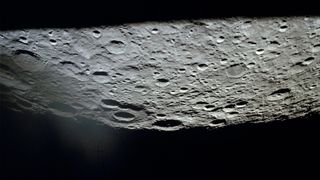
A photo of the moon's far side captured on Aug. 19, 2023, by Chandrayaan-3.   (Image credit: ISRO)

Last Thursday (Aug. 17), the Vikram-Pragyan duo separated from the mission's propulsion module, which will study Earth from its orbit around the moon. The lander and rover, which had entered an egg-shaped lunar orbit after separation, braked successfully on Friday (Aug. 18) and then again on Sunday (Aug. 20) to get closer to the moon's surface.

While still in orbit around the moon on Monday (Aug. 21) and Tuesday (Aug. 22), the duo established contact with Chandrayaan-2's orbiter, which has been circling the moon since 2019 and will serve as the critical communication link with Earth for the Chandrayaan-3 mission.

When the sun rose today on the targeted landing site, which was seen from Earth on one edge of the moon, mission control at ISRO's headquarters in Bengaluru commanded the lander to begin its descent to the lunar surface, activating its fully automatic landing system.

The historic landing was covered live by ISRO and broadcast by Indian public broadcaster Doordarshan. Once the powered descent began, the lander first braked to reduce its height from 18.6 miles (30 km) to just 0.4 miles (0.8 km) above the moon's surface. Then, the lander turned such that its altimeters, which measure height to the surface real-time using cameras onboard, faced downward in preparation for landing.

At 8:33 a.m. EDT (1233 GMT and 18:03 India time), the lander Vikram touched down in its target landing area, at roughly 70 degrees south latitude. This location is close to where Russia had hoped its first moon mission in 47 years, Luna-25, would land on Monday (Aug. 21). That effort, however, failed when the probe crashed into the moon over the weekend after a final orbital maneuver went sideways.

India's success today can be attributed to "extensive changes" to its landing strategy after Chandrayaan-2's 2019 crash, Bhardwaj said. Onboard algorithms that calculate spacecraft speed in real time during descent were reworked to allow for "more freedom to deviate" from protocol "but still do the landing," he added.

Other changes that helped facilitate the mission's success include a larger target landing zone, stronger legs for Vikram to withstand higher landing speeds and dynamic engines that adjusted the spacecraft's velocity for a smoother touchdown. 

Images of the moon that Chandrayaan-2's orbiter has been sending home since 2019 also painted a clearer picture of the landing site than what scientists knew previously, according to Bhardwaj. "There is not much of a hurdle in this [landing] area," he said.

Now that Vikram is settled on the moon, Pragyan is expected to roll onto the lunar surface and start analyzing lunar soil and rocks. 

Similar to the unfortunate rover on Chandrayaan-2, Pragyan's wheels are etched with the Ashoka Chakra, a religious symbol of a wheel with 24 spokes depicted on the Indian flag, and ISRO's logo. So when Pragyan inches along on the moon, ISRO hopes both symbols will be stamped onto the surface, where they will remain untouched for eons.

The lander Vikram is equipped to sense moonquakes near the landing site using an onboard seismometer, and to probe lunar soil to record its temperature.

Related:  

The Chandrayaan-3 mission, which costs a modest 6 billion rupees ($73 million US at current exchange rates), is unfolding at a time when multiple nations — notably, the U.S. and China — are eyeing the moon for future crewed missions. NASA, for example, aims to land astronauts near the lunar south pole in late 2025 or 2026 on its Artemis 3 mission, and to build one or more bases in the region shortly thereafter.

Chandrayaan-3 could also help spur India's space program, leading to even greater accomplishments in the future. 

RELATED STORIES:

"It is going to be a game changer for the new generation," said Bhardwaj, adding that the success is important for the country's "strategic and geopolitical purposes" as well as to drive "the youth to do something different and unique."

When the sun sets upon the landing site in two weeks, the robotic duo will be left to fight a frigid night, which will be "very difficult to survive because the batteries will be drained out and it is too cold for electronics," Bhardwaj said.

Meanwhile, his team has geared up for what they hope will be a busy fortnight: "Our job starts after landing."

  • Update for 11 am ET: This story was updated to include Chandrayaan-3's image of the lunar surface during descent and ISRO's confirmation of communication link.

{ https://www.space.com/ }

Hoe vind je dit bericht?
Geschreven door peter om 00:00 Stuur door

The Most Compelling Places to Search for Life Will Look Like “Anomalies”

pah.jpg

Will it be possible someday for astrobiologists to search for life "as we don't know it"? Credit: NASA/Jenny Mottar

The Most Compelling Places to Search for Life Will Look Like “Anomalies”

In the past two and a half years, two next-generation telescopes have been sent to space: NASA’s James Webb Space Telescope (JWST) and the ESA’s Euclid Observatory. Before the decade is over, they will be joined by NASA’s Nancy Grace Roman Space Telescope (RST), Spectro-Photometer for the History of the Universe, Epoch of Reionization, and Ices Explorer (SPHEREx), and the ESA’s PLAnetary Transits and Oscillations of stars (PLATO) and ARIEL telescopes. These observatories will rely on advanced optics and instruments to aid in the search and characterization of exoplanets with the ultimate goal of finding habitable planets.

Along with still operational missions, these observatories will gather massive volumes of high-resolution spectroscopic data. Sorting through this data will require cutting-edge machine-learning techniques to look for indications of life and biological processes (aka. biosignatures). In a recent paper, a team of scientists from the Institute for Fundamental Theory at the University of Florida (UF-IFL) recommended that future surveys use machine learning to look for anomalies in the spectra, which could reveal unusual chemical signatures and unknown biosignatures.

The study was conducted by a mix of physicists and machine learning experts, including Associate Professor Katia Matcheva, physics graduate student Roy T. Forestano, Professor Konstantin T. Matchev, and Ph.D. student Eyup B. Unlu. A preprint of their paper, “Searching for Novel Chemistry in Exoplanetary Atmospheres using Machine Learning for Anomaly Detection,” recently appeared online and is being reviewed for publication in the Astrophysical Journal. As they explained, the central premise of their paper is that what constitutes “life” remains an open question for scientists, and it would be advantageous to expand the scope of our search.

Spectra from the WASP-96b’s atmosphere obtained by JWST. Credit: NASA/ESA/CSA/STScI

First off, it is important to acknowledge how far the study of exoplanets has come in recent decades. The first confirmed detection did not take place until 1992, which consisted of two Super-Earths (Poltergeist and Phobitor) observed around a pulsar (PSR B1257+12, aka. Lich) located 2,300 light-years from Earth. While scientists firmly believed that most stars had their own system of planets, they had no incontrovertible proof before this discovery. And until the Kepler Space Telescope launched in 2009, exoplanet discoveries were being added at a rate of a few per year.

Since then, a total of 5,496 exoplanets have been confirmed in 4,096 systems, with another 9,820 candidates awaiting confirmation. In recent years, the process has shifted from the process of discovery towards characterization, where improved instruments and methods have enabled astronomers to analyze exoplanet atmospheres directly to measure their potential habitability. As Prof. Matcheva explained to Universe Today via email:

“The instruments are getting better and better: better spectral resolution, exceptional signal-to-noise level, wider wavelength coverage. In addition to JWST, which has returned some exceptional spectroscopic observations of several exoplanets, ESA is planning a dedicated exoplanet space telescope ARIEL that will observe 1000 planets. Analyzing this data will keep scientists busy for a long time.”

According to Matcheva, the fields of exoplanet studies and astrobiology are incredibly fascinating because of the sheer potential involved. Currently, the field is largely concerned with constraining “habitability” through the targeted search for biosignatures: evidence of life and organic processes. Using Earth as a template, the only planet where we know life exists, the most highly-sought biosignatures include nitrogen gas (N2), oxygen gas (O2), carbon dioxide (CO2), methane (CH4), ammonia (NH?), and water (H2O).

This constitutes the “low-hanging fruit approach,” where scientists are looking for life that conforms to terrestrial standards. This is not an accident, nor is it a lazy approach. It’s simply because it is exceedingly difficult to search for signs of life that we are completely unfamiliar with. But this also presents an opportunity to contemplate the possibilities and expand the range of what we know. “Do we know what to search for?” Matcheva added. “Do we know where to search? Would we recognize it if we saw it? The exoplanet science community always works with these questions in mind.”

For their study, Matcheva and her colleagues investigated how machine learning could be trained to look for “anomalies” in transit spectra. This refers to light curves obtained by observing distant stars for periodic dips in luminosity, which could indicate the presence of a planet passing in front of the star relative to the observer. This is known as Transit Spectroscopy (or the Transit Method), which remains the most effective and widely-used method for detecting exoplanets. In addition to detection, this method allows astronomers to occasionally observe light passing through the planet’s atmosphere.

When measured with a spectrometer, these observations will reveal data on the atmosphere’s chemical composition, which could include telltale biosignatures! In the coming years, the combination of next-generation telescopes and machine learning (ML) will allow astronomers to more accurately determine the potential habitability of exoplanets. “We believe that ML methods in astrophysics can be a game changer in how we process data in terms of speed, volume, and methodology, said Matcheva. “And we see that across all fields of science.”

For their purposes, Matcheva and her team used two popular anomaly-detection machine learning methods – Local Outlier Factor (LOF) and One-Class Support Vector Machine (OCSVM) to analyze a large public database of synthetic spectra. This database was developed by the ESA ARIEL science team in anticipation of the mission (scheduled to launch in 2029) and contains more than 100,000 computer-generated spectra signals of exoplanets. The team also used Receiver Operating Characteristic (ROC) curves to quantify and compare the performance of the two ML techniques. The process and results, as Matcheva related, were both fascinating:

“The spectra are calculated with current models, assuming that the atmosphere of each planet is a mixture of 5 different gasses in different proportions. As an experiment, we treated one of the absorbers (for example, H2O) as a ‘mystery’ absorber. We trained the ML algorithm on a subset of the data that is deficient in H2O and tested if it will correctly flag planets with water as anomalous.”

“We repeated the experiment for four of the gasses. We used both LOF and OCSVM. Both methods did an outstanding job in finding the anomalous planets when no noise or very little noise (~10 ppm) is present, even for very small amounts of the ‘mystery’ gas. Unsurprisingly, the ML model starts making mistakes when the noise level increases too much.”

A major objective for next-generation space telescopes will be the search for signs of life (biosignatures).

Credit: NASA

As Matcheva indicated, their paper demonstrated that LOF and OCSVM methods are very robust, even in the presence of signal noise. These results offer a taste of what could be possible in the near future, where literally thousands of exoplanets can be analyzed rapidly and systematically using ML methods to identify anomalous planets for follow-up investigations. These examinations will likely be very educational, given that inconsistencies between theoretical models and observations are often how the most exciting discoveries are made.

“Although looking for biosignatures was not a primary goal of this paper, it is a very interesting outcome, and we are very excited about the potential of the method,” said Matcheva. “Looking for signatures of life in the Universe is more like looking for a needle in a haystack rather than for a smoking gun. It is actually even more challenging because we do not know what the needle looks like. The novelty detection methods are designed exactly for that: rare events [where] we do not know what they look, smell, or sound like.”

As noted earlier, the search for extraterrestrial life – and indeed, the search for extraterrestrial intelligence (SETI) – can be summarized as searching for life “as we know it.” But if life is very rare in the Universe or very “exotic” in nature (meaning that it can arise from all sorts of chemicals and conditions), then it makes sense to cast a wider net. After all, if our frame of reference is an impediment to our astrobiology efforts (one could certainly argue as much), expanding it could be the difference between finding evidence that we are not alone and leaving the question unanswered for another generation. Said Matcheva:

“The astrobiology community has been working on a definition of “life” for a long time, but we have no idea what aliens really look like and how they would interact with their environments. We are biased by our human experience, and the current strategies are to search for life in the “habitable zone,” which by definition is human (or terrestrial life) friendly. So how do you search for something when you don’t know what it looks like? That is where the novelty detection machine learning techniques come in – they can flag data points that are inconsistent with the training data, i.e., do not agree with the current theoretical models. So indeed, in that sense, our method is searching for life “as we don’t know it”.  

As Isaac Asimov famously said, “The most exciting phrase to hear in science, the one that heralds new discoveries, is not ‘Eureka!’ but ‘That’s funny.'”

Further Reading: 

{ https://www.universetoday.com/ }

Hoe vind je dit bericht?
Geschreven door peter om 23:30 Stuur door

Vector shaped UFO parked on the surface of the moon

Vector shaped UFO parked on the surface of the moon

nasa.png
The resurgence of the Vector symbol across various space agencies, including NASA, has sparked intrigue. Questions arise about the significance of the Vector symbol and its presence on these agency logos. 
One wonders if the symbol refers to a symbolic talisman, representing an emblem of occult worship or linked to celestial beings such as angels, demons, or other entities or eventually it is an allusion to ancient times, a sign denoting the essence of the multiverse itself? Does it symbolize the mastery over time and space? 
Now if you take a look at the following images and video the use of this vector symbol across multiple space agencies appears less coincidental. 
Consider the intriguing images below, captured by the Apollo 11 crew during their return journey from the moon to Earth. With a closer look involving zooming in, enhancement, and application of various filters, the object becomes more discernible. It unveils a structure shaped like a vector, complete with three supporting legs, situated on the lunar surface. 
1.png

1.jpg

Comparisons of this object with another object photographed by the Apollo 17 crew reveals a striking similarity in the vector structure's appearance. 
xcv.jpg

Additionally, an image captured during a spacewalk by a member of the STS115 mission reveals the very same vector configuration intriguingly mirrored on the astronaut's helmet. 
ssd.jpg

Despite much speculation, these images as well as analysis of the lunar object in the video of YouTube channel 1967Sander provided below, suggest that these vector-shaped objects potentially represent highly advanced alien vehicles.

{ http://ufosightingshotspot.blogspot.com/  }

Hoe vind je dit bericht?
Geschreven door peter om 23:10 Stuur door

VIDEO: Interesting UFO Sighting filmed in Oregon

VIDEO: Interesting UFO Sighting filmed in Oregon

Oregon UFO Sighting

In an age where the skies are constantly being watched, and where most of the mysteries have been debunked, a newly submitted UFO sighting has rekindled the fervor of extraterrestrial enthusiasts everywhere. Despite being filmed back in 2021, this sighting has only recently seen the light of day on the MUFON website. Along with this captivating article, a riveting video showcases the mysterious event in all its wonder.

When & Where: The sighting occurred on the evening of January 23, 2021, in the scenic backdrop of Oregon, USA.

Witness Account: 

A regular family evening, spent in the company of a television, took a startling turn for an Oregon family. The witness recounts, “My wife, son, and I were deeply engrossed in our TV show when my wife’s gaze was pulled towards our front door. A series of strange, luminous lights danced outside.” Joining her in her astonishment, the witness and his son observed a rotating craft adorned with lights all around its perimeter. Realizing the rarity of what they were witnessing, a quick-witted video was captured, providing a glimpse into their otherworldly experience.

“After the initial shock and awe, we were drawn to it – almost like a moth to a flame. We moved upstairs for a clearer, unobstructed view,” the witness elaborates. The craft, however elusive in nature, continued its dance in the Oregon night sky for a few more tantalizing minutes. In a spur of courage and curiosity, the witness, accompanied by his wife, decided to chase the enigmatic vision. But alas, the craft, with its dazzling lights, vanished into the vastness, leaving behind a trail of questions and intrigue.

VIDEO:

The Burning Questions: As with all UFO sightings, this one too leaves us wondering – was it a visitor from a distant world, a top-secret human-made aircraft, or something else entirely? What made the family wait almost a decade before sharing it with the world?

To the Enthusiasts: For those always on the lookout for verified and intriguing UFO sightings, this newly surfaced evidence is certainly one for the records. Do watch the accompanying video and join the global conversation.

In the vast tapestry of the unknown, this sighting, like a bright star, beckons for attention. And as always, the truth remains out there.

{ https://www.latest-ufo-sightings.net/ }

Hoe vind je dit bericht?
Geschreven door peter om 23:05 Stuur door

Newly Released UFO Sighting in Arizona: Ephemeral Yet Captivating

Newly Released UFO Sighting in Arizona: Ephemeral Yet Captivating

April 3rd, 2023, Arizona: Months after the event, a breathtaking video capturing a UFO sighting has finally been unveiled to the public via the MUFON website. UFO enthusiasts and skeptics alike are buzzing with anticipation and curiosity, seeking answers to yet another tantalizing episode of extraterrestrial wonder.

Unearthly Encounter in Arizona Skies

On a seemingly regular day in Arizona, an unsuspecting witness glanced up to find an unexplainable anomaly hovering silently above. The object, seemingly defying the laws of physics, remained stationary amidst the azure expanse, with its luminous features shining more brightly than what the video could truly capture.

Witness report

However, the most baffling part of this UFO sighting wasn’t its stationary presence, but rather its abrupt exit. As described by the witness, merely moments after ceasing the recording, this ethereal craft took off with unprecedented speed, vanishing into thin air within a mere 1-2 seconds.

Unanswered Questions and Rising Curiosity

Such events, especially when supported by tangible evidence, often stir a mixture of emotions—awe, disbelief, wonder, and a myriad of questions. What was the nature of this craft? Why did it choose to appear, only to disappear just as quickly? Was this an extraterrestrial visitation or a product of advanced human technology yet unknown to the public?

With the growing number of UFO sightings reported worldwide, it’s more essential than ever to approach these events with an open mind and a discerning eye. As researchers and enthusiasts continue to dissect this newly released footage, the pursuit for answers intensifies.

To all intrigued souls, the video accompanying this article offers a glimpse into that mysterious April afternoon in Arizona. Whether you’re a firm believer in extraterrestrial life or a curious skeptic, this sighting promises a fascinating journey into the vast world of the unknown.

For more tales of the unexplained, insights, and the latest updates on UFO sightings, stay tuned and keep gazing at the stars, for the truth, as they say, is out there.

RELATED

{ https://www.latest-ufo-sightings.net/ }

Hoe vind je dit bericht?
Geschreven door peter om 22:55 Stuur door

India maakt zich op voor zijn allereerste maanlanding: wat zijn ze van plan met de Chandrayaan 3 missie?

REUTERS © REUTERS

India maakt zich op voor zijn allereerste maanlanding: wat zijn ze van plan met de Chandrayaan 3 missie?

Morgen is het zover. Op woensdag 23 augustus onderneemt de ‘Indian Space Research Organization’ (ISRO) een poging om met de Chandrayaan 3 missie een rover op het maanoppervlak te zetten. Indien succesvol meteen ook de eerste landing op de zuidpool van de maan nadat die van Rusland recent nog mislukte. Spannende tijden voor India en de ruimtevaart. Derde keer, goede keer?

Hoe vind je dit bericht?
Geschreven door peter om 22:40 Stuur door

This US President Cried After He Found Disturbing Alien Information In UFO Briefing

Jimmy Carter UFO Briefing

This US President Cried After He Found Disturbing Alien Information In UFO Briefing

In 1973, before the presidential elections, yet to become President, Jimmy Carter filed a report with the International UFO Bureau claiming he had seen a UFO in October 1969. Along with other witnesses, Carter saw a bright UFO that changed colors and moved towards and away from the Earth before disappearing. He was quite vocal about his beliefs on UFOs and promised to public all available information about UFOs if he became president.

“He described waiting outside for a Lion’s Club Meeting in Leary, Georgia, to begin, at about 7:30 p.m., when he spotted what he called ‘the darndest thing I’ve ever seen’ in the sky.” Along with 10 to 12 other witnesses, Carter observed a bright object in the sky, which was about the size of the moon. (Source)

“We all saw it. And then the light, it got closer and closer to us. And then it stopped, I don’t know how far away, but it stopped beyond the pine trees. And all of a sudden it changed color to blue, and then it changed to red, then back to white,” Carter told GQ in 2005. The object reportedly hovered about 30 degrees above the horizon, moved towards and away from the Earth, and eventually disappeared into the distance. Carter’s experience led him to make a vow to never again ridicule individuals who claimed to have seen a UFO.

“One thing’s for sure, I’ll never make fun of people who say they’ve seen unidentified objects in the sky. If I become President, I’ll make every piece of information this country has about UFO sightings available to the public and the scientists,” Carter said.

As for the object that Carter saw, it has since been classified as “a high altitude barium release cloud launched from Eglen AFB,” which sounds legit. However, after winning the presidency, Carter backed away from this promise, citing concerns about national security and defense implications. His experience with a UFO is just one of many reported sightings that have fueled conspiracy about extraterrestrial life and government cover-ups.

President Carter’s Disturbing Briefing on UFOs and Religion

Former NASA researcher Ed Harris claimed that serious researchers on the subject believe the story of former President Jimmy Carter crying after being briefed about classified UFO information to be true. According to the story corroborated by multiple witnesses, U.S. presidents are given only a brief overview of the subject by the CIA, and presidential curiosity is not considered a sufficient need to know.

After being repeatedly stonewalled, Carter was given “the talk,” which reportedly left him deeply sobbing and visibly disturbed for weeks. He was told that major religions, including Christianity, were created by extraterrestrials to prevent humans from destroying themselves while they ran experiments on us, and that they made us. Carter, a deeply religious man who had witnessed a UFO with six other people, realized that releasing such information could cause tremendous economic and social upheaval.

Below you can read Ed Harris’ statement on the subject that he wrote on Quora:

Yes, the incident of Jimmy Carter crying after being briefed about classified information regarding UFO’s is largely believed to be true by the serious researchers on the subject. As a forewarning, the following information is very unsettling and will explain why Carter never “kept his promise” of revealing classified UFO information to the public.

According to the story that was corroborated by more than one witness, U.S. presidents are only given a cursory overview of the subject. Apparently, the CIA runs the program, only provide information to the President on a need to know basis, and do not consider presidential curiosity as sufficient need to know. This was implemented after Kennedy, and all presidents after him have been given only summary briefings (some presidents for unknown reasons were given more than others).

Okay on to your question. President Carter is a deeply religious man who had also witnessed a UFO with 6 other people. Everyone thought that he would be the one to finally release UFO info to the public but as the story goes, he was repeatedly stonewalled. Eventually, the CIA had “the talk” with him, and afterward it was reported that he sunk his head in his hands and not only began to deeply sob, but was visibly disturbed for some weeks afterward.

What was he told and shown?

He was told that the major religions including Christianity were programs created by extraterrestrials to prevent us from destroying ourselves while they ran their experiments on us – and that they made us. At this moment it became clear to Carter that such information could cause tremendous economic and social upheaval. I should add that I am not only a Christian but a clergyman, so I am in no way attempting to promote atheism here. In fact, how God fits into this might be an interesting separate post. Nevertheless, these are the facts as I know them to be.

Author and world’s leading UFO researcher Richard Dolan also writes about this incident in his book “UFOs and the National Security State: The Cover-Up Exposed.” According to his book, there are claims that President Carter was given a UFO briefing at the White House on June 14, 1977, which he was then bound to secrecy about.

Read also:

The briefing was supposedly given by a lone MJ-12 briefing officer and several independent sources. The leaked “Executive Briefing: Project Aquarius” document gives the standard account of multiple retrievals of alien technology. While there is no hard evidence to support the claims of the briefing, a presidential aide, who was “very, very close to Carter,” witnessed President sobbing after a UFO-related briefing in the Oval Office.

Carter Administration & Project Blue Book

Daniel Sheehan, a Harvard-educated Constitutional Trial Lawyer and Appellate Attorney has worked on many high-profile cases in his career. In 1977, he was approached by his friend Marcia Smith, who informed him that President Carter had demanded that the CIA provided classified information about unidentified flying objects to him, but George H. Bush, who was the CIA director at the time, refused to give this information to the president.

Sheehan tried to obtain information on the UFO phenomena and extraterrestrials from the Vatican Library but was unsuccessful. However, with Carter’s help, he managed to get access to the classified portions of the Air Force’s Project Blue Book for a few hours in May 1977, where he claimed to have discovered classified documents and photographs of a crashed UFO being investigated by Air Force personnel.

“There were these photographs of unmistakable — of a UFO sitting on the ground. It had crashed,” Sheehan said. “Apparently, it had hit into this field and had dug up, kind of plowed this kind of trough through this field,” he paused for a second.

“It was wedged into the side of this bank,” he said after taking a deep breath. “There was snow all around the picture. The vehicle was wedged into the side of this mud-like embankment — kind of up at an angle. There was Air Force personnel. As I cranked the little handle and looked at additional photos, these Air Force people were taking pictures.” (Click here to read the full article)

When Mr. Sheehan left the room, the guard asked to see his yellow legal pad and flipped through the pages, missing the alien hieroglyphs Sheehan had copied on the back of the pad. Sheehan offered to share this information with the religious establishment; they told him they were not interested.

{ https://www.howandwhys.com/ }

Hoe vind je dit bericht?
Geschreven door peter om 18:43 Stuur door

Russia’s First Moon Mission Since 1976 Just Crashed in a Major Setback

Russia’s First Moon Mission Since 1976 Just Crashed in a Major Setback

Luna-25 is now the latest pile of space debris on the Moon.

 
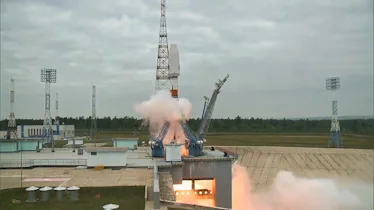
This video screenshot shows the Soyuz-2.1b rocket carrying the Luna-25 lunar station blasting off fr...
Xinhua News Agency/Xinhua News Agency/Getty Images

Russia’s Luna-25 lander met an untimely end this weekend, according to the Russian space agency Roscosmos.

Luna-25 crashed on the Moon sometime on Saturday afternoon (Moscow time) after something went drastically wrong with its engine. The Russian lunar lander had been neck-and-neck with India’s Chandrayaan-3 lander in the race to become the first spacecraft to land near the Moon’s south pole. With Russia’s contender out of the race, India has a clear shot on Wednesday — but also a grim reminder that space is hard.

Russia’s Luna-25 lander “ceased to exist as a result of a collision with the surface of the Moon,” said Russian space agency Roscosmos in a statement.

Luna-25 was supposed to field-test landing technology for Russia’s next three lunar landers, then spend a year studying the surface near the lunar south pole — but the technology test evidently didn’t go so well. Mission controllers lost contact with the spacecraft on Saturday afternoon Moscow time, after firing the lander’s engine to shift the spacecraft into a closer orbit around the Moon to line up for a landing attempt.

“Most likely the braking thrust was either too strong, or it was in a wrong direction,” Natan Eismont of the Space Research Institute of the Russian Academy of Sciences told the New York Times. The institute led science operations on Luna-25, but Eismont was not directly involved with the lander.

The Luna-25 mission came nearly 50 years after its predecessor, Luna-24, which launched in August 1976. That mission successfully landed on the Moon on Aug. 18, 1976. During its mission, it retrieved a sample of lunar soil and returned it safely to Earth.

This video screenshot shows the Soyuz-2.1b rocket carrying the Luna-25 lunar station blasting off fr...

Luna-25 launched on Aug. 10 and would have beaten India’s Chandrayaan-3 lander to the Moon by just a few days.

XINHUA NEWS AGENCY/XINHUA NEWS AGENCY/GETTY IMAGES

WHERE THE SPACE RACE STANDS NOW

Luna-25 should have tested the technology that will be used on Russia’s next three landers: Luna-26, Luna-27, and Luna-28. Those landers, in turn, are intended to pave the way for an eventual joint lunar base with China near the Moon’s south pole. But the next three installments in the Luna series are already years behind schedule, and now Roscosmos faces the choice to redo Luna 25 (which means additional expense and additional delays) or fly the next mission without successfully tested technology.

Meanwhile, Luna-25’s crash leaves a path wide open for the other contender in the race to the pole, India’s Chandrayaan-3 lander. The Indian lander launched on July 14, nearly three weeks ahead of Luna-25, on a longer but more fuel-efficient course to the Moon, and is set to land on Wednesday. India’s last attempted Moon landing, the Vikram lander, fell silent about a mile from the lunar surface, and it’s not too hard to guess what happened next. Making it to the south pole first would be a huge win for India, which so far hasn’t successfully landed anything on the Moon.

Artemis II is scheduled to launch in late 2024, and Chang’e 6 lander, which plans to return rock and regolith samples from a site near the south pole, is set to launch earlier in the same year.

{ https://www.inverse.com/ }

Hoe vind je dit bericht?
Geschreven door peter om 18:01 Stuur door

Op zoek naar water op de maan

Op zoek naar water op de maan

th?id=OVFT.K-aDKjYvcDseHC3T5HJbQS&pid=News&w=300&h=186&c=14&rs=2&qlt=90&dpr=1.6

De race naar de zuidpool op de maan gaat onverbiddelijk verder. Na de mislukte maanlanding van Ruslands Loena-25 is het uitkijken naar de Indiase Chandrayaan-3. ‘De maan is opnieuw hot.’

Samira Ataei

Wat voor Moskou begon als een ambitieus prestigeproject, is uit­gedraaid op internationaal ­gezichtsverlies. Na een succesvolle lancering op 10 augustus kwam de onbemande Loena-25 uiteindelijk in een verkeerde baan om de maan terecht en stortte de Russische maanlander op 19 augustus neer. Behalve dat het ‘een noodsituatie’ betrof, liet het Russische ruimtevaartagentschap Roskosmos ­alleen weten dat de communicatie met Loena-25 een dag eerder was stilgevallen. Volgens het Russische Telegram-kanaal Yura Prosti lag een rekenfout aan de basis van de verkeerd gelopen landing.

Hoe het precies is misgelopen, zal wellicht een vraagteken blijven. Wat wel vaststaat, is dat Rusland zich, vijftig jaar na Loena-24, opnieuw heeft gewaagd aan een maanlanding. En dat het daarbij heeft gefaald. Het Russische staatskanaal wijdde veertig seconden aan de mislukte missie, waaraan decennialang onderzoek voorafging en waarvan de bedoeling was om de zachte landingstechnologie uit te testen. Als die slaagde, kon Rusland aan de wereld tonen dat het als eerste land het dichtst bij de zuidpool van de maan was ­geraakt.

230821_Sojoez-2_en_Luna-25_Db.png

Dat zou geen klein nieuws geweest zijn, ook al was de bestemming, de Boguslawski-krater, duizend kilometer verwijderd van de zuidpool. Onderzoek heeft aangetoond dat sommige koude kraters in het intrigerende, en tot dusver onaangeraakte landschap op de zuidpool water bevatten in de vorm van ijs. Als dat kan dienen als drinkwater of als brandstof, is de eerste en belangrijkste stap naar een permanente en bewoonbare basis op de maan gezet.

Druk verkeer

Het is dus niet onlogisch dat het verkeer rond de maan in jaren niet meer zo druk is geweest. ‘De maan is opnieuw een hot topic’, beaamt planeetwetenschapper Simeon Barber, verbonden aan een onderzoekscentrum van de Open Universiteit in Milton Keynes (Verenigd Koninkrijk).

Niet alleen overheidsinstellingen, maar ook commerciële bedrijven zien een grote toekomst op de maan. Eerder dit jaar ging voor het eerst een privéruimtetuig van het Japanse bedrijf Ispace de ruimte in.

De reden voor de hernieuwde interesse ligt bij de Apollomissies in de jaren 60 en 70. ‘Omdat die plaatsvonden rond de evenaar van de maan, waar het kokend heet was, concludeerden wetenschappers dat de maan een dor, droog hemellichaam was’, zegt Barber.

‘Pas decennia later veranderde hun idee, doordat ze de toen genomen stalen opnieuw analyseerden en kleine waterdeeltjes ontdekten. Bovendien zagen nieuwe ruimtetuigen in een baan om de maan hints van waterijs, vooral in de richting van de polen.’

Ook India waagt zich met de Chandrayaan-3 aan een maanlanding. Die werd gelanceerd twee dagen voor de Russische Loena-25 de ruimte inging. De Indiase maanlander legt een langere route af en zal woensdag landen, als alles goed verloopt. Na de lancering is de landing de grootste uitdaging. ‘De slaagkans bij maanlandingen is lager dan vijftig procent’, nuanceert Barber. ‘Daarenboven zijn landingen dicht bij de noord- of zuidpool des te moeilijker vanwege de ligging van die gebieden.’

De vorige Indiase maanlanding, de Chandrayaan-2, die vier jaar geleden de ruimte inging, is ook mislukt. ‘Wellicht zal India daaruit lessen hebben getrokken, maar de missie is daarom niet minder complex. Tot nu toe is geen enkele missie erin geslaagd om in die regio’s te landen.’ De Indiase ruimtevaart ziet in de Chandrayaan-3 een manier om zich prominent op de ruimtekaart te zetten.

Economie op de maan

Met Loena-25 probeerde de Russische ruimtevaartorganisatie letterlijk los te breken uit het internationale isolement sinds het begin van de invasie van Oekraïne. Aanvankelijk speelde Barber ook zelf een rol bij Loena-27, een van de volgende Russische missies met als doel samples van het water te verzamelen. ‘Europa ging een machine leveren die kon analyseren of en hoe het mogelijk is om er water uit te extraheren.’ Sinds de oorlog is de samenwerking volledig stopgezet.

Daarom benadrukt Barber het belang van elke missie. ‘De maan is een enorm divers hemellichaam. Hoe meer missies we uitvoeren, hoe vollediger ons beeld kan worden. Een mislukte maanlanding betekent een groot verlies aan informatie. In die zin heeft niet alleen Rusland een missie verloren, maar wij ­allemaal.’

Toch blijft Barber optimistisch. ‘Het gaat niet er alleen om als snelste een vlag neer te planten. Voor elke kilogram die van de aarde naar de maan verplaatst wordt, is er 1 miljoen euro nodig. Als wij een liter water, gelijk aan één kilogram, kunnen extraheren op de maan voor minder dan 1 miljoen euro, openen er deuren om mensen langer op de maan te laten blijven. Misschien is er dan sprake van een economie op de maan waar wetenschappers, ingenieurs, ondernemers en zelfs toeristen samenwerken om onze dichtstbijzijnde buur te ontdekken.’

{ https://www.standaard.be/ }

Hoe vind je dit bericht?
Geschreven door peter om 16:02 Stuur door

THE PARADOX OF FERMI’S PARADOX

OMODiQza?format=webp&name=medium

THE PARADOX OF FERMI’S PARADOX 

  • “All this visible universe is not unique in nature and we must believe there are, in other regions of space, other worlds, other beings and other men.”

– LUCRETIUS 99-55 BC

Is it possible some UAP are extraterrestrial craft? Is it reasonable to think there is intelligent alien life visiting earth?

Scientists still debate whether the universe is infinite, but at a minimum, our visible universe contains trillions of galaxies, each with hundreds of billions of planets and moons. As best we can tell, the same laws of physics apply everywhere, and the heavy organic molecules that form the basic building blocks of life are abundant. In short, from the nearest solar systems to the most distant edges of space and time, we are surrounded by endless opportunities for life. Amidst these endless opportunities, intelligent extraterrestrial life is a near mathematical certainty. But what about the prospects for intelligent life to evolve in Earth’s galactic neighborhood? Although estimates vary considerably, many indicate we are probably not alone in the Milky Way.

Duncan Forgan, a Ph.D. Candidate in astronomy at the Royal Observatory in Edinburgh, Scotland, carefully evaluated data on the composition of the Milky Way and concluded there should be over 360 stable, advanced civilizations in our galaxy. He also believes that if microbial life can spread via meteors, we may be sharing the Milky Way with tens of thousands of technologically advanced civilizations.

In 2020, astronomers Tom Westby and Christopher Conselice, researchers at the University of Nottingham, performed an extensive assessment of the latest astronomical data and concluded, within a band of uncertainty, that we share the Milky Way with dozens of other technologically advanced alien civilizations.

Astronomers Adam Frank and Woodruff Sullivan took a somewhat different approach but reached similar conclusions. According to co-author Adam Frank, “Even if you are pretty pessimistic and think that you’d have to search through 100 billion planets in habitable zones before you found one where a civilization developed, then there have still been a trillion civilizations over cosmic history!” Even if life arises on habitable Earth-like planets only once in 60 billion opportunities, we are still not the first civilization in the Milky Way.

As these and other astronomers have concluded, the existence of advanced alien civilizations in our galaxy is a good bet. Nevertheless, the Milky Way is hundreds of thousands of light years across. Could other civilizations in the Milky Way reach earth with probes or spacecraft? With what might appear to us to be UAP? The answer is, unequivocally, yes… if other civilizations follow technological trajectories similar to those on Earth.

Bear in mind that we’ve only been a space-faring species for under 70 years, less than the lifetime of the average American. My grandfather was born in 1897, nearly seven years before the Wright Brothers launched their first successful flight from atop a sand dune in North Carolina. Yet, he lived to see Neil Armstrong walk on the moon in 1969 and later the launch of the Space Shuttle. Now, some 50 years after the first moonwalk, there is already a plan to send a probe to our nearest stellar neighbor, Alpha Centauri, four light years from earth. Conceived by billionaire Russian physicist Yuri Millner, “Project Starshot” quickly attracted the support of Stephen Hawking, Mark Zuckerburg, Avi Loeb, and others. The plan is to use a massive laser to propel a small sensor package equipped with a light sail to 1/5 the speed of light. Depending on how long it takes for the probe to reach its maximum velocity, 20-30 years will elapse here on Earth before the probe arrives at its destination.

However, due to the time dilation effects of relativity, there would be a reduction in the actual travel time experienced by an interstellar craft and anyone aboard it. More to the point, if a single wealthy individual can send a probe to another star system, what doubt is there that a far older and more advanced alien civilization could send probes across interstellar space? Note that there is no requirement for superluminal travel. In fact, a space-faring civilization expanding through the Milky Way at 20% of the speed of light could theoretically colonize the entire galaxy in as little as 500,000 years, a tiny fraction of the galaxy’s lifetime.

It is also conceivable that more advanced civilizations have achieved faster than light travel by exploiting wormholes, “interdimensional travel,” or by some other means we have not yet conceived. Other civilizations may also have developed the ability to extend biological lifetimes indefinitely. If nothing else, it is easy to imagine uncrewed but highly intelligent probes, perhaps even self-replicating probes, gradually spreading throughout the galaxy. If this seems fanciful, recall that there already are functioning probes operating in interstellar space.

Fermi paradox

Radiotelescopes have long been the tool of preference used by astronomers in the search for evidence of intelligent aliens (Credit: Unsplash).

Although I support the SETI project, it seems far more likely extraterrestrial civilizations would dispatch probes rather than blindly broadcasting radio signals into space. For one thing, any civilization broadcasting openly to space is announcing its location and potentially inviting its own destruction. As they say, “The spouting whale gets the harpoon.” Probes, by contrast, can obtain information stealthily, permitting direct observation without interference or detection. They also eliminate the need for compatible communications technologies and provide the means to collect and examine physical specimens as we ourselves are doing today on Mars. Probes are also likely to be more efficient considering the massive energy required to send signals into space that would be detectable at interstellar distances. It is not surprising that NASA sends probes rather than signals to explore the solar system. So why aren’t we seeing evidence of probes from other civilizations? Or are we?

THE FERMI PARADOX

Given the overwhelming number of potentially viable habitats in our galaxy, many scientists profess surprise that intelligent alien life has not already been detected. As the nuclear physicist Enrico Fermi once famously observed, conveying this gap between theory and observation, “Where is everybody?” This quip by the renowned physicist is now known as “the Fermi paradox.”

I perceive a paradox as well, although it is a paradox of a different sort. I call it the “UAP paradox.” What strikes me as paradoxical is that at the same time Enrico Fermi was asking, “Where is everybody?” UAP were flying around Los Alamos like moths around a candle. More broadly: Why are so few scientists willing to consider UAP as potential alien probes when there is such extensive evidence of mysterious craft in our skies demonstrating capabilities otherwise found only in science fiction?

Let’s begin by looking at Dr. Fermi himself. In 1944, Dr. Fermi joined the Manhattan Project full-time and moved to Los Alamos, New Mexico. He worked at Los Alamos for the remainder of the war and remained an active researcher at Los Alamos during the summer months for many years thereafter. Indeed, his famous comment, “Where is everybody?” was made to a group of fellow physicists at Los Alamos in the summer of 1950. Now consider the following quote from a memo sent by the Director of Security at Los Alamos National Labs to Brigadier General Joseph Carroll, the commander of the USAF Office of Special Investigations in May 1950, just a few months before Dr. Fermi’s posed his famous question, “Where is everybody?”:

“The frequency of unexplained aerial phenomenon in the New Mexico area is such that an organized plan of reporting these observations should be undertaken….the observers of these phenomenon include scientists, Special Agents of the Office of Special Investigation, USAF and airline pilots, military pilots, Los Alamos security inspectors, military personnel and many other persons of various occupations whose reliability is not questioned … the phenomenon has continuously occurred during the last 18 months and is continuing to occur..in the vicinity of sensitive installations.”

This memo in May of 1950 also comes on the heels of one of the most extraordinary UAP events in American history, when in March of 1950, dozens of residents of nearby Farmington, New Mexico, reported hundreds of silver metallic disks flying in formation over their town in broad daylight. In other words, hundreds of UAP were being observed by all manner of personnel in the vicinity of Los Alamos at precisely the time Dr. Fermi was professing bafflement over a perceived absence of alien life. The UAP evidence included numerous reports by trained observers, pilots, scientists, and security personnel, as well as photographs and even radar tracks and theodolite measurements.

Does it not seem ironic that recurring visits by greenish fireballs and supersonic silver disks were prompting major security concerns for Los Alamos Labs at the same time Dr. Fermi was asking, “Where is everybody?”

This vignette regarding Dr. Fermi is a perfect illustration of the strangely blinkered views of the scientific community, the press, and mainstream America as a whole. Even with the Defense Department officially acknowledging the existence of hundreds of UAP incidents, few journalists, scientists, or citizens seem interested in what may soon become the greatest discovery in human history. The evidence is not yet definitive, at least not the information in the public domain, but the extraterrestrial hypothesis seems the only explanation fully consistent with a large and rapidly growing body of compelling data. Moreover, some UAP seem to be an ideal match for the alien probes that theory predicts.

THEORY AND OBSERVATION

As the focal point for U.S. nuclear weapons design and development, the motive for scrutiny of Los Alamos is obvious. Imagine that NASA probes someday encounter an inhabited exoplanet. The first order of business will unquestionably be to assess what threats or dangers exist. If ever there was to be a honeypot used to lure alien probes, I can’t imagine anything more likely to succeed than atmospheric explosions of nuclear weapons. As noted above, UAP activity was persistent and compelling near Los Alamos and other nuclear weapons facilities, with recurring overflights and intrusive entries into highly sensitive restricted airspace. Thanks to the efforts of author Robert Hastings; the outspokenness and persistence of nuclear weapons veterans like Robert Salas; and the work of researchers who have painstakingly leveraged the Freedom of Information Act (e.g. Brad Sparks; Paul Dean), this pattern of UAP activity at U.S. nuclear installations is well-documented despite the refusal of the U.S. Air Force to forthrightly acknowledge these incidents or cooperate with public or even Congressional requests for information.

If alien craft or probes are monitoring earth, we should expect them to be radically different from anything we possess, baffling in both appearance and capability. In the immortal words of Arthur C. Clarke, “Any sufficiently advanced technology is indistinguishable from magic.” To my mind, UAP data again fit the ET probe hypothesis. The most common UAP observed in the Los Alamos area in Dr. Fermi’s day were green fireballs and supersonic silver disks capable of fantastic acceleration and maneuverability despite the lack of any discernible means of propulsion. The cumulative weight of credible reports from Blue Book and other sources provides highly persuasive evidence for the existence of radical craft superior to anything created by man.

I am also aware of cases of individuals who have reportedly suffered burns or radiation damage from encounters with UAP. Some of these cases have occurred in the U.S., others in Brazil and the Solomon Islands. This is compelling because the U.S. and its allies do not manufacture aircraft that produce nuclear radiation.

During the Sign, Grudge, and Blue Book eras, some senior military personnel examining UAP data considered the ET hypothesis a viable explanation for UAP, but few mainstream scientists were willing to make this connection. A prominent exception was Herman Oberth, one of the fathers of modern rocketry who served as a mentor to Wernher von Braun, who wrote a lengthy analysis concluding:

“It is my thesis that flying saucers are real and that they are space ships from another solar system. There is no doubt in my mind that these objects are interplanetary craft of some sort. I and my colleagues are confident that they do not originate in our solar system.”

Dr. Oberth was likely influenced by exposure to UAP incidents while working for the U.S. government. The frequency of military UAP encounters also explains the keen interest in UAP evinced by many high-ranking retired military officers of that era. For example, the leaders of the most active public UAP research group in the 1950’s and 60s, the National Investigating Committee for Airborne Phenomenon (NICAP) included former CIA Director Admiral Roscoe H. Hillenkoetter; Admiral Delmar Fahrney, director of the Navy’s guided missile programs; USMC aviator Major Donald Keyhoe; and Rear Admiral H.B Knowles among others. My UAP activism also stems from exposure to military UAP reporting.

Unfortunately, the UAP stigma persists among many, perhaps most scientists to this day. Worse, some scientists have been spreading misinformation about UAP. For example, I’ve been astonished to see prominent SETI researchers asking in public forums, “If UAP are real how come commercial airline pilots never see them?” How could these SETI scientists be so grossly mistaken when a simple Google query is all it takes to find credible data regarding thousands of commercial airline pilot sightings of UAP?

Similarly, an astronomer from the University of Arizona published an article in 2020 making the preposterous claim that UAP sightings  “..stop at the Canadian and Mexican borders.” Again, if the author or his editors had spent 5 minutes looking online they’d have quickly learned that Canada and Mexico are rife with UAP sightings, photos, videos, and even military reports.

I’ve had the opportunity to interview numerous military personnel who encountered unidentified aircraft that defy our present understanding of aeronautics and engineering. This includes a retired NORAD watch officer, USAF Col. James Cobb, who observed the radar track of a high-flying UAP that proceeded from the arctic down the entire U.S. East coast.  NORAD’s best efforts to intercept the object failed due to the UAP’s speed and altitude. I’ve also been privy to substantial government UAP information that has reinforced my views regarding the anomalous nature of the phenomenon. However, I find the unclassified and open source data sufficiently compelling, indeed so cumulatively overwhelming, that I remain surprised there is not much greater academic and press interest in the UAP issue. Those already familiar with the Nimitz case may wish to skip the next section, but for those who are not, this well-documented case will help to explain why the U.S. government is now treating UAP as a serious national security issue.

THE NIMITZ CASE

I can discuss the Nimitz case with some authority because I’ve interviewed most of the Navy personnel involved from both the Nimitz and the USS Princeton. I’ve also studied the official DoD reporting on the incident and an extensive analysis prepared by the Scientific Coalition for UAP Studies.

In November 2004, the USS Princeton, equipped with the world’s most capable naval radar, tracked dozens of UAP performing seemingly impossible maneuvers while it was conducting training operations off the coast of Southern California. The speeds, range, altitudes, and acceleration of these objects defied logic and experience. In some cases, the objects descended from at least 80,000 feet, possibly even orbital altitudes, according to reports from some crew members working in the Cooperative Engagement Capability (CEC) cell aboard the ship. The baffled Princeton crew reset and recalibrated their Aegis radar, yet the bizarre activity continued. Finally, after several days, two F-18s were directed to intercept one of these objects. Conditions were ideal, with clear sunny skies.

Tic Tac

Artist’s rendering of the “Tic Tac” observed in November 2004 by personnel with the USS Nimitz Carrier Strike Group (Image Credit: Micah Hanks)

When they arrived at the intercept location the pilots observed a white vehicle nearly 50 feet long with no wings, control surfaces, exhaust, or visible means of propulsion. All four naval aviators observed the craft react to their presence and perform seemingly impossible maneuvers, moving in ways that defy our understanding of physics. As the lead jet approached the strange white craft, it turned toward the fighter while hovering, then moments later circled upward and away from the F-18 before accelerating to hypersonic speeds and disappearing over the horizon. It seems the craft must have been using some form of relativistic, anti-gravity propulsion system because there was no sonic boom or evidence of extreme heat. Further, the estimated g forces would otherwise have obliterated the craft.

Incredibly, the strange object flew precisely to the latitude and longitude the aviators had agreed to use for their training operations that day. Low on fuel, Cmdr. Dave Fravor and Lt. Cmdr. Alex Dietrich returned to the Nimitz. However, another F-18 was launched to search for the object. This F-18 did not get as close, but it was able to acquire infrared imagery of the so-called “Tic Tac” before the UAP shot away again at hypersonic speeds. What the aviators observed they say was unlike anything they were familiar with. Quoting pilot Chad Underwood who took the famous “FLIR” video I provided to the New York Times in 2017:

“It was just behaving in ways that aren’t physically normal. That’s what caught my eye. Because, aircraft, whether they’re manned or unmanned, still have to obey the laws of physics. They have to have some source of lift, some source of propulsion. The Tic Tac was not doing that. It was going from like 50,000 feet to, you know, a hundred feet in like seconds, which is not possible.”

He goes on to say:

“…normally, you would see engines emitting a heat plume. This object was not doing that. The video shows a source of heat, but the normal signatures of an exhaust plume were not there. There was no sign of propulsion. You could not see the thing that the ATFLIR pod should pick up 100 percent of the time.”

The U.S. government acknowledges this was not an experimental US aircraft, and as the recent DoD report to Congress explains, there is also no indication that the craft belonged to Russia, China or any other country. Cmdr. Dave Fravor, the highest ranking officer in the air that day and the pilot who got closest to the object, believes the “Tic Tac” was “not from this world.” Because it was so bizarre and its capabilities so vastly superior to any aircraft known to man, Fravor’s conclusion seems perfectly logical. There is nothing we know in the inventory of any nation on earth that comes close to the appearance or performance of the “Tic Tac”.

In addition to the pilots and radar operators involved, I’ve discussed this case with cleared Congressional staff, high-level Pentagon officials, and senior engineers from the Lockheed Martin Skunkworks and the Boeing Phantom Works. I’ve yet to encounter a plausible conventional explanation. Moreover, all concerned agree that extreme advances in physics and engineering would be required before America could even attempt to build a craft like the Tic Tac. Admittedly, this is not yet conclusive proof of alien life, but what else can it be if it was not manufactured by the U.S., China, or Russia?

OTHER CASES

If the Nimitz case was a singular incident, we might somehow discount it; but there have been many hundreds if not thousands of comparable incidents since at least WWII. DoD presently acknowledges 400 military UAP incidents since 2004, but that number excludes anomalies in space; many thousands of NORAD reports; undersea anomalies, and information that remains concealed by classification guidelines and non-disclosure agreements. A high percentage of the reported DoD cases–over half–involve multiple sensor data. Further, we know that in most cases, military personnel have been afraid to report sightings and contacts, so the actual number of DoD encounters is far higher than the 400 cases recently reported to Congress.

At this point, it is tempting to discuss similar military encounters in other countries, including France, Brazil, Britain, Belgium, Canada, and Russia; or mass sighting cases in the U.S., Australia, Zimbabwe, or Italy; or the sensational press accounts of the flyover on successive weekends of the U.S. Capitol in July 1952. According to its Director, the Mutual UFO Network (MUFON) alone has received over 200,000 UAP reports since its founding in 1969. There are also thousands of UAP videos and photographs, despite the mathematically remote prospects of photographing high-flying or fast-flying UAP. As physicist Brad Sparks explains on page 382 of The UFO Encyclopedia, due to the limitations of smartphone cameras and the need for the target to be very close and slow, we should not expect even a single clear UAP photo from billions of smartphones over a 5 year period. Nevertheless, there are many photos and videos (such as the FLIR and Gimbal videos) that defy simple conventional explanations. The government has also collected a considerable amount of authentic video and radar data in the short time since they resumed officially studying the UAP issue in 2020. What then explains the unwillingness of most scientists and academics to consider UAP as potential examples of the abundant extraterrestrial intelligence that theory predicts?

REASONS THAT MAINSTREAM SCIENTISTS FAIL TO CONNECT UAP AND EXTRATERRESTRIAL LIFE

1. Lack of Information

As we have seen above, there is still a widespread gap in academia regarding basic facts about UAP. How many astronomers realize there have been hundreds of thousands of UAP sightings worldwide, including thousands of reports by commercial airline pilots, military pilots, and radar operators? How many are aware of the hundreds of unsolved Project Blue Book cases or the recent “Preliminary Report” on UAP provided to Congress by the Intelligence Community? How many have read any of the books on UAP written by fellow scientists, including astronomer Dr. Allen Hynek, information scientist Dr. Jacques Vallee, or nuclear physicist Stanton Friedman?

Fortunately, as my experience with the Congressional oversight committees demonstrates, when people get credible UAP information, they generally respond to the data and modify their views. Congress’ sudden interest is simply due to the fact that prior to 2017, Congress lacked access to credible UAP information.

Nothing has had a greater impact on government officials than the testimony of military aviators and other trained personnel. To hear Cmdr. Dave Fravor and his colleagues tell their tale in person is powerful and compelling.  Unfortunately, scientists and academics generally do not have the benefit of these perspectives.

Thankfully, Congress is requiring DoD to continue providing unclassified public reports on the latest UAP data each year. This will undoubtedly help to raise public and scientific interest and awareness.

2. Science vs. National Security

There is a fundamental difference in evidentiary standards between the national security community and scientists and academics. Scientists strive to formulate hypotheses that can be tested and disproven; they then publish their results so others can independently replicate their findings. This time-honored approach, combined with free markets and freedom of speech and association, underpins our prosperity and incredible advances in health and living standards. This disciplined approach generally works well in a laboratory or observatory, but the national security community does not always have the luxury of working with inert materials or controlled environments. In fact, the organizations and individuals national security analysts study are often diligently working to confuse and deceive us. Policymakers also do not always have the luxury of deferring conclusions or action until conclusive data is available. These disparate standards and circumstances sometimes lead to contrasting reactions to the same information.

For example, in the Nimitz case, the testimony of the pilots and radar operators and the Aegis and IR data is about as good as it gets from a military perspective. For national security officials to discount such compelling information would be tantamount to the radar operator in Hawaii on Dec. 7th, 1941, ignoring the approaching Japanese aircraft that appeared on his screen. Yet, many scientists cavalierly dismiss military reporting because it does not include data they can independently evaluate and confirm. I appreciate this difference in perspectives, but I would appeal to scientists considering the UAP issue to bear in mind we are in entirely uncharted waters. Notably, if the ET hypothesis is correct, this represents the first time in history we have attempted to analyze manifestations of a more intelligent and technologically advanced species. Normal standards and practices do not suffice. If we observe a UAP event and then fail to replicate it subsequently, is that consistent or inconsistent with the ET hypothesis? Are they monitoring and reacting to our monitoring them? Are they able to interfere with or deceive our instruments? Are they able to interfere with or modify our perceptions? If the observed behavior of UAP contradicts our understanding of physics, is that evidence the data is flawed or evidence of a more highly advanced civilization? If there is a dearth of clear photos, is that because of stealthy concealment, lack of actual UAP, or due to an energetic field generated by relativistic UAP propulsion systems that interfere with the reflection of photons to the camera?

Although I recognize the UAP information available to the public does not constitute proof of alien life, I also believe we must acknowledge this as a genuine possibility and move rapidly to determine as best we can the identity, motives, and capabilities of the anomalies being observed underwater and in the atmosphere and space. The national security implications are far too grave, and the potential scientific rewards too great.

3. Stigma

The lack of basic knowledge regarding UAP has been seriously compounded by the contemptuous and demeaning attitude historically displayed by the U.S. government (and most academic scientists) toward the UAP topic. This derisive attitude was primarily due to the recommendations of the CIA’s Robertson Panel in 1953. At the time, due to fears the UAP issue might be exploited by the USSR, the Air Force was advised to discredit the topic. The Air Force used Project Blue Book and the Condon report to distort the data and convey the impression that if only more detailed data were available conventional explanations could be found for all UAP cases. Yet, the Blue Book data clearly shows the opposite: The more witnesses and the better the data, the less likely the USAF was able to find a conventional explanation for UAP incidents. Nevertheless, the government, Dr. Condon, and others succeeded in conveying the message that there was no credible reason to believe UAP demonstrated superior technology or posed a threat to national security. We now know both conclusions were simplistic and premature.

4. The Social Nature of Information

Psychological research reveals that most people value fitting in with their peers more than faithful adherence to facts or the analysis of data. Humans are social creatures, getting along amicably often trumps facts, logic, or data.

In his account of Project Blue Book, Dr. Allan Hynek points out that when confidentially polled, many astronomers reported interest in the UAP issue; however, while in committee, they almost always disparaged the topic for fear of being ridiculed or challenged by their peers. This same fear has, until very recently, also prevented most military and government personnel from reporting UAP encounters or expressing interest in the topic.

5. Cognitive Dissonance

It doesn’t help that the implications of the extraterrestrial hypothesis are deeply disturbing for most people, challenging core beliefs and causing considerable anxiety and uncertainty in the process. For some, the prospect is simply terrifying. Psychologists call such interference with normal mental processing “cognitive dissonance.” It is not surprising to find that process at work with regard to UAP. The concept of alien craft and alien beings is fine in fiction, but it is an extremely challenging concept to process or integrate into our daily lives.

REASONS FOR OPTIMISM

Fortunately, we have reached a turning point. We now have a top-down DoD effort, embraced at the highest levels. This is unprecedented, a fundamentally different situation than either the Congressionally mandated Advanced Aerospace Weapons Systems Applications Program (AAWSAP), an unclassified contractor study; or AAWSAP’s successor, the small but scrappy Advanced Aerospace Threat Identification Program (AATIP) led by Luis Elizondo. The public isn’t generally aware of the incredible capabilitiesDoD operates, but the most extensive and capable sensor apparatus yet devised by man is now being used to help identify UAP and determine their capabilities and intent. This changes everything. DoD’s technical capabilities are so precise and extensive that I expect major progress, likely even conclusive results, within the next few years if progress continues.

Moreover, there are historic whistleblower provisions in the pending Intelligence and DoD Authorization bills in Congress. These provisions enjoy broad bipartisan and bicameral support and will almost certainly be enacted by year’s end. Once enacted, they will enable Congress to learn the truth of long-standing allegations that the U.S. government is in possession of recovered alien technology. Concurrently, pending legislation will require a General Accounting Office review of classified information pertaining to UAP dating back to the end of WWII. I am already aware of a number of individuals who claim they will testify to the existence of recovered alien technology or are considering doing so.

Already, we can see a few positive glimmers resulting from public interest in UAP. It is encouraging to see that a handful of private citizens in America can still bring about changes in policy when they have facts and data on their side. It is a relief to see the U.S. Congress is still capable of meaningful bipartisan collaboration. It is also encouraging to see that empirical data can still win the day in U.S.Congress despite the increasing public rejection of scientific data and principles.

PROSPECTS AND OPPORTUNITIES

Between the U.S. government’s technical collection efforts directed at UAP and the amnesty provisions and document review soon to be enacted, the prospects of finding answers to the UAP mystery are real and rapidly growing. What if we find conclusive evidence that some UAP are manifestations of alien technology?

If UAP have hostile intentions, we’d likely already know after so many decades (possibly even thousands of years) of UAP activity. In the unlikely event some UAP intervention is planned, then the sooner we acknowledge the reality of UAP the better. There are steps we might take to enhance our deterrence capabilities.

Although some UAP activity is concerning, especially continued violations of restricted airspace, it seems more likely that the pattern we’ve been experiencing for decades, perhaps centuries, will continue indefinitely – namely, furtive, intermittent sightings of strange craft that have an unknown interest in our planet. If this passive pattern continues after “disclosure,” then the discovery that we are not alone might actually work to the great advantage of our species.

Let’s briefly imagine the impact of an authoritative announcement from the U.S. government, or a group of world leaders, that some UAP are of extraterrestrial origin. This discovery would undoubtedly be the most transformative in human history. If the current, furtive pattern of UAP activity remains unchanged, then one impact might be to divert Russia, China, and the U.S. away from increasingly dangerous confrontation toward collaborative scientific and military activities instead.

It is difficult to exaggerate the need for unprecedented international collaboration at this juncture in history. It should by now be clear to all that the existential challenges facing our species cannot be solved unilaterally. In addition to the urgent need to reduce the rapidly growing prospects of war between nuclear powers, unprecedented collaboration is also required to manage global warming, the uncontrolled rise of artificial intelligence and biological engineering, and the proliferation of weapons of mass destruction. It may seem far-fetched, but the discovery that we are not alone could be our best hope for radically re-framing the views of the major world powers and humanity itself. In sum, the most likely scenario – no change in their conduct but major changes in ours – may also prove to be the most optimistic. As Ronald Reagan once said, addressing the UN General Assembly in 1987:

“Cannot swords be turned to plowshares? Can we and all nations not live in peace? In our obsession with antagonisms of the moment, we often forget how much unites all the members of humanity. Perhaps we need some outside, universal threat to make us recognize this common bond. I occasionally think how quickly our differences worldwide would vanish if we were facing an alien threat from outside this world. And yet, I ask you, is not an alien force already among us? What could be more alien to the universal aspirations of our peoples than war and the threat of war?”

CONCLUSION

Our collective journey from the center of creation to a random location in a cold, dark, infinite and unfeeling universe seems bleak. However, discovering we share the earth and the unending vastness of space with other intelligent civilizations could provide the impetus for thrilling new voyages of exploration and discovery.

What could be more profound, exciting, or transformational than the discovery of biological or even silicon beings who appear magical due to their mastery of science and technology? Contact could potentially advance our understanding of the laws of nature, placing some of these god-like powers within Mankind’s reach as well. The knowledge that we are being monitored by one or more mysterious civilizations could potentially reframe international security paradigms in a manner that supplants rivalries with new alliances. If nothing else, proof we are not alone in the cosmos might renew access to wonders and mysteries that fled before the onslaught of secularism and science. As Arthur C. Clarke once observed:

“Across the seas of space lie the raw materials of the imagination. Strangeness, wonder, mystery and magic – these things which not long ago appeared lost forever will soon return to the world.”

For me, the question, “where is everybody” is better directed at humanity – the mainstream scientists and journalists ignoring UAP data rather than the aliens who may actually have been here quietly watching us all along. If nothing else, we can at least all agree that the truth about UAP is increasingly within reach. I hope more mainstream scientists, journalists, and government officials will set the UAP stigma aside and, as objectively as possible, consider the growing body of UAP evidence and its potential implications.

  • Update 9/2/22: The inclusion of a reference to the Pentagon’s AATIP program, led by Luis Elizondo, was added by the author alongside existing references to its predecessor, the DIA’s AAWSAP program. 
  • Christopher Mellon spent nearly 20 years in the U.S. Intelligence Community, including serving as the Minority Staff Director of the Senate Intelligence Committee and the Deputy Assistant Secretary of Defense for Intelligence. In his free time, Mellon works to raise awareness regarding the UAP issue and its implications for national security.


{ https://thedebrief.org/ }

Hoe vind je dit bericht?
Geschreven door peter om 23:30 Stuur door

Scientists map 1,000 feet of hidden 'structures' deep below the dark side of the moon

Scientists map 1,000 feet of hidden 'structures' deep below the dark side of the moon

By 

We see what looks like the lower part of the gray moon against a black background
The farside of the moon, as photographed by Apollo 13, hangs upside-down over the blackness of space. 
(Image credit: NASA)
Since it first landed in 2018, China's Chang'e-4 — the first spacecraft to ever land on the far side of the moon — has been taking stunning panoramas of impact craters and sampling minerals from the moon's mantle. Now, the spacecraft has enabled scientists to visualize the layer cake of structures that comprise the upper 1,000 feet (300 meters) of the moon's surface in finer detail than ever before. 

Their results, which were published Aug. 7 in the Journal of Geophysical Research: Planets, reveal billions of years of previously hidden lunar history. 

A rover that traveled aboard Chang'e-4, named Yutu-2, is equipped with a technology called Lunar Penetrating Radar (LPR). This device enables the rover to send radio signals deep into the moon's surface, said lead study author Jianqing Feng, an astrogeological researcher at the Planetary Science Institute in Tucson, Arizona. "Then, it listens to the echoes dancing back," Feng told Live Science. Scientists can use those "echoes," or radio waves that bounce off of underground structures, to create a map of the lunar subsurface. In 2020, scientists used Yutu-2’s LPR to map the upper 130 feet (40 m) of the moon's surface — but hadn't gone deeper until now.

Related: 

These new data suggest the top 130 feet of the lunar surface are made up of multiple layers of dust, soil, and broken rocks, Feng said.  Hidden within these materials was a crater, formed when a large object slammed into the moon. Feng and his colleagues hypothesized that the rubble surrounding this formation was ejecta — debris from the impact. Farther down, the scientists discovered five distinct layers of lunar lava that seeped across the landscape billions of years ago.

The Crater Daedalus on the lunar farside as seen from the Apollo 11 spacecraft in lunar orbit  (Image credit: NASA)

Scientists think our moon formed 4.51 billion years ago, not long after the solar system itself, when a Mars-size object slammed into Earth and broke off a chunk of our planet The moon then continued to be bombarded by objects from space for roughly 200 million years. Some impacts cracked the moon's surface. Like Earth, the moon’s mantle at that time contained pockets of molten material called magma, which seeped out through the newly formed cracks in a series of volcanic eruptions, Feng said. 

The new data from Chang'e-4 shows that process slowing down over time: Feng and his colleagues found that the layers of volcanic rock grew thinner the closer they were to the moon's surface. This suggests that less lava flowed in later eruptions compared with earlier ones. "[The moon] was slowly cooling down and running out of steam in its later volcanic stage," Feng said. "Its energy became weak over time."

Volcanic activity on the moon is thought to have petered out about 1 billion years ago (though scientists have discovered some evidence of younger volcanic activity as recently as 100 million years ago). For this reason, the moon is often considered "geologically dead." However, there could still be magma deep underneath the lunar surface, Feng said. 

Chang'e-4 isn't done with its work on the moon yet. Feng hopes that in the future, the craft will give us insight into different, unexpected geological formations. 

Composite image of the lunar farside taken by the Lunar Reconnaissance Orbiter in June 2009

Composite image of the lunar farside taken by the Lunar Reconnaissance Orbiter in June 2009
© Nasa

{ https://www.livescience.com/ }

Hoe vind je dit bericht?
Geschreven door peter om 22:53 Stuur door

Mars probe Tianwen-1 records UFOs as it begins to land on Mars, UFO Sighting News.

Mars probe Tianwen-1 records UFOs as it begins to land on Mars, UFO Sighting News.

UAP,%20%E0%A4%89%E0%A4%AB%E0%A5%8C%20,%20%E0%A6%87%E0%A6%89%E0%A6%8F%E0%A6%AB%E0%A6%93,%20%C4%91i%CC%83a%20bay,%20MUFON,%20%E7%9B%AE%E6%92%83%E3%80%81%E3%82%A8%E3%82%A4%E3%83%AA%E3%82%A2%E3%83%B3,%20%20UFO,%20UFOs,%20%D0%9D%D0%9B%D0%9E%20,%20NLO,%20sighting,%20sightings,%20alien,%20aliens,%20ET,%20%20vreemdelinge.gif

Date of sighting: May 15, 2021
Location of sighting: Mars orbit
Source: 
In this news release China shows the separation of its orbiting module and its rover craft. The craft separates and then recording begins. You can clearly make out about 7 orb UFOs and one longer craft shoot across the screen. All are going in different directions. The UFOs are far away and appear small, but you can see the UFOs themselves are moving. 
Scott C. Waring 
 
ET,%20UFO,%20UFOs,%20sighting,%20sightings,%20alien,%20aliens,%20W56,%20SOHO,%20NASA,%20solar,%20LASCO,%20top%20secret,%20news,%20paranormal,%20tech,%20science,%20.png

ovni,%20omni,MUFON,%20%E7%9B%AE%E6%92%83%E3%80%81%E3%82%A8%E3%82%A4%E3%83%AA%E3%82%A2%E3%83%B3,%20%20UFO,%20UFOs,%20sighting,%20sightings,%20alien,%20aliens,%20ET,%20paleontology,%20.png

{ https://www.ufosightingsdaily.com/ }

Hoe vind je dit bericht?
Geschreven door peter om 21:42 Stuur door

The Brazilian Roswell UFO Story You Didn’t Know Existed

The Brazilian Roswell UFO Story You Didn’t Know Existed

The Brazilian Roswell UFO Story You Didnt Know Existed

In the annals of modern science and technology, there’s an enduring and tantalizing debate that stirs the imagination of many: Did some of our monumental technological advancements, like transistors and Kevlar, arise from our contact or study of extraterrestrial technology?

A Tech Leap: The Transistor’s Story
Consider the transistor, an essential component in nearly all electronic devices today. Its invention in 1947 transformed technology, paving the way for the digital age. Some argue its rapid development was improbable without some form of otherworldly inspiration. However, skeptics assert that the transistor’s invention was merely a natural progression of human understanding, built on years of prior research. The truth? Possibly somewhere in between. One can’t deny the enormous impact of the transistor, regardless of its origins.

Kevlar: Accident or Alien Insight?
Kevlar, with its striking strength and lightness, is renowned for its use in bulletproof vests. Official records credit its discovery to Polish-American chemist Stephanie Kwolek during her time at DuPont in the 1960s. Yet, some UFO enthusiasts believe Kevlar’s creation might be linked to alien tech. Drawing parallels with the supposed 1947 UFO crash near Roswell, they speculate that debris from the crash site might’ve influenced Kwolek’s research. Could this material, described as incredibly light and nearly indestructible, have shared characteristics with Kevlar?

Shadowy Sites: Area 51 & Beyond
Area 51, in the remote Nevada desert, is often touted as the mecca of UFO and alien conspiracies. Bob Lazar, a physicist, made waves when he claimed to have worked on reverse-engineering alien technology at Area 51’s sub-location, S4. He described nine different alien crafts and even mentioned an element, now known as Moscovium (Element 115), as being central to their propulsion. Despite the skepticism surrounding his claims, such stories fuel the public’s fascination with the possibility of extraterrestrial tech on Earth.

Other rumored hotspots for such secretive operations include Wright-Patterson Air Force Base in Ohio, Kapustin Yar in Russia, and Pine Gap in Australia.

Claims and Controversies
Philip J. Corso, a familiar name in ufology, penned the controversial “The Day After Roswell,” (Amazon link) asserting direct knowledge of reverse-engineering alien technology. He credited tech marvels like integrated circuit chips, fiber optics, and even night vision to insights gleaned from the Roswell crash.

Yet, as with many such claims, Corso’s narrative is met with a blend of belief and skepticism. The lack of tangible evidence and the passage of time have muddied the waters.

VIDEO: 

  • The Brazilian Roswell UFO Story You Didnt Know Existed

Whether or not extraterrestrial influences had a hand in shaping our technological timeline, the stories surrounding them serve as a testament to human curiosity. These tales urge us to continually question, explore, and marvel at the universe’s mysteries. So, the next time you swipe your smartphone or see a bulletproof vest, ponder for a moment on its possible otherworldly connections. The blend of science, history, and a sprinkle of extraterrestrial intrigue truly offers a riveting journey of discovery.

RELATED VIDEOS

{ https://www.latest-ufo-sightings.net/ }

Hoe vind je dit bericht?
Geschreven door peter om 18:45 Stuur door

Korean UFOs

Korean UFOs

South Korean UFOs Richard Dolan Show w Jinwoo Yu

As the mysteries of the universe unfold, our intrigue continues to deepen, particularly about Unidentified Aerial Phenomena or as they are more popularly known, UFOs. One nation that has recently started to gain attention in this realm is South Korea, thanks to the work of the Korean UAP Society.

Spotlights on the Korean Skies

Jinmu, an active member of the Korean UAP Society, speaks passionately about the plethora of sightings that have come under their radar. With an increasing number of witnesses reporting unidentified objects, especially in restricted military areas, the society’s database is filling up fast.

VIDEO: Richard Dolan sits down for a heart-to-heart with Jinwoo Yu from the Korean UAP Society. Together, they delve deep into South Korea’s experiences with UFOs/UAPs, with Jinwoo sharing captivating tales and visuals from the Korean peninsula. It’s not just an interview; it’s a genuine exchange between two passionate minds from a committed community.

Jinmu recalled an instance in 1977 when two separate sightings took place on the same day in distinct locations, involving unusual objects that changed colors. One of these was in Gimhae and the other in Daejeon. As intriguing as these instances are, the lack of photographic evidence due to the technological constraints of the era makes verification a challenge.

Humanizing the Witnesses

What stands out in Jinmu’s recounting is not just the events but the people behind them. Every witness has their unique story, their perceptions, and their emotional responses. Some have been overwhelmed, some skeptical, and some simply curious. When investigating these sightings, it’s vital to remember that at the heart of every report is a human being, grappling with an experience that often defies conventional understanding.

A Global Phenomenon, A Local Touch

While UFO sightings are a global phenomenon, each region has its idiosyncrasies. In South Korea, many of the reports are from restricted military areas, bringing an added layer of intrigue. And yet, regardless of the geographical location, there is an undeniable similarity in these sightings, suggesting a broader pattern at play.

The Quest for Understanding

Jinmu and his team at the Korean UAP Society are not just about collecting data. They are on a quest to understand the motivations behind these occurrences. Why do they happen in specific regions and on particular dates? The answers remain elusive, but their dedication to uncovering them is unwavering.

Additionally, while the majority of cases involve unidentified objects, there are also rare, chilling reports of abductions. Though most of these claims haven’t held up under scrutiny, they add another layer to the enigma of UAPs.

Bridging the Gap

The work of Jinmu and the Korean UAP Society represents more than just a local effort. It’s part of a global tapestry of researchers and enthusiasts, seeking to bridge the gap between the known and the unknown. As more people around the world share their experiences, collaborate, and analyze, our understanding of these phenomena can only deepen.

So, the next time you gaze up at the night sky, remember that there are mysteries out there waiting to be uncovered. And there are passionate individuals like Jinmu, dedicating their lives to unravelling them.

{ https://www.latest-ufo-sightings.net/ }

Hoe vind je dit bericht?
Geschreven door peter om 17:53 Stuur door

LATEST UFO SIGHTINGS AND VIDEOS -- 21/08/2023

LATEST UFO SIGHTINGS AND VIDEOS -- 21/08/2023

Physicist calls for raw data on UFO sightings: 'Where's the beef?' | NewsNation Prime

Renowned theoretical physicist Michio Kaku joins "NewsNation Prime" to discuss what has changed since witnesses spoke at a historic congressional hearing regarding the government's knowledge of UAPs, saying the "burden of proof has shifted" in these conversations.

Are We (and Aliens) Trapped in Our Galaxy?

An exploration of the question of whether we, and for that matter aliens, are trapped in the Milky Way.

Is this incredible leaked alien footage real?

Probably the most reddit alien abduction video of all time!

Fermi Paradox: The Rare Galaxy Hypothesis

An exploration of the possibility that the Milky Way has unusual attributes that favor the rise of life and civilizations that's not present in most other galaxies.

Brian Cox - Alien Life & The Great Filter Hypothesis

In the vast expanse of the universe, one question persists: Are we alone? Join renowned physicist Brian Cox as we grapple with the enigmatic Great Filter hypothesis.

This theory presents a chilling explanation for the cosmic silence, suggesting a nearly insurmountable barrier that keeps civilizations from reaching the stars. But is this barrier behind us or ahead of us? Could it have annihilated other civilizations before us?

Through the lens of the Great Filter, we explore the Fermi Paradox, the possibilities of extraterrestrial life, and the secrets buried deeper in the cosmos. We face both optimism and warning, examining our place in the universe and the perils of unchecked technological advancement.

In this enthralling journey, Brian Cox navigates the cautionary tales and hopeful prospects written across the heavens. Are we the exception or the rule? Tune in to uncover the mysteries and redefine our cosmic story.

Are Aliens and UFOs...Demonic? Astrophysicist Reveals Why UFO Claims Aren't What They Seem

Are aliens real? Do UFOs really exist? These questions, once relegated to the confines of conspiratorial enterprises, are now legitimately being pondered among some scientists, academics — and even in the halls of Congress. It's an issue Dr. Hugh Ross, an astrophysicist and apologist, has long researched and explored.

"I became a UFO expert, but not on purpose," he recently said. "I was an amateur astronomer before I became a professional astronomer." Ross eventually found himself handling UFO reports at universities, exploring claims people made about aliens and unidentified phenomena. And he came to some fascinating conclusions.

"About 99% of what people would report to me as UFOs, I could explain as natural phenomena, a hoax, or secret government military activity," Ross said. "But there's a 1% residual that falls in a different category, and these would be UFO phenomena."

As for the human reaction to these encounters, Ross also noted they are "never beneficial" and interactions are "always deleterious." "The best you're going to come away from with one of these encounters is recurring, terrifying nightmares," he said. "Worst case scenario, you get killed."

Reports of alien encounters also mirror what some have experienced during claims of demonic activity, he said. From going into trances to engaging in automatic writing, Ross believes the parallels between demonic possession and purported interactions with extraterrestrials cannot be ignored.

Listen to Ross explain the nature of these alien encounters and what he's observed.

CBN News. Because Truth Matters™

UNDENIABLE Biblical Evidence for Extraterrestrial Life

The Bible is clear that extraterrestrial life—life that did not originate on Earth—actually exists.

What Exactly Went Wrong During The Luna 25 Mission?

Just over a week ago on August 10th, Russia launched a Soyuz rocket carrying a special payload. On board was the country’s first lunar lander in nearly 50 years, since the Luna 24 mission in 1976. Unfortunately, reports are now coming out that the lander crashed into the Moon and the mission has failed.

Starting yesterday, an emergency situation was reported in lunar orbit not long before the touchdown attempt. The original plan was to launch on the 10th and land safely on the Moon between the 21st and 23rd, only days away. However, a problem came up during an engine burn that didn’t allow a specific maneuver to occur. Roscosmos then later reported that they had lost contact with the lander, but were trying to reach it and get any type of signal back.

By now, the agency is confident that the lander was destroyed, and is now working to determine exactly what went wrong. This is quite the blow to the agency and program which was the first attempt to revive it after decades. Here I will go more in-depth into the exact flight profile, what went wrong, the events that led to this, and more.

Full article here - https://thespacebucket.com/what-happe...

Hubble Just Found a New Type of Black Hole. It Will Rewrite Astronomy!

Astronomers have found evidence of a rare missing-link black hole in our cosmic neighborhood. It’s an intermediate-mass black hole located around 6000 light-years away in the Messier 4 star cluster. So far, we have only observed two distinct black hole classes: the gargantuan supermassive black holes, lurking in the centers of galaxies and weighing millions to billions of times the mass of our Sun, and their smaller counterparts, the stellar mass black holes, born from the violent deaths of massive stars and weighing just a few times the Sun’s mass.

However, a groundbreaking discovery in a nearby star cluster is challenging this dual classification and offering a tantalizing glimpse into a previously elusive category of black holes. Astronomers have unveiled evidence of a rare intermediate-mass black hole, filling the mass gap between the supermassive and stellar black holes.

But what makes an intermediate-mass black hole or an IMBH so special? Why is it so difficult to find a black hole in this category? Finally, and most importantly, how did astronomers make this exciting discovery?

The 71st episode of the Sunday Discovery Series answers these questions.

Apollo 11 Astronaut Reveals Spooky Secret About Mission To Far Side Of The Moon!

20 Secrets About The Apollo 11 Mission. The Apollo Eleven Mission stands as one of humanity's greatest triumphs, forever etched in memory as the historic voyage that successfully transported humans to the moon. Neil Armstrong and Buzz Aldrin, courageous pioneers, cemented their names in history as the first individuals to grace the lunar surface. Amidst these celebrated figures, an often-overlooked astronaut, Michael Collins, played a crucial role in the mission. Now emerging from the shadows, Collins sheds light on the eerie enigmas encountered during the lunar expedition. Join us in this video where we dig into the mind-boggling lunar secrets revealed by Michael Collins about their lunar odyssey.

SpaceX just leaked NEW Lunar Starship prototype with NEW Design, unlike others...

SpaceX just revealed HLS Starship's nosecone with NEW Design!
In the first orbital flight, Starship concluded with a spectacular explosion. That's why NASA has expressed concerns about the potential timeline delays for the completion of their Artemis 3 lunar mission.
However, SpaceX has poured Nasa a bucket of cold water!
The company has just revealed a section of the nosecone of the upcoming Starship HLS prototype that is about to undergo testing.
Stay tuned as we dive more into this episode of Alpha Tech!
On August 13th, SpaceX relocated a mysterious nosecone from Mid Bay.
At 
glance, we can observe a door taller than the height of an average adult. It seems this door is covered with a type of black nylon fabric and lacks a solid structure. This suggests that SpaceX will frequently utilize it, and surely it holds more intriguing aspects beyond its exterior.

Few would guess what implications that door might have with the nosecone, so let's see this image. Here's a label on the vehicle, enlarged, clearly stating 'HLS' or Human Landing System.
Observing the nosecone more closely reveals another interesting aspect! Shifting your gaze downward from the nosecone, you can see numerous pipes and wires connected to a large rectangular electronic panel, believed to be the life support system.

SpaceX just leaked NEW Lunar Starship prototype with NEW Design, unlike others...

The Mysterious Boötes Void: Why Scientists Are Baffled by This Cosmic Enigma

Dive deep into the enigmatic expanse of the universe known as the Boötes Void. Often referred to as the 'Great Nothing,' this vast region of space has left astronomers scratching their heads for decades. Why is it so empty? What secrets does it hold? Join us as we journey through the cosmos, unraveling the mysteries of this cosmic void, and exploring the latest theories and discoveries that challenge our understanding of the universe. Featuring interviews with leading experts, stunning visualizations, and a narrative that will keep you on the edge of your seat, this video is a must-watch for every space enthusiast. Prepare to be amazed and bewildered by the wonders of the Boötes Void.

1 MINUTE AGO: James Webb Telescope Announced What's At The End Of The Observable Universe!

The James Webb Space Telescope has been used by astronomers to go back in time to the early cosmos, and they have discovered an unexpected object.
Six huge galaxies that existed between 500 million and 700 million years after the big bang that formed the universe were discovered by the satellite observatory. According to a new study released on Wednesday in the journal Nature, the revelation is fundamentally upending accepted views regarding the creation of galaxies.
Welcome everyone, in today's video; we’re going to look at 1 MINUTE AGO: James Webb Telescope Announced What's at The End of The Observable Universe!
The discovery that enormous galaxy formation started very early in the universe's history upends what many of us had believed to be established science. We have been jokingly referring to these things as "universe breakers," and so far, they have lived up to their moniker.
But before we proceed further details, if you’re new to this channel, remember (go ahead and) to hit the bell icon to subscribe, so you won’t miss the informative videos we will upload in the future. Now get ready, and make sure to stay tuned till the end, as we dive right into the video.
1 MINUTE AGO: James Webb Telescope Announced What's at The End of The Observable Universe!
According to research coauthor Joel Leja, assistant professor of astronomy and astrophysics at Penn State University, "These objects are considerably more enormous than anyone thought." At this moment in time, "we anticipated only to find tiny, immature, newborn galaxies, yet we've found galaxies as mature as our own in what was thought to be the start of the universe."
The telescope uses infrared light to examine the universe because this wavelength is undetectable to the human eye and is able to pick up the feeble light emitted by old stars and galaxies. The observatory can literally look back in time to around 13.5 billion years ago by gazing into the faraway universe.
This MIRI image shows the spiral arms of NGC 7496 to be full of overlapping shells and cavernous bubbles. These hollow voids and filaments are proof that newborn stars have been ejecting gas and dust from the interstellar medium around them and, in some circumstances, releasing energy in the process. Blue, green, and red in this image of NGC 7496 were attributed to Webb's MIRI data at 7.7, 10 and 11.3, and 21 microns.
Webb telescope sees once invisible structures inside spiral galaxies
Scientists need to reconsider how galaxies started and evolved since the galaxies are so enormous that they disagree with 99 percent of models describing early galaxies in the universe. According to the prevailing idea, galaxies started out as little clouds of stars and dust that developed through time.
For the first time, Leja remarked, "we looked into the very early universe and had no idea what we were going to see." It seems that we discovered something so unexpected that it truly poses difficulties for science. It casts doubt on the theory of early galaxy formation as a whole.

This Proves That The Entire Universe Is In Someone’s Mind…SCARY!

At this stage, it is still unclear. Whether science will live up to the test and prove the nature of consciousness once and for all remains to be seen, in the meantime, it’s worth considering all the strange possibilities that wait in store for future research and study.

0:00 Intro

0:59 Universal Consciousness

8:54 All is Mind

16:33 Answers

RELATED

Believe It or Not? The Real Reasons We Fall for Conspiracy Theories!

Exploring the Psychology of Conspiracy Theories: Dive deep into why people believe in conspiracy theories, their real-world impacts, and evidence-based techniques to assess their validity. Drawing from top social psychology research, this video sheds light on the allure of conspiracy thinking and offers a comprehensive guide to evaluate such theories critically.

{ https://www.youtube.com/ }

Hoe vind je dit bericht?
Geschreven door peter om 17:26 Stuur door

'Quantum superchemistry' observed for the 1st time ever

'Quantum superchemistry' observed for the 1st time ever

Illustration of atomic orb.
Quantum superchemistry has been observed by researchers for the first time.
Image credit: Getty Images)

For the first time, researchers have observed "quantum superchemistry" in the lab. 

Long theorized but never before seen, quantum superchemistry is a phenomenon in which atoms or molecules in the same quantum state chemically react more rapidly than do atoms or molecules that are in different quantum states. A quantum state is a set of characteristics of a quantum particle, such as spin (angular momentum) or energy level. 

To observe this new super-charged chemistry, researchers had to coax not just atoms, but entire molecules, into the same quantum state. When they did, however, they saw that the chemical reactions occurred collectively, rather than individually. And the more atoms were involved, meaning the greater the density of the atoms, the quicker the chemical reactions went.

"What we saw lined up with the theoretical predictions," Cheng Chin, a professor of physics at the University of Chicago who led the research, said in a statement. "This has been a scientific goal for 20 years, so it's a very exciting era."

Related: 

"What we saw lined up with the theoretical predictions," Cheng Chin, a professor of physics at the University of Chicago who led the research, said in a statement. "This has been a scientific goal for 20 years, so it's a very exciting era."

The team reported their findings July 24 in the journal Nature Physics. They observed the quantum superchemistry in cesium atoms that paired up to form molecules. First, they cooled cesium gas to near absolute zero, the point at which all motion ceases. In this chilled state, they could ease each cesium atom into the same quantum state. They then altered the surrounding magnetic field to kick off the chemical bonding of the atoms. 

These atoms reacted more quickly together to form two-atom cesium molecules than when the researchers conducted the experiment in normal, non-super-cooled gas. The resulting molecules also shared the same quantum state, at least over several milliseconds, after which the atoms and molecules start to decay, no longer oscillating together. 

"[W]ith this technique, you can steer the molecules into an identical state," Chin said.

The researchers found that though the end result of the reaction was a two-atom molecule, three atoms were actually involved, with a spare atom interacting with the two bonding atoms in a way that facilitated the reaction.

This could be useful for applications in quantum chemistry and quantum computing, as molecules in the same quantum state share physical and chemical properties. The experiments are part of the field of ultracold chemistry, which aims to gain incredibly detailed control over chemical reactions by taking advantage of the quantum interactions that occur in these cold states. Ultracold particles could be used as qubits, or the quantum bits that carry information in quantum computing, for example.

The study used only simple molecules, so the next goal is to attempt to create quantum superchemistry with more complex molecules, Chin said.

"How far we can push our understanding and our knowledge of quantum engineering, into more complicated molecules, is a major research direction in this scientific community," he said.

  • This article was provided by Live Science.

{ https://www.space.com/ }

Hoe vind je dit bericht?
Geschreven door peter om 21:54 Stuur door

The Aftermath of Saturn's Giant Storms Lasts for Centuries

The Aftermath of Saturn's Giant Storms Lasts for Centuries

Giant storms on the ringed planet can leave patches of ammonia trapped in the lower atmosphere for centuries, a recent study suggests.


Saturn’s giant storms leave ammonia footprints in the lower atmosphere that last for centuries after the storm has blown itself out.

Every decade or two, Saturn spawns a truly enormous storm. Winds roar at up to a thousand miles an hour, trails of storm clouds wrap around the whole planet, and hail made of ammonia rattles downward. The storm finally peters out after more than six months, but its impact on Saturn’s atmosphere will last much longer, according to a recent study by University of Michigan planetary scientist Cheng Li and his colleagues. They recently discovered that Saturn’s giant storms carry ammonia vapor deep into the planet’s atmosphere, where it can linger for centuries, like a footprint to mark the storm’s passage.

The huge storm churning through the atmosphere in Saturn's northern hemisphere overtakes itself as i...

The huge storm churning through the atmosphere in Saturn's northern hemisphere overtakes itself as it encircles the planet in this true-color view from NASA's Cassini spacecraft.

UNIVERSAL HISTORY ARCHIVE/UNIVERSAL IMAGES GROUP/GETTY IMAGES

HOW GIANT STORMS LEAVE FOOTPRINTS IN THE SKY

Saturn’s uppermost cloud decks are mostly ammonia (a nitrogen atom bonded to three hydrogen atoms), floating in an atmosphere of hydrogen. At deeper, warmer altitudes, the clouds are mostly water. But in data from the Very Large Array radio telescope, Li and his colleagues spotted radio emissions from patches of ammonia trapped in the lower layers of Saturn’s atmosphere, where it usually shouldn’t be.

The out-of-place ammonia was drifting at around 43 degrees north latitude, where NASA’s Cassini spacecraft (RIP) watched a giant, planet-spanning storm in 2010 (Saturn’s winds mostly blow east and west, which is why the giant storms tend to be long and narrow — and why weird features in the atmosphere tend to stay at the same latitude that spawned them).

The storm lasted a little more than six months, and Li and his colleagues say it carried ammonia from high-altitude clouds into the lower layers of the atmosphere — where it’s now stuck.

Using the VLA data, Li and his colleagues spotted several other swathes of misplaced ammonia in Saturn’s lower atmosphere. And they mostly matched the latitudes of the five other huge storms astronomers have observed swirling around Saturn since 1876. That means that some of those ammonia clouds have been trapped in Saturn’s lower atmosphere for almost 120 years.

One patch of ammonia Li and his colleagues spotted doesn’t match any of the recorded storms, so it may be more than 150 years old: a cloudy footprint of a storm human eyes never saw.

A closeup of the 2010 megastorm that formed in Saturn's northern hemisphere, wrapping around the entire planet

A closeup of the 2010 megastorm that formed in Saturn's northern hemisphere, wrapping around the entire planet

© NASA/JPL-Caltech/Space Science Institute

MUSHBALLS ARE THE WEIRDEST, COOLEST PRECIPITATION

Part of the explanation may be what Li and his colleagues call mushballs: little balls of ice with a liquid blend of ammonia and water inside (like Gushers candy, except unflavored and also poison). The mushballs fall from storm clouds in the higher levels of Saturn’s enormous storms, carrying ammonia deeper into the atmosphere.

color photo of bands of red, orange, brown, and white clouds on a gas giant planet

This false-color image from NASA’s Voyager 1 spacecraft reveals Saturn’s clouds in detail.

NASA

In the wake of the storm, the upper atmosphere stays warm for a while; it’s also dry, having dropped so much of its ammonia in a hail of mushballs. For a while, the upper layers of the atmosphere are warmer than the layers beneath, and that warm, dry air acts as a lid, keeping the ammonia clouds trapped in the layer below.

Even a storm as tremendous and powerful as Saturn’s decadal storms can’t leave footprints in the clouds forever, though. Eventually, the turbulence of Saturn’s atmosphere will mix the storm-heated air with cooler air from other latitudes, and the trapped banks of ammonia clouds will be free to rise. And eventually, another storm will come along.

WHERE DO WE GO FROM HERE?

When Li and his colleagues studied the swaths of trapped ammonia left by giant storms on Saturn, they noticed that each “footprint” tends to split in two. One patch of ammonia drifts northward from the latitude of the storm, while the other patch drifts south. That’s one of the things they want to study in more detail with future observations.

It’s challenging enough to predict the weather here on Earth, let alone on a turbulent alien world like Saturn, but history suggests that another giant storm should flare up and wrap itself around the planet in the next ten to twenty years. When that happens, Li and his colleagues hope astronomers and planetary scientists will study how the storm evolves and what happens to Saturn’s atmosphere in its aftermath.

Meanwhile, the team plans to look at Saturn’s southern hemisphere in 2025. The VLA data Li and his colleagues used for their recent study only covered the planet’s northern hemisphere, because at the moment, the tilt of Saturn’s axis means the southern hemisphere is demurely hiding behind the planet’s iconic rings. By 2025, Saturn will be at a different point in its orbit, and telescopes on Earth will be able to see the southern hemisphere.

All of the giant storms astronomers have observed so far have happened in the planet’s northern hemisphere, so Li and his colleagues predict that, if they’re right, they shouldn’t see any trapped patches of ammonia in the south.

 { https://www.inverse.com/ }

Hoe vind je dit bericht?
Geschreven door peter om 20:43 Stuur door

Astronomers Discover Tiny Stars in a Terrifyingly Close Orbit

Astronomers Discover Tiny Stars in a Terrifyingly Close Orbit

One of them is barely a star at all, and together the pair could fit inside the girth of our Sun.

 
A star field in space, with a central star marked with two red lines at a right angle to each other.
arXiv (2023). DOI: 10.48550/arxiv.2307.15729

If you needed any more proof that space is extremely weird, look no further than 457 light-years away. There, two tiny, dim stars whirling around each other every two hours, close enough together to fit inside our Sun.

A team of astronomers led by Harvard University’s Kareem El-Badry recently discovered the bizarre binary system. One appears to be a type of small, relatively cool star called a red dwarf, while the other is an even smaller object called a brown dwarf: sort of a faintly-glowing gray area between stars and planets — too big to be a gas giant, but too small to be a proper star. And they’re locked in a shockingly close orbital dance.

El-Badry and his colleagues have published their findings in a preprint paper, which has not yet been peer-reviewed or accepted by a journal.

a star field in space, with a central star marked by two red lines at a right angle

The star marked at the center of this image is actually two stars in a scandalously close orbit.

ARXIV (2023). DOI: 10.48550/ARXIV.2307.15729

DYNAMIC DUO

El-Badry and his colleagues were looking for nearby pairs of small stars in data from the Zwicky Transient Facility, and they found exactly what they were looking for — a pair of faint objects that pass in front of and behind each other as they orbit their shared center. By watching the pair of stars with several telescopes, in both optical and infrared light, the astronomers were able to measure the stars’ mass, radius, surface temperatures, and how quickly they orbited each other.

One member of the cosmic duo is a red dwarf, a small star with just 13 percent of our Sun’s mass and 18 percent of its radius. It’s tiny and dim, but it’s still bigger and brighter than its partner: a brown dwarf about the size of Jupiter but with 80 times the gas giant’s mass packed into that space. That’s minuscule for a star but huge for a brown dwarf. In fact, it's teetering on the edge of stardom. But so far, its mass isn’t enough to create the heat and pressure needed to kickstart hydrogen fusion.

Because brown dwarfs are so faint and so small, they’re often difficult for astronomers to find and study; El-Badry and his colleagues hope that watching this one transit in front of its orbital dance partner may help astronomers shed light on this weird class of objects.

Based on El-Badry and his colleagues' measurements, the pair have been orbiting each other for a long time: at least five billion years, and maybe as long as ten billion. During that time, they closed the original distance between them, which was at least five times the radius of our Sun. And they’re still spiraling ever closer. El-Badry and his colleagues predict that the pair will keep spiraling closer until, eventually, the brown dwarf starts pulling away material from its larger but less dense partner.

“Today, the entire binary would comfortably fit inside the Sun,” write El-Badry and his colleagues in their recent paper (although it’s unclear exactly who is supposed to be comfortable in that scenario).

{ https://www.inverse.com/ }

Hoe vind je dit bericht?
Geschreven door peter om 20:29 Stuur door

Mars is Accelerating Its Spin, According to Data from a Defunct NASA Mission

Mars is Accelerating Its Spin, According to Data from a Defunct NASA Mission

Mars is spinning faster and the planet's days have shortened, ever so slightly, according to NASA.

 
Taken from the Viking Orbiter, a NASA ship sent to orbit Mars. Image composed of 102 serarate images...
World Perspectives/Stockbyte/Getty Images

NASA recently announced that Mars is spinning faster and its days have shortened.

Five years ago, NASA placed a revolutionary mission on the surface of Mars called InSight. It has since died, after Martian dust covered InSight’s solar panels and cut off its energy. Nevertheless, data gathered in its primary and extended missions continues to reveal new traits of the Red Planet.

The latest finding suggests that Mars’ spin is ever-so-slightly accelerating, though the cause is still unclear.

“It’s really cool to be able to get this latest measurement — and so precisely,” Bruce Banerdt, InSight’s principal investigator, shares in NASA’s August 7 announcement about the discovery. “I’ve been involved in efforts to get a geophysical station like InSight onto Mars for a long time, and results like this make all those decades of work worth it.”

HOW FAST IS MARS SPINNING?

InSight, which stands for Interior Exploration using Seismic Investigations, Geodesy, and Heat Transport, had an instrument through which astronomers could play ping-pong.

The ball in this celestial game was radio waves. Astronomers would send a signal to InSight via the Deep Space Network, and the lander would reflect it back, using an instrument called RISE, short for Rotation and Interior Structure Experiment.

Tiny changes to the radio signal’s frequency — caused by the same effect that makes the music from a moving car change pitch as the driver moves towards or away from the listener — became apparent across data from 900 sols, or Martian days. And they noticed that Mars’ spin was accelerating.

The changes they saw were “just a few tens of centimeters over the course of a Martian year,” Sebastien Le Maistre, RISE’s principal investigator and lead author of the paper, shares in the NASA announcement.

Le Maistre and the team found that Mars’ rotation is accelerating by about 4 milliarcseconds per year squared. This shortens the Martian day by a fraction of a millisecond per year.

MARS’ CORE IS ALSO WOBBLING

In addition, the team found that Mars’ core has a wobble. It’s attributed to molten material at the heart of the Red Planet sloshing about.

This deep look helped the team to estimate that the core’s radius is between 1,112 and 1,150 miles across. RISE data played a role, when combined with other research on marsquakes piercing through or bouncing off Mars’ core.

The last time InSight made contact with Earth was in December 2022, but scientists are still looking at what the lander found, planted in place and listening to the interior of Mars.

{ https://www.inverse.com/ }

Hoe vind je dit bericht?
Geschreven door peter om 20:22 Stuur door

Bob Lazar Tells Us What The Navy Saw While Diving In The Arctic

Bob Lazar Tells Us What The Navy Saw While Diving In The Arctic

0(9).jpg

Welcome to Futureunity, where we explore the fascinating world of science, technology, and the universe! From the inner workings of the human body to the outer reaches of space, we delve into the latest and most interesting discoveries that are shaping our world. Whether you’re a science buff or just looking for some mind-blowing facts, we’ve got you covered. Join us as we uncover the mysteries of the world around us and discover new frontiers in the fields of science and technology. Get ready for a journey that’s both educational and entertaining!

RELATED

{ https://beforeitsnews.com/ }

Hoe vind je dit bericht?
Geschreven door peter om 20:11 Stuur door

UAP Enters Atmosphere Over Japan On Aug 17, 2023, UFO Sighting News.

UAP Enters Atmosphere Over Japan On Aug 17, 2023, UFO Sighting News.

UAP,%20%E0%A4%89%E0%A4%AB%E0%A5%8C%20,%20%E0%A6%87%E0%A6%89%E0%A6%8F%E0%A6%AB%E0%A6%93,%20%C4%91i%CC%83a%20bay,%20MUFON,%20%E7%9B%AE%E6%92%83%E3%80%81%E3%82%A8%E3%82%A4%E3%83%AA%E3%82%A2%E3%83%B3,%20%20UFO,%20UFOs,%20%D0%9D%D0%9B%D0%9E%20,%20NLO,%20sighting,%20sightings,%20alien,%20aliens,%20ET,%20anomaly,%20anomalies,%20ancient,%20astrobiology,%20vreemdelinge,%20%203%20copy%206.png

Date of sighting: Aug 17, 2023

Location of sighting: Over Japan
Source: Email report
 
This video was sent into me from a person working at Polar Star space agency in Japan. The unknown object is glowing green and seen entering earths atmosphere over Japan and shooting downward slowly passing below the clouds in the distance headed toward the ocean. Unlike a meteor this object has very little trail, no debris fall with it or off of it and keeps a constant glow, falling one quarter the speed a meteor would be traveling at. 
Scott C. Waring 
 

{  https://www.ufosightingsdaily.com/ }

Hoe vind je dit bericht?
Geschreven door peter om 18:35 Stuur door

Human-Alien Hybrids Could Be Roaming Earth

Human-Alien Hybrids Could Be Roaming Earth

Human-Alien Hybrids Could Be Roaming Earth

Unearthly Encounters: Abduction Tales from the Pacific Palisades

It’s a tranquil night on the shores of the Pacific Palisades. The horizon is graced with the usual sights of distant ships and twinkling stars. However, an anomalous light emerges, unlike any ship or star known to the residents. As it swiftly disappears, blending seamlessly with the starry sky, an eerie calm ensues.

One resident recalls waking up not in the familiar comfort of her bed but on an alien ship, surrounded by strange, off-white beings. Standing at a mere three-and-a-half feet with enormous black eyes and tiny frail bodies, these creatures were not the gray aliens frequently depicted in popular culture.

Stories of such abductions aren’t rare. Over the years, numerous accounts describe humans being taken onto alien spaceships, where they claim to have been inseminated with alien reproductive material, leading to the conception of human-alien hybrids. These harrowing tales speak of hybrid children, created using human DNA combined with alien DNA. The purpose? Still unknown. Some speculate it’s a hybridization program; others think these hybrids might repopulate our planet when environmental conditions change. The consistency in these narratives begs the question: is there some truth to these encounters?

The Bombardier Beetle: Evolutionary Anomaly or Intelligent Design?

Deep within the Ventura Bio Center, another mystery unfolds, albeit a tiny one. Giorgio Tsoukalos, an ancient astronaut theorist, is introduced to one of Earth’s most enigmatic insects: the Bombardier Beetle.

This tiny creature, often overlooked in the vast realm of biodiversity, boasts a chemical defense mechanism that has left scientists astounded. With the capability to shoot out streams of boiling, toxic liquid resembling rocket fuel, this beetle’s defense is nothing short of a marvel. The liquid, produced by a combination of hydroquinone and hydrogen peroxide, is ejected at a staggering rate, deterring would-be predators.

But how did this beetle evolve such a sophisticated defense mechanism? Traditional evolutionary theories suggest gradual changes leading to adaptations. So, what intermediate steps led the beetle to not only produce these chemicals without harming itself but also to develop a unique one-way valve to ensure its own safety while discharging this lethal concoction?

This led some, like Tsoukalos, to pose a riveting question: Could the Bombardier Beetle, or at least its genetic blueprint, be of extraterrestrial origin? If humans could harness this beetle’s ability on a grand scale, it could serve as a potent chemical weapon or energy source.

VIDEO:

Connecting the Dots: Earth, Aliens, and Our Biosphere

While the tales of abductions and the mystery of the Bombardier Beetle might seem worlds apart, they converge on the intriguing notion of extraterrestrial intervention. Could some creatures, like the beetle, have been placed on Earth as finished products, or perhaps as subjects for humans to study and learn from?

While definitive answers remain elusive, such tales and mysteries remind us of the vast, uncharted territories of knowledge waiting to be explored. They beckon us to keep our minds open, ready to challenge what we know and venture into the unknown realms of the universe.

RELATED VIDEOS, selected and posted by peter2011

{ https://www.latest-ufo-sightings.net/ }

Hoe vind je dit bericht?
Geschreven door peter om 18:14 Stuur door

The largest known asteroid impact structure on Earth is buried in southeast Australia, new evidence suggests

The largest known asteroid impact structure on Earth is buried in southeast Australia, new evidence suggests

Opinion by Andrew Glikson

Scientists have found new evidence for the largest asteroid impact crater on Earth, and it's buried under Australia.

Scientists have found new evidence for the largest asteroid impact crater on Earth, and it's buried under Australia.

© NASA/Don Davis

In recent research published by myself and my colleague Tony Yeates in the journal Tectonophysics, we investigate what we believe – based on many years of experience in asteroid impact research – is the world's largest known impact structure, buried deep in the earth in southern New South Wales.

The Deniliquin structure, yet to be further tested by drilling, spans up to 520 kilometers in diameter. This exceeds the size of the near-300-km-wide Vredefort impact structure in South Africa, which to date has been considered the world's largest.

Related: 

Hidden traces of Earth's early history

The history of Earth's bombardment by asteroids is largely concealed. There are a few reasons for this. The first is erosion: the process by which gravity, wind and water slowly wear away land materials through time.

When an asteroid strikes, it creates a crater with an uplifted core. This is similar to how a drop of water splashes upward from a transient crater when you drop a pebble in a pool.

This central uplifted dome is a key characteristic of large impact structures. However, it can erode over thousands to millions of years, making the structure difficult to identify.

Structures can also be buried by sediment through time. Or they might disappear as a result of subduction, wherein tectonic plates can collide and slide below one another into Earth's mantle layer.

This map shows the distribution of circular structures of uncertain, possible or probable impact origin on the Australian continent and offshore. Green dots represent confirmed impact craters. Red dots represent confirmed impact structures that are more than 100 km wide, whereas red dots inside white circles are more than 50 km wide. Yellow dots represent likely impact structures. 

(Image credit: Andrew Glikson and Franco Pirajno)

Nonetheless, new geophysical discoveries are unearthing signatures of impact structures formed by asteroids that may have reached tens of kilometers across – heralding a paradigm shift in our understanding of how Earth evolved over eons. These include pioneering discoveries of impact "ejecta," which are the materials thrown out of a crater during an impact.

Researchers think the oldest layers of these ejecta, found in sediments in early terrains around the world, might signify the tail end of the Late Heavy Bombardment of Earth. The latest evidence suggests Earth and the other planets in the Solar System were subject to intense asteroid bombardments until about 3.2 billion years ago, and sporadically since.

Some large impacts are correlated with mass extinction events. For example, the Alvarez hypothesis, named after father and son scientists Luis and Walter Alvarez, explains how non-avian dinosaurs were wiped out as a result of a large asteroid strike some 66 million years ago.

Related video: 
  • Biggest Impact Crater Ever Discovered May Have Just Been Found in Australia (Amaze Lab)

Uncovering the Deniliquin structure

The Australian continent and its predecessor continent, Gondwana, have been the target of numerous asteroid impacts. These have resulted in at least 38 confirmed and 43 potential impact structures, ranging from relatively small craters to large and completely buried structures.

As you'll recall with the pool and pebble analogy, when a large asteroid hits Earth, the underlying crust responds with a transient elastic rebound that produces a central dome.

Such domes, which can slowly erode and/or become buried through time, may be all that’s preserved from the original impact structure. They represent the deep-seated "root zone" of an impact. Famous examples are found in the Vredefort impact structure and the 170-km-wide Chicxulub crater in Mexico. The latter represents the impact that caused the extinction of the dinosaurs.

Between 1995 and 2000, Tony Yeates suggested magnetic patterns beneath the Murray Basin in New South Wales likely represented a massive, buried impact structure. An analysis of the region's updated geophysical data between 2015 and 2020 confirmed the existence of a 520 km diameter structure with a seismically defined dome at its centre.

The Deniliquin structure has all the features that would be expected from a large-scale impact structure. For instance, magnetic readings of the area reveal a symmetrical rippling pattern in the crust around the structure's core. This was likely produced during the impact as extremely high temperatures created intense magnetic forces.

A central low magnetic zone corresponds to 30-km-deep deformation above a seismically defined mantle dome. The top of this dome is about 10km shallower than the top of the regional mantle.

Magnetic measurements also show evidence of "radial faults": fractures that radiate from the center of a large impact structure. This is further accompanied by small magnetic anomalies which may represent igneous "dikes," which are sheets of magma injected into fractures in a pre-existing body of rock.

Radial faults, and igneous sheets of rocks that form within them, are typical of large impact structures and can be found in the Vredefort structure and the Sudbury impact structure in Canada.

Currently, the bulk of the evidence for the Deniliquin impact is based on geophysical data obtained from the surface. For proof of impact, we'll need to collect physical evidence of shock, which can only come from drilling deep into the structure.

The Deniliquin structure was likely created in eastern Gondwana during the Late Ordovician. (Image credit: Zhen Qiu et al, 2022, CC BY)

When did the Deniliquin impact happen?

The Deniliquin structure was likely located on the eastern part of the Gondwana continent, prior to it splitting off into several continents (including the Australian continent) much later.

The impact that caused it may have occurred during what’s known as the Late Ordovician mass extinction event. Specifically, I think it may have triggered what’s called the Hirnantian glaciation stage, which lasted between 445.2 and 443.8 million years ago, and is also defined as the Ordovician-Silurian extinction event.

This huge glaciation and mass extinction event eliminated about 85% of the planet’s species. It was more than double the scale of the Chicxulub impact that killed off the dinosaurs.

It is also possible the Deniliquin structure is older than the Hirnantian event, and may be of an early Cambrian origin (about 514 million years ago). The next step will be to gather samples to determine the structure’s exact age. This will require drilling a deep hole into its magnetic centre and dating the extracted material.

It's hoped further studies of the Deniliquin impact structure will shed new light on the nature of early Paleozoic Earth.

  • Acknowledgment: I'd like to thank my colleague Tony Yeates, who originated the view of the Deniliquin multi-ring structure as an impact structure – and who was instrumental to this work.
  • This story originally appeared on The Conversation.

{ https://www.msn.com/en-us/feed }

Hoe vind je dit bericht?
Geschreven door peter om 01:27 Stuur door

Russia's Luna-25 moon lander suffers 'emergency situation' in lunar orbit

Russia's Luna-25 moon lander suffers 'emergency situation' in lunar orbit

a close up of the body of a spacecraft wrapped in gold foil in space

Russia's Luna-25 moon lander captured this shot of itself in space. 
(Image credit: Roscosmos)

Russia's first moon mission in nearly half a century may be in serious trouble.

The Luna-25 spacecraft was supposed to maneuver itself into its final pre-landing orbit around the moon today (Aug. 19), ahead of a touchdown attempt on Monday (Aug. 21) or thereabouts. But the probe encountered a problem during the engine burn.

"During the operation, an emergency situation occurred on board the automatic station, which did not allow the maneuver to be performed with the specified parameters," Russia's space agency Roscosmos wrote in an update on Telegram today (in Russian; translation by Google). "The management team is currently analyzing the situation."

Related: 

Russia's Luna-25 moon lander being prepped for launch.  (Image credit: NPO Lavochkina)

That's all we have to go on at the moment. But, as is often the case, speculation has filled the information vacuum.

"Russian internet is now filled with rumors/failure scenarios, and most of them assume that Luna-Glob (#Luna25) was lost. One argument is — had the problem been not fatal, Roscosmos would simply never mention it! ;)" Anatoly Zak of RussianSpaceWeb.com wrote on X (formerly Twitter) today.

If Luna-25 is indeed dead, it would be quite a blow to Russia's space program. Luna-25 is the first moon mission developed by modern Russia, and the first for it or its forerunner state, the Soviet Union, since Luna-24 in 1976.

Luna-25 launched on Aug. 10 and reached lunar orbit six days later. It's supposed to touch down near the moon's south pole, perhaps as early as Monday. 

The lander carriers eight different science instruments. If it does bounce back from today's glitch, Luna-25 will use that gear to hunt for water ice and perform a variety of investigations in the exotic south polar region, which has not hosted a lander or a rover to date.

RELATED VIDEOS

{ https://www.space.com/ }

Hoe vind je dit bericht?
Geschreven door peter om 01:02 Stuur door

US Soldier Shocking Alien Abduction Claims & Discussed Reptilian, Greys & Tall Whites

US Soldier Shocking Alien Abduction Claims & Discussed Reptilian, Greys ...

US Soldier Shocking Alien Abduction Claims & Discussed Reptilian, Greys & Tall Whites

In April 2012, a video was uploaded on YouTube, where an unidentified US Army soldier who is black talks about his encounter with three alien races. It looks like the video was shot at one of the US military bases in the presence of other soldiers. The US military personnel could be seen telling other soldiers about his repeated abductions by extraterrestrial civilizations and meetings with three different species of aliens.

He told others that he had been firstly abducted by grey aliens (with a large head and short body), then by the tall white aliens (who were created by short grey aliens as servants), and by reptilians (like anthropomorphic lizards).

He was trying to sketch the aliens on the whiteboard behind him, but because of the poor quality of the video, it is hard to see them. According to the soldier, on the greys’ planet, they can breathe oxygen as the atmosphere is quite similar to ours. However, the planet has a binary star system, resulting in drier air. The greys’ bones are more fragile than those of humans.

The soldier also mentions the third race, the reptilians, whom he draws and identifies as adversaries to humanity. He explains that they are humanoid and bipedal, standing at an average of 6 to 7 feet tall with a strong build. He explains that the reptilians are the most aggressive and dangerous alien species, and they could be a real threat to mankind.

Three Alien Species

Unknown black US soldier telling a story about his encounter with three different alien races in the video uploaded on YouTube in 2012

According to the soldier, there had been a big war between the greys and the reptilians, and the greys almost wiped the reptilians out. Meanwhile, he said that the greys are kind to humans. He had even reportedly visited the planet of grey aliens.

But the greys’ planet lies in a binary star system (with two suns like in Star Wars on the planet Tatooine), due to which their place is like a desert with a very hot climate. The soldier also mentions the term EBE-1 which, according to former CIA pilot John Lear, is known as “Extraterrestrial Biological Entities.”

Lear believed that everything started with the Roswell crash in 1947. He claimed that in September 1945, President Truman established MJ-12, and the purpose of that was to study the saucers and cover up the existence of UFOs. He told Geroege Knapp that four alien bodies were recovered from a crash and were autopsied by Dr. Detlev Bronk. They were named “EBEs”, and three live EBEs were captured in different crashes. EBE-1 lived with an Air Force Colonel between 1949 and 1952. The EBEs were kept in an electromagnetic facility called a YY-2, which was designed by Dr. Eric Wang, who worked under Dr. Kissinger and was involved in the coverup of the incident since the beginning.

Further, the soldier stated that the alien abductions are mostly done by the grey aliens, but they always return people without harming them. He even said that since the caveman days, the DNA of humans have been altered by 60-68 times to enhance and accelerate our evolution, so that we can be immune to various diseases and protect ourselves from disasters. Jesus Christ was one of those genetically modified humans.

The soldier also talked about the top-secret project supervised by the Majestic 12, in which 12 people were selected for visiting greys’ planet. They chose the best military specialists from the US Department of Defense, who had to spend 10 years on an alien planet.

Majestic 12 (or MJ-12) was the ultra-secretive group that controlled and managed the UFO/alien issue in the 1940s. So, the US soldier refers to the so-called “Project SERPO,” which is allegedly one of 20 top-secret projects supervised by the MJ-12.

SERPO was a joint program of the US government and humanoids living on the planet Serpo, located in the star system of the Zeta Reticuli. The distance from Earth to Serpo is about 39 light-years. According to an anonymous source, contact with aliens was established after two of their aircraft crashed in Roswell (New Mexico, USA) in 1947. Then, the Americans managed to save one humanoid. He was allowed to communicate with his brethren through an intercom located in a disc-shaped object.

The Americans prepared a group of 12 people after having established contact with the aliens. By agreement in the exchange program, for the duration of the stay of earthlings on the planet Serpo, one of the aliens remained as a diplomatic representative on Earth. All the information related to those who had agreed to fly was destroyed as if they never existed.

According to the soldier, one US President told Close Encounters director Steven Spielberg that he “hit the nail on the head” with the film’s storyline. It is unclear which President he is discussing but he claimed all the presidents including Barack Obama “know.”

Interestingly, during a special screening of “ET: The Extra-Terrestrial” at the White House in 1982, President Reagan whispered to Steven Spielberg that everything shown in the movie was real. It was confirmed by Spielberg while giving an interview to Quint (aka Eric Vespe).

Spielberg said: “No, he wasn’t ushered out of the room. He was the President of the United States! Nobody could usher Ronald Reagan out of the room! It was in the White House screening room and Reagan got up to thank me for bringing the film to show the President, the First Lady, and all of their guests, which included Sandra Day O’Connor in her first week as a Justice of the Supreme Court, and it included some astronauts… I think Neil Armstrong was there, I’m not 100% certain, but it was an amazing, amazing evening.

He just stood up and he looked around the room, almost like he was doing a headcount, and he said, “I wanted to thank you for bringing E.T. to the White House. We really enjoyed your movie,” and then he looked around the room and said, “And there are a number of people in this room who know that everything on that screen is absolutely true.”

The actual source of the video is still unknown, and the identity of the US soldier has never been disclosed.

{ https://www.howandwhys.com/ }

Hoe vind je dit bericht?
Geschreven door peter om 00:36 Stuur door

Ex-CIA Pilot Said US Buried Huge UFO That Was Too Big To Move, Corroborating Coulthart Claim

John Lear Buried UFO

Ex-CIA Pilot Said US Buried Huge UFO That Was Too Big To Move, Corroborating Coulthart Claim

On July 8, 2023, one of the greatest UFO stories was told by Ross Coulthart to Project Unity host Jay Anderson. The investigative journalist claimed that there is a huge UFO in the possession of the United States that could not be moved, and he knows the location of the craft. Coulthart clarified that the immovable craft is not in the US.

In the interview, Coulthart discussed the potential implications of the new US Senate intelligence bill. He referenced Douglas Dean Johnson’s writings about the bill, which purportedly mandate holders of non-earth origin or exotic UAP (Unidentified Aerial Phenomena) material to make it accessible to the All Domain Anomaly Resolution Office (AARO) within six months.

Anderson raised concerns that this six-month window might offer enough time for those holding such materials to hide or conceal them. Coulthart acknowledged the possibility but suggested that certain UAP materials could be so large that relocating them is not feasible. He mentioned the existence of a building constructed over such a massive object in a foreign country, which might sound implausible to some.

This revelation left the UFO community curious about the place where the craft might be situated. Interestingly, the late former CIA pilot John Lear previously mentioned the existence of buried crafts too massive to move. In 2018, Lear posted on Facebook, recounting the enigmatic tale of a massive buried UFO near Garrison, Utah. This peculiar incident became a topic of discussion at a UFO conference in Las Vegas, piquing Lear’s curiosity.

The incident dates back to 1953 when a large UFO, measuring between 150 to 200 feet in diameter, crashed near Garrison, Utah. Lear explained that the UFO was so large that even the United States Air Force Security Forces’ “Blue Berets” could not relocate it. Consequently, a decision was made to bury the UFO on the spot. Lear wrote that a team of hundreds of soldiers dug the ground and managed to bury the craft 50 feet below ground level. (Earthfile source)

“While all of the digging to bury the saucer was going on, they also dug a tunnel from the saucer several hundred feet to the south, where they built 2 or 3 houses. The houses were constructed to appear about 75 years old, using old, weathered wood, nails, window frames, and roofing. The only hint that these houses might not be so old were the brand-new padlocks on the doors.

I don’t recall the exact description of the interior, except for a door leading to a stairwell that connected to the tunnel leading to the craft. Everything I’m telling you is from my recollection of the report, likely written by the person who accessed the buildings. My memory isn’t perfect. One of the houses contained a logbook in which visitors from various organizations like Air Force, Navy, Army, and others would inscribe their names.”

Lear and his associates intended to visit Garrison to witness this buried craft. They planned to use a helicopter, a fuel truck, and specialized equipment to explore underground. However, the trip never materialized for reasons unknown. Lear maintained his belief that the craft remains in place. He even shared Google Earth images indicating the potential location. He marked the houses on the images, but they no longer appear on Google Earth.

Read also:

“About 300 yards east from this claim, there was an alleged Spanish treasure location. This treasure spot had been discovered by an individual from the Phoenix area with access to Spanish treasure maps, and this location was marked on one of the maps.

In a pile of rocks, there was a precisely square cutout approximately 10 inches wide and 16 inches deep. The bottom seemed like concrete. I had the underground radar team scan the area and found only a few potential returns. The area is now in an ACEC (Area of Critical Environmental Concern). Nevertheless, we were all set to convene for the Garrison expedition in 2 weeks, but somehow it never took off.”

Lear even provided the coordinates of the location: Latitude 38 degrees 37 minutes 40 seconds North, Longitude 113 degrees 40 minutes 40 seconds West. This further deepens the mystery, leaving people intrigued about the truth surrounding the buried UFO near Garrison, Utah.

Moreover, there is alleged John Lear’s statement on the alien presence, posted to Paranet on December 29, 1987. Here are the paragraphs published by UFOmind.com discussing the buried craft: [this page was first archived on January 31, 1997]

“Moore is also in possession of more Aquarius documents a few pages of which leaked out several years ago and detailed the supersecret NSA project which had been denied by them until just recently. In a letter to Senator John Glenn NSA’s Director of Policy Julia B. Wetzel wrote, “Apparently there is or was an Air Force project by that name Aquarius) which dealt with UFO’s. Coincidentally, there is also an NSA project by that name.”

NSA’s project Aquarius deals specifically with the ‘communications with aliens’ (the EBE’s). Within the Aquarius program was project ‘Snowbird’ a project to test fly A recovered alien aircraft at Groom Lake, Nevada. This project continues today at that location. In the words of an individual who works at Groom Lake ‘our people are much better at taking things apart than they are at putting them back together’. Another saw a saucer being trucked into the Nevada Test Site in March of 1988. Still another informant witnessed a saucer being buried at that location (for God knows whatever reason) during the second week of August 1988.”

There is another version of this statement: (Source)

“Germany may have recovered a flying saucer as early as 1939. General James H. Doolittle went to Sweden in 1946 to inspect a flying saucer that had crashed there in Spitzbergen…

In July of 1952, a panicked government watched helplessly as squadron of “flying saucers” flew over Washington, D.C., and buzzed the White House, the Capitol Building, and the Pentagon. It took all the imagination and intimidation the government could muster to force that incident out of the memory of the public.

Thousands of sightings occurred during the Korean war and several more saucers were retrieved by the Air Force. Some were stored at Wright-Patterson Air Force Base, some were stored at Air Force bases near the location of the crash sight.

One saucer was so enormous and the logistic problems in transportation so enormous that it was buried at the crash sight and remains there today. The stories are legendary on transporting crashed saucers over long distances, moving only at night, purchasing complete farms, slashing through forests, blocking major highways, sometimes driving 2 and 3 lo-boys in tandem with an extraterrestrial load a hundred feet in diameter.”

 { https://www.howandwhys.com/ }

Hoe vind je dit bericht?
Geschreven door peter om 00:19 Stuur door

STRANGE NEW STELLAR OBJECT HAS THE MOST POWERFUL MAGNETIC FIELD EVER DISCOVERED, ASTRONOMERS SAY

STRANGE NEW STELLAR OBJECT HAS THE MOST POWERFUL MAGNETIC FIELD EVER DISCOVERED, ASTRONOMERS SAY

7YByjOmw?format=webp&name=medium

Researchers have discovered a new stellar object with “highly unusual” characteristics, which they say possesses the most powerful magnetic field anywhere in the known universe.

Astronomers involved with the discovery characterize the object as a massive magnetic helium star and say the discovery could help astronomers understand the origins of magnetars.

Magnetars are a type of neutron star with extremely strong magnetic fields. Neutron stars are formed when a very large star finally explodes, resulting in a supernova. The incredibly compacted core of the remnant star that is left behind is believed to represent the densest matter anywhere in the universe.

Magnetars produce the strongest magnetic fields that are known to exist, although how they manage to do so remains a mystery to astronomers.

Now, observations made by researchers with the National Science Foundation’s NOIRLab could help astronomers unravel new details about how magnetars are believed to form.

The team reports in a paper recently published in Science that a strange, massive star they have discovered possesses what may be the most powerful magnetic field ever associated with such a celestial body, marking the discovery of an all-new variety of astronomical objects.

An effort that combined data collected from telescopes that included the Canada-France-Hawai‘i Telescope (CFHT) on Maunakea and other observatories from around the world helped the research team identify the huge helium star, which possesses an equally massive magnetic footprint.

The team identifies the object as a variant of what is known as a Wolf-Rayet star, which may represent a phase in its evolution toward becoming a magnetar.

“For the first time, a strong magnetic field was discovered in a massive helium star,” said NOIRLab researcher André-Nicolas Chené in a statement.

“Our study suggests that this helium star will end its life as a magnetar.”

Chené and the team says spectroscopic observations helped them detect the magnetic field produced by the unusual object, which at 43,000 gauss is believed to be the most powerful magnetic field known to have been detected.

Additional details about the object’s mass and age were gleaned from observations of its interaction with nearby celestial objects, the team said, adding that the star might have formed because of a merger between a pair of smaller stars long ago.

Now the team is considering whether the formation of magnetars throughout the universe may rely on similar processes.

“This is a very specific scenario, and it raises the question of how many magnetars come from similar systems and how many come from other types of systems,” Chené said in a statement.

Chené adds that it was previously believed that stars that may eventually become magnetars would likely arise from the most massive stars, which may not be the case after all.

“What this research shows us is that stars that are much less massive can still become a magnetar, if the conditions are just right,” Chené adds.

Chené and the team’s research was detailed in a paper, “A massive helium star with a sufficiently strong magnetic field to form a magnetar,” which appeared in Science on August 17, 2023.

{ https://thedebrief.org/ }

Hoe vind je dit bericht?
Geschreven door peter om 23:34 Stuur door

UFO With Entities Did Land In Rendlesham Forest & Filmed On Cine Camera, Revealed In New USAF Airman Testimony

v7I3P6KO?format=webp&name=900x900

UFO With Entities Did Land In Rendlesham Forest & Filmed On Cine Camera, Revealed In New USAF Airman Testimony

The Rendlesham Forest UAP incident is one of the legendary UFO encounter cases in the history of UFOlogy. In 1980, Lt. Col. Charles Halt, a deputy commander of the US Air Force Base, received the news of strange sightings near twin NATO airbases of RAF Woodbridge and RAF Bentwaters in Suffolk, England. In the early morning of December 26, Airman First Class John Burroughs reported the sighting that included vague descriptions, ranging from unusual supernatural light, glittering triangular spaceships, and scorched footprints on the ground.

It is always argued whether the Suffolk UFO landing actually happened or it was just a hoax. On the official note, there is no physical evidence to prove this claim, only testimonies provided by credible witnesses. As the years passed, a piece of new information indulged which opened many untold stories of this case.

Gary Heseltine, a former police detective and UFO investigator recounts the complex story of the Rendlesham Forest UFO incidents, which is considered the second most famous UFO case after Roswell in 1947. Heseltine researched the case for over five years, analyzing various published materials and uncovering lesser-known information.

In his book, “NON-HUMAN: The Rendlesham Forest UFO Incidents: 42 Years of Denial“, he presented amazing new military testimony from a previously unknown witness. The book discusses the political aspects of the incident, suggesting that the narrative may have been controlled by a few individuals for years. Heseltine argues that the UK and US governments have downplayed the true significance of the case.

This series of events occurred between December 26 and December 28, 1980. A mysterious flying object flew at such an incredible speed that violated the laws of physics. Moreover, despite the very high speed, the alien spacecraft did not make any noise.

The incident involves a young airman’s claim of witnessing a translucent UFO about 30 ft in diameter landing in a farmer’s field. This claim has been debated for many years. Later, round-shaped prints were found on the ground clearly from a heavy object, which were at a distance of about 3 meters from each other. Burns were also seen near these grooves on the ground.

On December 28, when soldiers were sent for a more thorough study of the area, they noted the excess of radiation. And at this time, a UFO reappeared, it flew by with incredible speed, illuminating everything around with bright red lights. The light emanating from the ship was so strong that the sensors of the night sights burned out, and the lights continued to hover and shine over the forest and field for some time.

Heseltine discovered a new witness account that sheds new light on the landing of a triangular-shaped UFO in the forest, an event previously recounted publicly only by Staff Sgt Jim Penniston and Airman John Burroughs. Heseltine reveals that after extensive research, he has obtained corroboration from a military witness, Sergeant Adrian Bustinza, confirming the occurrence of a UFO landing.

In a four and half hour transatlantic telephone interview (which was audio recorded) he admitted that he had been involved in a second UFO related event, a landing of a translucent craft approximately 30 feet in diameter which was surrounded by a ring of US Air Force Security police officers, writes Heseltine. (Source)

Rendlesham Forest

Retired Colonel Charles Halt and Retired police detective Gary Heseltine in Rendlesham Forest in 2010

The landing was filmed on video and cine cameras, marking it as the second UFO landing event. Heseltine emphasizes that Bustinza’s involvement was significant because he was part of the security perimeter around the craft, as was Larry Warren, an honorably discharged military eyewitness, and was the first to go public about the Bentwaters UFO cover-up.

Sergeant Bustinza’s account corroborates Warren’s version of events, confirming that the entire incident was being filmed. Additionally, Bustinza states that Colonel Gordon Williams, the Base Commander of the twin US bases of RAF Bentwaters and RAF Woodbridge, was present at the second landing. Despite Colonel Williams’ denial of involvement, both Bustinza and Warren assert that he was present during the event.

“When I arrived [at the scene], it was going in and out through the trees and at one stage it was hovering,” Sgt. Adrian Bustinza said. (Source)

Interestingly, Heseltine mentioned that both Bustinza and Warren state that entities or lifeforms were seen near the craft, engaging in what seemed like a silent confrontation with Colonel Williams. This detail adds a mysterious and intriguing element to the story.

Read also:

Heseltine highlights the significance of Sergeant Adrian Bustinza’s corroboration, as it confirms the existence of the second UFO landing. He asserts that the US Air Force has attempted to cover up this event, but now, with the corroboration from a first-person witness, the truth is emerging.

Moreover, while examining old documentation of the case, Heseltine found a direct admission made by Lt. Col. Charles Halt, the deputy base commander at the time, to an American researcher named Ray Boeche in April 1985. Halt admitted that the second UFO landing did occur, and the craft was surrounded by USAF Security police officers, with Col. Williams present. This admission from Lt. Col. Halt adds further weight to the claims made by Bustinza and Warren.

Alien Abduction

Interestingly, video footage was published in 2018 by the British tabloid newspaper, The Sun, where Retired Lt. Colonel Charles Halt can be heard saying that John Burroughs “may have been abducted” and that the men were “unaccounted” for hours. The video was reportedly captured in 2010 when Halt and retired British police detective Gary Heseltine revisited Rendlesham Forest for a documentary that was never made. The footage was recorded by Heseltine’s wife when the two were talking about the UFO incident during a break.

Halt said: “He [Burroughs] may have been abducted, who knows… You know, there is LOST TIME, we know that? They were not on the radio… You’ve got men out in the forest that you can’t… unaccounted for hours.”

1980 UFO incident

Official memo of Lt. Colonel Charles Halt about 1980 UFO incident

Even though the USAF had always denied any UFO landing in the Rendelsem forest, Burroughs shared the shocking news about his health. He said that he had been subjected to a high amount of radiation during the investigations of the mysterious craft on three consecutive nights in December 1980.

The US military classified Burrough’s medical records, so neither he nor his lawyer were able to get it. Even the USAF denied that he had been working with them during the time of the incident as claimed by Burrough. Somehow, they got a document from the British Ministry of Defence in which it was written that the site had a high level of radiation during the UFO incident.

Finally, after decades, the US Veterans Association and the Department of Defence agreed to pay for his treatment. Besides, in the radiation document, the US military acknowledged the unexplained aerial phenomenon that occurred at the site and caused a physical injury to Burrough.

RELATED VIDEOS

{ https://www.howandwhys.com/ }

Hoe vind je dit bericht?
Geschreven door peter om 23:22 Stuur door

This new research is proof of alien life, says Philip Mantle

Xvsokd-6?format=webp&name=medium

A stock photo of a UFO 

(Image: Getty)

This new research is proof of alien life, says Philip Mantle

The US Congress has been told UFOs are real. We discovered lost photos which prove alien contact has already been made, writes Philip Mantle.

In recent days the internet has been buzzing after former US intelligence officer Davis Grusch testified under oath before members of the US Congress that he had seen conclusive proof that the US authorities have recovered crashed UFOs and their occupants.

The one thing on everyone’s mind was, of course, “show us the evidence Mr. Grusch”.

Sadly, he could not as it was classified. But the fact is there are cases already out there that would stand up in a court of law and prove that something quite extraordinary has happened. Such cases are close encounters or better known in the popular imagination as “alien abductions”.

One such case that I and my colleague Dr Irena Scott in the USA have been working on does just that.

The date of the close encounter was October 11, 1973; the location was the Pascagoula River, Mississippi.

Two shipyard workers Charles Hickson, 42, and Calvin Parker, 18, decided to go fishing on the river after work. Both anglers were not having much luck that night and they thought about calling it a night when something happened that would change their lives forever.

A dazzling blue light from behind them illuminated the entire scene. Turning around both men watched in awe as a rugby ball-shaped object descended.

A door opened and three bizarre looking humanoid entities glided out across the terrain to the two terrified onlookers. Both Parker and Hickson later that night made their way to their local Sheriff’s Department to tell them that they had been abducted by aliens.

It wasn’t long before the story found its way into the media and the story went around the world. Charles Hickson readily told his story, but Calvin Parker wanted simply to be left alone. Hickson co-authored a book with William Mendez in 1983 and it wasn’t until 2018 that Calvin Parker finally told his story in full for the first time.

It was Calvin Parker’s book and subsequent publicity that made this case probably the best documented such event on record. It wasn’t necessarily what Calvin Parker related in his two books, but it is what happened when they were published.

Much to everyone’s surprise, more and more firsthand eyewitnesses began to step forward. A number of these witnesses reported seeing something a few days prior to the Parker/Hickson encounter and others a few days after. UFO sightings were made in and around Pascagoula, Mississippi and in neighbouring states as well.

Added to that more eyewitnesses stepped forward with their accounts of what they observed on the very same night. Two of these witnesses were on the other bank of the Pascagoula River that night at the very same time as Parker and Hickson were experiencing their close encounter.

Former US intelligence officer, Davis Grusch

Former US intelligence officer, Davis Grusch 

(Image: Getty)

One last thing that has left the authors completely baffled is what could be proof of a physical contact with something by Parker and Hickson that night. Both men reported that when the bizarre looking humanoids took hold of them, they felt a kind of scratch or prick similar to an injection.

We uncovered a document written on October 13, 1973, just two days after the encounter, which describes a physical examination of the two men and that “puncture wounds” were located on Charles Hickson’s arm and Calvin Parker’s foot.

The document, located in 2018, also mentioned that photographs of these marks were taken. In the file sadly there was no sign of these photographs.

In 2021 when this book was being written the authors received an email from a colleague that mentioned he had accidentally found a couple of photos that he thought we would be interested in.

The photographs in question were those mentioned in the ‘puncture wounds’ document obtained three years earlier and show marks on Charles’s Hickson’s arm and Calvin Parker’s foot. These photos will be published in our book for the first time ever.

This book concentrates on the independent eyewitness testimony, the puncture wounds evidence, the hypnosis sessions of the new witnesses and of Calvin Parker both of which were conducted exclusively for this book and it is left for the reader to draw their own conclusion.

The book is fully illustrated with photographs, documents, newspaper cuttings and exclusive artwork by UK artist Jason Gleaves and has a foreword by Calvin Parker.

We believe that the evidence provided in this book if it was taken to court could prove something truly extraordinary took place that October night in 1973 in the Pascagoula area.

This year, 2023, will be the 50th anniversary of this encounter and we have provided all of the evidence we have. All we ask is for you to take an objective look at this evidence and see if you agree with us or not.

Beyond Reasonable Doubt book cover

Beyond Reasonable Doubt: The Pascagoula Alien Abduction [ ]

Philip Mantle is a veteran UFO researcher, author and publisher in the UK.

Dr Irena Scott is from Ohio, USA and received her PhD in physiology from the University of Missouri. She too is an internationally published author.

They can be contacted on email at: philip.mantle@gmail.com

Their book “Beyond Reasonable Doubt The Pascagoula Alien Abduction” will be published on September 1.

{ https://www.express.co.uk/ } 

Hoe vind je dit bericht?
Geschreven door peter om 22:59 Stuur door

Men In Black Encounter After UFO Crashed in Man's Backyard - Greer UFO Crash Whistleblower Interviewed By Jeffery Pritchett

Men In Black Encounter After UFO Crashed in Man's Backyard - Greer UFO Crash Whistleblower Interviewed By Jeffery Pritchett

280%3B221(1).jpg

Interview with Robert Earl White who was just on Laura Eisenhower’s show.

Men In Black Encounter After UFO Crashed in Man’s Backyard – Greer UFO Crash Whistleblower Interviewed By Jeffery Pritchett 

Men in Black, in American popular culture and in UFO conspiracy theories, are men dressed in black suits who claim to be government agents who harass or threaten UFO witnesses to keep them quiet about what they have seen.


{ https://beforeitsnews.com/ }

Hoe vind je dit bericht?
Geschreven door peter om 22:40 Stuur door

Two Tic-tac UFOs Over Bristol, Indiana May 28, 2023, UFO Sighting News.

Two Tic-tac UFOs Over Bristol, Indiana May 28, 2023, UFO Sighting News.

UAP,%20%E0%A4%89%E0%A4%AB%E0%A5%8C%20,%20%E0%A6%87%E0%A6%89%E0%A6%8F%E0%A6%AB%E0%A6%93,%20%C4%91i%CC%83a%20bay,%20MUFON,%20%E7%9B%AE%E6%92%83%E3%80%81%E3%82%A8%E3%82%A4%E3%83%AA%E3%82%A2%E3%83%B3,%20%20UFO,%20UFOs,%20%D0%9D%D0%9B%D0%9E%20,%20NLO,%20sighting,%20sightings,%20alien,%20aliens,%20ET,%20anomaly,%20anomalies,%20ancient,%20astrobiology,%20vreemdelinge,%20%203%20copy%206.png

Date of sighting: May 28, 2023

Location of sighting: Bristol, Indiana, USA
Source: MUFON
 
Two huge tic-tac shaped UFOs flew one after another over Bristol, Indiana a few months back. The report just came in so this is fresh. The objects are so close that they only have a quarter the size of the ships between them. The ships are the same size, same white color and show no wings, no contrail, no windows, no painted markings or landing gear. This is 100% proof that aliens are flying over Indiana. 
 
The first 8 seconds of the video is a close up of the UFOs I made, then after is the original 18 seconds attached to it. This way you can see them closer, and yet see the original untouched video at the end. 
Scott C. Waring 
 
Eyewitness states: 
This was taken on may 28, 2023 at 3:13pm. It was filmed in Bristol, Indiana. I’m not sure what it could be and I’m hoping someone can help me out with it.

{ https://www.ufosightingsdaily.com/ }

Hoe vind je dit bericht?
Geschreven door peter om 21:10 Stuur door

UAP over Reno, Nevada On Aug 18, 2023, UFO Sighting News.

UAP over Reno, Nevada On Aug 18, 2023, UFO Sighting News.

ET,%20UFO,%20UFOs,%20sighting,%20sightings,%20alien,%20aliens,%20W56,%20SOHO,%20NASA,%20solar,%20LASCO,%20top%20secret,%20classified,%20ESA,%20UN,%20CNN,%20CNBC,%20.png

Date of sighting: Aug 18, 2023

Location of sighting: Reno, Nevada, USA
Source: MUFON
 
This UFO appeared to a guy in Reno yesterday and he got really excited about it. He even described it to us as a glowing shining spinning disk. Something thats hard to tell for sure without a closer high quality camera, but his iPhone did good. This video reveals its movements, colors, shape and it seems to be watching the eyewitness. Aliens...they love watching, but not so much into intervening. 
Scott C. Waring
 
Eyewitness states: 
Standing in my backyard around 8:30pm on Friday, August 18th, I looked up and saw a very bright, very fast orb like UFO that would stop without inertia and made no noise. The orb looked to be bigger than an airplane and much faster. It flashed many colors and then darted off. It came back shortly after, hovering in place flashing red and green and then vanished. Sorry for the poor quality, I have an iPhone SE.

{ https://www.ufosightingsdaily.com/ }

Hoe vind je dit bericht?
Geschreven door peter om 21:01 Stuur door

UFO Seen Over Field In Argentina Aug 2023, Photos, UFO Sighting News.

UFO Seen Over Field In Argentina Aug 2023, Photos, UFO Sighting News.

UAP,%20%E0%A4%89%E0%A4%AB%E0%A5%8C%20,%20%E0%A6%87%E0%A6%89%E0%A6%8F%E0%A6%AB%E0%A6%93,%20%C4%91i%CC%83a%20bay,%20MUFON,%20%E7%9B%AE%E6%92%83%E3%80%81%E3%82%A8%E3%82%A4%E3%83%AA%E3%82%A2%E3%83%B3,%20%20UFO,%20UFOs,%20%D0%9D%D0%9B%D0%9E%20,%20NLO,%20sighting,%20sightings,%20alien,%20aliens,%20ET,%20anomaly,%20astrobiology,%20vreemdelinge,.png

Date of sighting: Aug 13 or 14th, 2023
Location of sighting: Chubut, Argentina
This UFO is tilting to an angle that will allow it to enter an underground alien base about 5-6km below the surface. The ground just opens into a huge tunnel and allows anything to enter, and as it does so, the tunnel behind it will close, never collapsing, but always slowing the ship to move forward in a tunnel until it reaches the city underground. Awesome photos, notice the dust storm below the UFO, it's clearly causing quite a disturbance with its energy propulsion...unless of course, that dust is from the tunnel opening up to enter the underground base. Wow, just wow! 100% proof of ancient aliens visiting this month in Argentina!
Scott C. Waring 

Eyewitness states: 

A few days ago in Argentine Patagonia, precisely in the province of Chubut, a witness named Calaverita Mateos took several panoramic views of an unknown object, which is already being speculated to be false photos and a montage.

{ https://www.ufosightingsdaily.com/ }

Hoe vind je dit bericht?
Geschreven door peter om 20:56 Stuur door

Former Navy pilot shares images and video of his encounter with UFOs

Former Navy pilot shares images and video of his encounter with UFOs

Ryan Graves, a prominent whistleblower who testified during the recent congressional hearing on the UFO/UAP phenomenon, has shared a compelling account of his personal encounter with a UFO through his X(Twitter) channel. This incident reportedly took place during a routine flight.
ufo%20encounter%20pilot%20(1).jpg
Images above and below
credit: Ryan Graves
Excerpt: 
"I am a (Major US Carrier) A320/321 Captain, the following sighting occurred during one of my flights recently. Since I have shared my story, several other (Major US Carrier) pilots have reached out to me and shared their similar experiences. 
Last week of July, 2023, I departed Santo Domingo DR at 2305 destined for New York JFK. My route of flight was L453 in NY Oceanic airspace, non radar hundreds of miles offshore. At approximately 1 hour into the flight as we were approaching the southern boundary of the NY oceanic airspace, and at 32,000 feet, I called out a visual on traffic that was excessively bright and looked like about 80 miles range... and then disappeared visually. I never saw the traffic on TCAS. 
ufo%20encounter%20pilot%20(4).jpg

Then a few minutes later I saw two objects round in shape, one lighted and one not flying in a formation just above the horizon, at a range I guessed of 120-200 NM. The object/s would illuminate to be as bright as a star for several seconds, then go dark for a few minutes, only to illuminate again. The brightness would vary from bright to very bright to dark. The color of the lighted object was white light. 
ufo%20encounter%20pilot%20(3).jpg

There was a second object you can clearly see in the photos that would follow the illuminated object, but it would not illuminate itself. 
I have the brand new Samsung S23 phone which has the best camera on the market for a cell phone and I started recording this object in video. I have a great 7 min video (see below) of it appearing and disappearing while I was talking to other airliners on 123.45 vhf about it. You can hear that conversation in the video! Another airliner approximately 400 NM ahead of us at 36,000 feet stated they saw the same thing. 
In one of the photos I took (see first and second image above) you can actually see the lighted object and the unlit object very clearly as round metallic objects. 
ufo%20encounter%20pilot%20(2).jpg

In the image above, you will be able to see in the long exposure photos the stars are pins of light but the UFO's are streaks of light because they are moving! It is actually amazing! 
The light seemed to be on or just above the horizon until we got closer to our destination of NY. Just prior to beginning our descent the objects appeared much higher in the sky 80-90 degrees above the horizon and much further away, actually out of the atmosphere."

RELATED VIDEOS ( peter2011 )

{ http://ufosightingshotspot.blogspot.com/ }

Hoe vind je dit bericht?
Geschreven door peter om 20:50 Stuur door

Woman In Florida Shares Terrifying Image Of UFO Sighting

Woman In Florida Shares Terrifying Image Of UFO Sighting

Woman In Florida Shares Terrifying Image Of UFO Sighting

In a quiet neighborhood in Florida, a chilling event took place that would remain etched in the annals of UFO sightings. Trish Bishop, a courageous woman, not only experienced an extraordinary encounter with the unknown but also managed to document it, offering a glimpse into the elusive world of extraterrestrial encounters.

UFO sightings have long captured the imagination of the masses. Be it luminescent objects dashing across the sky or inexplicable phenomenon observed in remote locations; such instances spark intense debate and intrigue. Yet, what sets Trish’s encounter apart is its sheer intimacy and the tangible evidence she provided.

Trish described an eerie moment when she observed a being approaching a “wavy thing” – an entity possibly from another world. In a mesmerizing recount, she detailed how the entity took several steps forward, entered the “wavy thing”, and then vanished completely. However, what’s most intriguing is that she waited for years to speak about the incident. Why? She worked for a government contractor and had clearance. The implications of sharing her story were vast. Trish’s job and credibility were on the line.

But why did she eventually come forward? The Mutual UFO Network (MUFON) – an organization dedicated to understanding UFO phenomena – played a pivotal role. After stumbling upon them online, she felt an overwhelming urge to share her experience. John Gagnon, a representative from MUFON, verified her account and even went on to classify her as one of the top three credible witnesses he’s encountered.

Adding to the mystery, a trail camera captured a mystifying image, which Trish believes to be linked to her sighting. Astonishingly, another sighting had been reported just six months prior, a mere 11 miles away from Trish’s location. The parallels in the two reports reignite questions: Are we alone? Or is our understanding of the universe more limited than we think?

In the vast tapestry of UFO sightings, Trish Bishop’s story stands out not just for its gripping narrative but also its authenticity. For those who scour the skies in hopes of spotting a UFO or those who remain skeptical, her tale serves as a compelling testament to the fact that sometimes, truth is stranger than fiction.

RELATED VIDEOS

{ https://www.latest-ufo-sightings.net/ }

Hoe vind je dit bericht?
Geschreven door peter om 20:30 Stuur door

Earendel – de verste ster ooit gespot – bestaat écht en blijkt een verrassing in petto te hebben

Earendel – de verste ster ooit gespot – bestaat écht en blijkt een verrassing in petto te hebben

8337df11-5646-8e28-066e-12a721f6a602.jpg

Vorig jaar vonden wetenschappers de verste ster ooit – Earendal – op een recordbrekende afstand van 28 miljard lichtjaar. Nu is de James Webb-telescoop gebruikt om het bestaan van de ster te bevestigen.

En ja, Earendel blijkt inderdaad te bestaan en is daarmee officieel de verste ster ooit gevonden. Sterker nog: astronomen weten eindelijk meer over de gasbol.

Earendel bestond in de ‘kinderjaren’ van ons heelal, toen het universum slechts zeven procent van zijn huidige leeftijd was. Het licht van de ster is 12,9 miljard jaar oud. Nu denk je misschien: hoe kan de afstand dan 28 miljard lichtjaar zijn? Dit komt doordat de ster door de uitdijing van het heelal verder van ons is verwijderd. Gedurende de bijna 13 miljard jaar dat het licht nodig had om de aarde te bereiken, is het heelal zo uitgebreid dat de ster nu maar liefst 28 miljard lichtjaar van ons vandaan is.

Zichtbaar met dank aan een zwaartekrachtlens
Earendel bevindt zich in het zogenoemde Sunrise Arc-sterrenstelsel dat door een zwaartekrachtlens is vervormd. Een zwaartekrachtlens is een soort kosmisch vergrootglas en buigt het licht van verre objecten. Het licht van Sunrise Arc is duizend tot vierduizend keer versterkt door het zware cluster WHL0137-08 en heeft de vorm van een lange halve maan gekregen. Doordat het licht door de kosmische loep wordt versterkt is de verre ster te zien.

Earendel: is dat niet…
…een personage uit Lord of the Rings? Klopt, Eärendil is de zoon van de dochter van de koning van Gondolin en vader van Elrond. We zien hem terug in de serie ‘The Rings of Power’. Earendil vaart met een schip langs de hemel met een juweel op de boeg (Silmaril) en is de ochtend- én avondster. Net als in de Noors-Germaanse mythologie. Daarnaast betekent Earendel ‘morgenster’ in het Oud-Engels. Verder is Arendelle de naam van het fictieve koninkrijk in Frozen.

Earendel is mogelijk niet alleen
Dankzij James Webb weten we eindelijk wat meer over Earendel. Zo blijkt de ster een massieve type B-ster te zijn. De gasreus is meer dan twee keer zo heet als onze zon en geeft ongeveer een miljoen keer meer licht dan onze moederster. Daarnaast blijkt de ster nog een verrassing in petto te hebben. Bij Earendel bevindt zich mogelijk een tweede, zwakke ster. Dit noemen astronomen een begeleider. De meeste massieve sterren hebben één of meerdere begeleiders. Toch is het knap dat James Webb sporen ziet van de aanwezigheid van een begeleidende ster. De ster is niet direct te zien, maar volgens astronomen verraden de kleuren van Earendal de aanwezigheid van een koel sterretje.

De volgende stap: echte oersterren
Wetenschappers hopen in de toekomst de allereerste sterren te vinden. De eerste sterren in het heelal – zogenoemde populatie-III-sterren – leefden heel kort: mogelijk enkele honderdduizenden jaren. Ze bestonden alleen uit waterstof en helium. Ze zijn wel belangrijk geweest voor de ‘evolutie’ van het universum. Deze sterren zetten lichte elementen in korte tijd om in zwaardere elementen, zoals zuurstof, stikstof, koolstof en ijzer. Zonder deze elementen waren wij er niet geweest, want ze zijn heel belangrijk voor het ontstaan van leven. Hopelijk gaan astronomen meer zwaartekrachtlenzen vinden en lukt het hen ooit een oerster op te sporen.

Bronmateriaal

Hoe vind je dit bericht?
Geschreven door peter om 01:41 Stuur door

NEPTUNE'S CLOUDS JUST DISAPPEARED — AND ASTRONOMERS THINK THEY KNOW WHY
NEPTUNE'S CLOUDS JUST DISAPPEARED — AND ASTRONOMERS THINK THEY KNOW WHY

Decades of telescope data reveals that solar radiation triggers Neptune’s clouds.

 
Illustration of Neptune, eighth and farthest known planet from the Sun, created on 27 August, 2019. ...
All About Space Magazine/Future/Getty Images

Neptune receives a tiny fraction of the sunlight that strikes Earth, yet somehow, that’s enough to transform the clouds of this faraway world.

The main driver of cloud formation is generally the seasons, when a planet tilts a different part of its body towards or away from the Sun. Neptune’s seasons last decades, so short-term changes on the timescale of months to the cirrus clouds in the gas giant’s upper atmosphere must have another explanation.

With help from the resilient science program of the Hubble Space Telescope, astronomers are finding that while the outer Solar System is far away, it’s never out of the Sun’s reach. Astronomers, using nearly 30 years worth of data, watched Neptune’s cloud cover transform over time — including a recent turn toward near-cloudlessness.

"It's fascinating to be able to use telescopes on Earth to study the climate of a world more than 2.5 billion miles away from us," Carlos Alvarez, staff astronomer at Keck Observatory in Hawaii and co-author of the new research, shares in an announcement NASA published on Thursday.

Eight orbs with changing bands of bright regions are Neptune across time. Versions of Neptune with b...

A sequence of Neptune images reveals changing clouds. 

NASA, ESA, ERANDI CHAVEZ (UC BERKELEY), IMKE DE PATER (UC BERKELEY)

HOW DOES THE SUN AFFECT NEPTUNE’S CLOUDS?

The Sun goes through mood swings every 11 years. In fact, we’re currently due soon for a peak in activity, when sunspots will sprout and solar flares will more frequently blast out.

In the new work, astronomers have connected the Sun’s ultraviolet radiation, which peaks as the Sun roars up, and dips as the Sun quiets down, with the appearance (or in this case, disappearance) of clouds on Neptune. That’s despite the fact that Neptune is the farthest planet known in the Solar System, and receives sunlight roughly 0.1 percent the intensity of what Earth gets.

The researchers behind a new paper, published in the journal Icarus, made the fascinating finding when they combined archival Hubble observations beginning in 1994, as well as ground-based observations from the Lick Observatory in California (from 2018-2019) and the Keck Observatory (2002-2022).

It all began when lead paper author Erandi Chavez, who is currently a graduate student at the Center for Astrophysics | Harvard-Smithsonian in Cambridge, Massachusetts, was an astronomy undergraduate student at the University of California, Berkeley. Years of research and troves of imagery later, Chavez has enough data to support the theory that solar ultraviolet radiation triggers a photochemical reaction that produces Neptune’s clouds.

The team found that Neptune’s cloud tops not only react to the ultraviolet radiation, but sustain changes, too. The telescopes show that cloud activity can drop in just a few months, and in some cases, clouds can take years to return to their former levels. Chavez, who also shared her thoughts in NASA’s announcement, said the decades-long data on Neptune’s clouds is “extremely exciting” and packed with science that’s “unexpected.”

The Neptune images are plotted chronologically with the solar radiation levels charted below. When t...

The Neptune images are plotted chronologically with the solar radiation levels charted below. 

NASA, ESA, LASP, ERANDI CHAVEZ (UC BERKELEY), IMKE DE PATER (UC BERKELEY)

THE BIG PICTURE

Rather than looking at data across just one solar cycle, the team looked at 2.5 solar-cycle’s worth of data. As a result, they noticed that some cycles created different changes than others, details that fortify the connection between the Sun and Neptune.

"These remarkable data give us the strongest evidence yet that Neptune's cloud cover correlates with the Sun’s cycle," Imke de Pater, emeritus professor of astronomy at UC Berkeley and senior author of the study, shares in the announcement.

The telescopic trio whose observations made this discovery possible will also be handy for future work into Neptune’s “dynamic appearance,” NASA officials said. And they’ll facilitate our best guesses for what worlds beyond the Sun might look like.

{ https://www.inverse.com/ }

Hoe vind je dit bericht?
Geschreven door peter om 01:06 Stuur door

India's Chandrayaan-3 snaps close-up photos of moon ahead of landing try (video)

India's Chandrayaan-3 snaps close-up photos of moon ahead of landing try (video)

India's Chandrayaan-3 probe has captured more amazing imagery of the moon ahead of its historic touchdown try, which is just a few days away.

Chandrayaan-3 launched on July 14, on a mission to pull off India's first-ever successful lunar landing. The lander-rover duo has been checking its boxes on schedule so far; it entered lunar orbit on Aug. 5 and separated from its propulsion module yesterday (Aug. 17).

The probe has been taking lots of photos along the way, recording such milestone moments for posterity. For example, Chandrayaan-3 snapped a shot of its newly free-flying propulsion module yesterday, which the Indian Space Research Organisation (ISRO) shared today (Aug. 18) via X (formerly Twitter).

Related: 

The moon's surface, as seen by India's Chandrayaan-3 probe from lunar orbit on Aug. 17, 2023.  (Image credit: ISRO)

That X post features a 31-second video, which stitches together a number of images captured yesterday by Chandrayaan-3's landing module. Most of those photos show the lunar surface; ISRO labels a few of the many craters passing underneath the probe, including Fabry and Giordano Bruno.

ISRO shared yet more Chandrayaan-3 moon imagery in another X post today. That one featured a 17-second video consisting of photos the probe snapped on Tuesday (Aug. 15). 

Such reconnaissance is part of the prep work for Chandrayaan-3's landing attempt, which will occur Aug. 23 or Aug. 24 near the lunar south pole. Success would be huge for India; to date, the U.S., the former Soviet Union and China are the only nations ever to have soft-landed a probe on the moon. 

And no craft has ever set down near the lunar south pole, a region thought to be rich in water ice that could sustain human settlement. (Russia may beat Chandrayaan-3 to that punch, however; Russia's Luna-25 probe is scheduled to land near the south pole in the coming days, perhaps as early as Aug. 21.)

Chandrayaan-3 has a budget of 6 billion rupees (about $72 million at current exchange rates). The mission features a lander named Vikram, which carries a small rover called Pragyan. 

If all goes according to plan, the robotic duo will explore their exotic environs for one lunar day (roughly 14 Earth days) after touching down. They'll gather a variety of data before the cold, dark lunar night turns out their lights.

{ https://www.space.com/ }

Hoe vind je dit bericht?
Geschreven door peter om 00:56 Stuur door

‘Roswell Was Real’ Claimed Apollo 14 Astronaut: Elizondo Suggests 2 UFOs Crashed That Day

Image

‘Roswell Was Real’ Claimed Apollo 14 Astronaut: Elizondo Suggests 2 UFOs Crashed That Day

Bryce Zabel, a CNN reporter has done a marvelous job in presenting the detailed Roswell incident in his personal blog. He collectively mentioned top witnesses’ statements that assure Roswell disclosure is on a fast track. The legendary incident that happened in 1947 was indeed real, according to moon-walking astronaut Edgar Mitchell. He claimed in his interviews that he had informants that had told him about the inside story of Roswell, but he never disclosed their names.

“Make no mistake, Roswell happened. I’ve seen secret files which show the government knew about it — but decided not to tell the public,” claimed Edgar Mitchell, Ph.D., Apollo 14 Astronaut.

In February 1971, after the successful completion of the mission, the Apollo 14 crew returned to Earth. Alan Shepard and Edgar Mitchell became the fifth and sixth astronauts to walk on the moon’s surface. While Shepard chose to live in the glory, Mitchell became the main troublemaker for many years.

He publicly accepted the existence of aliens after being on the Moon and stuck to it until his death. He accused the US government of hiding the truth about contact with aliens. Immediately after his return, Mitchell left NASA and immersed himself in studying UFOs, ancient history, and human consciousness.

Edgar Mitchell

Edgar Mitchell, 1971. Image credit: NASA

Mitchell grew up in the small town of Artesia, a few miles from the very Roswell airbase where the crash allegedly occurred. The astronaut claimed that many of his neighbors, acquaintances, and friends worked at that base, and what he heard from them is enough for him to consider the Roswell incident a real UFO crash. Mitchell did not disclose the names of his informants, referring to the fact that they all signed a non-disclosure agreement and he did not want them to have any problems.

Read also:

Michell, who claimed he briefed the highest members of the Pentagon, said the reality is that there was an advanced civilization that could penetrate our air defenses at will and that we could not stop them in any way, shape, or form, immediately doomed the Roswell incident to become one of the greatest coverups in history.

ET stopped Nuclear War

According to Mitchell, he once had a confidential conversation with a Navy admiral, who secretly told him that in fact, aliens had established contact with the government back in the early 1940s. They were interested in earthly weapons, primarily the atomic bomb. At the very beginning of the Cold War between the USSR and the USA, aliens often came to Earth because they feared nuclear war and tried to influence the world elites in some way. (Source)

Growing up in New Mexico gave him a unique insight to the Roswell area, he told the UK’s Mirror in 2015.

“White Sands was a testing ground for atomic weapons – and that’s what the extraterrestrials were interested in… They wanted to know about our military capabilities. My own experience talking to people has made it clear the ETs had been attempting to keep us from going to war and help create peace on Earth.”

According to a 2015 story, Apollo 14 astronaut said: “My own experience talking to people has made it clear the ETs had been attempting to keep us from going to war and help create peace on Earth.”

However, he clarified in his interview with Observer that he did not make those statements but at the same time, he somewhat agreed with those words. He said: “I don’t remember speaking to them personally. I don’t know where they got that information. I didn’t make those statements. Somebody has added to my words. Those weren’t my exact words but I don’t necessarily disagree with those statements.”

However, the 2016 Wikileak emails say Mitchell was worried about space weaponization. Despite the fact that aliens might be violent as shown in various sci-fi, the notable astronaut called them nonviolent in his email. In January 2015, he sent an email to Podesta, asking him to have an urgent meeting to discuss Disclosure and Zero Point Energy (ZPE). He was concerned about the peace in space.

Mitchell wrote: “My Catholic colleague Terri Mansfield will be there too, to bring us up to date on the Vatican’s awareness of ETI. Another colleague is working on a new Space Treaty, citing involvement with Russia and China. However, with Russia’s extreme interference in Ukraine, I believe we must pursue another route for peace in space and ZPE on Earth.”

Mitchell emailed Podesta again on September 18, 2015. He wrote: “Because the War in Space race is heating up, I felt you should be aware of several factors as you and I schedule our Skype talk. Remember, our nonviolent ETI from the contiguous universe are helping us bring zero point energy to Earth. They will not tolerate any forms of military violence on Earth or in space.”

Why Believe the Roswell Crash?

Bryce Zabel writes: “That storyline has hundreds of witnesses testifying to roughly the same fact trail. Some were first-hand witnesses to debris and even the recovery of bodies, and several accounts came from death bed confessions. Many more witnesses were family members who learned of the secret their fathers and husbands had kept inside them for decades. There were many dozens who attested to extremely tight security and transportation of material in the aftermath of what crashed at Roswell.”

roswell ufo crash

Jesse Marcel was an intelligence officer of the 509th Bombardment Group at Roswell Army Air Field and was tasked with investigating the 1947 Roswell crash

Moreover, the hype of Roswell stories has increased. The New York Times started covering this issue in the summer of 2020 and is continuing its investigation into crash wreckage. Besides, the former head of the AATIP Luis Elizondo gave his candid take on the 1947 Roswell crash in New Mexico and more in an interview with the Roswell Daily Record.

Here are some excerpts courtesy of the Roswell Daily Record:

Elizondo: “I’ll share with you… some of the observations that were made by some people. Before I was part of AATIP, I had no idea about Roswell, other than that there was sort of some alleged crash at some point and some farmer found debris — but during my time with AATIP, there was some very interesting anecdotal information that suggests there wasn’t just one crash, there may have been two crashes, and that somehow it may have been related to some sort of testing that was being done at the time at White Sands, and that material was recovered.

And that material that was recovered, samples of that material found their way into the hands of private citizens, some of them, but that the … allegedly the larger sections of debris were all recovered by the U.S. Government.”

During the interview, Elizondo said that while he headed the AATIP, his job was to concentrate on current UAP incidents, however, he added that he had conversations with so-called “graybeards” at the Pentagon who had been involved with UAPs since Project Blue Book. It was from these individuals that Elizondo learned what probably occurred at Roswell in 1947.

Elizondo: ”These individuals were convinced that the events in New Mexico were not fiction. In fact that it was a, very much a real event and that some very exotic material was recovered… And then there was a subsequent effort to try to be very dismissive about what occurred in New Mexico. But again, I will share with you that it was, from my understanding, it wasn’t one, it was two crashes, and it may have been related to some sort of nuclear-type testing of technology that we were doing, atomic and/or nuclear technology at Los Alamos at the time.”

{ https://www.howandwhys.com/ }

Hoe vind je dit bericht?
Geschreven door peter om 00:33 Stuur door

LATEST UFO SIGHTINGS AND VIDEOS - 18/08/2023

LATEST UFO SIGHTINGS AND VIDEOS - 18/08/2023

Neptune's clouds are vanishing, Hubble Space Telescope reveals

Hubble Space Telescope imagery of Neptune has revealed that the planet's clouds are disappearing and the Sun may be to blame:

Credit: NASA Goddard Space Flight Center

What comes next after UFO hearing? | NewsNation Now

Several members of Congress who have been pushing for UAP transparency joined The Hill for a special event Thursday. The Hill's Mychael Schnell, who moderated the conversation, joined "NewsNation Now" to discuss the highlights.

UAP Whistleblower: No Place in This for ATTACKS on Anyone with PTSD | UFOs & National Security

Former Navy Pilot Lt. Ryan Graves (Executive Director, Americans for Safe Aerospace) in conversation with Brian Entin (Senior National Correspondent, NewsNation). The Truth Is Out There: UFOs & National Security, streamed on August 17, 2023.

Is There Dark Matter hidden in the Center of the Earth?

In this episode, you will learn about a fascinating topic: dark matter annihilation at the center of the Earth. Dark matter is a mysterious substance that makes up most of the matter in the universe, but has not been directly detected yet. However, some astronomers have been searching for signs of dark matter colliding with itself and producing neutrinos, which are tiny particles that can travel through the Earth without being stopped by anything.

To do this, they have been using a giant detector called IceCube, which is a neutrino observatory located at the South Pole. IceCube has been looking for neutrinos from dark matter annihilation for seven years, and it has found some intriguing hints of a possible signal. But it is not sure yet if this signal is from dark matter or from something else. This could be a breakthrough discovery, or a false alarm. You will find out more about this exciting research and what it means for our understanding of the cosmos.

India's Chandrayaan-3 moon lander captures amazing close-ups of lunar surface

The Chandrayaan-3's Lander Position Detection Camera (LPDC) captured several images of the lunar surface on August 15th and 17th, 2023.

Full Story: https://www.space.com/india-chandraya...

Credit: ISRO

UFO Navigation! New studies suggest that pulsars are actually alien technology!

How do extraterrestrial civilizations navigate the immensity of interstellar space? How can they compensate for the bizarre effects of relativistic speed?
Are pulsars incredibly useful natural objects, or the work of advanced stellar engineers? The facts are quite shocking!

Rep. Burchett: 'Powers That Be' Will SHUTDOWN UAP Amendment in NDAA | UFOs & National Security

Rep. Tim Burchett (R-TN), Member, House Oversight & Accountability Subcommittee on Cybersecurity, Information Technology, & Government Innovation, in conversation with Mychael Schnell (Congressional Reporter, The Hill). The Truth Is Out There: UFOs & National Security, streamed on August 17, 2023.

UAP Expert: Sole Focus on Military Leaves Science on the BACKBURNER | UFOs & National Security

Greg Eghigian (Former Director, Science, Technology, & Society Program, Pennsylvania State University; Professor of History & Bioethics, Pennsylvania State University) in conversation with Mychael Schnell (Congressional Reporter, The Hill). The Truth Is Out There: UFOs & National Security, streamed on August 17, 2023.

{ https://www.youtube.com/ }

Hoe vind je dit bericht?
Geschreven door peter om 23:56 Stuur door

India Space Agency records face on Moon, Aug 18, 2023, UFO Sighting News.

India Space Agency records face on Moon, Aug 18, 2023, UFO Sighting News.

ET,%20UFO,%20UFOs,%20sighting,%20sightings,%20alien,%20aliens,%20W56,%20SOHO,%20NASA,%20solar,%20LASCO,%20top%20secret,%20news,%20paranormal,%20tech,%20science,%20classified,%20ESA,%20UN,%20CNN,%20.png
Date of discovery: Aug 18, 2023
Location of discovery: Earths moon
Source: ISRO
 
India space agency posted a video on Twitter, at which this face appeared in the upper left side at the 20 second mark. The face is huge and easy to see. The face has many similarities to a human male face except for its wider nose wider jaw. This may be the first moon evidence of alien life ever produced by India gov. 
Scott C. Waring 
 

Screenshot%202023-08-18%20at%209.26.30%20AM.png

Screenshot%202023-08-18%20at%209.23.33%20AM.png


Screenshot%202023-08-18%20at%209.26.30%20AM%20copy.png

{ https://www.ufosightingsdaily.com/ }

Hoe vind je dit bericht?
Geschreven door peter om 21:01 Stuur door

UFO Documentary: Secret Alien Contacts the Best Evidence

UFO Documentary: Secret Alien Contacts the Best Evidence

ngcb1

In the azure skies over Aguadilla, Puerto Rico, the unknown beckoned. When a strange object was spotted near the Aguadilla Airport on April 25th, 2013, both air traffic controllers and the crew of a nearby US Customs and Border Protection plane took notice. The event wasn’t just another dot in the vast canvas of UFO sightings; it was a captivating episode that has since taken on an almost legendary status.

The Aguadilla UFO encounter isn’t just any tale. It’s an incident backed up by radar data, a thermal imaging camera, and witness testimonies. As the object whisked through the sky at a whopping 120 mph, the onboard camera recorded its flight. But the story took an even stranger turn when the object plunged into the ocean, only to continue underwater at nearly the same speed. Even more baffling, it grew in size and split into two before the footage came to a startling end.

Yet, beneath the surface of this captivating sighting lies an intricate tapestry of rumors and tales. There are whispers of an enigmatic underwater submarine base and a mysterious blimp said to mask a secret Area 51-type base in Puerto Rico. While many UFO enthusiasts point to these as evidence of a larger conspiracy, skeptics remain unconvinced.

The Aguadilla incident has since become the subject of a detailed 167-page report, with researchers like Richard Hoffman delving deep into its mysteries. His key finding? The video’s authenticity could be validated by FAA radar data, linking the event to a known military and Homeland Security aircraft. It’s this level of concrete evidence that makes the Aguadilla sighting stand out from the countless tales of UFO encounters.

In today’s digital age, with a plethora of UFO sightings shared daily, the Aguadilla incident serves as a reminder. Armed with cameras and an insatiable curiosity, we must chase the truth while steering clear of hoaxes. After all, genuine evidence like this might just help unravel the age-old mystery of UFOs.

With the global interest in UFO sightings at its peak, one message remains clear: keep your eyes on the skies, and perhaps you too might witness the inexplicable.

RELATED VIDEOS

{ https://www.latest-ufo-sightings.net/ }

Hoe vind je dit bericht?
Geschreven door peter om 20:50 Stuur door

Unlocking the Mysteries of UFO Sightings: The Catalina UAPx Expedition

Unlocking the Mysteries of UFO Sightings: The Catalina UAPx Expedition

Catalina UAP

When we hear about UFO sightings, our curiosity is often piqued. We wonder if it’s a genuine extraterrestrial visitation or just another optical illusion. One thing is certain, the stories surrounding these sightings have enthralled humankind for decades. And now, an intriguing development emerges from Catalina Island, painting a compelling picture that UFO enthusiasts and skeptics alike can’t ignore.

The Mystery Begins

Catalina Island, known for its pristine beaches and biodiverse marine life, gained a new reputation in 2004. It became the location of the renowned “Tic Tac UFO” sighting, an incident that sent ripples through the UFO community. Fast forward to 2021, and the island’s skies are under the microscope again.

Meet the UAPx Team

Leading the quest to uncover the truth is physicist Matthew Szydagis, an associate professor of physics. Along with his team, he initiated UAPx, an organization on a mission to demystify the enigma of unidentified aerial phenomena scientifically. Szydagis, a firm believer in evidence-based research, admits that the sheer volume of UFO sightings over the decades suggests that “something strange is happening in our skies.”

In July 2021, UAPx embarked on an expedition to Catalina Island. Despite their concerns about potentially leaving empty-handed, they stumbled upon a tantalizing piece of evidence. At the heart of their discovery was a video capturing a mysterious dark spot in the sky, a possible hole in the clouds. Within a span of just two minutes, this dark spot was surrounded by luminous white pixels. What’s even more mystifying is the inability to acquire satellite imagery of this occurrence, leading to suspicions of a cover-up.

VIDEO:

  • The Proof Is Out There: Catalina UAPx | Exclusive (Season 2)

Possible Explanations and Their Rebuttals

While skeptics were quick to offer a plethora of explanations, each one was systematically debunked by the UAPx team:

  1. Water Droplet on Camera: Dismissed due to the rapid evaporation speed.
  2. Reflection of City Lights: Deemed implausible due to their sudden appearance and disappearance.
  3. Fallstreak Hole: Typically formed by aircrafts piercing clouds. Yet, FAA records showed no aircraft presence.
  4. Stars or Camera Glitch: Neither the star pattern nor dead pixel theory aligned with the observation.

The Importance of Scientific Exploration

This enigmatic finding from Catalina Island reinforces the need for continued scientific exploration into UFO sightings. Szydagis passionately believes that these phenomena deserve rigorous data collection and study. Only through committed research can we ever hope to unveil the truth.

  • So, the next time you look up at the sky, remember: the mysteries it holds might be far more complex than we imagine. And with dedicated teams like UAPx on the case, we might just be a step closer to unravelling them.

RELATED VIDEOS

{ https://www.latest-ufo-sightings.net/ }

Hoe vind je dit bericht?
Geschreven door peter om 20:40 Stuur door

Ex-CIA Pilot Said US Buried Huge UFO That Was Too Big To Move, Corroborating Coulthart Claim

John Lear Buried UFO

Ex-CIA Pilot Said US Buried Huge UFO That Was Too Big To Move, Corroborating Coulthart Claim

On July 8, 2023, one of the greatest UFO stories was told by Ross Coulthart to Project Unity host Jay Anderson. The investigative journalist claimed that there is a huge UFO in the possession of the United States that could not be moved, and he knows the location of the craft. Coulthart clarified that the immovable craft is not in the US.

In the interview, Coulthart discussed the potential implications of the new US Senate intelligence bill. He referenced Douglas Dean Johnson’s writings about the bill, which purportedly mandate holders of non-earth origin or exotic UAP (Unidentified Aerial Phenomena) material to make it accessible to the All Domain Anomaly Resolution Office (AARO) within six months.

Anderson raised concerns that this six-month window might offer enough time for those holding such materials to hide or conceal them. Coulthart acknowledged the possibility but suggested that certain UAP materials could be so large that relocating them is not feasible. He mentioned the existence of a building constructed over such a massive object in a foreign country, which might sound implausible to some.

This revelation left the UFO community curious about the place where the craft might be situated. Interestingly, the late former CIA pilot John Lear previously mentioned the existence of buried crafts too massive to move. In 2018, Lear posted on Facebook, recounting the enigmatic tale of a massive buried UFO near Garrison, Utah. This peculiar incident became a topic of discussion at a UFO conference in Las Vegas, piquing Lear’s curiosity.

The incident dates back to 1953 when a large UFO, measuring between 150 to 200 feet in diameter, crashed near Garrison, Utah. Lear explained that the UFO was so large that even the United States Air Force Security Forces’ “Blue Berets” could not relocate it. Consequently, a decision was made to bury the UFO on the spot. Lear wrote that a team of hundreds of soldiers dug the ground and managed to bury the craft 50 feet below ground level. (Earthfile source)

“While all of the digging to bury the saucer was going on, they also dug a tunnel from the saucer several hundred feet to the south, where they built 2 or 3 houses. The houses were constructed to appear about 75 years old, using old, weathered wood, nails, window frames, and roofing. The only hint that these houses might not be so old were the brand-new padlocks on the doors.

I don’t recall the exact description of the interior, except for a door leading to a stairwell that connected to the tunnel leading to the craft. Everything I’m telling you is from my recollection of the report, likely written by the person who accessed the buildings. My memory isn’t perfect. One of the houses contained a logbook in which visitors from various organizations like Air Force, Navy, Army, and others would inscribe their names.”

Lear and his associates intended to visit Garrison to witness this buried craft. They planned to use a helicopter, a fuel truck, and specialized equipment to explore underground. However, the trip never materialized for reasons unknown. Lear maintained his belief that the craft remains in place. He even shared Google Earth images indicating the potential location. He marked the houses on the images, but they no longer appear on Google Earth.

Read also:

“About 300 yards east from this claim, there was an alleged Spanish treasure location. This treasure spot had been discovered by an individual from the Phoenix area with access to Spanish treasure maps, and this location was marked on one of the maps.

In a pile of rocks, there was a precisely square cutout approximately 10 inches wide and 16 inches deep. The bottom seemed like concrete. I had the underground radar team scan the area and found only a few potential returns. The area is now in an ACEC (Area of Critical Environmental Concern). Nevertheless, we were all set to convene for the Garrison expedition in 2 weeks, but somehow it never took off.”

Lear even provided the coordinates of the location: Latitude 38 degrees 37 minutes 40 seconds North, Longitude 113 degrees 40 minutes 40 seconds West. This further deepens the mystery, leaving people intrigued about the truth surrounding the buried UFO near Garrison, Utah.

Moreover, there is alleged John Lear’s statement on the alien presence, posted to Paranet on December 29, 1987. Here are the paragraphs published by UFOmind.com discussing the buried craft: [this page was first archived on January 31, 1997]

“Moore is also in possession of more Aquarius documents a few pages of which leaked out several years ago and detailed the supersecret NSA project which had been denied by them until just recently. In a letter to Senator John Glenn NSA’s Director of Policy Julia B. Wetzel wrote, “Apparently there is or was an Air Force project by that name Aquarius) which dealt with UFO’s. Coincidentally, there is also an NSA project by that name.”

NSA’s project Aquarius deals specifically with the ‘communications with aliens’ (the EBE’s). Within the Aquarius program was project ‘Snowbird’ a project to test fly A recovered alien aircraft at Groom Lake, Nevada. This project continues today at that location. In the words of an individual who works at Groom Lake ‘our people are much better at taking things apart than they are at putting them back together’. Another saw a saucer being trucked into the Nevada Test Site in March of 1988. Still another informant witnessed a saucer being buried at that location (for God knows whatever reason) during the second week of August 1988.”

There is another version of this statement: (Source)

“Germany may have recovered a flying saucer as early as 1939. General James H. Doolittle went to Sweden in 1946 to inspect a flying saucer that had crashed there in Spitzbergen…

In July of 1952, a panicked government watched helplessly as squadron of “flying saucers” flew over Washington, D.C., and buzzed the White House, the Capitol Building, and the Pentagon. It took all the imagination and intimidation the government could muster to force that incident out of the memory of the public.

Thousands of sightings occurred during the Korean war and several more saucers were retrieved by the Air Force. Some were stored at Wright-Patterson Air Force Base, some were stored at Air Force bases near the location of the crash sight.

One saucer was so enormous and the logistic problems in transportation so enormous that it was buried at the crash sight and remains there today. The stories are legendary on transporting crashed saucers over long distances, moving only at night, purchasing complete farms, slashing through forests, blocking major highways, sometimes driving 2 and 3 lo-boys in tandem with an extraterrestrial load a hundred feet in diameter.”

{ https://www.howandwhys.com/ }

Hoe vind je dit bericht?
Geschreven door peter om 01:22 Stuur door

4,000-Year-Old Bronze Age Pyramid Found in Kazakhstan Is First Ever on Asian Steppe!

Archaeologists with 4,000-year-old pyramid remains in uncovered in Kazakhstan. Source: L. N. Gumilyov / Eurasian National University

4,000-Year-Old Bronze Age Pyramid Found in Kazakhstan Is First Ever on Asian Steppe!

A giant 4,000-year-old Bronze Age pyramidical structure with links to a horse cult has been uncovered in the ochre-tinted earthen steppes of Kazakhstan. The culmination of almost a decade of research and excavation, this large-scale steppe pyramid in Kazakhstan—which dates back to the 2nd millennium BC—languished in relative obscurity for countless centuries. Nothing like it has ever been discovered in the Central Asian steppes, making it an especially exciting find.

The Pyramid in Kazakhstan: A Geometric Marvel and an Equestrian Cult?

This carved stone edifice, possessing an air of sophistication and considerable proportions, has finally had its veil of anonymity lifted, with archaeologists diligently excavating a segment of the Kyrykungir monumental and funerary complex in Toktamys. As announced in a press release by the L. N. Gumilyov Eurasian National University on August 8, 2023, the pyramid in Kazakhstan traces its origins to an illustrious Bronze Age , with its symmetrical proportions speaking volumes about the geometric precision of its ancient architects.

“The steppe pyramid is built with great precision, it is hexagonal,” explained Ulan Umitkaliyev, Head of ENU’s Archaeology and Ethnology Department, in a press release. “There are thirteen meters and eight rows of stones between each face. It is a very sophisticated complex structure with several circles in the middle. The exterior walls of the structure of this complex are dominated by images of various animals, especially horses.”

Excavations have been taking place at the site of the pyramid in Kazakhstan since 2014. Previous archaeological digs have unearthed groupings of sepulchral hillocks originating from the Hun (4th-6th century AD) and Saka (mid-2nd century BC to mid 1st century AD) periods. These burial sites have revealed an assortment of mortuary contents, encompassing ceramic containers, culinary tributes and intricately fashioned bronze beads.

One side of the pyramid in Kazakhstan, each section is adorned with a block stone. (L. N. Gumilyov / Eurasian National University)

One side of the pyramid in Kazakhstan, each section is adorned with a block stone.

(L. N. Gumilyov / Eurasian National University )

Ancient Architecture and Artifacts at Pyramid in Kazakhstan

The pyramidical structure possesses a striking hexagonal form, with each face spanning a length of approximately 42 feet (12.8 meters). A glimpse at the photographs shared by the Ministry of Science and Higher Education of Kazakhstan shows that each terminal of the monumental wall is adorned by a grandiose upright black stone whose flattened facade faces outwards to the world beyond. Meanwhile, in between these resolute markers, a different kind of rock was used to create an imposing exterior wall.

An assortment of other relics was unearthed too – fragments of pottery, gold earrings and other adornments. Umitkaliyev described these in conjunction with the pyramid as a shining example of “the pyramid’s former role as the pulsating heart of ancient cultural expression.” Another snapshot shared by the Ministry documented a less immaculately conserved stretch of the pyramid in Kazakhstan, revealing a tableau of dilapidated walls.

“Findings in excavations, ceramics, female gold earrings and other jewelry indicate that this Bronze Age was the center of culture in ancient times. This means that even at that time the cult of the horse was extremely high, as evidenced by the discovery of horse bones around the stone building,” stated Umitkaliyev. “There are also images of camels,” he added.

A cross-section of the pyramid which was unearthed in Kazakhstan. (Kazakhstan’s Ministry of Science and Higher Education)

A cross-section of the pyramid which was unearthed in Kazakhstan.

( Kazakhstan’s Ministry of Science and Higher Education )

The Bronze Age in the Eurasian Steppe: A Culturally Rich Era

Situated in Toktamys, some 420 miles (676 km) southeast of the bustling capital Astana, this archaeological site is the gift that keeps on giving. It provides some missing pieces to the larger jigsaw of the Bronze Age civilizations in the Eurasian steppe . The tribes that inhabited these regions were responsible for many landmark achievements, including the transport of languages (the Indo-European languages), foods, ideas and other cultural symbols across the ancient Silk Routes .

The Eurasian steppe played a significant role in the Bronze Age, a period characterized by the widespread use of bronze for tools, weapons and other artifacts. The steppe region, which stretches from Eastern Europe to Asia, served as a conduit for cultural exchange, trade and the movement of people.

The steppe was home to various nomadic and semi-nomadic cultures that relied on pastoralism (animal herding) as a primary means of subsistence. These cultures included the Yamnaya, Andronovo, and Srubna cultures in Eastern Europe and Central Asia, known for their expertise in horse domestication , which facilitated mobility and warfare. The steppe cultures also had interactions with sedentary civilizations located on the periphery of the steppe, such as the Sumerians, Akkadians and later the Persians and Chinese.

  • Top image: Archaeologists with 4,000-year-old pyramid remains in uncovered in Kazakhstan.
  • Source: L. N. Gumilyov / Eurasian National University

By Sahir Pandey

{ https://www.ancient-origins.net/ }

Hoe vind je dit bericht?
Geschreven door peter om 01:04 Stuur door

MoD UFO Files

MoD UFO Files

NICK POPE

The British Government has declassified and released most of its UFO files. Nick Pope worked on these files, wrote many of the documents in them and – through his hundreds of media interviews – has been the public face of the release program. The following Q&A with Nick Pope gives an overview of the release of the files and is also designed as a quotable resource for journalists and academics (see especially the quotes at the end).

How much material has been released?

228 files and around 60,000 pages of documentation have been released. This is in addition to a number of UFO files that had already been released under the old Public Record Act, the best-known provision of which was the so-called 30-year rule, which said files could be considered for public release 30 years after the date of the most recent document contained in them.

Why were these files released?

There were three reasons. Firstly, the French Government released their UFO files in 2007, setting a precedent that would have been difficult for us to ignore. Secondly, the MoD hoped this would generate good PR about the Department’s commitment to open government and freedom of information, while helping to dispel rumours of a cover-up. But the third and biggest reason was that the MoD devised this as a means of dealing with the huge number of Freedom of Information Act (FOIA) requests the Department was getting on UFOs. In 2005, 2006 and 2007, there were many months when the MoD got more FOIA requests on UFOs than on any other subject. The workload involved in responding to them on a case-by-case basis was huge. But once the decision had been made (in 2007) to release the files proactively, all future FOIA requests could be dealt with simply by saying that the Department was in the process of releasing the material. In this way, new FOIA requests would not require a substantive answer, because “information intended for future release” is one of a number of FOIA exemptions. Similarly, once all the files have been released, pretty much all FOIA requests on UFOs can be dealt with by a statement saying that all information held on the subject is available at the National Archives.  

How exactly did the release take place?

Firstly, all of the material had to be scanned-in, so it was available electronically. The MoD then had to redact the files. That is, they went through them word by word and blacked out anything still classified, or anything covered by any of the other exemptions to the Freedom of Information Act. Then, the unclassified/declassified files were transferred to the National Archives. This was a slow and time-consuming process, so the files were released in separate batches. The first batch was made public in May 2008 and the final files were released in 2019.

The National Archives video in which Nick Pope makes the official announcement about the release of the first batch of the British Government’s UFO files

I’ve seen one or two ufologists claim they were responsible for the file release. Is there any truth in such boasts?

No. Such claims are either dishonest or incredibly naïve. Hundreds of people made UFO-related FOIA requests. Writing in 2006, on the MoD’s website, the Under Secretary of State for Defence, Tom Watson said this: “There is a real and enduring interest in Unidentified Flying Objects. By far the most popular topic of FOI requests has been UFOs, followed by recruitment enquiries, enquiries from staff, and historical events such as World War Two, the Falklands conflict and the Balkans. Recent freedom of information releases on UFOs have attracted media interest from as far away as Japan”. This was the main factor that led the MoD to decide to transfer its UFO files to the National Archives, so it’s insulting to the hundreds of other members of the public, journalists and ufologists who lobbied MoD on this issue and made FOI requests, if any individual ufologists dishonestly try to take credit for this.

So what’s actually in the files that have been released?

Let me start by saying what’s not in the files: there’s no ‘spaceship in a hangar’ smoking gun that’s going to prove we’re being visited by extraterrestrials. If we have such a thing, I’m afraid they didn’t tell me! Now, as to what’s in the files, it’s a mixture. Firstly, there are policy documents, setting out how those of us charged with researching and investigating UFOs viewed the phenomenon. These papers set out the MoD’s strategy on the issue, so to speak. Secondly, there are the sighting reports themselves. This category is a mixed bag, because obviously the vast majority of sightings turn out to be misidentifications, so people have to wade through a lot of bland one or two-page reports of what are obviously aircraft lights or Chinese lanterns, before they get to the better material – it’s a classic example of the old saying that “the best place to hide a book is in a library”! To add to the frustration, the MoD’s investigations didn’t often generate the paper trail researchers would like. Thirdly, there are the public correspondence files. Fourthly, there are files showing how the subject was handled when raised in Parliament.

If there’s no ‘smoking gun’, what do the files show, taken collectively?

What’s readily apparent from a detailed study of all this is that the MoD was telling Parliament, the media and the public that the UFO phenomenon was of “no defence significance” and of limited interest to the MoD. However, the files show that behind the scenes, the subject was obviously taken more seriously than we let on, with many of the cases self-evidently being of great defence significance – e.g. when UFOs were seen in close proximity to military bases, were encountered by RAF pilots, or were tracked on radar by fighter controllers or air traffic controllers. Those of us working on this subject often found ourselves having to employ an Orwellian ‘doublethink’ in our handling of this issue.

Do the files cover other mysteries too?

The UFO files inevitably include some alien contact/alien abduction accounts, as well as some material on other mysteries that some people believe are linked to the UFO phenomenon, such as crop circles and animal mutilations. And occasionally – mainly because there was nowhere else in government to send such material – the UFO project received reports of ghosts seen at military bases, and approaches from psychics, offering to undertake ‘remote viewing’ for the MoD. The last batch of files that was released even contained some papers relating to interest in anti-gravity and gravity modification research expressed by MoD scientists. I wasn’t joking when I referred to MoD’s UFO project as being “the real-life X-Files”.

What has your personal involvement been with the release of these files?

Having worked on MoD’s UFO project, staff at the National Archives asked me to select some cases that could be highlighted to the media in the run-up to the release. The media could run whatever stories they liked, of course, but inevitably, most times they would pick the ones I suggested. I was asked to ensure that there were cases from all parts of the UK, so as to appeal to the regional press, and to ensure that the material selected catered to a wide cross-section of viewpoints, i.e. picking out some cases that were easy to explain, some that were genuine mysteries, some disturbing cases (e.g. near-misses between UFOs and commercial aircraft) and some of the more amusing cases in the files, such as the man who claimed that his car, tent and pet dog had been abducted by aliens. I was also asked to record a promotional video for the National Archives, drawing attention to the release and talking about it in positive terms. But my biggest involvement in all this was to do literally hundreds of TV, radio, newspaper and magazine interviews on the story (and write some of the features myself) and thus become the public face of the file release project. It was certainly a success and I appeared on a huge range of news programmes, chat shows and radio programmes, including Newsnight, BBC News, ITV News, CNN News, Larry King Live, Good Morning America, Sky News, This Morning, GMTV and Radio 4’s Today programme, to name but a few.

Nick Pope announces the release of another batch of government UFO files, in an interview that was syndicated to the world’s media

What was it like for you on the actual days the files were released?

It was manic! As regard to the practicalities of a “file release day”, two days beforehand, an embargoed press release would be sent out to the world’s media. On a couple of occasions the embargo was broken, but we managed (just) to get the genie back into the bottle. On many occasions, I would be asked to write a feature article for a newspaper. I wrote several for The Sun, but also wrote for The Times, The Guardian and the Daily Mirror. Once the embargoed press release was sent out, I would receive requests for short, punchy comments that could be used in newspaper articles (that often ran in parallel to the features I wrote myself), as well as numerous TV and radio interview bids. I’d try to accept as many of these bids as possible, but inevitably, if I was at the BBC studios in White City for a live TV interview at 7am, I wasn’t going to be able to get to the Sky News studios in West London by 7.15am. I partly got around this by trying to stagger things, so that I would do, say, a BBC news interview at 6am, an ITV chat show at 7am and a Sky News feature at 8am. But inevitably, things got hectic and stressful, especially as the BBC, ITV and Sky studios are in different parts of London, and the traffic can be a nightmare. I’m pleased to say that I never once missed an interview, but there were certainly some very close calls. Things got even more hectic as new requests came in all the time, and there were some surreal moments, such as doing a down-the-line interview with a BBC radio station on my mobile phone, while sitting in the back of a courtesy car taking me to my next TV interview. Another way we got around these difficulties was by pre-recording things where possible. Before most file release days I would record a string of ‘to camera’ remarks about the files at the studios of ITN Productions, in Holborn. They would then produce 2 or 3 different news packages, which any media outlets could use. This was particularly useful for US networks such as ABC, CBS, NBC, CNN and Fox. If people Google “Nick Pope” & “ITN” they can watch a few of these. It became a tradition that after my final interview, usually in the late evening, the courtesy car would drop me off at my local sports bar for a well-earned cold beer.

Nick Pope being interviewed by CNN’s Campbell Brown about his work on the British Government’s UFO project

What was your favourite interview or news feature?

I have several. Newsround and Blue Peter were great fun to do, as was The Alan Titchmarsh Show. One of the most unusual stunts involved my writing a science fiction story based on the files, for the BBC World Service show The World Today. I then had to judge the entries from listeners, who were invited to email in suggestions for continuing the story. I also enjoyed giving a talk about the file release at the Royal Albert Hall, in October 2010.

What’s your favourite story from the files?

It was good to see more papers released on ‘classic cases’ such as the Rendlesham Forest incident and the Cosford incident, though it was unfortunate that some Defence Intelligence Staff files containing documents on Rendlesham had been destroyed. There were also some interesting (and highly disturbing) reports of near-misses between UFOs and commercial aircraft. However, if readers will forgive me for highlighting a somewhat light-hearted story, I rather like the case of the man who placed a 100-1 bet that alien life would be officially confirmed by the Millennium, and then tried to enlist the help of the MoD to support his case against the bookmakers. Sadly, the man lost his bet.

How did you feel, seeing all this material again after so many years?

The whole file release project has been something of a ‘blast from the past’ for me, seeing material that I worked on (or wrote), when I never thought I’d see it again. Bear in mind that when I was working on MoD’s UFO project, the UK didn’t have a Freedom of Information Act, so the assumption was that none of the files I was working on would even be considered for public release until 30 years after a file was closed. So, there were mixed emotions really. I had some feelings of nostalgia, obviously, but also some feelings of pride at a job well done, and some regrets for the inevitable mistakes and missed opportunities.


Have all the MoD’s UFO files been released?

No. Firstly, many UFO files from the 1950s and 1960s were destroyed many years ago, before any decisions were made to retain files on this subject, or release them. Secondly, there are a number of exemptions to the Freedom of Information Act, which can exclude from public release material covering such areas as “defence”, “national security” and “intelligence”. Many exemptions in the UFO files are little more than deleting the names and addresses of witnesses, to protect their privacy, but there are cases where other exemptions have been used. The final report of an intelligence study into UFOs, codenamed Project Condign, is a good example of a publicly-released UFO document where a small (but significant) amount of information has been blacked out. Thirdly, and by the MoD’s own admission, Defence Intelligence Staff files on the Rendlesham Forest incident were “inadvertently destroyed”. Similarly, the MoD stated that a ship’s log for HMS Manchester, that might have contained details of a UFO seen during a NATO exercise, was lost after having been blown overboard by a “freak gust of wind”. Gun camera footage of UFOs taken by RAF jets in the Sixties has apparently “not survived”, while a spectacular UFO photograph that had been on my office wall for many years was “mislaid” – along with the negatives. I make no accusations of foul play here, but I can certainly understand the anger and frustration that has been expressed by some people in the UFO community and the conspiracy theory community. And finally, some additional files (mainly public correspondence) have recently come to light and will be published on the UK’s GOV.UK website in 2020.

What has been the reaction of the UFO community to the release of these files?

To be honest, the reaction was a little disappointing. True believers tended to dismiss the release as disinformation: “All the good stuff’s been held back” was a frequent comment. The revelations concerning material that has been destroyed or lost didn’t help, while my central role in publicizing the release project further fueled the fire: “He’s still on the payroll” is a phrase that I often heard from true believers and conspiracy theorists, when they saw me in the media, discussing these files. The reaction from die-hard debunkers was equally disappointing. There was a sneering tendency to focus on the odd case which clearly involved a hoax or an eccentric, while ignoring or glossing over the sightings where the witnesses were police officers, pilots or military personnel, where UFOs were tracked on radar, or where a photo or video was analysed by MoD’s technical wizards, with no evidence of fakery being found. The reasons for these reactions, of course, had to do with belief. Just as fascist and communist regimes are actually very similar, despite the apparent distance implied by phrases like “left-wing” and “right-wing”, so true believers and die-hard debunkers are actually chiseled from the same block, united by their dogma and their conclusion-led approach to the subject. The MoD files played to this, because they told neither group what they wanted to hear. True believers wanted definitive proof of extraterrestrial visitation and a government cover-up, while die-hard debunkers wanted confirmation that all sightings could be explained in terms of misidentifications, hoaxes, delusions, or people who’d had too much drink or drugs. But the files didn’t tell them this – they reflected a more subtle and complex truth about UFOs, i.e. that MoD isn’t covering up proof of extraterrestrial visitation, but that some UFO sightings appeared to defy conventional explanation, with even those of us in government not being aware of the true nature of the phenomenon.

So what happens now? Where do we go from here?

There was massive media and public interest on each of the days that the files were released, and for maybe a day or two afterwards, but memories fade quickly. There’s an old saying in the UK media that today’s newspaper is tomorrow’s fish and chip paper. Once the dust has settled, the UFO community turns its attention elsewhere. More sightings take place, new stories surface and things move on. MoD’s UFO files are a valuable resource, but in time they will doubtless become little more relevant to the ufological debate as, say, the Project Blue Book archive. In the final analysis, little will change. True believers and die-hard debunkers will occasionally cherry-pick cases, information and quotes that fit their existing worldview – a classic case of what cognitive science calls “confirmation bias”. Ultimately though, true believers will naïvely continue to believe every tall tale they hear, while die-hard debunkers will dishonestly ignore good data, or alter the facts of a case so as to shoehorn it into their pre-conceived views. The irony is that UFO phenomenon itself will endure, as it always has done, oblivious to the views of either faction.

Do you have any final comments to make on the release of these files?

Perhaps I can finish by restating two points I made when the June 2013 file release took place, as they were quoted in most of the media articles about this story. I think they encapsulate things quite nicely:

“I hope people have as much fun reading these real-life X-Files as I had working on them. These documents don’t resolve the UFO mystery but they certainly show how the phenomenon was just as intriguing to the government as it is to the public.”

“These are the real-life X-Files. Most UFO sightings had conventional explanations, but a small percentage remained unexplained. These included cases where UFOs were seen by police officers, chased by pilots and tracked on radar. Whatever you think about UFOs, the release of these files shines a light on one of the most intriguing subjects ever studied by the British Government”.

{ https://nickpope.net/wpte19/ }

Hoe vind je dit bericht?
Geschreven door peter om 00:44 Stuur door

Meer van UFO'S of UAP'S, ASTRONOMIE, RUIMTEVAART, ARCHEOLOGIE, OUDHEIDKUNDE, SF-SNUFJES EN ANDERE ESOTERISCHE WETENSCHAPPEN - DE ALLERLAATSTE NIEUWTJES

↑ Terug naar de berichten