Naar de inhoud

UFO'S of UAP'S, ASTRONOMIE, RUIMTEVAART, ARCHEOLOGIE, OUDHEIDKUNDE, SF-SNUFJES EN ANDERE ESOTERISCHE WETENSCHAPPEN - DE ALLERLAATSTE NIEUWTJES

UFO's of UAP'S in België en de rest van de wereld
akke.beakke.be
Ontdek de Fascinerende Wereld van UFO's en UAP's: Jouw Bron voor Onthullende Informatie! Ben jij ook gefascineerd door het onbekende? Wil je meer weten over UFO's en UAP's, niet alleen in België, maar over de hele wereld? Dan ben je op de juiste plek! België: Het Kloppend Hart van UFO-onderzoek In België is BUFON (Belgisch UFO-Netwerk) dé autoriteit op het gebied van UFO-onderzoek. Voor betrouwbare en objectieve informatie over deze intrigerende fenomenen, bezoek je zeker onze Facebook-pagina en deze blog. Maar dat is nog niet alles! Ontdek ook het Belgisch UFO-meldpunt en Caelestia, twee organisaties die diepgaand onderzoek verrichten, al zijn ze soms kritisch of sceptisch. Nederland: Een Schat aan Informatie Voor onze Nederlandse buren is er de schitterende website www.ufowijzer.nl, beheerd door Paul Harmans. Deze site biedt een schat aan informatie en artikelen die je niet wilt missen! Internationaal: MUFON - De Wereldwijde Autoriteit Neem ook een kijkje bij MUFON (Mutual UFO Network Inc.), een gerenommeerde Amerikaanse UFO-vereniging met afdelingen in de VS en wereldwijd. MUFON is toegewijd aan de wetenschappelijke en analytische studie van het UFO-fenomeen, en hun maandelijkse tijdschrift, The MUFON UFO-Journal, is een must-read voor elke UFO-enthousiasteling. Bezoek hun website op www.mufon.com voor meer informatie. Samenwerking en Toekomstvisie Sinds 1 februari 2020 is Pieter niet alleen ex-president van BUFON, maar ook de voormalige nationale directeur van MUFON in Vlaanderen en Nederland. Dit creëert een sterke samenwerking met de Franse MUFON Reseau MUFON/EUROP, wat ons in staat stelt om nog meer waardevolle inzichten te delen. Let op: Nepprofielen en Nieuwe Groeperingen Pas op voor een nieuwe groepering die zich ook BUFON noemt, maar geen enkele connectie heeft met onze gevestigde organisatie. Hoewel zij de naam geregistreerd hebben, kunnen ze het rijke verleden en de expertise van onze groep niet evenaren. We wensen hen veel succes, maar we blijven de autoriteit in UFO-onderzoek! Blijf Op De Hoogte! Wil jij de laatste nieuwtjes over UFO's, ruimtevaart, archeologie, en meer? Volg ons dan en duik samen met ons in de fascinerende wereld van het onbekende! Sluit je aan bij de gemeenschap van nieuwsgierige geesten die net als jij verlangen naar antwoorden en avonturen in de sterren! Heb je vragen of wil je meer weten? Aarzel dan niet om contact met ons op te nemen! Samen ontrafelen we het mysterie van de lucht en daarbuiten.

Berichten van 1 november 2023 tot 30 november 2023

Virgin Galactic Flies Science Experiments to the Edge of Space
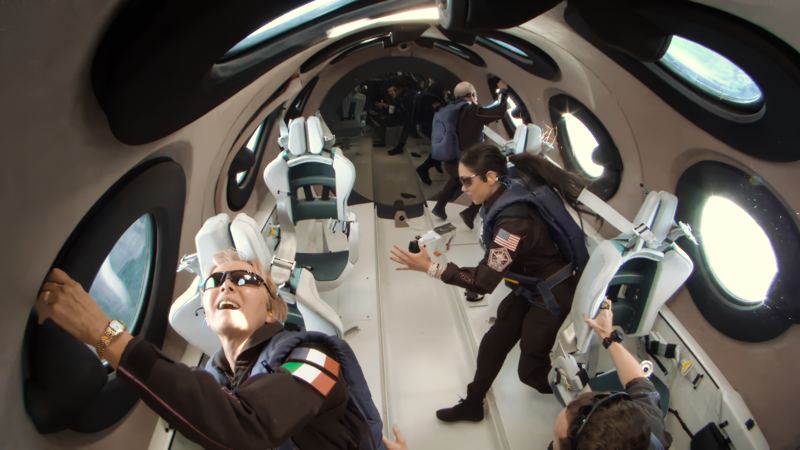
The Galactic 05 expedition crew at work at apogee. Courtesy Virgin Galactic.

The Galactic 05 expedition crew at work at apogee. Courtesy Virgin Galactic.

Virgin Galactic Flies Science Experiments to the Edge of Space

On November 2, Virgin Galactic flew Unity 2 on the Galactic 05 mission. It carried two scientists, a private tourist, and an astronaut trainer on a sub-orbital trip flown by Pilots Mike Masucci and Kelly Latimer. It was the company’s sixth successful flight in six months and the last for 2023.

The scientists aboard were Dr. Alan Stern of Southwest Research Institute (SWRI), joined by Kellie Gerardi, who was sponsored by the International Institute for Astronautical Sciences (IIAS) in Canada. Stern is also the principal investigator of the New Horizons mission to Pluto and the Kuiper Belt and is vice president at SWRI. He’s a long-time planetary scientist who has served on a number of missions. Stern has conducted suborbital research aboard NASA sounding rockets. He is the former board chair of the Commercial Space Flight Federation and a current member of the National Science Board.

Kelli Gerardi is active in aerospace, and bioastronautics and served as a payload specialist for this mission. She leads mission operations for Palantir Technologies, serves on the Defense Council for Truman National Security Project, and served on the board of directors for The Explorers Club. In addition, she is a prolific science communicator with several books and a Website to her credit. She also maintains an active social media presence.

During its almost four minutes in microgravity at apogee at 87.2 kilometers (54.2 miles) above Earth, the science team performed a series of biomedical experiments aimed at tracking human performance in space. Also included was a microgravity fluids experiment and a human-tended practice session with a mockup of a camera that will fly on future space missions.

Carrying Science to Apogee

During his brief time in microgravity, Stern used the Accutracker II heart and pulse monitor to collect physiological data on himself. “This particular version flew on the Shuttle many times,” he said. Stern and his co-investigator, Dr. Dan Durda have also flown with the harness on high-performance F-104 flights and parabolic missions aboard the so-called “Vomit Comet” aircraft. Stern described the flight on Galactic 05 as a risk-reduction mission to test the technology. “For me, this was mostly a training flight,” he said, noting that NASA will sign a contract with Virgin after 13 successful test flights like this one.

The Accutracker II harness worn by Alan Stern aboard Virgin Galactic's 05 expedition. Courtesy  Dan Durda/SWRI.

The Accutracker II harness worn by Alan Stern aboard Virgin Galactic’s 05 expedition. Courtesy Dan Durda/SWRI.

Their second experiment was a practice run learning to use a handheld Xybion wide-field visible and ultraviolet astronomical imager. “What we carried today was a mockup of the camera we’ll carry on the next flight,” he said. “It’s a training and learning experience, but this is part of the new era that it’s affordable enough that you can do that. I’m going to recommend to my colleagues in the funding agencies that they give these training flights to people.

Practicing for Future Flights

Essentially, the team has to show NASA that they can manipulate the camera in space efficiently. Stern’s aim was to learn to maneuver the camera in space. He had to stabilize it in microgravity and get the timing sequences down for a successful run with the real thing. “We now, as a result of Galactic 05 have videos of it in flight that tell us how long it took to do all the steps,” he said.

Other aspects of using the camera in space revolve around the transmissive nature of Unity’s windows on Unity. “What you don’t know is how glints affect the camera, how micro-abrasions and scratches on the windows produce flaws, what kind of exhaust film gets on them,” he said. ” “The only way to find that out is to get data through the windows in flight, to get data from three different windows, three geometries, and then compare it to Shuttle data that we have.”

Alan Stern practicing with a mockup of an astronomical camera his team hopes to fly aboard Virgin Galactic. Courtesy Virgin Galactic.

More Biomedical Studies at Apogee

Kellie Gerardi’s experiments collected biomedical and fluid behavior data during the Unity 2 flight. Her sponsor developed all three through a series of reduced gravity flights prior to the mission. The first examined questions about how confined fluids behave in low-gravity environments. That has implications for everything from spacecraft life support systems to administering medications in space through special syringes.

In her second experiment, Gerardi gathered biometric data from the Astroskin biomonitoring device built into a “smart shirt”. It provided ECG data as well as heart rate, breathing rate, and air volume. It also measured skin temperature during flight. Unity 2’s flight was the first time it collected data through all phases of a mission. Interestingly, hospitals, first responders, and others here on Earth also use this Astroskin.

Kellie Gerardi tested a biomedical Astroskin, a blood glucose monitor, and monitored a fluids experiment during Virgin Galactic's 05 expedition. She also made time to simply gaze at the view out the portholes during flight. Courtesy Virgin Galactic.

Kellie Gerardi tested a biomedical Astroskin suit, a blood glucose monitor, and tended a fluids experiment. She also made time to simply gaze at the view out the portholes during flight. Courtesy Virgin Galactic.

The third experiment measured blood glucose changes during flight. Changes in blood sugar are a well-known aspect of long-duration flight aboard the Shuttle and International Space Station. This is because prolonged periods of weightlessness induced a sort of “pre-diabetes” condition in astronauts. This sort of insulin resistance affects the way the muscles and liver absorb glucose and regulate blood sugar levels. The aim of Gerardi’s experiment was to see if that was affected during launch, apogee, and return to Earth.

Science at Suborbital Heights

After landing, both scientists talked about their experiences and the experiments they conducted. For Stern and SWRI, the mission was critical and went beyond just the two experiments he conducted. “When we set the objectives for this flight for Southwest Research, we had 8 objectives. Some were what we call minimum mission success and then accomplishing what we call slow mission success,” he said. “We got everything we wanted. All eight objectives were fully accomplished.”

Just after landing, Kellie Gerardi (left), Alan Stern (center), and space tourist Kettie Maisonrouge (right), talked about their experience during the Virgin Galactic flight. Image credit: Carolyn Collins Petersen

Just after landing, Kellie Gerardi (left), Alan Stern (center), and space tourist Kettie Maisonrouge (right), talked about their experience during the Virgin Galactic flight. Image credit: Carolyn Collins Petersen

For Gerardi, her Institute’s tests were critical confirmation of prior work. “The Astroskin unit I was wearing is the identical unit that is flown currently on the International Space Station,” said Gerardi. She noted that there was a significant difference between its use there and on her Virgin Galactic flight. “I was able to wear it during the launch, reentry, and landing portions of the flight. Normally astronauts put it on once they’re already in a microgravity environment,” she said. “So, it’s measuring pretty much all of the things you would expect. It’s like free vector cardiography (VCG is a method of getting 2D images of cardiac electrical activity). It’s got pulse oximetry and a number of different sensor data.”

Her third experiment focused on continuous blood glucose monitoring during flight. This test is in response to evidence that long-duration space missions produce insulin resistance in astronauts. The data from the monitor she wore adds new data to studies of this condition in space flyers. It should help answer questions about how quickly that resistance resolves after flight.

Gerardi was particularly excited about the fluids payload, and its operation in microgravity. “One of the experiments we flew had Shuttle heritage. It was bolted down on the Shuttle and the G jitter really disrupted the data,” she said. The Unity 2 flight was a good chance to see how the fluids in the experiment would behave. “What we saw was extraordinary. We exceeded anything that we have seen in parabolic flight here on Earth…we were collecting the highest-quality data and watching some really novel behavior from the fluid cell and being able to react to that in real-time.”

Why Do Suborbital Science?

A question that keeps coming up is, “Why do suborbital flights? Why not just go to the International Space Station?” It’s not like suborbital science is new. Scientists have been doing suborbital science for years—using sounding rockets and high-altitude balloons. Those continue today. So, going to suborbital heights is not a new idea. Going to orbit, on the other hand, adds several challenges. One is accessibility. The ISS is a limited commodity. To get an experiment on it takes years of planning and waiting for a launch window. Getting onto a suborbital flight still has some lead time, but as more of these missions happen, the accessibility increases.

A NASA Black Brant IX sounding rocket soars skyward into an aurora over Alaska during the launch on 5:13 a.m. EST, Feb. 22, 2017. Credit: NASA/Terry Zaperach

Suborbital Is Economical

Another challenge is cost. Cost figures vary across launch platforms, but, for example, a seat on Axiom can cost in the range of $70 million. Going up on suborbital flights to microgravity to do short-term experiments (or even a tourist ride) is much more accessible and much less expensive, Stern pointed out. “The new commercial vehicles, such as the Virgin rocket ship that we just flew on, fly at ten times lower costs and they fly presently about ten times more often, and soon hundreds of times, and then soon many hundreds of times more frequently,” he said. “So, it’s opening up access in a way that we never could afford to do, or had the capacity to do all the way back to the 1950s, when rocket-borne research was really getting underway.”

Virgin Galactic’s VSS Unity conducted her second powered test flight on Tuesday, May 29th. With six flights under their belts, the VG crews are planning for more in 2024. Credit: Virgin Galactic

Virgin Galactic’s VSS Unity conducted her second powered test flight on Tuesday, May 29th. With six flights under their belts, the VG crews are planning for more in 2024. Credit: Virgin Galactic

At the current time a tourist seat on Virgin Galactic’s Unity 2 cost around half a million dollars. (Those prices may well rise to ~$1 million, according to recent announcements from the company.) Science teams can expect to pay around $650,000 for a seat and equipment to get four minutes of microgravity in suborbital space. By comparison, someone flying a hyperbolic “vomit comet” type flight pays around $10,000 for an experience in a lunar-gravity (1/6 G) environment. An uncrewed suborbital rocket costs around $3 to $5 million (at the low end).

Training Scientists in Suborbital Space

Suborbital flight puts scientists back in control of experiments to be done in space. “You know, volcanologists go to volcanoes, astronomers go to observatories, oceanographers go into the ocean space, but space scientists have been going to control rooms,” Stern said. “And that’s not the best way to do your experiment because automating things is expensive and it’s error-prone, with lots of failure modes.” Gerardi agreed and pointed out that the research she did onboard allowed her to do things in microgravity that couldn’t be done on the ground.

Putting people into space, even for short periods of time in microgravity, is changing the face of space flight, according to both Unity 2 astronauts. “It’s going to be really transformative all the way across the 21st century and probably forever,” said Stern, also pointing out that his flight put Southwest Research Institute (where he is a vice-president), in a very competitive place for continuing human spaceflight for suborbital science. For IIAS, it’s a chance to enhance its robust educational programs that train future astronauts and explorers. “It’s a new era of access to space,” she emphasized, “for scientists and for civilians.”

The Galactic 05 expedition was the last Unity flight of the year. The next Unity 2 mission is planned for January 2024 and the company will then begin phasing out those flights by mid-year. The company is already working on the Delta suborbital craft to replace it and plans to open a new spacecraft plant in Phoenix next year. Virgin has announced layoffs as part of a process of streamlining the non-Delta workforce. The first Delta craft may launch as soon as 2026, and the company expects to serve both tourist and science research passengers.
For More Information

{ https://www.universetoday.com/ }

Hoe vind je dit bericht?
Geschreven door peter om 23:51 Stuur door

The Lunar Swirl Mystery Deepens

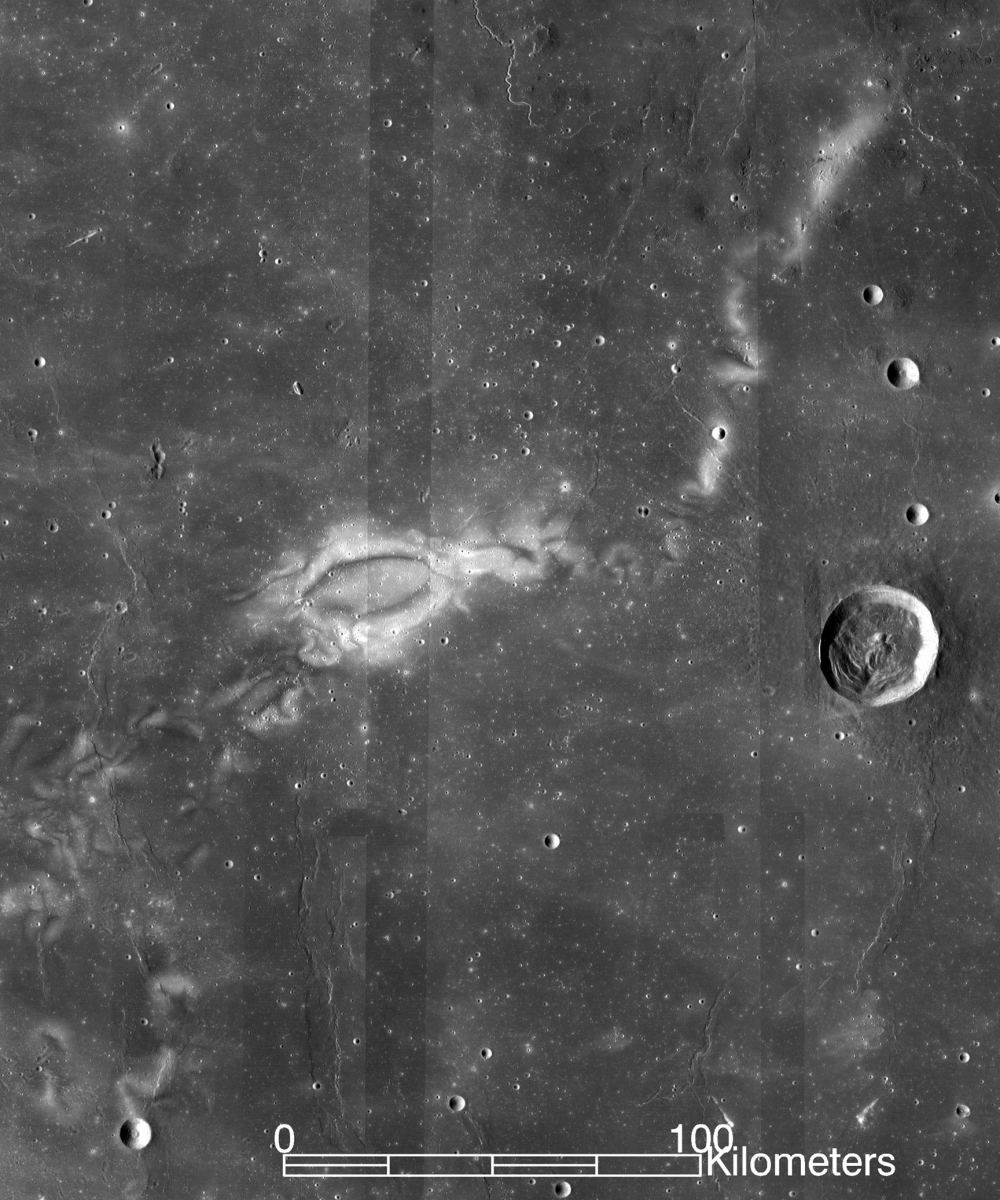
This is an image of the Reiner Gamma lunar swirl from NASA's Lunar Reconnaissance Orbiter. Credits: NASA LRO WAC science team 

This is an image of the Reiner Gamma lunar swirl from NASA's Lunar Reconnaissance Orbiter. Credits: NASA LRO WAC science team

The Lunar Swirl Mystery Deepens

For years, people noticed strange features on the Moon dubbed “Lunar Swirls.” They’re bright regions that appear to be concentrations of lighter-colored material on the surface. It turns out that interactions between the solar wind and magnetic regions on the Moon may play a role at two sites.

Scientists long thought that these swirls weren’t related to the surrounding topography, but it turns out there’s some kind of interaction going on between the swirl deposition and the surface. Planetary Science Institute senior scientist John Weirich led a team to study topographic data for lunar swirls at high resolution. They found a correlation between the swirl areas and lower topography in a region called the Reiner Gamma swirl.

About Swirl Regions

The Moon has a number of similar regions with high-contrast bright markings that appear to loop across the surface. Generally, they look like wide bright swirls separated by darker off-swirl lanes. The fact that they exist spurs questions about how they form and there isn’t a clear answer, yet. Once that mystery is solved, scientists will have a better understanding of how the lunar surface is affected by the solar wind, bombardment by micrometeorites, how the lunar soil “migrates”, and what other effects the local environment has on the surface.

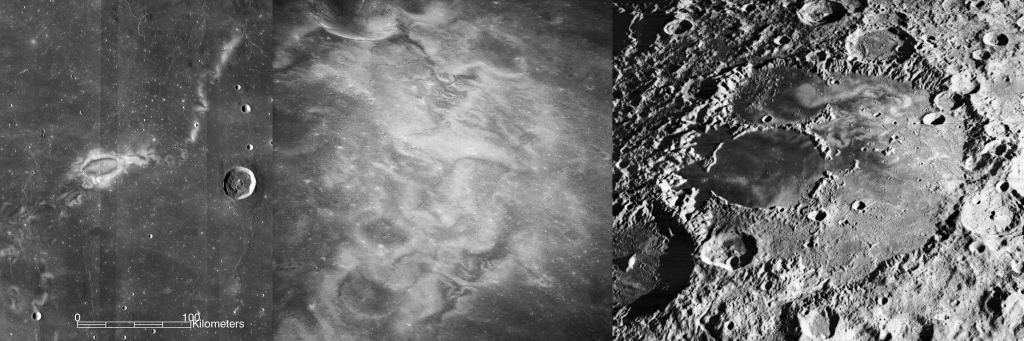
Lunar swirls are found in several regions on the Moon. Courtesy NASA.

Lunar swirls are found in several regions on the Moon. Courtesy NASA.

“Lunar swirls have piqued scientists’ interest since they were discovered, partly because the scientific community doesn’t completely understand how they formed. There are many hypotheses about their formation process. Each hypothesis has observations that support it, but there are also other observations that contradict them,” Weirich said. “Since we don’t have a full understanding of how these swirls formed, we don’t completely understand the story they can tell us about the Moon. Forming them could involve a combination of well-understood processes interacting together or a currently unknown process. Unusual objects or phenomena are sometimes the key to obtaining deeper knowledge, and for this reason, lunar swirls are very intriguing. And the fact that they look really cool.”

Studying Swirls in Higher Detail

To do their work, Weirich’s team looked at earlier research showing that bright areas are 2-3 meters lower than dark areas, particularly in the Mare Ingenii lunar swirl. “However, it is not as simple as the bright areas are uniformly lower than the dark areas. If that was the case this relationship between topography and swirl would be easy to demonstrate by comparing an elevation map to a picture of the swirl. Instead, this relationship is only seen when we compare the average height of the bright areas and the average height of the dark areas.”

Weirich studied Lunar Reconnaissance Orbiter mission images and applied a special software suite to determine the surface topography. The team also used machine-learning tools on specific images. It classified the swirls into various units: bright areas (on-swirl)and dark areas (or “off-swirl”). The studies allowed them to identify transition regions between the two units, and they labeled those “diffuse-swirl”.

The correlation between topography and swirl formation still doesn’t explain exactly why they form. But, it does give planetary scientists some new clues as they study other swirl features on the Moon. At present, there are several theories about formation, but none of them explain all of the details. One idea is that they formed as a result of cometary impacts. That explains the brightness of these features. Another theory is that the swirls form when weak magnetic fields protect lighter-colored lunar surface soil (regolith) from the solar wind. Finally, weak electric fields created by brief interactions between the magnetic anomalies and solar wind plasma could play a role. Those fields could affect electrically charged fine dust on the surface. How topography plays into any of these theories is still an unknown.

How They Did It

The specialized software the team used does stereophotoclinometry to analyze the topography of a surface. It combines stereo imaging and photoclinometry to get the surface height of a region. The swirl units of interest were defined by machine learning procedures. The team then compared that information to the SPC-derived topography. That allowed them to statistically determine if height correlations existed and what differences they showed.

The SPC methodology has been used on various surfaces, including using data from the OSIRIS-REx mission, among other missions. Planetary scientists use SPC methodologies to describe the shapes of planets, asteroids, comets, and other small bodies. Still, there’s not yet a definite explanation for these swirls. However, the combo of high-resolution imaging, machine learning, and advanced software techniques gives planetary scientists more insight into their still-mysterious origins.

For More Information

{ https://www.universetoday.com/ }

Hoe vind je dit bericht?
Geschreven door peter om 23:21 Stuur door

NEW DETAILS ON SECRETIVE U.S. MILITARY X-37B SPACEPLANE’S NEXT MISSION ARE REVEALED, ALONG WITH A SURPRISE

VVLjOEuS?format=jpg&name=900x900

(USSF/Staff Sgt. A. Shanks)

NEW DETAILS ON SECRETIVE U.S. MILITARY X-37B SPACEPLANE’S NEXT MISSION ARE REVEALED, ALONG WITH A SURPRISE

Details about the seventh mission of the U.S. military’s mysterious X-37B Orbital Test Vehicle have been revealed, along with surprising news about the secretive spaceplane’s upcoming launch.

For the first time, X-37B Mission 7 (OTV-7) will see the robotic spaceplane launched on a SpaceX Falcon Heavy rocket, according to an announcement from The Department of the Air Force Rapid Capabilities Office and its partners at the U.S. Space Force.

The launch will occur on December 7, 2023, lifting off from Florida’s Kennedy Space Center.

While much is known about the X-37B and its past missions, several of the reusable robotic spaceplane’s operations remain mysterious. Carried into space aboard a rocket during its missions, the X-37B carries out orbital operations overseen by the Space Force, demonstrating reusable spaceflight technologies while facilitating a range of experiments and other operations for various agencies.

The spaceplane’s December launch, dubbed USSF-52, will include various experimental capabilities with several objectives.

X-37B

The X-37B is seen after its sixth mission, OTV-6

(Credit: Staff Sgt. Adam Shanks),

X-37B Program Director Lt. Col. Joseph Fritschen said the tests will help to broaden the current capabilities of the reusable spaceplane and, with the help of SpaceX’s Falcon Heavy rocket, will be able to carry out “multiple cutting-edge experiments for the Department of the Air Force and its partners.”

“These tests include operating the reusable spaceplane in new orbital regimes, experimenting with future space domain awareness technologies, and investigating the radiation effects on materials provided by NASA,” the U.S. Space Force said in a statement on November 8.

One of the experiments, aptly named “Seeds-2,” will be carried out during OTV-7 as part of a NASA test that will expose seeds to the radiation conditions of long-duration spaceflight. In addition to helping scientists better understand how radiation impacts plant seeds, the experiment aims to support NASA’s objectives in the coming years to facilitate long-term crewed space missions.

The X-37B’s last mission saw the introduction of a new service module, which broadened the mysterious spaceplane’s capabilities and facilitated more experiments than its initial five missions.

spaceplane

(Credit: Boeing)

X-37B Mission 6 (OTV-6) was the first to undertake a research experiment undertaken by the U.S. Naval Research Laboratory, called the Photovoltaic Radio-frequency Antenna Module experiment, which successfully displayed the capability of generating radio and microwaves through the collection of solar power.

Other experiments carried out during OTV-6 included tests similar to NASA’s upcoming “Seeds-2” experiment and the deployment of a small satellite called FalconSat-8 procured by the U.S. Air Force Academy and the Air Force Research Lab.

Fundamentally, the forthcoming OTV-7 mission will aim to perform similar tests with experimental technologies to help ensure space domain awareness during future missions.

“The X37B continues to equip the United States with the knowledge to enhance current and future space operations,” said Gen. B. Chance Saltzman, Chief of Space Operations, who said X-37B’s forthcoming mission will help showcase “the USSF’s commitment to innovation and defining the art-of-the-possible in the space domain.”

RELATED

{ https://thedebrief.org/ }

Hoe vind je dit bericht?
Geschreven door peter om 21:30 Stuur door

JAMES WEBB SPACE TELESCOPE HAS DISCOVERED SOMETHING ON A NEARBY EXOPLANET THAT COULD “RESHAPE OUR UNDERSTANDING” OF PLANETARY EVOLUTION

 YjaE1zqd?format=jpg&name=900x900

(European MIRI EXO GTO team/ESA/NASA)

JAMES WEBB SPACE TELESCOPE HAS DISCOVERED SOMETHING ON A NEARBY EXOPLANET THAT COULD “RESHAPE OUR UNDERSTANDING” OF PLANETARY EVOLUTION

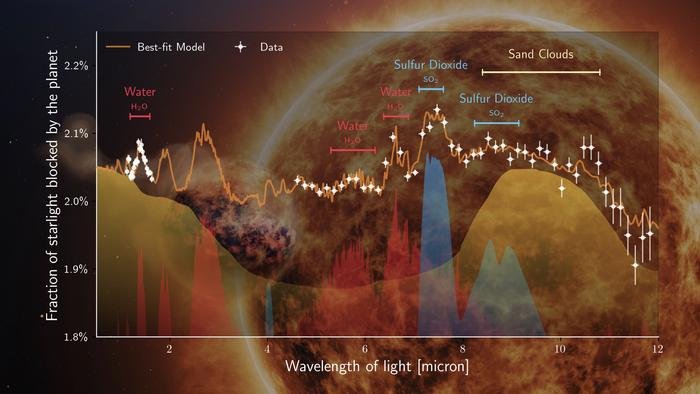
Astronomers report that the James Webb Space Telescope (JWST) recently detected water vapor, sand clouds, and sulfur dioxide in the atmosphere of the exoplanet WASP-107b, according to newly published findings. 

Led by a team of European astronomers from Belgium’s KU Leuven University, the researchers pointed the JWST’s Mid-Infrared Instrument (MIRI) at the exoplanet, located roughly 211 light-years from Earth. Their discovery, now published in Nature, has revealed the presence of water vapor, sulfur dioxide, and silicate sand clouds while notably lacking methane, a common greenhouse gas​

WASP-107b is a low-density exoplanet orbiting WASP-107. Discovered in 2017, the exoplanet immediately challenged our understanding of planetary development. The super-Neptune planet, meaning it’s larger than Neptune, has a surprisingly low density. This has implications for our understanding of gas giant formation and structure.

Moreover, it orbits very close to its star, with a year lasting only about 5.7 Earth days. Due to its proximity to its star, astronomers still need clarification on how the planet can retain an atmosphere, which generally would burn up due to its proximity to its star.

The recent discovery has only complicated astronomers’ understanding of this unique gas giant.

wasp-107b A transmission spectrum of the warm Neptune exoplanet WASP-107b, captured by the Low Resolution Spectrometer (LRS) of the Mid InfraRed Instrument (MIRI) on board JWST, reveals evidence for water vapour, sulfur dioxide, and silicate (sand) clouds in the planet’s atmosphere.
(Image: Michiel Min / European MIRI EXO GTO team / ESA / NASA; Klaas Verpoest (LUCA School of Arts, Belgium.)

Due to its atmospheric conditions, Neptune is distinguished by its ‘fluffy’ nature. Astronomers were able to peer deep into its atmosphere. This fluffiness, combined with the precision of the JWST infrared system, has enabled a new understanding of the planet’s atmospheric composition. 

The absence of methane in WASP-107b’s atmosphere is intriguing, hinting at a potentially warm interior and shedding light on the planet’s internal heat dynamics. Detecting sulfur dioxide, typically associated with the smell of burnt matches, was unexpected, as previous models had not predicted its presence. 

According to the report, due to the “fluffy” atmosphere and the general cooler temperatures of the planet’s host star, photons from the star can penetrate deeper into the planet’s gaseous atmosphere, allowing for complex chemical reactions to occur. Moreover, the discovery of water vapor in the atmosphere was also surprising since it seems connected to giant clouds made of sand.

Elements like water and sulfur do not appear often in cloudless atmospheres, so the fact that they were detected indicates that WASP-107b has high-altitude clouds. The JWST was able to peer into these clouds and indicated that they were a silicate-type material, similar to sand on Earth. According to traditional models of exoplanet formation, sand clouds like this usually form much closer to the planet’s surface, where the temperature is much warmer. However, since WASP-107b’s atmospheric temperature sits at around 500 degrees Celsius, the clouds seemingly “fluff” up into the upper atmosphere due to its close proximity to a star.

The endurance of these high-altitude sand clouds is similar to Earth’s water cycle. Silicate vapors from evaporated sand droplets in hotter, deeper layers rise and then recondense into clouds at cooler, higher altitudes. This vaporization and condensation process keeps the sand clouds persisting high in the atmosphere.

“The fact that we see these sand clouds high up in the atmosphere must mean that the sand rain droplets evaporate in deeper, very hot layers and the resulting silicate vapour is efficiently moved back up, where they recondense to form silicate clouds once more,” explained lead author Dr. Michiel Min. “This is very similar to the water vapour and cloud cycle on our own Earth but with droplets made of sand.”

  • electron

Professor Leen Decin of KU Leuven emphasized that JWST’s discovery is reshaping our comprehension of planetary formation and evolution, offering new perspectives on the Solar System itself. Moreover, the study demonstrates how JWST can characterize exoplanets without counterparts in our own Solar System.

WASP-107b, with all its fluffiness, points astronomers to a whole new host of possible planetary incarnations that have yet to be discovered. While this exoplanet is undoubtedly inhospitable to life, at least as we know it, it allows us to imagine strange new worlds that do not fit the mold of planetary evolution. 

{ https://thedebrief.org/ }

Hoe vind je dit bericht?
Geschreven door peter om 20:35 Stuur door

Mysterious 'explosive' sound from a 'UFO' over New England shook homes and rattled windows - and a Harvard physicist believes he has located the source

Mysterious 'explosive' sound from a 'UFO' over New England shook homes and rattled windows - and a Harvard physicist believes he has located the source

  • A loud boom that lasted for 12 seconds was heard and felt in New England
  • An observatory also pictured up the sound, leading to an investigation
  • READ MORE:  Harvard scientist believes 'exotic' metals found at the bottom of the ocean came from Earth-like exoplanet

New Englanders reported hearing a 'strange' sound on the evening of October 20, which shook homes and raddled windows for at least 12 seconds.

Harvard University's astronomical instruments recorded the noise, finding it did not resemble anything from birds, aircraft or wind.

Alien-hunting physicist and Harvard's former head of astronomy Avi Loeb to investigate the source of the 'unidentified flying object.'

Loeb determined the UFO released explosive energy equivalent to 2,400 pounds of TNT detected from over a 10-mile radius.

The sound was moving 1,115 feet per second when an observatory in Cambridge, Massachusetts detected it.

Loeb determined that the energy source likely came from an exploding mile-wide meteor during the Orionid shower that peaked in the area on October 21.

Avi Loeb determined the UFO released explosive energy equivalent to 2,400 pounds of TNT detected from over a 10-mile radius. The sound was moving 1,115 feet per second when an observatory in Cambridge, Massachusetts detected it

Avi Loeb determined the UFO released explosive energy equivalent to 2,400 pounds of TNT detected from over a 10-mile radius. The sound was moving 1,115 feet per second when an observatory in Cambridge, Massachusetts detected it

Loeb's Galileo Project observatory recorded the boom using a giant, ultra-sensitive microphone (pictured) he installed on the roof of a building on Harvard's campus

Loeb's Galileo Project observatory recorded the boom using a giant, ultra-sensitive microphone (pictured) he installed on the roof of a building on Harvard's campus

Loeb's Galileo Project observatory recorded the boom using a giant, ultra-sensitive microphone he installed on the roof of a building on Harvard's campus.

Andy Mead, who designed and constructed the system, contacted Loeb on October 21 after noticing something strange picked up by the sensors.

'I started getting messages this morning about a 'viral' sound that was heard throughout New England,' Mead shared in the note.

'Notably, the Mount Washington Observatory made a post about it as they had so many inquiries. 

'That post now has over 4,000 reactions, 1,000 comments, and 751 shares, many of whom heard the sound and are following the story.'

Reports stemmed from both states, traveling through Mount Washington, Boothbay Harbor, Maine and Sturbridge, where people heard an explosion over their homes around 7:43pm ET on October 20.

Andy Mead, who designed and constructed the AMOS system, contacted Loeb on October 21 after noticing a social media post about something strange in New Hampshire (pictured)

Andy Mead, who designed and constructed the AMOS system, contacted Loeb on October 21 after noticing a social media post about something strange in New Hampshire

(pictured)

Mead told Loeb he checked AMOS, finding 'a very interesting sound' that lasted for 12 seconds.

Loeb then created a website to crowdsource reports from other locations that could constrain the distance of the mystery source.

Harvard University's observatory recorded the noise, leading alien-hunting physicist Avi Loeb to investigate the source of the 'unidentified flying object'

Harvard University's observatory recorded the noise, leading alien-hunting physicist Avi Loeb to investigate the source of the 'unidentified flying object'

'Given the mission of the Galileo Project, one question came to mind: 'Is this an Unidentified Anomalous Phenomenon (UAP)? Are aliens using advanced technologies near Earth,' the physicists shared in a Medium post.

The signal was short but produced a sudden release of energy that sent a wave through Earth's atmosphere. 

Loeb found that the pressure wave had weakened by the time AMOS detected the sound, as it was moving 1,115 feet per second.

'Multiplying this speed by the duration of the pulse, 12 seconds, implies a shell width of 4 kilometers [2.4 miles] for the blast wave, implying a distance of about 40 kilometers [24.8 miles] from the explosion,' he shared.

'At that distance, the measured pressure disturbance suggested an explosive energy release of 2.4 kilotons of TNT. The inferred energy and distance are reminiscent of meteors, which are known to make their own music at high altitudes.'

The Orionid Meteor Shower, which takes place every autumn when Earth passes through a stream of debris from Halley's Comet, peaked on October 21 with up to 25 shooting stars every hour

The Orionid Meteor Shower, which takes place every autumn when Earth passes through a stream of debris from Halley's Comet, peaked on October 21 with up to 25 shooting stars every hour

The Orionid Meteor Shower, which takes place every autumn when Earth passes through a stream of debris from Halley's Comet, peaked on October 21 with up to 25 shooting stars every hour. 

Meteors, also known as shooting stars, come from leftover comet particles and bits from broken asteroids.

When comets come around the sun, the dust they emit gradually spreads into a dusty trail around their orbits.

Every year, Earth passes through these debris trails, which collide with our atmosphere and disintegrate to create fiery and colorful streaks in the sky.

Because this is an annual event, residents of New England reported hearing the same 'boom' in 2021, also on October 20.

{ https://www.dailymail.co.uk/ }

Hoe vind je dit bericht?
Geschreven door peter om 20:12 Stuur door

ESA’s Trace Gas Orbiter Observes Green Atmospheric Nightglow on Mars

ESA’s Trace Gas Orbiter Observes Green Atmospheric Nightglow on Mars

The atmospheric nightglow is observed on Earth. On Mars, it was something expected, yet never observed in visible light until now.

This image shows an artist’s impression of what nightglow might look like to an astronaut in the polar winter regions of Mars at night. Image credit: NASA / JPL-Caltech /Cornell University / Arizona State University / E.W. Knutsen.

This image shows an artist’s impression of what nightglow might look like to an astronaut in the polar winter regions of Mars at night.

Image credit: NASA / JPL-Caltech /Cornell University / Arizona State University / E.W. Knutsen.

Airglow occurs when two oxygen atoms combine to form an oxygen molecule, about 50 km above the planetary surface.

The oxygen atoms form on Mars’s dayside when sunlight gives energy to carbon dioxide molecules, making them split apart.

When the oxygen atoms migrate to the night side and stop being excited by the Sun, they regroup and emit light at lower altitudes.

“This emission is due to the recombination of oxygen atoms created in the summer atmosphere and transported by winds to high winter latitudes, at altitudes of 40 to 60 km in the Martian atmosphere,” said Dr. Lauriane Soret, a planetary scientist at the University of Liège.

The illumination from the nightglow could be bright enough to light the way of future see the glow as bright as moonlit clouds on Earth.

“These observations are unexpected and interesting for future trips to the Red Planet,” said Dr. Jean-Claude Gérard, a planetary scientist at the University of Liège.

ESA’s Mars Express spacecraft observed the Martian nightglow in infrared wavelengths a decade ago.

ESA’s Trace Gas Orbiter followed up by detecting glowing green oxygen atoms high above the dayside of Mars in 2020 — the first time that this dayglow emission was seen around a planet other than Earth.

These atoms also travel to the nightside and then recombine at lower altitude, resulting in the visible nightglow detected by the orbiter.

Orbiting Mars at an altitude of 400 km, Trace Gas Orbiter was able to monitor the night side of Mars with the ultraviolet-visible channel of its NOMAD instrument.

The instrument covers a spectral range from near ultraviolet to red light and was oriented towards the edge of the planet to better observe the upper atmosphere.

“The nightglow serves as a tracer of atmospheric processes,” the researchers said.

“It can provide a wealth of information about the composition and dynamics of a region of the atmosphere difficult to measure, as well as the oxygen density.”

“It can also reveal how energy is deposited by both the Sun’s light and the solar wind.”

“Understanding the properties of the Martian atmosphere is not only scientifically interesting but it is also key for missions to the planet’s surface.”

“Atmospheric density, for example, directly affects the drag experienced by orbiting satellites and by the parachutes used to deliver probes to the Martian surface.”

The team’s paper was published in the journal Nature Astronomy.

  • JC. Gérard et al. Observation of the Mars O2 visible nightglow by the NOMAD spectrometer onboard the Trace Gas Orbiter. Nat Astron, published online November 9, 2023; doi: 10.1038/s41550-023-02104-8

{ https://www.sci.news/ }

Hoe vind je dit bericht?
Geschreven door peter om 18:28 Stuur door

Visible Spectrum Unveils New Clues: Is This the Same Mysterious Gimbal UFO?

Visible Spectrum Unveils New Clues: Is This the Same Mysterious Gimbal UFO?

navy-ufo

In the realm of the unexplained and the extraordinary, UFO sightings occupy a unique and captivating space. The recent surge in reports of unidentified flying objects has reignited public and scientific interest alike. As we delve into the latest UFO sightings, we unravel a tapestry of mystery, skepticism, and boundless curiosity.

Video:

  • The initially released Gimbal, showcased in the infrared spectrum.

The Resurgence of UFO Interest

The phenomenon of UFO sightings is not new, but recent advancements in technology and a shift in governmental transparency have brought it back into the spotlight. High-quality video recordings and enhanced imaging techniques have allowed for more detailed observations than ever before. In 2022, the United States government’s establishment of the Anomaly Resolution Office (AARO) marked a significant step in recognizing and investigating these enigmatic occurrences.

The Gimbal Sighting: A Case Study

Among the numerous reports, the “Gimbal UFO” sighting stands out. Originally captured by a U.S. Navy jet’s infrared camera, this sighting showcases a flying object with extraordinary aerodynamic capabilities. Unlike conventional aircraft, the Gimbal UFO demonstrates an ability to hover, rotate, and change directions at seemingly impossible speeds. The release of this footage by the AARO has sparked a wave of speculation and analysis among both enthusiasts and skeptics.

Analyzing the Evidence

What makes the Gimbal sighting particularly intriguing is the clarity and quality of the footage. Experts and amateurs alike have pored over this video, debating the physics of the UFO’s movements and the potential technologies behind it. Some suggest experimental military aircraft or drones, while others lean towards extraterrestrial origins. The lack of definitive answers only adds to the allure of the phenomenon.

New video in the visible light spectrum. Could it be the same object?

The Impact of Technology on UFO Reporting

The proliferation of smartphones and social media has played a crucial role in the increase of UFO sightings. People around the globe can now capture and share their experiences in real-time, creating a vast network of eyewitness accounts. This democratization of reporting has led to a significant uptick in UFO sighting reports, providing researchers with a wealth of data to analyze.

The Role of Government and Scientific Inquiry

The establishment of organizations like the AARO represents a paradigm shift in how governments approach UFO sightings. No longer dismissed outright, these phenomena are being studied with a scientific lens. This change is encouraging more witnesses to come forward, shedding light on incidents that might have otherwise gone unreported.

The Future of UFO Sightings

As we continue to explore the skies and beyond, the mystery of UFO sightings remains an enticing puzzle. With each new report, we edge closer to understanding whether these sightings are earthly in origin or point to something beyond our current comprehension. The quest for answers continues, fueled by human curiosity and the relentless pursuit of the truth.

The world of UFO sightings is as mystifying as it is fascinating. With advancements in technology and a shift in attitude towards these phenomena, we are entering a new era of discovery. Whether the truth behind these sightings is terrestrial or not, the journey of exploration and understanding is in itself a remarkable adventure.

RELATED

{ https://www.latest-ufo-sightings.net/ }

Hoe vind je dit bericht?
Geschreven door peter om 18:09 Stuur door

Wetenschappers van KU Leuven ontdekken zandwolken op exoplaneet WASP-107b: "Wetenschappelijke mijlpaal"

Wetenschappers van KU Leuven ontdekken zandwolken op exoplaneet WASP-107b: "Wetenschappelijke mijlpaal"

Artikel van Vincent Merckx  

Stel het je eens voor: in de plaats van de regenbuien die we momenteel over onze hoofden uit gegoten krijgen, valt zand uit de lucht. Dat zand wordt door luchtstromen de atmosfeer in gestuwd, bevriest daar en "regent" vervolgens weer uit. Dat hele proces herhaalt zich opnieuw en opnieuw en opnieuw.

Klinkt een beetje apocalyptisch, niet? Toch doet precies dát zich voor 200 lichtjaar hiervandaan, op de exoplaneet WASP-107b. Dat ontdekte een team van Europese astronomen, geleid door onderzoekers van het Instituut voor Sterrenkunde aan de KU Leuven. Ze publiceren hun bevindingen vandaag in het wetenschappelijke tijdschrift Nature.

Kringloop van zand

Eerst iets meer over die exoplaneet - een planeet buiten ons eigen zonnestelsel, dus. WASP-107b draait rond een ster die iets koeler is dan "onze" zon. Het is ook een erg ijle exoplaneet, een zogenoemde gasreus. WASP-107b heeft ongeveer de massa van Neptunus, maar is meer dan twintig keer groter. Doordat de atmosfeer er zo ijl is, kan je er ook makkelijk doorheen kijken.

Dat biedt een mooie kans voor onderzoekers die de verschillende lagen van die atmosfeer willen onderzoeken. Het team van astronomen, onder wie professor Leen Decin van de KU Leuven, analyseerde de atmosfeer door de golflengtes op te meten van het licht dat erdoorheen viel. De verschillende golflengtes van dat licht leerden hen op hun beurt iets over de chemische samenstelling van de atmosfeer van WASP-107b.

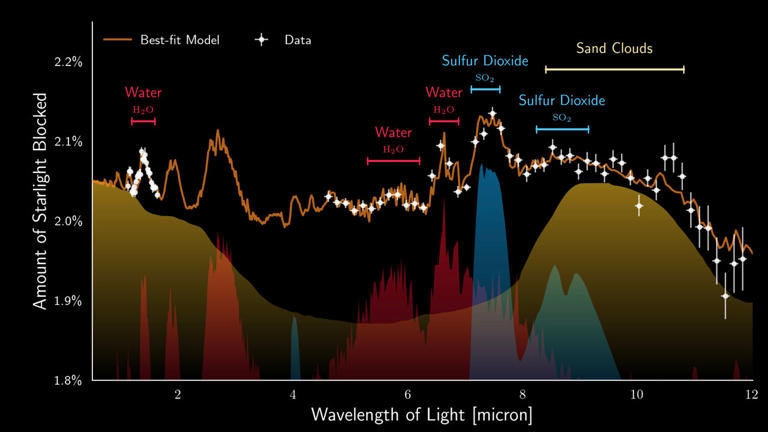
Zo ziet het lichtspectrum van de atmosfeer van WASP-107b eruit.
© VRTNWS

Daarbij deden ze twee opvallende ontdekkingen: zwaveldioxide (SO₂) en siliciumwolken. Die zwaveldioxide was een grote verrassing. Volgens wetenschappelijke modellen kon er immers geen zwaveldioxide aanwezig zijn.

Dat er wolken waren, was op zich niet zo nieuw. Die zijn al vaker aangetroffen op exoplaneten. Wel slaagde het team er als eerste in om de chemische samenstelling van de wolken uit te lezen. Ze bleken te bestaan uit kleine deeltjes silicium (het belangrijkste bestanddeel van zand op onze Aarde).

Dat silicium vormt op WASP-107b een kringloop zoals die van water en wolken op onze planeet, legt Michiel Min uit. Hij is astronoom aan het SRON Netherlands Institute for Space Research en werkte mee aan het onderzoek. "Het feit dat we deze zandwolken hoog in de atmosfeer zien, moet betekenen dat de zandregendruppels verdampen in diepere, zeer hete lagen van de atmosfeer en dat de resulterende siliciumdamp omhoog wordt getransporteerd, waar ze opnieuw condenseren om opnieuw siliciumwolken te vormen."

Immense spiegel

We hebben de ontdekkingen te danken aan de James Webb-ruimtetelescoop, zegt Decin van het Instituut voor Sterrenkunde, en dan in het bijzonder het instrument MIRI. Daar is twintig jaar lang aan gewerkt door een team van Europese en Amerikaanse wetenschappers. De KU Leuven leverde daar een belangrijke bijdrage aan.

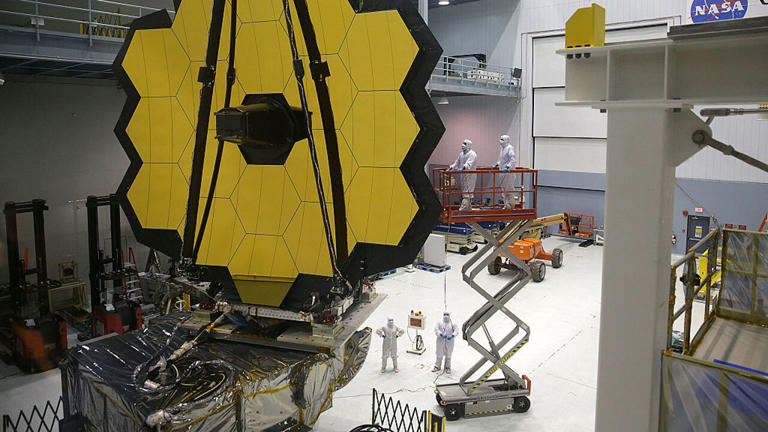
De gigantische spiegel van de James Webb-telescoop kan veel zwakkere lichtsignalen opvangen.
© 2016 Getty Images

Maar ook de immense spiegel van de James Webb-ruimtetelescoop was onmisbaar. Die heeft een diameter van zes meter. "Die spiegel zorgt dat je dingen kan waarnemen die vroeger veel te zwak waren om te zien", legt Decin uit. "Planeten zenden geen eigen licht uit, die reflecteren licht van hun moederster. Dat vraagt om krachtige instrumenten om dat zwakke signaal te kunnen waarnemen."

Gigantisch veel andere zonnestelsels

Maar waarom is die ontdekking van siliciumwolken en zwaveldioxide nu belangrijk?

Decin noemt het "een wetenschappelijke mijlpaal". "Het verandert ons begrip van de vorming en evolutie van planeten en werpt een nieuw licht op ons eigen zonnestelsel."

"Zwaveldioxide, dat kennen we op aarde bijvoorbeeld van de geur van verbrande lucifers. We begrepen niet hoe dat op een exoplaneet gevormd zou kunnen worden. Als we onze kennis enkel baseren op wat hier op aarde te zien is, dan is dat onvoldoende om te begrijpen wat er gebeurt op exoplaneten."
Dit dwingt ons om onze horizonten te verbreden, vindt Decin. "Ons zonnestelsel is maar één planetenstelsel. Daarbuiten bestaan gigantisch veel andere architecturen met compleet andere chemische samenstellingen dan wat we kennen van hier op Aarde of hier in ons eigen zonnestelsel."

{ https://www.vrt.be/vrtnws/nl/ }

Hoe vind je dit bericht?
Geschreven door peter om 17:47 Stuur door

Journalist Reveals First-Ever Photograph of UFO Shot Down in Syria in 2021

Syria Dome UAP

Journalist Reveals First-Ever Photograph of UFO Shot Down in Syria in 2021

There is a series of shooting down unidentified objects around the world that involves the United States. The military 2023 February UAP events are among the recent cases. Filmmaker Jeremy Corbell, along with investigative journalist George Knapp, has revealed a photograph of an object initially labeled as a “hostile drone” by the media. However, official statements from the United States, the UK, and allied intelligence agencies now confirm their inability to ascertain its origin, designating it as “unidentified.”
In episode 41 of Weaponized, Corbell and Knapp discuss UFO shootdowns covering both current events and historical perspectives. Corbell discusses events in 2019, specifically mentioning attempts to bring down over 100 UAPs on Navy warships using electromagnetic systems like the DRAKE (Drone Restricted Access Using Known Electromagnetic Warfare) Anti-Drone System.

In the episode, Jeremy Corbell provides details about a UAP event that took place in late summer 2021 off the coast of Japan involving the USS Milius. The USS Milius experienced a series of encounters with UAPs that exhibited similar behavior to the previously mentioned incidents near Navy warships. However, in this case, the UAPs were observed in a vast 300-mile radius of sea, with no other ships around.

Corbell further describes the frustrating attempts to take down the UAPs using electromagnetic techniques, noting that these efforts were once again ineffective. The UAPs displayed extreme maneuverability over four or five consecutive nights, with multiple objects present during a 5-hour window from 1:00 a.m. to 5:00 a.m. or midnight to 4:00 a.m. The ship’s captain, out of frustration, reportedly instructed the crew to stop reacting to the UAPs and creating reports since there seemed to be no viable solution.

It’s a UFO, not a Hostile Drone!

Corbell and Knapp discussed an incident that happened in the Middle East, specifically in Syria on December 14, 2021. Corbell describes how the Royal Air Force, using a Typhoon fighter plane, reported shooting down a hostile drone, marking the first air-to-air firing by the Royal Air Force in 40 years. The media initially reported it as a terrorist drone, but there was a subsequent shift to calling it a “Mystery drone” as no terrorist group or nation claimed responsibility.

Corbell notes a significant discrepancy between public reporting and intelligence community products. He introduces an image, referred to as the “Syria Dome UAP,” associated with the event, and mentions that internally, the intelligence community labeled it as an UAP. Corbell emphasizes the importance of transparency and accurate reporting, pointing out that what is publicly disclosed differs from the information shared among allied nations within the intelligence community.

Corbell posts on X (formerly Twitter), “In a joint operation, a Royal Air Force Typhoon fighter jet engaged an unidentified aerial vehicle using an Advanced Short Range Air to Air Missile (ASRAAM). Initial media reports labeled the unidentified as a ‘hostile drone’ – however – internal intelligence products officially classify the aerial vehicle of unknown origin as a UAP – and maintain this designation. The UAP was not recovered.”

Liberation Times writes, “According to Corbell, the Five Eyes report was published months after the incident occurred and indicates that on 14 December 2021, an RAF Typhoon jet shot at one UAP using an ASRAAM missile. At the time, the incident was reported as the first enemy aircraft shot down by the RAF since the Falklands War in Argentina more than 40 years ago.”

Corbell continues, stating that Centcom (United States Central Command) has been tracking UAP for over 15 years, and the frustration lies in the lack of proper reporting and handling of these incidents within the chain of command. He notes that in conflict zones, there is a tendency to shoot at anything within a certain proximity to ground troops or bases, especially if it appears to have a payload. However, the issue arises in the lack of recovery or proper handling after such engagements.

Further, in the episode, Corbell reveals the image of an object that he called the “Syria Dome UAP.” He says, “This image… is the one that was historically fired upon. It is referred to as a ‘terrorist drone,’ exhibiting a peculiar appearance. Whatever it may be, it is classified as a UAP within the intelligence community. This is not something that has been identified.”

Corbell notes that there were two of these unidentified devices, and when the Royal Air Force engaged with them, firing an Advanced Short Range Air-to-Air Missile (ASRAAM), one of the objects managed to evade and escape the scene. Corbell emphasizes the intelligence control exhibited by these objects, suggesting that they were not under random or autonomous flight.

Corbell admits uncertainty about whether the fired missile hit the object or if it made contact with the ground. He underscores the discrepancy between the public narrative, which presented the incident as involving a terrorist drone, and the internal classification within the intelligence community, where it is recognized as a UAP. The point is reiterated that the public is not receiving the full and accurate information about these encounters.

George Knapp shares his perspective on the image, stating that, in his extensive experience, he has seen various images of drones, both military and private, but finds the appearance of this particular object unique. He likens it to resembling a mushroom cloud, highlighting its distinctive and unconventional design.

Corbell said that the Five Eyes report indicates that the USAF militarily engages such craft if they are within a radius of ground troops and appear to carry a payload.

He told Liberation Times: “Unless observed with a possible payload, UAPs largely go ignored, as they are not part of the mission – this means that we lose the opportunity to study the phenomena and answer key questions, including 1) Who are the operators 2) Where do they originate from 3) How do they work? And 4) What is their intent?”

“I can confirm that there is frustration within the ranks of the U.S. military that UAPs with unique flight characteristics are being ignored. Worryingly, this critical information is not being reported up the chain of command properly – causing vulnerability to our troops and those of other nations.”

Previously on the Joe Rogan show, Corbell claimed that based on information from documents, the military fires upon UAPs within a certain proximity to ground troops, typically within 27 to 30 miles. The decision to engage is reportedly based on the perceived threat, with the military firing upon objects that appear to have a payload. The text also mentions that UAPs resembling cubes surrounded by spheres are not targeted, as they do not appear to have a payload.

Corbell suggests that the military has been firing Hellfire missiles at these UAPs, and there are reports of similar actions by countries like Russia and Syria. The text raises questions about the origin of these UAPs, as they are not believed to be assets of the countries engaging with them. Some UAPs are described, such as one resembling a jellyfish about the size of a coffee table.

“One of the UAPs that was fired upon looked like a jellyfish, about the size of a big coffee table, and domed. There is no known retrieval program in these war zones, and even if they did hit something, it’s unknown if they would be able to take it down. It’s possible that these UAPs could be balloons used by drug smugglers, but they have controlled flight, which is not a new phenomenon. There have been similar sightings of metallic spheres outpacing planes during World War II, with both sides thinking it was the other side’s technology.”

A while ago, Lue Elizondo, the former head of AATIP shared his thoughts on the UFO/UAP and how the Pentagon approaches the phenomenon from strictly national security perceptive. In an interview with Curt Jaimungal and Sean Cahil, Elizondo provides deeper insight into the Pentagon’s theories on why UFO/UAPs are routinely spotted around American, Russian, Chinese, and other nuclear-armed nations’ most secretive and sensitive nuclear assets.

{ https://www.howandwhys.com/ }

Hoe vind je dit bericht?
Geschreven door peter om 18:03 Stuur door

Breaking News: Pentagon UFO Chief Shawn Kirkpatrick Resigns! Insider David Grusch Reveals Startling New UFO Insights!

Breaking News: Pentagon UFO Chief Shawn Kirkpatrick Resigns! Insider David Grusch Reveals Startling New UFO Insights!

Pentagon UFO Chief Shawn Kirkpatrick steps down! David Grusch shares NEW information!

In the ever-evolving quest to unravel the mysteries of the universe, the topic of Unidentified Aerial Phenomena (UAPs), more commonly known as UFOs, has transitioned from the realm of science fiction to serious scientific and governmental consideration. The recent resignation of Sean Kirkpatrick, the head of the Pentagon’s All-domain Anomaly Resolution Office (AARO), after an impactful 18-month tenure, has brought this topic into sharper focus.

Kirkpatrick’s departure was not just a routine change in personnel. It came amidst a backdrop of escalating discussions about the nature of UAPs — are they evidence of extraterrestrial visitors, or advanced technologies from earthly adversaries? Kirkpatrick himself leaned towards the former, expressing that the possibility of these sightings being aliens would be less concerning than foreign technologies operating undetected in U.S. airspace.

Adding fuel to the fire are the claims of David Grush, a whistleblower with bold assertions about the U.S. government’s possession and reverse-engineering of UAP crafts. Grush speaks of the retrieval of crafts and biological materials related to UFO incidents, a claim that, if proven true, could redefine our understanding of life and technology.

What is striking in today’s discourse is the shifting public perception. Once a topic relegated to late-night talk shows and conspiracy theorists, UFOs and UAPs are now being discussed openly in mainstream media. Notable figures in science and academia are joining the conversation, suggesting that we are on the cusp of significant revelations.

The implications of these discussions are profound. Confirmation of extraterrestrial life or advanced alien technologies would not only be a scientific breakthrough but could also have far-reaching implications for our understanding of the universe and humanity’s place in it. The thought of other intelligent life forms existing in the vast expanse of space challenges our worldview and raises philosophical questions about existence itself.

VIDEO:

  • MASSIVE!! Pentagon UFO Chief Shawn Kirkpatrick steps down! David Grusch shares NEW information!


The conversation about UAPs also touches on fascinating theories of time travel and parallel universes. It opens the door to speculation about the nature of time and space, and how these might interact with the phenomenon of UFOs. The idea that these crafts could be from different timelines or dimensions is a tantalizing one, adding layers of complexity to an already intricate puzzle.

As we look to the future, there’s a palpable sense that more disclosures and developments in UAP research are on the horizon. This could lead to a greater understanding of these phenomena, shedding light on what these unidentified objects truly are. Will they reveal secrets of advanced extraterrestrial civilizations, or unveil new technological capabilities of rival nations?

In conclusion, the resignation of Sean Kirkpatrick and the revelations of whistleblowers like David Grush have opened a new chapter in the story of UFOs and UAPs. As the world watches with bated breath, one thing is certain: we are on the brink of potentially groundbreaking discoveries that could forever change our perception of the universe and our place within it. The skies above hold more secrets than we ever imagined, and the truth, as they say, may indeed be out there.

RELATED

{ https://www.latest-ufo-sightings.net/ }

Hoe vind je dit bericht?
Geschreven door peter om 17:44 Stuur door

NASA-simulatie toont botsing tussen de Melkweg en Andromeda-stelsels

NASA-simulatie toont botsing tussen de Melkweg en Andromeda-stelsels

NASA-simulatie toont botsing tussen de Melkweg en Andromeda-stelsels ( NASA; ESA; Z. Levay en R. van der Marel, STScI; T. Hallas; en A. Mellinger )

NASA-simulatie toont botsing tussen de Melkweg en Andromeda-stelsels
( NASA; ESA; Z. Levay en R. van der Marel, STScI; T. Hallas; en A. Mellinger )
© Aangeboden door Tech Break

Over enkele miljarden jaren zal onze Melkweg botsen en samensmelten met het Andromeda-stelsel, onze ruimtelijke buur, in een kosmische gebeurtenis die het hele zonnestelsel zou kunnen beïnvloeden.

Astronomen spreken al geruime tijd over de dreigende botsing tussen de twee stelsels, en dankzij gegevens verkregen via de Hubble-ruimtetelescoop is dit onderzoek aangevuld met een simulatie van dit belangrijke galactische evenement.

Volgens de NASA zal de botsing leiden tot een significante transformatie van beide stelsels. Wetenschappers illustreren de botsing met een analogie van honkbal, waarbij de Melkweg de slagman zou zijn en de bal Andromeda, die beweegt met een snelheid van 110 kilometer per seconde.

Wanneer ze botsen, over ongeveer 4 miljard jaar, zullen de sterren binnen elk stelsel niet botsen, maar worden ze in verschillende banen rond het nieuwe galactische centrum geworpen. Zo zal bijvoorbeeld onze Zon worden weggeslingerd naar een nieuw gebied, wat invloed kan hebben op de Aarde.

De volledige samensmelting van de Melkweg met Andromeda staat gepland om twee miljard jaar na de ontmoeting van beide plaats te vinden.

Bekijk de simulatie:

RELATED

{ http://techbreak.ig.com.br/ }

Hoe vind je dit bericht?
Geschreven door peter om 16:58 Stuur door

Unraveling the Phaistos Disc – Historical Enigma or Ingenious Sham?

Unraveling the Phaistos Disc – Historical Enigma or Ingenious Sham?

In 1908, an Italian researcher delved into the remains of Phaistos, a bygone Minoan stronghold situated on Crete's southern shoreline. Within a subterranean temple vault, amid scorched remains, grime, and cinders, he unearthed a remarkably preserved disc with a gold tint. This find has since become one of archaeology's most talked-about enigmas: The Phaistos Disc.

This disc, often called the Phaistos or Phaestos Disc, is a broad, sienna-hued, baked clay circular plate measuring around 15 cm (5.91 inches) across and 1 cm (0.39 inches) in thickness. Each face of this disc showcases a spiral filled with odd stamped insignias that wind their way clockwise to its core. It's believed these 45 distinct insignias were formed by embedding hieroglyphic stamps into the wet, malleable clay disc.

The Phaistos Disc, detail. (Asb/ CC BY SA 3.0 )

The Discovery Site of the Phaistos Disc?

It was the archaeologist Luigi Pernier who chanced upon this disc in a sub-level chamber of the palace during his dig. It's believed that a seismic tremor or volcanic explosion may have led to the site's downfall. Distinct relics, like the Arkalochori Axe, bearing resemblances in inscriptions, speculated to be Linear A (an undecoded script of ancient Greece), have been found elsewhere in Crete.

Interkriti writes of the ancient city:

“Phaistos was one of the most important centres of Minoan civilization, and the most wealthy and powerful city in southern Crete. It was inhabited from the Neolithic period until the foundation and development of the Minoan palaces in the 15th century B.C. […] According to mythology, Phaistos was the seat of king Radamanthis, brother of king Minos. It was also the city that gave birth to the great wise man and soothsayer Epimenidis, one of the seven wise men of the ancient world.”

The disc's purpose, the meaning behind its cryptic symbols, and even its origin at Phaistos remain subjects of ongoing debate among scholars.

Panorama of ruins of the ancient Minoan Palace of Phaistos, Crete, Greece. ( dach83 /Adobe Stock)

Cryptic Insignias on the Phaistos Disc

The disc's most intriguing feature is undoubtedly the hieroglyphic sequence spiraling on both its surfaces. These icons, or pictograms, depict varied images like a pedestrian, a tattooed face, protective headgear, a projectile, shackles, felines, raptors, and others. Both the Minoan capital Knossos' discoverer, Sir Arthur Evans, in 1900, and Luigi Pernier tried and failed to decode the disc. Since then, over 26 notable efforts have been made to break the code.

The general consensus is that the script is Linear A, unassociated with any recognized language. However, some academics propose it could relate to multiple tongues, like Hittite, Homeric Greek, Indo-European, or a Semitic dialect. An article by WMMagazin cites Petr Kovar's "convincing" translation which indicates the script might be Proto-Slavic. Yet, there's no universally accepted translation.

Linear A Script. Ink-written inscriptions round the inner surface of a cup. Third Middle Minoan (Public Domain)

Decoding Efforts Surrounding the Phaistos Disc Theories about the disc's significance range from it being an age-old chant, a gaming surface, an astral record, an Atlantis manuscript, a mythical narrative, a maze's description, female initiation ceremonies, to a celestial almanac.

There's uncertainty regarding whether to read the symbols from the disc's core spiraling out or the reverse. Further, scholars can't agree on whether the transcribed symbols should be read from right to left or the opposite. Many concur that without more context or symbol samples, successful decoding might remain elusive.

Chart detailing a rendering of some of the symbols found on the Phaistos Disc (Partial Screenshot, Public Domain)

Yet, the allure of the disc remains. For instance, in 2015, Dr. Gareth Owens proposed that one disc side might praise the Minoan maternal deity, while the other honors Astarte, the love deity. This wasn't a direct translation but rather an inferred vocalization, inspired by Michael Ventris's code-breaking of Linear B. Owens clarified:

“We are reading the Phaistos disc with the vocal values of Linear B and with the help of comparative linguistics, ie comparing with other relative languages from the Indo-European language family. Reading something, however, does not mean understanding. The Disc of Phaistos is written in the Minoan script that records the Minoan language. This is the best sample of ‘Cretan hieroglyphics’, always in quotes, because it is not the writing system of ancient Egypt. The name is wrong. The scripts of the Phaistos Disc is also Minoan Linear A.”

The two sides of the Phaistos Disc. ( dimcha /Adobe Stock )

In October 2018, Georgian Journal presented an alternate theory – that the disc's content might be in Proto-Kartvelian (Proto-Georgian) – a pictographic script predating alphabets. They noted that only the Proto-Georgian language matched when Dr. Herbert Zebisch compared various languages using his software. Consequently, Gia Kvashilava theorized that the disc's content might be dedicated to the Colchian fertility deity, Nana.

Phaistos Disc. ( ooxytoul /Adobe Stock)

While most experts believe in the disc's authenticity, a few speculate it might be a sophisticated forgery. Although Pernier's dig records were meticulous, the disc's exact origin remains unverified through scientific age determination methods. Hence, speculated dates range from 1700 BC to 1400 BC, targeting either Middle or Late Minoan periods.

Some even ponder if Pernier might have crafted the disc himself. However, the discovery of other items bearing Linear A inscriptions suggests otherwise. Crafting such a resilient fake, deceiving experts for over a hundred years, would be a colossal and daring deception.

Ultimately, until the Phaistos Disc's code is definitively unlocked and its secrets exposed, this gilded disc will persistently captivate linguists, code-breakers, and aficionados of historical conundrums.

By Liz Leafloor

RELATED

{ https://www.ancientoriginsunleashed.com/ }

Hoe vind je dit bericht?
Geschreven door peter om 22:37 Stuur door

Glimpse the Smoky Tendrils of the Crab Nebula's Pulsing Zombie Heart

Glimpse the Smoky Tendrils of the Crab Nebula's Pulsing Zombie Heart

On Monday, NASA published a stunning image of the Crab Nebula and the cosmic aftermath of a 1,000-year-old supernova.

 
An oval nebula with a complex structure against a black background. On the oval's exterior lie curta...
NASA, ESA, CSA, STScI, T. Temim (Princeton University)

When Chinese astronomers first glimpsed the Crab Nebula in 1054 CE — they didn’t see anything like this. A new photo courtesy of the James Webb Space Telescope (JWST) captures milky strands of material, known as synchrotron radiation, as it courses throughout the body of SN 1054 — a hat tip to the supernova remnant’s original discovery.

The $10 billion telescope, filled with an array of infrared instruments, began snapping photos of the universe in unprecedented detail in the summer of last year. In that short amount of time, JWST has already delivered groundbreaking revelations about our universe, and the Crab Nebula is its latest subject in a new image published on Monday by NASA.

THE MAGNETIC WINDS OF A NEUTRON STAR

The Crab Nebula is located in the constellation Taurus, and in 1054 CE, its star went supernova. Amazingly, the resulting explosion caught the attention of Chinese astronomers during the Song Dynasty, some 6,500 light years away. Fast forward 1,000 years later, and the nebula is an ever-expanding remnant of that medieval explosion, but interest in the nebula has only grown as we’ve improved ways to glimpse the cataclysmic aftermath.

But unlike previous images of this iconic cosmic object, the JWST reveals the smoke-like feature flushed throughout the nebula in greater detail. These ethereal wisps come from the pulse of the Crab Nebula’s zombie heart. When certain massive stars die, they go supernova by ejecting their outermost layer, leaving behind an ultra-dense object called a neutron star.

When some neutron stars rapidly rotate, they emit what NASA describes as a “milky smoke-like material,” known as synchrotron radiation. These wind-charged particles move around magnetic field lines, and as they blow through the supernova remnant, they push the Crab Nebula’s shell of gas and dust outward.

A STELLAR DEATH

The Princeton University research team behind the latest investigation relied on JWST’s Near-Infrared Camera (NIRCam) and Mid-Infrared Instrument (MIRI) to better understand the nebula’s origins and to explore how stars die. Stars are complicated objects, and what happens when one dies can be incredibly varied. That’s why detailed imagery like this one is necessary for scientists to unpack the complicated machinations of a star’s violent ending.

A neutron star, like the one in the center of the Crab Nebula, forms when a star roughly eight to 20 times the mass of the Sun runs out of hydrogen in its core. This triggers the beginning of the end. As NASA explains, a star will then begin to fuse helium into carbon, carbon into neon, neon into oxygen, oxygen into silicon, and silicon into iron.

“By the time silicon fuses into iron, the star runs out of fuel in a matter of days. The next step would be fusing iron into some heavier element, but doing so requires energy instead of releasing it,” NASA says.

The star’s core then collapses, and when it does, there emerges a cataclysmic shock wave that ripples through the star’s outer layers as the core rebounds to its original size, which creates a supernova.

“Webb’s sensitivity and spatial resolution allow us to accurately determine the composition of the ejected material, particularly the content of iron and nickel, which may reveal what type of explosion produced the Crab Nebula,” Princeton University’s Tea Temim shared in NASA’s announcement.

According to NASA, scientists will rely on new data from another major observatory, the Hubble Space Telescope, over the next year or so. By drawing comparisons, astronomers hope to get one step closer to providing brand-new insight into this 1,000-year-old cosmic explosion.

RELATED

{ https://www.inverse.com/ }

Hoe vind je dit bericht?
Geschreven door peter om 22:12 Stuur door

DECODING THE COSMOS: ‘A SIGN IN SPACE’ REVEALS THE ART OF INTERSTELLAR COMMUNICATION

cNmp1pL9?format=jpg&name=900x900

DECODING THE COSMOS: ‘A SIGN IN SPACE’ REVEALS THE ART OF INTERSTELLAR COMMUNICATION

Picture this: you are an astronomer working the night shift at the observatory, where scientists scour the heavens for celestial wonders and potential signs of intelligent life from afar. Tonight, however, rather than peering through telescopes, you have prepared for a long evening spent pouring over data sets from various projects happening around the facility. 

You step over to visit the observatory’s director, your friend John Kraus, in the office beside you to see how his night is going. John is reading a new paper about telescope design, and beside him is a pile of books scattered across the floor covering radio astronomy and antenna theory. 

You glance at your wristwatch, and it’s getting close to midnight. 

You walk down the dark hallway to make yourself a strong cup of coffee because you know you’ll be here for the long haul. Somebody has to get through all this data; it won’t sort itself. 

As you start to pour your coffee, a tiny beeping indicator echoes in the distance. You think nothing of it at first, but suddenly, it is followed by a sound that catches your attention: one indicating a radio transmission 30 times louder than ambient sound. Your cup of coffee is left steaming on the counter as you bolt back down the hall to your desk. 

You can’t believe what you’re hearing and seeing. The transmission lasts for over 72 seconds. Looking over at your data chart, you then wipe your eyes to make sure what you’re seeing is right. 

Could this really be what it looks like? 

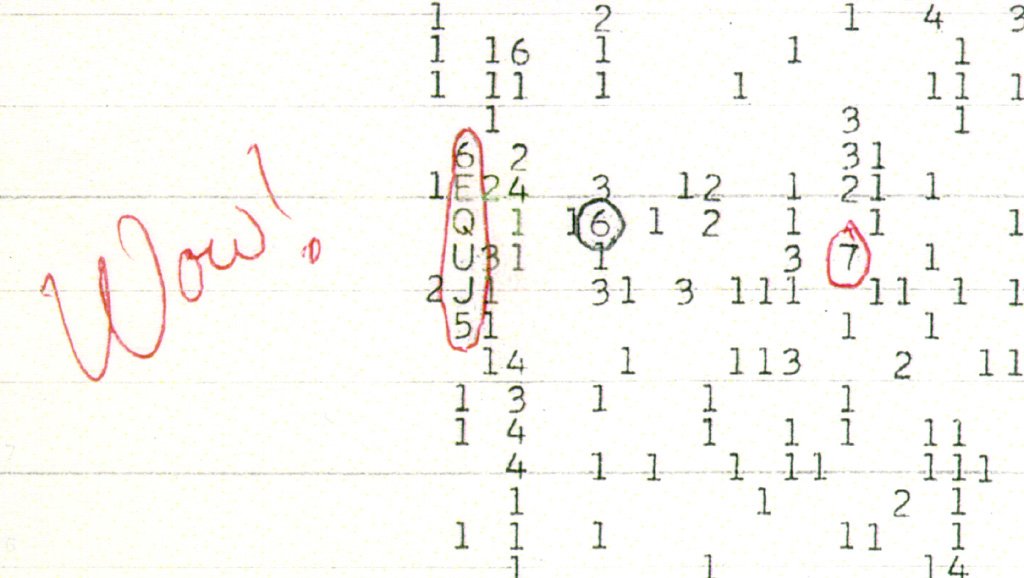
You double-check all the information on the printout in front of you and confirm the narrowband radio transmission you’re hearing is being broadcast at 1,420 megahertz. Excitedly, you circle a portion of the code, a vertical orientation of letters and numbers that reads “6EQUJ5”, and write “WOW!” in the margin: it is the precise spot where your fellow scientists have predicted that a message from an alien civilization, if one were to exist, would likely be found. 

wow signal

The famous “Wow! Signal” (Credit: Big Ear Radio Observatory and North American AstroPhysical Observatory).

This, or something close to it, is how the events might have unfolded for you on the night of August 15, 1977, at 11:16 p.m., if you had been working the Big Ear radio telescope at Ohio State University Radio Observatory. For it was under circumstances like these that astronomer Jerry R. Ehman discovered what has since been remembered, appropriately enough, as the WOW! Signal. 

Originating from the direction of Sagittarius, the famous signal seemed to possess the characteristics scientists would expect from a genuine signal from an intelligent alien civilization. However, the actual source of the signal remains undetermined, and scientists remain divided on whether it had been something mundane or if it might have actually been an alien message.

Regardless of its source, the Wow! Signal became highly influential in terms of galvanizing the search for extraterrestrial intelligence (SETI). It inspired many to wonder what would happen if humans ever did receive a clear, unambiguous message from an extraterrestrial civilization. 

Now, the idea of how and when we may receive alien messages from the stars has also served as part of the inspiration behind an innovative new SETI-themed artistic effort geared toward educating the public about some of the opportunities and challenges communication with extraterrestrials might present. 

A SIGN IN SPACE

Daniela de Paulis, an interdisciplinary artist and licensed radio operator presently holding the title of Artist in Residence at both the SETI Institute and the Green Bank Observatory, has assembled a diverse team of experts from around the world that includes SETI researchers, space scientists, and artists, all collaborating on her most recent artistic venture, A Sign in Space. 

Daniela de PaulisDaniela de Paulis.

An innovative global theatre presentation, Paulis’s project aims to showcase how receiving, decoding, and interpreting an extraterrestrial message would work through the involvement of the worldwide SETI community. Drawing on professionals from various fields, as well as the general public, the project requires international collaboration to foster communication, including SETI space research, societies, and cultures from multiple disciplines. 

“I presented this proposal to some scientists I’ve met through the SETI committee, and they reacted very positively. From a small core group of people, including myself and these scientists, we had the opportunity to talk with the European Space Agency.” 

“The European Space Agency loved the proposal so much that they suggested using one of their spacecraft for this project,” adds de Paulis. The result was that on May 24, 2023, at 19:00 UTC / 12:00 pm PDT, the European Space Agency’s ExoMars Trace Gas Orbiter sent an encoded message to Earth from its position in orbit around Mars, simulating a signal from a form of extraterrestrial intelligence.

DECODING A COSMIC CRYPTOGRAM

Three prominent radio astronomy observatories situated worldwide detected this encoded message, including the SETI Institute’s Allen Telescope Array, the Robert C. Byrd Green Bank Telescope at the Green Bank Observatory, and the Medicina Radio Astronomical Station observatory managed by the Italian National Institute for Astrophysics. 

The precise content of the encoded message, developed by de Paulis and her team, remained a secret until the release date, allowing the public to contribute to its decoding and interpretation in a live Discord channel open to the public 24-7. 

To encourage public involvement, a live social media event was organized by the SETI Institute, featuring interviews with crucial team members that included scientists, engineers, and artists, all of whom participated from different parts of the world. 

After the signal was transmitted to Earth, it was made available to the public for decoding. Meanwhile, the A Sign in Space team followed up by hosting a series of Zoom panel discussions made available to the public, which focused on topics that explore the societal implications of detecting a signal from an extraterrestrial civilization. 

A Sign in Space

The message generated for A Sign in Space, which remains undeciphered (Credit: A Sign in Space).

A CODED MESSAGE, UNSOLVED

As of now, the message has still not been decoded, and de Paulis and her team are unsure if ever will ever be. 

“Some of us thought, okay, this is going to take two weeks. Other people said, Oh, this is not going to be decoded ever. So we simply have no idea,” de Paulis told The Debrief.  

“It could be months. It could be years.” 

If it remains unsolved, de Paulis hasn’t decided when the message will be revealed. However, she admits that she has considered not sharing the decoded version at all, an outcome that could also exist in real-life scenarios if an ET civilization does contact us. 

“For me and my team, it’s really important not to give any spoilers because we want to really give the sense that, if we ever received an extraterrestrial message, we would have no one to ask, for help,” de Paulis says.

No one to ask for help, of course, except for each other. 

“People now understood that it might be better to work with each other because the skills of one person would add to the skills of another person. And in general, there is, I would say, more self-reflection,” adds de Paulis. 

One major takeaway for de Paulis has been watching the limitations that humans place on themselves, particularly as she observes the community Discord chat trying to decode the message. 

“Knowing, of course, the content of the message, it’s really interesting to see how biased the human mind can be,” de Paulis told The Debrief, “and how we very quickly narrow down the options to something that we deem safer.”

“This dynamic seems to be really recurrent,” de Paulis says. 

Regardless of how or when it occurs, receiving a clear and obvious message from an extraterrestrial civilization would be a profoundly transformational experience for all humankind. 

However, for de Paulis and her team, what A Sign in Space has helped reveal is that before we can understand and potentially communicate with other intelligent forms of life in the cosmos, humanity must first consider how we can improve the ways we communicate with each other.

“We know how great we are, but also there are so many limitations, like exactly communicating with each other,” de Paulis explains. “Even solving human problems that, from the external side, seem to be solvable.”

You can learn more about A Sign in Space at the project’s official website, where members of the public are invited to submit their own interpretations of the coded message and its meaning.

  • Chrissy Newton is a PR professional and founder of VOCAB Communications. She hosts the Rebelliously Curious podcast, which can be found on The Debrief’s YouTube Channel. Follow her on X: @ChrissyNewton Or chrissynewton.com.

RELATED

{ https://thedebrief.org/ }

Hoe vind je dit bericht?
Geschreven door peter om 21:54 Stuur door

World War III or ET Disclosure – What Path Will Humanity Take?

Trailer-Banner-0e1e6adb.jpeg

World War III or ET Disclosure – What Path Will Humanity Take?

Human consciousness is quickly rising during these End Times bringing with it the last grasping effort by the Cabal and their Reptilian overlords to prevent extraterrestrial disclosure and humanity’s awakening by a contrived World War III. Humanity has a critical choice to make, allow itself to be manipulated into another devastating World War that involves nuclear weapons or welcoming extraterrestrial disclosure and the release of transformative technologies that would bring. 

This is the trailer to Nov 25 Webinar: “The Exopolitical State of the Planet: The Ukraine & Israel-Palestine Wars, Manufacturing WWIII, the Battle over Consciousness & Extraterrestrial Disclosure.” To learn more or register, visit: https://www.crowdcast.io/c/exostateofplanet2023

Watch on YouTube, Rumble & Odysee

Much appreciation to Angelika Whitecliff for editing and co-narrating this trailer. Special thanks to Jas Marlin for the final video production.

Michael Salla, Ph.D.

{ https://exopolitics.org/ }

Hoe vind je dit bericht?
Geschreven door peter om 21:34 Stuur door

The Webb Telescope Captured A Galaxy Cluster That Lights Up Like A Christmas Tree

The Webb Telescope Captured A Galaxy Cluster That Lights Up Like A Christmas Tree

Scientists were using JWST and Hubble to look for transient objects.

 
A field of galaxies on the black background of space. In the middle is a collection of dozens of yel...
NASA

“Monsters” lurk amidst the flickering lights from galaxy cluster MACS0416.

A new image published by NASA and the European Space Agency on Thursday shows a story from a long time ago. MACS0416 is located 4.3 billion light-years away from Earth. To reach the visible-light instrumentation onboard the Hubble Space Telescope and the infrared technology on the James Webb Space Telescope (JWST), its light made quite an odyssey. It began its journey at the tail-end of the formation of the Solar System.

Astronomers are learning more about this region, tucked away in the constellation Eridanus (the River), thanks to the two observatories. “The image reveals a wealth of details that are only possible to capture by combining the power of both space telescopes,” JWST officials wrote in a Thursday image description.

CELESTIAL “CHRISTMAS TREE”

Astronomers took this latest view of MACS0416 to hunt for transient objects or things that change in brightness over time.

The galaxy cluster is packed with enough of these flickers to earn a special nickname.

“We’re calling MACS0416 the Christmas Tree Galaxy Cluster, both because it’s so colorful and because of these flickering lights we find within it,” Haojing Yan, associate professor at the University of Missouri and lead author of a paper accepted for publication in The Astrophysical Journal, said in NASA’s announcement.

The body of this imaginary tree is made of two colliding galaxy clusters that will eventually form one heftier object. The soft glow throughout the center of the image acts like a trunk of sorts. According to Hubble officials in 2018, this light comes from stars scattered throughout the hodgepodge cluster, pulled out of the galaxies they once called home.

Two side by side images show the same space scene, but with slightly different details. They both sh...

Left: Hubble Space Telescope’s optical light observations of galaxy cluster MACS0416. Right: James Webb Space Telescope’s infrared observations of the same region. 

NASA, ESA, CSA, STSCI

The tree’s ornaments are varied and abundant. Thanks to a phenomenon called gravitational lensing, the light from distant galaxies gets magnified. Although they are located much farther away than MACS0416, the lensing makes their light appear and spruces up the holiday visuals.

THERE’S A “MONSTER”

One distant ornament stands out. Incredibly, it's not a galaxy but something even smaller: a clutch of stars. “Among the transients the team identified, one stood out in particular,” NASA officials wrote in their Thursday announcement.

The stars, magnified by a factor of at least 4,000, come from an ancient place in space where light is just now reaching the telescopes. These stars are from just 3 billion years after the Big Bang when the universe was about a quarter of its current age.

This archaic visual behemoth received quite a name. “The team nicknamed the star system ‘Mothra’ in a nod to its ‘monster nature,’ being both extremely bright and extremely magnified,” NASA officials wrote. They added that Mothra “joins another lensed star the researchers previously identified that they nicknamed ‘Godzilla’” because both are names of giant monsters in Japanese cinema.

Galaxies appear like glowing orbs scattered across the night sky, and about three dozen are packed t...

This image of galaxy cluster MACS0416 highlights one particular gravitationally-lensed background galaxy, from when the universe was about a quarter of its current age. It contains a group of stars, highlighted here, whose brightness varies over time. It’s nicknamed “Mothra.”

NASA, ESA, CSA, STSCI, J. DIEGO (INSTITUTO DE FÍSICA DE CANTABRIA, SPAIN), J. D’SILVA (U. WESTERN AUSTRALIA), A. KOEKEMOER (STSCI), J. SUMMERS & R. WINDHORST (ASU), AND H. YAN (U. MISSOURI).

Mothra is one of 14 transient objects across this field of view. Remarkably, two of these very highly magnified objects are supernovas, explosions of stars visible to astronomers from exceptionally distant places.

With blues indicating relatively nearby galaxies and reds showing dusty places or distant galaxies, this visual cornucopia provides plenty of science to celebrat

{ https://www.inverse.com/ }

Hoe vind je dit bericht?
Geschreven door peter om 21:28 Stuur door

NASA’s Curiosity Rover Celebrates 4,000 Days on Mars — Here’s What It's Seen So Far

feb7df8f-6075-491c-a9ff-50f9fb30a633-clouds-black-white.gif?w=154&h=154&fit=crop&crop=faces&auto=format%2Ccompress&q=50&dpr=2

Mark Curiosity’s major milestone with these 8 images.

NASA/JPL-Caltech/York University

NASA’s Curiosity Rover Celebrates 4,000 Days on Mars — Here’s What It's Seen So Far


NASA’s Curiosity mission has just passed a special milestone. On Monday, NASA announced that Curiosity has now surpassed 4,000 sols, or days on Mars.

The small-SUV-sized rover reached the Red Planet on August 5, 2012, to explore Gale Crater for signs that past or present life could have existed on Mars. To find glimmers of this evidence, Curiosity has sojourned across a sediment-rich landscape on the alien planet with its six wheels over the last 11 years.

Curiosity is the oldest active Martian rover, taking over the title in 2019 when the 15-year-old Opportunity mission ended. NASA personnel think Curiosity still has quite a bit of life left.

“Despite having driven almost 20 miles (32 kilometers) through a punishingly cold environment bathed in dust and radiation since 2012, Curiosity remains strong,” according to a statement published Monday from NASA’s Jet Propulsion Laboratory in California, the hub for Curiosity and the fleet of NASA’s Mars explorers.

To commemorate Curiosity’s accomplishment, Inverse has compiled images that define Curiosity’s last decade.

BILLIONS OF YEARS OF HISTORY

Large rocks and gravel take up most of the landscape, and more pristine-looking hills rise shallowly...

Curiosity took the images that went to making this composite view of Mars on April 10 and 11, 2015.

NASA/JPL-CALTECH/MSSS

On April 10 and 11, 2015 — Curiosity’s 952nd and 953rd sols on Mars — both of its Mastcam lenses worked together to create this expansive view of the alien landscape.

According to JPL’s image description, the sand ripples and gravel that appear in the middle and at the bottom of this image were the sort of terrain that Curiosity first traversed. The rover left behind its landing site to reach Mount Sharp, a 3-mile-high peak in the middle of Gale Crater.

"This may be one of the thickest exposed sections of layered sedimentary rocks in the solar system. The rock record preserved in those layers holds stories that are billions of years old — stories about whether, when, and for how long Mars might have been habitable,” Joy Crisp, Curiosity deputy project scientist at JPL, shared in a statement NASA published in 2011.

ALIEN SUNSET

NASA's Curiosity Mars rover recorded this sequence of views of the sun setting at the close of the mission's 956th Martian day, or sol (April 15, 2015), from the rover's location in Gale Crater.

Curiosity took the images for this sunset sequence on April 15, 2015.

NASA/JPL-CALTECH/MSSS/TEXAS A&M UNIV.

To produce this view of a sunset on another planet, Curiosity’s team stitched together four images that Mastcam’s left eye captured over the span of 6 minutes, and 51 seconds. This sequence was captured on April 15, 2015, the mission's 956th sol.

This was the first time that the mission observed the Martian sunset in color. According to JPL officials, “Mastcam sees color very similarly to what human eyes see, although it is actually a little less sensitive to blue than people are.”

SAND DUNE SELFIE

The slope of a dark, richly-colored dune covers three-fourths of the terrain. Curiosity, standing at...

Curiosity took 57 images on January 19, 2016, to produce this self-portrait (minus its robotic arm).

NASA/JPL-CALTECH/MSSS

Curiosity is well-known for its selfies. The rover took this portrait from Namib Dune, located along the northwestern flank of Mount Sharp.

This image shows most, but not all, of Curiosity’s body. “The view does not include the rover's arm,” JPL officials wrote in an image description published on January 27, 2016. “The arm was positioned out of the shot in the images, or portions of images, that were used in this mosaic.”

The selfie is a mosaic of 57 images, taken on January 19, 2016 — Curiosity’s 1,228th sol — with a camera located at the end of the rover’s robotic arm called the Mars Hand Lens Imager (MAHLI).

DRILLING INTO BEDROCK

The Mast Camera, or Mastcam, on NASA's Curiosity Mars rover captured this set of images before and after it drilled a rock nicknamed

Curiosity captured the before and after of obtaining the Aberlady sample from Martian bedrock on April 6, 2019.

NASA/JPL-CALTECH/MSSS

This Mastcam sequence shows the first time Curiosity drilled into the bedrock of a clay-bearing unit, a maneuver that the mission team had highly anticipated.

Curiosity is equipped with four spectrometers that can measure the chemical composition within rock samples. The one collected here on April 6, 2019 — the mission’s 2,370th sol — was called Aberlady.

CLOUDS OVER MOUNT SHARP

Curiosity GIF Shows Drifting Clouds Over Mount Sharp

Curiosity captured images of clouds rolling over Mount Sharp on March 19, 2021.

NASA/JPL-CALTECH/MSSS

To gather scientific data, sometimes Curiosity has to look up.

Each frame in this scene is a mosaic of six individual images. They show clouds drifting over Mount Sharp on March 19, 2021, the 3,063rd sol of the mission.

Curiosity Navigation Cameras Spot Twilight Clouds on Sol 3075

Curiosity Navigation Cameras Spot Twilight Clouds on Sol 3075: Using the navigation cameras on its mast, NASA’s Curiosity Mars rover took these images of clouds just after sunset on March 31, 2021, the 3,075th sol, or Martian day, of the mission.

Credits: NASA/JPL-Caltech Download Image ›

Curiosity Navigation Cameras Spot Twilight Clouds on Sol 3072

Curiosity Navigation Cameras Spot Twilight Clouds on Sol 3072: Using the navigation cameras on its mast, NASA’s Curiosity Mars rover took these images of clouds just after sunset on March 28, 2021, the 3,072nd sol, or Martian day, of the mission.

Credits: NASA/JPL-Caltech Download Image ›

Cloudy days are rare on Mars because of the planet’s thin atmosphere, but they can appear seasonally when Mars is farthest away from the Sun in its orbit, according to NASA. Curiosity’s images of the clouds helped scientists realize that clouds were much higher than most clouds which hover around 27 miles above the surface. Their larger altitude indicates they are made of dry ice (or frozen carbon dioxide) rather than water ice.

ROLLING ALONG

Clouds can be seen drifting across the Martian sky in an 8-frame movie made using images from a navigation camera aboard NASA’s Curiosity rover. The images were taken on Dec. 12, 2021, the 3,325th Martian day, or sol, of the mission.

This eight-frame movie comes from the Curiosity rover, captured on December 12, 2021.

NASA/JPL-CALTECH/YORK UNIVERSITY

These clouds rolling along the Martian sky appeared to Curiosity’s navigation camera on December 12, 2021, the 3,325th sol of the mission.

This wasn’t easy, according to NASA. “Martian clouds are very faint in the atmosphere, so special imaging techniques are needed to see them,” according to an image description from JPL.

To get a clear, static background, Curiosity had to snap multiple images. “That allows anything else moving within the image (like clouds or shadows) to become visible after subtracting this static background from each individual image,” JPL officials added.

AN EARTHLY PERSPECTIVE

Shallows crests rise from the sand in the foreground. A hill appears on the right, and a flatter ter...

Curiosity took this view of the Martian landscape on August 23, 2022. Its color has been adjusted to depict what the human eye would perceive on Earth. 

NASA/JPL-CALTECH/MSSS

Mission team members adjusted the color in this image “to match the lighting conditions as the human eye would perceive them on Earth,” according to an image description published in 2022.

This scene is a mosaic of 23 Mastcam images captured near a hill called Bolivar on August 23, 2022, the 3,572nd sol of the mission.

Soon after reaching its 4,000th sol milestone, Curiosity went offline. From November 6 to 28, the mission team will await the end of solar conjunction. This is when Mars passes behind the Sun. During this time, Curiosity cannot communicate with Earth because the star’s plasma could interfere with sending commands.

But in a few weeks, Curiosity will continue its explorations.

{ https://www.inverse.com/ }

Hoe vind je dit bericht?
Geschreven door peter om 21:15 Stuur door

Are Aliens Real? We Asked the Pentagon’s Outgoing UFO Chief.

Are Aliens Real? We Asked the Pentagon’s Outgoing UFO Chief.

“That is a great question. I love that question,” Sean Kirkpatrick says in an interview.

Sean Kirkpatrick speaks during a public meeting.

By LARA SELIGMAN

Sean Kirkpatrick is not done talking about UFOs.

For nearly 18 months, he’s been the first head of the Pentagon’s fledgling office tasked with investigating what the government calls “unidentified anomalous phenomena,” which military pilots have increasingly reported seeing in the skies.

Kirkpatrick set up an entire system for collecting data, waded through hundreds of reported UFO sightings and batted down whistleblower claims that the government covered up a program to reverse-engineer alien craft. And don’t forget the Chinese spy balloon episode.

In an interview with POLITICO Magazine, he talked about why he’s stepping down in December and how he sought to “institutionalize the solution for getting at the heart of these anomalies.” The Pentagon has a real interest in deciphering the sharp rise in unidentified crafts spotted by military pilots; if these aren’t aliens, they could be foreign adversaries posing incredibly new threats.

Kirkpatrick, 55, was perhaps the perfect person to lead what’s formally known as the Defense Department’s All-domain Anomaly Resolution Office, which was established in July 2022. A physicist who spent decades working in the defense-intelligence arena, he’s open to the possibility that we’re not alone in the universe, having co-authored a hotly-debated paper about alien motherships. But his bottom line is to focus on the science.

“If you are talking with NASA or the European Space Agency, and you’re talking about looking for life out in the universe, it is a very objective, very scientifically sound discussion and discourse,” he said, describing the public discourse. “As that discussion gets closer to the solar system, somewhere around Mars, it turns into science fiction. And then as you get even closer to Earth, and you cross into Earth’s atmosphere, it becomes conspiracy theory.”

Part of Kirkpatrick’s work going forward, he added, will be to “raise the level of the conversation” about these unidentified objects.

And yes, we did ask him if aliens are real.

This conversation has been edited for length and clarity.

Lara Seligman: You’ve only been in the job less than 18 months. Why are you leaving now?

Sean Kirkpatrick: When I took the job, I promised going in that I would do a year, and we would reevaluate. I have decided to stay on until towards the end of this year because there’s a couple more things I need to finish.

One of those is finishing Volume One of the historical review [required by the law], which really encompasses all of the interviewees that have come in to talk to us. And then laying that out as “Here’s what we’ve been able to prove is true, here’s what we’ve been able to prove is not true,” as a very thorough and objective research product. The legislative requirement for the historical report is not due until June of next year. I decided, because of the desire for more transparency faster, we are doing a Volume One, and then Volume Two will be delivered next year. Volume One covers everything up to about a month ago. Volume Two is going to cover anything new that comes up since we’ve turned on the reporting button on our website.

I deferred my retirement because I was asked to come do this. I set out those goals. It’s been about 18 months. I’m ready to move on. I have accomplished everything I said I was going to do.

Seligman: What changes to the office can we expect once you are gone?

Kirkpatrick: It won’t get a new name. They are not going to get a major makeover. The team has done a really exceptional job of setting the foundational stone for the vision I laid out and how we’re going to execute on this. Whoever comes in next, that will be really to execute the rest of those foundational stones and ensure that is projected into the future.

Seligman: The last year has been a rollercoaster for AARO. Has any of the controversy over the whistleblower testimony, the Chinese spy balloon, the website delay, contributed to your decision to leave?

Kirkpatrick: No, these are all expected challenges. The balloon, that’s a very interesting case of the interagency in the U.S. government trying to understand the differences between a known anomalous thing, if you will, and an unknown anomalous thing. Our job is harder than “Hey, there’s a Chinese spy balloon, you know what it is? What is it doing?” That’s not our job. Our job is to understand the unknowns and what could be there. What are the possibilities that threaten us? And how do we get at it? How do I apply technical rigor to go after that “hunt” mission, if you will?

The website controversy really is based in bureaucracy, there’s no other easier way to say it. It took so long to get that up and running just because it’s so hard to get something through the establishment where everybody has to be able to look at it, ensure that it meets all of their particular requirements. And oh, by the way, we are talking about a U.S. government website, where there are privacy concerns and there’s transparency concerns, and there’s “How is the data being used” concerns. We have to make sure we were compliant with all of those regulations, all of those laws, and that that takes time.

The whistleblowers are an interesting bit. We’ve had greater than 30 people now come in to talk to us. We have investigated every single one of them, every single story, every lead that provided any substantive evidence for us to go after.

David Grusch is a unique instance in that he has refused to come and share any of that information. We still can’t get him to come in. I’ve got five different people who have gone to talk to him to get him to come in. And the answers have always been everything from “We’re not cleared” to “It would jeopardize his whistleblower protections” to “Why can’t we just go get the information that he shared from the IG?” It’s every excuse that I have heard, why not to come in. And that’s been a challenge because now here we are, we’re about to put out Volume One of the historical review, which I believe captures most all of the people that he’s spoken with, but I can’t say that 100 percent because I can’t hear what he thinks he has. If he has evidence, I need to know what that is.

Sean Kirkpatrick gives a presentation during a public meeting of NASA’s unidentified anomalous phenomena independent study team.

Kirkpatrick (left) gives a presentation during a public meeting of NASA’s unidentified anomalous phenomena independent study team at the NASA headquarters in Washington, on May 31, 2023. 

Joel Kowsky/NASA

Seligman: What are the biggest accomplishments of your year and a half as the head of AARO?

Kirkpatrick: I laid out a plan about 18 months ago on what we needed to accomplish in order to make this mission area successful and to institutionalize the solution for getting at the heart of these anomalies. That included really several main areas. There was there was an analytic area, there was an operational area. There was a science and technology area. And then there was a strategic messaging or communications information sharing area.

In all of those, I mapped everything that the congressional language asked us to do for the last couple of years and kept a scorecard: These are all the things I needed to accomplish coming into this job.

We have standardized the analytic framework for how we deal with these observations in a very rigorous fashion. We have run that framework successfully now, and are ramping up the number of cases that are being resolved. 

Operationally, we have institutionalized how to respond to and mitigate these incidents. We have worked with the Joint Staff and the commands and the combat support agencies and the intelligence community on questions like: When one of these things is observed, how do we get more data? How do we save that data that’s been collected? That was historically a very big problem: That data was not retained. Now data is required to be retained so that we can have something to analyze.

In the science and technology area, how do you look at all of these sensors and ensure that we understand, when an F-35 or an F-22 or ground radar sees an anomalous object, how do we know that’s not a normal object that you just haven’t calibrated against? We’ve run a campaign against those sensors, making sure that we measure each and every one of the unknown objects against them. And we turn those into additional modeling, simulation and training back to the operators so that we can reduce false alarms. The other thing that we’re doing there is a campaign of pattern of life: understanding what is normal, so that you can understand when an anomalous or an abnormal peak and activity occurs.

In the information sharing area: It’s been a long time coming, but we have gotten to the point now where we have a dedicated website. We are pushing material out, it is a living website, there will be updates on a periodic basis.

If I go back to the fundamental definition of a UAP [unidentified anomalous phenomena] that we had written into law, it is an unknown object that is not initially understood by the sensor or the people observing it. That doesn’t mean that it’s not understandable. It just means that initially when you look at it, you may not understand what that is.

People are subject to optical illusions, sensors are subject to being fooled or spoofed or even just having errors. Understanding what all of that is out in the real world is a very challenging mission space. It is hard to apply science and technology to the real world. It’s easy to do in a lab.

So putting all that together and putting it into an institutionalized space and getting it formalized and getting it into policy and getting it into orders: Those have all been major accomplishments that we set out to do, that I set out to do. And that has been achieved today.

Seligman: Are aliens real?

Kirkpatrick: That is a great question. I love that question. Number one, the best thing that could come out of this job is to prove that there are aliens, right? Because if we don’t prove there are aliens, then what we’re finding is evidence of other people doing stuff in our backyard. And that’s not good.

Two, from a scientific perspective: The scientific community will agree that it is statistically invalid to believe that there is not life out in the universe, as vast as the universe is and the number of galaxies and solar systems and planets. That is what part of NASA’s mission is to look for that life. The probability, however, that that life is intelligent and that it has found Earth and that it has come to Earth and that it has repeatedly crashed in the United States is not very probable.

So part of what we’ve been trying to do, and part of what I will continue to do until I’m done, is raise the level of the conversation. Let me explain. If you are talking with NASA or the European Space Agency, and you’re talking about looking for life out in the universe, it is a very objective, very scientifically sound discussion and discourse. As that discussion gets closer to the solar system, somewhere around Mars, it turns into science fiction. And then as you get even closer to Earth, and you cross into Earth’s atmosphere, it becomes conspiracy theory.

We need to change the level of the [public] conversation. It’s one of the reasons why we’ve engaged academia to work on a number of scientific papers that look at the probabilities of these things, and what are the signatures associated with that? So that we can benchmark what we’re doing in scientific proofs and in scientific fact and not hearsay and pointing fingers and government cover ups and conspiracies with no evidence of any of them.

Seligman: Is that why you wrote that paper with Harvard professor Avi Loeb about the theory that UAPs are probes from an alien mothership?

Kirkpatrick: That was the start of that work where we were looking at, if you want to believe these hypotheses, what are the signatures that you would expect to see from that? Because if I don’t see any of those signatures, with any of the data that we see, then that’s not a valid hypothesis. That’s how science works. Right? You have to have a hypothesis. You have to have measurables with that hypothesis, and then your data has to meet it. And you have to lay that out in a peer-reviewed journal so that you have something to pin it against.

Seligman: That paper though with your name attached made it look like you were backing the theory. Is this something that you regret?

Kirkpatrick: That paper was in draft when it was leaked. We hadn’t actually finished that paper and it needed a lot of editing before it went out.

Seligman: It wasn’t leaked. Avi Loeb posted it online.

Kirkpatrick: Well, yeah, he posted it without permission.

Seligman: Do you regret your involvement in that?

Kirkpatrick: No, because it’s the same principle. We are standing up for the facts. We are standing up for the scientific method. And this is how you go about doing it. You either do it or you don’t.

Seligman: What’s next for you?

Kirkpatrick: I have a number of things that I’m exploring right now. One of them for certain is going to be consulting, doing some board work, working with a number of folks across the interagency, the space community, the science and technology and intelligence community as we go forward. I think we’ll hear more in the coming month.

{ https://www.politico.com/ }

Hoe vind je dit bericht?
Geschreven door peter om 18:46 Stuur door

Starship Could Be Ready to Launch on Friday

SpaceX Starship's Superheavy Booster, serial no. B7, being tested on the orbital launch pad at Starbase, Boca Chica, Texas in February 2023.

SpaceX Starship's Superheavy Booster at Starbase, Boca Chica, Texas (Credit : Mobilus In Mobili)

Starship Could Be Ready to Launch on Friday

Space exploration should never be run of the mill nor something that finds itself on the back pages of the newspaper.  Captain James T. Kirk was right that space really is the final frontier and making it more accessible is one of the driving forces behind SpaceX.  Their mission to seek out new life and new civilisations, wait that’s wrong – that’s Starfleet.  The SpaceX mission ‘to revolutionise space technology, with the ultimate goal of enabling people to live on other planets is at the forefront of the development of the enormous Starship which may make another launch attempt as soon as this Friday 17th November. 

SpaceX is a company that shot to fame since it was founded (I really wanted to type ‘launched’ but resisted) back in 2002 by Elon Musk. Musk had a vision to revolutionise space exploration by reducing costs and more excitingly he wanted to colonise Mars. SpaceX operate the Falcon rockets, the Dragon capsule that is often transporting supplies to and from the International Space Station and skywatchers around the globe are familiar with the infamous Starlink project that has launched more than 5,000 small satellites into orbit providing global internet coverage.  There is no doubt the SpaceX brand is a well known one. 

SpaceX Falcon 9 rocket carrying the company’s Crew Dragon spacecraft is launched from Launch Complex 39A (Credit : NASA/Joel Kowsky)

One of the more recent additions to the SpaceX fleet is the super heavy lift launch vehicle known rather imaginatively as Super Heavy and, when coupled with Starship in its final configuration has the capability of lifting at least 150 tonnes into low earth orbit. It is the tallest and most powerful rocket ever to have flown at an immense 120m tall but the real headline statement for Starship is that it is designed to be fully re-usable with both stages being recovered after launch and used again.  If you haven’t yet watched the Starship stages landing then you really should hunt them down, I never tire of watching it. 

The plans for Super Heavy and Starship are not just to get objects into low earth orbit though, there are plans to use them to refuel other Starships in orbit, to be a part of the NASA Artemis program to get humans back to the Moon and ultimately the colonisation of Mars.   The power behind Super Heavy are the powerful Raptor rocket engines that burn liquid methane and oxygen to get off the launchpad but fire again to slow down the booster during descent to a graceful landing, ready to be used again.

SpaceX sea-level Raptor at the company headquarters at Hawthorne, California. The bell nozzle is used to direct thrust of the methane exhaust, which is compressed inside the main combustion chamber in the middle of the image. The left bulge is the turbopump, where liquid propellants are turned into gas.

SpaceX sea-level Raptor at the company headquarters at Hawthorne, California (Credit : Brandon De Young)

This all sounds pretty amazing but as we saw on 20 April this year, space flight is anything but routine.  Four minutes after launch, at an altitude of 39km above the Gulf of Mexico, Musk’s beloved Starship failed to separate from the booster leading to the whole system exploding in a fireball on its maiden voyage. The FAA grounded the entire fleet but, it looks like we may be set for a fresh attempt this Friday 17th November subject to final approval from the FAA.   If or when the launch finally goes ahead, it will be from a new reinforced launch site and will use a new separation technique known as Hot Staging where the second stage engines will fire to put the booster away! Good luck SpaceX.

Source : 

{ https://www.universetoday.com/ }

Hoe vind je dit bericht?
Geschreven door peter om 18:31 Stuur door

Old footage shows unknown ancient devices found during Nazi expeditions in Antarctica and Egypt

Old footage shows unknown ancient devices found during Nazi expeditions in Antarctica and Egypt

This is said to be a rare footage from an unknown private film collection archive, that supposedly shows objects and ancient devices that were discovered and then taken away during the Nazi expeditions in Egypt and Antarctica, which are still secret! 
secret%20ancient%20devices%20found%20in%20Antarctica%20en%20Egypt.jpg

I do know for a fact that many artifacts have been looted in previous wars but I have never seen anything like this before.
It would be great if it could be proven that the ancient artifacts shown in the short film were made by ancient civilizations with advanced technology, extraterrestrial intervention, or other supernatural explanations, but... as long as they keep it a secret and withhold the truth about our history, the origin of these objects will remain a mystery. 
It will be interesting to learn how they will explain the discovery of these objects.

{ http://ufosightingshotspot.blogspot.com/ }

Hoe vind je dit bericht?
Geschreven door peter om 16:31 Stuur door

UFO the size of a football field hovered over Vandenberg Air Force Base

UFO the size of a football field hovered over Vandenberg Air Force Base

In 2003, an unidentified flying object, comparable in size to a football field, reportedly hovered over Vandenberg Air Force Base, as disclosed during a House Oversight Committee's national security subcommittee hearing on UFOs. The hearing, held on Wednesday, delved into UFOs, now termed "unidentified anomalous phenomena" by the U.S. government. 
ufo%20Vandenberg%20Air%20Force%20Base.jpg

The proceedings included whistleblower accounts that shed light on purported government UFO programs spanning multiple decades, according to retired major David Grusch. Former Navy fighter jet pilot Ryan Graves, founder of the non-profit Americans for Safe Aerospace, presented testimony regarding the alleged UFO sighting at Vandenberg. 
During questioning by Representative Anna Paulina Luna, Graves recounted the 2003 incident: "In the 2003 timeframe, a sizable group of Boeing contractors near a launch facility at Vandenberg observed a large, 100-yard-sided red square approaching from the ocean. It hovered at low altitude over the launch facility for about 45 seconds before rapidly darting off over the mountains around 8:45 a.m." 
Graves further described a subsequent event 24 hours later, involving additional sightings on the base, with some objects displaying aggressive behavior toward security guards. The information, according to Graves, came from a witness who approached him at Americans for Safe Aerospace, and this witness possessed documented police blotter and records from the 2003 incidents. 
Testimonies from former Major Grusch and ex-U.S. intelligence officer David Fravor were also part of the hearing, although they refrained from answering certain questions. Representative Tim Burchett emphasized the importance of government transparency in addressing the issue, clarifying that the aim was to uncover facts without sensationalizing the subject.
  

{ http://ufosightingshotspot.blogspot.com/ }

Hoe vind je dit bericht?
Geschreven door peter om 16:17 Stuur door

Shocking Encounter: 6 British Soldiers Face Triangular UFO & Missing Time Near Salisbury Plain!

Shocking Encounter: 6 British Soldiers Face Triangular UFO & Missing Time Near Salisbury Plain!

ufo-sighting

Unveiling the Mystery: The Enigmatic UFO Sightings Over Salisbury Plain

In the realms of the unexplained and the unknown, few phenomena capture the imagination quite like UFO sightings. The late 1980s and early 1990s were a particularly fertile period for such sightings, with numerous reports of mysterious crafts filling the skies worldwide. Among these, the Salisbury Plain incident in the UK stands out for its complexity and intrigue.

The Encounter: A Triangular Enigma

It was a cold winter night in 1989-1990 when a group of six British soldiers, engaged in night maneuvers near Salisbury Plain, witnessed something extraordinary. Their encounter with a colossal, black, triangular craft, reportedly the size of a football pitch, marked a chilling chapter in UFO sightings history.

Renowned UFO researchers Jon King and Timothy Good have scrutinized this incident, adding credibility to the soldiers’ accounts. King, the editor of “UFO Reality,” and Good, a respected figure in the field, bring a critical eye to these unexplained events, which often go dismissed as mere fantasy or misidentified military exercises.

Advanced Technology: Beyond Human Capabilities

What sets the Salisbury Plain sighting apart is not just the size of the craft but its purported advanced technology. Comparable sightings in Belgium, where UFOs executed maneuvers impossible by today’s aviation standards, echo this narrative of technological marvels. These crafts’ abilities to move thousands of meters in a blink have fueled theories ranging from extraterrestrial visitations to top-secret military projects.

The Human Experience: A Soldier’s Tale

Central to the Salisbury Plain story is Mark, a former British soldier whose identity remains concealed for fear of repercussions. His experience, and that of his fellow soldiers, encapsulates the human element in UFO encounters. The group’s collective memory lapse, the strange sensations of being controlled, and the appearance of a mysterious figure dressed in black, wielding a rod-like object, all contribute to a deeply unsettling experience.

The Aftermath: Questions and Theories

The soldiers found themselves disoriented and off-course, grappling with missing time and lingering emotional distress. Such experiences raise profound questions about the nature of these sightings. Are they evidence of extraterrestrial intelligence, or do they hint at something else entirely?

VIDEO:

The Salisbury Plain UFO encounter remains an enigmatic piece in the vast puzzle of UFO sightings. It challenges our understanding of technology, physics, and perhaps the very notion of life beyond our planet. As we continue to seek answers, stories like these keep the flame of curiosity alive, urging us to look skyward and question what lies beyond.

  • The Pentyrch UFO Incident | Documentary Special

{ https://www.latest-ufo-sightings.net/ }

Hoe vind je dit bericht?
Geschreven door peter om 16:00 Stuur door

Mysterious Night Skies: Dual UFOs Captured Over Alicante, Spain

Mysterious Night Skies: Dual UFOs Captured Over Alicante, Spain

Spain UFOs

In the serene night skies of the Province of Alicante, Spain, a remarkable event unfolded on the 12th of November, 2023, reigniting the ever-fascinating discussion of UFO sightings. This time, the awe-inspiring moment was captured through a night vision camera, NVG10, presenting a crystal-clear and intriguing view of what appears to be two interconnected UFOs.

The footage, filmed with the cutting-edge NVG10 night vision camera (Amazon link), known for its high-resolution imaging and advanced low-light capabilities, showcases a pair of luminous, unidentified flying objects. These UFOs, linked together by an unexplained force, glide seamlessly across the nocturnal backdrop, leaving viewers mesmerized and curious about their origin.

This sighting in Alicante, a region known for its picturesque landscapes and tranquil nights, adds a new chapter to the ever-growing anthology of UFO encounters. The two linked objects, with their synchronized movement and radiant appearance, challenge our understanding of the skies above and beckon us to question what lies beyond our terrestrial realm.

What makes this footage particularly compelling is the clarity provided by the NVG10 camera. Its ability to capture detailed images in low-light conditions has not only provided UFO enthusiasts with captivating visual evidence but also has sparked interest among skeptics and scientists alike.

As the debate around the existence of extraterrestrial life continues, this latest sighting in Alicante offers a fresh perspective and a tantalizing glimpse into the unknown. Whether these UFOs are a testament to otherworldly visitors, a natural phenomenon, or something else entirely, remains a topic of intrigue and wonder.

For those keen on exploring the mysteries of the night sky, the NVG10 night vision camera emerges as a tool of choice, bridging the gap between the seen and the unseen, and potentially unlocking new secrets of our universe.

As we delve into this extraordinary encounter, we invite you to watch the video and join the conversation. What are these mysterious objects? Are we alone in this vast cosmos, or is this sighting in Alicante a beacon of otherworldly presence? The skies above continue to hold their secrets, but with each new sighting, we inch closer to unraveling the mysteries of the universe.

RELATED

{ https://www.latest-ufo-sightings.net/ }

Hoe vind je dit bericht?
Geschreven door peter om 15:30 Stuur door

NASA JUST LOST COMMUNICATION WITH ITS ROBOT SCIENTISTS ON MARS. THIS PHENOMENON IS TO BLAME.

rdFZIYJA?format=jpg&name=900x900

Perseverance's view of the Sun on its its 842nd Martian day
(NASA/Caltech).

NASA JUST LOST COMMUNICATION WITH ITS ROBOT SCIENTISTS ON MARS. THIS PHENOMENON IS TO BLAME.

NASA has temporarily lost the ability to communicate with its Mars fleet, according to a statement issued by the space agency citing a phenomenon that occurs every two years that blocks commands from being sent to its robotic explorers.

The phenomenon, known as Mars solar conjunction, occurs when the Sun moves between Earth and Mars every other year.

“Like dancers on either side of a huge bonfire, the two planets are temporarily invisible to each other,” reads a NASA FAQ page describing the biennial celestial event.

Mars solar conjunction

The Sun photographed by Perseverance on Nov. 7, 2023 (Sol 965), just prior to the onset of the 2023 Mars solar conjunction

(NASA/Caltech).

NASA says its rovers and orbital craft currently engaged in science missions on Mars will not discontinue operations, although data collection will remain limited for two weeks while Earth and Mars remain on either side of the Sun.

This year’s solar moratorium officially began on November 11 and will last until the 25th.

During the period of interrupted communication, some of the instruments are temporarily taken offline by engineers at NASA’s Jet Propulsion Laboratory, and no new instructions are dispatched to the robotic scientists on the Red Planet due to the likelihood that they will be lost once they encounter the interference caused by the Sun and the highly charged particles it emits.

However, in preparation for the communication breakdown, NASA sends two weeks’ worth of commands to its Mars fleet so that limited operations can continue.

2023 Mars solar conjunction

Perseverance captured a selfie from the location where it will remain parked during the 2023 Mars solar conjunction

(NASA/Caltech).

Currently, NASA says its Perseverance and Curiosity rovers are being tasked with ongoing monitoring of surface conditions on Mars, as well as observations of weather conditions, radiation levels, and other information their onboard sensors can continue to monitor.

The Ingenuity Mars Helicopter has also been tasked with observing the motion of sand on the Red Planet throughout the course of the solar conjunction, while the Mars Reconnaissance Orbiter and the Odyssey orbiter will keep their camera eyes trained on the Martian surface from their positions in orbit, along with the MAVEN spacecraft’s collection of data about the Martian atmosphere.

  • star

Limited information about the status of the Mars fleet will continue to be dispatched back to NASA, all except for a period of two days at the height of the conjunction where Mars and Earth are on the exact opposite ends of the Sun from each other.

“We’ll still be able to hear from them and check their states of health over the next few weeks,” said Roy Gladden, manager of the Mars Relay Network at NASA’s Jet Propulsion Laboratory (JPL), in a NASA statement.

After November 25, full communication is expected to be restored, and science data that has remained in limbo for the previous two weeks will be sent back to Earth, while new instructions will also be sent to the Mars fleet.

{ https://thedebrief.org/ }

Hoe vind je dit bericht?
Geschreven door peter om 23:32 Stuur door

NASA Wants to Learn to Live Off the Land on the Moon

Picture1.jpg

Artist rendition of an In-situ Resource Utilization (ISRU) technology demonstration on the lunar surface. NASA is working with industry and academia to develop technologies for future production of fuel, water, or oxygen from local resources, thus advancing space exploration capabilities. (Credit: NASA)

NASA Wants to Learn to Live Off the Land on the Moon

In preparation for the upcoming Artemis missions to the lunar south pole, NASA recently solicited a Request for Information (RFI) from the lunar community to map out its future Lunar Infrastructure Foundational Technologies (LIFT-1) demonstration for developing In-situ Resource Utilization (ISRU) technologies as part of the agency’s ambitious Lunar Surface Innovation Initiative (LSII). The primary goal of LIFT-1, which is being driven by NASA’s Space Technology Mission Directorate (STMD), is to advance ISRU technologies for extracting oxygen from the lunar regolith, including manufacturing, harnessing, and storing the extracted oxygen for use by future astronauts on the lunar surface. Proposals for LIFT-1 became available to be submitted via NSPIRES on November 6, 2023, with a deadline of December 18, 2023.

Artist rendition of future Artemis astronauts on the lunar surface using available resources for production of fuel, water, and oxygen. (Credit: NASA)

“The LIFT-1 demonstration creates a viable path to launch, land, and conduct operations on the lunar surface. This is the infusion path we need for ongoing industry and NASA center-led technology development activities,” said Dr. Prasun Desai, who is the acting associate administrator of STMD at NASA Headquarters in Washington DC. “Using in-situ resources is essential to making a sustained presence farther from Earth possible. Just as we need consumables and infrastructure to live and work on our home planet, we’ll need similar support systems on the Moon for crew and robots to operate safely and productively.”

NASA is heavily invested in developing ISRU technologies and is in collaboration with industry and academia in a wide range of studies involving lunar regolith, including construction, oxygen extraction, and growing plants. In addition to using lunar regolith to extract oxygen, efforts are being made to extract oxygen from lunar water ice, which is the primary reason Artemis is targeting the lunar south pole due to its proximity to the permanently shadowed regions (PSRs) of the Moon.

Lunar regolith being used to grow plants at the University of Florida, which is an example of NASA collaborating with academia in developing ISRU technologies for future human missions to the Moon. (Credit: UF/IFAS photo by Tyler Jones)

The purpose of ISRU is to “live off the land” through the resources that are available on-hand without the need for constant resupply from Earth. Future astronauts on both the Moon and Mars will need both food and water to survive for long-term missions, and supply missions from Earth can be both costly and risky, especially as humans venture farther out into the cosmos. Therefore, steps are being taken to learn how future astronauts can use available resources to their benefit, specifically for food, water, and oxygen.

An example of the most recent off-Earth ISRU technology demonstration is the toaster-sized Mars Oxygen In-Situ Resource Utilization Experiment (MOXIE) onboard NASA’s Perseverance rover with the goal of extracting oxygen from the carbon dioxide-heavy Martian atmosphere, which was accomplished in April 2021, only a few months after Perseverance landed in Jezero Crater. After just over an hour of the test, MOXIE produced 5.37 grams (0.01 pounds) of breathable oxygen, which is enough breathable oxygen for an astronaut to use for approximately 10 minutes. After this successful test, NASA now aspires to use develop similar technologies on the Moon using lunar resources, specifically lunar regolith and water ice found at the poles.

“An ISRU technology demonstration approach has been a topic of discussion within the Lunar Surface Innovation Initiative and Consortium communities for several years,” said Niki Werkheiser, who is the director of Technology Maturation in STMD at NASA. “This RFI is the next phase to make it a reality.” 

As noted, LIFT-1 is part of NASA’s Lunar Surface Innovation Initiative, but developing ISRU technologies is just one of six areas the Initiative is targeting, with the other areas of interest being surface power, excavation and construction, extreme environment, dust mitigation, and extreme access. The development of these various technologies is a massive collaborative effort between various industries and academia, and will involve both human and robotic exploration efforts, as well. But development of these various technologies will not be limited to just the Moon, as NASA is hoping to use the lessons learned from Artemis to establish the necessary technologies for future human missions to Mars and beyond.

Artist illustration showing the construction of a landing pad at a future lunar base. (Credit: European Space Agency)

How will ISRU help improve the upcoming Artemis missions and what new discoveries with ISRU technologies will be made in the coming years and decades? Only time will tell, and this is why we science!

  • As always, keep doing science & keep looking up!

RELATED

{ https://www.universetoday.com/ }

Hoe vind je dit bericht?
Geschreven door peter om 23:06 Stuur door

If You Account for the Laniakea Supercluster, The Hubble Tension Might Be Even Larger

laniakea-2000x1200.jpg

Illustration of the Laniakea Supercluster. Credit: Andrew Z. Colvin

If You Account for the Laniakea Supercluster, The Hubble Tension Might Be Even Larger

One of the great unsolved mysteries of cosmology is known as the Hubble tension. It stems from our inability to pin down the precise rate of cosmic expansion. There are several ways to calculate this expansion, from observing distant supernovae to measuring the Doppler shift of maser light near supermassive black holes, and they all give slightly different results. Maybe we don’t fully understand the structure of the Universe, or maybe our view of the heavens is biased given that we are located deep within a galactic supercluster. As a new study shows, the bias problem is even worse than we thought.

If we were floating deep in space, far away from any galaxies, then our view of cosmic expansion would be free of gravitational influences and we could better see how distant galaxies move away from us. Since we are part of a local cluster of galaxies, we have a bit of bias in our data. This is why many local galaxies are blue-shifted. The Universe isn’t contracting near us, we’re just in a galactic gravitational well. We can easily account for this bias, so it isn’t a problem. However, given the Hubble tension, a team recently looked for gravitational biases beyond the local group, hoping it would solve the issue.

They looked at the largest gravitational structure we’re a part of, known as the Laniakea Supercluster. It is a massive cluster of galaxies more than 520 million light-years across, containing more than 100,000 galaxies, including the Milky Way. Our local group is being pulled toward the heart of Laniakea, and thus our motion through the Universe could skew our observations of cosmic expansion.

Observations show a statistical bias in the data. Credit: Giani, et al

When the team measured the gravitational influence of the supercluster as a whole, they found it does bias our observations by about 2% – 3%. But it’s biased in the wrong direction. In other words, by not taking the effect of Laniakea into account, the Hubble tension seemed smaller than it actually is. These new results show that the tension is 2% – 3% greater than we thought. Even some of the more recent Hubble constant measurements that seemed encouraging aren’t enough to account for the Laniakea bias.

Removing subtle biases from our cosmological data is challenging, so it is possible that further observations may swing the results back in the right direction. But we can’t rely on bias alone to solve this mystery. Clearly, something subtle and strange is going on, and the solution isn’t obvious. It will take a great deal more study to understand Hubble’s tension.

Reference: 

RELATED

{ https://www.universetoday.com/ }

Hoe vind je dit bericht?
Geschreven door peter om 22:42 Stuur door

China Wants to Retrieve a Sample of Mars by 2028

tianwen-1-in-mars-orbit.jpg

This image was taken by a small camera that was jettisoned from China's Tianwen-1 spacecraft to photograph the spacecraft in orbit above the Martian north pole. Credit: CNSA/PEC

China Wants to Retrieve a Sample of Mars by 2028

China continues to take great strides as part of its goal to become a superpower in space and a direct competitor with NASA. In addition to its proposed expansion of the Tiangong space station and the creation of the International Lunar Research Station (ILRS), China is also planning on sending crewed missions to Mars in the coming decade. In preparation for the arrival of taikonauts on the Red Planet, China is gearing up to return samples of Martian soil and rock to Earth roughly two years ahead of the proposed NASA-ESA Mars Sample Return (MSR).

This mission will be the third in the China National Space Administration’s (CNSA) Tianwen program (Tianwen-3) and will consist of a pair of launches in 2028 that will return samples to Earth in July 2031. According to a new study recently published in the journal Chinese Science Bulletin, Chinese scientists announced that they have developed a new numerical model to simulate the atmospheric environment of Mars. Known as the Global Open Planetary atmospheric model for Mars (aka. GoPlanet-Mars, or GoMars), this model offers research support in preparation for the Tianwen-3 mission.

The paper, titled “Development of a new generation of Mars atmosphere model GoPlanet-Mars,” was performed by researchers from the Institute of Atmospheric Physics Chinese Academy of Sciences (IAP-CAS), the State Key Laboratory of Numerical Simulation of Atmospheric Science and Geohydrodynamics (LASG), and the School of Earth and Planetary Sciences at the University of Chinese Academy of Sciences (SEPS-UCAS). The study was led by Wang Bin, a Senior Researcher with the CAS-IAP who specializes in climate modeling.

A wireless camera took this ‘group photo’ of China’s Tianwen-1 lander and rover on Mars’ surface. Credit: Chinese Space Agency

In the past two decades, the number of missions and space agencies engaged in the exploration of Mars has increased considerably. At present, ten robotic missions are exploring its surface and atmosphere, including seven orbiters, two rovers, and one helicopter. And with many more destined for Mars in the next decade (as well as crewed missions), the demand for Martian weather forecasts is growing. As they indicate in their paper, “The world’s aerospace powers have developed Mars atmosphere models to provide meteorological environment protection for landing exploration.”

To provide information on the meteorological conditions around the Tianwen-3 mission’s potential landing sites, the research team built a global open planetary atmospheric model for Mars. They then used this model to replicate the three critical cycles of the Martian atmosphere: dust, water, and carbon dioxide. They then tested the model using the Open access to Mars Assimilated Remote Soundings (OpenMARS) dataset, a global record of Martian weather from 1999 to 2015, as well as observations made by China’s Zhurong rover (part of China’s Tianwen-1 mission) and NASA’s Viking 1 and 2 landers.

Their results showed that the GoMars model successfully reproduced the unique characteristics of surface pressure on Mars and provided good simulation performance for the surface temperature, zonal wind, polar ice, and dust. According to Wang, the Tianwen-3 mission will expand upon Tianwen-1 by adding the additional tasks of landing, sampling, and returning, which requires detailed information about Mars’ atmospheric conditions. This is crucial given how sandstorms caused multiple missions to be lost, such as Opportunity, Insight, and Zhurong – all due to the buildup of dust on their solar panels.

In addition, the Perseverance rover suffered damage to one of its wind sensors during a sandstorm due to airborne pebbles colliding with it. Since observation data is in short supply for Mars, the model also has applications for virtual reality simulations. This is necessary when prepping missions to remote planets, which helps them design vehicles and select appropriate landing sites. In this respect, a “virtual Mars” program that incorporates GoMars and future observations could take a lot of the guesswork out of future mission planning.

Since the 1960s, when the Soviet and American space programs began sending probes to Mars, scientists have been developing Martian atmospheric models in the hopes of overcoming the “Mars Curse.” With a growing number of nations sending missions to Mars, the need for climate modeling has become all the more crucial. In the end, dust and weather can have a significant impact on the entry, descent, and landing (EDL) phase. They can also affect surface operations, particularly where solar panels, communications, and sensitive instruments are concerned.

They can also be a problem during the ascent phase, where missions attempt to reach orbit and return to Earth – for example, as part of a sample return mission. As Wang commented in an interview with the Xinhua News Agency:

“The dust cycle on Mars is as important as the water cycle on Earth. GoMars can be used to simulate the dust activity before and after the rover’s dormancy, which can provide atmospheric environment data to analyze the possible causes of the dormancy. For example, GoMars can simulate the temperatures of the landing zone, and scientists can use these data to design materials that are suitable for building Mars rovers to cope with extreme cold.”

Early in the next decade, NASA and the ESA also intend to send the Mars Sample Return (MSR) mission to retrieve samples obtained by the Perseverance rover. This will consist of a NASA Sample Retrieval Lander, two Sample Recovery Helicopters, a Mars Ascent Vehicle, and an ESA Earth Return Orbiter. NASA and the ESA currently expect this mission to launch no sooner than 2033, coinciding with NASA’s first crewed mission to Mars leaving Earth. Clearly, the new Space Race extends beyond the Moon and now includes reaching Mars!

Further Reading: 

{ https://www.universetoday.com/ }

Hoe vind je dit bericht?
Geschreven door peter om 22:28 Stuur door

The Oort Cloud Might be More Active Than We Thought

hyperbolic-2000x1200.jpg

The paths of hyperbolic-orbit comets. Credit: NAOJ

The Oort Cloud Might be More Active Than We Thought

Every now and then a comet or asteroid comes to our solar system from interstellar space. We have observed two interstellar objects in recent years, Oumuamua in 2017, and Borisov in 2019. One would assume then that in the past at least some interstellar objects have struck Earth. But we’ve never found an interstellar meteorite. A new study argues that this is because the Oort cloud is much more active than we thought.

The Oort cloud is a halo of icy material on the outermost edge of the solar system, where the Sun’s gravity is barely strong enough to hold them in a stellar orbit. When another star passes somewhat near the Sun, members of the Oort cloud can be nudged toward the inner solar system, where they can become long-period comets. We have never observed the Oort cloud, but we know it’s there because comets can approach the Sun from every direction, not just the orbital plane of the planets.

Astronomers can distinguish between Oort cloud objects and interstellar objects by their orbits. Interstellar objects have a hyperbolic orbit, meaning that if you traced their path purely under the gravitational influence of the Sun, it would continue on to interstellar space, never to return. Oort cloud objects, on the other hand, have an orbital path that is closed. They may travel to the most distant region of space, but they are gravitationally bound to the Sun.

Of course, some interstellar objects could make a close approach to Jupiter or another planet, where the gravitational tug of that world shifts it into a bound orbit. So some interstellar objects could appear similar to Oort cloud objects. The opposite chance encounter, where an Oort cloud object is nudged into a hyperbolic orbit, was thought to be much more rare.

The path of a meteor as calculated from observations. Credit: Peña-Asensio, et al

We have observed some meteors with hyperbolic paths. By combining multiple images of a meteor path, we can calculate the path of entry into Earth’s atmosphere. In this study, the team looked at a meteor seen in Finland in 2022, which appeared to have a hyperbolic path. They found that based on the uncertainties of the observations, the meteor is statistically more likely to be a perturbed Oort cloud object rather than a true interstellar object. Applying the same statistics to six other hyperbolic meteors, they found four of them showed a similar statistical leaning toward being Oort objects. This would imply that most hyperbolic meteors are not interstellar.

Interstellar objects have still likely struck Earth, but more rarely than the initial data suggested. So our search for interstellar meteorites is going to be a challenge.

Reference: 

{ https://www.universetoday.com/ }

Hoe vind je dit bericht?
Geschreven door peter om 22:18 Stuur door

David Grusch Claims UFO Secrecy Orchestrated by Manhattan Project’s Key Figures and Corporations

David Grusch Claims UFO Secrecy Orchestrated by Manhattan Project’s Key Figures and Corporations

notWebP

Unraveling the Shadows: The Link Between UFO Secrecy and the Manhattan Project

In a riveting disclosure, UFO whistleblower David Grusch has brought to light a startling connection between the Manhattan Project’s veil of secrecy and the ongoing UFO coverup. His revelations, based on intimate knowledge and extensive research, suggest a deep-rooted conspiracy involving government and corporate entities, intricately woven into the fabric of American history.

  • David Grusch says the UFO coverup was initiated by the same personnel and corporate elements that oversaw the Manhattan Project

The Manhattan Project, a clandestine operation that birthed the atomic bomb, was marked by an unprecedented level of secrecy. Grusch asserts that this very framework of concealment was later adapted to mask the truth about unidentified flying objects (UFOs). He points out the involvement of both federally funded research centers and private corporations, intricately linked to the US government, in this elaborate coverup.

Grusch’s insights are particularly relevant in the context of the Schumer Amendment, a legislative proposal that seeks to shed light on government secrets. This amendment, citing the Atomic Energy Act of 1954, hints at the intricate relationship between nuclear secrets and UFO information. Grusch suggests that the amendment’s reference to ‘transclassified’ nuclear information (TFNI) is no coincidence. This process, wherein a foreign nuclear secret is appropriated and reclassified as a US asset, mirrors the alleged tactics used to conceal UFO information.

Moreover, Grusch’s testimony is not solitary. He has provided detailed evidence to congressional committees and the Inspector General, including specific facilities and addresses. This information is further bolstered by accounts from individuals who have firsthand experience with these covert programs.

As we delve deeper into Grusch’s revelations, we confront a perplexing narrative that blurs the lines between national security and the public’s right to know. His narrative not only raises questions about the extent of governmental secrecy but also underscores the role of private corporations in shaping the narrative on UFOs.

Full interview:

In essence, David Grusch’s exposé opens a window into a shadowy world where the legacy of the Manhattan Project extends far beyond nuclear weapons, casting a long shadow over one of the most enigmatic and debated topics of our time – UFOs.

RELATED

{ https://www.latest-ufo-sightings.net/ }

Hoe vind je dit bericht?
Geschreven door peter om 12:22 Stuur door

Pentagon's outgoing UFO chief says he believes extraterrestrial life DOES exist - but that you'd have to go to Mars or beyond to find it

Pentagon's outgoing UFO chief says he believes extraterrestrial life DOES exist - but that you'd have to go to Mars or beyond to find it

  • Dr Sean Kirkpatrick, head of the Pentagon 's UFO-chasing All-domain Anomaly Resolution Office is retiring from government service 
  • Kirkpatrick's 18-month tenure as the office's first ever director has been laced with controversy

The Pentagon's outgoing UFO chief has said he does believe extraterrestrial life exists - but that you'd have to go to Mars or beyond to find it.  

Dr. Sean Kirkpatrick, the longtime laser and materials physicist and head of the Pentagon's UFO-chasing All-domain Anomaly Resolution Office, delivered his assessment following news of his retirement from government service.

Kirkpatrick's 18-month tenure as the office's first-ever director has been laced with controversy, as expected for an area once relegated to the scientific fringe.

In the summer, there was a Congress hearing into claims the American government is covering up its knowledge of alien craft - which included the resurfacing of the 'Tic Tac' shaped UFO saga from 15 years ago.

Kirkpatrick's office was established in July 2022. He said his mission is to 'is raise the level of the conversation' around aliens and their potential existence. 

Dr. Sean Kirkpatrick, the longtime laser and materials physicist and head of the Pentagon 's UFO-chasing All-domain Anomaly Resolution Office delivered his assessment following news of his retirement from government service

Dr. Sean Kirkpatrick, the longtime laser and materials physicist and head of the Pentagon 's UFO-chasing All-domain Anomaly Resolution Office delivered his assessment following news of his retirement from government service

The description 'Tic Tac' was used for the 'perfectly white' wingless oblong that was captured from a cockpit's in-flight video (pictured)

The description 'Tic Tac' was used for the 'perfectly white' wingless oblong that was captured from a cockpit's in-flight video (pictured)

When asked by Politico if aliens are real, he said: 'That is a great question. I love that question. 

'Number one, the best thing that could come out of this job is to prove that there are aliens, right? Because if we don’t prove there are aliens, then what we’re finding is evidence of other people doing stuff in our backyard. And that’s not good.

'Two, from a scientific perspective: The scientific community will agree that it is statistically invalid to believe that there is not life out in the universe, as vast as the universe is and the number of galaxies and solar systems and planets. 

'That is what part of NASA’s mission is to look for that life. The probability, however, that that life is intelligent and that it has found Earth and that it has come to Earth and that it has repeatedly crashed in the United States is not very probable.

'So part of what we’ve been trying to do, and part of what I will continue to do until I’m done, is raise the level of the conversation. 

'If you are talking with NASA or the European Space Agency, and you’re talking about looking for life out in the universe, it is a very objective, very scientifically sound discussion and discourse. 

Kirkpatrick's 18-month tenure as the office's first-ever director has been laced with controversy, as expected for a mandate once relegated to the scientific fringe

Kirkpatrick's 18-month tenure as the office's first-ever director has been laced with controversy, as expected for a mandate once relegated to the scientific fringe

'As that discussion gets closer to the solar system, somewhere around Mars, it turns into science fiction. And then as you get even closer to Earth, and you cross into Earth’s atmosphere, it becomes conspiracy theory.

'We need to change the level of the [public] conversation. It’s one of the reasons why we’ve engaged academia to work on a number of scientific papers that look at the probabilities of these things, and what are the signatures associated with that? 

'So that we can benchmark what we’re doing in scientific proofs and in scientific fact and not hearsay and pointing fingers and government cover ups and conspiracies with no evidence of any of them.'

Kirkpatrick also revealed he's had over 30 whistleblowers 'come in to talk,' adding: 'We have investigated every single one of them, every single story, every lead that provided any substantive evidence for us to go after.'

According to the director of the Pentagon's UFO investigation office, 'the best thing that could come out of this job is to prove that there are aliens.'

The alternative to what would be a literally Earth-changing discovery of extraterrestrial life exploring our own planet would be that a rival foreign power could be 'doing stuff in our backyard,' he said.

Kirkpatrick added: 'And that's not good.'

While some UFO whistleblowers now accuse Kirkpatrick of fostering an 'atmosphere of disinterest,' others have suggested his superiors are holding AARO's efforts back even though a few have described 'really positive' experiences with the office. 

'I'm ready to move on,' Kirkpatrick told Politico, upon official confirmation of his retirement. 'I have accomplished everything I said I was going to do.' 

Whistleblowers with knowledge of a classified UFO 'reverse engineering' program have opted to testify to the Senate intelligence committee, in part over their reported mistrust of Kirkpatrick and his Pentagon UFO office. Above, a page from Project 1794 declassified in 2012

Whistleblowers with knowledge of a classified UFO 'reverse engineering' program have opted to testify to the Senate intelligence committee, in part over their reported mistrust of Kirkpatrick and his Pentagon UFO office. Above, a page from Project 1794 declassified in 2012

Kirkpatrick added there remains lingering tasks he hopes to have finished — including the office's congressionally directed 'Historical Record Report' on UFOs, which is due to Congress in June 2024, over six months after Kirkpatrick's departure.

At a press conference this past Halloween, Kirkpatrick announced a new secure reporting mechanism designed to help the office investigate claims of alleged highly secretive and potentially illegal US government UFO programs.

'The reporting mechanism is for current or former US government employees, service members, or contractors with direct knowledge of alleged US government programs or activities related to UAP [UFOs] dating back to 1945,' he said.

Ever since UFOs exploded back into public consciousness with a series of New York Times exposes in December 2017, government officials, scientists and devotees have reframed the mysteries as unidentified aerial, or anomalous, phenomena: 'UAP.'

The new name hopes to add caution and reduce preconceived notions as to the true nature these airborne mysteries.

When asked at the Halloween press conference whether AARO has reached out to officials from adversarial foreign nations in an effort to pool UAP data, Dr. Kirkpatrick replied that the concept was a non-starter from a national security standpoint.

'We certainly have not reached out to any adversaries, for a variety of reasons, not the least of which they're adversaries,' Kirkpatrick said.

While the office's annual UAP report released this October found that 'none' of its hundreds of military UFO cases 'have been positively attributed to foreign activities,' Kirkpatrick expressed concern over telling, but less concrete, evidence.

'I am worried from a national security perspective,' Kirkpatrick told CNN in advance of the report's release.

'There are some indicators that may be attributed to foreign activity, and we are investigating those very hard,' he said.

This time last year, a classified 22-page report, compiled by the Office of the Director of National Intelligence, described hundreds of unresolved cases, some involving 'orbs' caught on drone cameras that were then seen 'suddenly bolting off the screen.'

Some non-government groups, including specialists Bellingcat, have offered prosaic explanations for one of these 'orbs' — but Kirkpatrick has openly speculated in a paper with Harvard physicist Dr. Avi Loeb that these UAP could be alien probes.

Despite serious concerns from AARO's soon-to-be-departing director that the solution the UAP mystery might prove to be advanced tech flown by a foreign power, evidence exists that these 'metallic orbs' predate even the Cold War era.

One 1944 Newsweek article, titled 'The Silver Sphere Puzzle,' explored similar cases of flying orbs during WWII, as did a report from the Associated Press headlined 'Balls of Silver Seen Over Reich Intrigue Science.'

Then too, journalists and investigators suspected it was a wartime anti-radar device from one of America's then-adversarial nations, Nazi Germany.

'It could be that those floating silver balls encountered by American airmen over the Reich are another German attempt to create interference for radio communications,' the AP's wartime radio editor wrote.

'The most common misconception is that [the possible phenomena] are all the same thing and they're all extraterrestrial,' as Kirkpatrick told ABC News last July, 'and neither of those are true.'

{ https://www.dailymail.co.uk/ }

Hoe vind je dit bericht?
Geschreven door peter om 21:22 Stuur door

EXCLUSIVE: Woman spots two 'UFOs' from her garden in Stockport including one resembling the white 'Tic-Tac' spotted by the US Navy in 2004 - and experts are baffled

EXCLUSIVE: Woman spots two 'UFOs' from her garden in Stockport including one resembling the white 'Tic-Tac' spotted by the US Navy in 2004 - and experts are baffled

Bizarre aerial objects are usually considered an American phenomena, but new imagery shows two over the north of England. 

A 'concerned citizen', who wishes not to be named, has described sightings of the unidentified flying objects (UFOs) from her back garden in Stockport. 

The first, described as looking like a square or triangle, had a hazy appearance and was changing shape and 'darting around the sky'. 

Meanwhile, the second object – a much brighter white in colour and 'shaped like a Tic Tac' – kept vanishing and reappearing. 

One of the most famous and unusual UFOs to date, spotted by the US Navy in 2004, was the floaty white oblong similar to the breath mint. 

The 'concerned citizen' shared her encounter with two unidentified flying objects (UFOs) from her back garden in Stockport

The 'concerned citizen' shared her encounter with two unidentified flying objects (UFOs) from her back garden in Stockport

READ MORE 

A Department of Defense document reveals characteristics of the typical UFO

A Department of Defense document reveals characteristics of the typical UFO

'The triangular one was so strange, it looked like it was made of metal with a dark hole in the centre,' the citizen told MailOnline. 

'The Tic Tac one was cool too, it kept getting brighter then disappearing and coming back.' 

The two 'questionable' objects, which were sighted by the resident over separate nights in the first week of October, left her feeling 'concerned'. 

Nick Pope, a UFO expert formerly with the UK's Ministry of Defence, said the images and the story behind them are 'fascinating' but couldn't identify the aerial entities. 

'It's not possible to discern much about this sighting from the photos alone,' Pope told MailOnline. 

'Any mention of a Tic Tac-shaped object performing unusual manoeuvres is particularly intriguing given the US Navy sightings of such objects.' 

Another British UFO researcher, Philip Mantle, said they could be 'conventional' objects such as drones or something else fairly explainable. 

Bizarre aerial objects are usually considered an American phenomena, but new imagery shows two over the north of England

Bizarre aerial objects are usually considered an American phenomena, but new imagery shows two over the north of England

Composite of the bizarre objects which were seen on separate nights in the first week of October

Composite of the bizarre objects which were seen on separate nights in the first week of October 

READ MORE 

'One thing that is cropping up a lot of late are lights from the ground, usually an outdoor attraction of some kind,' he told MailOnline.

'These huge spot lights reflect off the low cloud. 

'They look different when viewed from different angles and can look very spectacular.

'I've looked at lots of alleged UFO photos down the years and most turn out to be something conventional. 

'I see no reason why these photos should not be something conventional but they are such poor quality.' 

According to the Defence and Security Media Advisory (DSMA) Committee, the matter falls under the remit of UK Space Command, who MailOnline has contacted for comment. 

UFO stands for 'unidentified flying object' and so the term doesn't necessarily describe an object with an extraterrestrial origin. 

One of the most famous and unusual UFOs to date, spotted by the US Navy in 2004, was compared with the Tic Tac breath mint due to its white, oblong appearance (pictured)

One of the most famous and unusual UFOs to date, spotted by the US Navy in 2004, was compared with the Tic Tac breath mint due to its white, oblong appearance (pictured) 

A recent Pentagon document revealed the typical UFO has a round shape, usually described as spherical or an orb, with a white or silver colour, often translucent.

Based on what we know from reported sightings between 1996 and 2023, other UFO shapes include rectangle, oval, triangle, disk, cylinder, square and even polygon. 

Meanwhile, 16 per cent have been described as having lights, although in many cases this may have been due to their reflective qualities. 

The Pentagon has also released a hotspot map that reveals the location of reported UFO sightings, including Japan and the Middle East.  

Former intelligence official said the DoD is covering up evidence related to extraterrestrials 

The US government has been forced to take the presence of unidentified flying objects more seriously in recent months.

Former intelligence official David Grusch testified under oath in July that the Pentagon had first-hand encounters or knowledge of secret government programmes involving technology that is 'non-human'. 

'My testimony is based on information I've been given by individuals with a long-standing track record of legitimacy... whom have shared compelling evidence in the form of photography, official documentation and classified oral testimony to myself and many various colleagues,' Grusch said, adding that he was driven to share by a 'commitment to truth and transparency.'

Its release comes come roughly a month after David Grusch claimed the Pentagon is covering up evidence related to extraterrestrials in a bombshell testimony before Congress

Its release comes come roughly a month after David Grusch claimed the Pentagon is covering up evidence related to extraterrestrials in a bombshell testimony before Congress

'I am asking Congress to hold our government to this standard and thoroughly investigate these claims,' he told lawmakers at the time. 'But as I stand here under oath now, I am speaking to the facts as I have been told them.'

He told the committee that he and more than 30 aircrew members and veterans had experience of UAPs, unidentified anomalous phenomena, along with members of Congress who have confided in him.

He also claimed the government has 'intact and partially intact' extraterrestrial vehicles, although he provided no evidence to support that or any of his other assertions.

Suggesting the American people had been left in the dark for nearly a century, he claimed the first recovery of a UFO was in Magenta, Italy, in 1933 - 14 years before the Roswell incident (generally accepted as the first UFO sighting). 

An artist's impression of the alleged 1933 UFO crash outside Magenta in northern Italy shows a craft shaped like a saucer

An artist's impression of the alleged 1933 UFO crash outside Magenta in northern Italy shows a craft shaped like a saucer

He said Mussolini's Italian government held it until 1944 through 1945 when Pope Pius XII tipped America off about it. 

When asked if he firmly believes the government had UAPs, Grusch responded: 'Absolutely.'

He said his view was based on interviews with at least 40 witnesses.

Asked where the craft are, he said: 'I know the exact locations and those locations were provided to the inspector general ... I actually had the people with the first-hand knowledge provide a protected disclosure to the Inspector General.' 

He further claimed he has faced brutal retaliation after coming forward about his firsthand accounts of UFOs.

'I do have knowledge of active planned reprisal activity against myself and other colleagues,' Grusch said.

'There were certain colleagues of mine that were brutally administratively attacked. It makes me very upset as a leader to see that happen to other co-workers and superiors of mine in the last three years.'

{ https://www.dailymail.co.uk/ }

Hoe vind je dit bericht?
Geschreven door peter om 21:07 Stuur door

Cloaked UFO Seen Near Sun In ESA Highest Detail Ever! UFO Sighting News.

Cloaked UFO Seen Near Sun In ESA Highest Detail Ever! UFO Sighting News.

UAP,%20%E0%A4%89%E0%A4%AB%E0%A5%8C%20,%20%E0%A6%87%E0%A6%89%E0%A6%8F%E0%A6%AB%E0%A6%93,%20%C4%91i%CC%83a%20bay,%20MUFON,%20%E7%9B%AE%E6%92%83%E3%80%81%E3%82%A8%E3%82%A4%E3%83%AA%E3%82%A2%E3%83%B3,%20%20UFO,%20UFOs,%20%D0%9D%D0%9B%D0%9E%20,%20NLO,%20sighting,%20sightings,%20alien,%20aliens,%20ET,%20anomaly,%20anomalies,%20ancient,%20astrobiology,%20vreemdelinge,%20%203%20copy%204.png


Source:
Date of discovery: Nov 11, 2023
Location of discovery: Earths sun
Guys, check this out! I found a UFO or I should say the cloaked outline of a UFO on Earths Sun. It's also in a ESA video released that has an earth size comparison below the UFO, which means the UFO is as big or bigger than our moon! Now the ESA announced that this video is the highest detail ever released on video of the sun by the solar orbiter recording the suns south pole region. The UFO is cloaked but the suns energy is reflecting off its edges revealing the location, size, and shape of the craft, not to mention its speed. The UFO is holding position, not moving and its size of the moon, its shape, like four cakes piled one on the other. I drew the shape I believe it to be and put it into the lower left corner of part of the video for you to compare. I have reported UFOs on and near the sun for over 15 years and this one is the best ever proof that UFOs do go to our sun, most likely to harvest some rare energy particles they need to power their advanced technology. This is 100% undeniable proof that UFOs exist and they are on our sun right now! 
Scott C. Waring 
 

{ https://www.ufosightingsdaily.com/ }

Hoe vind je dit bericht?
Geschreven door peter om 20:42 Stuur door

LATEST UFO SIGHTINGS AND VIDEOS - 12/11/2023

LATEST UFO SIGHTINGS AND VIDEOS - 12/11/2023

20 Unexplained Mysteries In The Sky Caught On Camera

Gazing up at the sky is one of the first things that humans ever did. I mean, what is up there? We still don’t really know! But there are plenty of things we can spot that might give us some clues, and the skies seem to be especially busy these days! From the strange phenomenon known as a Red Sprite to the heavenly light pillars, let’s jump on our magic carpet and fly through 20 Unexplained Mysteries In The Sky Caught On Camera

RELATED

More than 270 UFO sightings reported over 8 months, Pentagon says

More than 270 reports of unidentified anomalous phenomena, known as UAPs or UFOs, were made to the U.S. government in a recent eight-month period, the Department of Defense said in a Tuesday report to Congress. Chris Impey, astronomy professor at the University of Arizona, joins CBS News to unpack the findings.

NASA report into hundreds of UFO sightings released | 7NEWS

What NASA Really Saw! | Secret Space UFOs: Apollo 1-11 | 2023 Documentary

The UFO phenomenon has been recorded far beyond the boundaries of Earth with hundreds of sightings during the Apollo missions 1-11. James Fox, Darcy Weir, Mike Bara and Richard Dolan discuss this hidden history of UFOs in space and structures on the Moon. A history of NASA's early Apollo missions as astronauts endeavor to set foot on the moon and go further in space than any man has before. 2023. Stars: Buzz Aldrin, Neil Armstrong, Mike Bara

{ https://www.youtube.com/ }

Hoe vind je dit bericht?
Geschreven door peter om 18:38 Stuur door

Mysterious UFO Sighting at Mori Point, Pacifica Captivates Observers

Mysterious UFO Sighting at Mori Point, Pacifica Captivates Observers

Pacifica, California – In an awe-inspiring display that has both enthusiasts and skeptics buzzing, a UFO was captured on a webcam at Mori Point, Pacifica, California. This remarkable event occurred on 9th June 2022 but it was just recently released.

The footage shows an enigmatic object performing intelligent movements, displaying an agility that defies conventional explanations. As it maneuvers through the sky, the UAP leaves behind a unique trail, only to disappear and then astonishingly re-emerge, further adding to the mystery surrounding its origins and intent.

What Sets This Sighting Apart?

  1. Intelligent Movement: The UAP exhibited movement patterns that suggest a level of control and purpose, differentiating it from natural phenomena or identifiable man-made objects.
  2. Disappearance and Reappearance: The object’s ability to vanish and then reappear is not only baffling but also challenges our understanding of known aircraft capabilities.
  3. Captured on Webcam: The availability of clear webcam footage offers a rare and valuable opportunity for analysis and interpretation by both experts and the public.

A Hub for UFO Sightings

Mori Point, a scenic coastal bluff in Pacifica, is no stranger to UFO sightings, making this recent event part of a larger pattern that continues to intrigue and perplex observers. This latest sighting adds to the growing archive of UAP encounters along the California coast.

Implications and Ongoing Debate

This sighting at Mori Point ignites further debate about the nature of UFOs and their frequent appearances in our skies. Are they extraterrestrial visitors, secret military technology, or something else entirely? As the discussion continues, one thing is certain: the interest in and significance of UFO sightings remain as high as ever.

RELATED

{ https://www.latest-ufo-sightings.net/ }

Hoe vind je dit bericht?
Geschreven door peter om 18:10 Stuur door

In de jaren ’80 ontdekken onderzoekers mysterieuze klodders in het binnenste van de aarde en nu denken wetenschappers dat ze buitenaards zijn

In de jaren ’80 ontdekken onderzoekers mysterieuze klodders in het binnenste van de aarde en nu denken wetenschappers dat ze buitenaards zijn

Diep onder het Afrikaanse continent en de Stille Oceaan, nabij het centrum van de aarde, bevinden zich vreemde en flinke ‘klonters’ (twee keer groter dan de maan). Decennialang was onduidelijk waar ze vandaan komen, maar Amerikaanse onderzoekers denken er nu uit te zijn: het zijn brokstukken van een andere planeet.

Dat schrijven onderzoekers in het blad Nature. Hun studie handelt over twee mysterieuze ‘blobs’ of ‘klonters’ die in de jaren tachtig van de vorige eeuw al zijn ontdekt (zie kader). Deze klonters – formeel aangeduid als Large Low-Velocity Provinces (LLVPs) zijn ongeveer twee keer groter dan de maan en bevinden zich nabij het centrum van de aarde. De ene LLVP bevindt zich diep onder het Afrikaanse continent. En de andere onder de Stille Oceaan. Onderzoek heeft reeds uitgewezen dat de LLVPs waarschijnlijk een andere samenstelling hebben dan de omringende aardmantel. Maar decennialang bleef onduidelijk waar het materiaal nu precies vandaan kwam.

LLVPs
LLVPs bevinden zich diep in het binnenste van de aarde. Ze zijn niet te zien, maar toch weten onderzoekers vrij zeker dat ze er zijn. Hoe kan dat? Het is te danken aan seismische golven. Deze golven – die bijvoorbeeld ontstaan tijdens aardbevingen – kunnen door het binnenste van de aarde heen reizen. De snelheid waarmee ze dat doen, wordt bepaald door de samenstelling van dat binnenste. En tijdens metingen aan seismische golven ontdekten onderzoekers in de jaren tachtig dat die golven afgeremd werden. Het hintte op de aanwezigheid van twee grote klonters materiaal die een hoog ijzergehalte hebben en de seismische golven met hun hoge dichtheid en temperatuur vertragen. Onderzoekers besloten ze daarom aan te duiden als Large Low-Velocity Provinces, wat zoveel betekent als grote gebieden waarin de snelheid laag ligt.

Theia
In een nieuwe studie denken Amerikaanse onderzoekers nu meer duidelijkheid te kunnen geven over de herkomst van de LLVPs. Hun onderzoek suggereert namelijk dat het om brokstukken gaat van Theia: een planeet die miljarden jaren geleden op de aarde klapte. Bij de zware botsing ontstonden grote brokstukken – zowel afkomstig van de aarde als van Theia – die uiteindelijk in een baan rond de aarde samenklonterden en zo de ons allemaal welbekende maan vormden.

Eureka!
Die conclusie volgt uit een heus ‘eureka-moment’ dat zich voor onderzoeker Qian Yuan aandiende toen deze een seminar over planeetvorming bijwoonde. Eén van de sprekers presenteerde het verhaal over het ontstaan van de maan en het viel Yuan tijdens deze presentatie op dat de maan relatief rijk aan ijzer is. Het eureka-moment diende zich kort daarna aan, toen de spreker vertelde dat er op aarde – in tegenstelling tot de maan – geen spoor van Theia te vinden is. “Nadat hij gezegd had dat niemand wist waar de ingeslagen planeet nu is, had ik een ‘eureka-moment’,” vertelt Yuan. “Ik realiseerde me dat het ijzerrijke ingeslagen object getransformeerd zou kunnen zijn tot ‘mantelklonters’.”

Simulaties
Samen met collega’s besloot Yuan dat scenario verder te onderzoeken. Ze gebruikten daarvoor onder meer modellen waarmee ze de botsing tussen de aarde en Theia simuleerden. En die bevestigden dat de botsing zowel de maan als klonters in het binnenste van de aarde kan hebben voortgebracht. “Middels simulaties van mantelconvectie ontdekten we dat de dichte, ijzerrijke materialen van Theia naar de onderkant van de aardmantel konden zinken en zich aldaar konden ophopen,” vertelt onderzoeker Mingming Li. “Het lijkt erop dat de klonters het resultaat zijn van een planetaire botsing die onze maan vormde,” concludeert collega Ed Garnero. “In andere woorden: de gigantische klonters die momenteel diep in de aarde, diep onder onze voeten, te vinden zijn, zijn buitenaards. De aarde bezit niet alleen klonters, de aarde heeft buitenaardse klonters!”

Het nieuwe onderzoek wijst erop dat de twee klonters in het binnenste van de aarde bestaan uit materiaal afkomstig van Theia. De klonters zijn flink; als je ze over het aardoppervlak zou uitsmeren, zouden ze een 100 kilometer dikke laag rond de volledige planeet vormen. Afbeelding: Hernan Canellas / Image courtesy of ASU.

Twee mysteries
Met hun onderzoek lossen de wetenschappers mogelijk twee mysteries in één klap op. Allereerst natuurlijk het mysterie van de klonters: het nieuwe onderzoek verklaart – eindelijk – waar ze vandaan komen. Daarnaast lost het onderzoek ook een ander raadsel op, namelijk waarom er gek genoeg buiten de maan nooit materiaal van Theia is teruggevonden. Het onderzoek suggereert namelijk dat het leeuwendeel van de onfortuinlijke planeet door de jonge aarde is geabsorbeerd (en de resterende stukken zijn opgegaan in de maan).

“Dit onderzoek laat zien dat de enorme klonters (de LLVPs) diep in de aardmantel kunnen bestaan uit materialen van de planeet die op de proto-aarde insloeg en de maan vormde,” vertelt onderzoeker Mingming Li. “En dat de maan en de klonters dus dezelfde oorsprong kennen.” “Door naar binnen te kijken – naar het binnenste van de aarde – in plaats van naar buiten – naar de maan – hebben we nog een bewijsstuk gevonden voor de kosmische catastrofe die de gigantische inslag waarbij de maan ontstond, is,” concludeert onderzoeker Travis Gabriel.

Bronmateriaal

RELATED VIDEOS

{ https://scientias.nl/ }

Hoe vind je dit bericht?
Geschreven door peter om 01:26 Stuur door

Second Mexico UFO Hearing - English Translation

Second Mexico UFO Hearing - English Translation

Legislator Sergio Gutiérrez chairs a second UFO hearing in the Chamber of Deputies. I am again joined by Jimmy Church of Fade to Black Radio for LIVE coverage, and post-discussion of this second Mexican Chamber of Deputies landmark Public Hearing on UFOs. Mexico UFO Hearing

00:00 - Pre-Commentary

08:40 - Legislator, Sergio Luna Speaks with Hearing Intro

14:32 - Jaime Maussan Speaks

24:17 - Mexican Air Traffic Controller, Jesus Angel Speaks

28:00 - Air Traffic Control Audio Encountering UFO

32:40 - UFO Video in China 2021

33:08 - UFO Video in Colombia 2023

35:16 - Lawyer of Peru, Rafael Ramos

50:06 - Peru University’s Results on the Bodies

59:50 - French Investigator of Inkari Institute in Peru, Thierre Pierre

01:18:02 - Mexican Singer, Claudio Yarto

01:23:05 - Peruvian Forensic Scientist, Dr. David Willy Ruiz Vela

01:46:47 - Argentine Scientist, Dr. Celestino Piotti

01:59:00 - Anthropologist, Roger Zuñiga Aviles

02:20:19 - Results Video

02:25:27 - Peruvian Researcher, Edgar Martin Hernandez

02:40:50 - Dr. Irving Zuñiga

02:52:48 - San Luis Gonzaga University President, Dr. Jorge Moreno

02:56:28 - Criminalistic Expert, Annushka Caviedes

03:10:48 - Biologist, Dr. Ricardo Rangel Martinez

03:22:45 - Radiologist, Dr. Daniel Medonza Vizarreta

03:38:06 - Hearing Outro

03:39:23 - Post-Commentary

{ https://www.youtube.com/@CristinaG }

Hoe vind je dit bericht?
Geschreven door peter om 01:06 Stuur door

Evidence of alien life may exist in the fractures of icy moons around Jupiter and Saturn

Evidence of alien life may exist in the fractures of icy moons around Jupiter and Saturn

Image

(Left) a view of Titan around Saturn and (right) the Jovian moon of Jupiter. 
(Image credit: NASA/JPL-Caltech/SwRI/ MSSS/ Kalleheikki Kannisto/ Space Science Institute)

Scientists are investigating specific geological features on the largest moons of both Jupiter and Saturn that could be ideal spots for the emergence of life elsewhere in the solar system.

The team, led by researchers from the University of Hawaii at Mānoa, looked at what are called "strike-slip faults" on the Jovian moon, Ganymede  —  the solar system’s largest moon, bigger even than the planet Mercury  —  and Saturn's moon, Titan. Faults like these happen when fault walls move past each other horizontally, either to the left or the right, with a famous example here on Earth being the San Andreas fault. It's sort of like a giant crack, rift, or certain type of crevice in the ground.

Such seismic features are generated on these icy moons, scientists believe, when these bodies orbit their parent gas-giant planets. The planets' immense gravitational influences generate tidal forces that squash and squeeze the moons, inevitably flexing the natural satellites' surfaces. Plus, these tidal forces aren’t very consistent because the orbits of both moons are elliptical, meaning they are sometimes closer to Saturn or Jupiter. Other times, they're much farther away. That, in turn, leads to even stronger tidal forces. 

"We are interested in studying shear deformation on icy moons because that type of faulting can facilitate the exchange of surface and subsurface materials through shear heating processes, potentially creating environments conducive for the emergence of life," Liliane Burkhard, lead author of the research and a scientists at the Hawaii Institute of Geophysics and Planetology, said in a statement.

Related: 

Strike-slip faults on Titan

Saturn’s moon, Titan, has surface temperatures of around minus 290 degrees Fahrenheit (minus 179 degrees Celsius). This is incredibly cold — cold enough that the water of this moon actually plays the role of rock. It can crack, deform and, ultimately, form faults. 

During its flybys of Titan, NASA’s Cassini spacecraft was able to determine that this moon of Saturn may have liquid water oceans tens of miles beneath its thick shell of ice. Additionally, Titan is the only solar system moon with a dense, Earth-like atmosphere, meaning it has a similar hydrological cycle with methane clouds, rain and liquid flowing across the surface to fill lakes and seas. For this reason, Titan is already considered one of just a few bodies in our solar system that could support life — as we know it, at least.

When the NASA Dragonfly mission (which launches in 2027) arrives at Titan in 2034, it will send a rotorcraft lander to fly across the frigid surface of this moon in an effort to hunt for those potential biological signs. That doesn't exactly mean it'll search for bug-eyed aliens, however. At the very least, the team hopes the lander will detect the chemical building blocks of life we're familiar with. 

The Dragonfly mission is initially set to land at the Selk crater area on Titan, a region that is also of interest to Burkhard and the team. This is because when calculating the stress exerted on Titan’s surface as a result of tidal forces, the researchers weren't only focused on whether there might be signs of extraterrestrial life on the ground. They also explored the chance that the Selk crater region could be subjected to shear deformation to figure out whether it's a safe landing site option for Dragonfly in the first place.

"While our prior research indicated that certain areas on Titan might currently undergo deformation due to tidal stresses, the Selk crater area would need to host very high pore fluid pressures and a low crustal coefficient of friction for shear failure, which seems improbable," said Burkhard. "Consequently, it’s safe to infer that Dragonfly won’t be landing in a strike-slip ditch!"

Strike-slip faults at the San Andreas Fault (a) on Ganymede (b) and on Titan   (Image credit: University of Hawaii)

Burkhard and colleagues also looked at the geology of the Jovian moon, Ganymede, to investigate the icy body’s history of tidal stress. In particular, the team looked at a bright region in the northwest of Ganymede called Philus Sulcus, which is composed of parallel sets of fractures. 

The researchers basically looked at available high-resolution observations of the area to find that there were different degrees of tectonic deformation in bands of light terrain that cross over each other. The cross-cutting nature of these bands indicated to Burkhard and colleagues the existence of three distinct eras of geological activity —  ancient, intermediate, and young.

"I investigated strike-slip faulting features in intermediate-aged terrain, and they correspond in slip direction to the predictions from modeling stresses of a higher past eccentricity," said Burkhard. "Ganymede could have undergone a period where its orbit was much more elliptical than it is today."

When investigating other parts of Philus Sulcus, the team found the direction of slip features to have different alignments. This implies these features may have been generated by processes other than high tidal stress. "So, Ganymede has had a tidal 'midlife crisis,' but its youngest 'crisis' remains enigmatic," Burkhard added. 

The geologic investigations undertaken by this team and others are vital for informing the missions of spacecraft that aim to explore solar system moons like Titan and Ganymede. said Burkhard. 

“Missions such as Dragonfly, Europa Clipper, and ESA’s JUICE will further constrain our modeling approach and can help pinpoint the most interesting locations for lander exploration and possibly for gaining access to the interior ocean of icy moons,” Burkhard concluded.

The team’s research is published across two papers in the journal Icarus.

{ https://www.space.com/ }

Hoe vind je dit bericht?
Geschreven door peter om 00:39 Stuur door

Ruimtesteen die deze zomer ongezien rakelings langs de aarde scheerde, zet wetenschappers aan het denken: hadden we ‘m kunnen vernietigen?

Ruimtesteen die deze zomer ongezien rakelings langs de aarde scheerde, zet wetenschappers aan het denken: hadden we ‘m kunnen vernietigen?

Asteroïde rakelings langs de aarde op Halloween - Het Nieuwsblad

Op 13 juli 2023 scheerde planetoïde 2023 NT1 op een afstand van 100.000 km langs de aarde, en dat zonder dat wetenschappers ook maar ergens vanaf wisten. Dit roept de vraag op: in hoeverre kunnen we als mensheid de aarde beschermen tegen kleine(re) planetoïden zoals 2023 NT1? Wetenschappers uit Amerika hebben hiervoor mogelijk een oplossing bedacht.

In het onderzoek schrijven de onderzoekers dat kleine planetoïden, zoals 2023 NT1, ook wanneer ze op het moment van ontdekking al heel dicht bij de aarde in de buurt komen, nog kunnen worden vernietigd middels een methode die bekend staat als PI, oftewel ‘Pulverize it’. In het Nederlands betekent dit ‘verpulver het’. Bij deze methode wordt er gebruik gemaakt van een raket die een aantal doorborende staven als lading heeft. Sommige van deze staven zijn compleet van één materiaal gemaakt, anderen zijn gevuld met traditionele explosieven. Zodra de raket in de buurt komt van de planetoïde worden de staven afgeschoten en doorboren ze het vliegende gevaar. Dit zorgt er uiteindelijk voor dat de planetoïde in kleinere stukken breekt met een diameter van maximaal 15 meter.

Snelle reactie
Het grote voordeel van PI is dat er erg snel gereageerd kan worden. Zo schrijven de wetenschappers dat zelfs op het moment dat een inslag enkele uren verwijderd is, de planetoïde nog steeds onschadelijk kan worden gemaakt. Zelfs in dat geval zullen de overgebleven brokstukken grotendeels verbranden in de atmosfeer. De schokgolf van de brokstukken die eventueel zouden landen hebben dan niet genoeg energie om significante schade toe te brengen aan natuurgebieden en steden. Op aarde zullen omstanders op het moment van doorboring dan vooral een grote lichtshow zien, welke bestaat uit een reeks (ongevaarlijke) knallen en flitsen.

Onzichtbaar
PI is niet de enige manier waarop planetoïden vernietigd kunnen worden; wetenschappers hebben eerder al een andere verdedigingstechniek ontwikkeld. Hierbij wordt er gebruik gemaakt van deflectie. Een goed voorbeeld hiervan is het experiment dat ongeveer een jaar geleden werd uitgevoerd met de ruimtesteen Dimorphos. Bij deze test werd er een DART-ruimtesonde met een snelheid van 6 km/s tegen de ruimtesteen aan geknald. Het resultaat was een succesvolle koerswijziging van de ruimtesteen.

Het nadeel van deflectie is dat het plannen, bouwen en afschieten van de ruimtesonde al snel enkele jaren, zo niet decennia kan duren. Daarnaast kost het ook veel geld en materieel om zo’n ruimtesonde te bouwen. Het probleem met kleinere planetoïden is dat deze niet altijd enkele jaren, maar soms pas enkele weken of enkele dagen voor inslag pas waargenomen kunnen worden. Of, zoals bij 2023 NT1 het geval was, soms zelfs helemaal niet (zie kader).

Over 2023 NT1
2023 NT1 scheerde in juli op een afstand van zo’n 100.000 kilometer langs de aarde. Daarmee kwam de ruimtesteen ongeveer drie keer dichter bij dan de maan! Maar wetenschappers hebben dat gemist; ze ontdekten de ruimtesteen pas twee dagen later. In deze studie leggen de onderzoekers ook uit hoe dat komt: de ruimtesteen kwam vanuit de richting van de zon en ging dan ook als het ware schuil in het felle zonlicht.

Catastrofe voorkomen
In het beste geval wordt een planetoïde al decennia of eeuwen van tevoren waargenomen voordat deze inslaat. In dat geval zou deflectie wel eens beter kunnen werken, omdat er dan een kleinere koerswijziging nodig is. In het onderzoek wordt dan ook meermaals benadrukt dat PI vooral bedoeld is als een toevoeging aan de beschikbare mogelijkheden, in plaats van een vervanging van de deflectiemethode.

Echter wordt er ook gewezen op het feit dat om iets op te kunnen blazen, je het wel eerst moet kunnen observeren. De onderzoekers benadrukken dan ook meermaals het belang van goede detectiemethoden. Hierbij wordt vooral hoopvol uitgekeken naar toekomstige observatoria zoals het Rubin Observatory Legacy Survey of Space and Time (LSST) en NASA’s aankomende Near-Earth Object (NEO) Surveyor. Het is dus erg mooi dát er nu een manier is bedacht om kleinere planetoïden zoals 2023 NT1 onschadelijk te kunnen maken, maar tegelijkertijd voelt het vooralsnog ook een beetje als jagen in het donker zonder zaklamp.

Bronmateriaal

{ https://scientias.nl/ }

Hoe vind je dit bericht?
Geschreven door peter om 23:41 Stuur door

Detecting alien life might be easier if we hunt for 'Jurassic worlds.' Here's why

Detecting alien life might be easier if we hunt for 'Jurassic worlds.' Here's why

Image

(Image credit: ALLVISIONN/Getty Images)

Scientists usually search for life elsewhere in the universe by using Earth as a template — after all, it is the only planet we know where life thrives. (Life as we know it, at least.) But according to new research, a bygone era of Earth may be a better indicator of complex life than the Earth we know of today.

Telescopes that help assess whether exoplanets are habitable typically search for biosignatures in offworld atmospheres based on compounds, and compound levels, we see on Earth right now. However, scientists say these telescopes may be able to more easily detect those telltale signatures on worlds that don't look a lot like modern Earth. Instead, it may be a better bet to have our observatories look for worlds that resemble Earth as it was long ago, when dinosaurs ruled the surface. The reason for this is that, at that time, there were higher oxygen levels on our world. Simply put, it's easier to detect a lot of oxygen on an exoplanet than a little bit of oxygen. 

"Modern Earth's light fingerprint has been our template for identifying potentially habitable planets, but there was a time when this fingerprint was even more pronounced — better at showing signs of life," study co-author Lisa Kaltenegger, who is the director of the Carl Sagan Institute, said in a statement. "This gives us hope that it might be just a little bit easier to find signs of life — even large, complex life — elsewhere in the cosmos."

Scientists generally agree the amount of oxygen in Earth's atmosphere has swung back and forth over the past 400 million years, going from 16 percent (just enough to spark a fire), to as high as 35 percent (beyond which that fire could never be extinguished.) Then, about 50 million years ago, oxygen levels stabilized to the 21 percent we see today.

Importantly, the new study's models show oxygen levels reached 30 percent about 300 million years ago, which would've been sufficient to enable growth of complex life forms. That includes the dinosaurs that ruled our planet roughly between 245 million and 66 million years ago.

An artist's impression of the new titanosaur and its heart-shaped bones
An artist’s impression of the new titanosaur and its heart-shaped bones 
Mark Witton

So, telescopes could spot exoplanets in their own versions of the Phanerozoic era, scientists say. The atmospheres of such planets would be rich in oxygen, like Earth's was then, and would likely have two pairs of biosignatures — oxygen and methane and ozone and methane, which are easily identifiable by a telescope, the new study finds.

"The Phanerozoic is just the most recent 12% or so of Earth's history, but it encompasses nearly all of the time in which life was more complex than microbes and sponges," Rebecca Payne , the study's lead author and a scientist at Cornell University, said in the statement. "These light fingerprints are what you'd search for elsewhere, if you were looking for something more advanced than a single-celled organism."

Scientists are also excited by the hypothesis that an exoplanet that has an atmosphere with 30 percent oxygen may indicate it hosts life beyond just microbes, perhaps "creatures as large and varied as the megalosauruses or microraptors that once roamed Earth."

"Hopefully we'll find some planets that happen to have more oxygen than Earth right now, because that will make the search for life just a little bit easier," said Kaltenegger. "And, who knows, maybe there are other dinosaurs waiting to be found."

This research is described in a paper published in October in the journal Monthly Notices of the Royal Astronomical Society.

{ https://www.space.com/ }

Hoe vind je dit bericht?
Geschreven door peter om 23:24 Stuur door

EUROPEAN SATELLITE SPOTS MYSTERIOUS GLOW COMING FROM MARS

qJcxWrUi?format=jpg&name=900x900

EUROPEAN SATELLITE SPOTS MYSTERIOUS GLOW COMING FROM MARS

A European Space Agency satellite has detected a mysterious glow coming from Mars. Measured in the visible spectrum with the NOMAD-UVIS instrument on board the European Space Agency (ESA) Trace Gas Orbiter (TGO) satellite, the unexpected glow emanates from the night side of Mars and was observed in the planet’s upper atmosphere.

A similar glow was witnessed by the same research team using a satellite orbiting Venus. Like that visible light signal, the researchers believed the mysterious glow coming from Mars resulted from oxygen interacting with the planet’s upper atmosphere. That’s mainly because they also saw a similar mysterious glow coming from Mars, only in the daytime.

“Back in 2020, we were already able to detect the presence of a green emission between 40 and 150 km in altitude, present during the Martian day,” explained Jean-Claude Gérard, a planetologist at the Laboratory for Planetary and Atmospheric Physics (LPAP) at the University of Liège (BE), where the research team was headquartered. “This was due to the dissociation of the CO2 molecule, the main constituent of the atmosphere, by ultraviolet solar radiation”.

However, the researchers soon discovered that this unexpected mysterious glow coming from Mars was originating from the nighttime side. They also figured out it was caused by something else entirely.

“This emission is due to the recombination of oxygen atoms created in the summer atmosphere and carried by the winds towards the high winter latitudes,” explained Lauriane Soret, a researcher at LPAP.

Once at higher altitudes, the atoms recombine with CO2 molecules when they come in contact. This reaction, the researcher explains, produces an oxygen molecule “in an excited state” that relaxes, causing it to emit light “in the visible range.”

MYSTERIOUS GLOW COMING FROM MARS COULD PROVIDE CRITICAL EVIDENCE ABOUT THE PLANET’S SEASONS

The researchers say they discovered the glow by reorienting the UVIS-NOMAD instrument on the ESA’s Mars Trace Gas Orbiter (TGO) satellite so it could scan the atmosphere on its edge. They quickly detected the light emissions, which appeared to be concentrated over the polar regions of the red planet. According to the announcement of the discovery, “the oxygen atoms converge in the downward branch of the gigantic trajectory from the opposite hemisphere.”

mysterious glow coming from Mars

Illustration of the dissociation of CO2 molecules in the summer atmosphere and the transport of oxygen atoms to the winter polar regions.

CREDIT: @ESA

Now that they know what to look for, Soret says their study will be continued during the TGO mission, hoping it “will provide us with valuable information about the dynamics of the Martian upper atmosphere and its variations over the course of the Martian year.”

ANOTHER MYSTERIOUS LIGHT EMISSION SPOTTED IN THE ULTRAVIOLET RANGE

In their published research, which appears in the journal Nature Astronomy, the team says that along with the mysterious glow coming from Mars in the visible light range, they have also spotted a glow in the ultraviolet range. That glow, they believe, is not caused by oxygen but something else entirely.

“We have noticed that another ultraviolet emission due to the nitric oxide (NO) molecule is also observed by UVIS in the same regions,” said Soret. “Comparing the two emissions will enable us to refine the diagnosis and identify the processes involved.”

Fellow researcher Jean-Claude Gérard adds that these “unexpected and interesting” observations will also likely help guide future missions to the red planet. The researcher even points out that future missions could carry cameras to capture images of the glow for all to see.

“The intensity of the night glow in the polar regions is such that simple and relatively inexpensive instruments in Martian orbit could map and monitor atmospheric flows,” he concludes, noting that the glow is bright enough “to be observable during the polar night by future astronauts in orbit or from the Martian ground.”

  •  Christopher Plain is a Science Fiction and Fantasy novelist and Head Science Writer at The Debrief. Follow and connect with him on X, learn about his books at plainfiction.com, or email him directly at christopher@thedebrief.org.

{ https://thedebrief.org/ }

Hoe vind je dit bericht?
Geschreven door peter om 22:53 Stuur door

UFO hunter who has studied 'alien' mummy for over a decade claims remains are an ancient species of tiny, cave-dwelling human

UFO hunter who has studied 'alien' mummy for over a decade claims remains are an ancient species of tiny, cave-dwelling human

  • The businessman who bought the tiny 'alien' skeleton told Spanish TV his 'alien' mummy might be from a lost race, which lived alongside Chile's Aymara people
  • But experts in infant anatomy tell DailyMail.com that the 'Atacama skeleton' is likely a normal human fetus - preserved in the dry heat of the Atacama Desert
  • READ MORE: Mummified 'aliens' brought to Mexico's congress for second time

Chile's mysterious, oblong-headed 'Atacama skeleton' may have once been a small class of terrestrial humanoid living in the high caves of the South American Andes, at least according to the man who has spent a decade studying the being.

This Spanish businessman and researcher who now owns the eerie, but tiny, skeletal mummy dropped his new theory on Spain's Mitele TV network late last week. 

Sensational origin stories have trailed Chile's 'Atacama skeleton' ever since the six-inch-long 'alien' mummy was first taken from an abandoned church in the ghost town of La Noria, 3,225-feet above sea level in the arid Atacama Desert. 

But seven experts in infant anatomy and anthropology maintain that there is nothing at all unusual about the skeleton, nicknamed 'Ata' — even as other small mummies have been presented before Mexico's Congress as proof of extraterrestrial life.  

One expert called the new theory 'absurd,' telling DailyMail.com it was 'not based on scientific evidence, or just knowledge of normal anatomical development of babies.'

Chile's mysterious, oblong-headed 'Atacama skeleton' (above), according the Spanish businessman who has spent a decade studying it, may have once been a small class of terrestrial humanoid: a human cousin he believes may have once lived in Chilean caves

Chile's mysterious, oblong-headed 'Atacama skeleton' (above), according the Spanish businessman who has spent a decade studying it, may have once been a small class of terrestrial humanoid: a human cousin he believes may have once lived in Chilean caves

Ramon Navia-Osorio Villar (left) who now owns the eerie, but tiny, skeletal mummy dropped his new theory on Spain 's Mitele TV network late last week. In 2013, the Barcelona-based entrepreneur also led a UFO research at the Institute for Exobiological Investigation and Study

Ramon Navia-Osorio Villar (left) who now owns the eerie, but tiny, skeletal mummy dropped his new theory on Spain 's Mitele TV network late last week. In 2013, the Barcelona-based entrepreneur also led a UFO research at the Institute for Exobiological Investigation and Study

Based on an assessment by biological anthropologist Siân Halcrow and her colleagues, which included the tiny Ata's 6-inch crown-of-the-head-to-heel-length measurement, the skeleton likely belonged to a fetus or premature infant that died less than four months into pregnancy

Based on an assessment by biological anthropologist Siân Halcrow and her colleagues, which included the tiny Ata's 6-inch crown-of-the-head-to-heel-length measurement, the skeleton likely belonged to a fetus or premature infant that died less than four months into pregnancy

Professor Siân Halcrow, a biological anthropologist at New Zealand's University of Otago, told DailyMail.com that 'Ata' matches the profile of an ordinary, perfectly normal, human fetal skeleton.

Alongside archaeologists from Stockholm University in Sweden, anatomical experts from Stony Brook medical school in the US, and others, Halcrow published an analysis in 2018 criticizing both Ata's 'alien' believers and skeptics alike.

'We estimated the length of the femur, and we estimated that the fetus would have been about 15 weeks in-utero gestation,' Halcrow explained to DailyMail.com, 'so very premature.'

Based on Halcrow and her co-authors' assessment, which included tiny Ata's 6-inch crown-of-the-head-to-heel-length measurement, the skeleton likely belonged to a fetus or premature infant that died less than four months into pregnancy.

Although details are murky, a Barcelona-based entrepreneur named Ramón Navia-Osorio Villar is believed to have purchased the mummy from treasure hunter Oscar Muñoz, who had taken the 6-inch corpse from the Atacama ghost town in 2003.

A longtime UFO hunter and enthusiast, Navia-Osorio spearheaded the publication of a report on the 'Atacama skeleton' in 2013 via the UFO organization that he led: the Institute for Exobiological Investigation and Study (IIEE). 

A longtime UFO hunter and enthusiast, Navia-Osorio spearheaded the publication of a report on the 'Atacama skeleton' in 2013 via the UFO organization that he led: the Institute for Exobiological Investigation and Study (IIEE)

A longtime UFO hunter and enthusiast, Navia-Osorio spearheaded the publication of a report on the 'Atacama skeleton' in 2013 via the UFO organization that he led: the Institute for Exobiological Investigation and Study (IIEE)

That report, ' The Anthropomorphic Being From Atacama ,' was followed by a more thorough, peer-reviewed study conducted by a team at Stanford five years later

That report, ' The Anthropomorphic Being From Atacama ,' was followed by a more thorough, peer-reviewed study conducted by a team at Stanford five years later

The Stanford team's 2018 research , however, was met with instant backlash as many questioned the findings and the ethics of the study itself, criticizing them for working with parties who arguably violated Chilean law by taking Ata's remains

The Stanford team's 2018 research , however, was met with instant backlash as many questioned the findings and the ethics of the study itself, criticizing them for working with parties who arguably violated Chilean law by taking Ata's remains

That report, 'The Anthropomorphic Being From Atacama,' was followed by a more thorough, peer-reviewed study conducted by a team at Stanford five years later. 

The Stanford team's 2018 research, however, was met with instant backlash as many questioned the findings and the ethics of the study itself, criticizing them for working with parties who arguably violated Chilean law by taking Ata's remains. 

The Stanford study, published in the journal Genome Research, sparked such immediate debate that the authors issued a statement defending it just days later.

Ultimately, their analysis was skeptical of any extraterrestrial claims, however, making the argument that Ata's genes were quite Earth-bound and displayed signs of unusual mutations linked to dwarfism and scoliosis.

But Professor Halcrow noted that there is no visible indication that such genetic mutations were taking effect — or would have that early in fetal development.

Ata's large and slender skull, although it might resemble a classic 'alien grey' to the average person, is not particularly unusual to doctors familiar with infant development, like obstetricians, or scholars of human anatomy

Ata's large and slender skull, although it might resemble a classic 'alien grey' to the average person, is not particularly unusual to doctors familiar with infant development, like obstetricians, or scholars of human anatomy

Anatomy Professor Siân Halcrow compared the dramatic-seeming dimensions of Ata's skull to fetal medical replicas, called 'bone clones,' and found that even Ata's small facial features weren't unusual for her 15-week age

Anatomy Professor Siân Halcrow compared the dramatic-seeming dimensions of Ata's skull to fetal medical replicas, called 'bone clones,' and found that even Ata's small facial features weren't unusual for her 15-week age

'With the skull in particular, obviously the skull is going to be larger in proportion to the body just because of the normal development of a baby,' Professor Halcrow said.

Ata's large and slender skull, although it might resemble a classic 'alien grey' to the average person, is not particularly unusual to doctors familiar with infant development, like obstetricians, or scholars of human anatomy.

Professor Halcrow compared the dramatic-seeming dimensions of Ata's skull to fetal medical replicas, called 'bone clones,' and found that even Ata's small facial features were not unusual for her age.

Professor Halcrow told DailyMail.com she knew for sure because she has 'a series of bone clones from in-utero period up to 38-40 weeks gestation: So, full term.' 

'You can see that the very young one in the set does look very strange, that the cranium looks quite big compared to the mid-face — but that's just part of normal development.'

Because the skull of a fetus maintains many 'fontanelles,' or 'soft spots,' which allow the young brain to grow, Professor Halcrow hypothesizes that pressure during premature child birth — or even the dehydrating effects of the Atacama desert itself — may have further elongated Ata's skull into its seemingly unique shape.

But although it has been over five years since Professor Halcrow and her international colleagues published their critique, the man who acquired the 'Atacama skeleton' still insists that Ata is no ordinary human.

On the Spanish television program 'Cuarto Milenio' last Saturday, Navia-Osorio told the hosts Ata might have come from an extinct race of cave-dwelling tiny people.

'They were very small people who lived in caves and only came out at night,' Navia-Osorio said, 'hence its strange almond-shaped eyes.'

On Spanish TV program 'Cuarto Milenio' last Saturday, businessman Ramón Navia-Osorio Villar told the show's hosts that Ata might have come from an extinct race of cave-dwelling tiny people, who 'only came out at night,' he added, 'hence its strange almond-shaped eyes'

On Spanish TV program 'Cuarto Milenio' last Saturday, businessman Ramón Navia-Osorio Villar told the show's hosts that Ata might have come from an extinct race of cave-dwelling tiny people, who 'only came out at night,' he added, 'hence its strange almond-shaped eyes'

Navia-Osorio, who has written several books on UFOs and aliens, told Cuarto Milenio's viewers that he heard this theory via 'a native friend from the Aymara tribe,' who told him 'that these beings used to live with their ancestors before the Spanish settlers arrived'

Navia-Osorio, who has written several books on UFOs and aliens, told Cuarto Milenio's viewers that he heard this theory via 'a native friend from the Aymara tribe,' who told him 'that these beings used to live with their ancestors before the Spanish settlers arrived'

READ MORE: 

The ex-Air Force security officer said he investigated two sightings of a 100-yard UFO witnessed by Boeing contractors and Air Force police on October 14, 2003. There's 'at least 80 people that know this happened,' the USAF vet., Jeff Nuccetelli, told the Merged podcast. As he recalled the eyewitnesses reactions, 'They're scared. Everyone's freaked out' 

A native friend from the Aymara tribe told me that these beings used to live with their ancestors before the Spanish settlers arrived,' the businessman told the hosts of Cuarto Milenio ('Fourth Millennium'). 

For at least 800 years, and potentially millenia, the indigenous Aymara people have lived on the Altiplano plateau in the Andean highlands, in a region now divided between the South American nations of Bolivia, Peru and Chile.

It is Navia-Osorio's contention that these tiny human-like cave-dwellers lived alongside the Aymara people concurrent in time with Europe's Middle Ages. 

Navia-Osorio takes issue with the claims made by UFO 'disclosure movement' activists in the United States who produced a documentary in 2013 purporting to have conclusive evidence that Ata was an extraterrestrial.

'We received it at the Spanish Royal Academy of Sciences and there we carried out the first X-ray, with low radiation so as not to damage the specimen,' he told Cuarto Milenio.

'This creature was not extraterrestrial, it was terrestrial,' Navia-Osorio said, although back during the preliminary analysis, he said he 'started to worry.'   

'They already told us that they did not know what it was,' he recounted. 'The head was so voluminous; the hands were so elongated. It had no kneecaps. The clavicle was more triangular than that of humans.'

Today he has one rebuttal to scientists, like Professor Halcrow, who believe that Ata was once simple a 15-week old fetus. 

'How could it be a fetus if it had calluses on its feet?' Navia-Osorio asked.

For now, only the desiccating heat of the Atacama Desert knows the answer. 

{ https://www.dailymail.co.uk/ }

Hoe vind je dit bericht?
Geschreven door peter om 21:44 Stuur door

Pentagon UFO boss says strange sightings are either 'aliens' or a foreign power - and he hopes it's extraterrestrials

Pentagon UFO boss says strange sightings are either 'aliens' or a foreign power - and he hopes it's extraterrestrials

  • 'If we don't prove it's aliens,' Pentagon UFO chief Dr. Sean Kirkpatrick said, 'then what we're finding is evidence of other people doing stuff in our backyard'
  • Kirkpatrick - formerly a laser physicist for the CIA - added, 'that's not good'
  • READ MORE: New analysis of 200ft 'saucer-shaped object' spotted over the Andes Mountains in 2010 finds it is 'a genuine UFO,' not 'a camera artifact'

According to the director of the Pentagon's UFO investigation office, 'the best thing that could come out of this job is to prove that there are aliens.' 

The alternative to what would be a literally Earth-changing discovery of extraterrestrial life exploring our own planet would be that a rival foreign power could be 'doing stuff in our backyard,' he said. 

Dr. Kirkpatrick added: 'And that's not good.'

The longtime laser and materials physicist and head of the Pentagon's UFO-chasing All-domain Anomaly Resolution Office (AARO) delivered this bracing assessment as news broke of his impending retirement from government service. 

Dr. Kirkpatrick's 18-month tenure as AARO's first ever director has been laced with controversy, as expected for a mandate once relegated to the scientific fringe. 

While some UFO whistleblowers now accuse Kirkpatrick of fostering an 'atmosphere of disinterest,' others have suggested his superiors are holding AARO's efforts back even though a few have described 'really positive' experiences with the office.

According to the director of the Pentagon 's UFO investigation office, physicist Dr. Sean Kirkpatrick, 'the best thing that could come out of this job is to prove that there are aliens.' Last July, Kirkpatrick described his national security mandate as helping avoid 'technical surprise'

According to the director of the Pentagon 's UFO investigation office, physicist Dr. Sean Kirkpatrick, 'the best thing that could come out of this job is to prove that there are aliens.' Last July, Kirkpatrick described his national security mandate as helping avoid 'technical surprise'

'I'm ready to move on,' Kirkpatrick told Politico Tuesday, upon official confirmation of his retirement. 'I have accomplished everything I said I was going to do.' 

Dr. Kirkpatrick added that there remains lingering tasks he hopes to have finished — including AARO's congressionally directed 'Historical Record Report' on UFOs, which is due to Congress in June 2024, over six months after Kirkpatrick's departure. 

At a press conference this past Halloween, Kirkpatrick announced a new secure reporting mechanism designed to help AARO investigate claims of alleged highly secretive and potentially illegal US government UFO programs.

'The reporting mechanism is for current or former US government employees, service members, or contractors with direct knowledge of alleged US government programs or activities related to UAP [UFOs] dating back to 1945,' he said.

In its annual UAP (i.e. UFO) report, published this past October, the Pentagon's  All-domain Anomaly Resolution Office stated that, 'None of these UAP reports have been positively attributed to foreign activities'

In its annual UAP (i.e. UFO) report, published this past October, the Pentagon's  All-domain Anomaly Resolution Office stated that, 'None of these UAP reports have been positively attributed to foreign activities'

Ever since UFOs exploded back into public consciousness with a series of New York Times exposes in December 2017, government officials, scientists and devotees have reframed the mysteries as unidentified aerial, or anomalous, phenomena: 'UAP.'

The new name hopes to add caution and reduce preconceived notions as to the true nature these airborne mysteries. 

When asked at the Halloween press conference whether AARO has reached out to officials from adversarial foreign nations in an effort to pool UAP data, Dr. Kirkpatrick replied that the concept was a non-starter from a national security standpoint.

'We certainly have not reached out to any adversaries, for a variety of reasons, not the least of which they're adversaries,' Kirkpatrick said.

While AARO's annual UAP report released this October found that 'none' of its hundreds of military UFO cases 'have been positively attributed to foreign activities,' Kirkpatrick expressed concern over telling, but less concrete, evidence.

'I am worried from a national security perspective,' Kirkpatrick told CNN in advance of the report's release.

'There are some indicators that may be attributed to foreign activity, and we are investigating those very hard,' he said.

Last summer, the AARO chief, who once worked on optical and laser physics projects for America's intelligence gathering agencies, including the CIA, described AARO's national security mandate to ABC News as avoiding 'technical surprise.'

To judge from AARO's own presentations to Congress and NASA's UAP advisory panel, the office has zeroed-in on a series of troubling cases involving so-called 'metallic orb' UAP.

This time last year, a classified 22-page report, compiled by the Office of the Director of National Intelligence (ODNI), described hundreds of unresolved cases, some involving 'orbs' caught on drone cameras that were then seen 'suddenly bolting off the screen.'

Some non-government groups, including OSINT specialists Bellingcat, have offered prosaic explanations for one of these 'orbs' — but Kirkpatrick has openly speculated in a paper with Harvard physicist Dr. Avi Loeb that these UAP could be alien probes. 

Despite serious concerns from AARO's soon-to-be-departing director that the solution the UAP mystery might prove to be advanced tech flown by a foreign power, evidence exists that these 'metallic orbs' predate even the Cold War era.

One 1944 Newsweek article, titled 'The Silver Sphere Puzzle,' explored similar cases of flying orbs during WWII, as did a report from the Associated Press headlined 'Balls of Silver Seen Over Reich Intrigue Science.'

Then too, journalists and investigators suspected it was a wartime anti-radar device from one of America's then-adversarial nations, Nazi Germany.

'It could be that those floating silver balls encountered by American airmen over the Reich are another German attempt to create interference for radio communications,' the AP's wartime radio editor wrote.

'The most common misconception is that [the possible phenomena] are all the same thing and they're all extraterrestrial,' as Kirkpatrick told ABC News last July, 'and neither of those are true.'

Have YOU seen one? The Pentagon reveals what the most commonly reported UFO looks like

Ever since the first sighting more than 75 years ago, popular culture has usually depicted a UFO as a flying saucer emitting a powerful halo of light.

But that could finally change following the official release of information from the Pentagon about the mysterious aerial phenomena. 

The new Department of Defense document reveals characteristics of the typical UFO, including the colour and the shape, velocity, and flight level

The new Department of Defense document reveals characteristics of the typical UFO, including the colour and the shape, velocity, and flight level 

Based on clues from reported sightings, the typical UFO has a round shape, usually described as spherical or an orb, with a white or silver colour, often translucent. 

It also has a size of between 3 and 13 feet (1 to 4 metres) and usually travels through the air at a height just below commercial passenger planes. 

The Pentagon has also released a hotspot map that reveals the location of reported UFO sightings, including Japan and the Middle East. 

Read more here. 

{ https://www.dailymail.co.uk/ }

Hoe vind je dit bericht?
Geschreven door peter om 21:28 Stuur door

‘They’re real’: Another UFO session held in Mexican Congress

‘They’re real’: Another UFO session held in Mexican Congress

955403_Segunda-Audiencia-Feno%CC%81menos-Ae%CC%81reos-Anomalos_impreso-696x502.jpg

In his second appearance before Congress, Jaime Maussan brought in x-rays and a group of researchers to affirm the bodies are "non-human."

(Daniel Augosto/Cuartoscuro)

In a congressional hearing this week, Mexican journalist and UFO enthusiast Jaime Maussan and other researchers said that a pair of preserved specimens – presented in the Chamber of Deputies September as extraterrestrials – were real, once-living organisms.

However, they declined to certify that the mummified remains were those of alien beings.

Jaime Maussan and others around an alleged alien corpse

Journalist Jaime Maussan (second from left) drew global attention after testifying on extraterrestrial activity in the Chamber of Deputies and presenting what he alleged to be the corpses of aliens found in Peru. (Cuartoscuro)

The two tiny bodies with large heads, big eyes, long necks and three fingers on each hand — resembling the archetypal depiction of a gray alien — were allegedly found in Peru.

Maussan brought them to Congress on Sept. 13 for a first-of-its-kind hearing on UFOs, which these days are usually termed Unidentified Anomalous Phenomena (UAP), or FANI in Spanish. He insisted the bodies were 1,000-year-old corpses of extraterrestrials.

At that time, experts dismissed his presentation as a stunt, pointing to studies on similar remains that concluded the specimens were modified using animal and human bones.

On Tuesday, over the course of three hours in a room of the Chamber of Deputies, Maussan presented a string of doctors and scientists, plus photographs and X-ray images of what he called a new “non-human being.”

Jaime Maussan

Maussan is well known for his belief in extraterrestrial life, and hashosted a TV series on the topic for the last twenty years. (Daniel Augosto/Cuartoscuro)

“They’re real,” said anthropologist Roger Zúñiga of San Luis Gonzaga National University in Peru, noting that researchers had studied five similar specimens. “There was absolutely no human intervention in the physical and biological formation of these beings.”

Argentine surgeon Celestino Adolfo Piotto said he reviewed data and images, concluding that the bodies were an evolved version of today’s human beings. He called them “our descendants.”

Zúiñga presented a letter signed by 11 researchers from his university declaring the bodies to be non-human, but the letter made clear they were not implying the bodies were extraterrestrial.

“None of the scientists say [the study results] prove that they are extraterrestrials, but I go further,” Maussan said, suggesting that the bodies could be evidence of non-Earthly life forms, or a “new species” due to their lack of lungs or ribs.

He previously claimed the specimens had big brains and big eyes that “allowed for a wide stereoscopic vision,” and that they lacked teeth, so they likely only drank and did not chew.

“All ideas and all proposals will always be welcome,” Deputy Sergio Gutiérrez Luna stated, “to debate them, to listen to them and to agree — or not.” 

{  https://mexiconewsdaily.com/ }

Hoe vind je dit bericht?
Geschreven door peter om 21:11 Stuur door

Astronomers Directly Detect Atomic Oxygen on Venus

Astronomers Directly Detect Atomic Oxygen on Venus

tomic oxygen is produced on the dayside of Venus by photolysis of carbon dioxide and carbon monoxide.

Atomic oxygen is a key species in the mesosphere and thermosphere of Venus. It peaks in the transition region between the two dominant atmospheric circulation patterns, the retrograde super-rotating zonal flow below 70 km and the subsolar to antisolar flow above 120 km altitude. However, past and current detection methods are indirect and based on measurements of other molecules in combination with photochemical models. Hübers et al. show direct detection of atomic oxygen on the dayside as well as on the nightside of Venus by measuring its ground-state transition at 4.74 THz. Image credit: Mattias Malmer / NASA.

Atomic oxygen is a key species in the mesosphere and thermosphere of Venus. It peaks in the transition region between the two dominant atmospheric circulation patterns, the retrograde super-rotating zonal flow below 70 km and the subsolar to antisolar flow above 120 km altitude. However, past and current detection methods are indirect and based on measurements of other molecules in combination with photochemical models. Hübers et al. show direct detection of atomic oxygen on the dayside as well as on the nightside of Venus by measuring its ground-state transition at 4.74 THz.

Image credit: Mattias Malmer / NASA.

Venus is known to rotate very slowly, with one day on Venus lasting the equivalent of 243 Earth days.

Atomic oxygen, a key species in the mesosphere and thermosphere of Venus, is produced on the dayside of the planet by the breakdown of carbon dioxide and carbon monoxide, and then transported to the nightside.

Atomic oxygen is important for the photochemistry and energy balance of Venus’s atmosphere, but it has not yet been directly observed on the dayside of Venus.

Nightside detections have previously been limited to observations of the night airglow of Venus, a faint emission of light by the planetary atmosphere.

In a new study, Dr. Heinz-Wilhelm Hübers, a researcher at the Deutsches Zentrum für Luft- und Raumfahrt and the Humboldt-Universität zu Berlin, and his colleagues analyzed a total of 17 points on both Venus’ dayside and nightside using the German Receiver for Astronomy at Terahertz Frequencies (upGREAT) array spectrometer on board NASA’s Stratospheric Observatory for Infrared Astronomy (SOFIA) airplane.

“The observations were made in the early evenings of November 10, 11 and 13, 2021,” they said.

“In total, 17 positions on Venus have been measured: seven on the dayside, nine on the nightside and one at the terminator.”

The researchers detected atomic oxygen at all observed points and found it to be concentrated at altitudes of around 100 km.

The measurements were based on an atomic oxygen ground state fine structure at 4.74 Terahertz.

They also found variations in the column densities, with a maximum density recorded on the dayside.

“The observed average Venus continuum brightness temperature is approximately 246 K corresponding to an altitude of about 65-70 km right above the cloud layer,” they said.

“The temperature of the atomic oxygen is approximately 156 K on the dayside and approximately 115 K on the nightside, which corresponds to altitudes around 100 km.”

“Future observations, especially near the antisolar and subsolar points but also at all solar zenith angles, will provide a more detailed picture of this peculiar region and support future space missions to Venus such as NASA’s DAVINCI mission or ESA’s EnVision mission,” they added.

“Along with measurements of atomic oxygen in the atmospheres of Earth and Mars these data may help to improve our understanding of how and why Venus and Earth atmospheres are so different.”

  • The findings were published in the journal Nature Communications.
  • HW. Hübers et al. 2023. Direct detection of atomic oxygen on the dayside and nightside of Venus. Nat Commun 14, 6812; doi: 10.1038/s41467-023-42389-x

{ https://www.sci.news/ }

Hoe vind je dit bericht?
Geschreven door peter om 20:57 Stuur door

Dit ruimteschip kan bij terugkomst landen als een vliegtuig

Dit ruimteschip kan bij terugkomst landen als een vliegtuig

Dit ruimteschip kan bij terugkomst landen als een vliegtuig

Dit ruimteschip kan bij terugkomst landen als een vliegtuig
© Aangeboden door Business AM

De bouw van Tenacity is voltooid. Dit ruimtevaartuig van Sierra Space gaat goederen van en naar het ISS vervoeren en kan bij terugkomst landen op een landingsbaan.

  • Het internationale ruimtestation (ISS) – en de toekomstige opvolger – moeten continu bevoorraad worden. Daarvoor zijn er momenteel meerdere ruimtevaartuigen beschikbaar, zoals Northrop Grummans Cygnus en de H-II Transfer Vehicle van de Japanse ruimtevaartorganisatie.
  • Soms moet er ook materiaal terug naar de aarde worden gestuurd, maar de meeste bevoorradingsvaartuigen zijn daartoe niet in staat. Space X’s Dragon is een van de weinige die dat wel kan, en landt bij terugkomst in zee. Het Amerikaanse bedrijf Sierra Space komt nu met Tenacity, een ruimteschip dat bij terugkomst als een soort vliegtuig kan landen op een landingsbaan.

Spaceshuttle

  • Vorige week maakte Sierra Space bekend dat de bouw van Tenacity is afgerond en dat het ruimtevliegtuig in de komende weken wordt verscheept naar NASA’s Neil A. Armstrong Test Facility in Ohio voor milieutests.
  • Hoewel Tenacity momenteel het enige ruimtevaartuig is dat zijn ruimtereis kan eindigen op een landingsbaan, konden NASA’s spaceshuttles die in 2011 met pensioen gingen dat ook al. Niet gek dus dat het uiterlijk van de Dream Chaser sterk lijkt op dat van de spaceshuttle
  • Een ruimteschip dat de atmosfeer binnenkomt, heeft naast extreme hitte (ruim 1600 graden) ook te maken met een enorme versnelling en dus hoge g-krachten. Toch kan Tenacity die krachten beperken tot anderhalf keer de zwaartekracht (1,5 g), wat schade aan kwetsbare lading kan voorkomen. De vleugels spelen hierbij een belangrijke rol; ze creëren lift.
  • Bij een vliegtuig zorgt liftkracht ervoor dat het toestel in de lucht blijft en bij Tenacity dat het toestel afremt.

Eerste missie is al snel

  • Sierra Space heeft een contract met NASA voor de lancering van bevoorradingsmissies van het ISS met Dream Chaser-toestellen. En de eerste missie zou al ergens april 2024 kunnen beginnen.
  • De lancering zal dan plaatsvinden vanaf NASA’s Kennedy Space Center in Florida aan boord van United Launch Alliance’s nieuwe Vulcan Centaur-raket. Bij terugkomst zal Tenacity landen op NASA’s Shuttle Landing Facility, waar de spaceshuttles vroeger ook landde. Daarna kan het ruimteschip opnieuw worden gelanceerd, volgens Sierra Space heeft de Dream Chaser namelijk een levensduur van minstens vijftien missies.
  • Autonome bevoorradingsmissies zijn slechts het begin voor de Dream Chaser-toestellen. In de toekomst wil Sierra Space ook mensen vervoeren met het vaartuig.

Bekijk hieronder een animatie van een lancering en landing van het ruimtevliegtuig:

{ https://businessam.be/ }

Hoe vind je dit bericht?
Geschreven door peter om 20:43 Stuur door

UFOs: Secret Missions Exposed

UFOs: Secret Missions Exposed

notWebP

Have you ever gazed up at the night sky and wondered if we are truly alone in the universe? The concept of unidentified flying objects, or UFOs, has long intrigued and mystified humanity. From casual observers to dedicated ufologists, the surge in reported UFO sightings has captured imaginations worldwide. But what lies behind these mysterious sightings? Are they mere figments of our imagination, or do they hint at something more profound?

The Enigma of UFO Sightings

UFO sightings have been reported for decades, with accounts ranging from strange lights in the sky to close encounters with extraterrestrial beings. These sightings often come with a mix of skepticism and fascination. While some sightings can be explained as misidentified natural phenomena or man-made objects, others remain unexplained, fueling speculation and debate.

Historical Context and Notable Incidents

The history of UFO sightings is rich and varied. One of the most famous incidents is the 1947 Roswell UFO incident, where an unidentified object crashed in Roswell, New Mexico. This event sparked widespread interest and conspiracy theories about alien spacecraft and government cover-ups.

Another significant case is the 1952 Washington, D.C. UFO incident, where multiple UFOs were sighted over the Capitol. This event led to a frenzy of media coverage and public concern, further cementing UFOs in popular culture.

Government Investigations and Disclosure

Various governments have taken UFO sightings seriously enough to conduct investigations. Project Blue Book, a United States Air Force program, collected and analyzed UFO data from 1952 to 1969. Although the project concluded that most sightings were misidentifications, it acknowledged that some cases remained unexplained.

In recent years, there has been a call for greater transparency regarding UFOs. The release of classified documents and military footage of unidentified aerial phenomena (UAP) has rekindled interest and speculation. These disclosures suggest that even governments are grappling with the mysterious nature of these sightings.

The Role of Technology in Modern UFOlogy

Advancements in technology have played a significant role in the study and documentation of UFO sightings. With smartphones, people around the globe can quickly capture and share images and videos of unusual aerial phenomena. This democratization of information has led to a surge in reported sightings and has allowed for more rigorous analysis by both amateur and professional researchers.

The Skepticism and Science Perspective

While the fascination with UFOs is undeniable, it’s crucial to approach these sightings with a healthy dose of skepticism. Scientists and skeptics argue that most UFO sightings can be attributed to natural phenomena, like atmospheric conditions, astronomical objects, or human-made crafts like drones or aircraft.

The Cultural Impact of UFO Sightings

UFO sightings have had a profound impact on our culture, influencing everything from movies and television shows to literature and music. The idea of intelligent life beyond Earth challenges our understanding of our place in the universe and continues to inspire both fear and wonder.

VIDEO:

  • UFOs: Secret Missions Exposed | Special | Full Episode

The mystery surrounding UFO sightings remains unsolved. Whether these sightings are evidence of extraterrestrial visitors, secret military technology, or natural phenomena, they continue to captivate and intrigue. As we continue to explore the cosmos, both through scientific endeavors and the human imagination, the quest for answers about UFO sightings remains an enduring and fascinating journey.

{ https://www.latest-ufo-sightings.net/ }

Hoe vind je dit bericht?
Geschreven door peter om 18:20 Stuur door

Video toont de eerste vlucht van de nieuwe stealth-bommenwerper B-21 Raider

Video toont de eerste vlucht van de nieuwe stealth-bommenwerper B-21 Raider

Video toont de eerste vlucht van de nieuwe stealth-bommenwerper B-21 Raider. Foto en video: reproductie Twitter @ShorealoneFilms
Video toont de eerste vlucht van de nieuwe stealth-bommenwerper B-21 Raider. Foto en video: reproductie Twitter
@ShorealoneFilms
© Aangeboden door Tech Break

Video toont de eerste vlucht van de nieuwe stealth-bommenwerper B-21 Raider. Foto en video: reproductie Twitter @ShorealoneFilms

  • Een video gepubliceerd op Twitter toont wat wordt aangenomen als de eerste vlucht van de zesde-generatie stealth-bommenwerper B-21 Raider.
  1. Klik hier om de video te bekijken

De B-21 is de volgende evolutie van de vloot strategische bommenwerpers van de Amerikaanse luchtmacht en het eerste zesde-generatie vliegtuig ter wereld dat de lucht in gaat.

Wat betreft het leveren van de vastberadenheid van de Verenigde Staten, zal de Raider de luchtmacht voorzien van een lange afstand, hoge overlevingscapaciteit en flexibiliteit in de missielading. De B-21 zal de moeilijkste verdediging doorbreken om precisieaanvallen overal ter wereld uit te voeren. Hier is wat u moet weten over de B-21 Raider van Northrop Grumman terwijl het de vliegtesten voortzet.

De B-21 Raider stelt normen voor technologie van de zesde generatie. Aan de buitenkant zal de nieuwste stealth-technologie en vooruitgang in laag-detecteerbare processen het vliegtuig makkelijker en goedkoper te onderhouden maken dan voorgaande systemen. Aan de binnenkant zal de open architectuur van de B-21 snelle upgrades mogelijk maken, van de integratie van nieuwe wapens tot software-updates, dankzij geavanceerde netwerkcapaciteiten en een succesvolle migratie naar de cloud-omgeving. Met deze innovaties is de B-21 ontworpen om de evoluerende dreigingen van de komende decennia het hoofd te bieden.

De B-21 Raider is van cruciaal belang voor het ondersteunen van de strategische afschrikkingsstrategie van ons land. Naast de geavanceerde mogelijkheden voor langeafstandsaanvallen met precisie die commandanten de mogelijkheid geven om elk doelwit, overal ter wereld, in gevaar te brengen, is het ontworpen als het belangrijkste onderdeel van een grotere familie van systemen die inlichtingen, bewaking en verkenning, elektronische aanval en multi-domein netwerkcapaciteiten zullen bieden. In een dynamische wereldwijde veiligheidsomgeving zal de B-21 de flexibiliteit en afschrikking bieden die cruciaal zijn voor de veiligheid van de VS en onze bondgenoten.

De B-21 Raider is vernoemd naar de Doolittle Raid van de Tweede Wereldoorlog, toen 80 luchtmachtpersoneel onder leiding van luitenant-kolonel James “Jimmy” Doolittle en 16 B-25 Mitchell middelgrote bommenwerpers een missie ondernamen die de loop van de oorlog veranderde.

De aanval was een katalysator voor een veelheid aan toekomstige vooruitgang in de luchtoverwicht van de VS en dient als inspiratie achter de naam Raider en de baanbrekende en innovatieve geest ingeënt in het gehele personeel dat de B-21 tot leven brengt.

RELATED

Eerder werd door het Government Accountability Office (GAO) een door Boeing en Lockheed Martin aangetekend protest afgewezen.

(Foto’s: United States Air Force.)


De Amerikaanse luchtmacht gaf in juli 2021 eerste illustratie vrij van de nieuwe Long Range Strike-Bomber (LRS-B) met de typeaanduiding B-21 Raider.

{ http://techbreak.ig.com.br/ }

Hoe vind je dit bericht?
Geschreven door peter om 18:03 Stuur door

The Webb Telescope Reveals a Spooky, Skeletal View of a Nearby Galaxy This image of the Southern Pinwheel Galaxy is the ultimate galactic Halloween skeleton. BY KIONA SMITH NOVEMBER 8, 2023

5686a8a9-e718-4522-bcb8-5c8d6ce100f4-untitled.jpg?w=400&h=300&fit=crop&crop=focalpoint&auto=format%2Ccompress&fp-x=0.4997&fp-y=0.5145

This image of the Southern Pinwheel Galaxy is the ultimate galactic Halloween skeleton.

The Webb Telescope Reveals a Spooky, Skeletal View of a Nearby Galaxy

BY KIONA SMITH  

The James Webb Space Telescope (JWST) captured two views of the Southern Pinwheel Galaxy, revealing that galaxies — like ogres and onions — have layers.

So much is invisible to us because our eyes can only see light in a narrow band of wavelengths, between 0.38 and 0.75 micrometers (a micrometer is one-thousandth of a millimeter). But JWST’s instruments perceive the universe in much longer wavelengths called infrared. In infrared, we can see into (and through, depending on the specific wavelengths of light involved) the clouds of gas and dust that block shorter light waves, like visible light. That helps astronomers peel back the layers of a galaxy like the Southern Pinwheel, 15 million light-years away, and see the galaxy’s structure in a whole new light.

WHAT DO GALAXIES LOOK LIKE ON THE INSIDE?

image of a spiral galaxy, glowing bright blue-white at the center, with reddish tendrils of gas trac...

By matching visible colors to each wavelength of infrared light, image processors turned NIRCam data into this stunning image.

ESA

JWST’s Near InfraRed Camera (NIRCam) shows M83 in light wavelengths between 0.6 and 5 micrometers long. The image looks staticky and pixellated, but all those tiny specks of static radiating out from the blue-white center of the galaxy to fill the image are actually billions of stars. Those densely-packed stars are mostly older; their younger neighbors show up as patches of bright blue nestled in the reddish threads of gas that trace the galaxy’s spiral shape.

Powerful stellar winds and radiation from those young, temperamental stars have blasted the nearby gas clouds, stripping electrons away from hydrogen atoms and leaving the ionized gas glowing in bright pink.

photo of a galaxy; a scaffolding of yellow and orange spirals outward on a black background

If you’re located near or south of the Equator, you can spot the Southern Pinwheel Galaxy in the night sky with a good pair of binoculars, but it won’t look anything like this MIRI image.

ESA

In even longer wavelengths of light, from 6.6 to 8.7 micrometers long, JWST’s Mid InfraRed Instrument (MIRI) sees the dusty scaffolding of the galaxy in shades of yellow, orange, and red — and this is where it gets weird. The darker reds and oranges are organic molecules called polycyclic aromatic hydrocarbons. These molecules form when carbon and other elements bond with the ionized hydrogen in the pink clouds NIRCam revealed.

Yellow tendrils in the dust clouds, where new stars are in the process of forming, trace the galaxy’s familiar spiral shape. The core of the galaxy blazes brightly with its dense population of stars.

a split-screen view of the two images above

To compare these two views of the same galaxy, visit ESA’s website and move the slider and back and forth. Can you spot any of the same features?

ESA

On the European Space Agency’s website, you can move a slider back and forth to compare the images; make sure to notice how the bright pink areas of ionized hydrogen in the NIRCam image line up with the bright yellow stellar nurseries in the MIRI version. It’s also worth taking a moment to compare what the galaxy’s bright core looks like in the different infrared wavelengths.

{ https://www.inverse.com/ }

Hoe vind je dit bericht?
Geschreven door peter om 01:22 Stuur door

Some of the Moon's Craters are From Interstellar Impacts. Can We Tell Which?

633125main_pia15515-43_1024-768_Moon.jpg

Far Side of Moon Imaged by MoonKAM. This image of the lunar surface was taken by the MoonKAM system onboard NASA’s Ebb spacecraft on March 15, 2012. Credit: NASA/Caltech-JPL/MIT/SRS

Some of the Moon's Craters are From Interstellar Impacts. Can We Tell Which?

By discovering two interstellar objects (ISOs), we know that asteroids and comets from other star systems pass through the Solar System from time to time. By inference, some of these must have crashed into the Moon, creating impact craters. If we could study the impact sites, we might be able to learn about the star systems that they came from.

A new paper suggests there could be a way to determine which lunar craters came from interstellar object impacts. The authors say that young, small craters with high-melt volume near the Moon’s equator are likely the best candidates for ISO-generated craters on the lunar surface.

The two landmark discoveries of ISOs have changed our thinking on what’s possible for the origins of objects in our Solar System. Detecting the cigar-shaped body named ‘Oumuamua (2017) and the speedy rogue Comet 2I/Borisov (2019) suggest that these objects — which have somehow been ejected from other solar systems — can wander through the Milky Way, unattached to any star system, for hundreds of millions of years. Astronomers say their detections – made possible by improved telescopes and observing techniques — implies a large population of such objects exist and that ISOs enter our Solar System on a fairly regular basis. Estimates have ranged from one, to seven, to twenty-one and even seventy objects every year.

Even if just a few pass through every year, over time there has likely been ISO-generated craters on the Moon. This new paper by Daniel Chang, Cheng-Han Hsieh, and Gregory Laughlin, published in AAS Research Notes, explores how different crater properties such as age, size, melt, and position can be used to search for ISO-generated craters on the lunar surface.

“We find that selecting young, small craters with a high volume of melt located away from the lunar poles increases the likelihood of association with a high-speed ISO by 100-fold as compared to selecting randomly, assuming high-speed ISO impacts generate melt,” the authors wrote.

Figure 1. (a) shows the difference between the cumulative distribution functions of craters generated from solar system objects and ISOs. Most craters generated from solar system objects were formed in the first billion years, so that the ratio of the CDFs for craters with ages less than 3?Gyr is ?20. (b) shows the cumulative probabilities of impact angles at various latitudes on the Moon for Near Earth Objects, calculated from the probability found in (Robertson et al. 2021). For latitudes 0° through 70°, there is a <10% probability that the crater is generated from vertical impact, while the probability is much higher at around 40% for latitudes 70°–90°. Credit: Daniel Chang, Cheng-Han Hsieh, and Gregory Laughlin.

Most craters on the surface of planetary bodies in our Solar System were formed during the first heavy bombardment period about 4 billion years ago. Therefore, since about 95% of lunar craters were formed during the first billion years of the Moon’s existence, and assuming a constant ISO flux, the scientists write that selecting young craters (<3?Gyr) “increases the probability of ISO association by a factor of 20 as compared to selecting randomly.”

Among that selection, the next criteria would be to search for craters formed from high-velocity impactors. This would be craters with diameter less than 300?m with visible high-impact melt pond. Impact melt is exactly what its name implies: surface rocks that were instantly melted due to a high-velocity impact from an asteroid or comet. Large volumes of impact melt can pool to form what’s known as crater-fill deposits, which over time hardens to form an entirely new rock.

Craters with impact melt ponds accounts for 15% of the crater population. Then, the authors say, discard all the craters that appear to be created by vertical impact and choose craters that nearer to the equator.

“In total, selecting craters that fit these constraints [crater age, size, melt, and latitude] results in a 100 times higher probability of association with a high-speed ISO as compared to selecting randomly,” the authors write.

But, they note, no one should expect that a large number of lunar craters are the result of ISO impacts, since “craters from other sources, however, still massively outnumber ISO-generated craters.”

Other studies have noted that impacts from ISOs could leave very distinct craters, and still others say that we should constantly monitor the Moon for impacts that could be from ISOs.  If we could find and one day study the remains of an object from another solar system would allow us to learn more about other star systems without having to undertake a lengthy and expensive interstellar robotic missions.

{ https://www.universetoday.com/ }

Hoe vind je dit bericht?
Geschreven door peter om 00:56 Stuur door

Some of the Really Strange Things About Mothman, the Red-Eyed Terror

Some of the Really Strange Things About Mothman, the Red-Eyed Terror

Some of the Really Strange Things About Mothman, the Red-Eyed Terror

Nick Redfern

Just about everyone has heard of the creature called Mothman. But, did you know the monster was (and still is) among us? Well, let's dig deep into some of this high-strangeness. But, first, let's tackle the beginning. Back in 1975, when I was just ten-years-old, a book was published that became an absolute classic. In fact, it was an epic production of the occult, the paranormal, the cryptoterrestrial and the supernatural. And altogether combined. As for the “leading character” in the book, he had a pair of burning eyes and gargoyle-style wings. You know who we’re talking about. The title remains unforgettable when you’ve read the book and seen the various, spectacular artwork to back it up. The name: The Mothman Prophecies. The author of this production was the late John Alva Keel, the author of a great, adventurous book called Jadoo. The book company said of Keel’s Jadoo that “…From the Upper Nile to the to the lower Ganges and the Roof of the World in Tibet, John Keel traveled in search of Jadoo – the black magic of the Orient – and had some of the most fantastic experiences ever to appear on the printed page.” Even at my early time, I knew I was set for a life like that. There simply was nothing else I could do: it was adventure or zero. Now, back to The Mothman Prophecies. 

£

(Nick Redfern) The Flying, Red-Eyed Terror

The book told of the wild, sinister 1966-1967 story of a menacing red-eyed, winged monster that plagued the little city of Point Pleasant, West Virginia. And the word “prophecies” became very apt. It wasn’t long before people around the town were having nightmarish dreams of disaster, chaos and even death. And, no less, some of those grim prophecies came to absolute realities. The flying monster had carefully placed itself in the city – and by both day and night. There’s something else very important, too: it has been wrongly assumed that the first encounter with Mothman took place in Point Pleasant. Not at all. The first confrontation – we’re told - was on the night of November 12, 1966. The location was a cemetery in Clendenin, which is close to eighty-miles from Point Pleasant. The grave-diggers, who were on-site at the time, were shocked and awed when they saw what was described as “a brown shape with wings.” The creature vanished into the blackness leaving the men shaking. Three days later a group of amazed kids – Roger Scarberry, Linda Scarberry and Steve and Mary Mallette – had their night-time encounter; an encounter that just about defined the legend of Mothman. Deputy Millard Halstead said: “I’ve known these kids all their lives. They’d never been in any trouble and they were really scared that night. I took them seriously.” So did many others, too. 

In that period of 1966 and 1967, there was a huge amount of strange activity in the area: Mothman; the pale-faced, Men in Black; poltergeist activity; UFOs; and weird and sinister characters that just might not have been quite human. One of them was a “man” who went by the name of Indrid Cold. A man who was known for his terrible, wild grin. In fact, the Grinning Man of today was clearly born out of Indrid Cold. We’ll hear much more about this half-human thing later on. There used to be an old TNT plant in the area. But, no more. It has pretty much been razed to the ground. Much of the area is empty, abandoned and covered in overgrown bushes, vines and moss, and hidden by the trees. Graffiti adorns the old structures – some with imagery of Mothman himself. The setting – and particularly so at night – is apocalyptic, to say the very least. Indeed, the ruined, run-down area looks like the kind of locale one might expect to see in the likes of The Walking Dead on television. And, decades later, the area still oozes a sense of hard-to-describe menace.

Notably, at the same time the events in Point Pleasant, West Virginia were afoot, very similar things were going down in New York – in Huntington, specifically in an area known to the locals as Mount Misery. Like Point Pleasant, the area was, and still is, steeped in weirdness. Strange creatures – such as “black panthers,” and ghostly black dogs with eyes like burning coals – roam the heart of the old woods. Ghostly children have been seen wandering the old lanes after the sun has set. Not the kind of love you would want. creepy Men in Black have knocked on the doors of locals late at night, warning them not to discuss the supernatural activity that dominates the area. And, for years, Mount Misery – with its thick, dense canopies of trees – has been a beacon for lovers. We’ll come back to the “Lovers Lane” aspect of all this later on, as it played a very important picture in the 1960s…and still does.

John Keel reported in his 1975 book, The Mothman Prophecies, that a young couple – Richard and Jane – after an evening of hanging out, and making out, were driving to Richard’s home when he suddenly fell sick. He was overcome by weakness and nausea and even briefly passed out at the wheel. Not too good. Fortunately, because of the tight corners on the small, winding roads, Richard was barely driving at fifteen miles per hour, something which allowed Jane to quickly grab the wheel and bring the car to a screeching halt. The next thing Jane remembered was seeing a bright flash, followed by a groggy sense of missing time and a feeling of memories of…well, something.

There is, however, another angle to the history of the area: Point Pleasant, West Virginia is a city of around four-and-a-half-thousand people. In 1774, the city became the site of a now-historic battle between the forces of Colonel Andrew Lewis and Native Americans from the Shawnee and Mingo groups, and overseen by Shawnee Chief Cornstalk. It was a bloody and violent battle that Cornstalk’s people lost. Despite the historic nature of the battle, there is no doubt that it has been eclipsed by a series of events which occurred between November 1966 and December 1967: it can only be the reign of Mothman. Just before Christmas of 1967, there was death on the Ohio River. Or, rather, I should say there was death under the waters. On the evening of December 15, forty-six people drowned when the Silver Bridge – that spanned the Ohio River – collapsed. After the awful disaster, the sightings of Mothman dropped hugely. Since then, there have only been sporadic sightings of Mothman in and around – and in other parts of West Virginia. To this day, there are many who believe the cause of the death and the mayhem was due to Mothman. A real-life grim-reaper gone insane? Perhaps. There’s another thing, too: some of those prophecies proved to be true. Now, let's get to the weirdness. The really weird weirdness.

There was, however, something else, too; it was something that was both terrifying and paranormal: as the threats of nuclear war grew and grew, more and more people were having nightmares and prophecies in the dead of the night. Most of those dreams revolved around Mothman and gigantic, radioactive mushroom clouds. Many people generously shared their dreams with me. The anniversary prompted something else, too: a pair of new books about the subject of Mothman. One of the books was Lon Strickler’s Mothman Dynasty: Chicago’s Winged Humanoids. Lon said of his book: It seemed like the nukes were ready to hit the red button and launch: “In the late summer of 2011, three reports of Mothman-like flying humanoids surfaced in the city of Chicago, then nothing. Whatever it was disappeared. Then unexpectedly in early 2017, a smattering of encounters emerged from different locations throughout the Chicago metro area. These reports quickly grew to nearly fifty before stopping suddenly at the end of the summer. Why Chicago? Why now? This book will examine the witness accounts as well as the investigators thought processes in real time as these incidents were brought to our attention. The sightings continue… but we are determined to find the truth.”

(Nick Redfern) One of Point Pleasant's huge bridges

The other book was The Lake Michigan Mothman: High Strangeness in the Midwest. The author was Tobias Wayland, who said of his book: “This book represents over two years of research by a dedicated team of investigators who have taken dozens of reports of a weird, winged humanoid seen around Lake Michigan. Author and investigator Tobias Wayland has collected these reports for the first time in one volume, along with his analysis and insider perspective as a member of the investigative team. The phenomena described the continuation of a decades-long series of events first recorded in Point Pleasant, West Virginia, in the late '60s, but that has likely been with humanity since our advent, and seems just as likely to be with us until our end.” Things were, indeed, expanding – and most definitely not in a good way. That red-eyed thing was soaring around the skies and those nightmares were growing. Now, there are these words from my journals:

"In the first week of the month of all these nightmares, a trio of people – all unconnected – messaged and emailed me with the details of their experiences. One of those was an alien abductee named Kenny. A resident of San Bernardino, California, Kenny had a trauma-filled dream of a nuclear attack on the United States on the night of August 7. In the nightmare, Kenny was relaxing, watching television, in a house in a small town near Lubbock, Texas – a city he has not visited; at least, not yet. Relaxation soon turned to absolute terror. A deep, thunderous rumbling noise suddenly filled the air. He raced to the front-door, only to see a huge radioactive cloud hanging in the distance – perhaps five or six miles away; maybe more. 

"Kenny was frozen to the spot, unable to move as the shock enveloped him that America had been hit by a devastating nuclear weapon. Then, as the blast from the detonation raced across the flat plains of West Texas, the sky turned dark and a massive wall of flame – perhaps two hundred feet high – destroyed everything in its wake. The last thing Kenny remembered before waking up in a frantic state, was the sight of another explosion, this one right on Lubbock itself. The war to outdo all wars had begun. Civilization, Kenny knew, would soon be over. Not only that: Kenny, in one of his nightmares, had seen a “huge black bird.” 

"There was also the story of Kimberly J. Her experience reached me just a couple of days after Kenny contacted me. Living in the heart of Chicago, Kimberly had heard of the growing sightings of the Mothman and, as an alien abductee herself, viewed the whole situation as scary and ominous. In her very own nightmare, Kimberly saw the destruction of Chicago by a nuclear weapon, with millions of people killed in seconds and the whole city destroyed. Most intriguing is the fact that Kimberly saw what she described as an approximately nine-foot-tall “bird-man” hovering over the radioactive remains and the terribly injured survivors of the initial blast. She got a feeling that the bird-man was “watching the end of us.” It may well have been planning on doing just that."

There is another aspect to all of this matter of Mothman and nuclear war. Over a time of eight weeks, no less than nine people contacted me after they had terrifying experiences in their sleep. In every one of the nightmares, the United States was destroyed by gigantic explosions, and across the whole U.S.: “Mushroom” blasts, of course.  But, who initiated it all? In the dreams, no-one knew because all of the United States’ military arsenal was flattened and unable to respond. None of the United States’ nukes could be launched. Planes couldn’t take to the sky. Cars and trucks were frozen. Laptops were dead. U.S. Military submarines sunk to the beds of the oceans, unable to help. All the electricity was lost just before the attacks. And there never would be any electric again. Three of those eight people saw in their nightmares huge, black birds circling in a dust-filled atmosphere. There is, however, a very important question that has to be addressed: How could the United States have been flattened by Russia? Or, were the Chinese the culprits? North Korea? Maybe, they had all joined together to destroy the United States.

I realized immediately what had happened. There was only one answer for all this. It was the science of electromagnetic Pulse (EMP) technology. EMP has the ability to totally paralyze technology of all kinds and across miles. Thankfully, those dreams were just that: dreams. But, in the real world, EMP weaponry can, indeed, bring down the most powerful technology to the ground. Were those EMP dreams really just dreams? I hope so. 

(Nick Redfern) Every year there is a festival at Point Pleasant. Thousands arrive!

One of the strangest, and undoubtedly, creepiest of all encounters with a winged creature occurred at the height of the Vietnam War, and specifically in Da Nang, Vietnam – but, it has a modern day aspect, as you will see. It was in August 1969 that a man named Earl Morrison, along with several comrades, had the shock of his life. It was, very appropriately, in the dead of night when the menacing event occurred – and as the men were on guard-duty, keeping a careful look out for the Vietcong. Everything was quiet and normal until around 1:30 a.m. That’s when the atmosphere changed, and an eerie form made its presence known to the shocked men of the US 1st Division Marine Corps. Despite being somewhat reluctant to speak out publicly, Morrison eventually changed his mind and, by 1972, was comfortable about discussing the incident, even if he wasn’t comfortable with what he encountered. His story makes for incredible reading: “We saw what looked like wings, like a bat’s, only it was gigantic compared to what a regular bat would be. After it got close enough so we could see what it was, it looked like a woman. A naked woman. She was black. Her skin was black, her body was black, the wings were back; everything was black. But it glowed. It glowed in the night, kind of greenish cast to it. She started going over us, and we still didn’t hear anything. She was right above us, and when she got over the top of our heads she was maybe 6 or 7 feet up. We watched her go straight over the top of us, and she still didn’t make any noise flapping her wings. 

She blotted out the moon once – that’s how close she was to us. And dark – looked like pitch black then, but we could still define her because she just glowed. Real bright like. And she started going past us straight towards our encampment. As we watched her – she had got about 10 feet or so away from us – we started hearing her wings flap. And it sounded, you know, like regular wings flapping. And she just started flying off and we watched her for quite a while.” One of those who took a great deal of interest in the story of the flying woman of Da Nang was a UFO researcher named Don Worley. His personal interview with Morrison revealed additional data, such as the fact that the woman’s hair was black and straight, that the wings may have had a slight furry quality to them, that she “rippled” as she flew by, that she appeared to lack bones in her body, and that her wings seemed to be directly “molded” to her hands and arms. The investigators, Janet and Colin Bord, say of this particularly odd case: “Usually our reports of winged figures describe them as ‘men,’ but without any indication whether features are seen which tell the witness definitely that it is a man. In view of this we suspect that so-called ‘birdmen’ should strictly be termed ‘bird people’ or ‘bird persons,’ and that no sex attribution can honestly be made.”

Now, to something that’s absolutely wild and that just might be tied to the story directly above. That is, if you have a really crazy imagination. On January 9, 2014, the John Keel website stated the following: “Mark Pilkington [a journalist and author who specializes in weird things] has alerted me to the fact that the current issue of Soldier of Fortune magazine (Feb. ’14) contains an article entitled ‘UFO Mystery Solved: “Mothmen’ Were Actually Green Berets.’” The writer, Harold Hutchison, claims that special operations forces near Point Pleasant were testing high-altitude, low-opening (HALO) parachuting for use in Vietnam; and that the jumpers used luminous paint to be seen during the tests.  And this, he says, explains the Mothman sightings.” The people at the Haunted Librarian website weren’t impressed: “While Hutchison’s theory is interesting and places a patriotic spin on Mothman, a truly Americana urban legend, it doesn’t make sense. So, no, Mothman was not a wayward Green Beret.” 

Moving on: how about a look at the place where Mothman was seen back in the 1960s? That was filled with weirdness, too. Although I’ve been to Point Pleasant on many occasions – usually to give lectures at the yearly festival in town - my trip to the city in 2017 was more like a road-trip, something I love. There was several of us: me, Lyle Blackburn, Ken Gerhard and several friends. They are devotees of road-trips, too. The drive there (and back) is beyond long; but it’s always worth it. So, we filled our vehicle with all the things we needed and hit the road. We rolled into town – slightly blearily-eyed and frazzled from a lack of sleep – around 5:00 p.m., checked into our motel, and then, as darkness fell, headed out to a local pizza eatery. There were about twenty of us there, including John and Tim Frick, who I first met at the September 2014 Mothman gig. If you don’t know the Frick brothers, you should. Not only do the brothers know just about everything when it comes to Mothman history, they also know the town itself very well. And, particularly, the many and varied landmarks which are linked to the story of Mothman. Around 8:00 p.m., they took us –with other friends – to the old, so-called TNT area, which has played such an integral role in the Mothman saga. As we left the pizza place, a full-blown convoy of vehicles followed Tim and John, as we traveled along small, winding, tree-shrouded, roads to the scene of the old action. No surprise, there was an atmosphere of excitement and anticipation in the increasingly chilly air.

For those who may not know, the TNT area’s official title is the McClintic Wildlife Management Area. It’s situated around five miles north of the town of Point Pleasant and runs to more than 3,500 acres. At the height of the Second World War, a TNT processing plant was established in the area, with the volatile chemicals used to create it stored in a series of concrete, igloo-like buildings. It was the work of around 3,500 U.S. Army personnel and, at the time, was known as the West Virginia Ordnance Works. Today, the plant is no more. The only things left now are the crumbling foundations and a couple of sturdy, metal, perimeter-gates and a rusted metal fence. During daylight, it’s an inviting and picturesque area, filled with densely-packed trees, a plethora of wildlife – such as deer, raccoons and beavers – and numerous ponds, pools and small lakes. After dark, however, things are very different. The atmosphere of menace, which was so present back in the sixties, is still there – utterly refusing to relinquish its icy grip on the people of Point Pleasant. And, the TNT locale is gone.   

Having checked out what was left of the old plant, we all followed John and Tim to a specific stretch of heavily wooded ground, parked our vehicles, and were given an excellent and atmospheric tour of the igloos and their surroundings. I have to say the whole thing reminded me of something straight out of The Walking Dead: a ruined, overgrown environment, a once bustling area now utterly dead and abandoned, and an almost apocalyptic air that one could practically cut with a knife. The military was nowhere in sight, and the igloos were decaying, covered in foliage, and splattered with graffiti, both old and new. Me and a good friend, Denise, broke off from the main group and checked out some of the igloos, which was a profoundly memorable experience: the size and shape of the igloos cause a person’s voice to echo loudly and very oddly within their dark confines. Plus, we felt a deep sense of malignancy in the old buildings – a sense which was as immediate as it was long-lasting. You could almost taste the menace, if such a thing were possible.

Notably, there was some evidence that supernatural rites and rituals had been undertaken in some of the igloos, which I found most intriguing. It was near these very same igloos that so many of the Mothman sightings occurred in 1966 and 1967 – involving, it should be noted, witnesses who soon found themselves in the cold clutches of the Men in Black. Denise and I walked around, in near-darkness, for a couple of hours, with little more than the bright Moon for illumination, taking in the atmosphere and imagining what it must have been like decades ago earlier. A few scurrying animals and the cries of a handful of geese flying overhead were pretty much the only things that convinced us we hadn’t entered some strange portal – a doorway to an unsettling, dead world. After a while, we caught up with the rest of the gang. We hit the darkness-filled roads and headed back to our motels. It had been a cool night of high-strangeness. 

There’s no doubt that the “flying humanoid” phenomenon is a real one. It might have been here, on Earth, for centuries. Millennia, possibly.” Maybe, forever. Who can say for sure? As we’ve seen, their names include Mothman, the Vietnam winged woman, the Houston Batman, the Batsquatch, the Owlman, the Yorkshire, U.K., Pterodactyl and numerous more. Not only that, those creatures of the skies are tied to disaster and death – and not just to Point Pleasant. Monster-seeker Jonathan Downes had to leave – and quickly leave - his interest in the matter of the Owlman of England for the sake of his health and his life. And, John did stay away, such were his fears of those sky-creatures. Remember that: these monsters are experts when it comes to paranormal backlash, as Jon called it. And, they won’t fail to use it when they need it. There’s also the matter of these entities being able to alter their forms, as we’ve seen. We’re talking about creatures that can morph their forms. For example, the good folk of Point Pleasant have seen giant-sized, bird-like animals over their homes. Others have encountered bat-type things. Then, there are those who - over Point Pleasant - suggest these creatures are Native American Thunderbirds. Think of the Houston Batman that was seen back in the 1950s: that was a definitive humanoid with wings. But, nothing like a Thunderbird. The creatures might look somewhat different, but the wings are always there. As are those red eyes. They will always be here. Everywhere.

Should you see a red-eyed thing late at night, and in or around Point Pleasant, West Virginia be careful. Be very careful. This monster is not just dangerous, but possibly deadly. But, I still recommend people to visit Point Pleasant: the site of West Virginia's legendary winged monster. And, I should stress that it isn't all about fear. In fact, the festival is absolutely great. Whether the Mothman agrees, I have no idea.

RELATED

{ https://mysteriousuniverse.org/ }

Hoe vind je dit bericht?
Geschreven door peter om 22:44 Stuur door

Meer van UFO'S of UAP'S, ASTRONOMIE, RUIMTEVAART, ARCHEOLOGIE, OUDHEIDKUNDE, SF-SNUFJES EN ANDERE ESOTERISCHE WETENSCHAPPEN - DE ALLERLAATSTE NIEUWTJES

↑ Terug naar de berichten