Ontdek de Fascinerende Wereld van UFO's en UAP's: Jouw Bron voor Onthullende Informatie!
Ben jij ook gefascineerd door het onbekende? Wil je meer weten over UFO's en UAP's, niet alleen in België, maar over de hele wereld? Dan ben je op de juiste plek!
België: Het Kloppend Hart van UFO-onderzoek
In België is BUFON (Belgisch UFO-Netwerk) dé autoriteit op het gebied van UFO-onderzoek. Voor betrouwbare en objectieve informatie over deze intrigerende fenomenen, bezoek je zeker onze Facebook-pagina en deze blog. Maar dat is nog niet alles! Ontdek ook het Belgisch UFO-meldpunt en Caelestia, twee organisaties die diepgaand onderzoek verrichten, al zijn ze soms kritisch of sceptisch.
Nederland: Een Schat aan Informatie
Voor onze Nederlandse buren is er de schitterende website www.ufowijzer.nl, beheerd door Paul Harmans. Deze site biedt een schat aan informatie en artikelen die je niet wilt missen!
Internationaal: MUFON - De Wereldwijde Autoriteit
Neem ook een kijkje bij MUFON (Mutual UFO Network Inc.), een gerenommeerde Amerikaanse UFO-vereniging met afdelingen in de VS en wereldwijd. MUFON is toegewijd aan de wetenschappelijke en analytische studie van het UFO-fenomeen, en hun maandelijkse tijdschrift, The MUFON UFO-Journal, is een must-read voor elke UFO-enthousiasteling. Bezoek hun website op www.mufon.com voor meer informatie.
Samenwerking en Toekomstvisie
Sinds 1 februari 2020 is Pieter niet alleen ex-president van BUFON, maar ook de voormalige nationale directeur van MUFON in Vlaanderen en Nederland. Dit creëert een sterke samenwerking met de Franse MUFON Reseau MUFON/EUROP, wat ons in staat stelt om nog meer waardevolle inzichten te delen.
Let op: Nepprofielen en Nieuwe Groeperingen
Pas op voor een nieuwe groepering die zich ook BUFON noemt, maar geen enkele connectie heeft met onze gevestigde organisatie. Hoewel zij de naam geregistreerd hebben, kunnen ze het rijke verleden en de expertise van onze groep niet evenaren. We wensen hen veel succes, maar we blijven de autoriteit in UFO-onderzoek!
Blijf Op De Hoogte!
Wil jij de laatste nieuwtjes over UFO's, ruimtevaart, archeologie, en meer? Volg ons dan en duik samen met ons in de fascinerende wereld van het onbekende! Sluit je aan bij de gemeenschap van nieuwsgierige geesten die net als jij verlangen naar antwoorden en avonturen in de sterren!
Heb je vragen of wil je meer weten? Aarzel dan niet om contact met ons op te nemen! Samen ontrafelen we het mysterie van de lucht en daarbuiten.
Berichten van 1 november 2023 tot 30 november 2023
On the surface of it all, it wouldn't seem that the job of UFO researcher should be too dangerous. They read up on the lore and cases, perhaps go check things out, and they are investigating a phenomenon that many people don't believe in to begin with in the first place. However, judging by some cases, it seems that there can sometimes be a very big risk to be had indeed, as many researchers seem to have the habit of turning up dead. From conspiracies and strange "suicides," to mysterious illnesses and more, UFO researchers seem to have more occupational hazards that one might initially suspect. Here we get into a dark, gloomy, and dangerous world of conspiracies, aliens, UFOs, and sinister nefarious parties that will allegedly stop at nothing to keep this information from the rest of the world, sometimes with fatal consequences.
Strange and suspicious deaths in the UFO field are nothing really all that new, and it seems they have been an unfortunate and ominous feature of the landscape here since pretty much the very beginning of the modern flying saucer craze that kicked off with pilot Kenneth Arnold’s sighting of nine, shiny unidentified flying objects flying past Mount Rainier, Washington on June 24, 1947. Although UFOs had been sighted since long before this, Arnold’s sighting was the one that really made an impact, making it all mainstream and hitting the worldwide media in a major way, ushering in the modern UFO era and catapulting the phenomenon into the stratosphere. It was Arnold’s amazing sighting that practically single-handedly birthed the field of ufology, and one early player who helped to carry this forward was a man by the name of Frank Edwards.
Edwards was a prolific American writer and broadcaster, considered to be one of the pioneers in radio, and hosted a popular radio show broadcast across the United States in the 1940s and 1950s, at one point being considered one of the top three broadcasters in the nation. On his show he routinely talked about mysterious phenomena and the paranormal, and after the Arnold sightings became news he couldn’t resist frequently talking about UFOs on his show, eventually starting a new show called Stranger Than Science, that he could devote solely to UFOs and the paranormal. The show was a major hit, and he was soon by far the most outspoken radio broadcaster on the topic of UFOs, the show beaming out on the radio waves nationwide.
Frank Edwards
All of this eventually caught the attention of retired U.S. Marine Corps Major and early UFO whistleblower Donald E. Keyhoe, who sent Edwards an advance copy of Flying Saucers Are Real, in which he claims that UFOs are spacecraft piloted by alien entities from outer space, and that the U.S. government knew this and were working hard to keep it all a secret from the American public. Edwards was fascinated by all of this, and Keyhoe started making regular appearances on his show to talk about secretive government conspiracies involving UFOs and aliens, bringing these at the time strange new ideas to the masses in a way they never really had been before. Fueled by these revelations by Keyhoe, Edwards became more obsessed and outspoken with the topic of extraterrestrials and UFOs than ever before. He would write prolifically on the topic, publishing numerous books and articles on the UFO phenomena and other strange unsolved mysteries, and he would go on to write several groundbreaking books in the emerging field of ufology, including Flying Saucers: Serious Business in 1966 and Flying Saucers: Here and Now in 1967, both of which are considered to be classics in the field to this day. He even appeared on various TV shows talking about this stuff, including the Johnny Carson-era Tonight Show. Considering his high profile and far reaching audience for his seemingly never-ending talk of UFOs, it is perhaps easy to see how he might make some enemies in high places, and if some of the conspiracy theories surrounding him are to be believed then this is exactly what happened.
On June 24 of 1967, Edwards was scheduled to attend an important conference on UFOs called “The Conference of Scientific Ufologists” as a member of the Board of Governors for the National Investigations Committee on Aerial Phenomena (NICAP). It was a conference that he never would attend, as he would tragically die of a sudden heart attack in his home at the age of 59, just before midnight on the night before it was to begin. For the conspiracy minded the death was immediately suspicious for a few reasons. First was that Edwards had been in good health and had never had any health issues, so a heart attack seemed pretty strange. Then there was the unfortunate timing of the death, just a few minutes before June 24, which was the anniversary of the Kenneth Arnold UFO sighting and the reason the conference was held on that day. Making it all even more suspicious was that his official obituary stated rather cryptically that he had only “appeared” to have died from a heart attack. What does this mean, if anything? Then there were the other ominous clues that began to come in.
In the wake of the death, the popular radio host Long John Nebel would take to the airwaves to spectacularly claim that he had been shown two unsigned letters prior to the conference that both stated that Edwards would not live to see the end of the conference. In addition, Nebel claimed to have received a cryptic phone call from UFO author Gray Barker just days before the conference, during which Barker had claimed that a mysterious stranger had called him to flatly tell him that Edwards would not live to attend the conference, before simply hanging up with no further explanation. At the time, Nebel was known as being a reliable and solid broadcaster not prone to telling tall tales, so the fact that he would mention this on his show suggests that he really believed it to be true. There was hardly a person who knew Edwards that believed he had died of natural causes, but there was never any official investigation into foul play, the authorities wrote it off as nothing but a heart attack, and that was that.
Gray Barker
Interestingly, Nebel was front and center for another suspicious death within ufology, this time concerning the author, mathematician, archeologist, and astrophysicist Morris K. Jessup. He was known in the UFO community mostly for his often unorthodox theories, early postulation on the ancient astronaut theory and alternative history, and for his books The Case for the UFO (1955), UFOs and the Bible, The UFO Annual (both 1956), and The Expanding Case for the UFO. (1957). Jessup is known for having influenced the growing field of ancient astronauts, with his work forming the basis of other books that would follow in this vein, including the classic Chariots of the Gods, by Erich von Däniken, and others. He is also well-known for his involvement with the notorious Philadelphia Experiment, which purportedly sought to render a US Navy vessel invisible, and also for his mysterious death.
The scientist had long become increasingly interested in the UFO phenomenon, finally publishing his first book in 1955 titled The Case for the UFO, an extremely comprehensive case study on the topic that became a national smash-hit bestseller. It was all a double edge sword for Jessup, as although he was now a celebrated author and rising force in ufology, it also caused him some turmoil in his more academic pursuits, with funding being pulled for several projects because the university did not want to be associated with spaceships and aliens from outer space. This was a dark time for Jessup, causing the disintegration of his marriage and ostracism within academia, and he was also involved in a car accident in Florida that left him seriously injured, all of which sent him spiraling into a chasm of deep depression from which he would never emerge. On April 19, 1959, Jessup made arrangements to meet with a researcher named Manson Valentine, allegedly because he wanted to give some classified information on the Philadelphia Experiment, but this would never come to pass.
In April of 1959, he contacted Nebel, who was his longtime friend, and send him a suicide note. At the time Nebel tried to convince him not to go through with it, and for a time it seemed that Jessup had given up his plans to take his own life, but then on April 20th, 1959 there was tragic news. Jessup was found at his Florida home, dead in his car and with an exhaust hose shoved in through the window. It seemed on the surface to be an obvious suicide by carbon monoxide poisoning, but there were some odd details. For one, the hose had been put into place with wet towels seemingly from outside of the vehicle and with no way for Jesus to have wet them where he was. Jessup could have wet the towels before getting in, but why would he put them into the window from outside and then go around to the other side to get into the car? Was this really a suicide or had Jessup made a nefarious enemy with his rampant talk of UFOs? It seems the police were not too keen to find out, because they did no autopsy on the body, in spite of the fact that it was Florida law to do so, and authorities basically swept it all under the carpet. Why should this be?
From 1965 we have the curious case of the American columnist, journalist, and television game show panelist Dorothy Mae Kilgallen, who had an illustrious journalism career and was one of the most highly sought after and respected female journalists of her day. She started out mostly as a columnist for show business articles, rubbing elbows with the likes of Marilyn Monroe and numerous other famous people of the time. Her newspaper column The Voice of Broadway was eventually syndicated to more than 140 papers and she also became a regular panelist on the television game show What's My Line?, as well as launching radio shows and other endeavors. She is perhaps most famous for covering the 1954 murder trial of Sam Sheppard, who was a doctor convicted of killing his wife at their home in the Cleveland suburb of Bay Village, as well as for her public and outspoken skeptical of the conclusions of the Warren Commission's report about the assassination of President Kennedy and Jack Ruby's shooting of Lee Oswald. She was also very deep into the UFO phenomenon, even once saying in a press release:
Flying Saucers are regarded as of such vital importance that they will be the subject of a special hush-hush meeting of the world military heads next summer.
She also dug into secret insider information, plying her various political and celebrity contacts for information into the world of UFOs, a realm which she found herself being more and more swept up in. She would eventually publish a spectacular news report in which she declared:
I can report today on a story which is positively spooky, not to mention chilling. British scientists and airmen, after examining the wreckage of one mysterious flying ship, are convinced these strange aerial objects are not optical illusions or Soviet inventions, but are flying saucers which originate on another planet. The source of my information is a British official of cabinet rank who prefers to remain unidentified. We believe, on the basis of our inquiry thus far, that the saucers were staffed by small men – probably under four feet tall. It’s frightening, but there’s no denying the flying saucers come from another planet. This official quoted scientists as saying a flying ship of this type could not have possibly been constructed on Earth. The British Government, I learned, is withholding an official report on the ‘flying saucer’ examination at this time, possibly because it does not wish to frighten the public. When my husband and I arrived here from a brief vacation, I had no premonition that I would be catapulting myself into the controversy over whether flying saucers are real or imaginary.
It was unknown exactly who this supposed informant was, but the revelation really stirred the pot and got people talking. It is also unknown if any of this would have an impact on what was to come, but on November 8, 1965, Kilgallen was tragically found dead in her Manhattan townhouse. The famed reporter was discovered sitting in bed, wearing nothing but a blue bathrobe, false eyelashes, and a floral hair accessory, and authorities would quickly come to the conclusion that she had died of a drug overdose. However, there were mysterious clues orbiting about it all, such as that she’d been found dead in a bed she had never slept in, in sleeping clothes she didn’t usually wear, next to a book that she’d told people she’d finished reading. What was going on here? There have been plenty of theories that she had met her fate at the hand of one of the many potential enemies she had made covering topics like the mob and the Kennedy assassination, but there have also been fingers pointing to her involvement in releasing information on UFOs. Whatever the case may be, it is a case that has firm connections to the phenomenon of mysterious deaths of those who go too far into the UFO phenomenon, and it certainly makes one think.
Moving into the 70s we have a few high-profile deaths of UFO researchers. In 1971, a physicist at the University of Arizona and advocate of more serious studies into UFOs by the name of Dr. James McDonald was in the process of trying to convince U.S. Congress that UFOs were a phenomenon that deserved a closer look and more investigation. He was never successful, because he came down with a bad case of a gunshot to the head in an apparent suicide. Two years later, in 1973, beloved cryptozoologist and UFO aficionado Ivan T. Sanderson was taken out by an unusually fast-spreading cancer. This is curious, because strangely aggressive cancers and tumors are a common theme in the deaths of these doomed researchers, which we can see from a string of mysterious deaths in the 80s.
The astronomer Dr. Allen J. Hynek is a famous fixture of UFO history, having once been a major consultant and investigator for Project Blue Book, the U.S. Air Force’s official investigation into the UFO phenomenon. In 1986, Hynek was admitted to the hospital for prostrate surgery, but would never leave, as he was soon found to have an incredibly vicious brain tumor that ended him. According to those who knew him, in the days leading up to his death he had allegedly spoken of and seemed unsettled by some newly acquired information he had received on UFOs. Could this have had something to do with his death? Two years later, in 1988 notable investigative radio host Mae Brussell died of a fast-acting cancer in California. She was known as a major conspiracy theorist and for her no holds barred radio program on these topics called Dialogue: Conspiracy, later renamed World Watchers International.
The 1990s continued these shady deaths, with 1993 seeing astronaut Deke Slayton die of an aggressive cancer conveniently right before he was expected to come forward with his inside knowledge and experiences on UFOs. In 1994, an investigator for the Mutual UFO Network (MUFON), Ann Livingston, died of an extremely aggressive and ferocious form of ovarian cancer. Rather spookily, this happened just a mere 2 years after she had claimed to have been harassed by ghoulish faceless, pale, and sinister Men in Black. Also in 1994 was the death of another MUFON investigator, Ron Johnson, who was actually the deputy director of investigations for the organization. He would die under very strange circumstances when after a slide presentation at a conference in Austin Texas, the lights came on and he was found unresponsive in his seat, with blood coming out of his nose and a weird purple coloration to his face. A few years later, 1996 saw the death of UFO author Karla Turner, who died of breast cancer. Turner was known for constantly attributing her cancer to actions taken by aliens due to some of the things she had written of in her UFO-themed books Masquerade of Angels, Taken, and Into the Fringe. In 1999, author of numerous UFO and conspiracy books, Jim Keith, also died when a blood clot stopped his heart as he was receiving routine surgery for a broken leg.
Perhaps one of the most bizarre individuals to have died a suspicious death for their whistleblowing of alleged information on aliens and UFOs is the American engineer Phil Schneider. An engineer-geologist, demolition specialist, and civil engineer, Schneider worked for the military and aerospace industries, and was allegedly heavily involved with the construction of underground military bases, eventually being assigned to work at the Dulce base in New Mexico. It is here where he would allege that he had come into contact with all manner of information and experiences dealing with aliens, UFOs, and government cover-ups, and he would have quite the bizarre tale to tell, indeed.
In the 1990s, Schneider began coming forth with what he claimed to be information that he had gleaned from his alleged top secret security clearance at Dulce. He claimed that aliens had already had a base beneath Dulce, and that his team had accidentally stumbled across it as they drilled in order to expand the base. It apparently wasn’t a warm welcome, devolving into what he calls a “massacre” and of which he would say:
I was involved in the expansion of the deep underground military base at Dulce, which is possibly the deepest base. It descends seven levels and is over 2.5 miles deep. At this time we were drilling four different wells in the desert, intending to tie them together, but this required blasting. My job was to go deep into the wells, research the characteristics of the black rocks, and recommend the explosives that would be suitable in each case. However, as we made our way down, we found ourselves in a large cavern that was full of extraterrestrial aliens known as the "big Greys". I killed two of them. At that time there were about 30 people there, and 40 more came there later, when it all started - they were all killed. We were surprised by the existence of an entire underground base filled with aliens. Later we learned that they have been living on our planet for a long time. In my opinion, this can explain a lot of what is behind the theory of ancient astronauts.
The incident would apparently leave Schneider with severe burns from the aliens’ alleged energy weapons, as well as later giving him cancer from the radiation emitted by them. After this rough start and “unfortunate misunderstanding,” the U.S. government supposedly reached a truce with what Schneider calls the “Zeta Reticuli,” also known as the “Greys,” signing a treaty he called the “Greada Agreement.” After this, Dulce served the secret function of serving as a place to house aliens and their technology, as well as to conduct both genetic and mind control experiments using alien technology. He was very specific in detailing the specifics of the base, explaining that it was divided into seven levels, each one housing things such as living quarters, storage facilities for alien craft, alien bodies, and “alien embryos,” laboratories, housing for such varieties of aliens as "Greys" and "Reptoids,” and meeting halls for conferences with representatives of the alien civilization. Schneider would claim that many of the technologies we take for granted every day, as well as military technologies such as stealth technology, were developed with the help of these aliens, and in exchange the U.S. government had established numerous secret underground bases for them to carry out experiments on humans, indeed there were supposedly 1477 underground bases built around the world, all as part of their agreement. This isn’t even the weirdest part yet.
Schneider would claim that the aliens had broken this treaty, and that this would boil over into a disagreement that often ended in violence. According to Schneider, the Greys were secretly plotting to overthrow the government and install a New World Order, all controlled by the UN, which they have infiltrated and secretly control. He also claimed that there are seven benevolent alien species and four evil species on Earth. As a result, a resistance movement against some of them has developed and there are some incidents Schneider says are tied to this. For instance, he would claim that the Bikini Atoll was the site of a nuclear explosion not to test the bomb, but to wipe out an underground alien base that had gone rogue, that the World Trade Center bombing and the Oklahoma City bombings were carried out using miniature nuclear devices. and that the Strategic Defense Initiative ("SDI" or Star Wars”) was actually intended as a defense against alien invasions. In addition to all of this, Schneider would make all sorts of off-the-wall claims about what the government was developing with alien tech, including that the U.S. had an earthquake machine and that AIDS was created in a lab. He would explain of some of this in one of his lectures:
The federal government currently has an earthquake-causing device. I'm a geologist and I know what I'm talking about. During the earthquake in Kobe (Japan) there was no pulse wave, as is usually the case in normal earthquakes. She wasn't there. In 1989 there was an earthquake in San Francisco, and there was no pulse wave or anything like that either. This is a Tesla device that is being used for evil purposes. Shadow budget programs distort the essence of science as we know it. Look at AIDS - it was created by government order in a laboratory in Chicago, Illinois, in 1972. It was a biological weapon that was used against the people of the United States. I know this because I have seen the documentation of the Office of Strategic Services, which, by the way, is still working to this day through the CDC in Atlanta. They used the glandular secretions of animals, humans and humanoids to create a virus. These humanoids have friendly relations with the government. There is absolutely no defense against what they create. It is a biological weapon with potentially dire consequences. Every alien on our planet must be isolated.
Schneider became very outspoken about these “facts” and the government’s attempts to blind the public to the truth, publicly speaking at lectures and seminars in the USA, Canada, England, and Japan, often showing samples of some materials allegedly obtained using extraterrestrial technologies. Listening to how outlandish his claims are, it would be easy to write him off as a kook, but things took a sinister turn when he turned up dead under mysterious circumstances.
On January 17, 1996, Phil Schneider was found dead at his home in Wilsonville, Oregon, with his neck wrapped with piano wire and his own catheter tube, and there were signs of what looked like torture. At the time, there was the persistent idea among Schneider’s believers that he had been killed for divulging too much top-secret secret information, assassinated for knowing too much or at least by someone who truly believed he did. The official stance was that it was a suicide. Forgetting for a moment that torturing oneself and then strangling oneself with piano wire isn’t a very traditional method of suicide, there are several other details that make it all the more ominous. Schneider had claimed that his life had been threatened on numerous occasions by the government and that 11 people he knew with similar information had been fatally silenced, often explained away as suicides. One of these was a Ron Rummel, a former Air Force intelligence officer and publisher of the publication “Alien Digest,” who was found dead on August 6, 1993 of a gunshot wound to the head. Although it was also deemed a suicide, there had been no blood on the gun, no fingerprints on the barrel and handle of the weapon, and there had been left a suicide not written by a left-handed person when Rummel was right-handed. Interestingly, no autopsy had been performed and Rummel’s body was cremated less than 24 hours later. Does this have any connection to Schneider’s strange death? Was he killed for something he divulged? Or was this just a delusional individual who killed himself in such a way as to make it look like that? Unfortunately, we may never know for sure.
Moving into the 2000s we have several more strange cases along these lines. In April of 2001, prolific author of unexplained phenomena, Ron Bonds, mysteriously died of a common food poisoning bacterium that rarely leads to death, but for some reason turned deadly for him. More sinister still was the death of prominent UFO researcher Paul Vigay in 2009. In February of that year, the 44-year-old was found bobbing about in the churning sea off the coast of Portsmouth, Hants, leaving a series of strange cryptic passwords behind on his phone that no one could figure out. Although authorities were quick to label it as a suicide, Vigay’s friends and family are adamant that he was not suicidal, and the coroner was also not able to verify whether it was suicide or not, saying, “I cannot say beyond reasonable doubt that yes Paul has taken his own life. The only person who could tell us what was going on in his mind and what happened that night is sadly not here to tell us."
Perhaps one of the weirdest cases of all is also the most recent. Conspiracy theorist and UFO expert Max Spiers was well-known for delving into government cover-ups, and in July of 2016 he was in Warsaw, Poland, visiting a friend and also planning on attending a conference on conspiracy theories and UFOs. On July 16, Spiers' friend found him on the sofa, unresponsive and apparently having vomited up a viscous “black liquid.” It would turn out that there were some pretty suspicious details surrounding the death, one being a text message he had written to his mother just before his death, which reads, “Your boy's in trouble. If anything happens to me, investigate." Also odd is that there was never any actual official autopsy done on the body, and adding to this was that Spiers was a healthy young man with no history of physical issues, making it odd that he should just drop dead on that sofa. There would be very little word on the state of the investigation until 2019, when authorities would rule the death as being caused by drug use and pneumonia. Max’s mother would say of it all:
Max was a very fit man who was in good health and yet he apparently just died suddenly on a sofa. All I have is a death certificate from the Polish authorities that it was from natural causes, but no post-mortem was done so how can they tell that? They are also refusing to release any paperwork about it to me because, absurdly, I don’t have his written permission. Apparently, he had not suffered any obvious physical injuries but he could have been slowly poisoned, which is why the results of toxicology tests from his post-mortem are so important. Again, we are left to wonder, if this really was an accident, or did some nefarious agency deem him to be a threat and have him erased? It really is quite the conundrum, and the case seems to be in a limbo of strangeness and pure speculation.
The main conspiracy idea behind all of these deaths is that these people were removed from the equation by nefarious parties, with government agencies and even the Men in Black coming into play. Skeptics would point out that people die, it is a fact of life, and that of course UFO researchers are going to fall victim to this as well. Yet, with the strange circumstances and details surrounding some of these cases it really makes one wonder what is really going on. Is this all just coincidence and reading things into it all, or is there something more sinister going on? The question remains, and if you are one of those who delves into UFOs it might be best to keep a set of eyes on the back of your head. You just never know.
Unraveling the Mystery: An In-Depth Analysis of UFO Sightings in Southern California
In the realm of unexplained phenomena, UFO sightings hold a particularly captivating spot in both the imagination and curiosity of the public. Among the numerous accounts, a remarkable event from July 2020 in Big Bear, California, stands out, promising to add a significant chapter to the ever-evolving narrative of UFO encounters.
The Big Bear UFO Encounter
The Southern California skies became the canvas for an extraordinary event when Eddie Garcia, an ardent UFO enthusiast and member of the Close Encounters of the Fifth Kind (CE-5) movement, purportedly summoned what he believed to be an extraterrestrial craft. This incident wasn’t just another entry in the annals of UFO sightings; it was accompanied by a unique blend of technological assistance and human belief.
CE-5 Movement: A Blend of Technology and Meditation
CE-5, or Close Encounters of the Fifth Kind, represents a proactive approach to UFO spotting. Advocates like Garcia believe in initiating contact with extraterrestrial beings through specialized meditation techniques, often supported by smartphone apps. This method contrasts sharply with the passive observation that characterizes most UFO sightings.
Forensic Analysis: Unveiling the Truth
The footage from this incident underwent meticulous examination. Forensic video analysts used advanced tools to authenticate the video, ensuring it was free from digital tampering. While the video’s authenticity was established, the nature of the observed object sparked debates among experts.
Expert Opinions: UFO or Natural Phenomenon?
Astronomer and video effects designer Marc D’Antonio and aviation expert Lieutenant Tim McMillan delved into the footage. They ruled out conventional aircraft and drones based on the object’s erratic movements and lack of typical aviation characteristics. Yet, the possibility of it being a bat, attracted or repelled by Garcia’s laser, remained a plausible explanation.
The UFO Phenomenon: A Global Intrigue
This incident is a microcosm of the global fascination with UFO sightings. From enthusiasts to skeptics, the allure of unidentified flying objects spans across cultures and continents. It feeds into a larger narrative of our quest to understand the unknown and the role technology plays in this exploration.
VIDEO:
REAL ALIEN ENCOUNTER in Southern California (S2) | The Proof Is Out There | The UnXplained Zone
While the Big Bear sighting adds to the tapestry of UFO lore, it leaves us with more questions than answers. What did Garcia truly witness that night? Is there a scientific explanation, or does it edge closer to the extraterrestrial? The quest for understanding continues, as does the global captivation with UFO sightings.
What? Wow! That New Asteroid Image from Lucy Just Got Even More Interesting
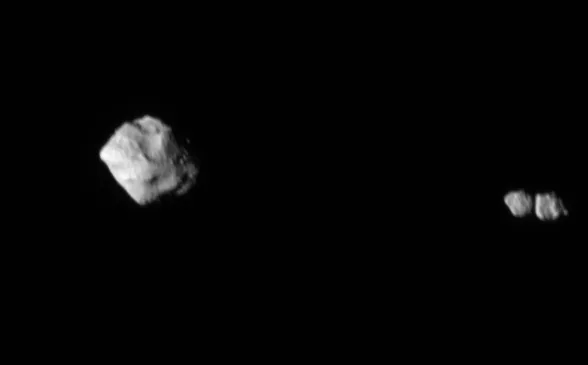
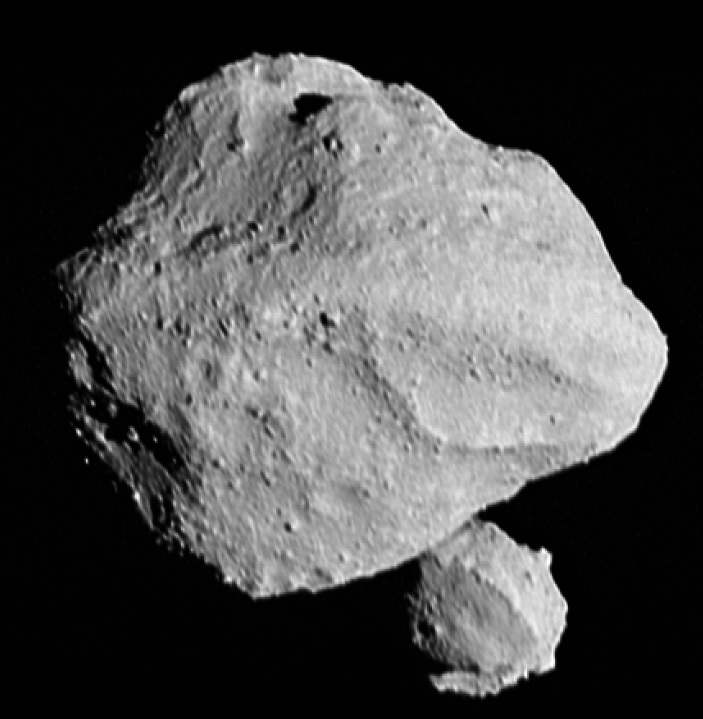
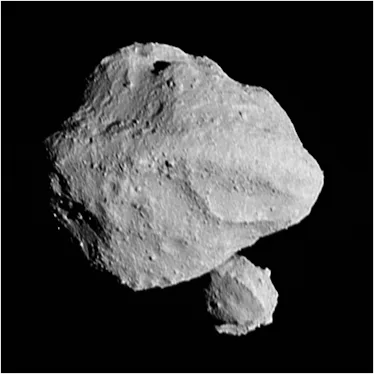
Lucy’s images of asteroid Dinkinesh are the gift that keeps on giving. First, it was the discovery of a smaller companion. Now, it turns out that the companion itself is a contact binary. That’s two smaller objects touching each other as they orbit with Dinkinesh. So, how did they get that way?
NASA describes the companion as “unanticipated”, although according to Lucy project scientist John Spencer, they’re actually pretty common in the solar system. “We just haven’t seen many up close, and we’ve never seen one orbiting another asteroid,” he said.
Spencer and the team thought there might be something odd about Dinkinesh, given that it was showing some pretty strange brightness variations as the spacecraft got closer. “It gave us a hint that Dinkinesh might have a moon of some sort, but we never suspected anything so bizarre!”
Dinkinesh itself is an interesting target and part of Lucy’s target population of Jupiter Trojan asteroids. It orbits in the Main Asteroid Belt at an average distance of 2.1 AU. Jupiter Trojans make up a distinct population of asteroids trapped in Jupiter’s orbit. They date back to the origins of the Solar System and can provide insight into conditions that existed some 4.5 billion years ago.
Hints About Asteroid Moons
As news of the images spread across the Internet, people began commenting about “moon-moons” to describe Dinkinesh’s companions. One comment on X, by Michigan State University planetary scientist Seth Jacobson, referenced his 2011 thesis work. It focused on modeling similar systems, and even before that, interest in these systems was not new. Understanding what causes such “kissing asteroids” as the Dinkinesh moons, requires a great deal of observation. That’s what Lucy’s doing now.
Jacobson looked at “rotationally fissioned” asteroids, which form when two bodies “fission” as they reach a certain limiting rotational speed. That is, they slowly move apart, but appear tidally locked together. His 2011 paper looked at ideal cases of these objects as sources of then-current observations of small systems.
The work focused on so-called “rubble pile” asteroids and their physical characteristics and gravitational interactions. It involves looking at near-Earth asteroid evolution via something called the YORP (Yarkovsky–O’Keefe–Radzievskii–Paddack) effect. The Yarkovsky part of the effect basically describes how orbits of small asteroids are changed by a tiny amount of thrust created as sunlight re-radiates off their uneven surfaces. Since the amount of thrust is so small, it takes a long time to make big changes in the orbit. The effect also changes an asteroid’s spin rate, albeit slowly. The additional factors (added by other researchers looking into the effect) include any possible effects on asteroid orbits and obliquities. This happens to individual asteroids as well as floating rubble piles, with each piece being affected as well as the aggregate.
So, in addition to collisions that shape asteroids, sunlight, and gravitational effects contribute to their evolution. And, in the case of the recent Lucy images, we see direct evidence of that.
Kissing Asteroid Moons
So, how does this relate to Dinkinesh’s moon-moons? They definitely look like a contact binary. Over time, they rotated into place together, at least partly driven by the YORP effect. The end result is two moons looking as if they’re “kissing” each other after incident solar radiation and re-radiation drove them together in a long dance. Are they actually touching? Or simply moving together very closely in a rubble pile? If they are simply very close to each other in a mutual gravitational headlock, then perhaps rotational fission played a role.
This composite image of the primordial contact binary Kuiper Belt object 2014 MU69 (officially named Arrokoth) was compiled from data obtained by NASA’s New Horizons spacecraft as it flew by the object on Jan. 1, 2019. The image combines enhanced color data (close to what the human eye would see) with detailed high-resolution panchromatic pictures. Credits: NASA/Johns Hopkins University Applied Physics Laboratory/Southwest Research Institute//Roman Tkachenko
We’ve seen similar bodies in the solar system, including the strangely shaped Arrokoth in the Kuiper Belt. It’s a contact binary that appears to be doing more than kissing. The two lobes look almost welded together around a narrow “neck”. They probably merged together after getting locked together in a gravitational (tidal) dance. Unlike Dinkinesh’s companions, Arrokoth’s two lobes are not the same size.
Why Dinkinesh?
Dinkinesh is about 790 meters across, and its moon-moons are much smaller and don’t yet have names. This asteroid is part of Lucy’s larger mission to survey Jupiter Trojan asteroids. Interestingly, Dinkinesh was added into the mission timeline as a targeting and tracking test. The spacecraft’s systems not only did that, but also provided excellent imaging over time to give multiple views of this asteroid and its moons from different perspectives.
The results look intriguing for now, giving planetary scientists a lot to chew on. “It is puzzling, to say the least,” said Hal Levison, principal investigator for Lucy. “I would have never expected a system that looks like this. In particular, I don’t understand why the two components of the satellite have similar sizes. This is going to be fun for the scientific community to figure out.”
This image from the ESA's MASTER (Meteoroid and Space Debris Terrestrial Environment Reference) risk-assessment tool shows the dangerous debris orbiting Earth. Image Credit: IRAS/TU Braunschweig
What can we do about space junk? We know how much debris is in orbit, and we know the problem is getting worse. It’s our fault.
Our Earth now has a halo of orbital debris, and the ESA has a plan to stop contributing to the problem.
You can only kick a can down a road for so long before you’re tripping over all the cans. While politicians seem particularly adept at kicking them into the future and then blaming the other side when we’re ankle-deep in pesky cans, people in scientific pursuits don’t have the same luxury of intellectual dishonesty.
“Behaviours in space have to change.”
-ESA
We’re all aware of the space debris problem, and we know it’s getting worse. We’ve been launching satellites at an increased pace in the last few years. When combined with all of the satellites launched in prior decades, the result is a congested area that’s getting more crowded by the month. And like empty cans kicked into the future, many of the objects in orbit are no longer functioning or serving any purpose. They’re just there. If only someone had seen this coming.
But at least the ESA is committing to a plan to stop putting more debris in space.
“130 million pieces of space debris larger than a millimetre orbit Earth, threatening satellites now and in the future,” the ESA writes. “Once a week, a satellite or rocket body reenters uncontrolled through our atmosphere. Behaviours in space have to change.”
There’s not much of an argument that things need to change. But in an international world where not all countries want to cooperate and where private companies are responsible for a growing amount of stuff in space, change is tricky.
The ESA is setting a new standard for itself. They call it the “Zero Debris Approach.”
The space debris problem isn’t something that exists down the road. In 2009, two satellites collided over Siberia. One was defunct, but one was active. Besides destroying an active Iridium satellite, the collision created a whole bunch more debris. Perhaps the most troubling part is that the collision was predicted. In fact, of all the satellites that come close to each other, these two weren’t even in the top 200 satellites in dangerous proximity to one another.
“Arguably, the best approach is adopting practices that prevent creating debris in the first place,” an article in American Scientist said at the time.
There’s also the growing risk that even without any additional launches, collisions between existing debris will still make the problem worse. “It has been estimated that even in the case of no further launches into orbit, collisions among the existing space objects can lead to further growth in space debris population,” the ESA writes. The worst possible outcome is the Kessler syndrome, where collisions produce more debris that leads to a growing cascade of collisions that ultimately makes Earth orbit unusable.
American astrophysicist Donald Kessler predicted the Kessler syndrome back in 1978. In 2012, he co-authored an article saying that we’re already passed the tipping point for orbital debris. “That runaway debris generation scenario, often called the Kessler syndrome, may seem far off,” the article said. “But in fact, the sheer density of derelict objects in orbit has already exceeded what many consider to be the mathematical point of no return.”
This illustration depicts the Kessler Syndrome, named after American astrophysicist Donald Kessler. In 2012, Kessler co-authored an article warning that we’re already at the tipping point. Image Credit: ESA
There’s lots of talk about developing systems to remove existing space debris, especially larger pieces like intact satellites. There’s talk of harpoons, robotic arms, and even using other satellites to move debris into graveyard orbits. But there’s not much action to stop adding more debris.
Now, here we are, almost 15 years since the collision, and at least the ESA got the message.
“We are seeing a dramatically increased use of space, but still insufficient technology to prevent the risks that follow. Our aim to become debris neutral in just a few years will require clearing precious Earth orbits once a mission is complete, and if the mission fails to do this, it must be actively removed by dedicated vehicles,” explains Holger Krag, ESA’s Head of Space Safety.
This figure shows the amount of debris in space and what type it is. Image Credit: ESA
Krag likens it to the backcountry hiker’s motto: pack out what you pack in. “We are aiming for rules that compare to every national park on Earth – what you bring in, you must take with you when you leave.”
The ESA’s Zero Debris Approach starts with mission design. In 2022, the ESA undertook a large study involving all of their sites across Europe as well as 270 experts from industry, governmental agencies and academia. The study produced recommendations to help the ESA reach Zero Debris by 2030. The recommendations form the basis of the recently published ‘ESA Space Debris Mitigation Requirements.’
Here are the eight recommendations in the document:
Guarantee successful disposal
Improve orbital clearance
Avoid in-orbit collisions
Avoid internal break-ups
Prevent the intentional release of space debris
Improve on-ground casualty risk assessment
Guarantee Dark and Quiet skies
Beyond the protected regions (This includes GNSS constellations and lunar orbits.)
That’s a pretty comprehensive list, and it should be. We rely heavily on satellites, but many of us never think about them. They’re an important structural element in modern society.
“As space infrastructure has become the backbone of our modern society, the proliferation of space debris is threatening our way of life. Now is the time to act as a community to channel our collective efforts,” said ESA Director General Josef Aschbacher. “To implement the Zero Debris Charter, ESA will focus on developing ground-breaking technologies for satellite end-of-life disposal, in-orbit servicing and active debris removal. In addition, ESA will work hand-in-hand with institutions in charge of regulatory aspects.”
So, where are the rest of the world’s space agencies on this issue? NASA has made lots of statements about ‘limiting’ orbital debris and even has an office dedicated to the problem. But they haven’t taken the same type of bold step the ESA has.
China? They’re working on ways to de-orbit space junk successfully. But again, no bold, clear language commitment. ISRO? India’s set up a Centre for Space Debris Research, but they’ve made no promises about not adding to the problem.
How about Russia? Does what’s left of Roscosmos’ corpse have any plans? They make all kinds of statements, but nobody believes them. Especially since they keep messing with everyone else’s satellites.
You’ve gotta hand it to the ESA. Even though they’re an organization made up of 22 separate nations, they’ve come together and are the ones leading the charge on this issue.
NASA benadrukt een ongelooflijke foto van de Krabnevel gemaakt door de James Webb
NASA benadrukt een ongelooflijke foto van de Krabnevel gemaakt door de James Webb (NASA, ESA, CSA, STScI; Tea Temim (Princeton University) // NASA – APOD)
Op de afbeelding is de Krabnevel, officieel gecatalogiseerd als M1, in al zijn pracht te zien dankzij de geavanceerde infraroodcamera’s van de James Webb, waarbij de helderheid, de wolk en de gefragmenteerde restanten van de explosie van een massieve ster in 1054 worden benadrukt.
In het midden bevindt zich een van de meest ongelooflijke objecten die astronomen kennen, de Krabpulsar, een neutronenster die ongelooflijk 30 keer per seconde draait en zichtbaar is als een helder punt.
De Krabnevel staat bovenaan de lijst van de 18e eeuw van Charles Messier, samengesteld uit hemellichamen die geen kometen zijn.
ESA is Testing a Modular Multipurpose Rover that Could Be a Science Lab or a Tiny Bulldozer
Most rovers have been built for Mars, and each one of them is a complex machine designed with specific goals and terrains in mind. But the Moon is different than Mars. We’re not searching for life there; we’re trying to establish a presence.
In recognition of the difference, the ESA is developing modular rovers that can serve different needs with only small modifications.
It’s called the European Moon Rover System (EMRS), and its goal is to “develop a versatile surface mobility solution for future lunar missions,” according to newly published papers. The surface mobility systems will serve four upcoming ESA missions: the Polar Explorer (PE), In-Situ Resource Utilization (ISRU), Astrophysics Lunar Observatory (ALO) and Lunar Geological Exploration Mission (LGEM).
Each of the four missions has specific requirements, including placing scientific instrumentation at the lunar south pole, excavating and transporting over 200 kg (440 lbs) of regolith, building an astrophysical observatory on the far side of the Moon, and studying the Moon’s volcanic history. The ESA is developing a rover that uses modularity to meet each goal rather than a completely different rover.
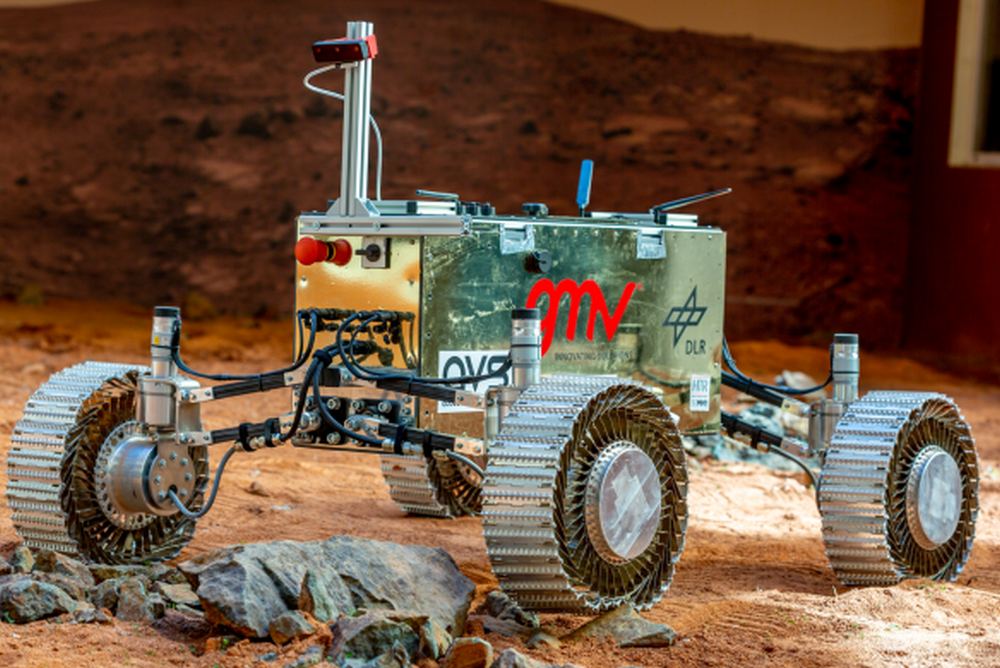
The new modular lunar rover design will have to move lunar regolith as part of building the Astrophysics Lunar Observatory. This image shows the test rover with its bulldozer blade attached during testing. Image Credit: ESA
“To achieve this, a modular approach has been adopted for the design of the platform in terms of locomotion and mobility, which includes onboard autonomy,” the paper explains.
There are obvious benefits to modularity and its offshoot, redundancy. Modular payloads can be used more advantageously for the specific mission at hand. They can also be removed and added as the need arises and are less time-consuming to work on and develop. And if one rover is out of commission for some reason, payloads can be swapped according to changing priorities.
When it comes to mobility, the new rovers will rely on Adaptable Wheels for Exploration (AWE) designed by Hellenic Technology of Robotics (HTR). “Rover wheels play a pivotal role, especially given the challenging lunar surface conditions and regolith,” the paper states. There’s plenty of loose sand on the Moon, and AWE will supply enough traction. The wheels have caterpillar-style tracks on top of springs and a fixed internal hub. These wheels are remarkably flexible and will be tough enough to meet the mission’s requirements, including being built with materials that can handle the wild temperature swings on the lunar surface.
This figure shows the EMRS wheels developed by HTR. The image on the right shows them being tested on the rover prototype. Image Credits: ESA/HTR
The rover’s four wheels are just part of the mobility design. The steering system is just as important. There are two potential steering system designs: on-top steering and on-side steering. The ESA has chosen on-side steering partly because it’s more compatible with upper payload bay volume.
On-side steering allows for four different turning modes: Skid Steering, Ackermann Turn, Crab Turn, and Point Turn.
The steering system allows for four different turning modes: Skid Steering, Ackermann Turn, Crab Turn, and Point Turn. Image Credit: ESA
The suspension system will be a hybrid of passive and active, with an independent suspension for each wheel. “The independent, active suspension enables a wheel-walking mode, and coupled with the independent steering even a’ paddling’ mode,” the paper states. Paddling mode provides a safeguard in case the rover gets stuck in very soft terrain. Getting stuck in soft ground is one of the most challenging scenarios for conventional passive suspension systems.
The suspension design also allows for the rover’s stored configuration during spaceflight.
This schematic shows the rover’s suspension system is stowed (L) and normal configurations (R.) Image Credit: ESA
When it comes to the modular rover’s chassis, the design team proposes a strong and lightweight Carbon Fiber Reinforced Polymer (CFRP) design. The chassis will have four separate bays. The primary bay is common among all rovers and will hold the common avionics, thermal control systems, and power components. There will also be two side bays and a top bay, all able to hold different payloads.
This schematic shows the rover’s four payload bays. The grey one is the primary bay. The pink ones flanking the primary bay are lateral payload modules that can hold equipment needing access to the lunar surface, like drills or excavators. The green one on top is a configurable cargo bay. The image on the right shows the cargo bay carrying materials for the Astrophysics Lunar Observatory (ALO.) Image Credit: ESA
The rover will have onboard software (OBSW) that will allow it to drive autonomously. It’ll be able to detect and identify different obstacles and objects and determine its way through, around, or over them. “It also has manipulation capabilities, allowing it to perform ISRU tasks, manipulate tools, and scientific sampling,” the paper states. Astronaut time is valuable, and the more autonomous the rovers can be, the more time astronauts will have for other tasks.
The paper points out that rover modularity starts paying off well before a rover is ever deployed. “The modular design of our prototype provides a unique advantage by allowing us to evaluate the rover’s locomotion and software in tandem with a variety of scientific payloads,” it states. That’s extremely valuable since the payloads could variously consist of things like drills, bulldozer blades, spectrometers and cameras.
The modular rover design is still in the concept phase, though test models have been built and tested.
“A series of rigorous obstacle and excavation tests has been carried out, shedding light on the remarkable capabilities of the EMRS system configuration,” the paper states. “These tests not only demonstrate the rover’s ability to safely navigate lunar terrain but also underscore its proficiency in lunar regolith excavation.”
The ESA is developing some ambitious plans not only for lunar exploration but for a sustained human presence on the Moon. Rovers will be the workhorse for these activities, and the modular design should give the rovers an advantage.
We’ll find out in a few years when the ESA lands on the Moon.
The details of the EMRS design process are in two new papers:
Mexican alien mummies have once again returned to the media spotlight, this time with factual evidence that supports the authenticity of the bodies. On November 6, 2023, Mexican journalist Jaime Maussan gathered a group of doctors and scientists to present new data on the Peruvian mummies, which show potential signs of non-human life forms, while refraining from confirming that the remains were extraterrestrial.
During the Second Public Hearing on the Regulation of Unidentified Anomalous Phenomena, experts in the field shared their research work and personal experiences related to this intriguing topic. The hearing included the participation of various professionals, including Jesús Ángel Guevara Madrigal, Air Controller of Mexico; Rafael Arcángel Berrocal Ramos, a lawyer; Thierre Maurice Pierre, a researcher at the Inkari Institute in Cusco, Peru; Roger Zúñiga Avilés, who led the investigation on behalf of the ICA University in Peru, as well as Peruvian legislators and other researchers.
On September 12, 2023, the Mexican government hosted a historic UAP hearing, organized by the Commission of Science and Technology of the Chamber of Deputies, where they first heard of Peruvian mummies from Jaime Maussan. The small mummified specimen was retrieved from Cusco, Peru, in a layer of diatomaceous earth. They are believed to be one thousand years old. “These aren’t beings that were found after a UFO wreckage,” Mr. Maussan said, “They were found in diatom mines, and were later fossilized.” He later added: “Whether they are aliens or not, we don’t know, but they were intelligent, and they lived with us. They should rewrite history… We are not alone in this vast universe; we should embrace this reality.”
After almost two months, Mr. Maussan was more focused on proving the authenticity of alien mummies. Mr. Maussan and other experts claim the specimens were tested and found to be “non-human beings that are not part of our terrestrial evolution.” He said, “None of the scientists say [the study results] prove that they are extraterrestrials, but I go further,” suggesting that they could be evidence of non-Earthly life forms.
On August 1, 2019, the San Luis Gonzaga National University of Ica, Peru, received four desiccated bodies exhibiting characteristics of both humans and reptilians. These specimens were transferred while safeguarding the confidentiality of the source of information, following the provisions outlined in the second article, subsection 18, of the Political Constitution of Peru. The purpose behind the delivery of these bodies was to ensure their custody and preservation and facilitate research aimed at elucidating the authenticity of these desiccated specimens.
One of the bodies, known as Maria, is approximately human-sized but displays distinct anatomical variations. It possesses an elongated skull and three fingers on both its hands and feet. Upon examination of the bones, a consistent structure was observed, devoid of any indications of finger damage.
The smaller bodies, measuring approximately 60 cm in length, display a morphological and anatomical structure markedly distinct from that of humans. Their skin exhibits morphological and histological characteristics reminiscent of reptiles, featuring three-digited hands and feet. Notably, they possess voluminous skulls, and their bone and joint system deviates significantly from human anatomy, showcasing unique and sui generis atypical features.
Importantly, it is worth noting the absence of rigid or metallic elements for union and support in the joints throughout the entire body. Given the extraordinary nature of these bodies and the pronounced anatomical and structural disparities, further comprehensive investigations are imperative for a deeper understanding of their essence.
Celestino Adolfo Piotti, a doctor in medicine and surgery and the founder of a special branch of anthropology in Argentina, said he reached this conclusion by studying X-rays of the skulls of non-human beings. He compared them to his theory of evolution, called the “guardian theory,” which disagrees with Charles Darwin’s theory.
[Translation] “The final numerical result that it gives me is that they are not individuals from the past or the present but rather from the future, so it means that these two beings, Mary and these two beings 60 centimeters high (those that Maussan presented), “They should have existed in the future and not in the past a thousand years ago,” he said.
The researcher acknowledged that the scientific method cannot provide an answer to the conclusion he reached. However, he stated that non-human beings are “the link of our human species that goes from being returned towards a new species…The lower beings would be a complete evolution of a species that will come after us, in summary, they would be our descendants.”
Thierre Maurice Pierre, a researcher at the Inkari Institute in Cusco, Peru, stated that the analysis concluded that non-human beings date back thousands of years and that their DNA is not human. However, he clarified that this does not necessarily mean they belong to extraterrestrial beings.
“The laboratories concluded that these bodies were centuries, even millennia old. The DNA of these beings does not belong to the human species. For this reason, the laboratories will speak of at least two unknown species. I want to insist on this important point: none of the laboratories have mentioned extraterrestrials,” he said.
Anthropologist Roger Zúñiga Avilés of San Luis Gonzaga National University in Ica, Peru, said researchers had studied five similar specimens over four years. “There was absolutely no human intervention in the physical and biological formation of these beings,” he added, saying he did not know the origin of the beings.
Zúñiga presented a letter signed by 11 researchers from the university declaring the same. The letter made clear, however, they were not implying the bodies were “extraterrestrial.” According to Reuters, “When asked about those studies, Zúñiga said the specimens were probably fake. The bodies that he and the other university researchers looked at, however, were real, he said.”
After thorough investigations, the research team has conclusively determined that the desiccated bodies under study are entirely authentic from a biological standpoint. There are no indications of tampering or artificial assembly. The scientific approach has been meticulous, and these results further affirm the authenticity of the bodies.
Mexican September UAP hearings came after the US Congress conducted its hearings where corner US intelligence officer David Grusch testified that the US government has its possession of intact alien crafts and claimed that “non-human biologics” had been recovered from crashed vehicles of unknown origin. He further claimed the Pentagon was secretly reverse-engineering the recovered craft without oversight by Congress or the US public.
Guys, take a deep breath, make sure you are very, very relaxed, because what I have to say is not the typical small talk. I was looking at a Gizmodo story that was about the asteroid Dinkinesh having not one, but two tiny moons orbiting it. But I noticed that the photos were over exposed...meaning they had too much light added on purpose to drown out the detail. So I added shadow and added focus then something awesome happened, I soon saw the two moons were actually two alien ships! And Dinky asteroid is actually has structures built into it, so it looks like an asteroid, but is really a space station or mother craft. Kinda mind-blowing. We don't need the gov to tell us what is and isnt real, we ourselves can research, enhance and discover the truth on our own. We already have mountains of factual pieces of evidence about UFOs and aliens existing in NASA photos themselves, I've been doing it over 20 years so I know.
“What’s the weirdest case you’ve ever studied?” Jacques Vallée talks UFO landing in Valensole, 1965
In the tranquil lavender fields of Valensole, France, a strange occurrence in 1965 catapulted the small town into the annals of UFO lore. Maurice Masse, a local farmer, became an unwitting participant in one of the most scrutinized UFO sightings of the 20th century. This event would not only ignite a wave of curiosity but would leave an indelible mark on the sleepy landscape, turning it into a pilgrimage site for UFO enthusiasts and skeptics alike.
An Early Morning Encounter
Before dawn on that fateful July morning, Maurice Masse encountered what he initially mistook for juvenile trespassers. However, this assumption was swiftly dispelled when the ‘children’ morphed into entities of inexplicable origin, alongside a craft bearing no resemblance to any known vehicular contrivance.
The Unfathomable Craft and Its Occupants
Masse described the beings as diminutive figures with disproportionately large heads, their eyes a deep, unsettling void. They donned garb unlike any terrestrial fashion, and one wielded a mysterious device — a detail paralleling numerous UFO sightings worldwide. The confrontation left Masse temporarily paralyzed, a peculiar effect also echoed in similar accounts from various corners of the globe.
The Aftermath and the Indelible Scar on Nature
In the wake of the entities’ abrupt departure, Masse discovered an area of his field that was rendered infertile, a testament to the unusual encounter’s tangible consequences. The ground, hardened like concrete, resisted agricultural attempts for seven long years, serving as a silent witness to the unexplained phenomenon.
The Scientific Scrutiny
The Valensole incident was not without rigorous scrutiny. Noted astronomer and UFOlogist Dr. J. Allen Hynek, along with French governmental agencies, investigated the site. They were met with a puzzle — the traces left behind defied conventional replication, suggesting that whatever landed in Valensole had properties beyond the current understanding of physics and technology.
Echoes of the Unexplained
This occurrence was not an isolated narrative. The sighting in Socorro, New Mexico, by policeman Lonnie Zamora the previous year shared eerie similarities, including the description of the craft and the feeling of paralysis reported by the witness. Such instances add layers of complexity to the global tapestry of UFO sightings, offering compelling vignettes of unexplained aerial phenomena that continue to provoke both wonder and debate.
The Continual Quest for Understanding
Decades have passed, yet the Valensole sighting remains a beacon for those seeking answers in the sky. The incident stands as a symbol of the enduring allure of the unidentified — a narrative that captivates, challenges, and confounds. It reminds us that, sometimes, the most enduring mysteries are not in the far reaches of space but here at home, in our fields, our skies, and our collective imagination.
VIDEO:
“What’s the weirdest case you’ve ever studied?” Jacques Vallée talks UFO landing in Valensole, 1965
With every recounted tale of lights in the sky and untraceable craft, the Valensole encounter endures, a cornerstone in the ever-expanding chronicle of UFO sightings. As we gaze upward, one cannot help but ponder — will the mysteries of the universe ever fully reveal themselves, or are we destined to grapple with the enigma of the unidentified, one sighting at a time?
Centaurs are small planetary bodies that orbit between Jupiter and Neptune and have baffled astronomers for sharing characteristics with both asteroids and comets. Centaurs got their name after the mythical half-horse, half-human creatures called centaurs due to their dual characteristics. Above is an artist's illustration displaying a centaur creature among asteroids (left) and comets (right). (Credit: NASA/JPL-Caltech)
JWST Detects Carbon Dioxide in a Centaur for the First Time
A study published today in The Planetary Science Journal examines how NASA’s James Webb Space Telescope (JWST) has conducted a first-time detection of carbon dioxide in a Centaur, this one designated 39P/Oterma. A Centaur is a small planetary body that orbits between Jupiter and Neptune and frequently crosses the orbits of one or more of the gas giant planets within our solar system. While no Centaur has been imaged up-close, they typically exhibit a combination of attributes between comets and asteroids. While carbon monoxide has been detected in two known centaurs, this recent discovery could mark a turning point in how scientists understand the formation, evolution, and composition of not only Centaurs, but of the early solar system, as well.
“Centaurs are important to study since they are fairly well-preserved objects in space that can provide insight on the chemical composition and physical processes of the early solar system,” Study lead author, Dr. Olga Harrington Pinto, who is a postdoctoral researcher at Auburn University but conducted the research while a PhD student at the University of Central Florida, tells Universe Today.
Centaur 39P/Oterma was discovered on April 8, 1943, by Finnish astronomer, Dr. Liisi Oterma, who was the first woman to earn PhD in astronomy in Finland, along with being the first woman PhD of the faculty of sciences at Turku University. While 39P/Oterma has long been classified as an inactive comet, it currently exhibits a Centaur-like orbit between Jupiter and Saturn, meaning it doesn’t approach the Sun, and has a radius of approximately 2.21 to 2.49 km (1.37 to 1.55 mi), according to this study. So, why was 39P/Oterma chosen for this specific study?
“39P/Oterma is what we call an active centaur, a centaur that develops a coma and a tail like a normal comet,” Dr. Adam McKay, who is an assistant professor in the Department of Physics and Astronomy at Appalachian State University and a co-author on the study, tells Universe Today. “Since they are active, we can use spectroscopy to observe molecules in their coma to gain insights into their composition. 39P was chosen as one of our targets because it would be active during the time of the proposed observations.”
For the study, the researchers used JWST’s Near-Infrared Spectrograph (NIRSpec) instrument and was supported by ground-based observations from the Gemini North Observatory and Lowell Discovery Telescope to investigate the characteristics of 39P/Oterma while it was orbiting close to its perihelion (closest distance to the Sun) at 5.82 astronomical units (AU) from the Sun in July 2022. For context, the perihelion of 39P/Oterma has gradually increased since its discovery: 3.39 AU (1958), 5.47 AU (1983), and 5.71 AU (2023), and is projected to reach 5.91 AU and 6.15 AU in 2042 and 2246, respectively.
After analyzing the JWST NIRSpec data, the researchers confirmed the first detection of carbon dioxide in any Centaur, and the lowest amount of carbon dioxide ever detected in any Centaur or comet. They also did not detect traces of water or carbon monoxide, which are traditionally detected in Centaurs, specifically 29P/Schwassmann-Wachmann 1 (29P/SW1), another Centaur that shares approximately the same AU distance as 39P/Oterma.
“These results are important because they show that thanks to the impressive capabilities of JWST, we are able to see low production rates of a relatively small object that is very far away,” Dr. Pinto tells Universe Today. “And, though the production rates are low, it shows a different chemical behavior from another Centaur, 29P/SW1, seen at a similar distance (~6 AU). This difference in chemical behavior could be from the very different sizes of Centaurs 29P and 39P, or from having different orbital histories, or starting out with different compositions, or possibly a combination of all of these.”
The finding of carbon dioxide in a Centaur could be a gamechanger in terms of understanding the compositions and characteristics of Centaurs, asteroids, and comets throughout the solar system, along with potentially gaining better insight into the formation and evolution of the solar system, overall.
What new discoveries about Centaurs will researchers make in the coming years and decades and how many more Centaurs could possess carbon dioxide throughout the solar system? Only time will tell, and this is why we science!
The Indian space program has been on a bit of a tear lately. Chadrayaan-3 was just the latest successful for the ISRO, India’s space agency, when it launched in July – especially juxtaposed with Luna-25, a Russian moon lander mission that launched around the same time and failed spectacularly by crashing into the Moon. Maybe in part due to the ISRO’s success, Indian Prime Minister Narendra Modi appears to have taken an increased interest in the program and recently chaired a meeting to review the Gaganyaan Mission, India’s first foray into crewed space flight. But while in the meeting, he suggested the country’s exploration goals should go further – much further.
Let’s start with the Gaganyaan mission itself. It’s hit a series of setbacks after initially being planned for launch in December 2020. Admittedly, some of those setbacks were caused by the pandemic, which hit India particularly hard. However, the program appears to be back on track, and the mission planners confirmed a launch in 2025, though this is slightly later than even the Wikipedia page for the missions says at the time of writing, and it was updated only in September.
Press releases from the PM’s office most likely overrules any Wikipedia site, so while the mission may be delayed until 2025, the testing leading up to it is still ongoing. A test of the Crew Escape System Test Vehicle, a critical component in modern-day human spaceflight systems, occurred successfully recently. Around 20 additional tests are planned over the next two years to ensure the mission’s success.
Fraser discusses India’s moon mission.
One key component of the new mission is the development of a Human Rated Launch Vehicle called HLVM3 by the ISRO. This is a modified version of the Launch Vehicle Mark 3, which has been the workhorse of ISRO’s satellite launching efforts since its first orbital flight back in 2017. However, launching humans is not the same as launching satellites, and much work needs to be done to ensure the safety of any future astronauts that might take a ride on this rocket.
That might seem like enough to keep the mission planners and engineers at ISRO busy for the foreseeable future. But PM Modi wants to aim higher – literally to the Moon in this case. He suggested sending an Indian astronaut to the Moon by 2040. Doing so in 17 years is feasible, especially considering the US did so in 9 with 1960s technology.
But the Moon won’t be the only stop for the ISRO. PM Modi also announced a plan to build a Bharatiya Antariksha Station – translated as “Indian Space Station” in the press release, by 2035. What exactly this station will entail and how it will fit with the wider plans for the Moon were not detailed in the press release. Still, assumedly, an orbital station will plan a key staging role for astronauts traveling to our nearest cosmic neighbor.
And about the success of that mission.
Human spaceflight isn’t the only kind, though, and ISRO will be busy in the robotic arena as well. Interplanetary missions were also mentioned by the PM, who took special note of a Venus Orbiter and Mars landers in his discussions during the meeting. Neither of those projects has yet garnered a name, so it’s unclear how much support they’ll have going forward. But if recent history is any indication, India will be adding plenty of new accomplishments to its portfolio of successful space missions in the near future.
Now here are some unusual screenshots from a Chandrayaan mission. The crater is made of many over lapping tunnels, something I did not expect, but this seems like an intelligently made structure on Earths moon built across the crater in order to appear like a crater shadow. I also found some tunnels to the right of the crater, but I did have to add shadows in order to see them. You will also see structures around it here and there. The moon is certainly inhabited by an intelligent species, but would they welcome a visit from humans?
Here is an interesting capture by YouTuber Shellys UFOs. The UFO is triangle in shape with a smaller triangle hump on its upper center. Very unique and its movement is unpredictable. The blue glowing craft appears to want to be seen.
2.7 mile UFO found landed in Mars Crater, Seen On Google Mars Map! UFO Sighting News.
Date of discovery: Nov 7, 2023
Location of discovery: Mars
Google Coordinates: 69°26'0.85"N 86° 1'9.48"W
I found a disk structure with another smaller circle on its top center. The structure was found using Google Mars map. According to google ruler, the disk is 2.7 miles across and 1.8 miles high. Why is it not noticeable to astronomers? Well first off its hidden in a crater which itself is at least 3 to 4 miles deep and its located on Mars, which can only be seen close up by orbiting satellites. Hiding in a crater is perfect for them because it shields the alien ship from micro meteorites which could damage the hull of the ship.
On a brisk November evening in 1986, the skies above Alaska became the stage for one of the most intriguing and well-documented UFO sightings in aviation history. This incident, involving Japan Airlines Flight 1628, captivates UFO enthusiasts and skeptics alike, offering a rare blend of eyewitness credibility, radar confirmation, and government inquiry that continues to provoke discussion and speculation decades later.
The Puzzling Pursuit in the Alaskan Sky
The crew of JAL Flight 1628 couldn’t have anticipated that their routine cargo trip from Paris to Tokyo would catapult them into the annals of UFO legend. Captain Kenju Terauchi, an ex-fighter pilot with a wealth of experience, found his 747 being shadowed by lights that defied conventional explanation. These were no ordinary lights: they maneuvered with an unsettling precision, pacing the airplane as it cruised at 500 miles per hour.
VIDEO:
Ancient Aliens: GIGANTIC SPACESHIP Towers Over 747 Plane (Special)
The presence of these mysterious lights was just the prelude to a more extraordinary revelation. As the flight continued, an enormous object appeared — one that Captain Terauchi described as a “gigantic spaceship,” large enough to dwarf their 747. This object, seemingly ripped from the pages of science fiction, held the attention of the seasoned pilot and his crew, compelling a series of evasive maneuvers to avoid a collision.
A Cascade of Corroboration
In the realm of UFO sightings, corroborating evidence is as rare as it is vital. This incident sets itself apart with multiple layers of verification. Ground control radar systems mirrored the reports from the flight crew, painting a picture of an inexplicable object in close proximity to the commercial jet. In a further attempt to understand the situation, another commercial flight was diverted to observe the phenomenon. Yet, by the time they arrived, the unidentified object had vanished, leaving more questions than answers.
The Aftermath and Official Scrutiny
Following the encounter, the official response was swift. Captain Terauchi’s report prompted immediate interest from the FAA and an assortment of federal agencies, including NORAD. The detailed investigation included a comprehensive review of audio recordings, highlighting the urgent dialogues between the pilot and air traffic control. However, the incident took an unexpected turn when Captain Terauchi decided to go public with his belief in the extraterrestrial origin of the craft, a move that resulted in his reassignment within Japan Airlines.
Conspiracy or Cover-Up?
Adding to the enigma, John Callahan, the FAA’s Division Chief of Accidents and Investigations at the time, pushed for a deeper investigation. His involvement led to a high-level meeting in Washington, D.C., attended by representatives from the CIA, the FBI, and the Reagan administration. The narrative that emerged from this meeting — particularly the claim of a CIA agent dismissing the incident and confiscating evidence — fueled ongoing speculation about government transparency and the existence of UFOs.
The Enduring Legacy of Flight 1628
Decades have passed, but the UFO sighting by JAL Flight 1628 continues to resonate. Its impact is felt not only in the community of UFO researchers but also in the broader conversation about aerial phenomena and their implications for national security and understanding of the world. As governments worldwide become more open about their investigations into UAPs, the Alaska incident remains a touchstone, a case study in the complex interplay between witness testimony, technological evidence, and the endless quest for answers that lie beyond our understanding.
In the digital age, the story of Flight 1628 finds new life, as curious minds search for “UFO sightings” and stumble upon the extraordinary tale of that fateful night over Alaska. Whether you’re a steadfast believer or a staunch skeptic, the story of JAL Flight 1628 offers an undeniable intrigue that continues to challenge our perception of the skies above.
Het verhaal van de ontvoering door aliens van Betty en Barney Hill
Artikel van Zeleb.es
De zaak van de ontvoering van Betty en Barney
De vermeende ontvoering van Betty en Barney Hill door een groep aliens omstreeks 1961 is een iconisch verhaal in ufologische kringen.
Emblematische zaak voor ufologen
Misschien is dit verhaal voor de meeste mensen onbekend, maar het heeft gedurende tientallen jaren grote belangstelling gewekt bij ufo-experts en -toeschouwers.
Een verblindend licht
Het echtpaar beweert dat ze in de nacht van 19 september 1961 een verblindend licht zagen terwijl ze over Route 3 naar huis reden. Ze dachten aanvankelijk dat het een vallende ster was.
Het echtpaar reed in Lincoln, New Hampshire. Nadat ze de auto hadden stilgezet en een verrekijker hadden gepakt om het vreemde object (dat geen vallende ster was) nader te bekijken, besloten Betty en Barney Hill weer op de weg te gaan. Het ruimteschip raasde achter hen aan en kwam steeds dichterbij.
De ontmoeting met aliens
Het echtpaar herinnerde zich dat ze door de ramen ongeveer tien mensachtige figuren zagen. Barney Hill beweert dat deze wezens door middel van telepathie met hen communiceerden.
Een grote schrik
De gebeurtenis vond plaats toen het vermeende ruimteschip in de buurt van de auto neerkwam. Bij het zien van de wezens herinnert Barney Hill zich dat hij in angst terug naar het voertuig rende en schreeuwde dat ze hen wilden vangen.
Vreemde geluiden
Terug in de auto startte Barney de motor weer en probeerde weg te rijden. Het echtpaar vertelt dat ze op dat moment een vreemde reeks ritmische piepgeluiden hoorde.
Details klopten niet
Eenmaal thuis bekroop hen echter een vreemd gevoel en merkten ze ongewone dingen op: kleine scheurtjes in Betty's jurk, een scheur in de riem van Barney's verrekijker en gaten in zijn schoen.
Geheugenverlies
Het raarste wat ze merkten was dat ze een hiaat hadden in de rit naar huis. Ze herinnerden zich niets meer van een stuk van ongeveer 56 km van de reis direct na de ontmoeting. De herinnering aan wat ze gezien hadden was zo gefragmenteerd dat ze niet konden samenvoegen wat er gebeurd was.
Regressieve hypnose
Twee jaar na deze gebeurtenis ging het echtpaar naar een therapeut die regressieve hypnotherapie uitvoerde om hen te helpen zich de gebeurtenissen van die nacht te herinneren. Inmiddels hadden ze ingezien dat ongeveer twee uur uit hun geheugen was verdwenen.
Eindelijk was alles duidelijk
Na veel regressieve hypnosesessies konden Betty en Barney Hill reconstrueren wat er gebeurd was. Ondanks dat ze tijdens de sessies gescheiden waren, kwamen hun versies van de gebeurtenissen aardig overeen.
The Ufo Incident
Een tv-film uit 1975 genaamd 'The Ufo Incident' verzamelde de geluidsbanden van die sessies. Regisseur Richard A. Colla had de regie.
Een film gebaseerd op archiefstukken
In de aftiteling van de films beweert de regisseur dat het verhaal gebaseerd is op een reeks archiefstukken van de Amerikaanse luchtmacht. De Hills hadden zich onmiddellijk na het incident tot de autoriteiten gewend.
Proeven en experimenten
Onder hypnose vertelden Betty en Barney Hill hun therapeut dat de aliens hen hadden ontvoerd. Ze werden meegenomen naar hun ruimteschip en onderworpen aan proeven en experimenten.
Foto: Wikipedia
Huid- en haarmonsters
Volgens de Hills namen de tweevoetige aliens met grijze huid en uitpuilende ogen haar- en weefselmonsters van verschillende lichaamsdelen met gereedschap dat leek op spuiten.
Geheugen uitgewist
Betty en Barney Hill herinnerden zich dat de aliens hen, nadat ze verschillende monsters hadden verzameld, vrijlieten, waarna hun bewuste geheugen werd uitgewist.
Zeta Reticuli
Betty Hill slaagde er ook in een sterrenkaart te reconstrueren die de herkomst van de aliens aangaf. Uit deze reconstructie concludeerden deskundigen dat het ging om sterrensysteem Zeta Reticuli in het zuidelijke sterrenbeeld Raster, 39,2 lichtjaar van de aarde.
De eerste gedocumenteerde ufo-waarneming
De zaak Hill was een van de eerste gevallen van gedocumenteerde ufo-waarnemingen. De archieven van de New Hampshire University bewaren nog steeds alle documenten en geluidsopnamen die tijdens de hypnosesessies en interviews zijn gemaakt.
De conclusies van de therapeut
In de laatste aflevering van een docuserie over de gebeurtenissen onthulde de therapeut die het stel behandelde zijn visie. Hij concludeerde dat hun vermeende ontmoeting met aliens te maken had met de vermeende sociale druk die ze ervaarden als interraciaal koppel, iets wat in een tijd slecht werd gedragen. De show, genaamd 'Ufo', werd in 2021 uitgezonden door streamingdienst 'Showtime,' zoals gemeld door sify.com.
Een wisselend standpunt
Dezelfde therapeut beweert dat hij zes maanden later van gedachten veranderde en concludeerde dat het echtpaar de waarheid sprak, zoals uit een fragment van de docuserie blijkt.
'Captured! The Betty and Barney Hill UFO Experience'
Barney Hill overleed in 1969, slechts acht jaar na het incident, maar zijn vrouw Betty overleed pas in 2004. Haar leven lang heeft ze uitgebreid gevochten om hun verhaal en het bestaan van aliens te bewijzen. Haar nicht, Kathleen Marden, schreef in 2007 een boek over haar tante: 'Captured! The Betty and Barney Hill UFO Experience'.
Een fascinerend verhaal over ufo's
Of het waar is of niet, één ding is zeker: het verhaal van Barnie en Betty Hill blijft een mijlpaal voor de ufologische gemeenschap en een van de fascinerendste verhalen over waarnemingen van aliens.
Saturn's moon Enceladus isn't just bright and beautiful. It has an ocean under all that ice that has chemicals necessary for life. Image Credit: NASA, ESA, JPL, SSI, Cassini Imaging Team
Saturn’s ocean moon, Enceladus, is attracting increasing attention in the search for life in our Solar System. Most of what we know about Enceladus and its ice-covered ocean comes from the Cassini mission. Cassini ended its exploration of the Saturn system in 2017, but scientists are still working through its data.
New research based on Cassini data strengthens the idea that Enceladus has the chemicals necessary for life.
During its mission, Cassini discovered geyser-like plumes of water erupting through Enceladus’ icy shell. In 2008, Cassini performed a close-proximity flyby and analyzed the plumes with its Cosmic Dust Analyzer (CDA). The CDA showed that the water in the plumes contained a surprising mix of volatiles, including carbon dioxide, water vapour, and carbon monoxide. It also found trace amounts of molecular nitrogen, simple hydrocarbons, and complex organic chemicals.
The plumes of Enceladus have phosphate-rich ice grains entrained.Credit: NASA
The work centers on the discovery of ammonia and inorganic phosphorous in Enceladus’ ocean. The researchers used ecological and metabolic theory and modelling to understand how these chemicals could make Enceladus amenable to life. “Apart from speculating about threshold concentrations of bioactive compounds to support ecosystems, metabolic and ecological theory can provide a powerful interpretative lens to assess whether extraterrestrial environments are compatible with living ecosystems,” the authors explain.
A critical component of ecological theory is the Redfield ratio. It’s named after the American oceanographer Alfred Redfield. In 1934, Redfield published results showing that the ratio of carbon to nitrogen to phosphorous (C:N:P) was remarkably consistent across ocean biomass at 106:16:1. Other researchers found that the ratio shifted slightly depending on the area and the phytoplankton species present. More recent work refined the ratio to 166:22:1.
The exact numbers aren’t necessarily the critical point. Redfield’s conclusion is the vital part. The Redfield ratio shows a remarkable unity between the chemistry of living things in the deep ocean and the ocean itself. He proposed that there’s an equilibrium between ocean water and plankton nutrients that’s based on biotic feedback. He described a chemical framework for nutrients and simple life.
“Whatever its explanation, the correspondence between the quantities of biologically available nitrogen and phosphorus in the sea and the proportions in which they are utilized by the plankton is a phenomenon of the greatest interest,” Redfield said in the conclusion of his paper.
So, how does the discovery of ammonia and phosphorous in Enceladus’ ocean relate to the Redfield ratio and Enceladus’ biological potential?
This figure illustrates a cross-section of Enceladus, summarizing the processes SwRI scientists modelled in the moon in a 2020 study. Oxidants produced in the surface ice when water molecules are broken apart by radiation can combine with reductants produced by hydrothermal activity and other water-rock reactions, creating an energy source for potential life in the ocean. Image Credit: SwRI
The Redfield ratio is widespread all across the Tree of Life on Earth. “Because of this seeming ubiquity, the Redfield ratio has been considered a target signature for astrobiological life detection, especially on ocean worlds such as Europa and Enceladus,” the authors of the new paper write. When it comes to life, all we have to go on is Earth. So it’s sensible to use foundational aspects of life’s chemistry here on Earth as a lens through which to examine other potential life-supporting worlds.
Analysis of Cassini’s data from Enceladus’ plumes shows a high level of inorganic phosphate in the ocean. Other geochemical simulations based on Cassini’s findings indicate the same. “These reports of phosphorus follow on the tails of previous work identifying numerous elemental constituents of terrestrial life (C, N, H, O) from the Enceladus plume,” the authors explain. Even more analysis suggests that the ocean contains many of the chemicals common in living organisms, like amino acid precursors, ammonium, and hydrocarbons.
So Enceladus’ ocean has a rich chemistry, and many chemicals reflect life’s chemical makeup. In particular, there’s an emerging hypothesis that Enceladus could support methanogenesis. Earth’s Archaea perform methanogenesis across a wide swath of different environmental conditions on Earth and have done so for over three billion years, proving their survivability. Biochemical modelling suggests that Earth’s methanogens are compatible with Enceladus’ ocean.
The researchers developed a new, more detailed model for methanogens on Enceladus to see if they could survive and thrive there. Their model leaned heavily on the Redfield ratio. They found that though phosphorous is present in high levels in the moon’s ocean, the overall ratio “may be limiting to Earth-like cells.”
“High standing stocks of these nutrients could be consistent with incomplete drawdown due to a small or metabolically slow biosphere, a biosphere with a recent origin of life,” or other reasons that could cause an imbalance.
So where does that leave the prospects for life on Enceladus?
We’re improving at identifying individual chemicals on other worlds, and the JWST is leading the way. But we need a better understanding of overall chemical environments to advance the search for life. A transmission spectrum of the hot gas giant exoplanet WASP-39 b, captured by Webb’s Near-Infrared Spectrograph (NIRSpec) on July 10, 2022, reveals the first definitive evidence for carbon dioxide in the atmosphere of a planet outside the Solar System. Credit: NASA, ESA, CSA, and L. Hustak (STScI). Science: The JWST Transiting Exoplanet Community Early Release Science Team
We’re only at the beginning of biosignature science. We can identify individual chemicals, but from this great distance away, we can’t accurately measure Enceladus’ overall chemistry. Newer biosignature research, including this paper, aims to identify how biological processes reorganize chemical elements in telltale ways. By looking at entire ecosystems, as Redfield did, scientists may discover new biosignatures that are less ambiguous.
If we can do that, we may discover that non-Earthly lifeforms reorganize chemicals in entirely different ways.
This research is part of a new effort to detect more than individual chemical biosignatures, some of which can be false positives. Methane, for example, can be a biosignature but can also be produced abiotically. There are others, like the recently discovered phosphine on Venus
The problem with individual biosignatures like methane is that they can have both biological and abiotic sources. This image illustrates possible ways methane might get into Mars’ atmosphere and be removed: microbes (left) under the surface that release the gas into the atmosphere, weathering of rock (right), and stored methane ice called a clathrate. Ultraviolet light can work on surface materials to produce methane as well as break it apart into other molecules (formaldehyde and methanol) to produce carbon dioxide. Credit: NASA/JPL-Caltech/SAM-GSFC/Univ. of Michigan
Understanding ecosystems as a whole is the next step. There’s a bewildering number of factors to consider. Cell size, nutrient availability, radiation, salinity, temperature. On and on. But to understand the overall chemical environment at Enceladus, Europa, or anywhere else, we need more detailed data.
Luckily, instrument science keeps improving, and upcoming missions to Europa will start to paint a fuller picture. According to the authors, the next step requires more fulsome data and a more generalized approach.
“We suggest two priorities for further astrobiological research to better understand the implications of these conclusions,” they write. “First, we echo previous calls in the astrobiology literature to explore more generalized notions of metabolism and physiology.” They also suggest that looking for direct parallels to terrestrial life in the form of biochemistry may not be the best strategy for looking for life on Enceladus.
“Second, we recommend broadening the scope of Earth analogue environments to include those with extreme resource supply ratios mirroring that suggested for Enceladus,” they explain.
Our understanding of habitability grows incrementally, as this study clearly shows. There’ll likely be no revelatory moments where we suddenly understand it.
Nature has created a vast variety of worlds, each with its own chemistry. While using tools like the Redfield ratio as a lens is one way of looking at these worlds in all their unique glory, we can’t get tunnel vision.
While most of what our imaginations dream up about life on other worlds is fanciful and unlikely, life could’ve found another way on Enceladus. There could be different ways that life exists in and reorganizes chemical environments
Archaeologists in Belgium have demonstrated that spearthrowers were used for launching projectiles armed with tanged flint points at the Early Upper Paleolithic site of Maisières-Canal around 31,000 years ago.
Coppe et al. identified the use of spearthrower around 31,000 years ago at the Early Upper Paleolithic site of Maisières-Canal, Belgium.
Image credit: Neanderthal Museum.
Humans have been hunter-gatherers for most of our past, but scientists still lack knowledge about what our prehistoric ancestors gathered and how they hunted because of the near lack of organic preservation at Paleolithic sites.
Of these two modes of subsistence, hunting tends to be better visible archaeologically because it can leave behind durable stone and bone implements that once served as weapon components.
Four weapon systems — thrusted spears, thrown spears, the spearthrower, and the bow — are assumed to have existed in the Stone Age, but the timing of their invention and their possible co-existence remain debated.
“Until now, the early weapons have been infamously hard to detect at archaeological sites because they were made of organic components that preserve rarely,” said lead author Dr. Justin Coppe, a researcher in TraceoLab at the University of Liège.
“Stone points that armed ancient projectiles and that are much more frequently encountered at archaeological excavations have been difficult to connect to particular weapons reliably.”
“Most recently published claims for early use of spearthrowers and bows in Europe and Africa have relied exclusively on projectile point size to link them to these weapon systems.”
“However, ethnographic reviews and experimental testing have cast serious doubt on this line of reasoning by showing that arrow, dart, and spear tips can be highly variable in size, with overlapping ranges.”
A tanged point from the site of Maisières-Canal, Belgium.
Image credit: Coppe et al., doi: 10.1038/s41598-023-45554-w.
In the research, Dr. Coppe and colleagues examined a sample of 329 flint artifacts from the site of Maisières-Canal, which is located in Belgium near the town of Mons, on the northern edge of the alluvial plain of the Haine.
“Maisières-Canal is a reference site for the Early Upper Paleolithic of north-west Europe and one of the few Early Upper Paleolithic open-air sites known from the region,” the researchers said.
“The site has been interpreted as having a single main Early Upper Paleolithic occupation layer that shows limited vertical displacement of finds.”
“Thirteen radiocarbon dates consistently place the occupation to around 28,000-31,000 years ago.”
The excellent preservation of the stone points, their large number, their distinct morphologies, and recent technological analyses that allowed their careful experimental replication presented a unique opportunity to reconstruct the delivery systems with which the projectiles were shot.
“We carried out a large-scale experiment in which we fired replicas of Paleolithic projectiles using different weapons such as spears, bows and spearthrowers,” said Dr. Noora Taipale, also from TraceoLab at the University of Liège.
“By carefully examining the fractures on these stone points, we were able to understand how each weapon affected the fracturing of the points when they impacted the target.”
Examples of experimental thrusting spears and javelins armed with replicas of the archaeological flint points.
Credit: TraceoLab/ULiège
“Each weapon left distinct marks on the stone points, enabling us to match these marks to archaeological finds.”
“In a way, it’s like identifying a gun from the marks the barrel leaves on a bullet, a practice known from forensic science.”
“The excellent match between the experimental spearthrower sample and the Maisières-Canal projectiles confirmed that the hunters occupying the site used these weapons.”
The findings push back the dates for spearthrower use in Europe by over 10,000 years.
“Representing the first attempt to carefully consider the idiosyncrasies of different prehistoric weapons in all their complexity, our results provide the thus far oldest reliable evidence for the use of long-range weaponry in prehistoric hunting,” the scientists said.
The study was published in the journal Scientific Reports.
J. Coppe et al. 2023. Terminal ballistic analysis of impact fractures reveals the use of spearthrower 31 ky ago at Maisières-Canal, Belgium. Sci Rep 13, 18305; doi: 10.1038/s41598-023-45554-w
NASA heeft een verbluffende nieuwe afbeelding van Jupiter vrijgegeven, vastgelegd door de Hubble Space Telescope! Op de afbeelding verschijnt de grootste planeet in ons zonnestelsel in een compositie van ultraviolet licht.
De Hubble heeft de planeet ook in zichtbaar licht getoond, waar een grote rode vlek te zien is, die in ultraviolette golflengten blauw lijkt en een storm vertegenwoordigt.Deze gegevens maken deel uit van een onderzoek naar diepe waterwolken in de atmosfeer vanJupiter.
DeHubbleheeft een geschiedenis van het bestuderen van externe planeten en, met zijn ultraviolette mogelijkheden, maakt het de analyse van kosmische fenomenen en de evolutie van sterrenstelsels mogelijk.
Daytime Tic Tac UFO sighting filmed in Clovis, California
The quiet skies of Clovis, California, became the canvas for an extraordinary celestial enigma as local resident Jason Beard’s casual glance upwards turned into a brush with the unknown. The skies, often a gateway to the stars, seemingly tore open the fabric of reality to present a sight that would stir the town with whispers of extraterrestrial visitors. Beard’s account and subsequent video footage have thrust the small Californian town into the limelight, adding a riveting chapter to the annals of UFO sightings.
The UFO in question, a Tic Tac-shaped anomaly, streaked across the midday sky, exhibiting behavior and characteristics that defied conventional understanding. This object did not just pass unnoticed; it left an indelible mark on the community, sparking debate, analysis, and the undivided attention of UFO enthusiasts worldwide.
With a fervor characteristic of the most ardent truth-seekers, Beard’s video was scrutinized by a so-called UFO expert. Through specialized software, a startling revelation was made: a “big ball of energy” appeared to envelop the craft, setting the social media sphere ablaze with speculation. Was this an advanced propulsion mechanism or something even more profound?
In the digital era, where drones and satellites are common, it’s not every day that a sighting manages to pierce through the veil of skepticism and ignite the collective imagination. The Clovis sighting has done just that, with its blend of mystery and visual evidence creating the perfect storm of intrigue.
Let’s delve into what makes this sighting a headliner in the world of UFO sightings:
The Shape and Speed:The iconic Tic Tac shape, also echoed in military sightings, presents an aerodynamic conundrum. Its seamless velocity points to technology that is not yet available to the public.
The Daylight Factor: Most UFO sightings occur at night, making it easier to dismiss them as misidentified planes or atmospheric phenomena. A clear-day sighting provides higher clarity, leaving fewer places for doubt to hide.
The Witness’s Conviction: Beard, having observed the skies for years, asserted the novelty of this encounter with the confidence of someone who has seen it all—yet nothing like this.
So, what could it be? A secret military experiment? A drone of unknown origin? Or perhaps a visit from an otherworldly civilization? The debate continues, fueled by the enigmatic nature of the sighting and the human yearning for answers.
As the Clovis incident takes its place among the most talked-about UFO sightings, one thing is clear: the sky is not just a space over our heads; it’s a domain of endless possibilities and, sometimes, mysterious visitors.
In the quest for truth, the skies above Clovis have become a theatre where the curious and the skeptical alike gaze upwards, pondering the vastness of our universe and the potential for encounters that shake the core of our understanding. Whether terrestrial or not, the Clovis UFO sighting is a reminder that, sometimes, looking up can be the beginning of an extraordinary journey.
Shocking new video by James Fox: “Feels like someone is trying to extinguish my career, it’s pretty terrifying.”
In the tranquil solitude of nature, filmmaker James Fox often reflects on his groundbreaking work, piecing together narratives that challenge our understanding of the unknown. Known for his compelling documentaries delving into the enigmatic realm of UFOs, Fox has dedicated his recent years to uncovering the layers of secrecy surrounding unidentified aerial phenomena. However, a recent turn of events, as revealed in a distressing video to his social media followers, suggests that Fox is now navigating through the most tumultuous chapter of his career.
Fox, who has become a significant voice in the UFO documentary scene, has spent the last few years interviewing credible witnesses and military officials, earning him a reputation for his earnest search for truth in a field often clouded by skepticism. His documentaries, such as “I Know What I Saw” and “Out of the Blue,” have been pivotal in bringing the discussion of UFOs into the mainstream, presenting meticulously researched evidence to the public.
The filmmaker’s exploration of the Varginha UFO incident, Brazil’s own Roswell, encapsulates his commitment to shedding light on such encounters. By examining this 1996 event, where residents of Varginha reported seeing creatures and a UFO, Fox has contributed to preserving the narrative while igniting fresh discussions on the topic.
Yet, in a somber and unexpected announcement from his favorite spot – a place of reflection and solace – Fox shared with his followers that he has been grappling with profound challenges aimed at his professional endeavors. With palpable concern in his voice, he alludes to an unseen battle that has been waging for six months, suggesting a targeted effort to “extinguish” his career, leaving him feeling “pretty terrifying.”
Although details were sparse due to legal constraints, Fox’s message conveyed a dire sense of urgency and vulnerability. The decision to address his audience directly, ahead of a more detailed revelation promised for later in the week, speaks to the gravity of the situation and his reliance on the community’s support.
Fox’s commitment to his work has never been in question, but this current adversity reveals the fragile intersection where pioneering research meets the machinations of power structures resistant to disclosure. His journey is a stark reminder of the complexities facing those who dare to question and uncover truths that may unsettle the status quo.
While the full extent of Fox’s current predicament remains shrouded, what is clear is his unwavering passion for his craft and the causes he champions. As the UFO community and the public await further details with bated breath, the resilience of this tenacious filmmaker is being tested.
This unfolding story serves as a poignant narrative of a man deeply entrenched in the search for truth, standing firm against forces that threaten to silence his voice. James Fox’s plight is not merely his own but resonates with anyone who has faced adversity in pursuit of their life’s work. As Fox prepares to share more with the world, his experience underscores the complexities of challenging entrenched beliefs and the courage required to confront the unknown, both in the skies above and in the trials we face on the ground.
When I was a young fast-stream civil servant at the UK Cabinet Office in the 1990s, the Government seemed to have a line-to-take on everything. There would be an official, maybe in a far-flung division of an obscure department, responsible for each policy, as hard as it might be to find that person and track them down.
I think my observation remains true today concerning the UK Government’s policy on Unidentified Anomalous Phenomena (UAPs), even if the Government tries hard to make it appear as though there is no policy and that no one is in charge.
The UK’s Ministry of Defence used to have a ‘UFO Desk,’ which is where Nick Pope is said to have worked in the 1990s. Famously, the then-Secretary of State, Bob Ainsworth, announced the closure of the desk in 2009 under the following logic:
“In more than 50 years, no UFO sighting … has indicated the existence of any military threat to the UK; there is no defence benefit in … recording, collating, analysing, or investigating UFO sightings”
and
“the level of resources devoted to this task is … diverting staff from more valuable defence-related activities”.
Yet, at a time when the United States has set up the All-domain Anomaly Resolution Office (AARO) to investigate UAP sightings, have held a hearing on UAPs in the House of Representatives, and have the Schumer amendment on UAP transparency making its way through Congress, are we really to believe that the UK Government has no resources focusing on UAPs?
Speaking to Julian Worricker on the World Tonight program on August 3rd, David Grusch, one of those UAP whistleblowers who provided testimony under oath to the U.S. Congress, said information about UAPs “does cross into other countries and other allies to include the Five Eyes alliance,” which echoes the statement from Sean Kirkpatrick, Director of AARO, on May 31st that in the previous week, he had met with the Five Eyes to discuss UAP data collection and collaboration.
The Five Eyes Alliance is an intelligence-sharing network between the United States, the United Kingdom, Canada, Australia and New Zealand. So clearly, the UK is interested and involved in some capacity.
According to files from the National Archives, Carl Mantell of the RAF’s Air Command was the civil servant who penned the advice to Sir Bob Ainsworth in 2009 on the UFO desk closure. So, presumably, he was in the UFO policy hot seat then. But who might be in charge of UAP policymaking today?
Looking across the Machinery of Government, I suspect that policy for UAPs is spread across the Cabinet Office, Ministry of Defence, Foreign and Commonwealth Office, and the Secret Intelligence Service (MI6). With operational involvement of the Royal Air Force, DE&S, and DSTL. Plus, in all likelihood, some private contractor support, both from UK Aerospace companies and UK subsidiaries of US contractors.
Somewhere within the U.K. Government, someone is responsible. The ‘UFO desk’ lives on under another name.
I suspect, too, that the civil servant in question is growing increasingly alarmed at the level of dissonance between the current line-to-take and the way in which events are unfolding. A friend of mine received a reply from “Air Command Secretariat” at the MOD that contained the following rather extraordinary paragraph:
“I must inform you that the MOD has no opinion on the existence of either extraterrestrials, Unidentified Flying Objects (UFOs) or Unidentified Aerial Phenomena (UAPs). While I recognise you have used the term Unidentified Anomalous Phenomena, the Department does not recognise this term, and I have therefore answered your question using our definition of UAP.”
The response goes on to repeat the 2009 Sir Bob Ainsworth line about there being no military threat. This feels like a tired reply that is past its sell-by date. I am sure that there are civil servants in the areas in question who are coming to this view, too.
By continuing to employ this line-to-take, the Government is delegitimizing conversations about UAPs. Taking away people’s voices on the topic leads to bad policymaking. If civil servants are inhibited from discussing the UAP topic – not only with the public but also with other branches of government – they cannot fully consider people’s needs, develop options, and offer their thinking up for constructive challenge.
Take flight safety risks. In June 2021, the US Office of the Director of National Intelligence produced a Preliminary Assessment on UAPs that stated:
“Most of the UAP reported probably do represent physical objects…”
and
“UAP clearly pose a safety of flight issue.”
One might reasonably expect the UK’s Civil Aviation Authority (CAA) to have been in touch with the US authorities about this statement and to have conducted a risk assessment on flight safety risk.
“Please provide copies of any risk assessments (quantified or unquantified) that the Civil Aviation Authority has carried out to assure itself that the existing measures in place are sufficient to protect pilots and air passengers from any risks associated with Unidentified Anomalous Phenomena (UAPs). Please, further, provide copies of correspondence in relation to the risk from UAPs to and from air safety andregulatory bodies in the United States; and any guidance given to pilots about UAP risks.”
The response that came back was as follows:
“Following a review of held information it has been determined, on the balance of probability, that the CAA holds no information within scope of the above original enquiry.”
My subsequent requests to try to get an explanation as to why they have not carried out a risk assessment or been in touch with the US authorities have not been answered. A request for a meeting was denied.
Of course. What else could the Head of Safety at the CAA do? He is not permitted to acknowledge the legitimacy of the UAP topic, so he is not able to talk to me or offer a substantive response to my question. Does anybody think this is good for pilots or air passengers? Or for confidence in air regulation and safety?
Another area in which this absence of a policy is causing real damage is the lack of physical and psychological health support for people affected by seeing anomalous objects in the sky. Sometimes called ‘experiencers’, these individuals are harmed in two ways: first from seeing something potentially frightening and then, when they ask for help, by being told directly or implicitly by doctors and other health professionals that they are mistaken or unwell. What are individual doctors to do when their professional bodies, such as the General Medical Council and the Royal Colleges, offer no guidance on the topic? Again, as with the CAA example above, it is the lack of a policy position on UAPs from the Government that is the fundamental problem.
On this front, I am part of a team that is setting up a new organization to help. We are establishing uNHIdden to promote mental health and well-being around anomalous experiences, as well as to help reduce anxiety around non-human intelligence and disclosure. It will be set up as a charity formally in the new year. uNHIdden has a medical board made up of doctors and clinical psychologists who are keen to help develop strategies that support both patients and therapists in this difficult area.
uNHIdden mirrors and works closely with UAP Med, which is based in the US and is focused on mitigating the effects of UAP/UFO exposures on witnesses, families, communities and society. Founder and Director Ted Roe explains his philosophy as follows:
“Like uNHIdden, our focus is on looking after and supporting the people affected by unexplained objects and unusual sightings. We need both strategies and front-line care to help people whose lives literally change in the instant that they see something that they cannot explain. At present, these people seem largely ignored.”
There are now indications that things may be about to change. Writing in Liberation Times on 13th October in an article, “The United Kingdom and the Looming UFO Paradigm Shift,” British journalist Christopher Sharp wrote:
“Multiple sources have informed Liberation Times that they anticipate some form of confirmation regarding programs linked to crafts of unknown or non-human origin in 2024, which lack any mundane explanation.
“If events continue to develop on this trajectory in the US, it will become abundantly clear that the prospects for maintaining the status quo [on UAP policy], as pursued by some individuals within the UK Government, are rapidly diminishing.”
Chris adds that senior UK Members of Parliament are closely following the UAP topic, but fear talking publicly on the topic due to associated stigma.
This seems optimistic. I must say I have a great deal of sympathy for the civil servant who finds him- or herself in the UAP hot seat today. They did not construct the “no military threat” line 14 years ago. Nor are they responsible for 80 years of obfuscation and denial. Plus, there is no UK equivalent of AARO or the Schumer Amendment, on which to hang a new line-to-take that shows the Government in a positive, proactive light.
Here is my thinking. The Government does not need to go “full tonto” (as Ben Wallace might say) on UAP disclosure; it just needs to show that it is taking the topic seriously. If I may offer a suggested new line-to-take, it would be something like the following:
“The Government acknowledges the legitimacy of observations of anomalous objects in the sky. We are working with our international partners to investigate the causes and their implications.”
This would be transformational in that it would start to reduce the stigma associated with the UAP topic. People who have seen unusual things would be able to feel that their experiences were seen as legitimate, so they could start to seek the help they need. Many in the ‘UAP community’ may feel that this line-to-take does not go far enough. But it would be a start. A journey of a thousand miles, and all that.
We at uNHIdden want to play a constructive part in helping to shape the future support of people affected by anomalous experiences. As well as starting to help create better conversations on the UAP topic.
I hope that the U.K. Government is listening.
John Priestland is the Founder and Chairman of uNHIdden (www.unhidden.org).
UC San Diego Professor of Astronomy and Astrophysics Shelley Wright has a lifelong love of outer space. She’s made a career of building state-of-the-art telescopes that can study everything from black holes to “technosignatures” from alien civilizations. Wright, who recently served on NASA’s panel on unexplained anomalous phenomena (UAPs), takes a moment to reflect on her career, the panel and the ongoing search for extraterrestrial life.
What kind of research do you specialize in?
I'm an experimental astrophysicist. One topic I've studied throughout my career is SETI — the search for extraterrestrial intelligence — particularly in trying to build new devices that operate at unique wavelengths to search for what we call “technosignatures” — technological evidence or signals from an alien civilization that is detectable across interstellar distances.
How did you become interested in astrophysics and SETI?
I was captivated by humanity’s question of “Are we alone?” This led me to ponder our place in the universe and whether there is other intelligent life that existed and co-exists with us now. In pursuing those questions, I fell in love with the universe.
Shelley Wright is a professor of astronomy and astrophysics at UC San Diego.
I got involved with SETI early in my career. I was a junior at UC Santa Cruz and saw an advertisement for the first-ever astrobiology conference, which was an emerging field at the time. On a whim, I decided to cut school and attend. It was there I met other SETI researchers, and I've collaborated with them and the community ever since.
How did you get selected for the NASA UAP panel?
I’ve been exploring this topic for over 20 years and have established myself as a SETI researcher in the field of astrobiology. I also specialize in developing unique instrumentation, and have thought extensively about how to image and sense unusual characteristics in the night sky. I think these qualifications likely played a role in why I was selected.
For NASA to even form a UAP panel — it lent credibility to the field was a big deal for the scientific community and the public. It was apparent that the panel process was intended to make a positive impact in the field and within our scientific and national community. I was also struck by the caliber and diversity of the panel members and could see that our approach to this problem would be unique, so I agreed to participate.
What was the main objective of the panel?
I think the public and even the scientific community had different expectations about what our panel was charged to do. Some people presumed we would sit down and analyze every single UAP case out there. We did investigate several UAP cases to better understand the characteristics of observed and reported UAPs, but our primary objective wasn’t to diagnosis each case.
The panel was tasked with understanding the landscape of UAPs, what they look like and how often UAPs were reported. What kind of resources could NASA and other government agencies offer? What kind of industry partnerships could be beneficial? Our goal was to establish guidelines for processes, scientific protocols and communications across government agencies for future UAP events.
The NASA UAP panel boasted a diverse membership, including oceanographers, astrophysicists, government agencies and industry experts.
(cr: NASA)
How would someone report a sighting?
It’s a great question. The panel spent a lot of time investigating how things were reported, and the truth is, there isn’t really a functioning reporting mechanism within U.S. government agencies. One of our leading recommendations was to fix this and to have better inter-agency communication. The difficult thing with reporting is that it's often anecdotal, and there’s little-to-no data to assess.
The panel explored the use of cell phones and metadata on cell phones. If someone did record something, what metadata would be associated with it? For instance, in what direction was the phone pointing? What were the conditions? Was the data manipulated? The panel also looked at earth-observing satellites and the type of data we have today and will have in the future for scientific investigations. Proper reporting in all these cases is important since we want to access the right scientific data for follow-up investigation.
Do you think in our lifetime we will find something that looks like a sign of extraterrestrial life?
In the context of UAPs, I think it would be really surprising if we ever found a marker that alien life was here on planet Earth. Simply because of the energy resources needed to travel between stars, the time it would take — it really is unfathomably large. You get humbled by it, being an astronomer.
But I do think that in our lifetime we will find something. Maybe a biosignature in a distant planet's atmosphere. It could even be what we call an “artificial signal” in another atmosphere that showed the presence of some technology. Maybe it’s a direct signal, but that’s an even rarer possibility.
Truthfully though, we don't know the answer to this question. And what shocks me most is that we barely try to answer it. That’s why I’m interested in this field. I do SETI research because we should be looking for the answer.
(L-R): Graduate students Sanchit Sabhlok and James Wiley assembling a Panoramic SETI telescope in Shelley Wright's lab.
(cr: Regents of the University of California)
Now that the panel has concluded, what’s next on the horizon for you?
In terms of life in the universe, there are a lot of exciting projects out there. Of course, James Webb Space Telescope is capturing amazing images and is also recording spectra to try to understand the chemical compositions of exoplanet atmospheres. There are also future missions like the Roman Space Telescope, launching in 2027.
We have ground-based facilities too — extremely large telescopes coming online that will also record spectra of planetary atmosphere. There are dedicated SETI programs, like Breakthrough Listen, where we continue to look for technosignatures at radio wavelengths.
For myself and my projects here at UC San Diego, we did the first ever near-infrared SETI search to explore signals at new wavelengths. Now we have an ambitious program to build an optical, or visible light, observatory where we try to image the entire observable sky, all the time at very fast speeds. Which, coincidentally, is also interesting for Earth-bound objects that are moving quickly in our atmosphere as well. That project is called Panoramic SETI. We've spent the last several years conducting research and development, building unique detectors and telescopes. Panoramic SETI is now ready, and our goal is to build a SETI optical observatory. If we pull this off, it’ll be a first in technosignature and astrophysical research. I’m really excited about what we might discover.
Ex-Ministry of Defence alien hunter demands UK gov open public UFO investigation
EXCLUSIVE: Ex-government alien hunter Nick Pope has demanded the UK take UFO sightings more seriously and wants the Official Secrets Act overhauled to allow whistleblowers to reveal the truth
An ex-Ministry of Defence alien hunter has called on the Government to announce an official probe intoUFO sightings in Britain.
Nick Pope, who once ran the UK's UFO investigation unit, said Britain must follow America's lead in examining strange happenings to avoid a "catastrophic failure of national security".
He wants to see a Commons Select Committee tasked with probing sightings dating back to WWII - like the team currently investigating 650 cases in the US.
The Official Secrets Act should be waived so whistleblowers who worked on hush-hush Government UFO programs can speak freely.
The UK's chief alien hunter has been speaking exclusively to the Daily Star(Image: Nick Pope)
And the MoD’s UFO investigations unit - axed in 2009 - should be relaunched.
Nick, 57, revealed he has viewed Brit military "gun camera" footage from the 1950s and 60s of UFOs performing out-of-this-world manoeuvres at high speed no human-made technology could perform.
Satellite imagery showing other strange craft is said to have been captured recently.
And he said there is no explanation for "Britain’s Roswell’ - an apparent UFO landing near an airbase in Rendlesham Forest in Suffolk in 1980.
The existence of alien life could be a well kept secret, Nick believes (stock)(Image: Getty Images)
But while the US has launched an official investigation into sightings dating back seven decades and urged whistleblowers who worked on secret Government programs to tell-all Nick said the UK has done nothing.
In America UFOs have been labelled a potential threat to national security and risk to commercial flights.
But Nick said the MoD refused to tell him if it was even helping the US probe – let alone conducting one of its own.
He told the Daily Star: "It would be a catastrophic national security failure if we had a chance to do something but didn’t engage just because of prejudices about UFOs.''
While most reports do turn out to have reasonable Earth-bound explanations, not all do (stock)(Image: Getty Images/Tetra images RF)
Nick, who spent three of his 21-year MoD career leading its UFO hunt, said though "most" reports turned out to be misidentifications with mundane explanations, there remained a number of "core sightings' that "you just couldn't explain in conventional terms".
He said the UK Government has been "spinning" the public for years that there is "nothing to see here - move on".
But to continue to ignore such cases beside the US probe could be putting Brits in danger.
Nick appears in a new National Geographic series UFOs: Investigating The Unknown, which starts on Tuesday (May 2) and explores the on-going US probe including eyewitness accounts and declassified footage of sightings.
The UK government knows more than it's letting on, Nick believes(Image: Getty Images)
Nick said he thinks ETs are trying to make contact.
Asked if he believed Earth was witnessing "extraterrestrial activity" he replied: "I think so. I think curiosity and intelligence are inextricably linked. They would want to know what is out there.
"The answer to that question for them is us.''
The MoD had not responded to a request for comment as of Friday night (April 28).
To get more stories from Daily Star delivered straight to your inbox sign up to one of our free newsletters here.
A new analysis of data from NASA’s retired Kepler space telescope has revealed a system of seven giant planets around Kepler-385.
An artist’s concept of Kepler-385, the seven-planet system revealed in a new catalog of planet candidates discovered by NASA’s Kepler space telescope.
Image credit: NASA / Daniel Rutter.
Kepler-385 is an F-type star located 4,944 light-years away in the constellation of Cygnus.
Also known as KIC 11968463, KOI-2433 or TIC 27082352, the star is about 10% larger and 5% hotter than the Sun.
The star hosts seven planets smaller than Neptune: Kepler-385b, c, d, e, f, g, and h.
The two inner planets, both slightly larger than Earth, are probably rocky and may have thin atmospheres.
The other five planets are larger — each with a radius about twice the size of Earth’s — and expected to be enshrouded in thick atmospheres.
This planetary system is among the highlights of a new Kepler catalog that contains almost 4,400 planet candidates, including more than 700 multi-planet systems.
It is one of only a few planetary systems known to contain more than six verified planets or planet candidates.
“We’ve assembled the most accurate list of Kepler planet candidates and their properties to date,” said Dr. Jack Lissauer, an astronomer at NASA’s Ames Research Center.
“NASA’s Kepler mission has discovered the majority of known exoplanets, and this new catalog will enable astronomers to learn more about their characteristics.”
While the Kepler mission’s final catalogs focused on producing lists optimized to measure how common planets are around other stars, Dr. Lissauer and colleagues were able to produce a comprehensive list of accurate information about each of the systems, making discoveries like Kepler-385 possible.
The new catalog uses improved measurements of stellar properties and calculates more accurately the path of each transiting planet across its host star.
This combination illustrates that when a star hosts several transiting planets, they typically have more circular orbits than when a star hosts only one or two.
After Kepler already showed us there are more planets than stars, the new study paints a more detailed picture of what each of those planets and their home systems look like, giving us a better view of the many worlds beyond our Solar System.
“Our primary catalog lists all known Kepler planet candidates that orbit and transit only one star,” the astronomers said.
“For completeness, we also provide an abbreviated listing of the properties of the two dozen non-transiting planets that have been identified around stars that host transiting planets discovered by Kepler.”
Jack J. Lissauer et al. 2023. Updated Catalog of Kepler Planet Candidates: Focus on Accuracy and Orbital Periods. Planetary Science Journal, in press; arXiv: 2311.00238
Hey Magician David Copperfield Answered Me On Twitter Today. UFO Sighting News.
Date of Tweet: Nov 5, 2023
David Copperfield is about to perform his newest magic trick, one that would out perform all other acts he has done in the past. He will make the moon disappear on Feb of 2024. He also suggested that people worldwide might see some moon or strange lights appearing and disappearing in the sky over the last few months, so I got onto twitter and asked him about a several moon shaped objects over the mountains of Las Vegas area that were seen on 9-21-2023. Those objects were the same shape, and color of the moon itself. Oh, and David Copperfield lives in Las Vegas. See the tweet below.
I have seen him perform in Taiwan about 5 years ago, Davids parents sat a few rows ahead of me and my wife. Davids acts on stage and off were just mind boggling. I can't wait to see him make the moon disappear.
I had to go on and ask him, a burning question that I have long wondered about David Copperfield, is he more than human? Is he from another world and these illusions are real? So I asked him. (tweet below).
UFOs, Reverse Engineering, and the Enigmatic Colonel Nell
In a world where the extraordinary becomes the mundane, stories of UFOs might seem passé. Yet, the tale of retired Army Colonel Karl Nell and David Grusch stands apart, echoing the eerie chills of a conspiracy-laden blockbuster.
Unearthing the Whistleblower’s Secrets
David Grusch is not your everyday whistleblower. An Afghanistan combat veteran and a former Air Force intelligence officer, Grusch stepped into the limelight in 2023. His claims? The U.S., under secretive operations, has been reverse-engineering UFO craft and studying non-human pilots. Such a revelation, if true, would redefine our understanding of the universe and our place within it.
Colonel Nell: The Unwitting Protagonist
Enter Colonel Karl Nell, Grusch’s senior and a heavyweight in the military aerospace and defense sectors. Nell’s resume reads like a fiction novelist’s dream: multiple advanced degrees, top-tier military positions, involvement with defense giants like Lockheed Martin, and advisory roles in cutting-edge projects like AI-powered surveillance systems.
In simple words? If someone were privy to the nation’s well-guarded secrets, it would be Nell.
The Deafening Silence
What’s even more intriguing than Grusch’s revelation is Nell’s endorsement of it. In a media landscape hungry for sensational news, Nell’s validation of Grusch’s claims in 2023 was met with baffling silence. Why would mainstream channels shy away from such groundbreaking revelations?
Perhaps it’s the weight of Nell’s character – a person with his credentials would hardly risk it all for a frivolous claim. His assertion lends an undeniable gravity to Grusch’s claims.
A Modern Day Enigma
The lack of uproar in media houses forces one to ponder: are Grusch’s claims too earth-shattering to digest, or are they strategically overlooked? The truth remains buried in layers of conjectures, with stalwarts like Nell pointing towards a reality we might not be ready for.
VIDEO:
Army Colonel Admits UFO Reverse Engineering Programs DO Exist
In a universe of unknowns, one thing is certain – the story of Grusch and Nell has added another layer to the enigmatic world of UFOs, awaiting a keen detective to unearth its truths.
During an ancient collision, the protoplanet named Theia slammed into Earth, leading to the creation of the Moon. But it left some of its remains inside Earth. Image Credit: CalTech
Earth’s early history is marked by massive collisions with other objects, including planetesimals. One of the defining events in our planet’s history, the formation of the Moon, likely resulted from one of these catastrophic collisions when a Mars-sized protoplanet crashed into Earth. That’s the Giant Impact Hypothesis, and it explains how the collision produced a torus of debris rotating around the Earth that eventually coalesced into our only natural satellite.
New research strengthens the idea that Theia left some of its remains inside Earth.
The Giant Impact that created the Moon occurred in the Hadean eon. The Hadean is the first of Earth’s four eons and spans from the Earth’s formation about 4.5 billion years ago up to about 4.03 billion years ago when it was succeeded by the Archaean eon.
Earth was a magma ocean for about the first 50 million years. It began cooling during the Hadean, but the mantle was still much more viscous than it is today. Residual heat from its formation and the higher level of radiogenic heating kept the mantle in a more fluid state. There was more water in the mantle at that time, too, adding to the mantle’s fluidity.
Artist’s impression of magma ocean planet. Scientists think all terrestrial planets go through a magma ocean phase early in their history, and Earth is no exception. Credit: Mark Garlick
That’s important because when objects slammed into Earth, they were able to sink deeper into the mantle.
Back in the 1980s, scientists made a remarkable discovery. Two gigantic, continent-sized blobs were embedded deep in the Earth. One is under Africa, and one is under the Pacific Ocean. They’re called LLSVPs, or Large Low-Shear-Velocity Provinces, and they have unusually high iron levels. The iron concentration changes the speed of seismic waves that travel through them, leading to their discovery.
Scientists discovered two large low-shear-velocity provinces deep inside Earth in the 1980s. They contain high levels of iron that generate tell-tale seismic wave patterns. Image Credit: Edward Garnero.
Both the LLSVPs extend for thousands of kilometres horizontally and extend up to 1000 km upwards from the boundary between the Earth’s core and its mantle. They contain about 8% of the Earth’s mantle volume and about 6% of the Earth’s total volume.
For decades, their origins were a mystery. Scientists wondered if they could be the remains of Theia, the protoplanet that slammed into Earth, resulting in the Moon. But convincing evidence was elusive.
Now, new research points convincingly at the Giant Impact as the LLSVP’s source. The new paper is “Moon-forming impactor as a source of Earth’s basal mantle anomalies.” It’s in the journal Nature, and the lead author is Qian Yuan, a Postdoctoral Scholar Research Associate at Caltech’s Seismological Laboratory.
Yuan is a geophysicist, but when he attended a seminar on planet formation by Mikhail Zolotov, a professor at Arizona State University, in 2019, a light went on. Zolotov was explaining the Giant Impact Hypothesis. Two things happened simultaneously: Qian noted that the Moon is relatively iron-rich, and Zolotov explained that no trace of Theia has ever been found.
“Right after Mikhail had said that no one knows where the impactor is now, I had a ‘eureka moment’ and realized that the iron-rich impactor could have transformed into mantle blobs,” says Yuan.
This schematic from the research shows how the LLSVPs formed. Image Credit: Yuan et al. 2023.
Yuan isn’t the first scientist to consider this possibility. But, scientific methods and tools improve over time. Yuan worked with other researchers from multiple disciplines to perform multiple simulations of the Giant Impact with different chemical compositions for Theia and its impact on the Hadean Earth.
According to their work, this is what happened.
When Theia slammed into Earth, it released an enormous amount of energy. It sprayed molten material from both planets into orbit around Earth. Some escaped, much of it coalesced into the Moon, and some of it remained inside Earth’s molten form.
But much of the energy delivered by the collision remained in Earth’s upper regions, never penetrating to the core. This is where Yuan’s simulations differ from previous efforts. They’re more detailed and higher resolution. Previous efforts failed to show that the energy never penetrated the core, leading to uncertain conclusions.
But if Earth’s core was effectively blocked off from the impact energy, it remained much cooler. That also means that the Earth’s lower mantle wasn’t heated to the degree previous research showed. So, the material from Theia, called Theia Mantle Material (TMM) that remained inside the Earth didn’t dissolve completely into the mantle. Instead, it formed the two recognizable clumps that form both of Earth’s LLSVPs.
If the mantle had been warmer, meaning it had received more energy from the impact, the Earth’s mantle material and the TMM would’ve mixed together more thoroughly. But they didn’t mix, and the higher iron content in the TMM makes the LLSVPs visible in seismic probing because all that iron slows down the seismic waves.
The result is what geophysicists call thermochemical piles.
This figure from the study’s simulations shows how the Giant Impact formed LLSVP-like thermochemical piles from Theia Mantle Material. a shows how TMM is introduced to a depth of 1400 km to the core-mantle boundary (CMB.) When introduced, the material is in the form of randomly distributed spheres. b shows the temperature at 4.5 billion years. c shows the TMM accumulating into two distinct LLVPS-like thermochemical piles. d shows the perturbations measured in the seismic shear velocity. Image Credit: Yuan et al. 2023.
“Our mantle convection models show that dense TMM blobs with a size of tens of kilometres after the impact can later sink and accumulate into LLVP-like thermochemical piles atop Earth’s core and survive to the present day,” the authors write in their paper. “The LLVPs may, thus, be a natural consequence of the Moon-forming giant impact.”
This all leads to another fascinating line of inquiry. How did this material influence the rest of Earth’s history? Its plate tectonics, climate, even the course of evolution?
“A logical consequence of the idea that the LLVPs are remnants of Theia is that they are very ancient,” said study co-author Paul Asimow. “It makes sense, therefore, to investigate next what consequences they had for Earth’s earliest evolution, such as the onset of subduction before conditions were suitable for modern-style plate tectonics, the formation of the first continents, and the origin of the very oldest surviving terrestrial minerals.”
Moonlet rise over Dinkinesh as seen from NASA's Lucy spacecraft, taken within a minute of closest approach. Credit: NASA/Goddard/SwRI/Johns Hopkins APL/NOAO
Lucy Completes its First Flyby… and Discovers a Bonus Asteroid
NASA’s Lucy mission hits the jackpot on its very first asteroid flyby earlier this week.
Welcome to Dinkinesh. NASA’s Lucy missionflew past its first target of Wednesday, November 1st, and turned up a surprise: 152830 Dinkinesh (meaning ‘marvelous’ in the Amharic language) is not one asteroid, but two (!)
The Dinkinesh Flyby
The the 16,000 kilometers per hour (10,000 mph) flyby occurred at a range of 430 kilometers (270 miles), and served as a test for Lucy’s instruments on its way to the Trojan asteroids. Closest approach was on November 1st and occurred at 16:54 Universal Time (UT)/12:54 PM U.S. Eastern Time (EDT). The image really caught lots of us off guard, revealing a boulder-strewn surface on both small worlds. At most, we were expecting a few small pixels, so the dramatic resolution was a huge bonus.
An animation of Dinkinesh and its newly discovered moonlet as seen from Lucy’s tracking camera. NASA/SwRI
The L’LORRI Long Range Reconnaissance Imager and T2Cam tracking cameras really demonstrated their resolution and pinpoint tracking capability on this first flyby. If the names sound familiar, its because the instruments are similar to those carried aboard NASA’s New Horizons mission, with completed a flyby past Pluto and Charon in 2015.
The flyby is reminiscent of New Horizons’ dramatic 2019 rendezvous with the Kuiper Belt Object 486958 Arrokoth. That passage also surprised scientists, with the object’s strange twin-lobed structure.
A Tiny Moonlet
The Dinkinesh moonlet is an estimated 220 meters (720 feet) across, about the size of an Iowa-class battleship. Variations in brightness seen in Dinkinesh on approach hinted at the presence of the unseen moon. As of yet, no orbital period for the moon has been published.
Dinkinesh is a small main belt asteroid, discovered in 1999. Up close, 790 meter-wide Dinkinesh actually looks lots like 101955 Bennu, visited by OSIRIS-REx. The next target for Lucy is asteroid 52246 Donaldjohanson in 2025. Lucy will perform another Earth flyby for a gravitational assist later next year in December 2025. Lucy delivered a great portrait of the Earth and Moon pair during the October 2022 flyby:
The Earth and Moon (faint, to the left) as seen by Lucy during the first Earth flyby. Credit: NASA/SwRI
“Dinkinesh really did live up to its name; this is “marvelous’” says principal investigator Hal Levison (Boulder-SwRI) in a recent press release. “When Lucy was originally selected for flight, we planned to fly by seven asteroids…now with this satellite, we’ve turned it up to 11.”
What’s Next for Lucy
Lucy takes its name from the 3.2-million year old Lucy hominid fossil, which in turn was named from the Beatles song ‘Lucy in the Sky With Diamonds.’ The naming alludes to the fossils of planetary formation sought out by planetary researchers in the Jupiter Trojan asteroids. Not only does the spacecraft’s L’TES instrument carry a disc made of lab-grown diamonds, but it also has a plaque with poems, speeches and quotes from Earth.
The Lucy plaque affixed to the spacecraft. Credit: NASA
Launched in 2021 atop an Atlas V rocket from Cape Canaveral Space Force Station, the main goal of Lucy is the exploration of the Trojan asteroids, located at stable L4 and L5 points ahead and behind massive Jupiter in its orbit. Plans at launch called for Lucy to visit seven Trojans from 2027 through 2033, though the number has now grown to 11. This now includes two main belt asteroids, plus two moonlets discovered since launch.
Asteroid 15094 Polymele targeted for a Lucy flyby in 2027 was found to possess a moonlet in March 2022. This moonlet is informally named ‘Shaun’ and was discovered during a stellar occultation. There’s an intriguing campaign underway worldwide to observe stellar occultations by target asteroids for the mission. This effort will help map asteroid profiles, refine orbits, and tease out undiscovered moonlets. This is a professional and amateur collaboration, with several events coming right up in 2024.
Lucy will be an amazing mission to follow in the coming decade. Now, what will we name Dinkinesh’s new companion moon?
Elon Musk tells Rishi Sunak AI will eventually mean no one needs to have a job in a conversation with the Prime Minister following the summit at Bletchley Park
Britain is hosting the world's first AI Safety Summit in Buckinghamshire
Artificial intelligence will eventually mean no one needs to work, Elon Musk told Rishi Sunak last night.
In conversation with the Prime Minister, the tech billionaire compared AI to a 'magic genie' that would bring a time when 'no job is needed'.
Mr Musk said people could still work 'for personal satisfaction' if they wanted, and one of the future challenges would be finding 'meaning in life'.
Mr Sunak replied: 'I'm someone who believes work gives you meaning.'
Speaking in front of tech bosses and journalists, Mr Musk said: 'You can have a job if you want to for personal satisfaction, AI can do everything.
'I don't know if that makes people comfortable or uncomfortable. It's both good and bad.
'One of the challenges in future will be how do we find meaning in life. We won't have universal basic income but universal high income. It'll be good for education - it'll be the best tutor.'
Britain's Prime Minister Rishi Sunak, left, attends an in-conversation event with Tesla and SpaceX's CEO Elon Musk in London, Thursday, November 2, 2023
Rishi Sunak and Elon Musk met in London following the AI summit in Buckinghamshire
'There is a need for government to play a role when public safety is at risk. It can be annoying, but having a referee is a good thing,' Musk said
Speaking at Lancaster House following the AI summit at Bletchley Park, Mr Musk described 'a future of abundance where there is no scarcity,' calling AI a 'magic genie'. But he then quipped that those fairytales rarely end well.
MI5 to vet new software
Artificial intelligence software will be vetted by the security services to prevent 'misuse' by terrorists and rogue states, under plans approved by world leaders.
Rishi Sunak led a discussion at yesterday's AI summit on the introduction of 'state-backed testing'.
Whitehall sources said the plan would involve testing by agencies including GCHQ and MI5. One insider said: 'The safety assessment is done by the companies themselves. But they do not have access to the kind of classified material that would allow them to ask the right questions to discover whether this technology can do the really dangerous stuff.'
Mr Sunak said all the leading AI pioneers had agreed to have their new models tested by British and US 'safety institutes' before their release to the public.
Chinese ministers were notably excluded from the sessions on national security.
The X owner also suggested AI robots could also become our friends. 'An AI with memory could know you better than you know yourself – you could actually have a great friend,' he said.
Mr Musk hailed the Prime Minister's decision to invite China to the summit.
He said: 'If China is not on board, it becomes a weird situation. China is willing to participate in AI safety.
'This is something they care about – having them here was essential.'
The pair agreed that AI had major potential – though Mr Musk warned it should have a physical 'off switch' as well as regulation.
'There is a need for government to play a role when public safety is at risk. It can be annoying, but having a referee is a good thing.
'AI will be a force for good – most likely – but the chance of it going badly is not zero.'
He had earlier warned that AI poses 'one of the biggest threats' to humanity, clashing with Nick Clegg over the extent of the dangers. Speaking at the first day of the summit, the Facebook boss urged governments not to 'micro-manage' tech companies.
Mr Musk last night issued a further warning about humanoid robots that 'can basically chase you anywhere'.
'What if they get a software update one day, and they're not so friendly any more?'
The Prime Minister said 'we've all watched' movies about androids that end with the machines being switched off. But Mr Musk said the UK 'is in a strong position' on developing robots, praising Dyson in particular.
Mr Sunak hinted that the next General Election will take place in 2024 – rather than January 2025, the latest one could take place.
Speaking about the dangers of deep fakes, the Prime Minister said: 'I have already had a situation with a doctored image. Next year we have elections in India, the US, Indonesia, probably here. An enormous proportion of the world population is voting.
'Next year will be the first time that this has been an issue. It is mission critical to work out how to deal with this.' He declared that the summit had shown that the world had both the 'political will and capability' to control the technology.
He also said that the two-day event would 'tip the balance in favour of humanity'.
Rishi Sunak (L) and US tech entrepreneur Elon Musk (R) attend a conversation event in central London, Britain, 2 November 2023
Britain's Prime Minister Rishi Sunak (L) shakes hands with X CEO Elon Musk (R) on November 2
It came as the Prime Minister announced that leading AI firms had agreed to allow governments to test the safety of their models before they are released.
Mr Sunak, who had earlier warned the threat of AI was similar in scale to pandemics and nuclear wars, said: 'We can't expect companies to mark their own homework.'
While admitting 'binding requirements' would likely be needed to regulate the technology, Mr Sunak said now was the time to move quickly without laws.
However, he indicated it may need to be put on a statutory footing in the future.
Musk waarschuwt op top over kunstmatige intelligentie met Britse premier voor mensachtige robots
Techmiljardair Elon Musk heeft in een gesprek met de Britse premier Rishi Sunak gewaarschuwd voor de gevaren van kunstmatige intelligentie. Hij had het onder meer over “mensachtige robots die je overal achtervolgen”. Sunak en Musk sloten donderdag een top over kunstmatige intelligentie af in het Zuid-Engelse Bletchley Park.
De top duurde twee dagen en werd druk bijgewoond door politici en experten van overal ter wereld. Musk, de eigenaar van onder meer X, Tesla en SpaceX, werd er tijdens een slotgesprek geïnterviewd door de Britse premier Rishi Sunak, die hem een “briljante innovator” noemde.
Sunak vroeg Musk onder meer naar de impact van artificiële intelligentie op de arbeidsmarkt, waarop Musk antwoordde dat er “een moment komt waar geen enkele job nog nodig is” en “de enige reden dat mensen nog zullen werken hun eigen voldoening zal zijn”. Kunstmatige intelligentie zal volgens de techmiljardair een “tijdperk van overvloed” inluiden en dus wordt het in de toekomst dan ook vooral een uitdaging om nog betekenis te vinden in het leven “wanneer er een magische geest is die alles kan doen wat je wilt”.
De in Zuid-Afrika geboren X-eigenaar gelooft ook dat AI een “universeel hoog inkomen” teweeg zal brengen en op die manier meer gelijkheid in de wereld zal brengen.
Tegelijk waarschuwde Musk ook voor de gevaren van kunstmatige intelligentie, bijvoorbeeld in de vorm van mensachtige robots die je in principe “overal zouden kunnen achtervolgen”. Voor dat soort van robots zou er dan ook een uit-knop moeten worden voorzien, betoogde hij. “We moeten daar bezorgd om zijn. (..) wat als ze op een dag een software-update krijgen, en niet meer zo vriendelijk zijn?”
UAP Fleet Over Del Mar, California 7-20-2023, UFO Sighting News. Video.
Date of sighting: 7-20-2023
Location of sighting: Del Mar, California, USA Source: MUFON
Several video reports came in, but I chose this one because it's the best quality. Glowing spheres were seen along the ocean at Del Mar last week and the objects are each different colors. Now sure LED lights exist, but guess what? UFOs do glow these colors and are stated in hundreds of UFO reports, many are over 30 years old.
So yeah, keep an open mind please.
Scott C. Waring
Eyewitness states:
Over 30 minutes viewed multiple orbs over ocean solana beach ca changing colors and morphing into and out of each other.
This day in UFO history: Travis Walton’s Enigmatic Disappearance: 48 Years Later
On November 5, 1975, the serene landscapes of Apache-Sitgreaves National Forest in Arizona witnessed an event that would become one of the most debated and intriguing mysteries in UFO history. Today, 48 years later, the abduction of Travis Walton remains a puzzling narrative that has been dissected, criticized, and marvelled at by enthusiasts and skeptics alike.
A Night Like No Other
The setting sun was casting its golden hues over the dense Arizona forest, as Travis Walton and his six logging crew members wrapped up another hard day’s work. As they journeyed home, an unusual glow caught their attention. The team witnessed what Travis initially perceived as a UFO, a sight so uncanny that he couldn’t resist the pull to approach it. What followed next was a bright, bluish-green beam of light which, according to witnesses, struck Walton and sent him flying backward.
VIDEO:
Joe Rogan with Travis Walton
The rest of the crew, stricken with panic, fled the scene. However, upon their return to the spot, Travis was nowhere to be found. This began a 5-day-long search, with the crew facing accusations of foul play.
Voices from the Abyss
Five harrowing days later, Travis was found on the side of a road. Disoriented and traumatized, he recounted an experience that sounded straight out of a sci-fi novel. He described being in an unfamiliar room, with three peculiar-looking creatures observing him. These beings, according to Walton, had large, brown eyes and wore orange jumpsuits, standing just about four to five feet tall with disproportionate heads. The narrative took another twist when Travis described being moved to another room, which appeared like a planetarium, where he was met by two different entities before blacking out.
Controversy and Debate
The mystery surrounding Travis’s disappearance piqued the curiosity of UFO enthusiasts, but also drew skeptics to the fore. Many factors added fuel to the skepticism: the Walton family’s penchant for pranks, a prior interest in UFOs, and debates surrounding the polygraph tests administered. The National Enquirer’s coverage of the event, which some argued glossed over key inconsistencies in the narrative, also came under scrutiny.
Travis’s narrative also diverged from the typical “alien abduction” accounts which surged in popularity during the 1980s. Notably, Travis did not report experiences like sleep paralysis or recovered memories which were common in other testimonies. This, coupled with the controversies surrounding the event, kept the debate alive and impassioned.
Legacy of the Enigma
Walton’s experience was immortalized in the 1993 film “Fire in the Sky”, although the film took considerable creative liberties, diverging from Travis’s own account in his book “The Walton Experience”. While the story has often been dismissed as a money-making scheme or an outright hoax, it’s hard to deny the lasting impact of Travis’s tale in the annals of UFO lore.
Decades later, the Walton case remains a testament to the enduring fascination with the unknown. Whether a genuine encounter, a misremembered experience, or a well-orchestrated hoax, the Travis Walton abduction invites us to ponder the limits of human understanding and the vast mysteries of the cosmos.
As we mark the 48th anniversary of this perplexing event, we’re reminded of the infinite wonders and enigmas that our universe holds, and the stories, like Travis’s, that keep us forever looking to the stars.
In the high-stakes Chess game of international politics, artificial intelligence (AI) has emerged as the board on which future conflicts will be strategized and future societies shaped. In a recent essay published by The RAND Corporation, researchers there examined the current trajectory of AI development and have painted a picture of a world where AI is not merely a tool but a transformative force with the power to redefine global leadership.
Illustration by Dan Page for TIME
The race to AI supremacy is not just about technological bragging rights; it’s a strategic maneuver to gain a geopolitical edge. AI’s potential to drive economic growth, revolutionize military capabilities, and enhance cyber operations makes it a critical asset for any nation-state. The United States, long the torchbearer of technological innovation, finds its dominance challenged by China’s ambitious AI strategy. This contest is not just about who can develop more intelligent algorithms; it’s a proxy for ideological, economic, and military power. In other words, a 21st-century Moon-shot.
The current tension between the US and China in the AI domain is a flashpoint for broader geopolitical concerns. China’s “Next Generation Artificial Intelligence Development Plan” is a clear signal of its intent to become the world leader in AI by 2030. Meanwhile, the United States, through initiatives like the American AI Initiative, is striving to maintain its lead. This rivalry is not confined to research labs and tech campuses; it extends to the global stage, where AI capabilities are increasingly seen as a barometer of national power.
In the military arena, AI is poised to revolutionize warfare. Autonomous drones, AI-driven intelligence analysis, and predictive logistics are just the tip of the iceberg. The United States Department of Defense’s Joint Artificial Intelligence Center (JAIC) and China’s advances in military AI applications indicate a future where AI not only supports but also conducts warfare.
French soldiers using a drone in training.
(Image: MOD)
Lt. Gen. Jack Shanahan, the former director of the Pentagon’s Joint Artificial Intelligence Center, said in a 2019 speech that the “integration of AI capabilities” is being pursued by the Department of Defense. Shanahan said that he could imagine a future where AI could be used in determining how to use lethal force after a human makes the decision.
“I’m not going to go straight to ‘lethal autonomous weapons systems,'” he stated, “but I do want to say we will use artificial intelligence in our weapons systems … to give us a competitive advantage. It’s to save lives and help deter war from happening in the first place.”
The implications are profound and double-edged: AI could help deter conflicts and make conflicts more precise or more impersonal and, potentially, more frequent. The ethical and strategic dilemmas of AI in combat, such as using lethal autonomous weapons systems (LAWS), are concerns that have yet to be fully grappled with on the international stage.
The cyber domain is another battleground that AI is transforming. Cyberattacks can now be more targeted, complex, and challenging to trace back to their origins. AI enhances the ability to exploit vulnerabilities at unprecedented speed and scale. The United States’ Cyber Command and China’s Strategic Support Force are both investing heavily in AI to defend against and conduct cyber operations. Microsoft’s Vice Chair, Brad Smith, wrote in 2020 that large-scale hacks, such as the recent SolarWinds hack, attributed to a nation-state actor, demonstrate the scale of disruption possible when AI augments cyber warfare.
“These types of sophisticated nation-state attacks are increasingly being compounded by another technology trend, which is the opportunity to augment human capabilities with artificial intelligence (AI),” Smith wrote in 2020. “One of the more chilling developments this year has been what appears to be new steps to use AI to weaponize large stolen datasets about individuals and spread targeted disinformation using text messages and encrypted messaging apps. We should all assume that, like the sophisticated attacks from Russia, this too will become a permanent part of the threat landscape.”
Beyond military and cyber applications, AI’s most profound impact may be on society itself. AI is set to reshape economies, with automation promising efficiency gains but also job displacement. The inequalities could stretch the societal fabric that AI is likely to exacerbate. Moreover, AI’s role in information dissemination and consumption has the potential to influence public opinion, with implications for democracy and governance. How nations adapt to these changes, manage the societal implications, and govern the use of AI will be crucial in determining their stability and prosperity.
Looking to the future, AI’s trajectory will intersect with every aspect of human life. In the geopolitical context, AI will determine a nation’s influence and status. Economically, AI will drive innovation and productivity, potentially widening the gap between the “AI-haves” and “AI have-nots.” Militarily, AI will redefine the principles of deterrence and defense, making the next war—if it comes—a battle of algorithms as much as armaments.
The interference of AI in traditional geopolitical dynamics cannot be overstated. It can potentially alter the balance of power by enabling smaller nations with advanced AI capabilities to punch above their weight. Regarding societal development, AI could either be a force for good, democratizing access to information and services, or it could deepen divides and erode privacy and individual freedoms. These concerns surrounding AI’s rise as a geopolitical lever necessitate a robust international governance framework. The world needs a set of rules to ensure that AI development is aligned with human values and global stability. This includes agreements on the militarization of AI, norms for cyber conduct, and frameworks to address the societal impacts of AI.
AI is the new fulcrum of geopolitical power. The United States and China, as the current frontrunners in AI, carry a particular responsibility to lead the way in establishing global norms. The choices we make now will determine whether AI becomes a tool for widespread benefit or a new vector for conflict and division. The future is not just being written in code; it is being coded with the power to transform our world.
Lucy Shows Its Flyby Target Dinkinesh is Actually Binary Asteroid
On November 1, NASA’s Lucy spacecraft flew by not just its first asteroid — the small main-belt asteroid (152830) Dinkinesh — but its first two. The first images returned by Lucy reveal that Dinkinesh is actually a binary asteroid.
This image, captured by the Lucy Long-Range Reconnaissance Imager (L’LORRI) onboard NASA’s Lucy spacecraft, shows the main-belt asteroid Dinkinesh and its moonlet. This image was taken at 12:55 p.m. EDT (16:55 UTC) on November 1, 2023, within a minute of closest approach, from a range of approximately 430 km (270 miles). Image credit: NASA’s Goddard Space Flight Center / SwRI / Johns Hopkins APL / NOIRLab.
Dinkinesh, also known as 1999 VD57, is a stony asteroid located in the main asteroid belt situated between Mars and Jupiter.
It was discovered by the Lincoln Near-Earth Asteroid Research (LINEAR) survey on November 4, 1999.
It rotates with a period of 52.67 hours and varies in brightness with a light curve amplitude of 0.39 magnitudes.
“Dinkinesh really did live up to its name; this is marvelous,” said Lucy principal investigator Dr. Hal Levison, a researcher at the Southwest Research Institute, referring to the meaning of Dinkinesh (‘you are marvelous’) in Amharic.
“When Lucy was originally selected for flight, we planned to flyby seven asteroids. With the addition of Dinkinesh, two Trojan moons, and now this satellite, we’ve turned it up to 11.”
From a preliminary analysis of the first available images, Dr. Levison and colleagues estimate that the larger body is approximately 790 m (0.5 miles) at its widest, while the smaller is about 220 m (0.15 miles) in size.
This flyby of Dinkinesh primarily served as an in-flight test of the spacecraft, specifically focusing on testing the systems that allow Lucy to autonomously track an asteroid as it flies past at 16,000 km per hour (10,000 mph), referred to as the terminal tracking system.
“We have seen many asteroids up close, and one may think little is left to discover and surprise us. Well, that is clearly wrong,” said Lucy deputy principal investigator Dr. Simone Marchi, also from the Southwest Research Institute.
“Dinkinesh, and its enigmatic moonlet, differ in some interesting ways from the similarly sized near-Earth asteroids that have been seen by spacecraft like OSIRIS-REx and DART.”
“This is an awesome series of images,” said Tom Kennedy, Lucy’s guidance and navigation engineer at Lockheed Martin.
“They indicate that the terminal tracking system worked as intended, even when the universe presented us with a more difficult target than we expected.”
“It’s one thing to simulate, test, and practice. It’s another thing entirely to see it actually happen.”
While this encounter was carried out as an engineering test, the Lucy scientists are excitedly poring over the data to glean insights into the nature of small asteroids.
“Sharing the anticipation of viewing the first images with the team has been incredibly thrilling, as has been the lively discussion regarding the geology of these two remarkably small yet fascinatingly intriguing targets,” said Dr. Silvia Protopa, a researcher at the Southwest Research Institute.
“I am eagerly looking forward to unraveling the color variations across this binary system.”
“We knew this was going to be the smallest main belt asteroid ever seen up close,” said Lucy project scientist Dr. Keith Noll, a researcher at NASA’s Goddard Space Flight Center.
“The fact that it is two makes it even more exciting. In some ways these asteroids look similar to the near-Earth asteroid binary Didymos and Dimorphos that DART saw, but there are some really interesting differences that we will be investigating.”
The Lucy researchers will continue to downlink the remainder of the encounter data from the spacecraft over the next week.
They will use the data to evaluate Lucy’s behavior during the encounter and prepare for the next close-up look at an asteroid, the main-belt asteroid Donaldjohanson, in 2025.
Lucy will then be well prepared to observe the mission’s main targets, the Jupiter Trojan asteroids, starting in 2027.
Inside the weird and wonderful world of Robbie Williams and Ayda Field: How the former Take That star went from 90s hellraiser to new-age vegan UFO hunter… with the help of his wife
Turkey teeth, botox, hunting for aliens, and having baths surrounded with scented candles. It's a world away from Robbie Williams's drug, drink and sex-fuelled days during Take That's hey'day in the 1990s.
Williams' hell-raising rock star life during which he bedded more than a hundred women and was drinking a bottle of vodka a day is well and truly behind him - and his wife of 13 years Ayda Field has played a huge part in him turning his life around.
The 49-year-old now describes himself as a 'Coca-Cola lite agoraphobic' and would rather eat a tangerine than have sex.
He shares pictures to his three million Instagram followers of himself indulging in a zen-like vegan lifestyle, playing with his four children and their doll house.
And, he talks about his back 'being full of arthritis' and having plastic surgery as his 50th birthday nears in February.
It's a life in stark contrast from the cocaine and vodka binges and several stints in rehab he had in the late 1990s and early 2000s.
Robbie Williams, 49, and his American actress wife of 13 years Ayda Field, 44, who he credits with for saving his life
In its stark contrast to his hell-raising days of the late 1990s and early 2000s, when he openly admitted he battled with drugs and alcohol addiction
(Pictured in London in 1999)
The former Take That singer has candidly opened up about his darker days and mental health battles as he tried to cope with the enormous fame he experienced - with a four-part Netflix docu-series charting his roller-coaster career set to be released on November 8.
A year after he embarked on what would turn out to be a hugely successful solo career following his split from the boy band in 1995, he went on a six-day vodka and cocaine binge where he was vomiting 'black bile' and didn't sleep for 144 hours, believing he was 'indestructible'.
His drugs and alcohol battle was described by Williams as a 'fast track to death' and has seen him have several stints in rehab, including in 2007 after taking speed, acid, heroin, cocaine and 'heart-stopping' amounts of prescription drugs, reported The Sun.
Williams has previously revealed his ongoing battles with body dysphoria and anorexia, which he discusses in the Netflix series and how one time he was surviving on just one banana a day.
His love-life was just as frantic and saw him date a string of high-profile celebrities including Spice Girls Melanie C and Geri Horner, Lindsay Lohan, and All Saints' Nicole Appleton, while rumours swirled he bedded Kylie Minogue and Nicole Kidman.
Today, Williams' life has taken a complete turn and he has channelled his addictive personality into living a healthy lifestyle with his American actress wife Ayda, their four children - Teddy, Charlie, Coco, and Beau - through exercise, art, pickleball - and searching for aliens.
Gone are the days of drugs and alcohol, with the star, thought to have a net worth of £155 million, instead relaxing in soapy hot baths surrounding in lit candles and proud to be 23 years sober.
Williams pictured at the Nordoff Robbins Silver Clef Awards in London, in 1995. He split form Take That that year and 12 months later he went on a vodka and cocaine six-day binge where he was vomiting 'black bile'
The former Take That singer holds a bottle of Champagne in a car as he is spotted out and about in London in 1997
His drugs and alcohol battle was described by Williams as a 'fast track to death' and has seen him have several stints in rehab (Pictured in 1999 leaving the Hanover Grand nightclub, in London)
Williams' battles with addiction and mental health came during the height of his fame in the late 1990s and early 2000s (Pictured performing with Tom Jones at the Brit Awards in 2008)
Williams walks through Heathrow Airport with his face covered with a plastic mask of himself
His love-life was just as frantic and saw him date a string of high-profile celebrities including Spice Girls Melanie C and Geri Horner (pictured in 2000 St Tropez, France in 2000)
A weary-eyed Williams smokes a cigarette at the Quentin Tarantino Party at the Ministry of Sound in 1996
The Angels singer poses with bikini-clad models wearing black high heels in 1996 for a 7Up advert
He's turned to being vegan with his healthy meals being cooked up by a personal chef that are packed full of his five-a-day, while images on Instagram show him enjoying playing golf and boxing.
He has even rubbed shoulders with royalty having attended Princess Eugenie's wedding to Jack Brooksbank at Windsor Castle, with his daughter, Teddy, a bridesmaid.
Asked what caused such a dramatic change, Williams often returns to the same answer: Ayda.
Appearing on the Jonathan Ross show in 2020, the Angels hitmaker got emotional as he credited her with saving his life.
'I look back at 15 years of being with my wife, she did, she gave me a life,' he said.
'Here I am on the telly getting emotional. She absolutely did.'
That same year he spoke candidly about his relationship with his wife during an appearance on Jessie and Lennie Ware's Table Manners podcast.
The singer admitted it makes him want to 'cry' when he talks about Ayda as he revealed he feels 'safe' with her and their 'mini tribe' of children.
He said: 'It's a very special thing to have. In a very turbulent, unsafe world, our mini tribe, you know that saying people say "nothing outside can affect you when inside is safe", and that's how I feel. Nothing out there can hurt me when I am with her.'
Today, Williams' life has taken a 360 degree turn and he has channelled his addictive personality into living a healthy lifestyle with his American actress wife Ayda and their four children
Williams, dressed in a black cape, and Ayda attend the Giambattista Valli show at the Haute Couture Fashion Week, Paris, in 2022
From left to right: Laura Dunn, Beau Dunn, Ayda Field, and Williams at a Pickleball Tournament in Los Angeles, California, in April 2023
The singer posts images of his healthier lifestyle to his three million followers on his Instagram page
As well as pickleball, Williams exercises with boxing. He once challenged Oasis frontman to a boxing match in 2000
Gone are the days of drugs and alcohol, with the star, thought to have a net worth of £155 million, instead relaxing in soapy hot baths surrounding in lit candles and proud to be 23 years sober
Williams plays with his children and their doll house at his home in one heartwarming post on his Instagram page
Perhaps one of the more bizarre episodes in recent years saw him live stream snippets of his wife's labour where he sings to her.
But constant reminders of his battles are never too far away. Ayda still locks away painkillers out of fear he could relapse.
He told the On The Edge podcast with Andrew Gold: 'Something's always lurking around the corner and I still can't be trusted with pills.
'The wife has to put them behind lock and key... They can be there for 18 months, every single day. Vicodin, whatever, every day, see them, go to bed.'
He admits it's lucky he's still alive, but nowadays Williams' life appears calmer, content, and settled.
In one recent Instagram post he wrote: 'Im not worried about the future. It's amazing Im still here …
'My memory being s***,my thoughts being cloudy, my back being full of arthritis, My eyesight going, My looks fading, the elasticity of my skin being f*****, the hair thinning….ect,ect,ect.
'Im still here ,were still here….Still, so much to do….'
His partying antics have taken a toll on his health, though, with Williams revealing in a recent interview with The Sun how they had left him feeling 'knackered'.
'The hair is thinning, the testosterone has left the building, the serotonin is not really here and the dopamine said goodbye a long time ago,' he said.
'I’ve used up all of the natural good stuff. I’ve got the manopause.'
So what does he want to celebrate his 50th? Apparently he's going to gift himself a £20,000 neck life and some 'Turkey teeth' with the star already having had botox.
As for what else is ahead in the future, Williams has previously spoken of his fascination with UFOs and that 'something is up' and wants to go on a 'TV quest' in search of finding out if there's anything behind his mental health.
He once lavishly rented out a plane used by rapper Snoop Dogg and asked journalist Jon Ronson to go UFO hunting with him and wanted the documentary-maker to set up a night for him to spend a night in a haunted house in the search for ghosts. He changed his mind on the latter.
Speaking on Alan Buxton's podcast in January, Williams told of how he spotted an 'penalty box-sized' unidentified flying object 16 years ago when he was completely sober.
'This was flat and it appeared over a tree. It was matt black underneath had yellow stripes like The Hacienda (London nightclub).
'I didn't think "little green men", I thought "there's a bit of tech we are not being told about". I thought it was the American government.'
He has even rubbed shoulders with royalty having attended Princess Eugenie's wedding to Jack Brooksbank at Windsor Castle, with his daughter, Teddy, a bridesmaid
Guys, I was exploring Google Earth when I found a long old ship off a small island called Wisteria island. The ship looks like it could be a US military ship that sunk during WWI or WWII, but could go back much earlier. According to Google ruler, it measures about 60 meters. ITs not a UFO, but I like to post things I discovery, things I think others may have interest in. I don't believe anyone has ever found this one or posted about it, so here it is. Someone is going to have some fun exploring this scuba diving.
Ex-Security Pro Drops SHOCKING Alaska UFO Footage! Must-See Revelation!
In the vast, icy expanses ofAlaska, there’s a mystery that has been baffling locals and experts alike for decades. UFO sightings, while reported worldwide, seem particularly concentrated in one intriguing area of the state: the Alaska Triangle, with Mount Hayes right at its heart. But why is this remote region such a hotspot for unexplained aerial phenomena?
Mount Hayes: A Focal Point of the Unknown
At a towering 14,000 feet, Mount Hayes isn’t just another peak in the Alaskan range. It has drawn the attention of UFO investigators from around the globe. Few dare to scale its treacherous slopes, but it isn’t the peak that intrigues them—it’s what might lie beneath.
Former security officer Jared Augustine, while on patrol in 2016, captured puzzling video footage of a strange flashing light that split into three. This was just one of over 6,500 reported UFO sightings in Alaska. He stated, “There’s no satellite or aircraft that can divide into three like this. I believe it was a UFO of extraterrestrial origin.”
Alaskan Disappearances: A Pattern Emerges
The mysteries of Mount Hayes don’t stop at UFO sightings. Over 16,000 people have vanished within the confines of the Alaska Triangle. Could there be a connection? Is there a clandestine base hidden beneath Mount Hayes responsible for these strange occurrences? Many believers think so.
Charles Gaines, an electrician, shared an account from 2003 where he and his team witnessed an “armada” of UFOs while working on a remote wilderness lodge. They were “high, very fast, and seemed to defy the laws of physics,” he recalled.
Even eerier, a group of hikers in 1978 came across a sight that would haunt them for years: an indentation in the ground from a UFO landing, surrounded by the mutilated carcasses of various animals, including a 15-foot killer whale, hundreds of miles from any coast.
Secret Government Involvement?
What’s more captivating is the potential involvement of the U.S. government in these phenomena. There are whispers of a project named Stargate, initiated in the 1970s. Its aim? To employ psychics to spy, gathering intelligence on the Soviet Union, but potentially on these very extraterrestrial occurrences as well.
Historian Sasha Auerbach shares insights on Project Stargate, which involved the U.S. Army and the prestigious Stanford Research Institute. The project focused on individuals with psychic abilities, hinting at the U.S. government’s vested interest in matters well beyond our typical understanding.
VIDEO:
Former Security Officer Reveals Mysterious Alaska UFO Video | The Alaska Triangle
UFO sightings in Alaska, especially around Mount Hayes, beckon the curious, the brave, and those seeking answers. As we delve deeper into these mysteries, one can’t help but wonder: Are we truly alone? Or is there something, or someone, out there trying to make contact?
NASA’s Lucy spacecraft delivered an extra-special data package when it flew past asteroid Dinkinesh in the main asteroid belt between Mars and Jupiter on Wednesday.
Dinkinesh was a trial target for the mission’s terminal tracking system as it flies toward a collection of ancient asteroids near Jupiter called the Trojans. Up until Wednesday, Dinkinesh was considered the smallest asteroid in the main belt to ever get an up-close spacecraft visit. But Dinkinesh was usurped when a tiny moonlet appeared orbiting around it.
DINKINESH AND ITS MOONLET
Lucy principal investigator Hal Levison calls the finding “marvelous.” According to an announcement from NASA published Thursday, the team had some suspicions about a second rock. Dinkinesh changed brightness in the weeks prior to Lucy’s flyby, a hint that, as the spacecraft crept closer, a moonlet was creating noticeable shadows as it passed in front of the larger object.
NASA’s Lucy spacecraft took this image of asteroid Dinkinesh and its small satellite on Wednesday, November 1, 2023, with its Long-Range Reconnaissance Imager (L’LORRI) instrument.
The finding offers bonus science to what was otherwise a test-heavy rendezvous. Dinkinesh is interesting because of its location and diminutive size, at just half a mile across at its widest. The smaller asteroid is a measly 0.15 miles across, roughly the size of half a city block. In the coming weeks, Lucy’s team will download even more data from the encounter. And someday, this could add nuance to what’s already known about the main asteroid belt.
TESTING OUT LUCY’S ABILITY TO LOCK ONTO A TARGET
The goal of the game was to test out Lucy’s systems. When the spacecraft launched in 2021, Lucy was set to test its systems on another main belt asteroid, Donaldjohanson. Last year, the Lucy team realized the spacecraft would fly near Dinkinesh, so they rerouted to get really close. This second testing opportunity provides a more robust evaluation of how well the spacecraft can lock onto a target, a critical feature of the mission that will be doing all of its science while careening past the elusive Trojans at 15,000 miles per hour. }The Trojans are a strange lot. They orbit the Sun inside Jupiter’s orbit, just ahead and behind the gas giant as two grand swarms. Lucy will spend the great majority of its time flying through space, weaving through the inner Solar System, and getting just moments to take imagery and data on each one. Wednesday’s flyby is giving the team confidence that Lucy is prepped for what lies ahead for this decade.
Humans having sex with a now-extinct subspecies they met in Asia some 60,000 years ago could be the reason you have depression, a new study has claimed.
Researchers discovered a gene variant linked to the crossbreeding of humans and Denisovans which they believe affects our mood.
Those with the variant have lower levels of zinc in the body - a nutrient which studies increasingly show is associated with mood and happiness.
Scientists said SLC30A9 is the most widespread Denisovan gene discovered to date - starting in Asia and has spread to European and Native American populations.
Only recently with the advances in genomic sequencing has it been possible for scientists to trace modern human's DNA back to our ancient ancestors.
Researchers led by Barcelona's Pompeu Fabra University discovered a gene variant dwindling from the intermingling with an archaic human, Denisovans, involved in zinc regulation that releases lower amounts
The the mutation helped Denisovans cope with the cold, hostile climate that once ravaged Asia
The different branches of the human family tree have interbred and swapped genes — a processes known as 'introgression' — on numerous occasions.
Elena Bosch, IBE principal investigator and co-leader of the study, and her team identified an adaptive variant among current human populations in a region of our genome that bears remarkable similarity to the genome of an extinct ancestral population: the Denisovans.
'We discovered that this mutation surely had implications for the transport of zinc within the cell,' said Bosch.
Researchers did look into Neanderthal heritage but found the population was absent of the mutation.
Rubén Vicente, MELIS-UPF principal investigator, then joined the team to analyze intracellular zinc's movement.
'Elena contacted me because her team had observed a change in an amino acid in a zinc transporter, which was very different between the populations of Africa and Asia today, Vicente said.
'From there, we started asking ourselves questions and looking for answers.'
His laboratory identified that the observed variant causes a new zinc balance within the cell, promoting a change in metabolism.
This led them to find that the mutation helped Denisovans cope with the cold, hostile climate that once ravaged Asia.
Zinc transport is also involved in nervous system excitability and plays a role in people’s mental equilibrium and health.
The team points out that the variant found in this zinc transporter, which is expressed in all tissues of the body, is associated with a greater predisposition to suffering from some psychiatric diseases.
These include anorexia nervosa, hyperactivity disorder, autism spectrum disorder, bipolar disorder, depression, obsessive-compulsive disorder, and schizophrenia.
The Denisovans are thought to have been a sister species of the Neanderthals, who lived in western Asia and Europe at around the same time.
The two species appear to have separated from a common ancestor around 200,000 years ago, while they split from the modern human Homo sapien lineage around 600,000 years ago.
Bone and ivory beads found in the Denisova Cave were discovered in the same sediment layers as the Denisovan fossils, leading to suggestions they had sophisticated tools and jewellery.
The Denisovans are an extinct species of human that appear to have lived in Siberia and even down as far as southeast Asia.
Although remains of these mysterious early humans have only been discovered at one site - the Denisova Cave in the Altai Mountains in Siberia, DNA analysis has shown they were widespread.
DNA from these early humans has been found in the genomes of modern humans over a wide area of Asia, suggesting they once covered a vast range.
DNA analysis of a fragment of pinky finger bone in 2010, (pictured) which belonged to a young girl, revealed the Denisovans were a species related to, but different from, Neanderthals.
They are thought to have been a sister species of the Neanderthals, who lived in western Asia and Europe at around the same time.
The two species appear to have separated from a common ancestor around 200,000 years ago, while they split from the modern human Homo sapien lineage around 600,000 years ago.
Bone and ivory beads found in the Denisova Cave were discovered in the same sediment layers as the Denisovan fossils, leading to suggestions they had sophisticated tools and jewellery.
DNA analysis of a fragment of a fifth digit finger bone in 2010, which belonged to a young girl, revealed they were a species related to, but different from, Neanderthals.
Later genetic studies suggested that the ancient human species split away from the Neanderthals sometime between 470,000 and 190,000 years ago.
Anthropologists have since puzzled over whether the cave had been a temporary shelter for a group of these Denisovans or it had formed a more permanent settlement.
DNA from molar teeth belonging to two other individuals, one adult male and one young female, showed they died in the cave at least 65,000 years earlier.
Other tests have suggested the tooth of the young female could be as old as 170,000 years.
A third molar is thought to have belonged to an adult male who died around 7,500 years before the girl whose pinky was discovered.
NASA has released footage showing a massive 'canyon of fire' about twice the size of the US shooting out from the sun on Halloween day.
The feature was a tremendous explosion of radiation that measured 6,200 miles wide and 62,000 miles long - large enough for the American Space Agency's Perseverance rover to see it on Mars, which is 145.59 million miles away.
The plasma ravine was around double the size of the entire United States and 50 times longer than the largest-known crater in our solar system, the Red Planet's Valles Marineris.
The video shows thefilament slowing formingon the sun's southeastern limb and accelerating until it bursts, releasing electrified gas toward the ‘Earth-strike-zone.'
NASA has released footage showing a massive 'canyon of fire' about twice the size of the US shooting out from the sun on Halloween day
The culprit is sunspot AR3477, which released an M flare that can cause brief radio blackouts that affect Earth's polar regions.
However, EarthSky reports that the sunspot also released eight C flares in the last 24 hours.
On November 1, AR3477 shot an M1.2 flare that caused radio blackouts over the South Indian Ocean.
And the flare released last month could impact Earth on November 4.
NASA's probe, SDO, was recently named the fastest artificial object in history.
It was large enough for the American Space Agency's Perseverance rover to see it on Mars , which is 145.59 million miles away
The feature was a tremendous explosion of radiation that measured 6,200 miles wide and 62,000 miles long
The craft hit a record speed of 394,736 miles per hour (mph) last month, twice as fast as a bolt of lightning or 200 times the speed of a rifle bullet.
The achievement was made during its 17th sun swing on September 27, breaking its distance record by skimming just 4.51 million from the solar surface.
SDO launched on August 12, 2018, to study the sun.
In 2021, the probe uncovered the source in the sun, which produces solar energetic particles that threaten crewed spaceflight, near-Earth satellites and airplanes.
A team of US researchers analyzed the composition of particles that flew towards Earth in 2014 and found the same 'fingerprint' of plasma located low in the sun's chromosphere - its second-most outer layer.
The solar energetic particles are released from the sun at high speed during storms in its atmosphere.
The team behind the new study said the new information could be used to predict better when a major solar storm will hit and act faster to mitigate the risks.
EXCLUSIVE: Pentagon UFO chief Dr Sean Kirkpatrick will be REPLACED by end of the year as whistleblowers accuse him of lying to the public and ignoring witnesses
A candidate 'short list' to replace Dr. Kirkpatrick at the All-Domain Anomaly Resolution Office (AARO) has been interviewed, an ex-official told DailyMail.com
New UFO whistleblowers, per one attorney, 'don't want to go to Sean's AARO'
'Really knowledgeable' UFO whistleblowers, 'people who've laid their hands on the equipment,' as the attorney told the DailyMail.com 'never did trust Sean'
The Pentagon's UFO chief will resign by year's end — amid a wave of complaints accusing him of making false statements about UFO whistleblowers and fostering an 'atmosphere of disinterest,' DailyMail.com understands.
'Four major candidates' have been interviewed to replace the current director of the Pentagon's UFO office, Dr. Sean Kirkpatrick, following months of heated public sparring between the former CIA physicist, UFO whistleblowers and activists.
The Pentagon appears to have already 'made the decision' on Kirkpatrick's unnamed successor, according to one former Pentagon official with past involvement in related UFO investigation programs, who spoke with the DailyMail.com.
'Given their public affairs track record,' this ex-official said, 'they may not put out anything to the press until well after the change, but who knows? They might surprise us.'
The personnel shift marks the culmination of months of accusations and counter-accusations traded between Kirkpatrick and former intel officer David Grusch, who has alleged widespread illegalities stemming from a long-secret UFO program.
This week, Grusch publicly accused Kirkpatrick of lying about his office's efforts to investigate these claims, which had been laid out by Grusch last July under oath before Congress.
Previously, Kirkpatrick had described Grusch's same testimony, made before the House Oversight committee, as 'insulting [...] to the officers of the Department of Defense and Intelligence Community.'
But fellow UFO whistleblowers working with Grusch, some past and present DoD and Intelligence Community officers themselves, reportedly 'don't trust and never did trust Sean,' according to an attorney aiding their efforts.
'Four major candidates' have been interviewed to replace the current director of the Pentagon UFO office, Dr. Sean Kirkpatrick (above), following heated public sparring between the former CIA physicist and UFO whistleblowers, who sources say 'don't trust and never did trust Sean'
Air Force and intelligence agency veteran David Grusch (center) testified under oath before Congress this July alleging widespread illegalities stemming from a long-secret UFO 'crash retrieval' program. Flanking Grusch are two Navy pilots with knowledge of UFO incursions
While the precise reasons for his alleged departure remain murky, Dr. Kirkpatrick has faced vehement public criticism in recent weeks, from UFO enthusiasts and so-called 'disclosure' advocates seeking government transparency on UFOs and aliens.
A citizens' petition calling for Dr. Kirkpatrick's 'immediate removal,' hosted by Change.org, has garnered 1,739 signatures since its posting on October 22, 2023.
The petition's author, Lisa Fine, accused Kirkpatrick of operating 'a secret committee which directs the Department of Defense's All-domain Anomaly Resolution Office (AARO)'s actions and public statements.'
'Dr. Kirkpatrick has repeatedly lied to the American people about a lack of evidence concerning UFOs/UAPs,' according to Fine, referencing the updated terminology for 'unidentified flying objects.'
In recent years, Pentagon brass, NASA experts and others have taken to calling what were once known as flying saucers 'unidentified anomalous phenomena' or UAP.
Grusch, a former Department of Defense official, first appeared on camera for NewsNation to tell his story of deeply covert US programs that he says possess 'intact and partially intact' craft of non-human origin
The petition's allegation that Dr. Kirkpatrick had assembled a secret advisory panel to run AARO, while still unproven, first emerged that same day via reporting by Matt Ford, host of 'The Good Trouble Show' YouTube channel, who had cited an anonymous source.
But the other recent accusations that Kirkpatrick has 'lied to the American people,' have come much more directly.
This Halloween, AARO hosted a conference call Q&A session between reporters and Dr. Kirkpatrick, in which the physicist fielded multiple questions about David Grusch and his allegations of a covert UFO crash retrieval and reverse engineering program.
On the call, Kirkpatrick told assembled media that he had interviewed 'a whole range of people, over 30 people now' in relation to the allegedly secret and illegal activity.
'I think we've interviewed most of the people that he [Grusch] may have talked to,' Kirkpatrick added, in reference to investigative work that Grusch reportedly performed while assisting AARO's predecessor, the Pentagon's UAP Task Force.
'We have extended an invitation at least four or five times now for him [Grusch] to come in over the last eight months or so,' Kirkpatrick told journalists on the call, 'and have been declined.'
But Grusch quickly accused Kirkpatrick of inventing these outreach efforts by his AARO team in their entirety.
'I have zero emails or calls from them,' Grusch told reporters for NewsNation the following day. 'That is a lie.'
Grusch accused Dr. Kirkpatrick of inventing outreach efforts by the Pentagon's AARO personnel, during a Halloween conference call with reporters earlier this week. 'I have zero emails or calls from them,' Grusch told reporters for NewsNation on Wednesday. 'That is a lie'
Similarly, one retired US Air Force Captain David Schindele, a former Minuteman ICBM launch control officer who reported his UFO encounter to AARO, said he felt that its personnel projected an 'atmosphere of disinterest.'
Schindele told viewers of Matt Ford's Good Trouble that Kirkpatrick and his AARO team were 'not people I want to talk to again.'
The Mail's former intelligence official — who has intimate knowledge of the military's ever-evolving UFO/UAP investigation portfolio — cautioned against drawing a direct line between these controversies and any plans for Kirkpatrick's departure, however.
'Sean has directly told folks he is leaving by the end of the year,' this former intelligence official told the DailyMail.com, under the condition of anonymity.
'I think it's completely a planned departure, he probably gave them a timeline when he took the job,' according to this source, citing geographical stress on Dr. Kirpatrick's family life.
'I am sure he's ready to go. I wouldn't read into it any more than that, honestly.'
The source added that he has heard AARO's first and current director would be moving on to a position with Oak Ridge National Laboratory — which briefly hosted the kernel of an apparent staff bio for Kirkpatrick before it mysteriously disappeared.
Veteran Australian TV news broadcaster and investigative reporter Ross Coulthart, who conducted the first televised interview with David Grusch, said that this staff bio 'requires explanation' in a series of posts to X (formerly Twitter).
'The AARO boss is presumably also investigating possible @Battelle links w crash retrieval/engineering programs,' Coulthart said, referencing military contractor UT–Battelle, which helps run the Oak Ridge lab on behalf of the Department of Energy.
Recent reporting by Daily Mail contributor Christopher Sharp and others has alleged that Battelle board member Stephanie O'Sullivan 'has knowledge of a UAP crash retrieval and reverse engineering program,' only to hide it from Senate investigators.
During her past years of government service, O'Sullivan was an associate deputy director of the Central Intelligence Agency (CIA), following successes managing parts of the US spy agency's Directorate of Science and Technology.
Nevertheless, when reached for comment, Pentagon spokesperson Susan Gough stated that, whatever his future plans may be, Dr. Kirkpatrick is not currently moonlighting for Battelle or ORNL in Oak Ridge, Tennessee.
Veteran Australian TV news broadcaster and investigative reporter Ross Coulthart, who conducted the first TV interview with David Grusch, said on social media that the apparent staff bio for Kirkpatrick at Oak Ridge National Laboratory's website 'requires explanation'
'Dr. Kirkpatrick remains the director, AARO,' Gough said. 'He is not currently employed by Oak Ridge National Laboratory'
'We have no AARO personnel announcements to make at this time,' she added.
Outside official channels, however, news of Kirkpatrick's planned departure have reached Daniel Sheehan, the Harvard-trained lawyer who represented past UFO whistleblower Luis Elizondo in his formal complaint to the DoD's Inspector General.
'He's out at the end of the year — and that's a big deal,' Sheehan told the DailyMail.com, adding that he understands 'four major candidates' are up for the job opening at the top of AARO.
When reached for comment, Pentagon spokesperson Susan Gough stated that Dr. Kirkpatrick (pictured above) 'remains the director, AARO' and is 'not currently employed by Oak Ridge National Laboratory'
Sheehan, whose history litigating progressive civil rights law cases dates back to the Vietnam War-era 'Pentagon Papers,' is now chief counsel, president and co-founder of the New Paradigm Institute.
The institute, a branch of the 501(C)(3) nonprofit Romero Institute, describes itself as dedicated to public policy advocacy on 'societal, environmental, and cosmic objectives,' which presumably includes UAP transparency.
Chris Mellon, a former official with the Secretary of Defense for Intelligence and a passionate advocate for increased government diligence and transparency on the UAP issue, told the DailyMail.com that he too heard of similar developments at AARO.
'As to Sean, I've heard some of the same rumors,' Mellon wrote via email, 'but they're just rumors, I really don't know his plans.'
Earlier this summer, prior to Grusch's sworn Congressional testimony, Mellon told NewsNation's Chris Cuomo, 'I've been told that we have recovered technology that did not originate on this Earth, by officials in the Department of Defense and by former intelligence officials.'
Sources with similar firsthand testimony to give, have become even more skittish about delivering what they know to AARO, despite the office's new 'second phase' efforts to faithfully investigate hidden UFO crash retrieval programs.
'This phase of the reporting mechanism is for current or former US government employees, service members, or contractors with direct knowledge of alleged US government programs or activities related to UAP dating back to 1945,' Kirkpatrick told reporters this Halloween.
But with the future of AARO's leadership in limbo, Sheehan told the DailyMail.com that many trepidatious UFO whistleblowers have opted to deliver their testimony to the US Senate Select Committee on Intelligence, for now, instead.
Whistleblowers with knowledge of a classified UFO 'reverse engineering' program have opted to testify to the Senate intelligence committee, in part over their reported mistrust of Dr. Kirkpatrick and his Pentagon UFO office. Above, a page from Project 1794 declassified in 2012
Above, more documents from Project 1794: a Cold War-era US Air Force effort to build a supersonic flying saucer in collaboration with a Canadian defense contractor
US Customs and Border Patrol, the agency responsible for keeping terrorists and weapons out of the country, uploaded 10 videos that appear to show craft moving in strange ways in our skies. The videos document a fighter jet pursued by an apparently baffling flying orb, as well as something that appears to be a propeller-powered hang-glider, and another apparent orb hovering near a parked 16-wheeler truck
What they were doing is they were going straight through to the Senate Intelligence Committee,' Sheehan said.
'That's where the queue is forming of people who have real direct immediate knowledge — and Dave Grusch is in communication with these people, and our people are in communication with these people.'
'We know that they don't want to go into into Sean's AARO group until it's resolved as to who is going to take his place,' Sheehan emphasized.
'None of the whistleblowers want to go in there, because they don't view it as stable or safe.'
The former intelligence official, who confirmed word of Dr. Kirkpatrick's departure, weighed in with the opinion that 'the public push back from Dave [Grusch] was probably unexpected.'
Despite a long summer of contradictory timelines detailed by both Grusch and Dr. Kirkpatrick, in other words, the official suspects that AARO likely did not expect to have its director called a liar in public.
Among other inconsistencies, Grusch testified under oath before Congress this July that his last personal interaction with Dr. Kirkpatrick occurred in 2022.
'Him and I had a classified conversation in April 2022 before he took over AARO in July 2022,' Grusch told Florida Congresswoman Anna Paulina Luna, under oath during the hearing.
Grusch added that he had provided Dr. Kirkpatrick with 'some concerns' he had, related to national security issues relevant to AARO's UAP mandate.
But, during AARO's Halloween conference call on Tuesday, Kirkpatrick asserted that the two had not spoken in nearly five years.
Camera-like object nestled within a groove on a Mars rock
A recent image captured by the NASA Perseverance rover and shared by Neville Thompson on his Gigapan page reveals a prominent rock formation. Upon closer inspection, an intriguing detail emerges just to the left of the rock - a distinct, black, and shiny rectangular object resembling what looks like a camera nestled within a groove on the rock's surface.
The placement of this seemingly artificial object starkly contrasts with the natural surroundings prompts questions about its origin and purpose.
As it seems odd and unlikely that NASA put the object within the rock's groove, it raises the possibility of an unknown entity that placed the camera-like object to observe the Martian environment or eventually the NASA Perseverance rover.
Adding to the mystery, another unusual feature in the same image captures attention - a strange looking rock depicting a bird-like head apparently placed on top of other rocks. However, the most striking anomaly is a round circle (which could be an eye) engraved in the rock, displaying no signs of natural formation.
The presence of both objects suggests the potential presence of current or past life of a civilization on Mars.
Diamond UAP Over Buffalo Ridge, Arizona 10-14-2023, UFO Sighting News.
Date of sighting: 10-14-2023
Location of sighting: Buffalo Ridge, Arizona, USA Source: MUFON
Wow, check this UFO out. I really had to watch this video many times close up to truly see that this is not a sphere or disk, but actually diamond shaped. It's not often you get to see a craft like this one and without using infrared cameras too. This object was flying over the desert and probably came from the mountains in the area. It's just a lucky chance that this person went outside at the exact moment the UAP was passing and caught sight of it. This video shows us its shape, size (1 meter), its speed about 5mph and its hight from the ground. Excellent raw footage, and it's similar to many of the UAP videos the gov recently released.
Scott C. Waring
Eyewitness states:
I was sitting in my backyard in a cold plunge. I noticed to my west a strange object appear. I jumped out to grab camera and film. I thought I lost object but it appeared again to the North East. I filmed object in middle of my yard but than had difficulty finding it on camera on phone so I observed. The object then gained altitude and disappeared out of my vision.
The universe is so vast, it is unlikely that we are alone.
The universe is so vast, it is near impossible that alien life will ever physically reach us.
UFOs have always turned out to be celestial objects, airborne clutter, and even ground-bound objects.
The government task forces set to examine UFO reports lack the relevant expertise.
Part I of a Series
The UFO Movie They Don’t Want You to Seeis not just a movie, it’s a documentary that utilizes and even teaches critical thinking. It might as well have been called “A Logical Take on UFOs.” Skeptic, and the host of the Skeptoid podcast, Brian Dunning has exposed the truth behind over 900 urban myths, legends, and fantastic stories. It’s a master class on how to engage a logical take. Thus a logical review of Dunning’s new movie is essential.
We Are Not Alone
First, the movie presents a pretty compelling case that we are not alone in the universe. The universe is just too large, there are just too many planets and stars, and the conditions that make life possible are just too common, relatively speaking.* Life very likely exists, if not elsewhere in our galaxy, then elsewhere in the universe. At the same time, however, the same thing that makes alien life so likely—the vastness of the universe—makes it exceedingly unlikely that it will ever visit us. The distances are just too great, and the speed of light (the fastest anything can move) too slow, for life that evolved elsewhere to ever visit us in person. Interestingly, Dunning argues that some alien life likely already does know about us (or will soon); our planet teems with evidence of our existence. He also thinks that we (via a telescope) will likely detect evidence of life on another distant planet soon (within the century maybe). But physical visitation, by advanced biological alien beings, in advanced craft, near or on Earth, is almost statistically impossible.
What Are UFOs?
Why, then, are there so many UFO sightings? If they aren’t aliens, what are they? Dunning points out that there is good data on this: huge collections of UFO reports and what they turned out to be. In all of history, every time a UFO sighting has been verifiable (and not just an unverifiable incredible story, fuzzy video, or blurry photo), it has always, without exception, turned out to be one of three things:
A (misidentified) celestial object (for example, planet, meteor, satellite, rocket, Star Link launch)
A (misidentified) piece of airborne clutter (for example, weather balloons, planes, blimps, birds)
A (misidentified) object on the ground (for example, lighthouses, radio tower lights, grounded objects that look airborne from a plane window because of visual illusions)
Although the data proves this, Dunning goes on to illustrate his point by explaining four of the most famous UFO stories and videos of all time—evidence that believers have claimed to be the most rock-solid proof of alien visitation: The Rendlesham Forest incident, the Ariel School incident, the 1967 Malstorm AFB incident, Jimmy Carter’s UFO sighting, and the Gimel, Go Fast, Tic Tac, and Green Triangles videos. In each case, the explanation falls into one of the three above categories; it is beyond any reasonable doubt, in each case, that nothing extraordinary happened. What’s more, in each case, some illusion, trick of perception, or fault of memory is at play. The explanation was not, and never has been an extraordinary craft—for example, an alien craft, or one vastly beyond our current technology.
Want to prove yourself right? Try to prove yourself wrong
That’s not to say that it could never be, but Dunning rightly points out that a claim that a UFO is an extraordinary craft is an extraordinary claim—and extraordinary claims require extraordinary evidence. And when one wants to prove an extraordinary claim, with extraordinary evidence, one must try to falsify the extraordinary claim; you must consider and rule out all the non-extraordinary explanations.
This is one of the most basic rules of both scientific and critical thinking. Because anyone can find some evidence for anything, if you want to prove yourself right, but try to do only that, you inevitably will—even if what you believe is blatantly false. If you want to actually prove yourself right, you must try to prove yourself wrong; only if you honestly try to do that and fail, will you actually have good reason to believe that you are right. This is how scientists protect themselves against self-deception; they'll even invite others to try to prove them wrong.
What the UAP Task Force Needs, But Is Lacking
This brings me to the overarching conclusion of the documentary: the government’s Unidentified Arial Phenomena Task Force (UAPTF) is not actually up to its stated task. He shows a government official describing the experts that the UAP Task Force has brought on board: academics like physicists and metallurgists. Although that sounds impressive, these are the kinds of experts you would only need if a UFO turned out to be a spectacular craft (that was recovered). But since in the entire history of UFO sightings this has never happened, the task force is stacked with the experts that it is least likely to need.
What it needs is experts who can rule out the, historically and statistically, most likely explanations: celestial bodies, airborne clutter, and ground-bound objects. You need a host of (observational) astronomers, experienced personnel who are experts at looking at the sky and identifying what is in it. You need UFO skeptics,** who have spent their lives falsifying claims that UFOs are aliens; critical thinkers who know all the trip-ups that lead people to faulty conclusions. And you need NTSB air crash investigators—mainly because they know best what kind of illusions and faulty perceptions lead pilots, and the rest of us, astray. The task force doesn't seem to have them.
In Part II of this series: The possible criticism of the documentary.
Notes:
To be fair, most of the universe is inhospitable to life. However, the conditions that led to life on Earth are not unique to Earth. As Dunning puts it, “Those same conditions have been happening on rocky planets throughout the universe since the beginning of time.”
UFO enthusiasts, Dunning observes, won’t like this; they’ll claim the presence of skeptics will bias the conclusions. But a true quest for knowledge always invites skepticism; that viewpoint must be represented. Again, to prove something true, one must honestly try but fail to prove it false.
Astronomers have long suspected that the Moon formed roughly 4.5 billion years ago when a hefty planet-in-the-making called Theia collided with a young Earth. Now, researchers have found evidence that massive blobs deep within Earth are actually relics from long-lost Theia. If true, other planets may also be filled with parts of their ancient foes.
Scientists call Theia’s strike the Giant Impact. This was probably the last major event during Earth’s accretion phase when it was growing larger and regularly getting bombarded by space material. The Giant Impact is time zero on the clock for Earth and the Moon. This is why Qian Yuan, a geodynamicist at the California Institute of Technology who is interested in what makes some planets friendly to life, led a team of researchers to look into this ancient phase.
“So far, Earth is still the only habitable planet, but we do not know why Earth is habitable and others are not. As a modeler, I believe that the initial condition is crucially important, and it is widely believed that the Moon's formation set the initial condition of Earth,” Yuan tells Inverse.
The Giant Impact would have infused parts of Theia’s mantle into Earth’s mantle.
HONGPING DENG, HANGZHOU SPHERE STUDIO, CHINA
The middle layer of our planet, called the mantle, is an important part of the habitability question. It’s intrinsic to the carbon cycle, for instance, which is required to form complex molecules like proteins and DNA. Carbon is continually exchanged between the ocean’s surface waters and the atmosphere and can also be released in grand displays like volcanic eruptions. Sitting atop the mantle is the crust, which has evolved over time from supercontinents to the seven land masses where you find humans and many other terrestrial creatures living today.
Just below the mantle, there’s Earth’s outer liquid core. This powers the magnetic field that cocoons our planet from cosmic radiation that would pose a threat to life. Two blobs near the boundary between the mantle and the outer core, some 2,900 km below the surface, maybe Theia relics, according to simulations run by the team of astronomers. They published their findings on Wednesday in the journal Nature.
A previous study, published in Nature in 2016, showed these two continent-sized anomalies at the base of the mantle via seismic images. To create these images, seismologists use waves generated from earthquakes, which have traveled through the center of Earth, Edward Garnero, a geophysicist at Arizona State University, who was the lead author of the 2016 Nature study and a co-author of the new work, tells Inverse.
“In a similar way to ultrasound or MRI machines, we study recordings of the waves after they have traveled through structures or reflected off of them to identify anomalies. In this way, ‘pictures’ of the interior are computed, just like X-ray images,” Garnero says.
Another study, published in the journal Geochemistry in 2019, suggests that Theia’s collision would not have mixed ancient isotopes effectively due to its “hit-and-run” or “merger” nature.
Qian Yuan and team’s simulation. This shows the 24 hours following Theia’s impact.
In the new study, researchers simulated how the mantle would have sloshed about over the last 4.5 billion years and what the cataclysmic 24 hours looked like after the Giant Impact.
Theia was a protoplanet, so its abundance of material would have separated into layers. Theia also had a mantle, and the simulation work shows that Theia’s mantle material (TMM) could have sunk into Earth’s own mantle after the Giant Impact. The “mostly molten” TMM may have later solidified and sunk down to Earth’s lowermost mantle, the study says. Other work, like a study published in Nature in 2012, suggests that some ancient accreted material, which predates the 4.5 billion year benchmark that usually serves as the start of Earth’s clock, may have survived the convection of Earth’s mantle.
Some of this material may have been what Theia captured from the protoplanetary disk, the dusty puff where the entire Solar System originated.
On the left: Theia’s impact with Earth 4.5 billion years ago. On the right, a modern understanding of the two blobs Theia left behind.
HERNÁN CAÑELLAS
Yuan is still researching these relics, looking into the subsequent influences of the deep Theia blobs on the tectonic evolution of Earth's surface. And by doing so, aims to tie the epic past to the modern day.
Supernatural being 'Shapeshifter' caught on security camera in Mexico
A weird incident captured on a security camera in Mexico has raised eyebrows, depicting a mysterious transformation from an animal to a human-like figure. The peculiar event supposedly took place in a Nava residence's garage and was shared onTikTok.
In the video, a man is seen cleaning chairs while his dog roams around. Suddenly, the dog becomes fixated on the garage door, where a dark, four-legged shaped entity seemingly materializes. Upon investigating, the form appears to shrink and morph into an entirely different entity.
Despite the unclear nature of the sighting, the man appears visibly disturbed and hurries inside through a side door. During his absence, the creature undergoes a transformation into what resembles a person, who then departs.
Upon the man's return with his wife, the mysterious entity has vanished.
The paranormal event has sparked speculation, with some suggesting the being might be a shapeshifter called a nahual.
While tales of shapeshifters, beings who have the ability to physically transform themselves through unnatural means, are commonly disregarded as myths, one might ponder the thin line between myth and potential firsthand encounters with supernatural entities.
Location of sighting: Arkansas, USA (city known) Source: MUFON
Date on cam says 2022, but is not set correctly is actually 2023. This looks like an alien drone, possibly a single craft that breaks into 6 observing the deer. I believe this UAP breaks apart to scan a larger area then unites before returning to the mothership. Very rare and unique UFO body style.
Scott C. Waring
Eyewitness states:
We collected our game camera chip and found 36 shots of 6 vertical lights that seemed to be observing a deer. I videoed the pictures from my computer which I am sending you.
Alien Crash SURVIVOR Works With the Government (Special)
The Intriguing Tale of J-Rod: Area 51’s Alleged Alien Collaborator
The vast deserts of Nevada hide more than just tumbleweeds and cacti. Deep within this barren terrain lies a story so fascinating, it’s almost hard to believe. Area 51, one of America’s most mysterious military installations, is rumored to have had a unique resident, one not of this world.
The Mystery Begins: The 1953 Kingman UFO Crash
On May 19th, 1953, just as dawn broke over Nevada, a nuclear test was conducted under the code name “upshot knole.” Moments after the blast, witnesses reported seeing a disc-shaped object rapidly descending from the sky. This UFO was said to have headed towards Las Vegas before disappearing into the mountains.
Only two days later, a team of 40 engineers was discreetly summoned to Kingman, Arizona, about 175 miles from the nuclear test site. Their mission? Investigate the crash of an unidentified flying object. By the time they arrived under the cover of night, military personnel had already secured the crash site, revealing a 40-foot diameter disc-shaped craft that looked remarkably undamaged. Alongside the craft were four beings, leading to a myriad of questions.
From Kingman to Area 51: The Secret Transfer
The craft and its otherworldly occupants were transported to Groom Lake, better known today as Area 51. Situated deep within a ring of mountains in the Nevada desert, Area 51 was, at that time, a sparse establishment. It was the isolation of this facility, surrounded by miles of uninhabited desert, that made it the perfect location to study the intriguing findings of the Kingman crash.
J-Rod: The Alien Whistleblower
Among the beings found at the crash site, one, in particular, stood out — an entity later known as “J-Rod.” This extraterrestrial being was not only a survivor of the Kingman crash but, astonishingly, collaborated with the U.S. government for several years.
Captain Bill U house, a former Navy pilot and later an experimental tester for the U.S. Air Force, claimed to have had direct contact with J-Rod. Describing their interaction, U house recounted that J-Rod communicated much like humans, offering invaluable engineering and scientific advice.
Dan Beish, another whistleblower, asserted his role as a microbiologist responsible for ensuring J-Rod’s well-being. According to both U house and Beish, J-Rod resided in a special underground chamber at Area 51. Over the years, multiple other sources have hinted at the possibility of extraterrestrials collaborating with the U.S. government.
Video:
Ancient Aliens: Alien Crash SURVIVOR Works With the Government (Special)
While the secrecy surrounding Area 51 makes it difficult to ascertain the entire truth, the narrative of J-Rod provides an enthralling glimpse into the potential interstellar connections the U.S. might have fostered. Whether folklore or reality, the story of J-Rod and Area 51 continues to captivate our imaginations, reminding us of the mysteries the universe holds.
Meer van UFO'S of UAP'S, ASTRONOMIE, RUIMTEVAART, ARCHEOLOGIE, OUDHEIDKUNDE, SF-SNUFJES EN ANDERE ESOTERISCHE WETENSCHAPPEN - DE ALLERLAATSTE NIEUWTJES


 UFOs, Sinister Cover-Ups, and Mysterious Unsolved Deaths