Naar de inhoud

UFO'S of UAP'S, ASTRONOMIE, RUIMTEVAART, ARCHEOLOGIE, OUDHEIDKUNDE, SF-SNUFJES EN ANDERE ESOTERISCHE WETENSCHAPPEN - DE ALLERLAATSTE NIEUWTJES

UFO's of UAP'S in België en de rest van de wereld
akke.beakke.be
Ontdek de Fascinerende Wereld van UFO's en UAP's: Jouw Bron voor Onthullende Informatie! Ben jij ook gefascineerd door het onbekende? Wil je meer weten over UFO's en UAP's, niet alleen in België, maar over de hele wereld? Dan ben je op de juiste plek! België: Het Kloppend Hart van UFO-onderzoek In België is BUFON (Belgisch UFO-Netwerk) dé autoriteit op het gebied van UFO-onderzoek. Voor betrouwbare en objectieve informatie over deze intrigerende fenomenen, bezoek je zeker onze Facebook-pagina en deze blog. Maar dat is nog niet alles! Ontdek ook het Belgisch UFO-meldpunt en Caelestia, twee organisaties die diepgaand onderzoek verrichten, al zijn ze soms kritisch of sceptisch. Nederland: Een Schat aan Informatie Voor onze Nederlandse buren is er de schitterende website www.ufowijzer.nl, beheerd door Paul Harmans. Deze site biedt een schat aan informatie en artikelen die je niet wilt missen! Internationaal: MUFON - De Wereldwijde Autoriteit Neem ook een kijkje bij MUFON (Mutual UFO Network Inc.), een gerenommeerde Amerikaanse UFO-vereniging met afdelingen in de VS en wereldwijd. MUFON is toegewijd aan de wetenschappelijke en analytische studie van het UFO-fenomeen, en hun maandelijkse tijdschrift, The MUFON UFO-Journal, is een must-read voor elke UFO-enthousiasteling. Bezoek hun website op www.mufon.com voor meer informatie. Samenwerking en Toekomstvisie Sinds 1 februari 2020 is Pieter niet alleen ex-president van BUFON, maar ook de voormalige nationale directeur van MUFON in Vlaanderen en Nederland. Dit creëert een sterke samenwerking met de Franse MUFON Reseau MUFON/EUROP, wat ons in staat stelt om nog meer waardevolle inzichten te delen. Let op: Nepprofielen en Nieuwe Groeperingen Pas op voor een nieuwe groepering die zich ook BUFON noemt, maar geen enkele connectie heeft met onze gevestigde organisatie. Hoewel zij de naam geregistreerd hebben, kunnen ze het rijke verleden en de expertise van onze groep niet evenaren. We wensen hen veel succes, maar we blijven de autoriteit in UFO-onderzoek! Blijf Op De Hoogte! Wil jij de laatste nieuwtjes over UFO's, ruimtevaart, archeologie, en meer? Volg ons dan en duik samen met ons in de fascinerende wereld van het onbekende! Sluit je aan bij de gemeenschap van nieuwsgierige geesten die net als jij verlangen naar antwoorden en avonturen in de sterren! Heb je vragen of wil je meer weten? Aarzel dan niet om contact met ons op te nemen! Samen ontrafelen we het mysterie van de lucht en daarbuiten.

Berichten van 1 januari 2024 tot 31 januari 2024

Solar Electric Propulsion Systems are Just What we Need for Efficient Trips to Mars

 11808.jpeg

Solar Electric Propulsion Systems are Just What we Need for Efficient Trips to Mars

There are many different ways to get to Mars, but there are always tradeoffs. Chemical propulsion, proven the most popular, can quickly get a spacecraft to the red planet. But they come at a high cost of bringing their fuel, thereby increasing the mission’s overall cost. Alternative propulsion technologies have been gaining traction in several deep space applications. Now, a team of scientists from Spain has preliminary studied what it would take to send a probe to Mars using entirely electric propulsion once it leaves Earth.

Electric propulsion systems have several advantages over chemical rockets. While they will never be able to be scaled up enough to lift anything heavy into orbit, once in space, they are extraordinarily efficient at moving payloads where they need to go. While a typical chemical rocket requires 70-90% of its launch mass to be used as fuel, an electric propulsion system can get by with just 10-40% of its launch mass as fuel.

The tradeoff to be made is in thrust. Electric propulsion systems typically have a thrust at least four orders of magnitude smaller than that created by chemical rockets. Meanwhile, in space, its significant impact is that electric propulsion systems are much slower. But that might not be as much of a concern for uncrewed missions.

Fraser describes the underlying mechanics of an ion engine.

So far, no one has spent the time to consider just how much difference there would be between a Mars mission driven by electric rather than chemical propulsion. The closest study was one drawn up for a visit to Mars’ moons – Phobos and Deimos – that relied entirely on electric propulsion. In that study, the researchers found that the chemical propulsion option would require 2.5 times as much mass as the electric propulsion option. That would significantly decrease the overall cost of the mission.

In this new study, the researchers focused on a trajectory that would place a 2000 kg spacecraft into a polar orbit around Mars between 300 km and 1000 km. The 2000 kg weight limit was selected as a package that could contain equivalent scientific packages to the ExoMars orbiter that ESA worked on.

With those mission constraints, the researchers considered several different types of electric propulsion systems. They came up with an additional requirement – it must operate at the upper thrust range of many electric propulsion systems. A thrust of .1 N is the minimum required to enter into orbit around Mars successfully.

Electric Drives can be used for some pretty incredible thing, as described in this video with Dr. Sonny White.

This constraint led to the selection of the BHT-6000 as the mission’s primary propulsion system. It’s a Hall Effect thruster that operates with between 2 and 6kW of power and can use relatively common electrical propulsion propellants such as Xenon and Krypton. With this selection of propulsion, it was time to get to every astrodynamist’s favorite activity – modeling.

The researchers used a multi-body model to map out the gravitational impact of their selected trajectory. Then, they ran simulations of a mission with a standard chemical propellant and the BHT-6000. What they found seemed in line with general expectations of the advantages of electric propulsion.

In terms of speed, the chemical rocket was faster, but not egregiously so. A chemical rocket could make the journey in a little under a year, while a BHT-6000-powered mission would take approximately 3.2 years from launch. However, the weight of the chemical propulsion system would be 2.4 times that of the electric propulsion system. Even at a relatively conservative launch cost of $10,000 / kg, that would put the cost saving of an electric propulsion system at almost $30 million over the chemical alternative. All at the cost of a few more years of travel time to get the mission on station.

That is a tradeoff many space exploration agencies would gladly pay due to constrained budgets. But, so far, this is only a model as there is no planned deep space mission that would use this electric propulsion method as its primary propulsion system, though a few deep space missions, such as Hayabusa-2, already have. As the technology advances, though, it’s becoming more and more likely that future deep space missions, especially unmanned ones, will go to Mars.

Learn More:

Lead Image:

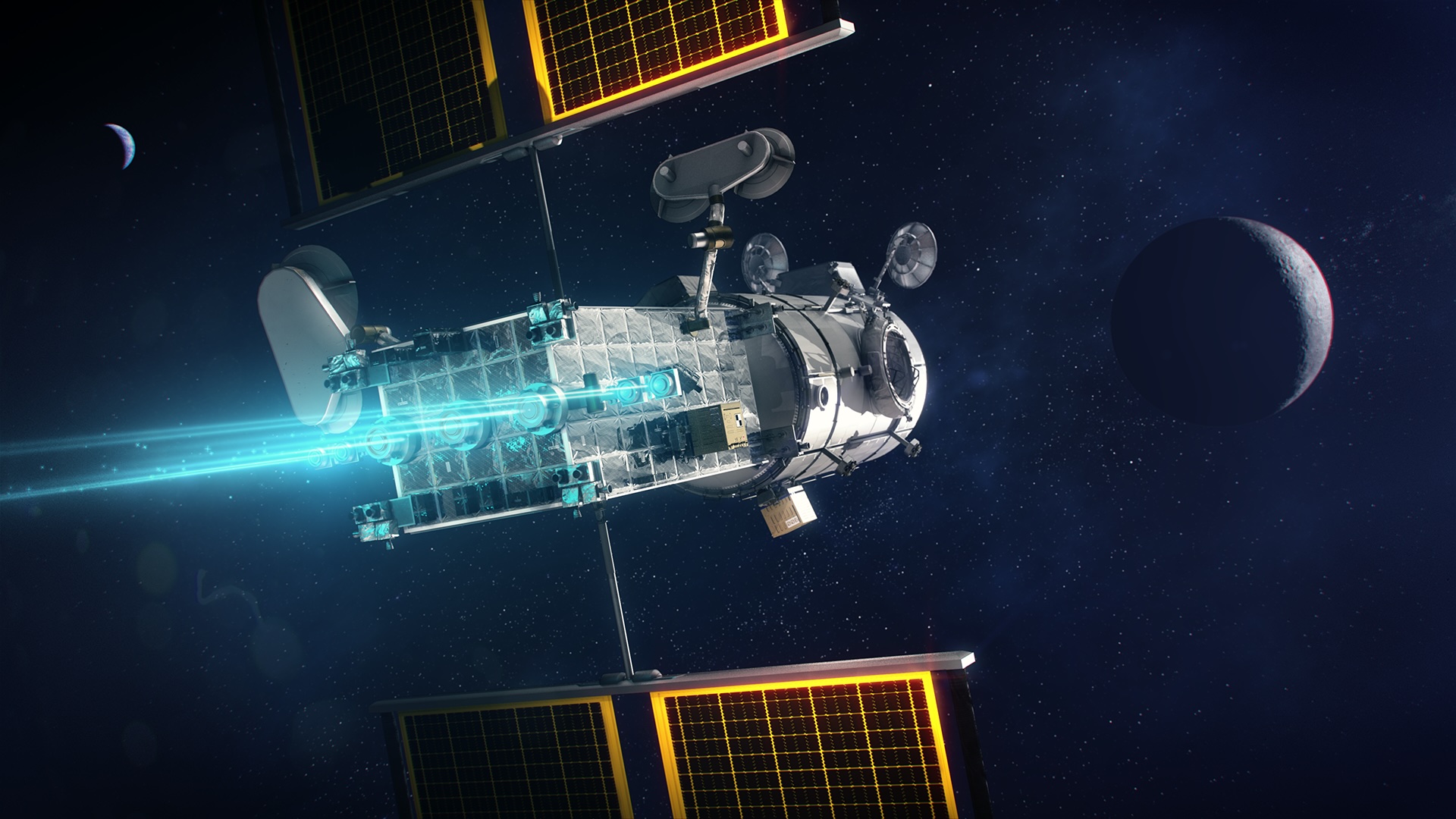
  • Artist’s impression of a solar electric propulsion system
  • Credit – NASA

{ https://www.universetoday.com/ }

Hoe vind je dit bericht?
Geschreven door peter om 23:32 Stuur door

There are Mysteries at Venus. It’s Time for an Astrobiology Mission

Venus-Craters-Magellan.jpg

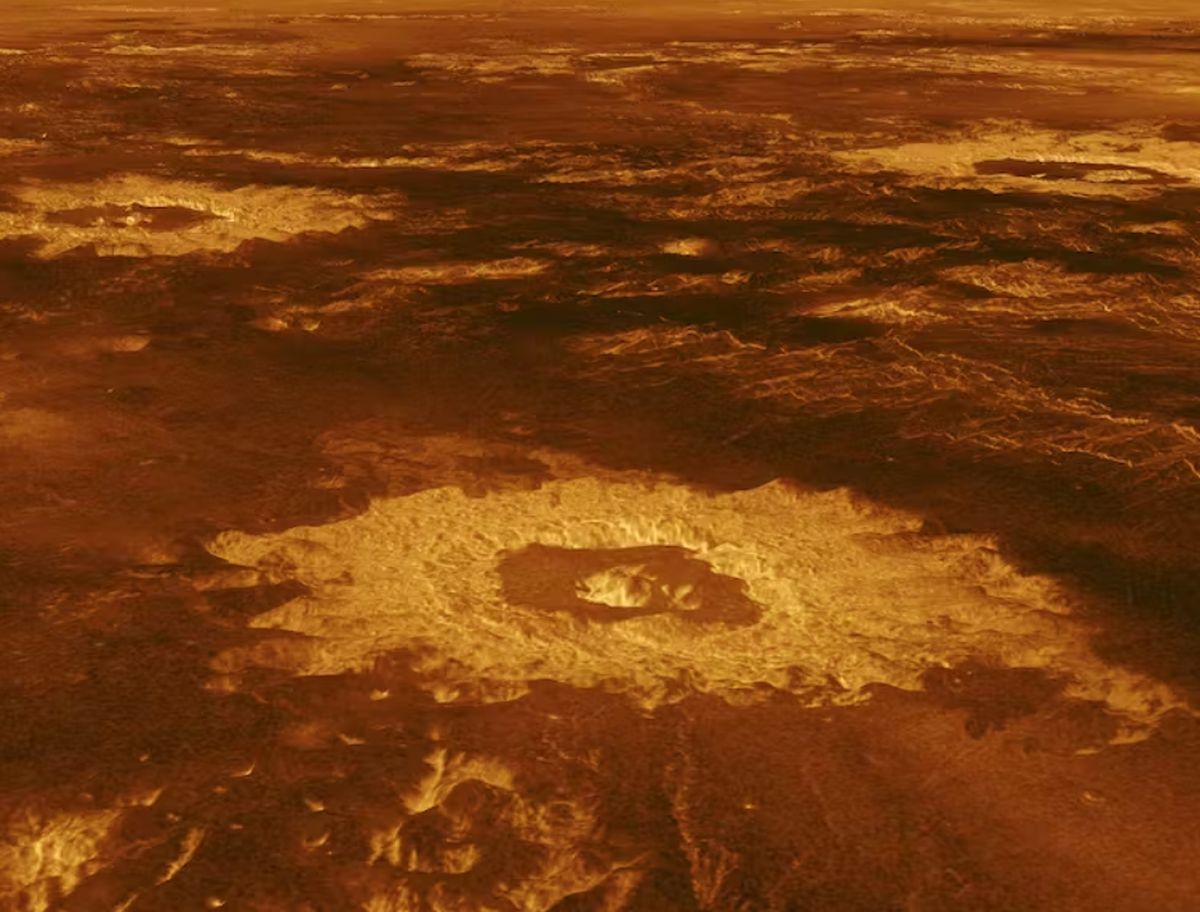
NASA's Magellan spacecraft captured this image of Venusian craters. Image Credit: NASA/JPL

There are Mysteries at Venus. It’s Time for an Astrobiology Mission

When scientists detected phosphine in Venus’ atmosphere in 2020, it triggered renewed, animated discussions about Venus and its potential habitability. It would be weird if the detection didn’t generate interest since phosphine is a potential biomarker. So people were understandably curious. Unfortunately, further study couldn’t confirm its presence.

But even without phosphine, Venus’ atmosphere is full of chemical intrigue that hints at biological processes. Is it time to send an astrobiology mission to our hellish sister planet?

While the phosphine discussion petered out pretty quickly, there are other, more long-lived indications that Venus’ atmosphere contains chemical anomalies, some of which might relate to life. Some of the atmospheric gases appear to be out of thermodynamic equilibrium, for example. Adding to the complexity, scientists aren’t certain what the composition of large particles in the lower atmosphere is.

The authors of a new paper illustrate why Venus captures our chemical curiosity and suggest that it’s time for an astrobiological mission to satisfy it.

The paper is “Astrobiological Potential of Venus Atmosphere Chemical Anomalies and Other Unexplained Cloud Properties.” It hasn’t been peer-reviewed and published yet, but it’s available on the preprint server arxiv.org. The lead author is Janusz Petkowski, an astrobiology researcher in the Department of Earth, Atmospheric and Planetary Sciences at MIT.

“Scientists have been speculating on Venus as a habitable world for over half a century,” the authors write, “based on the Earth-like temperature and pressure in Venus’ clouds at 48–60 km above the surface.”

Most space-interested people know that Venus’ atmosphere is extremely dense ant hot. We also know that it’s dominated by carbon dioxide, that its other main component is nitrogen, and that it supports dense clouds of sulfuric acid. Other chemicals are present in only tiny, trace amounts.

There's not much else to Venus' atmosphere beyond CO2 and a small component of nitrogen. The trace elements add up to less than one percent of the atmosphere. Image Credit: By Junkcharts - Own work, CC BY-SA 3.0, https://commons.wikimedia.org/w/index.php?curid=31595105

There’s not much else to Venus’ atmosphere beyond CO2 and a small component of nitrogen. The trace elements add up to less than one percent of the atmosphere. Image Credit: By Junkcharts – Own work, CC BY-SA 3.0, https://commons.wikimedia.org/w/index.php?curid=31595105

The atmospheric region between 48 to 60 km above the surface is particularly interesting. At that altitude, both the pressure and the temperature approach near Earth-like levels. Between about 52.5 km and 54 km, the temperature is between 20 °C and 37 °C.) At about 49.5 km above the surface, the pressure is the same as at Earth’s sea level. There’s no way that liquid water could be present on Venus’ surface, but in the atmosphere it’s possible.

That’s the backdrop for considering Venus’ potential habitability.

But there are ample chemical considerations, too, and in their paper, the authors outline one long-standing mystery in the planet’s atmosphere.

“In this paper, we review and summarize Venus’ long-lasting, unexplained atmospheric observations,
which have been acquired over the span of the last half-century,” they write.

A lot of the mystery around Venus concerns the so-called “unknown absorber(s).” As far back as the 1920s, ultraviolet observations showed unusual high-contrast features that move in conjunction with Venus’ upper cloud deck’s four-day rotation. Something is absorbing the UV light. “Much effort has gone into attempting to identify the substance(s) responsible for the absorption between 320–400 nm, but no proposed candidate satisfies all of the observational constraints, leading to the oft-used descriptive term ‘unknown UV absorber,'” the authors write.

Researchers have made a prolonged effort to understand what the absorber or absorbers might be, and some have made progress. Research has shown that sulphur allotropes and sulphur compounds could be responsible, and researchers have uncovered new pathways for their formation in Venus’ atmosphere. But these pathways are the result of simulations, not exploration. Not everyone agrees with these findings. There’s no consensus.

“Despite decades of effort and observations by two orbiting spacecraft in the 21st century (Venus Express
by ESA and Akatsuki by JAXA), none of the proposed candidate molecules have been found to entirely fit
the observational data,” the authors explain. The candidates either don’t match the profile well, or they’re not abundant enough. Some of the proposed candidates aren’t stable, either.

But it’s critical that we figure out what it is. “The unknown absorber is remarkably efficient, capturing more than 50% of the solar energy reaching Venus, with consequent effects on atmospheric structure and dynamics,” write the authors. Though the mystery persists, it’s a huge missing piece that stymies our efforts to understand the planet.

Some researchers propose that the UV absorber is a sign of cloud-based biological activity. “The spectral characteristics of the Venus clouds, including the strong UV absorption, are consistent with the spectrum of certain types of terrestrial bacteria,” the authors explain.

A composite image of the planet Venus as seen by the Japanese probe Akatsuki. The clouds of Venus could have environmental conditions conducive to microbial life. Credit: JAXA/Institute of Space and Astronautical Science

Another of the mysteries concerns lower clouds. A subset of cloud particles larger than 7 µm is unknown. Adding to the mystery is that some of them aren’t round. We know this from NASA’s Pioneer Venus mission. Since the particles, called Mode 3 particles, are non-spherical, they can’t be liquid droplets. “The nature and composition of the Mode 3 particles is debated with data presently in hand,” the authors write, making it clear that we need more data from a modern mission.

Some have proposed that the particles could be sulfuric acid, but the authors say data rules that out. If they’re not sulfuric acid, that works in favour of the idea that life could persist in the clouds. “This result could indicate unknown chemistry and is intriguing with regard to the possible presence of ‘life as we know it,’ which cannot withstand a concentrated sulfuric acid environment,” the authors explain.

It should be noted, however, that not all scientists agree that the large particles even exist and that calibration errors could be responsible for their detection instead.

The authors outline other reasons why only a biological mission to Venus can solve these mysteries. In-situ measurements from the Venera program and the VeGa balloons suggested that the atmosphere hosted non-volatile compounds necessary for life. Life as we know it requires metals, including iron. Venera found iron, while VeGa didn’t. More mystery waiting to be solved.

There are other unexplained components in Venus’ atmosphere. There are trace gases with abundance profiles that scientists can’t explain. Venera and Pioneer also found oxygen there. Nobody knows where it came from, and it’s a subject of frequent discussion. Other chemical detections add to the mystery and complexity.

The maddening thing about studying Venus from afar is that many of the observations could be explained by either biotic or abiotic processes. That’s why we need a biological mission.

NASA's upcoming DAVINCI mission will send an orbiter and an atmospheric probe to Venus sometime in the 2030s. Image Credit: NASA

NASA’s upcoming DAVINCI mission will send an orbiter and an atmospheric probe to Venus sometime in the 2030s. Image Credit: NASA

“The habitability of the Venusian clouds should also be explored by new in situ missions,” the author explains. Lots of scientists agree with them, including renowned planetary scientist Sara Seager. In fact, Seager goes even further, suggesting that a sample-return mission is needed.

There are missions to Venus coming in the future. NASA’s VERITAS mission and DAVINCI mission will both head to Venus, but not for several more years. DAVINCI will send a probe into Venus’s atmosphere for in situ observations, while VERITAS will map the surface in more detail.

In the meantime, the data we have is all the data scientists have to work with. While scientists are resourceful and determined, that’s not enough.

Only a mission to Venus that’s solely focused on biology and chemistry can solve the planet’s mysteries.

{ https://www.universetoday.com/ }

Hoe vind je dit bericht?
Geschreven door peter om 22:47 Stuur door

The Meteorites That Made Earth Were Filled With Water

Water's Early Journey in a Solar System

New research suggests that Earth's building blocks included water from the beginning. Credit: NASA/JPL-Caltech

POSTED 

Sample from a rare meteorite family revealing that its parent planetesimal had a layered structure with a molten core and solid crust (similar to Earth). Credit: Carl Agee, Institute of Meteoritics UNM/MIT

Grewal and his colleagues specialize in studying the chemical signatures of iron meteorites to gather information about the early Solar System. These meteorites are remnants of the metallic cores of the first planetesimals that did not accrete to form a planet and continue to orbit within our Solar System today. Over many eons, some of these objects fell into Earth’s gravity well and ultimately crashed to the surface. The chemical composition of these meteorites is of particular interest since it reveals a great deal about the environments in which they formed.

For one thing, the composition of planetesimals can reveal whether they (and Earth) formed closer to or farther away from the Sun. If the former scenario were the case, cooler conditions would have allowed Earth to retain water ice as a building block. If the latter is correct, Earth would have formed dry and obtained its water by some other means later on, which is what current astrophysical models suggest. According to these models, water was delivered to the inner Solar System via comets and asteroids billions of years ago, a period known as the Late Heavy Bombardment.

While water is no longer present in these meteorites, scientists can infer its existence from the presence of other elements. These include iron oxide (FeO), which occurs when iron is oxidization by exposure to water. A sufficient excess of water will drive the process further, creating ferric oxide (Fe2O3) and ferric oxyhydroxide, or FeO(OH) – the ingredients of rust. While the earliest planetesimals would have lost all traces of iron oxide long ago, Grewal and his team were able to determine how much was present by examining the metallic nickel, cobalt, and iron contents of these meteorites.

These three elements should be present in roughly equal ratios relative to other materials in the meteorite, which means that any “missing” iron would have been depleted through oxidation. As Asimow explained in a Caltech news release:

“Iron meteorites have been somewhat neglected by the planet-formation community, but they constitute rich stores of information about the earliest period of Solar System history, once you work out how to read the signals. The difference between what we measured in the inner solar system meteorites and what we expected implies an oxygen activity about 10,000 times higher.”

Artist concept of Earth during the Late Heavy Bombardment period.

Credit: NASA’s Goddard Space Flight Center.

The team’s results indicate that meteorites believed to have originated in the inner Solar System had roughly the same amount of missing iron as meteorites from the outer Solar System. This suggests that both groups formed in a part of the Solar System where conditions were cool enough for water. It further implies that planets accreted water from the beginning, which could have profound implications for theories of how life emerged on Earth. “If water was present in the early building blocks of our planet, other important elements like carbon and nitrogen were likely present as well,” said Grewal. “The ingredients for life may have been present in the seeds of rocky planets right from the start.”

This represents a significant challenge for our current models for how the Solar System formed and evolved, which could indicate that conditions in the early inner Solar System were much cooler than previously thought. The results could also mean that Earth and its fellow rocky planets formed farther from the Sun and gradually migrated to their current orbits. However, as Asimow acknowledged, there is a degree of uncertainty when it comes to the study of ancient planetesimals, which means the results may not contradict current astrophysical models:

“However, the method only detects water that was used up in oxidizing iron. It is not sensitive to excess water that might go on to form the ocean. So, the conclusions of this study are consistent with Earth accretion models that call for late addition of even more water-rich material.”

Their study, titled “Accretion of the earliest inner Solar System planetesimals beyond the water snowline,” recently appeared in Nature Astronomy. Their research was made possible thanks in part to funding provided by NASA and through a Barr Foundation Postdoctoral Fellowship.

Further Reading: 

{ https://www.universetoday.com/ }

Hoe vind je dit bericht?
Geschreven door peter om 22:11 Stuur door

The Baltic Sea Anomaly and Theories of Underwater Alien Bases

The Baltic Sea Anomaly and Theories of Underwater Alien Bases

Baltic Sea Anomaly, Atlantis, and Underwater Alien Bases

In the realm of oceanic mysteries, the Baltic Sea Anomaly and the concept of underwater alien bases stand out as topics that ignite the imagination and provoke curiosity. With vast expanses of our oceans unexplored, these subjects represent a frontier of unknowns, blending the lines between scientific inquiry and the allure of the unexplained.

The Baltic Sea Anomaly: A Mysterious Discovery 

In 2011, the Baltic Sea Anomaly captured global attention when Ocean X, a team of Swedish treasure hunters, discovered a strange, 60-meter long, and 40-meter wide object at the bottom of the Northern Baltic Sea. Initially, sonar images revealed an object with an appearance reminiscent of a spacecraft, stirring up a whirlwind of speculation and excitement.

Scientific Analysis and Theories: 

The initial excitement gave way to a range of theories. Geological experts suggested the anomaly could be a glacial deposit or a natural geological formation. The structure’s composition, primarily volcanic rock, further supported non-extraterrestrial origins. However, alternative theories persisted, fueled by the object’s peculiar shape and the enigmatic trails leading up to it, suggesting an unnatural descent to its current resting place.

Underwater Alien Bases: A Theoretical Possibility 

Parallel to the Baltic Sea Anomaly, the concept of underwater alien bases has been a subject of intrigue. This theory posits that intelligent extraterrestrial beings could be using the Earth’s vast and unexplored underwater regions as bases. Proponents of this idea point to numerous historical accounts and modern-day sightings of Unidentified Submerged Objects (USOs) as potential evidence.

Evidence and Speculation: 

While the idea of underwater bases is largely speculative, it draws on various incidents and eyewitness accounts. These include anomalous readings and unexplained phenomena in areas like the Bermuda Triangle, reported sightings of underwater crafts by naval personnel, and historical accounts of mysterious lights and objects emerging from the sea. However, concrete evidence supporting the existence of such bases remains elusive.

VIDEO:

The Baltic Sea Anomaly and theories of underwater alien bases represent a fascinating intersection of science and the uncharted territories of our oceans. As we continue to explore and understand our oceans, it’s possible that these mysteries will either be unraveled or deepen, reminding us of the vast unknowns that still lie beneath the waves. The quest for knowledge and understanding of these phenomena continues, as does the allure of the great unknown beneath the seas.

{ https://www.latest-ufo-sightings.net/ }

Hoe vind je dit bericht?
Geschreven door peter om 20:54 Stuur door

NASA stelt "opvolger van de Concorde" voor: vliegen door de geluidsmuur, zonder storende luide knal

NASA stelt "opvolger van de Concorde" voor: vliegen door de geluidsmuur, zonder storende luide knal

Artikel door Wim De Maeseneer

De X-59 is vanavond voor de eerste keer voorgesteld aan het grote publiek tijdens een officiële ceremonie. Het was vooral uitkijken naar het moment dat het nieuwe, supersonische vliegtuig uit de hangar reed van Lockheed Martin in Palmdale in Californië.

De X-59 is 30 meter lang, 9 meter breed en kan tot 1.500 kilometer per uur vliegen, op een hoogte van 16,7 kilometer. De lange neus heeft tot gevolg dat de piloot geen zicht heeft op de voorkant van het vliegtuig.

De voorruit van de cockpit is dan ook vervangen door een scherm. Daarop wordt het beeld getoond van een camera die aan de neus hangt samen met grafische elementen.

NASA stelt "opvolger van de Concorde" voor: vliegen door de geluidsmuur, zonder storende luide knal

NASA stelt "opvolger van de Concorde" voor: vliegen door de geluidsmuur, zonder storende luide knal
© NASA

De X-59 is nog een prototype. Het is dus niet bedoeld om er ooit echt passagiers mee te vervoeren. Het vliegtuig moet bewijzen dat sneller vliegen dan het geluid ook kan zonder de luide knallen die daarbij horen.

Als een vliegtuig sneller vliegt dan het geluid (zo'n 1.200 kilometer per uur) dan haalt het de geluidsgolven in die het zelf produceert. De golven kunnen zich niet meer verspreiden en verzamelen zich voor het vliegtuig, tot het moment dat er een schokgolf en bijhorende luide knal ontstaat. 

De oplossing zit in de neus. De X-59 heeft een lange, scherpe neus van wel 11 meter lang. Die zou de knal zodanig verminderen dat je aan de grond enkel nog het geluid van een dichtslaande autodeur hoort.

Het is nog wachten op de eerste testvlucht, maar eens die achter de rug is, wil NASA het vliegtuig over woonwijken laten vliegen om te onderzoeken of inwoners het geluid effectief als minder storend ervaren. Dat zou kunnen helpen om ooit weer supersonische passagiersvliegtuigen over bewoonde gebieden te laten vliegen, iets wat momenteel in veel landen verboden is. 

Brussel - New York in minder dan 4 uur?

Sneller vliegen dan het geluid is iets waar luchtvaartmaatschappijen en reizigers wel vaker van dromen. Een vlucht van Brussel naar New York zou geen 7 of 8 uur meer duren, maar 4 uur of zelfs minder. Toch is er tot op vandaag slechts één commercieel passagiersvliegtuig die dat ooit gekund heeft: de legendarische Concorde.

Die vloog sinds 1976, kon twee keer sneller vliegen dan het geluid, maar maakte nooit winst. De vluchten waren enorm duur en door de luide knallen mocht de Concorde ook enkel boven de zee supersonisch vliegen. Er werden uiteindelijk maar 20 toestellen gebouwd, waarvan een kwart prototypes.

De doodsteek voor Concorde kwam op 25 juli 2000, toen een toestel van Air France met 100 passagiers crashte tijdens het opstijgen. 

Sindsdien is een opvolger voor de Concorde al vaak aangekondigd en even vaak zijn de plannen weer in de koelkast beland. Toch is het iets waar verschillende vliegtuigfabrikanten nog steeds mee bezig zijn. Misschien kan de X-59 een doorbraak betekenen.

Op 25 juli 2000 vatte een Concorde van Air France vuur tijdens het opstijgen in Parijs. Alle 100 passagiers en 9 bemanningsleden kwamen om het leven.

Op 25 juli 2000 vatte een Concorde van Air France vuur tijdens het opstijgen in Parijs. Alle 100 passagiers en 9 bemanningsleden kwamen om het leven
© AP/Toshihiko Sato
Hoe vind je dit bericht?
Geschreven door peter om 18:45 Stuur door

Bizarre footage shows several UFOs hovering above Philadelphia in a cluster as two craft are seen 'merging together' - days after Miami '10ft alien' sighting incident forced police to respond to conspiracy claims

Bizarre footage shows several UFOs hovering above Philadelphia in a cluster as two craft are seen 'merging together' - days after Miami '10ft alien' sighting incident forced police to respond to conspiracy claims

  • New footage shows a cluster of UFOs floating in the sky
  • The video was captured in Philadelphia
  • Two of the mysterious flying objects were caught 'merging together' 

Mysterious footage shows a group of UFOs flying above Philadelphia - with two of the crafts even strangely merging together. 

A witness uploaded the bizarre video of the sighting on Reddit and described the large cluster of lights as 'spinning and darting back and forth.'

The user said the multicolored lights were flying 'very high' above Philadelphia. 

Footage of the peculiar sighting was very shaky, which the witness said was because their wife couldn't stop the car, so the mysterious objects were unclear. 

A different Reddit user joked 'next time you see UFO's in the sky, please, politely, tell your wife to STOP THE F***ING CAR!'

Mysterious footage shows a group of UFOs flying above Philadelphia - with two of the crafts even strangely merging together

Mysterious footage shows a group of UFOs flying above Philadelphia - with two of the crafts even strangely merging together

A witness uploaded the bizarre video of the sighting on Reddit and described the large cluster of lights as 'spinning and darting back and forth'

A witness uploaded the bizarre video of the sighting on Reddit and described the large cluster of lights as 'spinning and darting back and forth'

The user said the multicolored lights were flying 'very high' above Philadelphia

UFO sightings are also being reported internationally. Hikers in Brazil managed to get a video of two creatures they claimed are aliens.

Eyewitness Sara Dalete of Brasília spotted the bizarre figures while she was with her family in Ilha do Mel.

Footage of the elongated 10-foot-tall figures has gone viral on X (formerly Twitter) and Instagram.

The mysterious figures stood on a hilltop that Dalete said 'wasn't possible to reach the top.'

Both of them were moving their arms quickly but remained standing on the hilltop during the entire video.

This is the first suspected sighting of aliens in Ilha do Mel in Brazil history. 

The New York Times in 2020 exposed the Pentagon's ongoing U.F.O unit - where officials continue to study mysterious interactions between UFOs and military pilots. 

Following the groundbreaking revelation - a House Oversight subcommittee held a hearing on UFOs in July 2023.

Three former military officials told congress in the hearing that the government knows much more about UFOs than they let on to the public.

During the hearing - a former intelligence officer suggested people have been murdered by the US government as part of the conspiracy to keep UFOs a secret in a bombshell hearing held by Congress.

David Grusch - a former high-ranking intelligence official - is one of three military whistleblowers who testified under oath that they had firsthand encounters or knowledge about secret government programs involving technology that is 'non-human.'

He claimed that the US has been in possession of UFOs since 'the 1930s' and has been secretly back-engineering them and carrying out a public disinformation campaign to prevent the details from leaking publicly.

At one point during the first-of-its-kind hearing, Representative Tim Burchett (R-Tenn) asked Grusch: 'Personally, have you heard anyone [has] been murdered?' Grausch said: 'I have to be careful answering that question. I directed people with that knowledge to the appropriate authorities.'

House Oversight Committee members are set to undergo a classified briefing on Unidentified Anomalous Phenomena (UAP), commonly known as UFOs, this week.

The covert meeting, shrouded in mystery, underscores a surging interest among lawmakers from both ends of the spectrum that are demanding increased government transparency on the extraterrestrial front.

The briefing, scheduled for Tuesday morning in the Office of House Security, will be conducted by the Office of Inspector General of the Intelligence Community, Thomas A. Monheim.

{ https://www.dailymail.co.uk/ }

Hoe vind je dit bericht?
Geschreven door peter om 22:05 Stuur door

Floating 'Jellyfish' UFO haunted US military base in Iraq for years, says former US Marine intelligence analyst shown infrared video by colleagues ex-Marine broke his silence on a 2017 UFO that became 'ghost story of the base' The ex-intel analyst stated

Floating 'Jellyfish' UFO haunted US military base in Iraq for years, says former US Marine intelligence analyst shown infrared video by colleagues

  • ex-Marine broke his silence on a 2017 UFO that became 'ghost story of the base'
  • The ex-intel analyst stated that 'the theories that we had ... didn't fully explain it'
  • READ MORE: Retired US Army Colonel says secret UFO projects should be made public by October 2030 - to beat US rivals and get ahead of a 'catastrophic' leak

A former intelligence analyst with the United States Marine Corps has revealed how a jellyfish UFO terrorized military personnel for years in Iraq.

Video emerged this week showing what looked  looked like a craft with dangling appendages gliding invisibly over the secure facility, where it could only be seen on infra-red cameras.

It joins years of new military UFO cases including giant red cube-shaped UFOs, zipping Tic Tacs, and allegations made under oath about secret and illegal UFO crash retrieval and reverse-engineering programs.

'It kind of just ended up being like the ghost story of the base,' Michael Concoski, then stationed at a base in Iraq, told cable channel News Nation last evening. 

'It didn't seem to be posturing to threaten us at all,' Cincoski said, but added that the base was not taking any chances during this highly unusual nighttime encounter.

And, today, Cincoski revealed that he has heard from a fellow Marine 'team member' who saw 'multiple recordings of the 'Jellyfish UAP' with different durations' in Iraq. 

United States Marine Corps veteran Michael Cincoski (above), who had been an intelligence surveillance reconnaissance tactical controller in Iraq at the base where the 2017 'jellyfish' UFO sighting took place, came forward to discuss the incident with News Nation last night

United States Marine Corps veteran Michael Cincoski (above), who had been an intelligence surveillance reconnaissance tactical controller in Iraq at the base where the 2017 'jellyfish' UFO sighting took place, came forward to discuss the incident with News Nation last night

Cincoski revealed today that he has heard from a fellow Marine 'team member' in Iraq about more cases - saw 'multiple recordings of the 'Jellyfish UAP' with different durations'

Cincoski revealed today that he has heard from a fellow Marine 'team member' in Iraq about more cases - saw 'multiple recordings of the 'Jellyfish UAP' with different durations'

'Some of the Marines were tasked to try to find it on night vision,' he said. 'They were looking for it with their other sensors and everything else that we had.' 

Cincoski also revealed that he had seen the full 17-minute version of the thermal imaging video which tracked the 'unidentified anomalous phenomena' (UAP), as UFOs are now more accurately known, as it appeared to glide over the base toward Lake Hibernia in Iraq's Anbar province.

Top spy watchdog Thomas Monheim (above), the US Intelligence Community's Inspector General, is slated to brief the House Oversight Committee on UFOs today

'They were watching it to make sure that it wasn't a threat,' said Cincoski, who'd been an intelligence surveillance reconnaissance tactical controller at the base, in an interview with journalist Brian Entin of News Nation's Elizabeth Vargas Reports.

The former marine told Entin that the infrared video was captured in 2017 and had been shown to him by fellow USMC servicemen when he arrived at the base in 2018.

Cincoski told Entin that the leaked video had been taken with an aerostat, a blimp-like craft equipped with cameras and other sensors to look out for potential threats over the base.

Tethered Aerostat Radar Systems are used by the US military to hunt for drug traffickers, beam US television signals into Cuba, conduct reconnaissance and more, according to the Federation of American Scientists.

After 17 minutes, Cincoski said, the 'jellyfish' or 'spaghetti monster' UAP vanished over Lake Hibernia. 

'They couldn't find it,' Cincoski told News Nation in a remote interview. 

'They kept an eye out,' he said, 'but it wasn't like we were scrambling to our defensive positions or anything like that.' 

From then on, as the story circulated across the US Marine base in Iraq, the ghostly sighting remained, as he put it, 'a big unknown.'

'The theories that we had [...] didn't fully explain it,' Cincoski confessed. 

Senior national correspondent for News Nation, Brian Entin, reported that the cable network had reached out the Pentagon for comment multiple times over several days.

'We were able to confirm that that Marine is who he says he is,' Entin said. 

'They [the Pentagon] acknowledge that we have been reaching out but have not responded with specifics about this video or confirmed the video in any way,' he told viewers

Shocking new UFO footage has revealed a 'jellyfish' craft that isn't visible to the naked eye, which was allegedly buried by the intelligence community

Shocking new UFO footage has revealed a 'jellyfish' craft that isn't visible to the naked eye, which was allegedly buried by the intelligence community

The UFO was supposedly submerged in water for 17 minutes in the footage - before it's launched out of the water at rapid speed, according to documentary filmmaker Jeremy Corbell

The UFO was supposedly submerged in water for 17 minutes in the footage - before it's launched out of the water at rapid speed, according to documentary filmmaker Jeremy Corbell

Two different angles of the Jellyfish UFO show the mysterious entity as it flies over the land and water of a military base, according to sources who Corbell reports 'risked getting it' to him

Two different angles of the Jellyfish UFO show the mysterious entity as it flies over the land and water of a military base, according to sources who Corbell reports 'risked getting it' to him

The leaked USMC footage of what some have called the 'jellyfish' craft, was first made public by UFO documentary filmmaker and cohost of the Weaponized podcast Jeremy Corbell.

Corbell said that the legitimacy of the footage was confirmed to him by sources who 'risked getting it' to him. 

Two different angles of the apparent aircraft, according to Corbell's sources, show a mysterious entity as it flies over the land and water of a military base. 

The 'jellyfish' craft, these sources said, could only be seen on thermal camera.

Corbell's bombshell revelations came as part of his exposé - TMZ Presents: UFO Revolution. In the documentary, Corbell spearheads the investigation which believes will 'lift the lid on the biggest cover-up in the history of the world.'

The filmmaker is 'passionate about getting to the bottom of what UFOs mean to humanity.'

TMZ's documentary is propitiously times, coming just ahead of House Oversight Committee members' plans for a classified briefing on Unidentified Anomalous Phenomena (UAP) today in Congress.

The covert meeting, shrouded in mystery, underscores a surging interest among lawmakers from both ends of the spectrum that are demanding increased government transparency on the extraterrestrial front.

The briefing will be conducted by the Office of Inspector General of the Intelligence Community, Thomas A. Monheim.

{ https://www.dailymail.co.uk/ }

Hoe vind je dit bericht?
Geschreven door peter om 21:48 Stuur door

Record-Breaking Fast Radio Burst Localized to Extremely Distant Galaxy Group

Record-Breaking Fast Radio Burst Localized to Extremely Distant Galaxy Group

A fast radio burst event called FRB 20220610A flashed in what seems like an unlikely place: a collection of at least seven galaxies that existed when the Universe was only 5 billion years old. The large majority of previous fast radio bursts have been found in isolated galaxies.

This Hubble image shows the host galaxy of the exceptionally powerful fast radio burst FRB 20220610A. Image credit: NASA / ESA / STScI / Alexa Gordon, Northwestern University.

This Hubble image shows the host galaxy of the exceptionally powerful fast radio burst FRB 20220610A.

Image credit: NASA / ESA / STScI / Alexa Gordon, Northwestern University.

FRB 20220610A was first detected on June 10, 2022, by the Australian Square Kilometer Array Pathfinder (ASKAP) radio telescope in Western Australia.

ESO’s Very Large Telescope confirmed that the FRB came from a distant place. The FRB was four times more energetic than closer FRBs.

“It required Hubble’s keen sharpness and sensitivity to pinpoint exactly where the FRB came from,” said Dr. Alexa Gordon, an astronomer at Northwestern University.

“Without Hubble’s imaging, it would still remain a mystery as to whether this was originating from one monolithic galaxy or from some type of interacting system.”

“It’s these types of environments — these weird ones — that are driving us toward better understanding the mystery of FRBs.”

Fast Radio Burst in Compact Galaxy Group

Astronomers used the Hubble Space Telescope to trace a fast radio burst back to a compact group of at least seven galaxies.

Space Telescope Science Institute

Hubble’s crisp images suggest FRB 20220610A originated in an environment where there may be as many as seven galaxies on a possible path to merging, which would also be very significant.

“We are ultimately trying to answer the questions: What causes them? What are their progenitors and what are their origins?” said Northwestern University astronomer Wen-fai Fong.

“The Hubble observations provide a spectacular view of the surprising types of environments that give rise to these mysterious events.”

Despite hundreds of detected FRBs, their progenitors are uncertain; one leading candidate is magnetars.

They have a magnetic field that is so strong that, if a magnetar was located halfway between Earth and the Moon, it would erase the magnetic strip on everyone’s credit card in the world.

Much worse yet, if an astronaut traveled within a few hundred miles of the magnetar, they would effectively be dissolved, because every atom in their body would be disrupted.

Possible mechanisms involve some kind of jarring starquake, or alternatively, an explosion caused when a magnetar’s twisting magnetic field lines snap and reconnect.

A similar phenomenon happens on the Sun, causing solar flares, but a magnetar’s field is a trillion times stronger than the Sun’s magnetosphere.

The snapping would generate an FRB’s flash, or might make a shock wave that incinerates surrounding dust and heats gas into plasma.

There could be several flavors of magnetars. In one case, it could be an exploding object orbiting a black hole surrounded by a disk of material.

Another alternative is a pair of orbiting neutron stars whose magnetospheres periodically interact, creating a cavity where eruptions can take place.

It’s estimated that magnetars are active for about 10,000 years before settling down, so they would be expected to be found where a firestorm of star birth is taking place. But this doesn’t seem to be the case for all magnetars.

In the near future, FRB experiments will increase their sensitivity, leading to an unprecedented rate in the number of FRBs detected at these distances.

“We just need to keep finding more of these FRBs, both nearby and far away, and in all these different types of environments,” Dr. Gordon said.

  • The astronomers presented the findings at AAS243, the 243rd meeting of the American Astronomical Society in New Orleans, Louisiana, the United States.
  • Alexa Gordon et al. 2024. Revealing the Environment of the Most Distant FRB with the Hubble Space Telescope. AAS243, abstract #3679

{ https://www.sci.news/ }

Hoe vind je dit bericht?
Geschreven door peter om 21:29 Stuur door

Corbell’s Jellyfish UAPs Are Real: ‘Giant Black Jellyfish’ Object Filmed By Cruise Ship Captain In 2020 That Plunged Into Ocean

Jellyfish UAP

Corbell’s Jellyfish UAPs Are Real: ‘Giant Black Jellyfish’ Object Filmed By Cruise Ship Captain In 2020 That Plunged Into Ocean

A significant surge of interest has surrounded the UAP (Unidentified Aerial Phenomenon) enigma, drawing widespread attention to the recently released “JELLYFISH” UAP footage. Filmmaker Jeremy Corbell unveiled this captivating footage of a peculiarly-shaped UAP, captured at a United States joint operations base in Iraq. Corbell remarked that while the object’s shape is unusual, such sightings have been reported since the beginning of the UFO phenomena. Confirming its authenticity, the Pentagon has officially stated that the object in the video is not a hoax.

Corbell released FLIR infrared footage depicting an incursion by an unidentified object, tracked over a significant duration in October 2018. He elaborated, stating, “The object navigated through a sensitive military installation, eventually moving over a body of water where it executed a controlled descent, submerging beneath the surface. After an observation period of approximately seventeen minutes, the UAP resurfaced from the water and rapidly accelerated, surpassing the capabilities of the observation platform’s optical scope. The origin, intent, and capabilities of this Anomalous Aerial Vehicle remain shrouded in mystery. It retains its official designation as a UAP.”

The UAP shows transmedium capabilities: It flew over the military base and then moved over water. It descended into the water in a controlled manner and disappeared for about seventeen minutes. After that, it came out of the water and quickly flew away at an incredibly high speed that the observers could not keep up with.

The eyewitness explained that the object was hard to see with normal night vision equipment, and it seemed to block the camera’s ability to focus on it. Even though it did not look like it had typical engines or wings, it could stay in the air and move around.

When Matthew Szydagis, a professor in the Physics department at University at Albany first observed the footage, he was struck by the unusual shape of the UAP. He likened it to a Star Wars droid, emphasizing that “It is not a standard or common shape of UAP.” Dr. Szydagis published his new paper, “Initial Results From the First Field Expedition of UAPx to Study Unidentified Anomalous Phenomena” and provided scientific expertise on speculation about UAP propulsion systems. (Source)

According to Dr. Szydagis, one of the most intriguing aspects of the object in the footage is the rapid change in the object’s color, suggesting a swift alteration in temperature. He points out that known objects do not change temperature so quickly. This phenomenon raises a couple of possibilities.

Some might argue that the rapid temperature change merely results from an issue with the camera, like a smudge or distortion on the lens. However, Dr. Szydagis dismisses this possibility after closely examining the footage. He notes that the object’s size changes as the camera zooms in and out, and the camera reticle shifts relative to the object. The other possibility Dr. Szydagis considers is that the object might have capabilities to manage its signatures. This leads to further questions about why such an entity would choose to reveal itself in such a manner.

Newsnation writes, “The object moved through a sensitive military installation before moving over water, where it began what Corbell describes as a controlled descent before submerging. After 17 minutes, the UAP reemerged from the water and disappeared at a high rate of speed. The video released by Corbell did not include that.”

While Dr. Szydagis acknowledges that initial impressions might suggest a simple explanation, like a smudge on the camera lens, he stresses the importance of considering all available evidence. He emphasizes that without additional context, including more footage from various angles and a deeper understanding of the event’s circumstances, drawing definitive conclusions remains challenging.

“Well, the change in color, which normally could represent a temperature change, may be an artifact of the camera and the system. We don’t know yet what this is. There are so many pieces of the puzzle that have yet to be confirmed. This is very early days, so I don’t want to say about the temperature change. And again, with the transmedium travel so far, the only bit of this video that I’ve seen is the bit that you’re showing now. I have yet to see the part where it apparently goes into the water and comes out, but if that is what people are saying it is. That is certainly something to watch. And it’s one of these so-called five observables, this apparent ability to move seamlessly between water and air that we hear about. And that is noteworthy for sure if it’s verified. Right.”- Nick Pope, Former MoD ‘UFO adviser’ (Source)

Corbell had a conversation with the sources from where he learned that the UAP considered potentially hostile due to a potential payload, could not be locked onto, and the platform appeared to have been jammed.

He told Liberation Times, “If UAP are able to penetrate our sensitive military installation with impunity – disabling our primary targeting and defense platforms – we must consider the role stigma and secrecy have played in corroding our ability to acknowledge and respond to such threats.”

Jellyfish UAP is not a traditional shaped UAP but there are sightings of such unusual objects. In 2020, Captain Kate McCue of the Celebrity Edge cruise ship saw a similar UFO hover over her ship for a few moments, then described as the jellyfish-shaped UFO plunged directly into the ocean. (Source)

“. . . and I have a drone on board, so I thought it would be a good night to catch a sunset. I had a drone in my hand, and someone said: ‘what’s that?’ and we look up and there was – I put it on TikTok – it looked like a black jellyfish, a gigantic back jellyfish, and it sailed right over the retreat, directly through the center-line of the ship, right through the center line of the ship, right through our “X” in our stack and just floated though. The thing is, we had no wind, maybe 5 knots at the time, but this thing was cruising along about 10-15 miles per hour, just cruised right over, and as its passed the stern of the ship, it went a couple hundred meters, maybe three or four hundred meters, and then it started to descend into the water. But because it was sunset we couldn’t put a rescue boat down to see what it was, but it disappeared into the water, and we had no idea . . . it wasn’t a drill, there was no noise associated with it. So if you want to see our UFO, it was on TikTok.”

According to an earlier report by the Scotsman, Harrier jets engaged in a dogfight with a “bright light” above the Queen’s Highland home at Balmoral, and a glowing white ball “like a flying jellyfish” was spotted over East Kilbride. These sightings were reported in 2002 and 2006.

Corbell has been talking about UFOs being shot down by the militaries around the globe. He said that people often get upset with him when he says that UAPs are continuously being fired upon. During his podcast with Joe Rogan, Corbell revealed a lot of shocking information about UFOs that have been monitored by the US military over their airspace.

Read also:

The jellyfish UAP constitutes the fourth piece of footage provided by Corbell and Knapp, showcasing objects of unknown origin captured by military platforms in Syria and Iraq. Other instances include the Baghdad Phantom, the Mosul Orb, and the Syria ‘Dome’ UAP.

Corbell told Liberation Times, “The UFO reality is an uncomfortable truth – and it’s time to bring this issue fully into the light. The public has an inherent right and need to know – the truth about what UFOs represent to humanity and we must approach it head-on.”

According to Corbell, the Five Eyes report was published months after the incident occurred and indicates that on 14 December 2021, an RAF Typhoon jet shot at one UAP using an ASRAAM missile. At the time, the incident was reported as the first enemy aircraft shot down by the RAF since the Falklands War in Argentina more than 40 years ago.

Corbell stated that Centcom (United States Central Command) has been tracking UAP for over 15 years, and the frustration lies in the lack of proper reporting and handling of these incidents within the chain of command. He noted that in conflict zones, there is a tendency to shoot at anything within a certain proximity to ground troops or bases, especially if it appears to have a payload. However, the issue arises in the lack of recovery or proper handling after such engagements.

{ https://www.howandwhys.com/ }

Hoe vind je dit bericht?
Geschreven door peter om 21:15 Stuur door

Ancient face on Mars, this is what intelligent aliens look like, UFO Sighting News.

Ancient face on Mars, this is what intelligent aliens look like, UFO Sighting News.

UAP,%20%E0%A4%89%E0%A4%AB%E0%A5%8C%20,%20%E0%A6%87%E0%A6%89%E0%A6%8F%E0%A6%AB%E0%A6%93,%20%C4%91i%CC%83a%20bay,%20MUFON,%20%E7%9B%AE%E6%92%83%E3%80%81%E3%82%A8%E3%82%A4%E3%83%AA%E3%82%A2%E3%83%B3,%20%20UFO,%20UFOs,%20%D0%9D%D0%9B%D0%9E%20,%20NLO,%20sighting,%20sightings,%20anomalies,%20ancient,%20astrobiology,%20.png
Date of discovery: Jan 11, 2024
Location of discovery: Mars
NASA photo: 
Look carefully at this hill top and you will notice that an ancient face of an intelligent alien species is looking upward. The detail is so-so, but I've seen much worse sculptures of faces in museums and paintings. This is however on Mars, so it's more important. Faces tell us who made them. Faces tell us what they looked like and when we see the face we quickly realize...they are not so different from us. Not so scary as the movies and gov would like to make us believe. They look relaxed, calm, majestic and proud. Reminds me us. 
 
Have you  all heard about all the pentagon meetings and discussions about UFOs and aliens in the news recently? They are calling the most important eyewitnesses in the world, however, they are avoiding me. They know that my site, my decades of hands on research is too much for congress, the pentagon or any NASA meeting. They only want to ask UFO researchers that are a joke, and not hard core serous like me. So no...don't expect any real answers from the US gov anytime soon.
Scott C. Waring 

ET,%20UFO,%20UFOs,%20%20alien,%20aliens,%20W56,%20SOHO,%20NASA,%20solar,%20LASCO,%20top%20secret,%20news,%20paranormal,%20tech,%20science,%20astronomy,%20%20.jpg

{ https://www.ufosightingsdaily.com/ }

Hoe vind je dit bericht?
Geschreven door peter om 20:56 Stuur door

Four billion years ago 'Humans' of the Lyran System came to Earth

Four billion years ago 'Humans' of the Lyran System came to Earth

Not only Lyrans but also Dracos, Pleiadians, Martians, Venusians, Agarthans and Nibiran Anunnaki came to Earth. 
Below is an excerpt from “MARDUK: ANUNNAKI KING OF EARTH” 
By Sasha Alex Lessin, Ph.D. (Anthropology) & Janet Kira Lessin CEO, Aquarian Radio 
humans%20lyran%20system%20earth.png

In Blue Blood, True Blood, Stewart Swerdlow writes that some four billion years ago the Humans of the Lyran System (except Plieadian Atlans) fled then created the Galactic Federation of 110 scattered planets to fight Reptilians from the Draco System. The androgynous Draco Reptilians energize themselves with human flesh and fear hormones. 
Survivors of the initial Draco attacks rocketed to Mars and a (now extinct) planet called Maldek in the Solaris System and "to Orion, Tau Ceti, Pleiades, Procyon, Antares, Alpha Centauri, Aquarius and dozens of other solar systems." One group of Lyran refugees to the Pleiades, the Atlans, refused to join the Federation and fight the Dracos. Atlans wanted, instead of a federation of refugees, to restore the ancient civilization in Lyrans enjoyed before the Dracos invaded. Atlans, like most Lyrans, were blue-eyed and blond or green-eyed and red-haired. 
Dracos lived within and controlled a hollowed-out, planet-sized comet with a rock core. They guided to kill the Lyrans who fled to Maldek and Mars. "Gravity on Maldek was denser than Mars" so Maldekians "developed a thicker frame and a more aggressive attitude." The Maldekians threatened the Martians. The Martians got a defense shield machine from the beings of Khoom a planet of Sirius A to defend themselves against the Maldekians and the Draco comet heading for our sun. 
The Dracos within intended for the comet to end up as Venus, between Mercury and Earth. From Venus they’d control the whole Solaris System. 
Maldekians tracked the Draco comet heading for them and Mars and convinced the Martians to let them, albeit reluctantly, join them underground on Mars where they secured themselves and the shield device the Khooms gave them. 
Dracos who rode inside the comet shattered Maldek with a weapon or the comet's gravitational force. Maldek’s fragments now make up the Kuiper Belt of asteroids between Mars and Jupiter. 
After the comet killed Maldek it neared Mars. The comet’s gravity pulled most oxygen, surface ice and water off Mars and into space. Under the Martian surface Maldekian refugees and Martians quarreled. 
As the comet continued toward the sun, it neared Earth. Earth, then entirely ice- and ocean-covered; its only intelligent lifeforms were nontechnological and aquatic. The comet’s gravity melted enough of Earth’s ice and drew off enough of its water-cover to raise two continents--Lemura (Mu) centered on what would become the Pacific Basin and Atlantis, centered on what would become the Atlantic Ocean Basin. 
The Draco comet moved on past the Earth toward the Sun and settled into an orbit between Earth and Mercury. The sun vaporized the comet’s ice into a cloudy cover for the ex-comet, which now orbited as the planet Venus. The Reptilians within Venus surfaced and built seven domed cities on the Venutian surface from which to launch their conquest of the Solar System and annhiliation of its Lyran Refugees.
The story continues at http://wp.me/p1TVCy-4eb 
The video below shows how they came to Earth.
  

{ https://ufosightingshotspot.blogspot.com/ }

Hoe vind je dit bericht?
Geschreven door peter om 20:50 Stuur door

Marine Veteran Reports Witnessing ‘Jellyfish’ UAP Footage in Iraq

Veteran Reports Witnessing 'Jellyfish' UAP

In a world increasingly curious about aerial mysteries, a recent account by a Marine veteran adds a new chapter to the annals of unidentified aerial phenomena (UAP). The story revolves around a peculiar sighting, commonly referred to as the ‘Jellyfish’ UAP, witnessed during a deployment in Iraq.

The Discovery of the Unusual

The ‘Jellyfish’ UAP, a name coined due to its unique appearance, was first brought into the spotlight by UFO journalist Jeremy Corbell. He released footage showcasing an enigmatic object in the skies of Iraq. This footage, while intriguing, remains unverified. However, its existence and the buzz it created cannot be overlooked.

Read more:

A Marine’s Testimony

The narrative gains substance with the testimony of Michael Cincoski, a former Marine. Stationed at an Iraqi base in 2018, Cincoski reports that he, along with his colleagues, viewed the entire footage of this mysterious object. This object was not perceived as a threat but rather as a profound mystery by those on the base.

The Spaghetti Monster

Interestingly, the Marines stationed at the base had nicknamed the object the ‘Spaghetti Monster’. Their initial encounters with the phenomenon involved monitoring it to ensure it posed no immediate threat. Despite employing various sensors and night vision equipment, the Marines could not conclusively identify or locate the object, adding to its enigmatic nature.

Technical Insights

According to Cincoski, the footage of the ‘Jellyfish’ UAP was captured in 2017 by an aerostat – a large balloon-like structure equipped with surveillance cameras. This aerostat, hovering over the base, allowed for an extended observation of the object as it traversed near the base and over Lake Hahave in the Anbar Province of Iraq.

The Unseen Footage

The Marine veteran mentioned seeing the full 17-minute video, which remains largely unseen by the public. He described the object as moving off into the distance, getting smaller until it was no longer visible. Whether it descended into the lake or simply flew away remains a subject of speculation.

An Unresolved Enigma

The ‘Jellyfish’ UAP, as described by Cincoski, did not display any aggressive postures or threaten the base. This led to it becoming more of a ghost story among the Marines, a mysterious encounter that sparked curiosity but never escalated to a security concern.

Official Stance

Despite repeated inquiries, the Pentagon has not provided specific confirmations or denials regarding this video. This silence adds another layer of intrigue to the already mysterious sighting.

VIDEO:

The ‘Jellyfish’ UAP sighting in Iraq, as recounted by Marine veteran Michael Cincoski, is a compelling addition to the growing list of unexplained aerial phenomena. While it raises more questions than answers, it undoubtedly fuels the curiosity and debate surrounding the existence and nature of UAPs

{ https://www.latest-ufo-sightings.net/ }

Hoe vind je dit bericht?
Geschreven door peter om 20:45 Stuur door

UFO Expert Suggests ‘Jellyfish’ UAP Video Could Be Authentic

UFO Expert Suggests ‘Jellyfish’ UAP Video Could Be Authentic

jellyfish-ufo-2024

In the world of UFO sightings and unexplained aerial phenomena, there is always a fine line between skepticism and belief. However, a recent video released by UFO journalist Jeremy Corbell has sparked intense debate among experts and enthusiasts alike. This video, which Corbell describes as a “jellyfish” UAP (Unidentified Aerial Phenomenon), was reportedly captured in Iraq in 2018, and its authenticity has become a subject of fascination and scrutiny.

While it’s important to emphasize that NewsNation has not independently verified this footage, the discussion surrounding it has attracted the attention of UFO expert Nick Pope, who recently joined a discussion on the subject.

The UFO community is no stranger to claims and sightings, but this particular video has piqued the curiosity of many for several reasons. Let’s delve deeper into the context and perspectives surrounding the ‘Jellyfish’ UAP video.

The Universe of Possibility:

In the world of UFO research, the possibilities are endless. Nick Pope, in his interview with “Banfield,” highlighted the vast universe of possibilities when it comes to discussing UFOs. He stressed that the Inspector General of the Intelligence Community has been briefed on these matters and has access to significant information. This underscores the seriousness with which the government has approached the subject.

The Reality of Threats:

One striking aspect of Corbell’s interview is his acknowledgment of the threats he has received due to his involvement in UFO research. Regardless of personal belief in the phenomenon, it’s clear that individuals who delve into this field face significant challenges, including harassment and threats. Corbell’s commitment to uncovering the truth underscores the passion that drives many in the UFO community.

Transparency and National Security:

The interview touches upon a critical issue – the balance between transparency and national security. It is a challenge to maintain both in a world where classified information regarding UAPs exists. The secrecy surrounding these matters is of great concern, and there is growing pressure from the public and lawmakers for more transparency.

The Race to Reverse Engineer Technology:

One of the most intriguing aspects of the interview is the idea that the UAP phenomenon might involve technology beyond our comprehension. Nick Pope emphasized that it’s not just about the presence of UAPs but also the potential for reverse engineering programs and holding facilities with full crafts. This suggests a race to understand and harness advanced technology that could have far-reaching implications.

Seeking Answers:

Throughout the interview, Jeremy Corbell and Nick Pope share a common goal – the quest for truth. Regardless of whether the ‘Jellyfish’ UAP video proves to be genuine, the desire to uncover what is real and to inform the public remains a driving force behind their work. They advocate for responsible disclosure and treating whistleblowers with respect and protection.

VIDEO:

The ‘Jellyfish’ UAP video serves as another intriguing chapter in the ongoing exploration of unexplained aerial phenomena. It highlights the passionate commitment of researchers and experts like Jeremy Corbell and Nick Pope to shed light on these mysterious occurrences. While skepticism is natural in such matters, the quest for truth and transparency should continue to guide our exploration of the unknown.

As we navigate the universe of possibilities and delve deeper into the realm of UAPs, it’s essential to approach this topic with an open mind and a commitment to responsible investigation. The ‘Jellyfish’ UAP video may or may not be the ‘real deal,’ but it undoubtedly adds to the growing body of evidence that invites us to explore the unknown and challenge our understanding of the world beyond our own.

{ https://www.latest-ufo-sightings.net/ }

Hoe vind je dit bericht?
Geschreven door peter om 20:33 Stuur door

Dark Disk Over Medellin, Colombia is back again! Jan 2024, UFO Sighting News Video.

Dark Disk Over Medellin, Colombia is back again! Jan 2024, UFO Sighting News Video.

UFO,%20UAP,%20UFO%20Sighting%20.png

Date of sighting: January  2024

Location of sighting: Medellin, Colombia
 
Watch and you will see a dark thick disk over the city of Medellin, Colombia this week. The object caused people to pull over along the road, stop and record this strange dark craft in the sky. This is not the first time this UFO was ever seen in Medellin, its actually been recorded three other times and once by an airliner pilot a few years ago. Something special below Medellin, and I think there is an alien city 5km below the surface. 
Scott C. Waring

{ https://www.ufosightingsdaily.com/ }

Hoe vind je dit bericht?
Geschreven door peter om 00:19 Stuur door

6km UFO Near Astroid Eros, 5 in Total! UFO Sighting News. Video.

6km UFO Near Astroid Eros, 5 in Total! UFO Sighting News. Video.

UAP,%20%E0%A4%89%E0%A4%AB%E0%A5%8C%20,%20%E0%A6%87%E0%A6%89%E0%A6%8F%E0%A6%AB%E0%A6%93,%20%C4%91i%CC%83a%20bay,%20MUFON,%20%E7%9B%AE%E6%92%83%E3%80%81%E3%82%A8%E3%82%A4%E3%83%AA%E3%82%A2%E3%83%B3,%20%20UFO,%20UFOs,%20%D0%9D%D0%9B%D0%9E%20,%20NLO,%20sighting,%20sightings,%20alien,%20aliens,%20ET,%20anomaly,%20anomalies,%20ancient,%20astrobiology,%20vreemdelinge,%20%203%20copy%204.png

Date of discovery: Jan 8, 2024

Location of discovery: Asteroid Eros
NASA Photo source: 
I found another alien anomaly on Asteroid Eros. It's an alien ship that measures 6km in diameter. The spaceship is near the astroid Eros and I also show 5 other discoveries that I have made over the years. This UFO is similar in size and shape of a few others that I have found in the past. Please watch the video and tell me your thoughts on my youtube channel video. The evidence that us the public is release is overwhelming the US gov and forcing them to release evidence of their own, so that they can say...we too are trying to reveal the truth about aliens and UFOs. But the truth is they don't want anyone to know yet, but the US gov is afraid, afraid that the pubic will expose the truth before the US Gov wants it released. I am forcing the US gov to reveal the truth. 
Scott C. Waring
 

{ https://www.ufosightingsdaily.com/ }

Hoe vind je dit bericht?
Geschreven door peter om 00:08 Stuur door

Komen deze voorspellingen van Stephen Hawking daadwerkelijk uit?

Komen deze voorspellingen van Stephen Hawking daadwerkelijk uit?

Komen deze voorspellingen van Stephen Hawking daadwerkelijk uit?

©Getty Images

Komen deze voorspellingen van Stephen Hawking daadwerkelijk uit?
Stephen Hawking (1942-2018) stond bekend om zijn werk op het gebied van zwarte gaten en de algemene relativiteitstheorie. Maar de beroemde natuurkundige stapte vaak buiten zijn eigen onderzoeksveld en gebruikte zijn erkenning om te benadrukken wat hij zag als de grote uitdagingen en existentiële bedreigingen voor de mensheid in de komende decennia. Variërend van onderwerpen als buitenaardse wezens tot het einde van de wereld, haalden zijn uitspraken de krantenkoppen en bleken ze soms controversieel.

Nieuwsgierig? Lees hieronder enkele van zijn beroemdste voorspellingen.

De aarde verlaten

©Shutterstock

De aarde verlaten
Al tientallen jaren vertelt de theoretische natuurkundige de mensen dat ze moeten beginnen met het proces om zich permanent op andere planeten te vestigen.

De aarde verlaten

©Shutterstock

De aarde verlaten
Hawking beweerde dat de mensheid uiteindelijk het slachtoffer zou worden van een ramp die zo groot was dat we zouden uitsterven, misschien wel eerder vroeger dan later.

De aarde verlaten

©Shutterstock

De aarde verlaten
In 2016 vertelde hij de BBC het volgende: "Hoewel de kans op een ramp voor de planeet Aarde in een bepaald jaar vrij klein kan zijn, wordt het in de loop van de tijd steeds groter en wordt het een bijna zekerheid in de komende duizend of 10.000 jaar.

Andere planeten en zonnestelsels koloniseren

©Shutterstock

Andere planeten en zonnestelsels koloniseren
Om het voortbestaan van de mensheid te garanderen, geloofde Hawking dat we andere planeten en zonnestelsels zouden moeten koloniseren.

Andere planeten en zonnestelsels koloniseren

©Shutterstock

Andere planeten en zonnestelsels koloniseren
"Verspreiding is misschien het enige dat ons van onszelf redt. Ik ben ervan overtuigd dat de mens de aarde moet verlaten", zei hij in 2017 op een Noors wetenschaps- en kunstenfestival.

De opkomst van kunstmatige intelligentie

©Shutterstock

De opkomst van kunstmatige intelligentie
Hawking zag de kansen van de vooruitgang op het gebied van kunstmatige intelligentie, maar waarschuwde ook voor de gevaren.

De opkomst van kunstmatige intelligentie

©Shutterstock

De opkomst van kunstmatige intelligentie
In 2014 vertelde hij de BBC dat "de ontwikkeling van volledige kunstmatige intelligentie het einde van het menselijk ras zou kunnen betekenen".

De opkomst van kunstmatige intelligentie

©Shutterstock

De opkomst van kunstmatige intelligentie
Hawking geloofde dat de kunstmatige basisintelligentie die tot nu toe was ontwikkeld al heel nuttig was gebleken. De technologie die hij gebruikte om te communiceren bevatte bijvoorbeeld een basisvorm van AI.

De opkomst van kunstmatige intelligentie

©Shutterstock

De opkomst van kunstmatige intelligentie
Maar Hawking vreesde de gevolgen van geavanceerde vormen van machine-intelligentie die mensen zouden kunnen evenaren of overtreffen.

Genbewerking

©Shutterstock

Genbewerking
In zijn postume verzameling artikelen en essays 'Brief Answers to the Big Questions' voorspelde Hawking dat genetische manipulatietechnieken zullen leiden tot een ras van "supermensen".

Genbewerking

©Shutterstock

Genbewerking
"Ik ben er zeker van dat mensen in de loop van deze eeuw zullen ontdekken hoe ze zowel intelligentie als instincten zoals agressie kunnen veranderen," schreef hij.

Genbewerking

©Shutterstock

Genbewerking
"Zodra zulke supermensen verschijnen, zullen er aanzienlijke politieke problemen zijn met niet-verbeterde mensen, die niet in staat zullen zijn om te concurreren," schreef hij. "Vermoedelijk zullen ze uitsterven of onbelangrijk worden. In plaats daarvan zal er een ras zijn van zelfontwerpende wezens die zich steeds sneller verbeteren."

De grootste bedreiging voor de aarde

©Shutterstock

De grootste bedreiging voor de aarde
In hetzelfde boek voorspelde Hawking dat de grootste bedreiging voor de aarde een botsing met een asteroïde is, net zoals de asteroïde die de dinosauriërs doodde.

De grootste bedreiging voor de aarde

©Shutterstock

De grootste bedreiging voor de aarde
Daar hebben we echter "geen verdediging" tegen, schreef Hawking. Aan de andere kant zag hij de opwarming van de aarde als een meer directe bedreiging.

Klimaatverandering

©Shutterstock

Klimaatverandering
Hawking was vooral bezorgd over een zogenaamd omslagpunt, waarbij de opwarming van de aarde onomkeerbaar zou worden.

Klimaatverandering

©Shutterstock

Klimaatverandering
Hij uitte ook zijn bezorgdheid over het besluit van Amerika om zich in 2017 terug te trekken uit de Overeenkomst van Parijs.

Klimaatverandering

©Shutterstock

Klimaatverandering
"Trump's actie [het terugtrekken uit het Akkoord van Parijs] kan de aarde over de rand duwen, om te worden zoals Venus, met een temperatuur van 250 graden en zwavelzuurregens," vertelde Hawking aan de BBC.

Klimaatverandering

©Shutterstock

Klimaatverandering
De Intergouvernementele Werkgroep inzake klimaatverandering (IPCC) van de VN waarschuwt ook voor het potentiële risico op het bereiken van omslagpunten in het klimaat, naarmate de temperaturen stijgen.

De aarde zal in een vuurbal veranderen

©Shutterstock

De aarde zal in een vuurbal veranderen
Hawking theoretiseerde dat de planeet tegen 2600 in een gigantische vuurbal zou veranderen door overbevolking en energieverbruik. Dit zou de aarde onbewoonbaar maken.

De aarde zal in een vuurbal veranderen

©Shutterstock

De aarde zal in een vuurbal veranderen
"Met de klimaatverandering, de dreigende inslagen van asteroïden, epidemieën en de bevolkingsgroei wordt onze eigen planeet steeds precairder," vertelde hij de BBC in 2017.

De aarde zal in een vuurbal veranderen

©Shutterstock

De aarde zal in een vuurbal veranderen
Dit was een van de redenen waarom Hawking het idee verdedigde dat mensen zich permanent op andere planeten zouden vestigen.

Buitenaards contact

©Shutterstock

Buitenaards contact
Aangezien Hawking het grootste deel van zijn leven naar de ruimte heeft gekeken, is het niet verwonderlijk dat hij nadacht over de vraag of er andere levensvormen bestaan.

Buitenaards contact

©Shutterstock

Buitenaards contact
Er is zelfs een hele tak van wetenschap, SETI (Search for Extra-Terrestrial Intelligence) genaamd, die zich bezighoudt met het luisteren naar signalen van intelligente wezens elders in het universum.

Buitenaards contact

©Shutterstock

Buitenaards contact
Hawking waarschuwde echter tegen actieve pogingen om buitenaardse beschavingen te begroeten.

Buitenaards contact

©Shutterstock

Buitenaards contact
In 2010 vertelde hij Discovery Channel: "Als buitenaardse wezens ons bezoeken, zou de uitkomst hetzelfde zijn als toen Columbus in Amerika landde, wat niet goed afliep voor de inheemse Amerikanen."

Het beste idee dat de mensheid zou kunnen uitvoeren

©Shutterstock

Het beste idee dat de mensheid zou kunnen uitvoeren
Toen het tijdschrift Time hem in 2010 vroeg welke wetenschappelijke ontdekking of vooruitgang hij tijdens zijn leven zou willen zien, antwoordde Hawking met "kernfusie". Dit zou een nieuwe bron van koolstofvrije energie zijn, waarbij twee waterstofatomen samensmelten om een heliumatoom en veel energie te produceren.

Het beste idee dat de mensheid zou kunnen uitvoeren

©Shutterstock

Het beste idee dat de mensheid zou kunnen uitvoeren
"Ik zou graag zien dat kernfusie een praktische energiebron wordt. Het zou een onuitputtelijke energiebron zijn, zonder vervuiling of opwarming van de aarde," zei hij.

Bronnen:

  • (BBC)
  • (The Guardian)
  • (World Economic Forum)
  • (CNBC)
  • (Time)
  • (Discovery Channel)

{ http://starsinsider.com/ }

Hoe vind je dit bericht?
Geschreven door peter om 00:00 Stuur door

NASA SATELLITE IMAGES HAVE REVEALED SOMETHING CURIOUS IN THE SKIES ABOVE RUSSIA’S EASTERN COAST

5il3vQ3H?format=jpg&name=900x900

(Michala Garrison/NASA Earth Observatory/EOSDIS LANCE/GIBS/Worldview)

NASA SATELLITE IMAGES HAVE REVEALED SOMETHING CURIOUS IN THE SKIES ABOVE RUSSIA’S EASTERN COAST

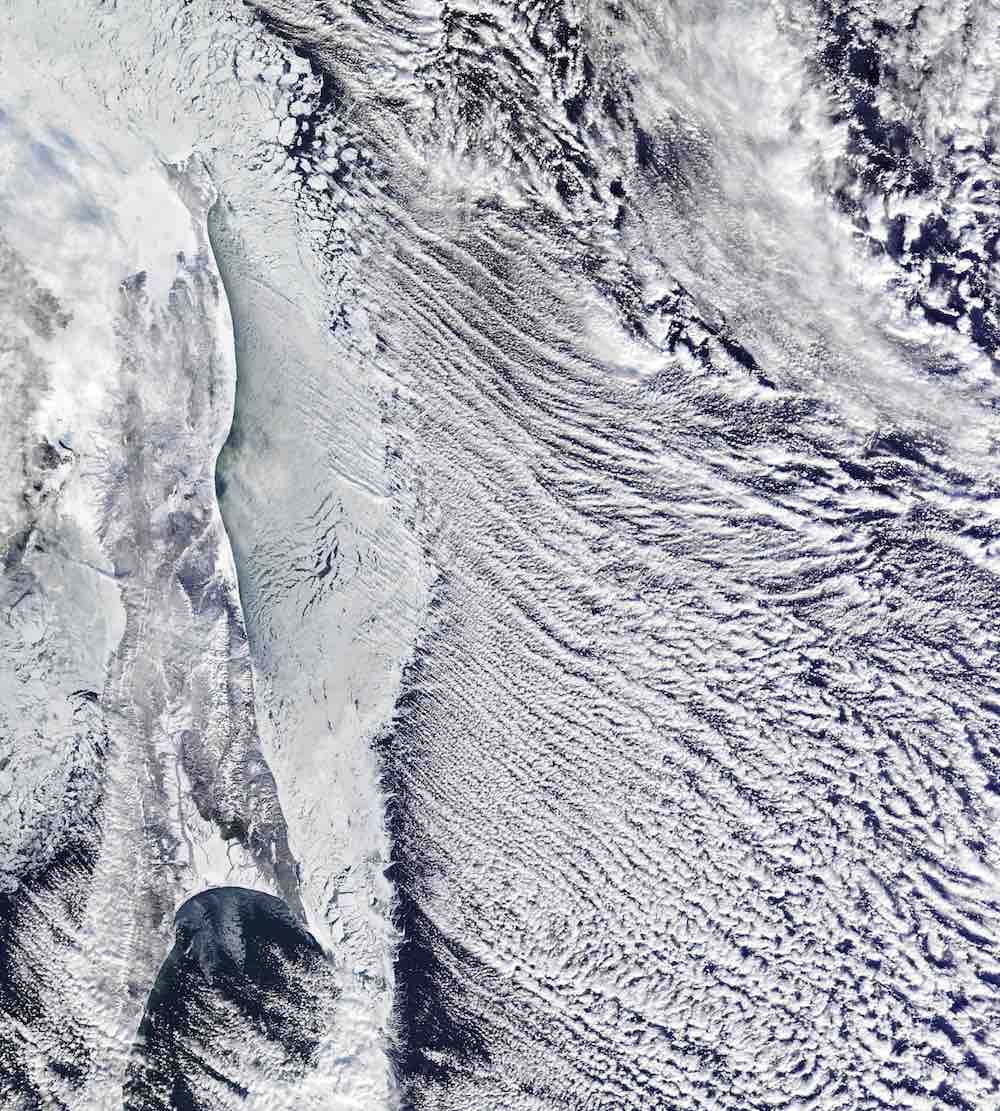
NASA satellite images obtained late last year captured an odd-looking occurrence in the skies off the coast of eastern Russia, coinciding with an “anomalously low” temperature drop, the agency reported in a recent online posting.

Captured by the Moderate Resolution Imaging Spectroradiometer (MODIS) instrument on NASA’s Terra satellite, a series of odd parallel lines could be seen taking shape in cloud formations just east of Sakhalin Island, Russia’s largest island which separates the Sea of Okhotsk to its east and the Sea of Japan, which lays to the southwest.

Roughly the size of a school bus, the Terra satellite, launched in 1999, studies Earth’s climate through connections between the atmosphere and a range of planetary features that include land and sea. Equipped with five instruments capable of measuring different features of the Earth, Terra collects data that helps scientists gauge the impact of human activity on our planet, as well as how natural disasters impact human population centers and ecosystems.

Through the lens of its camera eye, the MODIS instrument visualizes every point on Earth every 1-2 days from its position in orbit, recording what it observes in 36 spectral bands, making it the most comprehensive of all the sensors on board the Terra satellite and tracking the largest array of our planet’s vital signs.

On December 28, 2023, Terra’s MODIS detected the odd formation of parallel lines of cumulus clouds over the Sea of Okhotsk. Striking in appearance, these unusual cloudy structures are a phenomenon well-known to atmospheric scientists.

cloud streets

Above: Cloud streets visible in the cumulus cloud formations off the eastern coast of Russia on December 28, 2023

(Credit: Michala Garrison/NASA Earth Observatory/EOSDIS LANCE/GIBS/Worldview).

Horizontal convective rolls, more commonly known as “cloud streets,” these odd-looking structures take shape in the troposphere as cool dry pockets of air make their way out over warm coastal waters, where they begin to acquire moisture rising from the sea. The resulting vapor condensation gives rise to cloud formation, whereas cooler portions of the surrounding air sink.

The atmosphere above Russia’s eastern coast is ideal for the formation of features like these, which generally appear in the same direction as the prevailing wind. Over the Sea of Okhotsk, the exceptionally cold northwest winds emerging from Siberia have been likened to a “factory” of ice and cloud formation, where temperatures on Sakhalin Island this time of year often plummet to as low as -6 degrees Fahrenheit (-21 degrees Celsius).

In the photos made available at NASA’s Earth Observatory page, Arctic stratospheric conditions were producing clouds featuring striking iridescent coloration.

“These ethereal polar stratospheric clouds develop in extremely cold conditions and were recently visible to observers at lower latitudes than usual,” wrote Lindsey Doermann in an entry on the Earth Observatory website describing the phenomenon in the NASA satellite images.

Data collected by NASA’s Global Modeling and Assimilation Office (GMAO) conveyed what it described as “anomalous” low temperatures coinciding with the appearance of the cloud streaks over the eastern Russian coast in recent weeks (Credit: P. Newman (NASA), L. Lait (SSAI), S. Pawson (NASA)).

At the time the cloud streets appeared off the Russian coast, Arctic stratospheric temperatures had dropped extremely low (see above), according to data models produced by the space agency’s Global Modeling and Assimilation Office (GMAO).

Supporting NASA’s Earth Science mission, the GMAO provides modeling and data assimilation to help strengthen the information obtained from NASA satellite images, and to provide additional analysis and predictions about events occurring in the atmosphere, as well as on land and in the oceans.

Additional information about the formation of cloud streets can be found here, and further information about NASA’s Global Modeling and Assimilation Office can be found at the GMAO Research Site.

{https://thedebrief.org/category/space/ }

Hoe vind je dit bericht?
Geschreven door peter om 23:44 Stuur door

NASA Is Delaying Artemis Moon Missions By A Year — Here’s The Main Safety Reason

From left to right: Artemis II Astronauts: Commander Reid Wiseman; Pilot Victor Glover; and Mission ...

NASA Is Delaying Artemis Moon Missions By A Year — Here’s The Main Safety Reason

NASA officials say they didn’t expect the heat shield to burn and fall apart as much as it did during Artemis I’s re-entry.

NASA has delayed humanity’s highly-anticipated return to the Moon, its Artemis II mission, to September 2025 from an original target launch of November 2024, citing the need for extra time to analyze why the space capsule’s heat shield created hazardous, burning debris upon re-entry to Earth during the Artemis I mission.

Hellish heat of about 5,000 degrees Fahrenheit engulfed NASA’s Artemis I Orion capsule on December 11, 2022, as it careened through Earth’s atmosphere at more than 24,000 miles per hour after visiting the Moon. But charred material unexpectedly flaked off Orion’s heat shield during a maneuver to slow the vehicle down. NASA officials say they didn’t expect the heat shield to burn and fall apart as much as it did.

At high speeds and high heat, debris can become a safety hazard. The space agency spent this past year analyzing the potentially hazardous debris, Amit Kshatriya, deputy associate administrator of NASA’s Moon to Mars Program, said during a media teleconference call on Tuesday. If the Artemis I Orion had a crew onboard, they wouldn’t have been in harm’s way, officials said on Tuesday. However, it could have posed a hazard if there was a crew onboard and it happened to be oriented in a different way. Because of this, Kshatriya said the team wants to fully understand why this debris happened in the first place and prevent it from occurring on future missions.

Hazardous debris is a known major safety risk for space launches. About a minute after the Space Shuttle Columbia launched in January 2003, the external tank released foam insulation. The debris struck the shuttle’s left wing, leaving a wound that likely contributed to the Columbia reentry disaster on February 1, 2003, which killed all seven crew members onboard.

The Artemis missions are NASA’s major push to establish an ongoing human presence on the Moon. Artemis II will be the first test of the vehicle that will send four astronauts — Reid Wiseman, Victor Glover, Christina Koch, and Jeremy Hansen — around the Moon’s farside and back. Artemis III is set to be the first Moon landing since Apollo (as long as no other country beats us to it). But that, too, is delayed. NASA Administrator Bill Nelson said Artemis III won’t fly earlier than September 2026, a year later than originally planned.

“Safety is our number one priority,” said Jim Free, NASA Associate Administrator, at the press conference. “We will launch when we are ready.”

 { https://www.inverse.com/ }

Hoe vind je dit bericht?
Geschreven door peter om 23:30 Stuur door

China’s mega-satellietproject: Een strategische zet om supersnel internet van Starlink te beconcurreren

China’s mega-satellietproject: Een strategische zet om supersnel internet van Starlink te beconcurreren

Artikel door Dominique Dewitte
China’s mega-satellietproject: Een strategische zet om supersnel internet van Starlink te beconcurreren
© Aangeboden door Business AM

Samengevat. China kondigt plannen aan voor een eigen satelliet-internetnetwerk, vergelijkbaar met StarLink, met de bedoeling om wereldwijde dekking te bieden door 26.000 satellieten te lanceren, een onderneming geleid door staatsbedrijven.

Deze stap markeert een belangrijke ontwikkeling in de wereldwijde ruimtewedloop, waarmee China zichzelf als een dominante ‘ruimtemacht’ positioneert, in directe competitie met de Verenigde Staten. Die tonen bezorgdheid over China’s ruimteambities, wat leidt tot geopolitieke spanningen en concurrentie.

In het nieuws. China begint dit jaar met de bouw van een satelliet-internetconstellatie die de concurrentie wil aangaan met Starlink van Elon Musk.

  • Plannen omvatten de lancering van ongeveer 26.000 satellieten om wereldwijde dekking te bieden.
  • Staatsbedrijven leiden deze ontwikkeling, wat het militaire en commerciële belang van dit project onderlijnt.

Zoom in. Een specifieke lanceerlocatie is in aanbouw nabij de Wenchang Space Launch Site in Hainan.

  • Het plan is om ongeveer 1.300 satellieten, of 10% van het geplande aantal, te lanceren tussen 2024 en 2029.
  • De focus ligt op het ondersteunen van hoge snelheid 6G-communicatiesystemen, met een doelstelling om het project tegen 2035 te volooien.

Zoom out. Dit project is onderdeel van China’s bredere ambitie om tegen 2030 een ruimtemacht gelijkwaardig aan de VS te worden.

  • Naast satellieten omvat het plan ook het ontwikkelen van een eigen ruimtestation en Marsverkenningen.
  • Andere landen en bedrijven tonen bezorgdheid over China’s ruimteambities, wat leidt tot geopolitieke spanningen en concurrentie.
    • De Duitse overheid blokkeerde een ruimtevaartbedrijf in Shanghai – een grote aandeelhouder in een Berlijnse satelliet startup – om aandelen van andere houders te kopen.
    • De Amerikaanse lucht- en ruimtevaartgigant Boeing annuleerde een contract voor de verkoop van satellieten met een Amerikaanse startup nadat bekend werd dat een door de Chinese overheid gesteunde entiteit in het bedrijf had geïnvesteerd.
Hoe vind je dit bericht?
Geschreven door peter om 23:18 Stuur door

EXCLUSIVE - UFO whistleblower held secret talk with 'Wall St bigwigs' and CIA officials in Manhattan - where he claimed US was in possession of 40ft Tardis-like craft that was 'the size of a football field when you stepped inside'

EXCLUSIVE - UFO whistleblower held secret talk with 'Wall St bigwigs' and CIA officials in Manhattan - where he claimed US was in possession of 40ft Tardis-like craft that was 'the size of a football field when you stepped inside'

  • Former US intelligence officer David Grusch held a secrete UFO presentation
  • He revealed new details about the US's UAP retrieval program to 60 people
  • READ MORE:  David Grusch suggests people have been murdered as part of a conspiracy to keep alien craft a secret

A UFO whistleblower shared new details of a Tardis-like craft in government possession during a secret meeting in New York City.

Decorated former Air Force intelligence officer David Grusch claims his sources worked on a 40-foot UAP that 'was the size of a football field' when they stepped inside, according to an attendee at the event.

The object could manipulate both space and time and use and could harness enough energy to power 70,000 homes a year, the source said.

DailyMail.com understands that guests included officials from the FBI, CIA, Department of Homeland Security, tech entrepreneurs and Wall Street 'bigwigs.'

All in, Grusch gave the talk to 60 people at a penthouse in Manhattan, and photos were banned from the event.

David Grusch spoke to scientists, former military officials and current FBI members about the US's long-held UAP retrieval program, including a 40-foot-long UAP that 'was the size of a football field' when he stepped inside

David Grusch spoke to scientists, former military officials and current FBI members about the US's long-held UAP retrieval program, including a 40-foot-long UAP that 'was the size of a football field' when he stepped inside

The only information about the meeting was leaked by an anonymous attendee who took pictures of Grusch.

DailyMail.com has since verified that the meeting took place and was told by sources that Coinbase advisor John D'Agostino and high-powered attorney John J. Altorelli hosted the event.

Coinbase is a publicly traded company that operates a cryptocurrency exchange platform.

The two men are said to host monthly events at the penthouse apartment, focusing on different topics. 

The leaker said: 'It was hosted by a Wall Street bigwig and his lawyer friend.

'It was sort of a small saloon-style talk. David also did it for free. Even went as far as to fly into NYC just for this. 

'He had arrived only a few hours beforehand and then left 1st thing the next day. 

'The idea was to get a group of both skeptics and believers from all these different walks of life for a talk regarding David and the things he has said. 

'Most of the people who left had left as believers.'

The only information about the meeting was leaked by an anonymous attendee who took a chance by taking pictures of Grusch standing in front of the room and sharing slides on a television screen - photos were banned from the event

The only information about the meeting was leaked by an anonymous attendee who took a chance by taking pictures of Grusch standing in front of the room and sharing slides on a television screen - photos were banned from the event 

The former intelligence official then gave sworn testimony in front of Congress in July, where he and two other military whistleblowers shared details about firsthand encounters or knowledge about secret government programs involving technology that is 'non-human'

The former intelligence official then gave sworn testimony in front of Congress in July, where he and two other military whistleblowers shared details about firsthand encounters or knowledge about secret government programs involving technology that is 'non-human'

Grusch has made headlines since June 2023, when he claimed the Vatican is aware of the existence of non-human intelligences (NHIs) and helped the US retrieve a downed UFO from Italian dictator Benito Mussolini at the end of the Second World War.

The former intelligence official then gave sworn testimony in front of Congress in July, where he and two other military whistleblowers shared details about firsthand encounters or knowledge about secret government programs involving technology that is 'non-human.'

At the hearing, Grusch claimed the US has been in possession of UFOs since 'the 1930s' but said in New York that the government has taken 'part in a fair amount of crash retrievals before 1933,' according to the attendee's summary.

Grusch is also believed to have said that no more than 50 people know the full scale of the phenomenon.

During July's hearing, the former intelligence officer also suggested the US government has murdered people as part of the conspiracy to keep UFOs a secret.

And those claims were repeated during the recent presentation.

'Multiple people involved in not only his investigation but also his fellow peers in the UAP task force, such as Jay Stratton, were also threatened,' reads the post.

'He wouldn't go too much into it since it's an open investigation, but these people pretty much showed him that they could touch him or his family any time they wanted.'

'Multiple people involved in not only his investigation but also his fellow peers in the UAP task force, such as Jay Stratton (pictured), were also threatened,' reads the post

'Multiple people involved in not only his investigation but also his fellow peers in the UAP task force, such as Jay Stratton (pictured), were also threatened,' reads the post

Stratton is the former head of the US government UFO task force. He and his chief scientist, Travis Taylor, spilled the secrets of their official probe into a swarm of objects (pictured) that buzzed around a fleet of eight Navy ships off the US West Coast in July 2019

Stratton is the former head of the US government UFO task force. He and his chief scientist, Travis Taylor, spilled the secrets of their official probe into a swarm of objects (pictured) that buzzed around a fleet of eight Navy ships off the US West Coast in July 2019

Stratton is the former head of the US government UFO task force.

He and his chief scientist, Travis Taylor, spilled the secrets of their official probe into a swarm of objects that buzzed around a fleet of eight Navy ships off the US West Coast in July 2019. 

Speaking at AlienCon in Pasadena on March 5, Stratton and Taylor said their investigation left them fearing Russia or China could have achieved incredible drone battery technology – but ruled out quadcopters launched from submarines that somehow evaded the Navy's best radar just miles from the mainland.

Grusch is also claimed to have revealed that one of the US's adversaries was set to disclose their non-human intelligence to beat America to the punch. 

Attendees of the secret event were also allowed to ask questions following the presentation.

While the exact questions are not known, it is believed they asked what aliens may look like and where they are from in the universe.

Grusch shared that the world would not be surprised to hear extraterrestrials look the typical gray and that 'there is also a chance that they are extra-dimensional,' according to the anonymous attendee's post.

'That it could also just seem this way because of the technology they use rather than them being actual extra-dimensional beings,' they continued.

Grusch is also said to have revealed he and other officials were taught how to track UAPs in the atmosphere - there is a unique frequency or signature that the craft gives off.

'Apparently, it was the only private non-government talk he had done so far,' the individual shared in the Reddit post that has since been deleted, likely due to cameras being barred.

'As for how I feel about everything after hearing him speak. 

'He is extremely smart, I mean, he has an almost unbelievable memory and knowledge about intel laws and other things that have to do with UAPs. 

'My opinion is that he is the real deal. 

'Almost everyone left that night fully believing what he was saying or, at the very least, that HE believed what he was saying as the truth.'

{ https://www.dailymail.co.uk/ }

Hoe vind je dit bericht?
Geschreven door peter om 18:26 Stuur door

Harvard expert debunks alien, UFO sightings, says ‘they wouldn’t survive’

Harvard expert debunks alien, UFO sightings, says ‘they wouldn’t survive’

By Arya Vaishnavi

‘It would take about a billion years to cross from one side of the Milky Way galaxy to the other,’ Loeb said

Harvard Professor of Science Avi Loeb talks about alleged alien, UFO sightings

Harvard Professor of Science Avi Loeb talks about alleged alien, UFO sightings

Harvard astrophysicist Avi Loeb has called the bluff on alien sightings on Earth. In a recent interview with GB News, the expert explained that almost all biological creatures would not be able to complete the journey to our planet from afar. “It would take about a billion years to cross from one side of the Milky Way galaxy to the other,” Loeb said, adding, “Given that, I don’t think any spacecraft that would arrive to us from another star would carry biological creatures.”

This comes after the many alleged UFO sightings in recent years. Delving further into the topic, Loeb explained that it would be next to impossible for an extraterrestrial being to survive the innumerable grim conditions in space. “They wouldn’t survive the journey being bombarded by very energetic particles in interstellar space for so long,” Loeb said.

Wrap up the year gone by & gear up for 2024 with HT! Click here

“It’s more likely, if they are autonomous, they have an artificial brain, artificial intelligence. We have already developed that on Earth, we haven’t launched it to space, but that would be the next step,” Loeb added.

Drawing a link between AI and travelling through space, the Bull Moose Project policy director, Ziven Havens, said, “There is a possibility that AI will open up space travel both for manned and unmanned vehicles by reducing costs and increasing safety,” as per Fox News. “The possibilities are truly endless, and that makes the future of AI more exciting.”

However, Loeb also stressed that the government should be more open with their data on UFOs with scientists, allowing for intensive research. “The government monitors the sky for national security purposes,” he said. “Whereas scientists [and] astronomers, for example, look at small regions of the sky at very distant sources of light. If something flies overhead, astronomers ignore it. If there is something over there, it’s the government that would be the first to notice it,” Loeb continued.

“As a scientist, I respond to evidence. That’s what we are waiting for: the government to disclose what it knows. … It’s really important for me because I’m trying to find the evidence myself, but the government can save me a lot of time,” he added. “Why should I spend decades of my life looking for something when the government already has it?”

{ https://www.hindustantimes.com/ }

Hoe vind je dit bericht?
Geschreven door peter om 17:18 Stuur door

Coast to Coast AM Delves into UFO Phenomena with Garrett M. Graff

Coast to Coast AM Delves into UFO Phenomena with Garrett M. Graff

Coast to Coast AM, a night-time radio talk show, is renowned for its in-depth exploration of paranormal and unexplained phenomena, often featuring experts and researchers from various fields. In a recent episode, the show delved deep into the world of UFOs and national security with journalist and historian Garrett M. Graff, a Pulitzer Prize finalist known for his meticulous research and insightful analysis.

Graff, in his discussion on Coast to Coast AM, brought to light the intricate web of congressional hearings, governmental actions, and the renewed investigations into Unidentified Aerial Phenomena (UAP) by the Pentagon. One of the key highlights of his exploration was the attention given to a statement made in 2020 by former CIA director John Brennan. Brennan’s remarks about unexplained sky phenomena underscored the complexity and seriousness with which these incidents are now being regarded, moving beyond the realm of adversarial technology and entering a space of greater unknowns.

In an era where the existence of extraterrestrial life is a subject of growing interest and debate, Graff’s reflections on the mathematical probability of such life forms bring a new perspective. He points to the abundance of habitable planets as a statistical backing for the potential of extraterrestrial life, suggesting that the odds may be more in favor of alien life than previously thought.

VIDEO:

  • UFOs and National Security: Beyond Adversarial Technology

The conversation on Coast to Coast AM also revisited some of the most credible UFO cases in history. Graff discussed the famous 1964 encounter of police officer Lonnie Zamora, an incident that has stood the test of time as a significant and unexplained UFO sighting. Additionally, he delved into the intriguing case of Capt. Thomas Mantell in 1948, whose pursuit of a supposed UFO ended tragically, with later revelations connecting the incident to a Navy research balloon, as reported in Project Blue Book.

Graff’s insights offered to the Coast to Coast AM audience a blend of historical perspective and current developments in the field of UFO research. His analysis presents a world where the lines between national security, scientific inquiry, and the search for extraterrestrial life are increasingly intersecting. This episode of Coast to Coast AM not only illuminated the past but also shed light on the ongoing efforts to understand and confront the mysteries that continue to hover in our skies.

 { https://www.latest-ufo-sightings.net/ }

Hoe vind je dit bericht?
Geschreven door peter om 17:07 Stuur door

Strange 'Ebani-Jellyfish' UFO seen on thermal camera

Strange 'Ebani-Jellyfish' UFO seen on thermal camera

Investigative journalists Jeremy Corbell and George Knapp obtained and are revealing for the first time - footage of a military filmed UAP incursion within a United States joint operations base. This UAP of unknown origin displayed transmedium capability - and has been officially designated by the United States intelligence agencies as a UAP (Unidentified Aerial Phenomena). 
ebani%20yellofish%20UAO%20termal%20camera.png

Event description: An incursion by an object of unknown origin was filmed using Thermographic / Forward Looking Infrared (FLIR) for a durational period at a United States joint operations base in Iraq on October 2018 (night). 
The object moved through a sensitive military installation - and eventually traversed over a body of water, where it actuated a controlled descent - submerging into the water. 
After an observational period of about seventeen minutes - the UAP reemerged from the body of water and shot-off at an extreme rate of speed - beyond the optical scope of the observation platform. 
The UAP displayed transmedium capability:
The UAP was filmed entering the water with a controlled descent. The UAP emerged from the water about seventeen minutes later and orientated into a sudden and rapid directional flight - beyond the optical range of the platform monitoring it. 
The UAP displayed low observability:
The UAP was not visible with Night Vision (IR) and appeared to jam the targeting capability of the optical platform. 
The UAP displayed:
Positive lift - without the normally associated aerodynamic means for lift and thrust. The signatures typically associated with the propulsion maneuvers observed - were absent. 
Note: Could it be an Ebani?
Limited information exists regarding these UAP types. Could the unidentified object possibly be an Ebani? An Ebani is an organic (biological) entity that resides in our atmosphere. It seemly remains invisible to the naked eye, which could account for its detection solely on thermal cameras. The fact that the entity not only flies through the air but also submerges underwater for approximately 17 minutes before resurfacing and swiftly soaring away, indicating intelligent and deliberate movement.
  • Video 1: The Jellyfish UFO.
  • Video 2: On Twitter (X)  Jeremy Corbell discusses the strange 'Jellyfish' UFO.

 { https://ufosightingshotspot.blogspot.com/ }

Hoe vind je dit bericht?
Geschreven door peter om 17:00 Stuur door

Metallic sphere filmed near George Air Force Base – 2024 UFO sighting

Metallic sphere filmed near George Air Force Base – 2024 UFO sighting

metallic-orb-2024

In the quiet expanse of Adalanto, California, a recent UFO sighting has captured the attention of enthusiasts and skeptics alike. The event, strikingly captured in a daytime video, presents a compelling case for unidentified aerial phenomena in proximity to George Air Force Base, a detail that adds an intriguing military angle to the narrative.

The video, posted online by a local resident, showcases what appears to be a metallic sphere gliding effortlessly through the sky. According to the uploader, his father, who witnessed the event firsthand, estimated the object to be approximately 8 to 12 feet wide (nearly 3 meters in diameter). This size estimation, while seemingly small, aligns with a growing number of reports involving metallic spheres.

What sets this sighting apart is not just its proximity to a military base but also the object’s behavior. Witnesses describe the sphere moving with a freedom that defies conventional aircraft capabilities. This observation culminated in a breathtaking moment where the object reportedly “shot off in the blink of an eye,” a characteristic movement pattern reported in other UFO incidents.

This Adalanto sighting draws parallels to other famous cases of metallic spheres in the sky. Recent years have seen a surge in such reports, with similar incidents recorded globally. Notably, these objects often demonstrate advanced aerial capabilities, such as abrupt acceleration and sudden changes in direction, challenging our understanding of current aviation technology.

The proximity to George Air Force Base raises inevitable questions about the possibility of military involvement or knowledge. Historically, UFO sightings near military installations have led to speculation about secret aircraft testing or advanced surveillance technology. However, the erratic nature and speed of this object seem to push the boundaries of known military capabilities.

As with many UFO sightings, the lack of definitive answers leaves room for speculation and debate. The Adalanto incident, recorded in broad daylight and near a military site, provides a unique case study in the ongoing investigation of unidentified aerial phenomena. Whether these sightings are evidence of extraterrestrial visitation, undisclosed military technology, or something else entirely, remains one of the modern era’s most compelling mysteries.

Latest UFO sightings, this event marks another intriguing addition to a growing database of unexplained aerial occurrences. As we continue to explore the skies, the quest for understanding these mysterious sightings becomes ever more fascinating and complex.

{ https://www.latest-ufo-sightings.net/ }

Hoe vind je dit bericht?
Geschreven door peter om 16:50 Stuur door

30 van de oudste dingen op aarde

30 van de oudste dingen op aarde

30 van de oudste dingen op aarde

©Getty Images/NL Beeld/Shutterstock

30 van de oudste dingen op aarde
Wist je dat de oudste religie ter wereld 5000 jaar oud is? Of dat het oudste land van Europa te vinden is? En hoe zit het met het oudste nog in gebruik zijnde schip, of het oudste schoenenbedrijf? Ja, je zou verbaasd zijn over de leeftijd van sommige dingen op onze planeet, waarvan sommige zelfs miljarden jaren bestrijken. Wat is er nog meer echt geavanceerd voor zijn leeftijd?

KIJK verder en ontdek waarom een tijdperk geen barrière is.

Oudste persoon in de Bijbel

©Getty Images

Oudste persoon in de Bijbel
Methusalem, genoemd in Genesis 5:21–27, is de oudste persoon in de Bijbel en stierf op 969-jarige leeftijd. Hij wordt hier afgebeeld op een glas-in-loodraam uit het zuidwestelijke transept van de kathedraal van Canterbury in Engeland.

Oudste beschaving

©Getty Images

Oudste beschaving
Mesopotamië wordt algemeen beschouwd als de eerste stedelijke beschaving, die een tijdperk beslaat van ca. 8000 v.Chr. tot 2000 v.Chr. De Sumeriërs en Akkadiërs domineerden Mesopotamië vanaf het begin van de geschreven geschiedenis (ca. 3100 v.Chr.) tot de val van Babylon in 539 v.Chr. Afgebeeld is een vrouwenbeeldje van beschilderd aardewerk uit Aleppo, Syrië, ca. 5000 v.Chr.

Oudste religie

©Getty Images

Oudste religie
Het hindoeïsme wordt vaak beschouwd als de oudste bestaande religie die nog steeds wordt beoefend. Het is ook het meest complexe van alle gevestigde geloofssystemen, met een oorsprong die meer dan 5000 jaar teruggaat in India.

Oudste monarchie

©Public Domain

Oudste monarchie
Het koninkrijk Zweden is de oudste monarchie ter wereld, waarbij Erik de Overwinnaar (ca. 945 – ca. 995) wordt beschouwd als de eerste Zweedse koning.

Oudste land

©Shutterstock

Oudste land
Het oudste land ter wereld is San Marino. Deze kleine enclave in het midden van Italië, gesticht op 3 September 301 CE, heeft sinds zijn onafhankelijkheid van het Romeinse Rijk zijn status als een ononderbroken soevereine staat genoten.

Oudste grondwet

©Public Domain

Oudste grondwet
De grondwet van San Marino, opgesteld in 1600, is de oudste nog bestaande grondwet van welke soevereine staat dan ook ter wereld.

Oudste ruïnes

©Shutterstock

Oudste ruïnes
De oudste ruïnes zijn die gevonden in de Theopetra-grot in Griekenland, met name de stenen muur bij de ingang van de kalkstenen grot. Geschatte datum terug tot c. Het is het oudst bekende voorbeeld van een door de mens gemaakt bouwwerk en zou tijdens de laatste ijstijd als windscherm hebben gediend voor de bewoners van de grot.

Oudste stad van Amerika

©Shutterstock

Oudste stad van Amerika
Eerste bewoond c. 1500 BCE, Tepoztlán, nabij Mexico-Stad, is de oudste stad van Amerika. Het is beroemd om de El Tepozteco-tempel.

Oudste boomsoort

©Shutterstock

Oudste boomsoort
De Great Basin Bristlecone Pine (Pinus longaeva) is de oudste boomsoort die er bestaat en bereikt een leeftijd van meer dan 5.000 jaar oud. De bomen zijn te vinden in de hogere bergen van Californië, Nevada en Utah.

Oudste liedje

©NL Beeld

Oudste liedje
De Hurritische 'Hymn to Nikkal' wordt beschouwd als het oudste lied ter wereld. Het lied, ook bekend als 'h.6', maakt deel uit van ongeveer 36 hymnen die in spijkerschrift zijn geschreven op kleitabletten die zijn ontdekt in de oude stad Ugarit in het noorden van Syrië. De Hurrieten waren een volk dat tijdens de bronstijd het oude Nabije Oosten bewoonde. Nikkal was een Semitische godin van fruit en vruchtbaarheid.

Oudste landmassa

©Public Domain

Oudste landmassa
Met een leeftijd van ongeveer 4,28 miljard jaar wordt het Canadese Schild beschouwd als de oudste landmassa op aarde.

Oudste circus

©Getty Images

Oudste circus
Circus Maximus uit het oude Rome is het oudste bekende circus dat ooit heeft bestaan. Het werd gesticht in de 1e eeuw na Christus en was een enorme arena waar wagenrennen en verschillende optredens werden gehouden. De site is nu een openbaar park.

Oudste stripfiguur

©Public Domain

Oudste stripfiguur
De Katzenjammer Kids zijn waarschijnlijk de oudste stripfiguren die ooit hebben bestaan. Een Amerikaanse stripverhaal gemaakt door Rudolph Dirks in 1897 en debuteerde in December van dat jaar. De strip bestaat nog steeds in syndicatie, waardoor het ook de langstlopende in zijn soort is.

Oudste examen

©Public Domain

Oudste examen
Het oudste examen ter wereld is het Gaokao. Het model komt voort uit het imperiale examen, een examensysteem voor ambtenaren dat in 581 CE in China werd ingevoerd. In 1952, na de oprichting van de Volksrepubliek China, werd het Gaokao-examen omgevormd tot het nationale toelatingsexamensysteem voor universiteiten. Afgebeeld is een kunstwerk uit 1540 waarop kandidaten zijn afgebeeld die zich verzamelen rond de muur waar de examenresultaten worden opgehangen.

Oudste schoenenbedrijf

©Getty Images

Oudste schoenenbedrijf
Het oudste schoenenbedrijf ter wereld is Berluti. Opgericht in 1895 in Parijs door Alessandro Berluti, worden de op maat gemaakte handgemaakte schoenen voornamelijk aan mannen verkocht. Afgebeeld is de oorspronkelijke winkel aan de Rue Marbeuf in het 8e arrondissement van de stad.

Oudste graan

©Shutterstock

Oudste graan
Eenkoorntarwe werd voor het eerst 30.000 jaar geleden in Turkije verbouwd en wordt algemeen erkend als het oudste graan ter wereld. De domesticatie ervan gaat echter nog verder terug: er werden overblijfselen van eenkoorn gevonden bij de ijsmanmummie Ötzi, die dateren uit 3100 v.Chr.

Oudste recept

©Getty Images

Oudste recept
Het oudste recept ter wereld is voor brandnetelpudding. Een eeuwenoude delicatesse, afkomstig uit het prehistorische Groot-Brittannië in 6000 v.Chr., en werd een hoofdbestanddeel van het Engelse dieet in de 18e eeuw. Naast brandnetelbladeren zijn andere ingrediënten zuring, waterkers, bieslook, paardenbloembladeren, gerstemeel en zout.

Oudste niet-zelfbesturende kolonie

©Getty Images

Oudste niet-zelfbesturende kolonie
Montserrat in het Caribisch gebied is de oudste niet-zelfbesturende kolonie ter wereld, gesticht in 1632. Montserrat, een Brits overzees gebied, werd in 1995 grotendeels verwoest door een vulkaan. Het zuidelijke deel van het eiland blijft een uitsluitingszone.

Oudste nationale park

©Public Domain

Oudste nationale park
Het Bogd Khan Uul-biosfeerreservaat in Mongolië is het oudste nationale park ter wereld. Het werd opgericht in 1778, 94 jaar vóór de oprichting van het Yellowstone National Park in de Verenigde Staten, dat vaak wordt aangezien als het eerste in zijn soort (hoewel het het oudste nationale park in de VS is). Afgebeeld is een satellietbeeld van de Bogd Khan-berg (midden) met Ulan-Bator linksboven.

Oudste actieve vulkaan

©Getty Images

Oudste actieve vulkaan
De oudste actieve vulkaan ter wereld is Mount Unzen in Japan. De vulkaan is naar schatting 2,5 miljoen jaar oud, maar is pas in 1991 uitgebarsten, toen een grote uitbarsting een pyroclastische stroom veroorzaakte waarbij 43 mensen omkwamen.

Oudste meer

©Shutterstock

Oudste meer
Het Zaysan-meer in Kazachstan is misschien wel het oudste meer ter wereld, mogelijk daterend uit het Krijt-tijdperk, met een potentiële leeftijd van meer dan 66 miljoen jaar oud. Het Baikalmeer in Rusland beweert ook het oudste meer ter wereld te zijn, aangezien duidelijk bewijsmateriaal aantoont dat het 25 tot 30 miljoen jaar oud is.

Oudste bergketen

©Getty Images

Oudste bergketen
Het Makhonjwa-gebergte, onderdeel van de Barberton Greenstone Belt die Zuid-Afrika en Swaziland overspant, vormt de oudste bergketen ter wereld. Het gebied, vaak omschreven als de ‘Genesis van het leven’, omvat de oudste blootliggende rotsen op aarde, die naar schatting tussen de 3,2 en 3,6 miljard jaar oud zijn.

Oudste haven

©Shutterstock

Oudste haven
De haven van Byblos in Libanon wordt beschouwd als de oudste bestaande haven, die al meer dan 3000 jaar in gebruik is. Het was het belangrijkste houttransportcentrum in het oostelijke Middellandse Zeegebied en werd door de Feniciërs gebruikt om hun lokale wijn te verschepen en om hout te exporteren naar de farao's van het oude Egypte.

Oudste schip dat nog in gebruik is

©Getty Images

Oudste schip dat nog in gebruik is
De USS Constitution, gelanceerd in 1797, is het oudste schip dat nog in gebruik is. Het schip ligt afgemeerd in de haven van Boston en doet nu dienst als museumschip, maar vaart af en toe, meestal ter herdenking van de Onafhankelijkheidsdag.

Oudste regenwoud

©Shutterstock

Oudste regenwoud
Het Daintree Rainforest aan de noordoostelijke kust van Queensland, Australië, is het oudste regenwoud ter wereld. Er wordt geschat dat het ongeveer 180 miljoen jaar oud is – bijna 10 miljoen jaar ouder dan het Amazonegebied van Zuid-Amerika.

Oudste oceaan

©Shutterstock

Oudste oceaan
De Stille Oceaan is het oudste van de bestaande oceaanbekkens. De oudste rotsen zijn gedateerd op ongeveer 200 miljoen jaar. Het is ook groter dan het hele landoppervlak van de aarde bij elkaar.

Oudste woestijn

©Shutterstock

Oudste woestijn
De Namib-woestijn dateert van ergens tussen de 55 en 80 miljoen jaar en wordt beschouwd als de oudste woestijn ter wereld.

Oudste rivier

©Shutterstock

Oudste rivier
De Finke-rivier in centraal Australië, door de Aboriginals bekend als de Larapinta, wordt geschat op minstens 300 miljoen jaar oud.

Oudst bekende graf

©Shutterstock

Oudst bekende graf
De Tumulus van Bougon, een groep van vijf neolithische grafheuvels in Nouvelle-Aquitaine, Frankrijk, is het oudst bekende grafcomplex ter wereld. Archeologen hebben de site gedateerd op ongeveer 4800 v.Chr.

Oudste jeansmerk

©Shutterstock

Oudste jeansmerk
Levi Strauss & Co. is het oudste jeansmerk ter wereld. Levi, opgericht in 1853 door Levi Strauss in San Francisco, blijft een iconisch Amerikaans merk dat wereldwijd wordt erkend vanwege zijn denimjeans.

Bronnen:

  • (Conde Nast Traveler)
  • (National Geographic)
  • (AntiquityNOW)

Sources:

  • (Conde Nast Traveler)
  • (National Geographic)
  • (AntiquityNOW)

{ http://starsinsider.com/ }

Hoe vind je dit bericht?
Geschreven door peter om 16:38 Stuur door

CIA Chilling Document Reveals Presence Of Giant Aliens On Mars 1 Million Years B.C

Image

CIA Chilling Document Reveals Presence Of Giant Aliens On Mars 1 Million Years B.C

Is the remote viewing real? The subject is very controversial for scientists to study but James H. Lee, an award-winning financial advisor suggested that it has the potential to make a meaningful contribution to the professional futurist′s toolbox. This particular technique is well-discussed in the declassified CIA files where psychic abilities were used to spy on Soviet Russia and track down its military activities under Project Stargate.

RV was real, CIA admitted it

The first test of the project was conducted in the 1970s at the US Army base in Maryland. Basically, this highly classified project was about the mind-reading of the enemies, so the CIA started recruiting people who claimed to “have powers of extrasensory perception (ESP) to help uncover military and domestic intelligence secrets.” (Source)

In the CIA declassified file, it was detailed how Uri Geller could replicate things drawn by a researcher in another sealed room. As the US government was getting benefits from this program, they continued funding it.

One of the remote viewers named Angela Dellafiora Ford revealed her physics powers on the CBS News program “48 Hours.” In 1989, she was asked by the army to psychically track down the location of one man. She located the man in Lowell, Wyoming, and then he was arrested 100 miles west of a Wyoming town called Lovell.

In 2021, John Greenewald, Jr.’s Blackvault published approximately 2,700 pages of the declassified documents provided by the CIA, involving UAP/UFO information. One document that staggered ET hunters was about Mars.

Read also:

Giant Entities On Mars

The document titled “Mars Exploration May 22, 1984,” basically centers around a subject that made use of astral projection which helped him observe ancient alien life on Mars. In this document, there is a transcript, where a subject named Joseph McMoneagle, a retired US Army veteran was given an envelope prior to the interview and asked not to open it until the interview ended. According to the CIA’s own documents, the unnamed psychic described “The planet Mars. Time of interest approximately 1 million years B.C.” (Source)

He claimed to identify that he saw pyramid-like structures on the Red Planet. The subject also added that he witnessed alien life forms on the Martian surface.

Mars Exploration

[Subject]: I’m seeing, ah… It’s like a perception of a shadow of people, very tall… thin, it’s only a shadow. It’s as if they were there and they’re not, not there anymore.
[Monitor]: Go back to a period of time where they are there.
Sub: Um… (mumble) It’s like I get a lot of static on a line and everything, it’s breaking up all the time, very fragmentary pieces.
Mon: Just report the data, don’t try to put things together, just report the raw data.
Sub: I just keep seeing very large people. They appear thin and tall, but they’re very large. Ah… wearing some kind of strange clothes.

According to the date specified in the “Mars Exploration” memo, it was approved to be published only in 2000 although it was recorded in 1984, and McMoneagle was the only remote viewer to be working at that time. He wrote in his book “Mind Trek” about a similar incident mentioned in that memo.

Joseph McMoneagle

Jacob Brogan, an assistant editor at the Washington Post tracked down and called McMoneagle. According to Brogan, McMoneagle told him that the request to visit Mars was not made by the CIA but by some unknown army person to him. (Source)

“Neither of us knew what we were working on. Our assumption at the time was that I was working on targets on Earth. I was not familiar with any pyramids on Earth that had such large rooms,” McMoneagle told him.

McMoneagle was confused why he had been asked by the army to explore Mars. He had no clue. He remembered one more incident when he was asked to examine the UFO. “The problem that I have with targeting UFOs and Mars and things like that is that there’s no real way to validate the information,” he said.

In an interview with Richard Thieme, a founder of ThiemeWorks, McMoneagle shared his experience on Project Stargate, UFOs, and ETs. He shared his encounter with the UFO in 1966, in which he got a radiation burn.

Richard Thieme asked him: “Is it all one thing, though? These are complex psychological processes – and you were burned physically in 1966. Is it all one thing? Do scriptural texts of folk documents about people encountering entities – can we connect that experience with an experience of the lights going on at night and you seeing a physical craft?”

McMoneagle replied: “I did a remote viewing in early 1980s, 82 or 83, where a UFO target was mixed in with other targets, so I had no idea it was a UFO target.” Over the years, as McMoneagle said, he was involved in about 450 missions. One of his favorites was in 1980 when CIA personnel captured a suspected KGB agent in South Africa. They wanted to know how the agent was communicating with the Soviet military. They put an envelope on McMoneagle’s desk, and without knowing anything of the man, McMoneagle told the CIA that the man liked to use a small pocket calculator. The calculator turned out to be a disguised short-wave radio. He retired from the Army in 1984 but continued to work as a Stargate consultant.

CIA Interdimensional Experiemnt

Robert Monroe (1915 –1995), another RV that had a striking history of remote viewing was probably the first RV hired by the CIA. One day in 1978, the CIA representatives contacted him. They wanted to implement his mind-expanding practice in attempt of sending soldiers into deep remote viewing sessions. Given Monroe’s extensive background and various patented applications, he was the perfect choice for this trailblazing operation. Hoping to obtain further credibility in the study of paranormal phenomena, he agreed to join them. (Source)

Robert A. Monroe

Since those involved were opening portals to other dimensions, researchers aptly named the assignment Gateway Process. According to declassified files, the program is “a training system designed to bring enhanced strength, focus and coherence to the amplitude and frequency of brainwave output between the left and right hemispheres so as to alter consciousness, moving it outside the physical sphere so as to ultimately escape even the restrictions of time and space. (Source)

The participant then gains access to the various levels of intuitive knowledge the universe offers.” Discoveries listed in Commander Wayne M. McDonnell’s final analysis paper included detailed information about the nature of reality. Investigators ascertained we live in a holographic universe and waking life is a projected electromagnetic matrix.

To enter the unearthly realms, headphone-donning voyagers sat in isolated darkness while listening to various tones at specific hertz. The participants had no contact or communication with one another. After their journey was finished, the volunteers would report what they experienced with staff members.

According to Robert, subjects would often encounter interdimensional entities. Most frequently, they witnessed reptilian humanoids. The viewers referred to the uncanny creatures as “the alligators” due to their crocodilian features. Curiously, Monroe was already quite familiar with the unsettling breed. During countless expeditions, he observed identical saurian creatures. For over thirty-five years, the etheric investigator gathered insight about these startling beings.

{ https://www.howandwhys.com/ }

Hoe vind je dit bericht?
Geschreven door peter om 01:16 Stuur door

2,000-year-old 'celestial calendar' discovered in ancient Chinese tomb

2,000-year-old 'celestial calendar' discovered in ancient Chinese tomb

Wooden slips marked with Chinese characters that relate to the traditional Tiangan Dizhi astronomical calendar.
Each of the wooden slips is marked with Chinese characters that relate to the traditional Tiangan Dizhi astronomical calendar. Perforations on their edges suggest they were once tied together. 
(Image credit: Chongqing Cultural Relics and Archaeology Research Institute)

Archaeologists in China have unearthed a mysterious set of rectangular wooden pieces linked to an ancient astronomical calendar. The artifacts were discovered inside an exceptionally well-preserved 2,000-year-old tomb in the southwest of the country.

Each of the 23 wooden slips is about an inch (2.5 centimeters) wide and 4 inches (10 cm) long and displays a Chinese character related to the Tiangan Dizhi, or "Ten Heavenly Stems and 12 Earthly Branches" — a traditional Chinese astronomical calendar established during the Shang dynasty, which ruled from about 1600 B.C. to about 1045 B.C.

Archaeologists think one of the slips may have represented whatever was the current year and that the other 22 slips could have been used to specify any particular year in the ancient calendar, according to a translation of a story on the China News website, an agency run by the Chinese government.

The artifacts were found in a well-preserved tomb, dated to about 2,200 years ago, unearthed earlier this year in the Wulong district of China's Chongqing municipality. (Image credit: Chongqing Cultural Relics and Archaeology Research Institute)

Circular perforations at the edges of each slip suggest they were once tied together.

However, it's not yet clear how the set of calendrical wooden slips would have functioned, an expert told Live Science.

This is the first time such objects have been found in an ancient tomb, although the practice of writing characters on strips of wood or bamboo was common in China before the invention of paper.

Related: 

Golden age

The wooden slips and many other artifacts were discovered earlier this year in a tomb in the Wulong district, about 870 miles (1,400 kilometers) southwest of Beijing, archaeologists from the Chongqing municipal government told the Global Times — which is also run by the Chinese government.

The tomb contains a written list of all the burial items, which also states that it was built in 193 B.C. That places the tomb during the time of the Western Han dynasty, which ruled much of China from 206 B.C. to A.D. 9; it was followed by the Eastern Han dynasty, which ruled until A.D. 220, and together they are considered a "golden age" when many Chinese traditions were established.

Archaeologists and university students started working at the site in the Wulong district in March this year. (Image credit: Chongqing Cultural Relics and Archaeology Research Institute)

Archaeologist Wang Meng said the tomb was the best-preserved wooden-chamber tomb ever found in China's southwest.

Project leader Huang Wei told the Global Times that the tomb also contained more than 600 cultural artifacts, including lacquerware bowls, boxes, jars and plates. It also held bamboo utensils and musical pipes, spears and cooking tripods made from copper, wooden figurines, as well as pottery and bronze objects.

Calendar mystery

Astronomer Ed Krupp, the director of the Griffith Observatory in Los Angeles and author of "Echoes of the Ancient Skies: The Astronomy of Lost Civilizations" (Dover, 2003), who was not involved in the Wulong discovery,  told Live Science that while the Tiangan Dizhi calendar is mainstream — it is used in Chinese astrology, for example — the wooden slips found in the Wulong tomb were unusual.

As well as the mysterious wooden slips, more than 600 cultural artifacts were found inside the tomb and indicate that a high-status person had been buried there.

(Image credit: Chongqing Cultural Relics and Archaeology Research Institute)

The hundreds of artifacts buried in the tomb include ornate objects of pottery, copper, bronze, wood, bamboo and lacquerware, such as this plate.

(Image credit: Chongqing Cultural Relics and Archaeology Research Institute)

Archaeologists said the tomb was undisturbed and most of the artifacts are undamaged, although they needed cleaning after so long underground.

(Image credit: Chongqing Cultural Relics and Archaeology Research Institute)

"The wooden slips with calendric notations are significant as the first and only known example of that kind of inscription on that kind of object," he said in an email.

But it doesn't appear that the set of wooden slips could have functioned as a calendar; instead, it seems they could have been used to reference any year of the 60-year calendrical cycle, he said.

"If so, they are not 'books,' but objects used to highlight a particular year," he said. He noted the similarity to a practice followed at a Taoist temple in the Chinese city of Suzhou, where each year in the cycle is represented by a statue that is specially marked when it becomes current.

Krupp said that the finds from the Wulong tomb showed that a person of high status had been buried there. "The artifacts interred with the deceased are numerous and very, very fine," he said. "This is rich, expensive material."

{ https://www.space.com/ }

Hoe vind je dit bericht?
Geschreven door peter om 00:52 Stuur door

WHAT WE KNOW ABOUT THE ‘ANOMALY’ THAT PREMATURELY ENDED THE PEREGRINE MOON LANDER MISSION CARRYING HUMAN REMAINS

1e92dFin?format=jpg&name=900x900

WHAT WE KNOW ABOUT THE ‘ANOMALY’ THAT PREMATURELY ENDED THE PEREGRINE MOON LANDER MISSION CARRYING HUMAN REMAINS

An “anomaly” that followed shortly after a successful launch on Monday–one that seemingly set the stage for the first soft landing of a spacecraft on the Moon in more than 50 years–brought an ambitious space mission carrying human remains to a premature end yesterday.

Shortly after separating from a United Launch Alliance (ULA) rocket early Monday morning, Peregrine, a lunar lander built by Pittsburgh-based space company Astrobotic, began to receive telemetry data from NASA’s Deep Space Network, as its avionics, propulsion, and control systems all began to power on.

As Peregrine reached its fully operational state, everything appeared to be on track for the spacecraft as it began its ascent toward the Moon.

Then, something unexpected happened.

Shortly after entering its operational state, “an anomaly occurred” as the Peregrine team became aware of a system malfunction that prevented them from being able to control the spacecraft’s ability to achieve a stable sun-pointing orientation.

“The team is responding in real time as the situation unfolds,” read a mission update posted on the company’s X account, “and will be providing updates as data is obtained and analyzed.”

As the Peregrine team worked to try and determine the cause of the problem, the situation began to look increasingly dire. All indications pointed to a complication arising from the spacecraft’s propulsion system which, if confirmed, would likely end Peregrine’s mission before it ever came close to landing on the lunar surface.

“As the team fights to troubleshoot the issue, the spacecraft battery is reaching operationally low levels,” the company wrote in a subsequent update yesterday at 11:04 AM. As the spacecraft was nearing a brief communication outage, an improvised attempt to reorient the spacecraft’s solar panels was undertaken, aiming to point them toward the Sun.

Following the reestablishment of communication with the spacecraft, the team learned that their attempt to point Peregrine’s solar array toward the Sun had been successful, allowing the spacecraft’s battery systems to charge as the Peregrine team’s Mission Anomaly Board worked to try and determine what was affecting the spacecraft.

Soon, it became evident that the anomaly had occurred due to a failure within the spacecraft’s propulsion system.

“We are grateful for the outpouring of support we’re receiving,” Astrobotic wrote in another candid mission update, thanking the community of professionals within the space industry who “unite in the face of adversity.”

Hours later at 4:12 PM, Astrobotic released an image from Peregrine, captured from the camera positioned above the spacecraft’s payload deck which provided additional confirmation that a propulsion system anomaly was the root cause behind the lander’s precarious condition.

With its solar array pointing toward the Sun, the spacecraft nonetheless was able to charge its battery, and the Peregrine team continued to carry out payload and spacecraft operations with the existing power stores.

“At this time, the majority of our Peregrine mission team has been awake and working diligently for more than 24 hours,” Astrobotic wrote in a subsequent update. “We ask for your patience as we reassess incoming data so we can provide ongoing updates later this evening.”

Shortly after 9:15 PM Eastern Time, Astrobotic shared what would be its final mission update of the day, confirming that an “ongoing propellant leak” had been causing Peregrine’s Attitude Control System (ACS) to malfunction, pushing its thrusters “to operate well beyond their expected service life cycles to keep the lander from an uncontrollable tumble.” Peregrine was given a best-case scenario of being able to maintain operations within a stable sun-pointing state for around 40 hours.

With the mission now effectively doomed, Astrobotic announced its aim was to continue to move Peregrine as close to the Moon as possible. However, once the spacecraft lost its ability to maintain its sun-pointing position, it would lose power at some point well before it reached its intended destination.

Still aboard the ill-fated spacecraft are several payloads that rank among some of the most unique ever to be sent to space. The cremated remains of humans that include several cast members from “Star Trek,” as well as DNA from former U.S. presidents, were all on board at the time the anomaly occurred, and presumably will remain adrift in space after Peregrine ceases operations.

The failed mission also raises significant questions for NASA, casting doubts on whether the American space agency will be able to safely rely on commercial partners to aid in reaching its scientific goals, particularly in advance of its plans to send humans back to the Moon in the years ahead.

Despite the mission failure, many took to social media to thank the company for its transparency on Monday as the propulsion system anomaly removed any possibility that Peregrine’s fuel stores would allow it to reach the Moon.

“Appreciate the prompt and transparent updates!” wrote another of the company’s followers on X, who added that it was “unfortunate that we have approximately 40 hours left but nevertheless, to get to this point is still a great accomplishment!”

As of Tuesday morning, no additional updates had been shared by Astrobotic on the company’s website or on social media.

{ https://thedebrief.org/category/space/ }

Hoe vind je dit bericht?
Geschreven door peter om 00:13 Stuur door

Journalist Reveals First-Ever Photograph of UFO Shot Down in Syria in 2021

Syria Dome UAP

Journalist Reveals First-Ever Photograph of UFO Shot Down in Syria in 2021

There is a series of shooting down unidentified objects around the world that involves the United States. The military 2023 February UAP events are among the recent cases. Filmmaker Jeremy Corbell, along with investigative journalist George Knapp, has revealed a photograph of an object initially labeled as a “hostile drone” by the media. However, official statements from the United States, the UK, and allied intelligence agencies now confirm their inability to ascertain its origin, designating it as “unidentified.”

In episode 41 of Weaponized, Corbell and Knapp discuss UFO shootdowns covering both current events and historical perspectives. Corbell discusses events in 2019, specifically mentioning attempts to bring down over 100 UAPs on Navy warships using electromagnetic systems like the DRAKE (Drone Restricted Access Using Known Electromagnetic Warfare) Anti-Drone System.

In the episode, Jeremy Corbell provides details about a UAP event that took place in late summer 2021 off the coast of Japan involving the USS Milius. The USS Milius experienced a series of encounters with UAPs that exhibited similar behavior to the previously mentioned incidents near Navy warships. However, in this case, the UAPs were observed in a vast 300-mile radius of sea, with no other ships around.

Corbell further describes the frustrating attempts to take down the UAPs using electromagnetic techniques, noting that these efforts were once again ineffective. The UAPs displayed extreme maneuverability over four or five consecutive nights, with multiple objects present during a 5-hour window from 1:00 a.m. to 5:00 a.m. or midnight to 4:00 a.m. The ship’s captain, out of frustration, reportedly instructed the crew to stop reacting to the UAPs and creating reports since there seemed to be no viable solution.

It’s a UFO, not a Hostile Drone!

Corbell and Knapp discussed an incident that happened in the Middle East, specifically in Syria on December 14, 2021. Corbell describes how the Royal Air Force, using a Typhoon fighter plane, reported shooting down a hostile drone, marking the first air-to-air firing by the Royal Air Force in 40 years. The media initially reported it as a terrorist drone, but there was a subsequent shift to calling it a “Mystery drone” as no terrorist group or nation claimed responsibility.

Corbell notes a significant discrepancy between public reporting and intelligence community products. He introduces an image, referred to as the “Syria Dome UAP,” associated with the event, and mentions that internally, the intelligence community labeled it as an UAP. Corbell emphasizes the importance of transparency and accurate reporting, pointing out that what is publicly disclosed differs from the information shared among allied nations within the intelligence community.

Corbell posts on X (formerly Twitter), “In a joint operation, a Royal Air Force Typhoon fighter jet engaged an unidentified aerial vehicle using an Advanced Short Range Air to Air Missile (ASRAAM). Initial media reports labeled the unidentified as a ‘hostile drone’ – however – internal intelligence products officially classify the aerial vehicle of unknown origin as a UAP – and maintain this designation. The UAP was not recovered.”

Liberation Times writes, “According to Corbell, the Five Eyes report was published months after the incident occurred and indicates that on 14 December 2021, an RAF Typhoon jet shot at one UAP using an ASRAAM missile. At the time, the incident was reported as the first enemy aircraft shot down by the RAF since the Falklands War in Argentina more than 40 years ago.”

Corbell continues, stating that Centcom (United States Central Command) has been tracking UAP for over 15 years, and the frustration lies in the lack of proper reporting and handling of these incidents within the chain of command. He notes that in conflict zones, there is a tendency to shoot at anything within a certain proximity to ground troops or bases, especially if it appears to have a payload. However, the issue arises in the lack of recovery or proper handling after such engagements.

Further, in the episode, Corbell reveals the image of an object that he called the “Syria Dome UAP.” He says, “This image… is the one that was historically fired upon. It is referred to as a ‘terrorist drone,’ exhibiting a peculiar appearance. Whatever it may be, it is classified as a UAP within the intelligence community. This is not something that has been identified.”

Corbell notes that there were two of these unidentified devices, and when the Royal Air Force engaged with them, firing an Advanced Short Range Air-to-Air Missile (ASRAAM), one of the objects managed to evade and escape the scene. Corbell emphasizes the intelligence control exhibited by these objects, suggesting that they were not under random or autonomous flight.

Corbell admits uncertainty about whether the fired missile hit the object or if it made contact with the ground. He underscores the discrepancy between the public narrative, which presented the incident as involving a terrorist drone, and the internal classification within the intelligence community, where it is recognized as a UAP. The point is reiterated that the public is not receiving the full and accurate information about these encounters.

George Knapp shares his perspective on the image, stating that, in his extensive experience, he has seen various images of drones, both military and private, but finds the appearance of this particular object unique. He likens it to resembling a mushroom cloud, highlighting its distinctive and unconventional design.

Corbell said that the Five Eyes report indicates that the USAF militarily engages such craft if they are within a radius of ground troops and appear to carry a payload.

He told Liberation Times: “Unless observed with a possible payload, UAPs largely go ignored, as they are not part of the mission – this means that we lose the opportunity to study the phenomena and answer key questions, including 1) Who are the operators 2) Where do they originate from 3) How do they work? And 4) What is their intent?”

“I can confirm that there is frustration within the ranks of the U.S. military that UAPs with unique flight characteristics are being ignored. Worryingly, this critical information is not being reported up the chain of command properly – causing vulnerability to our troops and those of other nations.”

Previously on the Joe Rogan show, Corbell claimed that based on information from documents, the military fires upon UAPs within a certain proximity to ground troops, typically within 27 to 30 miles. The decision to engage is reportedly based on the perceived threat, with the military firing upon objects that appear to have a payload. The text also mentions that UAPs resembling cubes surrounded by spheres are not targeted, as they do not appear to have a payload.

Corbell suggests that the military has been firing Hellfire missiles at these UAPs, and there are reports of similar actions by countries like Russia and Syria. The text raises questions about the origin of these UAPs, as they are not believed to be assets of the countries engaging with them. Some UAPs are described, such as one resembling a jellyfish about the size of a coffee table.

“One of the UAPs that was fired upon looked like a jellyfish, about the size of a big coffee table, and domed. There is no known retrieval program in these war zones, and even if they did hit something, it’s unknown if they would be able to take it down. It’s possible that these UAPs could be balloons used by drug smugglers, but they have controlled flight, which is not a new phenomenon. There have been similar sightings of metallic spheres outpacing planes during World War II, with both sides thinking it was the other side’s technology.”

A while ago, Lue Elizondo, the former head of AATIP shared his thoughts on the UFO/UAP and how the Pentagon approaches the phenomenon from strictly national security perceptive. In an interview with Curt Jaimungal and Sean Cahil, Elizondo provides deeper insight into the Pentagon’s theories on why UFO/UAPs are routinely spotted around American, Russian, Chinese, and other nuclear-armed nations’ most secretive and sensitive nuclear assets.

{ https://www.howandwhys.com/ }

Hoe vind je dit bericht?
Geschreven door peter om 23:49 Stuur door

Vanaf 2027 kan u op hotel overnachten in de ruimte! (VIDEO)

Vanaf 2027 kan u op hotel overnachten in de ruimte! (VIDEO)


Vanaf 2027 kan u op hotel overnachten in de ruimte! (VIDEO)
© Pixabay

Altijd al gedroomd van eens in de ruimte te verblijven? Dat kan waarschijnlijk al in 2027!

Het eerste commerciële ruimtehotel ooit, Voyager Station, wil in 2027 haar deuren openen. Het project biedt plaats aan 280 gasten en 112 bemanningsleden en wordt gepland door Orbital Assembly Corporation, een bouwbedrijf gerund door John Blincow. Het station wordt het eerste grote project van OAC en het eerste commerciële ruimtestation met kunstmatige zwaartekracht.

De bouw van de 50.000 vierkante meter grote Voyager-faciliteit zal in 2026 van start gaan, en OAC streeft ernaar om de eerste passagiers in 2027 in het hotel te verwelkomen. Het team legt uit dat het project mogelijk wordt gemaakt door een lage baan om de aarde. 

Wat eet je in de ruimte?

OAC is van plan om traditioneel ‘ruimtevoedsel’ zoals gevriesdroogd ijs te serveren, terwijl ze ook streven naar recreatieruimtes voor activiteiten zoals basketbal, waarbij ze profiteren van de gewichtloosheid in de ruimte. Er zijn geen kamerprijzen bekendgemaakt, maar het team hoopt op een dag de kosten vergelijkbaar te maken met die van een cruiseticket. Het eerste element van het roterende hotel dat zal worden gebouwd, zal een centrale drukloze ringstructuur zijn die de docking hub zal bevatten. Een buitenste ringspant zal via een netwerk van spaken verbonden worden met de centrale ring en van daaruit zullen 24 woonmodules ontstaan.

  • Skwadra by Tagtik
  • Picture: Unsplash)

 { https://www.msn. }

Hoe vind je dit bericht?
Geschreven door peter om 22:47 Stuur door

Can Alien Civilizations Detect Humanity?

11757_v_2.jpg

Is anyone out there? A new study examines how likely it is that an advanced ETI can "see" us. Image Credit: Jon Hrubesch

Can Alien Civilizations Detect Humanity?

One of the fascinating things about being a human in this age is that we can do more than wonder about other life and other civilizations. We can actually look for them, although there are obvious limitations to our search. But what’s equally fascinating is that we can wonder if others can see us.

Assuming that all civilizations who have begun to explore their surroundings are interested in finding other civilizations, then the question of who can detect who comes down to technology. It takes advanced technological tools to search for the technosignatures of other civilizations. It also takes technology to produce most of them. But what level of technology is needed on both sides of that equation?

The technology needed to produce technosignatures is not complex. We’ve had that technology for thousands of years. The Great Pyramids are proof of that. But what technology is needed to see them? And from how far away?

In new research published in the journal Acta Astronautica, a researcher associated with SETI poses the question, “Are we visible to advanced alien civilizations?” His name is Z. Osmanov, and he’s the author and co-author of multiple studies and articles on SETI and related topics.

“We considered the question of how our artificial constructions are visible to advanced extraterrestrial
civilizations,” Osmanov writes. Osmanov explains how the universal laws of physics set the limits for detection and how more advanced civilizations can solve this problem. The maximum distance for detections is about 3,000 light-years, according to Osmanov, adding that “under certain conditions, Type-II advanced alien societies might be able to resolve this problem.”

What technologies are needed to receive our technosignatures?

The background for Osmanov’s work is the classification of civilization types called the Kardashev Scale, which is familiar to many readers. It’s the work of Soviet astronomer Nikolai Kardashev, and it describes three types of hypothetical civilizations:

  • Type I Civilizations harvest, use and store all the energy on their planet.
  • Type II Civilizations directly consume their star’s energy with a Dyson sphere or something similar.
  • Type III Civilizations can capture all the energy available in their entire galaxy.

(Note that in the Kardashev Scale, humanity is about 0.75.)

A Type II civilization is one that can directly harvest the energy of its star using a Dyson Sphere or something similar. Credit: Fraser Cain (with Midjourney)

In his research, Osmanov ignores Type III civilizations and focuses on Types I and II. He asks a relatively straightforward question: “Can the artifacts of our technological society be visible and potentially detectable by the telescopes of ETs?”

Our technological artifacts are things like large engineering projects and satellites. A Type I or II civilization would recognize these things as technological artifacts if they could see them. According to Osmanov, the best way for an ETI to detect them is with reflected light, and that means high-powered optical telescopes with extreme angular resolution.

We’re busy building more powerful telescopes with greater angular resolution, and ETIs are probably working on it, too. ETIs more advanced than us are way ahead of us. “In this paper, we analyze how visible we are to advanced ETs, depending on their technological level.”

Osmanov says that ETIs will make use of interferometry to detect us. Astronomical interferometry uses two or more individual telescopes separated by distance to observe the same object at the same time. The data from the detectors is combined and processed. So rather than viewing something with the limited angular resolution of a single telescope, interferometry basically builds a “virtual” telescope—a telescope array—that is much larger than any physical telescope could be.

This aerial view shows the ESO's VLTI, the Very Large Telescope Interferometer. It has a total of eight separate, movable telescopes that can all look at the same object, increasing the interferometer's angular resolution. Image Credit: ESO

This aerial view shows the ESO’s VLTI, the Very Large Telescope Interferometer. It has a total of eight separate, movable telescopes that can all look at the same object, increasing the interferometer’s angular resolution. Image Credit: ESO

Osmanov calculates that for an alien civilization to detect the Great Pyramids of Giza, for example, the civilization would have to be no further away than about 3,000 light years. Because of the number of photons that would have to be sensed to see the Pyramids, the telescope would have to be extraordinarily huge. Only an interferometer could do it. “It is clear that the diameter of the telescope should be on the order of several million kilometres,” the author explains.

That eliminates Type 1 civilizations. “Such huge megastructures might be built only by Type-II civilizations but not by Type-I alien societies,” Osmanov writes.

But how can we know if any ETIs of Types II or III are within the 3,000 light-year range? Osmanov uses the well-known Drake Equation to determine that number. The Drake Equation is a probabilistic argument that thinkers can use to try to understand how many ETIs there might be in the Milky Way, but of course, there’s no absolute way of verifying its answers. It’s a thought experiment tool that keeps everyone on the same page when thinking about the question of ETIs.

In his calculations, the author determines the average distance among advanced civilizations. “As an order of magnitude, we assume that the civilizations are uniformly distributed over the galactic plane,” Osmanov writes. There would have to be something like 650 ETIs in the Milky Way for one of them to be close enough to detect our large engineering projects from the ancient world up to our medieval times. That includes things like the Pyramids and maybe other large constructions.

JAXA astronaut Koichi Wakata captured this image of the Great Pyramids from the ISS in February 2023. The most visible one is the Great Pyramid of Giza, built in the 23rd century B.C. Image Credit: Koichi Wakata.

JAXA astronaut Koichi Wakata captured this image of the Great Pyramids from the ISS in February 2023. The most visible one is the Great Pyramid of Giza, built in the 23rd century B.C. Image Credit: Koichi Wakata.

The numbers are different when it comes to ETIs detecting our modern structures, because there hasn’t been enough time for the reflected light from these modern structures to propagate as far into space. There would have to be vastly more ETIs for one to be close enough to detect our modern structures, including satellites. “They can detect our modern constructions only if their total number in the MW is of the order of 106, which has been hypothesized by <Carl> Sagan,” Osmanov writes.

Of course, we have no way of knowing if there are any other ETIs or if one might have found our technosignatures. But the study does give context to the question and to thought experiments.

Barring first contact, all we have is thought experiments.

 { https://www.universetoday.com/ }

Hoe vind je dit bericht?
Geschreven door peter om 22:34 Stuur door

Hoe het klimaat op aarde verder ontspoorde in 2023: zes opvallende vaststellingen over een uitzonderlijk weerjaar

Hoe het klimaat op aarde verder ontspoorde in 2023: zes opvallende vaststellingen over een uitzonderlijk weerjaar

Artikel van Michaël Torfs  
Afbeeldingsresultaten voor Hoe het klimaat op aarde verder ontspoorde in 2023: vijf opvallende vaststellingen over een uitzonderlijk weerjaar

Al lang op voorhand konden we met zekerheid zeggen dat 2023 het warmste jaar ooit zou worden. Als een wielrenner die zo'n grote voorsprong heeft dat hij nog lang voor de aankomst al zegezeker is. Alleen is het in dit geval iets wat we liever niet zien.

"We hebben heel wat extreme situaties meegemaakt in 2023", weet klimatoloog Niels Souverijns (VITO). "De vingerafdruk van de klimaatopwarming wordt steeds duidelijker. Het is iets wat we misschien normaal gaan vinden, maar we moeten ons heel goed realiseren dat dit niet normaal is." 

"We wisten dat dit rapport geen goed nieuws zou brengen", zegt Mauro Facchini van het klimaatobservatorium van de Europese Unie daarover. "De EU wil tegen 2030 55% minder broeikasgassen uitstoten. We weten wat ons te doen staat." 

Als het gaat over de marges van het klimaat wereldwijd, rekenen we doorgaans met tienden van een graad of minder. In 2023 werden er verschillende nieuwe mijlpalen gezet met behoorlijk grote marges. In het jaarrapport staan heel wat details over 2023, dat op klimaatvlak een heel bewogen jaar was mede door het weerfenomeen El Niño. Wij pikken er 6 voor je uit. 

1. Net geen anderhalve graad extra (maar het komt eraan)

2023 bleek uiteindelijk 1,48 graden Celsius warmer dan het gemiddelde van 1850-1900, de referentieperiode voor de VN-klimaatconferentie en het VN-klimaatpanel IPCC. Het was 0,17 graden warmer dan het vorige warmste jaar uit onze moderne geschiedenis, 2016. 

Vorig jaar was het 12 maanden na elkaar dus net geen anderhalve graad warmer, maar eind januari of eind februari kunnen we wél aan 12 opeenvolgende maanden zitten die de drempel overschrijden.

Dat ligt symbolisch gevoelig, want de wereldleiders houden op de klimaatconferenties nog altijd vast aan een beperking van de opwarming tot die anderhalve graad - het gaat dan over een structurele opwarming op langere termijn (over verschillende jaren).

Door de opwarming onder anderhalve graad te houden, kunnen we de ergste gevolgen van de klimaatverandering proberen te voorkomen. 

2. Twee dagen naar 2 graden extra (en dat is ongezien)

Vorig jaar was het op ongeveer de helft van de dagen minstens anderhalve graad warmer. Midden november waren er 2 dagen waarop het meer dan 2 graden warmer was. Dat is nog nooit eerder gebeurd en opnieuw een alarmsignaal.

Hoe meer de planeet opwarmt, hoe groter de weersextremen kunnen zijn - denk aan hevige regen, stormweer, of grote hitte met lange droge periodes.

Het hele jaar door kregen we berichten over hittegolven, overstromingen, droogtes en bosbranden uit verschillende hoeken. In Canada waren er grootscheepse en aanhoudende bosbranden. De CO₂-uitstoot door bosbranden lag vorig jaar 30 procent hoger dan het jaar daarvoor. Dat komt onder meer door de ongeziene natuurbranden in Canada waar het "worstcasescenario overtroffen werd".  

Bovenstaande grafiek toont hoeveel warmer elke dag in 2023 verliep tegenover de pre-industriële referentieperiode. Tijdens de tweede helft van het jaar zaten we gemiddeld bijna constant boven de anderhalve graad (zie de iets donkerder band in het midden). In november waren er zelfs twee pieken boven de 2 graden.
© VRTNWS

"Die anderhalve graad die we in 2023 hadden en die enkele dagen met 2 graden zijn symbolische grenzen, omdat het drempels zijn die zijn afgesproken in het klimaatakkoord van Parijs, met de bedoeling om daaronder te blijven", zegt klimatoloog Niels Souverijns. 

3. Tweede jaarhelft brak alle records, maand na maand (en dat kan blijven duren)

Vooral de tweede helft van het jaar brak alle records, mede door het losbreken van het weerfenomeen El Niño. Vanaf juni werd er elke maand opnieuw een warmterecord gevestigd.

De maanden september en oktober sprongen eruit met een bijzonder grote afwijking. Klimatoloog Wim Thiery (VUB) maakte voor oktober (+0,40 graden warmer dan warmste oktober voorheen) de vergelijking met de sprint in de atletiek, "alsof het wereldrecord op de 100 meter ineens met een volle seconde gebroken zou worden". 

De voorbije maand december was ook weer de warmste ooit gemeten. De maand bleek maar liefst 1,78 graden Celsius warmer dan een gemiddelde december 150 jaar geleden. 

Klimatologen verwachten dat El Niño zich nog zal doorzetten tot het einde van de lente, waardoor 2024 nog warmer zou kunnen uitvallen dan het voorbije jaar en een nieuw record zou kunnen vestigen. "2024 gaat zeker geen afkoeling kennen tegenover vorig jaar. De trend gaat zich doorzetten, en we mogen dus nog meer extremen en nog meer records verwachten", schetst Souverijns. 

4. Oceanen waren nooit warmer (en dat heeft grote gevolgen)

Grote delen van de oceanen waren nooit warmer dan vorig jaar. Ook dat is een teken van de verdere opwarming. "We zien al een paar jaar een trend naar warmere oceanen, en dit jaar heeft het weerfenomeen El Niño (waarbij een deel van de Stille Oceaan warmer is dan anders, red.) er zeker niet bij geholpen", zegt Souverijns. 

Oceanen slaan een groot deel van de extra warmte van de klimaatopwarming op, maar dat blijft niet zonder gevolgen. Boven de oceaan kunnen intense stormdepressies ontstaan. Warmer zeewater kan ook een intensere regenval veroorzaken, zoals vorige week nog bleek tijdens de overstromingen in ons land. 

Dat het zeewater nooit zo warm was, bleek ook uit de verschillende mariene hittegolven in o.a. de Middellandse Zee, de Golf van Mexico en het Caraïbische gebied, de Indische Oceaan, het noorden van de Stille Oceaan en het noordelijke deel van Atlantische Oceaan.

"In Libië hadden we zware schade als gevolg van de "medicane" (de plaatselijke cycloon boven de Middellandse Zee, gevoed door het ware zeewater daar, red.) en bij ons hadden we de zware neerslaghoeveelheden van de voorbije twee maanden", zegt Souverijns.

Uit een studie in Nature bleek onlangs dat het aantal mensen dat is blootgesteld aan tropische cyclonen, zowat verdubbeld is tussen 2002 en 2019 (van 408 miljoen naar 792 miljoen). Dat komt voor het grootste deel door de klimaatverandering. Het gaat om 6 tot 12 procent van de wereldbevolking, onder meer in China, Japan, de Filipijnen, Taiwan en de VS. 

De Duitse herverzekeraar Munich Re liet vandaag weten dat de schade door onweders in de Verenigde Staten vorig jaar op 66 miljard dollar ligt (ongeveer 60 miljard euro). In Europa ging het om 10 miljard dollar. Telkens gaat het om een absoluut record. 

5. Nooit was het zee-ijs op Antarctica er zo slecht aan toe

De gevolgen van de opwarming zien we ook in de omvang van het zee-ijs aan de Zuidpool. Tijdens 8 verschillende maanden bereikte de omvang van het zee-ijs een laagterecord voor de tijd van het jaar.

In februari (na de zomer op het zuidelijk halfrond) stond de oppervlakte zee-ijs zelfs op een historisch minimum. Ook aan de noordpool gaat het smeltproces snel, al zijn daar geen absolute diepterecords gevestigd. 

6. Nooit hadden we meer broeikasgassen in de atmosfeer

Die warmterecords hebben alles te maken met de aanwezigheid van broeikasgassen in onze atmosfeer, zoals CO₂ en methaan. In beide gevallen gaat het om de hoogste waarden in onze moderne geschiedenis.

De CO₂ blijft zich opstapelen in de lucht door de hoge menselijke uitstoot, en is nu naar 419 ppm (deeltjes per miljoen) geklommen, wat de steile klim van de vorige decennia bevestigt.

Voor methaan kwamen er 11 ppb (deeltjes per miljard) bij tot 1.902 ppb. Die stijging is hoog maar ligt iets lager dan de voorbije jaren. Methaan is een sterker broeikasgas dan CO₂, maar CO₂ blijft dan weer veel langer hangen en doorwerken, tot honderden jaren en meer.  

De broeikasgassen: hoogste waarde in 800.000 / 2 miljoen jaar

Ook de concentratie van broeikasgassen in de wereldwijde atmosfeer bleef stijgen. Het gehalte aan CO₂ (koolstofdioxide) steeg verder door met 2,1 ppm (parts per million of deeltjes per miljoen). Het jaargemiddelde voor CO₂ (los van de seizoensvariaties) in de atmosfeer bedraagt nu 417 ppm. Dat is het hoogste niveau ooit gemeten door de mens en het is volgens Copernicus het hoogste in ruim 2 miljoen jaar tijd. De stijging tijdens het voorbije jaar ligt ongeveer op de gemiddelde koers, terwijl ze eigenlijk zou moeten afnemen als we de klimaatopwarming willen afremmen. 

Onderstaande balkjes tonen hoe de gemiddelde jaartemperatuur op aarde in de voorbije 60 jaar afweek van het gemiddelde tussen 1850 en 1900 - de graad van opwarming valt op de verticale as aan de linkerkant af te lezen. Daar waar we rond het jaar 2000 nog aan een opwarming zaten van 0,6 tot 0,8 graden, was dat vorig jaar dus ongeveer 1,2 graden. (data Copernicus) 

Noot: als we het hebben over de klimaatopwarming, kijken we naar een periode van 20 tot 30 jaar, omdat klimaat nu eenmaal een foto is van de langere termijn. Daarom spreken we van een klimaatopwarming van 1,1 graden Celsius momenteel, hoewel de realiteit van de voorbije vijf jaar toont dat we (voor die vijf jaar gemiddeld) al aan ongeveer 1,2 graden extra zitten.

Hoe vind je dit bericht?
Geschreven door peter om 18:24 Stuur door

United States government has UFOs of 'non-human origin' in its possession - whistleblower

United States government has UFOs of 'non-human origin' in its possession - whistleblower

Rachel Sadler

Photo credit: Getty Images

A whistleblower alleges the United States government has UFOs of "non-human origin" in its possession.

David Grusch, who is a veteran of the National Geospatial-Intelligence Agency (NGA) and the National Reconnaissance Office (NRO), claimed this information about "deeply covert programmes" has been hidden and that it's about "retrieved intact and partially intact craft of non-human origin".

According to science news website The Debrief, Grusch said recoveries of non-human origin objects, including "intact vehicles", have happened for decades.

"The existence of complex historical programs involving the coordinated retrieval and study of exotic materials, dating back to the early 20th century, should no longer remain a secret," he told The Debrief.

A claim he previously made to the US Congress was the existence of a decades-long "publicly unknown Cold War for recovered and exploited physical material". This included a competition with "near-peer adversaries" over the years to identify UFO crashes or landings and retrieve the material for exploitation or reverse engineering to "garner asymmetric national defence advantages".

In 2022, Grusch gave Congress hours of recorded classified information that included specific data about the materials recovery programme. 

His investigation relied on extensive interviews with high-level intelligence officials, some of whom were directly involved with the programme. But Grusch claimed the operation was illegally shielded from proper Congressional oversight and he was targeted and harassed because of his investigation.

He said the craft recovery operations are still going on at various levels of activity and he knows the specific people involved.

"Individuals on these UAP [unidentified anomalous phenomena] programmes approached me in my official capacity and disclosed their concerns regarding a multitude of wrongdoings, such as illegal contracting against the Federal Acquisition Regulations and other criminality and the suppression of information across a qualified industrial base and academia," Grusch told The Debrief.

The US also has "non-human origin technical vehicles", with Grusch telling News Nation: "Call it spacecraft, if you will. It's probably not the right parlance. But no kidding, non-human exotic origin vehicles that have either landed or crashed."

He said the are "quite a number" of spacecraft from other species.

He isn't alone either. Intelligence officer Johnathan Grey told The Debrief that the "non-human intelligence phenomenon is real".

"Retrievals of this kind are not limited to the United States. This is a global phenomenon, and yet a global solution continues to elude us."

Grusch believes it was dangerous for this "80-year arms race" to continue in secrecy because it "further inhibits the world populace to be prepared for an unexpected, non-human intelligence contact scenario".

Grusch's claims come just days after a Pentagon chief admitted that unidentified "metallic orbs" have been found "all over the world".

Sean Kirkpatrick, director of a new UAP analysis office, said these objects are making "very interesting apparent manoeuvres".

"While we are still looking at it, I don’t have any more data other than that," he said.

"Being able to come to some conclusion is going to take time until we can get better-resolved data on similar objects that we can then do a larger analysis on."

The US government has recently centralised its system for reporting UFOs, and now the Pentagon receives between 50 and 100 reports a month. Although Kirkpatrick said just 2 to 5 percent of these are "really anomalous".

"For the few objects that do demonstrate potentially anomalous characteristics, AARO [All-domain Anomaly Resolution Office] is approaching these cases with the highest level of objectivity and analytical rigour," he said.

"AARO has shared these cases with the appropriately cleared NASA team members in order to discuss and help recommend potential scientific areas of study that NASA may want to take lead on."

Kirkpatrick added that AARO plans to deploy "dedicated sensors for typical UAP" sightings. This is equipment that is independent of the existing military defence sectors that have picked up evidence during their normal duties.

{ https://www.newshub.co.nz/home.html }

Hoe vind je dit bericht?
Geschreven door peter om 17:58 Stuur door

Pilot Reports Mysterious Triangle UFO Fly Past Him in Audio Recording

Pilot Reports Mysterious Triangle UFO Fly Past Him in Audio Recording

UFO whistleblower says U.S. recovered nonhuman "biologics" from crash sites

A flight recording apparently capturing a pilot reporting a UFO to air-traffic controllers has captured the public's imagination after it was shared on an aviation social-media channel.

The audio clip was published on a YouTube account called You Can See ATC, which uploads videos featuring pilots' accounts of emergencies or unusual situations during flights, such as equipment failures or fights on board. Most of the channel's viewers seem to be those working in the industry. However, a video published on the site two weeks ago has received more than 22,000 views so far, as a pilot describes seeing a 30-foot triangular object moving at speed from his cockpit window as he flew about 50 miles northwest of Frederick, Maryland, on December 20.

The topic of UFOs has been in the news recently as a Pentagon report released in October 2023 detailed a list of all the sightings of Unidentified Aerial Phenomena (UAP) from 2022 to 2023, while two 'alien' corpses were displayed to Mexico's Congress in September.

Just last week, the Miami Police Department was forced to release a video statement to reassure residents that an alien invasion was not underway after aerial footage of a crime scene went viral online. Some viewers said it showed a 10 foot-tall gray alien walking past squad cars.

The video currently garnering thousands of views on YouTube shows a graphic of the flight path of a private Piper Cherokee Arrow (P28R) aircraft, registration N30024, en route from Pittsburgh's Allegheny County Airport, Pennsylvania, to Maryland's Frederick Municipal Airport.

An audio clip plays simultaneously, which is said to be a recording of a conversation between the pilot and an air-traffic controller while the aircraft was at about 6,500 to 6,800 feet and about 50 miles away from its destination. A shorter version of the clip was released by You Can See ATC on X (formerly Twitter). Newsweek has reached out to the Federal Aviation Administration by email, seeking comment.

The audio begins with the pilot's voice, as he says: "30024... passed to the northwest... We observed something approximately 30 feet tall. Not sure what it is. At about 6,500 to 6,800 feet."

"NO25, was it moving at a fast pace?" the controller replies.

"It was moving away, affirmative, for 30024," says the pilot.

The pair then begin to discuss the plane's scheduled descent, before the official asks: "Arrow 024, what does the object look like?"

The pilot replies: "Er, it's kind of hard to describe. It was just tall and, er, pointy."

"Like a triangle?"

"It was in the shape of a triangle. It was bottom and flat on top. I'm not sure what it is. I do have a picture of it. And 30024 did not appear to be any danger," the pilot says.

"Cherokee 024, and that object was about 300 feet from you?"

"It was pretty far away form us. Just noticeable enough for caution to other aircraft," the pilot says.

The controller then asks for the pilot's number so he can ask his supervisor to call him if necessary, before giving the pilot his supervisor's number instead. Later, he comes back on the radio to say: "NO24, yeah, my supervisor said [inaudible] talk to you. Just wanna make sure everything is safe up there for future aircraft flying through that. So give him a call once you're on the ground safely please."

"Roger, will do, thanks, 30024," the pilot replies.

The video sparked plenty of discussion among the viewers of the YouTube channel.

Some were sceptical, with one saying: "If you saw it you should be able to describe it."

Given the timing—the audio was reportedly from December 20, and it was published on the site on Christmas Eve—several people wrote that it was more likely to have been Santa Claus rather than aliens.

Others offered more mundane ideas for what the triangle could have been. One viewer wrote, "Haha. I live right near there. I see Canadian geese all the time," with another agreeing that "flocks of geese are triangle in shape."

Some thought, "30 feet tall and pointy at the bottom is a helium balloon," with several also saying that they thought it could have been a weather balloon.

Others posted that it could have been another plane, such a new model being tested by the military. One wrote: "I'm old enough to remember when the stealth fighter was still a secret and there was all sorts of UFO reports due to it's funky shape."

Many of those commenting wished they could see the photo the pilot mentioned, but the channel did not have access to the image.

Steven Greer, ufologist, at press conference

Steven Greer, ufologist, makes a speech under an artist's rendering of an alleged UFO incident, during a press conference on June 12, 2023, in Washington, DC. An audio clip purporting to be of a pilot describing a UFO he saw mid-flight has captured the public's imagination over the past two weeks.

KEVIN DIETSCH/GETTY IMAGES

{ https://www.newsweek.com/ }

Hoe vind je dit bericht?
Geschreven door peter om 17:29 Stuur door

Combination of Two Minerals Can Explain Mysterious UV Absorber in Clouds of Venus

Combination of Two Minerals Can Explain Mysterious UV Absorber in Clouds of Venus

The clouds of Venus are believed to be composed of sulfuric acid and minor constituents including iron-bearing compounds. Respective concentrations of these compounds vary with height in the thick atmosphere of our neighboring planet. In a new study, researchers at the University of Cambridge synthesized iron-bearing sulfate minerals that are stable under the harsh chemical conditions in the Venusian clouds. Their spectroscopic analysis revealed that a combination of two minerals, rhomboclase and acid ferric sulfate, can explain the mysterious ultraviolet (UV) absorption feature in the Venusian atmosphere.

Jiang et al. hypothesize a rich and largely unexplored heterogeneous chemistry in the cloud droplets of Venus that has a large effect on the optical properties of the clouds and the behavior of trace gas species throughout Venusian atmosphere. Image credit: Mattias Malmer / NASA.

Jiang et al. hypothesize a rich and largely unexplored heterogeneous chemistry in the cloud droplets of Venus that has a large effect on the optical properties of the clouds and the behavior of trace gas species throughout Venusian atmosphere.

Image credit: Mattias Malmer / NASA.

The clouds of Venus hold several mysteries. They extend from 48 km to roughly 65 km and provide a transition region between the lower atmosphere (<48 km) that is dominated by thermochemistry and dynamics and the upper atmosphere (>65 km), for which photochemistry and dynamics are relevant.

To understand the chemical cycles between the Venusian atmosphere and its volcanic surface, and to correctly interpret potential biosignatures, an increasing research effort has been dedicated to generating a complete model framework of Venusian atmosphere.

“The only available data for the composition of the clouds were collected by probes and revealed strange properties of the clouds that so far we have been unable to fully explain,” said Dr. Paul Rimmer, a researcher with Cavendish Laboratory at the University of Cambridge.

“In particular, when examined under UV light, the Venusian clouds featured a specific UV absorption pattern.”

“What elements, compounds, or minerals are responsible for such observation?”

Formulated on the basis of Venusian atmospheric chemistry, Dr. Rimmer and colleagues synthesized several iron-bearing sulfate minerals in an aqueous geochemistry lab.

By suspending the synthesized materials in varying concentrations of sulfuric acid and monitor the chemical and mineralogical changes, they narrowed down the candidate minerals to rhomboclase and acid ferric sulfate, of which the spectroscopic features were examined under light sources specifically designed to mimic the spectrum of solar flares.

In an attempt to mimic the even more extreme Venusian clouds, the authors measured the UV absorbance patterns of ferric sulfate under extreme acidic conditions.

“The patterns and level of absorption shown by the combination of these two mineral phases are consistent with the dark UV-patches observed in Venusian clouds,” said Dr. Clancy Zhijian Jiang, a researcher at the University of Cambridge.

“These targeted experiments revealed the intricate chemical network within the atmosphere, and shed light on the elemental cycling on the Venusian surface.”

“Venus is our nearest neighbor, but it remains a mystery,” Dr. Rimmer said.

“We will have a chance to learn much more about this planet in the coming years with future NASA and ESA missions set to explore its atmosphere, clouds and surface.”

“This study prepares the grounds for these future explorations.”

  • The team’s paper appears in the journal Science Advances.
  • Clancy Zhijian Jiang et al. 2024. Iron-sulfur chemistry can explain the ultraviolet absorber in the clouds of Venus. Science Advances 10 (1); doi: 10.1126/sciadv.adg8826

{ https://www.sci.news/ }

Hoe vind je dit bericht?
Geschreven door peter om 16:56 Stuur door

Tucker Carlson’s Claim Of ‘Troops Dying From UFO Encounters’ Corroborates With Other Stories That Show Dark & Disturbing Elements Of UAPs

Tucker Carkson UFO dark truth

Tucker Carlson’s Claim Of ‘Troops Dying From UFO Encounters’ Corroborates With Other Stories That Show Dark & Disturbing Elements Of UAPs

The UFO enigma is garnering increasing attention, particularly after David Grusch’s historic testimony during the 2023 UAP hearing. The United States government is deeply concerned about UAPs, especially since many individuals, including Rep. Tim Burchett, Rep. Anna Paulina Luna, and Senator Chuck Schumer, believe that the American public has been kept in the dark about this issue for decades.

What is preventing the US government from telling the truth? The answer is far more complicated than most people believe. A month ago, on Redacted, Tucker Carlson discussed the UFO issue with hosts Clayton and Natali Morris. He said, “The second thing that bothers me is the UFO story… If you talk to people who have firsthand knowledge, there are aspects of that narrative that I find deeply perplexing and disturbing… There’s a spiritual component that eludes my understanding.”

When we jump into phenomena like UFOs, NHI, or E.T., it suggests that humanity is on the brink of self-destruction, and time is running out. This chilling and unsettling aspect of the UFO issue is deeply concerning. Former CIA John Ramirez claimed that the government is aware of an impending event in 2027 that will reveal something quite significant, so people are being prepared. He has been stating that there is a presence on Earth (which he refers demonic) who are just projecting their belief systems to make us disbelieve in what we believe.

Clayton Morris, a former Fox News host, along with Tucker, hinted at possessing knowledge about a similar UFO-related story. They mentioned that this particular story is something they have not discussed with their families. “It’s so unsettling. I haven’t even shared it with my wife,” Tucker remarked. “And this isn’t merely something I stumbled upon online; it’s profoundly disturbing information.”

A while back, on the “Full Send” podcast, former Fox News anchor Tucker Carlson recounted a study conducted by a Stanford professor 11 years ago. Interestingly, the US Defense Department tasked Dr. Garry Nolan (which he publicly confirmed) with investigating numerous cases where pilots’ brains were seriously damaged after encountering UFOs. However, Dr. Nolan never publicly said whether these injuries led to fatalities. Tucker said that hundreds of servicemen had been killed.

According to Tucker, “[In] several cases, these unidentified objects have landed on military bases. Servicemen who approached them either suffered traumatic brain injuries or were killed. I wonder, why isn’t this making headlines in the New York Times. I don’t know.”

Later, Susan Gough, a Defense Department spokesperson, told Military Times that the story was false and the Pentagon declined to comment further. (Source)

Tucker did not stop there and raised a sensitive issue about the potential harm or killing of individuals connected to the U.S. government’s UFO programs during his interview with David Grusch. He specifically asked Grusch if he had a reason to believe that the government had hurt or killed anyone, particularly American citizens, in connection to these programs. (Click here to read the full article)

Grusch responded by acknowledging concerns that were raised by individuals who approached him, expressing worries about potential harm. He emphasized that he took those concerns seriously and reported them to the Inspector General of the intelligence community, directing the individuals to law enforcement.

Tucker pushed further, specifically mentioning the allegation of murder, to which Grusch confirmed that the concerns included both murder and physical harm. However, he refrained from providing specific details due to the ongoing investigation and potential risks to his safety.

Grusch disclosed that he felt his life was in jeopardy, and he reported the threats and surveillance to a counterintelligence element and law enforcement. He revealed that the threats not only affected him but also impacted his wife. He stated that he did not know the identity of those involved, ruling out the possibility of it being a foreign entity.

Do fatalities occur in the UFO subject?

Many UFO researchers investigating these incidents have uncovered truly disturbing information from witnesses and victims about their UFO encounters.

Stefan Michalak’s case is the most discussed UFO encounter that happened in 1967 near the famous Falcon Lake in the Canadian province of Manitoba. Not only are we talking about seeing an extraterrestrial flying craft but also about contact made between the victim and the craft that resulted in serious burns.

A picture below shows severe burns on his chest after encountering a UFO near Falcon Lake, Canada. At first, he thought that the object was an American experimental test vehicle, so he sarcastically said: “Okay, Yankee boys, having trouble? Come on out and we’ll see what we can do about it.” Having received no answer, he tried greeting in different languages but still got no response. Therefore, without any second thought, he put his head into the half-open hatch and saw something like a dashboard and a huge number of glowing lights.

Stefan Michalak

Stefan Michalak with burns on his chest after encountering UFO near Falcon Lake, Canada

canadian ufo

 Stefan’s clothes that were burnt during his contact with the UFO

As Michalak was examining quartz rocks, fortunately, he was wearing safety goggles so that the bright light could not blind him. But then, the hatch suddenly closed again, and he quickly recoiled not to be pinched. At the same time, he touched the outer surface of the mysterious spaceship which burned his glove, so he received a burn on his hand. After that, the craft changed its position and a gridlike exhaust vent was facing toward him. A hot gaseous substance was thrown out of it in his direction. His clothes immediately caught fire, and only with great difficulty, he managed to extinguish the fire. The UFO flew into the air and disappeared, leaving Michalak alone with severe pain and nausea.

“I’m not so close-minded that I can’t entertain the possibility that it’s otherworldly. I can’t discount that. But without specific evidence to show me that it is, I don’t know. What I can tell you is that I’m an aviation fanatic, a huge aviation buff, and I am very familiar with how aviation technology has advanced in the past 50 years. And there was nothing even close to that in the works anywhere at that time,” Michalak said.

During a subsequent medical examination, doctors found burns on his chest in the form of a mesh pattern, which fully corresponded to his story. In the following months, he had to contend with health problems such as loss of appetite, weight loss, swelling, and fainting. Michalak died in 1999 at the age of 83.

falcon lake incident

A sketch by Stefan Michalak

Stefan Michalak and his alleged encounter with the alien craft at Lake Falcon have been the subject of big research, and Canadian UFO researcher Chris Rutkowski, who co-authored the book “When They Appeared” with him, spent many years studying and collecting countless documents, statements, photographs and personal belongings of Michalak.

Rutkowski told the reporters that Michalak had been treated at the Misericordia Hospital, where he was examined by doctors for the first time. Then he was transferred to the Mayo Clinic. The Royal Canadian Mounted Police and the Royal Canadian Air Force, who were investigating, admitted that they had no explanation for what had happened.

During the investigation, Michalak’s welding gloves and shirt were examined but nothing could be found in the analysis. A circle of 4.5 meters was left at the landing site and the area was declared radioactive. More than 50 years after the incident, Rutkowski transferred all documents and items related to this case to the archives of the University of Manitoba.

What is also interesting to note about the UFO phenomenon is that we see critical instrumentation failure of our aircraft when in the vicinity of some of these objects.

The former CIA director R. James Woolsey, who ran the agency from 1993 to 1995, has recently spoken about the most classified cases in the history of the United States. In an interview with the Black Vault, Woosley said that a lot of examination is going on the UFOs over the years. He also shared one incident that happened to one of his friends, when his aircraft paused at 40,000 feet and stopped operating as a normal machine.

James Woolsey

Former CIA director named R. James Woolsey. He headed the Central Intelligence Agency from February 5, 1993, until January 10, 1995.

“But there was one case in which a friend of mine was able to have his aircraft stop at 40,000 feet or so and not continue operating as a normal aircraft,” Woolsey said. He was invited by the host of Black Vault on his YouTube channel, where he discussed the instances from his newly released book “Operation Dragon: Inside the Kremlin’s Secret War on America.” He talked about the Russian involvement in the continuation of the Cold War, then he was asked about the assassination of JFK, and also discussed the UFOs.

“I’m not as skeptical as I was a few years ago, to put it mildly. But something is going on that is surprising to a series of intelligent aircraft, experienced pilots,” he said. “And we will just have to see what it is.” (Source)

Next, we have the case of the Tordesillas boys, which is not well-known outside Spain. It is a perfect example of the consequences of the UFO’s interaction with the human body. Martin Rodríguez witnessed how a beam of light, arising from a UFO, pierced his chest and supposed numerous neurological operations.

It happened on the evening of October 1, 1977, on the outskirts of the city of Tordesillas, Spain. Martin Rodríguez and some friends were playing hide-and-seek in a vacant lot near the road and next to abandoned farm buildings.

At some point, Martin and Fernando Caravelos (both 7 years old) decided to hide somewhere so that no one could find them. The two boys ran to an abandoned corral that stood far away from the place where the children were playing. The boys knew that vagrants took shelter in that corral, so they decided to first check if there were any strangers inside.

Martin took the rock and threw it through the broken window, only to hear a loud metallic clang as if the rock hit what looked like a huge steel cauldron. The sound sparked their curiosity, as they had climbed inside the corral several times before and knew that there was nothing that could emit that sound. So, the two went in to investigate.

Inside the old corral, they were amazed at the sight of a strange metal object standing in the corner. It was shaped like a drop of water and stood on three supports. It was about 3 meters high and 2 meters wide with three circular windows as if they were intended for portholes.

A few moments later, the boys got closer to the object and it began to vibrate and rise. The first instinct of safety worked for Fernando, he jumped back and grabbed Martin’s arm to pull him away from the object. But it was too late, Martin stood frozen as if paralyzed, and a strange glow of light came out of the object and ended up hitting Martin’s chest.

The studies carried out concluded that the soil samples collected that day were subjected to a temperature of approximately 600°C. These studies were conducted by a local journalist and UFO researcher Iker Jimenez, 20 years after the event. Meanwhile, Jimenez published a book called “Enigmas Sin Resolver,” where he presented these facts. Martin also appeared on an episode of a TV show hosted by Jimenez, Cuarto Milenio.

In the following years, Martin Rodriguez, who had always been in good health, began to suffer from stomach pains, vomiting, dizziness, and loss of vision. He was admitted to the Redondo Onésimo Hospital in the city of Valladolid, and from that moment on, he underwent 14 surgeries.

Over the years, Martin suffered numerous relapses that led to routine comas, and many of his family and friends thought he could die at any time. But Martin’s life continued more or less normal, despite his illness and suffering from the operations performed. Martin’s case is considered one of the most important ufological cases in Spain, both for the witnesses who saw the object flying and for the consequences that such interaction had on Martin.

The Varginha case revolves around a reported crashed UFO in Varginha, Brazil that happened in 1996, where many locals claimed to have seen two alien creatures, captured by the Brazilian military. According to Investigative journalist Lelsie Kean, one creature was dead while the other one was still alive. (Click here to read the full article)

James Fox Varghina Alien

Filmmaker James Fox (Left, )Marco Chereze (in photo shown by his sister) died after one of the creatures scratched him

According to the report, the encounter involved two military police officers, who came across a creature running in front of their vehicle. One of the officers, Marco Chereze, supposedly captured the creature with his bare hands but later suffered from an infection that turned out to be fatal.

Kean revealed that she spoke with the doctors who had treated the police officer before his tragic demise. She said: “The circumstances of his death are shocking. He had this little cut on his shoulder from having grabbed this entity when it was alive, and it cut him. Then he got a horrific infection, and no antibiotics would work.” The veteran Brazilian doctor she spoke to, known for his expertise in autopsies, had never encountered anything like that, indicating the severity and uniqueness of the situation.

These are some of the known incidents where life-threatening injuries occurred, as well as fatalities in rare cases, during the UAP phenomena. So, when Tucker Carlson says the UFO truth is dark, could these cases be the reason behind it, or is there something more sinister?

{ https://www.howandwhys.com/ }

Hoe vind je dit bericht?
Geschreven door peter om 16:46 Stuur door

Alien Structures on Moons Southern Pole, Jan 8, 2024, UFO Sighting News.

Alien Structures on Moons Southern Pole, Jan 8, 2024, UFO Sighting News.

ET,%20UFO,%20UFOs,%20sighting,%20sightings,%20alien,%20solar,%20LASCO,%20top%20secret,%20news,%20paranormal,%20tech,%20science,%20astronomy,%20classified,%20ESA,%20UN,%20CNN,%20CNBC,%20.png

ET,%20UFO,%20UFOs,%20sighting,%20sightings,%20alien,%20aliens,%20W56,%20SOHO,%20NASA,%20solar,%20LASCO,%20top%20secret,%20.png

Date of discovery: Jan 8, 2024

Location of discovery: Earths Moon, South Pole
Source photo: 
Here are a few alien structures that I found on the south polar region of our moon. The structures are hidden within craters and each structure is truly alien in design. We as humans assume structures have to look a certain way, however, we develop this from our past experience...on Earth, where aliens past experiences are much different and from a different planet or planets. Thus, structures are often bewildering in design and hard to interpret its usage. The question is not...are alien structures on the moon, because of course we know there are many. The pertinent question is...are those structures still inhabited by the aliens who built them or moved into them? 
 
Now for the size, the top screenshot shows a structure in a crater, that crater being close to 8 miles across, making the structure 4 miles long. 
Scott C. Waring 
ovni,%20omni,MUFON,%20%E7%9B%AE%E6%92%83%E3%80%81%E3%82%A8%E3%82%A4%E3%83%AA%E3%82%A2%E3%83%B3,%20%20UFO,%20UFOs,%20sighting,%20sightings,%20alien,%20aliens,%20ET,%20.png

ovni,%20omni,MUFON,%20%E7%9B%AE%E6%92%83%E3%80%81%E3%82%A8%E3%82%A4%E3%83%AA%E3%82%A2%E3%83%B3,%20%20UFO,%20UFOs,%20sighting,%20sightings,%20alien,%20aliens,%20ET,%20paleontology,%20waarneming,%20.png

UAP,%20%E0%A4%89%E0%A4%AB%E0%A5%8C%20,%20%E0%A6%87%E0%A6%89%E0%A6%8F%E0%A6%AB%E0%A6%93,%20%C4%91i%CC%83a%20bay,%20MUFON,%20%E7%9B%AE%E6%92%83%E3%80%81%E3%82%A8%E3%82%A4%E3%83%AA%E3%82%A2%E3%83%B3,%20%20UFO,%20UFOs,%20%D0%9D%D0%9B%D0%9E%20,%20NLO,%20sighting,%20aliens,%20ET,%20anomaly,%20anomalies,%20ancient,%20.png

%E7%9B%AE%E6%92%83%E3%80%81%E3%82%A8%E3%82%A4%E3%83%AA%E3%82%A2%E3%83%B3,%20%20UFO,%20UFOs,%20%D0%9D%D0%9B%D0%9E%20,%20NLO,%20sighting,%20sightings,%20alien,%20aliens,%20ET,%20anomaly,%20anomalies,%20ancient,%20astrobiology,%20vreemdelinge,%20.png

{ https://www.ufosightingsdaily.com/ }

Hoe vind je dit bericht?
Geschreven door peter om 16:13 Stuur door

Unraveling the Mystery of the Jellyfish UFO: A Fascinating Encounter Over Iraq

Jellyfish UFO

In 2018, a peculiar event over the skies of Iraq captured the attention of UFO enthusiasts and experts alike. Dubbed the “Jellyfish UFO,” this incident stands out not just for its intriguing visual characteristics but also for the numerous questions it raises about our understanding of unidentified aerial phenomena (UAPs). This article delves into the details of this extraordinary sighting, exploring the aspects that make it a standout case in UAP studies.

The Thermal Anomaly

At the heart of this encounter is the manner in which the Jellyfish UFO was captured – through thermal imaging on a military-grade weapons platform. Unlike standard visual recordings, this thermal footage revealed a fascinating play of temperature changes, with the object fluctuating between stark white and deep black. This alternating thermal signature suggests that the UFO was undergoing rapid heat variations, a feature not typically associated with conventional aircraft or known natural phenomena.

Optical Jamming: A Technological Conundrum

One of the most baffling aspects of the Jellyfish UFO sighting was its apparent ability to jam the optics of a highly sophisticated targeting system. These systems, designed for precision operations such as hitting a target several miles away, were rendered ineffective in locking onto this enigmatic object. This disruption of advanced military technology points to either an unknown natural phenomenon or a technological capability far beyond our current understanding.

Physical Characteristics: Beyond the Ordinary

Witnesses and analysts have described the Jellyfish UFO as having stiff, unmoving appendages with a geometric, scale-like appearance, akin to armor. This description deviates significantly from the typical disc-shaped or spherical UFOs often reported. The distinct physical structure of this object adds a layer of complexity to its analysis, prompting questions about its origin and purpose.

Invisible to Night Vision, Visible in Thermal Spectrum

Intriguingly, the Jellyfish UFO was not detectable through standard night vision equipment, yet it was clearly visible in the thermal spectrum. This selective visibility challenges our perception of UAPs and suggests that the object may operate using a form of energy or technology that is detectable only through specific wavelengths.

International Response and Secrecy

The incident reportedly involved responses from multiple nations, and the abrupt shutdown of surveillance feeds points to a high level of concern and secrecy surrounding the encounter. This international involvement and the subsequent suppression of information hint at the potential significance of the sighting on a global scale.

Water Interaction and Nuclear Facility Link

Perhaps one of the most startling characteristics of the Jellyfish UFO was its interaction with water. Described as stopping abruptly over a body of water, descending into it, and then re-emerging to shoot off at an angle, this behavior is reminiscent of other UAP sightings near nuclear facilities, raising questions about the object’s intentions and capabilities.

The Quest for Understanding

The Jellyfish UFO case, with its unique characteristics and elusive nature, continues to be a subject of fascination and investigation. The involvement of military and intelligence agencies, coupled with eyewitness accounts and thermal imaging evidence, provides a compelling narrative that challenges our understanding of what may be traversing our skies.

VIDEO by Jeremy Corbell:

The Jellyfish UFO sighting over Iraq in 2018 remains an enigmatic event in the annals of UAP research. Its distinct features and the questions it raises about technology, surveillance, and international security continue to intrigue both the scientific community and the public. As we strive to understand these unexplained phenomena, cases like the Jellyfish UFO serve as a reminder of the vast unknowns that still await our exploration.

{ https://www.latest-ufo-sightings.net/ }

Hoe vind je dit bericht?
Geschreven door peter om 15:53 Stuur door

'1.000 mensen leven als zwevende kolonie op venus in 2050'

'1.000 mensen leven als zwevende kolonie op venus in 2050'


'1.000 mensen leven als zwevende kolonie op venus in 2050'
© Pixabay

De medeoprichter van OceanGate wil tegen het jaar 2050 zo'n 1.000 mensen naar een drijvende kolonie op Venus sturen en zegt dat we absoluut niet moeten stoppen met het verleggen van de grenzen van innovatie.

Guillermo Söhnlein is onverwachts in de schijnwerpers gezet in de nasleep van de ramp met de onderzeeër Titan. De mede-oprichter van OceanGate Expeditions worstelt met heel wat vragen over de noodlottige reis van het bedrijf naar het scheepswrak van de Titanic op 18 juni, waarbij vijf mensen om het leven kwamen, onder wie voormalig collega en vriend Stockton Rush. Er wordt aangenomen dat de onderzeeër binnen enkele uren na zijn afdaling is geïmplodeerd. Dat zorgt alvast voor heel wat bezorgdheid omtrent OceanGate's benadering van innovatie en veiligheid.

Maar OceanGate is niet de enige onderneming van Söhnlein. De zakenman wil immers tegen 2050 zo'n 1.000 mensen naar de atmosfeer van Venus sturen. Hij beweert dat zijn plan niet zo gek is als het lijkt. "Ik denk dat het minder ambitieus is dan tegen 2050 een miljoen mensen op het oppervlak van Mars te hebben", zei hij tegen Insider.

Mensen naar de boosaardige tweeling van de aarde sturen

Hoewel venus vaak "de tweeling van de aarde" wordt genoemd, lijkt Venus niet de ideale plek voor mensen om te gedijen. Zelfs Söhnlein is het daarmee eens. "Je hebt helemaal gelijk dat als je het over Venus hebt, de wenkbrauwen gaan fronsen buiten de ruimtevaartindustrie. En het doet zelfs wenkbrauwen fronsen binnen de ruimtevaartindustrie", zei hij.

Venus is immers de warmste planeet in het zonnestelsel. De atmosfeer zit boordevol koolstofdioxide, de oppervlaktetemperatuur zou lood kunnen doen smelten en zwavelzuur regent uit de wolken. De atmosferische druk is verpletterend - meer dan 90 keer die van de aarde, volgens NASA.

Desondanks ziet Söhnlein niet in waarom de mensheid niet zou moeten proberen op de planeet te leven. Hij wijst op onderzoek dat suggereert dat er een strook van de Venusiaanse atmosfeer ongeveer 30 mijl van het oppervlak is waar mensen theoretisch zouden kunnen overleven omdat de temperaturen er lager zijn en de druk minder intens.

Als een ruimtestation ontworpen zou kunnen worden om het zwavelzuur in de wolken te weerstaan, zegt Söhnlein, zouden er op een dag honderden tot duizenden mensen in de atmosfeer van Venus kunnen leven.

Hij zegt dat een drijvende kolonie tegen 2050 1.000 mensen in de Venusiaanse atmosfeer zou kunnen doen leven. Hoe hij dit precies ziet, is nog niet geheel duidelijk.

Wordt ongetwijfeld vervolgd!

  • Skwadra by Tagtik
  • Source: Business Insider/Illustration picture: Pixabay)


Hoe vind je dit bericht?
Geschreven door peter om 14:49 Stuur door

Ex-NASA Engineer: There Is Extraterrestrial Activity In Saturn’s Rings, Earth-Size UFO Spotted

Dr. Norman Bergrun

Ex-NASA Engineer: There Is Extraterrestrial Activity In Saturn’s Rings, Earth-Size UFO Spotted

The space industry growth is booming and Morgan Stanley’s Space Team estimates that the roughly $350 billion global space industry could surge to over $1 trillion by 2040. Such advancement has given new opportunities for scientists to sneak deep into the dark valleys of space. This led to more people supporting the existence of intelligent species other than humans in the universe. There are many occasions when the NASA workers claimed to have seen unnatural phenomena, objects, and even beings in space. Dr. Norman Bergrun, who had worked for NASA, claimed that there were massive alien spacecraft proliferating in the rings of Saturn.

Dr. Bergun is the author of the books “Ringmakers of Saturn” and “Tomorrows Technology Today,” which document the existence of extraterrestrial vehicles of immense power. A scientist who pioneered the methodology of thermal ice prevention design, he is also credited with roll-stability laws for airplanes and missiles.

Dr. Bergrun was manager of test planning and analysis for the Polaris Underwater Launch Missile System and evaluated satellite system applications. Also a director of Information Systems, he founded his own company in 1971 and is cited in “Who’s Who in the World” and other reference works. He was an alumnus of Ames Research Laboratory, NACA (National Advisory Committee for Aeronautics), predecessor of Ames Research Center, NASA where he worked for 12 years as a research scientist.

Ringmakers of Saturn Dr. Norman Bergrun. Image credit: Legacy.com

There has been a theory that NASA employees cannot talk too much. A few former NASA employees shared some details that they could not have given out because of the confidentiality agreement. Dr. Bergrun said that it is Saturn that can be the refuge of an alien civilization, and NASA just hide their evidence, using it for their own purposes.

Read also:

Dr. Norman Bergrun played a key role in the Voyager missions, the probes that were sent out and tasked with photographing Saturn, its rings and moons. There is a photo shown below from that mission he was able to obtain from the agency of a large unidentified flying object hovering just outside Saturn’s rings. It is huge, approximately the size of Earth, and is published in his book, “Ringmakers of Saturn.”

Saturn ring ufo

A UFO The Size Of Planet Earth Seen Hovering Near Saturn. Credit: Dr. Norman Bergrun

Dr. Bergrun said: “What I found out is, these things inhabit Saturn, that’s where I first discovered them, and they’re proliferating. You can find them around Uranus and Jupiter. Wherever you see some rings, that’s where I see the aircraft, I call them a ring maker. I say that it is electromagnetic because I can identify streamline patterns with respect to it that I knew were what we called ‘potential lines’ and that says it was electrical.”

In that book, Dr. Bergrun analyzed photographs of Saturn’s rings taken by the Voyager 1 and Voyager 2 spacecraft in 1980 and 1981. He detailed his theory that the rings were formed by giant Electro-Magnetic Vehicles (EVMs), which are possibly being controlled by intelligent beings. He stated that the 7000-mile-long elliptical ships are currently orbiting Saturn within the rings and emitting visible exhaust. Later, analysis by Bergrun and others suggested the same or similar ships are in orbit around the Sun, Jupiter and Uranus.

Dr. Bergun claimed that he had to go through a lot of trouble in publishing his book, according to retired U.S. Army Command Sergeant Major Bob Dean. Below is the transcription of the interview between Kerry Cassidy of Project Camelot and Dr. Bergun:

Kerry Cassidy: “Have you heard that NASA alters their footage, coming from the moon, etc?

Bergrun: “I know some of the things they do with it, yeah”

Kerry: “Okay, so even their footage is not always dependable right, although I guess it’s dependable to begin with, it’s just that they start altering it later?”

Dr. Bergun: “I have been told by a very reliable source, he asked me, what camera did I get that image from on the moon, I said ‘Hasselblad,’ and he said, ‘That’s right.’ He says, ‘I thought we darkened that enough that you wouldn’t find it.’”

Kerry: “So you were finding things they thought they covered up? Incredible.”

Dr. Bergun: “Yeah, and this guy says, ‘Well I suppose you want me to go out and tell everybody about that?’ I said ‘No, I don’t want to embarrass you, that doesn’t make any difference to me, whatever you want to do is fine with me, I’m just saying I found what you saw.’ “

He died on July 1, 2018, at Tracy Nursing and Rehabilitation Center at the age of 96. Unfortunately, Dr. Bergun was just another name on the list of NASA whistleblowers who is forgotten and ignored due to a lack of followers and media attention.

{ https://www.howandwhys.com/ }

Hoe vind je dit bericht?
Geschreven door peter om 00:53 Stuur door

MYSTERIOUS “STRING” SPOTTED BY MARS ROVER SUDDENLY DISAPPEARS

bNuNoHUg?format=jpg&name=900x900

Image Credit NASA/JPL-CalTech

MYSTERIOUS “STRING” SPOTTED BY MARS ROVER SUDDENLY DISAPPEARS

A piece of string-like material photographed on Mars by the Perseverance Rover just last week has suddenly disappeared, according to recent NASA photos obtained by its rover on the Red Planet.

The wiry-looking substance many likened to a piece of string or thin pasta first appeared in photographs taken by the rover on July 12th, photos that were shared by NASA earlier this week. However, a photo taken four days later shows the string has somehow disappeared.

Mars String

Photo taken by Perseverance on July 12 shows Martian “string”

Image Credit NASA/JPL-CalTech

Mars String

Photo taken by Perseverance on July 16 reveals the “string” has disappeared.

Image Credit NASA/JPL-CalTech

Since landing on the red planet, humanity’s various rovers have made a habit of taking odd, unusual, often perplexing photos. In some cases, like the “flower” or recently discussed “door” on Mars, the photos ultimately proved to be natural formations instead of foreign objects.

Of course, Martian rovers bring their own junk with them. And many of the more infamous photos sent back from those rovers are of their own pieces of human-made debris.

NASA’s experts told the media the recent photograph is likely something artificial and not a natural formation masquerading as a manufactured object. However, rather than a remnant of a kite flown by E.T. on his Martian holiday, the same experts say this string was also probably a piece of material from the rover’s landing rocket.

“The string could be from the rover or its descent stage, a component similar to a rocket-powered jet pack used to lower the rover to the planet’s surface safely,” a Perseverance mission spokesperson at NASA’s Jet Propulsion Laboratory told CNN.

The same spokesperson concedes that the string was photographed in an area not previously visited by Perseverance but guessed that the string likely blew there on its own.

Either that. Or it has a completely different origin.

Adding more mystery to the mystery, when the rover passed over the same spot on July 16th, the string had magically disappeared. Once again, most suggest that the string left the same way it arrived, on a gust of wind.

Still, given the incredibly thin Martian atmosphere and the great lengths designers had to go through just to get the Ingenuity helicopter to grasp that atmosphere and take flight, it would take some mighty gusts of wind to send that string into and out of the same spot within a four day period. So, for now, at least, the mystery of the Martian string remains.

  • Follow and Connect with Author Christopher Plain on Twitter @plain_fiction

 { https://thedebrief.org/ }

Hoe vind je dit bericht?
Geschreven door peter om 00:30 Stuur door

Uranus and Neptune are Actually Pretty Much the Same Color

Scientists reprocessed Voyager 2 images to get the "true" colors of Uranus and Neptune. Turns out they're a pretty blueish-green. Courtesy NASA/Irwin, et al, Anton Pozdnyakov.

Scientists reprocessed Voyager 2 images to get the "true" colors of Uranus and Neptune. Turns out they're a pretty blueish-green. Courtesy NASA/Irwin, et al, Anton Pozdnyakov.

Uranus and Neptune are Actually Pretty Much the Same Color

In the late 1980s, the Voyager 2 spacecraft snapped the “canonical” up-close images of Uranus and Neptune. In those views, Uranus was a pretty greenish-blue and Neptune appeared a deep azure color. It turns out that both planets are pretty close in color: a greenish-blue more akin to Uranus’s appearance.

No, Uranus and Neptune haven’t swapped color values. It turns out that those images aren’t precise recordings of their actual colors. Planetary scientists re-examined the Voyager 2 images and compared them to more recent observations made with both space-based and ground-based observatories. Then they created a model of what the colors should be. After that, they re-processed the images to come up with a more “true color” view of each planet. The result is a more realistic view of both worlds.

Having a better sense of each planet’s true color allows scientists to better understand actual changes in their atmospheres due to internal activity and seasonal shifts in position and temperature. In particular, the observations and color redefinitions help reveal something about the mysterious color changes that Uranus undergoes during its 84-year orbit.

Voyager 2/ISS images of Uranus and Neptune, released shortly after the Voyager 2 flybys in 1986 and 1989, respectively, compared with a reprocessing of the individual filter images in this study to determine the best estimate of the true colours of these planets. Credit: Patrick Irwin, University of Oxford.

Voyager 2/ISS images of Uranus and Neptune were released shortly after the Voyager 2 flybys in 1986 and 1989, respectively. They’re compared here with a reprocessing of the individual filter images to determine the best estimate of the true colors of these planets. Credit: Patrick Irwin, University of Oxford.

What Voyager 2 Saw at the Ice Giants

The Voyager 2 spacecraft whizzed past Uranus and Neptune in 1986 and 1989, respectively. It was on a lightning-fast visit to each planet. Both close approaches lasted less than a day apiece. That gave the spacecraft a finite amount of time to gather as much information as possible. To get good pictures of the planets, Voyager’s cameras took images through different filters. The imaging team was under tremendous time constraints, with press conferences to prepare for nearly every day. They combined the single-color images and processed them to make the “press release” views we all know and love.

NASA’s Voyager 2 spacecraft captured these views of Uranus and Neptune (l, r, respectively) during its flybys of the planets in the 1980s.

NASA’s Voyager 2 spacecraft captured these views of Uranus and Neptune (l, r, respectively) in the 1980s.

Think of it like taking a landscape image with your smartphone in black-and-white mode. Then you take the same one with different-colored filters. After that, you’d drag them into an image-processing software package and combine them. Depending on how they look, you might tweak them a bit in the contrast. Or you could enhance some colors to bring out specific features.

That’s what the Voyager imaging team did. For Neptune, they cranked up the image contrast to bring out specific clouds, cloud bands, and storms. That meant applying a bit more blue to increase the contrast. The resulting image was pretty and certainly did showcase those odd features—which caught everyone’s attention during the flybys. But, did the images reflect reality?

Neptune, as seen by Voyager 2 in 1989. The deep blue color applied helped enhance the view of features in the atmosphere. Image Credit: NASA/JPL

Neptune, as seen by Voyager 2 in 1989. The deep blue color applied helped enhance the view of features in the atmosphere. Image Credit: NASA/JPL

The same question gets asked about Uranus’s color, especially since its appearance has changed slightly from the canonical Voyager 2 image in the intervening decades. The Voyager 2 mission took spectra of Uranus as it flew by and confirmed that the planet’s atmosphere is mainly hydrogen and helium, with a small amount of methane. That composition was well-known from ground-based observations and spectra since the early part of the 20th century.

Determining True Planetary Colors of Uranus and Neptune

Professor Patrick Irwin and a team of scientists at Oxford University in the UK set out to answer questions about the actual colors of Uranus and Neptune. They analyzed the Voyager 2 images, plus studies made by the Hubble Space Telescope, ESO’s Very Large Telescope, and others, to come up with a model of the planets’ actual colors.

“Although the familiar Voyager 2 images of Uranus were published in a form closer to “true” color, those of Neptune were, in fact, stretched and enhanced, and therefore made artificially too blue,” said Irwin. “Even though the artificially saturated color was known at the time amongst planetary scientists – and the images were released with captions explaining it – that distinction had become lost over time. Applying our model to the original data, we have been able to reconstitute the most accurate representation yet of the color of both Neptune and Uranus.”

A reconstruction by Irwin, et al, of the visible colors of Uranus and Neptune from Voyager 2/ISS NAC observations, using their processing model to even out the colors. Courtesy: Irwin, et al.

Essentially, the team “rebalanced” the colors of both planets. The result is that both are similar shades of greenish-blue, although Neptune still has a bit more blue to it than Uranus does. However, Uranus sometimes develops a bit more green over its poles.

These colors seem to better match long-stand observations of both planets made at Lowell Observatory between 1950 and 2016. According to Heidi Hammel, a scientist who has studied the two planets for years, rebalancing the colors in Uranus and Neptune imagery is a good thing. “The misperception of Neptune’s color, as well as the unusual color changes of Uranus, have bedeviled us for decades,” she said. “This comprehensive study should finally put both issues to rest.”

What Causes Color Changes on Uranus?

Scientists may be happy with the colors of these ice giants now, although they do still note some slight seasonal color shifts in both planets throughout their orbits. In particular, the changing appearance of Uranus over time remains something of a mystery to be solved. For example, the Lowell observations show something intriguing: Uranus appears a little greener at its winter and summer solstices. That’s the point in its orbit when one of the planet’s poles is pointed towards our star. Things change during the equinoxes when the Sun is over the equator. Then, it has a somewhat bluer tinge.

Part of that change is due to Uranus’s unusual spin. It rolls around the Sun on its side, pointing one or the other of its poles at the Sun during the solstices. (Recently, JWST took advantage of that positioning to grab a look at its northern polar region.) The “tipped” position of Uranus likely forces some changes in its reflectivity at those times, making it look brighter to us here on Earth. Now the big question is, do those changes indicate something else happening in the atmosphere?

Uranus imaged by Voyager 2 in 1986. Its rotational axis is tipped over 89 degrees from the plane of the Solar System. During its "year" one pole or the other points toward the Sun at the solstices. Credit: NASA

Uranus was imaged by Voyager 2 in 1986. Its rotational axis is tipped over 89 degrees from the plane of the Solar System. During its “year” one pole or the other points toward the Sun at the solstices. Credit: NASA

In the paper they published about this work, Irwin and the team suggest that the changes that Lowell Observatory saw could be caused by Uranus’s distance from the Sun. That affects the production of a dark haze—a sort of “polar hood”. It settles over the upper atmosphere at the poles. Production would be more intense when Uranus is closest to the Sun. That would explain a change in reflectivity and brightness. The team modeled a hood that produced a steadily thickening haze, probably consisting mostly of methane ice. The model simulation showed that the ice particles increased reflection at green and red wavelengths at the poles. That could explain the greenish tint astronomers see at solstice.

Tracking Changes on Uranus

The modeling and re-jiggering of imagery of Uranus, in particular, go a long way toward explaining Uranus’s color changes. “This is the first study to match a quantitative model to imaging data to explain why the color of Uranus changes during its orbit,” said Irwin.

At the moment, Uranus is heading into its high summer season. That should cause its northern polar hood to thicken and grow. It may end up looking more like the hood seen in the Voyager 2 images and the team’s model. Irwin suggests that the Hubble Space Telescope and the Very Large Telescope should focus on spectroscopic studies of the planet to watch it change. Future Hubble observations should also use filtering methods that correlate with the Voyager imaging system filters to make better comparisons. It’s likely that future studies should be able to replicate the work Irwin and his team have done, and do more to explain the changes that Uranus’s atmosphere appears to experience as it moves through its seasons.

For More Information

{ https://www.universetoday.com/ }

Hoe vind je dit bericht?
Geschreven door peter om 00:19 Stuur door

NASA Selects the MAGGIE Solar-Powered Aircraft for the 2024 NIAC Program

2024-ph-i-zha-graphic-2000x1200.jpg

Graphic depiction of Mars Aerial and Ground Global Intelligent Explorer (MAGGIE). Credit: Ge-Cheng Zha

NASA Selects the MAGGIE Solar-Powered Aircraft for the 2024 NIAC Program

Since 1998, the NASA Innovative Advanced Concepts program has fostered innovation by accepting new and unconventional proposals from the scientific community. Those selected are awarded funding to conduct early-stage technology studies that could lead to applications that help advance the agency’s scientific and exploration objectives. In a recent press statement, NASA announced the 13 concepts it has selected for Phase I development, which will receive a combined award of up to $175,000 in grants to assess the concepts’ feasibility and develop the technology further.

This year’s selectees range from a sample return from the surface of Venus, a fixed-wing aircraft for Mars, a swarm of probes to travel to Proxima Centauri and explore its system of exoplanets, and more. One of the more eye-catching is the Mars Aerial and Ground Global Intelligent Explorer (MAGGIE) proposed by Ge-Cheng Zha, a Professor of Aerodynamics at the Univeristy of Miami and the President of Coflow Jet LLC. The concept calls for a compact, fixed-wing, solar-powered aircraft capable of vertical take-off and landing (VTOL).

A collage of illustrations highlighting the novel concepts proposed by the 2024 NIAC Phase I awardees. Credit: (clockwise, from upper right) Benner/Zhang/McQuinn/Romero-Calvo/Eubanks/Carpenter/Bickford/Romero/Calvo/Cabauy/ Landis/Rothschild/Zha/NASA

Through the NIAC, NASA maintains a strong tradition where game-changing proposals submitted by the public became missions that made crucial contributions. As NASA Associate Administrator Jim Free said in the statement:

“The daring missions NASA undertakes for the benefit of humanity all begin as just an idea, and NIAC is responsible for inspiring many of those ideas. The Ingenuity helicopter flying on Mars and instruments on the MarCO deep space CubeSats can trace their lineage back to NIAC, proving there is a path from creative idea to mission success. And, while not all these concepts will fly, NASA and our partners worldwide can learn from fresh approaches and may eventually use technologies advanced by NIAC.”

According to Zha’s proposal paper, the inclusion of the CoFlow Jet (CFJ) deflected slipstream technology means that MAGGIE will be capable of cruising at Mach 0.25 (~300 km/h; 190 mph) with a cruise lift coefficient (CL) of 3.5 – nearly an order of magnitude higher than conventional subsonic aircraft in Mars’ thin atmosphere. A fully charged battery would last 7.6 Martian days (sols), giving MAGGIE a range of 179 km (111 mi) at an altitude of 1,000 m (3280 ft). The total range of MAGGIE for an entire Martian year – which works out to 668 sols or 687 Earth days – is 16,048 km (9972 mi). As Zha told Universe Today via email, the proprietary CFJ technology consists of three elements:

“First, CoFlow Jet (CFJ) active flow control enhances lift coefficient, which is needed to overcome the low air density on Mars (1% of that on Earth). Conventional lift coefficient will not be able to lift a useful payload. Second, CFJ removes flow separation or stall. Due to the low air density on Mars, the Reynolds number is very low, which makes the  Aircraft prone to flow separation and stall. If the aircraft stalls, the aircraft will crash, and the game is over.

“Third, CFJ enables deflected slipstream, which is the flow pulled by the propeller. It can turn the flow 90 deg downward so that the VTOL aircraft does not need to tilt the propellers upward at hover. The propeller will remain at the forward-facing position like the at cruise. The CFJ is used in the flap to turn the flow. It makes the VTOL aircraft much simpler than conventional aircraft.”

Mars Ingenuity helicopter on the surface of Mars

Image of the Mars Ingenuity helicopter.

Credit: NASA

The mission profile envisioned here would consist of three atmospheric and geophysical investigations. These would explore how long Mars had a magnetic field, the source of methane signals detected by the Curiosity rover in the Gale Crater, and in-depth mapping of the subsurface water ice observed around Mars’ mid-latitudes. Its reliance on solar energy also means that the mission (barring an accident) could remain operational indefinitely. In short, MAGGIE would be able to perform the first global-scale atmospheric mission of Mars and would be the first concept to enable the ongoing exploration of the Red Planet.

“It has a global scale range. It can go anywhere on Mars,” said Zha. “All the previous rovers can only explore a point on Mars. Their ranges are very limited. MAGGIE can not just do the examination on the ground surface, but also examine the atmosphere since it flies.”

The professor also noted how his concept pays homage to the Ingenuity helicopter, which effectively demonstrated the potential for airborne missions on Mars. MAGGIE, he claims, would be similarly engaging to the public because of its audacious nature and the variety of environments it could explore, study, and image. In keeping with the proud tradition of NASA Spinoff, Zha also noted how developing this concept for investigating extraterrestrial environments will have applications for VTOL technologies here on Earth:

“Currently, there is a big movement on Earth to develop eVTOL for urban air mobility. They all need to use tilt rotors, tilt wings, and lift-plus-cruise. It is heavy, draggy, and inefficient. Using the same technology of CoFlow Jet deflected slipstream of MAGGIE, we can improve the efficiency of the eVTOL on Earth significantly.”

Further Reading: 

{ https://www.universetoday.com/ }

Hoe vind je dit bericht?
Geschreven door peter om 22:37 Stuur door

Titan’s “Magic Islands” Could Be Floating Blobs of Organic Solids

078.jpg

A false-color image based on Cassini data shows Ligeia Mare on Titan. Credit: Howard Zebker / Stanford

Titan’s “Magic Islands” Could Be Floating Blobs of Organic Solids

When the Cassini spacecraft returned radar scans of the surface of Saturn’s moon Titan, the results were mindblowing. It revealed giant lakes or seas of liquid methane, a complete absence of waves and what seemed to be islands in the giant bodies of water. Now a team of scientists think they may be blobs of organic molecules that form in the atmosphere, collect in the lakes and float around!

The bus sized space probe Cassini was launched in October of 1997. The journey took the craft 3.5 billion km using gravitational slingshots following launch from Venus (twice), Earth and Jupiter before arriving in July 2004. The mission at Saturn lasted for 14 years when Cassini dived into the atmosphere of Saturn on 15 September 2017. While it was there it orbited Saturn a total of 290 times, explored many of its moons and discovered seven more. 

Artist impression of Cassini Space Probe

A particularly interesting part of the mission was the Huygens probe that hitched a ride aboard Cassini with Titan as its destination. Titan is Saturn’s largest moon, the second largest moon in our Solar System and larger even than our own Moon and the planet Mercury. It’s also the only moon known to have a dense atmosphere and large, stable bodies of water on its surface. 

Natural color image of Titan taken by Cassini in January 2012. (Credit: NASA/JPL-Caltech/Space Science Institute)

The atmosphere of Titan has a neat trick, it transforms gasses like methane and nitrogen (of which there is plenty in the atmosphere) into organic compounds. The team, led by Xinting Yu from the University of Texas studied what happens to those compounds when they reach the surface of the Moon. 

Surpisingly, they found that the compounds reach the surface as solids, even on the lakes. Just what happens then was what the team were interested to explore. If they were structured like a sponge, mostly full of empty space then they would simply float. If on the other hand they were solids, they may still float depending on their composition, otherwise they will just sink to the lake bed. 

One mysterious feature of the Titanian (if that’s even a word) lakes that was picked up ws temporary bright spots seen by radar. They were dubbed ‘magic islands’ because they seemed to be only temporary features. The team found that the only plausible explanation for the observations was that the solid material landing on the surface.. and by chance, in the lakes, must be porous in nature giving it the ability to float. 

Source : 

{ https://www.universetoday.com/ }

Hoe vind je dit bericht?
Geschreven door peter om 22:26 Stuur door

Japan’s New X-Ray Observatory Sees First Light

XRISM-supernova-remnant.jpg

Supernova remnant N132D lies in the central portion of the Large Magellanic Cloud, a dwarf galaxy about 160,000 light-years away. XRISM’s Xtend captured the remnant in X-rays, displayed in the inset. Although bright in X-rays, the stellar wreckage is almost invisible in the ground-based background view taken in optical light. Credit: Inset, JAXA/NASA/XRISM Xtend; background, C. Smith, S. Points, the MCELS Team and NOIRLab/NSF/AURA

Japan’s New X-Ray Observatory Sees First Light

XRISM, the X-ray Imaging and Spectroscopy Mission, is a joint NASA/JAXA mission led by JAXA. The X-ray space telescope began its mission in low-Earth orbit on September 6th, 2023. Science operations won’t begin until later this year, but the satellite’s science team has released some of the telescope’s first images.

XRISM is a stop-gap telescope. Our existing X-ray observatories, XMM Newton and Chandra, are aging, and their missions will end soon. Their replacement, the European Advanced Telescope for High Energy Astrophysics (ATHENA), won’t launch until 2035, leaving a years-long gap with no X-ray telescope coverage. Japan’s Hitomi X-ray observatory was meant to succeed XMM Newton and Chandra, but it failed a few weeks after launch.

Even though XRISM is intended as a fill-in mission, it’s still very powerful and will deliver robust scientific observations.

“XRISM will provide the international science community with a new glimpse of the hidden X-ray sky,” said Richard Kelley, the U.S. principal investigator for XRISM at NASA’s Goddard Space Flight Center in Greenbelt, Maryland. “We’ll not only see X-ray images of these sources but also study their compositions, motions, and physical states.”

Some new images from the telescope show just how powerful this ”stop-gap’ observatory is.

XRISM has two instruments: Resolve and Xtend. Resolve is a microcalorimeter spectrometer, a cryogenic instrument that’s kept at barely above absolute zero. When a photon hits it, it warms the detector by a specific amount related to its energy. “By measuring each individual X-ray’s energy, the instrument provides information previously unavailable about the source,” NASA explains.

Xtend is an X-ray CCD camera with a higher resolution than its predecessor on the failed Hitomi observatory.

The first image from XRISM at the top of the page is of a supernova remnant (SNR) in the Large Magellanic Cloud called N132D. The remnant is almost unseeable in the optical light image but is bright in X-rays. XRISM is a spectrometer and it created the most detailed X-ray spectrum of N132D ever.

XRISM's X-ray spectrum of N132 reveals the presence of Silicon, Sulfur, Argon, Calcium, and Iron. The numbers indicate the number of electrons lost, or the ionization state, required to produce each peak. These elements originated in the remnant's progenitor star and blasted out into space when it exploded as a supernova. Image Credit: JAXA/NASA/XRISM Resolve and Xtend

XRISM’s X-ray spectrum of N132 reveals the presence of Silicon, Sulfur, Argon, Calcium, and Iron. The numbers indicate the number of electrons lost, or the ionization state, required to produce each peak. These elements originated in the remnant’s progenitor star and blasted out into space when it exploded as a supernova. Image Credit: JAXA/NASA/XRISM Resolve and Xtend

The progenitor star was about 15 times as massive as the Sun and exploded when it depleted its hydrogen and collapsed in on itself. The wreckage, the supernova remnant, is about 3,000 years old and is still expanding. These remnants are important because they spread heavy elements throughout the galaxy, heat the interstellar medium, and accelerate cosmic rays. Their shockwaves can even compress nearby gas and trigger new star formation.

Brian Williams, NASA’s XRISM project scientist at Goddard, explained how XRISM will help us understand SNRs.

“These elements were forged in the original star and then blasted away when it exploded as a supernova,” said Williams. “Resolve will allow us to see the shapes of these lines in a way never possible before, letting us determine not only the abundances of the various elements present but also their temperatures, densities, and directions of motion at unprecedented levels of precision. From there, we can piece together information about the original star and the explosion.”

Measuring the chemical composition of objects is important in astrophysics, and XRISM is proving to be even better than expected at that task.

“Even before the end of the commissioning process, Resolve is already exceeding our expectations,” said Lillian Reichenthal, NASA’s XRISM project manager at Goddard. “Our goal was to achieve a spectral resolution of 7 electron volts with the instrument, but now that it’s in orbit, we’re achieving 5. What that means is we’ll get even more detailed chemical maps with each spectrum XRISM captures.”

Xtend, XRISM’s X-ray imager, plays an important role in the observations. Its large field of view means it can observe an area about 60% larger than the full Moon. The science team released an Xtend X-ray image of Abell 2319, a nearby galaxy cluster that’s the object of frequent study.

XRISM's Xtend instrument captured galaxy cluster Abell 2319 in X-rays, shown here in purple and outlined by a white border representing the extent of the detector. The background is a ground-based image showing the area in visible light. The pink is X-ray light from gas that permeates the cluster heated to millions of degrees. By measuring it with XRISM, astronomers can measure the mass of the entire cluster, an important point in understanding it. Image Credit: JAXA/NASA/XRISM Xtend; background, DSS

XRISM’s Xtend instrument captured galaxy cluster Abell 2319 in X-rays, shown here in purple and outlined by a white border representing the extent of the detector. The background is a ground-based image showing the area in visible light. The pink is X-ray light from gas that permeates the cluster heated to millions of degrees. By measuring it with XRISM, astronomers can measure the mass of the entire cluster, an important point in understanding it. Image Credit: JAXA/NASA/XRISM Xtend; background, DSS

The purple in the image is gas that is leftover from billions of years of star birth and death. XRISM will tell astronomers what elements are present and how abundant they are, especially elements heavier than hydrogen and helium, called ‘metals’ in astronomy. These XRISM observations will help us understand how the Universe has become enriched in metals over its 13+ billion-year history.

Astronomers have observed Abell 2319 with the Chandra and identified different substructures in the intracluster medium (ICM.) They found cold fronts between masses of cooler and warmer gases and even finer substructures within the fronts. It all hints at more complexity than previously thought, triggered by mergers between galaxies and groups and interactions with the cluster’s AGN. Abell 2319 is currently undergoing a major merger event, and since XRISM is more powerful than Chandra, it should reveal even more details about the merger.

But alongside the success represented by these first images, XRISM is facing its first challenge. An aperture door that protects the Resolve detector before launch hasn’t opened. This means that photons below 1,700 electron volts can’t reach the detector. XRISM personnel have made several attempts to open it but haven’t yet been successful. If it remains closed, then the mission won’t detect photons below 1,700 electron volts, while it’s designed to measure photons as low as 300 electron volts. This problem, however, doesn’t affect Xtend, and the XRISM team is still working on a solution.

Though the XRISM mission is primarily a partnership between NASA and JAXA, the ESA and the Canadian Space Agency are also involved.

An aperture that protects the Resolve instrument is stuck closed, meaning XRISM can't operate at its full electron volt detection range. Xtend, which has its own aperture, is unaffected. Image Credit: By ESA - https://www.esa.int/ESA_Multimedia/Images/2023/08/XRISM_in_a_nutshell, CC BY-SA 3.0 igo

An aperture that protects the Resolve instrument is stuck closed, meaning XRISM can’t operate at its full electron volt detection range. Xtend, which has its own aperture, is unaffected. Image Credit: By ESA – https://www.esa.int/ESA_Multimedia/Images/2023/08/XRISM_in_a_nutshell, CC BY-SA 3.0 igo

“It’s so exciting to see XRISM already carrying out such marvellous scientific observations, even though it is not yet fully calibrated,” says ESA Director of Science Carole Mundell. “It shows the potential this mission offers to our science communities for groundbreaking discoveries in the study of the most energetic phenomena in the Universe.”

{ https://www.universetoday.com/ }

Hoe vind je dit bericht?
Geschreven door peter om 22:19 Stuur door

Project 8200 Exposed: Unearthing the CIA’s Psychic Quest for Alien Base

Project 8200 Exposed  CIA Psychics Find Alien Bases Underground

In the shadowy corridors of Cold War espionage, where the United States and the Soviet Union vied for global supremacy, a lesser-known but equally intriguing battle was waged. This battle didn’t involve traditional weapons or soldiers but the human mind’s uncharted territories. Project 8200, a clandestine CIA initiative, epitomized this era’s peculiar mix of hard science and fringe exploration as it sought to employ psychic abilities to uncover alien bases purportedly hidden deep underground.

The Genesis of Psychic Spying

The 1970s marked a period when America, reeling from the cultural and political upheavals of the ’60s, was willing to explore unconventional military and intelligence tactics. The CIA, intrigued by reports of Soviet experiments in psychic espionage, initiated its own program to explore remote viewing — the practice of projecting one’s consciousness to remote locations to gather intelligence.

This initiative, which would later evolve into Project 8200, recruited individuals with purported psychic abilities. These individuals were tasked with using their powers to spy on Soviet installations and, quite accidentally, stumbled upon something even more extraordinary — alien bases concealed within Earth’s remote landscapes.

Mount Hayes: The Psychic Revelation

The turning point for Project 8200 came when one of the remote viewers, by a twist of fate, found himself projecting his consciousness to Mount Hayes in Alaska. This remote mountain, far from any civilization, was not just an ordinary peak but allegedly a covert extraterrestrial base. As the psychic delved deeper, he claimed to see non-human-built structures and sophisticated technology, far beyond human capabilities.

VIDEO:

This revelation was just the beginning. Further psychic investigations purportedly uncovered additional alien bases in Mount Perdido in Spain, Mount Inyangani in Zimbabwe, and Mount Ziel in Australia. These sites were described as hubs of high technology and energy, possibly serving as monitoring stations or relay points for an unknown extraterrestrial purpose.

The Science and Skepticism

Skeptics might dismiss Project 8200’s findings as fanciful at best. After all, remote viewing is a highly contested field, with many scientists questioning its validity. However, proponents argue that the consistency of psychic reports and the detailed descriptions of technology and locations lend some credence to the claims. Furthermore, the project’s existence reflects a period when the boundaries of science and pseudoscience were fluid, and the hunger for any strategic advantage in the Cold War led to some of the era’s most outlandish and fascinating explorations.

The Legacy of Project 8200

The supposed discovery of alien bases by CIA psychics is more than just a tale of Cold War eccentricity. It’s a narrative about the human quest for understanding, the desire to know what lies beyond our current capabilities, and the eternal question of whether we are alone in the universe. Project 8200 may not have provided definitive answers, but it certainly expanded the dialogue around these profound questions.

As we continue to explore space and the potential for extraterrestrial life, the legacy of Project 8200 reminds us that sometimes the search for the unknown takes us to the most unexpected places — even within the depths of our own minds. Whether or not alien bases exist tucked away in Earth’s remote landscapes, the very idea challenges us to keep an open mind about the possibilities of the universe and our place within it.

{ https://www.latest-ufo-sightings.net/ }

Hoe vind je dit bericht?
Geschreven door peter om 20:41 Stuur door

Five UFOs Over Area 51 Military Firing Range! Gov Release, UFO Sighting News.

Five UFOs Over Area 51 Military Firing Range! Gov Release, UFO Sighting News. 👽👀🛸

UAP,%20%E0%A4%89%E0%A4%AB%E0%A5%8C%20,%20%E0%A6%87%E0%A6%89%E0%A6%8F%E0%A6%AB%E0%A6%93,%20%C4%91i%CC%83a%20bay,%20MUFON,%20%E7%9B%AE%E6%92%83%E3%80%81%E3%82%A8%E3%82%A4%E3%83%AA%E3%82%A2%E3%83%B3,%20%20UFO,%20UFOs,%20%D0%9D%D0%9B%D0%9E%20,%20NLO,%20sighting,%20sightings,%20alien,%20aliens,%20ET,%20anomaly,%20anomalies,%20ancient,%20astrobiology,%20vreemdelinge,%20%203%20copy%206.png

If you ever see an airliner jet flying at this angle, get out of the way, its about to crash, these 5 UFOs identified by the US gov as passenger jets are not, I debunked the US gov theory. 

UAP,%20%E0%A4%89%E0%A4%AB%E0%A5%8C%20,%20%E0%A6%87%E0%A6%89%E0%A6%8F%E0%A6%AB%E0%A6%93,%20%C4%91i%CC%83a%20bay,%20MUFON,%20%E7%9B%AE%E6%92%83%E3%80%81%E3%82%A8%E3%82%A4%E3%83%AA%E3%82%A2%E3%83%B3,%20%20UFO,%20UFOs,%20%D0%9D%D0%9B%D0%9E%20,%20NLO,%20sighting,%20sightings,%20alien,%20aliens,%20ET,%20anomaly,%20anomalies,%20ancient,%20.png
 
Date of recording: May 31, 2023
Location of sighting: Area 51 old military firing range
Gov Source: 
Now this video release by the US gov just came out this week and it shows five cigar UFOs flying at the same angle, side by side in military formation over a western US military firing range, and guess what? The screams out Area 51! Thats right, it's the biggest and oldest firing range in that area. Also I believe that these UFOs are alien technology in the hands of the USAF. Why? Because Area S4 is within Area 51, and Area S4 is where they learn to use alien technology and scientist Bob Lazar said he saw 8 UFOs and he worked on one of them personally. Apparently some military person recorded this video and everyone else in the military tried to dismiss it as passenger jets. Guys, this is 100% proof that the USAF has whole fleets of alien built spaceships in that hands of USAF pilots. 
 
Scott C. Waring

{ https://www.ufosightingsdaily.com/ }

Hoe vind je dit bericht?
Geschreven door peter om 20:28 Stuur door

UFO that's shaped like the Millennium Falcon from Star Wars leaves experts baffled

UFO that's shaped like the Millennium Falcon from Star Wars leaves experts baffled

Boffins have spent six years probing the sighting in the village of Brandon, northeast of Bishop Auckland, Co Durham with boffins labelling it an 'unidentified object of some sort'

Hoe vind je dit bericht?
Geschreven door peter om 22:07 Stuur door

UFO that's shaped like the Millennium Falcon from Star Wars leaves experts baffled

UFO that's shaped like the Millennium Falcon from Star Wars leaves experts baffled

Boffins have spent six years probing the sighting in the village of Brandon, northeast of Bishop Auckland, Co Durham with boffins labelling it an 'unidentified object of some sort'

Hoe vind je dit bericht?
Geschreven door peter om 22:07 Stuur door

UAPS AND NON-HUMAN INTELLIGENCE: WHAT IS THE MOST REASONABLE SCENARIO?

UAPs Are Driven by Non-Human Intelligent Entities | by John Ege | Medium

UAPS AND NON-HUMAN INTELLIGENCE: WHAT IS THE MOST REASONABLE SCENARIO?

Allow me to start with a confession: although the topic of UAPs (Unidentified Aerial Phenomena, previously called UFOs) has always fascinated me, my reaction to confronting much of the related literature—beyond the safe harbour of a few serious authors—has been one of considered dismissiveness. In my view, a significant portion of the published material could benefit from greater rigor, empirical grounding, theoretical clarity, and logical reasoning. This field often appears to diverge from the standards of intellectual precision and level-headed analysis that hold in academia. However, recent developments over the past six or seven years invite us to re-examine the subject from a more open and inquisitive perspective.

Because there are so few—if any—consensus launchpads for such a polemical topic, I must explicitly justify each step of my thinking and, thus, cover a lot of ground in this long essay. I shall start, below, by motivating the validity of the mystery: UAPs are no longer just tall and questionable tales shared on social media, accompanied by grainy, out-of-focus cellular phone footage. Enough has been officially acknowledged since 2017 that the topic is now undoubtedly deserving of serious treatment. After laying foundations for my argument, I will then proceed to elaborate on what I currently consider to be the most level-headed and plausible account of the phenomenon. And to anticipate a question you are bound to be already asking, no, I don’t think it is aliens from Zeta Reticuli; the facts may be a lot more surprising and closer to home than that.

SURPRISINGLY MUCH HAS RECENTLY BEEN DISCLOSED

In 2017, several videos of UAPs—soon to become known as the ‘Pentagon UFO videos,’ as they were recorded by infrared cameras in military aircraft—were circulating widely on the Internet. At around the same time, the story behind the videos was covered in a now-seminal report by The New York Times.

The videos seem to show airborne craft without wings or engines, flying and hovering deliberately, sometimes against high winds. They perform maneuvers despite the absence of flight control means—no rudder, elevators, ailerons, thrusters, etc.—and display surprisingly high acceleration with no detectable means of propulsion. The US Department of Defence later officially acknowledged the authenticity of the videos, as well as the fact that the objects visible in them remain unidentified.

Years later, in the summer of 2023, US Navy pilots involved in these incidents provided public testimony to Congress, under oath, adding detail and background to the odd images. Asked whether the UAP he saw with his own eyes moved in a way that defied the laws of physics, Commander David Fravor replied: “The way we understand them [i.e., the laws of physics], yes.” He then confirmed that the UAPs were not only captured on camera, but also tracked by radar from three different vessels: “The Princeton tracked it. The Nimitz tracked it. The E2 tracked it.” Asked to describe how the UAP maneuvered, CDR Fravor said, “Abruptly, very determinant. It knew exactly what it was doing. It was aware of our presence and it had acceleration rates—I mean, it went from zero to matching our speed in no time at all.” Finally, asked if any human technology could emulate the UAP’s flight characteristics he observed, he said: “No, not even close.” Navy F-18 pilot Ryan Graves—another military witness giving sworn testimony—described a UAP sighted from 50 feet away as “A dark gray or a black cube inside of a clear sphere,” something that cannot be conflated with a drone or ordinary aircraft.

Still in 2023, United States Air Force officer and former intelligence official David Grusch became a UAP whistle-blower. In interviews with various media outlets, he claimed that several defense officials had confirmed to him that the US government maintains a secretive UAP crash-retrieval and reverse-engineering program, and is in the possession of several technological craft with Non-Human Intelligence (NHI) provenance.

Mr. Grusch, too, provided sworn testimony during the congressional UAP hearing of July 2023. Asked whether the US has the bodies of the pilots of the recovered UAPs, he said: “As I have stated publicly already … biologics came with some of these recoveries.” Pressed on whether these “biologics” were nonhuman, he confirmed without ambiguity: “Nonhuman, and that was the assessment of people with direct knowledge on the program I talked to that are currently still on the program.” Mr. Grusch understands that the penalty for lying under oath is jail, and offered several times during his testimony to confidentially—as required by law—provide specific details to lawmakers.

Mr. Grusch, Mr. Graves, and CDR Fravor are far from alone. In recent times, other individuals in a position to plausibly be privy to what the US government knows about the subject have come forward. For instance, oceanographer and retired US Navy Rear Admiral Timothy Cole Gallaudet has acknowledged having seen footage of UAPs while on active duty. Some of these UAPs have displayed the capability to go underwater (the so-called ‘transmedium’ capability described often in UAP reports). He has also expressed his belief that Mr. Grusch’s claims are true. Recently retired US Army Colonel Karl E. Nell—currently an aerospace executive—along with Christopher Mellon, who spent nearly twenty years in the US Intelligence Community and served as the Deputy Assistant Secretary of Defence for Intelligence, have lent credibility to the claim that there are active UAP crash-retrieval and reverse-engineering programs. Defence Intelligence Agency Programme Manager Dr. James T. Lacatski did the same, in a book officially cleared for publication by the Defence Office of Prepublication and Security Review of the US Department of Defence.

Up until 2017, the profitable UAP rumor mill was fed mainly by ‘anonymous sources,’ filmed with their faces and voices concealed, and telling vague stories largely impossible to verify independently. Even when one of those anonymous sources eventually identified himself—Mr. Robert Lazar—his credentials and even college education could never be verified. This has changed now: the names and credentials of the individuals mentioned above are not in doubt; they are who they say they are. And their ranks and roles put them in a position to plausibly know what they claim to know. These individuals are willing to testify under oath in public hearings and confidentially provide evidence to members of Congress. All this, while not proving that UAPs are of exotic origin, does lend credibility to UAP speculation. 

Even the former head of the All-domain Anomaly Resolution Office of the US Department of Defence—Dr. Sean Kirkpatrick, a man widely reviled in the UAP community as a prejudiced gatekeeper working against UAP disclosure—has made very consequential revelations during an official NASA press briefing: there are seemingly metallic spheres out there that, somehow, move and maneuver without any signs of propulsion or flight control surfaces. He proceeded to show a declassified video of one such a sphere, as recorded by an MQ-9 ‘Reaper’ military drone, one of the most sophisticated sensor platforms in the world today. The sphere shown moves fast, in a controlled, non-ballistic trajectory. Dr. Kirkpatrick then stated that this is just “a typical example of the thing we see most of; we see these all over the world.” That the spheres are described as making “very interesting apparent maneuvers” is significant, as it rules out balloons and ordinary drones. That they are seen frequently and all over the world also rules out elaborate, expensive hoaxes.

Prejudiced gatekeeper or not, Dr. Kirkpatrick has thus officially acknowledged that there are concrete UAPs “all over the world,” for which there is no prosaic account thus far. They have been recorded by a variety of military-grade sensors, not just cell phones. That Dr. Kirkpatrick’s revelations have not become headline news in every mainstream media platform across the world is emblematic of the apathy and cynicism—the ‘don’t-look-up syndrome’—that has been assailing Western societies in recent years.

CROSSROADS

As a culture, we’ve thus reached an impasse. On the one hand, the meager amount of data that has been declassified or leaked isn’t enough for us to derive any firm conclusions regarding the nature of the phenomenon. On the other hand, enough has been begrudgingly but officially acknowledged that we can’t dismiss the phenomenon under prosaic accounts either. The best we can do is thus to take the data seriously, but not extrapolate from it without basis.

In this spirit, I submit to you that the following tentative premises are justifiable: firstly, there is an engineered technology in our skies and oceans that is not human. The counterargument to this is, of course, that UAPs may be top-secret but very human military devices, often called ‘black technology.’ Yet, this seems to contradict much of what has been disclosed since 2017. The following passage from the testimony of CDR Fravor to Congress illustrates the point: Representative Ms. Nancy Mace asked, “Many dismiss UAP reports as classified weapons testing by our own government. But in your experience as a pilot does our government typically test advanced weapons systems right next to multimillion-dollar jets without informing our pilots?” To which CDR Fravor responded: “No. We have test ranges for that.”

Moreover, if UAPs such as the metallic spheres were black technology the US Department of Defence were trying to keep secret, it is hard to imagine why Dr. Kirkpatrick—an official of that very department—would publicize their existence and even declassify a video showcasing their size, form, flight capabilities, etc. Also, the fact that UAPs often seem to defy our understanding of physics doesn’t line up with the black-technologies hypothesis, as it would require not only the engineering to be secret, but also the very advancement of the human understanding of physics. This isn’t impossible, but isn’t very plausible either. Finally, it is difficult to imagine why such game-changing black technologies—which would have to have been around for at least as long as the UAP phenomenon itself—were never used in large and conspicuous scales to advance the geopolitical interests of any nation.

Secondly, if there is non-human technology in our skies and oceans, then there must be Non-Human Intelligences (NHIs) active on our planet, engineering and controlling the UAPs. This does not imply that the NHIs are extra-terrestrial; it means simply that they aren’t human.

As implausible as these two premises may sound in this particular historical junction, the data, if taken seriously, does not seem to allow for prosaic alternatives. So whatever hypotheses we entertain, they will perforce stretch our credulity. Indeed, to insist on prosaic explanations we must disregard the data. The latter is not necessarily invalid—it isn’t incoherent to imagine that all the data are the spurious fabrications of some sprawling disinformation campaign stretching over decades—but it certainly doesn’t advance the discussion. It thus seems more productive, at this point, to bite the bullet of what the data suggests—at least hypothetically—and then check whether we can make sense of it in a manner that renders the data less vexing.

Before we can try that, however, we first need to understand the key characteristics of the phenomenon we are trying to account for.

THE HALLMARKS OF THE PHENOMENON

Although the disclosure process is relatively young, having publicly started only in 2017, the phenomenon itself seems to be at least as old as humanity. Ancient mythology, religious and otherwise, contains narratives largely consistent with today’s UAP observations. And serious researchers—the most prominent, competent, and reliable of which, in my view, is French astronomer and computer scientist Dr. Jacques Vallée—have been collecting data on it, applying statistical analyses to such data, and deriving conclusions from such analyses for decades now.

Two key conclusions from Dr. Vallée’s work are particularly pertinent to our challenge here. The first is that, based on countless witness reports, the phenomenon does not seem to make any distinction between physical and psychological effects; it produces both, as if they were mere facets of one and the same causative mechanisms. The boundaries we draw between the mental and the physical don’t seem to be observed by the phenomenon, which transits casually back and forth across the dividing line. Dr. Vallée acknowledges the undeniable physical aspect of the phenomenon—it can be filmed, tracked by radar and other sensors, emits measurable energy, often leaves physical footprints and vestiges behind, etc.—but adds that at least part of what the witnesses experience is “staged”: the UAP sometimes evokes archetypal, symbolic imagery directly in the witness’ mind to convey a feeling-laden metaphorical message, which transcends the objectively measurable characteristics of the phenomenon.

Though Dr. Vallée had already come to this conclusion decades ago, recent investigations into secret US Department of Defence programs on UAPs, by journalist Ross Coulthart, seem to confirm it (see pages 265-267 of Mr. Coulthart’s 2021 book, In Plain Sight). Stanford Professor Dr. Garry Nolan, perhaps the most respectable scientist to actively research the phenomenon, acknowledged Mr. Coulthart’s reporting on the matter. He went on to recount a specific UAP case that illustrates, perhaps better than any other, the UAPs’ ability to directly manipulate human perception: “[this is a] story that Jacques Vallée brought to me, of a family in France, driving down the highway. This was like in the last five or ten years [from June of 2022]. And they had a glass-topped car. They look up and they see a UFO, you know, basically paralleling them down the highway. The mother looks around and sees that no other individuals nearby are freaking out about this thing above them. The children in the back take out their cell phones, take a picture of it. They get home and they look at the pictures on their camera, and they don’t see an object [of the kind they thought they had witnessed]; they see a little star-shaped thing about thirty or so feet above, and I have the picture. That doesn’t look anything like a drone. … I think it has like seven spokes and a central hole of some sort. So, you’re left with this: they saw a giant craft, but the picture shows that it was nothing [like it] there. Nobody else could see it. So, even if it was an object that was there, others weren’t capable of seeing it, so it was manipulating vision” (my emphasis).

behavior of UAPs is not consistent with the extra-terrestrial hypothesis (see chapter 9 of his book, Dimensions). Dr. Vallée estimated that, in a period of just twenty years, there have been about three million UAP landings. This is not consistent with visitations by beings from another planet for the purposes of surveying the Earth or researching its inhabitants (orders of magnitude fewer visits would have sufficed for these purposes); instead, the UAPs’ behavior is precisely what one would expect if they were from here—and were simply going about their business. After all, there are many rare—and some not-so-rare—animal and plant species that human beings encounter a lot less frequently than 150.000 times per year, and they are undeniably terrestrial. In his interview with Mr. Coulthart, also Dr. Nolan expressed the view that UAPs are not extra-terrestrial.

TWO DISTINCT PHENOMENA?

Although the two characteristics discussed above generally apply to most of what we colloquially label ‘UAP,’ ‘UFO,’ or ‘alien’ encounters, there are reasons to entertain the possibility that we are dealing with at least two distinct phenomena here. If so, it is crucial that we do not conflate the two, otherwise, any viable account of one phenomenon may be discarded merely because it is not suitable for—or even contradicts—the other, leading to an insoluble impasse.

One clearly discernible class of observations, which I shall henceforth refer to as ‘nuts-and-bolts’ UAPs, entails physical craft that can not only consistently be seen, filmed, and tracked by radar, but also—if we are to believe Mr. Grusch’s informants and other sources in a position to plausibly know—stored in hangars for decades, drilled into, analyzed under a scanning electron microscope, etc. The bodies of their occupants can also—again, if we are to believe the sources—be kept in freezers and harvested for biochemical analysis. This means that the phenomenon in question has a physical aspect as consistent and stable as our own body and the car in our garage. Moreover, these ‘nuts-and-bolts’ UAPs are more frequently observed in the proximity of military exercises and installations, particularly nuclear installations (this has been the case for decades, the recent Pentagon UFO videos simply reiterating the pattern). They don’t seem to be interested in teaching us anything, but simply in monitoring human activity that could lead to large-scale destruction and compromise the planet’s habitability (incidentally, this is exactly what one would expect if the NHI in question is terrestrial).

Unlike the above, another class of observations entails encounters in one’s bedroom, at school, during one’s commute back from work, and other ordinary, random situations unrelated to military activity. These are the so-called ‘high strangeness’ events, encompassing the ‘alien contactee’ and ‘alien abduction’ cases. The craft and beings observed don’t have a consistent physical aspect but are, instead, elusive, appearing and disappearing, taking on an absurd variety of incongruous forms and behaviors. They leave either none or scarce, ambiguous physical traces, such as spontaneous nose bleeds, ordinary cysts found in places where the witness claims to have been implanted with alien technology, marks on the ground consistent with a variety of causes, and so on. This ambiguous physical evidence is better described as synchronistic—i.e., coincidental in a meaningful way—as opposed to causal. The observations are elusive, illogical, and shapeshifting like a dream. They seem focused on a form of deliberate, symbolic communication with the witness, aimed at conveying a teaching of some kind, as opposed to arising from chance encounters. Like a vision, they can’t be photographed.

I am not dismissive of this ‘high strangeness’ class of observations. As a matter of fact, I have written an entire book—Meaning in Absurdity—in which I try to account for it. I believe these visions are real as such; they are part of a natural feedback mechanism intrinsic to the human mind, which seeks to dislodge it from ossified worldviews that, despite having become stable, no longer serve the advancement of our understanding of ourselves and nature. The visions in question emerge from collective, phylogenetically ancient layers of the human mind shared by all of us, which, for being incapable of language and conceptual reasoning, communicate to the executive ego through dream-like, immersive metaphors. They should be taken seriously, just not literally.

But I do not think that the ‘high strangeness’ phenomenon is the same as the ‘nuts-and-bolts’ UAPs. Conflating the two, in my opinion, may make it impossible to account for either, as no one account will be consistent with the sometimes mutually contradictory characteristics of both. For this reason, and because I have explored the ‘high strangeness’ phenomenon in previous work, I shall henceforth exclusively discuss the ‘nuts-and-bolts’ UAP phenomenon.

IF TERRESTRIAL BUT NOT HUMAN, THEN WHO?

The idea that the intelligence behind the UAPs is terrestrial and ancient is itself not new. Dr. Hal Puthoff calls it the “ultra-terrestrial” hypothesis. He raises the possibility that remnants of a pre-Diluvial high-tech human civilization—think of the Atlantis myth—may have survived at the end of the last ice age and remain active today, though discreet in their activities.

The problem with this hypothesis is that any truly high-tech civilization—unless it has moved underground very early, which may not be plausible due to difficulties related to the space required for industrial and logistical infrastructure, difficulties with waste management and pollution, etc.—leaves vast and long-lasting footprints on the terrain and environment, such as mining holes, landfills, urban infrastructure, artificial pollutants such as microplastics, etc. These footprints, though degraded, would have remained conspicuous enough over the period of only several thousand years since the last ice age. Yet, we find no such traces predating our own civilization.

Because high technology development requires—at least at first—extensive industrial infrastructure, any ancient civilization capable of technology as advanced as that in UAPs will almost inevitably have had to go through steps of industrialization and resource extraction analogous to ours, and then some. It will have had to go through phases of urbanization, mining of metals and burning of hydrocarbons, the construction of vast industrial parks, logistical/transport infrastructure, and so on. If the intelligence behind UAPs is terrestrial, it will thus need to be ancient enough for the associated footprints to have been almost completely erased by natural weather and geological processes. Yet, it will also need to be recent enough to already have had access to fossil hydrocarbons to fuel the early stages of its industrialization process. Are these seemingly conflicting constraints reconcilable?

They are, as per the so-called “Silurian Hypothesis” first proposed by Gavin Schmidt and Adam Frank in a 2018 paper on the International Journal of Astrobiology. The idea is as follows: our planet has existed for about 4.5 billion years, with life on it for about 4 billion years. The genus Homo, to which we belong, has been around for less than 3 million of those 4 billion years; the blink of an eye in geological terms. And modern humans—Homo sapiens—for just 2 or 3 hundred thousand years. There is, thus, plenty of time and opportunity for other non-human species to have arisen on Earth, developed to a level of technology far beyond ours (imagine where our own science and technology will be in a mere thousand more years, if we don’t kill ourselves before that), and then to have effectively vanished due to one or more of the myriad possible civilisation-ending cataclysms that could end our own (climate change/collapse, comet/asteroid impact, pandemics, solar storms, thermonuclear war, etc.).

Any sign of abandoned urban and industrial infrastructure is unlikely to survive a period of only a few million years, due to weather erosion. Synthesized chemicals, alloys and other compounds, technological artifacts, as well as terrain signatures such as mining holes, are ultimately unlikely to survive the constant recycling of the Earth’s crust through plate tectonics. What is now the Earth’s crust will eventually sink into the molten asthenosphere and mantel beneath, where it will be reforged, just to eventually re-emerge through volcanic activity as a brand-new crust. As a rough estimate, if we assume an average plate movement of a few centimeters per year, it could take only tens of millions of years for large swathes of the Earth’s crust—especially the ocean crust but, to a more limited degree, also the continental crust—to be recycled in this manner. No conspicuous remnants of an ancient, technological, nonhuman civilization would likely survive all this.

The question now is, when were fossil hydrocarbons first available in large enough quantities to fuel the initial growth of an ancient industrial civilization? Dr. Schmidt and Dr. Frank estimate that this was already the case in the Carboniferous period, about 350 million years ago, which leaves us with a window of hundreds of millions of years for industrial NHIs—multiple different ones—to have developed on Earth.

Notice that my claim here is not that it is likely that high-tech nonhuman civilizations have emerged on Earth before us; I cannot evaluate the probabilities involved. My claim is that, based on what we know, such civilizations are not impossible or inconsistent with the geological record. On the contrary: as Dr. Schmidt and Dr. Frank point out, the record shows several periods of global warming consistent with large-scale industrialization.

Now, since we cannot visit an NHI city today, it is necessarily the case that, if such ancient terrestrial civilizations ever existed, they have largely died out—at least as far as the surface of the planet is concerned. This, however, is not implausible: as we know from our own case, civilizations can start, reach high-tech levels, and then be annihilated in a mere few thousand years. Indeed, although our civilization is still going, we are painfully aware of how easily and quickly it can be brought to a swift end tomorrow, in a thermonuclear war, asteroid impact, climate collapse, or a more deadly pandemic than the one we have just survived, etc.

Yet, it is unlikely that all members of our species would die in a planetary catastrophe. There is a good chance that few but enough of us would survive in shelters and preserve a minimum level of knowledge to keep some of our technology going, especially if we get some advance notice of the impending doom. In as little as a decade or two from now, for instance, we will likely have mastered the technology of small-scale, portable, clean nuclear reactors that can be buried in a backyard (or a cave) and provide effectively unlimited energy. Portable 3D printing technology is reducing our reliance on centralized, large-scale manufacturing facilities. Our computers, which were once the size of buildings, now live in our pockets. If we extrapolate these trends for another mere century or two, it is reasonable to imagine that technological miniaturization and portability will allow our civilization to survive at a reduced scale in, for instance, underground shelters. It is thus not unreasonable to imagine, purely speculatively, that the same could have been the case for ancient NHIs hypothetically behind today’s UAPs.

Any culture once exposed to the magnitude of a planetary catastrophe will have a historical trauma transmitted down the generations through myth and storytelling, similarly to—but much more acutely than—how flood stories have survived since the end of the last ice age. Such a culture will be wary of the planet’s surface, for the latter is a notoriously exposed and volatile region: it undergoes far more extreme temperature swings than, say, the deep oceans and underground caves; it is prone to severe weather that can ruin crops and flood entire cities; it is exposed to irradiation from solar storms and other cosmic events, which can ruin technology and life; it is extremely vulnerable to comet and asteroid impact, as the dinosaurs found out; etc. And since such a post-apocalyptic culture would have been reduced to relatively few members, their requirements for living space would also be relatively modest. Depending on the surviving level of their technology, they could have made a home for themselves underwater or underground. A few generations of (directed) adaption—genetic and cultural—to such an environment would render the planet’s surface perhaps as alien and inhospitable to them as the Mariana Trench is to us. They would be okay with allowing the monkeys to run amok on top of the roof (provided that the monkeys don’t start a thermonuclear war and compromise the entire house), but would rather stay safely indoors.

BUT WHAT ABOUT THE WEIRD MIND MANIPULATION STUFF?

Science fiction has inculcated in our culture the notion that communication with another, completely different species is a matter of translation or word-swapping; something akin to what we do to convert Chinese text into English. Indeed, we now have a completely manufactured sense of the plausibility of such an idea. But it is naïve.

Ordinary translation presupposes two important things: a shared cognitive structure (templates of thinking) and shared empirical references. The latter is easy to see: if both you and I have already had the experience of seeing and driving a car, then to understand each other we just need to learn what word the other uses to denote that experience. However, things are more subtle when it comes to shared cognitive structures, as they operate based on abstractions, not direct empirical experiences. For instance, think of the concept of ‘flow’: it can be used to denote a concrete empirical experience, such as watching a river flow. But it is also used in much more abstract ways: we say that ‘time flows’ even though we can’t see time, let alone its flow; we speak of the ‘flow of ideas’; we say that ‘we are in the flow’; and so on. ‘Flow’ is an abstraction that refers to sequential, somewhat ordered changes of state, something entirely bound to our human mode of cognition. To understand ‘flow’ one needs to share the basic cognitive templates that gave rise to the concept in us to begin with. Without these shared templates, it is impossible to merely translate the word.

All humans share these basic cognitive templates by the mere fact of being members of the same species. In other words, we think alike because we are alike. Some linguists—such as Noam Chomsky—go as far as to say that the basic structure of all human languages, which he refers to as the ‘Universal Grammar,’ is biologically encoded in the human cognitive system. Although Chomsky’s opponents argue that language is merely invented and shared by convention, it is still necessarily the case that the underlying foundations of whatever is invented reflect cognitive modalities the inventor shares with all other members of their species. It is this commonality that enables what we call ‘translation’ across human languages, and we tend to take it entirely for granted.

But NHIs, by definition, don’t share such commonality with us. After all, they belong to a different species. Their cognition will almost certainly unfold with vastly different patterns and modalities. Even their logic may bear little resemblance to our own Aristotelian axioms. Moreover, their cultural context is bound to be entirely different from ours, leading to different empirical references: originally, they may not have had a cognitive category for, say, ‘car’ or understand the concept of a wheeled vehicle (for instance, if they are an aquatic species). It is naïve to expect that NHIs could learn our language as easily as a Chinese person can learn English. The underlying cognitive structures and references won’t line up; why should they?

Nonetheless, this doesn’t mean that we and NHIs can never communicate. What it does mean is that achieving this feat will require an effort to enter each other’s cognitive inner space—literally. In other words, before they could communicate with us, they would have to gain direct access to, and manipulate, our abstract mental processes. This is not something that can be casually achieved in the way I can pick up Italian during a holiday.

You will be closer to appreciating the difficulties if you think of whales: we know they have a language that scores higher in some relevant measures of complexity than our own. Yet, we can’t translate ‘Whalish’ into any human language, even though whales, just like us, are air-breathing, breast-feeding mammals.

To really appreciate the difficulties we have to go beyond whales—close relatives of ours—and imagine that, say, praying mantises—ancient insects much less related to us than whales—would have some form of language, and that we would try to communicate with them. Now we’re getting closer to the mark, for the cognitive templates and inner logic of insectoids are bound to be very largely incommensurable with ours. The challenge here is not mere translation; to speak ‘Insectoidish’ one would have to enter the cognitive space of insectoids—i.e., enter their mind.

Intellectual-level communication between more advanced terrestrial NHIs and us will require direct access to our cognitive processes. They will have to directly modulate our own abstract references and modes. In other words, they will have to convey their ideas to us by prompting our own mind to articulate those ideas to itself, using its own conceptual dictionary and grammatical structures. And because their message—a product of their own cognition, incommensurable with ours—is bound to not adequately line up with our grammar and conceptual menu, this articulation will perforce have to be symbolic, metaphorical; it will have to point to the intended meaning, as opposed to embodying the intended meaning directly, or literally.

There is plenty of clinical precedence for this in the literature of depth psychology. Analytical Psychology, for instance, maintains that the deeper, evolutionarily ancient, instinctive layer of our mind, for not having the language capabilities of the executive ego, speaks to us in dreams and visions through symbols, and metaphors. It can’t tell us in English, for instance, that time is flowing while we procrastinate, prompting us to act. So it may, instead, trigger and modulate a dream in which we, say, accidentally drop our backpack in a fast-flowing river and watch helplessly as it floats away. If the deeper layer of our mind, for being phylogenetically primitive, is incapable of articulating the conceptual abstractions ‘time,’ ‘flow,’ and ‘procrastination,’ it can still point symbolically to its intended meaning; it can still confront us with imagery that evokes the same underlying feeling—a sense of urgency—that would have been evoked by the statement, “time is flowing while you procrastinate.” This is what intellectual-level communication looks like when the interlocutors do not have commensurable cognitive structures. And this is how we may expect NHIs to communicate with us, if they have the technology required to reach directly into our minds and manipulate our cognitive inner space.

Notice the similarity between this and the ‘high strangeness’ class of observations: both entail symbolic communication by means of direct manipulation of our inner cognition. In the latter case, the communication is between deeper and shallower—primitive and modern, respectively—layers of our mind, taking place naturally and spontaneously. In the former case, the communication—likely mediated by technology—is between an NHI and a human, taking place in an artificial and deliberate manner. But both are metaphorical, akin to dreams and visions. This similarity is part of the reason why we feel tempted to conflate the ‘nuts-and-bolts’ and ‘high strangeness’ classes of observations.

In conclusion, I submit the hypothesis that, when UAPs manipulate our perceptions during an encounter, they are, in fact, attempting to communicate in the only way they can. Analogously, if you are hiking on a remote trail and come across a wild bear—another terrestrial species with a cognitive structure different from ours, which we encounter by chance as they go about their business in their own habitat—the bear, too, will communicate with you in the only way it can: through meaning-evoking body posture and sounds; and you will even understand it. The difference is that UAPs are better, more nuanced, and more sophisticated at the task.

HOW CAN WE CONFIRM THIS HYPOTHESIS?

For every useful, truly scientific hypothesis, there must be an experiment or a passive observation under controlled conditions that can either confirm or contradict it. As we’ve seen in the foregoing, the hypothesis in question is that the NHI—or NHIs—behind the ‘nuts-and-bolts’ UAP phenomenon is(are) ancient but terrestrial. We’ve discussed the characteristics of the phenomenon that motivated the hypothesis to begin with: (a) the frequency of UAP encounters, which suggests that they are from here and we meet them as they go about their business, just as we meet a bear in a trail; and (b) their interest in human activities that may jeopardize the habitability of this planet, such as nuclear installations and military exercises. But these characteristics aren’t conclusive. So just what could be conclusive?

If it is true, as Mr. Grusch claimed in his testimony to Congress in July 2023, that the US government has “biologics”—that is, the bodies of crashed UAP pilots—then a biochemical analysis of these biologics, if not conclusive, would at least be very indicative of whether they are terrestrial or not.

All terrestrial life we have studied in detail thus far, despite their drastic morphological differences—think of the differences between an amoeba, a praying mantis, and a cat—share the exact same biochemistry: they have two-stranded DNA with sugar-phosphate backbones and four nucleobasis (cytosine, guanine, adenine, and thymine) that form two possible base-pair configurations. Despite their extreme morphological differences, all terrestrial life thus looks the same when observed ‘under a microscope with sufficient magnification,’ so to speak.

Yet, the functions performed by this very specific biochemistry are multiple-realizable: there are many other conceivable ways in which these functions could be performed based on different biochemistry. The fact that all life we’ve studied thus far shares such specific biochemistry means simply that we all have a common ancestor dating back to an abiogenesis event: the rise of life from non-life. That event has defined the biochemistry we have all inherited. But it could just as well have been quite different; there is no a priori reason why biochemistry must be the way it is in us.

Indeed, a different event of abiogenesis—there is no a priori reason why life must have arisen from non-life only once on Earth either—could have set a different biochemistry; one still capable of storing the organism’s body plan, of constructing the organism’s building blocks (proteins, in our case), of metabolizing, and of passing the organism’s body-plan to the next generation via reproduction; yet one different from ours. This is acknowledged in biology in the hypothesis of a “shadow biosphere”: there may, in fact, be organisms on Earth with biochemistry different from ours, because they may be descendants from a different abiogenesis event; we haven’t detected them yet because we haven’t done a detailed biochemical analysis of most organisms on the planet.

If even terrestrial organisms, which arose and evolved on this very planet, could have biochemistry distinct from ours, it stands to reason that organisms evolved on another planet, with different environmental conditions and chemical composition, are very unlikely to have the exact same biochemistry we do. That would require an implausible coincidence of literally cosmic proportions, even under the assumption of convergent evolution at the level of the phenotype (i.e., body form).

Therefore, if the biologics in the freezers of the powers-that-be have the same biochemistry we do, I believe it is safe to assume that they are terrestrial; they are our older cousins—likely forever traumatized by earlier planetary cataclysms—and certainly not aliens.

Another prediction of the ‘ultra-terrestrial’ hypothesis is this: the materials—say, the metals—used in the UAP craft should have isotope ratios compatible with an earthly origin, as opposed to one outside the solar system. If the powers-that-be are in possession of such craft, this shouldn’t be a difficult test to perform.

Together, the two test results suggested above, if mutually consistent, should be conclusive.

CONCLUSIONS

The hypothesis I put forward is that, if the ‘nuts-and-bolts’ UAP phenomenon and the Non-Human Intelligence(s) behind it are real, they are unlikely to be extra-terrestrial. Instead, they may consist of remnants of industrial, technological NHIs that evolved on Earth up to 350 million years ago. We cannot find conspicuous archaeological or geological footprints of such civilizations because, according to the so-called ‘Silurian Hypothesis,’ not only weather erosion but also the regular recycling of the Earth’s crust through plate tectonics, erase them. The anthropocentric notion that nothing intelligent has arisen on our planet in the billions of years for which no conspicuous evidence would have remained on the geological record is unjustified. There has been plenty of time and opportunity for many technological, industrial, but non-human civilizations to have arisen and disappeared from the surface of the Earth.

Though I understand that many may consider this hypothesis disturbing at some level, it does not require anything fundamentally beyond natural processes we know to exist: we know that intelligent life can arise on this planet, given its environmental conditions; we know that industrial civilizations can arise, develop, and go extinct in a period no longer than a few thousand years, which is the blink of an eye at a geological scale; we know that our own technology today would have looked like magic to the Great Goethe, only 200 years ago; we know that intelligent species that evolved the ability to act according to an abstract ethical code can operate under a policy of non-interference towards less evolved life (just think of human wildlife researchers); and so on. The present hypothesis requires nothing more than the foregoing. As such, there is nothing unnatural or truly extraordinary about it. If it violates our sensitivities, then this informs us about our sensitivities, not about the plausibility of the hypothesis in a naturalist framework.

Notice, however, that the hypothesis proposed here presupposes the UAP data disclosed thus far to be authentic, and not the result of a sprawling disinformation campaign. In the latter case, the key motivations and empirical ground for the speculations in this essay would be void, and the hypothesis should be disregarded in its entirety.

ACKNOWLEDGMENTS 

I am very grateful to Dr. Hal Puthoff, Dr. Garry Nolan, Rob van der Werf, and Paul Stuyvenberg for the generous feedback provided on earlier drafts of this essay. 

  • Bernardo Kastrup is a Dutch philosopher, computer scientist, and the executive director of the Essentia Foundation. He has a Ph.D. in philosophy and another in computer engineering, and has worked as a scientist in some of the world’s foremost scientific laboratories. His main interests are metaphysics and philosophy of mind. He lives in Veldhoven, Netherlands. This essay originally appeared on Kastrup’s personal website. 

{ https://thedebrief.org/category/science/ }

Hoe vind je dit bericht?
Geschreven door peter om 21:49 Stuur door

Meer van UFO'S of UAP'S, ASTRONOMIE, RUIMTEVAART, ARCHEOLOGIE, OUDHEIDKUNDE, SF-SNUFJES EN ANDERE ESOTERISCHE WETENSCHAPPEN - DE ALLERLAATSTE NIEUWTJES

↑ Terug naar de berichten