Ontdek de Fascinerende Wereld van UFO's en UAP's: Jouw Bron voor Onthullende Informatie!
Ben jij ook gefascineerd door het onbekende? Wil je meer weten over UFO's en UAP's, niet alleen in België, maar over de hele wereld? Dan ben je op de juiste plek!
België: Het Kloppend Hart van UFO-onderzoek
In België is BUFON (Belgisch UFO-Netwerk) dé autoriteit op het gebied van UFO-onderzoek. Voor betrouwbare en objectieve informatie over deze intrigerende fenomenen, bezoek je zeker onze Facebook-pagina en deze blog. Maar dat is nog niet alles! Ontdek ook het Belgisch UFO-meldpunt en Caelestia, twee organisaties die diepgaand onderzoek verrichten, al zijn ze soms kritisch of sceptisch.
Nederland: Een Schat aan Informatie
Voor onze Nederlandse buren is er de schitterende website www.ufowijzer.nl, beheerd door Paul Harmans. Deze site biedt een schat aan informatie en artikelen die je niet wilt missen!
Internationaal: MUFON - De Wereldwijde Autoriteit
Neem ook een kijkje bij MUFON (Mutual UFO Network Inc.), een gerenommeerde Amerikaanse UFO-vereniging met afdelingen in de VS en wereldwijd. MUFON is toegewijd aan de wetenschappelijke en analytische studie van het UFO-fenomeen, en hun maandelijkse tijdschrift, The MUFON UFO-Journal, is een must-read voor elke UFO-enthousiasteling. Bezoek hun website op www.mufon.com voor meer informatie.
Samenwerking en Toekomstvisie
Sinds 1 februari 2020 is Pieter niet alleen ex-president van BUFON, maar ook de voormalige nationale directeur van MUFON in Vlaanderen en Nederland. Dit creëert een sterke samenwerking met de Franse MUFON Reseau MUFON/EUROP, wat ons in staat stelt om nog meer waardevolle inzichten te delen.
Let op: Nepprofielen en Nieuwe Groeperingen
Pas op voor een nieuwe groepering die zich ook BUFON noemt, maar geen enkele connectie heeft met onze gevestigde organisatie. Hoewel zij de naam geregistreerd hebben, kunnen ze het rijke verleden en de expertise van onze groep niet evenaren. We wensen hen veel succes, maar we blijven de autoriteit in UFO-onderzoek!
Blijf Op De Hoogte!
Wil jij de laatste nieuwtjes over UFO's, ruimtevaart, archeologie, en meer? Volg ons dan en duik samen met ons in de fascinerende wereld van het onbekende! Sluit je aan bij de gemeenschap van nieuwsgierige geesten die net als jij verlangen naar antwoorden en avonturen in de sterren!
Heb je vragen of wil je meer weten? Aarzel dan niet om contact met ons op te nemen! Samen ontrafelen we het mysterie van de lucht en daarbuiten.
Five Transformative Theories on Extraterrestrial Existence
In the vast expanse of the universe, humanity stands on the brink of the unknown, perpetually curious about what lies beyond the stars. The concept of alien life forms and their potential visitations to Earth has been a source of fascination and debate for centuries. As we gaze up at the night sky, numerous theories circulate, offering speculative insights into the nature of extraterrestrial beings and their interactions with our world. Here, we explore five transformative theories that challenge our understanding of the cosmos and our place within it.
1. Visitors from Antiquity
One of the most compelling theories posits that extraterrestrials have not only visited Earth but did so in the distant past. Advocates of this theory point to ancient artifacts, monumental structures, and millennia-old texts as potential evidence of alien influence. Could the architectural wonders of ancient civilizations, from the majestic pyramids of Egypt to the intricate Nazca Lines, be remnants of extraterrestrial contact? This theory suggests that early humans may have encountered these cosmic visitors, immortalizing them as deities in their cultures and religions.
2. Earth: A Cosmic Exhibit
Imagine a universe where advanced civilizations quietly observe us, akin to spectators at a zoo. The Zoo Hypothesis presents a scenario where alien life forms are aware of our existence but choose to remain unseen, allowing humanity to evolve without interference. This galactic non-intervention policy posits that Earth and its inhabitants are part of a vast, uncontacted nature reserve, watched over by extraterrestrial beings who ensure our natural development.
3. Navigating the Great Filter
The silence of the cosmos, as highlighted by the Fermi Paradox, raises an intriguing question: where are all the aliens? The Great Filter theory offers a possible explanation, suggesting a critical developmental stage that few, if any, civilizations surpass. This filter could represent a technological, environmental, or social challenge insurmountable for most. Are we approaching this filter, or have we unknowingly passed it, making us one of the rare exceptions in the galaxy?
4. Beyond the Bounds of Our Dimension
Rather than traversing vast interstellar distances, could extraterrestrials be visiting us from adjacent dimensions? This theory proposes that what we perceive as aliens might be beings capable of moving between dimensions, explaining their elusive presence and sudden appearances. Such a concept expands our understanding of the universe, suggesting that it comprises more than just the three-dimensional space we inhabit.
5. The Legacy of Artificial Intelligence
In a universe teeming with mysteries, another theory speculates on the nature of potential extraterrestrial visitors. Could the entities exploring our galaxy and possibly making contact with us be not organic life forms but advanced artificial intelligences? These AIs, survivors of civilizations that have long since vanished, might roam the cosmos, carrying the knowledge and ambitions of their creators. This theory prompts us to reconsider our definitions of life and consciousness, highlighting the potential for non-biological entities to exist and explore the universe.
As we continue to search the skies and delve deeper into the mysteries of the universe, these theories serve as a testament to human curiosity and our endless quest for understanding. Whether any of these theories hold the key to unlocking the secrets of extraterrestrial life remains to be seen. Yet, they undoubtedly enrich our imaginations and expand our perception of the possible, reminding us that in the grand tapestry of the cosmos, we may not be alone.
The report — which came in classified and unclassified formats, with the latter now available to the public online — claims that the office found 'no verifiable evidence that any UAP [i.e. UFO] sighting has represented extraterrestrial activity.'
The UFO office, which did not enjoy subpoena power for its inquiries, reported that c-suite executives at US defense contractors 'denied the existence' of any top secret UFO crash retrieval programs 'on the record.'
But it did reveal at least one proposed top secret project, dubbed 'Kona Blue,' reviewed by the Department of Homeland Security (DHS) in the 2010s, and pitched as an effort to reverse-engineer hypothetically recovered extraterrestrial spacecraft.
'AARO has found no verifiable evidence that the US government or private industry has ever had access to extraterrestrial technology,' Phillips told select reporters in a closed setting.
But in the past week, the exclusive, invite-only nature of the report's pre-release has been criticized by other journalists and UFO researchers for its lack of transparency.
The Pentagon 's embattled, but official, UFO investigations office released it's Congressionally mandated report on 'historic' UFO cases dating back to 1945, Friday. Above, the office's first-ever director, former CIA laser physicist Dr. Sean Kirkpatrick, who retired this December
But whistleblowers with knowledge of a classified UFO 'reverse engineering' program have opted to testify to the Senate intelligence committee, in part over their reported mistrust of Dr. Kirkpatrick and his Pentagon UFO office. Above, a page from Project 1794 declassified in 2012
'They've pledged openness and transparency to Congress on the subject of UAPs, but they're not following through on their actions,' said NewsNation correspondent Ross Coulthart, who secured the first televised interview with Grusch last summer.
UAP, short for 'unidentified anomalous phenomena,' has become the term of art for UFOs in recent years, deployed by Pentagon brass, NASA experts and academics.
The Pentagon, he said, is 'trying to constrain what people are allowed to know.'
Tim Phillips (above), current acting director of the Pentagon 's UFO-hunting All-Domain Anomaly Resolution Office (AARO), told press his office's new report casts doubt on the public testimony of UFO whistleblowers
But privileged reporters for the New York Times, the Washington Post and other hand-picked outlets were treated to news about Kona Blue, an aborted secret government proposal to reverse engineer UFOs.
That effort, apparently spearheaded by members of a previous Defense Intelligence Agency effort that investigated UFO cases from 2007-2012, according to AARO's acting director Phillips, never got off the ground.
'It is critical to note that no extraterrestrial craft or bodies were ever collected,' Phillips noted, according to ABC News, speaking on the 'Kona Blue' UFO plans.
'This material was only assumed to exist by Kona Blue advocates and its anticipated contract performers,' he clarified.
The 'Kona Blue' proposal, according to Phillips, was rejected by DHS leaders 'for lacking merit.' No other-worldly craft, he said, were recovered by the planned effort.
The new Pentagon report also detailed over two dozen once top secret programs and less secret US space programs that 'most likely accounted for some portion of UAP sightings.'
The list included everything from NASA's Apollo missions to Lockheed Martin's 'Have Blue,' its early proof-of-concept for the angular, futuristic stealth fighter, the F-117.
Best moments from new UFO government file release
A months-long tease has preceded AARO's 'Historical Record Report' on UFOs since the retirement of the office's first-ever director, former CIA laser physicist Dr. Sean Kirkpatrick, last December.
Dr. Kirkpatrick appeared on CNN analyst Peter Bergen's podcast, 'In the Room,' late last January, revealing that his office intended to double-down on the Air Force's evidence-poor explanation for the infamous Roswell UFO case of 1947.
In fact, multiple ex-NASA scientists, as well as former US Air Force personnel, including the Air Force Colonel who authored the Pentagon's official 1994 Roswell report have cast doubt the 'Project Mogul spy balloon' explanation that Dr. Kirkpatrick and his AARO successors still maintain is correct.
In its official report today, AARO wrote of the Roswell UFO case: 'The materials recovered near Roswell were consistent with a balloon of the type used in the then-classified Project Mogul.'
Dr. Kirkpatrick's successor, acting director Phillips described Friday's release of AARO's historical review as the most comprehensive government-wide investigation of US government UFO records, classified and unclassified, ever conducted.
But critics of AARO have long maintained that the office has lost the trust of past and present government officials, military personnel and US defense contractors with any knowledge of the alleged top secret UFO crash retrieval programs.
On page 715 of the Air Force's 881-page report on the Roswell crash, a transcribed journal entry by Project Mogul's Field Operations Director, geophysicist Dr. Albert Crary, states that the key scheduled balloon launch never took place - and thus couldn't be confused for a UFO
Above,documents from Project 1794: a Cold War-era US Air Force effort to build a supersonic flying saucer in collaboration with a Canadian defense contractor
Prior to Grusch's sworn Congressional testimony last summer, which covered his UFO program knowledge, other ex-Pentagon officials came forward to corroborate his claims.
Chris Mellon, a former official with the Secretary of Defense for Intelligence and an advocate for increased government diligence and transparency on UFOs, told NewsNation's Chris Cuomo, that similar information had been revealed to him.
'I've been told that we have recovered technology that did not originate on this Earth,' Mellon told NewsNation, 'by officials in the Department of Defense and by former intelligence officials.'
This summer, Dr. Kirkpatrick called Grusch's congressional testimony on a hidden and illegal UFO crash retrieval program, delivered under oath, 'insulting [...] to the officers of the Department of Defense and Intelligence Community.'
The public sparring between Grusch and Dr. Kirkpatrick has left other sources with firsthand testimony on purported top secret UFO programs skittish about delivering what they know to AARO, sources told DailyMail.com last year.
US Customs and Border Patrol, the agency responsible for keeping terrorists and weapons out of the country, uploaded 10 videos that appear to show craft moving in strange ways in our skies. The videos document a fighter jet pursued by an apparently baffling flying orb, as well as something that appears to be a propeller-powered hang-glider, and another apparent orb hovering near a parked 16-wheeler truck
As Daniel Sheehan, the Harvard-trained lawyer who represented past UFO whistleblower Luis Elizondo in his formal complaint to the DoD's Inspector General, explained: 'What they were doing is they were going straight through to the Senate Intelligence Committee.'
'That's where the queue is forming of people who have real direct immediate knowledge — and Dave Grusch is in communication with these people, and our people are in communication with these people.'
'None of the whistleblowers want to go in there,' Sheehan told DailyMail.com last year, 'because they don't view it as stable or safe.'
Sheehan, whose history litigating progressive civil rights law cases dates back to the Vietnam War-era 'Pentagon Papers,' is now chief counsel, president and co-founder of the New Paradigm Institute.
The institute, a branch of the 501(C)(3) nonprofit Romero Institute, describes itself as dedicated to public policy advocacy on 'societal, environmental, and cosmic objectives,' which presumably includes UAP transparency.
In the unclassified version of AARO's new UFO report — technically titled 'Historical Record Report on Unidentified Anomalous Phenomena, Volume One' — the office concluded that many sincere UFO whistleblowers had simply become confused.
In some cases, the report argued, defense personnel had misidentified genuine top secret programs involving advanced, but all too terrestrial, aerospace hardware.
'AARO concludes many of these programs represent authentic, current and former sensitive, national security programs,' the report reads.
'But none of these programs have been involved with capturing, recovering, or reverse-engineering off-world technology or material.'
This is a developing story and will be updated throughout the day.
KONA BLUE: Top-Secret Government Program To Investigate “Human Consciousness Anomalies” Doesn’t Exist, New Report Says
The 63-page-long document is part of an investigation into U.S. government programs that have been a springboard for alleged paranormal-related activity.
No, the United States government does not have alien bodies hiding somewhere, nor has it ever tried to reverse-engineer flying saucers. Really.
That’s one of the main stances that the All-domain Anomaly Resolution Office (AARO), an organization created in 2022 to resolve sightings of Unidentified Anomalous Phenomena (UAP), asserts in a report published Friday.
UAP is the modern moniker for UFO. Intelligence officials avoided reusing the popular term because it’s too closely associated, nowadays, with little green men.
UAP refers to sightings from pilots and members of the military, who haven’t been able to explain why they’ve seen objects that appear to reject the laws of motion and physics. Many have been proven to be weather balloons and tricks of perception. Several, however, remain unexplained. That has given credence to people who believe the U.S. government is hiding aliens.
The 63-page-long document is the first volume in a series of investigations into U.S. government programs through history that have been a springboard for alleged paranormal-related activity. “Analyzing and understanding the historical record on UAP is an ongoing collaborative effort involving many departments and agencies,” AARO officials wrote in an announcement published on Friday.
“To date, AARO has found no verifiable evidence for claims that the U.S. government and private companies have access to or have been reverse-engineering extraterrestrial technology,” the statement says.
KONA BLUE NEVER EXISTED
The report makes several assertions, including a debunking of KONA BLUE.
KONA BLUE, as the report explains, was allegedly a top-secret program to investigate “human consciousness anomalies,” retrieve and exploit “non-human biologics,” and reverse engineer any alien craft they found.
“It is critical to note that no extraterrestrial craft or bodies were ever collected — this material was only assumed to exist by KONA BLUE advocates and its anticipated contract Performers,” the report authors emphasized.
As the authors do throughout the report, they take an instance of a program and explain where the pseudoscience claims may be emerging. In the case of KONA BLUE, the contract for a $22 million program, greenlit in 2008 to assess aerospace threats on the horizon — and which was never explicitly tasked with researching UFOs — was awarded to a private sector organization. But the U.S. Defense Intelligence Agency canceled it in 2012, “due to lack of merit and the
utility of the deliverables,” though this didn’t stop non-government program advocates, who renamed the proposal as KONA BLUE, from seeking to investigate paranormal activity.
“KONA BLUE’s advocates were convinced that the USG [U.S. government] was hiding UAP technologies. They believed that creating this program under DHS would allow all of the technology and knowledge of these alleged programs to be moved under the KONA BLUE program,” according to the report.
This program was never rubber stamped, and as the report says, “was never approved or stood up, and no data or material was transferred to DHS [Department of Homeland Security].”
In the Friday announcement, AARO officials stipulate that they’ve approached their review of KONA BLUE and other topics “with the widest possible aperture,” that it is committed to reaching conclusions based on verifiable evidence, willing to “follow the evidence where it leads, wherever it leads.”
"All investigative efforts, at all levels of classification, concluded that most sightings were ordinary objects and phenomena and the result of misidentification."
A sign in Roswell, New Mexico advertising a UFO crash site.
(Image credit: Getty Images/David Zaitz)
The Pentagon's UFO office has once again stressed that it has found no evidence of alien technology in the skies, in space or crashed in the American desert.
The All-Domain Anomaly Resolution Office (AARO) was created to help the U.S. government study and resolve reports of unidentified anomalous phenomena (UAP), a new term that includes UFOs not only in the sky but also in space as well as under water, or even those that appear to travel between these domains.
On Friday (March 8), the office released its long-awaited "Report on the Historical Record of U.S. Government Involvement with Unidentified Anomalous Phenomena (UAP) Volume I." The report is sure to cause controversy among the UAP disclosure movement that argues the U.S. government does, in fact, know a lot more about alleged alien presence than it publicly admits.
"AARO found no evidence that any USG [U.S. government] investigation, academic-sponsored research, or official review panel has confirmed that any sighting of a UAP represented extraterrestrial technology," the report's executive summary notes.
While the report notes, importantly, that many UAP reports remain unsolved or unidentified, it adds that AARO believes this is mainly due to a lack of data. If more and/or better quality information were available, many of these sightings could be identified as "ordinary objects or phenomena," AARO's report states.
"The vast majority of reports almost certainly are the result of misidentification and a direct consequence of the lack of domain awareness; there is a direct correlation between the amount and quality of available information on a case with the ability to conclusively resolve it," AARO writes.
NASA's UAP study team reached similar conclusions in its first public report, which was published in September 2023. "The NASA independent study team did not find any evidence that UAP have an extraterrestrial origin, but we don't know what these UAP are," NASA Administrator Bill Nelson said at the time.
AARO's report goes on to state that, despite widely publicized claims made in a July 2023 congressional hearing that included testimony from former U.S. military and intelligence community personnel, the office found no evidence suggesting the U.S. government is in possession of crashed or reverse-engineered alien technology, nor that any hidden "UAP reverse-engineering programs" actually exist, either in the U.S. government or in private industry.
"AARO determined, based on all information provided to date, that claims involving specific people, known locations, technological tests, and documents allegedly involved in or related to the reverse-engineering of extraterrestrial technology, are inaccurate," the report states. These claims are mostly "the result of circular reporting from a group of individuals who believe this to be the case, despite the lack of any evidence," it adds.
David Grusch, former National Reconnaissance Office representative on the Defense Department's Unidentified Aerial Phenomena Task Force, testifies during the House Oversight and Accountability Subcommittee on National Security, the Border, and Foreign Affairs hearing titled "Unidentified Anomalous Phenomena: Implications on National Security, Public Safety, and Government Transparency," in Rayburn Building on Wednesday, July 26, 2023. (Image credit: Tom Williams/CQ-Roll Call, Inc via Getty Images)
Sean Kirkpatrick, the former head of AARO, published an op-ed in Scientific American on Thursday (March 7) arguing that while it is important for the U.S. government to study UFOs, it needs to do so from a scientific perspective and without resorting to conspiracy theories.
"Many outside observers nonetheless have criticized AARO as supposedly part of a continuing government cover-up of the existence of aliens," Kirkpatrick wrote in the op-ed. "Interestingly, they have not provided any verifiable evidence of this, nor are some of the more outspoken willing to engage with the office to discuss their positions or offer up the data and evidence they claim to possess."
Instead, Kirkpatrick wrote, these critics have relied on secondhand reporting without "rigor in their critical thinking."
The former AARO chief conceded that the report's conclusions are sure to be criticized by those who believe the Pentagon and private aerospace companies possess crashed alien technology that they are hiding from the public, but notes that his former office has given every opportunity for witnesses and whistleblowers to come forward with any evidence they might have.
"While those who came forward have provided valuable information (albeit not of extraterrestrials or cover-ups), those who chose to instead titillate the national interest only stir division and hatred against the credible men and women of AARO who are working faithfully to address this mission," Kirkpatrick wrote in the op-ed.
However, according to some accounts, many U.S. government or military personnel who refused to share their eyewitness testimony with AARO.
"This report is not going to satisfy critics in part because there are many witnesses who did not trust AARO and would not speak with them," says Christopher Mellon, former Deputy Assistant Secretary of Defense for Intelligence in the Clinton and Bush administrations.
"However, what I find most concerning is the false conflation in some news coverage of the assertion 'There is no recovered alien technology' with the notion that 'we don't have evidence of craft doing things beyond our present understanding of science and technology,'" Mellon told Space.com via email. "In fact, hundreds of credible military reports remain unexplained and are continuing to pour in."
Mellon added that "the public needs to understand why it is imperative to continue to aggressively investigating UAP, for both national security and science, regardless of the accuracy of this report."
A guard gate at the Nevada Test and Training Range that includes the Area 51 test facility near Rachel, Nevada. (Image credit: Barry King/WireImage/Getty Images)
AARO's new report goes on to list U.S. military and space programs that could have accounted for some UAP sightings. At least "some portion of these misidentifications almost certainly were a result of the surge in new technologies that observers would have understandably reported as UFOs," the report states.
Some of the examples include Project Mogul, a high-altitude balloon program designed to spy on Soviet nuclear tests that reportedly was responsible for a balloon crash outside of Roswell, New Mexico. That incident led to the widely known story of a crashed flying saucer that persists to this day.
Another example is the Gambit project, which launched photographic spy satellites into orbit that jettisoned film canisters in reentry vehicles that were then recovered by U.S. Air Force (USAF) aircraft as they descended by parachute. Many of the USAF's formerly classified aircraft are also cited, including the U-2 spy plane, the B-2 Spirit stealth bomber and the SR-71 Blackbird.
The AARO report points out that UAP sightings and beliefs that UFOs represent alien technology have tended to spike at times of growing concern about national security and technological surprise, such as during the Cold War. The report found that at least some UFO sightings since the 1940s represent "never-before-seen experimental and operational space, rocket and air systems, including stealth technologies and the proliferation of drone platforms."
"It is understandable how observers unfamiliar with these programs could mistake sightings of these new technologies as something extraordinary, even other-worldly," the report concludes.
Update: This article was updated at 3:30 p.m. ET on March 8 to include comments from former Deputy Assistant Secretary of Defense for Intelligence Christopher Mellon.
Join our Space Forums to keep talking space on the latest missions, night sky and more! And if you have a news tip, correction or comment, let us know at: community@space.com.
WASHINGTON (AP) - A Pentagon study released Friday that examined reported sightings of UFOs over nearly the last century found no evidence of aliens or extraterrestrial intelligence, a conclusion consistent with past U.S. government efforts to assess the accuracy of claims that have captivated public attention for decades.
The study from the Defense Department´s All-domain Anomaly Resolution Office analyzed U.S. government investigations since 1945 of reported sightings of unidentified anomalous phenomena, more popularly known as UFOs. It found no evidence that any of them involved signs of alien life, or that the U.S. government and private companies had reverse-engineered extraterrestrial technology and had conspired to hide it from the public.
It dispelled claims, for instance, that a former CIA official had been involved in managing the movement of and experimentation on extraterrestrial technology and said a purported 1961 intelligence community document about the supposed extraterrestrial nature of UFOs was actually inauthentic.
"All investigative efforts, at all levels of classification, concluded that most sightings were ordinary objects and phenomena and the result of misidentification," said the report, which was mandated by Congress. Another volume of the report will be out later.
U.S. officials have endeavored to find answers to legions of reported UFO sightings over the years, but so far have not identified any actual evidence of extraterrestrial life. A 2021 government report that reviewed 144 sightings of aircraft or other devices apparently flying at mysterious speeds or trajectories found no extraterrestrial links but drew few other conclusions and called for better data collection.
The issue received fresh attention last summer when a retired Air Force intelligence officer testified to Congress that the U.S. was concealing a longstanding program that retrieves and reverse engineers unidentified flying objects. The Pentagon has denied his claims, and said in late 2022 that a new Pentagon office set up to track reports of unidentified flying objects - the same one that released Friday's report - had received "several hundreds" of new reports but had found no evidence so far of alien life.
FILE - The Pentagon is seen from Air Force One as it flies over Washington, March 2, 2022. A new Pentagon study that examined reported sightings of UFOs over nearly the last century has found no evidence of aliens or extraterrestrial intelligence. That conclusion is consistent with past U.S. government efforts to assess the accuracy of claims that have captivated public attention for decades.
(AP Photo/Patrick Semansky, File)
The authors of Friday's report said the purpose was to apply a rigorous scientific analysis to a subject that has long captured the American public's imagination.
"AARO recognizes that many people sincerely hold versions of these beliefs which are based on their perception of past experiences, the experiences of others whom they trust, or media and online outlets they believe to be sources of credible and verifiable information," the report said.
"The proliferation of television programs, books, movies, and the vast amount of internet and social media content centered on UAP-related topics most likely has influenced the public conversation on this topic, and reinforced these beliefs within some sections of the population," it added.
Archaeologists have dated an assemblage of ancient stone tools excavated from the archaeological site of Korolevo on the Tysa River in western Ukraine at 1.42 million years old. As such, these artifacts — which are associated with Homo erectus — provide the earliest evidence of hominins in Europe and support the hypothesis that the continent was colonized from the east.
A stone tool from Korolevo I, Ukraine.
Image credit: Garba et al., doi: 10.1038/s41586-024-07151-3.
“To the east of Europe stands the key site of Dmanisi, Georgia, where layers containing hominin skull remains and stone tools are dated securely to around 1.85-1.78 million years,” said first author Dr. Roman Garba, an archaeologist with the Institute of Archaeology and the Nuclear Physics Institute at the Czech Academy of Sciences, and his colleagues.
“A trail from Africa to Dmanisi via the Levantine corridor accords with the Mode-1 stone artifacts documented in Jordan’s Zarqa Valley, as early as around 2.5 million years ago.
“The earliest precisely dated evidence of humans in Europe occurs at two southwestern sites: Atapuerca, Spain, where the oldest human fossils at Sima del Elefante are reported at around 1.2-1.1 million years; and Vallonnet Cave, southern France, where stone artifacts are constrained to around 1.2-1.1 million years.”
“However, the vast spatial and temporal gap that separates the Caucasus and southwestern Europe leaves key aspects of the first human dispersal into Europe largely unresolved.”
The Korolevo site was first discovered by the Ukrainian archaeologist Vladyslav Gladylin in 1974.
It lies close to where the Tysa River — a tributary of the Danube — leaves the eastern Carpathian Mountains and spreads southwestward across the Pannonian Plain.
“We know that the layer of accumulated loess and paleosol here is up to 14 m deep and contains thousands of stone artifacts. Korolevo was an important source of raw material for their production,” said co-author Dr. Vitalii Usyk, an archaeologist with the Institute of Archaeology at the Czech Academy of Sciences.
“We identified seven periods of human occupation in the stratigraphic layers, although at least nine different Paleolithic cultures were recorded at the locality: hominins lived here from 1.4 million years ago to about 30,000 years ago.”
Selected stone tools from Korolevo I, Ukraine: (a) chopper core; (b) flake with bifacial treatment; (c) multi-platform core; (d) Kombewa flake; (e) flake with parallel scar pattern. Scale bars – 3 cm.
Image credit: Garba et al., doi: 10.1038/s41586-024-07151-3.
The Korolevo stone tools were made in the Oldowan style, the most primitive form of tool-making.
“We applied two complementary dating approaches to calculate the age from the measured concentrations of cosmogenic beryllium-10 and aluminum-26,” said senior author Dr. John Jansen, a researcher with the Institute of Geophysics at the Czech Academy of Sciences.
“But the most precise age came from our own method based on mathematical modeling, known as P-PINI.”
“This study is the first time our new dating approach has been applied in archaeology.”
“I expect our new dating approach will have a major impact on archaeology because it can be applied to sedimentary deposits that are highly fragmented, meaning there are lots of erosional gaps.”
“In archaeology we nearly always find fragmented records, whereas the traditional long-range dating method, magnetostratigraphy, relies on more continuous records.”
First peopling of Europe: (a) archaeological sites and dispersal routes noted in the text; the maximum extent of the Eurasian ice sheets is indicated with gray dashes; blue arrows indicate possible early human dispersal routes; (b) Korolevo I, Gostry Verkh, viewed from the Beyvar hill with excavation XIII (red box), Ukraine.
Image credit: Garba et al., doi: 10.1038/s41586-024-07151-3.
According to the team, the Korolevo site is the northernmost known presence of Homo erectus.
“The radiometric dating of the first human presence at the Korolevo site not only fills in a large spatial gap between the Dmanisi site and the Atapuerca site, but also confirms the hypothesis that the first pulse of hominin dispersal into Europe came from the east or southeast,” Dr. Garba said.
“Based on a climate model and field pollen data, we have identified three possible interglacial warm periods when the first hominins could have reached Korolevo following most likely the Danube River migration corridor.”
A paper on the findings was published in the journal Nature.
R. Garba et al. East-to-west human dispersal into Europe 1.4 million years ago. Nature, published online March 6, 2024; doi: 10.1038/s41586-024-07151-3
Coulthart Exposes Pentagon’s Selective Silence on UFOs
In an evolving narrative that intertwines government secrecy with journalistic integrity, the Pentagon’s approach to disseminating information on Unidentified Aerial Phenomena (UAPs) has raised eyebrows and sparked debate. At the heart of this discourse is Ross Coulthart, a seasoned investigative journalist and special correspondent for NewsNation, who has voiced concerns over what he perceives as the Pentagon’s efforts to steer the conversation on UFOs through a strategy of selective briefing.
Coulthart’s analysis points to a deliberate choice by the Pentagon to invite a restricted group of journalists to attend briefings on UAPs, a decision that, according to him, aims to curate the narrative that reaches the public. This method of information dissemination, Coulthart argues, effectively sidelines reporters who are known for their probing inquiries and refusal to shy away from tough questions. The implication is that by controlling the media presence at these briefings, the Pentagon can ensure that the narrative remains favorable or, at the very least, non-confrontational.
The backdrop to Coulthart’s critique is his own pioneering work in the realm of UAP reporting. It was Coulthart’s interviews with whistleblowers and his investigative efforts that catalyzed a broader public discussion on UFOs, ultimately leading to congressional hearings and the introduction of legislation aimed at enhancing transparency regarding UAPs. Despite this significant contribution, NewsNation found itself excluded from a recent Pentagon briefing on the subject, a move that Coulthart and others view as a snub that speaks volumes about the Pentagon’s desire to control the flow of information.
Coulthart’s concerns extend beyond the realm of personal grievance. He sees the Pentagon’s selective briefing strategy as symptomatic of a larger issue — an attempt to quell public curiosity and skepticism through media manipulation. This, he warns, could have the opposite effect, fueling suspicion and distrust among the public towards the Department of Defense and the intelligence community at large. The core of Coulthart’s critique lies in the belief that transparency and open dialogue are paramount, especially on matters of significant public interest like UAPs.
Through Coulthart’s lens, the Pentagon’s approach is not just about UFOs; it’s about the broader principles of accountability, transparency, and the public’s right to know. His experience underscores the challenges journalists face in piercing the veil of government secrecy, reminding us of the vital role investigative journalism plays in a healthy democracy. As the conversation on UAPs continues to evolve, Coulthart’s voice serves as a critical reminder of the need for vigilance in the pursuit of truth, encouraging both the public and the press to question, explore, and demand transparency in all matters of national interest.
Perseverance is Keeping Track of the Big Picture While it’s Exploring Mars
It’s always a real benefit to have scientists on the ground, able to use the wealth of their experience and ingenuity to ‘think on their feet’. It is therefore always quite challenging to use space probes that to a degree need to be autonomous. This is certainly true of the NASA Perseverance Rover that has been drilling core samples that will one day (hopefully) be returned to Earth as part of the Mars Sample Return mission. Until then, a team of Geologists have developed a technique to calculate the orientation of the core samples to help with future analysis.
The journey of Mars Perseverance began on 30 July 2020 when it was launched off to the red planet. Arriving less than a year later on 18 February 2021, the rover carried with it an array of instrumentation. Its goal to explore the past habitability of Mars, looking for signs of ancient microbial life and helping to pave the way for future human exploration.
A United Launch Alliance Atlas V rocket with NASA’s Mars 2020 Perseverance rover onboard launches from Space Launch Complex 41 at Cape Canaveral Air Force Station, Thursday, July 30, 2020, from NASA’s Kennedy Space Center in Florida. The Perseverance rover is part of NASA’s Mars Exploration Program, a long-term effort of robotic exploration of the Red Planet. Photo Credit: (NASA/Joel Kowsky)
One instrument in particular, the Sample Caching System, gathered and stored rock and soil samples for the potential return to Earth by future missions. Perseverance and the Ingenuity drone have been exploring the Jezero crater, an ancient lake bed since. To date, 20 of the 43 tubes have been filled with core bedrock samples and a team of geologists have been looking at the original orientation of the samples to help answer questions about the planet’s past.
The research, which appeared in Earth and Space Science journal by lead authors Benjamin P. Weiss and Elias N. Mansbach explains that the team have identified the original orientation of the majority of the samples collected so far. This crucial bit of information will help geologists to understand the magnetic field that may have existed at the time the rocks formed, how water and lava has flowed, the direction of wind and the tectonic processes that were going on too.
Using data from the rover itself including its location and the positioning of the drill it was possible to calculate the orientation of the bedrock sample before it was drilled out. This will be the first time scientists have managed to orient the rock samples from another world. By completing the process for a number of samples at different locations will give clues to the conditions on Mars when the rocks formed.
The challenge was made more difficult by the mechanism that extracted the sample. A tube shaped drill is screwed into the ground at a 90 degree angle and then the sample is pulled directly out along with the rock. To be able to reorient the sample with the original location the team take what is effectively pitch, roll and yaw of a boat or aircraft. Using pictures and aligning with true north the team could calculate the original orientation. They also used distinguishing surface features in the area that would help with location identification. If perchance they were in an area devoid of any feature then the onboard laser would mark an ‘L’ into the rock before taking the sample.
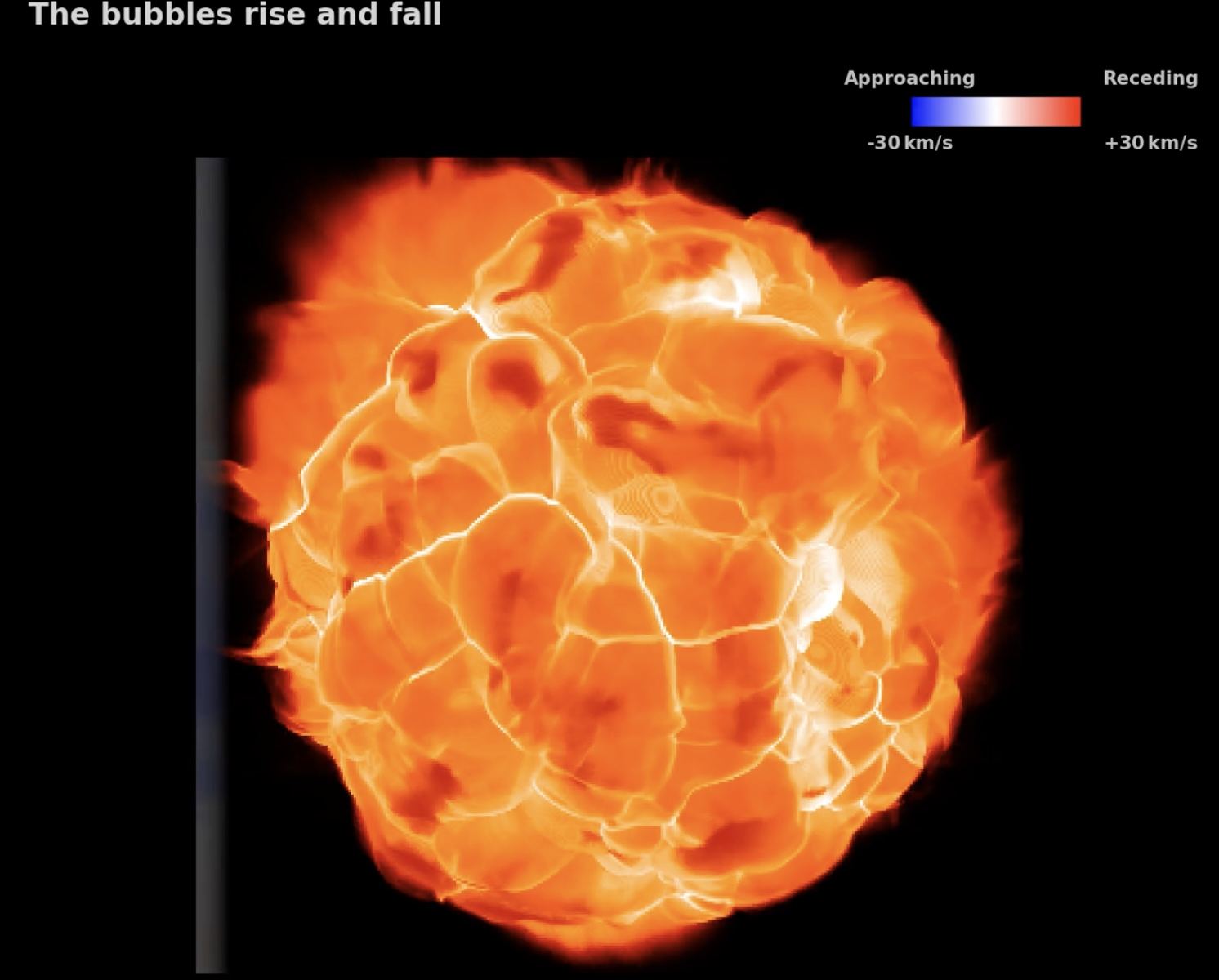
Of all the stars in the sky, betelgeuse must be among the most enigmatic. One of its many mysteries surrounds the speed of its rotation which is surprisingly fast for a supergiant star. If it were placed where the Sun was, then its photosphere (visible layer) would be out around the orbit of Jupiter and it would be moving at 5 km/s. A new study now hints that instead of high rotation, it may be that the surface is boiling so furiously that it has been mistakingly identified as fast rotation.
Betelgeuse is one of the first stars an amateur astronomer will learn. Its distinctive red colour in the upper left corner of Orion makes it a prominent star, easy to find and identify and a great signpost to other constellations. We all know that stars are big but Betelgeuse takes this to a whole new level at 1.2 billion km across, almost 2,000 larger than the Sun. Stars of this size are usually expected to rotate slowly but observations revealed its high rotation speed, far higher than expected of a star at this evolutionary stage.
Orion and the molecular cloud covering the region. Betelgeuse is the red star in the upper left. (Credit : Rogelio Bernal Andreo)
Observations from the Atacama Large Millimetre Array pointed at the rotation speed of Betelgeuse. The system, which is made up of 66 antennae is a radio interferometer that combines the signal from all dishes to increase its sensitivity. Using this instrument, astronomers had concluded that one hemisphere seems to be approaching while the other seems to be receding and the rate of this led to the conclusion of a 5 km/s rotation speed. If Betelgeuse was a perfect sphere then this would have been a reasonable conclusion however, the surface of Betelgeuse is not like that!
Two of the Atacama Large Millimeter/submillimeter Array (ALMA) 12-metre antennas gaze at the sky at the observatory’s Array Operations Site (AOS), high on the Chajnantor plateau at an altitude of 5000 metres in the Chilean Andes. There is now a total of 66 antennae, 54 of them with 12-metre diameter dishes, and 12 smaller ones, with a diameter of 7 metres each. The ALMA project is an international collaboration between Europe, East Asia and North America in cooperation with the Republic of Chile. ESO is the European partner in ALMA.
Like all stars, convection is a prominent process in the photosphere that brings heat from the stellar interior. In the case of Betelgeuse the convection cells are massive, sometimes even as large as the Earth’s orbit around the Sun and they rise and fall at speeds around 30 km/s (that’s over twice the escape velocity of the Earth so is faster than any launching spacecraft).
Jing-Ze Ma PhD from the Max Planck Institute for Astrophysics now proposes that the dipolar velocity map which identified the approaching and receding hemispheres, may actually have been picking up convection cells instead. The theory postulates that the limited resolution of the ALMA system was observing (but not able to differentiate) convection cells rising on one side of the star and sinking on the other.
To reach that conclusion, the team had developed a new processing technique to produce synthetic data from ALMA and in 90% of cases, the boiling motion was not clear and led to an interpretation of high rotational speeds. Further observations are now needed to explore this exciting possibility but instruments with greater resolution are required. to that end, higher resolution observations were made back in 2022 but the data is still being analysed but it will, it is hoped, start to reveal much more about the nature of Betelgeuse.
How Long Will Advanced Civilizations Try to Communicate With Us?
Technosignature research is heating up, with plenty of papers speculating on the nature, and sometimes the longevity, of signals created by technically advanced extraterrestrial civilizations. While we haven’t found any so far, that isn’t to say that we won’t, and a better understanding of what to look for would undoubtedly help. Enter a new paper by Amedeo Balbi and Claudio Grimaldi, two professors at the Universita di Roma Tor Vergata and the Ecole Polytechnique Federale de Lausanne, respectively. They have taken a statistical model to the problem of understanding how old a technosignature might be before we are likely to find it – and their answer is, surprisingly young.
We’ve reported before on how another recent paper thought that any civilization that created a technosignature that we can see is likely to be much older than ours. Simply put, technosignatures can last a long, long time. Over those long periods, the technosignatures can travel to places that are farther away. Given the extreme longevity of some of these civilizations, it turns out we are more likely to come across a technosignature that has been around for a very long time rather than one just created recently.
However, one big assumption in the previous paper is that the technosignature would last for extremely long periods. That assumption might not always hold, as many technosignatures have to be actively supported, such as radio signals or artificial lights on a planet. Given the active support these require, it’s likely they wouldn’t be supported anywhere near as long as implied by the previous paper.
Fraser discusses the idea of technosignatures.
Drs. Balbi and Grimaldi instead use a statistical technique to more accurately reflect what they think the actual situation in the universe would be – civilizations actively support their technosignatures for some time but let them die off once they are no longer beneficial to the civilization itself – essentially eliminating our chance to find them. From a statistical point of view, this clusters the vast majority of observable technosignatures to the far left of the x-axis, where that axis is defined as the longevity of a civilization.
We could see some obvious technosignature that have been around for billions of years and don’t require any active support, such as the thermoradiation of a Dyson sphere. But it’s much more likely that, if we do see one, it is actively being supported by an active civilization.
In the paper, the researchers perform a more rigorous statistical analysis, including invoking an idea known as Lindy’s Law. That law is somewhat counterintuitive, as it states that the life expectancy of a technology is roughly proportional to its age. In other words, as a technology ages, its life expectancy increases. However, it has been proven in multiple scenarios and has various causes.
Dr. David Kipping, the author of a previous paper discussing how long technosignatures might last, discusses the research he did on his channel. Credit – Cool Worlds YouTube Channel
The impact it has on this particular analysis is clear – the probability distribution of the length of a technically advanced civilization’s existence should be skewed per Lindy’s Law to show that short-lived technosignatures are much more common than long-lived ones.
At the moment, this is all theoretical, and it would be interesting to see what Dr. Kipping, the author of the original paper arguing for longer-lived societies, has to say about this alternative view of the statistical treatment. Maybe it will be featured on an episode of his Cool Worlds channel soon. Until then, the hard work of SETI data collection will continue apace, and the theoreticians will continue fine-tuning their statistical models, hoping to one day catch a glimpse of something out there.
Thirty four years ago, thousands of Belgian citizens reported mysterious platforms flying silently over rooftops. The Royal Belgian Air Force got involved and cooperated fully with civilian investigators. To this day, however, the origins of these craft remain unknown.
It’s hard to convey the excitement caused by the Belgian UFO wave if you were not following UFO news back in 1989 and the early 1990s. There was no shortage of UFO reports back then, and interest in the phenomenon was at a high. The sightings and photos from Gulf Breeze, Florida, dominated the American scene, wild UFO reports and stories coming out of the old Soviet Union received huge international media attention, and the Mexican video wave took off in 1991. Yet the Belgian wave seemed to top all of these stories for awhile. The reports out of this small country, headquarters of both the European Commission and NATO, received unprecedented coverage, making even the front page of the Wall Street Journal on October 10, 1990, with a story entitled, “Belgium Scientists Seriously Pursue A Triangular UFO.”
The classic triangular-shaped UFO described by hundreds of eyewitnesses during the Belgium wave: sketch by witness used to create reconstruction of the object seen at the top of story.
Credit: SOBEPS
There were many reasons for the interest generated by the Belgian wave. One was the quality of the reports themselves, the bulk of which were registered in the French-speaking region of Wallonia. There were no landings or humanoid sightings but lots of detailed multiple-witness sightings of flying platforms moving slowly and silently above rooftops. Shapes varied, but the predominant form was triangular or delta-shaped crafts. Some of the descriptions were so precise that traditional explanations of misidentified natural phenomena or conventional aircraft were ruled out. Instead, stealth fighters and other U.S. secret military aircraft became the favorite explanations suggested by skeptics, but these were quickly ruled out by the Royal Belgian Air Force (RBAF). Another reason for the wave’s importance was that it was carefully investigated and documented by a local UFO organization called SOBEPS (Belgian society for the study of space phenomena).
SOBEPS was formed in 1971 by Lucien Clerebaut, Michel Bougard, and others, and built a small but highly dedicated cadre of field investigators. By the end of the wave in 1993, SOBEPS had collected over two thousand eyewitness reports comprising twenty thousand pages, four hundred hours of audio tapes, and six hundred full inquiries. Five hundred and forty cases remained unexplained. SOBEPS also had the assistance of top-notch scientists, including Léon Brenig, a nonlinear dynamics theorist at the Free University in Brussels, and Professor Auguste Meessen, a physicist from Catholic University at Louvain. Regarding his work with SOBEPS, Dr. Brenig has said, “here is an opportunity where we can apply the scientific method.” Brenig himself became a witness of the so-called Belgian triangle while driving in the Ardennes on March 18, 1990. The whole dossier was eventually published by SOPEPS in two massive volumes, five hundred pages each, entitled Vague d’OVNI sur la Belgique (UFO Wave ver Belgium), published in 1991 and 1994 respectively. Due to financial difficulties, SOBEPS dissolved on December 31, 2007, but some of its members formed a new, smaller organization called COBEPS (Belgian committee for the study of space phenomena) to preserve the archives and work done for thirty-six years.
The two volumes published by SOBEPS entitled, “UFO Wave Over Belgium.”
Credit: SOBEPS
A final and key element in the credibility of the Belgian UFO wave was the participation and validation by the RBAF, which showed an unusual degree of openness. As the Belgian wave gained steam, the Belgian Ministry of Defence was deluged with queries from the public and the media. The task fell upon the chief of operations of the air force, Col. Wilfried De Brouwer, who was later promoted to major general and deputy chief of the RBAF. Now retired from the service, Gen. De Brouwer has continued to speak about the wave. He was one of the many international officials who spoke at the famous event at the National Press Club (NPC) in Washington, DC, in November 2007, organized by filmmaker James Fox and journalist Leslie Kean. “The Belgian UFO wave was exceptional and the air force could not identify the nature, origin and intentions of the reported phenomena,” said De Brouwer at the NPC. He also gave a detailed presentation on the wave at the MUFON International UFO Symposium in San Jose, California, in July 2008, and was one of five generals to write an essay in Leslie Kean’s new book, UFOs: Generals, Pilots, and Government Officials Go On the Record.
Although the RBAF scrambled jets on three occasions during the wave, Gen. De Brouwer has explained on various occasions that they didn’t have the manpower or resources to mount a full-fledged investigation of their own, so instead they took the unusual route of cooperating fully with SOBEPS. The radar data was turned to Prof. Meessen for analysis, and Gen. De Brouwer agreed to write the postface for SOBEPS’s first volume when he was still in the service. “I must acknowledge that I somewhat hesitated when SOBEPS asked me to contribute my share to this book,” he wrote. “Indeed, I am not a UFO specialist and, moreover, it is quite delicate for somebody who occupies an official function to put on paper his personal ideas on such a disputed issue. However, I estimate that I would not have been honest towards the SOBEPS if I had refused. The air force always played a fair game on this subject and I regard this postface as a complementary element to the exceptional file written by the people of SOBEPS.”
THE EUPEN INCIDENT
Although some sightings were reported in October 1989, the first important incident of the Belgian wave took place a month later on November 29 around the small town of Eupen, which is in a region of Belgium near the German border. This initial case put the so-called “Belgian triangle” on the map and led to the start of the RBAF’s involvement. There were both daytime and nighttime sightings, although the latter were lengthier and more detailed. Gen. De Brouwer explained in his essay for Leslie Kean’s book, “a total of seventy reported sightings made on November 29 were fully investigated and none of these sightings could be explained by conventional technology. The team of investigators and I estimate that approximately fifteen hundred people must have seen the phenomenon at more than seventy different locations from different angles during this afternoon and evening.” There were a total of thirteen gendarmes (policemen) who saw the UFO from eight different locations around Eupen. Prof. Meessen summarized the case in SOBEPS’s book:
On November 29, 1989, a large craft with triangular shape flew over the town of Eupen. The gendarmes von Montigny and Nicol found it near the road linking Aix-la-Chapelle and Eupen. It was stationary in the air, above a field which it illuminated with three powerful beams. The beams emanated from large circular surfaces near the triangle’s corners. In the center of the dark and flat understructure there was some kind of “red gyrating beacon.” The object did not make any noise. When it began to move, the gendarmes headed towards a small road in the area over which they expected the object to fly. Instead, it made a half-turn and continued slowly in the direction of Eupen, following the road at low altitude. It was seen by different witnesses as it flew above houses and near City Hall.
In his 2008 MUFON lecture, Gen. De Brouwer provided additional details on this sighting: “The UAP [Unidentified Aerial Phenomenon] emitted repeatedly and simultaneously two red light beams with a red light ball at the spearhead of the beam. Subsequently, the red balls returned to the craft.” There was also apparently a second triangular craft, which made “a forward tilting maneuver, exposing the upper side of the fuselage,” continued De Brouwer. “They [gendarmes] saw a dome with rectangular windows, lighted up at the inside. It then disappeared to the North.” Two more gendarmes saw one of the craft from a monastery nearby; “one is currently the head of the police in that area, he was scared like hell,” added De Brouwer.
Statistical chart of Belgian sightings between October 1989 and September 1990, showing peaks in the November-December period and a second one in April.
Credit: SOBEPS
The Eupen incident was followed by many other UFO sightings, including several reported on December 11, 1989. One of the witnesses that evening was a personal acquaintance of Gen. De Brouwer, Col. André Amond, a civil engineer in the Belgian Army. Col. Armond worked next door to Gen. De Brouwer and wrote a detailed report for the Ministry of Defence. Col. Armond was driving with his wife around 6:45 p.m., when they noticed a strange object with flashing red lights. They stopped the car and got out to see it better. “Suddenly, they saw a giant spotlight, about twice the size of the full moon, which approached them to an estimated distance of 100 meters,” wrote De Brouwer, adding that “the colonel’s wife was frightened and asked to leave.” In his report to the Ministry, Armond “ascertained that this craft was not a hologram, helicopter, military aircraft, balloon, motorized Ultra Light, or any other known aerial vehicle.”
Various shapes were reported throughout the wave, including round, rectangular, and cigar-shaped, but the majority were triangular objects. Gen. De Brouwer notes that the differences may also be due to the eyewitnesses’ viewing angles. Researcher Marc Valckenaers listed some of the characteristics of the UFOs in SOBEPS’s second volume about the wave, including: irregular displacement (zig-zag, instantaneous change of trajectory, etc.), displacement following the contours of the terrain; varying speeds of displacement (including very slow motion), stationary flight (hovering), overflight of urban and industrial centers, and sound effects (faint humming to total silence).
Reconstruction of the incredible rectangular flying platform seen by two factory workers on April 22, 1990, described as “an aircraft carrier turned upside down.”
Credit: SOBEPS
One of the strangest reports came from two factory workers from the town of Basècles, southwest of Brussels, who saw a huge trapezoid flying platform (330 x 200 feet) just before midnight on April 22, 1990. The object moved slowly and silently, covering the entire factory courtyard. In the SOBEPS report, the factory workers described the UFO as “an aircraft carrier turned upside down.” Despite the science-fiction quality of this sighting, an almost identical report was filed nearly a year later, on March 15, 1991, by an electronic engineer in Auderghem, near Brussels, who woke up in the middle of the night when he “heard a barely audible, high-frequency whistling tone. He looked out the window and saw a large rectangular craft at very low altitude with irregular structures on the bottom,” wrote Gen. De Brouwer.
One characteristic of the Belgian wave was how close the objects were flying above the rooftops, as shown with this flying rectangular platform.
Credit: SOBEPS
Another view of the rectangular flying platform above the rooftop and sketch showing where the witness saw it.
Credit: SOBEPS
THE F-16 SCRAMBLE EPISODE
If the Eupen multiple-witness sightings of November 1989 triggered the Belgian wave, the jet fighter scramble incident during the night of March 30, 1990 marked the peak of public interest and global media coverage. The Belgian Air Force had scrambled jets on two prior occasions without positive results. The December 5, 1989 scramble was unsuccessful; when the jet reached the sky, the UFO was gone. Additionally, the December 16, 1989 case turned out to be a false alarm; the authorities quickly determined that it was a laser projection reflected by a cloud layer. Following these two fiascos, the RBAF implemented a new policy that jets would be scrambled only when a sighting was detected on radar and was visually confirmed on the ground by the police.
The SOBEPS team visiting the Royal Belgian Air Force radar facility at Glons: in the center group, left, the Society’s chairman Lucien Clerebaut and right, physicist Prof. Auguste Meessen, next to military officer.
Credit: SOBEPS
As put in a preliminary report prepared by Major P. Lambrechts of the RBAF, entitled “Report Concerning the Observation of UFOs During the Night of March 30 to 31, 1990,” the incident began at 10:50 p.m. on March 30 when the gendarmerie telephoned the radar “master controller at Glons” to report “three unusual lights forming an equilateral triangle.” More gendarmes confirmed the lights. When the NATO facility at Semmerzake detected an unknown target at 11:49 p.m., a decision to scramble two F-16 fighters was made. The jets took off at 12:05 a.m. from Beauvechain, the nearest air base, and flew for just over an hour. According to Major Lambrechts’s report:
The aircraft had brief radar contacts on several occasions, [but the pilots]…at no time established visual contact with the UFOs…each time the pilots were able to secure a lock on one of the targets for a few seconds, there resulted a drastic change in the behavior of the detected targets…[During the first lock-on at 12:13 a.m.] their speed changed in a minimum of time from 150 to 970 knots [170 to 1,100 mph] and from 9,000 to 5,000 feet, returning then to 11,000 feet in order to change again to close to ground level.
When Col. De Brouwer showed the computerized radar images of the UFO tracked by the F-16 onboard radar system in a heavily attended press conference at the Ministry of Defence on July 11, 1990, the international media went into a frenzy. Transcripts of the radio communications between ace fighter pilots, Capt. Yves Meelbergs, Lt. Rudy Verrijt, and the Glons Control Reporting Center near Liege, were also released and provide some dramatic moments. The transcripts paint a picture of the jets chasing ghost radar echoes that appear and disappear and then reappear again, but at no time are the pilots able to establish visual contact with the supposed objects. Belgium’s Electronic War Center (EWC) eventually undertook a detailed technical analysis of the F-16 computerized radar tapes, completed by Col. Salmon and physicist M. Gilmard in 1992, and later reviewed by Prof. Meessen.
An F-16 jet fighter of the Royal Belgian Air Force like the ones scrambled on the night of March 30-31, 1990.
Credit: Bernard Thouanel
Although some aspects of this case still remain unexplained, Meessen and SOBEPS accepted the Gilmard-Salmon hypothesis that most of the radar contacts were really echoes caused by a rare meteorological phenomenon. This became evident in four lock-ons, explained Meessen, “where the object descended to the ground with calculations showing negative altitude…. It was evidently impossible that an object could penetrate the ground, but it was possible that the ground could act as a mirror.” Meessen explained how the high velocities measured by the Doppler radar of the F-16 fighters might result from interference effects. He pointed out, however, that there was another radar trace for which there is no explanation to date. As for the visual sightings of this event by the gendarmes and others, Meessen suggested that they could possibly have been caused by stars seen under conditions of “exceptional atmospheric refraction.”
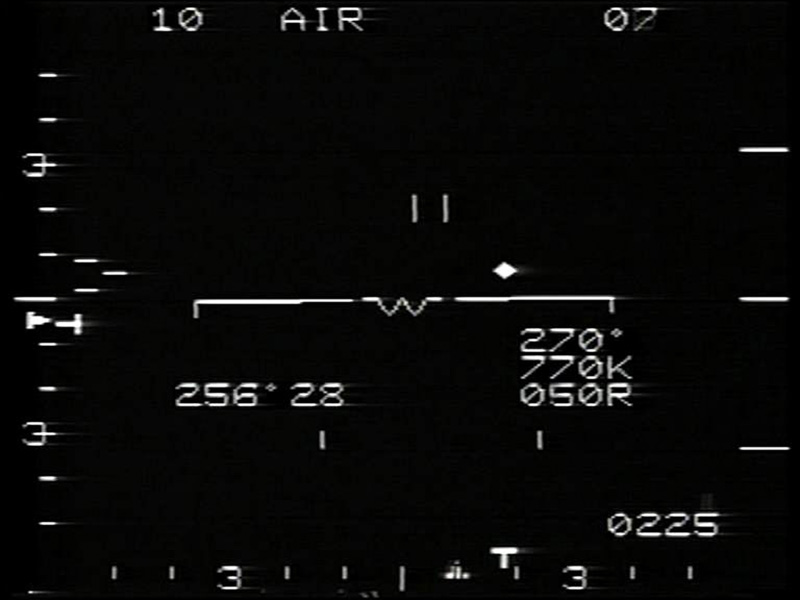
One frame from the F-16 onboard radar system showing the UFO lock-on during the March 1990 scramble episode, shown by the RBAF at a famous press conference in July 1990.
Credit: RBAF/ Bernard Thouanel
In a 1995 telephone interview, Gen. De Brouwer summarized his reflections on this complex case: “We always look for possibilities which can cause errors in the radar systems. We can not exclude that there was electromagnetic interference, but of course we can not exclude the possibility that there were objects in the air. On at least one occasion there was a correlation between the radar contacts of one ground radar and one F-16 fighter. This weakens the theory that all radar contacts were caused by electromagnetic interference. If we add all the possibilities, the question is still open, so there is no final answer.” De Brouwer took a more detached view of the F-16 scramble episode, however, in his 2008 MUFON lecture and his 2010 essay included in Kean’s book: “The conclusion of the Air Force, therefore, was that the evidence was insufficient to prove that there were real crafts in the air on that occasion.”
THE PETIT-RECHAIN PHOTO
The famous color slide of the Belgian triangle photographed in Petit-Rechain in early April 1990.
Seldom has the old saying that a picture is worth a thousand words become more true than in the case of the extraordinary photograph of a flying triangle taken in the small town of Petit-Rechain in April 1990. This color slide became the emblematic symbol of the Belgian UFO wave. It has been published and broadcast in television programs all over the world, and it appears on the cover of the two SOBEPS volumes on the Belgian wave. It’s also one of the most analyzed UFO photos in the history of ufology. During my trip to Brussels in 1995, I had the opportunity to talk at length with Patrick Ferryn, the investigator who researched the case initially and wrote the chapter about it in the SOBEPS book. Ferryn gave me copies of the photo and samples of computer enhancements made by Marc Acheroy, professor of electricity at the Royal Military School, where the image was analyzed by the Signal Treatment Center. The details of how the photo was taken are fairly simple and straightforward.
The photographer, P.M. (who wants privacy, but has fully cooperated with SOBEPS), was a twenty-year-old factory worker, who lived in the small community of Petit-Rechain, near Verviers. He was at home with his girlfriend on the night of either April 4 or 7, 1990 (he can’t pin down the exact date), when his girlfriend first noticed the object between 11:00 and 11:30 p.m. as she took the dog to the courtyard. According to P.M.’s statement to Ferryn, he was alerted by his girlfriend, went outside, and “saw the object practically stationary towards the southwest, at about a forty-five-degree elevation. It consisted of three white round lights on a barely perceptible triangular surface. In the center there was a blinking spot of the same color, or maybe a bit more reddish than the other lights.” P.M. grabbed his camera, a Praktica model BX20 with a 55-200 mm zoom and a “Cokin” 1A 52 mm skylight filter. He shot the last two frames of a roll of 36-200 ASA Kodak color slide film. The UFO then moved slowly towards Petit-Rechain, until it was hidden by the roofs in the village. The entire episode took about five minutes.
The roll of film was sent by mail to a development house offering a special discount, and when P.M. received the slides, he noticed only frame #35 had captured the UFO; frame #36 was entirely black. Ferryn estimated that “the photo was probably taken with a focal distance between 55 and 200 mm, and with exposition time ranging from 1 to 2 seconds.” P.M. showed the photo to his factory coworkers (all of whom were later interviewed by Ferryn), but otherwise didn’t do anything to analyze or commercialize the picture. One of his coworkers knew a local photo-journalist from Verviers, Guy Mossay, who immediately saw the image’s potential value. P.M. sold the photo rights to Mossay for a small fee. Mossay then proceeded to copyright it with SOFAM (Belgium’s multimedia society for visual arts authors).
Skeptics have naturally pointed to the possibility of a hoax with profit motive. However, if that is the case, why did P.M. sell the rights to Mossay for a minor fee? Moreover, hoaxers never supply original slides or negatives for scientific analysis, as was done by P.M. Having checked his background, interviewed acquaintances, and so on, Ferryn noted that “the account of the main witnesses was coherent.” Gen. De Brouwer spent quite a bit of time explaining the details of this case during his MUFON lecture, saying of the witness that, “this guy is genuine, he is a guy who would not fake at all, I can assure you of that.” More importantly, the Petit-Rechain photo has been subjected to more scientific analysis than practically any other UFO photo in history.
When the Petit-Rechain photo is overexposed, the triangular outline of the object appears clearly.
The list of experts and institutions that have analyzed this photo include Prof. Acheroy of Belgium’s Royal Military Academy; Prof. François Louange, an expert in photo interpretation of satellite images for the French space agency, CNES; Dr. Richard Haines, a retired senior NASA scientist and respected UFO researcher; Belgium’s Royal Institute of Artistic Patrimony; and André Marion, a nuclear physicist with France’s National Center for Scientific Research (CNRS), who conducted an analysis in 2002 with improved technology. The technical details of these analyses are too numerous for this article, but suffice it to say that evidence of photographic trickery has never been found. Furthermore, of several efforts to duplicate the photo using a dark cardboard triangular model with holes and light bulbs, only one made by members of the Astrophysics Institute at Liege University somewhat resembled the Petit-Rechain photo. But the luminosity of the spots in the replica was uniform, while those in the original exhibited different shapes and spectral effects. The most recent CNRS study by Dr. Marion confirmed the previous analysis and found, as put by Gen. De Brouwer, a “halo around the craft with patterned structure,” which could have been caused by the object’s “propulsion system” of “magnetoplasma dynamic.” Marion also stated that “it would be extremely difficult to fake such a photograph.”
In the end, it’s almost impossible to guarantee the authenticity of a UFO image. There will always be a difference of opinions, but the verdict in the Petit-Rechain case appears highly favorable. Triangular UFOs were seen throughout Belgium during the early 1990s. Dozens of fuzzy videos and grainy photos were taken, but they were generally not impressive. Petit-Rechain was the great exception.
Note: Since the writing of this article, the photo turned out to be an admitted hoax.
NO EVIDENCE OF SECRET AIRCRAFT
Due to the high credibility of most witnesses in the Belgian wave and their descriptions of a silent, triangular craft being so precise, trying to explain the wave in terms of hoaxes, misidentified natural phenomena, or conventional aircraft seemed fruitless. Therefore, a number of skeptics and aviation journalists focused on trying to prove the hypothesis of secret U.S. aircraft flying over Belgium. A series of candidates were proposed, from the Airborne Warning and Control System (AWACS) to secret airships, from the F-117A stealth fighter to some other revolutionary U.S. secret military aircraft such as the alleged TR-3A Black Manta. First, you have to ponder why the U.S. would conduct tests of their most-secret aircraft in such a highly populated area like Wallonia, which is not only a U.S. ally, but also headquarters of the NATO alliance. Gen. De Brouwer put it bluntly in a 1991 interview with the French magazine, OVNI Présence: “Why would the Americans conduct tests here in Europe, without permission and with the risk of having an accident that could create a diplomatic incident on a global scale? This doesn’t involve only Belgium, but NATO, where its concept itself could be put in question. I don’t believe that the Americans could take such a risk, it’s evident.”
Major General (Ret.) Wilfried De Brouwer, who was the Royal Belgian Air Force point man for the UFO wave, during his trip to Washington, DC to participate at the National Press Club event in 2007.
Credit: Bernard Thouanel
Guy Coeme and Leo Delcroix, the two Belgian Ministers of Defence during the wave, denied emphatically the theory that the UFOs were actually U.S. aircraft and based their denial on official inquiries with the U.S. Embassy in Brussels. In a 1993 letter to French researcher Renaud Marhic, Minister Delcroix wrote: “Unfortunately, no explanation has been found to date. The nature and origin of the phenomenon remain unknown. One theory can, however, be definitely dismissed since the Belgian Armed Forces have been positively assured by American authorities that there has never been any sort of American aerial test flight.” A declassified 1990 document from the U.S. Defense Intelligence Agency (DIA) entitled, “Belgium and the UFO Issue,” supports Delcroix’s position. After describing the basic events of the wave that had transpired up to that point, the unnamed U.S. official wrote at the very end of this memo: “The [U.S. Air Force (USAF)] did confirm to the [Belgian Air Force] and Belgian [Ministry of Defence] that no USAF stealth aircraft were operating in the Ardennes area during the periods in question. This was released to the Belgian press and received wide dissemination.”
Thirty years have now passed since the Belgian UFO wave, and no new significant evidence has been produced to prove that the sightings were caused by secret military aircraft. The reported cases remain unexplained. It seems certain that something massive and technologically advanced flew over Belgian territory during the 1989-93 period. Why and who was behind it are questions that remain to be answered. A suitable conclusion, for now, is to repeat what Gen. De Brouwer wrote at the end of his famous postface to the SOBEPS’s first volume: “The day will come undoubtedly when the phenomenon will be observed with technological means of detection and collection that won’t leave a single doubt about its origin. This should lift a part of the veil that has covered the mystery for a long time. A mystery that continues thus present. But it exists, it is real, and that in itself is an important conclusion.”
The author (left) with SOBEPS’ chairman Lucien Clerebaut at the Society’s headquarters in Brussels in 1995. The map in the background shows the locations of sightings in Belgium.
Credit: Antonio Huneeus
A version of this article originally appeared in Issue #5 (December/January 2011) of Open Minds UFO Magazine. Back issues can be found here.
Some view Carl Jung as a UFO debunker, others as a UFO believer, but the truth is he was somewhere in the middle. Either way, it is certain that Jung was an avid UFO researcher and fascinated with the topic. He wrote a book about the psychological symbolism and the role the UFO mythos plays in the unconscious mind.Moreover, on several occasions Jung complained that his studies would have been much easier if the UFO phenomenon was not real.
Jung the Psychologist
Jung was born in Switzerland in 1875. His father was a pastor in the Swiss Reformed Protestant Church, and his mother was from a wealthy Swiss family. He was the Jungs’ fourth child, but was the only child who survived into his childhood. As such, he grew up as an only child. Later, he wrote that he remembered enjoying his solitude.
His first experience with neurosis was at the age of twelve when a fellow student shoved him, causing him to fall and hit his head on the ground very hard. He remembered associating this experience with schoolwork, and whenever he had to go to school or do schoolwork he would faint. Overhearing his parents’ concern that this condition would cause him to be unable to support himself as an adult, Jung fought to overcome the problem and eventually returned to academics.
Although Jung had a profound interest in spirituality, his experiences triggered an interest in psychology and he decided to pursue a career in medicine. It wasn’t long before he realized that studies in psychology would allow him to combine his interests in medicine and spirituality, and in 1902, he completed his doctoral dissertation, which was titled “On the Psychology and Pathology of So-Called Occult Phenomena.” He graduated with a medical degree from the University of Basel.
After graduating, Jung went to work with psychiatric patients at the University of Zurich asylum. He wrote a paper on word association that he sent to Sigmund Freud. Freud was impressed with Jung’s work, and they quickly became very close. Freud considered Jung his successor. However, after several years, Jung began to develop his own ideas beyond the work of Freud, and due to their disagreements, the relationship turned adversarial.
Carl Jung (bottom right), Sigmund Freud (bottom left), and others at a 1909 celebration of the founding of Clark University, Worcester, Massachusetts.
Credit: Library of Congress
Freud’s work with the ego and unconscious served as a foundation for Jung’s work. They both felt that disconnects between the conscious and unconscious minds caused neurosis in people. They also both relied on dream interpretation to explore a person’s unconscious mind as a method for subsequently resolving neurosis. In fact, one story holds that Jung and Freud interpreted each other’s dreams and both completely disagreed with the other’s analysis, thus hastening the dissolution of their friendship.
A major area of disagreement between the two was that Jung did not believe a person’s unconscious was driven solely by sexual desires, as Freud did. Jung believed other strong emotions such as fear and aspiration were just as influential. He also conceived of a deeper level of the unconscious called the collective unconscious, which he believed is a part of our unconscious mind that holds ideas and concepts shared by all humankind. He believed these base ideas are then shaped by our cultural perceptions and personal experience. For example, we all have ideas around the notions of mothers, fathers, wise elders, etc. Jung called these shared notions archetypes. Jung felt that these archetypes not only would manifest in dreams, but could be seen in people’s creative works and behavior, including art, religion, and mythology.
Jung’s contributions to psychology are numerous. Even today his ideas of extraversion and introversion are a mainstay in personality psychology. He also came up with the idea of psychological complexes and synchronicities. All of these ideas and terms are commonly used in everyday conversation today, and all were made popular by Jung.
Jung and Alchemy
It is the idea of the archetype that brought Jung to have a particular interest in UFOs. When Jung interpreted psychological meaning he would search for archetypal figures. As mentioned earlier, such figures could be a mother or father.But, in a mythological story, the archetype may be the hero, a dragon, or even a planetary entity such as the sun. However, Jung also had an interested in alchemy.
Alchemy is typically connected to legends of ancient mystics attempting to unravel the secret of turning lead into gold. The work of alchemists is credited with the development of modern chemistry. However, another side of alchemy is spiritual in nature, relating to personal transformation. Jung had a passion for alchemy in this sense, and felt that the metal lead was a metaphor for an impure soul, whereas gold was a metaphor for a perfected soul. Jung’s interest in alchemy was thus as a method of purifying the soul.
The Tabula Smaradina (Emerald Tablet), a print by Mathias Merian from the 1600s displaying alchemical symbols and imagery.
Credit: Mathias Merian
Jung wrote a couple of books focused on interpreting alchemical symbolism and processes as different stages of personal growth that mirrored his ideas. He felt these symbols were archetypes that were unconsciously manifesting in the work of alchemists. Although he acknowledged the physical goals of alchemy (an attempt to transmute lead into gold), Jung did not give it much attention in his writing and focused on the non-physical aspects that related to his psychological theories. This is very similar to the way he approached the topic of UFOs.
Jung and UFOs
In 1951, Jung wrote to a friend in the United States: “I am puzzled to death about the phenomena, because I haven’t been able yet to make out with sufficient certainty whether the whole thing is a rumour with concomitant singular and mass hallucination, or a downright fact.”
Book cover to Jung’s Flying Saucers: A Modern Myth of Things Seen in the Skies.
(Credit: Princeton University Press.)
Although Jung showed an interest in the mystery of the physical reality of the UFO phenomenon, professionally he stated, “As a psychologist, I am not qualified to contribute anything useful to the question of the physical reality of Ufos.” However, Jung could contribute by analyzing the unmistakable psychological side to the UFO phenomenon. In 1958, several of Jung’s papers regarding the psychology of UFOs were published in a book. It was originally published in German, but in 1959 it was translated to English under the title, Flying Saucers: A Modern Myth of Things Seen in the Skies.
In the book, Jung argued that although there may be a physical reality to UFOs, there is certainly a portion of the phenomenon that is fantasy. He examined the difficulty many have in accepting fantastical stories of UFOs, even when they come from pilots, and points out, “What is worse, most of the stories come from America, the land of superlatives and of science fiction.”
For the sake of argument, and to examine the psychological aspects of the phenomenon, Jung presumed that UFOs are fantasy. This is an important aspect that many critics overlook when they characterize Jung as dismissive of the phenomenon altogether. UFO researchers also tend not to appreciate the portions of Jung’s book in which he examined the UFO phenomenon in regards to archetypal imagery and alchemic symbolism. Jung himself assures his readers that although his work may appear to be “unbridled fantasy” to those unfamiliar with psychology, it is actually based on “thorough research into the history of symbols.”
In his book, Jung observed that most UFO sightings describe the objects as disc shaped, which is a symbol that is often seen in alchemy and existed in the mythology of other cultures. For example, the Hindu and Buddhist symbol of the mandala is a circular disc-shaped symbol. Jung believed that the mandala is a protective sphere, which is elicited in the unconscious in times of emotional tension. Jung noted that, around the time of many of the UFO sightings, the world was under a collective stress due to “Russian policies and their still unpredictable consequences.” In short, he felt that perhaps UFOs were appearing in visions at the time because of the world’s Cold War jitters, and that the UFOs were a manifestation of a need for protection and salvation.
Jung’s book also provided detail of the analysis of particular sightings and art. One of the significant contributions to ufology made by the book is a focus on two historical broadsheets, a type of ancient newspaper, that recorded mysterious apparitions that many have speculated to be UFO related. Although Jung asserted that these reports were in the UFO literature prior to the publication of his book, Jung clearly made them popular as potential ancient UFO sightings.
The first is referred to as the Basel Broadsheet, and it dates back to 1566. It was written by Samuel Coccius and is a report of “many large black globes” that were seen flying in front of the sun “with great speed.” The Basel Broadsheet notes, “Some of them became red and fiery and afterwards faded and went out.” Jung noted the similarity of this phenomenon to modern UFO accounts.
The Basel Broadsheet from 1566 analyzed by Carl Jung in his Flying Saucer book.
The second report is called the Nuremberg Broadsheet and dates back to 1561. This report chronicles a “very frightful spectacle” that was witnessed by several people. Again, “globes” were seen near the sun, “some three in a row, now and then four in a square, also some standing alone.” There were also “two great tubes.” Jung noted that in UFO literature large tubes are considered “motherships,” and have been reported to have smaller discs that appear to fly out of them.
The Nuremberg Broadsheet from 1561 analyzed by Carl Jung in his Flying Saucer book.
In his book, Jung also examined the possibility of the physical reality of UFOs. He noted that, “unfortunately,” UFOs cannot be dismissed as purely psychological in nature. He pointed to numerous sightings, some of which have been caught in photographs and on radar. Jung even poked fun at astronomer Donald Menzel, a UFO debunker, saying that he “has not succeeded, despite all his efforts, in offering a scientific explanation of even one authentic UFO report.”
Jung was well-versed on UFO research. He wrote, “since 1947 I have collected all of the books I could get a hold of on the subject.” He was also a member of the National Investigations Committee on Aerial Phenomena (NICAP), an early civilian UFO organization that included many credible members. In fact, in his book, Jung often referred to the work of Major Donald Keyhoe, a cofounder and director of NICAP.
Prior to releasing his book, Jung was considered by UFO researchers to be a proponent of the physical reality of UFOs. In 1955, he wrote an article on UFOs for a British journal called the Flying Saucer Review. In the article, Jung stated that he had never seen a UFO himself, but that “I can only say for certain: these things are not a mere rumour: something has been seen.”
He went on to argue that the U.S. Air Force “despite its contradictory statements,” considers the phenomenon to be real and they conduct official investigations. He warned that, by concealing information on the topic, the military is making it more likely that people will panic since the public is denied “an adequate picture of what is happening.”
Jung also stated that “the ‘disks’ (that is, the objects themselves) do not behave in accordance with physical laws, but as though without weight, and they show signs of intelligent guidance, by quasi human pilots, for their accelerations are such that no normal human could survive.”
Not much was made of Jung’s 1955 article until it was reprinted in 1958 by the Aerial Phenomena Research Organization (APRO) in the organization’s bulletin in July 1958. APRO posted the story as part of an announcement that Jung had agreed to become an official consultant for the organization. The New York Herald Tribune quickly picked up on the report and printed a story with the headline, “Dr. Jung Says ‘Flying Disks’ Suggest Quasi-Human Pilots.”
APRO Bulletin from July, 1958 with reprint of Jung’s article on UFOs.
Credit: APRO
Jung was not happy with the implication that he believed UFOs represented a physical phenomenon and later wrote a letter to United Press International news agency clarifying his position. He wrote: “I expressly state that I cannot commit myself on the question to the physical reality or unreality of the UFOs since I do not possess sufficient evidence either for or against.” He then stated, “Something is seen, but it isn’t known what.” Jung later repeated this statement in his 1958 book and in several letters.
Although Jung was clearly embarrassed by the public perception that he conclusively believed flying saucers were physical in nature, he later reiterated his prior statements and earlier criticisms of the U.S. Air Force’s handling of the matter in very strong words. He wrote:
In spite of the fact that I hold my judgment concerning UFOs—temporarily let’s hope—in abeyance, I thought it worthwhile to throw a light upon the rich fantasy material which has accumulated round the peculiar observations in the skies. Any new experience has two aspects: (I) the pure fact and (2) the way one conceives of it. It is the latter I am concerned with. If it is true that the [American Air Force] or the Government withholds telltale facts, then one can only say that this is the most unpsychological and stupid policy one could invent. Nothing helps rumours and panics more than ignorance.
It is no wonder that many have been confused as to Jung’s official stance on UFOs. He seems to have believed the phenomenon and sightings to be real, but is uncertain whether UFOs are a physical reality or are limited to a psychological phenomenon. He stated that although “by all human standards it hardly seems possible to doubt this any longer,” in the decade or more he had been studying the topic, neither he nor anyone else seems to have learned much from the study of the physical aspect of UFOs. Jung said that this is precisely why he found it much more fruitful to study the psychological aspects of UFOs, an area in which he felt he had gained an abundance of knowledge.
Jung may be right. Concrete physical proof of UFOs continues to elude us to this day. Yet, Jung is another example of a luminary who garners a great amount of respect in his field of study, who also had the vision to seriously consider the UFO phenomenon. His UFO interest is a story that should not be forgotten, and his insights into the phenomenon may help guide us today, just as his insights into the human mind continue to be a part of the bedrock of modern psychological understanding.
A version of this article originally appeared in Open Minds UFO Magazine. Back issues can be found here.
China en Rusland gaan een overeenkomst ondertekenen voor de bouw van een basis op de maan. De Chinese ruimtevaartorganisatie zegt dat dit station vanaf 2035 stroom en communicatiemiddelen moet hebben, evenals voorzieningen die menselijke bewoning mogelijk moeten maken.
De Chinese ruimteambities worden verder verduidelijkt in een vrijdag gepubliceerde whitepaper. Hierin meldt het ruimteagentschap dat China doelt op “verkenning en gebruik van de kosmische ruimte voor vreedzame doeleinden”. Het land wil onder meer ruimteschroot beter in kaart brengen en het verdedigingssysteem tegen aardscheerders uitbouwen.
China en Rusland kondigden vorig jaar al gezamenlijke plannen aan voor het station. Het was toen nog niet duidelijk of het om een station om of op de maan zou gaan. De partners beloven dat wetenschappers van over de hele wereld de basis mogen gebruiken. Momenteel ontwikkelen de Verenigde Staten onder meer met Europa een eigen ruimtestation in een baan om de maan, de Lunar Gateway.
China en Rusland hebben ook afgesproken om samen te werken aan een toekomstige robotmissie naar de zuidpool van de maan, Chang'e 7. Het vertrek staat gepland voor 2024.
China hoopt voor 2030 mensen voet te laten zetten op de maan. Het kan er dan nog om gaan spannen of China dan het eerste land wordt om sinds de laatste Apollo-missie in 1972 weer mensen op het hemellichaam te zetten. De Verenigde Staten werken momenteel aan hun eigen nieuwe maanprogramma Artemis. Deze hebben een bemande maanlanding gepland staan voor 2026.
De laatste Chinese maanmissie was in 2020. De Chang'e 5 keerde in december dat jaar, na een missie van 22 dagen, terug met monsters van het maanoppervlak. Er rijdt nog altijd een Chinese rover rond op de maan.
Rusland en China overwegen samen een missie naar de maan te sturen om daar een kerncentrale te bouwen. Yuri Borisov, het hoofd van de Russische ruimtevaartorganisatie Roscosmos, deelde dit plan tijdens een jeugdevenement in Rusland. De missie zou plaatsvinden tussen 2033 en 2035.
De technologie die nodig is voor deze ambitieuze missie zou volgens Borisov bijna gereed zijn. Hij benadrukte dat zonnepanelen alleen niet voldoende zouden zijn voor een betrouwbare stroomvoorziening op de maan. Het plan omvat een samenwerking met China om een krachtbron op het maanoppervlak te plaatsen, waarbij nucleaire ruimte-energie als oplossing wordt voorgesteld.
Geen verrassing
Het nieuws komt op een moment dat Rusland en China al samenwerken aan het International Lunar Research Station (ILRS), dat in 2021 werd ondertekend. Het ILRS is een geplande maanbasis die wordt geleid door het Russische Roscosmos en de China National Space Administration (CNSA).
Ondanks recente tegenslagen van Rusland zoals de mislukte maanlanding in 2023, blijven de plannen voor de samenwerking tussen beide landen wel staande. China boekt vooruitgang met zijn Chang’e-sondes, waaronder Chang’e 5, die met succes monsters van het maanoppervlak naar de aarde heeft gebracht.
Niet nieuw
Het idee van een kerncentrale op de maan is niet nieuw. Zelfs de Amerikaanse ruimtevaartorganisatie NASA heeft eerder voorgesteld om kernreactoren te gebruiken om toekomstige maankolonies van stroom te voorzien. In 1969 gebruikten Apollo 12-astronauten al een nucleaire generator voor wetenschappelijke experimenten op de maan.
The Enigmatic Case of Llanilar: Unveiling Europe’s Roswell
In the quiet countryside of Llanilar, a small village nestled in the heart of Wales, lies a tale as mysterious as it is compelling. Dubbed “Europe’s Roswell,” this incident, much like its American counterpart, has spurred debates, investigations, and a quest for truth that spans over four decades. The event in question occurred in the early days of January 1983, when something extraordinary crashed, leaving behind a trail of intrigue and unanswered questions.
The story begins with a local farmer, Erwell Evans, discovering his fields littered with strange debris and a swath of his forest inexplicably cleared. This wasn’t just any crash site; the area was strewn with metallic fragments, some as large as two meters square, alongside smaller, foil-like pieces. The nature of the debris, coupled with the absence of any conventional aircraft wreckage, quickly attracted the attention of UFO researchers and government entities alike.
At the forefront of the investigation was British UFO researcher, Mark Olly, whose work has shed light on the peculiarities of this case. Olly’s exploration into the Llanilar incident reveals parallels to the Roswell event of 1947, including mysterious materials, government involvement, and the subsequent cleanup efforts that seemed to sweep the occurrence under the rug. However, what sets Llanilar apart is the physical evidence that was left behind and later analyzed, offering a tangible link to the unknown.
Initial investigations into the debris suggested a material composition unlike anything known at the time. Early assessments hinted at a form of aluminum, but later analyses conducted in the United States and Australia revealed far more intriguing properties. One sample was identified as aluminum foam, a known material, yet another was found to be comprised of over 94% lanthanum, a rare earth metal with properties and an extraction cost that made its abundant presence at the crash site all the more baffling.
VIDEO:
George Knapp – The Untold Story of Llanilar’s UFO Crash
The implications of these findings are profound, hinting at technology that was decades ahead of its time. The possibility that this could be a craft, either terrestrial in origin but highly classified, or perhaps even extraterrestrial, cannot be dismissed. The latter hypothesis is bolstered by accounts of unidentified flying objects in the region, suggesting a history of aerial phenomena that predates the crash.
One of the most enigmatic aspects of the Llanilar incident is the response it elicited from unknown operatives, colloquially known as “Men in Black.” These individuals purportedly visited one of the key witnesses, seeking the return of the collected materials. Their appearance, shortly after a meticulous cleanup operation, adds another layer of mystery to the narrative, hinting at a concerted effort to obfuscate the truth.
Despite the passage of time, the Llanilar UFO crash remains a subject of fascination and speculation. The evidence gathered, though limited, provides a tantalizing glimpse into a moment when the ordinary brushed against the extraordinary. As with Roswell, the full story of what occurred in Llanilar may never be completely unraveled, but it stands as a testament to the enduring allure of the unexplained and the lengths to which some will go to keep it hidden.
In the realm of UFOlogy, the Llanilar incident underscores the complex interplay between observable phenomena, government secrecy, and the quest for understanding that drives both professional researchers and casual observers. It is a reminder of the vastness of our universe, the potential for undiscovered technology, and the ever-present human desire to uncover the truth behind the mysteries that surround us.
A big revelation in the 1990 Calvine UFO incident has recently happened. The most awaited UFO photo that was set to be released on January 1, 2072, was somehow found and released by UAP Media UK. This new discovery is a shock to those who always bring skepticism to the field of UFOlogy. Vinnie Adams of the UAP Media UK disclosed that his team not only found the original print of the Calvine “UFO,” taken directly from the negatives, but also the original envelope which was sent from the Scottish Daily Record to Craig Lindsay who was the MOD Press Officer that dealt with the case at the time.
Brief Information About Calvine UFO Photo
There are many videos and photographs of UFOs on the Internet, and some of them have credibility. But there is one photograph sent to the UK defense ministry, the MoD, which is considered to be the most spectacular UFO photo although somehow, it has disappeared. The photograph contains a 100-feet diamond-shaped flying saucer, hovering over a village named Calvine in the Scottish Highlands. The photo was taken in 1990.
Nick Pope worked for the British Ministry of Defence (MoD) for 21 years. From 1991 to 1994, he was the head of the MoD’s UFO project. He said that during his time in the MoD, he came across several credible UFO cases. One such case involves the photograph from the Calvine Incident.
The story of how the photograph reached the MoD’s office is phenomenal. Mr. Pope said that when he began his investigation into UFOs in 1991, it led him to a poster, hanging on the wall near his desk. The poster was an enlarged-colored photograph of the UFO from the Calvine Incident.
“The X-Files first aired in the UK in 1994 and I acquired the same nickname (Spooky) as Fox Mulder, for obvious reasons,” Nick said. “Mulder famously had his ‘I want to believe’ UFO poster on his office wall and though uncaptioned, I suppose this was my equivalent.”
Most of the UFO photos are either fake, blurry, or just a small dot in the sky, but this particular photo was clear and taken in broad daylight. According to Mr. Pope, the photograph contained an 80-foot diamond-shaped craft with a military jet in the background.
Two unnamed hikers from the Perthshire region allegedly took the photo of a large UFO while walking near the village of Calvine on August 4, 1990. “The photos were then sent to the Defence Intelligence Staff (DIS) who then sent them on to imagery analysts at JARIC (Joint Air Reconnaissance Intelligence Centre). Yet at the time, the MoD hadn’t even publicly acknowledged that there was any intelligence interest in UFOs at all,” Mr. Pope explained.
Interestingly, the photo disappeared without any trace when the UFO investigators questioned the MoD whether Americans were testing secret prototype aircraft in the area. Mr. Pope asked the US if the craft belonged to them but they refused to admit it.
According to a 30-year rule in the UK, the MoD was supposed to release the secret UFO dossier on January 1, 2021, but the UK government banned the release for another 50 years. This secret file is said to contain the infamous UFO photo from the Calvine incident. Now, it is set to be released on January 1, 2072.
Photo found after 32 years
UAP Media UK is working hard to bring a serious resource to the British media outlets on the discussion of UFOs. One of the members of this project named Vinnie Adams has been working with Dr. David Clarke and a small team of researchers on the Calvine case from 1990 in Scotland for the last 11 months. (Source)
The original Calvine photograph, showing the diamond-shaped craft and a Harrier aircraft in what appears to be close proximity. credit: VINNIE ADAMS From UAP Media UK
This led him to discover an original print of the Calvine “UFO,” taken directly from the negatives that were sent by the witnesses to the Scottish Daily Record back in 1990, just after the event occurred.
He also found the original envelope which was sent from the Scottish Daily Record to Craig Lindsay who was the MOD Press Officer that dealt with the case at the time.
Original envelope which was sent from the Scottish Daily Record to Craig Lindsay who was the MOD Press Officer that dealt with the case at the time. Credit: VINNIE ADAMS
Mr. Adams wrote: “According to the copy of the hand-written sighting report that was released by The National Archives (TNA) in October 2008, the witnesses gave an account of their sighting plus the color photographs to what was the joint RAF/Royal Navy Headquarters at Pitreavie, near Dunfermline (which closed in 1996).”
Nick Pope mentioned the details of the Scottish sighting in his 1996 book “Open Skies, Closed Minds,” which prompted a British Parliamentary Question in July 1996 from Martin Redmond, Former Member of Parliament for Doncaster, about the incident:
“To ask the Secretary of State for Defence what assessment his Department made of the photograph of an unidentified craft at Calvine on 4 August 1990; who removed it from an office in Secretariat (Air Staff) 2a; for what reasons; and if he will make a statement.”
Nicholas Soames, Minister of State for the Armed Forces, gave a written reply to the MP’s question:
“A number of negatives associated with the sighting were examined by staff responsible for air defence matters. Since it was judged they contained nothing of defence significance the negatives were not retained and we have no record of any photographs being taken from them.” (Hansard HC Deb., 24 July 1996, vol.282, col 39248W)
Journalist Dr David Clarke, who is also a member of UAP Media UK, was put in touch with retired RAF press officer Craig Lindsay. Craig was involved in the Calvine case back in 1990 as the go-between for the Daily Record and the MOD.
Retired RAF Press Officer Craig Lindsay and Dr. David Clarke. Credit: VINNIE ADAMS
During his involvement in the case, Craig acquired an original print of the elusive photograph. Along with the photo, Craig also kept the original envelope containing the photograph sent by the Daily Record to the MOD.
In May 2022, David interviewed Craig in Scotland and was shown the original print. In June, Craig agreed to donate the photograph to the Sheffield Hallam University Archives, handing it to Dr. Dravid Clarke and Vinnie Adams. The image now resides in its new home at the Sheffield Hallam University folklore archives.
Authenticity of Calvine UFO Photo
Andrew Robinson, a senior lecturer in Photography at Sheffield Hallam University claims the authenticity of the 1990 Scottish highlands UFO photo. In his detailed analysis, he found the image showing no evidence of negative or print-based manipulation, and all visible signs suggest this is a genuine photograph of the scene before the camera. (Source)
Robinson concluded in his study:
The photograph is a color print from XP-1 or XP-2 chromogenic Black and White C41 film printed on a standard;
It is not possible to identify the object in the center of the frame. However, the evidence present suggests that this object was in front of the camera in the position shown when the photograph was captured;
Thus it follows that this is either a genuine unidentified flying object in the sky OR that any construction or manipulation used to create this effect occurred in front of the camera and not in the capturing of the scene on film nor in the subsequent processing and printing of the image;
The results of this analysis are consistent with, and support the claimed heritage of the print.
Check the video below by Nick Pope, speaking about how insiders view the Calvine UFO incident
A sample return mission carried out by China’s Chang’e-5 that collected and returned 1.73 kilograms of lunar regolith to Earth and discovered an all-new mineral in the process is helping expand our knowledge of the Moon and its mysteries.
The first sample return mission to have occurred since the Soviet era Luna 24 mission in 1976, Chang’e-5 collected regolith samples from the massive Oceanus Procellarum, where it located an unusual combination of silica minerals, as well as a newly recognized mineral dubbed Changesite-(Y).
During recent studies undertaken by researchers with the Chinese Academy of Sciences, the samples retrieved by Chang’e-5 were compared alongside both lunar and Martian regolith samples, allowing scientists an unprecedented opportunity to search for answers to their unique compositions.
Oceanus Procellarum, located near the Chang’e-5 landing site (Credit: NASA).
The recent analysis also revealed an intriguing connection to a location on the Moon associated with sightings of anomalous activity that has long intrigued astronomers.
Extensive markings cover the surface of the Moon, many of which are visible on its Earth-facing side. While often viewed as resembling a man’s face in the West, according to Chinese traditions these same darkened regions are likened to the Yutu the rabbit, companion of the Moon goddess Chang’e after whom the country’s lunar lander was named.
The formation of these craters and other features that score the lunar landscape are the result of objects crashing into its surface over extensive periods. However, craters aren’t all that were left behind during these ongoing collisions.
During the extreme conditions that occur when asteroids and comets impact the lunar surface, alterations to the mineral composition and structure of the Moon also occur. Specifically, temperature and pressure conditions lead to changes that have certain characteristics that include the formation of silica variants known as polymorphs, offering researchers a valuable opportunity to analyze the resulting minerals and reveal clues about their past.
Wei Du, one of the authors of a new paper describing the Chinese team’s findings, says that although craters covering the Moon number in the tens of thousands, the presence of minerals that are formed as the result of intense pressure still isn’t very common.
A new impact feature on the lunar surface with freshly exposed regolith (Credit: NASA/GSFC/Arizona State University).
“One of the possible explanations for this is that most high-pressure minerals are unstable at high temperatures,” Du said in a statement, meaning that the ones that are likely to have been created during impact events may have undergone a retrograde process, meaning that the identifying characteristics of high-pressure conditions may not be readily apparent.
Fortunately, one silica fragment obtained in the CE-5 sample was found to possess both stishovite and seifertite, silica polymorphs that are unique because they should only be able to coexist under just such high-pressure conditions.
In their recent research, Du and his colleagues determined that seifertite becomes present in a phase that occurs between the formation of stishovite and another silica polymorph called α-cristobalite, which was also located in samples collected by Change’e-5.
According to Du, this means that seiftertite is likely to have formed from α-cristobalite as a result of compression that occurred following an impact event, whereas other portions of the sample would have become stishovite as a result of temperature increases.
Along with calculations that revealed the likely duration of the impact that formed the minerals and the peak pressure conditions that resulted, Du and his colleagues compared their data to shock wave models that allowed them to create estimates of the crater size.
An intriguing discovery made by the team involves the presence of materials believed to have resulted from ejecta from distant impact sites that were transferred to the site where Chang’e-5 collected its samples. Based on remote observations four craters were identified as sources of this ejecta, one of which had been the Aristarchus crater, which had been the likely source of the silica sample containing seifertite and stishovite.
Aristarchus crater (left) and the nearby Herodotus crater (right), located near the southernmost edge of the Cobra head, a feature produced by an ancient volcanic vent
(Credit: NASA/GSFC/ Arizona State University)
Aristarchus crater is unique for reasons other than being the youngest of the four craters believed to have contributed ejecta to the samples Chang’e-5 collected. For nearly two centuries, astronomers have observed anomalous flashes of light that appear to originate from within the center of the Aristarchus crater.
One early account of the phenomenon appeared in an 1836 letter from Captain W. Smyth in Monthly Notices of the Royal Astronomical Society, where he described his observation of “a light, resembling that of a star of the 9th or 10th magnitude”. Smyth reported that the unusual light source appeared “brilliant, and visible for several seconds together” and alluded to earlier observations of the same phenomenon “mentioned by Cassini, Sir W. Herschel, and Captain Kater,” among others.
Today, the Aristarchus “anomaly” is believed to result from the high reflectivity, or albedo, of lunar regolith located near the center of the crater, which could also be related to the presence of silicates found in the regolith there, and now also in the Change’e-5 samples.
Altogether, Du and his colleagues say the sample return mission has offered unprecedented insights into how the hidden history of celestial bodies like our Moon can be revealed through modern analysis techniques.
Duand his colleagues recently published their findings in Matter and Radiation at Extremes.
An unidentified object that was traveling under the ocean at a speed greater than the speed of sound came dangerously close to a nuclear submarine. This claim was made by a researcher who was working on a classified operation aboard the USS Hampton when he made the statement. For many years, Bob McGwier worked in clandestine intelligence. He disclosed two incidents aboutunderwater UFOs or USOs, that he saw while performing covert operations. This claim was made several months after a video had been made public by the United States military, in which it appeared to show an unidentified flying object moving from the sky into the water in the year 2019.
UFO researcher and former fighter pilot Chris Lehto heard the story from Bob McGwire, who said that the submarine passed at incredible speed while “going deep and fast” in the late 1990s. McGwire stated that this encounter was corroborated by a member of the crew who was surprised by the speed of the Unidentified Submerged Object, also known as the USO. (Source)
“We were underway and all of a sudden I hear the sound it was really strange… it was moving so fast. I just cannot believe it because this submarine is limited in the speed it can go by the incompressibility of the water in front of it and this thing blew by us like we were standing still. I’m not going to throw anybody else under the bus here but I guarantee you the following happened: a person with knowledge of onboard systems came out and said ‘oh my God’ this goddamn thing is going faster than the speed of sound underwater but that’s faster than the speed of sound in air.”
Robert G. McGwier is the founder and Technical Advisor at Hawkeye 360. He serves as Technical Director of Federated Wireless, Inc. Dr. McGwier is the Director of Research for the Ted and Karyn Hume Center for National Security and Technology, and Research Professor in the Bradley Department of Electrical and Computer Engineering at Virginia Tech. At Virginia Tech, he leads the overall execution of the Center’s research mission and leads the university’s program development efforts in national security applications of wireless and space systems. His area of expertise is in radio frequency communications and digital signal processing.
UFO researcher Chris Lehto with Scientist Bob McGwier: Image credit: YouTube screencap
McGwire had another USO encounter that took place onboard the USS Blue Ridge (LCC-19) in 2008 while it was in a violent Typhoon. “I wanted to look outside and see what I could see and I was on the bridge so I was right up there underneath the American flag looking out the windows. When I noticed that even though we were in a typhoon and it was raining like mad there was no rain hitting the ship and I’m going what the heck and I looked out the window and looked up and I could see a glow above us in the sky. It was not very bright but I could see it and whatever it was blocking off the rain from the entire ship stem to stern.”
McGwire continued: “I believe I was on the port side and the reason I say that is because I took a peek outside and I could do that because I was Leeward in other words the winds were from behind me and the bulkhead of the ship were blocking the winds. So, I could look up easily so anyway it suddenly grew brighter and took off straight up and the rain returned.”
Similar to McGwire’s second encounter, in 1991, USS Kirk FF108 USO Encounter took place off the west coast of South America. The witness stated that at that time, he was a Chief of Operations and Intelligence serving aboard the Knox-class escort destroyer USS Kirk FF1087 and that they were part of a drug interdiction force consisting of the USS Kirk and three other Navy ships. Their main task was to patrol using a network of radars to track and then intercept drug planes flying out of Colombia, Panama and Guatemala, as well as to seize any smuggling ships that they could find. (Source)
USS Kirk (FF-1087). Image credit: Wikimedia Commons
The witness said that his primary position was at the CIC Combat Information Center, which he and 22 other specialists maintained 24 hours a day, 7 days a week, rotating in two shifts of 11 people.
At 2 a.m. on December 16, he was on duty at CIC. The night was calm and nothing unusual happened. He said he used the break to go up to the bridge. At this time, the entire ship was in a status called “darkened ship,” when all external lights were turned off, as well as on the bridge, that is, everything around was dimly lit only by instrument panels. His friend was on deck duty that night, and they chatted when they had some free time. And suddenly, everything around was lit up in the red color:
“All of a sudden and out of nowhere, like a huge flash from a camera, emanating from the starboard bow sea level upward was a huge flash of red glowing light, which lit up our entire ship. It only lit up our ship, not the surrounding ocean, just our ship. It happened so fast, that the OOD, the navigator and I were speechless for about 5 seconds, at which time I looked at the OOD and asked him if he just saw that light. He stated yes in a sullen voice.
I then asked the navigator and he replied yes. I then took the navigator’s sound powered headset, and asked the forward and aft look outs, if they had just seen the same red flash, to which the forward look out stated, “YES! WHAT THE HELL WAS THAT?”
After lookout said yes as well. I then immediately contacted CIC, and asked the CIC officer if we had any aircraft or surface ships in our vicinity, to which he replied clear as a whistle. I asked if we had any submarine activity in the area, to which he replied, no. At this point I looked at the OOD and asked him if we should wake up the captain or as we would call him, The Old Man. The OOD sat there stunned for a minute, as did I and everyone else.
What had just happened did not make any sense. The flash emanated from the sea, directly off of our starboard bow (like it was touching our bow), and ascended upwardly so rapidly, creating the effect of the bright red flash. The other weird aspect of this event was that only our ship was lit up within the red flash, not the surrounding sea, but our vessel only. The OOD elected not to wake the captain, and the entire incident was logged in our ship’s log as an unexplained phenomenon.
Up until this event, I did not believe in UFOss or USOss. I have no doubt that our ship, steaming along at 12 knots, came right up on a submerged unidentifiable aircraft. I don’t think the aircraft or USO had any idea we were sailing up to them. I think whatever it was, took off in a very unplanned and fast manner, and wanted to quickly identify us, thus the flash.”
In the end, after much deliberation, they decided not to wake the captain up, but simply to register it in the ship’s log as an “unexplained phenomenon.”
Many members of the United States Navy have reported fascinating sightings, and video showing UFOs entering water has even been made public. A video that was shot by the sailors of the USS Omaha in July 2019 off the coast of San Diego is one of the pieces of evidence that are being put up to support this claim. A spherical object is seen soaring over the ship and then plunging into the ocean in a video that was shared by UFO researcher and investigative director Jeremy Corbell. During this time, a member of the crew can be heard saying, “Wow, it splashed!”
The video generated considerable interest online, and when Corbell revealed that a Navy submarine had been dispatched to look for the object without success, things got even more intriguing. It is interesting to note that at around the same time, American submarines also spotted other mysterious anomalous objects that defied the laws of physics in the water nearby. The Navy has verified the authenticity of the video but claims to have no explanation for its existence.
More specifically, Luis Elizondo, a former director of the Pentagon’s Advanced Aerospace Threat Identification Program, said:
“Imagine a technology that can do 6-700 g-forces, which can fly at 13,000 miles per hour, which can evade radar and which can fly through air and water and eventually. in the space. And oh, by the way, has no obvious signs of propulsion, no wings, no control surfaces and yet can still defy the natural effects of Earth’s gravity. This is precisely what we are seeing.” (Source)
When the Pentagon's UAP Task Force released an initial report in April of 2023, UFO researchers expressed frustration that a figure allegedly showing the shapes of anomalous craft being reported had been redacted. But when former AARO director Sean Kirkpatrick appeared before a congressional committee later that year, he brought the goods with him. He displayed a pie chart describing the various shapes of craft that had been reported, with a significant majority of them being depicted as "round" or "orbs." Many other less frequently seen shapes were listed as well, including triangles, cubes, and even classic saucers, described as discs. But there was one shape missing. There was no mention of egg-shaped UFOs.
You don't hear much about UFOs of that shape in the modern era, but that wasn't always the case. There was a time when such reports were quite common. If you do a search for the phrase "egg-shaped" in the Project Blue Book files in the National Archives, quite a few pages of results are returned, but they are almost entirely from the 1950s or early 1960s. Among the first, biggest, and most widely reported took place in the first week of November 1957. It started in the vicinity of Levelland, Texas on November 2nd and 3rd. Many people reported seeing the oddly-shaped, glowing objects flying around at various altitudes and distances. The media seized on the story, starting with the Lubbock Morning Avalanche (Page 1 and Page 2.) and it was soon being reported across the country on the newswires. The event wasn't restricted to the Levelland area, however. Soon sightings were being reported across the state and even by ships in the Gulf of Mexico. More reports came in from as far away as Chicago and other locations around the western half of the United States.
Not all of the witnesses described the objects as "egg-shaped," but many did. And the incidents had something else in common. Frequently, when motorists were approached by the objects too closely, they reported that the engines in their cars would mysteriously shut down, similar to Roy Neary's truck in Close Encounters of the Third Kind. One has to wonder if Steven Spielberg got the idea from the Levelland event. He has been quoted in interviews saying that some of the concepts in the film were inspired by the work of J. Allen Hynek. (Dr. Hynek makes an appearance later in this story.)
Other notable sightings were recorded in the following days and reports began flooding into the US Air Force. In Sacramento, California, an egg-shaped object was reported and the engine of the witness' car shut down. An almost identical report came in from El Paso, Texas, with another car engine being disabled. A mass sighting took place in Orogrande, New Mexico, where between six and ten cars lost power after a "pearl-colored, egg-shaped object" passed over. One of the witnesses was a naval Chief Petty Officer with decades of experience. On the same night, November 4, three police officers and a fireman in Elmwood Park, Illinois, near Chicago saw a huge, 200-foot-long, glowing egg-shaped object that seemed to "play tag" with them for nearly an hour. Before dawn on November 5, an oval or egg-shaped object circled a Coast Guard Cutter off of New Orleans for at least half an hour. The ship picked the object up on its radar for 27 minutes in addition to visual sightings by the crew. Two military patrols reported sightings of egg-shaped objects over the Trinity nuclear detonation site. That sighting was picked up in the New York Times.
The response from the Air Force and the offices of Project Blue Book was probably predictable for anyone who closely follows this topic these days. The final Blue Book file that eventually rounded up many of these sightings is massive, with more than eighty pages attached. But smaller files were also created for many of the individual reports generated by this flap. Those files are linked above and they are instructive in terms of how the Air Force attempted to explain these incidents away and how the witnesses were treated. Within two days of the initial events, the Air Force released another official report to the press saying that ten years of investigations of more than 5,700 reports had produced "no physical or material evidence that such things exist."
The sighting in Sacramento was written off as "mass hysteria" from the coverage of the Levelland event, with no explanation offered as to why the witness' car had died. The El Paso witness was written off as being "unreliable," despite working as a U.S. Border Patrol agent. For the mass sighting at Orogrande, Texas, the Navy veteran reporting it was similarly described as being a "suspect" and potentially unreliable witness. They blamed that one on a temperature inversion and claimed that his car had likely undergone an unremarkable, normal mechanical failure. No effort was made to explain how as many as nine other cars simultaneously experienced the same failure or how they all started again after the object departed.
The reports of the police officers in Illinois were initially dismissed as "optical phenomena." Other incidents were similarly waved away as wildlife. ATIC tried to blame this huge cluster of sightings on anything possible. They blamed planets, stars, erroneous data errors, balloons, and "unreliable witnesses." They blamed nearly everything but swamp gas... anything but a truly anomalous event. They even insulted the reputations of witnesses, including military members, police, and firemen. But in the end, they were forced to come up with a more cohesive explanation because there were simply too many sightings and too many witnesses. So, in the final Levelland report, they acknowledged that many of these people had probably seen "something." They then declared that after "detailed investigations," they had concluded that "the sighting was due to a very rare phenomenon, ball lightning."
Was that really the best they could come up with? Assuming you even believe that ball lightning is real (and that's certainly debatable), we are regularly assured that it's as scarce as hens' teeth. But suddenly the Air Force was suggesting that it's as common as falling autumn leaves after a huge UFO sighting flap that they were unable to simply explain away with the usual excuses. Blaming the media for covering the stories and causing "mass hysteria" obviously wasn't going to fly either.
People were still contacting the Air Force about these events years later. In August of 1959, someone from CUFORO (the Civilian UFO Research Organization) contacted the Air Force asking about several of these sightings, as well as some others from early 1959. Major Lawrence Tacker wrote back to him, claiming to have never heard of one of the incidents and offering prosaic explanations for the others.
In June of 1965, Project Blue Book was still talking about this spate of reports. J. Allen Hynek wrote a four-page letter to Major Hector Quintanilla describing some of the events and struggling to come to some sort of conclusion. He concluded by recommending that all similar reports be collected and studied as a whole. Hynek asked that the case not be closed until he could locate and interview some of the witnesses more thoroughly. There is no record showing that he was ever able to do so and the file was eventually closed.
The majority of these reports all unfolded in less than two weeks. Then, they tapered off as suddenly as they began. A few others were reported from time to time, such as one from Baltimore, Maryland in October of 1958. But the appearances of the "egg-shaped UFOs" seemed to fade into memory. Not every object sighted was described exactly the same way, but many were too similar to ignore what appeared to be a pattern. Was it a case of a few craft rapidly zipping around and covering the entire country or had a fleet of them arrived all at once? Or is it possible that the use of the phrase was simply a fad describing something that we assigned a different name to later? We may never know, but for ufology fans, November of 1957 must have been a very exciting time to be alive.
Back on October 3, 1958, the crew of a freight train traveling through Indiana had a remarkable experience in the middle of the night. Their train was buzzed and then pursued by four glowing, disc-shaped craft that flitted back and forth across the tracks at a low altitude in an encounter that lasted for more than an hour. Despite the impressive credentials of the witnesses, including one retired Air Force bomber pilot with extensive experience, the incident never wound up generating significant attention from the media. The event, hereafter referred to as the Indiana incident, is similarly rarely mentioned in documentaries that examine the history of the UFO phenomenon, which is surprising. But the response from the US Air Force when people eventually began requesting information from the offices of Project Blue Book may be even more shocking.
I will first note that I learned of this event while browsing through the Project Blue Book files entirely by accident. When the Blue Book files were originally collected at the National Archive, they were unfortunately assembled in a haphazard fashion. Among the more than 10,000 files are many that have pages completely unrelated to the event described on the file's record card stuffed into them. Such is the case with the Indiana incident, which is buried inside a file describing an unrelated sighting near Cameron, Arizona that took place during the same month. If you click through and review the file, you will see that it contains 18 pages. Only the first four relate to the event in Arizona, while three others deal with similarly unrelated reports from Oregon, Kentucky, and Illinois. But the rest tell the remarkable tale of the Indiana incident. A thorough search of the archives for a record card or other pages related to the Indiana incident produced no results, so either a record card was never created (unlikely), it was lost, or it was too damaged to be legible. No incident number was assigned, which is also not unusual with cases from the later stages of the project.
On the date in question, a freight train identified as Monon No. 91 was traveling from Monon, Indiana to Indianapolis. The crew consisted of three men in the engine and two in the caboose. In the cab were the train's engineer, Harry Eckman, the fireman, Cecil Bridge, and Morriss Ott, the brakeman. In the caboose were Paul Sosbey, the flagman, and Ed Robinson, the conductor. Cecil Bridge was a retired Air Force bomber pilot with more than 450 hours of flight experience. At roughly 2:00 am, the men in the engine cab observed four glowing lights in the sky well ahead of the train darting around in an erratic fashion. The crew had flashlights in the cab with them and they began flashing them at the objects. As if in response, the four objects immediately began moving toward the train.
The witnesses never described the craft as "flying saucers," but they did say that they were "large round things, circular shaped on the bottom." They estimated that the objects were "about forty feet in diameter and maybe ten feet thick." They glowed with a seemingly phosphorescent light that shifted in color from white to yellow to orange. Curiously, the men said that the light from the craft did not illuminate anything around them or below them. They were flying just above treetop level, so these were not simply "points of light in the sky."
The craft shot off to the east, returning to the tracks again before flying off rapidly to the west. They disappeared from sight again, only to show up behind the train, approaching the caboose. The conductor picked up what he described as a five-cell sealed beam flashlight that "throws a good beam a long way." He began shining the light on the objects that "dodged" out of the beam when it illuminated them, seeming to behave as if they were intelligently controlled and did not wish to be hit with the flashlight beam. This pattern continued for a time until the craft took off to the northeast and did not return.
Bridge and Robinson were interviewed for the newswires the next day, but after that, they were informed by Monon rail officials that they needed to "keep quiet" about it. This request apparently originated from the Bunker Hill Air Force Base near Kokomo, Indiana. They requested that any similar sightings in the future be reported directly to them and even set up a hotline for such reports to be called in.
If the Air Force didn't want people talking about this event, it was too late. Word had gotten around and some people began to raise questions. Later that year, someone from Brooklyn, New York (whose name has been redacted) wrote a letter to the Air Force requesting information about the incident and the military's conclusions about it. The letter was forwarded to Blue Book. Not having received an answer, he sent a second letter in March of the following year. In that missive, he stated that he was sending copies of the letter to "certain members of Congress, including Senator Lyndon Johnson." (The same Lyndon Johnson who would later go on to be President.)
The letter was fielded by Major Lawrence Tacker who was working on the program at the time. He sent a memo to his colleagues at ATIC simply asking. "Do you have this" with multiple question marks. Someone named Ted Hieatt responded, saying that they had "no report, either official or unofficial, of the incident in Indiana." Tacker dutifully wrote back to the original correspondent, simply stating, "The United States Air Force has no record of this sighting." But the Blue Book file tells a very different tale. The citizen requesting the information was given that answer despite the fact that Blue Book had already assembled numerous published reports of the sighting and had obviously discussed it. Also, the Bunker Hill Air Force Base command was clearly aware of the Indiana incident and had taken steps to monitor the situation. Stating that the Air Force "has no record" of the incident was clearly not accurate and it seems unlikely that such a breakdown in communications would happen by accident.
How much of this was going on during the later stages of the program before Project Blue Book was finally shut down in 1969? While the Indiana incident never seemed to garner major headlines in the mainstream press, the story did show up periodically, such as in this article from the Detroit Free Press in December of 1958. The nature of the events in Indiana should have made this incident of tremendous interest to the Blue Book investigators. Rather than someone catching a fleeting glimpse of a fireball in the sky, this event lasted for more than an hour and was reported by multiple credible witnesses. They were able to interact with the objects using flashlights and seemingly generated an intelligently controlled response. The objects were large and barely above the level of the surrounding trees. Short of photographs or video, what more could they ask for in an incident report? And yet they appeared to sweep it away into the dustbin of UFO history.
More worrying posts from Ryan Garcia's account are shared about 'demons' and 'UFOs', 'being heavily attacked' and saying 'before I go, I want to release everything' - as some fans claim boxer has been hacked
Ryan Garcia's account shared another string of bizarre posts on Wednesday
Fans have claimed the boxer has been hacked with posts quickly being deleted
Concerns have been raised over Garcia's well-being amid the social media posts
Boxing starRyan Garcia's account has shared another string of worrying social media posts amid growing concern for his wellbeing.
Previous posts from the 25-year-old's account appeared to allege that he was raped by a family member at the age of two, has photographic proof that aliens exist and that he was previously a witness to 'human trafficking'.
Garcia had sparked fears in the boxing community on Sunday when a video posted to his Instagram and X accounts - which showed a glimpse of an unidentifiable man in a house - claimed his 'throat had been slit' in the caption. The post also contained several satanic references.
One day later Garcia took to social media himself to explain the situation, suggesting his phone has been hacked and that he is being 'taken advantage of' while reassuring fans he is safe and well.
Garcia's account has since shared another series of bizarre posts on Wednesday to raise further concerns. Several of the posts have now been deleted from his account.
Boxing star Ryan Garcia's social media account has shared another string of worrying posts
The latest series of posts has come after concerns had been raised for Garcia's wellbeing
Posts from Garcia's account included references to 'demons' and 'UFOs', before claiming he is 'being heavily attacked' and saying 'before I go, I want to release everything'.
The first post of the tirade read: 'ATTENTION TO THOSE WHO SOLD THERE SOUL THERE IS A WAY BACK. YOU CANT SELL YOUR SOUL. YOUR SOUL BELONGS TO GOD. SO WASNT YOURS TO SELL ANYWAY. YOU DIDNT READ THE CONTRACT JUST SIGNED PROBABLY DIDNT CARE.
'3am Even in Dark I light it up. You see everything coming out now.'
'The files of UFO’s are coming out for a reason,' Garcia continued.
'THEY ARE SLOWLY RELEASING IT SO YOJ ARE BRAI WASHED AND ACCUSTOM OF ALIENS SO WHEN THE RAPTURE HAPPENS THEY BLAME IT ON ALINES AND EVERYONE ON EARTH IS STILL CONFUSED.'
Garcia's account also claimed he was being 'heavily attacked', before adding 'Spiritually I’m in a battle and I’m winning'.
Fans of the boxer have claimed the 25-year-old's account has been hacked amid the latest string of bizarre posts.
The now deleted posts included references to demons and him being 'heavily attacked'
Garcia is scheduled to face WBC super-lightweight champion Devin Haney on April 20.
The boxing community has been left concerned by his recent antics, leading to calls for his upcoming bout.
KSI, the YouTuber-turned-boxer, claimed on social media that next month's fight with Haney should be called off to get Garcia help.
Haney, howver, has been adamant that their world-title contest is very much still on and has accused Garcia of 'playing crazy' to promote their fight.
In a now-deleted post on X, the two-weight king wrote about one of Garcia's recent outbursts: 'The fight is happening April 20th.. he’s just playing crazy to “sell it” which is weird because it’s people who are actually crazy out there but he’s just acting for attention'.
There is no love lost between the pair, who are set to collide in the ring for a seventh time next month after six amateur meetings, with the scores level at three apiece.
Henry Garcia, the 24-1 fighter's dad, provided an update on Sunday saying that while his son was just trolling followers, there were larger issues at play.
His ex-wife, Andrea Celina, also claimed he 'may seem fine but he is not' amid concerns for his safety, while suggesting he is being 'heavily oppressed'.
The 25-year-old broke his silence on Monday after a disturbing video on his account claimed he was dead after having his 'throat slit'
He then alleged that he was raped as a child in another worrying outburst on Tuesday
Haney has accused his bitter rival of simply 'playing crazy' to promote their upcoming contest
Garcia and Celina, who have two children together, announced their divorce in January just days after the birth of their second child.
British promoter Eddie Hearn also admitted he is worried about Garcia's 'erratic' behaviour after his controversial antics at a press conference for his fight with Haney last week.
Garcia's social media account had seen an astonishing tirade on Tuesday, including posts alleging that he was raped as a child and that he has witnessed 'human trafficking'.
After posting about setting up a live drug tests to prove his wellbeing and making more satanic refences, Garcia wrote: 'I’ve been *grapes [raped] at 2 years old how would you act,' before continuing, 'by a family member. How would that feel to you how would you act'.
He added: 'I’ve seen the worst s**t in my life. I’m tired of being quiet'.
When another user quoted his post with laughing emojis, Garcia replied: 'It’s funny to people. I was raped as a two year old and I have proof and they laugh wtf is wrong with people.'
The account then appeared to suggest he has witnessed human trafficking in another string of cryptic yet concerning posts.
Garcia sparked fears when a video claiming his throat had been slit was posted online
That video was followed up with an astonishing tirade on his X account 24 hours later
A post read: 'What would you do if they held you down and made you watch yeah I’m losing it. The s**t I’ve seen I’m f****ng HURTING for the kids.
'Human trafficking is the biggest trade in the world. And I’m hurting for them and I’m the crazy one. No one is doing anything.'
'They held me down and made me watch of course I’ve lost it a little. They really begged me to join and I said F**K YOU'.
'Are you guys the crazy ones!!! Cause I’m not lying they are hurting kids!!! And everyone is standing back telling me to shut up I DONT CARE ANYMORE. I’ll die for innocent souls taken if you aren’t on my side you are on the devils side.'
We Need to Investigate UFOs. But Without the Distraction of Conspiracy Theories
A former government official calls for investigating unidentified anomalous phenomena without succumbing to conspiracy theories about extraterrestrials
Little else titillates and piques the national interest like unidentified flying objects and space aliens. After more than a century of films featuring intelligent creatures from other worlds, and over seven decades after the U.S. government began investigating them, UFOs remain a flashpoint for conspiracy theorists and science deniers. By any name, UFOs or unidentified anomalous phenomena (UAP) conjure the most vivid images and plots allowed by Hollywood and novels alike. Who doesn’t want to believe?
However, reality, as inconvenient as it can be, remains fundamental. In 2022 Congress found the courage to put into law the creation of the All-domain Anomaly Resolution Office (AARO), jointly managed by the Department of Defense and the Office of the Director of National Intelligence (ODNI). Its mission is quite straightforward. Apply an unbiased scientific method and intelligence tradecraft to review existing information and data on historical UAP and investigate new data as these are provided to the office from military, federal, state and local entities as well as private citizens.
AARO’s underlying raison d’être is to investigate, evaluate, analyze and provide actionable information for use by our national security leadership. Its purpose is not to prove or disprove the existence of extraterrestrial life, but to address the safety and security of our people, our operations and our nation.
Unfortunately, it is also meant to investigate a conspiracy saturated with the distrust between our legislative and executive branches. It is time for the American people to understand that, and for the DoD, ODNI and Congress to step up to the plate and enable AARO to finish its mission absent this distraction.
AARO’s interest—all-domain phenomena (sea, air and space)—remains an ongoing concern to our national security enterprise, particularly when the phenomena are observed near our nation’s sensitive military and critical infrastructure facilities. Observations by experienced military personnel as well as data from highly capable sensors are being reviewed by AARO, accordingly, to weed out explainable observations and expose truly difficult-to-explain phenomenology using the most rigorous scientific analysis available. This is its real job: to minimize the risk of intelligence and technical surprise.
Many outside observers nonetheless have criticized AARO as supposedly part of a continuing government cover-up of the existence of aliens. Interestingly, they have not provided any verifiable evidence of this, nor are some of the more outspoken willing to engage with the office to discuss their positions or offer up the data and evidence they claim to possess. Too often these critics and their supporters rely on secondhand “friend of a cousin” reporting with no personal firsthand knowledge or rigor in their critical thinking. Some claim that those with firsthand knowledge of this supposed cover-up have relayed it to AARO, but no source in my tenure as director of the office had firsthand knowledge of anything to do with an alleged reverse-engineering program of extraterrestrial spacecraft. While those who came forward have provided valuable information (albeit not of extraterrestrials or cover-ups), those who chose to instead titillate the national interest only stir division and hatred against the credible men and women of AARO who are working faithfully to address this mission. The AARO continues to offer anyone an opportunity to provide their personal knowledge of an alleged program involving extraterrestrials for the record in a safe and nonadversarial environment. It remains perplexing that some critics are hiding behind their own cloak of secrecy and legal maneuvering, refusing to engage with the AARO when the office has been given full authority by Congress, DoD, ODNI and others in the interagency process to review all information regardless of its classification while legally protecting those who provide it.
If people claim to have evidence involving aliens, they need to come forward to AARO to enable the office to investigate it. Otherwise, hearsay in a scientific and fact-based investigation serves only as a distraction.
There also is the possibility that some observed and reported phenomena are associated with past or ongoing national security programs completely unrelated to extraterrestrials. Unfortunately, some who have been peripherally involved in these programs are taking advantage of the lack of understanding of security compartmentalization among the public—and some members of Congress—and feel that exposure of national security activities is a public right.
The harm of such exposure would be incalculable: billions of dollars and decades invested in military capabilities exposed to our potential adversaries to satisfy ill-informed curiosity. While some staffers and members of Congress may claim that they and the American people have a right to know of every classified research program, Congress already has an established process for notification of sensitive programs to the bipartisan leadership of both the Senate and House as well as the chairs and ranking minority members of the Senate and House intelligence committees, often referred to as the Gang of Eight. It is incumbent on both the speaker of the House, the Senate majority leader and both chairs of the intelligence committees to ensure that there is no risk of exposing any national security programs in a rush to find extraterrestrials, and that documents are reviewed within appropriate channels. If these members of Congress deem it appropriate not to share classified information, they are doing their job. These are not town hall topics.
Lost in the hyperbole about a government conspiracy to hide the existence of alien spacecraft and physical remains is the real potential that the unexplained phenomena represent a dangerous technological leap by our peer competitors, China and Russia (it could be weapons testing, spying or just technology testing). Such a leap would present a national security crisis. As mandated by Congress, DoD and ODNI must fully engage with and support AARO to ensure that it is receiving the resources and government-wide collaboration required. Likewise, critics of AARO must step up and become part of the solution by collaborating and providing the full disclosure of any and all information they hold.
While future book deals or selling a story to Hollywood may be hard to resist for some, they are not what this effort is about. Sensationalism and the politicization of science do not aid in finding the truth. While everyone wants an answer now, the truth will take time. Physics cannot be reinvented to fit a desired outcome, and analytic conclusions cannot be made based on questionable data and the word of “credible witnesses” alone. And when the data do not fit your theory, the theory is wrong, not the data.
In the multiple reports to Congress that I oversaw, full insight into AARO’s methodology, status and results, both unclassified and classified, has been provided. Anyone saying otherwise is not part of the 12 committees that oversee AARO’s mission; critics need to learn how access to information within Congress works. If the true issue is the scope of government classification and congressional notification, that should be addressed in the appropriate fora, not by chasing ET. This is a serious, national, fact-based scientific effort to avoid the potential for a grave intelligence failure that could lead to a devastating strategic surprise to our nation. Only science and objective evidentiary-based investigation will prevent that.
This is an opinion and analysis article, and the views expressed by the author or authors are not necessarily those of Scientific American.
Wow, this just out in the news at Hortonville, NY which has a population of 269. Two glowing spheres were seen passing over the city and across the horizon and the witnesses are swearing to the fact that they were UFOs and I have to agree. These spheres are flying very close, military formation style for aliens. They fly together to watch out for one another. This is 100% proof of aliens over New York states!
A new study out today in the journal Nature Astronomy used data from NASA’s Juno spacecraft to simulate how much oxygen could be circulating in Europa’s oceans. It turns out, it is a lot less than researchers previously thought. Researchers formerly thought that there was likely quite a bit of oxygen on Europa, and therefore a good chance of life there, too.
This illustration show’s what NASA’s Europa Clipper spacecraft may look like as it orbits Europa in the 2030s.
NASA/JPL
ANOXIC ALIEN SEAS
To figure out how much oxygen might be getting into Europa’s oceans, Jamey R. Szalay, a planetary scientist at Princeton University and lead author on the study, and his colleagues examined data from Juno’s Jovian Auroral Distribution Experiment (JADE), which measures the ions (electrically charged atoms) left in Europa’s wake as it orbits Jupiter. JADE captured the data during Juno’s close flyby of Europa in September 2022.
Specifically, the team measured the amount of ionized oxygen and hydrogen JADE detected in Europa’s wake and used a computer simulation to figure out how much total oxygen had to be released at Europa’s surface every second to produce the amount of ions JADE measured in space 200 miles from the moon’s surface.
The answer turned out to be a measly 12 kilograms per second. That’s a lot less than previous models had predicted. Only about a fraction of that amount makes its way into the ocean below. This means that there is hardly any oxygen in Europa’s oceans.
“Unless Europa’s oxygen production was significantly higher in the past, the oxygen production rates found here […] provide a narrower ranger range to support habitability than previous model-driven estimates,” write Szalay and his colleagues.
BREAKING BONDS
How do ions at Europa’s surface make their way into the ocean? On Europa’s surface, radiation and electrically charged particles, like electrons, constantly bombard the surface of the ice. That radiation breaks the bonds that hold water molecules together, releasing oxygen and hydrogen molecules from their frozen prison.
Some of those molecules escape into space and collide with other molecules or get zapped by yet more radiation and become the ions that JADE studies. Others become part of Europa’s thin wisp of an atmosphere. Still others settle back into the ice; they’re trapped in a crystalline matrix of frozen water, but this time they’re imprisoned oxygen molecules, not just pieces of water molecules.
Ice, and things trapped in it, are in constant motion, even if that motion is very slow. Over time, some of that trapped oxygen gets shifted slowly downward through Europa’s kilometers-thick layers of ice, where it “may work into the ocean as a possible source of metabolic energy for life,” write Szalay and his colleagues in their recent paper.
We’ll get a much more direct look at how much oxygen is in Europa’s oceans, or whether there’s alien life swimming around down there in the cold dark, when NASA’s Europa Clipper arrives in 2030.
Unraveling the Mystery: The 1970 Finland UFO Encounter
In the quiet expanse of Finland’s snow-covered landscapes, a remarkable incident unfolded in 1970 that continues to intrigue and mystify UFO enthusiasts and skeptics alike. This incident, often overshadowed by more famous cases, involves a series of bewildering experiences reported by two Finnish skiers, casting a long shadow on our understanding of unidentified flying objects and potentialextraterrestrial encounters. Here, we delve into the heart of this enigmatic event, piecing together the narrative and examining its implications.
The Encounter
On the evening of January 7, 1970, in the southeastern village of Imjärvi, Finland, an extraordinary event took place that would forever change the lives of two men. Arno Heinonen, a 36-year-old forestry worker, and his friend Esco Viljo, embarked on a routine skiing trip through the dense forests that characterize the Finnish landscape. What started as an ordinary journey soon turned into an extraordinary tale of close encounter.
As dusk settled over the forest, the tranquility was broken by a buzzing sound, followed by the appearance of a bright light descending from the sky. The skiers described witnessing a luminous cloud that, upon closer inspection, revealed a metallic vessel. This object, about 10 feet in diameter, hovered above them, emitting a strong beam of light that created a brightly illuminated circle on the snow below.
Within this circle, a creature unlike any known earthly being appeared. Standing at approximately 2.5 feet tall, the entity was described as thin, with slender arms and legs, and dressed in light green overalls. The face, devoid of eyes but featuring a hook-like nose, and small ears closely set to the head, added to the otherworldly appearance of the visitor.
The Aftermath
The immediate aftermath of the encounter left both men with physical symptoms that were difficult to explain. Arno suffered from nausea, headaches, and a disturbingly dark discoloration of his urine, suggesting a severe physiological reaction. Esco experienced numbness and swelling, symptoms that did not align with any typical diagnosis. The days following the incident saw the men grappling with unexplained health issues, including joint pain, balance problems, and a general malaise that resisted conventional medical treatment.
The lack of concrete explanations for their symptoms led Arno to reach out to UFO research centers, seeking answers that science could not provide. His deteriorating health and inability to continue his work as a lumberjack only deepened the mystery.
Skepticism and Belief
The Imjärvi incident, as it came to be known, is a study in contrasts. On one hand, it presents a detailed account of an encounter with an unidentified entity, complete with physical evidence in the form of lasting health impacts. On the other, the fantastical elements of the story, including subsequent claims made by Arno of further encounters, cast doubt on the credibility of the witnesses.
This case embodies the challenge of UFO research: the delicate balance between belief in the extraordinary and the demands of empirical evidence. The medical symptoms experienced by Arno and Esco, while suggestive of an unusual encounter, lack the definitive proof that skeptics demand. Yet, the detailed descriptions of the encounter, the physical reactions, and the absence of a satisfactory explanation invite an open-minded consideration of what might lie beyond our current understanding.
VIDEO:
The extraordinary story of two skiers’ alleged close encounter of the third kind in Finland in 1970.
The 1970 UFO encounter in Finland remains an enigmatic chapter in the annals of UFOlogy. It serves as a reminder of the vastness of our universe and the possibility of encounters that challenge our perceptions of reality. Whether one views the incident with skepticism or as evidence of extraterrestrial visitation, it undeniably enriches the tapestry of human experience with the unknown. As we continue to explore the mysteries of the cosmos, stories like that of Arno and Esco remind us to keep looking up, wondering, and questioning.
On September 4, 1971, members of the Instituto Geográfico Nacional (National Geographic Institute) took photographs above Lake Cote for the Costa Rican governmental company that provides electricity and telecommunication services. The photographs were taken for the construction of a hydroelectric dam near lake Arenal, when the mapping agency members accidentally captured a UFO in their high-resolution camera that was mounted on the plane, pointing downwards. The photograph is considered to be the clearest and best UFO photograph ever taken.
Sergio Loaiza, Juan Bravo and Francisco Reyes were flying in a Canadian-made Areo-Commander model F680 piloted by Omar Arias, and Loaiza was in charge of aerial photography that day. They were flying above Costa Rica with a 100-pound map-making camera when Loaiza captured a photograph of a metallic disc like a typical alien “flying saucer” that can be seen flying between the F680 aircraft and the ground.
They were flying at 10,000 feet, mapping the landscape beneath with the high-resolution camera that was programmed to take photos every 20 seconds. While reviewing the negatives, Loaiza could not believe his eyes. He even said that they were completely banned from talking about it. According to UFO researcher Oscar Sierra, the photographs were analyzed in the USA and France and found to be 100% real. (Source)
The object can only be seen in the photograph in frame number #300 in the sequence, and there is no indication of it in either the frame of film that came before it or the one that was taken immediately after it. Due to the film stock and the quality of the camera, the image was incredibly clear. This object was not in either the frame before it (#299) or the frame after it (#301).
UFO photograph Taken in Costa Rica on September 1971
During the actual flight, the captain and his three crew members did not witness anything, and neither did the other passengers. It is estimated that the UFO was anywhere between 120 and 220 feet across, but the actual width would have depended on the object’s exact altitude.
New York Times writer and author Leslie Kean revealed that she has a framed copy of the photo taken at Lake Cote in the May 10, 2021 issue of The New Yorker by Gideon Lewis-Kraus. The article states, “…On the wall behind her desk, there is a framed black-and-white image that looks like a sonogram of a Frisbee. The photograph was given to her, along with chain-of-custody documentation, by contacts in the Costa Rican government; in her estimation, it is the finest image of a U.F.O. ever made public.”
On the New Yorker Radio Hour, she said: “I love this photo. It’s probably the best photograph of a UFO ever taken. It was taken in the 70s from a government mapping plane in Costa Rica which had a camera strapped on the bottom of the plane and it was like going over the terrain. There was this disc object and you clearly see the sun reflecting off this round object that’s got a little dot on the top and what’s important about it is that it was a government photo. There’s a clear chain of custody. It’s always been in possession of the Costa Rican government so you know it’s authentic and it’s completely unexplained.” (Source)
In 1985, computer scientist and astronomerDr. Jacques Valleeobtained a copy of the negative and circulated it to his contacts in the United States government and at a California tech company. However, none of them helped Dr. Vallee in analyzing the negative.
Eventually, in December 1987, Vallee took it to Dr. Richard Haines in San Francisco. Haines was a retired aerospace engineer who had worked for NASA, and Vallee knew him. The photo was scanned, blown up, and looked at. Haines’ first focus was on the lighting. In 1989, Vallee and Haines wrote a “Photo Analysis of an Aerial Disc Over Costa Rica” for the Journal of Scientific Exploration. The 19-page report concluded: (Source)
“In summary, our analyses have suggested that an unidentified, opaque, aerial object was captured on film at a maximum distance of 10,000 feet. There are no visible means of lift or propulsion and no surface markings other than dark regions that appear to be nonrandom… There is no indication that the image is the product of a double exposure or a deliberate fabrication.”
There has always been speculation as to whether the craft had just emerged from or was about to enter Lake Cote. There are numerous local stories concerning UFOs emerging from the water. But it is impossible to understand the path of the craft because it only appeared in one frame #300. The original negative has been kept by the Costa Rican government, and it may be found in the country’s National Archive. There are copies available, such as the one that Vallee and Haines analyzed.
Loaiza’s UFO photograph has never been explained, despite the fact that UFO skeptics have thoroughly examined it. UAP Media, a UK-based UFO research company has got a brand fresh ultra-high resolution drum scan of the original photograph.
Comparison of old and new crops of the Lake Cote image (old on left, new on right). via UAP Media UK
Graeme Rendall – Author of UFOs Before Roswell and Flying Saucer Fever: “It’s a really intriguing photograph, and one which totally captures the imagination. I’m always impressed as to how “right” it looks. As to its veracity, though, I can’t say, but I’d love it to be true. It definitely looks a lot more convincing than a lot of other images I’ve seen over the years. I’d have to leave it to the photo analysis experts to pronounce sentence on it though.”
Vinnie Adams – member of UAP Media: “After looking into the case, reading about the circumstances surrounding what was seen from that aeroplane that day, and reading the analysis done previously by Dr. Jacques Vallée, it does come across as a very compelling case. The fact that after 50 years it still hasn’t been conclusively proven or debunked is very interesting. Now that we have this high-resolution drum scanned version of the image, hopefully it might reignite interest in the case and lead to further analysis and some sort of conclusion.”
Luis Elizondo – Former director of AATIP: “Although I was not around during this incident, pilot reports of smooth, shiny, lenticular craft are not new. In fact, even to this day, pilots, both civilian and military, along with their aircrew, continue to witness these types of craft and oftentimes displaying performance capabilities well beyond state of the art. Thankfully, some of these newer incidents are finding their way to Congress due to the courage of our fine men and women in uniform. During my time in AATIP, these incidents were surprisingly common.”
Jeremy Corbell – Filmmaker: “As we search for meaning behind the UFO presence, it’s important that we remember we are more effective collectively when perusing analysis. Historic images like this one from Costa Rica still have stories to tell, and new insights are sometimes just around the corner. If we can socially democratize and crowdsource our search for answers – we will arrive closer to the truth than if we simply wait for further confirmation from our governments. I’m elated higher fidelity imagery continues to emerge, especially when it allows us to get a glimpse into our UFO past. Makes one wonder what other UFO evidence is lurking in boxes or files that have remained elusive until now. I’m confident that more and more people will be coming forward with valuable insight and evidence in the near future.”
Scientists have discovered that life may exist on Earth — wait, what?
An illustration shows the five spacecraft of the LIFE mission with Earth between them
(Image credit: ETH Zurich / LIFE initiative)
After conducting a fair bit of research, scientists have come to a conclusion that may sound redundant: Life could exist on Earth.
Of course, you're probably thinking "Well, duh." In fact, it may feel more accurate to say that life does exist on Earth — not simply that it could. But here's the thing. The team's conclusion isn't the focus of the research. It's merely a means to an end. The plot of this story, rather, lies in precisely why these scientists reached the resu
Humans are fascinated by the possibility of discovering life on planets outside the solar system, otherwise known as exoplanets. So, to see things from a different perspective, this team of researchers pondered how life and habitability on Earth would look to an alien that would see our world as an exoplanet. How might they spy on us from afar? What would indicate to them that our planet is occupied?
These questions go far beyond philosophical musings. There's a practical use for the answers as well. They'll be used to validate a forthcoming space mission, dubbed the Large Interferometer for Exoplanets or "LIFE," mission, which will hunt for habitable exoplanets. The mission will be comprised of five spacecraft that form a single, mid-infrared interferometer. They'll sit relatively close to the James Webb Space Telescope (JWST) in an orbit around the sun known as Lagrange Point 2, or L2.
So, the team, which hails from ETH Zurich, turned the technology that'll support LIFE back on Earth to confirm that the mission will indeed be capable of hunting for life on distant worlds when it launches in late 2026 or early 2027. If it can't confirm life on Earth, how would it confirm life beyond?
The primary target of LIFE will be rocky or terrestrial planets that are similar in size and temperature to Earth. It's being built to pick up thermal emissions from these worlds and use their spectrums of light to deduce what elements and chemicals lie in their atmospheres.
This would be possible because elements and compounds absorb and emit light at characteristic wavelengths. This means light passing through a planet's atmosphere, perhaps from a star or in the form of thermal radiation, will carry spectral fingerprints of those chemicals. This would also apply to so-called "biomarker" molecules, such as methane, that are often produced by the biological processes of living things.
"Our goal is to detect chemical compounds in the light spectrum that hint at life on the exoplanets," Sascha Quanz, leader of the LIFE initiative, said in a statement.
Earth from afar
Rather than testing LIFE's capabilities using simulated spectra of light associated with an exoplanet, the team behind this research decided to validate the mission by using the only planet upon which life has been discovered. That's our planet, Earth.
The team took data from NASA's Aqua Earth observation satellite and used it to create the mid-infrared emission spectrum that would be expected from Earth if it was viewed as an unassuming speck from a great distance. At such a distance, our planet's beautiful mountains and blue seas would be indistinguishable.
The team then averaged out the spectra, and considered how the result would be impacted by seasonal fluctuations and our planet's geometry. The researchers accounted for three possible views, two from the poles of Earth and one from its equator. They also focused on data collected between January and July of 2017to calculate seasonal variations.
NASA's EPIC camera aboard the DSCOVR spacecraft views Earth nearly 1 million miles (1.6 million kilometers) away. But would life be detectable from 30 million light years away? (Image credit: NASA/DSCOVR EPIC team)
The team concluded that if LIFE or a similar instrument were to observe Earth from as far away as 30 light-years, it would successfully determine our planet is a warm, habitable world. The crew also determined that atmospheric gases like carbon dioxide, methane and water, all either important for or created by life, would be visible in our planet's spectra.
A distant observation of Earth by a LIFE-like telescope therefore would reveal the conditions needed for our planet to support liquid water at its surface.
The team found the same results were delivered regardless of geometry, which is positive news because scientists won't know the geometry of the exoplanets LIFE observes. However, less positively, they also found that seasonal variations would not be observed in detail by LIFE.
"Even if atmospheric seasonality is not easily observed, our study demonstrates that next-generation space missions can assess whether nearby temperate terrestrial exoplanets are habitable or even inhabited," Quanz concluded.
Join our Space Forums to keep talking space on the latest missions, night sky and more! And if you have a news tip, correction or comment, let us know at: community@space.com.
A long time ago in a galaxy far, far away, large amounts of light were being
A long time ago in a galaxy far, far away, large amounts of light were being generated by what is today recognized as one of the most remote star systems ever seen. Now, astronomers are getting a glimpse at how it looked at a time when our universe was still in its relative infancy with help from NASA’s James Webb Space Telescope.
Given its extreme distance from Earth, this very bright galaxy, GN-z11, is a natural target for investigations by our most advanced space telescopes. The latest findings involve the research conducted by a team studying GN-z11 with the Webb telescope, which reported earlier this year that they had found the first clear evidence that the galaxy is hosting a central, supermassive black hole that is rapidly accreting matter.
The team’s findings indicate not only that this is the farthest active supermassive black hole spotted to date, which could help astronomers understand just what makes this region of stars so luminous, but they could also be revealing a few surprises too.
Hubble imagery depicting GN-z11, one of the furthest known galaxies ever observed (NASA/ESA/Hubble).
Roberto Maiolino, principal investigator in a recent study using Webb to study GN-z11, said that he and his team discovered an extremely dense region of gas that is commonly found where supermassive black holes exist.
“These were the first clear signatures that GN-z11 is hosting a black hole that is gobbling matter,” said Maiolino, a researcher with the Cavendish Laboratory and the Kavli Institute of Cosmology at the University of Cambridge in the United Kingdom, in a recent statement.
Along with signs of dense gases present within GN-z11, Maiolino and his team found evidence of ionization in association with chemicals that are also commonly found near supermassive black holes, as well as signs of powerful winds that seem to be emanating from the galaxy that is consistent with a black hole’s accretion disk.
Based on data collected with Webb’s Near-Infrared Camera, or NIRCam, coloration within the center of GN-z11 also appears to be consistent with supermassive black hole accretion, according to Hannah Übler, who is also a researcher at the Cavendish Laboratory and the Kavli Institute.
The available data all appears to suggest that the galaxy possesses a supermassive hole that is actively consuming matter, which Maiolino, Übler, and their team say can explain the extreme luminosity GN-z11 displays.
In addition to the revelation of a supermassive black hole at the galaxy’s center, Maoilino also says that an intriguing region of helium was discovered in the halo around GN-z11, which is consistent with existing theories about galaxies from this early stage in the universe.
Evidence of a gaseous clump of helium in the halo surrounding galaxy GN-z11 is revealed in data (above) collected by the James Webb Space Telescope (Credit: NASA, ESA, CSA, Ralf Crawford (STScI)).
“This is something that was expected by theory and simulations in the vicinity of particularly massive galaxies from these epochs,” Maoilino says, adding that “there should be pockets of pristine gas surviving in the halo, and these may collapse and form Population III star clusters.”
Such a discovery is extremely significant in astronomy, since it involves Population III stars, made mostly from hydrogen and helium and among the earliest ever to have formed, the discovery of which is a key area of research for astrophysicists.
Current theories expect Population III stars to be very hot and equally luminous, with signatures conveying an abundance of ionized helium. Going forward, Maiolino and Übler hope that their team’s ongoing observations will help them determine whether they have indeed observed Population III stars in the gaseous halo surrounding GN-z11.
Fundamentally, studying the earliest known stars grants astronomers a unique view of a period of significant change in our universe, where it emerged from a mostly dark and simplistic state to the far more structured version of the cosmos we observe in modern times.
Maiolino, Übler, and their team’s new study on GN-z11’s supermassive black hole was published earlier this year in the journal Nature.
Food fan reviews America's wackiest MCDONALD'S - from the UFO-themed Roswell restaurant and ultra-lavish eatery inside a New York MANSION to Orlando outpost that serves McPizza and McPasta
Dylan Huynh from California set of on a McNugget filled adventure
He visited five of the country's wackiest outlets in a bid to rank the 'coolest'
The trip started in New Mexico +9where there is a UFO-shaped McDonald's
From an alien theme to a one-of-a-kind pizza, a foodie has lifted the lid on what the most unique McDonald's restaurants in America have to offer.
Dylan Huynh from California set of on a McNugget filled adventure to visitfive of the country's wackiest outlets in a bid to rank which one is the 'coolest McDonald's ever.'
In a YouTube video documenting his trip, he starts his journey in Roswell, New Mexico, where he checks into a McDonald's shaped like a UFO with 'little alien statues' installed outside.
Inside the restaurant, he says it 'actually feels like you're in a UFO' with 'metal plated walls' and even an 'astronaut Ronald McDonald' hanging from the ceiling.
Dylan Huynh from California set of on a McNugget filled adventure to visit five of the country's wackiest McDonald's. He starts his journey at a UFO shaped eatery in Roswell, New Mexico
Inside the restaurant, he says it' actually feels like you're in a UFO' with 'metal plated walls'
In the main dining area, Dylan found an 'astronaut Ronald McDonald' hanging from the ceiling
The colonial era McDonald's, dubbed the McMansion, is set in a 19th-century former farmhouse in Hyde Park, New York
As he opens the 'fancy door' and steps inside, Dylan is shocked by the interiors with a 'grand staircase leading up to the second floor' and exposed wooden beams in the ceiling
Dylan Huynh from California set of on a McNugget filled adventure to visit five of the country's wackiest outlets:
UFO-themed restaurant in Roswell, New Mexico: 'Feels like you're in a UFO'
The McMansion in New York state: 'Pretty to look at but not fun'
World's largest McDonald's in Orlando, Florida: 'Sells McPasta and McPizza'
McDonald's HQ in Chicago: 'The global menu rotates every three months'
CosMc in Illinois: 'Menu designed to boost your mood into the stratosphere'
In terms of the food, Dylan didn't find anything unusual, so he opted for a portion of 20 chicken McNuggets and a McFlurry. Both got his seal of approval.
Before leaving, he snapped a photo with a 'cool alien statue' and bought something from the gift shop.
Next up, Dylan heads to what he deems the 'world's fanciest McDonald's.'
The classical building was saved from being knocked down by local activists and it was given landmark status.
In his YouTube video, Dylan reveals that it became a McDonald's in 1991.
As he opens the 'fancy door' and steps inside, he is shocked by the interiors with a 'grand staircase leading up to the second floor' and exposed wooden beams in the ceiling.
He adds: 'It literally feels like I'm inside someone's house, a very rich person's house.'
Along with a fancy door, he found 'fancy lights, fancy windows, fancy plants, even the trash cans were fancy.'
While he was impressed by the regal interiors, Dylan wasn't so enthused about the ambience. He found the restaurant seemed very empty, with 'no kids' and 'just fancy looking old people.'
As he sits down he says: 'I don't know how to explain this but I feel very uncomfortable in this McDonald's. I feel like I have to whisper.
The third stop on Dylan's whirlwind tour is the world's largest McDonald's, which is located in Orlando, Florida
The sprawling restaurant, which opened in 1975, has a floor area of more than 19,000ft
Dylan reveals that the world's largest McDonald's is 'the only McDonald's in the world that sells the McPasta and the McPizza'
The pizza also gets his seal of approval, despite the floppy base not filling him with high hopes
'I'm just going to go right out and say it. I am not having that much fun at this McDonald's.'
After finishing a portion of chicken McNuggets, Dylan leaves the restaurant with the farewell message: 'Goodbye world's fanciest McDonald's you are pretty to look at but very weird.'
The third stop on Dylan's whirlwind tour is the world's largest McDonald's, which is located in Orlando, Florida.
The sprawling restaurant, which opened in 1975, has a floor area of more than 19,000ft and along with a restaurant, it has a 22ft tall play area and an arcade with more than 100 games.
Dylan reveals that it is also 'the only McDonald's in the world that sells the McPasta and the McPizza.'
As he walks through the restaurant, he points out some woodfired pizza ovens and he even passes an aquarium.
In terms of his food order, Dylan goes to town and spends $64 on a spread of treats including 'the usual chicken McNuggets,' an Oreo McFlurry, the McPasta and the McPizza.
Continuing on his quest, Dylan visits the McDonald's global headquarters in Chicago where they offer a global menu of their delicacies from around the world
Before he orders, the food experts says his initial impression of the restaurant is that it is 'very clean' and 'very modern,' with 'people wearing suits in the kitchen'
When he visits, he decides to order a 'BBQ bacon stack' burger from the UK
A 'filet-o-shrimp' burger from Japan gets the thumbs up from Dylan
Out of the three items, he deems the Korean salted caramel McFlurry with Oreo the winner and he puts in a plea for it to come to the states
He says the colorful bowl of tortellini he orders is 'a lot better' than he expected and he adds that it 'might be better than Olive Garden.'
The pizza also gets his seal of approval, despite the floppy base not filling him with high hopes.
After having a fill and boxing the remnants up, Dylan heads to the arcade to play some games and he spends $120 on a gaming card.
Lastly, he heads to the play area to test out the 'infamous big yellow slide.'
Summing up the world's largest McDonald's he says: 'This place is the exact opposite from the McMansion. The McMansion was dull, gray and quiet [but] this McDonald's was very lively, very colorful and definitely not quiet.'
Continuing on his quest, Dylan visits the McDonald's global headquarters in Chicago where they offer a global menu of their delicacies from around the world.
Before he orders, the food experts says his initial impression of the restaurant is that it is 'very clean' and 'very modern,' with 'people wearing suits in the kitchen.'
When it comes to the HQ's menu, Dylan explains that 'since McDonald's operates in over 118 countries, the global menu rotates every three months to highlight different locations.'
When he visits, he decides to order a 'BBQ bacon stack' burger from the UK, a 'filet-o-shrimp' burger from Japan and a salted caramel McFlurry with Oreo from Korea.
Lastly, Dylan makes his way to the new restaurant CosMc, which is also located in Illinois
The brand - which launched in December 2023 and is named after McDonald's alien mascot from the 1980s and early 1990s - offers a range of colorful slushes, iced teas and coffees
He orders a s'mores cold brew which he deems 'pretty nice,' and a portion of hash browns which he says is 'nice' but on the smaller side
Lastly he tests a drink, which he asked the drive-thru attendant to surprise him with. He tells viewers that it the 'radioactive red' drink features 'popping boba' beans in it
Out of the three items, he deems the Korean invention the winner and he puts in a plea for it to come to the states.
He concludes: 'Even though McDonald's started in America every other country has a better menu than the American one.'
Lastly, Dylan makes his way to the new restaurant CosMc, which is also located in Illinois.
The brand - which launched in December 2023 and is named after McDonald's alien mascot from the 1980s and early 1990s - offers a range of colorful slushes, iced teas and coffees with names such as the Sour Cherry Energy Burst and Turmeric Spiced Latte.
As he nears the new concept restaurant Dylan says: 'It's technically a drive-thru... but from the pictures it looks very, very exciting.
'According to the CosMc website their menu is supposed to be otherworldly and it's designed to boost your mood into the stratosphere. I don't even know what that means but I'm excited about it.'
He orders a s'mores cold brew which he deems 'pretty nice,' a portion of hash browns which he says is 'nice' but on the smaller side, and an Oreo McFlurry, which he says always takes him back to his childhood.
Lastly he tests a drink, which he asked the drive-thru attendant to surprise him with.
He tells viewers that it the 'radioactive red' drink features 'popping boba' beans in it and a lemon and as he tastes it he winces in response to its sour taste.
Following his epic journey across America, Dylan crowns the world's biggest McDonald's in Florida as the winning restaurant, with its unique restaurant-style dishes and big yellow slide.
Scientists give verdict on 'humanoid creature' discovered that people believed could be alien
Pictures of the alleged 'alien' were sent by an anonymous source to Spanish UFO research, Josep Guijarro.
Bec Oakes
In our never-ending search for evidence of extraterrestrial life, it is suspected that a mummified foetus found in Colombia could be either an 'alien' or a 'tiny humanoid' from more than 800 years ago.
The alleged alien has an elongated skull, slanted eyes and an unusual number of ribs — the body seems to have 10 ribs on each side compared to a human's 12.
It was discovered in Colombia, with pictures sent by an anonymous source to Spanish alien researcher, Josep Guijarro.
Guijarro confirmed that it died in the foetal position, but is ‘cautious’ to call it an alien.
In a post on X (formerly known as Twitter), the veteran journalist and UFO researcher wrote: "My source told me it came from Colombia... I can't know exactly because I lack verifiable data."
Jam Press
"I am sure that someone in Mexico would have already given it the label 'alien,'' Guijarro wrote in espaciomisterio last week.
"In my case, I prefer to be more cautious," he added.
Last year, Barcelona-based UFO hunter Ramón Navia-Osorio Villar, who had purchased 'Ata' from a treasure hunter, shared his theory that the remains were evidence of a race of tiny humanoids.
"They were very small people who lived in caves and only came out at night," he told Spanish television, "hence its strange almond-shaped eyes.
"A native friend from the Aymara tribe told me that these beings used to live with their ancestors before the Spanish settlers arrived."
Guijarro expressed an openness to the notion that the skeleton may be a member of this tiny race of people who were said to live in the Andes approximately 800 years ago.
Jam Press
He wrote: "The researcher Gilda Mora, from Colombia, said that she had news of these beings since the times of the Spanish conquest.
"Even today, there were references to them in a place called 'El cerro de los enanos,' ('the Hill of the Dwarves') in Colombia, which is very difficult to access."
However, researchers have previously called the theory behind 'Ata' absurd.
In 2018, Professor Siân Halcrow, a biological anthropologist at New Zealand's University of Otago published an analysis criticising Ata's 'alien' believers.
"We estimated the length of the femur, and we estimated that the foetus would have been about 15 weeks in-utero gestation," Halcrow explained to the Daily Mail.
Based upon this assessment, the skeleton most likely belonged to the foetus of a premature infant that died less than four months into pregnancy.
Skeptical scientists believe that the most recent discovery is also the remains of a human foetus.
UFO Over Taitung, Taiwan on 1961, Almost Looks Like Black Hole! UFO Sighting News.
Now this is a very old photo from Taiwan of a UFO. They assumed the black circle is the UFO, but it is not. The UFO itself is more easily visible when put into negative format. It's 3X bigger! The black craft above around the white circle...thats the whole UFO. The circle is a some area below. This UFO is easily 1 mile across.
Curiosity Rover is Climbing Through Dramatic Striped Terrain on Mars
Just about every day we here on Earth get a breathtaking picture of Mars’s terrain sent back by a rover. But, the view from space can be pretty amazing, too. The Mars Reconnaissance Orbiter (MRO) just sent back a thought-provoking picture of Curiosity as it makes its way up a steep ridge on Mount Sharp.
The rover is a tiny black dot in the center of the image, which gives a good feeling for what MRO’s HiRISE camera accomplished. For scale, the rover is about the size of a dinner table, sitting in a region of alternating dark and light bands of material on the Red Planet.
NASA’s Curiosity Mars rover appears as a dark speck in this image captured from directly overhead by the agency’s Mars Reconnaissance Orbiter, or MRO. Credit: NASA/JPL-Caltech/University of Arizona
Where’s Curiosity?
The Curiosity rover is exploring an ancient ridge on the side of Mount Sharp, which is the peak of a crater on Mars. It’s sitting on the side of a feature called Gediz Vallis Ridge, and the terrains and materials preserve a record of what things were like when water last flowed there. That happened about three billion years ago. The force of the flow brought significant amounts of rocks and debris through the region. They piled up to form the ridge. So, much of what you see here is the desiccated remains of that flooding.
Debris flows are pretty common here on Earth, particularly in the aftermath of floods, volcanic eruptions, tsunamis, and other actions. We can see them wherever material floods through a region or down a slope. In a flood-based flow, the speed of the water combines with gravity and the degree of slope to send material rushing across the surface. A debris flow can also be a dry landslide, and those can occur pretty much anywhere on Earth where the conditions are right. Another type of debris flow comes from volcanic activity. That occurs when material erupts from a volcano, or when earthquakes combined with an eruption collapse material into the side of the mountain. That results in what’s called a “lahar”. Folks in North America might recall the Mount St. Helens eruption in 1980; it resulted in several lahars that buried parts of the surrounding terrain.
Now that scientists see similar-seeming regions on Mars, they want to know several things. How did they form? Were they created by the same processes that make them on Earth? And, how long ago did they begin to form? Curiosity and Perseverance and other rovers and landers have been sent to Mars to help answer those questions.
Understanding the Debris Ridge
Did any of these actions happen on Mars? The evidence is pretty strong, which is why Gediz Vallis itself is a major exploration goal for the rover. It’s a canyon that stretches across 9 kilometers of the Martian surface and is carved about 140 meters deep. Gediz was likely carved by so-called “fluvial” activity (meaning flowing action) in the beginning. Later floods deposited a variety of fine-grained sands and rocks. Over time, winds have blown a lot of that material away, leaving behind protected pockets of materials left behind by the flooding. The size of the rocks tells something about the speed of the flows that deposited all the material. Geological studies of those rocks will reveal their mineral compositions, including their exposure to water over time.
The Gediz Vallis ridge resulted from the action of water pushing rocks and dirt around to build it up over time. Planetary scientists now need to figure out the sequence of events that created it. The clues lie in the scattered rocks in the region and the surrounding terrain. Mount Sharp itself (formally known as Aeolis Mons), is about 5 kilometers high and is, essentially, a stack of layered sedimentary rocks. As Curiosity makes its way up the mountain, it explores younger and younger materials.
NASA’s Curiosity captured this 360-degree panorama while parked below Gediz Vallis Ridge (seen at right), a formation that preserves a record of one of the last wet periods seen on this part of Mars. After previous attempts, the rover finally reached the ridge on its fourth try. Credits: NASA/JPL-Caltech/MSSS.
Curiosity’s Mission at Gediz
To put all this on a larger scale, Mount Sharp is the central peak of Gale Crater. It formed some 3.5 to 3.8 billion years ago from an impact. As time went by, water flooded the crater several times. It flowed out and eventually disappeared as Mars’s climate changed it to the dusty desert we see today.
Winds also played a role in filling the crater with dust and sand deposits. This so-called aeolian activity also helped carve out Mount Sharp. This history of wind- and water-based deposition and erosion made Gale Crater a very attractive place to explore. That’s why Curiosity was sent there and continues its journey up Mount Sharp.
As if the Mars Perseverance Rover and Ingenuity Drone were not exciting enough then the next step in this audacious mission takes it to a whole new level. Mars Sample Return Mission is to follow along, collect and return the samples collected by Perseverance back to Earth. However the status of Mars Sample Return is uncertain as engineers are still working on technology to retrieve the samples. The current challenge is the gripper arm that will collect the samples and stow them safely and securely before transportation without damaging them.
Mars, known as the “Red Planet,” is the fourth planet from the Sun. It’s named after the Roman god of war and has fascinated humans for centuries. The distinctive rusty-red colour and mysterious terrain has over the years, led many to believe Mars was inhabited by aliens. Exploration has shown us though that Mars is a barren landscape that is home to Olympus Mons, the largest volcano, and Valles Marineris, the deepest canyon, in the solar system.
Featured Image: True-color image of the Red Planet taken on October 10, 2014, by India’s Mars Orbiter mission from 76,000 kilometers (47,224 miles) away. (Credit: ISRO/ISSDC/Justin Cowart) (This file is licensed under the Creative Commons Attribution 2.0 Generic license.)
Viking 1 was the first spacecraft to visit Mars, successfully touching down on 20 July 1976 in the Chryse Planitia region. It comprised an orbiter and lander both of which were equipped with high resolution cameras to undertake a detailed examination of the Martian surface and atmosphere. A host of other spacecraft have visited Mars since then, most recently the Perseverance rover which carried with it the Ingenuity aircraft.
One of the mission objectives of Perseverance was to collect samples from Martian rocks and soil using the onboard drill. The samples were collected during a process known as ‘sample caching’ and then stored in tubes before being deposited on the surface for later collection. It’s a procedure that has never been undertaken before but set the foundations for future missions to collect and transport the samples back to Earth. Perseverance has been busy, there are now 23 titanium tubes sat on the Martian surface just waiting to be delivered back to Earth.
Mars Perseverence rover sent back this image of its parking spot during Mars Solar Conjunction. Courtesy NASA/JPL-Caltech
Enter Mars Sample Return mission, a joint NASA and ESA project that is planned to collect the tubes and bring them home for study. Engineers are now working on a prototype robotic arm that will collect the tubes from the surface. It uses a grip with two ‘fingers’ to pickup the hermetically sealed tubes from various angles and positions. There is a mechanism that ensures enough grip to pickup but not damage the tube or its contents which are Martian samples about the size of a piece of classroom chalk. It can even collect them direct from the rover itself.
As with all space missions, backup plans must always be considered. In the case of the the Sample Return mission the backup is likely to be two helicopters based on the Ingenuity design that can collect the tubes and deposit them in front of the lander for collection. An audacious mission perhaps but we will have to wait until 2028 to see the lander on Mars and until 2033 for the samples to be returned to Earth.
This image is a Hubble image of the inner regions in the Orion Nebula, with a JWST image of a protoplanetary disk named d203-506. The disk is close enough to the massive Trapezium Cluster stars that their UV radiation is shaping the planet-forming process in the disk. Image Credit: NASA/STSCI/RICE UNIV./C.O'DELL ET AL / O. BERNÉ, I. SCHROTTER, PDRS4ALL
Massive Stars Have the Power to Shape Solar Systems
Stars shape their solar systems. It’s true of ours, and it’s true of others. But for some massive stars, their power to shape still-forming systems is fateful and final.
In their youth, stars are surrounded by a rotating mass of gas and dust called a protoplanetary disk. Planets form in these disks, and the process can take millions of years. But stars have different masses and different radiation outputs that affect how planets form, or if they form at all.
New research examines how the powerful UV radiation from massive stars affects planet formation in disks. The research article is “A far-ultraviolet–driven photoevaporation flow observed in a protoplanetary disk.” It’s published in the journal Science, and the lead author is Olivier Berne from the Institute for Research in Astrophysics and Planetology, University of Toulouse, France.
The research looks at large stars in their first million years of life, when they’re not only young but extremely luminous. The researchers focused on several stars in the Orion Nebula and its stellar nurseries. The stars are at least ten times more massive than the Sun and are 10,000 times more luminous. What effect does their luminosity and all that radiation have on disks where planets form?
These powerful young stars emit high levels of Far-Ultraviolet (FUV) radiation, which has the power to remove mass from planet-forming disks. This power extends beyond their own immediate surroundings into the disks around neighbouring low-mass stars.
“Most low-mass stars form in stellar clusters that also contain massive stars, which are sources of far ultraviolet (FUV) radiation,” the researchers explain. “Theoretical models predict that this FUV radiation produces photodissociation regions (PDRs) on the surfaces of protoplanetary disks around low-mass stars, which affects planet formation within the disks.” The PDRs can span several hundred astronomical units (AU).
The researchers examined one protoplanetary disk that’s within range of energetic, high-mass stars residing in the Trapezium Cluster in the heart of the Orion Nebula. The five brightest stars in that cluster range from 15 to 30 solar masses, making them prime candidates to study PDRs in neighbouring planet-forming disks. The Orion Bar PDR is an often-studied and prototypical PDR.
The Orion Nebula. The Trapezium Cluster is above and to the right of the three stars in Orion’s Belt in this image. The stars in Trapezium are mostly responsible for illuminating Orion, and their powerful FUV energy can strip gas from the protoplanetary disks surrounding lower-mass stars nearby. Image Credit: NASA, ESA, M. Robberto (Space Telescope Science Institute/ESA) and the Hubble Space Telescope Orion Treasury Project Team, Public domain, via Wikimedia Commons
The disk in the image, d203-506, is being bombarded by intense FUV radiation from the massive Trapezium stars. The FUV radiation is dispersing matter in the disk, inhibiting planet formation. According to the research, it’s impossible for a Jupiter-mass planet to form in this disk because the radiation is stripping matter away.
This figure from the research has an optical image from Hubble on the left. On the right is a JWST NIR image of the same region, including a zoomed-in view of the d203-506 disk. The dotted line marks a feature named the Orion Bar PDR. On the upper right of the Bar, the gas is fully ionized, and on the lower left, the gas is neutral. The smaller inset image of the disk shows a bright spot where jets from the embedded star are sending material out into space. Image Credit: Berne et al. 2024.
“Planet formation is limited by processes that remove mass from the disk, such as photoevaporation,” the authors write. “This occurs when the upper layers of protoplanetary disks are heated by x-ray or ultraviolet photons.” Once heated, the gas exceeds the escape velocity of the disk, and the gas leaves the system.
After the radiation drives mass out of the disk, it collects in a diffuse envelope around the disk.
This schematic from the research illustrates some of the forces involved in the d203-506 planet-forming disk. Features like the bright spot and the jets are visible but unlabelled in the JWST images preceding this one. The brown arrows show gas being driven out of the disk by the FUV radiation, which produces the tan envelope around the disk. The orange outline is the dissociation front. Image Credit: Berne et al. 2024.
The powerful FUV radiation dissociates molecular hydrogen into atomic hydrogen. The PDR marks the transition between molecular and atomic hydrogen. As the hydrogen is converted into atomic hydrogen, it becomes warmer, and the heating helps drive the photoevaporation of the hydrogen.
When the star inside the affected disk is more massive, that helps restrict the loss of hydrogen from the disk. Its gravity can help the disk retain matter, making it available for planet formation.
This all plays out relatively quickly in a disk. In the d203-506 disk, the star is only about 0.3 solar masses. The researchers write that in only about 0.13 million years, enough material will be removed from the disk to prohibit the formation of a Jupiter-mass planet. “This is faster than even very early planet formation,” the researchers write.
But powerful FUV radiation and the PDRs they produce do more than just inhibit the formation of gas giants. They shape other aspects of the future solar system as well.
“The effect affects the disk mass, radius, and lifetime, its chemical evolution, and the growth and migration of any planets forming within the disk,” the authors explain.
The Insights of Michio Kaku on UFOs and Advanced Civilizations: An Overview
In a remarkable and enlightening conversation, Ross Coulthart, a seasoned investigative journalist, engaged with Michio Kaku, a renowned quantum physicist and a key proponent of string theory, to unravel the mysteries surrounding Unidentified Flying Objects. This discussion, initially part of a broader documentary effort, sheds light on the growing interest and acknowledgment of UFO phenomena within both the scientific community and the general public.
Skepticism and the Burden of Proof
Kaku, a professor at City College of New York, addressed the skepticism that often surrounds the existence of UFOs, highlighting a shift in the burden of proof. He underscored the importance of data, indicating that the military’s disclosure of extensive video evidence has been pivotal. This transparency challenges the longstanding requirement for individuals to prove the existence of anomalous objects, instead placing the onus on the military to demonstrate that these observations are not extraterrestrial.
Technological Marvels Beyond Human Capability
The interview delved into the capabilities of the objects observed, with Kaku explaining that the maneuvers and speeds documented far exceed current human-made aircraft or drones. This includes instances where objects have demonstrated the ability to travel at speeds up to Mach 20 and perform aerial feats that would subject any known life form to lethal g-forces, suggesting the possibility of drone technology beyond our comprehension.
The Possibility of Extraterrestrial Origin
Kaku candidly explored the possibility that these UAPs could be of extraterrestrial origin, acknowledging that while some military and government officials have started to admit this as a possibility, the scientific community remains cautious. He emphasized the significance of following the data, which seems to suggest a technology that is potentially thousands, if not millions, of years more advanced than ours.
Advanced Civilizations and Energy Manipulation
Discussing the theoretical framework for exceeding the speed of light—a boundary firmly established by Einstein—Kaku introduced concepts such as wormholes and the Alcubierre drive. These ideas, grounded in the general theory of relativity, suggest mechanisms through which advanced civilizations might traverse vast cosmic distances. However, Kaku also noted the immense energy requirements for such feats, positing that only civilizations far beyond our current technological capacity could achieve them.
The Implications of Contact
The conversation also touched on the societal and philosophical implications of contact with advanced extraterrestrial life. Kaku speculated on the reasons advanced beings might visit Earth and how humanity might perceive and interact with them. He stressed the importance of cautious engagement, drawing parallels with historical encounters on Earth that led to the downfall of less technologically advanced civilizations.
Looking Towards the Future
As the interview concluded, Kaku and Coulthart contemplated the future of humanity’s quest to understand and possibly interact with extraterrestrial life. Kaku’s reflections on the potential for advanced civilizations to exist within the vast expanse of the universe serve as a reminder of the humbling and awe-inspiring possibilities that lie beyond our current understanding.
VIDEO:
Professor Michio Kaku & Ross Coulthart interview IN FULL | UFO UAP News
This dialogue between Coulthart and Kaku not only highlights the evolving discourse surrounding UFOs and UAPs but also underscores the importance of scientific inquiry and open-mindedness in exploring the unknown frontiers of our universe. As humanity continues to advance technologically, the prospect of encountering or even understanding advanced extraterrestrial life remains one of the most intriguing and profound challenges of our time.
Europa Produce Less Oxygen than Previously Thought
Using data from the Jovian Auroral Distributions Experiment (JADE) instrument onboard NASA’s Juno spacecraft, planetary scientists have calculated the rate of oxygen being produced at Jupiter’s icy moon Europa to be substantially less than most previous studies.
This illustration shows charged particles from Jupiter impacting Europa’s surface, splitting frozen water molecules into oxygen and hydrogen molecules; scientists believe some of these newly created oxygen gases could migrate toward the moon’s subsurface ocean, as depicted in the inset image.
Image credit: NASA / JPL-Caltech / SWRI / PU.
With an equatorial diameter of 3,100 km (1,940 miles), Europa is the fourth largest of Jupiter’s 95 known moons and the smallest of the four Galilean satellites.
The moon hosts an internal liquid ocean with potentially habitable conditions below a frozen crust.
Its surface is constantly bombarded by radiation that breaks the icy crust into oxygen and hydrogen, most of which are freed from the surface, escaping into space, or remain behind to form Europa’s atmosphere.
The abundance of these atmospheric gases and ions — and consequently their production rate at the surface — has mostly been inferred by remote sensing observations and has large uncertainties.
“Europa is like an ice ball slowly losing its water in a flowing stream,” said JADE scientist Dr. Jamey Szalay, a researcher at Princeton University.
“Except, in this case, the stream is a fluid of ionized particles swept around Jupiter by its extraordinary magnetic field.”
“When these ionized particles impact Europa, they break up the water-ice molecule by molecule on the surface to produce hydrogen and oxygen.”
“In a way, the entire ice shell is being continuously eroded by waves of charged particles washing up upon it.”
In the new study, Dr. Szalay and colleagues analyzed data from a flyby of Europa performed by the Juno spacecraft on September 29, 2022, which saw the spacecraft fly 353 km (219 miles) above Europa’s surface.
Using the JADE instrument, they extracted the abundance of various pickup ions, which are charged particles generated by the breakup of atmospheric neutrals when they collide with energetic radiation or other particles.
From these data, they calculate that approximately 12 kg of oxygen are produced at Europa’s surface every second.
This is at the lower end of the expectations inferred from previous models that ranged from 5 to 1,100 kg per second.
The results indicate there may be less oxygen on Europa’s surface than previously thought, and that this implies a narrower range to support habitability in Europa’s ocean.
“Our ability to fly close to the Galilean satellites during our extended mission allowed us to start tackling a breadth of science, including some unique opportunities to contribute to the investigation of Europa’s habitability,” said Juno’s principal investigator Dr. Scott Bolton, a researcher at the Southwest Research Institute.
“And we’re not done yet. More moon flybys and the first exploration of Jupiter’s close ring and polar atmosphere are yet to come.”
The findings were published in the journal Nature Astronomy.
J.R. Szalay et al. Oxygen production from dissociation of Europa’s water-ice surface. Nat Astron, published online March 4, 2024; doi: 10.1038/s41550-024-02206-x
The Global Aviation Encounter with Unidentified Aerial Phenomena
In the vast expanse of our skies, pilots navigate not only the complexities of modern aviation but also, occasionally, the mysteries of the unexplained. Among these enigmas, Unidentified Aerial Phenomena (UAPs) present a perplexing challenge, sparking intense discussions on aviation safety and the need for a concerted global response. Far from being confined to the realm of science fiction, encounters with UAPs have been reported by credible witnesses across the globe, igniting concerns about the potential risks they pose to flight safety.
One of the most compelling cases that underscore the seriousness of these encounters occurred in 1986, involving Japan Airlines Flight 1628 over Alaska. The crew reported an inexplicably large object, several times the size of their aircraft, trailing them for a considerable duration. The incident, characterized by the pilot’s vivid description of the object’s enormity and his own fear, is far from isolated. Similar encounters have been documented worldwide, suggesting that the phenomenon of UAPs is not only real but also widespread.
VIDEO:
The Global Threat (Full Episode) | UFOs: Investigating the Unknown
These encounters often share common characteristics: highly advanced maneuverability that defies conventional aviation technology, the ability to appear and disappear from both sight and radar, and, most alarmingly, the potential to come dangerously close to commercial aircraft. Such near misses raise legitimate concerns over passenger safety and the need for a deeper understanding of UAPs.
Despite the growing body of evidence, the official response has been tepid at best. In the United States, the government’s formal study of UFOs (an earlier term for UAPs) concluded in 1969, leaving a vacuum filled by civilian researchers and a handful of dedicated organizations. However, the lack of official acknowledgment or investigation into these phenomena means that many near misses go unreported or are dismissed, leaving pilots and air traffic controllers without the support they need to understand or mitigate these risks.
Internationally, the response has been varied. Some countries have taken the initiative to study UAPs more openly. For example, France has established a governmental agency within its space studies center to investigate UAPs, bringing together experts from various fields to analyze sightings. Similarly, Chile and Peru have recognized the importance of these investigations, often focusing on the implications for aviation safety.
The need for a unified approach to understanding and addressing UAPs is evident. The establishment of organizations like the National Aviation Reporting Center on Anomalous Phenomena (NARCAP) is a step in the right direction, offering a confidential reporting system for aviation professionals. Yet, the challenge remains global, and the response must be equally comprehensive.
The implications of these unexplained encounters extend beyond the immediate safety concerns. They challenge our understanding of the skies we navigate and the technologies we’ve mastered. As we continue to explore the boundaries of aviation, the conversation around UAPs serves as a reminder of the mysteries that still lie beyond our grasp.
A global, collaborative effort to investigate UAPs could not only enhance aviation safety but also expand our scientific horizons. By embracing the unknown with an open mind and a rigorous scientific approach, we may one day unlock the secrets of these phenomena, turning today’s mysteries into tomorrow’s knowledge. Until then, the skies remain a frontier of both exploration and uncertainty, a reminder of the endless quest for understanding in the vast expanse above us.
SpaceX and NASA recently performed full-scale qualification testing of the docking system that will connect SpaceX’s Starship Human Landing System (HLS) with Orion and later Gateway in lunar orbit during future crewed Artemis missions. Based on the flight-proven Dragon 2 active docking system, the Starship HLS docking system will be able to act as an active or passive system during docking. Image Credit: SpaceX
The Apollo Program delivered 12 American astronauts to the surface of the Moon. But that program ended in 1972, and since then, no human beings have visited. But Artemis will change that. And instead of just visiting the Moon, Artemis’ aim is to establish a longer-term presence on the Moon. That requires more complexity than Apollo did. Astronauts will need to transfer between vehicles.
All of that activity requires a reliable spacecraft docking system.
When Artemis astronauts blast off from Earth, they’ll be in the four-seat Orion spacecraft. Orion will take them to lunar orbit, where two will transfer into the Starship HLS, and two will remain in Orion. Starship HLS will deliver them to the lunar surface. In the future, the Lunar Gateway will be in orbit around the Moon, and astronauts will move from Orion to the Gateway to the Starship HLS.
These transfers are complicated and risky maneuvers. The docking system that will make this work is called SpaceX’s Starship HLS docking system. It’s based on SpaceX’s successful Dragon 2 docking system. The Dragon 2 system allows the Dragon 2 spacecraft to dock with the ISS so crew and equipment can be transferred. It’s been in use since 2020.
NASA and SpaceX are busy testing the new Starship HLS docking system. They recently completed ten days of testing at the Johnson Space Centre in Houston, Texas. They conducted more than 200 different docking scenarios involving different speeds and angles. The results from this full-scale testing will feed into ongoing computer models of the system, which will, in turn, feed into future testing and design.
This graphic shows the Artemis III Concept of Operations. Docking and crew transfers are a critical stage in the missions. Image Credit: NASA
The system has both an active and a passive mode. When two spacecraft dock, one is active, and the other is passive. The active one is called the chaser, and the other is the target.
During this round of tests, NASA and SpaceX demonstrated the soft capture procedure. In passive capture, the chaser extends its soft capture system (SCS) while the target spacecraft’s system remains retracted. The chaser does all the work, employing latches and other mechanisms to grab the target spacecraft and complete the docking.
HLS requirements state that there must be redundancy in crew egress/ingress. The soft capture procedure seems to address this if the docking system works while one docking system remains retracted.
This is just the latest round of tests. SpaceX has already reached a series of important milestones for the Starship HLS. Those milestones involved power generation, communications, guidance and navigation, propulsion, life support, and space environments protection.
While watching powerful rockets being tested and launched takes up a lot of attention, there’s far more to successful missions than just launch vehicles. According to NASA, “the Human Landing System program is at the center of Artemis, designed to yield groundbreaking science, develop and utilize lunar surface resources and leverage what we learn at the Moon for future Mars missions.” Docking systems might not garner much attention, but they’re obviously a critical part of success.
Through that lens, any progress on Artemis is good news because, on other fronts, the news is not always good. Artemis was initially scheduled to launch in 2025. But it’ll be at least a year late, and NASA says that SpaceX will need to perform more launches before the Artemis mission is given the go-ahead.
How Startups on Earth Could Blaze a Trail for Cities on Mars
If future explorers manage to set up communities on Mars, how will they pay their way? What’s likely to be the Red Planet’s primary export? Will it be Martian deuterium, sent back to Earth for fusion fuel? Raw materials harvested by Mars-based asteroid miners, as depicted in the “For All Mankind” TV series? Or will future Martians be totally dependent on earthly subsidies?
In a new book titled “The New World on Mars,” Robert Zubrin — the president of the Mars Society and a tireless advocate for space settlement — says Mars’ most valuable product will be inventions.
“We’re talking about creating a new and potentially extremely inventive branch of human civilization, which will benefit humanity as a whole enormously,” he says in the latest episode of the Fiction Science podcast. “But moreover, we’ll play from that strength to make money.”
Zubrin isn’t waiting until humans step foot on Mars to get started.
“We are in the process of drawing up business plans for two major initiatives — one in the artificial intelligence area and the other in the synthetic food production area,” he says. “And the idea is, fairly soon we’re going to be presenting these business plans to investors, with the idea of starting companies devoted to these two different technological ideas that we have put together.”
Zubrin says it’s too early to reveal exactly what these companies would do, but he claims the ventures have the potential to become extremely profitable. The AI concept could be “a billion-dollar idea,” he says.
“They’re both addressing critical questions for Mars that have tremendous terrestrial spin-off potential,” Zubrin says.
Income from the ventures would be split between investors and the Mars Society, which would use the funds to support a Mars Technology Institute. “We just did a fundraising drive and raised $150,000 to get this thing started,” Zubrin says.
Robert Zubrin is the founder and president of the Mars Society. (Credit: Mars Society CC BY-SA 3.0)
Once things get rolling, Zubrin envisions setting up a headquarters for the institute — perhaps in the Pacific Northwest or in Colorado (where the Mars Society is currently based).
The concept of using earthly ventures to support off-Earth adventures is by no means new. Back in 2015, when SpaceX founder Elon Musk was recruiting engineers for the Starlink satellite internet network, he said the profits from Starlink would go toward funding a city on Mars.
“Looking in the long term, and saying what’s needed to create a city on Mars — well, one thing’s for sure: a lot of money,” Musk told an audience of about 400 techies (including prospective employees) in Seattle. “So we need things that will generate a lot of money.”
Zubrin says the challenge of establishing settlements on Mars will promote invention in the same way that the challenges facing pioneers in the United States led to innovations ranging from steamboats to light bulbs to iPhones.
“Mars is even going to be much more technologically selective in terms of who goes there, and also a much more challenging environment,” he says. “It’s going to be America to the third power in terms of what it will be able to invent.”
He argues that settlers will be forced to innovate when it comes to developing nuclear fission and fusion plants for energy, finding ways to conserve and recycle resources for sustaining Martian communities, and maximizing food production amid the planet’s harsh conditions. All those innovations can then be exported back to Earth.
Zubrin has laid out the case for Mars settlement in a series of books that goes back to, well, “The Case for Mars” in 1996. He also wrote a fictional account of a crewed mission to Mars, titled “First Landing.” And he has appeared in more than a dozen TV shows about Mars and space exploration, including “Mars,” a National Geographic series that blends science fiction and science fact.
“The New World on Mars” deals with thematic territory that spreads out much more broadly than what was covered in “The Case for Mars.” And Zubrin says SpaceX’s rise is the reason why.
For years, Musk and his team have been focusing on development of a reusable super-heavy-lift launch system known as Starship. The next test flight could take place within weeks — and it’s likely to be only a matter of time before Starship offers a reliable way to get to Earth orbit and beyond. Musk envisions building a fleet of the rockets to send thousands of settlers to Mars, in line with his long-term ambition to make humanity a multiplanet species.
“The New World on Mars: What We Can Create on the Red Planet” by Robert Zubrin. (Diversion Books)
Zubrin assumes that Starship or something like it will be a success — which means there’s less need to dwell on the nuts and bolts of interplanetary transport in “The New World on Mars.”
“This book essentially says, ‘Look, it’s soon going to be possible for humans to go to Mars,’” he says. “So the key question is not how do we do that, but what do we do when we get there?”
Zubrin goes into great detail about how Mars’ harsh realities could affect every aspect of daily life, from energy production and terraforming to marriage and parenthood. For example, he suggests that Martians might clean their clothes simply by airing them out in the Red Planet’s low-pressure, bacteria-killing environment.
Zubrin went so far as to test the technique by stuffing dirty clothes into a laboratory vacuum chamber. “The only downside is that stains are not removed, so they don’t look clean. One remedy for this would be to use camo coloration for clothes, as it does not show stains,” he writes. “I predict this will be the style.”
“The New World on Mars” is more optimistic about Red Planet settlement than “A City on Mars,” a book by Kelly and Zach Weinersmith that was featured on Fiction Science last November. That book argues that the drive to create space settlements is premature — and that a host of uncertainties need to be cleared up first. For example, the Weinersmiths say that much more research should be done on the potential effects of Mars’ reduced gravity on human reproduction and development. They also raise concerns about the potential international conflicts over property rights in space.
As you’d expect, Zubrin strongly disagrees with such views — in his book, on the podcast, and in a book review published by Quillette. “They say there’s no point going into space. There’s nothing to be gained from it, and therefore, there should be laws to stop it, which makes no sense whatsoever,” he says.
In Zubrin’s view, the 1967 Outer Space Treaty’s prohibition on claims of national sovereignty won’t tie the hands of Mars settlers. Instead, it would make it easier for them to stake their own claims. “If a Martian colony is set up, and declares property rights within its vicinity, [governments on Earth] have no jurisdiction to contradict it,” Zubrin says. “They have explicitly signed away their rights to interfere with Mars settlement.”
And what about the health effects of living on Mars? “OK, so yeah, we don’t know about the long-term effects of one-third gravity on people, but we’ll find that out,” Zubrin says. “When we send our first exploration missions to Mars, I believe it’ll be OK.”
The way Zubrin sees it, the main attraction for Mars settlers won’t be deuterium, or asteroid riches, or shiny red obsidian. It’ll be something money can’t buy: the freedom to create.
“I believe that there’s nothing more powerful than the creative power of life,” he says. “The grass finds a way to break through the pavement. Life finds a way. … And freedom is going to find a way.”
US Government Researched About UFOs Disguised As Clouds, UFO Sighting News.
Now here is an interesting situation. The US Gov department of defense and the USAF both considered that UFOs could be cloaking within disk shaped clouds and did research recording the craft in the once top secret UFO report call the Condon Reports.
With thousands of exoplanets discovered so far, astronomers are learning how different planets can be. What if intelligent alien civilizations arise on extremely different habitable worlds? Some civilizations could develop space exploration technologies, but others would be trapped underwater, under ice, or in enormous gravity wells. How could they escape? Image Credit: DALL-E
Some Intelligent Civilizations Will Be Trapped on their Worlds
Evolution has produced a wondrously diverse variety of lifeforms here on Earth. It just so happens that talking primates with opposable thumbs rose to the top and are building a spacefaring civilization. And we’re land-dwellers. But what about other planets? If the dominant species on an ocean world builds a technological civilization of some sort, would they be able to escape their ocean home and explore space?
We have no way of knowing if other Extraterrestrial Intelligences (ETIs) exist or not. There’s at least some possibility that other civilizations exist, and we’re certainly in no position to say for sure that they don’t. The Drake Equation is one of the tools we use to talk about the existence of ETIs. It’s a kind of structured thought experiment in the form of an equation that allows us to estimate the existence of other active, communicative ETIs. Some of the variables in the Drake Equation (DE) are the star formation rate, the number of planets around those stars, and the fraction of planets that could form life and on which life could evolve to become an ETI.
In his new research article, Quiroga comes up with two new concepts that feed into the DE: the Exoplanet Escape Factor and Fishbowl worlds.
Planets of different masses have different escape velocities. Earth’s escape velocity is 11.2 km/s (kilometres per second), which is more than 40,000 km/h. The escape velocity is for ballistic objects without propulsion, so our rockets don’t actually travel 40,000 km/h. But the escape velocity is useful for comparing different planets because it’s independent of the vehicle used and its propulsion.
“It could therefore be the case that an intelligent species on these planets would never be able to travel into space due to sheer physical impossibility.”
Elio Quiroga, Universidad del Atlántico Medio
Super-Earths have much greater masses and much higher escape velocities. While there’s no exact definition of a Super-Earth’s mass, many sources use the upper bound of 10 Earth masses to define them. So, an ETI on a Super-Earth would be facing a different set of conditions than we do here on Earth when it comes to space travel.
This simple graph from the research article shows how escape velocity rises with planetary mass. The x-axis shows Earth masses, and the y-axis shows the required escape velocity. Image Credit: Quiroga, 2024.
In this work, Quiroga implements the Exoplanet Escape Factor (Fex) and the Exoplanet Escape Velocity (Vex.) By working with them, he arrives at a sample of escape velocities for some known exoplanets. Note that the composition of the planets isn’t critical, only their masses.
This figure from the research shows how easy or difficult it would be to reach space from some known exoplanets. Green indicates that escape is possible, orange indicates likely problems, and red indicates the practical impossibility of space travel. Image Credit: Quiroga 2024.
Quiroga points out that a planet with a Fex value of <0.4 would struggle to hold onto any atmosphere anyway, making life unlikely. Conversely, a Fex value of >2.2 would make space travel unlikely. “Values of Fex > 2.2 would make space travel unlikely for the exoplanet’s inhabitants: they would not be able to leave the planet using any conceivable amount of fuel, nor would a viable rocket structure withstand the pressures involved in the process, at least with the materials we know (as far as we know, the same periodic table of elements and the same combinations of them govern the entire universe).”
“It could, therefore, be the case that an intelligent species on these planets would never be able to travel into space due to sheer physical impossibility,” Quiroga writes. In fact, they may never conceive of the idea of any type of space travel at all. Who knows?
Of course, space exploration isn’t a one-way street. Astronauts have to return from space, and a planet’s mass affects that. Re-entry imposes its own difficulties on a Super-Earth ten times more massive than our planet. The atmospheric density also plays a role. A spacecraft needs to control its velocity and frictional heating when re-entering, and that’s more difficult on a more massive planet, just as escaping is.
Quiroga also talks about the idea of the Fishbowl Worlds. These are the planets above Fex 2.2 from which escape is physically impossible. What could life for an intelligent species be like on a Fishbowl world?
Artist’s impression of the surface of a “Hycean” world. According to Quiroga, if a civilization arose on an ocean world, it could end up being a Fishbowl World where the inhabitants have no chance of ever exploring space. Image Credit: University of Cambridge
In his research article, Quiroga invites us to be speculative with a nod to science fiction. Imagine an ocean world that’s home to an intelligent species. In a fluid environment, unaided communication travels much further than in an atmosphere like Earth’s. Unaided signals could travel for hundreds of kilometres. In an environment like that, “… communication between individuals could be feasible without the need for communication devices,” Quiroga explains. So, the impetus to develop communication technologies might not be there. In that case, Quiroga says, the technology may not have developed and the civilization might not be considered “communicative” at all, one of the keys to the definition of an ETI.
“Telecommunications technology might never emerge on such a world, even though it could be home to a fully developed civilization,” Quiroga writes. “Such a civilization would not be “communicative” and would not be contemplated in the Drake equation.”
Other circumstances could effectively trap civilizations on their homeworlds. On a planet with continuous, unbroken cloud cover, the starry sky would never be visible. How would that affect a civilization? Can you wonder about the stars if you can’t see them and don’t know they’re there? Of course not. A similar thing is true in a binary star system with no nighttime. Stars would never be visible and would never be objects and sources of wonder.
Ocean worlds present a similar conundrum. On ocean worlds or moons with warm oceans and frozen ice shells kilometres thick, any inhabitants would have extremely limited views of the Universe they inhabit. It’s difficult to imagine a technological civilization arising in an ocean under several kilometres of ice. But we’re in no position to judge whether that’s possible or not.
Jupiter’s moon, Europa, has a warm ocean under a thick icy shell. Are there other worlds out there like Europa? What would it be like for intelligent creatures that lived in a world like this? They would never see the stars in the sky, their own stars, or any other planets in their solar systems. (Credit: NASA/JPL/Galileo spacecraft)
Quiroga’s Exoplanet Escape Factor (Fex) can help us imagine what kinds of worlds could host ETIs. It can help us anticipate the factors that prevent or at least inhibit space travel, and it brings more complexity into the Drake Equation. It leads us to the idea of Fishbowl Worlds, inescapable planets that could keep a civilization planet-bound forever.
Without the ability to ever escape their planet and explore their solar systems, and without the ability to communicate beyond their worlds, could entire civilizations rise and fall without ever knowing the Universe they were a part of? Could it happen right under our noses, so to speak, and we’d never know?
The Search for an Alien Base Off the California Coast
In recent years, the quest to understand the unknown has taken researchers to the depths of the ocean, particularly off the California coast, where an extraordinary discovery has sparked widespread intrigue. This area, often compared to the infamous Bermuda Triangle for its mysterious electromagnetic anomalies, has become the focal point of investigations into unidentified submerged objects (USOs) and potential extraterrestrial activity.
The Investigation Begins
Led by researcher Ben Hanson, a team embarked on a daring exploration to uncover the secrets hidden beneath the waves. Their journey took them to the Farallon Trench, a deep-sea canyon on the southwest side of Catalina Island, known for its unusual electromagnetic signatures. The trench, reaching depths of over a mile, lies within a dozen miles of numerous USO sightings, suggesting a connection between the location and unexplained phenomena.
Diving into the Unknown
Hanson and his team planned a dive to 120 feet below the surface to observe the trench’s abrupt descent. The objective was to explore the possibility of an underwater alien base in these waters. Equipped with diving gear and communication devices, they ventured into the depths, aiming to gather evidence and document their findings.
Encountering Anomalies
As they approached the undersea ledge, the team encountered unexpected challenges. Communication with the surface became sporadically unavailable, and Hanson reported a significant deviation in his compass readings—a 45-degree shift, an anomaly nearly three times stronger than that caused by a lightning strike. Such a drastic change in magnetic orientation is rare, with the largest known natural magnetic anomaly on Earth, located in Russia, affecting compasses by only 15 degrees.
The Magnetic Hotspot
Further analysis revealed that the area they were exploring was one of the most intense electromagnetic hotspots on the planet, marked by a small red dot on the backside of Catalina Island. This discovery raised questions about whether these anomalies were natural or indicative of something more extraordinary.
Speculations and Theories
The investigation proposed that extraterrestrial visitors might utilize the area’s natural magnetism to conceal their activities. The presence of military facilities nearby added to the intrigue, suggesting that the location’s geological features could be strategically advantageous for hiding advanced technology or bases.
Broader Implications
The findings from Hanson’s exploration contribute to a growing body of evidence suggesting that our planet may host more secrets than we realize. The idea of an alien base off the California coast, while speculative, opens the door to fascinating discussions about extraterrestrial life, advanced technology, and the mysteries lying in the depths of our oceans.
VIDEO:
UFO Investigation Exposes “Mini Bermuda Triangle” Off California Coast | UFO Witness
Watch this video created by "Fade to Black" radio host Jimmy Church about the Malibu underwater anomaly.
The search for an alien base off the California coast has unveiled a “mini Bermuda Triangle” marked by intense electromagnetic anomalies and unexplained phenomena. While definitive evidence of extraterrestrial activity remains elusive, the investigation into this mysterious region challenges our understanding of the natural world and the possibility of otherworldly visitors. As research continues, the quest for answers only deepens the mystery of what lies beneath the waves.
A mysterious black ring filmed in the sky moving slowly from side to side over Argentina had some locals wondering if a UFO was visiting their town.
The footage, taken from a farm in Argentina’s Tucuman province, had many area residents stumped as they tried to guess what it was that they were seeing.
Some believed it was some sort of smoke ring. Others thought it may have had something to do with the weather. Another hypothesis was that it was some sort of swarm of insects. A few even thought perhaps it was a signal from aliens.
The strange black ring was estimated by some to measure over 1,600 feet in size.
Then it vanished without a trace.
There was good reason for concern because Argentina has been a bit of a hotspot for UFO and alien rumors over the past few years.
This also isn’t the first time that a mysterious black ring has appeared in the sky over Argentina.
In 2019, a construction worker was working in Buenos Aires when he and his crew spotted a similar black, circular UFO in the sky.
It also happened in 2015 when a giant black, circular ring appeared in the sky above Puertos del Fruto.
That particular black ring was eventually blamed on a fireworks display that was set off during a performance at the Parque de la Costa amusement park for a performance called “Zombie Invasion.”
While some plausible explanations have been given for all of these sightings, one man in Argentina named Werner Jaisli constructed a “landing strip” for UFOs called the “Star of Hope.”
He built the UFO monument in the middle of the Argentinian desert between 2008 and 2012, but shortly after it was built he disappeared. It was eventually learned that he had passed away in December 2021 without ever seeing the aliens who he says telepathically ordered him to create the ovniport.
Miniature Cyprinid Fish Can Produce Sounds over 140 dB, Ichthyologists Say
Danionella cerebrum, a translucent fish species of only 12 mm length, produces high amplitude sounds exceeding 140 dB (re. 1 µPa, at a distance of one body length) — comparable to a jet engine during take-off in 100 m distance.
Danionella cerebrum has a pair of extrinsic, indirect sonic muscles that house the drumming cartilage. When a sonic muscle contracts, the fifth rib is pulled anteriorly and builds tension as it pulls the cartilage. The sudden release of the cartilage causes it to rapidly strike the swim bladder, producing a short, loud pulse. A burst of pulses is generated with either bilaterally alternating or unilateral muscle contractions. In sum, this mechanism enables loud and stereotyped sounds that can be elicited in structured sequences, making it a unique solution for acoustic communication and ultrafast skeletal motion in vertebrates surpassing the limitation of muscle contraction speed. Image credit: Ralf Britz, Senckenberg Natural History Collections.
“The snapping shrimp can generate a popping sound of up to 250 dB with its claws,” said Dr. Ralf Britz, an ichthyologist at the Senckenberg Natural History Collections.
“The mating calls of the flightless kakapo reach 130 dB, and elephants can produce noise of up to 125 dB with their trunks.
“Fishes, on the other hand, are generally considered to be rather quiet members of the animal kingdom.”
“However, there are certain fish species that can be surprisingly loud. For example, the male plainfin midshipman fish attracts its females with an audible vibrato of around 100 Hz and 130 dB.”
In the new study, Dr. Britz and his colleagues examined Danionella cerebrum, a miniature teleost fish with the smallest known vertebrate brain.
“This tiny fish can produce sounds of over 140 dB at a distance of 10 to 12 mm — this is comparable to the noise a human perceives of an airplane during take-off at a distance of 100 m and quite unusual for an animal of such diminutive size,” Dr. Britz said.
“We tried to understand how the fish manages this and what mechanisms are responsible for this achievement.”
Using a combination of high-speed video, micro-computed tomography, gene expression analysis, and finite difference methods, the researchers found that Danionella cerebrum males possess a unique sound-generating apparatus that includes drumming cartilage, a specialized rib, and a fatigue-resistant muscle.
“This apparatus accelerates the drumming cartilage with a force of over 2,000g and shoots it against the swim bladder to produce a rapid, loud pulse,” Dr. Britz said.
“These pulses are strung together to produce calls with either bilaterally alternating or unilateral muscle contractions.”
Due to its small size and lifelong optical transparency, Danionella cerebrum is an emerging model organism in biomedical research.
The species is native to shallow and turbid waters of Myanmar.
“We assume that the competition between the males in this visually restrictive environment contributed to the development of the special mechanism for acoustic communication,” Dr. Britz said.
The study’s results challenge the conventional notion that the speed of skeletal movement in vertebrates is limited by muscle movement.
“Understanding the extraordinary adaptation of Danionella cerebrum expands our knowledge of animal locomotion and highlights the remarkable diversity of propulsion mechanisms in different species,” the authors said.
“This contributes to a broader understanding of evolutionary biology and biomechanics.”
“The sounds produced by other Danionella species have not yet been studied in detail; it would be interesting to learn how their mechanism of sound production differs and how these differences relate to evolutionary adaptation.”
“In combination with its lifelong transparency, the genus Danionella offers a unique opportunity to compare the neural mechanisms underlying the sound generation between the different species.”
The study was published in the Proceedings of the National Academy of Sciences.
Verity A.N.O. Cook et al. 2024. Ultrafast sound production mechanism in one of the smallest vertebrates. PNAS 121 (10): e2314017121; doi: 10.1073/pnas.2314017121
Meer van UFO'S of UAP'S, ASTRONOMIE, RUIMTEVAART, ARCHEOLOGIE, OUDHEIDKUNDE, SF-SNUFJES EN ANDERE ESOTERISCHE WETENSCHAPPEN - DE ALLERLAATSTE NIEUWTJES



 Canadian military pilots see and photograph UFO, Aug 27, 1956, UAP Sighting News.