Naar de inhoud

UFO'S of UAP'S, ASTRONOMIE, RUIMTEVAART, ARCHEOLOGIE, OUDHEIDKUNDE, SF-SNUFJES EN ANDERE ESOTERISCHE WETENSCHAPPEN - DE ALLERLAATSTE NIEUWTJES

UFO's of UAP'S in België en de rest van de wereld
akke.beakke.be
Ontdek de Fascinerende Wereld van UFO's en UAP's: Jouw Bron voor Onthullende Informatie! Ben jij ook gefascineerd door het onbekende? Wil je meer weten over UFO's en UAP's, niet alleen in België, maar over de hele wereld? Dan ben je op de juiste plek! België: Het Kloppend Hart van UFO-onderzoek In België is BUFON (Belgisch UFO-Netwerk) dé autoriteit op het gebied van UFO-onderzoek. Voor betrouwbare en objectieve informatie over deze intrigerende fenomenen, bezoek je zeker onze Facebook-pagina en deze blog. Maar dat is nog niet alles! Ontdek ook het Belgisch UFO-meldpunt en Caelestia, twee organisaties die diepgaand onderzoek verrichten, al zijn ze soms kritisch of sceptisch. Nederland: Een Schat aan Informatie Voor onze Nederlandse buren is er de schitterende website www.ufowijzer.nl, beheerd door Paul Harmans. Deze site biedt een schat aan informatie en artikelen die je niet wilt missen! Internationaal: MUFON - De Wereldwijde Autoriteit Neem ook een kijkje bij MUFON (Mutual UFO Network Inc.), een gerenommeerde Amerikaanse UFO-vereniging met afdelingen in de VS en wereldwijd. MUFON is toegewijd aan de wetenschappelijke en analytische studie van het UFO-fenomeen, en hun maandelijkse tijdschrift, The MUFON UFO-Journal, is een must-read voor elke UFO-enthousiasteling. Bezoek hun website op www.mufon.com voor meer informatie. Samenwerking en Toekomstvisie Sinds 1 februari 2020 is Pieter niet alleen ex-president van BUFON, maar ook de voormalige nationale directeur van MUFON in Vlaanderen en Nederland. Dit creëert een sterke samenwerking met de Franse MUFON Reseau MUFON/EUROP, wat ons in staat stelt om nog meer waardevolle inzichten te delen. Let op: Nepprofielen en Nieuwe Groeperingen Pas op voor een nieuwe groepering die zich ook BUFON noemt, maar geen enkele connectie heeft met onze gevestigde organisatie. Hoewel zij de naam geregistreerd hebben, kunnen ze het rijke verleden en de expertise van onze groep niet evenaren. We wensen hen veel succes, maar we blijven de autoriteit in UFO-onderzoek! Blijf Op De Hoogte! Wil jij de laatste nieuwtjes over UFO's, ruimtevaart, archeologie, en meer? Volg ons dan en duik samen met ons in de fascinerende wereld van het onbekende! Sluit je aan bij de gemeenschap van nieuwsgierige geesten die net als jij verlangen naar antwoorden en avonturen in de sterren! Heb je vragen of wil je meer weten? Aarzel dan niet om contact met ons op te nemen! Samen ontrafelen we het mysterie van de lucht en daarbuiten.

Berichten van 1 maart 2024 tot 31 maart 2024

Pentagon Releases New UFO Videos, Some Of Which They Cannot Fully Explain

Pentagon Releases New UFO Videos, Some Of Which They Cannot Fully Explain

Hoe vind je dit bericht?
Geschreven door peter om 21:41 Stuur door

Tricarbon Molecule Detected in Atmosphere of Titan

Tricarbon Molecule Detected in Atmosphere of Titan

by Natali Anderson

The tricarbon molecule (C3) is likely produced in the upper atmosphere of Titan by the reaction of abundant acetylene with atomic carbon.

This view of Titan is among the last images NASA’s Cassini spacecraft sent to Earth before it plunged into the giant planet’s atmosphere. Image credit: NASA / JPL-Caltech / Space Science Institute.

This view of Titan is among the last images NASA’s Cassini spacecraft sent to Earth before it plunged into the giant planet’s atmosphere.

Image credit: NASA / JPL-Caltech / Space Science Institute.

Among our Solar System’s more than 150 known moons, Saturn’s largest moon Titan is the only one with a substantial atmosphere.

And of all the places in the Solar System, Titan is the only place besides Earth known to have liquids in the form of rivers, lakes and seas on its surface.

Titan is larger than the planet Mercury and is the second largest moon in our Solar System. Jupiter’s moon Ganymede is just a little bit larger (by about 2%).

Titan’s atmosphere is made mostly of nitrogen, like Earth’s, but with a surface pressure 50% higher than Earth’s.

Titan has clouds, rain, rivers, lakes and seas of liquid hydrocarbons like methane and ethane.

“Home to a thick and chemically diverse atmosphere, Titan stands out among the giant planet’s icy satellites, as one of the most thoroughly studied objects in the Solar System,” said Dr. Rafael Silva, an astronomer with Observatório Astronómico de Lisboa and the University of Lisbon.

“Titan’s atmosphere works like a planetary-sized chemical reactor, producing many complex carbon-based molecules.”

“Of all the atmospheres we know in the Solar System, it is the most similar to the one we think existed on the early Earth.”

“Methane, which on Earth is a gas, provides information about geological processes and potentially about biological processes.”

“It is a molecule that does not survive long in the atmospheres of Earth or Titan because it is quickly and irreversibly destroyed by solar radiation.”

“For this reason, on Titan, methane must be being replenished by geological processes, such as the release of underground gas.”

In their study, Dr. Silva and his colleagues analyzed high resolution visible spectra of Titan obtained with the UVES high-resolution visible and ultraviolet spectrograph on ESO’s Very Large Telescope.

They were able to identify 97 absorption lines for methane as well as one for the tricarbon molecule.

“Even in high-resolution spectra, methane absorption lines are not strong enough with the amount of gas we can have in a lab on Earth,” Dr. Silva said.

“But on Titan we have an entire atmosphere, and the path that light travels through the atmosphere can be hundreds of km long.”

“This makes the different bands and lines, which have a weak signal in laboratories on Earth, very evident on Titan.”

“In the Solar System, the tricarbon molecule, which manifests itself as a bluish emission, was until now only known in the material surrounding the nucleus of a comet.”

“The absorption lines on Titan that we associated with tricarbon are few and of low intensity, despite being very specific to this type of molecules, so new observations will be carried out in the future to try to confirm this detection.”

“The more we know about the different molecules that participate in the chemical complexity of Titan’s atmosphere, the better we will understand the type of chemical evolution that may have allowed, or be related to, the origin of life on Earth.”

“Some of the organic matter that contributed to the origin of life on Earth is thought to have been produced in its atmosphere by processes relatively similar to those we observed on Titan.”

  • A paper on the findings was published in the journal Planetary and Space Science.
  • Rafael Rianço-Silva et al. 2024. A study of very high resolution visible spectra of Titan: Line characterisation in visible CH4 bands and the search for C3. Planetary and Space Science 240: 105836; doi: 10.1016/j.pss.2023.105836

{ https://www.sci.news/ }

Hoe vind je dit bericht?
Geschreven door peter om 21:23 Stuur door

Beyond the Shadows: Ryan Wood’s Crusade for UFO Disclosure and the Secrets of MJ-12

Beyond the Shadows: Ryan Wood’s Crusade for UFO Disclosure and the Secrets of MJ-12

In the realm of UFO research and disclosure, few names are as synonymous with the pursuit of truth as Ryan Wood. With a unique background that blends technology, marketing, and a lifelong engagement with ufology, Wood has positioned himself as a key figure in unraveling the enigmatic web of government secrecy and the reality of extraterrestrial visitation. Central to his work are the Majestic-12 (MJ-12) documents, a collection of disputed classified materials that allegedly prove the existence of a secretive government group overseeing UFO and alien encounters.

Ryan Wood’s journey into the heart of UFO research began in the shadows of his father’s curiosity—Dr. Robert M. Wood, a pioneer in the field who sought to decipher the physics of UFOs. This familial legacy paved the way for Ryan, who, after earning degrees in Mathematics and Computer Science, ventured beyond the conventional confines of his professional life into the depths of UFOlogy. His expertise and dedication have made him a sought-after authority on the MJ-12 documents and related phenomena, such as the 1941 Cape Girardeau, Missouri, UFO crash.

Wood’s commitment to the subject is evident in his organization of seven worldwide UFO crash retrieval symposia from 2003 to 2009, events that gathered leading investigators and enthusiasts from across the globe to share findings, theories, and eyewitness accounts of UFO crashes and subsequent government retrievals. These symposia highlighted the complexities of UFO crash cases, including the challenges of evidence preservation, witness testimony, and the often formidable opposition from secretive government entities determined to maintain a veil of secrecy over such incidents.

Through his website, majesticdocuments.com, Wood offers an extensive repository of information on the MJ-12 documents, providing both skeptics and believers with materials to ponder. His work, alongside that of his father, was instrumental in the production of a television documentary that aired on the Sci-Fi channel, aiming to shed light on the authenticity of the MJ-12 documents and the government’s intricate dance of disclosure and denial.

Wood’s insights into the UFO phenomenon extend beyond historical document analysis. He is a proponent of using advanced technologies, like Artificial Intelligence (AI), to mine vast amounts of data for insights into extraterrestrial agendas and the nature of their interactions with Earth. This innovative approach suggests a merging of past and future, where traditional document analysis meets cutting-edge technology to unravel the mysteries that have long captivated humanity.

MUFON:

  • Episode 32 – Ryan Wood: MJ-12, Crashed UFOs, and the Fight for Disclosure

At the core of Ryan Wood’s mission is a call to action—a plea for increased funding, leadership, and public engagement in the field of UFOlogy. He recognizes the obstacles faced by researchers, from the scarcity of resources to the skepticism of the broader scientific community and the general public. Yet, Wood remains optimistic about the potential for breakthroughs in understanding and ultimately disclosing the truth about UFOs and extraterrestrial life.

As we stand on the brink of potentially paradigm-shifting disclosures, figures like Ryan Wood remind us of the importance of perseverance, open-mindedness, and the relentless pursuit of truth in the face of uncertainty and obfuscation. His work, deeply rooted in both personal conviction and a rigorous scientific approach, continues to inspire and challenge us to consider the vast, unexplored frontiers not only above us but also within the depths of government archives and beyond.

{ https://www.latest-ufo-sightings.net/ }

Hoe vind je dit bericht?
Geschreven door peter om 21:09 Stuur door

Inside the £160-a-ticket UFO conference where thousands of alien hunters flocked to French city to 'train humanity for the arrival of extraterrestrials' - as councillor slams 'eccentrics' peddling 'conspiracy theories'

Inside the £160-a-ticket UFO conference where thousands of alien hunters flocked to French city to 'train humanity for the arrival of extraterrestrials' - as councillor slams 'eccentrics' peddling 'conspiracy theories'

  • Around 2,200 paid between €150 to €190 to attend the three-day conference 
  • Speakers at the conference included major conspiracy theorists 
  • Organisers said they want to prepare humanity for the arrival of aliens 

Thousands of UFO fanatics flocked to a small city in central France in the hopes of finally meeting extra-terrestrial life. 

The event, organised by fringe group Alliances Célestes, reportedly drew around 2,200 people who each paid between €150 to €190 (£128 to £162) to attend the three day conference held in Zenith Limoges Metropole building in Limoges, a small city with a population of around 130,000. 

Organisers said they wanted to prepare people for the arrival of aliens or 'new-style encounters.'

The event's website reads: 'The mission of this citizen delegation is to accompany humanity in this process, in order to properly inform and reduce the fear and stress that this type of encounter can generate.'

Though media was banned from the event, video of the conference was leaked to BFMTV, and showed thousands of people attentively listening to someone speaking on a set on the stage. 

The event, organised by fringe group Alliances Célestes, reportedly drew around 2,200 people who each paid between ¿150 to ¿190 (£128 to £162) to attend

The event, organised by fringe group Alliances Célestes, reportedly drew around 2,200 people who each paid between €150 to €190 (£128 to £162) to attend

The stage was decorated with white furniture, including several seats and what appeared to be a high table on the right

The stage was decorated with white furniture, including several seats and what appeared to be a high table on the right

The conference was held in held in the Zenith Limoges Metropole building (pictured) in Limoges, a small city with a population of around 130,000.

The conference was held in held in the Zenith Limoges Metropole building (pictured) in Limoges, a small city with a population of around 130,000.

READ MORE:  

The stage was decorated with white furniture, including several seats and what appeared to be a high table on the right. 

The background of the set was made up of 'futuristic' windows that portrayed stars rushing past the 'alien room' they were in. 

The speaker can be heard telling conference attendees: 'We are in contact with civilizations. When I say in contact, it is with communication and a partnership, a collaboration.

'But they have a big problem, these civilizations, which is that they don't know how to communicate with the citizens of Earth.

'For what? Because the citizens of Earth are afraid.' 

Two French reporters managed to sneak in, and said they saw Alliances Célestes' director Jean-Michel Raoux dressed in a blue and yellow outfit claiming he was a being from the planet 'Niam.'

Raoux reportedly claims he regularly meets with aliens and that he has the power to bring aliens to different parts of the Earth. 

While many in France dismissed the event as a harmless conference, political figures warned that these events draw in conspiracy theorists and extremists

While many in France dismissed the event as a harmless conference, political figures warned that these events draw in conspiracy theorists and extremists

One person invited to the conference was QAnon sympathiser Antoine 'Q' Cuttitta

One person invited to the conference was QAnon sympathiser Antoine 'Q' Cuttitta

The crowd also heard from Anne Givaudan, a 'galactic reporter' who claimed she was from the land of 'Shambhala'. She told the conference's attendees that she has witnesses human-hybrid animals in Antarctica. 

READ MORE:

'That's why it's time to get up and say to ourselves, what are we doing? Do we trust beings who have always deceived us in all areas? A new world must emerge,' she told a crowd. 

But while many in France dismissed the event as a harmless conference, political figures warned that these events draw in conspiracy theorists and extremists. 

One person invited to the conference was QAnon sympathiser Antoine 'Q' Cuttitta. 

The conspiracy theorist regularly posted conspiratorial videos to YouTube before the platform shut his channel down. 

According to Conspiracy Watch, Cuttita helped set up the Human Health Alliance International, a group known for its embrace of 'alternative' medicine. It ran a platform that offered to connect patients with debilitating illnesses with 'aromatherapists', 'energeticians', 'magnetizers', 'massotherapists' or even 'naturopaths.'

'I was stunned that such an event took place in Limoges,' Thierry Miguel, vice-president of the Haute-Vienne department council tweeted. 

'Who are these eccentrics who invite themselves to Limoges to put the ideas of charlatans and conspiracy theorists into people's heads?'

Miguel said he plans to organise a public meeting on the role of science and social progress.

'We cannot stand there with our arms crossed in the face of possible charlatans who will come and talk to us about theories from another time,' he told BFMTV.

'When a society is dysfunctional, it takes refuge in values like these. But we must strive to demonstrate the truth from the false by relying on science.'

{ https://www.dailymail.co.uk/ }

Hoe vind je dit bericht?
Geschreven door peter om 00:57 Stuur door

Open Minds UAP News: The AARO UAP Historical Report and Special Guest Dr. Michael Masters on The Extratempestrial Model

Open Minds UAP News: The AARO UAP Historical Report and Special Guest Dr. Michael Masters on The Extratempestrial Model

In today’s episode: We’ll look at more Enigma UAP video submissions, cover the latest news including the controversial report released this week from the Pentagon’s UAP research team. We also have a special guest, Dr. Michael Masters, professor of Biological Anthropology, to discuss an alternative to the Extraterrestrial hypothesis he calls The Extratempestrial Model.

PLUS…ENIGMA LABS UAP VIDEO ANALYSIS:

Link to Enigma Labs UAPs:

Feedback: openmindsufonews@gmail.com

Dr, Michael Masters’ books on Amazon:

Subscribe to the Podcast: 

Links to articles and info discussed:

{https://openminds.tv/ }

Hoe vind je dit bericht?
Geschreven door peter om 00:36 Stuur door

NASA is Working on Zero-Boil Off Tanks for Space Exploration

NASA is Working on Zero-Boil Off Tanks for Space Exploration

No matter what mode of transportation you take for a long trip, at some point, you’ll have to refuel. For cars, this could be a simple trip to a gas station, while planes, trains, and ships have more specialized refueling services at their depots or ports. However, for spacecraft, there is currently no refueling infrastructure whatsoever. And since the fuel spacecraft use must be stored cryogenically, and the tanks the fuel is stored in are constantly subjected to the thermal radiation from the Sun, keeping enough fuel in a tank for a trip to Mars with astronauts is currently infeasible. Luckily, NASA is currently working on it and recently released a detailed look at some of that work on a blog on their website.

The problem definition is very clear – cryogenic hydrogen and oxygen are used as fuel on most spacecraft missions. Once in space, the tanks the fuel is stored in heat up due to the constant solar radiation they’re subjected to. Since there’s no air, there’s no way to radiate out that heat, so eventually, it can get through even the most sophisticated passive thermal insulation system. When it does, the fuel starts to boil, and mission planners typically have chosen to eject the vaporous fuel out into space rather than leaving it as a potential medium to heat the rest of the fuel faster.

This resultant fuel lost to this sublimation can cost as much as half of the cryogenic fuel needed for a 3-year mission to Mars – in just a single year. In short, crewed trips to Mars are impossible using the current fuel storage technology in space. However, there are alternatives, known as Zero Boil-Off (ZBO) or Reduced Boil-Off (RBO) systems. These advanced tanks use a combination of “active” processes to maintain tank pressure and not allow too much loss of fuel during long space flights.

Fraser makes an argument for why refueling is so critical.

An “active” process must be actively controlled and typically requires some sort of power input. In particular, ZBO systems rely on two technology ideas – a jet mixing of the propellant and a droplet injection technology. Let’s take a look at the mixing technology first.

In this example, part of the fuel would be forcibly mixed back into the vapor space in a particular way that would allow it to control the phase changes of the vapor/fuel interface. In essence, it would stop the fuel from sublimating into a vapor in the first place. Similarly, a droplet injection system would use a novel type of spray bar to inject fuel droplets into the vapor area, causing it to condense and remove some of the pressure from the system.

To add another layer of complexity to these already complicated fluid dynamics systems, this all must be done in microgravity, where things like droplet formation and liquid mixing don’t always happen the same way as they do on Earth. So, NASA decided to do what it does best and run some experiments – in this case on the ISS.

ZBOT-ISS-Hardware.jpg

Image of the ZBOT-1 experiment being installed on the ISS by astronaut Joseph Acaba.
Credit – NASA

Back in 2017, NASA started the ZBOT-1 Experiment on the ISS. It was intended to quantify how the jet mixing would behave in microgravity, and the result of some 30+ tests was that we still understand very little about how these systems work in microgravity. While how they were is different than what most fluid engineers are used to, they are still acting according to physical laws, so more experiments would help narrow down the models that tank designers can use to understand how these ZBO systems might best be used.

Two other experiments are focused on furthering that understanding – one called the ZBOT-NC Experiment, is due to be launched to the ISS in 2025. It will study the effects of microgravity on “non-condensable gases,” which can be used to control the pressure inside the fuel tank. Data from its observations can also be fed into the CFD models, allowing scientists to understand better how the model differs from reality in microgravity.

The final test in the series will focus on droplet phase changes. Known as the ZBOT-DP test, this is the most ambitious of the three, as it tests a technology that has never been used in microgravity at all before. It will focus on understanding how droplets interact with their surroundings, including superheated tank walls, in microgravity environments. They could eventually lead to a fully functional droplet system and an active control system to ensure no tank boil-off happens.

The idea of in-space refueling has been around for a long time, as this VideoFromSpace feature shows. Credit – VideosFromSpace YouTube Channel / NASA Technology

That’s still a long way off those, with no planned date for the ZBOT-DP test. Given the importance of this technology to missions like the crewed Artemis mission planned in the next few years, it seems that the successful completion of these experiments and the design and testing of a fully ZBO fuel tank should be very high on NASA’s priority list. While the agency’s already supporting it, let’s hope that the researchers involved can prove their ideas before they’re needed for a real human mission.

Learn More:

Lead Image:

  • The Gateway space station—humanity’s first space station around the Moon—will be capable of being refueled in space.
    Credits: NASA
Hoe vind je dit bericht?
Geschreven door peter om 21:37 Stuur door

The Enigmatic Falcon Lake Incident: Unveiling Canada’s UFO Enigma

The Enigmatic Falcon Lake Incident: Unveiling Canada’s UFO Enigma

The Falcon Lake Incident

In the vast expanse of UFO history, the Falcon Lake incident of 1967 stands as one of Canada’s most compelling and meticulously documented cases, overshadowing even the infamous Roswell event in its depth of investigation and the physical evidence presented. This occurrence not only captivates with its narrative but also challenges our understanding of the unexplained, offering a rare blend of eyewitness testimony, physical aftermath, and governmental intrigue.

The Incident Unfolded

On a day that seemed like any other, Stefan Michalak’s excursion into the wilderness near Falcon Lake, Manitoba, transformed into an encounter that would etch itself into UFO lore. Michalak, an industrial engineer and geology enthusiast, experienced a close encounter with what he described as two cigar-shaped objects descending from the sky. One landed on a nearby flat rock while the other hovered momentarily before vanishing into the ether.

Compelled by curiosity, Michalak approached the landed craft, which, to his astonishment, appeared to be made of a steel-like substance, with no seams or welding marks, and emitted a spectrum of colors from red to gray to the glow of polished steel. As he reached out to touch the craft, it scorched his gloves, a testament to its intense heat.

Physical and Psychological Aftermath

The encounter left Michalak with more than just memories. He suffered first and second-degree burns where the craft’s exhaust had hit him, leaving a grid-like pattern on his chest that puzzled medical professionals. His health deteriorated, symptoms akin to radiation poisoning manifesting shortly after the incident. The site itself bore witness to the encounter, with scorched vegetation and a deposit of radioactive silver found, further mystifying the case.

Governmental and Scientific Scrutiny

The Falcon Lake incident underwent extensive examination by Canadian authorities, the Royal Canadian Mounted Police, and even the U.S. Air Force, all of which corroborated Michalak’s account to varying degrees. The Canadian government, typically reticent about UFO matters, found itself unable to dismiss the incident outright, given the physical evidence and Michalak’s compelling narrative. This case stands out not only for the attention it received from governmental bodies but also for the physical evidence that was scrutinized, a rarity in UFO incidents.

VIDEO:

  • The Falcon Lake Incident | Full Documentary

Years have passed, yet the Falcon Lake incident remains a cornerstone of UFO study in Canada, challenging skeptics and believers alike. It raises questions about what lies beyond the bounds of our understanding and what other secrets may be veiled in the vast Canadian wilderness. The incident serves as a beacon for UFO researchers and enthusiasts, a reminder of the mysteries that hover just beyond our reach.

This case underscores the importance of keeping an open mind in the face of the unexplainable. While definitive answers may elude us, the Falcon Lake incident invites us to explore, question, and wonder about the vast universe we inhabit and the potential for encounters that stretch the boundaries of our understanding.

{ https://www.latest-ufo-sightings.net/ }

Hoe vind je dit bericht?
Geschreven door peter om 21:08 Stuur door

SpaceX's Starship Perished In a Haze of Plasma — Here's When the Next Launch Could Be

TOPSHOT - The SpaceX Starship spacecraft lifts off from Starbase in Boca Chica, Texas, on March 14, ...
CHANDAN KHANNA/AFP/Getty Images

SpaceX's Starship Perished In a Haze of Plasma — Here's When the Next Launch Could Be

What goes up must face super-hot atmospheric plasma to come down.

BY DORIS ELÍN URRUTIA

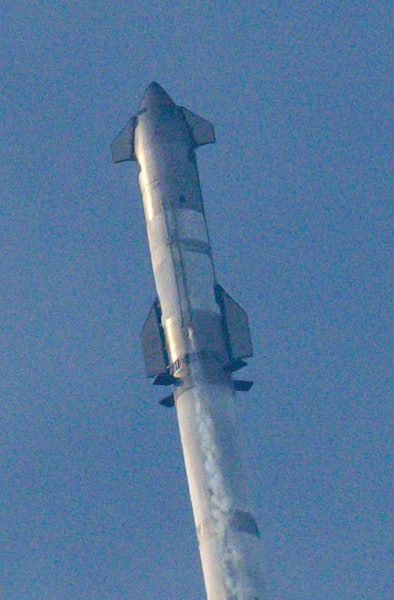
SpaceX’s Starship rocket, the most powerful ever built, successfully reached space for the second time on Thursday. After the mighty first-stage booster Super Heavy delivered Starship into Earth orbit, the rocket achieved many firsts. But it also fell short.

The 397-foot-tall orbiter ended its test flight after flying longer and faster than ever before. It perished after entering Earth’s atmosphere during reentry and crashing into the Indian Ocean.

Unlike the last flight test in November, Starship survived long after separating from Super Heavy. Starship then entered Earth orbit for the first time, having crossed the designated border into space known as the Kármán line. It climbed to an altitude of at least 234 kilometers high and sustained speeds of more than 26,000 kilometers per hour. Following several tests and test omissions, Starship sent its last telemetry about 49 minutes after launch.

SpaceX is inching towards its own-established finish line. The Thursday flight was the third attempt for Elon Musk’s company to get the rocket into the sky from their Starbase launch facility at Boca Chica, Texas, by the Gulf of Mexico, and for Starship to take a 90-minute flight. But to be ready to carry hefty cargo and passengers on trips to deep space, Starship needs more work.

WHAT HAPPENS NEXT?

SpaceX will assess the results of Thursday’s flight.

According to SpaceX’s presentation during Thursday’s test, Super Heavy did well, and SpaceX views this launch as a success. It ignited its 33 Raptor engines upon takeoff, and minutes later it successfully performed critical maneuvers. But it didn't quite complete its final maneuvers before it splashed down in the Gulf of Mexico.

Super Heavy is designed to be reusable, so subsequent testing will attempt to get the booster to land back on Earth like the much smaller SpaceX Falcon 9 boosters regularly do now.

Starship aced payload and payload door test during Thursday’s flight. SpaceX officials said they will need to review the data to confirm how well it performed. Starship is designed to carry 100 to 150 tons of cargo into space, a massive increase compared to its current International Space Station ferry, Dragon, which can deliver 13,000 pounds into space.

Starship also has to test out its ability to reignite its engines from microgravity in space, after the first burn and after entering a coast phase. It’s called the on-orbit re-light demo. On Thursday, Starship’s software skipped the test. One possible explanation is that Starship’s orientation in space wasn’t ideal for sudden changes in velocity.

Starship will need to do that test in the future. The reignition of Starship’s six engines is critical for future in-space maneuvers, like achieving a good deorbit burn to get the craft to land on Earth someday, or to get it going on a journey into deep space.

Thursday was also important because it was the first reentry test for Starship.

Its hypersonic reentry was more than five times the speed of sound, according to SpaceX. Much like launch, reentry packs a lot of dramatic phenomena in just a few minutes, which the team is still learning about. They’ll evaluate data about Starship’s motion control and the heat shield, which work in tandem to keep the heat shield facing downward to protect the spacecraft.

The team may create new models of the plasma field, too. The presenters in SpaceX’s Thursday broadcast said the massive size of Starship would hopefully prevent the plasma of reentry from enveloping the craft, but moments later, that’s just what happened.

BEYOND THE SPACECRAFT

Next, the Federal Aviation Administration (FAA) will get involved. SpaceX will need their permission to fly again. And then along the way, some other things might be happening.

BOCA CHICA, TEXAS - MARCH 14: The Starship spacecraft, atop the Super Heavy rocket, lifts off on a h...

The Starship rocket launching on March 14, 2024 from Boca Chica, Texas. 

HOUSTON CHRONICLE/HEARST NEWSPAPERS VIA GETTY IMAGES/HEARST NEWSPAPERS/GETTY IMAGES

SpaceX makes changes to each of their subsequent flights. They’re to address issues that happened previously, but the solutions might have their own consequences.

For instance, the first Starship flight in April 2023 resulted in the destruction of the launchpad’s foundation. Debris went flying because the power of Super Heavy’s 33 Raptor engines, and 16.7 million pounds of thrust, overwhelmed the structure. To address this issue, SpaceX’s second flight introduced a steel plate metal sheet that would create a barrier between the engines and the foundation. It works in tandem with a water deluge system to cool the surface down. Thursday’s flight would have been only the second time this system is evaluated and may have provided the team with new insights about how successful their metal plate is at protecting the launchpad.

The water component of this cooling system is also something to assess. According to an FAA report published after the first test, SpaceX personnel must test the water in the collection tanks after the launches to measure for any toxins or heavy metals present, which could have been released through a process called ablation as the high heat of the Raptor engines smashed into the metal plate, and mixing with the vapor or the liquid water.

These are some of the environmental assessments that SpaceX is required to perform more broadly to determine what negative effects the acute, powerful launches have on the surrounding coastal region, and how to address or restore them.

Starship’s future is yet to be seen, but testing has so far been beyond anything we’ve ever seen before.

{ https://www.inverse.com/ }

Hoe vind je dit bericht?
Geschreven door peter om 01:11 Stuur door

Cylindrical UFO Photographed Over New York City March 20, 1950, UAP Sighting News.

Cylindrical UFO Photographed Over New York City March 20, 1950, UAP Sighting News. 

Screenshot%202024-03-15%20at%205.00.26%E2%80%AFPM.png

Now I took the original photo and enhanced it. I notice there a re thick lines that encircle the craft all down it...kinda like a screw with lines that tilt more to one side than the other. Amazing and real alien spacecraft. Something hidden deep in the US gov Project Blue Books, and something the US Gov didn't want you to see today or ever. 

Scott C. Waring 

Hoe vind je dit bericht?
Geschreven door peter om 23:36 Stuur door

NASA and Boeing Release New Rendering of their X-66 Sustainable Experimental Airliner

Artist’s concept of the X-66 aircraft that Boeing will produce through NASA’s Sustainable Flight Demonstrator project. Credit: NASA

NASA and Boeing Release New Rendering of their X-66 Sustainable Experimental Airliner

Climate change is arguably the single greatest threat facing the world today. According to the (AR6) by the UN Intergovernmental Panel on Climate Change (IPCC), average global temperatures are set to increase between 1.5 and 2 °C (2.7 to 3.6 °F) by mid-century. To restrict global temperatures to an increase of 1.5 C and avoid the worst-case scenarios, the nations of the world need to achieve net zero emissions by then. Otherwise, things will get a lot worse before they get better, assuming they ever do.

This means transitioning to cleaner methods in terms of energy, transportation, and aviation. To meet our climate commitments, the aviation industry is developing technology to significantly reduce air travel’s carbon footprint. To help meet this goal, NASA and Boeing have come together to create the X-66 Sustainable Experimental Airliner, the first experimental plane specifically focused on helping the U.S. achieve net-zero aviation. Last week, NASA released a new rendering of the concept, giving the public an updated look at the future of air travel.

This configuration is identical to the one unveiled by NASA and Boeing at the Experimental Aviation Association‘s (EAA) AirVenture Oshkosh airshow last year. As you can see from the renderings (above and below), the design features the Transonic Truss-Braced Wing concept. Developed by Boeing, this design features extra-long, thin wings stabilized by diagonal struts. This configuration is based on “Subsonic Ultra-Green Aircraft Reach (SUGAR)” research, a series of studies that began in 2011 to evaluate the benefits of truss-bracing and hybrid electric technologies.

Next_Generation_Experimental_Aircraft_Becomes_NASAs_Newest_X-Plane-1024x576.jpg

The X-66A is the X-plane specifically aimed at helping the United States achieve the goal of net-zero greenhouse gas emissions by 2050. Credits: NASA

Combined with an advanced propulsion system, a sophisticated systems architecture, and advanced materials, this configuration could reduce fuel consumption and the resulting emissions by up to 30% (compared to top-of-the-line commercial aircraft). Development of the X-66 began in early 2019 through the Sustainable Flight Demonstrator (SFD) project, which is an integral part of NASA’s Sustainable Flight National Partnership (SFNP) – where NASA Aeronautics partners with industry, academia, and other agencies to accomplish the goal of net-zero aviation by 2050.

To build the X-66A, Boeing has been working with NASA to modify a McDonnell Douglas MD-90 single-aisle passenger aircraft. Modifications include a shortened fuselage and the replacement of its wings with the longer, thinner truss-braced variant. The engines have also been relocated from the tail section to under the wings and replaced with gas-electric models. Boeing transported the MD-90 aircraft to its facility in Palmdale, California, in August of 2023 and has since removed its engines and completed the 3-meter (10-foot) model wing they will use for aerodynamic testing.

The project’s ultimate goal is to inform a new generation of more sustainable, single-aisle aircraft, which account for the largest share of air travel worldwide. The program is also part of the U.S. Aviation Climate Action Plan, which seeks to not only meet the nation’s ambitious climate goals but also to improve the quality of life for those living near airports and under flight paths through reductions in noise and pollutants. As NASA Administrator Bill Nelson remarked in a press statement last year:

“At NASA, our eyes are not just focused on stars but also fixated on the sky. The Sustainable Flight Demonstrator builds on NASA’s world-leading efforts in aeronautics as well [as] climate. The X-66A will help shape the future of aviation, a new era where aircraft are greener, cleaner, and quieter, and create new possibilities for the flying public and American industry alike.”

Further Reading: 

{ https://www.universetoday.com/ }

Hoe vind je dit bericht?
Geschreven door peter om 21:55 Stuur door

A 790,000 Year-Old Asteroid Impact Could Explain Seafloor Spherules

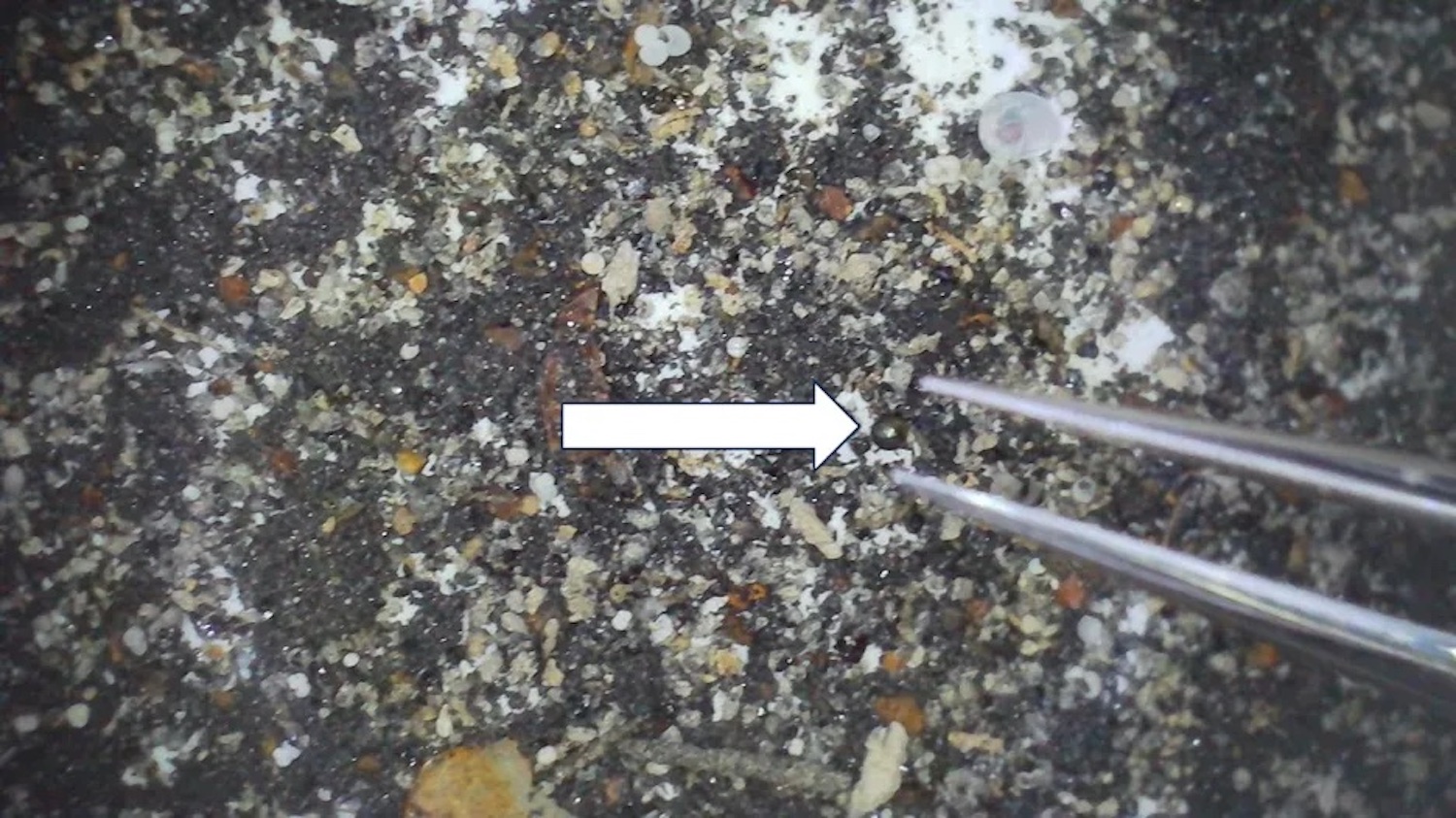
A 0.4-millimeter diameter iron-rich spherule. Credit: Avi Loeb/The Galileo Project

A 790,000 Year-Old Asteroid Impact Could Explain Seafloor Spherules

Our solar system does not exist in isolation. It formed within a stellar nursery along with hundreds of sibling stars, and even today has the occasional interaction with interstellar objects such as Oumuamua and Borisov. So it’s reasonable to presume that some interstellar material has reached Earth. Recently Avi Loeb and his team earned quite a bit of attention with a study arguing that it had found some of this interstellar stuff on the ocean seabed. But a new study finds that the material has a much more local origin.

The original study is based on a 2014 meteor that entered the Earth’s atmosphere off the coast of Papua New Guinea. Observations of its impact trajectory suggested it might have been extraterrestrial in origin. And since we had an idea of where it hit, why not look for its debris? This led Loeb’s team to the seafloor near Papua New Guinea, where they found small, iron-rich spheres known as spherules. The study analyzed the composition of these spherules and found the isotope distribution was so unusual they must have an interstellar origin.

The iron isotopes of these spherules show a local origin. Credit: Desch, et al

While that sounds compelling, there are a few caveats. The first is that the trajectory of the 2014 meteor isn’t that precisely known. We know the general impact region, but the data simply isn’t good enough to prove that these spherules came from this particular meteor. The second is that “unusual” isotopes aren’t uncommon within our solar system. As the new study shows, there is a distribution of iron isotope ratios for objects originating in the solar system, specifically the ratios of 57Fe and 56Fe. The ratio for the “alien” spherules is well within that range. So well that the odds of them being interstellar is less than 1 in 10,000. So these spherules have a local origin.

But they were likely formed from an impact event, so this new study went further. Is there a known impact from which these spherules originated? Turns out there is. The region in which they were found is part of what’s known as the Australasian tektite strewn field. It is a vast field that spans southeast Asia to Antarctica and was caused by a large impact 790,000 years ago. The team looked at other isotope ratios and found they are consistent with other known Australasian tektites.

So these particular spherules have a local origin. But that doesn’t mean interstellar meteorites don’t exist. Given what we know, there are almost certainly interstellar objects on Earth just waiting to be found. We just have to keep looking for them.

Reference: 

{ https://www.universetoday.com/ }

Hoe vind je dit bericht?
Geschreven door peter om 21:08 Stuur door

Mars Was Hiding Another Giant Volcano

A giant volcano hiding in plain sight in one of Mars’ most iconic regions.

Mars Was Hiding Another Giant Volcano

Olympus Mons is well known for being the largest volcano in the Solar System. It’s joined on Mars by three other shield volcanoes; Ascraeus, Pavonis and Arsia but a recent discovery has revealed a fifth. Provisionally called Noctis volcano, this previously unknown Martian feature reaches 9,022 metres high and 450 kilometres across. Its presence has eluded planetary scientists because it has been heavily eroded and is on the boundary of the fractured maze-like terrain of Noctis Labyrinthus. 

Mars seems to like shield volcanoes. They are a type of volcano that have a broad gently sloping profile and are generally composed of basaltic lava flows. The flows spread out over large distances during eruptions before eventually solidifying and creating long gently sloping faces. They tend to be the result of divergent plate boundaries where tectonic plates gently drift apart. It’s not just Mars that hosts them, here on Earth Mauna Loa and Mauna Kea in Hawaii are great examples of shield volcanoes.

Olympus Mons, captured by the ESA’s Mars Express mission from orbit. Credit: ESA/DLR/FUBerlin/AndreaLuck

Noctis volcano was found on the edges of Noctis Labyrinthus, a region whose name means Labyrinth of the Night. It’s a fascinating surface feature with a complex valley, canyon and ridge system within Valles Marineris. It’s a distinctive feature on the Martian surface with disorderly, intersecting valleys and plateaus. Thought to be the result of erosion and tectonic activity the region has masked the new volcano, until now. 

Noctis Labyrinthus on Mars as seen by Viking 1 orbiter. Courtesy NASA.

Noctis Labyrinthus on Mars as seen by Viking 1 orbiter. Courtesy NASA.

A team of scientists, led by SETI Institute planetary scientist Dr Pascal Lee said “We were examining the geology of an area where we had found the remains of a glacier last year when we realised we were inside a huge and deeply eroded volcano.” There were a number of signs that revealed the volcanic activity in the region and led to the volcano’s discovery. Located on the eastern edge of Noctis Labyrinthus there were a number of meseas – or flat topped mountains – arranged in an arc that seemed to reach a peak before descending away from an apparent summit area. A gentle slope softly slips away over distances of over 200km and close study seems to reveal the remains of a caldera. The study revealed what looked like a collapsed crater that once contained a lava lake and there was significant evidence of lava flows in the area including pyroclastic deposits. 

The study of Mars over the years since the invention of the telescope and more recently the advent of space flight has revealed a complex geological history. The features across the planet seem to reveal significant modification too perhaps from thermal erosion, glacial erosion and fracturing of the crust. 

The team conclude that the volcano is a shield volcano that has been built up of layers of accumulations of pyroclastic material, lava and ice. The ice it seems, just like volcanic lava, has built up over repeated years of snow and ice build up on the flanks of the volcano. With the fractures, likely driven by plate uplifts in the general Tharsis region, lava was able to seep through different regions of the volcano. Where the ice has been buried and subsequently melted, catastrophic collapses have occurred compounding the challenge of identifying it.

Source : 

{ https://www.universetoday.com/ }

Hoe vind je dit bericht?
Geschreven door peter om 20:54 Stuur door

Space Force budget (secret space programs are integrated) exceeds NASA

Space Force budget (secret space programs are integrated) exceeds NASA

Dr Michael Salla discusses the following topics: 
space%20force%20nasa%20aaro.png

  • US Congress cuts funding to NASA while corporations are funding more space missions. 
  • Detailed breakdown of UAP historical report cites glaring deficiencies. Article proclaims Pentagon is heading for disaster due to AARO UAP report – catastrophic disclosure more likely. 
  • AARO Report: Lies, flawed, unresponsive, clueless, and knavish analyzed by Robert Powell (A must read). 
  • Webinar Trailer released- Ancient Alien Experiments and Crypto Terrestrials.  
  • Space Force budget exceeds NASA but will surge as elements of secret space programs are integrated. 
  • UFO Disclosure Project Attorney Danny Sheehan recounts his encounter with secret Project Blue Book files in 1977 that contained photos of retrieved flying saucer craft. 
  • Could Romanian President entering race for NATO leadership be a reward for him suppressing news of the discovery of an ancient Hall of Records under Bucegi Mountains in 2003? 
  • President Eisenhower’s role in agreements reached with Aliens revealed by Great Granddaughter in New Book. 
  • New JP video highlights ETs monitoring humanity’s consciousness and the importance of the love ethic. 
  • The wise Reptilian entity depicted in Japanese art is similar to Naga beings in Vedic art and literature. 
  • Analysis of AARO historical report discussing July 1952 shootdown attempt against a flying saucer involved in Washington flyover. 
Four primary goals in AARO historical report point to a coming false flag UFO event.
  

{ https://ufosightingshotspot.blogspot.com/ }

Hoe vind je dit bericht?
Geschreven door peter om 18:01 Stuur door

Mysterious Triangular UFO Spotted in the Skies of Bratislava

Mysterious Triangular UFO Spotted in the Skies of Bratislava

slovakia-triangle-ufo

In an extraordinary event that has captured the attention of UFO enthusiasts and skeptics alike, a remarkable sighting occurred in the night sky over Ru¸inov, a bustling borough of Bratislava, Slovakia, on March 14, 2024. This incident has swiftly climbed the ranks in the annals of UFO sightings, stirring a whirlwind of speculation and intrigue.

The Sighting in Detail

Just before the clock struck 11 pm on that fateful evening, a resident and amateur UFO enthusiast known online as “ufoslovakia” managed to capture jaw-dropping footage of an unidentified flying object. But this was no ordinary sighting. The footage reveals a distinct triangular-shaped craft, looming ominously above. What makes this sighting particularly fascinating is the suggestion from the footage that we might be looking at a single, massive object rather than three separate entities.

The Eyewitness and the Video

“ufoslovakia,” known for his passion for filming and sharing aerial anomalies, could hardly believe his eyes. Through his lens, he witnessed what could very well be one of the most definitive pieces of visual evidence of UFO activity in recent history. The clarity and detail of the footage have left viewers in awe, prompting debates and discussions across various platforms.

What Makes This Sighting Unique?

Triangular UFO sightings have been reported globally, but the Bratislava incident stands out for several reasons. First, the quality of the footage is unusually high, providing a clear view of the object’s shape and movements. Secondly, the size of the craft, as suggested by the footage, indicates that this could be an unusually large object, distinguishing it from more common reports of smaller, drone-like objects.

Skeptics and Believers Alike Are Intrigued

While some skeptics propose explanations ranging from advanced military aircraft to atmospheric phenomena, the distinct characteristics observed in the Bratislava sighting challenge conventional understandings. Enthusiasts point to the lack of sound, the steady flight pattern, and the uniformity of the object’s lights as indicators that this sighting cannot be easily dismissed.

VIDEO

This remarkable sighting in Bratislava has added a fascinating chapter to the ongoing narrative of UFO sightings. Whether you’re a staunch believer in extraterrestrial visitors, a curious skeptic, or simply someone fascinated by the unknown, this incident invites you to explore the endless possibilities that our universe holds.

{ https://www.latest-ufo-sightings.net/ }

Hoe vind je dit bericht?
Geschreven door peter om 17:43 Stuur door

Aliens and the Origins of Human Life: Insights from David Grusch on The Joe Rogan Experience

Aliens and the Origins of Human Life: Insights from David Grusch on The Joe Rogan Experience

David Grusch on Joe Rogan

In an enthralling episode of The Joe Rogan Experience, David Grusch joined Joe Rogan to delve into the enigmatic possibility of extraterrestrial influence on the development of human life. This thought-provoking discussion explored various aspects of alien life, the hypothesis of extraterrestrial seeding of life on Earth, and the implications of such interventions.

The Hypothesis of Extraterrestrial Seeding

David Grusch presented a captivating hypothesis that extraterrestrial beings could have played a pivotal role in the genesis or acceleration of life on Earth. This theory suggests that aliens, through genetic intervention, could have fast-tracked the evolution of emerging intelligent life forms on our planet. The underlying idea is that such interventions would not only boost the natural progression of evolution but also imbue these life forms with an innate drive for innovation, control, and the expansion of influence.

Beyond Biological Limitations

A significant portion of the discussion was dedicated to the concept that advanced extraterrestrial entities might have evolved beyond the biological constraints known to human beings. Grusch and Rogan speculated about the existence of beings that operate in realms undetectable to us, free from the limitations of physical space and the conventional life-death cycle. This advanced state would allow them to engage in and influence processes in ways that are currently beyond human comprehension.

Technological Evolution and Communication

Reflecting on the rapid evolution of human communication technologies, from face-to-face interaction to instant global connectivity, the conversation touched upon the potential for future advancements. This led to discussions about the possibility of instant physical presence across vast distances, drawing parallels between human technological progress and the speculated capabilities of advanced extraterrestrial beings.

Theoretical Frameworks and Cosmic Perspectives

The dialogue ventured into discussions on theoretical frameworks that could potentially explain the universe’s complexities, including Eric Weinstein’s Geometric Unity. The notion that the universe itself could be considered a creator or a form of god was explored, suggesting a meta-perspective on the origins and nature of creation. This perspective invites contemplation on the universe’s ability to generate complex systems, potentially including other universes.

Exploring Existential Questions

The conversation between Grusch and Rogan raised profound existential questions regarding the nature of the universe, the origin of life, and the concept of a cyclical universe that undergoes endless cycles of expansion and contraction. They discussed the limitations of human understanding and the exciting potential for discoveries that lie beyond our current observations of the cosmos.

VIDEO:

  • Aliens CREATED Humans?! David Grusch on Joe Rogan

David Grusch’s appearance on The Joe Rogan Experience provided a fascinating exploration of the hypothesis that extraterrestrial life forms might have contributed to the creation or acceleration of human life. This discussion spanned the potential for biological and technological advancements beyond our current understanding, theoretical frameworks for comprehending the universe, and the deep existential questions these ideas evoke. The possibility of alien influence on human evolution invites us to reconsider our place in the cosmos and the untapped mysteries of the universe.

 { https://www.latest-ufo-sightings.net/ }

Hoe vind je dit bericht?
Geschreven door peter om 22:27 Stuur door

The Enigma of Scotland’s UFO Encounter: Unraveling the Mystery with Physical Evidence

The Enigma of Scotland’s UFO Encounter: Unraveling the Mystery with Physical Evidence

Scottish UFO Landing

In the captivating landscape of Scotland, nestled within the enigmatic expanse known as the Falkirk Triangle, an incident unfolded that would forever etch its name in the annals of UFO research. The event centers around Bob Taylor, a forest service supervisor, whose ordinary day transformed into an extraordinary encounter, presenting what many believe to be undeniable evidence of an extraterrestrial presence.

The Unforgettable Encounter

On a day like any other, Bob Taylor ventured down a wooded path, only to be greeted by a sight that defied explanation—a massive, hovering object, with a distinctive disc-like shape, adorned with peculiar propellers. This was not merely a fleeting vision; it was a tangible entity that marked its presence in the physical world. Taylor’s attempt to approach the object led to an unforeseen altercation, culminating in him being forcibly drawn towards this mysterious craft, an experience that left him staggered and bewildered.

The Investigation Unfolds

What sets the Bob Taylor incident apart is not just the encounter itself, but the aftermath. Disturbed and disheveled, Taylor managed to return home, promptly alerting the authorities. Thus began one of the few UFO cases to be officially investigated as a criminal matter. The scrutiny it attracted was not limited to law enforcement; young UFO researchers Malcolm Robinson and Andrew Collins, alongside researcher Hugh Newman, took it upon themselves to delve deeper, seeking answers to a mystery that had lingered for over four decades.

Physical Evidence: A Tangible Proof

The investigation into Taylor’s encounter is distinguished by the compelling physical evidence it amassed. The site of the encounter bore witness to peculiar ground markings, arranged in a circular pattern, defying conventional explanations. These were not mere anomalies; they were physical imprints of an otherworldly visitor. Further corroborating Taylor’s account was the condition of his trousers, torn in such a unique fashion that it suggested a struggle with an unseen force, a testament to the physical reality of his experience.

VIDEO:

  • Ancient Aliens: Scottish UFO Landing PROVED By Physical Evidence (Season 29)

The Bob Taylor incident offers a rare glimpse into the potential for extraterrestrial encounters, bolstered by tangible evidence and an official investigation. It challenges us to reconsider our understanding of the unknown, urging a more open-minded and rigorous exploration of unexplained phenomena. As we continue to ponder the mysteries of the cosmos, cases like Taylor’s serve as a beacon, guiding us through the uncharted territories of our universe in search of the truth.

 { https://www.latest-ufo-sightings.net/ }

Hoe vind je dit bericht?
Geschreven door peter om 22:16 Stuur door

Mysterious ‘UFO’-like monolith found in Wales by hiker, video shows

Hoe vind je dit bericht?
Geschreven door peter om 23:51 Stuur door

Why are bizarre metal pillars popping up in the British countryside? From the work of UFOs to mystery collectives planting the monoliths by helicopter in the dead of night and Banksy rumours... all the theories explained

Why are bizarre metal pillars popping up in the British countryside? From the work of UFOs to mystery collectives planting the monoliths by helicopter in the dead of night and Banksy rumours... all the theories explained

Humans have long been obsessed with the idea that we are not alone in the universe - which is why the appearance of random metal pillars in the British countryside have sparked fresh theories over whether a third kind truly does exist.

Last weekend, yet another mysterious shiny silver structure was spotted by walkers on Hay Bluff, near the town of Hay-on-Wye. 

It was the latest in a series of bizarre structures to crop up, with pillars also spotted on a beach in the Isle of Wight, at the top of Glastonbury Tor, in the middle of Merry Maidens stone circle in Cornwall and on the fields at Dartmoor National Park.

The appearances that range from 2020 to last weekend have led to much speculation over who has put them there and why, with some even pondering whether or not the objects could be of extra-terrestrial origin. 

Local builder Craig Muir, who discovered the 10ft monolith sticking up out of the mud, said he assumed it was 'some sort of a UFO' while out walking.

The latest sighting remains shrouded in mystery as no-one has come forward to claim responsibility for the Welsh metal pillar which bears striking similarities to the one featured in the Stanley Kubrick film 2001: A Space Odyssey. 

The pillars have turned up in the UK following a spate of monoliths appearing around the world in 2020, including in Romania and the Utah desert. 

Last weekend, yet another mysterious shiny silver structure was spotted by walkers on Hay Bluff, near the town of Hay-on-Wye

Last weekend, yet another mysterious shiny silver structure was spotted by walkers on Hay Bluff, near the town of Hay-on-Wye 

While some speculated that the structure could be the work of aliens or a sign of life on Mars, others said it was an elaborate piece of artwork

While some speculated that the structure could be the work of aliens or a sign of life on Mars, others said it was an elaborate piece of artwork

The latest sighting remains shrouded in mystery as no-one has come forward to claim responsibility for the Welsh metal pillar which bears striking similarities to the one featured in the Stanley Kubrick film 2001: A Space Odyssey (pictured)

The latest sighting remains shrouded in mystery as no-one has come forward to claim responsibility for the Welsh metal pillar which bears striking similarities to the one featured in the Stanley Kubrick film 2001: A Space Odyssey (pictured)

READ MORE: 

Conspiracy theorists believe that aliens are behind the structures but others have speculated that helicopters could be dropping them off in the dead of night.

Since there is no way to drive up to the top of the hill, Mr Muir suggested it could have been taken by a group of people or dropped off by the chopper on its spot.

'It didn't seem like it was chucked in there, instead it has been accurately put in the ground,' he said.

'However, there were no obvious tracks around it and one would think that there would be a lot of mess around it, but there wasn't.'

The latest discovery is similar to the structure found on Compton Bay on the Isle of Wight four years ago.

A number of photos from various different angles suggested that  the monolith was buried in the sand and offers out a perfect reflection. 

How the object ended up on the beach was unclear, as it is only accessible via a footpath.

Locals were quick to question whether images of the monolith posted on social media had been 'photoshopped' or if it was 'just a late April Fool's joke'.

On December 12 2020, local resident Luke Brown stumbled across another imposing monolith in Cornwall and captured a video of the metallic object

On December 12 2020, local resident Luke Brown stumbled across another imposing monolith in Cornwall and captured a video of the metallic object

 But photographer Alice Williams insisted it was real, sharing snaps of the eight-foot-tall structure at sunset in a local Facebook group.

Elsewhere, on December 12 2020, resident Luke Brown stumbled across another imposing monolith in Cornwall and captured a video of the metallic object.

He said: 'I was left in shock and awe earlier at finding a monolith at the centre of the Merry Maidens stone circle near sunset, the one time I left my camera at home.

'It was a thing of beauty but I can't help thinking of the damage that may have been done at this beautiful protected natural heritage site.'

The Merry Maidens also known as Dawn's Men - a likely corruption of the Cornish Dans Maen Stone Dance - is a late neolithic stone circle.

Just one day prior to the monolith being captured in Cornwall, another pillar was also spotted in Dartmoor National Park, Devon. 

The structure was spotted on Dartmoor by photographer Sarah Clarke, who captured a shot of the monolith, before posting to X, formerly Twitter.

Dartmoor National Park swiftly removed the monolith after a picture of it was posted by photographer Sarah Clarke, with the body saying that the moorland is protected

Dartmoor National Park swiftly removed the monolith after a picture of it was posted by photographer Sarah Clarke, with the body saying that the moorland is protected

Only 48 hours prior to the sighting of a monolith in Dartmoor National Park, another similar structure was seen on top of a hill in Glastonbury with 'Not Banksy' etched on it

She reassured her followers that the image was not made using photoshop software, stating: 'So, a very exciting morning - it's a real thing. 'Anyone who knows me, knows I just can't do Photoshop so, take it from me.'

Mark Bullock, who went to look at the pillar himself, said its vantage point on the hill made it appear like 'something was wrong with the sky'. He added: 'It was a bit surreal.'

Dartmoor National Park swiftly removed the monolith after Ms Clarke's post, saying that the moorland is protected.

Just 48 hours prior to the Dartmoor sighting, another similar monolith was seen on top of a hill in Glastonbury with 'Not Banksy' etched on it.

Walkers discovered the large silver structure at Glastonbury Tor - an ancient hill linked to King Arthur and Celtic mythology.

It is believed the monolith was placed there overnight before it was felled by a gust of wind.

  • Monolith found on beach at Compton in Isle Of Wight
On December 6 2020, another monolith was found by beachgoers at Compton Bay on the Isle of Wight

On December 6 2020, another monolith was found by beachgoers at Compton Bay on the Isle of Wight

The shiny triangular pillar features a stencil drawing of a rat, similar to the style used by street artist Banksy.

Michelle Cowbourne spotted the metal structure at the National Trust site while on her regular morning walk. 

'I walked up the long slope side and this was on the other side and when I saw it I couldn't believe my eyes,' she said. 'I just thought what on earth is that.

'There were two big metal bolts but they hadn't been fixed to the ground properly.

'It's a big chunk of metal and it was really heavy,' Ms Cowbourne added.

The first pillar in Utah was originally spotted in 2020 by state wildlife officials who were helping to count bighorn sheep from a helicopter. When the structure suddenly vanished, many thought it was the work of aliens.

However, a photographer revealed later that he had seen four men remove the pillar from the remote area of red rock in Spanish Valley, Utah.

Two weeks after the Utah pillar was discovered, another mysterious monolith, this one 13ft tall, appeared on Batca Doamnei Hill in Romania.

It is not known where there monuments are coming from but some have guesses it is a tribute to 2001: A Space Odyssey.

In the book by Arthur C Clarke, a monolith appears on Earth and gives wisdom to a group of apes. 

{ https://www.dailymail.co.uk/ }

Hoe vind je dit bericht?
Geschreven door peter om 23:19 Stuur door

Mars Drives Deep-Ocean Circulation in Earth’s Oceans, Study Suggests

Mars Drives Deep-Ocean Circulation in Earth’s Oceans, Study Suggests

Geoscientists from Australia and France have used the geological record of Earth’s deep oceans to discover a connection between the orbits of our home planet and Mars. They’ve discovered a surprising 2.4-million-year cycle where deep currents wax and wane which, in turn, is linked to periods of increased solar energy and a warmer climate.

This image from Mars Express’ High Resolution Stereo Camera shows the globe of Mars set against a dark background. The disk of the planet features yellow, orange, blue and green patches, all with an overall muted grey hue, representing the varying composition of the surface. Image credit: ESA / DLR / FU Berlin / G. Michael / CC BY-SA 3.0 IGO.

This image from Mars Express’ High Resolution Stereo Camera shows the globe of Mars set against a dark background. The disk of the planet features yellow, orange, blue and green patches, all with an overall muted grey hue, representing the varying composition of the surface.

Image credit: ESA / DLR / FU Berlin / G. Michael / CC BY-SA 3.0 IGO.

“In 1976, scientists demonstrated for the first time the presence of 10,000 – 100,000-year astronomical cycles in Pleistocene deep-sea sediments, confirming Milutin Milankovitch’s theory that Earth’s climate is modulated by periodicities in perturbations of Earth’s orbit around the Sun and Earth’s spin axis,” said University of Sydney researcher Adriana Dutkiewicz and her colleagues.

“Apart from the well-known astronomical cycles with periods of 19,000, 23,000, 41,000, 100,000, and 400,000 years that pace Earth’s climate, the geological record also contains signals of much longer-period grand cycles, which are predicted by astronomical theory.”

“These grand cycles include orbitally-forced periodicities of millions and even tens of millions of years that are similarly linked to changes in incoming solar energy and paleoclimate.”

In their new research, the authors used the deep-sea sediment record to check for links between sedimentary shifts and changes in the Earth’s orbit.

They found that the vigor of deep-sea currents shifts in 2.4-million-year cycles.

“We were surprised to find these 2.4-million-year cycles in our deep-sea sedimentary data,” Dr. Dutkiewicz said.

“There is only one way to explain them: they are linked to cycles in the interactions of Mars and Earth orbiting the Sun.”

“The gravity fields of the planets in the solar system interfere with each other and this interaction, called a resonance, changes planetary eccentricity, a measure of how close to circular their orbits are.”

“For the Earth it means periods of higher incoming solar radiation and warmer climate in cycles of 2.4 million years.”

The researchers found that the warmer cycles correlate with an increased occurrence of breaks in the deep-sea record, related to more vigorous deep ocean circulation.

They identified that deep eddies were an important component of earlier warming seas.

It is possible these could partly mitigate ocean stagnation some have predicted could follow a faltering AMOC (Atlantic meridional overturning circulation) that drives the Gulf Stream and maintains temperate climates in Europe.

“We know there are at least two separate mechanisms that contribute to the vigor of deep-water mixing in the oceans,” Professor Müller said.

“AMOC is one of them, but deep ocean eddies seem to play an important role in warm climates for keeping the ocean ventilated.”

“Of course, this would not have the same effect as AMOC in terms of transporting water masses from low to high latitudes and vice-versa.”

“These eddies are like giant whirlpools and often reach the abyssal seafloor, resulting in seafloor erosion and large sediment accumulations called contourites, akin to snowdrifts.”

“Our deep-sea data spanning 65 million years suggest that warmer oceans have more vigorous deep circulation,” Dr. Dutkiewicz said.

“This will potentially keep the ocean from becoming stagnant even if AMOC slows or stops altogether.”

  • The study was published in the journal Nature Communications.
  • A. Dutkiewicz et al. 2024. Deep-sea hiatus record reveals orbital pacing by 2.4 Myr eccentricity grand cycles. Nat Commun 15, 1998; doi: 10.1038/s41467-024-46171-5

{ https://www.sci.news/news/space }

Hoe vind je dit bericht?
Geschreven door peter om 22:13 Stuur door

This Robot is Borrowing OpenAI’s Magic to Make At-Home Droids Feel Real

This Robot is Borrowing OpenAI’s Magic to Make At-Home Droids Feel Real

We're one step closer to a world like I, Robot.

 
Figure 01 robot
Figure

Casually having a conversation with a robot butler might not be as far out as we thought.

Figure, an AI robotics company that’s attracted the financial backing of Microsoft and Nvidia, showed off why it deserves that investment money. In its latest demo, its Figure 01 is seen having a full-on conversation with another human, even completing tasks and requests.

The eerily conversational robot is a result of Figure’s robotic design and OpenAI’s intelligence on the backend. It may not be able to backflip off a skateboard, but the demo shows Figure 01 handing over an apple and putting away dishes. That’s not incredibly groundbreaking, but with how fast ChatGPT and other large language models are advancing, Figure 01 could see advancements quickly.

LAPPING THE COMPETITION

It’s impressive to see Figure 01 smoothly navigate a normal conversation with a human, all while responding to requests and handling simple tasks. Of course, putting away dishes isn’t the most complex task, but it’s a promising start considering how Figure 01 can already identify what’s in front of it and respond accordingly in real-time.

It’s a big difference compared to the demos we saw with Tesla’s Optimus bot. While Tesla has come out with a second-generation model already, Optimus has yet to show us the same fluidity and responsiveness we’re seeing with the Figure 01 demo.

Figure says the goal is to make a “fully electromechanical humanoid” robot to handle all the physical tasks that humans have to do. So far, the Figure 01 stands 5’6”, weighs more than 132 lbs, can handle payloads up to around 44 lbs, and tops out a brisk 1.2 m/s. Figure also says there’s a runtime of five hours, so it’s not quite meant to cater to your needs 24/7.

Figure 01 debut

Figure debuted its 01 humanoid robot back in October.

FIGURE / X

NO RELEASE DATE YET

With Figure 01, it does feel like we’re inching towards a future of at-home robots. Still, we don’t have a release date for Figure’s robot yet, but the company’s founder and CEO Brett Adcock has already said that the company wants to produce its robots at “exceptionally high volume.”

Figure hasn’t detailed any prices for its robot yet, either, but Adcock expressed optimism for trying to bring the costs down to “affordable levels.” Considering how nascent this technology is, it’s tough to determine what’s affordable or not. For reference, Tesla’s CEO Elon Musk previously said that the Optimus robot is targeting a price of around $20,000.

{ https://www.inverse.com/ }

Hoe vind je dit bericht?
Geschreven door peter om 22:02 Stuur door

46 Years Later, This Iconic Pair Of NASA Spacecraft Are Still Sending Signals Home

46 Years Later, This Iconic Pair Of NASA Spacecraft Are Still Sending Signals Home

Besides 46 years of science, the aging twin spacecraft have taught engineers how to improvise -- and the value of redundancy.

 
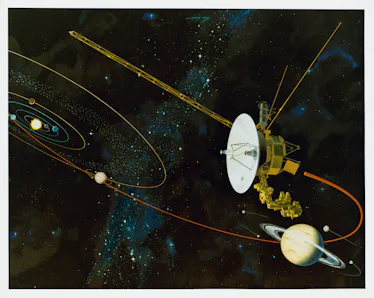
1981:  A simulation of the space probe Voyager 2 preparing to leave our solar system to become the f...
MPI/Archive Photos/Getty Images

Voyager 1 might be getting better after its recent bout of aphasia.

Since November, NASA’s Voyager 1 spacecraft has been speaking in electronic gibberish. NASA still hasn’t pinpointed the cause of the problem, but a likely culprit is a cosmic ray that corrupted a single bit of data in part of the spacecraft’s Flight Data System; specifically, the part that converts information about the spacecraft's status and data into binary code to send back to Earth. Instead of coherent lines of code, Voyager has been sending home random strings of 0s and 1s that don’t mean anything.

But over the last couple of weeks, Voyager 1’s issues seem to be improving. It’s putting its 0s and 1s together in patterns, not just random sequences. However, these patterns are more like baby babble than language.

“They're not exactly what we would expect, but they do look like something that can show us that the FDS is at least partially working.” Voyager program manager Suzanne Dodd tells Pasadena Star-News.

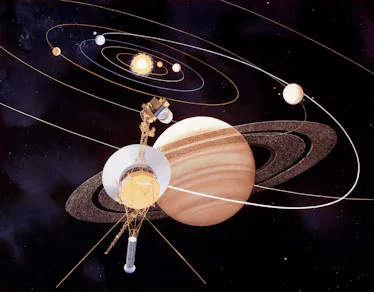
An artistic rendering of the interplanetary space probe Voyager II as it flies by Jupiter. The space...

An artistic rendering of the interplanetary space probe Voyager II as it flies by Jupiter. 

HISTORICAL/CORBIS HISTORICAL/GETTY IMAGES

Dodd recently told the press that it would take a miracle for Voyager 1 to pull through, but the hardy little spacecraft and its twin sister Voyager 2 have survived a lot over the 46 years of their joint mission. And their engineering teams have found creative ways to keep the aging sister spaceships flying — and most importantly, to keep them sending new data home. Inverse talked with a Voyager engineer about what the team has learned from those years of jury-rigging solutions and how it might help other missions.

“In the last decade, I have learned from Voyager that there is (almost) always a way around a problem, no matter how dire it is,” Voyager mission assurance manager Bruce Waggoner tells Inverse. “You just have to think ‘outside the box’ when people tell you not to do so.”

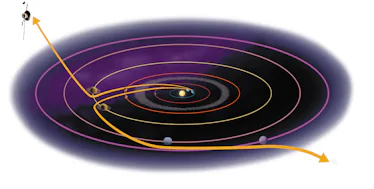
Trajectory of Voyager 1 and 2, The Voyager missions are now over, in principle. At the end of 2004, ...

Voyager 1 and Voyager 2 are on different trajectories out of the Solar System.

QAI PUBLISHING/UNIVERSAL IMAGES GROUP/GETTY IMAGES

IMPROVISE, ADAPT, OVERCOME

The team of engineers running the twin Voyager spacecraft have had to get increasingly creative over the last 46 years, as aging parts and systems have started to develop glitches and the power supply has begun to dwindle. Most of the people who designed the Voyagers and worked on the spacecraft in the early years of their mission have long since retired (and several have died), and they would probably be surprised by the ways today’s Voyager team has kept the pair of space probes running.

“Recently, the team found a way to keep the instruments powered for an additional 2 to 4 years by operating the spacecraft with an unregulated voltage,” says Waggoner. “This is a first as far as I know: operating the power system in a completely different way than the designers intended.”

The Voyagers’ designers built a safety mechanism to protect the instruments from sudden changes in the flow of electricity. If that happens, a regulator allows the spacecraft to access a small reserve of power, which is supposed to help it ride out the voltage fluctuation. But recently, Voyager engineers decided that after 45 years of the electrical systems working smoothly, Voyager 2 needed the extra power more than it needed the safety feature — because the alternative was shutting off one of Voyager 2’s instruments. (Voyager 1 is already down an instrument due to a hardware failure earlier in the mission, but its payloads will eventually face the chopping block, too.)

That kind of off-script improvisation has been the Voyager team’s standard operating procedure for decades.

“I would say that 100 percent of it has been figured out along the way,” Dodd told Inverse last year. “Absolutely nothing was known about flying for 45 years at 175 AU from us here on Earth, and we're into our 46th year now.”

And it’s been mostly trial and error. When something goes wrong with one of the Mars rovers, for instance, engineers can try out their solutions on a testbed: a replica of the spacecraft here on Earth kept on hand for exactly that purpose. But there is no Voyager testbed.

The goal is for each spacecraft to reach 19 billion miles away from the Sun with at least one instrument still running and communicating with Earth. Waggoner says the team has a 120-page book of ideas on how to keep the aging Voyagers working. Along the way, they’ve learned some tricks that may help extend the lives of future space missions.

An artist's impression of the Voyager 1 space probe flying past Saturn in the outer solar system, ci...

An artist's impression of the Voyager 1 space probe flying past Saturn in the outer solar system, circa 1980.

SPACE FRONTIERS/ARCHIVE PHOTOS/GETTY IMAGES

KEEP THE SPACECRAFT SIMPLE

“Hopefully, people will look back at the lessons of Voyager and apply them,” says Waggoner. I work on many missions, and I use ideas from Voyager all the time, especially to think outside the box.”

Another key lesson is that it’s easier for a space mission’s engineering team to be flexible if the spacecraft itself is simple, study, and has backups for most of its hardware. The Flight Data System that’s currently on the fritz, for example, is Voyager 1’s backup; it's original one failed in 1981, and without redundancy, scientists would have missed 33 years of exploring the outer fringes of our Solar System.

Compared with more recent spacecraft, the Voyagers’ hardware is pretty bare-bones, its software is programmed in languages most modern engineers don’t even learn, and it sports about 64 kilobytes of memory (about 240,000 times less than the smartphone you’re probably reading this article on). But as strange as it sounds, that antique simplicity is actually one of Voyager’s biggest assets because it makes troubleshooting easier.

“I like the simpler code on Voyager because people can understand what the system will do, in most cases without simulation,” says Waggoner. That especially helps when trying to fix a pair of spacecraft with no testbeds here on Earth “just by thinking through the problems,” as Waggoner puts it.

Dodd, speaking to Inverse last year, compares operating the Voyagers to repairing an older-model car, compared with a more modern version with more complex systems and electronics.

“The simplicity of Voyager helps if you want to change things over time as the spacecraft gets older and the mission lasts longer,” says Dodd. “It's kind of like having an old car, and you can look under the hood and know what the key pieces are. When you have a new car, it's all driven by software and it's really hard to just go in there and tweak the carburetor and have it still run.”

Waggoner has a story about that, too. The Voyagers’ thrusters, which keep the distant spacecraft’s antennas pointed toward Earth, are slowly clogging with silicon dioxide. Last summer, it looked like the clogged thrusters could doom the missions within the next couple of years.

“Again, the team found workarounds by changing the way the thrusters are fired and pointing is managed,” says [source]. “Once the worst [clogged] thrusters fail, there may even be a way to allow the spacecraft to roll and return data.”

Of course, for Voyager 1, that depends on whether the spacecraft ever learns to speak again.

 { https://www.inverse.com/ }

Hoe vind je dit bericht?
Geschreven door peter om 21:43 Stuur door

FRAGMENTED FACTS: AARO REPORT UNEARTHS ODD CLAIMS INVOLVING U.S. RECOVERY OF MATERIAL FROM 1952 UFO INCIDENT

FRAGMENTED FACTS: AARO REPORT UNEARTHS ODD CLAIMS INVOLVING U.S. RECOVERY OF MATERIAL FROM 1952 UFO INCIDENT

During the summer of 1952, the United States was on high alert as UFO sightings over the nation’s capital were making frequent headlines. Buried amid the otherworldly clamor occupying the minds of Americans around that time, an obscure report conveyed that one of the objects—a small, glowing disc—was pursued and shot at by a military aircraft, blasting off a fragment that fell into a field near Washington D.C., which a naval officer later retrieved.

More than a decade later, an official government-funded scientific inquiry into UFOs—or what the United States government now calls unidentified anomalous phenomena (UAP)—would investigate the incident, ultimately determining claims involving the 1952 UFO incident were unlikely to be true.

Without question, the notion that a fragment might have been recovered after a shoot-out with a flying saucer in the 1950s offers a textbook example of what most would call a dubious claim. Yet a deeper look into this Cold War-era rumor reveals, surprisingly, that there could potentially be more to this odd story than past assessments would seem to indicate.

However, you would never have gleaned that from reading the latest report issued by the U.S. Defense Department’s official UAP investigative office.

Last week, the All-domain Anomaly Resolution Office (AARO) released a long-awaited historical report on its findings involving the United States government’s involvement with UAP and related programs since the end of World War II.

In the report, AARO investigators maintained the U.S. federal government’s longstanding position that it has never found any convincing evidence of extraterrestrial technologies operating near Earth, nor of any secret programs involving the acquisition or reverse engineering of crashed exotic technologies that have remained hidden from Congress.

The report was met with heavy criticism following its publication, partly due to a number of errors it was revealed to contain. Despite this, there were also a few intriguing inclusions made by AARO’s investigators, based on their relevance to the question of whether UAP materials have ever crashed on Earth and been studied.

One of these appears in a section of the AARO report that discusses the University of Colorado UFO Project, more commonly called the Condon Committee, a U.S. Air Force-funded evaluation of cases that were collected under its long-running Project Blue Book investigations that studied UFOs during the 1950s and 1960s.

According to AARO’s recent report, the Colorado scientific panel, led by American physicist Edward U. Condon, “investigated a claim made by radio broadcaster Frank Edwards in a 1966 book that a piece of a UFO was recovered near Washington, D.C. in the summer of 1952 during the spike in UFO sightings over the U.S. Capitol in July and August.”

The account in question appeared in Edward’s book Flying Saucers: Serious Business, of which AARO’s investigators recount that Edwards “claimed that a USN jet fired on a two-foot diameter glowing disc and dislodged a one-pound fragment that was recovered by a ground team.” At the time of their study, the Condon Committee’s investigators inquired about the incident with Project Blue Book, who told the University of Colorado team that they were unaware of the purported 1952 incident.

Frank Edwards

Above: Excerpt from Frank Edwards’ 1966 book, Flying Saucers: Serious Business, where the author discussed the alleged 1952 UFO incident.

“The USAF and USN found no incident report of weapons engagement with a UFO that summer, no USN aircraft were present, and the retired officer who was the original source of the claim had retired before the summer of 1952, when the event allegedly occurred,” the AARO report’s summary reads.

The report then attributes another claim to Edwards, this time involving fragments from a UFO that were loaned by the United States to the Canadian government. “It is not clear if this claim was linked to the alleged Washington, D.C. incident,” the AARO report’s authors state, adding that “The Condon panel determined that these claims most likely were false.”

The reason any connections between the 1952 UFO incident and Frank Edwards’ claims of a flying saucer fragment being loaned to the Canadian government remained unclear to AARO’s investigators is probably very simple. In likelihood, their investigation of these claims took them no further than the Condon Committee’s report (as evidenced by the relevant source citations found at the end of AARO’s document). Indeed, the two events are connected, as a deeper examination of the literature regarding this alleged 1952 incident readily reveals.

Additionally, much like other assertions that appeared in the recent AARO report, some of the facts about this case have been misrepresented. However, this may not be entirely the fault of AARO’s team in this instance; a closer look at this case also reveals how much of the confusion arises from the Condon Committee’s original investigation, and problems involving their main source for the claims.

THE CONDON COMMITTEE’S CONFUSION

In the late 1960s, under contract No. 44620-67-C-0035 with the United States Air Force, the University of Colorado conducted an extensive analysis of UAP incidents collected by Project Blue Book, which resulted in the publication of its findings in a lengthy report titled Scientific Study of Unidentified Flying Objects.

Despite the title of the Condon Committee’s report, many viewed it as being anything but a truly scientific evaluation of existing data on aerial mysteries. As British physicist Peter Sturrock later noted in his analysis of the Condon Committee’s findings, “most case studies were conducted by junior staff, the senior staff took little part, and the director took no part, in these investigations.” Additionally, after concerns were raised by some of the Committee’s members over apparent biases and other issues they identified with its leadership, several either resigned or were dismissed, resulting in the final report being partly assembled by staff who had only joined the project as it neared completion.

Condon Committee

Above: Original title from John G. Fuller’s article, “Flying Saucer Fiasco,” published in Look Magazine, May 14, 1968

(Credit: CIA CREST/Public Domain/Fair Use).

The saga of the 1952 UFO shoot-down over Washington was addressed in a section of the Condon Committee’s final report titled “Parts of UFOs, or UFO Equipment,” where the Colorado team’s investigators wrote that “Representatives of Air Force Project Blue Book claimed no knowledge of the disc fragment discussed by Edwards, who claimed the successful search for this fragment was confirmed by Lt. Cdr. Frank Thompson of the U.S. Navy.”

“The fragment, said to have been dislodged by gunfire from a Navy jet, reportedly fell to the ground, where it was found, still glowing, an hour later by U.S. military ground search crews,” the Committee’s report states. “Reports of UFO events over Washington, D.C., in 1952 contain no reference to such a gunfire incident,” they add, though noting that had the fragment ever really existed “and was classified ‘Secret’ as was claimed, its existence and whereabouts would not necessarily be revealed to this project.”

On the outside chance that such an incident might have occurred, the Committee’s members reached out to U.S. Air Force headquarters for clarification. A response came from J.W. Clinton “by direction of the Chief of Information, Department of the Navy,” who indicated that a search of all Navy records revealed no documentation related to the purported incident, nor could they find any records involving the retrieval of fragments at any time that were believed to have come from a UFO.

That wasn’t the only damning revelation that came from a search of the Navy’s records. “Perhaps more significant, however, were the facts that Navy records of the year 1952 carried only one Frank Thompson, an individual who had retired from active duty several years before 1952 with the rank of lieutenant, not lieutenant commander,” the Condon Committee’s report states. In addition to this, the Committee’s investigators were told that it was unlikely that U.S. Navy aircraft would have participated in any shoot downs of objects over the nation’s capital, since in doing so they “would have been usurping an Air Force function if they had been present over Washington, D. C., as interceptors.”

“The incident is not beyond the realm of possibility,” Clinton nonetheless conceded to the Colorado team, though ultimately concluding that the incident was “very highly unlikely” given the jurisdictional issues limiting any Navy aircraft’s involvement.

Although Clinton had admitted that the incident reported by Edwards might at least have been possible, the fact that there had been no evidence of a “Frank Thompson” with the rank of lieutenant commander in active service at the time seemed to pour cold water on Edwards’ claims.

However, a closer look at Edwards’ sources for this account reveals something that may help to clarify the matter, since it turns out the name of the Lieutenant Commander in question was not “Frank Thompson” at all.

In the relevant chapter of Flying Saucers: Serious Business, Edwards states that one of his sources regarding the 1952 affair had been an earlier book from 1955 by Major Donald E. Keyhoe, titled The Flying Saucer Conspiracy. In Edwards’ book, he even provides the page number (272) for Keyhoe’s account of the incident, a review of which helps to shed some light on the situation.

“I also listed a recent report given me by Lieutenant Commander Frank Thomas,” Keyhoe wrote in his brief account of the 1952 incident, immediately revealing that the “Frank Thompson” Edwards had been referencing was, in fact, instead a Lieutenant Commander Frank Thomas.

1952 UFO

Above: Excerpt from Donald Keyhoe’s 1955 book, later cited by Frank Edwards, where the actual name of Keyhoe’s source is shown as “Frank Thomas.” Edwards mistakenly wrote this individual’s name as “Frank Thompson” in his 1966 book.

“According to Thomas, a peculiar object had fallen near Washington during the mass saucer sightings in 1952,” Keyhoe writes. “Retrieved by a naval officer, it was later analyzed by the Bureau of Standards.”

Keyhoe goes on to describe the object, noting that “one side of it was flat with odd markings, as if it had been milled. During tests the unknown substance proved to be fire-resistant. But the analysis, Thomas said, had failed to determine whether it was an artificially constructed object or a fragment of some unknown type of meteorite.”

Keyhoe concluded the brief account by adding that “Afterward the object had been sent to W. B. Smith at Ottawa for further analysis by Project Magnet engineers.”

One must wonder whether the Condon Committee might have had better success locating the Lieutenant Commander in question if only they had asked the Navy to search for Frank Thomas, rather than Frank Thompson, as Edwards later mistakenly spelled the individual’s name.

However, further adding to the confusion is the fact that nowhere in the original account written by Keyhoe is it stated that the fragment was dislodged from the UAP during the purported 1952 incident by fire from an aircraft. In Keyhoe’s account, the author only conveys that “a peculiar object had fallen near Washington during the mass saucer sightings in 1952,” though adding that it was “Retrieved by a naval officer.”

Although Edwards initially only referred to a “military jet” in his retelling of the account in 1966, later in the same chapter he makes passing references to “the fragment collected by gunfire from that Navy jet.” It seems likely that Edwards had merely inferred that a Navy jet had been involved; confusion that may have stemmed from his misreading, again, of Keyhoe’s original account involving a “naval officer” who retrieved the fragment, as well as his primary source, a USN lieutenant commander.

Based on this, it would appear the insinuation that a Navy jet had been involved was another error made by Edwards, which ultimately the Condon Committee’s investigators relied on without attempting to validate the author’s sources. Add to this the fact that they had the wrong name of the alleged lieutenant commander they were looking for, and it becomes quite clear why the Navy was unable to corroborate any of the details in Edwards’ 1966 account.

THE WILBERT SMITH INTERVIEW

Although the recent AARO historical report only provides a cursory summary of the alleged 1952 incident based primarily on the Condon Committee’s findings (which, as demonstrated above, were doomed to fail from the outset based on inaccuracies in Frank Edwards’ account), there is still more to this bizarre story of alleged UAP debris. Much of this involves the Canadian engineer and UFO researcher Wilbert Smith, who eventually received the alleged flying saucer fragment according to Keyhoe’s original 1955 narrative.

A Canadian Department of Transport engineer, Smith ran Project Magnet, a UFO investigative effort that formally ran out of the Canadian government from December 1950 until mid-1954, although Smith’s informal studies involving UFOs continued for many years after the project ended.

“Smith assessed that UFOs were of extraterrestrial origin and that they flew by magnetism,” the recent AARO historical report states in a summary of Project Magnet that appears in a section addressing Foreign and Academic Investigatory Efforts. “Smith believed he was in personal contact with extraterrestrial beings through telepathy and ‘tensor beams’,” AARO’s investigators add, noting that in a 1961 interview Smith had “claimed that in 1952, the USAF lent him a piece of a UFO to study. He also claimed it was composed of magnesium orthosilicate.”

A rather revealing transcript of this interview with Smith appeared in Edwards’ 1966 book, based on a recording supplied to the author by Ohio-based researchers C.W. Fitch and George Popovitch, who conducted the 1961 interview. At one point while speaking with Smith, Fitch asked Smith about his association with the retired U.S. Navy Admiral Herbert B. Knowles, to whom Smith had reportedly shown the fragment of the saucer that the U.S. government had loaned him:

FITCH: You’re a friend of Admiral Knowles, Mr. Smith? [Rear Admiral H. B. Knowles, U.S. Navy, Retired.]

SMITH: Oh, yes. Admiral Knowles and I have been very good friends for many years.

FITCH: I have been told by a mutual friend that in 1952 you showed Admiral Knowles a piece of a flying saucer. Is that statement correct, sir?

SMITH: Yes. It is correct. I visited with Admiral Knowles and I had with me a piece which had been shot from a small flying saucer near Washington in July of that year—1952. I showed it to the Admiral. It was a piece of metal about twice the size of your thumb which had been loaned to me for a very short time by your Air Force.

FITCH: Is this the only piece you have handled which definitely had been part of a UFO, Mr. Smith?

SMITH: No. I’ve handled several of these pieces of hardware.

FITCH: In what way, if any, do they differ from materials with which we are familiar?

SMITH: As a general thing they differ only in that they are much harder than our materials.

FITCH: What about this particular piece from that UFO near Washington . . . did it differ from conventional materials? Was there anything unusual about it, sir?

SMITH: Well, the story behind it is this: The pilot was chasing a glowing disc about two feet in diameter—

FITCH: Pardon me, sir. But did you say two feet . . . ?

SMITH: That is correct. I was informed that the disc was glowing and was about two feet in diameter. A glowing chunk flew off and the pilot saw it glowing all the way to the ground. He radioed his report and a ground party hurried to the scene. The thing was still glowing when they found it an hour later. The entire piece weighed about a pound. The segment that was loaned to me was about one third of that. It had been sawed off.

FITCH: What did the analysis show?

SMITH: There was iron rust—the thing was in reality a matrix of magnesium orthosilicate. The matrix had great numbers—thousands—of I5-micron spheres scattered through it.

Fitch then questioned Smith about the whereabouts of the sample the U.S. Air Force had loaned him, to which he responded by providing the following very intriguing remarks:

FITCH: You say that you had to return it—did you return it to the Air Force, Mr. Smith?

SMITH: Not the Air Force. Much higher than that.

FITCH: The Central Intelligence Agency?

SMITH: [Chuckles] I’m sorry, gentlemen, but I don’t care to go beyond that point. I can say to you that it went to the hands of a highly classified group. You will have to solve that problem—their identity—for yourselves.

Smith’s insinuations about “a highly classified group” within the United States government that the alleged UFO fragment had been returned to is certainly intriguing, although for more reasons than merely those which are immediately obvious. Another has to do with a memorandum dated November 21, 1950, addressed to the Canadian Controller of Telecommunications, in which Smith discussed inquiries he made at the Canadian Embassy in Washington shortly after acquiring a copy of author Frank Scully’s book Behind the Flying Saucers, an early book on UFOs that recounted a dubious story involving the alleged crash of a flying saucer near Aztec, New Mexico (the incident was later deemed to have been a hoax).

Smith’s 1950 memo included a series of intriguing remarks that eventually became widely discussed in UFO circles, following the rediscovery of the memorandum in the Canadian National Archives decades later. Specifically, Smith stated that:

I made discreet enquiries [sic] through the Canadian Embassy staff in Washington who were able to obtain for me the following information:

      1. The [UFO] matter is the most highly classified subject in the United States Government, rating higher even than the H-bomb.
      2. Flying saucers exist.
      3. Their modus operandi is unknown but concentrated effort is being made by a small group headed by Doctor Vannevar Bush.
      4. The entire matter is considered by the United States authorities to be of tremendous significance.

The entire 1950 memorandum can be read online via the Computer UFO Network here, and a scan of the original 1950 Smith memorandum can be found here via Metabunk, with an additional lengthy thread discussing Smith and his involvement with early UFO research available here.

The reference to Vannevar Bush in the 1950 memorandum is noteworthy, particularly because Bush’s name would later appear in an infamous series of documents sent to filmmaker Jaime Shandera in 1984, which consisted of briefing papers describing “Operation Majestic 12,” an alleged secret U.S. investigation into UFOs and extraterrestrials that began in the aftermath of the supposed crash said to have occurred at Roswell, New Mexico, in 1947. The Majestic 12 documents, as they have since become known, also later appeared in British researcher Timothy Good’s book Above Top Secret.

Despite a few intriguing references from over the years like the one in the Smith memorandum, no evidence verifying the existence of “Operation Majestic 12” has ever surfaced. The documents were deemed to be hoaxes in a series of separate investigations, including one conducted by the Federal Bureau of Investigation, which concluded the documents were “completely bogus.”

FBI bogus A page from the FBI’s copies of the alleged Majestic 12 documents, which they deemed to have been faked (Credit: FBI).

It is worth noting that in the recent AARO report’s summary of the Condon Committee’s findings regarding the alleged 1952 saucer fragment affair, the AARO authors state that Frank Edwards “claimed that Dr. Vannevar Bush, a prominent inventor, defense industry scientist, and founder of the National Science Foundation, led the effort to study the fragment.” The citation given for this in the AARO report, number 49, lists “The Condon Report” (Scientific Study of Unidentified Flying Objects) as the source for this, although a search of both the PDF linked to by the AARO report’s authors, as well as an online text version of the Condon Report, reveals no references to Vannevar Bush. This could represent another error on the part of AARO’s investigators, who may have mistakenly attributed Wilbert Smith’s alleged knowledge that a “concentrated effort is being made by a small group headed by Doctor Vannevar Bush,” as stated in the 1950 memorandum, with details in the Condon Committee’s final report.

THE LETTER FROM REAR ADMIRAL KNOWLES

There is a final addendum to the story of the 1952 Washington saucer fragment, which involves testimony from the man who was allegedly shown the sample of the object while it was in Smith’s possession. As conveyed earlier in the transcript of C.W. Fitch and George Popovitch’s interview with Wilbert Smith, the latter had confirmed his friendship with U.S. Navy Rear Admiral Herbert B. Knowles, an individual with whom Fitch also corresponded about the alleged 1952 UFO incident.

In the March 1986 edition of Just Cause, the newsletter of the FOIA activist group Citizens Against UFO Secrecy (CAUS), a letter provided to the editor, Barry Greenwood, from none other than C.W. Fitch lent additional corroboration to the story of the saucer sample Wilbert Smith claimed the U.S. Air Force had loaned him in the 1950s.

“We must thank long-time UFO investigator C. Wesley Fitch for the following information, which CAUS regards as of great historical interest to our subject,” an entry at the end of the newsletter stated. “Fitch is one of a shrinking group of researchers who knew many of the pioneers of UFOlogy. We regard ourselves as fortunate that he chose to give this impressive little tid-bit to us.”

The item in question had been a series of then-25-year-old correspondences shared with CAUS, revealing “that former Navy Rear Admiral Herbert B. Knowles was involved in the examination of fragments of a UFO shot at over Washington, D.C. in 1952.” As it turned out, in addition to recording the interview where Wilbert Smith acknowledged his friendship with Admiral Knowles, Fitch had also corresponded with Knowles about the saucer fragment Smith claimed to have shown him while on loan from the United States.

As explained in the CAUS newsletter, Fitch, a member of the National Investigations Committee on Aerial Phenomena (NICAP) had been told by one of the organization’s board members, the Reverend Albert Baller, about a visit he received from Admiral Knowles (also a board member of NICAP at the time) during which the two men discussed UFOs. Throughout their discussion at Baller’s home, Knowles recounted how he was allowed to examine the purported UFO fragment in Smith’s possession, which he said had been shot off a small glowing disk in 1952.

Fitch managed to track down Admiral Knowles, who at the time (1961) had been living in Eliot, Maine, and wrote to him asking for confirmation as to whether he had indeed examined the alleged saucer fragment. In a response dated August 27, 1961, Knowles wrote back to Fitch, divulging the following intriguing account of his recollections about the visit with Smith:

Yes, I have had a piece of a small disc in my hands. It was shown me by Mr. Wilbert Smith (address given- Ed.). At that time (1952), Mr. Smith was heading the “Flying Saucer” research of the Canadian government and working in very close cooperation with our authorities in Washington, D.C. He is still very much interested in this matter and does independent research. The Canadian Govt. has “officially” abandoned the project.

To the best of my recollection the object was shot down by a plane and seen to fall in the yard of a farmer across the river in Virginia. Upon searching the area several pieces were found, one of which was turned over to Mr . Smith for independent research. In one of his trips down to see me he brought the piece along for my inspection.

It was a chunk of amorphous metal-like structure, brownish in color where broken, with a curved edge indicating the whole thing to have been not over 2′ in diam. The edge was rounded in cross section, perhaps a quarter inch thick and obviously swelled to a considerably greater thickness at the center. The outer surface was smooth but not polished, and at the broken sections there were obviously iron particles and even evidence of iron rust. I would say that the weight was somewhat lighter than if of solid iron, but it was not extremely light.

Mr. Smith told me that a chemical test had been made of the piece at hand, that iron had been found in it but little if anything else could be identified.

Concluding his account, the retired Admiral then asserted his belief that the fragment he examined had belonged to a “remotely-controlled observation disc,” the likes of which have been “seen many times, most often in the vicinity of defense installations.”

A follow-up letter from Knowles, dated October 11, 1961, included a sketch of the alleged UFO fragment, a version of which was redrawn and included in the CAUS newsletter based on faded originals provided to Fitch (see below).

1952 UFO Above: Reconstructed drawing which appeared in the March 1986 CAUS newsletter (Credit: Barry Greenwood/Fair Use).

CONCLUSIONS

As a deeper analysis into this alleged 1952 incident has revealed, the DoD’s recent investigations into the matter amounted to little more than a rehashing of the flawed conclusions of the Condon Committee from decades ago, whose investigators, as we have now seen, relied on incorrect data provided in a popular book on UFOs from the 1960s as the basis for their investigations.

Thus, to briefly summarize:

  1. AARO’s recent historical report features a short entry on the University of Colorado UFO Project (i.e., the Condon Committee) and its findings, including its investigation into claims made in a 1966 book by Frank Edwards involving a fragment allegedly shot off a UFO by a U.S. Navy aircraft near Washington, D.C., in 1952.
  2. While the Condon Committee determined the incident had likely never occurred, the information used as the basis for its investigations had been incorrect details from Edwards’ book, resulting from his probable misreading of information in an earlier 1955 book by author Donald Keyhoe. The Condon Committee’s investigators seemingly did not scrutinize this information before providing it to the U.S. Navy, which, understandably, was unable to verify the erroneous claims.
  3. AARO’s report attributes unverified claims involving American defense industry scientist Dr. Vannevar Bush to statements from Frank Edwards in 1966, although his book published that year makes no references to Bush, nor does the Condon Committee’s final report, which AARO cites as its source for this assertion in its recent report. It seems likely that a possible origin for the claims involving Bush may have been a 1950 memorandum attributed to Wilbert Smith, who was allegedly loaned a portion of the UFO fragment by the U.S. Air Force two years later.
  4. A recording of a 1961 interview the Ohio-based researcher C.W. Fitch conducted with Smith, partially transcribed in Edwards’ 1966 book, details Smith’s recollections about the purported UFO fragment he was loaned and insinuated that it was returned to a “highly classified group” within the United States government. Additional correspondences between Fitch and Rear Admiral Herbert B. Knowles from 1961, and later supplied to the activist organization CAUS, confirmed that Knowles had been shown the object during a meeting with Smith in 1952, corroborating Smith’s claims of having once had the fragment in his possession.

If the AARO report had indeed conducted an “exhaustive analysis” of U.S. government records associated with UAP, one would expect they would have also easily spotted errors in the publicly accessible resources like the Condon Committee report, as well as Frank Edwards’ 1966 account involving the alleged UFO fragment from 1952.

Instead, as indicated by AARO’s contention that “it is not clear” whether the alleged 1952 incident had been associated with claims that the Canadian government was loaned a sample from a UFO, it is hard to see past the fact that the AARO’s investigators performed little more than a cursory examination of the 1952 UFO case… just like the Condon Committee had done decades ago. Thus, one wonders: what else might they have overlooked?

This all may seem inconsequential to some, especially since the present analysis alone cannot “prove” that a fragment was indeed blasted off a small, drone-like UFO near Washington in 1952. However, what this analysis does help to illustrate, taken alongside the numerous other factual errors within AARO’s recent report, is that questions regarding the merit of AARO’s broader historical investigations are indeed warranted. It is also not impossible that, if such problems as those addressed here were taken into further consideration by AARO in advance of the publication of Volume II of its historical report, perhaps they may be better equipped to satisfactorily resolve some of these lingering questions.

Altogether, maybe these decades-old claims about a fragment shot off of a flying saucer, which past studies (and more recent ones) have claimed “were most likely false,” should warrant further attention after all.

And if nothing else, perhaps, given such considerations, we can better understand why many Americans remain skeptical about their government’s latest proclamations regarding the long-reviled subject of UFOs.

{ https://thedebrief.org/ }

Hoe vind je dit bericht?
Geschreven door peter om 01:30 Stuur door

UFO Over Green River, Wyoming March 10, 2024, UFO Sighting News.

UFO Over Green River, Wyoming March 10, 2024, UFO Sighting News. 

9270911672552401288.jpeg
Date of sighting: March 10, 2024
Location of sighting: Green River, Wyoming, USA
Source: 
Watch this amazing raw footage of a UFO creating another UFO over a river in Wyoming last week. The orange craft has the shape of a classic disk with a hump on its top center area. The craft has a glow around it and a rhythmic pattern of moving forward and back that is perfectly timed. Very unusual and looks 100% alien. With aliens coming closer and closer and the publics evidence getting more and more clear, more and more indisputable...it wont be long before the world all agrees on one thing...that intelligent aliens exist. 
Scott C. Waring 

{ https://www.ufosightingsdaily.com/ }

Hoe vind je dit bericht?
Geschreven door peter om 23:47 Stuur door

The Pentagon Introduces a New Surveillance System for UFO Investigations

The Pentagon Introduces a New Surveillance System for UFO Investigations

pentagon ufos

In a groundbreaking development, the Pentagon has announced the deployment of a sophisticated surveillance system specifically designed to monitor and investigate reports of Unidentified Flying Objects (UFOs). This new initiative, known as the “gremlin system,” marks a significant step forward in the way the military approaches the phenomenon of unidentified objects.

Overview of the Gremlin System

The gremlin system is described as a deployable surveillance tool equipped with a suite of configurable sensors. These sensors can be quickly dispatched in response to UFO sightings, capturing detailed information about the encountered objects. Whether the sightings occur in the air, outer space, or underwater, the gremlin system’s versatility allows it to gather critical data from virtually any environment.

The technology behind the gremlin system is encapsulated in Pelican cases, making it not only highly portable but also ready for rapid deployment. This ensures that whenever reports of unidentified objects emerge, the system can be swiftly sent to the location to begin the investigative process.

Pentagon’s Commitment to Transparency

Despite past controversies surrounding the Pentagon’s handling of UFO information, this new development indicates a shift towards greater openness and diligence in investigating such reports. The introduction of the gremlin system is part of a broader effort to address the public’s curiosity and concerns about unidentified aerial phenomena with a more structured and scientific approach.

The system’s deployment underscores the Pentagon’s acknowledgment of the importance of thoroughly investigating reports of unidentified objects. By leveraging advanced technology, the military aims to demystify sightings and provide clear explanations for what are often perceived as mysterious occurrences.

Skepticism and Ongoing Debate

While the Pentagon’s report and the unveiling of the gremlin system suggest there is no concrete evidence of extraterrestrial life, the topic remains a hotbed of speculation and debate. Journalists and researchers who have dedicated their careers to studying UFO phenomena are skeptical of official denials of secret programs or encounters with alien life.

This skepticism is fueled by insider accounts and whistleblowers who challenge the official narrative, suggesting that there might be more to the story than what is publicly acknowledged. The debate continues, with many urging for more in-depth investigations and transparency from the government.

The Future of UFO Investigations

With the gremlin system now in play, the Pentagon has reaffirmed its commitment to investigating every report of unidentified flying objects. This commitment is critical, as the military receives over a hundred cases every month from various sources, including military branches and civilians.

VIDEO: 

  • Pentagon has new surveillance system for UFO reports | NewsNation Now

The ongoing investigations, bolstered by the new technology, aim to shed light on the nature of these sightings, ensuring that the public receives accurate and comprehensive information. As the debate around UFOs persists, the gremlin system represents a crucial tool in the quest for clarity and understanding of these mysterious occurrences.

In conclusion, the Pentagon’s introduction of the gremlin system for UFO reports is a significant milestone in the ongoing investigation of unidentified aerial phenomena. By employing advanced surveillance technology, the military seeks to approach the subject with renewed rigor and transparency, hoping to demystify the sightings that have captivated public interest for decades.

{ https://www.latest-ufo-sightings.net/ }

Hoe vind je dit bericht?
Geschreven door peter om 23:23 Stuur door

AGON UAP REPORT SAYS NO EVIDENCE U.S. HAS COLLECTED EXOTIC TECHNOLOGY, KEPT PROGRAMS HIDDEN FROM CONGRESS

mGU0aVFi?format=jpg&name=900x900

AGON UAP REPORT SAYS NO EVIDENCE U.S. HAS COLLECTED EXOTIC TECHNOLOGY, KEPT PROGRAMS HIDDEN FROM CONGRESS

A historical report issued by the Pentagon’s office tasked with the investigation of unidentified anomalous phenomena (UAP), commonly referred to as UFOs, says it found no evidence that sightings of mysterious aerial objects represent extraterrestrial technology, or that secret programs related to the recovery of crashed exotic vehicles have been hidden from Congress.

Released on Friday, the report is the first installment in a two-volume series produced by the Defense Department’s All-domain Anomaly Resolution Office (AARO) and explores the history of the U.S. government’s involvement in investigations of UAP under a requirement established in the fiscal year (FY) 2023 National Defense Authorization Act (NDAA).

“To date, AARO has not discovered any empirical evidence that any sighting of a UAP represented off-world technology or the existence a classified program that had not been properly reported to Congress,” the report said.

Citing investigations that revealed most sightings to result from the “misidentification of ordinary objects and phenomena,” the report acknowledged that “many UAP reports remain unsolved,” though adding that better data could lead to the resolution of some of the currently unresolved cases.

In advance of the report’s release, Tim Phillips, acting director of AARO on assignment from the Office of the Director of National Intelligence (ODNI), provided a briefing to a limited number of reporters on Wednesday, where he discussed the new report and revealed details about a new system called “Gremlin” designed to acquire real-time data on UAP. The Debrief did not participate in Wednesday’s media briefing.

Following the release of the report, Department of Defense spokesperson Sue Gough said in an email to The Debrief that “AARO reviewed all official USG investigatory efforts since 1945, researched classified and unclassified archives, conducted dozens of interviews and site visits, and partnered with the Intelligence Community and DoD officials responsible for special access program oversight.”

“AARO created a secure process in partnership with the highest-level security officials within the DoD, IC, and other organizations to research and investigate these claims,” Gough said. “AARO was granted full, unrestricted access by all organizations.”

Roswell

Major Jesse Marcel poses with mysterious wreckage associated with the purported crash of a flying saucer near Roswell, New Mexico, in 1947. AARO’s recent historical report says the incident involved a once-secret U.S. covert operation called Project Mogul, as determined by the USAF in the 1990s

(Public Domain).

Although there were notable exceptions, most media coverage of the new AARO report focused almost entirely on the lack of evidence linking UAP sightings to extraterrestrial technologies, as well as the absence of classified programs involved in the recovery of crashed vehicles of non-human origin.

Also commanding media attention had been revelations involving the existence of a proposed program pitched to the Department of Homeland Security in the 2010s under the codename “Kona Blue,” which involved a prospective reverse engineering program for any extraterrestrial technologies acquired by the U.S. government.

According to the AARO report, Kona Blue had been proposed by former members of a DIA program called the Advanced Aerospace Weapons Systems Application Program (AAWSAP), whose personnel are identified in the report as some of the main proponents behind ongoing assertions involving secret U.S. government UAP programs.

The report says that AARO investigators found no evidence that extraterrestrial craft or their occupants had ever been acquired by the U.S. military and that Kona Blue was ultimately rejected by DHS leadership due to a lack of merit.

Friday’s report was met with significant criticism online following its release, with many arguing that its findings were invalid, while others expressed skepticism over its assertions that no evidence of cover-ups involving crashed UAP retrieval programs had been found.

The report’s findings appear to run in stark contrast to whistleblower allegations that first received widespread public attention last June, involving an official complaint filed with the Intelligence Community Inspector General by David Grusch, a former U.S. intelligence officer whose duties included participation in the U.S. government’s investigations into UAP in recent years.

In January, Inspector General of the Intelligence Community Thomas Monheim spoke with members of the House Oversight and Accountability Committee during a classified briefing on UAP, with some who attended claiming it left them with more questions than answers regarding ongoing claims of secret programs and exotic technologies.

Following the release of AARO’s report on Friday, amidst all the attention surrounding what AARO investigators did or did not find, and programs that were proposed but never came to fruition, few mainstream outlets discussed the numerous intriguing allusions to legitimate advanced capabilities the U.S. possesses that are peppered throughout the report—many of which, in likelihood, actually have contributed to UAP sightings over the years.

These seemingly went unnoticed, as well as several factual errors that appear throughout the new report that, for some, potentially undermine the level of rigor AARO appears to have applied in its investigations.

FACT-CHECKING AARO’S HISTORICAL REPORT

Among the many mistakes that appear in the new report, one of the most glaring appears in references to the late Senate Majority Leader Harry Reid and his involvement in helping acquire funding for a controversial UAP investigative effort run out of the Defense Intelligence Agency in the early 2000s. The report refers to the Democrat Senator’s home state as being New Mexico, whereas Reid was a U.S. Senator from Nevada.

In another instance, a famous sighting reported by pilot Kenneth Arnold near Mount Rainer, Washington in the summer of 1947 is described as having taken place on “June 23,” one day earlier than Arnold’s sighting occurred.

The report similarly claims Arnold described the objects he observed as being “saucer-like aircraft”, although this now-famous characterization was only later applied by members of the media who, at the time, were referencing Arnold’s description of their movement resembling “saucers” skipping across water.

In yet another example, the AARO report repeatedly refers to a statistical analysis of sightings collected by the U.S. Air Force’s Project Blue Book conducted by the Battelle Memorial Institute as “Project BEAR,” which had, in fact, only been a nickname given to the program by Blue Book’s original director, Edward J. Ruppelt. The project’s actual name—one that has now been known publicly for decades—was Project STORK.

“The name Project BEAR was an intentionally false name made by Edward Ruppelt,” wrote Robert Powell, an Executive Board Member with the Scientific Coalition for UAP Studies, in a  posting on X, “so as not to reveal the true name of the project.”

Powell also noted that the recent AARO report seemingly misstated the date of the Battelle project as having been issued in late 1954, whereas the date on the folder in the Air Force’s Project Blue Book files indicates a date of May 5, 1955.

Beyond mere problems with dates, AARO’s report makes further assertions that Battelle’s study, the results of which were published in a report titled Project Blue Book Special Report #14, “concluded that all cases that had enough data were resolved and readily explainable.” Quite the contrary, the study actually found that among the UFO sightings categorized within a reliability group of reports deemed “Excellent,” only 4.2% had “insufficient info,” whereas 33.3% of these cases remained “Unknown.”

In a posting on X, Marik von Rennenkampf, an analyst who worked with the U.S. Department of State’s Bureau of International Security and Nonproliferation, called the error “Blatantly, demonstrably false.”

INTRIGUING ACCOUNTS AND UNSOLVED CASES

Despite the number of factual errors that appear throughout the final AARO report, there are nonetheless a handful of intriguing references in it that appear to describe advanced U.S. technologies, although again, few of these have received significant attention in mainstream coverage.

In one example, which describes an individual’s account provided during an interview with AARO investigators, the report states that “AARO was able to correlate this account with an authentic USG program because the interviewee was able to provide a relatively precise time and location of the sighting which they observed exhibiting strange characteristics.”

Have Blue

Test flight during the 1970s of Lockheed’s then-secret Have Blue, the code name for its stealth fighter

(Public Domain).

AARO concluded the technology mistaken for being an exotic UAP technology by the unnamed witness correlated with DoD tests “of a platform protected by a [Special Access Program]” occurring at roughly the same time. “The seemingly strange characteristics reported by the interviewee match closely with the platform’s characteristics,” the AARO report’s authors state, “which was being tested at a military facility in the time frame the interviewee was there.”

“This program is not related in any way to the exploitation of off-world technology,” the report’s authors emphasize, offering no further details on the technology that is believed to have been mistaken for a test involving an exotic craft.

The report’s authors later add that “All the programs assessed to be authentic were or—if still active—continue to be, appropriately reported to either or both the congressional defense and intelligence committees.”

In another instance, material believed to have been retrieved from a UAP was subjected to analysis by the U.S. Army, with subsequent analysis conducted by AARO and “a leading science laboratory,” concluding that “the material is a metallic alloy, terrestrial in nature, and possibly of USAF origin, based on its materials characterization.”

Although most of AARO’s reported findings dismissed any verifiable connections to exotic craft or genuine unexplained phenomena, linking them instead to known U.S. government programs, there are a handful of incidents AARO said it was still investigating, which included a series of widely discussed UAP events that occurred at U.S. strategic sites during the 1960s and 1970s.

“AARO is researching U.S. and adversarial activity related to these events,” the report states, “including any U.S. programs that tested defensive ballistic missile capabilities.”

The report also maintains AARO’s past positions regarding the likelihood that prosaic explanations exist for the majority of UAP sightings, although its authors nonetheless acknowledge that there are still some cases the Pentagon’s UAP investigative office has been unable to solve.

“A small percentage of cases have potentially anomalous characteristics or concerning characteristics,” the report’s authors write. “AARO has kept Congress fully and currently informed of its findings. AARO’s research continues on these cases.”

A-12

Historic image of an A-12 test flight at Area 51 in 1962

(Public Domain).

QUESTIONS OF ACCESS AND ONGOING PROBLEMS

Last April, during a Senate Subcommittee on Emerging Threats and Capabilities hearing led by U.S. Senator Kirsten Gillibrand, Dr. Sean Kirkpatrick, then-Director of AARO, agreed when asked about AARO’s Title 50 accessibility by Senator Gillibrand that “having additional authorities for collection, tasking, counterintelligence… those are all things that would be helpful, yes.”

In the U.S., most activities conducted by the Intelligence Community, including covert action missions, foreign espionage, and other activities best suited for combating unconventional external threats, operate under what is known as Title 50 authority.

Although Dr. Kirkpatrick emphasized having “good relations” with other agencies during last April’s hearing, his statements gave the distinct impression that AARO had been operating solely under Title 10 authority for the duration of its mission at that time, which would seemingly place limitations on its ability to acquire information related to the Intelligence Community’s involvement with UAP investigations, including but not limited to exchanges of data and tasking collection assets.

Responding to questions from The Debrief, Pentagon spokesperson Susan Gough clarified that AARO does have access to U.S. intelligence information that falls under Title 50 authority.

“There is no impediment to AARO receiving all UAP-related information, past or present, regardless of level or origin of classification,” Gough told The Debrief. “By law, AARO may receive all UAP-related information, at all levels of classification, regardless of whether the original classification authority for such information is within DoD or the Intelligence Community.”

Although AARO does appear to have access to all the intelligence on UAP that it required, contrary to what was conveyed during last April’s Senate hearing, the Pentagon nonetheless continues to face challenges in its collection and management of information about UAP.

Earlier this year, an unclassified summary of a DoD Inspector General report evaluating the Pentagon’s activities related to UAP was released, which argued that the DoD lacks any comprehensive, coordinated means by which it can currently address UAP. The report further argued that the DoD’s apparent lack of coordination on the UAP issue could pose a threat to U.S. military forces and, more broadly, to national security.

“We determined that the DoD has no overarching UAP policy,” a portion of the DoD Inspector General report read, “and, as a result, it lacks assurance that national security and flight safety threats to the United States from UAP have been identified and mitigated.”

In a statement on Friday following the new AARO historical report’s release, Pentagon Press Secretary Major General Pat Ryder said the second volume of AARO’s historical review will be forthcoming later this year.

“AARO will publish a second volume that will provide analysis of information acquired by AARO after Nov. 1, 2023, including information received via interviews with current and former U.S. government personnel who contacted AARO via the secure reporting mechanism on AARO’s website,” Ryder said.

“Analyzing and understanding the historical record on UAP is an ongoing collaborative effort involving many departments and agencies, and the department thanks the contributing departments and agencies, as well as the interviewees who came forward with information,” Ryder added.

{ https://thedebrief.org/category/science/ }

Hoe vind je dit bericht?
Geschreven door peter om 01:52 Stuur door

US government wanted to reverse-engineer alien ships — but never found any, Pentagon UFO report reveals

US government wanted to reverse-engineer alien ships — but never found any, Pentagon UFO report reveals

Aerial view of a military building, The Pentagon, Washington DC, USA.

The Pentagon, Washington DC, USA. 
(Image credit: Glowimages via Getty Images)

The U.S. government is not hiding aliens or their spaceships — although it did once propose a program to reverse-engineer any hypothetical alien technology it found, a Department of Defense (DOD) report reveals.

The Pentagon report, a highly anticipated review of classified documents from 1945 to 2023 that was submitted to Congress Friday (March 8), found no evidence that the U.S. government has encountered aliens or covered up their existence.

Instead, the report blames UFO sightings in the 1960s on top-secret flights of prototype American spy planes and spacecraft. And while the U.S. government did consider a program to reverse-engineer any captured alien ships in the 2010s, no craft were ever found and the proposal was rejected for "lacking merit," according to the report.

Related: 

There is "no verifiable evidence for claims that the U.S. government and private companies have access to or have been reverse-engineering extraterrestrial technology," Maj. Gen. Pat Ryder, the Pentagon press secretary, said in a statement after the report's release. The report also found "no evidence that any U.S. government investigation, academic-sponsored research, or official review panel has confirmed that any sighting of a UAP [unidentified aerial phenomenon] represented extraterrestrial technology."

"All investigative efforts, at all levels of classification, concluded that most sightings were ordinary objects and phenomena and the result of misidentification," Ryder added.

The 63-page review was made by the Pentagon's All-domain Anomaly Resolution Office (AARO), which was established in 2022 to investigate and manage reports of UFO sightings from the U.S. Army, Navy and Air Force. The review included classified and unclassified archical evidence, full access to all secretive government programs related to UFOs, and 30 interviews with intelligence personnel.

The U.S. government's renewed interest in UFOs came after a 2017 leak of three now-infamous video clips that appeared to show mysterious, wingless aircraft flying at hypersonic speeds past dumbfounded U.S. Navy pilots. In 2020, the U.S. Senate Select Committee on Intelligence called for an inquiry into UFOs, and in June 2021, the Pentagon released a report on more than 140 UFO sightings by Navy pilots. That report concluded there was no evidence of alien activity in any of the instances.

Despite those findings, the government's interest in UFOs drove news outlets and social media sites into frenzies of speculation. The conspiracy theories reached their apex when, in July 2023, David Grusch, a former U.S. intelligence official and whistleblower, claimed that the government had been secretly investigating crashed UFOs. In his congressional hearing, Grusch told the House Committee on Oversight and Reform that not only had spaceships been recovered but that "nonhuman" beings had been found inside.

Despite bluntly contradicting many of Grusch's claims, the report does mention a brief period when the Pentagon considered a program to reverse-engineer alien technology. Called Kona Blue, it was proposed to the Department of Homeland Security (DHS) by individuals who suspected the U.S. government was hiding crashed UFOs.

"This proposal gained some initial traction at DHS to the point where a 35 Prospective Special Access Program (PSAP) was officially requested to stand up this program, but it was eventually rejected by DHS leadership for lacking merit," the report said. "It is critical to note that no extraterrestrial craft or bodies were ever collected — this material was only assumed to exist by Kona Blue advocates and its anticipated contract performers."

The AARO said that later this year it will publish a second volume of the report covering sightings made between November 2023 and April 2024. The office also announced that the DOD is working on a portable sensor kit called the "Gremlin system" to investigate UFO sightings as they occur.

{ https://www.livescience.com/space }

Hoe vind je dit bericht?
Geschreven door peter om 01:01 Stuur door

NASA Scientists Unveil Design for Europa Clipper’s ‘Golden Record’

NASA Scientists Unveil Design for Europa Clipper’s ‘Golden Record’

NASA’s Europa Clipper spacecraft will carry a triangular metal plate with a special message when it launches in October 2024 and heads toward Jupiter’s moon Europa.

This side of a commemorative plate mounted on NASA’s Europa Clipper spacecraft features U.S. Poet Laureate Ada Limón’s handwritten In Praise of Mystery: A Poem for Europa. Image credit: NASA / JPL-Caltech.

This side of a commemorative plate mounted on NASA’s Europa Clipper spacecraft features U.S. Poet Laureate Ada Limón’s handwritten In Praise of Mystery: A Poem for Europa.

Image credit: NASA / JPL-Caltech.

Made of the metal tantalum and about 18 by 28 cm (7 by 11 inches), Europa Clipper’s metal plate features graphic elements on both sides.

At its heart is an engraving of U.S. Poet Laureate Ada Limón’s handwritten In Praise of Mystery: A Poem for Europa, along with a silicon microchip stenciled with more than 2.6 million names submitted by the public.

The microchip will be the centerpiece of an illustration of a bottle amid the Jovian system — a reference to NASA’s Message in a Bottle campaign.

The outward-facing panel features art that highlights Earth’s connection to Europa.

Linguists collected recordings of the word ‘water’ spoken in 103 languages, from families of languages around the world.

The audio files were converted into waveforms (visual representations of sound waves) and etched into the plate.

The waveforms radiate out from a symbol representing the American Sign Language sign for ‘water.’

In the spirit of the Voyager spacecraft’s Golden Record, which carries sounds and images to convey the richness and diversity of life on Earth, the layered message on Europa Clipper aims to spark the imagination and offer a unifying vision.

“The content and design of Europa Clipper’s vault plate are swimming with meaning,” said Dr. Lori Glaze, director of the Planetary Science Division at NASA Headquarters.

“The plate combines the best humanity has to offer across the Universe — science, technology, education, art, and math.”

“The message of connection through water, essential for all forms of life as we know it, perfectly illustrates Earth’s tie to this mysterious ocean world we are setting out to explore.”

In 2030, after a 2.6-billion-km (1.6-billion-mile) journey, Europa Clipper will begin orbiting Jupiter, making 49 close flybys of Europa.

To determine if there are conditions that could support life, the spacecraft’s powerful suite of science instruments will gather data about the moon’s subsurface ocean, icy crust, thin atmosphere, and space environment.

The electronics for those instruments are housed in a massive metal vault designed to protect them from Jupiter’s punishing radiation. The commemorative plate will seal an opening in the vault.

Because searching for habitable conditions is central to the mission, the Drake Equation is etched onto the plate as well — on the inward-facing side.

Astronomer Frank Drake developed the mathematical formulation in 1961 to estimate the possibility of finding advanced civilizations beyond Earth.

The equation has inspired and guided research in astrobiology and related fields ever since.

In addition, artwork on the inward-facing side of the plate will include a reference to the radio frequencies considered plausible for interstellar communication, symbolizing how humanity uses this radio band to listen for messages from the cosmos.

These particular frequencies match the radio waves emitted in space by the components of water and are known by astronomers as the ‘water hole.’ On the plate, they are depicted as radio emission lines.

Finally, the plate includes a portrait of one of the founders of planetary science, Ron Greeley, whose early efforts to develop a Europa mission two decades ago laid the foundation for Europa Clipper.

“We’ve packed a lot of thought and inspiration into this plate design, as we have into this mission itself,” said Europa Clipper project scientist Robert Pappalardo, a researcher at NASA’s Jet Propulsion Laboratory.

“It’s been a decades-long journey, and we can’t wait to see what Europa Clipper shows us at this water world.”

{ https://www.sci.news/ }

Hoe vind je dit bericht?
Geschreven door peter om 00:00 Stuur door

Ariane 6 is Coming Together

ESA/CNES/Arianespace/Arianegroup.

Ariane 6 is Coming Together

The European Space Agency (ESA)’s next generation heavy lift rocket is just months away from its first flight, and its major components are now being assembled for launch at the Vehicle Assembly Building in Kourou, French Guiana.

The new rocket is Europe’s upgrade to the retired Ariane 5, which flew for the last time in 2023. With a large payload fairing and lift capacity, Ariane 6 will be able to carry seriously heavy satellites (or multiple smaller ones). The heavy lift capability of the Ariane 6 is achieved using Hydrolox engines on both the first and second stages, assisted by up to four solid rocket boosters, enabling it to bring up to 11,000kg to geostationary transfer orbit.

The Ariane 6’s upper stage features the capability to relight its engine multiple times, giving it plenty of flexibility in the types of missions it can carry out, and improving the precision of the orbits it can reach. That makes it useful for both interplanetary missions and for unique orbital requirements around Earth.

Part of the first Ariane 6 rocket inside the Vehicle Assembly Building, Kourou, French Guiana. Credit: ESA/CNES/Arianespace/Arianegroup.

What it won’t be is reusable.

Ariane 6 is an expendable rocket, bringing critics to wonder if it can keep up with notable competitors pursuing reusability like SpaceX. But Ariane 6 has different capabilities and caters to different launch parameters than SpaceX, giving it a market share that the Falcon Heavy isn’t tuned for. Perhaps more importantly, independent access to space is a priority for Europe, making Ariane 6 a strategic imperative as much as a technological or competitive advancement. Still, Ariane 6 may not remain ESA’s workhorse rocket long-term – they are already investigating reusable alternatives that should come onto the scene in the 2030s.

The rocket stages themselves aren’t the only place where ESA can make eco-and-budget-friendly innovations, and some changes are happening now. The support and logistics infrastructure for the Ariane 6, for example, includes shipping the rocket stages aboard the Canopée, a wind-assisted hybrid cargo ship that can cut emissions by more than 20% – up to 30% depending on its speed – compared to a conventionally powered ship.

the Canopée, arriving in French Guiana in February, carrying the first Ariane 6 rocket for launch later this summer. 7 Credit: ESA/CNES/Arianespace/Arianegroup/Optique Vidéo du CSG – S. Martin.

The Canopée delivered the first Ariane 6 to Kourou last month, arriving at port after a 10-day, 7,000km journey from mainland Europe in February.

The rocket now being prepared for flight within the vehicle assembly building will go vertical on the pad in the coming months.

Ariane 6’s first flight is set for no earlier than June 15. It will carry out a rideshare mission bringing multiple small spacecraft into orbit.

After that, the vehicle will have a steady launch cadence, with a series of flights scheduled for 2025 to carry upgraded satellites for Europe’s Galileo constellation (an independent GPS system). There are also plans to launch several deep space missions in the next few years, including ESA’s exoplanet hunting telescope PLATO, components of the Mars Sample Return infrastructure, and ESA’s Comet Interceptor mission.

{ https://www.universetoday.com/ }

Hoe vind je dit bericht?
Geschreven door peter om 22:04 Stuur door

Satellite Measurements Show That Global Carbon Emissions are Still Rising

CO2_gmao_202102_lrg-2000x1200.jpg

Tracking carbon emissions and sinks to determine Earth's annual Global Carbon Budget. Credit: NASA GEOS

Satellite Measurements Show That Global Carbon Emissions are Still Rising

According to the Intergovernmental Panel on Climate Change (IPCC) Sixth Assessment Report (AR6), human activities have significantly impacted the planet. As global greenhouse gas emissions (mainly carbon dioxide) have continued to increase, so too have global temperatures – with severe ecological consequences. Between 2011 and 2020, global surface temperatures rose by an estimated 1.07 °C (2.01 °F) above the average in 1850–1900. At this rate, temperatures could further increase by 1.5 to 2 °C (2.7 to 3.6 °F) in the coming decades, depending on whether we can achieve net zero by 2050.

Unfortunately, the data for the past year is not encouraging. According to the 2023 Global Carbon Budget (GCB), an annual assessment of Earth’s carbon cycle, emissions in 2023 continued to rise by 1.1 percent compared to the previous year. This placed the total fossil fuel emissions from anthropogenic sources at 36.8 billion metric tons (over 40 US tons) of carbon dioxide, with an additional 4.1 billion metric tons (4.5 US tons) added by deforestation, extreme wildfires, and other sources. This trend indicates we are moving away from our goals and that things will get worse before they get better!

Carbon budgets are essential for assessing humanity’s impact on the planet and implementing mitigation strategies. The budget quantifies how much carbon was added to the atmosphere from fossil fuel use, land-use change, and other factors relative to how much carbon was removed by the planet’s carbon cycle. This refers to how our planet and its ecosystems recycle carbon, which keeps carbon dioxide levels in our atmosphere within certain parameters and ensures temperatures remain stable over time.

EarthAtmosphere-CarbonDioxide-FutureRoleInGlobalWarming-Simulation-20151109-1024x497.jpg

Carbon dioxide in Earth’s atmosphere if half of global-warming emissions are not absorbed. Credit: NASA/JPL/GSFC

For eons, this balance was maintained by photosynthetic plants, organisms, and Earth’s oceans, which absorbed CO2 from the atmosphere. Meanwhile, geological forces (i.e., mantle convection) sequestered it in the Earth’s crust as carbonate rocks. Since the Industrial Revolution, fossil fuel consumption has sharply increased, which has become exponentially worse since the mid-20th century. In addition, the growth of global populations since the 19th century has also seen a commensurate increase in land clearance and ecological destruction.

In short, emissions increased rapidly while Earth’s natural sequestration mechanisms were simultaneously being disrupted. The Global Carbon Budget was established to analyze these trends and prepare reports that inform organizations and help guide climate policy development. This year’s report relied on several data sources, the most notable of which were inventories of emissions collected by governments and energy agencies. Satellite data was provided by NASA’s Orbiting Carbon Observatory-2 (OCO-2) instrument to estimate the flux of carbon between the land and atmosphere.

CO2 concentrations have increased from 278 parts per million (ppm) in 1750 to 420 ppm in 2023. In addition to carbon emissions from transportation, power generation, and manufacturing, major contributors this year included the extreme wildfire season in Canada. The data also indicates that the average global surface temperature in 2023 was 1.2 °C (2.1 °F) warmer than the average for NASA’s baseline period (1951-1980), making it the hottest year on record. This is part of a trend where the past ten years (2014-2023) were either the hottest year on record or tied with another year during that same period.

Based on climate modeling and data from the Goddard Earth Observing System (GEOS), researchers at NASA also create visualizations that illustrate how carbon dioxide is produced and stored every year. The visualization below is based on the most recent full year of available information (2021) and includes data on vegetation, human population density, infrastructure, and wildfires to depict how carbon dioxide was added and removed from the atmosphere. The carbon dioxide emissions are color-coded based on source to show the two main contributors and removal systems.

These include fossil fuel emissions (yellow), burning biomass (red), land ecosystems (green), and the ocean (blue). The Earth’s crust and its oceans are both carbon sinks, meaning they remove more carbon from the atmosphere (and store it) than they emit. However, as the visualization shows, they can also be sources under certain circumstances, depending on the time and place. Surprisingly, the proportion of carbon dioxide that remains in the atmosphere (the airborne fraction) has remained remarkably stable over the past 60 years, even with the continued increase in anthropogenic greenhouse gas emissions.

However, scientists question whether and for how long that stability will continue. Ben Poulter, a co-author of the report and scientist at NASA’s Goddard Space Flight Center, summarized in a recent NASA press release:

“Emissions are heading [in] the wrong direction that we need to limit global warming. Amazingly, the ocean and land continue to absorb about half of the carbon we emit. Only about 44 percent of emissions stay in the atmosphere each year, slowing the rate of climate change, but causing ocean acidification and altering how land ecosystems function.”

In 2023, a study led by the National Oceanic and Atmospheric Administration (NOAA) analyzed carbon storage in the ocean over two decades. Titled “Decadal Trends in the Oceanic Storage of Anthropogenic Carbon From 1994 to 2014,” this study indicated that this crucial carbon sink could be losing some of its storage capacity. The authors concluded that the ocean has likely slowed its absorption because it has already accumulated substantial amounts of CO2 and that changes in global ocean circulation (due to temperature increases) may be reducing the amount transferred from subsurface waters to the ocean floor.

The chart below, taken from the 2023 GCB report, illustrates how the absorption rates of carbon sinks have changed over time. The report also emphasizes how carbon dioxide emissions are declining slightly in some regions, including Europe and the United States, but are still rising globally. The countries with the largest increase in emissions in 2023 were India and China, reflecting the ongoing “economic miracle” these nations have undergone in recent decades. Based on these latest numbers, there is doubt that world governments will meet their climate goals, as spelled out in the Paris Agreement.

Visualization of annual carbon emissions vs. storage worldwide. Credit: NASA Goddard

Signed in December 2015, delegates from the 196 signatory countries committed to keeping average global temperature increases “well below 2 degrees Celsius above pre-industrial levels” while “pursuing efforts to limit the temperature increase to 1.5 °C.” According to the GCB team, the current emissions level suggests that the planet’s current carbon budget for keeping temperatures within this range is running out. They also claim that, at present, “there is a 50 percent chance global warming will exceed 1.5°C consistently in about seven years.”

While it may not sound like a lot, this represents an average increase (both annually and globally), and the difference between these two scenarios is stark. As the IPCC explained in its A6 report, an increase of 1.5 °C would lead to more extreme weather (heavy rains and severe flooding), mass die-offs, and the extinction of many animal species. It would also mean that 8% of all farmland and 3 to 41% of fisheries worldwide would be lost due to increased famine and disruption to Earth’s oceans. These risks increase sharply with an average increase of 2 °C, with the projected extinction of up to 18% of all species on land.

Above all, it is important to note that this is not the worst-case scenario. According to the AR6 report, a temperature increase of 4 °C (7.2 °F) would result in irreversible damage to the planet and its species:

“[M]ass mortalities and extinctions are expected that will irreversibly alter globally important areas, including those that host exceptionally rich biodiversity such as tropical coral reefs and cold-water kelp forests and the world’s rainforests. Even at lower levels of warming of 2°C or less, polar fauna (including fish, penguins, seals, and polar bears), tropical coral reefs and mangroves will be under serious threat.”

Data collected by NASA and other federal agencies are now available through the recently launched U.S. Greenhouse Gas Center. This multi-agency effort consolidates information from observations and models to provide decision-makers with one location for data and analysis.

Further Reading: 

{ https://www.universetoday.com/ }

Hoe vind je dit bericht?
Geschreven door peter om 21:43 Stuur door

VIDEO – UFO Over Oklahoma City: Witness Describes Mysterious Smoky Circle

VIDEO – UFO Over Oklahoma City: Witness Describes Mysterious Smoky Circle

UAP over Oklahoma City

In a recent, captivating interview on “NewsNation Prime,” Steve Aragona shared his extraordinary experience of witnessing an unidentified aerial phenomenon (UAP) in the skies over Oklahoma City. This event, occurring on the evening of March 4, has added to the growing collection of UAP sightings that continue to intrigue both the public and researchers alike.

The Encounter

Steve, a Navy veteran, was enjoying a casual evening outside with his children and neighbors when their attention was abruptly drawn to the sky by an unexpected sight. A bright, stationary object appeared overhead, its brilliance and stillness in stark contrast to familiar aerial objects like aircraft or celestial bodies such as shooting stars and comets.

The object’s behavior became even more intriguing when it began to move, emitting what Steve described as a “smoky type circle.” This phenomenon defied the witnesses’ expectations, as conventional understanding suggests that any natural object, such as a meteor entering the Earth’s atmosphere, would move away from such a formation, not towards it.

Expert Insights

The sighting prompted discussions with experts who acknowledged that this event strongly aligns with numerous other UAP encounters reported not just in the United States but globally. These encounters often share a common thread of exhibiting behaviors and characteristics that challenge our current understanding of physics and aeronautics.

Speculation and Skepticism

The mention of a SpaceX launch earlier that day added a layer of complexity to the sighting. SpaceX clarified that if the launch were related to the observed phenomenon, it would have been visible in a completely different direction, thereby ruling out a direct connection. This detail further deepens the mystery, as it suggests that the sighting cannot be easily dismissed as a misidentified human-made object.

Broader Implications

Steve’s experience and subsequent reflection on the possibility of extraterrestrial life highlight a significant shift in the public discourse surrounding UAPs. Once a topic relegated to the fringes of serious conversation, the increasing number of credible witnesses and official investigations into UAPs has brought it into mainstream consideration.

VIDEO:

  • ‘Smoky type circle’: Man describes seeing UAP over Oklahoma City | NewsNation Prime

The sighting over Oklahoma City underscores the need for continued research and open dialogue about UAPs. As we gather more evidence and testimonies, we inch closer to understanding the true nature of these phenomena. Whether they are natural, extraterrestrial, or something else entirely, stories like Steve Aragona’s play a crucial role in unraveling the mysteries that lie beyond our current comprehension.

{ https://www.latest-ufo-sightings.net/ }

Hoe vind je dit bericht?
Geschreven door peter om 20:49 Stuur door

Who Owns the Moon? The Race For Lunar Real Estate Is An Impending Ethical Nightmare

Who Owns the Moon? The Race For Lunar Real Estate Is An Impending Ethical Nightmare

More missions to the Moon mean more chances for values, cultures, and priorities to collide.

Afew weeks before he died, President William G. Harding toured Yellowstone National Park. He said bluntly, “Commercialism will never be tolerated here as long as I have the power to prevent it.” The U.S. National Park system exists, in part, to protect some of our country’s most pristine wilderness from being destroyed by ventures like construction, mining, and logging.

While we’ve been able to create National Parks here in the U.S., nobody has the legal right to do that on the Moon. So what happens to the once-pristine Moon when the space miners show up?

Along with private missions like the recent Intuitive Machines’ lander IM-1, several countries’ space agencies all have their eyes on the same real estate around the Moon’s south pole, where water ice may lie waiting in permanently shadowed craters. Until recently, debates about what should and shouldn’t happen on the Moon have been abstract. Only one country’s space agency had ever sent humans to the Moon, and they didn’t stay long. That’s on the brink of changing. The next decade may see the once-pristine lunar landscape dotted with bases and riddled with mines, all jostling for space (and bandwidth) with telescopes and other scientific exploration. But is the lunar environment worth preserving, for science or in its own right, and who gets to decide?

photo of an astronaut standing on a gray rocky surface, holding a science instrument, with a gold-fo...

There’s no life on the Moon, but the scenery is breathtaking (astronaut Harrison Schmitt for scale).

NASA

WHO OWNS THE MOON?

A recent (failed) mission to land cremated human remains on the Moon raised a high-profile example of the kind of ethical issues space ethicists say we should be considering. Astrobotic’s Peregrine One lander was scheduled to deliver the cremated remains of Gene Roddenberry and several members of the original Star Trek cast, and others to the Moon.

The Navajo Nation formally protested the mission’s launch; in Navajo beliefs, the Moon is a sacred object, and placing human remains there would be a desecration. In the end, a fuel leak forced the mission to return to Earth, where it ended in a fiery plunge into the upper atmosphere, but it drew attention to a larger debate about who gets to decide — for everyone — how we as a species relate to the Moon now.

“Every culture on Earth has conceptions about the Moon,” Santa Clara University space ethicist Brian Green tells Inverse. “There are lots of groups on Earth who have thoughts on how the Moon should be treated. This is why we need to have a larger conversation.”

Part of the unfolding discussion centers on what, if anything, we should try to protect on the Moon. Several groups here on Earth, such as For All Moonkind, have spent years arguing that the first crewed lunar landing sites are an important part of human history and should be preserved, but at the moment there’s no law or treaty preventing someone from erasing the rover tracks or astronauts’ footprints.

photo of a gray dusty surface with footprints, with the silhouette of a lunar lander part of shadowi...

The Apollo 11 Lunar Module casts a long shadow over the surface of the Moon — and the footprints of Neil Armstrong and Buzz Aldrin — in July 1968.

NASA

The Navajo aren't the only people who consider the Moon sacred. Cultures around the world have always tended to connect the Moon with the divine. For Hindus, the Moon represents the god Chandra, who is associated with plants and the night. Shinto believers see the Moon as the god Tsukuyomi, and for the Inuit, it's Alignak, a god whose domain includes weather, tides, and earthquakes. In ancient times, the Greeks worshiped the virginal huntress and nature goddess Artemis, while the Egyptians worshiped the god Khonsu, a healer and protector of nighttime travelers.

These deities' domains reveal a lot about how people have seen the moon over the millennia. It's been something pure, a bright light in the darkness, sometimes protective but other times belonging more to wild things than to people.

But the Moon is also a place; in the late 1500s, Galileo pointed his early telescopes at the Moon and discovered mountains, valleys, and craters. Today, we know the Moon as a dusty landscape marked by ancient volcanoes and billions of years of meteors. We've crashed spacecraft into its surface (both accidentally and on purpose), a few people have walked and even driven around small parts of it, and most of them left behind bags of waste and piles of dead-weight junk. But most of the Moon is still what astrophysicist and space ethicist Erika Nesvold calls a “space wilderness." She acknowledges that it's hard to think of wilderness in a place with no life, but argues that perhaps we should.

“We also have to ask questions about things like resource overuse,” says Nesvold. “If we mine out all the water on the moon in the next three generations, what are future generations going to do? Do we need to make sure we're preserving any of that?”

Increasingly, national governments and private companies are seeing the Moon not as a deity, a symbol, or a scientific puzzle: they're beginning to see it as a resource: a source of fuel and water on the way to Mars, a site for radio telescopes, or a source of geopolitical clout.

And that's sparking an urgent debate about whether some parts of the Moon remain pristine -- and if so, which parts. Whose faith and traditions, whose scientific curiosity, whose sense of aesthetics, or whose billion-dollar business plan should decide the fate of the Moon's ancient landscape?

QINGZHOU, CHINA - NOVEMBER 10, 2023 - Students experience an immersive "artificial moon landing" in ...

China is the Unites States’ main competitor in the current “space race,” with India close behind.

FUTURE PUBLISHING/FUTURE PUBLISHING/GETTY IMAGES

IF YOU’RE NOT FIRST, YOU’RE LAST

Part of the challenge of “space ethics” is to figure out what to do about these issues, but the really difficult part will be figuring out who gets to have a say. Can anyone tell a private company where, or whether, they can mine the Moon, open a lunar landfill, or turn a crater into a cemetery? How can countries with wildly differing values agree on the value – commercial, scientific, or ideological – of the Moon?

“At the more international level, that’s what international law is for,” says Nesvold.

At the moment, only the absolute basics are covered, starting with the Outer Space Treaty, in which most of the world’s nations have agreed that no one can claim territory in space, the Moon is to be used only for peaceful purposes, and nuclear weapons aren’t allowed in space. The Registration Convention requires states to register the orbital paths of their spacecraft with the UN to help prevent collisions. And the Rescue Agreement requires states to help spacefarers in distress, regardless of where they’re from.

Another treaty, the Space Liability Convention, says that spacecraft are the responsibility of the country they’re launched from — whether they’re publicly or privately owned. That means it’s up to an individual country to decide whether a company can launch human remains, soda cans, tardigrades, or anything else to the Moon (under U.S. regulations, any payload can go as long as it’s safe to launch and not a threat to national security).

What’s not covered by those laws is whether it’s okay to carve a giant advertising logo into a lunar basin, inter human remains or leave branded trinkets on the Moon, mine iconic lunar landmarks, or send tourists to the Apollo 11 landing site to walk in Neil Armstrong’s footsteps. And those are all very real possibilities in the near future. Space law, and space ethics, are urgent works in progress.

illustration of futuristic construction equipment, solar arrays, and astronauts on the rocky lunar s...

This artist’s illustration shows what future construction projects on the Moon might look like.

NASA

Meanwhile, the power to make those decisions is a big reason countries like the U.S., China, India, and Russia are all scrambling to get a foothold on the lunar surface before their rivals. Being the first to set up shop on the Moon is a huge way for a nation to show off its power, wealth, and technological chops. But on a practical level, being first also means first pick of landing sites, first dibs on lunar resources, and the first chance to choose which pieces of the lunar environment to protect.

“Ultimately, the people who get to make the decisions are the ones who are there,” says Green. “So that's why you hope that the people who are making the decisions and who are there are going to be ethical and actually considerate of other people's opinions.”

But that space race mentality can have its own problems.

“The space race dynamic always makes ethics more complicated,” says Green.

For one thing, there’s the question of what ethical shortcuts a nation or company might be willing to take to get there first. That could mean exploiting workers, taking undue risks with astronauts, or damaging the environment here on Earth.

“People who are arguing for more space telescopes, or people who are arguing for space launch centers on the path towards settling space often have really noble-sounding rhetoric: The idea of rocket launches and building more human civilization in space, versus the concerns about potential pollutants in local wetlands – the sorts of things you hear about in places like Boca Chica,” Nesvold tells Inverse. “I think that's very similar to the sort of manifest destiny rhetoric that you would see during colonization.”

An astronaut stands beside an American flag on the Moon.

Humans will go to great lengths to plant their country’s flag.

NASA

America’s crewed space program was built on a major ethical shortcut: the work of Nazi officer Werner von Braun, who also designed the V2 rockets that killed around 9,000 British civilians during World War II (thousands more forced laborers died building them). Operation Paperclip, which brought von Braun and his team of engineers to the U.S., might have been unthinkable without the pressure to stay ahead of the USSR in space.

What space ethicists like Green and Nesvold want to avoid is a future where we plow blindly forward, with whoever gets there first imposing their will on a satellite that has, for all of human history until now, belonged to everyone – but at the same time, to no one. Nesvold warns that if we do that, we risk repeating the injustices of colonialism here on Earth.

IS ANTARCTICA A BLUEPRINT FOR SPACE?

Nations whose interests and values often clash will have to agree on how to manage a commons: "a broad set of resources, natural and cultural, that are shared by many people," as the International Association for the Study of the Commons puts it. We've already done that here on Earth, to some extent. The future of the Moon and Mars may owe a lot to the system of treaties that protect Antarctica and the set of laws that apply in international waters.

ANTARCTICA - FEBRUARY 15: Adelie penguins are seen on Horseshoe Island during the 8th National Antar...

The international agreements that protect these adorable penguins could provide a framework for cooperation on the Moon.

ANADOLU/ANADOLU/GETTY IMAGES

The 1959 Antarctic Treaty reserves the entire Antarctic continent for peaceful, scientific use. No commercial mining is allowed, and there are strict rules protecting plants, wildlife, and landscapes. Tourists, scientists, and even some military personnel are allowed to visit (or live there for months at a stretch), but only if the expedition or tour operator has a permit from one of the 56 countries that have signed the treaty.

Countries that issue permits have regulations about the type of activity and the number of people they'll allow; some of those rules are to protect the fragile polar environment, but others are for safety. For example, "the UK will also not normally authorize the use of helicopters for recreational purposes in areas with concentrations of wildlife, including the Antarctic Peninsula region." (As a side note, "for safety reasons the UK will not authorize snorkeling activities in the Antarctic." The more you know.)

Eight of the countries who signed the treaty claim sectors of territory in Antarctica, and some of them overlap. In theory, no one is allowed to claim new territory in Antarctica; the eight countries that claim sectors today had already made their claims before the Antarctic Treaty was written, and part of the treaty forbids anyone from making new claims. But both the U.S. and Russia argue that they've reserved the right to claim territory in Antarctica in the future.

On the other hand, several countries, including the U.S., have research stations in other countries' sectors without any major conflict.

If someone wants to violate the Antarctic Treaty, it's going to be hard to stop them without resorting to military force. That's even more true on the Moon. But so far, the Antarctic Treaty has worked fairly well.

"If we can look at what's worked and what hasn't in terms of preventing conflicts and protecting the environment, then we can apply those in space," says Nesvold.

{ https://www.inverse.com/ }

Hoe vind je dit bericht?
Geschreven door peter om 01:29 Stuur door

The 4 Big Questions the Pentagon’s New UFO Report Fails to Answer

The 4 Big Questions the Pentagon’s New UFO Report Fails to Answer

The Pentagon says it’s not hiding aliens, but it stops notably short of saying what it is hiding. Here are the key questions that remain unanswered—some answers could be weirder than UFOs.
Aerial view of the United States Pentagon building
PHOTOGRAPH: TOM BRENNER/GETTY IMAGES

After a year of eyebrow-raising headlines about government whistleblowers alleging that the military was running secret programs focused on alien spaceships and a months-long study and dogged investigative work through the shadows of classified Pentagon programs, the United States Defense Department announced Friday that it found no evidence that the government is covering up contact with extraterrestrials.

The first sentence of the 63-page report on the government’s involvement with unidentified anomalous phenomenon—a report mandated and driven by Congress—seemingly left no wiggle room: The study “found no evidence that any USG [US government] investigation, academic-sponsored research, or official review panel has confirmed that any sighting of a UAP represented extraterrestrial technology. All investigative efforts, at all levels of classification, concluded that most sightings were ordinary objects and phenomena and the result of misidentification.”-

The report was issued by the Pentagon’s All-domain Anomaly Resolution Office (AARO), the unit created and tasked in recent years with studying UAP sightings and untangling the truth of the government’s knowledge and understanding of generations of UFO reports. It follows media interviews and a blockbuster congressional hearing last summer where whistleblower David Grusch testified that the government was engaged in a decades-long cover-up of crashed alien spacecraft and in possession even of “non-human biologics,” e.g., alien bodies. Grusch and other witnesses and whistleblowers came forward to congressional committees and Pentagon investigators and hinted at astounding possibilities, including that the government was running secret UFO crash-retrieval programs, and defense contractors were running covert programs, hidden even from budget appropriators, to reverse-engineer captured alien technology.

There were many reasons to doubt the full expanse of the testimony by Grusch and others. Much of it was second-hand, and after spending two years writing a book on the government, UFOs, and the search for extraterrestrial life, I said last summer that many of the claims seemed more like an “intergalactic game of telephone,” where people with limited visibility into secret Pentagon and intelligence programs were misidentifying or misinterpreting more mundane program. But that’s not to say that the new AARO report is the end of the story nor that its conclusion should be the end of public interest in UFOs, UAPs, and the secret frontiers of government science.

In fact, while the report’s conclusion surprised almost no one except the most ardent of believers—people who might not be all that inclined to believe the Pentagon’s disavowal anyway—the report in its own way raises as many new questions as it answers, questions that could, with time, prove revolutionary to technology and science.

AARO investigators, for instance, dug through the claims of witnesses and whistleblowers and successfully traced back the underlying research projects, Special Access Programs (SAPs), and classified compartments. As the report says, “AARO investigated numerous named, and described, but unnamed programs alleged to involve UAP exploitation conveyed to AARO through official interviews,” and ultimately, “conclude[d] many of these programs represent authentic, current and former sensitive, national security programs, but none of these programs have been involved with capturing, recovering, or reverse-engineering off-world technology or material.”

But what, then, were those programs? Herein lies the most intriguing—and potentially ground-breaking—question that the Pentagon study leaves us wondering: What exactly are the secret compartmentalized programs that the whistleblowers and government witnesses misidentified as being related to UAP technology? What, exactly, are the Pentagon, intelligence community, or defense contractors working on that, from a concentric circle or two away inside the shadowy world of SAPs, looks and sounds like reverse-engineering out-of-this-world technology or even studying so-called “non-human biologics”?

There are at least four clear possibilities.

Secret Tech From Foreign Nations

First, what exotic technological possibilities have been recovered from unknown terrestrial sources? For example, if the government is working on reverse-engineering technologies, those technologies are likely from advanced adversary nation-states like China, Russia, and Iran, and perhaps even quasi-allies like Israel that may be more limited in their technology-sharing with the US. What have other countries mastered that we haven’t?

A Question of ‘Peculiar Characteristics’

Second, what technologies has the US mastered that the public doesn’t know about? One of the common threads of UFO sightings across decades have been secret military aircraft and spacecraft in development or not yet publicly acknowledged. For example, the CIA estimated that the U-2 spy plane in the 1950s accounted for as much as half of reported UFO sightings. And the AARO report spends a half-dozen pages documenting how confusion over subsequent generations of secret US government aircraft appear to have also contributed to the great intergalactic game of telephone of UFO programs inside the government, including modern Predator, Reaper, and Global Hawk drones. AARO investigated one claim where a witness reported hearing a former US military service member had touched an extraterrestrial spacecraft, but when they tracked down the service member, he said that the conversation was likely a garbled version of the time he touched an F-117 Nighthawk stealth fighter at a secret facility.-

There are surely other secret craft still in testing and development now, including the B-21 stealth bomber, which had its first test flight in November and is now in testing at Edwards Air Force Base in California, as well as others we don’t know about. The government can still surprise us with unknown craft—like the until-then-unknown modified stealthy helicopter left behind on the Pakistan raid to kill Osama bin Laden. And some of these still-classified efforts are likely causing UFO confusion too: AARO untangled one witness’s claim of spotting a UAP with “peculiar characteristics” at a specific time and place and were able to determine, “at the time the interviewee said he observed the event, the DOD was conducting tests of a platform protected by a SAP. The seemingly strange characteristics reported by the interviewee match closely with the platform’s characteristics, which was being tested at a military facility in the time frame the interviewee was there.” So what was that craft—and what were its “peculiar characteristics?”

Relatedly, the US military has a classified spaceship, the X-37B, that has regularly orbited around the Earth since its first mission in 2010—it just blasted off on its seventh and most recent mission in December—and its previous, sixth, mission lasted a record-breaking 908 days in orbit. The Pentagon has said remarkably little about what it does up there for years at a time. What secret space-related or aviation-related programs is the government running that outsiders confuse as alien spacecraft?

A Material Matter

The third likely area of tech development that might appear to outsiders to be UFO-related is more speculative basic research and development: What propulsion systems or material-science breakthroughs are defense contractors at work on right now that could transform our collective future? Again, AARO found such confusion taking place: After one witness reported hearing that “aliens” had observed one secret government test, AARO traced the allegation back to find “the conversation likely referenced a test and evaluation unit that had a nickname with ‘alien’ connotations at the specific installation mentioned. The nature of the test described by the interviewee closely matched the description of a specific materials test conveyed to AARO investigators.” So what materials were being tested there?

There are some puzzling materials-science breadcrumbs wrapped throughout the AARO report. It found one instance where “a private sector organization claimed to have in its possession material from an extraterrestrial craft recovered from a crash at an unknown location from the 1940s or 1950s. The organization claimed that the material had the potential to act as a THz frequency waveguide, and therefore, could exhibit ‘anti-gravity’ and ‘mass reduction’ properties under the appropriate conditions.” Ultimately, though, the new report concluded, “AARO and a leading science laboratory concluded that the material is a metallic alloy, terrestrial in nature, and possibly of USAF [US Air Force] origin, based on its materials characterization.”

A Knowledge Limit

Fourth and lastly is the category of the truly weird: Scientists at the forefront of physics point out that we should be humble about how little of the universe we truly understand; as Harvard astronomy chair Avi Loeb explains, effectively all that we’ve learned about relativity and quantum physics has unfolded in the span of a single human lifespan, and astounding new discoveries continue to amaze scientists. Just last summer, scientists announced they’d detected for the first time gravitational waves criss-crossing the universe that rippled through space-time, and astrophysicists continue to suspect that the universe is far weirder than we think. (Italian astrophysicist Carlo Rovelli last year posited the existence of “white holes” that would be related to black holes, which, he pointed out, were still a mystery just 25 years ago when he was starting his career.)

Answers here could be almost unfathomably weird—think parallel dimensions or the ability to travel at a fraction of the speed of light. And one of the most intriguing questions left by the UAP “game of telephone” is whether there are truly astounding advances in physics that government scientists, defense contractors, or research laboratories or centers could be feeling around that could also appear from the outside to be UFO-related.

Indeed, the AARO report references that at least some chunk of the “alien confusion” inside government may have grown out of a now well-known but then-secret effort in the late 2000s and early 2010s by Nevada entrepreneur Robert Bigelow’s aerospace company to study UAPs and paranormal activity by the Defense Intelligence Agency, through $22 million in funding secured by then-Senate majority leader Harry Reid. That effort, known as the Advanced Aerospace Weapons System Application Program (AAWSAP), included digging—without official authorization—into paranormal activity at a ranch out west, among other activities. Not much came out of that effort—and the AARO report dismissively notes that AAWSAP’s “scientific papers were never thoroughly peer-reviewed.” But people in and around the world of “ufology” have long noted that one of those papers intriguingly studied “Warp Drive, Dark Energy, and the Manipulation of Extra Dimensions.” Did the Pentagon know more about the outer boundaries of physics than it let on?

While other physicists who have reviewed that speculative 34-page AAWSAP report have said it had little real-world utility, it hints at how our modern understanding of the world around us may still be transformed by the unknown and future discoveries.

After reading thousands of pages of government studies, extraterrestrial research, and scientific papers related to the possibility of intelligent life elsewhere in the universe, I’ve come to believe that in some ways aliens might be the least interesting answer to the questions around UAPs and UFOs. Similarly, the AARO report may one day be seen as closing the door on alien spacecraft while opening the door to something even more fantastical.

{ https://www.wired.com/ }

Hoe vind je dit bericht?
Geschreven door peter om 00:00 Stuur door

There is DVD of US Intelligence Members Communicating with Extraterrestrials, Former US Military Claims

Intelligence Community and Aliens

There is DVD of US Intelligence Members Communicating with Extraterrestrials, Former US Military Claims

Former US intelligence officer David Grusch testified before Congress during the July 2023 UAP hearing, stating that we have numerous spacecraft of non-human origin. If this is the case, one might wonder if any contact has been established between humans and these extraterrestrial species. There have been persistent rumors suggesting that the US government may have signed treaties with these extraterrestrials and has been engaged in collaborative efforts with them over an extended period.

According to a rather extraordinary claim made by former US government consultant Timothy Good, it is alleged that the 34th President of the United States, Dwight D. Eisenhower, had three clandestine meetings with extraterrestrials. Good claimed Eisenhower met aliens at a remote air base in New Mexico in 1954. In more recent times, former Israeli Space Head Haim Eshed stated that aliens and the U.S. government had reached some type of deal to stay quiet about their experiments on Earth and secret facilities on Mars. Eshed went on to claim the existence of a “Galactic Federation” and implied that then-President Trump was on the brink of making significant revelations in this regard.

Video Evidence

During a podcast with former Fox News anchor Clayton Morris on his show Redacted, Joshua Reid, a former United States Navy serviceman with a background in missile weapons defense systems, brought a wealth of knowledge and experience to the table. He opened the conversation by referencing his personal experiences in the Navy, specifically during the years 2004 to 2006. Reid’s background made him intimately familiar with topics related to secret space projects, a subject that has piqued his interest for over two and a half decades.

It is worth noting that Joshua Reid’s extensive research in the field of UAPs and classified information has led him to the inner workings of certain government activities. His extensive four-year investigation revealed a disconcerting pattern. It appeared that military technology, particularly in special access programs, was unintentionally making its way to foreign adversaries, including China. This exchange of classified information seemed to involve universities and professors who were receiving grants to reverse engineer technologies from these programs.

The remarkable twist in this story was that Hillary Clinton’s emails were potentially facilitating the sale of this classified information to China and other foreign entities. China would fund universities, enticing professors to divulge information on special access programs. This enabled them to advance their technology rapidly, potentially reaching parity with the United States.

Former Inspector General I. Charles McCullough III, well-versed in these special access programs, played a crucial role in this unfolding drama. He represented David Grusch and became a central figure in the whistleblower saga. According to Reid, multiple whistleblowers were involved, with two possessing firsthand information and tangible evidence. The fear of repercussions led these individuals to testify in front of congressmen, notably, Indiana Congressman André Carson. However, it was not until these whistleblowers presented video evidence of intelligence community members communicating with extraterrestrials that congressmen took their claims seriously.

The impact of these videos was profound. Congressmen were visibly shaken, with one trembling and another drinking water profusely. This sudden shift in demeanor signified that the evidence was both extraordinary and unsettling. The whistleblowers were introduced to Inspector General McCullough, who had an extensive background in the very special access programs at the center of the controversy.

“I’ve heard that we can confirm this later, but from what I’m hearing, André Carson is this Congressman that they testified in front of, along with a few others. The Congressman didn’t take these guys seriously, but what ended up happening is they pulled out the evidence, a DVD, and they showed these congressmen video evidence of intelligence community members communicating with extraterrestrials. After these videos were shown to congressmen, they were noticeably shaken in fear. One of them was holding a piece of paper and could not stop shaking. Another was drinking water profusely, and this is when they began to take this very, very seriously and introduce these gentlemen to the former Inspector General of the Intelligence Community, McCullough. Hence, he enters the picture as someone who understands these SAP programs, has been read into these programs from back in the day, and is now representing these gentlemen.”

Morris was eager to learn more about the DVDs and the physical evidence related to the astounding claims made by the whistleblowers. He posed the question of where this evidence was currently held and whether the public would ever have the opportunity to view it.

Joshua Reid responded by revealing that the evidence, in the form of DVDs and other materials, was regarded as an “insurance policy.” This meant that the evidence was securely in the hands of two prominent UFO researchers. Furthermore, Reid confirmed that these researchers had not only seen the evidence but also verified its authenticity, which was a significant factor contributing to the growing interest in this matter.

Morris was eager to learn more about the DVDs and the physical evidence related to the astounding claims made by the whistleblowers. He asked Reid where this evidence was currently held and whether the public would ever have the opportunity to view it.

Joshua Reid responded by revealing that the evidence, in the form of DVDs and other materials, was regarded as an “insurance policy.” This meant that the evidence was securely in the hands of two prominent UFO researchers. Furthermore, Reid confirmed that these researchers had not only seen the evidence but also verified its authenticity, which was a significant factor contributing to the growing interest in this matter.

One of the prominent UFO researchers who has been sharing insider knowledge on UAPs is investigative journalist Ross Coulthart. It is quite uncertain if Coulthart possesses this DVD evidence but he did reveal that there exists a huge UFO in the possession of the United States that cannot be moved, and he knows the location of the craft. Ross mentioned the existence of non-human intelligence engaging with Earth for a long time and the recovery of certain objects, but he could not disclose specific details due to concerns about revealing advanced technologies.

Read also:

In a recent episode of “The UFO Podcast,” host Andy engaged in a thought-provoking conversation with Ross. The discussion centered around the secrecy surrounding UFO sightings and government knowledge. Ross, who has deep insights into the matter, shared his perspective on why certain details remain undisclosed.

Andy began by addressing a critical question that has been on the minds of many UFO enthusiasts: the location of the mysterious craft. He asked Ross whether he could reveal where the craft was being held.

Ross responded: “Let me tell you, I can’t tell you the country it’s in; it’s not America. But what I can tell you is that the place where it is kept is used for another purpose that is a laudatory purpose that’s as much in your interests in your country in the UK as it is in mine in Australia and as it is in America. The simple reasons are that there are other uses for the place where this object is stored, and we could end up with a storm Area 51-type scenario if you came out and announced it.”

Ross went on to explain the potential consequences of revealing such information, including international incidents and threats to the safety of personnel at the facilities. He also emphasized the importance of protecting sources, drawing on his experience as a journalist dealing with sensitive intelligence.

Interestingly, Steve Sprague, a UFO researcher who studied the UAP phenomenon for 30 years, claimed that an aerospace executive would come forward and share the information during the July 2023 Congressional Hearing on UAPs. This unidentified insider is described as a C-level executive within the United States-based company, which, according to Sprague, is a top firm reverse-engineering alien technology.

According to the insider, aliens not only exist but have been present on Earth for at least five millennia, if not longer. Startlingly, the individual revealed the existence of at least two civilizations currently residing on our planet: humans and a group known as the “Ganzi,” originating from a distant part of our galaxy, roughly forty light years away. The Ganzi are characterized as technologically advanced beings who possess knowledge far surpassing humanity’s capabilities.

The insider also touched upon significant presidential briefings that have taken place, shedding light on the United States government’s awareness of these developments. On various occasions, President Biden was reportedly briefed on advanced technologies recovered from the Ganzi. The briefings included demonstrations of lasers capable of remarkable feats, such as extracting elements directly from ore and analyzing biological and geological data.

Videos of these briefings purportedly exist, with one showing Biden interacting with three Ganzi beings through a small device placed in his ear. Notably, one of the individuals accompanying the beings was John Podesta, who later assumed the role of Senior Advisor for Clean Energy Innovation. The insider also linked breakthroughs in fusion energy and laser technology to the company’s efforts in reverse-engineering Ganzi technology.

Sprague wrote, “Date 4 – May 19, 2022, Biden is now in Alaska and stopped off to refuel at Joint Base Elmendorf-Richardson. This video is the most incredible of all. Biden meets with three of the Ganzi. Biden puts a small device in his ear and a conversation occurs without sound. The video lasts for nine minutes and then four people enter the area. One of the people is John Podesta. The other three are unknown. The beings leave and the video ends. In September of 2022, Biden names Podesta as the Senior Advisor for Clean Energy Innovation. December 14, 2022, America has a breakthrough in fusion. To achieve this scientific feat – a laser is used. This laser has ‘unique’ properties.” (Source)

Sprague’s claims cannot be verified; however, it is certain that there exists an alien craft, and the United States has successfully accessed its interior. Dr. James Lacatski, a retired DIA intelligence officer who established the UFO program that operated from 2008 to 2010, has confirmed this. He stated that the craft possesses a streamlined configuration suitable for aerodynamic flight but lacks conventional features such as an engine, wings, intakes, exhaust, or fuel tanks.

{ https://www.howandwhys.com/ }

Hoe vind je dit bericht?
Geschreven door peter om 23:58 Stuur door

“Something doesn’t add up”: The Webb Telescope Identified Premature Supermassive Back Holes

“Something doesn’t add up”: The Webb Telescope Identified Premature Supermassive Back Holes

These objects could shed light on how supermassive black holes evolve — and where they came from in the first place.

 
Deep space image showing numerous stars and galaxies with a highlighted section focusing on a specif...
MATTHEE AT AL. 2024

A team of astronomers recently discovered that little red dots in the distant universe were actually baby quasars, the precursors to the supermassive black holes at the center of galaxies like our Milky Way. Astrophysicist Jorryt Matthee, of Austria’s Institute of Science and Technology, and his colleagues published their work in The Astrophysical Journal.

image of a field of stars and galaxies in space, with a section zoomed in two show two very faint ga...

The small orange-red objects with the six refraction spikes are small, early galaxies with actively-feeding supermassive black holes, about 13 billion light years away.

MATTHEE AT AL. 2024

CONNECTING THE DOTS

Matthee and his colleagues used the James Webb Space Telescope (JWST) to peer deep into a tiny slice of the sky. In older images from the Hubble Space Telescope, the faint red dots in the cosmic distance (13 billion light years away) had looked like very ancient, but otherwise ordinary, galaxies. However, JWST’s instruments picked up something else: specific wavelengths of light associated with hot, fast-moving hydrogen.

“These spectra tell us that we are looking at a very small gas cloud that moves extremely rapidly and orbits something very massive, like a supermassive black hole,” says Matthee in a recent statement.

The supermassive black holes in these “little red dot” galaxies are small: about 10 to 100 million times more massive than our Sun, which is tiny for a supermassive black hole. And if Matthee is right, they’re still young.

“My intuition says these are fairly young systems of maximally a few hundred million years old that are rapidly evolving (at least, on "astronomical timescales" of millions of years),” Matthee tells Inverse. To be sure about that, he and his colleagues will need to measure the ages of the stars around the black holes. Meanwhile, these “little red dots” look like small, early versions of the type of supermassive black holes that Matthee calls “problematic quasars.” (A quasar is an actively-feeding supermassive black hole at the center of a galaxy.)

SOMETIMES SPACE IS PROBLEMATIC

Matthee’s problematic quasars are problematic because they’re too big to exist where and when they exist: between 11 and 12 billion light years away, when the universe was just a couple of billion years old. If supermassive black holes formed the way astrophysicists have long assumed — starting with a giant star collapsing into a black hole, then growing larger as it pulls in more material — then black holes that are billions of times more massive than our Sun shouldn’t have existed 11 billion years ago. Black holes that started as 30 times our Sun’s mass shouldn’t have had time to grow so large in less than a couple of billion years.

“It’s like looking at a 5-year-old child that is 2 meters tall,” says Matthee. “Something doesn’t add up.”

And yet there they are. Earlier this year, a team of astronomers announced that they had spotted a supermassive black hole about the same mass as the behemoth at the center of the Milky Way – dating to 13.4 billion years ago.

So either black holes grow faster than the laws of physics suggest they do, or they started as something more massive than an ordinary collapsed star. One possibility is that the “seeds” of supermassive black holes were already thousands of times our Sun’s mass, spawned by enormous clouds of gas collapsing under their gravity.

Much of what JWST has revealed about the early universe seems to support the idea that supermassive black holes formed from more massive “seeds,” not ordinary collapsed stars, but there’s not enough evidence yet to settle the debate.

“In my view, we currently can not yet discriminate between these scenarios,” Matthee tells Inverse.

WHAT’S NEXT?

To do that, astrophysicists will need more data. Matthee and his team want to measure the conditions in which these early black holes formed: the mass of the stars in their host galaxies, the amount of heavy elements in the galaxy’s ingredients list, and whether there’s galactic wind. They’re also curious about whether these precociously-large supermassive black holes tend to form in galaxy clusters or less-populated cosmic neighborhoods.

Over the next couple of years, Matthee and his team have booked more time on JWST, which they’ll use to search for more “little red dots” even farther away — and farther back in time.

“We want to extend the population of ‘baby quasars’ that we know of,” says Matthee. “By finding new ones even earlier in time, we should witness them closer to their birth, meaning we can learn more about their formation conditions. The same may be learned by finding even lower mass supermassive black holes, with masses ~100,000-1,000,000 times the Sun, and characterizing the properties of the galaxies they formed in.”

{ https://www.inverse.com/ }

Hoe vind je dit bericht?
Geschreven door peter om 22:53 Stuur door

KONA BLUE: Top-Secret Government Program To Investigate “Human Consciousness Anomalies” Doesn’t Exist, New Report Says

KONA BLUE: Top-Secret Government Program To Investigate “Human Consciousness Anomalies” Doesn’t Exist, New Report Says

The 63-page-long document is part of an investigation into U.S. government programs that have been a springboard for alleged paranormal-related activity.

ARLINGTON, VIRGINIA - AUGUST 31: Defense Department spokesman Brig. Gen. Patrick Ryder holds a press...
Kevin Dietsch
Getty Images News

No, the United States government does not have alien bodies hiding somewhere, nor has it ever tried to reverse-engineer flying saucers. Really.

That’s one of the main stances that the All-domain Anomaly Resolution Office (AARO), an organization created in 2022 to resolve sightings of Unidentified Anomalous Phenomena (UAP), asserts in a report published Friday.

UAP is the modern moniker for UFO. Intelligence officials avoided reusing the popular term because it’s too closely associated, nowadays, with little green men.

UAP refers to sightings from pilots and members of the military, who haven’t been able to explain why they’ve seen objects that appear to reject the laws of motion and physics. Many have been proven to be weather balloons and tricks of perception. Several, however, remain unexplained. That has given credence to people who believe the U.S. government is hiding aliens.

The 63-page-long document is the first volume in a series of investigations into U.S. government programs through history that have been a springboard for alleged paranormal-related activity. “Analyzing and understanding the historical record on UAP is an ongoing collaborative effort involving many departments and agencies,” AARO officials wrote in an announcement published on Friday.

“To date, AARO has found no verifiable evidence for claims that the U.S. government and private companies have access to or have been reverse-engineering extraterrestrial technology,” the statement says.

KONA BLUE NEVER EXISTED

The report makes several assertions, including a debunking of KONA BLUE.

KONA BLUE, as the report explains, was allegedly a top-secret program to investigate “human consciousness anomalies,” retrieve and exploit “non-human biologics,” and reverse engineer any alien craft they found.

“It is critical to note that no extraterrestrial craft or bodies were ever collected — this material was only assumed to exist by KONA BLUE advocates and its anticipated contract Performers,” the report authors emphasized.

As the authors do throughout the report, they take an instance of a program and explain where the pseudoscience claims may be emerging. In the case of KONA BLUE, the contract for a $22 million program, greenlit in 2008 to assess aerospace threats on the horizon — and which was never explicitly tasked with researching UFOs — was awarded to a private sector organization. But the U.S. Defense Intelligence Agency canceled it in 2012, “due to lack of merit and the

utility of the deliverables,” though this didn’t stop non-government program advocates, who renamed the proposal as KONA BLUE, from seeking to investigate paranormal activity.

“KONA BLUE’s advocates were convinced that the USG [U.S. government] was hiding UAP technologies. They believed that creating this program under DHS would allow all of the technology and knowledge of these alleged programs to be moved under the KONA BLUE program,” according to the report.

This program was never rubber stamped, and as the report says, “was never approved or stood up, and no data or material was transferred to DHS [Department of Homeland Security].”

In the Friday announcement, AARO officials stipulate that they’ve approached their review of KONA BLUE and other topics “with the widest possible aperture,” that it is committed to reaching conclusions based on verifiable evidence, willing to “follow the evidence where it leads, wherever it leads.”

{ https://www.inverse.com/ }

Hoe vind je dit bericht?
Geschreven door peter om 22:34 Stuur door

PENTAGON UAP REPORT SAYS NO EVIDENCE U.S. HAS COLLECTED EXOTIC TECHNOLOGY, KEPT PROGRAMS HIDDEN FROM CONGRESS

 ap24065736239380_custom-b22f3e14be2aea7c66e1c1cb9b87e0aee742a68e-s1100-c50.jpg

Pentagon press secretary Air Force Maj. Gen. Patrick Ryder speaks during a briefing at the Pentagon on Tuesday.

Susan Walsh/AP

PENTAGON UAP REPORT SAYS NO EVIDENCE U.S. HAS COLLECTED EXOTIC TECHNOLOGY, KEPT PROGRAMS HIDDEN FROM CONGRESS

“To date, AARO has not discovered any empirical evidence that any sighting of a UAP represented off-world technology or the existence a classified program that had not been properly reported to Congress,” the report said.

Citing investigations that revealed most sightings to result from the “misidentification of ordinary objects and phenomena,” the report acknowledged that “many UAP reports remain unsolved,” though adding that better data could lead to the resolution of some of the currently unresolved cases.

In advance of the report’s release, Tim Phillips, acting director of AARO on assignment from the Office of the Director of National Intelligence (ODNI), provided a briefing to a limited number of reporters on Wednesday, where he discussed the new report and revealed details about a new system called “Gremlin” designed to acquire real-time data on UAP. The Debrief did not participate in Wednesday’s media briefing.

Following the release of the report, Department of Defense spokesperson Sue Gough said in an email to The Debrief that “AARO reviewed all official USG investigatory efforts since 1945, researched classified and unclassified archives, conducted dozens of interviews and site visits, and partnered with the Intelligence Community and DoD officials responsible for special access program oversight.”

“AARO created a secure process in partnership with the highest-level security officials within the DoD, IC, and other organizations to research and investigate these claims,” Gough said. “AARO was granted full, unrestricted access by all organizations.”

Roswell Major Jesse Marcel poses with mysterious wreckage associated with the purported crash of a flying saucer near Roswell, New Mexico, in 1947. AARO’s recent historical report says the incident involved a once-secret U.S. covert operation called Project Mogul, as determined by the USAF in the 1990s (Public Domain).

Although there were notable exceptions, most media coverage of the new AARO report focused almost entirely on the lack of evidence linking UAP sightings to extraterrestrial technologies, as well as the absence of classified programs involved in the recovery of crashed vehicles of non-human origin.

Also commanding media attention had been revelations involving the existence of a proposed program pitched to the Department of Homeland Security in the 2010s under the codename “Kona Blue,” which involved a prospective reverse engineering program for any extraterrestrial technologies acquired by the U.S. government.

According to the AARO report, Kona Blue had been proposed by former members of a DIA program called the Advanced Aerospace Weapons Systems Application Program (AAWSAP), whose personnel are identified in the report as some of the main proponents behind ongoing assertions involving secret U.S. government UAP programs.

The report says that AARO investigators found no evidence that extraterrestrial craft or their occupants had ever been acquired by the U.S. military and that Kona Blue was ultimately rejected by DHS leadership due to a lack of merit.

Friday’s report was met with significant criticism online following its release, with many arguing that its findings were invalid, while others expressed skepticism over its assertions that no evidence of cover-ups involving crashed UAP retrieval programs had been found.

The report’s findings appear to run in stark contrast to whistleblower allegations that first received widespread public attention last June, involving an official complaint filed with the Intelligence Community Inspector General by David Grusch, a former U.S. intelligence officer whose duties included participation in the U.S. government’s investigations into UAP in recent years.

In January, Inspector General of the Intelligence Community Thomas Monheim spoke with members of the House Oversight and Accountability Committee during a classified briefing on UAP, with some who attended claiming it left them with more questions than answers regarding ongoing claims of secret programs and exotic technologies.

Following the release of AARO’s report on Friday, amidst all the attention surrounding what AARO investigators did or did not find, and programs that were proposed but never came to fruition, few mainstream outlets discussed the numerous intriguing allusions to legitimate advanced capabilities the U.S. possesses that are peppered throughout the report—many of which, in likelihood, actually have contributed to UAP sightings over the years.

These seemingly went unnoticed, as well as several factual errors that appear throughout the new report that, for some, potentially undermine the level of rigor AARO appears to have applied in its investigations.

FACT-CHECKING AARO’S HISTORICAL REPORT

Among the many mistakes that appear in the new report, one of the most glaring appears in references to the late Senate Majority Leader Harry Reid and his involvement in helping acquire funding for a controversial UAP investigative effort run out of the Defense Intelligence Agency in the early 2000s. The report refers to the Democrat Senator’s home state as being New Mexico, whereas Reid was a U.S. Senator from Nevada.

In another instance, a famous sighting reported by pilot Kenneth Arnold near Mount Rainer, Washington in the summer of 1947 is described as having taken place on “June 23,” one day earlier than Arnold’s sighting occurred.

The report similarly claims Arnold described the objects he observed as being “saucer-like aircraft”, although this now-famous characterization was only later applied by members of the media who, at the time, were referencing Arnold’s description of their movement resembling “saucers” skipping across water.

In yet another example, the AARO report repeatedly refers to a statistical analysis of sightings collected by the U.S. Air Force’s Project Blue Book conducted by the Battelle Memorial Institute as “Project BEAR,” which had, in fact, only been a nickname given to the program by Blue Book’s original director, Edward J. Ruppelt. The project’s actual name—one that has now been known publicly for decades—was Project STORK.

“The name Project BEAR was an intentionally false name made by Edward Ruppelt,” wrote Robert Powell, an Executive Board Member with the Scientific Coalition for UAP Studies, in a  posting on X, “so as not to reveal the true name of the project.”

Powell also noted that the recent AARO report seemingly misstated the date of the Battelle project as having been issued in late 1954, whereas the date on the folder in the Air Force’s Project Blue Book files indicates a date of May 5, 1955.

Beyond mere problems with dates, AARO’s report makes further assertions that Battelle’s study, the results of which were published in a report titled Project Blue Book Special Report #14, “concluded that all cases that had enough data were resolved and readily explainable.” Quite the contrary, the study actually found that among the UFO sightings categorized within a reliability group of reports deemed “Excellent,” only 4.2% had “insufficient info,” whereas 33.3% of these cases remained “Unknown.”

In a posting on X, Marik von Rennenkampf, an analyst who worked with the U.S. Department of State’s Bureau of International Security and Nonproliferation, called the error “Blatantly, demonstrably false.”

INTRIGUING ACCOUNTS AND UNSOLVED CASES

Despite the number of factual errors that appear throughout the final AARO report, there are nonetheless a handful of intriguing references in it that appear to describe advanced U.S. technologies, although again, few of these have received significant attention in mainstream coverage.

In one example, which describes an individual’s account provided during an interview with AARO investigators, the report states that “AARO was able to correlate this account with an authentic USG program because the interviewee was able to provide a relatively precise time and location of the sighting which they observed exhibiting strange characteristics.”

Have Blue

Test flight during the 1970s of Lockheed’s then-secret Have Blue, the code name for its stealth fighter (Public Domain).

AARO concluded the technology mistaken for being an exotic UAP technology by the unnamed witness correlated with DoD tests “of a platform protected by a [Special Access Program]” occurring at roughly the same time. “The seemingly strange characteristics reported by the interviewee match closely with the platform’s characteristics,” the AARO report’s authors state, “which was being tested at a military facility in the time frame the interviewee was there.”

“This program is not related in any way to the exploitation of off-world technology,” the report’s authors emphasize, offering no further details on the technology that is believed to have been mistaken for a test involving an exotic craft.

The report’s authors later add that “All the programs assessed to be authentic were or—if still active—continue to be, appropriately reported to either or both the congressional defense and intelligence committees.”

In another instance, material believed to have been retrieved from a UAP was subjected to analysis by the U.S. Army, with subsequent analysis conducted by AARO and “a leading science laboratory,” concluding that “the material is a metallic alloy, terrestrial in nature, and possibly of USAF origin, based on its materials characterization.”

Although most of AARO’s reported findings dismissed any verifiable connections to exotic craft or genuine unexplained phenomena, linking them instead to known U.S. government programs, there are a handful of incidents AARO said it was still investigating, which included a series of widely discussed UAP events that occurred at U.S. strategic sites during the 1960s and 1970s.

  • Space
A-12
Historic image of an A-12 test flight at Area 51 in 1962
(Public Domain).

QUESTIONS OF ACCESS AND ONGOING PROBLEMS

Last April, during a Senate Subcommittee on Emerging Threats and Capabilities hearing led by U.S. Senator Kirsten Gillibrand, Dr. Sean Kirkpatrick, then-Director of AARO, agreed when asked about AARO’s Title 50 accessibility by Senator Gillibrand that “having additional authorities for collection, tasking, counterintelligence… those are all things that would be helpful, yes.”

In the U.S., most activities conducted by the Intelligence Community, including covert action missions, foreign espionage, and other activities best suited for combating unconventional external threats, operate under what is known as Title 50 authority.

Although Dr. Kirkpatrick emphasized having “good relations” with other agencies during last April’s hearing, his statements gave the distinct impression that AARO had been operating solely under Title 10 authority for the duration of its mission at that time, which would seemingly place limitations on its ability to acquire information related to the Intelligence Community’s involvement with UAP investigations, including but not limited to exchanges of data and tasking collection assets.

Responding to questions from The Debrief, Pentagon spokesperson Susan Gough clarified that AARO does have access to U.S. intelligence information that falls under Title 50 authority.

“There is no impediment to AARO receiving all UAP-related information, past or present, regardless of level or origin of classification,” Gough told The Debrief. “By law, AARO may receive all UAP-related information, at all levels of classification, regardless of whether the original classification authority for such information is within DoD or the Intelligence Community.”

Although AARO does appear to have access to all the intelligence on UAP that it required, contrary to what was conveyed during last April’s Senate hearing, the Pentagon nonetheless continues to face challenges in its collection and management of information about UAP.

Earlier this year, an unclassified summary of a DoD Inspector General report evaluating the Pentagon’s activities related to UAP was released, which argued that the DoD lacks any comprehensive, coordinated means by which it can currently address UAP. The report further argued that the DoD’s apparent lack of coordination on the UAP issue could pose a threat to U.S. military forces and, more broadly, to national security.

“We determined that the DoD has no overarching UAP policy,” a portion of the DoD Inspector General report read, “and, as a result, it lacks assurance that national security and flight safety threats to the United States from UAP have been identified and mitigated.”

In a statement on Friday following the new AARO historical report’s release, Pentagon Press Secretary Major General Pat Ryder said the second volume of AARO’s historical review will be forthcoming later this year.

“AARO will publish a second volume that will provide analysis of information acquired by AARO after Nov. 1, 2023, including information received via interviews with current and former U.S. government personnel who contacted AARO via the secure reporting mechanism on AARO’s website,” Ryder said.

“Analyzing and understanding the historical record on UAP is an ongoing collaborative effort involving many departments and agencies, and the department thanks the contributing departments and agencies, as well as the interviewees who came forward with information,” Ryder added.

{ https://thedebrief.org/category/space/}

Hoe vind je dit bericht?
Geschreven door peter om 22:09 Stuur door

Massive explosion on Sun, enough energy to destroy a hundred planets 🪐 UFO Sighting News. 📰

Massive explosion on Sun, enough energy to destroy a hundred planets 🪐 UFO Sighting News. 📰

Screenshot%202024-03-09%20at%207.32.40%E2%80%AFPM.png

This explosion is so big that it could easily wipe out our planet and if we are in its line of fire then it will take a few days to get to Earth for us to know for sure, so lets hope if we are in the line of fire...that those egg heads at NASA will do their job for the first time in their life and tell the public whats about to hit. The fastest material from the sun could take 13-18 hours to hit Earth, the slower would take a few days. 

Scott C. Waring  

{ https://www.ufosightingsdaily.com/ }

Hoe vind je dit bericht?
Geschreven door peter om 21:20 Stuur door

UFO caught over Oklahoma City but Pentagon says UFOs and Aliens don't exist

UFO caught over Oklahoma City but Pentagon says UFOs and Aliens don't exist

A mysterious object and event was seen in the metro sky Monday night. NewsNation affiliate KFOR has been trying to track down where it came from. It is still a mystery. “What is that?” a voice can be heard on the video. 
ufo%20alien%20pentagon%20aaro.png

NewsNation special correspondent and investigative journalist Ross Coulthart joins "NewsNation Prime" with more about the Pentagon's highly anticipated UFO report that claims there is NO evidence of alien contact. 
The report specifically addresses U.S. government investigations into sightings since 1945 and documents from secret government archives. 
According to the Dailymail, the director of the Pentagon's UFO-hunting All-Domain Anomaly Resolution Office (AARO), told reporters that AARO has found no verifiable evidence that the US government or private industry has ever had access to extraterrestrial technology, read more... 
However, the report's limited distribution to a select audience prior to its public release has faced scrutiny from other journalists and UFO researchers for its perceived lack of transparency. 
In summary, despite the yet another Pentagon/AARO report, it's evident that the UFO/Alien cover-up persists.
  

{ https://ufosightingshotspot.blogspot.com/ }

Hoe vind je dit bericht?
Geschreven door peter om 21:08 Stuur door

The Enigmatic UFO Encounter: A Pilot’s Brush with the Unknown and the Men in Black

The Enigmatic UFO Encounter: A Pilot’s Brush with the Unknown and the Men in Black

Men In Black

In the annals of UFO lore, few incidents are as compelling as the experience of a captain who claimed a close encounter with an unidentified flying object. This intriguing event took place on December 5th, 1948, marking a significant chapter in the study of aerial phenomena and the mysterious figures known as the Men in Black.

The Encounter Above the Clouds

The incident began on a routine flight from Fairchild Air Force Base in Spokane. What was expected to be an uneventful journey soon turned into an extraordinary tale of mystery and intrigue. The captain reported seeing a “large ball of fire” darting across the sky. Initially dismissed as a meteor, the object’s subsequent actions defied all logical explanations. It maneuvered with astonishing agility, moving upwards and causing the captain to question the nature of what he was witnessing. This sighting was not isolated; a commercial airline pilot reported a similar encounter, describing a bright object that abruptly changed direction and accelerated away.

The Investigation by Unidentified Intelligence Officers

Following these sightings, both pilots were approached by intelligence officers. These individuals, who did not disclose their affiliations, conducted interviews with the pilots, diving deep into the details of their encounters. The presence of these enigmatic figures, often referred to as the Men in Black due to their attire, adds a layer of mystery to the incident. Their interest in the case suggests a level of concern or knowledge about UFOs that goes beyond public understanding.

The Legacy of the Encounter

The Idaho sighting of 1948 is more than just a tale of a pilot and an unexplained phenomenon. It represents a critical moment in the ongoing dialogue between humanity and the possibility of extraterrestrial life. The involvement of the Men in Black in the aftermath of the sighting raises questions about the extent of government awareness and secrecy surrounding UFO phenomena.

Conclusion: Unanswered Questions and the Search for Truth

Decades have passed since the captain’s fateful encounter, yet the incident remains a topic of fascination and speculation. It serves as a reminder of the unexplained mysteries that persist in our skies and the lengths to which certain entities will go to investigate and perhaps conceal these phenomena. As we continue to explore the cosmos, both through technological advancements and through the study of reported encounters, the story of the captain and the Men in Black stands as a testament to the enduring human desire to understand the unknown.

VIDEO:

  • Captain Who Had A UFO Encounter Is Questioned By ‘Men In Black’ | UFO Witness

This incident encapsulates the intrigue and complexity of UFO sightings, blending eyewitness accounts with the shadowy involvement of intelligence officers. It underscores the ongoing quest for clarity in a realm that remains shrouded in secrecy and speculation.

{ https://www.latest-ufo-sightings.net/  }

Hoe vind je dit bericht?
Geschreven door peter om 20:48 Stuur door

Pentagon Report Rules Out UFO Cover-Up, But the Debate Goes On The Pentagon

Pentagon Report Rules Out UFO Cover-Up, But the Debate Goes On

The Pentagon office in charge of investigating UFO reports — now known officially as unidentified anomalous phenomena, or UAPs — today provided its most detailed explanation for what it said were false or misconstrued claims of alien visitations over the decades.

The first volume of a historical record report released by the All-domain Anomaly Resolution Office, or AARO, in response to a congressional mandate did include a fresh disclosure: During the 2010s, U.S. government officials considered a proposed program code-named “Kona Blue” that would have looked into the possibility that extraterrestrial technology could be reverse-engineered. But the Department of Homeland Security rejected the idea because it lacked merit, the report said.

“It is critical to note that no extraterrestrial craft or bodies were ever collected — this material was only assumed to exist by Kona Blue advocates and its anticipated contract performers,” according to the report. The same assumptions were made by outside investigators who delved into UAP reports as part of an earlier Pentagon-funded program, AARO said.

One of the investigators involved in that program — which was known as the Advanced Aerospace Weapons System Application Program or the Advanced Aerospace Threat Identification Program (AAWSAP/AATIP) — made clear that he’d continue trying to keep the alien angle in the public eye.

“Today the Pentagon and its current UAP investigative program, AARO, issued a public report that is intentionally dishonest, inaccurate and dangerously misleading,” Lue Elizondo, who helped spark renewed interest in UFO reports in 2017, said in a posting to X / Twitter. “Myself and others who are aware of the truth are going to keep working to help Congress in their efforts to achieve disclosure.”

But Mick West, a retired software engineer who specializes in analyzing UFO/UAP reports, said the newly released report shows how a belief in alien phenomena can be self-reinforcing. “A belief in the supernatural … is what led to the current UFO flap that AARO is trying to pour cold water on,” West said on X / Twitter.

The ups and downs of UFOs

The 63-page report traces government-funded efforts to investigate sightings of unidentified flying objects going back to before the 1947 Roswell UFO incident, which was the subject of a “Case Closed” report on the 50th anniversary in 1997. Pages and pages are devoted to recounting projects that are well-known to the UFO community, including Project Blue Book and the Condon Report.

AARO acknowledged that there was “about a 40-year gap” in official efforts to investigate UAP sightings after Project Blue Book was terminated in 1969. The efforts resumed in earnest in 2009, primarily due to the interest of the late Sen. Harry Reid, a Nevada Democrat who was Senate majority leader at the time.

For several years, the Pentagon’s Defense Intelligence Agency funded the AAWSAP/AATIP’s investigation into anomalous sightings. The review of aerial sightings by military personnel was conducted by Bigelow Aerospace Advanced Space Studies, which was created by Nevada billionaire Robert Bigelow.

When the funding for AAWSAP/AATIP ended in 2012, some of the people who were associated with the project — including Elizondo — continued their work in other roles. They also unsuccessfully tried to persuade the Department of Homeland Security to set up the Kona Blue program.

It took until 2020 for the Department of Defense to get back into the business of official UFO/UAP investigations. A series of initiatives focused on the possibility that some anomalous sightings might be due to novel technologies developed by Russia or China that might pose a threat to national security. Perhaps the best-known sightings of that type were last year’s reports about a Chinese spy balloon that crossed the U.S. and was eventually shot down by an Air Force fighter jet.

Highlights from the UFO files

In its previous reports, AARO has said it found no evidence of extraterrestrial explanations for UAP sightings. Instead, the office has traced all but a few of the sightings to more mundane causes such as balloons, drones, aerial clutter and natural phenomena. It said that some of the alien claims misconstrued sensitive national security programs — and that a small number of sightings remained unexplained, but did not merit being considered evidence of extraterrestrial activity.

“All investigative efforts, at all levels of classification, concluded that most sightings were ordinary objects and phenomena and the result of misidentification,” the Pentagon’s press secretary, Maj. Gen. Pat Ryder, said today in a statement about today’s report. “AARO assesses that all of the named and described alleged hidden UAP reverse-engineering programs provided by interviewees either do not exist; are misidentified authentic national security programs that are not related to extraterrestrial technology exploitation; or resolve to a disestablished program.” 

Today’s report addressed some oft-debated UAP cases:

  • One of the people interviewed by AARO claimed that a military officer explained in detail how he touched an extraterrestrial spacecraft. But the officer, now retired, recounted a story about touching an F-117 Nighthawk stealth fighter — and said that tale could have been misconstrued by the person who heard the story.
  • Another interviewee claimed that he witnessed what he believed to be the testing of extraterrestrial technology at a government facility. AARO said that “almost certainly was an observation of an authentic, non-UAP-related technology test that strongly correlated in time, location and description provided in the interviewee’s account.”
  • Yet another claim had to do with a metallic material that was reportedly tested by Bigelow Aerospace Advanced Space Studies. Some suggested that the material couldn’t be identified by scientists and might have had extraterrestrial origins. But the AARO said further tests found that the material was a “manufactured, terrestrial alloy and does not represent off-world technology or possess any exceptional qualities.” AARO said the sample is possibly of U.S. Air Force origin — and is primarily composed of magnesium, zinc and bismuth, plus trace elements including lead.

What’s next on the UAP frontier

AARO said that it’s continuing to investigate unresolved UAP cases. The historical review in today’s report takes the story only as far as last Oct. 31 — and information gathered since that time will be addressed in a second volume to come.

Today’s report notes that UAP investigations have been challenged by insufficient data and the limitations of sensor technologies. “In terms of military reporting the sensors on which UAP most frequently are captured are calibrated and optimized for combat,” AARO explained. “UAP are not routinely captured by exquisite, high-definition, multi-capability, intelligence, surveillance and reconnaissance collection platforms — a threshold which is often required to successfully resolve a case.”

To address that shortcoming, AARO is developing a new surveillance capability known as the Gremlin System, which should be able to track anomalous phenomena with hyperspectral imaging.

“We’re working with some of the government labs, such as the Department of Energy labs, and we have a great partner with Georgia Tech,” DefenseScoop quoted acting AARO Director Tim Phillips as saying. “And what we’re doing is developing a deployable, configurable sensor suite that we can put in Pelican cases.”

hillips said the portable kit is being tested in Texas and will enable long-term collection of hyperspectral data in the field.

There’s also a chance that Congress will schedule a sequel to last summer’s House subcommittee hearing on UAPs, during which witnesses claimed that the Pentagon knew more than it was telling lawmakers. Today’s AARO report said such claims were in large part “the result of circular reporting from a group of individuals who believe this to be the case, despite the lack of any evidence.” But Rep. Tim Burchett, a Tennessee Republican who was in on last year’s hearing, criticized the report in a posting to X / Twitter:

{ https://www.universetoday.com/ }

Hoe vind je dit bericht?
Geschreven door peter om 23:16 Stuur door

The Pentagon releases footage of unexplained UFOs spotted around the world - from a spherical object in the Middle East to a milk bottle-like item over the US

The Pentagon releases footage of unexplained UFOs spotted around the world - from a spherical object in the Middle East to a milk bottle-like item over the US

The Pentagon has long been secretive regarding what it knows about UFOs.

But that's all changing as the government department has added an incredible selection of videos to its dedicated UFO website. 

The clips, some just a few seconds in length, show aerial phenomena that it cannot explain, in all sorts of shapes and sizes. 

They include a spherical object over buildings in the Middle East, a milk bottle-like item over the US and the famous Tic Tac captured by the US Navy in 2004. 

Have you seen a UFO that look like these objects? 

Email jonathan.chadwick@mailonline.co.uk

EXCLUSIVE READ MORE: 

The size, altitude, and shape of the object remain a mystery

The size, altitude, and shape of the object remain a mystery 

The videos have been published on the new website of the All-domain Anomaly Resolution Office (AARO), a dedicated UFO department formed in July 2022 under the Department of Defense (the 'Pentagon').  

Already, the site has disclosed the world's UFO 'hotspots', where there have been the most sightings, and the most-reported physical UFO characteristics. 

FLYING SAUCER

Popular culture usually depicts UFOs as flying saucers – round discs emitting halos of light.

Not all of them look like this – in fact, the typically-reported UFO is spherical, according to the AARO. 

But an object captured in South Asia in January 2023 gives an idea of what the classic saucer is actually like. 

In the nine-second clip, the round object flies from left to right of the screen at what appears to be a high speed. 

A silhouette of a unmanned aerial vehicle to the left of the picture seems to be moving comparatively slower.  

The video starts with a clear shot of the sky, other than an unmanned aerial vehicle positioned to the left

The video starts with a clear shot of the sky, other than an unmanned aerial vehicle positioned to the left 

Suddenly, the smaller unidentified flying object (right) zooms from the left to the right of the field of view

Suddenly, the smaller unidentified flying object (right) zooms from the left to the right of the field of view

READ MORE: 

The Pentagon reveals the typical UFO

A Department of Defense document reveals characteristics of the typical UFO

This was one of the clips presented by AARO director Dr Sean Kirkpatrick to the Senate Armed Services Committee in April 2023 – but the office thinks there is an innocent explanation. 

'AARO assesses that the object likely is a commercial aircraft and that the trailing cavitation is a sensor artifact resultant of video compression ,' it says. 

SPHERE #1 

The next clip was taken by an MQ-9 unmanned aerial vehicle in the Middle East in July 2022. 

The vehicle's camera is pointed down towards the ground, with buildings and people in view. 

All of a sudden, an 'apparent silver, orb-like object' crosses the sensor’s field of view. 

The MQ-9's camera detects the orb and tracks it as it flies in a north-easterly direction, seemingly quite close to the ground. 

The office gives its verdict: 'While AARO assesses the object in the clip is not exhibiting anomalous behavior, the object remains unidentified.'

'This video is a representative example of many of the cases AARO receives where there is limited data surrounding the observation.' 

UFO captured in the Middle East: Mote the 'orb-like object', spherical and a bit like a ball bearing, crossing the sensor¿s field of view

UFO captured in the Middle East: Mote the 'orb-like object', spherical and a bit like a ball bearing, crossing the sensor’s field of view

SPHERE #2 

This UFO, captured in an undisclosed location in 2021, shows a similar-looking sphere from the cockpit of a Navy fighter jet. 

The jet is calmly flying through blue skies before the object suddenly bursts past the right of the cockpit. 

The fleeting pass is a blink-and-you'll-miss-it event and leaves little time for interpretation of what it might be. 

AARO says: 'This video, captured by the pilot in the cockpit of a Navy fighter jet, demonstrates the typical speed at which military aircraft may approach an unknown object.' 

Sphere #2: This still is from the video of a US Naval aviator encounter with an unknown object (UAP) in a 'fleeting pass'

Sphere #2: This still is from the video of a US Naval aviator encounter with an unknown object (UAP) in a 'fleeting pass'

EXCLUSIVE READ MORE:

A bizarre face-shaped object changed colour while in the sky

A bizarre face-shaped object changed colour while in the sky

TIC TAC

The original 'Tic Tac' is probably one of the most famous UFOs of them all. 

Named due to its physical similarity to the oblong breath mint, it was captured in November 2004 by pilots aboard a US Navy fighter jet. 

The pilots were conducting a routine training mission with the aircraft carrier USS Nimitz off the Southern California coast when they noticed it. 

The smooth, white oblong object flew at high speed over the water, maneuvering and accelerating in ways which seemed to defy the laws of physics.

'It appeared to respond in a way that we didn't recognise', Navy Lieutenant Commander Alex Dietrich, one of those on board, told Reuters in 2021.

She added that it seemed to lack 'any visible flight control surfaces or means of propulsion'. 

'We don't know what it was, but it could have been a natural phenomenon in human activity,' she said. 

'But the point was that it was weird, and we couldn't recognise it.'

Other members of the public have since seen a Tic Tac-shaped UFOs in the sky, including people in the UK.  

One of the most famous and unusual UFOs to date, spotted by the US Navy in 2004, was compared with the Tic Tac breath mint due to its white, oblong appearance (pictured)

One of the most famous and unusual UFOs to date, spotted by the US Navy in 2004, was compared with the Tic Tac breath mint due to its white, oblong appearance (pictured) 

MILK BOTTLE 

This UFO, also captured by the US Navy, can only be described as looking like a 'milk bottle' or a bowling pin. 

As the clip shows, Navy personnel have the object well under their sights as it moves serenely at an angle with the clouds underneath. 

However, as it moves along, its shape appears to shift into a more of a saucer and its silhouette changes from white to black. 

It's unclear when and where this clip was taken, although it's been on the internet since 2020 or potentially earlier before it was added to the AARO site. 

MailOnline has contacted the AARO for more information.  

This UFO, also captured by the US Navy, can only be described as looking like a 'milk bottle' or a bowling pin

This UFO, also captured by the US Navy, can only be described as looking like a 'milk bottle' or a bowling pin

However, as the mysterious object moves, its shape appears to shift into a more of a saucer

However, as the mysterious object moves, its shape appears to shift into a more of a saucer

FAST SPECK

Little is known about the last clip, which shows a tiny speck of white travelling fast across choppy waters in an undisclosed location. 

It was taken by crew aboard a US Navy F/A-18 jet who laugh and shout in amazement when the system's trackers focus in on it. 

One crew member says: 'What the f*** is that?'  

UFO stands for 'unidentified flying object' and so the term doesn't necessarily describe an object with an extraterrestrial origin. 

This means there could be an innocent explanation for all the objects in these videos. 

AARO uses the term 'unidentified anomalous phenomenon', largely because 'UFO' is commonly associated with wind up conspiracy theories and paranoia (such as the 'time traveler' who claims an alien invasion is about to take place).  

The world's UFO hotspots are revealed - as Pentagon admits hundreds of objects have been spotted 'all over the world' 

The US government is notoriously secretive when it comes to sharing what it knows about extraterrestrial life. 

But in a possible bid for transparency, the Department of Defense has released a new document disclosing the 'world's UFO hotspots'. 

It includes a map disclosing where the most sightings of unidentified objects have been recorded, based on reports between 1996 and 2023. 

The map discloses where the most sightings have been recorded based on reports between 1996 and 2023 - naming Japan and the coasts of the US as particular hotspots

The map discloses where the most sightings have been recorded based on reports between 1996 and 2023 - naming Japan and the coasts of the US as particular hotspots 

Among them Nagasaki and Hiroshima in Japan, the east and west coasts of the US including California, as well as parts of the Middle East. 

Another remote mountain village in Japan has already been described as a hotspot for mysterious sightings. 

Read more 

{ https://www.dailymail.co.uk/ }

Hoe vind je dit bericht?
Geschreven door peter om 22:58 Stuur door

Open Minds UAP News: The State of UAP

Open Minds UAP News: The State of UAP

We are back! Open Minds UFO Radio is now Open Minds UAP News. It has been a wild ride the last few years for those interested in UFOs, or UAP? In this episode, we will talk about the difference. Despite the government finally coming out and admitting UAP demonstrates a potential threat that should be taken seriously, UFO researchers seem to be unhappy with anything the Pentagon or NASA does or says. Meanwhile, the UFO crowd feels all of the work that’s been done to get us to a place where the issue is taken seriously, is being dismissed, and that the mainstream community still has an overall dismissive attitude. We’ll talk about how we got to this place of stagnation, the players (The Pentagon, Congress, NASA, and the UFO Community) and their current positions, and how we’ll be moving things forward…together.

PLUS…COOL ENIGMA LABS UAP VIDEO Link to Enigma Labs UAP: 

Report your sighting:

Feedback:

Subscribe to the Podcast: 

Links to articles and info discussed:

{ https://openminds.tv/category/articles }

Hoe vind je dit bericht?
Geschreven door peter om 22:04 Stuur door

Massive push by US gov against all real UFO evidence in media. UFO Sighting News.

Massive push by US gov against all real UFO evidence in media. UFO Sighting News.

Screenshot%202024-03-09%20at%2011.50.27%E2%80%AFAM.png

Source Truck news article: 

I'm sure I'm not alone here. Others must be seeing this in the news media across the globe. 95% of all UFO media articles are now about how the US gov says "UFO evidence," is actually wrong. That they are pushing an anti campaign of mental manipulation of the public in order to control their desire for the truth. This is something the US think tank must have come up with and yes, it always works to a high degree. Now that they are using social media, their efforts are now 1000X stronger with 10,000X more reach. This will intimidate actual eyewitnesses into not reporting what they saw and recorded. 

Its basically the same as the 1950s repeating itself all over again, with claims that something seen is a weather balloon, Venus, Jupiter and oh...this is a new one...a truck in the middle of the ocean...never heard that one until today. 

Just saying, don't allow the gov to manipulate you. Think for yourself. 

Scott C. Waring 

{ https://www.ufosightingsdaily.com/ }

Hoe vind je dit bericht?
Geschreven door peter om 21:53 Stuur door

Meer van UFO'S of UAP'S, ASTRONOMIE, RUIMTEVAART, ARCHEOLOGIE, OUDHEIDKUNDE, SF-SNUFJES EN ANDERE ESOTERISCHE WETENSCHAPPEN - DE ALLERLAATSTE NIEUWTJES

↑ Terug naar de berichten