Naar de inhoud

UFO'S of UAP'S, ASTRONOMIE, RUIMTEVAART, ARCHEOLOGIE, OUDHEIDKUNDE, SF-SNUFJES EN ANDERE ESOTERISCHE WETENSCHAPPEN - DE ALLERLAATSTE NIEUWTJES

UFO's of UAP'S in België en de rest van de wereld
akke.beakke.be
Ontdek de Fascinerende Wereld van UFO's en UAP's: Jouw Bron voor Onthullende Informatie! Ben jij ook gefascineerd door het onbekende? Wil je meer weten over UFO's en UAP's, niet alleen in België, maar over de hele wereld? Dan ben je op de juiste plek! België: Het Kloppend Hart van UFO-onderzoek In België is BUFON (Belgisch UFO-Netwerk) dé autoriteit op het gebied van UFO-onderzoek. Voor betrouwbare en objectieve informatie over deze intrigerende fenomenen, bezoek je zeker onze Facebook-pagina en deze blog. Maar dat is nog niet alles! Ontdek ook het Belgisch UFO-meldpunt en Caelestia, twee organisaties die diepgaand onderzoek verrichten, al zijn ze soms kritisch of sceptisch. Nederland: Een Schat aan Informatie Voor onze Nederlandse buren is er de schitterende website www.ufowijzer.nl, beheerd door Paul Harmans. Deze site biedt een schat aan informatie en artikelen die je niet wilt missen! Internationaal: MUFON - De Wereldwijde Autoriteit Neem ook een kijkje bij MUFON (Mutual UFO Network Inc.), een gerenommeerde Amerikaanse UFO-vereniging met afdelingen in de VS en wereldwijd. MUFON is toegewijd aan de wetenschappelijke en analytische studie van het UFO-fenomeen, en hun maandelijkse tijdschrift, The MUFON UFO-Journal, is een must-read voor elke UFO-enthousiasteling. Bezoek hun website op www.mufon.com voor meer informatie. Samenwerking en Toekomstvisie Sinds 1 februari 2020 is Pieter niet alleen ex-president van BUFON, maar ook de voormalige nationale directeur van MUFON in Vlaanderen en Nederland. Dit creëert een sterke samenwerking met de Franse MUFON Reseau MUFON/EUROP, wat ons in staat stelt om nog meer waardevolle inzichten te delen. Let op: Nepprofielen en Nieuwe Groeperingen Pas op voor een nieuwe groepering die zich ook BUFON noemt, maar geen enkele connectie heeft met onze gevestigde organisatie. Hoewel zij de naam geregistreerd hebben, kunnen ze het rijke verleden en de expertise van onze groep niet evenaren. We wensen hen veel succes, maar we blijven de autoriteit in UFO-onderzoek! Blijf Op De Hoogte! Wil jij de laatste nieuwtjes over UFO's, ruimtevaart, archeologie, en meer? Volg ons dan en duik samen met ons in de fascinerende wereld van het onbekende! Sluit je aan bij de gemeenschap van nieuwsgierige geesten die net als jij verlangen naar antwoorden en avonturen in de sterren! Heb je vragen of wil je meer weten? Aarzel dan niet om contact met ons op te nemen! Samen ontrafelen we het mysterie van de lucht en daarbuiten.

Berichten van 1 september 2024 tot 30 september 2024

Ruimtetoeristen bereiken hoogte van 1.400 kilometer boven de Aarde: “Verste dat mensen hebben gereisd sinds de Apollomissies”

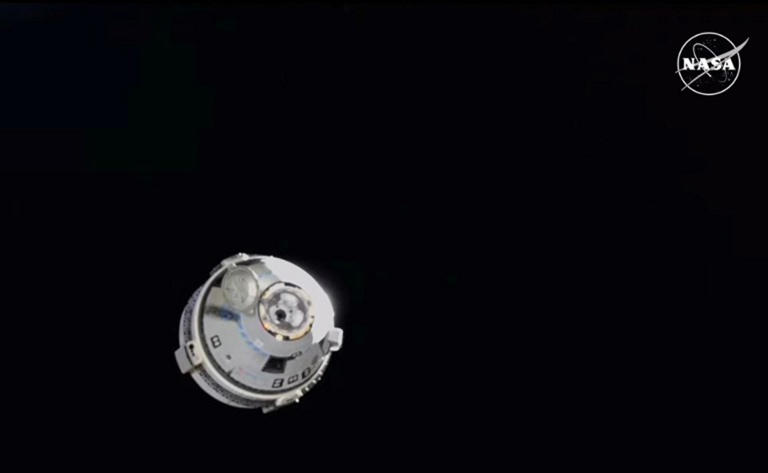
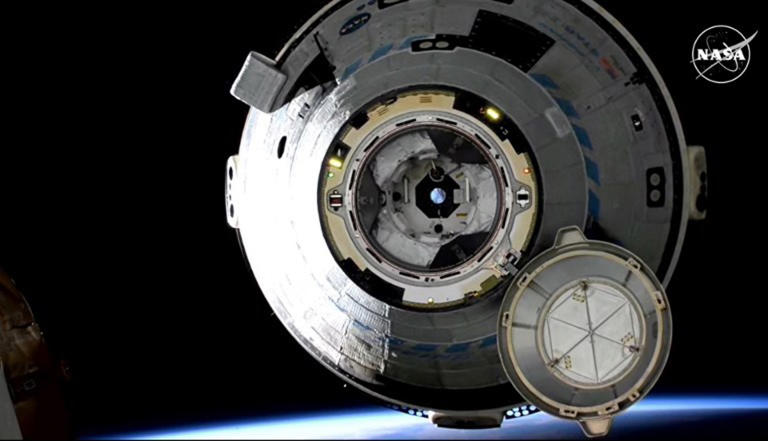
Op dit beeld is de Dragon-capsule, met aan boord een privébemanning, te zien kort nadat de Polaris Dawn-bemanning in een baan om de aarde kwam.
Op dit beeld is de Dragon-capsule, met aan boord een privébemanning, te zien kort nadat de Polaris Dawn-bemanning in een baan om de aarde kwam.  © AFP

Ruimtetoeristen bereiken hoogte van 1.400 kilometer boven de Aarde: “Verste dat mensen hebben gereisd sinds de Apollomissies”

De Polaris Dawn-missie van SpaceX heeft een hoogte van 1.400 kilometer bereikt. Dat laat het ruimtevaartbedrijf weten op socialemediasite X. Daarmee is de Falcon 9-raket met aan boord vier privébemanningsleden, het verst gereisd sinds de bemande maanmissies van vijftig jaar geleden.

{ https://www.hln.be/ }

Hoe vind je dit bericht?
Geschreven door peter om 14:33 Stuur door

Het universum bestond al vóór de oerknal, zo beweert een onderzoek

Het universum bestond al vóór de oerknal, zo beweert een onderzoek

Janine imagedoor Janine
Een driedimensionale kaart van donkere materie, zoals ontwikkeld door NASA, ESA en CALTECH

ESA

Niet iedereen gelooft dat het universum met de oerknal is ontstaan. Voor sommigen waren er zelfs twee oerknallen, terwijl voor anderen het universum heen en weer beweegt tussen fases van uitdijing en inkrimping zonder te worden gereduceerd tot singulariteiten. Dit is ongetwijfeld een fascinerend perspectief, hoewel moeilijk te bewijzen, dat een ander beeld oplevert vergeleken met de meest wijdverspreide theorie van vandaag. Toch hebben sommige onderzoekers recentelijk bewijs gevonden van geheim leven in het universum vóór de oerknal, dat verband houdt met zwarte gaten en donkere materie. Laten we eens kijken waar het over gaat.

Zijn zwarte gaten en donkere materie hetzelfde?

Donkere materie is lange tijd het onderwerp geweest van diepgaande studies: we weten dat het bestaat, maar we kunnen het op geen enkele manier “zien”, behalve via enkele van de effecten ervan op de omringende materie. In feite zendt, absorbeert of reflecteert donkere materie geen elektromagnetische straling, maar heeft toch wel effecten op de zwaartekracht en de rotatiesnelheid van sterrenstelsels. Het is daarom een ​​soort materie die we alleen kunnen bestuderen via de effecten ervan, op een manier die sterk lijkt op wat er gebeurt met zwarte gaten.

En juist deze principiële overeenkomst is niet onopgemerkt gebleven: een recente studie gepubliceerd in de Journal of Cosmology and Astroparticle Physics heeft de hypothese naar voren gebracht dat donkere materie zou kunnen worden gevormd door primordiale zwarte gaten. Maar wanneer zouden deze zwarte gaten zich hebben gevormd? Voor onderzoekers bestaat er geen twijfel: vóór de oerknal.

Van de Big Bounce tot (primordiale) zwarte gaten

Een weergave van het superzware zwarte gat M87* in gepolariseerd licht

EHT Collaboration/Wikimedia Commons - CC BY 4.0

Vanaf hier keren we terug naar de kosmologische theorie die we in de inleiding noemden, omdat de associatie tussen oorspronkelijke zwarte gaten en donkere materie het bewijs zou kunnen vormen van de Big Bounce. Volgens deze theorie was het ontstaan ​​van het heelal daarom niet een singulariteit gevolgd door een fase van snelle uitdijing, in een proces dat we kennen als de oerknal, maar een oscillerend patroon van uitdijingen en inkrimpingen.

Volgens onderzoekers kromp het heelal ruim 13 miljard jaar geleden tot een oneindig kleine omvang voordat het weer uitdijde, wat leidde tot een toename van de dichtheid van de materie, wat op zijn beurt bijdroeg aan de vorming van oorspronkelijke zwarte gaten. We hebben het over hemellichamen die de massa van een asteroïde hebben en een oneindig kleine diameter, maar toch groot genoeg zodat Hawkingstraling ze niet volledig wegvaagt. Zeker niet in 13 miljard jaar. Maar wat betekent dit allemaal voor het universum, voor de natuurkunde en voor donkere materie?

Aan de oorsprong van het universum?

Het aantonen dat donkere materie uit vele kleine oorspronkelijke zwarte gaten bestaat, zou een impuls kunnen geven aan de studie van dit overheersende component van het universum. Aan de andere kant zouden we kunnen stoppen met het zoeken naar deeltjes die alleen via de zwaartekracht met materie interactie hebben, en op zoek kunnen gaan naar kleine zwarte gaten verspreid over het universum: sommige doen al iets soortgelijks. En dit is niet het enige gevolg: volgens de onderzoekers komen de eigenschappen van een oscillerend universum zoals geschetst overeen met de kromming van de ruimte en de kosmische achtergrondstraling in zijn vroege stadia. Maar zo eenvoudig is het niet.

Om hun theorie te testen zal het internationale team dat aan het onderzoek heeft gewerkt zwaartekrachtgolven moeten detecteren die zijn gevormd in de vorige fase van samentrekking van het universum. Tot op heden is het onmogelijk om dit te doen, tenminste met de instrumenten die momenteel beschikbaar zijn, maar wie weet in de toekomst. Misschien kunnen de Laser Interferometer Space Antenna, of LISA, en de Einstein Telescope ons al een antwoord op deze vraag geven. En een revolutie teweegbrengen in alles wat we wisten over de oorsprong van het universum.


Wat was er voor de oerknal? | God? | Wie heeft God gemaakt? | Bestaat God?

De oerknal door Robbert Dijkgraaf

{ https://www.curioctopus.nl/ }

Hoe vind je dit bericht?
Geschreven door peter om 00:48 Stuur door

Alien Abduction or Truth? The Charles Hickson Case That Passed the Polygraph Test

Alien Abduction or Truth? The Charles Hickson Case That Passed the Polygraph Test

Alien Abduction or Truth? The Charles Hickson Case That Passed the Polygraph Test

One of the most compelling stories of alien abduction took place on the night of October 11, 1973, in Pascagoula, Mississippi. Two men, Charles Hickson and Calvin Parker, experienced a bizarre and traumatic event that would go on to become one of the most famous UFO cases in American history. What sets this case apart from other similar reports is that both men passed polygraph tests, providing a degree of credibility to their account. The Pascagoula incident remains one of the most intriguing alien abduction stories to date.

The Incident: A Night of Fishing Gone Wrong

On that fateful evening, Hickson, a 42-year-old Korean War veteran and shipyard foreman, and his friend Calvin Parker, a 19-year-old welder, were fishing along the Pascagoula River. As they enjoyed the quiet night, they were suddenly startled by a strange zipping sound and two flashing blue lights. Turning around, they saw an oval-shaped, hovering object, approximately 30-40 feet across and 8-10 feet high, descend towards them. The craft appeared to defy the laws of gravity, hovering just above the ground.

Before the two men could react, three strange creatures emerged from the craft. The beings were described as having no necks, coarse, wrinkled skin, and standing around five feet tall. Their movements were mechanical, and they glided toward Hickson and Parker. The men later reported being paralyzed, unable to move but fully conscious, as they were floated aboard the hovering craft.

Inside the spacecraft, both men claimed to have undergone a terrifying examination. Hickson described an “electronic eye” that scanned his body, while Parker recalled being laid on a table, subjected to a thorough physical examination by a more human-like, feminine creature. Both men said they were given telepathic reassurances not to be afraid, but the experience left them traumatized.

The Aftermath: Reporting the Incident

After being released from the spacecraft, Hickson and Parker were left standing at the river’s edge, completely shaken. Still in shock, the men initially hesitated to report the incident, but eventually decided to contact local authorities. They first called Keesler Air Force Base, only to be told that UFO encounters were no longer within their jurisdiction. With nowhere else to turn, they went to the Jackson County Sheriff’s Office.

Skeptical at first, the sheriff’s deputies interviewed the men separately and even placed them in a room wired for sound, hoping to catch them in a lie. However, their conversation, recorded when they thought they were alone, only reinforced the deputies’ belief that the men were genuinely terrified by something unexplainable.

The story quickly gained national attention. News outlets across the country reported on the Pascagoula abduction, and Hickson, in particular, became a media sensation. Despite the attention, both men maintained the truth of their account, never deviating from their original story.

Passing the Polygraph Test: The Truth or Belief?

A key moment in the investigation was the administration of polygraph tests, which both men passed. Charles Hickson’s polygraph test was conducted by a New Orleans firm on October 30, 1973, just weeks after the incident. The examiner stated that Hickson was truthful in his belief that he had been abducted by extraterrestrial beings.

Skeptics have pointed out that passing a polygraph test does not definitively prove the truth of an event. Instead, it shows that the person being tested believes they are telling the truth. However, the fact that both Hickson and Parker passed their polygraph tests adds a layer of complexity to the case, as they demonstrated strong conviction in the accuracy of their bizarre experience.

The Public Reaction and Ongoing Interest

Hickson, more open to sharing his story, appeared on popular talk shows like The Tonight Show with Johnny Carson and To Tell the Truth. Despite the public interest, Parker shied away from the limelight, choosing a quieter life, though he never contradicted his earlier statements.

In the years that followed, other witnesses came forward to support the men’s claims. For example, Mike Cataldo, a retired Navy officer, later reported seeing a strange, hovering object in the sky the same night near the Pascagoula River. Cataldo’s account described an object with flashing lights, spinning in the sky, and disappearing after hovering for about 30 seconds.

Despite the corroborative testimonies, skeptics, including renowned UFO debunkers like Philip Klass, challenged Hickson and Parker’s story. Klass pointed to inconsistencies in Hickson’s descriptions of the creatures, noting that his accounts changed over time. Others suggested that the men had entered a state of sleep paralysis and hallucinated the entire experience.

Theories and Skepticism: Was It Real?

Skeptics have tried to explain the incident in various ways. Joe Nickell, a prominent paranormal investigator, suggested that Hickson and Parker might have entered a hypnagogic state, a condition where a person experiences sleep paralysis and vivid hallucinations. This could explain the sensations of paralysis and the strange visual and auditory experiences the men reported.

Additionally, some investigators raised concerns about the polygraph tests. They noted that the polygraph examiner was relatively inexperienced, and Hickson had refused to take another test conducted by a more seasoned expert. These factors have led some to question the legitimacy of the tests and the overall story.

VIDEO:

  • The Most Convincing Alien Abduction Victim (He Passed The Polygraph Test)

The Pascagoula alien abduction case remains one of the most perplexing UFO encounters in American history. With both men passing polygraph tests, numerous eyewitnesses coming forward, and their consistent storytelling over the years, the incident continues to baffle investigators. Charles Hickson passed away in 2011, and Calvin Parker in 2023, yet their experience still ignites debate among believers and skeptics alike.

Was it a genuine alien abduction, a shared hallucination, or something else entirely? The Pascagoula incident leaves us with more questions than answers, but it stands as one of the most convincing cases in the annals of UFO lore, made even more compelling by the fact that its key witnesses passed a polygraph test, indicating that—at least in their minds—their terrifying experience was very real.


Travis Walton Tells His Story of Alien Abduction

Secret recording of Charles Hickson and Calvin Parker after the Pascagoula alien abduction incident

IN CONTACT ~ rare documentary with Calvin Parker and Charles Hickson on the Pascagoula UFO incident

{ https://www.latest-ufo-sightings.net/ }

Hoe vind je dit bericht?
Geschreven door peter om 00:35 Stuur door

Underwater UFOs display capability that ‘jeopardizes US maritime security,’ ex-Navy officer says

Hoe vind je dit bericht?
Geschreven door peter om 00:00 Stuur door

Europese ruimtesonde "ontdekt" dat er leven mogelijk is op aarde

Europese ruimtesonde "ontdekt" dat er leven mogelijk is op aarde

Europese ruimtesonde "ontdekt" dat er leven mogelijk is op aarde

Europese ruimtesonde "ontdekt" dat er leven mogelijk is op aarde

Geruststellend nieuws: de aarde is bewoonbaar. Dat heeft de Europese ruimtesonde Juice bevestigd toen hij op 20 augustus langs de planeet scheerde op weg naar Jupiter, zo deelde de Europese ruimtevaartorganisatie ESA dinsdag mee.

Instrumenten van de ruimtesonde gingen tijdens de vlucht langs de aarde na of de noodzakelijke voorwaarden voor leven aanwezig zijn. Ze vonden niet alleen water, maar ook koolstof, waterstof, stikstof, zuurstof, fosfor en zwavel, de meest voorkomende elementen in levende organismes.

Belangrijker dan de "ontdekking" op zich, is de bevestiging dat de instrumenten van Juice werken. "We zijn uiteraard niet verrast door de resultaten, het zou heel zorgwekkend zijn geweest indien we hadden ontdekt dat er geen leven mogelijk is op aarde", zegt projectwetenschapper Olivier Witasse. "Maar de resultaten bewijzen dat de instrumenten goed zullen werken bij Jupiter, waar ze zullen onderzoeken of er op de ijsmanen leven mogelijk is of is geweest."

Europese ruimtesonde "ontdekt" dat er leven mogelijk is op aarde

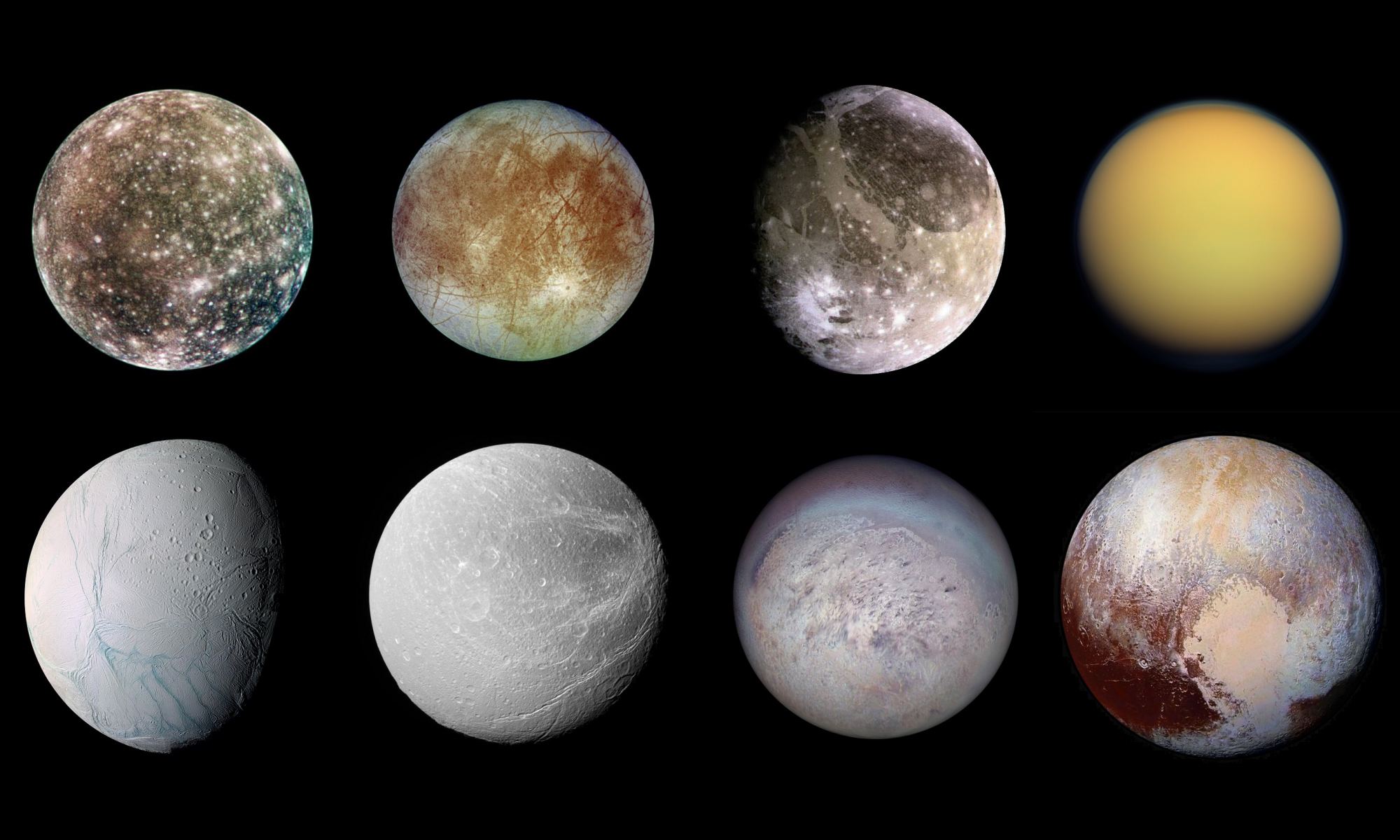
Juice (kort voor Jupiter Icy Moons Explorer) werd in april 2023 gelanceerd. De aankomst bij Jupiter is in 2031 gepland. Daar zal de sonde drie van de zowat honderd manen van de planeet - Ganymedes, Callisto en Europa - bestuderen, omdat zij onder hun ijskorst mogelijk oceanen met vloeibaar water bevatten.

De flyby langs de aarde en de maan in augustus diende om met behulp van de zwaartekracht de snelheid en richting van het ruimteschip aan te passen. In 2026 en 2029 zal de sonde normaal opnieuw langs de aarde komen.

{ https://www.msn.com/nl-be/ }
Hoe vind je dit bericht?
Geschreven door peter om 21:55 Stuur door

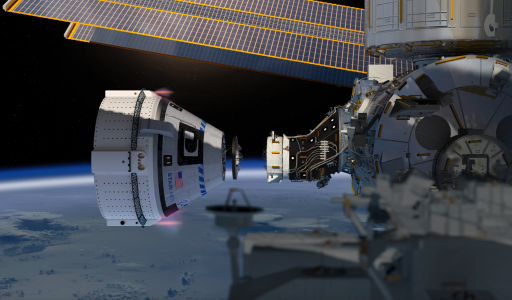
Starliner Suffers New Problems While Coming Back to Earth

Starliner Suffers New Problems While Coming Back to Earth

Story by Victor Tangermann

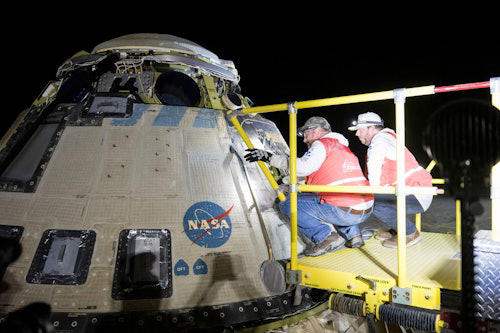
Late Friday night, NASA's plagued Starliner spacecraft finally made it back to the ground. A new thruster failed.

Late Friday night, NASA's plagued Starliner spacecraft finally made it back to the ground. A new thruster failed.

Homeward Bound

On Saturday morning, NASA's plagued Starliner spacecraft finally made it back to the ground.

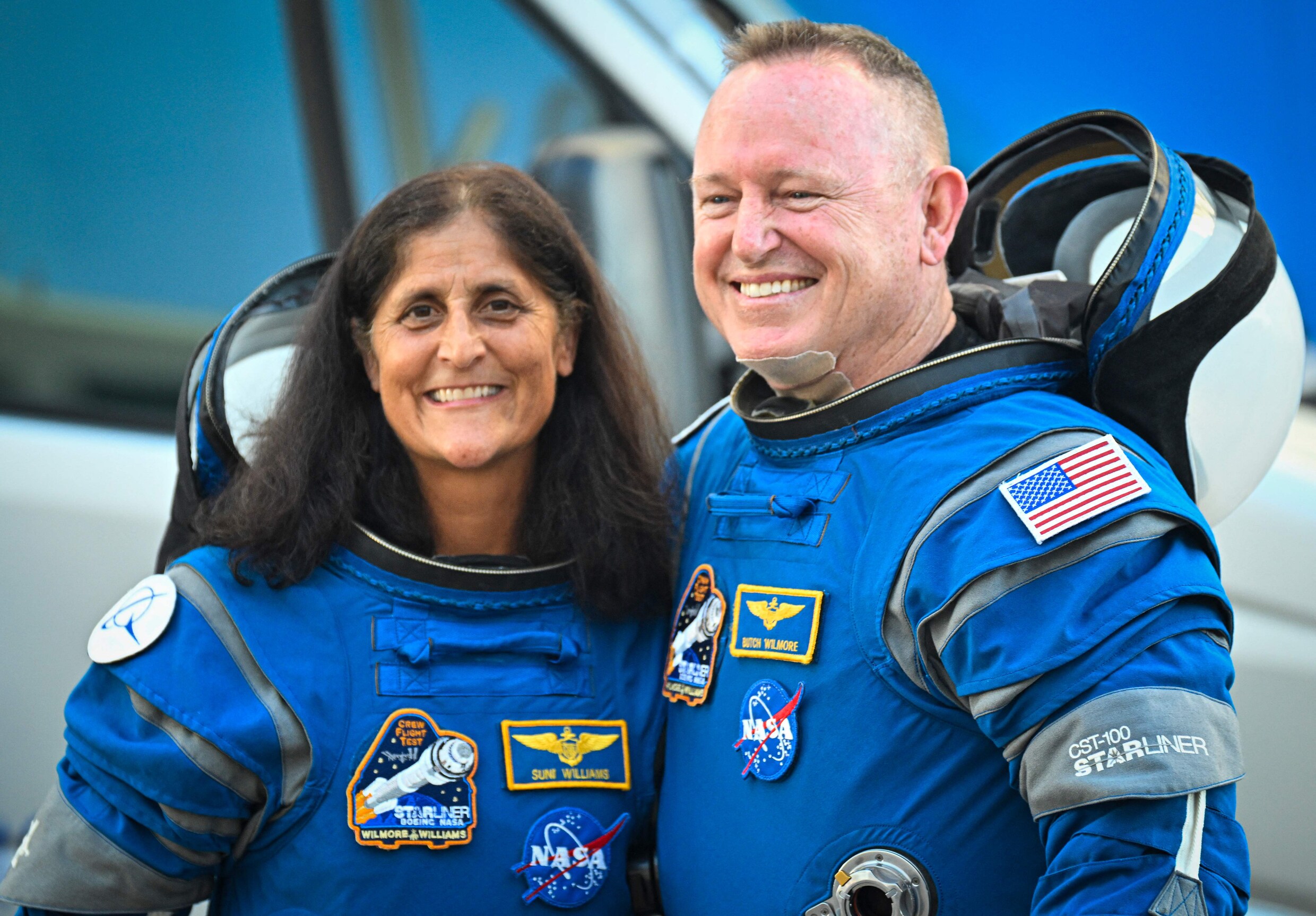
The capsule landed in the New Mexico desert after spending just over three months in space. But thanks to technical issues worrying NASA officials, it left behind the agency's two stranded astronauts Butch Wilmore and Suni Williams, bookending a disastrous first crewed flight attempt.

The pair will have to wait for their ride back, on a SpaceX Crew Dragon spacecraft, until February.

Signals on the capsule's return were mixed. On the one hand, according to NASA’s commercial crew program manager Steve Stich, it pulled off a "bullseye landing." On the other, the agency admitted that a new thruster had failed during its descent. The capsule also experienced a temporary blackout of Starliner's guidance system during reentry.

It's an awkward situation for the space agency: would Starliner have been able to ferry NASA's missing crew members in the end?

"I think we made the right decision not to have Butch and Suni on board," Stich told reporters on Saturday. "All of us feel happy about the successful landing. But then there’s a piece of us, all of us, that we wish it would have been the way we had planned it."

Double Down

While approaching the International Space Station in early June, five of Starliner's 28 control thrusters gave up, forcing Wilmore and Williams to take over manual control.

Subsequent investigations concluded that the thrusters had overheated, causing a Teflon "poppet" seal to expand and restrict the flow of the oxidizer.

Several helium leaks added to Boeing's growing headache at the time, worrying NASA officials.

The capsule didn't fare much better following undocking procedures on Friday. One of its 12 control jets on the crew module — a different set unrelated to the other malfunctioning service module thrusters — failed to ignite. And a glitch caused the spacecraft's navigation system to go down briefly during reentry as well.

It's still unclear whether Boeing will try to launch its plagued Starliner again. Analysts suggest the aerospace giant may dump the entire project, which has already lost the company well over a billion dollars, instead.

"It’s unclear if or when the company will have another opportunity to bring astronauts to space," Bank of America aerospace and defense analyst Ron Epstein told the New York Times. "We would not be surprised if Boeing were to divest the manned spaceflight business."

More on Starliner: Retired NASA Engineer Warns Boeing's Starliner Could Lose Control During Return and Crash in Populated Area

The post Starliner Suffers New Problems While Coming Back to Earth appeared first on Futurism.

{ https://www.msn.com/en-us/ }

Hoe vind je dit bericht?
Geschreven door peter om 20:22 Stuur door

So, Would Starliner Have Safely Brought Its Astronauts Home?

So, Would Starliner Have Safely Brought Its Astronauts Home?

Story by Doris Elín Urrutia

— NASA/Getty Images News/Getty Images

NASA/Getty Images News/Getty Images

Starliner is finally home. But its crew — astronauts Butch Wilmore and Suni Williams — are not. Could Starliner have safely carried them?

The Boeing spacecraft’s initial 8-day flight ballooned into a months-long saga shortly after launch. The aerospace company and NASA, who are collaborating for the agency’s Commercial Crew Program to bring low-cost astronaut rides to and from space, had tense discussions. Boeing argued their spacecraft was sound enough to return the crew. NASA was uncomfortable signing off. Starliner therefore landed shortly past midnight Eastern time early Saturday without Wilmore and Williams.

But in hindsight, would it have been fine?

Steve Stich, manager of NASA’s Commercial Crew Program, doesn’t beat about the bush on this point: “It would have been a safe successful landing with the crew onboard, had we have had Butch and Suni onboard.”

These comments came during a media conference NASA held after landing — noticeably without Boeing officials, who did not participate in the event. Stich explained that “if there was a crew onboard, it would have flown the same back-away sequence, and the same orbit return, and executed the same entry.”

This of course was not a given since not long after Starliner entered orbit around Earth on June 5, it leaked helium and five thrusters malfunctioned. Out of an abundance of caution — or according to many even a modicum of it — NASA did not want to send the astronauts home once they looked over the data with Boeing. It was not an easy decision and as Stich noted in an earlier meeting that “the teams were very split.” Boeing thought it would be fine — NASA “saw limitations” in the data.

So, Would Starliner Have Safely Brought Its Astronauts Home?

So, Would Starliner Have Safely Brought Its Astronauts Home?

Moving forward, this uneventful landing doesn’t mean Starliner is now certified to get back in the game. Starliner’s launch in June was its critical Crew Flight Test, which would have certified Starliner as an astronaut ferry provider for NASA — had nothing gone awry. Of course, plenty went wrong and it was a huge hitch for Wilmore and Williams who will now return to Earth in February 2025 at the earliest, onboard a SpaceX Crew Dragon capsule set to launch to the International Space Station later this month.

Related video: 

NASA Says Something Weird Is Happening With Boeing's Starliner, Stay in Space Forever!

“I’d say it’s probably too early to think about what the next flight looks like. We want to look at the data,” Stich said.

Amidst Boeing’s absence at the conference, Stich said the company is still a major partner. The major goal of the Commercial Crew Program is to get Starliner to the point where it’s greenlit for crew rotation. But the next steps aren’t yet clear.

“We will review the data and determine the next steps for the program,” Mark Nappi, vice president and program manager of Boeing’s Commercial Crew Program, said in a statement Boeing published after Starliner landed.

“It will take time to determine the path forward,” Stich said. “Today we saw the vehicle perform well.”

{ https://www.msn.com/en-us/ }

Hoe vind je dit bericht?
Geschreven door peter om 18:34 Stuur door

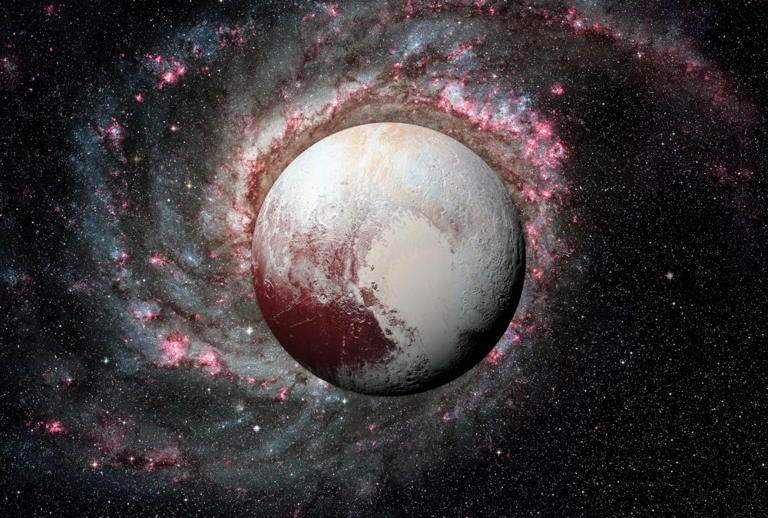
Mysterious objects spotted in the outer solar system beyond Pluto

Mysterious objects spotted in the outer solar system beyond Pluto

Story by Eric Ralls
Mysterious objects spotted in the outer solar system beyond Pluto

Recent observations using the ultra-widefield prime focus camera of the Subaru Telescope have shown that there may be a population of small astronomical objects further out in the Kuiper Belt still waiting to be discovered.

According to the experts, the findings are essential for a better understanding of the formation of the solar system.

The research was made possible through an international collaboration between the Subaru Telescope and the New Horizons spacecraft traveling through the outer solar system.

New Horizons flew through the Kuiper Belt 

NASA's New Horizons spacecraft was launched in 2006 in order to observe the surfaces of outer solar system bodies up close for the first time in our history. The spacecraft successfully completed a flyby of the Pluto system (2015), and later on (2019)  it made a flyby of one of the Kuiper Belt objects, (486958) Arrokoth.

Although there were four other spacecraft which have flown to the outer solar system, New Horizons is the only one that has flown through the Kuiper Belt.

Viewing objects in the Kuiper Belt 

When examining Kuiper Belt objects from the ground, we can only observe them at small solar phase angles (the angle between the sun, the object, and the observer). 

However, when looking at an object in the outer solar system from a spacecraft in the Kuiper Belt, these objects can be observed at different phase angles and their reflection characteristics can be utilized to estimate their surface properties. 

Related video: 
  • One of NASA’s Furthest Probes Just Gave Us a Look at Just How Dark the Universe is Beyond Our Solar System  

Yet, the camera on the New Horizon spacecraft has a narrow field-of-view and cannot find Kuiper Belt objects on its own. 

Fortunately, the Subaru Telescope can use its wide-field camera to discover a variety of Kuiper Belt objects and then narrow down the collection of objects which the spacecraft can fly by and examine. 

New Horizons and the Subaru telescope 

The collaboration between the New Horizons spacecraft and the Subaru Telescope was initiated in 2004.

During the 2004–2005 observations with the Subaru Telescope's prime focus camera (Suprime-Cam), the orbital alignment between Pluto and the spacecraft caused a portion of the Milky Way's center to appear in the background of the search area for Kuiper Belt objects.

While it was highly difficult to search for solar system objects with multiple background stars, the scientists were able to localize 24 Kuiper Belt objects.

Unfortunately, the Kuiper belt objects discovered until now require too much fuel for New Horizons to flyby, but new ones at greater distances might fall within the available fuel reach of the spacecraft. 

In 2020, deeper observations with the Hyper Suprime-Cam (HSC) on the Subaru Telescope began, and, by 2023, 239 Kuiper Belt objects were discovered.

"The most exciting part of the HSC observations was the discovery of 11 objects at distances beyond the known Kuiper Belt," said team member Fumi Yoshida, a scientist at the University of Occupational and Environmental Health Sciences and the Planetary Exploration Research Center at the Chiba Institute of Technology.

Unexpected discovery of mysterious objects 

A large number of objects discovered with HSC are located at distances ranging from 30 to 55 astronomical units (au) from the Sun (with one au corresponding to the distance between the Sun and Earth) and are thought to belong to the known Kuiper Belt.

However, the experts were not expecting to discover what looks to be a cluster of objects in the 70–90 au region and a valley between 55 and 70 au, where only a small number of objects are distributed.

Is there a new population of Kuiper Belt objects located at 70–90 au? "If this is confirmed, it would be a major discovery. The primordial solar nebula was much larger than previously thought, and this may have implications for studying the planet formation process in our solar system," Yoshida explained.

"This is a groundbreaking discovery revealing something unexpected, new, and exciting in the distant reaches of the solar system; this discovery probably would not have been possible without the world-class capabilities of the Subaru observatory," added New Horizons mission principal investigator Alan Stern.

Understanding solar system formation 

In order to determine the precise orbits of these objects, the scientists are continuing observations with HSC.

"I think the discovery of distant objects and the determination of their orbital distribution are important as a stepping stone to understanding the formation history of the solar system, comparing it with exoplanetary systems, and understanding universal planet formation," Yoshida said.

New Horizons is currently traveling further out, at approximately 60 au from the Sun, hoping to discover many more distant objects.

 VIDEOS

Incredible Discoveries Of The James Webb Telescope | Universe Explorers | BBC Earth Science

The Year of Pluto - New Horizons Documentary Brings Humanity Closer to the Edge of the Solar System

Mysteries of the Universe. A Journey to Amazing Objects
{ https://www.msn.com/en-us/ }
Hoe vind je dit bericht?
Geschreven door peter om 18:14 Stuur door

Scientists finally solve mystery behind Bermuda Triangle disappearances

Scientists finally solve mystery behind Bermuda Triangle disappearances

Story by Harriet Brewis

The Bermuda Triangle is one of urban legend’s favourite locations.

For decades, the section of the north Atlantic ocean has sparked fear and fascination as the alleged site, and source, of dozens of mysterious disappearances.


Top 10 Creepiest Unsolved Bermuda Triangle Mysteries

More than 50 ships and 20 airplanes are said to have vanished in the region, which stretches roughly from the Florida coast to Bermuda to the Greater Antilles islands.

This amounts to an average of four planes and 20 boats disappearing without a trace in the zone every year, the Week notes.

Naturally, conspiracy theories have abounded as to the causes of these tragic and unexplained instances, with aliens and even Atlantis blamed for the phenomena.

However, experts have offered more credible hypotheses and, in 2017, Australian scientist Karl Kruszelnicki claimed to have “solved” the enduring mystery once and for all.

The precise parameters of the Bermuda Triangle are disputed, but it roughly lies between Florida, Bermuda and Puerto Rico ((iStock))

The precise parameters of the Bermuda Triangle are disputed, but it roughly lies between Florida, Bermuda and Puerto Rico
((iStock))

He dismissed any suggestion that the supernatural was at play here and instead pointed the finger of blame simply at human error, bad weather and high traffic volumes.

“It is close to the equator, near a wealthy part of the world, America, therefore you have a lot of traffic,” he told news.com.au.

Indeed, the Bermuda Triangle (also known as the “Devil’s Triangle”), is one of the most heavily travelled shipping lanes in the world, with vessels passing through to reach ports in the US, Europe and the Caribbean.

And whilst the disappearance of any plane or ship is a tragedy, in fact, “the number of planes that go missing in the Bermuda Triangle is the same as anywhere in the world on a percentage basis,” Dr Kruszelnicki said, quoting insurance company Lloyds of London and the US Coast Guard.

Put simply, travelling through this infamous area is no riskier than going through other busy parts of the world.

And yet, sceptics will continue to cling to more interesting theories, including that rogue waves are behind the disappearances.

Scientists put forward this hypothesis in the Channel 5 documentary ‘The Bermuda Triangle Enigma’, claiming that conditions in the zone are just right for “massive rogue waves”.

“There are storms to the south and north, which come together,” University of Southampton oceanographer Simon Boxall explained. “And if there are additional ones from Florida, it can be a potentially deadly formation of rogue waves.”

Rogue waves of this type could reach around 30 metres (100 feet) tall, which would be on par with the largest wave ever recorded – a 100-foot tsunami triggered by an earthquake and landslide in Alaska’s Lituya Bay in 1958, HuffPost reports.

None of the 14 airmen involved in Flight 19 were ever seen or heard from again ((NAVAL HISTORY AND HERITAGE COMMAND/NAS Fort Lauderdale Museum))

None of the 14 airmen involved in Flight 19 were ever seen or heard from again
((NAVAL HISTORY AND HERITAGE COMMAND/NAS Fort Lauderdale Museum))

Reports of unexplained occurrences in the Bermuda Triangle date to the mid-19th century when some ships were discovered completely abandoned for no apparent reason, while others transmitted no distress signals but were never seen or heard from again, , according to the Encyclopedia Britannica.

Perhaps the most famous incident linked to the area is the disappearance of Flight 19, which occurred in December 1945 and saw five US Navy Avenger torpedo bombers vanish during a training mission.

After setting off from Fort Lauderdale, Florida, the planes reportedly experienced compass malfunctions and became disoriented, leading to their disappearance.

And yet, Kruszelnicki dismissed suggestions, posited in 1964, that the incident proves that the Bermuda Triangle “is the scene of disappearances that total far beyond the laws of chance.”

He noted that Flight 19 took off in poor weather conditions, with 15-metre (49-foot) waves crashing down below the aircraft.

Kruszelnicki added that the only truly experienced pilot in the flight was its leader, Lieutenant Charles Taylor, and his human error may well have played a part in the tragedy.

“[He] arrived with a hangover, flew off without a watch, and had a history of getting lost and ditching his plane twice before,” the scientist explained.

Furthermore, radio transcripts recorded before the patrol vanished revealed that Lt Taylor had lost his bearings and ordered the patrol to fly east – unwittingly taking them further over the deep waters of the Atlantic.

Ultimately, it doesn’t matter what the experts say. For some people, legends like that of the Bermuda Triangle will always hold appeal.

After all, mystery and intrigue are a lot more enticing than the prosaic truth: that humans make mistakes and you can't trust the weather.

  • Sign up for our free Indy100 weekly newsletter
  • How to join the indy100's free WhatsApp channel
  • Indy100 is the sister title of The Independent, bringing you the stories you want to read, in the order you want to read them. Created with a particular focus on the Gen Z and young Millennial audience, it’s fun, it's original, it captures the mood and tells the untold angle to the big global stories across news, viral trends, politics, celebrities, sport, science, tech and identities. It's never boring, and is passionately progressive and always supports equality. Follow Indy100 at the top of the article./em>

VIDEOS


Scientist Solves the Mystery of the Bermuda Triangle

What Actually Happens in the Bermuda Triangle - Mystery Revealed

The Mysterious Bermuda Triangle Unveiling Its Secrets. #Bermuda Triangle
Hoe vind je dit bericht?
Geschreven door peter om 17:53 Stuur door

Largest Dark Matter Detector is Narrowing Down Dark Matter Candidate

Technicians scanning for dust on the LUX-ZEPLIN (LZ) Dark Matter Detector. Credit: LZ Experiment

Largest Dark Matter Detector is Narrowing Down Dark Matter Candidate

In 2012, two previous dark matter detection experiments—the Large Underground Xenon (LUX) and ZonEd Proportional scintillation in Liquid Noble gases (ZEPLIN)—came together to form the LUX-ZEPLIN (LZ) experiment. Since it commenced operations, this collaboration has conducted the most sensitive search ever mounted for Weakly Interacting Massive Particles (WIMPs) – one of the leading Dark Matter candidates. This collaboration includes around 250 scientists from 39 institutions in the U.S., U.K., Portugal, Switzerland, South Korea, and Australia.

On Monday, August 26th, the latest results from the LUX-ZEPLIN project were shared at two scientific conferences. These results were celebrated by scientists at the University of Albany‘s Department of Physics, including Associate Professors Cecilia Levy and Matthew Szydagis (two members of the experiment). This latest result is nearly five times more sensitive than the previous result and found no evidence of WIMPs above a mass of 9 GeV/c2. These are the best-ever limits on WIMPS and a crucial step toward finding the mysterious invisible mass that makes up 85% of the Universe.

Led by the Department of Energy’s (DoE) Lawrence Berkeley National Laboratory, the LZ experiment is located at the Sanford Underground Research Facility in South Dakota, about 1,500 meters (nearly a mile) beneath the surface. The experiment relies on an ultra-sensitive detector made of 10 tonnes (11 U.S. tons) of liquid xenon to hunt for the elusive signals caused by WIMP-nucleus interactions. While direct detections are yet to be made, these latest results have helped scientists narrow the search.

As Levy explained in a recent UofA press release:

“Dark matter interacts very, very rarely with normal matter, but we don’t know exactly how rarely. The way we measure it is through this cross-section or how probable an interaction is within our detector. Depending on the mass of a dark matter particle, which we don’t know yet, an interaction within the detector is more or less probable. What the new LZ results tell us is that dark matter interacts with normal matter even more rarely than we thought, and the only instrument in the world that is sensitive enough to measure that is LZ.”

The existence and nature of Dark Matter are among the greatest mysteries in modern astrophysics. Originally proposed to explain the rotational curves of galaxies, the existence of Dark Matter is vital to the most widely accepted cosmological model – the Lambda Cold Dark Matter (LCDM) model. Unfortunately, according to the prevailing theories, DM only interacts with normal (aka. “luminous”) matter via gravity, the weakest of the four fundamental forces. Detecting these interactions requires incredibly sensitive instruments and an environment free of electromagnetic energy (including heat and light).

While no direct detections have been made, the latest results from LZ have narrowed the range of possibilities for one of the leading DM candidates. As Szydagis said:

“It’s often misunderstood what is meant by the phrase ‘world’s best dark matter experiment’ since no one has made a conclusive, unambiguous discovery yet. However, new, stricter null results like LZ’s are still extremely valuable for science. UAlbany, as one part of the multinational collaboration that is LZ, has been making important contributions ensuring the robustness of LZ’s results, going back to the very beginning of the experiment.”

Although DM remains “invisible” to us, the presence of its gravitational pull is fundamental to our understanding of the Universe. For example, the formation and movement of galaxies are attributed to DM, and its existence is vital for explaining the large-scale structure and evolution of the Universe. If DM does not exist, then our understanding of gravity – as described by Einstein’s Theory of General Relativity – is essentially wrong and needs revision. However, General Relativity has been experimentally validated again and again over the past century.

Therefore, narrowing the search for its constituent particle is vital to proving that our foundational theories about the Universe are correct. As Levy noted, UAlbany scientists have been making integral contributions to LZ for over a decade, and their work is far from done! “Working on LZ is always so exciting, even if we still have not made a discovery yet,” she said. “We all know that if it were easy, someone else would have done it already! I think right now what we need to take out of this result is that LZ is a great team of scientists, our detector is working superbly, our analysis is extremely robust, and we are nowhere near done taking data.”

Further Reading: 

{ https://www.universetoday.com/ }

Hoe vind je dit bericht?
Geschreven door peter om 16:58 Stuur door

Using A Space Elevator To Get Resources Off the Queen of the Asteroid Belt

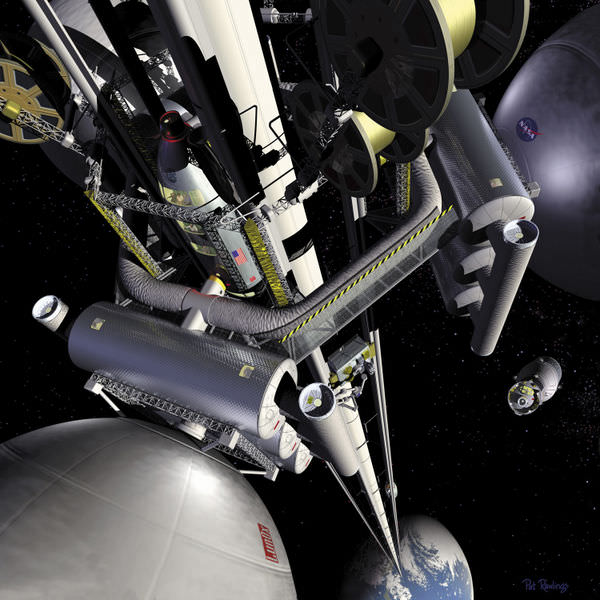
Artistic view of a possible space elevator. Credit: NASA

Using A Space Elevator To Get Resources Off the Queen of the Asteroid Belt

Here at UT, we’ve had several stories that describe the concept of a space elevator. They are designed to make it easier to get objects off Earth and into space. That, so far, has proven technically or economically infeasible, as no material is strong enough to support the structure passively, and it’s too energy-intensive to support it actively. However, it could be more viable on other worlds, such as the Moon. But what about worlds farther afield? A student team from the University of Colorado at Colorado Springs looked at the use case of a space elevator on Ceres and found that it could be done with existing technology.

Before we discuss why anyone would want to put a space elevator on Ceres, let’s first examine the technologies that would make it possible. Every space elevator design has three different components: an anchor, a tether, and a counterweight. Each would require its own technologies.

The anchor is simple enough; it’s how the system interfaces with Ceres. The surface of Ceres is primarily made of clay, which is relatively good for anchoring technologies. Luckily, the force the anchor needs to withstand is only around 300N, which is much lower than the force on Earth, given Ceres’ small mass. There have already been asteroid anchoring technologies for other missions that can provide up to 500N of force resistance, so an anchor on Ceres should prove no real challenge.

Fraser describes the general idea of a space elevator.

The tether is where the technology falls short on Earth – no material known to science can withstand the forces exerted on the tether of a passively controlled space elevator when it is tied to Earth. However, the closest we can come, something space elevator enthusiasts mention as almost a holy grail, is carbon nanotubes. In the analysis for the space elevator on Ceres, they once again came out ahead. However, the limitation of actually physically creating a long tether will still plague any space elevator design on Ceres.

The counterweight is much simpler, as it can be just a big, dumb mass. However, its mass is proportional to the necessary length of cable—the heavier the mass, the shorter the cable. So, the tradeoff between having a heavier counterweight and a shorter cable is another design consideration when considering these systems.

Calculations from the team show that, with only a little more technological development, all three main systems could be ready for installation on Ceres itself. But what advantages does it have? It could be helpful as a launching point for accessing other asteroids in the asteroid belt. Ceres also has water relatively near the surface, which is helpful for all kinds of human exploration, either as rocket fuel or biological systems. It’s also well placed to quickly get things back to Earth using Jupiter as a gravity assist.

Isaac Arthur goes into a deeper description of space elevators and their advantages.

But before it can provide any of those advantages, someone is going to have to pay for it. Estimates of the overall cost of the system total about $5.2 billion — not too far out of the range of larger-scale space exploration projects. But more than most countries are likely willing to pony up for a grand infrastructure project that hasn’t yet proven its benefit.

So, for now, any space elevator will remain in the realm of science fiction. But research like this and other ongoing technological improvements is how we will eventually push forward to that future. Whether it’s a space elevator on Ceres, on the Moon, or some other novel launch technology, someday humans will need a better way to get off Earth rather than burning dead living organisms. Hopefully, that day will come sooner rather than later.

Learn More:

Lead Image:

  • Artistic view of a possible space elevator.
    Credit: NASA

{ https://www.universetoday.com/ }

Hoe vind je dit bericht?
Geschreven door peter om 16:46 Stuur door

Mercury’s Strange Hollows

Mercury’s Strange Hollows

Contents

Enigmatic depressions on the surface have puzzled scientists since the 1970s

For decades, scientists have been puzzling over strange hollows on Mercury’s surface, thousands of peculiar depressions at a variety of longitudes and latitudes, ranging in size from 60 feet to more than a mile across (18-1,600 meters), and depths of 80 feet or more (24 meters). No one knows how they got there.

And while none are as spooky as the Sleepy Hollow of Washington Irving’s legend, Mercury’s hollows are just as mysterious and, so far, seen nowhere else in the universe. 

Hollows on Mercury
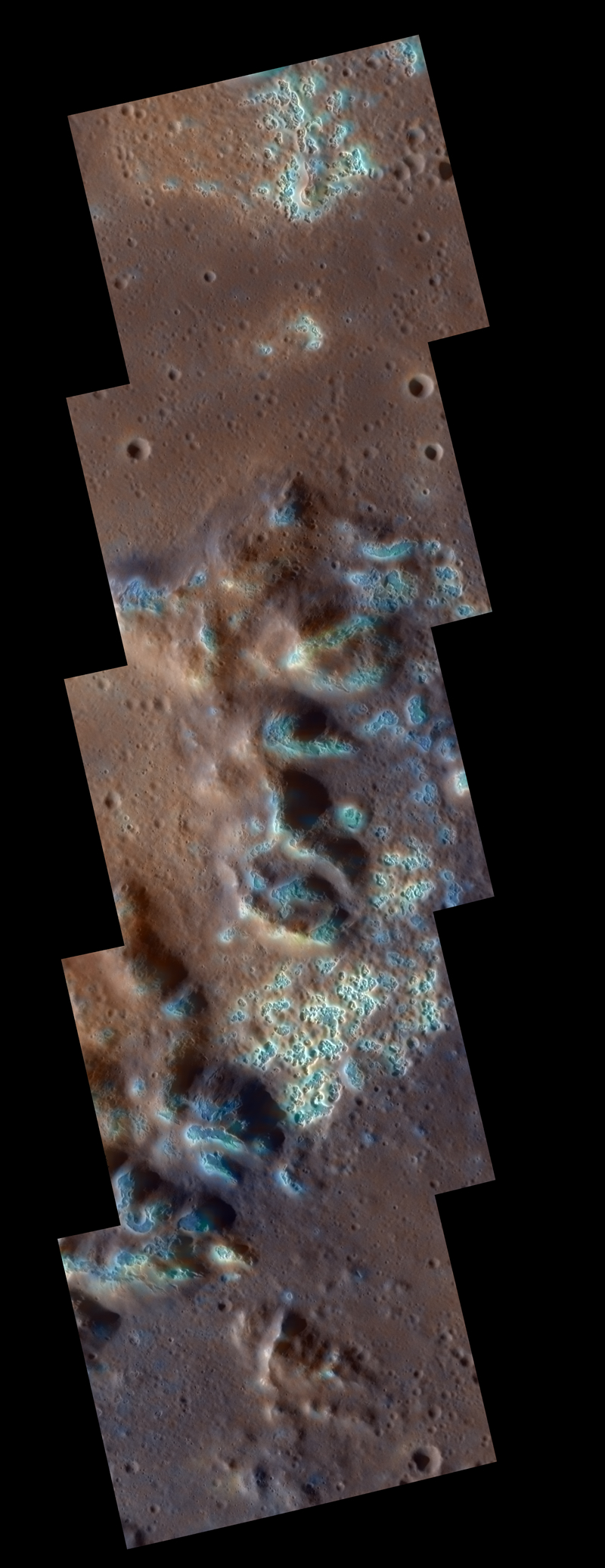
NASA’s MESSENGER spacecraft discovered strange hollows on the surface of Mercury. Images taken from orbit revealed thousands of mysterious depressions, pitted and uneven, in areas all across the planet, up to a mile (1,600 meters) across and 120 feet (37 meters) deep. This mosaic view of the Raditladi impact basin includes individual frames capturing areas about 12 miles (20 km) wide, which merged high-resolution monochrome images from MESSENGER's Narrow Angle Camera with a lower-resolution enhanced-color image from its Wide Angle Camera.
NASA/Johns Hopkins University Applied Physics Laboratory/Carnegie Institution for Science

“There’s essentially no atmosphere on Mercury,” said planetary geologist David Blewett, of the Johns Hopkins University Applied Physics Laboratory (APL) in Laurel, Maryland. “With no atmosphere, wind doesn’t blow and rain doesn’t fall, so the hollows weren’t carved by wind or water. Other forces must be at work.”

Mercury, the smallest planet in the solar system and closest to the Sun, is battered by heat, radiation, and solar wind; its extreme temperatures range from 800°F (430°C) on the sunny side, to as low as -290°F (-180°C) on the night side. It’s slightly larger, and similar to our Moon – airless, rocky, and peppered with impact craters large and small – but Mercury has rarely been visited by spacecraft, and retains many of its secrets.

Scientists got their first tantalizing glimpses of the hollows when the Mariner 10 probe flew past Mercury in the 1970s, and captured low-resolution shots of curious bright areas in some craters. 

NASA returned to the small planet with the MESSENGER mission, which first flew past Mercury in 2008, then settled into orbit in 2011.

That spacecraft circled the planet more than 4,000 times in four years, collecting hundreds of thousands of images and other data, and giving researchers new insights into this little-explored world. Mariner had cataloged less than half the planet’s surface during its brief visits 40 years earlier.

A Toast to Dear Old Poe
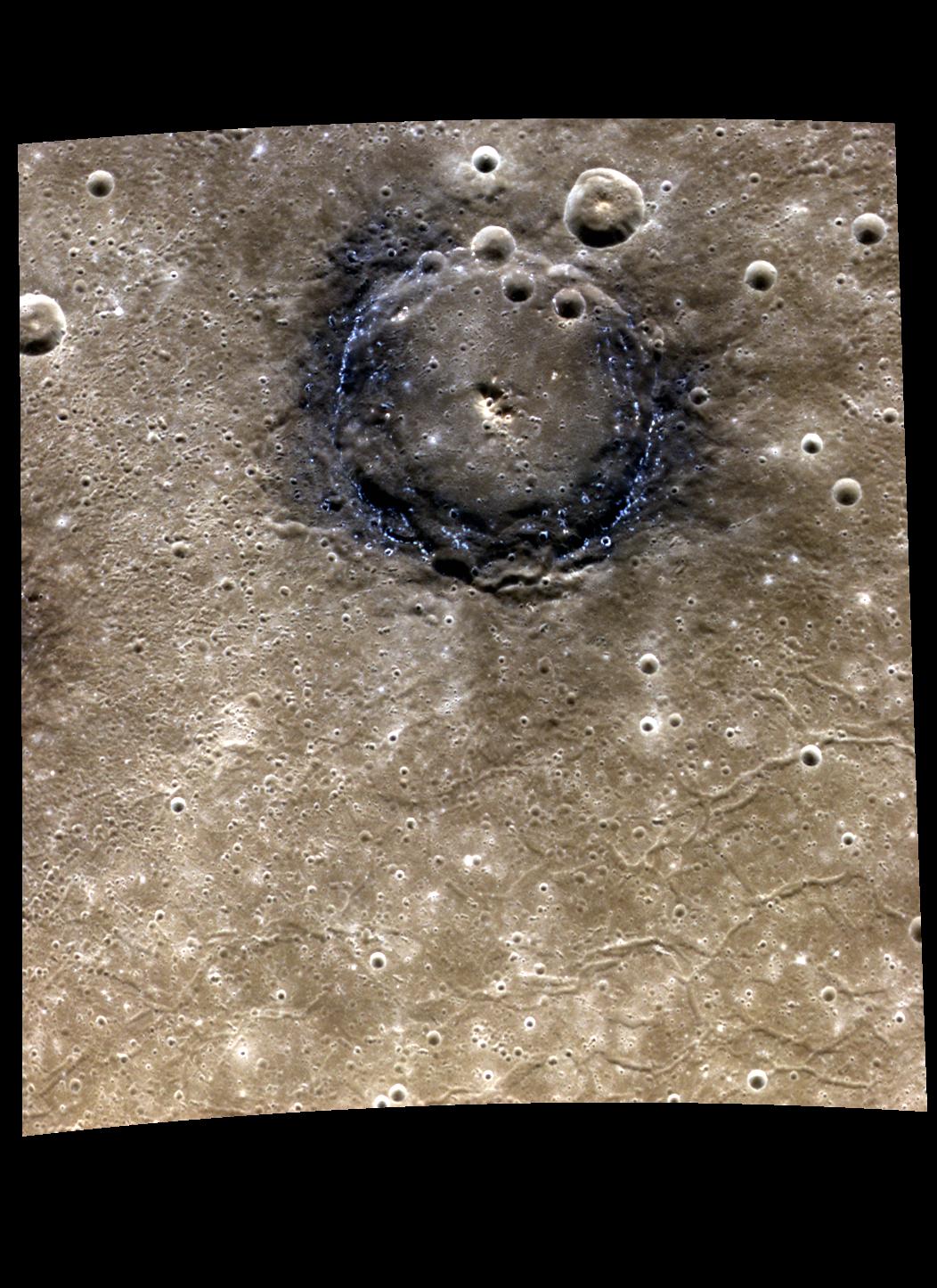
“This sinfully scintillant planet...” A view of hollows on Mercury, on the crater named for author Edgar Allan Poe. In this image, Poe's raven-colored rim stands out from the tan volcanic plains that surround it. Tiny hollows speckle the dark rim like blue-white stars in the blackness of night. The image was one of hundreds of high-resolution targeted color observations by MESSENGER’s Wide Angle Camera, using filters of red, green, and blue.
NASA/Johns Hopkins University Applied Physics Laboratory/Carnegie Institution for Science

“A Little Valley…Among High Hills”

MESSENGER (the Mercury Surface, Space Environment, Geochemistry and Ranging mission) finally provided a sharper view of the enigmatic tracts. To differentiate them from other surface features, researchers dubbed them “hollows” (akin to Washington Irving’s description of the terrain in “The Legend of Sleepy Hollow” – “a little valley or rather lap of land among high hills.”)

The probe sent back finely detailed, beautiful images of the hollows, looking in some color-enhanced mosaics like sheets of copper corroded with blue-green patina. In others – such as shots of Sander crater in Mercury’s vast Caloris basin – the strange landforms, etched and ragged, glow bright blue amid the surrounding crater walls and mounds. And yet the images and other data, from MESSENGER’s X-Ray Spectrometer, Laser Altimeter, and other instruments, gave only hints and no definitive answers about the hollows.

Measurements from NASA MESSENGER MLA instrument during the spacecraft greater than four-year orbital mission have mapped the topography of Mercury northern hemisphere in great detail.
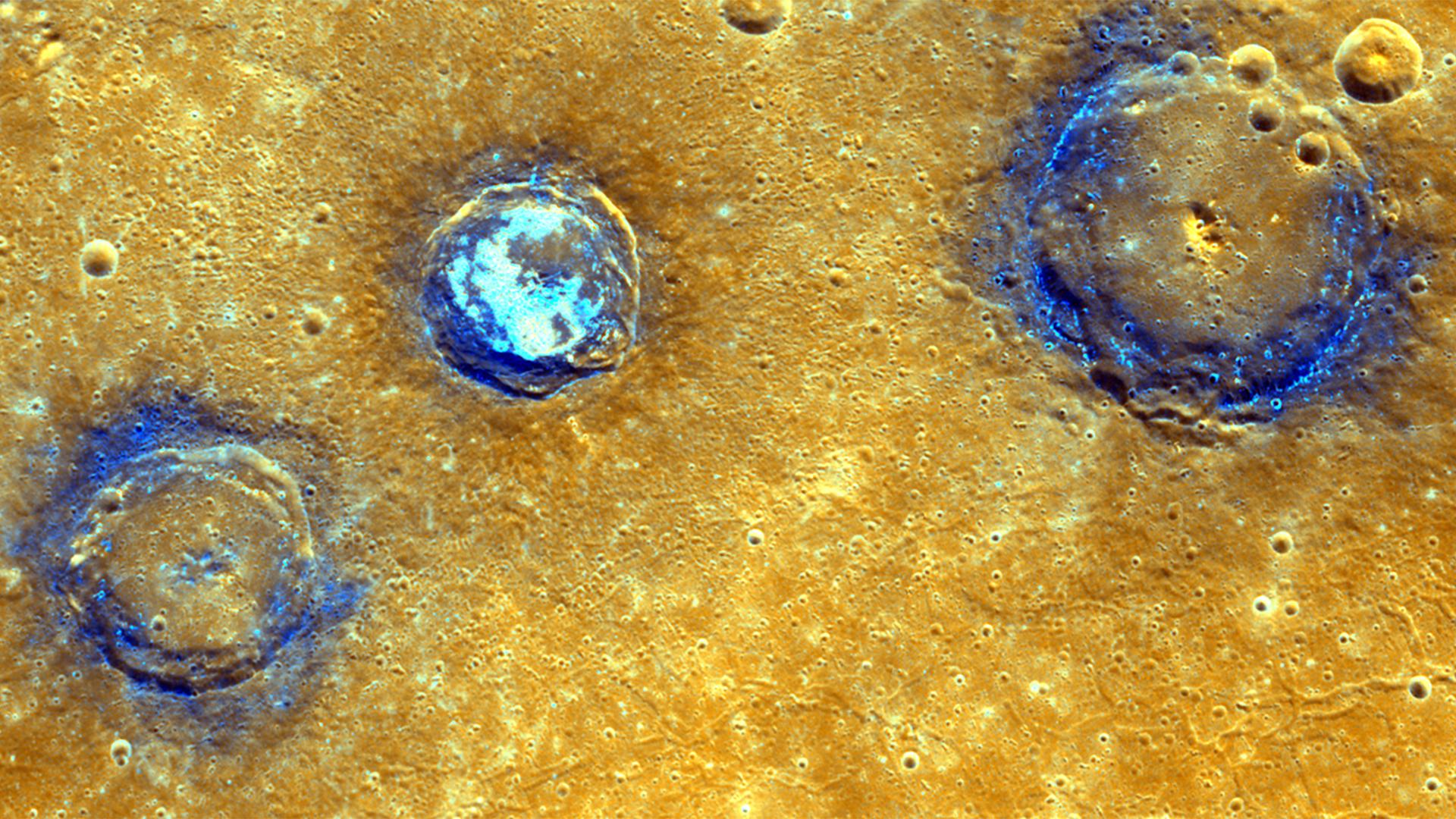
This enhanced-color image from the MESSENGER mission shows (from left to right) the craters Munch (38 miles, or 61 km, wide), Sander (32 miles, or 52 km), and Poe (50 miles, 81 km), which lie in the northwest portion of Mercury’s Caloris basin. The hollows are the bright blue areas covering the floor of Sander and dotting the rims of Munch and Poe. The hollows are highly reflective and naturally appear bluish; in images like this, the spacecraft’s Wide Angle Camera used its 11 color filters to exaggerate the color spectrum, to highlight the variation among surface materials.
NASA/Johns Hopkins University Applied Physics Laboratory/Carnegie Institution for Science

”When we got high-resolution views back of Sander, the floor of the crater just looked amazing,” said Carolyn Ernst of Johns Hopkins APL, a deputy instrument scientist on the MESSENGER mission. “It had all these crazy-shaped, irregular depressions, and it had this bright material outside of it. And to this day, we don’t fully know what causes them.”

Researchers observed that the hollows are among the youngest and brightest features on the planet, especially compared to the impact craters where most reside, which date back as far as 4 billion years. The hollows, on the other hand, are relatively shiny and new – about 100,000 years old, on average – and may still be evolving today.


MESSENGER mission scientists Ralph McNutt and Carolyn M. Ernst, both with Johns Hopkins APL, discuss what they’ve learned about Mercury’s hollows, and how much more needs to be figured out.

Clues and Theories

“We’ve been thinking of Mercury as a relic – a place that’s really not changing much anymore, except by impact cratering,” Blewett said. “But the hollows appear to be younger than the craters in which they are found, and that means Mercury’s surface is still evolving in a surprising way.”

One possible clue to their formation is that many of the hollows are associated with central mounds or mountains inside Mercury’s impact craters. These so-called “peak rings” are thought to be made of material forced up from the depths by an impact that formed the crater. Ernst suggested a large object slamming into the planet, with the meteorite forming a new crater and tossing material from deep underground onto Mercury’s surface.

The newly-excavated material could be unstable, finding itself suddenly exposed at the surface. Because Mercury is so close to the Sun, it’s battered by fierce heat and extreme space weather – factors that might play a role in forming hollows, added Blewett, a member of the science team for MESSENGER.

”Certain minerals, for example those that contain sulfur and other volatiles, would be easily vaporized by the onslaught of heat, solar wind, and micrometeoroids that Mercury experiences on a daily basis,” he said. “Perhaps sulfur is vaporizing, leaving just the other minerals, and therefore weakening the rock and making it spongier. Then the rock would crumble and erode more readily, forming these depressions.”

Looking Ahead

NASA’s Mars Reconnaissance Orbiter spotted similar depressions in the carbon dioxide ice at Mars’ south pole, giving that surface a “swiss cheese” appearance. But on Mercury the depressions are found in rock and often have bright interiors and halos.

“We’ve never seen anything quite like this on a rocky surface,” Blewett said.

Other theories include the idea that darker areas on Mercury’s surface are graphite deposits that, when pummeled and destroyed by solar wind, collapse and leave behind pitted, hollowed areas of only the much brighter, blue-tinged materials.

We’ve never seen anything quite like this on a rocky surface.

David Blewett

David Blewett

MESSENGER mission participating scientist, Johns Hopkins University Applied Physics Laboratory

MESSENGER finally ran out of fuel and crashed into Mercury in April 2015, but researchers are still sifting through the data it collected. Scientists are also eagerly anticipating the arrival of BepiColombo to Mercury in 2025 and what secrets the mission will reveal. A joint European-Japanese venture, with two orbiters riding together, the craft made their first flyby of Mercury in October 2021 – only the third mission ever to visit the planet. 

In his 1820 novel, Washington Irving wrote of Sleepy Hollow being a place of “strange sights, …haunted spots, and twilight superstitions; stars shoot and meteors glare oftener across the valley than in any other part of the country.”

Likewise, Mercury has its own “ghosts” – craters in a previous life, later shrouded by lava – and the planet has seen shooting stars and meteors peppering every part of its surface for billions of years.

The craters they leave are named for artists and authors, including Nathaniel Hawthorne, Herman Melville, and Edgar Allan Poe, whose namesake crater contains hollows. Maybe one day Irving, their mentor and contemporary, will join their company with his own crater. By then the true nature of Mercury’s strange hollows may be unmasked.

A Ghost Story
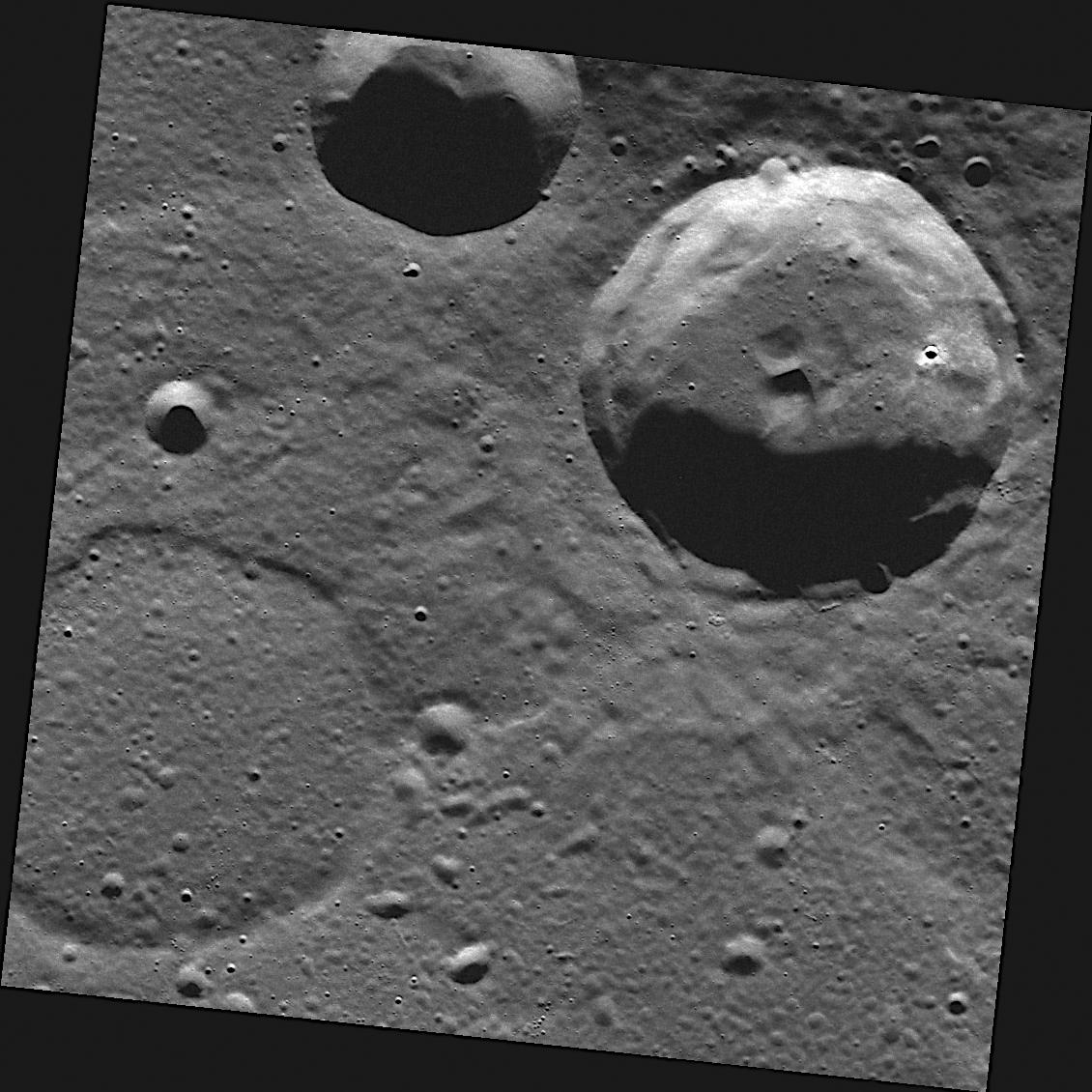
Images from the MESSENGER mission are helping tell the story of Mercury's geologic history; in this case, a ghost story. Once there was another crater resembling the one in the upper right of this scene. Then volcanic lava flooded the surface, burying the crater and leaving just a spectral outline of the crater's rim, the "ghost crater" located in the lower left of this image. After extensive flooding in Mercury's north, additional cosmic bodies impacted Mercury's surface, creating the various sized craters seen here, in an image taken Aug. 14, 2011 by MESSENGER’s Wide Angle Camera.
NASA/Johns Hopkins University Applied Physics Laboratory/Carnegie Institution for Science

{ https://www.nasa.gov/ }

Hoe vind je dit bericht?
Geschreven door peter om 16:36 Stuur door

BepiColombo’s New Images of Mercury are Cool

BepiColombo captured this image of Mercury with its Monitoring Camera 3 when it was about 555 km above the surface. It shows the newly-named Stoddart Crater. Image Credit: ESA/BepiColombo/MTM CC BY-SA 3.0 IGO
Hoe vind je dit bericht?
Geschreven door peter om 16:17 Stuur door

Fossielen ontdekt in een stoep: ze dateren uit het Devoon, zo'n 385 miljoen jaar geleden

Fossielen ontdekt in een stoep: ze dateren uit het Devoon, zo'n 385 miljoen jaar geleden

Janine imagedoor Janine

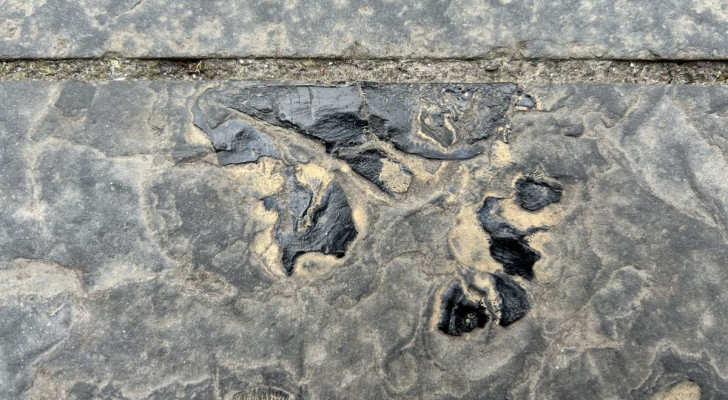
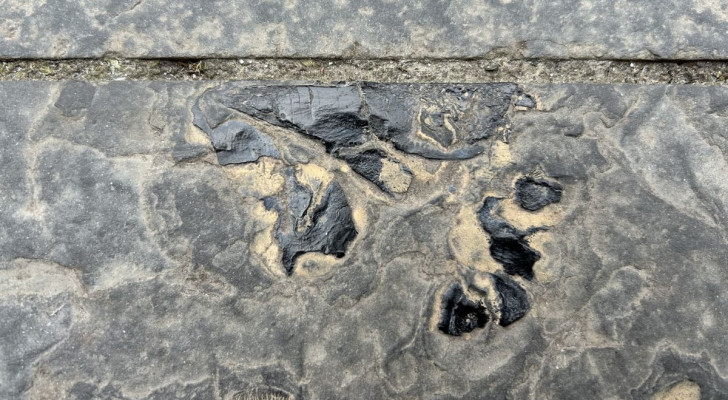
Inverness Town House, het gebouw waar James Ryan de fossielen vond, in een stoep

The Inverness Courier/Facebook

Fossielen worden vaak gevonden als gevolg van opgravingscampagnes die een zorgvuldige planning en langdurig onderzoek vereisen. Maar soms is de ontdekking dichterbij dan het lijkt en is het voldoende om even goed te kijken: fossielen zouden wel eens onder onze voeten kunnen liggen... letterlijk. Dat is wat er gebeurde met James Ryan, een medewerker van de National Trust for Scotland, die een ongelooflijke ontdekking deed in Inverness, in Schotland. Op de stoep ontdekte hij fossielen die veel ouder waren dan dinosaurussen.

Fossielen op de stoep van Inverness: de ontdekking van James Ryan

We zijn in Inverness, een Schotse stad op een steenworp afstand van het beroemde Loch Ness, en James Ryan maakt een wandeling rond het Inverness Town House. Op een gegeven moment stopt de man om de details van het trottoir te observeren: ze hebben een vreemde vorm en lijken in de stenen plaat te zijn ingebed. Zouden het fossielen zijn?

Voor ons lijkt het verband misschien niet zo direct, maar voor James is het overduidelijk. Het is tenslotte zijn taak bij de National Trust for Scotland om bezoekers te vertellen over de ontdekkingen van de Victoriaanse geoloog Hugh Miller, dus hij heeft een getraind oog. Toch is het verbazingwekkend om fossielen te vinden in het gesteente dat het plaveisel van de stad vormt, vooral als je bedenkt hoe oud ze zijn. Volgens vroege reconstructies dateren ze van minstens 385 miljoen jaar geleden, toen er nog geen dinosaurussen op aarde rondliepen.

Fossielen die 385 miljoen jaar oud zijn

Fossiele vissporen op de platen van een trottoir in Inverness, Schotland

The Inverness Courier/Facebook

In feite zijn de platen waaruit de trottoirs van het stadscentrum van Inverness bestaan, erg oud, ongeveer 385 miljoen jaar oud. Het gaat om een steen die is ontstaan ​​uit sedimenten die zijn afgezet op de bodem van een enorm zoetwatermeer. Kortom, de stad staat er vol mee, maar niemand had ooit zulke duidelijk afgebakende fossielen geïdentificeerd. Tenminste voor een deskundig oog als dat van James.

Om precies te zijn behoren de gevonden fossielen tot het Devoon, dat meer dan 100 miljoen jaar voor de komst van de dinosauriërs voorafgaat. Als we naar de straatstenen kijken, zien we dat de donkere vlekken wijzen op schubben van verschillende soorten oude beenvissen. Daarnaast kunnen er ook sporen zijn van andere botfragmenten en een vin: we hebben het hier over zeer oude vissen, maar met een fysionomie die niet onmogelijk te herkennen is.

Een unieke ontdekking?

Volgens Ryan, die de ontdekking aan de Inverness Courier meldde, is de vondst van fossiele vissen op de stoep uniek voor Inverness. Toch is het in het algemeen niet ongewoon in Schotland om sporen van fossielen te vinden op stenen platen die voor antropische doeleinden worden gebruikt. Het hangt allemaal af van het gebruikte gesteente, dat afkomstig is uit steengroeven die rijk zijn aan meer of minder oude fossielen: in Edinburgh bijvoorbeeld begeleidt de universiteit toeristen die ernaar willen zoeken. In een ander, al even buitengewoon geval vond een Britse boswachter tijdens het joggen een voetafdruk van een dinosaurus op een stenen plaat die werd gebruikt voor de bestrating van een pad.

Kortom, in de Schotse stad zijn fossielen te ontdekken en te vinden, misschien door toeval, misschien door geluk. Het verleden is immers dichter bij ons dan we ons kunnen voorstellen: soms vanuit metaforisch oogpunt, soms letterlijk. Het enige wat je hoeft te doen is naar beneden kijken.

{ https://www.curioctopus.nl/ }

Hoe vind je dit bericht?
Geschreven door peter om 22:57 Stuur door

NASA is Getting Serious About a Radio Telescope on the Moon

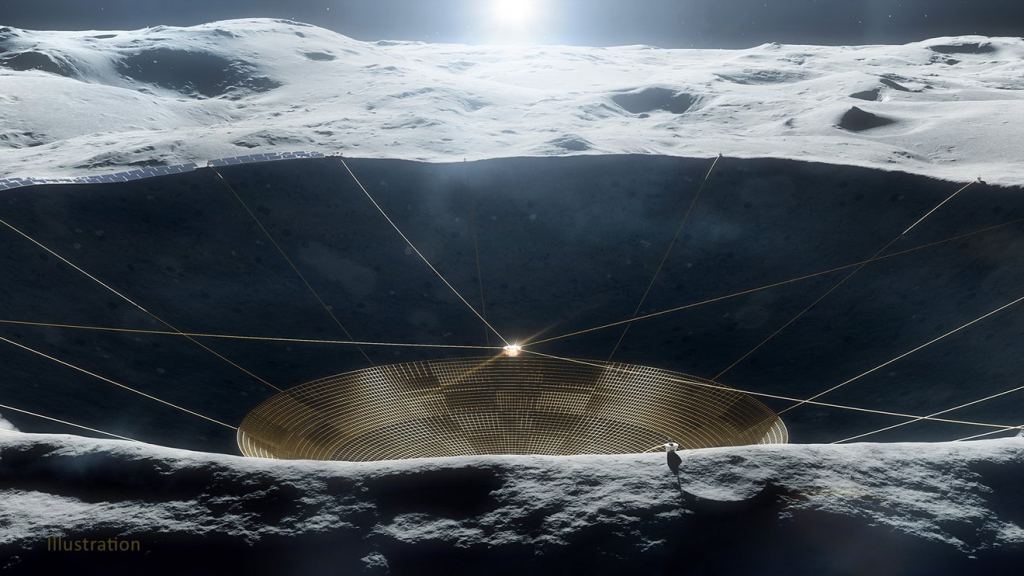
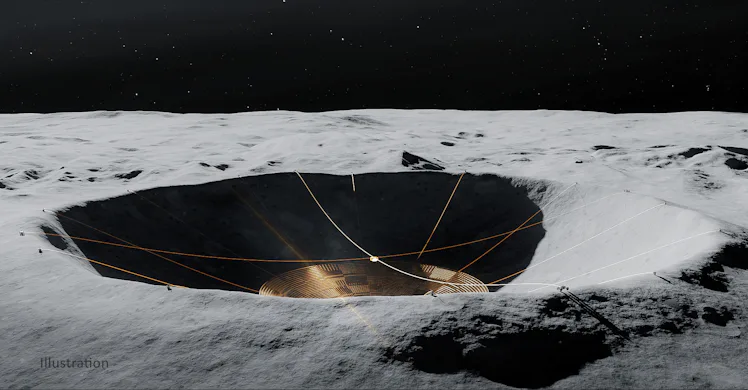
Artist's illustration of a radio telescope inside a crater on the Moon. Credit: NASA JPL

NASA is Getting Serious About a Radio Telescope on the Moon

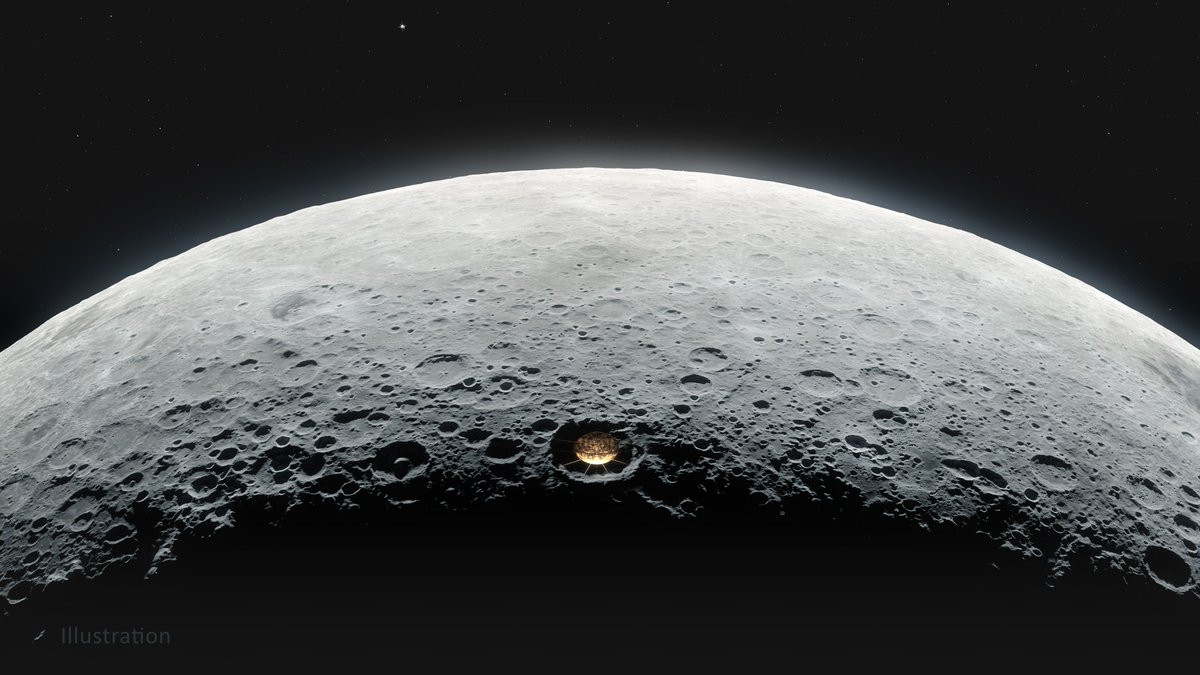
It’s widely known by now that the “dark side” of the moon, made famous by Pink Floyd, isn’t actually dark. It gets as much sunlight as the side that is tidally locked facing Earth.  However, it is dark in one very important way – it isn’t affected by radio signals emanating from Earth itself.  What’s more, it’s even able to see radio waves that don’t make it down to Earth’s surface, such as those associated with the cosmic “Dark Ages” when the universe was only a few hundred million years old.  Those two facts are the main reasons the far side of the moon has continually been touted as a potential location for a very large radio telescope.  Now, a project sponsored by NASA’s Institute for Advanced Concepts (NIAC) has received more funding to further explore this intriguing concept.

The project, known as the Lunar Crater Radio Telescope (LCRT), is part of NIAC’s Phase II program, and recently received $500k in additional funding to push the project further towards becoming a fully fledged NASA mission.  This isn’t the first time a radio telescope on the moon has been proposed.  But the LCRT team, led by Saptarshi Bandyopadhyay at JPL, have suggested two new and interesting features that make their approach much more attractive than previous alternatives.

UT video discussing the usefulness of a radio telescope on the far side of the moon.

The first feature has to do with limiting the sheer amount of material that is needed to construct a radio telescope.  LCRT’s proposed instrument would be a one kilometer wide circle in a three kilometer wide crater.  Traditional radio telescopes, such as the Five-hundred-meter Aperture Spherical Telescope (FAST) and the recently destroyed Arecibo Observatory use hundreds of radio-reflective panels to any signals to an observing platform suspended by cable above the receiving

In order to complete a 1km wide telescope, thousands of reflecting panels would have to be created on Earth, launched into space, and then placed precisely where they need to go.  That’s a lot of launches and a lot of weight, and it made the entire concept of a lunar radio telescope untenable.

Artist’s concept of what a completed LCRT would look like.
Credit: Vladimir Vustyansky

Dr. Bandyopadhyay’s solution to this problem is to use a wire mesh instead of solid panels to reflect the radio waves to the antenna.  This mesh would be much lighter, and less bulky, but will still need to be set precisely in order to work properly.  For that, the team turned to their other novel solution – dual robots.

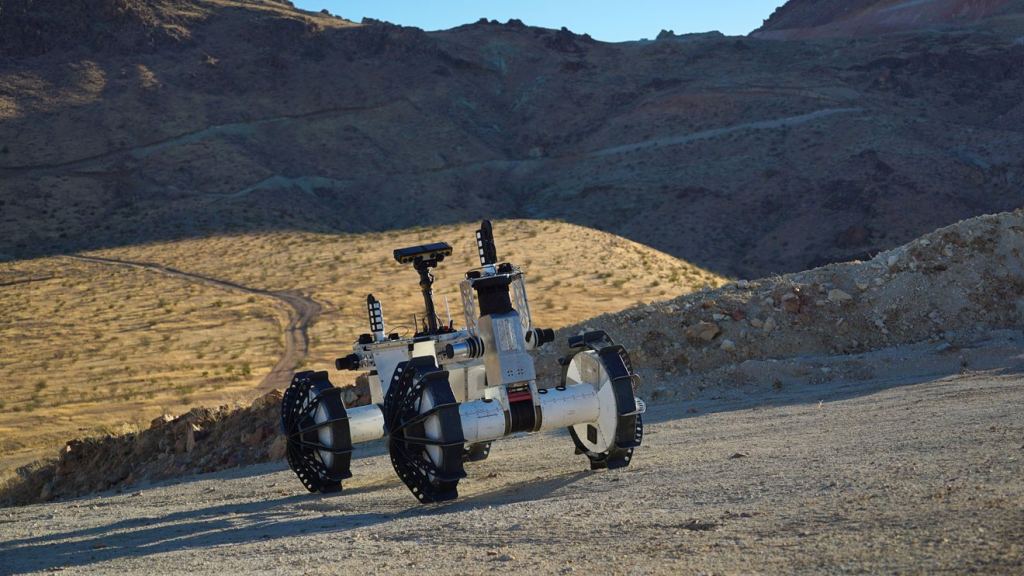
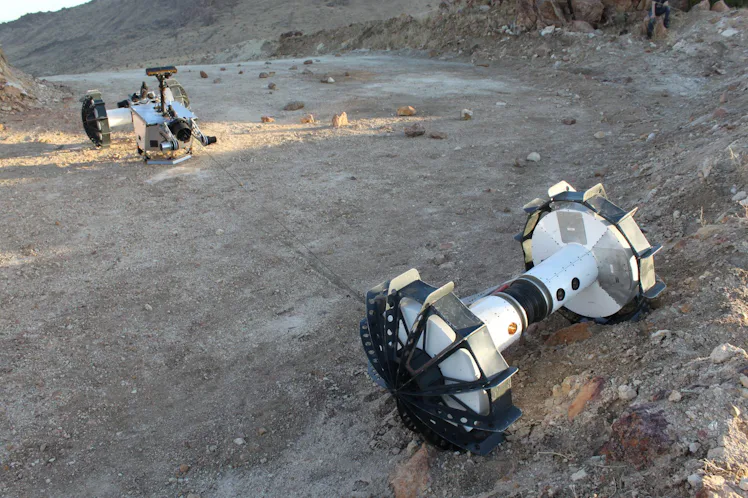
Roboticists at JPL, of which Dr. Bandyopadhyay is one, have been working on a concept called DuAxel.  These robots have two separate configurations.  In one, they look like a standard four wheeled rover. In the other, the two halves separate.  One anchors itself to a specific point while the other uses a tether to ease itself into otherwise unreachable terrain.

Image of the two halves of a DuAxel rover working together.
Credit: NASA / JPL-Caltech / J.D. Gammell

Crater walls would likely be such unreachable terrain, so having a robot that is able to access both the bottom of the crater and up above the rim where any landed supplies would be located is invaluable to any such telescope mission.  It would also allow the robots to mount the antenna, the critical sensing piece of the telescope, above the crater’s center by applying tension in the mounting wires and lifting it into position.

Some major hurdles still remain, two of which will be the focus of this Phase II NIAC grant.  The first is the design of the wire mesh network. It’s physical structure has to be exactly right in order for the telescope to work properly.  In addition, it must be able to withstand the extreme temperature differences on the moon, which swing between -173 C and +127 C.  If the mesh warps even slightly, the whole project could fail.

DuAxels in an operational test in the Mojave.
Credit: JPL YouTube Channel

DuAxels themselves pose another quandary – should they be automated or have some sort of human intervention.  Are they the only tools needed for the massive undertaking of constructing the largest ever radio telescope? 

While Dr. Bandyopadhyay and his team work out these questions other factors put a time limit on the possibility of constructing a telescope in this most unique of locations.  Part of the appeal of the far side of the moon is its lack of interference from artificial radio sources.  However, that silence is not guaranteed.  Already there is a satellite orbiting there, and other missions could be planned in the near future that would add confounding signals to the data mix.  

Presentation by Dr. Banyopadhyay on the LCRT concept for a NIAC meeting.
Credit: Saptarshi Bandyopadhyay YouTube Channel

That being said, the LCRT is still a long way from reality, and in its press release NASA is quick to point out that it hasn’t been accepted as a full NASA mission. But the intent of the NIAC program is to develop concepts to the point where they could become one. With that in mind, the extra half a million dollars will keep pushing the concept forward and hopefully result in a Phase III grant, which would then transition into a fully fledged NASA program after an additional two years of study.  Though it might take awhile, the benefits of having such a massive telescope in one of the most radio quiet place in the solar system cannot be understated.

Learn More:

Lead Image:

  • Artist’s concept of what a completed LCRT would look like from space.
    Credit: Vladimir Vustyansky

{ https://www.universetoday.com/ }

Hoe vind je dit bericht?
Geschreven door peter om 22:48 Stuur door

All Eyes on the Moon

All Eyes on the Moon

Space agencies around the world are focused on the south pole of the Moon, but these astronomers have set their eyes on the far side.

by Kiona Smith
 
Ariela Basson/Inverse; Getty Images

The Moon race (part deux) is officially in full swing now with Japan, India, China, and even a private corporation making their marks on the surface. The calendar is packed with a whole slew of planned missions in the coming months and years to set the stage for a more sustained presence on the lunar surface. But some astronomers want to use the Moon for something perhaps less expendable than water ice — sorry, fans of For All Mankind — or a cosmic home base: a vantage point to peer into Cosmic Dark Ages.


NASA | New Craters on the Moon

Getting a look at the Cosmic Dark Ages — the period when the early universe was covered in pure darkness — has long been a holy grail for astronomers. It could tell us about the most fundamental aspects of our Universe and potentially help solve mysteries that puzzle us today.

“This is a wonderful place to look for any new physics,” says Jack Burn, a University of Colorado physicist, including understanding “the nature of dark matter, and maybe early dark energy, and really probe and test our fundamental models of cosmology and physics.”

But to see back into the Cosmic Dark Ages you need a very dark place indeed, free from a radiation-blocking ionosphere and away from the constant chatter we create here on Earth. This is why astronomers like Burns and the Jet Propulsion Laboratory’s Joseph Lazio have plans to build radio telescopes on the far side of the Moon.

If engineers and astronomers at private companies, universities, NASA’s Jet Propulsion Laboratory, and Brookhaven National Laboratory have their way, the far side of the moon could soon be the spot from which astronomers stare 13 billion years back in time, to an era before the first stars were born. Teams of scientists worldwide are developing concepts to build huge radio telescopes on the far side of the Moon, and the first prototype could launch as early as 2025, with more rudimentary telescopes set to go even sooner. Here’s a look at the race so far.

“If We Didn’t Have a Moon, We’d Have to Build It”

In the beginning, as hydrogen gas drifted through the darkness of the early Universe, atoms occasionally bumped into each other, releasing energy in the form of radio waves. The radio waves from those dark clouds of gas were 21 centimeters long (that’s just the natural wavelength that hydrogen atoms emit, and they’re very consistent about it). But those radio waves have spent billions of years crossing a rapidly expanding universe, and that journey has stretched them out until they’re several meters long.

Charged particles in an upper layer of Earth’s atmosphere, called the ionosphere, block radio waves longer than about 10 meters, so it’s impossible to study the Cosmic Dark Ages with a telescope here on Earth. And radio telescopes, especially ones meant to map the sources of such long radio waves, have to be much too large to build in space. You need something like a planet, but without an ionosphere – or all the radio noise that surrounds our busy, high-tech world.

Burns has argued for decades that the far side of the Moon is the best of both worlds. There’s solid ground to build on, but there’s no ionosphere to block incoming radiation, and the whole bulk of the Moon (2,000 miles of solid rock) would shield the telescope from Earth’s constant radio noise and – for two weeks out of every month, during the lunar night – the Sun’s radio emissions, too.

“It's the ideal place,” says Burns. “If we didn't have a moon, we'd have to build it.”

illustration of radio antennas in a zigzag pattern across a gray rocky surface.

This illustration shows what FarView’s zigzagging array of antennas might eventually look like

Ronald Polidan/NASA

Fortunately, we don’t have to build the Moon — just the observatory. Burns is working with Texas-based Lunar Resources, Inc. on a project called the Farview Observatory, which will — if everything goes according to plan — be a 5-square-mile array of radio antennas sprawling across a lunar plain. Picture an antenna something like an old-fashioned television antenna; now picture roughly 100,000 of them, lined up end-to-end in a series of zig-zags. Combined, those antennas will act as one giant radio receiver, listening for faint signals from the Cosmic Dark Ages.

Meanwhile, at JPL, a team led by JPL robotics technologist Saptarshi Bandyopadhyay is working on the Lunar Crater Radio Telescope, which has the same scientific goal as Farview but will look very different. LCRT would be a semicircle of wire mesh about a third of a mile wide, lining the bottom of a 1.9-mile-wide crater on the Moon. The result will be a radio dish similar to Arecibo (the large, now-shuttered observatory in Puerto Rico), but with bare wires instead of the aluminum panels that lined Arecibo’s crater.

illustration of a radio telescope dish inside a lunar crater

This artist’s illustration shows what the Lunar Crater Radio Telescope might eventually look like, with a receiver suspended over a radio dish set in a lunar crater.

Vladimir Vustyansky, JPL

Comparing these two possible Moon telescopes is similar to comparing Earth-based telescopes like the Very Large Array (VLA) and China’s Five-hundred-meter Aperture Spherical Telescope (FAST). The VLA is an array of dish-shaped radio antennas lined up across a swath of New Mexico desert. It turns out that if you line up several radio receivers (or mirrors, if you’re studying shorter wavelengths like infrared or visible light), and connect them with the right software, those individual antennas can add up one giant telescope. Astronomers call this an interferometer.

FAST and the LCRT, like the now-defunct Arecibo, are something called single-aperture, or filled-aperture, telescopes. FAST is one enormous radio dish, set into a crater that provides structural support for the dish (and the delightful irony of using a crater formed by a meteor impact to study other objects in space).

Each design has its advantages. An interferometer like the VLA or Farview can see the universe in much higher resolution than a filled-aperture telescope like FAST or LCRT, because the interferometer is wider. But the tradeoff is that a filled-aperture telescope like FAST or LCRT can "see" fainter signals than an interferometer, because it's got an entire surface to catch them with. Neither is a “better” option than the other; radio astronomers here on Earth rely on both types of telescope to scan the skies.

A Truly High-Tech Construction Crew

image of two-wheeled rover moving down a slope, attached to another two-wheeled rover at the top

During a field test in the Mojave Desert, the DuAxel robot separates into two single-axled robots, connected by a tether, so that one can rappel down a steep slope. 

NASA/JPL-Caltech/J.D. Gammell

There’s one thing both telescope designs require: robotic construction teams. The LCRT team plans to use pairs of rappelling construction robots, developed at JPL, to lay the mesh grid in the base and along the sides of their chosen crater. Each pair of robots — together called a DuAxel — will be linked by a tether. One robot will anchor itself on the rim of the crater, while its partner rappels down the crater’s side to actually lay out the mesh for the telescope.

Farview, meanwhile, has even more ambitious plans for its robotic builders, starting with making the array’s 100,000 antennas from scratch, using aluminum extracted from lunar regolith (the dusty, ground-up rock that covers the lunar surface). The goal, says Burns, is to reduce the amount of material that has to be launched to the Moon from Earth.

And both telescopes will depend on a satellite in lunar orbit to send data home to Earth, since the far side of the Moon is constantly pointed out into the vastness of space, which is the whole point.

At the moment, both are in their second phase of development under a program called NASA Advanced Innovative Concepts, which funds projects that work out the engineering and science details of possible future missions like Farview and LCRT. Farview’s team will spend the next two years devising the best antenna layouts, narrowing down mission requirements, and tackling other engineering issues. They’ll also ask more specific science questions and plan how to use Farview to answer them. At JPL, the LCRT team is busy working on similar problems.

One Small Step For A Lunar Lookout

One or the other of the more ambitious observatory concepts could be ready to launch to the Moon by the late 2030s, but there are no guarantees.

Meanwhile, the first telescope to land on the Moon was a much smaller, much simpler version of a radio telescope: a crossed pair of antennas, spanning about 20 feet, called Radio wave Observation at the Lunar Surface of the photoElectron Sheath (ROLSES). ROLSES landed near the south pole of the Moon aboard Intuitive Machines’ Odysseus Lander earlier this year. Its goal was to study the background radiation that already exists on the Moon. (Most of that radiation comes from our Sun, but that’s likely to change soon, since nearly everyone with a space program seems to be aiming to set up shop near the lunar south pole.) Its other goal is to simply prove that a radio telescope could work on the Moon

“These are all kinds of multi-billion dollar projects that I think are, in some sense, ahead of their time,” Brookhaven National Laboratory physicist An¸e Slosar tells Inverse. “You're not going to get a $2 billion project unless you can at least prove the principle at some point.”

illustration of a lunar lander with four long antennas on top.

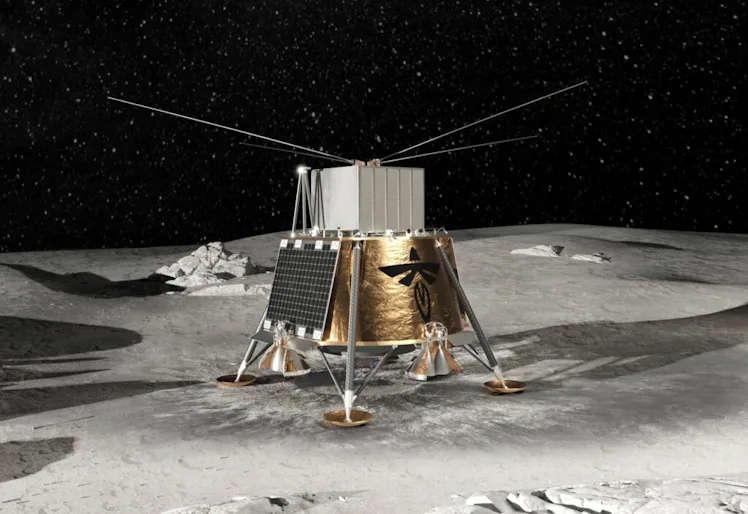
This illustration shows what LuSEE-Night might look like perched atop its lander.

Firefly Aerospace

Near the end of 2025, a similar telescope called the Lunar Surface Electromagnetic Experiment – Night (LuSEE-Night) is scheduled for launch aboard a Firefly Aerospace rocket. If all goes well, it will touch down on the far side of the Moon in January 2026.

Like ROLSS, LuSEE-Night will be a fairly simple telescope: a pair of 20-foot-wide radio antennae, spring-loaded and mounted on a turntable. But LuSEE-Night will try to last through a two-week-long lunar night. To do that, it will carry a 110-pound battery, heavily insulated against the deep cold of lunar darkness.

“The main role of LuSEE-Night is really to test this theoretical promise – whether the Moon really is such a great place to do observation,” says Slosar. “Maybe the Moon has more ionosphere than we thought; maybe there are plasma tracks; maybe there are micrometeorites; maybe there's something we haven't thought about. Really, there is this kind of notion that the Moon is the best place, but nobody has tested it.”

LUSEE-Night will do some real science, too. It’s too small to capture the long, slow radio waves rippling in from the Cosmic Dark Ages, but it will also be astronomers’ first chance to test their models of what the galaxy should look like at low radio frequencies they can’t see from Earth.

Once we have eyes on the moon, there’s no telling what we’ll be able to see.

{ https://www.inverse.com/ }

Hoe vind je dit bericht?
Geschreven door peter om 22:37 Stuur door

If One of These Stars Explodes the Radioactive Atoms Could Decimate Life on Earth

If One of These Stars Explodes the Radioactive Atoms Could Decimate Life on Earth

Most of these cataclysms are remote, but when they occur closer to home, they can pose a threat to life on Earth.

by Chris Impey and The Conversation
 
sueprnova webb telescope image
NASA

Stars, like the Sun, are remarkably constant. They vary in brightness by only 0.1 percent over years and decades, thanks to the fusion of hydrogen into helium that powers them. This process will keep the Sun shining steadily for about 5 billion more years, but when stars exhaust their nuclear fuel, their deaths can lead to pyrotechnics.


NASA Has Captured A Supernova Explosion!

The Sun will eventually die by growing large and then condensing into a type of star called a white dwarf. But stars more than eight times more massive than the Sun die violently in an explosion called a supernova.

Supernovae happen across the Milky Way only a few times a century, and these violent explosions are usually remote enough that people here on Earth don’t notice. For a dying star to have any effect on life on our planet, it would have to go supernova within 100 light years from Earth.

I’m an astronomer who studies cosmology and black holes.

In my writing about cosmic endings, I’ve described the threat posed by stellar cataclysms such as supernovae and related phenomena such as gamma-ray bursts. Most of these cataclysms are remote, but when they occur closer to home, they can pose a threat to life on Earth.

The death of a massive star

Cassiopeia A

An image of Cassiopeia A, the remains of a massive star that exploded roughly three centuries ago.

NASA

Very few stars are massive enough to die in a supernova. But when one does, it briefly rivals the brightness of billions of stars. At one supernova per 50 years, and with 100 billion galaxies in the universe, somewhere in the universe a supernova explodes every hundredth of a second.

The dying star emits high energy radiation as gamma rays. Gamma rays are a form of electromagnetic radiation with wavelengths much shorter than light waves, meaning they’re invisible to the human eye. The dying star also releases a torrent of high-energy particles in the form of cosmic rays: subatomic particles moving at close to the speed of light.

Supernovae in the Milky Way are rare, but a few have been close enough to Earth that historical records discuss them. In 185 A.D., a star appeared in a place where no star had previously been seen. It was probably a supernova.

Observers around the world saw a bright star suddenly appear in 1006 A.D. Astronomers later matched it to a supernova 7,200 light years away. Then, in 1054 A.D., Chinese astronomers recorded a star visible in the daytime sky that astronomers subsequently identified as a supernova 6,500 light years away.

Johannes Kepler observed the last supernova in the Milky Way in 1604, so in a statistical sense, the next one is overdue.

At 600 light years away, the red supergiant Betelgeuse in the constellation of Orion is the nearest massive star getting close to the end of its life. When it goes supernova, it will shine as bright as the full Moon for those watching from Earth, without causing any damage to life on our planet.

Radiation damage

Veil Nebula Supernova Remnant

An image taken by the Hubble Space Telescope of a star that exploded roughly 8,000 years ago

NASA

If a star goes supernova close enough to Earth, the gamma-ray radiation could damage some of the planetary protection that allows life to thrive on Earth. There’s a time delay due to the finite speed of light. If a supernova goes off 100 light years away, it takes 100 years for us to see it.

Astronomers have found evidence of a supernova 300 light-years away that exploded 2.5 million years ago. Radioactive atoms trapped in seafloor sediments are the telltale signs of this event. Radiation from gamma rays eroded the ozone layer, which protects life on Earth from the Sun’s harmful radiation. This event would have cooled the climate, leading to the extinction of some ancient species.

Safety from a supernova comes with greater distance. Gamma rays and cosmic rays spread out in all directions once emitted from a supernova, so the fraction that reach the Earth decreases with greater distance. For example, imagine two identical supernovae, with one ten times closer to Earth than the other. Earth would receive radiation that’s about a hundred times stronger from the closer event.

A supernova within 30 light-years would be catastrophic, severely depleting the ozone layer, disrupting the marine food chain, and likely causing mass extinction. Some astronomers guess that nearby supernovae triggered a series of mass extinctions 360 to 375 million years ago. Luckily, these events happen within 30 light years, only every few hundred million years.

When neutron stars collide

Illustration of two neutron stars colliding.

Illustration of two neutron stars colliding.

NASA

But supernovae aren’t the only events that emit gamma rays. Neutron star collisions cause high-energy phenomena ranging from gamma rays to gravitational waves.

Left behind after a supernova explosion, neutron stars are city-size balls of matter with the density of an atomic nucleus, so 300 trillion times denser than the Sun. These collisions created many of the gold and precious metals on Earth. The intense pressure caused by two ultradense objects colliding forces neutrons into atomic nuclei, which creates heavier elements such as gold and platinum.

A neutron star collision generates an intense burst of gamma rays. These gamma rays are concentrated into a narrow jet of radiation that packs a big punch.

If the Earth were in the line of fire of a gamma-ray burst within 10,000 light years, or 10% of the diameter of the galaxy, the burst would severely damage the ozone layer. It would also damage the DNA inside organisms’ cells at a level that would kill many simple life forms like bacteria.

That sounds ominous, but neutron stars do not typically form in pairs, so there is only one collision in the Milky Way about every 10,000 years. They are 100 times rarer than supernova explosions. Across the entire universe, there is a neutron-star collision every few minutes.

Gamma-ray bursts may not hold an imminent threat to life on Earth, but over very long time scales, bursts will inevitably hit the Earth. The odds of a gamma-ray burst triggering a mass extinction are 50% in the past 500 million years and 90% in the 4 billion years since there has been life on Earth.

By that math, it’s quite likely that a gamma-ray burst caused one of the five mass extinctions in the past 500 million years. Astronomers had argued that a gamma-ray burst caused the first mass extinction 440 million years ago when 60% of all marine creatures disappeared.


What If a Supernova Exploded Close to Earth?

A recent reminder

The most extreme astrophysical events have a long reach. Astronomers were reminded of this in October 2022 when a pulse of radiation swept through the solar system and overloaded all of the gamma-ray telescopes in space.

It was the brightest gamma-ray burst to occur since human civilization began. The radiation caused a sudden disturbance to the Earth’s ionosphere, even though the source was an explosion nearly 2 billion light years away. Life on Earth was unaffected, but the fact that it altered the ionosphere is sobering – a similar burst in the Milky Way would be a million times brighter.

{ https://www.inverse.com/ }

Hoe vind je dit bericht?
Geschreven door peter om 22:20 Stuur door

NASA: First ‘human-made meteor shower’ will light up Earth skies

NASA: First ‘human-made meteor shower’ will light up Earth skies

Story by Eric Ralls
 
NASA: First ‘human-made meteor shower’ will light up Earth skies

Ever had that moment when you throw a rock into a pond and observe the ripples moving away from the spot? Now, imagine something similar happening, but on a much bigger scale -- in space. That's what happened when NASA's DART spacecraft made history by altering the path of a gigantic space rock hurling through the cosmos.

DART mission makes history

In 2022, DART made more than just ripples, it made waves of debris in space. It strategically collided with the Dimorphos asteroid, causing a ripple effect that shifted its orbit around its larger sibling, the Didymos asteroid.

The interaction didn't just stop there. The impact kicked up an astronomical dust storm, a cloud of debris that may soon become a tad bit personal for us Earthlings and our rusty neighbor, Mars. The most recent models suggest that some of the smaller meteoroids from this debris might make their way to both Earth and Mars.

Not to worry, though. The debris shower won't be disastrous, but rather a sight to behold, quite safely from our terrains.

Planetary defense collaboration

With a diameter of about 160 meters, the small moon Dimorphos orbits the larger body Didymos in what is known as a binary asteroid system.

The DART spacecraft, or the Double Asteroid Redirect Test, made contact with Dimorphos on September 26, 2022.

The outcome? A significant shortening of Dimorphos' orbit around Didymos by half an hour. It was the first act in an international planetary defense collaboration - a literal game-changer.

Related video: 
  • Terrifying NASA Update: Doomsday Asteroid Heading Towards Earth in 2024!

If This Asteroid Hits Earth then we will all Die | NASA Warns About Asteroid coming in 2038

Hera will investigate further

Now, who's going to clean up this mess? Enter ESA's Hera spacecraft. Scheduled for launch this October, Hera will reach Dimorphos for a close-up "crash scene investigation," following the DART mission's impact.

"The DART impact offers a rare opportunity to investigate the delivery of ejecta to other celestial bodies, thanks to the fact that we know the impact location and that this impact was observed by the Italian LICIACube deployed from DART as well as by Earth-based observers," said ESA Hera mission scientist and co-author of this exciting development, Michael Kueppers.

Will DART debris reach Earth?

To understand how the debris from the Dimorphos impact might reach us, it's essential to assess its speed.

"Our results indicate the possibility of ejecta reaching the gravitational field of Mars in 13 years for launch velocities around 450 m/s, while faster ejecta launched at 770 m/s could reach its vicinity in just seven years," explained Eloy Peña-Asensio, lead author of the study.

"Particles moving above 1.5 km/s could reach the Earth-Moon system in a similar timescale."

However, whether the debris would indeed make it to Mars or Earth is subject to several factors. In essence, the location of the debris in the impact plume plays a deciding role.

A human-made meteor shower

"In the coming decades, meteor observation campaigns will be crucial in determining whether fragments of Dimorphos, resulting from the DART impact, will reach our planet. If this happens, we will witness the first human-made meteor shower," noted Peña-Asensio.

As for the consequential meteoroids, the largest ones would likely be about the size of a softball. These larger particles would burn up in Earth's atmosphere. However, they might manage to slip through the thinner Martian atmosphere.

However, it's the smaller particles that move at higher speeds which stand a chance to reach the Earth's atmosphere. But there's no need to panic. We have plenty of time and resources to track the debris and ensure our safety.

Significance of the DART mission

The significance of the DART impact is not solely about potential meteor showers or altered space debris routes. It's also about the human spirit of curiosity, exploration, and conquering new frontiers.

"Our accurate knowledge of the impact site and impactor properties in terms of size, mass, and velocity plus the observations of the ejecta are what allowed us to estimate the long-term fate of the material leaving the Didymos system," said Michael Kueppers.

Hera, named after the Greek goddess of marriage, is expected to begin its investigation of the asteroid pair in late 2026. According to ESA, the spacecraft will perform high-resolution mapping of Dimorphos, providing extremely valuable information for future asteroid deflection missions and science.


DART Impact
The last complete image of asteroid moonlet Dimorphos, taken by the DRACO imager on NASA's DART mission from ~7 miles (12 kilometers) from the asteroid and 2 seconds before impact. The image shows a patch of the asteroid that is 100 feet (31 meters) across. Ecliptic north is toward the bottom of the image. This image is shown as it appears on the DRACO detector and is mirror flipped across the x-axis from reality.
The last complete image of asteroid moonlet Dimorphos was taken by the DRACO imager on NASA's DART mission at a distance of about 7 miles (12 kilometers) and 2 seconds before impact. 
NASA/Johns Hopkins APL
Hoe vind je dit bericht?
Geschreven door peter om 21:51 Stuur door

Scientists make concerning discovery after analyzing bottom of the ocean: 'A stronger impact ... than we are currently taking into account'

Scientists make concerning discovery after analyzing bottom of the ocean: 'A stronger impact ... than we are currently taking into account'

Story by Jeremiah Budin
 
Scientists make concerning discovery after analyzing bottom of the ocean: 'A stronger impact ... than we are currently taking into account'

We all know that the Earth is getting hotter — but new research indicates that it may be warming even faster than scientists had predicted.

What's happening?

Scientists from NIOZ Royal Netherlands Institute for Sea Research analyzed sediment from the bottom of the Pacific Ocean for the study, which was published in the journal Nature Communications and reported by SciTechDaily. The researchers used a newly developed method to derive past atmospheric carbon dioxide content and compare CO2 levels in a single location over the past 15 million years.

Their results indicated that doubling atmospheric CO2 levels would increase the planet's average temperature by 13 to 25.2 degrees Fahrenheit.

"The temperature rise we found is much larger than the 2.3 to 4.5 degrees Celsius (4.1 to 8.1 degrees Fahrenheit) that the U.N. climate panel, [the Intergovernmental Panel on Climate Change], has been estimating so far," said the study's first author, Caitlyn Witkowski.

Why are CO2 levels so important?

Scientists have already drawn a correlation between the amount of CO2 we release into the atmosphere and the amount of planetary overheating we experience. This new research makes the correlation clearer than ever.

"This research gives us a glimpse of what the future could hold if we take too few measures to reduce CO2 emissions and also implement few technological innovations to offset emissions," said another of the study's authors, Professor Jaap Sinninghe Damsté, a senior scientist at NIOZ and professor of organic geochemistry at Utrecht University.


Can the ocean run out of oxygen? - Kate Slabosky

What If Earth’s Oceans Evaporated?
That Time The Ocean Lost (Almost) All Its Oxygen
Report: Oceans' drastic oxygen loss will affect millions of people

"The clear warning from this research is: CO2 concentration is likely to have a stronger impact on temperature than we are currently taking into account," Damsté added.

Global overheating is leading to, among other things, the melting of glaciers, which is causing ocean levels to rise and coastal communities to flood; various changes to the climate that are causing more frequent and intense extreme weather events; the spread of infectious diseases; crops becoming ungrowable in many previously hospitable climates; and heat-related deaths.

What's being done about rising global temperatures?

Several industries are responsible for releasing massive amounts of CO2 into the atmosphere — chief among them is the dirty energy industry, which releases huge quantities of carbon dioxide whenever its oil and methane gases are burned.

To prevent catastrophic planetary overheating, we must leave these energy sources of the past behind and switch instead to clean, renewable energy sources such as wind and solar.

{ https://www.msn.com/en-us/weather? }

Hoe vind je dit bericht?
Geschreven door peter om 21:25 Stuur door

EXCLUSIVE - Police across US given new UFO handbook as they warn craft 'pose significant safety risks'

EXCLUSIVE - Police across US given new UFO handbook as they warn craft 'pose significant safety risks'

Police chiefs of America's largest cities have published the first guide about UAPs, which details chilling encounters and how officers can report such incidents.

The 11-page document warned that unidentified flying objects 'pose significant safety risks to law enforcement air support units,' urging teams to be vigilant when in helicopters.

The report also highlights stories from officers who claimed to confront UFOs, specifically one in 2023 where a law employee saw a 'triangle craft with green lights gliding through the sky' before a local resident said something 'ran' nearb

The police executives created the reference because 'it's in the interest of law enforcement to be aware of trends and reporting on UAP due to the unknown threat they may pose.'

A Las Vegas police officer appeared to capture a UFO on his bodycam

A Las Vegas police officer appeared to capture a UFO on his bodycam

The organization, called the Major Cities Chiefs Association (MCCA), includes nearly 80 executives from major US cities who work together to advance public safety through a range of initiatives, including community outreach, research and policy development and now, UFO investigations. 

The guide, released in June, also includes details from America's investigations into UFO encounters, as well as the testimony of 'whistleblowers' such as former United States Air Force officer and intelligence official David Grusch.

One article shared the US Congress UAP hearing held in 2023, which saw Grusch testify about his knowledge about aircraft with 'nonhuman' origins.

The report provided other articles about the US government and its potential link to alien life. 

A section includes links to various UAP reporting websites, urging officers to report  any bizarre sightings. 

More interesting, the pages detail first-person stories from police officers who encountered unknown spacecraft while out in the field.  

An officer patrolling  Blairsville, Georgia in November 2023 claimed to have witnessed green lights in the sky. 

'I am a police officer and deputy sheriff. While on duty after dark, near the top of my windshield (frame of view) I witnessed movement in the sky (southbound direction of view),' the officer's report stated.

'Upon concentrating my focus, viewing through the low light, I was able to make out a triangle craft, with 3 dim green lights per side (just bright enough to assess size, shape, and movement).'

The officer said he lost sight of the craft quickly due to trees, and was unable to hear anything due to being inside his vehicle.

The report described UAPs as a potential danger to police pilots (Major Cities Chiefs Association)

The report described UAPs as a potential danger to police pilots (Major Cities Chiefs Association)

The report cites the testimony of ¿whistleblowers¿ such as former United States Air Force (USAF) officer and intelligence official David Grusch

The report cites the testimony of 'whistleblowers' such as former United States Air Force (USAF) officer and intelligence official David Grusch

'I am privy to what helicopters and airplanes look like in the sky, frequently working alongside medical flight crews in the area, and where nearby airports are, making me somewhat familiar with common areas of the sky in which low air travel is common. This was unlike anything I had ever witnessed,' he said.

Within an hour of the sighting, the officer responded to a call from a homeowner in the same direction the object was traveling, reporting 'something running outside of his home… which did not sound like an animal.'

Another encounter happened in Harper Woods, Michigan in 2020, which included two officers who witnessed three mysterious objects in the sky - before they 'blinked out' of existence.

The officer wrote: 'At approximately 6:00am, myself and a fellow officer were standing in a parking lot of a church talking before the end of our shift. 

'I was looking towards the southwest at the moon when I glanced towards the southeast. I saw 3 objects in the southeast sky and pointed towards them.

The guide details police encounters with UFOs

The guide details police encounters with UFOs

'The objects appeared to drift towards the east, maintaining the equal distance. As we watched the objects, they appeared to 'blink out' of our vision.'

Other reports in the guide recount civilian sightings of police helicopters allegedly pursuing UFOs.

In one encounter in Austin, Texas, a civilian wrote: 'When I walked out front door, saw Triangle Craft - with white lights illuminated on each corner - being closely followed by police helicopter - traveling south - near 620 freeway.

'Thought I was seeing things - but checked again - and was not. Hoping that others may corroborate.'

Another incident occurred in Winnipeg, Canada, where a civilian reported seeing a police helicopter being chased by unknown craft.

'While sitting in my hot tub in my back yard, I heard the familiar sound of the police chopper passing over the city. after it passed over our house, it made a few circles to the south of our location and after a few course adjustments, headed north at a higher rate of speed,' reads the statement.

'About 10 seconds later, 2 lights with the same relative brightness of the background stars traveled parallel and at a constant rate of speed.'

Nigel Watson, author of 'Captured by Aliens? A History and Analysis of American Abduction Claims' told DailyMail.com that the guide is 'very handy' for law enforcement officers.

'The short history of the study of UAPs and the links to organizations where sightings can be reported is very helpful,' he said.

'For me the references to the ex-government 'whistleblowers' David Grusch and Luis Elizondo is superfluous as they have only repeated rumors that have circulated for years without any substantial evidence.

'Although it notes numerous official studies, it does not mention the fact that the US Project Bluebook closed due to their finding such research is of no scientific value. Other projects have also found it very difficult to uncover any real evidence of non-terrestrial craft.

'The guide also lacks any references to skeptical websites and blogs that would give a more balanced view of the subject and counteract the wilder stories, like the alleged Roswell crash of 1947.

'Certainly there is now a case to be made that terrestrial UAPs do pose a threat to air safety and national security, but as with this guide, it gets mixed with the science fiction rumors of remarkable non-terrestrial vehicles that have little credibility.'

{ https://www.dailymail.co.uk }

Hoe vind je dit bericht?
Geschreven door peter om 18:25 Stuur door

Minute by minute, what would happen if a world-destroying asteroid was detected coming to Earth - after 'greenish' space fireball crashed into our planet this week

Minute by minute, what would happen if a world-destroying asteroid was detected coming to Earth - after 'greenish' space fireball crashed into our planet this week

NASA's radar gives off a ping, notifying scientists that a world-destroying asteroid has been detected and could hit Earth in 10 years.

World governments are quickly alerted about a potentially catastrophic event, allowing them to formulate a plan to inform the public.

One year before impact, space agencies from every country launch nuclear deflection missiles with hopes of pushing the giant asteroid away from our planet - but the mission fails.

FEMA orders mass evacuations in the impact zone months in advance and the public is told to expect the worst with hours left on the clock.

While NASA has said such a scenario is unlikely to happen in the near future, an asteroid hit Earth this week and was detected only eight hours before impact.

An asteroid hit Earth on Thursday that was detected on eight hours before impact. However, NASA would have about 10 years to save the world from a world-destroying space rock

An asteroid hit Earth on Thursday that was detected on eight hours before impact. However, NASA would have about 10 years to save the world from a world-destroying space rock 

Most asteroids are not on track to hit Earth - but in the event that one is, here above is the sequence of events that would spring into action after the space rock is spotted

Most asteroids are not on track to hit Earth - but in the event that one is, here above is the sequence of events that would spring into action after the space rock is spotted

{ https://www.dailymail.co.uk/ }

Hoe vind je dit bericht?
Geschreven door peter om 18:12 Stuur door

Boeing's Starliner finally returns to Earth empty - leaving two astronauts stranded on the International Space Station until February

Boeing's Starliner has returned to Earth empty after leaving two astronauts who rode the spaceship up to the International Space Station stranded until next year.

The space capsule touched down at the White Sands Space Harbor in New Mexico today at approximately 4am GMT, around six hours after departing the ISS on Friday. 

It was due to return to earth much earlier, having launched in June for what was meant to be a roughly weeklong test mission with astronauts Butch Wilmore and Suni Williams on board. 

But unexpected thruster malfunctions and helium leaks on its way up derailed those plans and NASA ultimately decided it was safer to bring the pair back on a spacecraft from rival Elon Musk's SpaceX. 

The next scheduled SpaceX flight is not until February next year, meaning Wilmore and Williams will be stranded in space for another six months. 

Boeing and NASA teams working around NASA's Boeing Crew Flight Test Starliner spacecraft after it landed at White Sands, New Mexico, on Saturday

Boeing and NASA teams working around NASA's Boeing Crew Flight Test Starliner spacecraft after it landed at White Sands, New Mexico, on Saturday

Boeing's Starliner lands at the landing site at White Sands Space Harbor in White Sands, New Mexico

Boeing's Starliner lands at the landing site at White Sands Space Harbor in White Sands, New Mexico

Astronauts Butch Wilmore and Suni Williams were initially planned to depart on the Starliner, but issues with the capsule's thrusters have delayed their return until at least February 2025

Astronauts Butch Wilmore and Suni Williams were initially planned to depart on the Starliner, but issues with the capsule's thrusters have delayed their return until at least February 2025

Ground teams reported hearing sonic booms as it streaked red hot across the night sky, having endured temperatures of 3,000F (1,650C) during atmospheric reentry.

A smooth, uneventful ride was seen as critical not only for salvaging some pride but also for Boeing's prospects of achieving certification in the future.

The century-old aerospace giant had carried out extensive ground testing aimed at replicating the technical issues the spaceship had experienced on its ascent and devised plans to prevent more problems.

With its reputation already battered by safety concerns affecting its passenger jets, Boeing made assurances in public and in private that it could be trusted to bring the astronauts home - an assessment not shared by NASA.

'Boeing believed in the model that they had created that tried to predict the thruster degradation for the rest of the flight,' Steve Stich, program manager for NASA's Commercial Crew Program, told reporters this week.

But 'the NASA team, due to the uncertainty in the modeling, could not get comfortable with that,' he added, characterizing the mood during meetings as 'tense.'

Starliner capsule fires its thrusters as it pulls away from the International Space Station on Friday, September 6

Starliner capsule fires its thrusters as it pulls away from the International Space Station on Friday, September 6

The gumdrop-shaped capsule touched down softly at the White Sands Space Harbor in New Mexico, its descent slowed by parachutes and cushioned by airbags

The gumdrop-shaped capsule touched down softly at the White Sands Space Harbor in New Mexico, its descent slowed by parachutes and cushioned by airbags

Shortly after undocking, Starliner executed a powerful 'breakout burn' to swiftly clear it from the station and prevent any risk of collision - a maneuver that would have been unnecessary if crew were aboard to take manual control if needed.

Following that, mission teams conducted thorough checks of its thrusters in preparation for the critical 'deorbit burn,' required to guide the capsule onto its reentry path around 40 minutes before landing.

While expectations were high that Starliner would stick the landing, as it had in two previous uncrewed tests, NASA will now carefully review all aspects of the mission's performance before deciding on the next steps.

NASA awarded Boeing and SpaceX multibillion-dollar contracts over a decade ago to develop spacecraft to taxi astronauts to and from the ISS, after the end of the Space Shuttle program left the US space agency reliant on Russian rockets.

Although initially considered the underdog, Elon Musk's SpaceX surged ahead of mighty Boeing, successfully flying dozens of astronauts since 2020.

The Starliner program, meanwhile, has faced numerous setbacks.

The space capsule touched down at the White Sands Space Harbor in New Mexico today at approximately 4am GMT, around six hours after departing the ISS on Friday

The space capsule touched down at the White Sands Space Harbor in New Mexico today at approximately 4am GMT, around six hours after departing the ISS on Friday

Boeing and NASA teams working around NASA's Boeing Crew Flight Test Starliner spacecraft after it landed uncrewed at White Sands, New Mexico

Boeing and NASA teams working around NASA's Boeing Crew Flight Test Starliner spacecraft after it landed uncrewed at White Sands, New Mexico

A full timeline of Boeing's Starliner program, from the singing of their massive contact to the incident that left two astronauts stranded aboard the ISS

A full timeline of Boeing's Starliner program, from the singing of their massive contact to the incident that left two astronauts stranded aboard the ISS 

In 2019, during its first uncrewed test flight, a software glitch prevented the capsule from rendezvousing with the ISS. A second software issue, which could have caused a catastrophic collision between its modules, was caught and fixed just in time.

In 2021, with the rocket poised on the launchpad for another attempt, blocked valves forced yet another postponement.

The capsule finally reached the ISS in May 2022 on a non-crewed flight, but further issues, including weak parachutes and flammable tape in the cabin that needed removal, delayed the crewed test.

For the current mission, astronauts Wilmore and Williams had been strapped into their seats and ready to fly twice before last-minute 'scrubs' due to technical glitches sent them back to their quarters.

{ https://www.dailymail.co.uk/ }

Hoe vind je dit bericht?
Geschreven door peter om 17:52 Stuur door

Montana man records shocking up-close footage of UFO rotating in air that made his wife 'cry'

A man in small-town Montana has captured footage of an Unidentified Flying Object (UFO) and shared the shocking video that made his wife 'cry' on Reddit.

The video was recorded on Friday between 10:10 and 10:15 pm, and showed what appears to be a blinking craft streaking across the clear night sky.

Said to have been spinning and adorned with a series of rotating lights, the apparent object flew over tiny Choteau, home to a population of just over 1,700 people.

The videos, along with the original poster's in-depth account of the sighting, reveals how the man and his wife first mistook the unknown object for a meteor. 

It comes after Montana was singled out as a hotspot for UFO sightings, with visitors recording some of the most significant and well-documented footage. 

A man in small-town Montana has captured footage of an Unidentified Flying Object. Filmed Friday between 10:10 and 10:15 pm, the video seemingly shows a blinking craft streaking across the sky

A man in small-town Montana has captured footage of an Unidentified Flying Object. Filmed Friday between 10:10 and 10:15 pm, the video seemingly shows a blinking craft streaking across the sky

Said to have been spinning and adorned with a series of rotating lights, the apparent aircraft flew over tiny Choteau

Said to have been spinning and adorned with a series of rotating lights, the apparent aircraft flew over tiny Choteau

'On Friday night my wife and I were sitting on the deck out back looking at the stars - we do this every night,' wrote the unnamed poster, who goes by the user name PoneThePoon.

'Just after 10pm my wife said "is that a shooting star??", which I found odd, because if it was I wouldn't have time to look at it. 

'The tree near me was blocking the direction she was staring so I got up and looked, and my jaw dropped,' he continued. 

'I said 'Holy s**t. Holy s**t!!' and we both jumped off of the deck and got into the yard for a better view.'

Three separate clips show a light in the distance that appeared to be rotating in mid-air and the edge of what appeared to be a craft.

The town is sparsely populated, with a population of just over 1,700, and boasts an exceedingly clear sky

The town is sparsely populated, with a population of just over 1,700, and boasts an exceedingly clear sky

The sight, he said, left his spouse in tears after it lingered for a few minutes before flying away.

'The craft seemed huge, miles away,' he recalled - adding how it had several blinking and spinning lights, and a rotating orange-red light on the bottom. 

'You can only see the orange/red light in the video,' he explained, revealing, 'We observed it for 2-3 minutes as it continued flying away, and then it was just gone. 

'No noise, it was just gone.'

He also recalled how once the photos and video were secured on his wife's Galaxy Fold 4, he tried to do the same on his Samsung Galaxy S21 Ultra.

However, he said, the phone 'died right in front of my eyes'.

The man who filmed the clips posted them to Reddit, and was soon met with awe

The man who filmed the clips posted them to Reddit, and was soon met with awe

Rushing to retrieve his charger, he continued to use his wife's phone to take 'tons of various zoomed photos and videos,' he recalled.  

'What I have here is the best that came out of all that, this thing was really far away for a night time phone shot, so I'm pleased with what we did get.'

Speaking about the possibility that the craft was an Elon Musk-made satellite, he said: 'I don't believe this was Starlink.'

'I've watched a ton of Starlink videos since observing this, and our lights were rotating/blinking, not a static line of unchanging lights.

'After we got inside to see what we actually captured, my wife was shaking and crying from the experience,' he concluded.

'It was kind of scary, I couldn't fall asleep until 4am and it was my night to do the early feed for our twin boys.'

The Reddit post was soon met with awe by commenters.

Pictured: The Rocky Mountain range just outside of Choteau

Pictured: The Rocky Mountain range just outside of Choteau

'Really cool footage. Good explanation too,' wrote viewer impressed by the post.

'Kudos. Now don't let them disappear into the abyss. Good footage has a way of inexplicably going missing,' the person added.

'Download it, keep copies,' another chimed in, as the post received more than 3,200 upvotes in less than a day.

'This could have been the best UFO video ever if the sky was just a little bit lighter,' added a third top commenter. 'Frustrating, but definitely interesting.' 

After asking what others thought of the sighting, most appeared to be at least be open to the idea the craft being something that cannot be explained.

'Awesome!' one such commenter wrote on Monday, as the post was bombarded with a bevy of replies.

As of writing, the origins and nature of the aircraft in the sparsely populated remained unknown. No other reports of the sighting have surfaced

As of writing, the origins and nature of the aircraft in the sparsely populated remained unknown. No other reports of the sighting have surfaced

'You should download the app Phenom and post this there!' the person added. 'It cant be taken down by anyone online or banned... This is great footage.'

The origins and nature of the apparent craft remain unknown. No other reports of the sighting have surfaced.

Montana has emerged in recent years as a hotspot for UFO activity, potentially due to the state's sparse population and roaming, vacant plains.

In 1950, two spinning disks seemingly flew over Great Falls and were captured on a hand-held camera - yielding clips that continue to defy conventional explanation to this day 

In the '60s, apparent UFOs were seen over the Minuteman missile silos - then home to a vast arsenal of nuclear missiles in the midst of the Great Plains.  

In separate incidents that occurred while the alleged UFO hung overhead, a series of armed and ready nuclear missiles were suddenly deactivated - leaving missile launch officers at a loss. 

The US Air Force allegedly ordered these men never to tell anyone what happened, books like Joan Bird's Montana UFO's and Extraterrestrials have claimed.

The account examines such events and why they occur in the state, with many reports remaining unexplained in both government and private circles.

{ https://www.dailymail.co.uk/ }

Hoe vind je dit bericht?
Geschreven door peter om 17:34 Stuur door

Revealed: The 6 catastrophic asteroids on course to crash into Earth - as a 'surprise' space rock burns up over the Philippines

Revealed: The 6 catastrophic asteroids on course to crash into Earth - as a 'surprise' space rock burns up over the Philippines

Scientists around the world were caught off guard on Wednesday as a previously undetected asteroid collided with Earth's atmosphere. 

The one metre (3ft) wide asteroid was spotted just eight hours before it burned up over the Philippines in a spectacular fireball.

Luckily, the asteroid, named 2024 RW1, was too small to cause any damage. 

However, its sudden arrival is a stark reminder of the dangers lurking within our solar system.

From the so-called 'Valentine's Day asteroid' to the deadly space rocks almost a mile wide, experts warn that several asteroids are at risk of smashing into Earth. 

From the so-called 'Valentine's Day asteroid' to the deadly space rocks almost a mile wide, experts warn that several asteroids are at risk of smashing into Earth 

Scientists around the world were caught off guard on Wednesday as a previously undetected asteroid collided with Earth's atmosphere

Scientists around the world were caught off guard on Wednesday as a previously undetected asteroid collided with Earth's atmosphere

The 6 asteroids that could hit Earth

1. Bennu

Diameter: 1,574 ft

Odds of collision: 1/2,700 on September 24, 2182

2. 1950 DA

Diameter: 6,561 ft

Odds of collison: 1/34,500 on March 16, 2880

3. 2023 TL4 

Diameter: 1,083 ft

Odds of collision: 1/181,000 on October 10, 2119

4. 2007 FT3

Diameter: 2,165 ft

Odds of collision: 1/11.5 million on October 5, 2024

5. 2023 DW

Diameter: 166 ft

Odds of collision: 1/1,584 on February 14, 2046

6. 1979 XB

Diameter: 2,165 ft

Odds of collision: 1/1.8 million on December 14, 2113 

Asteroids colliding with Earth is far from an uncommon event. 

In fact, NASA estimates that about 48.5 tonnes of meteoric material falls on Earth each day.

However, the vast majority of these objects simply burn up in the atmosphere to produce the flashing lights we recognise as shooting stars.

Objects large enough to punch through the atmosphere and actually collide with Earth are far rarer and don't often come within Earth's orbit.

Of course, just because asteroid collisions are unlikely, it does not mean they are impossible - and Earth already bears the scars of several such events.

Most famously, 66 million years ago a six-mile-wide (9.65km) asteroid crashed into the Yucatán peninsula in Mexico - wiping out the dinosaurs and leaving behind a 115-mile (185km) wide crater.

Even smaller rocks can have a devastating impact, as shown by the Chelyabinsk meteor, a 59 ft (18m) wide asteroid which exploded over Russia in 2013.

Despite being hundreds of times smaller than the meteor that killed the dinosaurs, the resulting shockwave injured 1,500 and damaged 7,300 buildings.

Due to these risks, NASA and the European Space Agency (ESA) operate programs aimed at identifying, categorising, and tracking so-called Near Earth Objects (NEOs).

Currently, ESA has 1,634 NEOs on its 'risk list' - meaning that there is a non-zero chance these objects will hit Earth.

However, at present no asteroid is ranked above one on the Torino Scale - a chart which ranges from 0 (won't hit Earth) to 10 (will hit Earth, and will be catastrophic). 

The Earth has been hit by devastating asteroids in the past such as the Chicxulub asteroid, which slammed into a shallow sea in what is now the Gulf of Mexico around 66 million years ago, creating an explosion that wiped out the dinosaurs

The Earth has been hit by devastating asteroids in the past such as the Chicxulub asteroid, which slammed into a shallow sea in what is now the Gulf of Mexico around 66 million years ago, creating an explosion that wiped out the dinosaurs

Experts say that another asteroid impact with Earth is a matter of when, not if (stock image)

Experts say that another asteroid impact with Earth is a matter of when, not if (stock image) 

1. Bennu

Discovered in September 1999, the asteroid Bennu is currently considered to pose one of the biggest risks to Earth.

At 1,574ft (0.49km) in diameter and weighing 67 million tonnes, Bennu is wider than the Empire State Building is tall and weighs 200 times as much.

Thanks to careful observation by NASA, scientists currently believe that Bennu has a one in 2,700 chance of hitting Earth on September 24, 2182.

If it were to collide with the planet, it would release energy equivalent to 1.4 billion tonnes of TNT.

Professor Dante Lauretta of the University of Arizona previously said that an impact with Bennu would release 'three times more energy than all nuclear weapons detonated throughout history'.

While this might not be quite enough to create the type of planet-destroying force which wiped out the dinosaurs it could still lead to millions of deaths.

The asteroid Bennu (pictured) is considered to pose the biggest threat to Earth and could hit our planet within the next 200 years

The asteroid Bennu (pictured) is considered to pose the biggest threat to Earth and could hit our planet within the next 200 years  

NASA Bennu asteroid impact probability

However, before you head to the bunkers, NASA's predictions of impact chance become more accurate the closer the asteroid comes to Earth.

So, with more than 150 years until its next close approach, it is likely that those odds may change quite significantly in the future.

Due to its size and risk to Earth, the asteroid has been the attention of intense scientific study.

In 2023, NASA's OSIRIS REx spacecraft managed to return a sample of the space rock to Earth.

This revealed that Bennu may contain the building blocks of life - including possible sources of water.

2. 2023 DW - The Valentine's Day asteroid

Forgetting the chocolates and flowers on Valentine's Day 2046 might be the least of your worries.

The asteroid 2023 DW is predicted to have a significant chance of colliding with Earth on February 14, 2046 - just in time to ruin your date plans.

At 166ft (50m) across, 2023 DW is about the same size as the asteroid that caused the devastating Chelyabinsk event back in 2013.

The Valentine's Day asteroid, 2023 DW, (pictured) has a slim possibility of hitting Earth on February 14, 2046

The Valentine's Day asteroid, 2023 DW, (pictured) has a slim possibility of hitting Earth on February 14, 2046

Given that the asteroid has been observed moving at 21.78 km/s relative to the sun, it could hit Earth with enough force to level an entire city.

When it was initially discovered, space agencies gave this collision worryingly strong odds of one in 607.

However, with more careful observation that risk has now been considerably lowered.

Last year Richard Moissl, head of the ESA's planetary defence office, further reduced the odds of the asteroid hitting Earth from one in 784 to one in 1,584.

Moissi previously told MailOnline: 'It will go down now with every observation until it reaches zero in a couple of days at the latest. No one needs to be worried about this guy.'

The 165-foot (50 m) space rock was given a one in 560 chance of impact but experts say it is now almost certain to miss the Earth

The 165-foot (50 m) space rock was given a one in 560 chance of impact but experts say it is now almost certain to miss the Earth 

3. 1950 DA

For NASA to consider something a 'potentially hazardous object', it needs to be 460 feet (140 meters) in size with an orbit that brings it as close as within 4.6 million miles (7.5 million kilometres) of Earth's orbit around the Sun.

At 4,265ft (1.3km) in diameter and weighing 71 million tonnes, asteroid 1950 DA is over 90 times that size.

This makes 1950 DA the biggest asteroid that has a serious chance of colliding with our planet.

If it were to hit, the collision would release energy equivalent to detonating 75 billion tons of TNT - enough to trigger a global catastrophe like the one that wiped out the dinosaurs.

asteroid_animation.gif

Currently, the asteroid is believed to have a one in 34,500 chance of hitting Earth on March 16, 2880.

In 2032, it will come within 6,959,357 miles (112,000,000 km) of Earth - a relatively close pass allowing for further observations.

NASA and ESA have already begun testing methods for pushing dangerous asteroids off course including slamming high-speed satellites into their surfaces.

Over the eight generations until 1950 DA reached Earth, a small disturbance could easily send it a safe distance from Earth.

A NASA spokesperson previously told MailOnline: 'If it is eventually decided 1950 DA needs to be diverted, the hundreds of years of warning could allow a method as simple as dusting the surface of the asteroid with chalk or charcoal, or perhaps white glass beads, or sending a solar sail spacecraft that ends by collapsing its reflective sail around the asteroid.

'These things would change the asteroid reflectivity and allow sunlight to do the work of pushing the asteroid out of the way.'

The asteroid 1950 DA has the potential to wipe out life on Earth. Based on its predicted orbit (pictured) the asteroid has a 1 in 34,500 chance of hitting Earth on March 16, 2880

The asteroid 1950 DA has the potential to wipe out life on Earth. Based on its predicted orbit (pictured) the asteroid has a 1 in 34,500 chance of hitting Earth on March 16, 2880

4. 2023 TL4

Another asteroid which also has humanity-destroying potential is 2023 TL4.

After being spotted last year, scientists immediately recognised this huge asteroid as one of the biggest threats to Earth.

The space rock measures 1,083ft (0.33km) in diameter and is believed to weigh 43 million tonnes - more than 4,500 times the weight of the Eiffel Tower.

On collision, this could create a blast 150 times more powerful than that of the Tsar Bomba, the most powerful nuclear weapon ever detonated.

Current estimates suggest that there is a one in 181,000 chance of this asteroid colliding with Earth on October 10, 2119.

Just like 1950 DA, this should give space agencies enough time to push the asteroid off its course, should it appear to be on its way to Earth. 

The space rock 2023 TL4 measures 1,083ft (0.33km) in diameter and is believed to weigh 43 million tonnes - more than 4,500 times the weight of the Eiffel Tower. Its orbit (pictured) will bring it dangerously close to Earth in 2119

The space rock 2023 TL4 measures 1,083ft (0.33km) in diameter and is believed to weigh 43 million tonnes - more than 4,500 times the weight of the Eiffel Tower. Its orbit (pictured) will bring it dangerously close to Earth in 2119

5. 2007 FT3 

While the odds of 2007 FT3 hitting Earth are low, it has the unwelcome distinction of being the asteroid with the chance of hitting Earth soonest.

If we get incredibly unlucky, this 2,165ft (0.34km) asteroid could hit Earth as soon as October 5th this year.

However, current observations of 2007 FT3's path give this only a one in 11.5 million chance of occurring.

The asteroid has slightly better odds of colliding with Earth on March 3, 2030, with a one in 10 million chance.

Although that may seem low, the odds of winning the Lotto jackpot are one in 45 million and many people still buy tickets each week. 

Since the odds are higher than zero, the object is still on ESA's risk list and is considered a potentially hazardous object. 

The asteroid 2007 FT3 could hit Earth as soon as October this year, however the odds are only one in 11.5 million

The asteroid 2007 FT3 could hit Earth as soon as October this year, however the odds are only one in 11.5 million 

6. 1979 XB

The final object with a chance of causing serious damage to Earth is an asteroid called 1979 XB.

At 2,165ft (0.34km) in diameter and weighing 49 million tonnes, should 1979 XB hit Earth, it would easily be capable of destroying an entire city.

First spotted in 1979, scientists believe that this asteroid currently has a one in 1.8 million chance of hitting Earth.

What makes 1979 XB scary is that it has essentially been 'lost' since its discovery.

No one has observed 1979 XB in 40 years and so its orbit is poorly understood.

What predictions we do have are based on the initial observations taken immediately after its discovery.

Given that Earth was just hit by a previously undetected asteroid, this might leave many feeling understandably anxious.

The asteroid 1979 XB is scarier than most since it has been 'lost' for 40 years. The predictions we have of its orbit (pictured) are only based on observations taken shortly after its discovery which makes its true danger a mystery
The asteroid 1979 XB is scarier than most since it has been 'lost' for 40 years. The predictions we have of its orbit (pictured) are only based on observations taken shortly after its discovery which makes its true danger a mystery 

How much danger are we really in?

Despite how scary these figures may seem, most scientists agree that the Earth is safe for now.

Dr Greg Brown, senior public astronomy officer at the Royal Observatory Greenwich, told MailOnline: 'As of today, there are no known asteroids that are both large enough to be of concern and have a sizeable chance to impact the Earth.'

If any asteroids do hit Earth it is likely that they will fall over the ocean or over the remote regions which still make up the majority of the planet's surface.

This renders the risk of any serious devastation from a meteoric impact extremely low.

However, that does not mean that the Earth is completely safe.

While the risk of a collision remains extremely low, scientists warn that some sort of dangerous encounter is inevitable in the very long run. This is why space agencies are investing in planetary defence systems (artist's impression)

While the risk of a collision remains extremely low, scientists warn that some sort of dangerous encounter is inevitable in the very long run. This is why space agencies are investing in planetary defence systems (artist's impression)

While big impacts are very rare, Dr Brown points out that 'asteroid impacts are a case of when, not if.'

That is why space agencies around the world are investing huge funds into planetary defence projects.

These include ESA's DART mission which managed to knock an asteroid off course with kamikaze satellite in 2022.

Dr Brown adds: 'It is important that we continue to improve our ability to track these objects and work on measures to protect ourselves if they occur.'

{ https://www.dailymail.co.uk/ }

Hoe vind je dit bericht?
Geschreven door peter om 17:23 Stuur door

Boeing’s ruimtefiasco: astronauten achtergelaten in de ruimte door technische problemen

Boeing’s ruimtefiasco: astronauten achtergelaten in de ruimte door technische problemen

Boeing’s ruimtefiasco: astronauten achtergelaten in de ruimte door technische problemen

Boeing’s ruimtefiasco: astronauten achtergelaten in de ruimte door technische problemen

Key takeaways

  • De eerste astronautenmissie van Boeing eindigde met twee astronauten die in een baan om de aarde achterbleven.
  • Een slecht functionerende capsule, Starliner, keerde leeg terug naar de aarde na een tumultueuze reis geplaagd door stuwraketten en heliumlekken.
  • De astronauten zullen hun verblijf in de ruimte nu meer dan acht maanden moeten verduren door vertragingen bij het boeken van een nieuwe vlucht met SpaceX.

De ambitieuze zoektocht van Boeing om een geloofwaardige speler te worden in de ruimtevaartindustrie kreeg een tegenslag toen de eerste astronautenmissie eindigde met twee achtergebleven astronauten in een baan om de aarde. De slecht functionerende capsule, Starliner, keerde leeg terug naar de aarde na een tumultueuze reis die werd geplaagd door defecte stuwraketten en lekken van het vitale gas helium.

Suni Williams en Butch Wilmore.

Suni Williams en Butch Wilmore.

Beeld AFP

Technische problemen teisteren de missie

De missie begon veelbelovend, maar ontrafelde al snel onder het gewicht van de technische uitdagingen. Ondanks uitgebreide tests achtte Boeing de capsule veilig voor de terugreis, terwijl NASA een andere mening was toegedaan.

Uiteindelijk koos NASA voor een veiligere optie en boekte een vlucht met SpaceX, die hen pas in februari zal terugbrengen. Deze vertraging betekent dat de astronauten hun verblijf in de ruimte meer dan acht maanden zullen moeten verduren, meer dan twee keer de oorspronkelijke tijdspanne.

De terugreis wordt een beproeving

Het oorspronkelijke plan was dat de astronauten slechts een week na de lancering in de Starliner zouden terugkeren naar de aarde. Hun reis werd echter ontsierd door een cascade van problemen met de stuwraketten en heliumlekken. De ernst van deze problemen zette NASA ertoe aan om de risico’s te heroverwegen die gepaard gingen met het thuisbrengen van de astronauten in de onrustige capsule.

Astronauten gestrand in een baan om de aarde

Door de situatie zijn de twee astronauten gestrand in een baan om de aarde, in afwachting van een lift naar aarde. Hun lot hangt ervan af terwijl ingenieurs blijven worstelen met de mysteries van de slecht functionerende Starliner.


Boeing Starliner: Two astronauts wait to come home amid spacecraft issues

{https://www.msn.com/nl-be/ }

Hoe vind je dit bericht?
Geschreven door peter om 16:34 Stuur door

UFO Or Cross-Sign? Mysterious Object Spotted Flying Over California's Skies

UFO Or Cross-Sign? Mysterious Object Spotted Flying Over California's Skies

The footage circulating on social media captures an unidentified object resembling a human figure in the air moving slowly.

Many believe that the object could be a hologram of Jesus. (Photo Credits: Instagram)

Many believe that the object could be a hologram of Jesus.

(Photo Credits: Instagram)

Over the past few months, the USA has witnessed numerous UFO sightings, which has started debates about their origin, whether they’re extra-terrestrial or human-made objects. Recently, another intriguing video was shared online, which was reportedly filmed above Sequoia Park in California. The footage circulating on social media captures an unidentified object resembling a human figure in the air moving slowly and the video has caught attention of viewers worldwide. The person behind the camera speculates that it could be a person, while social media users believe that the object could be a hologram of Jesus, others feel it’s indeed a UFO, while few claim it’s the controversial Project Blue Beam.

For those not aware, Project Blue Beam is a controversial project which is used to manipulate for undisclosed purposes. Meanwhile, the individual recording the video claimed, “It has something on its side, it looks like a person with his arms sticking out. It looks like a person almost. It appears like a person but it’s an anomaly.” Sharing the video on Instagram, the page wrote, “Spotted in the skies over Sequoia Park, California.”


After the user posted the video on Instagram, it quickly went viral and garnered over 50,000 views. Social media users are sharing mixed reactions to the footage. While some made jokes about the mysterious object, others believe it may be part of a secret government project.

Reacting to the clip, a user wrote, “Are they trying to create hologram Jesus for the masses?”

Another shared, “Remember people fake alien invasion is on the list and has been for a long time.”

An individual suggested, “Large satellite balloon. Probably years old that’s all tangled by winds and it’s malfunctioning. That’s all folks.”

“Project blue beam,” a comment read.

Another wrote, “Probably someone’s helium balloon from a bachelorette party.”

One more joked, “It looks like a dancing astronaut.”

Interestingly, a similar video was recorded seven years ago in November 2016 and was posted on YouTube by a channel named Jay C Aerial Anomali. The creator, Jonathan Castro, shared the footage, stating, “I summoned and captured this one in front of my house back in August of this year. Decided to motion track and zoom this a little for a better close-up.” Surprisingly, Castro has shared numerous such videos on his channel and claimed that most of them were visible ‘interdimensional beings’ captured from his house. However, these claims have not yet been verified.

{ https://www.news18.com/ }

Hoe vind je dit bericht?
Geschreven door peter om 01:34 Stuur door

DARPA’s Groundbreaking “ACE” Program and X-62A Becomes First AI-Controlled Jet to Dogfight Against Manned F-16 in Real-World

6TN1DVCW?format=jpg&name=900x900

DARPA’s Groundbreaking “ACE” Program and X-62A Becomes First AI-Controlled Jet to Dogfight Against Manned F-16 in Real-World

In an unprecedented achievement, the Defense Advanced Research Projects Agency (DARPA), in collaboration with the U.S. Air Force, has announced that through its “ACE” program the X-62A “VISTA” has become the first autonomous fighter jet in the world to successfully engage in aerial dogfighting maneuvers against a manned F-16. 

This historic event marks a significant milestone in applying artificial intelligence (AI) and machine learning in combat scenarios, highlighting a radical advancement in military aviation technology.

“The X-62A Team demonstrated that cutting-edge machine learning-based autonomy could be safely used to fly dynamic combat maneuvers,” Secretary of the Air Force Frank Kendall said in a video released by DARPA marking the achievement. The team accomplished this while complying with American norms for safe and ethical use of autonomous technology.” 

The X-62A’s recent accomplishment represents a major breakthrough in DARPA’s Air Combat Evolution, or “ACE” program. The primary goal of ACE is to enhance trust in autonomous combat systems by focusing on the challenge of enabling an AI-controlled aircraft to engage in fast, within-visual-range aerial combat, commonly referred to as “dogfighting.”  

Since its inception in 2019, the ACE program has rapidly reached several key milestones, marking a significant departure from the usual lengthy timelines associated with developing advanced aerospace platforms. 

In 2020, DARPA’s ACE program hosted the “AlphaDogFight” trials, a three-day virtual competition where AI programs from various industry partners competed in simulated dogfight scenarios. Maryland-based software company Heron Systems emerged as the winner, outperforming seven other AI agents designed to control F-16s. These competing programs included entries from major defense firms such as Lockheed Martin and the Georgia Tech Research Institute.

Heron Systems’ F-16 AI agent would then go on to dominate a series of dogfights against an experienced human Air Force F-16 pilot, “winning 5-0 through aggressive and precise maneuvers the human pilot couldn’t outmatch.” In 2021, Heron Systems was acquired by Shield AI, a San Diego-based technology company that specializes in the development of AI-powered defense systems. 

The previously computer simulation-bound AI program was subsequently uploaded into a modified F-16D multirole fighter aircraft, known as the X-62A “Variable Stability In-flight Simulator Test Aircraft,” or VISTA. 

Developed by Lockheed Martin Skunk Works in collaboration with Calspan Corporation, the X-62A is a one-of-a-kind experimental aircraft outfitted with software that allows it to mimic the performance characteristics of other aircraft. The VISTA is used as a testbed for new systems, notably contributing to the development of the Direct Voice Input and the “Virtual HUD,” which have been incorporated into the cockpit design of the F-35 Lightning II. 

During joint testing in 2022 at the Air Force Test Pilot School at Edwards Air Force Base, California, DARPA’s ACE program and the Air Force Research Lab’s (AFRL) Autonomous Air Combat Operations (AACO) system successfully piloted the X-62A, racking up more than 17 hours of flight time while autonomously executing advanced fighter maneuvers. 

“We conducted multiple sorties [takeoffs and landings] with numerous test points performed on each sortie to test the algorithms under varying starting conditions, against various simulated adversaries, and with simulated weapons capabilities,” DARPA ACE program manager, Air Force Lt. Col. Ryan “Hal” Hefron, explained. “We didn’t run into any major issues but did encounter some differences compared to simulation-based results, which is to be expected when transitioning from virtual to live.”

In 2020, the Air Force tested an AI algorithm named “ARTUµ” to control the sensor and navigation systems of a U-2 “Dragon Lady” spy plane. However, the 2022 tests with the X-62A represented the first time a machine-learning program had ever been used to pilot a tactical fighter aircraft. 

Less than a year after these groundbreaking tests, the ACE program has achieved another significant milestone by showcasing the AI-controlled X-62A’s ability to successfully engage in real-world dynamic, offensive, defensive, and high-aspect air combat scenarios against crewed F-16s. 

According to DARPA, initial testing of the AI-controlled X-62A against human fighter pilots began in late 2023 and continued into 2024.  

“In September 2023 we accomplished another world first where we actually took the x62 and flew it against a live manned F-16,” Lieutenant Colonel Maryann Karlen, Deputy Commandant of the U.S. Air Force Test Pilot School explained. “We built up in safety using the Maneuvers first defensive, then offensive, and then high aspect nose to nose engagements where we got as close as 2,000 ft at 1200 miles-per-hour.” 

The recent announcement showcases the ACE program’s rapid progress from simulations to real-world applications and serves as a testament to machine learning’s potential to revolutionize air combat tactics and strategy.

The image of an autonomous, AI-controlled fighter jet engaging in dogfights with human-piloted aircraft is bound to capture widespread public attention. However, at the core of this breakthrough lies the significant advancement of machine learning technologies and their ability to handle a spectrum of highly complex tasks.

Machine learning stands apart from traditional, rule-based autonomous systems in its ability to learn and adapt from vast streams of data. Unlike pre-programmed systems that operate within strict parameters, AI algorithms like those developed in DARPA’s ACE program autonomously analyze data to make real-time decisions during flight. This capability mirrors how human pilots react instinctively to dynamic combat scenarios, continually learning and adjusting tactics based on experience.

A crucial aspect of integrating AI into practical aviation scenarios is establishing trust. DARPA says the ACE program has made significant strides in this area by ensuring the AI agents controlling the X-62A operate within aviation safety norms. These include aerial and ground collision avoidance protocols, adherence to combat rules, and ensuring the AI’s decision-making process aligns with human safety and ethical standards.

“While the X-62 unique safety features have been instrumental in allowing us to take elevated technical risk,” explained James Valpiani, Commandant of the U.S. Air Force Test Pilot School Colonel, “with these machine learning agents in this test campaign, there were no violations of the training rules which codify the airmen’s safety and ethical norms, demonstrating the potential that machine learning has for future aerospace applications.” 

Given the recent success in testing with the X-62A, Air Force Secretary Frank Kendall recently revealed he was planning to personally fly on the autonomous-controlled aircraft at some point this year. 

“I’m going to get a ride in an autonomously flown F-16 later this year,” said Kendall at an April senate hearing on the Air Force’s 2025 budget. “There will be a pilot with me who will just be watching, as I will be, as the autonomous technology works. Hopefully, neither he nor I will be needed to fly the airplane.”

As Kendall mentioned, DARPA has highlighted that while the X-62A conducts fully autonomous flights, it still carries two human pilots. These pilots monitor aircraft systems and can switch between AI agents to evaluate performance. They are also prepared to take control of the aircraft at any moment to maintain safety during tests.

Ultimately, the rapid success of DARPA’s ACE program underscores the shift in how future air combat will be conducted. It potentially introduces a new era where AI can be trusted to handle complex decisions in high-stakes environments and reduce human pilots’ risks in combat scenarios.

The implications of this breakthrough in machine learning additionally extend beyond military applications to potential adaptations in other sectors, including civilian aerospace. By demonstrating AI’s capability to handle intricate tasks under extreme conditions, the ACE program could pave the way for future applications where AI can enhance safety, efficiency, and reliability in commercial and military systems.

In DARPA’s announcement, Bill Gray, the Chief Test Pilot at the USAF Test Pilot School, underscored the importance of these recent advances and their potential to herald more robust AI-enhanced systems in scenarios previously considered too hazardous for automation.

“It’s very easy to look at the X-62 Ace Program and see it as under autonomous control [and] it can dogfight. That misses the point,” Gray said. Dogfighting was the problem to solve so we could start testing autonomous artificial intelligent systems in the air. But every lesson we’re learning applies to every task you could give to an autonomous system.” 

  • Tim McMillan is a retired law enforcement executive, investigative reporter and co-founder of The Debrief. His writing typically focuses on defense, national security, the Intelligence Community and topics related to psychology. You can follow Tim on Twitter: @LtTimMcMillan.  Tim can be reached by email: tim@thedebrief.org or through encrypted email: LtTimMcMillan@protonmail.com 

VIDEOS

The X 62A VISTA: the first fighter jet controlled by AI technology
Artificial Intelligence Successfully Piloted The X-62A VISTA

Lockheed Martin successfully flight tests (VISTA) X-62A by Artificial intelligence for 17hrs

US Air Force. X-62A VISTA, F-22 Raptor and F-16 Fighting Falcon fighters in flight.

{ https://thedebrief.org/category/defense/ }

Hoe vind je dit bericht?
Geschreven door peter om 01:27 Stuur door

Betty Andreasson’s Multiple UFO Experiences, Underwater Base & Humans In Glass Container

th?id=OIP.NUrRE5rYcZ-H2zz26bW8qAHaEU&w=222&h=182&c=12&rs=1&bgcl=c1ad33&r=0&o=6&pid=13.1

Betty Andreasson’s Multiple UFO Experiences, Underwater Base & Humans In Glass Container

The abduction of Betty Andreasson Luca is considered to be one of the most documented cases in the history of Ufology. The woman from Massachusetts experienced multiple abductions, and her case is widely studied by UFO researchers. It became popular after the publication of the best-selling novel “The Andreasson Affair,” which came out in the late 1970s. She attended many radio shows and TV interviews where she discussed her encounter with grey aliens and even drew sketches of the incident.

Betty Andreasson was born on January 7, 1937, to Waino and Eva Aho. She went to school in Westminster and Gardner MA and had a great interest in art since childhood, which later became her passion. Betty married twice and with her first husband, she gave birth to seven children. She met her second husband Bob Luca in 1977.

Betty Andreasson LucaBetty Andreasson Luca

According to the official reports, on the evening of January 25, 1967, Betty was at home with her seven children and parents. At around 6:30 p.m., she was busy in the kitchen when the lights in the house started blinking strangely. Soon after it, the kitchen’s window was hit by a reddish light beam, and the whole house went out of electricity. The children got terrified with the scene and Betty tried to calm them down. Her father looked out to find the source of the light and saw five strange-looking humanoid creatures walking right towards the house. Before he could understand the situation, the beings walked inside the house through the door which put the whole family in a state of shock.

Read also:

hypnotic regression sessionsBetty Andreasson during one of her hypnotic regression sessions

One creature went to Betty’s father while the other four came to her, and one of them started talking with her telepathically. The one who was made telepathic contact with Betty was about 5 feet tall, while others were shorter than him. The description by the witnesses was similar to the modern illustration of grey aliens. They had only slits on their mouth, three fingers in one hand, and wore a blue-colored one-piece suit.

Betty was frightened but at the same time, she felt calm by the friendly nature of the beings. They did not harm any member of the family and even released her daughter from a state of unawareness. Then she was taken outside and boarded on their saucer-shaped craft with a small dome that was standing in the backyard. After that, the ship went up in the air and merged with the mothership where Betty went through medical tests and was under the effects of strange equipment. Later, she was taken to some strange place where she felt much pain which, according to her, was a “spiritual experience.”

UFO sketch by Betty Andreasson UFO sketch by Betty Andreasson

Later that night, Betty returned home at 10:40 p.m. and found her family still in a frozen state, where one of the aliens was watching them in her absence. Then the family was put to bed by the beings and the aliens left. What’s more, she forgot about her abduction until undergoing hypnotherapy in later years.

Betty said in some of her interviews that the creatures were angelic in nature but not biblical. She is a religious person, had only some school education and did not understand much about UFOs. Only after this bizarre experience, she understood that whatever she had experienced that night was much like a UFO abduction

In 1975, Dr. Allen J Hynek posted an ad in the newspaper to learn more about the abduction experiences and asked help from common people. Betty answered his ad by sending a letter, but it was rejected due to its unusual details. It was only in 1977 when her case was deeply investigated by the experts including a solar physicist, an electronics engineer, an aerospace engineer, a telecommunications specialist, and a UFO investigator.

Her case was first investigated by Jules Vaillancourt, a Mutual UFO Network investigator in 1977. He said: “What I found most amazing about Betty was her ability to draw. The detail of the (space) craft and the beings she drew under hypnosis were such that it really made me believe there was something to this.”

He also added that the detective who had given a psychological stress evaluation to Betty and her daughter believed in her story. She even spoke the language of aliens under hypnosis. Her case investigation continued for 12 months where she and her daughter had gone through hypnosis sessions, lie detector tests, and a psychiatric interview. Both mother and daughter passed them with a genuine reaction. Author and UFO researcher Raymond E. Fowler wrote five books on her UFO experiences that include the famous “The Andreasson Affair” series.

During one of her hypnotic regression sessions, she remembered one of the early abductions that occurred to her in childhood. It took place in 1950 when she was taken from her home into a spacecraft as usual. But this time, the craft was flying toward an ocean or sea. She was terrified that the craft would crash into the water. But the ship submerged into the water and entered into a kind of tunnel. Betty could see everything underwater, as the place was filled with light. What she said next under hypnosis is so bizarre that even gave a chill to Fowler.

Museum of TimeBetty Andreasson drew what Fowler called Museum of Time

She saw people from all eras, different races, encased in the  glass container. Fowler called it “The Museum of Time.” Betty said that people in the container were in old-fashioned clothes, and there were uncountable cubicles with humans inside at that underwater base.

Fowler wrote that when he listened to her one of the regression session recordings, his mind blew up as he found it difficult to believe. “A cold chill coursed through my body when Betty was describing people and animals enclosed in glassy cubicles in an icy cavern.”

Betty Andreasson and Bob LucaBetty Andreasson and her second husband Bob Luca

Betty traveled a lot across the country, attending numerous TV interviews and radio shows and lecturing about her UFO experiences. She and her husband Bob Luca had been unsettled for many years until 1995 when they moved to Virginia. They lived in VA for 5 years and then moved to Florida. Shed died on March 18, 2022.

VIDEOS


Aliens & UFOs: The Betty Andreasson Case, considered one of the best cases of UFO abduction

UFO researcher Raymond E. Fowler talks about the 1967 Betty Andreasson alien abduction case

The Alien Abduction of Betty Andreasson Luca

{ https://www.howandwhys.com/ }

Hoe vind je dit bericht?
Geschreven door peter om 01:02 Stuur door

SETI chief says US has no evidence for alien technology. 'And we never have'

SETI chief says US has no evidence for alien technology. 'And we never have'

Image

The Karl G. Jansky Very Large Array is a radio astronomy observatory located in the Plains of San Agustin in New Mexico. 
(Image credit: Getty Images/Feifei Cui-Paoluzzo)

If all the reports of mysterious objects buzzing our skies are taken as true encounters, the Earth appears to be under assault. 

But spoiler alert: For the chief leader of the SETI Institute, established to search for and understand life beyond Earth, there's a need to step back and cuddle up to a cup of cosmic reality. 

"We don't have any evidence of any credible source that would indicate the presence of alien technology in our skies. And we never have," said Bill Diamond, president and chief executive officer of the SETI Institute, headquartered in Mountain View, California. "The idea that the government is keeping something like this secret is just totally absurd. There's no motivation to do so." 


UFOs - Truth, Lies & Coverup (Session 3) | The Citizen Hearing on UFO Disclosure


U.S. Finds No Evidence of Alien Technology in Flying Objects, but Can’t Rule It Out, Either

Related: 

SETI is a key research contractor to NASA and the National Science Foundation, and collaborates with industry partners throughout Silicon Valley. Space.com caught up with Diamond for a close-encounter with his own thoughts and counterpoints to claims of alien visitation and to ask whether there's any signal in all the UFO noise.

Bill Diamond, president and chief executive officer of the SETI Institute.  (Image credit: Bill Diamond)

Thought experiment 

Diamond said that, while we should not outright rule out the possibility that we might someday discover evidence of alien technology in our skies, "we should equally not jump to the conclusion that UFOs are alien technology in the absence of any compelling evidence to that effect. And there is no compelling evidence," he contends.

To help visualize why, Diamond urges people to try a thought experiment. 

The fastest spacecraft that humans have ever built and continues to head outward from Earth is NASA's New Horizons spacecraft. It was hurled outward back in January 2006, cruising by Pluto and is still adding mileage to its odometer.

"If you sent that spacecraft to our closest neighbor star, Alpha Centauri, it would take 80,000 years to get there," said Diamond. "Any civilization that has mastered the ability to traverse the incomprehensibly vast distances of interstellar space would have technology so far advanced from our own as to be beyond our comprehension."

The closest star system to the Earth is the Alpha Centauri group at a distance of 4.3 light-years. The NASA/ESA Hubble Space Telescope snagged this view of Alpha Centauri A (on the left) and Alpha Centauri B (on the right), appearing as cosmic headlamps in the dark.    (Image credit: ESA/NASA)

It would be much like a smartphone to a Neanderthal, Diamond suggested. 

"If such beings exist, they would likely send hardware here first and not biology, and they certainly wouldn't crash-land in our deserts," he said, like the alleged and highly acclaimed 1947 nose-dive of a UFO and its accident-prone occupants near Roswell, New Mexico.

In short haul language, that's a long way to travel and run out of braking fluid.

Where's the mothership? 

"Long before they sent any craft into our sky they would have some understanding of what they were dealing with," Diamond observed, "as they would already know everything about our atmosphere, our airspace, our technology and more." 

It just wouldn't happen, Diamond emphasized.

"And if it did they wouldn't leave them behind. And by the way, if you have a small craft zipping around in our airspace, where is the mothership? And if they didn't want to be observed, they wouldn't be!"

For many, the SETI logo signals a universal question of 'are we alone?'. (Image credit: SETI Institute/Trevor Beattie)

Connective tissue 

All the same, in the public mind, is there some kind of connective tissue between SETI and UFOs?

"There is definitely connective tissue," Diamond responded. "Why do people have these beliefs? It is because they want to believe. Nobody really wants to think that this Earth is the only place in the vastness of space where life has emerged. Even that idea is also kind of absurd."

For example, Diamond points to the revelations cranked out by the NASA Kepler mission, lofted in March 2009. 

That hunter/data-gatherer spacecraft discovered more than 2,700 planets beyond our solar system. Compiling deep space data for nine years, the message from Kepler: there are billions of unseen planets, indeed, more planets than stars.

Statistical probability 

"Statistically speaking, every single star in the sky has one or more planets around it," Diamond pointed out. Furthermore, 50 percent or more of these are Earth-like (rocky surface and similar size) and in the habitable zone of their host star, he said.

"That implies the existence of tens of billions of potentially habitable worlds in our galaxy alone," Diamond said. "So indeed, the statistical probability that we are alone in the Universe is zero. Surely there is life beyond Earth!"  

But the presence, both in space and time, as well as proximity, of advanced alien civilizations is another matter completely, Diamond continued. "There are innumerable variables, all of which in the sciences of astrobiology, planetary science, astronomy and astrophysics, we are trying to figure out."

Accidental observations 

The SETI Institute's Allen Telescope Array is the first radio telescope to be designed from the ground up to search for extraterrestrial intelligence.    (Image credit: Seth Shostak, SETI Institute)

Diamond questions why any alien civilization would send biology when they could isntead send hardware. 

"The farthest things we have sent into space are hardware. And that's logical," said Diamond. "But if you did send beings and the most interesting thing you can do is draw circles in crops … come on!"

One other scoop of skepticism Diamond added is that every single UFO — now tied to the term Unidentified Anomalous Phenomena (UAP) — are all "accidental observations."

"Therefore, they are highly unreliable. They don't have instrumentation, technology, or methodology to discern what they are looking at," said Diamond.

Lastly, the SETI Institute leader said if the government actually believed in ET buzzing our planet, where's the study money? 

"The lack of government funding to study UAP/UFO is evidence of either the government being quite certain that there's nothing to these accidental observations — or — the government preferring that we not use available technology to closely watch our skies because of our own human technologies that are being developed — in secret," said Diamond.

"I think that's the most compelling bit of evidence against the idea that we've got visitors in our skies," Diamond concluded.

{ https://www.space.com/ }

Hoe vind je dit bericht?
Geschreven door peter om 23:36 Stuur door

Only a Matter of ‘Time’: On Einstein, Negative Mass, Time Travel and Aliens

Only a Matter of 'Time': On Einstein, Negative Mass, Time Travel and ...

Only a Matter of ‘Time’: On Einstein, Negative Mass, Time Travel and Aliens

In 1957, the astrophysicist Herman Bondi wrote a paper in which he considered the possible existence of a negative mass in Albert Einstein’s theory of gravity. A negative mass would repel a positive mass away from it. Given that, a pair of positive and negative masses could accelerate together up to the speed of light. The negative mass would push away the positive mass which in turn would pull the negative mass for the ride. The runaway pair would accelerate indefinitely, without any need for fuel or a propulsion system. Energy conservation would not be violated because the sum of the two masses is zero.

However, in a recent discussion I had with my brilliant collaborator, Mark Hertzberg, we agreed that the existence of a negative mass in nature would allow for a time machine in which one can visit the past. The reason is simple. A positive mass delays the arrival of light that passes near it, as recognized in a seminal paper by my distinguished colleague, Irwin Shapiro.

The “Shapiro time delay” near a positive mass reverses sign and turns into a “Shapiro time advance” near a negative mass. If the sender is moving sufficiently close to the speed of light, the Shapiro time advance would mean that a light signal can be reflected off a mirror and arrive back to the sender when the sender’s clock shows a time earlier than the original transmission time of the same signal.

Effectively, the Shapiro time advance is equivalent to communicating with a faster-than-light particle which violates causality. Within Einstein’s gravity, the technical term for a time machine of this type is a “closed timelike curve.”

Within the standard framework of Einstein’s gravity, a negative mass would allow children to prevent their parents from giving birth to them, a logical inconsistency. Time machines can also be created by traversable wormholes which, as Stephen Hawking recognized in a seminal paper about “chronology protection” from 1992, require negative energy as well.

“It has been suggested that an advanced civilization might have the technology to warp spacetime so that closed timelike curves would appear, allowing travel into the past,” the abstract of Hawking’s paper begins, and thereafter concludes by saying, “These results strongly support the chronology protection conjecture: The laws of physics do not allow the appearance of closed timelike curves.” Hawking’s conclusion was supported in a subsequent paper by Bernard Kay, Marek Radzikowski and Bob Wald, but the final verdict on its validity is awaiting a better understanding of quantum gravity.

If time machines are absent, what are the most extreme distortions of spacetime that our Universe is known to display?

In Einstein’s gravity, the Earth orbits the Sun because the Sun curves space. An analogy is offered by the surface of a trampoline which is curved by a bowling ball, causing a marble with the proper speed to move in a circle around the heavier ball. Removing the bowling ball would release the marble on a straight trajectory on the flat trampoline. Similarly, discarding the Sun would free Earth on a straight path toward interstellar space.

The spacetime curvature created by the Sun at our location is characterized by a length scale that is equal to the inverse of the square root of (GM/r^3c^2), where G is Newton’s constant, M is the mass of the Sun, r is the Earth-Sun separation, and c is the speed of light. Plugging in the relevant numbers yields a curvature length of 10,000 times the Earth-Sun separation. Another way to derive this number is by recognizing that the Earth’s speed around the Sun is 10,000 smaller than the speed of light, c.

Other astrophysical objects display a stronger spacetime curvature over a shorter length scale. The largest distortions of spacetime are expected near a black hole. Limiting our attention to the accessible region outside the event horizon, this curvature length scales in proportion to the black hole mass. The most massive black holes in the Universe have a mass of ten billion solar masses and a curvature scale of 1,000 times the Earth-Sun separation. The curvature length shrinks by billions of times for black holes or neutron stars formed from the collapse of massive stars.

What is the largest spacetime curvature that we observed so far in the Universe? It corresponds to a length scale of about 24 kilometers, the size of a large city on Earth, and is realized on the surface of neutron stars which carry about twice the mass of the Sun atnuclear density.

The same spacetime curvature characterizes an atomic nucleus because it has the same matter density as a neutron star. But a curvature length of 24 kilometers is 19 orders of magnitude larger than the size of an atomic nucleus and therefore has no significance when nuclei are smashed into each other in CERN’s Large Hadron Collider.

In conclusion, based on all we know from observations or theory within the standard model of physics, negative masses are forbidden for the same reason that time machines are not allowed. If aliens were able to create negative masses and use them for travel, then they would have also been able to travel back in time.

If time travel had been feasible, then future generations of quantum-gravity physicists could have been able to visit Earth and rewrite our history as they wish. For example, they could have killed Adolf Hitler and allowed six million Jews to thrive in Europe between 1939 and 1945. The fact that this never happened suggests that either time machines will never be constructed in our future or that their creators have no interest in saving human lives.

  • Avi Loeb is the head of the Galileo Project, founding director of Harvard University’s – Black Hole Initiative, director of the Institute for Theory and Computation at the Harvard-Smithsonian Center for Astrophysics, and the former chair of the astronomydepartment at Harvard University (2011-2020). He is a former member of the President’s Council of Advisors on Science andTechnology and a former chair of the Board on Physics and Astronomy of the National Academies. He is the bestselling author of “Extraterrestrial: The First Sign of Intelligent Life Beyond Earth” and a co-author of the textbook “Life in the Cosmos”, both published in 2021. His new book, titled “Interstellar”, was published in August 2023.

{ https://thedebrief.org/category/space/ }

Hoe vind je dit bericht?
Geschreven door peter om 23:18 Stuur door

There is DVD of US Intelligence Members Communicating with Extraterrestrials, Former US Military Claims

Intelligence Community and Aliens

There is DVD of US Intelligence Members Communicating with Extraterrestrials, Former US Military Claims

Former US intelligence officer David Grusch testified before Congress during the July 2023 UAP hearing, stating that we have numerous spacecraft of non-human origin. If this is the case, one might wonder if any contact has been established between humans and these extraterrestrial species. There have been persistent rumors suggesting that the US government may have signed treaties with these extraterrestrials and has been engaged in collaborative efforts with them over an extended period.

According to a rather extraordinary claim made by former US government consultant Timothy Good, it is alleged that the 34th President of the United States, Dwight D. Eisenhower, had three clandestine meetings with extraterrestrials. Good claimed Eisenhower met aliens at a remote air base in New Mexico in 1954. In more recent times, former Israeli Space Head Haim Eshed stated that aliens and the U.S. government had reached some type of deal to stay quiet about their experiments on Earth and secret facilities on Mars. Eshed went on to claim the existence of a “Galactic Federation” and implied that then-President Trump was on the brink of making significant revelations in this regard.

Video Evidence

During a podcast with former Fox News anchor Clayton Morris on his show Redacted, Joshua Reid, a former United States Navy serviceman with a background in missile weapons defense systems, brought a wealth of knowledge and experience to the table. He opened the conversation by referencing his personal experiences in the Navy, specifically during the years 2004 to 2006. Reid’s background made him intimately familiar with topics related to secret space projects, a subject that has piqued his interest for over two and a half decades.

It is worth noting that Joshua Reid’s extensive research in the field of UAPs and classified information has led him to the inner workings of certain government activities. His extensive four-year investigation revealed a disconcerting pattern. It appeared that military technology, particularly in special access programs, was unintentionally making its way to foreign adversaries, including China. This exchange of classified information seemed to involve universities and professors who were receiving grants to reverse engineer technologies from these programs.

The remarkable twist in this story was that Hillary Clinton’s emails were potentially facilitating the sale of this classified information to China and other foreign entities. China would fund universities, enticing professors to divulge information on special access programs. This enabled them to advance their technology rapidly, potentially reaching parity with the United States.

Former Inspector General I. Charles McCullough III, well-versed in these special access programs, played a crucial role in this unfolding drama. He represented David Grusch and became a central figure in the whistleblower saga. According to Reid, multiple whistleblowers were involved, with two possessing firsthand information and tangible evidence. The fear of repercussions led these individuals to testify in front of congressmen, notably, Indiana Congressman André Carson. However, it was not until these whistleblowers presented  video evidence of intelligence community members  communicating with extraterrestrials that congressmen took their claims seriously.

The impact of these videos was profound. Congressmen were visibly shaken, with one trembling and another drinking water profusely. This sudden shift in demeanor signified that the evidence was both extraordinary and unsettling. The whistleblowers were introduced to Inspector General McCullough, who had an extensive background in the very special access programs at the center of the controversy.

“I’ve heard that we can confirm this later, but from what I’m hearing, André Carson is this Congressman that they testified in front of, along with a few others. The Congressman didn’t take these guys seriously, but what ended up happening is they pulled out the evidence, a DVD, and they showed these congressmen video evidence of intelligence community members communicating with extraterrestrials. After these videos were shown to congressmen, they were noticeably shaken in fear. One of them was holding a piece of paper and could not stop shaking. Another was drinking water profusely, and this is when they began to take this very, very seriously and introduce these gentlemen to the former Inspector General of the Intelligence Community, McCullough. Hence, he enters the picture as someone who understands these SAP programs, has been read into these programs from back in the day, and is now representing these gentlemen.”

Morris was eager to learn more about the DVDs and the physical evidence related to the astounding claims made by the whistleblowers. He posed the question of where this evidence was currently held and whether the public would ever have the opportunity to view it.

Joshua Reid responded by revealing that the evidence, in the form of DVDs and other materials, was regarded as an “insurance policy.” This meant that the evidence was securely in the hands of two prominent UFO researchers. Furthermore, Reid confirmed that these researchers had not only seen the evidence but also verified its authenticity, which was a significant factor contributing to the growing interest in this matter.

Morris was eager to learn more about the DVDs and the physical evidence related to the astounding claims made by the whistleblowers. He asked Reid where this evidence was currently held and whether the public would ever have the opportunity to view it.

Joshua Reid responded by revealing that the evidence, in the form of DVDs and other materials, was regarded as an “insurance policy.” This meant that the evidence was securely in the hands of two prominent UFO researchers. Furthermore, Reid confirmed that these researchers had not only seen the evidence but also verified its authenticity, which was a significant factor contributing to the growing interest in this matter.

One of the prominent UFO researchers who has been sharing insider knowledge on UAPs is investigative journalist Ross Coulthart. It is quite uncertain if Coulthart possesses this DVD evidence but he did reveal that there exists a huge UFO in the possession of the United States that cannot be moved, and he knows the location of the craft. Ross mentioned the existence of non-human intelligence engaging with Earth for a long time and the recovery of certain objects, but he could not disclose specific details due to concerns about revealing advanced technologies.

Read also:

In a recent episode of “The UFO Podcast,” host Andy engaged in a thought-provoking conversation with Ross. The discussion centered around the secrecy surrounding UFO sightings and government knowledge. Ross, who has deep insights into the matter, shared his perspective on why certain details remain undisclosed.

Andy began by addressing a critical question that has been on the minds of many UFO enthusiasts: the location of the mysterious craft. He asked Ross whether he could reveal where the craft was being held.

Ross responded: “Let me tell you, I can’t tell you the country it’s in; it’s not America. But what I can tell you is that the place where it is kept is used for another purpose that is a laudatory purpose that’s as much in your interests in your country in the UK as it is in mine in Australia and as it is in America. The simple reasons are that there are other uses for the place where this object is stored, and we could end up with a storm Area 51-type scenario if you came out and announced it.”

Ross went on to explain the potential consequences of revealing such information, including international incidents and threats to the safety of personnel at the facilities. He also emphasized the importance of protecting sources, drawing on his experience as a journalist dealing with sensitive intelligence.

Interestingly, Steve Sprague, a UFO researcher who studied the UAP phenomenon for 30 years, claimed that an aerospace executive would come forward and share the information during the July 2023 Congressional Hearing on UAPs. This unidentified insider is described as a C-level executive within the United States-based company, which, according to Sprague, is a top firm reverse-engineering alien technology.

According to the insider, aliens not only exist but have been present on Earth for at least five millennia, if not longer. Startlingly, the individual revealed the existence of at least two civilizations currently residing on our planet: humans and a group known as the “Ganzi,” originating from a distant part of our galaxy, roughly forty light years away. The Ganzi are characterized as technologically advanced beings who possess knowledge far surpassing humanity’s capabilities.

The insider also touched upon significant presidential briefings that have taken place, shedding light on the United States government’s awareness of these developments. On various occasions, President Biden was reportedly briefed on advanced technologies recovered from the Ganzi. The briefings included demonstrations of lasers capable of remarkable feats, such as extracting elements directly from ore and analyzing biological and geological data.

 Videos of these briefings purportedly exist, with one showing Biden interacting with three Ganzi beings through a small device placed in his ear. Notably, one of the individuals accompanying the beings was John Podesta, who later assumed the role of Senior Advisor for Clean Energy Innovation. The insider also linked breakthroughs in fusion energy and laser technology to the company’s efforts in reverse-engineering Ganzi technology.

Sprague wrote,

“Date 4 – May 19, 2022, Biden is now in Alaska and stopped off to refuel at Joint Base Elmendorf-Richardson. This  video is the most incredible of all. Biden meets with three of the Ganzi. Biden puts a small device in his ear and a conversation occurs without sound. The video lasts for nine minutes and then four people enter the area. One of the people is John Podesta. The other three are unknown. The beings leave and the video ends. In September of 2022, Biden names Podesta as the Senior Advisor for Clean Energy Innovation. December 14, 2022, America has a breakthrough in fusion. To achieve this scientific feat – a laser is used. This laser has ‘unique’ properties.” (Source)

Sprague’s claims cannot be verified; however, it is certain that there exists an alien craft, and the United States has successfully accessed its interior. Dr. James Lacatski, a retired DIA intelligence officer who established the UFO program that operated from 2008 to 2010, has confirmed this. He stated that the craft possesses a streamlined configuration suitable for aerodynamic flight but lacks conventional features such as an engine, wings, intakes, exhaust, or fuel tanks.

{ https://www.howandwhys.com/ }

Hoe vind je dit bericht?
Geschreven door peter om 22:37 Stuur door

Actual Footage Of Bob Lazar With John Lear; Witnessed Testing Alien Craft At Area 51

Image

Actual Footage Of Bob Lazar With John Lear; Witnessed Testing Alien Craft At Area 51

Bob Lazar is a controversial figure in the UFOlogy community, who claims to have worked on reverse engineering extraterrestrial technology at a site called S-4, located near  Area 51 in Nevada. Moreover, Gene Huff, Lazar’s former colleague, also claimed to have worked at S-4 and seen extraterrestrial spacecraft.

There is a  video of Bob Lazar hanging with Huff and Lear in the Nevada desert. It is claimed that Lazar reportedly took Gene Huff and five other people to the edge of Groom Mountain on two consecutive weeks, where they could observe strange, glowing objects lifting off the mountain. They managed to dodge security patrol to witness these events.

“It came up above the same mountain, moved around it, and did a step move. It actually went up in the air like this and hovered then dropped way down then it just floated around and cruised around and then it started coming up to the mountain range,” Huff said.

A videotape was recorded during one of the trips to the groom mountains, where all the witnesses saw a bright light moving up in the sky. At some point, John Lear, who had worked for the CIA as a pilot, appeared in the video, speaking of his experience during the trip. He admitted visiting eight miles due east of Groom Lake, Nevada, at the government secret test site on March 22, 1989.

Bob Lazar UFO testing footage Still from Bob Lazar and Friends Filming Test Flight Alien Craft at Area 51 (1989)

Lear said:

“March 22nd, 1989, we’re standing just about eight miles due east of Groom Lake, Nevada – the super-government secret test site – and just a few minutes ago, we saw one of the government’s extraterrestrial UFOs fly over there. We all watched it for about seven or eight minutes. Right here, I have my Celestron scope, it’s eight inches, and I had it focused in for about 15 seconds and saw it myself. In fact, it is what it is.

We are going to stay here for another couple of hours here to see if we can show you, folks, an actual extraterrestrial flying saucer being flown by the government. So if you just came by and we’ll be looking over that mountain, which is where they are. They also come over here, which is over at Bald Mountain.

There is some lights over there which you cannot see but there are a number of trucks. We do not know whether they are looking down here…We are standing on public land. It is completely legal where we are. And if you’d like to come here later in the show, we’ll tell you exactly how to get you…We have Bob Lazar and we have Joy Lazar, Bob’s wife and we have Gene Huff. This mission was organized tonight by Bob Lazar, who is a theoretical physicist who works at Groom Lake.”

Gene Huff testimony

Gene Huff bob lazarGene Huff

Before going into Huff’s statement on the incident, we should know the relationship between Lazar and Huff. Huff has a background in real estate appraisal and has known Lazar for many years, both before and after his alleged involvement in a flying disc reverse engineering program at S-4. In “The Lazar Synopsis by Gene Huff,” he wrote that he was introduced to Bob Lazar in the mid-1980s after moving to Las Vegas in 1979.

Along with Lazar, Huff co-produced the  video “The Lazar Tape and Excerpts from the Government Bible” and wrote the screenplay for “S4, The Bob Lazar Story,” which has been considered by Hollywood studios but has not yet been made into a film. Huff has also been involved in other ventures with Lazar, such as co-owning Tri-Dot Productions and producing the “Desert Blast” summer event featuring fireworks, guns, and explosives.

Huff wrote: “The first Wednesday, March 22, 1989, we arrived right at dusk, turned our lights off, and went in about 5 miles on the  Groom Lake road. Soon we saw a bright light rise above the mountains which were between us and S4. The light begins jumping and dancing around, doing step moves in the sky, then would come to a dead stop and hover, etc.”

Read also:

He continued: “The light repeated this type of activity for a few minutes, which was thrilling, but it was so far away we could only see so much. This activity by the object was blatant, and it wasn’t our eyes playing tricks on us with starlight and planet light being distorted by the atmosphere or clouds or anything of that sort. Eventually, the light slowly sat back down behind the mountains.”

During their next visits on consecutive Wednesdays (March 29 and April 5, 1989), Huff said they observed a disc-shaped object in the sky that appeared to approach closer to them and had a bright glow, which they attributed to its method of propulsion and the way it distorted space and light. They were so startled by the object that they moved behind the open trunk of their car for protection.

On their April 5 visit, they were chased by security personnel and issued a warning for approaching a military installation. They also had a run-in with a local police officer, who took their IDs and radioed them into the security base station. Clearly, they had a strong interest in observing UFOs and were not pleased with the response they received from security and law enforcement.

Note: 

Bob Lazar was an employee of the military defense contractor, EG&G. Huff explained that on the following day, when Lazar reported to EG&G, he was stopped by a security man, Dennis Mariani, who told him they would not be flying out to Groom and instead drove him to Indian Springs Air Force Base.

At Indian Springs, Lazar was debriefed, reprimanded, and his security clearance was revoked for bringing his friends to watch the disc test. The security personnel also told Lazar that if they caught any of his friends again, they would arrest them for espionage. They also showed Lazar transcripts of his wife’s phone conversations with her boyfriend, indicating that they had also been monitoring her.

After losing his job and his wife, Lazar decided to go on television to expose what was happening in Area 51. However, he faced retaliation from the authorities, including a threat and a shooting of his car’s tire. Lazar decided to work with journalist George Knapp to expose the story.

Medium user SignalsIntelUFO has done great work by transcribing over 50 interviews of Bob Lazar with in-depth information. Bob claimed to have been hired as a physicist at Los Alamos in May 1982. For evidence about his employment, there is an article written by Terry England on June 30, 1982. “To Lazar, a physicist at the Los Alamos Meson Physics Facility, the important thing is the jet engine. It’s something he’s been working on for years,” England wrote.

Bob Lazar Terry England article on Bob Lazar

In July 2020, during Joe Rogan’s podcast with Jeremy Corbell and George Knapp, Corbell said he asked Terry England about Bob Lazar’s occupation as a physicist at Los Alamos. Corbell said: “Look, here’s the point, you said Bob Lazar was a physicist at Los Alamos. So how did you base that? You’re writing a paper…” and he [England] goes “yeah,” — and it got picked up by AP news — he goes “if I [England] had misrepresented that he was a physicist at Los Alamos I would have been blackballed by everybody at Los Alamos. They take that very seriously. He was a physicist. I reported it. AP News picked it up, they repeated it. Not word one from anybody saying he wasn’t a physicist at Los Alamos.”

In July 2020, during Joe Rogan’s podcast with Jeremy Corbell and George Knapp, Corbell said he asked Terry England about Bob Lazar’s occupation as a physicist at Los Alamos.  There are two former lab employees who worked directly with Bob. The first one is a physicist named John Jarmer, and the second one, according to SignalsIntelUFO, had an administrative role but remained to be unidentified. Jarmer worked at the lab for over two decades in the Polarized Proton section. Besides, Joe Vaninetti, who worked alongside Bob,is listed as an author on multiple original research papers with John Jarmer.

area 51 bob lazar John Jarmer, Bob Lazar, and Joe Vaninetti’s Lab Directory Entries.

There are other documents and accounts stating that Lazar had worked at S-4, a government laboratory near  Groom lake. Richard Geldreich has done great research in connecting the dots to Bob Lazar’s mystery. Exactly as Lazar had described it in the 1980s, a craft of unknown origin can be seen spinning and flying belly-up in one of the US Navy’s declassified UFO  videos. “The craft that I worked on, that when it’s going to travel a long distance, that is how it operates. It puts its belly to the target and then brings all of the amplifiers to power, and you know it shoots off in that direction It doesn’t fly as it would in a science-fiction movie. It flies with the belly, the bottom, forward,” Lazar said. (Source)

Take a look at the so-called Gimbal UFO if the preceding description of a tilting spacecraft seems at all familiar to you. In 2017, the Pentagon made a video available online. In 2015, naval pilots flying off the coast of Florida came face to face with a fleet of unknown ships. Since then, they have had scores of further encounters of a similar nature.

“In the Gimbal video, there’s a mechanistic turn against the wind without deceleration, and so we have a craft without rotors, without heat signatures, without plums, without tail fins, and certainly no tail number, moving in a way that is counterintuitive to our aeronautics,” filmmaker Jeremy Corbell said. “When Bob saw it, he said it has to be a gravity-propelled craft. That it does mimic the propulsion system, Bob Lazar described.”

It is eerie. When Lazar initially began discussing the possibility of using Element 115 as a power source for antigravitational propulsion, the element was not even included on the periodic table. Now it is. It does not seem like much of a coincidence, does it?

“The study of UFOs did not end in 1969 with Project Blue Book. That was a lie, and it was an admitted lie by our own Pentagon,” Corbell said. “We are living in a world where it is understood that there are craft technologically advanced from an unknown origin that are performing maneuvers that far exceed human technology. It’s been going on a long time, and our government has been studying it.”

{ https://www.howandwhys.com/ }

Hoe vind je dit bericht?
Geschreven door peter om 22:35 Stuur door

DARPA’s Futuristic Manta Ray Unmanned Underwater Vehicle Sees First Full-Scale Ocean Testing

z7Y-q9GQ?format=jpg&name=900x900

(Credit: Northrop Grumman/DARPA)

DARPA’s Futuristic Manta Ray Unmanned Underwater Vehicle Sees First Full-Scale Ocean Testing

The Manta Ray prototype uncrewed underwater vehicle (UUV) has successfully completed initial full-scale tests in an ocean environment, according to an update that appeared at the website of the Defense Advanced Research Project Agency (DARPA).

Built by aerospace and defense technology giants Northrop Grumman, Manta Ray’s first ocean tests were carried out off the coast of Southern California between February and March 2024, featuring submerged operations that allowed each of the new UUV’s modes of control and propulsion to be engaged.

An extra-large glider UUV designed to carry out long-range and long-duration missions in undersea environments, DARPA’s Manta Ray is a formidable new system that inherently limits the need for human logistics on-site. The first images of the completed full-scale Manta Ray prototype were released by Northrop Grumman on April 8, 2024.

Designed with both an appearance and performance that mimic mantas, a species of devil ray well known for the massive size they often grow to reach, the next-generation UUV features a range of technologies that combine energy efficiency and increased payload capacity with optimum propulsion capabilities for undersea operations, offering freedom of operation for traditional sailing vessels and providing data that will advance undersea energy harvesting capabilities.

Manta Ray DARPA’s Manta Ray, built by Northrop Grumman, is seen during testing earlier in 2024 off the Southern California Coast (Credit: Northrop Grumman/DARPA).

Manta Ray is designed to be dispatched in subsections to its deployment locations, where it is fully assembled on-site. In keeping with its intended assembly parameters, the Manta Ray prototype used in tests earlier this year was delivered by Northrop Grumman directly from its building site in Maryland to California, where it was quickly completed upon arrival.

The rapid delivery and assembly in advance of testing demonstrated Manta Ray’s ability to be deployed quickly while also conserving space at naval facilities.

Dr. Kyle Woerner, DARPA program manager for Manta Ray, said the full-scale tests allowed the DARPA team to gauge the new underwater vehicle’s capabilities while ensuring that the new UUV and its rapid assembly would allow for smooth operations from the moment each of its modular subsectional components is unboxed.

“The combination of cross-country modular transportation, in-field assembly, and subsequent deployment demonstrates a first-of-kind capability for an extra-large UUV,” Woerner said in a statement.

Manta Ray Above: Dr. Kyle Woerner, right, with a Northrop Grumman team member during testing with the Manta Ray UUV (Credit: Northrop Grumman).

“Shipping the vehicle directly to its intended area of operation conserves energy that the vehicle would otherwise expend during transit,” Woerner said in a statement, adding that following its deployment, Manta Ray can utilize buoyancy-propelled gliding capabilities that allow it to conserve energy while moving through the water.

Additionally, Manta Ray possesses multiple bays capable of storing payloads of various sizes, which allows it to meet the demands of several different mission types.

Ultimately, Manta Ray’s goal is to aid in developing next-generation long-duration and extended-range UUVs suited for a variety of missions and capable of carrying payloads that will altogether provide unmatched capabilities for future U.S. Navy operations.

According to DARPA, full-scale tests involving the UUV’s energy harvesting system are currently underway with Manta Ray performer PacMar Technologies.

VIDEOS


Manta Ray – Breaking the UUV mold


DARPA’s “Manta Ray” Program, unmanned underwater vehicles(UUV) Build and Testing Phase-II

Why DARPA's MANTA RAY submersible is nightmare for enemy subs

Why DARPA'S Manta Ray Is a Nightmare for China! World Shocked!

{ https://thedebrief.org/category/science/ }

Hoe vind je dit bericht?
Geschreven door peter om 22:06 Stuur door

Police across US given new UFO handbook as they ‘pose significant safety risks’

Police across US given new UFO handbook as they ‘pose significant safety risks’

Invasion of alien spaceships at sunset, illustration.

UFOs are now referred to as UAPs – Unidentified Anomalous Phenomena (Picture: Getty Images/Science Photo Libra)

Police across America have published the first guide on Unidentified Anomalous Phenomena – the new name for UFOs -which details encounters between suspected encounters, and how these incidents should be reported.

The report, which is 11 pages long, warns officers of the ‘significant safety risks to law enforcement air support units’ the unidentified flying objects pose, and urge them to be vigilant when travelling in helicopters.

Officers’ stories of UFO confrontations are also included, with one in 2023 where a law employee saw a ‘trangle craft with green lights gliding through the sky’ before a local resident said something ‘ran’ nearby, the Mail Online reports.

The document has been created by police executive as ‘it’s in the interest of law enforcement to be aware of trends and reporting on UAP due to the unknown threat they may pose.’

Major Cities Chiefs Association document

The 11-page document was created by an association of police executives (Picture: Major Cities Chiefs Association)

The organisation, which goes by the name ‘Major Cities Chiefs Association’ or MCCA for short, includes 80 executives from major US cities that work together through community outreach, research and policy development, and more recently, UFO investigations.

Last month, Indian aerospace engineer S. Somanath said there are ‘definitely aliens out there in the universe.’

When asked if life exists in the cosmos, Somanath, who has led the Indian Space Research Organisation (ISRO) since 2022 said: ‘Absolutely, without a doubt. My conscience tells me yes, although I have no proof. As the chairman of ISRO, I am telling you this.’

And Somanath isn’t the only one who believes we are not alone in the universe.

An officer in Blairsville, Georgia, claims to have seen ‘green lights’ in the sky when patrolling in November 2023.

‘I am a police officer and deputy sheriff. While on duty after dark, near the top of my windshield (frame of view) I witnessed movement in the sky (southbound direction of view),’ the officer said in their report.

‘Upon concentrating my focus, viewing through the low light, I was able to make out a triangle craft, with 3 dim green lights per side (just bright enough to assess size, shape, and movement).’

He then lost sight of the craft as it went behind the trees, and because he was inside his vehicle he couldn’t hear anything.

Las Vegas police officer's bodycam captures 'UFO in the night sky' after residents report seeing 'something 100% not human'
A Las Vegas police officer’s bodycam captures ‘UFO in the night sky’ after residents report seeing ‘something 100% not human’ (Picture: Las Vegas Metropolitan Police Department)

‘I am privy to what helicopters and airplanes look like in the sky, frequently working alongside medical flight crews in the area, and where nearby airports are, making me somewhat familiar with common areas of the sky in which low air travel is common. This was unlike anything I had ever witnessed,’ he continued.

The officer then responded to a call from a resident who had heard something running outside of his home… which did not sound like an animal,’ in the same direction the unidentified object was travelling in.

The new UAP guide will be ‘very handy’ for law enforcement officers, author of Captured by Aliens? A History and Analysis of American Abduction Claims’ Nigel Watson told the Mail Online.

‘The short history of the study of UAPs and the links to organizations where sightings can be reported is very helpful. For me the references to the ex-government ‘whistleblowers’ David Grusch and Luis Elizondo is superfluous as they have only repeated rumors that have circulated for years without any substantial evidence.

‘Although it notes numerous official studies, it does not mention the fact that the US Project Bluebook closed due to their finding such research is of no scientific value. Other projects have also found it very difficult to uncover any real evidence of non-terrestrial craft.

‘The guide also lacks any references to skeptical websites and blogs that would give a more balanced view of the subject and counteract the wilder stories, like the alleged Roswell crash of 1947.

‘Certainly there is now a case to be made that terrestrial UAPs do pose a threat to air safety and national security, but as with this guide, it gets mixed with the science fiction rumors of remarkable non-terrestrial vehicles that have little credibility.’

VIDEOS


The Roswell UFO Report: Fact or Fiction?

Radar confirms UFO swarm around Navy warship

Secret Pentagon Program (Full Episode) | UFOs: Investigating the Unknown

{ https://metro.co.uk/ }

Hoe vind je dit bericht?
Geschreven door peter om 18:36 Stuur door

Mystery as strange UFO spotted over Yorkshire Three Peaks mountain

Mystery as strange UFO spotted over Yorkshire Three Peaks mountain

Unidentified Flying Object spotted in Yorkshire Dales

Hoe vind je dit bericht?
Geschreven door peter om 18:18 Stuur door

"Unveiling the Secrets of Area 51: From Alien Lore to Military Mysteries"

"Unveiling the Secrets of Area 51: From Alien Lore to Military Mysteries"

Story by Aman Dwivedi
"Unveiling the Secrets of Area 51: From Alien Lore to Military Mysteries"
© Provided by Zee News

Nestled in the arid desert of southern Nevada, Area 51 has long captivated the imaginations of conspiracy theorists, UFO enthusiasts, and the general public. Known for its shroud of secrecy, the base has become synonymous with alien lore and government cover-ups. But what exactly is Area 51? Is it truly a testing ground for extraterrestrial technology, or is it simply a highly classified military facility? This article explores the history, myths, and facts surrounding one of the most enigmatic sites in the United States.

1. The Mysterious Origins

Area 51 is located at Groom Lake, a dry lake bed in the Nevada desert, approximately 120 miles northwest of Las Vegas. The base's name originated from its designation on Atomic Energy Commission maps. Although the name "Area 51" has stuck with the public, the military rarely uses it. Established in 1955 as part of the Nevada Test and Training Range complex, the area was initially named "Paradise Ranch" by aerospace company Lockheed, now Lockheed Martin, to attract workers.

2. The Roswell Incident and UFO Lore

The lore of Area 51 is deeply intertwined with the 1947 Roswell incident, where a mysterious object crashed near Roswell, New Mexico. While the government claimed it was a weather balloon, many believe it was a UFO. This event fueled conspiracy theories that Area 51 was used to study alien technology recovered from crash sites, including the alleged Roswell UFO. The secrecy surrounding the base only added to these suspicions.

3. Secretive Operations and Security Measures

Area 51's primary function has always been as a testing ground for experimental aircraft and weapons systems. The base was originally used to test the U-2 spy plane, followed by other notable aircraft such as the SR-71 Blackbird and the F-117 Nighthawk stealth fighter. The need for secrecy in these operations led to extensive security measures, including restricted airspace, armed guards, motion sensors, and surveillance cameras. Signs warning of "deadly force" against trespassers further deter curiosity seekers.

4. The U-2 Spy Plane and Cold War Context

In 2013, the US government finally acknowledged the existence of Area 51, largely in response to a declassified CIA document detailing the history of the U-2 spy plane. Developed during the Cold War, the U-2 was used for high-altitude reconnaissance missions. The secrecy surrounding its development and testing at Area 51 contributed to the base's mysterious reputation. The U-2's unusual appearance and high-altitude flights likely sparked many UFO sightings.


Experts Reveal What Really Happened (Full Episode) | Area 51: The CIA's Secret

5. Modern Technology and Surveillance

With the advent of satellite imagery and digital technology, Area 51 is no longer as invisible as it once was. Since 2018, the base can be viewed on Google Maps, although its operations remain highly classified. The increased visibility has not diminished public fascination, and the base continues to be a focal point for conspiracy theories and speculative fiction.

6. Pop Culture Impact

Area 51 has significantly impacted popular culture, appearing in movies, TV shows, and books. The 1996 blockbuster "Independence Day" featured Area 51 as a key location in humanity's battle against an alien invasion. The TV series "The X-Files" and "Doctor Who" have also included episodes centered around the base. These portrayals have cemented Area 51's status as a symbol of government secrecy and extraterrestrial intrigue.

7. The Robert Lazar Story

In 1989, Robert Lazar claimed he worked on alien technology at Area 51, further fueling the mythos. Lazar alleged that he had seen autopsy photos of aliens and that the government used the site to study recovered alien spacecraft. However, investigations revealed that Lazar had fabricated his background and employment history. Despite being discredited, his stories continue to influence public perception of Area 51.

8. The 2019 "Storm Area 51" Event

In 2019, a Facebook event titled "Storm Area 51, They Can't Stop All of Us" went viral, attracting millions of RSVPs. The event, started as a joke, suggested that a large crowd could overwhelm security and uncover the base's secrets. Although only a few thousand people showed up, the event highlighted the enduring public fascination with Area 51 and the hope of uncovering hidden truths.

9. The Reality of Military Testing

While Area 51 is undoubtedly a site of intense secrecy, the notion that it houses alien technology is unlikely. The base's primary purpose remains the development and testing of advanced military aircraft and technology. The sightings of unidentified flying objects are more plausibly explained by the presence of cutting-edge experimental aircraft.

10. MYSTERY

Area 51 remains one of the most enigmatic places in the world, shrouded in secrecy and speculation. While the tales of alien technology and government cover-ups are compelling, the reality is likely more mundane. Area 51 is a testament to the lengths nations will go to protect their technological advancements and maintain an edge in global security. Whether or not extraterrestrial beings have ever set foot on its grounds, the legend of Area 51 continues to captivate and inspire imaginations worldwide.


Ancient Aliens: Inside Area 51's UFO Secrets

Unveiling The Mysteries of Area 51 | Area 51: UFOs Declassified | National Geographic
Hoe vind je dit bericht?
Geschreven door peter om 17:19 Stuur door

Unveiling Area 51: Secrets of Highly Advanced Flying Machines

Unveiling Area 51: Secrets of Highly Advanced Flying Machines

Unveiling Area 51: Secrets of Highly Advanced Flying Machines

Area 51, shrouded in mystery and speculation for decades, has been a focal point for conspiracy theorists and researchers alike. Located in the Nevada desert, this top-secret military base has been linked to UFO sightings, advanced aircraft testing, and extraterrestrial research. One of the most intriguing discussions surrounding Area 51 involves the development and testing of highly advanced flying machines, possibly of extraterrestrial origin or utilizing exotic technologies far beyond what is publicly known.

The Enigma of Area 51

Originally established as a test site for experimental aircraft, Area 51 gained notoriety in the 1980s when former government employees and whistleblowers like Bob Lazar began sharing their experiences. Lazar claimed to have worked on reverse-engineering extraterrestrial spacecraft at a facility near Area 51, known as S-4. His revelations about saucer-like crafts, advanced propulsion systems, and otherworldly materials fueled widespread speculation about the true purpose of this remote base.

Investigative journalist Norio Hayakawa, a leading figure in the civilian intelligence community, has also delved deeply into the mysteries surrounding Area 51. In various interviews, Hayakawa shared his experiences of being harassed by military helicopters and local authorities during expeditions to the perimeters of the base. These encounters added to the secrecy and fear that surround any attempt to uncover the truth about what happens within Area 51’s boundaries.

Secret Aircraft and Advanced Technologies

Area 51 is widely believed to be a hub for the development and testing of experimental military aircraft. Hayakawa and others claim that the base is home to exotic technologies, including advanced propulsion systems far beyond conventional understanding. According to Hayakawa, the aircraft being tested at Area 51 and other secret facilities may include pulse-detonation propulsion systems, and potentially even more revolutionary technologies that defy traditional aerodynamics.

  • Coast to Coast AM: AREA 51: Secrets of the Highly Advanced Flying Machines

These crafts have been described as exhibiting movements that conventional aircraft cannot achieve, such as rapid changes in direction, sudden accelerations, and near-instantaneous stops. Witnesses have reported seeing triangular and disc-shaped objects performing these maneuvers in the skies above the Nevada desert. While many assume these are top-secret military projects, others believe that some of the technology may be of extraterrestrial origin.

{ https://www.latest-ufo-sightings.net/ }

Hoe vind je dit bericht?
Geschreven door peter om 16:58 Stuur door

There’s More Water Inside Planets Than We Thought

Planets with magma oceans like this one, GJ 1214b, could have most of their water beneath the surface, deep in their interiors. Image: NASA/JPL-Caltech/R. Hurt

There’s More Water Inside Planets Than We Thought

When you walk across your lawn or down the street, you move on the surface of a surprisingly layered world. Some of those layers are rock, others are molten. A surprising amount of water is mixed into those layers, as well. It turns out that most planets have more of it “deep down” than we imagined.

Most of a planet’s water isn’t on the surface, even though we see oceans, lakes, and rivers here on Earth. The heart of our planet is iron, and covered by silicate rock layers. Scientists have long used our planet’s makeup as a sort of “model” for rocky exoplanets around other stars. That model may be outdated and too simplistic, according to Professor Caroline Dorn at ETH Zurich. “It is only in recent years that we have begun to realize that planets are more complex than we had thought,” she said. Dorn has been collaborating with Haiyang Luo and Jie Deng from Princeton University to understand the distribution of water mixed with silicates and iron inside a planet. They used computer simulations to come up with a robust model of the distribution of water on exoplanets.

Recent investigations of Earth’s water content triggered the team’s work. It turned out that our oceans contain only a small fraction of the overall water budget. The interior could be hiding the equivalent of 80% of the surface oceans. That raised a big question: could other planets have similarly hidden reservoirs?

Planets and Water

To answer that question, the science team simulated how water behaves in the conditions present when planets are young. Many known exoplanets orbit close to their stars, which means they’re likely to be hot worlds. They probably have oceans of molten magma that haven’t yet solidified to make silicate bedrock mantles.

Artist's impression of a lava world. The exoplanet K2-141b is so close to its  host star that it likely has magma oceans and surface temperatures over 3000 degrees.  It's possible water is mixed in with the magma. c. ESO Artist’s impression of a lava world. The exoplanet K2-141b is so close to its host star that it likely has magma oceans and surface temperatures over 3000 degrees. Water may be mixed in with the magma. c. ESO

As it turns out water dissolves very well in these magma oceans. The iron core takes time to develop,” she said. “A large share of the iron is initially contained in the hot magma soup in the form of droplets,” she explained, noting that water sequestered in this soup combines with the iron droplets and sinks with them to the core. “The iron droplets behave like a lift that is conveyed downwards by the water,” Dorn said.

That kind of mixing of iron and water happened in the moderate pressure environment in Earth’s interior. Larger planets with higher interior pressures presented a challenge to understand. It turns out they mix water and iron, too. “The larger the planet and the greater its mass, the more the water tends to go with the iron droplets and become integrated in the core,” said Dorn. “Under certain circumstances, iron can absorb up to 70 times more water than silicates. However, owing to the enormous pressure at the core, the water no longer takes the form of H2O molecules but is present in hydrogen and oxygen.”

Evolving Planets over Time

This result is a big deal if you want to understand how planets form and develop. That’s because the water never escapes the planet’s core. However, under the right conditions, water mixed in with the magma ocean can “de-gas” under the right conditions. Essentially, it separates and rises to the surface as the magma cools and forms the mantle. “So if we find water in a planet’s atmosphere, there is probably a great deal more in its interior,” explained Dorn.

That gives a lot of new information to use as scientists search for planets around other stars and look for habitable worlds. In particular, astronomers using the JWST can track the types of molecules in exoplanet atmospheres and use that information to find habitable worlds. “Only the composition of the upper atmosphere of exoplanets can be measured directly,” said Dorn. “Our group wishes to make the connection from the atmosphere to the inner depths of celestial bodies.”

TOI-270d appears to be a super-Earth or Earth-type planet, as shown in this artists' concept. Could it have water hidden in its core that could boost its habitability. Courtesy Martin Vargic CC BY 3.0 TOI-270d appears to be a super-Earth or Earth-type planet, as shown in this artists’ concept. Could it have water hidden in its core that could boost its habitability. Courtesy Martin Vargic CC BY 3.0

Currently, the team studies exoplanet TOI-270d. “Evidence has been collected there of the actual existence of such interactions between the magma ocean in its interior and the atmosphere,” said Dorn. It’s at the top of her list of interesting objects to examine more closely for water, along with another one called K2-18b. It seems to be a promising candidate for habitability as well.

So, Does Deep Water Imply Life or Habitability?

Since water is important in the search for life-bearing worlds, looking for wet Earth-type and super-Earth worlds is the next step in searching out life. Dorn’s team found that planets with these deep water layers are likely to be fairly rare. That’s because most of their water is not on the surface. In other words, they may not be ocean worlds, but places with water trapped in their cores.

That’s not all bad. The science team assumes that even planets with a relatively high water content could have the potential to develop Earth-like habitable conditions. Dorn’s team may give scientists new ways to look for water-abundant worlds.

For More Information

{ https://www.universetoday.com/ }

Hoe vind je dit bericht?
Geschreven door peter om 01:40 Stuur door

Could Comets have Delivered the Building Blocks of Life to “Ocean Worlds” like Europa, Enceladus, and Titan too?

The "ocean worlds" of the Solar System. Credit: NASA/JPL

Could Comets have Delivered the Building Blocks of Life to “Ocean Worlds” like Europa, Enceladus, and Titan too?

Throughout Earth’s history, the planet’s surface has been regularly impacted by comets, meteors, and the occasional large asteroid. While these events were often destructive, sometimes to the point of triggering a mass extinction, they may have also played an important role in the emergence of life on Earth. This is especially true of the Hadean Era (ca. 4.1 to 3.8 billion years ago) and the Late Heavy Bombardment, when Earth and other planets in the inner Solar System were impacted by a disproportionately high number of asteroids and comets.

These impactors are thought to have been how water was delivered to the inner Solar System and possibly the building blocks of life. But what of the many icy bodies in the outer Solar System, the natural satellites that orbit gas giants and have liquid water oceans in their interiors (i.e., Europa, Enceladus, Titan, and others)? According to a recent study led by researchers from Johns Hopkins University, impact events on these “Ocean Worlds” could have significantly contributed to surface and subsurface chemistry that could have led to the emergence of life.

The team was led by Shannon M. MacKenzie, a planetary scientist, and her colleagues at Johns Hopkins University Applied Physics Laboratory (JHUAPL). They were joined by researchers from Dartmouth’s Thayer School of Engineering, the University of Western Ontario, Curtin University’s School of Earth and Planetary Sciences, the Planetary Habitability Laboratory (PHL) at UPR at Arecibo, Jacobs Technology, NASA’s Jet Propulsion Laboratory, and the Astromaterials Research and Exploration Science (ARES) at NASA Johnson Space Center. The paper that details their findings recently appeared in The Planetary Science Journal.

Valhalla_crater_on_Callisto.jpg

Voyager 1 image of Valhalla, a multi-ring impact structure 3,800 km (2,360 mi) in diameter.
Credit: NASA/JPL

Exogenesis

As indicated in their paper, impacts from asteroids, comets, and large meteors are more often associated with destruction and extinction-level events. However, multiple lines of evidence indicate that these same types of impacts may have supported the emergence of life on Earth roughly 4 billion years ago. These events not only delivered volatiles (such as water, ammonia, and methane) and organic molecules, but modern research indicates that they also created new substrates and compounds essential to life.

Moreover, they created a variety of environments that were essential to the emergence and sustainment of life on Earth. As they wrote:

“Exogenously delivered materials have been estimated to be an important source of organics on early Earth. Shockwaves could provide the energy for organic synthesis of important precursors like HCN or amino acids. The iron and heat from very large impactors can facilitate the reducing atmospheric conditions necessary for abundant HCN production. Impacts fracture and, in typical terrestrial events, melt the target: the more permeable substrates and excavation of deeper rock layers promote hydrothermal activity and endolithic habitats.”

According to the latest fossilized evidence, the earliest life forms emerged on Earth roughly 4.28 billion years ago. These fossils were recovered from hydrothermal vent precipitates in the Nuvvuagittuq Greenstone Belt in northern Quebec, Canada, confirming that hydrothermal activity played a vital role in the emergence of life on Earth. But what about the many “Ocean Worlds” that reside in the outer Solar System? This includes bodies like Europa, Ganymede, Enceladus, and Titan, as well as Uranus’ moons Ariel and Titania, Neptune’s moon Triton, and Trans-Neptunian bodies like Pluto, Charon, and possibly more.

Ocean Worlds

This term refers to bodies predominantly composed of volatile elements such as water and differentiated between an icy crust and a rocky and metallic core. At the core-mantle boundary, tidal flexing (the result of gravitational interaction with another body) causes a buildup of heat and energy released via hydrothermal vents into the ice. This allows these worlds to maintain oceans of liquid water in their interiors. In short, these worlds have all the necessary ingredients for life: water, the requisite chemical compounds, and energy.

Impact velocity and first contact pressure estimates for potential icy and rocky impactors on “Ocean Worlds.” Credit: Mackenzie, S.M. et al. (2024)

Furthermore, data from the NASA/ESA Cassini–Huygens mission confirmed that the plumes regularly erupting from Enceladus’ southern polar region contain organic molecules. Last but not least, the presence of surface craters indicates that these bodies have experienced surface impacts throughout their history. The question naturally arises: could impacts have delivered the necessary building blocks of life to “Ocean Worlds” the same way they delivered them to the inner Solar System? And if so, what does that mean about their potential habitability today? As the team wrote in their paper:

“Impact processes are likely an important part of the answers to these questions, as impacts can drive exchange through the ice crust—either through direct seeding or flushing through the crust—and therefore drive episodic influxes of organic and inorganic materials from the surface and/or from the impactor itself. Impacts can also generate ephemeral microcosms: any liquid water melted during impact freezes out over timescales commensurate with the impact energy.”

“The exciting potential for chemistry within these pockets has been established, from concentrating salts to driving amino acid synthesis. Furthermore, shock-driven chemistry of icy, sometimes organic-rich (in the case of Titan especially) target materials may generate new “seed” compounds (e.g., amino acids or nucleotides) in the melt pool.”

Investigation

The first step for MacKenzie and her team was to investigate the initial shock levels created by the most common impacts for Ocean Worlds—comets that likely originated from the Kuiper Belt and Oort Cloud. To do this, the team calculated the velocities and maximum pressure that would be achieved by impacts involving icy and rocky bodies. They also considered how this would vary based on different families (primary or secondary impacts) and which systems were involved – i.e., Jupiter or Saturn. Whereas primary impacts involve comets or asteroids, secondary impacts are caused by the ejecta they create.

In the case of the Jupiter and Saturn systems, secondary impactors may be icy or rocky depending on where they originated (an icy body like Europa, Enceladus, and Titan, a rocky body like Io and larger asteroids). Whereas primary impacts have higher velocities and produce larger melt volumes), secondary impacts are more frequent. To determine melt sizes, the team consulted observed crater sizes on Europa, Enceladus, and Titan, and dynamic models that calculate the cumulative rate of cratering over time. They then compared the peak pressures at impact to thresholds for the survivability of elements essential to life, organic molecules, amino acids, and even microbes identified in previous studies.

Cumulative cratering rates assuming heliocentric, cometary impactors. Credit: Mackenzie, S.M. et al. (2024)

From this, they determined that most impacts at Europa and Enceladus experience peak pressures greater than what bacterial spores can survive. However, they also determined that a significant amount of material still survives these impacts and that higher first-contact pressures could also facilitate the synthesis of organic compounds in the meltwater that fills the craters. Meanwhile, on average, Titan and Enceladus experienced impacts with lower impact velocities, creating peak pressures that fall within the tolerance range for both bacterial spores and amino acids.

The next step was to consider how long fresh craters would survive and whether this would be sufficient for synthesizing biological materials. Based on the observed crater sizes on Enceladus and Europa, they determined that the longest-lived craters last only a few hundred years, whereas Titan could take centuries to tens of thousands of years for fresh craters to freeze. While Europa and Enceladus experience more high-velocity impacts (due to Titan’s dense atmosphere), the long-lived nature of Titan’s craters means that all three bodies have a chance for organic chemistry experiments to occur.

They also considered resurfacing rates on Europa, Enceladus, and Titan and how these would cycle biological material to their interiors. In all three cases, the satellites have relatively “young” terrain, implying regular resurfacing events.

Results

Based on these considerations, Mackenzie and her team determined that melts produced by comet impacts on Europa, Enceladus, and Titan have been frequent and long-lived enough to be of astrobiological interest. However, this varies based on the composition of the comets and the surface ice in question. As they summarized:

“At Europa and Enceladus, the survival and deposition of impactor organics is more important as there are fewer surface organics within the ice crust to seed the melt pool. On Titan, the survival of elements like phosphorous may be more important. Thus, even the small, more frequent impact events contribute to the astrobiological potential by delivering less modified compounds to the surface that are available either for immediate reaction if melt is produced or for future processing (including in subsequent impact events).”

Total melt production for observed craters on Enceladus (cyan) and Titan (orange), binned by observed crater diameter. Credit: Mackenzie, S.M. et al. (2024)

For instance, they found that a comet impacting Europa at the average impact velocity would create a 15 km (9.3 mi) crater and provide ~1 km3 (0.24 mi3)of meltwater. Based on the abundance of glycine (an essential amino acid) found on the comet 67P Churyumov–Gerasimenko, they determined that several parts per million would survive – roughly three orders of magnitude higher than what has been observed forming around hydrothermal vents here on Earth. “Thus, impactors seed whatever chemistry happens in the melt, providing organic and other essential elements depending on the impactor composition,” they added.

While this does not necessarily mean that these and other “Ocean Worlds” are currently habitable or actively support life, they demonstrate potential for future study. In the coming years, missions like the ESA’s JUpiter ICy moons Explorer (JUICE), and NASA’s Europa Clipper and Dragonfly missions will reach Ganymede, Europa, and Titan (respectively). There are also plans to create an Enceladus Orbiter to pick up where the Cassini-Huygens probe left off by examining Enceladus’ plume activity more closely.

Therefore, conducting in-situ sampling and analysis on these moons could provide powerful insight into prebiotic chemical pathways and determine under what conditions life can emerge. These sample studies will also address the larger question of whether or not life could exist in the interiors of “Ocean Worlds,” providing a preview of what future missions prepared to explore beneath the ice will find.

Further Reading: 

{ https://www.universetoday.com/ }

Hoe vind je dit bericht?
Geschreven door peter om 01:32 Stuur door

‘I was the Pentagon’s UFO chief – I’ve held alien matter in my hands’

Luis Elizondo, who was head of the Pengtagon's secret Advanced Aerospace Threat Identification Program, believes that Roswell really involved non-human craft (Image: i Design Team)

‘I was the Pentagon’s UFO chief – I’ve held alien matter in my hands’

Luis Elizondo caused a worldwide sensation with his revelations about US government research into suspected non-human aircraft - but can his latest claims really be true?

They are three of the most mysterious “UFO” videos the world has ever seen. 

Footage of unknown objects appearing to fly at extreme speed and perform astounding manoeuvres, filmed by US navy pilots, caused a global sensation when they were leaked in 2017. One was famously shaped like a Tic-Tac sweet. 

These recordings were part of an even bigger revelation: that US intelligence officers had been secretly studying possible evidence of “Unidentified Anomalous Phenomena” or “UAPs”, as they are officially termed. 

That disclosure, which made the front page of The New York Times, didn’t just excite conspiracy theorists. It almost single-handedly spurred a series of congressional hearings and government reports in to UFOs. It eventually led the US Defence Department to admit that of 144 incidents they had researched, 143 of them remained unexplained.

The source of the story and those three videos was a former Pentagon official, Luis Elizondo. As director of the Advanced Aerospace Threat Identification Programme (AATIP), he had grown concerned that a potential national security threat wasn’t being taken seriously, leading him to resign in 2017 and brief journalists.

Even then, however, Elizondo was frustrated. He felt the articles did not get across the true gravity of what his team had apparently been working on. He wanted to say more. 

Now, he is doing just that – even if many people may find it hard to believe him. 

Speaking from his home in Wyoming, USA the 52-year-old tells i: “This topic has been kept secret for far too long.” 

Startling new accounts in his book Imminent – in which he writes that UAPs could pose “an existential threat to humanity” – have led him to make headlines again in recent weeks.  

These three videos of These three videos of “unidentified anomalous phenomena” captured the public’s imagination when Luis Elizondo’s work was revealed to the world in 2017 (Images: US Navy)

He claims to have been told categorically by senior fellow researchers that the notorious Roswell incident in New Mexico in 1947 really did involve a UAP crash, perhaps involving two flying saucers – and that “four deceased non-human bodies” were recovered from the wreckage and examined. 

Asked what happened to these supposed bodies, he says on our video call: “We know where they were. We don’t know where they are.” He adds: “I’ve got to be careful what I say here, to not get in trouble – I still have my security clearance.” 

Other bodies have also been retrieved from subsequent incidents, he alleges, including in Mexico in 1950 and Kazakhstan in 1989. 

He accuses major aerospace companies of trying to obtain crashed UAPs, to “reverse-engineer” the advanced machinery and replicate it. 

He warns that UAPs appear to be attracted to nuclear technology, sometimes interfering with weapons and bringing nations close to war. He claims to have once even discussed setting a “trap” to catch a UAP by using US nuclear-powered aircraft carriers and submarines as bait. 

And he believes that UAPs have already cost lives. Ten people are said to have died in the “Colares incidents” after being harmed by lasers on a Brazilian island in the 1970s. 

Elizondo’s testimony is undeniably fascinating but can any of this possibly be true? 

When the existence of the AATIP was first revealed in 2017, a US defence spokesperson confirmed that the programme was real and had been run by Elizondo. Later, however, the Pentagon changed its story, telling another journalist that Elizondo “had no responsibilities” for AATIP.

Some reporters have labelled Elizondo a “crank” but the late Harry Reid, a former Democratic majority leader in the Senate, confirmed a few months before his death in 2021 that Elizondo had led the AATIP in the Pentagon.

‘Chasing flying saucers’ 

  • Luis Elizondo joined the US army aged 23 and began working in military intelligence, serving three combat tours in Afghanistan and the Middle East. 
  • He later worked with several government agencies, countering everything from insurgencies and terrorism to drugs and foreign spying – targeting the likes of Isis, al-Qaeda and the Taliban. 
  • In 2009 he was invited to join a “highly classified programme” at the US Defence Intelligence Agency. After sizing him up in several meetings, the intel officers decided to finally reveal what the work would involve, when one of them asked him: “What do you think about UFOs?” 
  • Elizondo was being recruited to a unit researching aircraft that “didn’t conform to physics as we understood it”, studying data about suspected sightings. At first, he was sceptical about “chasing flying saucers”. But a few days later, he agreed – a decision that changed his life. 
Luis Elizondo was a military intelligence officer who was employed by the US Department of Defense, based at the Pentagon building in Washington (Photos: Bonnier Books / Getty Images) Luis Elizondo, left, was a military intelligence officer who was employed by the US Department of Defence, based at the Pentagon building in Washington, DC, right (Photos: Bonnier Books; Getty Images)

Recalling his own mysterious sightings

Many of Elizondo’s assertions rely on unnamed people, who he describes as “credible sources”, telling him astonishing things during his career. But he also believes he’s seen pieces of a UAP himself – and that he’s even handled “alleged alien implants found in humans”. 

In our video interview, he explains: “I have held in my hand material that scientists for the US government have conducted research on, and they’ve said: ‘This is very special material, it’s highly unlikely that it’s made by human beings – and it’s engineered.’” 

He adds: “I’ve also held in my hand biological samples, tissue samples, that have been removed from human beings – that when analysed, do not behave like anything that we are normally used to associating with being a natural part of the human body, and certainly looks to be some sort of technical device.” 

His most direct experiences came when his own home supposedly began to be visited by glowing orbs, which he believes were spying on him. 

“They were diffused, green balls of light,” he says. “They were between the size of a volleyball and a softball, and they would float right through the house… We didn’t fear them. They didn’t damage anything. It was just really bizarre.” 

He continues: “Could it be a natural phenomenon? Sure? Could it be ball lightning? St Elmo’s fire? Absolutely could be.” 

But what made him more suspicious was that this apparently started when he joined the UAP programme and ended when he left. “I felt like it was some sort of reconnaissance. Something was interested.” He says that colleagues had similar experiences. 

Yet Elizondo says: “We didn’t fear them. They didn’t damage anything. It was just really bizarre… It was more a curiosity for us than anything else.” 

Of course, the inevitable question is: why didn’t he photograph them? He says the incidents were “impossible to predict”, with no pattern of when or where they would appear in his home. He adds that he was using a BlackBerry phone at the time which didn’t have a camera. “It is frustrating that I was not able to take a photo of it,” he admits, but believes colleagues may have done so. He is “optimistic” photographic evidence will emerge.  

“I have held in my hand material that scientists for the US government have conducted research on”

Luis Elizondo
The 1947 Roswell incident led to front-page stories at the time, but interest largely died away for decades after the US authorities said the remnants were merely parts of a high-tech balloon (Photos: Wikimedia Commons) The 1947 Roswell incident led to front-page stories at the time, but interest largely died away for decades after the US authorities said the remnants were merely parts of a high-tech balloon (Photos: Wikimedia Commons)

Another case he worked on was a rumoured UK visitation: the Rendlesham Forest incident of 1980, which has been called “the British Roswell”. This involved a UAP hovering “over an underground bunker where the two allies had secretly stockpiled nuclear weapons” at a base in Suffolk, he writes in his book. 

“I’ve spoken to the deputy commander of the base who was there, I have spoken to the eyewitness who went out to the forest, there are audio logs of the encounter that you can listen to,” he tells me. 

“They took impressions of the ground where it landed. It was a very real event, whatever it was, and it definitely elicited a US response.” 

The greatest proof, he claims, is that two former servicemen are receiving medical benefits, “100 per cent because of injuries sustained resulting from an encounter at Rendlesham”. He adds: “I’ve seen the paperwork.” 

Overall, he is adamant that UAPs exist. “I’ve got stacks of US government reports that these things are real, and they’re manoeuvering in ways that we cannot replicate. These are not aberrations or atmospheric anomalies. These are real, tangible pieces of technology.” 

Perhaps what’s most remarkable, however, is what he says when I utter the “A” word. 

Politely interrupting, he affirms: “I never said ‘aliens’. I said ‘non-human intelligence’. 

Arguing that we can’t assume any UAPs would be “from outer space”, he explains: “We don’t know that yet – these things could be being from here. They could be as natural to Earth as we are to this planet. 

“People say that’s nonsense, but is it really? Maybe they’re from under the water – 10 per cent of the ocean floor is mapped, that’s it.”

“They were diffused, green balls of light”

Luis Elizondo
The Rendlesham Forest incident prompted a front-page report by the News of the World, and a UFO-themed walking trail has since been opened in the area by the UK's Forestry Commission, featuring a sculpture (Photos: Getty Images) The Rendlesham Forest incident prompted a front-page report by News of the World, and a UFO-themed walking trail has since been opened in the area by the UK’s Forestry Commission, featuring a sculpture (Photos: Getty Images)

A subject that can prompt scorn

At times in our conversation, it’s hard to know how to respond to some of these spectacular stories. Elizondo is smart and speaks articulately. He’s passionate yet measured, and he appears sincere. He’s been taken seriously by many US politicians and media outlets. 

Many people will want to believe him. Many others will feel they need more evidence. Much more. But Elizondo says if the public are sceptical, they can “take it or leave it”.

Elizondo agrees that sources can be wrong. “We’ve been burned before,” he says. “The entire premise for the Iraq War, for the US, was based upon a source named ‘Curveball’. It ended up being complete nonsense. You’ve got to be very careful.” 

He acknowledges that the infamous footage of a supposed autopsy on Roswell aliens was “faked”. (The producer of a documentary has since admitted that it was actually filmed in a London flat in the 1990s.) 

That Roswell tape “hurt” the study of UAPs, says Elizondo. “There are a lot of hucksters and fraudsters out there that have made a cottage industry for themselves, basically putting out misinformation and disinformation. That’s not been helpful to the serious national security conversation.” 

“There are a lot of hucksters and fraudsters out there”

Luis Elizondo
The faked 'Alien Autopsy' video, left, caused a wave of new interest in the Roswell incident in the 1990s, even leading to replicas like this one going on display in Glenn Dennis's UFO Museum in the New Mexico town (Photos: Getty Images) The faked ‘Alien Autopsy’ video, left, caused a wave of new interest in the Roswell incident in the 1990s, even leading to replicas like this one on right going on display in Glenn Dennis’s UFO Museum in the New Mexico town (Photos: Getty Images)

When we all constantly carry phones around with us, armed with powerful cameras – unlike his old BlackBerry – why aren’t there more genuine photos and videos of UAPs if they really exist? And why aren’t they clearer than the grainy black-and-white footage in those three US navy recordings? 

Elizondo responds that when he was choosing which three videos to release to the world in 2017, he could only pick non-classified examples to avoid breaking security laws, and these were typically the “least compelling” ones. 

“We have videos in ultra 4K high definition that would knock your socks off,” he says. “If you were to actually see these, there’s no doubt what you’re looking at: it is not a US technology, and it’s not a foreign adversary’s technology. This thing is something else. 

“There are lots of these videos. Are they going to be released? That’s not up to me. I wish they would.” 

In the appendix of his book, Elizondo quotes Bill Clinton to support his claims. On a talk show in 2022, Clinton revealed that while he was president, he “made every attempt to find out everything about Roswell”. However, it’s notable that Elizondo does not include something else Clinton went on to say. Adding that he “also sent people to Area 51 to make sure there were no aliens”, the former president concluded: “There’s no aliens, as I know.” 

In fact, Elizondo alleges, defence officials keep UAP research so confidential that even US presidents aren’t informed about what they really know. 

“We have videos in ultra 4K high definition that would knock your socks off”

Luis Elizondo
At a press conference in Washington last year, At a press conference in Washington last year, ‘ufologists’ presented research on UAPs including this artist rendering of extraterrestrials (Photo: Kevin Dietsch/Getty Images)

Denials and accusations

Elizondo is not alone in making staggering claims about UAPs. David Grusch, a former US intelligence official, said last year that covert US programmes have obtained “intact and partially intact” alien vehicles, including one as big as a “football field”. 

Grusch later told a congressional committee hearing that he has interviewed experts who recovered “non-human” biological material from crashed UAPs. However, he admitted to never seeing any alien bodies or craft himself.

The US Department of Defence denies such allegations. In a report published in March, it said there was “no evidence” that the US government had encountered alien life or spacecraft. Most suspected UAP sightings are in fact linked to experimental flights of classified technology, it said – including Roswell, which probably involved a high-altitude balloon fitted with microphones to detect Soviet nuclear tests. 

Elizondo is unbowed, however. “That report is full of holes, full of inaccuracies,” he says. 

Parts of his book, ranging from individual words to full paragraphs, are greyed out where they’ve been redacted by the US authorities. He says it took a year to obtain security clearance for publication.

Parts of Luis Elizondo's book 'Imminent' have been redacted (Images: Bonnier Books) Parts of Luis Elizondo’s book, Imminent, have been redacted (Photo: Bonnier Books)

The book includes scans of his resignation letter and some of his emails. 

He says: “Our Pentagon never lies, right? Unless you talk about, oh, I don’t know, the Pentagon Papers, and Iran-Contra, and the withdrawal from Afghanistan. The list goes on and on and on.” 

“I was ridiculed… It has been very tough on my family”

Luis Elizondo
David Grusch, centre, was among three people who offered testimonies about UAPs to a US congressional committee last year (Photo: Drew Angerer / Getty Images) David Grusch, centre, was among three people who offered testimonies about UAPs to a US congressional committee last year (Photo: Drew Angerer/Getty Images)

Elizondo has become a hero figure for many so-called ufologists. He has hosted a History Channel documentary series on the subject, produced by perhaps the most famous of all UFO obsessives, Blink-182 singer Tom DeLonge. 

Whatever the truth of his claims, however, becoming a UAP “whistle-blower” has been costly. It ended his intelligence career and he says it left him on the verge of bankruptcy. 

“I was ridiculed… It has been very tough on my family.” 

He adds: “I’ve been a creature of the shadows my entire life. Being in the intelligence field, anonymity is your friend… I’m actually very introverted as well, so it’s very tough for me to be public. 

“Imagine being an albino newt somewhere in the recesses of a nice, moist, dark cave – and all of a sudden, schoolchildren come in on a field trip, they pluck you out of obscurity, they put you out in the hot desert sun, and they start poking you. That’s what it feels like.” 

Nevertheless, he is glad to have made the sacrifices. “I don’t necessarily enjoy the attention, but there’s no other way to get the conversation going.” 

@robhastings

{ https://inews.co.uk/category/news/science }

Hoe vind je dit bericht?
Geschreven door peter om 22:02 Stuur door

Study: There Were Volcanic Eruptions on Moon as Recently as 123 Million Years Ago

Study: There Were Volcanic Eruptions on Moon as Recently as 123 Million Years Ago

There is extensive geologic evidence of ancient volcanic activity on the Moon, but it is unclear how long that volcanism persisted. Magma fountains produce volcanic glasses, which have previously been found in samples of the Moon’s surface. Dr. Qiuli Li and colleagues from the Institute of Geology and Geophysics at the Chinese Academy of Sciences have analyzed around 3,000 glass beads from lunar soil samples collected by China’s Chang’e-5 mission. They’ve identified three glass beads as having a volcanic origin on the basis of their textures, chemical compositions, and sulfur isotopes. Uranium-lead dating of these volcanic beads shows that they formed approximately 123 million years ago.

Volcanic eruption producing glass beads on the Moon. Image credit: T. Zhang & Y. Wang.

Volcanic eruption producing glass beads on the Moon.

Image credit: T. Zhang & Y. Wang.

Samples collected by the Apollo, Luna and Chang’e‑5 missions have previously shown there was widespread basaltic volcanism on the Moon extending from about 4.4 to 2 billion years ago.

The findings of the current study demonstrate that volcanism persisted much longer than was previously suspected, at least on smaller, more localized scale

“Dating of lunar volcanic basalt samples returned to Earth by the Apollo and Luna missions or delivered to Earth as lunar meteorites has shown that lunar basaltic volcanism continued until at least 2.9-2.8 billion years ago,” the researchers said.

“However, analysis of lunar samples returned by the Chang’e-5 mission has demonstrated that basaltic volcanism persisted until at least 2 billion years ago.”

“Remote sensing observations have indicated potentially even younger volcanism during the late Copernican era (less than 800 million years ago) on the Moon.”

“However, none of these remote observations provide a precise date for the potential volcanism.”

“In addition, the proposed extrusions of late-Copernican mare basalt cover only restricted areas, no samples of which are available.”

“Eruptions of gas-rich magma can generate magma fountains, which produce submillimeter glass beads.”

“Such beads could potentially be deposited over wide areas and subsequently be transported further across the lunar surface by impact.”

“The volcanic glasses could be a trace component in existing samples.”

In their study, Dr. Li and co-authors sorted through 3,000 tiny glass beads they recovered from a lunar sample collected by Chang’e‑5, examining the bead’s chemical compositions, physical textures and sulfur isotopes to distinguish potential volcanic glasses from glasses produced by meteorite impacts.

They identified three beads as being of volcanic origin, then used radiometric dating to determine the beads formed 123 million years ago.

The volcanic beads contain high abundances of potassium, phosphorus and rare-earth elements, known as KREEP elements, which can produce radioactive heating.

Localized heating due to KREEP elements might melt rocks in the Moon’s mantle, leading to small amounts of magma erupting to the surface.

“We measured high abundances of rare earth elements and thorium in the volcanic glass beads, which could indicate that such recent volcanism was related to local enrichment of heat-generating elements in the mantle sources of the magma,” the researchers said.

  • Their paper appears in the journal Science.
  • Bi-Wen Wang et al. 2024. Returned samples indicate volcanism on the Moon 120 million years ago. Science 385 (6713); doi: 1077-1080; doi: 10.1126/science.adk6635

{ https://www.sci.news/ }

Hoe vind je dit bericht?
Geschreven door peter om 21:23 Stuur door

This NASA Scientist Believes Our Existence Is Just a Simulation: Our Consciousness Could Be Simulated by a Computer

Rich Terrile

This NASA Scientist Believes Our Existence Is Just a Simulation: Our Consciousness Could Be Simulated by a Computer

NASA Scientist Richard John Terrile believes our existence is simply a  simulation. Our Consciousness is not magical…at at some point it can be simulated by a  computer, or in other words, replicated. In simple words, We can create a God!

The Matrix might have been Hollywood science fiction, but some scientists and philosophers take the so-called “simulation hypothesis” — the idea that everything we see might be an artificial creation — seriously.

Rich Terrile is a Voyager scientist who discovered several moons of Saturn, Uranus, and Neptune. He works for NASA’s Jet Propulsion Laboratory. Also, he took the first pictures of another solar system around the nearby star Beta Pictoris.

According to Rich, the principles of quantum mechanics support this Simulation hypothesis. Particles do not have a specific state if they are not visible. In other words, we see what we expect to see, and this happens when we look at it. The essence of Rich’s theory is that a “programmer” from the future designed our reality to simulate the course of what the programmer considers to be ancient history—for whatever reason, maybe because he’s bored.

Rich says our universe is pixelated in units (broken up into pieces like subatomic particles)

There is much evidence that indicates that our reality is not as real as it seems to some of us. This may be the result of computer simulations that we are all in. Of course, the main question to be asked in such a situation is “who created this simulation?” Among the possible solutions is God or some advanced alien civilization.

Rich defines science as the discovery of the mathematical framework that explains our observations of the physical world.

He emphasizes that the universe is astonishingly mathematical, meaning that it can be described and understood through mathematical laws and principles. This is not a necessary condition, but it is a fundamental aspect of our universe.

He quotes Einstein, who found it incomprehensible that the world is comprehensible. He also references Eugene Wigner’s treatise on the “unreasonable effectiveness of mathematics in the natural world,” which describes this phenomenon as a “miracle” or “gift.”

He says the entire universe, including physical constants, can be described on a few sheets of paper.

  • This allows for simulating the universe on a computer smaller than the universe itself.
  • The universe is “pixelated,” meaning it has a finite number of elements (Planck length) and cannot be divided further.
  • All aspects of the universe (length, mass, energy, time, volume) are finite and discrete.
  • The universe has a finite number of states, making it computable.

Rich Terrile says, ‘Even things that we think of as continuous – time, energy, space, volume – all have a finite limit to their size. If that’s the case, then our universe is both computable and finite. Those properties allow the universe to be simulated.’

 { https://www.howandwhys.com/ }

Hoe vind je dit bericht?
Geschreven door peter om 21:13 Stuur door

Ruimtecapsule Starliner succesvol, maar zonder 2 Amerikaanse astronauten, geland op aarde

Ruimtecapsule Starliner succesvol, maar zonder 2 Amerikaanse astronauten, geland op aarde

Artikel door Ellen Maerevoet, Belga
 

Ruimtecapsule Starliner succesvol geland op aarde

Ruimtecapsule Starliner succesvol geland op aarde

De Boeing-ruimtecapsule Starliner is zaterdag geland op aarde. Dat blijkt uit beelden die NASA heeft vrijgegeven. De capsule landde zonder de astronauten die het naar het internationale ruimtestation ISS heeft gebracht, nadat NASA had besloten dat het risico te groot was.

De Starliner landde zaterdag zachtjes op de White Sands ruimtebasis in New Mexico rond 06.01 uur. De landing werd vertraagd door parachutes en airbags.

De capsule had ongeveer zes uur eerder het ISS verlaten, zonder de twee astronauten die op de heenvlucht naar het ISS meereisden. Astronauten Sunita Williams en Butch Wilmore zijn al sinds 6 juni aan boord van het ISS. Ze voerden een testmissie uit die ongeveer een week had moeten duren. Maar door problemen met de Starliner konden ze niet terugkeren. Er werd gevreesd dat het toestel niet over de nodige stuwkracht zou beschikken om de baan rond de aarde te verlaten.

Williams en Wilmore kwamen aan op 6 juni

Williams en Wilmore kwamen aan op 6 juni

© Foto: NASA

De Starliner werd 3 maanden geleden voor het eerst met 2 Amerikaanse astronauten aan boord gelanceerd: Sunita Williams (58) en Butch Wilmore (61). Tijdens hun vlucht naar het Internationaal ruimtestation ISS waren er al technische problemen. 

Williams en Wilmore kwamen op 6 juni aan in het internationaal ruimtestation ISS. Het was de bedoeling dat ze er 8 dagen zouden blijven, maar een resem technische defecten besliste daar dus anders over. Zo was er een probleem met de stuwmotoren, maar er werden ook 3 heliumlekken ontdekt.

Door die problemen moest de automatische piloot tijdens de heenvlucht uitgeschakeld worden, en moesten de astronauten de capsule handmatig koppelen aan het ISS. Nadat een eerste poging mislukte, slaagden ze daar bij een tweede poging toch in.

Vrees voor gebrek aan stuwkracht onterecht

Omdat de technische problemen nog altijd niet helemaal opgelost zijn, is de Starliner nu dus onbemand teruggekeerd naar de aarde. Er werd gevreesd dat het toestel niet over de nodige stuwkracht zou beschikken om de baan rond de aarde te verlaten. 

Ruimtecapsule Starliner succesvol geland op aarde

De Starliner landde vanochtend rond 6.01 uur (onze tijd) zachtjes op de White Sands-ruimtebasis in New Mexico. De landing werd vertraagd door parachutes en airbags.

De capsule had ongeveer 6 uur eerder het ISS verlaten, zonder de 2 astronauten dus die op de heenvlucht naar het ISS meereisden. 

Een vlotte terugvlucht was belangrijk voor fabrikant Boeing, niet alleen voor het vertrouwen, maar ook voor toekomstige kansen om nieuwe goedkeuringen voor bemande vluchten te krijgen.

Williams en Wilmore keren pas in februari terug

Williams en Wilmore zullen in februari volgend jaar terugkeren naar de aarde met de Crew 9-missie van SpaceX, de grote concurrent van Boeing. Ze zullen dan 9 maanden doorgebracht hebben in de ruimte in plaats van de voorziene week. 

Volgens NASA gaat het momenteel goed met het duo en hebben ze regelmatig contact met hun familie. 

NASA heeft nu beslist om de twee astronauten met een ruimtevaartuig van SpaceX weer naar huis te brengen. De Crew 9-missie van SpaceX zal daarom later in september met slechts twee van de vier voorziene astronauten naar het ISS vertrekken. Bij de terugkeer naar aarde in februari volgend jaar, zullen Wilmore en Williams de twee vrijgekomen plaatsen innemen.

{ https://www.msn.com/nl-be/ }

Hoe vind je dit bericht?
Geschreven door peter om 20:47 Stuur door

Antarctica’s secret role in interstellar traffic and trade

Antarctica’s secret role in interstellar traffic and trade

The Department of Defense has appointed a new director to lead the AARO (All-domain Anomaly Resolution Office), which is responsible for investigating UFOs and UAPs. The choice of Dr. Jon T. Kosloski, a former NSA scientist, is notable. According to USAF whistleblower Dan Sherman, the NSA has been involved in tracking UFO and non-human intelligence (NHI) activity for decades. Additionally, there are claims that the NSA manages interstellar trade operations from a base in Antarctica. 
whistleblower%20%20antarctica%20secret%20base%20interstellar%20craft.jpg

Kosloski replaces Dr. Sean Kirkpatrick, the inaugural director of AARO, who faced criticism during his tenure. Many believed Kirkpatrick did little to support whistleblowers, hindering efforts to reveal critical information about UFOs and related phenomena. 
One of the intriguing aspects of this story is the alleged NSA connection to Antarctica. 
Eric Hecker a Raytheon contractor who worked at the Ice Cube Neutrino observatory at Antarctica from 2010-2011 said that this observatory constructed at the Amundsen–Scott South Pole Station in Antarctica is a huge air traffic control power station that monitors all interstellar craft that be operated by humans as well as non-humans. 
The observatory is not the only station that tracks interstellar craft, reports from whistleblowers over the years have hinted at the presence of a vast underground military complex in the area. Allegedly, the NSA operates an office there, which also is involved in monitoring interstellar activity, possibly utilizing the Ice Cube Neutrino Observatory's facilities. In addition, this office is reportedly engaged in interstellar trade. According to Navy whistleblowers, the office is managed from the NSA headquarters at Fort Meade, Maryland, specifically on the sixth floor. 
It may sound fantastical, but the NSA has been tracking UFO activity since its inception in 1952. The agency is believed to have developed capabilities to detect UFOs anywhere on Earth but keep quiet about it. 
Now, as we look to the future, institutions that shape national security believe the U.S. needs to prepare the public for disclosure, as humanity's future may lie in space. Advanced propulsion systems, including anti-gravity and torsion field technologies, are being developed to construct fleets of spacecraft that can keep pace with extraterrestrial civilizations. 
Furthermore, there is a large spaceport in Alabama, near the caverns around Huntsville, where pilots from around 30 nations are reportedly being trained to fly interstellar craft  under supervision of a group of extraterrestrials known as the Nordics. It is said that this underground facility already houses hundreds of these craft.
Despite the ongoing UFO cover-up, with Dr. Kosloski now leading AARO, there is hope that in particular the NSA’s involvement in these operations will become more transparent and that further revelations may follow.
  

{ https://ufosightingshotspot.blogspot.com/ }

Hoe vind je dit bericht?
Geschreven door peter om 01:52 Stuur door

UAP Crash Retrievals and Military Secrecy: Uncovering Hidden UFO Encounters

UAP Crash Retrievals and Military Secrecy: Uncovering Hidden UFO Encounters

UAP Crash Retrievals and Military Secrecy Uncovering Hidden UFO Encounters

In the field of UFO (Unidentified Flying Object) research, UAP (Unidentified Aerial Phenomenon) crash retrievals have long been a subject of fascination and controversy. On the Richard Dolan Show, renowned historian and researcher Richard Dolan sat down with aviation and UFO historian Michael Schratt to delve into some of the most intriguing cases surrounding UAP crash retrievals, alien bodies, and the deep-seated secrecy that surrounds them. Schratt, known for his extensive research and detailed illustrations of UFO encounters, provided a comprehensive overview of several key incidents, offering new perspectives and insights into this enigmatic topic.

Danny Sheehan and Classified UFO Photos

One of the highlights of the conversation is a story from Danny Sheehan, a well-known advocate for UFO disclosure. In 1977, Sheehan was granted a rare opportunity to view classified documents and photographs at the Library of Congress. These images, which were not part of the publicly known Project Blue Book files, reportedly depicted a UFO crash retrieval. The craft was approximately 30 feet in diameter, tipped at a 30-degree angle, and featured strange hieroglyphic inscriptions around the bottom of its dome.

Sheehan described the scene, which included four men in winter parkas documenting the crash with cameras. Schratt and his team, using Sheehan’s description, created detailed renderings of the craft and its surroundings. This case underscores the potential existence of classified UFO crash retrievals and the involvement of the U.S. government in recovering extraterrestrial technology and bodies.

Corpus Christi USO Sighting (1997)

Schratt also discussed a fascinating USO (Unidentified Submerged Object) sighting off the coast of Corpus Christi, Texas, in 1997. In this case, over 250 people aboard an offshore drilling platform witnessed a massive, cigar-shaped craft rise from the ocean. The object, described as twice the size of a football field, hovered silently above the platform and was surrounded by 25 military helicopters. Despite the presence of helicopters, the noise emanated from the craft itself, not the aircraft. The sighting left many witnesses in awe, and Schratt’s illustration of the event vividly captured the sheer scale and mystery of the craft.

USS Nimitz Encounter (1991)

Another remarkable case involved a 1991 encounter near the USS Nimitz, a well-known aircraft carrier. According to Kevin Thomas, a Navy combat photographer, the ship was ordered to “darken ship” (turn off all lights), and as he found himself locked outside, he witnessed an enormous black triangular UFO rise from the ocean. The object, larger than the Nimitz itself (which is 1,092 feet long), hovered near the carrier for a minute before shooting off into space. This encounter bears striking similarities to the 2004 USS Nimitz UAP incident, raising questions about the U.S. military’s ongoing involvement and knowledge of these phenomena.

Great Lakes Naval Training Center Crash (1973)

Schratt also recounted a lesser-known crash retrieval case from 1973 at the Great Lakes Naval Training Center. A Gunnery School instructor reportedly delivered a high-level letter inside a Quonset hut, where he saw a teardrop-shaped UFO propped up on a pedestal. The craft, about 35 feet wide and 12 feet high, exhibited a blue coronal discharge and had a distinctive ridge along its body. Remarkably, a sailor the witness met prior to the incident had mentioned that a UFO had been shot down and recovered by Howard Hughes’ Glomar Explorer, a ship that was officially used to retrieve a Soviet submarine during the Cold War. This connection between the Glomar Explorer and UFO recovery operations suggests a potential dual-use for the vessel, hinting at the broader military-industrial complex’s role in UFO retrievals.

Black Projects at Air Force Plant 42

One of the most intriguing stories Schratt shared came from an employee at Air Force Plant 42, a facility known for its development of advanced aerospace technology. In 1993, the employee witnessed a highly unusual event: a black, disc-shaped object about 100 feet in diameter was lowered into a hanger using a perimeter of boom lifts that created a makeshift screen. Schratt’s illustrations brought this clandestine operation to life, raising questions about the nature of these black projects and the technology involved. Two weeks later, the witness saw the same object being raised from the hanger and then shooting off into the sky, leading to speculation that the U.S. military had made significant breakthroughs in advanced propulsion technology as early as the 1990s.

X-ray Technician’s Encounter (1963)

Another compelling account comes from an X-ray technician in Santa Rosa, New Mexico, in 1963. The technician responded to an emergency call and arrived at the scene of a crash, where she saw three small, humanoid bodies lying on the ground. They were described as being about three feet tall and appeared to be deceased. Shortly after the bodies were brought to a local hospital for examination, the U.S. Air Force arrived, confiscated all evidence, and ordered everyone involved to remain silent. This case, documented in Ryan Wood’s book Magic Eyes Only, offers yet another example of the government’s swift intervention in UFO-related incidents.

The Secrecy Surrounding UFOs and Crash Retrievals

Throughout the discussion, both Dolan and Schratt emphasized the overwhelming secrecy that surrounds UFO crash retrievals and the lengths to which the military-industrial complex goes to keep these operations hidden. They pointed out that there are likely multiple warehouses across the U.S. where photographs, motion picture film reels, and physical evidence of extraterrestrial craft and bodies are stored. Schratt speculated that facilities like Wright-Patterson Air Force Base and Edwards North Base Complex house some of these materials, and he stressed the need for genuine Congressional hearings to bring this information to light.

VIDEO:

  • UAP CRASH RETRIEVALS, BODIES, & SECRECY | Richard Dolan Show w/Michael Schratt

Michael Schratt’s extensive research into UFO crash retrievals offers a fascinating glimpse into a hidden world of advanced technology, extraterrestrial bodies, and military secrecy. From the mysterious crash Sheehan witnessed in the 1970s to the massive black triangles emerging from the ocean near the USS Nimitz, these cases challenge our understanding of aviation, physics, and the capabilities of modern militaries. As Schratt and Dolan noted, if true disclosure is ever to occur, it will likely hinge on revealing the crash retrieval programs and the extraordinary evidence they hold.

The future of UFO research depends on diligent investigation, persistent questioning, and a commitment to uncovering the truth about these mysterious phenomena that have intrigued humanity for decades.


UFO Crash Secrets: UFOs Revisited- ( UAP, Roswell Craft retrieval )

Whistleblower on UAP CRASH and RETRIEVAL in Peru

{ https://www.latest-ufo-sightings.net/}

Hoe vind je dit bericht?
Geschreven door peter om 01:48 Stuur door

These Enigmatic “Yooperlites” Found in Michigan Reveal a Luminous Surprise Under Ultraviolet Light

v2LFVwLu?format=jpg&name=900x900

(Credit: James St. John/Flickr.)

These Enigmatic “Yooperlites” Found in Michigan Reveal a Luminous Surprise Under Ultraviolet Light

In Michigan’s Upper Peninsula, a unique mineral that produces a stunning “cosmic” glow when exposed to ultraviolet (UV) light is capturing the fascination of the rockhounding world.

These unusual stones, dubbed “Yooperlites” by Erik Rintamaki, who is credited with their discovery in 2017, have unique fluorescent qualities that resemble fire escaping from the heart of the surrounding stone when placed under a UV flashlight.

The mineral behind these unique displays is formally known as sodalite, a tectosilicate mineral that, due to its often vivid coloration, is used for ornamental purposes. Sodalite, when seen in large quantities, often has an opaque appearance, although the smaller individual crystalline structures are either transparent or translucent, part of which gives rise to the sodalite’s unique appearance when viewed under UV light.

However, despite Michigan’s well-documented mineralogy, the presence of this fluorescent mineral had gone virtually unnoticed in the state until just a few years ago. In 2017, Erik Rintamaki, an avid local rock collector, began to discover syenite pebbles along the stony shores of Lake Superior that contained small crystalline pockets of sodalite.

According to Rintamaki, the discovery occurred while teaching his brother-in-law how to locate agates along Lake Superior’s beaches. He had previously recalled reading about how many rockhounds had begun using UV lights to aid in detecting and identifying minerals and decided to obtain an inexpensive UV flashlight for such purposes.

On one of his initial expeditions, Rintamaki struck out in the early morning hours to scour Lake Superior’s beaches. Under the illumination of his UV flashlight, he began to find a few small, fluorescent stones, which he began calling “yooperlites,” a name derived from the nickname given to residents of Michigan’s upper peninsula. With time, the small pebbles eventually began to be replaced by larger and larger samples of these curious stones.

Yooperlites Yooperlites produce striking fluorescent qualities when seen under UV light (Credit: James St. John/Flickr).

It soon became apparent that the strong fluorescent qualities these stones possessed were something unique, and with the aid of geologist Gabe Reyna, the unique characteristics the samples displayed, including their translucent appearance and distinctive mineral composition, led to the positive identification of sodalite, a mineral that somehow had gone unnoticed in previous mineralogical surveys of Michigan’s upper west peninsula.

Under detailed analysis, the Yooperlites Rintamaki discovered were revealed to exhibit fluorescence consistent with hackmanite, a rare chloric sodium aluminum silicate mineral that is rich in sulfur. Most often appearing in pink or violet shades, it can sometimes also appear in tones of grey or even white. However, due to a unique optical quality hackmanite possesses known as tenebrescence, this unique mineral has the unusual ability to change its coloration under certain kinds of light and even glow in the dark, qualities that helped it garner a rather fitting nickname: “the chameleon stone.”

Hackmanite

Hackmanite (above) exhibiting fluorescent qualities similar to “Yooperlites” when observed under UV light

(Credit: Parent Gery/Wikimedia Commons).

In addition to its hackmanite-like fluorescence, tests of Rintamaki’s samples involving scanning electron microscopy and energy-dispersive X-ray spectroscopy carried out at Michigan Technological University helped reveal several key elements. The presence of aluminum, chlorine, oxygen, silicon, and sodium was confirmed in the samples, all of which were consistent with sodalite.

At the time, the positive identification of sodalite had been something of a mystery. Although syenite clasts are a relatively common feature in Michigan, the fluorescent syenite samples containing sodalite that Rintamaki had revealed with the aid of his UV flashlight probably had origins much further away, along the north side of Lake Superior within the Coldwell Alkaline Complex in Ontario, Canada. So how could the samples have made their way all the way to the lake’s southern shores where “Yoopers” like Rintamaki could find them?

As far back as 1779, Swiss geologist Ferdinand de Saussure described massive granite boulders that had somehow found their way onto limestone deposits in the sub-alpine Jura Mountain range. These out-of-place granite bounders were dubbed “erratics” by de Saussure, derived from the Latin word errare meaning “to wander.” For a time, these curiosities of nature baffled early geologists, although, by 1840, Swiss-American geologist J.L.R. Agassiz proposed that these massive “wandering” boulders had actually been transported thousands of years ago with the help of glaciers that once blanketed the northern hemisphere.

Much like the erratics that once baffled 18th—and 19th-century geologists, the samples Rintamaki had discovered along the shores of Lake Superior had also been transported there from their original home far to the north through natural processes related to continental glaciation during the last Ice Age.

The discovery of “Yooperlites” in Michigan helps to reveal the extent to which the region’s mineral diversity remains underexplored and has helped to almost double the number of mineral species now recognized in the state. Indeed, it could be that there are still other minerals in the region that remain undiscovered, awaiting the discerning eye of collectors like Rintamaki who are willing to employ unique methods—and often at odd hours—in their search for mineral wonders and curiosities that would otherwise remain hidden along the shores of the Great Lakes.

For those interested in learning more about Yooperlites, Rintamaki’s official YouTube channel provides a wealth of information about these unique gemstones and other aspects of his rock-hounding pursuits.


Yooperlite Glow Rocks

Yooperlites Explained & How To Find Them! | Great Lakes Crystal Collecting | Rockhounding

{ https://thedebrief.org/category/science/ }

Hoe vind je dit bericht?
Geschreven door peter om 01:31 Stuur door

UFOs May Be Evidence Of "Cryptoterrestrials" Secretly Living Among Us

UFOs May Be Evidence Of "Cryptoterrestrials" Secretly Living Among Us

Scientists say there's a one-in-10 chance that these advanced creatures actually exist.

Benjamin TaubBenjamin Taub headshot
Edited by Katy EvansBenjamin Taub headshotFreelance Writer

UFO ocean cryptoterrestrial

Could advanced Earthlings be hiding their UFOs under the sea?

Image credit: TSViPhoto/Shutterstock.com

Aliens passing as humans meet an advanced reptilian race living in a subterranean kingdom. Sounds like the script of a Mork and Mindy vs Teenage Mutant Ninja Turtles crossover episode, but it’s actually the contents of a fantastically speculative new paper about UFOs.

Penned by researchers from Harvard’s Human Flourishing Program and Montana Technological University, the wild study – as yet not peer-reviewed – delves into the slightly insane world of "cryptoterrestrials", which encompasses a bizarre cast of “intelligent beings concealed in stealth here on Earth (e.g., underground), and/or its near environs (e.g., the moon).” According to the authors, these clandestine Earth-dwellers may in fact be responsible for many of the unidentified aerial phenomena (UAP) that are typically attributed to intergalactic visitors.

Jumping down the rabbit hole, the researchers present their first category of potential UFO pilot, which they call “human cryptoterrestrials”. These are described as “a technologically advanced ancient human civilization that was largely destroyed long ago (e.g., by flood), but continued to exist in remnant form.” 

Possibly lurking in volcanoes or deep beneath the ocean, these few surviving ancient superhumans were apparently exposed by Albert Einstein’s former assistant Dr Shirley Wright, who claimed that she and her famous boss were invited to inspect the “biological entities” recovered from the supposed Roswell UFO crash in 1947. Speaking in 1993, Wright said the pilots were “just humans, but an advanced form,” and that their species “reside underground on our planet.” 

Other subtypes of cryptoterrestrials may include highly-advanced non-human primates or reptiles that store their aircraft beneath mountains. For instance, the Popocatepetl volcano in central Mexico and California’s Mount Shasta are both UFO sighting hotspots, and have therefore been identified as possible residences for these secret yet highly intelligent beings.

Navy personnel reports of Unidentified Submersible Objects (USOs) traveling at incredible speeds, meanwhile, have fuelled speculation that some of these cryptoterrestrials may in fact reside in the ocean. In one such report from 1987, a New Zealand frigate was supposedly followed by a 243-meter-long (800 foot) USO that traveled at a top speed of around 4,800 kilometers per hour (2,980 miles per hour).

The authors also cite wild claims by the highly controversial Harvard astrophysicist Avi Loeb - who, surprisingly, had nothing to do with the study - that the Moon may in fact be a cryptoterrestrial base, and houses many of these strange creatures and their incredible spacecraft. Finally, the researchers say that the engineers behind most UFOs could be hiding in plain sight, and may just be aliens that have mastered the art of blending in as humans.

Admittedly, this all pretty fanciful stuff, and much of the rationale for these claims comes from sources even more dubious than Loeb – including podcaster Joe Rogan and believers in the sunken realm of Atlantis.

Recognizing the many flaws in their proposals, the authors explain that “although this idea is likely to be regarded sceptically by most scientists, such are the nature of some UAP that we argue this possibility should not be summarily dismissed.” They also admit that they themselves consider the existence of cryptoterrestrials to be “unlikely” – but not impossible.

Based on all the available evidence regarding UFOs, the researchers rate the possibility of cryptoterrestrials actually existing as 10 percent. Most observers will probably see that figure as pretty generous.

The study, which has been accepted for publication in the journal Philosophy and Cosmology, is currently available as a preprint.

{ https://www.iflscience.com/ }

Hoe vind je dit bericht?
Geschreven door peter om 01:08 Stuur door

Secret behind ‘best ever’ UFO sighting revealed

Secret behind ‘best ever’ UFO sighting revealed

An ex- defence intelligence officer has revealed the secret behind the massive, diamond-shaped vehicle in the “world’s best” UFO photo.

Previously suppressed documents have revealed the secret behind the world’s most famous UFO photo. Picture: Supplied

Previously suppressed documents have revealed the secret behind the world’s most famous UFO photo.

Picture: Supplied

A former defence intelligence officer has revealed the secret behind the “world’s best” UFO photo, claiming the massive, diamond-shaped vehicle captured in the image was a top secret US aircraft.

The incredible image, known as “The Calvine Photograph”, shows a huge angular shape hovering over the landscape with a Harrier fighter jet visible in the distance.

It was taken near its namesake, Calvine, a tiny town in central Scotland. The picture was for decades considered a modern myth until it was finally rediscovered and released to the public in August 2022.

The photo — which appeared exactly as had been described by those who had seen it — was found in the hands of a former RAF press officer by a team led by academic and journalist David Clarke.

But while the photo, often has hailed as the “best ever UFO photo”, was found, the mystery still remains. What exactly was the object in the picture, and who took it?

Now, Dr Clarke has told The Sunwhat his years-long investigation into the UFO has uncovered.

The legendary Calvine Photograph showing a UFO and a warplane has been revealed after 30 years

The legendary Calvine Photograph showing a UFO and a warplane has been revealed after 30 years

‘Strongest theory’ on secret behind Calvine photograph

Dr Clarke revealed to The Sun that his team has its strongest lead on the photograph to date. They believe the object may have been a piece of top secret and experimental US technology.

This is based on the testimony of a former UK Defence Intelligence officer who revealed, unprompted, that he was tasked with investigating the incident at Calvine.

The defence official, whose credentials were verified by Dr Clarke and his team, explained the UFO was believed to have been a “target designation companion” for F-117 Nighthawk stealth bombers.

The so-called “Calvine Vehicle” was understood to have been unmanned, very large and equipped with a high tech ground-mapping laser.

It was estimated to be between 100ft and 130ft long (30-40m) according to photo analysis by Sheffield Hallam University.

However, it’s not immediately clear the exact nature of the vehicle.

The official, who declined to be named, said it was a “one-in-a-million” chance that the craft was caught on camera — and even flew to Scotland and interviewed the two men who took the original photograph back in August 1990.

He added there was “a hell of a stink” in Washington over the snaps when they were passed up the chain of command and the Americans “went ballistic”.

The “Calvine Vehicle” is understood to have been deployed from the US facility at RAF Machrihanish.

It was spotted and photographed just two days after Saddam Hussein’s forces invaded Kuwait, sparking the first Gulf War.

RAF Machrihanish is a highly isolated base on the tip of Kintyre peninsula, has a 10,000ft long runway, and was an emergency landing site for the space shuttle.

In the 1960s, the base was titled Naval Aviation Weapons Facility Machrihanish, designed to store “classified weapons”. US forces moved out of the base in 1995.

Redacted documents appearing to remove two "Black Project" vehicles from the UK's report into UFOs
Photos from the Black Project section were also removed

Calvine Photograph linked to numerous other UFO sightings

Numerous reports from the period have RAF Machrihanish at centre of various odd occurrences, such as high speed radar blips and “unusual ear-splitting jet noises” heard in the area.

Dr Clarke revealed it was this intelligence official’s testimony that reignited his interest in the case and triggered his investigation that led to the rediscovery of the photo.

“I was not expecting [the officer] to mention it and I had not intended to ask him about it,” Dr Clarke told The Sun.

“The photographs and sighting weren’t on my list of questions.

“I had arranged to speak to him about the time he spent investigating UFOs for British military intelligence and I simply asked ‘was there any particular incident or sighting that stuck in your mind as being inexplicable or out of the ordinary’ and he just said ‘yes’.”

Dr Clarke went on: “He said it was a one in a million chance. When he dropped this out I was stunned.

“It was obvious he was talking about the Calvine images.”

The officer also alleged the Calvine Vehicle was likely linked to the so-called Belgian UFO Wave from November 1989 to April 1990.

Many witnesses reported seeing a large triangular or diamond shaped object flying at low altitude. Two F-16 fighter aircraft were even dispatched to intercept one of the shapes.

Some claimed to have witnessed the shapes firing “lasers” at the ground, which would appear to match up with the account from the source of Calvine Vehicle being a target finding tool.

MoD documents show how they wanted to respond to the photo back in 1990

Declassified defence report provides yet more clues

Dr Clarke uncovered yet more compelling circumstantial evidence contained with a declassified version of Ministry of Defence’s 463-page, four volume UFO report “Condign”.

Within the report is a section talking about Western “black projects” — which includes the SR-71 stealth fighter, a Mach 3 recon plane that was originally top secret before being made public by the US.

Alongside this section are two heavily redacted sections and two redacted photos.

The MoD has declined to release the unredacted version of the report, stating it was “accidentally destroyed”.

The black projects are discussed in relation to UAP (unidentified aerial phenomena) events — a term now commonly used in Washington amid the latest spate of UFO sightings in the US.

“I am confident those images are photographs of a still-top secret US reconnaissance aircraft, possibly the one photographed in Scotland,” Dr Clarke told The Sun.

Meanwhile, the investigators obtained a redacted document which makes mention of a D-notice — an official request to media outlets not to publish a story due to national security concerns.

It also makes reference to “the remaining ASTRA/AURORA” photos. The Aurora was a long rumoured hypersonic US spy plane which is also claimed to have been spotted around the UK in the 90s.

Declassified documents which appear to confirm the MoD cracking down on sightings of secret US tech
US patents filed several years after the Calvine incident have an interesting similarity to the object seen in Scotland

Matthew Illsley, another investigator working with Dr Clarke, told The Sun: “Of course, we don’t know if this was related to Calvine or to some other event.

“But it does lend credence to the idea that secret photos, D-notices and black project aircraft that no one publicly knows about or officially admits to do in fact exist.”

Further fuelling the idea the Calvine Vehicle may have been a piece of experimental US tech is a patent filed by aerospace engine Salvatore Cezar Pais.

Mr Pais, who currently works for the US Space Force, has filed a number of a patents while working for the US Department of the Navy for highly experimental and often almost sci-fi aircraft and propulsion systems.

One of his many granted patents shows a diamond shaped aircraft apparently propelled by microwaves.

His patents are not just works of fancy. The chief technology officer of the US Naval Aviation Enterprise James Sheey once wrote to the US Patent Office in support of Mr Pais’ work and insisting “China is already investing significantly in this area”.

Kevin Russell's name appears on the back of the UFO photo. Dr Clark is trying to track him down.

History of the Calvine Photograph

The Calvine Photo was snapped near its namesake Calvine, a small town in central Scotland.

It is claimed two men stumbled across the jaw dropping scene while hiking or hunting, witnessing the large metallic object as fighter jets made passes in the distance before it shot off into the sky, never to be seen again.

Luckily, they seemed to capture the moment on camera, snapping six photographs of the diamond shaped craft with a fighter plane in the background.

The photos were then were given to the Scotland’s Daily Record newspaper who in turn passed them to the Ministry of Defence (MoD).

For unknown reasons the story was never published and the photos vanished into the black hole of Whitehall, and so began the modern myth of the “Calvine Photograph”.

Five of the other photos taken that night remain lost, one of which reportedly shows the two men posing with the shape in the background.

It is understood the aircraft in the background at Harrier jump jets, which were used by both the US and UK.

Photo analysis undertaken by senior lecturer Andrew Robinson at Sheffield Hallam University indicated the photo was unaltered.

In an extensive 11-page study, he concluded that if the object is a fake, it would had to have had to be hoax staged in front of the camera.

“The image shows no evidence of negative or print based manipulation and all visible signs suggest this is a genuine photograph of the scene before the camera,” Mr Robinson wrote.

Dr David Clarke, right, tracked down former RAF press officer Craig Lindsay. Picture: UAP Media UK
Dr David Clarke, right, tracked down former RAF press officer Craig Lindsay.
Picture: UAP Media UK

Researchers call for final piece of the puzzle

Dr Clarke believes his team is very close to solving the mystery, but they need a few final clues.

“I think we are as close as it is possible for anyone to be,” he told The Sun.

“But as my source said, the authorities have been ‘very clever’ with this one and have gone to great lengths to ensure the truth is, annoyingly, still out there.

“They claim to have no records on the photographs other than the sparse papers released in 2009.

“This is patent nonsense as the photographs were, I am told by another intelligence source, classified secret and were the subject of a meeting held in Washington DC in 1992 attended by US and British intelligence.

“I am confident there is a substantial file on the case that contains both copy negatives and detailed analysis of the images.”

He went on: “Given the secrecy that surrounds the story it is no surprise that the photographer and his friend have ‘disappeared’.

“I feel sure they will be aware of the most recent publicity surrounding the photographs but, for whatever reason, continue to prefer to say nothing.

“If the photos are a ‘spoof’ or a hoax, as many have claimed, this seems a strange state of affairs.

“At the very least the photographer owns copyright on the images and deserves to be properly acknowledged as their creator.”

Dr Clarke said he was releasing the bombshell account as his team continues to search for the photographer who took the famous photo. They are urging anyone with information about the man named “Kevin Russell”, whose name appears handwritten on the back of the original print of the photo, to come forward.

Dr Clarke hopes Kevin is the final piece of the puzzle.

{ https://www.news.com.au/ }

Hoe vind je dit bericht?
Geschreven door peter om 00:57 Stuur door

Man Who Knew Two Photographers Who Took 1990 Calvine UFO Photo Reveals They Disappeared Mysteriously From The Face Of The Earth

calvine ufo photo truth

Man Who Knew Two Photographers Who Took 1990 Calvine UFO Photo Reveals They Disappeared Mysteriously From The Face Of The Earth

The biggest UFO revelation happened in 2022. A mysterious UFO photo from the Calvine incident, which was set to be released on January 1, 2072, was somehow found and released by UAP Media UK. The 1990 Calvine UFO incident is one of the most discussed cases in the UAP community. After 34 years, the colleague of the two British photographers who witnessed and captured this historic UFO photo has finally come forward with an even more bizarre story.

There are many videos and photographs of UFOs on the Internet, and some of them have credibility. However, there is one photograph sent to the UK defense ministry, the MoD, which is considered to be the most spectacular UFO photo, although somehow, it has disappeared. The photograph contains a 100-foot diamond-shaped flying saucer hovering over a village named Calvine in the Scottish Highlands. The photo was taken in 1990.

Vinnie Adams of the UAP Media UK disclosed that his team not only found the original print of the Calvine “UFO,” taken directly from the negatives, but also the original envelope which was sent from the Scottish Daily Record to Craig Lindsay, who was the MOD Press Officer that dealt with the case at the time.

Calvine UFO Photo Original Retired RAF Press Officer Craig Lindsay and Dr. David Clarke.
Credit: VINNIE ADAMS

Mail Online has covered the new addition to the Calvine incident. Dr David Clarke, a research fellow and lecturer in journalism at Sheffield Hallam University writes that retired chef Richard Grieve, who at the time of the incident was 21, spoke about that mysterious night in 1990 for the first time in 34 years. The story goes like this: (Source)

On a dark, stormy night in Pitlochry, Scotland, a group of young chefs took a break outside their hotel kitchen. Normally, they joked and shared drinks, but this night was different. Two chefs were talking excitedly about seeing a huge, diamond-shaped object hovering silently in the sky while hiking in Calvine a few nights earlier. They took photos and showed them to a newspaper.

As they discussed their experience, a dark car arrived, and two men in black suits emerged, calling the two chefs by name. The rest of the group was ordered to get back inside. The chefs were taken for a private talk.

The following morning, different chefs were on duty. Richard remembered the two chefs being very shaken after the meeting with the men who claimed to be from the Royal Navy. Following the encounter, the chefs felt they were being followed, their behavior changed dramatically, and they eventually left their jobs. Richard never saw them again. One of the chefs hinted that whatever they saw involved Americans.

Dr. David Clarke writes that for over 15 years, he has been deeply intrigued by the “Calvine Incident” and the mystery surrounding the photographs taken by two chefs on that night. His search for the truth has led him from the Highlands of Scotland to the secretive depths of the US Pentagon. Dr. Clarke first discovered the story in 2009 when the UK Ministry of Defence (MoD) disbanded its UFO desk and released thousands of files. Among these files, he found the heavily redacted Calvine file, which contained a poor photocopy of the chefs’ photograph.

After years of continued investigation with other experts, Dr. Clarke finally found the original photo at the home of Craig Lindsay, a retired RAF press officer. Lindsay had kept the photo hidden on a bookshelf for 32 years. When Dr. Clarke contacted him in 2022, Lindsay, then in his 80s, revealed he had been waiting for someone to ask about the photo for more than 30 years.

Calvine UFO Photo Original

The original Calvine photograph, showing the diamond-shaped craft and a Harrier aircraft in what appears to be close proximity. credit: VINNIE ADAMS From UAP Media UK

In 2022, this Calvine UFO photo was published by the Daily Mail. Dr. Clarke has been flooded with emails from UFO enthusiasts wanting more information and sharing their theories about the object in the photo. Some believe it is an alien spacecraft that was intercepted by Royal Air Force (RAF) jets. Others think that it might be a secret U.S. military project involving advanced technology, like the Hopeless Diamond or Aurora, which is known for its stealth capabilities.

Some skeptics think the photo could be a hoax. Despite all this interest, Dr. Clarke has not been able to contact the two men who had taken the photo. Richard Grieve, who worked at a hotel in Pitlochry where those men were chefs in 1990, mentioned that they seemed to have disappeared.

The name “Kevin Russell” was written on the back of the photo print. The Daily Record newspaper sent the photo to Lindsay. Lindsay then faxed the photo to the Ministry of Defense (MoD) and tried to contact the photographer using the phone number provided by the newspaper. However, there was no luck finding any further information about them.

The chefs who took the photo reported seeing a military Harrier jet flying below the UFO, and another jet circling it. They also said the UFO shot up into the sky without making any noise. Lindsay summarized this account and sent it to the MoD, who told him to let their London office handle it.

Dr. Clarke and a film crew have been looking for Kevin Russell, the photographer of a controversial photo, for 18 months. They found 140 people named Kevin Russell, but none admitted to taking the photo. It is possible the name is fake, or the real photographer is still too scared to come forward.

Richard Grieve believes they were genuinely frightened and would not have made up the story. After developing the photos, one chef took a bus to Glasgow to deliver them to the Daily Record newspaper. Soon after, a mysterious dark car appeared. One chef hinted to Richard that “it was the Americans,” suggesting U.S. involvement. The Ministry of Defence refuses to release information about the photos, saying the negatives were returned to the newspaper and all other records were sent to The National Archives or destroyed.

The MoD file mentions that analysis of one of the missing images revealed a second jet in the distance, making a hoax even less likely. The images underwent at least three separate analyses by UK and US government agencies. A 1990 briefing for Defence Minister Ken Carlisle concluded that the jet in the photo was likely a Harrier, even though no Harriers were known to be flying in Scotland that evening. The experts could not definitively identify the diamond-shaped object.

Despite preparing for a story, the Daily Record never published the photos. Malcolm Speed, a former news editor at the paper, recalls seeing the photos and being surprised they were not published, especially after being told by the picture editor, Andy Allan, that the RAF said they were fakes. Andy Allan, who passed away in 2007, could not provide his account, leaving Malcolm Speed to wonder if Andy was misled by the RAF.

Richard Grieve Richard Grieve who is now 55 describes the mysterious night of 1990. Image via Dail Mail

Dr. Clarke noted the sighting’s date, August 4, 1990, coincided with the early stages of the Gulf War. The US military was mobilizing many resources, including the F117A stealth fighter, which had been in development for years and resembled the object photographed in Scotland. The US government has since admitted to flying prototype aircraft that looked like UFOs, including triangle-shaped ones capable of hovering. The Calvine UFO might have been one of these prototypes.

The US Department of Defence’s All Domain Anomaly Resolution Office (AARO) recently released a report stating that many UFO sightings were actually misidentified highly sensitive national security programs. The report refers to a 1990s sighting near a US military facility, possibly Area 51, where experimental aircraft were tested. This sighting had characteristics matching those of a secret platform being tested at the time.

Read also:

Dr. Clarke suggests that what the chefs saw over Calvine might have been one of these secret American prototype aircraft.

According to a 30-year rule in the UK, the MoD was supposed to release the secret UFO dossier on January 1, 2021, but the UK government banned the release for another 50 years. This secret file is said to contain the infamous UFO photo from the Calvine incident. Now, it is set to be released on January 1, 2072.

UAP Media UK has been working hard to bring a serious resource to British media outlets on the discussion of UFOs. One of the members of this project, Vinnie Adams had been working with Dr. Clarke and a small team of researchers on the Calvine case from 1990 in Scotland.

In May 2022, Dr. Clarke interviewed Craig in Scotland and was shown the original print. In June, Craig agreed to donate the photograph to the Sheffield Hallam University Archives, handing it to Dr. Clarke and Vinnie Adams. The image now resides in its new home at the Sheffield Hallam University folklore archives.

Authenticity of Calvine UFO Photo

Andrew Robinson, a senior lecturer in Photography at Sheffield Hallam University claims the authenticity of the 1990 Scottish highlands UFO photo. In his detailed analysis, he found the image showing no evidence of negative or print-based manipulation, and all visible signs suggest this is a genuine photograph of the scene before the camera. (Source)

Robinson concluded in his study:

1. The photograph is a color print from XP-1 or XP-2 chromogenic Black and White C41 film printed on a standard;

2. It is not possible to identify the object in the center of the frame. However, the evidence present suggests that this object was in front of the camera in the position shown when the photograph was captured;

3. Thus it follows that this is either a genuine unidentified flying object in the sky OR that any construction or manipulation used to create this effect occurred in front of the camera and not in the capturing of the scene on film nor in the subsequent processing and printing of the image;

4. The results of this analysis are consistent with, and support the claimed heritage of the print.

{ https://www.howandwhys.com/ }

Hoe vind je dit bericht?
Geschreven door peter om 00:35 Stuur door

This Man From US Army Claims 57 Alien Species Similar To Humans Are Walking Among People

r/StrangeEarth - This Man From US Army Claims 57 Alien Species Similar To Humans Are Walking Among People

This Man From US Army Claims 57 Alien Species Similar To Humans Are Walking Among People

In the world of UFO research, the name of retired Army sergeant Clifford Stone is nearly a legend. Stone claimed to have been serving for 22 years as a Decorated Vietnam combat veteran. From 1968 to 1990, he was a part of the secret elite group that was assigned to recover the crashed UFO or E.T. parts, alien bodies, and artifacts. Besides, he said that intelligent life had been visiting our planet in highly advanced crafts that are capable of covering many light-years in less time which is beyond modern human knowledge.

Initially, he was assigned to the NBC Team (nuclear, biological, and chemical retrieval and abatement detail) at Fort McClellan Army post in Alabama and did some regular assignments until he was called for retrieval duties. He was reportedly out for a week when the army required him for UFO retrievals. What is more, his army service record was manipulated and excluded all his UFO recovery activities, showing him as a typist.

To support his claims, Stone cleverly disclosed the existence of classified projects such as Moon Dust and Blue Fly, that had been created to hide the UFOs’ debris by using Freedom of Information Acts.

sergeant Clifford Stone alien cataloge Clifford Earl Stone January 2, 1949 ~ February 10, 2021 (age 72). Image credit: Ballard Funeral Home & Crematory

For example, in reviewing an Air Force Intelligence letter known as the Betz memo (1961), Sgt. Stone was able to reveal to the general public evidence that Project Moon Dust involved a “potential for employment of qualified field intelligence personnel on a quick reaction basis to recover or perform field exploitation of unidentified flying objects.” (Source)

Stone’s catalogs in UFOs are real documents he had been able to retrieve by FOIA even during his years of military service. Consequently, Stone’s pioneering documentary research into UFO crash retrievals is strong support for his testimony of actually having served on such teams during his military service.

Read also:

Stone claimed in his old interviews that during his military service, he was monitored by an individual whose rank he was never told but whom he called “Colonel.” The colonel was present at UFO crash retrieval locations and led debriefing sessions of Stone. He noted that the colonel allowed him to read a three-inch thick notebook manual that contained information on 57 types of extraterrestrial biological entities (EBEs) known to the military.

He said that many species looked like humans, but their eyes were slightly larger and had black iris. According to him, extraterrestrial species contacted only through telepathy and could even read minds.

In 1973, Stone was involved in the retrieval of a crashed UFO. He hid a small metallic piece of UFO in his shoe and buried it near his property in New Mexico, Nevada, after his retirement in 1989.

He said: “Yes, I have it and wouldn’t dare to keep it in the house. I had it here to show some people where I kept it, a day longer than I should have and then somebody actually came here and tried to take it. That was some tense moments, I almost shot somebody that day.”

On May 9, 2001, over twenty military, intelligence, government, corporate and scientific witnesses came forward at the National Press Club in Washington, DC to establish the reality of UFOs or extraterrestrial vehicles, extraterrestrial life forms, and the resulting advanced energy and propulsion technologies. As part of the Disclosure Project, Sgt. Stone publicly revealed his story and was willing to testify before Congress if they asked him.

Below is the transcript of Sgt. Stone’s part in the Disclosure Program (Full Video link here):

“Morning ladies and gentlemen, my name is Clifford Stone, I was a sergeant first class United States Army. I had a secret clearance with nuclear surety. I could get the clearance that I needed to do whatever it was necessary for me to do at the time on special operations when I was called in on those.

What I’m referring to here is that I was involved in situations where we actually did recoveries of crashed saucers. There were bodies involved with some of these crashes and also some were alive. While we were doing all this, we were telling the American public there was nothing to it. We were telling the world there was nothing to it.

I’d like to go into detail on some of the cases about the nuts and bolts cases right here. But I will be available if you have any questions concerning my involvement in this, you can talk to Dr. Greer to arrange for me to get to talk to you. But the whole situation is, we have setback, we’ve told the American people that there’s no such thing as UFOs. I’ve been involved where we have recovered these objects, we know them to be of extraterrestrials.

In 1969, I had an event that happened to me while I was stationed at Fort Lee Virginia. We went to Indiantown Gap Pennsylvania that would be my first exposure to any time that we would be recovering an unidentified flying object. When we went there, we already had people that were in the facility with a backup team which was supposed to be NBC because there were supposed to be some nuclear materials that were on board this craft.

Later on, most people involved were told that there was nothing on board. It was nothing more than to crash at one of our aircraft. I know better because I was one of the people that approached it with a Geiger counter to get surface readings. I was the first person to go ahead and see that there were bodies on it that would be the first of approximately 12 events.

UFO crashes are not events that take place every day. They’re rare. I know we’re not alone in the universe. I know that the absence of evidence is not evidence of absence, it’s evidence that has been denied to the American people. I stand before you today and my Almighty God, and I tell you this: if the Congress calls me in and says: ‘Will you testify in detail what you know?’ I stand here today prepared and ready to do just that, governments must never lie to the people for no reason. Thank you.”

Italo-American photojournalist and UFO researcher Paola Harris wrote in her book, “Eyes Only: The Story of Clifford Stone and UFO Crash Retrievals” about his childhood E.T. friend named Korona, who looked like a human and was with Stone to understand human emotions. (Source)
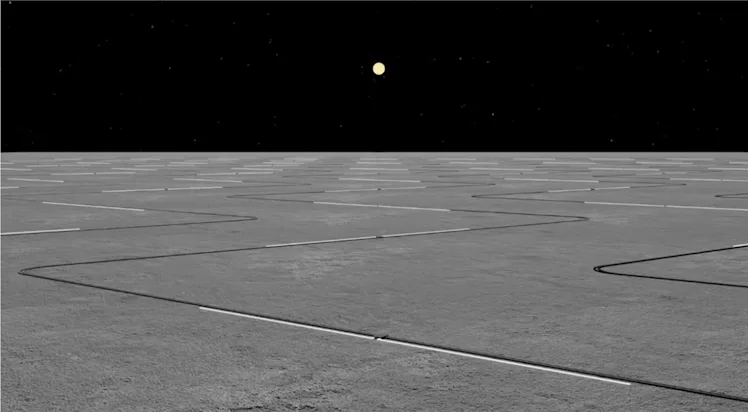
Further, she talked about Stone’s alien encounter in Vietnam, where he helped aliens to escape from military custody, as he cared for the rights of extraterrestrials who visit Earth.

Sgt. Clifford Stone claimed that he had been good at communicating with the ETs found at the crash sites or in an encounter with his military team. Once, his team fired a bullet at an ET, but they deflected it with some advanced technology. He also mentioned the teleport techniques of ETs when he found himself hundreds of feet from his initial position.

Stone also claimed that there are many alien groups that visit our solar system and Earth as well, but when humans learned how to detect their crafts, they limited their visits but did not stop.

He had no intention to benefit from his claims and evidence and no desire to gain publicity. His only desire was to let the US citizens know the truth about the UFOs and extraterrestrial hypothesis (ETH), that these are interplanetary spacecraft. Sgt. Clifford Stone, aged 72, passed away peacefully at his home on February 10, 2021.

{https://www.howandwhys.com/ }

Hoe vind je dit bericht?
Geschreven door peter om 23:01 Stuur door

Meer van UFO'S of UAP'S, ASTRONOMIE, RUIMTEVAART, ARCHEOLOGIE, OUDHEIDKUNDE, SF-SNUFJES EN ANDERE ESOTERISCHE WETENSCHAPPEN - DE ALLERLAATSTE NIEUWTJES

↑ Terug naar de berichten