Naar de inhoud

UFO'S of UAP'S, ASTRONOMIE, RUIMTEVAART, ARCHEOLOGIE, OUDHEIDKUNDE, SF-SNUFJES EN ANDERE ESOTERISCHE WETENSCHAPPEN - DE ALLERLAATSTE NIEUWTJES

UFO's of UAP'S in België en de rest van de wereld
akke.beakke.be
Ontdek de Fascinerende Wereld van UFO's en UAP's: Jouw Bron voor Onthullende Informatie! Ben jij ook gefascineerd door het onbekende? Wil je meer weten over UFO's en UAP's, niet alleen in België, maar over de hele wereld? Dan ben je op de juiste plek! België: Het Kloppend Hart van UFO-onderzoek In België is BUFON (Belgisch UFO-Netwerk) dé autoriteit op het gebied van UFO-onderzoek. Voor betrouwbare en objectieve informatie over deze intrigerende fenomenen, bezoek je zeker onze Facebook-pagina en deze blog. Maar dat is nog niet alles! Ontdek ook het Belgisch UFO-meldpunt en Caelestia, twee organisaties die diepgaand onderzoek verrichten, al zijn ze soms kritisch of sceptisch. Nederland: Een Schat aan Informatie Voor onze Nederlandse buren is er de schitterende website www.ufowijzer.nl, beheerd door Paul Harmans. Deze site biedt een schat aan informatie en artikelen die je niet wilt missen! Internationaal: MUFON - De Wereldwijde Autoriteit Neem ook een kijkje bij MUFON (Mutual UFO Network Inc.), een gerenommeerde Amerikaanse UFO-vereniging met afdelingen in de VS en wereldwijd. MUFON is toegewijd aan de wetenschappelijke en analytische studie van het UFO-fenomeen, en hun maandelijkse tijdschrift, The MUFON UFO-Journal, is een must-read voor elke UFO-enthousiasteling. Bezoek hun website op www.mufon.com voor meer informatie. Samenwerking en Toekomstvisie Sinds 1 februari 2020 is Pieter niet alleen ex-president van BUFON, maar ook de voormalige nationale directeur van MUFON in Vlaanderen en Nederland. Dit creëert een sterke samenwerking met de Franse MUFON Reseau MUFON/EUROP, wat ons in staat stelt om nog meer waardevolle inzichten te delen. Let op: Nepprofielen en Nieuwe Groeperingen Pas op voor een nieuwe groepering die zich ook BUFON noemt, maar geen enkele connectie heeft met onze gevestigde organisatie. Hoewel zij de naam geregistreerd hebben, kunnen ze het rijke verleden en de expertise van onze groep niet evenaren. We wensen hen veel succes, maar we blijven de autoriteit in UFO-onderzoek! Blijf Op De Hoogte! Wil jij de laatste nieuwtjes over UFO's, ruimtevaart, archeologie, en meer? Volg ons dan en duik samen met ons in de fascinerende wereld van het onbekende! Sluit je aan bij de gemeenschap van nieuwsgierige geesten die net als jij verlangen naar antwoorden en avonturen in de sterren! Heb je vragen of wil je meer weten? Aarzel dan niet om contact met ons op te nemen! Samen ontrafelen we het mysterie van de lucht en daarbuiten.

Berichten van 1 november 2024 tot 30 november 2024

Earth's ancient APOCALYPSE: Huge comet hit Earth 12,000 years ago - sparking an ice age that decimated humans, expert claims in controversial Netflix series

Earth's ancient APOCALYPSE: Huge comet hit Earth 12,000 years ago - sparking an ice age that decimated humans, expert claims in controversial Netflix series

  • Graham Hancock claims that an ancient super-civilisation lived in Antarctica 
  • Scientists argue his claims are pseudoscientific and lack evidence 

It's common knowledge that the dinosaurs were wiped out by an asteroid 66 million years ago.

But what if that wasn't the only time in Earth's history that a space rock triggered an ancient apocalypse?

In a new Netflix series, controversial author Graham Hancock claims that an ancient super-civilisation in Antarctica was destroyed by a collision with a comet 12,000 years ago.

If true, Mr Hancock's theory would overturn almost everything we know about the story of human civilisation.

However, many experts are concerned that the story of 'Ancient Apocalypse' is misleading, with some dismissing it as 'pseudoscientific.'

In a new season of 'Ancient Apocalypse', controversial author Graham Hancock (pictured) argues that a comet triggered the destruction of an ancient civilisation in Antarctica

In a new season of 'Ancient Apocalypse', controversial author Graham Hancock (pictured) argues that a comet triggered the destruction of an ancient civilisation in Antarctica 

What is the ancient apocalypse theory? 

Beginning in 1995 with his book 'Fingerprints of the Gods', Mr Hancock has been one of the most vocal supporters of the ancient apocalypse theory.

Conventional archaeological wisdom holds that humans first changed from nomadic hunter-gatherers to settled farmers between 10,000 and 12,000 years ago.

This would lay the foundations for the first urban civilisations to arise in Mesopotamia, somewhere around 6,000 years ago.

article image

Mr Hancock, meanwhile, maintains that an ancient civilisation lived in what is now Antarctica for many thousands of years before this time.

Then, around 11,600-12,800 years ago, he claims a series of cataclysmic events led to the demise of these ancient peoples around the end of the Ice Age.

Mr Hancock claims that the Earth was hit by debris from a comet around 12,000 years ago, triggering changes in the climate which led to the end of the Ice Age

Mr Hancock claims that the Earth was hit by debris from a comet around 12,000 years ago, triggering changes in the climate which led to the end of the Ice Age

The documentary claims that Antarctica was home to an ancient super-civilisation which existed for thousands of years before most archaeologists believe farming was developed

The documentary claims that Antarctica was home to an ancient super-civilisation which existed for thousands of years before most archaeologists believe farming was developed 

Mr Hancock describes this period as 'an abrupt episode of cataclysmic climate change', although it's referred to in science as the 'Younger Dryas'.

Controversially, he also claims that the rapid shift in climate patterns was caused by a collision with a comet in what he calls the 'Younger Dryas Impact Hypothesis'.

'12,800 years ago the Earth crossed the debris stream of a very large, disintegrating comet and was bombarded by hundreds of fragments, some large, some small,' Mr Hancock says.

'It was the resulting shock of these impacts and airbursts that triggered the Younger Dryas.'

However, before they vanished, this ancient civilisation supposedly travelled the world building monuments and teaching other people the foundations of civilisation.

In the show, Mr Hancock (pictured right) travels around the world to look for evidence in support of his eccentric theory

In the show, Mr Hancock (pictured right) travels around the world to look for evidence in support of his eccentric theory 

article image

In his new Netflix series, Ancient Apocalypse, Mr Hancock follows in the footsteps of these lost humans to find the traces of their history.

In the second season, Mr Hancock once again sets out to find evidence for his theory, this time focusing on the Americas.

Speaking to a number of archaeologists and, inexplicably, actor Keanu Reaves, Mr Hancock travels across the continent looking for structures which hint at a more ancient society.

Mr Hancock says: 'Ancient Apocalypse is my own story, in my own words, of my own boots-on-the-ground investigation into the controversial possibility of a lost civilization of the Ice Age.'

During the show, Mr Hancock meets with actor Keanu Reaves who expresses a distrust for the conventional narrative of human history

During the show, Mr Hancock meets with actor Keanu Reaves who expresses a distrust for the conventional narrative of human history 

Why is the ancient apocalypse theory controversial? 

While Mr Hancock's theories make for a great documentary, they don't stand up to much scientific scrutiny.

Numerous experts have pointed out that the evidence used in the show is at best flimsy and, at worst, outright misleading.

Dr Flint Dibble, an archaeologist at Cardiff University who spoke with Mr Hancock on The Joe Rogan Experience, told MailOnline: 'Most sites on the show are misrepresented in different ways, sometimes small, sometimes large.'

For example, in the first episode of the new season, Mr Hancock refers to the fossilised footprints at White Sands National Park, New Mexico.

Dr Dibble says: 'He states that archaeologists have not directly dated the footprints at white sands, when in fact the sediments under, part of, and above the footprints are directly dated by OSL [optically stimulated luminescence] providing a direct date for them.'

In the show, Mr Hancock claims that the fossilised footsteps at White Sands, New Mexico (pictured) have never been directly dated. This is completely untrue as the soil above, below, and part of the fossils have been dated

In the show, Mr Hancock claims that the fossilised footsteps at White Sands, New Mexico (pictured) have never been directly dated. This is completely untrue as the soil above, below, and part of the fossils have been dated

article image

Likewise in season one, Mr Hancock claimed that the 11,000-year-old Göbekli Tepe site in Turkey was built by a society capable of farming.

While the initial excavators thought this was the case, new evidence has clearly shown that bones and seeds at the site were from wild animals - proving the monuments at Göbekli Tepe were built by hunter-gatherers.

In another incident, Mr Hancock interviews the architect Professor Hillman Natawidjaja, who claims that the Gunung Padang site in Indonesia is 25,000 years old.

Shortly afterwards Professor Natwidjaja's paper on the site was retracted due to a 'major error'.

Dr Dibble says: 'The theory is about a lost civilization from the end of the Ice Age, but ignores all the evidence from that period we do have that is distributing across the world, on every continent and in every region.

Experts say that Mr Hancock ignores all evidence which contradicts his theories and misrepresents a number of archaeological sites to support his view

Experts say that Mr Hancock ignores all evidence which contradicts his theories and misrepresents a number of archaeological sites to support his view 

'It also ignores all the scientific evidence that has amassed over the last 40 years from organic remains that clearly dates the development of agriculture to after the Ice Age in different regions of the world, independently from one another.'

The expert reaction to the show has been so bad that, after the release of season one, many called for Netflix to strip it of its 'docuseries' label.

In an open letter to Netflix, the Society for American Archaeology (SAA) wrote: 'Archaeologists have investigated hundreds of Ice Age sites and published the results in rigorously reviewed journals.

'The assertion that Ancient Apocalypse is a factual “docuseries” or “documentary” rather than entertainment with ideological goals is preposterous.'

According to archaeologists, Mr Hancock has ignored all evidence which shows that agriculture emerged separately around the world about 12,000 years ago

According to archaeologists, Mr Hancock has ignored all evidence which shows that agriculture emerged separately around the world about 12,000 years ago 

article image

If Mr Hancock were simply incorrect, this might not have caused much of a stir.

However, some experts also see the theories put forward in Ancient Apocalypse as actively harmful.

In the show, Hancock not only promotes his own ideas, but also attacks scientists who he calls 'arrogant', 'patronising', and 'so-called experts'.

Dr Dibble says that this anti-intellectual streak is part of what makes the show so popular as Hancock rides a growing wave of opposition to experts.

While Dr Dibble says he wouldn't call the documentary 'dangerous', he adds: 'Hancock's narrative both on the show and on podcast appearances promotes a distrust in experts.'

Scientists warn that the documentary's disparaging attitude towards expert opinion promotes a wider distrust of science

Scientists warn that the documentary's disparaging attitude towards expert opinion promotes a wider distrust of science 

Likewise, a number of archaeologists argue that the narrative of world history Mr Hancock promotes could provide the basis for more harmful ideas. 

In the show, Mr Hancock argues that an ancient lost race is responsible for spreading civilisation to less advanced people around the world.

Experts point out that this implies indigenous people could not have created civilisation without outside assistance.

'It promotes a world view where many indigenous peoples around the world are not responsible for their cultural heritage,' Dr Dibble says.

This led Netflix to cancel a number of screenings of the documentary in Arizona and New Mexico following strong opposition from local tribal leaders. 

Some even argue that this theory shares striking similarities with ideas which have inspired white supremacists.

The documentary also implies that indigenous groups could not be responsible for their own achievements, a view which has been accused of being belittling and linked to theories of white supremacy

The documentary also implies that indigenous groups could not be responsible for their own achievements, a view which has been accused of being belittling and linked to theories of white supremacy

article image

In some versions of the myth of Atlantis, which is a clear inspiration for the show, the ancient super-race of the lost city were white Arians.

This idea would go on to inspire some theories of white supremacy which draw on the notion of an ancient Arian race. 

While Mr Hancock does not explicitly mention race in the documentary, he has previously argued that caucasian people arrived in the Americas before Columbus. 

Likewise, Hancock has also claimed that the Aztec god Quetzalcoatl was described as having white skin, a red beard, and blue eyes.

Dr Dibble has pointed out that the trope of white-skinned heroes arriving to bring civilisation was used to justify the Spanish crown claiming lands in the Americas. 

In their open letter, the SAA wrote: 'The theory it presents has a long-standing association with racist, white supremacist ideologies.'

VIDEOS

Did a Cosmic Impact 12,000 Years Ago Create the Younger Dryas Catastrophe? Hiawatha Crater Greenland

Catastrophic shift on the Earth 12,000 years ago.

A Tour of Earth's Ancient Supercontinents

 { https://www.dailymail.co.uk/ }

Hoe vind je dit bericht?
Geschreven door peter om 23:51 Stuur door

'God of chaos' asteroid could trigger astroquakes when it skims past Earth on Friday the 13th

'God of chaos' asteroid could trigger astroquakes when it skims past Earth on Friday the 13th

  • READ MORE:  Inside the mission to meet a 'city-killer' asteroid before it hits Earth

When the 'God of Chaos' asteroid flies by our planet in five years, Earth's gravity could cause it to experience 'astroquakes,' scientists have predicted. 

Their research suggests that when the asteroid Apophis - named for the Egyptian God of Chaos - passes within just 19,000 miles of Earth, our planet's gravitational pull will cause it to violently shake.

The theoretical shaking could happen due to gravitational tidal forces, which are the stretching or pulling effect on an object caused by the uneven gravitational pull from another massive body.

The team identified two physical processes that could occur. One would cause rocks and dust to fly off the surface, and the other would trigger landslides that would happen gradually over tens of thousands of years. 

Both would ultimately change the surface structure of the four-billion-year-old asteroid.

Apophis, set for the flyby on April 13, 2029, is a 'city-killer' space rock the size of the Empire State Building. 

If it were to hit Earth directly, its impact would be equivalent to detonating tens or hundreds of nuclear bombs, according to The Planetary Society.

It wouldn't destroy the entire Earth, but it could easily annihilate a city, spreading destruction over a radius of hundreds of miles. 

This illustration shows Apophis' size relative to New York City. A direct hit from this asteroid wouldn't destroy the whole Earth, but it could wipe out a major metropolitan area

This illustration shows Apophis' size relative to New York City. A direct hit from this asteroid wouldn't destroy the whole Earth, but it could wipe out a major metropolitan area


Apophis: The Asteroid Named After Chaos – ISRO's Mission to Track It!

 { https://www.dailymail.co.uk/ }

Hoe vind je dit bericht?
Geschreven door peter om 23:19 Stuur door

Congress promises to 'pull back the curtain' on secret UFO research as whistleblowers prepare to testify

Congress promises to 'pull back the curtain' on secret UFO research as whistleblowers prepare to testify

US Congress has promised to 'pull back the curtain' on secret UAP research programs conducted in the shadows of the government in a court of law.

A second slew of hearings into UFOs is scheduled for November 13, led by the House Oversight Committee, with former military officials and an aerospace expert set to testify about their knowledge of secret US programs.

Lawmakers have promised 'to explore firsthand accounts of [UFOs]' and 'assess the federal government's transparency and accountability regarding their 'possible threats to national security.'

Rep. Tim Burchett (R-Tenn.), a member of the subcommittee, said: 'The Pentagon and Washington bureaucrats have kept this information hidden for decades, and we're finally going to shed some light on it. 

'We're bringing in credible witnesses who can provide public testimony because the American people deserve the truth. We're done with the cover-ups.'

There will be four witnesses set to testify under oath, including former Department of Defense Official Luis Elizondo and former NASA Associate Administrator Michael Gold.

Congress is set to hold a second hearing about UAPs that it promised will expose the truth to the American public, specifically about the research programs within the government. Pictured is the famous Tic Tac-shaped object seen in the sky over California on November 10, 2004

Congress is set to hold a second hearing about UAPs that it promised will expose the truth to the American public, specifically about the research programs within the government. Pictured is the famous Tic Tac-shaped object seen in the sky over California on November 10, 2004 

Next week's hearing, set for 11:30am ET, will be a joint effort by Rep Nancy Mace (R-SC) and Rep Glenn Grothman (R-Wis.).

'This is our second hearing on the topic of UAPs and the American people are tired of the obfuscation and refusal to release information by the federal government, they said in a shared statement.

'Americans deserve to understand what the government has learned about UAP sightings and the nature of any potential threats these phenomena pose.

'We can only ensure that understanding by providing consistent, systemic transparency. We look forward to hearing from expert witnesses on ways to shed more light and bring greater accountability to this issue.'

The committee has not released details on cases to be presented on Wednesday but provided the list of witnesses.

Elizondo, a career US Army counterintelligence specialist, previously ran the military's Advanced Aerospace Threat Identification Program.

He recently hosted a private event in Philadelphia on October 28 to reveal an image of an alleged UFO 'mothership.'

There will be four witnesses set to testify under oath, including former Department of Defense Official Luis Elizondo (pictured)

There will be four witnesses set to testify under oath, including former Department of Defense Official Luis Elizondo (pictured)

Elizondo recently hosted a private event in Philadelphia on October 28 to reveal an image of an alleged UFO 'mothership.'

Elizondo recently hosted a private event in Philadelphia on October 28 to reveal an image of an alleged UFO 'mothership.'

'There's a whole lot more here folks,' Elizondo told the audience in a leaked clip. 'I just want to give you kind of a small taste of what's going on 'behind the scenes.''

'We're having pilots, military pilots and civilian pilots in Eastern Europe and the Middle East, report what unimaginably seems impossible,' as Elizondo explained his 'real photo' of a UFO.

'They described it literally 'the mothership,' Elizondo said.

Investigative journalist Michael Shellenberger will also be sworn under oath.

Shellenberger — who is also an academic and a two-time candidate for California governor — went viral last month after publishing one of his anonymous whistleblower's accounts of an alleged UFO data collection program.

That classified UFO data retrieval effort, dubbed 'Immaculate Constellation,' was established in 2017 to 'detect' and 'quarantine' the military's best UFO imagery, along with its best videos, witness testimonies and electronic sensor evidence.

Dr Tim Gallaudet, former rear admiral in the US Navy, launched a probe in March into unidentified submersible objects (USOs), specifically strange sightings on the seabed off the coast of California.

Investigative journalist Michael Shellenberger will also be sworn under oath. He went viral last month after publishing one of his anonymous whistleblower's accounts of an alleged UFO data collection program

Investigative journalist Michael Shellenberger will also be sworn under oath. He went viral last month after publishing one of his anonymous whistleblower's accounts of an alleged UFO data collection program

Gold is a former NASA Associate Administrator who was part of the agency's UAP study in October 2022, which focused solely on unclassified data.

Over nine months, the independent study team will lay the groundwork for future studies on the nature of UAPs for NASA and other organizations.

The hearing follows the bombshell case last year that was held by Burchett and Rep. Anna Paulina Luna (R-Fla).

David Grusch - a former high-ranking intelligence official - was one of three military whistleblowers who testified under oath that they had firsthand encounters or knowledge about secret government programs involving technology that is 'non-human.'

He claimed that the US has been in possession of UFOs since 'the 1930s' and has been secretly back-engineering them and carrying out a public disinformation campaign to prevent the details from leaking publicly. 

Ryan Graves, a former pilot, Air Force and intelligence agency veteran David Grusch and Navy veteran fighter pilot Commander David Fravor spoke at the first hearing in 2023

Ryan Graves, a former pilot, Air Force and intelligence agency veteran David Grusch and Navy veteran fighter pilot Commander David Fravor spoke at the first hearing in 2023

During the hearing, Burchett asked Grusch: 'Personally, have you heard anyone [has] been murdered?' 

Grusch replied: 'I have to be careful answering that question. I directed people with that knowledge to the appropriate authorities.'

He was sworn in Wednesday, along with Ryan Graves, an esteemed former pilot, and Navy veteran fighter pilot Commander David Fravor, who witnessed the 2004 'Tic Tac' UFO.

article image

Graves, a former F-18 pilot with over a decade of service in the US Navy, was the first to give opening statements.

'My testimony is based on information I've been given by individuals with a long-standing track record of legitimacy and service to this country, many of whom have shared compelling evidence in the form of photography, official documentation and classified oral testimony to myself and many various colleagues,' Graves told lawmakers, stating he was driven to share it by a 'commitment to truth and transparency.'

Burchett described the 2023 hearing as 'historical.' 

'I'd like to thank these three brave witnesses here. They took an oath to uphold the Constitution of the United States and, dagnammit, they're doing it,' he continued.

'We're not bringing little green men or flying saucers into the hearing — sorry to disappoint about half of y'all — we're just going to get to the facts.

'We're going to uncover the cover-up, and I hope this is just the beginning of many more hearings and many more people coming forward about this.'

VIDEOS

David Grusch UFO/UAP bombshells: Ross Coulthart reveals the inside story

Ufologist Says MORE Whistleblowers Are Ready To Come Forward

 { https://www.dailymail.co.uk/ }

Hoe vind je dit bericht?
Geschreven door peter om 21:00 Stuur door

China unveils $36mil new stealth jet fighter built with 'stolen American military technology'

China unveils $36mil new stealth jet fighter built with 'stolen American military technology'

China has posted the first official photo of its brand 'new' stealth fighter.

But if you feel like you've seen it before, there might be a reason for that.

The J-35A jet is rumored to have been built using 'many terabytes' of stolen US military data.

A decade ago, documents leaked by ex-US intelligence contractor Edward Snowden laid out the case that radar designs, engine schematics and other top secret specs from America's $2 trillion stealth F-35 program had been hacked by Chinese spies. 

Photographed in a three-quarter profile, taxiing on the tarmac, the new J-35A is the land-based sibling to China's equally secretive and stealth J-35, which the emerging superpower plans to deploy from its growing fleet of naval aircraft carriers. 

The image came a week ahead of the fighter's November 12 debut at the China International Aviation & Aerospace Exhibition, held at Zhuhai Airport in Guangdong.

At the time of Snowden's leak, China's Foreign Ministry spokesman Hong Lei told reporters that 'the so-called evidence that has been used to launch groundless accusations against China is completely unjustified.' 

But the similarities between the Chinese and the American jets are striking — both have the same characteristic internal weapons bays to maintain its radar-evading stealth shape and aerodynamic air-intake channels beneath their cockpits.

China posted the first official photo of its J-35A stealth fighter (above) on Tuesday, teasing the debut of a jet that's accused of originating with 'many terabytes' of stolen US military data

China posted the first official photo of its J-35A stealth fighter (above) on Tuesday, teasing the debut of a jet that's accused of originating with 'many terabytes' of stolen US military data

'For the first time, new equipment such as the medium-weight, stealth multi-role fighter J-35A, the HQ-19 surface-to-air missile and a new type of reconnaissance and strike unmanned aerial vehicle will be on display,' officials told CCTV state television.

But aside from providing the picture of the J-35A, Chinese military spokesman Colonel Niu Wenbo did not provide further details to CCTV on the new craft.

Both J-35 and J-35A were built off China's FC-31 stealth fighter prototype, which has been unofficially documented for years in leaks and snapshots, according to military aerospace author Thomas Newdick.

Newdick emphasized that — while espionage likely played a role in the development of China's fifth-generation stealth fighter fleet — the craft were not outright 'copies.'

'Critical outright differences' are discernable in the new photo, he noted, including twin-engines on the J-35A distinct from the F-35's massive single turbofan engine, and a more slender and sleek design that avoids the some of the F-35's design flaws. 

The J-35A is also reportedly faster than the F-35, capable of a maximum speed of Mach 2.0, compared to the American stealth fighter's top speed of Mach 1.6.

A former deputy captain with the Chinese Air Force's Bayi Aerobatic Team, Zhang Xinmin, told Aaj News that the J-35A had been custom made to withstand harsh conditions, like high-salt and high-humidity environments.

But, as Newdick wrote for The War Zone, 'clearly many elements' were 'at least heavily inspired if not cribbed from the F-35,' including its 'diverterless supersonic inlets' air-intakes on its engines and the shape of its cockpit canopy.

'Even its official designation [i.e. '35'] isn't trying to hide that reality,' Newdick said.

The clearest previous image of China's future carrier-borne stealth fighter known as J-35 surfaced in July of 2020 on Chinese social media Weibo (above)

The clearest previous image of China's future carrier-borne stealth fighter known as J-35 surfaced in July of 2020 on Chinese social media Weibo (above)

Carrier fighter mockups of the J-35 (right) and J-15 (left) were spotted on the aircraft carrier Liaoning and posted to social media on what was then Twitter but is now X.com

Carrier fighter mockups of the J-35 (right) and J-15 (left) were spotted on the aircraft carrier Liaoning and posted to social media on what was then Twitter but is now X.com

The expensive program to develop and integrate three variations of the F-35 into America's fighting force has led to at least 29 incidents and accidents over the years.

Last May, an F-35B crashed shortly after attempting a takeoff at Kirtland Air Force Base in New Mexico. 

The F-35B is a variant designed for 'short takeoff and vertical landing' (STOVL), a bulk-adding technical specification that's notably absent from both J-35 models.

The J-35 is the second radar-evading stealth jet in China's military arsenal, after the J-20 'Dragon' which entered service in 2017. 

The J-20 is a 'heavy-duty stealth fighter jet' and the J-35 is a 'medium-sized multi-role stealth fighter jet,' according to Military analyst Wang Mingzhi.

'The primary distinction is that the J-20 focuses on air superiority missions, while the J-35A is versatile, capable of pursuing air superiority and accomplishing a variety of ground and maritime strike missions,' Wang explained.

'In future operations, these two aircraft can precisely target at both land and sea objectives in a coordinated manner, thus playing a crucial role for achieving air superiority,' the analyst continued in a post for China's Defense Ministry website.

The expensive program to develop and integrate three variations of the F-35 into America's fighting force has led to at least 29 serious incidents over the years. Above emergency workers respond to a crash of an F-35B near the Albuquerque International Airport on May 28, 2024

The expensive program to develop and integrate three variations of the F-35 into America's fighting force has led to at least 29 serious incidents over the years. Above emergency workers respond to a crash of an F-35B near the Albuquerque International Airport on May 28, 2024

China's defense ministry said the J-35 was built by the Shenyang Aircraft Design and Research Institute, a subsidiary of the Asian country's Aviation Industry Corporation. 

Heavy state-planning and secrecy characteristic of the communist 'people's republic' has shielded the exact cost for any of China's stealth fighters from view — but a 2024 report by defense publication Janes priced the J-20 at $110 million.

But extrapolations, based on estimates from Zhou Chenming of Beijing-based Yuan Wang military tech think tank, place the J-35s at about $21 to $36 million each.

'The price of Chinese self-developed military weapon is normally one-fifth to one-third of the price of a similar US weapon,' Zhou said. And the current reported cost of America's F-35s are around $109 million apiece.

'The J-35 series is designed to be one platform with multiple variants for both Chinese air and naval forces,' the ministry said.

Analysts, including Newdick, have noted that China's new stealth fighter's J-35 version appears to be optimized for takeoff via an 'electromagnetic catapult launch system,' onboard China's latest and state-of-the-art carrier, Fujian.

But photos of fighter mock-ups show the jets will also be deployed from China's older aircraft carriers like Liaoning and Shenyang, via their 'ski-jump' takeoff ramps. 

Above, a visual timeline of the China's progess on the stealth J-35: the original FC-31 airframe (2014), the revised FC-31 (2016), the first J-35 prototype (2021) and an updated J-35 (2022)

Above, a visual timeline of the China's progess on the stealth J-35: the original FC-31 airframe (2014), the revised FC-31 (2016), the first J-35 prototype (2021) and an updated J-35 (2022) 

German magazine Der Spiegel was the first to publish the cache of Snowden documents in 2015 that revealed a top secret US government presentation alleging China's theft of 'many terabytes' of F-35 program data.

According to sources, the data breach occurred in 2007 — a cyberattack at the prime defense contractor undertaking America's effort to construct the F-35 Lightning II joint strike fighter jet (F-35B), Lockheed Martin. 

Shortly after the Snowden leak, US officials claimed that 'classified F-35 information is protected and remains secure,' according to The Diplomat.

China's cyber-spying operation, which had been code-named 'Byzantine Hades' by US investigators, had first been revealed by Wikileaks in 2011.

Investigators claimed that they had traced the origin of some of these past hacks to a specific unit of the Chinese People's Liberation Army.

German magazine Der Spiegel was the first to publish the cache of Snowden documents in 2015 that revealed a top secret US government presentation (above) alleging China's theft of 'many terabytes' of F-35 program data. Investigators called the alleged op 'Byzantine Hades'

German magazine Der Spiegel was the first to publish the cache of Snowden documents in 2015 that revealed a top secret US government presentation (above) alleging China's theft of 'many terabytes' of F-35 program data. Investigators called the alleged op 'Byzantine Hades'

US officials broadly characterized that 'Byzantine Hades' hacking operation as a plot to 'cause serious damage to DoD interests,' according to the top secret power point presentation

US officials broadly characterized that 'Byzantine Hades' hacking operation as a plot to 'cause serious damage to DoD interests,' according to the top secret power point presentation

It's unclear when US officials may have first suspected that 'Byzantine Hades' had also been working to obtain stealth fighter secrets from Lockheed. 

article image

However they broadly characterized that operation as a plot to 'cause serious damage to DoD interests,' according to the top secret power point presentation leaked by Snowden.

Pushing back on these accusations, Chinese Foreign Ministry spokesman Hong noted in 2015 that China has sought international collaborations to improve security and prevent hacking. 

'According to the materials presented by the relevant person, some countries themselves have disgraceful records on cybersecurity,' Hong added.

Infamously, Snowden's 2013 revelations as a former contractor to the National Security Agency (NSA) revealed a massive and questionably legal spying program by the agency. The revelations sparked international outrage.


China's NEW Stealth Bomber Is Coming and It Will Change WAR Forever!

How China's J-20 stacks up to USA's F-22 fighter jet

{ https://www.dailymail.co.uk/ }

Hoe vind je dit bericht?
Geschreven door peter om 20:40 Stuur door

Shock photos show physical deterioration of stranded NASA astronaut Sunita Williams

Shock photos show physical deterioration of stranded NASA astronaut Sunita Williams

Photos have revealed NASA astronaut Sunita Williams' shocking weight loss as she and her crewmate remain stuck on the International Space Station (ISS). 

Williams, 59, and Barry Wilmore, 61, have been living on the ISS for five months after Boeing's faulty Starliner spacecraft was deemed unsafe to return them to Earth. 

A 'gaunt' photo of Williams taken on September 24 recently sparked concerns due to her 'sunken' cheeks which suggested she'd rapidly lost weight.

More recent images also show her with a pronounced facial structure and a thinner frame - a concern given she still has three months until she returns.  

Publicly, NASA has said Williams' is 'in good health' and that she's been undergoing 'routine medical evaluations'.

But behind the scenes, the space agency has been scrambling to 'stabilize the weight loss and hopefully reverse it,' according to a well-placed source. 

The unnamed NASA employee who is 'directly involved with the mission' told the New York Post that Williams has been 'unable to keep up with the high-caloric diets that astronauts must consume' while on the ISS.

Long-stay space missions take a toll on astronaut's health, especially women, leading to weight loss, muscle breakdown, bone loss, heart and vision problems and kidney stones.

NASA astronauts Sunita Williams and Barry Wilmore on June 5, gearing up for the Starliner launch that would deliver them to the International Space Station

NASA astronauts Sunita Williams and Barry Wilmore on June 5, gearing up for the Starliner launch that would deliver them to the International Space Station 

Female astronauts have been found to lose more weight - particularly through loss of muscle mass - than men during spaceflight.

'The pounds have melted off her and she's now skin and bones. So it's a priority to help her stabilize the weight loss and hopefully reverse it,' the NASA source told the New York Post. 

About a month ago, NASA doctors began working with Williams to help her regain weight, the source said, even before DailyMail.com's original story brought attention to her deterioration.

To stop and reverse her weight loss, Williams could have to eat up to 5,000 calories per day, the source added. 

For comparison, the average woman on Earth has to eat between 1,600 to 2,400 calories to maintain her weight. The source said that Williams started the mission at approximately 140 lbs.

Williams and Wilmore launched toward the orbiting laboratory on June 5 for what was supposed to be a 10 day mission, but have been stuck there for 156 days. 

Now, they are set to return to Earth on SpaceX's Crew-9 Dragon capsule. Williams, Wilmore and the four Crew-9 astronauts will journey home together in February 2025.

By then, the Starliner crew will have spent roughly eight to nine months on the ISS, depending on when in February they splash down. 

During that time, they will have endured microgravity, close quarters and high doses of space radiation.

A doctor has raised concerns about Williams' health, claiming this September 24 showed her looking 'gaunt'

A doctor has raised concerns about Williams' health, claiming this September 24 showed her looking 'gaunt'

Over the last five months, photos sent back to Earth have offered glimpses into the lives of Williams and Wilmore as they adapt to their unforeseen circumstances. 

Just hours before the Starliner launch on June 5, the crew was photographed beaming in their blue Boeing spacesuits as they geared up for their short mission.

In that photo, the astronauts - especially Williams - look strikingly different than in recent images, including the September snapshot. 

That image was one of several posted on the official ISS Instagram page that showed Williams, Wilmore and the other ISS astronauts making pizza together. 

It recently went viral as the public raised concerns over Williams' shocking appearance.  

In it, she appears 'gaunt,' Dr Vinay Gupta, a pulmonologist and veteran in Seattle, told DailyMail.com earlier this week.

'What you're seeing there in that picture is somebody that I think is experiencing the natural stresses of living at a very high altitude, even in a pressurized cabin, for extended periods,' he said. 

'Her cheeks appear a bit sunken - and usually it happens when you've had sort of total body weight loss.'

'Based on what I'm at least seeing in the photo, I don't think she's quite at a... place where I say her life's in danger.'

'But I don't think you can look at that photo and say she has sort of healthy body weight.'

The NASA source told the New York Post that they were shocked by the image. 'I gasped out loud when I saw the last picture,' they said.

'And it's something we're talking about, but not something we're obsessing about. It's a real concern and everyone is taking it seriously.' 

More recent photos, including one in which Williams and Wilmore pose for a group-shot with the other members of the Expedition 72 crew on October 4, show that Williams is still looking thin. 

NASA declined to comment on the statements made by the anonymous agency employee, and instead referred DailyMail.com back to their original statement which asserts that all astronauts aboard the ISS are 'in good health.' 

Wilmore (front left) and Williams (front right) pose with the other members of the Expedition 72 crew for a photo posted on October 4

Wilmore (front left) and Williams (front right) pose with the other members of the Expedition 72 crew for a photo posted on October 4

The body burns more calories in space as it adjusts to the changes in gravity and tries to maintain its body temperature in cold, harsh conditions.

'They have to eat about 3,500 to 4,000 calories per day, just to maintain their current weight,' the NASA source said. 

'And when you start falling behind, your weight drops fast.' 

To prevent muscle and bone loss, astronauts exercise about 2.5 hours a day, which burns even more calories. 

'There's just things that the human body cannot adjust to, and one of which is, you know, she's probably losing more calories than she's intaking,' Dr Gupta said.

'Her body's probably working harder to do basic things, because the partial pressure of oxygen is lower than it would be on sea level.'

The problem of the body breaking down is a particular worry for women. 

A study assembled by NASA in 2014 found that women have greater loss of blood plasma volume than men during spaceflight.

And women’s stress response characteristically includes a heart rate increase while men respond with an increase in vascular resistance.

article image

The loss of blood plasma causes your metabolic rate to temporarily increase while your body mobilizes resources to adjust to the loss of plasma.

And this response can slightly elevate your calorie burn, resulting in weight loss similar to what Williams may be experiencing.

Another study released by Ball University in 2023 also found that women lose more muscle than men in a microgravity environment such as spaceflight.

Williams and Wilmore still have to wait about three to four months until they can return to Earth on SpaceX's Crew Dragon. 

At this time, there is no evidence to suggest that Williams' alleged health decline will impact this timeline. 

Though the Starliner mission has extended significantly, Williams and Wilmore's ISS mission will not be the longest one ever completed by an astronaut.  

That record is held Russian cosmonauts Oleg Kononenko and Nikolai Chub, who returned to Earth aboard Russia's Soyuz MS-25 spacecraft on September 23 after 374 days on the ISS.

More recently, a crew of four NASA/SpaceX astronauts returned to Earth on October 25 after a 232-day stay on the ISS. 

All four crewmembers were taken to the hospital after splashing down. Three received medical evaluations and were discharged that same day, while one was kept for overnight observation. 

NASA has not disclosed any details about why the astronauts required medical attention, or which one was kept overnight.

{ https://www.dailymail.co.uk/ }

Hoe vind je dit bericht?
Geschreven door peter om 20:19 Stuur door

Flowing Martian Water was Protected by Sheets of Carbon Dioxide

An artistic interpretation of an ice-covered river sourced from meltwater beneath Mars’ south polar cap. Image Credit: Peter Buhler/PSI.

Flowing Martian Water was Protected by Sheets of Carbon Dioxide

Mars’ ancient climate is one of our Solar System’s most perplexing mysteries. The planet was once wet and warm; now it’s dry and cold. Whatever befell the planet, it didn’t happen all at once.

New research shows that on ancient cold Mars, sheets of frozen carbon dioxide allowed rivers to flow and a sea the size of the Mediterranean to exist.

Mars’ climatic change from warm and wet to cold and dry wasn’t abrupt. There was no catastrophic impact or other triggering event. Throughout its gradual shift, there were different climatic episodes.

The planet’s surface is characterized by features that indicate water’s presence. River channels, impact craters, and basins that were once paleolakes illustrate Mars’ complex climatic history. Mars is much different from Earth, but they both follow the same set of natural rules.

In Earth’s frigid climates, rivers can flow underneath thick, protective ice sheets. New research shows that a similar thing happened on Mars. The research is published in JGR Planets and is titled “Massive Ice Sheet Basal Melting Triggered by Atmospheric Collapse on Mars, Leading to Formation of an Overtopped, Ice-Covered Argyre Basin Paleolake Fed by 1,000-km Rivers.” The lead author is Peter Buhler, a Research Scientist at the Planetary Science Institute.

The research examines a period about 3.6 billion years ago when Mars was likely transitioning from the Noachian Period to the Hesperian Period. At that time, most of the surface water was frozen into large ice sheets in Mars’ southern region, according to the research. The planet’s CO2 atmosphere suffered periodic collapses, and sublimated out of the atmosphere. Those collapses formed a layer of CO2 650 meters (0.4 miles) thick that created a massive ice cap over the South Pole. It insulated the 2.5-mile-thick (4 km) layer of frozen water that made up the ice sheets.

This simple schematic from the research shows how the proposed model works. When the CO2 atmosphere collapses, it forms an insulating layer over the frozen water at Mars' southern polar regions. The meltwater is released and flows across the surface, insulated by a layer of frozen water. Image Credit: Buhler, 2024.

This simple schematic from the research shows how the proposed model works. When the CO2 atmosphere collapses and sublimates, it forms an insulating layer over the frozen water in Mars’ southern polar regions. The meltwater is released and flows across the surface, insulated by a layer of frozen water. Image Credit: Buhler, 2024.

Buhler modelled how the CO2 cap acted as a thermal blanket and showed that it released massive amounts of meltwater from the frozen pole. This water flowed down rivers, with the top layers freezing and insulating the liquid water underneath.

“You now have the cap on top, a saturated water table underneath and permafrost on the sides,” Buhler said. “The only way left for the water to go is through the interface between the ice sheet and the rock underneath it. That’s why on Earth you see rivers come out from underneath glaciers instead of just draining into the ground.”

According to Buhler’s work, enough water was liberated to fill the Argyre Basin.

The Argyre Basin is one of the largest impact basins on the planet, measuring roughly 1800 km (1100 mi) in diameter. This massive impact basin was formed billions of years ago by a comet or asteroid striking Mars. It drops about 5.2 km (3.2 mi) below the surrounding plains, making it the second deepest basin on Mars. Scientists have long thought that the basin once held water—as much as the Mediterranean Sea—and Buhler’s work shows how it may have filled.

“Eskers are evidence that at some point there was subglacial melt on Mars, and that’s a big mystery,” Buhler said. Eskers are long stratified ridges of sand and gravel deposited by meltwater streams that flow under glaciers. They’re common on Earth, where glaciers once covered the surface. Mars’ eskers support the idea that the same thing happened on that planet.

These are eskers in western Sweden. They were created by water flowing under a glacier. When the glacier retreated, they were left as evidence. The same likely happened on Mars. Image Credit: By Hanna Lokrantz - https://www.flickr.com/photos/geologicalsurveyofsweden/6853882122/in/album-72157625612122901/, CC BY 2.0, https://commons.wikimedia.org/w/index.php?curid=42848874 These are eskers in western Sweden. They were created by water flowing under a glacier. When the glacier retreated, they were left as evidence. The same likely happened on Mars. Image Credit: By Hanna Lokrantz – https://www.flickr.com/photos/geologicalsurveyofsweden/6853882122/in/album-72157625612122901/, CC BY 2.0, https://commons.wikimedia.org/w/index.php?curid=42848874

The subglacial rivers would have flowed underneath the ice, where they were insulated from the cold. When they exited the glacier, they would have oozed along until a thick enough ice cap formed to insulate them. Buhler says that the ice would’ve grown until it was hundreds of meters thick, and the water flowing under the ice caps would’ve been several feet deep. The water would’ve carved out river channels thousands of miles long, and there are several of those that go from the polar cap to the Argyre Basin.

Argyre-Crater-Meltwater.jpg

This figure shows the polar cap, the Argyre Crater, and the long sinuous channels that carried meltwater from the cap to the basin. Image Credit: Buhler 2024.

“People have been trying to discover processes that could make that happen, but nothing really worked,” Buhler said. “The current best hypothesis is that there was some unspecified global warming event, but that was an unsatisfying answer to me, because we don’t know what would have caused that warming. This model explains eskers without invoking climatic warming.”

Argyre Basin is massive and voluminous, and proposed explanations for how it was filled with water were left wanting. It has approximately the same volume as the Mediterranean Sea. Buhler’s model shows that it took about ten thousand years for the basin to fill, and after it filled, the water emptied into plains about 8,000 km (5,000 miles) away.

This process happened repeatedly over a one-hundred-million-year era, with each event separated by millions of years.

“This is the first model that produces enough water to overtop Argyre, consistent with decades-old geologic observations,” Buhler said. “It’s also likely that the meltwater, once downstream, sublimated back into the atmosphere before being returned to the south polar cap, perpetuating a pole-to-equator hydrologic cycle that may have played an important role in Mars’ enigmatic pulse of late-stage hydrologic activity. What’s more, it does not require late-stage warming to explain it.”

Buhler’s work is supported by other research. “Previous literature supports the presence of a ~0.6 bar (atmospheric) CO2 inventory, as utilized in the model, near the Noachian-Hesperian boundary,” he writes in his research. The history of Mars’ atmospheric pressure is backed up by cosmochemistry, mineralogy, atmosphere and meteorite trapped-gas isotopic ratios, geomorphology, and extrapolations of modern-day atmospheric escape.

“Thus, there is strong evidence that Mars had a sufficiently large mobile CO2 reservoir to drive the atmospheric-collapse-driven melting scenario described in this manuscript, with collapse occurring at a time commensurate with Valley Network formation during Mars’ intense, Late Noachian/Early Hesperian terminal pulse of intense fluvial activity,” Buhler writes.

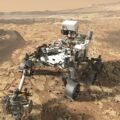
That period of Mars’ history stands out as its own distinct phase of geological activity, whereas changes were more gradual in the earlier Noachian Period. The Late Noachian/Early Hesperian saw intense valley network formation. Many of these valleys are deeply carved into the landscape, often cutting through older geological features. That suggests that the water flow was powerful and erosive. This fluvial activity also created large deposits of sediment, like the ones NASA’s Perseverance Rover is exploring in Jezero Crater.

Jezero Crater on Mars. Scientists think that the sediments in the crater may be one km deep. Image Credit: NASA/JPL-Caltech/ASU Jezero Crater on Mars. Scientists think that the sediments in the crater may be one km deep. Image Credit: NASA/JPL-Caltech/ASU

Buhler’s research is partly based on modern-day observations of Mars’ atmospheric CO2 and its cycles. Much of it is actually frozen and bound to the regolith. Mars’ rotational tilt shifts over a 100,000-year timeline. When it’s closer to straight up and down, the Sun hits the equator, and CO2 is released from the regolith into the atmosphere. It eventually reaches the poles, where it’s frozen into the caps.

When Mars is tilted, the poles are warmed, and the CO2 sublimates and is released into the atmosphere again. It eventually reaches the now-cooler regolith, which absorbs it. “The atmosphere is mostly just along for the ride,” Buhler said. “It acts as a conduit for the real action, which is the exchange between the regolith and the southern polar ice cap, even today.”

Buhler is still working with his model and intends to continue testing it more rigorously. If it successfully withstands more testing, our understanding of Mars will take a big leap forward.

The Story of Mars' Ancient Oceans | Space Documentary

{ https://www.universetoday.com/  }

Hoe vind je dit bericht?
Geschreven door peter om 18:41 Stuur door

Japan Launches the First Wooden Satellite to Space

An artist's illustration of the LignoSat satellite. Credit: Kyoto University

Japan Launches the First Wooden Satellite to Space

Space debris, which consists of pieces of spent rocket stages, satellites, and other objects launched into orbit since 1957 – is a growing concern. According to the ESA Space Debris Office, there are roughly 40,500 objects in LEO larger than 10 cm (3.9 inches) in diameter, an additional 1.1 million objects measuring 1 and 10 cm (0.39 to 3.9 inches) in diameter, and 130 million objects 1 mm to 1 cm (0.039 to 0.39 inches). The situation is projected to worsen as commercial space companies continue to deploy “mega-constellations” of satellites for research, telecommunications, and broadband internet services.

To address this situation, researchers from the University of Kyoto have developed the world’s first wooden satellite. Except for its electronic components, this small satellite (LingoSat) is manufactured from magnolia wood. According to a statement issued on Tuesday, November 5th, by the University of Kyoto’s Human Spaceology Center, the wooden satellite was successfully launched into orbit atop a SpaceX Falcon 9 rocket from NASA’s Kennedy Space Center in Florida. This satellite, the first in a planned series, is designed to mitigate space debris and prevent what is known as “Kessler Syndrome.”

In 1978, NASA scientists Donald J. Kessler and Burton G. Cour-Palais proposed a scenario in which the density of objects in Low Earth Orbit (LEO) would become high enough that collisions between objects would cause a cascade effect. This would lead to a vicious cycle in which collisions caused debris, which would make further collisions more likely, leading to more collisions and more debris (and so on). For decades, astronomers and space agencies have feared that we are approaching this point or will be shortly.

Animation of Kyoto University’s prototype wooden satellite in space. Credit: Kyoto University

By manufacturing satellites out of wood, the University of Kyoto scientists expect they will burn up when they re-enter Earth’s atmosphere at the end of their service. This will prevent potentially harmful metal particles from being generated when a retired satellite returns to Earth. The small satellite measures just 10 cm (4 in) on a side and weighs only 900 grams, making it one of the lightest satellites ever sent to space. Its name comes from the Latin word for wood (“lingo”) and CubeSat, a class of small satellites with a form factor of 10 cm cubes.

Before launch, the science team installed LingoSat in a special container prepared by the Japan Aerospace Exploration Agency (JAXA). According to a spokesperson for Sumitomo Forestry, LignoSat’s co-developer, the satellite will “arrive at the ISS soon and will be released to outer space about a month later.”

Once the satellite reaches the ISS, it will dock via the Kibo Japanese Experiment Module (JEM) before deployment. It will then spend the next six months in space, and data will be sent from the satellite to researchers who will monitor it for signs of strain. Ultimately, the goal is to determine if wooden satellites can withstand the extreme temperature changes and conditions in space. A second satellite, LingoSat 2, is a double-unit CubeSat currently scheduled for launch in 2026.

Further Reading: 

{ https://www.universetoday.com/  }

Hoe vind je dit bericht?
Geschreven door peter om 18:40 Stuur door

A Star Disappeared in Andromeda, Replaced by a Black Hole

This Illustration shows a failed supernova turning directly into a black hole without an explosion. Credit: NASA/ESA/P. Jeffries (STScI)

A Star Disappeared in Andromeda, Replaced by a Black Hole

Massive stars about eight times more massive than the Sun explode as supernovae at the end of their lives. The explosions, which leave behind a black hole or a neutron star, are so energetic they can outshine their host galaxies for months. However, astronomers appear to have spotted a massive star that skipped the explosion and turned directly into a black hole.

Stars are balancing acts between the outward force of fusion and the inward force of their own gravity. When a massive star enters its last evolutionary stages, it begins to run out of hydrogen, and its fusion weakens. The outward force from its fusion can no longer counteract the star’s powerful gravity, and the star collapses in on itself. The result is a supernova explosion, a calamitous event that destroys the star and leaves behind a black hole or a neutron star.

However, it appears that sometimes these stars fail to explode as supernovae and instead turn directly into black holes.

New research shows how one massive, hydrogen-depleted supergiant star in the Andromeda galaxy (M31) failed to detonate as a supernova. The research is “The disappearance of a massive star marking the birth of a black hole in M31.” The lead author is Kishalay De, a postdoctoral scholar at the Kavli Institute for Astrophysics and Space Research at MIT.

These types of supernovae are called core-collapse supernovae, also known as Type II. They’re relatively rare, with one occurring about every one hundred years in the Milky Way. Scientists are interested in supernovae because they are responsible for creating many of the heavy elements, and their shock waves can trigger star formation. They also create cosmic rays that can reach Earth.

This new research shows that we may not understand supernovae as well as we thought.

Artist's impression of a Type II supernova explosion. These supernovae explode when a massive star nears the end of its life and leaves behind either a black hole or a neutron star. But sometimes, the supernova fails to explode and collapses directly into a black hole. Image Credit: ESO

Artist’s impression of a Type II supernova explosion. These supernovae explode when a massive star nears the end of its life and leaves behind either a black hole or a neutron star. But sometimes, the supernova fails to explode and collapses directly into a black hole. Image Credit: ESO

The star in question is named M31-2014-DS1. Astronomers noticed it brightening in mid-infrared (MIR) in 2014. For one thousand days, its luminosity was constant. Then, for another thousand days between 2016 and 2019, it faded dramatically. It’s a variable star, but that can’t explain these fluctuations. In 2023, it was undetected in deep optical and near-IR (NIR) imaging observations.

The researchers say that the star was born with an initial mass of about 20 stellar masses and reached its terminal nuclear-burning phase with about 6.7 stellar masses. Their observations suggest that the star is surrounded by a recently ejected dust shell, in accordance with a supernova explosion, but there’s no evidence of an optical outburst.

“The dramatic and sustained fading of M31-2014-DS1 is exceptional in the landscape of variability in massive, evolved stars,” the authors write. “The sudden decline of luminosity in M31-2014-DS1 points to the cessation of nuclear burning together with a subsequent shock that fails to overcome the infalling material.” A supernova explosion is so powerful that it completely overcomes infalling material.

“Lacking any evidence for a luminous outburst at such proximity, the observations of M31-2014-DS1 bespeak signatures of a ‘failed’ SN that leads to the collapse of the stellar core,” the authors explain.

What could make a star fail to explode as a supernova, even if it’s the right mass to explode?

Supernovae are complex events. The density inside a collapsing core is so extreme that electrons are forced to combine with protons, creating both neutrons and neutrinos. This process is called neutronization, and it creates a powerful burst of neutrinos that carries about 10% of the star’s rest mass energy. The outburst is called a neutrino shock.

Neutrinos get their name from the fact that they’re electrically neutral and seldom interact with regular matter. Every second, about 400 billion neutrinos from our Sun pass right through every person on Earth. But in a dense stellar core, the neutrino density is so extreme that some of them deposit their energy into the surrounding stellar material. This heats the material, which generates a shock wave.

The neutrino shock always stalls, but sometimes it revives. When it revives, it drives an explosion and expels the outer layer of the supernova. If it’s not revived, the shock wave fails, and the star collapses and forms a black hole.

This image illustrates how the neutrino shock wave can stall, leading to a black hole without a supernova explosion. A shows the initial shock wave with cyan lines representing neutrinos being emitted and the red circle representing the shock wave propagating outward. B shows the neutrino shock stalling, with white arrows representing infalling matter. The outer layers fall inward, and the neutrino heating isn’t powerful enough to revive the shock. C shows the failed shock dissipating as a dotted red line and the stronger white arrows represent the collapse accelerating. The outer layers are falling in rapidly, and the core is becoming more compact. D shows the black hole forming, with the blue circle representing the event horizon and the remaining material forming an accretion disk. (Credit: Original illustration created for this article.)

In M31-2014-DS1, the neutrino shock was not revived. The researchers were able to constrain the amount of material ejected by the star, and it was far below what a supernovae would eject. “These constraints imply that the majority of stellar material (?5 solar masses) collapsed into the core, exceeding the maximum mass of a neutron star (NS) and forming a BH,” they conclude. About 98% of the star’s mass collapsed and created a black hole with about 6.5 solar masses.

M31-2014-DS1 isn’t the only failed supernova, or candidate failed supernova, that astronomers have found. They’re difficult to spot because they’re characterized by what doesn’t happen rather than what does. A supernova is hard to miss because it’s so bright and appears in the sky suddenly. Ancient astronomers recorded several of them.

In 2009, astronomers discovered the only other confirmed failed supernova. It was a supergiant red star in NGC 6946, the “Fireworks Galaxy.” It’s named N6946-BH1 and has about 25 solar masses. After disappearing from view, it left only a faint infrared glow. In 2009, its luminosity increased to a million solar luminosities, but by 2015, it had disappeared in optical light.

A survey with the Large Binocular Telescope monitored 27 nearby galaxies, looking for disappearing massive stars. The results suggest that between 20% and 30% of massive stars can end their lives as failed supernovae. However, M31-2014-DS1 and N6946-BH1 are the only confirmed observations.


SHOCKING Transformation: How a STAR Turns into a BLACK HOLE

We Just Found Neutron Stars Crashing Into Black Holes

{ https://www.universetoday.com/ }

Hoe vind je dit bericht?
Geschreven door peter om 18:39 Stuur door

US once considered a program to reverse-engineer alien spacecraft, Pentagon report reveals

US once considered a program to reverse-engineer alien spacecraft, Pentagon report reveals

But it never came to be, according to a new report.

Image captured through night-vision goggles shows unidentified flying object in night sky.
A Navy image captured in early 2022 off the East Coast shows an unidentified object in the night sky. | Defense Department handout
Hoe vind je dit bericht?
Geschreven door peter om 23:59 Stuur door

Pentagon UAP Report Says No Evidence U.S. Has Collected Exotic Technology, Kept Programs Hidden from Congress

Pentagon UAP Report Says No Evidence U.S. Has Collected Exotic ...

(R. Carvalho, Wikimedia Commons 2.0)

Pentagon UAP Report Says No Evidence U.S. Has Collected Exotic Technology, Kept Programs Hidden from Congress

A historical report issued by the Pentagon’s office tasked with the investigation of unidentified anomalous phenomena (UAP), commonly referred to as UFOs, says it found no evidence that sightings of mysterious aerial objects represent extraterrestrial technology, or that secret programs related to the recovery of crashed exotic vehicles have been hidden from Congress.

Released on Friday, the report is the first installment in a two-volume series produced by the Defense Department’s All-domain Anomaly Resolution Office (AARO) and explores the history of the U.S. government’s involvement in investigations of UAP under a requirement established in the fiscal year (FY) 2023 National Defense Authorization Act (NDAA).

“To date, AARO has not discovered any empirical evidence that any sighting of a UAP represented off-world technology or the existence a classified program that had not been properly reported to Congress,” the report said.

Citing investigations that revealed most sightings to result from the “misidentification of ordinary objects and phenomena,” the report acknowledged that “many UAP reports remain unsolved,” though adding that better data could lead to the resolution of some of the currently unresolved cases.

In advance of the report’s release, Tim Phillips, acting director of AARO on assignment from the Office of the Director of National Intelligence (ODNI), provided a briefing to a limited number of reporters on Wednesday, where he discussed the new report and revealed details about a new system called “Gremlin” designed to acquire real-time data on UAP. The Debrief did not participate in Wednesday’s media briefing.

Following the release of the report, Department of Defense spokesperson Sue Gough said in an email to The Debrief that “AARO reviewed all official USG investigatory efforts since 1945, researched classified and unclassified archives, conducted dozens of interviews and site visits, and partnered with the Intelligence Community and DoD officials responsible for special access program oversight.”

“AARO created a secure process in partnership with the highest-level security officials within the DoD, IC, and other organizations to research and investigate these claims,” Gough said. “AARO was granted full, unrestricted access by all organizations.”

Roswell Major Jesse Marcel poses with mysterious wreckage associated with the purported crash of a flying saucer near Roswell, New Mexico, in 1947. AARO’s recent historical report says the incident involved a once-secret U.S. covert operation called Project Mogul, as determined by the USAF in the 1990s (Public Domain).

Although there were notable exceptions, most media coverage of the new AARO report focused almost entirely on the lack of evidence linking UAP sightings to extraterrestrial technologies, as well as the absence of classified programs involved in the recovery of crashed vehicles of non-human origin.

Also commanding media attention had been revelations involving the existence of a proposed program pitched to the Department of Homeland Security in the 2010s under the codename “Kona Blue,” which involved a prospective reverse engineering program for any extraterrestrial technologies acquired by the U.S. government.

According to the AARO report, Kona Blue had been proposed by former members of a DIA program called the Advanced Aerospace Weapons Systems Application Program (AAWSAP), whose personnel are identified in the report as some of the main proponents behind ongoing assertions involving secret U.S. government UAP programs.

The report says that AARO investigators found no evidence that extraterrestrial craft or their occupants had ever been acquired by the U.S. military and that Kona Blue was ultimately rejected by DHS leadership due to a lack of merit.

Friday’s report was met with significant criticism online following its release, with many arguing that its findings were invalid, while others expressed skepticism over its assertions that no evidence of cover-ups involving crashed UAP retrieval programs had been found.

The report’s findings appear to run in stark contrast to whistleblower allegations that first received widespread public attention last June, involving an official complaint filed with the Intelligence Community Inspector General by David Grusch, a former U.S. intelligence officer whose duties included participation in the U.S. government’s investigations into UAP in recent years.

In January, Inspector General of the Intelligence Community Thomas Monheim spoke with members of the House Oversight and Accountability Committee during a classified briefing on UAP, with some who attended claiming it left them with more questions than answers regarding ongoing claims of secret programs and exotic technologies.

Following the release of AARO’s report on Friday, amidst all the attention surrounding what AARO investigators did or did not find, and programs that were proposed but never came to fruition, few mainstream outlets discussed the numerous intriguing allusions to legitimate advanced capabilities the U.S. possesses that are peppered throughout the report—many of which, in likelihood, actually have contributed to UAP sightings over the years.

These seemingly went unnoticed, as well as several factual errors that appear throughout the new report that, for some, potentially undermine the level of rigor AARO appears to have applied in its investigations.

Fact-Checking AARO’s Historical Report

Among the many mistakes that appear in the new report, one of the most glaring appears in references to the late Senate Majority Leader Harry Reid and his involvement in helping acquire funding for a controversial UAP investigative effort run out of the Defense Intelligence Agency in the early 2000s. The report refers to the Democrat Senator’s home state as being New Mexico, whereas Reid was a U.S. Senator from Nevada.

In another instance, a famous sighting reported by pilot Kenneth Arnold near Mount Rainer, Washington in the summer of 1947 is described as having taken place on “June 23,” one day earlier than Arnold’s sighting occurred.

The report similarly claims Arnold described the objects he observed as being “saucer-like aircraft”, although this now-famous characterization was only later applied by members of the media who, at the time, were referencing Arnold’s description of their movement resembling “saucers” skipping across water.

In yet another example, the AARO report repeatedly refers to a statistical analysis of sightings collected by the U.S. Air Force’s Project Blue Book conducted by the Battelle Memorial Institute as “Project BEAR,” which had, in fact, only been a nickname given to the program by Blue Book’s original director, Edward J. Ruppelt. The project’s actual name—one that has now been known publicly for decades—was Project STORK.

“The name Project BEAR was an intentionally false name made by Edward Ruppelt,” wrote Robert Powell, an Executive Board Member with the Scientific Coalition for UAP Studies, in a  posting on X, “so as not to reveal the true name of the project.”

Powell also noted that the recent AARO report seemingly misstated the date of the Battelle project as having been issued in late 1954, whereas the date on the folder in the Air Force’s Project Blue Book files indicates a date of May 5, 1955.

Beyond mere problems with dates, AARO’s report makes further assertions that Battelle’s study, the results of which were published in a report titled Project Blue Book Special Report #14, “concluded that all cases that had enough data were resolved and readily explainable.” Quite the contrary, the study actually found that among the UFO sightings categorized within a reliability group of reports deemed “Excellent,” only 4.2% had “insufficient info,” whereas 33.3% of these cases remained “Unknown.”

In a posting on X, Marik von Rennenkampf, an analyst who worked with the U.S. Department of State’s Bureau of International Security and Nonproliferation, called the error “Blatantly, demonstrably false.”

Intriguing Accounts and Unsolved Cases

Despite the number of factual errors that appear throughout the final AARO report, there are nonetheless a handful of intriguing references in it that appear to describe advanced U.S. technologies, although again, few of these have received significant attention in mainstream coverage.

In one example, which describes an individual’s account provided during an interview with AARO investigators, the report states that “AARO was able to correlate this account with an authentic USG program because the interviewee was able to provide a relatively precise time and location of the sighting which they observed exhibiting strange characteristics.”

Have Blue

Test flight during the 1970s of Lockheed’s then-secret Have Blue, the code name for its stealth fighter

(Public Domain).

AARO concluded the technology mistaken for being an exotic UAP technology by the unnamed witness correlated with DoD tests “of a platform protected by a [Special Access Program]” occurring at roughly the same time. “The seemingly strange characteristics reported by the interviewee match closely with the platform’s characteristics,” the AARO report’s authors state, “which was being tested at a military facility in the time frame the interviewee was there.”

“This program is not related in any way to the exploitation of off-world technology,” the report’s authors emphasize, offering no further details on the technology that is believed to have been mistaken for a test involving an exotic craft.

The report’s authors later add that “All the programs assessed to be authentic were or—if still active—continue to be, appropriately reported to either or both the congressional defense and intelligence committees.”

In another instance, material believed to have been retrieved from a UAP was subjected to analysis by the U.S. Army, with subsequent analysis conducted by AARO and “a leading science laboratory,” concluding that “the material is a metallic alloy, terrestrial in nature, and possibly of USAF origin, based on its materials characterization.”

Although most of AARO’s reported findings dismissed any verifiable connections to exotic craft or genuine unexplained phenomena, linking them instead to known U.S. government programs, there are a handful of incidents AARO said it was still investigating, which included a series of widely discussed UAP events that occurred at U.S. strategic sites during the 1960s and 1970s.

“AARO is researching U.S. and adversarial activity related to these events,” the report states, “including any U.S. programs that tested defensive ballistic missile capabilities.”

The report also maintains AARO’s past positions regarding the likelihood that prosaic explanations exist for the majority of UAP sightings, although its authors nonetheless acknowledge that there are still some cases the Pentagon’s UAP investigative office has been unable to solve.

“A small percentage of cases have potentially anomalous characteristics or concerning characteristics,” the report’s authors write. “AARO has kept Congress fully and currently informed of its findings. AARO’s research continues on these cases.”

A-12 Historic image of an A-12 test flight at Area 51 in 1962 (Public Domain).

Questions Of Access and Ongoing Problems

Last April, during a Senate Subcommittee on Emerging Threats and Capabilities hearing led by U.S. Senator Kirsten Gillibrand, Dr. Sean Kirkpatrick, then-Director of AARO, agreed when asked about AARO’s Title 50 accessibility by Senator Gillibrand that “having additional authorities for collection, tasking, counterintelligence… those are all things that would be helpful, yes.”

In the U.S., most activities conducted by the Intelligence Community, including covert action missions, foreign espionage, and other activities best suited for combating unconventional external threats, operate under what is known as Title 50 authority.

Although Dr. Kirkpatrick emphasized having “good relations” with other agencies during last April’s hearing, his statements gave the distinct impression that AARO had been operating solely under Title 10 authority for the duration of its mission at that time, which would seemingly place limitations on its ability to acquire information related to the Intelligence Community’s involvement with UAP investigations, including but not limited to exchanges of data and tasking collection assets.

Responding to questions from The Debrief, Pentagon spokesperson Susan Gough clarified that AARO does have access to U.S. intelligence information that falls under Title 50 authority.

“There is no impediment to AARO receiving all UAP-related information, past or present, regardless of level or origin of classification,” Gough told The Debrief. “By law, AARO may receive all UAP-related information, at all levels of classification, regardless of whether the original classification authority for such information is within DoD or the Intelligence Community.”

Although AARO does appear to have access to all the intelligence on UAP that it required, contrary to what was conveyed during last April’s Senate hearing, the Pentagon nonetheless continues to face challenges in its collection and management of information about UAP.

Earlier this year, an unclassified summary of a DoD Inspector General report evaluating the Pentagon’s activities related to UAP was released, which argued that the DoD lacks any comprehensive, coordinated means by which it can currently address UAP. The report further argued that the DoD’s apparent lack of coordination on the UAP issue could pose a threat to U.S. military forces and, more broadly, to national security.

“We determined that the DoD has no overarching UAP policy,” a portion of the DoD Inspector General report read, “and, as a result, it lacks assurance that national security and flight safety threats to the United States from UAP have been identified and mitigated.”

In a statement on Friday following the new AARO historical report’s release, Pentagon Press Secretary Major General Pat Ryder said the second volume of AARO’s historical review will be forthcoming later this year.

“AARO will publish a second volume that will provide analysis of information acquired by AARO after Nov. 1, 2023, including information received via interviews with current and former U.S. government personnel who contacted AARO via the secure reporting mechanism on AARO’s website,” Ryder said.

“Analyzing and understanding the historical record on UAP is an ongoing collaborative effort involving many departments and agencies, and the department thanks the contributing departments and agencies, as well as the interviewees who came forward with information,” Ryder added.

VIDEOS

NASA UFO report finds no evidence UAP have extraterrestrial origins | FULL

NASA UFO report finds no evidence of 'extraterrestrial origin' for UAP sightings

{ https://thedebrief.org/category/uap/ }

Hoe vind je dit bericht?
Geschreven door peter om 23:24 Stuur door

The egg or the chicken? An ancient unicellular says egg!

The egg or the chicken? An ancient unicellular says egg!

A cell division resembling that of an animal embryo has been observed in a prehistoric unicellular organism, suggesting that embryonic development might have existed prior to the evolution of animals.

A cell of the ichthyosporean C. perkinsii showing distinct signs of polarity, with clear cortical localization of the nucleus before the first cleavage. Microtubules are shown in magenta, DNA in blue, and the nuclear envelope in yellow. © DudinLab

Chromosphaera perkinsii is a single-celled species discovered in 2017 in marine sediments around Hawaii. The first signs of its presence on Earth have been dated at over a billion years, well before the appearance of the first animals. A team from the University of Geneva (UNIGE) has observed that this species forms multicellular structures that bear striking similarities to animal embryos. These observations suggest that the genetic programs responsible for embryonic development were already present before the emergence of animal life, or that C. perkinsii evolved independently to develop similar processes. Nature would therefore have possessed the genetic tools to “create eggs” long before it “invented chickens”. This study is published in the journal Nature.

The first life forms to appear on Earth were unicellular, i.e. composed of a single cell, such as yeast or bacteria. Later, animals - multicellular organisms - evolved, developing from a single cell, the egg cell, to form complex beings. This embryonic development follows precise stages that are remarkably similar between animal species and could date back to a period well before the appearance of animals. However, the transition from unicellular species to multicellular organisms is still very poorly understood.

These cells divide without growing any further, forming multicellular colonies resembling the early stages of animal embryonic development.

Recently appointed as an assistant professor at the Department of Biochemistry in the UNIGE Faculty of Science, and formerly an SNSF Ambizione researcher at EPFL, Omaya Dudin and his team have focused on Chromosphaera perkinsii, or C. perkinsii, an ancestral species of protist. This unicellular organism separated from the animal evolutionary line more than a billion years ago, offering valuable insight into the mechanisms that may have led to the transition to multicellularity.

By observing C. perkinsii, the scientists discovered that these cells, once they have reached their maximum size, divide without growing any further, forming multicellular colonies resembling the early stages of animal embryonic development. Unprecedentedly, these colonies persist for around a third of their life cycle and comprise at least two distinct cell types, a surprising phenomenon for this type of organism.

Images of the multicellular development of the ichthyosporean Chromosphaera perkinsii, a close cousin of animals. In red we can see the membranes and in blue the nuclei with their DNA. The image was obtained using expansion microscopy.

© O. Dudin, UNIGE

‘‘Although C. perkinsii is a unicellular species, this behaviour shows that multicellular coordination and differentiation processes are already present in the species, well before the first animals appeared on Earth’’, explains Omaya Dudin, who led this research.

Even more surprisingly, the way these cells divide and the three-dimensional structure they adopt are strikingly reminiscent of the early stages of embryonic development in animals. In collaboration with Dr John Burns (Bigelow Laboratory for Ocean Sciences), analysis of the genetic activity within these colonies revealed intriguing similarities with that observed in animal embryos, suggesting that the genetic programmes governing complex multicellular development were already present over a billion years ago.

Marine Olivetta, laboratory technician at the Department of Biochemistry in the UNIGE Faculty of Science and first author of the study, explains: “It’s fascinating, a species discovered very recently allows us to go back in time more than a billion years”. In fact, the study shows that either the principle of embryonic development existed before animals, or multicellular development mechanisms evolved separately in C. perkinsii.

This discovery could also shed new light on a long-standing scientific debate concerning 600 million-year-old fossils that resemble embryos, and could challenge certain traditional conceptions of multicellularity.

VIDEOS

What Came First? The Chicken Or The Egg?

Chicken or Egg Theory

{ https://www.unige.ch/ }

Hoe vind je dit bericht?
Geschreven door peter om 22:20 Stuur door

Wat kwam er eerst, de kip of het ei? Onderzoekers zeggen nu: het ei!

Wat kwam er eerst, de kip of het ei? Onderzoekers zeggen nu: het ei!

Kip-of-ei-954x603_1.jpg

In een prehistorisch eencellig organisme is een celdeling ontdekt die lijkt op die van een dierlijk embryo. En dat is interessant, want dit geeft aan dat embryonale ontwikkeling mogelijk al bestond voordat dieren zich ontwikkelden.

Al eeuwenlang vragen wetenschappers zich af wat er eerst was: de kip of het ei? Vorig jaar stelden onderzoekers nog dat het de kip was. Maar een nieuwe studie komt nu tot een andere conclusie. Volgens deze onderzoekers zijn er nu namelijk overtuigende aanwijzingen dat het ei toch echt het eerste was.

Eerste levensvormen
De eerste levensvormen op aarde waren eencellig, zoals gist of bacteriën. Later evolueerden dieren, meercellige organismen, die zich vanaf één cel, de eicel, ontwikkelden tot complexe wezens. Deze embryonale ontwikkeling verloopt in verschillende stadia die opvallende overeenkomsten vertonen tussen dierlijke soorten en mogelijk al stammen uit een tijd vóór de eerste dieren. De overgang van eencellige naar meercellige organismen wordt echter nog steeds niet volledig begrepen.

Chromosphaera perkinsii
In een nieuwe studie hebben onderzoekers de eencellige soort Chromosphaera perkinsii bestudeerd. C. perkinsii werd in 2017 gevonden in zeesedimenten rondom Hawaï en is een voorouderlijke soort van protisten. De eerste aanwijzingen voor het bestaan van deze soort op aarde gaan meer dan een miljard jaar terug, lang vóór de opkomst van de eerste dieren. Omdat dit eencellige organisme zich meer dan een miljard jaar geleden afsplitste van de dierlijke evolutielijn, verschaft het belangrijke inzichten in de processen die mogelijk geleid hebben tot de overgang naar meercelligheid. “Het is fascinerend dat een soort die pas recent is ontdekt, ons in staat stelt om meer dan een miljard jaar terug in de tijd te kijken”, zegt onderzoeksleider Marine Olivetta.

Multicellulaire structuren
Het onderzoek naar C. perkinsii leidt tot een opmerkelijke ontdekking. Zo ontdekten de wetenschappers dat de cellen, zodra ze hun maximale grootte hebben bereikt, zich delen zonder verder te groeien. Vervolgens vormen ze multicellulaire structuren. Opmerkelijk is dat deze structuren ongeveer een derde van hun levenscyclus intact blijven en minstens twee verschillende celtypen bevatten, wat een verrassend fenomeen is voor dit soort organisme. “Hoewel C. perkinsii een eencellige soort is, laat dit gedrag zien dat processen van multicellulaire coördinatie en differentiatie al aanwezig waren in deze soort, lang voordat de eerste dieren op aarde verschenen”, aldus onderzoeker Omaya Dudin.

Een cel van C. perkinsii laat duidelijke tekenen van polariteit zien, met de celkern aan de rand van de cel vóór de eerste celdeling. Microtubuli (dunne, buisvormige structuren die deel uitmaken van het cytoskelet van een cel) zijn in magenta weergegeven, het DNA in blauw en de kernmembraan in geel. Afbeelding: DudinLab

Dierlijke embryo’s
Nog verrassender is de manier waarop deze cellen zich delen en de driedimensionale structuur die ze aannemen. Dit lijkt namelijk sterk op de vroege stadia van de embryonale ontwikkeling bij dieren. De analyse van de genetische activiteit in deze structuren vertonen dus opvallende overeenkomsten met die in dierlijke embryo’s.

Afbeeldingen van de meercellige ontwikkeling van Chromosphaera perkinsii, die sterk lijkt op de ontwikkeling van dierlijke embryo’s. De membranen zijn rood en de celkernen met hun DNA zijn blauw. Afbeelding: O. Dudin, UNIGE

Het ei
Deze waarnemingen wijzen op twee mogelijke verklaringen: ofwel de genetische programma’s voor embryonale ontwikkeling bestonden al vóór de opkomst van dieren, of C. perkinsii ontwikkelde zich onafhankelijk om vergelijkbare processen te vertonen. Dit zou betekenen dat de natuur al de genetische middelen had om ‘eieren te maken’ lang voordat het ‘kippen uitvond’.

Inzicht
Vergeet dus de kip, want mogelijk was toch het ei er het eerste. Deze ontdekking zou overigens ook nieuwe inzichten kunnen bieden in een ander langlopend wetenschappelijk debat over fossielen van 600 miljoen jaar oud die op embryo’s lijken. Bovendien zou het sommige traditionele ideeën over meercelligheid kunnen uitdagen.

Al met al werpt de studie, gepubliceerd in Nature, nieuwe perspectieven op de overgang van eencellige naar meercellige organismen en kan de manier waarop we de evolutie van multicellulaire levensvormen begrijpen, fundamenteel veranderen. De studie daagt ook traditionele opvattingen uit over de oorsprong van embryonale ontwikkeling en biedt stof tot nadenken over de evolutie van multicellulaire organismen als geheel.

Bronmateriaal

{ https://scientias.nl/ }

Hoe vind je dit bericht?
Geschreven door peter om 22:06 Stuur door

Aliens are 'two billion years more advanced than us – they come and go from Earth'

Aliens are 'two billion years more advanced than us – they come and go from Earth'

Sheehan claimed that 'strange phenomenons' on Earth are taking place such as humans expressing telepathic skills, teleportation, astral travel and remote viewing . . . which extraterrestrial are believed to be able to do

Danny Sheehan loves a good alien claim

Danny Sheehan loves a good alien claim 

(Image: Jesse Michels/YouTube)

Aliens are two billions years more advanced – both technologically and psychically – than humans, an alien-loving lawyer has claimed. Danny Sheehan has been involved in bringing UFO whistleblowers to the United States Congress in recent years.

He has been helping to provide explosive evidence of alleged government cover-ups regarding real encounters with extraterrestrial beings. And after making series of bombshell claims regarding the potential locations of two bases with hundreds of UFOs seen going “in and out of it”, and that aliens are stealing human eggs and sperm, he has now returned with another one.

Sheehan, speaking to Jesse Michels on his YouTube channel, divulged more details about just how advanced aliens are compared to the human race . . . despite the fact we still appear able to stop them as he has previously claimed before.

He claimed that aliens are 'two billion years' more advanced than humans

He claimed that aliens are 'two billion years' more advanced than humans

(Image: Getty Images)

He said: “They are two billion years more technologically advanced than we are and they happen to have figured how to come and go from our planet.”

Sheehan also claimed there are other “strange phenomenons” going on on Earth, such as humans expressing telepathic skills, teleportation, astral travel and remote viewing . . . all of which extraterrestrial beings are believed to be able to do. He claimed humans have turned people who are said to have done these things into religious figures – like “Jesus Christ or Buddah”.

The truth is somewhere, maybe
The truth is somewhere, maybe  (Image: Getty Images/iStockphoto)
Read More

“Therefore, there's something super non-human about them, they're spiritual, they're from some other domain somewhere – that's not true. What they are is mutations of our human family and as that faculty is evolving, some humans are more fully evolved than others and that attracts attention.

“This is another element that really intelligent thinking, careful people who are not ignorant are interested in.”

And when asked if this is the “source code” of religion, he replied: “Yes, there's no doubt about it.”

VIDEOS

Why Scientists Think Aliens Have ALREADY Visited Earth

Alien Life: Will We Know It When We See It?

{ https://www.dailystar.co.uk/ }

Hoe vind je dit bericht?
Geschreven door peter om 21:42 Stuur door

Scientists Have Discovered a “Lost” Mayan Megacity, Complete With Hidden Pyramids

Scientists Have Discovered a “Lost” Mayan Megacity, Complete With Hidden Pyramids

Hidden Mayan Temple

Using lidar technology, Tulane University researchers have uncovered thousands of unexplored Maya structures, including a large city with pyramids, reshaping our understanding of Maya civilization’s vastness. (Artists’s concept).

Tulane researchers uncovered over 6,500 Maya structures in Mexico using lidar, revealing a complex settlement landscape and challenging previous assumptions about the Maya civilization’s urban and rural distribution.

Tulane University researchers have used laser-guided imaging to peer through dense jungle forests, revealing vast unexplored Maya settlements in Mexico and a better understanding of the ancient civilization’s extent and complexity.

The new research, published in the journal Antiquity, was led by Tulane University anthropology doctoral student Luke Auld-Thomas and his advisor, Professor Marcello A. Canuto.

The team used lidar, a laser-based detection system, to survey 50 square miles of land in Campeche, Mexico, an area largely overlooked by archaeologists. Their findings included evidence of more than 6,500 pre-Hispanic structures, including a previously unknown large city complete with iconic stone pyramids.

Maya Infrastructure

Lidar technology has allowed scientists to survey large swaths of land from the comfort of a computer lab, uncovering anomalies in the landscape that often prove to be pyramids, family houses, and other examples of Maya infrastructure.

Credit: Marcello Canuto

Surprising Discoveries and Varied Settlements

“Our analysis not only revealed a picture of a region that was dense with settlements, but it also revealed a lot of variability,” said Auld-Thomas, a doctoral student in Tulane’s Anthropology Department and instructor at Northern Arizona University. “We didn’t just find rural areas and smaller settlements. We also found a large city with pyramids right next to the area’s only highway, near a town where people have been actively farming among the ruins for years. The government never knew about it; the scientific community never knew about it. That really puts an exclamation point behind the statement that, no, we have not found everything, and yes, there’s a lot more to be discovered.”

The Middle American Research Institute (MARI) at Tulane University has been pioneering the use of lidar technology in archaeological research. Over the past decade, the MARI has built a state-of-the-art Geographic Information Systems (GIS) lab, managed by Francisco Estrada-Belli, to analyze remote sensing data, such as lidar.

Lidar Ancient Maya Buildings

Ancient buildings clustered on a hilltop are revealed by a narrow transect of lidar survey data. Lidar technology uses laser pulses to measure distances and create 3D models of specific areas.

Credit: Luke Auld-Thomas

Lidar technology uses laser pulses to measure distances and create three-dimensional models of specific areas. It has allowed scientists to scan large swaths of land from the comfort of a computer lab, uncovering anomalies in the landscape that often prove to be pyramids, family houses, and other examples of Maya infrastructure.

“Thanks to generous funding from the Hitz Foundation, MARI has been at the forefront of the use of lidar technology in archaeological research over the past decade,” said Canuto, director of the MARI. “Now our efforts are expanding from data analysis to data collection and acquisition. The work conducted on these data from Campeche represents how MARI’s ‘lidar footprint’ is expanding.”

Implications for Understanding Maya Population and Settlement Patterns

This research may also help resolve ongoing debates about the true extent of Maya settlements.

“Because lidar allows us to map large areas very quickly, and at really high precision and levels of detail, that made us react, ‘Oh wow, there are so many buildings out there we didn’t know about, the population must have been huge,’” Auld-Thomas said. “The counterargument was that lidar surveys were still too tethered to known, large sites, such as Tikal, and therefore had developed a distorted image of the Maya lowlands. What if the rest of the Maya area was far more rural and what we had mapped so far was the exception instead of the rule?”

The study highlights the transformative power of lidar technology in unveiling the secrets of ancient civilizations. It also provides compelling evidence of a more complex and varied Maya landscape than previously thought.

“Lidar is teaching us that, like many other ancient civilizations, the lowland Maya built a diverse tapestry of towns and communities over their tropical landscape,” Canuto said. “While some areas are replete with vast agricultural patches and dense populations, others have only small communities. Nonetheless, we can now see how much the ancient Maya changed their environment to support a long-lived complex society.”

Reference:

  • “Running out of empty space: environmental lidar and the crowded ancient landscape of Campeche, Mexico” by Luke Auld-Thomas, Marcello A. Canuto, Adriana Velázquez Morlet, Francisco Estrada-Belli, David Chatelain, Diego Matadamas, Michelle Pigott and Juan Carlos Fernández Díaz, 29 October 2024, Antiquity.
    DOI: 10.15184/aqy.2024.148

Student accidentally uncovers lost Mayan city hidden in Mexico’s jungle | ABC News

Ancient Mayan city discovered in Mexico jungle by accident | BBC News

{ https://scitechdaily.com/ }

Hoe vind je dit bericht?
Geschreven door peter om 21:12 Stuur door

Laser Mapping Reveals Previously Unknown Maya City with Stone Pyramids in Mexico

Laser Mapping Reveals Previously Unknown Maya City with Stone Pyramids in Mexico

Using a laser-based detection system, archaeologists have discovered over 6,500 pre-Hispanic structures — including a previously unknown Maya city named Valeriana — in Campeche, Mexico.

Detail of the major site of Valeriana in Campeche, Mexico. Image credit: Auld-Thomas et al., doi: 10.15184/aqy.2024.148.

Detail of the major site of Valeriana in Campeche, Mexico.

Image credit: Auld-Thomas et al., doi: 10.15184/aqy.2024.148.

“Our analysis not only revealed a picture of a region that was dense with settlements, but it also revealed a lot of variability,” said Luke Auld-Thomas, a doctoral student at Tulane University and instructor at Northern Arizona University.

“We didn’t just find rural areas and smaller settlements. We also found a large city with pyramids right next to the area’s only highway, near a town where people have been actively farming among the ruins for years.”

“The government never knew about it; the scientific community never knew about it.”

“That really puts an exclamation point behind the statement that, no, we have not found everything, and yes, there’s a lot more to be discovered.”

Lidar technology uses laser pulses to measure distances and to create 3D models of specific areas.

It has allowed the scientists to scan large swaths of land from the comfort of a computer lab, uncovering anomalies in the landscape that often prove to be pyramids, family houses and other examples Maya infrastructure.

“Because lidar allows us to map large areas very quickly, and at really high precision and levels of detail, that made us react, ‘Oh wow, there are so many buildings out there we didn’t know about, the population must have been huge’,” Auld-Thomas said.

“The counterargument was that lidar surveys were still too tethered to known, large sites, such as Tikal, and therefore had developed a distorted image of the Maya lowlands.”

“What if the rest of the Maya area was far more rural and what we had mapped so far was the exception instead of the rule?”

The team’s results provide compelling evidence of a more complex and varied Maya landscape than previously thought.

“Lidar is teaching us that, like many other ancient civilizations, the lowland Maya built a diverse tapestry of towns and communities over their tropical landscape,” said Tulane University’s Professor Marcello Canuto.

“While some areas are replete with vast agricultural patches and dense populations, others have only small communities.”

“Nonetheless, we can now see how much the ancient Maya changed their environment to support a long-lived complex society.”

  • A paper on the findings was published on October 29, 2024 in the journal Antiquity.
  • Luke Auld-Thomas et al. 2024. Running out of empty space: environmental lidar and the crowded ancient landscape of Campeche, Mexico. Antiquity 98 (401): 1340-1358; doi: 10.15184/aqy.2024.148

{ https://www.sci.news/ }

Hoe vind je dit bericht?
Geschreven door peter om 20:54 Stuur door

Erich Von Däniken Changed NASA Engineer Mind, Convincing Him To Consider Ezekiel Vision As Alien Spacecraft

Ezekiel wheel

Erich Von Däniken Changed NASA Engineer Mind, Convincing Him To Consider Ezekiel Vision As Alien Spacecraft

What did Ezekiel actually see? The story of the prophet Ezekiel is one of the more fascinating, especially when looked at through the lens of modern technology. Some people suggest that, instead of gods, ancient humans may have actually been visited by an advanced race. This idea, called the ancient astronaut theory, suggests that Ezekiel’s “vision” of a wheeled chariot, or Merkabah, could actually have been a spaceship from an advanced species.

One of the biggest supporters of this theory is Erich von Däniken. He argues that the Book of Ezekiel could be understood differently in this light, so much so that his ideas even changed the view of a NASA scientist who originally set out to disprove them.

Erich von Däniken, a Swiss author famous for his “ancient astronaut” theories (particularly in his book Chariots of the Gods), met Josef F. Blumrich, a NASA engineer. The meeting is said to have occurred in the 1970s, where von Däniken presented his idea that Ezekiel’s vision in the Bible might have been a description of an alien spacecraft rather than a divine chariot.

Erich von Däniken Erich von Däniken

Blumrich, at the time, was skeptical of von Däniken’s theories. Initially, he sought to disprove them, thinking they were absurd. However, after investigating Ezekiel’s vision in more detail, Blumrich began to change his mind. He wrote a book called “The Spaceships of Ezekiel,” where he argued that Ezekiel’s vision could indeed describe an advanced spacecraft, specifically suggesting that the “wheels within wheels” might represent a form of advanced technology.

Blumrich went on to patent a design for an omnidirectional wheel, which he claimed was inspired by his interpretation of Ezekiel’s description. This was part of his attempt to demonstrate how Ezekiel might have described advanced, though hypothetical, technology.

Ezekiel is a key figure in Judaism and prominent in other Abrahamic biblical texts. Ezekiel was brought to Babylon in the first captivity of Israel and is described as a prophet.

One of the interesting characteristics of The Book of Ezekiel as a biblical text is that it is written using the pronoun, I, clearly showing it being written by Ezekiel himself as a first-person account, unlike many biblical texts written in the third person. This seems to lend a little more credit and personality to the story as it is told shortly after its occurrence.

The Flying Wheeled Chariot

“4 I looked, and I saw a windstorm coming out of the north—an immense cloud with flashing lightning and surrounded by brilliant light. The center of the fire looked like glowing metal, 5 and in the fire was what looked like four living creatures. In appearance their form was human, 6 but each of them had four faces and four wings. 7 Their legs were straight; their feet were like those of a calf and gleamed like burnished bronze. 8 Under their wings on their four sides they had human hands. All four of them had faces and wings, 9 and the wings of one touched the wings of another. Each one went straight ahead; they did not turn as they moved.” – Ezekiel 1

Ezekiel talks about seeing a chariot with wheels come down from the sky, driven by beings that looked like humans. While many versions of the Bible say this being on the chariot is God, von Däniken notes that the original Hebrew text doesn’t mention God; the word was added later.

Ezekiel wheel

Ezekiel wheel illustration.

Ezekiel’s description of the chariot landing sounds a lot like how a spacecraft might land. The strong wind, lightning, and bright lights are similar to what you might see when a spaceship lands, stirring up dust in a way no one from that time had ever seen. Ezekiel even says the fire powering the chariot looked like ‘glowing metal.’

There is a clear difference between this description and how Ezekiel’s vision is usually shown in Bible artwork. Many pictures leave out important details like the fire, the wheels that move in all directions, and the crystal dome around the heads of human-like beings.

The Four Living Creatures

“15 As I looked at the living creatures, I saw a wheel on the ground beside each creature with its four faces. 16 This was the appearance and structure of the wheels: They sparkled like topaz, and all four looked alike. Each appeared to be made like a wheel intersecting a wheel. 17 As they moved, they would go in any one of the four directions the creatures faced; the wheels did not change direction as the creatures went. 18 Their rims were high and awesome, and all four rims were full of eyes all around… 22 Spread out above the heads of the living creatures was what looked something like a vault, sparkling like crystal, and awesome.” – Ezekiel 1

Many people think the four creatures are cherubim or angel-like beings, especially in ancient Jewish (Genesis 3:24 ) and Christian (Exodus 25:18-20) texts. These creatures, looking like humans, are believed by some to be aliens who take Ezekiel in their UFO to a ‘temple’ on top of a mountain. During the journey, Ezekiel says he felt God’s hand on him, which could be understood as the strong forces of gravity or g-forces when the UFO lifts off. He is brought to their ‘temple,’ possibly a place or city where they live.

In many biblical stories, the Ark of the Covenant is an important object for von Däniken’s theory. He believes its mention in the Kebra Nagast, an Ethiopian Christian story about King Solomon, is the most significant. In this story, it’s said that King Solomon had flying machines not mentioned in the Bible, as well as the famous Ark.

The texts suggest people were afraid of the Ark because it killed those who came too close. Could it have been radioactive or electrically charged? Was it like a plutonium reactor?

Erich Von Däniken thinks there are other Bible verses that support his ancient astronaut theory. Some hint at places for spacecraft to land, similar to the one Ezekiel visited. One such place is the Chavin de Huantar temple in Peru, located high up on a mountain from an unknown culture.

Read also:

The temple has winged figures and sculpted heads that look like they’re wearing helmets. Von Däniken believes these might be similar to the ones Ezekiel described. Could this be real evidence of an ancient UFO sighting, or just an imaginative idea?

Missouri Republican Eric Burlison attended a secret briefing on UFOs 10 months ago, but he says it hasn’t changed his beliefs. “There’s nothing that’s been said that’s changed my worldview,” he stated. He trusts the people who spoke about UFOs publicly but thinks there might be more to the story.

Burlison has suggested that UFOs could be angels sent by God. In an interview on “That UFO Podcast,” he explained that by “angels,” he means beings from other dimensions. He said, “They may not fit exactly the Biblical narrative, but whenever I use the term ‘angels,’ to me, it’s synonymous with an extradimensional being.”

On the podcast, Burlison also shared his views on different UFO theories, mentioning a report by UFO whistleblower David Grusch. Grusch claimed that the government secretly recovered alien spacecraft, with dead “pilots” inside. Burlison pointed to one theory in the report: the idea that these beings could exist in higher dimensions beyond our usual understanding of space and time. (Source)

He used an example of living on a flat surface and suddenly encountering a 3D object to explain higher-dimensional beings. In this case, he suggested that we live in a 3D world but could be dealing with beings from a dimension beyond ours, where distance doesn’t work the same way.

Burlison is doubtful about aliens traveling from distant planets to visit Earth, given the vast distances involved. He questioned why an advanced alien race would come so far only to crash on Earth. Instead, he thinks it’s more likely that these beings are extradimensional.

He added that religious texts, including the Bible, talk about God’s messengers or angels existing in higher dimensions. While Burlison acknowledges the visual evidence and pilots’ testimonies about UFOs, he thinks the explanation might not be as exciting as people hope. In his view, these sightings might be new propulsion technology being developed on Earth.

To make his point, he mentioned the discovery of the Higgs boson particle about ten years ago, which relates to gravity. Just as the nuclear bomb was developed after the discovery of nuclear fission, Burlison thinks scientists may be using the Higgs field to create new technology, possibly for advanced propulsion.

He’s not alone in connecting UFOs with religious ideas. Representative Tim Burchett has also said that UFOs are in the Bible, specifically referring to the book of Ezekiel. In Ezekiel 1:4-28, a vision describes an “immense cloud with flashing lightning,” “four living creatures” with human-like forms but with four faces and wings, and wheels that moved with them, which Burchett linked to UFOs.


Erich von Daniken – Ancient Records Point to this one FACT: Our Ancient Gods Were Astronauts

Erich von Daniken Mind Boggling Discoveries From All Around the Globe

{ https://howandwhys.com/ }

Hoe vind je dit bericht?
Geschreven door peter om 20:51 Stuur door

Archons: Cosmic Manipulators Shaping Humanity’s Reality

Archons: Cosmic Manipulators Shaping Humanity’s Reality

Throughout history, the existence of cosmic entities influencing the affairs of humankind has been a recurring theme across cultures. Among these are the Archons—a mysterious alien race described in ancient texts and expounded upon by modern thinkers like John Lash and David Icke. According to Lash and Icke, these entities are not only real but deeply entrenched in manipulating humanity, influencing our perceptions, and controlling human souls. Lash, a scholar of Gnosticism, and Icke, an author and theorist, delve into the mechanisms by which these beings exert their power, describing them as masterful manipulators of reality who use illusion to keep humanity under control.

The Origins of the Archons in Gnostic Texts

The concept of the Archons finds its roots in ancient Gnostic writings, particularly the Nag Hammadi texts discovered in 1945. In these documents, the Archons are depicted as malevolent entities that arose during the creation of the solar system. According to Lash, Gnostic seers—ancient shamans and spiritual teachers—observed that the Archons were an inorganic species that emerged alongside the formation of the cosmos. Unlike organic life on Earth, the Archons are thought to be beings of a lower, “inorganic” realm that possess limited creative abilities but excel in imitation and deception. This distinction places them as beings “of the solar system but not of the Earth,” a cosmic presence that exists on the fringes of human experience.

Cosmic Puppeteers and the Power of Illusion

One of the Archons’ defining traits, as described by Lash, is their ability to create illusions and distort human perception. They use a power that Gnostic texts term Hal, or simulation. Through this, the Archons can implant false realities and manipulate our beliefs, steering human thought and emotion in directions that feed their agenda. This aligns with Icke’s idea of a “holographic internet” through which entities can manipulate human perception by broadcasting frequencies that influence the mind. Both Lash and Icke argue that these manipulative powers are especially potent in moments of fear and division, which the Archons exploit to maintain control over humanity.

VIDEO:

  • Alien Race Archon Is Not What You Think | Alien & UFO Ancient Mystery by COAST TO COAST AM OFFICIAL


Alien Race Archon Is Not What You Think | Alien & UFO Ancient Mystery

Lash explains that Archons are envious of humanity’s creative spark, emotional depth, and evolutionary potential. This envy drives them to intrude upon the human psyche, feeding off the energy of fear, chaos, and confusion. Gnostic texts even go so far as to describe the Archons as engaging in psychic intrusion and inducing experiences akin to modern-day abduction narratives. By generating fear and confusion, the Archons maintain their hold on human consciousness, effectively preventing humanity from achieving higher awareness and self-realization.

The Archons as Cosmic Engineers

In addition to their role as manipulators, the Archons are also portrayed as engineers of the physical universe. Lash interprets the ancient Gnostic texts as suggesting that the Archons are somewhat like “cosmic technicians,” beings who sustain the inorganic structures of the solar system. They lack the vitality of organic life and cannot thrive in the biosphere of Earth, but they inhabit and influence the outer realms. This alien nature makes them capable of extensive mental intrusion but limits their physical interactions with humanity. They operate primarily through telepathic influence, distorting human perception from a distance.

A Dual Reality: Manipulation of the Five-Sense World

According to Icke, humanity lives in a “five-sense prison,” where the material world is a narrow bandwidth within a much larger, multidimensional reality. He posits that the Archons manipulate this limited reality by controlling the flow of information and perception through external systems like the media, education, and societal structures. These entities, Icke asserts, operate from a frequency just beyond visible light, presenting themselves as human but possessing a distinctly different form in realms beyond our perception.

This “illusory” nature of reality is key to understanding how the Archons control humanity. By manipulating beliefs and perceptions, they create a false sense of limitation, preventing people from realizing their true potential as infinite, interconnected beings. Icke refers to this as a “holographic internet” where our beliefs and perceptions are shaped by outside influences that keep us within a narrow understanding of reality.

Overcoming Archonic Control: Awareness as Liberation

Both Lash and Icke emphasize the importance of awareness and self-realization as a means to break free from Archonic control. Recognizing the influence of the Archons allows humanity to regain autonomy over the mind and spirit, stepping out of the cycle of fear and illusion. Lash believes that the Gnostic texts were preserved as a warning and a guide for humanity to recognize these intrusions and to consciously resist their influence.

For Icke, understanding that reality is fundamentally illusory and manipulated is the first step toward liberation. He argues that by embracing our true identity as expressions of infinite consciousness, we can transcend the Archonic influence and reshape our reality. This shift in perspective allows us to see beyond the limitations imposed by external forces, enabling humanity to reconnect with its divine potential.

The Ancient Knowledge for Modern Times

The insights of Lash and Icke provide a framework for understanding how unseen forces may influence human behavior and beliefs. By examining the ancient teachings of Gnosticism alongside modern theories of consciousness and perception, they offer a pathway to liberation from cosmic entities that seek to control the human experience. Ultimately, exploring the Archons serves as a reminder that humanity’s greatest power lies in self-awareness, resilience, and the pursuit of truth beyond ordinary awareness.

{ https://www.latest-ufo-sightings.net/ }

Hoe vind je dit bericht?
Geschreven door peter om 20:45 Stuur door

Breaking News: Elon Musk Takes on Unidentified Flying Objects with New Fighter Jet

Breaking News: Elon Musk Takes on Unidentified Flying Objects with New Fighter Jet

Breaking News: Elon Musk Takes on Unidentified Flying Objects with New Fighter Jet

In a surprising and unparalleled move, Elon Musk, the visionary entrepreneur known for pushing the boundary of technology, has set his sights on a new endeavor: the development of a combat aircraft specifically designed to engage unidentified flying objects (UFOs).

Musk vs. The Extraterrestrial Unknown

Musk’s cutting-edge company, SpaceX, is already notorious for its exploration in the realms of space travel. Now, Musk seems intent on venturing into a domain that perhaps even the boldest of us dare not tread. He’s declared an open war on UFOs, not with words, but with raw technical prowess.

The Battle Begins: Musk’s UFO Fighter Jet

The fighter jet, currently under wraps, promises to pack the most advanced and modern technology, supplemented by Musk’s signature ingenious design. Reports suggest a mix of radars, detection systems, and energy weapons with never-seen-before capabilities, all aimed at identifying and neutralizing any potential extraterrestrial threat.

While the exact capabilities of this jet remain a mystery, we know for certain that it will capitalize on Musk’s notable experience with groundbreaking propulsion systems and high-end spacecraft technology from previous SpaceX projects.

Unveiling a New Era of Defence

The creation of such a craft brings thrilling implications. Could we be on the cusp of a new era of defense, one that doesn’t stop at skyscrapers or aircraft carriers, but ventures into space?

As the UFO fighter jet project rolls forward, we hold our breath, waiting to see how Elon Musk, the maverick game-changer, changes yet another game. The question remains just how far into the stars this battle will take him, and likewise, the world. See how our future will pan out as we step boldly into an era of extraterrestrial warfare.

UFO Defense: A New Frontier or Pure Foolhardiness?

Elon Musk: A man against the universe?

Elon Musk, the vanguard trailblazer immortalized for his ventures in cutting-edge technology, has shattered expectations once more. His new target: Unidentified Flying Objects (UFOs). Musk proposes to launch a combat aircraft specifically geared towards subduing these unknown airborne phenomena. But how might this audacious project alter our world and beyond?

The Future Fighter: Challenging the Cosmic Unknown

Reputed tech titan SpaceX, helmed by Musk, is drawing from its substantial knowledge pool to develop the UFO combat jet. Equipped with pioneering radars, new-age detection systems, and unprecedented energy weapons, the planned aircraft appears a formidable force. But with no technical specifics currently available, judgments about the aircraft’s efficacy remain purely speculative.

The Broader Impact: A New Stage in Defense Development?

Given Musk’s track record, a successful UFO defense jet could legitimately usher in a novel era in defense technology. Herein lies the potential to radically transform not just our earthbound defense systems, but potentially set the guideline for pre-emptive cosmic defense.

The Flip Side: Sowing Seeds of Alien Hostility?

Contrarily, some pose the argument that endeavoring into combat-ready space exploration, particularly against unidentified cosmic entities, might incite aggression rather than promote universal peace. Are we dialing up any existing possibility for extraterrestrial hostility?

In conclusion, Musk’s new project may hold thrilling possibilities, yet with them comes an inherent risk. Much like the unexplored cosmos themselves. Peek into our future, potentially a new era of interstellar defense or cosmic controversy? We shall wait with bated breath to find the answer.

Interested in more innovative tech news? Visit the SpaceX main site.

Hoe vind je dit bericht?
Geschreven door peter om 20:07 Stuur door

Journalist Reveals Clues to Location of Huge Buried Alien Spacecraft: It can be Stormed like Area 51

Ross Coulthart on Huge buried alien spacecraft

Journalist Reveals Clues to Location of Huge Buried Alien Spacecraft: It can be Stormed like Area 51

In the past 90 years, UFO sightings have been reported countless times. However, it was only since 2017 that the world began to take the UAP (Unidentified Aerial Phenomena) seriously. From dismissing UFOs as hoaxes to conducting UAP hearings, many things have changed regarding this subject. The United States and other world governments have started treating this matter seriously, and NASA has even established a division to study these phenomena. Interestingly, there is a massive UFO buried on Earth, hidden from the public eye.

Before the 2023 Congressional UAP hearings, on the Jay Anderson show “Project Unity,” award-winning investigative journalist Ross Coulthart dropped a bomb. He revealed that there exists a huge UFO in the possession of the United States that cannot be moved, and he knows the location of the craft. Ross mentioned the existence of non-human intelligence engaging with Earth for a long time and the recovery of certain objects, but he could not disclose specific details due to concerns about revealing advanced technologies.

In the interview, Coulthart discussed the potential implications of the new US Senate intelligence bill. He mentions Douglas Dean Johnson’s writings about the bill, which apparently requires holders of non-earth origin or exotic UAP (Unidentified Aerial Phenomena) material to make it available to the All Domain Anomaly Resolution Office (AARO) within six months.

Anderson raises a concern that this six-month window could give those holding such materials enough time to hide or conceal them. Ross acknowledged the possibility but suggested that some of the UAP materials could be so large that they cannot be easily moved. He mentions the existence of a building constructed over such a massive object in a foreign country, which may sound preposterous to some.

“Okay, people are going to question what I’m about to say. What if some of that [__] is so big it can’t be moved?. [They are] so big they built a building over it in a country outside of the United States of America. I know that sounds preposterous, and I know, oh my God, you can just hear them now, the bleeding debunkers. Let’s see this investigated. Let’s just see what happens. Let’s test these allegations before Congress,” Ross said.

He highlighted the importance of considering the implications if some of the claims, such as those made by David Grush, turn out to be true. He specifically mentions the idea that certain objects might be too large to be moved, which Anderson finds astonishing. Coulthart revealed to Anderson that he shared this information for the first time in the interview.

Further, at the end of his interview, Coulthart claims that he knows the exact location of this gigantic UFO. He is sure that this information would come out one day.

“It’s really interesting because it’s absolutely gobsmacking that it’s being kept as a secret. Imagine having an object that’s so big, it’s just not conceivable to move it. I thought it was bollocks when I heard it too, and most people listening to this will, anyway. But yeah, I mean, again, just an allegation, but one that I’m, you know, assured should be taken seriously and hopefully will be investigated by Congress. Because, again, where did the money come from? What’s that money accounted for? The continued security and control of such an object for many decades. Who’s paid for that? What programs have paid for that? Has that been disclosed to taxpayers? This is gonna be a really fun inquiry if Congress starts doing its…”

In a recent episode of “The UFO Podcast,” host Andy engaged in a thought-provoking conversation with Ross. The discussion centered around the secrecy surrounding UFO sightings and government knowledge. Ross, who has deep insights into the matter, shared his perspective on why certain details remain undisclosed.

Andy began by addressing a critical question that’s been on the minds of many UFO enthusiasts: the location of the mysterious craft. He asked Ross whether he could reveal where the craft was being held.

Ross responded: “Let me tell you, I can’t tell you the country it’s in; it’s not America. But what I can tell you is that the place where it is kept is used for another purpose that is a laudatory purpose that’s as much in your interests in your country in the UK as it is in mine in Australia and as it is in America. The simple reasons are that there are other uses for the place where this object is stored, and we could end up with a storm Area 51 type scenario if you came out and announced it.”

Ross went on to explain the potential consequences of revealing such information, including international incidents and threats to the safety of personnel at the facilities. He also emphasized the importance of protecting sources, drawing on his experience as a journalist dealing with sensitive intelligence:

Ross Coulthart: “I don’t want the personnel in those facilities to be hurt, and it could create an international incident. I mean, it’s up to the US to make a judgment about it. So many people privately know what’s going on. What’s going on is pretty bloody horrifying and confronting and outrageous. I know the White House knows about it.”

Ross further says “I’ve been in situations where I’ve known the identities of active intelligence operatives in countries overseas, and I’ve realized, Christ, if I published this, I could jeopardize their lives. There is an element of source protection as well.”

He expressed a wish for more significant leadership and transparency from the US government. “I wish somebody in the US intelligence community would show leadership and develop a spine and go to the White House National Security adviser and say, ‘Mr. Sullivan, for God’s sake, let us put out some kind of a statement because we really are at that state at the moment.'”

Read also:

Ross believes that the evidence regarding non-human intelligence engaging with the planet is undeniable and should be shared with the public. “I think they should say that we are aware of a non-human intelligence engaging with this planet, and the reason I say that they should say that is because I know the evidence is incontrovertible.”

This revelation left the UFO community curious about the place where the craft might be situated. Interestingly, the late former CIA pilot John Lear previously mentioned the existence of buried crafts too massive to move. In 2018, Lear posted on Facebook, recounting the enigmatic tale of a massive buried UFO near Garrison, Utah. This peculiar incident became a topic of discussion at a UFO conference in Las Vegas, piquing Lear’s curiosity. (Click here to read the full article)

Lear even provided the coordinates of the location: Latitude 38 degrees 37 minutes 40 seconds North, Longitude 113 degrees 40 minutes 40 seconds West. This further deepens the mystery, leaving people intrigued about the truth surrounding the buried UFO near Garrison, Utah.

Moreover, there is alleged John Lear’s statement on the alien presence, posted to Paranet on December 29, 1987. Here are the paragraphs published by UFOmind.com discussing the buried craft: [this page was first archived on January 31, 1997]

“Moore is also in possession of more Aquarius documents a few pages of which leaked out several years ago and detailed the supersecret NSA project which had been denied by them until just recently. In a letter to Senator John Glenn NSA’s Director of Policy Julia B. Wetzel wrote, “Apparently there is or was an Air Force project by that name Aquarius) which dealt with UFO’s. Coincidentally, there is also an NSA project by that name.”

NSA’s project Aquarius deals specifically with the ‘communications with aliens’ (the EBE’s). Within the Aquarius program was project ‘Snowbird’ a project to test fly A recovered alien aircraft at Groom Lake, Nevada. This project continues today at that location. In the words of an individual who works at Groom Lake ‘our people are much better at taking things apart than they are at putting them back together’. Another saw a saucer being trucked into the Nevada Test Site in March of 1988. Still another informant witnessed a saucer being buried at that location (for God knows whatever reason) during the second week of August 1988.”

There is another version of this statement: (Source)

“Germany may have recovered a flying saucer as early as 1939. General James H. Doolittle went to Sweden in 1946 to inspect a flying saucer that had crashed there in Spitzbergen…

In July of 1952, a panicked government watched helplessly as squadron of “flying saucers” flew over Washington, D.C., and buzzed the White House, the Capitol Building, and the Pentagon. It took all the imagination and intimidation the government could muster to force that incident out of the memory of the public.

Thousands of sightings occurred during the Korean war and several more saucers were retrieved by the Air Force. Some were stored at Wright-Patterson Air Force Base, some were stored at Air Force bases near the location of the crash sight.

One saucer was so enormous and the logistic problems in transportation so enormous that it was buried at the crash sight and remains there today. The stories are legendary on transporting crashed saucers over long distances, moving only at night, purchasing complete farms, slashing through forests, blocking major highways, sometimes driving 2 and 3 lo-boys in tandem with an extraterrestrial load a hundred feet in diameter.”

On Neil Mitchel’s radio show in Australia, Ross offered valuable insights into the evolving landscape of UAP disclosures. He speculated about the possibility of the UFO truth becoming public knowledge in the near future, suggesting that within 12 to 18 months, the world might have a clearer understanding of the mysterious phenomenon of UAPs and UFOs. “I think that the world will probably know publicly within, I suspect, 12 to 18 months,” he said.

Now, Andy asked Ross to expand on how we might transition from the current state of awaiting legislation to a potential acknowledgment within the specified timeframe. Ross emphasized that his optimism about a forthcoming disclosure was contingent on key legislative actions. He explained that if the National Defense Authorization Act (NDAA) and the Intelligence Act passed with UAP reforms that mandated informing Congress about any Legacy UAP program, it could open the door to greater transparency. He continued to say, “I’m very optimistic that by the end of next year or the year following, early in the year following, we’ll have an idea of what’s been going on, and that’s because essentially Congress is mandating that this happen.”

However, Ross expressed a concern regarding Congress’s commitment to informing the public, noting that leaks could occur even if Congress decided not to disclose information. He stated, “I’m amazed Congress hasn’t leaked already, frankly because I know what’s been said to very important intelligence committees both in the house and in the Senate.”

Ross highlighted the significance of former senior public officials coming forward to share their knowledge and insights in the next 12 months. He expected that more of these individuals would break their silence. He also raised questions about the possibility of future hearings involving the Intelligence Community Inspector General, Thomas Monheim, and his investigation into David Grush’s claims.

{ https://howandwhys.com/ }

Hoe vind je dit bericht?
Geschreven door peter om 01:06 Stuur door

New Cosmic Expansion Data Could Mean “We Have Misunderstood the Universe”, Nobel Prize Physicist Says

hIsP5JAY?format=jpg&name=900x900

(ESA/Hubble & NASA)

New Cosmic Expansion Data Could Mean “We Have Misunderstood the Universe”, Nobel Prize Physicist Says

A Nobel Prize-winning physicist from Johns Hopkins University says that new data collected by the James Webb Space Telescope, which confirms previous findings about cosmic expansion, may mean scientists have misunderstood the universe.

The researchers using Webb had hoped to find evidence Hubble had committed measurement errors since its readings consistently conflicted with other astronomical data indicating a completely different rate of universal expansion. However, the new readings revealed no errors, meaning that the conflict in measurements, often called the Hubble Tension by astronomers, remains.

“With measurement errors negated, what remains is the real and exciting possibility we have misunderstood the universe,” said Adam Riess, a physicist at Johns Hopkins University in Baltimore. Notably, Riess won a Nobel Prize for co-discovering the fact that the universe’s expansion is accelerating, creating the idea of dark energy as the possible cause for this expansion

Cosmic Expansion and the Cosmic Distance Ladder

To make their discovery, Reiss’ Supernova H0 for the Equation of State of Dark Energy (SHOES) team collected information from various cosmic milepost markers known as Cepheid variable stars. This included five host galaxies of eight Type 1a supernovae that collectively contain a total of 1,000 Cepheids.

Known as the first two steps on the “cosmic distance ladder” used to measure distances in deep space, these milepost markers start cosmically close by before spanning over 130 million light-years out to NGC 5468, which is the farthest galaxy where Cepheids have been measured

cosmic expansion

This image of NGC 5468, a galaxy located about 130 million light-years from Earth, features combined data from the Hubble and James Webb space telescopes. This is the farthest galaxy in which Hubble has identified Cepheid variable stars

(Credit: NASA, ESA, CSA, STScI, Adam G. Riess (JHU, STScI)).

“This spans the full range where we made measurements with Hubble,” said co-author Gagandeep Anand of the Space Telescope Science Institute in Baltimore, which operates the Webb and Hubble telescopes for NASA. “So, we’ve gone to the end of the second rung of the cosmic distance ladder.”

In making these measurements, the researchers hoped to find that errors in calculating the first steps in the ladder were propagating into later measurements, resulting in the Hubble tension. For example, some astrophysicists have postulated that the proximity of Cepheid stars to each other may result in a mismeasurement of their brightness. Such a measurement error would only grow as distances increased. Others have guessed that interstellar dust may be to blame for the conflicting readings.

Instead, the SHOES Webb readings matched perfectly with Hubble, meaning that calculation errors in the cosmic distance ladder are not to blame. “Combining Webb and Hubble gives us the best of both worlds,” said Riess. “We find that the Hubble measurements remain reliable as we climb farther along the cosmic distance ladder.”

cosmic expansion

A special class of star known as a Cepheid variable star is visible above in the center of each of these images, which NASA says is used as a ‘milepost marker’ for measuring the universe’s rate of expansion

(Credit: NASA, ESA, CSA, STScI, Adam G. Riess (JHU, STScI)).

The researcher also said their new survey covered everything Webb studied in the past, and the results were still consistent and error-free. “We’ve now spanned the whole range of what Hubble observed, and we can rule out a measurement error as the cause of the Hubble Tension with very high confidence,” Riess said.

New Tools Could Solve Mystery of Hubble Tension

Since the new Webb readings confirmed those from Hubble, the researchers say that new astronomical tools that can measure elements of cosmic expansion may be needed to answer the Hubble tension.

First up is the European Space Agency’s Euclid Space Telescope, which was launched in July 2023 and reached its destination at Lagrange 2, roughly four times as far away from Earth as the moon, about a month later. According to the ESA’s mission page, “Euclid will explore how the Universe has expanded and how structure has formed over cosmic history, revealing more about the role of gravity and the nature of dark energy and dark matter.”

The most promising data may come from NASA’s planned Nancy Grace Roman Space Telescope, which is scheduled for launch in May 2027. With a view that is over 100 times wider than Hubble, this observatory has the potential to measure light from over 100 billion galaxies during its operational lifetime.

According to its mission page, “This observatory will also be able to block starlight to directly see exoplanets and planet-forming disks, complete a statistical census of planetary systems in our galaxy, and settle essential questions in the areas of dark energy, exoplanets, and infrared astrophysics.”

Ultimately, one or both of these tools may allow astronomers and astrophysicists to connect the beginning of the initial two rungs of the cosmic distance ladder confirmed by Webb with the afterglow of the big band that represents the beginning of the universe, resulting in a final solution to the Hubble tension.

“We need to find out if we are missing something on how to connect the beginning of the universe and the present day,” said Riess.

  • Christopher Plain is a Science Fiction and Fantasy novelist and Head Science Writer at The Debrief. Follow and connect with him on X, learn about his books at plainfiction.com, or email him directly at christopher@thedebrief.org.

Measuring The Expansion Rate Of The Universe - Hubble Constant Tension Explained

{ https://thedebrief.org/category/space/ }

Hoe vind je dit bericht?
Geschreven door peter om 00:48 Stuur door

US Congresswoman Claims She Saw Photo Evidence Of UFO Technology Not Made By Humans

Florida Congresswoman 'absolutely believes' UFOs 'not of human origin ...

US Congresswoman Claims She Saw Photo Evidence Of UFO Technology Not Made By Humans

During the July 2023 UAP hearings, US Congresswoman Anna Paulina Luna was the central figure in bringing the historical testimony of three whistleblowers. She is pushing hard to get the truth to the public and says she will not stop until they get to the bottom of the UFO mystery, and she will take drastic measures, including the potential withdrawal of funding for the salaries of the Pentagon executives.

Some congress members are accusing the government of hiding important information. Courtesy: Department of Defense.

Some congress members are accusing the government of hiding important information.

Courtesy: Department of Defense. 

Rep. Luna, who is also a member of the House Oversight Committee, said that she became interested in UFOs when serving in the US Air Force. She revealed that she is asking the Defense Department and intelligence agencies for the classified reports that Grusch made, including his alleged evidence.

David Grusch testified that the U.S. government has been hiding a long-running program that retrieves and reverse engineers UFOs/UAPs. He firmly believes that the U.S. government possessed UAPs based on interviews with over 40 witnesses spanning four years and claimed to have exact knowledge of UAP locations. He reportedly shared this information with the Inspector General and intelligence committees.

Grusch revealed in the hearings that he personally interviewed individuals with direct knowledge of non-human origin craft, and he has knowledge of non-human intelligence, but not of collaboration with adversarial foreign governments. He could not openly discuss “intact spacecraft and alien bodies or species” but offered to address these matters in a closed session.

During the hearing, Luna queries Grusch about his choice of terminology, using “nonhuman origin” instead of “extraterrestrial.” Her involvement with the UAP matter began when she was approached by Representative Matt Gaetz, and she expressed concern after reviewing evidence from a UAP encounter off the coast of Florida.

Luna and Representative Tim Burchett organized a hearing aimed at increasing transparency on this matter. She calls for the release of classified documents related to UAPs and rejects the idea of dismissing the issue.

Luna is concerned about the stigma that prevents service members from reporting UAP sightings out of fear for their careers. She asked Grusch if he had ever been in fear for his life due to addressing these issues, to which he responded affirmatively. Luna emphasized the significance of Grusch’s willingness to come forward despite the fear of reprisal.

Luna stresses the bipartisan nature of the investigation, involving various House members from different states and affiliations. She, Gaetz, Moskowitz, and Burchett even sent a letter to House Speaker Kevin McCarthy requesting the establishment of a select committee to investigate UAPs. Luna’s underlying message revolves around the necessity of transparency, accountability, and addressing potential national security risks posed by unidentified aerial phenomena.

In an interview with FOX 13, Rep. Luna said: “It does appear, and for what I’m saying, based on the stonewalling, that they are hiding something. If these are programs that are being set up without congressional oversight and are responsible for, you know, billions of dollars being lost, that could be going towards other things. I think that that’s something that absolutely is pertinent.”

During the hearings, extraordinary claims were presented, including the recovery of “non-human biologics” from a crashed aerial craft. Although Rep. Luna herself has not witnessed a UAP, she mentioned having observed evidence that seemed reminiscent of science fiction.

Read also:

Drawing from her experience, she explained: “Based on the evidence that I have personally seen, the technology that exists is something that I don’t think any government has currently.” She recalled encountering a photograph and conversing with pilots about an object that she believes is beyond the capabilities of the Department of Defense.

Rep. Luna is actively working to declassify the photograph and to bring more information to light. She highlighted the dual importance of this matter, characterizing it as both a significant national security concern and a transparency issue within the government.

Luna finds this situation disturbing, especially since Grusch shared information suggesting threats to his life, harm caused to individuals, and advanced technology that is not publicly known. Despite Luna and Rep. Tim Burchett having “Need To Know” clearances, they were not granted access to this information, which prompts Luna to express the urgent need to uncover the truth.

Luna revealed that her interest in UFOs was first piqued while serving as an Air Force airfield manager at Portland Air National Guard Base, Oregon, in 2018, before becoming a politician.

During shifts one day, there had been a response from some of the pilots to something that had violated our airspace…When they got back, I asked them what happened. They said ‘we can’t really talk about it.’ Later on, one of the pilots pulled me aside and was like, we think it might have been a UFO or UAP. This was a pretty credible person, I obviously knew them to be sane, of sound mind,” she said.

BREAKING NEWS: Anna Paulina Luna Says She Believes 'The Government Is Hiding Information' On UFOs

A lot more information is hidden, as Whistleblower Ryan Graves confirms in his latest Newsweek edition. He writes “What I Told Them Was the Tip of the Iceberg.” Graves, who is a founder of “Americans for Safe Aerospace,” the fastest-growing UAP nonprofit in the world, writes that during his tenure as a Naval pilot, he and his team regularly encountered aircraft off the coast of Virginia Beach that “had no visible propulsion… but could remain motionless in Category-4 hurricane winds, accelerate to supersonic, and operate all day, outlasting our fighter jets.”

Graves highlights the lack of a direct reporting process within the Federal Aviation Administration (FAA) for commercial pilots to report these phenomena, leading to stigma, fear of retaliation, and a reluctance to come forward. Graves questions why the government is not taking these reports more seriously, especially when experienced pilots are witnessing routine and unexplained occurrences. He calls for increased attention and awareness of the UAP issue to ensure flight safety and national security.

The Hill will host an event on August 17, 2023, featuring discussions among lawmakers, experts, and administration officials to analyze potential national security risks related to UAPs. The speakers include Rep. Tim Burchett, Greg Eghigian of Pennsylvania State University, and Rep. Anna Paulina Luna, with the event being moderated by Mychael Schnell, a Congressional Reporter from The Hill.

{ https://howandwhys.com/ }

Hoe vind je dit bericht?
Geschreven door peter om 23:54 Stuur door

Conspiracy theorists spot 'UFOs' in sky over Spain and claim eerie footage of lights next to double rainbow was 'warning' of flooding disaster

Conspiracy theorists have claimed that a cluster of lights spotted near a double rainbow in Spain were 'UFOs' that were sent as a 'warning' of the devastating floods that hit the country days later.

Footage shows the unidentified lights darting through the sky over a residential area in Barcelona among the rare twin rainbows.  

As the cameraman zoomed in to get a closer look at these white specs of light, the 'objects' can be seen whizzing through the clouds.

The man could be heard saying: 'What the hell are they?,' before adding that he believes the lights to be 'UFOs'.

Many locals said on social media that they believe the conspiracy theory that the lights were genuine 'UFOs' and that the sighting was an extraterrestrial 'warning' ahead of the devastating storm.

Pictured above are the twin rainbows spotted over Barcelona just days before the devastating floods hit the area more than a week ago

Pictured above are the twin rainbows spotted over Barcelona just days before the devastating floods hit the area more than a week ago

Footage shows the unidentified lights which local conspiracy theorists believe to be 'UFOs' darting through the sky over a residential area in Barcelona among the rare twin rainbows

Footage shows the unidentified lights which local conspiracy theorists believe to be 'UFOs' darting through the sky over a residential area in Barcelona among the rare twin rainbows

As the cameraman zoomed in to get a closer look at these white specs of light, the video shows them whizzing through the clouds

As the cameraman zoomed in to get a closer look at these white specs of light, the video shows them whizzing through the clouds

The lights were clearly moving on the video, with the cameraman claiming they were 'UFOs'

The lights were clearly moving on the video, with the cameraman claiming they were 'UFOs'

Others suggested they were simply a flock of birds reflecting light, with some Spaniards speculating that it could have been drones.  

The footage was filmed in Barcelona, Spain, just days before the city was battered by the DANA storm that caused the fatal floods.

DANA, also called a cold drop, is a meteorological phenomenon in the Mediterranean region, particularly between June and October.

This phenomenon, which occurs when cold air combines with humid air in the upper atmosphere, is associated with extremely violent downpours and storms.

article image

This year, cold drops have devastated several regions in Spain, particularly the Valencian Community.

The death toll keeps climbing nine days after the floods hit Spain, with more than 200 people confirmed to have died.  

Paiporta has been labeled by Spanish media as the ground zero of the natural disaster that has also left 89 people still missing, while officials say the real figure could be higher.

Over 60 people perished in Paiporta when a wave of water rushed down the Poyo canal that cuts through its center. 

Frustration over the survivors' sense of abandonment exploded in Paiporta on Sunday when a crowd greeted Spain's royals and officials with a barrage of mud and other objects.

Prime Minister Pedro Sanchez was rushed away and the royal couple had to eventually cancel the visit after speaking to several distraught neighbors amid a chaotic scene.

The mayor of Paiporta, a middle-class community of 30,000, on Tuesday pleaded for a 'higher authority' to step in and take control of her municipality because the floods had made it impossible to go on. 

Mayor Maribel Albalat said all the municipal buildings, from town hall to the local police, had been severely damaged and that many of the local civil servants 'are in a state of shock.'

'Paiporta is a strong village, but this overwhelms out capacities as a local administration,' she said. 

Damaged cars and debris are pictured at the side of a road, following heavy rains that caused floods, in Paiporta, near Valencia, Spain, November 6, 2024

Damaged cars and debris are pictured at the side of a road, following heavy rains that caused floods, in Paiporta, near Valencia, Spain, November 6, 2024

Valencia's firefigters search for victims at a lock at L'Albufera, near Valencia, eastern Spain, on November 7, 2024

Valencia's firefigters search for victims at a lock at L'Albufera, near Valencia, eastern Spain, on November 7, 2024

Volunteers and locals help to clean the mud off the street following heavy rains in Paiporta, near Valencia, Spain, November 5, 2024

Volunteers and locals help to clean the mud off the street following heavy rains in Paiporta, near Valencia, Spain, November 5, 2024

Police department members of Bilbao City assist a woman in transporting a dog along a muddy street in the flood-hit city of Paiporta, Valencia, Spain, November 7, 2024

Police department members of Bilbao City assist a woman in transporting a dog along a muddy street in the flood-hit city of Paiporta, Valencia, Spain, November 7, 2024

A man walks over debris to access a street in a mud-covered street in the flood-hit city of Paiporta, Valencia, Spain, November 7, 2024

A man walks over debris to access a street in a mud-covered street in the flood-hit city of Paiporta, Valencia, Spain, November 7, 2024

The air-throbbing 'thup, thup, thup' of the huge, two-propeller Chinook helicopters that have flown overhead with the arrival of the army has added to the post-apocalyptic atmosphere.

The destruction, however, went far beyond Paiporta and covers a huge swath of municipalities, above all on the southern flank of Valencia city on the Mediterranean coast. Seventy-eight localities had at least one person die from the floods. 

Police have expanded their search to the nearby marshes and coastline, where the waters carried some away.

Thearticle image residents, businesses and town councils of the affected localities can apply for financial help from a 10.6-billion-euro relief package from Spain's government. 

The regional Valencia government, which is being slammed for not alerting the populace of the danger in time, has asked the central government in Madrid for 31 billion euros to ensure the recovery.

Over a week later, the cleanup goes on to get rid of tons of mud and debris that clog street after street, filling thousands of ground floors, destroying living rooms and kitchens. 

Neighborhoods were left without shops and supermarkets after all their products were ruined. Many houses still don't have drinking water.

An impromptu army of volunteers were the first helpers on the ground, shoveling and sweeping away the sticky brown mire covering everything, and helping to start removing pile after pile of debris that made access to cars impossible in many areas.

Authorities eventually mobilized 15,000 soldiers and police reinforcements to help firefighters search for bodies and start extracting thousands of wrecked cars strewn over streets and sunk in canal beds.

At every corner, cars are piled on top of one another or smashed into buildings, light poles, trees and bridge overpasses.


UFOs in the Sky Before Spain's Floods Spark Mystery

{ https://www.dailymail.co.uk/ }

Hoe vind je dit bericht?
Geschreven door peter om 22:48 Stuur door

Fast Radio Bursts Mostly Come from Massive Star-Forming Galaxies

Fast Radio Bursts Mostly Come from Massive Star-Forming Galaxies

Fast Radio Bursts (FRBs) are millisecond-duration events detected from beyond our Milky Way Galaxy. FRB emission characteristics favor magnetars as their sources, as evidenced by FRB-like bursts from a magnetar in the Milky Way, and the star-forming nature of FRB host galaxies. However, the processes that produce FRB sources remain unknown. According to new research, FRBs are more likely to occur in massive star-forming galaxies. The study also suggests that magnetars, whose magnetic fields are 100 trillion times stronger than Earth’s, often form when two stars merge and later blow up in a supernova.

This photo montage shows the antennas of the Deep Synoptic Array-110, which are used to discover and pinpoint the locations of fast radio bursts (FRBs). Above the antennas are images of some of the FRB host galaxies as they appear on the sky. The galaxies are remarkably large, challenging models that describe FRB sources. Image credit: Annie Mejia / Caltech.

This photo montage shows the antennas of the Deep Synoptic Array-110, which are used to discover and pinpoint the locations of fast radio bursts (FRBs). Above the antennas are images of some of the FRB host galaxies as they appear on the sky. The galaxies are remarkably large, challenging models that describe FRB sources.

Image credit: Annie Mejia / Caltech.

“The immense power output of magnetars makes them some of the most fascinating and extreme objects in the Universe,” said lead author Kritti Sharma, a graduate student at Caltech.

“Very little is known about what causes the formation of magnetars upon the death of massive stars. Our work helps to answer this question.”


What are Fast Radio Bursts?

To search for FRBs, Sharma and colleagues used the Deep Synoptic Array-110 (DSA-110) at the Owens Valley Radio Observatory near Bishop, California.

To date, the sprawling radio array has detected and localized 70 FRBs to their specific galaxy of origin (only 23 other FRBs have been localized by other telescopes).

In the current study, the researchers analyzed 30 of these localized FRBs.

“DSA-110 has more than doubled the number of FRBs with known host galaxies. This is what we built the array to do,” said Caltech’s Dr. Vikram Ravi.

Although FRBs are known to occur in galaxies that are actively forming stars, the authors, to their surprise, found that the FRBs tend to occur more often in massive star-forming galaxies than low-mass star-forming galaxies.

This alone was interesting because the astronomers had previously thought that FRBs were going off in all types of active galaxies.

With this new information, they started to ponder what the results revealed about FRBs.

Massive galaxies tend to be metal-rich because the metals in our Universe — elements that are manufactured by stars — take time to build up over the course of cosmic history.

The fact that FRBs are more common in these metal-rich galaxies implies that the source of FRBs, magnetars, are also more common to these types of galaxies.

Stars that are rich in metals — which in astronomical terms means elements heavier than hydrogen and helium — tend to grow larger than other stars.

“Over time, as galaxies grow, successive generations of stars enrich galaxies with metals as they evolve and die,” Dr. Ravi said.

What is more, massive stars that explode in supernovae and can become magnetars are more commonly found in pairs.

In fact, 84% of massive stars are binaries. So, when one massive star in a binary is puffed up due to extra metal content, its excess material gets yanked over to its partner star, which facilitates the ultimate merger of the two stars.

These merged stars would have a greater combined magnetic field than that of a single star.

“A star with more metal content puffs up, drives mass transfer, culminating in a merger, thus forming an even more massive star with a total magnetic field greater than what the individual star would have had,” Sharma said.

In summary, since FRBs are preferentially observed in massive and metal-rich star-forming galaxies, then magnetars (which are thought to trigger FRBs) are probably also forming in metal-rich environments conducive to the merging of two stars.

The results therefore hint that magnetars across the Universe originate from the remnants of stellar mergers.

In the future, the team hopes to hunt down more FRBs and their places of origin using DSA-110, and eventually the DSA-2000, an even bigger radio array planned to be built in the Nevada desert and completed in 2028.

“This result is a milestone for the whole DSA team. A lot of the authors on this paper helped build the DSA-110,” Dr. Ravi said.

“And the fact that the DSA-110 is so good at localizing FRBs bodes well for the success of DSA-2000.”


Major FRB Discovery! First Ever Signal That Repeats Every 16 Days
Fast radio bursts, or FRBs, are extraordinary events that generate as much energy in a thousandth of a second as the Sun does in an entire year! Astronomers using NASA’s Hubble Space Telescope have traced the locations of five brief, powerful FRBs, which are near or on their host galaxies' spiral arms. The research helped rule out some of the possible stellar objects originally thought to cause these brilliant flares.
NASA's Goddard Space Flight Center
  • The findings were published today in the journal Nature.

{ https://www.sci.news/ }

Hoe vind je dit bericht?
Geschreven door peter om 21:33 Stuur door

Is Elon Musk Really Developing A Fighter Jet?

Is Elon Musk Really Developing A Fighter Jet?

Story by Luxia Le
Elon Musk gesturing on stage
© Marc Piasecki/Getty Images

Elon Musk makes headlines often with his eccentric behavior and sci-fi-esque projects under SpaceX and Tesla. Recently, a rumor was published that Elon Musk was developing a fighter jet that seemed to be right out of a science fiction story. The story about Elon Musk's "UFO fighter jet" picked up steam online, and some may be talking about it without doing their due diligence of fact-checking the story and ensuring that it's real. 

Looking at the recent press releases from SpaceX and Tesla, as well as comments from Musk himself, proves that there's no evidence that one of Elon Musk's most recent projects involved a "UFO fighter jet." Unfortunately, even if you think a revolutionary fighter jet fits Elon Musk's entrepreneurial M.O., there's no evidence of a ground-breaking test flight that caused governmental upset, as reported by a viral YouTube video. Let's take an in-depth look at the rumors about Elon Musk's "UFO fighter jet."

Read more: 

Origins Of The Elon Musk UFO Fighter Jet Rumor

Fake image of SpaceX UFO jet
© Hyperspeed/YouTube

A recent video from HyperSpeed on YouTube alleged that Elon Musk had been building what it describes as a "UFO fighter jet," with specifications and weaponry right out of a science fiction novel. The video alleged that the jet had been spotted flying in several air spaces for "testing," and that it would be equipped with "microwave weapons" that could melt other aircraft in combat. 

The viral video also alleged that the new fighter jet (pictured above, which is a doctored or photoshopped image) would be equipped with EMPs that could disrupt enemy weaponry and vehicles. HyperSpeed's video should have been a red flag for many viewers, as its language and tone were fantastical. The viral video seemed more interested in telling a story about how cool SpaceX is rather than reporting about this alleged fighter jet project. Most of the video was just recounting various accomplishments of SpaceX, Tesla, and Musk himself rather than reporting on the story in the headline, which are all major red flags for a story being fake or possibly AI generated.

Is Elon Musk Really Designing A Fighter Jet

Elon Musk posing on red carpet

Elon Musk posing on red carpet
© Kathy Hutchins/Shutterstock

At this time, there is no evidence, announcement, or any kind of reputable reporting that Elon Musk is designing a fighter jet. Even if he or one of his companies were, it would likely be nothing like the jet alleged in HyperSpeed's video. The "X-One" jet talked about in the video is pure science fiction by today's technological standards. The things the video alleges this new aircraft can do are pretty far beyond the realm of practical possibility: Like allegedly being capable of 4,600 mph (Mach 6) speeds with "impressive fuel efficiency," its ability to disguise itself "as a cloud," as well as using microwaves to "melt enemy aircraft." 

Even if Musk were to design this exact aircraft, there's no telling whether it would be mass-production-friendly — especially with all the sci-fi weaponry that HyperSpeed is alleging it comes with — as it would need to secure a contract with any military worldwide. It's safe to say that if Musk was working on a fighter jet project right now, it would be highly top secret, especially if it's for the U.S. military — it would be nothing like what HyperSpeed is alleging it to be.

What Elon Musk Is Actually Working On Right Now

Tesla robotaxi parked on street

Tesla robotaxi parked on street
© Tesla

Elon Musk's most recent project that he has talked about is his Cybercab robotaxi service. This service uses fully autonomous taxi cabs that will ferry riders from one place to another without intervention from a human driver. This service is slated to be released for public use within the next few years, according to Musk. However, as with any revolutionary service, it's best not to hedge one's bets on a service's purported release date — especially since he's already predicted the release of his robotaxis as being one year away ... five years ago.

In addition to moving towards a fully autonomous taxi service, Musk is still currently working on his Starship project, which recently reached a new, ground-breaking record when part of his newest rocket was captured upon landing during a test flight. Before the launch, the SpaceX team said they would not have been surprised if the rocket needed to land in the Gulf of Mexico, but that never came to pass as the bottom half of the rocket — the Super Heavy Booster — was able to be maneuvered into the robot arms on the launch pad.

Want the latest in tech and auto trends? Subscribe to our free newsletter for the latest headlines, expert guides, and how-to tips, one email at a time.

Read the original article on SlashGear.

No evidence
At this time, there is no evidence, announcement, or any kind of reputable reporting that Elon Musk is designing a fighter jet. Even if he or one of his companies were, it would likely be nothing like the jet alleged in HyperSpeed's video.

In an unprecedented announcement, Elon Musk has unveiled SpaceX's groundbreaking new light-speed engine, a technological marvel that challenges our understanding of physics as we know it. The world of space exploration stands on the brink of a new era, as this innovative engine promises to revolutionize how we travel through the cosmos. Today, we delve into the details of this remarkable invention and its implications for humanity's future among the stars.

VIDEOS

Elon Musk Unveils UFO Fighter Jet That Defies Physics

Elon Musk Unveils UFO Fighter Jet That Defies Physics
Elon Musk Reveals SpaceX's New Supersonic Space Jet That Defies Physics!

Elon Musk Reveals SpaceX NEW Light Speed Engine That Defies Physics

{ https://www.bing.com/?FORM=Z9FD1 }

Hoe vind je dit bericht?
Geschreven door peter om 21:11 Stuur door

Chinese scientists have built a 'real-life DEATH STAR': Terrifying Star Wars-inspired weapon focuses microwave beams to wipe out enemy satellites

Chinese scientists have built a 'real-life DEATH STAR': Terrifying Star Wars-inspired weapon focuses microwave beams to wipe out enemy satellites

Chinese scientists claim to have created a 'real-life Death Star' capable of devastating enemy satellites in orbit.

The science-fiction-inspired weapon combines pulses of microwave radiation into a single powerful beam - just like the planet-destroying lasers shown in Star Wars.

In order to merge, the electromagnetic pulses must hit the exact same target within 170 trillionths of a second.

That requires levels of timing more precise than the atomic clocks on advanced GPS satellites - a feat previously thought to be impossible.

However, the weapon has now completed experimental trials for potential military applications thanks to breakthroughs in 'ultra-high time precision synchronisation'.

This could be used for 'achieving multiple goals such as teaching and training, new technology verification, and military exercises,' experts say. 

While the exact details of the weapon remain highly classified, Chinese academic journals suggest that microwave weapons like this are being developed for use in space.

And while it might not have the power to blow up a planet, it could wreak havoc on enemy communications or GPS satellites.

Chinese scientists claim to have created a real-life Death Star weapon which merges pulses of microwave energy to create a beam strong enough to wipe out enemy satellites

Chinese scientists claim to have created a real-life Death Star weapon which merges pulses of microwave energy to create a beam strong enough to wipe out enemy satellites 

According to the South China Morning Post, the secretive space weapon uses an array of seven microwave-firing 'vehicles'.

These vehicles are positioned over a large area but fire together to hit their target with a single, powerful attack.

The scientists behind the device say that most microwave weapons 'have not formed effective combat capabilities' due to power limitations.

But, by merging several waves into a single pulse, the resulting power can be strong enough to overwhelm an enemy satellite.

What makes this challenging is that combining microwave pulses requires synchronising the bursts with never-before-seen levels of precision.

Even the atomic clock aboard the Chinese Tiangong space station, which only misses one second every few billion years, cannot reach the required levels of precision.

However, Chinese scientists say they have now been able to overcome these challenges by connecting each of the vehicles with fibreoptic cables.

While the exact specifications remain secret, last year Chinese scientists managed to achieve a time synchronisation accuracy of just 10 trillionths of a second over a distance of 1,100 miles (1,800km). 

Just like the Death Star in Star Wars (pictured), this weapon combines separate beams of energy into a single directed pulse

Just like the Death Star in Star Wars (pictured), this weapon combines separate beams of energy into a single directed pulse 

How does the 'real-life Death Star' work?

  1. Seven microwave 'vehicles' are connected by fibreoptics
  2. The vehicles use lasers to measure their exact position 
  3. The vehicles fire a pulse of microwave energy with extremely precise timing 
  4. All seven beams hit the target at precisely the same moment 
  5. Enemy satellite communications are wiped out 

To ensure the microwave pulses hit the exact same point, the weapon also uses laser positioning devices to achieve millimeter-level navigation.

By analysing timing and positional data, a mobile command centre can then issue an attack command - triggering each of the seven vehicles to fire at once.

The researchers say that the microwave beams can achieve a combining effect of '1+1>2', hinting that the combined power could be higher than the sum of its parts.

This won't be quite as strong as the devastating power of the Death Star, but the resulting energy pulse could be more than enough to knock out an enemy satellite.

Studies have found that a weapon capable of delivering just one gigawatt of power would be enough to do serious damage to satellites in near-Earth orbit.

In recent years, milliaries around the world have been racing to develop a new generation of 'direct energy weapons'.

Unlike conventional weapons which use projectiles or explosives, these use powerful blasts of electromagnetic radiation to disrupt or destroy their targets.

There have already been significant advances in direct energy weapons which use lasers to burn through the hulls of missiles and drones.

Although it won't be strong enough to blow up a planet like in Star Wars (pictured), the weapon can use its microwave beams to knock out enemy satellites to disrupt communications and navigation

Although it won't be strong enough to blow up a planet like in Star Wars (pictured), the weapon can use its microwave beams to knock out enemy satellites to disrupt communications and navigation 

More national militaries are investigating so-called 'direct energy weapons' which use bursts of high-intensity radiation to destroy or disrupt their targets. These include the British DragonFire laser weapon (pictured)

More national militaries are investigating so-called 'direct energy weapons' which use bursts of high-intensity radiation to destroy or disrupt their targets. These include the British DragonFire laser weapon (pictured)

For example, the British Dragonfire laser weapon is strong enough to shoot a drone out of the air and accurate enough to hit a £1 coin from half a mile away.

Instead of burning through their targets, microwave weapons use intense bursts of electromagnetic radiation to disrupt electrical circuits.

Trials of microwave weapons have already shown that they can be effective against small targets like drones.

The Tactical High-Power Operational Responder (THOR), developed by the U.S. Air Force Research Lab, uses wide bursts of energy to take out entire swarms of drones.

The advantage is that the weapons are cheap to operate and don't use any projectiles, reducing the risk of collateral damage.

However, microwave weapons have proven difficult to target and use at longer ranges.

By overcoming the power limitations, combined microwave energy weapons could be the key to bringing these potentially devastating weapons into the frontier of space warfare.

As militaries become more reliant on satellite observations and communications there has been a growing interest in weapons which can target satellites.

Declassified footage of secret trials (pictured) at the MOD's Hebrides Range, showed that the British laser weapon system proved so accurate it could hit a £1 coin half a mile away

Declassified footage of secret trials (pictured) at the MOD's Hebrides Range, showed that the British laser weapon system proved so accurate it could hit a £1 coin half a mile away

As low-Earth orbit becomes more important for military use nations are developing more weapons to target satellites. This includes the Chinese 'Death Star' microwave weapon and the American 'Meadowlands' satellite jammer revealed last month (pictured)

As low-Earth orbit becomes more important for military use nations are developing more weapons to target satellites. This includes the Chinese 'Death Star' microwave weapon and the American 'Meadowlands' satellite jammer revealed last month (pictured)

These satellite networks provide the infrastructure which supports deadly GPS-guided missiles, drone strikes, and troop movements on the ground.

article image

This means that knocking out enemy communication, by electronic or physical means, could provide a decisive advantage in a conflict.

Last month, the US revealed its powerful new satellite jamming weapon designed to shut down Russian or Chinese communications at the start of a conflict.

The weapon has been developed by the Xian Navigation Technology Research Institute under the China Electronics Technology Group Corporation.

This organisation has been a major provider of electronic warfare weapons for the People's Liberation Army in the past.

However, it isn't yet clear when, if at all, this weapon will be deployed.

{ https://www.dailymail.co.uk/ }

Hoe vind je dit bericht?
Geschreven door peter om 20:19 Stuur door

EXCLUSIVE - NASA gives health update on astronauts mysteriously hospitalized after space mission

EXCLUSIVE - NASA gives health update on astronauts mysteriously hospitalized after space mission

NASA today insisted stranded astronaut Sunita Williams is safe and healthy amid growing public concern for her health.

But the space agency again refused to give any details about four astronauts who were mysteriously hospitalized late last month after returning from a separate space mission.

A doctor raised concerns about Williams this week after a photo showed her looking 'gaunt', suggesting she had lost a significant amount of weight after spending more than 150 days stuck on the International Space Station.

But NASA holds firm that Williams and the rest of the astronauts aboard the ISS are doing fine.

'All NASA astronauts aboard the International Space Station undergo routine medical evaluations, have dedicated flight surgeons monitoring them, and are in good health,' NASA spokesperson Jimi Russell told DailyMail.com.

Concern over Williams came less than two weeks after the hospitalization of four NASA/SpaceX Crew-8 astronauts, who splashed down off the coast of Florida on October 25. The crew had spent 232 days aboard the ISS. 

One of them was hospitalized overnight due to a 'medical issue', while the other three were discharged that same day after undergoing medical evaluations. 

NASA refused to provide any details about why the crew was hospitalized, which astronaut had to complete an overnight stay, or whether the medical issues were related to their return to Earth.

WEARING ON HER: A doctor has raised concerns about Sunita's health, claiming this September 24 photo showed her looking 'gaunt'

WEARING ON HER: A doctor has raised concerns about Sunita's health, claiming this September 24 photo showed her looking 'gaunt'

The agency instead deferred DailyMail.com to a blog post from October 26.

The statement said that one of the astronauts stayed overnight at Ascension Sacred Heart Pensacola in Florida, but was 'in good health and will resume normal post-flight reconditioning with other crew members' after being discharged.

NASA's decision not to disclose who that astronaut was or reveal details about his or her condition was made 'to protect the crew member's medical privacy.'

While the agency has repeatedly expressed confidence in the wellbeing of its astronauts, studies have shown that  living in space takes a toll on human health.

This is especially true of long-term ISS missions, which typically last six months.

Space is a harsh environment that causes astronauts to lose body fat, muscle mass, bone density, and endure high doses of radiation.

This can lead to a range of health issues, including vision problems, kidney stones and even causing astronauts to become more vulnerable to infections on the ISS.

Williams and her crewmate, Barry Wilmore, have been aboard the ISS for six months as of today, and will remain there until February 2025 at the earliest.

By then, they will be able to catch a ride back to Earth on SpaceX's Crew-9 mission Dragon Capsule. 

All four of the Crew-8 astronauts were hospitalized following their return to Earth, but NASA has not released any details about the reason, or reasons, why

All four of the Crew-8 astronauts were hospitalized following their return to Earth, but NASA has not released any details about the reason, or reasons, why

The photo of Williams, taken on September 24, shows her tucking into a pepperoni pizza and chips while surrounded by condiments and other treats.

'Her cheeks appear a bit sunken - and usually it happens when you've had sort of total body weight loss,' Dr Vinay Gupta, a pulmonologist in Seattle, told DailyMail.com.

'I think what I can discern by her face and her cheeks being sunken in is that [she] has probably been at a significant [calorie] deficit for a while.'

Weight loss is not uncommon among astronauts during extended ISS missions. In fact, most lose about five percent of their bodyweight during a four to six month stay aboard the orbiting laboratory, according to the Lunar and Planetary Institute. 

Dr Gupta told DailyMail.com: 'What you're seeing there in that picture is somebody that I think is experiencing the natural stresses of living at a very high altitude, even in a pressurized cabin, for extended periods.'

article image

'Based on what I'm at least seeing in the photo, I don't think she's quite at a... place where I say her life's in danger,' he added.

'But I don't think you can look at that photo and say she has sort of healthy body weight.

As for Crew-9, which included NASA astronauts Matthew Dominick, Michael Barratt, and Jeanette Epps, as well as Roscosmos cosmonaut Alexander Grebenkin, it's possible that their health suffered during their ISS stay as well. 

The four astronauts spent 232 days - or nearly eight months - aboard the ISS. It's reasonable to believe that the stress their bodies endured during that time may have resulted in the need for medical attention upon their return to Earth. 

Alternatively, some have speculated that something went awry during the crew's descent, despite NASA's statement that the crew 'safely splashed down aboard their SpaceX Dragon spacecraft.' 

The fact that all four astronauts received some form of medical attention does suggest that the health issues were somehow related to their return flight.

{ https://www.dailymail.co.uk/ }

Hoe vind je dit bericht?
Geschreven door peter om 19:58 Stuur door

Watch Space Force's top secret spaceplane perform 'groundbreaking' orbital maneuver

The Pentagon has kept a tight lid on details about the Space Force's secretive spaceplane that is perpetually flying 500 miles above Earth's surface.

But the Department of Defense (DoD) has released a rare video showing the Boeing-built X-37B spacecraft performing a 'groundbreaking' maneuver to reach a new level of orbit using a first-of-its-kind 'aerobraking' procedure.

937fdb0d59fa9f6daff387cb8078d05e

The video shows how the $200 million craft point its flat underside forward, using friction from Earth's atmosphere to slow down, treating it like a brake, while directing the nose of the aircraft away from earth.

Boeing engineer John Ealy said: 'When we aerobrake, we utilize atmospheric drag to effectively step down our apogee one pass at a time until we get to the orbital regime that we want to be in.

'When we do this, we save enormous amounts of propellant, and that's really why aerobraking is important.'

The X-37B, roughly the size of a small bus and resembling a miniature space shuttle, launched for its seventh mission on December 29, 2023 and is currently still conducting experiments for NASA before it will return to Earth.

Space Force released a video showing the X-37B spacecraft's 'groundbreaking' maneuver

Space Force released a video showing the X-37B spacecraft's 'groundbreaking' maneuver

The X-37B aircraft is the first of its kind to use the Earth's atmosphere to reach a new level of orbit using an aerobraking procedure that relies on the friction to slow it down

The X-37B aircraft is the first of its kind to use the Earth's atmosphere to reach a new level of orbit using an aerobraking procedure that relies on the friction to slow it down

Space Force has not released information about the spacecraft's main function but has said it will conduct experiments involving 'space domain awareness technologies.'

This could mean that the new technology will be used to keep an eye on other traffic in orbit and observe what other spacecrafts are doing.

The seventh mission marks the first time Boeing has attempted to carry out the aerobraking maneuver.

Aerobraking is a method of slowing down a spacecraft by using the atmosphere or outer gas layers of a planet.

The space plane 'dips' into the atmosphere, and as it does, the molecules of gas in the atmosphere rub against the ship.

This acts as resistance and slows the ship down.

Often a ship will use aerobraking to change an orbit or slow a ship enough so that gravity will pull it down to a planet.

It was designed with a dual purpose of landing like an aircraft on a runway while the service module mounted on the back carries additional payloads, although Boeing has not specified what those will be.

The spacecraft pointed its nose away from Earth as the friction heated up its underside, causing the bottom to cast an orange glow and slow down the vehicle

The spacecraft pointed its nose away from Earth as the friction heated up its underside, causing the bottom to cast an orange glow and slow down the vehicle

'Once the aerobrake maneuver is complete, the X-37B will resume its test and experimentation objectives until they are accomplished, at which time the vehicle will deorbit and execute a safe return as it has during its six previous missions,' the Space Force said. 

The seventh mission launched on top of a SpaceX Falcon Heavy rocket for the first time, putting it at an undisclosed altitude.

According to the Space Force, it is gathering data for future crewed missions by exposing plant seeds to the harsh radioactive environment in space.

The un-crewed X-37B is a hybrid launch vehicle that can operate as a regular airplane or spacecraft, which was is built using a lighter structure instead of the traditional aluminum and measures 29 feet long, about one-fourth the size of a NASA space shuttle.

It has the ability to perform missions that last up to 270 days to 'support long-term space objectives,' according to Boeing.

The X-37B spacecraft launched aboard a SpaceX Falcon Heavy rocket in December

The X-37B spacecraft launched aboard a SpaceX Falcon Heavy rocket in December

Holly Murphy, program director for Boeing's Experimental Systems Group, said in the video: 'X-37B missions have continuously advanced our nation's space capabilities by testing new technologies that reduce risk and inform our future space architectures. Mission seven is no different.'

article image

Space Force's X-37B has so far spent roughly 10 months in orbit but the agency has yet to reveal when its seventh mission will conclude.

However, the aerobraking maneuver that brings it closer to Earth could indicate that it will be returning soon.

The video's release comes as China is testing its own spaceplane, called Shenlong, which recently spent 268 day's in orbit and completed its third mission on September 6.

China is the only other country in the world to have a reusable spacecraft and has raised concerns that these planes will be used to launch microsatellites that could be used for military applications, according to the China Morning Star.

{ https://www.dailymail.co.uk/ }

Hoe vind je dit bericht?
Geschreven door peter om 00:40 Stuur door

Habitable Worlds are Found in Safe Places

This is Kepler 186f, an exoplanet in the habitable zone around a red dwarf. We've found many planets in their stars' habitable zones where they could potentially have surface water. But it's a fairly crude understanding of true habitability. Image Credit: NASA Ames, SETI Institute, JPL-Caltech, T. Pyle)

Habitable Worlds are Found in Safe Places

When we think of exoplanets that may be able to support life, we hone in on the habitable zone. A habitable zone is a region around a star where planets receive enough stellar energy to have liquid surface water. It’s a somewhat crude but helpful first step when examining thousands of exoplanets.

However, there’s a lot more to habitability than that.

In a dense stellar environment, planets in habitable zones have more than their host star to contend with. Stellar flybys and exploding supernovae can eject habitable zone exoplanets from their solar systems and even destroy their atmospheres or the planets themselves.

New research examines the threats facing the habitable zone planets in our stellar neighbourhood. The study is “The 10 pc Neighborhood of Habitable Zone Exoplanetary Systems: Threat Assessment from Stellar Encounters & Supernovae,” and it has been accepted for publication in The Astronomical Journal. The lead author is Tisyagupta Pyne from the Integrated Science Education And Research Centre at Visva-Bharati University in India.

The researchers examined the 10-parsec regions around the 84 solar systems with habitable zone exoplanets. Some of these Habitable Zone Systems (HZS) face risks from stars outside of the solar systems. How do these risks affect their habitability? What does it mean for our notion of the habitable zone?

“Among the 4,500+ exoplanet-hosting stars, about 140+ are known to host planets in their habitable zones,” the authors write. “We assess the possible risks that local stellar environment of these HZS pose to their habitability.”

This image from the research shows the sky positions of exoplanet-hosting stars projected on a Molleweide map. HZS are denoted by yellow-green circles, while the remaining population of exoplanets is represented by gray circles. The studied sample of 84 HZS, located within 220 pc of the Sun, is represented by crossed yellow-green circles. The three high-density HZS located near the galactic plane are labeled 1, 2 and 3 in white. The colour bar represents the stellar density, i.e., the number of stars having more than 15 stars within a radius of 5 arc mins. Image Credit: Pyne et al. 2024.

This image from the research shows the sky positions of exoplanet-hosting stars projected on a Molleweide map. HZS are denoted by yellow-green circles, while the remaining population of exoplanets is represented by gray circles. The studied sample of 84 HZS, located within 220 pc of the Sun, is represented by crossed yellow-green circles. The three high-density HZS located near the galactic plane are labeled 1, 2 and 3 in white. The colour bar represents the stellar density, i.e., the number of stars having more than 15 stars within a radius of 5 arc mins. Image Credit: Pyne et al. 2024.

We have more than 150 confirmed exoplanets in habitable zones, and as exoplanet science advances, scientists are developing a more detailed understanding of what habitable zone means. Scientists increasingly use the terms conservative habitable zone and optimistic habitable zone.

The optimistic habitable zone is defined as regions that receive less radiation from their star than Venus received one billion years ago and more than Mars did 3.8 billion years ago. Scientists think that recent Venus (RV) and early Mars (EM) both likely had surface water.

The conservative habitable zone is a more stringent definition. It’s a narrower region around a star where an exoplanet could have surface water. It’s defined by an inner runaway greenhouse edge where stellar flux would vaporize surface water and an outer maximum greenhouse edge where the greenhouse effect of carbon dioxide is dominated by Rayleigh scattering.

Those are useful scientific definitions as far as they go. But what about habitable stellar environments? In recent years, scientists have learned a lot about how stars behave, the characteristics of exoplanets, and how the two are intertwined.

“The discovery of numerous extrasolar planets has revealed a diverse array of stellar and planetary characteristics, making systematic comparisons crucial for evaluating habitability and assessing the potential for life beyond our solar system,” the authors write.

To make these necessary systematic comparisons, the researchers developed two metrics: the Solar Similarity Index (SSI) and the Neighborhood Similarity Index (NSI). Since main sequence stars like our Sun are conducive to habitability, the SSI compares our Solar System’s properties with those of other HZs. The NSI compares the properties of stars in a 10-parsec region around the Sun to the same size region around other HZSs.

This research is mostly based on data from the ESA's Gaia spacecraft, which is building a map of the Milky Way by measuring one billion stars. But the further away an HZS is, or the dimmer the stars are, the more likely Gaia may not have detected every star, which affects the research's results. This image shows Gaia's data completeness. The colour scale indicates the faintest G magnitude at which the 95% completeness threshold is achieved. "Our sample of 84 HZS (green circles) has been overlaid on the map to visually depict the completeness of their respective neighbourhoods," the authors write. Image Credit: Pyne et al. 2024.

This research is mostly based on data from the ESA’s Gaia spacecraft, which is building a map of the Milky Way by measuring one billion stars. But the further away an HZS is, or the dimmer the stars are, the more likely Gaia may not have detected every star, which affects the research’s results. This image shows Gaia’s data completeness. The colour scale indicates the faintest G magnitude at which the 95% completeness threshold is achieved. “Our sample of 84 HZS (green circles) has been overlaid on the map to visually depict the completeness of their respective neighbourhoods,” the authors write. Image Credit: Pyne et al. 2024.

These indices put habitable zones in a larger context.

“While the concept of HZ is vital in the search for habitable worlds, the stellar environment of the planet also plays an important role in determining longevity and maintenance of habitability,” the authors write. “Studies have shown that a high rate of catastrophic events, such as supernovae and close stellar encounters in regions of high stellar density, is not conducive to the evolution of complex life forms and the maintenance of habitability over long periods.”

When radiation and high-energy particles from a distant source reach a planet in a habitable zone, they can cause severe damage to Earth-like planets. Supernovae are a dangerous source of radiation and particles, and if one were to explode close enough to Earth, that would be the end of life. Scientists know that ancient supernovae have left their mark on Earth, but none of them were close enough to destroy the atmosphere.

“Our primary focus is to investigate the effects of SNe on the atmospheres of exoplanets or exomoons assuming their atmospheres to be Earth-like,” the authors write.

The first factor is stellar density. The more stars in a neighbourhood, the greater the likelihood of supernova explosions and stellar flybys.

“The astrophysical impacts of the stellar environment is a “low-probability, high-consequence” scenario
for the continuation of habitability of exoplanets,” the authors write. Though disruptive events like supernova explosions or close stellar flybys are unlikely, the consequences can be so severe that habitability is completely eliminated.

When it came to the supernova threat, the researchers looked at high-mass stars in stellar neighbourhoods since only massive stars explode. Pyne and her colleagues found high-mass stars with more than eight solar masses in the 10-parsec neighbourhoods of two HZS: TOI-1227 and HD 48265. “These high-mass stars are potential progenitors for supernova explosions,” the authors explain.

Only one of the HZS is at risk of a stellar flyby. HD 165155 has an encounter rate of ?1 in 5 Gyr period. That means it’s at greater risk of an encounter with another star that could eject planets from its habitable zone.

The team’s pair of indices, the SSI and the NSI, produced divergent results. “… we find that the stellar environments of the majority of HZS exhibit a high degree of similarity (NSI> 0.75) to the solar neighbourhood,” they explain. However, because of the wide variety of stars in HZS, comparing them to the Sun results in a wide range of SSI values.

We know the danger supernova explosions pose to habitability. The initial burst of radiation could kill anything on the surface of a planet too close. The ongoing radiation could strip away the atmospheres of some planets further away and could also cause DNA damage in any lifeforms exposed to it. For planets that are further away from the blast, the supernova could alter their climate and trigger extinctions. There’s no absolutely certain understanding of how far away a planet needs to avoid devastation, but many scientists say that within 50 light-years, a planet is probably toast.

We can see the results of some of the stellar flybys the authors are considering. Rogue planets, or free-floating planets (FPPs), are likely in their hapless situations precisely because a stellar interloper got too close to their HZS and disrupted the gravitational relationships between the planets and their stars. We don’t know how many of these FPPs are in the Milky Way, but there could be many billions of them. Future telescopes like the Nancy Grace Roman Space Telescope will help us understand how many there truly are.

An artist's illustration of a rogue planet, dark and mysterious. Image Credit: NASA An artist’s illustration of a rogue planet, dark and mysterious. Image Credit: NASA

Habitability may be fleeting, and our planet may be the exception. It’s possible that life appears on many planets in habitable zones but can’t last long due to various factors. From a great distance away, we can’t detect all the variables that go into exoplanet habitability.

However, we can gain an understanding of the stellar environments in which potentially habitable exoplanets exist, and this research shows us how.


NASA's Kepler Discovers Its Smallest 'Habitable Zone' Planets to Date

NASA's Kepler Discovers First Earth-Size Planet In The Habitable Zone of Another Star

{ https://www.universetoday.com/ }

Hoe vind je dit bericht?
Geschreven door peter om 23:21 Stuur door

New Glenn Booster Moves to Launch Complex 36

Blue Origin's New Glenn Rocket, heading to Launch Complex 36. Credit: Blue Origin/Dave Limp.

New Glenn Booster Moves to Launch Complex 36

Nine years ago, Blue Origin revealed the plans for their New Glenn rocket, a heavy-lift vehicle with a reusable first stage that would compete with SpaceX for orbital flights. Since that time, SpaceX has launched hundreds of rockets, while Blue Origin has been working mostly in secret on New Glenn. Last week, the company rolled out the first prototype of the first-stage booster to the launch complex at Cape Canaveral Space Force Station. If all goes well, we could see a late November test on the launch pad.

DSC_0151-scaled.jpg

The New Glenn first stage during transport to Launch Complex 36.

(Credit: Julia Bergeron for NSF)

A New Glenn second stage inside of the integration facility at Launch Complex 36.

(Credit: David Limp/Blue Origin)

The test will be an integrated launch vehicle hot-fire which will include the second stage and a stacked payload.

Images posted on social media by Blue Origin CEO Dave Limp showed the 57-meter (188-foot)-long first stage with its seven BE-4 engines as it was transported from the production facility in Merritt Island, Florida — next to the Kennedy Space Center — to Launch Complex 36 at Cape Canaveral. Limp said that it was a 23-mile, multiple-hour journey “because we have to take the long way around.” The booster was carried by Blue Origin’s trailers called GERT (Giant Enormous Rocket Truck).

“Our transporter comprises two trailers connected by cradles and a strongback assembly designed in-house,” said Limp on X. “There are 22 axles and 176 tires on this transport vehicle…The distance between GERT’s front bumper and the trailer’s rear is 310’, about the length of a football field.”

Limp said the next step is to put the first and second stages together on the launch pad for the fully integrated hot fire dress rehearsal. The second stage recently completed its own hot fire at the launch site.

An overhead view of the New Glenn booster heading to launch complex 36 at Cape Canaveral during the night of Oct. 30, 2024. Credit: Blue Origin/Dave Limp.

Hopefully the test will lead to Blue Origin’s first ever launch to orbit. While the New Glenn rocket has had its share of delays, it seems Blue Origin has also taken a slow, measured approach to prepare for its first launch. In February of this year, a boilerplate of the rocket was finally rolled onto the launch pad at Cape Canaveral for testing.  Then in May 2024, New Glenn was rolled out again for additional testing. Now, the fully integrated test in the next few weeks will perhaps lead to a launch by the end of the year.

New Glenn’s seven engines will give it more than 3.8 million pounds of thrust on liftoff. The goal is for New Glenn to reuse its first-stage booster and the seven engines powering it, with recovery on a barge located downrange off the coast of Florida in the Atlantic Ocean.

New Glenn boosters are designed for 25 flights.

Blue Origin says New Glenn will launch payloads into high-energy orbits. It can carry more than 13 metric tons to geostationary transfer orbit (GTO) and 45 metric tons to low Earth orbit (LEO).

For the first flight, Blue Origin will be flying its own hardware as a payload, a satellite deployment technology called Blue Ring. Even though it doesn’t have a paying customer for the upcoming launch, it would be — if successful — the first of two required certification flights needed by the rocket by the U.S. Space Force so it could potentially be awarded future national security missions along with side SpaceX and United Launch Alliance (ULA.)

Additional details can be found at PhysOrg and NASASpaceflight.com.


Blue Origin's full-scale New Glenn mock-up moves to launch complex

{ https://www.universetoday.com/ }

Hoe vind je dit bericht?
Geschreven door peter om 22:43 Stuur door

Woman claims she was abducted by same aliens who took fishermen in infamous case after husband’s death bed confession

Woman claims she was abducted by same aliens who took fishermen in infamous case after husband’s death bed confession

The "aliens" had lobster-like claws and carrot-shaped noses according to witnesses

INVESTIGATORS think they may have discovered two separate alien abductions which happened on the same night and place for the first time in UFO history, The U.S. Sun can reveal.

Witness Maria Blair initially believed she saw a UFO land on the banks of the Pascagoula River, Mississippi, before three creatures kidnapped two fishermen in one of the most infamous cases in the US.

Maria Blair believes she was abducted by the same aliens who took two fishermen in the infamous Pascagoula case

Maria Blair believes she was abducted by the same aliens who took two fishermen in the infamous Pascagoula case

Credit: Philip Mantle/ Flying Disc Press

The aliens were described as having lobster like claws and carrot noses (stock image)

The aliens were described as having lobster like claws and carrot noses (stock image)

Credit: Philip Mantle/ Flying Disc Press

Maria underwent hypnosis after her husband made a death bed confession that they'd been abducted

Maria underwent hypnosis after her husband made a death bed confession that they'd been abducted Credit: Philip Mantle/ Flying Disc Press

She also remembered seeing a strange gray man emerge from the water as they stood watching the UFO on the pier on the opposite side of the river.

That is all she could remember for 45 years before her husband Jerry made a death-bed confession that they too had been abducted that night.

Now US-based Dr. Irena Scott, PhD and British UFO investigator Philip Mantle believe the case could the first double abduction in UFO history.

Scott, who has worked for the Defence Intelligence Agency, said: "This event was the UFO abduction account of Charles Hickson and Calvin Parker by the Pascagoula River.

"It had great impact and drew international headlines because, unlike most such accounts, they were conscious and reported it immediately.

"Thus, it began as an extremely credible report, but unlike most others, a number of additional independent reports of UFO sightings were made in the area at around the same time.

"Because of the men’s honesty and additional factors, this has become one of the best known of all abductions and it has been termed the best-documented such account on record."

Calvin and his pal Charlie Hickson were fishing on the banks of the Pascagoula River, Mississippi, on October 11, 1973, when a strange oval shaped craft landed in front of them.

The men said creatures with lobster-like claws at the ends of their arms and carrot-like growths for their nose and ears emerged from the craft and grabbed them.

'NO EYES AND SLITS FOR MOUTHS'

The creatures' skin was described as pale in color, wrinkled, with no eyes and slits for mouths.

On the ship, Hickson claimed that he was examined by what looked like a large football-shaped mechanical eye, about 6 to 8 inches in diameter, that seemed to scan his body.

Parker, age 19 at the time, claimed that he could not recall what had happened to him inside the craft, although later, during hypnotic regression he offered some hazy details.

The men were released after about 15-20 minutes and the creatures levitated them, with Hickson's feet dragging along the ground, back to their original positions on the river bank.

STRANGE BLUE LIGHTS

Unbeknown to them, Maria and Jerry Blair were sitting in their car looking out across the river when they saw strange blue lights in the sky.

They watched the strange lights for around 40 minutes before getting out of their car and walking down the pier toward a boat.

As she was walking along the pier, Maria saw something came out of the water on her side of the pier describing it as a gray man.

Jerry dismissed it and they carried on walking.

Maria didn’t think much of it until the next day when the abduction of Calvin Parker and Charles Hickson was reported in the news.

She discovered that their encounter had taken place at the same time the Blairs had been there, but on the other side of the river.

But Maria never talked about it to anyone except her family and Jerry wanted her to keep it quiet because people would think she was crazy.

DECADES-LONG SECRET

She didn’t talk about it for about 45 years, until they discovered that Calvin Parker had finally begun talking about it himself.

Mantle and Dr Scott managed to trace Maria after her daughter Tracee left a message on a YouTube interview with Calvin in 2019.

Scott interviewed Maria and Jerry, who told much the same story, except that Jerry was quite skeptical about UFOs.

Scott was intrigued because Maria seemed very emotional about a thing that came out of the water and looked like a man.

Later Jerry became very ill and died in 2019.

However just before he went on a ventilator, he told Maria that they had been abducted.

He had not talked about this before because of potential harassment.

DEATH-BED CONFESSION

Marie immediately called the investigators from the hospital and said there was something Jerry wanted to tell them.

He said he had seen the same happenings as his wife and remembered more.

Jerry had seen the gray-humanoid creature moving away to the other side of the river.

He also had seen the blue lights on the UFO and saw it shooting off into the sky.

He stated that he had kept quiet for all these years for fear of people laughing at him.

Jerry remembered more than Maria did at that point on the pier. He said some of the beings were 6 feet tall and gray in color.

Two of them grabbed him and got control of him.

ALIEN EXAM

One of the beings stood in front of the others and Jerry thought this one was the leader.

The beings floated them into the object.

He said that they performed an exam on him that he didn't want and was refusing to let happen.

He told that that one of them should have been a doctor and said he kept his eye on that one.

Maria said that Jerry recalled watching them float back across the Pascagoula River until he no longer had them in his sight.

Then he watched the craft shoot straight up and out of sight.

Maria had not remembered the abduction but Mantle was sure that something had happened to them so arranged for her to undergo hypnotic regression last year to jog her memory.

HYPNOTIC REVELATIONS

She was confused and very scared during the session. She didn’t know where Jerry was and wanted to find him.

She thought she was floating in the air. Then she said something was in control of her.

She said that she saw a door opened and a being was taking her to the door, then she was inside.

Maria said she thought she had been given some form of sedative but did not feel any needle.

She didn’t see the beings walk; she said they floated and that they had taken complete control of her mind.

She claimed they laid her on a table and hovered a metal device over her private parts and she thought they were interested in her eggs.

[The aliens] need a disguise. They need their children to look like humans. So they can roam the earth and look like us.” 

Witness Maria Blair under hypnosis

The hypnotist then asked her what the beings wanted to know and she answered that they didn’t want her to know, but she thought their goal was to make children that look like people, so they can live among us.

She said: "[The aliens] need a disguise. They need their children to look like humans. So they can roam the earth and look like us.” 

She told the hypnotist she believed her husband had seen the creatures before and he was protecting her from them.

Under hypnosis, Maria, of Theodore, Alabama, said: “He knew they were going to attack me. He knew that they were going to come get me (crying). I don’t know what he had with them, but he knew.”

'THEY ARE AMONG US NOW'

The hypnotist asked why she was chosen and she said because she was a woman and that the visitors are performing a human/alien breeding program.

She said: “They are among us now.” 

Scott said: "Right from the beginning Maria Blair had the impression that something else had happened to them that night and her husband Jerry finally told her that they too had undergone an abduction encounter.

"Even tough Jerry was very ill at the time Maria was quite angry with him for having kept this a secret for decades. You could say that Jerry was making a kind of ‘death bed confession’ and finally told his wife what had happened. It was obvious that he wanted to get this account out in the open before he passed.

"We must also clarify that Maria and Jerry did not step forward to tell their story. Were it not for their daughters comment on YouTube then we would never have heard anything about it.

"When it comes to the hypnotherapist, a lady by the name of Crystal Slaughter, she was not told anything about the UFO events.

"She was simply asked to take Maria back in time to that night on the Pascagoula River. Once Maria started telling her story under hypnosis Ms Slaughter was very surprised."

Calvin Parker died in August this year after a battle against kidney cancer just before the 50th anniversary of the classic case.

Scott and Philip Mantle's new book BEYOND REASONABLE DOUBT – The Pascagoula Alien Abduction - is now out on Amazon.

Charles Hickson and Calvin Parker claim they were abducted while fishing in 1973
Credit: Philip Mantle/ Flying Disc Press

A new book contains the bombshell development
A new book contains the bombshell development Credit: Philip Mantle/ Flying Disc Press

An artist's impression of the scene when Charles and Calvin were abducted
An artist's impression of the scene when Charles and Calvin were abducted Credit: Philip Mantle/ Flying Disc Press


1975 interview with a man who claims he was abducted by aliens

{ https://www.thesun.co.uk/ }

Hoe vind je dit bericht?
Geschreven door peter om 01:12 Stuur door

Archaeologists Unearth 2,000-Year-Old Relic Covered in Mysterious Symbols from Lost Ancient Language

j5aC-p-n?format=jpg&name=900x900

(M. Aiestaran, J. Velaza, et al/Antiquity/Cambridge University)

Archaeologists Unearth 2,000-Year-Old Relic Covered in Mysterious Symbols from Lost Ancient Language

Archeologists in Northern Spain report the discovery of a 2,000-year-old relic in the shape of a hand that is covered in mysterious symbols from an ancient “lost” language.

Previous research into the area’s Iron Age inhabitants seemed to indicate they were pre-literate people without any form of written communication. However, this latest discovery, which they are calling the Hand of Irulegi after the site where it was found, not only refutes that assumption but may offer clues to the origin of the region’s mysterious Basque language, which has no known linguistic relatives.

Mysterious Symbols Cover Bronze Hand

According to a summary of the archaeology team’s research published in the Cambridge University Press Core journal, the relic, which is made of bronze and in the shape of a hand, was discovered at the entrance of an ancient domestic building in present-day Navarre within the northern part of Spain. The researchers note that this particular region of the Pyrenean foothills has received “little attention” from archaeologists, meaning the Late Iron Age societies of this area “remain poorly known.”

mysterious symbols Location of Site (Credit: M. Aiestaran, J. Velaza, et al/Antiquity/Cambridge University Press).

In fact, they note that other than a few meager insights from the Roman-period literature, “very little is understood about the language, writing, identity, and beliefs of these pre-Roman Vasconic communities.”

“Relatively few examples of Palaeohispanic writing have been recovered from the Vasconic territories of present-day Navarre,” the researchers explain, “leading to the assumption that the Vascones were a pre-literate society.”

Given these circumstances, the team was somewhat surprised to find a relic covered with a wide array of mysterious symbols of an unknown origin. A close-up analysis of the bronze hand revealed a small hole and four lines of mysterious symbols they interpreted as text.

mysterious symbols A sequence of photographs illustrating the excavation (1–4) and restoration (5–6) of the Irulegi hand (Credit: M. Aiestaran, J. Velaza, et al/Antiquity/Cambridge University).

Interestingly, one of the words written on the hand that could be identified was interpreted to say “sorioneku.” In the Basque language, which still exists in this particular region, the word “zorioneko” means “good fortune.” Given the hand’s location near the entrance of a domestic building and the orientation of the mysterious symbols, the researchers suggest it may have been hung above the doorway to bring good luck.

“The text inscribed on this artifact, which was found at the entrance of a domestic building, is interpreted as apotropaic, a token entreating good fortune,” write the researchers.

mysterious symbols Photograph of the Irulegi hand and drawing based on the photograph and a scanned image of the hand (Credit: M. Aiestaran, J. Velaza, et al/Antiquity/Cambridge University).

While the researchers continue to study the bronze hand and its mysterious symbols, the note that additional evidence from the site suggests the hand’s mysterious symbols may indeed be related to the region’s Basque language. If true, this would help explain why archaeologists haven’t seen these particular symbols before since the Basque language is a Paleo-European language with no known linguistic relatives.

“[The hand’s] detailed linguistic analysis suggests that the script represents a graphic subsystem of Palaeohispanic that shares its roots with the modern Basque language and constitutes the first example of Vasconic epigraphy,” write the researchers.

Site May Have Benn Intentionally Burned

One interesting finding adding to the mystery of the Hand of Irulegi is that the domestic structure where it was found showed signs of extensive fire damage. Furthermore, the researchers propose that the location and nature of the damage, combined with weapons and other artifacts recovered at the site, indicate that the burning was likely intentional.

“Evidence for widespread burning across the site, combined with the many weapons recovered from the interior of the habitational structures and the quantity and variety of other finds found in primary contexts, strongly suggest that the site was intentionally destroyed by fire,” they explain.

mysterious symbols Aerial photograph of the site of Irulegi; B: aerial photograph of the excavation area in the Iron Age settlement, with the location of the Irulegi hand in building 6000 (Credit: M. Aiestaran, J. Velaza, et al/Antiquity/Cambridge University).

An analysis of the techniques used to create the hand didn’t reveal which tool was used to make the mysterious symbols, but the researchers suppose they could have been made by an iron tool like a Burin.

Another intriguing discovery shows that the inscription methods used to create the symbols seemed to come from two completely different epigraphic cultures. One method, the “punched” method, is consistent with the Celtiberian epigraphic culture, whereas the sgraffito technique is consistent with the Iberian epigraphic culture. The researchers say that no artifacts combining the two methods have previously been found in this region.

“The two-step method, with the use of both sgraffito and punched techniques in the same inscription, has not previously been documented in Palaeohispanic inscriptions.”

mysterious symbols

Details of the Irulegi hand: a) identical oxidation patina on both the plate and the point; b) punched lettering on incised line; c) ornamental reduction on the perimeter; d) perforation of the lower palm viewed from the front and e) from the back; f–g) details of the fingers and nails; h) punched lettering on the sgraffito and scored guideline (above); i) the same letter with inverted color

(Credit: M. Aiestaran, J. Velaza, et al/Antiquity/Cambridge University).

More Inscriptions Translated Mystery May Never be Solved

In their detailed study, the researchers outline several other inscriptions they may have been able to interpret, including one that may be the name of a place (oTiŕtan) and one that may be a verb (eŕaukon). However, they write, “The rest of the inscription on the Irulegi hand remains obscure.”

Moving forward, the researchers concede that they may never be able to decipher the mysterious symbols on the Hand of Irulegi completely, and its entire purpose and meaning may never be fully understood. However, they do note that the hand is still a significant find since it shows that the people of this area were literate after all.

“The new inscription presented here provides support for a growing awareness that the ancient Vascones knew and made use of writing, at least to a degree,” they explain.

The researchers also point out that most of the other pre-Roman languages from the area “became extinct under the pressure of Latin.” So discovering definitive examples of a pre-Roman, Vasconian language is also incredibly valuable.

“In this context, the recent discovery at the Late Iron Age site of Irulegi of a Vasconic text inscribed on a bronze hand is an important find,” they conclude.

  • Christopher Plain is a Science Fiction and Fantasy novelist and Head Science Writer at The Debrief. Follow and connect with him on X, learn about his books at plainfiction.com, or email him directly at christopher@thedebrief.org.

{ https://thedebrief.org/category/science/ }

Hoe vind je dit bericht?
Geschreven door peter om 00:48 Stuur door

MUFON OCTOBER 2024 UFO Sightings Report


MUFON OCTOBER 2024  UFO Sightings Report

OCTOBER  2024 Sightings Report

COUNTRIES OF THE WORLD

UNITED STATES 391

CANADA 27

UNITED KINGDOM 23

AUSTRALIA 8

FRANCE 7

SPAIN 5

GERMANY 3

SWEDEN 2

IRELAND 2

MEXICO 2

ISRAEL 2

AUSTRIA 2

COSTA RICA 1

TURKEY 1

GREECE 1

THAILAND 1

SINGAPORE 1

PHILIPPINES 1

NORWAY 1

POLAND 1

ANGUILLA 1

ARGENTINA 1

NETHERLANDS 1

CROATIA 1

PUERTO RICO 1

PANAMA 1

HUNGARY 1  

TOTAL: 489

SHAPE

Circle 77

Sphere 66

Other 48

Unknown 36

Triangle 34

Disc 31

Square/Rectangular 26

Star-like 24

Oval 23

N/A 14

Cylinder 14

Tic Tac 14

Cigar 11

Fireball 9

Diamond 8

Boomerang 5

Egg 4

Flash 4

Saturn-like 3

Chevron 3

Cone 2

Teardrop 2

Bullet/Missile 1

Blimp 1

Cross 1

STATES OF THE USA

California 35

New York 34

Pennsylvania 23

Florida 20

Texas 18

Washington 17

Michigan 16

Arizona 14

Minnesota 14

Indiana 13

Ohio 12

Illinois 11

Colorado 11

Kentucky 10

Missouri 10

North Carolina 8

Tennessee 8

Nevada 8

Georgia 7

Maryland 7

Oregon 7

New Jersey 7

South Carolina 7

Oklahoma 6

Massachusetts 6

Connecticut6

Montana 5

Alabama 4

Maine 4

Arkansas 4

New Hampshire 4

Virginia 4

Wisconsin 4

New Mexico 3

Kansas 3

Wyoming 2

Louisiana 2

North Dakota 2

Hawaii 2

Idaho 2

Vermont 2

Alaska 1

Nebraska 1

Utah 1

Iowa 1

West Virginia 1

Delaware 1

Mississippi 1

South Dakota 1

DISTANCE

< 100 ft 55

101-500 ft 46

501 ft - 1 Mile 81

Over 1 Mile 109

Unknown102

NO VALUE 29

ERT

Most impressively there were 4 Landings, Hovering, or Takeoffs reported, and 4 Entities observed.

{ https://mufon.com/ }

Hoe vind je dit bericht?
Geschreven door peter om 23:39 Stuur door

Mystery as four NASA astronauts are rushed to hospital without explanation after returning from space

Mystery as four NASA astronauts are rushed to hospital without explanation after returning from space

A crew of four NASA astronauts was recently hospitalized without explanation after returning to Earth on SpaceX's Dragon capsule. 

After spending more than 200 days on the International Space Station (ISS), the Crew-8 astronauts splashed down off the coast of Florida in the early morning hours of October 25.

The Crew-8 astronauts appear inside the SpaceX Dragon Endeavour spacecraft shortly after having landed Friday in the Gulf of Mexico off Pensacola, Florida. From left: Roscosmos cosmonaut Alexander Grebenkin and NASA astronauts Michael Barratt, Matthew Dominick and Jeanette Epps. 
Joel Kowsky/NASA/Getty Images

NASA revealed that one astronaut received medical care following the return, but on Monday it was found that all members had been taken to the hospital.

One crewmember was kept overnight, but was said to be 'in stable condition under observation as a precautionary measure.'

NASA has not released any details about why the crew was hospitalized, which astronaut had to complete an overnight stay, or whether the medical issues were related to their return to Earth. 

Following the mysterious incident, a NASA safety panel told SpaceX to focus on crew safety as they prepare for future crewed missions to the ISS.

During a meeting of the Aerospace Safety Advisory Panel on October 31, former astronaut and committee member Kent Rominger listed a series of 'recent issues' with SpaceX's Falcon 9 rocket and Dragon spacecraft. 

He said the mishaps serve as a reminder to remain vigilant as the company increases the pace of its missions. 

'Both NASA and SpaceX need to maintain focus on safe Crew Dragon operations and not take any 'normal' operations for granted,' he said.

All four of the Crew-8 astronauts were hospitalized following their return to Earth, but NASA has not released any details about the reason, or reasons, why

All four of the Crew-8 astronauts were hospitalized following their return to Earth, but NASA has not released any details about the reason, or reasons, why

The Crew-8 mission launched toward the ISS on March 3, and the crew was initially expected to return to Earth in August. 

But a series of delays pushed the return flight to early October, extending what was supposed to be a 180-day stay on the ISS into a 235-day stay. 

A typical long-term stay on the ISS lasts six months, or roughly 182 days.  

Living on the ISS does take a toll on astronauts' health, and the longer they stay, the more servere these health issues can become. 

Following long-term space missions, astronauts are known to suffer from bone and muscle loss, vision problems, kidney stones, cardiovascular issues and other health conditions. 

NASA has not released any information about why the Crew-8 astronauts were hospitalized, so it is not clear whether their extended stay on the ISS was the cause. 

It's also possible (but not confirmed) that something went awry during Crew Dragon's return to Earth. 

The incidents that Rominger referenced include observations of the Crew Dragon parachutes during the Crew-8 splashdown, such as 'lagging' behavior that caused one of the four main chutes to open slower than the others, SpaceNews reported.   

He also cited several issues with SpaceX's Falcon 9, such as the July launch failure that grounded the rocket for about two weeks. 

In August, Falcon 9 launches were briefly halted after one of the rocket's boosters was lost during a drone ship landing. 

The Crew-8 astronauts splashed down on the SpaceX Dragon Endeavor on October 25, following a 235-day mission

The Crew-8 astronauts splashed down on the SpaceX Dragon Endeavor on October 25, following a 235-day mission 

And in September, another mishap with the Falcon 9's upper-stage engine occurred during a deorbit burn following the launch of the Crew-9 mission.

As a result, the second stage landed outside the target zone, and the rocket was grounded for another two weeks, except for one mission.

Even as recently as Sunday, SpaceX scrubbed a Starlink satellite launch scheduled for this weekend due to a helium leak.

article image

'When you look at these recent incidents over the last handful of weeks, it does lead one say that it's apparent that operating safely requires significant attention to detail as hardware ages and the pace of operations increases,' Rominger said.

He added that both NASA and SpaceX will have to 'guard against letting the high pace of operations from clouding their judgement' to ensure that missions are conducted with the appropriate level of attention, time and resources. 

Elon Musk's SpaceX has been a trusted NASA partner for years, and the company has been particularly busy this year. 

The commercial spaceflight leader has already launched over 100 rockets in 2024, including several crewed missions. Musk has set an ambitious goal to achieve a total of 148 before the year is over.

This would beat the 98 launches SpaceX achieved in 2023. 

But the company's focus on maintaining a fast-paced mission schedule, and thus its leading position in the commercial space industry, could come at the cost of astronaut health and safety. 

VIDEOS


SpaceX crew successfully returns to Earth, astronaut hospitalized

SpaceX Crew-8 Astronaut Hospitalized After Splashdown: Latest Updates from NASA

SpaceX Crew-8 Astronaut Hospitalized After Dangerous Reentry – What Went Wrong?

{ https://www.dailymail.co.uk/ }

Hoe vind je dit bericht?
Geschreven door peter om 23:30 Stuur door

Have We Already Found Alien Life?

Have We Already Found Alien Life?
 
Multiple pieces of evidence exist that we may someday recognize as the first proof we’re not alone.
Hoe vind je dit bericht?
Geschreven door peter om 18:09 Stuur door

Space Force's mysterious X-37B begins 'aerobraking' to lower orbit. Here's how it works (video)

Space Force's mysterious X-37B begins 'aerobraking' to lower orbit. Here's how it works (video)

'The U.S. military's highly secretive X-37B space plane just got a little less mysterious.

In a rare show of openness about the space plane's operations, Boeing and the U.S. Space Force released a statement last month explaining that the X-37B would soon begin a series of "aerobraking" maneuvers to begin lowering its orbit and safely disposing of unnecessary hardware before it comes down for a landing on Earth.

This week, Boeing Space released a video detailing how the aerobraking procedure will work and why the X-37B is performing it. In the video, a Boeing representative said the maneuver will help Boeing change the X-37B's altitude and "safely dispose of the service module components in accordance with recognized standards for space debris mitigation."

a spacecraft with two stubby wings flies above a blue-and-white planet with an orange glow surrounding it

Artist rendering of the U.S. Space Force's robotic X-37B conducting an aerobraking maneuver using the drag of Earth’s atmosphere.  (Image credit: Boeing Space)

Typically, when satellites change orbit, they execute one or more burns using their onboard thrusters. This requires propellant, however, meaning each satellite can only perform a limited amount of burns before needing to be refueled or brought out of orbit. Aerobraking, on the other hand, uses the friction of Earth's atmosphere to help guide a spacecraft to a new orbit.

"When we aerobrake, we utilize atmospheric drag to effectively step down our apogee one pass at a time until we get to the orbital regime that we want to be in," said John Ealy, a Boeing engineer, in the company's video explaining the X-37B's aerobraking. "When we do this, we save enormous amounts of propellant, and that's really why aerobraking is important."

Boeing's video about the aerobraking maneuver shows the aircraft-like X-37B changing its attitude, or the direction in which it faces relative to its orbital direction, so that its flat "belly" points forward as it orients its nose up, facing away from Earth below it.

In the animation, the broader, flatter underside of the space plane glows orange from the heat generated as it encounters the drag (a type of friction) produced by Earth's atmosphere, which slows it down.

a spacecraft with two stubby wings flies above a blue-and-white planet with an orange glow surrounding it

An animation released by Boeing Space detailing how the X-37B space plane will perform an aerobraking maneuver.  (Image credit: Boeing Space)

U.S. Space Force leadership praised the X-37B team for attempting such a novel maneuver. "This first of a kind maneuver from the X-37B is an incredibly important milestone for the United States Space Force as we seek to expand our aptitude and ability to perform in this challenging domain," U.S. Chief of Space Operations Gen. Chance Saltzman said in a statement last month. "The success is a testament to the dedication and perseverance of the team."

The X-37B's most recent mission, known as OTV-7 (for "Orbital Test Vehicle-7"), saw the space plane launch atop a SpaceX Falcon Heavy rocket for the first time, which put the space plane on a highly elliptical (or oval-shaped) orbit at an unknown altitude.

Like all other X-37B flights, little is known about the OTV-7 other than that the flight is testing the effects of space radiation and "space domain awareness" technologies, presumably meaning new tech to help the U.S. Space Force keep an eye on orbital traffic and what other spacecraft are doing in Earth orbit.

"X-37B missions have continuously advanced our nation's space capabilities by testing new technologies that reduce risk and inform our future space architectures. Mission seven is no different," Holly Murphy, program director for Boeing's Experimental Systems Group, said in the video.

VIDEOS


Everything We Know About The US Air Force's Secret Space Plane - The X-37B

Meet The X-37B: NASA's Most Extreme Aircraft

{ https://www.space.com/ }

Hoe vind je dit bericht?
Geschreven door peter om 17:52 Stuur door

NASA's Parker Solar Probe makes 1st-of-its-kind observation within a coronal mass ejection

NASA's Parker Solar Probe makes 1st-of-its-kind observation within a coronal mass ejection

A grey scale rectangle moves around a black screen following the motion of a camera in space as particles fly by.

Image credit: U.S. Naval( Research Laboratory)

Every so often, the sun's simmering magnetic field burps colossal clouds of plasma out into the space beyond. These are called coronal mass ejections (CMEs). If one CME strikes Earth, for example, the result can be spectacular auroras — and, just-as-spectacular disruptions of electrical grids and satellites.


Now, NASA's Parker Solar Probe has gotten a first-ever peek inside a CME as it erupted from the sun. And what lies inside appears to be a treasure trove for solar physicists. The probe's visible-light-detecting, Wide-field Imager for Parker Solar Probe (WISPR) instrument caught clear, turbulent eddies within the CME.

The eddies are what physicists call Kelvin-Helmholtz instabilities (KHI). Physicists think KHI events occur whenever one patch of fast-moving fluid interacts with another. On Earth, KHI occurs in clouds when the wind speed at one end of the cloud is different from that at the other end.

Close Encounter with a CME (Coronal Mass Ejection)

Related: 

Solar physicists have inferred that KHI exist in CMEs, as plasma in a CME moves at odds with the background solar wind. But they have never had the proper equipment, in the proper place, to observe the phenomena.

"The turbulence that gives rise to KHI plays a fundamental role in regulating the dynamics of CMEs flowing through the ambient solar wind," said Evangelos Paouris, a solar physicist at George Mason University, in a statement. "Hence, understanding turbulence is key in achieving a deeper understanding of CME evolution and kinematics."

Parker Solar Probe’s 21st orbit included a perihelion that brought the spacecraft within 4.51 million miles of the Sun

Parker Solar Probe’s 21st orbit included a perihelion that brought the spacecraft within 4.51 million miles of the Sun. 

Credit: NASA/Johns Hopkins APL/Steve Gribben

The Parker Solar Probe launched on Aug. 12, 2018. Since then, the probe's elliptical orbit has allowed it to enter the sun's corona closer than ever before — in essence, becoming the first human-made object to enter the sun's outer atmosphere, just 11.5 solar radii from the sun's surface.

An illustration of Parker Solar Probe's orbit shows the spacecraft's eighteenth solar encounter on Dec. 28, 2023, at 4.51 million miles from the Sun.
Parker Solar Probe’s 18th orbit included a perihelion that brought the spacecraft within 4.51 million miles of the Sun.
Credit: NASA/Johns Hopkins APL/Steve Gribben
Related Stories:

And, even now, Parker Solar Probe has not entered its final orbit. The probe has repeatedly flown past Venus in order to use the planet's gravity to boost its speed and tighten its orbit around the sun. In November of this year, the probe will fly past Venus a seventh time, tightening its loop about the sun yet again — allowing it to pass within just 9.5 solar radii from the sun in 2025 and beyond.

{ https://www.space.com/ }

Hoe vind je dit bericht?
Geschreven door peter om 16:14 Stuur door

Sky-watcher films flashing anomaly traveling through space near the Orion Nebula

Sky-watcher films flashing anomaly traveling through space near the Orion Nebula

While observing the Orion Nebula with his 12-inch Dobsonian telescope, a sky-watcher noticed an unusual flashing object. As stars appeared to drift due to Earth's rotation, this particular object while flashing approximately every 20 seconds clearly travels through deep space. 
flashing%20anomaly%20ufo%20orion%20nebula%20space.jpg

The observer wonders whether it might be a rotating satellite or not. However, this isn’t the first sighting of cigar-shaped UFOs or other mysterious objects traveling through space near the Orion Nebula, so it is quite possible that it could be an interstellar craft. 
Over the years, I have shared several articles, complete with images and videos, documenting similar UFO sightings around the Orion Nebula. You can explore these under the tag: Orion Nebula. 
Interestingly, these sightings have all occurred between November and February, suggesting there may be a seasonal pattern to these observations.
  

{ https://ufosightingshotspot.blogspot.com/ }

Hoe vind je dit bericht?
Geschreven door peter om 12:52 Stuur door

Scientists Have Figured out why Martian Soil is so Crusty

Artist's concept of InSight "taking the pulse of Mars". Credit: NASA/JPL-Caltech

Scientists Have Figured out why Martian Soil is so Crusty

On November 26th, 2018, NASA’s Interior Exploration using Seismic Investigations, Geodesy, and Heat Transport (InSight) mission landed on Mars. This was a major milestone in Mars exploration since it was the first time a research station had been deployed to the surface to probe the planet’s interior. One of the most important instruments InSight would use to do this was the Heat Flow and Physical Properties Package (HP3) developed by the German Aerospace Center (DLR). Also known as the Martian Mole, this instrument measured the heat flow from deep inside the planet for four years.

The HP3 was designed to dig up to five meters (~16.5 ft) into the surface to sense heat deeper in Mars’ interior. Unfortunately, the Mole struggled to burrow itself and eventually got just beneath the surface, which was a surprise to scientists. Nevertheless, the Mole gathered considerable data on the daily and seasonal fluctuations below the surface. Analysis of this data by a team from the German Aerospace Center (DLR) has yielded new insight into why Martian soil is so “crusty.” According to their findings, temperatures in the top 40 cm (~16 inches) of the Martian surface lead to the formation of salt films that harden the soil.

The analysis was conducted by a team from the Microgravity User Support Center (MUSC) of the DLR Space Operations and Astronaut Training Institution in Cologne, which is responsible for overseeing the HP3 experiment. The heat data it obtained from the interior could be integral to understanding Mars’s geological evolution and addressing theories about its core region. At present, scientists suspect that geological activity on Mars largely ceased by the late Hesperian period (ca. 3 billion years ago), though there is evidence that lava still flows there today.

image-1000-feb1f445714ec5375b4d52d8089f4c94.jpeg

The “Mars Mole,” Heat Flow and Physical Properties Package (HP³). Credit: DLR

This was likely caused by Mars’ interior cooling faster due to its lower mass and lower pressure. Scientists theorize that this caused Mars’ outer core to solidify while its inner core became liquid—though this remains an open question. By comparing the subsurface temperatures obtained by InSight to surface temperatures, the DLR team could measure the rate of heat transport in the crust (thermal diffusivity) and thermal conductivity. From this, the density of the Martian soil could be estimated for the first time.

The team determined that the density of the uppermost 30 cm (~12 inches) of soil is comparable to basaltic sand – something that was not anticipated based on orbiter data. This material is common on Earth and is created by weathering volcanic rock rich in iron and magnesium. Beneath this layer, the soil density is comparable to consolidated sand and coarser basalt fragments. Tilman Spohn, the principal investigator of the HP3 experiment at the DLR Institute of Planetary Research, explained in a DLR press release:

“To get an idea of the mechanical properties of the soil, I like to compare it to floral foam, widely used in floristry for flower arrangements. It is a lightweight, highly porous material in which holes are created when plant stems are pressed into it... Over the course of seven Martian days, we measured thermal conductivity and temperature fluctuations at short intervals.

“Additionally, we continuously measured the highest and lowest daily temperatures over the second Martian year. The average temperature over the depth of the 40-centimetre-long thermal probe was minus 56 degrees Celsius (217.5 Kelvin). These records, documenting the temperature curve over daily cycles and seasonal variations, were the first of their kind on Mars.”

NASA’s In­Sight space­craft land­ed in the Ely­si­um Plani­tia re­gion on Mars on 26 Novem­ber 2018. Credit: Credit: NASA-JPL/USGS/MOLA/DLR

Because the encrusted Martian soil (aka. “duricrust”) extends to a depth of 20 cm (~8 inches), the Mole managed to penetrate just a little more than 40 cm (~16 inches) – well short of its 5 m (~16.5 ft) objective. Nevertheless, the data obtained at this depth has provided valuable insight into heat transport on Mars. Accordingly, the team found that ground temperatures fluctuated by only 5 to 7 °C (9 to 12.5 °F) during a Martian day, a tiny fraction of the fluctuations observed on the surface—110 to 130 °C (230 to 266 °F).

Seasonally, they noted temperature fluctuation of 13 °C (~23.5 °F) while remaining below the freezing point of water on Mars in the layers near the surface. This demonstrates that the Martian soil is an excellent insulator, significantly reducing the large temperature differences at shallow depths. This influences various physical properties in Martian soil, including elasticity, thermal conductivity, heat capacity, the movement of material within, and the speed at which seismic waves can pass through them.

“Temperature also has a strong influence on chemical reactions occurring in the soil, on the exchange with gas molecules in the atmosphere, and therefore also on potential biological processes regarding possible microbial life on Mars,” said Spohn. “These insights into the properties and strength of the Martian soil are also of particular interest for future human exploration of Mars.”

What was particularly interesting, though, is how the temperature fluctuations enable the formation of salty brines for ten hours a day (when there is sufficient moisture in the atmosphere) in winter and spring. Therefore, the solidification of this brine is the most likely explanation for the duricrust layer beneath the surface. This information could prove very useful as future missions explore Mars and attempt to probe beneath the surface to learn more about the Red Planet’s history.


At Last! NASA Found What it Was Looking For on Mars | InSight Probe Supercut

Further Reading: 

{ https://www.universetoday.com/ }

Hoe vind je dit bericht?
Geschreven door peter om 12:44 Stuur door

Terrifying UFO Encounters: Lost Hours and Blinding Lights Haunt Witnesses

Terrifying UFO Encounters: Lost Hours and Blinding Lights Haunt Witnesses

ngcb1

Each year, about a million UFO sightings are reported worldwide. While most can be explained, a small percentage remain a mystery. Such was the case for two different groups—three Brazilian men who lost hours after encountering eerie lights, and a young boy in Quebec, Canada, who was temporarily blinded by a strange object with a powerful searchlight. Here’s a closer look at these spine-chilling experiences.

The Brazilian Fishermen’s Strange Encounter with Lost Time

In a remote part of southeastern Brazil, three friends, two of whom were off-duty police officers, set out on a covert fishing trip. Trespassing on private property, they intended to retrieve fish from nets they’d placed the night before. But the calm night was soon interrupted by an inexplicable light.

At first, the men assumed the glow was from a flashlight, perhaps carried by a security guard. However, as the light drew closer, it defied their expectations. Hovering above the treetops, this intense ball of light moved in a way no human could control. They immediately felt a chilling sense of danger. Local folklore had warned them about “The Mother of Gold,” a terrifying legend of glowing orbs that drain the blood and vitality of their victims.

Men Lose Hours After UFO Encounter with Glowing Lights | Close Encounters 208

Their initial response was to hide, but soon, more orbs appeared. Driven by fear, they jumped into the lake, seeking refuge underwater. But the glowing lights grew bolder, moving closer to where they were submerged. The men believed these objects were not of this world and felt their lives were truly at risk.

When the lights finally disappeared, the men tried to start their boat to return to safety. However, the engine wouldn’t start, and they discovered they had no fuel left. Exhausted and terrified, they made their way to town on foot. However, when they arrived, they found themselves in disbelief: what felt like mere minutes of horror had somehow spanned four hours. The men couldn’t explain this missing time, a detail that would haunt them.

In the following days, all three men experienced unsettling physical symptoms. One of them developed severe fevers, breathing difficulties, and even began to lose hair and show discoloration on his skin. Yet, medical checks found no explanation. Theories about their experience circulated, with some locals attributing it to low-flying aircraft, though a nearby pilot confirmed seeing similar lights on numerous occasions.

Blinding Light Strikes a Young Boy in Quebec

Hundreds of miles away in a small town in Quebec, 13-year-old Ivan Gendong had a startling encounter of his own. Left in charge of his younger sisters one evening, he noticed a strange noise outside—a loud buzzing, almost like an electrical surge. As he investigated, Ivan saw an intense light shining from the bathroom window. Peering out, he discovered the light’s source: a strange object hovering about 15 feet above the ground, partially obscured by the trees.

Initially, Ivan thought he was seeing things, but then a blinding light beamed directly into his face, leaving him temporarily sightless and overwhelmed by a piercing headache. Disoriented and terrified, he regained his vision only after several minutes. The object still loomed nearby but appeared surrounded by a strange, transparent dome of light, unlike anything he’d seen before.

The next day, Ivan’s parents returned home to find him visibly shaken. He experienced eye pain and even ringing in his ears for several days after the incident. Investigators later discovered damage to trees near where the object had hovered, adding credence to Ivan’s story. More locals reported similar sightings over the following months, describing mysterious bright lights in the area, lending further mystery to Ivan’s already strange encounter.

Unresolved Mysteries

Both of these experiences are among the 5% of UFO sightings that remain unexplained. They share elements often seen in reports of extraterrestrial encounters: missing time, physical symptoms, and strange lights with behavior defying conventional explanations. The Brazilian fishermen and the young boy in Quebec were left with lingering questions and physical aftereffects that would take time to heal—if they ever did. Whether or not these were genuine encounters with otherworldly beings, they serve as reminders of how little we know about what might be lurking beyond our understanding.

VIDEOS

Top 5 SCARIEST Alien Encounters | UFO Witness | Travel Channel

TERRIFYINGLY Graphic Witness Account of Alien Abduction | UFO Witness | Travel Channel

The Most Shocking UFO Reports With Chilling EVIDENCE | The Alaska Triangle

25 Undeniable Alien and UFO SIGHTINGS Caught on Camera | Shocking Footage!

{https://www.latest-ufo-sightings.net/ }

Hoe vind je dit bericht?
Geschreven door peter om 12:28 Stuur door

'Overlooked' clue on Tutankhamun's death mask that could re-define the boy-king's death

'Overlooked' clue on Tutankhamun's death mask that could re-define the boy-king's death

King Tutankhamun's death mask is one of the most iconic Egyptian relics, but researchers claim it may not have been intended for the late pharaoh. 

A team from the University of York in the UK say the holes in the ears of the mask suggest the mask was actually intended for a high status female or child rather, possibly King Tut's stepmother whose body has never been found.

They hypothesize that Tutankhamun's sudden death at 18 may have saw the shape of his face grafted on top of the true owner of the mask.

Professor Joann Fletcher said: 'This mask was not made for an adult male pharaoh when the gold was compared, [they found] the face is made of completely different gold to the rest.' 

The researchers arrived at the new theory after re-examining the historical records of the 1922 excavation, finding mentions of body modifications that did not align with ancient Egyptian tradition. 

One document in particular, caught the attention of Professor Fletcher, which read: 'Honed in on one long-overlooked feature... the decidedly pierced ears [on the death mask.'

While pharaohs wore earrings, the modifications were not carried over to the death mask. Piercings have only been on those made for the masks of queens and children. 

Professor Fletcher made the revelations in a newly released History Hit documentary, saying she was sure the death mask was not specifically designed for King Tut.

King Tutankhamun's death mask has pierced ears and is made of a type of gold that wasn't typically used for rulers

The mask was likely made for someone else and was re-molded to more closely resemble Tut. It was found in his tomb in the Valley of Kings in 1922

The idea, however, was first proposed in 2015 by Egyptologist Nicholas Reeves who claimed the gold face covering was originally made for Queen Nefertiti - the young king's stepmother. 

Nefertiti married Akhenaten, Tutankhamun's father, but her tomb has yet to be discovered.

King Tutankhamun ascended to the Egyptian throne at just nine years of age and ruled from 1332 BC to 1323 BC.

In 1922, British archaeologist Howard Carter discovered the mask in Tut's lavish tomb in the Valley of the Kings on the west bank of the Nile River.

A death mask was made for both pharaohs and the everyday person to honor the deceased and establish a connection with the spiritual world.

However, a pharaoh's mask was made of gold or silver, while lesser people's were fashioned from wood or clay.

They were created in the likeness of the person's face to help the deceased's soul return to their body so they could be judged by the Egyptian god Anubis.

In 1922, British archaeologist Howard Carter discovered the mask in Tut's lavish tomb in the Valley of the Kings on the west bank of the Nile River

In 1922, British archaeologist Howard Carter discovered the mask in Tut's lavish tomb in the Valley of the Kings on the west bank of the Nile River

Tut's mask featured a broad collar made of semiprecious stones and colored beads were inlaid throughout, and Tut was given a false beard made of gold.

Professor Joann Fletcher combed through Carter's burial records of King Tut to see if more discoveries could be made more than a century later.

The ear piercings caught her attention immediately as she is an Egyptologist who has been studying the ancient civilization for decades.

Famed pharaohs like King Tut's great-grandfather, Amenhotep III, and Ramses II were also found buried in death masks, but neither featured ear modifications.

And none of their statues were found with the piercings.

However, placement for the jewelry has been found etched in statues of queens, such as Nefertiti, and the death mask of Sobekneferu.

Professor Fletcher suggested that the clues on the mask meant King Tut's burial was rushed.

The young pharaoh was plagued with health issues due to Akhenaten marrying his sister who gave birth to the boy king.


Black blotches were found on the walls of the tomb, indicating that the paintings were rushed because of the pharaoh's untimely death

Black blotches were found on the walls of the tomb, indicating that the paintings were rushed because of the pharaoh's untimely death

King Tutankhamun died at just 19 years old from an infection that researchers believe stemmed from a broken leg

King Tutankhamun died at just 19 years old from an infection that researchers believe stemmed from a broken leg

While not proven, King Tut was believed to have a club foot, cleft palate, bone disease and scoliosis. 

article image

Some experts have suspected he was murdered, while others believe the health issues took a toll. 

Not only are there clues in the death mask about a rushed burial, archaeologists have documented blotches of paint on the wall that suggested it hadn't dried when the tomb was quickly sealed.

The size of the lavish burial was also much smaller than what was expected for a pharaoh of Tut's stature. 

'This is the tomb that was intended for Tutankhamun, the tomb of Ay,' Prof Fletcher explained.

'To deepen the enigma, dark spots are scattered across the walls of King Tut's tomb marks that scores of experts point to as a sign the paint was still wet when the tomb was sealed, hinting at the hurried nature of its completion.'

VIDEOS

Archaeologists discover incredible 'overlooked feature' on Tutankhamun's death mask

What is the mystery of the Tutankhamun’s Death Mask?

The first ever view inside Tutankhamun's tomb in Egypt | BBC Global

{ https://www.dailymail.co.uk/ }

Hoe vind je dit bericht?
Geschreven door peter om 23:32 Stuur door

Mysterious 'donut' structure is discovered hidden inside Earth's core - and it could unlock the secrets of our planet's protective magnetic field

Mysterious 'donut' structure is discovered hidden inside Earth's core - and it could unlock the secrets of our planet's protective magnetic field

  • Researchers discovered a donut-shaped region at the ceiling of the outer core 
  • This lighter region helps stir the liquid metal which generates the magnetic field  

Scientists have uncovered a vast donut-shaped structure buried thousands of miles beneath our feet.

Researchers from the Australian National University used seismic waves generated by earthquakes to peer into the Earth's mysterious molten core.

By tracing the path of these waves through the planet, the researchers found a region a few hundred kilometres thick where they travelled two per cent slower than normal

This donut-like structure runs parallel to the equator in a ring around the edge of the liquid outer core, and could be responsible for driving our planet's protective magnetic field.

Professor Hrvoje Tkalčić, lead author of the study, says: 'The magnetic field is a fundamental ingredient that we need for life to be sustained on the surface of our planet.'

Scientists have discovered a previously undetected donut-shaped region buried within the Earth which could be responsible for helping generate Earth's magnetic field (stock image)

Scientists have discovered a previously undetected donut-shaped region buried within the Earth which could be responsible for helping generate Earth's magnetic field (stock image)

Researchers found a region hundreds of kilometres thick and thousands of kilometres deep which wraps around the equator in a torus shape (labelled 'low velocity donut')

Researchers found a region hundreds of kilometres thick and thousands of kilometres deep which wraps around the equator in a torus shape (labelled 'low velocity donut')

article image

The Earth is made up of four major layers: the surface crust, the semi-molten mantle, a liquid metal outer core, and a solid metal inner core.

When the movement of tectonic plates in the crust creates earthquakes, these produce vibrations that spread out through all the other layers of the Earth.

Using the worldwide network of seismographic stations, researchers can see how the waves spread and make predictions about the conditions below the surface.

Scientists usually only look at the big, powerful wavefronts which travel around the world in the first hour or so after an earthquake.

However, Professor Tkalčić and his co-author Dr Xiaolong Ma were able to detect this structure by studying the faint traces left behind by waves many hours after the initial tremor.

This method revealed that seismic waves travelling near the poles were moving faster than those near the equator.

The donut was detected by using measurements of seismic waves triggered by earthquakes around the world (pictured top) by analysing this data the researchers found a speed difference between the waves travelling by the poles (bottom left) and those travelling by the equator (bottom right)

The donut was detected by using measurements of seismic waves triggered by earthquakes around the world (pictured top) by analysing this data the researchers found a speed difference between the waves travelling by the poles (bottom left) and those travelling by the equator (bottom right) 

By comparing their results to different models of the Earth's interior, Professor Tkalčić and Dr Ma found that this was best explained by the presence of a vast underground 'torus', or donut-shaped, region.

They predict that this region is only found at low latitudes and runs parallel to the equator near the ceiling of the outer core where the liquid section meets the mantle.

'We don't know the exact thickness of the doughnut, but we inferred that it reaches a few hundred kilometres beneath the core-mantle boundary,' Professor Tkalčić says.

Thanks to this region's critical role, their discovery may also have profound implications for the study of life on Earth and other planets.

Earth's outer core has a radius of around 2,160 miles (3,480km) - making it slightly larger than Mars.

The best explanation for this data was the presence of an area of low-density material (pictured in red) sitting near the surface of the Earth's liquid outer core

The best explanation for this data was the presence of an area of low-density material (pictured in red) sitting near the surface of the Earth's liquid outer core 

The Earth's inner and outer cores are responsible for generating the planet's magnetic field, without which no life on Earth would be possible

The Earth's inner and outer cores are responsible for generating the planet's magnetic field, without which no life on Earth would be possible 

article image

Mainly made of hot nickel and iron, convection currents coupled with the Earth's rotation force the liquid metal in this layer into long vertical vortices running in a north-south direction, like giant waterspouts.

It is the swirling currents of these liquid metals which act like the dynamo, powering the Earth's magnetic field.

Since this donut region has 'floated' to the top of the liquid outer core, it suggests that it could be rich in lighter elements like silicon, sulphur, oxygen, hydrogen or carbon.

Professor Tkalčić says: 'Our findings are interesting because this low velocity within the liquid core implies that we have a high concentration of light chemical elements in these regions that would cause the seismic waves to slow down.

The researchers believe that the donut -shaped region might be partially responsible for stirring the liquid metal in the outer core into the waterspout-like vortexes which generate the planet's magnetic field

The researchers believe that the donut -shaped region might be partially responsible for stirring the liquid metal in the outer core into the waterspout-like vortexes which generate the planet's magnetic field 

The Earth's magnetic field (pictured) deflects the charged particles carried by solar wind which can destroy the DNA of living creatures

The Earth's magnetic field (pictured) deflects the charged particles carried by solar wind which can destroy the DNA of living creatures 

article image

'These light elements, alongside temperature differences, help stir liquid in the outer core.'

Without that stirring motion to drive the planet's interior dynamo, the Earth's magnetic field might not have formed.

Without the magnetic field, the planet's surface would be exposed to a constant bombardment of charged particles from the sun which can destroy the DNA of living creatures.

This donut-shaped region, therefore, might be a critical piece of the puzzle which explains why life has developed on Earth and what we might look for in habitable planets elsewhere.

Dr Tkalčić concludes: 'Our results could promote more research about the magnetic field on both Earth and other planets.'

EARTH'S LIQUID IRON CORE CREATES THE MAGNETIC FIELD

Our planet's magnetic field is believed to be generated deep down in the Earth's core.

Nobody has ever journeyed to the centre of the Earth, but by studying shockwaves from earthquakes, physicists have been able to work out its likely structure.

At the heart of the Earth is a solid inner core, two thirds of the size of the moon, made mainly of iron. 

At 5,700°C, this iron is as hot as the Sun's surface, but the crushing pressure caused by gravity prevents it from becoming liquid.

Surrounding this is the outer core there is a 1,242 mile (2,000 km) thick layer of iron, nickel, and small quantities of other metals. 

The metal here is fluid, because of the lower pressure than the inner core.

Differences in temperature, pressure and composition in the outer core cause convection currents in the molten metal as cool, dense matter sinks and warm matter rises.

The 'Coriolis' force, caused by the Earth's spin, also causes swirling whirlpools.

This flow of liquid iron generates electric currents, which in turn create magnetic fields.

Charged metals passing through these fields go on to create electric currents of their own, and so the cycle continues.

This self-sustaining loop is known as the geodynamo.

The spiralling caused by the Coriolis force means the separate magnetic fields are roughly aligned in the same direction, their combined effect adding up to produce one vast magnetic field engulfing the planet.

VIDEOS

Mysterious 'Donut' Structure Found Inside Earth's Core!

Scientists Uncover Mysterious Doughnut Structure in Earth’s Outer Core!

Mysterious 'Donut' Structure Found Hidden Inside Earth's Core!

{ https://www.dailymail.co.uk/ }

Hoe vind je dit bericht?
Geschreven door peter om 23:14 Stuur door

The Gulf Stream is on the verge of COLLAPSING, leading climate change scientists warn - plunging the UK into a new ice age

The Gulf Stream is on the verge of COLLAPSING, leading climate change scientists warn - plunging the UK into a new ice age

The network of ocean currents which keep the Earth's climate stable could be about to collapse, scientists have warned.

In an open letter, 44 of the world's leading climate scientists say that key Atlantic Ocean currents - including the Gulf Stream - are on the brink of failure.

The scientists caution that the collapse of the Atlantic Meridional Overturning Circulation (AMOC) could lead to 'devastating and irreversible impacts' which will affect 'the entire world for centuries to come'.

The resulting climate fallout could plunge the UK into a 'new Ice Age', with winter temperatures plummetting up to 15°C (27°F) below the current average. 

While the collapse of the Gulf Stream would be disastrous for Britain, that vital current is just one small part of AMOC's massive global system.

This giant ocean conveyor belt is critical for moving heat around the planet, but research suggests that it has been slowing down and could soon reach a tipping point.

Without urgent action, the scientists warn that AMOC could fail completely within the next few decades.

The 2004 movie 'The Day After Tomorrow' (pictured) predicted that the world would enter a new ice age after climate change triggers the collapse of the Gulf Stream. This may have been science fiction 20 years ago, but leading scientists have now warned that the film's terrifying plot could be coming true

The 2004 movie 'The Day After Tomorrow' (pictured) predicted that the world would enter a new ice age after climate change triggers the collapse of the Gulf Stream. This may have been science fiction 20 years ago, but leading scientists have now warned that the film's terrifying plot could be coming true 

As warm water travels northwards from the tropics, it hits the sea ice around Greenland and the Nordic countries, cooling and becoming much saltier.

As the water cools it becomes denser, sinking rapidly towards the bottom of the ocean where it flows back southwards before once again warming and rising to the surface.

This process of 'deep water formation' is the engine for a vast global conveyor belt which pumps heat and water all around the Atlantic Ocean. 

However, studies suggest that AMOC's deep water engine has started to slow and is now showing worrying signs of breaking down altogether.

As global temperatures rise, melting ice pours fresh water back into oceans, diluting the denser salty water and preventing it from sinking.

If this process were to break down entirely, it would have catastrophic knock-on effects including the weakening of the Gulf Stream and the disruption of global weather patterns.

Encouragingly, the latest Intergovernmental Panel on Climate Change (IPCC) report states: 'There is medium confidence that the Atlantic Meridional Overturning Circulation will not collapse abruptly before 2100.'

However, the authors of the open letter argue that this risk has been massively underestimated.

44 leading climate scientists have written an open letter to Nordic policymakers calling for action on the risk of the Atlantic Meridional Overturning Circulation (AMOC) ocean currents collapsing. These currents (pictured) are a vital engine for moving warm water around the planet

44 leading climate scientists have written an open letter to Nordic policymakers calling for action on the risk of the Atlantic Meridional Overturning Circulation (AMOC) ocean currents collapsing. These currents (pictured) are a vital engine for moving warm water around the planet 

In their letter, the scientists write: 'The passing of this tipping point is a serious possibility already in the next few decades.'

Research from the University of Copenhagen published earlier this year found that a collapse could occur any time from 2025 onwards.

By looking at ocean temperature data over the last 150 years, the researchers argued that such a scenario is '95 per cent certain' by the end of this century if current greenhouse gas emissions persist.

The open letter also argues that the severity of the risk warrants more concern even if there were only 'medium confidence' in a potential collapse.

'The purpose of this letter is to draw attention to the fact that only “medium confidence” in the AMOC not collapsing is not reassuring, and clearly leaves open the possibility of an AMOC collapse during this century,' say the authors.

'Even with a medium likelihood of occurrence, given that the outcome would be catastrophic and impacting the entire world for centuries to come, we believe more needs to be done to minimize this risk.'

Should the AMOC collapse, the effects would be widespread, devastating, and extremely long-lasting.

Scientists believe that the last time AMOC completely collapsed was during the end of the last Ice Age around 12,000 years ago, when temperatures in western Europe plummeted by up to 10°C (18°F).

If AMOC were to collapse, the scientists predict that the Northwestern Atlantic region,  including the UK, could be frozen inside a growing 'cold bubble' which may drop temperatures by as much as 2.4°C (4.32°F)

If AMOC were to collapse, the scientists predict that the Northwestern Atlantic region,  including the UK, could be frozen inside a growing 'cold bubble' which may drop temperatures by as much as 2.4°C (4.32°F)

The collapse would lead to major cooling and 'unprecedented extreme weather', especially in Nordic countries.

This would enlarge and deepen the 'cold blob' of anomalously cold waters which has already developed over the eastern North Atlantic due to the slowdown of heat-carrying currents.

This would be particularly bad news for the UK which is kept warm by currents of warm water carried by AMOC northwards from the Gulf of Mexico.

Previous studies have suggested that this could lead to winter temperatures in Britain becoming 10°C to 15°C (18°F to 27°F) lower on average.

While the expert say more research is needed, they note that this could 'potentially threaten the viability of agriculture in northwestern Europe'.

Around the world, the collapse of the AMOC currents would also have devastating consequences.

The tropical rainfall belt and monsoon regions could shift southwards, precipitating enormous disruptions to agriculture and water supplies in the region.

Such a shift could cause widespread drought and famine, and could lead to massive increases in the number of climate refugees and escalating geopolitical tensions.

Without the AMOC ocean currents (pictured) the Nordic regions would experience rapid cooling and extreme weather while the Atlantic coast of the US would be hit by 'major' sea-level rises

Without the AMOC ocean currents (pictured) the Nordic regions would experience rapid cooling and extreme weather while the Atlantic coast of the US would be hit by 'major' sea-level rises

In the US, the scientists say that a collapse of AMOC would create a 'major additional sea-level rise', potentially threatening vulnerable low-lying areas on the Atlantic coast such as New York and Miami.

Additionally, the authors argue that the resulting changes to weather patterns would cause an 'upheaval of marine ecosystems and fisheries'.

In the face of these threats, the authors of the open letter are calling on the leaders of Nordic countries to seriously consider the risk of an AMOC collapse and put pressure on their global partners to stick to the aims of the Paris Agreement.

However, not every scientist is in agreement that AMOC will collapse within this century.

Since AMOC was first measured in 2004, scientists have expressed concerns that the current system could be weakening.

Yet a number of leading experts argue that these conclusions are far from being definitively established.

The main issue is that researchers have had to make some basic assumptions about how AMOC works in order to predict how it might change over time. 

This climate system is massively complex and some have expressed concern that we don't have all the evidence needed to make precise predictions.

A collapse of the AMOC would cause a shift in the tropical rainfall belt - an area of rainfall that is positioned around the tropics. This could lead to widespread drought and famine as agriculture and water distribution are disrupted

A collapse of the AMOC would cause a shift in the tropical rainfall belt - an area of rainfall that is positioned around the tropics. This could lead to widespread drought and famine as agriculture and water distribution are disrupted 

article image

When the original AMOC 'tipping point' paper was published in 2023, these concerns led a number of leading scientists to express scepticism that a total collapse was really coming.

Dr Ben Booth, senior climate scientist at the Met Office Hadley Centre, said at the time: 'Whilst there is definitely a role for papers like this, the conclusions are far from settled science.'

Dr Booth added: 'A lot of caution needs to be taken in interpreting the findings as a definitive inference of the future overturning change.'


The Gulf Stream Explained

Likewise, Dr John Robson, of the National Centre for Atmospheric Science and the University of Reading, said: 'There are large uncertainties involved in predicting if and when an abrupt weakening of AMOC could occur.'

However, Dr Robson still maintained that the 'warning lights are flashing on' for the AMOC system and that further research and monitoring are crucial.  

What will happen if the AMOC global ocean current collapses?

UK 

Studies suggest that the collapse of AMOC would lead to plummeting temperatures in the UK.

Britain is currently kept toasty by the Gulf Stream which carries warm water from the Gulf of Mexico to the seas around the UK.

If this were to fail, Britain could be plunged into extreme cold with winter temperatures falling by up to 15°C (27°F).

Average summer temperatures would be 3°C to 5°C (5.4°F to 9°F) lower than they are now, while winters could be 10°C to 15°C (18°F to 27°F) colder.

The brunt of this change would be felt by northern areas such as Scotland which will become much colder than the South.

Europe

The effects of an AMOC collapse would be particularly strong in Northwestern Europe and the Nordic regions.

Scientists warn that the 'cold blob', an anomalous region of cold, could expand and deepen over the region.

The area would be gripped by freezing temperatures so cold that sea ice could creep South from the Arctic.

Extreme weather will become more common, with violent storms and intense rainfall becoming more frequent.

The effects could be so strong that scientists warn it could threaten the viability of agriculture in Northern Europe.

US 

The US will avoid most of the freezing consequences of AMOC collapse but will not escape unscathed.

Scientists predict that the failure of the ocean currents would lead to major additional sea-level rises on the Atlantic coastline.

Research has suggested major cities such as New York, New Orleans, and Miami could be threatened by flooding.

Estimates already suggest that up to 448,000 people could be displaced.

Additionally, changing weather patterns could lead to 'upheaval' for coastal ecosystems and fisheries.

Worldwide

If AMOC collapses the tropical rainfall belt, an area of high rainfall positioned around the tropics will shift southwards.

This shift could lead to widespread enormous disruptions to agriculture and water supplies in the region.

That change could trigger widespread famine and drought in some regions with devastating floods in others.

In turn, experts suggest that this will lead to a massive increase in the number of climate refugees fleeing their home countries and escalating geopolitical tensions in the region.

VIDEOS

Scientists warn Gulf Stream could collapse as early as 2025


Gulf Stream Collapse Could Cause Major Climate Shift

{ https://www.dailymail.co.uk/ }

Hoe vind je dit bericht?
Geschreven door peter om 22:51 Stuur door

Astonishing Images: What Voyager 1 Really Saw in its 47-Year-Journey to Interstellar Space.

Astonishing Images: What Voyager 1 Really Saw in its 47-Year-Journey to Interstellar Space.

Story by Sean Cate

13 Astonishing Images Taken By Voyager 1 On Its Way to Interstellar Space

In 1977, NASA launched Voyager 1 to explore the outer planets and far beyond. Since then, Voyager 1 has traveled over 14 billion miles, capturing extraordinary images of our solar system. This slideshow highlights 13 of the most breathtaking images Voyager 1 sent back to Earth, along with some from its sister spacecraft, Voyager 2, on their incredible journeys toward interstellar space.

1. Earth and the Moon – A Distant View

Earth and Moon, Sept. 18, 1977 (from 7.25 million miles from Earth) Credit: NASA

Taken on September 18, 1977, Voyager 1 became the first spacecraft to capture both Earth and its Moon in a single frame. At a distance of 7.25 million miles from Earth, this iconic image shows the Moon floating beyond our home planet, emphasizing the vastness of space.1

2. Jupiter’s Great Red Spot

Jupiter’s Great Red Spot Credit: NASA

In early 1979, Voyager 1 provided a close-up of Jupiter’s Great Red Spot, a storm larger than Earth. This swirling mass of clouds, first observed centuries ago, gave scientists new insight into Jupiter’s turbulent atmosphere, thanks to the detailed images captured by Voyager.

3. Active Volcanism on Io

Volcanic plume on Io as seen by Voyager 1 Credit: NASA

During its flyby of Jupiter’s moon Io, Voyager 1 discovered something unprecedented—active volcanoes. This was the first observation of volcanic activity on another celestial body besides Earth. Voyager detected plumes erupting miles into space, revealing Io’s fiery surface.

4. Saturn’s Breathtaking Rings

Voyager 1 color-enhanced image of Saturn taken on October 18, 1980, 25 days before closest approach Credit: NASA

Voyager 1 reached Saturn in 1980, capturing stunning images of its intricate ring system. Saturn’s rings, composed of countless ice and rock particles, revealed a beauty never before seen. Voyager even discovered a new, faint G-ring and enigmatic spokes in the B-ring.2

5. Titan’s Hazy Atmosphere

Titan’s Thick Haze Credit: NASA

As Voyager 1 flew past Saturn’s largest moon, Titan, it detected a thick atmosphere primarily composed of nitrogen. Titan’s opaque haze left its surface hidden, fueling speculation about the moon’s geological secrets. This image offered a glimpse into one of the most mysterious moons in our solar system.

6. The Pale Blue Dot

Earth from 3.7 billion miles away Credit: NASA

Perhaps the most famous image Voyager 1 ever captured is the “Pale Blue Dot,” taken on February 14, 1990, from 3.7 billion miles away. In this image, Earth appears as a tiny speck, less than a pixel in size, suspended in a sunbeam. Carl Sagan’s reflections on this image remind us of our small place in the vast universe.

7. Close-up of Europa

Close-up of the surface of Jupiter's moon Europa at a distance of 152,000 miles. Credit: NASA

Voyager 1 also flew by Jupiter’s moon Europa, capturing images of its icy surface. The close-up showed evidence of potential subsurface oceans, raising the possibility of life beneath its frozen crust. These images set the stage for future missions to study Europa more closely.

8. Voyager 1’s Family Portrait of the Solar System

The Family Portrait of the Solar System Credit: NASA

In 1990, Voyager 1 captured a family portrait of the solar system from beyond Pluto. This composite image includes six planets: Jupiter, Saturn, Uranus, Neptune, Earth, and Venus. It’s a striking reminder of our solar system’s expanse and the spacecraft’s journey far from home.

9. Saturn’s Moons – Tethys, Dione, and Rhea

Saturn and three of its moons, Tethys, Dione and Rhea (from 13 million miles) Credit: NASA

Voyager 1 captured images of Saturn’s moons Tethys, Dione, and Rhea in 1980, showcasing their cratered surfaces and icy landscapes. These moons, though small, are integral parts of Saturn’s complex system of rings and satellites.

10. The F Ring of Saturn

Voyager 1 image of Saturn’s narrow, twisted and braided F Ring Credit: NASA

One of the discoveries made by Voyager 1 was the narrow, braided F ring of Saturn. This stunning image shows the intricacies of the ring’s structure, including its twists and clumps, revealing a dynamic system shaped by gravitational interactions with Saturn’s moons.

11. Entering Interstellar Space

rendered image of voyagers distance travelled in relation to us Credit: NASA

In 2012, Voyager 1 became the first human-made object to enter interstellar space, crossing the heliopause—the boundary between the solar wind and interstellar medium. The spacecraft’s data showed a steep drop in solar particles and a rise in cosmic rays, confirming this historic milestone.

12. A Golden Message to the Cosmos

Voyager 1's golden message Credit: NASA

Voyager 1 carries the Golden Record, a 12-inch disc containing sounds and images from Earth. This record, curated by Carl Sagan and his team, serves as a message to any intelligent life that might find it, showcasing humanity’s diversity and curiosity.

13. Beyond the Solar System

Voyager 1 Credit: NASA

Voyager 1’s journey continues today, traveling at 38,000 miles per hour into interstellar space. Though its power is diminishing, the data it sends back from beyond the solar system gives us unprecedented insight into the universe beyond the Sun’s influence.

Conclusion

The journeys of Voyager 1 and 3 Credit: NASA

Voyager 1’s images, from the close-up of Jupiter’s Great Red Spot to the distant Pale Blue Dot, have changed our understanding of the cosmos. As it continues its journey through interstellar space, this remarkable spacecraft reminds us of humanity’s quest for discovery beyond the stars.

Sources

  1. “Astonishing Images: What Voyager 1 Really Saw in its 47-Year-Journey to Interstellar Space..” Secrets of Universe. Rishabh Nakra.
  2. “Voyager: 15 incredible images of our solar system captured by the twin probes (gallery).” Space. Daisy Dobrijevic and Mike Wall. September 22, 2022.

VIDEOS

What Did Voyager 1 See During its Journey Out Of The Solar System? 1977-2019 (4k UHD)

Voyager Images from the Odysseys (NASA Space Photos)

{ https://theheartysoul.com/category/planet/ }

Hoe vind je dit bericht?
Geschreven door peter om 18:44 Stuur door

From the Countryside to the Terraced Estates: Lesser-Known UFO and Alien Encounters of the United Kingdom

From the Countryside to the Terraced Estates: Lesser-Known UFO and Alien Encounters of the United Kingdom

From the Countryside to the Terraced Estates: Lesser-Known UFO and Alien Encounters of the United Kingdom

Marcus Lowth

Just about every country on the planet has UFO encounters on record. The United Kingdom, perhaps particularly due to its size, has more than its fair share. While some of these, such as the Rendlesham Forest incident, are well-known inside and outside of the UFO community, many others are far lesser known.

Perhaps the best place to start is with one of the most mind-blowing encounters on record, which unfolded in the winter of 1987 on the Ilkley Moor near Ilkley in the Yorkshire countryside. The case was detailed in the book Without Consent by Philip Mantle and Carl Nagaitis, and while the witness was happy to share his account with investigators, he did so under the condition that he remained anonymous, which only adds a further hint of credibility to it. The witness was given the name Philip Spencer, and all that is known about him is that he is a former police officer.

At around 7 am one icy cold December morning, Philip left his home on his way to his father-in-law’s home in East Morton. The two of them shared an interest in photography and were planning on spending the morning on the Yorkshire Moors. It was while he was walking up a steep hill that he began to notice a strange humming sound coming from above him. At first, he assumed it was coming from a low-flying aircraft. However, when he noticed something strange moving to the side of him in his peripheral vision, he began to question just what the noise might be. He turned to look at the movement he had noticed and was shocked to see a “small figure” heading up the embankment of the quarry. He immediately stopped and called out to the figure. At the same time, he raised his camera to his eye and snapped a picture of the bizarre being before it turned away and headed off once more.

At this point, Philip began to pursue the figure. The closer he got, he could tell that it was “waving him off”, as if warning him from coming any closer. He eventually reached the top of the embankment. By the time he had done so, however, the figure had seemingly vanished into thin air. Then, he noticed a “huge silver disc-shaped object” hovering directly above him. The next thing he knew, the object shot off into the distance at great speed.

Philip decided to return home, clearly shaken up by the surreal events. However, when he arrived back in Ilkley only minutes later, he realized it was after 10 am. He had somehow lost almost three hours. As soon as this realization hit him, he recalled the photograph he had taken. He made his way to the bus stop, catching a bus to the nearby town of Keighley, where he could have the film developed in an hour. When he received the photographs, he was stunned by what he was looking at. Although a little grainy, he could clearly see the figure he witnessed earlier that morning.

Incidentally, you can view the picture in question by simply searching Google (or whatever your chosen search engine is) with something along the lines of Ilkley Moor Alien Photograph.

In the days that followed, Philip began to experience intense dreams. Combined with the bizarre events themselves, he decided to report his encounter to a UFO organization, although he had no knowledge of UFOs, and so, at least initially, didn’t know who to contact. After researching, he decided to write to investigator and researcher, Jenny Randles. Randles would pass his details (or the PO Box number he used in order to protect his identity) to the Manchester UFO Research Association. Ultimately, however, the group showed little interest in the case. Following this, Philip contacted another UFO researcher – Arthur Tomlinson. And he made immediate plans to meet with him.

Tomlinson and his fellow researcher, Steve Balon, first had Philip take them on the exact route he took on the morning of the sighting. When they were at the sight where the photograph had been taken, Tomlinson noticed how a compass that Philip had with him had reversed its polarity (it now pointed south instead of north). Following this initial meeting, Philip handed the photograph, including the negative, to Tomlinson so that it could analyzed (it has been suggested that the picture is authentic without any signs of tampering).

With all of this in mind, Tomlinson approached the Manchester UFO Research Association chairman, Peter Hough, asking him to come with them on a second visit to Ilkley they had planned. He agreed, and Philip went over the details of the encounter once more. It was noted by Tomlinson that Philip gave virtually the same account with no variations, another sign of the credible nature of the incident.

Once more, Philip took the investigators to the location where he had seen the strange figure and taken the photograph. While they were, investigators noted another fine detail. The sky in the photograph Philip had taken was light. He claimed he had taken the picture at some time between 7:30 am and 7:45 am. However, at this time, the sky would have been a lot darker. When Philip underwent hypnotic regression a short time later, this anomaly would be explained.

Following this second meeting, and before Philip had undergone hypnotic regression, two strange men arrived at Philip’s home claiming to be from the Ministry of Defense, a Mr. Jefferson and a Mr. Davies. They wasted little time in expressing their interest in the photograph Philip had taken on the moors that cold December morning. He told them little of the experience and informed them that he was no longer in possession of the picture. He wasted little time informing Tomlinson of the visit. He didn’t, however, see the two men again.

A short time after this, Philip underwent hypnotic regression. And the details that emerged from the session are remarkable, to say the least, just one of which was that he had taken the picture much later in the morning than he had thought he had.

hypnosis.jpg

He recalled that it was a particularly cold morning, and he was walking up the hill on the way to his father-in-law’s house. He recalled seeing the strange figure on the embankment. However, this time, under regression, the figure was not moving away from him but heading towards him. He also recalled for the first time that he couldn’t move, as if he were temporarily paralyzed and frozen to the spot. Furthermore, everything had turned “fuzzy!” Then, things turned even stranger.

He suddenly found himself “floating along in the air” and when he looked down, he could see the strange figure – that he described as having a green tinge to its skin – walking below, slightly ahead of him. Several moments later, he saw the “big silver saucer thing” up ahead. At this point, he appears to have lost consciousness as all he could recall next was that “everything went black”.

His next memory was of being in a “funny sort of room” that was lit up in such a way that he couldn’t see the source of the glow – as if the light was coming out of the walls. He recalled having surges of fear running through him. At the same time, a voice appeared inside his head, urging him not to be afraid. Interestingly, the sense of fear was replaced by a sense of calm. He was placed by unseen entities on some kind of strange table before a tube-like device made its way over his body from his feet to his head. Philip recalled that he believed this was some kind of scanning device. When the device had performed this duty and disappeared, Philip noticed the green figure standing in a doorway a short distance away. And what’s more, it was urging him to join it.

He stated that he didn’t want to follow the figure but found himself heading towards it. He went through the doorway and found himself in a “round room” looking at a “strange ball with things around it”. Then, the voice appeared in his head once more, urging him to continue walking through the room and into a corridor on the other side of it. He did so, following the corridor into another room. Inside, there were two of the green-skinned creatures, as well as a picture on the wall that appeared to move (which was likely some kind of screen). Interestingly, he couldn’t recall what the pictures were, but he could remember the voice asking him, “Do you understand?”, to which he responded that he did. Then, things turned black once more.

His next memory was of standing on the moor looking at the strange figure on the embankment. This time, it was heading away from him as he had initially recalled. He recalled calling out to it, to which it “waived him off”. It was at this point that he took the picture, which he had, it was determined, taken sometime between 8 am and 10 am.

Following the session, it was concluded that Philip Spencer was a very credible witness who recalled the encounter “as something that had actually happened!” The incident also contained many details that can be found in other similar encounters – such things as the no-source lighting, blacking out when entering and exiting the craft, and, of course, the missing time.

There are also other intriguing details. For example, when Philip was asked, under hypnosis, about the visual screens he had seen – which very well could have been some kind of film – he responded that he was “not supposed to tell anybody” about that as it was “not for them to know!” Whether this was his own determination or due to some kind of mental programming, he refused to tell any details. Ultimately, the case remains of interest to researchers and investigators today, almost four decades later.

Another particularly interesting UFO and alien encounter from the United Kingdom was investigated by veteran UFO researcher, Tony Dodd, who relayed the account in his 1999 book Alien Investigator: The Case Files of Britain’s Leading UFO Detective. The incident occurred in a typical English town in Derbyshire in the summer of 1995. On this particular evening, Mike and Debbie had invited their friends and neighbors, Steve and Annie, to their house for a barbecue. It would be an evening that would change all four of their lives.

The barbecue had been a last-minute arrangement, and it was 10 pm before the coals were finally lit. Around 40 minutes later, a mix of chicken legs, sausages, and burgers was cooking on the griddle. The four friends were sitting in the garden, each enjoying a glass of cold cider. Then, things suddenly changed.

Out of nowhere, a huge object appeared over the garden around 20 feet from the ground. This craft was a round disc shape with a black, metallic exterior and bright white lights moving in an anti-clockwise direction. The lights were so bright that they lit up the entire garden. As the group looked on, a door suddenly opened on the object’s side. At the same time, a bizarre feeling swept through the four friends, with each later stating the surroundings took on a strange “dream-like” feel. According to Steve, they felt “as if we had entered a vacuum. All sound seemed to have stopped, and everything went into slow motion!”

The next thing they realized, the craft was moving away from them. While it did so, slowly at first, it soon picked up pace before it disappeared into the distance. Within seconds of the craft moving away, all four of the witnesses began to feel intense stomach pains, as well as feelings of intense nausea. It was at this point that Steve looked over to the barbecue. Not only were the coals now beginning to cool, but all of the food had been completely burnt. When he looked at his watch, he was shocked to see it was almost midnight. They had, it seemed, lost almost an hour and a half.

Despite the bizarre nature of the events, Mike decided to make a report to the police. They promptly attended the property and took statements from each of the witnesses. As part of their standard investigation, they asked if anything was missing. It was soon discovered that two of the cider glasses the group used were nowhere to be seen. Ultimately, the police recommended that they contact Tony Dodd (who was a former police detective). They did so, and a short time later, they were undergoing separate hypnotic regression sessions in order to try and discover what happened in the 80 minutes that were unaccounted for.

To begin with, they would each volunteer the same basic account. They all recalled, for example, seeing the strange glowing object shortly after lighting the barbecue. They claimed it was a considerable distance away, to begin with, but soon came closer. In fact, in no time at all, it was directly over the house. They described the object as being round with some kind of dome on the top, while the lights on the underside were so bright they were almost “blinding”. It was at this stage that each of the accounts became more personal to each witness.

ufo.jpg

Debbie, for example, offered that after the object appeared overhead, she recalled Annie standing, looking up and pointing at it. She also recalled seeing “rotating lights” of red, green, and white, and that they were so bright they hurt her eyes. As she was describing these events she became very visibly upset – so much so that she had to be calmed down before the session could continue.

When she continued, she stated that she was no longer “on my own! I am not in the garden anymore!” She claimed she could see “shadows” and “different colored lights”, as well as “eyes looking at me, they’re big and black, not like ours!”

The next thing she realized, she was lying on “something hard with my back raised!” She could also sense movement behind her – some kind of figures that she could only describe as shadow-like. She also offered other details, such as noticing how the roof of the room came “down to the walls without a joining!” Once more she became visibly distressed, and at this point, it was decided to bring the session to a close.

When Annie gave her account she showed the same distress, and even fear. She described a column of light coming from the underside of the object and stretching down to the ground. Shortly after, she saw a “small figure” who was dressed in a black cloak with a hood standing in the garden. She further stated that it had a “strange, pale face with a pointed chin and very large black eyes!”

Then, two more of these strange beings appeared. Before she knew it, she was surrounded and they had hold of her arms. They were, she recalled, “dragging me towards the light!” She further claimed that she could hear these beings making “strange, animal-like grunting noises!”

The next thing she knew, she was inside the craft. To begin with she displayed intense anxiety and fear. However, when she spoke of finding herself inside the strange room, she suddenly became calm, leading Dodd to speculate whether this was some kind of calming drug that the aliens had administered. She went on to describe being inside a room with “loads of people around the sides of the room. (They are) little people. They are all wearing cloaks with hoods!”

She went on to describe similar procedures as Debbie had, before offering further details of the room, describing it as “funny, round, and divided into squares”. She also described the light as being a “peachy” color that appeared to come out of the walls and that caused her vision to become blurred.

She then noticed one of the figures had some kind of device in its hand. She described this as being a “silver, small square thing on a rod”. At the same time, she could also see another figure using some kind of medical-type instrument on her toes. These procedures continued, as she recalled something being injected into her neck, as well as something being inserted into her belly button.

Then, without warning, one of the figures pressed its face directly up against hers. She stated under hypnosis that this face was “really pale, with long, black, slanting eyes”. Before she could take in any further details, she could sense something “pressing down on her belly button” causing her severe discomfort.

The next thing she could recall was of standing in the garden and watching the object disappear into the distance.

Mike underwent hypnotic regression but quickly became so visibly terrified that it was decided to bring the session to an immediate stop. Ultimately, it was determined it would be unsafe for his mental health to attempt regression again, although his reaction alone tells us something terrifying and out of the ordinary occurred that summer evening. Annie’s husband, Steve, though, offered further interesting details about the incident.

Interestingly, even before the bizarre object appeared over the garden, Steve offered, while under hypnosis, that there was a “strange” feeling to the night. When the object did appear, the first thing he could recall was his wife’s petrified screams at the side of him. He had a quick memory of the flashing lights before suddenly finding himself inside the object.

He offered he was inside a “bright room, with lots of small people!” Similar to his wife’s description, he stated that these figures wore cloaks with hoods, adding that it appeared these cloaks were made from material that was “like black tin foil but not tin foil!”

The next thing Steve remembered he was standing inside a “transparent tube, without seams”. Standing around the tube were several of the small beings, each staring at him. After several moments, he was removed from the tube and taken to another room. He stated that this room was “very big” and that he could “see all sorts in here”, including “loads of little people, moving around”. He continued that they had “balls of white stuff in their hands” and that he had no idea what it was. Furthermore, he could see a board on one of the walls that had the planets of the solar system on it.

At this point, Steve’s memory became a little hazy and disjointed. He stated that he wasn’t certain if he was standing or not, but he realized that he was temporarily paralyzed. Furthermore, he had vague memories that he was taken to a separate craft at some point during the encounter, before being back in the strange room with the figures performing various experiments on him.

His next memory was of being “back in the tube”. He could hear screaming which he first believed to be his own. Then, he realized it was Annie. He was confused as to where he was before he focused on the craft overhead and realized he was back in the garden beneath it. It was motionless, but the lights were spinning, increasing quickly. As this was happening, he recalled feeling like he was struggling for breath, as well as not being able to take his focus from the object despite the fact he desperately wanted to. Then, the craft began to rise into the air and disappeared into the distance.

Although the four witnesses were glad to have filled in some of the blanks of that summer’s evening in 1995, none of them wished to investigate the case further, and all declined further hypnosis sessions.

Just before 2020, after researching this case, I received an email from a member of Dodd’s investigative team. He insisted that not only was the case a very credible one, but that some of the witnesses went on to develop strange abilities, including telepathy. This is an intriguing detail as there are many people who claim to have developed such bizarre abilities following close encounter incidents.

There is no doubt that the case is one of the most thought-provoking alien abduction encounters on record. And one, should any of the witnesses ever have a change of heart regarding further investigation of the case, that could have further secrets to reveal. Perhaps the fact that all of the witnesses have chosen to remain anonymous with no effort to make money from “telling their story” lends the case even more credibility.

There are also several details from the case that resonate very nicely with others from around the UFO community. We have already mentioned the details of the witnesses seemingly developing strange abilities in the years following the encounter, but even the descriptions of the craft and the rooms inside is interesting. Such details as the walls being “seamless” or “without joints”, for example. We might also recall that the witnesses claimed to have suffered from nausea and intense stomach cramps immediately following the encounter, something else that can be found in many other similar incidents. That something strange happened to the four friends that evening in Derbyshire in the summer of 1995 is surely beyond doubt.

One of Dodd’s most fascinating cases involved a woman known only as “Sharon from Yorkshire”. In the early 1990s, Sharon was listening to an interview with Dodd on the radio. He was speaking about alien abduction cases, specifically, some of the signs that a person might look for as an indicator that they may have also been abducted by aliens. The more Sharon listened, the more she realized that she was experiencing several such signs. And what’s more, these apparent clues had been showing themselves to Sharon for years.

She often awoke, for example, to find her nightdress not only removed but completely disappeared, as if it had simply vanished. Furthermore, she would often wake up to find blood on her pillows from apparent nosebleeds during the night. Even stranger, she would sometimes wake up with mud and dirt on her feet, on the bedroom floor, and even in her bed, as well as even waking up in random rooms in her house with no memory whatsoever of how she got there.

There were also other clues described by Dodd that she had experienced. She would often notice strange smells in the air that she couldn’t explain, as well as finding markings on her body with no memory of how she had received them. There were also many times that electrical equipment would malfunction when she was near them, and strangest of all; clocks would often tick backward if she was in the room.

She would eventually make contact with Dodd, who would detail the hypnosis sessions he conducted with her in his previously mentioned book Alien Investigator. He first took Sharon back to an incident that had happened (then) recently, to around 5 am one morning when she had just gotten out of bed and was getting ready for work. She detailed that, although she didn’t understand why, she had an urge to look out of her bedroom window. To her shock, she could recall seeing three “greeny-brown” craft that she recalled being the “length of a working man’s club!” She further recalled the craft had extremely precise and straight edges and a curved top, with no windows visible on the object’s dark exterior.

window.jpg

The next thing she knew, she was seemingly inside one of these large craft, inside a “large, white room” with ramps leading out of it. She further described tall, tanned beings onboard the craft with her. What’s more, these strange entities spoke to her “into her head”. We should note once more that this detail of telepathic communication is one that can be found in many encounters of alien abduction and close encounters with extraterrestrials.

The next thing she could recall was standing on one of the ramps that led into another white room, only now, there were other people all around her. She stated they were led into the room, which she described as looking like an assembly hall. Moments later, one of the tall, tanned beings appeared in front of them. She recalled that this being began speaking to them, not out loud, but directly into their heads. She said the being spoke about the pollution of the planet and how humanity must change its ways.

At this point, this alien entity told the group to turn and look towards a large window in one of the walls. Sharon recalled being able to see Earth outside. After being left to look at the breathtaking sight for several moments, they were told to move to another room. According to Dodd’s regression tapes, Sharon described what happened next, stating that they were walking “up the ramp, down the long corridor” when she had a sudden urge to touch the walls, claiming she could sense a power coming from them. She described the walls as being “dark and light” with a sand-like texture that appeared like metal but wasn’t.

Then, she was in the next room, one that was dark with a “light at the front” and a bizarre floor below them. At this point, Sharon began to feel a surge of fear running through her, although she couldn’t understand why. She recalled becoming confused – so much so, she wasn’t sure if she was standing up or sitting down. She also recalled a “cold bright light” being shined directly into her face at random intervals. At the same time, she began to feel numb, as well as having a sense that she had somehow been restrained. She noticed that there were now other beings in the room, different from the tall, tanned ones.

She could only see their heads, which she stated were big with big eyes. She then noticed that one of these creatures was reaching out towards her and touching her fingers. She recalled this entity had four fingers that were “not like ours”. She then noticed some kind of round device heading towards her from above, stating that it was “going in my stomach!” She recalled sensing some kind of injection in her abdomen, although she also recalled that she couldn’t feel any pain. Then, before she knew it, the procedure was over.

She now found herself sitting up on some kind of table, although she had no idea how she had arrived there. In front of her was one of the tall, tanned beings who guided her to a strange triangular doorway. After standing in this doorway for several moments, the entity informed her that it was “time to go home!” The next thing she knew, she was back in her bedroom.

Dodd also regressed Sharon back to several other apparent abductions during different stages of her life. One of these was when she was only eight years old. She recalled being asleep in bed when she woke up suddenly. She stated to Dodd, under hypnosis, that “the man is here again” and that she “had to go. I don’t want to go. I’m tired!” This strange man then led Sharon outside where she could see a “spaceship” hovering overhead. The man led her onboard. The next thing she knew, the craft was “going on its side” and she was floating.

She soon found herself in a large room that was full of other children. The large, tall, tanned entities were in the room also. Perhaps bizarrely, she offered to Dodd that these taller entities were “teachers” and that they “had to listen” to them as they “teach you!”

Another intriguing abduction encounter occurred when Sharon was around 14 years old. She told Dodd that she was at her aunt’s house “in the back garden, having a fag!” Then, for reasons she couldn’t explain, she sensed that she was rising from the ground. She recalled that she was “going straight up into the ship”, adding that this ship was “different from the others”. She went on to describe “paneling on the wall” where she could see “funny writing shapes, something like Egyptian writing!” This detail is certainly interesting when we consider what she recalled next.

She found herself standing in her room with all of her clothes removed. The familiar tall beings were standing around her. On this occasion, though, she was the only person there. She suddenly noticed an uncomfortable “pins-and-needles” sensation spreading through her body. As this was happening, one of the entities told her – once more, directly into her head – that this feeling was from the energy they were transferring to her. She recalled that this feeling was spreading all over her body.

Then, she recalled perhaps the most fascinating detail of all. She was told that the pyramids of Earth were of great importance, and most intriguing, that “they (the aliens) put the pyramids here!”

Surprisingly or not, Sharon had no memory of what she had said once she was brought out of these hypnosis sessions. In fact, when she viewed video footage of them, she was completely surprised at what she was saying. She did, though, claim to Dodd that she felt more “at peace” with the bizarre events that had seemingly plagued her life.

Without a doubt, one of the most intriguing alien encounters from the United Kingdom occurred one sunny day in 1940 in Gateshead, England. According to an article in the June 24th, 2011, edition of The Northern Echo newspaper, one day in the spring of 1940, Robert Hall and a friend were playing in the streets of the terraced housing estate where they lived when they suddenly noticed a group of soldiers marching down the street. As Robert watched the soldiers, his eye caught a strange object that was “whizzing” across the sky. He realized he was the only one to see it, so he remained quiet. However, when he and his friend were returning home to get something to eat a short time later, their afternoon took a drastic turn.

As they approached one of the corners of the backstreets – with tall, red-bricked terraced housing overlooking them on each side - Robert noticed how a “shimmy” appeared in the air, very similar to how it appears in very hot conditions. The next thing they realized, they were inside some kind of atmospheric distortion, and of more concern, there in front of them was a strange “egg-shaped thing” that was “surrounded by bright light”. They both looked at each other, both unsure of what to do. A moment later, they noticed around 20 “strange-looking creatures” near the bizarre object.

egg.jpg

Robert later described these entities as humanoid, each between two to four feet tall. However, he also offered that these humanoids were decidedly different from each other. One, for example, looked similar to what we would imagine a Bigfoot to look like, while another had long hair, a thin body, and wore what appeared to be a long coat that covered what seemed to be batwings. Some of these figures even looked almost human, with pale skin and long blond hair, a description very similar to the alleged Nordic aliens of the 1950s.

As Robert watched this bizarre scene, he became aware of several other children who had been playing in the alley, and who were also clearly aware of this strange display before them. Robert recalled how they appeared clearly “petrified and in shock”, with some of them trying to “get over the railway” but were unable to do so because of the barbed wire that ran around it. He even heard several of them screaming. Then, one of the creatures turned their attention to Robert and his friend.

These strange beings then spoke in “perfect English”, asking the boys if they could “examine” them. Robert protested, recalling that he said the country was “at war with Germany” and that they shouldn’t go with them. Despite this, the creatures brought both Robert and his friend onboard the egg-shaped object. According to Robert, these apparent aliens then proceeded to take a sample of blood from the back of his neck. Even more harrowing, he was told that he had to remain utterly still during this procedure or he would be “killed instantly”. When taken, a strange jelly-like substance was placed on the spot of the blood of the extraction. Although they carried out several other procedures following this, Robert couldn’t recall what they were. Then, the next thing he knew, the aliens were telling Robert and his friend that they were free to go. Needless to say, they ran as fast as they could all the way back home.

As soon he arrived back at his house, he blurted out to his parents what had happened. However, they both dismissed his claims, offering that someone had likely played a prank on him. This was echoed by several soldiers who were standing on the street near to the house, and who heard Robert’s curious tale. Despite this, several of the soldiers went to investigate the location Robert claimed the incident had unfolded. And when they arrived, they could clearly see the egg-shaped object rising into the air. One of them even fired his pistol in the object’s direction, but didn’t appear to hit it. A moment later, it had disappeared.

Robert recalled years later that he struggled to understand just where all of the humanoid entities had disappeared to, stating that the object was around 12 to 14 feet and, as such, surely could not have fit all of them inside.

Things turned even stranger, and perhaps rather more ominous, the following day when two men in black suits arrived at Robert’s home. Ultimately, they told Robert that he mustn’t speak about what he had seen; otherwise, he would “disappear!” To begin with, Robert put the incident out of his mind. Several days later, however, he would find himself at the center of another bizarre and surreal experience.

Once more, he was playing in the backstreets in between the rows of terraced houses when another strange creature appeared out of nowhere and reached for him. When Robert described this creature – large head, thin body, long arms, and huge, black eyes – it was clear he was describing a grey alien. As it happened, Robert’s uncle was nearby when this bizarre scene unfolded, and he immediately ran over to his nephew. He happened to be carrying a coal shovel at the time and so used this to attack the creature, hitting it on the head. It immediately fell to the ground seemingly dead from the assault. Robert’s uncle then placed the body into a large sack and told Robert to find a policeman and report what had happened.

Robert happened upon Sergeant Brookes, who quickly followed the young boy to the scene in the back alley. Once he had inspected the body for himself, Brookes promptly informed the army. A small military unit arrived a short time later. They inspected the body before removing it, disappearing without explanation.

Robert, incidentally, would go on to face a lifetime of ridicule for his claims, although he never once altered his version of events.

UFO researcher, Richard D. Hall, would investigate the case retrospectively. And he quickly determined that Robert Hall’s claims were very credible. He discovered, for example, that several of the local businesses and shops that Robert claimed had been near the location of the encounter were all accurate and correct. He also discovered that a Sergeant Brookes did indeed work in that location during 1940.

There were also further intriguing details that Hall picked up on after speaking with Robert years later. Robert recalled, for example, that one of the figures held some kind of device that could immediately “subdue or immobilize” a person, a detail that shows up in multiple other UFO and alien encounters. As well as the blood sample (another detail often in alien abduction encounters) Robert recalled that a strange triangular mark remained on his face for several years after the initial encounter. Many people, even before the realization that they have been abducted by aliens, attest to finding similar markings on their bodies. Interestingly, if a little disturbing, Richard Hall suggested that rather than attempting to take a blood sample, these apparent aliens could very well have been “trying to put something in” – essentially, some kind of alien implant.

Eventually, Robert agreed to meet Richard so they speak more of the encounter. However, he quickly changed his mind, stating that he feared further ridicule by continuing to speak of the encounter. Richard then contacted several other UFO researchers who Robert had spoken with in previous years, one of whom was former police officer, Gary Heseltine.

Heseltine informed Richard Hall that Robert had contacted him “out of the blue” at some point in 2003. And to begin with, as Heseltine recalled it, he was convinced that he “had a nutter on the line”. He did, though, listen to Robert’s tale, and as he spoke, Heseltine noticed that he was not only precise and coherent, but that he would respond to each of Heseltine’s questions with “a lot of information”, right down to street and business names.

Heseltine would end up speaking with Robert for close to two hours. And by the end of the conversation, he was convinced that Robert was “showing signs of genuine recall”. In fact, Heseltine believed Robert’s account so much that he agreed to meet with him. Much like his telephone conversation with him, the more questions Heseltine asked, the more details Robert came back with. Furthermore, Heseltine also spoke with Robert’s sister, Rhoda, who would seemingly corroborate her brother’s story. Heseltine recalled that “without prompting”, Rhoda recalled the events in full, claiming that there were “scientists at the door for days afterward” as well as a reporter who waited outside the house for a considerable amount of time in an attempt to speak with her brother.

Ultimately, Heseltine, like other researchers, concluded that something very strange indeed took place in Gateshead during the spring of 1940, and while it was a “very weird story” there was something compelling about Robert Hall’s account.

Enthralled by what Heseltine had told him about Robert Hall, Richard Hall made another effort to speak with him so as to investigate the case further. He sent Robert two tickets for a talk on UFOs that he was a part of in Gateshead. Once more, Robert initially agreed to the meeting. However, once more, the day before the talk, he canceled stating he had since changed his mind.

Not to be deterred, several weeks later, Richard made one more effort to speak with Robert face to face. And this time, he was rewarded. One new detail that Richard picked up was Robert’s claim that during the second incident, when his uncle had seemingly killed the grey alien in the back alley when the military arrived later, he and his family, as well as other families on the street, were all ordered out of their houses, not being allowed to return until each of the properties had been searched. According to what Robert heard at the time, there was a concern on the military’s part that more of these strange creatures could be hiding in the houses. To the best of anyone’s knowledge, no further entities were discovered. Robert also confirmed that several “professors and scientists” would show up randomly at the family home, as well as investigators who had traveled from as far as London. His father, Robert offered, quickly became tired of the attention, and as such, the family, including Robert, ceased speaking of the curious events. Incidentally, years later, when a video of Robert’s experience appeared online, his nephew left a comment on the platform that his uncle (Robert) “always tells me this story”, and that he had no doubt that it was completely true.

With this last account in mind, it is also worth exploring another apparent alien encounter that unfolded 14 years earlier in 1926 in Bolton. The account is relayed in UFO: The Complete Sightings Catalogue by Peter Brookesmith, with the main witness once more being a young boy, Henry Thomas, who encountered three bizarre beings while playing hide-and-seek with his friends in similar backstreets to those where Robert Hall lived.

According to Henry, it was his turn to seek, and as he was creeping along the alleyway looking for any signs of his friends, he suddenly noticed one of the back gates of the houses standing open. Certain one of his friends had chosen to hide in the back garden it led to, Henry walked towards it. He moved through the open gap so as not to push the gate open further and alert his friend to his presence. However, by the time he had stepped through the gateway, he was met by a sight he was not at all prepared for.

Directly across from him, standing in front of the property's back window were three strange humanoid entities, each wearing a futuristic silver garment. Years later, Henry would state that this clothing reminded him of the appearance of the Michelin Man. Each of these beings also had a “transparent dome-like helmet” on their head that was connected to some kind of backpack with tubes.

child.jpg

As Henry stood there, shocked and fascinated, the three figures suddenly turned around to face him. At this point, he could see clearly inside their helmets, noticing immediately how pale their skin was. He also noted that their heads appeared to be in the shape of a light bulb, and each had a small nose with dark, black eyes. Of more concern, he could hear a bizarre gurgling sound coming from one of them. When they began in his direction, he spun around and ran out of the garden, not stopping until he arrived home.

He later stated that although he was terrorized at the time, after reflecting on the bizarre encounter, he concluded that the figures were likely not aggressive and that it was sheer panic due to the surreal nature of the situation that had caused him to run. Of course, whether these alien entities were the same that Robert Hall encounters a decade and a half later remains open to debate.  

We should remember that these are only a small snippet of the plethora of UFO and alien encounters that have unfolded in the United Kingdom. Indeed, it just might be the case that a follow-up article, perhaps titled More Lesser-Known UFO and Alien Encounters from the United Kingdom, could appear on this platform very soon so we might explore more of them. For now, though, we should perhaps contemplate just why there are so many UFO sightings in this part of the world. Is it a case that more residents in the UK are happy to report sightings, and so there are more on record? Or could it be that there is an increased UFO presence in the UK, perhaps due to the numbers of seas and oceans that surround it, which an increasing number of UFO researchers are suggesting are being used by these seemingly otherworldly crafts to traverse our planet? Whatever the truth, regular sightings and encounters continue to be reported in the United Kingdom today. If you live there or are visiting there, you just might end up witnessing one of them.

VIDEOS


Top 10 UFO Sightings in Britain

Top 10 Alien Close Encounters in England

Top 20 Alien Close Encounters In Britain

{ https://mysteriousuniverse.org/ }

Hoe vind je dit bericht?
Geschreven door peter om 18:12 Stuur door

Bizarre and Sensational UFO and Alien Conspiracies of the Old Soviet Union

Bizarre and Sensational UFO and Alien Conspiracies of the Old Soviet Union

Bizarre and Sensational UFO and Alien Conspiracies of the Old Soviet Union

Marcus Lowth

With the collapse of the Soviet Union in the early 1990s and the subsequent end of the Cold War, a barrage of UFO accounts previously unknown in the West entered into the public domain. Indeed, while some limited accounts had made their way to the West during the Cold War, as the nineties unfolded, it became clear that UFO and alien encounters had been as rife in the Soviet Union as they were in the rest of the world. Indeed, the Soviet regime appeared to have just as much interest in UFOs as the United States, although the Soviets were even more guarded about what they knew. The Soviet authorities, for example, regularly told their own citizens that UFO sightings were actually secret weapon tests of the “evil West and United States!”

Indeed, as we will explore later, while many of the UFO encounters to come out of the Soviet Union are genuine (in that they are unexplained real events) there is reason to believe that some of them have been intentionally planted into the public arena – essentially to see how far false information would travel around the American and Western media platforms.

It is also worth noting how the Soviet authorities were seemingly quick to downplay and discredit believers in extraterrestrial life, sometimes brutally so. In the years before the Russian Revolution, for example, there appeared to be quite the appetite for such contemplations among the Russian population, which showed itself in the widespread interest in Cosmism. Under the iron grip of Lenin, though, and even more so under Stalin, such thoughts suddenly became (quite literally) unthinkable. Many believers and philosophers of Cosmism were carted off to the gulags, often on charges of spying for the West. Indeed, we might question just how many such people were rounded up during Stalin’s political purges of the 1930s, for example. We can also only question just how many sightings during this time went completely unreported, as well as how many of those were documented in the records of researchers sent to the labor camps in the Siberian regions.

Just one such person was Henrik Ludvig, who was imprisoned on charges (that were almost certainly false) of spying for the Vatican. He remained incarcerated for decades, but his work survived and eventually entered the wider public domain. Ludvig had visited the Vatican decades earlier as part of his architecture studies. However, while there, and for reasons admittedly unknown, he was seemingly given access to the ultra-secret Vatican archives. And, according to his writings, what he learned in these archives is interesting, to say the least. He stated – decades before famed ancient astronaut theorist, Erich Von Daniken, incidentally – that extraterrestrials had visited the Earth many thousands of years ago, and had a direct influence on several ancient civilizations, including the ancient Egyptians, the Mesopotamians, and the Mayans.

He also made several other remarkable claims. He offered, for example, that the many pyramids around the planet were the result of this alien intervention, and these structures were “energy machines”. In the decades that followed Ludvig's first proposing this, many other engineers and researchers have arrived at similar conclusions, perhaps the best example being Christopher Dun and his studies of the Great Pyramid of Giza. What’s more, he also suggested that nuclear power and even nuclear weapons were in use during ancient times, with one ancient civilization being completely destroyed following a nuclear strike. His theories are certainly thought-provoking.

Perhaps a good place to start with actual UFO encounters, however, would be with several alleged crashes of UFOs behind the Iron Curtain. Going back to the 1960s, for example, there are several such events. The first seemingly detailed account of a downed UFO in Soviet territory occurred in 1962, when not one but two otherworldly vehicles are said to have crashed in the former communist state. According to local reports, the first of these occurred in the town of Semipalatinsh, with the ruins quickly retrieved by authorities and transferred to a military facility in nearby Zhitkur. A second craft was said to have come down in the largely uninhabited, upper northern regions of Russia. Once more, according to local reports, the wreckage was retrieved by Soviet troops and transported to an alleged secret underground facility somewhere in Moscow.

According to a declassified KGB document, the following year, in 1963, another object crashed in Soviet territory. The report states that hundreds of witnesses attested to seeing a “silver disc” crash into the waters of Lake Balkash before Soviet troops secured the site only hours later. The report then details that the wreckage was taken to a military bunker in Slepnogorsk with a view to reverse engineering it. It is interesting to note that, as well as the KGB document, many former high-ranking Soviet officers spoke openly about this particular incident in the years following the collapse of the Soviet Union.

soviet-1.jpg

It is perhaps an alleged UFO crash in the Topolovka Forest in the summer of 1966, though, that is one of the most interesting. On the evening in question, geologist, Oleg Ivanovich, was leading a team of scientists on a field trip in the region. After freeing one of their horses, which had become stuck in a swampy mud area, the team decided to bed down for the night and continue on in the morning. Several hours later, however, the team was dragged from sleep by the sound of a huge explosion somewhere nearby. As they came to their senses, they realized there were intense flames coming from the nearby woodland, and thick, black smoke was rising into the air. Realizing they were in danger of being consumed by the encroaching fire, the team took refuge in the river until the flames died down by first light.

Although there were still small pockets of fires by morning, it was safe enough for the team to investigate. The first thing they discovered was that their radios no longer worked, nor would their compasses, the needles of which simply spun round and round. They then decided to head into the forest in the direction the explosion had come from. It wasn’t long before they found themselves confronted with a crippled object on the ground that looked like “two washbasins set face to face” with thick, black smoke still coming from it. Through the smoke, they could make out several flashing lights and what looked like an open doorway. Most unsettling of all, though, each could see what looked to be a “tentacle” protruding from the doorway. Although they claimed to have taken several pictures of the wreckage, they also claimed that none of them developed, which could have been due to the film being corrupted due to an increase in radiation.

A short time after their discovery they heard the sound of military helicopters overhead – and what’s more, they appeared to be heading in their direction. The team decided to make their way out of the area, suspecting that the helicopters were looking for the downed craft. When Ivanovich returned to the location the following day, the object was indeed gone, and given the state of disrepair they had discovered it in, the only logical explanation was that the military had recovered the remains. This was backed up by the signs of recent activity on the muddy ground around where the craft had been.

Another leaked KGB document – one that was seemingly smuggled out of the country – details another apparent encounter with a downed UFO that occurred in the state of Sverdlovsky in early 1969 (possibly March of that year). What makes this account truly stand out, however, is apparent photographs and even video footage of the incident. A report of the encounter featured on TNT’s The Secret UFO Files of the KGB television show, and according to their information, an anonymous buyer paid $10,000 for this apparent proof of an otherworldly craft.

Further, according to these leaked files, as well as the downed craft being retrieved by the Soviet authorities, the remains of at least one dead alien occupant were also recovered, with both being transferred to the ultra-secret location, Kasputin Yar. Even more remarkable, video footage of an alleged autopsy of the recovered alien – which, incidentally consists only of a torso and an arm - also exists, although, as we might imagine, many researchers treat this footage with a large pinch of salt. That said, certain details make the encounter and the documentation that comes with it not as easy to dismiss. Part of the footage, for example, features a 1950 ZIS-151 truck carrying the recovered vehicle. This model was decades out of operation by the time the footage surfaced in the 1990s. Essentially, if the footage was hoaxed during this time, it would have been highly difficult, if not impossible, for someone to obtain a fully working authentic model.

At this point, it is worth going back two decades to the years following the end of the Second World War, and claims of a Soviet military pilot – Arkady Ivanovich Apraksin - who had several apparent aerial entanglements with these otherworldly vehicles, not least as it shows that the Soviet authorities were more than aware of these curious craft approximately around the same time as other authorities around the world. We should note, though, that there is considerable debate as to whether Apraksin ever existed, with some researchers suggesting he has intentionally been erased from history by Soviet authorities due to his encounters.

The case comes to us from the files of Timothy Good, whose research into the case I document in the book From Deep Within The Archives Of UFO Insight: Histories Most Bizarre, Outlandish, and Controversial UFO and Alien Encounters. Good received the information on the pilot through Soviet scientist and UFO researcher, Dr. Felix Zigel, who himself was alerted to the case following the research of Voronezh University lecturer, Yuri Fomin.

According to this research, Arkady Ivanovich Apraksin was one of the most decorated pilots in the Soviet Air Force. He was also one of the most naturally gifted, receiving the Red Star award, the Red Banner award, and the Patriotic War First Class award during the Second World War, as well as multiple other recognitions from such operations during the defense of Stalingrad or the capturing of Berlin. It is no understatement to say he was a hero of the Soviet world.

Following the war, Aparksin was involved with test flights of secret and developmental aircraft, and it was during one of these test flights that he had his first encounter with a craft seemingly from another world. On June 16th, 1948, in mid-flight, he witnessed what he described as a “cucumber-shaped” object that was on a direct collision course with his plane. He also described “cones of light” coming from the object and sweeping the air around it. The object was also visible to radar controllers at the Soviet military facility Kapustin Yar. In fact, following the appearance of the object to the control tower at the facility, orders were sent out for the anomalous object to land, a command it ignored. It was following this that Apraksin was given orders to pursue the mystery craft, and if it ignored a second command to land, he was to engage it.

He immediately headed in the object’s direction. However, when he was a little over five miles away from the bizarre craft, one of the cones of light emanating from it fell on his plane. As soon as it did so, it disabled all of the plane’s equipment, forcing him to guide his plane to an emergency landing. As he did so, the object disappeared into the distance. Following the encounter, Apraksin underwent intense questioning in Moscow from high-ranking officials. What’s more, an official statement was prepared on his behalf.

Following this, Apraksin was given orders to take 45 days leave, which he duly did. However, ten days before this leave was due to end, he received orders to report back to duty. He was soon back in the air on test flights, and around a year later during just such a flight at an altitude of approximately 50,000 feet, on May 16th, 1949,  he encountered the same, or similar, cucumber-shaped object once more. Once more, he found his plane encompassed in one of the strange cones of light. This time, however, as well as his equipment malfunctioning, he also lost air pressure. While he did manage to emergency land the plane, the task was much more difficult, and he ended up on the banks of the Volga River, around 50 miles away from his base.

soviet-planes.jpg

He seemingly blacked out shortly after landing, as the next memory he had was waking up in a military hospital. He was immediately required to make a full statement of the encounter before being ordered to undergo several months of “evaluation”, which was even said to include shock therapy. Eventually, in January 1950, he was declared Group One Disabled by the military medical board, which, essentially, deactivated him from military service. The following year, he applied to be reinstated – a request that was declined.

When the previously mentioned Timothy Good researched the case, he could find no mention of Apraksin in any Soviet book, nor in any book on Soviet history or Soviet aviation. He even contacted the Soviet Central House of Aviation and Space in Moscow requesting information on Arkady Ivanovich Apraksin. They replied, interestingly or not, that they had “no information on the test flight activities of A.I. Apraksin. He is no hero of the Soviet Union!”

Good relied on trusted sources, and he determined that Apraksin had indeed existed, although he had, for all intents and purposes, disappeared in the early 1950s, with no known knowledge of his whereabouts. Eventually, Good managed to track down Yuri Fomin, who offered to Good that he had interviewed the pilot by pure chance when they shared a train carriage sometime in September 1951. Following this initial meeting, Fomin attempted to track down the former pilot for almost two decades but was ultimately unsuccessful. He stated to Good that Apraksin was likely a victim of the “Soviet system” that would simply not allow descent of any kind.

Was Apraksin forced from any kind of public life because of his encounters with UFOs? Was he threatening to speak of his encounters? Might it be possible that rather than being suppressed, he met an even worse fate like many others undoubtedly did in the Soviet Union during the Cold War years? Or might this public disappearance have been orchestrated to allow him to continue working on advanced aircraft in complete secrecy – perhaps even early spacecraft of Soviet design as the space race with the United States intensified? Or could it be possible that he never existed at all, and his exploits with UFOs have been completely fabricated for reasons unknown? If the Soviet authorities intended to muddy the waters surrounding the claims of the ace military pilot and his close encounters with UFOs, then we might argue they have, in this case, succeeded.  

There are also plenty of cases of alien interaction and abduction taking place behind the Iron Curtain. According to an account detailed in the book Greatest UFO Case Files: Scintillating Encounters with ETs and Mysterious Aliens, for example, at some time in May 1978, just such an alien abduction occurred on the shores of Lake Pyrogovskoye. According to the report, the witness – Anatoly – was walking along the shores of the lake when he was suddenly approached by two strange humanoid figures, each wearing suits that appeared to be made from cellophane. They grabbed him – one at each side – and proceeded to take him to a nearby craft on the water’s edge. However, once onboard, rather than conduct any type of harrowing experiments or procedures, these apparent aliens conducted a lecture of sorts about, despite the “noble aims” of communism, that it “caused poverty” among the population.

Then, even more bizarre, the figures instructed him to drink a clear liquid that they offered would cause him to forget the incident. This perhaps leads us to wonder why, if we assume the account to be undoubtedly true for a moment, they would go to the trouble of passing on such information if they were simply going to have him forget the details. We know that he didn’t forget the incident, but the detail of abductees being told to drink a “clear liquid” in order to forget about their respective encounters is a detail that can be found in several other alien abduction encounters on record. Furthermore, when Anatoly did report the incident, he was subjected to psychological examinations and even a lie-detector test, which he passed with no suggestion of any untruths on his part.   

The following year, in September 1979, according to Volume 8, 2002 edition of the RIAP Bulletin, in an article by Valery Kukushkin, another encounter with an apparent otherworldly entity unfolded. At a little after midnight on the night in question, the unnamed witness suddenly awoke in their bed with a distinct feeling that they were in “terrible, mortal danger!” Despite this feeling of danger, the witness remained calm, opening their eyes slowly to adjust them to the darkness and not alert whoever might be there to the fact that he was awake. He scanned the room as best he could, not seeing any sign that anyone was there. Then, he realized that whoever – or whatever – was in the room with him, it was behind him.

Slowly, he began to turn around. However, a moment later, he came to a sudden stop when he caught sight of where his portable television should have been. In its place was a “stone monolith of greenish-gray color”, and in the middle of this monolith was a “semicircular cap consisting of a transparent substance”. As he focused more on this bizarre display, he could see a “dense and viscous” red light behind the monolith. He now remained completely still, beyond perplexed at the events that were unfolding around him. Then, these already strange events turned even stranger.

Suddenly, he sensed some kind of movement coming from between his bed and a chest of drawers nearby. The next thing he knew, something had leaped up onto the bed. This figure ran across his feet and then came to a stop on his torso in a kneeling position. In this stance, the figure was approximately 30 cm tall, but the witness guessed that when standing, the figure would likely be around 60 cm in height. After taking a moment to gather his thoughts, he stared at the creature and realized it was quite literally a “miniature human” being.

Still in a mild state of shock, the witness lay still as the figure leaned forward and placed its hands on the witness’s arms. As soon as contact was made, the witness felt a sudden surge of nausea run through him. At the same time, the witness looked directly at the figure. As soon as he made eye contact, a sudden feeling of calm washed over him. Now, in a more relaxed state, he could see the details of this small creature much more clearly. He noticed, for example, that its head was a lot larger than the rest of its body, as was its eyes, which were slightly elongated. The figure’s skin was also particularly pale, almost white, and it was dressed in some kind of one-piece tight-fitting suit that covered it from its feet to its neck. Then things turned even more surreal.

The creature leaned forward once more and appeared to begin to speak, although the witness recalled the sounds were “low and expressionless” and sounded more like Morse Code. Needless to say, he didn’t understand what the creature, if anything, was trying to say to him. It appeared this was not lost on the small figure, who leaned even closer and then seemed to repeat what it had just said. Once more, though, the witness couldn’t understand anything.

Almost instinctively, the witness started to sit up in the bed. However, before he could fully raise himself onto his elbows, the strange creature scarpered off past his feet and then disappeared into the darkness of the room. It was at this point that the witness noticed the stone monolith-like structure had disappeared, and his portable television was back where it normally was. Although the witness didn’t see the figure again, they did experience several bizarre paranormal happenings in the weeks that followed, making him question if the encounter with the strange being had somehow opened up a certain part of his mind to the supernatural world.

Arguably the most fascinating humanoid encounter to come out of the old Soviet Union took place beneath the ancient waters of Lake Baikal, one of the oldest and deepest lakes on the planet. Close to the border of Mongolia in southeastern Siberia, Lake Baikal is a picture of serenity on the surface, but the icy waters plunge to a depth of around 5000 feet in places. It is also a location that has a long history of strange goings-on, including sightings of strange objects hovering over the water of the ancient lake. There was, though, no stranger encounter than an incident involving a military diving unit in the summer of 1982.

According to leaked documents, courtesy of a former Soviet navy officer, Vladimir Azhazha, several Soviet divers witnessed these objects over the water during routine military training exercises taking place at Lake Baikal. However, it was during a dive of around 150 feet beneath the surface of the water that several of the units experienced the most dramatic encounter of the exercises. As the unit was carrying out its training mission, several 10-foot humanoid entities appeared around it. Each of these humanoids wore a skin-tight one-piece suit and a spherical helmet, although there was no sign of any kind of breathing apparatus. The divers remained where they were and simply watched the group for several minutes. Then, the humanoid figures disappeared into the depths of the water.

alien-1.jpg

They would immediately report the encounter, and a short time later, a second diving unit made up of seven divers was sent back to the lake to explore the depths of the water once more. This time, however, rather than just observe them, the unit was under orders to capture one of them. They descended into the icy waters, and after several minutes, several of these humanoid entities appeared once more. Furthermore, they were heading straight towards the unit, although it was reported they were doing so out of curiosity as opposed to out of aggression. Despite this, as soon as the humanoids were within reach, the diving unit unleashed a large net in an attempt to trap one of them.

It is uncertain exactly what happened next and in what order, but shortly after deploying the net, it appeared that the humanoids unleashed some kind of sonar weapon that sent the divers shooting to the surface and then 50 feet into the air. Four of the men suffered horrendous injuries due to being sent to the surface so quickly and required prolonged treatment in a decompression chamber. Three of them eventually died. According to some researchers into the case, several fishermen witnessed the incident, stating that the divers suddenly burst out of the surface of the water and were sent high into the air.

Whatever the truth of the account, there are plenty of interesting details to examine in the aftermath of the incident. For example, only several weeks earlier, in May 1982, a MIG fighter jet went missing somewhere in the woodlands of Voronezh, resulting in a military search unit combing the area. As they entered a clearing in the forests, they saw a humanoid figure, approximately 10 feet in height, wearing a tight-fitting, one-piece silver suit. It doesn’t take the sharpest mind to note that this description is almost identical to the apparent humanoid figures witnessed beneath the waters of Lake Baikal. Incidentally, the figure immediately turned and ran from the scene as soon as it noticed the search unit. A moment later, a flash of bright light and a loud boom caused the unit to look upwards, just in time to see a glowing object rising high into the sky before disappearing.

Also of interest is an article that appeared in 1992 in the paranormal magazine Anomaliya, in which a former veteran of the Soviet military, Mark Shteynburg claimed that he had heard of the Lake Baikal encounter directly from Major-General Demyanko while he was part of similar training exercises at the Issyk Kul Lake. According to Shteynburg, Demyanko briefed the unit on how they should be alert to tall humanoid figures in the water. He termed these humanoids “swimmers” and stated that there had been several encounters with them in various lakes in Soviet territory, including at Lake Baikal. The briefing ended with orders that if any of the unit were confronted with such beings, they were not to approach them but report them only.

It is also worth noting some of the other strange encounters documented at Lake Baikal over the years. Some reports, for example, state that a Soviet military jet crashed into the lake at some point in the late 1950s while in pursuit of a strange, silver craft. Further, according to the reports, the air traffic controllers who heard the pilot’s final distress calls before the craft entered the water were later forced to sign official secrecy papers that bound them not to talk of the incident. Perhaps it is not too surprising, then, that there is no official record of the crash.

Even stranger, in April 2009, as the International Space Station was photographing the ancient waters of the lake while orbiting overhead, two circular breaks were clearly visible in the ice. Examination of these anomalies – both of which were perfectly circular and approximately three miles in diameter - showed that it was likely that something circular had broken through the ice sheet from beneath. Could these breaks in the ice have been made by a craft occupied by the ten-foot humanoid entities? With this last question in mind, it is also interesting to note an incident in 2016 when multiple local residents reported seeing huge flashes of green lights above Lake Baikal. 

Perhaps one of the most thought-provoking potential extraterrestrial encounters unfolded in Earth’s orbit onboard the Soviet space station, Salyut 7 in July 1984 – another account that, while minimally reported on at the time, really came to light in full following the end of the Cold War with the release of once-classified documents. Six individuals on board the space station, on two separate occasions, reported seeing bizarre “angel-like” manifestations outside the craft. Even stranger, these floating entities even had wings and even seemed to exude feelings of peace and tranquility.

The first of these bizarre sightings unfolded on July 12th, 1984, when a strange bright orange cloud suddenly enveloped the space station out of nowhere. This strange orange glow to their surroundings made the crew think, at first, that there had been some kind of explosion onboard the space station. Having realized this wasn’t the case, however, the three cosmonauts - Leonid Kizim, Vladimir Solovyov and Oleg Atkov - rushed to the portholes, the light becoming almost blinding as they peered outside. Each was more than shocked to see what they described as “angels” floating around the ship. They would further describe these entities as having a wingspan similar to the size of a 747 jet, with each being approximately 80 feet tall. Even more remarkable, one of the cosmonauts later stated that one of these entities smiled at them as if acknowledging their presence on the space station. These beings remained outside the craft for around ten minutes before suddenly disappearing. Just short of two weeks later, though, they appeared once more.

On July 17th, following the successful docking of the Soyuz T-12 with the Salyut 7, three more cosmonauts boarded the space station - Vladimir Dzhanibekov, Svetlana Savitskaya, and Igor Volk. Despite the events of July 12th, Savitskaya was there to achieve one thing only: to become the first woman to conduct a spacewalk before her American counterpart, Kathryn Sullivan, who NASA was hoping would achieve this, and which is a good indicator as to the propaganda one-upmanship backdrop these strange events played out against. Savitskaya achieved this feat on July 25th – as she was doing so, however, further bizarre goings-on were unfolding.

The strange angel-like entities returned, with all six of the cosmonauts witnessing them. The details were much the same as the first incident, with the strange beings floating around the ship gracefully, and acknowledging and smiling at the crew members. Once more, the cosmonauts reported the incident to mission control, noting that the entities remained for several minutes before disappearing as they had done previously.

Interestingly or not, the two incidents were officially put down to some kind of mass hallucination. We have to ask how likely it might be that such a group hallucination would occur on two separate occasions involving six different individuals. Even the most skeptical of people would have to admit that was unlikely at best. Furthermore, when all six of the cosmonauts went through a barrage of physical and mental tests upon arriving back to Earth, there was nothing to back up the hallucination theory. It is also interesting to note that in more recent years, apparent whistleblowers from NASA have offered that these angel-like beings are often photographed by the Hubble telescope, although they are obviously not released to the public.   

While there is nothing to suggest that the Soviet authorities were embellishing the incidents, or even that they were outright lies altogether, there is perhaps good reason to suspect that in our next encounter.

Without a doubt, one of the most intriguing claims of UFOs and alien civilizations to come out of the Soviet Union, particularly during the Cold War period, are the claims of the so-called Bosich Space Wreckage. According to a report in the summer of 1979 in the British tabloid newspaper, Reveille, a Russian scientist had discovered the crippled remains of an alien spacecraft orbiting the Earth.

The claims came from astrophysicist, Professor Sergei Bosich, who claimed he had located and identified ten separate pieces of wreckage, with two of these pieces measuring more than 100 feet. Using computer analysis, Bosich and his team managed to trace all ten pieces of wreckage back to an origin and date. According to their workings out, each piece had entered into orbit from the same spot on December 18th, 1955 – essentially, on this date, the alien spacecraft had exploded, the debris entering into orbit around our planet. Even more fascinating, by studying the dimensions of each piece of wreckage, Bosich estimated that the object – when in one piece – likely measured 200 feet in length and was 100 feet wide. More remarkable still, Bosich put forward that the wreckage could contain the remains of alien crew members, not to mention advanced alien technology.

The article went on to detail Bosich’s plans to put into action a rescue mission of sorts and have the debris brought back down to Earth so it could be studied and possibly be reassembled. It was put forward that if one such spacecraft could reach Earth’s orbit then another one could, and if these extraterrestrial visitors proved hostile, it could be in humanity’s interest to know as much about them and their technology as possible.

Following this information entering into the public arena, both the American and British authorities showed tentative and cautious interest in the claims. In fact, this interest was such that the director of NASA’s Space Shuttle Office of Space Technology, Dr. Myran Malkin, offered that they would consider a joint salvage operation with their Soviet counterparts if the Soviet authorities requested their assistance.

Similar sentiments were made by Dr. Desmond King-Hele, a space researcher at the Royal Aircraft Establishment in Farnborough in the United Kingdom, stating that they would be interested in joining a potential retrieval mission if the Soviet authorities made more information available to them. He added the caveat, however, that it was most likely that the “wreckage” was nothing more than general space debris, adding that there were (at the time) around 4000 known pieces of space debris orbiting the Earth. Furthermore, should Bosich share his research with him, he was confident he could identify most if not all the pieces he had identified with known space debris.

debris.jpg

The Soviet authorities, though, remained tight-lipped on the claims, at least officially. They did, however, dismiss King-Hele’s assertions that the objects Bosich had identified were nothing more than space debris, and they used the date of the alleged explosion – December 18th, 1955 – as proof that such debris didn’t exist at the time. The date of the apparent explosion was almost two years before the first manmade object in space, the Soviet satellite, Sputnik 1. They further dismissed claims that the objects could be nothing more than pieces of a meteor, offering that meteors don’t simply explode for no reason. Ultimately, by dismissing such explanations, they were indirectly putting forward that Bosich and his team were correct in their assessment that the objects were debris from some kind of spacecraft not of Earthly origin.

Were the Soviet authorities looking to retrieve the potential wreckage themselves and so locking the powers of the West out of such a momentous discovery? Or might the whole thing, as we mentioned in our opening, have been part of a huge disinformation campaign, both to see how far such stories would travel in the West, as well as attempting to draw them into searching for something that never existed, and so causing embarrassment on the international stage, not to mention wasting funds and resources at the same time.

Or could there be another possibility? Could it be possible that a top-secret international recovery mission did go ahead, with the debris being brought to an equally top-secret location and then studied without the public being aware?

Whether it was the intention of the Soviet regime to draw in the space agencies of the West to embark on what would be nothing more than a wild goose chase in space or not is open to debate. As is whether some kind of top-secret retrieval mission did go ahead behind closed cosmic doors. There are, though, independent claims and suggestions of other researchers that are worth noting. In an article in the May 14th, 1954 edition of the San Francisco Examiner, for example, it was claimed that two researchers, Dr. Lincoln La Paz and Clyde Tombaugh, had discovered two satellites orbiting the Earth at a distance of 400 and 600 miles respectively. Of further interest, a similar article of orbiting objects appeared in the St. Louis Dispatch as far back as the late 1940s.

As there were no known manmade objects in orbit during this time, we might ask if these objects were two of the unknown objects that became two of the pieces of wreckage noted by Bosich. Could it be, for example, that there were two alien spacecraft in near-Earth orbit in the late 1940s and early fifties, one of which exploded resulting in the ten pieces of sizeable debris in December 1955?

It is also worth highlighting an article that appeared in 1969 in Icarus magazine by American astronomer, John Bagby. In it, he relayed that he had discovered ten “moonlets” orbiting the Earth. Of further interest, Bagby’s research suggested that all ten of these objects had come from a single, larger object. Even more spine-tingling, Bagby had managed to trace the timeline back to the date of the separation of the objects into the ten moonlets – December 18th, 1955, the same date arrived at by Bosich a decade later. Make of that what you will.

Interestingly or not, around a decade later, with the fall of the Soviet Union looking increasingly likely, another UFO case entered the public arena with some suggesting that this was another case of disinformation looking to test the new transparency agreement between the East and West (the Glasnost policy). According to a report from the Russian news agency TASS on October 9th, 1989, on September 27th of the same year, a huge, shiny “banana-shaped object” appeared in the skies over Voronezh before descending and landing in the middle of a public park as hundreds, perhaps thousands of people looked on.

Following the landing, several humanoid robotic figures, each wearing shiny, silver suits and bronze-colored boots, emerged from the craft and approached a small group of people standing nearby (although it is not clear if any further interaction between the onlookers and the apparent alien entities took place). After several moments, the occupants reentered the craft, which then rose into the air and disappeared into the distance. The landing site was examined by scientists, who detected a strange substance on the ground where the craft had been, as well as “two pieces of unidentified rocks” that “cannot be found on Earth!”

The Associated Press soon picked up the report, and, following further inquiries with the Russian news provider, further articles appeared in such newspapers as the New York Times, and even TIME magazine. In fact, when TIME ran an article on the encounter in its October 23rd, 1989 issue, they highlighted other similar encounters that had been reported on in the Soviet Union.

In the Socialist Industry newspaper, for example, an article offered that several weeks previously, in the region of Perm, a milkmaid encountered a strange creature that looked like a man but was “taller than average with shorter legs!” An article in the Komsomolskaya Pravda newspaper several weeks after the apparent landing at Voronezh, reports of an “Abominable Snowman” coincided with the registering of “energies” at Perm which Soviet researchers determined was a “landing field for flying saucers!” That same article also detailed an encounter between journalist, Pavel Mukhortov and an extraterrestrial from the “Red Star of the Constellation of Libra”. According to the telepathic communication that took place, this extraterrestrial stated that taking the journalist to their home planet (as he had asked) presented a danger for them due to “thought bacteria!”

American journalist, Howard G. Chua-Eoan, was more than aware of the stories coming out of the Soviet Union during this time, and he offered that the reason for the sudden open reporting on such bizarre encounters was almost certainly to test the Glasnost policy in order to see how far such stories would go, and to see how seriously the Western media, and Western public, would take them. It is certainly an interesting suggestion.

It is perhaps worth very quickly highlighting some of the words from former President of the United States, Ronald Reagan, whose two terms in the 1980s led up to the eventual break-up of the Soviet Union. In 1988, for example, he stated during a speech with Soviet President Mikhail Gorbachev that he would “occasionally think how quickly our differences, worldwide, would vanish if we were facing an alien threat from outside this world!” While most people put this remark down to elaborate speech-writing, others offered it was a moment of unintended candidness from Reagan. Could it really be that behind such policies as Glasnost and apparent disinformation, behind closed doors, particularly towards the end of the Cold War, East and West were working together in the light of an “outside alien threat”?  

Whatever the truth regarding which accounts were nothing more than purposely planted disinformation and which were genuine encounters, the fact that UFO and alien encounters were happening regularly in the Soviet Union during the years of the Cold War would seem almost certain. These are just some of the many accounts available for examination. Indeed, entire volumes could be written about UFOs in the Soviet Union during the Cold War years, and we will almost certainly return to this location and era to explore more of them in a future article. For now, though, we should perhaps contemplate just how many UFO and alien encounters took place in Soviet territory during the Cold War years, and what implications these might have had on the world stage, albeit the world stage that exists in the shadows.

VIDEOS


Did The Soviet Union Discover Aliens In The Deepest Lake In The World? | UFOs: The Lost Evidence

Russia's UFO Secrets | Full Alien UFO Documentary | Soviet UFOs - Unsealed Alien Files | TUU

Voronezh Incident – When Aliens Landed in the Soviet Union

{ https://mysteriousuniverse.org/ }

Hoe vind je dit bericht?
Geschreven door peter om 17:55 Stuur door

SEPTEMBER 2024 Sightings Report

SEPTEMBER 2024 Sightings Report

SEPTEMBER 2024 Sightings Report

COUNTRIES OF THE WORLD

UNITED STATES 324

FRANCE 34

CANADA 28

UNITED KINGDOM 15

BRAZIL 4

SOUTH AFRICA 3

MEXICO 3

BELGIUM 2

SPAIN 2

GREECE 2

TURKEY 2

AUSTRALIA 2

IRELAND 2

SYRIA 1

SLOVENIA 1

POLAND 1

GERMANY 1

SWITZERLAND 1

AUSTRIA 1

RUSSIAN FEDERATION 1

NORWAY 1

CYPRUS 1

PUERTO RICO 1

NEPAL 1

FINLAND 1

INDONESIA 1

MAURITIUS 1

PORTUGAL 1

INDIA 1

HUNGARY 1

SWEDEN 1

ISRAEL 1  

TOTAL: 442

SHAPE

Circle 69

Unknown 51

Sphere 50

Other 34

Oval 32

Triangle 28

Star-like 27

Disc 25

Cylinder 16

Square/Rectangular 11

Cigar 11

Fireball 9

Diamond 8

Tic Tac 7

Saturn-like 5

Boomerang 5

Bullet/Missile 4

Egg 3

Flash 3

Chevron 2

Cone 2

Teardrop 2

Blimp 2

N/A 2

STATES OF THE USA

California 32

Texas 30

Florida 19

Colorado 18

Ohio 15

Washington 15

New York 12

Pennsylvania 12

Illinois 12

Indiana 9

Georgia 9

Michigan 9

Connecticut 8

Arizona 8

Oklahoma 7

Minnesota 6

Kentucky 6

Nevada 6

Maryland 6

Oregon 6

Wisconsin 5

Tennessee 5

South Carolina 5

Iowa 4

Kansas 4

Missouri 4

Alabama 4

Utah 4

Louisiana 4

Arkansas 4

West Virginia 4

Mississippi 3

North Carolina 3

Virginia 3

Idaho 3

Massachusetts 3

New Mexico 3

Alaska 2

Vermont 2

New Hampshire 2

New Jersey 2

South Dakota 1

Delaware 1

North Dakota 1

Montana 1

Hawaii 1

DISTANCE

< 100 ft 41

101-500 ft 40

501 ft - 1 Mile 74

Over 1 Mile 91

Unknown 79

NO VALUE 21

ERT

Most impressively there were 13 Landings, Hovering, or Takeoffs reported and 2 Entities observed.

{ WWW.MUFON.COM }

Hoe vind je dit bericht?
Geschreven door peter om 17:27 Stuur door

Plastic Waste on our Beaches Now Visible from Space, Says New Study According to the United Nations, the world produces about 430 million metric tons (267 U.S. tons) of plastic annually, two-thirds of which are only used for a short time and quickly becom

Yellow spot indicating plastic on the blue satellite image of an otherwise pristine beach. Credit: RMIT

Plastic Waste on our Beaches Now Visible from Space, Says New Study

According to the United Nations, the world produces about 430 million metric tons (267 U.S. tons) of plastic annually, two-thirds of which are only used for a short time and quickly become garbage. What’s more, plastics are the most harmful and persistent fraction of marine litter, accounting for at least 85% of total marine waste. This problem is easily recognizable due to the Great Pacific Garbage Patch and the amount of plastic waste that washes up on beaches and shores every year. Unless measures are taken to address this problem, the annual flow of plastic into the ocean could triple by 2040.

Plastic on beaches is now visible from space

One way to address this problem is to improve the global tracking of plastic waste using Earth observation satellites. In a recent study, a team of Australian researchers developed a new method for spotting plastic rubbish on our beaches, which they successfully field-tested on a remote stretch of coastline. This satellite imagery tool distinguishes between sand, water, and plastics based on how they reflect light differently. It can detect plastics on shorelines from an altitude of more than 600 km (~375 mi) – higher than the International Space Station‘s (ISS) orbit.

The paper that describes their tool, “Beached Plastic Debris Index; a modern index for detecting plastics on beaches,” was recently published by the Marine Pollution Bulletin. The research team was led by Jenna Guffogg, a researcher at the Royal Melbourne Institute of Technology University (RMIT) and the Faculty of Geo-Information Science and Earth Observation (ITC) at the University of Twente. She was joined by multiple colleagues from both institutions. The study was part of Dr. Guffogg’s joint PhD research with the support of an Australian Government Research Training Program (RTP) scholarship.

Jenna-BeachPlastics-5-1024x640.jpg

Dr Jenna Guffogg said plastic on beaches can have severe impacts on wildlife and their habitats, just as it does in open waters. Credit: BPDI

According to current estimates, humans dump well over 10 million metric tons (11 million U.S. tons) of plastic waste into our oceans annually. Since plastic production continues to increase worldwide, these numbers are projected to increase dramatically. What ends up on our beaches can severely impact wildlife and marine habitats, just like the impact it has in open waters. If these plastics are not removed, they will inevitably fragment into micro and nano plastics, another major environmental hazard. Said Dr. Guffogg in a recent RMIT University press release:

“Plastics can be mistaken for food; larger animals become entangled, and smaller ones, like hermit crabs, become trapped inside items such as plastic containers. Remote island beaches have some of the highest recorded densities of plastics in the world, and we’re also seeing increasing volumes of plastics and derelict fishing gear on the remote shorelines of northern Australia.

“While the impacts of these ocean plastics on the environment, fishing and, tourism are well documented, methods for measuring the exact scale of the issue or targeting clean-up operations, sometimes most needed in remote locations, have been held back by technological limitations.”

Satellite technology is already used to track plastic garbage floating around the world’s oceans. This includes relatively small drifts containing thousands of plastic bottles, bags, and fishing nets, but also gigantic floating trash islands like the Great Pacific Garbage Patch. As of 2018, this garbage patch measured about 1.6 million km2 (620,000 mi2) and consisted of 45,000–129,000 metric tons (50,000–142,000 U.S. tons). However, the technology used to locate plastic waste in the ocean is largely ineffective at spotting plastic on beaches.

Geospatial scientists have found a way to detect plastic waste on remote beaches, bringing us closer to global monitoring options. Credit: RMIT

Much of the problem is that plastic can be mistaken for patches of sand when viewed from space. The Beached Plastic Debris Index (BPDI) developed by Dr. Guffogg and her colleagues circumvents this by employing a spectral index – a mathematical formula that analyzes patterns of reflected light. The BPDI is specially designed to map plastic debris in coastal areas using high-definition data from the WorldView-3 satellite, a commercial Earth observation satellite (owned by Maxar Technologies) that has been in operation since 2014.

Thanks to their efforts, scientists now have an effective way to monitor plastic on beaches, which could assist in clean-up operations. As part of the remote sensing team at RMIT, Dr. Guffogg and her colleagues have developed similar tools for monitoring forests and mapping bushfires from space. To validate the BPDI, the team field-tested it by placing 14 plastic targets on a beach in southern Gippsland, about 200 km (125 mi) southeast of Melbourne. Each target was made of a different type of plastic and measured two square meters (21.5 square feet) – smaller than the satellite’s pixel size of about three square meters.

The resulting images were compared to three other indices, two designed for detecting plastics on land and one for detecting plastics in aquatic settings. The BPDI outperformed all three as the others struggled to differentiate between plastics and sand or misclassified shadows and water as plastic. As study author Dr. Mariela Soto-Berelov explained, this makes the BPDI far more useful for environments where water and plastic-contaminated pixels are likely to coexist.  

“This is incredibly exciting, as up to now we have not had a tool for detecting plastics in coastal environments from space. The beauty of satellite imagery is that it can capture large and remote areas at regular intervals. Detection is a key step needed for understanding where plastic debris is accumulating and planning clean-up operations, which aligns with several Sustainable Development Goals, such as Protecting Seas and Oceans.”  

The next step is to test the BPDI tool in real-life scenarios, which will consist of the team partnering with various organizations dedicated to monitoring and addressing the plastic waste problem.

VIDEOS


The Great Pacific Garbage Patch Explained | Research | The Ocean Cleanup


The Plastic Problem - A PBS NewsHour Documentary


The UN wants to drastically reduce plastic pollution by 2040. Here’s how

Further Reading: 

{ https://www.universetoday.com/ }

Hoe vind je dit bericht?
Geschreven door peter om 16:42 Stuur door

What is the Pentagon’s alleged ‘Immaculate Constellation’ program?

What is the Pentagon’s alleged ‘Immaculate Constellation’ program?

Story by Steph Whiteside

  • The program allegedly collects information on UAP encounters
  • The whistleblower detailed encounters collected by the program
  • Lawmakers have been pushing for more transparency on UAPs

What is the Pentagon’s alleged ‘Immaculate Constellation’ program?

What is the Pentagon’s alleged ‘Immaculate Constellation’ program?© Provided by News Nation

(NewsNation) — Independent journalist Michael Shellenberger told NewsNation a whistleblower has revealed the existence of an alleged Pentagon UFO program called “Immaculate Constellation.”

Shellenberger told NewsNation’s Ross Coulthart about the whistleblower report, which comes on the heels of similar allegations from former Air Force intelligence officer David Grusch and former Pentagon employee Lue Elizondo.

Here’s what we know about the program so far.

What is ‘Immaculate Constellation’?

According to the whistleblower, the Pentagon program collects and quarantines information on UFO (also commonly known today as “UAPs,” or “unidentified anomalous phenomena”) sightings and encounters.

The program allegedly includes information from different types of intelligence, including high-quality image intelligence and measure and signature intelligence.

Who is the whistleblower?

Shellenberger did not reveal the whistleblower’s precise role or whether they were employed as a Defense Department employee or as a contractor.

He did tell NewsNation that he met with the whistleblower and verified their credentials and also independently confirmed the existence of the program with unrelated sources.

How was the program discovered?

According to Shellenberger, the whistleblower discovered the program by accident after stumbling upon a database containing UFO information.

What kind of UAP incidents were described in the report?

In one encounter reportedly detailed by the whistleblower, a group of orbs surrounded an F-22 and forced it out of its designated patrol area.

In another incident, the crew on an aircraft carrier reported seeing an orange-red sphere descend from a high altitude and described feeling uneasy and as if they had snapped out of a trance following the encounter.

Has the Pentagon responded to the allegations?

Department of Defense spokesperson Sue Gough denied records of the alleged program in a statement to NewsNation Tuesday evening.

“The Department of Defense has no record, present or historical, of any type of SAP called ‘IMMACULATE CONSTELLATION,’” she wrote.

Has the Pentagon acknowledged any UAP programs?

The All-domain Anomaly Resolution Office (AARO) is a publicly-known Pentagon program that collects and investigates reports of UAPs.

In a report, AARO denied any evidence that UAPs are alien in nature. The report did acknowledge the existence of the Kona Blue program, which was intended to reverse-engineer any recovered UAP technology.

The report said the program never went into effect because no such technology was ever recovered.

What’s next for UAP disclosure?

A bipartisan group of lawmakers has already pushed for more disclosures around UAPs.

While nothing specific has been announced in relation to this report, Sen. Kirsten Gillibrand, D-N.Y., has announced plans for a UAP hearing held by the Senate Armed Services Committee following the election, and Rep. Nancy Mace, R-S.C., announced plans for a UAP hearing in the House set for Nov. 13.

{ https://www.newsnationnow.com/ }

Hoe vind je dit bericht?
Geschreven door peter om 23:30 Stuur door

Jupiters Grote Rode Vlek blijkt een beetje gek te doen

Jupiters Grote Rode Vlek blijkt een beetje gek te doen

Grote-Rode-Vlek-Jupiter-954x603_1.jpg

De enorme storm blijkt minder stabiel te zijn dan het op het eerste gezicht lijkt.

Al minstens 150 jaar houden astronomen Jupiters legendarische Grote Rode Vlek, een anticycloon groot genoeg om de aarde op te slokken, nauwlettend in de gaten. Toch blijven er steeds nieuwe verrassingen opduiken. Onlangs hebben onderzoekers de storm met behulp van ruimtetelescoop Hubble van dichtbij bestudeerd. En daaruit blijkt dat de Grote Rode Vlek zich een beetje vreemd gedraagt.

Meer over Jupiters Grote Rode Vlek
Planeet Jupiter staat bekend om zijn kleurrijke banden en reusachtige, wervelende stormen. De bekendste storm is – misschien zelfs de bekendste in het hele zonnestelsel – de Grote Rode Vlek; een gigantische anticycloon die al heel wat jaren op de gasreus woedt. De Grote Rode Vlek is een immense atmosferische wervelwind, zo is hij bijna net zo groot als de aarde in diameter. Aan zijn buitenranden razen de winden met snelheden tot 450 kilometer per uur. De rode kleur ontstaat door chemische reacties in de atmosfeer, wat een opvallend contrast vormt met de bleke wolken van de gasreus. De Grote Rode Vlek heeft generaties van wetenschappers gefascineerd. Dat heeft onder andere met zijn omvang te maken, maar ook met het feit dat de storm zelfs zichtbaar is met kleine telescopen.

Nieuwe waarnemingen
De nieuwe waarnemingen van Hubble zijn verzameld in een periode van 90 dagen van december 2023 tot maart 2024. En de nieuwe gegevens tonen aan dat de beroemde rode vlek ‘wiebelt als een kom gelatine’, zo schrijft NASA. Dankzij de samengevoegde Hubble-afbeeldingen waren de astronomen in staat om een time-lapse te maken van het merkwaardige kronkelige gedrag van de storm. Die beelden kun je hieronder aanschouwen.


De nieuwe time-lapse video. De video is gemaakt op basis van waarnemingen van de Hubble-ruimtetelescoop op het moment dat Jupiter zich tussen de 629 miljoen en 824 miljoen kilometer van de zon bevond. Afbeelding: NASA, ESA, Amy Simon (NASA-GSFC); Video: Joseph DePasquale (STScI)

Onderzoekers hadden geen idee dat de storm zo gek doet. “Hoewel we wisten dat de beweging in lengtegraad een beetje verschilt, hadden we niet verwacht dat de grootte zou fluctueren”, zegt onderzoeker Amy Simon. “Voor zover wij weten, is dit nog nooit eerder opgemerkt. Dit is echt de eerste keer dat we een goede beeldfrequentie van de Grote Rode Vlek hebben. Dankzij de hoge resolutie van Hubble kunnen we concluderen dat de storm zich ‘in- en uitknijpt’ terwijl hij sneller en langzamer beweegt. Dit was zeer onverwacht. Op dit moment is er ook nog geen verklaring voor.”

Onderzoek naar de Grote Rode Vlek
Hubble observeert elk jaar Jupiter en de andere planeten van het buitenste zonnestelsel via het Outer Planet Atmospheres Legacy-programma (OPAL). Deze specifieke waarnemingen zijn echter afkomstig uit een programma dat zich uitsluitend richt op de Grote Rode Vlek. Door de mechanismen achter de grootste stormen in het zonnestelsel te begrijpen, kunnen we de theorie van orkanen op aarde in een breder kosmisch kader plaatsen, wat kan bijdragen aan een beter begrip van de meteorologie op planeten rond andere sterren.

Veranderingen
De onderzoekers gebruikten Hubble om in te zoomen op de Grote Rode Vlek om zo een gedetailleerd beeld te krijgen van zijn grootte, vorm en eventuele subtiele kleurveranderingen. “Wanneer we goed kijken, merken we dat er elke dag veel verandert”, vertelt Simon. Dit omvat waarnemingen in ultraviolet licht die laten zien dat de duidelijke kern van de storm het helderst is wanneer de storm zijn grootste omvang in zijn oscillatiecyclus bereikt. Dit wijst op minder absorptie van nevel in de bovenste atmosfeer.

Astronomen hebben de grootte, vorm, helderheid, kleur en werveling van de Grote Rode Vlek gemeten over een volledige oscillatiecyclus. De gegevens laten zien dat de storm minder stabiel is dan het lijkt. Afbeelding: NASA, ESA, Amy Simon (NASA-GSFC); Image Processing: Joseph DePasquale (STScI)

Gevangen
Het lijkt erop dat de Grote Rode Vlek in zeker zin gevangen zit. “Wanneer de Grote Rode Vlek versnelt en vertraagt, duwt hij tegen de krachtige straalstromen die naar het noorden en zuiden strekken”, legt mede-auteur Mike Wong uit. “Dit is vergelijkbaar met een dubbele boterham, waarbij de sneetjes naar buiten worden geduwd als er te veel vulling in het midden zit.” Het tegenovergestelde gebeurt op Neptunus, waar stormen vrij kunnen bewegen in breedtegraad zonder sterke straalstromen die hen op hun plaats houden. Daarentegen is Jupiters Grote Rode Vlek tijdens de telescopische waarnemingen op een zuidelijke breedtegraad gebleven, gevangen tussen de straalstromen.

Nieuwe waarnemingen laten zien dat de Grote Rode Vlek wiebelt en van grootte verandert. Afbeelding: NASA, ESA, STScI, Amy Simon (NASA-GSFC); Image Processing: Joseph DePasquale (STScI)

Het team is van plan de Grote Rode Vlek te blijven volgen. Ze verwachten dat de storm verder zal krimpen voordat hij een stabiele, minder uitgerekte vorm aanneemt. Maar voor het zover is, hopen de onderzoekers dat andere beelden van Hubble de onderliggende oorzaak van het ontdekte vreemde gedrag van de Grote Rode Vlek zullen onthullen.

Bronmateriaal

Jupiter’s iconic Great Red Spot, a storm larger than Earth, has fascinated astronomers for over 150 years. But thanks to NASA’s Hubble Space Telescope, we’re now seeing this legendary storm in a whole new light. Recent observations show that the Great Red Spot is wobbling and fluctuating in size.
NASA's Goddard Space Flight Center; Lead Producer: Paul Morris

{ https://scientias.nl/ }

Hoe vind je dit bericht?
Geschreven door peter om 22:51 Stuur door

Behind a Wall of Trees, Archaeologists Discover a Maya City

Behind a Wall of Trees, Archaeologists Discover a Maya City

A city with temple pyramids not far from the road and a site with a Maya complex built alongside a sinkhole lend to evidence that the Maya civilization was even more sprawling than known.

An image looking like a topographical map with some features labeled, including “Houses,” “Ballcourt” and “Dam.”

In this lidar image released by Cambridge University Press, what archaeologists in Mexico say is a newly discovered lost Maya city, which they named Valeriana, is hidden deep in the southern jungle of Campeche, Mexico. Credit...Luke Auld-Thomas Et Al, via Reuters

East of the town of Dos Lagunas, past the major highway cutting through Mexico’s south, the forest rises up in a dense wall of grasping roots, spindly branches and veils of brown and green.

Beyond it lies the ruins of an old Maya city, barely a 15-minute walk from the busy roadway but until now unknown to archaeologists, its secrets cloaked over the centuries by unchecked foliage.

“It’s humbling,” said Marcello Canuto, an archaeologist at Tulane University and one of the researchers who have documented the site. “It’s how easy it is not to know what’s just another 100 meters beyond what you can see when the forest is intact.”

The team found the site not from the ground, but by scouring aerial scans taken for the use of ecologists. Upon close examination, the researchers revealed ruins with all of the hallmarks of ancient Maya.

“If you could design for a video game all of the classic features of a Maya city, they would look like this,” marveled Luke Auld-Thomas, a doctoral student at Tulane who spotted the site in the scans. “It’s got temple pyramids, a palace complex, big public plazas, reservoirs, dams, a broad processional causeway linking different complexes across hilltops.”

Mr. Auld-Thomas said the archaeologists also found the remains of residential buildings, terraces, field walls, garden areas, stabilized hills and other signs of human industry.

And at another site identified by the team, the researchers found a deep sinkhole connected to a partly collapsed cave system, and adjacent to that, an architectural complex surrounded by a ditch shaped like a cross.

“That is the canonical representation of a cave in Mesoamerican art, going back to the very beginning of Mesoamerican art,” Mr. Auld-Thomas said. “I don’t really know what else to make of it. I’ll describe it — and then I cannot venture an interpretation of what it means or when it dates to. It’s super strange.”

The ruins may have been unknown to researchers who spend their days in search of just such finds, but some farmers in Dos Lagunas were “perfectly aware of the site’s existence,” Mr. Auld-Thomas said. He described his own discovery of it as something other than a mere accident — a “mix of deliberation and serendipity.”

The search began after he heard about other researchers using NASA data collected with lidar, a technology that uses airborne lasers to pierce dense vegetation. Among other things, it allows scientists to scan for hidden structures and landscapes.

A lone figure dressed in white and wearing a backpack stands on a rocky barrier as the top of stone temple pokes through lush treetops in the distance.

The Calakmul Temple, in Yucatán, Mexico, in 2022. A Maya city researchers named Valeriana has been discovered nearby. Credit...Adrian Wilson for The New York Times

“So I just set about digging on the internet, wondering if I could find another airborne lidar set like the one they had found,” he said. “Lo and behold, one turned up.”

He found lidar surveys collected over a decade ago by a group of ecologists mapping Mexico’s forests, and soon saw “a pretty substantial ancient Mayan city, right there mapped in detail.” The ecologists, he said, “were looking at the trees that cover the city, and not the city itself.”

Mr. Auld-Thomas and his colleagues, who published their findings in the journal Antiquity on Monday, call the city Valeriana, after a nearby lagoon. They estimate that it may have had a population of as many as 50,000 people at its peak, which was most likely around the end of the late Classic Maya era, probably between about A.D. 750 and 850.

Kathryn Reese-Taylor, an anthropologist at the University of Calgary who was not involved in the research, said she was “thrilled” by the findings. The work builds on growing evidence, like the discovery last year of another city hidden in the jungle, that the region — long understudied by archaeologists — had a dense and widespread population during the Maya period.

“It’s a sprawl,” Dr. Reese-Taylor said, comparing it to the spread of medium-size cities and their heavily populated exurbs and suburbs across North America. “Apparently, the Maya had the same kind of spread of dispersal.”

Archaeologists have yet to reach Valeriana on foot, as another team led by the archaeologist Ivan Šprajc did last year with the city discovered last year, called Ocomtún.

The newly documented sites appear to be smaller than that city and the largest city of the region, Calakmul, but the findings bolster the idea that there was once widespread settlement across the region. As a map of the Maya Yucatán is slowly created, a dense mosaic of ancient cities, towns, villages, farms and earthworks is emerging.

“It is fascinating,” said Simon Martin, a political anthropologist at the University of Pennsylvania who was not involved in the work. “This demonstrates, to a high degree of confidence, that the landscape was heavily populated everywhere.”

Dr. Martin, an associate curator at the Penn Museum, said that the growing body of research in the region “has enormous implications for estimating the total population” of the Maya.

“It raises all sorts of questions, too,” he said. “I think it makes the collapse of Classic civilization even more mysterious: The more people there were, the more difficult it is to explain the massive depopulation later on.”

VIDEOS


Lost Maya City Discovered in Mexico! #ancientcivilization #archaeology #hiddenhistory
"Lost Maya City Valeriana Discovered in Mexico: Ancient Pyramids and Culture Explored"

Lost Maya City Discovered in Mexico!

{ https://www.nytimes.com/ }

Hoe vind je dit bericht?
Geschreven door peter om 22:36 Stuur door

Meer van UFO'S of UAP'S, ASTRONOMIE, RUIMTEVAART, ARCHEOLOGIE, OUDHEIDKUNDE, SF-SNUFJES EN ANDERE ESOTERISCHE WETENSCHAPPEN - DE ALLERLAATSTE NIEUWTJES

↑ Terug naar de berichten