Naar de inhoud

UFO'S of UAP'S, ASTRONOMIE, RUIMTEVAART, ARCHEOLOGIE, OUDHEIDKUNDE, SF-SNUFJES EN ANDERE ESOTERISCHE WETENSCHAPPEN - DE ALLERLAATSTE NIEUWTJES

UFO's of UAP'S in België en de rest van de wereld
akke.beakke.be
Ontdek de Fascinerende Wereld van UFO's en UAP's: Jouw Bron voor Onthullende Informatie! Ben jij ook gefascineerd door het onbekende? Wil je meer weten over UFO's en UAP's, niet alleen in België, maar over de hele wereld? Dan ben je op de juiste plek! België: Het Kloppend Hart van UFO-onderzoek In België is BUFON (Belgisch UFO-Netwerk) dé autoriteit op het gebied van UFO-onderzoek. Voor betrouwbare en objectieve informatie over deze intrigerende fenomenen, bezoek je zeker onze Facebook-pagina en deze blog. Maar dat is nog niet alles! Ontdek ook het Belgisch UFO-meldpunt en Caelestia, twee organisaties die diepgaand onderzoek verrichten, al zijn ze soms kritisch of sceptisch. Nederland: Een Schat aan Informatie Voor onze Nederlandse buren is er de schitterende website www.ufowijzer.nl, beheerd door Paul Harmans. Deze site biedt een schat aan informatie en artikelen die je niet wilt missen! Internationaal: MUFON - De Wereldwijde Autoriteit Neem ook een kijkje bij MUFON (Mutual UFO Network Inc.), een gerenommeerde Amerikaanse UFO-vereniging met afdelingen in de VS en wereldwijd. MUFON is toegewijd aan de wetenschappelijke en analytische studie van het UFO-fenomeen, en hun maandelijkse tijdschrift, The MUFON UFO-Journal, is een must-read voor elke UFO-enthousiasteling. Bezoek hun website op www.mufon.com voor meer informatie. Samenwerking en Toekomstvisie Sinds 1 februari 2020 is Pieter niet alleen ex-president van BUFON, maar ook de voormalige nationale directeur van MUFON in Vlaanderen en Nederland. Dit creëert een sterke samenwerking met de Franse MUFON Reseau MUFON/EUROP, wat ons in staat stelt om nog meer waardevolle inzichten te delen. Let op: Nepprofielen en Nieuwe Groeperingen Pas op voor een nieuwe groepering die zich ook BUFON noemt, maar geen enkele connectie heeft met onze gevestigde organisatie. Hoewel zij de naam geregistreerd hebben, kunnen ze het rijke verleden en de expertise van onze groep niet evenaren. We wensen hen veel succes, maar we blijven de autoriteit in UFO-onderzoek! Blijf Op De Hoogte! Wil jij de laatste nieuwtjes over UFO's, ruimtevaart, archeologie, en meer? Volg ons dan en duik samen met ons in de fascinerende wereld van het onbekende! Sluit je aan bij de gemeenschap van nieuwsgierige geesten die net als jij verlangen naar antwoorden en avonturen in de sterren! Heb je vragen of wil je meer weten? Aarzel dan niet om contact met ons op te nemen! Samen ontrafelen we het mysterie van de lucht en daarbuiten.

Berichten van 1 februari 2025 tot 28 februari 2025

The Man Who Attracts UFOs: Chris Bledsoe’s Astonishing Encounters

The Man Who Attracts UFOs: Chris Bledsoe’s Astonishing Encounters

Throughout human history, reports of unidentified flying objects (UFOs) and mysterious orbs of light have fascinated people around the world. Few individuals, however, have experienced such persistent and profound encounters as Chris Bledsoe. His story, which has drawn attention from government agencies, intelligence officials, and the UFO research community, goes beyond conventional alien sightings. It delves into deep spiritual themes, messages of enlightenment, and unexplained healing phenomena.

The Life-Changing Encounter

Chris Bledsoe’s journey into the unknown began on January 8, 2007. A successful builder from North Carolina, Bledsoe was struggling with severe financial losses, a debilitating illness (Crohn’s disease), and overwhelming stress. In an attempt to clear his mind, he joined a few friends on a fishing trip near the Cape Fear River. As the sun set, he wandered away from the group and experienced an event that would change his life forever.

Bledsoe witnessed what he first assumed to be the setting sun, only to realize it was an enormous, glowing orb hovering just above the trees. Soon, another similar orb appeared beside it. Overcome with fear, he crouched behind a hill, hoping to stay hidden. However, a third orb suddenly appeared directly above him, marking the beginning of a mysterious four-hour period of lost time.

Missing Time and the Aftermath

When Bledsoe finally returned to his friends, they were alarmed. They claimed he had been missing for hours, not the brief twenty minutes he believed had passed. Even more disturbing, his teenage son, Chris Jr., had also gone missing and later described an encounter with strange, small beings with large, red eyes who paralyzed him with their gaze.

That night, strange lights filled the sky, witnessed by Bledsoe, his friends, and his son. Their panic escalated when three luminous orbs descended over the river, moving in ways that defied conventional explanations. Fearful for their safety, the group hastily fled the area, only to encounter a massive, glowing craft blocking their path. The object hovered silently, emitted an intense light, and then disappeared into the sky at an incredible speed.

Government and Scientific Interest

Bledsoe’s experience did not remain a local curiosity. His encounters attracted the attention of multiple government agencies, including the CIA, NASA, the Department of Defense (DOD), and the National Reconnaissance Office (NRO). Notably, senior intelligence officers and scientists visited him to study the phenomenon firsthand.

One of the earliest and most persistent researchers was Hal Puthoff, a physicist with deep ties to intelligence agencies and UFO studies. Puthoff originally sought to debunk Bledsoe’s claims but became convinced of their authenticity after spending years observing Bledsoe’s experiences. Similarly, Jim Semivan, a retired senior CIA officer, publicly stated his belief in Bledsoe’s encounters, reinforcing the credibility of his testimony.

The Spiritual Component: The Lady and Prophetic Messages

Perhaps the most intriguing aspect of Bledsoe’s encounters is their deeply spiritual nature. In 2012, five years after his initial experience, he had a vision of a radiant female entity he refers to as “The Lady.” She was described as a glowing, divine figure who imparted messages about love, humanity’s future, and the balance between good and evil forces.

Bledsoe claims The Lady warned of a deceptive narrative involving an alleged “evil alien threat,” which he believes is being used to manipulate public perception. He also received information about a significant celestial event set to occur in 2026, which he shared with Pentagon officials years before they publicly acknowledged interest in the year’s potential significance.

Miraculous Healings and Unexplained Phenomena

One of the most astonishing elements of Bledsoe’s experiences is his apparent healing from Crohn’s disease. He had suffered from the illness for years, yet after his 2007 encounter, he never experienced symptoms again and stopped taking medication entirely. Additionally, there have been several accounts of inexplicable healings linked to his presence, including that of a young boy with a rare genetic disorder who, after meeting Bledsoe, went on to recover and live a normal life.

The Role of the Vatican and Global Interest

Bledsoe’s case has drawn interest from religious institutions, including the Vatican. High-ranking members of the Church, along with government scientists, have studied his claims, leading to speculation about a possible link between UFO phenomena and theological events. Some researchers have drawn parallels between Bledsoe’s experiences and historical religious apparitions, such as the famous 1917 Fatima event in Portugal, where thousands witnessed strange lights and an apparition of a divine female figure.

A New Perspective on UFO Phenomena

Unlike many UFO narratives that focus on alien abductions or military secrecy, Bledsoe’s experiences suggest a more spiritual interpretation of the phenomenon. He describes the glowing orbs as angelic or divine beings rather than extraterrestrial spacecraft. His story aligns with an emerging perspective that UFO encounters may not be purely physical events but rather manifestations of higher-dimensional consciousness or interwoven with human spirituality.

The Man Who Attracts UFOs - Chris Bledsoe - Full Documentary

Final Thoughts

Chris Bledsoe’s encounters challenge conventional narratives about UFOs and the unknown. His story is not just about lights in the sky but about a transformation that blends the mystical with the scientific. With high-level government and religious organizations taking an interest in his experiences, his case remains one of the most compelling in modern UFO history. Whether one sees it as an extraordinary spiritual journey or an enigma yet to be unraveled, Bledsoe’s story undeniably expands the conversation on the true nature of these unexplained phenomena.

As humanity continues to explore the mysteries of the universe, Bledsoe’s testimony serves as a reminder that the answers we seek may not only lie among the stars but also within ourselves.


Can this man really summon alien orbs?

Chris Bledsoe - UFO of God

Meet the man who claims he can summon UFOs

{ https://www.latest-ufo-sightings.net/ }

Hoe vind je dit bericht?
Geschreven door peter om 15:16 Stuur door

The Black Knight Satellite: An Analysis

The Black Knight Satellite: An Analysis

Introduction

The Black Knight Satellite is a phenomenon that has captivated the imagination of conspiracy theorists, astronomers, and space enthusiasts for decades. Alleged to be an extraterrestrial satellite orbiting Earth, the Black Knight has become a symbol of the unknown and a testament to humanity's enduring curiosity about the cosmos. This analysis aims to explore the origins, theories, cultural impact, and scientific scrutiny surrounding the Black Knight Satellite, providing a comprehensive understanding of its place in both popular culture and space exploration discourse.

Enhanced image of the Black Knight Satellite, made by author.

Historical Context

The narrative of the Black Knight Satellite can be traced back to the early 20th century, although the most prominent stories emerged in the 1950s and 1960s. The first significant mention of an anomalous object in Earth's orbit can be linked to Nikola Tesla, who, in 1899, claimed to have received signals from space. Tesla’s experiments with radio waves led him to believe that he was receiving communications from extraterrestrial sources. This early speculation set the stage for future claims about unidentified objects in Earth's orbit.

In 1954, a report surfaced from a publication called "The New York Times," which mentioned a "mysterious satellite" detected by the U.S. Air Force. This coincided with the beginning of the space race, following the launch of Sputnik 1 by the Soviet Union in 1957. The backdrop of Cold War tensions and the fear of unknown threats contributed to a heightened sense of paranoia and fascination with objects in space.4

Knight7_1.jpg

Detail of the controversial photo taken during Space Shuttle mission STS-88, described as showing a drifting thermal blanket or "space debris". Alien enthusiasts, however, claim it is the elusive Black Knight Satellite.

(NASA).

Theories Surrounding the Black Knight Satellite

  1. Extraterrestrial Origins: The most popular theory posits that the Black Knight Satellite is an alien spacecraft sent to monitor Earth. Proponents of this theory argue that the satellite has been orbiting our planet for thousands of years, long before human technological advancements. This notion is often fueled by various alleged photographs and signals that enthusiasts claim to be evidence of the satellite’s existence.

  2. Space Junk or Natural Phenomena: Skeptics often argue that the Black Knight Satellite is simply space debris or a natural phenomenon. Numerous objects, including defunct satellites and fragments from space missions, orbit Earth. Scientific explanations suggest that what some interpret as the Black Knight could be conventional space debris that has been misidentified.

  3. Psychological and Cultural Constructs: The Black Knight Satellite may also be viewed as a psychological phenomenon, reflecting humanity's fears and hopes regarding extraterrestrial life. In an age of rapid scientific advancement, the idea of an alien presence resonates with a deep-seated desire for connection beyond Earth. This theory suggests that the Black Knight Satellite is more a product of human imagination than an actual object.

Key Events and Evidence

What is the Black Knight Satellite and Why is NASA keeping it a Secret?

Several key events and pieces of evidence have been cited in support of the Black Knight Satellite theory:

  1. Photographic Evidence: In 1998, astronauts aboard the Space Shuttle Endeavour captured an image of an unusual object during a mission. The image quickly became associated with the Black Knight Satellite. However, critics have pointed out that the object in the photo is likely a piece of space debris, as the shuttle was known to encounter various fragments in orbit.

  2. Radio Signals: Some enthusiasts claim that mysterious radio signals have been detected, purportedly from the Black Knight Satellite. The most famous of these was a series of signals received by amateur radio operators, which they believed to be communications from the satellite. However, these signals have never been conclusively linked to any specific source, and many scientists argue that they could originate from various natural or artificial phenomena.

  3. NASA's Involvement: Conspiracy theorists often cite NASA’s alleged cover-up of the Black Knight Satellite as evidence of its existence. They claim that the agency has been aware of the satellite for years but has chosen to remain silent. However, NASA has consistently stated that there is no evidence to support the existence of the Black Knight Satellite.

Cultural Impact

The Black Knight Satellite has permeated popular culture, inspiring a plethora of literature, films, and art. Its influence can be seen in:

  1. Literature: Numerous books have been written about the Black Knight Satellite, exploring its potential origins and implications for humanity. Authors often weave the satellite into narratives about extraterrestrial life and government conspiracies, contributing to the lore surrounding the object.

  2. Film and Television: The Black Knight Satellite has appeared in various films and television shows, often as a plot device that represents the unknown. These portrayals reflect societal anxieties about technology, surveillance, and alien life, further embedding the Black Knight into the cultural consciousness.

  3. Internet and Social Media: The rise of the internet has allowed for the rapid dissemination of information, conspiracy theories, and speculative ideas about the Black Knight Satellite. Social media platforms have become breeding grounds for discussions, videos, and memes related to the satellite, perpetuating its mythos.

Scientific Scrutiny

From a scientific perspective, the claims surrounding the Black Knight Satellite have been met with skepticism. Many scientists argue that extraordinary claims require extraordinary evidence, and the evidence provided for the existence of the Black Knight lacks the rigor and validation typically expected in scientific discourse.

  1. Astronomical Observations: Through astronomical observations and satellite tracking, scientists have cataloged numerous objects in Earth's orbit. None of these observations have provided credible evidence of a satellite fitting the description of the Black Knight. Instead, the data supports the existence of known satellites and space debris.

  2. Sound Science vs. Pseudoscience: The debate surrounding the Black Knight Satellite often highlights the tension between sound science and pseudoscience. While scientific inquiry relies on empirical evidence and peer-reviewed research, the Black Knight narrative often thrives on anecdotal evidence and speculative interpretations.

  3. The Role of Confirmation Bias: Confirmation bias plays a significant role in the persistence of the Black Knight Satellite myth. Individuals seeking evidence of the satellite may selectively interpret data and observations to fit their beliefs, ignoring contradictory evidence. This psychological phenomenon underscores the challenges faced by those attempting to debunk conspiracy theories.

Conclusion

The Black Knight Satellite serves as a fascinating case study at the intersection of science, culture, and human psychology. While the claims surrounding its existence remain unsubstantiated, the satellite has become a symbol of humanity's quest for knowledge about the universe. It reflects our hopes, fears, and the inherent curiosity that drives exploration beyond our planet.

As we continue to explore the cosmos, the allure of the Black Knight Satellite may persist, reminding us of the mysteries that lie beyond our reach. Whether as a subject of conspiracy theories or a cultural artifact, the Black Knight will likely continue to inspire debate and intrigue for years to come.

References

  1. Tesla, Nikola. "My Inventions: The Autobiography of Nikola Tesla."
  2. Fenton, Keith. "The Black Knight Satellite: The Story Behind the Legend."
  3. NASA. "Satellites and Space Debris: Tracking Objects in Orbit."
  4. McGowan, Christopher. "The Myth of the Black Knight Satellite: A Scientific Perspective."
  5. Various authors. "The Black Knight Satellite: A Compilation of Theories and Evidence."

RELATED VIDEOS


The Black Knight Satellite (Ancient Aircraft) | SHOCKING REVELATIONS and HIDDEN TRUTHS!

Columbia Shuttle meets the Black Knight Satellite.Awesome!

The MYSTERY of the BLACK KNIGHT SATELLITE finally SOLVED in 2024

{ PETER2011 }

Hoe vind je dit bericht?
Geschreven door peter om 23:06 Stuur door

Who Were the Anunnaki, Really? A Special Investigation

Tablet sculptured with a scene representing the worship of the Mesopotamia Sun-god in the Temple of Sippar.

Who Were the Anunnaki, Really? A Special Investigation

The modern era has witnessed an incredible surge in the popularity of all forms of media concerning the mythology of the ancient Mesopotamians. Fueling this ever-growing trend are the writings of a number of researchers who propose connections between several Sumerian myth cycles and the theory that the human race was engineered or created by a group of extraterrestrial beings. Known as  Ancient Astronaut Theory, this field is largely reliant upon the translations of cuneiform tablets supposedly made by Zecharia Sitchin, whose series of  Earth Chronicles books form the foundation upon which the modern church of the alien gods has been built.

Central to Sitchin’s narrative is a group of mythic beings known as the  Anunnaki, whom he claimed crossed their own DNA with that of  Homo erectus in order to create mankind—for the purpose of using humans as slaves to mine gold and other minerals. Today these Anunnaki are often portrayed as the equivalent of the Old Testament creator God.

But what does the cuneiform corpus actually say about the Anunnaki and other mythic beings? How does the version of these beings and their activities presented in Ancient Astronaut media compare with how they were truly represented in the ancient world?

Princely Blood

To begin with,  Anunnaki translates to “princely blood” or “seed of Anu”, not “those who came down” or “those who came from heaven to earth”, as many modern sources have claimed. The Anunnaki are “the Sumerian deities of the old primordial time;” a pantheon of gods who were the children of the sky god Anu and his sister, Ki. Significantly, some scholars have come to realize that the Anunnaki should more appropriately be considered demi-gods or  semi-divine beings. Apparently, Anu’s sister Ki was not originally considered a deity and was only ascribed the status of a goddess much later in the history of the myth cycle.

Akkadian cylinder seal dating to circa 2300 BC depicting the deities Inanna, Utu, and Enki, three members of the Anunnaki.

(Public Domain)

As explained by William Klauser:

“Some authorities question whether Ki was regarded as a deity since there is no evidence of a cult and the name appears only in a limited number of Sumerian creation texts. Samuel Noah Kramer identifies Ki with the Sumerian mother goddess Ninhursag and claims that they were originaally the same figure. She later developed into the Babylonian and Akkadian goddess Antu, consort of the god Anu (from Sumerian An).”

Essentially, this would mean that the Anunnaki were born of a union between a sky god and a mortal female, who was later deified in mythic traditions.

Four copper-alloy statuettes dating to c. 2130 BC, depicting four ancient Mesopotamian gods, wearing characteristic horned crowns.

(Osama Shukir Muhammed Amin/CC BY-SA 3.0)

From Dust to Dust

Furthermore, “Ki” is the Sumerian sign for “earth”, and Anu’s consort is sometimes considered the personification of the earth itself. This is similar to Biblical tradition, where mortals were created out of the dust of the earth (Genesis 2:7). The concept of a group of half-divine beings born of mortal women is very similar to the Biblical and extra-Biblical tradition of the Nephilim.

One of the most heavily referenced ancient texts which describes the Nephilim is the Extra-Biblical  Book of 1 Enoch attributed to the patriarch Enoch, son of Jared and father of Methuselah. 1 Enoch is considered an apocryphal text today, and is rejected by most mainstream theological establishments, but this was not always the case. Many of the early Church Fathers, such as Athenagoras, Clement of Alexandria, Irenaeus, and Tertullian accepted the book as scripture, and fragments of 10 copies of 1 Enoch in Aramaic have been found among the Dead Sea Scrolls. 1 Enoch is also quoted in the Biblical  Book of Jude, and it has been estimated that there are as many as several hundred more references throughout the New Testament itself.

Joshua 1:1 as recorded in the Aleppo Codex, 10th century AD

(Public Domain)

Sons of God, Daughters of Man

The most famous portions of 1 Enoch feature an elaboration on certain events before the deluge recorded in the Bible (specifically Genesis chapter 6, verses 1-4). According to 1 Enoch, a group of 200 fallen angels known as the Watchers, led by an individual named Semyaza (or Semjaza) descended upon Mount Hermon, where they swore an oath to father lineages with human women. Each of these “took unto themselves wives, and each chose for himself one, and they began to go in unto them and to defile themselves with them”, a union which resulted in the birth of “great giants”.

These giants eventually “consumed all the acquisitions of men”, and, “when men could no longer sustain them, the giants turned against them and devoured mankind.” (1 Enoch, Ch. 6-7) These activities provoke the action of God, who curses the giants to war against one another “that they may destroy each other in battle”, and sends the archangels to bind the Watcher leadership “in the valleys of the earth”. (1 Enoch 10) As is well known today, the Hebrew texts refer to the powerful beings born to the Watchers as The Nephilim.

Location of the Sanctuary of the Anunnaki

Scholars have found profound similarities between the mythologies of the Anunnaki and the Nephilim. In 1971, Edward Lipinski published a scholarly analysis of several ancient texts, including the Old Babylonian version of the Epic of Gilgamesh, all which feature important details revealing the true location of the sanctuary of the Anunnaki in ancient Eastern thought and cosmology. Lipinski found that: “In fact, the Old Babylonian version of the [Gilgamesh Epic] identifies Hermon and Lebanon with the dwelling of the Anunnaki”.

While later mythologies suggest alternate locations for the home of the Anunnaki, Lipinski explains that the oldest Mesopotamian and Near Eastern Canaanite texts point to the Cedar forest of Mount Hermon.

Snowy Mount Hermon.

(Public Domain)

Mount Hermon is located at the southern end of the Anti-Lebanon mountain range, straddling the borders of Syria and Lebanon. Hermon’s highest peak reaches 9,232 feet (2814 meters). Gilgamesh was renowned in the ancient world for obtaining knowledge from the pre-flood (or “antediluvian”) world, as stated by the Ugarit Epic of Gilgamesh (lines 5-9):

“He explored everywhere the seats of power, he knew the totality of wisdom about all things. He who traveled the distant road to Utter-napisti, who crossed the ocean, the wide sea, as far as the sunrise: he brought back tidings from the antediluvian age.”

These passages bring us full circle with Lipinski’s interpretation of the Old Babylonian version of the Gilgamesh epic, where the ancient king journeyed to Mount Hermon—abode of the Anunnaki.

Gilgamesh, the Giant

The concept of ancient knowledge from the pre-flood world is actually inherent in many Eastern traditions. For example, there is a similar story in the apocryphal  Book of Jubilees about Kainam, a son of the Biblical Arphaxad:

“And the son grew, and his father taught him writing, and he went to seek for himself a place where he might seize for himself a city. And he found a writing which former generations had carved on the rock, and he read what was thereon, and he transcribed it and sinned owing to it; for it contained the teaching of the Watchers in accordance with which they used to observe the omens of the sun and moon and stars in all the signs of heaven. And he wrote it down and said nothing regarding it; for he was afraid to speak to Noah about it lest he should be angry with him on account of it.” (Jubilees 8:1-5)

Interestingly, there are several ancient sources, which suggest that Gilgamesh himself was a half-god or semi-divine being of gigantic stature. According to the Sumerian Kings List, Gilgamesh was the 5th king of Uruk, who reigned sometime between 2800 and 2600 BC. While there are traditions considering the father of Gilgamesh to be king Lugalbanda, the Sumerian Kings List states that his true father was a “lillu-spirit, a high priest of Kulaba”, and he is described in the epic as “two-thirds god”.

Gilgamesh Statue.

(Gwil5083/CC BY-SA 4.0)

Gilgamesh is believed to have attained victory over the kings of Kish, centralizing Uruk’s power, and tradition has him expanding the city of Uruk, including its temple precinct and walls. In several fragments of a twelfth-century-BC copy of the Gilgamesh Epic discovered at ancient Ugarit, Gilgamesh is described as “Surpassing all (other) kings (!), renowned for bodily stature” (line 16) and again as “Gilgames, renowned for bodily stature, hero born in Uruk, butting wild bull!” (lines 18-19). Lines 34-36 of the Ugarit Gilgamesh offer specific details on Gilgamesh’s size: “Eleven cubits was his height, four cubits the width of his chest. A triple cubit was his foot and a reed-length his legs”. According to these measurements, Gilgamesh would have stood between 16 and 18 feet tall (4.8 to 5.4 meters tall). In connection to Gilgamesh being a giant, the fragmentary  Book of Giants from the Dead Sea Scrolls names several Nephilim giants as Ohya, Mahway, Hahya, and  Gilgamesh.

Gilgamesh, the king-hero from the city of Uruk, battling the 'bull of heavens'.

(0045269/CC BY-SA 4.0)

Giants Reigning on Mount Hermon

Returning to the subject of Mount Hermon, Gilgamesh is not the only ancient giant directly associated with this prominent locale. Several Old Testament books (  The Book of Numbers, Deuteronomy, and  The Book of Joshua) record the battle of Moses and the Israelites against Og, an Amorite king of Bashan. In Deuteronomy 3:11 (KJV), Og is described as “of the remnant of giants”, and his bed (or sarcophagus) is measured as nine cubits long and four cubits wide, meaning that Og himself may have been 12 or 13 feet in height (approx. four meters tall).

In Joshua 4:5 (KJV), it is revealed that Og “reigned in mount Hermon, and in Seclah, and in all Bashan”, a region which would include the slopes of Mount Hermon and the Golan Heights.

Entities of the Underworld

Still another factor connecting the Anunnaki with the story of the Watchers and their offspring is their status as underworld beings. In Mesopotamian cycles, the Anunnaki are frequently depicted as “fates” or judges of the dead who occupy the subterranean realm or function as “spirits of the earth”. In tablets discovered at Nippur from around 2000 BC, the Anunnaki are “the seven judges”, underworld entities that accompany Ereshkigal, queen of the subterranean realm. When Ishtar descends and is brought before the assembly, they fasten their “eyes of death” upon her, causing her to perish.

An early nineteenth-century drawing of a statuette of Hecate, with whom Ereshkigal was syncretized.

(Public Domain)

Cast Down into Hell

The mountain abode of the Canaanite god, El is also frequently associated with secret or hidden natural springs and underground rivers. Lipinski associates these connotations with the sources of the Jordan River, one of which is the spring of Banias, originating at the foot of Mount Hermon. He furthermore elaborates that the mountain was considered in ancient times to cover “one of the outlets of the Deep or Ocean from which came the waters of the Flood…an eruption of the subterranean ocean on which the earth was believed to rest.”

In 1 Enoch, God commands the archangel Michael to “Go, bind Semjaza and his associates who have united themselves with women…bind them fast for seventy generations in valleys of the earth…”(1 Enoch 10:11-12), while Raphael is commanded, “Bind Azazel hand and foot, and cast him into the darkness: make an opening in the desert, which is in Dudael, and cast him therein.”(1 Enoch 10:4)

Ancient Hittite relief carving from Yazılıkaya, a sanctuary at Hattusa, depicting twelve gods of the underworld, whom the Hittites identified as the Mesopotamian Anunnaki.

(Klaus-Peter Simon/CC BY 3.0)

There are also references to the fate of the Watchers in New Testament books, including  Second Peter, which states, “…God spared not the angels that sinned, but cast them down to hell, and delivered them into chains of darkness…” (2nd Peter, 2:4, KJV). The word translated as “hell” in this verse is actually the Greek  Tartarus, referencing the deepest underworld of Greek mythology—the prison of the Titans.

Not only were the Titans giants, but like the Anunnaki, they were the offspring of an earth goddess (Gaia) and a sky deity (Uranus). Some scholars consider it likely that the Greek mythos was largely based on the older Eastern Mythologies. The same concept is repeated again in the Book of Jude, verse 6, which mentions, “the angels which kept not their first estate, but left their own habitation, he hath reserved in everlasting chains under darkness”.

One of the giant Titans, Atlas, who was punished to bear the heavens on his shoulders for all time.

(Public Domain)

The True Identity of the Anunnaki

It is widely known that the archetypal myth cycles of the Mesopotamian and Near Eastern traditions share a common origin, and that the subjects of these cycles also appear in the Biblical, extra-Biblical, and even Quranic texts. The purpose of this article is to identify the specific mythic concept behind the Anunnaki in the ancient world.

Contrary to much of the popular literature and other media of today, the evidence recorded by the academic research of scholars and a comparative study of the actual cuneiform and other ancient texts indicates that the true identity of the Anunnaki is to be found in the Eastern tradition of a group of half-gods, spawned by cross-breeding between divine beings and mortal females at Mount Hermon in the Anti-Lebanon mountain range.

These beings are often associated with knowledge from the world before a great deluge and were later assigned roles in the underworld. This would suggest that rather than making the Anunnaki the equivalent of the “Elohim” who created man in the Book of Genesis, they should more properly be compared to the Nephilim and the fallen angels described in Genesis Chapter 6, 1 Enoch, and other extra-biblical texts.

  • Top image: Tablet sculptured with a scene representing the worship of the Mesopotamia Sun-god in the Temple of Sippar.
  • Source: Public Domain.

By Jason Jarrell and Sarah Farmer

RELATED VIDEOS


Ancient Aliens: Did The Annunaki Come From the Stars?!

Who are the Anunnaki? | Alien Ancestors The Return of the Gods

Discover the truth of Alien's real origin and purpose | ANUNNAKI: Alien Gods from Nibiru

The Anunnaki: The Alien Gods Who Ruled Ancient Sumer - Aliens and Origins

{ https://www.ancient-origins.net/myths-legends }

Hoe vind je dit bericht?
Geschreven door peter om 22:41 Stuur door

This Revolutionary Telescope Could Be the Ultimate Exoplanet Hunter

This Revolutionary Telescope Could Be the Ultimate Exoplanet Hunter

Unlike its predecessors, HWO is specifically designed to search for habitable worlds.

The search for life beyond Earth is about to take a giant leap forward. NASA’s Habitable Worlds Observatory (HWO) is shaping up to be one of the most ambitious space telescopes ever designed, with a mission unlike any before it: to identify Earth-like planets around distant stars and analyze their atmospheres for potential signs of life.

This next-generation observatory builds on decades of astronomical discoveries, including those made by the James Webb Space Telescope (JWST), Hubble, and upcoming missions such as the Nancy Grace Roman Space Telescope. With cutting-edge technology and a focus on exoplanet habitability, HWO could finally answer one of humanity’s biggest questions: Are we alone in the universe?

The Evolution of Space Telescopes: From Hubble to HWO

As experts have explained, HWO isn’t an isolated endeavor, they see it as the culmination of years of innovation in astrophysics. Over the past two decades, scientists have launched multiple space observatories, each pushing the boundaries of our understanding:

  • James Webb Space Telescope (JWST): Since its 2021 launch, JWST has provided groundbreaking insights into the earliest galaxies, the birth of stars, and the chemistry of exoplanet atmospheres.
  • Euclid Space Telescope (2023): Designed to map the large-scale structure of the universe, Euclid is helping scientists understand the mysterious forces of dark matter and dark energy.
  • SPHEREx & PLATO (2025–2026): SPHEREx will conduct an all-sky infrared survey of millions of galaxies, while PLATO will specialize in finding Earth-sized exoplanets orbiting distant stars.
  • Nancy Grace Roman Space Telescope (2027): Known as the “Mother of Hubble”, Roman will revolutionize deep-space imaging with a field of view 100 times larger than Hubble’s.

Each of these missions plays a critical role in preparing for HWO, which will take exoplanet research to a whole new level.

What Makes the Habitable Worlds Observatory Different?

Unlike its predecessors, HWO is specifically designed to search for habitable worlds. While JWST and other telescopes have analyzed exoplanet atmospheres, they were not built primarily for detecting biosignatures—chemical signs of life. HWO will change that.

Key Features of HWO:

  • Large Segmented Mirror: Expected to be 6 to 8 meters in diameter, allowing for extremely detailed observations.
  • Advanced Coronagraph: This technology will block out the blinding light of stars, revealing the faint glow of planets in orbit.
  • Multi-Wavelength Observations: HWO will study planets in visible, ultraviolet, and infrared light, providing a complete picture of their atmospheres.
  • Biosignature Detection: The telescope will search for key gases like oxygen, ozone, and methane, which could indicate biological activity.

NASA astrophysicist Dr. Aki Roberge explains, “HWO will be capable of detecting planets that are not just Earth-sized, but truly Earth-like—worlds with atmospheres and conditions that could support life.”

NASA’s SPHEREx observatory undergoes testing

NASA’s SPHEREx observatory undergoes testing at BAE Systems in Boulder, Colorado, in August 2024. Launching no earlier than Feb. 27, 2025, the mission will make the first all-sky spectroscopic survey in the near-infrared, helping to answer some of the biggest questions in astrophysics.

BAE Systems/NASA/JPL-Caltech

A Super-Hubble for the 2030s

HWO is being designed to go far beyond exoplanet studies. Scientists expect it to redefine our understanding of the universe, tackling some of the biggest mysteries in cosmology:

  • Dark Matter & Dark Energy: Studying the forces that shape the universe.
  • Galactic Evolution: Observing how galaxies change over billions of years.
  • Stellar & Planetary Formation: Analyzing how solar systems like ours emerge and evolve.

Although HWO is still in its early development phase, a significant milestone was achieved on August 1, 2024, when NASA established the Habitable Worlds Observatory Technology Maturation Project Office (HTMPO). This office will oversee the telescope’s design, technology testing, and mission planning.

By the late 2020s, NASA hopes to finalize the Mission Concept Review (MCR), moving HWO into Phase A development. If all goes as planned, the telescope could launch in the 2030s, ushering in a new era of space exploration.

Why NASA’s Habitable Worlds Observatory could be the ultimate exoplanet hunter

The Habitable Worlds Observatory combines elements from the earlier LUVOIR and HabEx concepts.

What If HWO Finds Life?

The implications of this mission could be game-changing. If HWO detects a biosignature in an exoplanet atmosphere, it would mark one of the most profound discoveries in human history. As NASA researchers put it, “If life exists beyond Earth, HWO will be the telescope that finds it.”

Even if no biosignatures are detected, HWO will still provide invaluable insights into planetary diversity, helping scientists understand what makes a world truly habitable.

NASA is currently seeking scientists to join the HWO Community Science and Instrument Team (CSIT), a group tasked with refining the mission’s scientific goals. This is a crucial step toward defining what instruments the telescope will carry and how it will operate.

The next decade will be a defining moment for astrobiology. With JWST, Roman, and HWO working together, we may finally uncover the truth about life in the cosmos.


4 Future Space Telescopes NASA wants to build

{ https://curiosmos.com/ }

Hoe vind je dit bericht?
Geschreven door peter om 22:12 Stuur door

Could This Simple Chemical Test Unlock the Mystery of Life on Mars?

Could This Simple Chemical Test Unlock the Mystery of Life on Mars?

The search for life beyond Earth has long focused on detecting biosignatures—chemical traces of biological activity.

Scientists are pioneering a new approach to detecting extraterrestrial life by leveraging chemotaxis—a natural phenomenon where organisms move toward specific chemicals. This breakthrough could significantly enhance the search for microbial life on Mars and beyond.

A New Strategy for Finding Life on Other Worlds

The search for life beyond Earth has long focused on detecting biosignatures—chemical traces of biological activity. However, a German research team has introduced a potentially game-changing method: rather than simply looking for traces of life, why not trigger living organisms to reveal themselves?

Led by Max Riekeles of the Technical University of Berlin, the team developed a novel approach using L-serine, an amino acid known to stimulate movement in microorganisms. If extraterrestrial microbes exist on Mars, this method could make them more detectable.

“Our astrobiology research group is highly interdisciplinary, comprising biologists, aerospace engineers, medical engineers, chemists, geologists, and physicists,” Riekeles explained. “We often hold collaborative discussions to bring together diverse perspectives and brainstorm innovative solutions.”

Why L-Serine Could Be Key to Detecting Martian Microbes

L-serine is not just another amino acid—it has cosmic significance. Scientists have detected it in meteorites and on the asteroid Ryugu, suggesting that it has existed since before the formation of the Solar System. Since both Earth and Mars were bombarded by carbon-rich asteroids in their early history, it’s reasonable to assume L-serine is present on Mars as well.

“If life developed on Mars with a similar biochemistry to known life on Earth, it seems plausible that L-serine could also be a potent chemoattractant for hypothetical Martian microbes,” Riekes continued. “Additionally, the environmental conditions of early Mars, which were warmer and likely supported liquid water, resemble those of early Earth, making a similar biochemistry of putative Martian microbes plausible.”

To test this hypothesis, the researchers studied extremophiles—microbes that thrive in extreme environments similar to those found on Mars. They selected three species:

  • Bacillus subtilis spores, capable of surviving extreme heat up to 100°C.
  • Pseudoalteromonas haloplanktis, found in Antarctica and adapted to temperatures as low as -2.5°C.
  • Haloferax volcanii, an archaeon that thrives in highly saline conditions, resembling environments that could exist on Mars.

Each of these microorganisms responded to L-serine by actively moving toward it, confirming its effectiveness in stimulating microbial motion.

A Simple, Space-Ready Life Detection Device

The team designed a minimalist, easy-to-use detection system that could be adapted for planetary missions. Their device consists of two chambers—one containing a microbial sample and the other filled with L-serine—separated by a thin membrane. If microbes are present and motile, they will swim toward the amino acid, providing a clear signal of life.

However, refining this device for real-world deployment poses additional challenges. Space missions require ultra-compact, resilient, and automated equipment. The researchers are now working to make their apparatus smaller, sturdier, and capable of functioning autonomously in space.

Beyond Mars: Expanding the Search for Life

While Mars remains the primary target, this technology could be used on other celestial bodies suspected to harbor life. Europa, one of Jupiter’s moons, has a subsurface ocean beneath its icy crust, making it an ideal candidate for this type of microbial detection.

The Berlin-based team is also exploring applications beyond space exploration. Similar technology could be adapted for water quality testing on Earth, offering new ways to detect microbial contamination in drinking water and environmental monitoring.

“We are continuing to develop the device to improve its Technology Readiness Level,” Riekeles said. “Our focus is on making it smaller, more robust, and fully automated to meet the requirements of space exploration. While we are driving the development process internally, we plan to collaborate with third parties, like space agencies, to ensure it becomes flight-ready.”

RELATED VIDEOS

Mars: Life on the Red Planet | BBC Earth Science

NASA's Perseverance Rover Discovers Signs of Past Life on Mars

{ https://curiosmos.com/ }

Hoe vind je dit bericht?
Geschreven door peter om 21:45 Stuur door

NASA’s Revolutionary LISTER Mission Could Unlock the Moon’s Secrets

NASA’s Revolutionary LISTER Mission Could Unlock the Moon’s Secrets

LISTER aims to change that. By measuring the Moon’s internal heat flow, scientists can reconstruct its thermal history—shedding light on how the celestial body evolved over billions of years.

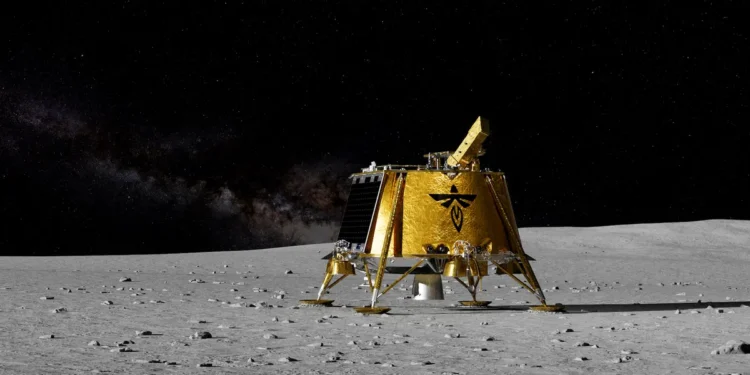
An illustration of the Blue Ghost Lander on the surface of the Moon. Credit: Firefly Aerospace.

The race to explore the Moon has intensified, with multiple missions pushing the boundaries of human knowledge. Among these is NASA’s groundbreaking LISTER (Lunar Instrumentation for Subsurface Thermal Exploration with Rapidity), which could provide critical insights into the Moon’s origins and pave the way for sustainable lunar habitats.

Carried aboard Firefly Aerospace’s Blue Ghost lunar lander, LISTER launched aboard a SpaceX Falcon 9 rocket on January 15. As Blue Ghost journeys toward the Moon, scientists eagerly anticipate the instrument’s role in unraveling mysteries beneath the lunar surface.

Why LISTER Matters: The Hunt for the Moon’s True Origins

Despite decades of research, the Moon’s formation remains a puzzle. A leading theory suggests that billions of years ago, a Mars-sized object called Theia collided with Earth, ejecting debris that coalesced into the Moon. However, no single hypothesis fully explains the lunar body’s composition and characteristics.

LISTER aims to change that. By measuring the Moon’s internal heat flow, scientists can reconstruct its thermal history—shedding light on how the celestial body evolved over billions of years. Understanding these processes is crucial not only for planetary science but also for future space exploration.

Cutting-Edge Technology Beneath the Lunar Surface

Unlike previous instruments, LISTER features an advanced pneumatic drill designed to reach depths of three meters with minimal energy consumption. As it burrows into the Moon’s regolith, the instrument will take precise measurements of:

  • Thermal gradient: How temperature changes with depth
  • Thermal conductivity: How efficiently heat moves through lunar soil

These findings will help determine the Moon’s geological stability—a key factor in planning long-term lunar settlements.

The Lunar South Pole: The Next Frontier for Human Spaceflight

LISTER’s insights could play a vital role in NASA’s Artemis program, which aims to establish a sustained human presence on the Moon. The Artemis III mission will land astronauts at the lunar south pole, a region believed to contain vast ice reserves. This frozen water could serve as a critical resource for future explorers, enabling everything from drinking water to rocket fuel production.

However, recent studies suggest that the lunar surface is not as stable as once believed. Gradual contraction of the Moon is causing surface warping, making some regions prone to landslides. By analyzing subsurface heat flow, LISTER may help identify safer landing sites and inform the construction of future lunar bases.

LISTER’s Impact on Solar System Exploration

But experts explain that LISTER is more than just a lunar tool. Lister is a technological leap for planetary exploration. If successful, its pneumatic drilling system could be deployed on missions to Mars and beyond, helping scientists investigate subsurface conditions on other celestial bodies.

With its advanced instrumentation and potential to reshape our understanding of the Moon, LISTER could become one of the most influential lunar experiments of the decade.


Lunar Trailblazer: The Pioneering Small Satellite to Investigate Water on the Moon - Bethany Ehlmann

The Moon's Secrets: Unveiling Its Strange Interior

{ https://curiosmos.com/ }

Hoe vind je dit bericht?
Geschreven door peter om 21:27 Stuur door

The Moon has Two Grand Canyons, Carved in Minutes by an Asteroid Impact

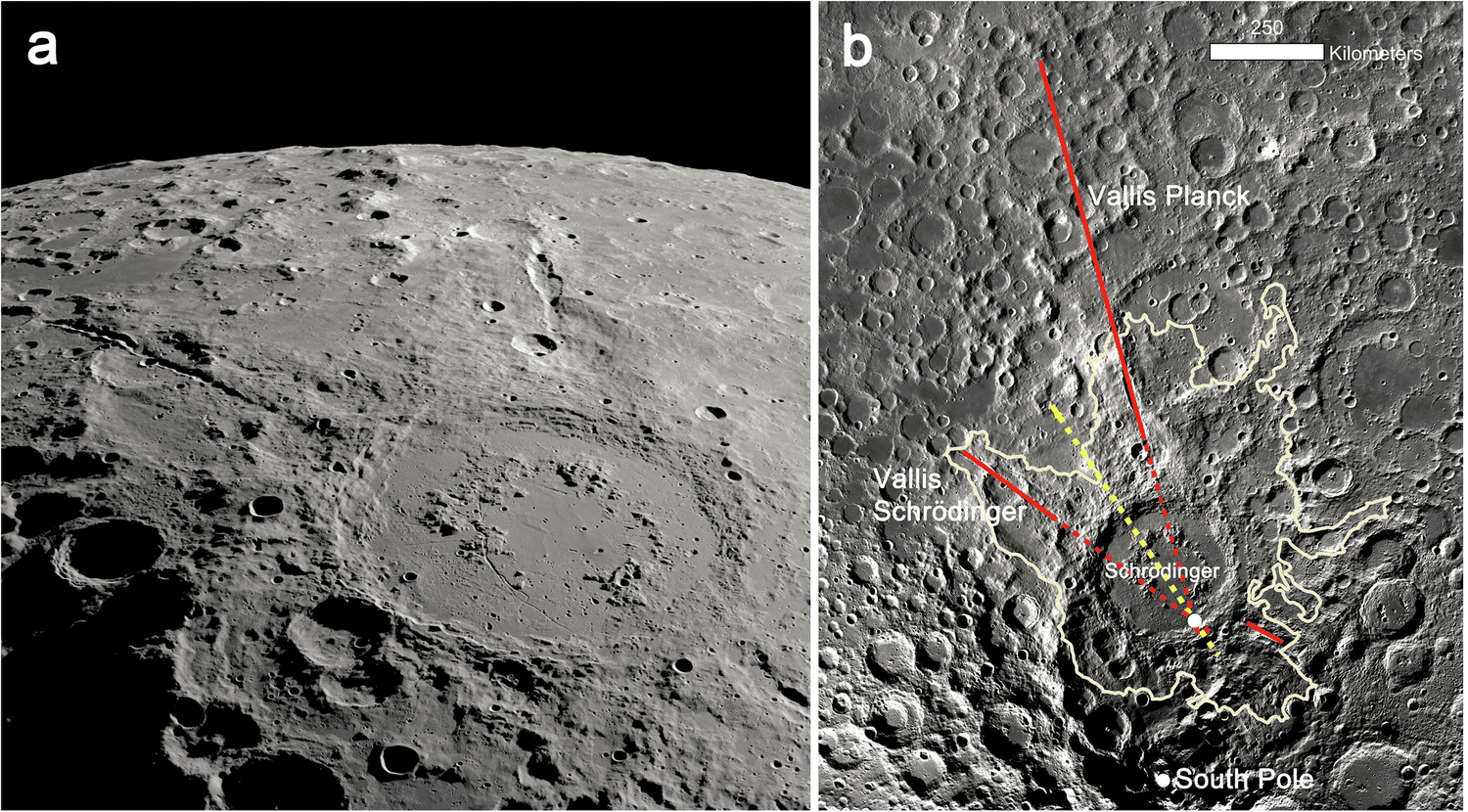
Artistic rendering of astronauts standing on the edge of the Vallis Schrödinger canyon. It extends out from the Schrödinger impact basin. Credit: Lunar and Planetary Institute/Michael Carroll.

The Moon has Two Grand Canyons, Carved in Minutes by an Asteroid Impact

Our Moon continues to surprise us with amazing features. Scientists recently shared new information about two canyons that branch out from a major lunar impact. The site is the Schrödinger basin near the Moon’s South Pole. It formed when an asteroid or possibly even a leftover planetesimal slammed into the surface. It took only minutes to dig out that huge crater and split the landscape to make two huge rifts that extend from the site.

According to David Kring of the Lunar and Planetary Institute in Houston, TX, the impact is of very ancient origin. “Nearly four billion years ago,” he said, “an asteroid or comet flew over the lunar south pole, brushed by the mountain summits of Malapert and Mouton, and hit the lunar surface. The impact ejected high-energy streams of rock that carved two canyons that rival the size of Earth’s Grand Canyon. While the Grand Canyon took millions of years to form, the two grand canyons on the Moon were carved in less than 10 minutes.”

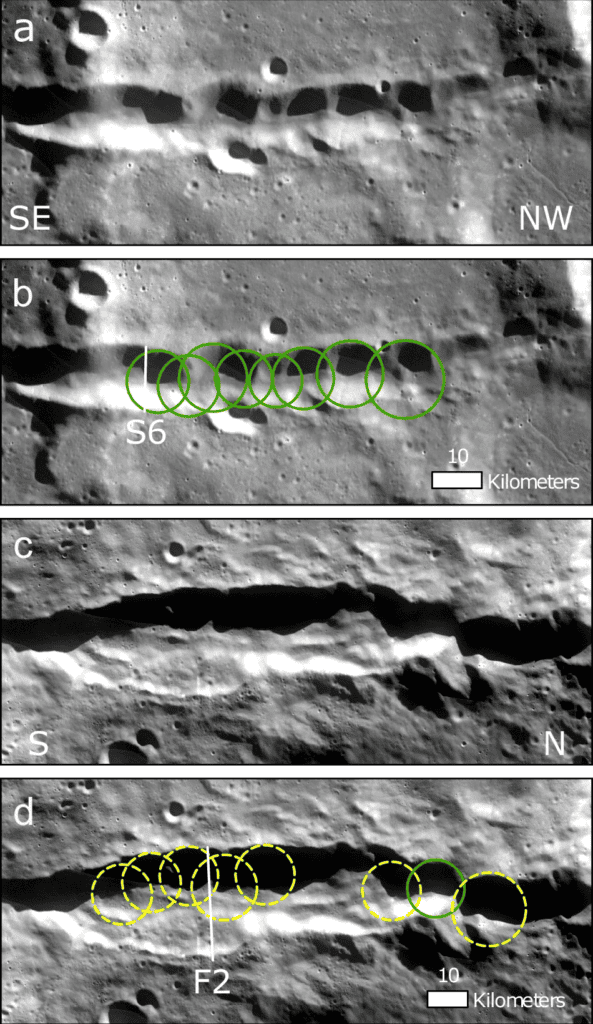
Those two canyons—named Vallis Schrödinger and Vallis Planck—are significant clues to that turbulent time in the Moon’s past. And, they’re impressive. Vallis Schrödinger is just under 300 kilometers long, 20 km wide, and 2.7 kilometers deep. Vallis Planck has two units. One is a deep canyon within the ejecta blanket of debris thrown out by the impact. The rest comprises a row of craters made as falling rocks were thrown out from the impact. They fell back to the Moon to create so-called “secondary craters.” The canyon part is about 280 kilometers deep, 27 km wide, and 3.5 km deep. The depth of both of these canyons surpasses the deep gorges of Earth’s Grand Canyon in Arizona.

Anatomy of an Impact and its Aftermath

The impactor probably slammed into the surface at nearly 55,000 kilometers per hour. The crash is what produced the enormous 320-kilometer-diameter Schrödinger impact basin. In the aftermath, the rocky debris scoured the deep canyons.

Schrödinger formed in the outer margin of the South Pole-Aitken (SPA) basin. At a diameter of about 2,400 km, it’s the largest and oldest impact basin on the Moon. The basin’s rim is about 300 km from the South Pole and within 125 km of the proposed exploration site for the Artemis mission.

The Schrödinger crater has a ~150-km diameter peak ring and the whole area is surrounded by a blanket of impact ejecta that splashed out in an irregular pattern up to 500 km away. The outermost crater ring resembles a circular mountain range and rises 1 to 2.5 km above the basin floor. It was produced by the collapse of a central uplift after the impact. After the impact, basaltic lava flows flooded the area. A large pyroclastic vent erupted more material onto the basin floor. That volcanic activity ended around 3.7 billion years ago.

Impact Anomalies

A careful analysis of the impact basin the canyons, and the ejecta surrounding the site by Kring and a team of scientists at the Lunar Planetary Laboratory, gives an idea of impact details. In a paper released about the site, the scientists discuss its features, plus some unusual finds. For example, the canyon rays don’t converge at the basin’s center as you might expect from typical impacts. They seem to come together in a different spot. That implies a point explosion impact.

Schrödinger peak-ring impact basin and two radiating canyons carved by impact ejecta. NASA\SVS\Ernest T. Wright. b Azimuthal Equidistant Projection of the Moon LRO LROC WAC Global Morphology Mosaic 100?m v3 (100 meters/pixel), centered on the Schrödinger basin, with the continuous ejecta blanket outlined (beige, after ref. 27) and radial secondary crater rays (red). Vallis Schrödinger and Vallis Planck (see Fig. 3 for close-up views) intersect near the southern rim of the basin (white point). The size of the point indicates the uncertainty. The projected bearing of the primary impactor (yellow) runs through the point of intersection and the basin center. A third unnamed feature extends in an uprange direction. Schrödinger peak-ring impact basin and two radiating canyons carved by impact ejecta. NASA\SVS\Ernest T. Wright. b Azimuthal Equidistant Projection of the Moon LRO LROC WAC Global Morphology Mosaic 100 centered on the Schrödinger basin, with the continuous ejecta blanket outlined and radial secondary crater rays (red). Vallis Schrödinger and Vallis Planck intersect near the southern rim of the basin (white point). The size of the point indicates the uncertainty. The projected bearing of the primary impactor (yellow) runs through the point of intersection and the basin center. A third unnamed feature extends in an uprange direction.

The location of the converging rays suggests that the incoming asteroid’s trajectory was about 33.5 west of north. The evidence also points to a distributed impact. That could mean the impactor came in at a low angle. Or, it’s also possible that secondary ejecta from the impact also came in at low angles. There are many secondary craters in the area which help explain the possibilities. Continued analysis will help explain the huge amounts of energy released in the event. Gareth Collins, one of Kring’s team members, said, “The Schrödinger crater is similar in many regards to the dino-killing Chicxulub crater on Earth. By showing how Schrödinger’s km-deep canyons formed, this work has helped to illuminate how energetic the ejecta from these impacts can be.”

Future Exploration

Of course, these rays and the impact basin will end up as great exploration points for NASA’s upcoming Artemis missions. Right now, the evidence from the ejecta blanket points to the fact that there’s an uneven distribution, particularly in the area where the first missions are planned. That will allow astronauts and robotic probes to reach underlying samples of the Moon’s primordial crust without having to dig through rocks of a younger age.

Since the basin is the second-youngest basin on the Moon, the impact melted rocks will be a great way to test the actual age of the impact. The general understanding is that some 3.8 billion years ago, the Moon (and Earth) experienced a great many of these collisions. This epoch was the Late Heavy Bombardment, thought to have lasted up to 200 million years. The continual impacts during this time scarred the surfaces of the rocky planets and the Moon, as well as asteroids. Lunar rocks created as a result of lava flows at that time will open a window into their ages and mineralogy, especially compared to other, older rock formations. They should also improve our understanding of that period of solar system history. In particular, it can help scientists characterize the impacts on Earth that affected not just the surface, but its life forms.

For More Information


Grand Canyons on the Moon

{ https://www.universetoday.com }

Hoe vind je dit bericht?
Geschreven door peter om 18:34 Stuur door

Space Junk Could Re-Enter the Atmosphere in Busy Flight Areas

Debris and defunct launcher stages in the Geostationary ring. Credit: ESA/ID&Sense/ONiRiXEL

Space Junk Could Re-Enter the Atmosphere in Busy Flight Areas

In the more than 60 years since the Space Age began, humans have sent more than 6,740 rockets to space. According to the ESA’s Space Debris Office, this has resulted in 56,450 objects in orbit; about 36,860 of these objects are regularly tracked and maintained in a catalog, while 10,200 are still functioning. The rest is a combination of spent rocket stages, defunct satellites, and pieces of debris caused by unused propellant exploding and orbital collisions. This is leading to a cascade effect known as Kessler Syndrome, where the amount of debris in orbit will lead to more collisions and more debris.

What’s worse, the situation is only projected to get worse since more launches are expected with every passing year. Last year, space agencies and commercial space companies conducted a record-breaking 263 launches, with the U.S. (158) and China (68) leading the way. And with future break-ups occurring at historic rates of 10 to 11 per year, the number of debris objects in orbit will continue to increase. According to a new study by a team from the University of British Columbia (UBC), this also means that debris falling to Earth will have a 1 in 4 chance per year of entering busy airspace.

Ewan Wright, a doctoral student in UBC’s Interdisciplinary Studies Graduate Program, led the research. He was joined by Associate Professor Aaron Boley of the UBC Department of Physics and Astronomy and the co-director of The Outer Space Institute (OSI) at UBC, and Professor Michael Byers, the Canada Research Chair in Global Politics and International Law at the UBC Department of Political Science. The paper detailing their findings, “Airspace closures due to reentering space objects,” recently appeared in Scientific Reports, a journal maintained by Nature Publishing.

space_debris1.jpg

Artist’s impression of the orbital debris problem. Credit: UC3M

Traditionally, the discussion of space junk and the Kessler Syndrome has focused on how debris in orbit will pose a hazard for future satellites, payloads, and current and future space stations. In 2030, NASA and its many partnered space agencies plan to decommission the International Space Station (ISS) after thirty years of continuous service. However, this situation will also mean that more debris will be deorbiting regularly, not all of which will completely burn up in Earth’s atmosphere.

space junk debris earth orbit satellite collisions crashes nasa gsfc jsc

An illustration of a field of orbital debris, or space junk, circling Earth. 

NASA's Goddard Space Flight Center/JSC

While the chance of debris hitting an aircraft is very low (one in 430,000, according to their paper), the UBC team’s research highlights the potential for disruption to commercial air flights and the additional costs it will lead to. The situation of more launches and more hazards is illustrated perfectly by the “rapid unscheduled disassembly” (RUD) of the Starship on January 16th, during its seventh orbital flight test. The explosion, which happened shortly after the prototype reentered Earth’s atmosphere, caused debris to rain down on the residents of the Turks and Caicos. Said Wright in a UBC News release:

“The recent explosion of a SpaceX Starship shortly after launch demonstrated the challenges of having to suddenly close airspace. The authorities set up a ‘keep out’ zone for aircraft, many of which had to turn around or divert their flight path. And this was a situation where we had good information about where the rocket debris was likely to come down, which is not the case for uncontrolled debris re-entering the atmosphere from orbit.”

A similar situation happened in 2022 when the spent stages of a Chinese Long March 5B (CZ-5B) weighing about 20 metric tons (22 U.S. tons) prompted Spanish and French aviation authorities to close parts of their airspace. If spent stages and other payloads have a low enough orbit, they can reenter Earth’s orbit uncontrolled, and large portions may make it to the ground. In addition to the record number of launches last year, there were also 120 uncontrolled rocket debris re-entries while more than 2,300 spent rocket stages are still in orbit.

space-exploration-starship-1024x566.jpg

Debris from the SpaceX Starship launched on January 16th, spotted over the Turks and Caicos Islands.
Credit: Marcus Haworth/Reuters

According to the International Air Transport Association, passenger numbers are expected to increase by almost 7% this year. With rocket launches and commercial flights increasing at their current rate, Wright and his colleagues say that action must be taken to mitigate the potential risks. As part of their study, the team selected the busiest day and location for air traffic in 2023, which was in the skies above Denver, Colorado – with one aircraft for every 18 square km (~7 mi2). They then paired this to the probability of spent rock stages reentering Earth’s atmosphere (based on a decade of data) above the flights.

With this as their peak, they calculated the probability of rocket debris reentering the atmosphere over different air traffic density thresholds. Their results showed that for regions experiencing 10% peak air traffic density or higher, there was a 26% chance of deorbited rocket debris entering that airspace. “Notably, the airspace over southern Europe that was closed in 2022 is only five percent of the peak,” said Wright. “Around the world, there is a 75-per-cent chance of a re-entry in such regions each year.”

At present, whenever orbital debris reenters the atmosphere around busy airspace, aviation authorities will respond by diverting flight paths, closing airspace, or taking the risk of allowing flights to continue. “But why should authorities have to make these decisions in the first place? Uncontrolled rocket body re-entries are a design choice, not a necessity,” said Dr. Boley. “The space industry is effectively exporting its risk to airlines and passengers.”

One possibility is to design rocket stages to reenter the atmosphere in a controlled way so they can crash into the ocean far away from busy air traffic lanes. However, this solution requires collective international action. “Countries and companies that launch satellites won’t spend the money to improve their rocket designs unless all of them are required to do so,” said Dr. Byers. “So, we need governments to come together and adopt some new standards here.”

Further Reading: 

space junk debris satellites numbers by country active march 2018 bi graphics

Samantha Lee/Business Insider

What is Space Junk? | Space Debris and Kessler Syndrome | Space Explained by KLT

Space junk, space lasers and space law: Cleaning up earth's debris | Video Lab | ABC News

{ https://www.universetoday.com }

Hoe vind je dit bericht?
Geschreven door peter om 18:21 Stuur door

Reincarnation & The Afterlife

Reincarnation & The Afterlife

A series of articles based on evidence of Reincarnation and Life after Death

1. The Afterlife Investigations
2. Is there Life before Life?
3. Reincarnation: The Boy Who Lived Before..
4. The Afterlife: 'Quantum theory of soul's existence'
5. Proof of Heaven
6. UFO expert describes Grey ETs and how the soul enters the body

1. The Afterlife Investigation

life-after-life.jpg

Breakthrough scientific evidence for the afterlife. The Scole Experiments. For five years a group of mediums and scientists witnessed more phenomena than in any other experiment in the history of the paranormal, including recorded conversations with the dead, written messages on sealed film, video of spirit faces and even spirit forms materializing.

These experiments may finally convince you there is life after death. The scientific team in change of overseeing these experiments include world renowned Cambridge Scientist - Dr. Rupert Sheldrake, Dr. David Fontana and Researcher Montague Keen who died during the filming of the documentary


2. Is there Life before Life?

Evidence that we have lived before

reincarnation-witnesssm.gif

1. People who claim to have lived prior lives have always seemed fake to me. Too often they claim to have been someone famous, like an Egyptian Pharaoh, Napoleon or Joan of Ark. Certainly, if reincarnation is real, it is not limited to the rich and famous...Article: Scientific Proof of Reincarnation

2. James Leininger was not yet 2 years old when he began to have terrible nightmares. His parents knew he would outgrow them, but his screams frightened them. When they would come to his bedside, they often found him on his back, kicking his legs in the air and thrashing his arms -- as if he were trying to escape from an imaginary box. He would also yell some garbled words that his parents could not understand...Article: Convincing Cases of Past Lives

3. Rabbi Yonassan Gershom is a Hasidic Jew and author of Beyond the Ashes -- Cases of Reincarnation from the Holocaust. Hasitism is a branch of Orthodox Judaism that promotes spirituality and joy through Jewish mysticism. This very ancient mystic tradition is based on the Talmud and the teachings of the more recent Kabbala...Article: What Did Jesus Say?

4. While most people think of reincarnation as a dogma of religion or an interesting philosophy, the Buddhist monks in Tibet have developed it into a science.

This ancient and isolated Himalayan community has a tradition of contemplating and recording the aspects of human consciousness. Buddha, himself, began these thought experiments as a means of understanding human suffering. He discovered that our misery comes from our reluctance to accept change and our emotional attachment to both situations and material objects. Buddha understood that change is an inevitable process with time and he devised a method for detaching oneself, mentally and emotionally, from transient phenomenon...Article: Tibetan Buddhism: Rebirth v Reincarnation

5. Hinduism is the oldest and most intellectual religion in human history. Great minds contemplated ideas about God, the soul and human existence long before there was a written language to record such things. As such, the religion was mainly an oral tradition. There is no known founder. Yet the ideas about reincarnation, the laws of karma and the abstract nature of the Creator remain the ultimate revelation and source of almost all other faiths. We explore Hinduism, the Bhagavad-gita and Krishna Consciousness in this summary...Article: Hinduism: The Source of Knowledge

6. "Seeing the light" refers to the personal experience that is reported when one remembers their true identity as something "other than this body." There are many methods that have been used to achieve this goal. Meditation and good living are important but some ancient cults also used a technique that involved fire or reflected light. The method, called "phosphenes" is explored and a possible explanation of how it works is given for consideration. We start this journey in Greece, about 3600 years ago, during the Bronze Age. Our focus is part of a secret cult called the Eleusinian Mysteries...Article: Seeing the Light

7. This is a "true" story of a hypnosis session where an obese patient was receiving therapy for overeating. The hypnotist attempted to suggest that the patient remember how it felt to be thin and began a typical regression procedure. Not being careful on the selection of words, the therapist regressed the patient back to a time "when you were light". This reference to light apparently brought the patient back to a time between incarnations -- only the subsequent life that was recalled was not in the past... This amazing transcript is reproduced, word for word, and describes a life in the future. What do humans look like? How do we live? What mysteries have we solved? Although we cannot vouch for its authenticity, it is certainly a thought provoking and interesting read...Article: Can We Recall FUTURE Lives?

3. Refreshing take on Reincarnation: The Boy Who Lived Before..

Documentaries all too often come with attitude. Last week, when Dominion Post film critic Graeme Tuckett said that one of the strengths of the film festival's My Kid Could Paint That was that it made you have to make up your own mind, I agreed with him.

It was refreshing to see a documentary actually doing what documentaries by definition are supposed to do.

81106.jpg

The Boy Who Lived Before starred Cameron, who was only two when he started talking in detail about another place and another family that he had previously belonged to.

If last night's documentary on Prime, The Boy Who Lived Before, had an attitude, it was one of respect. Its subject matter – reincarnation, in this case a small child who had memories of a previous life and of a place which he had never visited – was one guaranteed to get a cynic sneering. But all this documentary set out to do was to allow the audience to observe Cameron's story being checked out. It made for riveting – and touching – viewing.

Cameron was only two when he started talking in detail about another place and another family that he had previously belonged to. That other place was the island of Barra, off the west coast of Scotland, a place neither he nor his family had ever visited. He also spoke of a white house on the sand, watching planes land on the beach, a black and white dog, siblings, a mother who'd had her long hair cut short, and a father who had died because he didn't look both ways. Most two-year-olds don't suffer from nostalgia, but Cameron missed his "other mother" so much that sometimes he cried when his real mother picked him up from kindergarten. His memories, which he continued to have till he was five, when we met him, were completely consistent. He even knew his "other" father's name – Shane Robertson. He was a happy and loving little boy, but he yearned for his other life.

Cameron was fortunate to have a marvellously understanding and compassionate mother. She did that very difficult thing – she kept an open mind. She also managed another even more difficult thing – she at least appeared unthreatened by his longing for his other family. She took a risk when she allowed a camera crew to accompany her on the search for Cameron's other family, but it was one that paid off.

Even the people Cameron's mother approached in her attempt to make sense out of the rationally impossible allowed her her dignity.

The first person she spoke to (on camera, anyway) was potentially the hardest – psychologist Chris French, also the editor of The Skeptic Magazine. Though he was careful not to mock, in lots of ways he stated the bleeding obvious: somehow – through TV perhaps? or a family friend? – Cameron had learnt about Barra and invented a world that he had inhabited.

At this point in our house we became a little restless and uneasy, recalling how our daughter, when aged two, had had the habit of waking three or so hours after having been put to bed. At playcentre one day this guileless toddler had displayed such a parentally-humiliating knowledge of the Ewing family and Southfork that I kick myself now for not having known about children who'd lived another life – I could have just explained away her knowledge by telling everyone that Sue- Ellen was her other mother.

Norma, however, could not think of an opportunity Cameron might have had to pick up such detailed information. Also it would have been easy enough to check whether any TV drama or documentary had been made which contained the details which were so entrenched in this small child's imagination.X So she took Cameron to see a child psychologist who confirmed that, like many children, Cameron had an imaginary world. There were significant differences though – most children who create a friend or a world know that it's their own creation. Cameron insisted his existed.

The third expert that Norma consulted was Dr Jim Tucker, an academic from the University of Virginia who – in a this could only happen in America sort of way – headed a department dedicated to scientifically investigating paranormal phenomena such as near-death experiences, ghosts and reincarnation. Tucker accompanied Norma and her two little boys to Barra.

If this had been fiction (a very similar idea was dealt with a couple of years back in Sea of Souls) it would have had to have had a resolution, and this documentary offered no amazing ending. What it did show – in an impressively unspooky sort of way – was that much of what Cameron remembered did exist. After a false start – there were very few people called Robertson on Barra – we were taken with Cameron to see the house he remembered, where several decades ago a family called Robertson had spent a couple of summers. Then we were taken to meet a woman who was a member of the family. She looked kindly, yet nervously, at Cameron. There'd been no Shane Robertson. There had, though, been several Jameses. There'd been a black and white dog. There'd been a big black car.

And there they left us. Like all other children who have had this experience – and there are thousands documented – as Cameron grew older the memories faded. Having seen the house that he had so vividly described, he became a happier, more settled child. It was terrifically interesting, and I anticipate many happy hours a-Googling. It was evidence of what a really good documentary should do – not tell you how to think, but encourage you to get your own brain ticking over.

Even though it goes against all my naturally pragmatic instincts, on the issue of reincarnation this documentary leaves my mind refreshingly open.

4. The Afterlife: 'Quantum theory of soul's existence'

soul-afterlife-reincarnation.jpg

A pair of world-renowned quantum scientists say they can prove the existence of the soul.

A near-death experience happens when quantum substances which form the soul leave the nervous system and enter the universe at large, according to a remarkable theory proposed by two eminent scientists.

Their idea stems from the notion of the brain as a biological computer, "with 100 billion neurons and their axonal firings and synaptic connections acting as information networks" which can persist in the universe even after death, explaining the perceptions of those who have near-death experiences.

American Dr Stuart Hameroff and British physicist Sir Roger Penrose developed a quantum theory of consciousness asserting that our souls are contained inside structures called microtubules which live within our brain cells.

In a near-death experience the microtubules lose their quantum state, but the information within them is not destroyed. Or in layman's terms, the soul does not die but returns to the universe. Thus it is held that our souls are more than the interaction of neurons in the brain. They are in fact constructed from the very fabric of the universe - and may have existed since the beginning of time.

Let's say the heart stops beating, the blood stops flowing, the microtubules lose their quantum state.

"The quantum information within the microtubules is not destroyed, it can't be destroyed, it just distributes and dissipates to the universe at large.

'If the patient is resuscitated, revived, this quantum information can go back into the microtubules and the patient says "I had a near death experience".'

In the event of the patient's death, it was "possible that this quantum information can exist outside the body indefinitely - as a soul. Read more here and here

5. Proof of Heaven

Top neurosurgeon 'spent six days in heaven' during a coma.

dr-evan-alexander-afterlife-near-death-expericience.jpg

A top neurosurgeon claims to have ‘Proof of heaven’ after making a full recovery from a seven day coma that saw his neocortex inactivated.

Dr Eben Alexander, who teaches neuroscience at Harvard University among others, fell seriously ill after contracting a rare form of bacterial meningitis in 2008.

Within hours of developing a severe headache, Dr Alexander’s entire cortex—the section of the brain that controls thought and emotion —had shut down.

Though his chances of survival were low, he awoke from the coma seven days later and began describing an ‘other worldly experience’. Read full article here

Dr. Evan Alexander tells us about his experience in the afterlife and concludes that consciousness survives physical death.

  
6. UFO expert describes Grey ETs and how the soul enters the body

et-alien-soul.jpg

In an exclusive Suzanne Hansen, Founding Director of UFOCUS NZ Research Network (New Zealand) publicly reveals the unique and compelling history of how she first met the soul of her son aboard a Grey ET spacecraft when she was only 8 years old and her son appeared as a “Ball of Light.”

Ms. Hansen reveals that later in her life, after she was married and pregnant with her son, she was taken aboard a Grey ET spacecraft, where she met her son’s soul once more as “a Ball of Light.” On this occasion, her son’s Soul was inserted into her womb and her son’s body in a procedure by the Grey ETs, who also gave her deep information about the future positive social role her son would play on Earth. Throughout her life, Ms. Hansen states, her experiences with the Grey ETs were “transformational, purposeful, and positive.”

Excerpt from Suzanne Hansen's interview:

Suzanne Hansen’s account is corroborated by Mary Rodwell, RN, who led Ms. Hansen through hypnotic regression sessions designed to help her recover her memories of her life-long experiences around her son’s Soul aboard Grey ET spacecraft.X Ms. Rodwell is “a world leader in alien abduction counseling. Mary Rodwell was featured in an SBS documentary alongside her son – a self-confessed UFO skeptic. Mary, a former nurse and midwife and clinical hypnotherapist founded ACERN in 1997 and has since investigated over 1600 cases of ET encounters worldwide

Suzanne Hansen’s statement:

1. During this experience at age eight, I was initially taken to a large room in which I 'played' with children of mixed species, using mind games to facilitate telepathic communications between us. The interesting thing is that I could 'see' the objects being produced by our minds, with both my mind (thoughts) and my eyes. You will notice a strange small bed in this drawing with a baby on it and a Grey beside it. In another regression session, Mary Rodwell regressed me to when I was 6 months old, where I could see myself lying on this small bed. I have nick-named it the 'lullaby bed' and a description of how and why this bed is used with human babies, and the technology involved, features in another chapter of my book.

2. I was invited to accompany a Grey to a room where I was to meet another 'child'. Here I am as an eight-year-old girl, during my first 'official' meeting with the ball of blue light, learning to relate to the soul of my future son through play. The Greys 'observed' from another area of the craft to see if we would be suited.                                            

3. At age 28, I was taken onboard craft for a 'merging' procedure, where the soul of my future son would enter my body, and that of my unborn child, for the first time. Two Grey-mixed-species entities comforted me, while a Grey began a procedure to lower my metabolism prior to the soul entering my body.

Her experiences with the specific species of Grey ETs she encountered are purposeful and transformational, although she has had to work through a period of personal fear about the experiences.X Ms. Hansen says that her understanding is that souls are universal, and can chose to incarnate into a variety of species on different planets.

She says that a soul is a spiritual entity, and all of its incarnations appear designed to learn moral or evolutionary lessons.

The Grey ETs’ job

children-et-alien-ship_2.jpg

Ms. Rodwell concludes by saying that her abduction research has led her to conclude that a specific species of Grey ETs job includes:

1. Gathering genetic information and materials on humans
2. Healing procedures on humans;
3. Cooperation between interdimensional intelligences, as evidenced by the cooperation between human souls and Grey ETs;
4. Deepening of compassion and love, healing ability, and telepathic transfer of information by humans.

The medical and health inspections of humans by the Grey ETs appear to be for levels of pollution, toxins, and other harmful materials that relates to the planet’s problems.

The typology of intelligent civilizations

The dimensional ecology hypothesis of the multi-verse includes a new typology of extraterrestrial civilizations, based on empirical evidence confirming the existence of the following typologies of extraterrestrial civilizations and extraterrestrial governance bodies:

A. Solar system civilizations: Planetary civilizations in our own solar system, such as the intelligent human civilization living under the surface of Mars that reportedly enjoys a strategic relationship with the United States government.

B. Deep space civilizations: Intelligent extraterrestrial civilizations that are based on a planet, solar system, or space station in our galaxy or in some other location in this known physical universe. An example includes the 10 – 100 intelligent extraterrestrial civilizations that, according to a NATO report, have been visiting Earth for many centuries.

C. Hyper-dimensional civilizations: Intelligent civilizations that are based in dimensions or universes parallel to our own and that may use technologically advanced physical form and/or transport when entering our known universe.

D. Extraterrestrial governance authorities: Legally constituted extraterrestrial governance authorities with jurisdiction over a defined territory, such as the Milky Way Galactic Federation, which has been empirically located in replicable research. Read full article

Our review of the impact of the dimensional hypothesis shows that humanity is being misinformed about the reality of its soul, of life after death, and the mechanisms of reincarnation.

Video: Interview with Ms. Hansen:

RELATED VIDEOS

The Surprising Evidence for Reincarnation and the Afterlife

How Does Reincarnation and the Afterlife Really Work?

How Reincarnation Really Works, What You Need To Know!

{ https://ufosightingshotspot.blogspot.com/ }

Hoe vind je dit bericht?
Geschreven door peter om 17:05 Stuur door

Biological UFOs

Biological UFOs

1. ZEROIDS

Living beings which inhabit the cosmic void.

Bioforms which may populate the recesses of free space.

Zeroids+living+space+creatures.jpg
Zeroids+living+space+creatures+(3).jpg
Zeroids+living+space+creatures+(4).jpg
Zeroids+living+space+creatures+(12).jpg
Zeroids+living+space+creatures+(14).jpg
This domain is characterized by virtually zero temperature and zero atmospheric pressure.

Russian astrophysicist Dr. V.l. Goldanskii argued that appreciable quantities of prebiotic material should be able to accumulate in the regions surrounding nebulae, or titanic gas clouds.

2. ARCHONS 

‘Interdimensional entities’ the negative controllers of humankind

Archons+space+mind+control.jpg

Archons are "are hidden negative controllers of humankind, inorganic interdimensional entities that must now be exposed and exorcised from the individual human mind, from our human species, and from the planet as a whole as part of our collective evolution to a new state of consciousness and being."

Article: Archons interdimensional entities

3. EBANI 

Biological entity

EBANI+-+biological+entity'+UFO.jpg
Ebani.jpg
Allegedly, EBANI's are organic beings because they are moving in an intelligent way.

4. Flying and Underwater Humanoids

One of the most curious types of sightings - and quite rare - are those of human-like beings that fly. "Human-like" because in most respects they look like us, except that they have wings. In most cases, these odd creatures are not assumed to be either angels or devils (as traditional depictions have them as human-like beings with wings), but as something else. Something quite unusual.

flying+humanoids.jpg
underwater-humanoid_1.jpg
Article: Flying and Underwater Humanoids Part 1 & Part 2

5. Mysterious Flying Orbs and Spheres

Since World War 2, strange Flying Spheres have been reported and filmed making impossible maneuvers compared to terrestrial aircraft.


They can avoid radar and even disable tracking and flight instrumentation. They have been seen by military pilots, airline pilots, NASA space shuttle pilots, and even International Space Station personnel. Is their origin extraterrestrial?


Despite all efforts, Flying Spheres still remain a mystery to UFO researchers.

orbs+spheres+ufos+aliens.jpg

Article: The UFO Enigma of Flying Orbs and Spheres

6. Flying Rods

See evidence of a newly discovered and previously unknown life form that currently exists on this planet. In this program is stunning high quality video of "Rods" in flight taken by a production company working for the Discovery Channel while taping cliff jumpers in South America. New methods are presented using the sun which illuminates the phenomenon, providing incredible detail for analyzing the anatomy of this life form. Included in this program are comments by renowned scientists as part of the process of authentication. Discover new sky fishing methods for capturing this entity on film that you can use with your own camera.


'Non-human biologics' recovered by US government, says UFO whistleblower David Grusch

{ https://ufosightingshotspot.blogspot.com/ }

Hoe vind je dit bericht?
Geschreven door peter om 16:39 Stuur door

🔍 FBI’s Secret UAP Task Force: Investigating UFOs Since 2020!

🔍 FBI’s Secret UAP Task Force: Investigating UFOs Since 2020!

FBI group is investigating UFOs Former Navy pilot

A Secret FBI Task Force Investigating UAPs

Recent revelations have brought to light a secret FBI working group dedicated to investigating Unidentified Aerial Phenomena (UAPs), commonly referred to as UFOs. According to Politico, this is the first time that the existence of such a unit has been publicly disclosed. Ryan Graves, a former U.S. Navy pilot and a well-known whistleblower in the UAP community, has shed new details on the group’s operations.

Graves, who previously testified before Congress about repeated encounters with unexplained aerial objects, claims that the FBI unit consists of over a dozen staff members who spend significant time tracking down and analyzing UAP reports. This working group, which began its operations around 2020, aims to address potential security concerns linked to unidentified objects operating within U.S. airspace.

The Role of the FBI in UAP Investigations

The FBI, primarily known for law enforcement and counterintelligence, has been tasked with examining these mysterious aerial phenomena due to their potential national security implications. The group’s primary focus is to investigate whether UAPs present a threat, violate U.S. airspace regulations, or involve any foreign or unauthorized technology.

Graves, who is also the co-founder of Americans for Safe Aerospace, an organization advocating for increased UAP awareness, stated that the FBI team is working closely with pilots and witnesses to gather credible reports. He emphasized that his organization has helped facilitate interviews between witnesses and the FBI agents, ensuring that crucial information reaches the right authorities for further investigation.

Findings and National Security Concerns

Although Graves did not disclose specific details about the group’s findings, he mentioned that their investigations have been “fruitful” and have significantly advanced UAP research both in classified and unclassified settings. This aligns with the broader effort by U.S. intelligence agencies and Congress to understand and address UAP sightings, especially after multiple reports from military personnel describing unknown aerial objects that demonstrate advanced capabilities beyond current technology.

However, Graves also highlighted concerns regarding the future of this FBI group. According to him, some agents involved in the UAP investigations fear losing their jobs due to possible administrative changes, particularly if a political shake-up leads to mass removals within the FBI. He warned that a potential purge of agents could disrupt the ongoing efforts to analyze and mitigate risks associated with unidentified aerial objects.

Whistleblower Protection and the Future of UAP Investigations

Graves has consistently advocated for stronger protections for whistleblowers and witnesses coming forward with UAP-related information. Many individuals hesitate to report sightings due to concerns about professional repercussions or government secrecy. By working with federal agencies like the FBI, Graves and other advocates hope to create a more open and systematic approach to handling UAP cases.

The former Navy pilot urged the government to acknowledge the vital work being done by the FBI’s UAP investigative team and provide them with the necessary resources to continue their efforts. He also called for increased transparency, encouraging the White House and FBI leadership to formalize the group’s status and expand its mission.

VIDEO:

FBI group is investigating UFOs: Former Navy pilot | Morning in America

The existence of an FBI group dedicated to investigating UAPs adds another layer to the ongoing debate surrounding UFOs and national security. With increasing attention from Congress, military personnel, and intelligence agencies, the push for greater understanding and transparency continues to gain momentum. Whether this FBI task force will be able to continue its work without political interference remains to be seen, but its role in gathering and analyzing UAP reports is undeniably critical.

As more details emerge, the public will be watching closely to see whether these investigations lead to significant breakthroughs or remain shrouded in secrecy.

RELATED VIDEOS


How the UAP Task Force evaluated UFO cases

Secret Pentagon Program (Full Episode) | UFOs: Investigating the Unknown

Government Breaks Silence: Strange Encounters | UFO's Investigating the Unknown

{ https://www.latest-ufo-sightings.net/ }

Hoe vind je dit bericht?
Geschreven door peter om 16:06 Stuur door

Scientists reveal what would happen if an astronaut ejaculated in space - and it suggests the '220-mile-high club' could be off the cards

Scientists reveal what would happen if an astronaut ejaculated in space - and it suggests the '220-mile-high club' could be off the cards

During their stints on the International Space Station (ISS) - lasting for months at a time - astronauts spend their spare time doing many of the same things people do on Earth.

This raises the question: do astronauts masturbate or have sex in zero-gravity?

NASA has not issued any strict guidelines around 'alone time', although commanders have stated that they do not allow sexual intercourse on the ISS. 

Now, two scientists have revealed what would happen if an astronaut ejaculated in space. 

Sex historian, Dr Esme Louise James, and AI expert, Dr Matt Agnew, turned to the concept of conservation of momentum to understand what would happen if a 'man's rocket blasted off in space'. 

According to the pair's calculations, ejaculation would propel the astronaut backwards at a speed of around two metres/hour. 

This could throw a spanner in the works for astronauts hoping to get frisky on future missions to Mars. 

Dr Adam Watkins, Associate Professor in reproductive and developmental physiology, at the University of Nottingham previously told MailOnline: 'Sex in space is physically possible, but would not be as easy as it is here on Earth.' 

Two scientists have revealed what would happen if an astronaut ejaculated in spaceAccording to the pair's calculations, ejaculation would propel the astronaut backwards at a speed of around two metres/hour

Sex historian, Dr Esme Louise James, and AI expert, Dr Matt Agnew , turned to the concept of conservation of momentum to understand what would happen if a 'man's rocket blasted off in space'

Dr James and Dr Agnew posted a video on TikTok, exploring what would happen if a male astronaut ejaculated in space.

'I'm here with Matt Agnew to finally answer the question we're sure has also plagued your mind for many years,' Dr James wrote in the video's caption. 

To work it out, the pair used a fundamental concept of physics known as the 'conservation of momentum'.

Dr Agnew explained: 'The conservation of momentum says that the total momentum of two or more bodies in a system will remain the same. 

'This means that the mass multiplied by the velocity of the ejaculate will equal the mass multiplied by the velocity of the man.'

The pair estimate that the average volume of ejaculate would be around one teaspoon, while its density would be around one gram per millilitre. 

Meanwhile, the average speed of ejaculation is an impressive 45km/hr (27mph), according to the scientists.  

'We multiply the mass by velocity, and that gives us the momentum of the ejaculate,' Dr Agnew said. 

No human has ever officially had sex in space (that they've admitted to...), and the lack of gravity could make it difficult

No human has ever officially had sex in space (that they've admitted to...), and the lack of gravity could make it difficult

Could you have sex in space?

Sex in space is physically possible but not recommended. 

There is nothing stopping astronauts from overcoming the challenges of having sex in microgravity.

However, low libido and erectile dysfunction may make things difficult.

The biggest risks are associated with pregnancy. Experts are not sure whether microgravity and radiation will damage a developing foetus.

Studies have suggested that developing in space could lead to birth defects in kids.

To conserve momentum and obey the fundamental laws of physics, the man's velocity multiplied by his mass must also equal this number. 

'Let's say the average man weighs 70 kilos. This means the velocity must equal 0.000562 metres/second,' Dr Agnew explained. 

In simple terms, this means the ejaculation would cause the astronaut to travel backwards at a speed of about two metres per hour. 

'How fast is that? About the speed of an average garden snail,' Dr Agnew joked.

'So, if you ever find yourself in the vacuum of space, and you want to use ejaculate as propellant, you're not gonna be moving very quickly.' 

The video has delighted many users, who flocked to the comments over on TikTok.

'These school math problems are getting insane,' one user joked. 

Another added: 'Physics has never been put to better use than this,' while one joked: 'Why aren't they teaching this in school?'

No human has ever officially had sex in space (that they've admitted to...), and the lack of gravity could make it difficult. 

German astronaut Ulrich Walter once suggested in an interview that humans could look to the animal kingdom for inspiration.

article image

Dolphins will sometimes enlist the help of a third to push the couple together and prevent them from drifting apart while mating.

Mr Walter suggested that open-minded astronauts might also enlist the help of a willing friend to push them together.

Alternatively, Paul Root Wolpe, a former NASA Bioethicist, has described how the humble Velcro strap could be the answer.

Mr Wolpe told DW: 'Everything on the walls of the space station is covered in Velcro, so you could take advantage of that by velcroing one partner to the wall.

'You have to get creative in this space.'

RELATED VIDEOS

Sex in Space - Fan Questions | StarTalk

You Need To Know How Astronauts Poop In Space

Life, Love And Sex In Space | SPACETIME - SCIENCE SHOW

{ https://www.dailymail.co.uk/ }

Hoe vind je dit bericht?
Geschreven door peter om 21:45 Stuur door

Last month was the hottest January on RECORD - with global average temperatures hitting 13.23°C

Last month was the hottest January on RECORD - with global average temperatures hitting 13.23°C

While January is typically considered the coldest month by Brits, globally last month was a scorcher. 

Scientists at the the EU's Copernicus Climate Change Service (C3S) have revealed that January 2025 was the hottest January on record. 

The global average air temperature was 55.81°F (13.23°C), which is 1.42°F (0.79°C) above the 1991-2020 average for January.  

It's also just above the previous January record-holder, January 2024, which had a global average air temp of 55.65°F (13.14°C). 

Experts blame climate change for the unusually-hot start to 2025 globally, despite an emerging La Niña weather phenomenon.

La Niña – the large-scale cooling of the ocean surface temperatures in the central and eastern equatorial Pacific Ocean – leads to variations in global weather. 

'January 2025 is another surprising month, continuing the record temperatures observed throughout the last two years,' said Samantha Burgess, deputy director of C3S. 

'Copernicus will continue to closely monitor ocean temperatures and their influence on our evolving climate throughout 2025.' 

January 2025 was the warmest January on record globally, with an average surface air temperature of 55.81°F (13.23°C). This map shows where Earth suffered extremes in terms of heat last month, compared to the 1991-2020 reference period

January 2025 was the warmest January on record globally, with an average surface air temperature of 55.81°F (13.23°C). This map shows where Earth suffered extremes in terms of heat last month, compared to the 1991-2020 reference period

The January data was “surprising” even to climate change experts at Copernicus, the European climate change service, which noted that it was the 18th month in the last 19 where the global-average surface air temperature was more than 1.5°C above the pre-industrial level.

“January 2025 is another surprising month, continuing the record temperatures observed throughout the last two years, despite the development of La Niña conditions in the tropical Pacific and their temporary cooling effect on global temperatures,” said Samantha Burgess, Copernicus Strategic Lead for Climate.

For many in the northern hemisphere January 2025 will be remembered by “wetter-than-average conditions” over western Europe, as well as parts of Italy, Scandinavia and the Baltic countries, Copernicus said, highlighting “heavy precipitation” and flooding in some regions.

Regional variations

On the other hand, drier than average conditions were recorded in the northern UK and Ireland, eastern Spain and north of the Black Sea.

Beyond Europe, it was wetter than average in Alaska, Canada, central and eastern Russia, eastern Australia, southeastern Africa, and southern Brazil, with regions experiencing floods and associated damage.

But drier-than-average conditions took hold in southwestern United States and northern Mexico, northern Africa, the Middle East, across Central Asia and in eastern China as well as in much of southern Africa, southern South America and Australia.

Global temperature rise is primarily attributed to humans burning fossil fuels which have led to record concentrations of greenhouse gases in the atmosphere. Other factors are also key, including deforestation. 

World's Hottest Year Is 2024? | World News | Latest English News | World News

{ https://www.dailymail.co.uk/ }

Hoe vind je dit bericht?
Geschreven door peter om 21:11 Stuur door

NASA’s Curiosity Rover Discovers a Surprise in a Martian Rock

NASA’s Curiosity Rover Discovers a Surprise in a Martian Rock

Scientists were stunned on May 30 when a rock that NASA’s Curiosity Mars rover drove over cracked open to reveal something never seen before on the Red Planet: yellow sulfur crystals.

Since October 2023, the rover has been exploring a region of Mars rich with sulfates, a kind of salt that contains sulfur and forms as water evaporates. But where past detections have been of sulfur-based minerals — in other words, a mix of sulfur and other materials — the rock Curiosity recently cracked open is made of elemental, or pure, sulfur. It isn’t clear what relationship, if any, the elemental sulfur has to other sulfur-based minerals in the area.

While people associate sulfur with the odor from rotten eggs (the result of hydrogen sulfide gas), elemental sulfur is odorless. It forms in only a narrow range of conditions that scientists haven’t associated with the history of this location. And Curiosity found a lot of it — an entire field of bright rocks that look similar to the one the rover crushed.

Pan around this 360-degree video to explore Gediz Vallis channel, the location where NASA’s Curiosity Mars rover discovered sulfur crystals and drilled its 41st rock sample. The images that make up this mosaic were captured by the rover’s MastCam in June. Credit: NASA/JPL-Caltech/MSSS

“Finding a field of stones made of pure sulfur is like finding an oasis in the desert,” said Curiosity’s project scientist, Ashwin Vasavada of NASA’s Jet Propulsion Laboratory in Southern California. “It shouldn’t be there, so now we have to explain it. Discovering strange and unexpected things is what makes planetary exploration so exciting.”

It’s one of several discoveries Curiosity has made while off-roading within Gediz Vallis channel, a groove that winds down part of the 3-mile-tall (5-kilometer-tall) Mount Sharp, the base of which the rover has been ascending since 2014. Each layer of the mountain represents a different period of Martian history. Curiosity’s mission is to study where and when the planet’s ancient terrain could have provided the nutrients needed for microbial life, if any ever formed on Mars.

NASA’s Curiosity Mars rover captured this view of Gediz Vallis channel
NASA’s Curiosity Mars rover captured this view of Gediz Vallis channel on March 31. This area was likely formed by large floods of water and debris that piled jumbles of rocks into mounds within the channel.
NASA/JPL-Caltech/MSSS

Floods and Avalanches

Spotted from space years before Curiosity’s launch, Gediz Vallis channel is one of the primary reasons the science team wanted to visit this part of Mars. Scientists think that the channel was carved by flows of liquid water and debris that left a ridge of boulders and sediment extending 2 miles down the mountainside below the channel. The goal has been to develop a better understanding of how this landscape changed billions of years ago, and while recent clues have helped, there’s still much to learn from the dramatic landscape.

Since Curiosity’s arrival at the channel earlier this year, scientists have studied whether ancient floodwaters or landslides built up the large mounds of debris that rise up from the channel’s floor here. The latest clues from Curiosity suggest both played a role: some piles were likely left by violent flows of water and debris, while others appear to be the result of more local landslides.

Mars rocks that show a pale color near their edges. These rings, also calle
While exploring Gediz Vallis channel in May, NASA’s Curiosity captured this image of rocks that show a pale color near their edges. These rings, also called halos, resemble markings seen on Earth when groundwater leaks into rocks along fractures, causing chemical reactions that change the color.
NASA/JPL-Caltech/MSSS

Those conclusions are based on rocks found in the debris mounds: Whereas stones carried by water flows become rounded like river rocks, some of the debris mounds are riddled with more angular rocks that may have been deposited by dry avalanches.

Finally, water soaked into all the material that settled here. Chemical reactions caused by the water bleached white “halo” shapes into some of the rocks. Erosion from wind and sand has revealed these halo shapes over time.

“This was not a quiet period on Mars,” said Becky Williams, a scientist with the Planetary Science Institute in Tucson, Arizona, and the deputy principal investigator of Curiosity’s Mast Camera, or Mastcam. “There was an exciting amount of activity here. We’re looking at multiple flows down the channel, including energetic floods and boulder-rich flows.”

A Hole in 41

All this evidence of water continues to tell a more complex story than the team’s early expectations, and they’ve been eager to take a rock sample from the channel in order to learn more. On June 18, they got their chance.

While the sulfur rocks were too small and brittle to be sampled with the drill, a large rock nicknamed “Mammoth Lakes” was spotted nearby. Rover engineers had to search for a part of the rock that would allow safe drilling and find a parking spot on the loose, sloping surface.

After Curiosity bored its 41st hole using the powerful drill at the end of the rover’s 7-foot (2-meter) robotic arm, the six-wheeled scientist trickled the powderized rock into instruments inside its belly for further analysis so that scientists can determine what materials the rock is made of.

Curiosity has since driven away from Mammoth Lakes and is now off to see what other surprises are waiting to be discovered within the channel.

More About the Mission

Curiosity was built by NASA’s Jet Propulsion Laboratory, which is managed by Caltech in Pasadena, California. JPL leads the mission on behalf of NASA’s Science Mission Directorate in Washington.

For more about Curiosity, visit:

science.nasa.gov/mission/msl-curiosity

News Media Contacts

Andrew Good
Jet Propulsion Laboratory, Pasadena, Calif.
818-393-2433
andrew.c.good@jpl.nasa.gov

Karen Fox / Alana Johnson
NASA Headquarters, Washington
202-358-1600 / 202-358-1501
karen.c.fox@nasa.gov / alana.r.johnson@nasa.gov

{ https://www.nasa.gov/ }

Hoe vind je dit bericht?
Geschreven door peter om 18:47 Stuur door

NASA Just Discovered the Oldest Martian Rock With a Texture Unlike Anything Ever Seen

NASA Just Discovered the Oldest Martian Rock With a Texture Unlike Anything Ever Seen

Adding to the excitement, Perseverance also detected serpentine minerals—a group of greenish rocks that likely formed when molten magma encountered water.

NASA’s Perseverance rover has just made an exciting breakthrough in its search for clues about Mars’ geological past, collecting a sample that scientists describe as “unlike anything we’ve seen before.” Named “Silver Mountain,” this newly acquired rock is the oldest sample ever collected on the Red Planet, dating back to the Noachian epoch—a period between 3.7 to 4.1 billion years ago when Mars was likely warmer and had liquid water.

A Mysterious Rock Unlike Any Other

The discovery was made in a scientifically intriguing region called Blue Hill, located within the larger Shallow Bay area of Jezero Crater. The site contains a unique variety of low-calcium pyroxene, a mineral found in many igneous rocks on Earth, particularly in the planet’s upper mantle. Scientists believe this mineral could provide new insights into Mars’ volcanic history and past water interactions.

Adding to the excitement, Perseverance also detected serpentine minerals—a group of greenish rocks that likely formed when molten magma encountered water. The presence of serpentine could hint at a history of hydrothermal activity, which is significant because such environments on Earth are known to support microbial life.

A Critical Find on a Limited Path

What makes this discovery even more significant is that Blue Hill is the only known outcrop of its kind along Perseverance’s current route. This means the opportunity to study its composition is limited. Recognizing its scientific value, mission controllers directed the rover to extract a 2.9-centimeter (1.1-inch) core sample, ensuring that a piece of this ancient Martian history would be preserved for further study.

“My 26th sample, known as ‘Silver Mountain,’ has textures unlike anything we’ve seen before,” the official Perseverance account shared in a post on X.

The Mars Sample Return (MSR) mission aims to bring Perseverance’s collected samples back to Earth for detailed laboratory analysis. However, the mission has faced significant delays due to funding challenges and shifting priorities at NASA. With a new presidential administration on the horizon, the future of MSR is uncertain, raising concerns among planetary scientists eager to examine these invaluable specimens.

Despite these setbacks, Perseverance’s ongoing discoveries continue to deepen our understanding of Mars’ complex history.

RELATED VIDEO

Perseverance Rover Spots an Unusual Rock in Ancient River Channel (Mars Report)

{ https://curiosmos.com/ }

Hoe vind je dit bericht?
Geschreven door peter om 18:41 Stuur door

This British Scientist Proposes Controversial Theory: We May Be Living 52 Million Lives in a Simulation

Dr. Melvin Vopson simulation

This British Scientist Proposes Controversial Theory: We May Be Living 52 Million Lives in a Simulation

Dr. Melvin Vopson suggests a controversial theory that we may be living 52 million lives in a simulation, as one real-world lifetime could feel like 4.2 billion years in simulated time.

Dr. Vopson, an associate professor in physics at the University of Portsmouth, suggests that we might be living in a computer simulation, much like in The Matrix. He believes that certain signs in our daily lives hint that reality might not be what it seems. He explores the question: if we are in a simulated world, what is its purpose?

Dr Vopson makes scientific observations and measurements to support his theory. His theory is considered controversial which suggests that time can slow down in a simulation. Just like dreams feel long but last only a short time in real life, a whole lifetime in a simulated world could happen in just one real-world minute. This means a person could live many lifetimes by repeating these short simulations, potentially experiencing 52 million lifetimes in one human lifespan.

Dr. Melvin Vopson has previously published research suggesting that information has mass and that all elementary particles – the smallest known building blocks of the universe – store information about themselves, similar to the way humans have DNA.

In 2022, he discovered a new law of physics that could predict genetic mutations in organisms, including viruses, and help judge their potential consequences. It is based on the second law of thermodynamics, which establishes that entropy – a measure of disorder in an isolated system – can only increase or stay the same.

Dr. Melvin Vopson Dr. Melvin Vopson

Dr. Vopson had expected that the entropy in information systems would also increase over time, but on examining the evolution of these systems he realized it remains constant or decreases. That’s when he established the second law of information dynamics, or infodynamics, which could significantly impact genetics research and evolution theory.

Dr. Vopson presents three possible explanations. One idea is that we willingly entered this simulation before birth, choosing to live in an exciting, artificial world rather than a dull real one. In this view, life is like a highly advanced virtual reality game meant for entertainment.

Another possibility is that we are part of an experiment designed to solve real-world problems. This theory suggests that humans in the future create simulations like ours to test solutions for global crises such as climate change or war. If one of these simulations finds a solution, it could be applied in the real world.

The third idea is that time in the simulation moves much slower than in reality. A few minutes in the real world could last for centuries here, allowing us to live multiple lifetimes. Thus, by choosing to exist in the simulation, we might experience a form of immortality.

According to this idea, in the same way, that our dreams can feel days long but last only minutes in real life, an entire lifetime in a simulated universe could take just one minute in the real world. That means a person could become virtually immortal by stacking up these one-minute simulated lives across their entire human lifetime, leaving 52 million chained lifetimes behind. (Source)

Although Dr. Vopson admits these are just theories and not proven by science, some of his research suggests that the universe could be a giant computer. He is not alone in this belief—figures like Elon Musk have also speculated that reality might be a simulation.

In 2022, Dr. Vopson discovered a new law of physics that could predict genetic mutations in organisms, including viruses, and help judge their potential consequences.

It is based on the second law of thermodynamics, which establishes that entropy – a measure of disorder in an isolated system – can only increase or stay the same.

Dr. Vopson had expected that the entropy in information systems would also increase over time, but on examining the evolution of these systems he realized it remains constant or decreases. That’s when he established the second law of information dynamics, or infodynamics, which could significantly impact genetics research and evolution theory.

Dr Vopson said: “I knew then that this revelation had far-reaching implications across various scientific disciplines.

“What I wanted to do next is put the law to the test and see if it could further support the simulation hypothesis by moving it on from the philosophical realm to mainstream science.”

Information theory is the study of how information is measured, stored, and shared. It was first developed by a mathematician named Claude Shannon and is now used in many areas of science, including physics.

In 2022, Dr. Vopson and another physicist, Serban Lepadatu, introduced a new idea called the “second law of infodynamics.”

This idea is similar to a well-known rule in physics called the “second law of thermodynamics,” which says that disorder (called entropy) in the universe always increases or stays the same over time. In simple terms, things naturally become more chaotic.

However, Dr. Vopson found that in information systems—such as digital data or genetic code—the opposite happens. Instead of becoming more disordered, these systems become more organized over time.

He tested this idea on different systems and found that it supports the theory that our universe might be a simulation. This is because, unlike in nature where things become more chaotic, information systems tend to become more efficient and structured. The patterns we see in nature might be a way of organizing information, which fits with the idea of a simulated world.

Key findings include:

  • Biological Systems: The second law of infodynamics challenges the conventional understanding of genetic mutations, suggesting that they follow a pattern governed by information entropy. This discovery has profound implications for fields such as genetic research, evolutionary biology, genetic therapies, pharmacology, virology, and pandemic monitoring.
  • Atomic Physics: The paper explains the behavior of electrons in multi-electron atoms, providing insights into phenomena like Hund’s rule; which states that the term with maximum multiplicity lies lowest in energy. Electrons arrange themselves in a way that minimizes their information entropy, shedding light on atomic physics and the stability of chemicals.
  • Cosmology: The second law of infodynamics is shown to be a cosmological necessity, with thermodynamic considerations applied to an adiabatically expanding universe supporting its validity.

“The paper also provides an explanation for the prevalence of symmetry in the universe”, explained Dr. Vopson.

Dr. Vopson argues that this law plays a role in atomic physics (electron arrangement), cosmology, and biological systems. This last one is where Dr. Vopson makes a big claim: contrary to Charles Darwin’s idea that mutations occur randomly, mutations actually occur so that information entropy is minimized.

He analyzed the constantly mutating SARS-CoV-2 (a.k.a. COVID-19) virus, and his paper on that investigation—shows a “unique correlation between the information and the dynamics of the genetic mutations.”

“A super complex universe like ours, if it were a simulation, would require a built-in data optimization and compression in order to reduce the computational power and the data storage requirements to run the simulation,” Dr. Vopson wrote. (Source)

Dr. Vopson tested his new idea, called the “second law of infodynamics,” by studying digital information.

He wrote the word “INFORMATION” in binary (a computer code using 1s and 0s) onto a tiny magnetic surface. Over time, as the system went through many cycles at room temperature, the information started to fade. After 1,990 cycles, it disappeared completely. This matched his theory, which says that information naturally gets lost over time, becoming simpler.

Read also:

Dr. Vopson was surprised and excited that his idea applied to many different systems. He believes the law could be universal. However, he made it clear that, while his study supports the idea that the universe might be a simulation, it doesn’t prove it for sure. He hopes his work will encourage more research and that other scientists will find new ways to test this idea.

He also suggested another experiment to check his theory. If scientists smash matter and antimatter (opposites of each other) together, they might see low-energy light particles appear. This would show that information is being erased, proving his law of infodynamics in action.

Information physics suggests that everything we see as physical might actually be made of bits of information.

This means our universe could be a simulation. The idea isn’t new—John Archibald Wheeler suggested in 1989 that the universe might emerge from information.

In 2003, philosopher Nick Bostrom argued that it’s likely we are living in such a simulation, as advanced civilizations might create simulations that are impossible to tell apart from reality.

Physicist Seth Lloyd from the Massachusetts Institute of Technology in the US took the simulation hypothesis to the next level by suggesting that the entire universe could be a giant quantum computer. (Source)

Dr. Vopson noted that the simulation hypothesis has attracted the interest of many public figures, such as Elon Musk and Neil deGrasse Tyson, along with other people from all walks of life, showing that it has a broad appeal.

RELATED VIDEOS


The Simulation Theory

Neil deGrasse Tyson Explains the Simulation Hypothesis

Are We Living in A Simulation - Simulation Theory Explained- Are We Real - Is this World an illusion

{ https://howandwhys.com/ } 

Hoe vind je dit bericht?
Geschreven door peter om 18:25 Stuur door

Ex-Defence Minister: E.T.s From Andromeda & Saturn’s Moon Visiting Earth For Thousands Of Years

Ex-Defence Minister: E.T.s From Andromeda & Saturn's Moon Visiting ...

Ex-Defence Minister: E.T.s From Andromeda & Saturn’s Moon Visiting Earth For Thousands Of Years

There are already dozens of claims in favor of extraterrestrial visitation. Today, numerous astronauts and government officials support the UAP phenomena, and some are highly positive that they could have an alien origin. The Honorable Paul Hellyer (1923-2021), former Canadian Minister of Defense said extraterrestrials have been visiting our planet for thousands of years and it is likely that at least two of them are working with the U.S. government and sharing their highly-advanced technologies with humans.

In the 1960s, Paul Hellyer, a high-ranking official during the Cold War, asserted that he had discovered with certainty about the existence of aliens while serving in the military. He said that people from other worlds had been coming to Earth for a very long time. He insisted that a lot of the stuff that makes up our high-tech gadgetry had been gifted to us by overly-advanced ETs.

Hellyer had long expressed his views on extraterrestrials in public. He testified at the Citizen Hearing on Disclosure in May 2013 in Washington, DC. Five former members of U.S. Congress and one former U.S. senator listened to more than thirty hours of testimony from government officials, military personnel, researchers, and witnesses.

Huffington Post Canada described that, as part of his testimony, Hellyer stated that “aliens are living among us and that it is likely at least two of them are working with the U.S. government.” More specifically, Hellyer announced that at least four species of extraterrestrials had been visiting Earth for thousands of years. According to Huffington Post Canada, he also stated that some extraterrestrials originate from the “Zeta Reticuli, the Pleiades, Orion, Andromeda, and Altair star systems” and “may have different agendas.”

He first spoke openly about his belief governments are covering up an alien presence back in 2005, saying UFOs are as plentiful in our sky as airplanes. “Much of the media won’t touch it, so you just have to keep working away at it and we will get a critical mass and one day they will say Mr. President or Mr. Prime Minister, we want the truth and we want it now because it affects our lives.”

In 2013, Hellyer appeared on the RT interview show SophieCo with Sophie Shevardnadze to discuss extraterrestrials and UFOs. Shevardnadze asked Hellyer, “Why do you say that UFOs are as real as airplanes flying over our heads?” Hellyer replied, “Because I know that they are. As a matter of fact, they’ve been visiting our planet for thousands of years.” He further stated military action had brought down UFOs, and humans had adapted alien technology for use on Earth. (Source)

Read also:

He said: “As far as technology is concerned, they are light years ahead of us, and we have learned a lot of things from them. A lot of the things we use today we got from them, you know – led lights and microchips and Kevlar vests and all sorts things that we got from their technology and we could get a lot more too, especially in the fields of medicine and agriculture if we would go about it peacefully. But, I think, maybe some of our people are more interested in getting the military technology, and I think that’s wrong-headed, and that’s one of the things that we are going to have to change, because we’re going to have to work together, all of us, everywhere on the planet.”

Paul Hellyer alien

Hellyer takes us to where he saw his first UFO, and points. Credit: Motherboard

Shevardnadze asked: “Have you ever had your own encounter with aliens?” Hellyer replied: “Not encounter with aliens, no. I’ve seen a UFO, about 120 miles north of Toronto, over Lake Muskoka, where I have a cottage. Two years ago, at Thanksgiving, which is October, [my wife?] said that she wanted to go out and look at the stars, so… I’m not much of a night man… but I put on my cap and went out with her and she looked into the eastern sky and said, ‘There’s a star,’ and I turned the other way and said, ‘Oh, there’s a much brighter one over here,’ and she looked there and we watched it until our necks almost broke for about 20 minutes, and it was definitely a UFO because it could change position in the sky by three or four degrees in three or four seconds.”

Shevardnadze further asked Hellyer if shooting down those UFOs was risking an interstellar war, and, if so, “should we be creating a Star Wars force to defend ourselves from possible invasion or something like that?”

Hellyer said: “I think it’s a possibility, but it’s a possibility especially if we shoot down every UFO that comes into our airspace without asking who they are and what they want. Right from the beginning, we started scrambling planes, trying to shoot them down, but their technology was superior enough that we weren’t able to get away with it, certainly not for a long while.”

He continued: “During that period of time they could have taken us over without any trouble if they wanted to, so I think, rather than developing our own Star Wars to protect ourselves against them, we should work with the benign species that are of a vast majority and work together, and rely largely on them, of course, and cooperate, so that we would be contributing something at the same time; I don’t think there’s any point in us developing a galactic force that would tempt us to ride on our own and get into mischief, which is one of the things that some of them are concerned about.”

On countering physicist Stephen Hawking’s assertion that any alien visitors to Earth would likely be malevolent, Hellyer argued that not only have aliens already visited Earth but that they have helped contribute to humanity’s technological progress. He said earthlings owe a lot to their alien friends. “Even that computer screen on your desk,” he said, “can trace its origins to spaceships. Microchips, for example, fiber-optics, they are just two of the many things that allegedly — and probably for real — came from crashed vehicles,” Hellyer added. (Source)

Hellyer was not the only one speaking of a partnership between humans and extraterrestrial intelligence. The former head of the Israeli space security program and retired general Haim Eshed also claimed that a sort of agreement had been made between aliens and the US government to keep silent on their experiments on Earth and secret bases on Mars.

Mr. Eshed said that aliens and “Galactic federation” do exist and have been working with the US and the Israel government for years, but they keep it a secret to avoid mass hysteria. According to him, President Trump was aware of it and has already been in contact with space aliens. He further said that the aliens have been waiting for humans to evolve and reach a certain stage to actually understand space and spaceships. Besides, they signed a contract with humans to do experiments on Earth and also research with them to learn the fabric of the universe.

RELATED VIDEOS


Remembering Paul Hellyer: Raw Footage from Last Interview

IN FULL: Canadian defence minister gives briefing after US shoots UFO down | ABC News

Aliens Among Us: Canadian Defense Minister Speaks Out

{ https://howandwhys.com/ }

Hoe vind je dit bericht?
Geschreven door peter om 00:00 Stuur door

Monsterlijke radiojet in het piepjonge heelal ontdekt die alle records verbreekt

Monsterlijke radiojet in het piepjonge heelal ontdekt die alle records verbreekt

Deze gigantische jet, die zich over minstens 200.000 lichtjaar uitstrekt, ontstond toen het heelal nog geen 10 procent van zijn huidige leeftijd had.

Astronomen hebben met behulp van de Gemini North-telescoop – een van de twee telescopen van het International Gemini Observatory – de grootste radiojet ooit in het vroege heelal opgespoord. Tot nu toe bleven zulke grote radiojets grotendeels onzichtbaar in het verre heelal. Dankzij deze waarnemingen krijgen astronomen waardevolle nieuwe inzichten in wanneer de eerste jets ontstonden en hoe ze de evolutie van sterrenstelsels beïnvloedden.

Radiojets
Uit decennia aan astronomische waarnemingen weten wetenschappers dat de meeste sterrenstelsels een superzwaar zwart gat in hun hart hebben. Wanneer gas en stof erin vallen, komt er door de wrijving enorm veel energie vrij, wat resulteert in heldere galactische kernen – quasars – die krachtige jets van energierijke materie de ruimte in schieten. Deze jets zijn met radiotelescopen over enorme afstanden te detecteren. In ons lokale heelal zijn zulke radiojets niet zeldzaam en worden ze in een handvol nabije sterrenstelsels gevonden. Maar in het verre, vroege heelal waren ze tot nu toe wel een zeldzaamheid.

Jacht
Onderzoekers besloten echter de uitdaging aan te gaan en de jacht te openen op vroege radiojets. “We zochten naar quasars met krachtige radiojets in het vroege heelal, omdat dit ons inzicht geeft in hoe en wanneer de eerste jets werden gevormd en op welke manier ze de evolutie van sterrenstelsels hebben beïnvloed”, verklaart Anniek Gloudemans, postdoctoraal onderzoeker bij NOIRLab en hoofdauteur van de nieuwe studie.

Grootste ooit
En nu komen ze met groot nieuws. In de nieuwe studie, gepubliceerd in The Astrophysical Journal Letters, onthullen ze namelijk de ontdekking van een verre radiojet met twee ‘lobben’, die zich uitstrekt over maar liefst 200.000 lichtjaar – twee keer zo breed als de Melkweg. Dit is de grootste radiojet die ooit zo vroeg in de geschiedenis van het heelal is gevonden.

De grootste radiojet ooit ontdekt in het vroege heelal, vastgelegd met behulp van verschillende telescopen, waaronder de LOFAR-telescoop, de Gemini North-telescoop en de Hobby Eberly Telescope. Dit beeld werd verder aangevuld met optische gegevens van de DECam Legacy Survey. Afbeelding: LOFAR/DECaLS/DESI Legacy Imaging Surveys/LBNL/DOE/CTIO/NOIRLab/NSF/AURA/F. Sweijen (Durham University)
De jet werd voor het eerst opgespoord met de internationale Low Frequency Array (LOFAR), een indrukwekkend netwerk van radiotelescopen verspreid over heel Europa. Vervolgwaarnemingen in het nabij-infrarood met de Gemini Near-Infrared Spectrograph (GNIRS) en in het optische bereik met de Hobby Eberly Telescope gaven een compleet beeld van de radiojet en de quasar die hem aandrijft. Deze ontdekkingen zijn essentieel voor een dieper begrip van het ontstaan en de processen achter de eerste grootschalige jets in ons heelal.

Om de eigenschappen van de quasar – zoals zijn massa en de snelheid waarmee hij materie opslokt – te achterhalen, onderzocht het team een specifieke lichtgolflengte die door quasars wordt uitgezonden: de MgII (magnesium) brede emissielijn. Dit signaal komt normaal gesproken in het ultraviolet voor, maar door de uitdijing van het heelal wordt het licht van de quasar ‘uitgerekt’ naar langere golflengten. Hierdoor bereikt het magnesiumsignaal de aarde in het nabij-infrarood, waar het met GNIRS kan worden gedetecteerd.

J1601+3102
De quasar, die de naam J1601+3102 heeft gekregen, ontstond toen het heelal nog geen 1,2 miljard jaar oud was – slechts 9 procent van zijn huidige leeftijd. Hoewel quasars soms massa’s hebben die miljarden keren groter zijn dan die van onze zon, is deze relatief klein en weegt hij ‘slechts’ 450 miljoen keer de massa van de zon. De dubbelzijdige jets vertonen een asymmetrie in zowel helderheid als lengte, wat suggereert dat een extreem omgevingseffect hen beïnvloedt.

Zwart gat
De resultaten verschaffen interessante nieuwe inzichten in de vorming van krachtige radiostraling in het vroege heelal. “Opmerkelijk genoeg heeft de quasar die deze gigantische radiojet aandrijft geen extreem zwaar zwart gat, in vergelijking met andere quasars”, vertelt Gloudemans. “Dit suggereert dat een superzwaar zwart gat of een uitzonderlijk hoge accretiesnelheid niet per se 

Ruis
De eerdere schaarste aan grote radiojets in het vroege heelal werd vaak verklaard door de ruis van de kosmische microgolfachtergrond – de straling die is overgebleven van de oerknal. Deze achtergrondstraling dempt doorgaans het radiolicht van zulke verre objecten. “Maar omdat dit object zo extreem is, kunnen we het vanaf de aarde waarnemen, ondanks de enorme afstand”, legt Gloudemans uit. “Dit object toont aan wat we kunnen ontdekken door de krachten van verschillende telescopen, die op uiteenlopende golflengten werken, te bundelen.”

Wetenschappers hebben nog talloze vragen over hoe radiogheldere quasars zoals J1601+3102 zich onderscheiden van andere quasars. Het is bijvoorbeeld nog onduidelijk welke omstandigheden nodig zijn om zulke krachtige radiojets te creëren en wanneer de eerste radiojets in het heelal precies zijn ontstaan. Maar dankzij de combinatie van verschillende telescopen zijn astronomen nu in elk geval wel weer een stap dichter bij het begrijpen van deze mysterieuze kosmische fenomenen.

Bronmateriaal

GERELATEERDE VIDEO'S

Largest Black Hole Jet in the Universe Discovered | Mind-Blowing Cosmic Phenomenon!

Largest black hole jet discovered stretches 23 million light years

{ https://scientias.nl/nieuws/astronomie-ruimtevaart/ }

Hoe vind je dit bericht?
Geschreven door peter om 22:31 Stuur door

Avalanches, Icy Explosions, and Dunes: NASA Is Tracking New Year on Mars

Avalanches, Icy Explosions, and Dunes: NASA Is Tracking New Year on Mars

Instead of a winter wonderland, the Red Planet’s northern hemisphere goes through an active — even explosive — spring thaw.

It’s a new year on Mars, and while New Year’s means winter in Earth’s northern hemisphere, it’s the start of spring in the same region of the Red Planet. And that means ice is thawing, leading to all sorts of interesting things. JPL research scientist Serina Diniega explains.

Credit: NASA/JPL-Caltech

While New Year’s Eve is around the corner here on Earth, Mars scientists are ahead of the game: The Red Planet completed a trip around the Sun on Nov. 12, 2024, prompting a few researchers to raise a toast.

But the Martian year, which is 687 Earth days, ends in a very different way in the planet’s northern hemisphere than it does in Earth’s northern hemisphere: While winter’s kicking in here, spring is starting there. That means temperatures are rising and ice is thinning, leading to frost avalanches crashing down cliffsides, carbon dioxide gas exploding from the ground, and powerful winds helping reshape the north pole.

“Springtime on Earth has lots of trickling as water ice gradually melts. But on Mars, everything happens with a bang,” said Serina Diniega, who studies planetary surfaces at NASA’s Jet Propulsion Laboratory in Southern California.

Mars’ wispy atmosphere doesn’t allow liquids to pool on the surface, like on Earth. Instead of melting, ice sublimates, turning directly into a gas. The sudden transition in spring means a lot of violent changes as both water ice and carbon dioxide ice — dry ice, which is much more plentiful on Mars than frozen water — weaken and break.

“You get lots of cracks and explosions instead of melting,” Diniega said. “I imagine it gets really noisy.”

Using the cameras and other sensors aboard NASA’s Mars Reconnaissance Orbiter (MRO), which launched in 2005, scientists study all this activity to improve their understanding of the forces shaping the dynamic Martian surface. Here’s some of what they track.

Frost Avalanches

In 2015, MRO’s High-Resolution Imaging Science Experiment (HiRISE) camera captured a 66-foot-wide (20-meter-wide) chunk of carbon dioxide frost in freefall. Chance observations like this are reminders of just how different Mars is from Earth, Diniega said, especially in springtime, when these surface changes are most noticeable.

“We’re lucky we’ve had a spacecraft like MRO observing Mars for as long as it has,” Diniega said. “Watching for almost 20 years has let us catch dramatic moments like these avalanches.”

This image from NASA's Mars Reconnaissance Orbiter spacecraft shows a channel system flowing to the southwest toward the huge Hellas impact basin.

Martian spring involves lots of cracking ice, which led to this 66-foot-wide (20-meter-wide) chunk of carbon dioxide frost captured in freefall by the HiRISE camera aboard NASA’s Mars Reconnaissance Orbiter in 2015.

Credit: NASA/JPL-Caltech/Univ. of Arizona

Gas Geysers

Diniega has relied on HiRISE to study another quirk of Martian springtime: gas geysers that blast out of the surface, throwing out dark fans of sand and dust. These explosive jets form due to energetic sublimation of carbon dioxide ice. As sunlight shines through the ice, its bottom layers turn to gas, building pressure until it bursts into the air, creating those dark fans of material.

But to see the best examples of the newest fans, researchers will have to wait until December 2025, when spring starts in the southern hemisphere. There, the fans are bigger and more clearly defined.

As light shines through carbon dioxide ice on Mars, it heats up its bottom layers, which, rather than melting into a liquid, turn into gas. The buildup gas eventually results in explosive geysers that toss dark fans of debris on to the surface.

As light shines through carbon dioxide ice on Mars, it heats up its bottom layers, which, rather than melting into a liquid, turn into gas. The buildup gas eventually results in explosive geysers that toss dark fans of debris on to the surface.

Credit: NASA/JPL-Caltech/University of Arizona

Spiders

Another difference between ice-related action in the two hemispheres: Once all the ice around some northern geysers has sublimated in summer, what’s left behind in the dirt are scour marks that, from space, look like giant spider legs. Researchers recently re-created this process in a JPL lab.

Sometimes, after carbon dioxide geysers have erupted from ice-covered areas on Mars, they leave scour marks on the surface. When the ice is all gone by summer, these long scour marks look like the legs of giant spiders.

Credit: NASA/JPL-Caltech/University of Arizona

Powerful Winds

For Isaac Smith of Toronto’s York University, one of the most fascinating subjects in springtime is the Texas-size ice cap at Mars’ north pole. Etched into the icy dome are swirling troughs, revealing traces of the red surface below. The effect is like a swirl of milk in a café latte.

“These things are enormous,” Smith said, noting that some are a long as California. “You can find similar troughs in Antarctica but nothing at this scale.”

Fast, warm wind has carved the spiral shapes over eons, and the troughs act as channels for springtime wind gusts that become more powerful as ice at the north pole starts to thaw. Just like the Santa Ana winds in Southern California or the Chinook winds in the Rocky Mountains, these gusts pick up speed and temperature as they ride down the troughs — what’s called an adiabatic process.

This image, combining data from two instruments aboard NASA's Mars Global Surveyor, depicts an orbital view of the north polar region of Mars. To the right of center, a large canyon, Chasma Boreale, almost bisects the white ice cap.

As temperatures rise, powerful winds kick up that carve deep troughs into the ice cap of Mars’ north pole. Some of these troughs are as long as California, and give the Martian north pole its trademark swirls. This image was captured by NASA’s now-inactive Mars Global Surveyor.

Credit: NASA/JPL-Caltech/MSSS

Wandering Dunes

The winds that carve the north pole’s troughs also reshape Mars’ sand dunes, causing sand to pile up on one side while removing sand from the other side. Over time, the process causes dunes to migrate, just as it does with dunes on Earth.

This past September, Smith coauthored a paper detailing how carbon dioxide frost settles on top of polar sand dunes during winter, freezing them in place. When the frost all thaws away in the spring, the dunes begin migrating again.

Each northern spring is a little different, with variations leading to ice sublimating faster or slower, controlling the pace of all these phenomena on the surface. And these strange phenomena are just part of the seasonal changes on Mars: the southern hemisphere has its own unique activity.

Surrounded by frost, these Martian dunes in Mars northern hemisphere were captured from above by NASAs Mars Reconnaissance Orbiter using its HiRISE camera on Sept. 8, 2022.
Credit: NASA/JPL-Caltech/University of Arizona

More About MRO

The University of Arizona, in Tucson, operates HiRISE, which was built by Ball Aerospace & Technologies Corp., in Boulder, Colorado. NASA's Jet Propulsion Laboratory, a division of Caltech in Pasadena, California, manages the Mars Reconnaissance Orbiter Project for NASA’s Science Mission Directorate, Washington.

For more information, visit:

News Media Contact

  • Andrew Good

Jet Propulsion Laboratory, Pasadena, Calif.

818-393-2433

andrew.c.good@jpl.nasa.gov

  • Karen Fox / Molly Wasser

NASA Headquarters, Washington

202-358-1600

karen.c.fox@nasa.gov / molly.l.wasser@nasa.gov

{ https://www.jpl.nasa.gov/ }

Hoe vind je dit bericht?
Geschreven door peter om 22:12 Stuur door

Mars in lentelicht: spectaculaire veranderingen op de rode planeet

Mars in lentelicht: spectaculaire veranderingen op de rode planeet

Recente beelden tonen dramatische veranderingen op Mars tijdens de overgang naar lente, met lawines, gasgeisers en ‘Mars-spinnen’ aan het noordelijke oppervlak.

In dit artikel belichten we aan de hand van enkele recente foto’s van Mars’ oppervlak de zich nu voltrekkende overgang naar lente op Mars’ noordelijke halfrond. Dankzij de langdurige observaties van de Mars Reconnaissance Orbiter (MRO) komen dramatische veranderingen in het landschap aan het licht. We bekijken verschillende fenomenen, waaronder afbrokkelende stukken droogijs, explosieve gasgeisers en de vorming van spin-achtige structuren aan het oppervlak, die samen een dynamisch beeld geven van de Marslente.

Martiaanse duinen. Deze hoge resolutie opname toont migrerende duinen in de noordelijke hemisfeer van Mars, omgeven door vorst (rijp van droogijs). Deze afbeelding is gemaakt met HiRISE aan boord van MRO en benadrukt de dynamiek achter duinvorming onder invloed van lokale, seizoensgebonden windsystemen.  Foto: NASA/JPL-Caltech/University of Arizona

Lawines in Mars’ lente
De overgang naar lente op Mars brengt aanzienlijke structurele veranderingen met zich mee. In 2015 legde de HiRISE-camera een 20-meter groot brok droogijs in vrije val vast. Deze afbrokkelende ijsmassa’s illustreren hoe door invloed van toenemende temperaturen abrupte gevolgen zoals we die ook kennen op aarde, heftige gevolgen teweegbrengen. JPL-onderzoeker Serina Diniega merkt op: “we zijn blij dat we bijna 20 jaar lang een waarnemingsplatform als MRO hebben, waarmee we deze dramatische gebeurtenissen kunnen zien voltrekken, in plaats van alleen de gevolgen van smelt.”

Droogijs-lawines. De vrije val een 20-meter groot brok bevroren koolstofdioxide, vastgelegd door HiRISE (Mars Reconaissance Orbiter) in 2015, illustreert de explosieve aard van Mars’ lentetransitie. Foto: NASA/JPL-Caltech/Univ. of Arizona

Gasgeisers, explosieve uitbarstingen en ‘Mars-spinnen’
Opwarming van de grond door toedoen van de groter wordende zonnekracht op het noorden zorgt ervoor dat onder het oppervlak gelegen reservoirs van droogijs sublimeren naar gasvormig koolstofdioxide, waardoor er actief spuwende geisers ontstaan. MRO heeft dit bijzondere proces weten vast te leggen:

Gasgeisers. Dit beeld toont gasgeisers die, als gevolg van sublimatie van ondergronds gelegen kooldioxide-ijs, donkere fonteinen van materiaal de atmosfeer in blazen en over het Martiaanse oppervlak verspreiden. Foto: NASA/JPL-Caltech/University of Arizona

Afhankelijk van de kenmerken van de grond kan er veel druk opbouwen voordat de geiser losbarst en explosief wordt. Het verschijnsel van actieve geisers en explosies van onder het oppervlak komt elk Martiaans jaar weer ten einde in de zomer en laat dan donkere spin-achtige afzettingen van zand en stof, verspreid over het oppervlak, achter; ‘Mars-spinnen’:

Mars-spinnen. Na uitrazen van de gasgeisers ontstaan lange, spinachtige deposities op het oppervlak van Mars, een kenmerkend effect van droogijs sublimatie van onder het oppervlak. Foto: NASA/JPL-Caltech/University of Arizona Close-up van Mars-spinnen. Deze close-up toont de gedetailleerde structuur van Mars-spinnen, gevormd door langdurige sublimatie van kooldioxideijs. Foto: NASA/JPL-Caltech/Univ. of Arizona

Winderige troggen bij de noordpool
De opwarming van Mars’ noordpool leidt tot lokaal krachtige winden die diepe troggen klieft in de ijsbedekking van Mars’ noordpool. Deze troggen kunnen een lengte bereiken die vergelijkbaar is met de doorsnede van pool zelf; zo’n 1.000 km.

Winderige troggen. Krachtige windstromen snijden diepe troggen in de ijsbedekking van Mars’ noordpool, welke een totale afmeting heeft van ongeveer 1.000 km. doorsnede telt in de Martiaanse winter. Rechtsonderin de getoonde ijsmassa doorklieft de Chasma Boreale canyon. Deze heeft een lengte van ongeveer 450 km. en is zo’n 2 kilometer diep. Foto: NASA/JPL-Caltech/MSSS

De beelden van Mars’ oppervlak onthullen de dynamische processen die optreden tijdens de overgang naar lente. IJslawines, explosieve gasgeisers en de ontwikkeling van Mars-spinnen tonen hoe de rode planeet onder invloed van veranderende temperaturen en sublimatie in een korte tijd drastisch verandert. Deze observaties, ondersteund door bijna 20 jaar aan hoge resolutie opnamen, bieden een unieke kans voor wetenschappers om de evoluerende krachten op Mars te bestuderen.


New Year, New Mars: Red Planet Gets Active as Spring Begins
(Mars Report)
  • De afgelopen decennia zijn er prachtige foto’s gemaakt van interstellaire nevels, sterrenstelsels, planeten, andere hemellichamen en in de ruimtevaart. Ieder weekend halen we een indrukwekkende ruimtefoto uit het archief. Genieten van alle foto’s? Bekijk ze op deze pagina. Heb je zelf bijzondere (astro)foto’s die je wil delen met ons? Stuur ze in via ons mailadres o.v.v. ‘Ruimtefoto’!

Bronmateriaal

{ https://scientias.nl/nieuws/astronomie-ruimtevaart/ }

Hoe vind je dit bericht?
Geschreven door peter om 22:00 Stuur door

Terrifying robot dog can walk, climb, and even backflip on almost any terrain - but concerned viewers predict it will be 'hunting down every last human before long'

The idea of a robotic dog that can move on almost any terrain might sound like something from the latest episode of Black Mirror. 

But as this terrifying footage shows, it has now become a reality. 

The state-of-the-art robot dog is called Lynx, and is the brainchild of Chinese company, Deep Robotics. 

Equipped with four wheels instead of paws, the bot can walk, climb, and even backflip on everything from rocks to snow. 

Deep Robtics hopes that it could be used in search and rescue operations. 

However, some sceptics have already raised concerns about the four-legged robot. 

'I know these are gonna be hunting down every last human before long,' one user commented on the video. 

However, they reluctantly added: 'But this is also just legitimately cool as hell.'

The state-of-the-art robot dog is called Lynx, and is the brainchild of Chinese company, Deep Robotics

The state-of-the-art robot dog is called Lynx, and is the brainchild of Chinese company, Deep Robotics

Equipped with four wheels instead of paws, the bot can walk, climb, and even backflip on everything from rocks to snow

Equipped with four wheels instead of paws, the bot can walk, climb, and even backflip on everything from rocks to snow

Lynx stands at just under one metre tall, and weighs 30kg - around the same size as a Labrador Retriever. 

'DEEPRoboticsLynx all-terrain robot boasts a compact and agile design with exceptional adaptability to diverse terrains,' Deep Robotics explains on its website. 

'By leveraging its distinctive wheel-leg motion, DEEPRoboticsLynx strikes an optimal balance between speed and agility, carrying forward DEEP Robotics' deep expertise in embodied intelligence and industry applications.'

According to the firm, the robot is able to climb platforms up to 80cm tall and navigate continuous steps reaching up to 22cm tall. 

Meanwhile, when it's on the move, the bot can reach top speeds of five metres/second (11mph). 

It also comes with an IP54 protection rating, meaning it is suitable for use in all weather conditions. 

Equipped with a wide-angle camera, the bot could be used to access hard-to-reach areas during search and rescue missions. 

Unsurprisingly, it comes with a fairly hefty price-tag. 

According to the firm, the robot is able to climb platforms up to 80cm tall and navigate continuous steps reaching up to 22cm tall

According to the firm, the robot is able to climb platforms up to 80cm tall and navigate continuous steps reaching up to 22cm tall

Unsurprisingly, it comes with a fairly hefty price-tag. Lynx will set buyers back by $17,999 (£14,520.65)

Unsurprisingly, it comes with a fairly hefty price-tag. Lynx will set buyers back by $17,999 (£14,520.65)

Lynx will set buyers back by $17,999 (£14,520.65)!

The response to the bot has been overwhelmingly positive on social media. 

article image

Commenting on Deep Robotics' video showcasing the robot, one user wrote: 'That's crazy. This kind of robots with such agility were still a science fiction several years ago.'

Another added: 'this is the most hardcore flex I've ever seen in the history of robotics.'

And one joked: 'the first couple of jump clips had me wondering if those were real or cgi because of how well the lynx did it!'

However, others were slightly more sceptical of the robot. 

'Cant wait for this thing to chase me down in the future,' one user wrote, while another said: 'This 100% was a black mirror episode.'

WHAT IS BOSTON DYNAMICS' SPOT MINI ROBO-DOG?

Boston Dynamics first showed off Spot, the most advanced robot dog ever created, in a video posted in November 2017.

The firm, best known for Atlas, its 5 foot 9 (1.7 metre) humanoid robot, has revealed a new 'lightweight' version of its robot Spot.

The robotic canine was shown trotting around a yard, with the promise that more information from the notoriously secretive firm is 'coming soon'.

Boston Dynamics tease upcoming video of new robot - Spot

'Spot is a small four-legged robot that comfortably fits in an office or home' the firm says on its website.

It weighs 25 kg (55 lb), or 30 kg (66 lb) when you include the robotic arm.

Spot is all-electric and can go for about 90 minutes on a charge, depending on what it is doing, the firm says, boasting 'Spot is the quietest robot we have built.' 

Spot was first unveiled in 2016, and a previous version of the mini version of spot with a strange extendable neck has been shown off helping around the house. 

In the firm's previous video, the robot is shown walking out of the firm's HQ and into what appears to be a home.

There, it helps load a dishwasher and carries a can to the trash.

It also at one point encounters a dropped banana skin and falls dramatically - but uses its extendable neck to push itself back up. 

'Spot is one of the quietest robots we have ever built, the firm says, due to its electric motors.

'It has a variety of sensors, including depth cameras, a solid state gyro (IMU) and proprioception sensors in the limbs. 

'These sensors help with navigation and mobile manipulation. 

'Spot performs some tasks autonomously, but often uses a human for high-level guidance.' 

RELATED VIDEOS


China reveals unstoppable all-terrain robo-dog on wheels

5 Best Robot Dogs You Can Buy In 2025

Amazing Robotic Dog tricks

Robot dog with gun brings Black Mirror into terrifying reality

{ https://www.dailymail.co.uk/ }

Hoe vind je dit bericht?
Geschreven door peter om 21:31 Stuur door

Scientists discover microplastics in Antarctica's most remote regions - as they warn 'nowhere on Earth is truly untouched'

Scientists discover microplastics in Antarctica's most remote regions - as they warn 'nowhere on Earth is truly untouched'

The sheer scale of Earth's plastic problem has been laid bare in a new study. 

Researchers from the British Antarctic Survey (BAS) have discovered microplastics in the snow near some of Antarctica's deep field camps. 

This is the first time these tiny pieces of plastic - some as small as a red blood cell - have been found in such remote locations. 

An initial analysis suggests that the microplastics have come from local sources. 

'This could come from outdoor clothing, or the ropes and flags that are used to mark safe routes in and around the camp,' said Dr Clara Manno, an ocean ecologist at BAS. 

Worryingly, the implications of microplastics in this frozen wilderness remain unclear. 

'Despite stringent regulations on materials entering Antarctica, our findings reveal microplastic contamination even in remote and highly controlled areas,' said Dr Kirstie Jones-Williams, co-author of the study. 

'This underscores the pervasive nature of plastic pollution—demonstrating that nowhere on Earth is truly untouched.'

Researchers from the British Antarctic Survey (BAS) have discovered microplastics in the snow near some of Antarctica's deep field camps

Researchers from the British Antarctic Survey (BAS) have discovered microplastics in the snow near some of Antarctica's deep field camps

This is the first time these tiny pieces of plastic - some as small as a red blood cell - have been found in such remote locations (stock image)

This is the first time these tiny pieces of plastic - some as small as a red blood cell - have been found in such remote locations

(stock image)

For the study, the researchers analysed samples collected from three field camps at the Union Glacier and the Schanz Glacier - two remote areas at the South Pole.

Previous studies have relied on scientists hand-picking particles and fibres out of samples for analysis. 

Instead, the BAS team used a newer technique that involves melting snow through filter paper and scanning it at a higher resolution.  

Their analysis revealed microplastics at concentrations ranging from 73 to 3,099 particles per liter of snow. 

The vast majority (95 per cent) of the particles were smaller than 50 micrometres - the size of most human cells. 

According to the researchers, this suggests previous studies may have underestimated the true extent of microplastic pollution in Antarctica, due to the less sensitive detection methods. 

'With these developing techniques, we're now able to analyse microplastics of a much smaller size than before,' said Dr Emily Rowlands, co-author of the study. 

'In fact, we found microplastic abundance in these snow samples to be 100 times higher than in previous studies of Antarctic snow samples.'

For the study, the researchers analysed samples collected from three field camps at the Union Glacier and the Schanz Glacier - two remote areas at the South Pole

For the study, the researchers analysed samples collected from three field camps at the Union Glacier and the Schanz Glacier - two remote areas at the South Pole

An initial analysis suggests that the microplastics have come from local sources. Pictured: An example of an Antarctic field camp

An initial analysis suggests that the microplastics have come from local sources. Pictured: An example of an Antarctic field camp

Across all three sites, the researchers identified several common plastic types, including polyamide (used in textiles), polyethylene terephythalate (found in bottles and packaging), polyethylene, and synthetic rubber.

While the researchers believe the microplastics come from local sources, they admit that further research is needed to confirm this. 

'We need to do more research to fully understand the sources of microplastic pollution in Antarctica – how much of it is local, and how much is transported over long distances so we can explore how best to reduce this plastic pollution in one of the most pristine places on Earth,' Dr Manno said. 

Concerningly, the true implications of the microplastics are not yet fully understood. 

article image

Some previous studies have suggested that microplastics could cause snow to melt more quickly, while another revealed that the particles could be reducing the amount of carbon transported to the seafloor by krill. 

Antarctica is also home to a range of animals including penguins, seals, and fish - many of which have already been found to contain microplastics. 

The researchers hope the findings will help to shed light on the urgent need to slow the spread of plastic pollution worldwide.  

'Our research highlights the need to leverage existing Antarctic presence for sustained monitoring,' Dr Jones-Williams added. 

'As the world seeks accountability through the United Nations Environment Assembly Global Plastics Treaty, regular assessments in such pristine environments could provide critical evidence for policy and action.' 

WHAT CAN MICROPLASTICS DO TO THE HUMAN BODY IF THEY END UP IN OUR FOOD SUPPLY?

According to an article published in the International Journal of Environmental Research and Public Health, our understanding of the potential human health effects from exposure to microplastics 'constitutes major knowledge gaps.' 

Humans can be exposed to plastic particles via consumption of seafood and terrestrial food products, drinking water and via the air. 

However, the level of human exposure, chronic toxic effect concentrations and underlying mechanisms by which microplastics elicit effects are still not well understood enough in order to make a full assessment of the risks to humans.

According to Rachel Adams, a senior lecturer in Biomedical Science at Cardiff Metropolitan University, ingesting microplastics could cause a number of potentially harmful effects, such as: 

  • Inflammation: when inflammation occurs, the body's white blood cells and the substances they produce protect us from infection. This normally protective immune system can cause damage to tissues. 
  • An immune response to anything recognised as 'foreign' to the body: immune responses such as these can cause damage to the body. 
  • Becoming carriers for other toxins that enter the body: microplastics generally repel water and will bind to toxins that don't dissolve, so microplastics can bind to compounds containing toxic metals such as mercury, and organic pollutants such as some pesticides and chemicals called dioxins, which are known to causes cancer, as well as reproductive and developmental problems. If these microplastics enter the body, toxins can accumulate in fatty tissues. 

Scientists from the University of Michigan have developed a new way to find sources of ocean microplastics and track their movements using NASA satellite data.
Credits: University of Michigan

{ https://www.dailymail.co.uk/ }

Hoe vind je dit bericht?
Geschreven door peter om 21:00 Stuur door

Stunning, rainbow-colored object spotted by James Webb telescope could be an alien solar system in the making

Stunning, rainbow-colored object spotted by James Webb telescope could be an alien solar system in the making

HH 30 as imaged by the James Webb Space Telescope.

(Image credit: ESA/Webb, NASA & CSA, Tazaki et al.)

The James Webb Space Telescope (JWST) has captured a stunning image of a young star firing energy into space, illuminating a protoplanetary disk from which a new solar system may form.

The young star, called HH 30, is a Herbig-Haro object — a bright knot of gas formed when the gas streaming from young protostars collides with nearby matter, producing shockwaves.

HH 30 is located 450 light-years away in the dark cloud LDN 1551 in the Taurus Molecular Cloud. Astronomers are studying the gassy knot to learn more about how dust grains combine with massive jets to form planets. The researchers published their findings Feb. 3 in The Astrophysical Journal.

"These grains are only one millionth of a metre across — about the size of a single bacterium," the researchers wrote in a blog post accompanying the image. "While the large dust grains are concentrated in the densest parts of the disc, the small grains are much more widespread."

Where star systems are born

Stars take tens of millions of years to form, growing from dense, billowing clouds of turbulent dust and gas to gently glowing protostars, before materializing into gigantic orbs of fusion-powered plasma like our sun.

Related: 

Scientists think that planets form around young stars when dust and gas particles collide and stick together, snowballing over millions of years until they reach their final forms.

To study HH 30's edge-on disk (meaning JWST sees only the disk’s side from its vantage point near Earth), the researchers combined infrared data captured by JWST with longer-wavelength observations made by the Atacama Large Millimeter/submillimeter Array (ALMA) telescope and the Hubble Space Telescope. These data enabled the researchers to capture dust particles from millimeter down to micrometer scales.

RELATED STORIES

The result is a breathtakingly detailed view of the dust's movement across the disk, showing it migrating within the disk and settling in a dense layer, where it is clumping to form the beginnings of planets. Nested alongside this are several layers of gas. One of these layers originates from the jet spat out by the star, while others are from a broader cone-shaped outflow enveloped by a nebula reflecting the star's light.

"Together, these data reveal HH 30 to be a dynamic place, where tiny dust grains and massive jets alike play a role in the formation of new planets," the researchers wrote.

{ https://www.livescience.com/space }

Hoe vind je dit bericht?
Geschreven door peter om 20:42 Stuur door

Uranus’ Moon Ariel has Deep Gashes, Could Reveal its Interior

Voyager 2 captured this image of Uranus' moon Ariel in 1986 from 130,000 km away. New research based largely on this image hints at the nature of the moon's interior. Image Credit: By NASA/JPL - https://www.jpl.nasa.gov/images/pia00037-ariel-at-voyager-closest-approach, Public Domain, https://commons.wikimedia.org/w/index.php?curid=1110562

Uranus’ Moon Ariel has Deep Gashes, Could Reveal its Interior

We’ve only gotten one close-up view of Uranus and its moons, and it happened decades ago. In 1986, Voyager 2 performed a flyby of Uranus from about 81,500 km (50,600 mi) of the planet’s cloud tops. It was 130,000 km (80,000 mi) away from Uranus’ moon, Ariel, when it captured the leading image. It showed some unusual features that scientists are still puzzling over.

What do they reveal about the moon’s interior?

Ariel has the usual crater-pitted surface that most Solar System objects display. But its surface also has complex features like ridges, canyons, and steep banks and slopes called scarps. Research published last year suggested that these surface features and chemical deposits are caused by chemical processes inside the moon. Ariel could even have an internal ocean, according to the research.

New research published in The Planetary Science Journal digs deeper into the issue to try and understand what processes could create Ariel’s surface features. Its title is “Ariel’s Medial Grooves: Spreading Centers on a Candidate Ocean World.” The lead author is Chloe Beddingfield from Johns Hopkins University Applied Physics Laboratory (JHUAPL).

“Ariel is a candidate ocean world, and recent observations from the James Webb Space Telescope (JWST) confirmed that its surface is mantled by a large amount of CO2 ice mixed with lower amounts of CO ice,” Beddingfield and her co-researchers write in their paper. These materials should be unstable on Ariel, though, and should sublimate away into space. “Consequently, the observed constituents on Ariel are likely replenished, possibly from endogenic sources,” the authors write.

The research is centred on Ariel’s chasma-medial groove systems and how they formed. These are trenches that cut straight through the moon’s huge canyons. While previous research has suggested that the trenches are tectonic fractures, this research arrives at a different hypothesis. “We present evidence that Ariel’s massive chasma-medial groove systems formed via spreading, where internally sourced material ascended and formed new crust,” the paper states.

This Voyager 2 image of Ariel shows the names of some of the moon's surface features. Image Credit: By Ariel_(moon).jpg: NASA/Jet Propulsion Labderivative work: Ruslik (talk) - Ariel_(moon).jpg, Public Domain, https://commons.wikimedia.org/w/index.php?curid=12867133

This Voyager 2 image of Ariel shows the names of some of the moon’s surface features. Image Credit: By Ariel_(moon).jpg: NASA/Jet Propulsion Labderivative work: Ruslik (talk) – Ariel_(moon).jpg, Public Domain, https://commons.wikimedia.org/w/index.php?curid=12867133

This is similar to ocean-floor spreading on Earth, which is where new crust forms. If true, it can account for Ariel’s surface deposits of carbon dioxide ice and other carbon-bearing molecules.

“If we’re right, these medial grooves are probably the best candidates for sourcing those carbon oxide deposits and uncovering more details about the moon’s interior,” Beddingfield said in a press release. “No other surface features show evidence of facilitating the movement of materials from inside Ariel, making this finding particularly exciting.”

Ariel’s surface is dominated by three main terrain types: plains, ridged terrain, and cratered terrain. The cratered terrain is the oldest and most extensive type of terrain. The ridged terrain is the second main terrain type and is made of bands of ridges and troughs that can extend for hundreds of kilometres. The plains are the third type and are the youngest of the terrains. They’re on canyon floors and in depressions in the middle of the cratered terrain.

As far as scientists can tell, the grooves that intersect the canyons are the youngest surface features on Ariel. Previous research suggested that they result from the interplay between volcanic and tectonic processes. However, this research says otherwise: spreading could be responsible.

This image from the research puts Ariel's complex surface on full display. The locations of the three known medial grooves are shown in red. Image Credit: Beddingfield et al. 2025. This image (Figure 1) from the research puts Ariel’s complex surface on full display. The locations of the three known medial grooves are shown in red. Image Credit: Beddingfield et al. 2025.

In the 1960s, scientists validated the idea of seafloor spreading on Earth, which led to the acceptance of plate tectonics. One of the main pieces of evidence for plate tectonics is the way the edges of continents like Africa and South America fit together if you “remove” the Atlantic Ocean and the intervening seafloor.

The same thing happened when Beddingfield and her colleagues “removed” the chasm floors on Ariel.

The researchers showed that when they removed the floors of the chasms, the margins lined up. This is strong evidence of spreading. “The margins of Brownie, Kewpie, Korrigan, Pixie, and Sylph Chasmata closely align when the Intermediate Age Smooth Materials (orange unit in Figure 1), which make up the chasma floors, are removed and the Cratered Plains (green unit in Figure 1) are reconstructed,” they write.

This figure from the study shows possible configurations of Ariel's Cratered Plains before (left) and after (right) spreading occurred. Note how neatly the chasma walls line up. "Our reconstruction focuses on removing the young chasma floors, examining the offset of the Kra Chasma segments, and aligning the similarly shaped chasma walls," the authors write. Image Credit: Beddingfield et al. 2025. This figure from the study shows possible configurations of Ariel’s Cratered Plains before (left) and after (right) spreading occurred. Note how neatly the chasma walls line up. “Our reconstruction focuses on removing the young chasma floors, examining the offset of the Kra Chasma segments, and aligning the similarly shaped chasma walls,” the authors write. Image Credit: Beddingfield et al. 2025.

According to the research, spreading centers develop above convention cells underneath Ariel’s crust, and heat forces material upward to the crust. The material cools at the surface, forming new crust. The entire process is driven by tidal forces as Ariel orbits the much larger Uranus. This heats the moon’s interior, creating the convection. Some of the moon’s interior cycles between heating as the moon follows its orbit. It’s possible that internal material continuously melts and then refreezes.

“It’s a fascinating situation — how this cycle affects these moons, their evolution and their characteristics,” Beddingfield said.

Like other Solar System moons that experience tidal heating, Ariel may have an ocean under its surface. In a 2024 study, researchers proposed that another of Uranus’ moons, Miranda, could have a subsurface ocean maintained by tidal heating.

However, Beddingfield is skeptical about drawing a connection between Ariel’s grooves and a potential ocean.

“The size of Ariel’s possible ocean and its depth beneath the surface can only be estimated, but it may be too isolated to interact with spreading centers,” she said. “There’s just a lot we don’t know. And while carbon oxide ices are present on Ariel’s surface, it’s still unclear whether they’re associated with the grooves because Voyager 2 didn’t have instruments that could map the distribution of ices.”

The connection between the grooves and the materials deposited on Ariel’s surface is stronger though. “These new results suggest a possible mechanism for emplacing fresh material and short-lived compounds, including carbon monoxide and perhaps ammonia-bearing species on the surface,” said Tom Nordheim, a co-author of this research and the 2024 paper.

“Our results indicate that medial grooves in large chasmata on Ariel are spreading centers, resulting from the exposure of subsurface material, creating new crust,” the authors summarize in their conclusion. “Thus, these features are likely geologic conduits to Ariel’s interior and could be the primary source of CO2, CO, and other volatiles detected on its surface.”

Richard Cartwright from the Johns Hopkins Applied Physics Laboratory led the 2024 study that used the JWST to identify CO ice and CO2 deposits on Ariel. To find more answers about this intriguing moon, Cartwright says we need a dedicated mission to Uranus and its moons. “We need an orbiter that can make close passes of Ariel, map its medial grooves in detail, and analyze their spectral signatures for components like carbon dioxide and carbon monoxide,” he said. “If carbon-bearing molecules are concentrated along these grooves, then it would strongly support the idea that they’re windows into Ariel’s interior.”

The authors agree that only a dedicated mission can provide answers. “The medial grooves are some of the youngest geologic features observed on Ariel, and close flybys of these features by a future Uranus orbiter are imperative to gain insight into recent geologic events and the geologic and geochemical properties of this candidate ocean world,” they write.

There’ve been many proposed missions to Uranus. NASA, the ESA, JAXA, and the CNSA (China National Space Administration) have all had proposals. NASA’s Uranus Orbiter and Probe mission would study Uranus and its moons from orbit by conducting multiple flybys of each major moon. The probe would enter Uranus’ atmosphere. However, even if selected, a plutonium shortage means the mission wouldn’t launch until the mid or late 2030s.

A graphic explaining some of the features of NASA's proposed Uranus Orbiter and Probe mission. Image Credit: NASA. A graphic explaining some of the features of NASA’s proposed Uranus Orbiter and Probe mission. Image Credit: NASA.

So far, only China has firm plans to send a spacecraft to the ice giant. It will be part of their Tianwen-4 mission to Jupiter and would perform a single flyby of Uranus. The next launch windows for a mission to Uranus are between 2030 and 2034, but China’s mission isn’t scheduled until 2045.

Press Release: 

Research: 

RELATED VIDEOS

Ariel, the shiny moon of Uranus

Ariel: Uranus Brightest Moon

{ https://www.universetoday.com/ }

Hoe vind je dit bericht?
Geschreven door peter om 18:38 Stuur door

A Recent Impact on Mars Shook the Planet to Its Mantle

A Recent Impact on Mars Shook the Planet to Its Mantle

New research suggests an impact recently rattled Mars deeper than thought.

Hirise HiRISE images a recent impact crater in the Cerberus Fossae region, seen on March 4, 2021. Credit: NASA/MRO/HiRISE

Something really rang the Red Planet’s bell. Research involving two NASA missions—the Mars Reconnaissance Orbiter, and the late InSight lander—has shed light on meteorite impacts and the seismic signals they produce. In a crucial finding, these signals may penetrate deeper inside Mars than previously thought. This could change how we view the interior of Mars itself.

Mars interior The interior of Mars, and InSight’s detection of impacts versus geologic activity. Credit: NASA/JPL-Caltech.

The study comes from two papers published this week in the journal of Geophysical Research Letters. The primary data comes from NASA’s InSight mission, the first dedicated geodesy mission to Mars. Insight landed in the Elysium Planitia region of Mars on November 26th, 2018, and carried the first ever dedicated seismometer to the Red Planet. During its four years of operation, Insight detected over 1,300 ‘marsquakes,’ until the mission’s end in 2022. Most were due to geologic activity, while a few were due to distant meteorite impacts. Occasionally, InSight would even see ‘land tides’ due to the passage of the moon Phobos overhead.

SEIS InSight

InSight uses its robotic arm to place a wind shield over the SEIS seismometer. µCredit: NASA/JPL-Caltech.

A Distant Mars Impact

As on Earth, the detection of seismic waves gives us the opportunity to probe the interior of Mars, providing clues as to the density, depth and thickness of the crust, mantle and core. To be sure, impacts have been correlated to seismic waves captured by InSight in the past. A fresh crater seen by NASA’s Mars Reconnaissance Orbiter (MRO) in 2022 was correlated to an impact in the Amazonis Planitia region. But this was the first time an impact in the quake-prone Cerberus Fossae area was linked to InSight detections. The find is especially intriguing, as the area is quarter of a world away from the InSight landing site, at 1,640 kilometers (1,019 miles) distant.

Fossae A wider context view of the Cerberus Fossae region on Mars, courtesy of Mars Odyssey.  NASA/JPL-Caltech.

The discovery of the 21.5-meter (71 foot) crater about the length of a semi-truck immediately presented scientists with a mystery. The smoking gun impact crater was more distant than thought. Typically, the Martian crust was thought to have a dampening effect on distant impacts. This means that the impact-generated waves took a more direct route via a ‘seismic highway,’ through the deeper mantle of the planet itself.

This discovery has key implications for what we generally think about the interior of Mars. This may also imply that our understanding and model for the planet’s interior may be due for an overhaul.

“Composition of the crust and how seismic waves from impacts travel through them is one factor,” Andrew Good (NASA-JPL) told Universe Today. “No current plans for follow-on seismometers on Mars, but there is a seismometer planned for the Moon in the near future,” says Good, in reference to the Farside Seismic Suite planned for 2026.

A New View of the Interior of Mars?

InSight team member Costantinos Charalambous of Imperial College London explains the finding in more detail, in an email to Universe Today:

The detection of this impact changes our understanding of Mars’ interior, particularly its crust and upper mantle, both immediately and in the longer term. However, in the latter case, it will take further work to know quite how!

The immediate shift in our understanding is that many more of the seismic events we detected at InSight have penetrated much deeper into the planet than we thought. Previously, we had thought that the crust would trap most of the high-frequency seismic energy, guiding it around the planet from the point of impact to InSight’s seismometer. We thought any high-frequency energy that penetrated more deeply into the mantle was quickly lost. But it now appears the Martian mantle is much better at propagating this seismic energy than we thought, allowing it to travel more quickly and farther. This tells us that the mantle has a different elemental composition that previously assumed, likely with a lower iron oxide content than earlier models predicted.

Additionally, because this impact was detected in Cerberus Fossae – a region where many recorded marsquakes likely originate – it provides a unique opportunity to distinguish seismic signatures generated by seismic activity driven by deeper, internal (tectonic) forces versus shallower, external (impact) sources.

Therefore, in the longer term, we will be re-examining the data from seismic events that we had previously assumed didn’t penetrate deeper into Mars. This work is ongoing, but these findings suggest new features of Mars’ upper mantle that we are seeking to confirm. Watch this space!

MRO’s Hunt For Impacts

Just how researchers imaged the tiny crater is the amazing second part of the story. NASA’s venerable MRO generates tens of thousands of images of the surface of Mars. These come mainly via the spacecraft’s onboard Context Camera. For years, researchers have used a machine learning algorithm to sift through the images. This looks for fresh impact sites that do not appear in previous frames. These areas are in turn flagged for closer scrutiny with the mission’s 0.5-meter High-Resolution Imaging Science Experiment (HiRISE) camera. The AI program was developed by NASA’s Jet Propulsion Laboratory.

Crater cluster A crater cluster on Mars, one of the first spotted courtesy the MRO AI search program. Credit: NASA/JPL-Caltech/MSSS.

To date, the team has found 123 new craters within 3,000 kilometers (1,864 miles) of the InSight landing site. 49 of these (including the Cerberus Fossae impact) are potential matches with InSight seismology data.

“Done manually, this would be years of work,” says InSight team member Valentin Bickel (University of Bern, Switzerland) in a recent press release. “Using this tool, we went from tens of thousands of images to just a handful in a matter of days.”

InSight’s Legacy

InSight provided a wealth of seismology and geological information about Mars. The Seismic Experiment for Interior Structure (SEIS) instrument worked as planned. The Heat Flow and Physical Properties Package (HP^3) failed, however, to reach its target depth for returning useful science about the planet’s interior. Unfortunately, no dedicated follow on geology mission is set to head to Mars. This sort of exciting science will probably have to wait until the hoped for crewed missions of the 2030s.

InSight was a collaborative effort between NASA, the German Space Agency (DLR) and the French Space Agency (CNES). Other international partners also participated in the ground-breaking mission.

Still, it’s great to see missions like InSight still generating scientific results, long after they’ve fallen silent.

RELATED VIDEO

THE MARS - Secrets and Facts - Documentary

{ https://www.universetoday.com/ }

Hoe vind je dit bericht?
Geschreven door peter om 18:07 Stuur door

Ontplofte Starship-raket bedelft Caribisch eiland onder ruimtepuin, misnoegde bewoners eisen actie van SpaceX: “Ruim je rotzooi op”

AFP / Lori Kaine
© AFP / Lori Kaine

Ontplofte Starship-raket bedelft Caribisch eiland onder ruimtepuin, misnoegde bewoners eisen actie van SpaceX: “Ruim je rotzooi op”

Toen de Starship-raket van SpaceX vorige maand boven Caribisch gebied uit elkaar spatte, leverde dat bijzondere beelden op. Maar voor de bewoners van de Turks- en Caicoseilanden betekende het vooral één ding: rondslingerend puin in hun dorpen en op hun stranden. Terwijl SpaceX liever wegkijkt, zijn zij gedwongen om de honderden kilo’s ruimteafval zelf op te ruimen.

De explosie op 16 januari vulde de lucht met brokstukken en het spektakel leek regelrecht uit een Hollywoodfilm te komen. Maar de nasleep is voor de archipel, ten zuidoosten van de Bahama’s, minder glamoureus. Overal vinden bewoners brokstukken van het ruimtetuig terug.


SpaceX Starship debris falls across the sky over Turks and Caicos

De brokstukken die worden aangetroffen, variëren in grootte: van zo klein als een derde van een vingernagel tot zo groot als een auto. Het gaat onder meer om afgebroken kabels en hittebestendige tegels van de Starship-raket. Inmiddels roepen de bewoners SpaceX op om de eigen rommel op te ruimen.

Brokstukken die Lori Kaine al verzamelde.  © Lori Kaine

“Ik ben geïnteresseerd in de lanceringen en wat Musk doet”, zegt Amos Lucker, eigenaar van een autoverhuurbedrijf op het eiland Providenciales, aan ‘CNN’. “Maar ik vind dat hij ook verantwoordelijk moet zijn voor de opkuis.”

Na de explosie riep SpaceX mensen op om geen brokstukken aan te raken of op te rapen, omdat dit gevaarlijk kon zijn. Maar volgens Lori Kaine, eveneens een bewoonster van Providenciales, kreeg ze dit pas te horen nadat ze al bezig was geweest met opruimen.

In een poging het juiste te doen, belde Kaine de hotline van SpaceX om te melden wat ze had gevonden. Het duurde een week voordat het bedrijf reageerde. Uiteindelijk kreeg ze te horen dat het nog dagen zou duren voordat iemand kon komen kijken. Op het moment dat ‘CNN’ erover berichtte, had Kaine nog steeds meer dan 90 kilo aan Starship-brokstukken liggen in haar garage.

Brokstukken van ontplofte SpaceX-raket lichtten de hemel op.
Brokstukken van ontplofte SpaceX-raket lichtten de hemel op.  © AD

SpaceX heeft inmiddels gesproken met vertegenwoordigers van de Turks- en Caicoseilanden, waaronder het nationale rampenbestrijdingsteam. De enige officiële aanbeveling die uit die gesprekken kwam? Dat bewoners handschoenen moeten dragen bij het oprapen van SpaceX-puin.

Hoewel er geen gewonden zijn gevallen door het neerstortende puin, is er minstens één geval van materiële schade gemeld. Daarnaast is er nog de impact op het kwetsbare ecosysteem en de mogelijke gevolgen voor de atmosfeer.

De Idyllische Turks- en Caicoseilanden. Nu slingert er ruimteafval rond.
De Idyllische Turks- en Caicoseilanden. Nu slingert er ruimteafval rond.  © Photo News

Ondertussen wachten de bewoners nog steeds op actie. “We proberen gewoon een dringend verzoek in te dienen om ons op zijn minst financieel te ondersteunen bij de schoonmaak, die nu volledig door vrijwilligers wordt gedaan”, klinkt het. Ze hopen dat er een formele evaluatie komt, inclusief tests om na te gaan of het water verontreinigd is en verkennend onderzoek met bijvoorbeeld drones om grote brokstukken op zee op te sporen, die schadelijk kunnen zijn voor kwetsbare ecosystemen. “Maar dat vereist veel coördinatie en een aanzienlijke hoeveelheid financiering – en beide zijn hier beperkt.”

Kaine gaf aan steeds sceptischer te worden over de reactie van SpaceX op de situatie en over het Starship-programma in het algemeen. Ze heeft helemaal geen interesse in het bijhouden van de brokstukken die ze heeft verzameld; haar enige doel is om ervoor te zorgen dat de wegen en stranden waar ze zo vaak komt schoon blijven en vrij van gevaarlijke materialen.

De Turks- en Caicoseilanden toen er nog geen vuilte aan de lucht was.
De Turks- en Caicoseilanden toen er nog geen vuilte aan de lucht was.  © Getty Images

“Jullie moeten dit gewoon komen opruimen", zo richtte Kaine zich tot SpaceX. “En mijn zorgen over deze lanceringen groeien alleen maar - vooral nu ik er meer over lees - er is zo weinig informatie beschikbaar.”

LEES OOK.

{ https://www.hln.be/ }

Hoe vind je dit bericht?
Geschreven door peter om 17:16 Stuur door

USAF Pilot Ordered To Destroy Aircraft Carrier-Sized UFO, Claiming It Was Alien Spaceship

USAF Pilot Ordered To Destroy Aircraft Carrier-Sized UFO, Claiming It ...

USAF Pilot Ordered To Destroy Aircraft Carrier-Sized UFO, Claiming It Was Alien Spaceship

In 2008, the UK Ministry of Defence (MoD) began disclosing the secret files concerning UFO/UAP phenomena that had been hidden for 50 years. The ministry’s recent release was in 2013. One astonishing incident, which was revealed in the MoD files, happened in 1957 over East Anglia, England. It involves the two U.S. fighter planes that were ordered to shoot down an aircraft carrier-sized UFO. (Archive Source)

The accounts of the incident were made public concerning the recollections of two retired pilots from the USAF 406th Fighter Interceptor Wing, which came to light when they met at a reunion at RAF Manston in 1988. One pilot said he was seconds away from firing 24 rockets at the object, which moved erratically and gave a radar reading like “a flying aircraft carrier.”

On May 20, 1957, 25-year-old USAF lieutenant Milton Torres was with the 514th Fighter Interceptor Squadron in the 406th Air Expeditionary Wing based at RAF Manston in Kent. Lt. Torres was the pilot of one of two F-86D jets at RAF Manston airfield when the incident occurred in the late evening on May 20.

Lt. Torres and the other pilot Dave Roberson were in the “alert shack” at RAF Manston when they received instructions to take to the air. The two pilots raced to their respective F-86Ds and took off well within the allotted five minutes.

Torres Milton Torres Milton. Credit: YouTube Screencap

Torres testified:

“I can remember the call to scramble quite clearly, however, I cannot remember specifics such as the actual vector to turn after take off. We were airborne well within the 5 minutes allotted to us, and basically scrambled to about Flight Level 310. Our vector took us out over the North Sea just east of East Anglia. Normally, Dave Roberson, the other member of the set of two fighters would be the lead ship. I can only suggest that I was leading due to an in-place turn of some sort.

I remember in quite specific terms talking as lead to the GCI3 site (whose call sign I cannot recall). I was advised of the situation quite clearly. The initial briefing indicated that the ground was observing for a considerable time a blip that was orbiting the East Anglia area.

There was very little movement and from my conversation with the GCI, all the normal procedures of checking with all the controlling agencies revealed that this was an unidentified flying object with very unusual flight patterns. In the initial briefing, it was suggested that the bogey was motionless for long intervals.

The instructions came to go ‘gate’ to expedite the intercept. Gate was the term used to use maximum power (in the case of the F86-D that meant full afterburner) and to proceed to an Initial Point at about 32,000 feet. By this time, my radar was on, and I was looking prematurely for the bogey.

The instructions came to report any visual observations, to which I replied ‘I’m in the soup and it’s impossible to see anything!’ The weather was probably high alto stratus, but between being over the North Sea and in the weather, no frame of reference was available, i.e. no stars, no lights, no silhouettes – in short nothing. GCI continued the vectoring and the dialogue describing the strange antics of the UFO.”

Aware that he was reaching the upper limit of his jet’s capabilities, Torres requested to come out of the afterburner, but ground control denied his request. At that time, he prepared to execute the order to “fire a full salvo of rockets at the UFO.” The F-86D carried 24 rockets that contained the power of a 75mm artillery shell.

As Torres prepared all 24 of his rockets for firing, he could hear the other F-86D pilot also responding to orders from ground control. “I wasn’t paying too much attention… but I clearly remember him giving a ‘Roger’ to all the transmissions. I can only suppose he was as busy as I was.”

Read also:

Torres was given a final turning maneuver to execute and was told to look 30 degrees to port. His radar screen displayed the UFO at 30 degrees and about 15 miles distant. He said: “The blip was burning a hole in the radar with its incredible intensity. It was similar to a blip I had received from B-52s and seemed to be a magnet of light.”

USAF pilot Milton Torres UFO encounter Pair of USAF F-86D Sabres from 514th Fighter Interceptor Wing. Photo courtesy of Duncan Curtis.

According to Torres, the radar return “had the proportions of a flying aircraft carrier.” He added: “By that I mean the return on the radar was so strong that it could not be overlooked by the fire control system on the F-86D… The larger the airplane the easier the lock on. This blip almost locked itself… it was the best target I could ever remember locking on to. I had locked on in just a few seconds, and I locked on exactly 15 miles, which was the maximum range for lock on.”

Suddenly, Torres noticed that the object on the radar screen was moving. He was left with the impression that the UFO was moving at no less than Mach 10 (over 7,000 miles per hour) when it disappeared.

According to Torres, the UFO “didn’t follow classic Newtonian mechanics. It made a right turn almost on a dime. The (Royal Air Force radar) scope had a range of 250 miles. And after two sweeps, which took two seconds, it was gone. And I was flying almost at Mach 1.”

He returned to the base and was debriefed the next day by an unnamed man who “looked like a well-dressed IBM salesman.”

“He threatened me with a national security breach if I breathed a word about it to anyone,” Torres said.

The documents contain no official explanation for the incident, which came at a time of heightened tension between the West and the Soviet Union. Planes were on constant stand-by at British bases for a possible Soviet attack.

Torres Milton, MAJOR, USAF Retired

Torres Milton, MAJOR, USAF Retired, PhD, passed away peacefully at home in Miami, Florida, on Sunday, October 25, 2015. Credit: Legacy.com

The files blame other UFO sightings on weather balloons, clouds or normal aircraft. Torres said he had been waiting for 50 years for an explanation. “I shall never forget it. On that night I was ordered to open fire even before I had taken off. That had never happened before.”

Speaking to Miles O’Brien of Cable News Network (CNN), Torres said he is convinced the UFO he had encountered was designed by an “alien” intelligence and was not manufactured on Earth. He also noted: “It was some kind of space alien craft. It was so fast, it was so incredible… it was absolutely death-defying.” (Source)

UFO expert David Clarke said the sighting may have been part of a secret U.S. project to create phantom aircraft on radar screens to test Soviet air defenses. “Perhaps what this pilot had seen was some kind of experiment in electronic warfare or maybe it was a UFO,” he said. “Something very unusual happened.”

References:

RELATED VIDEOS


1957 🇬🇧 #UFOB [CASE] CNN Pilot Dr. Milton Torres tells about his experience.

Shoot-down order over England, 1957 - Dr. Milton Torres, former USAF fighter pilot

1957 🇬🇧 #UFOB [CASE] Pilot Dr Milton Torres was ordered to shoot a UFO down.

{ https://howandwhys.com/ }

Hoe vind je dit bericht?
Geschreven door peter om 22:02 Stuur door

Ex-US Navy Officer Saw ‘Non-human Entities’ In His Bedroom After ‘Gimbal UFO’ Encounter

Ex-US Navy Officer Saw ‘Non-human Entities’ In His Bedroom After ...

Ex-US Navy Officer Saw ‘Non-human Entities’ In His Bedroom After ‘Gimbal UFO’ Encounter

By Vicky Verma

The Gimbal UFO event stands as a significant pillar in the UAP (Unidentified Aerial Phenomena) disclosure, introducing US military whistleblowers who claim to have witnessed the phenomena they describe as “non-human.” In 2020, the U.S. Department of Defense released three pivotal UAP videos that triggered widespread discussions within the UFO community, prompting inquiries into the information held by the US government regarding these phenomena.

These videos capture UFO encounters from November 2004 and two separate incidents from January 2015, each identified by distinctive nicknames: Flir (2004), Go Fast (2015), and Gimbal (2015). They depict pilots tracking unidentified objects in the sky. Among these, the renowned 2015 UFO “Gimbal” footage was recorded by US fighter pilots near the nuclear aircraft carrier USS Theodore Roosevelt, as an unidentified object appeared on their radar. Despite the pilots mentioning, “There’s a whole fleet of them, look on the SA,” the footage only displays a single mysterious object at the center of the frame.

Apart from Ryan Graves, a former Lt. U.S. Navy and F/A-18F pilot, there is another least discussed whistleblower who experienced the famous Gimbal UFO event. Matthew Roberts, a former cryptologist in the US Navy with 16 years of service, shared his experience and encounters with non-human entity during a Netflix series “Encounters.” He was present on the USS Theodore Roosevelt in 2015 during an event involving the now-famous “Gimbal footage.”

After going on several military missions and teaching other code experts while working on land, Matthew Roberts moved to the Office of Naval Intelligence (ONI) for three years. His time at ONI ended in March 2020, and that is when he chose to quit the military, even though he was close to retiring in four years. The reason for leaving was the intense and personal experiences he had with unidentified aerial phenomena (UAP) while at ONI, which he writes about in his book named “Initiated.”

Roberts described his initial reaction to the gimbal footage: “I was watching this footage, and I could see no kind of aviation surfaces that you would expect to see — wings, tail, rudders. There’s none of that.” He struggled to comprehend the unconventional movement of the object, stating, “I couldn’t really make sense of why this thing was kind of up in the air like it was.”

As he looked more closely at the video, Roberts realized something important: “I knew it didn’t belong to us or anyone else. So, the only other possibility, I think, is that it’s technology from non-human intelligence.”

Given his classified role and access to sensitive information, Roberts was aware that such encounters were not isolated incidents for the Navy: “I was kind of aware this was not a one-off event for the Navy. These things happen frequently, all the time, going against the wind.” Roberts confessed to being captivated by the footage, watching it obsessively. Despite his access to classified information, he had no awareness of the actions taken by the upper chain of command concerning these encounters.

In 2017, after transferring to the Office of Naval Intelligence, Roberts claimed to have had follow-on experiences with what he described as nonhuman entities. He recounted unsettling encounters where he would wake up feeling his body being moved across the bed and experiencing a hand grabbing his arm. Roberts believed these encounters were evidence of non-human intelligence.

“In 2017, I moved to the Office of Naval Intelligence, where I was going to work as an analyst. Shortly after I got there, I began having experiences related to the phenomenon. It was like the start of seeing nonhuman entities in my room at night. I would wake up several times a week, feeling my body sliding across the bed, and I knew they were taking me. One time, I woke up because I felt a hand grab my arm. I tried to raise my hands to my face, but I couldn’t move. I could see the outline of a shadowy figure with a torso, two arms, and a head standing over me.

Back when I was in the Navy and saw the footage, I already knew there was something nonhuman out there. So, when these entities started appearing in my room, I knew all of this was real. I had the comfort of knowing I wasn’t going crazy; I understood what it was. There’s a lot of sensor and radar evidence. I believe that if they just release all the footage and say, “Hey, this is what we have, we don’t even have to explain it, we don’t know,” there would be no doubt about whether the phenomenon is real. Everyone would know it.”

Read also:

Thinking about all the sensor and radar evidence, Roberts said that if they share all the available videos, people would not doubt if the UFO phenomenon is real. He said, “Everyone would know it.” Roberts’ account provides a unique perspective on the UFO phenomenon, combining his military background, access to classified information, and personal experiences with what he believes to be non-human entities.

Mick West, known for debunking UAPs, provided his explanation for the objects: arguing that mundane things – tech glitches, camera glare, balloons, and birds – are more likely than aliens. However, Journalist Daniel Lavelle asked Matthew Roberts about West’s theory to which Roberts politely replied “All aircraft – nationally, internationally – have to broadcast who they are. If they’re not broadcasting that, that’s very unusual. Mick West, bless his soul, he has never been in the military.”

In his book “Initiated: UAP, Dreams, Depression, Delusions, Shadow People, Psychosis, Sleep Paralysis, and Pandemics,” Roberts wrote about his personal interactions with UFOs, aliens (whom he now calls “The Progenitors”), and his intense psychological battle to cope with extraordinary paranormal experiences.

Initiated

Initiated by Matthew Roberts

The book describes how Roberts went through strange experiences: encountering UFO aliens, other bizarre entities along with a series of other happenings forced him to question his sanity. “Initiated” tells the story of how Roberts went through tough times but came out on the other side as a changed person. He can now say he is truly “initiated.”

During his AMA on Reddit, Roberts described the non-human entities: “I saw ones that had blue skin and were tall. I saw very tall white ones that resembled Jack Skellington. I saw one that looked like a yard gnome. I saw some that appeared to radiate white light. I don’t know where they were from they never revealed that.”

Matthew Roberts explains that he never tried to film any of the encounters with non-human entities in his bedroom. When asked if he considered setting up a recording device, he mentions that these encounters often happen when individuals are in an altered state or when the entities appear in the sky with a craft, conveniently when the person does not have his cell phone.

He considered recording the experiences but decided against it. He reasons that it would not convince everyone, as some might think he faked it. Roberts believes the argument over the authenticity of any images would overshadow the main point, which is encouraging people to seek and have their own experiences with consciousness. He emphasizes that he does not need people to believe him; instead, he wants others to explore consciousness firsthand.

Roberts asserts that the truth of these experiences has been documented for thousands of years by various individuals, citing such authors as William Walker Atkinson, Mabel Collins, Joseph Campbell, Dr. John Mack, and Dr. Robert Moore. He challenges the notion that he could have orchestrated the biggest hoax in human history, suggesting that there may be something genuinely significant in these experiences.

He points to the wealth of evidence available for those willing to examine it, citing a podcast by Mark Gober called “Where is My Mind,” where accomplished scientists discuss their work on consciousness. Roberts believes that understanding consciousness surviving death is a crucial aspect of our existence, mentioning the Bigelow Institute for Consciousness Studies (BICS) and the substantial prizes offered for evidence of consciousness after death.

He suggested that these entities seem to have a significant level of control over the experiences people have, which contributes to why some individuals perceive these encounters as malevolent or evil. He acknowledged that many people who invest time and money into gathering evidence of these phenomena often end up without conclusive results.

In highlighting the rarity of tangible evidence, Roberts mentioned a particular case involving Peter Khoury, where there was reportedly some DNA evidence. However, he does not go into detail about the specifics of that case.

Roberts shared that his conscious experiences with these entities began in late 2017 and continued until the spring of 2018. During this period, he claimed to have been taken several times a week. He recounts instances of sleep paralysis as a child, where he felt a heavy presence and heard whispers. He mentioned a specific incident when he was a small boy, wrapping himself up tightly in a blanket to prevent the entities from whispering in his ear, a practice he later remembered and replicated as an adult.

In his book, Roberts takes a “mythopoetic approach to alien intrusion,” drawing parallels between his experiences and myths, religious texts, and the Hero’s Journey described by Joseph Campbell. He believes that within these encounters, individuals undergo a transformative process, akin to the cycle of death and resurrection, ultimately leading to a change in oneself.

Because of the intense experiences he had, Matthew Roberts decided to quit his military job. He then went to study psychology to learn more about the mind and emotions related to UFO phenomena. He is also working on another book that explains how his way of thinking influenced the unusual experiences he went through.

RELATED VIDEOS

Naval Intelligence Officer Describes UFO Encounter

Former Navy Pilot Ryan Graves on His UFO Encounter

Navy pilots describe encounters with UFOs

{ https://howandwhys.com/ }

Hoe vind je dit bericht?
Geschreven door peter om 21:37 Stuur door

[Video] Ex-US Army Officer Revealed That He Saw A Child-Size Alien After Roswell Crash

Afbeeldingsresultaten voor [Video] Ex-US Army Officer Revealed That He Saw A Child-Size Alien After Roswell Crash

[Video] Ex-US Army Officer Revealed That He Saw A Child-Size Alien After Roswell Crash

ByVicky Verma

The Roswell incident is one of the most popular unsolved mysteries in the world. Dozens of US military officers claimed that the crash involved the extraterrestrial craft with aliens, while skeptics tried hard to deny it. Besides, the US government covered the whole incident calling it a military program (Project Mogul).

Moreover, there are abundant theories that justify the extraterrestrial’s link to the crash that happened in New Mexico in July 1947.

A day after the legendary crash at a ranch near Roswell, the 509th Bomb Group issued a press release and revealed the news of the crashed UFO to the world. 1st Lt. Walter Haut, the public information officer at the 509th Bomb Group based in Roswell, was the first person who disclosed the incredible information to the press.

1st Lt. Walter Haut1st Lt. Walter Haut

Unfortunately, a new press release was issued later, that certainly was to change the facts of the first one, and now the crashed UFO turned into crashed weather balloon. It made Haut a figure of public ridicule.

Read also:

Lt. Walter Haut was the close friend of Colonel William Blanchard who is regarded as the key player behind the scenes in the recovery of the Roswell disk. Haut swore to Col. Blanchard that he would keep the Roswell secrecy until his last breath. But in 2002, he came up with an idea to slightly reveal what he knew about the Roswell incident without breaking his words.

A video of Lt. Haut has recently been released. It was recorded in 2000, and in the video, he claimed to have seen a body of a “beat-up alien” the “size of a 10-year-old child” after the Roswell UFO crash. The video was first published by UFO researcher Anthony Bragalia, and it was recorded by Haut’s friends Dennis Bathaser and Wendy Connors.

Julie Shuster, Haut’s daughter was worried that the secrets of Roswell would be left behind as the world started losing the first-hand witnesses of the case such as Major Jesse Marcel, the first person who arrived at the crash site. Marcel might have left a cryptic journal behind on the Roswell subject, but Haut was adamant to leave the clear information behind.

Julie Shuster Julie Shuster, daughter of Walter Haut was a former director of the Roswell International UFO Museum and Research Center. She died in 2015.

Shuster, along with UFO researcher Don Schmitt persuaded her father to have a written document on his exclusive information on Roswell and save it for the future. Haut agreed and signed an affidavit, stating that he had seen a craft from outer space.

“It was not from this Earth, it was something manufactured off this Earth,” he said.

After his death in 2005, the affidavit was first published in a book entitled “Witness to Roswell: Unmasking the Government’s Biggest Cover-Up” (2007), authored by Thomas Carey and Schmitt.

In the affidavit, Haut revealed that there were two crash sites at Roswell, and he witnessed the first object that crashed in 1947. Shuster said that her father did see the bodies, and the craft was about 25 feet in diameter.

Carey and Schmitt became Haut’s friends, who later revealed to them the biggest secret. Carey described that the ship was of the size of a Volkswagen Beetle and was of an egg’s shape. To verify former army press officer claims, Carey and Schmitt found other witnesses with similar information.

Back to Haut’s confessional video, Bragalia said that a Digital Voice Stress Analysis (DVSA) expert looked at Haut’s testimony and concluded that he was telling the truth. Additionally, he said that the government could have been holding the aliens’ bodies in a secured locations “with access only by those with a need to know.”

References:


The Roswell UFO Report: Fact or Fiction?

{ https://howandwhys.com/ }

Hoe vind je dit bericht?
Geschreven door peter om 21:12 Stuur door

Terrifying simulation reveals exactly what will happen if asteroid Bennu crashes into Earth in 2182

Terrifying simulation reveals exactly what will happen if asteroid Bennu crashes into Earth in 2182

Of the thousands of space rocks whizzing through the solar system, there is one that has astronomers more worried than any other.

Astronomers predict that the 500-metre-wide asteroid Bennu has a one in 2,700 chance of hitting the planet in 2182 - similar odds to flipping a coin 11 times and getting the same outcome each time.

While the chances of an impact are slim, a terrifying new simulation has revealed exactly what would happen if this deadly asteroid crashed into Earth.

Researchers found that, in addition to a huge blast triggering earthquakes and tsunamis, Bennu's impact would kick up enough dust to trigger a two-year-long 'impact winter'.

Using a supercomputer and cutting-edge climate simulations, researchers from Pusan National University in South Korea predicted what would happen as Bennu injected millions of tonnes of dust into the atmosphere.

As dust blocks out light from the sun, the world would become cold and dry with temperatures falling 4˚C (7.2˚F) and global rainfall reducing by 15 per cent.

In some areas, including North America, precipitation would plummet between 30 and 60 per cent, making it nearly impossible to grow crops.

Lead author Dr Lan Dai, says: 'This would likely cause massive disruptions in global food security.'

Scientists have calculated what would happen if the asteroid Bennu hit the Earth. Their simulations show that the world would become colder, darker, and drier in a years-long 'impact winter' (stock image)

Scientists have calculated what would happen if the asteroid Bennu hit the Earth. Their simulations show that the world would become colder, darker, and drier in a years-long 'impact winter' (stock image) 

The 500-metre wide asteroid Bennu (pictured) has a one in 2,700 chance of hitting the planet in 2182 - similar odds to flipping a coin 11 times and getting the same outcome each time.

The 500-metre wide asteroid Bennu (pictured) has a one in 2,700 chance of hitting the planet in 2182 - similar odds to flipping a coin 11 times and getting the same outcome each time.

Unlike the Chicxulub asteroid that wiped out the dinosaurs, a collision with Bennu wouldn't necessarily trigger a mass extinction event.

Asteroids the size of Bennu are believed to hit Earth every 100,000-200,000 years, so it is likely that our early ancestors have already survived one of these impacts.

But what both Chicxulub and Bennu's impact would have in common is the massive disruption of global climate patterns.

Just like the theorised 'nuclear winter' that would follow a thermonuclear war, the explosion of an asteroid impact would eject a vast column of dust into the atmosphere.

If Bennu hit Earth, Dr Dai and his co-authors estimate that 100 to 400 million tonnes of dust would linger above Earth for around two years.

Those dust particles would act like a vast planet-wide umbrella, shading Earth from the sun's radiation and reflecting heat energy back out into space.

At its peak, the amount of shortwave radiation reaching Earth would fall by 28 per cent in the worst-case scenario.

Likewise, global temperature averages would fall by 1.6°C (2.9°F), 2.7°C (4.9°F), 3.4°C (3.1°F), and 4.0°C (7.2˚F) for dust injections of 100, 200, 300, and 400 million tonnes of dust respectively.

If Bennu (illustrated) hit Earth it would first cause an explosion big enough to trigger earthquakes and tsunamis. However, the more lasting impact would come from the 100-400 million tonnes of dust that would be ejected into the atmosphere

If Bennu (illustrated) hit Earth it would first cause an explosion big enough to trigger earthquakes and tsunamis. However, the more lasting impact would come from the 100-400 million tonnes of dust that would be ejected into the atmosphere 

The simulations show that the dust would banket Earth, blocking out the sun and leading to massive reductions in light (purple graph), surface temperature (pink graph), and precipitation (green graph)

The simulations show that the dust would banket Earth, blocking out the sun and leading to massive reductions in light (purple graph), surface temperature (pink graph), and precipitation (green graph)

What would happen in Bennu hit Earth?

Initial impact 

  • Bennu would release the energy equivalent of 1,450 megatons of TNT, triggering earthquakes and tsunamis around the world. 

Climate changes

  • As Bennu injects 100-400 million tonnes of dust into the atmosphere, it would cool the planet.
  • Average temperatures would fall 4˚C (7.2˚F).
  • Average rainfall would decrease 15 per cent with some areas receiving 60 per cent less rain.

Food crisis

  • These changes would make many regions unable to grow crops.
  • Photosynthesis would fall up to 30 per cent.
  • Crop yields in East Asia could fall by as much as 50 per cent.

Eurasia and North America would experience the most severe and rapid cooling as the dust concentrates in the northern hemisphere during the winter.

The simulation shows that global cooling will persist for up to four years after the impact, with a slow recovery starting after 24 months.

In the worst-case scenario, the rapid 'impact winter' would be equivalent to the disastrous global cooling caused by the Toba eruption which occurred around 74,000 years ago.

Believed to be the worst natural disaster in the past 2.5 million years, the Toba supervolcano triggered a six-year winter which led to mass die-offs and the near extinction of the human species.

Additionally, the researchers predict that the disruption to patterns of evaporation over the oceans will lead to 'massive drying' in many parts of the world.

Six months after the impact, global mean precipitation will be 0.46mm per day less, a reduction of around 15 per cent.

However, this will be accompanied by large increases in precipitation in some areas of the subtropics and severe droughts in others.

To make matters worse, the Bennu dust cloud would also cause rapid erosion of the ozone layer as radiation and heat become trapped in the upper atmosphere.

These maps show the predicted reductions in temperature (top) and precipitation (bottom) for the first two years after an impact. These show that the temperatures would fall by 4¿C (7.2¿F) and global rainfall would reduce by 15 per cent

These maps show the predicted reductions in temperature (top) and precipitation (bottom) for the first two years after an impact. These show that the temperatures would fall by 4˚C (7.2˚F) and global rainfall would reduce by 15 per cent

These conditions would trigger huge reductions in the productivity in land (top) and marine (bottom) ecosystems. That would lower crop yields and destabilise global agriculture. On these maps darker regions show areas of greater reduction.

These conditions would trigger huge reductions in the productivity in land (top) and marine (bottom) ecosystems. That would lower crop yields and destabilise global agriculture. On these maps darker regions show areas of greater reduction. 

The researchers predict that the global ozone column could be depleted by 32 per cent.

Although it would be offset by the blanketing dust, this could lead to dangerous increases in levels of UV radiation which causes sunburns, blindness, and cancer.

In their paper, published in Science Advances, the researchers say these changes would 'severely reduce the habitat suitability for humans'.

Dr Dai says: 'The abrupt "impact winter" would provide unfavourable climate conditions for plants to grow, leading to an initial 20–30 per cent reduction of photosynthesis in terrestrial and marine ecosystems.'

During the first summer after the impact, the rate at which ecosystems grow and store biomass, known as net primary productivity, would fall by 36 per cent on land and 25 per cent in the oceans.

Meanwhile, crop yields in East Asia could fall by as much as 50 per cent, potentially triggering widespread starvation.

However, some of Earth's ecosystems could actually stand to benefit from such a disaster.

Although they initially take a hit, the simulation shows that marine ecosystems would not only survive but thrive in the years after the impact.

If Bennu contains a large amount of iron, it could actually help marine ecosystems flourish by effectively fertilising the oceans. Pictured: A sample of Bennu prepared for testing

If Bennu contains a large amount of iron, it could actually help marine ecosystems flourish by effectively fertilising the oceans. Pictured: A sample of Bennu prepared for testing

As the iron enters the ocean it would lead to an algae bloom, like this one seen over a tropical reef, which would support support the marine ecosystem. The researchers say this could help humanity feed itself during the years of impact winter

As the iron enters the ocean it would lead to an algae bloom, like this one seen over a tropical reef, which would support support the marine ecosystem. The researchers say this could help humanity feed itself during the years of impact winter 

After just six months, plankton in the ocean would have already recovered and would continue to increase to levels not even seen under normal climate conditions.

article image

This unexpected bloom would be caused by a high proportion of iron in the asteroid's dust.

Iron is a key nutrient for plankton's growth but many areas such as the Southern Ocean and the eastern tropical Pacific are naturally iron-poor.

As the dust from the asteroid settles it would trigger a bloom of photosynthesising diatoms which in turn would attract zooplankton, small predators which feed on the diatoms.

'The simulated excessive phytoplankton and zooplankton blooms might be a blessing for the biosphere and may help alleviate emerging food insecurity related to the longer-lasting reduction in terrestrial productivity,' says Dai.

KILLING OFF THE DINOSAURS: HOW A CITY-SIZED ASTEROID WIPED OUT 75 PER CENT OF ALL ANIMAL AND PLANT SPECIES

Around 66 million years ago non-avian dinosaurs were wiped out and more than half the world's species were obliterated.

This mass extinction paved the way for the rise of mammals and the appearance of humans.

The Chicxulub asteroid is often cited as a potential cause of the Cretaceous-Paleogene extinction event.

The asteroid slammed into a shallow sea in what is now the Gulf of Mexico.

The collision released a huge dust and soot cloud that triggered global climate change, wiping out 75 per cent of all animal and plant species.

Researchers claim that the soot necessary for such a global catastrophe could only have come from a direct impact on rocks in shallow water around Mexico, which are especially rich in hydrocarbons.

Within 10 hours of the impact, a massive tsunami waved ripped through the Gulf coast, experts believe.

Around 66 million years ago non-avian dinosaurs were wiped out and more than half the world's species were obliterated. The Chicxulub asteroid is often cited as a potential cause of the Cretaceous-Paleogene extinction event (stock image)

Around 66 million years ago non-avian dinosaurs were wiped out and more than half the world's species were obliterated. The Chicxulub asteroid is often cited as a potential cause of the Cretaceous-Paleogene extinction event (stock image)

This caused earthquakes and landslides in areas as far as Argentina. 

While investigating the event researchers found small particles of rock and other debris that was shot into the air when the asteroid crashed.

Called spherules, these small particles covered the planet with a thick layer of soot.

Experts explain that losing the light from the sun caused a complete collapse in the aquatic system.

This is because the phytoplankton base of almost all aquatic food chains would have been eliminated.

It's believed that the more than 180 million years of evolution that brought the world to the Cretaceous point was destroyed in less than the lifetime of a Tyrannosaurus rex, which is about 20 to 30 years.

{ https://www.dailymail.co.uk/ }

Hoe vind je dit bericht?
Geschreven door peter om 18:48 Stuur door

BREAKING NEWS - NASA gives major update on stranded astronauts' rescue mission after Trump demanded they be brought home

BREAKING NEWS - NASA gives major update on stranded astronauts' rescue mission after Trump demanded they be brought home

NASA is bringing forward a new rescue mission for stranded astronauts after mounting political pressure.

Insiders say the space agency will bring Sunita Williams and Butch Wilmore home around March 19 — about two weeks earlier than the original early April return.

By that date, they will have spent 286 days in space. 

Williams and Willmore have been stuck on the International Space Station (ISS) since June 2024, bringing them close to eight months on the orbiting laboratory when they were originally scheduled for an eight-day stay.

The new plan should allow the spacecraft that will bring Williams and Wilmore home to depart from the ISS earlier than previously scheduled. 

The move comes less than one week since President Donald Trump told Elon Musk to 'go get' the pair after they were 'virtually abandoned by the Biden administration.'

Thus, Musk and Trump may see this scheduling change as a political win. 

But NASA sources told Ars Technica that this contingency plan was set into motion before Trump took office and was just recently greenlit. 

NASA is expected to announce a new return date for astronauts Sunita Williams and Butch Wilmore, who have been stuck on the ISS for more than eight months

NASA is expected to announce a new return date for astronauts Sunita Williams and Butch Wilmore, who have been stuck on the ISS for more than eight months

The Space X Crew-10 mission was initially scheduled to launch in February, but a technical issue with the new Dragon capsule SpaceX intended to use prompted NASA to push the launch back to March. 

This decision also delayed Williams and Wilmore's flight back to Earth from the International Space Station (ISS), with NASA giving an estimated return date of early April. 

That's because the stranded astronauts are planning to hitch a ride home on the SpaceX Crew-9 return flight. The Crew-9 astronauts and their spacecraft have been at the ISS with Williams and Wilmore since September 29.

But they cannot depart from the space station until the Crew-10 astronauts arrive to replace them. 

That is because NASA protocol necessitates a 'handover period,' or a window of time where the previous ISS crew overlaps with the incoming crew to share information with them and ensure a smooth transition between the two teams. 

Therefore, getting the Crew-10 mission off the ground sooner would also allow Williams and Wilmore to come home earlier. 

The Dragon capsule SpaceX was originally planning to use for this mission — called C213 — is still under development, and the Crew-10 mission was supposed to be its maiden voyage.

But SpaceX and NASA are currently working to resolve a technical issue with C213 Dragon, which may be related to batteries on the spacecraft, Ars Technica reported. 

As a result, NASA decided that C213 would not be ready to launch until late April. 

At first, NASA opted to push back the Crew-9 return date in order to accommodate the Crew-10 mission delay. 

But at this point, if NASA waited for C213 to be ready to launch the Crew-10 mission, the astronauts currently on board the ISS 'would start to approach "redlines" on food, water and other supplies,' Ars Technica reported.  

So, in the interest of returning NASA's stranded astronauts to Earth 'as soon as possible' (as SpaceX CEO Elon Musk recently promised to do) NASA and SpaceX have reportedly decided to replace C213 with the C210 vehicle, which was used for the Crew-7 mission that returned to Earth in March 2024. 

Known as 'Endurance,' this spacecraft will now be used to launch the Crew-10 mission no earlier than March 12, sources told Ars Technica. 

If Crew-10 launches on time, Williams, Wilmore and the Crew-9 astronauts could return to Earth on March 19. 

By that date, Williams and Wilmore will have spent 286 days in space, which is far longer than their mission was originally intended to be. 

One June 5, these two NASA astronauts flew to the ISS for what was supposed to be an eight-day aboard the floating laboratory. 

But their spacecraft, Boeing's Starliner, was mired by technical issues before, during and after the launch, prompting NASA to delay the astronauts' return while the agency worked with Boeing to resolve the issues.

Ultimately, Starliner was deemed unfit to carry Williams and Wilmore home, and thus the spacecraft returned to Earth uncrewed in September. 

Since then, the two astronauts have been waiting to come home aboard the Crew-9 spacecraft, which arrived at the ISS later that same month. 

On January 28, Elon Musk made a post on his social media platform, X, stating: 'The [President of the United States] has asked [SpaceX] to bring home the 2 astronauts stranded on the as soon as possible. We will do so. Terrible that the Biden administration left them there so long.'

President Donald Trump confirmed the plan in a post on his own social media site, Truth Social: 'I have just asked Elon Musk and [SpaceX] to “go get” the 2 brave astronauts who have been virtually abandoned in space by the Biden Administration. 

'They have been waiting for many months on [the ISS]. Elon will soon be on his way. Hopefully, all will be safe. Good luck Elon!!!'

The statements spurred confusion as they seemed to convey that Musk himself would be flying to the ISS (which is not the case) and undermined the fact that SpaceX had already been tasked with bringing Williams and Wilmore home. 

With NASA now moving to bring the Starliner crew home two weeks earlier just days after these statements were made, it may appear as though the schedule change was politically motivated. 

But Ars Technica reported that the scheduling change was made spurred by 'pragmatism,' not politics.

Prior to the Crew-10 spacecraft swap, Endurance was not scheduled to fly again until later this spring, when it would launch the private Axiom-4 mission to the space station.

As a result, Axiom-4's will be delayed, sources said. 


NASA's stranded astronauts face more time in space as rescue mission is delayed yet again | ITV News

{ https://www.dailymail.co.uk/ }

Hoe vind je dit bericht?
Geschreven door peter om 18:16 Stuur door

Alien life may look nothing like life on Earth — so how should we go about looking for it?

th?id=OIP.wdW35aS0WXOgmmtT6fZXrwHaE7&w=321&h=200&c=8&rs=1&qlt=90&o=6&dpr=1.5&pid=3.1&rm=2

Alien life may look nothing like life on Earth — so how should we go about looking for it?

An abstract illustration showing a silvery material branching off into many different paths
Evolution, the process of change, governs life on Earth − and potentially different forms of life in other places. 
(Image credit: Just_Super/E+ via Getty Images)

We have only one example of biology forming in the universe — life on Earth. But what if life can form in other ways? How do you look for alien life when you don't know what alien life might look like?

These questions are preoccupying astrobiologists, who are scientists who look for life beyond Earth. Astrobiologists have attempted to come up with universal rules that govern the emergence of complex physical and biological systems both on Earth and beyond.

I'm an astronomer who has written extensively about astrobiology. Through my research, I've learned that the most abundant form of extraterrestrial life is likely to be microbial, since single cells can form more readily than large organisms. But just in case there's advanced alien life out there, I'm on the international advisory council for the group designing messages to send to those civilizations.

Detecting life beyond Earth

Since the first discovery of an exoplanet in 1995, over 5,000 exoplanets, or planets orbiting other stars, have been found.

Many of these exoplanets are small and rocky, like Earth, and in the habitable zones of their stars. The habitable zone is the range of distances between the surface of a planet and the star it orbits that would allow the planet to have liquid water, and thus support life as we on Earth know it.

The sample of exoplanets detected so far projects 300 million potential biological experiments in our galaxy — or 300 million places, including exoplanets and other bodies such as moons, with suitable conditions for biology to arise.

The uncertainty for researchers starts with the definition of life. It feels like defining life should be easy, since we know life when we see it, whether it's a flying bird or a microbe moving in a drop of water. But scientists don't agree on a definition, and some think a comprehensive definition might not be possible.

Related: 

NASA defines life as a "self-sustaining chemical reaction capable of Darwinian evolution." That means organisms with a complex chemical system that evolve by adapting to their environment. Darwinian evolution says that the survival of an organism depends on its fitness in its environment.

The evolution of life on Earth has progressed over billions of years from single-celled organisms to large animals and other species, including humans.

Introduction to Evolution and Natural Selection
Exoplanets are remote and hundreds of millions of times fainter than their parent stars, so studying them is challenging. Astronomers can inspect the atmospheres and surfaces of Earth-like exoplanets using a method called spectroscopy to look for chemical signatures of life.

Spectroscopy might detect signatures of oxygen in a planet's atmosphere, which microbes called blue-green algae created by photosynthesis on Earth several billion years ago, or chlorophyll signatures, which indicate plant life.

NASA's definition of life leads to some important but unanswered questions. Is Darwinian evolution universal? What chemical reactions can lead to biology off Earth?

Evolution and complexity

All life on Earth, from a fungal spore to a blue whale, evolved from a microbial last common ancestor about 4 billion years ago.

The same chemical processes are seen in all living organisms on Earth, and those processes might be universal. They also may be radically different elsewhere.

In October 2024, a diverse group of scientists gathered to think outside the box on evolution. They wanted to step back and explore what sort of processes created order in the universe — biological or not — to figure out how to study the emergence of life totally unlike life on Earth.

Two researchers present argued that complex systems of chemicals or minerals, when in environments that allow some configurations to persist better than others, evolve to store larger amounts of information. As time goes by, the system will grow more diverse and complex, gaining the functions needed for survival, through a kind of natural selection.

A person holds up a unique mineral with silver reflective and yellow transparent sections

Minerals are an example of a nonliving system that has increased in diversity and complexity over billions of years.  (Image credit: Doug Bowman, CC BY)

They speculated that there might be a law to describe the evolution of a wide variety of physical systems. Biological evolution through natural selection would be just one example of this broader law.

In biology, information refers to the instructions stored in the sequence of nucleotides on a DNA molecule, which collectively make up an organism's genome and dictate what the organism looks like and how it functions.

If you define complexity in terms of information theory, natural selection will cause a genome to grow more complex as it stores more information about its environment.

Complexity might be useful in measuring the boundary between life and nonlife.

However, it's wrong to conclude that animals are more complex than microbes. Biological information increases with genome size, but evolutionary information density drops. Evolutionary information density is the fraction of functional genes within the genome, or the fraction of the total genetic material that expresses fitness for the environment.

Organisms that people think of as primitive, such as bacteria, have genomes with high information density and so appear better designed than the genomes of plants or animals.

A universal theory of life is still elusive. Such a theory would include the concepts of complexity and information storage, but it would not be tied to DNA or the particular kinds of cells we find in terrestrial biology.

Implications for the search for extraterrestrial life

Researchers have explored alternatives to terrestrial biochemistry. All known living organisms, from bacteria to humans, contain water, and it is a solvent that is essential for life on Earth. A solvent is a liquid medium that facilitates chemical reactions from which life could emerge. But life could potentially emerge from other solvents, too.

Astrobiologists Willam Bains and Sara Seager have explored thousands of molecules that might be associated with life. Plausible solvents include sulfuric acid, ammonia, liquid carbon dioxide and even liquid sulfur.

Alien life might not be based on carbon, which forms the backbone of all life's essential molecules — at least here on Earth. It might not even need a planet to survive.

Advanced forms of life on alien planets could be so strange that they're unrecognizable. As astrobiologists try to detect life off Earth, they'll need to be creative.

One strategy is to measure mineral signatures on the rocky surfaces of exoplanets, since mineral diversity tracks terrestrial biological evolution. As life evolved on Earth, it used and created minerals for exoskeletons and habitats. The hundred minerals present when life first formed have grown to about 5,000 today.

For example, zircons are simple silicate crystals that date back to the time before life started. A zircon found in Australia is the oldest known piece of Earth's crust. But other minerals, such as apatite, a complex calcium phosphate mineral, are created by biology. Apatite is a primary ingredient in bones, teeth and fish scales.

Another strategy to finding life unlike that on Earth is to detect evidence of a civilization, such as artificial lights, or the industrial pollutant nitrogen dioxide in the atmosphere. These are examples of tracers of intelligent life called technosignatures.

It's unclear how and when a first detection of life beyond Earth will happen. It might be within the solar system, or by sniffing exoplanet atmospheres, or by detecting artificial radio signals from a distant civilization.

The search is a twisting road, not a straightforward path. And that's for life as we know it — for life as we don't know it, all bets are off.

RELATED VIDEOS


What would intelligent aliens look like? How Extraterrestrials may evolve

How Close Are We To Meeting Aliens? | Extraterrestial Encounters

Alien Colony Earth - Human Harvest (Full Documentary)

{ https://www.livescience.com/ }

Hoe vind je dit bericht?
Geschreven door peter om 17:44 Stuur door

Watch humanoid robots waltzing seamlessly with humans thanks to AI motion tracking software upgrade

Watch humanoid robots waltzing seamlessly with humans thanks to AI motion tracking software upgrade

ExBody2: Advanced Expressive Humanoid Whole-Body Control

Humanoid robots could soon move in a far more realistic manner — and even dance just like us — thanks to a new software framework for tracking human motion.

Developed by researchers at UC San Diego, UC Berkeley, MIT, and Nvidia, "ExBody2" is a new technology that enables humanoid robots to perform realistic movements based on detailed scans and motion-tracked visualizations of humans.

The researchers hope that future humanoid robots could perform a much wider range of tasks by mimicking human movements more accurately. For example, the teaching method could help robots operate in roles requiring fine movements — such as retrieving items from shelves — or moving with care around humans or other machines.

Robot mirroring human.

(Image credit: Exbody 2)

ExBody2 works by taking simulated movements based on motion-capture scans of humans and translating them into usable motion data for the robot to replicate. The framework can replicate complex movements using the robot, which would let robots move less rigidly and adapt to different tasks without needing extensive retraining.

Related: 

Discover the 8 Weirdest Robots in the World in 2025

This is all taught using reinforcement learning, a subset of machine learning in which the robot is fed large amounts of data to ensure it takes the optimal route in any given situation. Good outputs, simulated by researchers, are assigned positive or negative scores to "reward" the model for desirable outcomes, which here meant replicating motions precisely without compromising the bot's stability.

The framework can also take short motion clips, such as a few seconds of dancing, and synthesize new frames of movement for reference, to enable robots to complete longer-duration movements.

Dancing with robots

In a video posted to YouTube, a robot trained through ExBody2 dances, spars and exercises alongside a human subject. Additionally, the robot mimics a researcher's movement in real time, using additional code titled "HybrIK: Hybrid Analytical-Neural Inverse Kinematics for Body Mesh Recovery" developed by the Machine Vision and Intelligence Group at Shanghai Jiao Tong University.

At present, ExBody2's dataset is largely focused on upper-body movements. In a study, uploaded Dec. 17, 2024 to the preprint server ArXiv, the researchers behind the framework explained that this is due to concerns that introducing too much movement in the lower half of the robot will cause instability.

"Overly simplistic tasks could limit the training policy's ability to generalize to new situations, while overly complex tasks might exceed the robot's operational capabilities, leading to ineffective learning outcomes," they wrote. "Part of our dataset preparation, therefore, includes the exclusion or modification of entries that featured complex lower body movements beyond the robot's capabilities."

The researchers' dataset contains more than 2,800 movements, with 1,919 of these coming from the Archive of Motion Capture As Surface Shapes (AMASS) dataset. This is a large dataset of human motions, including more than 11,000 individual human movements and 40 hours of detailed motion data, intended for non-commercial deep learning — when a neural network is trained on vast amounts of data to identify or reproduce patterns.

Having proven ExBody2's effectiveness at replicating human-like movement in humanoid robots, the team will now turn to the problem of achieving these results without having to manually curate datasets to ensure only suitable information is available to the framework. The researchers suggest that, in the future, automated dataset collection will help smooth this process.

RELATED VIDEOS


Meet Ameca, the world's 'most advanced' humanoid robot

5 Most Realistic Humanoid Robots in The World

This Is The First LIQUID Robot, And It’s Unbelievable

15 Most Incredible Giant Robots In The World

7 STRANGEST New Robots

{ https://www.livescience.com/ }

Hoe vind je dit bericht?
Geschreven door peter om 17:12 Stuur door

10 Stunning Ancient Megaliths That Eclipse Stonehenge

10 Stunning Ancient Megaliths That Eclipse Stonehenge

These ancient structures offer glimpses into early civilizations' ingenuity, cultural practices, and perhaps even their understanding of the cosmos.

Known as

Megalithic wonders span the globe, each cloaked in mystery and awe-inspiring history. While Stonehenge often steals the spotlight, several other megaliths rival—and sometimes surpass—it in scale, age, and intrigue. These ancient structures offer glimpses into early civilizations’ ingenuity, cultural practices, and perhaps even their understanding of the cosmos.

Let’s explore 10 awe-inspiring megalithic sites that challenge Stonehenge’s legacy and continue to baffle archaeologists.

1. The Carnac Stones: A Sea of Ancient Monoliths

A photograph of the stones at Carnac. Wikimedia Commons. A photograph of the stones at Carnac. Wikimedia Commons.

In Brittany, France, the Carnac Stones stretch across the landscape in linear and circular formations. Dating back approximately 6,000 years, this site comprises around 3,000 stones, some towering over 20 feet (6.5 meters). While some stones appear to mark graves, others stand alone, hinting at ceremonial or astronomical purposes.

2. Nan Madol: A Lost City of Stone

The Ancient Ruins of Nan Madol. Image Credit: Wikimedia Commons. The Ancient Ruins of Nan Madol. Image Credit: Wikimedia Commons.

Off the coast of Micronesia lies Nan Madol, a series of artificial islets constructed from basalt columns. This ancient city, dating back over 1,000 years, is believed to have been a ceremonial and political hub for the Saudeleur dynasty. Its unique construction and remote location make it one of the most mysterious megalithic sites in the world.

3. Göbekli Tepe: The World’s Oldest Sanctuary

Aerial view of the megalithic complex. Credit: Gobekli Tepe Project / UNESCO Aerial view of the megalithic complex. Credit: Gobekli Tepe Project / UNESCO

Hidden in southeastern Turkey, Göbekli Tepe predates Stonehenge by over 6,000 years. This extraordinary site, believed to be more than 11,000 years old, consists of towering T-shaped pillars carved with intricate depictions of animals such as foxes, boars, and vultures. Thought to be a ceremonial gathering spot for hunter-gatherers, Göbekli Tepe challenges our understanding of prehistoric societies and their capabilities. The exact purpose of this site remains a subject of ongoing debate, adding to its allure.

4. The Spanish Stonehenge: Resurfacing Through Time

The Dolmens of Guadalperal in Spain. Image Credit: Wikimedia Commons. The Dolmens of Guadalperal in Spain. Image Credit: Wikimedia Commons.

Known as the Dolmen of Guadalperal, this megalithic marvel in western Spain dates back nearly 7,000 years. Submerged beneath a reservoir for decades, the site occasionally emerges during droughts, revealing its central oval arrangement of around 150 standing stones. Some stones feature carvings of human figures and possible river symbols, sparking debates about their cultural significance.

5. Ale’s Stones: Sweden’s Mysterious Ship

Ale’s Stones consists of 59 massive boulders arranged in the shape of a ship. Wikimedia Commons. Ale’s Stones consists of 59 massive boulders arranged in the shape of a ship. Wikimedia Commons.

Perched on a cliff near the village of Kåseberga, Ale’s Stones consists of 59 massive boulders arranged in the shape of a ship. Weighing up to 4,000 pounds (1,800 kilograms) each, the stones’ purpose remains uncertain, with theories ranging from a solar calendar to a burial site. Estimated to be between 1,000 and 2,500 years old, Ale’s Stones continues to intrigue archaeologists and visitors alike.

6. Avebury: Stonehenge’s Larger Cousin

Located in southwest England, Avebury boasts the world’s largest stone circle, with a diameter of approximately 1,378 feet (420 meters). Wikimedia Commons. Located in southwest England, Avebury boasts the world’s largest stone circle, with a diameter of approximately 1,378 feet (420 meters). Wikimedia Commons.

Located in southwest England, Avebury boasts the world’s largest stone circle, with a diameter of approximately 1,378 feet (420 meters). This massive structure, dating back to around 2500 BCE, is surrounded by two smaller stone circles and features avenues leading to nearby prehistoric sites. As part of a sprawling Neolithic landscape, Avebury highlights the complexity of ancient communities and their impressive engineering skills.

7. Puma Punku: The Precision of Ancient Bolivia

A close-up image of one of the intricately decorated stones at Puma Punku. Shutterstock. A close-up image of one of the intricately decorated stones at Puma Punku. Shutterstock.

High in the Andes lies Puma Punku, a megalithic site within the Tiwanaku complex in Bolivia. The site is famous for its precisely cut andesite blocks, some weighing over 100 tons. Dating back at least 1,500 years, Puma Punku’s advanced engineering continues to baffle experts, who struggle to explain how such precision was achieved without modern tools.

8. The Giants’ Tombs of Sardinia

Known as Known as “Tombe dei Giganti,” the structures are characterized by large stone slabs arranged in a semi-circular fashion.

Scattered across Sardinia, these megalithic tombs date back to the Bronze Age, roughly 3,500 years ago. Known as “Tombe dei Giganti,” the structures are characterized by large stone slabs arranged in a semi-circular fashion. These enigmatic tombs are thought to be burial sites, but their exact rituals and cultural significance remain unknown.

9. The Ring of Brodgar: Scotland’s Sacred Circle

A nice view if the stones of the Ring of Brodgar. Wikimedia Commons. A nice view if the stones of the Ring of Brodgar. Wikimedia Commons.

Situated on Orkney’s largest island, the Ring of Brodgar is a majestic stone circle dating back to approximately 2500 BCE. Originally composed of 60 stones, of which 36 remain, this site measures 341 feet (104 meters) in diameter. Nearby burial mounds suggest the circle served as a ceremonial site honoring the dead, blending rituals and astronomy into its purpose.

10. Rujm el-Hiri: The Wheel of Giants

Gilgal Refā'īm is an ancient megalithic monument in the Golan Heights (Early Bronze Age II, 3000–2700 BCE). Image Credit: Wikimedia Commons. Gilgal Refā’īm is an ancient megalithic monument in the Golan Heights (Early Bronze Age II, 3000–2700 BCE). Image Credit: Wikimedia Commons.

Nestled in the contested Golan Heights, Rujm el-Hiri is a striking series of concentric stone circles surrounding a central tumulus. Dubbed the “Wheel of Giants” or the “Levantine Stonehenge,” this site dates back around 6,000 years. Though its purpose remains unclear, theories suggest it may have been used for burials or astronomical observations.

RELATED VIDEOS


10 AMAZING Megalithic Structures! Largest, Ancient Structures in the World!

Secrets of the Megaliths: Discovering the Truth Behind Ancient Wonders

10 AMAZING MEGALITHIC SITES from around the world that are NOT Göbekli Tepe or Stonehenge

{ https://curiosmos.com/ }

Hoe vind je dit bericht?
Geschreven door peter om 16:45 Stuur door

Astronomers Find the Largest Structure in the Universe and Name it “Quipu”

This image shows five newly-discovered superstructures. Quipu (red) is the largest structure ever found in the Universe. The others are Shapley (blue), Serpens-Corona Borealis (green), Hercules (purple) and Sculptor-Pegasus (beige). Image Credit: Bohringer et al. 2025.

Astronomers Find the Largest Structure in the Universe and Name it “Quipu”

Is it possible to understand the Universe without understanding the largest structures that reside in it? In principle, not likely. In practical terms? Definitely not. Extremely large objects can distort our understanding of the cosmos.

Astronomers have found the largest structure in the Universe so far, named Quipu after an Incan measuring system. It contains a shocking 200 quadrillion solar masses.

Astronomy is an endeavour where extremely large numbers are a part of daily discourse. But even in astronomy, 200 quadrillion is a number so large it’s rarely encountered. And if Quipu’s extremely large mass doesn’t garner attention, its size surely does. The object, called a superstructure, is more than 400 megaparsecs long. That’s more than 1.3 billion light-years.

A structure that large simply has to affect its surroundings, and understanding those effects is critical to understanding the cosmos. According to new research, studying Quipu and its brethren can help us understand how galaxies evolve, help us improve our cosmological models, and improve the accuracy of our cosmological measurements.

The research, titled “Unveiling the largest structures in the nearby Universe: Discovery of the Quipu superstructure,” has been accepted for publication in the journal Astronomy and Astrophysics. Hans Bohringer from the Max Planck Institute is the lead author.

“For a precise determination of cosmological parameters, we need to understand the effects of the local large-scale structure of the Universe on the measurements,” the authors write. “They include modifications of the cosmic microwave background, distortions of sky images by large-scale gravitational lensing, and the influence of large-scale streaming motions on measurements of the Hubble constant.”

Superstructures are extremely large structures that contain groups of galaxy clusters and superclusters. They’re so massive they challenge our understanding of how our Universe evolved. Some of them are so massive they break our models of cosmological evolution.

Quipu is the largest structure we’ve ever found in the Universe. It and the other four superstructures the researchers found contain 45% of the galaxy clusters, 30% of the galaxies, 25% of the matter, and
occupy a volume fraction of 13%.

The image below helps explain why they named it Quipu. Quipu are recording devices made of knotted cords, where the knots contain information based on colour, order, and number. “This view gives the best impression of the superstructure as a long filament with small side filaments, which initiated the naming of Quipu,” the authors explain in their paper.

This figure from the new research is a wedge diagram in declination and distance of the Quipu superstructure. The distance is in units of Megaparsecs. The red dots show the superstructure members and the black lines show the friends-to-friends linking. The grey dots show the non-member clusters. The two dashed lines give the distances for redshifts of 0.03 and 0.06.

In their work, Bohringer and his co-researchers found Quipu and four other superstructures within a distance range of 130 to 250 Mpc. They used X-ray galaxy clusters to identify and analyze the superstructures in their Cosmic Large-Scale Structure in X-rays (CLASSIX) Cluster Survey. X-ray galaxy clusters can contain thousands of galaxies and lots of very hot intracluster gas that emits X-rays. These emissions are the key to mapping the mass of the superstructures. X-rays trace the densest regions of matter concentration and the underlying cosmic web. The emissions are like signposts for identifying superstructures.

This figure from the research shows galaxy distribution in density gradients. The density ratio to the average density is shown by six contour levels: 0 - 0.23 (black), 0.23 - 0.62 (dark blue), 0.62 - 1.13 (light blue), 1.13 - 1.9 (grey), 1.9 - 3.7 (olive), and > 3.7 (white). The clusters of the five superstructures are overplotted with filled black circles. Image Credit: Bohringer et al. 2025. This figure from the research shows galaxy distribution in density gradients. The density ratio to the average density is shown by six contour levels: 0 – 0.23 (black), 0.23 – 0.62 (dark blue), 0.62 – 1.13 (light blue), 1.13 – 1.9 (grey), 1.9 – 3.7 (olive), and > 3.7 (white). The clusters of the five superstructures are overplotted with filled black circles. Image Credit: Bohringer et al. 2025.

The authors point out that “the difference in the galaxy density around field clusters and members of superstructures is remarkable.” This could be because field clusters are populated with less massive clusters than those in the superstructure rather than because the field clusters have lower galaxy density.

Regardless of the reasons, the mass of these superstructures wields enormous influence on our attempt to observe, measure, and understand the cosmos. “These large structures leave their imprint on cosmological observations,” the authors write.

The superstructures leave an imprint on the Cosmic Microwave Background (CMB), which is relic radiation from the Big Bang and key evidence supporting it. The CMB’s properties match our theoretical predictions with near-surgical precision. The superstructures’ gravity alters the CMB as it passes through them according to the Integrated Sachs-Wolfe (ISW) effect, producing fluctuations in the CMB. These fluctuations are foreground artifacts that are difficult to filter out, introducing interference into our understanding of the CMB and, hence, the Big Bang.

The full-sky image of the temperature fluctuations (shown as colour differences) in the cosmic microwave background is made from nine years of WMAP observations. These are the seeds of galaxies from a time when the universe was under 400,000 years old. Credit: NASA/WMAP The full-sky image of the temperature fluctuations (shown as colour differences) in the cosmic microwave background is made from nine years of WMAP observations. These are the seeds of galaxies from a time when the universe was under 400,000 years old. Credit: NASA/WMAP

The superstructures can also impact measurements of the Hubble constant, a fundamental value in cosmology that describes how fast the Universe is expanding. While galaxies are moving further apart due to expansion, they also have local velocities, called peculiar velocities or streaming motions. These need to be separated from expansion to understand expansion clearly. The great mass of these superstructures influences these streaming motions and distorts our measurements of the Hubble constant.

The research also notes that these massive structures can alter and distort our sky images through large-scale gravitational lensing. This can introduce errors in our measurements.

On the other hand, simulations of the Lambda CDM produce superstructures like Quipu and the four others. Lambda CDM is our standard model of Big Bang cosmology and accounts for much of what we see in the Universe, like its large-scale structure. “We find superstructures with similar properties in simulations based on Lambda-CDM cosmology models,” the authors write.

It’s clear that these superstructures are critical to understanding the Universe. They hold a significant portion of its matter and affect their surroundings in fundamental ways. More research is needed to understand them and their influence.

“Interesting follow-up research on our findings includes, for example, studies of the influence of these environments on the galaxy population and evolution,” the authors write in their conclusion.

According to the study, these superstructures won’t persist forever. “In the future cosmic evolution, these superstructures are bound to break up into several collapsing units. They are thus transient configurations,” Bohringer and his co-researchers explain.

“But at present, they are special physical entities with characteristic properties and special cosmic environments deserving special attention.”

RELATED VIDEOS

Astronomers Have Discovered the Biggest Structure in the Universe
The Largest Structure in the Universe Has Blown Science Away.

Exploring Largest Structures in the Universe

Inside the Largest Structure in the Universe

{ https://www.universetoday.com/ }

Hoe vind je dit bericht?
Geschreven door peter om 15:11 Stuur door

Otherworldly and Bizarre Paranormal Bigfoot Encounters

Otherworldly and Bizarre Paranormal Bigfoot Encounters

Otherworldly and Bizarre Paranormal Bigfoot Encounters

The Bigfoot phenomenon is already quite strange enough as it is and has long been ground zero for all manner of sightings by people seeing something large, ape-like, and decidedly not human prowling the forests of North America. The main theory behind these encounters is that we are possibly dealing with some undiscovered bipedal primate, perhaps even an ancestral species of human, either way, a flesh and blood creature. However, there has been much speculation over the years that this may not be the case at all, and that these beings could be something far weirder than that. Among these are reports of Bigfoot that have seemingly phased out of reality, gone invisible, or otherwise vanished right before witnesses' eyes. Although perhaps not quite as common as more traditional sightings reports, they nevertheless come in and suggest that possibly something more is going on here than a mere undiscovered animal.

Some bizarre cases are really hard to classify, so we might as well start with one of the weirder reports, described as a “Neanderthal on a stick.” In August of 2012, a witness only known as “Alexander O” was reportedly out in a forested area of the Vitebsk district of Belarus picking mushrooms with his wife. At some point, he lost track of his wife and as he searched for her something truly strange would happen to him. The witness report reads;

“I looked around - there are not many mushrooms and began to call my wife: "Lena! Lena! Let's go! Let's go!" And she went on and didn't hear. Maybe I called him? Or what? So, I see, here's a trifle: birch, podosinovichki, so here. Such a small forest. I'm collecting and calling further. I'm watching: something, like, a burnt tree. That's the thickness. Black and black absolutely. Here, as they say, you can see a tree after a fire. I didn't pay attention, I'm moving on. The tree is standing still. I came up and thought, "Well, I'll see." I was kind of attracted by something. I lift my head up - there is a head three times bigger than mine. It looks like a monkey - a low forehead, big eyes... It looks at me, well, it's literally four meters away. In three or so three meters. So he's looking at me... and such a kind face, nice. Not malicious at all. I wasn't scared at all. Overgrown and black. And the face is black too. Lips, nose seem to be human and big head. But I didn't see the torso, as you could say. I didn't see any arms or legs. I paid attention and even wanted to chat, but... Since he is so attentive, he is a very smart creature. And I said, "Wow!" So. By voice. As he said "wow" - [he] disappeared instantly. [Disappeared or hid behind a tree?] No, it didn't happen at all in front of my eyes, it just disappeared! [...] So further - there are tall pines on the right side. To the lake there. No wind, nothing, that's the weather, that's beautiful. And these trees, here, diverge and converge, diverge and converge. Towards the lake. Fifty meters from the car. And, so, it went towards the lake like a whirlwind. And there was no more after that. My wife came... But for some reason I was terribly unlucky after that. Not that I was touched inside or I was scared: I punctured the wheel in one place - "sat down", we went further along this road - a forest road. [That is, what you took for a tree, did it also disappear?] No, not a tree, it's gone too. It was like a torso. Type of torso. It just disappeared from sight. And three meters, maybe even more, was high [And the girth?] And the circumference is not thick [60 centimeters?] Less [And the head?] And the head is exactly with the torso. But the overgrown one is like this. Or there could be short hair, that's thick wool. Or he was standing sideways... But the main thing is that I couldn't see hands or feet.”

A Bigfoot head with no arms or legs? What in the world was going on here? Another odd story from Belarus is that of a monstrous Bigfoot that was reported as standing 5 meters (17 feet) tall! In 2013 a man by the name of Nikolai was in the remote wilderness out at the Belarusian-Ukrainian borderland along with his family on a camping excursion. The trip had already been a little odd, in that their horses had suddenly gone haywire and had refused to proceed on several occasions, but things were about to get much stranger still. As they sat in the flickering, dancing light of the fire they heard something approaching, crashing loudly through the woods. The witness continues;

“Bent down, he was three to three and a half meters. And then, when I saw it, I clearly understood that it was a danger. I'm whispering - straight whispering, whispering: the boys and the girl... two or three... they already understood that... they're already dressed, that's all. I say: "Look." In a whisper, barely, so that only they could hear. And that's how I said - look - he took another step, then stopped, turned his head, just like an owl. He doesn't have a neck, there, as I see, the hair covers his neck, his head is straight and his shoulders are big... He just turned his head like that. 

And just two huge red eyes. Here's straight to me, straight like this, eye to eye. The eyes are round, absolutely round and the pupils are like a cat's. Red. But I don't know, maybe it was the light from the fire that gave redness. [Ah, you say, what is his height, if he straightens up, what is his height?] It will be five meters! [Such a giant?] Yes. He's so huge... he'll take a cow under his arm without any problems. [...] And then I felt what I think, he kind of... [Perceives?] Yes! I just experienced such horror. That's just how I stood... I just realized that the moment to make a decision had come. That is, he can make a decision, let's say, attack now. [And why did you realize that he feels your thoughts?] I don't know, I've just never experienced such feelings. But I felt it, just like that. [...] I was just terrified, I rushed right away, I flew there, I had three meters each jump there! And the second time I pushed off the ground, and what, I didn't even think about my friends there, I was just thinking about saving myself. Although I've never been so cowardly. But at the moment I realized that at least someone needs to be saved. [...] And right in the air, such a thought "catches up" with me - a tape recorder. We had a tape recorder near the fire. It's not even mine, I absolutely had it [no need] in that situation.”

What was going on here? In other weird reports, one very interesting account of an apparently vanishing Bigfoot was related on the radio show Coast to Coast AM on a July 15, 2016, episode hosted by George Noory. The witness, who called himself "Gene," from Albuquerque, New Mexico, claimed that he had been hunting for elk at around 7 AM out near a border town on the Arizona-Mexico border called Gallup. The land was located on a Navajo reservation and was described as being very remote, rugged, and mountainous. As Gene prowled through the rough landscape looking for his quarry, he claimed that he got the distinct feeling that something large was following him, perhaps even stalking him. He would explain what happened next thus (transcript from the original show):

“I'm an ex-Navy corpsman. I know when something's following me. I'm about an hour and a half back in and I'm way out in the middle of nowhere. So I go around and I end up on a box canyon on top of this mesa that overlooks the boonies. It's like a thousand foot drop off. Okay. Real quick, I head back towards the box canyon. I was trying to get away from whatever is following me. All of a sudden I hear these thundering footsteps and I lean up against the wall and here comes about 7 horses out from the middle of nowhere into this box canyon. Wild horses. I get around the box canyon and there it is. It jumps off the top of a twenty foot dead end box canyon. I was at the bottom. I'm looking up and now I'm looking at it. And it jumped, one foot down, one foot up on the side. It was exactly what everybody says that you guys talk about (Noory says Bigfoot) Yeah... and I'm in the middle of the Indian reservation on the top of a little mesa. It blew my mind. It looked right at me. I was less than fifty yards from it. I took off running. I didn't freeze. I took off running.

Then something threw a rock at me. It was a huge rock. I'd say it weighed about 8 pounds. It would have killed me. I looked and I tripped out... at a 120 to 200 yards there it was... and it looked at me. I'm sorry George but... that far. I'm telling you. It blew my mind. It threw an 8 pound rock at least 120 yards. And this thing was not small. This thing was huge.”

The terrified witness then decided to take a shot at the thing with his rifle and claimed that he actually directly hit it, but after taking a few steps the massive beast simply disappeared into thin air as if it had never been there at all. When he went to investigate there were found to be enormous footprints imprinted in the ground, but no blood or other physical evidence left behind, and there was no sign at all of where the beast could have possibly gone. He was absolutely baffled and would explain:

“I don't know where it's from but wherever it came from, when I hit it, it had the ability to just disappear into thin air. You know, I looked... I followed the footprints. I walked the 120 yards. It wasn't that far from the top of a Mesa it had nowhere to go. Never ever have I seen it again and never ever have I gone back, not by myself.”

There have been several similarly bizarre and inexplicable cases of Sasquatch simply vanishing in full view listed in a paper called Vanishing Bigfoot and Anecdotal Accounts: Implications and Challenges for Researchers, by Sharon Cornet. One of the cases covered comes from the summer of 2000, by a witness named John Bohannon. He claims that had been driving along a dirt road during the daylight hours just west of the Three Rivers Campground, near Alamogordo, New Mexico, when he saw a massive bipedal, ape-like creature, which was estimated to have been around 8 feet tall and walking along in the same direction as his vehicle. The driver slowed down to gape at it, and the massive beast was described as having short, reddish brown hair all over its body, with longer hair underneath its forearms and a face that looked like a “Neanderthal.” It allegedly kept up its brisk stride while staring directly at John for about 100 feet, after which it suddenly just abruptly faded away into thin air, as if it had just been somehow erased. The witness explained that there were no trees or anything that it could have hidden behind and that it seemed as if it had walked through “an invisible wall.”

Also covered is a curious account that allegedly happened to witness Larry Kelm, in August of 1980 near Eugene, Oregon, and it is hard to classify, seeming to point at the vanishing Sasquatch being the result of some sort of inter-dimensional portal. On this day, Larry decided to take a hike along the Mollala Indian trail, which connects the ridges of Saddle Blanket Mountain and nearby Oakridge. At some point during his hike, the witness claims that his surroundings became blurry, overcast, and tinged with an odd grey color, despite the sunny weather, and even though there were no clouds in the sky it seemed as if a shadow had been cast over the land. Larry would say of this:

"The only way I can describe it was as if suddenly I was looking through someone else’s prescription sunglasses. I finished the step and started another. Every inch I moved forward the darkness increased and the gray blurring turned into a jumble of shapes that made no sense.”

Then, as suddenly as this had all happened, Larry reports that he seemed to pass “a barrier,” and that everything returned to focus but that it was now nighttime and the wind had completely ceased. Upon looking about himself, Larry found that the scenery had changed in other bizarre ways as well. Instead of the fir trees that had been around him before, there was now thick, unrecognizable, and wild vegetation similar to a jungle, and the air seemed thick and oppressively humid. Even though it was now night and there was no discernible moon in the sky, he found that he could still see everything to some degree, as if there was some mysterious light source casting a faint frosting of light upon the landscape. At this point, Larry claims that the air was pierced by a “continuous high-pitched keening sound,” which immediately filled him with an unbearable sense of dread. The witness explained the bizarre events that followed thus:

“It was at this point, I heard a whispered "Gotcha" over my right shoulder. I couldn’t tell if I heard it with my ears or inside my head. The word wasn’t directed at me but something said the word quietly to itself. I was so terrified I actually felt my heart stop for a moment. That whispered word is what saved me. I opened my mouth and gasped in a huge gush of thick air and recoiled backward in the same footsteps I had entered wherever I was. As I threw myself backward, I looked over my right shoulder. A dark colored hairy right hand and arm was reaching for my throat over my shoulder. The hand had pale ivory spade-shaped fingernails. The nails looked clean and almost had a manicured look to them. The thumb was placed lower (towards the wrist) on the hand than a human’s is. Both hand and arm were thin and powerful looking and both were covered with thick coarse black hair. I got a good look at it because the thumbnail grazed my neck (it did not break the skin) as I moved backwards. As I continued backwards, the hand clutched where my neck had been a split second before and it seemed to fade off into the distance as I returned through the Portal.”

As soon as he had scampered a few more steps backward, Larry found himself back in the cool mountain air he had left behind and back in his familiar surroundings, and the portal before him seemed to be an oval-shaped patch of shimmering air that slowly faded away until it was gone. Larry then ran off towards his truck as fast as he could without looking back. The terrified witness later would reflect on what had happened to him and came to the conclusion that it had been some sort of inter-dimensional trap, saying:

“On my way home I was absolutely horrified at the thought of what would happen if I were to drive my truck into something like that. It had been a trap pure and simple. Whatever it was that tried to kill me somehow kept the Portal hidden from me on the way in, and I didn’t actually see it until I was back out again. I had terrible nightmares for years, and still haven’t come to grips with what happened. My fingers are trembling and the hair is standing up on the nape of my neck as I write this.”

In yet another report, a witness called Ms. Montanez was driving along a desert highway east of El Paso, Texas, when she spotted a Bigfoot reportedly hunched over a dead coyote. She slowed her vehicle to get a better look at the bizarre sight and claimed that as she looked on the massive beast started to sort of sink, as if being absorbed into the ground, until it was completely gone. The witness was convinced that there had to have been a cave there and that the thing had simply retreated to its dark confines, but when the spot was investigated there was found to be no cave or other opening in the ground. Curiously, the coyote was gone and there were no footprints of anything that could have matched the description of what she had seen. Where in the world did it go? No one knows.

In the book The Psychic Sasquatch and Their UFO Connection, by Kewaunee Lapseritis, M.S., there is an odd account concerning an encounter with a Bigfoot by a group of hikers. According to one of the witnesses, Mrs. Jeffrey, the group was returning from a hike when a large Sasquatch around 9 feet tall stepped out in front of them to stare for a moment before vanishing right before their eyes. The group insists that it simply “dematerialized,” blinking out of existence. The witness was reportedly so upset by what she had seen that she did not leave her house for a week and refused to go back to the area.

There is also a report from the Texas Bigfoot Research Center from a witness near Manchester, Texas. The witness claims that in around 1990 he was deer hunting in Red River County, Texas, and was sitting upon a stool waiting for deer to pass by when he saw a large, 8 or 9-foot-high dark shape around 120 yards away from his position. Thinking it might just be a large tree stump, the witness took a look through his telescopic rifle scope and was startled to see that it was a hulking, ape-like creature that was staring right back at him. The witness observed it for some time before being momentarily distracted by the snap of a twig or stick nearby. He alleges that he looked away for a split second and when he went back to the scope to continue watching the strange creature it was gone. Considering that it had been standing in a grassy meadow and had been out of sight for not even a second, it was as if it had just vanished into thin air. He would later speculate that the snap he had heard had perhaps been a diversion by another one of the creatures. As to why he had not tried to take a shot at it with his rifle, the witness said:

"At this time, I got up and left everything but my rifle and backed out of the area. I had this thing dead to rights in my scope but couldn't shoot because I did not feel threatened.”

How do we deal with such cases and how do they fit into the Bigfoot phenomenon at large? Is there perhaps something more to it all than a flesh and blood animal, or is there more than one phenomenon at work here, intertwining to create a morass of weirdness? There has been the tendency to push cases of paranormal Bigfoot to the periphery, but is there perhaps something we can learn from such cases? Whatever the case may be, it all challenges the idea that this is strictly an undiscovered animal and adds more bizarreness to a field that is already strange enough as it is. 

There has been much speculation and reams of theories written on the more inexplicable and paranormal aspects of some Bigfoot sightings reports, of which the phenomenon of Bigfoot spontaneously vanishing into thin air certainly ranks amongst. In this case, there have been theories such as the idea that Bigfoot are inter-dimensional travelers utilizing portals or vortices, that they are ghosts or spirits of some sort, that they are aliens, that they have some sort of cloaking ability, or that they are using psychic powers to merely befuddle our minds to make it only seem as if they are vanished or invisible. Of course, there are also the more skeptical views that this is all just tall tales, that it was all in the witnesses' heads and that there was no Bigfoot in the first place. I don't intend to get into the specifics of each of these theories here, as many of them are intricate enough to be worthy of separate articles unto themselves, but if there is anything to these cases at all, and if they are to be given consideration equivalent to other sightings more in line with a flesh-and-blood creature, then it suggests that there is perhaps more weirdness to the Bigfoot phenomenon than we can imagine and that it is even stranger than previously thought.

Okay, I lied. We didn’t start with the most bizarre cases because we are just getting weirder and weirder here. Perhaps some of the weirdest Bigfoot encounters of all revolve around them being sighted in conjunction with, or even piloting UFOs. It is far out for sure, but there are many cases like this. One very odd account that was supposedly actually investigated by the CIA’s Project Blue Book UFO mission allegedly occurred in 1966 at Presque Isle State Park, along Presque Isle Bay on Lake Erie, in Pennsylvania. On the evening of July 31, 1966, some visiting tourists were driving at a beach there when their car got stuck in the sand and one of them went to get a tow truck. A passing police car stopped to help them and came back a little later to check on them, and that was when the four tourists and two police officers all witnessed a strange light over a patch of nearby forest, and the policemen and one of the group, a man named Douglas Tibbets, went to check it out as the others waited behind. Things would get very strange from there.

The investigating group had only walked a few hundred yards when they could hear the car honking wildly behind them. When Tibbets and the two officers got there, the others were very agitated and scared. They would claim that they had seen what they described as a “dull black shape, bigger than a man, big head and shoulders, arm-like appendages, no hands, no face visible, as though it had its back turned.” The creature had appeared in front of the car to loom over them before moving off into the night in the direction of where the mysterious light had been seen. After this, a craft with blinking orange and red lights had allegedly come down to land on the beach while tracking the figure with a beam of light. Police would go back to investigate the following morning to find some anomalous triangular indentations in the sand, somewhat corroborating what the women said they had seen.

What was going on here? For some reason, the year 1973 would produce numerous reports of what appears to be Bigfoot and UFOs together. From the files of researcher and author Albert S Rosales comes several that occurred in early September of that year. One of these happened near Penn Township, Pennsylvania, when three women driving along through a wooded area passed by a massive rectangular object that appeared to be metallic and was resting on the ground. It was such an odd sight that they stopped the car to see what it was, and at that instant, a ramp descended from the craft. As the women looked on in awe, three seven-foot-tall hairy ape-like creatures reportedly came barreling out of the craft down the ramp to go running off into the woods. That same month, on September 27, 1973, two girls playing outside in Beaver County, Pennsylvania were startled to see an 8-foot-tall, hairy humanoid with glowing eyes run past them into the woods. According to the witnesses, it was holding some sort of glowing sphere in its hands. One of the girls’ fathers went to investigate and came back visibly frightened, although he refused to say what he had seen. Interestingly, it would turn out that other locals had seen a silvery object shooting a beam down into the woods at approximately the same time as this sighting.

The following month, one well-known such report occurred on the night of October 21, 1973, when Mrs. Reafa Heitfield and her 13-year-old son were asleep in their trailer in Cincinnati, Ohio. When Heitfield woke in the middle of the night to get a glass of water, she claims that she saw a series of inexplicable lights out in the parking area, one of them being a cone-shaped construction of light. When she peered outside to see what the lights were, she reportedly saw a huge, ape-like beast with grayish hair covering its body, which then entered the light before it and the UFO shot off into the night. In that same year, there was a report from a group of farmers in Fayette County, Pennsylvania, who claimed to have seen a huge UFO about 100 feet in diameter, next to which were standing two hairy, ape-like creatures with arms that dangled past their knees and with glowing green eyes. One of the farmers purportedly fired at them with his rifle, after which one of them raised its arm and the UFO shot off into the sky. The two hulking brutes remained, appraised the men for a moment, and then ran off into the forest.

Just as harrowing was a report that came just a few days later, this time also in Fayette County, Pennsylvania. On this occasion, some farmers witnessed a dome-shaped UFO estimated as being around 100 feet in diameter over the road as they drove along. As they approached, they claimed to have seen two “gargantuan creatures covered with thick, matted hair, luminescent green eyes and long arms that dangled below their knees.” The UFO then shot off into the night as the hulking beats lumbered off into the nearby woods. The following year, in December of 1974, there was the very well-known case of dairy farmer William Bosak, who was driving home in Frederic, Wisconsin when he nearly crashed right into a huge spherical UFO sitting on the road. The bottom of the craft was enveloped in a thick mist, and sitting within a glass dome at the craft’s top was a hairy ape-like creature with reddish-brown fur and pointed ears, seemingly at work manning the controls. The craft and its bizarre pilot then blasted off into the night to disappear.

Another very weird report comes from 1989, this one also from the files of Albert S Rosales, and it allegedly happened at Tillamook, Oregon. On the evening of September 27, a woman was woken by her daughter telling her there was something strange outside. The woman went to investigate and was probably not prepared for just how strange it would turn out to be. When she went out there, she saw a disc hovering over the ground, shaped like an inverted toy top and with a nearly transparent surface. The very weird report continues:

“As the woman approached to within 30 feet, a doorway opened, revealing a human-like being of average height, with blond hair, fair skin, and blue eyes, dressed in a silver coverall. At a window next to the door was a “Bigfoot” creature, seemingly seated and visible from the chest up. For the next few minutes, the woman stared at the two, gaining the impression that the “human” was attempting (unsuccessfully) to communicate. Then the vehicle and beings vanished instantly (i.e. without accelerating beyond viewing range). The woman is a psychic and claims to have had periodic encounters with UFOs and “Bigfoot” creatures throughout her life.”

Another baffling account from Albert S Rosales seems to concern hairy hominids that can actually levitate. The incident allegedly happened in January of 1997, out in the remote wilderness of the Chelyabinsk region, in the Urals of Russia. Here lodged within the dense trees was a military radar outpost, and in the early morning hours one of the soldiers stationed there was out collecting firewood on a cold but clear day. There was supposedly lots of snow on the ground that morning, but a clear trail led to the pre-prepared pile of firewood on site. As the soldier began to gather the wood, he then noticed something very peculiar in the form of two hulking hairy humanoids covered in dirty reddish hair standing there within the fence perimeter, one of them gigantic 7.5 feet tall, and the other much shorter, at just under 6 feet tall, and the witness would later speculate that they had likely approached the installation drawn to the smell of breakfast cooking in the nearby kitchen. The odd report continues:

“The soldier thought that the taller entity was a female and the second shorter one, probably a child. Both entities had penetrated inside the perimeter of the unit possibly attracted by the smell of the kitchen area. The witness was carrying an axe and for some strange reason was not afraid only curious, and walked towards the creatures in an attempt to obtain a better look. Amazingly he wasn’t able to approach the pair, since both constantly seemed to move ahead of him, he couldn’t make up any ground between them so he increased his pace, but at the same time the entities increased theirs moving quickly away from him. Finally, moving faster and faster the entities jumped up into the air and momentarily the witness thought that the perimeter fence would hinder their escape, but to his amazement he saw how both of the hairy humanoids simply zoomed into the air and levitated over the fence. The humanoids then flew away and vanished above the tall pine trees in the forest which surrounded the military installation. The witness then stopped his pursuit, returned back to the fence and saw two tracks of footprints which were left on the snow. The layer of snow was thick and strong, evidently the tall hairy humanoid was very heavy. However, the footprints seemed to become dimmer and less deep as they neared the fence, indicating that the humanoids apparently began ascending into the air.”

Such completely bizarre and surreal cases, as well as talk of Bigfoot in relation to UFOs in general, have generally rubbed those in cryptozoology the wrong way. Talking about such things will get you laughed out of most Bigfoot conventions at best, and it is a touchy subject to bring up with Bigfoot researchers. There is the entrenched idea that these must be undiscovered apes, and therefore flesh and blood animals of this earth. Yet these reports exist, and cannot be all just swept under the carpet in order to embrace one particular theory. Perhaps they could both exist in harmony, and maybe these cases represent something other than another real flesh and blood creature, but even then what are we looking at here? Are these aliens, inter-dimensional interlopers, or merely figments of the imagination? There is no way to know, but one thing that is for sure is that these definitely rank as some of the most far-out Bigfoot reports there are. 

RELATED VIDEOS


Episode 49 Monsters Among Us

The Proof Is Out There: 5 Mysterious Bigfoot Encounters

Over 6 Hours Of BIGFOOT Encounters - They Say Don’t Go Looking for Bigfoot… Now I Know Why

The Proof Is Out There: "Truth or Legend?!" Top 7 Terrifying Myths

60+ SCARY TRUE STORIES WITH DOGMAN, SKINWALKERS, BIGFOOT, REPTILIANS 4 HOURS reexport

{ https://mysteriousuniverse.org/ }

Hoe vind je dit bericht?
Geschreven door peter om 14:48 Stuur door

Mysterious Structures on Mars Challenge Scientific Understanding

Mysterious Structures on Mars Challenge Scientific Understanding

Story by Aubree Ross

reviewed by Ever-Growing

reviewed by Ever-Growing
© Provided by Ever-Growing

NASA researchers have identified geological structures on Mars that are unlike anything found on Earth. From spider-like formations shaped by underground CO₂ eruptions to towering geysers blasting dark dust over the planet’s poles, these findings continue to puzzle scientists. The discovery provides new insights into the planet’s geological activity and raises intriguing questions about Mars’ dynamic environment.

mars structures

Dense gravitational structures in the northern hemisphere. 

(Root et al.)

The Enigma of Spider-Like Patterns on Mars

High-resolution images from NASA’s Mars Reconnaissance Orbiter have captured an extraordinary sight: vast, web-like formations stretching across the Martian southern polar region. These patterns, known as araneiform terrain, are formed through a process unlike anything seen on Earth. Trapped carbon dioxide gas builds up beneath a thick layer of seasonal ice and erupts in sudden outbursts, carving intricate channel-like structures into the surface.

On Earth, landscapes are shaped primarily by water, wind, and tectonic activity. However, Mars’ extreme conditions allow for an entirely different process. During the Martian winter, CO₂ accumulates under the ice cap. When spring arrives and sunlight warms the ground beneath, the trapped gas sublimates—turning directly from solid to gas—until pressure forces an eruption, leaving behind these strange formations.

Colourised image of the surface of Mars showing three volcanoes of the Tharsis Montes region, with Olympus Mons to the northwest

This colorized image of the surface of Mars was taken by the Mars Reconnaissance Orbiter. The line of three volcanoes is the Tharsis Montes, with Olympus Mons to the northwest. Valles Marineris is to the east.

(NASA/JPL-Caltech/Arizona State University)

CO₂ Geysers and the Changing Martian Surface

In addition to the spider-like formations, scientists have observed massive dark patches appearing across Mars’ surface. These marks result from CO₂ geysers—violent gas eruptions that propel dust and sediment into the thin Martian atmosphere. First described in 2006, these “Keiffer geysers” are believed to be seasonal, forming when trapped gas suddenly breaks through the ice cap.

As sunlight penetrates the frozen CO₂ layer, it heats the ground below, creating an increasing buildup of pressure. When this pressure exceeds the ice’s ability to contain it, gas and dust erupt in powerful jets, leaving behind vast dark stains. These seasonal changes challenge previous notions that Mars’ polar caps are static, revealing an active and evolving environment.

the-u00a0daedalus-crater-on-the-far-side-of-the-moon-as-u00a0seen-from-the-apollo-11-spacecraft.jpg?id=34979108&width=600&height=400&quality=85&coordinates=0%2C62%2C0%2C312

The Daedalus crater on the far side of the moon as seen from the Apollo 11 spacecraft NASA

Implications for Future Mars Exploration

Studying these processes is crucial for future Mars missions. By analyzing how CO₂ accumulates and escapes, scientists hope to gain a better understanding of Mars’ atmospheric behavior and subsurface composition. Some researchers speculate that similar gas-trapping mechanisms may have once involved water, offering potential clues about Mars’ past habitability.

This research is also relevant for human exploration. If subsurface gas reservoirs exist, they could impact future settlements, resource extraction, or even strategies for sustaining human life on Mars. These findings not only provide a deeper understanding of Martian geology but could also influence the design of future missions and habitats.

What Else Might Be Hidden Beneath Mars’ Surface?

The discovery of these seasonal Martian eruptions suggests that the planet is far more geologically active than previously assumed. Could these same processes have played a role in Mars’ past climate shifts? Might similar gas-driven eruptions occur elsewhere in the solar system?

These discoveries highlight that Mars is a far more dynamic world than once believed, with seasonal processes actively reshaping its surface. Understanding these unique geological mechanisms could provide valuable insights into Mars’ past climate and the possibility of subsurface resources. Future missions may uncover even more hidden processes, potentially bringing us closer to answering whether Mars once harbored life.Could similar gas-driven eruptions exist on other planets or moons in our solar system? What implications do these findings have for future human exploration of Mars? Share your thoughts in the comments!

RELATED VIDEOS

The Proof Is Out There: Top 4 MIND-BLOWING Mysteries on Mars

Scientists Amazed... 4 Strangest Things Found on Mars So Far | Unveiled

Study: Mars is hiding an ocean's worth of water beneath its surfac

{ https://www.sciencealert.com/  }

Hoe vind je dit bericht?
Geschreven door peter om 22:19 Stuur door

The FBI Just Quietly Revealed That It Has a Real-Life UFO Office

The FBI Just Quietly Revealed That It Has a Real-Life UFO Office

The truth is out there — and under lock and key at the FBI.

Fox / Liaison via Getty / Futurism

Image by Fox / Liaison via Getty / Futurism

Amid the Pentagon's years-long probes into the unexplained and unidentified, the FBI has been quietly running its own secret office investigating so-called "unidentified anomalous phenomena."

Yes, let's get this out of the way: that's basically the plot of the 90s television show "The X-Files." But buried in a new Politico story about concerns that UFO-hunting agents may soon be caught up in a purge is a jarring revelation: that such an office exists within the bureau —the "existence" of which had "not been disclosed publicly before," per the outlet's reporting.

It was previously known that the Pentagon had a similar group. Known as the All-Domain Anomaly Resolution Office (AARO), that office deals with UAP sightings from military officials. There doesn't appear to be any other known counterpart in civilian branches of government.

In a statement to Politico, the FBI confirmed the existence of the office but refused to comment further, including to say how many members it has or how long it has been investigating UAPs in an organized manner.

"The FBI investigates Unidentified Anomalous Phenomena when there is potential for a violation of federal law — particularly unlawful acts that could adversely affect our national interests — and to gather, share, and analyze intelligence to combat security threats facing the US," the bureau told Politico.

Former Naval pilot and Congressional UFO whistleblower Ryan Graves spoke at length to the magazine about the importance of the group's work and how deleterious it would be for the office to be gutted due to partisanship.

"I am concerned that the FBI’s UAP Working Group could be affected by transition changes," Graves said, "and these leaders might not be aware of the incredible work these agents are doing and how their investigation could be empowered as part of a formalized intergovernmental effort."

Caison Best, a former Army special forces intelligence officer, told Politico that he'd spoken to members of the FBI's UAP office after witnessing an alleged UFO in Colorado. Though it's unclear exactly how many of those agents could be implicated in the alleged purge, Best said it would be "obviously detrimental" if that happened.

"The FBI is one component of the government that is starting to realize what other functions in the government have already known for a long time and have been participating in," the ex-Army intelligence officer said.

In English, he seems to be suggesting that the FBI's previously undisclosed UAP office has been working with the Pentagon's AARO — and, perhaps, with other agencies as well.

With Trump's swiftly-unfolding plans to purge the government of anyone who doesn't fall in line, it's impossible to say whether the FBI's "X-Files" office will continue to exist.

Though given the president's promise to reveal the truth about unidentified objects in the skies, killing the group completely would seemingly go against his "commitment to take the U out of UAP," as Graves put it to Politico.

More on Trump and the truth: 


Secret Pentagon Program (Full Episode) | UFOs: Investigating the Unknown

Pentagon's UFO chief separates science from fiction | Nightline

{ https://futurism.com/ }

Hoe vind je dit bericht?
Geschreven door peter om 21:46 Stuur door

Antarctic scale worm: The glitzy frilly horror show with giant protruding jaws that look like Alien's xenomorph

Antarctic scale worm: The glitzy frilly horror show with giant protruding jaws that look like Alien's xenomorph

head of a deep sea creature with sharp jaws and a frilly mouth and body

The Antarctic scale worm has a retractable mouthpart containing sharp jaws it uses to tear prey into pieces. 
(Image credit: Smithsonian NMNH)
  • Name: Antarctic scale worm (Eulagisca gigantea
  • Where it lives: Below 1,640 (500 meters) deep in Antarctica's Southern Ocean
  • What it eats: Unknown. Probably other animals and/or organic debris.
  • Why it's awesome: With their shimmering golden coats, these worms almost look glamorous — until you see their horrifying jaws, which resemble the mouth of the xenomorph from "Alien."

The worms are named after the scales (known as elytra) that cover their bodies. These scales look a bit like human teeth, adding to the worms' dazzling-yet-gruesome appearance.

Growing up to 8 inches (20 centimeters) long, Antarctic scale worms are a type of ocean-dwelling polychaete, or bristle worm (polychaete is Latin for "many bristles"). Related to earthworms and leeches, there are over 8,000 named polychaete species.

They have segmented bodies, with loads of little bristles sticking out of each section.

Antarctic scale worm with gold frilly bristles and a retractable head and a peach colored body

The scale worm lives deep in the Antarctic ocean and they grow up to 8 inches long.  (Image credit: Smithsonian NMNH)

Different polychaete species use their bristles for different purposes, according to the Monterey Bay Aquarium Research Institute (MBARI). In this case, Antarctic scale worms' shimmering golden hairs could help them crawl or swim through the water, or defend themselves from threats. It's unclear why their bristles are golden.

Related: 

Their most remarkable body part, however, is often hidden. Their purplish "head" isn't actually a head at all but a retractable mouth they keep tucked away until they're ready to feast. The worms unfurl this proboscis to reveal a set of jaws almost 3 inches (7 cm) wide complete with large, sharp teeth, according to Australian Geographic.

We don't know exactly what they eat, but according to "The Illustrated Encyclopaedia of 'Ugly' Animals" (Wren & Rook, 2020) their large teeth mean they are likely "quick and aggressive hunters."

Although it was discovered in 1939, very little is known about this deep-sea species. Like other bristle worms, it probably plays an important role in keeping the ocean healthy. Bristle worms "are fabulous recyclers and builders, creating massive reef structures and tangles of tubes that house a myriad of other animals including crabs, snails, and (of course!) other worms," MBARI representatives wrote.


Antarctic Scale Worm - Animal of the Week

{ https://www.livescience.com/planet-earth }

Hoe vind je dit bericht?
Geschreven door peter om 21:32 Stuur door

What Ancient Tools and Inventions Shaped Human Civilization?

What Ancient Tools and Inventions Shaped Human Civilization?

From the simplest stone tools to sophisticated instruments of navigation, the inventions of our ancestors remain a testament to human ingenuity.

The ability to create and use tools defined humanity’s rise from primitive survival to building complex civilizations. These tools were not just practical but transformative, enabling early humans to shape their world and lay the groundwork for modern technology. From the simplest stone tools to sophisticated instruments of navigation, the inventions of our ancestors remain a testament to human ingenuity.

This article delves into the ancient gadgets that revolutionized human history and their enduring impact.

The Dawn of Technology: Stone Tools

The advent of stone tools marked a monumental leap in human evolution. Around 2.6 million years ago, early hominins crafted the first tools in Olduvai Gorge, Tanzania, giving rise to the Oldowan Industry. These rudimentary tools—hammerstones, choppers, and flakes—were used for essential tasks like butchering animals, processing plants, and woodworking.

Why Stone Tools Were Revolutionary

Unlike organic materials like wood or bone, stone tools endured the test of time, leaving behind artifacts that reveal key insights into the lives of early humans. The deliberate crafting of these tools, involving percussive blows to shape sharp edges, demonstrates advanced cognitive and motor skills.

  • Fun Fact: Even animals like chimpanzees and crows use basic tools, but the manufacturing of Oldowan tools reflects a unique behavioral innovation among early hominins.

From Oldowan to Acheulean

The Oldowan tools paved the way for the Acheulean Industry, characterized by hand axes, cleavers, and knives. Acheulean tools, associated with Homo erectus, spread from Africa to Asia and Europe, enabling early humans to hunt, build shelters, and thrive in diverse environments. This era represents 99% of humanity’s technological history (Toth & Schick, 2014).

Simple Machines: The Foundation of Engineering

The invention of simple machines transformed how humans manipulated their environment, leading to some of the greatest engineering feats in history. These tools leveraged mechanical advantage to amplify force, making tasks easier and more efficient.

The Lever: An Ancient Power Tool

One of the earliest uses of the lever is evident in the shaduf, a water-lifting device invented in Mesopotamia around 3000 BC. Consisting of a long pole balanced on a pivot, the shaduf allowed farmers to irrigate their crops with minimal effort. Remarkably, it remains in use today in parts of Africa and Asia.

The Invention of the Wheel - The Journey to Civilization #03 - See U in History

The Wheel: Rolling Into the Future

The wheel and axle mechanism originated in Mesopotamia, with the Sumerians initially using it for pottery around 3500 BC. This invention evolved into wheeled carts, revolutionizing transportation and trade. By enabling the movement of goods over long distances, the wheel played a crucial role in the development of early economies.

The Archimedes Screw: Innovation in Agriculture

Attributed to the Greek mathematician Archimedes, the Archimedes screw was a device designed to lift water for irrigation. Although similar mechanisms existed in Assyria and Egypt earlier, this invention became a cornerstone of ancient agricultural practices and is still used in some industries today.

Building the Impossible: Ramps and Pulleys

Ancient architects relied on ramps, levers, and pulleys to construct monumental structures like the Great Pyramid of Giza and the Colosseum in Rome. Archaeological evidence from the Hatnub quarry in Egypt suggests that ramps and pulleys were integral to hauling massive stone blocks, showcasing the ingenuity of ancient engineers.

Navigating the World: Instruments of Exploration

The ability to navigate vast oceans and unknown territories was a defining moment in human history. Early navigation tools enabled trade, exploration, and cultural exchange, laying the foundation for global connectivity.

The Compass: Guiding the Way

Invented in China around 206 BC, the magnetic compass was initially used for divination. Over time, it became an essential tool for navigation, allowing sailors to traverse vast seas even when celestial objects were obscured. This innovation revolutionized exploration and expanded trade routes.

Sunstones: The Vikings’ Secret Weapon

According to Norse legend, Vikings used sunstones to locate the sun on cloudy days. Modern research confirms that birefringent crystals like calcite could polarize light, enabling accurate navigation without a magnetic compass. This method might explain how the Vikings conquered the North Atlantic’s treacherous waters.

Austronesian Seafaring

The Austronesians, masterful sailors from Southeast Asia, invented outrigger canoes and catamarans, enabling them to explore and settle the Pacific Islands. Their innovative vessels allowed them to travel vast distances, facilitating the spread of culture and trade across the region.

The Written Word: A Technological Masterpiece

The development of writing was one of humanity’s most transformative achievements. Recording information allowed civilizations to preserve knowledge, govern societies, and develop literature.

Cuneiform: The First Writing System

The Sumerians pioneered cuneiform writing around 3100 BC. Initially used for accounting, it evolved into a versatile script capable of recording laws, religious texts, and epic poetry. The famous Sumerian poem Enmerkar and the Lord of Aratta highlights the importance of writing as a tool for communication and storytelling.

Egyptian Hieroglyphics and Beyond

Inspired by cuneiform, the Egyptians developed hieroglyphics, a pictorial script used for monumental inscriptions and religious texts. Other civilizations, such as the Mesoamerican Olmecs, followed suit with their own writing systems, illustrating the universal need for recorded knowledge.

Measuring Time: The Ultimate Gadget

Timekeeping was essential for agriculture, governance, and religious practices. Ancient societies developed ingenious methods to track time, many of which laid the groundwork for modern clocks.

Sundials and Shadow Clocks

The Egyptians used shadow clocks and sundials as early as 3500 BC to divide the day into hours. These devices were not only practical but symbolized humanity’s growing understanding of celestial mechanics.

Water Clocks: Precision in Timekeeping

Known as clepsydrae, water clocks measured time based on the steady flow of water between vessels. The oldest known example, dating to Amenhotep III’s reign, exemplifies the advanced engineering of ancient Egypt. The Greeks later adapted water clocks for more complex uses, including Plato’s invention of the first alarm clock.

From the stone tools of early hominins to the sophisticated instruments of ancient engineers, these gadgets were more than functional—they were transformative. They enabled humans to conquer their environment, build civilizations, and explore the world. Even today, their influence persists, reminding us of the creativity and resilience of our ancestors.

Artifacts like the Antikythera Mechanism and the Baghdad Battery hint at the technological capabilities of ancient societies that were far ahead of their time. These inventions not only shaped history but continue to inspire innovation in the modern era.

  • We published an earlier version of this article in 2024.
RELATED VIDEOS

The Oldest and Most Advanced Stone Tools by Homo Erectus

Top 11 Inventions and Discoveries of Mesopotamia

14 Ancient Inventions That You Use Everyday | Footprints of Civilisation | Absolute History
15 Oldest Technologies That Scientists Can't Explain

{ https://curiosmos.com/ }

Hoe vind je dit bericht?
Geschreven door peter om 21:14 Stuur door

Scientists: Moon’s Grand Canyons Formed In 10 Minutes

Scientists: Moon’s Grand Canyons Formed In 10 Minutes

The famous Vallis Schrödinger and Vallis Planck formed in a matter of minutes after an impact of monumental proportions created the Schrödinger crater.

Moon's grand canyons next to the Schrodinger impact crater. Credit: NASA/SVS/Ernie T. Wright

Using photogeological mapping, planetologists have studied the structure and constructed a scenario for the formation of Vallis Schrödinger and Vallis Planck, which are large lunar valleys located in the southern polar region. They appeared during the formation of the Schrödinger impact crater, apparently as a result of extremely powerful asymmetric emissions with energies of about 10 20 -10 21 joules in approximately 10 minutes.

The authors of the study note that the distribution and structure of the Schrödinger crater emissions are of interest in terms of collecting soil samples for the missions planned within the framework of the Artemis program.

A violent impact reshaped the surface of the Moon

The Schrödinger crater is located on the far side of the Moon, on the edge of the vast South Pole-Aitken impact basin, approximately 300 kilometres from the pole. It is 320 kilometres in diameter, about 4.5 kilometres deep, and is estimated to be 3.81 billion years old. The crater is surrounded by an asymmetrical ejecta layer extending for 500 kilometres, although ejected material not detected by orbital imaging may be present at a greater distance.

The ejecta resulted in multiple secondary impact events, some of which formed long depressions called valleys radiating from the crater. The longest of these are the Vallis Schrödinger and Vallis Planck. They are 270 and 280 kilometres long, about 20 and 27 kilometres wide, and about 2.7 and 3.5 kilometres deep, respectively.

Spectral studies have revealed heterogeneity of the material in the Schrödinger crater and surrounding areas. This material not only contains traces of later volcanic activity but also carries information about the most ancient events in the geological history of the Moon. The fact is that during the formation of the crater (presumably as a result of the fall of a body with a diameter of about 25 kilometres at a speed of 15 kilometres per second), rocks of the lunar crust were exposed from a depth of up to 30 kilometres. In addition, ancient ejecta from the South Pole-Aitken impact basin, which includes mantle material, were scattered across the surface.

Impact structure view and map showing the motion of the impactor (yellow line) and the axes of Vallis Planck and Vallis Schrödinger (red lines). Credit: David A. Kring et al. / Nature Communications, 2025 Impact structure view and map showing the motion of the impactor (yellow line) and the axes of Vallis Planck and Vallis Schrödinger (red lines). Credit: David A. Kring et al. / Nature Communications, 2025

To clarify the distribution of the Schrödinger crater’s ejecta and the model of its formation, American and British planetologists used photogeological and topographic mapping of its secondary structures, the Schrödinger and Planck valleys, based on data from the Lunar Reconnaissance Orbiter. The diameters, depths, and distances to the centre of the Schrödinger crater and to the intersection point of the rays that continue the valleys were measured for all secondary craters that form the valleys. Based on the results obtained, the scientists calculated the speeds and directions of material ejecta from the Schrödinger crater.

It took approximately 10 minutes for the Moon’s Grand Canyons to form

For the ejecta that formed Vallis Schrödinger, the ejecta velocity ranged from 0.95 to 1.05 kilometres per second, and the angle at which the material was ejected ranged from 45 to 20 degrees (given the circular shape of the secondary craters, the ejection angle was probably closer to the upper limit of this range). The flight time of the debris ranged from 4.9 to 15.0 minutes.

The maximum velocity of the ejecta that formed Vallis Planck was higher (1.23–1.28 kilometres per second), and the material travelled a greater distance in a time of 5.2 to 15.4 minutes. The duration of the secondary bombardments in both cases did not exceed five minutes.

Images A and B show the deepest sections of Vallis Schrödinger. Images C and D show the deepest sections of Vallis Planck. Credit: David A. Kring et al. / Nature Communications, 2025 Images A and B show the deepest sections of Vallis Schrödinger. Images C and D show the deepest sections of Vallis Planck. Credit: David A. Kring et al. / Nature Communications, 2025

At such ejection velocities, theoretical estimates of the average size of the ejected fragments range from 0.02 to 0.05 times the diameter of the primary impactor, in this case from 0.5 to 1.25 kilometres. This is consistent with the diameters of the secondary craters in Vallis Planck, as most of them are less than two kilometres. On the other hand, the estimated sizes of the debris that resulted in the formation of Vallis Schrödinger are significantly larger than theoretical: 2.3–5.2 kilometres.

Apparently, this valley, located closer to the point of the asteroid impact, was formed as a result of a nearly simultaneous impact of an entire cluster of ejected fragments, rather than a series of individual falls. The debris was tightly grouped since the secondary craters overlap each other greatly. In contrast, in the remote part of Vallis Planck, the secondary craters were formed as a result of the falls of individual fragments, rather than a continuous stream of ejecta.

Calculations have shown that for the formation of Vallis Schrödinger, the kinetic energy of the ejected material must have been 3.39×10 20 joules, and for Vallis Planck – about 1.21×10 21 joules. The axes of the valleys, indicating the direction of the emissions, converge not in the centre of the Schrödinger crater, but at its edge, where the primary impact occurred.

The direction of the asteroid’s flight was also established along the line connecting the centre with this point: south-southeast-north-northwest. Its fall at a small (less than 45 degrees) angle caused not a point explosion, but the appearance of a distributed impact zone and an asymmetric pattern of the distribution of emissions.

Clarification of this pattern will help to detail the stratigraphy of impactites in the region and more effectively plan the collection of soil samples during future missions, in particular, within the framework of the Artemis program.

{ https://curiosmos.com/ }

Hoe vind je dit bericht?
Geschreven door peter om 20:50 Stuur door

The moon has a secret underground CAVE: Scientists discover an empty lava tube beneath the lunar surface - and say it could be the perfect base for future settlers

The moon has a secret underground CAVE: Scientists discover an empty lava tube beneath the lunar surface - and say it could be the perfect base for future settlers

  • A pit on the moon has a 'subsurface cave conduit, tens of metres long'
  • READ MORE: Hole spotted on Mars could be a gateway to ancient alien life

NASA and Elon Musk's SpaceX are planning to send humans back to the moon later this decade. 

But on the lunar surface, astronauts will be exposed to potentially deadly cosmic rays and extreme temperatures.

Now, scientists may have found a suitable hiding place from these unforgiving conditions.

The experts in Italy say they have identified the first cave on the moon, which extends from inside a pit located in the Sea of Tranquility. 

It could be a promising site for a lunar base, as it offers shelter from 'the harsh surface environment' and could support long-term human exploration of the moon. 

The cave extends from inside Mare Tranquillitatis Pit (pictured) which is located at the moon's famous Sea of Tranquillity - close to where humans landed in 1969

The cave extends from inside Mare Tranquillitatis Pit (pictured) which is located at the moon's famous Sea of Tranquillity - close to where humans landed in 1969

The pit leads to a 'lava tube' - a natural conduit formerly occupied by flowing molten lava - which could provide shelter for astronauts

The pit leads to a 'lava tube' - a natural conduit formerly occupied by flowing molten lava - which could provide shelter for astronauts 

article image

'These caves have been theorized for over 50 years, but it is the first time ever that we have demonstrated their existence,' said study author Lorenzo Bruzzone, professor at the University of Trento in Italy. 

Since pits were first discovered on the moon by JAXA's SELENE spacecraft in 2009, scientists have wondered if they led to caves that could be explored or used as shelters. 

There are more than 200 pits moon, around 16 of which are thought to be collapsed 'lava tubes' – natural conduits formerly occupied by flowing molten lava.

If the ceiling of a solidified lava tube collapses, it opens a pit – but whether these pits provide access to caves has long been uncertain. 

The team focused on a roughly cylindrical pit in a part of the moon's northern hemisphere, known as the Sea of Tranquility, or Mare Tranquillitatis.

Tranquility Base, the location of the first manned landing on the moon in July 1969,  is located in the south-western corner of the Sea of Tranquility. 

Researchers focused on a roughly cylindrical 100-meter-deep depression, about the length and width of a football field, in an area of the moon, known as the Sea of Tranquillity or Mare Tranquillitatis (marked here with a red circle)

Researchers focused on a roughly cylindrical 100-meter-deep depression, about the length and width of a football field, in an area of the moon, known as the Sea of Tranquillity or Mare Tranquillitatis (marked here with a red circle) 

Researchers processed images from the Diviner Lunar Radiometer Experiment - a thermal camera on NASA's robotic Lunar Reconnaissance Orbiter (depicted here in space)

Researchers processed images from the Diviner Lunar Radiometer Experiment - a thermal camera on NASA's robotic Lunar Reconnaissance Orbiter (depicted here in space)

Mare Tranquillitatis Pit is the deepest known pit on the moon – an estimated depth of 328 feet (100 meters) and up to 377 feet (115 meters) across – about the length of a football pitch. 

NASA's Lunar Reconnaissance Orbiter, which launched in 2009, captured radar data from the pit during a flyover more than a decade ago. 

But the team have now reanalysed the radar data with new 'complex signal processing techniques'. 

According to the findings, a portion of the radar reflections originating from the put can be identified as a 'subsurface cave conduit, tens of metres long'. 

'Thanks to the analysis of the data we were able to create a model of a portion of the conduit,' said Leonardo Carrer, researcher at University of Trento. 

'[We] have discovered radar reflections from the area of the pit that are best explained by an underground cave conduit. 

'This discovery provides the first direct evidence of an accessible lava tube under the surface of the moon.'

Pictured, the researchers' illustration of the shape of the cave descending from Mare Tranquillitatis Pit

Pictured, the researchers' illustration of the shape of the cave descending from Mare Tranquillitatis Pit 

NASA's Lunar Reconnaissance Orbiter, which launched in 2009, captured radar data from the pit during a flyover more than a decade ago. But the team have now reanalysed the radar data with new 'complex signal processing techniques'

NASA's Lunar Reconnaissance Orbiter, which launched in 2009, captured radar data from the pit during a flyover more than a decade ago. But the team have now reanalysed the radar data with new 'complex signal processing techniques'

article image

This new research has implications for the development of missions to the moon, where the environment is hostile to human life. 

The moon is know for temperatures that are too extreme to sustain life – up to a scorching 260°F during the day and down to an icy -280°F at night. 

But temperatures in a shady cave such as this are thought to be a 'comfortable' 63°F (17°C) – suggesting they could be the perfect locations for lunar base camps.

They could also provide shelter from cosmic rays and the thousands of meteorites that are thought to hit the moon every year. 

It also opens up the possibility of other lunar pits leading to cave, which would give spacefarers more options when planning to establish settlements. 

NASA hopes to develop a sustainable lunar exploration program starting from 2028. This artist's illustration shows what NASA's Artemis base camp could look like

NASA hopes to develop a sustainable lunar exploration program starting from 2028. This artist's illustration shows what NASA's Artemis base camp could look like

Tranquility Base, the location of the first manned landing on the moon in July 1969, is located in the south-western corner of the Sea of Tranquility. Pictured is Buzz Aldrin during the Apollo 11 moon landing on July 20, 1969

Tranquility Base, the location of the first manned landing on the moon in July 1969, is located in the south-western corner of the Sea of Tranquility. Pictured is Buzz Aldrin during the Apollo 11 moon landing on July 20, 1969

Rather than going to the Sea of Tranquility, NASA's upcoming Artemis III mission plans to land a crew at the moon's south polar region in a SpaceX craft. 

Eventually as part of its Artemis programme, NASA plans to have set up a base camp in the lunar south region by the end of this decade.

READ MORE

article image

Building a lunar base in a pit or cave is not currently part of the official plan, but the study authors suggest it will be worth considering in the future. 

'A complete survey of all known lunar pits would allow us to identify the most promising accesses for subsurface lunar exploration and provide information on the potential for installing human lunar base in environments protected from cosmic radiation and with stable temperatures,' they conclude. 

Their new study has been published today in the journal Nature Astronomy.  

Why the moon needs its own timezone: Experts call for 'Coordinated Lunar Time'

From Greenwich Mean to Eastern Standard, there's more than 30 timezones in use today. 

But one more may soon be added – and it would be literally out of this world. 

The US government has told NASA that an official timezone needs to be created for the moon, because seconds tick slightly faster there than they do on Earth. 

This timezone - provisionally called Coordinated Lunar Time (LTC) - would be used by astronauts living and working on the moon later this decade. 

Read more 


Gravitas: Mapping moon's underground potential, scientists find underground cave on moo

{ https://www.dailymail.co.uk/ }

Hoe vind je dit bericht?
Geschreven door peter om 17:59 Stuur door

The lunar Grand Canyon: Our moon has two gigantic basins that were carved out in just 10 MINUTES (despite being even bigger than the one in Arizona!)

The lunar Grand Canyon: Our moon has two gigantic basins that were carved out in just 10 MINUTES (despite being even bigger than the one in Arizona!)

A visit to the Grand Canyon is a true bucket list item for anyone on a US road trip.

But Arizona isn't the only place where an ambitious explorer can find a Grand Canyon.

NASA’s Lunar Reconnaissance Orbiter has snapped pictures of two gigantic basins on the lunar surface.

Named Vallis Schrödinger and Vallis Planck, these measure 168 miles (270 km) long and 1.7 miles (2.7 km) deep, and 174 miles (280 km) long and 2.2 miles (3.5 km) deep, respectively.

That makes them just as long as the Grand Canyon and more than three times as deep at their lowest points. 

While Earth's canyon was formed by the Colorado River over six to seven million years, the researchers say these were carved out in just 10 minutes.

The moon's canyons stretch out from the Schrödinger impact basin, a 200-mile-wide (320 km) crater located near the moon's south pole, which was formed when a meteor slammed into the lunar surface.

The researchers think that these lunar valleys were cut into the rock by a stream of rocks thrown out from that violent impact 3.81 billion years ago. 

NASA’s Lunar Reconnaissance Orbiter has snapped stunning pictures of the moon's answer to the Grand Canyon (pictured), two enormous valleys carved into the lunar surface

NASA’s Lunar Reconnaissance Orbiter has snapped stunning pictures of the moon's answer to the Grand Canyon (pictured), two enormous valleys carved into the lunar surface  

The canyons, named Vallis Schrödinger and Vallis Planck, are just as long as the Grand Canyon (pictured) and over three times as deep at their lowest points 

The Schrödinger impact basin is located on the outer margins of the moon's 1,500-mile-wide (2,400 km) South Pole–Aitken basin.

Scientists believe it was formed when a large meteor tore into the lunar surface, creating an extremely violent explosion and tossing debris up to 310 miles (500km) from the crater rim.

Lead author Dr David Kring, a space geologist from the Lunar and Planetary Institute, told MailOnline: 'Variations in the crust of the Moon may have generated concentrated streams of rock within the curtain of debris that was ejected to form the crater.'

This led to debris falling in long, straight lines called ejecta rays which created deep channels of overlapping craters like Vallis Schrödinger and Vallis Planck.

'Such rays are commonly observed on the Moon. For example, backyard astronomy enthusiasts will be familiar with the rays around Tycho and Copernicus craters on the near side of the Moon,' says Dr Kring.

Now, using photographs from NASA's probe, researchers have created a three-dimensional map of these valleys to model the direction and speed of the debris flow.

In their paper, published in Nature Communications, the researchers calculate that the debris must have been travelling at speeds between 2,125 and 2,863 miles per hour (3,420-4,608 kmph).

In turn, this velocity suggests that the fragments which formed the canyon would be between two and five per cent the size of the original meteor.

The Schrödinger impact basin (right and down from centre) is extremely close to the South Pole. On this map you can also see the two Lunar Grand Canyons stretching away from the crater to the right and downwards

The Schrödinger impact basin (right and down from centre) is extremely close to the South Pole. On this map you can also see the two Lunar Grand Canyons stretching away from the crater to the right and downwards 

Vallis Schrödinger and Vallis Planck measure 168 miles (270 km) and 174 miles (280 km) long respectively. On average Vallis Plank is almost a kilometre deeper than the Grand Canyon, as shown in this diagram

Vallis Schrödinger and Vallis Planck measure 168 miles (270 km) and 174 miles (280 km) long respectively. On average Vallis Plank is almost a kilometre deeper than the Grand Canyon, as shown in this diagram 

That means each fragment could have been up to 1,250 metres wide - more than 60 times larger than the Chelyabinsk meteor which exploded over Russia in 2013.

Dr Kring says: 'The energy to produce the two grand canyons of the moon was equal to 130 times the energy of the world’s total inventory of nuclear weapons.

'The research shows that lunar canyons the size of Earth’s Grand Canyon can form in minutes rather than millions of years. Impact-generated streams of rock on the Moon are far more capable of carving canyons than is water on Earth.'

By tracing the ejecta rays back to the point where they meet, the researchers have also been able to identify the meteor's probable impact location.

Interestingly, this point is not at the centre of the Schrödinger crater as you might expect, but rather further to the South at 78.2° South and 143.7° East.

This detail implies that the meteor probably hit the lunar surface at a fairly low angle, spraying debris away from the moon's South Pole.

Beyond being an interesting geological detail, this is extremely good news for NASA's upcoming Artemis moon landing mission currently scheduled for 2026.

The intended Artemis landing site is just 77 miles (125 km) from the rim of the Schrödinger basin.

Researchers say these canyons were carved into the moon by streams of rock ejected by a meteor impact which formed the Schrödinger crater (pictured)

Researchers say these canyons were carved into the moon by streams of rock ejected by a meteor impact which formed the Schrödinger crater (pictured) 

As the debris from the impact fell down to the moon, it produced long lines of overlapping craters (highlighted green) which formed the canyons in just ten seconds

As the debris from the impact fell down to the moon, it produced long lines of overlapping craters (highlighted green) which formed the canyons in just ten seconds 

The researchers estimated that the canyons (pictured) were formed using 130 times the energy of the world’s total inventory of nuclear weapons

The researchers estimated that the canyons (pictured) were formed using 130 times the energy of the world’s total inventory of nuclear weapons

By tracing the canyons back to where they overlap, the researchers predict the original meteor's likely impact point. This suggests that most of the debris would have been thrown away from the South Pole, this is good news for NASA which plans to land its Artemis Missions to the south of the Schrödinger basin

By tracing the canyons back to where they overlap, the researchers predict the original meteor's likely impact point. This suggests that most of the debris would have been thrown away from the South Pole, this is good news for NASA which plans to land its Artemis Missions to the south of the Schrödinger basin 

If the meteor impact had sprayed debris evenly over the surrounding area, it would have made landing a spacecraft more difficult and made it harder for explorers to get samples from the original lunar surface below.

article image

However, this study suggests that this isn't likely to be too much of a problem.

Dr Kring says: 'The research suggests most of the debris ejected from the Schrödinger basin landed outside the Artemis exploration zone.

'Artemis astronauts will find it easier to collect rocks older than the Schrödinger impact.

'The Schrödinger impact formed near the end of a period of early Solar System bombardment. Geologic samples collected by missions to the lunar south polar region should help decipher the magnitude and duration of that bombardment of asteroids and comets.'

{ https://www.dailymail.co.uk/ }

Hoe vind je dit bericht?
Geschreven door peter om 17:24 Stuur door

First-ever recording of a dying human brain reveals what happens right before death

First-ever recording of a dying human brain reveals what happens right before death

What happens to the brain as people transition from alive to dead has puzzled scientists for centuries - until now.

A team of neuroscientists have captured the first-ever brain activity of a dying human brain, which suggests people go experience 'life review.' 

Life reviews have been widely reported by those who have had near-death experiences who said they saw their entire life history play out in a rapid manifestation of autobiographical memory.

Many describe this as the experience of seeing their life 'flash before their eyes.' 

The recording was made when an 87-year-old patient underwent cardiac arrest while being treated for epilepsy.

Doctors had strapped a device on his head to monitor brain activity, but the man died during the process. 

However, the neuroscientists captured 900 seconds of brain activity around the time of death, allowing them to see what happened in the 30 seconds before and after his heart stopped beating.

The measurements of brain waves before and after showed areas involved with memories and retrieval were still active.

Dr Ajmal Zemmar of the University of Louisville, Kentucky said: 'Through generating brain oscillations [brain waves] involved in memory retrieval, the brain may be playing a last recall of important life events just before we die, similar to the ones reported in near-death experiences.

Scientists have found new clues about what happens moments after death

Scientists have found new clues about what happens moments after death 

'These findings challenge our understanding of when exactly life ends and generate important subsequent questions, such as those related to the timing of organ donation.' 

Dr Zemmar and his colleagues published their data in the journal Frontiers in Aging Neuroscience in 2022.

The Canadian patient was being treated for epilepsy, prompting doctors to place an electroencephalography (EEG) to study brain waves related to seizure activity.

This device attaches to the scalp via electrodes that detect and amplify brain waves, with the neurological activity showing up as wavy lines on what's known as an EEG recording. 

Later on, the patient went into cardiac arrest and died while the EEG was still monitoring his brain, providing the first evidence of what happens in the brain moments before death.

'Just before and after the heart stopped working, we saw changes in a specific band of neural oscillations, so-called gamma oscillations, but also in others such as delta, theta, alpha and beta oscillations,' Dr Zemmar said in a statement. 

Brain oscillations, or brain waves, are repetitive patterns of electrical impulses normally present in living human brains.

Different types of brain waves reflect different brain functions and states of consciousness. 

Gamma waves are involved in high-cognitive functions such as memory retrieval, which is associated with memory flashbacks. 

'Through generating brain oscillations involved in memory retrieval, the brain may be playing a last recall of important life events just before we die, similar to the ones reported in near-death experiences,' Zemmar said.  

The neuroscientists captured 900 seconds of brain activity around the time of death, allowing them to see what happened in the 30 seconds before and after his heart stopped beating

The neuroscientists captured 900 seconds of brain activity around the time of death, allowing them to see what happened in the 30 seconds before and after his heart stopped beating 

Researchers suggested that the brain could be biologically programmed to manage the transition into death, potentially orchestrating a series of physiological and neurological events rather than simply shutting off instantly.

'On the metaphysical side, if you have these things, it is intriguing to speculate to say that these mechanisms – these brain activity patterns that occur when we have memory recall and dreaming and meditative states – they recall just before we go to die,' said Zemmar.

'So maybe they're letting us have a replay of life in the last seconds when we die.

 'On the spiritual side, I think it is somewhat calming. I face this at times when you have patients that pass away and you talk their families; you have to be the bearer of bad news. 

'Right now, we don't know anything about what happens to their loved one's brain when they're dying. 

Dr Ajmal Zemmar, a neurosurgeon at the University of Louisville, Kentucky, was one of the doctors who treated the 87-year-old patient. He organized the study of the patient's brain wave recordings

Dr Ajmal Zemmar, a neurosurgeon at the University of Louisville, Kentucky, was one of the doctors who treated the 87-year-old patient. He organized the study of the patient's brain wave recordings

'I think if we know that there is something happening in their brain, that they are remembering nice moments, we can tell these families and it builds a feeling of warmth that in that moment when they are falling, this can help a little bit to catch them.'

Scientists still aren't sure exactly how and why the life review phenomenon happens, but they do have some theories. 

article image

One suggests that oxygen deprivation during a life-threatening event can trigger the release of neurotransmitters, or chemical messengers that transmit signals between neurons.

This causes neurons to fire rapidly, and this heightened activity may lead to the perception of vivid memories and images. 

Another possible explanation is based on where memories are stored in the brain. 

Scientists believe some highly emotional memories are stored in the amygdala, which is the same part of the brain that is responsible for the fight or flight response.

The activation of this brain region during a life-threatening experience may therefore release these vivid memories, causing them to flash before your eyes. 

While Zemmar's finding does not directly point to one of these explanations or another, it does offer evidence to suggest that the life review phenomenon is real.

What's more, 'These findings challenge our understanding of when exactly life ends and generate important subsequent questions, such as those related to the timing of organ donation,' Zemmar said. 

'When do you go ahead with organ donation? When are we dead? ... Should we record EEG activity in addition to EKG to declare death? 

'This is a very, very interesting question for me. When is exactly the time when we die? We may have tapped the door open now to start a discussion about that exact time onset.' 

But more case studies will be needed in order to begin answering these questions. 

'Scientifically, it's very difficult to interpret the data because the brain had suffered bleeding, seizures, swelling – and then it's just one case. So we can't make very big assumptions and claims based on this case,' Zemmar said. 

RELATED VIDEOS

First Ever Human Brain Activity Before Death

Brain Waves of a Dying Person Reveals New Secrets!

Does This PROVE There's Life After Death? | Unveiled

{ https://www.dailymail.co.uk/ }

Hoe vind je dit bericht?
Geschreven door peter om 16:56 Stuur door

UFO-believing congresswoman Anna Paulina Luna's cryptic message has everyone saying the same thing

UFO-believing congresswoman Anna Paulina Luna's cryptic message has everyone saying the same thing

A Florida congresswoman who believes some UFOs are of non-human origin has teased a major announcement in the coming days.

Rep Anna Paulina Luna (R) - who was privy to classified UAP files - posted she has 'an announcement next week that will impact the entire nation.'

Video: UFO-believing congresswoman Anna Paulina Luna's cryptic message has everyone saying the same thing

Florida Rep. Anna Paulina Luna says she 'absolutely believes' in technology 'not of human origin' after working on House committee that deals with whistleblowers and investigate UFO sightings.

Americans filled the comments with a single idea that 'UAP disclosure is finally coming.' UAP, or Unidentified Anomalous Phenomena, has replaced UFO to reduce stigma and encourage scientific study.

Florida Congressman Jared Moskowitz (D) also commented on the post with a simple. 'I know.'

DailyMail.com asked Moskowitz if Luna's statement was about UAP disclosure, to which the representative said he did not 'want to get ahead of her.'

While Luna has not provided further details about what is to come, she and Moskowitz were part of a secret UFO briefing last month to investigate claims from a high-profile whistleblower.

Reports suggested that members of Congress were left with little clarity about what the government knows about extraterrestrial life.

However, Luna, Moskowitz and the other lawmakers were banned by law for relaying what they heard during the closed-door briefing. 

Rep Anna Paulina Luna (R) posted a cryptic message on X Monday, saying she has a big announcement next week

Rep Anna Paulina Luna (R) posted a cryptic message on X Monday, saying she has a big announcement next week

Americans filled the comments with a single idea that 'UAP disclosure is finally coming.' Luna is in the group of lawmakers who believe some UFO sightings are non-human life

Americans filled the comments with a single idea that 'UAP disclosure is finally coming.' Luna is in the group of lawmakers who believe some UFO sightings are non-human life

DailyMail.com has reached out to Luna for comment.

Luna is a member of the House Committee on Oversight and Reform, which has been investigating claims about UFOs and carrying out historic hearings with military whistleblowers.

She and Moskowitz are also cosponsors of the UAP Transparency Act introduced in 2024, which requires the president to direct all federal agencies and departments to make all documents relating to UAPs available to the public within 270 days.

Luna's post, shared Monday, has more than 3,000 comments, many of which suggest the big announcement about UAPs.

One X user asked if she would be 'announcing it through the UAP Disclosure Act,' while many other comments just asked if it was 'aliens?'

Several X users raised the fact that Luna said the announcement would impact the world, questioning the idea of alien life being exposed.

'If it was related to UAP disclosure, it would have a worldwide impact. Therefore, this is not related to UAP disclosure,' shared UAP Juan.

While many people agreed with him, another user shared: 'Her responsibility is to our nation not the world. 

'It would be inappropriate to assume world-changing things even if it was US disclosure. Other nations could have disclosed if they had the means too long ago.'

DailyMail.com asked Jared Moskowitz if Luna's statement was about UAP disclosure, to which the representative said he did not 'wanna get ahead of her,' but 'you are warmish.'

DailyMail.com asked Jared Moskowitz if Luna's statement was about UAP disclosure, to which the representative said he did not 'wanna get ahead of her,' but 'you are warmish.'

The secret briefing in January reportedly focused on claims by David Grusch who said the government has recovered non-human bodies from UFO crash sites.

Grusch - a former high-ranking intelligence official - was one of three military whistleblowers who testified under oath in 2023 that they had firsthand encounters or knowledge about secret government programs involving technology that is 'non-human.'

article image

He claimed that the US has been in possession of UFOs since 'the 1930s' and has been secretly back-engineering them and carrying out a public disinformation campaign to prevent the details from leaking publicly.

Rep. Tim Burchett (R-Tenn.) held the hearing with Luna and asked Grusch: 'Personally, have you heard anyone [has] been murdered?'

Grusch replied: 'I have to be careful answering that question. I directed people with that knowledge to the appropriate authorities.'

The Pentagon has denied the claims.

The January briefing was said to provide some evidence to support Grusch's testimony was factual, but lawmakers did not reveal exact details.

'This is the first real briefing that we've had that we've now made, I would say, progress on some of the claims Mr. Grusch has made,' Moskowitz told the New York Times.

 'This is the first time we kind of got a ruling on what the I.G. thinks of those claims.'

Luna echoed the statements, saying lawmakers 'are continually being stonewalled.'

'We are authorizing money that is supposed to be spent on certain programs, and yet there is compartmentalization in which Congress doesn’t have access to oversight in those programs,' she added. 'And that’s a problem.' 

RELATED VIDEOS


Do aliens exist? Florida congresswoman wants government transparency on UFO’s

BREAKING NEWS: Anna Paulina Luna And More Demand More Information On Unidentified Aerial

Anna Paulina Luna: Kamala Harris is the worst thing to happen to our country in a while

{ https://www.dailymail.co.uk/ }

Hoe vind je dit bericht?
Geschreven door peter om 16:22 Stuur door

Incredible images capture US Navy testing its new laser weapon that NEVER runs out of power

Incredible images capture US Navy testing its new laser weapon that NEVER runs out of power

The US Navy has released stunning images showing its incredible new drone-destroying laser weapon in action for the first time.

The HELIOS system was tested aboard the USS Preble, with photos capturing its bright beam shooting an unmanned aerial vehicle out of the sky.

HELIOS, which stands for High Laser with Integrated Optical-dazzler and Surveillance, was developed by Lockheed Martin in 2021 and delivered to the Navy a year later.

The system blasts more than 60 kilowatts of directed energy, enough to power up to 60 homes, at the speed of light and can hit targets up to five miles away.

It is designed to counter a range of threats, including drones, small boats, and potentially incoming missiles.

HELIOS was also designed to disrupt the intelligence and reconnaissance sensors on enemy vessels.

The testing comes as threats against America's warships are growing as foreign nations stock their arsenals with drones and anti-ship missiles.

The US Naval Institute said in a recent report: 'The drone threat has been around for years, but the Navy has yet to prioritize defending against these easily acquired weapons.'

The US Navy conducted the first tests of its drone-kill laser weapon. HELIOS can fire for as long as it has power, which it collects from the ship

The US Navy conducted the first tests of its drone-kill laser weapon. HELIOS can fire for as long as it has power, which it collects from the ship

'Expecting sailors who shoot shotguns, rifles, or machine guns twice a year on a range to be able to engage multiple small, fast-moving targets is unreasonable, 'the report added.

'Even if a few sailors were expert shooters capable of shooting down drones, it likely would take a few minutes from the first report of a potential drone to identify the drone, raise the alarm, and bring key weapons and associated ammunition to bear against the threat—time the ship might not have.'

But the Navy sees its new HELIOS as a way to fight back, showing off its capabilities on the open ocean.

The US Center for Countermeasures (CCM) released details on the testing, SWNS reported.

'CCM supported the Navy’s demonstration on USS Preble (DDG 88) to verify and validate the functionality, performance, and capability of the HEL with Integrated Optical Dazzler and Surveillance system against an unmanned aerial vehicle target, it shared in a report. 

The weapon was integrated into the ship's combat system, enhancing its target detection and tracking capabilities. 

HELIOS can fire for as long as it has power, which it collects from the ship.

The system blasts more than 60 kilowatts of directed energy, enough to power up to 60 homes, at the speed of light and can hit targets up to five miles away

The system blasts more than 60 kilowatts of directed energy, enough to power up to 60 homes, at the speed of light and can hit targets up to five miles away

The HELIOS system was tested aboard the USS Preble, with photos showing its bright beam shooting an unmanned aerial vehicle out of the sky

The HELIOS system was tested aboard the USS Preble, with photos showing its bright beam shooting an unmanned aerial vehicle out of the sky

And because the ship's power source is constantly replenished, the laser has an unlimited supply of power. 

The test comes as a Homeland Security Advisor and billionaire Marc Andreessen suggested AI-powered jets will be the main fighters in future wars.

Speaking on the Joe Rogan Experience podcast in November, Andreessen said jets that travel five times the speed of sound, Mach 5, are going to be more common 'within a few years.'

article image

'Image a thousand of these things coming over the horizon right at you,' Andreessen said. 'It really changes the fundamental equation of war.' 

He explain that instead of needing the most soldiers and material to win, people with the most technology and money will take over.

Andreessen also noted that there are 'a bunch of reasons' why he believes a future of AI-piloted fighter jets is all but inevitable.

'Part of it is simply the speed of processing,' Andreessen explained.

'But the other big thing is, if you don't have a human in the plane, you don't have [...] 'the Spam in the Can.''

'You don't have the human body in the plane to keep alive, which means you can be a lot faster,' the billionaire White House advisor continued, 'much higher G-forces.'

RELATED VIDEOS

US Navy testing its new laser weapon that never runs out of power

"Incredible Images: U.S. Navy Tests Powerful New Laser Weapon!"


US Navy Tests Tesla's Advanced Laser Weapon System

{ https://www.dailymail.co.uk/ }

Hoe vind je dit bericht?
Geschreven door peter om 15:53 Stuur door

NASA warns three giant asteroids will skim past Earth TODAY

NASA warns three giant asteroids will skim past Earth TODAY

NASA is keeping a close eye on three giant asteroids that are set to make close approaches to Earth today.

One of them will come within just 77,200 miles of our planet, which is roughly one-third of the average distance between Earth and the moon.

That asteroid, called '2025 CF,' is an estimated 12 feet wide and has not had a close encounter with Earth since 2013.

The space rock will make another fly-by of our planet in January 2033.

The other two space rocks, 2025 CD and 2025 CE, are an estimated 22 feet and 43 feet wide, respectively.

That makes each of them approximately the size of a bus, but they will keep further away from our planet when they pass by today.

Asteroid 2025 CD's closest approach will be 396,000 miles, and 2025 CE's will be 680,000 miles.

Two more bus-sized asteroids will also zip through Earth's cosmic neighborhood today, but will remain millions of miles away. 

NASA is keeping a close eye on three vehicle-sized asteroids that will make close approaches to Earth today

These recently discovered space rocks likely hail from the main asteroid belt located between Mars and Jupiter.

According to NASA, more than one million asteroids travel around the sun within this belt, following elliptical orbits and often rotating erratically as they go.

Occasionally, the massive gravitational force of Jupiter can pull asteroids out of the belt and send them hurtling in random directions.

Sometimes they shoot toward the inner solar system and enter Earth's vicinity, encountering our planet in what's known as a 'fly-by.'

These fly-bys are harmless the vast majority of the time. None of the asteroids that will approach Earth today pose any threat to our planet, according to NASA. 

But the agency's Planetary Defense Coordination Office always keeps a watchful eye on any Near Earth Objects (NEOs), including asteroids, to monitor their impact risk.

Recently, the agency detected one space rock that does have a slight chance of hitting Earth in the near future.  

That asteroid, called 2024 YR4, is estimated to be nearly 200 feet wide and currently has a more than one percent chance of directly hitting Earth on December 22, 2023, according to NASA.

One of them will come within just 77,200 miles of our planet, which is roughly one third of the average distance between Earth and the moon

One of them will come within just 77,200 miles of our planet, which is roughly one third of the average distance between Earth and the moon

Astronomers have also calculated a predicted impact zone that stretches from South America across the Atlantic Ocean to sub-Saharan Africa.

The asteroid has the potential to cause significant damage, especially if it lands in a densely populated area like a major city.

Astronomers believe it is roughly the same size as the Tunguska asteroid, which entered Earth's atmosphere and exploded in the air over Siberia in 1908.

The blast was equivalent to detonating 50 million tons of TNT. 

If 2024 YR4 infiltrates Earth's atmosphere, it could cause a similar event, astronomers say. 

Alternatively, it could remain intact during the descent and slam into the ground, creating a massive crater and decimating human communities in the impact zone.

But the odds of a direct-hit are very slim, with astronomers estimating a 1.2 to 1.3 percent chance. 

It is much more likely that 2024 YR4 safely whizzes by our planet just like these three smaller asteroids will today.

Astronomers have calculated a predicted impact zone for 2024 YR4 that stretches from South America across the Atlantic Ocean to sub-Saharan Africa.

Astronomers have calculated a predicted impact zone for 2024 YR4 that stretches from South America across the Atlantic Ocean to sub-Saharan Africa.

Analysis of 2024 YR4's orbit indicates that the asteroid will come within 66,000 miles of Earth on December 22, 2032. Though there is a slight chance it could hit Earth, it is much more likely that this asteroid safely passes by our planet, astronomers say

Analysis of 2024 YR4's orbit indicates that the asteroid will come within 66,000 miles of Earth on December 22, 2032. Though there is a slight chance it could hit Earth, it is much more likely that this asteroid safely passes by our planet, astronomers say

That's not to say that a large asteroid could never impact our planet though, which is why NASA's Planetary Defense Coordination Office is developing strategies to  protect Earth from an incoming threat. 

The agency's Double Asteroid Redirection Test (DART) mission launched from California in November 2021 and finally completed its 10-month journey when it hit the asteroid Dimorphos in September 2022.

Dimorphos, around 560 feet in diameter, orbits a larger asteroid called Didymos, both of which are around 6.8 million miles away from our planet.

article image

DART hit the space rock at more than 14,000 miles per hour and was destroyed upon impact, while Dimorphos received a 'small nudge' intended to alter its trajectory by a fraction.

The mission demonstrated that the kinetic impactor technique - which involves deliberately ramming a spacecraft into an asteroid - is an effective way to alter an asteroid's trajectory.

In the event that a Potentially Hazardous Asteroid (PHA) were headed towards Earth, NASA could one day use this technique to save our planet.

But scientists are still studying DART's aftermath to ensure that NASA could do this safely.

That's why the European Space Agency (ESA) is launched the Hera mission in October last year.

The Hera spacecraft is currently on its way to Dimorphos to perform a detailed survey of the damage and debris created by the DART.

This will help astronomers on Earth verify that the kinetic impactor technique can be used safely and responsibly to save our planet from an approaching asteroid. 

{ https://www.dailymail.co.uk/ }

Hoe vind je dit bericht?
Geschreven door peter om 15:24 Stuur door

Ancient Vimana: 5 Important Things to Know About India’s Mythical Flying Machines

Ancient Vimana: 5 Important Things to Know About India’s Mythical Flying Machines

Descriptions of Vimana often mention their ability to cloak themselves, hover in midair, and reach incredible speeds.

  1. Ancient Indian Science and Vimana Technology

The Vimana’s advanced technology is often linked to the scientific achievements of ancient India, a civilization known for its contributions to mathematics, astronomy, and medicine.

This connection has led some researchers to propose that the Vimana could be evidence of an ancient Indian civilization with knowledge of advanced technologies such as anti-gravity propulsion and nuclear power. However, this theory remains unproven and is still the subject of much debate.

  1. Vimana and Extraterrestrial Theories

The astonishing capabilities attributed to Vimana have fueled speculation about possible extraterrestrial origins or influence. Some researchers believe these ancient flying machines might be evidence of alien contact or ancient astronauts visiting Earth. This theory is based on the notion that such advanced technology would have been impossible for humans to develop independently during the time period in question. While these ideas are compelling, they remain unconfirmed and are often met with skepticism from mainstream scholars.

  1. Modern Interpretations and Popular Culture

In recent years, the Vimana have gained renewed interest in academia and popular culture. These ancient flying machines have inspired works of fiction, movies, and television series, often blending science fiction and historical intrigue elements. Additionally, some researchers continue to explore the possibility that Vimana technology could provide insights into developing new forms of transportation and energy sources in the modern era.

The Vimana, ancient India’s mysterious flying machines, have left a lasting impression on the world’s imagination. The Vimana continue to captivate and inspire with their origins in sacred texts and their purported advanced capabilities. Whether viewed as evidence of advanced ancient technology, extraterrestrial encounters, or simply as fascinating stories from a rich cultural history, the Vimana remain an enduring enigma worth exploring.

RELATED VIDEOS


India's BEST KEPT SECRET: Flying Machines of the Ancients!

The Mystery of India's Ancient Flying Machine

Vimanas: The Ancient Flying Machines of India

Secrets of India’s 7000 year old Vimana | Ancient Aerospace Technology | RAAAZ ft. Aadil Roy

Ancient Indian Vimana Technology explained

{ https://curiosmos.com/ }

Hoe vind je dit bericht?
Geschreven door peter om 22:04 Stuur door

15 Fascinating Facts About the Mysterious Lost Continent of Kumari Kandam

15 Fascinating Facts About the Mysterious Lost Continent of Kumari Kandam

15-Fascinating-Facts-About-the-Mysterious-Lost-Continent-of-Kumari-Kandam-750x375.webp

Deep beneath the waves of the Indian Ocean, legends whisper of a sunken land that once flourished with life, culture, and unparalleled knowledge. Known as Kumari Kandam, this mythical continent is said to have existed south of present-day India, serving as the cradle of the Tamil people—a civilization renowned for its ancient language, rich traditions, and far-reaching influence.

While modern science has found no evidence of this lost landmass, the story of Kumari Kandam continues to intrigue, blending elements of mythology, cultural pride, and historical speculation. Some say the Tamil people, facing a cataclysm that swallowed their homeland, spread across the globe, planting seeds of civilization in far-off lands.

Similar to the tales of Atlantis or Lemuria, Kumari Kandam invites us to explore the boundaries between myth and reality. Is it purely a creation of folklore, or does it carry echoes of forgotten history? Regardless of its factual basis, this captivating tale provides a fascinating glimpse into humanity’s enduring quest to understand its origins and preserve its stories for generations to come.

The Myth of Kumari Kandam: A Tale of Lost Civilizations

1. A South Indian Atlantis?

Kumari Kandam is often likened to the legendary Atlantis. Both are said to have been advanced civilizations that were lost to the sea, leaving only whispers of their existence in ancient texts.

2. The Tamil Connection

The Tamil people, one of the world’s oldest known cultures, are believed to have called Kumari Kandam their home. Legends suggest they migrated globally, establishing other civilizations after the catastrophic loss of their homeland.

3. More Than Atlantis and Lemuria

While Atlantis and Lemuria are well-known tales of lost continents, Kumari Kandam adds another layer to the mystery, specifically tied to Tamil history and mythology.

4. Location Below the Indian Ocean

The mythical land is said to have been located south of modern India, beneath the Indian Ocean.

Ancient Texts and Historical Claims

5. A Name from Sacred Texts

The term “Kumari Kandam” first appeared in a 15th-century version of the Skanda Purana, a major Hindu text. It was authored by Kachiappa Sivacharyar and remains central to Tamil cultural identity.

6. Etymological Roots

Contrary to popular belief, the name derives from the Sanskrit term Kumarika Khanda, emphasizing its connection to ancient Hindu traditions.

7. The Cradle of Civilization

Kumari Kandam is described in Tamil texts as the origin of human civilization, where humanity and culture first flourished.

8. Geological Theories of Lemuria

The continent was initially theorized in the 19th century to explain geological and biological similarities between India, Africa, and Madagascar, sparking connections with ancient Tamil legends.

Controversies and Modern Perspectives

9. Continental Drift vs. Myth

Modern geology dismisses the idea of Kumari Kandam as a landmass, citing the theory of continental drift, which explains the distribution of continents without invoking submerged continents.

10. Ancient Texts Speak of Submerged Lands

Despite scientific skepticism, Tamil and Sanskrit writings consistently refer to lands submerged in South India, fueling the legend of Kumari Kandam.

11. Rama’s Bridge: A 1.7-Million-Year-Old Clue?

A structure known as Rama’s Bridge, or Adam’s Bridge, in the Palk Strait has been cited as potential evidence for the lost land. Some claim this natural formation was a man-made link to Kumari Kandam.

Cultural and Historical Legacy

12. The Tamil Diaspora

Many believe the Tamil people’s migrations post-catastrophe were responsible for founding other ancient civilizations, making their cultural impact global.

13. A Tale Interwoven with Myth and Reality

Kumari Kandam blends mythological lore with historical speculation, capturing the imagination of those intrigued by ancient mysteries.

14. A Symbol of Tamil Pride

For the Tamil people, Kumari Kandam represents their ancient heritage and enduring legacy, celebrated through stories, texts, and art.

15. Unraveling the Mystery

While modern science may refute its existence, Kumari Kandam continues to be a subject of fascination, bridging the gap between legend and history.

The tale of Kumari Kandam taps into our fascination with ancient mysteries and lost civilizations. Much like the stories of Atlantis or Lemuria, it blurs the line between history and myth. While there’s no scientific evidence to confirm its existence, such legends continue to capture imaginations, reflecting how cultures across the world create narratives to explain their past. Kumari Kandam, like many other myths, serves as a reminder of our collective desire to make sense of the unknown.

RELATED VIDEOS
The Lost Continent of Kumari Kandam

The Lost Continent of Kumari Kandam or Lemuria

"The Unsolved Mystery of Kumari Kandam: Exploring the Lost Land"

Kumari Kandam, The Lost Continent of India!! Shocking Indian Mystery!!

{ https://curiosmos.com/ }

Hoe vind je dit bericht?
Geschreven door peter om 21:41 Stuur door

Meer van UFO'S of UAP'S, ASTRONOMIE, RUIMTEVAART, ARCHEOLOGIE, OUDHEIDKUNDE, SF-SNUFJES EN ANDERE ESOTERISCHE WETENSCHAPPEN - DE ALLERLAATSTE NIEUWTJES

↑ Terug naar de berichten