Ontdek de Fascinerende Wereld van UFO's en UAP's: Jouw Bron voor Onthullende Informatie!
Ben jij ook gefascineerd door het onbekende? Wil je meer weten over UFO's en UAP's, niet alleen in België, maar over de hele wereld? Dan ben je op de juiste plek!
België: Het Kloppend Hart van UFO-onderzoek
In België is BUFON (Belgisch UFO-Netwerk) dé autoriteit op het gebied van UFO-onderzoek. Voor betrouwbare en objectieve informatie over deze intrigerende fenomenen, bezoek je zeker onze Facebook-pagina en deze blog. Maar dat is nog niet alles! Ontdek ook het Belgisch UFO-meldpunt en Caelestia, twee organisaties die diepgaand onderzoek verrichten, al zijn ze soms kritisch of sceptisch.
Nederland: Een Schat aan Informatie
Voor onze Nederlandse buren is er de schitterende website www.ufowijzer.nl, beheerd door Paul Harmans. Deze site biedt een schat aan informatie en artikelen die je niet wilt missen!
Internationaal: MUFON - De Wereldwijde Autoriteit
Neem ook een kijkje bij MUFON (Mutual UFO Network Inc.), een gerenommeerde Amerikaanse UFO-vereniging met afdelingen in de VS en wereldwijd. MUFON is toegewijd aan de wetenschappelijke en analytische studie van het UFO-fenomeen, en hun maandelijkse tijdschrift, The MUFON UFO-Journal, is een must-read voor elke UFO-enthousiasteling. Bezoek hun website op www.mufon.com voor meer informatie.
Samenwerking en Toekomstvisie
Sinds 1 februari 2020 is Pieter niet alleen ex-president van BUFON, maar ook de voormalige nationale directeur van MUFON in Vlaanderen en Nederland. Dit creëert een sterke samenwerking met de Franse MUFON Reseau MUFON/EUROP, wat ons in staat stelt om nog meer waardevolle inzichten te delen.
Let op: Nepprofielen en Nieuwe Groeperingen
Pas op voor een nieuwe groepering die zich ook BUFON noemt, maar geen enkele connectie heeft met onze gevestigde organisatie. Hoewel zij de naam geregistreerd hebben, kunnen ze het rijke verleden en de expertise van onze groep niet evenaren. We wensen hen veel succes, maar we blijven de autoriteit in UFO-onderzoek!
Blijf Op De Hoogte!
Wil jij de laatste nieuwtjes over UFO's, ruimtevaart, archeologie, en meer? Volg ons dan en duik samen met ons in de fascinerende wereld van het onbekende! Sluit je aan bij de gemeenschap van nieuwsgierige geesten die net als jij verlangen naar antwoorden en avonturen in de sterren!
Heb je vragen of wil je meer weten? Aarzel dan niet om contact met ons op te nemen! Samen ontrafelen we het mysterie van de lucht en daarbuiten.
Berichten van 1 februari 2025 tot 28 februari 2025
Four years ago, a green “ghost” appeared over a thunderstorm cloud in the Mediterranean Sea. To the delight of Spanish scientists, this ephemeral sighting finally offered a rare window into a little-known phenomenon playing out high in Earth’s skies.
When lightning strikes, it sometimes triggers the release of a violent optical emission at altitudes between 50 and 90 km above the thunderstorm cloud. These millisecond-long events, called transient luminous events (TLEs), are mysterious.
They can be shaped like jellyfish. These are known as sprites. Other TLE forms exist, boasting playful names like halos and elves. Just a few years ago, thrill seekers and citizen scientists discovered a new TLE, hovering above a sprite, called a ghost. While sprites appear red owing to the nitrogen in Earth’s atmosphere, and blue at more shallow altitudes due to higher atmospheric pressure, ghosts are green. They appear during and after the sprites, like fuzz on top of the jellyfish.
A green ghost, seen here, is a luminous glow that sometimes appears above a jellyfish sprite and lasts briefly after the sprite’s flash.
Thomas Ashcraft
This puzzling afterglow was the subject of a new paper published in the journal Nature Communications on Tuesday.
Finding a Good Ghost
Researcher María Passas Varo led a team to use a special instrument called the Granada Sprite Spectrograph and Polarimeter (GRASSP), located outside Barcelona, to make a clear ghost sighting.
She and other atmospheric researchers were intrigued when, in the early half of 2019, storm chaser Hank Schyma noticed something new: in the wake of a sprite over the skies of Oklahoma, there was a greenish afterglow. He called the emerald-colored splotch a ghost, short for Green emissions from excited Oxygen in Sprite Tops. The idea behind the name was that, since oxygen is associated with the verdant tones of auroras, that the gas creates the ghosts.
Passas Varo, a telecommunications engineer, spectroscopist, and surveyor of atmospheric electricity based at the Astrophysics Institute of Andalucía in Spain, searched relentlessly for a new ghost. But finding one that GRASSP could glean a lot of data from was hard.
“We have analyzed more than 2,000 spectra, one by one, with the naked eye. We only found one good spectrum of a ghost. So, it is a lot of work. It is tedious,” she tells Inverse.
A red sprite (circled) appears and just as quickly disappears. This triptych is part of a sequence from an April 2012 video taken onboard the International Space Station.
Then they finally found a science-worthy ghost, radiating from a thunderstorm cloud in the Mediterranean Sea on September 21, 2019. It was their best candidate for spectrographic analysis, in which the team peered into light from the ghost for clues about its composition.
They found a surprise. Oxygen was present, as they expected. But the team also found evidence of iron.
Iron is present in Earth’s upper atmosphere. It comes from the interplanetary dust particles that enter our atmosphere. But according to Passas Varo, it’s usually found at much higher altitudes.
Approximately one in every 100 sprites have ghosts. These events sometimes happen, but aren’t consistent. What makes a ghost appear could be a combination of different phenomena, and iron might provide a special clue.
A Need for Harmony
Cumulonimbus clouds are towers made of water droplets and ice crystals. These tiny particles journey along the updraft from the hot base of the cloud higher and higher until they reach the chilly top. Sometimes, they become larger molecules. If they bang against one another, they produce static electricity. These charged particles create lightning.
What goes down must be balanced in another form, and this need for harmony could be what causes the sprites and jets and all the other TLE oddities.
“When the lightning occurs, when the lightning strikes the ground, then an electric field appears above the cloud because you have to maintain, somehow, the balance of the electric field of the global electrical circuit,” Passas Varo tells Inverse. “Once you have this big discharge in the form of huge lightning downwards, then an electric field develops upwards. And this electric field develops a transient luminous event.”
One possible explanation for ghosts is that the sonic boom we know as thunder is, in one way or another, disrupting the iron from its usual altitude. Gravity waves on Earth, which are vertical, could also be playing a role in producing ghosts.
But what is clear is that a plethora of new observations are necessary. Passas Varo and the team have one good spectrum of a ghost but say it will take 99 more to get a clearer picture of what’s really happening.
The UFO event over Chicago’s O’Hare Airport in 2006 is one of the most intriguing UFO sightings in recent history. Despite being unremarkable as far as UFO sightings go, the reaction of the airline and the Federal Aviation Administration (FAA) was anything but ordinary, suggesting some type of cover-up between the implicated authorities.
On November 7, 2006, United Airlines Flight 446 was preparing to depart from O’Hare International to North Carolina when a dozen of airline employees, including mechanics and pilots, spotted a gray and metallic saucer-like object hovering above Gate C17 of the United terminal. The object remained there for several minutes before flying off into the clouds at an unnatural speed. This event was captured in official FAA audio recordings, with a United controller and a colleague discussing the sighting.
The disc was estimated to be at least 22 feet in diameter and hovered around 1,500 feet off the ground, below a heavy cloud cover at 1,900 feet. One grounded pilot announced his sightings over the radio, alerting a taxi mechanic and several other pilots to the presence of the object. At least two grounded pilots were able to lean out of their cockpit windows and see the object in great detail.
The story of the O’Hare UFO incident went almost completely unnoticed until the Chicago Tribune published an article on December 31, 2006, nearly two months after the incident. The story became the highest-hitting article in the website’s history, and other news outlets picked up the story as well.
Jon Hilkevitch, a transportation reporter with the Chicago Tribune, started interviewing the witnesses. Initially, both the FAA and United Airlines denied any knowledge of the event but were forced to admit that this was a lie when an audio tape was leaked to the press that captured a United Airlines radio conversation on the date of the event.
The FAA supervisor identified as “Sue” was asking several controllers at O’Hare if they had seen a flying disc over gate C-17. They initially laughed off the question, but she called back 15 minutes later to confirm that several pilots had seen the disc and that one had captured a photograph of it. Unfortunately, this alleged photograph has never surfaced.
The tape also recorded the control tower operators warning outgoing planes of the UFO and advising them to be cautious. Even in the wake of the tape, United Airlines and the FAA continued to brush off the incident. The airline prohibited any employees from discussing the incident with the media.
However, after the Chicago Tribune article compelled them to address the situation, a spokesperson from the FAA claimed that the alleged disc was nothing but the reflection of airport lights off the low cloud cover. However, this explanation was unconvincing, as the sighting occurred in daylight, before any of the airport’s lights were turned on.
Despite the assertions of several credible witnesses, the airline and the FAA declined to investigate the matter further and wrote it off as a rare weather phenomenon known as a fallstreak or “hole-punch cloud.” However, Mark Rodeghier, the director for the Center for UFO Studies Scientific Director, did not accept this explanation and stated:
“It’s an unknown object over O’Hare, and it’s seen by official personnel and does United or the FAA take it seriously? Of course not, they have zero interest because UFOs can’t exist. But how can you not worry about something hovering over an airport after 9/11? It doesn’t make sense.”
This explanation did not stand up to reason too, as journalist Leslie Kean soon discovered. Hole-punched clouds form, when ice crystals from higher clouds fall down through a lower cloud shelf, punch a hole in it, and evaporate in the warm air below, only forming in below-freezing temperatures. The air at the altitude of the sighting on the day in question was 53 degrees Fahrenheit, which was above freezing.
Despite the FAA’s lack of interest in the O’Hare UFO incident, an independent investigation group called NARC conducted their own research. The team of former NASA scientists, pilots, meteorologists, and aerospace engineers, among others, prepared a 154-page report that confirmed the presence of a physical object over O’Hare. The report stated that the object’s maneuvers could not be explained by conventional means and advised the FAA to launch their own investigation. However, to this day, the FAA has not acted upon this recommendation. (Source)
Joe Abegg, Captain at United, says “The employees that I talked to about the sighting accepted it as real.”
“There have been documented cases where safety appears to have been implicated, and more and more we are coming to the point of view that we are dealing with an intelligent phenomenon. We must be proactive before an aircraft goes down,” said Richard Haines, a former chief of the Space Human Factors Office at NASA’s Ames Research Center.
The reaction of the airline and the FAA in the aftermath of the incident suggests some type of cover-up between the implicated authorities. The airline prohibited its employees from sharing the details of the incident, and the FAA provided unconvincing explanations for the UFO sighting, such as the reflection of airport lights off low cloud cover or a misidentified weather phenomenon. These explanations were quickly debunked by journalists and independent investigators.
Jon Hilkevitch emphasized how unusual it is for the FAA to ignore such a significant UFO sighting. The FAA has launched investigations for far less extraordinary incidents, such as spilled coffee pots and airport aisles. This lack of interest in the O’Hare UFO incident raises questions about the extent of government involvement in hiding the truth about UFOs from the public.
The taxi mechanic described Chicago’s O’Hare UFO as follows:
“The craft appeared to be hovering right below the ceiling of the cloud cover (about 700 or 800 feet). The cloud ceiling that day was 1900 feet. The top of the craft was clearly outlined as a very dark gray material, but the bottom and the edges of the craft were hazy like when you see the mirage-like surface of the road on a hot day.
The other interesting observation was that after the craft accelerated straight up (observed by other witnesses), there was a hole punched in the clouds. The hole in the clouds was about the same size as the unidentified craft. It looked like a cookie cutter hole stamped out of dough ‘very similar in size’ to the craft. The hole stayed for a little while and then dissipated into the overcast clouds. The sighting lasted about 20 minutes from the time of the first radio call to the time when the mechanic and witness parked the Boeing 777 that he was taxiing across the airport.”
Reddit user Buddy_Felcher describes what he saw during the 2006 O’Hare Airport UFO sighting:
“I was working at American Airlines as a ramp service clerk at O’Hare when that thing came. I saw it, and only one other coworker saw it as well. And nobody believed me even after other airline workers said they saw it too. Until I heard other people saw it everyone had me convinced I was crazy…
Have you ever seen the movie flight of the navigator? That’s what it sort of looked like but also kind of like it was a chrome bubble of air or like the way invisible people in movies look when it’s raining on them. I only saw the latter part of it being there, the guy I worked with said it was solid grey at first and then changed to what I saw.” (Source)
Military Aircraft Experiment Spotted at Chicago O'Hare | Strange Evidence | Science Channel
UAP/UFO Phenomenon: The O'Hare Incident | Parallel Universes | The Big Thing
Wetenschappers hebben een apparaat ontwikkeld dat twee grote uitdagingen van onze tijd aanpakt: het verwijderen van CO2 uit de atmosfeer én het produceren van duurzame brandstof.
CO2-afvang, oftewel het verwijderen van kooldioxide uit de atmosfeer, is een van de vele middelen die kunnen worden ingezet in de strijd tegen klimaatverandering. Het principe is eenvoudig: vang het broeikasgas af en sla het op. Onderzoekers aan de Universiteit van Cambridge hebben echter een andere oplossing bedacht. In plaats van het gas op te slaan, willen zij het meteen gebruiken om er brandstof mee te maken. De onderzoekers publiceerden hun bevindingen in het wetenschappelijke vakblad Nature Energy.
Spons voor CO2 Het systeem werkt op zonne-energie en kan overdag CO2 omzetten in synthesegas, een waardevol mengsel van waterstof en koolmonoxide. Het apparaat bestaat uit twee compartimenten. Het eerste deel vangt CO2 uit de lucht met behulp van een speciaal absorptiemateriaal op basis van silica en polyethyleenimine. Dit materiaal werkt als een spons die selectief CO2-moleculen uit de lucht filtert. Het heeft een extreem groot oppervlak (vergelijkbaar met ongeveer twee voetbalvelden per gram) waardoor het zeer effectief CO2 kan vangen. Tijdens tests kon het materiaal gedurende ongeveer 9 uur lang alle CO2 uit de toegevoerde lucht filteren voordat het verzadigd raakte.
In het tweede compartiment vindt de chemische omzetting plaats. Hier zorgt geconcentreerd zonlicht, opgevangen door een parabolische spiegel die het drie keer sterker maakt dan normaal zonlicht, voor de benodigde energie om de opgevangen CO2 om te zetten in synthesegas. Dit gebeurt met behulp van een katalysator die bestaat uit titaniumdioxide gecombineerd met een kobalthoudend molecuul.
Dag en nacht Het systeem maakt slim gebruik van het dag-nachtritme. Tijdens de nachtelijke uren vangt het apparaat CO2 op uit de lucht. Overdag, als de zon schijnt, wordt deze opgevangen CO2 omgezet in bruikbare brandstof. Belangrijk is dat het proces stabiel blijft en meerdere cycli kan doorlopen zonder significant verlies van efficiëntie. Het systeem kan zelfs worden aangepast om de verhouding tussen waterstof en koolmonoxide in het eindproduct te optimaliseren, afhankelijk van de gewenste toepassing. Het geproduceerde synthesegas is een tussenproduct dat de industrie kan gebruiken voor het maken van verschillende brandstoffen en chemicaliën. Het wordt bijvoorbeeld gebruikt voor de productie van methanol, synthetische diesel en andere vloeibare brandstoffen. Ook dient het als grondstof voor diverse industriële chemicaliën.
Energiezuinig Het systeem heeft geen hoge temperaturen of druk nodig, wat het volgens de onderzoekers energiezuiniger maakt dan bestaande methoden. Ook kan het direct CO2 uit de lucht halen, zonder dat eerst concentratie nodig is. Dit is een belangrijke vooruitgang, want momenteel is CO2-afvang uit de lucht nog zeer duur. De meeste bestaande systemen verbruiken veel energie en hebben dure installaties nodig. Dit nieuwe zonnegedreven systeem zou deze kosten aanzienlijk kunnen verlagen doordat het direct bruikbare brandstof produceert en weinig energie verbruikt.
Als grondstof voor het proces gebruiken de onderzoekers gerecycled PET-plastic. Dit plastic wordt eerst afgebroken tot ethyleenglycol, dat vervolgens dient als elektronendonor in de chemische reactie. Zo worden meteen twee afvalstromen ingezet: CO2 uit de lucht en plastic afval.
Vooral handig in zonnige regio’s Het systeem blijkt vooral geschikt voor gebieden met veel zonlicht. In tropische en subtropische regio’s zou de technologie optimaal kunnen functioneren, waarbij de dagelijkse zonnecyclus perfect aansluit bij het proces van nachtelijke CO2-opvang en omzetting overdag. Hoewel het systeem nu nog op laboratoriumschaal werkt, geloven de wetenschappers dat het makkelijk kan worden opgeschaald. De gebruikte materialen zijn relatief goedkoop en het proces is modulair opgezet, wat uitbreiding vergemakkelijkt.
David Rankin, an engineer with the NASA-funded Catalina Sky Survey Project, has sketched the 'risk corridor' according to the asteroid's current trajectory.
If 2024 YR4 really does hit Earth in 2032, it should fall somewhere in a narrow band stretching from northern South America across the Pacific to sub-Saharan Africa and into Asia.
Worryingly, this path extends over several densely populated regions including Chennai, India and Hainan Island, China.
Currently, NASA estimates that the asteroid has a one in 48, or 2.1 per cent, chance of colliding with the planet on December 22, 2032.
And with a diameter of up to 90 metres (300ft), or roughly the size of the Statue of Liberty, it could cause devastating damage to any populated area along the risk corridor.
If it were to strike, experts suggest it could unleash a blast equal to eight megatons of TNT - more than 500 times the size of the atomic bomb dropped on Hiroshima.
Scientists have predicted the exact path (shown in red) where the city-destroying asteroid 2024 YR4 could hit Earth. It should fall somewhere in a narrow band stretching from northern South America across the Pacific to sub-Saharan Africa and into Asia
The asteroid is currently the only large asteroid with an impact probability greater than one per cent and has been awarded the rare rating of three on the Torino Scale, a scale for measuring the danger posed by asteroids.
The 'God of Chaos' asteroid 99942 Apophis is the only other object in the history of astronomy to be given a rating of three or higher on this scale.
While the odds of 2024 YR4 hitting Earth are still slim, Dr Rankin was able to use data about its orbit to predict where it might hit.
In the scenario where the asteroid does indeed collide with Earth, the 'risk corridor' threatens countries including India, Pakistan, Bangladesh, Ethiopia, Sudan, Nigeria, Venezuela, Colombia, and Ecuador.
Where it lands will also determine just how powerful the impact is, with regions at the end of the corridor more likely to receive a glancing blow.
However, there currently isn't enough information to say where along this risk corridor the asteroid is most likely to hit.
Dr Rankin told Space.com: 'Size and are big players in possible damage, along with impact location.
NASA predicts that the asteroid 2024 YR4 currently has a one in 48, or 2.1 per cent, chance of hitting Earth on December 22, 2032 (stock image)
What do we know about 2024 YR4?
First detected: December 27, 2024
Estimated size: 40-90 metres (130-300 feet)
Speed relative to Earth: 29,000 miles per hour (46,800 kmph)
Date of closest pass: December 2, 2032
Probability of impact: 2.3 per cent (one in 43)
Destructive potential: A 'city killer' on a scale on the Tunguska asteroid, which detonated with a force equal to 15-30 megatons of TNT.
Where it could hit: 'Risk corridor' threatens countries including India, Pakistan, Bangladesh, Ethiopia, Sudan, Nigeria, Venezuela, Colombia, and Ecuador
'It's hard to constrain size and composition with the current orbital situation, as it's outbound. Typically, the best way to constrain size is with radar observations and those are not possible right now.'
It is currently estimated that the blast would be similar in size to the Tunguska asteroid which detonated in an air-burst explosion in 1908.
While this blast hit an unpopulated area, the shockwave still flattened an estimated 80 million trees over 830 square miles (2,150 square kilometres) - more than twice the land area of New York.
A blast this powerful would topple residential buildings and cause fatalities up to 12 miles (18.9 km) in any direction from the epicentre.
In the coming months, NASA and ESA hope to use Earth's most powerful telescopes to further refine their predictions about the asteroid's orbit.
This includes a rare emergency decision to grant an international team of scientists the use of the James Webb Space Telescope (JWST) to study 2024 YR4.
This team will use the JWST's infrared sensors to measure the heat radiating from the asteroid to make a better prediction of its size and orbit.
With an estimated size of up to 90 metres (300 ft), or roughly the size of the Statue of Liberty, 2024 YR4 could hit Earth with a blast equal to eight megatons of TNT (artist's impression)
Asteroid 2024 YR4 is about the same size as the Tunguska asteroid, which caused the largest impact event in recorded history when it shot through Earth's atmosphere in 1908, flattening 830 square miles (2,150 square km) of forest (pictured)
Scientists will also have a good opportunity to learn more about the asteroid when it makes its first close pass of Earth in March at a distance of around 5 million miles (8 million kilometres).
The world's space agencies currently predict that the impact probability will drop towards zero as they learn more, but an impact cannot currently be ruled out.
Dr Rankin's calculations suggest that there is a one in 333 chance that 2024 YR4 will collide with the lunar surface, creating a brilliant but otherwise harmless explosion that could be seen from Earth with the naked eye.
However, for the countries along this predicted risk corridor, these predictions raise the chilling possibility that they may face a devastating collision within the next eight years.
Currently, NASA would not be able to deflect an asteroid if it were heading for Earth but it could mitigate the impact and take measures that would protect lives and property.
This would include evacuating the impact area and moving key infrastructure.
Finding out about the orbit trajectory, size, shape, mass, composition and rotational dynamics would help experts determine the severity of a potential impact.
However, the key to mitigating damage is to find any potential threat as early as possible.
NASA and the European Space Agency completed a test which slammed a refrigerator-sized spacecraft into the asteroid Dimorphos.
The test is to see whether small satellites are capable of preventing asteroids from colliding with Earth.
The Double Asteroid Redirection Test (DART) used what is known as a kinetic impactor technique—striking the asteroid to shift its orbit.
The impact could change the speed of a threatening asteroid by a small fraction of its total velocity, but by doing so well before the predicted impact, this small nudge will add up over time to a big shift of the asteroid's path away from Earth.
This was the first-ever mission to demonstrate an asteroid deflection technique for planetary defence.
The results of the trial are expected to be confirmed by the Hera mission in December 2026.
A mysterious structure in a mountainous region of New Mexico has taken the internet by storm, sparking an investigation to uncover the truth.
Google Map users spotted a large, white disc poking out from the ground at an elevation of 7,400 feet. Its coordinates are 34°24'21.6"N 107°05'44.5"W.
The location, about 34 miles from the Sevilleta National Refuge in La Joay, is nestled in the Sierra Ladrones with no clear roads or homes nearby.
Google Map images of the site show the top of the disc features metallic hardware and part of one side has since been covered by vegetation.
Users speculated it could be 'a UFO that has been lodged in this mountain for centuries' or a 'ceiling hatch of a subterranean hanger for a UAP [Unidentified Anomalous Phenomena].'
Others claimed they saw windows, a fuselage and electrical circuits on the object.
Some Google Map users have looked back at historical images of the area, finding a black, box-shaped structure in the same spot in 1975. A look forward to 2003 showed the disc among the barren landscape.
The images were shared on X where people are calling for someone to send a drone to the mountain and capture images of the scene.
A mysterious structure in a mountainous region of New Mexico has taken the internet by storm, sparking speculations of a UFO crash site
Google Map users spotted a large, white disc poking out from the ground at an elevation of 7,400 feet. Its coordinates are 34°24'21.6"N 107°05'44.5"W
The Google Map images were shared by X user Steph Kent who posted: 'Something in the shape of a disc embedded in a mountain in New Mexico, USA, at an altitude of 2,255 meters.'
Commenters suggested it could be an observatory, old water reservoir or a crash alien craft.
The earliest Google image, in 1996, revealed a completely barren landscape without a dirt path or the disc.
YouTuber MrMBB333 shared a video in August while investigating the site on Google Maps.
'This is a very remote location, nothing going on up here,' he said in the clip.
'This looks very much like a disc that is stuck in the top of this mountain. I measured the disc from side to side, it's around 30 feet across.'
He claimed that 'whenever it crash landed in the mountains,' it lunged forward and became buried in the ground.
While the YouTuber's theory suggested the object was a crash UFO, a user of Mick West's Metabunk website had a more realistic investigation.
The post initially claimed the object was a crashed disc when the user started the thread last August, but they later updated it to read: 'The structure has been identified as a rainwater catchment that has since been removed and replaced by a different structure.'
They searched through historical records on the US Geological Survey, uncovering images dating back to 1975 that showed a black dot where the white disc is now.
There is also a clear path leading from a clear to the site.
Some users have looked back at historical images of the area, finding a black, box-shaped structure in the same spot in 1975
A look forward, and the white disc appeared in 2003
An image from 2013 shows the disc has not yet been overgrown by vegetation, but has suffered some damage
'So what is it? A research station of some kind? Something related to the nearby testing range,' they asked in the post dated August 26.
'Some suggested a wildlife catchment tank (which looks similar if not a bit smaller) or a Frank Lloyd Wright project (it's not).
Wright was an American architect famous for unusually designed homes, some of which that were circular.
'From a quick search there appears to have been a structure built on that exact spot from at least the 1975 so it seems unlikely anything coincidentally 'crashed' there,' the MetaBunk user shared.
Google Map users have come across many strange locations worldwide with a recent one in Los Angeles when people spotted 'HELP' spelled out with various materials on a plot of storage or waste facility in Los Angeles, California.
A 2017 images shows part of the disc had been covered by vegetation. An internet investigation ound the object was a rainwater catchment that has since been removed and replaced by a different structure
Disturbing messages written on the ground in Los Angeles have taken the internet by storm last month
This area is about one mile east of Los Angeles City Hall, situated between the Los Angeles River, North Mission Road and E Cesar E Chavez Avenue. Its coordinates are 34°03'18'N 118°13'30'W.
The Spanish words 'TRAFFICO' (traffic) and 'TERRORISMO,' (terrorism) also appear, as well as 'LAPD,' 'FEDERAL,' and 'FBI.'
The images went viral on social media over the weekend, sparking fears that someone may be trying to alert the public or law enforcement to a human trafficking operation in the area.
One Reddit user wrote: 'This sounds like someone or a group are being trafficked and used materials available to them to spell out an SOS. I hope if a random person noticed, authorities noticed as well.'
'We have all known for a long time that shipping containers are being used for human trafficking,' one X user posted, referencing the location's close proximity to the shipping yard.
Concerned viewers also pointed out what appears to be holes or tunnel entrances nearby, speculating that nefarious activity may be taking place inside.
One such person, who goes by 'LAguy' on X, spoke with a woman experiencing homelessness who lives near the lot.
She told him the words were written by a man named Jose who has been writing them 'for years.'
'[José's] the one who puts [help] all the time,' she said. 'He writes it everywhere [...] it's been years,' she added, though she made clear she didn't know the reason why he has been writing the messages.
Others claiming to live nearby offered similar explanations.
De belangstelling voor UFO's (ongeïdentificeerde vliegende objecten) en gerelateerde fenomenen is wereldwijd een onderwerp van fascinatie en controverse. In Vlaanderen, zoals in veel andere regio's, zijn er verschillende ufologen die zich hebben toegelegd op het bestuderen van deze mysterieuze verschijnselen. Onder hen zijn enkele opmerkelijke figuren zoals Marc Broux, Wim van Utrecht, Pieter Hendrickx en Ghislain Struys. Dit artikel biedt een overzicht van hun bijdragen aan de ufologie in Vlaanderen, hun onderzoeken, publicaties en de bredere context waarin zij werken.
De Opkomst van de Ufologie in Vlaanderen
De ufologie begon in België en Vlaanderen serieus aandacht te krijgen in de jaren '50 en '60, parallel aan de wereldwijde UFO-hype. De Belgische UFO-golf in de jaren '80, met een aantal gerapporteerde waarnemingen, waaronder de beroemde waarnemingen van "de Belgische driehoek", heeft de interesse in het onderwerp verder aangewakkerd. Dit leidde tot de oprichting van verschillende organisaties en initiatieven die zich bezighouden met het onderzoeken van UFO-waarnemingen en het verspreiden van kennis over het fenomeen.
1. Marc Broux { UFO-BELGIUM, BUFON }
Marc Broux is een prominente figuur binnen de Vlaamse ufologie, een niche die zich bezighoudt met het bestuderen van onverklaarde vliegende objecten en de mogelijke aanwezigheid van buitenaards leven. Zijn bijdrage aan dit vakgebied is veelzijdig en omvat onderzoek, publicaties en het organiseren van evenementen. Broux heeft niet alleen bijgedragen aan de verspreiding van kennis over ufologie in Vlaanderen, maar heeft ook een brug geslagen tussen wetenschappelijk onderzoek en de interesse van het bredere publiek.
Een van de belangrijkste aspecten van Broux' werk is zijn rol als onderzoeker. Hij heeft talloze meldingen van UFO-waarnemingen geanalyseerd en bestudeerd. Door zijn methodische aanpak en kritische blik heeft hij geprobeerd om objectieve gegevens te verzamelen en te interpreteren, wat essentieel is voor het serieus nemen van dit onderwerp. Broux heeft verschillende publicaties op zijn naam staan waarin hij zijn bevindingen deelt, wat bijdraagt aan de academische en populaire literatuur over het onderwerp. Deze publicaties hebben niet alleen de interesse in ufologie aangewakkerd, maar ook de noodzaak benadrukt van een zorgvuldig en kritisch onderzoek naar UFO-verschijnselen.
Daarnaast heeft Marc Broux ook een belangrijke rol gespeeld in het organiseren van evenementen, zoals lezingen en symposia, waarbij hij zowel experts als geïnteresseerden samenbrengt. Deze evenementen bieden een platform voor discussie en kennisuitwisseling, en stimuleren een bredere belangstelling voor het onderwerp. Door het organiseren van deze bijeenkomsten heeft Broux bijgedragen aan de opbouw van een gemeenschap van ufologie-enthousiastelingen in Vlaanderen, wat cruciaal is voor de verdere ontwikkeling van het vakgebied.
Een ander belangrijk aspect van zijn werk is de educatieve component. Broux hecht waarde aan het informeren van het publiek over het fenomeen UFO’s en de verschillende theorieën die daarmee gepaard gaan. Hij heeft geprobeerd om het onderwerp toegankelijk te maken voor een breder publiek, en om mythes en misvattingen te ontkrachten. Dit is bijzonder belangrijk in een tijd waarin de media vaak sensationeel omgaan met UFO-incidenten, wat kan leiden tot desinformatie en wantrouwen.
Broux heeft ook de samenwerking met andere UFO-onderzoekers en organisaties bevorderd, zowel nationaal als internationaal. Deze samenwerkingen hebben geleid tot een uitwisseling van ideeën en methoden, wat de kwaliteit van het onderzoek ten goede komt. Door deze netwerken heeft hij bijgedragen aan een meer gestructureerde en professionele benadering van de ufologie in Vlaanderen.
Samenvattend kan gesteld worden dat Marc Broux een sleutelrol speelt in de Vlaamse ufologie. Zijn onderzoek, publicaties en organisatorische inspanningen hebben niet alleen de kennis over UFO's vergroot, maar ook de interesse van het publiek gestimuleerd en een gemeenschap gecreëerd rondom dit fascinerende onderwerp. Dankzij zijn inzet is de Vlaamse ufologie in staat om een meer serieuze en wetenschappelijke benadering te hanteren, en dit heeft een blijvende impact op hoe het fenomeen UFO’s wordt waargenomen en bestudeerd in Vlaanderen.
2. Wim van Utrecht { SVLT }
Old famous triangular ufo pic, has it been debunked?
Wim van Utrecht is een prominente figuur binnen de Vlaamse ufologie, het bestuderen van onverklaarde vliegende voorwerpen (UFO's) en gerelateerde fenomenen. Zijn bijdrage aan dit veld kan niet worden onderschat, zowel op het gebied van onderzoek als in de popularisering van de ufologie in Vlaanderen. Dit artikel verkent wat Wim van Utrecht betekent voor de Vlaamse ufologie en waarom zijn werk van groot belang is.
Ten eerste heeft Wim van Utrecht zich onderscheiden door zijn gedegen onderzoekswerk. Hij heeft talloze getuigenissen van UFO-waarnemingen verzameld en geanalyseerd, wat heeft geleid tot een beter begrip van de fenomenen die zich in Vlaanderen voordoen. Door zijn methodische aanpak heeft hij bijgedragen aan een serieuze en wetenschappelijke benadering van ufologie, wat vaak wordt geassocieerd met pseudowetenschap en speculatie. Van Utrecht pleit voor een objectieve en kritische benadering van UFO-waarnemingen, waarbij hij het belang van bewijs en documentatie benadrukt.
Daarnaast heeft Van Utrecht een belangrijke rol gespeeld in het creëren van een netwerk van onderzoekers en enthousiastelingen in Vlaanderen. Hij heeft verschillende evenementen en conferenties georganiseerd waar mensen hun ervaringen konden delen en discussiëren over UFO-verschijnselen. Dit heeft niet alleen geleid tot een grotere zichtbaarheid van de ufologie in de regio, maar ook tot de oprichting van samenwerkingsverbanden tussen verschillende onderzoekers en organisaties. Door deze netwerken heeft hij een platform gecreëerd waar serieuze discussies over UFO's kunnen plaatsvinden, wat de legitimiteit van het vakgebied versterkt.
Wim van Utrecht is ook actief geweest in de media, waar hij zijn kennis en ervaring heeft gedeeld met een breder publiek. Door zijn aanwezigheid in kranten, tijdschriften en op televisie heeft hij de interesse in ufologie aangewakkerd bij mensen die anders misschien nooit in contact zouden komen met het onderwerp. Zijn vermogen om complexe onderwerpen toegankelijk te maken voor een breed publiek is een van zijn grootste kwaliteiten. Dit heeft geholpen om de stigma's die vaak aan ufologie kleven te doorbreken en heeft veel mensen aangemoedigd om open te staan voor het verkennen van onverklaarde fenomenen.
Bovendien heeft Van Utrecht aandacht gevestigd op de noodzaak van samenwerking met andere wetenschappelijke disciplines. Hij heeft vaak gepleit voor een interdisciplinaire aanpak van ufologie, waarbij inzichten uit de psychologie, sociologie en natuurkunde kunnen bijdragen aan een beter begrip van waarnemingen en de impact die deze hebben op de samenleving. Door deze benadering heeft hij de ufologie gepositioneerd als een onderwerp dat niet alleen relevant is voor UFO-enthousiastelingen, maar ook voor academici en onderzoekers in andere velden.
In conclusie betekent Wim van Utrecht voor de Vlaamse ufologie een belangrijke schakel in de ontwikkeling van een serieuze en respectabele benadering van het onderwerp. Zijn onderzoeksinspanningen, netwerken, media-activiteit en pleidooien voor interdisciplinaire samenwerking hebben de ufologie in Vlaanderen gestimuleerd en geprofessionaliseerd. Door zijn werk heeft hij niet alleen bijgedragen aan een beter begrip van UFO-verschijnselen, maar ook aan de acceptatie en erkenning van ufologie als een legitiem onderzoeksgebied. Als gevolg daarvan heeft hij een blijvende impact gehad op hoe zowel het publiek als de academische wereld naar dit fascinerende onderwerp kijkt.
Pieter Hendrickx is een expert op het gebied van UFO-onderzoek in België en heeft een significante bijdrage geleverd aan de Vlaamse ufologie. Hij is vooral bekend om zijn gedetailleerde analyses van specifieke UFO-waarnemingen en zijn vermogen om complexe gegevens te interpreteren. Hendrickx heeft een wetenschappelijke achtergrond en benadert het onderwerp vanuit een kritisch en analytisch perspectief.
Pieter Hendrickx is een invloedrijke figuur in de Vlaamse ufologie, een niche binnen de bredere studie van onverklaarde vliegende objecten (UFO's) en gerelateerde fenomenen. Zijn bijdrage aan dit vakgebied is van groot belang, zowel op academisch als op praktisch niveau. Hendrickx heeft zich ingezet om de ufologie in Vlaanderen een serieuze en wetenschappelijke benadering te geven, waardoor het onderwerp niet langer als een marginaal of belachelijk fenomeen wordt gezien.
Een van de belangrijkste aspecten van Hendrickx's werk is zijn focus op het verzamelen en analyseren van getuigenverslagen. Hij heeft talloze getuigen geïnterviewd en hun verhalen gedocumenteerd, wat heeft geleid tot een schat aan gegevens. Deze systematische benadering is cruciaal, omdat het laat zien dat veel meldingen van UFO-waarnemingen serieus genomen moeten worden. Hendrickx pleit voor een wetenschappelijke methode in de ufologie, en zijn werk is een voorbeeld van hoe dit kan worden gedaan.
Daarnaast heeft Hendrickx zich actief ingezet voor de bewustwording van het fenomeen UFO's in Vlaanderen. Hij heeft lezingen gegeven, boeken gepubliceerd en media-interviews gedaan om het publiek te informeren over de verschillende aspecten van ufologie. Zijn educatieve inspanningen hebben geholpen om de stigma's rond het onderwerp te verminderen en meer mensen aan te moedigen om openlijk over hun ervaringen te praten. Dit is van groot belang, omdat het delen van getuigenissen kan leiden tot een beter begrip van het fenomeen en tot verdere onderzoeksinitiatieven.
Een ander belangrijk kenmerk van Hendrickx's benadering is zijn kritische houding ten opzichte van het fenomeen. Hij is zich bewust van de vele pseudowetenschappelijke claims die circuleren binnen de ufologie en kiest ervoor om deze te weerleggen met feiten en logica. Dit maakt zijn werk geloofwaardig en helpt om de ufologie te positioneren als een serieuze tak van onderzoek. Hendrickx benadrukt het belang van kritisch denken en het vermijden van sensatiezucht, wat essentieel is voor de ontwikkeling van een betrouwbare onderzoeksomgeving.
Hendrickx heeft ook samengewerkt met andere onderzoekers en organisaties, zowel nationaal als internationaal. Deze netwerken zijn van groot belang voor de uitwisseling van kennis en ervaringen, en ze versterken de positie van de Vlaamse ufologie op het wereldtoneel. Door samen te werken met andere wetenschappers en onderzoekers, draagt Hendrickx bij aan een bredere discussie over UFO's en aanverwante onderwerpen, wat kan leiden tot nieuwe inzichten en ontdekkingen.
Tot slot is Pieter Hendrickx niet alleen een onderzoeker, maar ook een pleitbezorger voor het recht van mensen om hun ervaringen te delen zonder vooroordelen. Hij heeft een veilige ruimte gecreëerd voor getuigen om hun verhalen te delen, wat leidt tot een grotere diversiteit aan meldingen en inzichten. Dit is cruciaal voor het begrip van het fenomeen UFO's, omdat het de menselijke ervaring centraal stelt in het onderzoek.
In conclusie, Pieter Hendrickx heeft een significante impact gehad op de Vlaamse ufologie door zijn systematische, wetenschappelijke benadering, zijn educatieve inspanningen en zijn pleitbezorging voor getuigen. Zijn werk helpt om de ufologie te legitimeren en te positioneren als een serieus onderzoeksgebied binnen de bredere wetenschappelijke gemeenschap.
4. Ghislain Struys { UROS }
Ghislain Struys is een belangrijke figuur in de Vlaamse ufologie, een studie die zich richt op het onderzoeken van ongeïdentificeerde vliegende objecten (UFO’s) en de mogelijke implicaties daarvan. Zijn bijdrage aan dit veld is veelzijdig en heeft een aanzienlijke impact gehad op zowel de populariteit van het onderwerp als de serieuze benadering ervan binnen de Vlaamse gemeenschap.
Struys is vooral bekend als oprichter van de "Vlaamse Vereniging voor Ruimteonderzoek" (VVRO), een organisatie die zich richt op het verzamelen en analyseren van getuigenissen, het onderzoeken van waarnemingen en het bevorderen van wetenschappelijk onderzoek naar UFO-verschijnselen. Zijn inzet voor de vereniging heeft bijgedragen aan het legitimeren van UFO-onderzoek in Vlaanderen en heeft het mogelijk gemaakt om dit vaak beladen onderwerp in een meer serieuze context te plaatsen.
Een van Struys' belangrijkste bijdragen aan de Vlaamse ufologie is zijn focus op het verzamelen van betrouwbare gegevens en getuigenissen. In tegenstelling tot de vaak sensationele berichtgeving in de media, heeft hij gepleit voor een meer methodische en wetenschappelijke benadering van UFO-waarnemingen. Dit houdt in dat hij de nadruk legt op het documenteren van feiten, het analyseren van gegevens en het onderzoeken van getuigenissen met een kritische blik. Door dit te doen, heeft hij geholpen om een cultuur van ernst en integriteit in de ufologie te bevorderen, wat essentieel is voor de acceptatie van het onderwerp in bredere wetenschappelijke en maatschappelijke kringen.
Struys heeft ook bijgedragen aan de educatie rond UFO-onderzoek. Hij heeft lezingen gegeven, artikelen geschreven en documentaires ondersteund die het publiek informeren over de geschiedenis van UFO-waarnemingen, de verschillende theorieën die erover bestaan, en de relevante wetenschappelijke inzichten. Door deze educatieve inspanningen heeft hij een brug geslagen tussen de ufologie en het bredere publiek, waardoor meer mensen geïnteresseerd raken in en openstaan voor het onderwerp.
Een ander belangrijk aspect van Struys’ werk is zijn betrokkenheid bij de internationale ufologie. Hij heeft samengewerkt met verschillende organisaties en onderzoekers over de hele wereld, wat heeft geleid tot een uitwisseling van ideeën en kennis. Deze internationale samenwerking heeft niet alleen de Vlaamse ufologie verrijkt, maar heeft ook bijgedragen aan een beter begrip van UFO-verschijnselen op globaal niveau.
Bovendien heeft Struys’ werk de aandacht gevestigd op de culturele en sociale impact van UFO-waarnemingen. Hij heeft erop gewezen hoe deze verschijnselen diepgeworteld zijn in de menselijke ervaring en hoe ze de manier waarop we naar onszelf en onze plaats in het universum kijken, kunnen beïnvloeden. Dit heeft geleid tot een bredere discussie over de betekenis van UFO’s in de moderne samenleving en de vragen die zij oproepen over technologie, wetenschap en zelfs spiritualiteit.
In conclusie, Ghislain Struys heeft een fundamentele rol gespeeld in de ontwikkeling van de Vlaamse ufologie. Zijn methodische benadering, educatieve inspanningen en internationale samenwerking hebben niet alleen de legitimiteit van het onderwerp vergroot, maar ook bijgedragen aan een dieper begrip van de sociale en culturele implicaties van UFO-verschijnselen. Hierdoor blijft zijn invloed voelbaar in de hedendaagse discussie over UFO’s en hun betekenis voor de mensheid.
5. Jan Deceuster
Jan Deceuster is een bekende naam in de Belgische ufologie. Hij staat vooral bekend om zijn systematische benadering van UFO-waarnemingen en zijn betrokkenheid bij het documenteren van getuigenissen. Deceuster heeft in de loop der jaren talloze getuigeninterviews afgenomen en veel aandacht besteed aan de verificatie van de feiten rondom UFO-waarnemingen. Zijn werk heeft bijgedragen aan een beter begrip van de fenomenen die vaak als UFO's worden gekarakteriseerd.
Deceuster heeft ook samengewerkt met verschillende organisaties en heeft zijn bevindingen vaak gedeeld in lezingen en publicaties. Hij is van mening dat het belangrijk is om een wetenschappelijke benadering te hanteren bij het bestuderen van UFO's, en hij pleit voor een objectieve evaluatie van de beschikbare gegevens. Dit is essentieel voor het scheiden van serieuze waarnemingen van hoaxes of misverstanden.
6. Julien Weverbergh
Julien Weverbergh is een andere prominente figuur in de Vlaamse ufologie. Hij is vooral bekend om zijn boeken en publicaties die de geschiedenis van UFO-waarnemingen in België en de rest van de wereld onderzoeken. Weverbergh heeft zich intensief beziggehouden met het bestuderen van de verschillende theorieën rondom UFO's, inclusief de mogelijkheid van buitenaardse levensvormen en interdimensionale reizen.
Een van de meest opmerkelijke bijdragen van Weverbergh is zijn focus op de culturele en psychologische aspecten van UFO-waarnemingen. Hij heeft betoogd dat veel waarnemingen niet alleen kunnen worden verklaard door fysieke objecten, maar ook door de manier waarop mensen deze ervaringen interpreteren. Dit maakt zijn werk bijzonder waardevol, omdat het niet alleen de feiten rondom UFO's onderzoekt, maar ook de impact ervan op de menselijke psyche.
Weverbergh heeft ook aandacht besteed aan de rol van de media in de verspreiding van UFO-verhalen. Hij heeft erop gewezen dat de manier waarop UFO-waarnemingen worden gepresenteerd vaak invloed heeft op hoe het publiek deze fenomenen waarneemt en begrijpt. Dit heeft geleid tot een grotere bewustwording van de noodzaak om kritisch te kijken naar de informatie die beschikbaar is.
7. Frederick Delaere { Belgisch UFO-meldpunt }
Frederick Delaere is een opmerkelijke figuur binnen de Vlaamse ufologie, en zijn bijdrage aan het onderzoek naar onverklaarde vliegende objecten in België is van groot belang. Delaere, geboren en getogen in Vlaanderen, heeft zijn leven gewijd aan het bestuderen van UFO-waarnemingen en het verzamelen van gegevens over dit intrigerende fenomeen. Zijn werk heeft niet alleen bijgedragen aan de lokale kennis over UFO's, maar heeft ook een bredere impact gehad op de internationale ufologie.
Een van de belangrijkste aspecten van Delaere's bijdrage is zijn methodische benadering van het onderwerp. In tegenstelling tot veel andere UFO-onderzoekers, die soms worden gekarakteriseerd door speculatie en sensatie, heeft Delaere altijd de nadruk gelegd op een wetenschappelijke en analytische benadering. Hij verzamelt gegevens, analyseert getuigenverklaringen en probeert objectieve feiten van fictie te scheiden. Dit heeft hem geholpen om geloofwaardigheid te verwerven binnen de gemeenschap van onderzoekers en enthousiastelingen, en heeft zijn werk relevant gemaakt voor zowel academici als leken.
Delaere is ook bekend om zijn vermogen om de complexe wereld van UFO-waarnemingen toegankelijk te maken voor een breder publiek. Hij heeft verschillende boeken en artikelen geschreven waarin hij zijn bevindingen op een begrijpelijke manier presenteert. Door deze communicatieve vaardigheden heeft hij de interesse in ufologie in Vlaanderen aangewakkerd en een platform gecreëerd voor discussie en onderzoek. Zijn werk heeft bijgedragen aan het normaliseren van het gesprek over UFO's, wat voorheen vaak als taboe werd beschouwd.
Een ander belangrijk aspect van Delaere's impact is zijn rol als netwerker binnen de ufologische gemeenschap. Hij heeft talloze lezingen en presentaties gegeven, waarbij hij niet alleen zijn eigen onderzoek deelt, maar ook anderen aanmoedigt om hun ervaringen en waarnemingen te delen. Dit heeft geleid tot een sterke gemeenschap van onderzoekers en geïnteresseerden in Vlaanderen, die samenkomen om kennis en ervaringen uit te wisselen. Delaere fungeert vaak als een brug tussen verschillende generaties van ufologen, en zijn invloed heeft geholpen om de volgende generatie onderzoekers te inspireren.
Bovendien heeft Delaere bijgedragen aan het verzamelen van gegevens over de beroemde Belgische UFO-golf van de jaren '80 en '90. Deze golf, gekenmerkt door talloze waarnemingen van onverklaarbare vliegende objecten, heeft wereldwijd aandacht gekregen. Delaere's gedetailleerde documentatie en analyse van deze gebeurtenissen heeft niet alleen de lokale geschiedenis van UFO-waarnemingen rijker gemaakt, maar heeft ook internationale onderzoekers geholpen om deze fenomenen beter te begrijpen.
In het bredere perspectief van de Vlaamse ufologie kan men zeggen dat Frederick Delaere een sleutelfiguur is die de deur heeft geopend voor een serieuzere en meer gestructureerde benadering van het fenomeen UFO's. Zijn toewijding aan feiten, zijn communicatieve vaardigheden en zijn netwerkcapaciteiten hebben een blijvende impact gehad op zowel de lokale als de internationale ufologische gemeenschap. Door zijn inspanningen blijft de interesse in UFO's en de mysteries die ze met zich meebrengen groeien, en daarmee ook de zoektocht naar antwoorden op deze intrigerende vragen. Delaere's werk zal ongetwijfeld nog vele jaren voortleven in de annalen van de Vlaamse ufologie.
8. LEVI BOTERDAEL
Levi Boterdael is een opmerkelijke figuur binnen de Vlaamse ufologie, een discipline die zich bezighoudt met het bestuderen van ongeïdentificeerde vliegende objecten (UFO's) en het fenomeen van buitenaardse leven. Sinds zijn jeugd is Boterdael gefascineerd door de mysteries van de ruimte en de mogelijkheid van leven buiten de aarde. Deze interesse heeft hem ertoe aangezet om zich diepgaand te verdiepen in de verhalen, getuigenissen en wetenschappelijke studies rond UFO's.
Boterdael wordt vaak beschreven als een gedreven en gepassioneerde onderzoeker. Hij heeft talloze boeken en artikelen geschreven over UFO-waarnemingen, zowel in Vlaanderen als internationaal. Zijn werk is niet alleen gericht op het documenteren van getuigenissen, maar ook op het analyseren van de psychologische en sociale aspecten van UFO-verschijnselen. Hij gelooft dat het begrijpen van deze fenomenen niet alleen een kwestie is van het verzamelen van feiten, maar ook van het begrijpen van de menselijke ervaring en de impact die deze ervaringen hebben op individuen en gemeenschappen.
Een belangrijk aspect van Boterdaels werk is zijn inzet voor het bevorderen van serieus onderzoek naar UFO's. Hij pleit voor een wetenschappelijke benadering van het fenomeen, waarbij objectieve gegevens en rigoureuze methodologieën centraal staan. Boterdael heeft verschillende lezingen en seminars gegeven, waarin hij zijn bevindingen deelt met zowel geïnteresseerden als sceptici. Hij moedigt een open dialoog aan, waarbij mensen worden aangemoedigd om vragen te stellen en kritisch na te denken over wat ze horen en zien.
Boterdael is ook actief binnen verschillende organisaties die zich bezighouden met ufologie. Hij werkt samen met andere onderzoekers en enthousiastelingen om informatie uit te wisselen, onderzoek te coördineren en bewustwording te creëren over het fenomeen. Zijn netwerk strekt zich uit over de grenzen van Vlaanderen, en hij is betrokken bij internationale initiatieven die zich richten op het onderzoeken van UFO-verschijnselen.
Naast zijn onderzoek is Levi Boterdael ook een fervent voorstander van het behoud van getuigenverklaringen en het archiveren van gegevens. Hij begrijpt dat persoonlijke verhalen een cruciale rol spelen in het begrijpen van het fenomeen en dat deze verhalen vaak een rijke bron van informatie bieden. Boterdael werkt eraan om een platform te creëren waar mensen hun ervaringen kunnen delen, zonder angst voor oordeel of ridicule.
In de loop der jaren heeft Boterdael verschillende prijswinnende documentaires en publicaties op zijn naam staan, die zowel educatief als verkennend zijn. Hij blijft een invloedrijke stem binnen de Vlaamse ufologie, waarbij hij niet alleen de mysteries van de lucht onderzoekt, maar ook de diepere vragen over ons bestaan en onze plaats in het universum. Door zijn toewijding en passie heeft Levi Boterdael een blijvende impact gehad op de manier waarop UFO's worden waargenomen en bestudeerd in Vlaanderen en daarbuiten.
9. ANDRE SKONDRAS
André Skondras is een belangrijke figuur binnen de Vlaamse ufologie, en zijn bijdragen hebben een aanzienlijke impact gehad op de manier waarop UFO-waarnemingen en het fenomeen in het algemeen worden benaderd in Vlaanderen en daarbuiten. Skondras is vooral bekend om zijn diepgaande analyses van UFO-verschijnselen en zijn vermogen om critici en sceptici te confronteren met wetenschappelijke en logische argumenten.
Een van de belangrijkste bijdragen van Skondras aan de Vlaamse ufologie is zijn kritische benadering van getuigenissen. Vaak worden UFO-waarnemingen gekarakteriseerd door subjectieve ervaringen en emotionele reacties, maar Skondras pleit voor een methodische en objectieve evaluatie van deze getuigenissen. Hij verzamelt gegevens, interviewt getuigen en probeert fenomenen te verklaren vanuit een wetenschappelijk perspectief. Hierdoor heeft hij een brug geslagen tussen de vaak gefragmenteerde wereld van UFO-enthousiastelingen en de wetenschappelijke gemeenschap.
Daarnaast heeft Skondras bijgedragen aan de popularisering van ufologie in Vlaanderen. Hij heeft verschillende lezingen en presentaties gegeven waarin hij de basisprincipes van ufologie uitlegt en het publiek bewust maakt van de verschillende aspecten van het fenomeen. Zijn vermogen om complexe ideeën toegankelijk te maken voor een breed publiek heeft geleid tot een grotere belangstelling voor het onderwerp. Hij heeft ook samengewerkt met andere ufologen en onderzoekers, wat heeft geleid tot een netwerk van mensen die zich inzetten voor serieuze studie van UFO's.
Skondras heeft ook aandacht besteed aan de culturele en maatschappelijke impact van UFO-waarnemingen. Hij onderzoekt hoe deze fenomenen niet alleen wetenschappelijk, maar ook psychologisch en sociologisch van belang zijn. Door UFO's te plaatsen binnen een bredere culturele context, helpt hij om te begrijpen waarom mensen in bepaalde periodes en plaatsen meer UFO-waarnemingen doen en hoe deze waarnemingen hun wereldbeeld kunnen beïnvloeden.
Een ander belangrijk aspect van Skondras' werk is zijn betrokkenheid bij het documenteren van UFO-verschijnselen in Vlaanderen. Hij heeft verschillende rapporten en studies gepubliceerd die zich richten op specifieke waarnemingen en trends in de regio. Deze publicaties zijn niet alleen waardevol voor onderzoekers, maar ook voor beleidsmakers en de bredere gemeenschap die geïnteresseerd is in de UFO-onderwerpen.
Tot slot is Skondras een pleitbezorger voor openheid en transparantie binnen de ufologie. Hij moedigt zowel onderzoekers als getuigen aan om hun bevindingen te delen en samen te werken aan het begrijpen van het fenomeen. Dit heeft geleid tot een meer samenwerkende en minder gefragmenteerde gemeenschap van ufologen in Vlaanderen, wat de kwaliteit van het onderzoek ten goede komt.
In conclusie, André Skondras is een sleutelfiguur in de Vlaamse ufologie. Zijn kritische benadering, zijn inzet voor wetenschappelijke integriteit, en zijn vermogen om het onderwerp toegankelijk te maken voor een breed publiek zijn waardevolle bijdragen aan het vakgebied. Door zijn werk heeft hij niet alleen de studie van UFO's in Vlaanderen bevorderd, maar ook bijgedragen aan een beter begrip van de culturele en maatschappelijke implicaties van deze mysterieuze verschijnselen.
De Vlaamse Ufologie Gemeenschap
De Vlaamse ufologie gemeenschap is een diverse en dynamische groep van onderzoekers, schrijvers en enthusiasts. Naast de bovengenoemde figuren zijn er nog veel andere ufologen actief in Vlaanderen, die bijdragen aan het onderzoek en de verspreiding van kennis over UFO's. Deze gemeenschap organiseert regelmatig lezingen, conferenties en andere evenementen om het onderwerp onder de aandacht te brengen en om ervaringen en kennis te delen.
Kritiek en Controverse
Net als in andere delen van de wereld, is de ufologie in Vlaanderen niet vrij van kritiek en controverse. Veel wetenschappers en sceptici beschouwen het onderzoek naar UFO's als pseudowetenschappelijk en twijfelen aan de validiteit van getuigenverklaringen en de interpretatie van gegevens. Dit heeft geleid tot een spanningsveld tussen ufologen en de wetenschappelijke gemeenschap.
De Vlaamse ufologen, waaronder Broux, Van Utrecht, Hendrickx en Struys, hebben deze kritiek vaak moeten weerleggen. Ze pleiten voor een open en wetenschappelijke benadering van het onderwerp, waarbij ze benadrukken dat het belangrijk is om niet alle waarnemingen onmiddellijk af te doen als onzin. In plaats daarvan moedigen ze een zorgvuldige en kritische evaluatie van gegevens aan.
De Toekomst van de Ufologie in Vlaanderen
De toekomst van de ufologie in Vlaanderen lijkt veelbelovend, met een groeiende interesse in het onderwerp en een toenemende acceptatie van de noodzaak voor serieus onderzoek. De Vlaamse ufologen blijven zich inzetten voor het verzamelen van gegevens, het documenteren van waarnemingen en het delen van kennis met het publiek.
Technologische ontwikkelingen, zoals de opkomst van drones en verbeterde camera's, bieden nieuwe mogelijkheden voor het vastleggen van UFO-waarnemingen. Dit kan leiden tot een beter begrip van het fenomeen en mogelijk zelfs tot de ontdekking van nieuwe inzichten.
Conclusie
De Vlaamse ufologen, zoals Marc Broux, Wim van Utrecht, Pieter Hendrickx en Ghislain Struys, spelen een cruciale rol in het onderzoek naar UFO's en het verspreiden van kennis over dit fascinerende onderwerp. Hun bijdragen zijn essentieel voor het legitimeren van de ufologie als een serieuze tak van onderzoek, en hun inzet voor een kritische en open benadering is van groot belang.
De gemeenschap van Vlaamse ufologen blijft groeien en evolueren, en met de voortdurende belangstelling voor UFO's en het verkennen van het onbekende, blijft de toekomst van de ufologie in Vlaanderen een spannend en onvoorspelbaar avontuur.
Als je aanpassingen aan dit artikel wilt doen, laat het weten. Dit is een overzicht zoals A1 ChatGPT OF AI de Vlaamse ufologen ziet.
Italian astronaut Samantha Cristoforetti uses the Advanced Resistive Exercise Device aboard the International Space Station to simulate weightlifting in microgravity Credit:NASA / ESA
Should Astronauts Add Jumping to their Workout Routine?
It’s a familiar sight to see astronauts on board ISS on exercise equipment to minimise muscle and bone loss from weightlessness. A new study suggests that jumping workouts could help astronauts prevent cartilage damage during long missions to the Moon and Mars. They found that the knee cartilage in mice seems to grow stronger after jumping exercises, potentially counteracting the effects of low gravity on joint health. If effective in humans, this approach could be included in pre-flight routines or adapted for space missions.
In space, astronauts experience significant loss of bone and muscle mass due to microgravity. Without Earth’s gravitational pull, bones lose density, increasing fracture risk, while muscles, especially in the lower body and spine, weaken from reduced use. This deterioration can impair mobility when back on Earth and effect overall health. To combat this, astronauts follow rigorous exercise routines, including resistance and cardiovascular training, to maintain strength and bone integrity.
ESA astronaut Alexander Gerst gets a workout on the Advanced Resistive Exercise Device (ARED). Credit: NASA
The next obvious step as we reach out into the Solar System is the red planet Mars. Heading that far out into space will demand long periods of time in space since its a 9 month journey there. Permanent bases on the Moon too will test our physiology to its limits so managing the slow degradation is a big challenge to space agencies. A paper published by lead author Marco Chiaberge from the John Hopkins University has explored the knee joints of mice and how their cartilage grows thicker if they jump! They suggest astronauts should embed jumping activities into their exercise regiment.
Mars seen before, left, and during, right, a global dust storm in 2001. Credit: NASA/JPL/MSSS
Cartilage cushions the joints between bones and decreases friction allowing for pain free movement. Unlike many other tissues in the body, cartilage does not regenerate as quickly so it is important to protect it. Prolonged periods of inactivity, even from bed rest but especially long duration space flight can accelerate the degradation. It’s also been shown that radiation from space can accelerate the effect too.
To maintain a strong healthy body, astronauts spend a lot of time, up to 2 hours a day running on treadmills. This has previously shown to slow the breakdown of cartilage but the new study has shown that jumping based movements is particularly effective.
(Credit: Merlin74/Shutterstock)
The team of researchers found that, over a nine week program of reduced movement, mice experienced a 14% reduction in cartilage thickness in joints. Other mice performed jumping movements three times a week and their cartilage was found to be show a 26% increase compared to a control group of mice. Compared to the group that had restricted movement, the jumping mice had 110% thicker cartilage. The study also showed that jumping activities increased bone strength too with the jumping mice having a 15% higher density than the control.
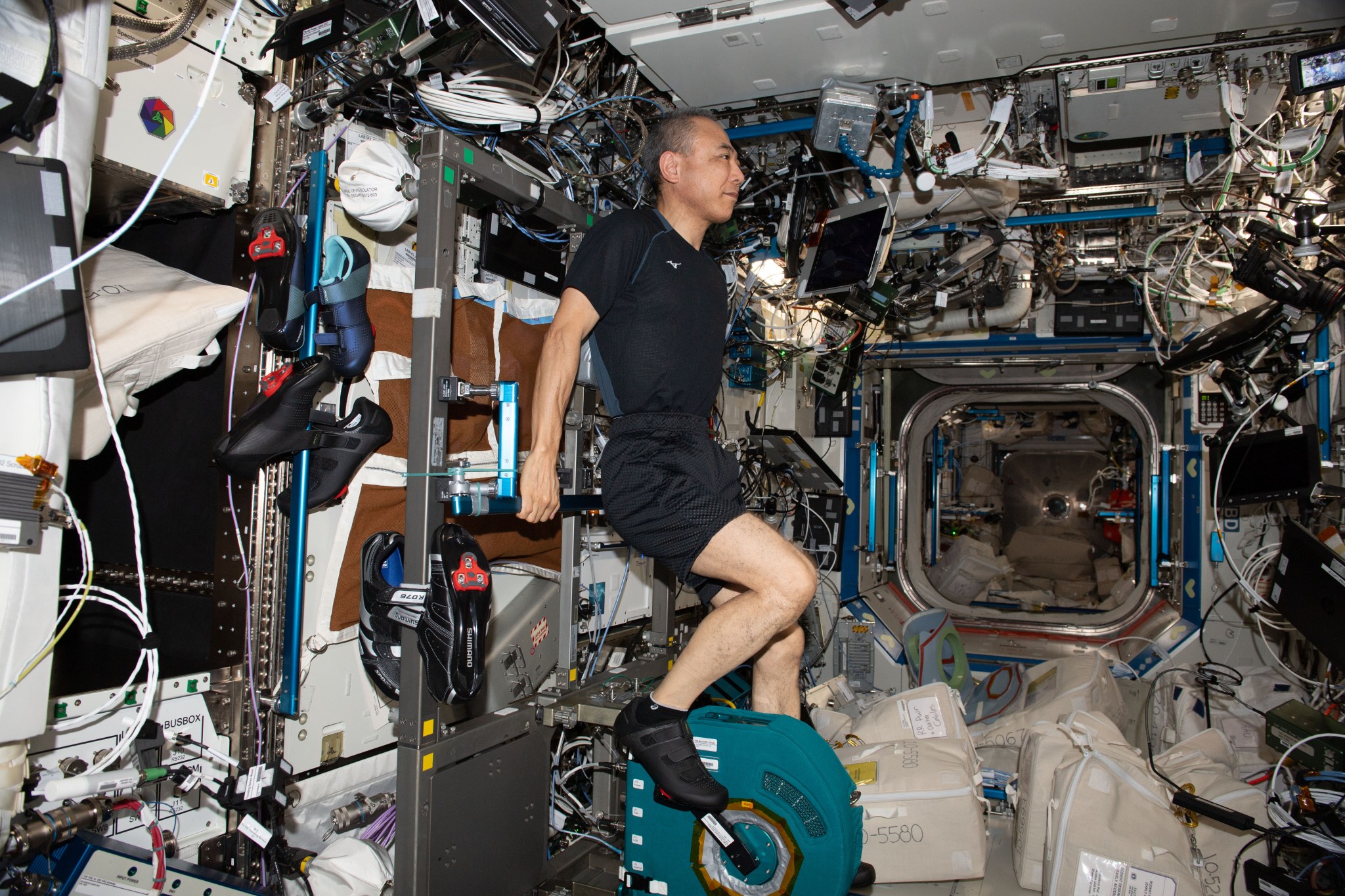
JAXA (Japan Aerospace Exploration Agency) astronaut Satoshi Furukawa pedals on the upgraded CEVIS system.
NASA
An interesting piece of research but further work is needed to see whether jumping would herald in the same benefits to humans but the study is promising. If so, then jumping exercises are likely to be a part of pre-flight and inflight exercise programs for astronauts. It is likely that for this to be a reality in the micro-gravitational environment, astronauts will be attached to strong elasticated material to simulate the pull of gravity.
NASA’s Curiosity Mars rover captured this feather-shaped iridescent cloud just after sunset on Jan. 27, 2023. Studying the colors in iridescent clouds tells scientists something about particle size within the clouds and how they grow over time. These clouds were captured as part of a seasonal imaging campaign to study noctilucent, or “night-shining” clouds. Image Credit: NASA/JPL-Caltech/MSSS
Curiosity’s Other Important Job: Studying Martian Clouds
MSL Curiosity is primarily a rockhound. It’s at Gale Crater, examining the rocks there and on Mt. Sharp, which sits in the middle of the crater and rises 5.5 km above the crater floor. But Curiosity is also a skywatcher, and its primary camera, Mastcam, was built with Martian clouds in mind.
When the sun set on Mars’ Gale Crater on January 17th, MSL Curiosity spent 16 minutes capturing images of the sky with Mastcam, the rover’s primary camera system. The images are part of an effort to understand noctilucent clouds, which are made of CO2 ice and only form over certain regions.
In the animation below, the 16 minutes of images have been sped up by about 480 times. “The white plumes falling out of the clouds are carbon dioxide ice that would evaporate closer to the Martian surface,” NASA says in a press release. “Appearing briefly at the bottom of the images are water-ice clouds travelling in the opposite direction roughly 31 miles (50 kilometres) above the rover.”
Earth has noctilucent clouds, too. They form in the upper atmosphere and are only visible during twilight when the atmosphere’s lower layers are in the shade and the upper atmosphere is sunlit. They form from water ice crystals between 76 to 85 km altitude and are the highest clouds in the atmosphere.
Mars’ noctilucent clouds are similar, but the main difference is that they contain carbon dioxide ice. They form at an altitude of around 60 to 80 km and are also classified as mesospheric clouds. On Mars, they occur in the Fall over the southern hemisphere. Only Mars’ high-altitude clouds containing carbon dioxide ice display iridescent colours.
This is the fourth year in succession that Curiosity has seen these noctilucent clouds. Its Mastcam instrument has different filters that let it see different wavelengths of light, and some of those filters are used to study the composition and particle size in clouds. It also has stereo vision, which helps scientists determine cloud height, shape, and the speed at which they’re moving. It can also observe the Sun through filters and determine how much sunlight the atmosphere is blocking. That tells scientists how much dust and ice is in the atmosphere and how it changes over time.
“I’ll always remember the first time I saw those iridescent clouds and was sure at first it was some color artifact,” he said in a press release. “Now it’s become so predictable that we can plan our shots in advance; the clouds show up at exactly the same time of year.”
These clouds form only in early Martian fall and only in the southern hemisphere. Their iridescence is from uniform particle size, which indicates that the clouds had a brief evolution in a uniform environment. When clouds are both noctilucent and iridescent, they’re called nacreous clouds. It’s interesting to note that these colours would be easily seen by an astronaut on the Martian surface.
This figure from the paper shows iridescent clouds in cylindrical projections. Each image was taken on a separate day. (d) is twice the resolution of the others. (e) shows a corona in the clouds caused by low variance in CO2 ice particle size. Image Credit: Lemmon et al. 2024.
One of the mysteries behind these clouds concerns their location. They’re only seen in Mars’ southern hemisphere, and the Perseverance rover, which is in the Jezero Crater in the northern hemisphere, has never seen them. It seems pretty clear that they only form in certain locations, but the reasons why are unknown.
Lemmon says that gravity waves, which are atmospheric phenomena separate from astrophysical gravitational waves, could be responsible. They cool the atmosphere and could give rise to clouds of frozen CO2. “Carbon dioxide was not expected to be condensing into ice here, so something is cooling it to the point that it could happen. But Martian gravity waves are not fully understood, and we’re not entirely sure what is causing twilight clouds to form in one place but not another,” Lemmon said.
Scientists need more data to better understand these clouds. Curiosity wasn’t the only one to see them; the InSight lander did, too. But they could only see for a few hundred kilometres around their landing sites and their data is incomplete. “Orbiters capable of sunset and twilight times could constrain the cloud altitude,” Lemmon and his co-authors write in their paper.
There are unanswered questions about these clouds. Scientists would like to understand how quickly particles in these clouds evolve. They’d also like to know what the nature of the corona-forming layer is. A larger data sample could help answer these questions, as could more time-lapse imagery.
American astronomers have christened this rocky exoplanet 'YZ Ceti b,' asserting that it's a prime candidate for an Earth-like magnetic field, which could be crucial in humanity's quest for alien life.
The discovery has been hailed as significant for identifying a planet likely to have a magnetic field and offering a future technique to discover more such planets.
Using a radio telescope, the scientists detected a recurring radio signal from exoplanet YZ Ceti b, located approximately 70.5 trillion miles from Earth.
They speculate that these waves could be produced by interactions between the exoplanet's magnetic field and its host star, a small red dwarf named YZ Ceti.
This finding is essential for pinpointing a planet likely to have a magnetic field and establishing a foundation to discover similar planets in the future.
The researchers further suggested that this could mean witnessing the Northern Lights phenomenon - a result of interactions between magnetic fields and solar weather - on distant planets and stars could be possible.
Magnetic fields are vital in preventing a planet's atmospheric erosion caused by stellar emissions over time.
Using a radio telescope, the scientists found exoplanet YZ Ceti b
Drs. Sebastian Pineda and Jackie Villadsen have recently identified a repetitive radio signal from YC Ceti, a red dwarf star located 12 light years away. For context, one light year is nearly 5.88 trillion miles.
The Karl G. Jansky Very Large Array, a prominent radio telescope managed by the National Radio Astronomy Observatory under the US National Science Foundation, was the instrument that allowed them to gain deeper insights into the magnetic dynamics between distant stars and their planets.
This groundbreaking work, outlined in Nature Astronomy, was also funded by the independent federal agency, the National Science Foundation (NSF).
Joe Pesce from NSF, who works as the program director for the National Radio Astronomy Observatory, hails these discoveries as key in the ongoing quest to find life on other worlds, emphasizing, "The search for potentially habitable or life-bearing worlds in other solar systems depends in part on being able to determine if rocky, Earth-like exoplanets actually have magnetic fields."
Recent research marks a significant advancement in exoplanet studies, indicating that some rocky planets beyond our solar system may have magnetic fields. This discovery was achieved through a novel technique that could help identify more of these intriguing worlds.
Dr. Pineda of the University of Colorado, located on America's west coast, expressed the team's elation at detecting planetary radio emissions similar to those Earth emits: "We saw the initial burst, and it looked beautiful," he said enthusiastically.
Moments of scientific triumph followed as Pineda recounted: "When we saw it again, it was very indicative that, OK - maybe we really have something here."
Dr. Pineda noted that a sturdy magnetic field can be pivotal for a planet's ability to retain its atmosphere.
From the other side of the country, Assistant Professor Villadsen of Bucknell University remarked on the distinctiveness of their findings: "I witnessed something that no one has observed before."
Prior detections of exoplanetary magnetic fields were mainly limited to gas giants resembling Jupiter. However, unearthing Earth-sized counterparts calls for different, refined methods.
Since magnetic fields are inherently intangible, detecting their presence around distant planets poses a significant astronomical challenge that Assistant Prof Villadsen and her team are committed to addressing.
She explained their strategy: "We're looking for planets that are really close to their stars and are a similar size to Earth."
"These planets are way too close to their stars to be somewhere you could live, but because they are so close the planet is kind of ploughing through a bunch of stuff coming off the star."
"If the planet has a magnetic field and it ploughs through enough star stuff, it will cause the star to emit bright radio waves."
RELATED VIDEOS
A star-planet system with a COHERENT radio signal from an AURORA
NASA Discovers New Substances on Mars: Implications for Future Exploration and Understanding of the Red Planet
Introduction
The quest to understand Mars has captivated scientists and enthusiasts alike for decades. With its striking similarities to Earth and its potential to harbor life, the Red Planet has been a focal point of exploration for NASA and other space agencies around the globe. Recent discoveries of new substances on Mars have opened up exciting avenues for research and exploration. This article delves into the significance of these findings, the methods used to uncover them, and what they mean for the future of Mars exploration.
The Historical Context of Mars Exploration
Mars, often referred to as the "Red Planet" due to its reddish appearance from iron oxide (rust) on its surface, has been a subject of human fascination for centuries. The first observations of Mars were made through telescopes in the 1600s, but it wasn't until the 20th century that space missions began to provide detailed information about its atmosphere, surface, and potential for life.
NASA's Viking missions in the 1970s were pivotal, providing the first close-up images and data about the Martian surface. Subsequent missions, including the Mars Pathfinder, Mars Exploration Rovers (Spirit and Opportunity), and the Mars Science Laboratory (Curiosity), have progressively advanced our understanding of the planet.
The Curiosity rover, which landed in Gale Crater in 2012, has been a key player in Mars exploration. It has analyzed various rocks and soil samples, providing evidence of past water flows and organic molecules, which are crucial for understanding the planet's potential for life.
NASA Finds Ancient Organic Material, Mysterious Methane on Mars - This low-angle self-portrait of NASA’s Curiosity Mars rover shows the vehicle at the site from which it reached down to drill into a rock target called “Buckskin” on lower Mount Sharp.
Credits: NASA/JPL-Caltech/MSSS
Recent Discoveries: New Substances on Mars
NASA's ongoing missions have recently reported the discovery of new substances on Mars, particularly through the Perseverance rover and the Ingenuity helicopter. Perseverance, which landed on Mars in February 2021, has been tasked with seeking signs of ancient life and collecting rock and soil samples for future return to Earth.
Organic Molecules and Their Significance
One of the most groundbreaking discoveries from Perseverance has been the identification of organic molecules in Martian rocks. Organic molecules are carbon-based compounds that are often associated with life. Their presence does not confirm life on Mars but suggests that the building blocks of life may exist on the planet.
NASA scientists have detected these molecules using the Scanning Habitable Environments with Raman & Luminescence for Organics & Chemicals (SHERLOC) instrument, which utilizes advanced spectroscopy techniques to analyze the composition of rock samples. This discovery has revived discussions about the potential for past microbial life on Mars.
NASA's Curiosity Rover Discovers Mysterious Crystals On Mars
Salts and Their Geological Implications
Another significant finding from Perseverance is the presence of various salts in the Martian soil. These salts, including perchlorates, are of particular interest because they can provide insights into the planet's past climate and potential for habitability. Salts can indicate the presence of liquid water in the past, as they often form in evaporative environments.
The discovery of salts raises questions about the history of water on Mars. Understanding the distribution and concentration of these salts can help scientists reconstruct the planet's climatic history and assess whether conditions were ever suitable for life.
Curiosity Mars Rover captured this on Martian sand on February 13, 2022
Unusual Rock Formations and Their Composition
Perseverance has also encountered unusual rock formations that suggest a complex geological history. These formations, characterized by unique textures and mineral compositions, may tell a story of past volcanic activity, sedimentation, and erosion.
Researchers are employing a variety of analytical techniques to understand the mineralogy of these rocks. The ChemCam instrument, which uses laser-induced breakdown spectroscopy, has been instrumental in identifying the elemental composition of Martian rocks, revealing a diverse geological landscape.
The Role of Ingenuity in Exploration
The Ingenuity helicopter, accompanying Perseverance, has demonstrated the feasibility of powered flight on another planet. Its successful flights have not only provided aerial perspectives of the Martian terrain but have also guided Perseverance to scientifically interesting locations.
Ingenuity's ability to scout the landscape has been invaluable in directing the rover to areas with promising geological features. This synergy between the two missions highlights the potential for innovative technologies in planetary exploration.
A photograph of a "Silver Mountain" rock sample collected by NASA's Perseverance Mars Rover as it explores the rim of Jezero Crater.
(Image credit: NASA/JPL-Caltech)
Implications for Future Mars Missions
The discoveries made by Perseverance and Ingenuity have profound implications for future Mars exploration. As NASA plans for the Artemis program and aims to return humans to the Moon, the lessons learned from Mars missions will inform the agency's approach to exploring other celestial bodies.
Sample Return Missions
One of the most ambitious goals of the current Mars exploration program is the return of samples to Earth. The Mars Sample Return mission, a collaboration between NASA and the European Space Agency (ESA), aims to bring back rock and soil samples collected by Perseverance. Analyzing these samples in terrestrial laboratories could yield insights that are currently beyond our reach with remote sensing and in-situ analysis.
Search for Life
The discoveries of organic molecules and salts have intensified the search for life on Mars. Future missions will likely focus on identifying biosignatures—chemical indicators of past or present biological activity. This search will involve more sophisticated instruments capable of detecting and analyzing potential life forms, including microbial life.
Human Exploration
As NASA prepares for the eventual human exploration of Mars, understanding the planet's geology, climate, and potential hazards will be crucial. The presence of resources, such as water in the form of ice or brines, will play a significant role in sustaining human life on Mars. Future missions will prioritize the identification and assessment of these resources.
Public Interest and International Collaboration
The discoveries on Mars have also sparked renewed public interest in space exploration. NASA's commitment to transparency and engagement with the public has fostered a sense of excitement and curiosity about the Red Planet. Educational outreach programs and interactive platforms have allowed people worldwide to participate in the journey of discovery.
Moreover, international collaboration in space exploration has become increasingly important. As countries like China, the United Arab Emirates, and India launch their Mars missions, the sharing of data and findings can enhance our collective understanding of the planet. Collaborative efforts can also help address the challenges of planetary exploration, including technology development and resource allocation.
Conclusion
The recent discoveries of new substances on Mars mark a significant milestone in our exploration of the Red Planet. The identification of organic molecules, salts, and unique geological formations has profound implications for our understanding of Mars' past and its potential to support life.
As NASA and other space agencies continue their missions, the integration of innovative technologies and international collaboration will be key to unlocking the mysteries of Mars. The quest for knowledge about our neighboring planet is not only a scientific endeavor but also an opportunity to inspire future generations to explore the cosmos.
In the coming years, as we await the return of samples from Mars and prepare for human exploration, the discoveries made today will shape our understanding of life beyond Earth and our place in the universe. The journey to Mars is just beginning, and the excitement of discovery continues to propel us forward into the unknown.
RELATED VIDEOS
10 Years On Mars: The Full Journey
NASA reveals Perseverance rover's discoveries on Mars | full video
Ivanpah was the largest concentrated solar power facility in the world when it opened in 2014, just over a decade, it's slated to close.
David McNew/Getty Images
This alien-like field of mirrors in the desert was once the future of solar energy. It’s closing after just 11 years
Story by Laura Paddison, CNN
From a distance, the Ivanpah solar plant looks like a shimmering lake in the Mojave Desert. Up close, it’s a vast alien-like installation of hundreds of thousand of mirrors pointed at three towers, each taller than the Statue of Liberty.
When this plant opened near the California-Nevada border in early 2014, it was pitched as the future of solar power. Just over a decade later, it’s closing.
The plant’s co-owner NRG Energy announced in January it was unwinding contracts with power companies and, subject to regulatory approval, would begin closing the plant in early 2026, readying the site to potentially be repurposed for a new kind of solar energy.
For some, Ivanpah now stands as a huge, shiny monument to wasted tax dollars and environmental damage — campaign groups long criticized the plant for its impact on desert wildlife. For others, failures like this are a natural part of the race to find the winning solutions for the clean energy transition.
When Ivanpah was conceived, its technology, called concentrated solar or thermal solar, was considered a potential breakthrough.
It works like this: Hundreds of thousands of computer-controlled mirrors called “heliostats” track the sun and concentrate its rays onto three towers, each around 450 feet tall and topped with water-filled boilers. The sun’s hyper-concentrated energy turns this water to steam, which drives a turbine to create electricity.
One of the key selling points of this solar technology is the ability to store heat, allowing the production of electricity at night or when the sun isn’t shining without needing batteries.
The project got buy-in from the government with $1.6 billion in Department of Energy loan guarantees, and from utilities Pacific Gas & Electric Company and Southern California Edison, which both entered long-term agreements to buy Ivanpah’s power.
In 2014, it started commercial operations as the world’s largest solar thermal plant, spread across around 5 square miles of federal desert.
“This project is a symbol of the exciting progress we are seeing across the industry,” said then Secretary of Energy Ernest Moniz, in February 2014 during a dedication ceremony at the site.
So, where did it go wrong?
First, the technology proved finnicky and never quite worked as well as intended, said Jenny Chase, a solar analyst at BloombergNEF.
These kinds of plants “are just technically really difficult to operate,” she told CNN. They combine all the tricky, mechanical parts of a fossil fuel plant — running a turbine and maintaining many moving parts — with the challenges of a distributed energy source. The technology relies on mirrors tracking the sun exactly. “It’s really hard to get those all lined up perfectly and keep them lined up at all times,” Chase said.
But perhaps the biggest problem for Ivanpah is that photovoltaic solar — the technology used in solar panels — became really, really cheap.
In some parts of the world “you can basically buy a solar module for the price of a fence panel,” Chase said. At the time Ivanpah was built, “nobody really would have dreamed that photovoltaics would be this cheap, and batteries are doing a similar thing,” she added.
California's $2.2 billion dollar Ivanpah Solar Plant is a concentrated solar thermal plant in the California Mohave Desert.
Jason Andrew/Redux
Ivanpah's around 350,000 mirrors focus sunlight onto three towers, where water is turned to steam to generate electricity.
Jim West/REA/Redux
Wild burros are seen near the Ivanpah solar power plant on August 26, 2022.
David McNew/Getty Images
A spokesperson for NRG said prices were competitive when the power agreements were signed in 2009. But over time, advancements in other types of solar technology “led to more efficient, cost effective and flexible options for producing reliable clean energy.”
In January, NRG finalized negotiations with PG&E to terminate power purchase agreements which were supposed to end in 2039. This “will provide significant savings for California ratepayers,” the company’s spokesperson said.
A spokesperson for Southern California Edison said it was in ongoing discussions with the plant owners and the DOE about its contract.
For critics of Ivanpah, its imminent demise is proof the plant should never have been built.
It “was a financial boondoggle and environmental disaster,” said Julia Dowell, senior campaign organizer at the Sierra Club, an environmental organization. “The project’s construction destroyed irreplaceable pristine desert habitat,” she told CNN.
Ivanpahs’s location in the sweeping, sun-drenched Mojave Desert may have seemed ideal for generating solar power, but it is also a habitat for threatened desert tortoises. While the plant’s developers agreed to a series of measures to protect and relocate the animals, many environmentalists believed the plant should not have been approved.
The Ivanpah plant is set to begin closing in 2026, with units decommissioned to prepare the land to potentially be repurposed for a different kind of solar power.
Bill Clark/CQ-Roll Call/Getty Images
The other big issue was bird deaths. Reports of “streamers” — birds incinerated midair by the beams of intense heat from the mirrors — solidified opposition.
NRG did not respond to specific questions about the plant’s impact on wildlife.
Some commentators are using Ivanpah to make the case that renewable energy projects should not receive government money, a view that appears to fit with the new administration’s. One of President Donald Trump’s first actions was to pause approvals of new renewable energy projects on federal land.
But renewable energy experts say it’s important for governments to invest in a range of clean technologies, and many of those they have invested in, such as photovoltaics, have worked out.
It wasn’t clear which solar technologies would prove most cost effective when Ivanpah was being built 15 years ago, said Kenneth Gillingham, an economics professor at Yale School of the Environment.
“Picking winners is extremely difficult,“ he told CNN, “and it’s not a problem that some technologies are outcompeted by others, as long as innovation continues occurring.”
For more CNN news and newsletters create an account at CNN.com
RELATED VIDEOS
The Unexplored Mojave: Ivanpah Dry Lake
Ivanpah Solar Plant in 4K
Ivanpah Solar Electric Generating System - Solar Energy Drone Aerial Tour DJI Inspire 3
An international team of astronomers has announced the discovery of a new dwarf planet in our Solar System, finding a distant object beyond Neptune that circles the Sun in a spectacularly wide orbit.
Dubbed 2015 RR245 by the International Astronomical Union while they come up with a better name, the dwarf planet is about 700 kilometres in diameter, and its elongated orbit sends it out some 120 times further from the Sun than Earth. So it's a pretty distant neighbour.
Astronomers are finding more of these dwarf planets in the Kuiper belt all the time, but even so RR245 stands out for its size and orbit. In fact, the scientists who found it – as part of the Outer Solar System Origins Survey (OSSOS) – say it's the largest OSSOS discovery to date, of more than 500 trans-Neptunian objects identified by the Survey.
"The icy worlds beyond Neptune trace how the giant planets formed and then moved out from the Sun. They let us piece together the history of our Solar System," said researcher Michele Bannister from the University of Victoria in British Columbia, Canada. "But almost all of these icy worlds are painfully small and faint: it's really exciting to find one that's large and bright enough that we can study it in detail."
RR245's huge orbit – which you can see in the image above – takes it about 700 years to circle the Sun, and the researchers say it's currently travelling in for its closest approach, which will see it get within 5 billion kilometres of the Sun sometime around 2096.
That's after spending hundreds of years at more than 12 billion kilometres from the Sun, although the team acknowledges there's still a lot to be confirmed about RR245's precise movements, as we've only been able to observe just a tiny fraction of its epic loop so far.
Scientists think there were once many more of these dwarf planets in our Solar System, but most were destroyed or ejected when the larger planets in our Solar System moved to their current positions. But now RR245 joins the ranks of other survivors from this period – such as Ceres, Pluto, Haumea, Makemake, and Eris, which have all been recognised as dwarf planets by the International Astronomical Union – amidst the tens of thousands of much smaller objects beyond Neptune.
The researchers first spotted the dwarf planet in February, when astronomer JJ Kavelaars from the National Research Council of Canada was sifting through OSSOS data recorded in September 2015.
"There it was on the screen," said Bannister, "this dot of light moving so slowly that it had to be at least twice as far as Neptune from the Sun."
The team suggests it's possible that RR245 may be one of the last large worlds detected beyond Neptune with today's telescopes, as the brightest dwarf planets have already been mapped – although the debut of the Large Synoptic Survey Telescope next decade could turn up new discoveries we haven't been able to detect so far.
"OSSOS was designed to map the orbital structure of the outer Solar System to decipher its history," said one of the researchers, Brett Gladman of the University of British Columbia in Canada. "While not designed to efficiently detect dwarf planets, we're delighted to have found one on such an interesting orbit."
But beyond helping us map the outer reaches of our Solar System, the discovery of these dwarf planets – and their unique geological composition – helps us understand more about the cosmic past in our corner of the galaxy.
"They are the closest thing to a time capsule that transports us to the birth of the Solar System," astrophysicist Pedro Lacerda from Queen's University Belfast in Northern Ireland, who wasn't involved with the discovery, told Ian Sample at The Guardian. "You can make an analogy with fossils, which tell us about creatures long gone."
Barack Obama shared 'truth' after being asked if he knew about existence of UFOs and Aliens
He said that once he became president he wanted to know the secrets
Joe Harker
Former US president Barack Obama once spoke about 'the truth' he'd learned when it comes to the existence of aliens and UFOs.
If they really do exist and Area 51 is packedwith life from other planets, then you'd reckon it's the sort of thing you'd get told about when you become president.
Once you're the head honcho you can surely call all the people in charge of this stuff for a meeting and get them to tell you the truth about the various supposed sightings which have prompted a huge wave of conspiracy theories.
Who better to ask than someone who's done the job then?
Perhaps that's why Barack Obama was once quizzed about exactly what he knew when it came to the secrets and mysteries of alien life.
Are aliens real? That's what Barack Obama wanted to know after he became president.
(Scott Olson/Getty Images)
In an appearance on The Late, Late Show With James Corden, the former US president was asked about 'dem aliens' by Reggie Watts and UFOs along with any theories he might have on it.
Obama kept things close to the chest as he joked that 'when it comes to aliens there are some things I just can't tell you on air' (that's suspicious) before opening up on his own extra-terrestrial interests.
He said: "The truth is that when I came into office I asked, I was like 'all right, is there a lab somewhere we're keeping the alien specimens and spaceship?'.
"They did a little bit of research and the answer was no."
However, don't be too discouraged all of you true believers out there, because perhaps he's just lying to protect the secrets of aliens and UFOs
Reggie Watts to Barack Obama: What's w/ Dem Aliens?
Obama also said 'there's footage and records of objects in the skies that we don't know exactly what they are', so as far as the official meaning of UFOs goes there are some flying objects which have remained unidentified.
He said that part about things in the sky which we can't figure out was 'true', saying 'we can't explain how they moved, their trajectory'.
The former president then joked that Watts was 'deflecting' and flipped things back on the musician by quipping that he could secretly be an alien to which Watts agreed.
Whether or not we're alone in the universe is an endless fascination for some people and the idea that we've already been visited by extra-terrestrial life which has left evidence behind is an obsession for some people.
If you really want to know what it is Barack Obama 'can't tell you on air' then perhaps you should try becoming president.
A man who 'died' for six minutes as a child has detailed the haunting scenes he claims he saw in heaven.
The unidentified social media user told how they were just 15 years old when, in 2003, they suddenly collapsed in the road.
Despite feeling 'just fine all day', the boy 'broke out in a cold sweat', became breathless and suffered ventricular fibrillation — a dangerous abnormal heart rhythm and most frequent cause of sudden cardiac death.
After paramedics arrived, the individual claimed they discovered their heart had stopped beating and it was only after 'working tirelessly to revive me' in an ambulance that their heart began working again after six minutes.
The person claimed to have miraculously avoided any long-term damage, and said they are one of the handful of people to experience near-death experiences by temporarily 'transcending our world'.
These phenomena, which have been a source of fascination for medics and the public alike for decades, are believed to occur when people are clinically 'dead', and extremely unlikely to survive.
Many of those who've had such an experience claim to have seen the afterlife.
But, recalling the experience on a Reddit thread garnering more than 12,000 likes, the user said: 'During my visit, I learned things about our universe that I wish I hadn't.
In a post shared to a social media thread, the unidentified user told how they were just 15 years old when, in 2003, they suddenly collapsed in the road
'It began with light. Blinding, white, pervasive. It bathed me, calmed me. It was everything they tell you about. Beatific, welcoming, the stuff of spiritual experiences.
'I had the distinct feeling of ascent, like the light was lifting me skyward. I passed through several sets of gates, which my dizzied consciousness hardly registered.
'I arrived in a place without dimension, a place beyond reality. It only made sense while I occupied it.'
But they also claimed they were faced with several 'cold' and 'mocking' creature-like figures that delivered 'horrifying truths about existence'.
They added: 'At first, because of my Christian upbringing, I believed them to be angels.
'In my incorporeal form, I made the spiritually-equivalent gesture of opening my arms, anticipating their embrace.
'Instead, I felt myself shackled by their powers, like a collared dog.
'Humiliation and terror came over me. These were not the ethereal beings I'd been led to believe await us.
'Six minutes in "heaven" felt like a lifetime.'
Once the minutes came to an abrupt end, they returned to their body 'on Earth'.
However, they also claimed the creature-like figures told them 'not to reveal their existence to the rest of my kind'.
'I can't imagine anything worse than what I experienced, subsumed beneath an ineffable grief and torment.'
They added: 'For weeks, I tried to explain to anyone who would listen what I experienced.
'Everyone told me I'd suffered a very serious and traumatic experience for a young man, that the event left scars on my psyche as well as my heart.'
The tale, posted on social media, is based on just one unverified experience.
But Reddit users have been fascinated by the man's perspective, with the post garnering more than 400 comments from posters sharing their shock and horror.
Amber Cavanagh previously told MailOnline she was 43 when she suffered two strokes and entered the 'meeting point' of heaven.
Mrs Cavanagh, from Canada, said she could see her husband 'weeping over' her body.
Amber Cavanagh previously told MailOnline she was 43 when she suffered two strokes and entered the 'meeting point' of heaven
Mrs Cavanagh, from Canada, said she could see her husband (pictured above) 'weeping over' her body
Experiences of seeing and hearing things whilst clinically dead do have some scientific basis.
For years studies have shown the human brain still functions normally for a very brief time after the heart stops, although it appears to have ceased activity on regular scans.
Research has also revealed that the brain can still experience sporadic bursts of activity even after an hour without oxygen, during resuscitation.
Such discoveries have led to some medics calling for an overhaul of the standard practice that rules people should be declared dead after three-to-five minutes of oxygen deprivation to the brain, as these patients could still in theory be resuscitated.
People have previously told MailOnline of out of body experiences such as seeing bright lights at the end of a tunnel or meeting deceased relatives.
While evidence on something happening in brains after clinical death is still being explored, exactly why so many people have similar experiences remains an issue of contention among experts.
Some theorise that as the brain is undergoing these changes essentially the 'brakes' come off the system and this opens our perception to incredibly lucid and vivid experiences of stored memories from our lives.
However, this is only a theory and other experts dispute this.
Clinical death also differs from brain death.
Brain death is when a person on an artificial life support machine no longer has any brain function, which means they will not regain consciousness.
Such patients have no chance of recovery because their body is unable to survive without artificial life support.
In the UK this means a person who has suffered brain death is legally dead.
This can be difficult to comprehend for families of the deceased as they can see their loved one's chest rise and fall with every breath from the ventilator as well as their heart continuing to beat.
Brain death can be caused by both illness and injury when blood and/or oxygen supplies are cut off to the vital organ.
The condition is different from a vegetative state where a patient's brain function remains.
RELATED VIDEOS
Rethinking Death: Exploring What Happens When We Die
Clinically Dead for 10 Mins; Why We Have Nothing to Fear (Profound NDE)
Man Dies & Learns We Have It Completely Backwards! (Powerful NDE)
This is actually slightly less than previous estimates, which suggested there was a 2.3 per cent (one in 43) chance of impact.
Meanwhile, the scientist predicts there's a roughly 0.3 per cent (one in 333) chance of 2024 YR4 hitting the moon.
If the asteroid does hit Earth, the impact could release a blast of energy equivalent to 15 megatons of TNT - 100 times more powerful than the atomic bomb dropped on Hiroshima during World War II.
David Rankin, operations engineer for the University of Arizona's Catalina Sky Survey, calculated the route 2024 YR4 is most likely to take (white line). Showing the precise collision course which could lead to a deadly impact
A terrifying new simulation reveals the path of the city-killer asteroid 2024 YR4 which has a 2.1 per cent probability of colliding with Earth in 2032
(stock image)
The asteroid was first detected by the NASA-funded Asteroid Terrestrial-impact Last Alert System (ATLAS) station in December last year.
Although that probability has now slightly decreased, 2024 YR4 is still the only large asteroid with an impact probability greater than one per cent - making it by far Earth's biggest threat.
However, Dr Rankin's calculations present a chilling new possibility that the asteroid could collide with the moon instead.
In a post on BlueSky, Dr Rankin revealed that there was a roughly 0.3 per cent chance of 2024 YR4 hitting the moon.
Without any atmosphere to slow its approach, the asteroid would slam into the lunar surface at a staggering speed of 31,000 miles per hour (50,000 kilometres per hour).
The collision would unleash an explosion 343 times the size of the atomic bomb dropped on Hiroshima and carve out a crater up to 1.2 miles (2km) across.
Should it hit the moon, it is most likely to land in the region stretching south from the Mare Crisium, a large plain of solidified lava, to the crater Tycho.
Asteroid 2024 YR4 is about the same size as the Tunguska asteroid, which caused the largest impact event in recorded history when it shot through Earth's atmosphere in 1908, flattening 830 square miles (2,150 square km) of forest (pictured)
Analysis of 2024 YR4's orbit indicates that the asteroid will most likely pass by Earth on December 22, 2032. However, new calculations suggest that it could also collide with the moon
What do we know about 2024 YR4?
First detected: December 27, 2024
Estimated size: 40-90 metres (130-300 feet)
Speed relative to Earth: 29,000 miles per hour (46,800 kmph)
Date of closest pass: December 2, 2032
Probability of impact: 2.1 per cent (one in 48)
Destructive potential:A 'city killer' on a scale on the Tunguska asteroid, which detonated with a force equal to 15-30 megatons of TNT.
This could be concerning since this would place the impact on the side of the moon facing Earth, potentially exposing us to a shower of lunar shrapnel.
Thankfully, experts say that the Earth likely wouldn't be harmed by any impact which occurs on the moon.
Dr Rankin told New Scientist: 'There is the possibility this would eject some material back out that could hit the Earth, but I highly doubt it would cause any major threat.'
Unlike a large object such as 2024 YR4, these smaller pieces of debris should burn up harmlessly in the atmosphere creating nothing more than a particularly bright meteor shower.
In fact, some experts suggest that the collision between the asteroid and the moon could create a truly spectacular display.
Gareth Collins, a professor of planetary science at Imperial College London, told New Scientist: 'The impact flash of vaporised rock would be visible from Earth, even in the daytime.'
That means any keen stargazers on Earth could see the moment the asteroid detonates on the lunar surface with the naked eye.
However, it is currently seven times more likely to hit Earth rather than the moon.
Without any atmosphere to slow it down, the asteroid would hit the moon at 31,000 miles per hour (50,000 kilometres per hour), creating an explosion bright enough to see from Earth with the naked eye
These probabilities are likely to change in the future as scientists gather more information about the asteroid's orbit.
The current estimates for 2024 YR4's orbital path, speed, and size come from hundreds of images taken by powerful telescopes all around the world.
However, over such a short period of time, it is difficult to precisely predict where the asteroid will travel.
While astronomers hope that the probability of an impact will rapidly fall towards zero, a direct collision with Earth cannot be ruled out.
The JWST will record the heat emitted by the asteroid using its infrared sensors which will give a more accurate estimate for its size.
A team of ESA scientists will make one observation in March when the asteroid reaches its peak brightness and another in May as it travels away from Earth.
This will be the last chance to observe 2024 YR4 before it becomes too dim to see from Earth until it returns again in 2028.
The European Space Agency has been given emergency access to the James Webb Space Telescope (pictured) to measure the asteroid's size more accurately
Already, NASA has reached a hugely-important milestone with the DART asteroid deflection mission. In September 2022, the DART spacecraft was intentionally crashed into Dimorphos, an asteroid 6.8 million miles away. A similar method could be used to deflect asteroid 2024 YR4 before it reaches Earth
Those observations will be critical for determining whether the world's space agencies need to take action to divert its course.
In a post on X, Dr Robin George Andrews, a volcanologist and author based in London, points out that we 'have less than eight years to potentially deal with it'.
'You need 10 years or more to build, plan and execute an asteroid deflection mission,' he said.
Terrifying projected path of 'city-destroying' asteroid
Currently, NASA would not be able to deflect an asteroid if it were heading for Earth but it could mitigate the impact and take measures that would protect lives and property.
This would include evacuating the impact area and moving key infrastructure.
Finding out about the orbit trajectory, size, shape, mass, composition and rotational dynamics would help experts determine the severity of a potential impact.
However, the key to mitigating damage is to find any potential threat as early as possible.
NASA and the European Space Agency completed a test which slammed a refrigerator-sized spacecraft into the asteroid Dimorphos.
The test is to see whether small satellites are capable of preventing asteroids from colliding with Earth.
The Double Asteroid Redirection Test (DART) used what is known as a kinetic impactor technique—striking the asteroid to shift its orbit.
The impact could change the speed of a threatening asteroid by a small fraction of its total velocity, but by doing so well before the predicted impact, this small nudge will add up over time to a big shift of the asteroid's path away from Earth.
This was the first-ever mission to demonstrate an asteroid deflection technique for planetary defence.
The results of the trial are expected to be confirmed by the Hera mission in December 2026.
RELATED VIDEOS
Terrifying NASA Update: Doomsday Asteroid Heading Towards Earth
NASA will send astronauts Butch Wilmore and Suni Williams home from the International Space Station early on a previously used SpaceX Dragon space capsule, not on a brand-new one, the agency announced.
A NASA astronaut testing equipment on a spacewalk outside the International Space Station.
(Image credit: NASA)
Stranded Starliner astronauts Butch Wilmore and Suni Williams finally have a return date to head back to Earth, and it's a few weeks earlier than previously expected.
NASA announced Tuesday (Feb. 11) that the two astronauts, who hitched a ride to the International Space Station (ISS) on a Boeing Starliner spacecraft last June, will head home on a SpaceX Dragon capsule that will leave Earth with the ISS Crew-10 on Wednesday, March 12. After a few days' handover period, Williams and Wilmore will leave the ISS with the rest of the Crew-9 mission, after having spent about 250 consecutive days in orbit.
NASA's Boeing Starliner astronauts Butch Wilmore and Sunita Williams will now return to Earth on a SpaceX Dragon capsule in February 2025.
(Image credit: NASA)
Williams and Wilmore were initially meant to spend about a week in space, but problems with the propulsion and helium systems on their Boeing Starliner led NASA to return the capsule to Earth empty after three months of troubleshooting couldn't resolve the issues. The capsule ended up landing safely in New Mexico on Sept. 7, 2024. However, a watchdog report just released by the Aerospace Safety Advisory Panel found that new thruster problems did appear during the descent. In October, The Wall Street Journal reported that Boeing is in the early stages of considering a sale of its space business, including Starliner.
In December 2024, NASA announced that Williams and Wilmore would return on a newly designed SpaceX Dragon capsule in late March 2025 at the earliest. But now, the astronauts and the rest of Crew-9 will come home on a previously flown Dragon capsule, the Endurance. This will allow the swap between Crew-9 and Crew-10 to happen sooner while SpaceX continues to finalize the interior and final integration of the new Dragon capsule, according to NASA.
Along with Wilmore and Williams, astronaut Nick Hague and Roscosmos cosmonaut Aleksandr Gorbunov will leave the ISS in March. They'll be replaced by NASA astronauts Anne McClain and Nichole Ayers, Japan Aerospace Exploration Agency astronaut Takuya Onishi, and Roscosmos cosmonaut Kirill Peskov. The precise day of the return will be determined by weather conditions near Florida, where Endurance will splash down.
Astronomers have long suspected that several moons in our Solar System, including those orbiting Jupiter, Saturn,Uranus, and Neptune, may conceal vast liquid oceans beneath their frozen crusts. Now, new research suggests that Uranus’s moon Ariel might be offering a rare glimpse into its hidden depths.
Cracks in Ariel’s Surface May Expose Its Interior
Deep chasms mark Ariel’s surface, and researchers believe these fractures could be transporting material from the moon’s interior to the surface. Among the substances detected is carbon dioxide ice, which suggests the possibility of chemical processes occurring below the crust. If these deposits originated from within Ariel, they may provide a unique window into the moon’s subsurface environment—without the need for complex drilling missions.
“If we’re right, these medial grooves are probably the best candidates for sourcing those carbon oxide deposits and uncovering more details about the moon’s interior,” says planetary geologist Chloe Beddingfield of Johns Hopkins University Applied Physics Laboratory.
Unlike other surface features, these chasms appear to be the only structures facilitating material movement from Ariel’s interior, making them particularly valuable for future study.
Scientists analyzing Ariel’s terrain have found striking similarities to a geological process observed on Earth known as spreading. This occurs along volcanic ridges where the seafloor slowly separates, allowing molten material to rise and form new crust.
On Ariel, a similar process could be unfolding as warmer material from the moon’s interior forces its way up, splitting the icy surface before filling the cracks. Researchers tested this theory by digitally aligning the two sides of Ariel’s chasms as if “zipping them back up,” and found a perfect match. The presence of parallel grooves along some chasm floors further supports the idea that material has been accumulating over time through repeated geological activity.
Could a Hidden Ocean Be Driving These Changes?
Another factor influencing Ariel’s surface could be gravitational interactions between Uranus and its moons. These interactions, known as orbital resonance, create internal heating that can melt ice and sustain liquid water beneath the crust.
Recent observations from the James Webb Space Telescope (JWST) provide compelling evidence that a hidden ocean may exist beneath Ariel’s surface. If so, this ocean might be responsible for the carbon dioxide deposits seen within the moon’s deep chasms. However, current data is insufficient to determine the exact size and depth of this possible ocean.
“The size of Ariel’s possible ocean and its depth beneath the surface can only be estimated, but it may be too isolated to interact with spreading centers,” Beddingfield explains.
Despite significant advancements in planetary exploration, much about Ariel remains unknown. While the Voyager 2 spacecraft provided valuable data during its 1986 flyby, it lacked the instruments needed to map the precise distribution of ices on the moon’s surface. Future missions with more advanced sensors will be crucial in determining whether Ariel is truly home to a hidden ocean—and what that might mean for our understanding of ocean worlds beyond Earth.
RELATED VIDEOS
Moons of Planet Uranus - Mind blowing facts revealed
While thousands of asteroids pass harmlessly through space, a select few have orbits that bring them dangerously close to Earth. These objects, classified as potentially hazardous asteroids (PHAs), are actively monitored by NASA, ESA, and other space agencies. Though the probability of impact remains low for most of them, even a small chance is enough to warrant continuous tracking. Here are the five most dangerous asteroids that could collide with Earth and are currently being monitored.
1. 2024 YR4
Potential Impact Date: December 22, 2032
Estimated Size: 40–90 meters
Impact Probability: 1 in 43 (2.3%)
Energy Release Upon Impact: Equivalent to 8 megatons of TNT
Discovered in late 2024, 2024 YR4 is currently the most concerning asteroid on record due to its high impact probability. The latest NASA observations indicate a 2.3% chance of collision in 2032—which translates to 1 in 43 odds.
If 2024 YR4 were to strike Earth, it could cause severe regional devastation, releasing an explosion about 500 times stronger than the Hiroshima bomb. The potential impact zone, known as the “risk corridor,” stretches across the Pacific Ocean, South America, the Atlantic, Africa, and parts of Asia.
Although further tracking will likely lower the impact probability, 2024 YR4 is a top priority for planetary defense experts.
Energy Release Upon Impact: Equivalent to 1.4 billion tons of TNT
Bennu is one of the most well-studied potentially hazardous asteroids, thanks to NASA’s OSIRIS-REx mission, which returned samples in 2023.
Although the impact probability is low, a collision would be catastrophic—releasing enough energy to cause continent-wide destruction and severe climate disruptions. NASA scientists continue to monitor Bennu to determine if future deflection strategies will be necessary.
3. 1950 DA
Potential Impact Date: March 16, 2880
Estimated Size:1,300 meters
Impact Probability: 1 in 34,500 (0.0029%)
Energy Release Upon Impact: Equivalent to 75 billion tons of TNT
1950 DA is a massive asteroid that, despite its low impact probability, remains a serious long-term threat. If it were to hit Earth, it would cause global devastation—triggering tsunamis, firestorms, and potentially a planet-wide climate crisis.
Although the impact risk is expected to decrease with further observations, planetary defense programs continue to monitor this colossal object.
4. 2023 VD3
Potential Impact Date: November 8, 2034
Estimated Size:11–24 meters
Impact Probability: 1 in 387 (0.26%)
Energy Release Upon Impact: Comparable to the Chelyabinsk meteor event
Although 2023 VD3 is much smaller than the other asteroids on this list, its relatively high impact probability makes it a major concern. With a 1 in 387 chance of impact in 2034, it has one of the highest statistical risks currently known.
While it wouldn’t cause a global disaster, an asteroid of this size could explode in the atmosphere, producing a shockwave strong enough to damage buildings and injure thousands—similar to the Chelyabinsk event in 2013, where a 20-meter asteroid caused widespread damage.
Further observations will determine whether 2023 VD3 will safely pass Earth or require further attention.
5. 1979 XB
Potential Impact Date: December 14, 2113
Estimated Size:400–900 meters
Impact Probability: 1 in 1.8 million (0.000055%)
Energy Release Upon Impact: Equivalent to 30 billion tons of TNT
First observed in 1979, 1979 XB is one of the largest asteroids on the risk list. Because of its size, a collision with Earth would have severe global consequences, similar to the asteroid that wiped out the dinosaurs.
However, 1979 XB is classified as a lost asteroid, meaning its exact orbit is uncertain. Scientists are working to relocate it and refine its trajectory to confirm whether it poses a real long-term risk.
Can We Stop an Asteroid Impact?
While none of these asteroids pose an imminent danger, scientists are working on planetary defense strategies to ensure Earth’s safety.
NASA’s DART Mission– Successfully altered an asteroid’s trajectory in 2022, proving that impact deflection is possible.
Upcoming Space Missions– Future missions will explore gravity tractors, nuclear deflection, and other techniques to steer dangerous asteroids away from Earth.
Advanced Tracking Systems – Telescopes like ATLAS, Pan-STARRS, and the Vera C. Rubin Observatory are improving our ability to detect threats decades in advance.
The likelihood of a catastrophic asteroid impact remains low, but continuous tracking is critical for ensuring early detection and possible deflection efforts.
Among all the asteroids being monitored, 2024 YR4 is the most immediate concern due to its relatively high impact probability in 2032. While ongoing observations will likely refine its trajectory, planetary defense experts are paying close attention—ensuring that if an asteroid ever truly threatens Earth, we’ll be ready.
RELATED VIDEOS
Top 10 Most Dangerous Asteroids That Could Hit Earth!
Earth’s Greatest Threat? Meet the Most Dangerous ASTEROIDS Lurking in Space!
A Blown-Glass Structure Could House Astronauts on the Moon
Humanity will eventually need somewhere to live on the Moon. While aesthetics might not be the primary consideration when deciding what kind of habitat to build, it sure doesn’t hurt. The more pleasing the look of the habitat, the better, but ultimately, the functionality will determine whether or not it will be built. Dr. Martin Bermudez thinks he found a sweet synergy that was both functional and aesthetically pleasing with his design for a spherical lunar habitat made out of blown glass. NASA apparently agrees there’s potential there, as he recently received a NASA Institute for Advanced Concepts (NIAC) Phase I grant to flesh out the concept further.
Bermudez’s vision’s artistic design looks like something out of an Arthur C. Clarke novel: a glass sphere rising off the lunar surface that could potentially contain living and work areas for dozens of people. His firm, Skyeports, is founded on creating these blown glass structures in space.
The design has some challenges, as Dr. Bermudez discusses in an interview with Fraser. First is how to build this thing. It’s far too large to ship in any conventional lunar lander. However, there’s also no air on the Moon to use as the blown gas to create the spherical shape. Dr. Bermudez plans to utilize argon, which would initially be shipped up from Earth to fill the sphere. Argon has several advantages in that it’s a noble gas and not very reactive, so it’s unlikely to explode in the furnace while the glass is blown.
Video animation showing the blown glass concept. Credit – Skyeports YouTube Channel
Surprisingly, the lack of outside air pressure actually makes it easier to form a sphere than it would be on Earth since less pressure would be necessary to expand the sphere outwards. There are some nuances in the glass as well, with it being more like a glass lattice with embedded titanium or aluminum to make it stronger. Specific kinds of glass, such as borosilicate glass, could potentially add to the strength of the glass itself.
Most of the materials required to create such a structure could already be found on the lunar surface. Lunar regolith is full of the raw building materials required to make the structure work. Some of it has already been blasted into glass-like structures called agglutinates when micrometeoroids hit the lunar surface.
Those micrometeoroid impacts pose another risk to the glass sphere. Dr. Bermudez suggests having multiple layers of glass protecting the habitat, each with a layer of argon between them, like modern-day double-glazed windows. He suggests that spinning the outer layer might also provide some advantage, as will the spherical shape itself, as the impact force will dissipate better into the structure than it would on a flat surface.
Fraser interviews Dr. Martin Bermudez, the PI of the new NIAC project.
Dr. Bermudez’s dreams don’t stop at the Moon, though. He suggests such a glass-blown structure could be useful on Mars or asteroids, where the microgravity would make it even easier to create these structures. On Mars, such a habitat might be limited to the top of Olympus Mons, where the atmosphere is thinner, and there isn’t as much wind and dust that could erode away the outer layers.
Many use cases exist for a structure like this, though many technical challenges remain. NIAC is the place for novel ideas that could potentially impact space exploration, and this one certainly fits that bill. As Dr. Bermudez works through de-risking his design, we get closer than ever to a future of aesthetically pleasing habitats on the Moon and everywhere else in the solar system.
Image of the most recent Orientale basin geologic map at 1:200,000-scale, which improves upon past geologic maps of the region that were 1:5,000,000-scale. The project focused on impact melt (depicted in red), which was created from the extreme heat of the high-speed impact and has been preserved for potentially billions of years. The stars represent potential landing sites for future sample return missions that scientists can analyze back on Earth to determine the absolute age of Oriental basin.
How can a geologic map of a lunar impact crater created billions of years ago help future human and robotic missions to the lunar surface? This is what a recent study published in The Planetary Science Journal hopes to address as an international team of researchers produced arguably the most in-depth, comprehensive, and highest resolution geologic maps of Orientale basin, which is one of the largest and oldest geologic structures on the Moon. This study has the potential to help scientists, engineers, and mission planners develop sample return missions that could place absolute ages on the Moon’s geology, resulting in better understanding the formation and evolution of our Moon and the Earth.
For the study, the researchers created a 1:200,000-scale geologic map of the Moon’s Orientale basin while focusing on identifying what are known as impact melt deposits, which are molten rocks created from a high-speed impact and intense heat that cooled and is now frozen in time, thus preserving its geologic record of when it was formed billions of years ago. The 1:200,000-scale means the map is 200,000 times smaller than in real life. Additionally, one pixel on the geologic map is equal to 100 meters, or approximately the size of an American gridiron football field, which improves upon previous Orientale basin geologic maps that were created at 1:5,000,000-scale.
“We chose to map Oriental basin because it’s simultaneously old and young,” said Dr. Kirby Runyon, who is a Research Scientist at the Planetary Science Institute and lead author of the study. “We think it’s about 3.8 billion years old, which is young enough to still have its impact melt freshly exposed at the surface, yet old enough to have accumulated large impact craters on top of it as well, complicating the picture. We chose to map Orientale to test melt-identification strategies for older, more degraded impact basins whose ages we’d like to know.”
The goal of the study is to not only create an improved geologic map of Orientale basin, but to provide a foundation for future missions to potentially obtain surface samples of the impact melt and return them to Earth for analysis. Such analyses would reveal absolute ages of the impact melt through radiometric dating since these samples have been frozen in time for potentially billions of years. These results could help scientists unravel the Earth’s impact history, as both the Earth and Moon were potentially formed around the same period.
Along with the targeted impact melt, the team successfully identified and mapped a myriad of geologic features within Orientale basin as part of the new geologic map, including smaller craters within Orientale, fractures, fault lines, calderas, crater ejecta, and mare (volcanic basalt deposits), while also constructing a top-to-bottom map of Orientale basin, also called a stratigraphic map, that shows the most recent layers on top with the oldest layers on the bottom.
Image of the most recent Orientale basin geologic map at 1:200,000-scale, which improves upon past geologic maps of the region that were 1:5,000,000-scale. The project focused on impact melt (depicted in red), which was created from the extreme heat of the high-speed impact and has been preserved for potentially billions of years. The stars represent potential landing sites for future sample return missions that scientists can analyze back on Earth to determine the absolute age of Oriental basin. (Credit: Runyon et al.)
Unlike Earth, whose surface processes like plate tectonics and multitude of weather processes have erased impacts from billions of years ago, the preserved lunar geologic record could provide incredible insight into not only Earth’s impact history, but both how and when life first emerged on our planet. This is due to Orientale basin’s crater size and age, as such a large impact on Earth billions of years ago could have postponed or reset how and when life first emerged on the Earth.
“Giant impacts – like the one that formed Orientale – can vaporize an ocean and kill any life that had already started,” said Dr. Runyon. “Some recent modeling has shown that we probably never totally sterilized Earth during these big impacts, but we don’t know for sure. At some point our oceans could have been vaporized from impacts, then recondensed and rained out repeatedly. If that happened a number of times, it’s only after the last time that life could have gotten a foothold.”
While Orientale basin is one of the most striking features on the lunar surface, more than approximately 75 percent of it is not visible from Earth due to its location at the lunar nearside and farside boundary on the western limb of the Moon as observed from the Earth. Therefore, studying the Orientale basin is only possible with spacecraft. Despite this, Orientale basin was first suggested to be an impact crater during the 1960s when scientists at the University of Arizona’s Lunar and Planetary Laboratory used groundbreaking techniques to “image” the sides of the Moon not visible to Earth using telescopic images taken from the Earth.
While NASA is focused on returning astronauts to the lunar surface with its Artemis program with the goal of establishing a permanent human presence on the Moon, returning scientific samples from Orientale basin could provide enormous scientific benefits for helping us better understand both the age of the Moon but also how and when life emerged on Earth billions of years ago.
How will the Orientale basin geologic map help us better understand the Moon’s and Earth’s history in the coming years and decades? Only time will tell, and this is why we science!
Space Updates: A Lunar Map for the Best Places to Get Samples
Kans dat asteroïde aarde raakt in 2032 is bijna verdubbeld: moeten we ons zorgen maken om 2024 YR4?
Er is een kleine kans dat in 2032 een asteroïde zal inslaan op onze planeet. Tot die conclusie kwamen astronomen recent na het bestuderen van de baan van 2024 YR4 rond de zon. Volgens nieuwe berekeningen is die kans inmiddels net niet verdubbeld. Moeten we ons zorgen maken? Waar en hoe hard kan ze inslaan? En kunnen we daar iets tegen ondernemen? HLN-wetenschapsexpert Martijn Peters stelt gerust en licht de situatie toe.
Martijn Peters
Wat weten we over 2024 YR4?
Astronomen zagen 2024 YR4 voor het eerst vliegen op 27 december 2024 met het ‘Asteroid Terrestrial-impact Last Alert System’, ook bekend als de ATLAS-telescoop, in Chili. Dat gebeurde pas twee dagen nadat de asteroïde op 828,800 kilometer langs de aarde raasde, waarna ze de ontdekking officieel hebben gerapporteerd aan de nodige instanties.
De asteroïde is volgens eerste metingen zo’n 40 tot 90 meter groot en heeft een steenachtige samenstelling. Dat ze de grootte niet exact kunnen bepalen, komt doordat ze die inschatten met behulp van zonlicht dat de ruimterots weerkaatst. Het kan dus gaan om een asteroïde van 40 meter die veel licht reflecteert of eentje van 90 meter die weinig licht reflecteert, en alles daartussenin.
2024 YR4 is een zogenaamd ‘Near-Earth Object’ (NEO), een ruimterots waarvan de baan hem tot binnen een straal van 195 miljoen kilometer van de zon brengt. Zo’n omwenteling rond de zon kost 2024 YR4 net geen vier jaar. Maar zijn bekendheid heeft 2024 YR4 niet aan al deze eigenschappen te danken, maar vooral aan zijn opvallende stijging op de bekende Sentry lijst van NASA. Daarop kan je alle NEO’s terugvinden die een kans hebben om hier op aarde in te slaan.
2024 YR4 beweegt nu weg van ons en zal na april niet meer zichtbaar zijn met de meeste van onze telescopen
HLN-wetenschapsexpert Martijn Peters
Hoe groot is die kans momenteel?
Eerst hadden de astronomen berekend dat die kans op een inslag op 22 december 2032 zo’n 1,2 procent bedroeg. Maar nieuwe waarnemingen van 2024 YR4 en analyses hebben die nu bijgesteld naar 2,1 procent. Dat is net geen verdubbeling. Wetenschappers blijven de asteroïde dan ook nauwlettend in de gaten houden met verschillende telescopen van het International Asteroid Warning Network en zullen in maart en mei de James Webb Space Telescope op de ruimterots richten om hem beter te kunnen bestuderen. Zo willen ze te weten komen wat de exacte grootte is van 2024 YR4. Dat zal makkelijker gaan met het infraroodlicht dat de ruimtetelescoop kan waarnemen.
Hoe bereken je die kans?
De rode lijn bestaat uit 500 punten waarop de asteroïde de aarde zou kunnen passeren op 22 december 2032. Zo’n lijn kan links of rechts van de aarde liggen of onze planeet kruisen. Dat laatste is momenteel het geval. Dan kan je de kans van impact berekenen door de lengte te nemen van de rode lijn en te kijken hoeveel procent daarvan de breedte van de aarde is (zo’n 12.756 km). In dit geval is dat 2,1 procent.
Die stijging is normaal en op zich niets om wakker over te liggen. De kans op een inslag van een asteroïde neemt vaak eerst toe, om dan na bijkomende observaties snel tot nul te dalen. Want in het begin zit er nog veel onzekerheid op de precieze baan waarmee een asteroïde langs onze planeet vliegt. Dat venster kan verkleinen door bijkomende metingen, waardoor het percentage even toeneemt (als de aarde binnen dit venster blijft liggen). Maar als toekomstige metingen het venster verder verkleinen en daaruit blijkt dat de aarde erbuiten valt, dan kan de kans plots naar 0 procent zakken.
Of dat snel zal gebeuren, is nog maar de vraag. 2024 YR4 beweegt nu weg van ons en zal na april niet meer zichtbaar zijn met de meeste van onze telescopen. Het kan dus zijn dat de asteroïde al te ver weg is voor we een impact kunnen uitsluiten. Dan is het wachten tot juni 2028 voor ze terug in beeld komt.
De score voor impactrisico is relatief laag, maar is wel het tweede hoogste cijfer ooit toegekend aan een asteroïde
HLN-wetenschapsexpert Martijn Peters
Stel dat de kans aanwezig blijft, hoe gevaarlijk is dat dan voor ons?
Daarvoor kunnen we kijken naar twee schalen waarop wetenschappers de asteroïde indelen en die ons iets leren over het inslagrisico. Dit zijn de ‘Palermo Technical Impact Hazard Scale’ en de ‘Torino Impact Hazard Scale’. Op die eerste heeft 2024 YR4 een score van - 0,34 gekregen en op de tweede een score van 3.
Een negatieve score op de Palermo Technical Impact Hazard Scale betekent dat de impactdreiging van 2024 YR4 lager is dan het gemiddelde achtergrondrisico. Daarmee bedoelen astronomen het risico dat een ruimteobject van die grootte inslaat op aarde. Een waarde lager dan - 2 betekent zoveel als ‘geen zorgen’. Ligt de waarde tussen - 2 en 0 betekent ‘deze asteroïde moeten we in de gaten houden’. Bij een waarde tussen 0 en +2 ‘is er reden voor bezorgdheid’ en een waarde hoger dan +2 geeft ‘kans op inslag is 100 keer hoger dan gemiddeld, alle hens aan dek’.
De Torino Impact Hazard Scale gaat tot 10. Drie valt onder een code geel. Dat betekent dat het risico groot genoeg is om de aandacht te vereisen van de wetenschappelijke instanties, maar dat het geen alarmerende situatie betreft. Daarnaast heb je ook code oranje of rood. Die staan voor een echte bedreiging of een zekere inslag. De score van 3 is relatief laag, maar is wel het tweede hoogste cijfer ooit toegekend aan een asteroïde.
De asteroïde Apophis haalde begin jaren 2000 even een score van 4 (met een impactkans van bijna 3 procent), maar verder onderzoek wees uit dat er geen gevaar dreigde in 2029. Mogelijk herhaalt dit scenario zich voor 22 december 2032 en wordt dit een dag zoals een ander.
De impact is zes keer krachtiger dan de zwaarste bom in het arsenaal van de VS
HLN-wetenschapsexpert Martijn Peters
Hoe gaan we hier internationaal mee om?
Omdat de asteroïde groter is dan 50 meter en een impactkans heeft van meer dan 1 procent binnen de komende 50 jaar, zijn de twee door de VN goedgekeurde asteroïdereactiegroepen in gang geschoten. Dat zijn het ‘International Asteroid Warning Network’ (IAWN) en de ‘Space Mission Planning Advisory Group’ (SMPAG). Dit doen ze enkel als die drempels overschreden zijn. Het IAWN staat onder meer in voor de internationale coördinatie van alle organisaties die de baan en de eigenschappen van de asteroïde verder gaan bestuderen. Het SMPAG kijkt dan weer hoe we die bedreiging moeten onschadelijk maken indien nodig.
Waar kan ze inslaan op aarde en wat zijn dan de gevolgen?
Asteroïde 2024 YR4 valt niet onder de zogenaamde ‘mogelijk-gevaarlijk-objecten’. Daarvoor is ze te klein, aangezien die minstens 140 meter in diameter moeten zijn.
Dat betekent echter niet dat ze, moest ze op aarde terechtkomen, geen gevaar zou vormen. Want als de asteroïde in bewoond gebied valt met een snelheid van 17,32 km/s en een stad treft, dan is de impact equivalent aan 7,6 megaton TNT. Ter vergelijking, de atoombom op Hiroshima was 0,015 megaton en de krachtigste bom in het arsenaal van de Verenigde Staten (B83) is 1,2 megaton.
Een asteroïde van die grootte is nog niet zo lang geleden al eens hier op aarde terechtgekomen. Op 30 juni in 1908 vond de krachtigste explosie van de 20ste eeuw plaats in Tunguska boven de Siberische vlaktes. Deze asteroïde was naar schatting zo’n 50 à 100 meter groot en veroorzaakte enorm veel schade, gelukkig in onbewoonbaar gebied. Over een oppervlakte van 2.000 vierkante kilometer, ruim twee keer New York, lagen vrijwel alle bomen tegen de grond nadat de asteroïde in de lucht was ontploft.
Volgens voorlopige berekeningen lopen wij in Europa geen gevaar. De Duitse astronoom Daniel Bamberger (Northolt Branch Observatories) heeft de huidige observaties gebruikt om de mogelijke locatie van impact te beperken: dat zou ergens op een lange lijn zijn die zich uitstrekt van de Stille Oceaan voor de kust van Mexico, door Ecuador en noordelijk Zuid-Amerika, over de Atlantische Oceaan, door centraal Afrika (van Kenia tot Somalië) en dan dwars door naar noordelijk India. Dit beslaat grote stukken oceaan, maar ook bevolkte gebieden en enkele grote steden.
Wat kunnen we doen als ze effectief zou inslaan?
Het probleem is dat we nog niet echt een manier hebben om onszelf tegen zo’n asteroïde te verdedigen. Wetenschappers werken volop aan de ontwikkeling van nieuwe manieren om zo’n botsing te kunnen vermijden. Meestal door de baan van de asteroïde of komeet te veranderen. Dat kan bijvoorbeeld door ertegen te vliegen met een ruimtetuig, zoals recent werd getest met de DART missie, of met een nucleair explosief. Onze enige kans om dit te doen zou dan waarschijnlijk in 2028 zijn als 2024 YR4 opnieuw langsvliegt.
Als we tegen dan geen manier hebben gevonden om een impact te vermijden, zal het de enige realistische optie wellicht zijn om iedereen te evacueren in de gebieden waar de ruimterots kan inslaan.
NASA’s Webb Reveals the Ancient Surfaces of Trans-Neptunian Objects
Trans-Neptunian objects (TNOs) are icy bodies ranging in size from Pluto and Eris (dwarf planets with diameters of about 1,500 miles) down to tens of miles (Arrokoth) and even smaller. TNOs are on orbits comparable in size, or even much larger than, that of Neptune. The existence of TNOs was postulated by Kenneth Edgeworth, and later by Gerard Kuiper, in the 1950s; the region of space occupied by TNOs is usually referred to as the Kuiper Belt, and TNOs themselves, sometimes referred to as Kuiper Belt objects (KBOs).
The orbits of TNOs are extremely diverse but fall into groupings that reflect the outward migration of Uranus and Neptune early in the history of the formation of the solar system. As such, TNOs hold the keys to understanding that early history. However, it took NASA’s James Webb Space Telescope and its unparalleled ability to study the materials on the surfaces of TNOs to fully begin to grasp what they can tell us about our origins. Here Bryan Holler and John Stansberry from the Space Telescope Science Institute (STScI) in Baltimore describe how Webb is expanding our knowledge of these objects.
Images of the trans-Neptunian objects (TNOs) Pluto [left] and Arrokoth [right], the primary flyby targets of NASA’s New Horizons spacecraft in 2015 and 2019. NASA’s James Webb Space Telescope is capable of obtaining observations for in-depth studies of a wide range of TNOs that both complement, and go beyond what was learned by New Horizons. (Image credits: NASA/SwRI/JHU-APL)Pluto was the first TNO discovered, in 1930 by Clyde Tombaugh at the Lowell Observatory. It wasn’t until 1992 that the second TNO (1992 QB1, now named Albion) was discovered, by Dave Jewitt at the University of California, Los Angeles, and Jane Luu at the Massachusetts Institute of Technology. Now over 5,000 TNOs have been identified. The orbits of TNOs reveal an “architecture” that records the history of how the orbits of Jupiter, Saturn, Uranus, and Neptune evolved early in solar system history. Computer models indicate that as Uranus and Neptune migrated outward into the primordial disk of TNOs, they ejected many objects and shepherded the remaining TNOs onto the orbits we see today. These present-day orbits are classified based on their orbital distances, eccentricity (ellipticity of the orbit), and inclination (tilt with respect to the plane that the planets orbit in). Of particular interest are objects on dynamically “cold” classical orbits, with very low inclination and eccentricity. The computer models indicate that these cold-classical objects still occupy their primordial orbits, and so represent an undisturbed remnant of the original protoplanetary disk. These TNOs truly represent the pristine building blocks of the planets, and one of them, Arrokoth, was visited and studied up-close by the New Horizons spacecraft in January 2019.
Of the TNOs whose orbits were perturbed during giant-planet migration, it is difficult to trace them back to where they formed. Yet it is only by studying the composition of individual TNOs that we can hope to map out the composition of the primordial outer disk. TNOs are on very distant orbits from the Sun, and are very cold, below minus 280 degrees Fahrenheit (about minus 170 degrees Celsius), so their surfaces could provide information about the original composition of planetesimals within the disk. Webb is the first observatory able to provide detailed compositional information about typical TNOs (with diameters less than about 500 miles, or 800 kilometers) because of its large primary mirror and highly sensitive instruments. In particular, the Near Infrared Spectrograph (NIRSpec) has for the first time revealed TNO compositions in exquisite detail.
Spectra for the three TNO spectral classes identified for the first time using data from NASA’s James Webb Space Telescope. The heavy solid line in each panel is the average of over a dozen TNO spectra within each class. Prominent features in each spectrum are highlighted and/or labeled with the name of the molecule, or class of materials, responsible for absorbing at those wavelengths. Credit: Adapted from Pinilla-Alonso et al. 2024.
Webb’s NIRSpec divides light at wavelengths between about 1 and 5 microns into hundreds or thousands of individual colors. The relative brightness of those colors as a function of wavelength is a spectrum. Different materials exhibit different spectra that help identify the composition of the object observed. Because the TNOs formed in the cold, outer portions of the protoplanetary disk, it has long been expected that they would have surfaces dominated by ices of molecules that are gases or liquids at Earth’s surface, e.g. water (H2O), carbon dioxide (CO2), nitrogen (N2), and methane (CH4), among others. Further, radiation from the Sun and outside the solar system alters the chemistry, creating new, more complex hydrocarbon (organic) molecules such as methanol (CH3OH), acetylene (C2H2), and ethane (C2H6). Webb data has confirmed this, but in unexpected ways, and in unprecedented detail.
Within the first two years of science operations, Webb has taken high-quality spectra of over 75 TNOs and provided the first comprehensive look at what they are made of, including nearly 60 objects from the Large Cycle 1 program called “DiSCo-TNOs” (program ID #2418, PI: Noemí Pinilla-Alonso). The major result from the large dataset from the DiSCo-TNOs program is the identification of three spectral classes, which is the first evidence for distinct surface compositions, that was completely unexpected based on earlier studies. These classifications are named based on the spectral shape in the 2.5–4 micron region, with the deepest band centered at 3.0 microns generated by molecules that contain an oxygen-hydrogen bond, such as water. Bowl-type spectra are dominated by the absorption features of water ice, with some carbon dioxide ice, and indications of silicate-rich dust. Double-dip spectra have absorption features due to complex organic molecules, carbon dioxide, and carbon monoxide ices. Cliff spectra have even more complex organic materials and carbon dioxide than Double-dips, and also include features due to CH3OH. Double-dip spectra indicate very abundant and pure carbon dioxide ice, as evidenced by the two reflectance peaks (never observed outside of a laboratory) bounding the 4.27 micron band. The three spectral types are also distinct in their color at the shortest visible wavelengths, with bowls being least red, double-dips intermediate, and cliffs reddest.
The DiSCo-TNOs team hypothesizes in Pinilla-Alonso et al. (2024) that these different spectral types are the result of higher temperatures closer to the Sun, and colder temperatures farther out. Specifically, the Bowl types formed closer to the Sun and were subject to higher temperatures that essentially baked off the carbon dioxide and methane. These compounds were more stable on Double-dips and Cliffs, which formed farther out. An important clue leading to that hypothesis is that all of the objects on undisturbed cold-classical orbits are Cliffs. TNOs on other orbits include objects from all three compositional types, as would be expected due to the dynamical reshuffling as Neptune migrated outward, as described above.
Looking ahead, Webb continues to carry out a robust program of TNO observations each year, with new and exciting programs selected by the community for execution. Cycle 3 will see imaging and spectroscopy of a handful of TNOs and their satellites, including the first-ever spectral observations of the “extreme” TNOs, with orbits that take them well into interstellar space. Another program aims to circle back to targets observed in the first year of science operations to get an even more detailed look at the materials that led to the formation of TNOs in the protosolar nebula. Two other programs focus on imaging and spectroscopy of TNO binary systems to better understand the origins of TNO satellites, either via giant impacts or co-formation via gravitational collapse. Who knows what new ideas and exciting discoveries the next year will bring?
Editor’s Note:These findings have been published in Nature Astronomy.
By CHRIS MELORE ASSISTANT SCIENCE EDITOR FOR DAILYMAIL.COM
A 2.8 magnitude earthquake that rattled Las Vegas Monday hit just miles from the secretive US Air Force base Area 51.
The United States Geological Survey (USGS) says the quake struck 32 miles southeast of Beatty that sits about 60 miles from the mysterious military facility.
Area 51 has become a cultural phenomenon thanks to decades of conspiracy theories connecting the base to UFOs, aliens, and experimental aircraft testing.
The announcement of a large tremor right on the base's doorstep will likely ramp up the speculation of what might be happening underground at this top secret facility - even if this was just an ordinary earthquake.
The small earthquake was detected at 2:11 a.m. PST Monday.
Although an earthquake above 2.5 in magnitude can often be felt and cause minor damage, there have not been any reports of injuries due to the quake.
Nevada is one of the most seismically active states in the country, according to the National Parks Service.
Officials say it ranks third after California and Alaska because of the state's many faults, found at the base of almost every mountain range.
The USGS reported that a 2.8 magnitude earthquake struck Nevada on February 10, roughly 50 south of the mysterious US Air Force base Area 51.
The 2.8 magnitude quake near Area 51 - and less than 80 miles from Las Vegas - wasn't even the largest seismic event in Nevada in recent months.
A 5.7 magnitude earthquake shook northern Nevada on December 9, 2024.
It was the largest quake since May 15, 2020, when a 6.5 magnitude earthquake struck the Monte Cristo Range.
Nevada experiences thousands of microearthquakes each year, according to Shakeout.
'Earthquakes in Western Nevada are caused by the extension that is pulling Nevada apart and wrenching created as the Sierra Nevada is pulled to the north because it is caught up in the Pacific-North America plate motion,' the site explains.
If you're hoping to ask someone at the secretive military base about the earthquake, think again.
Area 51 is not accessible by the public and is even off-limits to regular military air traffic.
In fact, a Google map of the area where Monday's earthquake took place will show you nothing at all - no base or mention of the Air Force's presence in the Nevada desert.
Above, a satellite view of Area 51. The United States Air Force facility is a remote detachment of Edwards Air Force Base, within the Nevada Test and Training Range.
However, some believe the theories about Area 51 are true and say the details will soon become public.
Jim Goodall, an aviation journalist with firsthand sources who worked at the classified base, gave an interview in the mid-1990s where he discussed top-secret technologies at the site that 'would make George Lucas envious.'
'One gentleman spent 12 of his 30 years in black programs at Groom Lake [as Area 51 is also known],' Goodall explained in a recently unearthed documentary interview.
'I asked him, 'Can you really tell me what's happening out there?'' he continued.
'And he said, 'Well, there's a lot of things going on there that I won't be able to tell you until the year 2025.''
The mention of '2025' could refer to an executive order by then-President Bill Clinton, which established a 25-year timer for the 'automatic declassification' of government secrets.
Recently, secret military testing has been a hot topic throughout the US as countless people have spotted mysterious drone swarms over their neighborhoods.
In November, scores of witnesses revealed footage of eerie 'drone' UFO swarms buzzing key US military sites, including 'a big fireball in a cube' over Area 51.
The Las Vegas-area witness who reported this bizarre cube-shaped object claims to have observed similar strange aerial lights in the area 'over 100 times' since June 2020, adding that these craft always seem to head towards the top secret base.
One Las Vegas witness, who documented their own months-long experience with the odd lights near Area 51 on Sept. 4, 2024, hoped coming forward might end their own confusion: 'Just wondering what it all is.' Above, a still from that witness's video, dubbed Enigma #298748
'I lived under a commercial flight pattern near the airport, so I'm very familiar with what airplanes and conventional aircraft look and behave like,' one observer to a September 13, 2022 case (above) stated. 'This was not conventional,' they said of the 'very bright light.'
A Google map search of the area where the February 10 earthquake took place shows a blank space where Area 51 should be.
In 2022, former President Bill Clinton told James Cordon he sent federal agents to Area 51 to find out if aliens were hiding there.
'When I was president, and I had a Chief of Staff John Podesta - he loved science fiction - he made every attempt to find out everything about Roswell. And we also sent people to Area 51, we wanted to make sure there were no aliens,' the 42nd president said.
When Cordon excitedly asked the former president who exactly he sent to the coveted area, he grabbed the late-night host's shoulder and said: 'Oh, if I told you that.'
However, Clinton ended up revealing that, while the alien hunt was a disappointment, the base was used as a research and test ground for stealth aircraft.
'I got to find out how we're going to deal with this, because [Area 51] is where we do a lot our invisibility research in terms of technology, like how do we fly airplanes that aren't pick up by radar and all that,' he said. 'So that's why they're so secretive.'
As for the current commander-in-chief, President Donald Trump noted during the 2024 campaign that he isn't really a conspiracy theorist when it comes to the famous base.
Trump said during his interview on the Joe Rogan podcast, 'I have to be honest. I have never been a believer. I have people that Area 51 or whatever it is. I think it's the number one tourist attraction in the whole country or something. Area 51 in Las Vegas.'
Being wiped out by a massive space rock that hits Earth at thousands of miles an hour may sound like a plot worthy of a Hollywood film.
But a newly-discovered space rock, called 2024 YR4, really is heading our way.
Only discovered at the end of last year, 2024 YR4 is somewhere between 130 to 300 ft (40 to 90 metres) in diameter – so likely bigger than the Statue of Liberty.
Dr Robin George Andrews, a volcanologist and author based in London, points out that we 'have less than eight years to potentially deal with it'.
'You need 10 years or more to build, plan and execute an asteroid deflection mission,' he said.
'We don't have much time.'
Scientists currently predict that the 90-metre-wide (300 feet) asteroid 2024 YR4 has a one in 43 chance of hitting Earth in 2032. If it does it would cause widespread damage to a populated area
Dr Robin George Andrews, a volcanologist and author based in London, says 'we might not be able to stop 2024 YR4'
NASA's Double Asteroid Redirection Test (DART) mission, surely one of its greatest feats ever, demonstrated how a space rock could potentially be thrown off a collision course with Earth by crashing a spacecraft into it.
The DART spacecraft launched from California in November 2021 and completed its 10-month journey when it hit the asteroid Dimorphos on September 26, 2022.
Dimorphos, around 560 feet in diameter, orbits a larger asteroid called Didymos, both of which are around 6.8 million miles away from our planet.
However, neither Dimorphos nor its Didymos posed any danger to Earth; instead, DART was rehearsal of what may be required if a space rock does one day threaten our planet.
Although he acknowledged DART 'worked wonders', Dr Andrews said we 'might not be able to stop 2024 YR4' in a similar way.
'It doesn't mean we can use kinetic impactors like it to deflect any asteroid whenever we want,' he said.
'So much could go wrong if we try and hit it with something like DART.'
On average, Earth is hit by a football pitch-sized rock every 5,000 years, and a civilisation-ending asteroid every one million years, according to NASA's Near-Earth Object Program
Already, NASA has reached a hugely-important milestone with the DART asteroid deflection mission. In September 2022, the DART spacecraft was intentionally crashed into Dimorphos, an asteroid 6.8 million miles away
The Dimorphos space rock is pictured here as seen by the DART spacecraft 11 seconds before impact
What is 2024 YR4?
2024 YR4 is a 'city killer' asteroid determined to have a low chance of impacting Earth on December 2, 2032.
It was first spotted in late December last year by astronomers at the NASA-funded Asteroid Terrestrial-impact Last Alert System station in Chile.
Since then, this rock has become a growing matter of concern as the probability of an impact rises.
When first spotted, NASA assigned the asteroid an impact probability of 1.2 per cent that it would hit Earth, but that has since increased to 2.3 per cent.
Most asteroids are not solid rock but 'rubble piles' – clusters of loose boulders, stones and sand held together by the weak mutual gravity of space.
At the moment, we don’t know the exact size of 2024 YR4, or even if it's a rubble pile asteroid too – but hitting rubble pile asteroids with a spacecraft like DART could potentially generate a cloud of debris that could head towards Earth anyway.
'Nobody wants to accidentally "disrupt" an asteroid, because those components can still head for Earth,' Dr Andrews said.
There's also the chance that a mammoth space effort akin to DART wouldn't even sufficiently alter the asteroid's path.
'With only a few years down the line, we could accidentally deflect it – but not enough to make it avoid the planet,' the expert added.
'Then, it still hits Earth, just somewhere else that wasn't going to be hit.'
He added: 'I'm not saying a kinetic impactor mission, or missions, couldn't work.
'But we don't have much time, and we don't have enough info about this rapidly fading asteroid to properly inform our planetary defense decisions yet.'
Asteroid 2024 YR4 is about the same size as the Tunguska asteroid, which caused the largest impact event in recorded history when it shot through Earth's atmosphere in 1908, flattening 830 square miles (2,150 square km) of forest (pictured)
It's worth remembering that 2024 YR4 has a 1-in-43 (2.3 per cent) chance of impacting Earth on December 2032.
Dr Andrews stressed 'the odds of an impact remain low', likening the situation to having 43 buttons in front of you and being asked to press one of them.
'I don’t think you should be concerned,' he said in an accompanying blog post.
'When more observations come in, it’s probable that the impact odds will plummet to a zero as the orbit of the asteroid is more precisely defined.'
If its point of impact is in the middle of a desert, or in the ocean, it will 'harm nobody', but if it hits a town or city, it will 'destroy much of it'.
On average, Earth is hit by a football pitch-sized rock every 5,000 years, and a civilisation-ending asteroid every one million years, according to NASA's Near-Earth Object Program.
Last year, a NASA report found we're poorly-prepared for an asteroid collision, even if we detected the object 14 years in advance.
Asteroid 2024 YR4 is thought to be at least the same size as the Tunguska asteroid – which had an estimated diameter of 130 feet, according to NASA.
Tunguska caused the largest impact event in recorded history when it shot through Earth's atmosphere in 1908, flattening 830 square miles (2,150 square km) of forest.
Many lost consciousness and at least three people passed away as a direct consequence of the Tunguska event, according to a 2019 study.
POTENTIAL METHODS FOR ELIMINATING THE THREAT OF AN ASTEROID
DART is one of many concepts of how to negate the threat of an asteroid that have been suggested over the years.
Multiple bumps
Scientists in California have been firing projectiles at meteorites to simulate the best methods of altering the course of an asteroid so that it wouldn't hit Earth.
According to the results so far, an asteroid like Bennu that is rich in carbon could need several small bumps to charge its course.
'These results indicate multiple successive impacts may be required to deflect rather than disrupt asteroids, particularly carbonaceous asteroids,' researchers said.
Nuke
Another idea, known simply as 'nuke', involves blowing up a nuclear explosive close to the asteroid.
However, this could create smaller but still potentially dangerous fragments of rock that could spin off in all directions, potentially towards Earth.
Ion Beam Deflection
With Ion Beam Deflection, plumes from a space probe's thrusters would be directed towards the asteroid to gently push on its surface over a wide area.
A thruster firing in the opposite direction would be needed to keep the spacecraft at a constant distance from the asteroid.
Gravity tractor
And yet another concept, gravity tractor, would deflect the asteroid without physically contacting it, but instead by using only its gravitational field to transmit a required impulse.
Professor Colin Snodgrass, an astronomer at the University of Edinburgh said: 'There have been a few concepts suggested, such as a ‘gravity tractor’ to slowly tow an asteroid away instead of pushing it with a kinetic impactor.
'But the kinetic impactor is definitely the simplest technology to use on the sort of timescale that is most likely to be of concern for this size of asteroid, i.e. years to decades warning time.'
RELATED VIDEOS
Asteroid 2024 YR4: Could It Hit Earth in 2032?
Asteroid 2024 YR4: Should You Be Worried?
Real Danger! Leading Scientists Warn of Imminent Asteroid 2024 YR4 Threat
Curiosity Rover Captures Stunning Martian Clouds Unlike Anything Seen Before
Stunnnig clouds on Mars.
Credit: NASA.
Introduction
The exploration of Mars has captivated humanity for decades, and the Curiosity Rover, a flagship mission of NASA's Mars Science Laboratory, has played a pivotal role in expanding our understanding of the Red Planet. Launched in 2011 and landing on Mars in August 2012, Curiosity has been equipped with a suite of scientific instruments designed to analyze the Martian environment, geology, and atmosphere. One of its most recent and intriguing discoveries involves the observation of Martian clouds, which have been described as "stunning" and "unlike anything seen before." This analysis will delve into the significance of these cloud formations, the technology behind their capture, and the broader implications for our understanding of Martian weather patterns and atmospheric processes.
NASA’s Curiosity Rover Captures Colorful Clouds Drifting Over Mars #curiosity #mars
The Importance of Studying Martian Clouds
Clouds are a fundamental component of any planetary atmosphere, playing a crucial role in weather systems, climate regulation, and the distribution of heat. On Earth, clouds form from water vapor, but on Mars, the situation is different. Martian clouds are primarily composed of carbon dioxide ice crystals and water ice. Studying these clouds can provide insights into the Martian climate, including temperature fluctuations, seasonal changes, and atmospheric dynamics.
Understanding Martian clouds is also vital for future human exploration. Weather conditions, including cloud formation, can significantly impact landing operations, surface activities, and the sustainability of life-support systems. By analyzing the clouds observed by the Curiosity Rover, scientists can develop more accurate models of Martian weather, thereby enhancing the safety and success of future missions.
Lee waves: Lee waves are a special type of cloud created by the wind encountering obstacles and build up on the ‘leeward‘ or downwind side. The geometries of the lee waves depend on the shape of the obstacles.
Credit: ESA/DLR/FU Berlin.
The Curiosity Rover's Instruments
The Curiosity Rover is equipped with a variety of scientific instruments that allow it to capture high-resolution images and analyze atmospheric components. The most relevant instruments for cloud observation include:
MastCam: This camera system captures high-definition images and videos of the Martian landscape and atmosphere. It operates in multiple wavelengths, enabling the examination of clouds in different light conditions.
ChemCam: While primarily designed for analyzing the composition of Martian rocks and soil, ChemCam can also provide data on atmospheric elements that contribute to cloud formation.
Rover Environmental Monitoring Station (REMS): This instrument continuously monitors atmospheric conditions, including temperature, humidity, and wind speed, which are essential for understanding cloud formation.
Dust Sensors: These sensors help to measure the amount of dust in the Martian atmosphere, which can influence cloud formation and behavior.
NASA Mars Science Laboratory (Curiosity Rover) Mission Animation [HDx1280]
Through these instruments, Curiosity has been able to capture unique images and data regarding cloud activity on Mars, revealing patterns and phenomena that scientists had previously only theorized.
Capturing the Clouds: A Technical Overview
The recent observations of Martian clouds by the Curiosity Rover have been made possible through a combination of advanced imaging techniques and careful mission planning.
Imaging Techniques: The MastCam's capability to capture images in different wavelengths allows scientists to differentiate between various atmospheric components. For instance, using infrared imaging, researchers can identify water ice clouds that are not visible in standard color photography.
Timing and Conditions: The Curiosity team carefully plans imaging sessions based on optimal atmospheric conditions. Clouds on Mars are often transient and may only be visible during specific times of day or under particular weather conditions. The team’s understanding of Martian seasons and atmospheric patterns enables them to capture these fleeting moments effectively.
Data Transmission: Once the images are captured, they are transmitted back to Earth for analysis. The data is processed and analyzed using sophisticated algorithms, allowing scientists to enhance and interpret the images for further study.
Unique Characteristics of Martian Clouds
NASA’s Curiosity Mars rover captured these drifting noctilucent, or twilight, clouds in a 16-minute recording on Jan. 17. (This looping clip has been speeded up about 480 times.) The white plumes falling out of the clouds are carbon dioxide ice that would evaporate closer to the Martian surface.
NASA/JPL-Caltech/MSSS/SSI
The clouds observed by Curiosity exhibit several unique characteristics that set them apart from clouds on Earth. These include:
Composition: As previously mentioned, Martian clouds are primarily composed of carbon dioxide ice and water ice. This composition leads to different optical properties and behavior compared to terrestrial clouds.
Formation Mechanisms: The formation of clouds on Mars is influenced by its thin atmosphere, which has a surface pressure less than 1% of Earth's. This affects how clouds form and dissipate, with processes such as temperature inversions playing a significant role.
Color and Appearance: The images captured by Curiosity show clouds with striking colors and textures. The interaction of sunlight with Martian dust and ice crystals can create vivid displays, often with hues of pink, orange, and blue. These colors can provide clues about the altitude and composition of the clouds.
Seasonal Variability: Martian clouds are subject to seasonal changes, influenced by the planet's axial tilt and orbital position. Observations from Curiosity have shown that cloud patterns can vary significantly between seasons, offering insights into the Martian climate.
Arsia Mons Elongated Cloud (AMEC): This elongated cloud has formed as a result of wind encountering the Arsia Mons mountains. It forms almost every day during a specific season, from early morning until noon.
(Image credit: ESA/DLR/FU Berlin/A. Cowart)
Seemingly parallel white lines are Martian clouds sculpted by gravity waves, while the splotches of brown are wind-lifted dust clouds left wafting in the air due to seasonally sharp differences in temperatures and pressures.
(Image credit: ESA/DLR/FU Berlin)
Scientific Implications of Cloud Observations
The stunning images of Martian clouds captured by Curiosity have several scientific implications:
Understanding Martian Climate: The presence and behavior of clouds are integral to understanding the broader climate on Mars. By studying cloud formations, scientists can gain insights into temperature variations, seasonal cycles, and atmospheric dynamics.
Water Cycle on Mars: Clouds are a critical component of the water cycle, even on a planet as dry as Mars. Observations of cloud patterns may help scientists piece together how water moves through the Martian atmosphere, shedding light on the planet's potential to support life.
Comparative Planetology: The study of Martian clouds allows for comparisons with Earth's atmospheric processes. Understanding the differences and similarities can enhance our knowledge of planetary atmospheres in general, contributing to the field of comparative planetology.
Future Exploration: Insights gained from cloud observations can inform the planning of future Mars missions. Understanding weather patterns and atmospheric conditions will be crucial for ensuring the safety and success of crewed missions to Mars.
Conclusion
The Curiosity Rover's recent observations of Martian clouds provide a stunning glimpse into the complexity of the Martian atmosphere. With advanced imaging techniques and a suite of scientific instruments, Curiosity has captured unique cloud formations that challenge our previous understanding of the Martian climate. These observations are not only beautiful but also scientifically significant, offering insights into the planet's weather patterns, climate variability, and potential for supporting life. As we continue to explore Mars, the data gathered by Curiosity will undoubtedly play a crucial role in shaping our understanding of this enigmatic planet and preparing for future human exploration.
References
NASA's Mars Science Laboratory mission page
Scientific journals on planetary atmospheres and Martian geology
Recent publications on atmospheric observations from the Curiosity Rover
RELATED VIDEOS
Did you know about the strange clouds on Mars?
Mars' Cloud Atlas: A Stunning Cloud Formation! | #shorts
Are We Alone, or Have Aliens Already Found Us? Scientists Reveal the Signals We’re Sending
The study found that powerful planetary radar transmissions—such as those once sent from the Arecibo Observatory—could be spotted from up to 12,000 light-years away.
For decades, astronomers have searched for signs of alien civilizations, scanning the cosmos for radio signals or other “technosignatures.” But what if the roles were reversed? If an alien civilization had technology similar to ours, would they be able to detect Earth?
A groundbreaking study led by SETI (Search for Extraterrestrial Intelligence) scientists flips the script—analyzing which of humanity’s own signals could be visible from space and at what distances.
Are Aliens ALREADY Here?
Could Aliens See or Hear Us? Here’s What the Science Says
While much of SETI’s work focuses on searching for extraterrestrial signals, this study looked at the issue from an entirely new perspective:
What Earth-based signals are detectable from space?
How far would an alien civilization need to be to pick them up?
Which forms of technology—radio waves, pollution, city lights—would be most visible?
The Most Detectable Technosignature: Radio Signals
Among all human-made emissions, radio signals stand out as the most easily detectable. The study found that powerful planetary radar transmissions—such as those once sent from the Arecibo Observatory—could be spotted from up to 12,000 light-years away.
While this may sound promising for extraterrestrial detection, there’s a catch: Earth’s radio footprint is shrinking. As we move toward fiber-optic communication and less radio-intensive technologies, we’re emitting fewer powerful signals into space.
Could aliens already be listening to our past transmissions? If they exist within that 12,000 light-year range, they might already know we’re here.
Why Scientists Think Aliens Have ALREADY Visited Earth
Can Pollution in Our Atmosphere Be Detected?
Beyond radio waves, atmospheric pollution is another possible giveaway. Scientists looked at whether alien telescopes could detect Earth’s nitrogen dioxide (NO₂) emissions, a byproduct of fossil fuel combustion and industrial activity.
The results? Detection is difficult, even with the most powerful space telescopes.
The upcoming Habitable Worlds Observatory (HWO), a next-generation telescope in development, could potentially spot NO₂ emissions—but only from a maximum of 5.7 light-years away. That’s just slightly farther than Proxima Centauri, our closest stellar neighbor.
This means that if an Earth-like planet had pollution in its atmosphere, we would need to be very close to detect it. The same applies to aliens trying to spot us.
Would City Lights or Satellites Be Visible from Space?
What about artificial light? Could the glowing cities of Earth or our thousands of satellites be visible to alien observers?
The study found that while city lights, lasers, and satellites are obvious signs of technology, they are far too faint to be detected from astronomical distances.
However, if an alien probe were lurking nearby—within 100 million kilometers of Earth (about two-thirds of the way to the Sun)—it could spot artificial lights on our planet’s surface. This raises an interesting question: If we’re looking for alien civilizations, should we also be searching for possible probes in our own solar system?
What This Means for the Search for Alien Life
This study has major implications for SETI research:
Refining how we search – By understanding what makes Earth detectable, we can better identify similar signals from distant exoplanets.
A shift in focus – Instead of assuming advanced civilizations, we should also look for planets with technology at our level.
A fresh perspective on Earth’s place in the cosmos – If an alien world has pollution or radio signals, they might be just like us—wondering if someone else is out there.
Dr. Sofia Sheikh, lead author of the study, explains: “One of the most satisfying aspects of this work was getting to use SETI as a cosmic mirror: what does Earth look like to the rest of the galaxy? And how would our current impacts on our planet be perceived.”
If intelligent life exists elsewhere, should we be actively broadcasting signals to let them know we’re here? Or is that too risky?
RELATED VIDEOS
Aliens Have Contacted Us... Now What?
UFO Discovery in Pacific: Could This Be Alien Contact? | Wion Podcast
NASA engineers were reportedly left baffled recently after receiving a perplexing series of coded messages from a point in space nearly 15 billion miles from Earth, according to a recent update shared by the U.S. space agency.
The message, decoded by Ken Chaffin and daughter Keli, is not static but is in motion as the white dots are arranged into the five amino acids.
Ken Chaffin
The signals, consisting of a strange, repetitive batch of binary code, were coming from a familiar source: the farthest manmade object from Earth.
According to an update that appeared this week on NASA’s blog devoted to solar activity, The Sun Spot, engineers have been attempting to resolve a problem occurring with one of the three computers onboard the Voyager 1 probe.
Since late 1977, Voyager 1 has been carrying out its mission to study the outer Solar System and interstellar space. Presently, the distant space probe remains in communication from its position several billions of miles from Earth through NASA’s Deep Space Network.
However, an issue affecting the probe’s flight data system (FDS) is now impacting its ability to communicate with its telemetry modulation unit (TMU), one of the spacecraft’s subsystems, which is preventing it from relaying any science or engineering data back to Earth.
Voyager 1 is still receiving information NASA engineers are transmitting to it, and the probe does appear to still be attempting to execute commands, wrote Miles Hatfield from NASA’s Goddard Space Flight Center on December 12
Voyager 1’s FDS is primarily equipped to monitor the spacecraft’s instrumentation and retrieve data from these systems, along with the collection of engineering data that conveys the probe’s overall vitals. Periodically, this information is combined into data packages that the spacecraft’s TMU dispatches back to NASA.
Generated in binary code, these messages normally appear in a standard series of 1s and 0s. However, NASA engineers were perplexed recently when the decoded data packages Voyager 1 was sending appeared to be repetitive, as though some functions of the TMU were “stuck.”
Troubleshooting by NASA engineers revealed that the problem appears to be originating further up the chain from within the FDS, rather than the TMU itself.
Last weekend, Voyager team engineers attempted a restart of the FDS—a feat that, presumably, would be at least mildly complicated for any system that requires communication across a 15 billion-mile distance. However, current attempts to restore the FDS have remained unsuccessful, and they are expected to continue. While NASA remains optimistic that they will be able to reinstate proper communications from the spacecraft, doing so may require days or even as much as several weeks.
One of the problems the Voyager team faces, in addition to working across incredible distances to communicate with an Earthly spacecraft drifting at a solid 38,210 miles per hour on its way through interstellar space, has to do with technology that is now several decades old.
Infographic showing Voyager 1’s progress since it was launched in 1977
(Credit: NASA).
“Finding solutions to challenges the probes encounter often entails consulting original, decades-old documents written by engineers who didn’t anticipate the issues that are arising today,” Hatfield wrote this week. “As a result, it takes time for the team to understand how a new command will affect the spacecraft’s operations to avoid unintended consequences.”
Once commands are finally determined to be safe to send to Voyager 1, engineers have to wait almost a full day for the messages to reach the spacecraft. Add to that the response time for the spacecraft to send its replies, and a total of close to 45 hours are required just to determine whether any single command has successfully initiated a correct response from the spacecraft.
One of the most iconic NASA spacecraft, Voyager 1 crossed into interstellar space in 2012, and its likeness has spawned several pop cultural portrayals, which include the appearance of a fictional Voyager 6 probe enhanced by alien artificial intelligence in the 1979 film Star Trek: The Motion Picture.
The aging spacecraft operates a radio transmitter 15 bn miles away that it hasn't used since 1981
Je hebt waarschijnlijk wel eens gehoord van Mars als het volgende grote avontuur van de mensheid. Maar hoe zou het leven op de rode planeet er werkelijk uitzien? Vergeet de clichés van sciencefictionfilms waarin iedereen chromen ruimtepakken draagt en tegen groene buitenaardse wezens vecht.
Hier zijn enkele sleutelelementen, gegeven door kunstmatige intelligentie, om je voor te stellen hoe het leven op Mars eruit zou kunnen zien:
1. Onder druk staande en luchtdichte habitats
De atmosfeer van Mars bestaat voornamelijk uit koolstofdioxide , met een zeer lage atmosferische druk (ongeveer 1% van die van de aarde).
Om te kunnen ademen en voldoende druk te kunnen handhaven, zouden habitats volledig omsloten moeten zijn, mogelijk begraven of bedekt met regoliet (stof van Mars) ter bescherming tegen straling .
2. Overlevingssystemen en middelen
De aanvoer van water, voedsel en zuurstof zou voornamelijk afhangen van recycling en het gebruik van hulpbronnen ter plaatse.
Water kan worden gewonnen uit ondergrondse ijs- of permafrostafzettingen .
Zuurstof kan worden geproduceerd door zuurstof te extraheren uit CO₂ op Mars of door water te elektrolyseren.
3. Lokale voedselproductie
De kolonisten konden niet uitsluitend vertrouwen op geïmporteerde reserves . Ze zouden bovengrondse teeltsystemen moeten opzetten ( hydrocultuur , aeroponics ), of kassen onder druk ontwikkelen om planten te kweken.
Planten zouden een cruciale rol spelen bij luchtrecycling , voedselproductie en psychologische ondersteuning voor bewoners.
4.Milieu en gezondheid
De zwaartekracht van Mars bedraagt ongeveer een derde van die van de aarde, wat op de lange termijn de gezondheid (spieren, botten, bloedcirculatie) zou kunnen beïnvloeden.
Kosmische en zonnestraling zijn veel intenser dan op grondniveau, vooral zonder een mondiaal magnetisch schild . Beschermende maatregelen (ondergrondse constructies, regolietenschilden) zouden essentieel zijn.
Extreme temperaturen (vaak ruim onder 0°C ) vereisen het gebruik van drukpakken en efficiënte verwarmingssystemen .
5. Dagelijks leven en sociale organisatie
Het isolement en de kleine bevolking vereisen een grote veelzijdigheid van de kolonisten, die in staat zijn om faciliteiten te onderhouden , voedsel te produceren , wetenschappelijk onderzoek uit te voeren en nog veel meer.
Verkenningsmissies buiten zouden worden uitgevoerd in pakken die speciaal waren ontworpen voor lage druk en voor het hanteren van schurend Marsstof .
Leven in besloten ruimtes zou de nadruk leggen op samenwerking , communicatie en psychologische ondersteuning , om de cohesie te behouden en de stress te vermijden die met isolatie gepaard gaat.
6. Sleuteltechnologieën
3D-printen en additieve productie om snel structuren en reserveonderdelen te bouwen.
Robots en drones om gevaarlijke taken te automatiseren (ijswinning, reparaties buitenshuis).
Geavanceerde recyclingsystemen om het hergebruik van water, lucht en afval te maximaliseren.
Over het geheel genomen zou het leven op Mars een combinatie van geavanceerde technologieën, fysiologische en psychologische aanpassingen en ultra-efficiënt beheer van hulpbronnen vereisen. De leefgebieden zouden heel anders zijn dan onze aardse huizen, maar wie weet? Over een paar decennia zal misschien een van onze nakomelingen dit artikel lezen vanuit een koepel op Mars.
Trump Ready to Blow the Lid Off UFO Coverup, Says Famed Ufologist
Over the past three decades, former emergency room physician Dr. Steven Greer has become one of the more well-known (and controversial) ufologists. This is largely because of his involvement in the ongoing Disclosure Movement that aims to convince the US government to reveal everything it knows about UFOs and alien visitation. Dr. Greer and others have promised breakthroughs in this area before, with modest results at best, and now Dr. Greer is doing so again—but things will truly be different this time, he states, because the current US president, the recently reelected Donald Trump, is serious about disclosure in a way that no one has ever been before.
According to Dr. Greer, President Trump is seriously considering issuing one or more executive orders that would not only expose the existence of aliens but would also acknowledge that the US military has been involved with black projects designed to back-engineer captured alien craft for decades. Furthermore, he claims, a virtual wave of credible whistleblowers from various government agencies and private contractors are poised to come forward to verify the truth about these top secret projects, which have apparently been at least partially successful.
“With the new president, I've been working with a number of people close to him, encouraging a number of executive orders to launch this sort of investigation, provide whistleblower blower protection, and action,” Dr. Greer told the Daily Mail. “The ones I'm working with are waiting to see what the new administration does, what the new Congress does, the way to see if there's lethal or legal push back from these covert operations.”
The Controversial Steven Greer and His History of Controversial Claims
It should be noted that there is a split opinion in the UFO community about Steven Greer, who has been criticized for making false promises about disclosure in the past. In fact, in December of 2024 he published a video claiming disclosure could be coming “in early January,” a prediction that obviously did not come true.
“There will be a lot coming forward, but they're doing it in a measured way,” Dr. Greer stated. “What they're really looking for is either negative pushback from covert and corporate interests or positive support from Congress in this, and from the Pentagon and the intelligence community. We are at an inflection point in my 35 years doing this, there's going to be some significant disclosures, and we hope halfway for amnesty for the whistleblowers.”
The retired physician said that some whistleblowers have been involved in retrieving alien technology from crash sites, while others participated in programs involving the development of “man-made UFOs” from back-engineered alien technology turned over to defense contractors by representatives of the US government.
This latter claim echoes assertions made nearly 30 years ago by one Lieutenant Colonel Philip J. Corso, a US Army Intelligence Officer who published a book in 1997 entitled ‘The Day After Roswell.’ Corso said he had been assigned to a secret program that provided alien technology recovered from the 1947 UFO crash site in Roswell, New Mexico to corporate scientists for study. Among other things this supposedly led to the development of the transistor, which revolutionized electronics and made the invention of powerful computers possible.
In his efforts at back-room diplomacy, Dr. Greer says he is encouraging the Trump Administration to “do a proper law enforcement investigation” into the truth about the government’s eight-decade UFO coverup. He is firm in his belief that important technology, including new energy sources, have been developed from the study of alien craft, but is being kept under wraps to maintain the military-industrial complex's stranglehold over energy supplies.
“With disclosure of UAPs, will come the disclosure of the fact that we have, in fact, mastered a number of advanced sciences andelectromagneticsystems that completely replace nuclear power, lithium ion batteries for electric cars, the wind, solar, you name it,” he declared.
While Trump is apparently ready for disclosure, Dr. Greer says his administration does not have a disclosure plan in place just yet, which could delay the process.
“To make matters worse, there are some people who are known counterintelligence and disinformation agents who have been providing well curated disinformation to people in the Trump administration,” he added.
Dr. Greer believes that disinformation agents are trying to distort the real picture and hide the fact that alien technology is being used to create man-made craft by presenting the idea that aliens are “invaders and a threat,” a opinion he strongly disagrees with.
“Anybody with a scintilla of intelligence would figure out a civilization that advanced, if they wanted us gone, we'd have been gone,” he stated. “I don't think they're hostile. I do think that they're very concerned with human unchecked aggression … I think any objective person looking at the condition right now and state of the world would conclude the same. It's not just geopolitical, wars and weapons, also what we're doing to the biosphere at a rate of decay that is not sustainable.”
The CIA has long withheld detailed information about UFOs from the public, but that changed on January 14, 2021, when nearly 3 thousand documents were released and published online.
Dr. Greer believes that it's possible that “bad disclosure” happens, and that the Government attempts to present aliens as a threat to unite the world in military totalitarian fear. He said that intelligence operatives have helped to plant stories of alien abduction and cattle mutilation “to make people think that there's a threat out there.”
“Does this subject come out in a way that's hopeful and positive, or does it come out in a global panic?” he asked rhetorically. “I think it will all come out. How does it come out? Does it come out in a way that advances human civilization, or does it come out in a way that's catastrophic?”
Despite his concerns, Dr. Greer is convinced that Donald Trump offers new and exciting hope for disclosure, and that big announcements are imminent. Whether he’s right this time remains to be seen.
Top image:AI image of desert landscape outside Roswell at dusk, with low rolling hills and a UFO spacecraft partially buried in sand and surrounded by metallic debris.
The May 2024 solar storm created two extra radiation belts. One of the new belts, shown in purple, included a population of protons, giving it a unique composition that hadn’t been seen before. NASA/Goddard Space Flight Center/Kristen Perrin
NASA CubeSat Discovers New Radiation Belts After Intense Solar Storm
In a groundbreaking discovery, a NASA CubeSat has detected new radiation belts around Earth following a powerful solar storm in May 2024. This discovery reshapes our understanding of how solar activity interacts with Earth’s magnetic field, creating new zones of trapped particles. CubeSat, which was designed to study space weather, has captured data that could have major benefits for satellite operations, astronaut safety, and future space missions. As solar activity intensifies in the coming years, this discovery highlights the need for continued monitoring of the interactions between the Earth and Sun.
The radiation belts around Earth, known as the Van Allen Belts, are doughnut-shaped regions of charged particles trapped by Earth’s magnetic field. The belts that were discovered in 1958 by the Explorer 1 mission consist mostly of high-energy electrons and protons originating from the Sun. The inner belt, located about 600 to 6,000 kilometres above Earth, contains highly energetic protons, while the outer belt, extending from 13,500 to 60,000 kilometres is mostly made up of electrons. These radiation zones pose risks to satellites, astronauts, and space missions, requiring shielding and careful navigation.
The Van Allen radiation belts surrounding Earth. Image: NASA
Something largely unexpected happened back in May 2024 when a large solar storm hit Earth. In the days that followed, high energy particles from the Sun bathed the Earth sparking auroral displays and disrupting GPS communications. A NASA satellite has since discovered this storm created two new but temporary radiation belts that circle the Earth. The two belts sit between the other two existing belts and form concentric rings above the equator.
Ohio’s Aurora 05-10-2024, captured in front of John Chumack’s observatory domes at JBSPO in Yellow Springs, Ohio. Credit: John Chumack, used by permission. Canon 6DDSLR 16mm F2.8 lens, ISO 1250, 10 second Exp.
The discovery was made by the Colorado Inner Radiation Belt Experiment Satellite (bit of a mouthful so it’s shortened to CIRBE) on 6 February this year. The announcement was made in the Journal of Geophysical Research : Space and Physics. The CubeSat had been in space for about a year before it experienced what NASA reported as an anomaly and the satellite went quiet on 15 April. The satellite was out of action during the storm in May last year but it unexpectedly leapt back to life on 15 June. It then resumed taking measurements and it was this that led to the discovery of the new belts. Understanding them is of crucial importance since satellites heading into geostationary orbits have to travel through the radiation belts.
The CIRBE Cube Sat in the laboratory before launch. CIRBE was designed and built by LASP at the University of Colorado Boulder. Xinlin Li/LASP/CU Boulder
It’s not unusual for temporary belts to be identified following large solar storms but these new belts seem to last much longer. Previously the temporary belts were sustained for around four weeks but the new belts seem to have lasted for more than three months. They are composed mostly of electrons like the outer belt but with the new innermost belt hosting a substantial quantity of protons too.
Quite how long the new belts will last will depend on solar storms that follow and how strong they are. Larger storms tend to have more energy and are more likely to destroy the particles in the belts, knocking them out of their orbit. A solar storm in June reduced the size of one of the new belts and another storm in August of last year almost completely destroyed it.
Dark Conspiracies and Occult Supernatural Mysteries of the Third Reich
There are many mysteries and conspiracies surrounding the Third Reich, most of which are relatively well-known, such things as whether high-ranking Third Reich officials, perhaps even Adolf Hitler himself, escaped war-torn Europe to South America, where they lived under assumed identities, or claims that the regime were only days, maybe even hours away from launching the grimly anticipated “Wonder Weapon” that would obliterate London or New York and so turn the war in their favor. Perhaps lesser-known is the intense interest many high-ranking members of the Third Reich, including Hitler, had in the Occult and what an influence this interest had on multiple aspects of the regime, its missions, and its perceived destiny.
A good place to start with all of this would be with the Vril Society, established by Maria Orsic following her claims of receiving telepathic messages from extraterrestrials, and the influence it had on the Third Reich. The Vril Society was a secret network that was born out of the esoteric Thule Society, and according to Orsic, these alien communicators once resided in Sumer, with the word “Vri-Il” being a translation of the word, “God-Like!”
What is particularly interesting about the Vril Society, though, is what happened to at least some of its members as the Second World War came to an end. According to some suggestions, as Allied troops descended on Berlin from one direction and the Soviets marched on the city from the other, Orsic sent out a predetermined coded message to Vril members. They were, it is claimed, to meet at a specific (and unknown to us) location where visitors from another world would descend and take them away. Interestingly or not, Orsic and several high-ranking Vril members did seemingly disappear off the face of the planet sometime in the final days of the war in Europe. One such high-ranking Vril member who disappeared was also a high-ranking member of the Third Reich, Martin Borman. Had he fled Europe, perhaps to South America like several other members of the Third Reich following the conflict? Or was he taking elsewhere in the universe along with other Vril members?
It is also worth detailing that not all members of the Vril Society were members of the Third Reich, nor did they share similar political ideologies. However, many members of the Third Reich, particularly among the high-ranking members, had varying levels of interest in the Occult. Going further still, many of these high-ranking Third Reich members had a genuine and extensive interest, and even belief, in the “black arts” and their appropriate secret organizations. It is perhaps further interesting to note that such secret societies were illegal in Germany under Hitler’s Third Reich. Given that many high-ranking members of the Third Reich were involved in such secret societies, including Hitler himself, it would appear that we might question the true reasons for the regime making them illegal. Perhaps such moves were in order to keep any potential powers and influence from such societies and the knowledge they contained within their ranks alone.
Whatever the truth, that the Third Reich used occult methods and sought assistance from all manner of people from the Occult world is without doubt.
Although we should treat them with caution (at least according to mainstream historians), the claims of Hermann Raushning are of interest to us here, not least that Hitler was very likely “possessed” by a dark and supernatural force, perhaps even the Devil himself. Moreover, at least according to Raushcning, Hitler himself was in a state of perpetual fear of this ominous, otherworldly entity. According to Rauschning’s book Hitler Speaks, Hitler was very likely a “medium” who was seemingly “possessed by forces outside of himself – demonical forces” evident in his powerful speeches during which he would take on “supernatural powers” before “falling back into mediocrity” immediately after. It was likely that Hitler, perhaps very much like the Third Reich in general, was a “vehicle” used by these dark entities to achieve their own unknown agenda.
Even more intriguing and, indeed, unsettling are the claims that Hitler suffered from recurring night terrors for years during his time leading the Third Reich, intense nightmares from which he would often awake screaming in sheer fright. One particular account of these night terrors, according to Rauschning, came from a close aid to the Fuhrer, who rushed into Hitler’s quarters one evening after hearing him wake screaming in terror. According to the aide, Hitler asked him, “What will the social order of the future be like? Comrade, I will tell you. There will be a class of overlords. After that, the rank and file of the party members in hierarchical order. And then the great mass of anonymous followers!” A distressed and unsettled Hitler then stated “…and over and above all these will reign a new and exalted nobility of whom I cannot speak. But of all these plans the militant members will know nothing. The ‘new man’ is living among us now. He is here. I have seen the new man. He is intrepid and cruel. I was afraid of him!”
Just what Hitler might have meant by this, if indeed the account is accurate and true, is very much open to debate by some. Some people, for example, have offered that this was simply a moment of candidness and even clarity on the state of society. Others, though, suggest Hitler was being much more literal and was speaking of some kind of dark, elite overlord working out of the shadows, one who quite possibly was something more than human. Perhaps this “new man” was the entity who some people, Raucshning included, believed took possession of Hitler at key moments in his climb to power, not least during his speeches where his masterful oratory skills were on show for all the world to see, even those who profoundly disagreed with the message and content of such speeches.
While many people dismiss Rauschning’s claims as nothing but outlandish nonsense, the fact is that he is not alone in making such statements about the leader of the Third Reich. In his book Hitler, A Study in Tyranny, Alan Bullock stated that it was clear that Hitler had the “power to bewitch an audience”, controlling them with the same power of the “occult arts of the African Medicine-man or the Asiatic Shaman!” Similarly to Rauschning, Bullock stated that Hitler was more like a “medium” or a “hypnotist!”
Theosophist Alice Bailey made similar claims about Hitler, claiming that during the Second World War, he was in the possession of a “dark force!” In the years since her claims, her followers have seemingly progressed her ideas further, stating that not just Hitler but several other prominent leaders of the time were possessed by similar dark forces as part of an attack by evil entities against humanity.
In the book The Young Hitler I Knew – The Memoirs of Hitler’s Childhood Friend, August Kubizek recalled a conversation he had with Hitler when he was only 17 years old. During this conversation, Hitler begins speaking of his desire and determination to restore Germany to its once powerful position on the world stage. As he did so, Kubizek recalled how it appeared “as if another being spoke out of his body,” adding that it “moved him as much as it moved me!”
Without a doubt, one of the most unnerving of these claims about possible possession of Hitler and alleged dealings with supernatural entities are those made by the Fuher’s mentor as a young man, Dietrich Eckhart, who wrote of such things in a letter to a like-minded friend as far back as 1923. According to the letter, detailed in the book Occult Reich by James Herbert Brennan, Eckhart wrote, “Follow Hitler! He will dance, but it is I who have called the tune. We have given him the means of communication with Them!” Who, we might ask, were “Them”, and what kind of communication was Eckhart referring to?
Whatever the truth, it wasn’t merely the occult that these high-ranking members of the Third Reich were interested in, but esoterism and ancient relics – and not just interested, many were obsessed with such matters. In fact, these high-ranking Third Reich members were so obsessed with such ancient relics – including the Holy Grail and the Ark of the Covenant – that they embarked on highly organized searches for them around the planet in the run-up to and during the Second World War. Moreover, it is safe to say that one of the main forces behind this search for ancient relics by the Third Reich was Heinrich Himmler.
Himmler was instrumental in organizing and founding the Ahnenerbe Institute, an educational organization set up to study, officially, at least, German ancestral heritage. However, it has become the conclusion of several researchers that the real reason for this was to search not only for relics from antiquity but to see if there were any connections to, or evidence of, an extraterrestrial race that quite possibly seeded humanity in the distant past. Even more remarkable, the legendary lost land of Atlantis was also said to be on Himmler and the Third Reich’s radar, as well as entrances to the Inner Earth. At least according to some researchers, not only did Himmler believe that Atlantis at one time existed, but that survivors from the lost world had ventured north into Europe, and eventually Germany, as opposed to Egypt as many other researchers have put forward, with Himmler also insisting that the original Germanic people were “of Atlantean heritage!” Needless to say, it doesn’t take long to see what Himmler was digging at, and being a master of propaganda, we might ask whether Himmler genuinely believed in Atlantean heritage or whether he was looking to manipulate (potential) history to suit his, and the Third Reich’s, dark ideology and desires.
Whatever the truth, Himmler, with the backing of the Third Reich, of course, as well as with assistance from the Vril Society, embarked on archeological expeditions all over the world, including locations in France, Scotland, and the Caucasus Mountains (which we shall return to shortly), as well as places further afield in North Africa, Tibet, India, and multiple other locations in the Far East. In fact, there was a very specific reason for the Third Reich archaeological missions to India and the Far East – the search for ancient Sanskrit texts. And much like their seemingly twisted interpretations of Atlantis, it was the Third Reich’s belief – at least those of high-ranking stature – that these texts would reveal evidence of a “superior” race of extraterrestrials who ruled the country in antiquity and even set up “a caste system” to ensure obedience. We should note that while most reject Himmler’s interpretation of these Sanskrit texts, many do concede that parts of these ancient writings do appear to document some kind of battle between highly advanced powers in the Indus Valley region in the distant past.
While alleged searches for the Ark of the Covenant or the Holy Grail are intriguing enough, without a doubt, one of the most thought-provoking expeditions of the Third Reich is their apparent search for the Biblical Noah’s Ark. In the book Keep Out: Top Secret Places Governments Don’t Want You To Know About, researcher and author, Nick Redfern, using information contained in the files of an MI6 document from 1948, tells of an apparent search for, and perhaps, at least according to apparent rumors of the time, even the discovery of the ancient vessel by the Third Reich. According to the files, “German military personnel were engaged in flying a spy balloon over Mount Ararat” in the final months of the war. Of course, legend states (although not everyone agrees) that if Noah’s Ark did exist, it came to rest on Mount Ararat. While it is not known whether the military unit was indeed successful in recovering the vessel, the intelligence files confirm their instructions were to do so if they did indeed locate it.
It is worth mentioning here, if only briefly, another of Redfern’s accounts concerning Noah’s Ark, this one concerning the United States military, which is relayed in Redfern’s book The Pyramids and the Pentagon: The Government’s Secret Pursuit of Mystical Relics, Ancient Astronauts, and Lost Civilizations. Not only did the search take place only several years after the mission of the German military, it took place in the same region. According to the account, in June 1949, the United States Air Force carried out a mission to photograph an apparent build-up of Soviet troops close to American military facilities. Part of the route of this apparent reconnaissance mission took them exactly over the same flight path of the German balloon mission over Mount Ararat. And this time, unlike the documentation of the German mission, it is clear that the United States Air Force personnel saw something quite profound.
According to the files on the encounter, as the crew looked down on Mount Ararat, they could all clearly see what appeared to be an “intelligently designed craft of some sort.” To begin with, the crew thought they were looking at the wing of a downed airplane. However, after flying over the location several times, they began to see that the dimensions were almost identical to those given for Noah’s Ark. Of even more interest, in the book Strange Secrets: Real Government Files on the Unknown, Redfern offers that not only had the United States military located the Ark, but the remains were “spirited away to classified military and governmental installations and institutions in the USA!”
Whatever the truth might be, we should perhaps ask if the Americans’ interest in the region and the fact the mission occurred only months after the MI6 document was issued was just a coincidence. Or could it be possible that some kind of information sharing took place? Perhaps the Americans learned of the alleged location of Noah’s Ark following Operation Paperclip, which saw many German and Third Reich scientists and engineers discreetly transported to the United States to bring their expertise to the Americans. Whatever the truth, the suggestions are more than intriguing.
While it might be easy to dismiss these searches as misguided, and certainly not ones that bore any fruit, we should note that the Third Reich plundered much of Europe during the Second World War, looting thousands of paintings, sculptures, and other items of value and transporting them back to Germany. While a great many of these were recovered following the end of the conflict, many remain missing. Might we consider, while perhaps unlikely, that such items as the Ark of the Covenant, the Holy Grail, unknown Sanskrit texts, or even ancient relics from other worlds may have indeed been recovered by the Third Reich and sit somewhere in unknown locations, hidden away with other priceless pieces of art?
While the claims should be treated with extreme caution, a pair of discoveries in the Caucasus Mountains that stretch between Europe and Asia from the Black Sea to the Caspian Sea came to light in 2016 and could be of interest to us here. It appears the first discovery of a bizarre misshapen “horned” skull (some sources indicate two skulls were discovered) was made in the summer of 2014 by a team of researchers led by Russian ethnographer Vladimir Melikov in a cave near Mount Bolshoi Thach in Russia in the Adygea region of the mountain range. Not only did the skull have a horned appearance, which led some who witnessed it to describe it as demonic-looking, but tests on it suggested it belonged to a “bipedal species unknown to science!”
Melikov, who is also an experienced cryptozoologist, offered that he believed the skull belonged to “an alien species that visited Earth in the past!” He further stated that the positioning of a “round hole at the bottom of the head” suggested heavily that the creature “moved on two legs!” Moreover, they noted that there was a strange “absence of cranial vault and jaws” and that the eyes appeared “unusually large” with markings above each eye that suggested the presence of horns. Were these really the remains of an ancient alien entity?
Then, around two years later, things turned even stranger.
In the summer of 2016, Melikov was approached by a local hermit who resided in the woodland around Mount Bolshoi Thach. This mysterious local handed Melikov a briefcase covered with Third Reich symbols and containing a map of the entire Adygea region from 1941. The hermit claimed that he had found the briefcase purposely hidden away only a short distance from where Melikov had discovered the strange misshapen skulls.
Melikov recognized the insignia on the briefcase as not only belonging to the Third Reich but more specifically to the Ahnenerbe organization we highlighted earlier. As we have already mentioned, some researchers believe that one of the unofficial missions of the group was to seek entrances to the Inner Earth said to be inhabited by an ancient extraterrestrial race. Was this discovery, combined with the alleged alien skull, proof of this? The contents of the briefcase brought further revelations - a very precise and accurate map of the region and a ring that confirmed the briefcase likely belonged to a high-ranking member of the Third Reich.
Only a short time before Melikov came into possession of the briefcase, another almost identical briefcase was discovered in the region, this time on Mount Elbrus, the highest mountain in Europe. The briefcase also contained documents, as well as several Third Reich uniforms, and the ring indicated a high-ranking member. Whether these discoveries are genuine items or part of some kind of elaborate hoax remains a point of debate for some. There are, though, other reasons to believe that the Third Reich, at least some of their high-ranking members, were genuinely looking to make contact with some kind of extraterrestrial or supernatural force, perhaps one that resided deep inside the Earth.
Ivan Bormotov, a Professor of Economics at Maikop State Technical University, claims that the Third Reich was sending active “surveillance expeditions” into the Caucasus Mountain region, with a specific focus on the Adygea region. Perhaps as a caveat of sorts, though, Bormotov also offered that he believed that the regime very likely didn’t quite know what they were searching for. Others, though, believe they were more than certain.
Here, it is worth briefly highlighting the Lake Ritsa Project, a project that was set in motion several years before the start of the Second World War in 1936 when the Third Reich and the Soviet regime were on friendly terms. In an effort to demonstrate these friendly terms the two nations were on, the Third Regime began a tunneling project that would connect the coast of the Black Sea to Lake Ritsa in what is modern-day Georgia in the Caucasus region. Once complete, the Ritsa Nature Reserve would be established with infrastructure in place to draw water from the reserve. Rather than merely looking to demonstrate the friendly terms of their relationship, though, some researchers have put forward that it was the water itself that the Third Reich was interested in.
According to some, the water in this region was made from a “special composition” that was perfect to make “synthetic blood plasma!” According to those who buy into these suggestions, this mysterious liquid was labeled “living water” by the Third Reich members of the project, and gallons of it were systematically siphoned into “silver containers” before being moved – by submarine, boat, and plane – to an undisclosed location in Germany. Further, according to the conspiracy, Third Reich scientists would use periston as a substitute blood liquid, “an oxidation production of adrenaline” which allowed them to manufacture this synthetic blood plasma on an “industrial scale!” As an ominous afterward to this conspiracy, it is claimed that the high-ranking specialist engineers who oversaw the project all died when their vehicle “plunged into a ravine” shortly after the tunnel’s completion. Make of that what you will.
While the notion of the Third Reich genuinely seeking entrances to the Inner Earth – to establish contact with a supposed ancient alien race, no less – is outlandish and even preposterous to some, there are other claims of Third Reich missions to achieve exactly that. Perhaps one of the most intriguing occurred in the immediate aftermath of the invasion of Poland that, essentially, sparked the Second World War. The events were related in the book The Jordanow Mystery by Robert K. Lesniakiewicz.
According to the account, the main regions around the Beskidy Mountains in Poland – Jordanow and Zakopane – came under the control of the Third Reich around September 6th, 1939, only days after the start of the Second World War. However, instead of simply leaving a German military unit in charge of the region as they had elsewhere, an SS unit took direct control of the area. Moreover, they remained in charge right up until January 1945, when the region was liberated by advancing Soviet troops. This should alert us to the fact that the region was considered important to the regime, something that has not been lost on researchers since the end of the war.
In the early 1990s, Lesniakiewicz spoke to several surviving soldiers from the Polish Homeland Army, units who had evaded capture and resisted German occupation. And these soldiers offered some remarkable information to the author. They claimed that members of the local population were immediately rounded up – especially many of the local peasants – and put to work building specialized bunkers and other facilities in the Beskidy Mountains region. This slave labor force was placed in labor camps when not working and was guarded by SS personnel. Even more remarkable, according to these Polish resistance soldiers, Heinrich Himmler regularly visited the region throughout the war years.
Perhaps part of the reason for the operations in the region was valuable materials, as of April 1940, the first of several uranium oxide mines opened in Jordanow – mines that remained operational until at least November 1944. Furthermore, there were claims that SS troops would test “wonder weapons” in the region, as well as top-secret aircraft, including the V-3 Rocket and an alleged “super-cannon” that fired projectiles called Tausendfussier that were 10 feet long and had a target range of 30 miles. What is also interesting to note is that just to the south of the Beskidy Mountains is Der Riese, the alleged site of Die Glocke, another alleged advanced Third Reich device (that we will explore shortly). Of course, whether any uranium was ever mined in the region – even if it was ever present at all – is open to debate. According to some researchers, the uranium mines were nothing but a cover story, and the real reason was something altogether more remarkable.
According to the former Polish soldiers, as well as reports from some locals at the time, during the SS’s control of the region during the war, Himmler himself often led missions into the mountainous regions around Jordanow. And what’s more, many of the locals believed that the reason for Himmler’s interest was some of the local legends of the region, specifically, that an entrance to the Inner Earth existed on the southwestern slope of Mount Babia Gora, which resides on the border with Slovakia. The entrance to this underground world was called Agharta, and it appeared that many SS missions concentrated on the caves of the area in an attempt to locate it. Whether or not Himmler and the SS managed to find an entrance into the Inner Earth in the Beskidy Mountains remains debatable. His interest in them, however, as speculative as it might be, could stretch back to when he was a young child.
In 1913, Heinrich Himmler was 13 years old and was “on a tour” of Austria-Hungary with his family following a prestigious appointment of his father, Dr. Gebhard Himmler. During this trip, he and his family visited the Zakopane region, and they were there at the same time as Dr. Friedrich Wichtl, an expert in Occult and Masonic practices. Wichtl, at least officially, was in the region to attend a writer’s and artist’s colony near Jordanow; however, his interest in the region was likely due to the legends of an Inner World populated by a “super race” of extraterrestrial beings. And given the same social circles that Dr. Himmler (Heinrich’s father) and Dr. Wichtl likely shared, combined with general social interest in “secret societies” in Germany at the time, it is also likely that the pair would have discussed such matters.
What is also interesting is that five years later, in 1918, Dr. Wichtl wrote a book titled World Freemasonry, World Revolution, World Republic. Heinrich Himmler, now 18 years old, became fascinated with this book, reading it with relish while recovering from a serious illness while training as a military cadet. It is very likely, although not certain, admittedly, that the book had a major influence on Himmler’s world outlook and, perhaps, stimulated an interest in the Beskidy Mountains region and the possibilities of an entrance to the Inner Earth.
The fact is, if the conspiracies are to be believed, the mountains of Poland were far from the only location the Third Reich was looking for entrances into the Inner Earth. Without a doubt, one of the most mysterious and interesting of these are the apparent secret missions in Antarctica, of which an entire volume could be written in their own right, and something we will undoubtedly explore in a future article here at Mysterious Universe. We will just say, though, that the Third Reich had a very real presence in Antarctica before the Second World War even started, a presence some say they maintained until several years after the end of the conflict. The official reasons for such a presence were largely scientific, but numerous conspiracies have surfaced since suggesting that not only were they searching for an entrance to the Inner Earth, but they found one, as well as finding the otherworldly race that resided there. According to some, it is from this race of the Inner Earth that the Third Reich gained much of their technical know-how and advancement.
Before we explore some of the alleged advanced devices and technology Third Reich scientists and engineers were said, at least by some, to have been working on during the years of the Second World War, it is worth turning our attention to an article in the October 1946 edition of Harper’s Magazine which laid bare over “50 tons” of recovered Third Reich documents concerning scientific projects of the regime, as well as what had been learned through Operation Paperclip following the transplantation of Third Reich engineers and scientists to the United States at the war’s end.
The article made for fascinating reading, to say the least. The scale of scientific, technological, and industrial advancement was widespread and connected multiple aspects of Third Reich society and its war machine. Highly efficient ways to freeze and preserve food had been achieved, for example, which not only maintained food supplies for the population but allowed submarines to undertake especially long missions without surfacing. They had also developed infra-red technology, which allowed vehicles to travel at full speed at night, seeing objects “as clear as day up to 200 meters ahead,” as well as giving them the ability to “spot targets two miles away” and allowing German snipers to “pick off a man in total darkness!”
We might ask if this technology was the result of genuine human ingenuity on the part of the scientists and engineers of the Third Reich or if such knowledge came from an intelligence elsewhere. If there is any truth to communication with extraterrestrial races – ones from afar or from the alleged Inner Earth – as well as the recovery and possible utilization of ancient relics and wisdom, we might question just how the Third Reich might have used such technology and knowledge, if indeed they ever did.
As detailed in the book The Occult Connection: Unidentified Flying Objects, Ken Hudnall relays details of an apparent UFO crash in Germany’s Black Forest in 1936 – three years before the start of the Second World War. According to the account, the otherworldly craft came down somewhere in the Black Forest near Frieberg and was quickly recovered by SS troops before being transferred to Wewelsburg Castle, the main headquarters of the Third Reich. The craft was examined by multiple German scientists and engineers before attempts to reverse engineer it were undertaken to use the technology to gain a quick advantage in what the Third Reich knew was the upcoming war in Europe.
While there is considerable doubt as to the authenticity of the account, if there is any truth to it might it explain as to why the Third Reich was so far advanced than almost every military in the world as the Second World War began, and indeed, right up until the fall of Berlin. The claims of the Black Forest UFO crash took a further twist in 2013 when an article appeared online from an anonymous author who claimed that he had come into possession of a pair of field glasses worn by one of the SS officers who was part of the recovery unit on the night of the crash. Using these glasses, the author had managed to channel to the night in question and see the events for himself. He claimed that not only were there survivors from the crash (all of whom were seemingly “shot on sight”), rather than being extraterrestrials from another world, they were human beings from another time – specifically, the future.
Whether some kind of advanced object did crash to Earth in the Black Forest at some time in 1936 remains open to debate. The fact is, though, advancement – across multiple fields – was nothing short of astronomical in the run-up to and during the opening years of the Second World War. Perhaps a good demonstration of this rapid advancement would be to highlight the fact that the German navy had a total of 57 submarines in the late 1930s. During the Second World War, however, that number shot up to 1,163 submarines. Moreover, these subaquatic vessels were the world’s most technologically advanced.
Undoubtedly, some of the most interesting readings regarding the advanced technologies and development of the Third Reich can be found in the separate intelligence files of both the United Kingdom and the United States. What makes the files so interesting is that despite being compiled without the knowledge of the other, both state surprisingly similar details. Both document accounts of people witnessing “flying apparatus resembling British military helmets” during bombing missions over Europe. Both also mention opening fire on these strange aerial vehicles with the barrage seemingly causing no damage whatsoever. One specific encounter can be found in the British intelligence files and features a report from Major R. Holmes. He stated that during a bombing mission on October 14th, 1943, he witnessed several “big bright discs” while flying over Schweinfurt. He also reported opening fire on one of the discs, although his guns failed to inflict any damage. Were these craft genuine vehicles from another world, or might they have been reverse-engineered Third Reich vehicles?
Interestingly or not, one of the top-secret programs of the Third Reich was the Haunebu Disc, a disc-shaped aerial vehicle whose design is almost identical to the many “flying saucers” that were witnessed over the United States and around the world from the late 1940s and early fifties. According to recovered records, the project unfolded in the town of Hauneburg (hence the vehicle’s name), with the aircraft being 25 feet across and seating up to eight pilots. It was said to use electromagnetic fields – essentially “free energy” – as a means of propulsion, as well as early anti-gravity technology, and could reach incredible speeds, it is claimed, of around 3000 miles per hour (although these speeds were said to increase to a blistering 10,000 miles per hour by the early to mid-forties). The vehicle could, however, only operate at very low altitudes, at least initially.
Could it be that the technology and design of this disc-shaped aerial vehicle were based on the alleged recovered craft from the Black Forest several years earlier? Perhaps of equal importance, was the project continued in the United States following many of the scientists and engineers being transported to America as part of Operation Paperclip after the war so they could continue their work for The West in return for, essentially, a new life and identity? If this were the case, we might consider that at least some of the sightings of flying saucers during the early years of the Modern UFO Era were military aircraft based on reverse-engineered technology and constructed, at least in part, by former Third Reich engineers.
It is also worth recalling Maria Orsic and the Vril Society we examined earlier. Of all the intriguing claims she made, one of the most thought-provoking was that she had received telepathic communication from the extraterrestrial race she was in contact with, which contained instructions on how to design and build a spacecraft. Moreover, Orsic claimed that, given their scientific and engineering prowess, she had passed these detailed instructions to members of the Third Reich so such a vehicle could be developed. Could it be that the Haunebu disc was based on those cosmic blueprints? It is certainly worth considering, if only momentarily, especially as records show that the start of the Haunebu project began in 1935, one year before the apparent UFO crash in the Black Forest.
Disc-shaped aerial vehicles, however, were far from the only remarkable project the Third Reich was involved in, at least according to some researchers.
At this point, it is worth turning our attention to one of the most captivating conspiracies of the Third Reich – those of Die Glocke or The Bell. Accounts of Die Glocke first entered the wider public arena in 2000 with the release of the book The Truth About The Wonder Weapon by author and researcher Igor Witkowski, who claimed he had been given access to the documents of SS officer, Jakob Sporrenberg through an anonymous source in the Polish intelligence agencies. However, the one caveat to this arrangement was that while Witkowski was free to read and translate the documents, he wasn’t permitted to make copies of them.
According to the documents, the Die Glocke program took place in Der Riese in Poland near the Czech border, with Witkowski’s research suggesting that The Bell device itself was mostly housed in an underground facility. However, during live experiments, the roof of this underground facility was opened, and the Bell would “float” upwards, having to be prevented from taking off by several thick chains that connected to a concrete structure referred to as The Henge. Interestingly, this concrete structure remained in place at the facility at the time of the book’s release, however, most mainstream researchers and historians suggest that it was merely the remains of some kind of cooling tower as opposed to anything more exotic.
Witkowski’s research further indicated that The Bell was around 15 feet high and nine feet across at its base (its widest point) where Egyptian-style hieroglyphic symbols were present. The exterior of the Bell was made of some kind of hard “heavy” metal. The alleged contents and workings of the interior, however, were a little more remarkable, with the device utilizing anti-gravity propulsion technology. According to the documents translated by Witkowski, inside the device, two cylinders would counter-rotate, while at the same time, a violet substance similar to mercury named Xerum-525 filled the cylinders. This substance was said to be extremely volatile and, as such, was stored in lead-encased thermos flasks a meter high.
It was, though, when the Bell was active when things became most interesting – and deadly. According to the documents, when active, anything – or anyone – within 200 meters of the device would suffer horrific injuries and possibly even death, with five of the original seven scientists who worked on the project losing their lives during these live experiments. It was claimed that any living being within this radius would suffer crystals forming in the tissues of their bodies as well as their blood gelling and separating. Even plant life would be reduced to a dark, brown, greasy substance. Perhaps strangest of all, though, was the “mirror-like” material that lined the inside of the Bell. When active, it was claimed that “visions of the past or future” could be seen in this mirror-like surface. More fascinating still, the device also had the ability to bend space and time. It was – essentially – a time machine. The device disappeared at the end of the war. Some researchers suggest it was somehow transported to South America, possibly Argentina. Others, however, suggest it went forward, to another time.
With Die Glocke in mind, it is also worth our time briefly turning our attention to an alleged similar device housed in the Vatican – the Chronovisor – not least as it has similar workings and is said to have involved the influence and technical knowhow of one the Third Reich’s finest scientific minds and Operation Paperclip transplant, Werhner von Braun. News of this device first appeared in the wider public arena several years after Die Glocke in the 2002 book Le Nouveau Mystere du Vatican (The Vatican’s New Mystery) by Father Francois Brune. Rather amazingly, though, and certainly adding a little to its credibility, an account of The Chronovisor can be found in a 1972 Italian newspaper article titled A Machine That Photographs The Past Has Finally Been Invented! However, it appears the origins of The Chronovisor go back decades, not too long after the alleged disappearance of Die Glocke.
According to the article, an Italian physicist who went on to become a priest in later life, Father Pellegrino Ernetti, began working on The Chronovisor in the early 1950s under the watch of Nobel Prize-winning physicist Enrico Fermi, who would advise Ernetti on “important information” and technical matters. Of particular interest to us here, however, is that Von Braun was also said to have closely advised Ernetti in a similar capacity. Is it possible that The Chronovisor was a second attempt at Die Glocke, perhaps one that was much more stable and that could only photograph the past instead of (if we believe the claims to be accurate) physically traveling elsewhere in time? Given the established communication between the Vatican and certain Third Reich members (if only forced through Mussolini’s regime), it is not beyond the realms of possibility that Vatican and Italian scientists would have had access to Third Reich records during the war, and quite possibly access to the Paperclip scientists after it.
The device itself was relatively small and “composed entirely of precious alloys” that used a screen that was connected to tubes and tuning dials. In a similar way to Die Glocke, The Chronovisor allowed those who utilized it to see visions of the past, as well as the “very near” future. Moreover, rather than merely viewing these events as some kind of magical live stream, the device had the capability to capture images of them. There were also some similarities to Die Glocke in the mechanics of the alleged device.
It was claimed that The Chronovisor used “residual electromagnetic radiation left over by numerous processes” which allowed the device to “detect” frequencies and energies of spacetime and then present them “like a film” to those watching the screen. However, perhaps understandably, Ernetti was frustratingly frugal with details as to the finer workings of the device and refused to disclose its location. He claimed that should a person with malevolent intentions come into possession of The Chronovisor, it would result in the “scariest dictatorship the world has ever seen!” Although speculative, we might ask if this is some kind of vague reference to the technology being rooted in the secret work of the Third Reich scientists and engineers.
Ernetti did, though, reveal some of the times in history he had viewed with the device. He claimed, for example, to have witnessed the founding of Rome in 753 BC, as well as the destruction of Sodom and Gomorrah (as per the Biblical account). Perhaps his most controversial claim, though, was that he had witnessed the “crucifixion of Christ,” during which he had captured a photograph of the face of Jesus while on the cross. The picture was reproduced in the article, and while it is obviously a fake (something Ernetti later admitted, although he insisted his claims of the device were true), there are more reasons to suspect at least some partial truths in The Chronovisor claims.
Here we have to turn our attention to the brutal death of the controversial publisher, Douglas K. DeVorss, who, on September 24th, 1953, was shot at point-blank range in his Los Angeles office by a man claiming he had had an affair with his wife. The shooter was eventually jailed for second-degree murder, with the woman in question strongly denying she had ever been involved with DeVross in any way. At the time of his death, DeVross was preparing to publish the life’s work of Baird T. Spalding, Life and Teachings of the Masters of the Far East. Spalding himself had passed away only several months earlier at the age of 95 and was an equally controversial character. Spalding had claimed that he had toured India, China, Tibet, and Persia (now modern-day Iran) – all places the Third Reich had an interest in decades later, incidentally – with a “party of 12” between 1894 and 1897 as they learned the wisdom of the “elder brothers” in the Himalayan region. Indeed, it was this tour of the Far East that formed the backbone of Spalding’s work.
However, it also came to light that not only was Spalding penniless at the time of his death but there were no records of him ever having any type of wealth or indeed substantial income, certainly not enough to have traveled so far and so extensively as he claimed. He was soon labeled a fraud and a hoaxer by much of the public, perhaps understandably so. The claims he made in his work, however, were remarkably accurate to the teachings of the elders of the Far East. When we learn of the work he became involved with after his travels, we might find an explanation for this.
Spalding claimed that upon returning to the United States, he formed a partnership with engineer, Charles Steinmetz. The pair embarked on a project to create a device that would be a “Camera of Past Events” – something that could “peer back into time!” Could it be that rather than physically travel to the Far East, he viewed – and learned – such wisdom using this alleged device? Or were his claims of travels to the Far East truthful and accurate, and did he use whatever wisdom and knowledge he learned there to create the “Camera of Past Events?” And, perhaps more importantly to us here, did his work provide the blueprints for The Chronovisor, blueprints that would have seemingly fallen into DeVross’s hands and whose death came suspiciously around the same time work began on the Vatican’s alleged secret device? And perhaps above all else, were former high-ranking Third Reich members involved, albeit indirectly, in obtaining such blueprints and having them developed in Europe in (now) “safe” Italy?
If we quickly return our attention back to Father Ernetti for a moment, he claimed that he wished to provide the world with proof of The Chronovisor’s existence. The Vatican, however, wouldn’t allow such a move, with Ernetti elaborating that “Pope Pius XII forbade us to disclose any details about this device because the machine was very dangerous!” Perhaps one final thing of interest to note is a decree issued by the Vatican in the wake of the claims, stating that “anyone using an instrument of such characteristics (as The Chronovisor) would be excommunicated!” Was this decree issued because of potential ties to Third Reich research and engineering?
As we can see, there are more conspiracies surrounding the Third Reich that stretch in multiple directions, including into the realms of the supernatural, than many of us might think. And while we should stress again that many of these conspiracies should be treated with a cautionary pinch of salt, they are thought-provoking and intriguing nonetheless.
Were high-ranking members of the Third Reich really involved in the paranormal and Occult world more than most people might suspect they were, with many of the underlying drives for their archaeological missions and scientific projects coming from this belief and perhaps even actual contact with otherworldly entities? If that is true, then it changes not only what we know about the mechanisms behind the worst conflict in the last hundred years but also how we must view both our collective history and reality. Ultimately, such claims will likely remain a mystery, barring some kind of sudden release of previously locked away and unknown documents.
Perhaps one final thing to contemplate, we might ask, just how much of the research that was carried out under the Third Reich regime continues today, perhaps in a developed and evolved way, in the United States and other countries of The West? Research, remember, that was grounded in various ways in the Occult, the supernatural, and the Dark Arts. Indeed, are the Dark Arts still dictating the progress of humanity today without us even realizing it?
Trump Administration Pushes for UFO Transparency: Are Secret Recoveries Coming to Light?
The topic of unidentified flying objects (UFOs) and potential government transparency has long been a subject of intrigue and speculation. Recently, renowned investigative journalist and NewsNation special correspondent Ross Coulthart revealed that individuals within former President Donald Trump’s orbit are pushing for greater transparency regarding UFO-related findings. This move could potentially lead to the disclosure of classified information about recovered non-human technology.
Growing Interest in UFO Disclosure
According to Coulthart, there is a renewed push behind the scenes in the Trump administration and U.S. Congress to investigate and reveal information about alleged government programs related to UFO retrieval. This follows years of increased public interest and official acknowledgment of unexplained aerial phenomena (UAPs) by various government agencies, including the Pentagon and the Director of National Intelligence (DNI).
One of the key aspects of this movement is a desire to declassify UFO-related documents and shed light on long-standing allegations that the government has retrieved and studied advanced non-human technology. Some insiders claim that the United States has been engaging with unknown intelligences for a significant period, leading to the recovery of sophisticated technological artifacts.
Underwater UFOs and Military Encounters
Coulthart also addressed reports of underwater UFOs, or unidentified submerged objects (USOs), that have allegedly been recorded moving at extraordinary speeds beneath the ocean’s surface. He cited testimonies from military personnel and tracking data indicating objects moving close to the speed of sound underwater, a phenomenon currently unexplained by modern physics or known propulsion systems.
These revelations suggest that both the U.S. Navy and other international military forces have encountered objects demonstrating technological capabilities far beyond what is publicly acknowledged. Such claims add to the growing body of evidence that suggests UFO phenomena are not confined to the skies but may also extend into the world’s oceans.
Political Influence and Potential Disclosure
Coulthart mentioned that former Senator Marco Rubio, now Secretary of State, has been briefed on UFO retrieval programs. This indicates that high-ranking officials in the government are aware of the issue and may be willing to push for further investigation and possible public disclosure.
Additionally, Congresswoman Anna Paulina Luna recently hinted at an upcoming major announcement related to government secrecy. Some speculate that this could involve the declassification of sensitive UFO-related information, which would be a significant milestone in the pursuit of transparency.
Private Industry and UFO Technology Secrecy
One of the more controversial aspects of the discussion is the alleged role of private aerospace companies in controlling and concealing UFO-related technology. According to Coulthart, these corporations have a vested interest in protecting proprietary access to advanced materials and potential technological breakthroughs. This raises concerns that key information about UFOs and non-human technology is being withheld not just from the public but also from lawmakers and past administrations.
What Lies Ahead?
If the Trump administration and key government figures follow through on their push for UFO transparency, the world could soon witness unprecedented revelations. While national security concerns may limit full disclosure, there is growing pressure to restore Congressional oversight and ensure that critical information is not improperly hidden from elected officials and the public.
As the conversation around UFOs andadvanced non-human intelligencecontinues to evolve, many are eagerly awaiting whether the next administration will take decisive steps towardlifting the veil of secrecyand providing answers about what may be one of the most profound discoveries in human history.
Breakfast is the most important meal of the day - especially if you're headed into space.
However, astronauts have revealed why their Breakfast of Champions is an American classic high in fat, low in fiber, and consistently linked to heart disease.
As the first US astronaut to go into outer space, he was also responsible for starting traditions, even when it came to his breakfast.
Instead of traditionally healthier options like fruit and whole-grain toast, Shepard chose steak and eggs before launch.
Shortly after, in 1969, Neil Armstrong, Buzz Aldrin, and Michael Collins all followed suit before staking America's claim on the moon.
But American tradition isn't the main reason astronauts pick steak and eggs.
NASA picked the meal due because it's high in protein and low in fiber, which helps astronauts stay full longer without needing to go to the bathroom during a flight.
Alan Shepard, pictured here, made history in 1961 as the first American in space. He also pioneered the astronaut tradition of eating steak and eggs for breakfast
Astronauts have historically chosen steak and eggs because the dish is high in protein but low in fiber. This keeps them full for longer but limits bowel movements
Steak and eggs are two of the most protein-rich foods.
One serving of steak, about three and a half ounces, contains 25 grams of protein, and one large eggs has an extra six grams.
Health officials recommend consuming 0.36 grams of protein per pound of weight.
This means a person who weighs 140 pounds should eat about 53 grams of protein every day.
Protein helps reduce levels of ghrelin, a hormone that controls hunger, and boosts levels of peptide YY, a hormone that increases satiety or fullness.
This means protein-rich foods are more likely to keep people full for longer amounts of time.
Astronauts have limited storage space for food in their aircrafts, so being able to eat fewer meals to stay full is likely ideal for them.
Additionally, neither steak nor eggs contain any fiber.
Fiber normally adds bulk to stools, making them easier to pass and leading to more frequent bowel movements.
Not getting enough fiber leads to difficulty passing bowel movements.
This is ideal for astronauts not only because they may need to sit for long periods of time, but bathroom breaks are far from simple in space.
Pictured above are astronauts currently stranded on the International Space Station sharing a meal
On the International Space Station, for example, there are only three specialized toilets, which use a vacuum system to suck waste away.
The ISS usually has anywhere from three to 13 astronauts on board at any given time, meaning there short and limited bathroom breaks can keep bathrooms from getting backed up.
Steak and eggs have notoriously been linked to chronic diseases like heart disease due to high saturated fat content potentially blocking arteries.
One study from the National Institutes of Health (NIH), for example, found eating red meat every day truples the amount of trimethylamine N-oxide (TMAO) in the gut, a chemical thought to increase cholesterol.
However, astronauts largely rely on rehydrated and pantry foods while in space, so it's unlikely steak and eggs is everyday cuisine.
He's gained a reputation as the 'real-life Iron Man', thanks to his futuristic jet suit.
Now British engineer, Richard Browning, is on a mission to bring jet packs to the military.
His futuristic jet suit uses five gas turbines to reach heights of up to 20 feet (six metres) at impressive speeds of up to 85 mph.
He's struck a deal with two western allies to equip militaries with the gizmo, allowing armed commandos to soar over warzones and land on enemy ships.
Troops will be able to board hostile ships in the style of James Bond, without having to descend on ropes from a helicopter or climb on a ladder from another vessel.
'We do something that looks like it should be in a Marvel film and it does look spectacular, but actually it's now a serious international business,' Browning told the Times.
'We are in the process of signing several deals with two western allies, in particular for marine mobility, enabling special forces to rapidly secure maritime targets.'
Marvel fans who fancy taking to the skies can try the jet suit at Goodwood Estate in West Sussex or in California – although the experience costs a whopping £6,600 ($8,200).
Developed by inventor Richard Browning from Gravity Industries, the suit uses five gas turbines that produce over 1,000 brake horsepower to gain flight
Richard Browning, a Royal Marines reservist for six years and Cardiff University graduate, wanted to augment the human body with enough technology to be able to fly
Mr Browning's invention is often compared to the suits worn by Tony Stark/Iron Man in the Marvel comics and films (pictured)
Astonishing video shows marines taking off from a rig fixed on to a small boat behind HMS Tamar and flying on to its deck.
Mr Browning founded Gravity Industries in March 2017 with the mission of augmenting the human body with enough technology to be able to fly.
Less than a decade later, Gravity Industries has flown the jet suit at more than 300 events in 50 different countries, including Vietnam at the end of last year.
Mr Browning said: 'The Jet Suit produces up to 144kg of thrust; the thrust to weight ratio works out to be greater than any known Jet Fighter we are aware of.'
The futuristic contraption is fitted with five downward-facing turbine engines that produce hot exhaust gases, the company explains.
As the burning gases expand and blast out through the nozzle down towards the ground, the pilot is thrust upwards.
Because most of the engines are positioned at the end of the user's hands, it's simply a case of moving the arms to be able to fly in the desired direction.
This is not the first time that the Mr Browning's invention has taken to the air for the pleasure of the British Armed Forces. Pictured: Mr Browning above Farnborough International Airport
It can reach impressive speeds of up to 85 mph and heights of up to 20 feet (6 metres), with a total flight time of up to 10 minutes. Pictured, Mr Browning in flight above the Farnborough International airport in November 2021
In Thunderball (1965), James Bond (Sean Connery) used a Bell Textron Rocket Belt to escape the scene after killing French antagonist Jacques Bouvar
The real-life Iron Man suit
Number of turbines: 5
Fuel: Jet A1 Kerosene, Premium Diesel
Engine: 1050bhp / 144kg
RPM= 120,000
Fight time: Up to 8 minutes
Pilot weight: Under 13 stone (85kg) wearing current Jet Suit
It takes off vertically, much like the suit in the James Bond film Thunderball, while a display screen inside the helmet gives updates on fuel consumption.
Aside from its military applications and allowing members of the public to fly, the suit has potential for mountain rescue charities and emergency response scenarios.
Eventually, in dangerous situations such as wildfire or remote mountainsides, professional staff wearing the pack could potentially perform life-threatening rescues.
'The medic response stuff we don't see as a profit centre,' Browning – a Royal Marines reservist for six years and Cardiff University graduate – told the Times.
'But it is still incredibly important to us and we have plans to launch a separate charity to scale this life-saving capability.'
Gravity Industries, which employs 25 people, recently raised $10 million in funding after being valued at $72 million (£58 million) – up from $36 million (£29 million) two years ago.
The company was recognized by Guinness World Record for the fastest flight in a body-controlled jet suit in November 2019 at 85 mph (135 kmph).
Aside from its military applications and allowing members of the public to fly, the suit has potential for mountain rescue charities and emergency response scenarios. Pictured in Lake District
Richard Browning CEO of Gravity Industries and the Chief Test Pilot, wears a Jet Suit and flies with second Test Pilot during a demonstration flight on May 22, 2019 in Belgrade, Serbia
More recently, Browning flew the device at Army People Conference in Farnborough to demonstrate its potential for application by British soldiers.
The adventurer took off and landed both on the hood of a nearby jeep and the cabin roof of a truck before flying to a balcony filled with army onlookers.
And as part of a promo with Domino's in summer 2023, pizzas were flown in to the Glastonbury Festival site.
An early version of the flight pack was dubbed Daedalus after the father of Icarus – the pair in Greek mythology who flew with wings made from feathers and wax – although the name is no longer used on the company's website.
According to the legendary tale, Icarus died when he flew too close to the sun and the wax holding the feathers together melted.
The real-life Jetsons! Flying taxi dubbed 'Blackbird' can spin and move in any direction thanks to a futuristic propulsion system
Those who grew up in the 1960s may remember the classic Hanna-Barbera cartoon 'The Jetsons', depicting a near-future where flying cars roam the skies.
CycloTech, an aviation firm based in Linz, has unveiled Blackbird, a flying taxi that uses a futuristic boat-inspired all-electric propulsion system.
Blackbird has '360-degree manoeuvrability' thanks to a system of rotors that go round and round like the classic 'Voith Schneider' propeller on a ship.
Measuring 16 feet (4.9 metres) long and with a maximum take-off weight of 340kg, the aircraft carries two people through the air at up to 74 mph (120 km per hour).
RELATED VIDEOS
Real Life Iron Man Jet Suit
'Real-life Iron Man' demonstrates his futuristic JET SUIT to Army bosses in UK- News 360 Tv
EXCLUSIVE - Expert: How I know Trump is about to open the floodgates when it comes to UFOs
Welcome to MAGAland Podcast: Trump vs Taylor, Kendrick vs MAGA, plus what does the President have against Meghan Markle?Listen here.
By ROB WAUGH FOR DAILYMAIL.COM
Donald Trump could be poised to pull back the curtain on UFOs, according to an expert.
Dr Steven Greer, one of the driving forces behind the UFO disclosure movement, claims the new administration is considering executive orders that would publicize the government's involvement in secret UFO research.
Dr Greer said: 'With the new president, I've been working with a number of people close to him, encouraging a number of executive orders to launch this sort of investigation, provide whistleblower blower protection, and action.'
He is a retired emergency physician who began working in the 1990s to persuade whistleblowers in the military, government and corporations to come forward.
Dr Greer said: 'The ones I'm working with are waiting to see what the new administration does, what the new Congress does, the way to see if there's lethal or legal push back from these covert operations.
The 'covert operations' Dr Greer refers to are secret groups within the Government which he believes work to prevent the release of information relating to alien technology.
Dr Steven Greer is a retired physician turned UFOlogist and has been the driving forces behind the UFO disclosure movement
Dr Greer founded The Disclosure Project in 1993, and also founded the Centre for the Study of Extraterrestrial Intelligence
Dr Greer published a video in December, pledging to provide UFO disclosure 'in early January,' which has long passed.
He spoke to NewsNation in December, claiming the mysterious drone sightings were a cover-up to hide the sightings were part of an alien invasion.
Dr Greer said: 'There will be a lot coming forward, but they're doing it in a measured way, and what they're really looking for is either negative pushback from covert interest and corporate or positive support from Congress and in this and from the Pentagon and the intelligence community.'
'We are at an inflection point in my 35 years doing this, there's going to be some significant disclosures, and we hope halfway for amnesty for the whistleblowers.
Greer said that whistleblowers have been involved in not only retrieving alien technology from crash sites, but also testing what he describes as 'man made UFOs', made using alien technology by defense contractors hired by the US government.
Dr Greer wants to persuade the Trump administration to launch an investigation and provide whistleblower protection, 'but also to do a proper law enforcement investigation'.
He said that he believes that technology, including new energy sources, has been developed from alien craft, and is being kept secret to maintain the military-industrial complex's control over energy supplies.
Greer believes that weapons companies and forces within the U.S. government have been involved in crimes including kidnapping and murder
'With disclosure of UAPs, will come the disclosure of the fact that we have, in fact, mastered a number of advanced sciences and electromagnetic systems that completely replace nuclear power, lithium ion batteries for electric cars, the wind, solar, you name it,' he said.
Greer said that he has been in contact with a number of people from the Trump administration, but says that as yet they do not seem to have a plan for disclosure.
Senate Majority Leader Chuck Schumer has publically called on Trump to release UFO documents, but the president has not responded to his request.
What's more, the NASA claimed it was able to debunk one of the most famous UFO videos that was captured by Navy fighter jets off the coast of Florida.
Known as the so-called 'GOFAST,' infrared video filmed by US Navy fighter pilots off the coast of the Atlantic in January 2015 captured an object speeding through the sky.
But that leads to another of Dr Greer's points, he claims there are powerful forces determined to prevent disclosure
'To make matters worse, there are some people who are known counterintelligence and disinformation agents who have been providing well curated disinformation to people in the Trump administration,' he said.
Greer believes that disinformation agents are trying to distort the real picture, and hide the fact that alien technology is being used to create man-made craft by presenting the idea that aliens are 'invaders' and a 'threat'.'
Greer believes that disinformation agents are trying to distort the real picture, and hide the fact that alien technology is being used to create man-made craft
He said, 'In reality, most of the risk to air safety and public safety have to do with man made objects that are doing all manner of things.
'And so that we can prove through direct testimony and evidence. Because I'm a scientist and a doctor, and I also want to point out that I'm not associated with the US or any other government.'
Greer said that he believes that the idea that aliens or UFOs pose a threat is wrong.
He said, 'Anybody with a scintilla of intelligence would figure out a civilization that advanced, if they wanted us gone, we'd have been gone.'
'I don't think they're hostile. I do think that they're very concerned with human checked aggression. We've had this breakout from, missiles and machine guns and tanks and whatnot, to mass destruction.
'I think any objective person looking at the condition right now and state of the world would conclude the same. It's not just geopolitical, wars and weapons, also what we're doing to the biosphere at a rate of decay that is not sustainable
Greer believes that alien contact began due to humanity developing nuclear weapons and space travel.
Greer believes that it's possible that 'bad disclosure' happens, and the Government attempts to present aliens as a threat, and unite the world in military totalitarian fear.
He said that intelligence operatives have helped to plant stories of alien abduction and cattle mutilation 'to make people think that there's a threat out there.'
Dr Greer said, 'Does this subject come out in a way that's hopeful and positive, or does it come out in a global panic?'
'I think it will all come out. How does it come out? Does it come out in a way that advances human civilization, or does it come out in a way that's catastrophic?'
What happened to the men who took 'most spectacular UFO photo ever' and then vanished? Former MoD official gives verdict on 'deep state' assassination theory
It's a UFO story that will make any the heart of any obsessive skip a beat: two young men take an astonishing photograph and then vanish after alerting the media.
That is what happened in August 1990, when chefs who were out walking on the edge of the Cairngorms after a long day at work snapped a diamond-shaped object hovering in the sky, as what looked like a military jet flew in the background.
But then, after they sent their image to Scottish newspaper the Daily Record, the two men vanished without a trace and the photo did not emerge in public until 2022, when it was published by the Mail.
It was an image that the Ministry of Defence and National Archives tried to keep hidden - and many files on the incident are still closed.
Now, a former MoD official who worked on the department's 'UFO desk' has given his view on what he believes happened to the chefs.
Nick Pope said he believes a 'fairly robust' conversation was held with the pair to keep them quiet, but added to The Guardian: 'The idea that that these people were assassinated by the deep state – that's just nonsense.'
His comments come after a former colleague of the chefs at Fisher's Hotel, Pitlochry, previously told the Mail that it was like the two men had 'vanished off the face of the Earth'.
Richard Grieve added that the pair were left 'visibly shaken' after two mysterious figures dressed in black suits arrived during a shift a few days later and spoke to them.
The image of a UFO and jet aircraft taken by two young chefs at Calvine on the edge of the Cairngorms in Scotland on August 4, 1990. It has been described as one of the most spectacular UFO photos ever taken
He claimed they then vanished four weeks later.
On August 4, 1990, they had driven 13 miles from their place of work to Calvine, a spot on the edge of the Cairngorms.
They had not walked for long when they saw the object, which was around 100feet long.
Terrified, the pair hid in the bushes and then heard the sound of a jet aircraft flying north.
At the time, two squadrons of Tornado fighters were based at nearby RAF Leuchars.
The pair then saw a jet circle the object before continuing on its original path.
Before it and the mysterious craft disappeared, the chefs took six images. They then took the photos to the Daily Record, which passed the images on to the MoD.
It remains a mystery as to why the Daily Record never ran a story.
Some suspect that they were handed what is known as a D-Notice - an official request not to publish a story due to national security concerns.
The newspaper's editor at the time, Endell Laird, was on the MoD's D-Notice committee, along with 13 other members of the media.
A comparison of the original Calvine image (left) with the photocopy faxed from RAF Pitreavie to London in August 1990, and the photocopy of the Calvine sighting released by The National Archive in 2009 (right)
It was thanks to the quick thinking of Craig Lindsay, a press officer in the RAF, that the image that emerged in 2022 was released at all. Mr Lindsay was ordered to send the photo the Ministry of Defence, but he kept a copy before doing so. Above: Mr Lindsay holds the image at his home in Scotland
Mr Pope, who worked on the MoD's UFO desk for three years from 1991 - the year after the Calvine incident - previously confessed that the ministry 'buried' the story.
He told 2024 UFO documentary The Program that the Daily Record's story would have 'blown our standard line out of the water'.
He added: 'Therefore, we wanted to bury this – and we did.
'All the photographs and all the negatives were acquired by the Ministry of Defence and they were never seen again.'
It was thanks to the quick thinking of a press officer in the RAF that the image that emerged in 2022 was released at all.
Craig Lindsay was contacted by the Daily Record shortly after they were sent the images.
He forwarded the standout shot to the MoD, who asked the Record to send the others, along with all the negatives.
Mr Lindsay had been the first official to speak to one of the young chefs after they took their photos.
The MoD had told him to tell the chefs to leave the case with them.
Incredibly, Mr Lindsay broke protocol by stashing a copy of the main UFO image in his bookshelf before he sent it, the other images and the negatives to the MoD on their orders.
Nick Pope, a former official on the Ministry of Defence's 'UFO desk', said he believes a 'fairly robust' conversation was held with the chefs to keep them quiet. Above: Mr Pope in 2019
Richard Grieve worked with the mystery chefs at the Fishers Hotel in Pitlochry. He spoke to the Mail in 2024, telling how the pair were left 'visibly shaken' after two mysterious figures dressed in black suits arrived during a shift
Decades later, he was tracked down by investigative journalist and lecturer Professor David Clarke.
When the pair spoke for the first time in 2019, Mr Lindsay said: 'I've been waiting for someone to call me about this for 30 years.'
Mr Lindsay handed over the image - which he had re-discovered in a stash of papers - on condition that it be handed back to either of the chefs if either of them ever came forward.
Professor Clarke then published the image in the Mail in 2022.
However, one key piece of information he only revealed later was that, written on the back of the image were the words: 'Copyright Kevin Russell c/o Daily Record Glasgow'.
Professor Clarke had exhausted all attempts to find the mystery man.
The Daily Record said no one by that name had ever worked there, and trawling through 140 people of that name proved fruitless.
But, wherever the chefs are, dead or alive, Professor Clarke does not believe that what they saw was an alien craft.
He wrote in the Mail: 'Sadly, I do not think that mysterious aircraft arrived from another galaxy.
'I believe it was man-made somewhere in a secret hangar — and whatever it was remains on the secret list and highly sensitive.
This is the exact spot where the hidden photograph was taken by two hotel chefs while hiking in the Scottish glen in 1990
'The witnesses had simply been in that "million to one" chance of being in that particular place at that particular time, and needed to be shut up.
'Remember, this was 1990, the Cold War was still a year away from thawing.
'The Gulf War started literally days earlier. The world was — as many would argue it still is today — divided along "them and us" battle lines.'
The sighting came two days after Iraqi forces invaded Kuwait, kicking off the first Gulf War.
The futuristic American F117A stealth fighter - which was deployed in the conflit - had been in development for years before that.
Some of the prototype designs, including one called the Hopeless Diamond, resembled the craft seen in Scotland.
The Pentagon even admitted to having flown aircraft that had a '"saucer" or triangle-shaped appearance and were capable of hovering aloft.'
Professor Clarke told The Guardian that the MoD could 'easily clear up' the mystery by releasing conclusions of analysis they carried out on the Calvine photographs in 1990 and 1992.
He said they are 'feeding the conspiracy theories' by refusing to comment.
The expert also called on the chefs to come forward.
A spokesman for the MOD said: 'The MOD has no opinion on the existence of extra-terrestrial life and no longer investigates reports of sightings of Unidentified Aerial Phenomena or Unidentified Flying Objects.
'This is because, in over 50 years no such reporting to the Department indicated the existence of any military threat to the UK, and it was deemed more valuable to prioritise MOD staff resources towards other Defence-related activities.'
NASA Gets a Firm Grip on the Future of Space Exploration
As part of their ongoing mission to push the boundaries of space exploration, NASA’s cutting-edge robotic hand is bringing us one step closer to a future where machines can grab objects just like humans. The machine which has been designed for dexterity and precision, isn’t just about gripping objects—it’s about revolutionising how astronauts and robots work together in space. With applications ranging from spacecraft maintenance to cleaning up space junk, this high-tech hand is paving the way for a new era of spacecraft operations.
Satellites have revolutionised modern life, bringing us global communication and navigation to weather forecasting and scientific discovery. However, as space becomes increasingly crowded, a growing threat grows above us—space debris. Thousands of decommissioned or unused satellites, spent rocket stages, and fragments from past collisions now orbit Earth at high speeds, posing serious risks to spacecraft and future missions. As space agencies and private companies launch more satellites than ever before, finding solutions to manage and mitigate space debris has become a critical challenge for the future of space exploration.
An artist’s conception of ERS-2 in orbit. ESA
Space debris is a particular problem that NASA’s new Astrobee system is ideally placed to address. With over 36,000 pieces of debris larger than 10cm and over 100 million smaller than 1cm, all orbiting Earth at speeds in excess of up to 28,000 km per hour it’s a problem we must start to deal with.
Orange balls of light fly across the sky as debris from a SpaceX rocket launched in Texas is spotted over Turks and Caicos Islands on Jan. 16, in this screen grab obtained from social media video. Credit: Marcus Haworth/Reuters
Astrobee is a free-flying robotic system that has been initially designed to help astronauts on board the International Space Station (ISS.) The system is composed of three cube shaped robots that have been named Bumble, Honey and Queen! The system could navigate around the ISS without human intervention using their sensors to see. The system also comprises of an arm that allows it to grab onto handrails on board to stabilise itself and conserve energy.
The International Space Station (ISS) in orbit. Credit: NASA
The system, that was designed at the NASA’s Ames Research Centre has been on board the ISS since 2019 but it could go much further. It’s certainly been of great help around the ISS but deployed into orbit with a suitable propulsion system and power source, the sensor guided robotic arm could grab onto and manipulate pieces of debris. It could ultimately be used to collect debris like a space based road cleaner.
Astrobee isn’t the only approach being taken to cleaning up the debris in space. The European Space Agency have also been experimenting with robotic arms and nets in their ClearSpace-1 programme which aims to capture debris using robotic arms or nets and deorbit it safely. There is also talk of using harpoons to capture debris too but, and whilst I love the idea of harpoons around to grab debris it feels like it could be a dangerous option.
Lasers are another option that has been considered as has ground based tethers, the use of solar sails and other de-orbit technology. Whichever technique works, it’s great to see space agencies around the World taking space debris and its clean up seriously. Hopefully if Astrobee can prove itself it too can join the ranks of growing janitors to our Solar System.
Artist's impression of Mars billions of years ago when it had water and microbes could have survived.
Credit: ESO/M.Kornmesser
The Mars ancient water mystery has puzzled scientists for decades.
For decades, scientists have puzzled over a contradiction: Mars, a frozen wasteland today, once had vast oceans, rivers, and underground lakes. But how could the planet have stayed warm enough to sustain water for millions of years? A revolutionary new study by Harvard researchers may finally provide the answer—one that could reshape how we understand planetary climates and even the origins of life beyond Earth.
Mars sits in the Sun’s habitable zone, meaning it receives enough radiation for liquid water to exist. But here’s the problem: billions of years ago, the Sun was much fainter than it is today, and Mars was even farther away than Earth. By all logic, the planet should have been an ice-covered desert with no chance of sustaining liquid water.
Yet, rover missions and satellite scans have uncovered undeniable evidence of ancient Martian lakes, rivers, and even massive oceans. This contradiction, often called the Mars climate paradox, has left planetary scientists searching for answers.
NASA’s Perseverance Mars rover took this selfie, made up of 62 individual images, in July 2024. A rock nicknamed “Cheyava Falls,” which has features that may bear on the question of whether the Red Planet was long ago home to microscopic life, is to the left of the rover near the center of the image.
Earlier theories suggested that hydrogen and carbon dioxide in Mars’ atmosphere created a greenhouse effect strong enough to warm the planet. But hydrogen, a gas with a short atmospheric lifespan, should have vanished too quickly to maintain warmth over millions of years. So how did ancient Mars defy the odds?
A Missing Piece of the Puzzle
A team of researchers from the Harvard John A. Paulson School of Engineering and Applied Sciences (SEAS)may have just cracked the case. Led by NASA Sagan Postdoctoral Fellow Danica Adams, the scientists used advanced atmospheric modeling to simulate how ancient Martian gases interacted with the planet’s crust.
Their findings? A hidden chemical process called crustal hydration may have kept Mars warm for millions of years.
Here’s how it works:
Mars’ surface rocks absorbed vast amounts of water over time.
This process locked hydrogen into the planet’s crust, preventing it from escaping into space.
Later, geological shifts released hydrogen back into the atmosphere, triggering extended warm periods that lasted up to 40 million years at a time.
According to the study, these episodic bursts of warmth occurred multiple times between 4 billion and 3 billion years ago—precisely when Mars showed signs of liquid water.
NASA’s Perseverance Rover Could Prove the Theory—But There’s a Catch
While the Harvard team’s discovery is based on computer simulations, direct proof could soon be within reach. NASA’s Perseverance rover is currently collecting rock samples from the Martian surface, and scientists believe those samples could contain the chemical evidence needed to confirm the study’s predictions.
This mission, which aims to bring Martian rocks back to Earth for analysis, has faced a series of budget cuts, scheduling delays, and redesigns. If successful, it could provide undeniable evidence of the processes that once kept Mars warm and wet for millions of years.
What This Means for the Search for Life on Mars
The discovery doesn’t just explain Mars’ ancient climate—it also has massive implications for astrobiology. If Mars had liquid water for millions of years at a time, it dramatically increases the chances that life may have once emerged on the Red Planet.
Since Mars lacks plate tectonics, its surface remains largely unchanged since its early days. This means ancient signs of life—if they exist—may still be preserved beneath its surface.
Now, with a combination of Perseverance’s ongoing mission and a potential Mars Sample Return breakthrough, scientists are closer than ever to solving one of the greatest mysteries of planetary science. Could this finally be the key to proving that Mars was once a living world?
Percy wields a cache of instruments, including drills, that allow it to capture soil and rock fragments for collection and transport back to Earth.Credit: NASA/JPL-Caltech
Perseverance’s ‘Three Forks’ Sample Depot Map: This map shows where NASA’s Perseverance Mars rover dropped each of its 10 samples – one-half of every pair taken so far – so that a future mission could pick them up. After five weeks of work, the sample depot was completed on January 24, 2023, the 687th day, or sol, of the mission.
Credits: NASA/JPL-Caltech
As part of its search for signs of ancient life on Mars, Perseverance is the first rover to bring a sample caching system to the Red Planet that packages promising samples for return to Earth by a future mission. This series of images shows NASA’s Perseverance rover inspecting and sealing a “witness” sample tube on June 21, 2021 (the 120th sol, or Martian day, of the mission), as it prepares to collect its first sample of Martian rock and sediment. Witness tubes are similar to the sample tubes that will hold Martian rock and sediment, except they have been preloaded with a variety of materials that can capture molecular and particulate contaminants. They are opened on the Martian surface to “witness” the ambient environment near sample collection sites. With samples returned to Earth in the future, the witness tubes would show whether Earth contaminants were present during sample collection. Such information would help scientists tell which materials in the Martian samples may be of Earth origin. The sampling system’s dedicated camera, the Cachecam, captured these images. Credit: NASA/JPL-Caltech
A strange, unexpected discovery deep beneath the Pacific Ocean may hold the key to a new geological dating method. Scientists analyzing seabed samples have detected an unexplained surge in beryllium-10 (¹⁰Be) concentrations—an anomaly that could revolutionize how we synchronize Earth’s ancient history.
A research team from Helmholtz-Zentrum Dresden-Rossendorf (HZDR), working alongside TUD Dresden University of Technology and the Australian National University (ANU), stumbled upon this unexpected find while studying ferromanganese crusts—metal-rich layers that build up over millions of years in the ocean depths. The implications of this discovery could be groundbreaking, as it may provide a global time marker that helps geologists align geological records spanning millions of years.
A New Cosmic Clock Hidden Beneath the Pacific?
Dating ancient events on Earth is a complex challenge. While radiocarbon dating is highly effective for organic materials, its range is limited to about 50,000 years. For anything older, scientists turn to alternative isotopes like beryllium-10, which forms when cosmic rays interact with oxygen and nitrogen in Earth’s upper atmosphere. Over time, it settles into sediments, serving as a natural time capsule for past events.
Using Accelerator Mass Spectrometry (AMS), the research team meticulously measured ¹⁰Be concentrations in the crust samples. What they found was staggering—at around 10 million years in age, the samples contained nearly double the expected amount of beryllium-10.
After ruling out contamination, the team narrowed the possible causes down to two leading theories:
Massive Shifts in Ocean Circulation – Around 10 to 12 million years ago, Earth underwent dramatic changes in ocean currents, particularly near Antarctica. A shift in these currents could have redistributed beryllium-10, concentrating it in specific regions like the Pacific Ocean.
A Nearby Supernova– Another possibility is that an explosion from a dying star showered Earth with increased cosmic radiation, triggering a spike in ¹⁰Be production. If this is the case, it would represent a rare astrophysical fingerprint embedded in our planet’s geological record.
”Only new measurements can indicate whether the beryllium anomaly was caused by changes in ocean currents or has astrophysical reasons,” says HZDR physicist Dr. Dominik Koll. ”That is why we plan to analyze more samples in the future and hope that other research groups will do the same.”
Could This Be a Universal Time Marker?
One of the greatest challenges in geochronology is synchronizing different geological archives—such as ice cores, rock formations, and deep-sea sediments. If the beryllium-10 anomaly is found to be widespread, it could become a game-changing reference point for aligning Earth’s historical timeline with unprecedented precision.
For now, scientists are expanding their research to analyze additional deep-sea samples from different locations. If their results confirm this anomaly on a global scale, this could represent a major step forward in how we decode Earth’s history.
“For periods spanning millions of years, such cosmogenic time markers do not yet exist. However, this beryllium anomaly has the potential to serve as such a marker,” Koll concluded.
RELATED VIDEOS
Giant Mysterious ‘Gravity Hole’ Anomaly In The Indian Ocean Discovered@TheCosmosNews
Top 10 Deep Ocean Mysteries That Scientists Are Still Trying to Solve
UFO's (Unidentified Flying Objects) hebben de mensheid al decennialang gefascineerd. In België is er een bijzondere geschiedenis van UFO-waarnemingen en onderzoek, met name in de jaren '80 en '90. Dit artikel verkent de verschillende aspecten van UFO's in België, waaronder de bekende waarnemingen, de rol van militaire en civiele instanties, en de impact op de publieke perceptie van het fenomeen.
1. Historische Context
De belangstelling voor UFO's in België nam toe in de jaren '80. Dit was de periode waarin verschillende opmerkelijke waarnemingen werden gerapporteerd, met name tussen 1989 en 1990. In deze tijd werden duizenden meldingen gedaan door getuigen, variërend van burgers tot politieagenten en zelfs militaire personeel.
Belgian UFO wave,sightings of triangular UFOs in Belgium lasted from 29 November 1989 to April 1990
2. De Golf van Waarnemingen (1989-1990)
In de late jaren '80, voornamelijk tussen 29 november 1989 en 3 april 1990, vonden er een aantal opvallende UFO-waarnemingen plaats in België. De meest opvallende incidenten omvatten:
Waarnemingen in de regio Brabant: Veel getuigen meldden een driehoekig object met felle lichten dat zich op hoge snelheid bewoog. Deze waarnemingen werden gedaan door zowel burgers als militaire leden.
Militaire betrokkenheid: De Belgische luchtmacht werd betrokken bij het onderzoek naar deze UFO's. Er werden zelfs jachtvliegtuigen opgestart om de objecten te onderscheppen, maar zonder resultaat. Dit leidde tot veel speculatie en interesse in de waarnemingen.
3. De Belgische UFO-golf in de media
De massale waarnemingen kregen aanzienlijke media-aandacht. Kranten, televisie en radio versloegen de incidenten breed, wat leidde tot een hausse in publieke interesse en meldingen van UFO-waarnemingen. Dit heeft ervoor gezorgd dat de Belgische UFO-golf een van de meest gedocumenteerde en besproken periodes in de UFO-historie is geworden.
4. Onderzoek en Rapporten
De Belgische overheid nam de waarnemingen serieus en richtte het "Comité Belge d'Étude de Phénomènes Aériens Non Identifiés" (CENAP) op. Dit comité was verantwoordelijk voor het onderzoeken van UFO-meldingen en het verzamelen van gegevens.
UFO-onderzoekers en wetenschappers: Diverse onderzoekers, zowel amateur als professioneel, werkten samen om de waarnemingen te analyseren. Dit leidde tot de publicatie van rapporten die verschillende theorieën en verklaringen voor de waarnemingen onderzochten.
De resultaten: De meeste objecten konden worden verklaard als gewone luchtvaart, maar enkele bleven onverklaard. Dit voedde de speculaties over extraterrestrische levensvormen en geavanceerde technologieën.
5. De Rol van de Belgische Luchtmacht
De Belgische luchtmacht speelde een cruciale rol in de UFO-onderzoeken. In 1990, na enkele opmerkelijke waarnemingen, werd een formele samenwerking opgezet met civiele UFO-onderzoekers. Dit leidde tot een unieke situatie waarin militaire en civiele instanties samenwerkten om de fenomenen te onderzoeken.
Jachtvliegtuigen: Tijdens enkele incidenten werden jachtvliegtuigen opgestart om de UFO's te volgen, maar deze konden de objecten niet bereiken of identificeren. Dit verhoogde de geloofwaardigheid van de waarnemingen aanzienlijk.
RTL: Belgische UFO-Welle 1989/1990
6. De Impact op de Publieke Perceptie
De UFO-golf had een aanzienlijke impact op de publieke perceptie van het fenomeen. De media-aandacht en de betrokkenheid van de luchtmacht zorgden ervoor dat veel mensen openstonden voor het idee dat er meer was tussen hemel en aarde.
Cultuur en media: De jaren '90 zagen een toename van UFO-gerelateerde films, boeken en documentaires. De Belgische UFO-golf inspireerde veel van deze media-uitingen, wat leidde tot een bredere discussie over de mogelijkheid van buitenaards leven.
7. UROS en SVLT
Naast de bekende UFO-incidenten in België zijn er ook verschillende organisaties die zich inzetten voor het onderzoek naar deze fenomenen. Twee opmerkelijke organisaties zijn UROS (UFO Research Organization of Belgium) en SVLT (Société Belge d'Astronomie et de Ufologie).
UROS: Deze organisatie richt zich op het verzamelen van gegevens over UFO-waarnemingen en het verstrekken van informatie aan het publiek. Ze organiseren regelmatig evenementen en lezingen om bewustzijn te creëren over het fenomeen.
SVLT: De SVLT is een meer academisch ingestelde organisatie die zich richt op de wetenschappelijke benadering van UFO-onderzoek. Ze publiceren rapporten en studies over waarnemingen en proberen een brug te slaan tussen wetenschap en het publiek.
8.Buffon en de Wetenschap van UFO's
Buffon, een Franse natuuronderzoeker, wordt soms genoemd in discussies over de mogelijkheid van buitenaards leven en het onderzoek naar UFO's. Zijn ideeën over de natuur en de plaats van de mensheid in het universum hebben bijgedragen aan de bredere discussie over het bestaan van leven buiten de aarde.
Wetenschappelijke benadering: Het is belangrijk om UFO-onderzoek vanuit een wetenschappelijk perspectief te benaderen. Dit houdt in dat gegevens zorgvuldig worden verzameld, geanalyseerd en geïnterpreteerd.
De rol van skeptici: Skeptici spelen ook een belangrijke rol in het UFO-debat, omdat ze ervoor zorgen dat claims worden geëvalueerd en dat er kritisch wordt gekeken naar de beschikbare gegevens.
9. Belgisch UFO-meldpunt
Het Belgisch UFO-meldpunt, officieel bekend als het "Belgisch UFO-meldpunt", is een organisatie die zich bezighoudt met het verzamelen, onderzoeken en documenteren van meldingen van ongeïdentificeerde vliegende objecten (UFO's) in België. Dit meldpunt is opgericht met het doel om een gestructureerde aanpak te bieden voor het omgaan met UFO-waarnemingen en om het publiek de mogelijkheid te geven om hun ervaringen te delen.
Geschiedenis:Het Belgisch UFO-meldpunt werd opgericht in de jaren '90, na een periode van toenemende belangstelling voor UFO-verschijnselen in België. In het bijzonder tussen 1989 en 1990 vonden er een aantal opmerkelijke waarnemingen plaats, waaronder een reeks meldingen van grote, driehoekige objecten die boven het Belgische luchtruim zouden zijn gezien. Deze waarnemingen trokken de aandacht van zowel het publiek als de media, en leidden tot een grotere interesse in het fenomeen.
Doelstellingen:Het voornaamste doel van het Belgisch UFO-meldpunt is om een platform te bieden voor mensen om hun waarnemingen te rapporteren. Het meldpunt streeft ernaar om alle meldingen serieus te nemen, ongeacht de aard van de waarneming. Dit betekent dat zowel sceptische als meer geloofwaardige meldingen worden onderzocht. Het meldpunt heeft ook als doel om informatie te verstrekken over UFO's en gerelateerde onderwerpen, en om het publiek te educeren over de mogelijkheden en de beperkingen van UFO-onderzoek.
Meldingen en Onderzoek:Het meldpunt ontvangt jaarlijks een aanzienlijk aantal meldingen van UFO-waarnemingen. Deze meldingen worden gecategoriseerd en geanalyseerd door een team van vrijwilligers en onderzoekers. Het proces omvat vaak het verzamelen van getuigenverklaringen, het bestuderen van videomateriaal en het onderzoeken van eventuele fysieke bewijsstukken. Het doel is om verklaringen te vinden voor de waarnemingen, of om te bevestigen dat ze inderdaad onbekend blijven.
De onderzoekers van het meldpunt maken gebruik van verschillende technieken en bronnen om de meldingen te verifiëren. Dit kan inhouden dat ze contact opnemen met luchtvaartautoriteiten, weerstations en andere relevante organisaties. Wanneer mogelijk, worden ook historische gegevens en statistieken geraadpleegd om patronen of trends te identificeren.
Educatie en Voorlichting:Naast het behandelen van meldingen, speelt het Belgisch UFO-meldpunt ook een belangrijke rol in educatie en voorlichting. Ze organiseren lezingen, workshops en evenementen om het publiek meer bewust te maken van UFO-verschijnselen en de wetenschap erachter. Dit helpt om het stigma rond UFO-meldingen te verminderen en moedigt mensen aan om hun ervaringen te delen zonder angst voor belachelijk maken.
Samenwerking:Het Belgisch UFO-meldpunt werkt samen met verschillende organisaties en onderzoeksinstellingen, zowel nationaal als internationaal. Dit bevordert een bredere uitwisseling van informatie en helpt om de methodologie en aanpak van het onderzoek te verbeteren. De samenwerking met andere UFO-onderzoekers wereldwijd biedt ook de mogelijkheid om van elkaar te leren en ervaringen te delen.
Conclusie:Het Belgisch UFO-meldpunt is een waardevol initiatief dat zowel het publiek als de wetenschap ten goede komt. Door een gestructureerde en serieuze aanpak van UFO-waarnemingen biedt het meldpunt een platform voor mensen om hun ervaringen te delen en draagt het bij aan de bredere discussie over het fenomeen UFO's. Hoewel er veel scepticisme bestaat rond het onderwerp, blijft het meldpunt zich inzetten voor transparantie en educatie, wat essentieel is voor het bevorderen van een informatieve en open dialoog over UFO's en de mysteries van de lucht. In een wereld waar technologie en wetenschap voortdurend evolueren, zal de belangstelling voor UFO's waarschijnlijk alleen maar toenemen, en het Belgisch UFO-meldpunt speelt hierin een cruciale rol.
Eind-Conclusie
De UFO-golf in België is een fascinerend hoofdstuk in de geschiedenis van UFO-waarnemingen. De combinatie van massale getuigenissen, betrokkenheid van de luchtmacht en de publieke interesse heeft geleid tot een unieke situatie die nog steeds onderwerp van discussie is. Organisaties zoals UROS en SVLT blijven zich inzetten voor het onderzoek naar dit fenomeen, terwijl de wetenschappelijke gemeenschap en skeptici ervoor zorgen dat het debat voortduurt. Het blijft een intrigerend onderwerp dat vragen oproept over ons begrip van het universum en de mogelijkheden van buitenaards leven.
Reflectie
Het fenomeen UFO's, en specifiek de Belgische UFO-golf, biedt rijke stof tot nadenken over de menselijke verbeelding, wetenschap en de mogelijkheid van het onbekende. Terwijl we verder kijken naar de sterren, blijft de vraag of we alleen zijn in het universum een van de meest intrigerende vragen die de mensheid ooit heeft gesteld. Het onderzoek naar UFO's in België kan ons helpen om deze vragen te verkennen en ons begrip van onszelf en onze plaats in het universum te verdiepen.
Enorme UFO-rel VS: ‘Dit is nog lang niet afgelopen’
Drone Footage Just In From Franklinville, New Jersey Feb 9, 2025, UFO UAP Sighting News.
Date of sighting:Feb 9, 2025
Location of sighting: Franklinville, New Jersey, USA
This just in. A woman recorded this glowing drone over New Jersey just last night. The craft is unlike any aircraft I have ever seen and looks to be hovering in place. There was no sound and looked to be car size.
Now just because the US gov calls them drones does not mean they are really drones. The gov just doesn't want to get recorded saying UFO. Yes I believe the drones to be alien craft and the US gov has zero control over a superior species.
Scott C. Waring - Utah
Eyewitness states:
I took this right now at 8:24pm franklinville nj this is the same one in both videos just taken a minute apart.
RELATED VIDEOS
Residents capture mystery drone sightings in New Jersey | VOA News #shorts
UFO Caught While Taking Photos Of Mars, Jan 8, 2003, UAP Drone News.
Date of sighting: 1-8-2003
Okay, sure, this is an oldie, but I have never seen it so I imagine many others have not too. I added light to the photo and a triangle UFO was clearly there. The photographer was taking photos of Mars, which was rising early on 01-08-03. Mars was close to Venus, and the witness took several photographs. He was not happy with his first photos, because of the cloud cover. So, he took a few more snaps, and just before calling the session over, he noticed a slow-moving object, fairly bright to the naked eye. He took a couple of photos of it and was surprised later when he reviewed the photos. What he captured on film was a definite triangle-shaped object. Taken at 7:18 AM.
Space rarely displays anything as near-perfect as this 'jaw-dropping' ring of light.
But astronomers have found an incredibly rare complete 'Einstein ring' - predicted by Albert Einstein more than 100 years ago.
The glimmering circle is formed by light from a faraway galaxy, hitting a second galaxy closer to Earth, called NGC 6505.
The gravitational pull of NGC 6505 appears to bend the light around itself like a halo.
There are only a handful of complete Einstein rings which have ever been seen from Earth, because two galaxies and our own planet have to align perfectly to show the full circle.
The image, revealed by the European Space Agency's Euclid space telescope, shows a phenomenon famously predicted by Albert Einstein in a letter from 1915, where he described how the gravitational field from a massive object like a galaxy could warp the fabric of space, so that light travelling towards it has to follow a curved path.
This is called 'gravitational lensing', and an Einstein ring is one of the most dramatic examples of it.
Stephen Serjeant, professor of astronomy at the Open University, who has co-authored a research paper on the Einstein ring, said: 'This Einstein ring is jaw-dropping, it is so perfect it looks like a simulation.
'It is pretty incredible that the galaxy NGC 6505 was discovered in 1884, but we have only just found this thrilling phenomenon which was staring us in the face for more than a century, waiting to be seen.
Space rarely displays anything as near-perfect as this 'jaw-dropping' ring of light. But astronomers have found an incredibly rare complete 'Einstein ring' - predicted by Albert Einstein more than 100 years ago
'It is such a perfect circle because of the alignment of the galaxies, and it's extremely bright and very sharp, with little fuzz around the image.
'This ring and other galaxies which warp light will help us to gain valuable insights about dark matter and dark energy in space.'
Most gravitational lensing has a very small effect, with one ray of light from a distant galaxy producing just a visible pinprick in the night sky.
But when the gravitational pull is strong enough, and the two galaxies involved line up properly together, multiple rays of light get through and appear as curved lines.
These curved lines join up to form a ring.
The newly discovered Einstein ring is a showstopper because it is so rare, so unusually bright, unusually close to us, and photographed in rare high-resolution, which was not possible before the current generation of high-tech telescopes.
But astronomers are also excited about the ring, and other examples of gravitational lensing in the universe, because they will help to better understand the 'dark universe'.
This dark universe is the mysterious 95 per cent of space which is not planets, stars, asteroids, dust or gas.
The newly discovered Einstein ring is a showstopper because it is so rare, so unusually bright, unusually close to us, and photographed in rare high-resolution, which was not possible before the current generation of high-tech telescopes
It is made up of dark matter - an unknown material which has a gravitational pull - and dark energy - an unknown force which is speeding up the rate at which the universe is expanding.
The newly discovered Einstein ring brings more confirmation that much of a typical galaxy - in this case the galaxy NGC 6505 - is made up of dark matter, based on the gravitational pull needed to warp light into the ring shape.
This information about dark matter will help the floating space telescope Euclid in its mission to create a 3D map of more than a third of the sky.
Gravitational lensing is also important for understanding how the universe - which has been expanding since the Big Bang - is expanding faster than expected.
Dark energy is believed to be the force speeding up the expansion, and pulling galaxies away from each other.
The distance between the two galaxies which produced the Einstein ring helps to understand the effect of dark energy.
And that matters because, many billions of years in the future, dark energy is the force which could cause the 'Big Rip' where the universe tears itself apart.
The light forming the Einstein ring comes from a galaxy an incredible 4.42 billion light-years away, which does not yet have a name because it had never been seen before.
Einstein Rings were first predicted by Albert Einstein more than 100 years ago
The gravitational lensing was the phenomenon which allowed it to be discovered - when light from it hit NGC 6505 and was distorted into a ring.
The lensing, named because it is similar to the lens in an eye, magnified the light from the distant galaxy, acting like a microscope, so it could be seen and investigated.
The light, which appears in the shape of the distant galaxy, should form an oval, but the gravitational pull of NGC 6505 flattens it into a ring.
That's because the gravity bends the fabric of space, called 'spacetime' by Einstein, so the light, which normally travels in a straight line, gets deflected.
NGC 6505 is around 590 million light-years from Earth, which is just a stone's throw away in cosmic terms.
Euclid blasted off on its six-year mission to explore the dark Universe on 1 July 2023.
Before the spacecraft could begin its mission, there was a testing phase to make sure it worked properly, which produced a set of images in September 2023.
This first revealed the Einstein ring, which had only a one in 2,000 chance of being seen, and was spotted by Euclid Archive Scientist Bruno Altieri.
Image shows gravitational lensing of distant star-forming galaxie
He said: 'Even from that first observation, I could see it, but after Euclid made more observations of the area, we could see a perfect Einstein ring.
'For me, with a lifelong interest in gravitational lensing, that was amazing.'
Euclid will examine galaxies up to 10,000 billion light years away.
A light year is around six trillion miles.
The telescope is expected to find around 100,000 'strong' gravitational lenses, which form arcs or circles of light.
Euclid's main job is searching for the more subtle effects of weak gravitational lensing, where background galaxies appear only mildly stretched, to gradually create the most extensive 3D map of the Universe yet.
In 1905, Albert Einstein determined that the laws of physics are the same for all non-accelerating observers, and that the speed of light in a vacuum was independent of the motion of all observers - known as the theory of special relativity.
This groundbreaking work introduced a new framework for all of physics, and proposed new concepts of space and time.
He then spent 10 years trying to include acceleration in the theory, finally publishing his theory of general relativity in 1915.
This determined that massive objects cause a distortion in space-time, which is felt as gravity.
At its simplest, it can be thought of as a giant rubber sheet with a bowling ball in the centre.
Pictured is the original historical documents related to Einstein's prediction of the existence of gravitational waves, shown at the Hebrew university in Jerusalem
As the ball warps the sheet, a planet bends the fabric of space-time, creating the force that we feel as gravity.
Any object that comes near to the body falls towards it because of the effect.
Einstein predicted that if two massive bodies came together it would create such a huge ripple in space time that it should be detectable on Earth.
It was most recently demonstrated in the hit film film Interstellar.
In a segment that saw the crew visit a planet which fell within the gravitational grasp of a huge black hole, the event caused time to slow down massively.
Crew members on the planet barely aged while those on the ship were decades older on their return.
Thanks to technology, space travel, and climate change, the world around us is changing faster than ever - and experts believe that humanity will change with it.
Now, artificial intelligence (AI) reveals what the humans of the future might look like.
With Google's ImageFX AI image generator, MailOnline has used predictions from leading scientists to imagine how the human race might evolve.
According to the experts, humans will look a lot more uniform in the future.
They predict the average person will have darker skin and look more like someone from the modern-day cultural melting pots of Mauritius or Brazil.
And, in good news for everyone, experts say that the humans of 3025 could be more attractive than we are today.
With Google's ImageFX AI image generator, MailOnline has used predictions from leading scientists to imagine how the human race might evolve. The researchers predict the average person will have darker skin and look more like someone from the modern-day cultural melting pots of Mauritius or Brazil
Researchers predict that people wil become more uniform and more attractive as sexual selection replaces survival of the fittest
How will humans change in 1,000 years?
Shorter height
Darker skin
More uniform features
Less genetic diversity
Increased technological integration
Smaller brains
Lower rates of mood disorders
Potential adaptations for life in space
People will be shorter
In the past, the biggest force driving evolution came from humans dying before they had the chance to reproduce and pass on their genes.
However, thanks to modern medicine, more and more people are living long enough to have children.
This means that a different force will determine which genes become more common.
Essentially, this means that people who have more children are more likely to pass on their genes.
Interestingly, some scientists have suggested that this could make humans shorter in the future.
While Professor Thomas is clear that this is just 'one theory among many' it has been proposed that early sexual maturation has been linked to smaller height.
In the future humans might become smaller as the evolutionary drive towards fecundity trades early sexual maturation off against physical size
Some scientists have suggested that humans could be shorter in the future
Reaching sexual maturity early allows organisms to have more offspring across their lifespan but this appears to be traded off against decreased size.
'Their lives are relatively short because it's a tough life in the rainforest, so they've traded off sexual maturation against physical growth.'
If people who mature earlier end up having more children, the genes which cause both early maturation and shorter stature could increase in the population.
However, Professor Thomas stresses that this idea hasn't been tested in population studies so the connection may not hold outside of specific environments.
More attractive
As fewer people die, the biggest factor driving evolution will be how many children someone can have.
Strangely, one potential effect of this is that it might end up making men more attractive.
In 1,000 years, women having more choice over their partners will create selective pressure for traits that are found attractive. That may mean the average person becomes more attractive, successful, or intelligent
As women choose their partners more freely, more attractive men will pass on their genetics. This could mean that the human race becomes more attractive over time
Professor Thomas says: 'The natural state of affairs in mammals is really for females to do all the choosing.
'But when you have strong patriarchies, as we do in many places around the world, then the males end up doing a lot of the choosing and controlling.'
'Thankfully we're moving into a world where females do the choosing, and they're going to choose males who they like for one reason or another,' says Professor Thomas.
'It might be for brains, success, because they look good, or look muscly but as there's more female choice you would expect those traits to increase.'
So, over the next few thousand years, as more attractive men pass on their genes more successfully, humanity might get that little bit more handsome.
Darker skin and more uniform looks
One of the biggest changes that experts expect to see is that humanity will become much more uniform in appearance.
As humanity becomes more mixed and cultural or racial barriers are broken down, humans will tend towards having darker skin and more uniform features
For large parts of human history, individual populations have remained relatively isolated from one another.
However, compared to the past, people from different ethnicities are already mixing together much more often.
Dr Jason Hodgson, senior lecturer on bioinformatics and big data at Anglia Ruskin University, told MailOnline: 'One thing that might happen in the future is the breaking down of population structure.
'Current trends in the US, at least, suggest that interracial marriages are becoming more common. Assuming this pattern continues you will see less population structure.'
On an individual level, this means the average human of the future will become more genetically diverse since they will inherit traits in a greater number of populations.
However, at the population level, this could lead to less variation.
'In terms of appearance, you would then see that people are more intermediate,' says Dr Hodgson.
In the future, interracial partnerships and long-distance migration are likely to become more common. This might mean humans start to look more like the people of modern-day Mauritius or Brazil where many cultures have mixed for several generations
'If we think about one of the few traits that varies by population – skin colour – most people would be a bit brown, for example.'
Professor Thomas points out that a good point of reference would be the modern population of Brazil or Mauritius where lots of ethnic groups have already mixed for several generations.
Technologically enhanced
Powerful new technologies might give humans the ability to shape our own evolution.
Dr Hodgson says: 'I would question whether evolution will be allowed to proceed naturally in the distant future.
'We currently have the technology to do targeted gene editing with CRISPR-Cas9. This gives us the ability to largely change the genome as we want.'
Although Dr Hodgson points out that almost all scientists today consider this to be unethical, future generations might not be so scrupulous.
There are already companies offering 'designer baby' services in the US which claim to help parents select for traits like height, intelligence, and gender.
Tools like gene editing and technological enhancements will make people healthier, more intelligent, and more attractive. At the same time, people will be able to use technology to choose more about how they look as it is incorporated into their bodies
If these technologies are allowed to spread without check, then genetic traits that were once rare in the population could become significantly more common.
Dr Hodgson says: 'In the distant future you might see very significant change, and it could potentially happen on the scale of a single generation.'
Using technologies like CRISPR-Cas9, which allows scientists to cut and paste sections of DNA, humans might even be able to take on new genetic traits from elsewhere in the animal kingdom.
For example people might choose to give themselves darker skin with higher levels of melanin to help protect against harmful UV radiation.
Fashions and cultural trends will also change the way people look as technology lets people choose more about their appearance.
Dr John Hawks, an anthropologist from the University of Wisconsin-Madison, told MailOnline: 'If we look to the future, the cultural and technological changes are almost certainly going to be stronger than the genetic changes across humanity.
'Many of those affect appearance: you can imagine color-changing tattoos, all kinds of body modification, new modes of expression that come from blending bodies with technology.'
Smaller brains
Our increasing dependence on technology may mean that people in the future develop rapidly through biological augmentation. At the same time, more technology may impact our physiology in surprising ways
Professor Robert Brooks, an evolutionary biologist from the University of New South Wales, Syndey, told MailOnline he would expect to see human brains get smaller over time.
Professor Brooks' theory suggests that as computers take over more of the computational, factual, and social dimensions of living, the advantage of having a big brain decreases.
At the same time, the energy cost to mothers of bigger brains and the increased risks during childbirth due to larger heads remain the same.
Writing for The Conversation, Dr Nicholas Longrich, a palaeontologist and evolutionary biologist from the University of Bath, compared humans' future development to that of a domesticated animal.
Dr Longrich wrote: 'Arguably we’re becoming a kind of domesticated ape, but curiously, one domesticated by ourselves.'
He continues: 'Sheep lost 24 per cent of their brain mass after domestication; for cows, it’s 26 per cent; dogs, 30 per cent.
'This raises an unsettling possibility. Maybe being more willing to passively go with the flow (perhaps even thinking less), like a domesticated animal, has been bred into us, like it was for them.'
Hunched backs and clawed hands
It has also been suggested that more time spent with technology and worsening lifestyles could lead humans to develop characteristics like a hunched back or clawed hands. But these traits would not be genetic. Pictured: An artist's impression of the average Briton 25 years from now
Other studies have suggested that increased use of technology could lead to other non-evolutionary changes.
This could include humans having more pronounced hunches from looking at computers all day or developing crooked and overdeveloped hands from using phones.
As we spend more time using technology and social media, more people may end up getting six hours or less of sleep.
In 25 years, Dr Bostock predicts that the average Briton will have chronic back pain, thinning hair, sagging skin, swollen legs and red, baggy eyes.
They will also suffer from thinning muscle in the arms and legs and become increasingly prone to flu due to a weak immune system.
However, these changes wouldn't occur at the genetic level since there would be no evolutionary advantage to pass them on.
Adaptations for space
In the distant future, humans may develop long arms, tall bodies, and large eyes to survive in the low gravity and dim light of distant planets
In the very far future, humans who venture into space might even become so different from the humans on Earth that they could be considered a new species
Dr John Hawks, an anthropologist from the University of Wisconsin-Madison, told MailOnline: 'The human population of Earth is very large and diverse, but long-term space travel does create the potential of small founder populations that remain separated for millennia.
'Establishing a sustainable human population in another star system after a voyage of thousands of years would not be easy. But such a scenario would give rise to the possibility of speciation.'
On Mars, humans would receive only 66 per cent of the sunlight and 38 per cent of the gravitational force they are exposed to on Earth.
To adapt to space, humans might become taller and develop longer arms in order to perform better in low gravity.
Even on the International Space Station, NASA says that astronauts can grow by about three per cent in the first few days in space as their spines strech out in low gravity.
The timeline of human evolution can be traced back millions of years. Experts estimate that the family tree goes as such:
55 million years ago - First primitive primates evolve
15 million years ago- Hominidae (great apes) evolve from the ancestors of the gibbon
7 million years ago- First gorillas evolve. Later, chimp and human lineages diverge
5.5 million years ago - Ardipithecus, early 'proto-human' shares traits with chimps and gorillas
4 million years ago - Ape like early humans, the Australopithecines appeared. They had brains no larger than a chimpanzee's but other more human like features
3.9-2.9 million years ago - Australoipithecus afarensis lived in Africa.
2.7 million years ago - Paranthropus, lived in woods and had massive jaws for chewing
2.6 million years ago - Hand axes become the first major technological innovation
2.3 million years ago - Homo habilis first thought to have appeared in Africa
1.85 million years ago - First 'modern' hand emerges
1.8 million years ago - Homo ergaster begins to appear in fossil record
800,000 years ago- Early humans control fire and create hearths. Brain size increases rapidly
400,000 years ago - Neanderthals first begin to appear and spread across Europe and Asia
300,000 to 200,000 years ago - Homo sapiens - modern humans - appear in Africa
54,000 to 40,000 years ago- Modern humans reach Europe
RELATED VIDEOS
Science Reveals What We’ll Look Like in 1,000 Years
What Will Future Humans Look Like in 1,000 Years? | Unveiled
A resurfaced document suggests the CIA was preparing for a potential alien invasion amid mass sightings across the nation, many of which were in Washington DC.
A section in the report titled 'US Official Attitude toUFOs' says unexplained sightings were more than 20 times the normal rate in the summer of 1952.
Some Air Force members believed they were 'interplanetary spaceships about to make closer contact,' leading the CIA to persuade the military to use Project Blue Book to manage the situation.
Project Blue Book, which ended in 1969, was developed to investigate reports of aerial phenomena and determine if they posed a threat to national security.
'To prepare the public for [the possibility of contact], 41 previously classified reports were released for publication between August 1952 and February 1953,' the document states.
The CIA then moved to abandon the investigation in the eyes of the American people, using Project Blue Book 'as a means of public 'debunking' UFOs.'
The group attributed most sightings to misidentified natural phenomena like weather balloons, aircraft lights or atmospheric conditions, and used TV shows and newspapers to spread the word.
'By erecting a facade of ridicule, the US hoped to allay public alarm, reduce the possibility of the Soviet taking advantage of the UFO mass sightings for either psychological warfare or actual warfare purposes,' reads the document.
The report states that the cover-up also allowed Project Blue Book to develop aircraft 'that emulated UFO performances,' such as anti-gravity which creates a force to counteract gravity and lets objects float or move without being pulled.
The document claims the CIA and US Air Force worked to 'debunk' mass UFO sightings in 1952, manny of which came from Washington DC
Some Air Force members believed they were 'interplanetary spaceships about to make closer contact,' leading the CIA to persuade the military to use Project Blue Book to manage the situation. Pictured is a photo taken in Passoria, New Jersey in July 1952
It was recently shared on X by user 'Disclosure Party' who wrote: 'Documents from the National Archives of Australia indicate the U.S. was intentionally withholding information about UFOs from the public in 1953.'
The first page explains that 'the early analyses of UFO reports by the US Air Force (USAF) intelligence indicated that real phenomena were being reported which had flight characteristics so far in advance of US aircraft that only extraterrestrial origin be envisaged.'
A scientific panel chaired by Howard P Robertson met in mid-January to formulate 'future action on the UFO problem,' following the release of the 41 reports.
The meeting included the showing of two then-classified films of UFOs and early results of the 3,200 reports that were shared with the public.
The panel suggested education programs to debunk UFO sightings and teach the public how to identify certain phenomena.
That included using articles, TV shows and movies to spread the word, the History Channel reported. The panel even contemplating asking the Walt Disney Corporation to pitch in.
'Such a program should tend to reduce the current gullibility of the public and…their susceptibility to clever hostile propaganda,' the panel concluded.
Project Blue Book, which ended in 1969, was developed to investigate reports of aerial phenomena and determine if they posed a threat to national security
On February 16, 1953, the CIA made it appear the investigation had been abandoned, allowing the agency to study of the cases in secret.
Seven months later, the agency gutted the Project Blue Book team to just 10 qualified personnel operating at a top-secret level and then down to just a single officer, sergeant, secretary and part-time consultant.
To control public awareness about the project, the CIA threatened would-be whistleblowers with up to 10 years in jail and a $10,000 fine.
But the document states when service personnel resigned or retired, 'it was possible to reveal USAF attitudes [toward UFOs] or opinions even if actual data was still restricted.
The report names Major D Fournet, who was a Project Blue Book officer at the Pentagon until 1952 and Former CIA director Admiral Hillenkoetter, along with 'many intelligences officers associated with the UFO problems, as 'publicly stating that the US government knew UFOs were extraterrestrial but was withholding the fact from the public.'
Those statements led to a revised penalty for would-be whistleblowers, making the offense federally illegal under the Espionage Act.
The move meant individuals who exposed the work faced up to 20 years in prison and $10,00 in fines.
Pictured is a card detailing a sighting in 1956 that was investigated by Project Blue Book
The report states that the cover-up also allowed Project Blue Book to develop aircraft 'that emulated UFO performances. That included the failed Canadian Avros saucer
Project Blue Book continued its work, analyzing thousands of reports to weed out what were misidentified objects or extraterrestrial craft.
'Consultants statistically tested the unknown object population to determine the likelihood that it was similar to the population of identified objects and found that the probability was less than one in ten thousand trillion trillion to one against unknown being the same as knowns,' reads the document.
By 1957, the team claimed only 14 out of 1,006 sightings remained unidentified.
However, the CIA was also said to use government funding to continue UFO data collection to fund other projects like the Canadian Avros saucer.
The Avrocar was the result of a Canadian effort to develop a supersonic, vertical takeoff and landing (VTOL) fighter-bomber, and the CIA opted to design it to appear like a 'flying saucer.'
In 1952, the Canadian government provided initial funding but dropped the project when it became too expensive. Avro offered the project to the US government, and the U.S. Army and U.S. Air Force took it over in 1958.
The document continues to say that the US government then allocated more funding to investigate gravity and a means of controlling it.
'Despite the fact science had not attained a level of competence to deal with either gravity or anti-gravity problems,' according to the report.
'It is significant at this time the current theories on UFO propulsion were a mixture of gravity control and electro-magnetic propulsion.'
RELATED VIDEOS
Ancient Aliens: LEAKED Documents Reveal Alien Secrets at Roswell (Special)
Is the Government Ready for Alien Invasion? | Unveiled
ALIENS THREATEN GLOBAL INVASION | Countdown to Armageddon
It's surely the biggest question of all – does God exist?
For centuries, the answer has been a huge subject of debate, argued over by priests, academics, and the public alike.
And it is surely intertwined with the matter of why humans are here on this planet – dating right back to the Big Bang 14 billion years ago, or even longer.
God – depicted in films and TV such as Monty Python, The Simpsons and Bruce Almighty – is of course not unique to Christianity.
But regardless of religion, dire events like wars, earthquakes and personal tragedies often make humans question the existence of an almighty deity.
No scientific evidence of God's existence has been found – although many would argue the proof we are alive is proof of God.
So is there a God, and if so, what form does God take?
Now, researchers give their definitive answer to the eternal question.
The existence of God is surely intertwined with the matter of why humans are here on this planet. This image shows God depicted in dome fresco by Johann Michael Rottmayr at Karlskirche (St. Charles's Church), Vienna, Austria
An expert says society has 'anthropomorphized' God - making God into a superman or 'the big guy in the sky'. Pictured, God depicted on The Simpsons (1992)
n popular culture, God has long been portrayed as an older bearded man in white robes, notably in Italian artist Michelangelo's 'The Creation of Adam'.
Forming part of the Sistine Chapel's ceiling in the Vatican, the 16th century work depicts the moment humanity was created through the hands of God.
Even in the Bible, God is referred to as 'he' and 'him', while a passage in the Old Testament even supports the traditional all-white depiction.
It reads: 'His clothing was as white as snow; the hair of his head was white like wool. His throne was flaming with fire, and its wheels were all ablaze. river of fire was flowing, coming out from before him.'
Despite the use of pronouns to refer to God (both 'he' and 'she'), God does not exist either as a man or as a woman, according to religious experts.
Instead, God exists in a subjective sense – as a guide and source of strength for millions of people – and not in a human form.
Dr Ilia Delio, theologian at Villanova University in Pennsylvania, says society has long attributed human characteristics to God – but that doesn't make God human.
'We have anthropomorphized God – making God into a super 'man', the big guy in the sky we can either accept or reject,' she told MailOnline.
The Creation of Adam, a fresco painting by Michelangelo at the Sistine Chapel in Vatican City, shows the moment humanity was created through the hands of God
In the 2003 film 'Bruce Almighty', God, played by Morgan Freeman, offers the eponymous character (played by Jim Carrey) divine powers
Why is god referred to as 'he' and 'she'?
God is referred to as 'he' and 'she' by Christians and priests, even though God transcends gender.
God is never described with sexual characteristics in the Bible but the use of 'he' or 'she' is considered more appropriate than the alternative - 'it'.
'But this is not God - it is a projection of our need for a god.'
God is 'not an object to behold' but a 'subject', 'the name of Being itself' and 'a symbol for unconditional life', Dr Delio added.
'Whoever argues for or against God has not understood the word God,' she told MailOnline.
'Hence, God is not an object to argue about but the ground of all that is, not beholden to the limits of the human mind.'
Alexandros Batalias, PhD candidate in AI and theological anthropology at Cambridge University, agrees that God is not an object, but 'a subject'.
'Throughout the history of Christianity, theologians and philosophers have sought to use rational arguments and evidence to demonstrate the existence of God,' he told MailOnline.
'But the reality of God is not provable because it transcends human understanding.
'There is no way to construct an argument or theory that can objectively prove the existence of God, as God is not an object to be analyzed or measured.'
In Monty Python and the Holy Grail (1975), God, voiced by Graham Chapman, is parodied as a cynical tyrant who is sick of people grovelling
Regardless of religion, dire events like wars, earthquakes and personal tragedies often make humans question the existence of an almighty deity (file photo)
What is the Big Bang?
The Big Bang is a cosmological model, a theory used to describe the beginning and the evolution of our universe.
It says that the universe was in a very hot and dense state before it started to expand 13.7 billion years ago.
This theory is based on fundamental observations.
In 1920, Edwin Hubble observed that the distance between galaxies was increasing everywhere in the universe - meaning galaxies had to be closer to each other in the past.
Whether or not God created the universe is a hotly contested matter – one which may not ever have a definitive answer.
Although, many scientists would admit there is not available evidence to disprove this theory, much like there's not any experiment that could detect God.
Scientists generally agree that the universe sprang into existence when the Big Bang occurred around 14 billion years ago.
While some Christians think the Big Bang needed a divine creator to occur, many academics have refuted this suggestion, including the late Stephen Hawking.
The legendary English physicist said the Big Bang was inevitable due to the law of gravity, contesting Sir Isaac Newton's belief that the universe must have been designed by God as it could not have been created out of chaos.
In his 2010 book 'The Grand Design’, Hawking said 'the universe can and will create itself from nothing', sparking a religious debate.
'It is not necessary to invoke God to light the blue touchpaper and set the universe going,' he said, adding: 'Spontaneous creation is the reason there is something rather than nothing.'
Meanwhile, British evolutionary biologist Richard Dawkins famously identified seven milestones that categorize the belief in the existence of a deity.
In a 2010 book, Professor Stephen Hawking (pictured, 2007) said modern physics left no room for a Creator - and that science could explain the origins of the universe
It ranges from 100 per cent sure there is a God (theist) to 100 per cent sure there is no God (atheist) – with 50 per cent sure (completely impartial) in the middle.
While some may argue the existence of a God may depend largely on personal belief and faith, Dawkins, an atheist, thinks the concept of personal god qualifies as a delusion.
In The God Delusion, he wrote: 'There is something infantile in the presumption that somebody else has a responsibility to give your life meaning and point.
'The truly adult view, by contrast, is that our life is as meaningful, as full and as wonderful as we choose to make it.'
God makes a comeback in Gen Z: Those in teens and early 20s are half as likely to call themselves atheists compared to their parents, poll shows
Those aged 18-24 - who are all Gen Z - are the most spiritual age group in the UK, with just 13 percent identifying as atheists.
Another 62 percent describe themselves as 'very' or 'fairly' spiritual, the research by OnePoll found.
And when asked what the biggest factors in declining Christianity rates in the UK, Gen Z cited the 'inability to grapple with scandals involving abuse' as well as generational change.
RELATED VIDEOS
Is There Proof God Exists? Yes
The Big Question - Is there a God? BBC Documentary
I Asked AI for Ten Proofs of God's Existence, and Got Them
1091 PicturesAn artist’s rendition of the alien life form allegedly spotted in Varginha, Brazil.
De Varginha UFO Encounter: Feit of Fictie?
Inleiding
De Varginha UFO-ontmoeting, die zich in januari 1996 in de kleine stad Varginha in Brazilië voordeed, heeft wereldwijd veel aandacht getrokken. Het verhaal omvat waarnemingen van vreemde wezens, onverklaarbare verschijnselen en een vermeende cover-up door de autoriteiten. Dit artikel biedt een wetenschappelijke analyse van de gebeurtenissen, de betrokken getuigenissen en de gevolgen van deze zaak. We zullen de feiten scheiden van fictie en proberen een objectief beeld te schetsen van deze intrigerende gebeurtenis.
1. Achtergrond en context
De Varginha UFO-ontmoeting moet worden gezien tegen de achtergrond van de toenemende belangstelling voor UFO's en buitenaards leven in de jaren negentig. De Verenigde Staten en andere landen hadden al verschillende meldingen van UFO-waarnemingen geregistreerd, wat leidde tot een breed scala aan theorieën en speculaties over de mogelijkheid van buitenaards leven. In deze context kwam de Varginha-zaak als een schokkende gebeurtenis naar voren, met meldingen van meerdere getuigen die vreemde wezens en UFO's claimden te hebben gezien.
2. De gebeurtenissen van januari 1996
De eerste meldingen van een UFO in Varginha kwamen op 20 januari 1996. Meerdere getuigen, waaronder drie jonge vrouwen, beweerden een vreemd wezen te hebben gezien in een nabijgelegen gebied. De beschrijvingen van het wezen varieerden, maar veel getuigen gaven aan dat het een humanoïde vorm had, met een grote kop, grote ogen en een slank lichaam. Dit leidde tot speculatie dat het een buitenaards wezen zou kunnen zijn.
3. Getuigenissen en waarnemingen
De getuigenissen van de vrouwen, die bekend kwamen te staan als de "Varginha-drie", zijn cruciaal voor het begrijpen van de zaak. Hun beschrijvingen van het wezen en de omstandigheden waarin ze het zagen, zijn gedetailleerd en overtuigend. Wetenschappers hebben echter opgemerkt dat getuigenissen vaak beïnvloed kunnen worden door factoren zoals stress, groepsdruk en media-invloed. Het is essentieel om deze factoren in overweging te nemen bij het evalueren van de geloofwaardigheid van de getuigen.
Sketches drawn of the Varginha alien.
Daarnaast zijn er verschillende andere getuigen die ook vreemde verschijnselen in de lucht hebben gemeld, waaronder een 'vliegend voorwerp' dat in de buurt van Varginha zou zijn gezien. De media hebben deze meldingen verder versterkt en bijgedragen aan de groeiende hysterie rond de zaak.
4. Wetenschappelijke analyse van de waarnemingen
De Varginha UFO-ontmoeting, die plaatsvond in januari 1996 in de Braziliaanse stad Varginha, is een van de meest intrigerende en controversiële UFO-incidenten in de moderne geschiedenis. Voordat we de specifieke waarnemingen van de Varginha-ontmoeting analyseren, is het belangrijk om de context van UFO-waarnemingen in het algemeen te begrijpen.
In de jaren '90 was er een groeiende belangstelling voor UFO's, mede dankzij de opkomst van massamedia en het internet. Veel mensen waren gefascineerd door het idee van buitenaardse levensvormen en mogelijke bezoeken aan de aarde. In deze periode waren er tal van meldingen van UFO-waarnemingen over de hele wereld. De Varginha-incidenten vallen op door de aantal getuigen en de aard van de meldingen.
De eerste waarnemingen in Varginha begonnen op 20 januari 1996, toen verschillende bewoners van de stad beweerden een vreemd object in de lucht te hebben gezien. Dit object werd vaak beschreven als een soort vliegende schotel, die op een lage hoogte en met hoge snelheid over de stad vloog. Dit type waarneming is typerend voor UFO-incidenten, waarbij getuigen vaak moeite hebben om het object nauwkeurig te beschrijven.
Een belangrijke component van het Varginha-incident was de melding van een vreemd wezen dat zou zijn gezien door meerdere getuigen. De beschrijvingen van dit wezen varieerden, maar de meeste getuigen meldden een klein, humanoïde figuur met een grote kop en grote ogen. Deze beschrijvingen vertonen overeenkomsten met de zogenaamde "greys", een type buitenaards wezen dat in populaire cultuur vaak wordt afgebeeld. De waarnemingen van dit wezen vonden plaats na de vermeende crash van het UFO-object, wat de speculaties over de aanwezigheid van buitenaardse wezens verder voedde.
De analyse van deze waarnemingen moet rekening houden met verschillende factoren. Ten eerste is er het psychologische aspect van getuigenverklaringen. Mensen kunnen onder invloed van stress, angst of groepsdruk onjuiste of vervormde waarnemingen doen. In het geval van Varginha waren veel getuigen locals die deel uitmaakten van een hechte gemeenschap, wat de kans op groepspsychologie kan vergroten.
Daarnaast is er de rol van de media. De berichtgeving over het Varginha-incident was intens, met verschillende nieuwsorganisaties die het verhaal oppikten. Dit leidde tot een soort 'mediahype', waardoor getuigen zich mogelijk meer onder druk gezet voelden om hun verhaal te delen of hun ervaringen te verrijken.
Een ander aspect dat in overweging moet worden genomen, is de mogelijkheid van misidentificatie. Veel UFO-waarnemingen kunnen verklaard worden door natuurlijke fenomenen, zoals meteorieten, drones of zelfs militaire oefeningen. In het geval van Varginha zijn er geen concrete bewijzen gepresenteerd die de claims van de getuigen ondersteunen, wat leidt tot speculatie en twijfel.
Tot slot is het belangrijk om te erkennen dat ondanks de talrijke getuigenissen, het ontbreken van fysiek bewijs en de inconsistentie in de verhalen de geloofwaardigheid van de waarnemingen in twijfel trekken. De combinatie van psychologische factoren, media-invloed en de mogelijkheid van misidentificatie maakt de Varginha UFO-ontmoeting tot een fascinerend onderwerp van studie, maar biedt weinig harde feiten die het bestaan van buitenaardse wezens bevestigen. Het blijft een mysterie, dat zowel de verbeelding prikkelt als de sceptici voedt.
Een wetenschappelijke analyse van de Varginha-ontmoeting vereist een kritische benadering van de beschikbare gegevens. Het is belangrijk om te kijken naar de fysieke en psychologische factoren die van invloed kunnen zijn geweest op de getuigen. Studies naar getuigenissen over UFO-waarnemingen hebben aangetoond dat mensen vaak neigen naar overdrijving of vervorming van hun ervaringen, vooral in stressvolle situaties. Het is ook mogelijk dat de getuigen beïnvloed zijn door de media, waardoor ze hun waarnemingen onbewust hebben aangepast aan wat ze eerder hadden gehoord of gezien.
Bovendien zijn er geen fysieke bewijzen gevonden die de claims van de getuigen ondersteunen, zoals sporen, vegetatieveranderingen of andere materiële getuigenissen. Dit roept vragen op over de echtheid van de waarnemingen en benadrukt de noodzaak van een gedegen bewijsvoering om dergelijke claims te ondersteunen.
Varginha UFO Crash_ Alien Contact, Government Denial and CoveruP
5. De rol van de autoriteiten en de media
Een ander belangrijk aspect van de Varginha-zaak is de rol van de autoriteiten en de media. Er zijn beweringen gedaan dat de Braziliaanse regering betrokken is bij een cover-up van de gebeurtenissen. Sommige getuigen meldden dat ze door militaire personen werden ondervraagd en dat er pogingen werden gedaan om informatie te verbergen.
De rol van de media kan ook niet worden onderschat. Sensationele verslaggeving kan bijdragen aan de verspreiding van ongefundeerde claims en de publieke perceptie van de gebeurtenissen beïnvloeden. Het is belangrijk om vast te stellen hoe de media de zaak hebben gepresenteerd en in hoeverre dit heeft bijgedragen aan de hysterie rond de Varginha-ontmoeting.
Newspaper reports about the alleged Varginha alien encounters
6. Alternatieve verklaringen
Een wetenschappelijke analyse van de Varginha-ontmoeting moet ook alternatieve verklaringen in overweging nemen. Veel UFO-waarnemingen kunnen worden verklaard als natuurlijke fenomenen, zoals meteorieten, ballonnen of vliegtuigen. Het is ook mogelijk dat de getuigen het wezen dat ze zagen verkeerd hebben geïnterpreteerd, bijvoorbeeld als een zeldzaam dier of een mens met een aandoening die zijn uiterlijk beïnvloedt.
De Varginha UFO-encounter, die plaatsvond in januari 1996 in de Braziliaanse stad Varginha, is een van de meest besproken en controversiële UFO-incidenten in de geschiedenis. Het verhaal omvat waarnemingen van onbekende objecten, vreemde wezens en zelfs militaire betrokkenheid. Terwijl veel mensen geloven in de mogelijkheid van buitenaardse levensvormen, zijn er verschillende alternatieve verklaringen voor deze gebeurtenis.
Een van de meest voor de hand liggende alternatieve verklaringen is dat de waarnemingen te wijten zijn aan misinterpretaties van natuurlijke fenomenen. De opnames van een onbekend vliegend object zouden bijvoorbeeld kunnen worden verklaard door de aanwezigheid van militaire vliegtuigen of andere luchtvaartactiviteiten in de regio. Ook kunnen de beschrijvingen van de vreemde wezens het resultaat zijn van een combinatie van angst, spanning en het spelen van de verbeelding in een situatie die al veel aandacht trok.
Daarnaast zijn er verklaringen die wijzen op psychologische factoren. In een tijd waarin UFO’s en buitenaardse levensvormen veel in de media werden besproken, kan de sociale druk om dergelijke ervaringen te delen invloed hebben gehad op de getuigen. Dit fenomeen, bekend als "massahysterie", kan leiden tot een collectieve overtuiging dat men iets heeft gezien dat in werkelijkheid niet heeft plaatsgevonden. Mensen kunnen ook onbewust hun ervaringen beïnvloeden door verhalen van anderen, wat leidt tot een vervorming van de waarheid.
Een andere alternatieve verklaring betreft de mogelijkheid van een experimentele militaire operatie. Sommige onderzoekers hebben gesuggereerd dat de waarnemingen van de wezens mogelijk verband houden met geheime militaire projecten, zoals genetische experimenten of de ontwikkeling van nieuwe technologieën. Dit zou de aanwezigheid van militaire voertuigen en personeel in de regio kunnen verklaren, evenals de geheimhouding die vaak met dergelijke operaties gepaard gaat. In dit scenario zouden de ‘buitenaardse’ wezens in werkelijkheid mensen kunnen zijn die betrokken zijn bij deze experimenten of zelfs slachtoffers van een ongeluk.
Verder zijn er ook verklaringen die wijzen op de invloed van folklore en lokale mythologie. Varginha en de omliggende gebieden hebben een rijke geschiedenis van verhalen over vreemde wezens en het bovennatuurlijke. Dit kan hebben bijgedragen aan de interpretatie van de waarnemingen als UFO-incidenten. De verhalen van de ‘Varginha-wezens’ kunnen in deze context worden gezien als een moderne herinterpretatie van oude legendes, waarbij culturele invloeden de perceptie van de werkelijkheid vormgeven.
Tot slot is er de mogelijkheid van hoaxes of opzettelijke misleiding. In de nasleep van het incident zijn er verschillende meldingen geweest van mensen die claimden betrokken te zijn bij het verhaal, wat zou kunnen wijzen op een poging om aandacht of publiciteit te genereren. Het creëren van een verhaal rondom UFO’s kan financieel of sociaal voordelig zijn voor sommige individuen of groepen.
In conclusie, hoewel de Varginha UFO-encounter een fascinerend onderwerp blijft voor UFO-enthousiastelingen en onderzoekers, zijn er tal van alternatieve verklaringen die kunnen helpen bij het begrijpen van de gebeurtenissen. Van misinterpretaties tot psychologische effecten en militaire experimenten, de werkelijkheid achter deze mysterieuze waarnemingen kan veel complexer zijn dan het idee van buitenaardse wezens die onze aarde bezoeken.
7. Conclusies en implicaties
De Varginha UFO-ontmoeting blijft een fascinerend onderwerp voor zowel UFO-enthousiastelingen als skeptici. Hoewel de getuigenissen overtuigend zijn, zijn er onvoldoende bewijs en wetenschappelijke ondersteuning om de claims van een echte ontmoeting met buitenaardse wezens te bevestigen. Het is cruciaal om kritisch te blijven en alle beschikbare gegevens zorgvuldig te analyseren.
De zaak benadrukt ook de bredere impact van UFO-waarnemingen op de samenleving en hoe deze gebeurtenissen kunnen bijdragen aan de vorming van culturele mythes en legendes. De Varginha-ontmoeting is een voorbeeld van hoe menselijke ervaringen en de behoefte aan verklaringen kunnen leiden tot de opkomst van complottheorieën en de verspreiding van desinformatie.
Eindconclusie
In het licht van de beschikbare gegevens en een wetenschappelijke analyse van de Varginha UFO-ontmoeting, lijkt het erop dat de zaak meer te maken heeft met menselijke psychologie, media-invloed en culturele context dan met echte ontmoetingen met buitenaardse wezens. Terwijl de Varginha-ontmoeting blijft intrigeren, is het essentieel om een kritische en wetenschappelijke benadering te hanteren bij het onderzoeken van dergelijke claims.
Bronnen
[UFO Research journal articles]
[Psychological studies on eyewitness testimony]
[Media influence on public perception of UFOs]
[Alternative explanations for UFO sightings]
RELATED VIDEOS
"Brazil's Roswell" Still a Mystery More Than 25 Years Later
The Alien Files: UFOs Under Investigation (Full Episode S1|E9)
An illustration showing a crashed saucer and an alien being, comparing it to the Varginha UFO incident.
Image credit: YAYIMAGES.
The Varginha UFO encounter is a well-known and controversial event that occurred in Brazil in January 1996. The incident involved multiple eyewitness accounts of strange creatures in Varginha, as well as reports of a crashed UFO and the recovery of alien bodies by the Brazilian military.
Despite official denials and attempts to downplay the incident, the Varginha UFO encounter has captured the imagination of UFO enthusiasts and skeptics alike. In this article, we will explore the details of the case, the evidence presented, and the ongoing debate surrounding this enigmatic event.
The Varginha UFO Incident
The Varginha UFO encounter began on the morning of January 20, 1996, when three young women claimed to have seen a strange creature in a field near their school. According to their description, the creature had large red eyes, a small nose, and a small mouth and was about 1.6 meters tall. The girls also reported a strong ammonia-like odor. The woman said to authorities they had “seen the devil.”
Over the next few days, more sightings of the creature were reported in the area, and rumors began to circulate that the Brazilian military was involved in the investigation. On January 22, a farmer claimed to have found a crashed UFO on his property and reported the incident to the military. It was later alleged that the military had recovered alien bodies from the crash site.
The Varginha UFO encounter is one of the most controversial cases of alleged extraterrestrial contact, and the evidence presented has been a subject of debate and skepticism. While many eyewitnesses have come forward with their accounts, there is a lack of physical evidence to support the claims.
The Brazilian military has denied any involvement in the incident, and official reports suggest that the sightings were a case of misidentification of local wildlife. Despite this, some ufologists argue that there is a cover-up and that the government is concealing the truth about the Varginha encounter.
Interestingly, James Fox, director of the recently released documentary “Moment of Contact,” made a stunning claim about the Varginha UFO incident.” In a podcast interview, Fox revealed that one of the recovered creatures from the 1996 incident reportedly made telepathic contact with two doctors who treated its injuries at the Humanitas hospital in Brazil. According to Dr. Roger K. Leir’s book “UFO Crash in Brazil: A Genuine UFO Crash with Surviving ETs,” the doctor’s testimony was transcribed from various witnesses obtained by the author. The alleged telepathic communication from the extraterrestrial reportedly expressed regret for humanity.
The Varginha UFO encounter remains a highly debated and divisive topic among UFO enthusiasts and skeptics. While some argue that the eyewitness accounts and circumstantial evidence suggest an extraterrestrial presence, others are skeptical and attribute the sightings to hoaxes, misidentification, or mass hysteria.
In recent years, the incident has been the subject of documentaries, books, and even a monument in the city of Varginha. The case continues to intrigue and fascinate people around the world, with many questions still left unanswered.
Conclusion
The Varginha UFO encounter is a fascinating and perplexing case that continues to captivate the imaginations of UFO enthusiasts and skeptics alike. While the evidence presented is inconclusive, the incident highlights the enduring fascination with the possibility of extraterrestrial life and the desire for answers to the unknown. Despite the ongoing debate and controversy, the Varginha encounter remains an important part of UFO lore and a reminder of the mystery and wonder of the unknown.
The idea of extraterrestrials meddling with humanity’s most destructive weapons is the stuff of science fiction—or is it? Retired U.S. Air Force Captain Robert Salas has reignited this intriguing conversation. Speaking during a congressional hearing, Salas recounted extraordinary experiences involving unidentified flying objects (UFOs) and their apparent interactions with nuclear missile systems. His bold assertions challenge conventional perspectives on both UFOs and global security.
UFOs at Nuclear Sites?
Salas, who served as a captain in the U.S. Air Force, captured attention during a public hearing when he revealed details of UFO sightings at nuclear facilities worldwide. Speaking to Congresswoman Nancy Mace, Salas emphasized that these events appear to carry a stark message: humanity’s nuclear weapons are under extraterrestrial scrutiny.
Referencing an infamous incident at Montana’s Malmstrom Air Force Base in 1967, Salas described how a glowing red UFO reportedly deactivated ten nuclear missiles. The event, which occurred on the night of March 24, left his team baffled. Salas recalled, “No equipment was fried. Nothing was damaged. The missiles simply went offline.” The shutdown was attributed to a mysterious electrical pulse disrupting the logic coupler, a critical component of the missile guidance system.
Within 24 hours, all systems were restored, but the implications of the incident lingered. Salas asserted that the UFO pilots demonstrated an alarming familiarity with advanced missile technology—an unsettling thought during the height of the Cold War.
When asked about the intent behind these encounters, Salas offered a provocative interpretation. He believes the extraterrestrial visitors are a pacifist species, intent on cautioning humanity about the dangers of nuclear weapons. Using candid language, Salas speculated, “They’re telling us, ‘WTF, nuclear weapons.’”
While he later apologized for his blunt phrasing, Salas’s message struck a chord. His testimony aligns with claims made by other experts who argue that UFOs have shown persistent interest in nuclear sites, often exhibiting behaviors that suggest advanced intelligence and deliberate intent.
Salas’s perspective is reinforced by another reported encounter just days before the Malmstrom incident. His crew commander allegedly witnessed a similar event at a different nuclear facility, further bolstering claims of a pattern in UFO behavior around missile sites.
A Hidden History
For years, Salas was bound by a non-disclosure agreement, preventing him from discussing these classified incidents publicly. However, with increasing interest in UFO phenomena—now officially referred to as unidentified aerial phenomena (UAP)—Salas has become a prominent voice in the ongoing debate.
His testimony raises unsettling questions: Could extraterrestrial entities be monitoring humanity’s most dangerous technologies? If so, what does this mean for global security and our understanding of our place in the universe?
Salas’s claims, while controversial, add weight to the broader discussion about UAPs and their potential implications. As the search for answers continues, one thing is certain: the question of whether we are alone in the universe is more complex—and perhaps more urgent—than ever.
RELATED VIDEOS
UFO Sightings at Nuclear Bases (Full Episode) | UFOs: Investigating the Unknown
UFOs DISABLED U.S. Nuclear Missiles At HEIGHT Of Cold War, According To Former USAF Officials
Mysterious Missile Malfunction | UFOs: Investigating The Unknown | National Geographic UK
Yes, humans have achieved ‘teleportation’ with a quantum supercomputer, but it’s not your Sci-Fi teleportation. Scientists want to teleport an entire human—can they do it? Let’s find out with this new Earth-Shattering discovery!
Scientists at Oxford found a way to connect two separate quantum computers so they can work together as one. They did this using something called quantum teleportation.
But this isn’t the kind of teleportation you see in sci-fi movies—nothing physically moves. Instead, information is transferred instantly from one place to another without actually traveling through space.
Quantum computers are super powerful, but they need millions of qubits to solve big problems. The problem is, cramming millions of qubits into one machine is nearly impossible. Instead of making one giant quantum computer, the researchers figured out how to link multiple smaller quantum computers together—like connecting tiny puzzle pieces to make a bigger, more powerful system.
Scientists have teleported quantum information before, but this is the first time they have teleported logical gates—the basic building blocks of a computer program. This means the linked quantum computers can now work together to run complex programs, just like a single, bigger quantum machine.
In short: They found a way to link quantum computers together using teleportation, making them work as one big system. This could help quantum computers become more powerful and practical in the real world.
Researchers at the University of Oxford connected two separate quantum processors using a special “photonic network interface,” making them work together as one fully connected quantum computer.
This breakthrough could help solve complex problems that regular computers cannot handle. To be truly useful, quantum computers need to process millions of qubits (the basic unit of quantum information). However, fitting so many processors into one machine would make it extremely large.
The new approach links smaller quantum devices together, allowing them to share the work. In theory, this method can connect as many processors as needed
While quantum teleportation has been done before, this study is the first to teleport “logical gates,” which are the basic building blocks of quantum algorithms, across a network. This could lead to a future “quantum internet,” where distant quantum processors form a super-secure network for communication and computing.
Dougal Main and Beth Nichol working on the distributed quantum computer (John Cairns)
Lead researcher Dougal Main explained that, unlike previous teleportation experiments, their method allows separate quantum systems to interact. By carefully designing these interactions, they created logical quantum gates between qubits in different quantum computers, effectively linking them together as one system.
To test their method, the team ran Grover’s search algorithm, which can find items in large, unorganized datasets much faster than a regular computer. The success of this experiment shows how linking multiple quantum devices can lead to powerful, scalable quantum computers—potentially solving complex problems in hours that would take today’s supercomputers years to complete. (Study)
This is not your Sci-Fi Teleportation but it’s Magical
Scientists first proved that teleportation was possible in 1993. A team from IBM wrote a paper explaining how they could teleport a quantum state (not a physical object). Five years later, researchers from California and the U.K. successfully teleported a photon—a tiny particle of light—through a special cable.
Teleportation, like flying cars and time travel, sounds like science fiction, but scientists believe that improvements in quantum computing could make it real.
So far, most teleportation experiments have used photons. But in 2020, scientists found that teleporting electrons might also be possible. Electrons could be better for teleportation because they can hold their quantum states longe
Quantum computing is based on the weird science of quantum entanglement, which has nothing to do with our everyday experience of Newtonian mechanics, like masses, forces, and their related effects.
Instead of physically sending qubits from one computer to another, they used quantum teleportation to transfer quantum information instantly. This is possible due to a phenomenon called quantum entanglement, in which two particles (qubits) are mysteriously linked, no matter how far apart they are.
Scientists entangle two qubits (tiny quantum particles). Entangled qubits are like a magical pair—if you change one, the other instantly changes, no matter how far apart they are. This means they stay connected, even if one is on Earth and the other is on the Moon.
They used light (photons) to transfer quantum information between computers. This act acts like a bridge, allowing separate quantum processors to “talk” to each other.
The team didn’t just teleport individual qubits; they teleported logical gates (the basic operations of a quantum computer). This allowed the separate quantum computers to process data together as if they were part of the same system.
Quantum entanglement: Where two particles, such as a pair of photons, remain correlated even when separated by vast distances. This allows them to share information without having to travel physically.
Quantum teleportation: The transfer of quantum information over long distances almost instantly, using entanglement.
Scientists Want to Teleport a Human—Could This Breakthrough Make It Possible?
Moving an entire human from one place to another—like in sci-fi movies—is not possible yet. The human body has about 10^27 atoms, and each atom is made of even smaller particles like electrons, protons, and neutrons. These tiny parts also have their own even smaller parts, like quarks and muons, each with a unique quantum state.
To teleport a person, we’d have to calculate an unimaginably huge number of quantum states and rebuild them perfectly in a new location.
In the past, sci-fi writers thought teleportation meant breaking matter apart, sending it somewhere, and putting it back together. But quantum entanglement shows that teleportation isn’t about moving physical matter—it’s about transferring information that describes a quantum state, according to physicist Paul Davies.
If we can overcome the challenge of processing power—something that better quantum computers might help with—could teleporting a human be as easy as scanning their body and sending the data like an email attachment?
However, a physics rule (the uncertainty principle) says we can’t know both the speed and position of a particle at the same time. This means no matter how carefully we scan every particle in your body, the copy will never be 100% perfect.
What could these small errors mean? Maybe your teleported self looks fine but suddenly enjoys broccoli, even though you used to hate it. Or worse, the errors could be serious, causing big problems when your body is reassembled.
Even if we succeed in addressing all of these challenges, we must consider a philosophical question: do the atoms in your body and all their quantum states constitute the being you consider to be, well, you?
Experimental and theoretical physicist John Clauser—who, along with his colleagues won the 2022 Nobel Prize in physics for their work on quantum entanglement—has a take on this question that might give you pause.
“Imagine you’re told that if you step into this box, every atom in your body will be disassembled, effectively leaving your body totally destroyed, thereby killing you,” Clauser says. “Furthermore, you’re also told that afterwards, a replicant of you starts walking around . . . taking over your life as you once knew it . . . would you step into that box? I certainly wouldn’t!”
While the direct teleportation of matter remains speculative, some theoretical frameworks suggest alternative approaches: If the human mind can be fully understood as a quantum system, it might one day be possible to “upload” and “download” consciousness.
Emerging studies in quantum biology suggest that quantum phenomena may play a role in human consciousness.
Dr. Hameroff’s research focuses on the role of microtubules—protein structures within cells—in consciousness. He proposed, alongside Sir Roger Penrose, the Orch OR (Orchestrated Objective Reduction) model of consciousness in the 1990s.
This theory suggests that consciousness arises from quantum computing processes within the brain’s microtubules, with influences from the fundamental structure of spacetime at the quantum level. According to the model, this could explain phenomena like perception, self-awareness, and potentially even spirituality and the afterlife, connecting consciousness to the basic fabric of the universe.
Dr. Stuart Hameroff has been interested in the mystery of consciousness for almost his entire life. Instead of studying brain science or psychology, Hameroff became interested in anesthetics—drugs that cause loss of consciousness—because of their connection to consciousness. (Click here to read the full article)
“I thought about neurology, psychology, and neurosurgery, but none of those seemed to address the problem of consciousness,” says Hameroff, a retired anesthesiology professor from the University of Arizona. He remembers when he first came to the university and met the chair of the anesthesia department. The chair said, “If you want to understand consciousness, figure out how anesthesia works because we don’t know how it works.”
Dr. Hameroff suggests that at its core, consciousness can be understood as “awareness,” which he equates to having a “phenomenal experience”—the subjective, first-person experience of the world around us or our inner thoughts and feelings.
In recent years, research showing quantum effects in biological systems, including microtubules, has given some critics reason to reconsider. Dr. Hameroff believes the focus on AI and computation has shifted attention away from the true nature of consciousness. Despite the criticism, he continues to defend the theory, even exploring the possibility that consciousness could predate life itself, a view he admits leans into the spiritual realm.
Quantum Entanglement in Neurons May Actually Explain Consciousness
In their newly published paper, Shanghai University physicists Zefei Liu and Yong-Cong Chen and biomedical engineer Ping Ao from Sichuan University in China explain how entangled photons emitted by carbon-hydrogen bonds in nerve cell insulation could synchronize activity within the brain. (Source)
Their findings come just months after another quantum phenomenon known as superradiance was identified in cellular frameworks, drawing attention to a highly speculative theory on consciousness called the Penrose-Hameroff ‘orchestrated-objective reduction’ model.
Scientists have had a whole other reason to staple their skeptic hat on tight when it comes to quantum theories of consciousness – the sloppy tides of biology have long been considered too chaotic, too noisy, and too ‘big’ for quantum mechanics to emerge in any significant way.
Proposed by the highly respected physicist Roger Penrose and the American anesthesiologist Stuart Hameroff, the model suggests networks of cytoskeleton tubules that lend structure to cells – in this case, our neurons – act as a kind of quantum computer that somehow shapes our thinking.
The movement of these connected photons through the brain’s biochemistry might help link processes that are important for the brain’s ability to synchronize.
The word “might” is doing a lot of work here. While there are many scientific discoveries that support parts of this idea, there’s currently only evidence that entangled photons affect biological processes in photosynthesis.
That doesn’t mean there aren’t examples of quantum biology in animals. There is growing evidence that the electron spins in certain proteins, called cryptochromes, can be affected by magnetic fields, which may help explain how some animals navigate long distances.
We’re still far from proving that anything beyond classical chemistry happens in our brains, or that our brain functions are controlled by a quantum force. But it may be time to reconsider whether quantum phenomena have any impact on at least some of the brain’s basic functions.
RELATED VIDEOS
Quantum Teleportation FINALLY Achieved After 27 Years
Quantum Teleportation Made Possible! Scientists Achieved Near-Perfect Results
Quantum Teleportation is real!! Here's how it works | Documentary Unwind
Meer van UFO'S of UAP'S, ASTRONOMIE, RUIMTEVAART, ARCHEOLOGIE, OUDHEIDKUNDE, SF-SNUFJES EN ANDERE ESOTERISCHE WETENSCHAPPEN - DE ALLERLAATSTE NIEUWTJES


 Scientists Uncover Possible Explanation for Bizarre ‘Atmospheric Ghosts’ Phenomenon