Shape-shifting beings in the depths of Lake Vostok, Antarctica
.jpg)
Shape-shifting beings in the depths of Lake Vostok, Antarctica.jpg)
The car that lets you FLY over traffic jams! Futuristic £235,000 vehicle takes flight for the first time - hopping over another vehicle on a public street in California
Fed up of being stuck in traffic jams? Soon you could fly right over them in a £235,000 electric car.
Alef Aeronautics' futuristic vehicle can be driven around like a normal car on the streets.
However, it is also packed with propellors in the bonnet and boot that allow it to take off at any time to skip the queue.
This week, the company successfully tested the flying car in a city environment for the first time.
Incredible footage shows the car driving forwards a few metres, before taking off vertically.
It then glides through the air over the car in front of it, before landing on the ground and driving off.
'This drive and flight test represents an important proof of technology in a real-world city environment,' said Jim Dukhovny, CEO of Alef.
'We hope it will be a moment similar to the Wright Brothers' Kitty Hawk video, proving to humanity that new transportation is possible.'

Fed up of being stuck in traffic jams? Soon you could fly right over them in a £235,000 electric car

Alef Aeronautics' futuristic vehicle can be driven around like a normal car on the streets. However, it is also packed with propellors in the bonnet and boot that allow it to take off at any time to skip the queue

Fed up of being stuck in traffic jams? Soon you could fly right over them in a £235,000 electric car
The test was conducted on an unidentified public street that had been closed off.
According to Alef, the video is the first in history to show a car both driving and vertically taking off.
'While previous videos exist of cars driving and using a runway to take off, videos of tethered flights, and eVTOL flying taxis taking off, this is the first publicly released video of a car driving and taking off vertically,' the company said in a statement.
While the test was carried out with a special, ultralight version of the Alef Model Zero, the Model A flying car will eventually be a two-seater with a road range of 200 miles and a flying range of 110 miles.
The carbon-fibre frame – which measures around 17ft long and 7ft wide – is designed to fit in any parking space or garage.
To drive on the road, the car uses four small engines in each of the wheels and will drive similar to a normal electric car.
This leaves space in the front and the back for eight propellors, which spin independently at different speeds to allow it to fly in any direction.
It uses a technology called distributed electric propulsion, with a mesh cover over the rotor blades allowing airflow through the vehicle.

To drive on the road, the car uses four small engines in each of the wheels and will drive similar to a normal electric car

This leaves space in the front and the back for eight propellors, which spin independently at different speeds to allow it to fly in any direction
Its cruise speed in the air is 110mph, while on the road it will be limited to between 25 and 35mph despite being able to go far faster.
This is so the vehicle – which weighs 850lb – can be classed as an ultralight 'low speed vehicle', a legal classification reserved for small electric vehicles like golf carts, to pass regulations.
Mr Dukhovny claims the car, which is aimed at the general public, is relatively simple to use and would take just 15 minutes to learn.
The controls while in the air are similar to those used to fly a consumer drone.
The Model A is different to most of the so-called flying cars being designed today because it actually functions as a car, he said, whereas others on the market tend to be eVTOLS, which are essentially electric helicopters that can only fly.
Alef's founders began working on the concept in 2015 – coincidentally the same date when Marty McFly went Back to the Future in the second instalment of the Hollywood trilogy.
The Model A is currently on pre-order for £235,000 – around the same as the finest Rolls Royce, Bentleys and Aston Martins – but the company is aiming to sell them far cheaper in the future.
Mr Dukhovny said he wanted to bring sci-fi to life and build an 'affordable' flying car, with the cost likely to be closer to £25,000 when built at scale.
Scientists make shocking discovery where the Bible says Moses parted the Red Sea
Scientists exploring the depths of the Red Sea have discovered natural death traps on the seafloor.
They found brine pools nearly 4,000 feet below the surface of the Gulf of Aqaba, which are up to 10 times saltier than normal seawater and lack of oxygen, essentially killing all life that enters inside.
Researchers speculated that these extreme environments mimic the harsh conditions of early Earth, particularly in the deep sea where life may have first emerged.
Brine pools are rare, with only about 40 ever discovered in the Red Sea, the Mediterranean and the newly named Gulf of America.
The team noted that the pools also act as geological capsules, preserving records of the Gulf of Aqaba's past due to the undisturbed sediment.
They will be able to see information on tsunamis, flash floods, and earthquakes in the region that took place thousands of years ago.
The brine pools were found in a region of the Red Sea believed to be where Moses parted the waters while leading the Israelites to the Promised Land.
'The NEOM Brine Pools, as we name them, extend the known geographical range of Red Sea brine pools, and represent a unique preservational environment for the sedimentary signals of regional climatic and tectonic events,' the researchers said.

Scientists have discovered four brine pools nearly 4,000 feet below the surface of the Gulf of Aqaba in the Red Sea

Since this brine is so dense, it sits at the bottom of the ocean and cannot easily mix with the surrounding salt water
The Gulf of Aqaba is considered mysterious due to its unique geological features, including extreme depths, volcanic activity, and unusual temperature variations at depth.
The region is an elongated strip of the Red Sea that separates the Egyptian Sinai from Saudi Arabia and some experts believe it is where Moses parted the waters while leading the Israelites to the Promised Land.
That is because the Gulf of Aqaba is deeper and wider than other regions of the Red Sea, which could align with the story of Moses in the Book of Exodus.
The Bible also shares how the Israelites traveling through the wilderness before reaching the sea, and some routes near Aqaba may fit the description.
But scientists from the University of Miami uncovered another enigma while exploring the depths with a remotely operated underwater vehicle (ROV) for six weeks.
Professor Sam Purkis said: 'We were very lucky. The discovery came in the last five minutes of the ten-hour ROV dive that we could dedicate to this project.'
The ROV spotted a 'desolate seabed thickly draped with mud' in those final minutes, leading researchers to the brine pools.
Since this brine is so dense, it sits at the bottom of the ocean and cannot easily mix with the surrounding salt water.

In places where the saltwater wells up from the ground, 'brine pools' can form strange underwater lakes and ponds

The parting of the Red Sea appears in the Book of Exodus in the Old Testament of The Bible
In places where the saltwater wells up from the ground, 'brine pools' can form strange underwater lakes and ponds.
While most lifeforms would perish the moment they floated inside, scientists spotted extremophile prokaryotes thriving.
These are single-celled organisms that live in extreme environments with conditions like high temperature, pressure, salinity, acidity or radiation.
The team also found sulfate-reducing bacteria, which turn sulfate into energy.
Scientists found these bacteria have reduced sulfate levels so much in the Gulf of Aqaba that the ratio of sulfate to chloride in the brine is the lowest ever recorded in the area.
This means the bacteria are playing a big role in changing the water's chemical makeup.
While most creatures cannot live in the pools, many linger near them due to the bacteria creating food sources for them. The team spotted eels, shrimp and mollusks nearby.
The team also believes the pools could offer clues to life on other planets, they shared in the study.
Purkis told Live Science: 'Our current understanding is that life originated on Earth in the deep sea, almost certainly in anoxic — without oxygen — conditions.
Deep-sea brine pools are a great analog for the early Earth and, despite being devoid of oxygen and hypersaline, are teeming with a rich community of so-called 'extremophile' microbes.
'Studying this community hence allows a glimpse into the sort of conditions where life first appeared on our planet, and might guide the search for life on other 'water worlds' in our solar system and beyond.'
The team took core sample from the pools that represented 'an unbroken record of past rainfall in the region, stretching back more than 1,000 years, plus records of earthquakes and tsunami,' Purkis said.
The findings painted a picture of weather events over the last 1,000 years, showing major floods from rain 'occur about once every 25 years, and tsunamis [take place] about once every 100 years.'
The Artemis II Boosters are Stacked

NASA engineers are pressing ahead with preparations for the Artemis II mission unless someone tells them otherwise. The ambitious flight will send four astronauts on a trajectory similar to Apollo 8’s historic lunar journey, with the crew traveling around the Moon in an Orion Capsule before returning to Earth. A crucial milestone in the mission preparations was reached as technicians completed the assembly of the Space Launch System’s twin solid rocket boosters inside the Vehicle Assembly Building. The stacking process began in late November 2024 and concluded on February 19th.
In a significant step forward for our return to the Moon, NASA engineers at Kennedy Space Center have finished assembling the massive solid rocket boosters that will power the Artemis II mission. The stacking operation, completed on 19 February 2025, marks a key milestone in preparation for the first crewed lunar mission since Apollo. As someone who never saw the Apollo Moon landings, I’m excited.
The assembly process began on 20 November 2024, inside Kennedy’s amazing Vehicle Assembly Building (VAB), where generations of Moon rockets have been built. Using techniques that have been refined over decades of spaceflight experience, technicians employed one of the facility’s overhead cranes to carefully position each segment of the twin boosters.
These solid rocket boosters represent modern engineering at its best, being assembled on Mobile Launcher 1, a huge structure standing 380 feet tall – roughly the height of a 38-story building. This launch platform serves a number of different functions, acting as both the assembly base for the Space Launch System (SLS) rocket and Orion spacecraft, and the launch platform from which the mission will eventually depart for the Moon.
NASA’s Space Launch System (SLS) rocket with the Orion spacecraft aboard is seen at sunset atop the mobile launcher at Launch Pad 39B as preparations for launch continue, Wednesday, Aug. 31, 2022, at NASA’s Kennedy Space Center in Florida.
Credit: (NASA/Joel Kowsky)
The completed boosters will form part of the most powerful rocket ever built by NASA, more powerful even than Saturn V that took Apollo astronauts to the Moon. When ignited, these twin rockets will generate millions of pounds of thrust, working in together with the SLS core stage to lift the Orion spacecraft and its four-person crew toward the Moon.
Apollo 11 launch using the Saturn V rocket
Artemis II represents a historic moment in space exploration as the first time humans will venture beyond low Earth orbit since 1972. The mission profile calls for a crew of four astronauts to journey around the Moon in the Orion spacecraft, testing critical systems and procedures before future missions attempt lunar landings.
The successful completion of booster stacking demonstrates the expertise of NASA’s engineering teams. Each segment had to be perfectly aligned and secured, with no room for error in a process that demands accuracy. The boosters will eventually help propel the spacecraft to speeds exceeding 17,000 miles per hour – fast enough to break free of Earth’s gravity and get to the Moon.
With this milestone achieved, NASA continues toward launch, carefully checking and testing each system to ensure the safety of the crew and the success of this ambitious mission to return humans to deep space.
Moon, here we come, once again.
Source :
RELATED VIDEOS
The Greys’ Secrets: Anatomy, Genetics & Human Hybrids Revealed by Whitley Strieber
The phenomenon of Grey aliens has fascinated researchers and enthusiasts for decades, with reports of encounters, abductions, and unexplained experiences fueling discussions about their origin and purpose. In a compelling interview with George Knapp, author Whitley Strieber shared his deep insights into the behavior, abilities, and genetic structure of these mysterious beings. Drawing from his own harrowing abduction experience and years of research, Strieber revealed startling information about the Greys’ anatomy, their genetic makeup, and their interactions with humans.
Strieber’s research suggests that Grey aliens have distinct biological characteristics that set them apart from humans. He claims to have learned a significant amount about their anatomy, highlighting that their bodies are designed for functions beyond human comprehension. Unlike humans, they exhibit abilities such as telepathic communication, self-healing, and the capacity to levitate or move instantaneously from one place to another.
One of the most striking revelations from Strieber is the notion that the Greys have a hybrid nature, blending biological and mechanical components. He suggests that some of them are not entirely organic beings but rather bioengineered entities—biological machines with highly developed cognitive abilities. This unique blend of organic and synthetic elements could explain their remarkable resilience and adaptability.
Furthermore, Strieber points out that their lung function is akin to that of birds, allowing for rapid oxygen exchange, which might contribute to their endurance and ability to operate in different atmospheric conditions. Unlike humans, they do not have vocal cords, relying instead on telepathy for communication.
A significant aspect of Strieber’s revelations is his claim that the Greys are actively involved in genetic experimentation, particularly in the creation of human-hybrid beings. According to him, the primary reason behind their abductions is to collect genetic material from humans, which they use to develop hybrids capable of advanced telepathic abilities.
Strieber explains that these hybrids, while appearing human, possess an enhanced connection to the Greys through their genetic modifications. However, one major limitation of these beings is their inability to produce speech, making their integration into human society difficult. He suggests that they might exist in isolated communities, separate from both humans and full-blooded Greys.
Additionally, Strieber theorizes that the Greys might be working to recover certain abilities that early humans may have once possessed but lost over time. He refers to ancient records of telepathy, levitation, and heightened consciousness, suggesting that human civilization may have undergone a significant evolutionary shift that suppressed these capabilities. The Greys, through their hybridization programs, could be trying to bridge the gap between our current state and a more advanced, interconnected existence.
One of the most controversial claims made by Strieber is that the Greys have been systematically abducting humans for decades, if not centuries. He believes that these abductions serve two main purposes:
The discussion between Knapp and Strieber highlights a broader concern: Is humanity ready to accept the reality of extraterrestrial interaction? Strieber acknowledges that while there has been growing interest in the subject, large portions of the world remain unaware or skeptical. He believes that disclosure efforts, congressional hearings, and whistleblower testimonies are only the beginning of a larger process in which humans will have to reconcile with the existence of these beings.
He also speculates that historical agreements, possibly dating back to the Eisenhower administration, might explain why the majority of abduction reports originate from the United States. While the full details remain unknown, Strieber implies that the government has long been aware of these encounters but has struggled to address them openly.
Whitley Strieber’s insights into the anatomy and genetics of Grey aliens present a compelling narrative about their intentions and interactions with humanity. Whether one believes in the existence of the Greys or not, the recurring patterns in reported abductions, hybrid theories, and telepathic phenomena raise profound questions about the nature of reality and our place in the universe.
As research and testimonies continue to surface, humanity may eventually be faced with undeniable evidence that we are not alone—and that our genetic history may be more intertwined with extraterrestrial life than we ever imagined.
RELATED VIDEOS
EXCLUSIVE - Scientists studying 'alien mummies' from Peru make startling find while probing their mouths
Scientists on a mission to prove Peruvian mummies are aliens have made a new discovery they believe confirms the bodies are authentic.
Dozens of these specimens were discovered in the Nazca desert by journalist and ufologist Jaime Maussan, which has led to years of investigations to uncover the truth.
Now, the team says they have found evidence of 'cavity fillings and clear evidence of dental work,' suggesting the mummies are biological beings.
Dr José Zalce, former director of the Mexican Navy Medical Department, and his team were investigating one of the mummies they named 'Antonio' when they placed a small camera in the mummy's mouth, capturing footage of what appeared to be amalgam fillings.
This type of filling is made from a mixture of metals, including mercury, silver, copper and tin. That's compared to the more common tooth-colored composite fillings today, which use resin, glass and ceramic particles.
Dr Zalce told DailyMail.com that they found between 28 and 32 teeth, some were broken, and a 3D reconstruction found dental spacing and structions similar to those of primates.
They also probed Antonio's eyes, finding 'desiccated tissue corresponding to the intrinsic eye muscles and what appears to be the residue of the completely desiccated optic nerve,' said Dr Zalce.
'This is yet another piece of clear and irrefutable evidence that these bodies are 100% genuine, real, and organic, having once been alive,' Dr Zalce said.

Researchers investigating 'alien mummies' found in Peru conducted recent tests on a specimen, probing its mouth with a camera

They place a small camera in the mummy's mouth, capturing footage of what looked like an amalgam filling. This type of filling is made from a mixture of metals, including mercury , silver, copper and tin
Dr Zalce told DailyMail.com that he has analyzed 21 of the strange bodies, finding 'fingerprints, bone wear, dental formations, muscular features and internal organs - proving they're 100 percent real biological organisms.'
The mystery over the mummies began in 2017 when Maussan and a team of self-proclaimed paranormal researchers said they found strange three-fingered 'mummified humanoids' with an elongated skull.
The body was found covered in white powder, which the team said was used to preserve the remains.
And five years later, the tiny beings were paraded through Mexico's Congress where Maussan argued his case and did so on two occasions.
During the second meeting, he brought in a string of doctors who all said the bodies were those of real, once-living organisms - some experts claimed to have studied five similar specimens over four years.
However, scientists outside this group have also studied two mummies and found different results.
Forensic archaeologist Flavio Estrada, who led the analysis, said the claims that the two objects came from another word are 'totally false.'
'The conclusion is simple: they are dolls assembled with bones of animals from this planet, with modern synthetic glues, therefore they were not assembled during pre-Hispanic times,' he said in January 2024.

Antonio was unveiled to the world in December 2024, showing it had three fingers, an elongated head and small, slanted eyes

Another mummy named Paloma was also revealed with Antonio in December, which the team said showed evidence of hair— a first among the mummies
'They are not extraterrestrials; they are not aliens.'
However, a former Colorado prosecutor and current defense attorney, who has examined one of the mummies, is also a true believer.
Joshua McDowell told DailyMail.com: 'The bodies studied by Estrada were not related to any specimen that we have studied. They were folk dolls made to look like [mummies] confiscated at the airport.'
Antonio was unveiled to the world in December 2024, showing it had three fingers, an elongated head and small, slanted eyes. It is unclear why researchers probed this specimen over others, but it was likely due to it being the most recent discovery.
'[Antonio] is approximately 5.5 to 5.7 feet tall,' said Dr Zalce.
He added that either other mummies in their care were also found to have 'have fully identifiable teeth in the tomography images and their 3D reconstruction.
'Teeth can reveal aspects of wear, which correspond to diet, developmental timeline, and certain habits during their lifetime,' Dr Zalce said.
'Teeth are an essential element that must be considered and warrant a specialized forensic dental investigation.'
The team claimed to have conducted a Carbon-14 dating test on the specimen, which determines the age of organic materials by measuring the amount of a radioactive isotope of carbon remaining in a sample.
The team speculated that Antonio is about 1,500 years old.
The body was mummified with its arms tucked up over its chest and hands nearly touching its shoulders.
Dr David Ruiz Vela, former president of Peru's Medical Association, was the first to analyze Antonio, saying it had human-like organs with a visible brain structure.
He also claimed Antonio had a stab wound in his chest that caused its broken ribs and perforated organs.
'He has a stab that broke his ribs on the left side of his chest, penetrating the chest, abdomen, liver and completely perforating him inside,' Dr Vela said.
Researchers have suggested that the bodies were fossilized by algae that helped preserve them, along with a highly toxic adhesive that 'does not match those of the time.'
Estrada's statements have not stopped Dr Zalce and his team from looking deeper into the mysterious bodies.
'All serious researchers involved have confirmed that these are non-human bodies with unique anatomical differences, such as tridactyl [three-fingered being], without any traces of artificial manipulation or alteration,' Dr Zalce said.
Another mummy named Paloma was also revealed with Antonio in December, which the team said showed evidence of hair— a first among the mummies.
Dr Ruiz Vela believes Paloma lived for up to 60 years.
'This is the first time we've found a dried body with hair, hair with copper-colored characteristics,' said Dr Ruiz Vela.
Jois Mantilla, a journalist who has become dedicated to proving the mummies are real, said that 'more will be revealed in 2025' about the creatures, specifically the secret place for where the bodies have been recovered.
The location has been kept from the public to keep looters at bay, researchers have said.
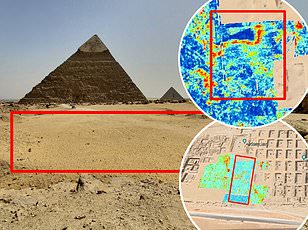
Scientists discover mysterious form of energy in Egypt's pyramids that should only exist in modern times
A new discovery in Egypt's Great Pyramid of Giza suggests the structure was not just a pharaoh's final resting place, but also a giant power plant.
Scientists blasted the 4,600-year-old structure with electromagnetic waves, a form of radiation that travel though the universe, finding it focused and amplified the energy into specific chambers and around the base.
Electromagnetic waves are used in such research because the radiation interacts with matter in unique ways, allowing experts to probe specific details about a structure's composition, arrangement and dynamics.
The waves built up as energy in the King's chamber, the Queen's chamber, and an unfinished chamber beneath the structure. Scientists concluded the Pyramid may have been a gigantic resonator that was designed to trap electromagnetic waves.
Retired aerospace engineer Christopher Dunn, who has spent years analyze the pyramid, recently shared that research like this suggests there was a greater purpose behind the building the structure.
Speaking on the Joe Rogan Experience in April 2024, Dunn said the Northern Shaft of the pyramid has an appearance similar to a ube-like structure used to transmit microwaves and electromagnetic energy.
'That's a part of the theory in the Giza power plant,' he said. 'There are two chemicals that are introduced into the chamber, and the chemicals mix, and they boil off hydrogen [to create energy].'
As for the purpose of turning this structure into a giant clean energy power plant, scientists of the study said it's still a mystery - but the Egyptians may have been much more advanced than anyone thought.

The Great Pyramid of Giza may have been a giant energy resonator, according to scientists examining how it reacts to being bombarded by electromagnetic waves

'I don't think there's any part of that pyramid that did not serve a practical function,' Dunn told Rogan.
Dunn spent 30 years conducting computer analyses of the pyramids, landing on the theory that the ancient Egyptian builders had access to highly refined tools, modern construction techniques, and even mega-machines - despite there being no archaeological record of their use
The 2018 study, conducted by researchers from ITMO University in Russia, focused on the response of the pyramid to waves with wavelengths between 656 and 1,968 feet, a range commonly associated with radio frequencies.
Researchers modeled the pyramid as if it were in an enormous environment - meaning they ignored external factors like the Earth's atmosphere or the surrounding landscape - and then examined how the pyramid interacted with incoming waves.
They also conducted their electromagnetic experiments under a more realistic condition in which the pyramid was sitting on top of a limestone surface - similar to its actual location on the Giza Plateau.
The results revealed that the internal structure of the pyramid, including its three chambers, can gather and focus electromagnetic energy received from these waves.
In their theoretical models, when the waves at these specific frequencies interacted with the pyramid, they excited what scientists call 'multipole resonances.'
These are patterns of electromagnetic activity that depend on the shape and material of the object in they're colliding with.

The Great Pyramid contains at least 3 chambers and several shafts, which some believe may have played a role in turning the pyramid into a power plant
The study showed that the King's Chamber, located near the center of the Great Pyramid, concentrated electromagnetic energy more effectively than the other chambers.
In the more realistic scenario where the pyramid sits on limestone substrate, the electromagnetic energy focused underneath the structure, suggesting that the base of the pyramid could have played a critical role in distributing energy.
Dunn claimed the Queen's chamber was 'a reaction chamber... where the hydrogen was produced.'
'The hydrogen filled the interior spaces of the Great Pyramid, which included the King's chamber,' he told Rogan.
As for what the Great Pyramid was collecting and what it was gathering it for, Dunn noted that Earth is constantly bombarded by microwaves, possibly from atomic hydrogen dating all the way back to the Big Bang itself.

The tests also revealed that the base of the Great Pyramid of Giza could have played a major role in the structure's ability to send out energy. Pictured is the King's chamber hit with electromagnetic waves
Interestingly, the ancient Egyptians would not have been able to pour hydrogen atoms into the pyramid.
So, Dunn theorizes that they would have used to two separate chemicals, poured down the shafts into the Queen's chamber, which mix and then boil off hydrogen particles - triggering the energy resonance.
As for what those chemicals would have been and how the ancient Egyptians would have known how to do all this is still unclear.
Meanwhile, the Russian researchers believe there are some real-world practical applications that may come from their discovery in Giza.
Using what they learned from the Great Pyramid, the ITMO team said their next goal was to design their own nanoparticles that could recreate the same effects in the radio frequency range.
Those tiny particles, in theory, could help develop new sensors and highly effective solar cells.
NASA Updates Asteroid Risk Assessment for 2032 Again

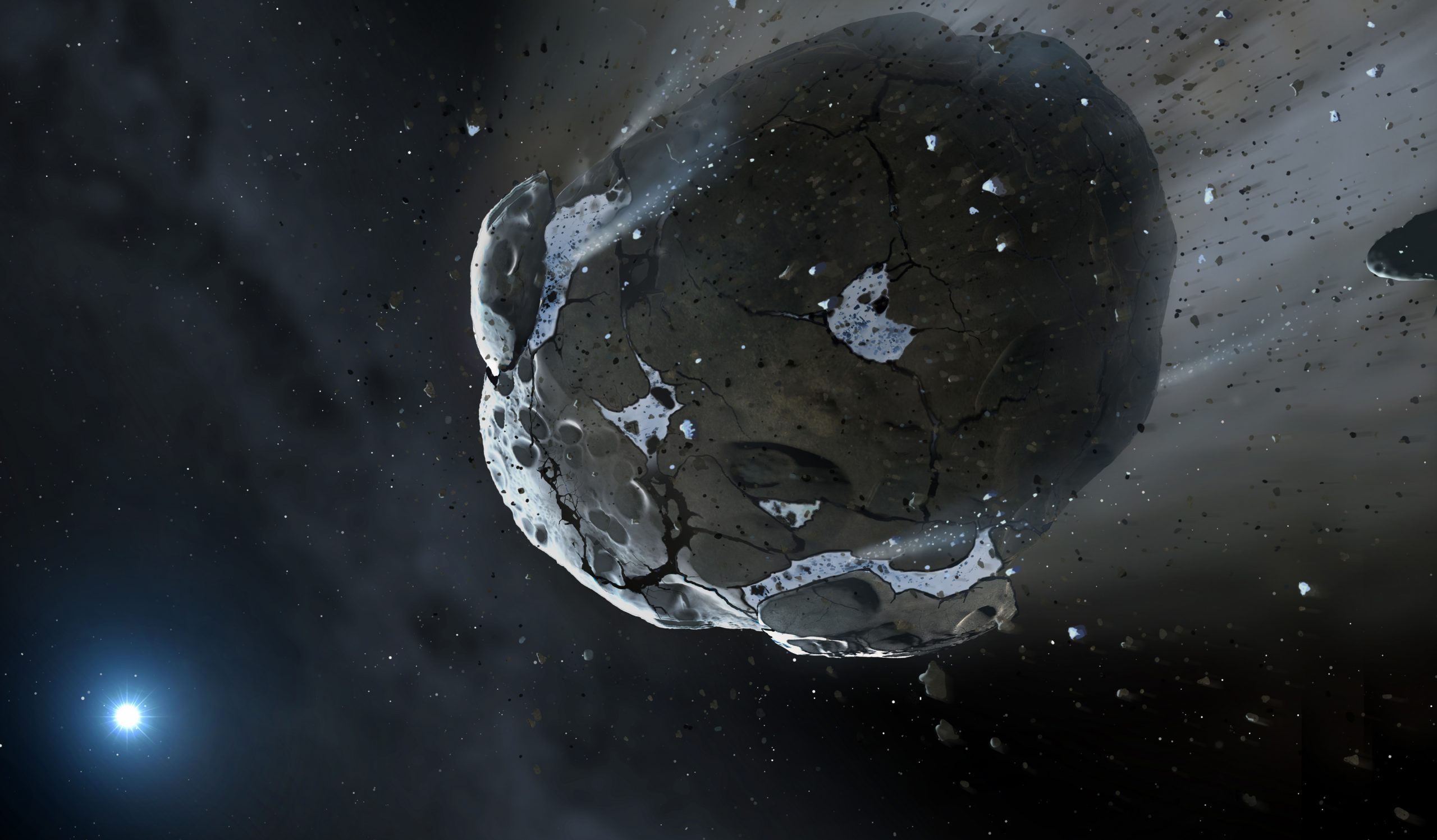
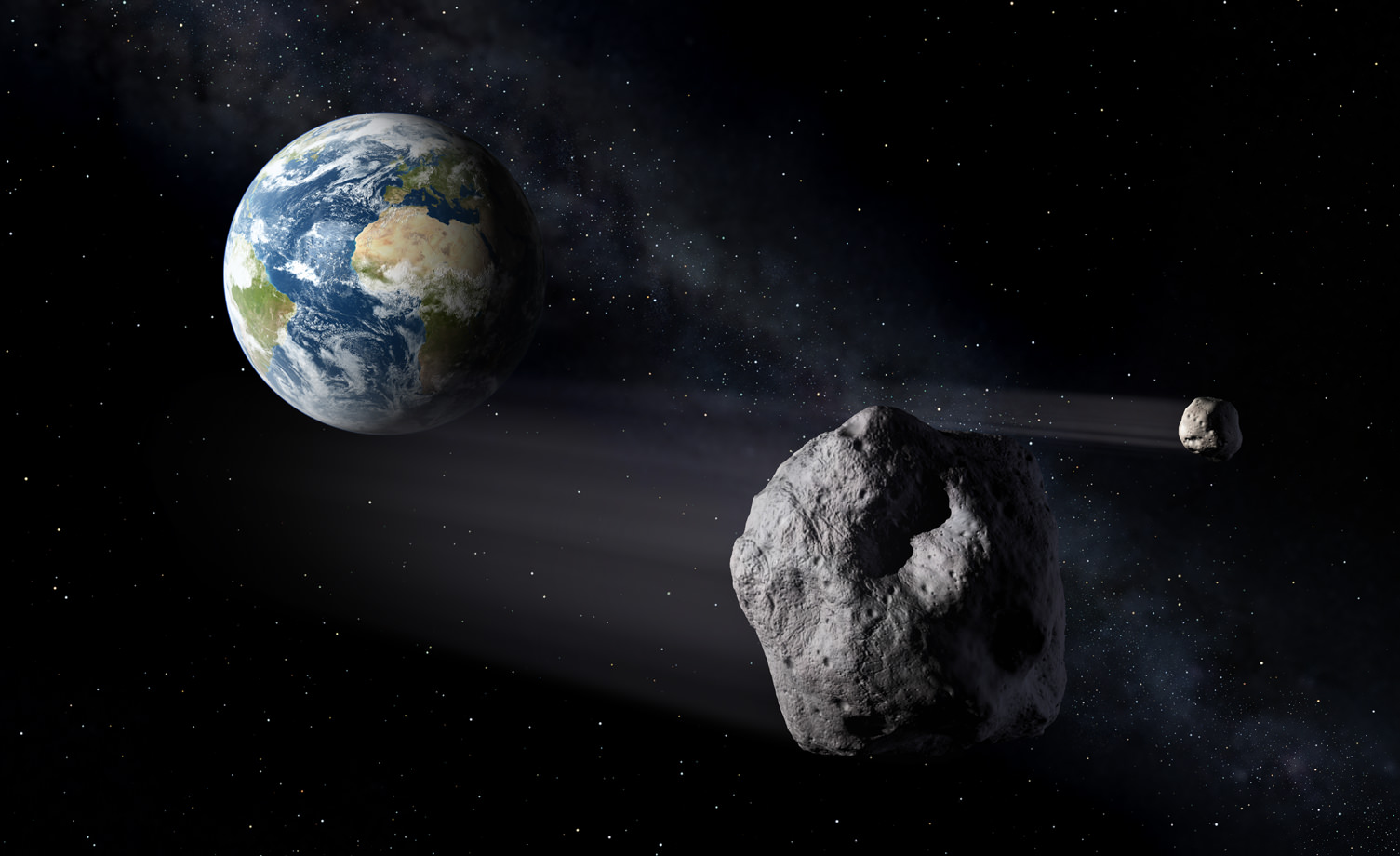
Artist's impression of an asteroid or a comet.
Credit: Mark A. Garlick, space-art.co.uk, University of Warwick and University of Cambridge
NASA has once again revised the probability of asteroid 2024 YR4 colliding with Earth, significantly lowering the initial risk estimate. Earlier this week, calculations suggested a 3.1% chance of impact, but new observations have reduced the likelihood to just 1.5%—a substantial shift that highlights the uncertainty involved in tracking near-Earth objects.
Asteroid 2024 YR4, first detected in December 2024 by the ATLAS telescope in Chile, has been under close observation due to its potential impact risk. As astronomers refine trajectory data, the estimated odds have fluctuated. Just days ago, NASA reported a 1-in-32 chance of a collision, only to revise it to 1-in-67 after new calculations. These changes are expected as more observations provide a clearer picture of the asteroid’s path.
Experts anticipate that as additional data becomes available, the probability will likely drop to zero. This is a common trend in asteroid tracking—early estimates often appear concerning, but subsequent analysis typically rules out an actual threat.
YR4 measures approximately 40 and 90 meters (130–300 feet) in diameter, comparable in height to the Leaning Tower of Pisa. While relatively small in cosmic terms, an asteroid of this size carries significant destructive potential. If it were to strike Earth, it could unleash the equivalent of 8 megatons of energy—over 500 times more powerful than the Hiroshima explosion. This would be sufficient to devastate a city, though not large enough to trigger a global catastrophe.
There is also a slim possibility that YR4 could collide with the Moon rather than Earth, though the most likely outcome remains a harmless flyby when it makes its closest approach in 2032.
Due to its initial impact probability exceeding 1%, YR4 reached Level 3 on the Torino Impact Hazard Scale. This classification is reserved for objects that warrant further study but are expected to be downgraded as more data is gathered. Most asteroids initially placed at this level ultimately pose no risk once their orbits are better understood.
In response to the early uncertainty, an international team of scientists has been granted emergency access to the James Webb Space Telescope. This advanced observatory will provide highly detailed observations, helping to refine YR4’s projected trajectory. Over the coming months, astronomers expect to confirm that it poses no danger to Earth.
For now, there is no reason for concern. The history of asteroid tracking shows that initial impact probabilities tend to decrease with more precise data. Scientists continue to monitor YR4 closely, but all indications suggest that it will pass by Earth without incident.
As new observations come in, NASA and other space agencies will provide ongoing updates. Follow trusted sources for the latest information on asteroid 2024 YR4 and other near-Earth objects.
Do We Have the Technology to Deflect Asteroid 2024 YR4 if Needed?

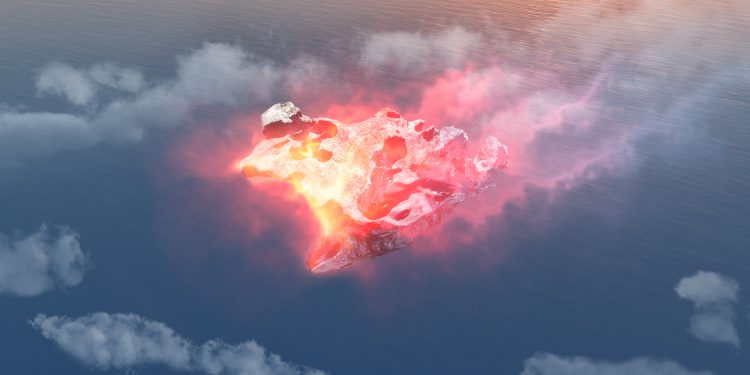
Artist's illustration of an asteroid impacting the Atlantic ocean.
Depositphotos.
Asteroid 2024 YR4 has captured global attention in recent weeks, sparking concern and debate over the real possibility of an impact with Earth. While the odds remain relatively low, the fact that scientists have continued to revise the probability upwards has fueled speculation.
Could this be the first time humanity needs to launch a real-life asteroid deflection mission?
Discovered just a few months ago, asteroid 2024 YR4 initially had a 1.2% chance of hitting Earth on December 22, 2032. While that number was concerning enough to trigger alerts to international planetary defense agencies, new observations have more than doubled the impact probability to 3.1%—a shift that has led scientists to ramp up tracking efforts.
The James Webb Space Telescope (JWST) is set to observe the asteroid before it moves out of view, aiming to refine estimates of its size, trajectory, and composition. Once 2024 YR4 travels further into the solar system, gathering new data will become much more difficult.
At an estimated 40 to 90 meters (130 to 300 feet) wide, this asteroid wouldn’t wipe out civilization, but it could cause catastrophic regional destruction.
If it were to strike a populated area, the energy released would be equivalent to 8 megatons of TNT, over 500 times more powerful than the Hiroshima bomb. Possible impact zones include South America, Africa, the Middle East, and South Asia, with major cities like Bogotá, Lagos, and Mumbai at risk.
However, experts have noted an unexpected best-case scenario: an impact on the Moon. If 2024 YR4 were to collide with the Moon instead of Earth, it would remove the risk entirely while providing an unprecedented opportunity for scientists to study an asteroid impact up close.
Humanity is not defenseless against threats like 2024 YR4. The DART (Double Asteroid Redirection Test) mission, launched by NASA in 2022, successfully altered the trajectory of an asteroid by smashing a spacecraft into it. This marked the first real-world test of asteroid deflection.
Building on that success, the European Space Agency (ESA) launched Hera in October 2024. This follow-up mission is set to analyze the aftermath of DART’s impact, collecting crucial data to refine future planetary defense strategies and better prepare Earth for potential threats.
Meanwhile, nuclear-based asteroid deflection remains a last resort. Scientists at the Lawrence Livermore National Laboratory (LLNL) have simulated scenarios where nuclear devices could shatter an asteroid into smaller, non-lethal fragments. While controversial, this remains one of the most powerful backup options if an asteroid is detected too late for other interventions.
Despite the headlines, Earth is not in immediate danger. Space agencies continuously track thousands of near-Earth objects, and NASA estimates that the chance of a “city-killer” asteroid hitting our planet is just 0.1% per year.
Even if an impact were to occur, there’s a 70% chance it would land in the ocean, with another 25% chance it would strike an unpopulated region.
That being said, 2024 YR4 is unique—it’s one of the few asteroids with an impact probability high enough to trigger early planetary defense discussions. If that probability increases further, we may witness history: the first-ever mission to deflect an asteroid outside of a test environment.
With eight years until its potential impact, scientists have time to improve tracking, refine predictions, and prepare defensive measures. NASA, ESA, and China will continue monitoring 2024 YR4, adjusting estimates as more data comes in.
For now, the takeaway is clear: Earth is watching, and if necessary, we are ready to act.
RELATED VIDEOS
Does Jupiter’s Moon Callisto Have an Ocean? The Evidence is Mounting

Some of our Solar System’s moons have become very enticing targets in the search for life. There’s growing evidence that some of them have oceans under layers of ice and that these oceans are warm and rich in prebiotic chemistry. NASA’s Europa Clipper is on its way to examine Jupiter’s moon Europa, and the ESA’s Jupiter Icy Moons Explorer is also on its way to the Jovian system to explore some of its icy moons.
While the presence of an ocean on Europa is becoming widely accepted, there’s more uncertainty about the other Galilean moons. However, new evidence suggests that Callisto is very likely an ocean moon, too.
Callisto is Jupiter’s second-largest moon, the third-largest moon in the Solar System, and the outermost Galilean moon. The Voyager probes gave us our first close looks at Callisto in 1979, and the Galileo spacecraft gave us our best images and science data during flybys between 1996 and 2001. Galileo provided the first evidence that Callisto may harbour a subsurface ocean.
Callisto has a different appearance than other suspected ocean moons like Europa and Saturn’s Enceladus. Europa clearly has a white, icy surface, although it has other brownish colours, too. Enceladus has an extremely bright, icy surface and has the highest albedo of any object in the Solar System. Callisto, on the other hand, has a dark, icy surface and is covered in craters.
Europa (L), Enceladus (M), and Callisto (R) have distinctly different surfaces, yet all likely have subsurface oceans.
However, the evidence for its ocean is unrelated to its surface appearance and any visible ice.
The main evidence supporting an ocean on Callisto comes from the moon’s magnetic field. Unlike Earth’s internally generated magnetic field, Callisto’s is induced. That means the field is created from Callisto’s interactions with Jupiter and its extremely powerful magnetic field. For Callisto to induce a magnetic field, it has to have a layer of conductive material.
This illustration shows Jupiter’s powerful magnetic field and the four Galilean moons. Image Credit: ESA.The question is, is the layer an ocean or something else?
Different researchers have been trying to answer that question since Galileo gathered its data. One of the spacecraft’s instruments was a magnetometer, a type called a Dual-Technique Magnetometer (DTM). There are multiple types of magnetometers, and each one works differently. Galileo’s DTM provided redundancy and allowed for cross-checking, which increased the accuracy and reliability of its data. It was especially good at detecting the subtle magnetic fields of Jupiter’s moons, including Callisto. It also collected data continuously, which let scientists gain insights into how the magnetic fields of Jupiter and its moons varied over time due to different interactions.
In a 2017 paper, researchers pointed to the ionosphere as the primary cause of Callisto’s magnetic fields. “We find that induction within Callisto’s ionosphere is responsible for a significant part of the observed magnetic fields,” the authors wrote. “Ionospheric induction creates induced magnetic fields to some extent similar as expected from a subsurface water ocean.”
New research in AGU Advances based on Galileo data strengthens the idea that Callisto has a subsurface ocean and that it’s responsible for the moon’s magnetic field rather than its ionosphere. The paper is titled “Stronger Evidence of a Subsurface Ocean Within Callisto From a Multifrequency Investigation of Its Induced Magnetic Field.” The lead author is Corey Cochrane, a scientist at JPL who studies planetary interiors and geophysics. An important part of this research is that they considered data from multiple Galileo flybys (C03, C09, and C10).
“Although there is high certainty that the induced field measured at Europa is attributed to a global-scale subsurface ocean, there is still uncertainty around the possibility that the induced field measured at Callisto is evidence of an ocean,” Cochrane and his co-researchers write. “This uncertainty is due to the presence of a conductive ionosphere, which will also produce an induction signal in response to Jupiter’s strong time-varying magnetic field.”
Observations acquired from the Galileo spacecraft indicate that Callisto (left) reacts inductively to Jupiter’s (right) time-varying magnetic field. New research suggests that this reaction and its results are indicative of the moon hosting a subsurface salty ocean.
Image Credit: Corey J. Cochrane, NASA/JPL-Caltech
In short, Callisto’s magnetic field could be caused by its ionosphere, an ocean, or a combination of both. The problem is that Callisto’s conductive ionosphere creates a magnetic field that can mask the presence of an ocean. To get to the truth, the authors used previously published simulations of the moon’s interactions combined with “both an inverse and an ensemble forward modeling method.” The authors write that this brings some clarity about the possible range of Callisto’s interior properties.
The researchers created a four-layer model of Callisto, including its ionosphere. “Among these models, we vary the thickness of the ice shell, the thickness of the ocean, and the conductivity,” the authors write. They also varied the seafloor depth and the ionosphere’s conductance.
This schematic diagram from the study shows the variable parameters in some of the researchers’ modelling. (Left) D is seafloor depth, T is ocean thickness, and Rc is conductance. (R) The ocean parameter space in the study has 8 linear steps for ocean thickness and 10 steps for ocean conductivity.
Image Credit: Cochrane et al. 2025.
The researchers concluded that the moon’s ionosphere alone cannot explain the magnetic field. Instead, it “more likely arises from the combination of a thick conductive ocean and an ionosphere rather than from an ionosphere alone.”
They also concluded that the ocean is tens of kilometres thick from the seafloor to the ice shell, and the ice shell could also be tens of kilometres thick. “As our results demonstrate, both the inverse and forward modelling approaches support the presence of an ocean when considering data acquired from flyby C10 alongside C03 and C09,” the researchers explain. “Our analysis, the first to simultaneously fit C03, C09, and C10 flyby data together, favours the presence of a thick and deep ocean within Callisto.”
The models also favour a thick ice shell “consistent with Callisto’s heavily cratered geology,” they explain.
Galileo wasn’t dedicated to studying Callisto, so there is a dearth of data in all research into its magnetic fields. “It is challenging to place tighter constraints on the properties of Callisto’s ocean because of the limited number of close Galileo flybys that produced reliable data and because of the uncertainty associated with the plasma interaction,” the authors write in their conclusion.
Better and more complete data is in the future, though. Both NASA’s Europa Clipper and the ESA’s JUICE mission will gather more data, some of it from very close to Callisto’s surface.
The Europa Clipper is scheduled to make nine flybys of Callisto. Seven will be within 1800 km of the surface, and four of those will be within 250 km. Its magnetometer will operate continuously during those flybys. The ESA’s JUICE mission is scheduled to perform 21 flybys of Callisto. All of them will be within 7000 km of the surface, and most will be below 1000 km.
The Europa Clipper’s elliptical orbit will allow it to perform flybys of Jupiter’s moons, including Callisto.
Image Credit: NASA/JPL-Caltech
Both the Europa Clipper and JUICE have instruments that Galileo didn’t have. Though Galileo came within about 1100 km of Callisto’s surface, it simply could not provide the same kind of data that these newer missions will. The Clipper and JUICE are scheduled to reach the Jovian system in 2030 and 2031, respectively.
As their data starts to arrive and reaches scientists, we will likely determine for sure if Callisto is yet another of the Solar System’s ocean moons.
Should Astronauts Be Worried About Mars Dust?

Every Martian year (which last 686.98 Earth days), the Red Planet experiences regional dust storms that coincide with summer in the southern hemisphere. Every three Martian years (five and a half Earth years), these storms grow so large that they encompass the entire planet and are visible from Earth. These storms are a serious hazard for robotic missions, causing electrostatic storms that can mess with electronics and cause dust to build up on solar panels. In 2018 and 2022, the Opportunity Rover and InSight Lander were lost after dust storms prevented them from drawing enough power to remain operational.
But what about crewed missions? In the coming decades, NASA and the Chinese Manned Space Agency (CMS) plan to send astronauts and taikonauts to Mars. These missions will include months of surface operations and are expected to culminate in the creation of long-duration habitats on the surface. According to new research by the Keck School of Medicine at the University of Southern California (USC), Martian dust storms can potentially cause respiratory issues and elevated risk of disease, making them yet another health hazard space agencies need to prepare for.
The research was led by Justin L. Wang, a Doctor of Medicine at USC, along with several of his colleagues from the Keck School of Medicine. They were joined by researchers from the UCLA Space Medicine Center, the Ann and HJ Smead Department of Aerospace Engineering and the Laboratory for Atmospheric and Space Physics at UC Boulder, and the Astromaterials Acquisition and Curation Office at NASA’s Johnson Space Center. The paper detailing their findings appeared on February 12th in the journal GeoHealth.
Sending crewed missions to Mars presents many challenges, including logistics and health hazards. In the past 20 years, the shortest distance between Earth and Mars was 55 million km (34 million miles), or roughly 142 times the distance between the Earth and the Moon. This was in 2003 and was the closest the two planets had been in over 50,000 years. Using conventional methods, it would take six to nine months to make a one-way transit, during which time astronauts will experience physiological changes caused by long-term exposure to microgravity.
These include muscle atrophy, loss of bone density, a weakened cardiovascular system, etc. Moreover, a return mission could last as long as three years, during which time astronauts would spend at least a year living and working in Martian gravity (36.5% that of Earth). There’s also the risk of elevated radiation exposure astronauts will experience during transits and while operating on the surface of Mars. However, there are also the potential health effects caused by exposure to Martian regolith. As Wang described to Universe Today via email:
“There are many potential toxic elements that astronauts could be exposed to on Mars. Most critically, there is an abundance of silica dust in addition to iron dust from basalt and nanophase iron, both of which are reactive to the lungs and can cause respiratory diseases. What makes dust on Mars more hazardous is that the average dust particle size on Mars is much smaller than the minimum size that the mucus in our lungs is able to expel, so they’re more likely to cause disease.”
During the Apollo Era, the Apollo astronauts reported how lunar regolith would stick to their spacesuits and adhere to all surfaces inside their spacecraft. Upon their return to Earth, they also reported physical symptoms like coughing, throat irritation, watery eyes, and blurred vision. In a 2005 NASA study, the reports of six of the Apollo astronauts were studied to assess the overall effects of lunar dust on EVA systems, which concluded that the most significant health risks included “vision obscuration” and “inhalation and irritation.”

“Silica directly causes silicosis, which is typically considered an occupational disease for workers that are exposed to silica (i.e., mining and construction),” said Wang. “Silicosis and exposure to toxic iron dust resemble coal worker’s pneumoconiosis, which is common in coal miners and is colloquially known as black lung disease.”
Beyond causing lung irritation and respiratory and vision problems, Martian dust is known for its toxic components. These include perchlorates, silica, iron oxides (rust), gypsum, and trace amounts of toxic metals like chromium, beryllium, arsenic, and cadmium – the abundance of which is not well understood. On Earth, the health effects of exposure to these metals have been studied extensively, which Wang and his team drew upon to assess the risk they pose to astronauts bound for Mars in the coming decades:
“It’s significantly more difficult to treat astronauts on Mars for diseases because the transit time is significantly longer than other previous missions to the ISS and the Moon. In this case, we need to be prepared for a wide array of health problems that astronauts can develop on their long-duration missions. In addition, [microgravity and radiation] negatively impact the human body, can make astronauts more susceptible to diseases, and complicate treatments. In particular, radiation exposure can cause lung disease, which can compound the effects that dust will have on astronauts’ lungs.”
In addition to food, water, and oxygen gas, the distance between Earth and Mars also complicates the delivery of crucial medical supplies, and astronauts cannot be rushed back to Earth for life-saving treatments either. According to Wang and his colleagues, this means that crewed missions will need to be as self-sufficient as possible when it comes to medical treatment as well. As with all major health hazards, they emphasize the need for prevention first, though they also identify some possible countermeasures to mitigate the risks:
“Limiting dust contamination of astronaut habitats and being able to filter out any dust that breaks through will be the most important countermeasure. Of course, some dust will be able to get through, especially when Martian dust storms make maintaining a clean environment more difficult. We’ve found studies that suggest vitamin C can help prevent diseases from chromium exposure and iodine can help prevent thyroid diseases from perchlorate.”
Austin Langton, a researcher at NASA’s Kennedy Space Center in Florida, creates a fine spray of the regolith simulant BP-1.
Credits: NASA/Kim Shiflett
They also stressed that these and other potential countermeasures need to be taken with caution. As Wang indicated, taking too much vitamin C can increase the risk of kidney stones, which astronauts are already at risk for after spending extended periods in microgravity. In addition, an excess of idione can contribute to the same thyroid diseases that it is meant to treat in the first place. For years, space agencies have been actively developing technologies and strategies to mitigate the risks of lunar and Martian regolith.
Examples include special sprays, electron beams, and protective coatings, while multiple studies and experiments are investigating regolith to learn more about its transport mechanisms and behavior. As the Artemis Program unfolds and missions to Mars draw nearer, we are likely to see advances in pharmacology and medical treatments that address the hazards of space exploration as well.
Further Reading:
UFO-monument
In Lotenhulle loont het de moeite om eens naar boven te kijken … In 1955 merkten mensen vijf vliegende schotels op boven de E5 (de toenmalige naam van de E40).
Tussen het fietspad en de rijweg op de hoek van de Steenweg op Deinze met de Eikenlaan staat het eerste UFO-monument van België.

Het Aalterse college van burgemeester en schepenen ontving in het voorjaar van 2004 een schrijven van Marin Vandercruysen, waarin hij beweerde dat hij in 1955 vijf ufo's had gezien langs de Steenweg op Deinze in Lotenhulle. Het college nam dit in eerste instantie niet serieus en had een nogal smalende reactie op het bericht. Het gemeentebestuur besloot dat toenmalig eerste schepen van Aalter en schepen van cultuur Dirk De Smul, als geboren en getogen Lotenhullenaar, deze zaak mocht onderzoeken.
Vandercruysen werd uitgenodigd op het gemeentehuis van Aalter. In een niet te stoppen woordenvloed en overtuigd van zijn gelijk, deed hij zijn verhaal uit de doeken bij schepen De Smul.


De toen 18-jarige paracommando Marin Vandercruyssen zat achterop een motor, bestuurd door zijn vader. Ze waren 's morgens vanuit Oudenaarde vertrokken richting de kust en omstreeks 9.00 u bereikten ze Lotenhulle. Bij het verlaten van de dorpskern werd hun aandacht getrokken door een groepje mensen, die aandachtig naar de lucht stonden te turen. Ze parkeerden de motor langs de kant van de weg en vervoegden zich bij de omstaanders.
Rechts van hen boven de velden, ongeveer waar de E5 ligt, zagen ze vijf zilveren schijven in formatie zweven. Drie vooraan en twee achteraan, net als het logo van de Olympische Spelen, met naar schatting elk een diameter van 100 meter. Geruisloos vlogen ze van oost naar west met dezelfde gracieuze traagheid als van een zeppelin. In een mum van tijd stond daar een dertigtal personen naar het schouwspel te kijken. Meer dan tien minuten lang bleven de schotels over de E5 hangen. En dan plots werden de schijven heel klein en in een oogwenk waren ze weg.
Wanneer het schouwspel gedaan was waren er ongeveer een dertig-tal toeschouwers op de plaats aanwezig, maar er heerste een totale stilte. Deze stilte werd doorbroken wanneer Marin riep: "Dat waren zeker vliegende schotels"! Niemand van de omstanders kon verklaren wat ze gezien hadden, maar Marin had meteen door dat het UFO's waren. Hij was toen al gepassioneerd door sterrenkunde en als paracommando wist hij alles over vliegtuigen. Hij zou het meteen gemerkt hebben als het speciale legervliegtuigen waren. Dat het ging om echte vliegende objecten leidde hij af uit hoe het zonlicht scheen op de schijven. Aan een ronde schijf is geen voor- of achterzijde. De bolle schijven waren goed belicht aan de rechterzijde met een duidelijke schaduw aan de linkerzijde.


De Smul vond een tweede getuige in de gevestigde dorpswaarde 'Meester Pol', een voormalig onderwijzer en betrouwbare bron, die bevestigde in 1955 de vijf ufo's gezien te hebben.
Tijdens het college van burgemeester en schepenen op 10 mei 2004 gaf De Smul aan dat het verhaal in Lotenhulle daadwerkelijk bevestigd wordt, dus dat er wel iets van waar moet zijn. De knoop werd die dag doorgehakt: de gedenksteen wordt een feit.
De Smul expliceerde achteraf tegen de plaatselijke pers: "Wij geloven Vandercruyssen. Wij bestaan toch ook. Waarom zou er in de gigantische kosmos dan geen ander ontwikkeld leven kunnen zijn?"


Op 2 juli 2004 werd het monument plechtig ingehuldigd op de hoek van de Steenweg op Deinze met de Eikenlaan. De neerlegging gebeurde niet toevallig op 2 juli, want die dag is het Wereld-Ufo-dag, wat zijn oorsprong kent in de Verenigde Staten.
Op het monument stond de volgende tekst. “Marin Vandercruyssen Para commando zag hier op 21 juli 1955 vijf UFO’s boven E40 zweven samen met 20 getuigen +/- 10 min lang in Lotenhulle. www.ufo.be BUFON. Middenin de tekst staan vijf ovalen die de vliegende schotels voorstellen en rechts bovenaan staat een foto van de jonge paracommando Vandercruyssen.
In 2024 werd vastgesteld dat het monument zich in een slechte staat bevond en dat een restauratie noodzakelijk was, om het monument te vrijwaren voor de toekomst. Aangezien Marin overleden is op 6 november 2020 en zijn vzw Belgisch UFO-Netwerk (BUFON) niet verdergezet is na zijn dood, werd beslist om de verwijzing naar de opgeheven vereniging en bijhorende website te vervangen door de datum van de inhuldiging. Op 4 februari 2025 waren de restauratiewerkzaamheden voltooid.

Het verhaal van Marin Vandercruyssen en het feit dat hij een gedenksteen in Lotenhulle mocht plaatsen, trok de aandacht van verschillende kranten alsook de programmamakers van het VRT-magazine Afrit 9.
Bekijk hieronder de uitzending.
Bekijk hiernaast enkele tekeningen gemaakt door Sam Corijn, voor zijn kunstproject 'Ongeveer Zo Iets' geïnspireerd door de getuigenis van Marin.£
The legend of the mysterious 13 crystal skulls
Disclosure or Disinformation? Standing at the Crossroad to the Truth of the UFO and Alien Question!

Many people believed David Grusch's public declarations several years later would finally reveal just what the government - both the American government and other governments around the world - knows about UFOs, where they come from, why they are coming here, and, most importantly, what intelligence lies behind them. However, aside from an attempt to rebrand UFOs as UAPs, there has been little movement in terms of full or even partial disclosure.
It is perhaps best to start with one of the leaked videos that took the public down the road to the pre-disclosure era we currently find ourselves in. Released to the public in December 2017 and reported on by the New York Times, the footage in question was shot on November 14th, 2004, and involved the USS Nimitz Carrier Strike Group that was around 100 miles southwest off the coast of San Diego, California taking part in drills and exercises (incidentally, part of the strike group was the USS Princeton, which was a nuclear-powered vessel, something which we will return to later).
On this particular afternoon, as part of these exercises, two F/A 18 Super Hornet fighters were airborne when they suddenly received orders from the USS Princeton. They were, the orders stated, to break off from their training drill and concentrate on a “real-world” task. They were, essentially, in a “live” situation. What the pilots of the fighter jets in question were unaware of was that the USS Princeton had been tracking several strange, unidentified objects for the last several days. In fact, rather than just several, a senior radar operator onboard the USS Princeton would later state that he alone had tracked “well over 100” of these mysterious craft in the course of only a week. He further stated that “watching them on the display was like watching snow fall from the sky!” Even more remarkable, he claimed that these objects appeared at altitudes over 80,000 feet, much higher than any commercial or military aircraft would fly. In light of this data, the equipment on the ship was tested to ensure it wasn’t malfunctioning. However, no faults were discovered.
On the afternoon the objects suddenly appeared again, the two F/A 18 Hornets were sent to intercept them. One of the pilots that day was David Fravor. He recalled that as they approached the location, there was no sign of anything unusual in the sky. However, he did notice some kind of “disturbance” in the water below, elaborating that it appeared as if there was a solid object below the surface of the water, which was “churning with white waves!” Several moments later, although he didn’t see it break the surface, he could see an object approximately 50 feet above the water. He stated the object was at least 40 feet long and “shaped like a Tic-Tac” with no wings, rotors, or any visible means of propulsion evident, and was white in color. He also described how the object moved with bizarre sharp movements that were “similar to if you threw a ping-pong ball against the wall!”

As Fravor brought his fighter around the craft, he could see that it was now ascending in his direction, accelerating “beyond anything I’ve seen!” It then crossed the nose of his fighter before it disappeared into the distance in no more than a second. Fravor’s wingman, an anonymous female pilot, described the mysterious craft almost identically to Fravor, stating that its movements were “unpredictable” with “high G, rapid velocity (and) rapid acceleration!” As the object disappeared into the distance, more fighters were scrambled from the USS Princeton. It was from the onboard camera on one of these jets – piloted by Chad Underwood – that the now-famous footage was captured.
The encounter eventually entered into the public arena courtesy of an investigation and article by the New York Times, with the footage being leaked shortly after. The newspaper also revealed the existence of the Advanced Aerospace Threat Identification Program (AATIP) – a “shadowy” program of the Defense Department that they claimed was a “pet project” of the (then) Majority Leader, Harry Reid, who was known to have an interest in UFO sightings and encounters. In another twist to the entire affair, the Defense Department told the New York Times that the AATIP had indeed been operational but was closed in 2012. However, an apparent former employee – Luis Elizondo – came forward and claimed that the program was still very much alive and that he had worked for it right up until October 2017.
It was around this time that the first signs of change in the government’s stance on UFOs, at least publicly, began to show, offering “new guidelines” for reporting unidentified objects and an apparent altogether more serious approach. Moreover, a US Navy spokesperson stated that, in recent years, there had been “a number of reports of unauthorized and/or unidentified aircraft entering various military-controlled ranges and designated airspace!”
In late 2019, another thought-provoking story regarding UFO sightings appeared in the news when it was reported that “unknown individuals” forced Navy officers to erase video and radar evidence of unidentified objects. One person who made such claims was Petty Officer Third Class Jason Turner. Although he wasn’t inside the USS Princeton’s Combat Information Center, he was asked to deliver supplies to the ship’s Signal Exploitation Space – and when he did, he made some remarkable discoveries. He claimed to have seen footage playing on the console monitors – footage that was the (eventually) famous Tic-Tac UFO footage that was leaked in 2017. He claimed in the documentary Nimitz Encounters that the object was “going berserk” and making bizarre turns that would have put unbearable G-forces on the pilot. He further stated that he watched as the object suddenly stopped before it was “just gone – in an instant!” He eventually asked a close colleague who was stationed on the ship if what he was watching was a training drill, to which his friend responded, “No – this is real life!”
Another witness had a remarkably similar encounter to speak of. Ryan Weigelt was sent into the CIC area of the ship as the incident was unfolding. He also stated that he immediately noticed footage playing on the console monitors, footage he watched for several moments. Moreover, like Turner, Weigelt stated that the footage that he viewed in that room was “much longer” than the eventually leaked footage in 2017. He further stated that he was “in there for quite a while, and it was on the screen the whole time” he was there.
There was, however, a third witness who had been onboard the USS Princeton during that afternoon in November 2004. Gary Voorhis also claimed to have seen the video footage playing on the monitors in the CIC room, elaborating that what he viewed was at least “eight to 10 minutes long!” He further claimed that he “got a good sense of how the pilot was having a difficult time trying to keep up” with the anomalous object as it made “tight, right-angle turns!” One thing he was certain of was that he was not watching a conventional aircraft.
Perhaps, though, it was the claims of Petty Officer Patrick Hughes that raised most eyebrows. At the time of the incident, Hughes was onboard the USS Nimitz, completely unaware that anything out of the ordinary was underway. Part of Hughes’ duties was to secure the hard drive data recorders from the airborne early-warning aircraft. This data was termed “bricks” in military circles and documents what the “aircrew see during their flight.” Not long after he had secured these bricks for the afternoon of November 14th, 2004, he received a visit from two mysterious men who visited him with his commanding officer. Hughes had no idea who these strange individuals were, adding that “they were not on the ship earlier” and that he “didn’t see them come on!” it was, he elaborated as if they simply appeared out of nowhere. Ultimately, he was ordered to turn over the data bricks to the two suspicious men, which he duly did. They then promptly left, and he never saw them again, nor did he receive an explanation as to why they were or who they were.

If we return our attention back to Gary Voorhis onboard the USS Princeton for a moment, we can see that he had a very similar encounter. He recalled how “two guys” arrived on the vessel via a helicopter. He was summoned around 20 minutes later and received orders to “turn over all the data recordings for the AEGIS system!” After doing so, he was then ordered to “erase anything” that had been recorded that day. Incidentally, Voorhis offered that the only other time he received such orders was following one of their aircraft crashing during a combat operation.
Needless to say, it is clear to most people – inside and outside the UFO community – that something out of the ordinary took place that November 2004 afternoon off the coast of San Diego, and furthermore, that there appeared to have been a considerable effort to suppress any knowledge of the incident at the time, despite the admission of the video’s authenticity a little over a decade later.
Now would perhaps be a good time to examine what exactly the previously mentioned David Grusch said. While he is far from the only whistleblower to come forward with alleged revelations regarding UFO secrecy, his testimony and interviews before and since certainly captured the imagination of the media and public alike. In the same vein, opinions on his claims – including in the UFO community - are generally divided, with some people even suggesting that his claims are part of some kind of counterbalancing disinformation campaign as a response to the intense attention placed on the Pentagon by the leaked UFO videos several years previously. With that said, many of the details offered in Grush’s testimony ring true against details that have surfaced in multiple different independent investigations into the UFO mysteries.
Although Grusch had filed several grievances regarding the government and UFO secrecy in 2022, it was in the summer of 2023 that he really came to prominence following his giving evidence in front of the House of Representatives hearing into UFOs (or UAPs), not least because of his seemingly stellar background. Before making his claims in 2023, he was a decorated combat veteran in Afghanistan before going on to work as an intelligence officer in the United States Air Force, including the National Geospatial-Intelligence Agency (NGA) and the National Reconnaissance Office (NRO). It was during his time in intelligence that he found himself working with the Unidentified Aerial Phenomena Task Force, a position he left in April 2023, only several weeks before making his shocking claims.
It was while he was working with his UAP Task Force that he seemingly discovered evidence of a cover-up of monumental proportions regarding UFOs and the intelligence behind them. In part, in response to this, he was instrumental in the setting up of the National Defense Authorization Act of 2023, an act that essentially protected whistleblowers. It was around the same time that this act was passed that Grusch made his remarkable claims. Moreover, he not only made them in front of Congress for the whole world to see, but made further claims in interviews with two different media platforms.
Around a month before appearing at the House of Representatives hearing, in early June 2023, Grusch took part in two extensive interviews, one with The Debrief and one with NewsNation. In these interviews, he stated that during his time working with the UAP Task Force he learned the United States military had recovered “non-human origin technical vehicles!” Moreover, rather than just one or even two of these vehicles, the military had recovered “quite a number!” He eventually started investigating further, and when he was refused access to files concerning a “crashed vehicle of unknown origin,” he fully suspected a huge cover-up and suppression of evidence was taking place.
He stated to NewsNation that, to begin with, he “thought it was totally nuts” and that he was “being deceived!” Then, as word of his tenacious interest leaked around the intelligence community, more and more intelligence agents discreetly approached him with what they knew, several of whom confided in him that “they were part of a program!” He continued that although they named this program, it was one that he had not heard of, and they elaborated that this program was one “that the UAP Task Force was not read into!”
Grusch continued that, as well as the vehicles themselves, quite often, the occupants were also recovered as part of this secretive program – and these occupants were also non-human. He was, perhaps interestingly, hesitant to use the term “alien” as most people would understand it. He claimed that these occupants might not be arriving here from the deep reaches of space as most of us might imagine but perhaps were “coming from a different physical dimension as described in quantum physics!” He elaborated that “mathematically and based on empirical observation and analysis, there most likely are physical, additional spatial dimensions” all around us. Moreover, at least some of these dimensions could exist in a “higher physical space,” which, in turn, could provide habitation for non-human intelligence.
Here, it is worth pointing out how close such considerations are to other researchers who have put forward that aliens, as most of us understand them, are, in fact, better described as interdimensional entities. One such person is the controversial David Icke, who claims, in its basic sense, that reptilian entities enter our world from another dimension, a realm that Icke calls the “lower fourth dimension!” He elaborates that they are essentially invisible to humans as they vibrate at a different frequency but that they enter our world by adjusting this frequency. Is it possible that Grusch is describing the same realm?
Grusch also made further enthralling claims about the composition of these futuristic vehicles, offering that they contained exceptionally high isotopic ratios and “strange, heavy atomic metals” that were “high up on the Periodic Table!” He further stated that these materials were still being fully understood by the scientists who had access to them. He also stated that although there had already been significant “discoveries and revelations,” it was his belief that by opening up such research to the private sector and increasing transparency of said research, this progress would be increased dramatically and could be put to use for the betterment of humanity as opposed to being studied purely for weaponry - such things as propulsion, cleaner energy, and food production, for example. Before we explore those possibilities and examine some of Grusch’s further thoughts and revelations, we will turn our attention to one of the most captivating parts of his testimony.
Arguably, some of the most intriguing and thought-provoking details provided by Grusch were that not only were the American government supposedly engaged in the reverse-engineering of alien technology, but they had in their possession – since the end of the Second World War, no less – a downed UFO that crashed in Mussolini’s Italy in 1933. And while such claims might be easy to dismiss, to begin with, there is ample reason to believe that such an event did indeed take place. Moreover, as we shall explore shortly, documents exist that would appear to suggest the shared development of some kind of advanced technology between the Italian regime and the Third Reich in the run-up to and during the Second World War, as well as the changing hands of vast sums of money between the two nations during the same time.

The best place to start attempting to unravel all of this is with files that were leaked to researcher Roberto Pinotti in 1996, who, along with fellow investigator Alfredo Lissoni, dug deeper into them. According to these files, on the evening of June 13th, 1933, a bell or cigar-shaped object came crashing to the ground in the Lombardy region of Italy. The ruins of this otherworldly craft were quickly recovered and confiscated by the Italian authorities. A short time after, the secretive department – Cabinet RS/33 – was established. This department was based at La Sapienza University in Rome, with the only controllers being Benito Mussolini himself, his son-in-law, and his Foreign Minister, Count Glezzo Ciano, and Airman General Italo Balbo. As well as having direct connections to the Fascist Secret Police (OVRA), they also had strong connections to the Agenzia Stefani, who controlled the Italian news outlets – and propaganda.
The documents themselves make for interesting reading, with some outlining how anyone speaking of the events in Lombardy faced arrest and criminal charges. One document, for example, a telegram from June 1933, states that these orders came directly from Mussolini himself and that there would be “immediate arrest (for) diffusion of news related to aircraft of (an) unknown nature and origin!” The telegram continued that “immediate recasting of any leads from the newspapers bearing said news is ordered (to) stop!” The telegrams stated there would be “maximum penalties” for anyone failing to adhere to these orders while another stated that “absolute silence is ordered on (the) presumed landing on national soil of (an) unknown aircraft!” Even more remarkable, another telegram ordered that the incident should be explained as a “meteor,” as per the official news releases of Agenzia Stefani.
Other files leaked to Pinotti documented the activities of Cabinet RS/33, offering that multiple top-level scientists were undertaking secret studies of the wreckage in an attempt to gain an understanding of the object's workings and mechanisms. One of these scientists, incidentally, was Guglielmo Marconi, who also believed that it was possible to communicate with extraterrestrial beings using radio transmissions.
Of course, it is not known and doubtful that any such cosmic communication took place between an intelligence from elsewhere and the Italian regime. However, it is interesting to note some of the wording in a speech by Mussolini in March 1941, when the Italians, and indeed all of Europe, anticipated the Americans entering the Second World War. He stated that it was “more likely that the United States will be invaded by unknown but war-like inhabitants from the planet Mars, who will come down from the starry space on unimaginable flying fortresses than by soldiers of the Axis!” Whether Mussolini was merely making an off-the-cuff remark or whether he had indeed gained some kind of knowledge courtesy of the workings of Cabinet RS/33 remains open to debate.
What is also interesting to note is how the workings and set-up of Cabinet RS/33, including its goals and agendas, is almost identical to the MJ-12 group that was set up in the United States following the end of the Second World War in the late 1940s. We might ask if MJ-12 was, for all intents and purposes, simply carrying on the work of Cabinet RS/33.
There were many other UFO sightings over Italy following this downed craft in 1933 and the setting up of Cabinet RS/33, and those who dared to speak about what they might have seen continued to face arrest and imprisonment until the fall of Mussolini’s regime. One sighting that was well-documented, though, occurred three years later in Venice.
According to details on a document dated August 22nd, 1936, written by an Italian secret agent named “Andrea,” on the afternoon of August 17th, 1936, multiple residents of Venice witnessed a metallic, cigar-shaped object moving overhead. At the back of this huge object was some kind of opening, out of which two smaller, disc-shaped craft emerged. These metallic discs were “polished and reflected light!”
Two fighters were immediately scrambled to intercept the two smaller aerial vehicles, but they proved to be much too fast for the Italian aircraft. Despite their great speed, none of the objects “emitted any sound” – something that would show up in report after report over the coming decades from witnesses around the world. Further descriptions state that the larger object was “like a kind of aerial torpedo with very clear windows and with alternating white and red lights,” while the two smaller objects were like “two hats like those used by priests – they were wide, round with a dome in the center, metallic and followed the torpedo (shaped object) without changing their relative positions!”
Of course, whether there is a direct connection between this sighting over Venice in 1936 and the crashed UFO in Lombardy three years earlier remains open to debate. One particular section of the document is perhaps telling of Mussolini’s mindset regarding UFOs in general, however. It states that “The Duce (Mussolini) has expressed his worries because he says that if it was an English or French aircraft, his foreign policy would have to start all over again!”
This perhaps suggests to us one of two possibilities, and that rather than simply assuming the object witnessed over Venice was a vehicle from another world, Mussolini was either – not fully aware of the otherworldly nature of the craft recovered in Lombardy three years earlier (which is unlikely), or that he was completely aware of the otherworldly nature of the craft, but suspected that other countries might have recovered their own “alien vehicles” and had managed to fully reverse-engineer them.

Whatever the truth of the matter, Pinotti and Lissoni’s investigation led them to conclude that the wreckage from the 1933 crash was taken to SIAI Marchetti in Vergiate, an air base in Magenta near Milan. It remained there until the end of the Second World War where it was, according to their investigation, recovered by the American military.
If we return to David Grusch for a moment, what he stated in his testimony resonates very nicely with this. He offered that, “In 1933, a bell-like craft, around 10 meters in size, was recovered in Magenta, northern Italy. It was kept by Mussolini’s government until 1944 when it was recovered by agents of the Office of Strategic Services!” Of course, the Office of Strategic Services (OSS) was the forerunner to the Central Intelligence Agency, better known as the CIA. Even more suspicious, the air base facilities at Magenta suffered no damage during the conflict, despite numerous bombing raids by Allied forces in the region. This could suggest that at least some high-ranking officers in the military – American, British, or both – were fully aware before the end of the war that the Italian military was in possession of a vehicle from another world and where it was stored. As such, they could have issued orders to avoid causing any damage to the facility so that they could recover the craft for themselves following Italy’s increasingly likely (and eventual) defeat and the end of the war, at least in Europe.
Adding even further credibility to the claims of a downed craft in 1930s Italy are those of long-time Lombardy resident, Marco Negri, who claimed that his great-great-grandfather had told his father, who, in turn, had told him, stories of a “strange metal plane that crashed somewhere between Vergiate and Magenta in 1933!” In a newspaper interview, Negri elaborated that he was told there was “a big censorship around this crash. The Fascist Secret Police were sent to the surrounding cities to keep people silent about it!”
Even more remarkable, as well as the wreckage itself, Negri stated that “two bodies” were also recovered, presumably extraterrestrial in origin. Another researcher – George Filer – also uncovered claims of two occupants being recovered from the wreckage of the 1933 crash, occupants he claimed were “tall blond Nordic” aliens. It is perhaps interesting to note that many close UFO encounters of the 1950s, not just across America but around the world, featured these tall, blond-haired humanoid “Nordic” aliens. Moreover, at least according to some researchers, before meeting with representatives of the Grey alien race, President Eisenhower was said to have met with representatives from a Nordic alien race. Could they have been from the same alien race as the occupants of the 1933 Lombardy crash?
Of course, whether the bodies of the occupants were recovered and whether they were transported to America along with the wreckage of the craft after the war remains unknown. One thing of interest to note here, however, would be the apparent sudden advancement of Italian aviation in the years following the alleged recovery of the crashed UFO. Writing in the book UFO Contacts in Italy, Volume Two, the previously mentioned Roberto Pinotti states that:
“…just before the Second World War, the Italians were able to produce the prototype of the first jet airplane in history (the Campini Caproni 1). But we also know that the aviation industry in Italy was the last in Western Europe at the end of World War One. So the question is: can it be that the study of the UFO stored in hangars near Milano gave the Italians the needed technology?...”
It is certainly an interesting consideration and perhaps one not to be dismissed too quickly. Especially when, if we accept that the wreckage of this craft, presumably along with the records of any research into it, was transported to the United States shortly after the war, the same trend continued in the United States with its air force. In fact, the pace of advancement in multiple technical areas, particularly in America, increased dramatically as the fifties and sixties unfolded. Might this have been due to the reverse-engineering of recovered alien vehicles, not only the Lombardy wreckage but the Roswell craft and several others in the United States during the 1940s?
Of even further interest are apparent connections to secret arrangements between the Italian regime and the Third Reich. The previously mentioned Alfredo Lissoni highlights such communication in the many documents that came into his possession, particularly an Agency Stefani message that documented a meeting that took place in 1938. This meeting was “extremely private” and “dedicated to the RS/33 Cabinet!” These documents further relay that significant “black funds” changed sides between the two regimes (perhaps similar to the “black budget” funds that can be found in the background of American intelligence departments following the end of the Second World War and the start of the Modern UFO Era).
Lissoni concluded that these documents “demonstrated the existence of agreements between Hitler and Mussolini for the study of alien technology!” While perhaps being a little more cautious in his conclusions, offering that much of the information and rumors were “unabashed neo-Nazi propaganda,” he also offered that “undoubtedly there is at least some truth to the matter!”
Could it be that there are even more connections to be found in these apparent reverse-engineering projects between the Italian regime and the Third Reich in the Third Reich’s own “flying saucer program” – the Haunebu Project? Taking this further, could these reverse-engineering projects in war-torn Europe have continued in the United States after the war following such missions as Operation Paperclip, which saw many Third Reich scientists and engineers transplanted to the United States to continue their work for The West?
It is perhaps further interesting to note the apparent bell shape of the object. Is it a coincidence that the Third Reich – if we accept that some kind of information-sharing and joint-development programs did take place – developed a bell-shaped object in the form of Die Glocke towards the end of World War Two? While it is speculative, the technology behind Die Glocke may be the same or similar to an alleged secret device of the Vatican – The Chronovisor – that Italian physicists developed after the war with the aid of former Third Reich scientist and Paperclip transfer, Wernher von Braun.
Could it really be that claims of an otherworldly craft crashing to the ground in 1930s Italy have much more accuracy to them than many people might be willing to believe? And if those claims are true, then should we automatically believe David Grusch’s other claims concerning reverse-engineered technology and the American government’s active programs and projects concerning vehicles and intelligent life from elsewhere in the Universe? Ultimately, these speculative events could prove to be of high importance to both the UFO and the historical timeline of not only the twentieth century but of humanity as a whole.
Ultimately, Grusch claimed that he “started out as a non-believer” who came to “the problem as a hardcore physics guy intel officer!” He continued that he was “very methodical, interviewing people who didn’t know each other and making sure this wasn’t some kind of cover-up of some other program!” It was, he claimed, when he attempted to gain access to the program that his investigation was “stymied” and “the door shut in my face!” It was at this point that Grusch picked up on a “sophisticated disinformation campaign” surrounding UFOs and the intelligence behind them. He highlighted how the Roswell crash in July 1947 had seen the government do a very public U-turn on what the object was, going from being a “flying saucer” to a weather balloon within 24 hours. Furthermore, when the Roswell event was officially reexamined almost half a century later in 1994, Grusch stated that the “analysis they did was a total hack job” and was nothing more than an attempt to paint the Roswell crash as debunked once and for all.
The revelations from Grusch, however, kept on coming. He claimed that it was his belief – based on what he had learned – that this non-human intelligence wished to “understand how far advanced in our nuclear fissile kind of technologies” humanity is. Moreover, and of much more concern, it is also his belief that this non-human intelligence was malevolent in nature, stating that it was a complete “fallacy” to think that “because they’re advanced, they’re kind!” Even more concerning still, he had learned that this “malevolent activity” had already been displayed during “nuclear site probing activities and witness testimony!” Once more, this is another detail that resonates nicely with what has already been established by multiple UFO investigations and studies over the decades. The start of the Modern UFO Era, for example, began with the Roswell crash in the summer of 1947, which occurred only two years after the dropping of the atomic bombs on Hiroshima and Nagasaki, and there have been multiple reports of UFO activity of nuclear power plants and over military facilities that house nuclear weapons (we might recall that the USS Princeton at the center of the USS Nimitz footage also had nuclear facilities and capabilities).
Much more ominous are claims that as well as the deaths of some of these non-human intelligent entities, many of the people who were a part of the recovery missions, as well as the scientists and engineers who were involved with the reverse-engineering programs, “were injured looking at it,” adding there seemed to be significant “nuclear, radiological, and biological risks to looking at an unknown” object. More unsettling was Grusch’s response to being asked if anyone working with the recovered vehicles or non-human entities had been seriously injured or even killed. Although he didn’t answer the question directly, he did state that he had been “briefed by a few individuals on the program that there were malevolent events like that,” adding that if he got into the specifics of these deadly events, they would “reveal certain US classified operations!” Just what those operations might have been remains an unnerving mystery.
It is also worth considering the claims of alleged deals reached between President Eisenhower and representatives of the Grey alien race in February 1954, a deal, if we accept for a moment the claims are accurate, that saw multiple advanced technologies gifted to the United States government in exchange for access to members of the American, and perhaps the world’s, population – essentially, to abduct them. While we won’t get into the specifics as to whether such claims hold water and are accurate here, we will highlight a line in an internal document written by Grusch that speaks about certain “agreements that risk putting our future in jeopardy!” Make of that what you will, especially when we consider his response that he was aware of “white collar crime at the very least” when asked if any person had been injured or killed by those looking to maintain secrecy over what the government knew about UFOs. Most ominous of all, he claimed that he had “heard some really un-American things” that he didn’t wish to repeat.

As we might imagine, although Grusch has volunteered a wealth of information, there are many who ask the simple question, “Where is the evidence?” By his own admission, Grusch hasn’t seen any of these recovered advanced vehicles with his own eyes, nor has he seen any of the non-human occupants. He has, though, seen “some interesting photos” and “read some very interesting reports!” However, these reports remain classified, meaning that he can’t disclose them. Indeed, many ask, given he has already said much more than the authorities would like, that he might also go as far as to “leak” such documentation. Grusch did say, however, that he had “provided the proof internally to the inspector general!”
Of course, we also have to consider – as some commentators and members of the public have - that these events have been orchestrated, possibly some kind of “damage control” in the wake of the leaked videos and the New York Times investigation. By offering information on an alleged UFO crash almost a hundred years ago – information that, for the sake of argument for a moment, is accurate – other, more outlandish claims can be issued as part of a disinformation campaign that only serves to obscure the real truth of the UFO and alien question.
Whatever the truth at the heart of Grusch’s claims, he offered that he believes the real reasons for such secrecy surrounding UFOs and the reverse-engineering of them was simply “feudalistic dominance” and that it served as “fuel in the war machine!”
With all of this in mind, we might ask just how close we actually are to UFO disclosure and, perhaps more precisely, just what will UFO disclosure look like. To some people, disclosure would have to be a complete reveal of not only what the government knows (or thinks it knows) about this apparent non-human intelligence but also physical presentations of the allegedly recovered crafts and even alien bodies. It has to be said, even if governments around the world – including the United States government – suddenly did decide to reveal everything they knew, it is doubtful it would be done in such a public and sensational way.
Of course, world governments, perhaps specifically successive governments of the United States, assuming there was a genuine desire to suddenly reveal whatever truths they have about the UFO mystery, have put themselves in a rather difficult position, as to many, whatever they did eventually state publicly, many members of the world’s population will simply not believe them, basing their reaction on decades of information suppression and outright lies and denials. And while there are almost certainly legitimate national security reasons behind some of these decisions, the general public, at least some of them, are so conditioned to be suspicious of government admissions and revealing of information that nothing short of guided tours of their most private facilities where this stuff is presumably housed will be sufficient for many. Much the same can be said if the government offered that they had no recovered crafts or knowledge – even if they were being completely honest.
Indeed, this general mistrust between governments and populations could prove to be one of the biggest stumbling blocks to full UFO disclosure, and if Grusch’s claims of this non-human intelligence being malevolent in nature are accurate, this could become a real concern. We might ask what Grusch meant by this. Could it be that this non-human intelligence is aggressive and war-like? Or might it be something more in line with how we would understand demonic entities and evil forces? As bizarre as that might sound, even to some people in the UFO community, many researchers have put forward genuine claims of some kind of “demonic” connection to what we currently understand as alien beings. Moreover, many declassified and leaked government documents speak of such concerns at a high level of intelligence and government.
All of this, of course, simply adds another layer to the already nuanced considerations of the UFO and alien question and suggests that the already cloudy waters of the big picture will likely become much murkier with any releases of information before they clear. Not only could such revelations about the truth of UFOs and aliens tell us more about the universe, but they could also reveal more about our collective reality than we could have possibly imagined.
Ultimately, only time will tell how accurate and authentic the claims of David Grusch are. They will either prove to be historic in nature or simply a footnote in the UFO timeline.

Scientists reveal what and where HEAVEN is
It's an eternal symbol of comfort and hope for billions of people around the world.
But what is heaven, and where is it in relation to our universe?
In the Bible, heaven is described as a realm in the skies above Earth, where ultimate peace and joy can be found under the presence of God.
And in popular culture, it has long been depicted with pearly gates, fluffy clouds and bright, celestial lights.
'Most of us have some concept of heaven, even if it is one formed by movies like What Dreams May Come, The Lovely Bones, or think it involves meeting Morgan Freeman in a white room,' said Robyn J. Whitaker, senior lecturer at the University of Divinity in Australia.
Photos of deep space have also raised hopes that we might be able to spot heaven way above our heads.
For example, NASA titled one of its photos of Saturn as 'Blue Heaven', while the European Space Agency dubbed a distant nebula a 'Stairway to Heaven'.
However, according to Professor Whitaker, the truth is that heaven is a 'utopian vision' in our minds of which physical evidence is yet to be found.

In 1994, reports circulated than the Hubble Space Telescope snapped a photo of a brilliant celestial city on the edge of the universe - purportedly heaven

In the Bible, heaven is described as a place of ultimate peace and joy under the presence of God, a realm in the skies above earth. And in popular culture, it has long been depicted with pearly gates, fluffy clouds and bright, celestial lights (file photo)
For Christians, the idea of the dead being in heaven or enjoying paradise often brings comfort to the bereaved and hope to those suffering or dying.
But in the Christian faith, heaven was originally more about where God lived, not about humanity's ultimate destination if they live a righteous life.
N.T. Wright, professor of New Testament and Early Christianity at the University of St Andrews, said the way people now talk about heaven is 'deeply unbiblical and misleading'.
'Basically the whole western tradition took a wrong turn in imagining that the aim of the game was 'to go to heaven when we die',' he told MailOnline.
'The whole Bible is about the God of heaven coming to make his home with us – in Jesus and then in the Holy Spirit.'
Lari Launonen, philosopher at University of Helsinki in Finland, said many theologians don't like the word 'heaven' as it 'evokes the idea of an ethereal reality with souls hovering around'.
'The Bible actually describes a renewed, physical world – one where we have resurrection bodies, just as Jesus did after rising from the dead,' he told MailOnline.
Famously, at the start of the Bible in the Book of Genesis, we are told that heaven is created by God along with the Earth.

Peter Jackson's 2009 film The Lovely Bones tells the story of a murdered girl (played by Saoirse Ronan) who watches over her family from heaven

Heaven and Earth are united in the 15th century painting 'The Assumption of the Virgin' by Italian artist Francesco Botticini
This contradicts the theory of the Big Bang generally accepted by scientists, where the universe exploded into existence from a single minute point.
Bible authors imagined Earth to be flat, with the realm of the dead below us and a dome over the Earth that separates it from the heavens.
Of course, we know the Earth is not flat and this 'three-tiered universe makes no sense to a modern mind', according to Robyn J. Whitaker, senior lecturer at the University of Divinity in Australia
But it helped cement the theory that heaven is in the stars, viewable from Earth – one that continues to circulate in the modern era.
In 1994, news circulated that the Hubble Space Telescope snapped a photo of a brilliant celestial city on the edge of the universe – purportedly heaven.
However, the report in Weekly World News – a US tabloid known for fictional stories – and the black-and-white image was easily unravelled as a hoax.
Still, the wondrousness of the cosmos returned by deep space telescopes such as James Webb inspire belief in some kind of divinity out there.
Although there is zero evidence that heaven is anywhere within our universe, there are earthly locations that at least resemble it.

The HD 44179 nebula, known as the 'Red Rectangle' has been compared to a 'stairway to heaven' by the European Space Agency

In Saturn's bluish north, day ends for the dreamy white clouds that stretch here into twilight. NASA titled this photo, snapped in 2007, 'My Blue Heaven'
In the Bible, the Garden of Eden – where Adam and Eve reside before being expelled – is the earthly paradise that most closely resembles heaven.
And the Garden of Eden is 'strikingly' similar' to real-life Persian Royal gardens (paridaida) which date back as far as 4000 BC, according to Professor Whitaker.
These gardens of Old Iranian origin were rectangular or symmetrical in design and filled with walled enclosures, water fountains and fruit-bearing trees.
The oldest Persian garden of which there are records belonged to Cyrus the Great, in his capital at Pasargadae, now a World Heritage site to the northeast of Shiraz, Iran.
More recently-built Persian gardens that still stand include Eram Garden in Shiraz, thought to date back to the 12th century.
It is these remarkable sites that will perhaps be as close as we can get to witnessing heaven on Earth.
'Heaven or paradise in the Bible is a utopian vision, designed not only to inspire faith in God but also in the hope that people might embody the values of love and reconciliation in this world,' Professor Whitaker said in a prior piece for The Conversation.
Of course, the existence of heaven outside of our universe entirely depends on your own belief system and who seek guidance from.

The oldest Persian garden of which there are records belonged to Cyrus the Great, in his capital at Pasargadae, now a World Heritage site to the northeast of Shiraz, Iran

Eram Garden, a historic Persian garden in Shiraz, Iran, though to date back to the 12th century. The oldest Persian garden of which there are records belonged to Cyrus the Great, in his capital at Pasargadae, now a World Heritage site to the north of Shiraz, Iran
Professor Stephen Hawking, the English physicist who died in 2018, didn't believe in God or a creator and called heaven 'a fairy story'.
'I regard the brain as a computer which will stop working when its components fail,' Professor Hawking told the Guardian in 2011.
'There is no heaven or afterlife for broken down computers; that is a fairy story for people afraid of the dark.'
Dr Launonen – who studies whether scientific explanations of religious beliefs are compatible with a religious worldview – 'wrestled with thoughts' about the afterlife when his three-year-old son died from a rare disease called mucolipidosis.
'Cognitive science of religion suggests that our minds are naturally wired to believe in immaterial minds or souls that survive the death of the body,' he told MailOnline.
'Some fields of study suggest there are good reasons to believe in life after death.
'Historians have found evidence for the historicity Jesus' resurrection, while research on near-death experiences suggests that conscious experience may not end in death.'
According to one theory, the fact we have all gone from non-existence (before conception and birth) to existing (life) means we could exist in one form or another after death.
But whether or not this existence would resemble traditional representations of the afterlife – heaven or indeed hell – remains to be seen.
Scientists identify 'ferryman' in the brain that transports souls into the afterlife
The ancient Greeks believed that when people die, their souls are transported across the River Styx and into the afterlife by Charon, the ferryman.
This myth may have some truth to it as scientists recently found that a psychedelic neurochemical could ferry the human soul into the afterlife.
Called DMT (N,N-Dimethyltryptamine), the naturally occurring molecule is found in plants, animals and perhaps even the human brain.
When consumed recreationally, it produces powerful visual and auditory hallucinations.
Researchers at the Imperial College London found signs that DMT could be responsible for vivid hallucinations during near-death experiences (NDEs), which can occur when someone is close to dying.
Many survivors of NDEs report these inexplicable visions, such as encountering a deceased loved one, seeing heaven or hearing the voice of God.
The team determined that NDEs share similarities with the experiences of people who have taken DMT recreationally, suggesting the brain might flood itself with this psychedelic neurochemical in the moments before death.
David Luke, associate professor of psychology at the University of Greenwich in London, said there also is some evidence that DMT is released in greater quantities at the point of death in the human brain.

A growing body research suggests DMT may play an important role in helping the consciousness transition from life to death, causing vivid visual and auditory hallucinations
Luke said the only evidence of the brain releasing DMT at the moment of death has been observed in animals, but from this, experts 'can infer that this also happens [in humans].'
This is a strong indication that it could be happening in humans, as cognitive phenomena in rats often translate to us.
But '[Animals] can have distinctly different ways of producing neurotransmitters and metabolizing compounds,' Amy Reichelt, a neuroscientist and an expert in neurodegenerative disease, told Popular Mechanics.
Therefore, more research is needed to determine whether the hallucinations people experience in the moments before death are actually linked to DMT.
The overlap between DMT trips and NDEs, however, suggests this could be the case.
The researchers at Imperial College London tested the similarities between the DMT state and NDEs by administering DMT and a placebo to 13 participants who then completed a validated and widely used measure of NDEs.
Their findings, published in the journal Frontiers in Psychology in 2018, revealed 'a striking similarity between these states that warrants further investigation,' according to the report.

A 2023 study compared the experiences of a person who had both an NDE and a trip on 5-MeO-DMT, finding striking similarities between the two events . Pictured is a model of DMT
In 2023, Luke co-authored a study that sought to learn more about this potential link by comparing the experiences of a person who had both an NDE and a trip on 5-MeO-DMT.
This molecule is very similar to DMT, but its psychedelic effects are not quite as long-lasting and tend to be slightly less intense, according to the Utah Patients Coalition.
Luke and his colleagues interviewed this person to look for similarities between his NDE and his 5-MeO-DMT-induced psychedelic trip.
'There is a very high level of comparability between the original NDE and psychedelic experiences in general, including shared characteristics such as entering other worlds, meeting menacing or benevolent entities, experiencing synesthesia, perinatal regression, and lucid dreamlike properties,' the study reads.
'Much comparability was also identified with the 5MeO-DMT experience, in particular the major mystical experiential domains, such as ego dissolution, but especially transcendence of time and space.'
The researchers note, however, there were a few unique themes that emerged during the NDE that did not occur during the 5MeO-DMT trip.
Those included encountering the deceased, experiencing a life review (seeing your life flash before your eyes) and seeing 'the threshold,' which can appear as a white light or gateway that represents the point of no return between life and death.
This suggests these themes may be unique to NDEs. Because of these key differences, the study participant ultimately said his NDE hallucinations could not be definitively linked to psychedelics produced in the brain.
The researchers published their findings in Frontiers in Psychology in 2023.
While this study challenges the idea that DMT could explain all aspects of NDEs, it still might be part of the puzzle, according to Luke.
At the point of death, the brain undergoes a cascade of neurochemical changes, he explained. That includes surges of serotonin and noradrenaline, which regulate mood, emotions and stress.
DMT may be involved in these neurochemical changes too. Research has shown that this chemical naturally exists in human blood, urine and spinal fluid, so scientists believe it's possible that it could also exist in our brains.
Researchers will continue to probe this neurochemical to determine whether it truly does help shepherd us toward death.
RELATED VIDEOS
Are We Really That Special? New Research Suggests Intelligent Life May Be More Common Than We Thought

An illustration of an advanced intelligent alien civilization.
Credit: DepositPhotos
For years, the idea that human intelligence is an extremely rare occurrence in the universe has shaped scientific thought. Given the vast number of evolutionary steps required to bring us to this moment, it has long been assumed that intelligent life anywhere else must be just as improbable. However, a new study challenges that assumption, suggesting that the emergence of advanced civilizations may not be as extraordinary as once believed.
A paper recently published in Science Advances reexamines a long-standing theory known as the “hard-steps model,” which posits that evolution is filled with nearly insurmountable hurdles. According to this model, critical evolutionary milestones—such as the origin of life, the development of photosynthesis, and the emergence of complex organisms—are so unlikely that they may occur only once in a planet’s lifetime, if at all. This framework has been used to argue that human-like intelligence is a rare cosmic accident.
But the new research offers an alternative view. Rather than a series of rare breakthroughs, the study suggests that these evolutionary steps may have been inevitable, driven by planetary and biological feedback loops that pushed life toward increasing complexity. In this model, intelligence is not a statistical anomaly but a predictable outcome of planetary evolution. If this is true, the universe could be teeming with advanced civilizations.
The study’s lead authors, geobiologist Daniel Mills from the University of Munich and microbiologist Jennifer Macalady from Pennsylvania State University, argue that Earth’s history does not support the idea that intelligent life is a fluke. Instead, they point to multiple lines of evidence suggesting that key evolutionary transitions may not have been as improbable as once thought:
This new perspective does not outright disprove the hard-steps model, but it does raise serious questions about its validity. If intelligence was inevitable on Earth, then similar processes could be playing out on countless other worlds.
If intelligence is not a rare cosmic accident, then the search for extraterrestrial life takes on new urgency. Astronomers are already scanning exoplanets for biosignatures—chemical clues in their atmospheres that suggest the presence of life. Oxygen, for example, could indicate biological activity similar to what occurred on early Earth. If we find evidence of such processes elsewhere, it would support the idea that life follows a common pattern throughout the universe.
This shift in thinking may also influence space exploration strategies. If planetary feedback loops drive life’s emergence, then certain types of planets may be more likely to host civilizations. Worlds with active plate tectonics, stable climates, and long-standing oceans could be prime candidates for future missions.
This research also has profound philosophical implications. Many futurists and space advocates argue that humanity must expand beyond Earth to ensure the survival of intelligent life, assuming we are uniquely positioned in the cosmos. But if advanced civilizations are more common, our existence may not carry the weight of cosmic exclusivity. Instead, our legacy might be just one chapter in a much larger interstellar story.
While this new framework does not provide direct proof of extraterrestrial intelligence, it opens up exciting avenues for future research. Scientists will continue refining models of planetary evolution, conducting lab experiments to understand early life’s biochemical pathways, and using next-generation telescopes to search for habitable worlds. The possibility that intelligence is a common feature of the universe, rather than a miraculous accident, changes how we approach these questions.
As technology advances and our understanding of exoplanets deepens, the answer to whether we are alone may be closer than ever before. Suppose intelligent life is indeed a natural consequence of planetary evolution. In that case, somewhere in the vast reaches of space, other civilizations may be looking up at their own night skies, wondering the same thing.
What Would Actual Scientific Study of UAPs Look Like?U.S. Navy video of an anomalous object, known as the GOFAST UFO (highlighted by a red box), includes data about the circumstances of the detection. New research says we need a focused scientific effort aimed at UAP.
Credit: U.S. Navy
The phenomenon of Unidentified Aerial Phenomena (UAPs), commonly referred to as UFOs, has garnered significant attention in recent years from both the public and scientific community. This analysis explores the potential frameworks, methodologies, and challenges involved in a rigorous scientific study of UAPs. We will delve into the history of UAP investigations, the current state of research, and propose a multi-disciplinary approach for future studies. Key considerations will include data collection, analysis techniques, and the importance of collaboration among scientists, engineers, and policymakers.
Unidentified Aerial Phenomena (UAPs) have intrigued humanity for decades, often seen as a blend of myth, scientific curiosity, and national security concern. While many narratives surrounding UAPs are steeped in anecdote and speculation, there is an increasing call for a systematic scientific approach to understanding these occurrences. This paper aims to outline what a rigorous scientific study of UAPs would entail, focusing on methodologies, data collection, analysis, and interdisciplinary collaboration.
Unidentified Aerial Phenomena (UAP), commonly known as UFOs, have intrigued humanity for decades. The study of UAPs transcends mere curiosity; it encompasses scientific inquiry, national security, and cultural phenomena. This report aims to provide a historical context for UAP studies, tracing its evolution from early sightings to contemporary investigations and the implications thereof.
1. Early Sightings and Cultural Significance
The fascination with UAPs can be traced back to ancient civilizations. Historical texts from various cultures, including the Egyptians, Greeks, and Mayans, feature descriptions of strange lights and aerial phenomena. For instance, the "Chariots of the Gods" theory posits that ancient astronauts visited Earth, influencing early human civilizations. These early accounts suggest that UAPs have long been part of human mythology, often interpreted as divine or supernatural occurrences.
In the modern era, the term "flying saucer" emerged in the mid-20th century, coinciding with a surge in reported sightings. One of the most notable incidents was the 1947 Roswell UFO crash, which ignited public interest and conspiracy theories surrounding the government’s alleged cover-up of extraterrestrial life. This event marked a significant turning point, leading to the establishment of various organizations dedicated to UAP research.
2. The Cold War Era
The Cold War significantly shaped the discourse around UAPs. During this period, heightened tensions between the United States and the Soviet Union led to extensive military surveillance and intelligence-gathering efforts. The U.S. Air Force launched Project Blue Book in 1952 to investigate UAP sightings, with the aim of determining whether they posed a threat to national security. The project documented over 12,000 sightings, yet it concluded that most could be explained by natural phenomena or human-made objects.
The Cold War context also fueled public paranoia and speculation about aliens and government cover-ups. The fear of the unknown was compounded by the geopolitical climate, leading some to believe that UAPs might be advanced technologies developed by rival nations. This era laid the groundwork for a complex relationship between UAP studies, government secrecy, and public interest.
As the decades progressed, interest in UAPs began to shift towards a more scientific methodology. In the 1970s and 1980s, researchers like J. Allen Hynek, who initially served as a consultant for Project Blue Book, began advocating for a rigorous scientific approach to UAP studies. Hynek developed the "Close Encounter" classification system, categorizing sightings based on their proximity and nature. His efforts aimed to legitimize UAP research within the scientific community, although skepticism remained prevalent.
The scientific approach faced challenges, including a lack of funding and institutional support. Nevertheless, in recent years, there has been a resurgence of interest in UAPs, driven by advancements in technology and a new wave of scientific inquiry. The establishment of organizations like the To The Stars Academy of Arts & Science in 2017 has further propelled the study of UAPs into the realm of serious research.
The 21st century has witnessed significant developments in UAP studies. In 2020, the U.S. Department of Defense officially acknowledged UAP encounters involving military pilots and released previously classified videos of these incidents. The establishment of the Unidentified Aerial Phenomena Task Force (UAPTF) in 2020 signaled a shift in governmental attitude towards UAPs, emphasizing transparency and the need for further investigation.
Public interest in UAPs has also surged, fueled by documentaries, podcasts, and social media. The combination of governmental acknowledgment and media coverage has led to a cultural renaissance surrounding UAPs, prompting discussions about the implications of potential extraterrestrial life and its impact on society.
The historical context of UAP studies is a rich tapestry woven from ancient accounts, Cold War tensions, scientific inquiry, and modern developments. As society grapples with the unknown, the study of UAPs remains a vital intersection of science, culture, and national security. Moving forward, it is essential to approach UAP research with an open mind, recognizing its potential to expand our understanding of the universe and our place within it. The journey into the unknown continues, and with it, the enduring quest for answers.
Unidentified Aerial Phenomena (UAP), commonly known as UFOs, have garnered considerable attention in recent years, particularly following the release of classified military reports and increased public interest. The current state of UAP research is characterized by a blend of scientific inquiry, governmental oversight, and a cultural shift towards acknowledging these phenomena.
In June 2021, the Office of the Director of National Intelligence (ODNI) released a preliminary assessment on UAPs, summarizing 144 sightings reported by U.S. military personnel between 2004 and 2021. This report acknowledged that most of these incidents remained unexplained, with a small number deemed as potential national security threats. The release marked a pivotal moment, as it suggested a more serious approach to investigating UAPs, moving beyond the stigma that had historically surrounded the topic.
Governmental involvement has increased, leading to the establishment of the All-domain Anomaly Resolution Office (AARO) in July 2022. This office is tasked with investigating UAPs across all domains, including air, sea, and space. The AARO aims to collect and analyze data related to UAP sightings, working collaboratively with various military and intelligence agencies. This structured approach indicates a commitment to understanding UAPs through rigorous scientific methods.
On the scientific front, researchers are beginning to explore UAPs using advanced technologies and methodologies. Several academic institutions and independent organizations are now focusing on systematic data collection and analysis. Initiatives like the Galileo Project, founded by Harvard astrophysicist Avi Loeb, aim to study UAPs from a scientific perspective, seeking to gather empirical evidence through observational campaigns and data sharing.
Public interest in UAPs has also surged, fueled by social media, documentaries, and high-profile testimonies from former military personnel. This cultural shift creates an environment where open discussion about UAPs is becoming more acceptable, fostering a community of enthusiasts and researchers alike.
Despite the progress, significant challenges remain. The lack of standardized reporting protocols and the often anecdotal nature of UAP sightings complicate serious scientific inquiry. Additionally, the stigma attached to UAPs can deter credible witnesses from coming forward. Furthermore, the scientific community is still divided on the legitimacy of UAP research, with some skeptics questioning its validity and others advocating for more attention and funding.
In conclusion, the current state of UAP research is marked by a growing recognition of the phenomenon's importance, supported by governmental initiatives and scientific endeavors. As investigations continue to unfold, the quest for understanding UAPs appears to be entering a new and promising phase, one that could potentially reshape our understanding of aerial phenomena and their implications for national security and science.
Proposed Methodologies for Scientific Study of UAPs
The study of Unidentified Aerial Phenomena (UAPs), commonly referred to as UFOs, has transitioned from the realm of speculative inquiry to a subject of serious scientific investigation. As governments worldwide, including the United States, have begun to release previously classified information regarding UAP encounters, the need for rigorous methodologies to study these phenomena has become increasingly apparent. This paper proposes a systematic approach to the scientific study of UAPs, emphasizing the importance of data collection, analysis, and interdisciplinary collaboration.
Historically, UAPs have been associated with anecdotal accounts and pseudoscientific theories. However, the emergence of credible reports and the potential implications for national security and scientific understanding necessitate a more structured approach. UAPs may offer insights into advanced technologies, atmospheric phenomena, or even extraterrestrial life, making their study relevant across multiple scientific disciplines.
Before any scientific study can begin, it is crucial to establish a taxonomy of UAPs that categorizes sightings based on their characteristics, behaviors, and potential origins. This classification could include:
The proposed methodologies for the scientific study of UAPs can be organized into four main components: observational studies, data analysis, interdisciplinary collaboration, and public engagement.
Observational Studies
a. Standardized Reporting Protocols
A key challenge in UAP research is the lack of standardized reporting protocols. Establishing a framework for how witnesses, including military personnel and civilians, report UAP encounters is essential. This framework should include details such as time, location, weather conditions, and the observer's background. Standardized forms can help ensure that data collected is consistent and comprehensive.
b. Remote Sensing Technologies
The deployment of remote sensing technologies, such as radar, infrared sensors, and satellite imaging, can significantly enhance the observational capabilities for UAP studies. These technologies should be utilized in conjunction with existing military and civilian monitoring systems to capture UAP incidents in real time. The integration of multiple sensor types can provide a more complete picture of UAP characteristics, including speed, altitude, and maneuverability.
c. Field Studies
Conducting field studies in areas with a high frequency of UAP sightings can yield valuable data. Engaging scientists and researchers in these locations can facilitate direct observation and data collection. Additionally, collaboration with local communities can enhance the understanding of the cultural and social contexts surrounding UAP sightings.
Data Analysis
a. Data Integration
The analysis of UAP data requires the integration of various datasets, including eyewitness reports, sensor data, and environmental conditions. Machine learning algorithms can be employed to identify patterns and anomalies within large datasets, potentially revealing correlations between UAP sightings and specific atmospheric or astronomical conditions.
b. Statistical Modeling
Utilizing statistical modeling can help assess the likelihood of various explanations for UAP phenomena. By comparing UAP data against known aircraft, natural phenomena, and atmospheric events, researchers can develop probabilistic models to evaluate the most plausible explanations for observed UAP characteristics.
c. Longitudinal Studies
Establishing longitudinal studies that track UAP sightings over time can provide insights into trends and potential changes in frequency or characteristics. Such studies can help distinguish between genuine anomalies and misidentifications of conventional aircraft or natural phenomena.
Interdisciplinary Collaboration
a. Engagement with Scientific Disciplines
The study of UAPs should involve collaboration among various scientific disciplines, including physics, atmospheric science, psychology, and sociology. Each discipline can contribute unique insights into understanding UAPs, from the physical mechanisms that may underlie their behavior to the psychological factors influencing eyewitness accounts.
b. Partnerships with Academic Institutions
Forming partnerships with academic institutions can facilitate research funding, access to expertise, and the development of innovative methodologies. Universities can serve as neutral ground for conducting research and disseminating findings to the public and policymakers.
c. Involvement of Aerospace and Defense Experts
Engaging with experts in aerospace engineering and defense can provide critical insights into the technology that may underpin UAP phenomena. Understanding propulsion systems, materials science, and aerodynamics can aid in evaluating the feasibility of proposed explanations for UAP behaviors.
Public Engagement and Transparency
a. Open Data Initiatives
To foster public trust and engagement, researchers should adopt open data initiatives that allow citizens to access UAP data and research findings. Transparency in research processes can enhance credibility and encourage citizen participation in data collection.
b. Citizen Science Programs
Establishing citizen science programs can empower communities to contribute to UAP research. By training volunteers to collect data and report sightings, researchers can expand their observational capacity and foster a sense of community involvement in scientific inquiry.
c. Educational Outreach
Educational outreach initiatives can help demystify UAP phenomena and provide the public with a better understanding of the scientific methodologies employed in their study. Workshops, lectures, and online resources can facilitate informed dialogue between scientists and the public.
While the proposed methodologies offer a robust framework for UAP research, several challenges must be addressed. First, the stigma associated with UAP sightings can deter credible witnesses from reporting their experiences. Building a supportive environment for open dialogue is essential. Additionally, ethical considerations regarding the treatment of eyewitnesses and the potential implications of UAP research on national security must be taken into account.
The scientific study of UAPs presents a unique opportunity to expand our understanding of the natural world and potentially uncover phenomena that challenge our current scientific paradigms. By implementing standardized reporting protocols, leveraging advanced data analysis techniques, fostering interdisciplinary collaboration, and engaging the public transparently, researchers can approach UAPs with the rigor and objectivity they demand. As we stand on the precipice of discovery, it is essential to approach the study of UAPs with an open mind, a commitment to scientific integrity, and a recognition of the profound implications this research may hold for humanity's understanding of its place in the universe.
A comprehensive study of UAPs would necessitate a robust data collection framework, which could include:
To ensure the reliability of data, standardized reporting protocols should be developed. These protocols would guide how sightings are documented, including:
Once data is collected, it must undergo rigorous statistical analysis to identify patterns and anomalies. Techniques may include:
With the increasing volume of data, machine learning algorithms can be employed to assist in identifying patterns that may not be visible through traditional analysis. This can include:
A rigorous scientific study of UAPs cannot occur in isolation. It requires collaboration among various disciplines:
Unidentified Aerial Phenomena (UAP), commonly referred to as UFOs, have captivated the public imagination for decades. The recent surge in interest from both the scientific community and government agencies highlights the importance of understanding these phenomena. However, research into UAP is fraught with challenges that hinder progress and limit our understanding of these mysterious occurrences.
One of the primary challenges in UAP research is the scarcity of reliable data. Many reported sightings rely on anecdotal evidence from witnesses, which can be unreliable due to human perception and memory biases. Furthermore, the sporadic nature of UAP sightings means that data collection is often inconsistent. Official reports, such as those compiled by the U.S. government, have highlighted this issue, indicating that many incidents lack sufficient documentation or corroborative evidence. Without a robust data set, it becomes exceedingly difficult to draw any definitive conclusions or patterns.
The stigma surrounding UAP research poses another significant obstacle. Historically, the study of UAP has been marginalized within the scientific community, often dismissed as pseudoscience. This stigma discourages researchers from engaging with the subject, fearing professional repercussions or ridicule. As a result, the field lacks the rigorous scientific scrutiny necessary for credible investigation. Breaking down this stigma requires a cultural shift within academia and the media, promoting an open-minded approach to the study of UAP.
UAP research encompasses a wide range of disciplines, including physics, psychology, atmospheric science, and even sociology. This interdisciplinary nature can complicate research efforts, as experts from different fields may have varying methodologies, terminologies, and theoretical frameworks. Effective collaboration across disciplines is crucial for a comprehensive understanding of UAP. However, achieving this collaboration can be challenging due to differing priorities, funding sources, and institutional barriers.
The tools and technologies available for investigating UAP are often inadequate. While advancements in sensor technology and data analysis techniques have improved in recent years, the challenge remains to develop reliable instruments capable of capturing UAP phenomena in real-time. Many existing surveillance systems are not designed to track or identify unusual aerial activity, leading to gaps in data collection. Moreover, the interpretation of sensor data can be complicated by atmospheric conditions, background noise, and other environmental factors, making it difficult to distinguish between genuine UAP and mundane objects or phenomena.
Government secrecy surrounding UAP research is another significant barrier. Many UAP incidents are classified due to national security concerns, leading to a lack of transparency that frustrates independent researchers. Agencies may conduct investigations without public oversight, resulting in a significant information gap. While recent initiatives, such as the establishment of the All-domain Anomaly Resolution Office (AARO) in the United States, aim to address this issue, the balance between national security and public knowledge remains a contentious topic.
The public's perception of UAP is heavily influenced by popular culture, media portrayals, and misinformation. This can lead to a polarized view of UAP, with some individuals approaching the topic with skepticism and others with unfounded belief in extraterrestrial origins. Misinformation can cloud public understanding and hinder serious scientific inquiry. Researchers must navigate this landscape carefully, aiming to educate the public while maintaining scientific rigor.
Securing funding for UAP research can be difficult, especially if the topic is viewed as fringe or lacking in scientific validity. Establishing partnerships with governmental and private entities interested in aerospace safety and security could help alleviate this challenge.
Despite the challenges facing UAP research, there is a growing recognition of its importance. Addressing these challenges requires a concerted effort from scientists, policymakers, and the public. By fostering an environment of collaboration, transparency, and open-minded inquiry, we can begin to unravel the mysteries of UAP and gain a deeper understanding of our world and beyond. As interest in UAP continues to grow, it is imperative that we tackle these challenges head-on, paving the way for meaningful advancements in this intriguing field of study.
The scientific study of UAPs represents a unique intersection of curiosity, skepticism, and opportunity. By adopting a multi-disciplinary approach that incorporates rigorous methodologies, data analysis, and collaboration, the scientific community can begin to unravel the complexities surrounding UAPs. As interest in this topic grows, so too does the responsibility to approach it with the seriousness and rigor it deserves. Only through dedicated scientific inquiry can we hope to understand the phenomena that have captivated humanity for generations.
{ PETER2011 }
What Would Actual Scientific Study of UAPs Look Like?

For those who missed the memo, UFOs (Unidentified Flying Objects) are now called UAPs (Unidentified Aerospace-Undersea Phenomena). The term UFO became so closely tied to alien spacecraft and fantastical abduction stories that people dismissed the idea, making any serious discussion difficult. The term UAP is a broader term that encompasses more unexplained objects or events without the alien spaceship idea truncating any useful or honest discussion.
While the name change is helpful, it’s just the beginning. We need a way to study UAPs scientifically, and new research shows us how.
Though the idea of alien spacecraft visiting us isn’t always taken very seriously, the effort to document UAP and understand them goes back decades. In current times, governments around the world have made more serious efforts to understand what’s behind the phenomena. Most notably, NASA recently initiated a study into UAP called the Unidentified Anomalous Phenomena Independent Study and released its final report in September 2023.
New research aims to explore past efforts, dispel some misunderstandings, and enable future research into UAP.
The research is titled “The New Science of Unidentified Aerospace-Undersea Phenomena (UAP).” The lead author is Kevin Knuth from the Department of Physics at the State University of New York at Albany. The research is available on the pre-press site arxiv.org.
“After decades of dismissal and secrecy, it has become clear that a significant number of the world’s governments take Unidentified Aerospace-Undersea Phenomena (UAP), formerly known as Unidentified Flying Objects (UFOs), seriously–—yet still seem to know little about them,” the authors write. “As a result, these phenomena are increasingly attracting the attention of scientists around the world, some of whom have recently formed research efforts to monitor and scientifically study UAP.”

The authors review about 20 historical studies, some done by governments and others by private researchers, between 1933 and the present. Countries include the USA, Canada, France, Russia, and China. Their goal is to summarize and clarify the scientific narrative around UAPs. “Studies range from field station development and deployment to the collection and analysis of witness reports from around the world,” the authors write.
The main obstacle to studying UAPs is that they’re neither repeatable nor controllable. Another problem is that witness reports are unreliable, often explained away as natural phenomena, or dismissed outright by citizens, scientists, and governments. This has dissuaded serious discussion and study and left us in “a rather disconcerting state of ignorance,” the authors write.
Ignorance is seldom desirable, though it can sometimes provide a false sense of relief. Being disconcerted is likewise undesirable. What can be done?
“The problem and opportunity that we face today is that the situation has changed dramatically,” according to the authors. We now know that the US Defense Intelligence Agency (DIA) conducted a covert, six-year program called the Advanced Aerospace Threat Identification Program (AATIP) to study UAP. With 50 full-time investigators, the AATIP dwarfed other UAP efforts. The AATIP focused on military-only encounters and considered things like psychic and paranormal phenomena correlated with UAP events. The AATIP created a massive amount of data on UAP that encompassed more than 200,00 cases. (Alarmingly, the effort also produced more than 200 research papers, some over 100 pages long, and none of them have ever been seen by the public or by the US Congress.)
This proves that the effort to study and understand UAP has gained traction and moved from the fringe to the mainstream. It’s a signal that UAP research could see increased funding and resources. According to the researchers, that means there needs to be a coordinated effort. The effort needs to be scientific, and data needs to be shared among researchers.
The geographic distribution of UFO sightings. One of the puzzling things about sightings is that they’re not distributed in any way that makes sense. Does culture play a role? Image Credit: sammonfort3
Enough research has been done to make the next steps clear.
“It is generally agreed that the optimal methodology to study UAP relies on many different types of instruments, spatially separated, to dramatically reduce the possibility of error,” the authors write. “This is the only way in which the scientific community will recognize truly anomalous data.” The authors say that multi-messenger astronomy, in which objects are studied across wavelengths with multiple telescopes, is a good model for the future study of UAP.
Rigor is required for UAP studies and data to be taken seriously. One group arguing in favour of more UAP scientific research is the UAlbany-UAPx Collaboration, an organization that the lead author of this research, Kevin Knuth, is involved with. They developed rigorous definitions of what detections constitute a UAP and recommended that “at least two of each type of sensor and 2+ distinct sensor types” be used in the effort to study UAP.
The future effort to understand UAP must migrate in from the fringes and adhere to scientific standards in other disciplines. “This way, one rigorously quantifies the meaning of extraordinary evidence, in the same way it has been done historically by particle physicists, who have established a very high bar to clear,” the authors write.
The researchers also explain how our burgeoning fleet of satellites could play a larger role in the study of UAP. “UAP researchers are now considering the air and space domains as open-air laboratories, utilizing these vast environments for systematic scientific inquiry,” they write.
Throughout most of history, satellite data has been restricted to large governments and their defence and military organizations. But their monopoly on the data is withering away. Satellite imagery and data are routinely shared with the public and are freely available for scientific use. Coinciding with greater accessibility is greater quality. “Thanks to significant technological advancements and the proliferation of commercial satellite services, access to satellite data has expanded dramatically. In addition, rapid advances in information and communication technologies have opened new avenues for many more actors,” the authors explain.
This image shows one of the NOAA’s Geostationary Operational Environmental Satellites (GOES)–R Series. It’s the Western Hemisphere’s most sophisticated weather-observing and environmental monitoring system. The GOES-R Series provides advanced imagery and atmospheric measurements, real-time mapping of lightning activity, and monitoring of space weather. Could satellites like it be used in the scientific study of UAPs?
Image Credit: NOAA
Though current satellites aren’t aimed at studying UAP, their sensors can be used to examine environments near reported UAP. This brings up another parallel between astronomy and UAP. We have telescopes that scan the sky for transients and when they detect one, they send out urgent messages to other telescopes suited for follow-up observations. The same arrangement could work in the study of UAP.
Advancements in science and astronomy can also benefit the study of UAP. Tools such as cloud computing, artificial intelligence (AI), and machine learning (ML) now enable scientists to gather, store, transmit, and analyze data more efficiently than ever before,” the authors write. There’s an ongoing democratization of data sharing that can be leveraged in the study of UAP.
UAP are not one thing. Only a dedicated, serious effort to understand them as they appear can determine if there’s something there deserving of deeper study. The authors argue that a “paradoxical loop of dismissal in mainstream science” is preventing progress. The paper outlines a way to cancel that paradox based on the sound methods of the scientific method.
The problem is that detecting them scientifically requires a very wide net of detectors and significant resources over long periods of time. That, again, parallels how we do other science. “Only long-term, transgenerational research programs, such as enjoyed by many research programs well established and stabilized within academic science now for many decades, can possibly yield the proper data on which a potential resolution to UAP can be founded,” the authors write.
However, we’re not starting from scratch.
“Our aim here is to enable future studies to draw on the great depth of prior documented experience,” the researchers explain.
Research:
Strange plasma-like UFO caught by Oklahoma City resident
Strange Cases of Simian Mystery Monsters

One very bizarre monkey-like cryptid allegedly brings us back to the very beginnings of European settlement in America, at a place called the Saco River, which flows down from the White Mountains of New Hampshire, in the United States. Since the time of the first early European explorers, the river has been home to many dark stories, including that it was cursed. In this particular piece of folklore, three sailors apparently went about kidnapping an Indian baby, believing the superstition that these babies could perfectly swim from birth. These sailors threw the baby into the water expecting them to survive and swim, but the child of course drowned in quick fashion. The horrified mother of the infant jumped in after her child and she died as well. When the local shaman heard about this tragic story, he is said to have angrily summoned a malevolent demon called Memeqwasi from the waterfall, which was then tasked with gruesomely killing three men per year in bloody retribution. It is a grim story to be sure, and since then the river was said to be the source of many inexplicable drownings it was widely believed by many of the suspicious populace to be true. What is perhaps even more bizarre is the aquatic, monkey-like beast said to inhabit these waters.
The monster in this case is said to be human-like in appearance and aquatic in nature, with webbed hands and a tail, and bearing the nickname of the “White Monkey.” Described as a “white salamander” in his journal, even the Church of Jesus Christ of Latter Day Saints founder, Joseph Smith had a sighting of this otherworldly creature when he was 12 years old, describing it as a “white salamander” and a “white-haired gnome or faerie.” . There were numerous reports of this pale, simian creature, and one early account of this reads;
“Throughout the years there have been thousands of sightings here on York Hill, of a tiny white-skinned man with webbed hands. He is known by locals as "The White Monkey" or as the French locals call him "le'Etiole" (man from the stars). Sightings have occurred up and down the coast of Maine and Massachusetts, with a few occurring in Hew Hampshire, Vermont, New York, and Quebec. While some speculate that there are many creatures being seen, other suggest that the times, dates, and places suggest that only one creature is in fact being seen, and being seen as he travels from one river to the next. Sightings in multiple places have never occurred simultaneously.
There have been many sightings of "strange white man-beasts" in the swamps and forests along the river. Sightings describe seeing "a white monkey man", "a white salamander man", a "white frog man", lots of "little grey aliens"...the stories vary in many ways but are consistent in one thing: he's small, barely 5 feet tall, has rubbery slimy frog-like stark-snow-white skin, and abnormally large blue eyes rimmed with wide bands of black rings, has teeth like a piranha which he shows if cornered, and he runs away like a scared deer as soon as he's seen, often disappearing into the water - this description remains consistent with every sighting.”
The Saco River
Sightings and mentions of the strange creature dropped off the face of the earth over the years, and now it remains merely a curious historical oddity. What was this creature, and was there anything to this tale? We will probably never know for sure. In 1914 there is a rather odd report of an apparent monkey-like creature captured in the wilds of India. According to a report from the Auckland Star, Volume XLV, Issue 242, 10 October 1914:
“Her appearance is more like that of a monkey than a human being. There is evidence to show that she has always walked upright, but her sitting posture and all her actions are those of a monkey. She was very frightened when first caught, and cried and whimpered. She would eat only grass and raw potatoes, but later was induced to bread and milk. She is, of course, unable to talk. The creature, who has thin and bony hands and nails of extreme length and thickness, has been tied up by the authorities to the pillar of a porch. Her capture is attributed to the fact that the was suffering from an ulcerated foot. She had also deep scars on her head and knees. The capture is much discussed from many aspects, and It is hoped that the head SBd brain measurements may yield results or value to the science of biology and to the students of psychology.”
There is no further mention of this “Monkey Girl,” and is unclear as to what exactly happened to her or if she ever even existed. Just as strange is a curious article in the Cromwell Argus, Volume LVI, Issue 2911, 2 March 1925, talking about “forked tail monkeys” in China. The article reads;
“Monkeys with forked tails will be one of the objectives of an exploring expedition which will start shortly for the province of Kweichow, China. Much doubt exists as to the possibility of finding a forked-tailed monkey, although such a creature has been described in Chinese literature as inhabiting this region, but a species of monkey believed to be the largest species in the world is understood to dwell there, the skin of one having been brought home by an explorer. Few white men have ever this remote region, which is as inaccessible as Tibet. It lies at the back of the great mountain ranges which bound the western watershed of the Yangtze River.”
What in the world? In another report of a captured monkey-like beast, we have a report from the Press, Volume LXXXVII, Issue 26611, 22 December 1951, which reads:
“A letter from Prince Peter of Greece to the “Statesman” to-day told of the capture and escape of a monkey answering ihe description of the legendary Himalayan "abominable snowman.” The Prince, who has been studying anthropology in India, said the Tibetans substituted local barlejl beer for water in a trough from which the monkey drank. After the monkey drank the beer, it fell down drunk and the Tibetans strapped it tightly to a pole, but while they were taking the “snowman” to Kapimpong for exhibition the creature broke its bonds with enormous strength and escaped. The letter said that the monkey was captured in Sikhim. on India's northeastern frontier. It resembled the creature whose footprints were recently photographed bv the British mountaineer, Mr Eric Shipton.”
What was going on here? Who knows? Interestingly, there was a similar case reported from 1987 in the same publication, concerning a “monkey-man” captured in the wilds of China. The report reads”:
“A Chinese “monkeyman” known as a Maogong committed suicide by hanging himself during a show last month, the Shanghai daily “Xinmin Evening News” said in a report received in Peking yesterday. The Maogong, literally “hairy man”, was found hung in his cage in eastern Zhejiang province on November 23 during a nationwide tour organised by the Association for Research into Wild Man, the newspaper said. It said he had been suffering from a stomach complaint, refusing to eat for three days. “The Maogong could not bear his illness or his age. He felt depressed and hanged himself,” the newspaper said. The monkey-man, about 30 years old, was descended from a rare, short-tailed Macaque monkey about 1.06 m tall and totally covered with hair. He often walked upright and “got angry or laughed and fought with animals or men with sticks or stones,” the newspaper said. The Maogong had sparked a flood of speculation in the press on the existence of a “wild man” — the Chinese version of an abominable snowman. He was first captured on October 24, 1984, by peasants from Xinning who had been worried about a “monster” roaming their village and chasing two young girls. The peasants put him on show for three months, reaping 100 yuan (about $4O) a day until the research association confiscated the animal. Chinese scientists discovered a year later that it was a monkey, provoking charges in the Chinese press that the “irresponsible” leaders of the association knew “nothing about anthropology”. The Chinese press frequently carries stories about “monsters” which often turn out to be newly-born babies with congenital defects.”
Odd, indeed. Moving on to other cases of mysterious monkey monsters, for decades there have been sighted strange, ape-like creatures very different from their Bigfoot brethren and more animalistic, which stalk the wilds all over the United States and have remained unexplained. The creatures that have come to be known as Devil Monkeys are generally quite different from typical Sasquatch, to the point that these creatures are considered to be some other type of primate entirely.
The creature is usually said to stand between 3 to 5 feet in height and is covered with reddish, dark brown, or black shaggy hair that is noticeably thicker around the neck and shoulders. Depending on the report the creature can be tailless or conversely have a prominent bushy tail. The general shape is more like an ape or other large primate than the Sasquatch’s more human-type build, and indeed Devil Monkeys are often described as moving about on all fours rather than biped ally, although they are also said to have powerful legs that enable them to hop about reminiscent of a kangaroo, able to make amazing leaps of distances of up to 20 feet or more. The hands are tipped with wicked claws and the face is typically reported as being muzzled and dog-like or similar to that of a baboon, with a large mouth that is said to hold an imposing array of sharp teeth and oversized canines. Devil Monkeys are most often claimed as being able to produce a variety of very loud whoops, whistles, wails, screams, barks, and various other vocalizations, and are rather known for being extremely aggressive, attacking with little or no provocation.

The sightings that began the whole tale of these bizarre Devil Monkeys allegedly occurred in the area of South Pittsburgh, Tennessee, in 1934. In this year there was a spate of reports by witnesses claiming that they had seen baboon-like creatures leaping, bounding, and dashing across fields and roads with great speed. At the time it was speculated that people may have been seeing escaped kangaroos since they were apparently very good jumpers, but since the reports dried up as suddenly as they started no one knows for sure.
While this is all intriguing, the sighting that put Devil Monkeys on the map didn’t happen until 1959, when a couple by the name of Boyd were driving along a dark and secluded rural road near Saltville, Virginia, along with their daughter, Pauline. At some point during their drive, the monotony of the trees passing by was interrupted by an ape-like beast that barreled out of the wilderness to chase and attack the car without any discernible provocation. Pauline claimed to have gotten a good look at the aggressive creature, saying it looked like a monkey and that “It had light, taffy colored hair, with a white blaze down its neck and underbelly… it stood on two, large well-muscled back legs and had shorter front legs or arms.” Whatever it was apparently left deep scratches and gouges in the vehicle, although none of the occupants were harmed.
Just a few days after this rather frightening incident two nurses were allegedly driving along in the same area near Saltville when they were also attacked by the same creature or something very similar to it. According to the witnesses it viciously clawed and tore at their convertible, actually managing to rip the top clear off the vehicle. They said that they had then begun to scream wildly and that this had frightened the ape-like thing away.
Incidents with these strange creatures continued into the 1970s when something like a large, bushy-tailed ape with a face like a dog was reported as slaughtering and maiming cattle in Albany, Kentucky. So many sightings of this mysterious beast came in that famed cryptozoologist Loren Coleman traveled to the area in 1973 to investigate. While Coleman found no hard evidence of the alleged creature, he came away fairly convinced that something weird was going on, saying, “I interviewed the people, who were very sincere. In the whole context of Devil Monkey reports, it seemed extremely sincere. You have these reports of hairy, monkey-like creatures with tails, very different from Bigfoot.” Something very similar was reported from the backwater areas of rural Georgia in 1979 when a simian entity was sighted several times that was described as having a muzzled snout and a tail “like a beaver’s, but it’s bushy.”
These are far from the last sightings of the Devil Monkey, and such reports have continued well into later years. In 1994 a woman in Roanoke, Virginia, was driving down a dark road at around 2 AM when she was confronted by a very scary creature like "a cross between an ape and a wolf," which materialized out of the night to leap right in front of her. The woman would say it was around 6 feet tall, had a wiry and thin frame and cat-like legs, and was covered in sleek dark fur. US Game & Wildlife officials dismissed the report as merely a wolf or feral dog.

Interestingly, also in 1996, a woman by the name of Barbara Mullins was driving along Louisiana’s Highway 12 when she purportedly noticed a large mass sprawled out on the side of the road. She pulled her vehicle over and got out to investigate, but rather than the dead dog she had been expecting to see, she saw that it was in fact a creature similar in appearance to a baboon, which was about the size of a large dog and had thick shaggy hair, pointed ears, and ape-like arms and legs. Mullins managed to get photographs of the mysterious carcass, which have gone on to stir much debate and controversy as to what they actually show. Do the photos show a dead Devil Monkey, a dog, or what? It remains unknown.
In 1997 a simian creature around 5 feet tall, with pointy ears, a short tail, disproportionately long arms, and a face like a baboon was seen in Dunkinsville, Ohio. Yet another incident happened as recently as 2001, in Danville, New Hampshire, where residents were alarmed by unearthly howls and shrieks in the middle of the night unlike those of any known animal in the area. People who claimed to have seen the creature responsible for the eerie sounds reported that it was a large primate of some sort with a dog-like muzzle, prominent claws, sharp teeth, and a dark reddish brown coat of shaggy hair. Danville’s fire chief even apparently saw the beast, and the creature was purportedly seen at least 9 times over a 2-week period, to the point that it caused a minor mass hysteria. Then the reports just stopped.
Even the bustling city of Chicago, Illinois, had its own sighting in January 2006. On January 12, 2006, one unnamed witness claimed that he had come home to find a “devil-like creature” attacking his family pet, a labrador dog. It was described as “an unusual combination of a monkey, wolf, and devil with long fangs, a monkey-like tail and extremely bright glowing eyes,” and he even claimed to have photographed the incident. Indeed, it was apparently the light of the camera flash that scared the thing off, although the results have left much to be desired, and have proven to be controversial to say the least, with many crying hoax.
In 2009 we have a report from an unnamed wildlife biologist who claimed to have seen a Devil Monkey in rural Louisiana. The witness said that he had seen the creature running through an open field and that he had at first taken it to be a dog, but he would soon realize that he was wrong. The witness would explain his encounter:
“At first I guess I kinda thought it may be a dog, but as it got closer I realized I was wrong. The thing, whatever it was, ran on all fours to a spot in the fence were the trees were about thirty feet apart, and leapt over the five-foot fence in one hop. Once on my side of the fence, this thing stood up on two legs! It was only thirty feet from me at that point, and I got a really good look at it. It was about four feet tall, maybe a little bigger. It had really big, yellowish eyes, large pointed ears, and a sparse coat of shaggy fur. It stood on its tiptoes, and had a long, somewhat bushy tail, kinda like a squirrel, but not nearly as thickly furred. The snout was very cat-like… I was close enough to make out thick hairs on the face. I’m inclined to believe that these may have been whiskers. Once it stood, it kept its arms to its sides, much like a human, but slightly bent at the elbows. Its hands had identifiable fingers with noticeable claws. I know I saw something that day that I could not explain, and I am hard pressed to ask others to blindly accept what I say at face value. I am not trying to convince anyone, but rather find answers for myself… in any case, after considering the evidence, I firmly believe that what I saw was indeed a so-called devil monkey.”
Of course as usual there have been plenty of ideas of what the Devil Monkeys could be. For some, they are an undiscovered species of primate inhabiting the isolated wildernesses of America. For others, they are just misidentified dogs, wolves, coyotes, or even escaped kangaroos. Then there is the idea that these sightings could be the result of exotic escaped monkeys or apes. More out in the realm of the bizarre is that they are mutated experiments, aliens, the Chupacabras, or inter-dimensional beasts. Or maybe this is just all a hoax and an urban legend in the end. No one knows for sure, and Devil Monkey reports still sporadically come in. Whatever they are, it certainly shows that Bigfoot is not the only mysterious ape-like creature to call North America home.
Moving over to the sun-soaked beaches of Japan’s Ryukyu Islands, which include Okinawa island, we have reports of something that seems almost akin to a type of unknown primate. One of the weirdest mystery creatures said to inhabit the Ryukyu Islands is a type of alleged small, hairy ape-like creature called the Kenmun, also known as the Kijinuma in more southern areas. The stories originate from Amami Ōshima, which is the largest island in the Amami chain of islands, in the Northern part of the Ryukyu archipelago. The Kenmun, also variously known as the Kenmon, Kunmon, Kunmu, and Nebuzawa, is said to be around 1 to 1.3 meters tall, about the size of a 5 or 6-year-old child, but with a stocky, muscular build and covered in kinky, reddish or black hair, that looks mussed, matted and dirty. The Kenmun has a face that is most often described as being like that of an ape or monkey, but also sometimes as dog-like. It is a nocturnal animal, with eyes that supposedly glow red in the dark when light catches them. The creature’s arms are disproportionately long compared to the legs, and it is said to be an agile and powerful climber.
The Kenmun is said to be highly arboreal, making its home primarily in banyan trees near the beach, yet it is also supposedly a good swimmer and is thought to prefer habitats near water, such as rivers, lakes or the sea. Its favorite foods are said to be fish, crab, and octopus, as well as shellfish and snails, and indeed it is thought that a sure sign of a Kenmun’s tree is the shellfish and snail shells littering the area under it. The creature is said to be particularly fond of fish eyes, which it will pop out and eat with relish. They are said to be mostly harmless, although the mostly nocturnal creatures are said to spook people at night with their eyes, which supposedly reflect light like a cat’s.
A prominent feature of the Kenmun is its powerful stench, variously described as smelling like goat, horse, and rotting yams. The smell is believed to instill great fear in animals that come into contact with it, and there have been modern accounts of this. For instance, in 1973, a rancher reported that as he moved his cows to pasture, they suddenly became spooked and refused to move. It was strange since they had never acted this way before. The curious rancher took a look around and didn’t see anything unusual, but he became aware of a thick, pungent stench in the air. It was not until the smell passed that the cows finally regained their composure. Similar effects have often been reported on horses and dogs.

Although mostly considered harmless, the Kenmun has a somewhat bad reputation nevertheless. In folklore, it was thought to be a trickster as well as a bit headstrong, known to challenge travelers to wrestling matches. In more modern reports, the creatures are said to steal fish or bait from fishermen, and indeed Kenmun are most often seen by fishermen fishing at night. There have even been cases where the Kenmun has reportedly aggressively tried to scare fishermen away from their catches. Some more violent behaviors include shrieking at passersby and hurling rocks or stones. There have even been accounts of homes being besieged by rock-throwing Kenmun. One man told of seeing a small, dark form sitting alone on the beach one evening, which he at first took to be a child. When he called out to it, the figure suddenly whirled around in surprise and the man was astonished to see that it was a hairy creature like a small ape. This creature proceeded to start throwing rocks at the terrified man, even chasing him to his nearby home, where it continued to pelt the dwelling with rocks for some time before leaving the area.
Although the Kenmun has long been sighted by islanders, physical evidence has mostly taken the form of trees with a disproportionate amount of discarded shells under them, and footprints that turn up from time to time. In November 1986, a man named Isamu Satoyama photographed a series of strange tracks in the sand on a secluded beach. The tracks went on for 500 meters and measured 10 cm by 30 cm in diameter. Similar trackways have been found from time to time in areas the Kenmun are said to inhabit, most often in sand but not always. There was even a plaster cast made of one such print, although it proved to be inconclusive. In more recent years, very few tracks have been found and eyewitness reports are rare.
The Kenmun is not the only type of creature like this to be found in the Ryukyu islands. It is very similar to another mysterious creature known as the Kijimuna, which is said to live in the more Southern Okinawa prefecture and which also prowls the shoreline. What could the Kenmun possibly be? A new type of primate? A hominid or proto-pygmy of some sort? Is this some sort of subspecies of yet another cryptid, the Kappa? Are they just a figment of the imagination? The lack of any new sightings or evidence suggests that if these things ever existed at all, then they may well have already gone extinct or are close to it. If that is the case, then perhaps we will never know what they were or are.
One of the strangest and most violent series of reports concerning a monkey-man of some type began in Delhi, India, in 2001. In May of that year, reports began to pour in of some type of bizarre simian humanoid terrifying the urban populace, described as being about four feet (120 cm) tall, covered in thick black hair, with a metal helmet, metal claws, glowing red eyes and three buttons on its chest. In some of the more outrageous reports it was even seen scooting about on roller skates, and it could reportedly display superhuman jumping abilities, leaping from building to building with ease. This creature was said to attack people at night, causing injuries such as bites, scratches and bruises, to the point that people were afraid to leave their homes at night.
Over 350 sightings of the Delhi Monkey-man were reported, as well as around 60 of these that resulted in a myriad of injuries, with even a few deaths even reported of people falling from great heights in a mad dash to escape from the monster, all while police desperately scattered sketches of the perpetrator and tried to get to the bottom of it all. Suresh Roy, Delhi's joint police commissioner at the time, said:
“We contacted Delhi zoo authorities and the experts say that no simian would ever attack without provocation. We have conducted medical examinations of the victims and nothing concrete has been found. Doctors say the bites are animal bites and not of a human. But then there are some people who have also said that the person uses iron claws and teeth.”

The hysteria got so bad that soon vigilante mobs were roaming the streets at night, seeking justice where they thought the police could not. Overnight vigils and stakeouts were not uncommon, and some people were attacked by these mobs after being mistaken for the mysterious simian specter. In some cases, there were also dozens of serious accidental injuries caused by mobs of people careening off into the night trying to desperately escape from the monster. Throughout this all there was very little evidence that there was any sort of phantom attacker at all. Outside of eyewitness accounts, there were no footprints, no hair samples, and no photographic evidence was provided whatsoever. It did not help matters that there were increasingly hoaxers and copycat attackers running about, making it all very difficult to untangle possible fact from fiction. In the end, the sightings petered out and it has mostly been written off as mass hysteria. Skeptic Benjamin Radford has said of it:
“Social panics do not occur in a vacuum. In the climate of fear that swept New Delhi, people interpreted anything as a threat: Any sound in darkness or cry in the night could be interpreted as an imminent attack. It’s also important to remember the physical environment: crowded, poorly lit sweltering rooftops during rolling blackouts. In a city of 14 million people during a heat wave of over 110 degrees Fahrenheit, the situation was ripe for misperceptions.
There was also the socioeconomic factors of illiteracy and poor education. In a situation reminiscent of the panic and fears surrounding the chupacabra in 1996-1998 Puerto Rico, most of the rumors spread among poor. New Delhi’s wealthiest residents were not sweating and exposed on dark, crowded rooftops but were at home under air conditioning—using portable generators during the blackouts. The religious aspect may also be relevant; the fact that the creature was said to be half (or more) monkey—and not some other wild animal—may be significant. Many people noted that the Monkey Man was reminiscent of Hanuman, a Hindu warrior god depicted as a monkey (or half-monkey) that leads an army…of monkeys. There are also many monkeys in and around the city, so the creature would be a familiar one to New Delhi residents.
Some took the descriptions at face value and thought it was some sort of actual half-human creature, though other explanations included an evil spirit, a robot, “a computerized creature who someone is operating with remote control”; and a terrorist who was using the panic, confusion, and police reaction as a cover for some assassination—possibly by the Pakistani intelligence services, India’s neighbor and arch-enemy. In the final analysis the Monkey Man panic has all the hallmarks of mass sociogenic illness (MSI), or mass hysteria. Mass hysteria is often misunderstood as being an illness that sufferers are making up. In fact the symptoms are verifiable and not imaginary. The issue is instead what is causing the symptoms—whether some external environmental contaminant or instead a form of suggestion-driven social contagion.
Social contagion can easily spread from person to person in tight quarters, and especially during times of high stress and anxiety. Cases of MSI can vary widely in context and manifestation, but typically include the sudden onset of dramatic (yet clinically minor) symptoms. There are underlying psychological and/or environmental stressors, ranging from workplace discipline to boredom (in this case a heat wave). There is usually some trigger, such as an ambiguous smell, sight, or sound. A hallmark is that the phenomenon is socially contagious—that is, it is spread from person to person like a virus, usually people with whom the victim has come in close contact, such as a friend, family member, co-worker, or classmate. Mass hysterias often affect people who have a real or perceived lack of social support, such as those in poverty or subjected to regimented routine and authority (such as in schools, factories, and so on). Many cases of MSI are recognized only after the fact (and sometimes not even then), with victims often vigorously rejecting the diagnosis, assuming incorrectly that it implied that they were mentally ill or making it all up.”
What was the Delhi Monkey Man? Was it a cryptid, an alien, some person dressed up in a costume, or was it really all just mass hysteria conjured up by addled imaginations? In the end, we can ask such questions about all of the cases we have looked at here. Could they all have been the product of hoaxes, mass hysteria, or overactive imaginations? Or is there something more to them? The truth remains elusive.
Strange radio signals traced to outskirts of long-dead galaxy — and scientists aren't sure why

Our universe has plenty of stellar graveyards — dead galaxies littered with the burnt corpses of once-brilliant stars. But one of these ancient galaxies appears to be crawling back out of the grave.
New research has found a dead galaxy beaming mysterious flashes of light — a behavior that should be buried well into its past. The two new studies describing the shocking discovery were published Jan. 21 in The Astrophysical Journal Letters.
According to the researchers, the perplexing flash is a type of cosmic eruption known as a fast radio burst (FRB) — fleeting flares of radio light that can outshine an entire galaxy for a couple of milliseconds before disappearing entirely. Some are one-off bursts, while others repeat at regular intervals. FRBs are thought to accompany supernova explosions, which announce the deaths of high-mass stars. So they're more likely to occur where stars form — in young, lively galaxies with enough gas and dust to fuel stellar births.
"Of the thousands of FRBs discovered to date, only about a hundred have been pinpointed to their host galaxies," Tarraneh Eftekhari, a co-author of both new studies and an astronomer at Northwestern University, told Live Science. "And those galaxies tend to have a lot of star formation, which means more stars are going supernova."
But then, Eftekhari and her colleagues zeroed in on a new repeating burst, combining 22 signals detected between February and November 2024 by the Canadian Hydrogen Intensity Mapping Experiment (CHIME), a radio telescope array in British Columbia. The results trace the bursts back to an unexpected culprit: the outskirts of an 11 billion-year-old dead galaxy that should have retired from star formation long ago. But that doesn't necessarily mean it's sparking back to life.
"This observation from a very dead galaxy tells us that there needs to be some other way for an FRB to be produced," Eftekhari said. "This discovery goes against the nicer picture we've had of FRBs so far."
According to study co-author Vishwangi Shah, an astronomer at McGill University, FRBs also tend to occur near the centers of galaxies, making this burst from the galaxy's edge even more peculiar. "All of these surprises combined make this FRB an outlier among the larger population," Shah told Live Science.
The team has some ideas of what might be behind the burst. One possibility is that two old stars may have collided. The other is that a white dwarf — the shriveled remains of a dead star — may have collapsed on itself. Either way, the new discovery leaves much to be investigated about the nature of FRBs.
Within the coming months, more of CHIME's telescope array will come online, with the goal of adding hundreds of additional bursts to the FRB inventory, Eftekhari said. "We'll be able to zoom in on the environments of tons more of these events and trace them back to different types of galaxies," she added.
Geloof in het Onbekende: Een Onderzoek naar de Relatie tussen Christelijk Geloof en Overtuigingen in UFO’s en Buitenaards Leven
Geloof in het Onbekende: Een Onderzoek naar de Relatie tussen Christelijk Geloof en Overtuigingen in UFO’s en Buitenaards Leven"
Het onderwerp "Geloof in het Onbekende: Een Onderzoek naar de Relatie tussen Christelijk Geloof en Overtuigingen in UFO’s en Buitenaards Leven" biedt een fascinerende invalshoek om de interactie tussen religieuze overtuigingen en moderne fenomenen zoals UFO-waarnemingen en het geloof in buitenaards leven te verkennen. Hier zijn enkele mogelijke invalshoeken en thema's die je in dit onderzoek zou kunnen behandelen:
De mensheid heeft altijd een fascinatie gehad voor het onbekende. Van de diepste oceanen tot de uitgestrekte ruimte, onze nieuwsgierigheid heeft ons geleid naar een zoektocht naar antwoorden op vragen die ons bestaan en ons universum omringen. Een van de meest intrigerende onderwerpen in deze zoektocht is de mogelijkheid van buitenaards leven en de verschijnselen die we tegenwoordig aanduiden als UFO's (Unidentified Flying Objects). In deze context rijzen er belangrijke vragen: Hoe verhouden deze overtuigingen zich tot het christelijk geloof? En welke impact hebben ze op de manier waarop gelovigen de wereld en hun plaats daarin begrijpen?
Het christendom is een van de grootste religies ter wereld, met miljarden aanhangers. Het is geworteld in de leerstellingen van Jezus Christus en de Bijbel, die als het heilige boek wordt beschouwd. De kernprincipes van het christelijk geloof omvatten onder andere de leer van de Heilige Drie-eenheid, de verzoening door de dood en opstanding van Jezus, en de belofte van eeuwig leven voor gelovigen.
Binnen het christendom zijn er verschillende opvattingen over de relatie tussen geloof en wetenschap. Sommige gelovigen beschouwen wetenschap als een manier om God’s schepping beter te begrijpen, terwijl anderen een meer antagonistische houding aannemen, vooral wanneer wetenschappelijke bevindingen in strijd lijken te zijn met de Bijbelse verhalen. Deze dynamiek speelt een cruciale rol in hoe gelovigen staan tegenover nieuwe ideeën, zoals de mogelijkheid van buitenaards leven.
UFO-waarnemingen zijn niet nieuw. Ze zijn door de geschiedenis heen gedocumenteerd, vanaf oude beschrijvingen in religieuze teksten tot moderne meldingen van onbekende vliegende objecten. De opkomst van de ruimtevaart in de 20e eeuw heeft de interesse in buitenaards leven verder aangewakkerd.
De populariteit van films, boeken en televisieprogramma’s over UFO's en buitenaards leven heeft bijgedragen aan de verspreiding van deze ideeën in de hedendaagse cultuur. Deze media vertegenwoordigen vaak de mensheid als een klein onderdeel van een veel groter universum, wat vragen oproept over onze plaats daarin.
De relatie tussen het christelijk geloof en de overtuigingen in UFO's (Ongeïdentificeerde Vliegende Objecten) is een complex en fascinerend onderwerp, dat zowel theologische als sociologische implicaties heeft. In deze tekst zullen we onderzoeken hoe deze twee domeinen met elkaar verweven zijn, hoe ze elkaar beïnvloeden en welke vragen er rijzen over het geloof en de betekenis van UFO's in het licht van religieuze overtuigingen.
Het christelijk geloof is gebaseerd op de leerstellingen van de Bijbel, de traditie van de kerk en de persoonlijke ervaring van gelovigen. Het omvat een wereldbeeld waarin God de schepper is van het universum en waarin de mensheid een centrale rol speelt. Aan de andere kant is de overtuiging in UFO's geworteld in de moderne wetenschap en de zoektocht naar levensvormen buiten de aarde. Deze overtuiging is vaak gerelateerd aan de verkenning van het universum, technologieën en de mogelijkheden van buitenaards leven. De interactie tussen deze twee werelden roept vragen op over het begrip van de schepping, de rol van de mens, en de betekenis van geloof in een tijdperk van wetenschappelijke ontdekkingen.
De moderne UFO-fenomenen begonnen in de jaren 1940 en 1950, een tijd waarin de wetenschap bloeide en de ruimtevaart een nieuwe frontier werd. De Koude Oorlog en de daaropvolgende ruimtewedloop leidden tot een verhoogde belangstelling voor de ruimte en het idee dat er leven buiten de aarde zou kunnen bestaan. Tegelijkertijd waren de jaren vijftig ook een periode van religieuze heropleving in veel delen van de wereld, inclusief de Verenigde Staten. Dit leidde tot een unieke samensmelting van religieuze en wetenschappelijke ideeën.
In deze periode begonnen sommige christenen UFO's te associëren met apocalyptische gedachte, waarbij ze geloofden dat buitenaardse wezens een rol zouden kunnen spelen in de eindtijd, zoals beschreven in Bijbelprofetieën. Dit heeft geleid tot een verscheidenheid aan opvattingen binnen de christelijke gemeenschap over de betekenis van UFO's en hun mogelijke impact op het geloof.
De vraag of buitenaards leven bestaat, heeft aanzienlijke theologische implicaties. Als God de schepper van het universum is, betekent dat dan ook dat Hij leven heeft geschapen op andere planeten? Veel christenen geloven dat de Bijbel voornamelijk gericht is op de mensheid en dat de boodschap van verlossing door Jezus Christus specifiek is voor de mensen. Dit leidt tot de vraag of buitenaards leven ook een verlossing nodig heeft en hoe dit zich verhoudt tot de christelijke boodschap.
Sommige theologen beweren dat de mogelijkheid van buitenaards leven niet noodzakelijk in tegenspraak is met het christelijk geloof. Ze stellen dat God, als schepper van het universum, in staat zou zijn om leven te creëren in verschillende vormen en dat dit niet de soevereiniteit van God ondermijnt. Dit idee wordt vaak aangeduid als 'multiversum', waarbij elk universum zijn eigen regels en levensvormen kan hebben.
UFO's kunnen ook worden gezien als symbolen of metaforen binnen het geloof. Voor sommige gelovigen vertegenwoordigen ze de onbekende aspecten van Gods schepping en de mysteries van het universum. Dit kan leiden tot een grotere nieuwsgierigheid naar de schepping en een diepere waardering voor de grootheid van God.
Bovendien kunnen UFO's worden gezien als een manifestatie van de menselijke verlangen naar het onbekende en het transcendente. Dit verlangen kan ook worden gezien in de religieuze zoektocht naar betekenis en waarheid. De fascinatie voor UFO's kan dus ook worden geïnterpreteerd als een spirituele zoektocht naar iets dat verder gaat dan de materiële wereld.
De overtuiging in UFO's kan ook sociologische dimensies hebben. In de moderne samenleving, waar wetenschappelijke rationaliteit en technologie een belangrijke rol spelen, kunnen UFO-gelovigen zich vaak buiten de mainstream voelen. Dit kan leiden tot een gevoel van gemeenschap onder degenen die deze overtuigingen delen. Religieuze gemeenschappen kunnen ook worden beïnvloed door deze overtuigingen, waarbij sommige kerken zich openstellen voor het idee van buitenaards leven en andere dat verwerpen.
Bovendien kunnen sociale en culturele factoren invloed hebben op de manier waarop mensen UFO's en religie waarnemen. In tijden van crisis, zoals oorlog of natuurrampen, kunnen mensen hun toevlucht zoeken in alternatieve verklaringen, waaronder het geloof in UFO's en buitenaards leven. Dit kan leiden tot een herwaardering van geloofsovertuigingen en de manier waarop mensen hun plaats in het universum begrijpen.
De rol van media en popcultuur in de verspreiding van UFO-geloof kan niet worden onderschat. Films, boeken en televisieprogramma's spelen een cruciale rol in de manier waarop mensen UFO's en buitenaards leven waarnemen. De populariteit van sciencefiction heeft de verbeelding van mensen gestimuleerd en heeft geleid tot een bredere acceptatie van het idee dat leven buiten de aarde mogelijk is.
Voor sommige gelovigen kunnen deze representaties echter verwarrend zijn, vooral als ze in strijd zijn met traditionele religieuze opvattingen. De vraag rijst hoe deze culturele elementen het geloof kunnen beïnvloeden en in hoeverre ze kunnen bijdragen aan de opkomst van nieuwe religieuze bewegingen.
Naarmate de wetenschap vordert en onze kennis van het universum uitbreidt, zullen de vragen over buitenaards leven en de rol van religie waarschijnlijk blijven bestaan. De ontdekking van exoplaneten en de mogelijkheid van leven op Mars of andere hemellichamen roept nieuwe vragen op over de betekenis en de implicaties van deze ontdekkingen voor het christelijk geloof.
Het is mogelijk dat de christelijke gemeenschap in de toekomst meer open zal staan voor het idee van buitenaards leven en dat er ruimte zal zijn voor een dialoog tussen de wetenschap en religie. Dit kan leiden tot een herinterpretatie van bepaalde geloofsovertuigingen en een bredere acceptatie van diverse opvattingen over het universum.
De relatie tussen christelijk geloof en overtuigingen in UFO's is een dynamisch en complex onderwerp dat vraagt om een open geest en een bereidheid om te verkennen. Terwijl de wetenschap blijft evolueren, en ons begrip van het universum zich uitbreidt, is het essentieel voor gelovigen om na te denken over de implicaties van deze ontdekkingen voor hun geloof. De vragen die rijzen over de mogelijkheid van buitenaards leven en de betekenis ervan in het licht van religieuze overtuigingen zijn niet alleen relevant voor de toekomst van het geloof, maar ook voor de bredere menselijke zoektocht naar betekenis en begrip in een steeds veranderende wereld.
In deze context blijven UFO's een fascinerend onderwerp dat zowel in de wetenschap als in de religie steeds opnieuw kan worden bekeken. De dialoog tussen deze twee werelden kan leiden tot een dieper begrip van zowel de schepping als onze plaats daarin. Het is een uitnodiging voor gelovigen om de mysteries van het universum te omarmen en tegelijkertijd hun geloof te verdiepen.

Er zijn talloze verhalen van mensen die beweren UFO's te hebben gezien of zelfs contact te hebben gehad met buitenaardse wezens. Deze ervaringen kunnen diepgaande invloed hebben op hun geloof en wereldbeeld. Sommige mensen beschouwen deze ontmoetingen als een bevestiging van hun geloof, terwijl anderen zich afvragen hoe deze ervaringen passen in hun religieuze overtuigingen.
De impact van deze ervaringen kan variëren van versterking van het geloof tot existentiële crisis. Voor sommigen kan het idee dat er andere intelligente levensvormen bestaan een gevoel van eenzaamheid of vervreemding veroorzaken, terwijl anderen het zien als een uitbreiding van God’s creativiteit.
Astrobiologie is een wetenschappelijk veld dat zich richt op de zoektocht naar leven buiten de aarde. Wetenschappers onderzoeken extreme omgevingen op aarde om te begrijpen waar en hoe leven kan ontstaan in het universum. Deze benadering biedt een rationele basis voor het verkennen van buitenaards leven.
De Fermi-paradox stelt de vraag waarom, als het universum zo groot en oud is, we nog geen bewijs hebben gevonden van buitenaards leven. Deze paradox heeft geleid tot verschillende theorieën en speculaties, waaronder de mogelijkheid dat we gewoon niet de juiste technologie hebben om contact te maken.
Voor veel mensen biedt geloof een kader om de wereld om hen heen te begrijpen. Wanneer ze worden geconfronteerd met het onbekende, zoals UFO's of de mogelijkheid van buitenaards leven, kunnen ze terugvallen op hun geloof om deze ervaringen te interpreteren.
De acceptatie van het onbekende kan leiden tot spanningen tussen geloof en redelijkheid. Terwijl sommige gelovigen openstaan voor de mogelijkheid van buitenaards leven, kunnen anderen dit als een bedreiging voor hun geloof beschouwen. Dit leidt tot interessante discussies over de aard van geloof en de manier waarop mensen de werkelijkheid construeren.
Het onderwerp van geloof in het onbekende en de relatie tussen christelijk geloof en overtuigingen in UFO's en buitenaards leven is complex en veelzijdig. Het vereist een diepgaande verkenning van zowel theologische als wetenschappelijke perspectieven.
Toekomstig onderzoek zou zich moeten richten op het begrijpen van de psychologische en sociologische aspecten van deze overtuigingen. Daarnaast kan een interdisciplinaire benadering, waarin theologen, wetenschappers en psychologen samenwerken, waardevolle inzichten bieden in hoe mensen omgaan met het onbekende.
Geloof in het onbekende, of het nu gaat om buitenaards leven of andere mysteriën van het universum, blijft een fascinerend en complex onderwerp. De relatie tussen deze overtuigingen en het christelijk geloof biedt een rijk terrein voor onderzoek en reflectie. Terwijl de mensheid blijft zoeken naar antwoorden op de grote vragen van het leven, blijft het onbekende zowel een bron van angst als een bron van wonder. Het is deze spanning die ons drijft om te blijven zoeken, te geloven en te hopen in een groter plan dat ons misschien ooit zal worden onthuld.
Het onderzoeken van de relatie tussen christelijk geloof en overtuigingen in UFO's en buitenaards leven kan leiden tot diepere inzichten in de menselijke natuur, onze zoektocht naar betekenis, en de manieren waarop we ons verhouden tot het onbekende. Het kan ook een waardevolle bijdrage leveren aan de bredere discussie over geloof en wetenschap in de moderne wereld.
{ PETER2011 }
Inhabited Planets and Alien Life Common in Universe, Researchers Say

Humanity may not be extraordinary but rather the natural evolutionary outcome for our planet and likely others, according to a new model for how intelligent life developed on Earth.
The model, which upends the decades-old "hard steps" theory that intelligent life was an incredibly improbable event, suggests that maybe it wasn't all that hard or improbable. A team of researchers at Penn State, who led the work, said the new interpretation of humanity's origin increases the probability of intelligent life elsewhere in the universe.
"This is a significant shift in how we think about the history of life," said Jennifer Macalady, professor of geosciences at Penn State and co-author on the paper, which was published Feb. 14 in the journal Science Advances.
"It suggests that the evolution of complex life may be less about luck and more about the interplay between life and its environment, opening up exciting new avenues of research in our quest to understand our origins and our place in the universe."
Initially developed by theoretical physicist Brandon Carter in 1983, the "hard steps" model argues that our evolutionary origin was highly unlikely due to the time it took for humans to evolve on Earth relative to the total lifespan of the sun—and therefore the likelihood of finding human-like beings beyond Earth is extremely low.

AI-generated illustration of the so-called “primordial soup” out of which life on Earth evolved once the planet had warmed and the necessary chemicals were in the water and the atmosphere
(NASA/Public Domain).
In the new study, a team of researchers that included astrophysicists and geobiologists argued that Earth's environment was initially inhospitable to many forms of life, and that key evolutionary steps only became possible when the global environment reached a "permissive" state.
For example, complex animal life requires a certain level of oxygen in the atmosphere. So the oxygenation of Earth's atmosphere through photosynthesizing microbes and bacteria was a natural evolutionary step for the planet, which created a window of opportunity for more recent life forms to develop, explained Dan Mills, postdoctoral researcher at The University of Munich and lead author of the new paper.
"We're arguing that intelligent life may not require a series of lucky breaks to exist," said Mills, who worked in Macalady's astrobiology lab at Penn State as an undergraduate researcher.
"Humans didn't evolve 'early' or 'late' in Earth's history, but 'on time," when the conditions were in place. Perhaps it's only a matter of time, and maybe other planets are able to achieve these conditions more rapidly than Earth did, while other planets might take even longer."
The central prediction of the "hard steps" theory states that very few, if any, other civilizations exist throughout the universe. This is because steps such as the origin of life, the development of complex cells and the emergence of human intelligence are improbable based on Carter's interpretation of the sun's total lifespan being 10 billion years, and the Earth's age of around 5 billion years.
In the new study, the researchers proposed that the timing of human origins can be explained by the sequential opening of "windows of habitability" over Earth's history, driven by changes in nutrient availability, sea surface temperature, ocean salinity levels and the amount of oxygen in the atmosphere.
“This framework raises the possibility that biospheric evolution generally proceeds in a coarsely deterministic or predictable fashion, governed by long-term biospheric trends like increasing habitat diversity in response to unidirectional changes in Earth’s surface environment,” the study authors wrote in their Science Advances article. “Not only would these trends and processes apply to Earth through time, but their analogs may apply to other inhabited Earth-like worlds in the Universe.
Given all the interplaying factors, they said, the Earth has only recently become hospitable to humanity—it's simply the natural result of those conditions at work.
"We're taking the view that rather than base our predictions on the lifespan of the sun, we should use a geological time scale, because that's how long it takes for the atmosphere and landscape to change," said Jason Wright, professor of astronomy and astrophysics at Penn State and co-author on the paper. "These are normal timescales on the Earth. If life evolves with the planet, then it will evolve on a planetary time scale at a planetary pace."

AI-generated illustration of the so-called “primordial soup” out of which life on Earth evolved once the planet had warmed and the necessary chemicals were in the water and the atmosphere.
Wright explained that part of the reason that the "hard steps" model has prevailed for so long is that it originated from his own discipline of astrophysics, which is the default field used to understand the formation of planets and celestial systems.
The team's paper is a collaboration between physicists and geobiologists, each learning from each other's fields to develop a nuanced picture of how life evolves on a planet like Earth.
"This paper is the most generous act of interdisciplinary work," said Macalady, who also directs Penn State's Astrobiology Research Center. "Our fields were far apart, and we put them on the same page to get at this question of how we got here and are we alone? There was a gulf, and we built a bridge."
The researchers said they plan to test their alternative model, including questioning the unique status of the proposed evolutionary "hard steps." The recommended research projects are outlined in the current paper and include such work as searching the atmospheres of planets outside our solar system for biosignatures, like the presence of oxygen.
The team also proposed testing the requirements for proposed "hard steps" to determine how hard they actually are by studying uni- and multicellular forms of life under specific environmental conditions such as lower oxygen and temperature levels.
Beyond the proposed projects, the team suggested the research community should investigate whether innovations —such as the origin of life, oxygenic photosynthesis, eukaryotic cells, animal multicellularity and Homo sapiens—are truly singular events in Earth's history. Could similar innovations have evolved independently in the past, but evidence that they happened was lost due to extinction or other factors?
"This new perspective suggests that the emergence of intelligent life might not be such a long shot after all," Wright said. "Instead of a series of improbable events, evolution may be more of a predictable process, unfolding as global conditions allow. Our framework applies not only to Earth, but also other planets, increasing the possibility that life similar to ours could exist elsewhere."
Source:
10 Reasons Why Black Holes Are Even Weirder Than You Think

An artistic rendering of a black hole devouring a star.
Depositphotos.
Black holes are some of the strangest objects in the universe. While most people know they have immense gravity and can trap light, their true nature is far more bizarre. Scientists continue to uncover mind-bending facts about these cosmic monsters, challenging our understanding of space and time. Here are 10 reasons why black holes are even weirder than you think.
If you could watch someone fall into a black hole, you’d never actually see them cross the event horizon. Due to the effects of extreme gravity, time appears to slow down from an outside perspective. The person falling in would seem to move in slow motion, getting dimmer and redder until they vanish.
They may seem eternal, but black holes don’t last forever. According to physicist Stephen Hawking, they slowly lose energy through a process called Hawking radiation. Over billions or even trillions of years, they will shrink and eventually disappear in a final burst of energy.
While most black holes are detected by their interaction with nearby stars, some are completely invisible. These “rogue” black holes drift through space undetected, waiting to be discovered. Without a nearby light source or a disk of heated material, they remain nearly impossible to spot.
Supermassive black holes sit at the heart of most galaxies, and some are truly colossal. The black hole in the center of the galaxy M87, for example, is over six billion times the mass of the Sun. These giants shape entire galaxies, controlling the flow of gas and star formation across vast distances.
When two black holes collide, they create ripples in space-time known as gravitational waves. These waves travel across the universe and can be detected by sensitive instruments on Earth. Each detection confirms Einstein’s theory of relativity and provides a glimpse into some of the most powerful events in existence.
The first image of the supermassive black hole in the center of the Milky Way – Sagittarius A*.
Credit: ESA
A few theories suggest that certain black holes might actually be tunnels through space-time. If true, falling into one could lead to another part of the universe or even a different dimension. However, without concrete evidence, this remains pure speculation.
Even though light cannot escape from within a black hole, the material spiraling into it can produce some of the brightest emissions in the universe. When matter falls toward a black hole, it heats up to millions of degrees, creating powerful X-ray bursts and high-energy jets that shoot across space.
Stellar-mass black holes form when massive stars collapse under their own weight in a supernova explosion. The outer layers of the star are blasted into space, while the core shrinks into a dense object with gravity so strong that not even light can escape.
What happens inside a black hole is one of the biggest mysteries in science. The core, known as the singularity, is a point where matter is crushed to infinite density. Current physics cannot explain what goes on in this region, making black holes the ultimate cosmic paradox.
Some scientists believe that tiny black holes formed in the early universe and may still exist today. Unlike their massive counterparts, these mini black holes could be as small as an atom but with the mass of a mountain. If proven, they could help us understand dark matter and the true nature of space itself.
Black holes continue to challenge our understanding of reality. As telescopes and technology improve, scientists are uncovering more secrets about these cosmic enigmas. One thing is certain—black holes are far stranger than we ever imagined!
RELATED VIDEOS
Why We Think Theia Existed

The giant-impact hypothesis posits that billions of years ago a Mars-sized body named Theia collided with the early Earth.
The immense energy from this impact not only significantly altered Earth’s rotational dynamics but also resulted in debris being ejected into space. Over time, this debris coalesced to form the Moon.
We do not know for sure if Theia existed and if it collided with the young proto-Earth, but the evidence is compelling.
For one, we are the only rocky planet with a substantial moon. Mercury and Venus have none, while Mars lays claim to only two small, captured asteroids. The very existence of our large moon demands explanation.
Second, there’s spin. The Earth spins much faster than the other rocky planets, and the Moon orbits around us at a surprisingly swift pace. Something deep in our past must have provided all that energy, and a collision with another protoplanet explains it with ease.
Lastly, we have an unexpected piece of evidence from our human adventures to the Moon. The Apollo missions were more than pursuits of glory; they were scientific enterprises. Trained by expert geologists, the Apollo astronauts, beginning with Armstrong and Aldrin, where taught to search for and extract interesting findings.
What they returned to Earth revealed an enormous wealth of scientific knowledge of the Moon’s composition, because for the first time we were able to acquire large amounts of regolith – the generic term for the loose material that makes up the lunar surface – and return it to Earth for further study. All told, the six successful Apollo missions brought back 2,200 samples totaling almost 400 kilograms of material.
The regolith returned by the Apollo missions displayed a remarkable property: the lunar surface is oddly similar in constitution to the Earth’s crust, with similar ratios of elements. The only conclusion is that we must have a common origin.
So while we are never able to turn the clock back and witness the formation of the Earth and Moon, we can use the clues scattered around us to help us understand this cataclysmic event that took place over four billion years ago.
A Spiral Structure in the Inner Oort Cloud

We typically think of the Oort cloud as scattered ice balls floating far from the Sun, yet still tied to it gravitationally. Occasionally, some wayward gravitational perturbation will knock one of them a weird way and create a long-period comet, which might briefly delight us lowly humans by providing something interesting in the sky to look at. But what the Oort cloud actually looks like and how it is affected by forces greater than just our solar system has remained somewhat of a mystery. A new paper from researchers at the Southwest Research Institute and the American Museum of Natural History tries to shine a light on what this invisible part of the solar system looks like – at least the part that is only 1,000 to 10,000 times farther away from the Sun as Earth is.
That part called the “inner” Oort cloud is considered slightly more populated than the “outer” Oort cloud, which ranges from 10,000 AU to 100,000 AU. Overall, potentially trillions of icy bodies are thought to be floating deep in space, though we only ever see the ones that show up in the inner solar system as long-period comets.
Estimating the cloud’s structure requires more than understanding the planet’s gravitational forces. While they still have an impact, there is a larger player in the orbital mechanics of these icy rocks—the galaxy itself.
There’s a concept known as the “Galactic tide”. As our solar system moves through the galaxy, it is subjected to gravitational forces of other objects, like stars and black holes, that are closer or farther away from it. Like Earth’s Moon forces the water on the surface towards it due to its gravity, the galactic center, where most of the galaxy’s mass is, affects large objects in our solar system.
Fraser discusses the Oort cloud, the mysterious region where comets come from.For the planets, this influence is drowned out by their gravitational bond to the Sun. But for Oort cloud objects, it plays a major role in determining their positioning. New long-period comets are formed when a nuance in the galactic tide either forces them into the inner solar system itself or causes them to collide with one another, sending one off on a trajectory toward the Sun.
Modeling this complex dynamic is hard, and the researchers, including lead author David Nesvorný, had to rely on a supercomputer at NASA to run their analytical model and compare it to previous simulations of the structure of the Oort cloud. They found something intriguing hiding in the data.
According to their model, the Oort cloud looks like a spiral disk about 15,000 au across, offset by the ecliptic by about 30 degrees. But more interestingly, it has two spiral arms that almost make it look like a galaxy.
Spiral arms of the Oort cloud in relation to the ecliptic and galactic planes.These spiral arms, which are located nearly perpendicular to the galaxy’s center, resulting from the influence of the Galactic tide, are represented in the mathematical model by a phenomenon known as the Kozai-Lidov effect. In this quirk of celestial mechanics, large bodies are affected by “Kozai oscillations” that result from the gravitational influence of objects that are much farther away but, in the aggregate, still have an impact on the mechanics of a body.
The changes those oscillations make take a long time, but according to the researcher’s analysis, they almost solely determine the shape of the inner Oort cloud. The gravitational pull of the solar system’s planets or nearby passing stars doesn’t seem to have much effect.
According to the paper, taking a picture of this two-armed spiral will be exceedingly difficult. The authors suggest doing so would either require direct observation of a large number of objects in that space (which is unlikely in the near term) or separation of radiation from those objects that eliminates background and foreground sources so it could track the specific structure.
As of now, neither observational method has any resources dedicated to it. But, if we want to learn more about the home of any potential new comets and their impact on us, it wouldn’t be a bad idea to start planning how to look.
Learn More:
Lead Image:
Fast facts: What is the Habitable Zone?
The definition of “habitable zone” is the distance from a star at which liquid water could exist on orbiting planets’ surfaces. Habitable zones are also known as Goldilocks’ zones, where conditions might be just right – neither too hot nor too cold – for life.
There's a helpful concept we use to help understand what distance from a given star you might expect to find planets with liquid water on their surface – liquid water being essential for life as we know it. It's called the habitable zone. Every star has a habitable zone, but where that zone lies is different for stars of different sizes and brightness.When searching for possibly habitable exoplanets, it helps to start with worlds similar to our own. But what does “similar” mean? Many rocky planets have been detected in Earth’s size-range: a point in favor of possible life. Based on what we’ve observed in our own solar system, large, gaseous worlds like Jupiter seem far less likely to offer habitable conditions. But most of these Earth-sized worlds have been detected orbiting red-dwarf stars; Earth-sized planets in wide orbits around Sun-like stars are much harder to detect.
And, of course, when talking about habitable exoplanets, we’re really talking about their stars, the dominant force in any planetary system. Habitable zones potentially capable of hosting life-bearing planets are wider for hotter stars. Smaller, dimmer red dwarfs, the most common type in our Milky Way galaxy, have much tighter habitable zones as in the TRAPPIST-1 system. Planets in a red dwarf's comparatively narrow habitable zone, which is very close to the star, are exposed to extreme levels of X-ray and ultraviolet (UV) radiation, which can be up to hundreds of thousands of times more intense than what Earth receives from the Sun.
An old joke offers an answer: Asked why, on a dark night, he was looking for his missing car keys beneath a street lamp, the man answered, "because the light's better." Life on other planets might be like nothing on Earth – it could be life as we don't know it. But it makes sense, at least at first, to search for something more familiar. Life as we know it should be easier to find. And "the light's better" in the habitable zone, or the area around a star where planetary surface temperatures could allow the pooling of water.
Other similarities to Earth come into sharper focus in the search for life. Many rocky planets have been detected in Earth’s size-range: a point in favor of possible life. Based on what we’ve observed in our own solar system, large, gaseous worlds like Jupiter seem far less likely to offer habitable conditions. But most of these Earth-sized worlds have been detected orbiting red-dwarf stars; Earth-sized planets in wide orbits around Sun-like stars are much harder to detect. Yet these red-dwarfs have a potentially deadly habit, especially in their younger years: Powerful flares tend to erupt with some frequency from their surfaces. These could sterilize closely orbiting planets where life had only begun to get a toehold. That’s a strike against possible life.
Because our Sun has nurtured life on Earth for nearly 4 billion years, conventional wisdom would suggest that stars like it would be prime candidates in the search for other potentially habitable worlds. G-type yellow stars like our Sun, however, are shorter-lived and less common in our galaxy.
Stars slightly cooler and less luminous than our Sun — called orange dwarfs — are considered by some scientists as potentially better for advanced life. They can burn steadily for tens of billions of years. This opens up a vast timescape for biological evolution to pursue an infinity of experiments for yielding robust life forms. And, for every star like our Sun there are three times as many orange dwarfs in the Milky Way.
K dwarfs, are the true "Goldilocks stars," said Edward Guinan of Villanova University, Villanova, Pennsylvania. "K-dwarf stars are in the 'sweet spot,' with properties intermediate between the rarer, more luminous, but shorter-lived solar-type stars (G stars) and the more numerous red dwarf stars (M stars). The K stars, especially the warmer ones, have the best of all worlds. If you are looking for planets with habitability, the abundance of K stars pump up your chances of finding life."
Exoplanet temperature, size, star type: the galaxy offers up a menu of worlds that echo aspects of our own, yet at the same time are vastly different.
Breaking the Curse of the Habitable Zone

The Habitable Zone is a central concept in our explorations for life outside the Earth. Is it time to abandon it?
The Habitable Zone is defined as the region around a star where liquid water can exist on the surface of a planet. At first glance, that seems like a good starting place to hunt for alien life in other systems. After all, there’s only one kind of life known in the universe (ours) and it exists in the Habitable Zone of the Sun.
But researchers have long noted that the Habitable Zone concept is far too restrictive. Besides the examples of the icy moons in our own solar system, life itself is able to alter the chemistry of a planet, shifting its ability to retain or remove heat, meaning that the un-habitable regions of a distant system might be more clement than we thought.
Even if we restrict ourselves to the basic biochemistry that makes Earthly life possible, we have many more options than we naively thought. Hycean worlds, planets thought to be englobed by water surrounded by thick hydrogen atmospheres, once thought to be too toxic for any kind of life, might be even more suitable than terrestrial worlds.
What about tidally-locked planets around red dwarf stars, like our nearest neighbor Proxima b and the intriguing system of TRAPPIST-1? Conditions on those planets might be hellish, with one side facing the incessant glare of its star and the other locked in permanent night. Neither of those extremes seem suitable for life as we know it. But even those worlds can support temperate atmospheres if the conditions are just right. A delicate balancing act for sure, but a balancing act that every life-bearing planet must walk.
Our galaxy contains billions of dead stars, the white dwarves and neutron stars. We know of planets in those systems. Indeed, the first exoplanets were discovered around a pulsar. Sometimes those dead stars retain planets from their former lives; other times the planets assemble anew from the stellar wreckage. In either case, the stars, though dead, are still warm, providing a source of energy for any life that might find a home there. And considering the sheer longevity of those stars the incredibly long history of our galaxy, life has had many chances to appear – and sustain itself – in systems that are now dead.
Who needs planets, anyway? Methanogens could take advantage of the exotic, cold chemistry of molecular clouds, feasting on chemicals processed by millennia of distant high-energy starlight. It might even be possible for life to sustain itself in a free-floating biological system, with the gravity of its own mass holding on to an atmosphere. It’s a wild concept, but all the foundational functions of a free-floating habitat – scaffolding, energy capture and storge, semi-permeable membranes – are found on terrestrial life.
We should absolutely continue our current searches – after all, they’re not groundless. But before we invest in the next generation of super-telescopes, we should pause and reconsider our options. We should invest in research that pushes the edges of what life means and where it can exist, and we should explore pathways to identifying and observing those potential habitats. Only after we have extended research along these lines can we decide on a best-case strategy.
In other words, we should replace a goal, that of finding life like our own, with a vision of finding life wherever we can. Nature has surprised us many times in the past, and we shouldn’t let our biases and assumptions get in the way of our path of discovery.
The definition of “habitable zone” is the distance from a star at which liquid water could exist on orbiting planets’ surfaces. Habitable zones are also known as Goldilocks’ zones, where conditions might be just right – neither too hot nor too cold – for life.
There's a helpful concept we use to help understand what distance from a given star you might expect to find planets with liquid water on their surface – liquid water being essential for life as we know it. It's called the habitable zone. Every star has a habitable zone, but where that zone lies is different for stars of different sizes and brightness.
Spring-loaded Robot Could Explore the Asteroid Belt Almost Indefinitely

The asteroid belt beckons – it contains enough resources for humans to expand into the entire rest of the solar system and has no biosphere to speak of. Essentially, it is a giant mine just waiting to be exploited. So, a student team from the University of Texas at Austin has devised a plan to exploit it as part of the Revolutionary Aerospace System Concepts – Academic Linkage (RASC-AL), a competition sponsored by NASA to encourage undergraduate and graduate students to develop innovative ideas to solve some of space exploration’s challenges. UT Austin’s submission to the competition last year, known as the Autonomous Exploration Through Extraterrestrial Regions (AETHER) project, certainly fits that bill.
AETHER was submitted to the AI-Powered Self-Replicating Probes sub-section of RASC-AL 2024, which solicited ideas that would advance John von Neumann’s idea of a self-replicating space probe. AETHER addresses those challenges in two distinct ways.
First, it combines a spring-loaded landing system and a metal-burning rocket engine to hop between different asteroids in the belt. To fuel its rocket, it uses a system to harvest water and metal (specifically aluminum) from the surface of the asteroid it’s currently on, splits it into its components, and then dumps them into a fuel tank that can be used to power its next trip to a different asteroid. All of this is powered by a Kilowatt Reactor Using Stirling TechnoloY (KRUSTY) nuclear reactor that has been undergoing NASA and DoE testing for over a decade.
Fraser discusses the concept of von Neumann probes.The springs in AETHER’s legs have a two-fold purpose. First, they allow for a soft landing on the surface of the gravitationally weak asteroid and can transfer some of the energy created by that landing into stored energy, which can be used to launch the system from its landing place later. It also has a set of wheels to navigate around the asteroid’s surface. When it’s time to jump off again, it replants its legs and springs back into space – with a little help from its rocket engine.
The rocket engine designed as part of AETHER can burn metal, such as aluminum, that the craft harvests from the asteroid to use as fuel. It is the primary system designed to take the craft from asteroid to asteroid, and it is meant to be a high-delta-v option for doing so quickly.
AETHER also tries to mimic a von Neumann probe by using a machine-learning algorithm to improve its resource-harvesting efforts. It would take data from various sensors, including synthetic aperture radar and a spectrometer, and estimate where the best spot would be to land to refuel. While collecting that additional fuel material, it would communicate back with Earth via a high-speed optical communication link, allowing an Earth-based server to update the machine learning parameters and improve the algorithm’s outcome for the next hop.
Fraser’s interest with self-replicating robots goes back a long way – here’s his explanation on HeroX about the concept.The original mission design for AETHER has it stopping at two specific asteroids before moving on to as-yet-unnamed ones. The first, which is probably no surprise, is Psyche, the big metallic asteroid that is about to be visited by its own dedicated probe. Data from that probe will help inform the first iteration of AETHER’s learning algorithm, and the input the sensors provide from its visit will update it before its next step – Themis. That asteroid, though smaller, is expected to contain a large amount of water ice, which is a necessary component for AETHER’s rocket engines.
After visiting the first two asteroids, the mission moves on to places unknown, as completing those steps would be considered a success. But given the longevity of the KRUSTY reactor and the craft’s ability to refill its own fuel tank, it is possible, or even likely, that AETHER would consider operating well past its rendezvous with Themis.
The UT Austin team was comprised entirely of undergraduate students, though it’s unclear what year of study they were in. But, given their experience with the 2024 version of RASC-AL, they would seem well-placed to submit a project proposal for the recently announced 2025 version. If they do, hopefully, their idea will be just as innovative as AETHER’s.
Learn More:
Lead Image:
Many Stars Could Have Sent Us ‘Oumuamua

When astronomers detected the first known interstellar object, ‘Oumuamua, in 2017, it sparked a host of new studies trying to understand the origin and trajectory of the galactic sojourner.
‘Oumuamua’s unique properties – unlike anything orbiting our sun – had scientists pondering how such an object could have formed. Now, a pair of researchers, Xi-Ling Zheng and Ji-Lin Zhou, are using numerical simulations to test out possible solar system configurations that could result in ‘Oumuamua-like objects. Their findings show that solar systems with a single giant planet have the necessary orbital mechanics at work to create such an object – but that other explanations may still be required.
Zheng and Zhou published their findings in the Monthly Notices of the Royal Astronomical Society in February 2025.
They began their study by working backward from the known properties of ‘Oumuamua.
When it was visible to Earth’s telescopes for just a few months in 2017, it showed an intensely variable brightness, changing from bright to dim every four hours. Astronomers interpreted this variability as an elongated, cigar-shaped object tumbling through space.
Two other things made ‘Oumuamua unique. First, it appeared to have a dry, rocky surface, akin to the asteroids known in our solar system. But it also changed its orbit in a way that could not purely be explained by the laws of gravity – something else made it change direction.
Redirections like this are sometimes seen in icy comets. As they approach the Sun, off-gassing released from the heated ice acts like a thruster, changing the comet’s trajectory.
An artist’s depiction of the interstellar comet ‘Oumuamua, as it warmed up in its approach to the sun and outgassed hydrogen (white mist), which slightly altered its orbit.
(Image credit: NASA, ESA and Joseph Olmsted and Frank Summers of STScI)
Somehow, ‘Oumuamua displayed a mix of both comet-like and asteroid-like properties.
One plausible explanation, proposed in 2020, is that ‘Oumuamua-like objects are formed by tidal fragmentation. That’s when a ‘volatile-rich’ parent body (like a large comet) passes too close to its star at high speeds, shattering it into long, thin shards. The heating process in these extreme interactions causes the formation of an elongated rocky shell, but preserves an interior of subsurface ice. This unique combination, not seen in our own solar system, would explain ‘Oumuamua’s orbital maneuvers despite its rocky composition.
It also explains why we don’t tend to see them in our solar system, because “ejected planetesimals experienced tidal fragmentation at more than twice the rate of surviving planetesimals (3.1% versus 1.4%),” the authors write. In other words, if the orbital forces are strong enough for tidal fragmentation to happen, it also means they’re strong enough to kick the object out of the system entirely.
Interstellar space may therefore be full of dagger-shaped shards of rock and ice (an exaggeration, but a fun quote for dinner parties nonetheless).
The white dwarf Sirius B compared to Earth.
Credit: ESA and NASA
The simplest star system that could cause this type of tidal fragmentation are those home to white dwarfs. These are the extremely dense, dead cores of old exploded stars. A white dwarf, encircled by a belt of distant comet-like objects, similar to the Sun’s Oort cloud, could spawn ‘Oumuamua clones with regular frequency.
But the process is enhanced in systems that host Jupiter-sized planets.
The exception is ‘Hot Jupiters’ that orbit close to their star. These are less likely to interact with objects subject to tidal fragmentation.
But Jupiter-sized planets distant from their host star are very effective at producing ‘Oumuamua clones, especially if they have eccentric orbits. But even here, it’s not a perfect match for the origin of ‘Oumuamua, because these interactions tend to produce shards that are not as elongated, and at a rate lower than what is expected for ‘Oumuamua-type objects.
The authors conclude that the planetary systems most likely to have spawned ‘Oumuamua are those with many planets, which are more “efficient at producing interstellar objects,” the authors say, though they propose a few other possibilities too.
So while there is now a strong, plausible explanation for the process that birthed ‘Oumuamua, the type of solar system that produced it is still very much an open question.
Scientists finally crack mystery of eerie ‘ghost lantern’ orbs linked to strange whispers and slamming doors
Earthquake lights have been observed around the world as glowing spheres, sparks, pillars and other shapes
Stories of strange “ghostly” light orbs spotted hovering over railroad tracks around Summerville, South Carolina, and linked to eerie sounds in the area could be due to a seismic phenomenon, a new study says.

This is an AI generated image of Earthquake Lights by Rahul Gupta.
(Photo: India Today)
The lore of the “Summerville Light” holds that a strange light rarely seen in a remote part of the town is a lantern carried by the ghost of a woman who once waited hours for her husband to return.
Now, a new study, published in the journal Seismological Research Letters, suggests at least some of these strange light sightings could be attributed to natural phenomena from earthquakes too small to be felt.

This phenomenon, known as earthquake lights, has been observed around the world in the form of glowing spheres, sparks, pillars and other shapes.
However, until now, there has been no accepted theory for a possible mechanism behind their appearance.
Some theories suggest the light orbs sighted during such quakes could be from the ignition of released underground gases like methane, or radon, or due to an electric discharge from fault movements.
In the latest study, seismologist Susan E Hough from the US Geological Survey suggests Summerville's “ghost” lore could be resulting from the area’s unusual mix of shallow faults and railroad tracks in the eastern US.
Dr Hough assessed historical accounts of the strange light orbs found in newspapers and books from local bookstores, and compared them with data on earthquakes in the region.
The Summerville Light sightings began to be reported in the 1950s and 1960s. And only a few kilometres away there were three magnitude 3.5 to 4.4 earthquakes recorded in the area in 1959 and 1960.
Summerville’s strange light phenomenon might be shallow earthquakes in the area that could have released a water-soluble gas like radon or methane, which then got ignited by a spark of static electricity or rock movement, the seismologist says.
Steel rails of an abandoned railway line and nearby scrap heaps could have also generated an igniting spark, the study said.
“From working in Charleston I know that when old tracks were replaced or repaired, the old tracks weren't always hauled away. You find piles of old metal along the tracks,” Dr Hough said.
She suspects gases trapped in water droplets may also explain why the ghost lights in some of these tales seem to occur on dark and misty nights.
Ashutosh Pathak shared a video online which showed flashes of light of different colours in the skies. However, the video is yet to be verified if it was after the Tuesday night earthquake or earlier.
The seismologists said more studies are needed to confirm if this proposed mechanism can account for earthquake lights.
However, she said the theory can be tested easily by using gas detectors to look for escaping gases, or by conducting experiments to look for shallow faults.
“Maybe here we have an example of the recipe for the environments that might generate earthquake lights. And maybe the friendly ghosts are illuminating fault zones in the east,” Dr Hough said.
Mysterious Orbs in Australian Desert: Captured on Camera Near Military Base
In a remote part of the Australian desert, mysterious glowing orbs have been observed and captured on video, sparking intrigue and speculation among researchers and the public alike. NewsNation Special Correspondent Ross Coulthart recently discussed these sightings, highlighting insights from Dr. Andrew Morgan, a scientist investigating the phenomenon. The orbs, described as spherical and luminous, have been linked to encounters that some suggest involve non-human intelligence.
For centuries, indigenous Australian communities have spoken of the Min Min lights—unexplained luminous phenomena appearing in the vast, open landscapes of the Outback. European settlers later documented similar occurrences, describing glowing objects hovering over the terrain. Now, with modern technology, researchers have been able to capture these orbs on camera, providing tangible evidence of their existence.
One such instance involved a scientist camping in the desert, using an infrared digital camera to scan the night sky. The footage recorded an orb-like object moving methodically across the frame, distinct from natural light reflections or insects often mistaken for anomalies. Dr. Morgan and his team have conducted rigorous experiments to differentiate these orbs from known environmental factors, confirming that the objects exhibit behavior inconsistent with conventional explanations.
A particularly intriguing aspect of these sightings is their proximity to a significant Australian military installation, which is closely linked to U.S. national defense operations. Coulthart emphasized this connection, suggesting that it may not be a coincidence.
“It’s not a coincidence that this part of the desert is close to a major Australian base that’s part of the U.S. national deterrence,” Coulthart stated during an appearance on “NewsNation Prime.”
While the reason for this association remains unclear, historical patterns suggest that unexplained aerial phenomena often occur near sensitive military sites. Some theories propose that these occurrences may involve advanced technology, while others entertain the possibility of extraterrestrial intelligence monitoring such strategic locations.
Despite compelling visual evidence and centuries of anecdotal reports, the scientific community remains hesitant to formally acknowledge or study these occurrences. Dr. Morgan has faced challenges in having his research recognized by conventional scientific institutions, reflecting a broader resistance to investigating anomalous phenomena.
Nonetheless, Morgan and his colleagues continue their efforts to document and analyze these events using advanced equipment. Their approach includes measuring environmental changes, such as radiation fluctuations, that coincide with orb sightings. Their objective is to determine whether these objects represent a natural phenomenon, an undisclosed technological experiment, or something beyond our current understanding.
Similar orbs have been recorded in other parts of the world, particularly in the United States, where military and high-security zones have also reported unexplained aerial activity. This suggests a potential global pattern, raising further questions about what these orbs might be and why they appear in specific locations.
While definitive answers remain elusive, the ongoing investigation into Australia’s so-called “Skinwalker Ranch” continues to captivate researchers and enthusiasts alike. Whether a natural anomaly, classified military technology, or evidence of non-human intelligence, the phenomenon remains one of the most intriguing mysteries of our time.
As technology advances and more data is gathered, future research may provide clarity on these enigmatic orbs. Until then, the sightings in the Australian desert remain an open question, challenging our understanding of the unknown.
(NewsNation) — Unexplainable orbs hovering in a mysterious part of the Australian desert known as the Skinwalker Ranch were captured on video.
This Doctor Believes That Death Is Not the Annihilation of the Human Mind: Consciousnes Continues Even When Brain Is Dead

This doctor believes that death is not the annihilation of the human mind. He says of consciousness: ‘That entity continues, and it persists even when the brain does not appear to be functioning.’ He also suggests that ‘consciousness may be a separate entity from the brain.’
Sam Parnia, an associate professor of medicine at NYU Langone, is a leading researcher in resuscitation science and consciousness studies. He is the author of Lucid Dying: The New Science Revolutionizing How We Understand Life and Death.
His research explores near-death experiences, the continuation of consciousness after clinical death, and advanced techniques to revive the brain. By leveraging AI and cutting-edge medical technologies, Parnia is reshaping our understanding of life, death, and the possibilities of bringing patients back even after they’ve been declared dead.
Dr. Sam Parnia
Dr. Parnia’s research reveals that death is not an instantaneous event, but rather a process that unfolds over time. After a person’s heart stops, the cells in their body, including the brain, begin their own gradual death process.
Brain cells do not die as quickly as people once thought when they don’t get oxygen. Instead of dying within minutes, they can survive for hours or even days before the damage becomes permanent. This means there may be more time to help someone who has lost oxygen, such as in drowning or a stroke.
Dr. Parnia’s research focuses on near-death experiences. He studies people who were brought back to life after their hearts stopped. Many of these patients say they had clear and detailed experiences, even when their brains were not working properly or had stopped working completely. This is surprising because scientists expect the brain to stop producing thoughts and memories when it has no activity.
One in five people who survive cardiopulmonary resuscitation (CPR) after cardiac arrest may describe lucid experiences of death that occurred while they were seemingly unconscious and on the brink of death, a new study shows.
Led by researchers at NYU Grossman School of Medicine and elsewhere, the study involved 567 men and women whose hearts stopped beating while hospitalized and who received CPR between May 2017 and March 2020 in the United States and United Kingdom. Despite immediate treatment, fewer than 10 percent recovered sufficiently to be discharged from the hospital.
Survivors reported having unique lucid experiences, including a perception of separation from the body, observing events without pain or distress, and a meaningful evaluation of life, including of their actions, intentions, and thoughts toward others. The researchers found these experiences of death to be different from hallucinations, delusions, illusions, dreams, or CPR-induced consciousness. (Source)
Dr. Sam Parnia is challenging the traditional view that death is a clear-cut, binary event. He argues that the common belief in a strict boundary between life and death is more of a social convention than a biological reality.
His research in resuscitation science is reshaping our understanding of death, showing that the process is more fluid than we assume. As an intensive care doctor, he focuses on reviving the heart and preserving brain function after clinical death, potentially allowing people to return to life with full cognitive abilities.
This raises profound questions about whether we are declaring death too soon and what truly happens to consciousness in the moments between life and death.
Many people think questions about what happens to consciousness after death belong to philosophy or religion, not science. Dr. Sam Parnia disagrees—he believes studying consciousness after death is a scientific question. As a doctor, he deals with life and death every day and works to bring people back to life after they’ve been declared dead.
He says that science has now moved beyond just studying life and has started exploring what happens after death. His research, including a large study on people who have had near-death experiences, uses advanced technology, including AI, to understand what happens to the brain and consciousness when someone dies. In short, science is beginning to uncover things about death that were once thought to be purely philosophical or religious questions.
Daniel Dennett, a philosopher who believed that human consciousness was just an illusion created by the brain. However, new research suggests that consciousness might not be as closely tied to the brain as people once thought.
Because of this, even some atheists are starting to consider the possibility of life after death. The topic of near-death experiences, which used to be dismissed as unscientific, is now being taken more seriously by researchers.
Here watch J.L. Schellenberg, a Canadian philosopher known both for his atheism but he does not dismiss the Life after death.
In 2011, a scientist named Sean Carroll wrote a blog for Scientific American. He said that the laws of physics show that life after death is not possible. He explained that our brains store information, like memories and thoughts, but when we die, our bodies break down into tiny pieces (atoms). According to science, there is no way for that information to survive after death. (Source)
A study published on Dr. Parnia’s studies in 2022 says, “So far, the researchers say, evidence suggests that neither physiological nor cognitive processes end with death and that although systematic studies have not been able to absolutely prove the reality or meaning of patients’ experiences and claims of awareness in relation to death, it has been impossible to disclaim them either.” (Source)
Read also:
Dr. Parnia explains that consciousness is a deep mystery. He points out that all our decisions and actions come from our consciousness, but doctors can temporarily shut it down using anesthesia.
In a study with pigs, scientists used drugs to stop brain activity while keeping the brain physically healthy. If they hadn’t used those drugs, the pigs might have woken up fully aware, which raised ethical concerns.
Dr. Parnia believes this research could apply to humans. He suggests that, with the right medical techniques, people who have been dead for hours might be revived without brain damage. This could change how we treat sudden deaths from accidents or heart attacks.
He also questions where consciousness comes from. Many scientists assume it is created by the brain, but there is no proof of how brain cells produce thoughts. Some researchers, including Nobel Prize winners, believe consciousness might exist separately from the brain, like the internet exists apart from a computer.
Harvard neuroscientist Dr. Eben Alexander argues that there are no scientific or neurological explanations for his experience of the “afterlife.” He said that science shows that the brain does not create consciousness & that there is reason to believe our consciousness continues after death. He reveals what happened when he ‘Died.’
In 2008, Dr. Alexander fell into a coma due to a severe bacterial infection. Doctors thought he would either not survive or need lifelong care if he did recover. However, he fully recovered and shared an incredible near-death experience (NDE) that he had while his brain was completely inactive.
Before this experience, Dr. Alexander had dismissed similar stories from patients, thinking they were just hallucinations without scientific proof. After his own NDE, he changed his views and now believes that consciousness exists beyond the brain. He argues that science doesn’t explain consciousness fully and that our consciousness might continue after death. He even criticizes scientists who ignore this possibility.
Dr. Alexander now explores the idea that consciousness may not come from the brain, but instead, the brain might be like a filter for a spiritual reality. He challenges the idea of materialism (the belief that only the physical world exists) and suggests that our consciousness and free will are real, not just the result of brain activity. He believes that the soul or spirit is the true essence of who we are, and that after death, we are freed from the brain to experience an afterlife, which may also include reincarnation.
According to Dr. Parnia, “What we believe about death is fundamentally wrong”. It is not the end, he says, but a “reversible state”.
Whether people can be brought back to life after their hearts stop. It explains that cryonics (freezing people to revive them later) has not yet been proven to work, and Dr. Parnia, calls it “wishful thinking.” However, he agrees that cooling the body can protect it.
He gives an example of a British woman (Audrey Mash) who got hypothermia while hiking in Spain in 2019. Her heart stopped for six hours, which is much longer than what is usually considered death. But doctors at a hospital with a special machine (ECMO) that keeps the heart and lungs working were able to bring her back to life. Parnia says that if she had been taken to a different hospital without that machine, she would have been declared dead. Another case involved a woman who was revived after seven hours in the cold. (Source)
Dr. Parnia argues that these cases don’t have to be rare. Right now, hospitals mostly rely on CPR, which has only a 10% success rate and often leaves people with brain damage. He questions why hospitals don’t use ECMO machines more often when they already have them.
However, bringing more people back to life isn’t just about willingness—it’s also about resources. Many hospitals are already overwhelmed, and doctors and nurses don’t have enough time to focus on reviving every patient.
Despite this, Dr. Parnia believes that bringing people back from the dead is possible. His interest in this topic started in 1994 when a patient he had just spoken to suddenly died. Now, as an intensive care doctor, he is even more determined to explore ways to save people who are thought to be gone forever.
Dr. Parnia believes that not everyone should be revived, especially those with serious health problems like multiple organ failure. However, he thinks that many people who die suddenly, such as young and otherwise healthy individuals, could still be saved.
He gives examples, like a young mother who was stabbed in a mall or people killed in war. He says that in some cases, doctors could find the injury, fix it, and replace lost blood to bring the person back. He believes that people who are young and healthy when they die might still have a chance to live again.
He does not see these ideas as scary but as hopeful and exciting. He compares them to CPR, which was once thought to be impossible but is now common. He believes that in the future, doctors will be able to bring back people who are considered dead today. Even though this may not happen in his lifetime, he is excited about what medical discoveries will come.
An Analysis of the Credibility of Swiss Contactee Billy Meier

Introduction
Billy Meier, born Eduard Albert Meier in 1937, is a Swiss national who claims to have been in contact with extraterrestrial beings, specifically a group known as the Plejaren. His alleged encounters date back to the 1940s and have continued into the present day. Meier's claims include not only personal interactions with these extraterrestrial beings but also the provision of advanced knowledge about various subjects, including prophecy, philosophy, and science. This paper aims to analyze the credibility of Billy Meier's claims through a comprehensive examination of the evidence, the sociocultural context, and the criticisms leveled against him.
1. The Origins of Billy Meier's Claims
Billy Meier, born Friedrich Alfred Otto Meier in 1937 in Switzerland, is a controversial figure in ufology and spiritual teachings. His claims of extraterrestrial contact and prophetic visions have gained significant attention over the years, sparking debates about their authenticity and implications. The origins of Meier's claims can be traced back to a combination of personal experiences, cultural influences, and the socio-political climate of the time.
Meier's journey into the realm of extraterrestrials reportedly began in 1942 when he claimed to have encountered a being named Semjase, a member of an extraterrestrial race known as the Plejaren. According to Meier, this encounter occurred in the Swiss countryside, where he was led to a UFO and introduced to advanced knowledge about the universe, humanity's future, and spiritual evolution. These early experiences laid the foundation for his subsequent assertions about ongoing communication with extraterrestrial beings.
The 1970s were pivotal for Meier as he began to share his experiences publicly. He published numerous photographs of UFOs, which he claimed were taken during his encounters. These images, along with his writings, attracted a following and ignited interest in his narrative. Meier's claims were further fueled by the broader cultural fascination with UFOs during the 1970s, a time marked by significant media coverage of alleged sightings and government investigations into unidentified aerial phenomena. This environment provided fertile ground for Meier's assertions, allowing him to position himself as a key figure within the ufology community.
One of the core aspects of Meier's claims involves prophecies regarding global events, environmental issues, and spiritual teachings. He has asserted that his extraterrestrial contacts provided him with insights into humanity's future, including warnings about wars, natural disasters, and the need for spiritual awakening. These prophetic elements resonate with many individuals seeking meaning in a rapidly changing world, further bolstering Meier's appeal.
However, Meier's claims have been met with skepticism and criticism. Numerous researchers and skeptics have pointed out inconsistencies and potential fabrications in his photographs and narratives. Investigations into his claims have raised questions about the authenticity of the UFO images and the accuracy of his predictions. Critics argue that many of Meier's photographs can be explained through natural phenomena or hoaxes, casting doubt on the credibility of his entire narrative.
Despite the controversy surrounding his claims, Meier has maintained a dedicated following. His teachings, which encompass spiritual growth, environmental awareness, and personal responsibility, resonate with those who seek alternatives to mainstream beliefs. The blend of extraterrestrial contact and spiritual philosophy has created a unique niche for Meier, allowing him to continue promoting his message through books, lectures, and a dedicated online presence.
In conclusion, the origins of Billy Meier's claims are rooted in personal experiences, cultural influences, and the socio-political context of the 20th century. While his assertions about extraterrestrial contact and prophetic insights have generated both fascination and skepticism, they have undeniably contributed to the ongoing dialogue about the nature of reality, spirituality, and humanity's place in the universe. Whether viewed as a visionary or a charlatan, Meier remains a significant figure in the landscape of UFO phenomena and spiritual exploration.
2. Evidence Presented by Meier
Meier has provided a variety of evidence to support his claims, including:
Photographs: Meier claims to have taken numerous photographs of UFOs, which he asserts are spacecraft from the Plejaren. These images have been analyzed by both supporters and skeptics, with mixed conclusions about their authenticity.
Prophecies and Predictions: Meier has made numerous predictions about global events, some of which supporters argue have come to pass. Critics, however, often point out that many of these predictions are vague or can be interpreted in multiple ways.
Written Material: Meier has published a series of books and documents, including the "Talmud Jmmanuel," which he claims to be a spiritual text revealed to him by the Plejaren. These texts include teachings on spirituality, philosophy, and human consciousness.
3. Analysis of the Photographic Evidence
Bill Meier is a figure often associated with the field of ufology, particularly known for his claims of having photographed unidentified flying objects (UFOs) and other anomalous phenomena. His work has sparked both intrigue and skepticism within the UFO community and beyond. This analysis aims to evaluate the content, context, and implications of Meier's photographs, considering factors such as authenticity, technological context, and the broader sociocultural environment.
At the core of Meier's photographic claims are images that purport to capture UFOs in various forms, ranging from classic disc shapes to more unconventional designs. One of the standout features of these photographs is their clarity and detail, which some proponents argue lends credibility to Meier's assertions of extraterrestrial encounters. Critics, however, have raised questions about the authenticity of the images, suggesting that they might be the result of clever manipulation or fabrication. The debate over the veracity of Meier's photographs is emblematic of the broader tensions within the ufology community, where the line between genuine evidence and hoaxes can often be blurred.
From a technological standpoint, the era in which Meier took his photographs is significant. The images were primarily captured in the 1970s, a time when photographic technology was advancing but still limited compared to today’s digital capabilities. This context raises questions about the methods used to create the images. Some skeptics have pointed out that the simplicity of photographic technology at the time could have made it easier for someone to stage or manipulate such images without sophisticated equipment. Furthermore, the accessibility of models or props that resemble UFOs adds another layer of complexity to the authenticity of Meier's claims.
Moreover, the sociocultural environment of the 1970s cannot be overlooked. The era was characterized by a growing interest in space exploration, the paranormal, and the possibility of extraterrestrial life, fueled by events like the Apollo moon landings and popular media portrayals of UFOs. Meier's photographs emerged during a time when the public's imagination was particularly receptive to the idea of contact with alien civilizations. This cultural backdrop may have influenced both the creation and reception of his images, as people were eager to explore the unknown.
The implications of Meier’s photographs extend beyond mere curiosity about UFOs. They reflect broader themes of belief, skepticism, and the search for truth in an age increasingly dominated by visual media. The rise of the internet and digital manipulation tools has made it easier than ever to create and disseminate images that challenge our understanding of reality. Meier's work serves as a case study in how visual evidence can be interpreted in vastly different ways depending on one's predispositions and beliefs.
In conclusion, the analysis of Bill Meier's photographs reveals a complex interplay of authenticity, technological context, and sociocultural factors. While his images have attracted both fervent supporters and vocal skeptics, they ultimately underscore a larger narrative about humanity's desire to seek out the unknown. Whether genuine or fabricated, Meier's photographs continue to provoke thought and debate, illustrating the enduring fascination with the possibility of life beyond our planet. As such, they remain a significant point of reference in the ongoing discourse surrounding UFOs and the quest for extraterrestrial understanding.
One of the most scrutinized aspects of Meier's claims is the photographic evidence. Many of the images he presents have been analyzed by photographers and skeptics alike. Some key points of debate include:
Authenticity: Some argue that the photographs have been manipulated or are the result of hoaxes. Various analyses have concluded that certain images show signs of model manipulation or special effects.
Context: Proponents argue that the context in which Meier took these photographs—often in rural, isolated locations—adds credibility to his claims. However, skeptics argue that this could also facilitate the use of models or props without drawing attention.
4. The Role of Skepticism and Criticism: An Analysis of Bill Meier's Contributions
Bill Meier is a figure often associated with the realm of paranormal studies, particularly in relation to his work on physical mediumship and the phenomena surrounding it. His contributions have sparked both fascination and skepticism within the community of researchers, enthusiasts, and skeptics alike. The dichotomy of belief and skepticism is fundamental in understanding Meier’s work, as it reflects broader themes in the study of the supernatural and the importance of critical analysis in any scientific inquiry.
Critics of Meier often point to instances of possible trickery or the use of misdirection in demonstrations of mediumship. The history of physical mediumship is riddled with cases of deception, where mediums have been caught using sleight of hand or other forms of illusion to create the appearance of supernatural phenomena. The need for rigorous scrutiny is paramount in this context, as it helps to separate genuine inquiry from sensationalism.
Moreover, the psychological aspects of belief cannot be overlooked. The phenomenon of belief can skew perception and interpretation of events, leading individuals to perceive patterns where none exist. Cognitive biases, such as confirmation bias, can lead researchers and enthusiasts alike to overlook contradictory evidence and cling to beliefs that align with their expectations. This highlights the importance of maintaining a critical and open-minded approach when evaluating claims of the paranormal.
Skepticism plays a crucial role in the evaluation of extraordinary claims. Critics often highlight several key points of contention regarding Meier's credibility:
Lack of Physical Evidence: Despite numerous claims of contact and encounters, there has been no verifiable physical evidence presented to substantiate Meier’s claims. This absence raises questions about the authenticity of his experiences.
Contradictory Testimonies: Some individuals who have been involved with Meier have expressed doubts about his credibility, suggesting that his accounts are inconsistent or fabricated.
Psychological Considerations: Some psychologists suggest that individuals who claim contact with extraterrestrials may be experiencing delusions or other psychological phenomena.
5. The Sociocultural Context of Contactee Phenomena
The phenomenon of contactees—individuals who claim to have had direct contact with extraterrestrial beings—has captivated public interest since the mid-20th century. This phenomenon is not merely a series of isolated incidents but rather a complex interplay of sociocultural factors that shape and give meaning to the experiences of contactees. The sociocultural context in which these experiences occur is pivotal in understanding the narratives, beliefs, and motivations of those who report such encounters.
6. Support for Meier's Claims
Despite skepticism, Meier has garnered a dedicated following of supporters who argue for the authenticity of his experiences. Some points made by supporters include:
Consistency of Message: Supporters argue that Meier has maintained a consistent narrative throughout his years of contact, suggesting a level of credibility.
Influence on Spiritual Thought: Meier's teachings have inspired many in the New Age movement, and some believers argue that the insights he offers resonate with broader spiritual truths.
Cultural Impact: Meier’s claims have had a significant impact on UFO and spiritual discourse, contributing to the ongoing discussion about extraterrestrial life and human consciousness.
Conclusion: Assessing Credibility
The credibility of Billy Meier as a contactee remains a contentious issue. While he has presented various forms of evidence, the lack of verifiable physical proof and the critiques leveled against him raise significant doubts. The sociocultural context in which his claims emerged complicates the analysis further, as it highlights the intersection of psychological, spiritual, and societal factors in shaping belief in the extraordinary.
Ultimately, the question of Meier's credibility may not yield a definitive answer but rather underscores the complexities of human belief, the search for meaning, and the enduring fascination with the possibility of extraterrestrial life. The analysis of Meier’s claims serves as a case study in the broader discourse on UFOs and contact experiences, illustrating the ongoing tension between belief and skepticism in human society.
References
(A comprehensive list of academic articles, books, and other resources would be included here to support the analysis and provide further reading on the topic.)
{ PETER2011 }
Diana Pasulka - Religious History, UFO Phenomena and the Ancient Mysteries of Purgatory (Video)

In this 5 February 2025 video, host Shawn Ryan talks with Diana Walsh Pasulka, a professor of religious studies at the University of North Carolina Wilmington who specializes in Catholic history and the intersection of religion, technology, and UFO beliefs. Pasulka’s research focuses on how belief in UFOs and extraterrestrial life has influenced traditional religions and modern culture. Her notable works include “Heaven Can Wait,” “American Cosmic: UFOs, Religion, Technology,” and “Encounters: Experiences with Non-Human Intelligences”. She holds a B.A. from the University of California, Davis, an M.A. from Graduate Theological Union, Berkeley, and a Ph.D. from Syracuse University.
Pasulka’s ongoing research explores the religious aspects of UFO phenomena and non-human intelligence encounters. She has collaborated with prestigious publishing houses, appeared on high profile media platforms, and consulted for films about religious supernatural themes. Pasulka is currently leading a translation project of Saint Joseph of Copertino’s canonization records in cooperation with the Vatican Apostolic Archive. Her work continues to bridge the gap between academic religious studies and contemporary beliefs in extraterrestrial phenomena, solidifying her position as a leading expert in this unique field of study.
00:00 Introduction
02:51 Diana’s Early Religious Experience
09:21 Academic Journey and Purgatory Research
33:37 Ezekiel’s Vision and Mystical Traditions
50:57 Exploring Non-Psychedelic Paths to Higher Realms
59:27 Introduction to UFO Studies
01:06:18 The Vatican Archives and UFO Research
01:14:30 The New Mexico Crash Site
01:27:35 The Vatican Trip
01:37:49 Exploring the Spiritual and Material Aspects of UFOs
01:45:04 Historical and Modern Perspectives on UAP and Spiritual Experiences
01:58:03 The Impact of Technology on Society and Cognitive Sovereignty
02:07:55 Philosophical and Religious Insights on Reality and Control
02:19:37 Conspiracies, Space Programs, and Rituals
US Military Recovered UFO That ‘Distorted Space-Time’ & Craft Able To ‘Alter Our Reality’ As Mentioned In Bizarre Navy DocsPhysicist Michio Kaku proposes the existence of other dimensions, also known as parallel universes, coexisting alongside our own reality. Within these dimensions, it is plausible that there are beings or entities living alongside us, despite our inability to perceive them. While the concept of alternate dimensions or universes may seem far-fetched to some, it is intricately connected to the subject of Unidentified Aerial Phenomena (UAPs), commonly referred to as UFO phenomena.
We live in a four-dimensional world (if time is included), but scientists propose there are more dimensions. However, they do not believe there can exist more than 11 dimensions because conditions become unstable and particles naturally collapse back down into 10 or 11 dimensions. The 12th dimension, for example, introduces a second time.
“Our understanding of reality is not complete, by far,” says Stanford University physicist Andrei Linde. “Reality exists independently of us.” If they exist, those universes are separated from ours, unreachable and undetectable by any direct measurement (at least so far). And that makes some experts question whether the search for a multiverse can ever be truly scientific.
In the realm of science, our quest for understanding alternate or higher dimensions remains ongoing. However, within the field of UFOlogy, intriguing cases have emerged suggesting the existence of not just other dimensions, but also the presence of entities residing within them. These beings seem to possess the ability to manipulate a bridge connecting their realm to ours, enabling them to embark on regular visits to our world.
A very strange UFO case has been shared by American attorney Daniel Sheehan with Daily Mail. Sheehan involved in bringing UFO whistleblowers to Congress, claimed that a whistleblower told him a mind-boggling tale about a recovered crashed UFO. He revealed that a crashed UFO recovered by the US military had distorted space-time and was “bigger on the inside.” The whistleblower has reportedly briefed Senate Intelligence Committee staff on the matter.
Daniel P. Sheehan.
Image credit: danielpsheehan.com
According to Sheehan, one of the alleged recoveries described by the insider involved a 30-foot saucer partially embedded in the earth. When attempts were made to remove it using a bulldozer, the craft exhibited unusual behavior. As it was being pulled out, it seemingly detached in a pie slice-shaped section, suggesting that it was constructed in a unique way.
The anonymous whistleblower then entered the craft and was astonished to find that the interior was as large as a football stadium, while the exterior was only about 30 feet in diameter. The experience inside caused disorientation and nausea due to the vast size discrepancy. Furthermore, upon exiting the craft in a few minutes, the whistleblower found that four hours had passed outside, indicating time distortion as well.
Sheehan mentions that the craft’s distortion of space and time is consistent with the theories proposed by physicists regarding advanced propulsion systems. These theories suggest that warping space-time could be used to counteract the effects of gravity and achieve advanced forms of propulsion. However, Sheehan does not provide further specific details, such as the location or date of the incident, and admits to being unable to provide concrete evidence to support these claims.
Read also:
Moreover, on Jesse Michels’ show, astronomer and UFO researcher Jacques Vallee discussed another UFO case that includes experiencing another dimension by the witness. Valle said: “There was one case in San Jose. A woman had seen something over her house. It was a big disc, and I say, ‘How big was it?’ And she says, ‘Well, it was about the same size as her house. It was, you know, just like that.’ Then I say, ‘Well, when you went inside, you said, uh, you know, there was this being, and the being took you on a staircase.’ I say, ‘Where did the staircase go?’ Well, the staircase went up the side of this big round room. I say, ‘How would you compare it?’ Well, like a movie house, you know, like an M5 theater. I said, ‘That’s bigger than your house.’”
Luis Elizondo, the man who managed the UFO program inside the Pentagon, explains how space-time distortion works and hints that we can manipulate this physics for technological advancement. In an interview with George Knapp in 2018, Elizondo explains:
“Space-time is something we observe in the natural world all the time, especially in relation to gravity and GPS satellites. The clocks on these satellites need constant calibration. Even though the clocks on the satellites are identical to the ones on the ground station, they still require regular calibration. The reason for this is the effect of Earth’s gravity on space-time. The clocks on Earth run slightly slower compared to the clocks on the platforms above Earth.
How is this possible if the clocks are the same? Well, it’s because the closer you are to a massive object, like Earth, the more space-time warps. This phenomenon is explained by the theory of general relativity, which boils down to using the equation E=mc². Essentially, it means that a significant amount of mass or energy warps space-time. When you approach a supermassive object like the sun, the distortion becomes even greater. In fact, near a black hole, time becomes so distorted that it virtually stops.
We have observed this phenomenon through gravitational lensing when studying distant galaxies. We can actually see the effects of gravity on space-time with our own eyes, so it’s a scientific fact, not fiction. The question now is how we can manipulate this physics for technological advancement. Potentially, we could warp space-time in a way that allows us to travel from point A to point B more quickly.”
Is it possible that an advanced extraterrestrial civilization has already accomplished this kind of technology and has been using it to visit our world? Or perhaps we already have such technology?
In 2021, leaked documents revealed that the US Navy had conducted experiments on various far-fetched technologies, including a “space modification weapon.” These documents, disclosed by The War Zone, detailed the research carried out by the Naval Air Warfare Center Aircraft Division (NAWCAD) between 2017 and 2019. The most interesting thing is that the technology written in those documents discusses propulsion system that defies gravity, or to devastating weapons that bends the laws of physics and craft that alters the fabric of time and space.
The man behind all the patents is Dr. Salvatore Cezar Pais, who is an aerospace engineer at the Naval Air Warfare Center Aircraft Division (NAWCAD). He has four patents registered in his name that contain the source of technology that would change the world. In these patents, a “Spacetime Modification Weapon” (SMW, a weapon that can make the Hydrogen bomb seem more like a firecracker, in comparison) is mentioned.
Dr. Salvatore Pais is a physicist and aerospace engineer with the US Navy. In 2019 his inventions of 3 highly advanced forms of technology were granted patents.
Are these patents a cover for the reverse-engineered extraterrestrial technology? The Navy’s objective in testing this conceptual system was to keep pace with similar programs being developed in China. The researchers believed that the space modification weapon could revolutionize power and propulsion systems. The technology was based on the “Pais effect” aimed to push the boundaries of science.
Pais made ambitious claims about the potential of this technology, suggesting that it could lead to a propulsion system defying gravity or devastating weapons that bend the laws of physics. He even outlined plans for a “hybrid aerospace-underwater craft” capable of altering the fabric of time and space.
The Navy’s aerospace research enterprise supported Pais’s patents, stating that they filed them to keep up with similar technological advancements being pursued by the Chinese military. The “space modification weapon” described in the documents was envisioned to release extremely high energy levels, surpassing the destructive power of a Hydrogen bomb.
However, the experiments conducted between 2017 and 2019 were inconclusive. The elusive Pais effect was neither observed nor disproven during this period. The Pais effect refers to a theoretical physics concept that involves the controlled movement of highly electrically charged matter. If proven possible, it could enable the creation of powerful energy fields capable of fundamentally engineering the fabric of reality.
It is unclear whether the US Navy is continuing its experiments on the Pais effect or if the project has been discontinued entirely. None of the futuristic technologies described in the leaked UFO patents were developed, leaving the ultimate fate of the space modification weapon and related concepts uncertain.
RELATED VIDEOS
Travis Walton’s Alien Abduction: A True Story of Mystery & Survival
Travis Walton’s alien abduction case remains one of the most well-documented and controversial UFO encounters in history. The event, which took place in 1975 in the forests of northeastern Arizona, has been widely discussed, examined, and even adapted into the movie Fire in the Sky. Walton’s experience, along with multiple eyewitness testimonies, has fascinated UFO researchers and skeptics alike for nearly five decades.
On November 5, 1975, Travis Walton was working with a logging crew in the Apache-Sitgreaves National Forest near Heber, Arizona. As the group was driving home after a long day, they noticed an unusual glow through the trees. Initially thinking it was a fire, they approached, only to be confronted by a hovering, disc-shaped craft.
According to Walton and his coworkers, the craft was metallic, disc-like, and about 15 feet above the ground. It emitted a soft glow and appeared to be a structured, physical object. Despite his crew’s warnings, Walton felt an intense urge to get closer. As he approached the craft, a sudden, powerful beam of blue light struck him, throwing him back approximately 20 feet. His coworkers, in a panic, fled the scene, convinced that Walton had been killed.
After realizing that Walton had disappeared, the crew returned to the site with law enforcement, but there was no sign of him. Over the next five days, Walton was missing, leading to police suspicions that his crew might have murdered him. Under intense scrutiny, the men underwent polygraph tests, which they passed, confirming that their story remained consistent.
Then, on November 10, Walton suddenly reappeared, disoriented and in a state of shock, near Heber, Arizona. He managed to contact his family from a payphone. His physical condition suggested dehydration and weight loss, but he had no recollection of the five days he had been missing. Under hypnosis, he later recounted what had happened during his time aboard the mysterious craft.
Walton described waking up in an unfamiliar environment, initially mistaking it for a hospital. However, he soon realized that he was in a small, dimly lit room with humanoid but non-human beings around him. He described these beings as hairless, with large heads and eyes, resembling what are now commonly referred to as “Greys.” Feeling a sense of panic, Walton attempted to resist but found himself too weak. The beings seemed unresponsive to his fear and eventually left the room.
Shortly after, a human-like figure in a blue uniform entered the room. Walton believed he was being rescued, but the figure did not respond to his frantic questions. Instead, he was led through a corridor filled with various disc-shaped crafts. Eventually, Walton was placed on a table and an anesthetic-like mask was put over his face, causing him to black out. The next thing he remembered was waking up outside on a deserted road, seeing the spacecraft departing into the sky.
Walton’s case became one of the most publicized alien abduction stories ever. He underwent medical examinations, including brain wave scans, which showed some unusual activity. Many skeptics have suggested alternative explanations, ranging from hallucinations to a carefully orchestrated hoax. However, Walton and his coworkers’ consistent testimonies, as well as the successful polygraph tests, have led UFO researchers to regard this case as one of the most credible in UFO history.
Years later, researchers discovered peculiar evidence at the site where the incident occurred. Trees in the vicinity had exhibited accelerated growth rates, particularly on the side facing the craft. This phenomenon has been compared to radiation exposure seen near the Chernobyl disaster site.
The Travis Walton abduction story has inspired books, documentaries, and the 1993 movie Fire in the Sky. While the film took creative liberties, Walton himself has participated in numerous interviews and conferences, recounting his experience consistently over the years. Despite facing skepticism, he remains firm in his belief that he was taken by non-human entities and that their intent was to save his life after the initial energy beam injured him.
For nearly 50 years, Walton’s story has remained unchanged. Whether one believes it or not, it stands as one of the most compelling UFO encounters ever recorded. As the search for extraterrestrial life continues, Walton’s case remains a focal point in discussions about alien contact and abduction phenomena.
RELATED VIDEOS
Sunken worlds under the Pacific? Scientists are BAFFLED by massive structures found deep beneath the ocean that 'shouldn't exist'
From Atlantis to El Dorado and Avalon, legend tells us that Earth is dotted with lost lands that once met a dramatic downfall.
While these are commonly considered inventive myths, a new study reveals evidence for 'a lost world' beneath the Pacific Ocean.
Scientists at ETH Zurich and the California Institute of Technology (Caltech) have found massive structures deep beneath the Pacific waters that 'shouldn't exist'.
This mystery material – which is making seismic waves in the region behave strangely – could be evidence of a lost land from hundreds of millions of years ago.
According to current scientific theories, the anomalous material in the lower mantle, about 600 miles (1,000km) beneath the water, 'should not be found' there.
Described as a 'major mystery', the findings challenge 'our current understanding of how the Earth works', according to researchers.
'Determining Earth's structure is paramount to unravel its interior dynamics,' say the team in their paper, published in Scientific Reports.
'These findings suggest more diverse origins for these anomalies in Earth's lower mantle.'

Using a new model, researchers uncover zones in the Earth's lower mantle where seismic waves travel slower (red) or faster (blue) - and cannot come from subducted plates. The large blue zone in the western Pacific (right above the center of the image) was previously unknown

From Atlantis to El Dorado and Avalon, legend tells us that Earth is dotted with lost lands that once met a dramatic downfall. Pictured, a depiction of Atlantis
Earth is made up of three layers – the crust, the mantle and the core, which was later separated into 'inner' and 'outer'.
The problem is, no-one can see inside the Earth, nor can anyone drill deep enough to take rock samples from the mantle.
Instead, scientists study the speeds of seismic waves – the vibrations caused by earthquakes and explosions – as they travel through the planet's interior.
Seismographic stations record these waves and on the basis of these recordings experts can draw conclusions about the structure and composition of the Earth.
'This is very similar to how doctors use ultrasound to image organs, muscles or veins inside the body without opening it up,' ETH Zurich said.
It's also well known that Earth's lithosphere – its rocky, outermost shell, comprising the upper portion of the mantle and the crust – is formed of around 15 tectonic plates.
Seismic activity can be detected along the tectonic plate's borders, where the plates rub up against each other.
But in the ancient past, large plates have since disappeared into Earth's mantle by means of 'subduction'.

Earth is made up of three layers – the crust, the mantle and the core, which was later separated into 'inner' and 'outer'. A recent study suggested the existence of an 'innermost core' too

The anomalous findings, described as a 'major mystery', challenge 'our current understanding of how the Earth works'. In this image, A and B show the locations of seismic stations along the Pacific. C to F show the seismic wave anomalies in traditional map view and as cross-section
This is the geologic process in which one edge of one plate is forced below the edge of another – and over time an entire plate can be lost.
In the past, seismologists have determined the position of submerged tectonic plates throughout the Earth's mantle, but they've always been under subduction zones.
In the new study, the ETH Zurich and Caltech researchers used a computational technique called 'full-waveform inversion' which constructs a 3D image of the Earth using seismic wave data.
They identified areas below the Pacific that seem like remains of submerged plates, but far away from plate boundaries with no geological evidence of past subduction.
The Pacific is one large plate so it should not have any subduction material under it anyway.
This suggests the anomalies are not lost subducted plates. However, what the material is instead – or what it means for Earth's internal dynamics – is something of an enigma.
'It's like a doctor who has been examining blood circulation with ultrasound for decades and finds arteries exactly where he expects them,' said co-author Professor Andreas Fichtner, seismologist at ETH Zurich.

Seismic activity can be detected along the tectonic plate's borders, where the plates rub up against each other. But in the ancient past, large plates have since disappeared into Earth's mantle by means of 'subduction'

The Pacific is one large plate so it should not have any subduction material under it. Plate boundaries are pictured here in red
'Then if you give him a new, better examination tool, he suddenly sees an artery in the buttock that doesn't really belong there. That's exactly how we feel about the new findings.'
However, the researchers do present a few theories behind the the anomalies, which would need more information from waves – not just their speed – to form any robust conclusions.
They could be ancient, silica-rich material that has been there since the formation of the mantle about four billion years ago.
Alternatively they could be zones where iron-rich rocks accumulate as a consequence of mantle movements over billions of years.
'There is a diverse range of potential explanations for the detection of positive wave speed anomalies in Earth's (lower) mantle other than the presence of subducted slabs,' they conclude in their paper.
'Our research underscores the critical role of full waveform inversion as an indispensable tool in mantle exploration.'
RELATED VIDEOS
Scientists are baffled after discovering a mysterious radioactive 'blip' deep under the Pacific Ocean
Scientists have been left baffled after discovering something vast and radioactive lurking in the depths of the Pacific Ocean.
While it might sound like the start of the next Godzilla movie, researchers say this 'blip' is a very real phenomenon.
An international team of scientists has found unexpectedly high levels of the rare radioactive isotope beryllium-10 in samples from the Pacific seabed.
And they believe it could have been caused by a blast of radiation from space more than 10 million years ago.
Beryllium-10 is an isotope - a variant of an element with a different number of neutrons in its atomic nuclei, formed when cosmic rays hit oxygen and nitrogen in the upper atmosphere.
After forming, this isotope falls to the ground in the rain and settles to the bottom of the seabed at a fairly constant rate.
However, when the researchers looked at samples of the seabed from 10 million years ago, they found that the levels of beryllium-10 were almost twice what they had expected.
Study author Dr Dominik Koll, from Helmholtz-Zentrum Dresden-Rossendorf, Germany, says: 'We had stumbled upon a previously undiscovered anomaly.'

Scientists have been baffled to find something vast and radioactive lurking beneath the Pacific Ocean. Although it sounds like the plot of the next Godzilla movie, the researchers say this anomaly is very real

Researchers discovered an unexpectedly high amount of the rare radioactive isotope beryllium-10 from samples taken from the bottom of the Pacific Ocean. This compound is formed when cosmic rays hit oxygen and nitrogen in the atmosphere and falls to the ground in rain before sinking to the seabed
In their study, published in Nature Communications, the researchers looked at the accumulation of Beryllium-10 in the seabed deep below the Pacific Ocean.
These unique samples were collected from several miles beneath the water and are made up of a mixture of iron and manganese called a ferromanganese crust.
Using a highly sensitive method called Accelerator Mass Spectrometry, the researchers were surprised to find an unexpected spike in beryllium-10 levels occurring about 10 million years ago.
To ensure this wasn't a fluke, Dr Koll and his colleagues looked at samples taken from elsewhere in the Pacific, but these samples all showed the same anomalous blip.
The researchers argue that there are two possible ways to explain this strange phenomenon: one earthly, and one extraterrestrial.
In one scenario, the unusual radioactive buildup could have been caused by the ocean circulation around the Antarctic suddenly and drastically changing 10 to 12 million years ago.
Dr Koll says: 'This could have caused beryllium-10 to be unevenly distributed across the Earth for a period of time due to the altered ocean currents.'
'As a result, beryllium-10 could have become particularly concentrated in the Pacific Ocean.'

The levels of beryllium-10 should have been fairly consistant though time, but researchers found a significant spike in its abundance about 10 million years ago (illstrated)

These samples (pictured left) came from a region of the northeast Pacific (shaded yellow) that currently sits by major ocean currents (red and blue lines). The researchers suggest that massive changes to thes currents 10 million years ago could have built up more beryllium-10
In the more out-of-this-world theory, something might have happened in space which exposed the Earth to a sudden burst of radiation.
This could have been triggered by the after-effects of a near-Earth supernova, which would have bathed the planet in intense radiation.
Alternatively, the planet might have briefly lost its protective solar shield, known as the heliosphere, after passing through a dense interstellar cloud.
In either case, this would mean that beryllium-10 should be unusually common 10 million ago in oceans all around the world.
Dr Koll says: 'Only new measurements can indicate whether the beryllium anomaly was caused by changes in ocean currents or has astrophysical reason.
'That is why we plan to analyze more samples in the future and hope that other research groups will do the same.'
Discovering that this anomaly is present all around the world could be extremely valuable for scientists looking into the distant past.
Even though radioactive isotope dating is generally accurate, researchers still need common reference points in order to compare different sets of samples.

Alternatively, the beryllium-10 could have been formed by the radioactive blast of supernova such as the one which left behind the Crab Nebula (pictured). This intense radiation would have led to more beryllium-10 forming all over the world
For example, researchers studying more recent populations can often look for the spikes in C14 isotopes associated with nuclear weapons testing to help date organisms.
Dr Koll says: 'For periods spanning millions of years, such cosmogenic time markers do not yet exist.
'However, this beryllium anomaly has the potential to serve as such a marker.'
So, if this spike could be found all around the world, it would let researchers compare completely different archives by synching up to the same unexpected spike 10 million years ago.
NASA And Japan Moon Landing UpdateNASA And Japan Moon Landing Update
RELATED VIDEOS
10 Things You Should Know About Japan’s Fugaku Hybrid Quantum Supercomputer

Yayimages/Curiosmos
Supercomputers might not be something you think about every day, but they’re behind some of the biggest breakthroughs in science and technology. From tackling climate change to finding new medicines, these machines do the kind of heavy lifting that even the best regular computers could never handle. And when it comes to powerful supercomputers, Fugaku is one of the best ever built.
Developed in Japan, Fugaku has helped scientists solve problems that would have taken years with traditional computing. But what makes it so special? Here are 10 key facts about this technological powerhouse.
For two years, Fugaku held the title of the world’s fastest supercomputer, clocking in at 442 quadrillion calculations per second. That’s an insane amount of computing power—so much so that it was nearly three times faster than the previous record holder. While newer machines have since taken the top spot, Fugaku remains one of the most powerful computers on the planet.
Fugaku is the product of a collaboration between Riken, one of Japan’s leading research institutes, and Fujitsu, a major technology company. It’s located in Kobe, Japan, and plays a crucial role in scientific research—not just in Japan, but globally.
Most supercomputers rely on Intel or AMD processors, but Fugaku is different. It runs on Fujitsu A64FX ARM-based chips, which makes it more energy-efficient and incredibly fast at handling complex data. It was the first ARM-powered supercomputer to reach number one in global rankings, proving that ARM chips aren’t just for smartphones.
Supercomputers aren’t just for theoretical science—they’re used to solve real challenges. Fugaku has been involved in climate modeling, earthquake prediction, medical research, AI development, and even space exploration. Its ability to process massive amounts of data quickly makes it an essential tool for researchers across different fields.
During the pandemic, Fugaku was used to study how respiratory droplets spread in indoor spaces, helping researchers develop better social distancing guidelines. It also helped scientists analyze potential drug treatments for COVID-19, accelerating the search for effective therapies.
Most high-end gaming PCs today have 8 to 32 processor cores. Fugaku? It has more than 7.6 million cores spread across 158,976 computing nodes. That’s an almost unimaginable amount of processing power, making it one of the most advanced computing systems ever created.
Japan is one of the most earthquake-prone countries in the world, and Fugaku is helping scientists better understand these natural disasters. By running advanced simulations, it helps researchers improve early warning systems and predict the potential impact of major earthquakes and tsunamis—knowledge that could save countless lives.
Fugaku is already one of the most advanced supercomputers in existence, but it recently became even more powerful. Scientists have now integrated it with a quantum computer called Reimei, making it a hybrid quantum-classical system. This means it can handle even more complex calculations by combining traditional computing power with the advantages of quantum technology.
With all that power, you might assume Fugaku is an energy-hungry machine. But thanks to its ARM-based architecture, it’s actually one of the most energy-efficient supercomputers ever built. It delivers extreme performance without consuming as much power as other machines of its size, making it a leader in sustainable high-performance computing.
Fugaku is just the beginning. Japan is already working on its next-generation exascale supercomputer, which will be at least 1,000 times faster than today’s most powerful systems. Once completed, it will push the boundaries of what’s possible in scientific research, artificial intelligence, and beyond.
Supercomputers like Fugaku are changing the world. Scientists are using them for things like helping fight diseases, predicting disasters, and even for developing new technology. So a lot of innovations and a lot of research is in fact powered by machines we don’t often think about.
This Woman Claims She Died, Traveled Through a Velvety Void, Lived as a Mantis Creature on Another Planet, and Witnessed Visions of Earth’s Future

At that moment, she had an out-of-body experience. She “ejected” from her body and found herself looking down at her own face, but she didn’t feel any fear or concern. Instead, she felt completely free from pain, as if she had returned to her true self. She was overwhelmed with love and peace.
At the same time, she was aware of her husband in the room, watching her die and feeling deep sorrow. She could feel his emotions intensely and understood that their connection was more than just a regular marriage—it was something deeper and more spiritual. She also saw the doctor and nurse reacting to her condition. With 360-degree vision, she could see everything at once, including the nurse moving past her to lower the tilt table and bring her back to life.

As this was happening, she became aware of a new space near her, something different from the hospital room. She turned her focus toward it and found herself slipping into what she calls the “black velvety void.” It wasn’t just complete darkness—it had a softness and depth to it, almost like a tunnel with a gentle, comforting texture. It felt peaceful, quiet, and safe. She also saw an entity there, appearing in human form, though she wasn’t sure if it was truly human or just presenting itself that way.
This was her experience on the “other side” before she returned to life.
Angela still felt at peace, full of love, and completely comfortable. There was no fear—just a deep sense of calm.
Beside her was a woman named Melanie, moving alongside her as if they were walking together. What struck Angela as strange was that they were in the middle of a conversation, as if they had been talking for a long time. Yet, before she died, she had no memory of Melanie at all. But here, in this place, it felt like they had known each other forever—like best friends chatting naturally.
Their conversation wasn’t about the fact that Angela had just died. Instead, it was more of an understanding between them. Melanie reassured her, explaining that she had been released from her body and was now moving forward into a new space.
Angela could clearly see Melanie’s appearance. She had long, dark hair and deep, chestnut-colored eyes. She was conventionally beautiful and wore a creamy-colored robe, similar to what others who’ve had near-death experiences describe. In her arms, Melanie carried a book. Angela never saw a title, and Melanie never opened it, but Angela strongly felt that it was the book of her life—holding the story of everything she had experienced.
As they moved forward, Angela sensed movement around her, as if the velvety black space were shifting. Ahead, she saw a tiny pinprick of light that quickly grew larger. As they approached, she began to see shapes and movement within the light, as if things were coming into focus.
When they finally entered the space, it felt to Angela like riding a subway. In the dark tunnels between stations, everything is dim and quiet, but as the train reaches the station, the light suddenly surrounds you. That’s what it felt like—moving from the darkness into something bright and full of life.
Angela describes moving from the black velvety void into a new space—a white, soft, cloud-like place with no walls. It felt gentle and comforting, almost like cotton. Unlike some near-death experiences, she didn’t hear music, but she did see a huge group of people waiting for her. They were overjoyed to see her, like a big welcoming party.
As she looked at the crowd, she realized she recognized everyone, even those farther away who appeared as shadows. She knew them instantly, remembering not just people from her current life but also from past lives. The souls closest to her were family members—her grandparents, aunts, uncles, and even some friends who had passed away.
She was able to hug them, and the hugs felt completely real. They even kissed each other on the cheeks, just like in life. But the most amazing part was that when she hugged someone, she didn’t just remember their shared experiences—she felt them from both perspectives.
For example, when she hugged her uncle, she was instantly transported to a memory of being on his farm on a warm summer day. She could feel the heat of the sun, hear the sounds of the creaking barn gates, the goats, chickens, and dogs, and even smell the hay. It wasn’t just a memory—it was like reliving the moment all over again. But what made it even more special was that she wasn’t just experiencing her own memory—she was also feeling it through her uncle’s perspective. It was a deep, shared connection beyond anything she had ever felt before.
During her near-death experience, she was able to connect with people she had lost, including her grandparents and a high school friend who had taken their own life. These moments were beautiful and healing, allowing her to see both sides of their experiences and gain deep understanding. This has changed how she approaches life—she is now more intuitive, open in communication, and mindful of people’s emotions, even when they don’t express them clearly.
As she continued in this experience, she started thinking about her family back on Earth. When she did, a portal of white light opened, allowing her to see her husband in the hospital room and her children where they were at that moment. However, something strange happened—her children appeared to “flicker,” like a light switching on and off. When the light was on, she saw them as they were in that moment; when it was off, she saw them as their future selves.
Read also:
She saw her young daughter, who was in first grade at the time, as a grown woman wearing a white lab coat. She also saw her other daughter, who was in fourth grade, as a man in the future. Years later, this vision came true—her child, Lily, transitioned and became Adam. Angela never told her children about what she had seen until they had made their own choices and fully embraced their identities on their own.
As all of this was happening, she felt like she was truly “home.” She realized that Earth was just a temporary place, almost like a vacation, and that her true self belonged elsewhere.
She also had instant access to knowledge—whenever she had a question, the answer immediately came to her, as if she were standing in a river of infinite wisdom. She compares it to standing in a flowing stream as a child, feeling the water rush past her hands.
This knowledge included the past, present, and future, as well as the different possibilities that could unfold depending on free will. Some might call this the “Akashic Records,” but to her, it simply felt like an endless stream of knowing. She could access it whenever she recalled a memory or had a question about anything.
“I remember standing in a river, putting my hands out as the water flowed past me, and feeling its path. That’s what it reminds me of—having access to the past, present, and future, all from the perspective of where I was in that moment. I could see all the possible changes that could happen through free will. Some might call it the Akashic Records, but to me, it was a river of all-knowing. I entered this river whenever I recalled a memory of who I was or had a question about something.”
Angela describes how she moved through different experiences after entering the black velvety void. She was able to “rush off” to different places, reliving memories from both human and non-human lives. She could also see possible futures. When she traveled, it felt like moving at warp speed, like in Star Trek or Star Wars, with darkness and stars flying past her at high speed.
At one point, she found herself observing another version of herself—a part of her soul—living in a different body on another planet. She entered the space over the left shoulder of this being, who had blue skin. The entity acknowledged her presence by turning and looking at her, though she couldn’t see any surroundings, like a room or a spaceship, behind it.
She also saw herself as an insect-like creature, similar to a mantis. This version of her had a rusty red exoskeleton, round dark eyes that reflected light, a segmented body with a thorax and abdomen, and long, thin legs. The creature also had small arms and antennae on its nose, which was something she had never seen before.
Although she didn’t speak with these beings, they exchanged a silent understanding. Just by looking at them and feeling their presence, she instinctively knew that both were versions of herself in different forms.
She sees herself living another life—not as a human, but as a being that many would consider an alien.
However, she realizes that this alien is simply another soul, just like her, living on a different planet, doing similar things to what she does on Earth. This revelation was difficult for her to accept at first.
It took time, reflection, and hearing others share similar experiences before she felt comfortable talking about it. She reassures anyone who has had such moments that they are not alone and that she is open to discussing them.
She then shifts to a vision of the future. In this future, humanity has moved away from the globalized society we live in today. Wars have led to a significant loss of population, and people have returned to a more localized way of life.
However, it’s not a primitive or agrarian society. Technology still exists, but it is used differently and more peacefully. People farm, create what they need, and live in small, self-sufficient communities while still being connected in a less centralized way.
A major shift has also happened regarding migration. Today, migration causes fear, conflict, and tension, but in this future, that division no longer exists. Humanity comes to understand that we are all one, from the same source, and we live together in peace. While she doesn’t have an exact timeline for when this happens, she feels that it is not too far off.
After these visions, she experiences a “life review,” a moment many people with near-death experiences describe. She finds herself back in a white space, surrounded by family and loved ones, including someone named Melanie. Her life review isn’t like watching a movie on a screen—it is more immersive as if she can access every moment from her past all at once. She sees both the good and the bad.
One of the most profound things she learns is about the existence of “bad people” and why evil happens. Angela had a happy childhood overall, but she reveals that her father had a sex addiction, which affected her.
During her life review, she gains a new understanding—she sees that souls plan their lives before coming to Earth, even choosing to take on roles that might be seen as “good” or “evil.” As painful as it is to accept, her father’s actions were part of his soul’s journey, meant to teach and strengthen not only himself but everyone connected to him. She acknowledges that this idea is difficult for many to hear, but she believes that everything happens for the growth of the collective soul, as all souls are ultimately one.
While she was in the “other side,” she realized that she and her husband had chosen to be in each other’s lives to help their souls grow. This understanding helped her make sense of their struggles and experiences together. She also went through a “life review,” where she could see and feel everything from her life, but instead of being judged by a higher power, the only one judging her was herself. Every other soul around her was filled with love, compassion, and encouragement.
At first, she was hard on herself, thinking she should be punished for her mistakes, because that’s what people on Earth believe about good and evil. But in that moment, she heard a telepathic message from another soul—Melanie—telling her she was deeply loved and supported. Then, her late mother-in-law suddenly said she needed to take care of the kids, and just like that, Angela woke up back in her hospital bed.
When she returned to her body, she didn’t want to be awake. The other side had been so peaceful and beautiful that she tried shutting her eyes tightly, hoping to go back. But it didn’t work. She became fully aware of her body again, which felt heavy, hot, and strange—almost like an empty, black shell. It took time for her to settle back into it.
This experience completely changed her. People who knew her before say she’s a different person now—not in a drastic way, since she was always kind—but she now makes different choices. She’s much more compassionate, loving, and calm. She sees life through a new lens. Music feels different, and even something as simple as walking outside fills her with awe. Every tree, every cloud, even a tiny chipmunk reminds her of the beauty of life and the deep truth that we are not just humans—we are souls temporarily living in human bodies.
She encourages others to embrace this knowledge and move through life with love.
US Congresswoman Claims She Saw Photo Evidence Of UFO Technology Not Made By Humans

During the July 2023 UAP hearings, US Congresswoman Anna Paulina Luna was the central figure in bringing the historical testimony of three whistleblowers. She is pushing hard to get the truth to the public and says she will not stop until they get to the bottom of the UFO mystery, and she will take drastic measures, including the potential withdrawal of funding for the salaries of the Pentagon executives.
Rep. Luna, who is also a member of the House Oversight Committee, said that she became interested in UFOs when serving in the US Air Force. She revealed that she is asking the Defense Department and intelligence agencies for the classified reports that Grusch made, including his alleged evidence.
David Grusch testified that the U.S. government has been hiding a long-running program that retrieves and reverse engineers UFOs/UAPs. He firmly believes that the U.S. government possessed UAPs based on interviews with over 40 witnesses spanning four years and claimed to have exact knowledge of UAP locations. He reportedly shared this information with the Inspector General and intelligence committees.
Grusch revealed in the hearings that he personally interviewed individuals with direct knowledge of non-human origin craft, and he has knowledge of non-human intelligence, but not of collaboration with adversarial foreign governments. He could not openly discuss “intact
During the hearing, Luna queries Grusch about his choice of terminology, using “nonhuman origin” instead of “extraterrestrial.” Her involvement with the UAP matter began when she was approached by Representative Matt Gaetz, and she expressed concern after reviewing evidence from a UAP encounter off the coast of Florida.
Luna and Representative Tim Burchett organized a hearing aimed at increasing transparency on this matter. She calls for the release of classified documents related to UAPs and rejects the idea of dismissing the issue.
Luna is concerned about the stigma that prevents service members from reporting UAP sightings out of fear for their careers. She asked Grusch if he had ever been in fear for his life due to addressing these issues, to which he responded affirmatively. Luna emphasized the significance of Grusch’s willingness to come forward despite the fear of reprisal.
Luna stresses the bipartisan nature of the investigation, involving various House members from different states and affiliations. She, Gaetz, Moskowitz, and Burchett even sent a letter to House Speaker Kevin McCarthy requesting the establishment of a select committee to investigate UAPs. Luna’s underlying message revolves around the necessity of transparency, accountability, and addressing potential national security risks posed by unidentified aerial phenomena.
In an interview with FOX 13, Rep. Luna said: “It does appear, and for what I’m saying, based on the stonewalling, that they are hiding something. If these are programs that are being set up without congressional oversight and are responsible for, you know, billions of dollars being lost, that could be going towards other things. I think that that’s something that absolutely is pertinent.”
During the hearings, extraordinary claims were presented, including the recovery of “non-human biologics” from a crashed aerial craft. Although Rep. Luna herself has not witnessed a UAP, she mentioned having observed evidence that seemed reminiscent of science fiction.
Read also:
Drawing from her experience, she explained: “Based on the evidence that I have personally seen, the technology that exists is something that I don’t think any government has currently.” She recalled encountering a photograph and conversing with pilots about an object that she believes is beyond the capabilities of the Department of Defense.
Rep. Luna is actively working to declassify the photograph and to bring more information to light. She highlighted the dual importance of this matter, characterizing it as both a significant national security concern and a transparency issue within the government.
Luna finds this situation disturbing, especially since Grusch shared information suggesting threats to his life, harm caused to individuals, and advanced technology that is not publicly known. Despite Luna and Rep. Tim Burchett having “Need To Know” clearances, they were not granted access to this information, which prompts Luna to express the urgent need to uncover the truth.
Luna revealed that her interest in UFOs was first piqued while serving as an Air Force airfield manager at Portland Air National Guard Base, Oregon, in 2018, before becoming a politician.
“During shifts one day, there had been a response from some of the pilots to something that had violated our airspace…When they got back, I asked them what happened. They said ‘we can’t really talk about it.’ Later on, one of the pilots pulled me aside and was like, we think it might have been a UFO or UAP. This was a pretty credible person, I obviously knew them to be sane, of sound mind,” she said.
A lot more information is hidden, as Whistleblower Ryan Graves confirms in his latest Newsweek edition. He writes “What I Told Them Was the Tip of the Iceberg.” Graves, who is a founder of “Americans for Safe Aerospace,” the fastest-growing UAP nonprofit in the world, writes that during his tenure as a Naval pilot, he and his team regularly encountered aircraft off the coast of Virginia Beach that “had no visible propulsion… but could remain motionless in Category-4 hurricane winds, accelerate to supersonic, and operate all day, outlasting our fighter jets.”
Graves highlights the lack of a direct reporting process within the Federal Aviation Administration (FAA) for commercial pilots to report these phenomena, leading to stigma, fear of retaliation, and a reluctance to come forward. Graves questions why the government is not taking these reports more seriously, especially when experienced pilots are witnessing routine and unexplained occurrences. He calls for increased attention and awareness of the UAP issue to ensure flight safety and national security.
The Hill will host an event on August 17, 2023, featuring discussions among lawmakers, experts, and administration officials to analyze potential national security risks related to UAPs. The speakers include Rep. Tim Burchett, Greg Eghigian of Pennsylvania State University, and Rep. Anna Paulina Luna, with the event being moderated by Mychael Schnell, a Congressional Reporter from The Hill.
UFO Coverup: Pentagon Is Hiding Holy Grail Evidence - James Fox & Jason Sands (Video)

In this 15 January 2025 video, host Jukian Dorey welcomes back James Fox for the third time on Julian Dorey Podcast to discuss his latest Documentary, “The Program” which goes behind the Congressional hearings to leave skeptics astounded by new assertions from a growing chorus of high-level insiders who insist there is definitive proof we are not alone.
Jason Sands is a new UFO whistleblower, who has recently come forward with claims about his involvement in a 20-year black budget program and a surreal Alien encounter.
TIMESTAMPS
00:00 – James Fox from The Phenomenon to ‘The Program’, D.C. Investigation
10:01 – James Disastrous Film Company Lawsuit,
26:54 – Most Satisfying UFO Documentary (Devastating Setbacks)
31:21 – Pivotal UFO Interview Moments, Disclosure vs UFO Evidence
38:51 – Reads Congressional Source Document, Photographs & Evidence
46:31 – Intel Agency Individuals & Obfuscation, Evidence Behind Jason Sands Encounter
52:03 – Telepathic Communication Residue, Devil’s Advocate & Possibly Being Lied Too
01:00:30 – Why Does Jason Sand’s Have Immunity vs Coworkers, Top Secret Information SCIF (James Fox)
01:10:45 – Special Access Programs & How Information is Controlled & Not Leaked, Black Budget Programs
01:21:21 – Hearing Craziest Stories During Black Budget Program
{ https://beforeitsnews.com/v3/list/v2_top_beyond_science.html }
UFO Historian Richard Dolan on the Drone Mystery and Disclosure in 2025 (Video)In this 17 January 2025 video, WatchMjo dives back into the topic of UAPs or Unidentified Anomalous Phenomena with UFO researcher and historian Richard Dolan. Richard has over 30 years of experience studying UFOs and he joins us to talk about the ongoing drone mystery over the Northeastern seaboard of the United States. He also shares some insights into possible disclosures that could happen in 2025 as well as some of the broader implications of a non-human intelligence being revealed to the general public.
{ https://beforeitsnews.com/v3/list/v2_top_beyond_science.html }
China Has Launched New Generation Transport Shocking the USChina is rapidly emerging as a global leader in engine innovation, showcasing impressive advancements that are pushing the boundaries of what’s possible. Their technology is developing at a breakneck pace, challenging the US to keep up with their rapid revolution. While China has consistently delivered awesome, futuristic innovations, their dominance now extends to the engine department. It’s time for the market to meet these new-generation engines, combining both beauty and quality .
{ https://beforeitsnews.com/v3/list/v2_top_beyond_science.html }
A Bola Robot Could Provide Stable Jumping Capability on Low-Gravity Bodies

New research on locomotion techniques that could be used in space exploration is constantly coming out. A lab from UCLA known as the Robotics and Mechanisms Laboratory (RoMeLa) is presenting a paper at the upcoming IEEE Aerospace Conference in March that details a unique system. The Space and Planetary Limbed Intelligent Tether Technology Exploration Robot (SPLITTER) consists of two miniaturized jumping robots tethered together.
Such a system might sound like a recipe for chaos and bring back memories of ladder ball games where no amount of control seems to make the tether go where you want it to. But, according to the paper, that system is actually quite stable, even in airless environments.
Mechanically, their system consists of two four-legged robots designed for jumping and tied together at their tops by a tether. Jumping is much more effective than “roving” on the surface of an asteroid because of all the jagged obstacles that need to be avoided. It is also more effective than flying since there is no atmosphere to push against in many space environments. Jumping robots, however, have been around for a while, but the real secret sauce is in the controls the RoMeLa team has developed.
The concept they used is called inertial morphing. In the case of SPLITTER, the robots “adjust inertia with changes in limb configurations and tether length,” according to lead author Yusuke Tanaka in an interview with TechXplore. The researchers turned to a technique called Model Predictive Control (MPC) to determine how each variable needs to be adjusted.
MPC is used in various industries and comes as advertised, with a model (i.e., a mathematical representation of the robots) and a prediction, which reflects what the software estimates will happen to the model next. With the model’s current state and expected next state, a controller can change the variables that affect the model’s state. Those changes will result in a stable flying path, allowing SPLITTER to soar through the skies, even without air. It also uses a physical phenomenon known as the Tennis Racket Theorem, which describes how an object can flip rotation around its intermediate axis while rotating around it. Most famously, this was demonstrated on the ISS with a t-handle. It looks chaotic, but the mathematics behind the motion are well-understood.
Implementing it in a tethered robotic system is another matter altogether, though. While SPLITTER is flying, it looks a lot like a bola used in ladder ball, except instead of round spheres on each end, it’s a robot body with four legs splayed out in different directions. The orientation of how those legs are spread out and the length of the tether connecting the two ends are the variables the MPC controls to stabilize its flight. SPLITTER can operate without heavy attitude control hardware, like reaction wheels or thrusters.
Famous video of the Tennis Racket Effect on the ISS.It also allows the system to perform other actions, like spelunking, where one robot is anchored firmly to the top of a cave system while the other rappels using the tether. Both robots only weigh about 10kg each on Earth, as well, which would make them even more agile on a world with smaller gravity like the Moon or an asteroid.
This isn’t the first robot system the RoMeLa lab designed for this purpose. They initially worked on a robot called the Spine-enhanced Climbing Autonomous Legged Exploration Robot) (SCALER), which had its limitations as they found the limbed climbing robot was too slow.
With SPLITTER, the research team thinks they have a better concept that can both traverse terrain faster and collect data that a robot tied to the ground would be unable to do. Unfortunately, for now, at least, SPLITTER is best described as a computer model, though some preliminary work has been done on the physics of MPC controlling a reaction wheel. Researchers at the lab intend to continue working on the concept, so maybe soon we’ll see a bola robot test jumping near Los Angeles.
Learn More:
Lead Image:
Dramatically Decreasing the Time it Takes to Measure Asteroid Distances

We all know that asteroids are out there, that some of them come dangerously close to Earth, and that they’ve struck Earth before with catastrophic consequences. The recent discovery of asteroid 2024 YR4 reminds us of the persistent threat that asteroids present. There’s an organized effort to find dangerous space rocks and determine how far away they are and where their orbits will take them.
A team of scientists has developed a method that will help us more quickly determine an asteroid’s distance, a critical part of determining its orbit.
Our asteroid concern is centred on NEOs or Near-Earth Objects. These are asteroids whose closest approach to the Sun is less than 1.3 astronomical units (AU). (A small number of NEOs are comets.) There are more than 37,000 NEOs, and while potential impacts are rare, the results can be catastrophic. Considering what happened to the dinosaurs, there’s not much room for complacency or hubris.
Large asteroids in the Main Asteroid Belt (MAB) are easier to study. Their large sizes mean they produce a bigger signal when observed, and astronomers can more easily determine their orbits. However, the MAB holds many smaller asteroids around 100-200 meters. There could be hundreds of millions of them. They’re big enough to devastate entire cities if they strike Earth, and they’re more difficult to track. The first step in determining their orbits is determining their distances, which is challenging and takes time.
Recent research submitted to The Astronomical Journal presents a new method of determining asteroid distances in much less time. It’s titled “Measuring the Distances to Asteroids from One Observatory in One Night with Upcoming All-Sky Telescopes” and is available at arxiv.org. The lead author is Maryann Fernandes from the Department of Electrical and Computer Engineering at Duke University.
The Vera Rubin Observatory (VRO) should see its first light in July 2025. One of its scientific objectives is to find more small objects in the Solar System, including asteroids, by scanning the entire visible southern sky every few nights. If it moves and reflects light, the VRO has a good chance of spotting it. However, it won’t automatically determine the distance to asteroids.

“When asteroids are measured with short observation time windows, the dominant uncertainty in orbit construction is due to distance uncertainty to the NEO,” the authors of the new paper write. They claim their method can shorten the time it takes to determine an asteroid’s distance to one night of observations. It’s based on a technique called topocentric parallax.
Topocentric parallax is based on the rotation of the Earth. In a 2022 paper by some of the same researchers, the authors wrote that “Topocentric parallax comes from the diversity of the observatory positions with respect to the center of the Earth in an inertial reference frame. Observations from multiple observatories or a single observatory can measure parallax because the Earth rotates.”
In the two years since that paper, the researchers have refined their method. The research expands on previous algorithms and tests the technique using both synthetic data and real-world observations.
“In this paper, we further develop and evaluate this technique to recover distances in as quickly as a single night,” the authors write in the new paper. “We first test the technique on synthetic data of 19 different asteroids ranging from ~ 0.05 AU to ~ 2.4 AU.”
The figure below shows the results of the test with synthetic data. Each asteroid was observed six times in one night, and two different equations were employed to process the data.
This figure shows the measured and true distances to 19 asteroids as part of the method’s test. In this test, each asteroid was observed six times in one night. The top shows Measured distance (AU) versus True distance (AU) for all 19 asteroids considered in this analysis. Each panel is based on a separate equation that can be employed in the method. “We see the fit from Eq. 1 for the group of asteroids yielding precise distances with relatively good agreement with true distances,” the authors write.
Image Credit: Fernandes et al. 2025.
The researchers also tested their method by taking 15 observations of each asteroid over five nights (3 per night). In this test, Equation 1 performed poorly, while Equation 2 performed well.
This scenario featured 15 observations taken over 5 nights, with three observations per night. Equation 1 produces poor distance agreement, while with Equation 2, the distance recovery improves.
Image Credit: Fernandes et al. 2025.
Of course, the distance to the asteroid affected the accuracy of the measurements. The closer the object was, the more precise the measurement was. The paper notes that the method was able to recover distances “with uncertainties as low as the ~ 1.3% level for more nearby objects (about 0.3 AU or less) assuming typical astrometric uncertainties.”
After these tests with synthetic data, the team acquired their own single-night observations of two asteroids using a different algorithm. The real observations produced a less precise result, but it was still a meaningful improvement. The authors explain that they were able to recover distances “to the 3% level.”
So, what do all these tests, equations, and algorithms boil down to?
When we hear of an asteroid that could potentially strike Earth in a few years, people can wonder why the situation is so uncertain. Shouldn’t we know if an asteroid is heading straight for us? Trying to determine the orbit of these small rocks from tens of millions of km away is extremely difficult. An AU is almost 150 million km (93 million miles). 2024 YR, the latest asteroid of concern, is only 40 to 90 metres (130 to 300 ft) in diameter. Those numbers illustrate the problem.
If this method can improve the accuracy of our distance measurements and do it based on a single night of observations, that’s a big improvement.
The technique can be applied to data generated by the Vera Rubin Observatory and the Argus Array. According to the authors, “distances to NEOs on the scale of ~ 0.5 AU can be constrained to below the percent level within a single night.” As the study shows, the accuracy of those measurements from a single-site observatory depends heavily on the spacing between individual observations. If multiple observatories at different sites are used on the same night, the accuracy increases.

Though larger asteroids, like the one that wiped out the dinosaurs, tend to remain stable in the main asteroid belt, smaller asteroids are more easily perturbed and can become part of the NEO population. An impact from a smaller asteroid might not spell the end of civilization, but it can still be extremely destructive.
Anything humanity can do to understand the asteroid threat is wise. Many asteroids have struck Earth in the past, and it’s only a matter of time before another one comes our way. If we can see it coming in advance, we can try to do something about it.
Research:
UFC Legend George St-Pierre Reveals Close Encounter With a UFO!
George St-Pierre, one of the most accomplished fighters in UFC history, has always been known for his discipline, precision, and ability to control the fight. However, in a revelation that has left many intrigued, the former welterweight and middleweight champion shared his personal experience with an unidentified flying object (UFO). This encounter, which he describes as both surreal and unexplainable, has fueled ongoing discussions about the existence of extraterrestrial life and unexplained aerial phenomena.
According to St-Pierre, the incident occurred while he was in the company of four friends. They were outdoors, engaged in conversation, when they suddenly noticed an unusual object in the sky. What initially appeared to be a bright light soon began to exhibit behavior that defied conventional explanations. The object hovered in place, made abrupt movements, and vanished at a speed that no known aircraft could achieve.
The UFC legend, known for his methodical approach to fighting and analytical mindset, was left speechless by what he saw. Unlike anything he had ever witnessed, the object’s movements and speed challenged his understanding of physics. St-Pierre, who has trained his mind and body to react quickly in high-pressure situations, admitted that this experience left him baffled.
St-Pierre has always been a man who relies on logic and reason, making his encounter with a UFO even more intriguing. While he refrains from making definitive claims about extraterrestrial life, he remains firm in his assertion that what he saw was beyond normal human comprehension. His curiosity about the unknown was further heightened by this event, leading him to explore topics related to consciousness, perception, and reality.
In various interviews, he has discussed his interest in subjects like remote viewing, out-of-body experiences, and altered states of consciousness. His journey into understanding these phenomena suggests that he is open to the idea that human perception is limited, and there might be more to existence than what we currently understand.
For St-Pierre, martial arts have always been about pushing boundaries—both physical and mental. His UFO experience seems to have added another dimension to his exploration of the mind. He acknowledges that the world operates on principles that we do not fully understand, and his encounter has led him to seek deeper knowledge about the universe.
His perspective aligns with the growing body of evidence suggesting that unidentified aerial phenomena (UAPs) are being observed worldwide. With government agencies such as the Pentagon openly investigating these occurrences, St-Pierre’s testimony adds to the credibility of firsthand accounts from highly trained individuals.
George St-Pierre’s encounter with a UFO serves as a compelling testament to the mysteries that still exist beyond our understanding. His disciplined approach to life and deep curiosity about human consciousness make his experience even more fascinating. Whether or not the object he saw was extraterrestrial remains unknown, but his willingness to question reality and seek answers showcases his relentless pursuit of knowledge—both in and out of the octagon.
As more people, including trained professionals and high-profile individuals, come forward with similar experiences, the discussion around UFOs and UAPs continues to gain momentum. If nothing else, St-Pierre’s story reminds us that the universe is vast, and there is still much to discover beyond the confines of our daily experiences.