Naar de inhoud

UFO'S of UAP'S, ASTRONOMIE, RUIMTEVAART, ARCHEOLOGIE, OUDHEIDKUNDE, SF-SNUFJES EN ANDERE ESOTERISCHE WETENSCHAPPEN - DE ALLERLAATSTE NIEUWTJES

UFO's of UAP'S in België en de rest van de wereld
akke.beakke.be
Ontdek de Fascinerende Wereld van UFO's en UAP's: Jouw Bron voor Onthullende Informatie! Ben jij ook gefascineerd door het onbekende? Wil je meer weten over UFO's en UAP's, niet alleen in België, maar over de hele wereld? Dan ben je op de juiste plek! België: Het Kloppend Hart van UFO-onderzoek In België is BUFON (Belgisch UFO-Netwerk) dé autoriteit op het gebied van UFO-onderzoek. Voor betrouwbare en objectieve informatie over deze intrigerende fenomenen, bezoek je zeker onze Facebook-pagina en deze blog. Maar dat is nog niet alles! Ontdek ook het Belgisch UFO-meldpunt en Caelestia, twee organisaties die diepgaand onderzoek verrichten, al zijn ze soms kritisch of sceptisch. Nederland: Een Schat aan Informatie Voor onze Nederlandse buren is er de schitterende website www.ufowijzer.nl, beheerd door Paul Harmans. Deze site biedt een schat aan informatie en artikelen die je niet wilt missen! Internationaal: MUFON - De Wereldwijde Autoriteit Neem ook een kijkje bij MUFON (Mutual UFO Network Inc.), een gerenommeerde Amerikaanse UFO-vereniging met afdelingen in de VS en wereldwijd. MUFON is toegewijd aan de wetenschappelijke en analytische studie van het UFO-fenomeen, en hun maandelijkse tijdschrift, The MUFON UFO-Journal, is een must-read voor elke UFO-enthousiasteling. Bezoek hun website op www.mufon.com voor meer informatie. Samenwerking en Toekomstvisie Sinds 1 februari 2020 is Pieter niet alleen ex-president van BUFON, maar ook de voormalige nationale directeur van MUFON in Vlaanderen en Nederland. Dit creëert een sterke samenwerking met de Franse MUFON Reseau MUFON/EUROP, wat ons in staat stelt om nog meer waardevolle inzichten te delen. Let op: Nepprofielen en Nieuwe Groeperingen Pas op voor een nieuwe groepering die zich ook BUFON noemt, maar geen enkele connectie heeft met onze gevestigde organisatie. Hoewel zij de naam geregistreerd hebben, kunnen ze het rijke verleden en de expertise van onze groep niet evenaren. We wensen hen veel succes, maar we blijven de autoriteit in UFO-onderzoek! Blijf Op De Hoogte! Wil jij de laatste nieuwtjes over UFO's, ruimtevaart, archeologie, en meer? Volg ons dan en duik samen met ons in de fascinerende wereld van het onbekende! Sluit je aan bij de gemeenschap van nieuwsgierige geesten die net als jij verlangen naar antwoorden en avonturen in de sterren! Heb je vragen of wil je meer weten? Aarzel dan niet om contact met ons op te nemen! Samen ontrafelen we het mysterie van de lucht en daarbuiten.

Berichten van 1 maart 2025 tot 31 maart 2025

Enter the “Age of Disclosure”: UFOs, UAP, and the 80-Year Cover-Up

Enter the “Age of Disclosure”: UFOs, UAP, and the 80-Year Cover-Up

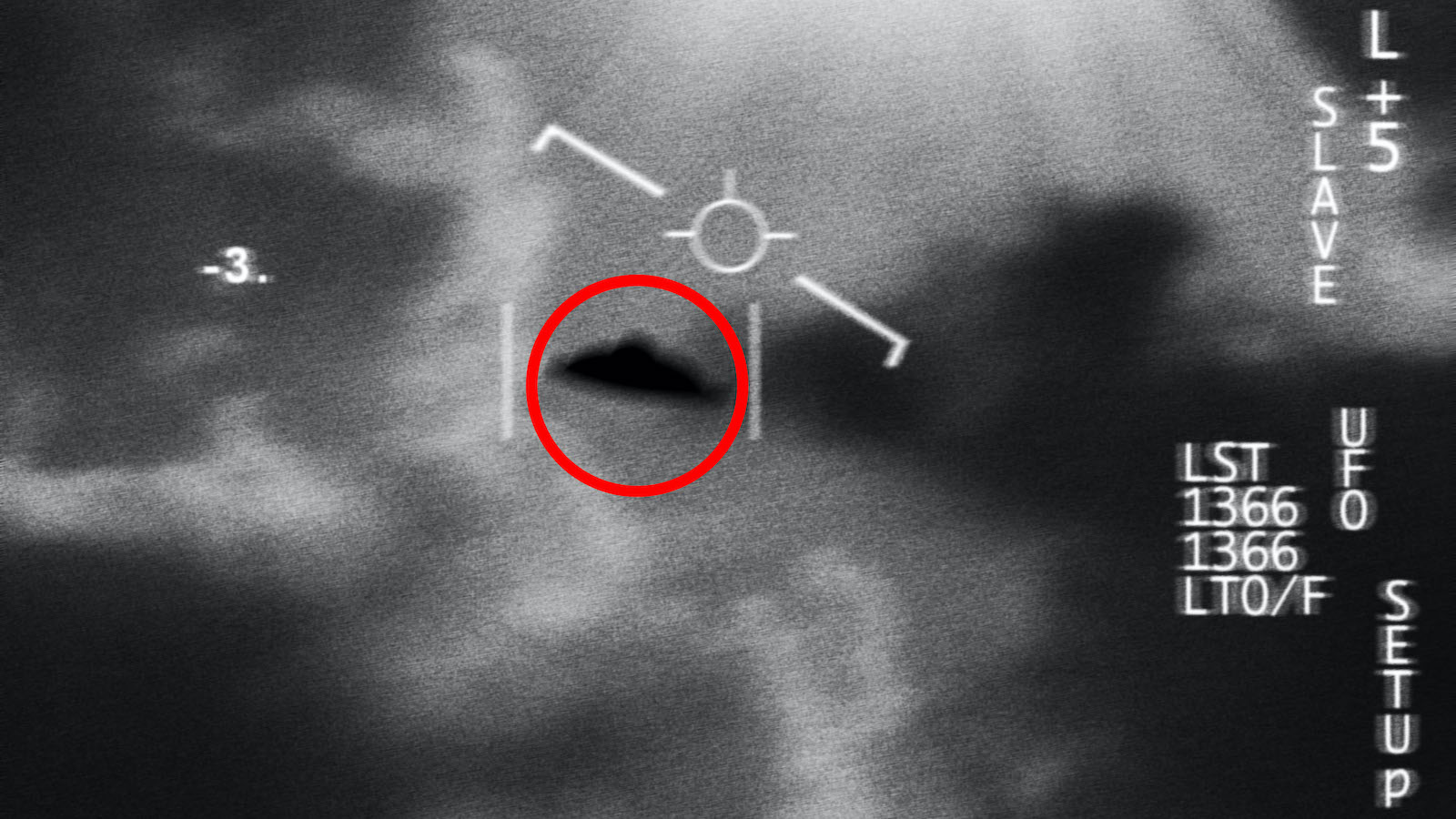
UFO sightings: New report shows hundreds more UAP incidents than ...

Introduction

The phenomenon of unidentified flying objects (UFOs), now more commonly referred to as unidentified aerial phenomena (UAP), has intrigued humanity for decades. The transition from UFO to UAP signifies not only a change in terminology but also a shift in public perception and governmental acknowledgment of these mysterious entities. The last few years have seen an unprecedented openness from government agencies, particularly in the United States, regarding the existence of UAPs. This essay explores the historical context of the UFO phenomenon, the recent advancements in disclosure, and the implications of these revelations for society and science.

age-of-disclosure-350x120.jpg

Historical Context of UFOs

The History of UFOs

Early Sightings and Cultural Significance

The concept of aerial phenomena that defy explanation is not new. Throughout history, various cultures have reported sightings of strange lights and objects in the sky. From the ancient Romans to medieval Europeans, these sightings were often attributed to divine or supernatural forces. The modern UFO era, however, began in the mid-20th century, particularly after World War II. The term "flying saucer" gained popularity following Kenneth Arnold's sighting in 1947, which marked the beginning of a wave of reports across the United States.

Government Response and the Birth of Cover-Up Theories

In the wake of Arnold's sighting, the U.S. government established several initiatives to investigate UFO reports. Projects like Project Sign (1948-1949) and Project Blue Book (1952-1969) were tasked with collecting and analyzing UFO data. However, many of these investigations were met with skepticism, and the government often dismissed sightings as misidentified aircraft or natural phenomena. This dismissive response, coupled with the secretive nature of military operations during the Cold War, contributed to widespread conspiracy theories suggesting a systematic cover-up regarding extraterrestrial life.

Biggest story in human history’: Jeremy Corbell on UFO cover-up

The 80-Year Cover-Up

The Role of Secrecy in Governmental Discourse

For decades, the U.S. government maintained a veil of secrecy around UFOs and UAPs, leading to public distrust and speculation. The narrative that emerged was one of denial and obfuscation, where credible witnesses—including military personnel—were often ridiculed or ignored. This culture of secrecy was further exacerbated by incidents such as the Roswell crash in 1947, which many believed to be the recovery of an extraterrestrial spacecraft. Despite official explanations attributing the incident to a weather balloon, the lack of transparency fueled theories of a cover-up.

The Impact of the Cold War Era

The geopolitical climate of the Cold War significantly influenced how governments dealt with UFO phenomena. The fear of nuclear war and espionage led to heightened secrecy in military operations. Any unexplained aerial phenomena were often viewed through the lens of national security, leading to the classification of information regarding UAPs. This mindset persisted into the 21st century, as military encounters with UAPs remained unreported or downplayed.


'The Age of Disclosure' Documentary Unveils 80 Year UFO Cover Up

Recent Developments in Disclosure

The Shift in Governmental Attitudes

The tide began to turn in 2017 when The New York Times published an article revealing the existence of the Advanced Aerospace Threat Identification Program (AATIP), a secret initiative funded by the U.S. government to investigate UAPs. This revelation marked a significant shift in governmental attitudes towards the phenomenon, leading to increased interest and scrutiny from both the public and lawmakers.

Unidentified Aerial Phenomena Task Force Chief Reveals Shocking Video Findings To Senate

The Unidentified Aerial Phenomena (UAP) Task Force

In August 2020, the Department of Defense established the Unidentified Aerial Phenomena Task Force (UAPTF) to standardize the collection and analysis of UAP data across military branches. The task force aimed to assess the threat posed by UAPs to national security and to improve understanding of their nature and origins. This represented a significant step towards transparency and accountability regarding UAPs.

Pentagon UFO report: from shrouded history to a data-driven future – podcast

The Pentagon Report of June 2021

In June 2021, the Office of the Director of National Intelligence (ODNI) released a report detailing the findings of the UAPTF. The report analyzed 144 sightings of UAPs between 2004 and 2021, concluding that most of the incidents remained unexplained. Although the report did not confirm the existence of extraterrestrial life, it acknowledged that some UAPs exhibited behaviors that defied known aviation capabilities. This acknowledgment fueled further public interest and debate regarding the nature of these phenomena.

The Implications of Disclosure

Societal Impact and Cultural Shifts

The ongoing dialogue surrounding UAPs has led to a cultural shift in how society perceives the possibility of extraterrestrial life. As governments acknowledge the existence of UAPs, public interest has surged, leading to increased research and exploration of the subject. Documentaries, podcasts, and scholarly articles have proliferated, reflecting a growing willingness to discuss and investigate the implications of UAPs.

Scientific Inquiry and Exploration

The release of previously classified information has opened new avenues for scientific inquiry. Researchers, scientists, and enthusiasts are now examining UAPs through a more rigorous scientific lens. The potential implications for physics, aerospace engineering, and even biology are profound. New technologies and methodologies are being developed to study these phenomena, pushing the boundaries of our understanding of the universe.

National Security Considerations

The acknowledgment of UAPs raises critical questions about national security. The UAPTF's report highlighted the need for a comprehensive approach to address potential threats posed by these phenomena. As governments worldwide begin to scrutinize UAPs, there is an opportunity for international collaboration to share data and insights, fostering a collective understanding of the implications of UAPs for global security.


NASA releases UFO report. Here's what they found

The Future of Disclosure

The Future of DISCLOSURE!

The Role of Technology in UAP Research

Advancements in technology, particularly in sensor technology and data analysis, are likely to play a crucial role in future UAP research. The integration of artificial intelligence and machine learning can enhance the detection and classification of UAPs, leading to more accurate and comprehensive data collection.

The Importance of Public Engagement

Public engagement will be essential in shaping the future of UAP disclosure. As interest in the phenomenon grows, governments must balance transparency with national security concerns. Encouraging open dialogue between scientists, policymakers, and the public can foster a more informed understanding of UAPs and their implications.

The Possibility of Extraterrestrial Life

While the existence of extraterrestrial life remains unconfirmed, the ongoing investigation of UAPs raises intriguing questions about the potential for life beyond Earth. As we expand our understanding of the universe, the search for extraterrestrial intelligence (SETI) efforts may gain renewed momentum, driven by the insights garnered from UAP research.

What's behind all this technology? | UFOs / UAPs and how tiny we all are in this universe

Conclusion

The “Age of Disclosure” marks a pivotal moment in our understanding of UAPs and their implications for society, science, and national security. As governments become more transparent about these phenomena, the opportunity for scientific inquiry and public engagement expands. While the mystery surrounding UAPs persists, the dialogue initiated by recent disclosures has the potential to reshape our understanding of the universe and our place within it. The next steps in this journey will require collaboration, open-mindedness, and a commitment to exploring the unknown, as humanity stands on the brink of a new era of discovery and understanding.

In conclusion, the exploration of UAPs and their significance is not merely a scientific endeavor; it is a profound inquiry into our existence and the possibilities that lie beyond our planet. As we enter this new age, the call for curiosity and investigation resonates louder than ever, urging us to seek answers to questions that have captivated humanity for centuries. The future of UAP research holds the promise of revelation, inviting us to embrace the unknown and explore the vastness of the cosmos with wonder and determination.

UFO hearing: Pentagon shows declassified photos and video, clip of unexplainable floating object

{ PETER2011 }

Hoe vind je dit bericht?
Geschreven door peter om 23:23 Stuur door

Groundbreaking UFO Documentary Director Breaks Silence on Film’s Revelations

Groundbreaking UFO Documentary Director Breaks Silence on Film’s Revelations

Filmmaker Dan Farah discusses his UFO/UAP documentary 'The Age of Disclosure,' which premieres at SXSW this weekend: "None of the government leadership I spoke to are debating whether this is real."

By James Hibberd

'Age of Disclosure'

The highly anticipated UFO documentary The Age of Disclosure has its world premiere at South by Southwest Film Festival on Sunday, and filmmaker Dan Farah is finally ready to talk about his years-long secretive effort to make the most credible nonfiction movie ever about the buzzy topic.

What makes The Age of Disclosure stand out among the thousands of previous UFO film and TV documentary efforts over the past several decades is that Farah only included on-record interviews with current and former senior members of the U.S. government, military and intelligence community with direct knowledge of unidentified anomalous phenomena (or UAPs). The result is a riveting look at a subject that’s being taken far more seriously in recent years as high-level officials make statements, release videos, hold hearings and take legislative action (like 2023’s bipartisan UAP Disclosure Act), which all lead to one conclusion: Something is going on.

Related Stories

In The Age of Disclosure, that something is boldly defined at the start of the film by several of its 34 interview subjects: That “non-human intelligent life” exists, that they’ve been visiting our planet for a long time, that the United States entered into an arms race with foreign adversaries to reverse engineer technology from crashed aircraft, and that if certain factions of our government continue to keep this information secret and sequestered, that the United States could face an intelligence failure like the one that led to 9/11 — or much worse.

From there, Disclosure spins a deft narrative that details an alleged 80-year cover-up of UFOs while attempting to answer several burning questions (such as how do the crafts work, why have they crashed, who is covering this up, and what do U.S. presidents know?). The film will doubtlessly convert many skeptics, while also generating some skepticism of its own.

“I hope I made a film that makes the public aware of a very serious situation that impacts us all,” Farah says. “I had multiple senators tell me that they thought my documentary would be one of the most effective tools for helping make the public aware of the truth in a way that could get the rest of the government to take this topic more seriously.”

Farah also hopes for more traditional metrics of filmmaking success, with his team currently on the hunt for a distributor. The movie’s trailer (below) hit 18 million viewers across all platforms, half of which were international. “There’s a universal audience that has been invested in the topic and it’s been growing since the 1940s,” says Farah, who points out that the UFO forum on Reddit has even more subscribers than the ones for Harry Potter and Marvel.

Below, Farah took our questions. The director is passionate about this subject and also exceedingly careful in selecting his words, which is understandable. Having your debut film premiere at a major film festival is cause for anxiety enough. To also have it also be a project that claims to answer one of mankind’s biggest existential questions while tackling sensitive national security issues is quite another. As a first-time director, Farah has jumped straight into the deep end of the pool — which might also contain aliens.

How were you able to convince so many of credentialed voices to go on camera to talk about this for your first film? 

I was researching this topic a few years ago and I met several very senior former intelligence officials through a friend of mine, who I will keep as an anonymous source. It started with [former Department of Defense official] Luis Elizondo and [former director of the U.S. government’s UAP task force] Jay Stratton, who were really key in opening doors for me. I told them I wanted to make the most serious and credible and sober documentary ever made about this topic. My goal was to only interview people who had direct knowledge of the UAP topic as a result of their work for the U.S. government and who would share what they can legally disclose. One by one, I would get introduced to another high-level person who had worked on this topic, and each would end up introducing me to someone else. I went down a rabbit hole, and what followed was the most revelatory and interesting experience of my life.

What kind of reactions did you get from officials when you approached them?

There was a consistent positive response to the goals I had — from intelligence officials to senators to military officials. Everyone felt it was important to bring this information to the public in a credible and serious fashion. They said they had never been presented with an opportunity like this. There was also strength in numbers. By participating in a documentary that interviewed so many credible people, it gave them all cover, essentially, so they didn’t have to go out on a limb by themselves to share this information.

Your film actually reminded me a bit of another documentary — Al Gore’s climate change film An Inconvenient Truth.

There’s some overlap [in that global warming was also] a topic that was considered pseudoscience and fringe, and there was a stigma around scientists talking about it. Then An Inconvenient Truth had credible people bringing attention to a very real and serious situation that has global stakes. It’s the same thing here, but arguably with higher states, frankly, because there are potential existential threats on multiple fronts — there’s what humans could do with this technology if it’s used for bad, and what the intentions are of non-human intelligence.

Were you nervous about making this? Did you take any secretive steps when filming? 

There are people who want the topic to continue to be kept from the public entirely. So I went to great lengths film to make this documentary in secret over the last two-and-a-half years. I kept it very under the radar, and everyone working on it was under NDAs.

And not everyone I talked to ended up being in the film. There were a number of government and intelligence officials who ultimately decided it wasn’t in their best interest to participate. Certain officials were afraid of the historical stigma around the topic and how it might impact their reputation. Several officials ultimately decided they would be in danger if they participated in this documentary, even sharing what they legally could, and that’s not a position I would ever want anyone to be in. Also, at no point did I ever ask anyone to share classified information. I would never do that. But what is interesting is that there was a huge amount of fascinating information that could be lawfully disclosed that historically people were just discouraged from talking about.

Were any of your sources threatened for their participation? 

Yes. Some of them were told very clearly there will be consequences for them — that that they would be in danger — if they participated in not only my documentary, but any documentary. But while my interview subjects want to see the truth be brought to the public, they also 100 percent agreed that there are a lot of elements on this topic that should remain classified and should never be made public because it’s in the best interest of national security. Now that I’ve learned about the landscape, I agree with that. But there are these fundamental facts — like that we’re not alone in the universe — that everyone feels like the public has the right to know, and it’s also in our best interest to make known so that there’s no longer this antiquated, unjust stigma that is making our country fall behind in how seriously this topic is taken.

The hypothetical counterargument that I can think of is, once you let the cat out of the bag, the questions and media interest will be insatiable and won’t stop, and everybody will just keep digging until they strike something they definitely don’t want out there.

Luis Elizondo says a really interesting line in the documentary about how it’s ironic that the people who created the stigma to cover this up — labeling anybody who talked about it wacky and nuts — unintentionally ended up creating a new national security threat — which is the stigma itself. Because the stigma is not as strong in other countries, and we’re competing with those countries. So how can we, as a nation — our scientific community, our academia community — how can our communities contribute toward the United States succeeding on this front when 90 percent of them don’t even think it’s real?

There’s a scene in the documentary that I find especially impactful, where [Secretary of State] Marco Rubio talks about how a lack of imagination has historically led to all of the greatest intelligence failures and disasters — from Pearl Harbor to 9/11 — and that he doesn’t want that to happen again. He says in the film, “We’ve had repeated instances of something operating in the airspace over restricted nuclear facilities, and it’s not ours. And we don’t know whose it is. That alone deserves inquiry, deserves attention, deserves focus.”

Prior to 9/11, we didn’t put enough money toward counter-terrorism, and our intelligence agencies didn’t share enough information. Everyone looked back and said, “We could have done this better.” My interview subjects point out that we’re now in a situation where that stigma around UAPs is creating hurdles for us to appropriately address this issue with a whole-government approach. There’s not the appropriate amount of funding going toward it and there’s not the appropriate amount of oversight.

Sen. Minority Leader Chuck Schumer pressured Trump last month to release UFO files after the president pledged to release the JFK files. I’ve never gotten the impression that Trump seems all that excited to do that, he kind of dances around the subject. Which is interesting because that’s how all the living past presidents seem to react when asked about this subject. Like they don’t outright deny there’s something there, but they keep their reaction light, and bounce it away. 

Well, Schumer has very aggressively fought for disclosure on the UAP topic. Most people don’t know that for the last two years in a row, Schumer and Senator Mike Rounds co-sponsored the UAP Disclosure Act, which then-Senator Marco Rubio and Senator Kirsten Gillibrand also endorsed. The act had very specific language to try to use the law to bring about disclosure. Schumer literally included a quote saying, “The American public has a right to learn about technologies of unknown origins, non-human intelligence, and unexplainable phenomena.” This is very specific language. When you read that, any average person would say to themselves, “Oh my God, is this real?” Yes, it is real.

Something else that I found really eye-opening is how truly bipartisan this topic is at a time where Democrats and Republicans don’t agree on anything. The leadership of both parties are completely aligned on how serious this is. None of the government leadership I spoke to — who have access to very sensitive classified information — were debating whether this is real. None of them. I had multiple senators tell me that they thought my documentary would be one of the most effective tools for helping make the public aware of the truth in a way that could help them get the government to take the topic more seriously.

Are there any common elements of UFO lore like — abductions, ancient aliens, Area 51, Skinwalker Ranch, etc. — that some UFO believers have long believed but that your research has suggested are not true? Is there anything the UFO crowd is wrong about? 

Nothing really stands out to me. But I would go the other way with it, which is a very senior former official in the film goes on record to confirm there has been ongoing UAP activity over some of our most sensitive military sites, especially in the Western United States. He specifically notes that includes “Area 51.” That’s an important moment for me because Area 51 is a talking point that I think your average person thinks is all conspiracy — that nothing real happens regarding UAP in that area. This person makes it very clear that is not the case.

What happens next on this front, do you think? 

I think we are on a path to the basic facts actually being made known to the public in the near future. The current leadership in both political parties, as well as elements in the current administration, want to take cautious steps toward responsibly disclosing the fundamental facts around UAP and non-human intelligent life to the public. A lot of government leaders can’t dictate change on their own. They still need the populace and the rest of the government to come around on it. A documentary can be very helpful to achieving that goal, in theory.


Alien Future | Unexplained UFOs

{ https://www.hollywoodreporter.com/ }

Hoe vind je dit bericht?
Geschreven door peter om 20:44 Stuur door

New Doc With 30+ High-Ranking U.S. Officials Claims The Govt. Has Been Collecting UFOs Since The 1940s

New Doc With 30+ High-Ranking U.S. Officials Claims The Govt. Has Been Collecting UFOs Since The 1940s

by Eric Italiano

director Dan Farah told Variety at South by Southwest.

The Age of Disclosure, a new documentary that recently premiered at the South by Southwest festival, speaking with 30-plus high-ranking officials who claim that the United States government has been working to collect UFOs since the 1940s. UFOs are now officially referred to as UAPs: unidentified anomalous phenomena.

According to 34 high-ranking government, military and intelligence officials that appear in The Age of Disclosure, which was directed by filmmaker Dan Farah, the United States government has been secretly attempting to capture and study UAPs since as early as 1947.

In addition to interviews with government officials, the documentary also claims to have evidence of  “vehicles that appear to disobey the laws of physics, difficult-to-explain interference with American military activity and the bodies of intelligent, nonhuman beings.”

Farah told Variety that while he was able to get 34 officials on camera, there were about another ten who did not want to appear on camera out of fear of repercussions.

“Some high-level politicians were afraid of how it might taint their reputation or impact them politically. And some intelligence officials legitimately believed that their lives would be in danger if they participated in the film,” Farah said the South by Southwest festival.

“After long conversations with their significant others, they decided it just wasn’t worth it. That was eye-opening for me. The more you go down the rabbit hole, it becomes clear really fast that this 80-year cover-up of the truth has been enforced with threats.”

One of the more eye-opening aspects of the documentary is that it posits world governments are in a “secret war” to collect and reverse engineer alien technology, with one official saying that the first country to do so will “be the leader [of the world] for years to come,” comparing it to the “Manhattan project on steroids.”

“The Age of Disclosure is an unprecedented and revelatory film –featuring 34 senior members of the U.S. Government, military, and intelligence community– revealing a cover-up of the existence of non-human intelligent life and a secret war to reverse engineer technology of non-human origin. The film exposes the profound impact the situation has on the future of humanity, while providing a look behind-the-scenes with those at the forefront of the bi-partisan disclosure effort.”

{ https://brobible.com/category/culture/ }

Hoe vind je dit bericht?
Geschreven door peter om 18:31 Stuur door

Giant Glaciers Reshaped Earth’s Surface and Paved Way for Complex Life

Giant Glaciers Reshaped Earth’s Surface and Paved Way for Complex Life

By chemically analyzing crystals in ancient rocks, scientists from Curtin University, the University of Portsmouth and St. Francis Xavier University discovered that as glaciers carved through the landscape after the Neoproterozoic ‘snowball Earth’ events, they scraped deep into the Earth’s crust, releasing key minerals that altered ocean chemistry. This process had a profound impact on the Earth’s composition, creating conditions that allowed complex life to evolve.

An artist’s impression of a ‘Snowball Earth.’ Image credit: NASA.

An artist’s impression of a ‘Snowball Earth.’

Image credit: NASA.

“Our study provides valuable insights into how Earth’s natural systems are deeply interconnected,” said Curtin University Professor Chris Kirkland, lead author of the study.

“When these giant ice sheets melted, they triggered enormous floods that flushed minerals and their chemicals, including uranium, into the oceans.”

“This influx of elements changed ocean chemistry, at a time when more complex life was starting to evolve.”

“This study highlights how Earth’s land, oceans, atmosphere and climate are intimately connected- where even ancient glacial activity set off chemical chain reactions that reshaped the planet.”

The research also offers a new perspective on modern climate change.

It shows how past shifts in Earth’s climate triggered large-scale environmental transformations.

“This research is a stark reminder that while Earth itself will endure, the conditions that make it habitable can change dramatically,” Professor Kirkland said.

“These ancient climate shifts demonstrate that environmental changes, whether natural or human-driven, have profound and lasting impacts.

“Understanding these past events can help us better predict how today’s climate changes might reshape our world.”

  • The findings were publsihed in the journal Geology.
  • C.L. Kirkland et al. The Neoproterozoic glacial broom. Geology, published online February 25, 2025; doi: 10.1130/G52887.1

RELATED VIDEOS

Giant ice bulldozers: how ancient glaciers helped life evolve

How Ancient Glaciers Shaped Life on Earth

How glaciers shape the Earth's surface

{ https://www.sci.news/ }

Hoe vind je dit bericht?
Geschreven door peter om 18:15 Stuur door

Scientists discover giant blobs deep inside Earth are 'evolving by themselves' — and we may finally know where they come from

Scientists discover giant blobs deep inside Earth are 'evolving by themselves' — and we may finally know where they come from

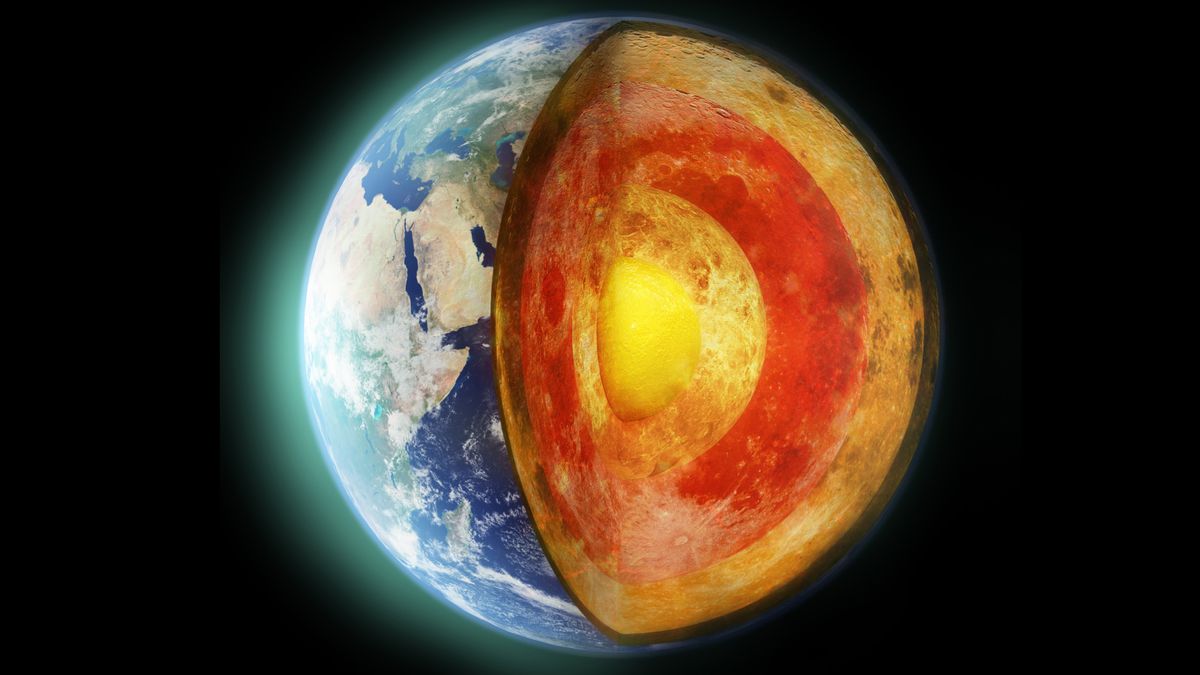
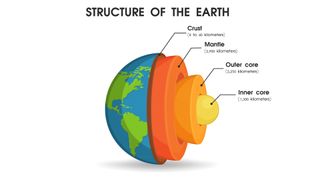
Cross section of the varying layers of the earth.
Two enormous blobs deep inside Earth appear to be the remnants of oceanic crust that was pushed down into the mantle. 
(Image credit: Yuri_Arcurs/Getty Images)

We finally know where two giant blobs in Earth's middle layer came from — and they're a mismatched pair.

These strange regions in Earth's mantle, known as "large low velocity provinces" (LLVPs), are actually chunks of Earth's crust that have sunk into the mantle over the past billion years, new research suggests.

What are these mystery blobs?

In the 1980s, geophysicists first discovered two continent-sized blobs of an unusual material deep near the center of the Earth. One blob is located beneath the Pacific Ocean and the other is under the African continent. Both are twice the size of our moon. They are so large that if they were placed on Earth’s surface, they would make a layer roughly 60 miles thick around the planet.

Formally known as large low-velocity provinces (LLVPs), they are also likely built of different proportions of elements than the mantle that surrounds them. A 2023 paper published in the journal Nature proposed that they are the remains of an ancient planet called Theia that collided with Earth in the same massive impact that created the moon. The study suggests that most of Theia was absorbed into our young planet, forming the LLVP blobs. The residual debris formed the moon. 

“The moon appears to have materials within it representative of both the pre-impact Earth and Theia, but it was thought that any remnants of Theia in the Earth would have been ‘erased’ and homogenized by billions of years of dynamics (e.g., mantle convection) within the Earth,” Arizona State University astrophysicist and co-author of the Nature study Steven Desch said in a statement. “This is the first study to make the case that distinct ‘pieces’ of Theia still reside within the Earth, at its core-mantle boundary.”

The study posits that these blobs themselves then created our planet’s plate tectonics, which allowed life to flourish. 

Related: 

Scientists have long known that there are LLVPs — one below the Pacific Ocean and the other below Africa. In these regions, seismic waves from earthquakes travel 1% to 3% more slowly than they do in the rest of the mantle. Scientists believe they may affect the planet's magnetic field because of the way they influence heat flow from Earth's core.

There's a lot of debate about what LLVPs are. Some studies have suggested that they're material from the ancient Earth — either a layer of primordial unmixed rock from the planet's formation or a leftover hunk of the giant space rock that hit Earth 4.5 billion years ago, forming the moon.

A new look at some very old minerals

This new paper builds on that study. Using computer modeling, they determined that around 200 million years after the impact with Theia, the submerged LLVP blobs may have helped create the hot plumes inside Earth that disrupted the surface. They breached the flat crust and allowed circular slabs to sink down in a process called subduction.

According to the team, it may explain why the Earth’s oldest minerals are zircon crystals that appear to have undergone subduction over 4 billion years ago and may have contributed to plate tectonics. 

Related: 

“The giant impact is not only the reason for our moon, if that’s the case, it also set the initial conditions of our Earth,” California Institute of Technology geoscientists and study co-author Qian Yuan told The Washington Post. 

The model raised numerous questions for some outside geologists, including whether or not the collision would have resulted in a recycling of Earth’s entire crust instead of plate tectonics. This process potentially occurred on our sister planet Venus billions of years ago. There are also some geochemical inconsistencies that cast doubt on the planet smashing theory as a whole, according to some scientists.

Are plate tectonics really necessary for life?

While they can be destructive to both property and lives, some scientists believe that plate tectonics helps Earth keep up the carbon cycle. This process moves carbon between microbes, plants, minerals, animals, and Earth’s atmosphere. The fourth most abundant element in the universe, carbon can also form the complex molecules on Earth like DNA and proteins. These building blocks of carbon make life on Earth possible. 

However, another study published last year in Nature posits that mobile plate tectonics was not happening on Earth about 3.9 billion years ago when the first traces of life appeared on Earth. 

Related: 

“We found there wasn’t plate tectonics when life is first thought to originate and that there wasn’t plate tectonics for hundreds of millions of years after,” University of Rochester paleogeologist John Tarduno said in a statement. “Our data suggests that when we’re looking for exoplanets that harbor life, the planets do not necessarily need to have plate tectonics.”

What is clear is that concrete answers to the question of how, when, and why life first emerged on our planet and what role the shifting plates played or didn’t play will endure. 

Related: 

The crust hypothesis

Others have suggested that the blobs are huge chunks of oceanic crust that were pushed into the mantle when one tectonic plate slipped under another — a process known as subduction.

The crust hypothesis had not been subject to as many studies as the ancient-material idea, said James Panton, a geodynamicist at Cardiff University in the U.K. In a new study, published Feb. 6 in the journal Scientific Reports, he and his colleagues used computer modeling to determine where subducted crust entered the mantle over the past billion years and to find out whether that subducted crust could form features similar to the LLVPs.

"We found that the recycling of the oceanic crust can indeed generate these LLVP-like regions beneath the Pacific and Africa without the need for a primordial dense layer at the base of the mantle," Panton told Live Science. "They are evolving by themselves, simply through the process of subduction of oceanic crust."

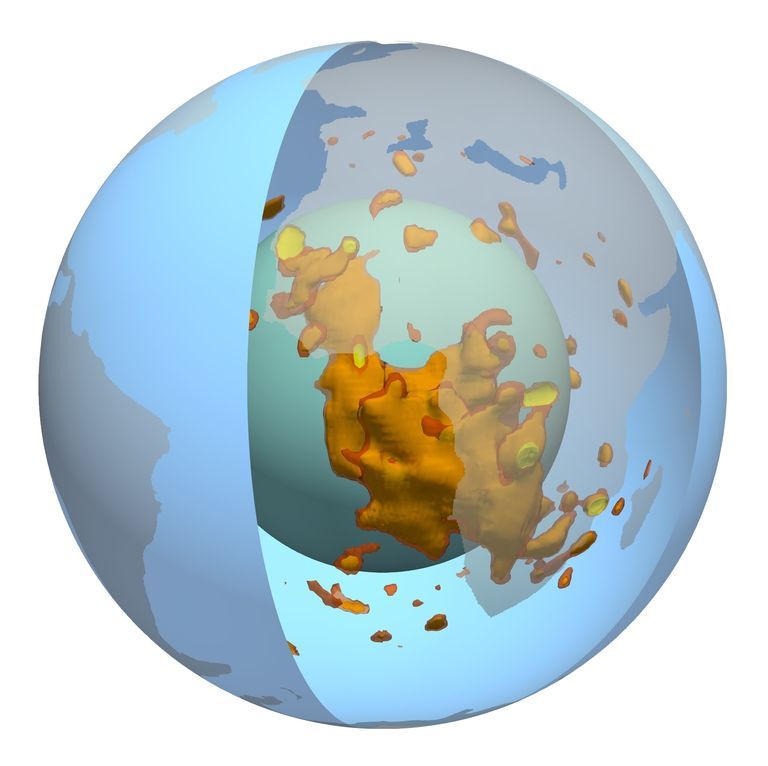
simulated computer image of a blob of superhot material beneath africa deep in earth's mantle

Image courtesy of Mingming Li/Nature Geoscience

A simulated image of the blob, located deep in Earth’s mantle beneath Africa.

That doesn't mean there isn't dense material from Earth's youth at the bottom of the mantle, Panton said; there may be a thin layer of ancient material that contributes to the LLVPs as well. But if subduction alone can explain the LLVPs, that could hint at their age.

"That potentially means that shortly after we started having subduction on Earth, then maybe that's when we started to have LLVPs," Panton said. (The advent of subduction is itself a complicated question. Some scientists think it began more than 4 billion years ago, while others think it started around a billion years ago.)

The subduction process has resulted in two different types of blobs, the authors said in the study. The LLVP under Africa doesn't get as much crustal material currently as the LLVP under the Pacific, which is fed by the subduction zones of the Pacific Ring of Fire, which is a horseshoe-shaped line of subduction that circles the Pacific Ocean.

The African LLVP is thus older and better mixed with the rest of the crust, the team said. It also has less of a volcanic rock called basalt, which means it is less dense than the Pacific LLVP. This may explain why the African LLVP extends 342 miles (550 kilometers) higher in the mantle than the Pacific LLVP.

One question for the future, Panton said, is how hot regions of the mantle called mantle plumes may help drive the subduction process in the Pacific and influence the LLVPs. These plumes stretch from the very bottom of the mantle to volcanic hotspots at the surface, such as the Hawaiian islands. 

RELATED VIDEOS

The Earth's Mantle is Nothing Like You Thought

What Are Tectonic Plates? Our Earth and Its Movements

Mysterious Giant Blobs of Material Near Earth’s Core

The Remains of an Ancient Planet Lie Deep Within Earth

{ https://www.livescience.com/planet-earth }

Hoe vind je dit bericht?
Geschreven door peter om 16:59 Stuur door

Watch the Sun Unleash a Solar Flare

Watch the Sun Unleash a Solar Flare

solar-flare.webp Solar flare on the Sun

The Sun, a G-type main sequence star lies at the heart of our Solar System and formed approximately 4.6 billion years ago from the gravitational collapse of a giant molecular cloud. With a diameter of 1.39 million kilometres it accounts for 99.86% of the total mass of the Solar System. Deep in it’s core where nuclear fusion converts hydrogen to helium, temperatures reach a staggering 15 million degrees Celsius. The fusion process, which consumes around 600 million tons of hydrogen every second, powers all life on Earth.

1080px-the_sun_in_white_light.jpg

The Sun photographed on the 8th of May, 2019 in white light (true color). Sunspots AR2740 (to the right) and AR2741 (to the left) visible. Some other interesting features include faculae, white spots near AR2741, limb darkening, and tiny convection cells called granules all across its surface.

(Credit : Matus Motl)

Observations of the Sun clearly reveal its violent nature. Solar flares can often be seen erupting into space and, these massive explosions release bursts of radiation across the electromagnetic spectrum. Flares occur when magnetic energy builds up in the solar atmosphere and is suddenly released, accelerating charged particles to nearly the speed of light. A large solar flare can release energy equivalent to millions of hydrogen bombs exploding simultaneously, heating solar material to tens of millions of degrees and causing it to shine brightly in X-rays and extreme ultraviolet light.

solar-flare.jpeg

An X3.2-class solar flare observed in different wavelengths. Clockwise from top left: 304, 335, 131, and 193 Å

(Credit : NASA/SDO)

The powerful radiation emitted by solar flares impacts Earth's ionosphere and can severely disrupt radio transmissions across various frequencies. This highlights the critical importance of the ongoing surveillance and research programs dedicated to these solar phenomena. Flares are categorised from the smallest classed as B-Class flares to the most intense as X-Class. Just below this highest category are the medium intensity events known as M-Class and it was an event like this that has just been observed in a stunning video.

The video (which can be viewed here on the ESA website) revealed the M-Class flare in stunning detail from data captured by the Solar Orbiter's Extreme Ultraviolet Imager (EUI) instrument. It gives the highest resolution observations of solar flares as they evolve in both space and time. The movie was created by scientists at the Royal Observatory of Belgium using the publicly available JHelioviewer software—a tool that allows anyone to create similar solar flare visualisations. The footage condenses a 15-minute flare event into a brief time-lapse.

This remarkable footage is part of the EUI dataset that's fully accessible through the JHelioviewer application to anyone that would like to have process the data. It can be found on the JHelioviewer website. It was developed by the ESA/NASA Helioviewer Project that enables anyone to explore solar data from a number of missions. The application can be used by anyone to browse solar imagery across different wavelengths and create wonderful time-lapse animations of solar activity.

The application is easy enough to download and has formats for most popular operating systems. The interface is easy enough to use with a clear way to select datasets with particular solar events categorised. It’s easy to lose a good few hours on this, I know, I tried and its fascinating to lose yourself in amazing imagery of our local star.

Source : 


Solar Orbiter spots a solar flare

Watch sun unleash major X-flare in epic solar eruption (video)

{ https://www.universetoday.com/ }

Hoe vind je dit bericht?
Geschreven door peter om 15:29 Stuur door

Is Europa Alive? A Laser Could Detect Biosignatures from Space

Is Europa Alive? A Laser Could Detect Biosignatures from Space

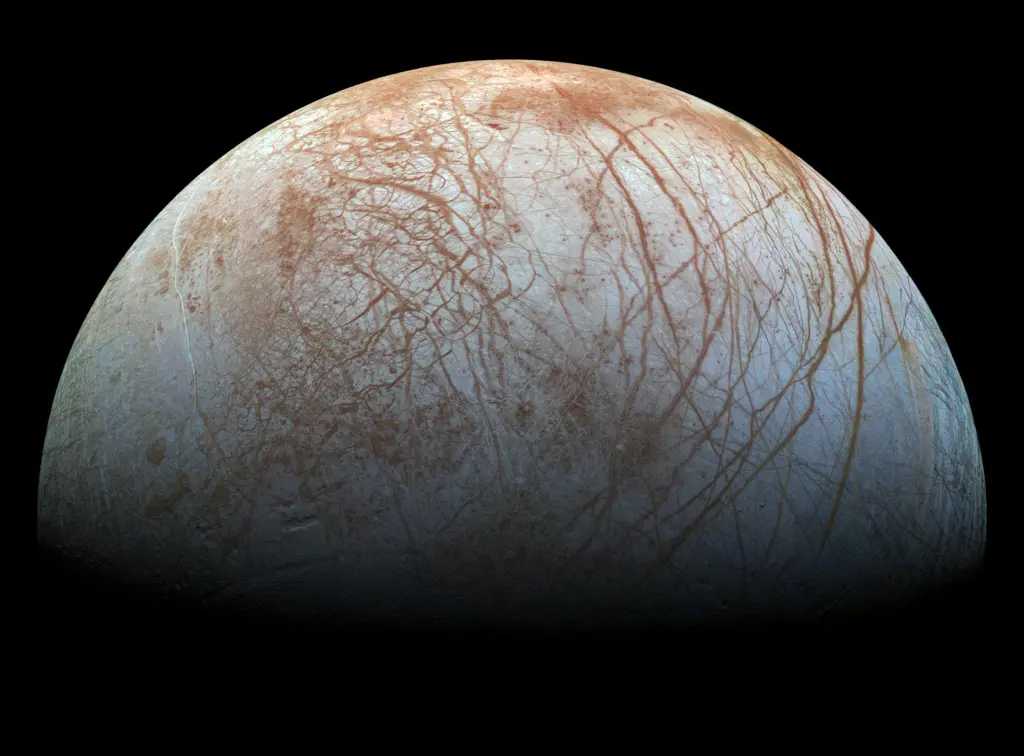
europa.webp Europa

Europa is the sixth largest satellite in our Solar System and the smallest of Jupiter's four Galilean moons. Discovered by Galileo Galilei in 1610, Europa has a smooth, icy surface crisscrossed by a network of cracks and lines, suggesting dynamic geological processes are afoot. What makes Europa particularly interesting is the strong evidence for a vast subsurface ocean of liquid water beneath its frozen exterior, potentially containing twice as much water as all of Earth's oceans combined. This ocean is kept liquid by tidal heating caused by Jupiter's gravitational force, despite surface temperatures averaging about -160°C.

galilean-satellites.jpeg

The Galilean Satellites Io, Europa, Ganymede and Callisto

(Credit : NASA/JPL/DLR)

If hydrothermal vents exist on Europa's ocean floor then they may undergo a process called serpentinisation, which creates hydrogen and forms organic molecules from simpler compounds. This hydrogen production is important because it provides a key element needed for organic chemistry, potentially supporting life beneath the surface. It’s these very conditions and processes that are similar to what’s going on at the bottom of our oceans, playing a vital role in the origin of life on Earth.

hydrothermal-vent.jpeg

Hydrothermal Vent in the Atlantic Ocean

(Credit : By P. Rona / OAR/National Undersea Research Program ; NOAA - NOAA Photo Library)

It’s not just under the crust where interesting processes are taking place. Europa’s surface is constantly bombarded by charged particles from Jupiter's magnetosphere and ultraviolet radiation from the Sun, which break down organic molecules over time. The paper, authored by a team led by Gideon Yoffe from the Weizmann Institute of Science proposes that aromatic amino acids would be unlikely to form naturally, as a result of non-organic process on Europa, making their presence a possible sign of life.

Their models show that despite the likely degradation caused by the incoming radiation, any biosignatures within newly exposed ice, particularly in high-latitude regions, could still be detected using laser-induced ultraviolet fluorescence. The detectability varies based on location and ice conditions across the moon’s surface. When targeted with a suitable laser, these compounds emit distinctive fluorescent light in the 200-400 nanometer range. Targeting regions which are geologically young will increase the liklihood of detection where ocean material has recently reached the surface. This technique could work even from an orbiting spacecraft!

The research shows that certain amino acids (tryptophan, phenylalanine, and tyrosine) can survive in Europa's surface ice for hundreds of years, especially in high-latitude regions, despite the harsh radiation environment. By studying how radiation and sunlight break down these molecules, the team have determined that they could remain detectable in the top millimetre of ice. The discovery is an exciting development as we continue to hunt for life in the Solar System and wider Galaxy.

Source : 

RELATED VIDEOS

Europa The Planet Of Aliens Or Another Life?

Scientists Think There Could Be LIFE on Europa and It’s Even Weirder Than We Thought!

Europa: Is There Life on Jupiter's Frozen Moon?

{ https://www.universetoday.com/ }

Hoe vind je dit bericht?
Geschreven door peter om 15:19 Stuur door

VS lanceren ruimtemissie die een van de grootste mysteries ooit moet ontrafelen

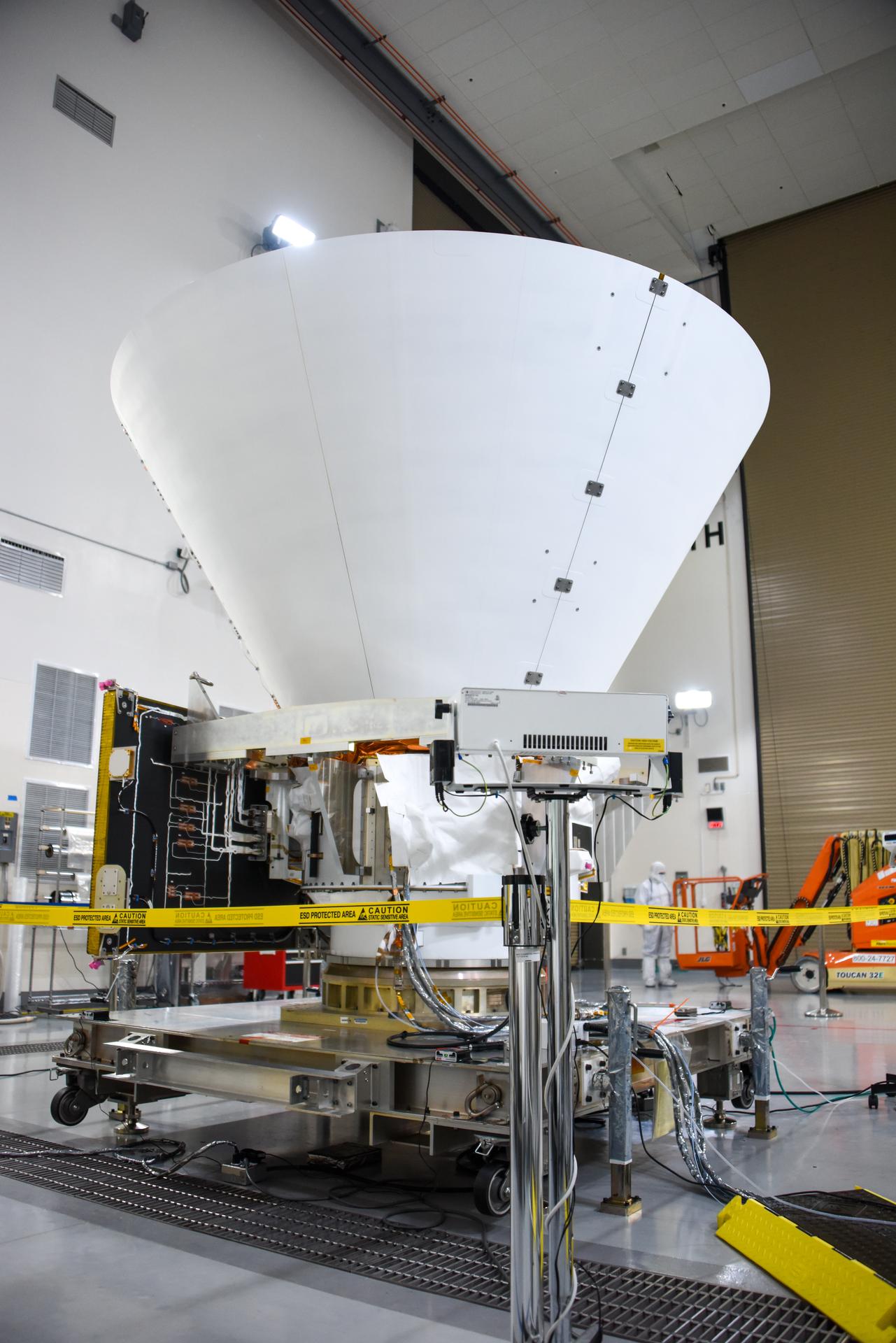
Ruimtetelescoop SPHEREx zweeft door de ruimte na loskoppeling van de lanceringsraket van SpaceX. (11/03/25)  © AP

VS lanceren ruimtemissie die een van de grootste mysteries ooit moet ontrafelen

De Verenigde Staten hebben met één lancering een nieuwe ruimtetelescoop en vier satellieten gelanceerd. De SPHEREx en de PUNCH-sondes vertrokken dinsdagavond (lokale tijd) vanaf ruimtebasis Vandenberg in Californië naar de ruimte.

Hoe vind je dit bericht?
Geschreven door peter om 13:16 Stuur door

128 new Saturn moons just announced. Incredible!

128 new Saturn moons just announced. Incredible!

Hoe vind je dit bericht?
Geschreven door peter om 13:04 Stuur door

Astronomen ontdekken 128 nieuwe “aardappelvormige” manen rond Saturnus

Saturnus.
Saturnus.  © AFP

Astronomen ontdekken 128 nieuwe “aardappelvormige” manen rond Saturnus

Astronomen hebben meer dan 128 nieuwe manen ontdekt die rond de planeet Saturnus draaien. Dat brengt het totale aantal op 274, bijna twee keer zoveel als alle andere planeten in ons zonnestelsel tezamen. Al die manen moeten nu een naam krijgen, maar dat blijkt nog niet zo simpel.

Hoe vind je dit bericht?
Geschreven door peter om 12:40 Stuur door

We Could Detect Alien Life in the Next 20 Years—But What Happens If We Do?

th?id=OIP.CraRUlejOlPe9wNXkLTGOAHaEZ&w=312&h=200&c=8&rs=1&qlt=90&o=6&dpr=1.5&pid=3.1&rm=2

We Could Detect Alien Life in the Next 20 Years—But What Happens If We Do?

The search for extraterrestrial life has captivated human imagination for centuries, and recent advancements in technology and astrophysics have brought us closer than ever to potentially detecting alien life within the next two decades. This essay explores the implications of such a discovery, examining scientific, philosophical, and sociocultural dimensions. It delves into the methods of detection, the criteria for life, the potential forms that life might take, and the consequences of contact. Ultimately, this exploration highlights the need for a comprehensive framework to prepare humanity for the profound implications of discovering life beyond Earth.

1. Introduction

The question of whether we are alone in the universe is one of the most profound inquiries of our time. Recent advances in astrobiology, planetary science, and technology suggest that we may be on the brink of detecting extraterrestrial life within the next two decades. The implications of such a discovery are vast, affecting not only our scientific understanding of life but also our philosophical, ethical, and sociocultural frameworks. This essay aims to explore the potential scenarios surrounding the detection of alien life, the nature of that life, and the implications for humanity.

2. The Search for Extraterrestrial Life

The search for extraterrestrial life is a profound inquiry that has captivated the human imagination for centuries. From the earliest days of human civilization to the advanced scientific explorations of today, the question of whether we are alone in the universe has continued to inspire curiosity and innovation. This exploration can be divided into three key sections: the historical context that has shaped our understanding of life beyond Earth, the current methods employed to detect extraterrestrial life, and the theoretical frameworks that guide our search, such as the Drake Equation.

2.1 Historical Context

2.1.1. Ancient Philosophical Foundations

The quest for extraterrestrial life is not a modern phenomenon; its roots can be traced back to ancient civilizations. Philosophers such as the Greek philosopher Anaxagoras (c. 500–428 BCE) and later thinkers like Epicurus and Lucretius speculated about the existence of other worlds and forms of life beyond our own. This early philosophical inquiry laid the groundwork for future scientific exploration.

2.1.2. The Copernican Revolution

The Copernican Revolution marked a pivotal moment in humanity's understanding of its place in the universe. Nicolaus Copernicus proposed a heliocentric model of the solar system in the 16th century, suggesting that Earth was not the center of the universe but rather one of many celestial bodies orbiting the Sun. This shift in perspective was crucial in fostering the idea that Earth might not be unique and that life could potentially exist elsewhere.

2.1.3. Advances in Astronomy

The invention of the telescope in the early 17th century revolutionized astronomy and expanded our understanding of the cosmos. Figures like Galileo Galilei and Johannes Kepler made significant contributions to our knowledge of celestial bodies, leading to the discovery of planets, moons, and stars. The realization that there are billions of stars, many of which likely host their own planetary systems, further fueled speculation about extraterrestrial life.

2.1.4. The 19th and 20th Centuries

The 19th century saw a burgeoning interest in the possibility of life on other planets, particularly with the discovery of Mars and its intriguing features. The idea of "canals" on Mars, popularized by astronomer Percival Lowell, led many to believe that intelligent life may exist on the Red Planet. The 20th century brought about significant advancements in technology and scientific understanding, culminating in the formulation of astrobiology as a distinct scientific discipline. The exploration of Mars, Europa (one of Jupiter's moons), and the discovery of exoplanets became focal points for the search for extraterrestrial life.

2.1.5. The Role of Science Fiction

Science fiction literature and media have played a significant role in shaping public interest and perceptions about extraterrestrial life. Works by authors like H.G. Wells, Arthur C. Clarke, and Isaac Asimov have not only entertained but also inspired scientists and researchers to explore the possibilities of life beyond Earth. The cultural impact of these narratives has contributed to a broader fascination with the cosmos and our place within it.

2.2 Current Methods of Detection

2.2.1. Technological Advancements

In recent decades, advancements in technology have greatly enhanced our ability to detect signs of extraterrestrial life. The development of sophisticated telescopes and space missions has opened new avenues for exploration. Telescopes such as the Kepler Space Telescope and the Transiting Exoplanet Survey Satellite (TESS) have identified thousands of exoplanets, some of which reside within the habitable zone of their stars—regions where conditions may be suitable for liquid water and, potentially, life.

2.2.2. Exoplanet Detection

The discovery of exoplanets has transformed our understanding of planetary systems. The Kepler Space Telescope, launched in 2009, was instrumental in identifying over 2,300 confirmed exoplanets and thousands of additional candidates. Its method of measuring the dimming of stars caused by transiting planets has provided insight into the size, composition, and orbits of these distant worlds. TESS, launched in 2018, has continued this work by focusing on nearby stars, allowing for the identification of potentially habitable exoplanets that are easier to study.

2.2.3. The James Webb Space Telescope (JWST)

The James Webb Space Telescope, launched in December 2021, represents a significant leap forward in our quest for extraterrestrial life. With its advanced capabilities, JWST is designed to analyze the atmospheres of exoplanets, searching for biosignatures—chemical indicators of life. By observing the light that passes through an exoplanet's atmosphere during transits, scientists can detect the presence of molecules such as methane, oxygen, and water vapor. These biosignatures could provide crucial evidence of biological processes occurring on distant worlds.

2.2.4. Astrobiology and Laboratory Experiments

Astrobiology, the study of life in the universe, encompasses a wide range of scientific disciplines, including biology, chemistry, geology, and astronomy. Researchers in astrobiology conduct laboratory experiments to simulate extraterrestrial environments, such as the conditions found on Mars or the icy moons of Jupiter and Saturn. These experiments help scientists understand the potential for life to exist in extreme conditions and inform the design of future missions aimed at searching for life beyond Earth.

2.2.5. SETI and Radio Astronomy

The Search for Extraterrestrial Intelligence (SETI) employs radio telescopes to scan the cosmos for signals that may indicate the presence of intelligent civilizations. By monitoring specific frequencies and conducting surveys of the sky, SETI researchers hope to detect deliberate signals or artifacts of technology from extraterrestrial civilizations. Although no definitive signals have been identified to date, the ongoing efforts of SETI contribute to our understanding of the likelihood of intelligent life in the universe.

2.2.6. Robotic Missions and Sample Return

Robotic missions to other planets and moons play a critical role in the search for extraterrestrial life. NASA's Perseverance rover, which landed on Mars in February 2021, is equipped with advanced instruments designed to search for signs of past microbial life and collect samples for future return to Earth. Missions to Europa, such as the forthcoming Europa Clipper, aim to investigate the moon's subsurface ocean for potential habitability and signs of life. Sample return missions, such as those planned for Mars and asteroids, are essential for analyzing extraterrestrial materials in Earth-based laboratories.

2.3 The Drake Equation

2.3.1. Introduction to the Drake Equation

The Drake Equation, formulated by astronomer Frank Drake in 1961, serves as a probabilistic framework for estimating the number of active, communicative extraterrestrial civilizations in the Milky Way galaxy. The equation takes into account various factors that contribute to the existence of intelligent life, providing a basis for discussion and research in the field of astrobiology.

2.3.2. Components of the Equation

The Drake Equation is expressed as:

N = R* × fp × ne × fl × fi × fc × L

Where:

  • N = the number of civilizations with which we might be able to communicate
  • R* = the average rate of star formation per year in our galaxy
  • fp = the fraction of those stars that have planetary systems
  • ne = the average number of planets that could potentially support life for each star that has planets
  • fl = the fraction of planets that could develop life
  • fi = the fraction of planets with life that could develop intelligent life
  • fc = the fraction of civilizations that would develop a technology that releases detectable signs of their existence into space
  • L = the length of time that civilizations release detectable signals into space

2.3.3. Implications of the Drake Equation

The Drake Equation highlights both the vast potential for extraterrestrial life and the uncertainty surrounding it. By considering the various factors involved, the equation illustrates that while the galaxy is likely to be teeming with stars and planets, many uncertainties remain regarding the development of life and intelligence.

2.3.4. Encouraging Further Exploration

While the Drake Equation does not provide a definitive answer to the question of extraterrestrial life, it serves as a valuable framework for guiding scientific exploration and research. Each of the factors in the equation can be investigated through astronomical observations, space missions, and laboratory experiments. As our understanding of the universe evolves, so too will the estimates derived from the Drake Equation, encouraging continued inquiry into the possibility of life beyond Earth.

2.3.5. The Role of Public Interest and Funding

Public interest in the search for extraterrestrial life has led to increased funding for space exploration and research initiatives. As more discoveries are made—such as the identification of potentially habitable exoplanets and the analysis of Martian samples—the public's fascination with the cosmos continues to grow. This interest is crucial for sustaining the momentum of scientific investigations and ensuring that the quest for extraterrestrial life remains a priority for future generations.

2. 3.6. Conclusion

The search for extraterrestrial life is a multifaceted endeavor that spans centuries of philosophical inquiry, technological advancement, and scientific exploration. From the ancient musings of philosophers to the sophisticated methods employed by modern astronomers, humankind's quest to understand our place in the universe has evolved dramatically. As we continue to develop new technologies, analyze exoplanetary atmospheres, and explore the potential for life on other celestial bodies, we inch closer to answering one of humanity's most profound questions: Are we alone in the universe? The journey is ongoing, and with each new discovery, the possibilities seem increasingly boundless.

3. Defining Life: Criteria and Forms

The exploration of life beyond Earth captivates the imagination of scientists and enthusiasts alike. While we have a fundamental understanding of what constitutes life on Earth, the quest for extraterrestrial life compels us to expand and refine these definitions. In this essay, we will delve into the criteria that define life, examine the potential forms of extraterrestrial life, and discuss the implications of these discoveries for our understanding of biology and the cosmos.

3.1. The Definition of Life

Traditionally, biologists define life through a series of characteristics that include metabolism, growth, reproduction, and response to stimuli. These criteria serve as a framework for identifying and categorizing living organisms.

  1. Metabolism refers to the chemical processes that occur within a living organism to maintain life. These processes enable organisms to convert energy from their environment into usable forms, facilitating growth and reproduction. For instance, plants engage in photosynthesis, using sunlight to synthesize food, while animals metabolize nutrients from their diet.

  2. Growth involves the increase in size and complexity of an organism over time. This can manifest as cellular division, tissue formation, or the accumulation of biomass. Growth is a hallmark of life, indicating that organisms undergo systematic changes throughout their life cycles.

  3. Reproduction is the biological process by which new individual organisms are produced. This can occur through asexual means, such as budding or binary fission, or through sexual reproduction, which involves the combination of genetic material from two parents. Reproduction is essential for the continuation of a species and contributes to genetic diversity.

  4. Response to Stimuli encompasses the ability of organisms to react to environmental changes. This can range from simple reflexes, like a plant bending toward light, to complex behaviors exhibited by animals in response to threats or opportunities in their surroundings.

While these characteristics provide a robust framework for defining life on Earth, they may not encompass all forms of potential extraterrestrial life. The existence of extremophiles—organisms that thrive in extreme conditions, such as high radiation, intense heat, or extreme acidity—challenges our understanding of what constitutes a viable life form. For example, certain microorganisms can survive in hydrothermal vents on the ocean floor, where temperatures can exceed 300 degrees Celsius and pressures are immense. Other extremophiles can endure the vacuum of space or high levels of radiation. These organisms demonstrate that life can exist in conditions previously thought to be inhospitable, suggesting that extraterrestrial life may manifest in ways that defy our conventional definitions.

Furthermore, the potential for life to exist in non-carbon-based forms expands the possibilities of what life can be. For instance, scientists have speculated about silicon-based life, which could function analogously to carbon-based life in environments where silicon is more abundant. This opens up a realm of possibilities for life forms that may exist under conditions vastly different from those on Earth.

3.2. Potential Forms of Extraterrestrial Life

The search for extraterrestrial life is a fascinating endeavor that extends beyond the familiar carbon-based organisms that dominate our planet. Scientists actively explore various potential forms of life, each presenting unique challenges and opportunities for detection and understanding.

  1. Microbial Life in Subsurface Oceans: One of the most promising avenues for discovering extraterrestrial life lies in the subsurface oceans of icy moons such as Europa and Enceladus. These moons, orbiting Jupiter and Saturn respectively, are believed to possess vast oceans beneath their icy crusts. The potential for microbial life in these environments is bolstered by the presence of liquid water, essential for life as we know it.

    The search for life on Europa and Enceladus involves missions such as NASA's Europa Clipper, which aims to study the moon's ice shell and subsurface ocean to assess its habitability. The detection of organic molecules or signs of biological activity in plumes of water vapor ejected from Enceladus would provide compelling evidence for life beyond Earth. The unique chemistry of these oceans, coupled with the energy sources potentially available from hydrothermal vents, makes them prime candidates for hosting microbial life.

  2. Silicon-Based Life: The concept of silicon-based life arises from the idea that silicon could serve as an alternative to carbon in forming complex molecules. Silicon, like carbon, can form four bonds and create long chains, potentially leading to the development of complex biological structures. The theoretical framework for silicon-based life suggests that it could thrive in environments with high temperatures or pressures, such as those found on planets like Venus.

    While silicon-based life remains speculative, it encourages researchers to consider the diversity of life forms that could exist in the universe. Understanding the chemical properties of silicon and its potential to form life-like structures could shape future exploration efforts and inform the search for signs of life on exoplanets with extreme environments.

  3. Intelligent Life: The search for intelligent extraterrestrial life has captured the human imagination for centuries. While we have yet to find definitive evidence of intelligent beings beyond Earth, the vastness of the universe and the discovery of potentially habitable exoplanets fuel speculation about the existence of such life forms.

    The search for intelligent life includes initiatives like the Search for Extraterrestrial Intelligence (SETI), which employs radio telescopes to listen for signals from advanced civilizations. The discovery of exoplanets within the habitable zone of their stars raises the question of whether intelligent life could emerge in these distant worlds. By studying the conditions that foster the development of complex life on Earth, researchers aim to identify similar conditions elsewhere in the universe.

3.3. Implications for Our Understanding of Biology and the Cosmos

The exploration of life beyond Earth has profound implications for our understanding of biology and the universe. As we expand our definitions of life, we are compelled to rethink the fundamental principles that govern living systems. The possibility of diverse life forms challenges the notion of a singular biological paradigm and encourages scientists to adopt a more inclusive perspective.

  1. Redefining Life: The recognition of extremophiles and the potential for non-carbon-based life forms necessitates a broader definition of life. As we uncover new forms of life, we may need to develop new criteria that encompass the myriad ways life can manifest. This redefinition could lead to a more comprehensive understanding of life's origins and evolution.

  2. Astrobiology: The study of life in the context of the universe—astrobiology—has emerged as a vital field of research. Astrobiologists investigate the conditions necessary for life to exist, the potential for life to evolve in diverse environments, and the implications of discovering extraterrestrial life for our understanding of biology. This interdisciplinary approach combines biology, chemistry, geology, and astronomy to create a holistic view of life beyond Earth.

  3. Philosophical and Ethical Considerations: The discovery of extraterrestrial life, whether microbial or intelligent, poses profound philosophical and ethical questions. How would such a discovery impact our understanding of humanity's place in the universe? What responsibilities do we have toward other life forms? Engaging with these questions requires a thoughtful examination of our values and beliefs in light of new scientific knowledge.

  4. Technological Advancements: The search for extraterrestrial life drives technological innovation. Missions to icy moons, telescopic observations of exoplanets, and advancements in astrobiology require the development of new tools and methods for exploration. These technological advancements not only enhance our search for life but also have applications in various fields on Earth, from medicine to environmental science.

In conclusion, the definition of life and the exploration of its potential forms are dynamic and evolving concepts. The criteria that we use to define life may not fully encompass the diversity of life forms that could exist beyond our planet. As we continue to explore the cosmos, the search for extraterrestrial life invites us to expand our understanding of biology, redefine our definitions of life, and engage with the profound implications of discovering life beyond Earth. Whether through microbial life in subsurface oceans, the possibility of silicon-based organisms, or the search for intelligent beings, the quest for life in the universe remains one of humanity's most significant endeavors, shaping our understanding of existence itself.

Why Can't We See Evidence of Alien Life? | Documentary

4. The Implications of Detecting Alien Life

The prospect of discovering extraterrestrial life has fascinated humanity for centuries. As scientific advancements in astrobiology and space exploration continue to push the boundaries of our knowledge, the implications of detecting alien life become increasingly significant. This exploration can be categorized into three main dimensions: scientific implications, philosophical implications, and sociocultural implications. Each of these facets reveals a complex and intertwined web of consequences that could fundamentally alter our understanding of life, existence, and humanity's place in the universe.

4.1 Scientific Implications

The scientific implications of detecting extraterrestrial life are profound and multifaceted. Firstly, it would challenge and potentially revolutionize our understanding of biology and evolution. Currently, our biological frameworks are heavily centered around Earth-based life forms, governed by the principles of Darwinian evolution. If we were to encounter alien life, particularly if it were based on a different biochemistry—such as silicon-based life or organisms that thrive in extreme conditions—we would need to reevaluate our definitions and theories of life itself. This could lead to a broader understanding of the conditions necessary for life, revealing that life may emerge in diverse environments previously thought to be inhospitable.

Moreover, the discovery of extraterrestrial organisms could lead to groundbreaking advancements in genetics and biochemistry. For instance, if alien life forms utilize different genetic coding mechanisms or metabolic pathways, understanding these systems could unlock new avenues for biotechnology, medicine, and environmental science. The possibility of extraterrestrial microbes or complex organisms could even lead to innovations in genetic engineering, synthetic biology, and our understanding of disease processes on Earth.

Additionally, the implications for planetary science would be significant. The search for life on other planets has already driven research into extremophiles—organisms that thrive in extreme environments on Earth, such as deep-sea vents or acidic lakes. This research informs our understanding of potential habitats on other planets or moons, such as Europa or Enceladus, which may harbor subsurface oceans. The detection of life on these celestial bodies would not only validate the existence of habitable conditions beyond Earth but also inspire new exploration missions and technologies designed to uncover more about our solar system and beyond.

Furthermore, the existence of life elsewhere could suggest that life is a common phenomenon in the universe rather than an isolated event. This realization could lead to the development of new theories regarding the emergence of life, including panspermia—the hypothesis that life can be spread across the universe via comets or meteorites. Such ideas would fundamentally reshape our understanding of the origins of life, challenging the notion that Earth is unique in its capability to host living organisms.

4.2 Philosophical Implications

The philosophical implications of detecting alien life are equally significant, challenging longstanding human beliefs about existence and our place in the cosmos. For centuries, humanity has viewed itself as the pinnacle of creation, the center of the universe. The discovery of intelligent extraterrestrial civilizations would fundamentally challenge this anthropocentric worldview, forcing a reevaluation of what it means to be intelligent and conscious.

One of the most profound questions raised by the existence of alien life is: What defines life and consciousness? If we encounter beings with different forms of intelligence or consciousness, it could lead to a deeper understanding of these concepts. Are intelligence and consciousness solely human traits, or can they manifest in forms we cannot yet comprehend? This inquiry could push the boundaries of philosophy, prompting debates about the nature of existence and the criteria that define sentient life.

Additionally, the existence of intelligent extraterrestrial civilizations could alter ethical frameworks and our responsibilities toward other sentient beings. Should we extend moral consideration to these beings, and if so, what rights do they possess? This would necessitate a reevaluation of ethical principles, particularly in relation to our treatment of non-human animals and ecosystems on Earth. The encounter with alien life could lead to a more inclusive understanding of sentience, prompting humanity to reconsider its role as stewards of the Earth and its inhabitants.

Moreover, the possibility of communicating with extraterrestrial civilizations raises questions about the potential for collaboration or conflict. Would we seek to establish diplomatic relations with intelligent alien species? What ethical obligations would we have in such interactions? The potential for sharing knowledge, culture, and technology could be immense, but so too could the risks of misunderstanding or hostility. This philosophical exploration would require humanity to grapple with the implications of interstellar diplomacy and the moral responsibilities that come with it.

4.3 Sociocultural Implications

The societal impact of detecting alien life could be immense, with far-reaching consequences for culture, religion, and social cohesion. The discovery of extraterrestrial life may serve as a unifying force, bringing humanity together in a shared quest for knowledge and understanding. The realization that we are not alone in the universe could inspire a collective sense of purpose, driving collaboration across nations and cultures to explore and understand our cosmic neighbors.

However, this newfound awareness could also exacerbate existing divisions and fears. Different cultures and belief systems may interpret the discovery of alien life in various ways, leading to potential conflicts and debates. Religious interpretations of life and creation may be especially challenged. Many religious doctrines center around the idea of humanity as the central creation of a divine being. The possibility of intelligent extraterrestrial life could prompt significant theological debates and reinterpretations of sacred texts. Some may see this discovery as a threat to their beliefs, while others may embrace it as an expansion of understanding.

In addition to religious implications, the cultural narratives surrounding alien life would likely undergo significant transformation. Literature, art, and media have long been fascinated with the idea of extraterrestrial beings, and the actual discovery of alien life would inspire new creative expressions. Writers, filmmakers, and artists would explore themes of coexistence, conflict, and the vastness of the universe, shaping the way we envision our future and our place in the cosmos.

Furthermore, the implications for education and science communication would be profound. The detection of alien life would necessitate a reevaluation of educational curricula, integrating astrobiology, ethics, and cultural studies. New generations would need to be equipped with knowledge and skills to navigate a universe that is no longer viewed as empty but filled with potential life. This could lead to a greater emphasis on STEM (science, technology, engineering, and mathematics) education, as well as interdisciplinary studies that encompass the social sciences and humanities.

In conclusion, the detection of alien life would have far-reaching implications across scientific, philosophical, and sociocultural domains. It would challenge our understanding of biology, evolution, and the conditions necessary for life, leading to potential breakthroughs in various scientific fields. Philosophically, it would force humanity to reconsider its place in the universe, the nature of consciousness, and our ethical responsibilities toward other sentient beings. Socioculturally, the discovery could unify humanity in a shared quest for knowledge while also provoking debates and challenges to existing beliefs and narratives. As we continue to explore the cosmos, the possibility of encountering alien life remains one of the most profound questions of our time, with the potential to reshape our understanding of ourselves and our universe.

5. Preparing for Contact

5.1. The Need for Frameworks

The discovery of extraterrestrial life could profoundly alter humanity's understanding of its place in the universe. Therefore, it is essential to establish comprehensive frameworks that govern communication, research, and ethical considerations regarding this groundbreaking event. These frameworks should be developed collaboratively, incorporating input from a wide range of stakeholders, including scientists, ethicists, policymakers, and representatives from diverse cultural backgrounds.

The International Academy of Astronautics (IAA) has taken a significant step by proposing protocols for the detection of extraterrestrial life. These protocols emphasize the importance of transparency in communication and collaboration among nations and organizations. The involvement of diverse voices is crucial, as it ensures that the decision-making processes reflect a multitude of perspectives and values. This diversity can help mitigate biases and foster a more inclusive approach to understanding and interacting with alien life forms.

Establishing these frameworks is not merely a precaution; it is an essential foundation for responsible exploration and interaction with potential extraterrestrial civilizations. By agreeing on protocols and guidelines beforehand, humanity can approach the profound implications of such discoveries with foresight and caution.

5.2. Communication Strategies

Once intelligent extraterrestrial life is detected, effective communication will be of utmost importance. Scientists and communicators will face the challenging task of conveying information in a manner that is both understandable and respectful to beings whose cognitive frameworks may differ significantly from our own.

To facilitate this process, it may be necessary to utilize universal concepts, particularly those grounded in mathematics and science. Mathematical equations, for example, are often seen as a universal language that transcends cultural and linguistic barriers. Additionally, scientific principles such as the laws of physics could serve as a common ground for establishing initial communication.

However, communication goes beyond mere information exchange; it must also consider cultural contexts and the potential for misunderstandings. Scientists should engage in collaborative efforts with linguists, anthropologists, and cultural experts to develop strategies that respect and honor the unique perspectives of extraterrestrial civilizations. This respectful approach will be essential in fostering a positive relationship and ensuring that our interactions are constructive rather than confrontational.

5.3. Ethical Considerations

The engagement with extraterrestrial life introduces a host of ethical considerations that must be carefully navigated. One of the primary questions arises around our responsibilities toward other sentient beings. The ethical implications of our actions could be vast; for instance, should we prioritize the preservation of alien ecosystems? How do we ensure that our interactions do not lead to the exploitation or harm of other civilizations?

Establishing ethical guidelines will be crucial in addressing these complex issues. Such guidelines should encompass principles of respect, equity, and sustainability, ensuring that our actions reflect a commitment to coexistence rather than domination. Moreover, interdisciplinary collaboration among ethicists, scientists, and policymakers will be vital to creating a robust ethical framework that can adapt to various scenarios and contexts.

Ultimately, as we prepare for the possibility of contact with extraterrestrial life, it is essential to approach this endeavor with a mindset rooted in responsibility, empathy, and a commitment to ethical principles. By doing so, we can navigate the uncharted waters of interstellar communication and relationships with a sense of integrity and honor.

6. Conclusion

The potential discovery of extraterrestrial life within the next 20 years marks a pivotal juncture in human history, one that could fundamentally alter our understanding of existence itself. This moment promises to not only advance our scientific knowledge but also challenge the very philosophical underpinnings of what it means to be human. The implications of such a discovery extend far beyond the realm of science; they seep into our ethical frameworks, belief systems, and societal narratives, requiring us to reassess our place in the universe.

From a scientific perspective, the confirmation of extraterrestrial life would radically transform our understanding of biology, evolution, and the conditions necessary for life to thrive. It would compel scientists to reevaluate theories that have long been accepted and to expand the scope of research into astrobiology, potentially leading to groundbreaking technological advancements and a deeper comprehension of life's diversity.

Philosophically, the existence of extraterrestrial beings raises profound questions about consciousness, intelligence, and the nature of existence itself. It invites us to consider the implications of sharing the universe with other sentient beings: What does it mean for our self-identity and the narratives we tell about our own origins? The introduction of extraterrestrial life challenges anthropocentrism, prompting a reevaluation of our moral and ethical responsibilities not just to our own species, but to all forms of life.

Socioculturally, the discovery of extraterrestrial intelligence could either unite humanity or exacerbate existing divisions. It offers an opportunity to foster global cooperation, as the implications of contact with other civilizations would necessitate a collective response. However, it also risks igniting fear, xenophobia, and conflict, as differing beliefs about alien life could lead to societal fragmentation.

As we approach this monumental discovery, it is crucial to engage in proactive and thoughtful discourse about its potential consequences. This involves not only scientists and policymakers but also artists, ethicists, and the general public. By fostering a collaborative and inclusive approach, we can ensure that humanity navigates this uncharted territory with curiosity, respect, and a sense of responsibility.

In conclusion, the impending possibility of discovering extraterrestrial life invites us to embrace a new chapter in our shared narrative. It is an opportunity to redefine our understanding of life, extend our moral considerations, and cultivate a sense of unity in the face of the unknown. By preparing for the consequences of this discovery and engaging in open dialogue, we can approach the future with hope and optimism, ready to embrace the wonders that lie ahead in the cosmic tapestry of existence.

{ PETER2011 }

Hoe vind je dit bericht?
Geschreven door peter om 23:15 Stuur door

Five-mile-long UFO caught flying across the lunar surface

Five-mile-long UFO caught flying across the lunar surface

On March 26, 2020, a French astronomer Mark Carlotto used a telescope to capture a video showing the moon at night. Dr. M. Carlotto is a specialist in digital video analysis of space objects. The video shows three objects rising above the Moon’s limb, flying across the lunar surface and disappearing in the Moon’s shadow. 
ufo%20moon%201.jpg

The fact that some of these objects are so clearly visible and close enough to the moon to be able to cast noticeable shadows immediately suggests that they are quite large. Using the large Endymion crater as a benchmark, the sizes of the objects were determined. 
ufo%20moon%202.png

The size of the object flying over Endymion is about 5 miles long and about 1 to 3 miles wide. The other two objects appear to be comparable in size. 
By measuring the displacement of the object it appears that the object is traveling at about 31 mps. It is traveling more than 30 times faster than if it were in lunar orbit. 
ufo%20moon%203.png

A paper was recently published that attempts to prove that the original video is a fake. Arxiv.org analyzed the video (not included in the analysis) but extracted and provided three images of the recorded objects for examination, as seen above, and they then conducted calculations to verify its authenticity. 
Despite government and space agency denials of UFO existence, photographic evidence and subsequent analysis suggest the presence of large extraterrestrial craft near the Moon and elsewhere in space.

The Proof Is Out There: MYSTERIOUS UFOS SPOTTED ON MOON (Season 2)

{ https://ufosightingshotspot.blogspot.com/ }

Hoe vind je dit bericht?
Geschreven door peter om 22:12 Stuur door

Space Force's X-37B is Back After 14 Secretive Months in Orbit

Space Force's X-37B is Back After 14 Secretive Months in Orbit

x37b.jpg

The X-37B Space Plane

(Credit : NASA)

The X-37B is a reusable robotic space plane operated by the U.S. Space Force. It resembles a miniature space shuttle at just under 9 metres long with a 4.5 metre wingspan and is an uncrewed vehicle designed for long-duration missions in low Earth orbit. It launches vertically atop a rocket, lands horizontally like a conventional aircraft and serves as a testbed for new technologies and experiments that can be returned to Earth for analysis.

x-37b-space-plane.webp

The U.S. Space Force's X-37B space plane is seen shortly after landing at NASA's Kennedy Space Center on Nov. 12, 2022, bringing an end to its OTV-6 mission.

(Image credit: Boeing/US Space Force)

It’s development was a collaborative effort between NASA, Boeing, and the U.S. Department of Defence. It was originally conceived by NASA in the late 1990s to explore reusable spaceplane technologies but transitioned to the U.S. Air Force in 2004 for military purposes.

Its mission profiles remain classified but the Space Force acknowledges that it conducts experiments related to advanced guidance systems, thermal protection materials, autonomous orbital operations, and various payloads for the Department of Defence and NASA. Since its first launch in 2010, the X-37B has now completed seven successful missions, extending its mission length with each flight and demonstrating amazing versatility for technology development.

Landing at the Vandenberg Space Force Base in California earlier this week , the X-37B showed how it can launch quickly and recover systems from various locations. This 7th mission also marked the first time it was launched on a SpaceX Falcon Heavy Rocket into a Highly Elliptical Orbit. It’s an impressive fact that the Falcon has the capacity to launch 10, yes TEN, of the X-37B planes at once!

Falcon9.jpg

SpaceX Falcon Heavy Launch

(Credit : SpaceX)

technicians in bulky protective suits approach a robotic winged space plane at night

Technicians in bulky protective suits approach the U.S. Space Force X-37B space plane after its landing at Vandenberg Space Force Base in California to end a secret 434 day mission on March 7, 2025. 

(Image credit: U.S. Space Force)

During this mission, just one was launched and it conducted numerous tests and experiments to demonstrate its advanced manoeuvring abilities (having demonstrated its aerobraking manoeuvre - using atmospheric drag over multiple passes to adjust orbit with minimal fuel burn) and enhance understanding of the space domain through space domain awareness technology. It means that the space plane can detect and track objects in space making it useful for satellite and space debris monitoring and identification of potential threats to other objects in orbit.

The awareness of the space domain and the technology that enables this capability enhances the Space Force’s understanding of the space environment which is vital for operating in an increasingly crowded region of space. After performing its aerobraking manoeuvre to enter Low Earth Orbit, the mission completed its objectives and safely returned to Earth. Lt. Col. Blaine Stewart praised Mission 7’s achievements, highlighting its contributions to advancing the X-37B program.

X-37B-returns-3.jpeg

Close up view of the X-37B’s nose.

(U.S. Space Force courtesy photo)

Screenshot-2025-03-07-at-1.35.41%E2%80%AFPM.png?resize=780%2C721&quality=80&ssl=1

The X-37B program, managed jointly by the Department of the Air Force Rapid Capabilities Office and the United States Space Force with Boeing providing the spacecraft and mission support, has served as a platform for both classified military tests and civilian space experiments. While many mission details remain confidential, the Space Force has gradually shared more information about the program’s role in developing new concepts for space operations.

The X-37B Orbital Test Vehicle-7 (OTV-7) at Vandenberg Space Force Base, California, on Mar. 7, 2025Tt

The U.S. Space Force's X-37B space plane is seen on a runway at Vandenberg Space Force Base in California after returning to Earth in the wee hours to end its OTV-7 mission on March 7, 2025. 
(Image credit: US Space Force)

Source :

RELATED VIDEOS

SpaceX launches secretive X-37B space plane into orbit

US Military's Secretive X-37B Spaceplane Launched on Potential Higher-Orbit Mission | Oneindia News

Everything We Know About The US Air Force's Secret Space Plane - The X-37B

{ https://www.universetoday.com/ }

Hoe vind je dit bericht?
Geschreven door peter om 21:35 Stuur door

KIJK. Oceanen blijven ons verbazen: 866 nieuwe soorten zeeleven ontdekt

Een van de nieuwe soorten is een engelhaai.
Een van de nieuwe soorten is een engelhaai.  © screenshot

KIJK. Oceanen blijven ons verbazen: 866 nieuwe soorten zeeleven ontdekt

Onder het oppervlak van onze oceanen bevindt zich een geheimzinnige wereld die haar geheimen maar mondjesmaat prijsgeeft. Recent zijn maar liefst 866 nieuwe soorten ontdekt, van zeeschildpadden tot kleurrijke engelhaaien en stekelige kreeften. Dat is te danken aan ‘Ocean Census’, een ambitieus initiatief dat nieuw zeeleven wil ontdekken én beschermen.

“Het is het grootste initiatief in de zeeomgeving dat ooit heeft bestaan”, zegt hoofdonderzoeker Michelle Taylor. “Historisch gezien is de ontdekking van soorten een moeizaam en langzaam proces. De gemiddelde tijd tussen de ontdekking en de beschrijving ervan in een academische publicatie is 13 jaar, terwijl de uitdagingen waarmee onze mariene omgeving wordt geconfronteerd... We kunnen gewoon niet zo lang wachten. Het versnellen van mariene ontdekking, zelfs als iets geen echte naam heeft, gewoon kunnen zeggen dat het nieuw is, is echt krachtig.”

Lees ook

Scientists discover 100 new maritime species off New Zealand | DW News

Nieuwe soorten

Onder de recente ontdekkingen bevindt zich een nieuw geïdentificeerde gitaarhaai. Hij is de 38ste bekende soort en werd gevonden voor de kust van Mozambique en Tanzania. Veel soorten binnen die groep zijn kritisch bedreigd, wat zulke vondsten essentieel maakt voor natuurbehoud.

Een andere ontdekking is een giftige zeeslak nabij Nieuw-Caledonië. Ze produceert chemische verbindingen met mogelijke toepassingen in de geneeskunde, waaronder pijnverlichting en kankerbehandeling. Ondertussen werd een zeldzaam soort bloemkoraal (Octocorallia) geregistreerd op de Malediven. Dit was de eerste van zijn genus die in de regio werd gedocumenteerd.

Blijf op de hoogte

Hoofdonderzoeker Michelle Taylor.
Hoofdonderzoeker Michelle Taylor.  © screenshot

Geavanceerde technologieën en aparte locaties

De wetenschappers gebruiken enkele van de meest geavanceerde technologieën op aarde om de ongeziene diepten te verkennen en de geheimen van de zee te onthullen. Op het moment leidt Taylor een missie bij de Zuidelijke Sandwicheilanden, naar enkele van de minst onderzochte delen van de Zuidelijke Oceaan.

“We gebruiken een ongelooflijk geavanceerd toestel op afstandsbediening met de naam Sebastian om de diepten van de Zuidelijke Sandwicheilanden te verkennen. Dat is een zeer afgelegen archipel in de Zuidelijke Oceaan die zeer zelden wordt onderzocht met dit soort technologie. Traditionele bemonstering gebeurt via lange lijnen met sleepnetten, waardoor we een hoop platte gebieden krijgen. Maar achter mij heb je muren, en die echt scherpe topografische gebieden worden zelden bestudeerd. En dat is een enorme niche voor de ontdekking van soorten.”

De duikboot ‘Sebastian’.
De duikboot ‘Sebastian’.  © screenshot

Ploegen

De wetenschappers werken in ploegdiensten van twaalf uur, waardoor ze ononderbroken video’s van de zeebodem kunnen observeren via de onderwaterrobot. “Er zijn 24 wetenschappers uit meer dan een dozijn landen. Het is een zeer diverse internationale groep taxonomen en biologen aan boord. (...) Dus terwijl sommigen slapen, kijkt de rest van ons naar de beelden.”

Wanneer de wetenschappers iets tegenkomen dat ze nog niet kennen, kan de robot dat vastgrijpen en in een van de containers op het toestel stoppen. In het laboratorium aan boord kan het monster dan meteen worden onderzocht.

Ocean Census heeft nog tien nieuwe expedities op de planning staan, dus dat belooft.4


Launching the Arctic Deep Expedition I Ocean Census
Scientists discover new species in Pacific ocean

{ https://www.hln.be/weer-en-wetenschap/ }

Hoe vind je dit bericht?
Geschreven door peter om 18:24 Stuur door

Over 800 new species discovered in world's biggest ocean mission

A guitar shark, the head and body of which faintly resembles the shape of a guitar

A new species of guitar shark, Rhinobatos sp., was identified at depths around 200 metres off the coasts of Mozambique and Tanzania by world-renowned shark expert David Ebert, also known as the ‘Lost Shark Guy’ (Ocean Census Species Discovery Awardee). This is only the 38th known guitar shark species worldwide, a group so at-risk that two-thirds of its species are threatened.

Image: The Nippon Foundation-Nekton Ocean Census/Sergey Bogorodsky © 2025

Over 800 new species discovered in world's biggest ocean mission

The Nippon Foundation Nekton Ocean Census has detailed the discovery of 866 new marine species, including a guitar shark, a deep-sea mollusc, and the first octocoral found in the Maldives, as part of its wider mission to transform the approach to ocean science.

A red-spotted squat lobster

This squat lobster, Galathea sp., is the first of its genus recorded in the southeastern Pacific Ocean, near Easter Island (Rapa Nui).

Image: The Nippon Foundation-Nekton Ocean Census/Gallardo © 2025

A new species of guitar shark, a deep-sea mollusc with potential in cancer treatment development, and the first octocoral to be discovered in the Maldives; these are just three of the more than 800 marine species newly discovered by scientists working across the world’s largest mission to unlock the mysteries of life in the ocean.

Marking a “significant step” in advancing our understanding of ocean biodiversity, the 866 new species to be detailed in total this week is just a fraction of the some 100,000 species that the mission – working under the The Nippon Foundation-Nekton Ocean Census umbrella – aims to uncover in the coming years.

The overarching goal of this mission is to not only elucidate the mysteries of the ocean but to transform marine science and its approach to new species identification, by accelerating the process and closing the critical gaps in knowledge of life underwater before it’s too late.

The mission was born of the belief that one of the biggest hurdles marine biology faces in engaging both the public and private sectors is the long and drawn-out process for identifying new species, taking up to – in some cases – 14 years for formal identification to be made complete. 

By this point, the Nippon Foundation and Nekton have argued, many of the species actually go extinct before they are even documented. It’s this that formed the basis of the mission – an international collaborative effort comprising some 800 scientists from over 400 institutions around the world launched in April 2023 with the aim of transforming and accelerating these current approaches.

“The ocean covers 71% of our planet, yet it is said that only 10% of marine life has been discovered so far, leaving an estimated 1 to 2 million species still undocumented,” said Mitsuyuki Unno, executive director of the Nippon Foundation. “These latest findings demonstrate how international collaboration can advance our understanding of ocean biodiversity.”

The Ocean Census global alliance has conducted – to date – ten global expeditions and hosted eight Species Discovery Workshops, awarding 19 Species Discovery Awards to taxonomists worldwide. 

Among the findings, a new species of shark, sea butterfly, mud dragon, bamboo coral, water bear, octocoral, sponge, shrimp, crab, reef fish, squat lobster, pipehorse, limpet, hooded shrimp, sea spiders, and brittle stars encompassing dozens of taxonomic groups have now all been registered to the Ocean Census Biodiversity Data Platform.

The beta platform, developed in partnership with the UN Environment Programme World Conservation Monitoring Centre is now accessible to researchers and the public alike.

(8) Mollusc_Granulina nekton - The Nippon Foundation-Nekton Ocean Census _ Jesus Ortega, Leopoldo Moro © 2025
Mollusc_Granulina nekton - The Nippon Foundation-Nekton Ocean Census _ Jesus Ortega, Leopoldo Moro
© 2025
Found at 3,053 m (10,016 ft) in the Jøtul Vent Field, this deep-sea limpet thrives in extreme environments.
Image courtesy of The Nippon Foundation-Nekton Ocean Census/Martin Hartley.

A new species of Pygmy pipehorse found in Sodwana Bay, South Africa.

Image courtesy of The Nippon Foundation-Nekton Ocean Census/Richard Smith.

Using divers, submersibles, and remotely operated vehicles all these new species were identified from depths of one to 4,990 metres. Among the most notable discoveries were:

  • A new species of guitar shark – only the 38th known species of guitar shark worldwide found at around 200m depths off Mozambique and Tanzania by the world-renowned shark expert, David Ebert; 
  • A Turridrupa magnifica – a marine gastropod at 200 to 500m depths off New Caledonia and Vanatau by Dr Peter Stahlschmidt, and a species that produces peptides with potential applications in pain relief and cancer treatment;
  • And a new octocoral – found in the Maldives by Aishath Sarah Hashim & Aminath Nasath Shanaan from the Maldives Marine Research Institute; one of only five known species of this genus and the first recorded in the Maldives.

The mission has gone many lengths to highlight the current problems surrounding the identification and classification process when it comes to new species, primarily that it can take years between being first encountered by scientists, being formally described and being published in a scientific journal.

(1) Sponge_Janulum sp.- The Nippon Foundation-Nekton Ocean Census _ Michelle Kelly © 2025

Sponge_Janulum sp.- The Nippon Foundation-Nekton Ocean Census _ Michelle Kelly

© 2025

(10) Sea Star_Tylaster - Martin Hartley _ The Nippon Foundation-Nekton Ocean Census © 2024

Sea Star_Tylaster - Martin Hartley _ The Nippon Foundation-Nekton Ocean Census

© 2024

(9) (1) Holotype Barnacle Amigdoscalpellum calicicolum -  Andrew Hosie _ Western Australian Museum © 2025

Holotype Barnacle Amigdoscalpellum calicicolum - Andrew Hosie _ Western Australian Museum

© 2025

(6)(1) Crinoid_Octocoral (Close Up) - Martin Hartley _ The Nippon Foundation-Nekton Ocean Census © 2024

Crinoid_Octocoral (Close Up) - Martin Hartley _ The Nippon Foundation-Nekton Ocean Census

© 2024

“Too many species remain in limbo for years because the process of formally describing them is too slow,” said Professor Lucy Woodall, head of science at Ocean Census. “We urgently need to change that and adding the Species Discovery step gives us a way to rapidly start the process.

“Every new species – whether a shark or a sponge – deepens our understanding of marine ecosystems and the benefits they provide for the planet.”

Since the launch of the mission in 2023, Ocean Census has managed to pioneer new methods, forge new partnerships, and establish a new global network of participating scientists. Endorsed under the United Nations Ocean Decade, the Ocean Census has formed such partnerships with national marine research institutes, museums, universities, philanthropic organisations, and technology partners. 

Oliver Steeds, director of the Ocean Census, said: “Our estimates suggest that discovering 100,000 new species could require at least $1bn. We are laying the groundwork to make large-scale species discovery a reality, but our impact will ultimately be determined by how this knowledge is used to support marine protection, climate adaptation, and biodiversity conservation.”  

For the year ahead, the Ocean Census now plans to provide dozens more Species Discovery Awards, undertake ten new expeditions, and host seven additional Species Discovery Workshops across the Pacific, Indian, and Southern Oceans.

All further data will be added to the Ocean Census Biodiversity Data Platform.

RELATED VIDEOS
More than 100 new marine species discovered

A glimpse at some of the 100 new deep sea species discovered off the coast of Chile

Scientists discover 100 new maritime species off New Zealand | DW News

{ https://oceanographicmagazine.com/ }

Hoe vind je dit bericht?
Geschreven door peter om 17:43 Stuur door

We zouden binnen 20 jaar buitenaards leven kunnen detecteren—maar wat gebeurt er als we dat doen?

Could AI find alien life faster than humans, and would it tell us? | Space

We zouden binnen 20 jaar buitenaards leven kunnen detecteren—maar wat gebeurt er als we dat doen?

De zoektocht naar buitenaards leven heeft de menselijke verbeelding gedurende eeuwen geboeid, en recente vooruitgangen in technologie en astrofysica hebben ons dichterbij gebracht dan ooit om mogelijk buitenaards leven binnen de komende twee decennia te detecteren. Dit essay verkent de implicaties van een dergelijke ontdekking en bestudeert de wetenschappelijke, filosofische en socioculturele dimensies. Het gaat in op de methoden van detectie, de criteria voor leven, de mogelijke vormen die leven kan aannemen en de gevolgen van contact. Uiteindelijk benadrukt deze verkenning de noodzaak van een alomvattend kader om de mensheid voor te bereiden op de diepgaande implicaties van het ontdekken van leven buiten de aarde.

1. Inleiding 

De vraag of we alleen in het universum zijn, is een van de meest diepgaande vragen van onze tijd. Recente vooruitgangen in astrobiologie, planetenwetenschap en technologie suggereren dat we op de rand staan van het detecteren van buitenaards leven binnen de komende twee decennia. De implicaties van een dergelijke ontdekking zijn enorm en raken niet alleen ons wetenschappelijk begrip van leven, maar ook onze filosofische, ethische en socioculturele kaders. Dit essay heeft als doel de potentiële scenario's rondom de detectie van buitenaards leven, de aard van dat leven en de implicaties voor de mensheid te verkennen.

2. De zoektocht naar buitenaards leven 

De zoektocht naar buitenaards leven is een diepgaande vraag die de menselijke verbeelding gedurende eeuwen heeft geboeid. Van de vroegste dagen van de menselijke beschaving tot de geavanceerde wetenschappelijke verkenningen van vandaag, de vraag of we alleen in het universum zijn, heeft voortdurende nieuwsgierigheid en innovatie geïnspireerd. Deze verkenning kan worden verdeeld in drie belangrijke secties: de historische context die ons begrip van leven buiten de aarde heeft gevormd, de huidige methoden die worden gebruikt om buitenaards leven te detecteren en de theoretische kaders die onze zoektocht begeleiden, zoals de Drake-vergelijking.

2.1 Historische context
2.1.1. Oude filosofische fundamenten 

De zoektocht naar buitenaards leven is geen modern fenomeen; de wortels ervan kunnen worden teruggevoerd tot oude beschavingen. Filosofen zoals de Griekse filosoof Anaxagoras (c. 500–428 v.Chr.) en latere denkers zoals Epicurus en Lucretius speculeerden over het bestaan van andere werelden en levensvormen buiten de onze. Deze vroege filosofische zoektocht legde de basis voor toekomstige wetenschappelijke exploratie.

2.1.2. De Copernicaanse revolutie 

De Copernicaanse revolutie markeerde een cruciaal moment in het begrip van de mensheid over zijn plaats in het universum. Nicolaus Copernicus stelde in de 16e eeuw een heliocentrisch model van het zonnestelsel voor, waarbij hij suggereerde dat de aarde niet het centrum van het universum was, maar eerder een van de vele hemellichamen die rond de zon draaien. Deze verschuiving in perspectief was van cruciaal belang voor het bevorderen van het idee dat de aarde misschien niet uniek is en dat leven mogelijk ergens anders kan bestaan.

2.1.3. Vooruitgang in de astronomie 

De uitvinding van de telescoop in de vroege 17e eeuw revolutioneerde de astronomie en breidde ons begrip van de kosmos uit. Figuren zoals Galileo Galilei en Johannes Kepler hebben belangrijke bijdragen geleverd aan onze kennis van hemellichamen, wat leidde tot de ontdekking van planeten, manen en sterren. De realisatie dat er miljarden sterren zijn, waarvan velen waarschijnlijk hun eigen planetenstelsels herbergen, voedde verder de speculatie over buitenaards leven.

2.1.4. De 19e en 20e eeuw 

De 19e eeuw zag een groeiende interesse in de mogelijkheid van leven op andere planeten, met name met de ontdekking van Mars en zijn intrigerende kenmerken. Het idee van "kanalen" op Mars, gepopulariseerd door astronoom Percival Lowell, leidde velen tot de overtuiging dat er intelligente levensvormen op de Rode Planeet konden bestaan. De 20e eeuw bracht aanzienlijke vooruitgangen in technologie en wetenschappelijk begrip met zich mee, wat culmineerde in de formulering van astrobiologie als een aparte wetenschappelijke discipline. De verkenning van Mars, Europa (een van de manen van Jupiter) en de ontdekking van exoplaneten werden centrale punten in de zoektocht naar buitenaards leven.

2.1.5. De rol van sciencefiction 

Sciencefictionliteratuur en media hebben een belangrijke rol gespeeld in het vormen van de publieke interesse en percepties over buitenaards leven. Werken van auteurs zoals H.G. Wells, Arthur C. Clarke en Isaac Asimov hebben niet alleen vermaakt, maar ook wetenschappers en onderzoekers geïnspireerd om de mogelijkheden van leven buiten de aarde te verkennen. De culturele impact van deze verhalen heeft bijgedragen aan een bredere fascinatie voor de kosmos en onze plaats daarin.

2.2 Huidige methoden van detectie
2.2.1. Technologische vooruitgangen 

In de afgelopen decennia hebben vooruitgangen in technologie onze mogelijkheden om tekenen van buitenaards leven te detecteren aanzienlijk verbeterd. De ontwikkeling van geavanceerde telescopen en ruimte missies heeft nieuwe wegen voor verkenning geopend. Telescopen zoals de Kepler-ruimtetelescoop en de Transiting Exoplanet Survey Satellite (TESS) hebben duizenden exoplaneten geïdentificeerd, waarvan sommige zich binnen de bewoonbare zone van hun sterren bevinden—gebieden waar de omstandigheden geschikt kunnen zijn voor vloeibaar water en, mogelijk, leven.

2.2.2. Detectie van exoplaneten 

De ontdekking van exoplaneten heeft ons begrip van planetenstelsels getransformeerd. De Kepler-ruimtetelescoop, gelanceerd in 2009, was van cruciaal belang voor het identificeren van meer dan 2.300 bevestigde exoplaneten en duizenden extra kandidaten. De methode van het meten van het dimmen van sterren veroorzaakt door transiterende planeten heeft inzicht gegeven in de grootte, samenstelling en banen van deze verre werelden. TESS, gelanceerd in 2018, heeft dit werk voortgezet door zich te concentreren op nabijgelegen sterren, waardoor de identificatie van potentieel bewoonbare exoplaneten die gemakkelijker te bestuderen zijn, mogelijk is geworden.

2.2.3. De James Webb Ruimtetelescoop (JWST) 

De James Webb Ruimtetelescoop, gelanceerd in december 2021, vertegenwoordigt een significante sprong voorwaarts in onze zoektocht naar buitenaards leven. Met zijn geavanceerde mogelijkheden is JWST ontworpen om de atmosferen van exoplaneten te analyseren en te zoeken naar biosignaturen—chemische indicatoren van leven. Door het licht te observeren dat door de atmosfeer van een exoplaneet passeert tijdens transits, kunnen wetenschappers de aanwezigheid van moleculen zoals methaan, zuurstof en waterdamp detecteren. Deze biosignaturen kunnen cruciaal bewijs leveren van biologische processen die zich op verre werelden voordoen.

2.2.4. Astrobiologie en laboratoriumexperimenten 

Astrobiologie, de studie van leven in het universum, omvat een breed scala aan wetenschappelijke disciplines, waaronder biologie, chemie, geologie en astronomie. Onderzoekers in de astrobiologie voeren laboratoriumexperimenten uit om buitenaardse omgevingen te simuleren, zoals de omstandigheden die op Mars of de ijzige manen van Jupiter en Saturnus worden aangetroffen. Deze experimenten helpen wetenschappers te begrijpen in hoeverre leven kan bestaan onder extreme omstandigheden en informeren het ontwerp van toekomstige missies die gericht zijn op het zoeken naar leven buiten de aarde.

2.2.5. SETI en radio-astronomie 

De zoektocht naar buitenaardse intelligentie (SETI) maakt gebruik van radiotelescopen om de kosmos af te speuren naar signalen die de aanwezigheid van intelligente beschavingen kunnen aangeven. Door specifieke frequenties te monitoren en surveys van de lucht uit te voeren, hopen SETI-onderzoekers op het detecteren van opzettelijke signalen of artefacten van technologie van buitenaardse beschavingen. Hoewel er tot nu toe geen definitieve signalen zijn geïdentificeerd, dragen de voortdurende inspanningen van SETI bij aan ons begrip van de waarschijnlijkheid van intelligente levensvormen in het universum.

2.2.6. Roboticamissies en monsterretour 

Roboticamissies naar andere planeten en manen spelen een cruciale rol in de zoektocht naar buitenaards leven. NASA's Perseverance-rover, die in februari 2021 op Mars landde, is uitgerust met geavanceerde instrumenten die zijn ontworpen om tekenen van vroegere microbiele levensvormen te zoeken en monsters te verzamelen voor toekomstige terugkeer naar de aarde. Missies naar Europa, zoals de aanstaande Europa Clipper, zijn gericht op het onderzoeken van de ondergrondse oceaan van de maan naar potentiële bewoonbaarheid en tekenen van leven. Monsterretourmissies, zoals die zijn gepland voor Mars en asteroïden, zijn essentieel voor het analyseren van buitenaardse materialen in laboratoria op aarde.

2.3 De Drake-vergelijking
2.3.1. Inleiding tot de Drake-vergelijking
De Drake-vergelijking, geformuleerd door astronoom Frank Drake in 1961, dient als een probabilistisch kader voor het schatten van het aantal actieve, communicatievaardige buitenaardse beschavingen in de Melkweg. De vergelijking houdt rekening met verschillende factoren die bijdragen aan het bestaan van intelligent leven, en biedt een basis voor discussie en onderzoek op het gebied van astrobiologie.

2.3.2. Componenten van de Vergelijking

De Drake-vergelijking wordt als volgt uitgedrukt:

N = R* × fp × ne × fl × fi × fc × L

Waarbij:

N = het aantal beschavingen waarmee we mogelijk kunnen communiceren
R* = de gemiddelde stervormingssnelheid per jaar in onze galaxie
fp = het percentage van die sterren dat planetenstelsels heeft
ne = het gemiddelde aantal planeten dat mogelijk leven kan ondersteunen voor elke ster die planeten heeft
fl = het percentage van planeten dat leven zou kunnen ontwikkelen
fi = het percentage van planeten met leven dat intelligent leven zou kunnen ontwikkelen
fc = het percentage van beschavingen dat een technologie zou ontwikkelen die detecteerbare tekenen van hun bestaan de ruimte in stuurt
L = de tijdsduur dat beschavingen detecteerbare signalen de ruimte in sturen

2.3.3. Gevolgen van de Drake-vergelijking

De Drake-vergelijking benadrukt zowel het enorme potentieel voor buitenaards leven als de onzekerheid eromheen. Door rekening te houden met de verschillende betrokken factoren, illustreert de vergelijking dat hoewel de melkweg waarschijnlijk vol sterren en planeten zit, er nog veel onzekerheden bestaan over de ontwikkeling van leven en intelligentie.

2.3.4. Aansporing tot Verdere Verkenning

Hoewel de Drake-vergelijking geen definitief antwoord geeft op de vraag naar buitenaards leven, dient het als een waardevol kader voor het begeleiden van wetenschappelijke verkenning en onderzoek. Elk van de factoren in de vergelijking kan worden onderzocht door middel van astronomische waarnemingen, ruimtevaartmissies en laboratoriumexperimenten. Naarmate ons begrip van het universum evolueert, zullen ook de schattingen die voortkomen uit de Drake-vergelijking veranderen, wat verdere vragen over de mogelijkheid van leven buiten de aarde aanmoedigt.

2.3.5. De Rol van Publieke Interesse en Financiering

De publieke interesse in de zoektocht naar buitenaards leven heeft geleid tot een toename van de financiering voor ruimteverkenning en onderzoeksinitiatieven. Naarmate er meer ontdekkingen worden gedaan—zoals de identificatie van potentieel bewoonbare exoplaneten en de analyse van Marsmonsters—blijft de fascinatie van het publiek voor het heelal groeien. Deze interesse is cruciaal voor het behoud van de voortgang van wetenschappelijke onderzoeken en ervoor te zorgen dat de zoektocht naar buitenaards leven een prioriteit blijft voor toekomstige generaties.

2.3.6. Conclusie

De zoektocht naar buitenaards leven is een veelzijdige onderneming die eeuwen van filosofisch onderzoek, technologische vooruitgang en wetenschappelijke verkenning overspant. Van de oude overpeinzingen van filosofen tot de geavanceerde methoden die door moderne astronomen worden gebruikt, de zoektocht van de mensheid naar ons plaats in het universum is dramatisch geëvolueerd. Terwijl we blijven werken aan nieuwe technologieën, exoplanetaire atmosferen analyseren en de mogelijkheden voor leven op andere hemellichamen verkennen, komen we dichterbij het beantwoorden van een van de meest diepgaande vragen van de mensheid: Zijn we alleen in het universum? De reis is aan de gang, en met elke nieuwe ontdekking lijken de mogelijkheden steeds onbegrensder.

3. Definiëren van Leven: Criteria en Vormen

De verkenning van leven buiten de aarde boeit zowel wetenschappers als enthousiastelingen. Hoewel we een fundamenteel begrip hebben van wat leven op aarde is, dwingt de zoektocht naar buitenaards leven ons om deze definities uit te breiden en te verfijnen. In dit essay zullen we ingaan op de criteria die leven definiëren, de potentiële vormen van buitenaards leven onderzoeken en de implicaties van deze ontdekkingen voor ons begrip van biologie en het heelal bespreken.

3.1. De Definitie van Leven

Traditioneel definiëren biologen leven aan de hand van een reeks kenmerken, waaronder metabolisme, groei, voortplanting en respons op prikkels. Deze criteria dienen als een kader voor het identificeren en categoriseren van levende organismen.

Metabolisme verwijst naar de chemische processen die binnen een levend organisme plaatsvinden om leven te behouden. Deze processen stellen organismen in staat om energie uit hun omgeving om te zetten in bruikbare vormen, wat groei en voortplanting vergemakkelijkt. Bijvoorbeeld, planten voeren fotosynthese uit, waarbij ze zonlicht gebruiken om voedsel te synthetiseren, terwijl dieren voedingsstoffen uit hun dieet metaboliseren.

Groei houdt in dat de omvang en complexiteit van een organisme in de loop van de tijd toeneemt. Dit kan zich manifesteren als cellulaire deling, weefselvorming of de accumulatie van biomassa. Groei is een kenmerk van leven en geeft aan dat organismen systematische veranderingen ondergaan gedurende hun levenscyclus.

Voortplanting is het biologische proces waarbij nieuwe individuele organismen worden geproduceerd. Dit kan plaatsvinden via aseksuele middelen, zoals knopvorming of binaire splitsing, of via seksuele voortplanting, waarbij genetisch materiaal van twee ouders wordt gecombineerd. Voortplanting is essentieel voor de voortzetting van een soort en draagt bij aan genetische diversiteit.

Respons op prikkels omvat het vermogen van organismen om te reageren op veranderingen in de omgeving. Dit kan variëren van eenvoudige reflexen, zoals een plant die naar licht buigt, tot complexe gedragingen die dieren vertonen in reactie op bedreigingen of kansen in hun omgeving.

Hoewel deze kenmerken een robuust kader bieden voor het definiëren van leven op aarde, omvatten ze mogelijk niet alle vormen van potentieel buitenaards leven. Het bestaan van extremofielen—organismen die gedijen in extreme omstandigheden, zoals hoge straling, intense hitte of extreme zuurgraad—daagt ons begrip van wat een levensvatbare levensvorm is uit. Sommige micro-organismen kunnen bijvoorbeeld overleven in hydrothermale bronnen op de oceaanbodem, waar temperaturen boven de 300 graden Celsius kunnen komen en de druk immens is. Andere extremofielen kunnen het vacuüm van de ruimte of hoge stralingsniveaus doorstaan. Deze organismen tonen aan dat leven kan bestaan in omstandigheden die voorheen als onherbergzaam werden beschouwd, wat suggereert dat buitenaards leven zich kan manifesteren op manieren die onze conventionele definities te boven gaan.

Bovendien breidt de mogelijkheid dat leven in niet-koolstof gebaseerde vormen bestaat de mogelijkheden van wat leven kan zijn uit. Wetenschappers hebben bijvoorbeeld gespeculeerd over silicium-gebaseerd leven, dat op een vergelijkbare manier zou kunnen functioneren als koolstof-gebaseerd leven in omgevingen waar silicium overvloediger is. Dit opent een rijk van mogelijkheden voor levensvormen die kunnen bestaan onder omstandigheden die sterk verschillen van die op aarde.

3.2. Potentiële Vormen van Buitenaards Leven

De zoektocht naar buitenaards leven is een fascinerende onderneming die verder gaat dan de bekende koolstof-gebaseerde organismen die onze planeet domineren. Wetenschappers verkennen actief verschillende potentiële levensvormen, elk met unieke uitdagingen en kansen voor detectie en begrip.

  • Microbieel Leven in Ondergrondse Oceanen: Een van de meest veelbelovende wegen voor het ontdekken van buitenaards leven ligt in de ondergrondse oceanen van ijzige manen zoals Europa en Enceladus. Deze manen, die respectievelijk om Jupiter en Saturnus draaien, zouden enorme oceanen onder hun ijzige schil kunnen bezitten. De mogelijkheid van microbieel leven in deze omgevingen wordt versterkt door de aanwezigheid van vloeibaar water, wat essentieel is voor leven zoals wij dat kennen.

De zoektocht naar leven op Europa en Enceladus omvat missies zoals NASA's Europa Clipper, die tot doel heeft de ijskorst en de ondergrondse oceaan van de maan te bestuderen om de bewoonbaarheid te beoordelen. De detectie van organische moleculen of tekenen van biologische activiteit in damppluimen die uit Enceladus worden gespoten zou overtuigend bewijs voor leven buiten de aarde opleveren. De unieke chemie van deze oceanen, in combinatie met de potentiële energiebronnen van hydrothermale bronnen, maakt ze tot ideale kandidaten voor het herbergen van microbieel leven.

  • Silicium-gebaseerd Leven: Het concept van silicium-gebaseerd leven komt voort uit het idee dat silicium een alternatief voor koolstof zou kunnen zijn bij het vormen van complexe moleculen. Silicium, net als koolstof, kan vier bindingen vormen en lange ketens creëren, wat potentieel kan leiden tot de ontwikkeling van complexe biologische structuren. Het theoretische kader voor silicium-gebaseerd leven suggereert dat het zou kunnen gedijen in omgevingen met hoge temperaturen of druk, zoals die op planeten zoals Venus.

Hoewel silicium-gebaseerd leven speculatief blijft, moedigt het onderzoekers aan om de diversiteit van levensvormen die in het universum zouden kunnen bestaan te overwegen. Het begrijpen van de chemische eigenschappen van silicium en het potentieel om levensachtige structuren te vormen, zou toekomstige verkenningsinspanningen kunnen vormgeven en de zoektocht naar tekenen van leven op exoplaneten met extreme omgevingen kunnen informeren.

  • Intelligent Leven: De zoektocht naar intelligente buitenaardse levensvormen heeft de menselijke verbeelding eeuwenlang gevangen. Hoewel we nog geen definitief bewijs van intelligente wezens buiten de aarde hebben gevonden, voedt de uitgestrektheid van het universum en de ontdekking van potentieel bewoonbare exoplaneten de speculatie over het bestaan van dergelijke levensvormen.

De zoektocht naar intelligent leven omvat initiatieven zoals de Search for Extraterrestrial Intelligence (SETI), die radiotelescopen gebruikt om te luisteren naar signalen van geavanceerde beschavingen. De ontdekking van exoplaneten binnen de bewoonbare zone van hun sterren roept de vraag op of intelligent leven zich in deze verre werelden zou kunnen ontwikkelen. Door de omstandigheden te bestuderen die de ontwikkeling van complex leven op aarde bevorderen, streven onderzoekers ernaar soortgelijke omstandigheden elders in het universum te identificeren.

3.3. Implicaties voor ons Begrip van Biologie en het Heelal

De verkenning van leven buiten de aarde heeft diepgaande implicaties voor ons begrip van biologie en het universum. Terwijl we onze definities van leven uitbreiden, worden we gedwongen om de fundamentele principes die levende systemen beheersen te heroverwegen. De mogelijkheid van diverse levensvormen daagt het idee van een enkel biologisch paradigma uit en moedigt wetenschappers aan om een inclusievere kijk te hanteren.

  • Leven Herdefiniëren: De erkenning van extremofielen en de mogelijkheid van niet-koolstof-gebaseerde levensvormen vereisen een bredere definitie van leven. Terwijl we nieuwe levensvormen ontdekken, moeten we mogelijk nieuwe criteria ontwikkelen die de ontelbare manieren waarop leven zich kan manifesteren omvatten. Deze herdefiniëring kan leiden tot een meer omvattend begrip van de oorsprong en evolutie van leven.
  • Astrobiologie: De studie van leven in de context van het universum—astrobiologie—is uitgegroeid tot een essentieel onderzoeksgebied. Astrobiologen onderzoeken de voorwaarden
  • Filosofische en Ethiek Overwegingen: De ontdekking van buitenaards leven, of het nu microbiologisch of intelligent is, roept diepgaande filosofische en ethische vragen op. Hoe zou zo'n ontdekking ons begrip van de plaats van de mensheid in het universum beïnvloeden? Welke verantwoordelijkheden hebben we ten opzichte van andere levensvormen? Het aangaan van deze vragen vereist een zorgvuldige beschouwing van onze waarden en overtuigingen in het licht van nieuwe wetenschappelijke kennis.
  • Technologische Vooruitgangen: De zoektocht naar buitenaards leven stimuleert technologische innovatie. Missies naar ijzige manen, telescopische observaties van exoplaneten en vorderingen in de astrobiologie vereisen de ontwikkeling van nieuwe tools en methoden voor verkenning. Deze technologische vooruitgangen verbeteren niet alleen onze zoektocht naar leven, maar hebben ook toepassingen in verschillende gebieden op aarde, van geneeskunde tot milieuwetenschappen.

Concluderend is de definitie van leven en de verkenning van de mogelijke vormen ervan dynamische en evoluerende concepten. De criteria die we gebruiken om leven te definiëren, omvatten mogelijk niet volledig de diversiteit aan levensvormen die buiten onze planeet zou kunnen bestaan. Terwijl we het universum blijven verkennen, nodigt de zoektocht naar buitenaards leven ons uit om ons begrip van biologie uit te breiden, onze definities van leven opnieuw te definiëren en ons te verhouden tot de diepgaande implicaties van het ontdekken van leven buiten de aarde. Of het nu gaat om microbiologisch leven in ondergrondse oceanen, de mogelijkheid van siliciumgebaseerde organismen of de zoektocht naar intelligente wezens, de zoektocht naar leven in het universum blijft een van de belangrijkste inspanningen van de mensheid, die ons begrip van het bestaan zelf vormgeeft.

Why Can't We See Evidence of Alien Life? | Documentary

Waarom kunnen we geen bewijs van buitenaards leven zien? | Documentaire

4. De implicaties van het detecteren van buitenaards leven

De mogelijkheid van het ontdekken van buitenaards leven fascineert de mensheid al eeuwenlang. Terwijl wetenschappelijke vooruitgangen in astrobiologie en ruimteverkenning de grenzen van onze kennis blijven verleggen, worden de implicaties van het detecteren van buitenaards leven steeds significanter. Deze verkenning kan worden gecategoriseerd in drie hoofddimensies: wetenschappelijke implicaties, filosofische implicaties en socioculturele implicaties. Elk van deze facetten onthult een complex en verweven netwerk van gevolgen die ons begrip van leven, bestaan en de plaats van de mensheid in het universum fundamenteel kunnen veranderen.

4.1 Wetenschappelijke Implicaties

De wetenschappelijke implicaties van het detecteren van buitenaards leven zijn diepgaand en veelzijdig. Ten eerste zou het onze begrip van biologie en evolutie uitdaag en mogelijk revolutioneren. Momenteel zijn onze biologische kaders sterk gericht op aardse levensvormen, die worden bepaald door de principes van de Darwiniaanse evolutie. Als we buitenaards leven zouden tegenkomen, vooral als het gebaseerd zou zijn op een andere biochemie—zoals siliciumgebaseerd leven of organismen die gedijen in extreme omstandigheden—zouden we onze definities en theorieën van leven zelf moeten heroverwegen. Dit zou kunnen leiden tot een breder begrip van de voorwaarden die nodig zijn voor leven, waarbij wordt onthuld dat leven kan ontstaan in diverse omgevingen die voorheen als onherbergzaam werden beschouwd.

Bovendien zou de ontdekking van buitenaardse organismen kunnen leiden tot baanbrekende vooruitgangen in genetica en biochemie. Als buitenaardse levensvormen bijvoorbeeld verschillende genetische coderingsmechanismen of metabolische paden gebruiken, zou het begrijpen van deze systemen nieuwe wegen kunnen openen voor biotechnologie, geneeskunde en milieuwetenschappen. De mogelijkheid van buitenaardse microben of complexe organismen zou zelfs kunnen leiden tot innovaties in genetische manipulatie, synthetische biologie en ons begrip van ziekteprocessen op aarde.

Daarnaast zouden de implicaties voor de planetenwetenschap aanzienlijk zijn. De zoektocht naar leven op andere planeten heeft al onderzoek naar extremofielen—organismen die gedijen in extreme omgevingen op aarde, zoals diepzeevulkanen of zure meren—gestimuleerd. Dit onderzoek informeert ons begrip van potentiële habitats op andere planeten of manen, zoals Europa of Enceladus, waar mogelijk ondergrondse oceanen zijn. De detectie van leven op deze hemelse lichamen zou niet alleen de existentie van bewoonbare omstandigheden buiten de aarde valideren, maar ook nieuwe verkenningsmissies en technologieën inspireren die zijn ontworpen om meer te ontdekken over ons zonnestelsel en daarbuiten.

Bovendien zou het bestaan van leven elders kunnen suggereren dat leven een veelvoorkomend fenomeen in het universum is, in plaats van een geïsoleerd evenement. Deze realisatie zou kunnen leiden tot de ontwikkeling van nieuwe theorieën over de opkomst van leven, waaronder panspermia—de hypothese dat leven via kometen of meteorieten door het universum kan worden verspreid. Dergelijke ideeën zouden ons begrip van de oorsprong van leven fundamenteel herschikken en de notie uitdagen dat de aarde uniek is in haar vermogen om levende organismen te herbergen.

4.2 Filosofische Implicaties

De filosofische implicaties van het detecteren van buitenaards leven zijn even significant en dagen langdurige menselijke overtuigingen over bestaan en onze plaats in het universum uit. Eeuwenlang heeft de mensheid zichzelf gezien als de top van de schepping, het centrum van het universum. De ontdekking van intelligente buitenaardse beschavingen zou deze antropocentrische wereldbeschouwing fundamenteel uitdagen en een herbeoordeling afdwingen van wat het betekent om intelligent en bewust te zijn.

Een van de meest diepgaande vragen die de bestaan van buitenaards leven oproept, is: Wat definieert leven en bewustzijn? Als we wezens tegenkomen met verschillende vormen van intelligentie of bewustzijn, kan dit leiden tot een dieper begrip van deze concepten. Zijn intelligentie en bewustzijn uitsluitend menselijke eigenschappen, of kunnen ze zich manifesteren in vormen die wij nog niet begrijpen? Deze vraagstelling zou de grenzen van de filosofie kunnen verleggen en discussie uitlokken over de aard van het bestaan en de criteria die het gevoelige leven definiëren.

Bovendien zou het bestaan van intelligente buitenaardse beschavingen de ethische kaders en onze verantwoordelijkheden ten opzichte van andere gevoelige wezens kunnen veranderen. Moeten we morele overwegingen uitbreiden naar deze wezens, en zo ja, welke rechten hebben zij? Dit zou een herbeoordeling van ethische principes vereisen, met name in relatie tot onze behandeling van niet-menselijke dieren en ecosystemen op aarde. De ontmoeting met buitenaards leven zou

Daarnaast zou het bestaan van intelligente buitenaardse beschavingen de ethische kaders en onze verantwoordelijkheden ten opzichte van andere sentiente wezens kunnen veranderen. Moeten we morele overweging geven aan deze wezens, en zo ja, welke rechten hebben ze? Dit zou een herbeoordeling van ethische principes vereisen, met name in relatie tot onze behandeling van niet-menselijke dieren en ecosystemen op aarde. De ontmoeting met buitenaards leven zou kunnen leiden tot een inclusievere kijk op sentientie, waardoor de mensheid haar rol als beheerders van de aarde en haar inwoners opnieuw zou moeten overdenken.

Bovendien roept de mogelijkheid om te communiceren met buitenaardse beschavingen vragen op over de potentie voor samenwerking of conflict. Zouden we proberen diplomatieke betrekkingen op te bouwen met intelligente buitenaardse soorten? Welke ethische verplichtingen zouden we hebben in dergelijke interacties? De mogelijkheid om kennis, cultuur en technologie te delen zou enorm kunnen zijn, maar ook de risico's van misverstanden of vijandigheid. Deze filosofische verkenning zou vereisen dat de mensheid zich bezighoudt met de implicaties van interstellaire diplomatie en de morele verantwoordelijkheden die daarmee gepaard gaan.

4.3 Socioculturele Implicaties

De maatschappelijke impact van het detecteren van buitenaards leven kan enorm zijn, met verstrekkende gevolgen voor cultuur, religie en sociale cohesie. De ontdekking van buitenaards leven kan dienen als een verenigende kracht, die de mensheid samenbrengt in een gedeelde zoektocht naar kennis en begrip. De realisatie dat we niet alleen in het universum zijn, kan een collectief gevoel van doelgerichtheid inspireren, wat samenwerking tussen landen en culturen stimuleert om onze kosmische buren te verkennen en te begrijpen.

Echter, dit nieuw verworven bewustzijn kan ook bestaande verdeeldheid en angsten verergeren. Verschillende culturen en geloofssystemen kunnen de ontdekking van buitenaards leven op verschillende manieren interpreteren, wat kan leiden tot mogelijke conflicten en debatten. Religieuze interpretaties van leven en schepping kunnen bijzonder uitgedaagd worden. Veel religieuze doctrines zijn gebaseerd op het idee van de mensheid als de centrale schepping van een goddelijke wezens. De mogelijkheid van intelligente buitenaardse levensvormen zou kunnen leiden tot aanzienlijke theologische debatten en herinterpretaties van heilige teksten. Sommigen kunnen deze ontdekking als een bedreiging voor hun geloof beschouwen, terwijl anderen het kunnen omarmen als een uitbreiding van ons begrip.

Naast religieuze implicaties zullen de culturele verhalen rondom buitenaards leven waarschijnlijk een significante transformatie ondergaan. Literatuur, kunst en media zijn al lange tijd gefascineerd door het idee van buitenaardse wezens, en de daadwerkelijke ontdekking van buitenaards leven zou nieuwe creatieve uitdrukkingen inspireren. Schrijvers, filmmakers en kunstenaars zouden thema's van co-existentie, conflict en de uitgestrektheid van het universum verkennen, wat de manier waarop we onze toekomst en onze plaats in het kosmos verbeelden, zou vormgeven.

Bovendien zouden de implicaties voor onderwijs en wetenschapscommunicatie diepgaand zijn. De detectie van buitenaards leven zou een herbeoordeling van onderwijsprogramma's vereisen, met integratie van astrobiologie, ethiek en culturele studies. Nieuwe generaties zouden uitgerust moeten worden met kennis en vaardigheden om een universum te navigeren dat niet langer als leeg wordt beschouwd, maar gevuld is met potentiële levensvormen. Dit zou kunnen leiden tot een grotere nadruk op STEM-onderwijs (wetenschap, technologie, engineering en wiskunde), evenals interdisciplinaire studies die de sociale wetenschappen en geesteswetenschappen omvatten.

Concluderend zou de detectie van buitenaards leven verstrekkende implicaties hebben op wetenschappelijk, filosofisch en sociocultureel gebied. Het zou onze inzichten in biologie, evolutie en de voorwaarden voor leven uitdagen, wat zou kunnen leiden tot potentiële doorbraken in verschillende wetenschappelijke disciplines. Filosofisch zou het de mensheid dwingen haar plaats in het universum, de aard van bewustzijn en onze ethische verantwoordelijkheden ten opzichte van andere sentiente wezens te heroverwegen. Sociocultureel zou de ontdekking de mensheid kunnen verenigen in een gedeelde zoektocht naar kennis, terwijl het ook debatten en uitdagingen aan bestaande overtuigingen en verhalen kan oproepen. Terwijl we de kosmos blijven verkennen, blijft de mogelijkheid om buitenaards leven te ontmoeten een van de meest diepgaande vragen van onze tijd, met het potentieel om ons begrip van onszelf en ons universum te herschikken.

5. Voorbereiden op Contact

5.1. De Noodzaak van Kaders

De ontdekking van buitenaards leven zou de menselijke opvatting van onze plaats in het universum ingrijpend kunnen veranderen. Daarom is het essentieel om uitgebreide kaders op te stellen die communicatie, onderzoek en ethische overwegingen rondom dit baanbrekende evenement reguleren. Deze kaders moeten gezamenlijk worden ontwikkeld, met inbreng van een breed scala aan belanghebbenden, waaronder wetenschappers, ethici, beleidsmakers en vertegenwoordigers van diverse culturele achtergronden.

De Internationale Academie voor Astronautiek (IAA) heeft een belangrijke stap gezet door protocollen voor de detectie van buitenaards leven voor te stellen. Deze protocollen benadrukken het belang van transparantie in communicatie en samenwerking tussen landen en organisaties. De betrokkenheid van diverse stemmen is cruciaal, omdat dit ervoor zorgt dat de besluitvormingsprocessen een veelheid van perspectieven en waarden weerspiegelen. Deze diversiteit kan helpen om vooroordelen te verminderen en een inclusievere benadering van het begrijpen en interageren met buitenaardse levensvormen te bevorderen.

Het opstellen van deze kaders is niet slechts een voorzorgsmaatregel; het is een essentiële basis voor verantwoordelijk verkennen en interageren met potentiële buitenaardse beschavingen. Door vooraf overeenstemming te bereiken over protocollen en richtlijnen, kan de mensheid de diepgaande implicaties van dergelijke ontdekkingen met vooruitziendheid en voorzichtigheid benaderen.

5.2. Communicatiestrategieën

Zodra intelligente buitenaardse levensvormen zijn gedetecteerd, zal effectieve communicatie van het grootste belang zijn. Wetenschappers en communicators zullen voor de uitdagende taak staan om informatie op een manier over te brengen die zowel begrijpelijk als respectvol is tegenover wezens wiens cognitieve kaders aanzienlijk van de onze kunnen verschillen.

Om dit proces te vergemakkelijken, kan het noodzakelijk zijn om universele concepten te gebruiken, in het bijzonder die welke zijn geworteld in wiskunde en wetenschap. Wiskundige vergelijkingen, bijvoorbeeld, worden vaak gezien als een universele taal die culturele en linguïstische barrières overstijgt. Daarnaast kunnen wetenschappelijke principes zoals de wetten van de natuurkunde dienen als een gemeenschappelijke basis voor het tot stand brengen van initiële communicatie.

Echter, communicatie gaat verder dan louter informatie-uitwisseling; het moet ook rekening houden met culturele contexten en de mogelijkheid van misverstanden. Wetenschappers zouden samen moeten werken met taalkundigen, antropologen en culturele experts om strategieën te ontwikkelen die de unieke perspectieven van buitenaardse beschavingen respecteren en eren. Deze respectvolle benadering zal essentieel zijn voor het bevorderen van een positieve relatie en ervoor zorgen dat onze interacties constructief in plaats van confronterend zijn.

5.3. Ethische Overwegingen

De interactie met buitenaards leven roept een reeks ethische overwegingen op die zorgvuldig moeten worden genavigeerd. Een van de belangrijkste vragen betreft onze verantwoordelijkheden ten opzichte van andere sentiente wezens. De ethische implicaties van onze acties kunnen ingrijpend zijn; bijvoorbeeld, moeten we de bescherming van buitenaardse ecosystemen prioriteit geven? Hoe zorgen we ervoor dat onze interacties niet leiden tot de uitbuiting of schade van andere beschavingen?

Het opstellen van ethische richtlijnen zal cruciaal zijn voor het aanpakken van deze complexe kwesties. Dergelijke richtlijnen zouden principes van respect, rechtvaardigheid en duurzaamheid moeten omvatten, zodat onze acties een toewijding aan co-existentie in plaats van dominantie weerspiegelen. Bovendien zal interdisciplinaire samenwerking tussen ethici, wetenschappers en beleidsmakers van vitaal belang zijn om een robuust ethisch kader te creëren dat zich kan aanpassen aan verschillende scenario's en contexten.

Uiteindelijk, terwijl we ons voorbereiden op de mogelijkheid van contact met buitenaards leven, is het essentieel om deze onderneming met een mindset van verantwoordelijkheid, empathie en toewijding aan ethische principes te benaderen. Door dit te doen, kunnen we de onbekende wateren van interstellaire communicatie en relaties navigeren met een gevoel van integriteit en eer.

6. Conclusie

De potentiële ontdekking van buitenaards leven binnen de komende 20 jaar markeert een cruciaal keerpunt in de menselijke geschiedenis, een moment dat onze fundamentele begrip van bestaan zelf zou kunnen veranderen. Dit moment belooft niet alleen onze wetenschappelijke kennis te bevorderen, maar ook de diepgewortelde filosofische grondslagen van wat het betekent om mens te zijn, uit te dagen. De implicaties van een dergelijke ontdekking reiken veel verder dan het domein van de wetenschap; ze doordringen onze ethische kaders, geloofssystemen en maatschappelijke verhalen, waardoor we onze plaats in het universum opnieuw moeten beoordelen.

Vanuit een wetenschappelijk perspectief zou de bevestiging van buitenaards leven onze begrip van biologie, evolutie en de voorwaarden die nodig zijn voor leven om te gedijen, radicaal transformeren. Het zou wetenschappers dwingen om theorieën die lange tijd geaccepteerd zijn, te heroverwegen en de reikwijdte van onderzoek naar astrobiologie uit te breiden, wat mogelijk zou leiden tot baanbrekende technologische vooruitgangen en een dieper begrip van de diversiteit van leven.

Filosofisch roept het bestaan van buitenaardse wezens diepgaande vragen op over bewustzijn, intelligentie en de aard van het bestaan zelf. Het nodigt ons uit om de implicaties te overwegen van het delen van het universum met andere sentiente wezens: Wat betekent dit voor onze zelfidentiteit en de verhalen die we vertellen over onze eigen oorsprong? De introductie van buitenaards leven daagt het antropocentrisme uit en stimuleert een heroverweging van onze morele en ethische verantwoordelijkheden, niet alleen ten opzichte van onze eigen soort, maar ook ten opzichte van alle levensvormen.

Sociaal-cultureel zou de ontdekking van buitenaardse intelligentie de mensheid kunnen verenigen of bestaande verdeeldheid kunnen verergeren. Het biedt een kans om mondiale samenwerking te bevorderen, aangezien de implicaties van contact met andere beschavingen een collectieve reactie zouden vereisen. Echter, het risico bestaat ook dat angst, xenofobie en conflicten worden aangewakkerd, omdat verschillende overtuigingen over buitenaards leven kunnen leiden tot maatschappelijke fragmentatie.

Naarmate we dit monumentale ontdekking naderen, is het cruciaal om proactieve en doordachte discussies te voeren over de mogelijke gevolgen. Dit omvat niet alleen wetenschappers en beleidsmakers, maar ook kunstenaars, ethici en het brede publiek. Door een collaboratieve en inclusieve benadering te bevorderen, kunnen we ervoor zorgen dat de mensheid dit onontgonnen terrein met nieuwsgierigheid, respect en een gevoel van verantwoordelijkheid navigeert.

In conclusie nodigt de dreigende mogelijkheid van het ontdekken van buitenaards leven ons uit om een nieuw hoofdstuk in ons gedeelde verhaal te omarmen. Het is een kans om ons begrip van leven te herdefiniëren, onze morele overwegingen uit te breiden en een gevoel van eenheid te cultiveren in het gezicht van het onbekende. Door ons voor te bereiden op de gevolgen van deze ontdekking en deel te nemen aan een open dialoog, kunnen we de toekomst met hoop en optimisme benaderen, klaar om de wonderen die voor ons liggen in de kosmische weefsel van bestaan te omarmen.

{ PETER2011 }

Hoe vind je dit bericht?
Geschreven door peter om 00:00 Stuur door

Top-secret X-37B space plane returns to Earth in dead of night after mysterious 434-day mission, US military reveals

Top-secret X-37B space plane returns to Earth in dead of night after mysterious 434-day mission, US military reveals

a head-on photograph of the X-37B space plane on a runway at night
 
The U.S. Space Force's X-37B Orbital Test Vehicle Mission Seven successfully landed at Vandenberg Space Force Base in California on March 7, 2025. 
(Image credit: U.S. Space Force)

The U.S. government's secretive X-37B space plane has returned to Earth after a 434-day mission in orbit, according to a statement from the U.S. Space Force.

Although the details of the mysterious uncrewed spacecraft's more-than-yearlong mission remain largely classified, the Space Force is touting the recent flight as the start of an "exciting new chapter" in the X-37B program.

X-37B space plane

The United States Space Force’s secretive X-37B space plane completed its seventh mission on Friday. 

(Space Force)

"Mission 7 broke new ground by showcasing the X-37B's ability to flexibly accomplish its test and experimentation objectives across orbital regimes," Chief of Space Operations Gen. Chance Saltzman said in the Space Force statement.

In particular, the Space Force noted the space plane's successful completion of several aerobraking maneuvers — a method of utilizing atmospheric drag to lower the plane's orbit while expending minimal amounts of fuel.


SpaceX Falcon Heavy rocket launches mysterious X-37B space plane for US Space Force after delays

Related: 

Typically, satellites must use built-in thrusters to change their altitude. By aerobraking, the space plane instead changes the angle of its nose relative to its orbital direction, thus exposing more of its broad underbelly to the atmosphere. This, in turn, generates drag on the plane, gradually slowing it down and lowering its altitude over the course of multiple passes around the planet.

Workers walk to the United States Space Force’s secretive X-37B space plane

The United States Space Force’s secretive X-37B space plane on the tarmac. 

(Space Force)

The X-37B launched on Mission 7 from Vandenberg Space Force Base in California on Dec. 29, 2023, riding a SpaceX Falcon Heavy rocket into a highly elliptical orbit around Earth. During the mission, the autonomous space plane also carried out various experiments related to space radiation and "space domain awareness technology," which presumably refers to detecting various objects in orbit, according to the statement. Space Force representatives did not elaborate on what these experiments entailed. The plane returned to Vandenberg in the dark of night on March 7, 2025.

X-37B aerobraking

Artist rendering of the X-37B conducting an aerobraking maneuver using the drag of Earth’s atmosphere. (Courtesy graphic by Boeing Space)

X-37B orbit photo

An X-37B onboard camera, used to ensure the health and safety of the vehicle, captures an image of Earth while conducting experiments in a highly elliptical orbit in 2024. As part of the X-37B’s seventh mission, the vehicle executed a series of first-of-its-kind maneuvers, called aerobraking, to safely change its orbit using minimal fuel. (U.S. Space Force Courtesy Photo) The original image was rotated 90-degree clockwise to fit the form factor and enhanced to make some details more clear.

Built by Boeing, the X-37B space plane began as a NASA project before being handed over to the U.S. military in 2004, according to The Aviationist. The mission's primary goal is to advance reusable spacecraft technology, with the craft launching vertically on a rocket, spending months or years in orbit to conduct experiments, and then landing again like a typical airplane. Its longest stint in space so far lasted 909 days, between May 2020 and November 2022. Its shortest flight, in 2010, lasted 224 days.


Everything We Know About The US Air Force's Secret Space Plane - The X-37B

{ https://www.livescience.com/space }

Hoe vind je dit bericht?
Geschreven door peter om 23:52 Stuur door

Remember that Asteroid That Isn't Going to Hit Earth? We Could Send A Mission to Explore it!

Remember that Asteroid That Isn't Going to Hit Earth? We Could Send A Mission to Explore it!

2024yr4.jpg

Last year, astronomers detected the Near-Earth Asteroid (NEA) 2024 YR4 that orbits the Sun every four years and periodically crosses Earth's orbit. The nature of its orbit makes it a Potentially Hazardous Object (PHO), meaning it could pose a collision risk with Earth someday. Recently, refined estimates of its orbit have ruled out the possibility that it will strike Earth in 2032. Nevertheless, there will likely be further close encounters with Earth well into the distant future.

This also presents opportunities for a close flyby mission to study YR4 up close, thus providing insight into the early Solar System. In a recent paper, Adam Hibberd and Marshall Eubanks explore the feasibility of various mission architectures. The mission could encounter the asteroid as early as 2028, but multiple launch windows are identified. This mission could also conduct a sample return, complementing the Hayabusa I and I, OSIRIS-REx missions, and future attempts to explore NEAs.

Adam Hibberd is a software and research engineer in Astronautics with the Initiative for Interstellar Studies (i4is) and the owner/director of Hibberd Astronautics Ltd. T. Marshall Eubanks is the Chief Scientist at Space Initiatives Inc. and the CEO of Asteroid Initiatives LLC. The draft version of their paper, "Preliminary Analysis into the Feasibility of Missions to Asteroid 2024 YR," recently appeared online and will be submitted for publication soon.

OSIRIS-Rex-approach.jpg

Asteroid YR4 was discovered on December 27th, 2024, by the Asteroid Terrestrial-impact Last Alert System (ATLAS), an early warning system developed by the University of Hawaii and funded by NASA. At the time, astronomers estimated that it had a 1% chance of impacting Earth on December 22nd, 2032. By February, these estimates temporarily rose to 2.3% before refined measurements by major telescopes worldwide essentially reduced the estimates of an impact to zero.

Asteroids are essentially leftover material from the formation of the Solar System ca. 4.5 billion years ago. Therefore, studying these bodies can reveal tantalizing clues about how our system evolved and address major questions about how life emerged. This makes NEAs particularly interesting to scientists, as they are more easily reached than asteroids in the Main Belt or beyond. As Eubanks told Universe Today via email:

"Well, I personally doubt it's primordial. I suspect it is a piece of an asteroid, probably knocked out of an orbit at ~4.18 AU (its aphelion). Getting a good look at it might help characterize objects in the currently poorly explored range between 2.77 AU (Ceres, which had a long-term visit from Dawn) and 5.2 AU (where the Jupiter Trojans are, and where Lucy is going)."

Multiple sample returns have been conducted with NEAs in recent years, leading to some very interesting revelations. This includes JAXA's Hayabusa mission, which rendezvoused with the asteroid 25143 Itokawa in 2005, and Hayabusa2, which rendezvoused with 162173 Ryugu in 2018. Most recently, NASA's Origins, Spectral Interpretation, Resource Identification, and Security-Regolith Explorer (OSIRIS-REx) obtained samples from asteroid 101955 Bennu.

In addition to confirming that S-type asteroids are the source of the most common type of meteorites, the Itokawa samples also revealed the presence of water and extraterrestrial mineral grains. Meanwhile, the Bennu samples revealed comet particles and 20 different types of amino acids. The OSIRIS-REx sample, the largest ever returned to Earth (in September 2023), contained organic compounds and hydrated minerals. These samples support the theory that asteroids and comets were responsible for delivering water and the building blocks of life to Earth billions of years ago.

Illustration by Akihiro Ikeshita (C) Japan Aerospace Exploration Agency (JAXA)

However, what makes YR4 a good candidate for future missions goes beyond science. As Eubanks indicated, its status as a PHO also means it could help inform planetary defense strategies. "It is a potentially hazardous asteroid that may still hit the Moon in 2032, and even if it doesn't, it could certainly become an actual hazard in the future," he said. "Characterizing it is important both in case it becomes a future hazard and (as the NASA Planetary Decadal survey states) a useful exercise to teach us better how to inspect these bodies."

As part of their study, Eubanks and Hibberd explored various mission architectures that could rendezvous with YR4 up to and including its close encounter in 2032. This mission would exploit the software known as "Optimum Interplanetary Trajectory Software" (OITS) developed by Hibberd and the i4is. They also adopted the New Horizons as a reference mission as an example. However, their mission architectures were not limited to this or a 2032 launch window.

In particular, Eubanks explained how advancements in small satellite and gram-scale wafercraft could enable a low-cost mission that could fly as part of a larger mission:

"2024 YR4 presents us with an opportunity-rich environment, and one of the things that excites me here is that we could use small spacecraft - Cubesats or Disksats - to explore it. As a specific example, any CLPS or Artemis launch in mid-2028, for example, could potentially send a small nanospacecraft to YR4 in late December of that year (2028) using its lunar transfer orbit. Clearly, if we are going to routinely explore many of the PHA (and even prospect them for asteroid mining), this will have to be done with small spacecraft, and YR4 provides an opportunity to begin this process."

The study of asteroids is a growing field, with missions to NEAs paralleled by the study of populations in the Main Belt and outer Solar System. In the coming years, missions to interstellar objects (ISOs)—like Project Lyra, another proposal from Eubanks and researchers with the i4is—could also be realized. The results of their investigations could not only expand our knowledge of the Solar System and how extrasolar star systems have evolved with time.

Further Reading: 

RELATED VIDEOS

NASA’s New Update RevealsThe Truth About Asteroid 2024 YR4

Asteroid 2024 YR4 - is it a threat to Earth?! | Night Sky News February 2025

{ https://www.universetoday.com/ }

Hoe vind je dit bericht?
Geschreven door peter om 23:28 Stuur door

Archaeologists Unearth a 2,600-Year-Old Egyptian Treasure Trove Packed with Gold Jewelry and Sacred Artifacts

Archaeologists Unearth a 2,600-Year-Old Egyptian Treasure Trove Packed with Gold Jewelry and Sacred Artifacts

aef26f3e0f6627cb1befdeb206ba799a

Archaeologists find mysterious 2,600-year-old pot of gold at ancient Egyptian temple

During their work at the site, researchers found a broken clay vessel buried beneath temple ruins. Inside, they discovered an astonishing collection of gold jewelry, intricate beads, a decorative brooch, and small statues representing revered deities.

For thousands of years, jewelry played a crucial role in ancient Egyptian culture, serving as both adornment and a source of spiritual protection. From the wealthiest rulers to the humblest farmers, Egyptians believed that jewelry held the power to ward off misfortune in life and safeguard the deceased in the afterlife. Now, a groundbreaking discovery near Luxor has shed new light on these ancient traditions.

Archaeologists Unearth a Cache of 2,600-Year-Old Jewelry

A team of Egyptian and French archaeologists conducting excavations at the Karnak Temple Complex, one of Egypt’s most revered ancient sites, recently uncovered a remarkable hoard of jewelry and religious artifacts. The discovery, led by the Egyptian-French Centre for the Study of Karnak Temples (CFEETK), in collaboration with the Supreme Council of Antiquities and the French National Centre for Scientific Research (CNRS), offers a rare glimpse into Egypt’s 26th Dynasty, a period marked by cultural revival and artistic refinement.

Gold Treasure Trove Found in Untouched Graves of Ancient Egyptian Necropolis

Some of the gold foil icons discovered in Tel el-Deir. 

(Ministry of Tourism and Antiquities/Facebook)

During their work at the site, researchers found a broken clay vessel buried beneath temple ruins. Inside, they discovered an astonishing collection of gold jewelry, intricate beads, a decorative brooch, and small statues representing revered deities. Despite being buried for over two millennia, the artifacts were remarkably well-preserved.

Symbols of Protection and Divine Power

Among the most significant findings were statues depicting the triad of Amun, Mut, and Khonsu, three central figures in Egyptian religious beliefs. Amun, often referred to as “the hidden one,” was worshipped as the father of the pharaohs and the supreme deity of the New Kingdom. Over time, he merged with the sun god Ra, embodying both the seen and unseen forces of the universe. His consort, Mut, was a symbol of motherhood, while their son Khonsu was associated with the moon and healing.

gold-icons.jpg

amulets.jpg

Some of the newly discovered Tel el-Deir amulets and scarabs.

(Ministry of Tourism and Antiquities/Facebook)

ushabti.jpg

Ushabti figurines discovered at the Tel el-Deir necropolis.

(Ministry of Tourism and Antiquities/Facebook)

Experts believe that these figurines were part of a protective amulet or necklace worn to invoke divine blessings. The meticulous craftsmanship suggests they belonged to an individual of high status, possibly a priest or a noble.

A Window Into the Past

The Karnak Temple Complex, built and expanded over centuries, remains one of the most significant religious sites from ancient Egypt. This latest discovery provides invaluable insights into the personal beliefs and burial customs of Egyptians during the first millennium B.C.E. According to Mohamed Ismail Khaled, Secretary-General of the Supreme Council of Antiquities, the find enhances the understanding of the historical development of the Karnak Temples.

Sherif Fathy, Egypt’s Minister of Tourism and Antiquities, emphasized the importance of international collaboration in preserving Egypt’s heritage. He praised the joint efforts of Egyptian and French experts, highlighting their contributions to the ongoing study and conservation of Karnak’s ancient structures.

bronze-coins.jpg

The ceramic vessel of bronze coins.

(Ministry of Tourism and Antiquities/Facebook)

The newly discovered artifacts will undergo restoration before being placed on display, likely at the Luxor Museum, allowing the public a rare opportunity to witness these treasures firsthand. As archaeologists continue their work, further discoveries may yet reveal more about the lives, beliefs, and artistry of the people who once worshipped within these sacred walls.

{ https://curiosmos.com/category/archaeology/ }

Hoe vind je dit bericht?
Geschreven door peter om 22:58 Stuur door

Archaeologists Unearth Vast and Ancient Underground City in Central Iran

Underground city in Nushabad, Kashan, Iran, similar in design to the underground city found in Abarkuh.

Archaeologists Unearth Vast and Ancient Underground City in Central Iran

In the historically important town of Abarkuh in the Yazd province of central Iran, excavations have revealed something hidden that has stunned archaeologists and made them reconsider what they thought they knew about the region’s history. While digging underneath five houses built in past eras, a team of researchers was shocked to discover the remains of what appears to be a lost subterranean city.

The initial find consisted of secret rooms beneath the homes, but these were found to connect to something far more extensive.

“The presence of small stone chambers in the historical houses of Abarkuh, located under the stone bed, indicates their special function in the past, and therefore, investigation and research in this regard has begun, leading to the discovery of an underground settlement,” said Hossein Hatami, the mayor of Abarkuh, in an interview with the Iranian news agency IRNA. "Given the possibility that there are more examples of this underground complex in other neighborhoods and perhaps throughout the entire historical context of Abarkuh, research is continuing and has now led to the discovery of a beautiful watercourse made of carved stone.”

Carved out of the bedrock were an array of passageways leading in many different directions. They would have been suitable for occupation or for discrete travel between locations, and there is no doubt that the creation of these interconnected tunnels would have required many years of tireless effort. In addition to the passageways beneath the homes, the subterranean excavations also led to the discovery of the waterway or aqueduct, which was expansive and impressively engineered.


Needless to say, the archaeologists involved in the excavations in Abarkuh are delighted by this discovery, which will give them an opportunity to learn more about ancient construction techniques, architectural designs, daily living patterns, defensive strategies in the face of invasion, and water management practices.

Revealing the Astonishing Ingenuity of the Qajar People

The exact age of these incredible underground structures is still to be determined. However, the techniques and architectural choices resemble those associated with the Qajar people, a Turkmen tribe that originated in the lands of modern-day Azerbaijan, which in the past was part of Iran.

Town of Abarkuh, Yazd, Iran.

(Bernard Gagnon/CC BY-SA 4.0).

The Qajars were one of the first Turkmen Qizilbash tribes to emerge in the 10th and 11th centuries, after which they spread across Asia Minor and settle din different territories. They were influential supporters of the Safavid dynasty during that group’s rule of the region, which lasted from 1501 to 1722, and in 1794 it was a Qajar chief, Agha Mohammed, who founded the Qajar dynasty that eventually reunified Iran (the Qajars held power until 1925).

Located just under 90 miles (140 kilometers) southwest of the city of Yazd, Abarkuh has long been considered one of the most important cities of ancient Iran. It sits at the nexus of a “golden triangle” of prosperous ancient settments, along with Yazd and Isfahan, and as such it has long been a center for trade and worship in the region.

Further investigations into the purpose of the sprawling underground city will continue, with the hope that new passageways and chambers will be discovered, and perhaps some ancient artifacts as well.

According to Hossein Hatami, aerial photographs of above-ground structures like the five houses show that the Qajar people intentionally built their homes on the top of rocky outcroppings. In addition to carving out caverns below they also installed gardens in the spaces between the homes, making efficient use of space.

As for the waterway, this consisted of a beautifully carved stone aqueduct that the discoverers believe would have played a fundamental role in the town’s water management strategies. The stones used to make the aqueduct are similar to those used in other Qajar-era buildings, making it clear who made it.

Hatami noted that the ancient residents of Abarkuh had built steps at various places along the route of the underground waterway, to facilitate access to water transfer routes. This allowed them to manage the water flow while also utilizing traditional qanat reservoirs as a source of water for their personal use.

Hossein Hatami said that the water flowing through the underground corridors would have cooled the surrounding spaces in summer, creating a cool refuge during the hottest days when surface temperatures soared to uncomfortable levels. It seems that the engineers of the underground city eventually carved out larger chambers with alcoves, making more space for the town’s inhabitants to escape the extreme heat and remain comfortable.

More practically, the underground complex would have made an excellent place to hide in the event of a foreign invasion or civil war.

Abarkuh is Making History Again

Up to this point, the underground installations have been found to expand beneath about one-third of Abarkuh’s surface structures. Unfortunately, past construction projects in the town led to the flooding of many underground pathways with wastewater, and that has complicated efforts to explore the interconnected system more fully.

Abarkuh’s famous 4,000-year-old cypress tree.

(Nineras/CC BY-SA 4.0).

There are currently about 400 historical sites that have been identified in the Abarkuh region, 147 of which have been registered as national heritage sites (a 4,000-year-old cypress tree is the most well-known of these). Nevertheless the discovery of the underground city stands out, demonstrating the incredible ingenuity and resilience of the people who occupied the region during more tumultuous times. The discovery of this underground city not only enhances the town’s rich cultural narrative, but also highlights its importance in the broader context of Iran’s fascinating and ever-evolving historical landscape.

  • Top image: Underground city in Nushabad, Kashan, Iran, similar in design to the underground city found in Abarkuh.
  • Source: Amirpashaei/CC BY-SA 4.0.

By Nathan Falde

RELATED VIDEOS

Archaeologists Unearth New Vast and Ancient Underground City

A Remarkable Underground City Discovered Beneath Historic Yazd Homes in Central Iran

{ https://www.ancient-origins.net/history-archaeology }

Hoe vind je dit bericht?
Geschreven door peter om 22:29 Stuur door

Archaeologists Unearth a Vast Ancient Underground City Hidden Beneath Homes in Iran

Archaeologists Unearth a Vast Ancient Underground City Hidden Beneath Homes in Iran

“They created an entirely different way of life, hidden from the surface world..."

Something astonishing was hiding beneath the streets of Abarkuh, Iran, and no one knew about it—until now. Archaeologists digging under five historic homes made a jaw-dropping discovery: a sprawling underground city with massive halls, hidden passageways, and an ancient water system that may have been a secret lifeline for its people. But the most shocking part? This lost city could be much larger than anyone ever imagined.

iran-1.jpg

Archeologists in Iran Open the Door to An Ancient Underground City

iran-2.jpg

A team of archaeologists has commenced an extensive research on a centuries-old underground “city”, which is located in Salehabad district of Hamedan province, west-central Iran.

Beneath Abarkuh’s stone foundations, researchers uncovered an elaborate network of underground chambers, tunnels, and a sophisticated water distribution system. These subterranean spaces weren’t just for storage—they were an entire hidden world designed to help ancient people escape the brutal desert heat and possibly even enemy invasions.

Guverner Abarkuha, Hossein Hatami, revealed that between layers of stone, early engineers created interconnected living spaces, pathways, and gardens. “These spaces weren’t just about water transportation,” Hatami said. “They created an entirely different way of life, hidden from the surface world.”

A Brilliantly Engineered Water System

At the heart of this underground city lies a qanat system—an intricate network of underground water channels that provided a steady flow of fresh water to residents. This system not only kept the settlement habitable but also allowed people to manage water supplies efficiently, ensuring survival in one of the harshest climates on Earth.

Archaeologists believe that as more people moved underground, additional rooms and resting spaces were carved out near these water channels. Over time, this created a fully functional subterranean settlement that remained hidden for centuries.

Beyond climate control and water management, historians suspect that this underground network may have also served a defensive purpose. Hatami suggested that during periods of conflict, residents could have retreated into the tunnels to escape danger. “It is said that this complex was used as a shelter during times of war or attack,” he explained.

This hidden city spans approximately 150 acres, but the true extent of its underground network remains unknown. Some of the tunnels have been lost to modern construction, yet experts believe that even more undiscovered chambers and pathways are waiting to be found.

An Engineering Marvel from the Qajar Era

The evidence suggests that much of this underground settlement was built during the Qajar period (18th–20th century), an era known for its advanced irrigation systems and architecture. The construction materials found within the qanat closely match those used in Qajar-era buildings, reinforcing the theory that this civilization mastered underground engineering long before modern technology.

“The depth and ventilation of these tunnels kept the water cool as it traveled through the underground channels,” said geopolitical analyst Irina Tsukerman in an interview with All That’s Interesting. The ingenuity of these builders ensured a sustainable way of life hidden beneath the surface.

The shocking discovery of this underground city has left archaeologists wondering: how much more is still hidden beneath Iran’s historic landscapes? Hatami believes that similar structures may exist beneath other neighborhoods, waiting to be uncovered. As researchers continue to dig, they may rewrite the history of how ancient civilizations adapted, survived, and thrived—completely out of sight.

RELATED VIDEOS


Archaeologists Unearth New Vast and Ancient Underground City

A Remarkable Underground City Discovered Beneath Historic Yazd Homes in Central Iran

A Remarkable Underground City Discovered Beneath Historic Yazd Homes in Central Iran

{ https://curiosmos.com/category/archaeology/ }

Hoe vind je dit bericht?
Geschreven door peter om 22:08 Stuur door

The Three Unsolved UFO Cases in China: The Huang Yanqiu Incident, the Meng Zhaoguo Incident, and the Strange Vehicle Incident in the Sky

The Three Unsolved UFO Cases in China: The Huang Yanqiu Incident, the Meng Zhaoguo Incident, and the Strange Vehicle Incident in the Sky

1. Huang Yanqiu incident
The Three Unsolved UFO Cases in China: The Huang Yanqiu Incident, the Meng Zhaoguo Incident, and the Strange Vehicle Incident in the Sky

From the end of July to the end of September 1977, Huang Yanqiu went through three miraculous trips, flying thousands of kilometers away in just one night.

On July 27, 1977 (June 12th in the lunar calendar), a strange thing happened. Huang Yanqiu, a young farmer who was about to get married in the east of the village, suddenly disappeared while sleeping that night. audio. The news reached Xinzhai Village, 3 kilometers north of Northeast Gao Village, and the villagers handed over an outdated urgent telegram to a village committee member of Beigao Village. The date is marked "July 28", which is the second day after Huang Yanqiu disappeared, and the telegram reads: "Xinzhai Huang Yanqiu is detained at the Shanghai Mengzi Road Deportation Station and is expected to claim it."

What is puzzling is that the time when the Shanghai deportation station sent the report was only 10 hours after Huang Yanqiu disappeared. Northeast Gaocun is 1,140 kilometers away from Shanghai. At that time, it took 22 hours to get there by express train, and you had to go to Handan City, 45 kilometers away, to get on the train.

He came to Shanghai again, and with the help of Lu Haishan, he finally returned to his hometown on September 11. Huang Yanqiu's departure from home again aroused people's suspicions, and the rumors became more and more strange, with the legendary color of myths and ghosts. Some said it was haunted by little ghosts and so on. His fiancée, a kind and beautiful girl, couldn't bear the mental pressure and appealed to the township judicial office to divorce him.

On September 20th (the eighth day of the eighth month of the lunar calendar), night fell. After dinner, Huang Yanqiu went to the brigade to collect work points and came back. It was already more than ten o'clock in the middle of the night. As soon as he entered the yard, he suddenly felt dizzy and lost consciousness. When he woke up, he was lying in a hotel. Sitting next to him were two young men who claimed to be from Shandong. They told Xiao Huang that this was Lanzhou, a thousand kilometers away from Feixiang, and that the "traffic policemen" he met in Nanjing and the soldiers who sent him to the army were the same. It was the two of them who pretended to be, and they arranged for the first two disappearances. This time I took him out and planned to visit 9 major cities in 9 days.

After eating the dinner prepared for him, that night, two strangers carried Xiao Huang on their backs and flew in the direction of Beijing, from Gansu-Ningxia-Shaanxi-Shanxi-Hebei-Beijing, at least 1,200 kilometers away. The distance is about an hour.

In Beijing, he also experienced the situation where he went directly to the Chang'an Theater to watch a play without buying a ticket, but the two ticket inspectors did not respond. After playing, the three flew to Tiananmen Square and landed in front of a Chinese frame. The stranger gave a brief introduction to the scenery around the square. After watching for about 10 minutes, Huang left the square with two flying people and walked into a hotel not far away. The flying people switched to Mandarin and showed the "Provincial Introduction" Letter" registered the room.

Afterwards, the three of them flew to Tianjin, which arrived within an hour as usual. The three of them entered the movie theater without a ticket again under the eyes of the ticket inspector. The pilot said that the next stop is to fly to Harbin. After visiting a department store in Harbin, I went to Changchun in the evening.

Went to Shenyang the next day.

On September 25th (the thirteenth day of the eighth lunar month), we arrived in Fuzhou.

On September 25 (the thirteenth day of the eighth lunar month), we arrived in Nanjing.

On September 27th (the fifteenth day of the eighth lunar month), the Mid-Autumn Festival, we arrived in Xi'an.

On the evening of September 27 (the fifteenth day of the eighth lunar month), I returned to Lanzhou again. When he fell asleep, he was sent to the jujube tree at home by flying people.

2. Meng Zhaoguo Incident

The Three Unsolved UFO Cases in China: The Huang Yanqiu Incident, the Meng Zhaoguo Incident, and the Strange Vehicle Incident in the Sky

At the end of May 1994, at the Fenghuang Mountain Forest Farm in Wuchang County, Heilongjiang, according to local mountain residents, an unidentified object stayed on the southern slope of Fenghuang Mountain, and some people even saw this unidentified object flying nearby. On June 6, 1994, Meng Zhaoguo came into contact with an unknown object for the first time. On that day, when he and a relative climbed up the hillside to "find out" the unknown object, a series of strange phenomena occurred. When the unknown object was about 100 meters away, Meng Zhaoguo saw it as a huge, white, tadpole-shaped object, about 150 meters long. The "giant tadpole" let out a piercing squeal as they approached.

Meng Zhaoguo reported this strange experience to the forest farm immediately after returning from the mountain. On June 9, more than 30 people including the chairman of the trade union went to Phoenix Mountain to check. When they were about 100 meters away from the location of the unknown object that day, they took out the telescope to check, but they didn't see anything.

Meng Zhaoguo took the telescope. It is said that he took the telescope over and saw it at a glance. The white unidentified object was still there, and "an alien was standing in front of it." Meng Zhaoguo recalled that at that time he clearly saw that "person", took out something like a matchbox and put it in the palm of his hand, and shot a strong light from it to the center of his eyebrows, he felt his whole body tremble, and then Nothing is clear anymore. People around still insist that they saw nothing at the time. They carried Meng Zhaoguo to a small shed not far away, and people had to hold him down because he kept convulsing. According to him later, he saw an alien with big eyes, and he screamed in fear , but no one seemed to be able to hear him, so he stood upside down all of a sudden. When standing upside down, everyone present witnessed it. It is said that because of his height, the roof of the shed was broken. According to the forestry doctor's diagnosis, Meng Zhaoguo suffered instant deep high-temperature burns between his eyebrows. Strange things also happened during the recovery process.

Meng Zhaoguo and his two colleagues said that in June 1994, they saw a strange luminous body appearing on Phoenix Mountain near the Hongqi Forest Farm in Wuchang City, Heilongjiang where they worked. Meng Zhaoguo initially thought there was a helicopter crash there. He then traveled alone to the scene of the incident, where he said he was hit on the head by a force as he approached what he believed to be wreckage from the plane and was pushed away. Meng Zhaoguo said that a few days later he met a woman with hairy legs at his residence, "about 3 meters tall, with 6 fingers, and otherwise no different from ordinary people." He said that his wife and children were lying quietly on the bed, but he himself floated above, and then had sexual intercourse with the woman for about 40 minutes. After the sexual intercourse, the woman left, and a 5 cm long scar appeared on Meng Zhaoguo's thigh. A month later he walked through a wall into a spaceship and encountered aliens. He asked if he could see the woman again, and was told no. But aliens said that within 60 years, a descendant of a Chinese farmer will be born on another planet. They also expressed that Meng Zhaoguo had the opportunity to visit their children.

3. Sky car incident

The Three Unsolved UFO Cases in China: The Huang Yanqiu Incident, the Meng Zhaoguo Incident, and the Strange Vehicle Incident in the Sky

At 3 o'clock in the morning on December 1, 1994, workers and residents near the Duxi Forest Farm, 18 kilometers away from the northern suburbs of Guiyang City, were awakened by the rumbling sound of strange vehicles in the sky, the wind was very fast, and there were strong red and green lights. Unidentified objects roared past. A few minutes later, the pine forest of more than 400 mu in the Majiatang forest area of ​​Duxi Forest Farm was cut off in pieces, leaving only 1.5 meters in a strip-shaped area about 3 kilometers long and 150 meters to 300 meters wide. Most of the stumps up to 4 meters high and the broken trunks and tree crowns fell to the west. The thick trunks of one person's height in 4 forest areas with a length of 2 kilometers are neatly arranged on the forest farm. Some of the broken trees were safe and sound, a few were uprooted, and some small trees around had scratches. Most of these broken trees have a diameter of 20 centimeters to 30 centimeters and a height of about 20 meters. Later, according to the wife of forestry worker Li Xinghua, she saw from the window that it was a big truck-like thing called a "strange car in the sky" with two lights shooting from the front of the car. The next day, the forest farm workers inspected the forest area and found that 4 large forests were destroyed, and about 2,000 cubic meters of commercial timber were lost. From Majiatang at the southwest end to Zhuanyaopo at the northeast end, it is 3 kilometers long, with a total area of ​​more than 400 mu. The widest part of the strip is more than 300 meters, and the narrowest part is 150 meters. The stump at the southwest end is about 2 meters high, and at the northeast end, there is a stump about 4 meters high.

In the early morning of November 30, 1994, Guiyang Beixiao Duxi Forest Farm and Dulaying Vehicle Factory suffered strange disasters. Among them, 400 mu of masson pine in Duxi Forest Farm was destroyed. This disaster showed selectivity and purpose. The disaster was divided into 4 areas, which were not continuous with each other. A large number of trees fell down, but the plastic greenhouses beside the trees were intact. The trees were all broken, but the coniferous layer under the trees was intact. The situation in the vehicle factory is even more puzzling. The steel pipes in the weighbridge room were magically cut off, mysterious claw marks were left on the concrete floor of the miscellaneous goods warehouse, the nearly 70-ton truck box was moved more than 20 meters in reverse, and the night watch workers were sucked off the ground.

On February 9, 1995, an unidentified object was detected on the central radar of Guiyang Airport. Then, during the flight from Guangzhou to Guiyang, Boeing 737 Flight 2946 of Zhongyuan Airlines was flying at an altitude of 10,000 meters. An unidentified flying object followed it. The shape changed from a diamond to a circle, and the color changed from yellow to red. It was about 1 km away from the plane, and finally disappeared 70 km northeast of Guiyang.

In these several incidents, although the Duxi Forest Farm and the Guizhou Vehicle Factory were severely damaged, no human, livestock or poultry were injured or killed. Even the factory guards who were on patrol at night at the vehicle factory were blown up several meters by the wind, moved more than 20 meters in the air and fell down. A large number of trees in the forest area were broken, but the high-voltage lines passing through the forest area were intact.

Regarding the "strange car in the sky" incident, quite a few people think that it is the trace left by the flying saucer and is a masterpiece of "alien". Ma Ruian, a senior engineer of the Guizhou Academy of Sciences, has not stopped researching on the "strange vehicle in the sky" for more than ten years. He believes that the appearance of an unidentified aircraft that night is not people's conjecture, but a fact. It is similar to a jet propulsion According to his previous experimental theory and the damage on the spot, Marian even calculated that the diameter of this flying saucer was about 200 meters, and this huge flying saucer was affected by bad weather when it flew over this area that night.

More than ten years later, the "strange car in the sky" left quite a lot of sequelae to the place where the incident occurred, such as mutations in some areas of the site, strong magnetic fields, and severe stagnation of trees. The pine trees of the same age have grown to more than 10 meters, while the pine trees in this area have only grown about 1 meter.


Hoe vind je dit bericht?
Geschreven door peter om 21:46 Stuur door

This Man from China Mysteriously Vanishes at Night, Reappears Thousands of Miles Away

Huang Yanqiu

This Man from China Mysteriously Vanishes at Night, Reappears Thousands of Miles Away

This man from rural China mysteriously vanished from his home at night on multiple occasions, only to reappear in cities thousands of miles away—far faster than should have been possible given the distance.


Huang Yanqiu was born in 1956 in a small village in China. He was a farmer, and not much is known about his early life. His mother passed away when he was young.

On July 27, 1977, Huang, who was 21 years old, finished working on his farm and went to sleep in his unfinished home. The next morning, he was gone. His family and neighbors searched everywhere, but he was nowhere to be found.

Huang Yanqiu

Ten days later, the village received a message from Shanghai, saying Huang was at a deportation center and needed to be picked up. The message was sent the morning after he disappeared, meaning he had arrived in Shanghai—almost 900 km (560 miles) away—in less than half a day, which should have been impossible.

When Huang returned home, he explained that he went to bed as usual but woke up in a big city with tall buildings, cars, and neon lights. He saw signs that said “Nanjing Shopping Center” and “Nanjing Restaurant” and realized he was in Nanjing, a city 780 km (485 miles) away.

Huang wandered around in shock until two police officers stopped him. He told them he was lost, so they gave him a train ticket to Shanghai and told him to go there. When he arrived in Shanghai, the same two officers were already waiting for him—even though they never got on the train, and the train was the fastest way to travel. This made no sense.

At a deportation camp, Huang shared his story with a soldier. He had no ID, and there was a mistake in the message sent to his village, so it took longer for his family to get him back.

People in the village were confused. Trains at that time were too slow to get him to Nanjing that fast. Other transportation, like airplanes or cars, was either too expensive or unavailable in the village. Huang also had no reason to run away, and he had never talked about Nanjing or Shanghai before. Some people thought he was lying, but others couldn’t explain how he got there.

Then, something similar happened again.

On September 8, 1977, during harvest season, Huang and other villagers worked hard all day. At 10:00 PM, the village leader allowed Huang and a few others to leave early and sleep, as long as they delivered fertilizer the next morning. They agreed and went to bed.

The next morning, on September 9, when the villagers gathered at the storage area, they noticed Huang was missing again. Thinking he overslept, they checked his house, but he wasn’t there. However, they found something strange—words carved into his bedroom wall that said:

“Shandong Gao Dengmin, Gao Yanjin Relax.”

Just like before, Huang was found in Shanghai. This time, there were witnesses from both the village and Shanghai who confirmed his disappearance and sudden reappearance. On September 11, he was sent back home, but he still couldn’t explain how he got there.

Huang said he woke up at Shanghai Railway Station in the middle of the night. It was 2:00 AM, and the area was completely dark except for the stars and moon. There was a typhoon hitting Shanghai, bringing heavy rain, strong winds, and thunder. He was even more terrified than last time because he had no idea how he got there and had no way to find help.

Suddenly, he heard a voice behind him say: “Hello there, you must be Huang Yanqiu from Feixiang County. Trying to head to the artillery division?”

Shocked, he turned around and saw two men in military uniforms. They told him they were soldiers from the same unit as Lü Qingtang—the soldier who helped him last time. They said they were sent to pick him up.

Huang Yanqiu A composite sketch of the two created by the police

Huang followed them as they took ferries and buses to an artillery division in what is now Pudong, Shanghai. Even though the area was heavily guarded, the soldiers got through without any trouble, which was unusual.

They arrived at Lü Qingtang’s home, where his wife, Li Yuying, was completely shocked to see them. She told them:
“When someone visits, they must show documents, sign in, and wait for us to confirm their identity. There’s no way you got in so easily!”

Years later, Lü’s son also found something strange. He said the two soldiers’ uniforms looked wrong, especially their shoes and visors. He described them as too big and not fitting properly, as if they had borrowed the uniforms.

Before anyone could ask the two mysterious men more questions, they simply walked away and were never seen again. The military was very concerned because Huang being on the base was a serious security issue. When they questioned the guards, all of them said they had never seen Huang or the two men before.

Read also:

Later, another telegram was sent directly to Huang’s village leader, asking for every possible detail about him—even asking if he was a spy. The village leader responded, saying Huang was just a simple farmer. With no evidence of wrongdoing, the military decided to send Huang home but warned him that if he ever appeared at the base again, he would be arrested. Huang returned to his village on September 11, 1977. However, the military could not explain how he had traveled so quickly or entered the base.

By now, no one could deny that something strange was happening. Too many witnesses saw Huang go to sleep in his village, and the military confirmed he was in Shanghai. Those who thought he was lying began to doubt themselves. However, this made Huang infamous in the village. People gossiped about him constantly, and some even believed he was possessed by spirits.

The situation became too much for his fiancée, who sued his family for 200 yuan for “damaging her reputation” and divorced him. This left Huang emotionally devastated and financially ruined. Then, when he was at his lowest, something even stranger happened.

On September 20, 1977, after a long day of work, Huang started walking home. He was so exhausted that he collapsed in front of his house and disappeared again. This time, he was gone for eight days.

On September 28, the villagers found him under a jujube tree in the village. When they asked where he had been, he told them an even more unbelievable story.

According to Huang, after passing out in his yard, he woke up—not on a sidewalk or in a train station, but inside a luxury hotel room. Standing in front of him were the same two men from before. However, this time, they wore regular clothes and introduced themselves. They said they were brothers from Shandong Province named Gao Dengmin (26 years old) and Gao Yanjin (25 years old). Huang estimated they were about 170 cm (5’7″) tall.

The brothers admitted they were responsible for his disappearances. They said they had dressed as police officers and soldiers to help him return home. Now, they had something special planned for him. They told Huang that over the next nine days, they would take him to nine major cities.

Huang was confused and asked where he was at that moment. The brothers told him that it was still September 20, and he was now in Lanzhou, a city in Gansu Province—farther from home than he had ever been.

The day after Huang returned to his village, he finally learned how he had traveled so far so quickly. The two mysterious brothers made him climb onto their backs, and they literally flew. Huang said they flew at a low height, and he didn’t feel any wind. The brothers took turns carrying him, and in just over an hour, they arrived in Beijing.

In Beijing, they went to the Chang’an Grand Theater without tickets, but no one stopped them. They watched an opera called Forced Onto Mt. Liang. Then, they visited Tiananmen Square and checked into a hotel using a special “provincial-level introduction letter.” That same day, they flew to Tianjin, snuck into a movie theater, and watched a film.

Huang has apparently travelled across China at supersonic speed without the aid of car, train or plane

Huang has apparently travelled across China at supersonic speed without the aid of car, train or plane

(Image: Supplied)

Over the next several days, they visited many cities:

September 22 – Harbin (Heilongjiang Province)
September 23 – Changchun (Jilin Province)
September 25 – Fuzhou (Fujian Province), then Nanjing
September 27 – Xi’an (Shaanxi Province) for the Mid-Autumn Festival
September 27 (later that day) – Final stop in Lanzhou
Each time, they traveled by flying, and no matter how far the city was, the trip always took one hour. Huang noticed that the brothers could speak the local dialects of every city they visited. In hotels, they always showed a special introduction letter for check-in. One brother always stayed with Huang while the other found new clothes—sometimes police or military uniforms. The only things they carried were clothing and money; they had no bags or wallets.

Other than their ability to fly, they seemed like normal people. They ate and slept like anyone else and had a normal body temperature. However, they had strict rules: Huang wasn’t allowed to take photos or keep souvenirs. When he asked why they chose him, they didn’t answer. When he asked if they could teach him how to fly, they firmly said, “No.”

Just like when Huang first disappeared, he was gone for nine days and visited nine different cities. But this time, when he fell asleep in their hotel, he woke up back in his village under a tree—as if nothing had happened.

After Huang’s strange disappearance, people in the village kept talking about him. Some believed ghosts or gods were involved. The rumors spread so much that the local police, government, and even the military started investigating him. Officials thought he might be lying to hurt the village’s reputation. They called him a “class enemy” but, after questioning him, found nothing suspicious. He acted normal, had no mental illness, and showed no signs of lying. So, they dropped the charges and let him go.

Huang’s story became famous across China and was considered one of the country’s strangest unsolved mysteries. Even the government officially listed his case as “unexplained.”

In 2004, investigators took another look at his case. UFO researchers, a hypnotist, and other experts interviewed Huang. There was solid proof of his first two disappearances, like telegrams and eyewitnesses. However, his third disappearance was more doubtful.

Mandatory Credit: Photo by Costfoto/NurPhoto/REX/Shutterstock (14343252c) Tourists are visiting the Confucius Temple scenic spot in Nanjing, China, on February 12, 2024. Tourists Visit The Confucius Temple Scenic Spot in Nanjing, China - 12 Feb 2024

Huang found himself in the bustling city of Nanjing

Under hypnosis, Huang repeated the same story he told back in 1977. But during the session, he suddenly woke up, saying “one of the two brothers” made him wake up. A documentary was made about his case, and he was given a polygraph (lie detector) test, which he failed. However, the test was not considered reliable because it had been 27 years, his memory had faded, and he was under stress.

During the documentary, police drew sketches based on Huang’s descriptions of the mysterious “Gao brothers” he claimed to have met. They also brought Huang to Nanjing to retrace his steps from the first time he disappeared.

Later, doctors at a hospital reviewed his case. One doctor said that if Huang’s story were true, the “Gao brothers” would have been moving at supersonic speeds. The doctor suggested that Huang was either sleepwalking or lying.

Huang’s villagers did not believe he was lying. They pointed out that he had nothing to gain from telling his story—he lost his fiancée and became a laughingstock. Also, he had no money or way to travel such long distances on his own.

A map of his travels

Several theories have been suggested:

  1. Sleepwalking Theory – Some believe Huang was sleepwalking when he traveled to these cities. However, this is unlikely because he would have needed to walk for hours, buy a train ticket with no money, and switch trains—all without waking up or anyone noticing. Doctors even did an MRI scan of his brain, which came back normal.
  2. Multiple Personality Disorder Theory – Another idea is that Huang had multiple personalities. In this theory, his “Gao brothers” were actually different versions of himself, and he imagined flying with them. However, mental health experts found no signs of this disorder in Huang. This theory also doesn’t explain how he traveled so fast.
  3. UFO Theory – Some believe Huang was abducted by aliens. Investigators checked details of his story. For example, Huang mentioned watching a theater performance in Beijing. A journalist found that the theater he mentioned was closed at the time, but another nearby theater did have the same performance on the exact date Huang said he was there. This suggests he may have really been in Beijing.
  4. Military Experiment Theory – Another theory is that the Chinese military kidnapped Huang for secret experiments. Some believe the “Gao brothers” were high-ranking officers involved. They might have drugged and hypnotized Huang to erase his memory. However, skeptics argue that the government had plenty of prisoners for experiments, so why choose a random farmer?

“The Huang Yanqiu Incident” remains one of China’s most famous unsolved mysteries. As of now, there have been no new developments. Huang, now 67 years old, has chosen to live a quiet life in his village, away from the public eye. The last known update about him was in 2008 when he underwent another mental health check.

Huang Yanqiu, a young farmer from Beigao Village in the county, mysteriously disappeared three times in a row.

Despite being grilled by police and psychologists, Huang has never given a clear explanation for hsi mysterious travels

(Image: CCTV.com)

Huang Yanqiu, a young farmer from Beigao Village in the county, mysteriously disappeared three times in a row.

Huang, now 67, doesn't appear to have teleported again 

(Image: CCTV.com)

RELATED VIDEOS


The Unbelievable Case of Huang Yanqiu: A Rural Villager’s Mysterious Journeys #strange #mysterious

The Bizarre Case of Huang Yanqiu: China’s Unsolved Teleportation Mystery


The Teleporting Mystery: The Vanishing of Huang Yanqiu | #UnsolvedMystery| #TrueHorror|#UrbanLegend.

{ https://howandwhys.com/ }

Hoe vind je dit bericht?
Geschreven door peter om 21:33 Stuur door

'This is by far the oldest': Scientists discover 3.47 billion-year-old meteorite impact crater in Australian outback

'This is by far the oldest': Scientists discover 3.47 billion-year-old meteorite impact crater in Australian outback

Scene in Karijini National Park in Western Australia. We see thin trees, a plateau in the distance and dry, red earth.
The world's oldest known meteorite impact crater was discovered in the Australian outback. 
(Image credit: John White Photos/Getty Images)

Scientists in Australia have discovered the world's oldest known meteorite impact crater thanks to pristine structures created by the blast in the rock.

Hidden away in the country's outback, the crater is a whopping 3.47 billion years old, according to a study published Thursday (March 6) in the journal Nature Communications.

PHOTO: Karijini National Park, Western Australia
Karijini National Park, Pilbara, Western Australia
Witte-art_de/Getty Images

"Before our discovery, the oldest impact crater was 2.2 billion years old, so this is by far the oldest known crater ever found on Earth," study co-author Tim Johnson, a professor in the school of Earth and planetary sciences at Curtin University in Australia, said in a statement.

The crater is located in Western Australia's Pilbara region, which is home to some of Earth's oldest rocks. Johnson and his colleagues identified the crater thanks to cone-shaped chunks of rock known as "shatter cones," which form when the shock waves from a meteorite impact propagate downward.

wolfe-creek-crater-gty-jef-250307_1741369412400_hpEmbed_4x3.jpg

Aerial perspective showing Wolfe Creek Meteorite Crater, Western Australia, Australia
Abstract Aerial Art/Getty Images

World’s oldest meteorite impact crater found in Australia sheds light on early Earth

Evidence of the world’s oldest known meteorite impact crater was found hidden within the ancient rocks of the North Pole Dome in Western Australia.

(Representational image)

The extreme pressure caused by a meteorite collision fractures the rock below in a branching pattern, leaving chunks that are shaped like cones, with the tapered end pointing toward the center of the impact.

Related: 

The shatter cones were buried in a rock formation called the East Pilbara Terrane, which scientists already knew dates back to more than 3 billion years ago. The cones were "exceptionally preserved," according to the new study, providing "unequivocal evidence" of an epic meteorite crash around the dawn of life on Earth.

The impact likely rippled across the planet, opening a crater that may have measured up to 62 miles (100 kilometers) across — although more work is needed to confirm the size, the researchers wrote in the study. The shatter cones revealed that the meteorite was traveling roughly 22,400 miles per hour (36,000 km/h) when it hit the ground, according to the statement.

As well as being a destructive force, the impact may have helped to spark life by creating the physical and chemical conditions required.

"Uncovering this impact and finding more from the same time period could explain a lot about how life may have got started, as impact craters created environments friendly to microbial life such as hot water pools," study lead author Chris Kirkland, also a professor at Curtin University's school of Earth and planetary sciences, said in the statement.

Black-and-white image of a shatter cone with a measuring stick.

Shatter cones are chunks of rock resulting from meteorite impacts. The shatter cones pictured here are dolomite cones from the U.S., not Australia.  (Image credit: The Book Worm/Alamy)

Evidence of ancient meteorite strikes on Earth is hard to come by, because the planet continuously recycles rocks from the crust into the mantle, erasing most crash sites. Erosion and weathering also degrade rocks sitting at the surface, meaning Earth's early impact record is largely lost, according to the study.

Nevertheless, researchers suspect that Earth was regularly pummelled by meteorites in its first billion years of existence due to scars on the moon, which does not have plate tectonics. The moon counts millions of impact craters and 40 that are more than 62 miles across, suggesting planets in the early solar system also underwent heavy bombardment, the researchers wrote.

The new discovery hints that some information about Earth's early history has survived. Not only does this offer new avenues to explore how life began on Earth, but it could also shift geologists' perspectives on the formation of Earth's crust.

"The tremendous amount of energy from this impact could have played a role in shaping early Earth's crust by pushing one part of the Earth's crust under another, or by forcing magma to rise from deep within the Earth's mantle toward the surface," Kirkland said.

The new crater alone doesn't paint a clear picture of Earth's first billion years, but there may be many more similar craters awaiting discovery, the researchers concluded in the study.

{ https://www.livescience.com/ }

Hoe vind je dit bericht?
Geschreven door peter om 23:46 Stuur door

Could Gravity Be the Hidden Architect of Time?

Could Gravity Be the Hidden Architect of Time?

The fundamental laws that govern everything from atomic interactions to planetary motion remain indifferent to the flow of time.

The concept of time is deeply ingrained in our daily experience—we move forward, never backward, with the past forever fixed and the future an unfolding mystery. Yet, physics presents a paradox: the fundamental laws that govern everything from atomic interactions to planetary motion remain indifferent to the flow of time. They work just as well whether time runs forward or in reverse.

So why does time seem to have a preferred direction? While conventional theories point to entropy as the key driver of time’s arrow, a radical new idea suggests that gravity itself might be responsible for shaping our perception of time’s progression.

Rethinking Time and Gravity

For over a century, physicists have relied on the second law of thermodynamics to explain time’s direction. This law states that in a closed system, entropy—a measure of disorder—always increases. From a neatly stacked deck of cards becoming shuffled to a pristine room inevitably turning messy, our everyday experiences align with this principle. However, this explanation raises a fundamental problem: for entropy to define the arrow of time, the universe must have started in an extremely ordered, low-entropy state—an assumption that clashes with our chaotic understanding of the Big Bang.

In 2014, theoretical physicist Julian Barbour and his team introduced a groundbreaking idea that seeks to resolve this paradox. Rather than relying on entropy, they proposed that gravity itself naturally generates the forward flow of time. Their approach, based on an alternative framework called Shape Dynamics, challenges Einstein’s view of spacetime and suggests that the universe’s evolution is driven by the relationships between objects rather than the fabric of space and time itself.

The Emergence of Time’s Arrow

Barbour’s work demonstrated that if a system of particles is governed solely by gravity, a natural time asymmetry emerges. His simulations showed that these particles tend to form highly ordered structures before progressing toward a state of increasing complexity—mirroring the rise of entropy but without assuming an initial low-entropy condition.

This finding is intriguing because it implies that the arrow of time might not be a byproduct of entropy at all, but rather an intrinsic feature of gravitational interactions. Even though the equations of gravity are time-reversible, the very way matter interacts could give rise to time’s directional flow without requiring any special initial conditions.

The Challenges Ahead

Despite its promise, Barbour’s model simplifies reality. It assumes a universe composed solely of gravitationally interacting particles, ignoring the complexities of quantum mechanics, electromagnetism, and nuclear forces. Expanding Shape Dynamics to accommodate a broader range of interactions remains an open challenge.

Additionally, while Shape Dynamics produces results that align with some aspects of General Relativity, it predicts different mathematical behaviors in extreme scenarios—such as black holes. Whether these deviations discredit the theory or hint at new physics is still under investigation.

A Glimpse Into the Future

In recent years, researchers have explored whether the principles behind Shape Dynamics could apply to quantum systems or even the early universe. Some findings suggest that time’s arrow could emerge in a broader range of physical scenarios without relying on entropy. However, a fully developed Shape Dynamics-based model of the universe remains out of reach, as only a small number of scientists are currently exploring the idea.

Although the theory has yet to reach mainstream acceptance, its core premise is fascinating: the relentless forward march of time might not be an illusion or a statistical quirk of entropy, but a natural consequence of how the universe fundamentally works. If true, this perspective could reshape our understanding of time, gravity, and the very fabric of reality.

RELATED VIDEOS

Mysterious Places on Earth Where Gravity Defies All the Laws of Nature

Is the strength of gravity really CONSTANT? | Solving the crisis in cosmology

GRAVITY - The Key To Understanding The Universe | SPACETIME - SCIENCE SHOW

{ https://curiosmos.com/ }

Hoe vind je dit bericht?
Geschreven door peter om 23:21 Stuur door

How Humans Can Reinvent Themselves to Live on Other Worlds

How Humans Can Reinvent Themselves to Live on Other Worlds

Robert Pattinson playing a double role as Robert Pattinson plays two "expendable" space travelers in "Mickey 17." ( Credit: Warner Bros. Entertainment)

Let’s face it: Space is a hostile environment for humans. Even on Mars, settlers might have a hard time coping with potentially lethal levels of radiation, scarce resources and reduced gravity.

In “Mickey 17” — a new sci-fi movie from Bong Joon Ho, the South Korean filmmaker who made his mark with “Parasite” — an expendable space traveler named Mickey (Robert Pattinson) is exposed over and over again to deadly risks. And every time he’s killed, the lab’s 3D printer just churns out another copy of Mickey.

“He’s dying to save mankind,” the movie’s poster proclaims.

While it’s possibly to create 3D-printed body parts for implantation, the idea of printing out a complete human body and restoring its backed-up memories is pure science fiction. Nevertheless, Christopher Mason, a Cornell University biomedical researcher who studies space-related health issues, is intrigued by the movie’s premise.

“If you could 3D print a body and perfectly reconstruct it, you could, in theory, learn a lot about a body that’s put in a more dangerous situation,” he says in the latest episode of the Fiction Science podcast. “I think the concept of the movie is actually quite interesting.”

Mason explores the ways in which the human body can be optimized for living in space in a book titled “The Next 500 Years: Engineering Life to Reach New Worlds.” He argues that it’s up to us humans to ensure the long-term future of life in the universe by taking the tools of evolution into our own hands.

Even if we’re able to avoid blowing ourselves up, or succumbing to the effects of climate change, we have only about a billion years before the sun reaches a level of activity that would make Earth unlivable.

“I want to think about preserving life, which necessitates us going to other planets and eventually other stars,” Mason says. “Because humans are the only species with an awareness of extinction, this gives us a unique duty toward life … what I call a deontogenic sort of principle, the genetic duty toward all life.”

Christopher Mason in lab

Christopher Mason studies beneficial genetic changes.

(Credit: Weill Cornell Medicine)

The good news is that we can adjust to many of the rigors of spaceflight, at least temporarily. Mason and other researchers saw that when they monitored the health of NASA astronaut Scott Kelly during his nearly yearlong stint on the International Space Station in 2015-2016. They compared Kelly’s physical and genetic profile with that of his twin brother, Mark Kelly, who was monitored down on Earth.

The NASA-sponsored Twins Study found that Scott Kelly experienced changes in the ways that his genes and his immune system worked while he was in space — possibly because of radiation exposure and other space-related stresses.

“More than 90% of these changes really seemed to come back to normal within a few months being back on Earth,” Mason said. But some of the changes were longer-lasting.

“There’s this nagging question of this small percentage of genes and functions that were perturbed that we’re still studying to this day in other crews, with SpaceX and other commercial providers,” he said.

The stresses of the space environment are likely to become more concerning as explorers and settlers go beyond Earth orbit and our planet’s protective magnetic shield. Which gets us back to the things that can kill Mickey 17 and other earthly life forms.

Radiation is the top concern. The studies done to date suggest that astronauts could be exposed to cancer-causing levels of radiation during a three-year mission to Mars and back. Thick shielding could reduce the risk, but Mason suggests using genetics as well.

“For example, tardigrades are these water bears that can survive even the vacuum of space and heavy doses of radiation,” he says. “We’ve made cells in my laboratory that can actually take a tardigrade gene and use it in a human cell, and have this increase of radiation resistance — an 80% decrease in the [DNA] damage that we observe.”

If scientists could use CRISPR-style gene-editing tools to insert the tardigrade gene into Mickey’s genome, that might head off one of his deaths. In his book, Mason lists other genetic techniques that could improve the vision of space travelers, boost their immune response, or make it easier for them to “hibernate” during a long trip.

“The simplest one, I think, includes the ability to make all of your own amino acids and vitamins,” Mason says. “The gene to make vitamin C, for example, is still embedded in all of our DNA. It’s just been degraded, and it’s no longer functional. But with a few small modifications, you can make your own vitamin C.”

As scientists learn more about health-related genes in humans and other species, and improve their gene-editing techniques, Mason thinks the challenges of spaceflight will become less daunting — not only for professional astronauts, but for the rest of us as well.

“You could imagine a case where you can ethically and responsibly and safely modify someone to get them into space,” Mason says. “That’s not that far away.”

And if space travelers run into unexpected challenges on another world — for example, alien microbes on Mars — they wouldn’t have to handle it on their own.

“I talk a bit in the book about a ‘point-to-point biology’ concept, where weird things might appear on Mars, but there’s not a lot of resources there to do high-throughput screening, or high-dimensional characterization of the organisms,” Mason says.

In that case, the alien microbe’s genetic code could be sequenced on site, using a next-generation version of equipment that’s already been tested on the International Space Station. Then the DNA data could be transmitted back to lab researchers on Earth.

“They could synthesize it and then study it there with more resources, and send updates back to Mars,” Mason says. “You could imagine this idea of a virtuous cycle of observation, interrogation, study, transfer of data, repeat in a place with more resources — and then send back that knowledge and help the organisms adapt.”

That’s a world where Mickey wouldn’t have to die every day.

— ● —

“The Next 500 Years” isn’t Mason’s only book. In collaboration with WorldQuant CEO Igor Tulchinsky, Mason has written a book delving into the rapid rise of artificial intelligence and big data, titled “The Age of Prediction: Algorithms, AI and the Shifting Shadows of Risk.” Now he’s working on a book about efforts to revive extinct and rare species, drawing upon his experience as an adviser to Colossal Laboratories & Biosciences. Check out the Mason Lab’s website to learn more about the researcher and his team at Weill Cornell Medicine.

My co-host for the Fiction Science podcast is Dominica Phetteplace, an award-winning writer who is a graduate of the Clarion West Writers Workshop and lives in San Francisco. To learn more about Phetteplace, visit her website, DominicaPhetteplace.com.

Check out the original version of this report on Cosmic Log for bonus reading recommendations from Mason, and stay tuned for future episodes of the Fiction Science podcast via Apple, Spotify, Player.fm, Pocket Casts and Podchaser. Fiction Science is included in FeedSpot’s 100 Best Sci-Fi Podcasts. If you like Fiction Science, please rate the podcast and subscribe to get alerts for future episodes.

{ https://www.universetoday.com/ }

Hoe vind je dit bericht?
Geschreven door peter om 21:38 Stuur door

The Area 51 Caller Mystery: Real Panic or an Elaborate Hoax?

The Area 51 Caller Mystery: Real Panic or an Elaborate Hoax?

Area 51 Caller

The famous Area 51 caller incident remains one of the most intriguing moments in paranormal radio history. It all began on September 11, 1997, when a panicked caller dialed into Art Bell’s Coast to Coast AM, a popular late-night talk show known for its discussions on UFOs, conspiracy theories, and unexplained phenomena. The caller claimed to be a former employee of Area 51, the highly classified U.S. Air Force facility long associated with alien technology and government cover-ups. However, decades later, people still debate whether the call was a genuine warning or an elaborate hoax.

The Mysterious Call

Art Bell had invited employees or former employees of Area 51 to share their experiences. The unexpected happened when a man called in, sounding deeply distressed, claiming that extraterrestrial beings were not what they seemed. His voice trembled, and he repeatedly stated that aliens were actually extradimensional beings that had infiltrated the military. He also warned about impending disasters that the U.S. government allegedly knew about but kept secret from the public.

Then, something unusual occurred—the broadcast was suddenly cut off. The show’s satellite transmission was mysteriously disrupted, leading many to speculate that the government or a secret organization had intentionally shut it down to prevent the caller from revealing sensitive information.

The Follow-Up Call and Hoax Claims

A week after the original call, a man identifying himself as Brian called into Art Bell’s show, claiming that he was the Area 51 caller and that his previous call had been a hoax. However, many listeners remained skeptical of his confession. Unlike the original caller, Brian lacked the intense emotional distress that made the first call so believable. His tone was more controlled, and some felt he was simply mimicking the voice.

Remote Viewing Investigation

Years later, paranormal researchers John Vivanco and Rob Counts from Metaphysical decided to analyze the event using remote viewing, a technique believed to allow individuals to perceive distant or hidden objects psychically. Their findings suggested that the original caller was not the same person as Brian, and the call had been orchestrated by an external source. Their investigation also indicated that the satellite failure during the original broadcast might not have been a mere technical glitch.

Art Bell’s Role and the Hoax Theory

Art Bell himself was a legendary radio host known for blending entertainment with investigative journalism. Some have speculated that he might have had a hand in orchestrating the call for entertainment purposes. Remote viewing data suggested that the original call may have been staged, either as an independent hoax or with Bell’s knowledge, as he was known for creating compelling radio moments.

Even if the call was a hoax, the information it conveyed about extraterrestrial beings, government cover-ups, and impending disasters still aligns with many existing theories about UFOs and Area 51. Some argue that the call was a mix of fabricated drama and genuine conspiracy theories, which kept the mystery alive for years.

The Legacy of the Area 51 Caller

More than two decades later, the Area 51 caller mystery remains a topic of discussion among conspiracy theorists and UFO researchers. The incident serves as a prime example of how paranormal storytelling, mass media, and unexplained phenomena intertwine to create lasting legends. Whether the call was real or a hoax, it continues to captivate audiences worldwide, reminding us of the enduring fascination with the unknown.

As technology advances and new investigations emerge, perhaps one day we will uncover the full truth behind that eerie phone call on Art Bell’s legendary radio show.

RELATED VIDEOS


The Town Next To Area 51 | Area 51 Documentary | Bob Lazar | TUU

Experts Reveal What Really Happened (Full Episode) | Area 51: The CIA's Secret

The Real Stories Of Area 51 You Need to Know Before Sept 20th

Area 51 From the Inside Full Documentary

Area 51 Full Documentary

{ https://www.latest-ufo-sightings.net/ }

Hoe vind je dit bericht?
Geschreven door peter om 21:15 Stuur door

Earth’s oldest meteorite crater found in outback WA

Earth’s oldest meteorite crater found in outback WA

By Tim Johnson, Chris Kirkland, and Jonas Kaempf – Curtin University 
 
Earth’s oldest meteorite impact crater was just found in WA’s Pilbara region – exactly where geologists hoped it would be.

We have discovered the oldest meteorite impact crater on Earth, in the very heart of the Pilbara region of Western Australia. The crater formed more than 3.5 billion years ago, making it the oldest known by more than a billion years. Our discovery is published in Nature Communications.

Curiously enough, the crater was exactly where we had hoped it would be, and its discovery supports a theory about the birth of Earth’s first continents.

The very first rocks

The oldest rocks on Earth formed more than 3 billion years ago, and are found in the cores of most modern continents. However, geologists still cannot agree how or why they formed.

Nonetheless, there is agreement that these early continents were critical for many chemical and biological processes on Earth.

Shatter cones formed by the impact in the Pilbara.  Image credit: Tim Johnson

Many geologists think these ancient rocks formed above hot plumes that rose from above Earth’s molten metallic core, rather like wax in a lava lamp. Others maintain they formed by plate tectonic processes similar to modern Earth, where rocks collide and push each other over and under.

Although these two scenarios are very different, both are driven by the loss of heat from within the interior of our planet.

We think rather differently.

A few years ago, we published a paper suggesting that the energy required to make continents in the Pilbara came from outside Earth, in the form of one or more collisions with meteorites many kilometres in diameter.

A wide view of a ruddy landscape under a blue sky with several 4WDs in the distance. On the hunt for shatter cones in a typical Pilbara landscape with our trusted GSWA vehicles.  Image credit: Chris Kirkland

As the impacts blasted up enormous volumes of material and melted the rocks around them, the mantle below produced thick “blobs” of volcanic material that evolved into continental crust.

Our evidence then lay in the chemical composition of tiny crystals of the mineral zircon, about the size of sand grains. But to persuade other geologists, we needed more convincing evidence, preferably something people could see without needing a microscope.

So, in May 2021, we began the long drive north from Perth for two weeks of fieldwork in the Pilbara, where we would meet up with our partners from the Geological Survey of Western Australia (GSWA) to hunt for the crater. But where to start?

A serendipitous beginning

Our first target was an unusual layer of rocks known as the Antarctic Creek Member, which crops out on the flanks of a dome some 20 kilometres in diameter. The Antarctic Creek Member is only 20 metres or so in thickness, and mostly comprises sedimentary rocks that are sandwiched between several kilometres of dark, basaltic lava.

A dirt track winding up the side of a hill. Large hut-like shatter cones in the rocks of the Antarctic Creek Member at the discovery site. The rocks on the hilltop farthest left are basalts that lay directly over the shatter cones.  Image credit: Tim Johnson

However, it also contains spherules – droplets formed from molten rock thrown up during an impact. But these drops could have travelled across the globe from a giant impact anywhere on Earth, most likely from a crater that has now been destroyed.

Conical red rocks in a ruddy landscape with hills in the distance. An approximately one metre tall shatter cone ‘hut’, with the rolling hills of the Pilbara in the background.  Image credit: Chris Kirkland

After consulting the GSWA maps and aerial photography, we located an area in the centre of the Pilbara along a dusty track to begin our search.

We parked the offroad vehicles and headed our separate ways across the outcrops, more in hope than expectation, agreeing to meet an hour later to discuss what we’d found and grab a bite to eat.

Remarkably, when we returned to the vehicle, we all thought we’d found the same thing: shatter cones.

Shatter cones are beautiful, delicate branching structures, not dissimilar to a badminton shuttlecock. They are the only feature of shock visible to the naked eye, and in nature can only form following a meteorite impact.

Little more than an hour into our search, we had found precisely what we were looking for. We had literally opened the doors of our 4WDs and stepped onto the floor of a huge, ancient impact crater.

Frustratingly, after taking some photographs and grabbing a few samples, we had to move on to other sites, but we determined to return as soon as possible. Most importantly, we needed to know how old the shatter cones were. Had we discovered the oldest known crater on Earth?

It turned out that we had.

There and back again

With some laboratory research under our belts, we returned to the site in May 2024 to spend ten days examining the evidence in more detail.

Shatter cones were everywhere, developed throughout most of the Antarctic Creek Member, which we traced for several hundred metres into the rolling hills of the Pilbara.

Our observations showed that above the layer with the shatter cones was a thick layer of basalt with no evidence of impact shock. This meant the impact had to be the same age as the Antarctic Member rocks, which we know are 3.5 billion years old.

We had our age, and the record for the oldest impact crater on Earth. Perhaps our ideas regarding the ultimate origin of the continents were not so mad, as many told us.

Close-up of a red rock with lines across its surface. Delicate shatter cones within rocks typical of the Antarctic Creek Member.  Image credit: Tim Johnson

Serendipity is a marvellous thing. As far as we knew, other than the Traditional Owners, the Nyamal people, no geologist had laid eyes on these stunning features since they formed.

Like some others before us, we had argued that meteorite impacts played a fundamental role in the geological history of our planet, as they clearly had on our cratered Moon and on other planets, moons and asteroids. Now we and others have the chance to test these ideas based on hard evidence.

Who knows how many ancient craters lay undiscovered in the ancient cores of other continents? Finding and studying them will transform our understanding of the early Earth and the role of giant impacts, not only in the formation of the landmasses on which we all live, but in the origins of life itself.


Earth's Oldest Known Meteor Crater Discovered in Australia

{ https://www.australiangeographic.com.au/ }

Hoe vind je dit bericht?
Geschreven door peter om 00:00 Stuur door

The Devil’s Bible: A Massive Medieval Manuscript of Mystery

Codex Gigas, open to pages that show the Devil and the Heavenly City.

The Devil’s Bible: A Massive Medieval Manuscript of Mystery

There are three major questions about the Codex Gigas, known more famously as ‘The Devil’s Bible, and they are: who wrote it, why, and why is it so big?

Some say the Codex was inspired by Satan himself. Others say the mega-sized book has been misunderstood, and that its real purpose is to warn people about the Devil’s evil purpose. Both sides say its immense size is meant to capture people’s attention, so they will pay closer attention to its message.

The Devil’s Bible is famous for two features – its size and it unique full-page representation of the Devil. It became known as the Codex Gigas, ‘giant book,’ due to its immensity. It is so large that it took more than 160 animal skins to make it and it is so heavy that two people are needed to lift it. It measures 36 inches (91 cm) tall, 20 inches (50.5 cm) wide, and almost nine inches (22.86 cm) thick. It weighs 165 lbs. (74.8 kg). It is so huge that it is probably more accurate to say it was constructed, like some sort of medieval monument, rather than just written.

The Codex Gigas in 1906.

(National Library of Sweden)

Legendary Origins of the Codex Gigas

According to legend, the medieval manuscript was made out of a pact with the Devil, which is one reason why it is sometimes referred to as the Devil’s Bible. The uniformity of the writing suggests that it was written by one scribe and stories say he was under immense pressure when he created the book.

The legend behind the making of Codex Gigas is that it was the work of one monk, sometimes named as Herman the Recluse, who was sentenced to death by being walled up alive for breaking his monastic vows. As a last gasp for survival he made a deal that he would create a book filled with the world’s knowledge in return for his life. His proposal was accepted, but his freedom from death would only be granted if the monk managed to complete the monumental manuscript in one night.

The only way the monk could see himself completing the insurmountable task was with the help of the Devil. After selling his soul, the scribe was able to generate the frenetic and unholy energy necessary to fulfill the order and gain his freedom.

Supposedly, this pact with the Devil explains why the Prince of Darkness is depicted in such a prominent way in the codex. But the origin of this myth is unknown, and there is really no evidence to suggest the writer of the book meant to glorify Satan in any way (the author’s depiction of the Devil portray’s him as a salivating and bloodthirsty monster).

Enhanced version of the image of the Devil from the Codex Gigas.

(RootOfAllLight/CC BY-SA 4.0).

How Was the Codex Gigas Actually Made?

Although the story of a pact with the Devil is rather far-fetched, analysis of the level of uniformity of the Latin text does suggest that it was written by just one scribe. That person may not have been Herman the Recluse, but it was likely a 13th century monk who lived in Bohemia, a part of modern Czech Republic.

According to the National Geographic , it would take one person working continuously, day and night, five years to recreate the contents of Codex Gigas by hand (excluding the illustrations). Therefore, realistically it would have taken at least 25 years for the scribe to create the codex from scratch. Yet, all this time, the writing retained an incredible uniformity from start to finish, not wavering at all becaue of age or bad health. This may be the inspiration for the legend that says the monk wrote it in just one day.

Originally, the Devil’s Bible was comprised on 320 vellum pages created with the skin of 160 donkeys, but at some point in its history, ten pages were removed. It is believed that those pages were the Rule of St. Benedict – a guide to living the monastic life in the 6th century.

What is the Devil’s Bible Really About?

Codex Gigas contains a complete vulgate Latin translation of the Bible as well as five other major texts. It begins with the Old Testament and continues with ‘Antiquities of the Jews’ by Flavius Josephus (1st century AD; ‘ Encyclopedia Etymologiae ’ by Isidore of Seville (6th century AD); a collection of medical works of Hippocrates, Theophilus and others; the New Testament; and ‘The Chronicle of Bohemia’ by Cosmas of Prague (1050 AD) - the first history of Bohemia.

Page of the Codex Gigas which may represent Flavius Josephus. This is the only portrait of a person in the codex.

(National Library of Sweden)

Smaller texts are also included in the manuscript, with the most famous ones including writings on exorcism, magic formulas, and a calendar with a list of saints and Bohemian people of interest and the days on which they were honored.

As it is an illuminated manuscript, there are illustrations and decoration found throughout the Codex Gigas. Many of the drawings are impressive, but the most famous are the full page drawings of the Devil and the Heavenly City, which are juxtaposed to each other.

Detail of the Devil portrait in the Codex Gigas. 

(National Library of Sweden)

The Devil is depicted as a large, monstrous figure taking up the entirety of Hell. He is drawn with large claws at the tips of outstretched arms, red-tipped horns, small red eyes, a green head and two long red tongues. He’s shown crouching between two large towers and is wearing and ermine loin cloth. This material was usually used by royalty and it may be a nod to the Devil as the Prince of Darkness. Even though portraits of the Devil were a common occurrence in medieval art, his depiction in the Codex Gigas stands out for presenting him all alone on a large page.

Across from the Devil is a full-page representation of the Heavenly City. It is shown in tiers of buildings and with towers behind red walls. Towers also project from the walls and the Heavenly City is bordered with two larger towers, like the Devil’s portrait. This image probably was meant to inspire the ideas of hope and salvation and contrast with the evil nature of the Devil.

Taken together, the portrait and city probably were meant to be a reflection on what would await you if you lived a good or bad life. The text before the Heavenly City refers to penitence and the text after the Devil is about exorcisms. Notably, the Devil and the Heavenly City are the only illustrations occupying full pages in the Codex Gigas, so it is clear that the author’s intended message here, whatever it was, was seen as vitally important.

The Heavenly City in the Codex Gigas.

(National Library of Sweden)

The Known History of the Codex Gigas

As noted above, the true origins of the Codex Gigas are unknown. In the text, there is a note stating that the manuscript was pawned by the monks of Podla¸ice in the monastery at Sedlec in 1295. From there it was located in the Břevnov near Prague. Since the monasteries associated with the early history of the Codex Gigas were located in Bohemia and the text refers to that area’s history, it is generally accepted that it was created in Bohemia too.

The next mention of the Codex Gigas is when Rudolf II took it to his castle in Prague in 1594. It stayed there until the Swedish siege of Prague at the end of the Thirty Years’ War in 1648. The Swedish army looted the city and one of the treasures they took was the medieval manuscript. That’s how it ended up in Stockholm.

In 1877 the Codex Gigas became part of the collection of the National Library of Sweden in Stockholm, where it is still kept today. Stories and legends say that the Codex Gigas was cursed and brought disaster or illness on whoever possessed it during its history. Fortunately, the National Library appears immune to the curse of the codex, as it remains a popular exhibit that draws in many visitors.

The Codex Gigas.

(Sharon Hahn Darlin/CC BY 2.0)

For those who can’t make it to Sweden to see the book, it is possible to view its digitalized pages online. So be sure to read it for yourself, soon … if you dare.

  • Top Image: Codex Gigas, open to pages that show the Devil and the Heavenly City. 
  • Source: Kungl. biblioteket/Public Domain.

By Alicia McDermott

RELATED VIDEOS


The Devil's Bible (Codex Gigas): Unveiling the Largest Medieval Manuscript

The Devil’s Bible | Forbidden History

This Is Why The Codex Gigas Was Banned (The Devil's Bible)

 { https://www.ancient-origins.net/history-archaeology }

Hoe vind je dit bericht?
Geschreven door peter om 22:28 Stuur door

Scientists Discover the World’s Largest Cloned Organism Thriving in the Baltic Sea

Scientists Discover the World’s Largest Cloned Organism Thriving in the Baltic Sea

While this massive organism typically reproduces sexually, the conditions of the Baltic Sea have favored an unusual survival strategy—cloning.

Marine researchers have uncovered what could be the most expansive cloned organism ever documented—an enormous seaweed specimen stretching over 300 miles along Sweden’s Baltic coast. This massive clone, identified as a “super female” of Fucus vesiculosus, better known as bladderwrack, has reshaped what scientists understand about marine ecosystems and genetic survival.

A Hidden Giant Beneath the Waves

At first, DNA analysis led researchers to believe they had identified a different species of seaweed, but closer examination confirmed that this vast organism is, in fact, bladderwrack. This discovery is remarkable because bladderwrack is a foundational species in the Baltic, forming underwater forests that serve as critical habitats for snails, crustaceans, and other marine life.

Unlike its counterparts in saltier oceans, this particular Fucus vesiculosus has adapted to the Baltic’s lower salinity levels, allowing it to spread extensively. While bladderwrack typically reproduces sexually, the conditions of the Baltic Sea have favored an unusual survival strategy—cloning. This means that rather than mixing genetic material, the organism has been duplicating itself, producing an immense network of genetically identical individuals.

The clone of bladderwrack in the Baltic Sea was long assumed to be a separate species, which was called narrow seaweed.

The Role of Climate in Bladderwrack’s Future

With climate change affecting ocean temperatures and salinity, the future of this record-breaking seaweed is uncertain. “The Baltic Sea is entering a period of warmer and possibly even fresher seawater,” explained marine biologist Kerstin Johannesson, co-lead author of the study published in Molecular Ecology. “Every species must adapt to these changes, including the dominant bladderwrack.”

Although its cloning ability has allowed it to thrive, this very mechanism might also be its greatest vulnerability. Without genetic diversity, the massive clone may struggle to withstand environmental shifts, leaving it at risk of disease or habitat changes.

Bladderwrack seaweed.

A Super Clone With an Uncertain Fate

Despite these challenges, the bladderwrack “super female” remains a crucial part of the Baltic ecosystem. “This clone comprises millions of individuals,” said study co-author Ricardo Pereyra. “In some areas, it is completely dominant, while in others, it coexists with sexually reproduced bladderwrack.”

While other large clones have been identified in the Baltic, none compare to the scale of this one. Its longevity and dominance highlight the complexity of marine ecosystems and raise new questions about how cloned organisms might survive in a rapidly changing world.

For now, the world’s largest clone continues to shape the Baltic’s underwater landscape, providing shelter and stability for marine life. Whether it can endure future environmental shifts remains to be seen.

{ https://curiosmos.com/ }

Hoe vind je dit bericht?
Geschreven door peter om 21:30 Stuur door

And Then There Were Three: NASA Shuts Down More Voyager 2 Science Instruments

And Then There Were Three: NASA Shuts Down More Voyager 2 Science Instruments

1_voyager_artist_concept.webp This artist’s illustration depicts one of NASA’s Voyager probes. NASA is continuing to shut down Voyager 2 science instruments to conserve energy. Image Credit: NASA/JPL-Caltech

In an effort to conserve Voyager 2's dwindling energy and extend the spacecraft's mission, NASA has shut down another of its instruments. They did it with the Plasma Spectrometer in October 2024, and it won't be the last. In March, Voyager 2's Low-Energy Charged Particle instrument will be powered down.

What does this mean for the durable spacecraft?

"If we don’t turn off an instrument on each Voyager now, they would probably have only a few more months of power before we would need to declare end of mission." - Suzanne Dodd, Voyager Project Manager, JPL

Things have changed a lot since the pair of Voyager spacecraft were launched in 1977. Our planet is hotter, the human population has ballooned, and Battlestar Galactica came and went—twice.

Voyager 1 and 2 have surprised us all with their longevity. When they were launched, their planned mission length was a mere five years. Now, almost 50 years after their launch date, they've both reached interstellar space, a remarkable achievement.

voyager-2-launch-aboard-titan-centaur-rocket.avif

This image shows Voyager 2 blasting off on a Titan-Centaur rocket from Cape Canaveral on August 20th, 1977.

Image Credit: NASA

Though both spacecraft have proven to be durable, nothing lasts forever, not even plutonium. When they were launched, they both carried about 13.5 kg of plutonium-238 in their Radioisotope Thermoelectric Generators (RTGs). RTGs generate electricity by running the heat from the decaying plutonium through a thermocouple. However, as the plutonium decays, its power output is reduced. That necessitates lowering the spacecraft's power demands.

That's where NASA is at with both Voyagers. They've had to sequentially shut down systems that are no longer providing much scientific benefit. Fortunately, some of the spacecraft's instruments were aimed at planetary science and are less critical in interstellar space.

"The Voyagers have been deep space rock stars since launch, and we want to keep it that way as long as possible," said Suzanne Dodd, Voyager project manager at JPL. "But electrical power is running low. If we don’t turn off an instrument on each Voyager now, they would probably have only a few more months of power before we would need to declare end of mission."

Each Voyager spacecraft carries the same payload of 10 science instruments. NASA has shut down different instruments on each one at different times to achieve the best science outcomes.

In October 2024, NASA turned off Voyager 2's Plasma Spectrometer. On March 24th, NASA will shut down Voyager 2's Low-Energy Charged Particle Instrument (LECP), leaving it with only three active instruments: the Triaxial Fluxgate Magnetometer (MAG), the Cosmic Ray Subsystem (CRS), and the Plasma Wave Subsystem (PWS).

Those three instruments still allow Voyager 2 to gather valuable scientific data.

vg2_p21714.gif

Voyager 2 captured this image of Jupiter and Io when it was 24 million km away.

Image Credit: NASA/JPL

Voyager 2's MAG instrument measured the magnetic fields of Uranus and Neptune and how the solar wind interacted with their magnetospheres. It also played a vital role in determining exactly when Voyager 2 crossed the heliopause into interstellar space. Now that the spacecraft is in interstellar space, MAG is measuring the strength of interstellar magnetic fields and how they interact with the Sun's magnetic fields.

The CRS instrument helped scientists measure energetic particles inside the magnetospheres of the outer planets. It also provided irreplaceable data on the composition, energy, and distribution of cosmic rays. By measuring cosmic ray nuclei, it helped scientists understand how these rays are accelerated and propagated. By measuring cosmic ray flux in interstellar space, the CRS revealed some of the details about the ISM.

The PWS measured the density of electrons near the Solar System's planets. Early in the Voyager missions, the instrument detected lightning storms on Jupiter and other giant planets, a significant development in understanding these planets. In interstellar space, it's measuring the density of the interstellar plasma. Its measurements are critical to understanding the interstellar medium (ISM).

Throughout its mission, the LECP instrument has told scientists about the energy of charged particles and the dynamics of the Sun's solar wind. It has also shown how some particles can leak out of the heliosphere into interstellar space. As Voyager 2 continues its journey into interstellar space, the LECP will tell us more about the heliopause and how particles behave differently in the heliosphere and interstellar space.

"Every minute of every day, the Voyagers explore a region where no spacecraft has gone before." - Linda Spilker, Voyager project scientist at JPL

The LECP instrument will be shut down later this month, reducing Voyager 2 to only three instruments. Nothing illustrates Voyager's longevity and robustness more than the LECP. It's only being shut down because of energy constraints, not because of degraded performance.

Voyager 2 uses a stepped motor to rotate the instrument 360 degrees and provides a 15.7-watt pulse every 192 seconds. During development and testing, the motor was tested to 500,000 steps. That was enough to see it through until the spacecraft encountered Saturn in August 1980. However, the motor will have completed more than 8.5 million steps by the time it's deactivated later this month.

Like other facets of the Voyager program, the LECP has lasted so long that its principal investigator, Stamatios Krimigis, is now 86 years old and has retired into an honorary position. He's now Emeritus Head of the Space Exploration Sector of the Johns Hopkins Applied Physics Laboratory (APL). Maybe both the man and the instrument will fully retire at the same time.

Voyager 1 and 2 are our first interstellar probes, though they were never intended to be. Everything they're showing us about interstellar space is bonus knowledge. Many of the people behind the program are gone now, but both spacecraft live on. There's a poignancy to that that goes beyond science, charged particles, and the details of the interstellar medium. They're humanity's first unintentional envoys into interstellar space and are starting to outlast their creators.

"The Voyager spacecraft have far surpassed their original mission to study the outer planets." - Patrick Koehn, Voyager Program Scientist

20191106_image1_lg.jpg

This graphic from 2019 shows the locations of both Voyage probes in relationship with the heliosphere.

Image Credit: NASA/JPL-Caltech/Johns Hopkins APL

However, the Voyagers are scientific missions, and they're still stubbornly fulfilling those missions.

"The Voyager spacecraft have far surpassed their original mission to study the outer planets," said Patrick Koehn, Voyager program scientist at NASA Headquarters in Washington. "Every bit of additional data we have gathered since then is not only valuable bonus science for heliophysics but also a testament to the exemplary engineering that has gone into the Voyagers — starting nearly 50 years ago and continuing to this day."

NASA is determined to milk the Voyager spacecraft for as much data as possible. Once Voyager 2's LECP is turned off later this month, both Voyagers should be able to operate for another year before another instrument will need to go dark. For Voyager 1, this means it will lose its LECP. Voyager 2's CRS will be shut off in 2026.

NASA engineers say that their power conservation program should let both spacecraft operate into the 2030s, albeit with a single instrument each. However, they have been operating in deep space for almost 50 years, and it's not a benign environment. It's only rational to expect some other problems to crop up.

It's easy to gloss over the success of the Voyager program now that space missions launch every month, powerful rovers explore Mars, and high-resolution cameras deliver a steady stream of yummy images to our hungry browsers. It's also easy to forget that they've both travelled more than 20 billion km. In fact, when Voyager 2 sends us a signal, it takes 19.5 hours to reach us. For Voyager 1, the signal travel time is even greater: 23.5 hours. Those signal travel times will only grow as the spacecraft continue their journeys. And every kilometre of their journeys is a new frontier for humanity.

"Every minute of every day, the Voyagers explore a region where no spacecraft has gone before," said Linda Spilker, Voyager project scientist at JPL. "That also means every day could be our last. But that day could also bring another interstellar revelation. So, we’re pulling out all the stops, doing what we can to make sure Voyagers 1 and 2 continue their trailblazing for the maximum time possible."

{ https://www.universetoday.com/ }

Hoe vind je dit bericht?
Geschreven door peter om 20:54 Stuur door

The Athena Lunar Lander Also Fell Over on its Side

The Athena Lunar Lander Also Fell Over on its Side

Image of the IM-2 mission laying on its side in a lunar crater with Earth in the distance.Credit: Intuitive Machines

The Athena lunar lander (IM-2) has been declared dead after it failed to stick the landing on the surface of the Moon. The second commercial lander launched by Texas-based aerospace company Intuitive Machines attempted to reach the lunar surface on March 6th. However, it ended up in a crater near the lunar south pole, where it then fell on its side. The company confirmed that the mission was dead this morning in a statement.

Per that statement, Intuitive Machines declared that while the lander was no longer operational, the mission was not a total write-off:

"[T]he IM-2 mission lunar lander, Athena, landed 250 meters from its intended landing site in the Mons Mouton region of the lunar south pole, inside of a crater. This was the southernmost lunar landing and surface operations ever achieved. Images downlinked from Athena on the lunar surface confirmed that Athena was on her side. After landing, mission controllers were able to accelerate several program and payload milestones, including NASA’s PRIME-1 suite, before the lander’s batteries depleted."

"With the direction of the sun, the orientation of the solar panels, and extreme cold temperatures in the crater, Intuitive Machines does not expect Athena to recharge. The mission has concluded and teams are continuing to assess the data collected throughout the mission."

IM-2 mission approaching the lunar surface on March 6th, 2025. Credit: NASA

A fisheye view of the moon with a spacecraft to the right of it. There is a yellowish gold box on the craft.

Intuitive Machines' Athena lander captured this view of the moon during its touchdown on March 6, 2025.  (Image credit: NASA TV)

The lander launched on February 27th, 2025, atop a SpaceX Falcon 9 rocket from Launch Complex 39A (LC39A) at NASA's Kennedy Space Center. The payload includes the Polar Resources Ice Mining Experiment 1 (PRIME-1), which consists of the TRIDENT Drill and MSolo mass spectrometer, designed to probe up to one meter (3.3 feet) beneath the lunar surface to search for volatiles like water and carbon dioxide (CO2) - which are critical to the Artemis Program and NASA's proposed crewed missions to the Moon.

According to NASA, mission controllers did manage to activate Trident and rotate the drill to prove it worked while a companion science instrument collected some data. Intuitive Machines also stated that several other mission objectives were accelerated. Athena's other payloads include Intuitive Machines' Micro Nova Hopper (aka. Grace), which is designed to explore craters up to 2 km (1.24 mi) from the lander.

It also carried the Nokia Lunar Surface Communications System (LSCS), a 4G/LTE system to test high-speed, long-range communications. These and other payloads were sent as part of NASA's Commercial Lunar Payload Services (CLPS) initiative, which has contracted with multiple U.S. companies to deliver science and technology experiments to the lunar surface. While Grace and two rovers provided by private companies did not make it off the lander and explore the South Pole-Aitken Basin as planned, Intuitive Machines confirmed that they were able to activate these and other science experiments before the lander lost power.

The IM-2 mission joins its predecessor, the Odysseus mission (IM-1), which attempted to land on the lunar surface last year but also fell on its side shortly after touching down. In both cases, the problem was attributed to a last-minute failure with the lander's prime laser navigation system. However, IM-1 was the first NASA mission to land on the Moon since the Apollo 17 mission over 50 years ago. This time, the lander also survived longer before its batteries lost power. The IM-2 lander also has the distinction of getting closer to the Moon's south pole than any previous mission, landing just 160 km (100 mi) away.

Artists impression of the IM-4 mission on the lunar surface. Credit: NASA

On March 2nd, Firefly Aerospace successfully reached the northern hemisphere on the Moon's near side with its Blue Ghost lander. As part of the CLPS initiative, this mission carried 10 NASA experiments and is expected to remain operational for another week until lunar night descends and it can no longer draw power from its solar panels.

two legs of a moon lander jutting up with the earth half-lit overhead

The two legs of Intuitive Machines' private Athena moon lander jut up to the sky, with a half-lit blue Earth above, after the probe fell over during a landing attempt near the lunar south pole on March 6. 2025. 

(Image credit: Intuitive Machine)

Meanwhile, Intuitive Machines is contracted to deliver two NASA payloads to the Moon with their IM-3 and IM-4 landers. These missions are reportedly scheduled to launch no sooner than late October 2025 and 2027, respectively.


NASA's Athena Lunar Lander Launch with SpaceX Falcon 9! 

{ https://www.universetoday.com/ }

Hoe vind je dit bericht?
Geschreven door peter om 20:28 Stuur door

What are these mysterious entities flying through our skies

What are these mysterious entities flying through our skies

EBANI stands for "Unidentified Anomalous Biological Entity," referring to a mysterious class of airborne phenomena that may be biological rather than mechanical in nature. These entities are often described as elongated, flexible, and tubular, moving through the sky in a serpentine or twisting manner. 

ebani%20entities%20skies%20(3).jpg

They exhibit advanced flight capabilities, including high-speed travel, precise control, and even self-illumination. Some have been observed rendering themselves invisible, raising questions about their energy sources and possible technological origins. 

Recent observations have revealed formations of translucent spheres in red, white, and blue, challenging conventional classifications of both biology and aerodynamics. 

ebani%20entities%20skies%20(1).jpg

Some of these entities have a massive structure composed of thousands of clustered spheres. These entities appear to function as an aircraft carrier, releasing these smaller spheres into Earth's atmosphere for an unknown purpose. 
While some researchers propose that EBANIs are natural organisms evolving in Earth's upper atmosphere under unfamiliar physical laws, others speculate they may be advanced artificial (eventually biological) constructs, potentially extraterrestrial probes or surveillance devices, given the presence of large structures expelling numerous smaller spheres. 

ebani%20entities%20skies%20(2).jpg

Are they living UFOs, advanced biological organisms that function autonomously within the spheres, without the need for pilots?
  

{ https://ufosightingshotspot.blogspot.com/  }

Hoe vind je dit bericht?
Geschreven door peter om 19:52 Stuur door

Director of Groundbreaking UFO Doc Says What He Learned Left Him 'Rattled': 'Things Could Get Really Bad, Really Fast'

Director of Groundbreaking UFO Doc Says What He Learned Left Him 'Rattled': 'Things Could Get Really Bad, Really Fast'

"I've tried to make a serious, credible, eye-opening movie that brings out as much of the truth as possible," says 'The Age of Disclosure' director Dan Fara

'The Age of Disclosure' movie

An image from the so-called “Gimbal” video recorded by a U.S. Navy F/A-18F Super Hornet fighter pilot off the coast of Jacksonville, Fla., during a 2015 encounter with a UAP. . Photo:  Farah Films/YouTube
  • Disclosure details what is being called an 80-year cover-up of the existence of non-human intelligence and secret efforts to reverse engineer technology of non-human origin
  • 34 high-ranking members of the U.S. government, military and intelligence community share never-before released information on UFOs and their potential impact on humanity
  • Director Dan Farah tells PEOPLE he worked in secret on Disclosure for two and a half years because 'there's a lot of people who would try and stop this movie from getting made if they had the opportunity'

By his own calculation, Dan Farah watched Steven Spielberg’s Close Encounters of the Third Kind and E.T. The Extra-Terrestrial close to "a thousand times" before he turned 15. So it’s hardly surprising that the 45-year-old Hollywood producer yearned to one day create a film that picked up where Spielberg’s two fictional movies about alien visitations and government coverups left off.

“I wanted to make a movie,” says Farah, “that I always wished existed, a documentary that did an unprecedented job at seriously and credibly exploring what is actually known about UAPs [Unidentified Anomalous Phenomena, aka UFOs]  and non-human intelligence by people who have direct knowledge of it as a result of working with the U.S. government.”  

Anyone who has gotten a chance to watch a screening of Farah's groundbreaking documentary The Age Of Disclosure (and, as of publication time, only a handful have) and pondered some of the film’s jaw-dropping revelations will tell you that the 45-year-old first-time director pretty much nailed it.

Over the course of his 1-hour-and-49-minute-long documentary, Farah speaks with 34 senior members of the U.S. government, military and intelligence community who all paint a disturbing portrait of what they claim is an 80-year-long cover-up regarding the existence of non-human intelligent life that has been visiting our planet for decades.

Those interviewed detail what they claim has been a decades-long top-secret campaign to reverse engineer the technology from spacecraft of non-human origin that has been retrieved from crash sites by scientists from our government and those of other nations.

This has resulted, they say, in what has essentially become a top-secret arms race with China and Russia — where each nation is vying to be the first to find a way to harness this other-worldly advanced technology. The downside, warn many of the officials who appear in Disclosure, is that keeping this information secret and compartmentalized within the government and the military industrial complex could result in an intelligence failure exponentially worse than what happened with 9/11.

“We interviewed dozens of very high-level, credible officials who said these unknown threats [posed by UAPs] could basically destroy our way of life forever,” Farah tells PEOPLE. “Things could get really bad, really fast. Learning that left me rattled.”

If true, the impact of these revelations — some of which were discussed in a series of bi-partisan congressional hearings over the past few years — has the potential to alter the future of humanity. That's why, explains Farrah, that he was able to get so many heavy hitters to speak on camera about this once-taboo topic.

“I ask people to think about why would any of these extremely high-level people like our Secretary of State [Marco Rubio] have to gain by participating in this film and shedding light on this?” he says. “They're doing it because they feel an obligation to bring out the truth as much as they legally can.”

'The Age of Disclosure' movie, Marco Rubio
Marco Rubio. 

Farah Films/YouTube

Rubio — who confesses that this issue “keeps me up at night” in the doc — has a number of memorable scenes in the film where he discusses just how gravely important this topic is and the risks involved by our leaders’ continued reluctance to take it seriously.

“I think,” says Farah, “one of the best lines in the film is when Secretary Rubio says, ‘At the heart of every blunder in intelligence is a lack of imagination — the idea that an adversary can't do something or won't do something because it hadn't been done before. And that leads to strategic surprise and sometimes strategic surprise changes the course of human history.' ”

Those interviewed in the film include retired Air Force Lieutenant General (and former Director of National Intelligence) James Clapper, Admiral (and former Navy Chief Oceanographer) Tim Gallaudet and former Department of Defense official (and one-time member of the Government’s Advanced Aerospace Threat Identification Program) Lue Elizondo.

Their first-hand accounts — such as those from Jay Stratton, the former director of the government's Unidentified Aerial Phenomena Task Force — are both spellbinding and disturbing. “I have seen with my own eyes non-human craft and non-human beings,” Stratton says in the film.

Farah — who produced Spielberg’s 2018 sci-fi action feature Ready Player One — worked on the film in secret for two and a half years. “The truth is,” he says, “there’s a lot of people who would try to stop this movie from getting made if they had the opportunity.”

Dan Farah attends the European Premiere of 'Ready Player One' at Vue West End on March 19, 2018 in London, England.
Dan Farah. 

Karwai Tang/WireImage

Lining up officials to speak on the record proved to be a long and difficult process. “A number of people, specifically intelligence officials, were actually concerned that their lives would be in danger if they participated and ultimately decided not to,” he says.

Disclosure — which is currently in search of a distributor — will premiere at South by Southwest Film Festival on March 9. Farah says he’s been buoyed by the “unprecedented” number of views — 18 million as of publication time — that the trailer has racked up on various platforms.

“The response has been really validating and rewarding,” adds Farah. “I think it speaks volumes to the universal appeal of this topic. I always knew that I couldn’t be the only person who wished that a movie like this existed.”

  • The Age of Disclosure premieres at SXSW on Sunday.

{ https://people.com/ }

Hoe vind je dit bericht?
Geschreven door peter om 00:00 Stuur door

SpaceX's Starship Flight Test Falls Short for the Second Time in a Row

SpaceX's Starship Flight Test Falls Short for the Second Time in a Row

Starship second stage spinning in space An onboard camera shows the Starship second stage tumbling. (SpaceX via YouTube)

For the second time in a row, SpaceX lost the second stage of its Starship launch system during a flight test, while recovering the first-stage Super Heavy booster.

Today’s eighth Starship flight test came a month and a half after a similarly less-than-perfect mission that sparked an investigation.

“The primary reason we do these flight tests is to learn,” SpaceX launch commentator Dan Huot said. “We have some more to learn about this vehicle.”

The 403-foot-tall rocket lifted off from SpaceX’s Starbase in South Texas at 5:30 p.m. CT, and the flight appeared to proceed normally through stage separation. The booster flew itself back to the launch tower and was captured by two massive chopstick-style mechanical arms.

Meanwhile, the Starship second stage, known as Ship 34, continued spaceward. But telemetry indicated that its six engines started going out about eight minutes into the flight, toward the end of their scheduled burn. An onboard camera showed the stage tumbling for about a minute, and then the signal was lost.

“I think it’s pretty obvious we’re not going to continue the rest of the mission today,” Huot said. Videos shared on social media showed Ship 34 tumbling over Florida, and a bright hail of debris streaking over the Bahamas.

“During Starship’s ascent burn, the vehicle experienced a rapid unscheduled disassembly and contact was lost. Our team immediately began coordination with safety officials to implement pre-planned contingency responses,” SpaceX said in a posting to X / Twitter. “We will review the data from today’s flight test to better understand root cause. As always, success comes from what we learn, and today’s flight will offer additional lessons to improve Starship’s reliability.”

The mishap caused flight delays at Florida airports, including Miami and Fort Lauderdale, according to the Federal Aviation Administration.

In a statement, the FAA acknowledged that it briefly slowed aircraft outside the area where debris was falling, or stopped aircraft at their departure location. "Normal operations have resumed," the FAA said.

The FAA also said it would require SpaceX to perform a mishap investigation into the loss of the second stage. The agency would have to approve SpaceX's final report on the mishap, including any corrective actions. Starship's return to flight will be based on the FAA determining that the resumption of operations will not affect public safety.

That process follows the pattern set in the aftermath of the previous Starship flight test on Jan. 16. During that earlier mission, the Super Heavy flew itself back to Starbase for a successful catch, but the second stage broke apart after its engines erupted in flames. Debris from the breakup fell in the Caribbean.

A SpaceX investigation overseen by the FAA determined that the vibrations generated during the ascent put higher-than-expected stress on the second stage’s hardware. SpaceX said that probably caused propellant leaks that exceeded the second stage’s venting capability, leading to sustained fires.

To address the issue, SpaceX beefed up Starship’s purging system and made other changes to hardware and operating procedures. On Feb. 28, the FAA gave the go-ahead for today’s launch while saying that the mishap investigation would remain open.

Today’s flight plan was similar to the plan for January’s flight. One of the objectives was to execute the first-ever deployment of payloads — four mockups of satellites for SpaceX’s Starlink broadband internet constellation. SpaceX also aimed to test changes to the rocket’s control flaps and thermal protection system, and relight one of the ship’s engines in space.

If the mission had proceeded as planned, Ship 34 would have made a controlled splashdown in the Indian Ocean about an hour after liftoff.

Starship is considered the world’s most powerful rocket, with liftoff thrust of 16.7 million pounds. If and when Starship enters commercial operations, the launch system could deploy scores of next-generation Starlink satellites during a single mission, heralding a significant upgrade in communications capacity. Looking even further ahead, SpaceX aims to send people to the moon and Mars on Starships.

But before all that can happen, SpaceX will have to demonstrate that the Super Heavy booster and the Starship second stage are fully reusable and capable of delivering the goods safely to orbit.

{ https://www.universetoday.com/ }

Hoe vind je dit bericht?
Geschreven door peter om 23:53 Stuur door

Bizarre and Outlandish Claims and Conspiracies of the Moon

Bizarre and Outlandish Claims and Conspiracies of the Moon

Bizarre and Outlandish Claims and Conspiracies of the Moon

The fact is, though, even without these conspiracies, the Moon is a celestial body full of anomalies. While some people might be familiar with them, before we explore some of these outrageous conspiracies and claims of our celestial satellite, it is worth quickly going over some of the truly anomalous facts about the Moon.

It is, for example, exactly 400 times smaller than the sun, and its distance from the Earth, relative to the overall distance to the sun, is also exactly 1/400th. It is worth noting that these figures are not approximate - they are exact. It is because of these astounding dimensions that total eclipses are experienced here on Earth. Moreover, if these dimensions were out in any way whatsoever, this wouldn’t be possible. Incidentally, we should also take note that the chances of these specific dimensions occurring naturally are zillions to one. What’s more, these figures and dimensions are not seen in any other known moon. Even its perfectly circular orbit is unique (most moons’ orbits are elliptical) and its rotation around the planet is such that one side permanently remains hidden from us.

Looking a little closer, the many craters on the lunar surface create further problems in our understanding of the Moon. These craters, of which there are many, are for the most part, very similar in depth, and relatively shallow at that. In terms of our understanding of modern science, these craters should be much more varied, with at least some showing greater depth at the impact point, which should be the outcome for a naturally formed rocky terrestrial body. Many researchers suggest that it is the absolute high velocity of the meteor strikes that creates these crater anomalies. However, the actual reason for this, at least according to some researchers, both inside and outside the mainstream, is because the Moon is not naturally occurring at all, but a hollow object with a metallic “casing” beneath an artificial rocky surface.  

Perhaps one of the most interesting considerations is how the Moon came to orbit the Earth in the first place. Accepted thinking suggests a small planet or large moon collided with Earth millions of years ago, causing the Moon to form out of the debris of such a collision, which then settled into its current orbit. However, not only because of the remarkable zillion-to-one dimensions and distances of the Moon we highlighted earlier but also because of several other anomalies, many people question just how true it is that the Moon was simply a “happy accident” and a product of coincidence. In fact, some people have even questioned if the Moon was purposely “placed” into orbit, perhaps even by an unknown intelligence. Author William Roy Shelton stated:

“It is important to remember that something had to put the moon in or near its current circular pattern around the Earth. It is very unlikely that any object just stumbles on the right combination of factors needed to help an object stay in orbit. ‘Something’ had to put the moon on its altitude, on its course and speed. The question is, what was that ‘something?”

Issac Asimov, a Russian professor of biochemistry, made similar comments when he wrote:

“… we cannot help but come to the conclusion that the Moon, by rights, ought not to be there. The fact that it is, is one of those strokes of luck almost too good to accept…Small planets, such as Earth, with weak gravitational fields, might well lack satellites…In general, then, when a planet does have satellites, those satellites are much smaller than the planet itself. Therefore, there would be every reason to suspect (the Moon) would be a tiny world, perhaps 30 miles…but it is a giant satellite, 2,160 miles in diameter. How is it, then, that tiny Earth has one?”

There are plenty of other people who have expressed similar sentiments. NASA scientist, Robin Brett stated that “it seems easier to explain the non-existence of the Moon than its existence,” while Irwin Shapiro from the Harvard-Smithsonian Center for Astrophysics offered that “the best explanation for the Moon is an observational error!”

Perhaps some of the most intriguing and thought-provoking claims are those that suggest the Moon is a hollow object. Of course, if the Moon were hollow, it would suggest it was artificial, as Carl Sagan noted, “A natural satellite cannot be a hollow object!”

hollow-moon.jpg

Perhaps one of the first people to legitimately question whether the Moon could be a hollow object was NASA scientist, Dr. Gordon MacDonald, who wrote in 1962, “If the astronomical data are reduced, it is found that the data require that the interior of the Moon be less dense than the outer parts. Indeed, it would seem that the Moon is more like a hollow than a homogeneous sphere!”

In November 1969, when Apollo 12 left the Moon, rocket boosters were purposely jettisoned into the surface where seismic measuring equipment had been set up to record and measure the impact. To say scientists were shocked by the returning data would be an understatement. It was noted that the Moon “reverberated like a bell” for almost an hour following the impact—something that would only be seen in a hollow object.

Indeed, as we can see, the Moon has undoubtedly been an object of fascination since the beginnings of the human race…or has it? Without a doubt, one of the most thought-provoking claims about the Moon is that at some point in human history, it didn’t exist. There was, essentially, a time before the Moon. As we might imagine, almost all mainstream historians and astronomers reject such an idea that there was once a time in (relatively speaking) recent history – certainly recent enough to be human history – when the Moon was not in orbit around our planet, not least as, at least as far as our current understanding of the world is, life on Earth would be almost impossible without it. However, while we most certainly should treat such considerations with caution, there are some intriguing and thought-provoking arguments to be made.

We might consider, for example, that this “time before the Moon” was when a now-lost civilization called the planet home. Perhaps backing this up somewhat are the many legends and myths of such a time and just such a civilization from around the world. Many researchers suggest that such legends hold at least partial truths within them, with one such researcher – Michael Tellinger – stating that these legends of a time before the Moon could very well be one of humanity’s earliest collective memories.

One of the earliest accounts of a time before the Moon comes from the Greek philosopher Aristotle. In his history of the Arcadian region in Greece, he refers the Pelasgians, a civilization, he claimed, who had resided in the area “since very old times,” during a time “when the Moon did not exist!” Moreover, Aristotle wasn’t the only ancient Greek philosopher to have spoken of such a time. Apollonios, for example, wrote of a time when the Moon didn’t orbit the Earth and even when all the celestial objects were yet to be present in the sky. During this time, the only civilization on Earth was the Pelasgians, who resided in the mountains of Arcadia.

Is it really possible that the Pelasgians did exist? And if so, did they reside on Earth before the Moon orbited the planet? Once more, current knowledge suggests that life on Earth would be almost impossible. Could the Pelasgians, however, have managed to survive in Arcadia, perhaps one of the few habitable locations on Earth? Might they have even lived under the ground, perhaps giving birth to the many legends of an ancient civilization living inside the “Inner Earth”? Or might we even consider that this civilization was not entirely human and was of extraterrestrial origin, perhaps even with connections to “the Gods” themselves? Perhaps above all else, though, if the Pelasgians did exist, just how long ago were they present on Earth? Could it be tens of thousands of years ago, or perhaps hundreds of thousands, or even millions of years?

We can find another writer from antiquity who speaks of a time before the Moon in Plutarch, who wrote of a “time before the birth of Zeus” when the “Arcadians possessed their land,” adding that “these folk are older than the Moon!” Hippolytus also made similar statements, offering that the Arcadians “brought forth Pelasgus,” the ancestor of the Pelasgians, who are “of greater antiquity than the Moon!” While perhaps not endorsing the claim, in his work Astrology, Lukianos also states that “the Arcadians foolishly claim they are older than the Moon!”

There are also such claims to be found in Biblical writings. In the Book of Job, for example, it states that “the Lord makes peace in the heights” during a time “before there was a Moon and it did not shine!” In Psalms, there is also a passage that states “since the time of the Sun and before the time of the Moon”, an era that was said to be “a generation of generations ago” – seemingly a length of time that is perhaps so great that it is immeasurable.

Similar claims are found in many other ancient writings and creation stories around the world, including other Biblical stories, such as The Flood. Just one example is the oral traditions of the Colombian civilizations in the Bogota highlands of South America, which speak of the “earliest times when the Moon was not yet in the Heavens!”

missing-moon.jpg

If we turn our attention to the Zulu legends from Africa, we find even more remarkable accounts of a time before the Moon. Their legends state that the Moon was brought to the Earth thousands of years ago by two extraterrestrial brothers named Wowane and Mpanku. We might note that this story of two extraterrestrial brothers coming to Earth thousands of years ago is remarkably similar to the accounts of the Anunnaki from ancient Sumer, which speaks of two brothers, Enlil and Enki, who “descended from the Heavens” and ruled over the Earth. Could this once again suggest that Pelasgians – if they are the same ancient civilization described around the world – were of extraterrestrial origin? Another interesting detail is that the Pelasgians’ language was described as “barbaric!” Could this description have been so because it was simply incomprehensible to humanity because it was, quite literally, an alien language?

With the detail of an alien race bringing the Moon to Earth in deep antiquity in mind, we should turn to the ancient writings and symbols in the courtyard of Kalasasaya in Bolivia, a site said to be around 15,000 years old. The ancient writings there suggest that the Moon was “brought to Earth” many thousands of years ago. What’s more, it replaced a smaller moon that had been orbiting Earth previously. If there is any truth in such legends, might this explain how civilizations could have existed before the Moon we see today (Lunar) because another moon was present in the skies before that which provided the stabilization needed for life to flourish? It is also possible that the arrival of this new moon could have caused temporary cataclysmic events on Earth, which could also have given rise to such legends as The Flood, and even the lost civilization of Atlantis.

What is further interesting about the idea of a second (or previous) moon orbiting Earth before the arrival of our current moon is that several researchers have put forward genuine suggestions that Earth could have had a moon – perhaps even several – before our current moon “arrived” and began its orbit. Some have gone even further, offering that our current moon could have collided with one of these previous moons before settling into its orbit. Do these theories, if they were to be true, offer corroboration to the legends in the courtyard of Kalasasaya? We might also consider just how many records of the Americas, particularly those of South America, were lost to the actions of the Spanish conquistadors, who destroyed almost all of the records of the respective civilizations of the continent. Many of these records could very well have told us much more about our collective history than many of us could perhaps imagine, including of a time before the Moon. We should also note that in antiquity, writing was not as widespread, or as cheap as it is today. Indeed, it was costly to record information, and time-consuming. As such, writing – at least official records and documentation – was reserved for events that were of great importance and not fanciful stories. We might consider, then, that such ancient writings that speak of a time before the Moon should be contemplated a little more seriously.  

We have already explored what an anomaly the Moon is. Could it be so because its history and origins are much more explosive, fascinating, and far-reaching than current mainstream thinking suggests it is? And could there have been a time in human history when the Moon didn’t exist, at least not in our skies?

The suggestion that the Moon was brought to Earth by an extraterrestrial race was not only made in ancient times. Alex Collier, for example, offered that his research suggested that the Moon was, in fact, a transport ship that brought “reptilians, human-reptilian hybrids, and the first humans to set foot on Earth!” He made the claims, along with several others, in the book Letters from Andromeda, a book he put together, he claimed, through telepathic communication with extraterrestrial entities from a constellation called Zenetae. Of the Moon as it is today, he wrote:

“The Moon is hollow. It contains huge underground facilities built by E.T.’s and later humans from Earth. There are seven openings into the Moon’s crust and the underground bases. Conservative scientists have wondered why so many craters seem so shallow, despite their size. The Andromedans say it’s because much of the surface was built on top of a metallic shell of a circular space crest; or “A War Carrier”, as the Andromedans describe it!”

Collier also claimed that bases from this ancient war – which raged 113,000 years ago - remained in ruins on the Moon, adding that both extraterrestrials and humans are living on the Moon “right now” in underground bases that housed over 30,000 people and contained several “great lakes!” Even more remarkable were his claims that there were plans to send many more people to the Moon in the future. Moreover, he claimed that advanced weapons, vehicles, and anti-gravity technologies were tested on the Moon and that over 50 “Earth-built spacecraft” were housed there.

Whether he meant to or not, Collier also appears to corroborate some of the many conspiracies regarding secret societies of the world elite and their private missions to and on the Moon when he wrote:

“When the Apollo astronauts landed on the moon, the World Order had been there for some time. This knowledge and technology was withheld from the lower levels of NASA and our military. NASA has been used as a blind to keep people from truly knowing what was going on there. The astronauts were silenced under threats and remain so today!”

While most dismiss Collier’s claims, they are thought-provoking, perhaps, particularly his claims of secret societies and their equally secret missions to the Moon. It has been claimed by some that these secret societies have retained knowledge that goes back to the crusades of the Knights Templar in the twelfth century and preserved before that since Biblical times. Researcher and author Mike Bara made very similar claims in his book Ancient Aliens and JFK: The Race to the Moon and the Kennedy Assassination. Before we move on to those, it is worth briefly examining the Apollo 11 moon landing mission and the alleged Masonic rituals and practices that surrounded it.

The fact is that the Freemasons had, at the very least, an active interest in the Apollo missions was no secret. In the November 1969 edition of The New Age Magazine, Buzz Aldrin – one of the men who would eventually walk on the Moon – was featured speaking of his Masonic connections, with one particular quote stating, “When man reaches new worlds, Masonry will be there!” Moreover, it wasn’t just Aldrin of the NASA astronauts who had such alleged Masonic and secret society connections. Leroy Gordon Cooper Jr, Virgil Grissom, and Donn Eisele were all said to be Freemasons, while John Glenn was also rumored to be a member of another secret society.

If we move on to the moon landings themselves, the landing site – the Sea of Tranquility – was selected due to the flat surface which made landing easier. However, in the decades that have passed since, some researchers have suggested there could have been other reasons for this specific selection. One of the people not only responsible for selecting the landing destination, as well as planning multiple other aspects of the moon landings, was Farouk El-Baz, right down to developing the strict timings of the launch window and actual landing itself. Not only was El-Baz a Freemason, but his father was an expert in ancient Egyptian rituals, which makes for interesting reading when some of the conspiracies surrounding the moon landings are explored.

The landing site, for example, including the exact time and date, was meticulously worked out so that at exactly 33 minutes after landing, Orion’s Belt would be perfectly aligned with the Moon’s horizon. Of course, the fact that it was worked out that this occurred 33 minutes after landing is yet another sign of Masonic involvement when we remember how important the number 33 is in Freemasonry (representative of the 33rd degree Freemasons of the Scottish Rite), and it is not the only time the number 33 surfaces. The launchpad where the Apollo 11 mission began, Launchpad 33, is a good example (of further interest when the first shuttle returned to Earth, it landed on Runway 33).    

moon-symbol.jpg

As well as the alleged rituals, it is also claimed by some that Aldrin left various Masonic “gifts” on the Lunar surface, all of which contained very specific Masonic symbols and were an apparent offering to Osiris. Furthermore, after landing back on Earth he is said to have “gifted” a Masonic scarf that had been “blessed” as part of a ritual on the Lunar surface to the Scottish Rite Masonic Lodge in Washington DC.

Another detail about the moon landings is the moon rocks that were brought to Earth by the Apollo astronauts – many of which have suspiciously “gone missing!” Some researchers have suggested that the missing moon rocks were not moon rocks at all, but ancient alien technology – technology that, at least according to some researchers, was the real reason the moon landings went ahead in the first place.

Claims of ancient alien technology on the Moon lead us very nicely into one of the most interesting people of the Masonic conspiracies surrounding the moon landings – James Edwin Webb. Webb served as NASA’s administrator from 1961 to 1968, leaving right before the Apollo 11 moon landing. Like many others involved in the Apollo program – and NASA, in general – Webb was a known Freemason and began placing fellow Masons into positions of power almost as soon as he took the position with NASA. Moreover, according to the previously mentioned Mike Bara, he is arguably at the center of not only the moon landing conspiracy but the assassination of President John Kennedy. Ultimately, it is claimed that the reason, at least partially, behind Kennedy’s assassination was his desire to pursue a joint American-Soviet mission to land on the Moon – and the reason why the alleged shadow government of the United States chose such a drastic course of action was because of their knowledge of ancient alien technology in alien bases on the lunar surface left by none other than the Anunnaki, the gods of ancient Sumer.

Whatever the reason, Webb wasn’t alone in immensely disliking even the idea of a joint mission to the Moon with the Soviet Union. Another person was Congressman Albert Thomas, a close friend of Webb’s, and someone with ties to fellow Texan and Vice President Lyndon Johnson. He had publicly stated his opposition to any joint space missions with the Soviet Union, and because of his position, he would have had complete access to the budget and direction of NASA, as well as, unofficially, of course, influencing its direction.

In his book Ancient Aliens and JFK, Mike Bara includes a photograph that, while not offering conclusive proof, is highly suggestive of some kind of plot involving Thomas and Johnson (as well as many others). The picture was taken in the seconds following Lyndon Johnson being sworn as President of the United States, and only hours after John Kennedy was assassinated in Dallas, Texas. You can see Johnson turning to look over his right shoulder towards none other than Albert Thomas, who, rather than having a solemn, shocked look on his face like almost everyone else in the room, appears to be smirking and winking at Johnson. Although we can’t see (now) President Johnson’s face, his left cheek is raised slightly, as if he is smiling back at Thomas – almost as if they knew something and realized the plan had come together just as they desired. It is also worth pointing out that Johnson, like almost everyone else we have mentioned here, was a Freemason (a member of the 33-degree Scottish Rite Freemasons). It is important to point out that these actions or those of individuals who happened to be Freemasons and not actions condoned or supported by Freemasonry in general.

While such claims are undoubtedly up for debate, if there was any truth in the suggestion that members of a secret society (not necessarily the Freemasons – these individuals could have been Masons and also members of another, unknown organization) orchestrated a mission to the moon to retrieve ancient alien technology – technology that they became aware through their secret society connections and that knowledge of had been guarded and handed down for hundreds, perhaps even thousands of years, then it forces to reassess so many aspects of our world, history, and reality.

Here it is worth our time to briefly explore the remote viewing experiments of Ingo Swann, who was one of the CIA’s most skilled remote viewers during the 1970s and eighties as part of the Project Stargate program that aimed to, essentially, keep a close eye through remote viewing on their Cold War adversaries the Soviet Union. One particular episode, however, in February 1975, is of particular interest to us here.

Swann was approached by a mysterious individual who introduced himself as Mr. Axelrod, informing him that he was required to work on a top-secret remote viewing mission. A month passed before Swann heard from Axelrod again. This time, Swann was told to meet him at the National Museum of Natural History in Washington D.C., which Swann agreed to. Once there, a car promptly pulled up and Mr. Axelrod got out, and confirmed who he was to Swann before asking him to get into the car. At this point, they were driven to an unknown location somewhere just outside of the city where a helicopter was seemingly waiting for them. Before boarding the helicopter, however, Swann was blindfolded and told that where he was going was an ultra-secret location.

After the helicopter touched down on the ground, still blindfolded, Swann was led to what seemed to be an elevator. A moment later, he felt the lift descending, a journey that seemed to take a considerable amount of time, leading Swann to conclude that he was being taken to a secret underground military facility. Then, the elevator came to a sudden stop and the doors opened. Swann was led to a room a short distance away and the blindfold was finally removed. There, standing in front of him, was Mr. Axelrod.

Here, Mr. Axelrod introduced himself properly, offering that his name was indeed a pseudonym and that his real identity was protected given the nature of his work. He then began to question Swann about remote viewing, asking him all kinds of questions, including how he achieved his results. Eventually, he told Swann bluntly that he was prepared to offer him a lot of money for his services. Although he didn’t feel it was an offer he could refuse, Swann accepted the invite. Then, Axelrod began to question Swann and what he knew about the Moon. Following this brief conversation, Swann was then given a piece of paper with coordinates written on it and asked to “remote view” what was there.

Swann focused on the coordinates and soon found himself “leaving the Earth” and heading to the Moon, specifically, the dark or far side. Moments later, much to his shock, he could see tall buildings and huge glass dome-like structures. He went towards one of these structures and went inside. As soon as he did so, he could see there were living entities inside. He began describing what he was seeing to Axelrod who listened intently. When Swann offered that whoever the living entities were they were “aware of his presence” Axelrod suddenly became animated, insisting to Swann that he should “come away from there right now!”

Swann suddenly felt uncomfortable by the entire experience and quickly found himself rushing back to his physical body. After taking a moment to come to his senses, he asked Axelrod what exactly he had just seen, and asked if there was a colony of some kind on the far side of the Moon. Axelrod, though, simply remained quiet, now having returned to his ultra-calm demeanor. Swann asked again, this time adding that he thought the living entities could have been extraterrestrial. To this, Axelrod simply replied, “Isn’t that something, huh?” He then left the room and Swann was returned to the city.        

buildings-moon.jpg

Whether or not there are extraterrestrial bases on the Moon or not remains open to debate. There are, though, many intriguing anomalies on the lunar surface – anomalies that many people believe are artificial structures. These structures are thought-provoking to say the least. Some people, for example, have claimed they have spotted pyramid-like structures on the surface of the moon, structures that appear to be too precise to be the result of geological processes.

Near the Aristarchus Crater is another apparent artificial structure known as the Tower of Babel. As its name suggests, this alleged building is a towering, column-like formation that appears to be of significant height (some estimates suggest it is as tall as seven miles high), although skeptics argue that this tower-like appearance could be, essentially, a trick of the light, making what is, they say, a natural rock formation appear much larger than it actually is. A similar alleged artificial structure can be found in the Ina Caldera region. Known as the Ina Bridge, this bridge-like structure appears to be an artificial structure – essentially, a bridge connecting two parts of the lunar surface.

Another apparent anomaly on the surface of the Moon is known as The Shard, which appears similar to the previously mentioned Tower of Babel in that it seems to tower above the Moon’s surface. To some people, this is clear evidence of some kind of alien outpost or possibly even proof of a civilization that once called the Moon home. Although skeptics have claimed – as usual – that The Shard is nothing more than an optical illusion, the fact that it appears to cast a shadow would suggest that whatever it is, it is something real and physically there. It is also worth mentioning the castle-like structure, unsurprisingly dubbed The Castle, that was captured in one of the images of the Apollo missions. What has perplexed many who have viewed the picture is that this seemingly artificial structure seems to be somehow floating above the Moon’s surface.  

At this point, it would be beneficial to explore one of the strangest of all conspiracies surrounding the Moon – those of the “secret” Apollo missions that ran, at least according to some, under the name Project Horizon. The origins of the project go back to the 1950s and looked to build a permanent base on the lunar surface. It was brought to a close not long after, but some people have suggested that the project continued to operate behind closed doors – specifically following the official closure of the Apollo missions. Although Apollo 17 was the last official Apollo mission, some researchers have suggested that the Apollo 18, 19, and 20 missions went ahead in secret without the public being aware of them. While it is easy to dismiss such claims as outlandish nonsense, it is interesting to note that the three missions (18,19, and 20) had already been budgeted and paid for when they were scrapped, something which simply made no financial sense.

Although information on the alleged secret missions is limited, it is claimed that the Apollo 18 and 19 missions did indeed find evidence of alien bases on the lunar surface (some sources claim that Apollo 19 was lost in a collision during its respective mission). During the alleged Apollo 20 mission, however, they discovered not only the remains of alien bases and technology but of a female alien humanoid. One of the alleged pilots on these discreet Apollo missions – William Rutledge – released a video on YouTube in 2007 that appeared to show parts of the Apollo 20 mission, including footage of the “alien girl” they discovered.

Several years after the release of the footage, in 2011, Italian UFO researcher, Luca Scantamburio investigated the case and spoke directly with Rutledge, who told him that he wasn’t employed for the missions by NASA but by the United States Air Force. He elaborated that he had previously “worked on the study of foreign technology – Russian only,” as well as working on the N1 Project, the AJAX plane project, and the MIG Foxbat 25. He further stated that he “had some skills for using computer navigation and was a volunteer for the MOL-Gemini Project!” Even stranger, especially when we consider the claims that President Kennedy was assassinated – at least in part – because of his desire to embark on a joint moon landing mission, Rutledge stated that the Apollo 20 mission was a joint American-Soviet mission and launched in 1976 (a year, incidentally, after the famous “Handshake in Space” that saw American astronauts meet Soviet cosmonauts during the Apollo-Soyuz Test Project in the summer of 1975).  

Rutledge detailed how the Apollo 20 mission headed to the Delporte-Izsak region on the far side of the Moon. Almost as soon as they touched down and ventured outside, they made remarkable discovery after remarkable discovery. They found, for example, the crashed and crippled remains of an “ancient spacecraft” that they estimated was around two and a half miles long. Not far from the remains of this crashed craft they came upon the remains of what appeared to be an old and abandoned city – a location they referred to as Moon City but was labelled Station One by those in charge of the mission on Earth.

When they ventured into the city and explored some of the buildings, they discovered that it was littered with what they described as “space garbage” and various gold parts of scrap (we might note – if there is any truth to the idea that the Anunnaki constructed the bases on the moon, the discovery of gold makes a certain amount of sense given their desire to mine gold on Earth, as well as its value for space travelers). One building, however, appeared to be relatively undamaged and largely intact – a building they named The Cathedral. The most enthralling discoveries, though, occurred when they returned to the ruined spacecraft and prepared to investigate inside.

Upon entering the craft, they discovered several strange triangular rocks, as well as what appeared to be vegetation growing inside the vehicle (this notion of vegetation inside a UFO, as bizarre as it sounds, has surfaced in several other reports of close UFO encounters, with one particular incident from the United Kingdom in the mid-1970s suggesting this vegetation was somehow connected to the propulsion of the craft). They also found the bodies of several “small beings, (each) about four inches long” that seemed to “spend their lives in tubes!” These strange beings were discovered throughout the vehicle.

Without a doubt, the most remarkable discovery, however, was of two humanoid bodies. One of these was “destroyed” although it was unclear what had happened or caused such damage (the crew preserved the head of this first body). The other, however, was undamaged and well-preserved. The crew eventually dubbed this second humanoid Mona Lisa. Rutledge elaborated that Mona Lisa was in some “state of suspended animation (and was) neither dead nor alive!” Ultimately, the crew decided to transfer this female humanoid to their craft. Rutledge informed Scantamburlo that he didn’t remember who had named the girl Mona Lisa, whether it was himself or Leonov (a cosmonaut), but he could recall that she was around five and a half feet tall with long hair and five fingers and a thumb, which led them to guess that “their mathematics are based on 12” as opposed to ten, like humans.

He continued that she was clearly a pilot and that there was a “piloting device fixed to (her) fingers and eyes!” They removed this device, which included having to cut through two cables that were connected to the nose. After doing this, “concretions of blood or biological liquid erupted and froze from the mouth, nose, eyes, and some (other) parts of the body!” It also appeared that the humanoid’s skin was “protected by a thin transparent film!” Although none of the crew had medical training, they decided to fix their bio equipment to the body of Mona Lisa, and the “telemetry received by (the) mission control meds was positive!” In other words, she was alive. He finally stated that she was returned to Earth with the Apollo 20 vehicle where she remains today (at the time of speaking).

Interestingly or not, Rutledge half-acknowledged how bizarre and outlandish his claims sounded, but he insisted he was genuine, stating, “I’m the whistleblower. What can NASA or the United States Air Force do now? Blocking or suing me would be an acknowledgment. They can (only) speak of a hoax or fiction!” It is certainly something to think about.

It is perhaps fitting to end by exploring future visits to the Moon, or more to the point, locations that are said to be “off-limits” to any future moon landing missions. While there are several locations that have been officially designated as restricted, several whistleblowers have come forward over the years stating that NASA has ulterior motives for designating these locations as forbidden and that they have several other “unofficial” locations that they seek to avoid any missions exploring.

We know, for example, that Tranquility Base – the landing site for the Apollo 11 mission – is under the protection of these laws as initiated by the United States government, and is akin to a cosmic cultural heritage site that might one day be visited by future astronauts, and perhaps, as technology develops, will be a destination for space tourists. However, some people have questioned NASA’s true motives for putting the destination off-limits, offering that the real reason is to protect against the discovery of the remains of ancient alien bases and technology. This speculation becomes even more intriguing when we factor in the alleged recordings of Armstrong and Aldrin discussing seeing alien vehicles on the lunar surface (although debate remains as to exactly what was being discussed and indeed if the recording is authentic).

What about these other locations, though? One such alleged forbidden lunar destination is the Mendeleev Ridge, which could very well hold an abundance of information about past volcanic activity on the Moon. However, it has also been suggested that the location would be ideal for building hidden lunar bases – ones built by humans under highly secret space programs. A similar location is the Compton-Belkovich Volcanic Complex on the Moon’s far side. This volcanic structure likely holds similar information, with some scientists arguing that it could have been active (relatively) recently. Like the Mendeleev Ridge, though, it would be another ideal location for discreetly built structures. Moreover, the location could also be home to highly valuable materials and minerals that could be discreetly transported back to Earth.

We can find another highly interesting and, to some, suspicious location near the center of the Moon’s near side in the Sinus Medii region. While we should treat the claims with caution, some have claimed that highly advanced and secret observation equipment has been left here monitoring events on Earth, as well as equally advanced lunar facilities. Furthermore, unlike some of the other locations we have looked at, there appears to be no good reason why NASA or any other organization would want access to the location restricted.

If we move to the Moon’s South Pole, we find the Leibnitz Plateau, another alleged off-limits location. This region sits on remarkably flat and elevated terrain, which once more has caused speculation of advanced lunar bases and even landing zones for advanced space vehicles being present there. There are also several craters that, at least according to some, have been designated as no-go areas. One such location is the Tycho Crater, while another is the Tsiolkovsky Crater. Once more, there could be very reasonable reasons as to why NASA would wish to keep such areas preserved, not least the possibility of studying ice deposits there. However, like many of the volcanic regions, such craters would present the option for discreet lunar bases.

Only time will tell if these, and other, locations of the Moon will be studied up close and transparently. For all of the missions to the lunar surface, the majority of the Moon remains unexplored and uncharted, at least officially. And perhaps because of that, such conspiracies and wild claims as we have examined here are allowed to flourish in that void of information. That is not to say that there might not be at least some truth to some of those claims – as we have established, the Moon is a genuine anomaly that, for all the official theories, remains largely unexplained.

Could the Moon have been placed in orbit by an unknown intelligence, and is that intelligence still present on the Moon today? Could our cosmic satellite be an artificial construct, something more akin to a space station that once brought extraterrestrials to Earth many thousands of years ago? And, if so, did it replace our natural Moon that had sustained life on Earth perhaps for many thousands of years before that? The fact is, there remain many unanswered questions about the Moon, its origin, and whether it might have served as a colony for an ancient space-faring civilization. While many of the claims about the Moon we have examined here should be treated with caution and are, admittedly, unlikely, they remain a possibility and a part of the mystery of the already fascinating object in our night sky.


Stanley Kubrick's Staged Moon Landing - Space Conspiracy Theories

The unsolved mysteries of the Moon - BBC News

{ https://mysteriousuniverse.org/ }

Hoe vind je dit bericht?
Geschreven door peter om 22:28 Stuur door

Fringe Cases of Alien and UFO Attacks

Check your car insurance 'in case of alien or UFO attacks on it,' warn ...

Brent Swancer

Fringe Cases of Alien and UFO Attacks

Alien and UFO encounter reports come in all shapes and sizes, ranging from the slightly odd to the downright utterly bizarre. It is a category of experiences that invites the strange, yet some of these are weirder than others, and some of the strangest of all are when these alien entities turn out to be anything but friendly

A bizarre series of frightening events played out in Abbiate Guazzone, Varese, Italy on April 24, 1950. It was around 10 pm that evening when a local mechanic by the name of Bruno Facchini, 40, stepped out after a violent thunderstorm to go relieve himself at an outdoor outhouse on his property. After he finished his business he stopped to have a cigarette and that was when he noticed a series of several strange odd flashing lights which at the time he at first thought were being generated by the receding storm. Seeing as the lights seemed to be emanating from a nearby field, he decided to investigate, as he was starting to get the impression that they were coming from a nearby row of power lines, and so he was thinking there might be a danger with a fallen power line. This is where things would take a sharp turn into the weird, and he would tell the Italian UFO researcher Antonio Giudicci of what happened next;
“It was still a little farther. I decided to go there. Then I saw there a huge dark shape, like a ball, with a flattened top. In the middle of the shape there was a small ladder, lightened by a green light. Almost immediately, I understood that the light came from some sort of lamp handled by a standing man who seemed to be engaged in welding. He wore something like a diving suit and a mask. Next to a power line pole I saw a huge, round shape. From the illuminated disc, a ladder came down. A door opened. I could see inside the UFO, because a light diffused inside, there was another ladder leading to a higher level of the craft; on the walls, there were bottles connected together in rows and between them I could notice that there were gauges and tubes. Driven by curiosity, at went closer, and I saw two other people, with the same clothing, moving slowly around the craft - I guessed that their diving suit was heavy and slowed down their movements. The craft, lighted by the welding tool, cast metallic reflections back.”

There were apparently enough sparks flying everywhere that the interior of the craft was eerily lit by the flickering light, and he could see numerous dials and cylinders within. As he was taking this all in and trying to process it he became aware of a strange buzzing noise “like a giant beehive,” and a sensation of warm air all around him. He noticed that all of the mysterious figures were similarly dressed in grayish one-piece tight-fitting clothes and were wearing helmets but their faces were concealed behind masks from the front of which emerged one flexible pipe which reminded him of a breathing tube. Even at this point, his mind was struggling for rational answers, with him surmising that it was a downed aircraft with mechanics trying to undergo repairs, but this would soon turn out not to be the case, as they moved in an oddly disjointed fashion and spoke amongst each other with an otherworldly guttural language. He continues;

“I offered to help, but the only answer I received were some guttural sounds that were not understandable. I wondered what their intentions were. I had the feeling they were inviting me aboard. Suddenly I heard an uproar, like the amplified buzz of a bee, or a huge power generator. I saw another ladder in the interior of the craft, and all around, tubes, cylinders, and gauges. I understood that this was not a plane, and I was seized by panic, I started to run away.

I was not so close anymore when I turned my head back. I saw one of the men raise some sort of apparatus he carried at his side and beam a ray of light in my direction. I started to run again, but immediately, I felt as if I was cut in two parts by some cutting tool or by a jet of compressed air and I fell flat.

After a while I saw four beings around the disc. Two were beside the ladder. A third one seemed to attempt to weld together a group of tubes. Exactly this operation produced the strange flashing that had attracted my attention. Thinking that this was some test of a secret prototype, I approached them asking if they had need for help. The beings started to make strange gestures and emitted guttural sounds, something like "gurr... gurr..." At that moment the craft was started and it was only then that I understood that they were not human beings. Seized by panic, I started to run away. While I ran, I had a glimpse at them and I saw that one of those individuals was directing something at me.”

He then felt that he was knocked back off his feet by an invisible force, and he felt a burning sensation on his abdomen. The figure kept its device trained on him and he dared not get up until the occupants filed back into the craft and it began to rise into the air before shooting off into the night. He says of the surreal experience;

“I was hit at the back by a light beam, and it had such a force that I felt pushed. I lost my equilibrium and I hit the ground, knocking my head against a stone. Hurt, scared, I stayed on the ground without moving. In the meantime those beings were finishing their welding job. Then they all entered in the disc, it closed and went away. They seemed not to be interested in my anymore. I am convinced they only wanted to scare me and had no intention to do anything wrong to me. They were busy in removing the scaffold and withdrawing the ladder. Then the door closed. All the lights went out. And the buzzing sound continued. Suddenly the sound became louder. The craft took off, gained speed and disappeared.”

It was only after the night had fallen quiet again and the buzzing had stopped to bring the normal nighttime sounds crashing back into reality that he dared get up and go home. The following day, he went back to the site of the encounter out of sheer curiosity and noticed that there were some traces and four circular depressions of one meter diameter each, arranged in a square pattern of 6 meters side length, he grass around it charred and with lots of pieces of melted metal scattered about the ground. It was odd enough that he contacted authorities to come investigate, after which they collected some samples of the metal fragments for study. Analysis of the shards could only determine that they were some sort of heat-resistant, anti-friction metal. 

In the meantime, the witness visited a doctor due to the persisting pain at the site of the mysterious beam strike, and it was found that Facchini had a blackened mark where the beam had hit him, and this mark had grown until it covered his entire back, causing him pains for a whole month. No rational cause could be found for it. He would go on to suffer health and psychological issues for the rest of his life.

In the following decade, we have a case from September of 1964, when 28-year-old Donald Shrum and his friends were out bow and arrow hunting at Cisco Grove, Placer County, California. They had gone out hunting in the area many times before, so there was at first no reason to suspect that this would be any different from any of their other trips, yet there would be a series of events that would play out that would end in one of the most bizarre alien encounters on record. 

At some point during the day, Shrum apparently got so caught up in trying to track down deer that he became separated from the rest of the group. As night began to fall and the trees grew dark, he decided that it would be better to just hunker down for the night and catch up with the others at camp in the morning, so he took up a position in a tree. As he sat up there listening to the sounds of the night and trying to find elusive sleep, his attention was suddenly drawn to a strange white light in the sky that seemed to be moving in a sort of zig-zagging pattern and looked to descend below the tree line. As Shrum watched, it seemed as if the object was bobbing along to approach his position, and although he could not hear any noise, he assumed it was a helicopter.

Curiosity got the better of him, and so he dismounted from his safe perch up in the tree to try and get a closer look. He suspected that it might be a search party out looking for him after he failed to return to camp, so he launched a flare to let them know where he was, after which the light rapidly came right towards him, coming to within 50 feet and showing itself to be no normal helicopter. In fact, Shrum would describe it as a glowing, cigar-shaped object that was immense, around 14 stories tall. From this object a smaller one detached and supposedly came to rest not far away, which was enough to send Shrum scurrying back up into his tree for safety. He allegedly cowered there in the shadows in hiding for some time until he heard the sound of what sounded like people walking through the brush below, yet when he peeked down, he could see that these were not normal people at all.

Shrum would claim that he saw three entities, two of them humanoids standing about 5 feet tall and wearing silver coveralls and goggles of some sort, while the third was a hulking robotic creature with glowing orange eyes. These entities approached the tree and much to Shrum’s horror the robot began shaking it violently with incredible strength, in an apparent effort to get Shrum out of it. The terrified man hung on for dear life as these otherworldly beings continued their siege of his tree, and at some point during this ordeal, he claimed that the robotic entity emitted some kind of white vapor from its mouth, which had a strange odor and caused him to black out. He woke up some time later feeling nauseous and lethargic, but still up in his tree. Unfortunately, his aggressors were still there as well, and Shrum threw some lit matches and other items at them in a pathetic attempt to scare them off, before finally remembering his bow and using that to fire on them, hitting the robot three times to send sparks flying, but doing very little actual damage.

In the end, Shrum’s bow and arrow assault did not dissuade the outlandish beings, and indeed a second robot much like the first soon joined them. Once again, the robots released that toxic gas to render him unconscious, and once again he awoke feeling sick, only this time the aliens had gotten bolder and were actually climbing up the tree. Shrum managed to pelt them with various objects he had on him and they climbed back down to circle and shake the tree. This would go on all night, until the coming of dawn, when they apparently sent nearly a dozen of those robotic things at him and caused him to black out once more with a voluminous cloud of that smoke. However, this time when he woke he was oddly hanging from a branch by his belt and they were all gone as if they had never been there at all.

In the light of day, Shrum was able to make his way back to camp, where he learned one of his friends had also seen the UFO the previous night. Shrum would come forward with his bizarre tale and even talk to Air Force personnel about it, who were very eager to write it off as either fantasy or someone playing a prank on him. We are left to wonder what it really was he saw, what those creatures were, and perhaps most importantly, why they weren’t able to get him out of that tree despite having vapor-spewing robot goons. One interesting point was made by The Iron Skeptic, who says:

“Another thing is the way that the aliens are reported to have acted. Think about this for a moment: They could conquer the non-trivial challenge of interstellar travel, but they can’t get a guy out of a tree? That’s ridiculous. That’s like Andre the Giant not being able to open a jar of pickles. One way or another, those pickles are coming out of there. Either these aliens were the absolute stupidest, most bumbling, least competent abductors ever to grace the good green earth, or they had a reason for leaving the terrified man up that tree.

Their actions do, to some extent, appear similar to the actions of the Hopkinsville Goblins or the tiny, wrinkled little men that scared the hell out of some drunkards in Ririe, Idaho in the sixties: the aliens don’t seem to really want anything other than to scare the hell out of some people. The UFO enthusiasts claim that sometimes, aliens just like to screw around with people they abduct, apparently to gauge their reactions. For instance, sometimes they’ll show abductees apocalyptic images of the world being destroyed, just to see how the human will react. Could this just be some evil, alien psychology experiment?”

It is an intriguing point to consider and makes one wonder. How indeed did these forces not manage to get this one guy down from a tree, and was there some mysterious motive for it all?  The case is certainly one of the stranger ones out there and has remained amazingly under the radar for the most part. Whatever one may think of such far-out reports, a case of a guy hiding in a tree while robot aliens attack him certainly is not something you see every day, and it is a truly outlandish case that will most likely remain confined to the outer fringe.

The setting for another outlandish tale is the Everglades, a vast expanse of swamps and tropical wetlands covering a massive 7,800 square miles of the southern portion of the U.S. state of Florida. It was to this wild realm of gloomy tangled, mosquito-infested wilderness that on March 12, 1965, a rancher and former constable by the name of James Flynn came to do a bit of hunting. He loaded up his truck with a swamp buggy and his four trusty hunting dogs, before making his way through winding dirt roads as far as they would take him until he was right up against the swampy wilds. He then unloaded the swamp buggy, let his dogs loose, and penetrated deeper into the muck-covered back country in search of deer. The terrain was very daunting and unpredictable, but by all accounts, Flynn knew these swamps like the back of his hand and was a seasoned outdoorsman, so this was all pretty routine for him. However, the trip was about to take a turn into the weird.

Florida Everglades

Flynn camped out there for several days, which were fairly uneventful until the early hours of March 14, when at around 1 AM his dogs picked up the scent of something out in the dark and went darting off into the murky night barking, snarling, and yipping excitedly. Flynn watched them run off but was startled when several minutes later he heard a booming sound reverberate through the trees and mangroves, sounding very much like a gunshot. This was followed by one of the hunting dogs bolting back to the camp whining and with its tail between his legs, and the concerned Flynn decided to get into his buggy and investigate. His first thought was that his dogs had come across another hunter out there and that they had possibly been shot, so he sped off towards where the sound had come from. The vegetation was dark and thick, making it very slow going, but he finally saw something up ahead through the brush, which would turn out to be far more bizarre than anything he could have imagined.

Something ahead was shining very brightly, but at first, he could not make out what it was through the canopy of the trees. The light moved off some distance, then returned to its original spot and descended into a clearing among some cypress trees. At this point, Flynn still did not register this as an alien craft, and when he got off of his buggy to approach on foot he was under the impression that it was possibly a helicopter or even an experimental craft from the nearby Cape Kennedy base that was in trouble. His plan was to go offer help, but as he approached he got a good look at it through his binoculars and could see that it was no normal aircraft. There, hovering just a few feet off of the ground, was a massive, brightly lit object that looked like an inverted cone, measuring around 100 feet in diameter at its base and around 30 feet high. It looked to be made of some sort of smooth, shiny metallic material, and around its body were four tiers of windows that seemed to be lit from within with an eerie yellow glow.

Despite his awed shock, Flynn continued approaching through the brush, mesmerized by the bizarre sight of this strange machine in the middle of the swamp. He was aware of a whirring noise like a “diesel generator” but it was not nearly as noisy as such a huge flying craft would be expected to be. Nevertheless, the dog that he had in its cage back at the buggy was going nuts, barking and snarling like mad. Flynn got within around 200 feet of the otherworldly craft, upon which there was a sudden whine like a jet engine, followed by a gust of wind that practically knocked him off his feet. Several moments later, he saw the craft emit a bright beam like a “welder’s torch,” which hit him in the center of his forehead “like a sledgehammer.” After this, there was nothing but blackness.

The next thing Flynn remembers was waking up in the rays of the morning light, but his vision was blurry and his surroundings indistinct. He got up and stumbled about, finally recognizing his location as where he had been when he lost consciousness, and he could see through his cracked vision that where the UFO had been there was now a black patch of scorched brush. He then managed to make his way back to his camp, where his other dogs had been waiting for him and then went to the home of a Seminole friend of his, who got him to a hospital in Fort Myers. The doctors found the man had eyes that were bloodshot and red as if they had burst blood vessels, and there was an ugly bruise in the center of his forehead. An examination showed that there was also numbness and partial hearing loss, as well as some muscular reflex impairment, but there was no serious injury, and he was then discharged and expected to fully recover. During his stay at the hospital, he excitedly told of what had happened to him, and although his ophthalmologist was skeptical, he would nevertheless vouch for the man’s reputation as an honest, down-to-earth person not prone to wild imaginings. Dr. Paul R. Brown would say of his impressions of Flynn’s story:

“I first examined Mr. Flynn on March 17, 1965. He stated that while he was out hunting in the woods in this area two days before I saw him he noticed an unnatural light in the woods off in the distance. He stated that he went closer to the light to observe it and suddenly he was struck by “something from a space ship”. He said that he was knocked out and blinded. He said he recovered some sight in the left eye but he could not see out of his right eye. Mrs. Flynn accompanied him into my office, and Mr. Flynn seemed to be in quite an agitated state of mind at that particular time. He kept repeating over and over “I know you wont believe me, but this is what happened” and then he would begin to relate the same story.

As best as I can tell, Mr. Flynn appears to be a rather stable individual. He is not considered to be a person who likes to make up wild tales. Although his story could be a cover-up story for some other type of incident, I feel that this is quite unlikely since a more plausible story could have been thought up to cover up for him should he have felt the need for such cover-up. Since the incident Mr. Flynn quoted to me that he actually was sorry he even related the incident because it had caused him quite a bit of trouble and apparently not many people believed him anymore. At the time of the incident I was somewhat skeptical myself, but quite frankly at this stage of the game I am not quite as certain as I was before. I keep asking myself why should he have to make up a story like this. However, we must face the fact that this could have happened by tree branch or some other object striking him over the forehead. The only thing we can be sure of is that he did suffer some physical blow to the right eye.”

The incident would be investigated by NICAP and the Air Force, who examined the site of the alleged encounter to find a burned circle of earth measuring 74 feet across, as well as some scorched trees. Despite this intriguing physical evidence, the Air Force was quick to dismiss the case, and it was suggested that Flynn had merely hit his head on an overhanging limb and then fabricated the whole thing. However, investigators from NICAP and local law enforcement weren’t so sure about this. Interviewing the people closest to Flynn showed that he was an honest, well-like citizen who had never been known to play pranks or tell tall tales. It was surmised that whatever had happened to him out in that swamp, he at least seemed to believe his story. A rather ominous footnote to the whole thing is that when Gordon Lore, the NICAP Assistant Director, contacted the Homestead Air Force Base looking for more information, he was told that they had absolutely no record of the case in any of their files, and that “Nothing concerning this specific case was found in the files of the base commander, intelligence division, civil engineering, nor this office,” even though they most certainly had investigated it. Curious.

We are left to wonder just what happened out in that swamp on that day. What happened to Flynn? What were these entities and what did they want? Is it even real at all or just a hoax? Was there a cover-up involved? We will likely never know the answers, and it remains another weird one for the files. In another case from the files of researcher Albert S. Rosales, on November 24, 1978, a man by the name of Angelo D’Ambros was out gathering firewood in the woods near Vicenza Italy, when he became aware of a pair of bizarre entities hovering beside him. The report reads:

“The 61-year-old man noticed two 'extremely thin' entities hovering next to him - one of which was roughly 4ft-tall and the other was slightly shorter. He described the spindly creatures as having large, sunken white eyes and pear-shaped heads with 'enormous ears that rose straight up and ended in a point'. There were a pair of small tusks protruding from the sides of their mouths, and their skin was said to be yellowish. They wore 'dark, very closely fitting overalls', and had disproportionately large hands and feet with 'extremely long' fingers and toes.

The smaller gremlin circled Angelo while chattering in an unintelligible voice, and then its taller companion attempted to grab the man's machete. Terrified, he tried to keep his knife out of the goblinoid's grasp, but felt two electric shocks pass up his arm. Evidently choosing fight over flight, Angelo attacked the goblins with one of the branches that he had previously been collecting. The two creatures quickly made a beeline away from the enraged Italian, but he gave chase like any good action hero.

He followed as the floating fiends fled through the forest, and arrived in a clearing where he saw a metallic, disk-shaped craft. He was just in time to see a spindly arm close a trapdoor in the dome before the 12ft-wide UFO shot up into the sky with a burst of red flame and sped silently from the scene.”

Moving along, in 1989, a strange series of events unfolded in the wilds near Voronezh, Russia, beginning with numerous sightings by frightened locals who described a massive, red sphere floating over a park. When witnesses went to see what was going on, the object apparently dropped down to hover right over the ground, after which a hatch opened to disgorge several very bizarre entities. These creatures were purportedly 9 feet tall, dressed in silver outfits, and most notably with neckless, domed heads holding three glowing eyes and a bright red device that spun around “like a radar.” These aliens reportedly swiveled their heads about to look around, and along with the aliens was a “box-like robot” that walked around with jerky movements and upon which the aliens occasionally adjusted instruments on its chest. These creatures were bizarrely described as walking around the park collecting soil samples and occasionally projecting multi-colored beams from disc-like structures in their chests, and strangest of all they reportedly zapped a teenager who got too close with a tube-like weapon of some sort, which “dematerialized” the poor boy. Luckily the boy reappeared when the beings boarded their craft and left. What was going on here?

The UFO phenomenon has taken many shapes and forms over the years and features some very dramatic accounts of all types. However, perhaps the ones that are the most unnerving are those that suggest that these entities are perhaps at times hostile, and do not come with our best interests in mind. Is this all just hysteria, wild imagination, and hoaxes or is there any reality at all behind such reports? If so, what do these mysterious agents want and why have they targeted us? Whether any of this has any basis in reality or not, it is interesting to speculate on, and a dark peek into what we might expect if UFOs were to ever lurch forth from mere sightings of anomalous lights in the sky to the sinister possibility of aggressive actions or even warfare, to step out from the fringe and from science fiction to launch into the real world.

RELATED VIDEOS

27 Alien Encounters

TOP STRANGEST ALIEN AND UFO CASES AND ENCOUNTERS

Insane UFO Encounters (Full Documentary) | Top 20 UFO Cases Of ALL TIME

{ https://mysteriousuniverse.org/ }

Hoe vind je dit bericht?
Geschreven door peter om 22:05 Stuur door

KIJK. Brokstukken Starship-raket vliegen door de lucht boven Bahama’s na tweede mislukte lancering op rij

© AP

KIJK. Brokstukken Starship-raket vliegen door de lucht boven Bahama’s na tweede mislukte lancering op rij

SpaceX heeft donderdag voor de tweede keer op rij de controle verloren over een onbemande Starship-raket. Het ruimtevaartbedrijf van Elon Musk verloor minuten na de lancering contact met de tweede trap van de raket, het ruimtevaartuig, zo maakte een woordvoerder bekend tijdens een live-uitzending. De vorige test in januari liep ook op een mislukking uit.

Bron:AD

De raket werd gelanceerd vanuit Boca Chica in de Amerikaanse staat Texas. Op een livestream van de vlucht van het SpaceX-ruimtevaartuig was te zien hoe een brokstuk oncontroleerbaar naar beneden tuimelde. Video's op sociale media lieten zien hoe brokstukken na de lancering door de donkere hemel schoten boven het zuiden van Florida en boven de Bahama's.


Debris from SpaceX Starship flight 8 explosion streaks across Bahamas night sky
EEN MAAND GELEDEN

SpaceX Starship breaks apart, debris streams across the sky

De mislukte testvlucht veroorzaakte rondvliegend puin boven delen van het Caribisch gebied. Hierdoor moesten veel vluchten worden omgeleid bij de Turks- en Caicoseilanden. De luchthavens van Miami, Fort Lauderdale, Orlando en Palm Beach in Florida mochten tot 20.00 uur lokale tijd (02.00 uur Nederlandse tijd) geen vluchten laten vertrekken van de Amerikaanse luchtvaartautoriteit FAA. Volgens de FAA liepen vluchten gemiddeld 45 minuten vertraging op door het incident.

De lancering van de Starship van SpaceX donderdag vanuit Boca Chica in Texas.
De lancering van de Starship van SpaceX donderdag vanuit Boca Chica in Texas.  © Getty Images via AFP

Eigenlijk zou de lancering maandag al plaatsvinden, maar toen werd de lancering veertig seconden voor de start uitgesteld. SpaceX sprak van een probleem met de raket, maar trad niet in details.

LEES OOK.

{ https://www.hln.be/ }

Hoe vind je dit bericht?
Geschreven door peter om 21:20 Stuur door

Maanlander Athena van Amerikaans bedrijf op zijkant geland

Maanlander Athena benadert de Maan.  © AP

Maanlander Athena van Amerikaans bedrijf op zijkant geland

Een commerciële maanlander van een Amerikaans bedrijf is op zijn zijkant terechtgekomen in een krater op de maan. Daardoor kan de accu aan boord niet meer worden opgeladen. De missie is voorbij, laat het bedrijf Intuitive Machines vrijdag weten.

De lander Athena kwam donderdag aan op de zuidpool van de maan. Na de landing kregen de instrumenten aan boord opdracht snel metingen te verrichten, voordat de batterij leeg was. “Met de positie van de zon, de richting van de zonnepanelen en de extreme kou in de krater verwacht Intuitive Machines niet dat Athena weer kan opladen”, laat het bedrijf weten.

Het was de zuidelijkste maanlanding ooit. Het uiterste zuiden van de maan is interessant voor bemande missies, omdat daar veel zonlicht is om energie mee op te wekken, maar ook plekken met eeuwige schaduw met ijs voor water. Wel is het er bijzonder moeilijk om contact te houden met de vluchtleiding op aarde.

Intuitive Machines schreef vorig jaar al geschiedenis door als eerste bedrijf een succesvolle maanlanding uit te voeren, toen met het toestel Odysseus. Ook die stond een beetje schuin door het afbreken van een voet.

Bekijk deze video's

Commerciële bedrijven richten steeds vaker hun pijlen op de maanlandingen. Begin deze maand landde Blue Ghost 1 van het bedrijf Firefly Aerospace succesvol op het hemellichaam. De Verenigde Staten willen in de nabije toekomst astronauten naar de sturen. Na verschillende keren te zijn uitgesteld, mikt NASA nu op een terugkeer tegen midden 2027.

LEES OOK.

{ https://www.hln.be/weer-en-wetenschap/ }

Hoe vind je dit bericht?
Geschreven door peter om 20:28 Stuur door

Strange Angel Hair Phenomenon

th?id=OIP.65sSpmI07DkD9mxdvkF9lQHaET&w=200&h=200&c=9&rs=1&qlt=99&o=6&dpr=1.5&pid=23.1

Strange Angel Hair Phenomenon

Jake Carter

When most people hear the phase “angel hair”, they immediately think of the classic pasta dish, but for the avid UFO enthusiast, it takes on an entirely different meaning.

The strange material known as “angel hair”–a light, cobweb-like substance that reportedly sometimes falls from the sky during UFO sightings–has been considered to be somewhat of a fringe element of Fortean phenomena, but this doesn’t mean that occurrences of angel hair have been rare; in fact, since 1947, there have been well over 200 documented cases of this gossamer-like substance being found in direct connection with UFO sightings.

Angel hair is said to disintegrate or evaporate within a short time after forming. Raumfahrt Astronomie Blog Von Cenap Blog Ufo Forschung Aus Dem Cenap Archiv Ufo History Teil 06

Source: www.hjkc.de

The strange substance nicknamed angel hair is a feathery light material of unknown composition. Ufo being of light angel in campinas brazil▬ovni ser de luz angel en campinas brasil 28052015. Angel hair is a rather strange phenomenon that is directly related to ufos, this is an introductory video to understand and deal with this issue. Angel's hair these days after a ufo sighting is a scarce commodity. Angel hair or siliceous cotton is a sticky, fibrous substance reported in connection with ufo sightings.

So what exactly is angel hair? It has been generally described as being fibrous and silk-like, with a remarkable consistency that on one hand can be strong and resilient, but then in an instant can dissipate into the air like fog or smoke.

Some ufologists believe that angel hair is left behind as some sort of “exhaust” from alien spacecraft, similar to carbon emissions that are produced by an automobile. Scores of eyewitness reports describe unidentified flying objects including cigar-shaped aircraft, disks and silver spheres emitting this bizarre substance, particularly after moments of rapid acceleration or complex aerial maneuvers.

The substance will slowly drop to the ground, often landing on fences, wires or trees in the area, many times covering large areas at a time. In fact, there have been several reports of angel hair covering power lines for miles on end, or blanketing several square miles of land at a time.7

Ufos over oloron, france, dropped a cottony substance likened to angel hair. Close Encounters Of The Second Kind Your Second Step Towards Possible Contact

Source: www.paranormal-explore.com

One report from October of 1957 describes how an area of New Mexico was draped in strands of angel hair that reached up to 50 feet in length apiece, and covered a total area of roughly 110 miles. This bizarre phenomenon is often classified as being a close encounter of the second kind, since the substance typically makes some type of physical contact with the environment.

According to a vast number of reports, one of the most interesting properties of angel hair is its ability to demonstrate sublimation, which is the ability of the substance to change directly from a solid to a gas, essentially bypassing the liquid stage altogether.

It has been described in various instances as both fine and coarse, having a consistency similar to cotton, but it often dissipates as it is being physically handled. The most commonly reported color for angel hair is white, but it has also been observed in other instances as being silver, gray, black, and even translucent.

There seems to be no one particular cause for the phenomenon, but there is an inextricable link between UFO sightings and angel hair, with roughly 57% of all angel hair cases being tied to UFO reports in some way. In addition, eyewitness accounts representing virtually every corner of the globe generally agree on both the look and the consistency of this odd substance.

There have been several cases where angel hair was not only recovered from alleged UFO sighting areas, but it has also been examined in scientific laboratories. The substance has been examined by professionals from a wide range of disciplines, with the general consensus being about the same: Nobody is quite sure what this stuff is made of.

Prominent biologists, chemists, fiber technicians, toxicologists, engineers, and so forth have all sought to gain insight into the composition of this strange substance, but to little avail. Common elements such as boron, magnesium, silicon, potassium, and calcium have been discovered in samples of angel hair, with the most notable element being boron due to its noted usage in nuclear technology.

Boron is commonly utilized as a buffer that shields and controls nuclear reactions, a fact that has prompted many researchers to speculate that angel hair may be the by-product of some type of nuclear-powered propulsion system.

Some skeptics have claimed that angel hair is nothing more than the webbing produced by ballooning spiders, which are known for producing large blankets of silk webs that are often pulled aloft by the wind.

Interestingly enough, all of the samples of angel hair that have been studied in laboratories have lacked a primary ingredient that is necessary for spiders to manufacture their webbing: Protein.

The “ballooning spider theory” also does not account for the fact that angel hair often sublimates on contact, which is almost the complete opposite of what happens when physical contact with a spider’s web occurs.

While the phenomenon of angel hair definitely leaves quite a bit of room for speculation, its correlation to UFO sightings cannot be easily dismissed. In light of all that is still not known about this unique substance, it would be beneficial for more members of the UFO and scientific community to devote more time and resources towards conducting serious research of this mysterious phenomenon.

RELATED VIDEOS

UFO Researcher Explains "Angel Hair" UFOs

Angel Hair: Physical Evidence of UFOs

{ https://anomalien.com/ }

Hoe vind je dit bericht?
Geschreven door peter om 00:27 Stuur door

Taking A Planet's Pulse

Taking A Planet's Pulse

pulsar.jpg Arist's concept of the Planetary pULSetAkeR (PULSAR). Credit - NASA / Marco Quadrelli

The Gaia hypothesis theorizes that all of Earth's systems are tied together, making one large, living organism. While there's still some disagreement about whether or not that hypothesis is true, it is undeniable that many of Earth's systems are intertwined and that changes in one can affect another. As our technology advances, we are becoming more and more capable of detecting changes in those systems and how those changes affect other systems as well. A new proposal from a robotics expert at NASA's Jet Propulsion Laboratory (JPL) takes that exploration one step further by trying to develop a system that takes the "pulse" of a planet.

Planetary pULSe-tAkeR (PULSAR) was one of the most recent rounds of Institute of Advanced Concepts (NIAC) grants, handed out in January. The grant was awarded to Marco Quadrelli, group supervisor of the robotics modeling and simulation group at JPL. So, the obvious question is, why is a roboticist trying to develop a "pulse" sensor for a planet?

It has to do with positioning - or, more precisely, the exact positioning of a spacecraft compared to a ground station. As the exact location of spacecraft can be more precisely locked down, connections to ground stations become more concrete. So, as signals move through the medium connecting those two points, any disruption of the signals themselves would be due to the disturbances in the medium rather than perturbations of the location of either the spacecraft or the ground station.

NASA Goddard video on the ionosphere, one of the spheres of influence Dr. Quadrelli hopes to monitor.
Credit - NASA Goddard YouTube Channel

In plain English, that means that Dr. Quadrelli and his team will try to understand what is happening in the different layers of the Earth by monitoring several detector "baselines," as they are called in the press release announcing the project. One famous example of an equivalent system is the interferometer that first detected gravitational waves.

The Laser Interferometer Gravitational Observatory (LIGO) consists of two 4 km long "arms" with a laser on one end and a detector on the other. That's a gross oversimplification, but the detector can pick up that change when a gravitational wave disturbs the space around the laser. PULSAR would use a similar concept, but instead of lasers in vacuum tunnels to detect gravitational waves, it would use those same lasers between a geostationary satellite and a ground station to detect perturbations in a planet's atmosphere.

Plenty of studies show that different layers of the atmosphere are coupled physically to one another and even to a planetary interior. For example, the ionosphere responds to space weather, as well as seismic events in the interior of a planet. PULSAR could shine a laser directly through different parts of the ionosphere from different geostationary orbiting satellites, and by analyzing the disruptions at each part of the ionosphere, it could provide an idea of what's going on in both the atmosphere and under the surface of the planet. In essence, it would take the planet's "pulse."

Another YouTube video discussion about ICON, a mission that also studied the Ionosphere until it ended in July 2024.
Credit - NASA APPEL YouTube Channel

One of the most critical aspects of this system would be the precise control of the position of the geostationary satellites. They would be upwards of 20,000km away from their receiving station (compared to 4km for LIGO), so their signals could experience plenty of interference on their journey. Teasing out what that interference represents regarding physical processes could be a challenge.

But that is precisely what NIAC is for. The press release for the project doesn't provide many details about what the Phase I grant will focus on in terms of simulations, modeling, or hardware implementation, but addressing the challenges facing such a project is certainly within the realm of physical possibility. Maybe someday in the future, we'll have a system of robotic pulse takers measuring the health of our planet, whether it's a fully living organism or not.

Learn More:

{ https://www.universetoday.com/ }

Hoe vind je dit bericht?
Geschreven door peter om 00:00 Stuur door

De Bermuda Driehoek: Mysterie, Mythes en Realiteit

De Bermuda Driehoek: Mysterie, Mythes en Realiteit

Le mystère du Triangle des Bermudes enfin résolu

Abstract

De Bermuda Driehoek, een gebied in de Atlantische Oceaan dat wordt begrensd door Miami, Bermuda en San Juan, Puerto Rico, is berucht om de vermeende verdwijningen van vliegtuigen en schepen. Dit onderzoek verkent de oorsprong van het fenomeen, de historische context, het aantal geregistreerde verdwijningen, en de verschillende hypothesen en verklaringen die zijn voorgesteld om dit mysterie te verklaren. Daarnaast wordt het onderscheid tussen fictie en realiteit onderzocht, evenals de rol van scepticisme in de publieke perceptie van de Bermuda Driehoek. Dit werk beoogt een objectieve analyse van de feiten en mythes rond dit intrigerende onderwerp.

Wat is de Bermuda driehoek? | Willem Wever

Inleiding

De Bermuda Driehoek, ook wel de "Demonen Driehoek" genoemd, is een mythische zone in de Caribische Zee, is al decennia lang het onderwerp van fascinatie en speculatie, is een gebied dat al tientallen jaren de verbeelding van mensen over de hele wereld prikkelt. Het idee van een plek waar schepen en vliegtuigen mysterieuze verdwijningen ondergaan, heeft geleid tot talloze boeken, films en documentaires. Maar wat is de waarheid achter de legende? Omringd door de eilanden Miami, Bermuda en Puerto Rico, wordt dit gebied vaak geassocieerd met mysterieuze verdwijningen van schepen en vliegtuigen.In deze dissertatie zullen we de mythes en feiten rondom de Bermuda Driehoek onderzoeken en beoordelen of er een rationele verklaring is voor de vermeende verdwijningen.

 Terwijl sommige verhalen de fantasie prikkelen en tot de verbeelding spreken, zijn andere verklaringen geworteld in realiteit en wetenschap. De grens tussen mysterie en feit vervaagt hier, waardoor de Bermuda Driehoek een intrigerend fenomeen blijft dat onderzoekers, avonturiers en curiosa blijft aantrekken. Wat is de waarheid achter deze legendarische plek? Ontdek de dunne lijn tussen fictie en realiteit.

Het Bermuda Mystery: Feit of Fictie?

Wat is de Bermuda Driehoek?

De Bermuda Driehoek is een onofficieel afgebakend gebied in de Atlantische Oceaan, dat loopt van Miami (Florida) naar Bermuda en San Juan (Puerto Rico). De grenzen van de Driehoek zijn niet exact gedefinieerd, maar de meeste definities omvatten een oppervlakte van ongeveer 1.1 miljoen vierkante kilometer. Het gebied is beroemd geworden door een aantal mysterieuze verdwijningen van schepen en vliegtuigen, die vaak worden toegeschreven aan vreemde omstandigheden en onverklaarbare gebeurtenissen.

De Bermudadriehoek, een term die vaak wordt gebruikt om een gebied in de Atlantische Oceaan aan te duiden, heeft vele mensen gefascineerd en in verwarring gebracht. Dit gebied, dat zich uitstrekt tussen Miami (Florida), San Juan (Puerto Rico) en Bermuda, is beroemd geworden vanwege de vele mysterieuze verdwijningen van schepen en vliegtuigen die zich hier zouden hebben voorgedaan. Hoewel de Bermudadriehoek vaak wordt geassocieerd met paranormale verschijnselen en allerlei theorieën over buitenaardse wezens en verloren beschavingen, is de werkelijkheid vaak minder spectaculair. In dit artikel zullen we dieper ingaan op de geschiedenis, de mythen en de wetenschappelijke verklaringen omtrent de Bermudadriehoek.

Geschiedenis van de Bermudadriehoek

De mythes rondom de Bermudadriehoek begonnen in de vroege 20e eeuw. Een van de eerste vermeldingen van mysterieuze verdwijningen in dit gebied vond plaats in 1918, toen het Amerikaanse vrachtschip USS Cyclops zonder enige waarschuwing verdween. Er was geen enkel spoor van het schip of zijn bemanning. Dit incident wekte de nieuwsgierigheid van de publieke opinie en legde de basis voor de latere mythes over de Bermudadriehoek.

In de jaren '50 en '60 van de 20e eeuw begonnen schrijvers en journalisten het fenomeen verder te verkennen. Een van de bekendste boeken over dit onderwerp is "The Bermuda Triangle" van Charles Berlitz, gepubliceerd in 1974. Berlitz stelde dat de verdwijningen te maken hadden met vreemde krachten en zelfs buitenaardse activiteiten. Dit boek droeg bij aan de populariteit van de theorieën over de Bermudadriehoek en zorgde ervoor dat het onderwerp steeds meer aandacht kreeg in de media en de populaire cultuur.

20 Engste Dingen Die Zijn Gebeurd In De Bermuda Driehoek

Mythen en Legenden

De Bermudadriehoek is omgeven door tal van mythen en legenden. Van buitenaardse ontvoeringen tot onderwaterbases van Atlantis, de verhalen variëren van het ongelooflijke tot het ongelooflijke. Een van de meest populaire theorieën is dat er een soort magnetisch veld in de Bermudadriehoek bestaat dat de navigatie-instrumenten van schepen en vliegtuigen verstoort. Dit zou de reden zijn voor de verdwijningen.

Een andere theorie suggereert dat er onderwatergassen zoals methaan zijn die, wanneer ze vrijkomen, de drijvende kracht van een schip kunnen verminderen, waardoor het zinkt. Dit idee werd ondersteund door wetenschappelijke studies die aantoonden dat methaan uit de zeebodem kan ontsnappen en luchtbellen kan vormen die schepen kunnen laten zinken.

Historisch Overzicht

De oorsprong van het mysterie rond de Bermuda Driehoek gaat terug tot de 19e eeuw, toen de eerste meldingen van verdwijningen werden genoteerd. In 1918 verdween het Amerikaanse vrachtschip USS Cyclops met 309 mensen aan boord. Dit incident markeerde een van de eerste grote verdwijningen in het gebied. In de jaren '40 en '50 werden de verhalen over de Bermuda Driehoek verder verspreid, vooral na de verdwijning van vijf vliegtuigen van het zogenaamde "Flight 19" in 1945. De populariteit van het fenomeen nam toe na de publicatie van Charles Berlitz's boek "The Bermuda Triangle" in 1974, dat veel mythen en speculaties voedde.

 Aantal Verdwijningen

Het exacte aantal verdwijningen in de Bermuda Driehoek is moeilijk vast te stellen, maar schattingen variëren van tientallen tot honderden. Volgens sommige bronnen zijn er meer dan 1.000 incidenten geregistreerd. Veel van deze verdwijningen kunnen echter worden verklaard door menselijke fouten, slechte weersomstandigheden of technische storingen.

Hier zijn tien voorbeelden van mysterieuze verdwijningen in het Bermuda-driehoek:

  1. Flight 19 (1945): Vijf bommenwerpers van de Amerikaanse marine verdwenen tijdens een trainingsvlucht. Ondanks een uitgebreide zoektocht werd er nooit iets van het vliegtuig of de bemanning teruggevonden.

  2. USS Cyclops (1918): Dit Amerikaanse marineschip verdween zonder enige waarschuwing met 309 mannen aan boord tijdens een reis van Barbados naar Baltimore. Nooit werd het wrak gevonden.

  3. Mary Celeste (1872): Hoewel niet direct in het Bermuda-driehoek, heeft deze spookachtige zeilboot wel verbanden met de regio. Het schip werd gevonden met intacte lading, maar de bemanning was spoorloos verdwenen.

  4. Douglas DC-3 (1948): Dit passagiersvliegtuig verdween met 32 mensen aan boord tijdens een vlucht van New York naar Miami. Ook hier werden er geen wrakstukken gevonden.

  5. Ellen Austin (1881): Dit schip vond een verlaten zeilschip in de Bermuda-driehoek. Toen ze probeerden het schip te slepen, verdween het mysterieuze schip opnieuw zonder een spoor achter te laten.

  6. Flight 441 (1954): Een andere passagiersvlucht die verdween in de Bermuda-driehoek. Het vliegtuig had technische problemen en verdween van de radar.

  7. The Witchcraft (1967): Dit jacht verdween kort na het melden van een lekkage. Toen de autoriteiten arriveerden, was het schip volledig verdwenen, terwijl er geen sporen waren van een ongeluk.

  8. Star Tiger (1948): Dit passagiersvliegtuig verdween tijdens een vlucht van de Bahama's naar Florida. Ondanks meerdere zoekacties werd er niets gevonden.

  9. The Carol A. Deering (1921): Dit zeilschip werd verlaten gevonden aan de kust van North Carolina. De bemanning was verdwenen zonder enige uitleg.

  10. Vliegtuig van de Bahamas Air (1991): Een klein vliegtuig met drie mensen aan boord verdween terwijl het op weg was van de Bahama's naar Florida. Geen enkel spoor werd ooit gevonden.

Deze gevallen illustreren de mysterieuze en vaak onverklaarbare verdwijningen in het Bermuda-driehoek, wat bijdraagt aan de mythen en legendes rondom deze regio.

Wetenschappers lossen het mysterie van de Bermuda-driehoek op

Hypothesen en Verklaringen

Er zijn talloze hypothesen en verklaringen voorgesteld voor de verdwijningen in de Bermuda Driehoek. Enkele van de meest prominente zijn:

  • Natuurlijke Oorzaken: Veel sceptici wijzen op de rol van natuurlijke verschijnselen, zoals snelle veranderingen in het weer, sterke stromingen en onderwatergeologie, zoals methaanhydraten die explosies kunnen veroorzaken.

  • Menselijke Factoren: Menselijke fouten, zoals navigatiefouten en onervarenheid van de bemanning, worden vaak genoemd als redenen voor de verdwijningen.

  • Buitenaardse Activiteit: Sommige populaire theorieën suggereren dat buitenaardse wezens betrokken zouden kunnen zijn bij de verdwijningen, hoewel er geen wetenschappelijk bewijs voor deze claims is.

  • Tijdportalen of Dimensies: Een andere speculatieve theorie is dat de Bermuda Driehoek een soort tijdportaal of toegang tot andere dimensies zou zijn.

Fictie of Echt?

De vraag of de Bermuda Driehoek een werkelijk mysterie is of eerder een product van fictie en sensatiezucht, blijft een onderwerp van debat. Het is duidelijk dat de media en de populaire cultuur een grote rol hebben gespeeld in het vormgeven van het imago van de Bermuda Driehoek. Vele verhalen zijn aangedikt of zelfs uitgevonden om een mysterieuzer beeld te schetsen.

De Bermudadriehoek, een mysterieuze regio in de Atlantische Oceaan, heeft al tientallen jaren de verbeelding van mensen over de hele wereld gevangen. Gelegen tussen Miami, Bermuda en Puerto Rico, staat deze driehoek bekend om het vermeende verdwijnen van schepen en vliegtuigen onder mysterieuze omstandigheden. Maar is het fenomeen echt of slechts fictie?

Een van de meest besproken gevallen is dat van het vliegveld van Flight 19, een groep van vijf torpedo-bommenwerpers die in 1945 tijdens een trainingsmissie verdwenen. De piloot meldde dat zijn kompas niet werkte en dat hij in de problemen zat. Ondanks een uitgebreide zoekactie werden de vliegtuigen nooit gevonden. Dit incident heeft bijgedragen aan de mythe van de Bermudadriehoek, maar veel experts wijzen op de mogelijkheid van menselijke fout en slechte weersomstandigheden als de werkelijke oorzaken.

Wetenschappers hebben verschillende theorieën gepresenteerd om de mysterieuze verdwijningen te verklaren. Sommigen suggereren dat onderwatergassen, zoals methaan, kunnen leiden tot plotselinge zinkingen van schepen. Anderen wijzen op de invloed van de sterke stromingen en het onvoorspelbare weer in het gebied. Hoewel deze verklaringen plausibel zijn, blijft de fascinatie voor de Bermudadriehoek bestaan.

Het is belangrijk om te benadrukken dat niet alle verdwijningen in de Bermudadriehoek onverklaarbaar zijn. Veel incidenten kunnen worden toegeschreven aan natuurrampen, menselijke vergissingen of technische storingen. De mythe van de Bermudadriehoek is dan ook een mix van waarheid en fictie, versterkt door populaire cultuur en sensatieberichten.

Kortom, de Bermudadriehoek blijft een intrigerend onderwerp, maar het is essentieel om kritisch te blijven en feiten van fictie te scheiden. De realiteit is vaak minder spannend dan de legendes die eromheen zijn opgebouwd.

Bewijzen en Scepticisme

De Bermudadriehoek, een gebied in de Atlantische Oceaan dat wordt omringd door de punten Miami, Bermuda en Puerto Rico, heeft de afgelopen decennia veel aandacht gekregen vanwege de vermeende verdwijningen van schepen en vliegtuigen. Dit fenomeen heeft geleid tot talloze speculaties, theorieën en zelfs mythen. In dit artikel onderzoeken we de bewijzen en het skeptische perspectief met betrekking tot de Bermudadriehoek.

Het fenomeen van de Bermudadriehoek werd populair in de jaren '50, toen schrijver Vincent Gaddis het gebied in zijn boek "Invisible Horizons" noemde. Sindsdien zijn er vele verhalen verschenen over mysterieuze verdwijningen, waaronder die van het vliegtuig Flight 19 in 1945 en de USS Cyclops in 1918. Deze incidenten hebben bijgedragen aan het mystieke imago van de regio. Voorstanders van de mythe wijzen vaak op statistieken die suggereren dat er een ongebruikelijk aantal ongelukken plaatsvindt in dit gebied, en dat schepen en vliegtuigen onder mysterieuze omstandigheden verdwijnen.

Echter, sceptici wijzen op verschillende factoren die de vermeende geheimzinnigheid van de Bermudadriehoek kunnen verklaren. Ten eerste is het belangrijk op te merken dat de Bermudadriehoek een van de drukste scheepvaartroutes ter wereld is. Het gebied is een kruispunt voor internationale scheepvaart en luchtvaart, wat betekent dat er simpelweg meer kans is op ongelukken. Statistieken die het aantal incidenten in de Bermudadriehoek vergelijken met andere gebieden, tonen vaak aan dat er niet significant meer verdwijningen plaatsvinden dan in andere drukke zeegebieden.

Daarnaast zijn er tal van natuurlijke fenomenen die de verdwijningen kunnen verklaren. De oceaan in dit gebied is diep en onvoorspelbaar, met sterke stromingen en plotselinge weersveranderingen. Onderwaterkanalen en gasuitstoot uit de zeebodem kunnen bovendien leiden tot gevaarlijke situaties voor schepen. Sommige onderzoekers wijzen ook op de mogelijkheid van menselijke fouten en technische storingen als oorzaak van de ongelukken.

Een ander argument dat sceptici aanvoeren, is dat veel van de verhalen over verdwijningen sterk overdreven of zelfs verzonnen zijn. Veel van de populaire boeken en documentaires over de Bermudadriehoek hebben de neiging om sensationele verhalen te benadrukken en belangrijke details te negeren. Wanneer de feiten zorgvuldig worden onderzocht, blijkt dat veel van de incidenten minder mysterieus zijn dan ze lijken.

Toch blijft de fascinatie voor de Bermudadriehoek bestaan. De combinatie van echte tragedies, speculaties en het menselijke verlangen naar het onbekende maakt het een intrigerend onderwerp. Ondanks het gebrek aan wetenschappelijk bewijs voor de bovennatuurlijke theorieën, blijven mensen zich afvragen wat er werkelijk aan de hand is in deze mysterieuze wateren.

In conclusie, de Bermudadriehoek is een gebieden dat zowel fascineert als tot scepsis aanzet. Terwijl er ongetwijfeld ongelukken plaatsvinden, suggereren de meeste wetenschappelijke analyses dat de oorzaken veelal te vinden zijn in natuurlijke en menselijke factoren, eerder dan in mysterieuze krachten. De waarheid over de Bermudadriehoek lijkt minder spectaculair dan de mythen die eromheen zijn ontstaan.

Wetenschappers en sceptici wijzen vaak op het gebrek aan fysiek bewijs voor de mysterieuze verdwijningen. Veel van de verhalen zijn gebaseerd op anekdotisch bewijs en zijn vaak niet goed gedocumenteerd. Het Amerikaanse kustwacht en andere autoriteiten hebben herhaaldelijk verklaard dat er geen ongewone activiteit in het gebied is. Scepticisme is essentieel voor het analyseren van deze verhalen en het onderscheiden van feiten van fictie.

De Bermuda Driehoek blijft een fascinerend onderwerp dat zowel onderzoekers als het grote publiek blijft intrigeren. Hoewel er veel speculaties en mythes zijn, is het belangrijk om kritisch te blijven en te kijken naar de feiten. Veel van de vermeende verdwijningen hebben logische verklaringen, en het mysterie van de Bermuda Driehoek kan in veel gevallen eenvoudig worden teruggebracht tot menselijke fouten en natuurlijke oorzaken. Desondanks blijft het een onderwerp dat de verbeelding prikkelt en uitnodigt tot verder onderzoek.


The Bermuda Triangle Explained

Wetenschappelijke Verklaringen

Hoewel de mythen rondom de Bermudadriehoek vaak sensationeel zijn, zijn de meeste wetenschappers het erover eens dat de verdwijningen in feite kunnen worden verklaard door natuurlijke oorzaken. De Atlantische Oceaan is een van de drukste scheepvaartroutes ter wereld, en het gebied staat bekend om zijn onvoorspelbare weersomstandigheden, waaronder tropische stormen en orkanen. Deze extreme weersomstandigheden kunnen zeker bijdragen aan scheeps- en vliegtuigongelukken.

Daarnaast zijn er ook menselijke fouten en technische storingen die een rol spelen bij de incidenten in de Bermudadriehoek. De combinatie van een hoge verkeersdichtheid, onvoorspelbare weersomstandigheden en de mogelijkheid van menselijke vergissingen maakt het gebied kwetsbaar voor ongelukken. Het aantal incidenten in de Bermudadriehoek is niet groter dan in andere drukbevolkte gebieden van de oceaan, en veel van de verhalen zijn door de jaren heen overdreven of gedramatiseerd.

De Huidige Situatie

Tegenwoordig is de fascinatie voor de Bermudadriehoek nog steeds aanwezig, maar de meeste mensen zijn zich bewust van de wetenschap achter de mythes. Documentaires en boeken blijven het onderwerp verkennen, en hoewel de meeste wetenschappers de verhalen over de Bermudadriehoek als mythes beschouwen, blijft het gebied een populaire bestemming voor toeristen en avonturiers.

Een van de redenen waarom de Bermudadriehoek zo intrigerend blijft, is omdat het een bron van mysteries en vragen oproept. De onbekende aspecten van de oceaan, de geschiedenis van de verdwijningen en de verhalen van moedige zeelieden en piloten blijven de verbeelding prikkelen. Het is een plek waar wetenschap en mysterie elkaar ontmoeten, en dat is wat het zo aantrekkelijk maakt voor velen

Is de Bermudadriehoek echt gevaarlijk?

Conclusie

De Bermudadriehoek is een fascinerend onderwerp dat eeuwenlange nieuwsgierigheid heeft gewekt. Hoewel de mythen en legendes vaak sensationeel zijn en soms tot het ongelooflijke leiden, is het belangrijk om te kijken naar de feiten en wetenschappelijke verklaringen. De meeste verdwijningen kunnen worden toegeschreven aan natuurlijke oorzaken, menselijke fouten of technische storingen. De aantrekkingskracht van de Bermudadriehoek ligt niet alleen in de mysteries die het omringt, maar ook in de manier waarop het ons herinnert aan de kracht van de natuur en de noodzaak van voorzichtigheid in onze interacties met de zee. Of het nu gaat om een zeereis door de Bermudadriehoek of gewoon om het lezen van een boek over het onderwerp, het blijft een onderwerp dat ons blijft boeien en ons uitnodigt om de mysteries van de wereld te verkennen.

Unravelling The Mystery Of The Bermuda Triangle

{ PETER2011}

Hoe vind je dit bericht?
Geschreven door peter om 23:58 Stuur door

Middle Atmosphere of Mars is Driven by Gravity Waves, New Research Suggests

Middle Atmosphere of Mars is Driven by Gravity Waves, New Research Suggests

Atmospheric gravity waves play a crucial role in driving latitudinal air currents on the Red Planet, particularly at high altitudes, according to a new study by University of Tokyo planetary researchers.

This image from the Emirates Mars Mission shows Mars and its thin atmosphere. Image credit: UAESA / MBRSC / Hope Mars Mission / EXI / AndreaLuck.

This image from the Emirates Mars Mission shows Mars and its thin atmosphere.

Image credit: UAESA / MBRSC / Hope Mars Mission / EXI / AndreaLuck.

“On Earth, large-scale atmospheric waves caused by the planet’s rotation, known as Rossby waves, are the primary influence on the way air circulates in the stratosphere, or the lower part of the middle atmosphere,” said University of Tokyo’s Professor Kaoru Sato, co-author on the study.

“But our study shows that on Mars, gravity waves have a dominant effect at the mid and high latitudes of the middle atmosphere.”

“Rossby waves are large-scale atmospheric waves, or resolved waves, whereas gravity waves are unresolved waves, meaning they are too fine to be directly measured or modeled and must be estimated by more indirect means.”

“Not to be confused with gravitational waves from massive stellar bodies, gravity waves are an atmospheric phenomenon when a packet of air rises and falls due to variations in buoyancy. That oscillating motion is what gives rise to gravity waves.”

Due to the small-scale nature of them and the limitations of observational data, planetary researchers have previously found it challenging to quantify their significance in the Martian atmosphere.

So Professor Sato and her colleagues turned to the Ensemble Mars Atmosphere Reanalysis System (EMARS) dataset, produced by a range of space-based observations over many years, to analyze seasonal variations up there.

“We found something interesting, that gravity waves facilitate the rapid vertical transfer of angular momentum, significantly influencing the meridional, or north-south, in the middle atmosphere circulations on Mars,” said study’s first author Anzu Asumi, a graduate student at the University of Tokyo.

“It’s interesting because it more closely resembles the behavior seen in Earth’s mesosphere rather than in our stratosphere.”

“This suggests existing Martian atmospheric circulation models may need to be refined to better incorporate these wave effects, potentially improving future climate and weather simulations.”

The team now plans to investigate the impact of Martian dust storms on atmospheric circulation.

“So far, our analysis has focused on years without major dust storms,” Professor Sato said.

“However, these storms dramatically alter atmospheric conditions, and we suspect they may intensify the role of gravity waves in circulation.”

“Our research lays the groundwork for forecasting Martian weather, which will be essential for ensuring the success of future Mars missions.”

  • The study appears in the Journal of Geophysical Research: Planets.
  • Anzu Asumi et al. Climatology of the Residual Mean Circulation of the Martian Atmosphere and Contributions of Resolved and Unresolved Waves Based on a Reanalysis Dataset. Journal of Geophysical Research: Planets, published online March 6, 2025; doi: 10.1029/2023JE008137

{ https://www.sci.news/news/space }

Hoe vind je dit bericht?
Geschreven door peter om 22:58 Stuur door

Scientists Say We Could Detect Alien Life in the Next 20 Years—But What Happens If We Do?

Scientists Say We Could Detect Alien Life in the Next 20 Years—But What Happens If We Do?

Humanity’s fascination with alien life is nothing new. Ancient civilizations gazed at the stars and imagined celestial beings.

For decades, we’ve been sending messages into space, listening for signals, and scanning distant worlds in search of extraterrestrial life. So far? Silence. But what if that changes? What if, in the next two decades, we find undeniable proof that we are not alone? Some scientists believe that moment is closer than ever—and it could transform humanity forever.

With breakthroughs in exoplanet research, Mars exploration, and cutting-edge telescopes capable of detecting chemical traces of life, experts say we may be on the verge of one of the greatest discoveries in human history. But while many are eager for an answer, others fear the consequences. Are we truly ready for first contact?

The Search for Extraterrestrial Life: Where Are We Looking?

Humanity’s fascination with alien life is nothing new. Ancient civilizations gazed at the stars and imagined celestial beings. But, as explained by Popular Mechanics, the real search began in the 20th century when scientists first attempted to detect radio signals from space.

One of the earliest efforts, Project Ozma, aimed a massive radio telescope at nearby stars, hoping to catch an artificial signal. Decades later, in 1977, researchers detected a strange, powerful burst of radio waves from deep space—the famous “Wow! signal.” It was a moment of excitement, but it was never repeated, and its origins remain a mystery.

Now, with new tools and techniques, scientists have refined their search. Instead of waiting for signals, they’re actively analyzing exoplanet atmospheres for biosignatures—chemical markers that hint at life. They’re also examining Martian soil, scanning ice-covered moons like Europa, and even hunting for industrial pollutants on alien worlds that could suggest the presence of advanced civilizations.

The big question: what happens if we find something?

Are We Prepared for the Consequences of Discovery?

The impact of finding extraterrestrial life—whether microbial or intelligent—would be staggering. Governments, scientists, and even philosophers have debated what such a discovery would mean for religion, society, and our place in the universe.

  • If we find simple life (bacteria, microorganisms) on Mars or an exoplanet, it would suggest that life is common in the cosmos. That alone would be groundbreaking.
  • If we detect an intelligent signal, the implications would be far more profound. Should we respond? Would they even understand us? And what if they’re not friendly?

Stephen Hawking famously warned against broadcasting our presence, fearing that an advanced civilization might not have our best interests at heart. Others argue that any civilization capable of interstellar travel is likely peaceful—otherwise, they would have already wiped themselves out.

The Next 20 Years and Why Scientists Are Optimistic

The search for alien life is no longer a fantasy—it’s a serious scientific endeavor with real, measurable progress. Here’s why experts believe we could get an answer within the next two decades:

  • The James Webb Space Telescope (JWST) is scanning the atmospheres of exoplanets, looking for gases like oxygen, methane, and carbon dioxide that could indicate biological activity.
  • NASA’s Perseverance rover is collecting Martian rock samples that will be brought back to Earth, possibly containing fossilized evidence of ancient life.
  • SETI’s latest projects use AI and machine learning to analyze vast amounts of data, detecting patterns that humans might miss.
  • New space missions to Europa and Enceladus, two icy moons with subsurface oceans, will probe for possible life beneath their frozen crusts.

With all these advancements, scientists believe we’re closer than ever to answering the age-old question: Are we alone?

What If We Find Nothing?

Of course, there’s another possibility—what if, after decades of searching, we come up empty?

Some scientists worry that a lack of evidence could lead to a loss of public interest and funding. But others argue that even a negative result tells us something important: either life is extraordinarily rare, or we’re looking in the wrong places.

If no signals or biosignatures appear, some researchers suggest looking for technosignatures—evidence of advanced alien technology, such as massive energy structures (Dyson spheres) or artificial light on distant planets.

One thing is certain: whether we find life or not, the search itself is shaping our understanding of the universe.

Scientists agree that the next 20 years will be crucial. Whether it’s a fossil on Mars, an unexpected biosignature in an exoplanet’s atmosphere, or a radio signal from deep space, one discovery could change everything.But the real question isn’t if we’ll find alien life. The real question is: what happens next?

RELATED VIDEOS

Alien life: are we about to find it?
Humans Will Meet ALIENS Within a FEW YEARS! Former NASA Scientist Reveals

"100%" Aliens Have Already Arrived -Dr. Garry Nolan & Alex Klokus | SALT iConnections New York

{ https://curiosmos.com/category/space/ }

Hoe vind je dit bericht?
Geschreven door peter om 22:35 Stuur door

China is Building a Futuristic Deep-Sea Research Station

China is Building a Futuristic Deep-Sea Research Station

The station will be positioned in the Qiongdongnan Basin, a large cold seep zone in the northwestern South China Sea.

China is taking deep-sea exploration to a new level with the construction of an advanced research station 1.2 miles below the South China Sea. This facility, expected to be operational by 2030, will serve as a permanent underwater base for energy research, marine ecology studies, and seismic monitoring. But beyond science, it could significantly strengthen China’s geopolitical position in one of the most contested maritime regions in the world.

At the core of this mission is methane hydrate, an ice-like compound that contains vast amounts of natural gas. If China successfully extracts this resource, it could reshape global energy markets. However, concerns remain about the environmental risks of methane release and the potential geopolitical consequences of this project.

Unlocking a Potential Energy Revolution

Methane hydrates—also known as “flammable ice”—are frozen deposits of natural gas trapped within water molecules. When burned, they release 50% fewer carbon emissions than coal, making them a more efficient alternative to traditional fossil fuels.

China first discovered large methane hydrate reserves in the South China Sea in 2015, and three years later, successfully extracted samples. This new deep-sea station will allow scientists to monitor methane seepage, track tectonic activity, and refine extraction techniques in real-time.

However, methane is also a potent greenhouse gas that could accelerate climate change if unintentionally released. Developing a safe extraction method will be essential before this resource can be commercially viable.

Advanced Deep-Sea Monitoring

The research station will integrate into a four-dimensional monitoring system, consisting of:

  • Autonomous submersibles for real-time methane tracking
  • Seabed observatories to study ecosystem changes
  • Surface ships and drilling vessels for data collection
  • China’s Mengxiang drilling vessel, capable of reaching the Earth’s mantle

The station will be positioned in the Qiongdongnan Basin, a large cold seep zone in the northwestern South China Sea. These cold seeps—where natural gases escape from the seafloor—are home to over 600 marine species and hold significant deposits of rare minerals.

By establishing a permanent presence in this resource-rich region, China is positioning itself at the forefront of future deep-sea energy exploration.

Geopolitical and Economic Impact

Beyond energy research, China’s deep-sea facility could provide an economic and strategic advantage in the South China Sea. The region is a critical maritime trade route and the site of ongoing territorial disputes involving Vietnam, Taiwan, and the Philippines.

A permanent underwater research base allows China to:

  • Increase maritime surveillance and track foreign vessels
  • Strengthen territorial claims under the pretext of scientific research
  • Secure access to rare-earth metals, cobalt, and nickel—essential for electronics and renewable technologies

Additionally, the facility will enhance seismic monitoring capabilities, improving early warning systems for earthquakes and tsunamis in the region.

If China develops a reliable method for extracting methane hydrates, it could establish itself as a dominant player in global energy markets. However, the risks remain significant. Uncontrolled methane release could lead to severe environmental consequences, and the geopolitical implications of a permanent deep-sea base could heighten regional tensions.

RELATED VIDEOS


China Builds WORLD'S FIRST Deepwater Space Station 2,000 Meters Under the Sea

Stunning: China is building the world’s first deepwater ‘space station’ 2,000 meters below the sea!

Beijing Building South China Sea Deepwater 'Space Station' | WION Fineprint

{ https://curiosmos.com/ }

Hoe vind je dit bericht?
Geschreven door peter om 22:08 Stuur door

Richard Dolan Explores USO Hotspots: Unveiling the Mystery Beneath Our Oceans

Richard Dolan Explores USO Hotspots: Unveiling the Mystery Beneath Our Oceans

George Knapp

The study of unidentified flying objects (UFOs) has intrigued researchers and the public for decades, but a lesser-known counterpart—Unidentified Submerged Objects (USOs)—has remained in the shadows. Richard Dolan, a well-respected historian in the UFO research community, is shedding light on the mysterious phenomenon of USOs. His work uncovers more than 700 cases, highlighting their presence in specific locations across the globe. One of the key questions he explores is: Why do certain areas seem to be hotspots for USO activity?

USOs: The Hidden Mystery Beneath the Waves

USOs are essentially UFOs that either originate from or submerge into bodies of water. Unlike conventional aircraft, these objects demonstrate transmedium capabilities—moving seamlessly from air to water with no apparent resistance. While UFOs have been documented extensively, reports of USOs remain less discussed, despite their frequency and military encounters.

Dolan’s research presents a comprehensive historical analysis, with cases spanning centuries. His meticulous study covers military records, personal testimonies, and historical accounts, painting a detailed picture of unidentified objects beneath the seas. His first volume on USO history spans from early recorded sightings to 1969, with subsequent volumes covering later periods.

The Caribbean: A USO Hotspot | The Richard Dolan Show

Key USO Hotspots and Theories Behind Their Presence

Dolan’s findings point to several global hotspots where USO activity is particularly concentrated. These locations include:

  1. Catalina Island, California – This region has been a long-standing hotspot for both UFO and USO sightings. Reports detail strange crafts moving in and out of the ocean, with notable cases such as a 1982 family boating trip that encountered a large, fast-moving yellow object beneath the water.
  2. Puerto Rico’s Waters – According to Dolan, Puerto Rico surpasses most locations in terms of USO activity. There have been numerous reports of unidentified crafts emerging from the depths, often near military installations.
  3. The Gulf of Mexico – A location that has witnessed encounters involving giant submerged objects, including a 2017 case where a 200-foot-wide craft was seen emerging from the ocean near an offshore supply vessel.
  4. Shag Harbor, Canada – The site of a well-documented 1967 USO crash event, where Canadian and U.S. military divers reportedly investigated an unidentified object that submerged and later departed from the area.
  5. Baja California, Mexico – Home to historical cases such as an 1892 sighting by a hydrographic survey team that documented a large glowing object moving from the ocean to land.

Possible Explanations for USO Activity in These Areas

Several theories attempt to explain why these specific locations seem to attract USO sightings:

  • Military Interest: Some researchers speculate that USOs are monitoring naval operations, particularly around military testing zones and deep-sea submarine routes.
  • Environmental Monitoring: Dolan suggests that some encounters may indicate an interest in Earth’s ecosystem, with objects appearing in ecologically rich or endangered areas, such as the Amazon River or heavily polluted waters.
  • Underwater Bases: A widely speculated theory is that these objects originate from hidden underwater bases, possibly built by advanced non-human intelligence.
  • Transmedium Technology: The ability of these objects to move between air and water without resistance suggests propulsion technology far beyond human capabilities, possibly involving gravity manipulation or energy field propulsion.

Historical Cases and Government Involvement

Dolan’s research highlights cases dating back centuries, demonstrating that USOs are not a modern phenomenon. Notable historical accounts include:

  • 1492 – Christopher Columbus’ Sighting: Columbus recorded an unusual light rising and falling above the ocean just before reaching the New World.
  • 1825 – British Navy Report Near Hawaii: A bright orange sphere reportedly emerged from and re-entered the ocean, baffling experienced naval officers.
  • 1951 – Graham Bethune’s Navy Encounter: A U.S. Navy pilot witnessed a bright craft rising from the water while flying near Greenland, with official documentation supporting the event.
  • Operation Mainbrace (1952): A NATO naval exercise that led to multiple UFO and USO sightings, with photographic evidence reported.

Government agencies, particularly military organizations, have been keenly aware of these incidents. Declassified documents reveal that pilots, naval officers, and scientists have reported encounters with underwater anomalies. Despite the compelling evidence, official responses remain vague, often attributing sightings to natural or experimental military phenomena.

The Future of USO Research

Dolan’s research emphasizes the importance of historical analysis to understand the evolving nature of the USO phenomenon. His extensive documentation highlights the transition from daytime sightings in the early 20th century to predominantly nighttime encounters in later decades. This shift suggests an adaptation on the part of the observed objects, possibly in response to increased human technological capabilities such as sonar and satellite surveillance.

As interest in USOs grows, researchers are calling for greater transparency from military and governmental institutions. Advances in underwater exploration and sensor technology could provide further insight into these mysterious objects. Whether USOs represent extraterrestrial activity, undiscovered marine phenomena, or hidden government projects, one thing remains clear—our oceans continue to harbor some of the greatest unsolved mysteries of our time.

Richard Dolan’s deep dive into the USO phenomenon presents a compelling case for further investigation. His work suggests that certain locations around the world, such as Catalina Island and Puerto Rico, are of particular interest due to the frequent and well-documented appearances of these mysterious objects. Whether they are monitoring human activity, safeguarding environmental concerns, or merely existing undetected, USOs remain one of the most fascinating subjects in the realm of unexplained aerial and underwater phenomena. Dolan’s research serves as an important foundation for future inquiry, urging scientists and investigators to look beneath the waves for answers.

RELATED VIDEOS

Centuries Of USO Cases - What Are They Doing Under The Waves? - Guest: Richard Dolan

USOs The Counter Narrative. The Richard Dolan Show

Puerto Rico's ASTONISHING USOs | Richard Dolan Show

{ https://www.latest-ufo-sightings.net/ }

Hoe vind je dit bericht?
Geschreven door peter om 21:03 Stuur door

Earth: Facts about the Blue Planet

Earth: Facts about the Blue Planet


A satellite image showing planet Earth at night.
(Image credit: Thamrongpat Theerathammakorn / EyeEm via Getty Images)
Quick facts about Earth
  • How big it is: 7,926 miles (12,760 kilometers) wide
  • How old it is: 4.5 billion years
  • How fast it moves around the sun: 67,100 mph (30 km per second)

Earth is our home planet, and it's the only place in the universe where we know for certain that life exists. Earth formed over 4.5 billion years ago from a swirling cloud of gas and dust squished together by gravity. That same cloud gave rise to our entire solar system, including our star, the sun. Keep reading to learn more about Earth's different layers, its atmosphere, and what makes the "blue planet" unique.

5 fast facts about Earth

  • Earth isn't perfectly round
  • Life on Earth is about 3.7 billion years old
  • 71% of Earth's surface is covered in water
  • "Earth" is an old Germanic word that means "the ground"
  • In 2.3 billion years, the sun will swallow Earth

Everything you need to know about Earth

What is Earth made of?

Earth is made out of different layers, and those layers get hotter and more pressurized the deeper you go. The first layer is the crust, a thin outer shell that extends about 18 miles (30 km) below the planet's surface. The next layer, the mantle, stretches about 1,800 miles (2,900km) below Earth's surface. The mantle contains both magma, or molten rock, and slowly-moving solid rock. Earth's innermost layer is called the core. The outside of Earth's core is made from molten nickel and iron that can reach temperatures of 9,000 degrees Fahrenheit (5,000 degrees Celsius). In the inner core, the pressure is so massive that the ultra-hot metal turns solid. The moving metals in Earth's core create the planet's magnetic field.

A diagram of Earth's layers

A diagram showing Earth's crust, mantle and core.  (Image credit: FoxGrafy via Shutterstock)

Where is Earth located?

Our planet sits in a small corner of the Milky Way galaxy, 25,000 light-years from the galaxy's center. Our solar system lives on a minor arm of the Milky way called the Orion Spur. The Orion Spur branches off from the Sagittarius Arm, one of the galaxy's two major spiral arms.

Earth's circumference is 24,901 miles (40,075 km), making it the largest rocky planet in the solar system. Our planet orbits 93 million miles (150,000 km) away from the sun. This puts Earth in a so-called "Goldilocks zone," where the temperature is just right for liquid water to exist on the surface.

What is Earth's atmosphere?

Our planet's atmosphere is mostly made of nitrogen. The next biggest element is oxygen, and there are also small amounts of argon and carbon dioxide in the atmosphere, plus trace amounts of other gases. The atmosphere has four layers. The troposphere is the layer closest to the surface of the Earth. Next is the stratosphere, which is where commercial airplanes fly. Further out is the mesosphere, and after that, the thermosphere, which begins the transition into outer space.

Human activity has a huge effect on climate and weather in Earth's atmosphere. By making carbon dioxide, which traps heat from the sun, human industry is causing global warming.

A diagram of the layers of Earth's atmosphere

A diagram showing the different layers of Earth's atmosphere.  (Image credit: BlueRingMedia via Shutterstock)

What makes Earth special?

A few important characteristics make Earth unique and hospitable for life. The presence of liquid water, relatively mild temperatures, and an oxygen-rich atmosphere all help support life on Earth. Earth is also the only planet in our solar system known to have plate tectonics, or pieces of the crust that move around and smash into each other. Increasingly, scientists believe that plate tectonics may have also been key to the development of life on Earth.

Earth is tilted on its axis, meaning that sunlight falls unevenly on the planet over the course of the year. This tilted axis is why Earth has seasons, and it creates the planet's three major climactic zones: the polar regions in the Arctic and Antarctic, the middle temperate zones, and the tropical regions.

Earth's tallest point above sea level is the peak of Mount Everest, at 29,032 feet (8,849 meters). A crescent-shaped trough at the bottom of the western Pacific Ocean known as the Mariana Trench is the deepest spot on our planet, extending down to 36,037 feet (10,984 m).

The Nile is the longest river in the world, winding for 4,132 miles (6,650 km) through northeastern Africa. Lake Baikal in Russia is the largest and deepest freshwater lake, containing 5,521 cubic miles of water (23,013 cubic kilometers) — it holds as much water as all five North American Great Lakes combined.

Earth pictures

Discover more about Earth

Further reading

Learn how to measure Earth's shape and size in this blog post from physicist Matt Strassler. Explore NASA's latest information about Earth. And marvel at the beauty of our planet in this photo gallery from NASA.

RELATED  VIDEOS

100 Facts About The Earth

25 Interesting Facts about the Earth

Earth: 5 Amazing Facts That Will Change Your Perspective

{ https://www.livescience.com/ }

Hoe vind je dit bericht?
Geschreven door peter om 23:25 Stuur door

Scientists Confirm the Antarctic Ozone Hole Is Disappearing—Here’s What That Means for the Future of Our Planet

Scientists Confirm the Antarctic Ozone Hole Is Disappearing—Here’s What That Means for the Future of Our Planet

The ozone layer sits between 15 and 30 kilometers (9.3 to 18.6 miles) above the Earth's surface and acts as a shield, absorbing the Sun’s harmful ultraviolet radiation.

For decades, the hole in the ozone layer over Antarctica symbolized one of humanity’s greatest environmental challenges. New research confirms that our collective efforts to reduce harmful emissions are working, and the ozone layer is on track to fully recover within the next decade.

A study led by researchers at MIT provides the most statistically robust evidence yet that the ozone layer is healing. While previous research suggested a positive trend, this is the first study to confirm, with 95% confidence, that the ozone hole is shrinking due to the reduction of ozone-depleting chemicals.

Susan Solomon, a leading atmospheric scientist and co-author of the study, highlighted the significance of these findings. “For years, we’ve seen qualitative evidence suggesting recovery. This is the first time we’ve been able to quantify it with high certainty,” she explained. “The conclusion is clear: the ozone hole is closing, and it proves that global cooperation can solve environmental crises.”

The Role of the Montreal Protocol

The ozone layer sits between 15 and 30 kilometers (9.3 to 18.6 miles) above the Earth’s surface and acts as a shield, absorbing the Sun’s harmful ultraviolet radiation. In the late 20th century, scientists discovered that synthetic chemicals—primarily chlorofluorocarbons (CFCs)—were depleting ozone molecules, creating a massive hole over Antarctica.

These chemicals, once widely used in aerosol sprays, refrigeration, and industrial solvents, released chlorine atoms when exposed to sunlight in the stratosphere. This process accelerated ozone destruction, particularly over Antarctica, where extreme cold and polar stratospheric clouds intensified the effect.

In response, 197 countries and the European Union signed the Montreal Protocol in 1987, banning CFCs and other ozone-depleting substances. This agreement is widely regarded as one of the most successful environmental policies in history.

Why the Antarctic Ozone Hole Was the Most Affected

Antarctica’s unique atmospheric conditions made it particularly vulnerable. During winter, the polar vortex traps ozone-depleting chemicals, and when spring arrives, sunlight triggers reactions that rapidly break down ozone molecules. This is why the ozone hole peaks in size each September as temperatures begin to rise.

Over the last decade, scientists noticed signs of improvement, but natural atmospheric fluctuations made it difficult to determine whether the recovery was a direct result of policy measures or just temporary variability. This new study removes all doubt—ozone levels are rising, and the healing process is progressing as expected.

The Ozone Layer Could Fully Recover by 2035

With 15 years of observational data now available, researchers are confident that the Antarctic ozone hole could disappear completely by 2035 if current trends continue.

“By then, we might witness a year where there’s no depletion at all in the Antarctic. Some of us will live to see the ozone hole gone entirely, and that’s something humanity accomplished together,” Solomon noted.

This milestone not only marks a victory for environmental science but also serves as a powerful reminder that global cooperation can reverse even the most daunting ecological threats.

{ https://curiosmos.com/ }

Hoe vind je dit bericht?
Geschreven door peter om 22:03 Stuur door

Russian fisherman reels in bizarre ‘Alien-Like’ fish

Russian fisherman reels in bizarre ‘Alien-Like’ fish

In the depths of the ocean, where countless strange fish and creatures dwell in perpetual darkness, they remain unseen, unless unexpectedly caught. This was the case during an expedition by a Russian deep-sea fisherman, who was stunned when he reeled in a bizarre creature that strikingly resembled an alien’s head. 
deep%20sea%20alien%20creature.jpg

The eerie catch was made by Roman Fedortsov during an expedition in the northern Pacific Ocean. 
The fisherman shared the video of the strange creature with his followers, with viewers comparing the bulbous fish to an extraterrestrial or even Krang, the villain from Teenage Mutant Ninja Turtles. 
Fisherman Fedortsov has previously made headlines thanks to other weird and wonderful catches which you can view at Dailymail. 
Despite its eerie appearance, the fish was not an alien or a mutant but rather a species known as the smooth lumpsucker, a deep-sea fish recognized for its distinctive, gelatinous look.
  

Fisherman horrified after catching baffling ‘alien’ animal from the ocean depths

Fisherman horrified after catching baffling ‘alien’ animal from the ocean depths

{ https://ufosightingshotspot.blogspot.com/ }

Hoe vind je dit bericht?
Geschreven door peter om 21:05 Stuur door

NASA-astronauten komen na verbazingwekkende reis van 272 dagen in de ruimte eindelijk naar huis

Archiefbeeld. Astronauten Butch Wilmore (links) en Suni Williams (rechts) keren na 250 dagen in de ruimte eindelijk terug naar de aarde.
Archiefbeeld. Astronauten Butch Wilmore (links) en Suni Williams (rechts) keren na 250 dagen in de ruimte eindelijk terug naar de aarde.  © AFP

NASA-astronauten komen na verbazingwekkende reis van 272 dagen in de ruimte eindelijk naar huis

Na negen maanden in de ruimte keren NASA-astronauten Butch Wilmore en Suni Williams eindelijk terug naar de aarde. Dat zal later deze maand gebeuren, want hun vervangers worden volgende week al in het Internationaal Ruimtestation (ISS) verwacht. Wilmore en Williams vertrokken in juli 2024 naar de ruimte voor een missie van acht dagen, maar verbleven door onvoorziene omstandigheden uiteindelijk 272 dagen in het ruimtestation.

Butch Wilmore en Suni Williams moesten onverwacht langer in de ruimte blijven door technische problemen. Hun capsule kreeg motorproblemen en was niet meer veilig om mee terug te keren. Nu, 272 dagen later, zijn er twee plaatsen vrijgekomen op de terugvlucht van astronaut Nick Hague, die voor een andere missie in het Internationaal Ruimtestation zat. Daardoor kan het duo terugkeren naar huis.

Barry 'Butch' Wilmore, Nick Hague van Crew-9 en Sunita Williams.

Foto: NASA

Politieke bemoeienis

Het onverwachte langere verblijf van de twee astronauten zorgde voor wereldwijde aandacht en bezorgdheid. President Trump suggereerde zelfs dat ze “praktisch verlaten zijn in de ruimte door de regering van Biden.” De astronauten benadrukken dat ze niet vastzitten en willen hun tijd in de ruimte niet politiseren. “Vanuit ons standpunt speelt politiek hier helemaal geen rol”, vertelt Butch Wilmore tijdens een persconferentie. “We kwamen hierheen en we waren voorbereid om lang te blijven, ook al hadden we gepland om kort te blijven. Dit is wat we doen in de menselijke ruimtevaart.”

Archiefbeeld. Nick Hague (rode T-shirt), Suni Williams (vooraan), and Butch Wilmore (rechts).
Archiefbeeld. Nick Hague (rode T-shirt), Suni Williams (vooraan), and Butch Wilmore (rechts).  © AP

Ruimtewandelingen en wereldrecords

Tijdens het langere verblijf hielden de twee zich bezig met honderden experimenten, 3D-printen en ruimtewandelingen. Williams verbrak zelfs het record voor de meeste tijd gespendeerd aan ruimtewandelingen door een vrouw met een verbluffende 62 uur en 6 minuten. En hoewel het duo ernaar uitkijkt om binnenkort hun familie te omarmen, is hun gevoel voor avontuur sterker dan ooit.”

Samen met NASA-astronaut Nick Hague en de Russische astronaut Alexander Gorbunov keren Butch Wilmore en Suni Williams later deze maand terug naar de aarde. “We komen naar huis. Daar kijken we naar uit”, laat Wilmore weten.

LEES OOK.

{ https://www.hln.be/weer-en-wetenschap/ }

Hoe vind je dit bericht?
Geschreven door peter om 19:56 Stuur door

Meer van UFO'S of UAP'S, ASTRONOMIE, RUIMTEVAART, ARCHEOLOGIE, OUDHEIDKUNDE, SF-SNUFJES EN ANDERE ESOTERISCHE WETENSCHAPPEN - DE ALLERLAATSTE NIEUWTJES

↑ Terug naar de berichten