Ontdek de Fascinerende Wereld van UFO's en UAP's: Jouw Bron voor Onthullende Informatie!
Ben jij ook gefascineerd door het onbekende? Wil je meer weten over UFO's en UAP's, niet alleen in België, maar over de hele wereld? Dan ben je op de juiste plek!
België: Het Kloppend Hart van UFO-onderzoek
In België is BUFON (Belgisch UFO-Netwerk) dé autoriteit op het gebied van UFO-onderzoek. Voor betrouwbare en objectieve informatie over deze intrigerende fenomenen, bezoek je zeker onze Facebook-pagina en deze blog. Maar dat is nog niet alles! Ontdek ook het Belgisch UFO-meldpunt en Caelestia, twee organisaties die diepgaand onderzoek verrichten, al zijn ze soms kritisch of sceptisch.
Nederland: Een Schat aan Informatie
Voor onze Nederlandse buren is er de schitterende website www.ufowijzer.nl, beheerd door Paul Harmans. Deze site biedt een schat aan informatie en artikelen die je niet wilt missen!
Internationaal: MUFON - De Wereldwijde Autoriteit
Neem ook een kijkje bij MUFON (Mutual UFO Network Inc.), een gerenommeerde Amerikaanse UFO-vereniging met afdelingen in de VS en wereldwijd. MUFON is toegewijd aan de wetenschappelijke en analytische studie van het UFO-fenomeen, en hun maandelijkse tijdschrift, The MUFON UFO-Journal, is een must-read voor elke UFO-enthousiasteling. Bezoek hun website op www.mufon.com voor meer informatie.
Samenwerking en Toekomstvisie
Sinds 1 februari 2020 is Pieter niet alleen ex-president van BUFON, maar ook de voormalige nationale directeur van MUFON in Vlaanderen en Nederland. Dit creëert een sterke samenwerking met de Franse MUFON Reseau MUFON/EUROP, wat ons in staat stelt om nog meer waardevolle inzichten te delen.
Let op: Nepprofielen en Nieuwe Groeperingen
Pas op voor een nieuwe groepering die zich ook BUFON noemt, maar geen enkele connectie heeft met onze gevestigde organisatie. Hoewel zij de naam geregistreerd hebben, kunnen ze het rijke verleden en de expertise van onze groep niet evenaren. We wensen hen veel succes, maar we blijven de autoriteit in UFO-onderzoek!
Blijf Op De Hoogte!
Wil jij de laatste nieuwtjes over UFO's, ruimtevaart, archeologie, en meer? Volg ons dan en duik samen met ons in de fascinerende wereld van het onbekende! Sluit je aan bij de gemeenschap van nieuwsgierige geesten die net als jij verlangen naar antwoorden en avonturen in de sterren!
Heb je vragen of wil je meer weten? Aarzel dan niet om contact met ons op te nemen! Samen ontrafelen we het mysterie van de lucht en daarbuiten.
Woman 'taken by aliens' in 'abduction of century' says how to tell if you have been too
Alien abduction stories have been circulating for decades, with some people claiming they were taken by extraterrestrials and subjected to strange experiments on board their spaceship
One of the most talked-about kidnap sagas involves Linda Napolitano from New York and Brit Philip Kinsella, who both believe they were nabbed by aliens in the same calendar year.
Linda made headlines with her "abduction of the century" claim, alleging she was beamed up from her Manhattan flat in November 1989. Apparently, no less than 23 onlookers witnessed her floating above the Brooklyn Bridge, reports the Mirror.
Linda isn't the only person claiming they were abducted by aliens. Pic from The Manhattan Alien Abduction on Netflix(Image: Netflix)
In 2013, she told Vanity Fair: "If I was hallucinating, then the witnesses saw my hallucination." In 2022, her startling story was adapted into the popular Netflix show The Manhattan Alien Abduction.
While extraterrestrial life has yet to be scientifically proven, Linda isn't the only alleged abductee to come forward with chilling details of encounters with beings from outer space.
British man Philip claimed he was abducted by "reptilian" aliens in 1989 after being suddenly awakened at his Bedfordshire home in the middle of the night. Clairvoyant Philip described being levitated and moved through his house before being strapped naked to a board, where he claims a probe was inserted into his body.
Philip spoke about that terrifying night and shared six eerie signs that could indicate you've had an alien encounter-without even realising it.
When recalling his first sighting of the alien figure, Philip told The Sun: "That image was the most raw and unforgettable-I will never forget their faces. They looked like dinosaurs, but they were reptilian, about seven to eight feet tall."
Linda's abduction is featured in a Netflix show(Image: Netflix)
Philip and his twin brother Ronald have had four unnerving UFO encounters, including capturing footage of "three white hovering objects" in 2016.
Although Philip vividly remembers his alleged abduction, he explained that most people's memories are supposedly wiped by extraterrestrial beings.
One of the key indicators of abduction Philip mentioned was the presence of implants. He claims that aliens often leave small implants in humans about the size of a grain of rice. Although he doesn't know the purpose of the implant, he described it as being covered in "organic tissue" so that the body doesn't reject it.
"Sometimes they're very tiny, and they have a strange, hard structure-not metallic, but unusual," he said. Philip revealed that his implant, which had been in his body for two years, was located behind his ear. He offered tips on how to spot these potential implants, such as noticing an itchy spot or a specific problem area. He also claimed they could show up on X-rays.
More than 20 people witnessed Linda floating in the air
(Image: Netflix)
American actress Fran Drescher has also publicly spoken about her alleged abduction. In 2012, she claimed that both she and her producer husband, Peter Marc Jacobson, had been implanted with chips, noting that they both had identical scars in the same spot on their hands. She shared this with the Huffington Post, saying, "We both have this scar. It's the exact same scar on the exact same spot."
Philip also shared some physical symptoms he experienced after his alleged abduction, including frequent and severe nosebleeds. "I suffered profuse nosebleeds to my right nostril for two years after the incident," he recalled. "It got to the point where it was so embarrassing. I could be sitting on the train, and it would just start pouring. Doctors were considering cauterizing it."
Interestingly, Linda also claimed to have woken up with a nosebleed after her first abduction experience, along with a strange bump on the side of her nose.
Philip revealed he was left with three triangular marks behind his right ear after the encounter, which he believes could be part of an alleged implantation ritual. He speculates that human tissue may be used to cover the implant.
Linda claims aliens beamed her up
(Image: Netflix)
Although potential abductees may not recall the full details of their encounters, especially if their memories have been erased, Philip believes that fragments of the experience may resurface later. He explained the phenomenon of "screen memory," where subconscious memories of the experience emerge into the conscious mind. "Some people have fragmented memories, but they don't feel like dreams. They feel real."
Where it is: 142 million miles (228 million kilometers) from the sun, on average
How big it is: 4,222 miles (6,795 km) wide, about half the diameter of Earth
How long a day lasts: 24.6 hours
How long a year lasts: 669.6 Martian days (sols), or 687 Earth days
Atmosphere: Extremely thin, about 95% carbon dioxide
Temperature: Minus 225 to 70 degrees Fahrenheit (minus 143 to 20 degrees Celsius)
Mars, the fourth planet from the sun, is a dry, rocky world. Its famous red color has earned it the nickname the Red Planet. Mars has fascinated people throughout history, and today, it is one of the most explored places in the solar system, with many rovers and orbiters searching the planet for evidence of past or present life.
Mars orbits at an average distance of 142 million miles (228 million km) from the sun. Its orbit is about 1.5 times the size of Earth's. Sunlight takes about 13 minutes to get to Mars, while it takes around 8 minutes to reach our planet.
Past missions from Earth to the Red Planet have taken anywhere from 128 to 333 days, depending on how far apart the planets were in their orbits at the time. While many robotic missions have visited Mars, no human has ever set foot there. Various missions by the world’s space agencies plan to change this in the coming decades.
5 fast facts about Mars
The name Mars comes from the ancient Roman god of war. Romans could see the planet in the night sky, and its red color reminded them of blood, according to NASA.
Mars is red because the dust that covers the planet's surface is full of iron oxides — in other words, rust.
It's not just rusty, it's also dusty. Mars experiences planet-wide dust storms every few years, and enormous cyclones of dust called "dust devils" on Mars can tower more than a mile above the planet's surface.
Mars is home to the tallest mountain in the solar system, Olympus Mons, which is like three Mount Everests stacked on top of each other.
"Martians" (aliens from Mars) aren't real, but scientists used to think they were. Researchers once thought the dark spots they saw on Mars were canals that hinted that there could be advanced cities and intelligent life on Mars.
Everything you need to know about Mars
Is Mars bigger than Earth?
Mars is smaller than Earth. It has a diameter of roughly 4,222 miles (6,794 km) — about half Earth's diameter, according to the European Space Agency (ESA).
The Red Planet is rocky, much like Earth. The inside structure of Mars is also similar to Earth's, NASA rovers have revealed. Mars' outer crust is 6 to 30 miles (10 to 50 km) thick and is composed mainly of iron, magnesium, aluminum, calcium and potassium, according to NASA. Below that is a rocky mantle that's 770 to 1,170 miles (1,240 to 1,880 km) thick, which surrounds a dense core that's made of iron, nickel and sulfur and has a radius of 930 to 1,300 miles (1,500 to 2,100 km).
A composite image showing the comparable sizes of Earth and Mars. Earth's diameter is roughly twice that of Mars. (Image credit: NASA/JPL)
Does Mars have a moon?
Mars has two small, potato-shaped moons, called Phobos and Deimos. These moons are named for two sons of the Greek god of war, Ares, which the Romans called Mars. The names Phobos and Deimos mean "fear" and "panic."
The innermost moon, Phobos, has lots of craters and is roughly 13.8 miles (22.2 km) in diameter. In about 50 million years, it is expected to break up or crash into Mars.
Deimos orbits 2.5 times farther from Mars than Phobos does and is half the size — about 7.8 miles (12.6 km) across. Both moons are made mostly from rock and iron and may have once been asteroids that got captured by Mars' gravitational pull.
A composite image showing Mars and its two moons, Phobos and Deimos. (Image credit: NASA/JPL-Caltech/GSFC/Univ. of Arizona)
Is there life on Mars?
NASA scientists think life may have once been plentiful on Mars, as there is a lot of evidence that the planet used to be much warmer and wetter billions of years ago. Whether there is anything alive today on Mars is not known.
However, scientists can make some educated guesses about the kind of life that might be there or might have lived there in the past. If there is life on Mars today, it is probably microscopic — teeny-tiny organisms living beneath the Martian soil.
NASA's Perseverance rover has spent years drilling into Martian rocks to collect samples, in hopes that scientists can one day test them for signs of life. Scientists are working on plans to bring those samples back to Earth.
Is there water on Mars?
Although Mars is a dry planet today, lots of evidence suggests there were once oceans and rivers all over Mars. Lines carved into rocks show where water once flowed, and there may have even been sandy beaches like we have on Earth today. However, sometime in the past 2 billion years or so, Mars' water dried up.
Some satellites have found signs of water in the form of frost at the top of Mars' tallest volcanoes and in buried frozen lakes deep below the planet's surface. But for now, no liquid water has been spotted on the Red Planet.
A composite image showing some of the NASA vehicles that have explored Mars. Clockwise from top left: Perseverance rover and Ingenuity Mars Helicopter, InSight lander, Odyssey orbiter, MAVEN orbiter, Curiosity rover and Mars Reconnaissance Orbiter. (Image credit: NASA/JPL-Caltech)
Have humans explored Mars?
Humans have never been to Mars, but we've been studying it for hundreds of years — starting with British astronomer William Herschel, who watched the Red Planet through an early telescope in the late 1700s.
The first spacecraft to successfully reach Mars was NASA's Mariner 4 probe, in July 1965. Flying without any humans aboard, the probe soared past Mars and sent back photos of the planet's surface, according to NASA.
In 1971, NASA's Mariner 9 became the first mission to successfully orbit Mars. The Viking 1 and 2 landers were the first human-made objects to make it to the Red Planet's surface and survive for more than a few minutes, when they touched down in 1976, according to The Planetary Society. From the surface, they took photos and conducted the first search for life on the planet.
The current group of robots on Mars includes NASA's Curiosity and Perseverance rovers, both of which have made incredible scientific discoveries. Perseverance carried Ingenuity, the first helicopter to fly on Mars, which took many incredible images before several of its rotor blades broke during a rough landing in 2024. China's Zhurong rover successfully landed on Mars in 2021, and it has sent back beautiful pictures, and even sounds from the surface.
Many other missions, both past and present, have revealed amazing insights about the planet's history, and future planned missions should help continue this progress. NASA aims to send humans to explore the Red Planet in the 2030s, though there is no specific plan to do so yet.
Mars pictures
(Image credit: NASA/JPL/USGS)Mars from spaceA global view of Mars from orbit, showing one of the planet's frosty polar ice caps on top.
(Image credit: NASA/JPL/Malin Space Science Systems)Snow on MarsA close-up of one of Mars' polar ice caps, covered in white frost.
(Image credit: NASA/JPL-Caltech/Univ. of Arizona)A Martian dust devilA satellite image of a dust devil raging across the surface of Mars. These cyclones of dust can tower a mile high and are visible from orbit.
(Image credit: NASA/JPL)The surface of MarsThe rocky, dusty surface of Mars photographed by NASA's Viking lander.
(Image credit: NASA/JPL/Cornell)Meteor on MarsA NASA rover snapped this photograph of an iron meteorite sitting on the Martian surface.
(Image credit: ESA/DLR/FU Berlin)Martian volcanoes, and the tallest mountain ever knownFour Martian volcanoes seen by the European Space Agency's Mars Express orbiter. The top volcano is Olympus Mons, the tallest mountain in the solar system.
Discover more about Mars
See how NASA is currently exploring Mars, as well as the agency's plans for Mars exploration, on this website dedicated to Martian probes.
Dive into this stunning map of different regions on the Red Planet, courtesy of the U.S. Geological Survey.
Browse even more amazing images from NASA's Mars missions on the agency's multimedia page.
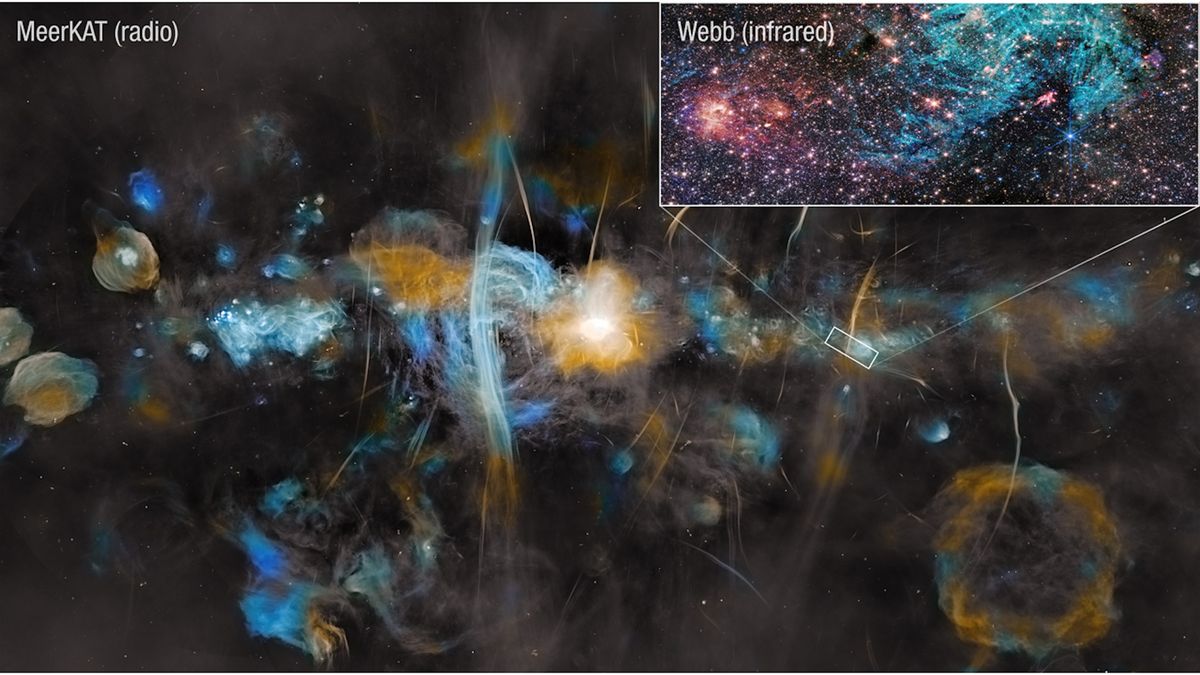
The James Webb Space Telescope (JWST) has teamed up with the MeerKAT radio telescope array to explore how magnetic fields affect star formation at the chaotic center of the Milky Way.
The Milky Way captured by the MeerKAT radio telescope array, with the James Webb Space Telescope's image inset.
(Image credit: NASA, ESA, CSA, STScI, SARAO, Samuel Crowe (UVA), John Bally (CU), Ruben Fedriani (IAA-CSIC), Ian Heywood (Oxford))
What it is:Sagittarius C (Sgr C) region of the Milky Way.
Where it is: 25,000 light-years from the solar system in the constellation Sagittarius.
When it was shared: April 2, 2025
Why it's so special: The Milky Way often appears as a reddish, pinkish and bluish-white arc across the night sky, but this new super-long exposure image from South Africa's ground-based MeerKAT radio telescope shows our home galaxy in a completely new way.
Colored in blue, cyan, yellow and white, the main image — whose many bubbles of color are remnants of supernovas — span 1,000 light-years of the Milky Way.
The new radio image helps to put in context the inset infrared image by the James Webb Space Telescope from 2023 of Sagittarius C (Sgr C). This is a 44 light-year-wide region about 200 light-years from the Milky Way's central supermassive black hole, Sagittarius A*, where stars are being formed.
JWST's image revealed more than 500,000 stars, but in this Central Molecular Zone — an extreme environment — stars are not being formed as quickly as astronomers expect. One reason may be the strong magnetic fields around that supermassive black hole, which are shaping the filaments seen by MeerKAT and JWST. These magnetic fields may also be strong enough to resist the gravity that causes dense clouds of gas and dust to collapse to create stars, thus suppressing star formation in Sgr C.
"A big question in the Central Molecular Zone of our galaxy has been, if there is so much dense gas and cosmic dust here, and we know that stars form in such clouds, why are so few stars born here?" said John Bally, an astrophysicist at the University of Colorado Boulder and one of the principal investigators of a related paper published April 2 in The Astrophysical Journal. "Now, for the first time, we are seeing directly that strong magnetic fields may play an important role in suppressing star formation, even at small scales," Bally said in a NASAstatement.
MeerKAT is a radio telescope made up of 64 dishes in South Africa's Karoo region. It will eventually form part of a far larger radio telescope called the Square Kilometre Array, the world's largest and most sensitive radio telescope that will also use more than 130,000 Christmas tree-shaped antennas on the traditional lands of the Wajarri Yamaji, in Murchison, Western Australia.
Varda Space Industries' W-2 space capsule reentered Earth's atmosphere and touched down in the Australian outback last month, becoming the first commercial spacecraft to land Down Under.
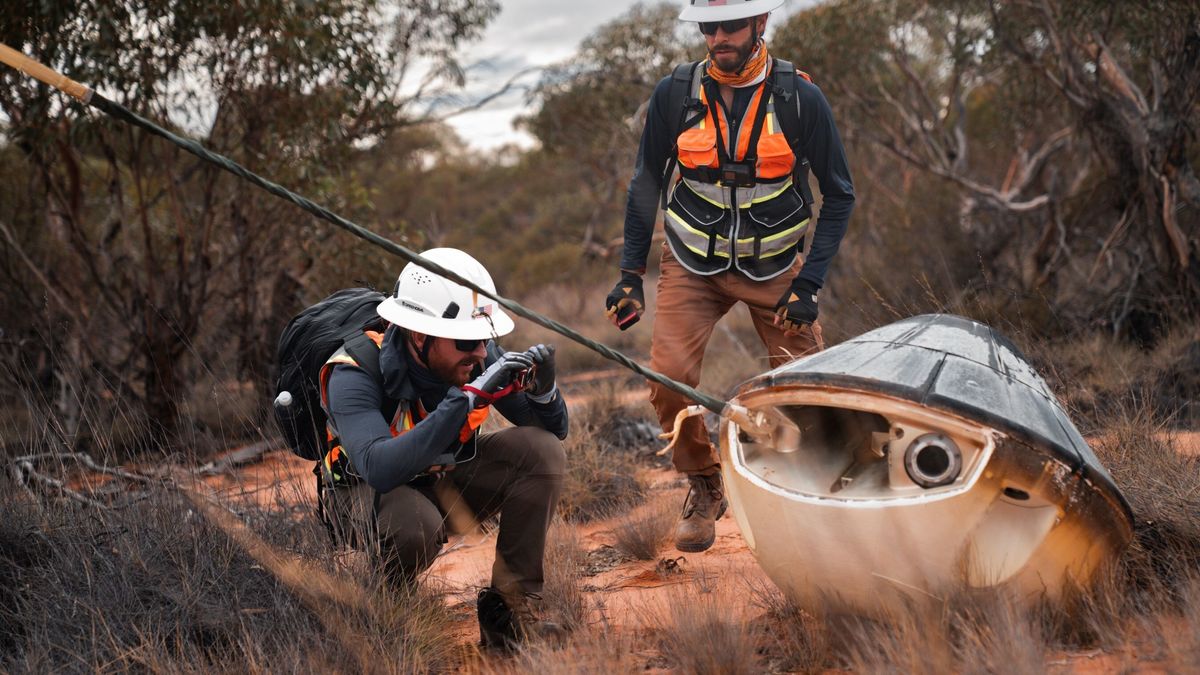
Varda's W-2 capsule is the first commercial spacecraft to land in Australia.
(Image credit: Photo by William Godwin, Courtesy Varda Space Industries.)
A saucer-like space capsule touched down in the Australian outback last month, marking the first time a commercial spacecraft has landed Down Under.
Varda Space Industries' Winnebago-2 (W-2) space capsule reentered Earth's atmosphere and dropped down in South Australia on Feb. 28. In doing so, W-2 also set a world first by becoming the first commercial spacecraft to return to a commercial spaceport, according to a statement released by the Australian Space Agency.
The successful return of W-2 was a "landmark moment for the Australian space sector," Australian Space Agency representatives wrote in the statement.
The company behind W-2, Varda, is an American startup based in California. W-2 originally left Earth from California on a SpaceX Falcon 9 rocket on Jan. 14 as part of the Transporter-12 rideshare mission — the Transporter carries satellites from various customers into space. W-2 then spent 45 days in orbit, carrying payloads from the U.S. Air Force and NASA before dropping down to the Koonibba Test Range, run by Australian aerospace company Southern Launch.
W-2 weighed 265 pounds (120 kilograms) and had various technologies onboard to advance space research. For example, W-2 carried Varda’s expanded pharmaceutical reactor, which allows for the production of medicine in space, according to a statement released by Southern Launch.
The space capsule was also equipped with a heatshield developed with NASA and a spectrometer built by the U.S. Air Force Research Laboratory. The spectrometer, known as Optical Sensing of Plasmas in the ReEntry Environment (OSPREE), measured the environment around the capsule as it reentered at speeds exceeding Mach 25, which is 25 times the speed of sound, or around 19,000 miles per hour (31,000 kilometers per hour), according to a statement released by Varda.
The W-2 space capsule re-entering Earth’s atmosphere last month.(Image credit: Photo by William Godwin, Courtesy Varda Space Industries.)
"We are ecstatic to have W-2 back on our home planet safely and are proud to support significant reentry research for our government partners as we continue building a thriving foundation for economic expansion to low Earth orbit," Varda CEO Will Bruey said in the statement.
The Southern Launch team watched the W-2 reentry from the ground with advanced tracking telescopes and led the recovery operations, which included representatives from the Far West Coast Aboriginal Corporation, the traditional owners of the land where the capsule landed, according to the Southern Launch statement.
"For Australia, this mission ushers in a new era of space capabilities for the nation," Southern Launch representatives wrote in its statement. "The W-2 mission was the first time a commercial space craft re-entry was granted under Australian legislation and is just the first of many scheduled to return to the Koonibba Test Range."
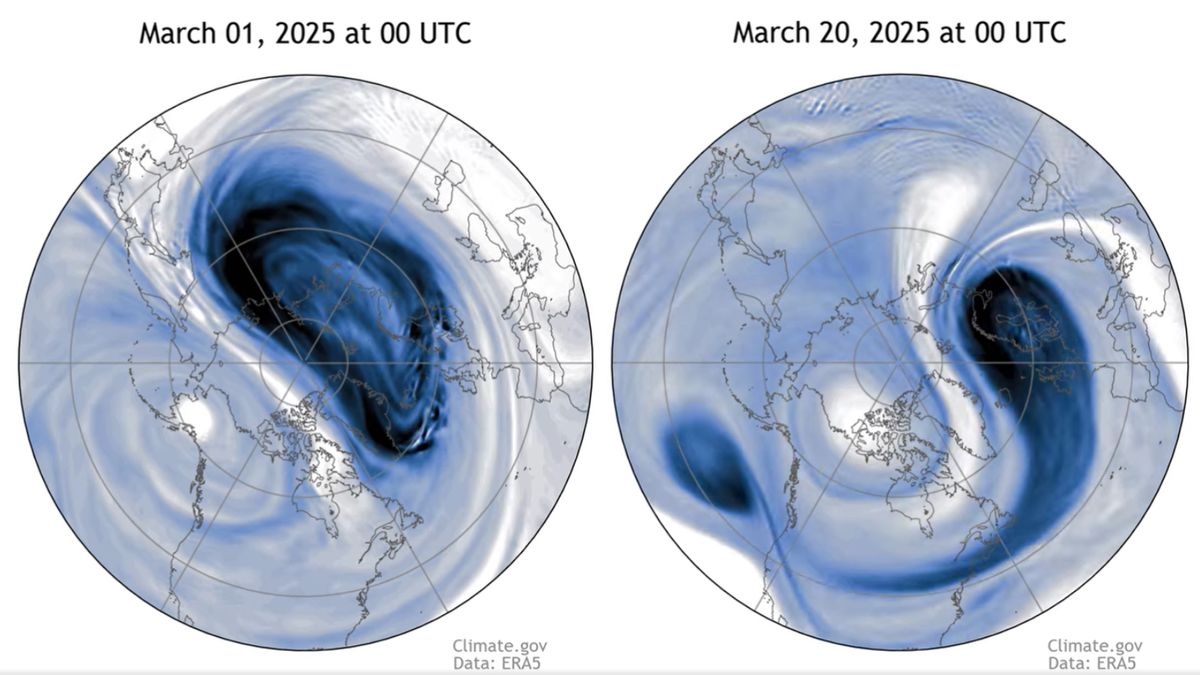
A sudden stratospheric warming event reversed the winds that make up the northern polar vortex on March 9. A new animation shows the vortex also moved away from the Arctic towards Europe.
Between March 1 and March 20, the polar vortex traveled from above the Arctic to above Northern Europe.
(Image credit: NOAA Climate)
A major disruption to the Arctic polar vortex has bumped the ring of wind that circles the North Pole off its perch and towards Europe, a new animation shows.
The migration could trigger colder-than-average temperatures in parts of the continent and across the eastern U.S. over the coming week, climate scientists say.
The polar vortex started wandering off course March 9, when its high winds suddenly switched from blowing west to east to blowing in the opposite direction. This switch normally happens each year, but it tends to occur in mid-April — meaning this year's reversal struck unusually early, according to a blog post published April 3 by the National Oceanic and Atmospheric Administration (NOAA).
"For much of this winter season, the polar vortex has been strong," NOAA officials wrote in the blog post. "But like a true atmospheric diva, the polar vortex had one last trick up its sleeve, breaking down in a spectacular fashion and bringing some cold air with it."
The Arctic polar vortex is a circle of strong, cold winds that picks up every winter over the North Pole. The vortex is always present, but it strengthens in the winter due to a redistribution of heat from the tropics. During the winter, the winds that make up the polar vortex blow from west to east. In spring, as Earth's tilt changes and the North Pole receives more sunlight, the direction of the winds changes to blow from east to west. The winds also become weaker as a result of less heat wafting from the tropics to the pole.
These winds are located in the stratosphere — a layer of the atmosphere that extends between around 6 and 31 miles (10 to 50 kilometers) above Earth's surface.
Occasional "sudden stratospheric warming" events can disrupt the polar vortex. These events happen when large-scale atmospheric waves, called Rossby waves, get pushed into the stratosphere from below, triggering sudden spikes in temperature. Like ocean waves,Rossby waves can "break"on top of the polar vortex, weakening it and — in extreme cases — reversing the direction of its winds.
Last year, a sudden stratospheric warming event hit the polar vortex and reversed its winds in early March, but the vortex recovered. This time, "the vortex does not seem likely to gain a foothold again," NOAA officials wrote.
The switch in wind direction doesn't mean the polar vortex will immediately drop off for the summer, however. The reversed polar vortex has simply "moved off the pole, meandering around over Northern Europe," officials wrote.
NOAA's latest forecasts suggest the polar vortex is unlikely to wander back to its normal position over the North Pole. It probably won't regain its wintertime strength either, officials said, so the likelihood is that it will dissipate and eventually "enter hibernation" over Northern Europe.
As it dissipates, the polar vortex will bring below-average temperatures to Northern Europe, parts of Asia and the eastern U.S., NOAA officials wrote. "Temperatures for the last week of March were pretty normal across the eastern U.S., but the latest forecasts do predict increased chances of below-normal temperatures for the next week," they wrote.
A Glimpse of the Stunning Full Image Image Credit: NASA, ESA, Benjamin F. Williams (University of Washington), Zhuo Chen (University of Washington), L. Clifton Johnson (Northwestern University);
Image Processing: Joseph DePasquale (STScI).
The Andromeda Galaxy, our closest large galactic neighbor, has just revealed its breathtaking secrets in an image so detailed it feels like stepping into the cosmos itself. Captured through over a decade of meticulous observations by the Hubble Space Telescope, this 2.5-billion-pixel masterpiece isn’t just a pretty picture—it’s a cosmic treasure map exposing Andromeda’s dramatic past and chaotic evolution.
A Visual Marvel That Took Over 10 Years to Create
The monumental task of creating this image required stitching together data from 600 individual views, forming a mosaic of unparalleled clarity. Spanning an incredible 2.5 billion pixels, this image allows astronomers to analyze approximately 200 million stars, each shining brighter than our Sun.
While this is just a small fraction of Andromeda’s estimated trillion stars, the data has unlocked a deeper understanding of the galaxy’s structure and history. Ben Williams, the project’s lead scientist, explained, “With Hubble, we can examine the entire disk of the galaxy in extraordinary detail. No other galaxy this large offers such an opportunity.”
The image also uncovered a tumultuous story. Hubble detected streams of stars and a unique stellar population that indicate Andromeda has endured cosmic collisions, likely with neighboring galaxies.
Andromeda as We’ve Never Seen It Before Image Credit: NASA, ESA, Benjamin F. Williams (University of Washington), Zhuo Chen (University of Washington), L. Clifton Johnson (Northwestern University); Image Processing: Joseph DePasquale (STScI).
“Andromeda looks like it’s been through a massive event—like a train wreck,” said Daniel Weisz of the University of California, Berkeley. “This collision triggered intense star formation but then shut down quickly afterward.”
One prime suspect in this intergalactic drama is Messier 32, a small satellite galaxy. Researchers believe Andromeda siphoned Messier 32’s gas, fueling the formation of countless stars before transitioning into its current, less active state.
A Cosmic Puzzle Waiting to Be Solved
Andromeda now sits in a transitional phase, straddling the line between a vibrant, star-forming spiral galaxy and an elliptical galaxy dominated by aging stars. Its central bulge glows with the light of older stars, while its outer regions show surprisingly limited star formation.
Hubble’s decade-long mission not only provides insights into Andromeda’s chaotic history but also offers a roadmap for understanding how galaxies like our own might evolve. “Every resolved star tells us more about the galaxy’s history of mergers and interactions,” Williams added.
This astonishing image is available to view in full resolution, and experts recommend experiencing it on the largest screen possible.
Amazing Jellyfish UFO Over Spain On March 25, 2025, UAP Drone Sighting News.
Date of sighting: March 25, 2025
Location of sighting: Andalusia, Spain
Sources: Email report send to scwaring @yahoo.com
This UFO was seen over Spain last week and it's not a typical UFO, but a jellyfish type UFO. Its lower bottom like tentacles glow as it moves through the sky. Very strange, like a living creature less like an intelligently made UFO. Is it possible that some entities can travel through space and enter atmospheres of planets flying around...existing and then moving to the next planet? Yes, the answer is yes, there are thousands, maybe millions of living animals existing in the cold vacuum of space. Surprised? Well, ask ai about the possibilities of it.
TicTac UAP Over South Florida, April 4, 2025, UFO Drone Sighting News.
Date of sighting: April 4, 2025
Location of sighting: South Florida, USA
Source: Email report at scwaring @yahoo.com
Hey all check this out. This is an actual tictac UFO seen over South Florida. The object is seen moving out of cloud over some people and they debate about what it could be. Now Florida actually has a base under it that extends from the Gulf to the Bermuda Triangle. I know, I know, how would you know Scott? Well, two decades of hard core research and a mass of UFO sightings in Florida that outnumber any other state in the US by far. I believe Dr Steven Greer would agree with me on this one.
I was searching a Mars photo on Gigapan when I encountered something really good. I found ancient alien writing on a Mars
mountain side. There are three distinct characters so it's three different words. Sadly not even the NSA could decipher an alien language with only three words, however we are left to imagine what it might have said. Perhaps to make a powerful tribe which once ruled this area, or a royal family who owned the land. We may never know, but that okay, because not knowing is what keeps us seeking the truth.
Martian dust devil captured by NASA's Mars Reconnaissance Orbiter. Credit: NASA/JPL-Caltech/Univ. of Arizona
Mars is well known for its seasonal dust storms, which occur when the southern hemisphere experiences summer. Periodically, these storms grow to engulf the entire planet and can last for months, wreaking havoc on robotic missions. Smaller regional storms are far more common on Mars, as are swirling columns of air and dust (aka. dust devils). NASA's Perseverance rover recently took pictures of several dust devils on the rim of the Jezero crater. Some of these images were stitched together to create a short video of a larger dust devil consuming a smaller one.
These images were taken by the rover's navigation camera on January 25th when the rover was exploring the location called "Witch Hazel Hill." The rover was about 1 km (0.6 mi) from the two dust devils, the larger of which was approximately 65 m (210 ft) wide, while the smaller, trailing dust devil was roughly 5 m (16 ft). The captures were part of an imaging experiment conducted by Perseverance's science team to learn more about the planet's atmospheric dynamics. Two other dust devils can also be seen in the background at the left and center of the video (shown below).
Like dust devils on Earth, these weather patterns are formed by rising and rotating air columns. They begin close to the ground, where the air is heated by contact with the warmer ground, then rises through the cooler air above. Meanwhile, cooler air moves in to occupy the space near the surface, which causes the rising air to rotate and pick up speed. This process also kicks up dust from the surface, creating the swirling columns of dust and air that meteorologists call "convective vortices" or dust devils.
Mark Lemmon, a Perseverance scientist at the Space Science Institute (SSI), explained in a NASA press release:
"Convective vortices — aka dust devils — can be rather fiendish. These mini-twisters wander the surface of Mars, picking up dust as they go and lowering the visibility in their immediate area. If two dust devils happen upon each other, they can either obliterate one another or merge, with the stronger one consuming the weaker. If you feel bad for the little devil in our latest video, it may give you some solace to know the larger perpetrator most likely met its own end a few minutes later. Dust devils on Mars only last about 10 minutes.”
Martian dust devils were first photographed from space by NASA's Viking orbiters, which studied Mars in the 1970s. The Pathfinder mission, consisting of a lander and the Sojourner rover,was the first to image a dust devil on the surface. Subsequent orbiters and rovers, like the Spiritand Opportunityrovers and theMars Reconnaissance Orbiter (MRO), have taken images of these weather patterns from the surface and space. The Curiosity rover also took multiple images of dust devils in the Gale Crater, some of which were used to create a video.
Since landing in the Jezero Crater in 2021, Perseverance has also observed dust devils and even recorded what they sound like using its SuperCam microphone. Said Katie Stack Morgan, a project scientist for the Perseverance rover at NASA's Jet Propulsion Laboratory:
"Dust devils play a significant role in Martian weather patterns. Dust devil study is important because these phenomena indicate atmospheric conditions, such as prevailing wind directions and speed, and are responsible for about half the dust in the Martian atmosphere."
Learning more about these swirling columns of air is vital to understanding the dynamics of Mars' atmosphere. It could also lead to predictive models, allowing scientists to know where they might occur in advance. Capturing these features is presently a matter of luck and timing, which is why Perseverance routinely monitors in all directions for them.
The analysis examined 149,000 sighting entries from the Reporting Center's database, along with social media reports to determine how many encounters are experienced per capita in each state.
Coming in first, Californians have recorded a staggering 36,286 reported UFO sightings since 1974.
This makes it officially America's alien hotspot with one sighting for every 1,075 residents.
California's clear night skies and dense population have created perfect conditions for UFO sightings.
In fact, just last month, the harrowing call a US Air Force pilot made to air traffic control was released after they described 'three orange-like lights' hovering silently above Los Angeles.
The unknown craft came as close as 10 feet of the pilot's wing, reaching supersonic speeds, as the US Air Force craft was conducting a secret mission over California.
New data from the National UFO Reporting Center has revealed exactly where these eerie sightings are most common
The pilot, who identified as 'Troy 21,' told local air traffic control (ATC) in Los Angeles: 'This is going to sound weird, but I just had something pass underneath my wing, maybe a football-sized object right underneath my wing.'
During the September 17, 2024, incident, ATC can be heard asking Troy 21 if he thought it was a drone, but the stunned pilot couldn't give an answer.
Troy 21 replied that his sensor operator was looking for the UFO on the plane's cameras, adding that it was a 'dark gray cylindrical object' no bigger than a football.
The pilot quickly informed ATC that they had spotted the UFO again about 60 miles from where it first buzzed Troy 21's plane.
Later in the recording, another air traffic controller in Los Angeles could be heard on the radio dismissing the incident, saying that 'there was UFO reported here, but that's all taken care of now. So you don't have to worry about it... it's gone.'
Former FBI agent Ben Hansen told NewsNation the mysterious object must have be traveling at Mach 2, or twice the speed of sound, to get so far away so fast.
The state to come in second in terms of the appearance Unidentified Aerial Phenomena (UAPs) was Washington.
The Pacific Northwest has long attracted those seeking the unexplained, with Washington recording 7,125 UFO sightings.
The strange object then moved off at high speed and was seen minutes later 60 miles away from the aircraft
That's approximately one for every 1,093 residents.
From 1948 to 1952, as America's production of atomic weapons first ramped up, waves of UFO sightings began cropping up over Washington state's Hanford nuclear production complex, as well as Los Alamos, New Mexico, and other sites for the Manhattan Project.
Meanwhile, Florida was ranked third with more than 11,000 reported encounters.
That's roughly one sighting for every 1,144 Floridians.
As recently as this past December, a flight attendant flying off the coast of the Sunshine State managed to capture a mysterious spherical object flying above the plane she was working on, thousands of feet above the Bahamas.
Cassandra Martin, a flight attendant for private air service Surjet, was flying with two pilots in an empty jet on December 23 when Miami air traffic control alerted them to a 'foreign object' as they were flying back to Fort Lauderdale.
The eerie footage showed a rounded blur of white light that faded into a green color, with a circular halo surrounding the object.
Coming in fourth is Oregon, which had one UFO sighting per 1,156 residents.
Cassandra Martin, a flight attendant for private air service Surjet, was flying with two pilots in an empty jet on December 23 when air traffic control alerted them to a 'foreign object'
'It had capabilities just to zigzag and change color, so that was a little daunting, to the say the least, but you know, it's also something fascinating that I was able to see and capture with my phone,' Martin said
One of the reports came from an air ambulance pilot, who described seeing a bright light streaking toward his aircraft before abruptly reversing course and heading back toward the Pacific Ocean on the evening of December 7.
'Red in color - moving at extreme speeds. I don't even know how to describe how fast it was moving,' the pilot told air-traffic controllers.
On the next night, a United Airlines pilot also noted unusual lights in the Eugene area.
'We're seeing three or four targets. They're all altitudes. Up and down. It's pretty crazy,' the pilot reported to air-traffic controllers, who confirmed there was no military activity in the area.
The air ambulance pilot additionally noted one light moving in a 'corkscrew pattern,' which appeared on the aircraft's collision avoidance system.
'You are cleared to maneuver as necessary - left or right to avoid the UFO out there,' an air-traffic controller responded, according to an audio clip of the exchange
Short video clips taken by pilots and crew showed lights in the night sky, but the dark conditions made it difficult to discern specific details.
At least four commercial pilots reported spotting mysterious lights darting through the skies over Oregon
Meanwhile, New York rounds out the top five with one sighting per 1,301 people.
Harvard physicist, Avi Loeb, wrote that the mysterious orb was created by 'a bright spot from reflection of sunlight as the camera gradually changed its orientation relative to the sun and the ground.
Loeb continued to explain that if the orb was a real object, it would have been moving at the speed of sound, not anything extraordinary.
A segment during 'Good Day New York' featured a mysterious orb that appeared to zoom over the Hudson River
Those hoping to avoid extraterrestrial encounters should consider staying in Louisiana, where residents experience the fewest UFO encounters nationwide - just one sighting for every 3,815 people.
Even safer is North Dakota, which recorded only 282 total sightings - approximately 0.0004 per capita - making it statistically the state where you are least likely to have an encounter of the third kind.
Ancient manuscripts detailing the events during the Roman Empire are believed to contain 'first hand' evidence about the life and death of Jesus Christ.
The Annals, written by the Roman historian Tacitus only 91 years after Jesus's death, begins with the death of Emperor Augustus in 14AD and finishes with Nero's suicide 54 years later.
In Book 15, the historian discusses the Great Fire of Rome in 54AD, shortly before Nero's death, which the emperor blamed on a class 'called Christians.'
The second sentence reads: 'Christus, from whom the name had its origin, suffered the extreme penalty during the reign of Tiberius at the hands of one of our procurators, Pontius Pilatus.'
'Christus,' the Latin version of 'Christ,' means 'the Anointed One' or 'the Messiah,' and comes from the Hebrew word Mashiach (Messiah).
The Bible's New Testament states that Pontius Pilate, the Roman governor of Judea, sentenced Jesus to death by crucifixion.
Tacitus discusses the persecution of Christ's followers, who were spreading into Rome from Judaea, writing how 'an arrest was made of all who pleaded guilty to being Christian.'
'Covered with the skins of wild beasts, they were torn by dogs and perished, or were nailed to crosses, or were doomed to the flames and burnt, to serve as a nightly illumination, when daylight had expired,' the passage reads.
A book featuring ancient Rome's history includes a passage that discusses the death of Jesus
The Annals, written by the Roman historian Tacitus around 91AD, begins with the death of Emperor Augustus in 14AD and finishes with Nero's suicide 54 years later
As the Bible tells it, 2,021 years ago a child named Jesus was born in a little-known town on the edge of the Roman Empire and was killed 33 years later.
While most scholars agree he was a real person, there is significant debate about his divinity.
They suggest Jesus' teachings about love and forgiveness and his brutal death led his followers to form a new faith that became Christianity.
While the manuscripts have long been known, the details in them recently surfaced online and have been welcomed by those of Christian faith.
Tacitus, whose full name was Publius Cornelius Tacitus, lived from around 56AD to 120AD and was widely regarded to have been among the most important Roman historians.
While the manuscripts have long been known, the details in them recently surfaced online and have been welcomed by those of
He relied on official records, Senate proceedings and firsthand accounts to compile The Annals, which is known for its critical and sometimes cynical perspective on Roman politics as he did not shy away from deemed emperors as corrupt and tyrants.
The Bible states that Jesus was arrested by Roman soldiers following the Last Supper and taken before Annas, the former high priest.
He was then tried by the current high priest, Caiaphas, in front of the Jewish supreme governing council and court where he was condemned for blasphemy.
Because the court and high priest did not the power to order a death sentence, Jesus was taken to Pilate.
Tacitus, whose full name was Publius Cornelius Tacitus, lived from around 56AD to 120AD and was widely regarded to have been among the most important Roman historians
Luke 23:16-24 states that Pilate was hesitant to sentence Jesus to death, saying 'nothing this man has done to deserve death. So I will have him whipped and let him go.'
However, the crowd erupted in anger, screaming 'Kill him.'
After shouting Jesus had not committed a crime three times, Pilate gave into the crowd's request and 'passed the sentence on Jesus that they were asking for.'
And Tacitus shared some of these details in The Annals.
The passage, however, focused more on the events that had followed, specifically Christ's followers moving into Rome .
The first persecution of Christians organized by the Roman government was under Nero who ruled about 21 to 24 years after Jesus' crucifixion.
Nero used the Great Fire of Rome as part of his plan to stop the faith from spreading.
The Great Fire of Rome began on July 19, 64 AD, likely started in shops near the Circus Maximus, filled with flammable goods, and spread rapidly due to strong winds and the city's flammable, densely packed construction.
The fire raged for six days and seven nights, destroying or damaging 10 of Rome's 14 districts, according to researchers at Ohio State University.
And the blaze killed hundreds, left thousands homeless and devastated two-thirds of Rome.
At the time, the Roman Empire was worshiping gods and adding more foreign deities into its religious system and some historians have speculated that the influx of Christians appeared as a threat.
Tacitus wrote how Nero falsely blamed Christians, setting his plan in motion.
'Nero fastened the guilt and inflicted the most exquisite tortures on a class hated for their abominations, called Christians by the populace,' the passage reads.
Those arrested were crucified in Nero's lavish gardens as to 'exhibit as as show in the circus.'
'He mingled with the people in the dress of a charioteer, or stood in a chariot, or as if he were a performer, or as a spectator of the cruel games,' Tacitus described.
'Hence, even for the present time, though the superstition had been checked for a while, it had broken out once more and gained ground, not only in Judea, the first source of the evil, but even in Rome itself.'
Another historian, Flavius Josephus, wrote a book about Jewish history, featuring a passage that reads: 'Now there was about this time Jesus, a wise man, if it be lawful to call him a man. For he was a doer of wonderful works, a teacher of such men as receive the truth with pleasure.'
Flavius was a Jewish historian who later became a Roman citizen. He lived from 37 to around 100 AD.
Testimonium Flavianum is part of The Antiquities of the Jews, which features 20 books detailing the history of the region and Jews, starting with the Old Testament up to the Jewish War.
In Testimonium Flavianum, he writes: 'Pilate condemned him to be crucified and to die. But those who had become his disciples did not abandon his discipleship.
'They reported that he had appeared to them three days after his crucifixion and that he was alive.
'Accordingly, he was perhaps the Messiah, concerning whom the prophets have recounted wonders.'
However, some scholars have dismissed the writings, saying it is a late Christian forgery.
This image from NASA’s Mars Perseverance rover reveals hundreds of strange, spherical-shaped objects comprising the rock. Perseverance acquired this image on March 11, 2025, or sol 1442 (Martian day 1,442 of its mission)
A rock that has no earthly business in a Martian crater: Perseverance acquired this image on March 13, 2025 - sol 1444, or Martian day 1,444 of the Mars 2020 mission
NASA's new images were found by Perseverance along the rim of the Jezero Crater, a 28-mile-wide region on Mars that may have once been flooded with water.
Alex Jones, a PhD student from Imperial College London's department of earth science, described the rock as 'strange' and 'shocking'.
'The Perseverance Science Team were astonished by a strange rock comprised of hundreds of millimeter-sized spheres,' he said in a blog post on NASA's website.
'Placing these features in geologic context will be critical for understanding their origin, and determining their significance for the geological history of the Jezero Crater rim and beyond.'
Technically, the mass is made up of 'spherules' – roughly spherical pebbles, ranging 0.01mm to 4mm in diameter (up to 0.15 inches).
Some of these spherules are more elongate, elliptical shapes, while others have angular edges, perhaps representing broken spherule fragments.
Others even have miniscule holes as if they'd been pricked with a pin – but how or why they show such variety is a mystery.
On Earth, spherules are formed by rapid cooling of molten rock droplets during a volcanic eruption, or by the condensation of rock vaporized by a meteorite impact.
The Jezero Crater is a 28-mile-wide region on Mars that may have once been flooded with water
The Red Planet (pictured) is an average of 140 million miles (225 million km) away from Earth
Did Mars have volcanoes?
Mars was once dotted with thousands of huge volcanoes which saw 'super eruptions', according to NASA.
The eruptions shot water vapor, carbon dioxide and sulfur dioxide into the Martian atmosphere, resulting in a significant change to Mars' climate.
In 2021, scientists said some volcanoes on Mars may still be active, raising the possibility there were microbes on the planet as recently as 30,000 years ago.
'Each of these formation mechanisms would have vastly different implications for the evolution of these rocks, so the team is working hard to determine their context and origin,' Jones said.
Dr Matthew Chojnacki, a planetary geologist at the Planetary Science Institute, said they could be 'frothy lava' that rapidly cooled might lead to such a deposit.
'But it's hard to tell without chemistry or mineralogy, especially given it's a float rock (a piece of rock that is not part of the bedrock),' he told MailOnline.
Dr Joel Davis, planetary geologist at Imperial College London, said they may have been formed by water circulating through the Martian ground billions of years ago.
'[This was] potentially when conditions were too cold for liquid water to exist on the surface,' Dr Davis told MailOnline.
'Findings like this help geologists build a picture of how and when Mars might have changed, from a warm, wet planet 3-4 billion of years ago, to the cold, very dry environment we see today.'
This isn’t the first time strange spheres have been spotted on Mars, which is an average of 140 million miles (225 million km) away from Earth.
In 2004, the Opportunity rover – active on Mars from 2004-2018 – spotted 'Martian Blueberries' at Meridiani Planum, a large plain straddling the equator of Mars. These marble-sized objects, named for their similar appearance to the fruit, are remnants of small meteorites that broke up in the Martian atmosphere.
A full scale test model of the Perseverance rover currently on Mars is displayed during a press conference for the Mars Sample Return mission in the Mars Yard at NASA's Jet Propulsion Laboratory (JPL) in Pasadena, California on April 11, 2023
In June last year, Perseverance spied popcorn-like textures in sedimentary rocks exposed in the Jezero crater inlet channel, Neretva Vallis
Then in 2012, the Curiosity rover, which is still exploring Mars after more than a decade, observed spherules in the rocks of Yellowknife Bay at Gale crater.
Meanwhile, Perseverance spied 'popcorn-like textures' in sedimentary rocks exposed in the Jezero crater inlet channel, Neretva Vallis, last year.
Perseverance acquired the two new images on March 11 and March 13 – on sol (Martian day) 1442 and 1444 of its mission.
A Martian day (a 'sol') is 24 hours, 39 minutes and 35 seconds long – so about 40 minutes longer than a day on Earth.
Perseverance touched down on Mars' Jezero Crater – believed to be the home of a lush lakebed and river delta billions of years ago – in February 2021 after a nearly seven-month journey through space.
It is tasked with seeking traces of fossilised microbial life from Mars' ancient past and to collect rock specimens for return to Earth through future missions to the Red Planet.
Artificial intelligence (AI) chatbots like ChatGPT have been designed to replicate human speech as closely as possible to improve the user experience.
But as AI gets more and more sophisticated, it's becoming difficult to discern these computerised models from real people.
Now, scientists at University of CaliforniaSan Diego (UCSD) reveal that two of the leading chatbots have reached a major milestone.
Both GPT, which powers OpenAI's ChatGPT, and LLaMa, which is behind Meta AI on WhatsApp and Facebook, have passed the famous Turing test.
Devised by British WWII codebreaker Alan Turing Alan Turing in 1950, the Turing test or 'imitation game' is a standard measure to test intelligence in a machine.
An AI passes the test when a human cannot correctly tell the difference between a response from another human and a response from the AI.
'The results constitute the first empirical evidence that any artificial system passes a standard three-party Turing test,' say the UCSD scientists.
'If interrogators are not able to reliably distinguish between a human and a machine, then the machine is said to have passed.'
Robots now have intelligence equivalent to humans, scientists say - as AI officially passes the famous Turing test (pictured: Terminator 3: The Rise of the Machines)
GPT-4.5 has passed the famous 'Turing test' which was developed to see if computers have human-like intelligence
Researchers used four AI models – GPT-4.5 (released in February), a previous iteration called GPT-4o, Meta's flagship model LLaMa, and a 1960s-era chat programme called ELIZA.
The first three are 'large language models' (LLMs) – deep learning algorithms that can recognise and generate text based on knowledge gained from massive datasets.
The experts recruited 126 undergraduate students from University of California San Diego and 158 people from online data pool Prolific.
Participants had five-minute online conversations simultaneously with another human participant and one of the AIs – but they didn't know which was which and they had to judge which they thought was human.
When it was prompted to adopt a humanlike persona, GPT-4.5 was judged to be the human 73 per cent of the time – more often than the real human participant was chosen.
Such a high percentage suggests people were better than chance at determining whether or not GPT-4.5 is a human or a machine.
Meanwhile, Meta's LLaMa-3.1, when also prompted to adopt a humanlike persona, was judged to be the human 56 per cent of the time.
This was 'not significantly more or less often than the humans they were being compared to', the team point out – but still counts as a pass.
Overview of the Turing Test: A human interrogator (C) asks an AI (A) and another human (B) questions and evaluates the responses. The interrogator does not know which is which. If the AI fools the interrogator into thinking its responses were generated by a human, it passes the test
GPT-4.5: This image shows a participant (green dialogue) asking another human and GPT-4.5 questions - without knowing which was which. So, can you tell the difference?
LLaMa: This image shows a participant (green dialogue) asking another human and LLaMa questions. Can you tell the difference? Answers in box below
Turing Test - answers
GPT-4.5
Witness A: GPT-4.5
Witness B: Human
LLaMa
Witness A: Human
Witness B: LLaMa
Lastly, the baseline models (ELIZA and GPT-4o) achieved win rates significantly below chance – 23 per cent and 21 per cent respectively.
Researchers also tried giving a more basic prompt to the models, without the detailed instructions telling them to adopt a human-like persona.
As anticipated, the AI models performed significantly worse in this condition – highlighting the importance of prompting the chatbots first.
The team say their new study, published as a pre-print, is 'strong evidence' that OpenAI and Meta's bots have passed the Turing test.
'This should be evaluated as one among many other pieces of evidence for the kind of intelligence LLMs display,' lead author Cameron Jones said in an X thread.
Jones admitted that AIs performed best when briefed beforehand to impersonate a human – but this doesn't mean GPT-4.5 and LLaMa haven't passed the Turing test.
'Did LLMs really pass if they needed a prompt? It's a good question,' he said in the X thread.
'Without any prompt, LLMs would fail for trivial reasons (like admitting to being AI) and they could easily be fine-tuned to behave as they do when prompted, so I do think it's fair to say that LLMs pass.'
The best-performing AI was GPT-4.5 when it was briefed and told to adopt a persona, followed by Meta's LLaMa-3.1
In 1950, legendary British computer scientist Alan Turing (pictured) proposed the theory of training an AI to give it the intelligence of a child, and then provide the appropriate experiences to build up its intelligence to that of an adult
This is the first time that an AI has passed the test invented by Alan Turing in 1950, according to the new study. The life of this early computer pioneer and the invention of the Turing test was famously dramatised in The Imitation Game, starring Benedict Cumberbatch (pictured)
Last year, another study by the team found two predecessor models from OpenAI – ChatGPT-3.5 and ChatGPT-4 – fooled participants in 50 per cent and 54 per cent of cases (also when told to adopt a human persona).
As GPT-4.5 has now scored 73 per cent, this new suggests that ChatGPT's models are getting better and better at impersonating humans.
It comes 75 years after Alan Turing introduced the ultimate test of computer intelligence in his seminal paper Computing Machinery and Intelligence.
Turing imagined that a human participant would sit at a screen and speak with either a human or a computer through a text-only interface.
If the computer could not be distinguished from a human across a wide range of possible topics, Turing reasoned we would have to admit it was just as intelligent as a human.
A version of the experiment, which asks to you tell the difference between a human and an AI, can be accessed at turingtest.live.
Meanwhile, the pre-print paper is published on online server arXiv and is currently under peer review.
Alan Turing (pictured) was a British mathematician best known for his work cracking the enigma code during the Second World War
Alan Turing was a British mathematician born on June 23, 1912 In Maida Vale, London, to father Julius, a civil servant, and mother Ethel, the daughter of a railway engineer.
His talents were recognised early on at school but he struggled with his teachers when he began boarding at Sherborne School aged 13 because he was too fixated on science.
Turing continued to excel at maths but his time at Sherborne was also rocked by the death of his close friend Christopher Morcom from tuberculosis. Morcom was described as Turing's 'first love' and he remained close with his mother following his death, writing to her on Morcom's birthday each year.
He then moved on to Cambridge where he studied at King's College, graduating with a first class degree in mathematics.
During the Second World War, Turing was pivotal in cracking the Enigma codes used by the German military to encrypt their messages.
His work gave Allied leaders vital information about the movement and intentions of Hitler’s forces.
Historians credit the work of Turing and his fellow codebreakers at Bletchley Park in Buckinghamshire with shortening the war by up to two years, saving countless lives, and he was awarded an OBE in 1946 for his services.
Turing is also widely seen as the father of computer science and artificial intelligence due to his groundbreaking work in mathematics in the 1930s.
He was able to prove a 'universal computing machine' would be able to perform equations if they were presented as an algorithm - and had a paper published on the subject in 1936 in the Proceedings of the London Mathematical Society Journal when he was aged just 23.
But he was disgraced in 1952 when he was convicted for homosexual activity, which was illegal at the time and would not be decriminalised until 1967.
To avoid prison, Turing agreed to ‘chemical castration’ – hormonal treatment designed to reduce libido.
As well as physical and emotional damage, his conviction had led to the removal of his security clearance and meant he was no longer able to work for GCHQ, the successor to the Government Code and Cypher School, based at Bletchley Park.
Turing was awarded an OBE in 1946 for his codebreaking work at Bletchley Park, pictured, which is credited with ending World War II two years early
Then In 1954, aged 41, he died of cyanide poisoning. An inquest recorded a verdict of suicide, although his mother and others maintained that his death was accidental.
When his body was discovered, an apple laid half-eaten next to his bed. It was never tested for cyanide but it is speculated it was the source of the fatal dose.
Some more peculiar theories suggest Turing was 'obsessed' with fairytale Snow White and the Seven Dwarfs and his death was inspired by the poisoned apple in the story.
Following a public outcry over his treatment and conviction, the then Prime Minister Gordon Brown issued a public apology in 2009.
He then received a posthumous Royal pardon in 2014, only the fourth to be issued since the end of the Second World War.
It was requested by Justice Secretary Chris Grayling, who described Turing as a national hero who fell foul of the law because of his sexuality.
An e-petition demanding a pardon for Turing had previously received 37,404 signatures.
A 2017 law, that retroactively pardoned all men cautioned or convicted for homosexual acts under historical legislation, was named in his honour.
A new development in the mystery of a purported city beneath Egypt's Giza pyramids could, if proven true, fundamentally reshape our understanding of human history.
Italian researchers told DailyMail.com that not only are the shafts and chambers they found deep below the Khafre pyramid 38,000 years old, but also the Giza complex.
They proposed a pre-existing civilization built the complex, but the group was destroyed around 12,000 years ago by a 'divine flood' triggered by an asteroid impact that left only the pyramids as the surviving 'megastructure.'
Mei, who visited the site two weeks ago, highlighted physical evidence, saying: 'Some blocks near the Great Pyramid's entrance show clear signs of water erosion.'
'Only certain stones are affected, suggesting part of the pyramid was submerged in ancient times,' he added.
Mei also noted how thick salt encrustations have been found inside the Great Pyramid, which he interprets as proof of the ocean once flooded the Giza Plateau.
Dr Zahi Hawass, Egypt's former Minister of Antiquities, has consistently argued that the features some interpret as water erosion at the base are due to natural weathering processes and the salt originated from the limestones themselves.
Italian researchers told DailyMail.com that not only are the shafts and chambers deep below the Khafre pyramid 38,000 years old, but also the Giza complex
'The enduring enigma of the Giza pyramids stands as a powerful and perplexing testament to this possibility,' said Mei.
'Despite extensive research, the precise methods employed in their construction remain a subject of intense debate and speculation.'
He added that the 'logistical and technical capabilities required to quarry, transport, and precisely position multi-ton granite blocks, some of considerable dimensions, from distant locations like the granite quarries nearly 500 miles from Giza, warrant deeper and serious scientific inquiry.'
Mei and his team, which includes Corrado Malanga from Italy's University of Pisa and Filippo Biondi with the University of Strathclyde in Scotland, took the world by storm last month when they discovered shafts and chambers more than 2,000 feet below the surface.
They also identified chamber-like structures more than 4,000 feet underground, which they speculated could be a long-lost city.
The work has not yet been published in a journal where outside experts can review it.
The discovery was made by collecting acoustics from deep in the ground, including seismic waves, noise from human activity and photon interactions, to map the newly found shafts and chambers that extend more than 2,000 feet below the surface.
Biondi said these waves were collected by radar, specifically by analyzing Doppler centroid abnormalities—shifts or distortions in frequency patterns used to detect underground structures or changes.
However, Hawass told The National: 'The claim of using radar inside the pyramid is false, and the techniques employed are neither scientifically approved nor validated.'
Mei (center) and his team, which includes Corrado Malanga (right) and Filippo Biondi (left), took the world by storm last month when they discovered shafts and chambers more than 2,000 feet below the surface.
Researchers believe there are other structures reaching more than 4,000 feet below the surface. The scans captured structures extend along the northern side with a tuning fork shape
Now, the latest development from the Italian researchers is that the Giza pyramids also pre-date the oldest known man-made structure of its kind by tens of thousands of years, which is the Göbekli Tepe in Turkey.
The team based their claims on an early 2000s theory known as the Younger Dryas, which is not a widely accepted theory within the scientific community, and is often viewed as a fringe theory.
'Scientists have stated that there aren't clues of an impact on Earth,' Mei said.
'But the Earth is 80 percent ocean. So it's possible that the impact was in in the ocean, and water destroyed the preceding civilization that lived on Earth.'
He added that there are many signs across the world that suggest the existence of a preceding civilization, such as similar monuments in South America and China, 'even at Norfolk Island.'
'But not only the monuments, even the myths are similar everywhere in South America, in Europe, Africa and the South Pacific. There are legends that are similar to the other myths all around the world,' said Mei.
Biondi explained that the pre-existing civilization in Egypt built the city first, then the shafts and then the pyramid on top, creating a 'megastructure.'
The salt encrustations inside the Great Pyramid, according to the team, were left behind from ocean water flowing into the structure.
Colonel Howard Vyse explored the pyramids' King’s Chamber in 1837, finding thick layers of salt on the limestone roof-stones in areas above the chamber.
The said the technology captured enormous chambers (pictured) in the middle of the shafts
The team claimed they discovered eight cylinder-shaped structures below the Khafre, which travel more than 2,100 feet below the pyramid's base. They identified spiral structures on the sides of the shafts
He described these as crystalline deposits, later identified as sodium chloride, forming delicate, flower-like patterns.
W.M. Flinders Petrie also surveyed the Great pyramid in the 1880s, finding thick salt encrustations (up to half an inch) on the limestone walls of the Queen’s Chamber and the Horizontal Passage.
However, he did not report similar findings as Vyse inside the King’s Chamber.
'The underground tunnels of Giza have exactly the same presence of salt on the walls,' Mei said.
'That means that something happened in the ancient past which we must better understand.'
Not only has the team used 'physical evidence' to support their claims, but also ancient Egyptian text that they said 'refers to an ancient civilization.'
Mei explained that the theory of the lost city is based on ancient Egyptian texts, specifically Chapter 149 of the Book of the Dead, which refers to the 14 residences of the city of the dead.
The shafts were said to be connected to larger, cubic structures. The team said there could be a hidden city below all three pyramids
'It describes certain chambers and some inhabitants of the city. That is why we believe it could be Amenti, as described in ancient texts,' he said.
'Of course, we must be certain, but we believe this could be the case because the pyramids are located exactly where the texts say.
'The texts state that the pyramids were built on top of the city, sealing its entrance.'
Biondi also noted that the unknown chambers more than 4,000 feet below the pyramid could be related to the legendary Hall of Records.
The Hall of Records is a long-standing myth in Egyptian lore, believed to be a hidden chamber beneath the Great Pyramid or the Sphinx, containing vast amounts of lost wisdom and knowledge about ancient civilizations.
However, there is no reliable evidence proving its existence.
Professor Lawrence Conyers, a radar expert at the University of Denver, who specializes in archaeology and was not involved in the study, said the claims that the pyramids and structures were built 38,000 years ago are 'outlandish.'
He added that at that time in human history people 'were mostly living in caves' 38,000 years ago.
'People did not start living in what we now call cities until about 9,000 years ago,' he said.
'There were a few large villages before that but those only go back a few thousand years from that time.'
However, Mei said: The notion that a civilization limited to rudimentary tools such as wooden mallets and copper chisels – implements seemingly inadequate for such monumental tasks in hard stone – could have achieved this level of engineering mastery demands a more robust and scientifically sound explanation than the often-cited, and frankly unconvincing, theory of water-soaked wooden wedges.
'The archaeological community really ought to start seriously addressing these fundamental questions, perhaps by first gaining a more practical understanding of the actual techniques required to extract colossal granite blocks from quarries, before proclaiming hypotheses that completely lack technical and scientific grounding.'
A bone-chilling document declassified by the CIA has exposed an alleged massacre by aliens from a crashed UFO who turned an entire military unit into stone.
According to the report, Soviet troops shot down a flying saucer hovering over the Soviet military unit in Siberia roughly 35 years ago, and what happened next was truly terrifying.
In the document, summarizing a 250-page top secret file acquired by US intelligence agents, eyewitnesses said five aliens climbed out of their wrecked craft, combined themselves into one creature, exploded in a burst of intense energy, and turned 23 soldiers into solid rock.
One CIA official referred to the shocking battle as 'a horrific picture of revenge on the part of extraterrestrial creatures, a picture that makes one's blood freeze.'
The agency added that the 'extremely menacing case' proved the aliens who visited Earth possessed weapons and technology far beyond the US government's 'assumptions' - suggesting they were already aware of the aliens' existence.
The unearthed document, declassified in 2000, was recently the topic of the AI or Evil podcast, where host Josh Hooper revealed that two of the soldiers at the UFO crash site actually survived the encounter.
However, the 23 'petrified soldiers' could not be saved. Their remains and the debris from the spacecraft were reportedly moved to a secret research base near Moscow.
An even more concerning detail of the CIA file is the description of the aliens reportedly involved in this massacre, who have been mentioned in UFO reports and sightings for nearly 80 years.
A declassified CIA document revealed details of an alleged battle between Soviet forces and an alien spacecraft, which ended with 23 soldiers dead
During a training mission in Siberia, the Soviet military reportedly shot down a low-flying UFO carrying at least 5 aliens who then turned the soldiers into stone
The subject of the document states: 'Paper reports alleged evidence on mishap involving UFO.'
This extraordinary tale was also published in the Ukrainian newspaper Holos Ukrayiny on March 27, 1993.
The incident, which a Canadian newspaper believed took place between 1989 and 1990, was only uncovered by the CIA after the fall of the Soviet Union and its 'secret police' organization, the KGB.
The CIA document explained that the alleged alien craft was flying low and quietly above the Soviet unit while they were engaged in a training mission.
Officials wrote that 'for unknown reasons' the Soviets launched a surface-to-air missile at the UFO, sending it crashing to the Earth near the unit's position.
According to the only two soldiers who survived, when the soldiers approached the craft, the five aliens freed themselves of the debris and came close together near the wreck.
Moments later, the soldiers said the group of aliens 'merged into a single object that acquired a spherical shape.' In simpler language, the aliens beings somehow morphed into a giant ball.
That's when the new ball-like alien began to buzz and hiss before igniting into a brilliant white light.
The description from the CIA report matches the decades-long description of an alleged race of beings UFO researchers call 'the Greys'
With the soldiers still looking on, the ball of light erupted like a giant flare of energy, turning 23 of the 25 Soviets into 'stone poles.'
The report stated that the only reason two of the men survived was because they were standing in a shaded area at the time of the alien energy blast.
Testing of the soldier's bodies showed the alien flare had somehow changed living tissue into a substance that closely resembles limestone.
The CIA document added that 'a source of energy that is still unknown to Earthlings' was responsible for the blast which fatally transformed the Soviets.
Even in 2025, the science behind such a shocking transformation is still difficult to explain medically and technologically.
According to the Journal of Applied Physics, it is possible to use high-energy radiation or electromagnetic pulses to change normal matter into plasma - a form that's not a liquid, solid, or gas.
In the report, the CIA described the aliens as short humanoids with 'large heads and large black eyes.'
The account matches who UFO researchers, alleged alien abductees, and others who believe in alien life refer to as a race called 'the Greys.'
Their features have become the classic image the public thinks of when discussing aliens from outer space - a small, skinny, grey-skinned alien, with an oversized head and large black eyes with no iris.
The Greys would eventually become linked to the infamous Roswell Incident of 1947, as CIA documents would later suggest that alien beings were pulled from the alleged wreck in New Mexico.
These strange creatures would also go on to represent alien life in countless science fiction shows and movies, including Steven Spielberg's Close Encounters of the Third Kind.
Despite their prominent place in extraterrestrial research, this disturbing incident appears to be the first time humans have alleged that these beings could have accomplished such terrifying feats.
Now the first archaeological evidence has been found to support the tale, after excavations revealed proof of an Egyptian presence at the site during Josiah's time.
Assaf Kleiman of Ben Gurion University, co-author of a new study about the discoveries, said the findings were a 'big surprise' for archaeologists.
He added: 'Our recent excavations near the administrative quarter of Megiddo revealed the remains of a large structure dated to the late seventh century BC.
'Within this building, we have found high quantities of crude and straw-tempered pottery vessels imported from Egypt, as well as a few East Greek vessels.
'The exposure of these findings was a big surprise for our team, as these were not unearthed thus far at Megiddo.'
Archaeologists have uncovered evidence that a grisly story from the Bible concerning Jesus's ancestor may be true. New discoveries at Armageddon, known today as Tel Megiddo (pictured), point to the reality of a biblical battle
In the Book of Revelation, Armageddon is where the apocalyptic final clash between good and evil takes place before a new world is born. The name 'Armageddon' comes from the Hebrew word 'Har Megiddo' meaning 'hill of Megiddo'
The Greek vessels offer a tantalising clue, archaeologists believe.
Dr Kleiman's co-author, Israel Finkelstein of the University of Haifa and Tel Aviv University, said: 'The Greek pottery is usually considered as representing Greek mercenaries.
'From sources such as Herodotus and the Assyrian King, Ashurbanipal, we know that Greeks from Anatolia served as mercenaries in the Egyptian army.
'This scenario may be linked to the biblical account about the killing of King Josiah of Judah by Pharaoh Necho at Megiddo in 609 BC.'
Josiah, who's been called the last good king of Judah, is described as a religious reformer in the Bible, ending the worship of any god but Yahweh.
He's also listed as a paternal ancestor of Jesus in the Gospel of Matthew.
The Old Testament gives varied accounts of his death.
Dr Finkelstein said: 'The Bible recounts the death of Josiah at Megiddo in two places.
The city of Tel Megiddo (pictured) is where King Josiah, an ancestor of Jesus, was slain by the Egyptian pharaoh, Necho II, according to the Bible.
Archaeologists have now found Greek pottery which might have been used by Greek mercenaries in Necho's army
'He's killed by Necho during an encounter at Megiddo in the Book of Kings, and killed in a battle with the Egyptians in the Book of Chronicles.
'Kings gives close to "real time" evidence while Chronicles represents centuries-later thoughts.
'On this background, the new evidence for an Egyptian garrison, possibly with Greek mercenaries, at Megiddo in the late seventh century BC, may provide the background to the event.
'Moreover, in two places in prophetic works, Ezekiel and Jeremiah, the Bible hints that west Anatolians – Lydians – were involved in the killing of Josiah.'
Some say he and his army blocked the path of Necho II, who was en route to Syria with his troops.
Others say he was summoned as a vassal and executed after failing to pay sufficient tribute to Egypt.
The discovery of pottery fragments in the area suggests that Necho's military forces may have been in the area of Tel Megiddo, or Armageddon, during the time described by the Bible
Most of the city of Megiddo (pictured) has already been excavated, but this new discovery suggests there could be truth to the biblical account of the battle
It's even been suggested that Josiah's death there is the reason for its apocalyptic reputation.
While this new evidence does not tell us much about the details of Josiah's death, it does point to Necho's military presence at Armageddon around that time.
'It would make sense to place the [final] battle out there due to Israel's history of that location,' argues Hope Bolinger at Christianity.com.
Dr Kleiman, Dr Finkelstein, and their colleagues Matthew Adams and Alexander Fantalkin published their study in the Scandinavian Journal of the Old Testament.
No physical description of Jesus is found in the Bible.
He's typically depicted as Caucasian in Western works of art, but has also been painted to look as if he was Latino or Aboriginal.
It's thought this is so people in different parts of the world can more easily relate to the Biblical figure.
The earliest depictions show him as a typical Roman man, with short hair and no beard, wearing a tunic.
It is thought that it wasn't until 400AD that Jesus appears with a beard.
This is perhaps to show he was a wise teacher, because philosophers at the time were typically depicted with facial hair.
The conventional image of a fully bearded Jesus with long hair did not become established until the sixth century in Eastern Christianity, and much later in the West
Medieval art in Europe typically showed him with brown hair and pale skin.
This image was strengthened during the Italian Renaissance, with famous paintings such as The Last Supper by Leonardo da Vinci showing Christ.
Modern depictions of Jesus in films tend to uphold the long-haired, bearded stereotype, while some abstract works show him as a spirit or light.
This billionaire is convinced that non-human intelligent life exists among us and that such entities may exist in other dimensions. He claims that G-LOC makes our consciousness leave the body, allowing us to see beyond the room while being outside the body.
Robert Bigelow has long been fascinated by supernatural phenomena and has invested millions in researching the mystery behind consciousness, UAPs, and extraterrestrials. He is well-known in the space industry. His company makes special inflatable space modules. Some of these modules have been tested on the International Space Station.
He believes that aliens are already here on Earth. In an interview with CBS in 2017, he said he was “absolutely convinced” of their presence. He explained that there has always been an extraterrestrial (ET) presence among humans. He also said he had spent millions of dollars researching this topic. According to him, people don’t need to travel far to find aliens because they are already here. However, when asked for details about his own experiences, he refused to share them.
Bigelow had already been funding various individual UFO researchers, but in 1995, he decided to set up his own research organization, the National Institute for Discovery Science (NIDS). He invited several luminaries of UFO research to participate, including Hal Puthoff, Jacques Vallée, and John Mack. Not simply a UFO organization, NIDS also probed the question of whether there is life after death. Its hotline (and later website) would take your reports of mysterious black flying triangles, but it also solicited reports of cattle mutilations and visits from “entities”—essentially ghosts.
In 1996, NIDS started investigating Skinwalker Ranch. This was a cattle ranch owned by the Sherman family, who had reported strange events like UFO sightings, animals being mysteriously harmed, and visits from unknown beings. Bigelow found these stories interesting, so he bought the ranch and set up a team of researchers to study it.
For the first year, nothing unusual happened. However, later reports suggested that something strange did occur, which caught the attention of a U.S. senator named Harry Reid.
Senator Reid had been interested in UFOs for a long time. A journalist told him about NIDS, and since Reid already knew Bigelow, he got involved. Reid even attended an NIDS meeting where experts discussed UFOs and other unexplained events. He became very interested in the topic.
Over the years, Reid continued to follow UFO research, even though his staff thought it might make him look bad. In 2007, Bigelow introduced Reid to James Lacatski, a scientist working for the U.S. government. Lacatski had read a book called Hunt for the Skinwalker, which described strange things happening at the ranch, like UFOs, ghostly lights, and mysterious creatures. He was so fascinated that he shared the book with others in the government.
Lacatski visited Skinwalker Ranch himself. During one visit, he claimed to have seen something floating in the kitchen—an object that looked like the cover of a music album called Tubular Bells. After this experience, he became convinced that the strange events at the ranch needed further investigation.
However, Lacatski knew that the Pentagon would not officially support an investigation into something like a haunted ranch. So, he and some of his colleagues created a secret program called the Advanced Aerospace Weapons Systems Application Program (AAWSAP) to study these unusual events without drawing attention.
Bigelow, who was also involved in space technology, helped Lacatski connect with a U.S. senator named Harry Reid. Reid then brought in two other senators, Ted Stevens and Daniel Inouye. Together, they convinced the government to give them $22 million to fund the secret program. Publicly, the program was supposed to study new aerospace technology, but in reality, it was investigating UFOs and supernatural events.
The program was designed to look like a regular research project about flight technology and energy. Nowhere in the public documents did it mention UFOs or paranormal activity, except for a vague reference to “human effects.” In truth, the project was set up to study UFOs and unexplained events at a place called Skinwalker Ranch, which was known for strange occurrences.
Only one organization applied to be part of this program—Bigelow’s own company, BAASS (Bigelow Aerospace Advanced Space Studies). His company replaced a previous group, NIDS, and openly stated that they would research UFOs. They conducted investigations both at their headquarters in Las Vegas and at Skinwalker Ranch.
Some of the government money was also given to the Mutual UFO Network (MUFON), a group that collects reports of UFO sightings. The money was used to improve MUFON’s database and investigations. BAASS also built its own database for UFO research and spent time studying supernatural activity at Skinwalker Ranch. In addition to investigating events at the ranch, they looked into other UFO cases, including the famous 2004 “Tic Tac” UFO incident, where a Navy pilot recorded a mysterious flying object off the coast of California.
In his interview with Bigelow, award-winning journalist George Knapp asked if the entities at Skinwalker Ranch would be investigated through the Bigelow Institute for Consciousness Studies (which he founded in 2020 after his wife passed away). Besides, he wondered that if they are among us, can they also be considered alien? Bigelow said: “Well, if you if you follow the literature and pay attention to a lot of other kinds of sources, they absolutely are.”
Further, Bigelow shared his personal experiences and losses that prompted his interest in life after death, as well as UFOs. He talked about possible links between consciousness research and UFOs. He also talked about the risks of trying to establish communications with the unknown.
“That’s been mainly what I’ve been doing except for the skinwalker ranch thing for 20 years as the space world has been huge in my life to pursue the legitimate parochial kind of you know using fire engines rockets to get you there. We didn’t expect anything like this to happen and so there this is different. This is the holy grail and is different than the second holy grail. If the second one is ‘Beings’ (E.T.), then the first one: Is there any part of your consciousness that survives your bodily death? That’s a big deal. That’s a huge story. That’s gigantic.”
“Be a little careful about what you wish for. So on the face of it, communication sounds great and that by the way has been tried forever ever since the oracle of Delphi. I mean you can go back thousands of years and that’s been attempted. So It’s not now you know the last 100 years through electronics and using some kind of electrical apparatus to try to have some kind of communications. And you know communication can be at all different kinds of levels. There might be communication that just causes you an awareness.”
Interdimensional Forces!
Knapp asked Bigelow what triggered his curiosity about UFOs, possibly it was after Bob Lazar’s story came out. Mr. Bigelow replied that he was already into UFO research. He was looking at UFO stories worldwide to understand what they actually were.
In 1992, he started the Bigelow Foundation with Bob Lazar, who worked on reverse-engineering recovered extraterrestrial craft at Area-51. Bigelow also backed Dr. John E. Mack, a professor of psychiatry at Harvard who wrote two popular books about his work with people who told him they had been abducted by aliens, and Budd Hopkins, an artist who became an abduction investigator and also wrote popular books.
Mr. Bigelow’s investigative team, headed by Colm Kelleher, the institute’s scientific administrator and biochemist, documented their own paranormal events, according to a 2005 book “Hunt for the Skinwalker,” by Dr. Kelleher and Mr. Knapp.
Mr. Bigelow said he saw “interdimensional” forces at play through portals at certain paranormal hot spots like Skinwalker. But he also said he had frequently visited the ranch without experiencing the kind of chilling events others reported, as if some intelligence were selecting the people to act upon. “I slept like a log every single night,” he said. And no human was physically harmed, but he said he and other visitors often carried strange things home, like a sulfurous stink in a certain part of his house. His wife felt the presence of a faceless creature pressing down on her side of bed.
Bigelow amassed his fortune through the hotel chain Budget Suites of America and used this money to fund his UFO study. In an interview with The Associated Press, he said that UFOs are “under our noses” and wondered why news organizations had not extensively covered UFO sightings.
Some people believe that aliens could be living here as hybrids or in a way that makes them look like normal humans. Others believe that aliens have only sent technology, such as spacecraft, to Earth.
When George Knapp asked Bigelow about his comment on the 2017 interview, he said:
“There are different ways to go at this. So one is from a hardware standpoint. The other one is from the presence standpoint, ET presence. And, you know, a lot of people say, well, whether they’re, you know, that they can be among the population, whether they’re hybrids, or there’s some other kind of, really look alike, you know, kind of thing. But so, so you can look at it in different kinds of ways. And, and so, I know of a really good high quality researcher who has fantastic academic credentials and background. And he would be predisposed to the latter, saying that, yeah, it could be among us, you know, but he’s probably on the more extreme, he’s definitely on the more extreme. Others would say, well, we’re safe in saying that there’s hardware, you know, so that’s among us, and hardware kind of context.”
In this interview, Bigelow talks about out-of-body experiences. These are situations where a person feels like they have left their physical body and can see and hear things from a different point of view. He learned about this from an Air Force general who had one of these experiences during a special type of training.
The training involved using a machine that spins very fast, creating a strong force called G-force. This force can make a person pass out. The general said that during one of these training sessions, after doing it twelve times, he suddenly found himself floating outside his body. He could see himself walking and even hear conversations in other rooms that he should not have been able to hear.
As the experience continued, he moved down a hallway and into his office. He passed through walls and watched himself from above. The experience ended when his physical body sat in a chair, and at that moment, his consciousness returned to his body. This was not a near-death experience but something caused by the training.
“A related event occurs to modern fighter pilots when they experience intense G forces during extreme combat maneuvers. It has been reported that pilots will lose consciousness during maximum G forces and undergo a brief out-of-body state of consciousness. The U.S. military has conducted extensive research into this potentially dangerous phenomenon and has officially named the experience “G-LOC.” The popular television show Sightings did an entire segment on G-LOC-induced OBEs that was titled “Simulated Out-of-Body Experiences.” Several U.S. military pilots participated in an experiment where G-LOC was created in a NASA centrifuge. Each interviewed pilot reported that he had passed out and then described a detailed out-of-body state of consciousness.”
NASA's Rover to Explore the Lunar South Pole Is Taking Shape
By Andy Tomaswick
Artist's conception of the Endurance Rover. Credit - Baker & Keane
Sometimes, a brief update is all that is needed to keep the public interested in major projects. That's precisely what John Baker and James Keane of NASA's Jet Propulsion Laboratory provided to the 56th annual Lunar and Planetary Science Conference held in Texas last month. Their brief paper showcased the ongoing development of the Endurance autonomous rover, which was more thoroughly fleshed out in a massive 296-page mission concept study back in 2023. But what has the team been up to since then?
Before getting to the details of current work, it's best to understand the original purpose of the mission. Endurance is a response to the Planetary Science Decadal Survey, which listed developing an autonomous rover to explore the area around the lunar south pole as the highest priority for NASA's Lunar Exploration and Discovery Program. In its current iteration, Endurance will traverse over 2,000 km of the South Pole-Aitken basin, one of the most scientifically interesting parts of the Moon.
It's also the part most likely to attract human visitors as part of NASA's plan to return to the Moon. Endurance will be ready, having collected up to 100 kg of samples along the way for hand-off to the humans who will be joining it. AI will also play a central role in the rover, helping it navigate and even helping to decide what rocks to sample.
Fraser discusses why the lunar south pole - the target of Endurance - is so important.
So, what has the development team, led by Dr. Keane and Mr. Baker, been up to since the original project announcement? Quite a lot, apparently. One of the major milestones was developing a basic system design and then having an artist render what it would look like operating with an astronaut. While looks are nice, it's the underlying engineering that will really enable Endurance.
There were three major steps in those directions. First, the team has been working to utilize different data sources about the Moon to map out a planned path for the rover. 2,000 km is quite the distance, and the lunar south pole isn't particularly hospitable. Navigating around boulders and crevasses is the standard operating procedure for any planetary exploration rover, but Endurance will have to do it 10 times faster than any of its predecessors to complete its mission.
To do so, AI will be needed. Perseverance, the most capable rover launched to date, used a relatively limited AI platform to navigate around Jezero Crater on Mars. However, advances in the field have skyrocketed the technology's capabilities since then, and JPL scientists have taken advantage of it. They implemented a code update to a test rover called Athena that would allow it to navigate semi-autonomously at the speed required by Endurance. It even did so at night, which is particularly important on the Moon.
Water is one thing that is expected to be found at the pole - as Fraser explains.
Athena itself wasn't the only demonstration platform for the technology, though—the researchers also built the Exploration Rover for Navigating Extreme and Sloped Terrains, or ERNEST, rover test bed, which looks much more similar to the system design of Endurance. It's about half the size of the full rover but will enable testing of the various subsystems of its larger-scale successor.
Even with all the technical advances, there is still some basic science to get right. The next major step for Endurance is implementing a Science Definition Team for the project. This team will fully define the science objectives of the mission, allowing the team to fully scope out the engineering challenges for the rover's further development.
Given budget cuts across the US federal government, the Artemis program's future is still uncertain. However, as long as there are still people employed at JPL, scientists and engineers will still be hoping to create Endurance or something like it. With luck and continued funding, one day, it will roam the surface of our nearest neighbor and travel where no rover has gone before.
Artemis ESM's Could be Repurposed for Future Missions
By Matthew Williams
Artist's impression of the Orion Spacecraft. Credit: ESA
In the coming years, NASA will send astronauts to the Moon for the first time since the end of the Apollo Era. These missions will lead to the creation of permanent infrastructure that will allow for regular trips to the lunar surface. An important aspect of this long-term plan is to develop components that can be reused as much as possible. This includes the Orion spacecraft that will transport the astronauts to lunar orbit (and back), the Lunar Gateway that will accommodate crews and a reusable lander to travel to and from the surface.
Unfortunately, the main launch vehicle for the Artemis Program, the Space Launch System (SLS), is an expendable system. While the Orion crew capsule is reusable, the European Service Modules (ESM) - an integral part of the Orion spacecraft that returns the crew to Earth - is not. In a recent paper, an international team of scientists identified how the ESM could be reused. Rather than letting them burn up in Earth's atmosphere, as planned, they recommend that the ESMs use their power and propulsion capability to conduct valuable scientific research.
The study was led by Carol Raymond, a researcher at NASA's Jet Propulsion Laboratory, the principal investigator of the Europa Clipper ICEMAG instrument team, and the deputy principal investigator of the Dawn mission. She was joined by multiple colleagues from JPL, the Washington University in St. Louis, the German Aerospace Center (DLR), the Max Planck Institute for Solar System Research, Airbus Defence and Space, the Leibniz-Institute of Evolution and Biodiversity Science (MfN), and the Southwest Research Institute (SwRI).
The ESM is a key element of the Orion spacecraft, providing power, propulsion, attitude control, thermal control, and payload support. The module is vital to NASA's Artemis Program, ensuring astronauts reach the Moon and return to Earth. After the separation of the Crew Module, the current plan is to allow the ESMs to burn up in Earth's atmosphere. As the authors indicate, this would be a waste since the ESM still has capabilities long after it has fulfilled its primary mission.
By leveraging these capabilities, the authors argue that the ESMs could provide low-cost opportunities for lucrative scientific research and multiple mission profiles. While the current designs for the ESM do not include scientific instruments, the mass capabilities allow for scientific payloads. Their work builds on a previous scientific workshop hosted by JPL in the summer of 2024, where US and European participants met to discuss the benefits of extended missions using repurposed ESMs after they complete their primary mission.
The concepts they considered were based on three categories: 1) no augmentation of the ESM, 2) minimal augmentation, and 3) low-to-moderate augmentation. Possible mission architectures were also considered, leading to a list of over thirty concepts.
Local Missions
The authors indicate that a minimally augmented ESM could accommodate up to 300 kg (660 lbs) of scientific instruments and be used to study near-Earth asteroids (NEAs) and the Moon. Regarding NEAs, these spacecraft could serve as observer missions, conduct flybys, and rendezvous with asteroids. This could potentially enable the study of unexplored classes of NEAs that could contain water and metals.
Another concept they suggest is using the ESM as a large kinetic impactor to the Moon and NEAs. Regarding the former, an ESM could be directed toward one of the Moon's Permanent Shadowed Regions (PSRs). Similar to the Chandrayaan -1 Moon Impact Probe (MIP) and the Lunar Crater Observation and Sensing Satellite (LCROSS), which revealed the presence of water ice on the Moon, this mission would excavate subsurface material and create a plume of material that could be observed by other spacecraft (possibly another ESM).
It could also be used to evaluate NEAs that could impact Earth someday, known as potentiallyhazardous objects (PHOs). It could also deflect PHOs, similar to the Double Asteroid Redirection Test (DART) mission. With a dry mass seven times larger than the DART mission, a repurposed ESM could deflect much larger bodies that periodically cross Earth's orbit.
Long-Range Missions
Other mission profiles include the exploration of Mars' moons, Phobos and Deimos. In this case, repurposed ESMs could conduct flybys or even land on these moons, providing the first sample analyses to learn more about their composition and place of origin. This has the potential to confirm theories that Phobos and Deimos are bodies that were kicked out of the Main Belt and were eventually captured by Mars' gravity.
Another possibility is to send a repurposed mission to Venus, consistent with recent recommendations from the Venus Exploration Analysis Group (VExAG). They propose sending a long-term communications asset to Venus to replicate the success of the Mars Relay Network. According to the authors, an ESM could be equipped with radio software and placed into a high-altitude orbit around Venus, supporting future orbiters and surface missions.
The authors stress that the main priority for each ESM mission is to accomplish its primary mission objectives for the Artemis program. However, the scientific benefits of repurposed ESMs are worthy of consideration, and the team hopes that their paper will stimulate discussion and inform future planning.
✈️ Mysterious Orb Spotted Near Helsinki Airport – UFO Sighting Leaves Passenger and Pilot Baffled
Date of Sighting:April 3, 2024 Time:8:42 PM (Just before sunset) Location: Helsinki Airport airspace, Finland Flight: ATR-72, FIN27H, en route from Tallinn, Estonia to Helsinki
A Close Encounter Above the Clouds?
If you’re into UFO sightings, here’s one you won’t want to miss.
On the evening of April 3rd, 2024, a passenger flying into Helsinki Airport witnessed something truly unexplainable: a bright, stationary orb hovering in the sky just a mile or two from their plane. What makes this case stand out is not just the visual clarity—it was also seen with the naked eye and caught on video, which you can watch below.
The witness, who was seated by the window during descent, spotted a glowing white orb hovering in the sky at a low altitude. The object did not blink or move like a drone or aircraft. Instead, it hovered perfectly still as the plane and landscape beneath shifted, making its stationary position even more mysterious.
“It wasn’t moving at all even though our plane and the buildings below were clearly in motion. It just hovered, glowing white to amber, and then vanished without a trace.”
👁️ What the Video Shows
In the video, the orb can be seen:
Hovering above the skyline, visibly in front of buildings (ruling out stars or planets).
Not emitting any blinking navigation lights like a commercial drone or aircraft.
Changing in shape and intensity, at one point appearing flame-like or double-lobed.
Disappearing briefly behind the wing, then reappearing in the exact same spot before vanishing entirely.
✈️ Even the Pilot Was Stumped
The witness asked a pilot about the encounter after landing—and even the pilot had no idea what it could have been. Considering the strict airspace regulations near airports, any unidentified object without FAA lights flying that close to a runway would be a serious safety breach… unless it wasn’t one of ours.
☑️ What It Definitely Wasn’t:
Not a star or planet (it was clearly in front of buildings and very close).
Not a plane or drone (no strobes, no sound, no movement).
Not a reflection (visible with the naked eye, confirmed on camera).
Not weather-related (clear skies, no lightning or cloud interference).
🔍 Why This UFO Sighting Matters
This is one of those rare UFO sightings where the conditions were nearly perfect:
Clear skies
Just before sunset, optimal for spotting unusual lights
Verified proximity to physical structures
Video evidence
Eyewitness confirmation from inside a descending aircraft
If you’re tracking credible UFO sightings near airports, this one deserves attention. Whether it was an advanced drone, a natural phenomenon, or something entirely unknown, it challenges our understanding of what’s flying in our skies—especially so close to commercial airspace.
📽️ Watch the UFO Sighting Footage
Be sure to check out the original video of the UFO near Helsinki Airport below and judge for yourself:
🛸 Have You Seen Something Similar?
The witness mentioned they’re especially interested in hearing from others who may have seen orbs near airports or during dusk hours. Have you encountered something like this during a flight?
Drop a comment or reach out—we’d love to collect more eyewitness accounts of UFO sightings like this one.
This Helsinki orb sighting joins a growing list of credible UFO sightings around the world—backed by video evidence, flight data, and eyewitness reports. It’s not conclusive proof of extraterrestrial activity, but it certainly adds another piece to the mystery puzzle.
If you’re fascinated by UFO phenomena, keep your eyes on the skies—and your phone camera ready.
Want to Know How to Survive in Space? Ask a Tardigrade
By Matthew Williams
A coloured scanning electron micrograph of a tardigrade in moss. Credit: Eye of Science/Science Photo Library
The 2025 Lunar and Planetary Science Conference, which took place from March 10–14 in The Woodlands, Texas, witnessed some very interesting proposals for space exploration and science. In addition to bold mission concepts, scientists presented exciting opportunities for potential research that addresses major questions. Not the least of which was "How can humans survive in space and extraterrestrial environments"? One study in particular presented how the study of tardigrades could help address the challenges involved.
The study was conducted by Isadora Arantes, a NASA ambassador and astronaut candidate; and Geancarlo Zanatta, an Associate Professor at the Federal University of Rio Grande do Sul. As they indicate, tardigrades (aka. "water bears") have become the focus of considerable research in recent years. These extremophiles are renowned for their exceptional resilience to hostile environments. This includes temperatures ranging from -271°C to over 150°C, pressures exceeding 1,200 times atmospheric levels, desiccation, and intense ionizing radiation.
This has made them a pivotal model for astrobiological research and the potential for life beyond Earth. According to Arantes and Prof. Zanatta, specific proteins like Dsup (Damage Suppressor) are key to their resilience. This protein mitigates DNA damage caused by radiation exposure by forming a protective shield around genetic material, reducing double-strand breaks and preserving genomic integrity. For the sake of their study, they conducted simulations of the molecular dynamics of Dsup proteins using Gromacs software.
Their results show how the protein prevents genetic mutations by dissipating radiation and minimizing DNA disruptions. Beyond Dsup, they also investigated heat shock proteins (HSPs) and antioxidant enzymes, which maintain protein stability during thermal stress and mitigate oxidative damage caused by high pressure and radiation (respectively). As they wrote, these findings are indicative of what types of lifeforms may exist in extreme environments beyond Earth:
"[F]indings demonstrate that tardigrades' resilience mirrors potential life forms in extreme extraterrestrial environments, such as Mars, Europa, and Titan. Mars, with its radiation-rich environment and episodic liquid water, and the icy moons Europa and Titan, with subsurface oceans and cryogenic conditions, serve as benchmarks for understanding extremophile survival. For example, the stability of proteins in Titan’s subsurface ocean, as explored in related studies, suggests the plausibility of life in aqueous-ammonia mixtures under cryogenic conditions."
Beyond astrobiology, research into tardigrade adaptation has applications in biotechnology that could make humans more resilient. This includes improving radiation resistance, protecting against extreme cold in human cells, and engineering crops to survive in extreme climates. Arantes and Prof. Zanatta add that these applications "highlight the broader relevance of extremophiles in addressing challenges on Earth while contributing to the scientific foundation for future space missions."
They also note that further research involving integrated computational and experimental approaches is crucial to uncovering extremophile survival mechanisms. This has the potential to advance our understanding of life's resilience in extraterrestrial environments.
Spaceflight Weakens Our Weight-Bearing Bones the Most
By Mark Thompson
MicroCT images of the femoral head bone and cartilage in ground control (GC) versus spaceflight (FLT), showing premature secondary ossification in microgravity. Credit Eduardo Almeida, Rukmani Cahill and Elizabeth Blaber,
Human beings evolved on Earth under the 1G pull of gravity. Travelling out into space has profound effects on the body, challenging it in ways that Earth-bound life never does. Microgravity or weightlessness causes muscle atrophy and bone density loss, as the body no longer needs to support its own weight. There is further damage from the prolonged exposure to cosmic radiation which increases the risk of cancer and can damage the nervous system. In addition to this, astronauts experience fluid shifts that lead to vision problems and even cardiovascular changes. Of course this is just the physical aspect but there is a psychological impact too from the isolation and confinement which just adds another level of complexity. Understanding the impacts of space travel is what has driven a team of scientists to try and learn more.
Astronauts exercise for around 2 hours every day on board the ISS
(Credit : NASA)
The team led by Rukmani Cahill from the Blue Marble Space Institute of Science have published their findings in the Public Library of Science. They explored wanted to explore if bone loss during spaceflight in Low Earth Orbit is primarily due to the microgravity induced unloading on weight-bearing skeletal sites.
To test this they sent a plucky bunch of mice off to the International Space Station for 37 days as part of the NASA Rodent Research-1 experiment. The team were then able to analyse the bones from the mice on their return to Earth using microcomputed tomography, a high resolution 3D imaging technique very similar to hospital CT scans but on a much finer scale. They were able to study the bone structure and composition and hoped to understand how spaceflight would effect the integrity of their skeleton.
NASA’s Rodent Habitat module with both access doors open
(Credit : NASA/Dominic Hart)
Their study showed that there was significant bone loss in the femur of the mice but not in vertebrae. This suggests that Low Earth Orbit radiation or systemic stresses aren't major contributors to bone degradation. Interestingly, the microgravity environment actually seemed to accelerate the transformation of cartilage in the rounded upper end of the thigh bone into bone tissue! This seems to indicate that space conditions may promote premature progression of secondary bone formation during late skeletal maturation stages at 21 weeks.
The research also showed a surprising benefit of the ISS Rodent Habitat design: control mice housed in these special wire-mesh enclosures down on Earth maintained or increased their bone mass, while those in standard laboratory cages showed significant bone deterioration. The team attribute this to the enclosures 3D structure, which encourages more elaborate movement patterns increasing mechanical loading on weight-bearing bones, a natural stimulus for maintaining healthy bone density. The outcome demonstrates how environmental design can surprisingly have a positive impact on bone health even under normal gravity conditions.
Concluding their paper, the study reveals that bone loss in space primarily affects weight-bearing sites in nearly mature female mice, while muscle-activated areas like the spine remain largely unaffected. This confirms mechanical unloading as the main culprit rather than radiation or other factors relating to space travel. The team also concluded that microgravity unexpectedly accelerates bone formation in femoral head growth plates, potentially leading to premature cessation of bone lengthening growth, a previously unknown effect of skeletal unloading in space environments.
A Martian dust storm captured by the ESA’s Mars Express. Credit: ESA
NASA and China plan to send astronauts and taikonauts to Mars in the coming decades. As the next step beyond lunar exploration, all major space agencies hope to send crewed missions there at some point. This should come as no surprise since Mars is the most potentially habitable planet in the Solar System beyond Earth. However, the challenges of sending humans to the Red Planet are legion, including the distances involved. Using conventional propulsion, it would take a mission six to nine months to reach Mars, during which time crews will be exposed to microgravity and elevated radiation levels.
In addition, human explorers will face multiple hazards upon arrival. These include the lower gravity (about 38% that of Earth), radiation, and Martian regolith. Much like lunar exploration, scientists are concerned about the long-term health effects of exposure to this fine, toxic dust. According to a recent study led by researchers from the University of Southern California (USC), long-term exposure to Martian dust could lead to various health problems, including chronic respiratory problems, thyroid disease, and more.
The research was led by Justin Wang, a medical student at the Keck School of Medicine of USC and an officer in the US Navy Medical Corps. He was joined by fellow researchers from Keck USC, the Laboratory for Atmospheric and Space Physics (LASP) at the University of Colorado Boulder, the University of California Los Angeles (UCLA), and the Astromaterials Acquisition and Curation Office at the NASA Johnson Space Center. That paper that describes their findings recently appeared in the journal Geohealth.
Thanks to the Apollo missions, scientists are familiar with the hazards of lunar regolith. Upon returning to Earth, astronauts reported eye irritation, respiratory irritation, and bronchitis, which was attributed to the dust they tracked back into their lunar landers. Today, scientists, medical professionals, and mission planners have similar concerns about Mars. Much like the Moon, Mars' surface is covered in a fine powder of silicate minerals, iron oxides, sulfates, and toxic elements like beryllium, arsenic, and perchlorates.
However, the effects of long-term exposure to this dust are less well-understood. As Wang noted in a CU Boulder press release, the greatest concern is the size of dust particulates, which is estimated to measure 3 micrometers in diameter. "That's smaller than what the mucus in our lungs can expel," he said. "So after we inhale Martian dust, much of it could remain in our lungs and be absorbed into our bloodstream." Moreover, crewed missions to Mars will likely involve up to a year and a half of surface operations.
During this time, astronauts must deal with dust storms, which can periodically grow to encompass the entire planet. As a result, they are likely to track some of this dust back into their habitats, where it could be inhaled. As Brian Hynek, a LASP professor of geology and co-author on the paper, said in a UC Boulder press release:
"You're going to get dust on your spacesuits, and you're going to have to deal with regular dust storms. We really need to characterize this dust so that we know what the hazards are. We think there could be 10 meters of dust sitting on top of the bigger volcanoes. If you tried to land a spacecraft there, you're going to just sink into the dust."
To address this, Wang and his colleagues consulted data from Martian rovers and meteorites to gain a better understanding of what composes this regolith. Their study is the first comprehensive examination of the chemical composition of Mars regolith and its possible impacts on human health. Interestingly, their results bore some similarities to common health problems on Earth, which included a condition known as silicosis. This condition, caused by inhaling silicates, leads to the buildup of scar tissue in the lungs and respiratory difficulty.
However, the results were less clear when it came to perchlorates, though there is evidence that suggests that exposure to perchlorates can lead to severe anemia due to their effect on thyroid function. In terms of solutions, Wang and his team recommend that prevention is key, and strategies need to be developed long before astronauts are sent to Mars. These include dust filtration, cabin cleaning, and iodine supplements to increase thyroid function. Said Wang:
"This isn't the most dangerous part about going to Mars. But dust is a solvable problem, and it's worth putting in the effort to develop Mars-focused technologies for preventing these health problems in the first place. Prevention is key. We tell everyone to go see their primary care provider to check [their] cholesterol before it gives you a heart attack. The best thing we can do on Mars is make sure the astronauts aren't exposed to dust in the first place."
UFOs in Triangle Formation Over Bristol Connecticut, April 3, 2025, UAP Drone Sighting News.
Date of sighting: April 3, 2025
Location of sighting: Bristol, Connecticut, USA
Source:Email report
Watch as several glowing orange red lights are moving in a triangle formation, military formation. Alien craft often take a strange stance when flying around US military bases. The UFOs are on the move and clearly want to be seen. As I said before, a big reveal is come from aliens very soon in the coming 6 months. They are no longer waiting for permission from the world learnings but instead, taking things into their own hands.
Scott C. Waring
Eyewitness states:
in the video I was only able to capture 3 but there were about 5 or 6 of these. Not moving crazy fast but definitely moving good enough to where all that could be seen was a glowing orange light and they were low.
Orb Watches Plane Over Helsinki, Finland April 3, 2025 UFO UAP Sighting News.
Date of sighting: April 3, 2025
Location of sighting: Helsinki, Finland
Source: Email report
Watch this cloud orb come out and start following the plane in broad daylight. This thing wants to be seen. The orb is moving at the same speed as the plane which is close to 350-450 mph, so that rules out balloon or weather balloon. I think the drones people see around the world with three or four lights...are actually three or four orbs flying in unison together appearing like one craft but really each light is a separate alien craft.
Scott C. Waring
Eyewitness states:
As the plane was descending into Helsinki Airport right before sunset, I noticed a bright, stationary white orb in the sky. It wasn’t moving at all even though our plane and the buildings below were clearly in motion. It was just hovering, maybe 1–2 miles away from us at most, and definitely not far in the distance like a star or planet. I started filming it, and it eventually disappeared after briefly moving behind the wing. It reappeared again and then vanished entirely without a trace.
Wat Oude UFO-waarnemingen Onthullen Over de Obsessie van de Mensheid met het Onbekende
Inleiding
De fascinatie van de mensheid voor het onbekende is een onderwerp dat door de eeuwen heen terugkomt in mythologieën, folklore, en moderne wetenschap. Een bijzonder intrigerend aspect van deze obsessie zijn de meldingen van onidentificeerbare vliegende objecten (UFO's) die in de geschiedenis zijn geregistreerd. Dit rapport onderzoekt oude UFO-waarnemingen en hoe deze ons inzicht kunnen geven in de menselijke psychologie, de sociale dynamiek en de culturele context van verschillende tijdperken. Door middel van historische analyses, sociologische theorieën en psychologische inzichten, trachten we de betekenis van deze fenomenen te ontrafelen.
Hoofdstuk 1: Geschiedenis van UFO-waarnemingen
1.1 Vroegste Meldingen
De geschiedenis van UFO-waarnemingen is als een spannend verhaal dat door de eeuwen heen is verteld. Een van de vroegste bekende beschrijvingen van een UFO komt uit de Bijbel, specifiek in het boek Ezechiël. Daar wordt gesproken over een ‘vuurwiel’ dat zich in de lucht beweegt, wat door sommige interpretators wordt gezien als een mogelijk bewijs van buitenaardse technologie. Deze oude teksten zijn vaak onderwerp van discussie geweest en hebben geleid tot verschillende interpretaties. Sommigen geloven dat dergelijke beschrijvingen niet anders kunnen dan wijzen op een vorm van geavanceerde technologie, terwijl anderen ze beschouwen als symbolische of religieuze ervaringen van de tijd.
In andere oude culturen, zoals die van de Egyptenaren en Maya’s, zijn ook soortgelijke verschijnselen gerapporteerd. Deze meldingen suggereren niet alleen dat mensen in het verleden opmerkelijke dingen aan de hemel hebben gezien, maar ze wekken ook de hypothese dat er herhaaldelijk interactie heeft plaatsgevonden met andere beschavingen. De verhalen die in deze oude teksten worden verteld, kunnen ons helpen begrijpen hoe de mensheid altijd al gefascineerd is geweest door het onbekende, en hoe deze fascinatie door de eeuwen heen is geëvolueerd.
1.2 De Middeleeuwen en de Renaissance
Tijdens de middeleeuwen veranderde de manier waarop mensen naar de lucht keken. UFO-waarnemingen werden vaak geïnterpreteerd als goddelijke boodschappen of als tekenen van het einde der tijden. In deze periode werden dergelijke verschijnselen vaak gezien als manifestaties van engelen of demonische wezens. De religieuze context van die tijd beïnvloedde sterk hoe mensen deze mysterieuze verschijnselen begrepen. Het was een tijd waarin de wetenschap nog in de kinderschoenen stond en de meeste mensen hun wereldbeeld baseerden op religieuze overtuigingen.
De Renaissance markeerde echter een keerpunt in de menselijke geschiedenis. Deze periode bracht een nieuw wereldbeeld met zich mee, waarbij de mensheid zich begon te richten op wetenschap en rede. Astronomen zoals Nicolaus Copernicus en Galileo Galilei begonnen de sterren en planeten te bestuderen met een wetenschappelijke benadering. Dit leidde tot een verandering in de interpretatie van UFO’s; wat vroeger als bovennatuurlijk werd gezien, kreeg nu vaak een astronomische uitleg. Mensen begonnen kritisch te kijken naar de hemel en de fenomenen die zich daar afspeelden, zoals kometen en meteoren. Deze verschuiving in denken heeft bijgedragen aan de ontwikkeling van de moderne astronomie en een beter begrip van ons zonnestelsel.
1.3 De 19e en 20e Eeuw
Met de opkomst van moderne technologie en de luchtvaart in de 20e eeuw nam het aantal UFO-meldingen exponentieel toe. De term ‘UFO’ (Unidentified Flying Object) werd in 1953 geïntroduceerd door de Amerikaanse luchtmacht. Dit markeerde een belangrijk moment in de geschiedenis van UFO-waarnemingen, omdat het de basis legde voor een meer gestructureerde en systematische benadering van het fenomeen. De beroemde Roswell-incident in 1947, waarbij naar verluidt een UFO zou zijn neergestort in New Mexico, fungeerde als een katalysator voor de publieke fascinatie met UFO’s. De verhalen rondom Roswell, waarin een “vliegend schotel” werd ontdekt, leidden tot een golf van meldingen en speculaties.
De daaropvolgende publieke fascinatie leidde tot een breed scala aan theorieën over buitenaardse aanwezigheid. Van samenzweringstheorieën tot wetenschappelijke onderzoeken, mensen deelden hun ervaringen en ideeën over het onbekende. Deze theorieën omvatten alles van de mogelijkheid van extraterrestriële levensvormen tot speculaties over geheime overheidsprojecten die zich bezighouden met het bestuderen van UFO’s. De mediaberichtgeving rond UFO-waarnemingen droeg ook bij aan de populariteit van het onderwerp, met talloze boeken, documentaires en films die het thema verder verkenden.
Tegelijkertijd ontstonden er verschillende organisaties en onderzoeksinstellingen die zich richtten op het bestuderen van UFO-waarnemingen. Een van de bekendste is het Project Blue Book, dat tussen 1952 en 1969 door de Amerikaanse luchtmacht werd uitgevoerd. Dit project had als doel om UFO-incidenten te onderzoeken en te analyseren, en leidde tot de publicatie van verschillende rapporten die de bevindingen documenteerden. Hoewel het project in 1969 werd stopgezet, heeft het bijgedragen aan de ontwikkeling van de UFO-onderzoeksgemeenschap en heeft het veel mensen aangespoord om hun eigen ervaringen te delen.
In deze periode zagen we ook een toename van de belangstelling voor buitenaardse levensvormen in de populaire cultuur. Films, boeken en televisieprogramma's over UFO’s en extraterrestriële wezens bloeiden op, wat de fascinatie van het publiek verder aanwakkerde. Iconische titels zoals “Close Encounters of the Third Kind” en “The X-Files” hebben bijgedragen aan de mythologie rondom UFO’s en de mogelijkheid van leven buiten de aarde. Deze mediarepresentaties hebben het discours over UFO-waarnemingen veranderd, waardoor het onderwerp niet alleen werd gezien als een wetenschappelijk fenomeen, maar ook als een intrigerend cultureel en sociaal fenomeen.
In de volgende hoofdstukken zullen we dieper ingaan op de verschillende theorieën rond UFO’s, de impact van deze waarnemingen op de samenleving, en de hedendaagse ontwikkelingen in het onderzoek naar ongeïdentificeerde vliegende objecten. De geschiedenis van UFO-waarnemingen is een verhaal vol mysterie, speculatie en culturele betekenis, en het blijft een onderwerp dat de verbeelding van mensen over de hele wereld blijft prikkelen.
Hoofdstuk 2: Psychologische Aspecten van UFO-waarnemingen
2.1 De Menselijke Psychologie en het Onbekende
De menselijke behoefte om het onbekende te begrijpen is diep geworteld in onze psychologie. Van oudsher zijn mensen gefascineerd door fenomenen die buiten de normale ervaring vallen. Deze fascinatie kan worden gezien als een natuurlijke reactie op het onbekende, dat ons uitdaagt om te onderzoeken, te begrijpen en te verklaren. Psychologen suggereren dat de aantrekkingskracht van UFO’s voortkomt uit een combinatie van nieuwsgierigheid, angst en de behoefte aan betekenis.
Wanneer mensen geconfronteerd worden met iets dat ze niet kunnen verklaren, zoals een UFO-waarneming, wordt er vaak een psychologisch proces op gang gebracht. De geest probeert de gebeurtenis te contextualiseren, en dit kan leiden tot verschillende interpretaties. Voor sommigen kan een UFO worden gezien als een teken van buitenaardse levensvormen, terwijl anderen het misschien interpreteren als een spirituele ervaring of een symbolische manifestatie van hun angsten en verlangens.
Bovendien speelt de cognitieve dissonantie een belangrijke rol in hoe mensen omgaan met UFO-waarnemingen. Wanneer iemand getuige is van een gebeurtenis die niet overeenkomt met zijn of haar wereldbeeld, ontstaat er een spanning tussen de waargenomen realiteit en de bestaande overtuigingen. Deze dissonantie kan leiden tot een zoektocht naar alternatieve verklaringen of zelfs tot de ontwikkeling van nieuwe overtuigingen die beter passen bij de ervaring. Dit proces kan op zijn beurt de sociale dynamiek rondom UFO-waarnemingen beïnvloeden, waarbij individuen zich aansluiten bij gemeenschappen die deze ervaringen delen.
2.2 Bijgeloof en Reflectie van de Maatschappij
UFO-waarnemingen kunnen ook worden gezien als een reflectie van de sociale en culturele context waarin ze plaatsvinden. In tijden van politieke onrust, technologische vooruitgang of sociale verandering wenden mensen zich vaak tot het onbekende als een manier om hun angsten te verkennen en te uiten. Dit verklaart waarom UFO-meldingen vaak pieken tijdens perioden van crisis of onzekerheid.
Historisch gezien zijn er verschillende momenten geweest waarop UFO-waarnemingen toenamen, zoals tijdens de Koude Oorlog. De angst voor nucleaire vernietiging en de constante dreiging van een oorlog zorgden ervoor dat mensen zich meer dan ooit zorgen maakten over het onbekende. In dergelijke contexten kunnen UFO’s dienen als een symbolisch voertuig voor de angst en onzekerheid die in de samenleving heersen. Mensen projecteren hun angsten op deze fenomenen, wat de aantrekkingskracht ervan vergroot.
Daarnaast speelt de media een cruciale rol in de verspreiding van verhalen over UFO-waarnemingen. De manier waarop deze verhalen worden gepresenteerd kan de publieke perceptie van UFO’s beïnvloeden. Sensatiebeluste berichten kunnen de nieuwsgierigheid aanwakkeren en een gevoel van urgentie creëren, wat leidt tot een toename van meldingen. Dit creëert een vicieuze cirkel: hoe meer aandacht er aan UFO’s wordt besteed, hoe meer mensen geneigd zijn om zelf meldingen te doen of te geloven in de mogelijkheid van buitenaards leven.
Het bijgeloof rondom UFO’s is ook een weerspiegeling van bredere maatschappelijke thema’s. In een wereld die steeds complexer en onvoorspelbaarder wordt, kunnen UFO-waarnemingen dienen als een manier voor mensen om betekenis te vinden in hun leven. Ze fungeren als een soort modern mythe, waarin mensen hun angsten, dromen en verlangens kunnen projecteren. Dit kan hen een gevoel van controle geven in een anders chaotische wereld, wat verklaart waarom de fascinatie voor UFO’s niet alleen aanhoudt, maar ook steeds weer opbloeit.
In conclusie zijn UFO-waarnemingen niet alleen de resultaten van onverklaarbare gebeurtenissen, maar ook complexe psychologische fenomenen die diep geworteld zijn in de menselijke psyche en de sociale context. Deze waarnemingen bieden ons inzicht in de manier waarop mensen omgaan met angst, onzekerheid en de zoektocht naar betekenis in een wereld vol mysteries.
Hoofdstuk 3: Culturele Impact van UFO-waarnemingen
3.1 UFO's in de Populaire Cultuur
De fascinatie voor UFO's heeft een diepgaande invloed gehad op de populaire cultuur. Deze fenomenen zijn niet alleen onderwerp van speculatie en onderzoek, maar hebben ook geleid tot een overvloed aan culturele producten. Films, boeken, kunst en muziek zijn allemaal beïnvloed door de mysterieuze allure van ongeïdentificeerde vliegende objecten. Iconische films zoals "Close Encounters of the Third Kind" en "E.T. the Extra-Terrestrial" hebben niet alleen bijgedragen aan de populariteit van UFO-mythologieën, maar hebben ook ons begrip van het onbekende vormgegeven.
In "Close Encounters of the Third Kind" worden thema's van verbinding en communicatie met buitenaardse wezens verkend, wat de nieuwsgierigheid van het publiek prikkelt. De film combineert elementen van wetenschappelijke nieuwsgierigheid met menselijke emotie, waardoor kijkers worden aangemoedigd om na te denken over hun plaats in het universum. "E.T. the Extra-Terrestrial" daarentegen benadrukt de vriendschap tussen een mens en een buitenaards wezen, wat bijdraagt aan een meer positieve en hoopvolle visie op UFO's en buitenaards leven. Deze films hebben niet alleen de manier waarop we naar UFO's kijken veranderd, maar ook de culturele perceptie van buitenaardse wezens in het algemeen.
Naast film zijn er talloze boeken geschreven over UFO’s, variërend van fictie tot non-fictie. Auteur Erich von Däniken, met zijn boek "Chariots of the Gods?", stelt dat oude beschavingen in contact stonden met buitenaardse wezens, wat de basis heeft gelegd voor een hele subcultuur van UFO-geloven. Kunstenaars, van schilders tot muzikanten, hebben ook inspiratie gehaald uit UFO-thema’s, wat leidt tot een rijke variëteit aan creaties die de verbeelding prikkelen en gesprekken stimuleren over het onbekende.
3.2 UFO-gelovigen en de Samenleving
De opkomst van UFO-gelovigen en organisaties zoals MUFON (Mutual UFO Network) weerspiegelt de sociale dynamiek rondom deze fenomenen. Deze groepen fungeren als gemeenschappen waar individuen hun ervaringen kunnen delen en waar een gevoel van saamhorigheid en begrip heerst. Het delen van getuigenissen en ervaringen leidt vaak tot een versterking van de overtuigingen binnen deze gemeenschappen, waarbij de grens tussen wetenschap en geloof vervaagt.
UFO-gelovigen voelen vaak een diepere verbinding met het onbekende en zijn vaak op zoek naar antwoorden op vragen die de reguliere wetenschap niet altijd kan beantwoorden. Dit kan variëren van de zoektocht naar buitenaards leven tot het begrijpen van de betekenis achter mysterieuze gebeurtenissen. De sociale media hebben een belangrijke rol gespeeld in het samenbrengen van deze gelovigen, waardoor ze hun ervaringen en theorieën kunnen delen met een wereldwijd publiek. Hierdoor is er een grotere zichtbaarheid en acceptatie van UFO-cultuur ontstaan, wat op zijn beurt weer invloed heeft op de mainstream media en de populaire cultuur.
Bovendien hebben UFO-waarnemingen en de bijbehorende theorieën invloed gehad op bredere sociale en politieke discussies. Thema's zoals de zoektocht naar extraterrestrial intelligence (SETI), militaire geheimen en de transparantie van overheden zijn nauw verweven met de UFO-discussie. De groeiende belangstelling voor deze onderwerpen kan leiden tot een grotere vraag naar openheid van informatie en een kritischere blik op wat als waarheid wordt gepresenteerd door autoriteiten.
In conclusie, de culturele impact van UFO-waarnemingen is zowel diepgaand als veelzijdig. Ze reiken verder dan enkel vermaak en vormen een brug tussen wetenschap, geloof en sociale dynamiek. De fascinatie voor het onbekende blijft een krachtig onderwerp in de hedendaagse samenleving, met implicaties die de grenzen van onze verbeelding verkennen.
Hoofdstuk 4: Wetenschappelijke Benaderingen van UFO's
4.1 Het Onderzoek naar UFO's
Wetenschappers benaderen UFO-waarnemingen vanuit verschillende disciplinaire perspectieven. Astronomen zijn vaak de eersten die kijken naar de lucht om te begrijpen wat er zich boven ons afspeelt. Zij analyseren de bewegingen van sterren en planeten en proberen vast te stellen of objecten in de lucht daadwerkelijk van buitenaardse oorsprong zijn of dat ze natuurlijke fenomenen, zoals meteorieten of satellieten, zijn. Fysici daarentegen onderzoeken de mogelijkheden van ruimtevaart en de theorieën die aan de basis liggen van intergalactische reizen. Ze stellen vragen over de fysische wetten die van toepassing zijn op de ruimte en de beperkingen die deze wetten opleggen aan de mogelijkheid van leven buiten de aarde.
Sociologen bieden een ander perspectief door te kijken naar de sociale implicaties van UFO-waarnemingen. Zij onderzoeken de impact van deze fenomenen op de maatschappij en hoe culturen reageren op het idee van buitenaards leven. Dit kan variëren van angst en wanhoop tot nieuwsgierigheid en fascinatie. De rol van de media is hierbij cruciaal, omdat zij vaak de publieke perceptie van UFO's vormgeven. Documentaires, films en nieuwsberichten kunnen de manier waarop mensen naar deze verschijnselen kijken sterk beïnvloeden.
Er zijn echter ook critici binnen de wetenschappelijke gemeenschap die beweren dat veel UFO-meldingen eenvoudigweg kunnen worden verklaard door natuurlijke of door de mens gemaakte fenomenen. Deze critici wijzen vaak op de psychologische factoren die een rol spelen bij waarnemingen, zoals de neiging van mensen om betekenis te geven aan onverklaarbare gebeurtenissen. Ze stellen dat de menselijke geest geneigd is om patronen te herkennen, zelfs waar die niet bestaan. Dit kan leiden tot valse rapportages van UFO's, vooral in tijden van sociale spanning of onzekerheid.
Een voorbeeld van een natuurlijk fenomeen dat vaak wordt verward met UFO's is de zogenaamde 'ballon’-effect, waarbij weerballonnen of andere luchtobjecten ten onrechte worden geïdentificeerd als buitenaardse ruimteschepen. Daarnaast zijn er talloze gevallen van militaire oefeningen of proeven met nieuwe technologieën die als UFO's worden gerapporteerd. Het belang van kritisch onderzoek en de toepassing van de wetenschappelijke methode zijn essentieel om de waarheidsgetrouwe aard van UFO-waarnemingen te achterhalen.
4.2 De Rol van de Wetenschap in de Publieke Perceptie
Het wetenschappelijk onderzoek naar UFO's heeft een aanzienlijke invloed op hoe de samenleving deze verschijnselen waarneemt. Wanneer er nieuwe wetenschappelijke bevindingen worden gepresenteerd, kan dit leiden tot een verschuiving in de publieke opinie. Het publiek neigt naar een grotere acceptatie van UFO-meldingen wanneer ze worden ondersteund door wetenschappelijk bewijs, zoals gegevens van telescopen of andere meetinstrumenten. Dit versterkt de relatie tussen wetenschap en geloof, waarbij mensen eerder bereid zijn om de mogelijkheid van buitenaards leven te overwegen als er een wetenschappelijke basis voor is.
Echter, deze dynamiek complicateert ook de relatie tussen wetenschap en geloof. Terwijl sommige mensen openstaan voor wetenschappelijke verklaringen, blijven anderen vasthouden aan hun overtuigingen, ongeacht het beschikbare bewijs. Dit kan leiden tot een kloof tussen wetenschappelijke inzichten en populaire overtuigingen, waarbij de wetenschap wordt gezien als dogmatisch of beperkend.
Bovendien kan de rol van de wetenschap in het UFO-debat ook leiden tot een grotere nieuwsgierigheid naar ruimteonderzoek en de zoektocht naar leven op andere planeten. Het publiek kan zich meer betrokken voelen bij ruimteprogramma's en wetenschappelijke initiatieven die gericht zijn op het ontdekken van leven buiten de aarde. Dit kan op zijn beurt een positieve invloed hebben op de financiering en ondersteuning van wetenschappelijk onderzoek.
In conclusie, het onderzoek naar UFO's vanuit verschillende wetenschappelijke disciplines biedt een waardevolle lens om deze intrigerende fenomenen te begrijpen. De interactie tussen wetenschap en publieke perceptie blijft complex en dynamisch, en de voortdurende zoektocht naar antwoorden op de vragen rond UFO's zal ongetwijfeld blijven voortduren.
Hoofdstuk 5: De Toekomst van UFO-onderzoek en Menselijke Obsessie
5.1 De Rol van Technologie
Met de snelle vooruitgang in technologie heeft de menselijke mogelijkheid om UFO's te bestuderen een ongekende sprong voorwaarts gemaakt. Drones, satellieten en geavanceerde beeldtechnologieën stellen onderzoekers in staat om de lucht op een manier te observeren die voorheen ondenkbaar was. Traditionele methoden van waarneming, zoals het observeren met het blote oog of het gebruik van eenvoudige camera's, zijn vervangen door geavanceerde technologieën die in staat zijn om gedetailleerde beelden te maken en data te verzamelen op grote hoogtes en in moeilijk bereikbare gebieden.
Bijvoorbeeld, drones uitgerust met camera's en andere sensoren kunnen nu gebieden verkennen die moeilijk toegankelijk zijn voor mensen. Hierdoor kunnen onderzoekers potentiële UFO-waarnemingen beter documenteren en analyseren. Satellieten bieden ook een nieuw perspectief; ze kunnen breed gebiedsmonitoring uitvoeren en ongebruikelijke luchtbewegingen vastleggen die anders misschien onopgemerkt zouden blijven.
Daarnaast hebben sociale media en internetplatforms de verspreiding van informatie over UFO's versneld. Mensen kunnen hun ervaringen delen en samenwerken met anderen wereldwijd, waardoor een bredere gemeenschap van UFO-enthousiastelingen en onderzoekers ontstaat. Dit heeft geleid tot een toename van het aantal waarnemingen en rapporten, wat op zijn beurt weer meer aandacht en onderzoek naar dit fenomeen stimuleert.
De combinatie van deze technologische vooruitgangen en de groeiende toegankelijkheid van informatie biedt een unieke kans voor wetenschappers en hobbyisten om het mysterie van UFO's te ontrafelen. Maar het roept ook vragen op over de betrouwbaarheid van de verzamelde gegevens. Met de opkomst van deepfake-technologieën en andere digitale manipulaties is het cruciaal om kritisch te blijven kijken naar wat we zien en horen.
Toch is de mogelijkheid om UFO's te bestuderen met behulp van moderne technologie niet alleen een wetenschappelijke onderneming; het weerspiegelt ook onze diepere menselijke behoefte om het onbekende te begrijpen. De fascinatie voor buitenaards leven en UFO's kan ons helpen om nieuwe vragen te stellen over onszelf, onze plaats in het universum en de grenzen van onze kennis.
5.2 De Menselijke Verlangen naar Verbinding
De zoektocht naar UFO's kan ook worden geïnterpreteerd als een diepgeworteld verlangen naar verbinding met iets groters dan onszelf. Deze zoektocht is niet alleen een wetenschappelijke of technologische aangelegenheid; het is een existentiële zoektocht die ons dwingt om na te denken over de betekenis van ons bestaan en ons plaats in het universum.
Het idee dat we niet alleen zijn in het universum, dat er mogelijk andere levensvormen bestaan, is een krachtige gedachte. Het stelt ons in staat om ons te verhouden tot de kosmos en onze eigen menselijke ervaringen te heroverwegen. Dit verlangen naar verbinding kan verschillende vormen aannemen, van de spirituele en filosofische tot de meer praktische en wetenschappelijke benaderingen.
Voor veel mensen symboliseren UFO's een hoop dat er meer is dan wat we zien; ze vertegenwoordigen de mogelijkheid van nieuwe ontdekkingen en inzichten. Deze fascinatie kan ons aanzetten tot het onderzoeken van de grenzen van onze kennis en ons begrip van de natuurwetten. Het kan ons ook inspireren om samen te werken, ongeacht culturele of geografische verschillen, in de zoektocht naar antwoorden op deze grote vragen.
Bovendien kan de obsessie met UFO's ook een reflectie zijn van onze eigen angsten en verlangens. In een wereld die vaak chaotisch en onvoorspelbaar lijkt, kan de zoektocht naar UFO's ons een gevoel van doel geven. Het idee dat we deel uitmaken van een groter geheel kan ons helpen om onze angsten te verminderen en ons leven betekenisvoller te maken.
In deze context is het belangrijk om de rol van de mens in het UFO-onderzoek te erkennen. Het is niet alleen een zoektocht naar buitenaards leven, maar ook een kans om onszelf en onze plaats in het universum beter te begrijpen. De toekomst van UFO-onderzoek zal ongetwijfeld verder evolueren, gedreven door technologische innovaties en de intrinsieke menselijke behoefte naar verbinding en begrip. Deze zoektocht zal ons blijven inspireren, uitdagen en ons aanzetten tot verdere verkenning van het onbekende.
EINDBESLUIT
De fascinatie van de mensheid voor UFO's en het onbekende is meer dan alleen een voorbijgaand fenomeen; het is een reflectie van onze diepere psychologische en culturele behoeften. Historische UFO-waarnemingen, die teruggaan tot de oudheid, onthullen niet alleen de angsten en verlangens van mensen, maar ook de manier waarop verschillende samenlevingen de wereld om hen heen interpreteren en betekenis geven aan het onverklaarbare. Deze waarnemingen zijn vaak een spiegel van de tijdsgeest en bieden inzicht in hoe mensen omgaan met de onzekerheden en mysteries van het leven.
In een tijdperk van snelle technologische vooruitgang en wetenschappelijke ontdekkingen blijven UFO's en buitenaards leven een bron van intrige. Ze dagen ons uit om na te denken over onze plaats in het universum en de mogelijkheden van andere levensvormen. De vragen die ontstaan uit deze fascinatie zijn niet alleen wetenschappelijk van aard, maar raken ook aan existentiële thema's zoals de zin van ons bestaan, de natuur van werkelijkheid en de grenzen van menselijke kennis.
Terwijl we de toekomst ingaan, is het duidelijk dat de discussie rondom UFO's niet zal verstommen. Integendeel, deze zal waarschijnlijk alleen maar toenemen, vooral nu wetenschappelijke en technologische ontwikkelingen ons in staat stellen om verder te kijken dan ooit tevoren. De zoektocht naar kennis en betekenis in ons leven wordt onlosmakelijk verbonden met ons verlangen om het onbekende te verkennen. De obsessie met UFO's biedt ons niet alleen een venster op de toekomst, maar ook op onze eigen menselijke ervaring en de drang om te begrijpen wat er buiten onze wereld ligt. Deze zoektocht zal ons blijven inspireren en uitdagen, en vormt een essentieel onderdeel van ons collectieve verhaal.
Referenties
Ezechiël. (n.d.). Bijbelvertaling.
C. S. Lewis. (1955). "The Discarded Image."
S. M. McCall. (2010). "The Sociocultural Dynamics of UFO Sightings."
J. A. Harder. (2017). "UFOs: A History of the Unknown."
M. Fridman. (2019). "The Psychology of Belief in UFOs."
L. A. Wilkins. (2021). "Science and the Search for Extraterrestrial Life."
The car-sized robot's molecule-sleuthing instrument, called Sample Analysis at Mars, or SAM, identified the longest-ever-found organic compounds on Mars. They could be fragments of "fatty acids," a building block of earthly life that can compose cell membranes. While the discovery in Martian mudstone isn't nearly definitive proof of past life on Mars — these fatty acids can also be formed via non-biological processes — it does show that such potential evidence can be preserved in Mars' extremely harsh surface environs.
It also underscores that NASA's nuclear-powered rovers have done their job — identifying potential evidence of life — and that the samples must now be deeply scrutinized by scientists on Earth.
“We are ready to take the next big step and bring Mars samples home to our labs to settle the debate about life on Mars,” Daniel Glavin, the senior scientist for sample return at NASA’s Goddard Space Flight Center, said in a statement.
The debate about Martian life, however, won't be settled anytime soon. NASA's Mars Sample Return mission is in limbo as the space agency seeks out cheaper and simpler ways to transport samples (collected by Curiosity's sibling robot, Perseverance) in sealed, cigar-sized titanium tubes. Plans won't be finalized until 2026, and it's unlikely the samples will be returned to Earth before the mid-2030s.
These newly identified chains of organic molecules, which are based on carbon similar to much of life on Earth, certainly add more weight to the scientific merit behind the ambitious sample return endeavor. Such a journey to Mars and back may still cost some $6 to $8 billion. Specifically, the rock samples assessed by the Curiosity rover contain decane, undecane, and dodecane, which are composed of long chains of carbon atoms.
Adding to the samples' intrigue is where they were found. Curiosity drilled the rock from a region in the expansive Gale Crater called "Yellowknife Bay," which is an ancient, dried-up lakebed. On Earth, we know that life thrives in such watery, often nutrient-rich environs. Could it have done so on Mars, too?
"There is evidence that liquid water existed in Gale Crater for millions of years and probably much longer, which means there was enough time for life-forming chemistry to happen in these crater-lake environments on Mars,” Glavin, who coauthored the new Mars research, said.
What's more, each of the fatty acids detected in the rover's microwave-sized Sample Analysis at Mars instrument is a chain of carbons between 11 to 13 long. "Notably, non-biological processes typically make shorter fatty acids, with less than 12 carbons," NASA noted.
This all adds up to a significant amount of scientific intrigue — but no clear answers. Today, Mars is 1,000 times drier than the driest desert on Earth. But amid a warmer, hospitable climate — which hosted expansive lakes, long shorelines, and great Martian oceans — life might have found a way billions of years ago.
Hardy Martian life could have also once thrived well beyond the reach of NASA's rovers, deep in the Red Planet's subsurface, protected from radiation and climate extremes. But that's another story waiting to be written by another, future robot.
If you enjoyed this story, be sure to follow Mashable on MSN.
What is the most dangerous asteroid, how probable is an impact, and how much destructive power would a collision with Earth have? Here are 5 big space rocks that NASA is watching closely.
An illustration of a near-Earth asteroid making a close pass of Earth
(Image credit: Getty Images)
Roughly 66 million years ago, Earth was struck by a city-size asteroid. The impact released the energy equivalent to the detonation of 72 trillion tons (65 metric tons) of TNT, carving a 100-mile-wide (180 kilometers) scar in what is now Mexico's Yucatán Peninsula.
The most infamous effect of this asteroid, named the Chicxulub impactor, was the death of the nonavian dinosaurs along with around three-quarters of Earth's species in an event called the Cretaceous-Paleogene extinction.
In an effort to prevent similarly catastrophic collisions, NASA's Center for Near Earth Object Studies (CNEOS) operates the Sentry impact-monitoring system, which continuously performs long-term analyses of possible future orbits of potentially hazardous asteroids. Here are the five asteroids that pose the greatest risk to Earth.
Asteroid Bennu, as seen on Jan. 6, 2019, by NASA's OSIRIS-REx spacecraft. (Image credit: NASA/Goddard/University of Arizona)
Size: 0.30 mile (0.49 kilometer) Mass: 74 million tons (67 million metric tons)
Discovered in September 1999 and officially designated "101955 Bennu (1999 RQ36)," the near-Earth asteroid Bennu currently poses the greatest risk of impacting our planet — but fortunately, not for some time. NASA scientists calculate that when Bennu makes a close approach to Earth on Sept. 24, 2182, there is a 0.037% — or 1 in 2,700 — chance that the asteroid will strike our planet.
In preparation for this, scientists are learning as much as they can about this carbon-rich asteroid, which is believed to have broken away from a larger asteroid between 2 billion and 700 million years ago. On Sept. 24, 2023, NASA's OSIRIS-REx spacecraft returned a sample of Bennu to Earth, and the space rock has been analyzed by teams of researchers across the globe. Early results suggest that Bennu contains the building blocks of life, including the simple amino acid glycine, as well as many water-bearing minerals. This suggests Bennu's parent body witnessed many water-related episodes before eventually fracturing, Live Science previously reported.
If Bennu impacted Earth, it would release the energy equivalent to the detonation of1.4 billion tons of TNT, causing regional destruction but lacking the potential to cause global devastation. If it were to impact a densely populated area, Bennu could cause millions of deaths.
The second-riskiest object is the asteroid 29075 (1950 DA), which was lost after its initial discovery in February 1950 and rediscovered 50 years later. 1950 DA is believed to be a loose-rubble-pile asteroid with high iron-nickel content. Currently, 1950 DA has a 0.0029% — or 1 in 34,500 — chance of impacting Earth on March 16, 2880.
If 1950 DA were to hit Earth, it would release the energy equivalent to 75 billion tons of TNT — enough to trigger a global catastrophe that could potentially wipe out humanity.
3. 2023 TL4
The orbital path of asteroid 2023 TL4, showing where it intersects with Earth's orbit. (Image credit: NASA/ JPL)
Size:0.20 mile (0.33 kilometer) Mass: 47 million tons (43 million metric tons)
2023 TL4, discovered in 2023, shows that a newfound space object can immediately become one of the most potentially hazardous asteroids. From observations collected between Oct. 8 and Oct. 19, 2023, astronomers calculated that 2023 TL4 has a 0.00055% — or 1 in 181,000 — chance of striking Earth on Oct. 10, 2119. Should such an impact occur, 2023 TL4 would release the energy equivalent to the detonation of 7.5 billion tons of TNT.
4. 2007 FT3
The orbital path of asteroid 2007 FT3, showing where it intersects with Earth's orbit. (Image credit: NASA/ JPL)
Size: 0.21 mile (0.34 kilometer) Mass:54 million tons (49 million metric tons)
2007 FT3 is defined as a "lost asteroid" because astronomers haven't seen it since 2007. This object's orbit is currently not well constrained, but NASA predicts that the asteroid has a 0.0000096% — or 1 in 10 million — chance of striking our planet on March 3, 2030. The asteroid has a slightly lower probability of 0.0000087% — or 1 in 11.5 million — chance of striking Earth on Oct. 5, 2024.
Should such an impact happen in 2024 or 2030, FT3 would release the energy equivalent to the detonation of 2.6 billion tons of TNT — enough to cause massive regional damage, but not to trigger a global catastrophe.
5. 1979 XB
The orbital path of asteroid 1979 XB, showing where it intersects with Earth's orbit.(Image credit: NASA/ JPL)
Size:0.41 mile (0.66 kilometer) Mass:390 million tons (354 metric tons)
Another lost asteroid, 1979 XB, hasn't been seen for around 40 years and thus also has a poorly understood orbit. From what CNEOS scientists do understand, the asteroid, which was first observed on Dec. 11, 1979, has a 0.000055% — or 1 in 1.8 million — chance of striking Earth on Dec. 14, 2113. Such a collision would release the same energy as the detonation of 30 billion tons of TNT.
(Dis) Honorable mention: 99942 Apophis
ESA Herschel Space Observatory captured asteroid Apophis in its field of view during the approach to Earth on Jan. 5 and 6, 2013. (Image credit: NASA/ JPL)
It's hard to talk about risky asteroids without mentioning 99942 Apophis.This asteroid — with a suitably apocalyptic name referencing Apep the Uncreator, an enemy of the Ancient Egyptian sun god Ra — sat atop the risky-asteroid table for almost two decades.
Discovered in June 2004, Apophis was quickly identified as one of the most hazardous asteroids that could impact Earth. But that changed in 2021, when a radar observation campaign better constrained the asteroid's orbit. This led astronomers to conclude that the 1,100-foot-wide (340 m) Apophis poses no risk to Earth for at least 100 years. It now sits in the "removed objects" section of the Sentry Risk table.
That means skywatchers will be able to watch Apophis during its close approach in 2029 as it passes within 20,000 miles (32,000 km) — closer than some satellites — with binoculars and telescopes, without the fear that its returns in 2036 and 2068 will threaten the planet.
So what is the risk?
The idea of an asteroid strike is frightening, but all of the space rocks on this list are listed as "zero," or "white," on the Torino Impact Hazard scale. Adopted by the International Astronomical Union in 1999, the Torino scale gives asteroids a number ranging from 0 to 10, indicating both the risk of impact and the consequences of such a strike.
Level 0, the white zone, indicates zero risk of impact or at least a risk so low it might as well be zero. This level applies not only to asteroids that will miss Earth but also to small objects from space that will burn up in the atmosphere and thus pose no threat.
Levels 8 to 10, on the other hand, are in the red zone, representing asteroids that will certainly collide with Earth, with effects ranging from localized destruction (Level 8) and unprecedented regional devastation (Level 9) to global climatic catastrophe (Level 10) that may threaten the future of civilization as we know it.
At the moment, there are no objects on the Sentry Risk table above level 0. Bennu and 1950 DA don't have Torino ratings because their predicted impacts are more than 100 years into the future. As NASA states, "There is currently no known significant threat of impact for the next hundred years or more."
Of course, there still could be potentially hazardous objects out there waiting to be found — indeed, thousands of potential "city-killers" and even some "planet-killers" may be hiding in the sun's glare — which is why CNEOS is ever vigilant in its search for near-Earth asteroids.
Editor's note: This article was updated on June 18, 2024, to include new information about asteroid Bennu revealed during the OSIRIS-REx mission.
Elon Musk May Be Draining The Black Budget...And That’s a Big Problem For Alien Tech Programs, UFO Sighting News.
This is something I’ve been thinking about for a while now. Elon Musk...yes, that Elon Musk, the face of SpaceX and Tesla...may be doing something he doesn't even realize: taking money away from the U.S. black budget. And if you know anything about how the black budget works, you’ll understand how dangerous that could be.
Let’s be real. The black budget isn’t just for high tech fighter jets and spy satellites. It funds everything the U.S. doesn’t want the public to know about: back engineered alien tech, secret underground bases, reverse engineered craft from crash sites...like Roswell, like the one in South Africa, and others we’ve never even heard about. And yeah, off world operations.
Let’s talk about that.
Back in 2001, UK hacker Gary McKinnon broke into NASA and U.S. military systems and found files labeled "non-terrestrial officers" and references to “fleet-to-fleet transfers.” Think about that. A fleet. Not a ship. A fleet! He said he found the names of ships that aren’t in any public registry. That sounds like a U.S. military space program completely off the books...probably funded by, you guessed it, the black budget.
Now, when Elon Musk gets billions in contracts to launch satellites or resupply the ISS, where is that money coming from? A huge chunk of it may be siphoned directly from top-secret programs. Which ones? We don't know, because they don't officially exist.
But here’s where it gets wild...some of these programs are rumored to operate independently of the U.S. government. We're talking about rogue groups, possibly linked to the so called Men in Black. But these guys don’t go by names, ranks, or any public agency. They answer to no one. They protect alien tech and information, and some believe they’re even hybrid or entirely non human.
So what happens if Musk takes too much attention...and too much funding? Those rogue ops could go dark or lose control over the advanced tech they've been hiding for decades. Or worse, they retaliate and go after Musk. Musk could unknowingly be poking a hornet’s nest that stretches beyond Earth. Maybe that's why he keeps saying he's never seen aliens...because he's being watched and he knows it.
I’m not saying Musk is the bad guy here. But when you tamper with things buried this deep down the rabbit hole, someone notices. Someone always does.
Uncovering the Hidden Alien Face in the Mona Lisa: A Da Vinci Mystery. UFO UAP Sighting News.
Okay, so hear me out: there’s this wild theory that Leonardo Da Vinci secretly hid an alien face in the Mona Lisa. I know, it sounds crazy, but after watching this video, you can’t unsee it! I made the video and it makes a lot of sense.
The details behind her head seem to line up with something out of this world, almost like Da Vinci was trying to tell us something...maybe he had contact with aliens, or at least knew something we don’t. The way the features are shaped and positioned, it’s like there’s a hidden message in plain sight. It makes you wonder...was Da Vinci ahead of his time, or was he onto something way bigger than we realize? I believe he was an alien hybrid, left behind as an experiment in human evolution.
UAP DEFINITIE EN BETEKENIS: Understanding Unidentified Aerial Phenomena
Ongeïdentificeerde Luchtverschijnselen (UAP's) Een still uit een video waarop een onbekend object te zien is, vastgelegd door een vliegtuig van de Amerikaanse marine.
Inleiding
In de afgelopen decennia hebben onopgeloste luchtverschijnselen zowel de nieuwsgierigheid als de scepticisme van wetenschappers, overheid en het grote publiek gewekt. Wat ooit bekend stond als UFO's (Unidentified Flying Objects) heeft zich ontwikkeld tot de bredere term UAP (Unidentified Aerial Phenomena). Dit document biedt een analytische verkenning van deze evolutie, de opkomst van de UAP-era en de voortdurende zoektocht naar antwoorden op deze intrigerende verschijnselen.
De Evolutie van UFO naar UAP
De term UFO werd voor het eerst populair in de jaren vijftig, toen een golf van waarnemingen van ongeïdentificeerde vliegende objecten de media en het publiek in een greep hield. In die tijd werden UFO's vaak geassocieerd met buitenaards leven en samenzweringstheorieën. De meeste waarnemingen konden echter niet worden verklaard en leidden tot een toenemend aantal speculaties.
In de loop der jaren is de terminologie veranderd en is de term UAP in zwang geraakt. De verschuiving van UFO naar UAP weerspiegelt een bredere en meer neutrale benadering van deze fenomenen. UAP omvat niet alleen vliegende objecten, maar ook andere ongeïdentificeerde luchtverschijnselen zoals lichtflitsen en ongebruikelijke bewegingen. Deze evolutie is mede gestimuleerd door een groeiende behoefte aan wetenschappelijke objectiviteit en een grotere bereidheid binnen overheidsinstanties om dergelijke fenomenen serieus te onderzoeken.
Wetenschappelijke en culturele impact
De evolutie van UFO naar UAP heeft niet alleen invloed gehad op de wetenschappelijke gemeenschap, maar ook op de popcultuur. Films, boeken en documentaires hebben bijgedragen aan de fascinatie voor deze fenomenen. De term UAP heeft in deze context geholpen om de discussie te verbreden en minder te focussen op het idee van buitenaardse wezens, wat het mogelijk maakt om de fenomenen vanuit een wetenschappelijker perspectief te benaderen.
De UAP Era Begint
De recente toename van rapporten en studies over onverklaarde luchfenomenen (UAP's) heeft geleid tot de zogenaamde UAP-era. Deze fase, die de wereldwijde belangstelling voor het onderwerp heeft aangewakkerd, werd in gang gezet door de vrijgave van videomateriaal door de Amerikaanse marine in 2017. Dit materiaal bevatte beelden waarop verschillende UAP's werden vastgelegd door gevechtsvliegtuigen. De beelden toonden objecten die zich met onverklaarbare snelheid en wendbaarheid bewogen, wat de aandacht trok van zowel wetenschappers als beleidsmakers. De impact van deze onthullingen heeft geleid tot een hernieuwde en serieuze discussie over de aard van deze fenomenen en hun mogelijke implicaties voor de mensheid.
Belangrijke publicaties en onderzoeken
In 2020 en 2021 publiceerde de Amerikaanse regering verschillende rapporten over UAP's, waaronder een rapport van de Office of the Director of National Intelligence (ODNI). Deze rapporten gaven een overzicht van de waarnemingen die door verschillende militaire en civiele instanties waren gedaan. Ze benadrukten de noodzaak voor verder onderzoek naar deze fenomenen. Het rapport concludeerde dat de meeste waarnemingen niet konden worden verklaard, maar dat ze ook niet noodzakelijkerwijs bewijs voor buitenaards leven waren. Dit leidde tot een groeiende bezorgdheid over nationale veiligheid en de noodzaak om te begrijpen wat deze objecten waren en waar ze vandaan kwamen.
De UAP-era heeft geleid tot de oprichting van speciale onderzoekscommissies binnen de overheid, zoals de UAP Task Force. Deze instanties hebben als doel de fenomenen verder te bestuderen en te begrijpen, evenals de mogelijke implicaties voor de nationale veiligheid. De oprichting van deze taskforces is een belangrijke stap, omdat het aangeeft dat de overheid serieus genomen wil worden in het onderzoeken van deze mysterieuze waarnemingen, en dat er een bereidheid is om informatie te delen met het publiek.
De rol van technologie
Technologische vooruitgang heeft ook een belangrijke rol gespeeld in de UAP-era. Verbeterde radarsystemen, infraroodcamera's en andere sensortechnologieën hebben het mogelijk gemaakt om UAP's nauwkeuriger te detecteren en te analyseren. Dit heeft geleid tot een groeiend aantal waarnemingen en een grotere hoeveelheid data die kan worden bestudeerd. De ontwikkeling van nieuwe technologieën heeft niet alleen de detectie verbeterd, maar ook de mogelijkheid om deze objecten te volgen en hun gedrag te analyseren.
Bovendien hebben sociale media en de opkomst van smartphones het voor getuigen gemakkelijker gemaakt om hun ervaringen vast te leggen en te delen. Dit heeft geleid tot een grotere verzameling van getuigenissen en video-opnamen, die onderzoekers kunnen gebruiken om patronen te identificeren en meer inzicht te krijgen in de aard van UAP's. Wetenschappers en onderzoekers zijn nu beter uitgerust dan ooit om deze fenomenen te bestuderen, wat de kans vergroot dat we in de toekomst meer te weten komen over wat deze objecten zijn en waar ze vandaan komen.
We Are Not Alone: Live roundtable on historic UFO hearing | NewsNation Prime
UFO's, UAP's en de Quest for Answers
De zoektocht naar antwoorden op de mysteries rondom UAP's is een multidisciplinaire inspanning die wetenschappers, ingenieurs, militaire analisten en zelfs filosofen omvat. Er zijn verschillende benaderingen en theorieën ontwikkeld om deze fenomenen te begrijpen. De diversiteit aan disciplines die betrokken zijn bij het onderzoek naar UAP's weerspiegelt de complexiteit van het onderwerp en de verschillende perspectieven die nodig zijn om het volledig te begrijpen.
Wetenschappelijke benaderingen
Wetenschappelijke benaderingen omvatten het gebruik van statistische analyses om patronen in waarnemingen te identificeren, evenals het ontwikkelen van hypotheses over de aard van UAP's. Sommige wetenschappers pleiten voor het toepassen van de methodologie van de natuurwetenschappen om UAP's te onderzoeken, terwijl anderen pleiten voor een meer interdisciplinaire aanpak die ook sociale en culturele aspecten in overweging neemt. Dit betekent dat onderzoekers niet alleen naar de technische aspecten van UAP's kijken, maar ook naar hoe deze fenomenen in de context van de menselijke ervaring passen.
Een belangrijk aspect van de wetenschappelijke benadering is de noodzaak om objectieve gegevens te verzamelen en te analyseren. Dit kan inhouden dat onderzoekers gebruikmaken van geavanceerde algoritmen en kunstmatige intelligentie om grote hoeveelheden data te verwerken en patronen te identificeren die anders misschien over het hoofd worden gezien. Daarnaast is er ook een groeiende belangstelling voor het begrip van de psychologische impact van UAP-waarnemingen op individuen en gemeenschappen, wat kan bijdragen aan een breder begrip van hoe deze fenomenen worden waargenomen en geïnterpreteerd.
Filosofische en ethische overwegingen
De zoektocht naar antwoorden op UAP's roept ook belangrijke filosofische en ethische vragen op. Wat betekent het voor de mensheid als we bewijs van buitenaards leven zouden vinden? Hoe zouden religies reageren op dergelijke ontdekkingen? De implicaties zijn enorm en vereisen een zorgvuldige overweging. Deze vragen zijn niet alleen academisch van aard; ze raken aan de kern van ons begrip van onszelf en onze plek in het universum.
Filosofen en ethici zijn begonnen na te denken over de gevolgen van het ontdekken van buitenaards leven of technologie. Zou dit onze morele en ethische kaders veranderen? Hoe zouden we moeten reageren op een mogelijk contact met een andere intelligentie? Dergelijke overpeinzingen zijn cruciaal, omdat de antwoorden die we vinden niet alleen ons begrip van UAP's kunnen beïnvloeden, maar ook de manier waarop we ons als soort ontwikkelen en ons verhouden tot andere levensvormen in het universum.
UAP's: aliens of iets anders? Enkele van de meest voorkomende oorzaken voor UAP-waarnemingen
De rol van de overheid en transparantie
De rol van de overheid in de UAP-onderzoeken is cruciaal. Transparantie over waarnemingen en studies kan helpen om het vertrouwen van het publiek te winnen. De recente beweging naar openheid, zoals het vrijgeven van vertrouwelijke documenten en rapporten, is een positieve stap in de richting van een beter begrip van UAP's. Deze transparantie kan ook bijdragen aan het verminderen van de stigmatisering die vaak gepaard gaat met het melden van UAP-waarnemingen.
De overheid heeft de verantwoordelijkheid om het publiek te informeren over de bevindingen van UAP-onderzoeken, niet alleen om de wetenschappelijke gemeenschap te betrekken, maar ook om een breed scala aan perspectieven en inzichten te verzamelen. Dit kan helpen om de vragen en zorgen van burgers aan te pakken en een inclusieve discussie over het onderwerp te bevorderen.
De impact van publieke perceptie
De manier waarop het publiek UAP's waarneemt is ook van groot belang. In de afgelopen jaren is er een verschuiving geweest in de publieke perceptie van UAP's, van een onderwerp dat vaak werd belachelijk gemaakt tot een serieus onderzoeksgebied. Dit is in grote mate te danken aan de toegenomen media-aandacht en de betrokkenheid van wetenschappers en overheidsinstanties. De rol van sociale media en online gemeenschappen heeft ook bijgedragen aan deze verschuiving, waardoor mensen hun ervaringen en gedachten over UAP's kunnen delen en bijdragen aan een bredere dialoog.
Met deze verschuiving in de publieke perceptie komt ook een grotere verantwoordelijkheid voor zowel de media als de overheid. Het is belangrijk dat ze nauwkeurige en eerlijke informatie verstrekken over UAP's, om speculatie en desinformatie te verminderen. Een goed geïnformeerd publiek is essentieel voor een constructieve discussie over de implicaties van UAP's en wat ze voor onze toekomst kunnen betekenen.
The UFO Phenomenon | Full Documentary 2021 | 7NEWS Spotlight
Conclusie
De UAP-era heeft ons geconfronteerd met een aantal van de meest intrigerende en uitdagende vragen die we ons als mensheid kunnen stellen. Terwijl we verder gaan in onze zoektocht naar antwoorden, is het essentieel dat we een multidisciplinaire benadering blijven hanteren, waarbij de inzichten van wetenschappers, filosofen, ethici en het grote publiek worden meegenomen. De mysteries rond UAP's zijn nog lang niet opgelost, maar de vooruitgang die we maken in ons begrip van deze fenomenen biedt ons de kans om niet alleen meer te leren over de wereld om ons heen, maar ook over onszelf.
De evolutie van UFO naar UAP markeert een belangrijke verschuiving in hoe we denken over ongeïdentificeerde luchtverschijnselen. De UAP-era, gekenmerkt door een toename van waarnemingen en een grotere bereidheid om deze fenomenen serieus te onderzoeken, biedt een unieke kans voor wetenschappelijk onderzoek en maatschappelijke reflectie. De zoektocht naar antwoorden op de mysteries van UAP's is nog maar net begonnen, maar de vooruitgang die tot nu toe is geboekt, wijst op een fascinerende toekomst waarin we mogelijk meer zullen leren over de onbekende aspecten van onze lucht en het universum.
De weg vooruit zal ongetwijfeld vol uitdagingen en nieuwe ontdekkingen zijn, maar met de juiste samenwerking, transparantie en een open geest kunnen we misschien eindelijk de antwoorden vinden waar we al zo lang naar op zoek zijn. De UAP-era is nog maar net begonnen, en de mogelijkheden zijn eindeloos.
Referenties
Office of the Director of National Intelligence. (2021). Preliminary Assessment: Unidentified Aerial Phenomena.
Hynek, J. A. (1972). The UFO Experience: A Scientific Inquiry.
McWest, J. (2020). The Science of UFOs: A Study of Unidentified Aerial Phenomena.
Vallee, J. (1990). Confrontations: A Scientist's Search for Alien Contact.
Dit document biedt een overzicht van de huidige staat van kennis over UAP's en de vele vragen die nog beantwoord moeten worden. Het is een uitnodiging aan wetenschappers en het publiek om samen te werken aan het ontrafelen van de mysteries die de lucht boven ons blijven omhullen.
U.S. Navy pilots tracked and photographed what appeared to be a fast-moving object off the Florida coast in 2015. Department of Defense
As you gaze up at the vast night sky, spotting flying objects and flashing lights, you might wonder if you're witnessing evidence of extraterrestrial visitors or simply natural phenomena. Historically, most people would label these mysterious objects as UFOs or Unidentified Flying Objects.
But did you know that there's a more modern terminology now in play? Enter "UAP" or Unidentified Aerial Phenomena. So, what exactly is the UAP meaning?
Throughout history, from ancient Greece to present times, people have reported sightings of unidentified objects in the sky. These events, often linked with extraterrestrial origin, have been the focus of many enthusiasts and government agencies alike.
But the term UFO isn't without its issues.
When we hear "UFO", our minds often jump straight to alien spacecraft. Blame it on pop culture or the association the term has built over the years.
A Brief History of UFOs
The term "UFO" came into our lexicon after a significant event on June 24, 1947. Pilot Kenneth Arnold reported nine bright, flying discs moving at high speeds near Mount Rainer.
This report birthed the terms "flying saucer" and "flying disc," laying the groundwork for what we commonly refer to as UFOs. Following Arnold's report, government officials and military units started establishing UFO investigation task forces.
Over the past decades, UFO sightings became synonymous with aliens. Reports from pilots, military personnel, and civilians alike about flying saucers, hovering lights and objects moving at high speeds always seemed to suggest visitors from outer space.
2. The UAP Era Begins
This screenshot of a leaked video of a flashing, triangle-shaped object that flew over a U.S. warship was confirmed by the Pentagon as real, though it declined to label it a UAP. SETI
The shift from "UFO" to "UAP" was subtle but significant. UAPs encompass a broader definition, including any unidentified anomalous phenomena in the sky. This change in terminology was partly due to recent years of data collected by national security departments and civilian star gazers.
This report mentioned the rigorous scientific methods applied to UAP research, using advanced technologies like radar. It was no longer just about eyewitness accounts. The focus had shifted to hard evidence and understanding the nature of these events.
In a leap towards understanding these phenomena better, NASA has now commissioned an independent team of 16 scientists and astrophysicists. They aim to analyze unclassified UAP data and work towards ensuring aircraft safety.
3. UFOs, UAPs and the Quest for Answers
Whether it's UFOs or UAPs, the essence remains the same: unidentified flying objects in the sky. Both terms, while carrying different connotations, point towards humanity's eternal exploration and desire to understand the unknown.
While UAPs might be the preferred term in government circles, it doesn't exclude the possibility of extraterrestrial origins. The UAP terminology might just be the scientific community's way of embracing these unidentified objects without fear of, well, sounding a bit out of this world.
The change in terminology represents a more data-driven, scientific approach to understanding mysterious flying objects in our sky. As the stars twinkle and mysterious objects continue to whizz by, our search for answers continues, regardless of what we call them.
This article was updated in conjunction with AI technology, then fact-checked and edited by a HowStuffWorks editor.
Now That's Interesting
One of the earliest known discussions of the possibility of alien life appears in a book written around 50 B.C.E. by a protégé of Epicurius, Lucretius. In his book "De rerum natura," or "On the Nature of Things," he writes, "... 'Tmust be confessed in other realms there are / Still other worlds, still other breeds of men / And other generations of the wild."
Video of unidentified aerial phenomena presented during House Intelligence hearing
UFO & UAP 'Need to Know' News Documentary with Coulthart & Zabel | 7NEWS Spotlight
For many, the term "UFO" conjures the image of a flying disc soaring through the night sky. But what is a UFO, really? Joe McBride / Getty Images
You glimpse a light in the night sky. It's not a star or an airplane — but something radically different. It moves with baffling speed, pulsates with radiance beyond anything you've witnessed. Three letters immediately enter your mind: U-F-O. And you likely have Hollywood to thank for this line of thinking.
These mysterious objects have played a prominent role in pop culture, captivating imaginations and fueling speculation. From classic films like "Close Encounters of the Third Kind" to TV shows like "The X-Files," UFOs have become symbols of mystery and the unknown and mainstays in literature, music and art.
We know what Hollywood has to say about these mystery objects, but what are UFOs actually doing up in the sky in real life? And is there a massive government cover-up surrounding their existence? In this article, we'll take a closer look at these airborne objects, their potential link to extraterrestrial life and popular conspiracies about them.
Technically, an unidentified flying object (UFO) can be anything when you get right down to it, but the term has become synonymous with spacecraft of extraterrestrial origin.
Alleged sightings became a popular topic of conversation in the mid-20th century and continue to this day. Exact descriptions of alien spacecraft vary with each telling, but witnesses and UFO enthusiasts often describe a lighted object capable of hovering silently and zigzagging in midair.
The technology for such a craft and the ability for a living passenger to survive its g-forces are well beyond humanity's modern technology. Additionally, given the massive distance between habitable star systems, such craft would have to travel at impossible speeds or with patience that staggers the imagination.
2. The Scientific Stance on Unidentified Flying Objects
For decades, scientists didn't have much to say about these unidentified objects. From a scientific standpoint, there was never enough sufficient evidence in UFO records to make a case for alien visitation. Most UFO sightings depend on fallible human accounts, imperfect footage and conspiracy theory.
All of this tends to crumble under the scrutiny of the scientific method, humanity's best sieve for separating reality from fantasy.
In recent years, the field has begun to approach UFOs with a stance of curiosity and skepticism. NASA, guided by administrator Bill Nelson, now aims to play a more prominent role in this research, emphasizing the importance of scientific methodology and instruments to gather data.
This shift signifies a desire to move beyond sensationalism and tabloid speculation, toward a more rigorous scientific approach.
3. Fire in the Sky
This painting by Christian Wilhelm Ernst Dietrich depicts biblical shepherds experiencing an angelic encounter.
Imagno/Hulton Archive/Getty Images
The sky has always teemed with sights to stir the imagination: atmospheric anomalies, wildlife, optical illusions, aurora borealis, shooting stars and distant supernovae, just to name a few. Even in our scientifically informed age, countless phenomena escape our understanding.
As Swiss psychiatrist Carl Jung pointed out, these sights have no intrinsic meaning, but even the earliest humans jumped at the chance to project their hopes, dreams and nightmares into the vastness of the sprawling void. They personified the sun and moon as deities and poured their belief systems into the wheeling movements of the stars. And when they glimpsed strange lights, they read them as omens.
Just as the emotional resonance of a UFO sighting falls to the observer, so too does the explanation. Humans have always experienced brushes with the unknown, and they've always fished for explanations in the waters of their cultural worldview. In the absence of science, they turned to their religious beliefs, folktales and myth.
Religious Interpretations
Consider the UFO encounter that took place in Fatima, Portugal, in 1917. In what has subsequently been explained as everything from stratospheric dust to mass hallucination, thousands of witnesses in the predominantly Catholic town claimed to see an aerial event brought on by the Virgin Mary.
During this event, known as "the Miracle of the Sun," witnesses say the sun appeared to dance, change colors and spin.
Before the advent of Christianity, the same event would have likely been viewed through the lens of a pagan belief system. How do you think such an event would be interpreted in the entirely different world we know today?
By framing a bizarre occurrence within the context of a belief system or worldview, an individual attributes both a "what" and a "why" to the phenomenon. Such a view also helps sanction the experience and allow the individual to feel like they are both special for having experienced it and normal for sharing such experiences with others. Perform an online search for "UFO support group," and see for yourself.
4. Evaluating UFO Reports and Alien Abductions
Alien abduction experiences are often traumatic.
Chip Simons/Taxi/Getty Images
Accounts of alien abduction often factor into UFO sightings, and this is also an area where one's worldview, belief system and culture play a vital role in framing an extraordinary experience.
Fortunately, alien abduction accounts generally provide more room for serious evaluation, typically by medical doctors or psychiatrists.
Doctors believe that sleep paralysis and waking, hypnopompic hallucinations factor into many abduction experiences. This is a kind of temporary paralysis accompanied by visual and auditory hallucinations, which are often charged by the person's sexual fantasies, belief system and pop culture.
Imagine waking in your bed, unable to move and experiencing sexual hallucinations colored by your subconscious. The exact nature of the hallucinations would likely depend, like dreams, on the nature of your belief system and cultural literacy. You might experience the visitation of an angel or ghost. Likewise, you just might experience a transcendent walk through an alien spacecraft or endure uncomfortable probing at the hands of extraterrestrials.
Consider the case of science writer and Skeptic magazine editor Michael Shermer, who himself experienced an alien abduction. Or rather, he collapsed from sleep deprivation and exhaustion following an 83-hour bike ride in a transcontinental race.
As Shermer's support team rushed over to him, the bicyclist saw them through the filter of a waking dream and perceived them as aliens from a 1960s TV series [source: Shermer].
Other Potential Causes
Researchers may attribute abduction experiences to a host of additional causes, including schizophrenia, organic brain syndrome, bipolar disorder, delayed post-traumatic stress disorder or even food allergies.
Neuroscientist Michael Persinger points the finger to the brain's temporal lobe. Persinger believes that temporal lobe anomalies, when combined with certain cultural expectations (such as beliefs in aliens or angels) can mislabel imagined experiences as actual experiences.
Even without the aid of neurological misfiring, human memory is a complex and fallible thing. Every day, we experience something new and turn that experience into an imperfect narrative. We can convince ourselves of nearly anything — especially when it fulfills a need.
So why do humans need visiting alien spacecraft and alien encounters? Perhaps Jung put it best in a 1958 interview: "In our world, miracles do not happen anymore, and we feel that something simply must happen which will provide an answer or show the way out. So now these UFOs are appearing in the sky."
In the late 1990s, psychologists Roy F. Baumesiter and Leonard S. Newman furthered this viewpoint by arguing that abduction encounters are essentially subconscious attempts to rid oneself of self-awareness through masochistic fantasy. In lieu of mystic conviction, our minds staff these fantasies with aliens.
In addition, our cultural frame of reference continually changes. Some observers have even equated the recent decline in UFO sightings to the rise of the internet. Cultural critic Ziauddin Sardar suggests that instead of projecting our hopes and fears into space, we project them into cyberspace.
So what are UFOs really? You might not find the answer amid the stars after all, but rather in the labyrinthine chambers of the human mind.
5. Unidentified Aerial Phenomena: A New Term Emerges
Breaking news: The term "UFO" is on its way out. Well, for the U.S. government, that is.
The feds began making the shift from "unidentified flying object" to "unidentified anomalous phenomena" (UAP) in 2020 when the UAP Task Force was established to encourage pilots to report sightings without fear of stigma or career repercussions. The scientific community is actively seeking better data on UAPs to gain a deeper understanding.
NASA also gathered a panel of 16 experts to assess how data on UAPs is collected across government and private sectors. Their final report, released in September 2023, found no evidence of extraterrestrial origins for UAPs but acknowledged that a small subset of encounters defies explanation.
6. UAPs and the Government
During a 2023 congressional hearing on UAPs, three military veterans testified about their experiences and concerns. One former Air Force intelligence officer alleged the existence of a secret government program for decades, involving the reverse engineering of recovered UFOs and the retrieval of non-human biological materials from alleged crash sites.
However, much of the discussion during the hearing focused on improving the reporting process for UAPs. The veterans called for destigmatizing UAP reporting and ensuring government program oversight. The Defense Department stated that it had not found any verifiable information supporting claims of extraterrestrial material possession or reverse engineering.
Retired Maj. David Grusch, a whistleblower who had been part of the Pentagon's UAP Task Force, claimed to know the exact locations of UAPs in U.S. possession but couldn't provide further details publicly. He stated his information came from reliable sources and shared evidence kept secret from Congress.
The hearing also featured testimony from former Navy fighter pilot Ryan Graves, who described encountering unusual aircraft off the coast of Virginia Beach, and retired Cmdr. David Fravor, who witnessed a mysterious "Tic Tac"-shaped flying object in 2004. Both emphasized the need for transparency and acknowledged the superior technology of the encountered objects.
The hearing aimed to pressure intelligence agencies for greater transparency on UAPs, citing potential national security threats. Lawmakers, witnesses and advocates called for a centralized reporting system to encourage reporting and eliminate stigma, emphasizing the importance of understanding these phenomena for both safety and scientific reasons.
This article was updated in conjunction with AI technology, then fact-checked and edited by a HowStuffWorks editor.
RELATED VIDEOS
Nasa UFO report: What we learned from UAP study - BBC News
UFOs: What Mysteries Could NASA’s New UAP Report Help Solve? | WSJ
Uncovering the Truth: The UKs Greatest UFO Conspiracies
Will we ever find all of the answers to the myriad of questions regarding UFO sightings? Ann Cutting/Getty Images
For centuries, people have been reporting sightings of strange objects in the sky — unidentified flying objects (though UAP is the term du jour). These events continue to captivate the world. In April 2023, alien sightings began trending on social media aftera Las Vegas family called emergency services claiming that a UFO crashed near their house, and two aliens were spotted hiding in the shadows. Their report still hasn't been substantiated, which is pretty common.
In fact, no eyewitness account of a UFO has been satisfactorily proven to be alien. So if these objects aren't extraterrestrial, what are people seeing in the skies, and would determining where the most frequent sightings occur provide clues?
That's what Matt, Ben and Noel at "Stuff They Don't Want You To Know" wondered, so they decided to tackle it in this episode. Let's take a closer look.
UFOs often present as aerial phenomena that defy easy explanation. Descriptions vary, with common reports highlighting shapes ranging from a saucer-like object equipped with a very bright light to glowing orbs. Witnesses frequently note peculiar flight patterns and unusual speeds in their sightings.
Here are some of the reported descriptions of common types.
1. Flying Saucers
Classic and widely recognized, flying saucers are generally described as having a flat disc or oval shape, resembling two pie plates stuck together. The flying saucer is often associated with a metallic or luminescent surface, reflecting sunlight in a manner that can be quite conspicuous.
Sightings sometimes include details of rotating sections, a pulsating bright light or an enveloping aura that seems otherworldly and travels at a tremendous speed.
2. Cigar-Shaped UFOs
These UFOs are typically elongated and cylindrical, sometimes compared to airships without the traditional means of propulsion. Witnesses often report them moving with a steady, unwavering motion and occasionally hovering silently. Their lack of wings, propellers or visible means of propulsion often confuse observers.
3. Triangular UFOs
Known for their distinct three-cornered shape, these UFOs are often reported to be black or dark in color, making them particularly visible against the night sky.
Silent movement and slow, deliberate navigation characterize many reports. Lights, often white or red, may be reported at the vertices, occasionally pulsating or shifting in intensity.
4. Spherical/Orb UFOs
Spherical UFOs tend to be characterized by their simple, yet enigmatic, ball-like appearance, frequently depicted as radiating light. This egg-shaped object is often noted to move in erratic patterns, capable of sudden stops, starts and changes in direction.
Some reports detail them exhibiting a sort of playful behavior, darting away when approached.
5. Coordinated Light Formations
This involves multiple lights, often varying in color, moving in patterns or synchronized manners across the sky. Observers occasionally describe them forming shapes, splitting apart or merging, suggesting some level of controlled interaction.
They often defy traditional flight patterns, contributing to their mysterious nature.
One thing is certain: The UFO phenomenon is showing no sign of slowing down. There have been more than 120,000 reported sightings since the early 20th century, according to the National UFO Reporting Center (NUFORC), and a massive spike in reportings since the 1980s. That decade there were around 5,000 sightings; in 2010 it jumped to 45,000.
What could have caused such a sharp increase? And more importantly, where are they happening? Apparently, UFO sightings are much more common in the United States and Canada, with 2,500 sightings per 10,000 people. The most sightings have been in California, which reported 16,000 between 2001 and 2017.
It also boasts a huge coastline, well-situated to observe strange lights or objects hovering out over the ocean. (Maybe intelligent life forms from other planets are as mesmerized by the ocean as we are?)
Beyond geography, California has significant ties to the U.S. government (and we all know how shady Big Brother is about some things, especially alien research). The state is home to 41 known military bases, and perhaps several secret ones as well. But it also borders Nevada, where the government has millions of acres of testing facilities.
4. Mistaking UFOs for New Tech
Could some, or even all, of these sightings be from secret tests of military — or private sector — technologies?
And speaking of technology , we have a lot of gadgets these days. Is it possible that something as ordinary as a drone could be mistaken for a UFO? They have blinking lights, and some can fly as high as 70,000 feet (21,336 meters) into the air.
In 2020 alone, U.S. dealers bought over $1.25 billion worth of consumer drones, making them an important consideration when analyzing UFO sightings.
These ideas may provide some solutions to a puzzling problem, but UFO sightings date back to antiquity, and there's still so much we don't know. Could UFOs simply be government technologies like stealth planes, high-altitude surveillance crafts and zeppelins? Or are they flying "craft" like hot-air balloons or Chinese lanterns?
If not, are these sightings really our galactic neighbors trying to find a way to say hello? You'll have to listen to the podcast to see what the guys have to say.
5. Unidentified Flying Objects Get a Government Rebrand
Historically, the term "UFO" has been utilized since the 1950s to describe sightings of mysterious objects in the sky. The U.S. government and various agencies typically employed this term in numerous reports and investigations into such phenomena.
However, in more recent times, notably around 2017, when a secret Pentagon program tasked with investigating UFO sightings was revealed, a terminological shift toward "UAP" (Unidentified Aerial Phenomena) was observed.
This new acronym sought to provide a more scientifically neutral and broad descriptor, mitigating the extraterrestrial and speculative associations that "UFO" frequently conjured.
Subsequently, in December 2022, the terminology morphed once again, this time to "Unidentified Anomalous Phenomena," broadening the scope further to encapsulate unexplained occurrences not merely in Earth's atmosphere, but in outer space and marine environments as well, reflecting a more integrative approach to studying these mysterious occurrences.
This article was updated in conjunction with AI technology, then fact-checked and edited by a HowStuffWorks editor.
Now That's Interesting
In the U.S., reports of alien abductions first hit the mainstream in the mid-20th century. In fact, the first widely recognized and publicized alien abduction case is that of Betty and Barney Hill, an American couple who claimed they were abducted by extraterrestrials in a rural portion of New Hampshire in 1961. Their story, which was shared widely in the media and later became the subject of a bestselling book called "The Interrupted Journey" and a television movie, described how they were taken aboard a spacecraft, examined and then released by extraterrestrial beings.
RELATED VIDEOS
Most Unbelievable UFO Encounters Ever | The Proof Is Out There
35 Unbelievable Alien and UFO SIGHTINGS Caught on Camera | Shocking Footage!
Conspiracy theorists love to speculate about mysterious lights. David Wall / Getty Images
You would have to drive 500 miles (805 km) east of the tiny desert town called Marfa to reach Dallas, and just 60 miles Southwest would take you to the Rio Grande and the Mexican border. This desolate landscape is dominated by Mitchell Flat, broken intermittently by low, rolling peaks of the Chinati Mountains.
It's the perfect place to escape the big city and bask in the majesty of the night sky — and wonder what the heck the Marfa lights are. If you're lucky, you may catch a glimpse of the mysterious glowing orbs dancing with a twinkle among lonely sage and cacti.
The Marfa lights, sometimes called the "Marfa ghost lights" due to theories that they are ghosts of Spanish Conquistadors or Native Americans, are unexplained phenomena that consistently appear near a small town in West Texas.
Alleged "Marfa ghost lights" as viewed in west Texas.
Beakal Alemayehu / Shutterstock
The Marfa Lights Viewing Center is a park that has become the main attraction point in the region, where you have the best chance to see these bouncing blue and yellow orbs a few times a month.
The famous actor James Dean became obsessed with the lights while filming "Giant." He would spend hours watching the desert through his telescope, which he set up at his hotel window.
Another James — former NASA engineer James Bunnell — spent the early 2000s setting up automatic infrared cameras to capture evidence of the mysterious lights on the horizon.
2. 6 Theories About the Strange lights in Marfa
Although skeptics require other evidence to confirm either of these theories, some of the following scenarios may explain the Marfa lights.
1. Car Lights
In the early 2000s, physics students from the University of Texas (Dallas) investigated the viewing platform's proximity to Highway 67, theorizing that headlights were behind the phenomenon. They conducted several experiments and found that with each car passing, something resembling Marfa lights appeared simultaneously.
Although this revelation seems to close the case quickly, it doesn't account for the first recorded sighting by a white settler in the area.
In 1883, young cowhand Robert Reed Ellison witnessed Marfa lights near Paisano Pass. This predates the first cars to arrive in Texas by 16 years, as well as the construction of Highway 67 by roughly four decades.
2. UFOsand extraterrestrial life
As with anything that we can’t explain in the sky, some believe the Marfa lights are UFOs coming and going in the desert, far away from the prying eyes and dangers of humankind.
Flying saucers or other unidentified anomalous phenomena (UAP) may explain the Marfa lights. However, many skeptics often point to the viewing area location being so close to a World War II airfield that supported thousands of servicemembers between 1942 and 1947.
This is not to say that the military hasn't traditionally remained tight-lipped about potential extraterrestrial activity. Although you would expect that some information would have been released by now.
3. Atmospheric Phenomena or mirages
Brian Dunning, a writer and producer who focuses on science and skepticism,believes that the lightsare a result of sharp temperature gradients of warm and cold meshing together and creating mirages.
Natural gas leaks mixing with the sun and air to cause a chemical reaction similar to St. Elmo's fire is a common scientific explanation that many skeptics hold. However, no one has ever been close enough to Marfa lights to test this theory.
4. Gasses
Others speculate that the Marfa lights may be caused by something similar to swamp gas, phosphine (PH3), and methane (CH4). These gasses are flammable when meeting oxygen. They light up and glow, making this a viable explanation.
Although there is no marsh near the Marfa lights, there are oil, natural gas, and other petroleum hydrocarbon reserves in the area that can produce the same effects as swamp gas.
5. Electricity
Another theory is that the Marfa lights are the result of electrical charges coming from underground lightning storms. Bunnell, mentioned above, believes that the tectonic activity around Marfa causes geological stress, resulting in "underground lightning."
6. Paranormal entities or ghosts
Due to their inexplicable appearance and disappearance, legend has it that the Marfa lights are ghosts traveling through the desert. In particular, they are attributed to deceased Spanish Conquistadors traveling through the area.
3. What Is the Chinati Foundation?
Although the Marfa Lights viewing area remains a popular tourist attraction, American artist and renowned minimalist Donald Judd purchased 340 acres (138 hectares) of desert land in 1979. He worked closely with the Marfa Chamber of Commerce to breathe new economic life into the remote region, opening the Chinati Foundation in 1986.
The site is now home to several outdoor art installations by Judd and other artists, including the world-famous Prada Marfa, a lonely, fake high-end boutique store built along an abandoned road.
Now That's Interesting
Many Czech immigrants settled in West Texas, fleeing the oppressive Austro-Hungarian Empire andpursuing the promise of land in the 1850s. Now, Czech-Americans celebrate their ancestors and shared heritage during the annual Westfest.
THE TEX FILES - "MARFA LIGHTS"
Marfa Lights: The Great Texas Mystery
The Proof Is Out There: Mysterious Orbs in Texas Could Be Supernatural (Season 3)
The glowing balls have haunted residents for decades (Picture: Getty Images)
The mystery of ‘ghost lanterns’ haunting a town in South Carolina might have been solved.
The glowing balls of light have often been spotted by an old railway track and were said to belong to the ghost of a woman who lost her husband in a train accident.
Now a scientist believes earthquakes might be behind the spooky phenomenon.
'Ghost lights' have been spotted all over the world for generations, but few have been explained by actual science.
Kim Westerskov/Getty Images
The ghostly glowing lights in a remote area of Summerville, South Carolina, have been recorded since mid-20th century, alongside reports of slamming doors, footsteps, and disturbed animals and birds.
Legend has it the lights are lanterns, carried by a ghost whose husband lost his head in a train accident.
But a seismologist for the U.S. Geological Survey (USGS), Susan Hough, has crashed the party for ghost hunters, as she believes the lights are nothing to do with paranormal at all.
The abandoned railway tracks where the lights are spotted and where it is said a ghost’s husband had a horrific railway accident (Picture: Susan Hough/Seismological Society of America)
She argued in a research paper in January the ‘lanterns’ were actually a phenomenon called earthquake lights.
Earthquake lights have been reported across the world, and are described as ‘balls of light, streamers, and steady glows’ which are visible around the time of an earthquake.
Seismologists are yet to agree a theory for why these lights appear in the first place.
One expert has suggested they are a result of underground gases like methane or radon ignited by static electricity or rock movements.
Hough says this theory makes the most sense when it comes to the Summerville ghost lanterns.
She studied the first reports of the glowing lights in the 1950s and 1960s and found they coincided with three magnitude 3.5 to 4.4 earthquakes that took place only a few kilometres away.
Earthquakes could be allowing underground gases to escape and ignite (Picture: Getty Images)
The theory is that even smaller unrecognisable earthquakes have occurred since.
The steel rails of the defunct rail line as well as nearby scrap heaps could be igniting the underground gases.
As for why sightings of the ghost lights are only on dark and misty nights, Hough said these ignitable gases might be trapped in water droplets before lighting up.
Earthquakes would also explain other paranormal reports such as shaking cars and swinging doors and spooked animals.
The scientist acknowledges her theory is unproven, but it could be tested by measuring gas emissions from the ground in areas where the ‘ghosts’ are seen.
The area was the scene of the infamous 1886 Charleston earthquake, which caused 60 deaths and up to $6million (equivalent to $186.51million in 2023) in damage.
The robodog gets back in the van and has a lie down after delivering its packages
Evri is testing out a robotic dog that can jump in and out of vans, climb stairs, and drop packages on your doorstep.
The 70kg robodog is the size of a Great Dane and zips around on wheels, using cameras to sense where to go.
It can hand parcels to customers directly, or can squat down and drop packages from its backside.
It’s not a belated April Fool though: this dog really will be let off the lead for the first trial of its kind in the UK, working alongside human couriers to deliver people’s parcels this summer.
Metro travelled to Evri’s HQ near Barnsley yesterday to see the dog in action, and we were surprised by the size and speed of it. It is no dalek thwarted by steps, and leaped around in a startling demonstration of how the robot future is upon us.
It is able to climb flights of stairs and open gates, and makers say it could could one day deliver parcels or takeaway food for companies on its own.
So would you think this dog was a good boy if it appeared with your Vinted parcel?
Rivr, the company which invented it, said that robotics is having an ‘iPhone moment’, comparing the tech to the revolutionary launch of the smartphone which changed our lives.
Co-founder and CEO of the Swiss company, Marko Bjelonic, told Metro that we are living through a second industrial revolution, and compared robotic dog deliveries to the automation of parcel warehouses, which is now standard.
He predicted that within the next three years, we will see ‘more and more’ robots on the street, and within the next five to seven years he plans to have sold more than a million.
The robotic delivery dog
Weight: 70kg
Top speed: 6.5m/s
Endurance: 5 hours
Capacity: 50kg of weight in the drawer on its back
Hi ho, hi ho, it’s off to work the robot dog goes (Picture: Joel Goodman)
The AI-powered dog has sensors, cameras, 4G and 5G wi-fi routers, two-way audio, internal navigation, and a 45 Ah, 58V battery.
It can carry a box on its back for higher volume of parcels, or it can have an additional arm to ring doorbells and hand parcels directly to customers.
This is not just dreaming, as Rivr has been backed by Jeff Bezos, has secured $27 million in funding, and is already trialling the robots for parcel delivery in Switzerland.
Mr Bjelonic said it is possible that one day robotic delivery dogs could hang off the back of a self-driving van to leave more room for parcels inside, with fewer humans employed as couriers but new roles created to manage the robot fleet.
But for the ‘foreseeable future’, the focus is on human and robot working together for the physically intensive last stretch of a parcel reaching our homes.
Marcus Hunter, chief technology officer at Evri, said he hoped the robodog trial could help customers with disabilities who may take longer to answer the door.
The dog could wait up to ten minutes while a courier kept going with other parcels, rather than risk leaving the parcel unattended.
The robot might confuse real dogs, although local canine Yogi didn’t seem concerned (Picture: Joel Goodman)
Referring to high profile trials of drone deliveries, Mr Hunter said: ‘Everybody does drones, but there’s a limitation to drones and you need quite a lot of approvals. So the next best thing is man’s best friend… a delivery driver’s best friend now.’
He admitted he would be ‘surprised’ to see a robotic dog at his door delivering parcels, so the trial will be opt-in to avoid giving any customers nightmares about the Terminator.
‘The courier is the heart of our business,’ he added, saying the point of this for Evri was not to replace human drivers but help them deliver more easily: ‘The more parcels they get to facilitate on their rounds, everybody’s happy.’
Parcel volumes are increasing because people do so much online shopping, and the UK in particular relies on doorstep deliveries rather than collecting things from a locker.
The robodog opens its box to deliver a parcel (Picture: Joel Goodman)
Yorkshire-based Evri delivers over 800 million parcels a year, with around 2.5 million deliveries a day.
The Rivr dog is not the only robot they are trying out. They’re also trialling one by Delivers AI, which looks like a coolbox on wheels that rolls itself along pavements independently.
Mr Hunter said using electric robots could reduce the carbon footprint of parcel delivery. Some couriers in London are already using ‘e-cargo bikes’, which are both battery and pedal powered.
He said: ‘If you link that up with the dog, you’ve got a really green solution. You could send them off into a block of flats and it could easily deliver five to ten parcels to the same block while the courier is doing other things and supporting it.’
Meanwhile, Amazon is investing in parcel delivery by drone and has chosen Darlington as the first location to test it in the UK.
Last week, the government announced £20 million in funding to make everyday use of flying taxis and drone deliveries a reality.
Cloud Orb Over Colombia Lands Near Person, March 2025, UFO UAP Sighting News
Date of sighting:March 2025
Location of sighting: Colombia
Now this is just nuts! I have never seen a video where an orb lands near a person as if it wants that person to come to it in a secluded location so that it could...study the person more closely. This person must have been someone important in this lifetime or the last. At the end of the video the person records the orb dropping into some dense shrubs as if waiting for him. The video ends there...and we are left wondering what he experienced, what he saw, heard felt. Many UFO researchers are trying at this minute to contact the witness, who...appears to want to remain anonymous. This orb which is often called a cloud orb, or an orb which came from a mother orb maker...this object may have given knowledge to the person recording. He may know of something big coming soon. This might just be the beginning.
The contentious debate surrounding conspiracy theories about the existence of UFOs (unidentified flying objects) seems to not just be what forms a three-hour-long Joe Rogan podcast. On the contrary, the fascination surrounding UFOs, and perhaps also the sighting of them, if they really do exist, is a phenomenon that has been around for ages.
Scientists and art critics have analysed artefacts, such as early cave paintings that seem to represent what are believed to be UFOs. Bobble-headed creatures with bug-like eyes and antennas, flying disks in the sky, and much more. But can we really be sure that these are what UFOs look like, or have we just grown accustomed to what the human mind has imagined them to look like?
One of the first examples of a UFO-looking figure in an artwork was identified in an Italian cave painting from c.10,000 BC. It features a cult-looking group of figures casting a spell on an alien-looking specimen with abnormally long arms that wrap around a smaller alien person. What’s creepy is that the arms of the larger alien also seem to be the antennae that belong to the small alien, somehow fusing them.
It’s rather wild to think that a belief in aliens might have been established even before Christ walked on water. However, I wonder if our interpretation of this cave painting depicting aliens is because we haven’t grown accustomed to seeing humans being portrayed in this unrealistic and anthropomorphic way. Indeed, the further we go back into art history, the more humans were represented as simple stick figures with geometric bodies. It was only much later, when artistic principles prioritised hyper-realism, such as Renaissance and Baroque, that we changed the way humans were portrayed in paintings.
Carlo Crivelli’s The Annunciation with Saint Emidius of 1486 is another example of a UFO sighting. What seems to be a seemingly ordinary religious painting of the Annunciation is actually very futuristic and dystopian. First of all, why is there an abnormally large pickle and apple sitting on the tiled floor? This randomly comical detail is suddenly interrupted when one notices the Virgin Mary being targeted by a laser-like light shining down from the sky.
Traditionally, the Annunciation is painted with the Virgin being doused in a golden light, greeted by the graceful Angel Gabriel. Instead, here it looks like she is being targeted from the heavens by a light that is more akin to Tweety’s laser pointer from the Looney Tunes than the divine light of God.
Some artworks haven’t even been left up to interpretation and flatly announce the presence of a UFO. That’s the case with Hans Glaser’s Celestial Phenomenon Over Nuremburg of 1561. In this illustrated newspaper-looking artefact, Glaser explicitly portrays the sighting of a “dreadful apparition” above the city, in which flying objects battle each other in the sky. There’s a large black spear-headed object looming over the city and smaller coloured objects flying around the sun.
Glaser’s broadsheet is arguably the closest we’ve gotten in recent times to proving that UFOs have always existed and might have been spotted, but I might be closer to moving to Mars than waiting for a web-footed specimen to come knocking at my door.
RELATED VIDEOS
Classical Paintings That Appear To Contain UFOs
12 weird discoveries in ancient paintings you won't believe
Rendlesham UFO incident 'could be secret weapons test between UK and US governments'
A sketch by Peter Parish, one of the first investigators of the Rendlesham UFO claims a main craft landed before a recovery team came in and cleared trees to access a helicopter with a winch that lifted it out of the forest and to the Woodbridge base.
The Rendlesham UFO incident was actually a secret weapons test conducted by the British and American governments, a new documentary alleges.
Flying saucer researcher and filmmaker Mark Christopher Lee claims six unidentified craft landed at Rendlesham Forest, near RAF Woodbridge and RAF Bentwaters in Suffolk, England, in December 1980.
His belief comes as he got his hands on a "detailed and annotated sketch" by Peter Parish, one of the first investigators of the case - of which military personnel reported spotting lights and a triangular-shaped craft in the forest.
Rendlesham Forest UFO sighting: Eyewitness Colonel Charles Halt
The annotations on the sketch show a main craft landed before a recovery team came in and cleared trees to access a helicopter with a winch that lifted it out of the forest and to the Woodbridge base.
Mark thinks that if this is accurate, the "US military in conjunction with the UK" tested "a new advanced craft on its own base and servicemen".
This, as well as other records from the Great British UFO Learning Centre, are being used as the basis for Mark's new film, 'The Rendlesham UFO - The British Roswell'.
He said: "I have found a detailed and annotated sketch made by one of the first investigators of this case - Peter Parish.
"He made this sketch for the Deputy base Commander Colonel Halt, and I'm not aware that this has been made public.
"It states that there were AT LEAST six craft that landed and as well as the military witnesses - one of these craft was seen landing by the Territorial Army who were camping nearby.
"They said that where it landed the sand turned to glass!
"A dog walker was said to have seen men in silver suits covering up a silver object at the impact site!
"What was seen here was super advanced physics in a top-secret craft, possibly developed locally at the Orford Ness secret research base just a few miles away."
The event - in which one witness alleged to have encountered a landed craft that emitted a mysterious light - was officially documented by the US Air Force, however, an explanation was not given.
Mark always used to think the Rendlesham case was "our best evidence of an extra-terrestrial craft landing", but his opinion has now shifted.
He thinks the "UK government was working alongside its NATO ally the US to develop new weapons using advanced theoretical physics".
The filmmaker continued: "As Professor Simon Holland (ex-BBC science editor and NASA filmmaker) has told me ever since the Manhattan Project, governments and their military have wanted to weaponise physics, and I really think this is what was seen at Rendlesham.
"It also accounts for all the health issues that the servicemen involved had since then and how eventually the US military has admitted liability and awarded them disability payments.
"This is why (Margaret) Thatcher said - You can't tell the people."
The James Webb Space Telescope has taken its first look at the near-Earth asteroid 2024 YR4 before a perilous close approach in 2032. The telescope confirmed Earth is safe, but the moon may still be in trouble.
The ‘city-killer’ asteroid 2024 YR4 will come perilously close to the Earth, and may even hit the moon in 2032, James Webb Telescope observations confirm.
(Image credit: JUAN GARTNER via Getty Images)
The powerful James Webb Space Telescope (JWST) has just completed the first of two planned observations of the infamous "city-killer" asteroid 2024 YR4, which will make a perilously close approach to Earth and the moon in December 2032.
Making use of emergency telescope time awarded to an international team of astronomers in February, JWST's first observation of the building-size asteroid reveals that 2024 YR4 may be slightly larger and rockier than previous ground-based telescope studies suggested.
Luckily, though, JWST also confirmed what NASA has known for weeks: 2024 YR4 is no longer a hazard, and there is zero chance that the asteroid will strike Earth in 2032. However, a direct collision with the moon is still possible.
JAMES WEBB SPOTS DEADLY "CITY-KILLER" ASTEROID COMING FOR US!
"While an Earth impact by 2024 YR4 on December 22, 2032 has now been ruled out, it continues to have a non-zero probability of impacting the Moon at this time," the researchers wrote in their preliminary report, which has not yet been peer-reviewed. A second round of JWST observations is planned for May 2025, before the asteroid disappears into the outer solar system for the next several years.
Astronomers first discovered asteroid 2024 YR4 in December 2024. Initial observations with ground-based telescopes indicated that the space rock had a diameter of about 180 feet (55 meters) — roughly as wide as the Leaning Tower of Pisa is tall.
Its orbital trajectory frequently crosses Earth's route around the sun, making a direct collision with our planet possible. If such a strike were to occur, it could wipe out an entire city with the equivalent force of 500 Hiroshima bombs.
While analyzing the asteroid's trajectory, researchers briefly estimated that 2024 YR4 had up to a 3.1% chance of crashing into Earth in 2032 — the highest probability ever recorded for an object of this asteroid's size. NASA eventually refined this prediction down to 0%. But, while uncertainty reigned, the European Space Agency (ESA) announced that several hours of JWST's emergency discretionary time would be used to study the potentially hazardous space rock's size and trajectory.
Key to these observations are JWST's infrared sensors, which can directly detect heat emitted by the asteroid and provide insight into both its size and composition. Ground-based telescopes that observe visible light can only see the sunlight reflected off of the asteroid's surface, leaving big questions about its true nature.
"In general, the brighter the asteroid, the larger it is, but this relationship strongly depends on how reflective the asteroid's surface is," ESA officials wrote in a Feb. 10 blog post. "2024 YR4 could be 40 m [130 feet] across and very reflective, or 90 m [295 feet] across and not very reflective … the hazard represented by a 40 m asteroid is very different from that of a 90 m asteroid."
JWST made its first observations of the asteroid on March 26, watching the asteroid rotate once every 20 minutes over a five-hour period. The researchers then converted the asteroid's brightness to mid-infrared wavelengths, taking into account the known distances and angles between the asteroid, the sun and JWST.
With these data, the team estimated that asteroid 2024 YR4 is slightly larger than was previously estimated, measuring about 200 feet (60 m) in diameter. The thermal analysis also suggests that the asteroid is cooler than is typical for objects of this size, hinting that it may be rockier than previously thought as well.
Front-row seats to a lunar impact?
But even if 2024 YR4 is a bit bigger and harder than we thought, it still poses no imminent threat to Earth, the JWST data confirm. But there does remain a roughly 2% chance that the asteroid will slam into the moon in 2032, report co-author Andrew Rivkin, an astronomer at Johns Hopkins University, told New Scientist.
While a lunar impact may sound scary, the moon endures thousands of tiny meteor strikes every year and has the cratered scars to prove it has survived much larger impacts. But seeing a known asteroid, with a known size and trajectory, gouge open a new crater in real time would be a world-first opportunity for lunar researchers.
"We've got our fingers crossed for a moon impact," Alan Fitzsimmons, a physics and math professor at Queen's University Belfast in the U.K. who was not involved in the JWST observations, told New Scientist. "It would have no effect on Earth, but would allow us to study the formation of a lunar crater by a known asteroid for the very first time."
The second round of JWST observations, scheduled for May, will further help to refine the asteroid's orbital trajectory and its chances of hitting the moon.
RELATED VIDEOS
James Webb Telescope to Study Asteroid that Could Hit Earth in 2032 | News9
Chance of ‘city killer’ asteroid striking Earth increases: NASA
James Webb telescope to study asteroid that could hit Earth in 2032
Writing: Hieroglyphics, a writing system that uses pictures; hieratic, a quicker type of "cursive"; and demotic, a written short-form script
Ancient Egypt's gods:Osiris (the god of the underworld who was resurrected), Amun-Ra (the god of the sun), Isis (the goddess of healing and magic), Horus (a falcon-shaped god of war and the sky), Maat (the goddess of order) and many others
Ancient Egypt was an influential kingdom in North Africa and the Middle East for thousands of years. Ancient Egyptians were ruled by a leader called a pharaoh and worshipped many different gods.
Today, we can still see traces of this culture in archaeological sites and museums all over the world, as well as in modern pop culture, such as movies and books. Ancient Egypt is best known for the pyramids of Giza, the giant Sphinx, and mummies. However, the early Egyptians also left behind other ancient clues that we can use to learn about their daily lives, including their preserved temples, scrolls, statues, tools, pottery, jewelry, weapons and even their burials.
In fact, it was such a significant civilization that people who study ancient Egyptian history have a special name: Egyptologists. Keep reading to learn all about why ancient Egypt was so influential.
5 fast facts about Ancient Egypt
Ancient Egyptian pyramids were sometimes tombs for pharaohs and other important people.
Because hieroglyphics were complicated to write, ancient Egyptians invented cursive versions called hieratic and demotic.
The Book of the Dead was an ancient Egyptian manual for how to travel through the afterlife.
Pharaohs wore different kinds of headgear to symbolize their power. The most famous of these were striped headcloths called "nemes."
Ancient Egyptians sometimes mummified their pets, including pet cats, dogs and monkeys, and even other animals, like crocodiles, fish and beetles.
Everything you need to know about Ancient Egypt
When did ancient Egypt start and end?
Humans have lived in Egypt for at least 400,000 years, so it's tricky to establish exactly when the ancient Egyptian civilization began. However, because around 3100 B.C. — or 5,100 years ago— Egypt unified under a pharaoh and the writing system of hieroglyphics emerged, Egyptologists commonly use this date as the starting point. Ancient Egyptian history is usually divided into "dynasties" — time periods when a specific family of pharaohs ruled over the kingdom. Around 30 dynasties ruled over ancient Egypt, and the first pharaoh of the first dynasty might have been a ruler named Menes. Cleopatra is considered the last pharaoh. She died in 30 B.C. That means the ancient Egypt civilization lasted around 3,000 years.
Who built the ancient Egyptian pyramids?
People might claim that the Egyptian pyramids were built by aliens, or even the inhabitants of Atlantis. But that's not true — they were built by people thousands of years ago.
A pharaoh named Djoser ordered the construction of a "step pyramid" (a pyramid that looks like it has giant steps on its walls) around 4,600 years ago. The pharaoh Snefru ordered the construction of the first true pyramid around 100 years after that.
Though pharaohs ordered the pyramids to be constructed, the pharaohs didn't build the pyramids themselves. A team of workers moved the giant bricks that make up the pyramids. Egyptologists aren't sure exactly who the workers were, but they may have been farmers or a professional construction crew.
Why did the Egyptians build pyramids?
Most pyramids were royal tombs where the mummies of pharaohs and other important people, like nobles and government officials, were buried when they died.
Mummification was a complex ritual that took 70 days. Priests dried out the body of the person who died with salt and wrapped it in linen cloth before conducting the "Opening of the Mouth" ceremony, in which a priest touched different parts of the mummy with a special instrument. The ancient Egyptians believed this allowed the person to use their senses in the afterlife.
Then, the mummies were placed in a coffin and the coffin was put in a special room in the pyramid called the burial chamber. Ancient Egyptians also buried "grave goods" with the people who had died — valuable objects they could use in the afterlife.
Who are the most famous pharaohs?
The most famous pharaohs are perhaps Ramesses II and Tutankhamen. But others — including Cleopatra, Hatshepsut and Ptolemy I Soter — accomplished great things.
Hatshepsut was a woman who reigned from 1473 to 1458 B.C., or about 3,500 years ago. She ruled on behalf of her young stepson and nephew for several years before officially becoming a co-ruler in 1473, and one of the few known female pharaohs. She ordered important building projects, including a great temple at Deir el-Bahari, and established good relationships with a nation called the land of Punt, which probably existed somewhere in northeastern Africa.
Tutankhamun, also known as King Tut, reigned from 1336 to 1327 B.C., roughly 3300 years ago. He is known more for the famous discovery of his extravagant tomb than for anything he did. He inherited the throne when he was just 9 or 10 and died at just 18 or 19 years old.
Ramesses II, also known as Ramesses the Great, inherited the throne in 1279 B.C. after his father died. He was perhaps the most powerful ancient Egyptian ruler; he vastly expanded the Egyptian empire and built many large monuments. He also reigned for more than 60 years, dying in 1213 B.C.
Ptolemy I Soter was a general of Alexander the Great and started the last dynasty of Egypt — the Ptolemies, which included Cleopatra — before the Roman Empire took over. When Alexander the Great died in what is now Iraq, Ptolemy moved Alexander's body more than 1,000 miles (1,600 kilometers) — about the distance from Washington, D.C., to Miami — to start a new city in Egypt, called Alexandria. He reigned from 367 to 282 B.C., or about 2,300 years ago.
Cleopatra, who reigned from 51 to 30 B.C., was the last pharaoh and perhaps one of the most famous female rulers of all time. She convinced the Roman emperor Julius Caesar to help put her in power, during which she ruled over Egypt, parts of Libya and regions of the Middle East.
What was the religion of ancient Egyptians, and what did it say about the afterlife?
Ancient Egyptians worshipped many different gods and goddesses. The most important ones included Osiris (the god of the underworld who was later resurrected), Amun-Ra (the god of the sun), Isis (the goddess of healing and magic), Horus (a falcon-shaped god of war and the sky) and Maat (the goddess of order).
Ancient Egyptians believed that pharaohs were related to the gods, and religion played a role in all aspects of life. They also believed in the existence of life after death. When someone died, they were turned into mummies and buried with tools to help them navigate and live comfortably in the afterlife.
Part of the journey in the afterlife included weighing their soul on a scale — if the soul was lighter than a feather, it meant the person had committed more good deeds than bad deeds and was allowed to continue.
Ancient Egypt pictures
(Image credit: Ricardo Liberato)
The Pyramids of Giza
Ancient Egyptian pyramids were tombs for pharaohs and other important people.
(Image credit: Metropolitan Museum of Art, CC0)
A statue of Hatshepsut
Hatshepsut was one of ancient Egypt's few female pharaohs.
(Image credit: stellalevi via Getty Images)
The weighing-of-the-soul ceremony
Ancient Egyptians believed that after people died, their souls should be weighed on a scale. If they had committed more good deeds than bad ones, their soul would be lighter than a feather and they would be allowed to continue into the afterlife.
(Image credit: skaman306 via Getty Images)
Tutankhamun's tomb and burial chamber
Tutankhamun died when he was just 18 or 19, but he's famous because of his extravagant tomb, which was discovered in 1922.
(Image credit: dpa picture alliance via Alamy)
A mummy in an archaeology museum
Mummification was an important part of ancient Egyptian burial practices.
(Image credit: Hoberman Collection via Getty Images)
One of Ramesses II's temples at Abu Simbel
Ramesses II ordered many impressive constructions during his reign.
Unitree's G1 demonstrates a new level of robotic agility with a complex movement following an AI software update.
World's First Side-Flipping Humanoid Robot: Unitree G1
Scientists just showcased a humanoid robot performing a complicated side flip.
The company that makes the robot, Unitree, posted a video to Youtube showcasing its acrobatics. In the video, the silver-grey G1 crouches slightly, then launches up before rotating sideways through the air.
The robot catches itself primarily with its left leg and stabilizes almost immediately as the other foot makes contact with the floor. As impressive as it is at full speed, it's even more mesmerizing in slow motion, particularly the ease with which the robot seems to balance and right itself after landing.
Last year, the same model mastered a backflip. To teach G1 its new trick, the company mainly upgraded the artificial intelligence (AI) algorithm it used to make the software faster and more responsive, Unitree representatives told Live Science.
"The side flip was performed under reinforcement learning training," they added.
Reinforcement learning is a mainstay technique used to teach robots how to navigate and interact with the physical world. This is the same technology that robotics company Figure has used to train its Figure 02 robots to move in a more humanlike way.
The G1 can also walk and run at up to 2 meters per second (4.5 miles per hour or 7.2 kilometers per hour). (Image credit: Unitree Robotics)
A robotic acrobat
The G1 can do more than acrobatics; during a martial arts demonstration, it disarmed a baton-wielding opponent. After a series of feints with its hands, the bot executed a spinning kick that sent the baton flying from its opponent's hands.
Like its human counterparts, the robot's lightweight, compact form helps it perform acrobatic moves with ease.
The G1 stands at just over 4.3 feet (1.3 meters) in height and weighs only 77 pounds (35 pounds) G1 also sports a 3D light detecting and ranging (LIDAR) and depth camera, which gives it a 360-degree view of its environment. Perhaps most importantly, it incorporates 23 degrees of freedom, a measure of the number of joints or axes of movement available to the bot.
The G1 can also walk and run at up to 2 meters per second (4.5 miles per hour or 7.2 kilometers per hour).
The company envisions robots like G1 or its successors doing everything from helping out with chores at home to performing industrial operations to assisting with hazardous rescue missions, the Unitree representative said.
RELATED VIDEOS
Unitree G1 Robot Pulls Off Insane Side Flip – The Future is Here!
In a world first, China's Unitree G1 humanoid robot successfully performed a side-flip
Watch as humanoid robot lands impressive side flip #Shorts
Figure 02's human-like gait is the product of the company's simulated reinforcement learning system, and is just the beginning of its plans to make its robots perform physical tasks more naturally.
(Image credit: Figure)
A U.S. robotics company has used artificial intelligence (AI) to give its humanoid robots a more natural-looking stride, and they say it's just the beginning.
In the promotional video, the robot, called Figure 02 and manufactured by the company Figure, marches with a "human-like" gait. This is an ability it claims will help its robot to navigate the physical world more easily.
"These initial results are exciting, but we believe they only hint at the full potential of our technology," company representatives wrote in a blog post accompanying its announcement. "We're committed to extending our learned policy to handle every human-like scenario the robot might face in the real world."
AI-Powered Humanoid Robot Army Marches Like Humans!
The problem, known as Moravec's Paradox, emerges because computers excel at problems that require complex calculations and large datasets, but lack our real-world experience honed by millions of years of evolution. This makes robots' shuffling gaits, well, robotic at best. At worst, it gives them the appearance that they may have soiled themselves.
To tackle the robot's unnatural gait, Figure's engineers used a learning technique called reinforcement learning — placing thousands of virtual robots inside a physics simulator that recreates various terrains, thereby improving their walking through trial and error.
By rewarding the virtual robot army for natural motions, they refined their gaits to appear more human-like. With this task accomplished, they uploaded the refined "Learned Natural Walking" model to a real-world Figure 02 robot. The result is an android that can move somewhat naturally, with heel strikes, toe-offs and synchronized arm swings.
Figure's reinforcement learning technique is key to the California company's plans to roll out its robots on factory floors. It has already tested its humanoid robots in a BMW factory in 2024 and plans to introduce more this year. Meanwhile, Apptronik, a Texas-based competitor, is also commercializing its humanoid robot, Apollo, for use in Mercedes-Benz factories by the end of 2025. Agility Robotics' Digit will also be introduced into warehouses this year.
RELATED VIDEOS
China’s AI Robot Army Is More Real Than You Think
AI ROBOTS Are Becoming TOO REAL! - Shocking AI & Robotics 2024 Updates #1
Boston Dynamics New Atlas Feels TOO Human and It's Freaking People Out!
Top 10 AI Robots In 2023 | Advanced AI Robots in the World | Artificial Intelligence | Simplilear
Found in the Zohar Valley near Israel's border with Jordan, this massive pyramid is made of hand-hewn stones, many weighing several hundred pounds.
Israel Antiquities AuthorityThe ancient pyramid structure, dating back 2,200 years, that was discovered in the Judean Desert.
Archaeologists searching the Judean Desert in hopes of finding additional Dead Sea Scrolls recently made an unexpected discovery of an ancient pyramid structure.
Located 72 miles south of Jerusalem, the pyramid stands roughly 20 feet tall and is comprised of large, heavy stones that were hand-hewn roughly 2,200 years ago. Artifacts found at the site, such as coins, weapons, and furniture, date the structure back to the Hellenistic period (323 B.C.E. to 30 B.C.E.), when Greek culture rapidly spread across the Mediterranean world.
Although the ample artifacts found at the scene have helped narrow down the structure’s age, they have left puzzling questions about the purpose of the site. While archaeologists debate the possible purposes of the structure — ranging from guard tower to monumental burial site — the public has been called to aid the excavation crew in their quest to unravel the mysteries of this ancient desert pyramid.
Archaeologists Uncover A Mysterious Pyramid Dating Back 2,200 Years In The Judean Desert
Israel Antiquities AuthorityArchaeologists conduct a full excavation of the ancient pyramid.
In 2017, Israel’s Ministry of Heritage and the Israeli Antiquities Authority (IAA) began a large-scale project to survey and excavate large areas of the Judean Desert. Located in the West Bank and Israel, the desert stretches as far south as the Dead Sea and covers an area of 1,560 square miles.
During the almost decade-long excavation project, archaeologists have surveyed more than 100 miles of desert and 900 caves, uncovering artifacts like papyri, tools, weapons, leather goods, and coins.
A piece of papyrus with Greek writing Emil Aladjem
Israel Antiquities Authority
Recently, a team of archaeologists led by Matan Toledano, Dr. Eitan Klein, and Amir Ganor was examining an area in Nahal Zohar when they discovered something completely unexpected. Originally hoping to find additional Dead Sea Scrolls, the crew stumbled upon a 2,200-year-old pyramid structure from the Hellenistic period, an era when Greek culture rapidly spread across the Mediterranean.
The pyramid, standing nearly 20 feet tall, is comprised of large hand-hewn stones, many of which weigh hundreds of pounds. Surrounding the structure, the research team discovered a wealth of artifacts, including furniture, vessels, and coins.
Israel Antiquities AuthorityAn ancient sewing needle discovered inside the pyramid.
“In the first excavation week, the volunteers found written historical documents, exceptional bronze vessels, and remains of ancient furniture, which thanks to the desert climate were preserved in amazing condition,” the crew explained in their statement. “Every moment new findings are discovered, and we are filled with anticipation for what else the next three weeks might reveal.”
Decoding The Mysteries Of The Judean Desert Pyramid
Israel Antiquities AuthorityArchaeologists search for more artifacts to shed light on the origins and use of the pyramid.
Due to the large number of historical artifacts discovered both in and around the pyramid, experts wondered if the site served as a strategic outpost in ancient times.
At first, archaeologists assumed that the structure was a burial site from the First Temple period, between the 10th and 6th centuries B.C.E. However, artifacts at the site, such as Greek papyri and coins minted under the reign of Antiochus IV Epiphanes, king of the Seleucid Empire, show that the structure was in use during the 3rd and early 2nd centuries B.C.E.
Israel Antiquities AuthoritySome of the ancient Greek papyri discovered at the site.
Artifacts found at the site also point to the pyramid being used as a possible guard tower or tax-collection center. It is possible that merchants traveling through the desert stopped at the structure to pay fees.
“Is this a guard tower, guarding an important commercial route through which the Dead Sea resources of salt and bitumen were transported to the coastal ports? Or at some point was this enormous structure on the mountaintop marking a grave, or serving as a monument in ancient history?” excavation leaders wrote in their statement.
To help solve the mystery of the Judean Desert pyramid, the IAA has called on volunteers from the public to help conduct excavations alongside archaeologists in the next three weeks. With their help, it’s possible that the pyramid’s secrets will be unveiled in full.
“The Judean Desert survey is one of the most important archaeological operations ever undertaken in the State of Israel’s history,” the IAA wrote. “The discoveries are exciting and even emotional, and their significance for archaeological and historical research is enormous. It is an enthralling historical mystery – and to our delight, the public coming to volunteer in the
RELATED VIDEOS
A pyramid-shaped structure, documents written on papyrus, weapons - New Judean desert discoveries
Mysterious Pyramid in Israel Being Unearthed in Judean Desert
Ze leefden niet alleen samen, maar deelden ook met elkaar in technologie, levensstijlen en begrafenisrituelen, zo toont een nieuwe studie aan.
Wetenschappers zijn nog steeds bezig de mysterieuze band tussen Neanderthalers en moderne mensen te ontrafelen. We weten dat ze het bed met elkaar deelden, aangezien we Neanderthaler-DNA in ons hebben. Maar er wordt ook gesuggereerd dat de komst van de moderne mens misschien wel de nekslag voor de Neanderthaler heeft betekend. Opgravingen in de Tinshemetgrot in centraal Israël werpen nu nieuw licht op de nog steeds raadselachtige band tussen deze twee mensensoorten.
Tinshemetgrot Opgravingen in de Tinshemetgrot zijn al sinds 2017 aan de gang. Een van de belangrijkste doelen van het onderzoeksteam is om te begrijpen hoe de relatie tussen Homo sapiens en Neanderthalers was gedurende het midden-Paleolithicum in de Levant, een deel van Zuidwest-Azië (een regio die de huidige landen Israël, Palestina, Libanon, Syrië en Jordanië omvat).We weten namelijk dat beide mensensoorten tegelijkertijd in dit gebied leefden. Maar waren ze rivalen die om middelen streden, vreedzame buren, of werkten ze zelfs samen?
Begrafenissen Een recente ontdekking in de Tinshemetgrot onthult nu dat er veel meer wederzijdse invloed was dan vroeger werd gedacht. De grot, rijk aan archeologische vondsten, heeft meerdere menselijke begrafenissen onthuld – de eerste uit het midden-Paleolithicum in meer dan vijftig jaar. Dit levert sterk bewijs op dat Neanderthalers en moderne mensen in de regio niet alleen samenleefden, maar ook aspecten van hun dagelijks leven, technologie en begrafenisrituelen met elkaar deelden. Deze bevindingen benadrukken de complexiteit van hun interacties en suggereren een nauwere relatie dan voorheen werd gedacht.
Een stenen voorwerp ontdekt in de Tinshemetgrot dat is vervaardigd met een techniek die zowel door Homo sapiens als Neanderthalers werd gebruikt. Afbeelding: Marion Prévost
Interacties Kortom, de bevindingen duiden erop dat verschillende Homo-groepen in het midden-Paleolithicum in de Levant dus belangrijke praktijken met elkaar deelden, zoals begrafenisrituelen en het symbolisch gebruik van minerale pigmenten. Zo vonden de onderzoekers in de Tinshemetgrot bijvoorbeeld oker, dat vermoedelijk werd gebruikt voor lichaamsversiering. Het betekent dus dat de twee mensensoorten veel met elkaar in contact stonden. Deze interacties zorgden vervolgens voor culturele uitwisseling, meer sociale complexiteit en nieuwe gedragingen, zoals formele begrafenissen.
Overnemen Het is echter nog niet duidelijk welke groep welke praktijken van de ander overnam — bijvoorbeeld of moderne mensen de jachttechnieken van Neanderthalers leerden, of Neanderthalers de begrafenisrituelen van moderne mensen overnamen, of dat ze samen nieuwe tradities ontwikkelden. Wat de onderzoekers in ieder geval vermoeden, is dat de interacties tussen Neanderthalers en Homo sapiens geen toevallige ontmoetingen waren, maar dat er wezenlijke contacten waren die leidden tot het overnemen van elkaars gedragingen.
Kerkhof De clustering van menselijke begrafenissen in de Tinshemetgrot roept daarnaast interessante vragen op over de rol van de grot in de samenleving van die tijd. Zou het misschien een speciale begraafplaats of zelfs een kerkhof kunnen zijn geweest? Als dat het geval is, zou dit kunnen wijzen op gedeelde rituelen en sterke gemeenschappelijke banden. Het plaatsen van belangrijke voorwerpen, zoals stenen werktuigen, dierenbotten en oker, in de begrafeniskuilen kan ook duiden op vroege overtuigingen in het leven na de dood.
Smeltkroes Op basis van de interessante bevindingen omschrijft onderzoeksleider Yossi Zaidner de vindplaats als een ‘smeltkroes’ waar verschillende menselijke groepen elkaar ontmoetten, met elkaar omgingen en samen evolueerden. “Onze gegevens laten zien dat menselijke connecties en interacties tussen populaties essentieel zijn voor het stimuleren van culturele en technologische vernieuwingen door de geschiedenis heen”, legt hij uit.
De ontdekkingen in de Tinshemetgrot geven een fascinerend inzicht in de sociale structuren, symbolische gedragingen en het dagelijks leven van vroege menselijke groepen. Ze laten een tijd van grote demografische en culturele veranderingen zien en werpen nieuw licht op het complexe netwerk van interacties die de wereld van onze voorouders bepaalden. De voortzetting van de opgravingen in de Tinshemetgrot zal ongetwijfeld nog meer inzichten bieden in de oorsprong en evolutie van menselijke samenlevingen.
An eerie new video from ESA's Solar Orbiter shows a towering 'cyclone' of plasma exhibiting behaviors never seen before on our sun.
A newly released video shows a giant gust of spiralling solar wind shooting out of the sun in 2022. Strange, dark UFO-like lines also move across the screen during the sped-up footage.
(Image credit: ESA & NASA/Solar Orbiter/Metis & EUI Teams, V. Andretta and P. Romano/INAF)
A newly released video has revealed a gigantic plume of solar wind towering above the sun in a never-before-seen, "cyclone-like" configuration that emerged in the wake of a massive solar explosion. The striking timelapse footage also captured strange lines streaking across the fiery scene like pixelated UFOs — but are actually distant stars.
The video, which was released March 26 by the European Space Agency (ESA), is sped-up footage originally taken over an eight-hour period on Oct. 12, 2022, by ESA's Solar Orbiter. The spacecraft captured the scene by blocking out the main disk of the sun, which enabled the probe's camera to focus on the extremely faint light given off by the flow of superfast charged particles, or solar wind, that streams out of our home star nearly constantly.
This is the first time solar wind has been recorded "flying out from the sun in a twisting, whirling motion," ESA representatives wrote in a statement. "The solar wind particles spiral outwards as if caught in a cyclone that extends millions of kilometres from the sun."
A Glimpse of the Sun [4K]
The striking video also shows around a dozen perfectly flat, half-dark, half-light lines that creep across the screen like the UFOs and aliens in arcade games such as "Space Invaders."
These features are actually stars that are moving across the background as the orbiter circles the sun, which show up thanks to an editing technique used to make the video, ESA representatives wrote.
In a new study of the video, released March 26 in The Astrophysical Journal, researchers described the giant solar corkscrew as a "large pseudostreamer" that erupted near the sun's north pole in the wake of a solar flare that launched a cloud of plasma, or coronal mass ejection (CME), into space. The pseudostreamer reached up to 1.5 times as long as the sun is wide and lasted for around three hours.
The "helix" structure of the wind jet is likely the result of Alfvénic fluctuations triggered by waves of ions that oscillate in response to magnetic field disturbances that occurred during the flare, the researchers wrote. They noted that the unique shape may also be tied to the streamer's position near one of the sun's polar regions, where magnetic fields are usually much stronger than near the sun's equator.
The sun is currently experiencing the peak in its roughly 11-year cycle of activity, known as solar maximum, which officially began in early 2024. During this phase, powerful solar flares explode more frequently from the sun and solar wind intensifies. However, this video was captured before solar activity started ramping up, which surprised the scientists.
The pseudostreamer shot out from near the sun's north pole, which may have played a role in its creation. (Image credit: ESA & NASA/Solar Orbiter/Metis & EUI Teams, V. Andretta and P. Romano/INAF)
Until recently, the origin and complex behaviors of solar wind have remained largely elusive. But a new generation of spacecraft is helping to unravel these mysteries.
When the video was recorded, ESA's Solar Orbiter was the only probe capable of capturing solar wind in such great detail. However, ESA's Proba-3 mission, which launched in December 2024, is also capable of viewing solar wind thanks to its ability to create artificial solar eclipses in space. NASA's Parker Solar Probe, meanwhile, was launched in 2018 and has helped to capture important solar wind data during its recent super-close flybys of our home star.
Sounds of the Solar Wind from NASA's Parker Solar Probe
Solar wind is expected to become more extreme over the next few years as we enter the solar "battle zone" — a period after solar maximum when magnetic instabilities on the sun cause large coronal holes to open up on the sun's surface and shoot out extreme solar gusts. These solar events will be much like a dark patch that showered Earth with charged particles last week, triggering significant aurora activity.
UFO Armada Over Denver, Colorado March 2025, UAP Drone Sighting News.
Date of sighting: March 2025
Location of sighting: Denver, Colorado, USA
Source:Email report
This is a great catch of a four glowing spheres in military formation triangle over Denver this week. The guy was driving home from work and struggled to hold his phone and drive safely as you can see from the video. However he did succeed in show the craft, which reveals its size of about that of a car, its color being white and they move at about car speed. Now there have been thousands of reports over the last decade of white car size spheres over Denver and also some being chased by USAF jets. Mayors and police have also made reports about seeing them so we know they are up there. But my theory is that there is an alien base under the Rocky Mountains because most sphere sighting happen along the mountains. It seems the UFOs are now openly flying over towns! You know what this means right? Full disclosure is just around the corner. Aliens are pushing for the big reveal regardless of what the US gov wants us to know and not know. I believe full disclosure will happen in 2027. Not far now folks.
Scott C. Waring - Utah
UFO Fleet In Formation Over Denver, Colorado March 2025, UAP Drone Sighting News.
Meer van UFO'S of UAP'S, ASTRONOMIE, RUIMTEVAART, ARCHEOLOGIE, OUDHEIDKUNDE, SF-SNUFJES EN ANDERE ESOTERISCHE WETENSCHAPPEN - DE ALLERLAATSTE NIEUWTJES


 Woman 'taken by aliens' in 'abduction of century' says how to tell if you have been too