

Naar de inhoud

UFO'S of UAP'S, ASTRONOMIE, RUIMTEVAART, ARCHEOLOGIE, OUDHEIDKUNDE, SF-SNUFJES EN ANDERE ESOTERISCHE WETENSCHAPPEN - DE ALLERLAATSTE NIEUWTJES

UFO's of UAP'S in België en de rest van de wereld
akke.beakke.be
Ontdek de Fascinerende Wereld van UFO's en UAP's: Jouw Bron voor Onthullende Informatie! Ben jij ook gefascineerd door het onbekende? Wil je meer weten over UFO's en UAP's, niet alleen in België, maar over de hele wereld? Dan ben je op de juiste plek! België: Het Kloppend Hart van UFO-onderzoek In België is BUFON (Belgisch UFO-Netwerk) dé autoriteit op het gebied van UFO-onderzoek. Voor betrouwbare en objectieve informatie over deze intrigerende fenomenen, bezoek je zeker onze Facebook-pagina en deze blog. Maar dat is nog niet alles! Ontdek ook het Belgisch UFO-meldpunt en Caelestia, twee organisaties die diepgaand onderzoek verrichten, al zijn ze soms kritisch of sceptisch. Nederland: Een Schat aan Informatie Voor onze Nederlandse buren is er de schitterende website www.ufowijzer.nl, beheerd door Paul Harmans. Deze site biedt een schat aan informatie en artikelen die je niet wilt missen! Internationaal: MUFON - De Wereldwijde Autoriteit Neem ook een kijkje bij MUFON (Mutual UFO Network Inc.), een gerenommeerde Amerikaanse UFO-vereniging met afdelingen in de VS en wereldwijd. MUFON is toegewijd aan de wetenschappelijke en analytische studie van het UFO-fenomeen, en hun maandelijkse tijdschrift, The MUFON UFO-Journal, is een must-read voor elke UFO-enthousiasteling. Bezoek hun website op www.mufon.com voor meer informatie. Samenwerking en Toekomstvisie Sinds 1 februari 2020 is Pieter niet alleen ex-president van BUFON, maar ook de voormalige nationale directeur van MUFON in Vlaanderen en Nederland. Dit creëert een sterke samenwerking met de Franse MUFON Reseau MUFON/EUROP, wat ons in staat stelt om nog meer waardevolle inzichten te delen. Let op: Nepprofielen en Nieuwe Groeperingen Pas op voor een nieuwe groepering die zich ook BUFON noemt, maar geen enkele connectie heeft met onze gevestigde organisatie. Hoewel zij de naam geregistreerd hebben, kunnen ze het rijke verleden en de expertise van onze groep niet evenaren. We wensen hen veel succes, maar we blijven de autoriteit in UFO-onderzoek! Blijf Op De Hoogte! Wil jij de laatste nieuwtjes over UFO's, ruimtevaart, archeologie, en meer? Volg ons dan en duik samen met ons in de fascinerende wereld van het onbekende! Sluit je aan bij de gemeenschap van nieuwsgierige geesten die net als jij verlangen naar antwoorden en avonturen in de sterren! Heb je vragen of wil je meer weten? Aarzel dan niet om contact met ons op te nemen! Samen ontrafelen we het mysterie van de lucht en daarbuiten.

Berichten van 1 mei 2025 tot 31 mei 2025

Mysterious Unsolved Deaths Linked to UFOs

Mysterious Unsolved Deaths Linked to UFOs

Mysterious Unsolved Deaths Linked to UFOs

The UFO phenomenon encompasses a wide range of strangeness. From various inexplicable aerial phenomena to alien encounters, to abductions, it all launches itself out into the fringe at times. Despite this, it is not typically a field associated with death. However, over the years there have been many mysterious deaths that are in one way or another linked to UFOs. 

One of the earlier and most bizarre deaths supposedly related to UFOs is the 1956 case of Air Force Sergeant Jonathan Lovette. In March of that year, Lovette and Major William Cunningham, both of the Holloman Air Force Base in New Mexico, ventured out into the desolate desert scrub to collect fallen debris from a recent missile test at the White Sands Missile Test Range, and at one point Lovette went off behind a dune. A few moments later, Cunningham reportedly heard Lovette scream out in terror, and he ran to investigate. What he saw next would cause him to scream as well.

According to Cunningham, after going over a ridge he was met with the sight of a large, silvery disk-shaped object hovering around 15 or 20 feet in the air, which had a long, snake-like object trailing from it. To his horror, he saw that this appendage was wrapped around the leg of Lovette and in the process of pulling him towards the strange craft. At this point, Cunningham would report that he had been somehow inexplicably paralyzed, wanting to take action but unable to move as he watched his friend get pulled and reeled into the object, after which it sped off at breathtakingly great speed. As soon as it was out of sight, Cunningham found himself released from whatever had kept him frozen there.

After radioing Missile Control and telling them what had happened, he was told that they were indeed picking up a radar signature moving rapidly, but that they were not able to tell what it was. Security forces and soldiers immediately descended upon the area, and a massive search began, which would go on for 3 days without finding a single trace of the missing man. In the meantime, it was suspected that Lovette had been the victim of foul play and that Cunningham was responsible, his wild story simply a cover, and he was detained. On the third day of the search, after meticulously scouring 100 square miles of the landscape, Lovette’s body was found around 10 miles from where he had gone missing, and his corpse was in a horrifying state.

Besides being completely drained of every drop of blood, there was no sign of vascular collapse, meaning he had not died of bleeding to death, which was very unusual for someone who had been drained of so much blood. An incision had been made in Lovette’s lower jaw, through which his tongue had been removed, a cut which extended from the tip of the chin down to his larynx. His anus and genitalia had been expertly removed “as if from a plug,” and his eyes had been taken out smoothly. The body showed no signs of decomposition, despite being estimated to have been lying out there in the desert heat for one or two days, and most oddly of all there were found to be dead scavengers nearby that had apparently died after trying to feed on the body. None of it made any sense at all and still doesn't.

This particular incident has its origins in an alleged report called Grudge/Blue Book Report 13, which is mysterious in many ways in and of itself. The manual in question was supposedly analyzed by an information analyst for the U.S. Air Force and former Green Beret named Bill English and is allegedly dated 1953-1963. Upon the cover is written the code AFSN 2246-3 and the words “Top Secret Need Yo Know Only, Crypto Clearance 14, or above, Required” stamped on it in red ink. Since it is unknown if this document ever really existed or not, and the information given by Bille English is only preserved in his notes and his memory of what he read, it is unknown if the report is real or whether the Lovette case ever really happened in any sense at all, and so it remains shrouded in mystery.

In June of 1972, railway employees at a station near Tarrasa, Barcelona found in the early morning hours the decapitated bodies of two men. This was shocking enough as it was but would become even stranger when they found cotton balls grasped in their dead grips and a note on one of the bodies that read “The extraterrestrials are calling us. We belong to infinity.” This short writing was signed; “W.K.T.S.88.” The investigations performed by the police department found that the bodies had been decapitated as they placed their heads over the railroad tracks, and they belonged to a Jose Felix Rodriguez Montero and Joan Turu Valles. It was all macabre, sensationalized news at the time, but it got even more deeply disturbing as the investigation continued. There would be found reams of letters and notes in the men’s possession that were written to Ufologist Marius Lleget, the U.N., and two friends living in Zaragoza who were UFO nuts. The letter to Lleget read:

“Dear Sir, for a long time now we have been in direct contact with ‘those beings,’ which in one way or the other, you and other earthlings have been ‘studying;’ “the extraterrestrials.” They have been ‘mutating us slowly, however not on the same dates; please understand, like us, we are all ‘strangers on this planet.’ From ‘there’ they are calling us, and we have a long time ago identified them as your friends, we are ‘leaving’ filled with an immense joy which we had never known. We are headed towards the “Galactic Center.” At our homes you will find some writings, some data and notes which will serve to teach the unbelieving earthling (you are not one of them) that sentient life expands throughout the infinite Universe from an indefinable God. We know that you will believe the moment you read them, since you know that if our passion would have been popularity we would have obtained it a long time ago.

A Cosmic Salute, W.K.T.S.88”

A letter to the U.N. read:

“Dear Sirs, We have been studying your planet since times remote, and given our advanced cerebral state which is incomparable to that of humans, which cannot conceive the state of ‘stagnation’ in which humanity finds itself; the comedy that we have been continuously observing on your planet, when some humans have already reached other planets (moon) is inconceivable. Our intervention in the affairs of humanity will not occur until said humanity has already self-destructed, which will occur in no more than 300 years; then we will intervene in your planet’s affairs, and we will solve all your grave problems. Inevitably humanity is marching towards selfdestruction; so continue on with your ‘comedy,’ your hypocrisy, with your tyranny.  Signed W.K.D.K. through W.K.T.S. 88.”

The letter to the friends read:

“Friend; you well know that the theme of Ufology is one that is very passionate for you. And it has been since a while back. What you don’t know is we have had ‘direct contact’ with “them” since the year 1970. Upon receiving this letter we are sure that by some form of media you have learned that we are now with “them,” since they have called to us, since our ‘mutation’ is now total and we are now strangers on this Earth. We realize that you would have wanted to know all about this, but we would not have enjoyed the “popularity.” If ‘they’ would think like humans wouldn’t you think they would have been the most popular in our Solar System? We needed to proceed the same way as they. We are headed to the ‘Galactic Center.’ In our private library there are a series of books on ‘cosmic literature’ which we gladly offer you with great pleasure so you will study and investigate as much as possible and, who knows? Maybe one day you will also be called upon.”

A Cosmic Salute, W. K. T. S. 88”

What are we to make of this case? Were these two men in contact with aliens or were they two UFO nutjobs who killed themselves in pursuit of some delusional fantasy? Another bizarre case occurred in 1979 when two hunters in the Bliss and Jerome area of Idaho were out hunting when they stumbled across the mostly nude body of a man sprawled out there in the middle of nowhere. When the hunters drew closer, they could see that the dead man was only wearing underpants, but what really caught their attention was that the man had been horribly mutilated, with his sexual organs removed, his lips cut off with surgical precision, and several organs removed with similar expert cuts. 

What made it particularly odd was that although the country was rugged, with many sharp rocks and thorns, the man’s bare feet were not scuffed, scraped or scratched in any way - they were in pristine condition, even though the nearest road was miles away. There were also no footprints around the corpse and no tire tracks. How had he gotten there through the rough landscape miles from the road in his bare feet without a single cut or scratch? Had someone dumped him there? How or why would they have carried him out there without leaving a trace and why had they mutilated the corpse? Authorities were notified and scoured the area, but could find no clues, and it was over a week later that they found the man’s possessions, many miles away from the body and similarly in the middle of the woods. It certainly sounds very much like a classic cattle mutilation scenario, and all the more so in that the region where the body was found had experienced several UFO reports and reports of cattle mutilations at around the same time. 

Some mysterious UFO deaths have managed to become almost legendary beyond their own circumstances. These are the strange unsolved deaths that are orbited by various weird clues that have never been solved and which serve to propel them on into a whole other realm of bizarreness as the speculation and discussion go on. One of the most talked about strange deaths that has managed to become firmly entrenched within UFO lore is that of a humble coal miner in England, who would turn up dead under some very strange circumstances and whose passing has managed to take on a life of its own to become one of the great unsolved mysteries out there.

Zigmund Jan Adamski was a Polish immigrant who in 1960 had moved to the quaint, small town of Tingley, near Wakefield in Yorkshire, England. A coal miner by trade, he had a rather simple life, and there was not that much that was particularly remarkable about him. He and his wife, Leokadia, were well-liked enough by their neighbors but other than the wife’s multiple sclerosis they were for the most part unassuming, that is until June 6, 1980, when Adamski would carve out a place for himself in the annals of strange unexplained disappearances and deaths. That day was the eve of his goddaughter’s wedding, and the family was full of good cheer, looking forward to the festivities the following day. It was in good spirits that at around 3:30 PM, Adamski went off to do some shopping for the next day’s lunch. As he made his way towards the market he passed some neighbors who would say that he seemed to be in a good mood, with nothing seeming to be odd. Yet this would be the last time anyone would see him alive.

When Adamski did not return that evening his wife saw it as strange, as the market was just a short walk away down the road, it had been a perfectly pleasant day, and her husband had not mentioned making any other stops or errands. As the minutes turned to hours, she finally contacted police to report him missing. It was soon found that he had indeed made it to the market in Wakefield and had bought his groceries, with the clerk saying he had seemed to be in a cheerful mood, but after that, no seems to have seen him. A sweep of the area turned up no sign of him, no one had talked to him, and it looked as if he had just evaporated into thin air. He had been happily married and looking forward to his goddaughter's wedding, so it didn’t seem as if he would just run off without warning, and although his health had deteriorated in recent years due to his heavy smoking he was still mostly able to get around, so it didn’t seem likely that he had just gone off somewhere to die. With no clues and no leads as to where he had gone, it was just assumed that he had wandered off and would come back. He never did, and it would not be until 5 days later that his fate would be revealed.

On June 11, 1980, a coal worker by the name of Trevor Parker was doing his rounds at Tomlin’s Coal Yard in the town of Todmorden, around 30 miles away from Tingley, when he saw something quite grim at the top of a 12-foot-high heap of coal. There, splayed out face up above, was the body of a dead man, and when police were notified it was soon ascertained that this was the missing Adamski. There were numerous strange clues immediately apparent when authorities arrived on the scene. Although he was well-dressed in a suit, his shirt was missing, as were his wallet and his watch, and his trousers and shoes seemed to have been put on very crudely, as if they had been taken off and then put back on by a child who didn’t know what they were doing, and the suit jacket was also oddly mis-buttoned. All of it was curiously lacking smears of coal dust as if he had been carefully placed there. The wallet and watch might have been taken after death, but why would anyone take his shirt, or remove his trousers and shoes to put them back on again and how had he gotten up there?

There was also the positioning and condition of the body. It was lying face up on that formidable pile of coal as if he had just tried to take a nap, yet there was no sign that anyone had climbed up or down it, the coal undisturbed. There was also no sign of physical injury, struggle, or foul play. Indeed, he was described by officers on the scene as looking peaceful, like “he’d just got into bed and was fast asleep.” The only marks that could be found on the body were a series of tiny burn marks on the back of his head, neck, and shoulders, as well as some minor scuffs on his palms, but it could not be determined what had caused these. Making those burns even stranger was that some sort of yellowish gel-like ointment had been slathered on them, but the coroner could not determine just what the ointment was. Adamski himself was found to have been well-fed when he had died, despite being missing for 5 days, and a call to hospitals of the area showed that he had not checked in anywhere. Nor was there any sign that he had been living like a tramp on the streets, as his clothes were impeccably pressed and as clean as the day he had left his home, and also he had only one day’s worth of beard growth. So where had he been? At the time, Police Constable Alan Godfrey pronounced that Adamski had died of a heart attack, but this did very little to answer the myriad questions surrounding the body. Where were his belongings, how did his body get to the top of that pile, what were the burns, and where had he been for the past 5 days?

A coroner examination could not conclusively find an exact cause of death and was forced to go with the heart attack theory for lack of any evidence otherwise. All that could be determined for sure was that Adamski had likely died a day before his body had been found and that the burn marks seemed to have been inflicted 2 days previously. Theories flew. It was surmised that he may have suffered some sort of shock after sustaining the mysterious burns, after which he had become disoriented and had climbed to the top of that coal pile to look around, finally dropping dead. Yet, there was no sign of anyone having climbed the pile, nothing to see there anyway, and the man who had found the body would swear that it had not been there just hours earlier. There was also no evidence at all that Adamski knew anyone in Todmorden and no clear reason why he should have been there in the first place. Another theory was that he had been kidnapped and then finally killed and put up on that coal heap, but why dispose of the body there and how did they do it? Was it lowered with a crane? If that were the case wouldn’t someone notice that?

It did not take long for speculation to veer off into the bizarre, as a lot of people were noticing that the area of Todmorden was a hotspot for UFO activity, and indeed there had been a flap of sightings right around the time Adamski had disappeared. Rather bizarrely, the very same police officer who had first come to examine the scene of Adamski’s death, Godfrey, would have his own very weird encounter with the otherworldly, when he claims he had seen a UFO and experienced 30 minutes of missing time. His subsequent hypnosis session would be pretty creepy, to say the least, and he would say while under:

“They’re horrible…..small…three to four feet, like five year old lads! There are eight of them. He’s touching me…..He’s feeling at my clothes. They have hands and heads like a lamp. They keep touching me…they are making noises.. Joseph, I know him as Joseph. He has told me not to be frightened. They are robots! They’re not human! They’re robots! They’re his! They are Joseph’s robots! There’s a bloody dog…..it’s horrible! The size of an Alsatian!”

Whether this has anything to do with Adamski’s death or not is unclear, but the idea here is that a UFO abducted him, performed experiments that left the burn marks behind, and then killed him, perhaps even accidentally by giving him a heart attack, after which they had redressed him and lowered the body onto that coal pile where it would be found. The media would take the UFO angle and run with it, splashing out headlines that suggested Adamski was killed by aliens, and this went a long way towards sensationalizing it all and muddying the waters. Indeed, because of this the strange case of Zigmund Adamski would in later years become more well known as a UFO case than as that of a mere mysterious death, and with so many strange clues and a lack of any further evidence it has remained a favorite theory among many.

In more recent years there have been some little bits of new information that have come in. For instance, there has been evidence by John Hanson and David Sankey of BUFORA, the British UFO Research Association, that Adamski might have been involved in a bit of a family feud with his cousin and her husband, leaving open a motive for foul play. It is possible that someone in the offending family could have abducted Adamski and tortured him, explaining the burns, after which he unexpectedly died of a heart attack after making a bid to escape, or had died while being detained and was dumped in a panic, but not before they pilfered the wallet and watch. There is still not much concrete evidence of this and it does not tie all of the disparate strange clues together, leaving us in the end just as much in the dark as ever. In the end, what are we to make of all of the weird clues and pieces of evidence on offer here? What happened to Zigmund Adamski? Whether it be from foul play, suicide, or UFOs, the fact is that the case has never been satisfactorily solved, and it is sure to invite much debate and speculation in the years to come.

Perhaps one of the most famous cases of an apparent case of mysterious, inexplicable human alien mutilation occurred in Brazil in 1988. At the the Guarapiranga Reservoir was found the body of a man who was in a very strange state indeed. Although it was determined that the person had been dead for several days, there was no smell when it should have been redolent with the stench of decay, no noticeable decomposition, and there was no sign that the body had been fed upon by scavengers or even insects. Upon his body were found to be numerous smooth round holes, and the man’s lips, eyes, tongue, and ears had been cut away with expert precision, not torn or ragged in any way. Other tissue and organs had been removed as well for reasons unknown, and there were other anomalies in addition to all of this. The coroner tasked with examining the body would later say of it:

“Although the victim had been dead for 48 to 72 hours there was no sign of being eaten by animals or starting to rot, as would be expected. There was no smell. Bleeding from the wounds had been minimal. The lips and flesh from the face had been cut away. The eyes, ears, and tongue had been removed. Neat round holes, one to one and a half inches in diameter, had been made on the shoulders, arms, head, stomach, and anus and tissue and muscle had been extracted. The holes had not been made through which extensive digestive organs had been extracted. The scrotum, but not the penis had been removed, and all pubic hair had disappeared. The rectum had been cored out. Despite these devastating mutilations, there was no sign that the victim had been bound or had struggled in any way.”

The mysterious body was photographed and the pictures shown to Dr. Goes Rubens, who concurred that it was all very odd indeed, and seemed inexplicable by normal definitions. It was also pointed out by an associate of Rubens that the mutilations on display with the mysterious body had many of the same hallmarks of the more well-known cattle mutilations, such as a lack of decomposition, organs seemingly selectively removed, precision, almost surgical cuts, and anomalous holes bored into the corpse. It appears that the dead man was never identified and his strange death has from then on had many questions surrounding it. Who or what did this to him? Why was there no decomposition? Why were some organs missing and not others and why had they been removed so cleanly and precisely? Why had those holes been made in the body? Why hadn’t the victim struggled or shown signs of being detained? What happened to him and who was he? We will probably never know.

Another case uncovered by UFO investigator Don Ecker supposedly occurred in 1989, when Ecker was contacted by ufologist and cattle mutilation expert Wm. “Bill” Knell, of the Long Island Skywatch organization, who came with a very strange story, indeed. Knell claimed that he had been contacted by an Asst. Medical Examiner from Westchester County, New York, who was familiar with Knell’s work and needed some advice on a mysterious set of corpses that had arrived at two morgues in New York and one in Connecticut at around the same time and in the same grim condition. Knell would claim that the three mysterious corpses had been mutilated by removal of the face, genitals, eyes, parts from the stomach, the rectum, and thyroids, all in exactly in the same way and apparently on the same night. According to Ecker, these corpses coincided with a number of animal mutilations that were occurring in New York and Connecticut at the time, and the medical Examiner who had contacted knell had allegedly claimed that the incidents had been immediately concealed from the media and public. The main theory was that these mutilations had been carried out by some sort of Satanic cult, which is also often put forward as an explanation for cattle mutilations, but Ecker would disagree, saying:

“The Satanic explanation was examined, and according to the reporting witness, did not hold water. After having been personally involved in an investigation of cattle mutilations as a police officer back in 1982, I was very familiar with the “cult” theory of perpetrators. The Idaho Department of Law Enforcement drags it out every time there is a new rash of mutilations. The problem is, and everyone is aware of it, that no one has yet been brought to trial, or arrested yet for these crimes. Out here in the west, people know that you are flirting with a rancher’s bullet if you are caught fooling around with the ranchers’ cattle. They are his livelihood, and he will defend it. Yet, the mutilations keep occurring, and no one is any the wiser, or are they?"

The 1990s brought in an era of shady deaths laced with whispers of dark government conspiracies in connection to UFOs, with 1993 seeing astronaut Deke Slayton die of an aggressive cancer conveniently right before he was expected to come forward with his inside knowledge and experiences on UFOs. In 1994, an investigator for the Mutual UFO Network (MUFON), Ann Livingston, died of an extremely aggressive and ferocious form of ovarian cancer. Rather spookily, this happened just a mere 2 years after she had claimed to have been harassed by ghoulish faceless, pale, and sinister Men in Black. Also in 1994 was the death of another MUFON investigator, Ron Johnson, who was actually the deputy director of investigations for the organization. He would die under very strange circumstances when after a slide presentation at a conference in Austin Texas, the lights came on and he was found unresponsive in his seat, with blood coming out of his nose and a weird purple coloration to his face. A few years later, 1996 saw the death of UFO author Karla Turner, who died of breast cancer. Turner was known for constantly attributing her cancer to actions taken by aliens due to some of the things she had written of in her UFO-themed books Masquerade of Angels, Taken, and Into the Fringe. In 1999, author of numerous UFO and conspiracy books, Jim Keith, also died when a blood clot stopped his heart as he was receiving routine surgery for a broken leg.

Perhaps one of the most bizarre individuals to have died a suspicious death for their whistleblowing of alleged information on aliens and UFOs is the American engineer Phil Schneider. An engineer-geologist, demolition specialist, and civil engineer, Schneider worked for the military and aerospace industries, and was allegedly heavily involved with the construction of underground military bases, eventually being assigned to work at the Dulce base in New Mexico. It is here where he would allege that he had come into contact with all manner of information and experiences dealing with aliens, UFOs, and government cover-ups, and he would have quite the bizarre tale to tell, indeed.   

In the 1990s, Schneider began coming forth with what he claimed to be information that he had gleaned from his alleged top secret security clearance at Dulce. He claimed that aliens had already had a base beneath Dulce, and that his team had accidentally stumbled across it as they drilled in order to expand the base. It apparently wasn’t a warm welcome, devolving into what he calls a “massacre” and of which he would say:   

“I was involved in the expansion of the deep underground military base at Dulce, which is possibly the deepest base. It descends seven levels and is over 2.5 miles deep. At this time we were drilling four different wells in the desert, intending to tie them together, but this required blasting. My job was to go deep into the wells, research the characteristics of the black rocks, and recommend the explosives that would be suitable in each case. However, as we made our way down, we found ourselves in a large cavern that was full of extraterrestrial aliens known as the "big Greys". I killed two of them. At that time there were about 30 people there, and 40 more came there later, when it all started - they were all killed. We were surprised by the existence of an entire underground base filled with aliens. Later we learned that they have been living on our planet for a long time. In my opinion, this can explain a lot of what is behind the theory of ancient astronauts.”  

The incident would allegedly leave Schneider with severe burns from the aliens’ alleged energy weapons, as well as later giving him cancer from the radiation emitted by them. After this rough start and “unfortunate misunderstanding,” the U.S. government supposedly reached a truce with what Schneider calls the “Zeta Reticuli,” also known as the “Greys,” signing a treaty he called the “Greada Agreement.” After this, Dulce served the secret function of serving as a place to house aliens and their technology, as well as to conduct both genetic and mind control experiments using alien technology. He was very specific in detailing the specifics of the base, explaining that it was divided into seven levels, each one housing things such as living quarters, storage facilities for alien craft, alien bodies, and “alien embryos,” laboratories, housing for such varieties of aliens as "Greys" and "Reptoids,” and meeting halls for conferences with representatives of the alien civilization. Schneider would claim that many of the technologies we take for granted every day, as well as military technologies such as stealth technology, were developed with the help of these aliens, and in exchange, the U.S. government had established numerous secret underground bases for them to carry out experiments on humans, indeed there were supposedly 1477 underground bases built around the world, all as part of their agreement. This isn’t even the weirdest part yet.   

Schneider would claim that the aliens had broken this treaty and that this would boil over into a disagreement that often ended in violence. According to Schneider, the Greys were secretly plotting to overthrow the government and install a New World Order, all controlled by the UN, which they had infiltrated and secretly controlled. He also claimed that there are seven benevolent alien species and four evil species on Earth. As a result, a resistance movement against some of them has developed and there are some incidents Schneider says are tied to this. For instance, he would claim that the Bikini Atoll was the site of a nuclear explosion not to test the bomb, but to wipe out an underground alien base that had gone rogue, that the World Trade Center bombing and the Oklahoma City bombings were carried out using miniature nuclear devices. and that the Strategic Defense Initiative ("SDI" or Star Wars”) was actually intended as a defense against alien invasions. In addition to all of this, Schneider would make all sorts of off-the-wall claims about what the government was developing with alien tech, including that the U.S. had an earthquake machine and that AIDS was created in a lab. He would explain of some of this in one of his lectures:   

“The federal government currently has an earthquake-causing device. I'm a geologist and I know what I'm talking about. During the earthquake in Kobe (Japan) there was no pulse wave, as is usually the case in normal earthquakes. She wasn't there. In 1989 there was an earthquake in San Francisco, and there was no pulse wave or anything like that either. This is a Tesla device that is being used for evil purposes. Shadow budget programs distort the essence of science as we know it. Look at AIDS - it was created by government order in a laboratory in Chicago, Illinois, in 1972. It was a biological weapon that was used against the people of the United States. I know this because I have seen the documentation of the Office of Strategic Services, which, by the way, is still working to this day through the CDC in Atlanta. They used the glandular secretions of animals, humans and humanoids to create a virus. These humanoids have friendly relations with the government. There is absolutely no defense against what they create. It is a biological weapon with potentially dire consequences. Every alien on our planet must be isolated.”

Schneider became very outspoken about these “facts” and the government’s attempts to blind the public to the truth, publicly speaking at lectures and seminars in the USA, Canada, England, and Japan, often showing samples of some materials allegedly obtained using extraterrestrial technologies. Listening to how outlandish his claims are, it would be easy to write him off as a kook, but things took a sinister turn when he turned up dead under mysterious circumstances.


On January 17, 1996, Phil Schneider was found dead at his home in Wilsonville, Oregon, with his neck wrapped with piano wire and his own catheter tube, and there were signs of what looked like torture. At the time, there was the persistent idea among Schneider’s believers that he had been killed for divulging too much top-secret information, assassinated for knowing too much, or at least by someone who truly believed he did. The official stance was that it was a suicide. Forgetting for a moment that torturing oneself and then strangling oneself with piano wire isn’t a very traditional method of suicide, there are several other details that make it all the more ominous. Schneider had claimed that his life had been threatened on numerous occasions by the government and that 11 people he knew with similar information had been fatally silenced, often explained away as suicides. One of these was Ron Rummel, a former Air Force intelligence officer and publisher of the publication “Alien Digest,” who was found dead on August 6, 1993, of a gunshot wound to the head. Although it was also deemed a suicide, there had been no blood on the gun, no fingerprints on the barrel and handle of the weapon, and there had been a suicide not written by a left-handed person when Rummel was right-handed. Interestingly, no autopsy had been performed and Rummel’s body was cremated less than 24 hours later. Does this have any connection to Schneider’s strange death? Was he killed for something he divulged? Or was this just a delusional individual who killed himself in such a way as to make it look like that? Unfortunately, we may never know for sure.

Moving into the 2000s we have several more strange cases along these lines. In April of 2001, prolific author of unexplained phenomena, Ron Bonds, mysteriously died of a common food poisoning bacterium that rarely leads to death, but for some reason turned deadly for him. More sinister still was the death of prominent UFO researcher Paul Vigay in 2009. In February of that year, the 44-year-old was found bobbing about in the churning sea off the coast of Portsmouth, Hants, leaving a series of strange cryptic passwords behind on his phone that no one could figure out. Although authorities were quick to label it as a suicide, Vigay’s friends and family are adamant that he was not suicidal, and the coroner was also not able to verify whether it was suicide or not, saying, “I cannot say beyond reasonable doubt that yes Paul has taken his own life. The only person who could tell us what was going on in his mind and what happened that night is sadly not here to tell us."

Perhaps one of the weirdest cases of all is also the most recent. Conspiracy theorist and UFO expert Max Spiers was well-known for delving into government cover-ups, and in July of 2016, he was in Warsaw, Poland, visiting a friend and also planning on attending a conference on conspiracy theories and UFOs. On July 16, Spiers' friend found him on the sofa, unresponsive and having vomited up a viscous “black liquid.” It would turn out that there were some pretty suspicious details surrounding the death, one being a text message he had written to his mother just before his death, which reads, “Your boy's in trouble. If anything happens to me, investigate." Also odd is that there was never any actual official autopsy done on the body, and adding to this was that Spiers was a healthy young man with no history of physical issues, making it odd that he should just drop dead on that sofa. There would be very little word on the state of the investigation until 2019 when authorities would rule the death as being caused by drug use and pneumonia. Max’s mother would say of it all:

“Max was a very fit man who was in good health and yet he apparently just died suddenly on a sofa. All I have is a death certificate from the Polish authorities that it was from natural causes, but no post-mortem was done so how can they tell that? They are also refusing to release any paperwork about it to me because, absurdly, I don’t have his written permission. Apparently, he had not suffered any obvious physical injuries but he could have been slowly poisoned, which is why the results of toxicology tests from his post-mortem are so important. Again, we are left to wonder, if this really was an accident, or did some nefarious agency deem him to be a threat and have him erased? It really is quite the conundrum, and the case seems to be in a limbo of strangeness and pure speculation.”

The main conspiracy idea behind all of these deaths is that these people were removed from the equation by nefarious parties, with government agencies and even the Men in Black coming into play. Skeptics would point out that people die, it is a fact of life, and that of course UFO researchers are going to fall victim to this as well. Yet, with the strange circumstances and details surrounding some of these cases it makes one wonder what is really going on. Is this all just coincidence and reading things into it all, or is there something more sinister going on? The question remains, and if you are one of those who delves into UFOs it might be best to keep a set of eyes on the back of your head. You just never know.

Here we have looked at a range of strange deaths linked to UFOs covering human mutilations, bizarre suicide pacts, dark nefarious conspiracies, and beyond. Although we may never know the answers to the many questions they conjure up, they are an odd addition to the already odd landscape of the UFO phenomenon. 

RELATED VIDEOS

{ https://mysteriousuniverse.org/ }

Hoe vind je dit bericht?
Geschreven door peter om 20:36 Stuur door
This New UFO Whistleblower Blowing The Lid Off Everything Says He Saw An “Egg-Shaped UAP” With No Visible Propulsion System

This New UFO Whistleblower Blowing The Lid Off Everything Says He Saw An “Egg-Shaped UAP” With No Visible Propulsion System

Ross Coulthart

Ross Coulthart says the footage shows a spacecraft from another world

(Image: Sky News Australia)

In a new exclusive interview with investigative journalist Ross Coutlhart, Jake Barber, a US Air Force Veteran revealed that he saw an object that was white and egg-shaped. Mr. Barber said he has contracted as a helicopter pilot to retrieve all kinds of downed craft, some of which he believes are of nonhuman origin.

undefined

Jake Barber says he had a number of strange experiences while recovering top secret aircraft 

(Image: Youtube/NewsNation)

He shared the moment when he realized he was involved in recovering non-human technology, or alien technology. He explained that it became obvious when their communication procedures were changed, and when he saw the object on the ground. From its appearance, it was clear that the object was something extraordinary and different from anything human-made.

He was a helicopter pilot, and typically, he would work with a long line of about 150 to 200 feet. This time, he got within 150 feet of the object. When he got close enough, he saw something that looked like a white egg.

He was asked if there was any visible propulsion system on the object, but he said there was nothing like what we would recognize as an engine or any form of propulsion. He was operating at night, using night vision goggles. Even with the goggles, the object’s strange appearance remained clear. He would take the goggles off and on, examining the object from different angles to make sure he wasn’t imagining things.

When asked how he knew the egg-shaped object wasn’t from humans, Jake explained that, based on his experience and everything he had seen before, it looked completely out of the ordinary.

It didn’t match anything he had ever seen. His teammates also had the same reaction—they all knew they were dealing with something far beyond what they were used to.

Ross asked if he had ever been directly told that the craft was of non-human origin. Jake replied that in the years following the event, senior members of the UAP task force had confirmed that the object was, indeed, non-human in origin. He emphasized that this wasn’t a one-time, unique experience; similar things had been encountered before.

“Over the last couple years, it’s been confirmed to me by ranking members of the UAP task force that what we were working with that night was, in fact, NHI (nonhuman intelligence) and it was not a unique experience,” Barber said.

An explosive video which apears to show the retrieval of a crashed alien spacecraft by a US Air Force helicopter has surfaced, thanks to a whistleblower. The clip, described as genuine by leading UFO expert Ross Coulthart, is said to have been covertly filmed by an insider on the Pentagon's top-secret UAP crash recovery unit.

It depicts a 20-foot "egg-shaped" UFO object dangling from a sling under a helicopter. This aligns with a tale recounted to Coulthart by ex-US Air Force mechanic Jacob Barber, who allegedly participated in salvaging a similar alien vehicle.

Barber departed the Air Force after September 11, 2001, and assumed a 'cover' role as a civilian contractor. He shared with Coulthart: "A lot of the work we did was on what I call 'The Range,' where the US government and its private partners used to test all kinds of things - weapon systems and resilience to weapon systems of certain craft - and so you see a lot of exciting things."

However, even amid all these cutting-edge military aircraft trials, Barber claims his confrontation with a wingless, windowless, propulsion-lacking anomalous vehicle shocked him.

"Just visually looking at the object on the ground, you could tell that it was extraordinary and anomalous. It was not human," Barber declared, reports the Mirror.

Barber recalls being sent on an unusual mission to fetch the unidentified object, where he used a sling from his chopper attached to a 150-foot "long line". What he recovered was something out of the ordinary and not resembling any known aircraft. "I saw an egg, a white egg," he recalled.

He added: "There was no engine. There was no thermal signature. I was operating at night when I finally came in to pick it up. So, I'm working under night vision goggles at the time, and it was quite clear. I flipped them up, flipped them down and looked at it a couple of different ways."

After this bizarre retrieval, Barber was informed by his higher-ups that the enigmatic white "egg" was a vehicle created by "NHI," short for nonhuman intelligence. He encountered several other potentially extraterrestrial craft during his tenure with the USAF.

He elaborated: "There was another object. One was the egg; the other is what I called an 'eightgon.' The eightgon was essentially a flying disc with what seemed like eight delineated sections when looking down."

Helicopter carrying  an all terrain vehicle

Barber carried several alien craft beneath his helicopter
[stock image] (Image: Getty Images)

His role was merely to airlift these items from 'The Range' to a covert USAF research site; thus, he never saw the object from any angle other than above. While Barber lacks solid details on the Air Force's activities with these finds, he observed what are described as "trans-medium" vessels, capable of travelling through both air and seemingly, solid matter.

Barber revealed that some US Air Force personnel were trained in a type of telepathy to control unidentified aircraft, stating: "In the program, there was certainly a desire to explore the idea that perhaps UAP could be summoned, could be communicated with, could be controlled and could be persuaded to land, all by deploying people with psionic abilities to interface and communicate with the UAP," he alleged.

He also shared his personal encounters with these phenomena, including a profound experience: "I felt like something connected with me," Barber recounted.

"I felt like something had tuned in to me and my soul and was providing me some sense of guidance on what to do and how profound what I was doing was. It was so overwhelming that I began to cry."

Moreover, Barber expressed his fear for his safety after witnessing the lengths Pentagon officials would go to keep their extraterrestrial contacts secret. Consequently, he has sought protection by meeting with US senator Marco Rubio – Donald Trump.

Meanwhile, footage shown in a News Nation special has sparked debate, with some viewers dismissing the "egg-shaped object" as merely an egg and calling the video a hoax.

In the history of Ufology, the case of Lonnie Zamora was registered as the most authentic and well-documented UFO sighting in the United States. It is hard not to believe a police officer when he/she claims to have seen something not from this world. A police officer from Socorro named Lonnie Zamora witnessed a white Egg-shaped craft in New Mexico when he was chasing a high-speed vehicle in 1964.

On April 24, 1964, at around 5:45 p.m., Zamora was chasing an overspeed vehicle in his cruiser on the outskirts of his town. Suddenly, he was diverted by a loud roaring sound and noticed a flame in the sky.

Zamora said that the flame had been orange and bluish in color. He described it as “funnel-like.” He explained that he drove for half a mile and saw a white object on the ground.

“Thought that it might be a car that had turned over. Crossed to go out there to investigate, thought maybe somebody might be hurt. At that time, I saw this white, like an egg-shaped looking object.”

Initially, he thought that the object was an overturned car. He could also notice two humans near the object, examining it. As the police officer began approaching them, he understood that they were either large kids or small people. Besides, the object was of white aluminum color.

oval-shaped craft Illustration of oval-shaped craft witnessed by Lonnie Zamora

He contacted his station and told them about the situation. As soon as he tried to get out of the car, a roar was heard again and the craft started emitting blue flame. This noise scared him, and he thought there might be an explosion. So, he took cover and made his way back to his cruiser while keeping his eyes on the scene.

The craft was moving upward with an increasing sound, and Zamora could once again see an orange-bluish flame coming out from under the craft. He also said that the object had an oval shape without any door or windows.

During his radio interview with Walter Shrode, Zamora said that the two people he had seen near the craft were not humans. The following is the conversation held between Zamora and Shrode.

SHRODE: Did they have helmets on like spacemen or anything?

ZAMORA: No sir, I wouldn’t say they were people, I just… I saw something white, white coveralls, that’s all I can say.

SHRODE: But you couldn’t identify them as actually being an actual human being, like you or I are?

ZAMORA: No sir, I couldn’t.

ZAMORA: It was very low to the ground, at the time I was seeing it, it was very low to the ground up to the perlite mill there, and then it started gaining in altitude.

There is no doubt about what Zamora had seen. Even the FBI investigated the case and discovered burned marks on the site where he had seen the craft land. The Air Force also recorded his case in detail for the Project Blue Book and concluded that they were definitely humans in white suits. What’s more, when the craft disappeared, another police officer Sergeant Sam Chavez arrived at the scene. He found his colleague totally lost and pale.

Read also:

According to the investigation conducted by NICAP officer Ray Stanford, there were more witnesses who heard the loud roar around the same time as claimed by Zamora. From the police records, he found out that three people had reported seeing a bright object in the sky.

On April 26, 1964, two days after Zamora’s case, a local farmer went to check on his horses as if something was bothering them. He said he had seen an object in the shape of a butane tank. He also noticed a bluish-orange flame, emitting from the bottom of the craft.

Additionally, in the Voronezh UFO landing case 1989, according to eyewitnesses, the object was oval, egg-shaped, approximately 15 meters long, and 6 meters high. The brightly-glowing ship stopped one meter above the ground, rocking back and forth. Four landing pillars emerged from the base of the object and sank to the ground.

After the landing, a hatch slowly opened, and two grim humanlike figures (one of them was 3-4 meters high) came out. The aliens were moving like robots. The shape of the aliens was described as boxes with arms and legs, and buttons were glowing on their chests.

At that very moment, a boy from the group of children playing nearby screamed in fear. The tall alien cast his gaze at him with his central eye, without moving his head. A light came out of his eye and hit the boy, which made him motionless for several minutes.

RELATED VIDEOS


{ https://howandwhys.com/ }

Hoe vind je dit bericht?
Geschreven door peter om 23:33 Stuur door

This is Ingo Swann: The Man Who Saw Jupiter’s Rings Before NASA Did

Ingo Swann Jupiter

This is Ingo Swann: The Man Who Saw Jupiter’s 

This is Ingo Swann. He worked with the CIA. He claimed he could see Jupiter while sitting millions of miles away in a room. In 1973, he saw rings around Jupiter — a detail later confirmed in 1979 by the Voyager space probe, which discovered the Jovian ring system.

Ingo Swann was an American artist who had special psychic abilities, which means he could do things like extrasensory perception (ESP) and psychokinesis or moving objects with his mind.

Because of his abilities, he took part in experiments in 1970s that showed these powers might be real. He played an important role in the study of remote viewing. He was involved in remote viewing experiments established by the U.S. Army and the CIA in collaboration with the Stanford Research Institute.

This clandestine initiative — code-named Project Stargate — later became the basis for the movie The Men Who Stare at Goats, starring George Clooney and Jeff Bridges. (Source)

In July 1971, Ingo Swann took part in an experiment during a party where people were trying to photograph signs of psychic powers in a dark room. In Swann’s photo, a ball of light appeared above his head. This event, along with other experiences, helped him realize that he had psychic abilities, which he had first noticed when he was a child.

This led him to become involved in the study of psychic phenomena.

One researcher, Gertrude Schmeidler, tested him at the American Society for Psychical Research. Swann was able to change the temperature of graphite samples without touching them. The setup was carefully controlled to avoid outside influence.

For example, the temperature sensor was kept in a thermos 25 feet away. Instructions were given in a strict, pre-planned order, alternating between trying to make things hotter or colder.

Results showed that Swann could change the temperature near the target and also cause the opposite effect in a faraway area. These changes weren’t based on physical factors like distance, but rather on mental or psychological ones.

Around the same time, Swann also worked with Cleve Backster (interrogation specialist for the CIA), who studied how plants react to thoughts and emotions.

ingo swann 1 Swann also worked with Cleve Backster, interrogation specialist for the CIA.

But after a few tries, the plant stopped reacting—possibly because it “learned” nothing bad would happen. When a new threat, like acid, was imagined, the plant reacted again, but this too faded over time. They believed these meant plants might have some kind of awareness or consciousness.

Swann tried to affect a plant that was hooked up to a lie detector. When he imagined burning the leaf, the machine showed a reaction, as if the plant was stressed.

But after a few tries, the plant stopped reacting—possibly because it “learned” nothing bad would happen. When a new threat, like acid, was imagined, the plant reacted again, but this too faded over time. They believed this meant plants might have some kind of awareness or consciousness.

Swann also influenced the electrical behavior of graphite in other tests, both from nearby and remotely.

He even affected pressurized gas in small containers. Electrodes picked up changes in electron activity at the exact times he was focusing on the gas, almost like he was sending invisible energy beams into it. He called these his “psi probes.” He was also able to affect his own blood cell

Because of these successes, Swann became more deeply involved in research on psychic abilities.

Ingo Swann continued doing psychic research for a long time at the Stanford Research Institute (SRI). When he first arrived at SRI, he was tested again for his psychokinetic (PK) abilities at a nearby lab. In this test, he tried to mentally affect the magnetic field of a very sensitive device called a Josephson junction, which was inside a quark detector. (Source)

This machine is designed to pick up tiny particles smaller than atoms. The equipment was completely sealed off—it was covered with layers of aluminum and copper and buried deep in concrete, so no one could physically reach it.

During the times Swann was visualizing changes, the machine recorded unusual changes in its output. These changes couldn’t be explained by things like traffic vibrations or Swann secretly moving around.

At one point, he even managed to stop the output of the device for 45 seconds. This was such a surprising result that the only way to explain it—if you didn’t believe in PK—would be to assume that someone running the experiment was cheating or helping him, which was not the case.

ingo swann2

In 1971, Swann took part in tests for ESP (extra-sensory perception) at the American Society for Psychical Research. He was connected to an EEG machine, which recorded his brain activity, while he lay down and tried to have an out-of-body experience.

The goal was to describe objects placed on a tray that he couldn’t see. Some of the tests were successful, especially when Swann talked about his feelings and impressions rather than trying to give exact descriptions. During the successful trials, his brain showed high alpha wave activity, a type of brain pattern that often appears in other psi experiments too.

Around the same time, a computer scientist Jacques Vallée became interested in remote viewing. Vallée learned about psi research being done at the Stanford Research Institute by Russell Targ and Hal Puthoff. He was also working there on the ARPAnet, which later evolved into the Internet.

Vallée designed a remote viewing experiment using the ARPAnet. He invited twelve people involved in psi research, including Swann, to take part. Each person was located in different parts of the US and Canada. They had to describe mineral rock samples that were hidden from view, and they typed their responses through computer terminals—making this one of the first online psychic experiments. (Source)

The samples were split into two types of tests: some where the participants knew a little about the possible targets (open series), and others where they had no clue (double-blind series).

A group of five independent judges rated the accuracy of their descriptions. Overall, the correct sample was identified in 8 out of 33 trials, which had odds of about 100 to 1 against chance—considered statistically significant. But Swann did even better. In his few attempts, he was always correct, performing well above chance.

The results supported the idea that remote viewing is real, and they challenged critics who said positive results only happen because of sloppy experimental methods. However, while the experiment did show evidence of psi, the specific thing Vallée was trying to test—his main experimental idea—didn’t succeed.

ingo

For Stargate, Swann and a group of psychics used their abilities to spy on Russia from Palo Alto, California, even remotely discovering a downed Soviet spy plane under a jungle canopy in the African country of Zaire after the U.S. Department of Defense had deemed it lost.

Swann’s various remote views of celestial bodies included: Jupiter (1973), Mercury (1974), the Moon (1975), and Mars (1975, 1976, and 1984). Selected information on these sessions is provided below. More can be found in his archives at the University of West Georgia.

In one early test, Swann was given map coordinates for ten different locations and had to identify the correct one. He got it right seven times, which is much better than random chance. He was equally successful when the coordinates were scrambled or when the places he viewed were secret locations in China or Russia, later verified by satellite images. This showed his ability was truly psychic, not just a strong memory of geography.

Swann had many impressive successes. For example, he accurately described details of the French-controlled island of Kerguelen, including a joint French-Russian weather station. He also described the rings around the planet Jupiter six years before the Voyager spacecraft confirmed them. His description of crystals in Jupiter’s atmosphere was later confirmed by the Galileo space mission.

THE 1973 REMOTE VIEWING PROBE OF THE PLANET JUPITER

In 1973, the scientific community, universities, and media strongly rejected any research into psychic or paranormal abilities, including parapsychology and psycho-energetics. So, it was surprising and shocking when the Stanford Research Institute ties to the military and intelligence agencies, began researching these topics.

One of their early experiments was called the “Jupiter Probe.” Its goal was to explore and understand how far human remote sensing abilities could reach—that is, the ability to sense or perceive things from a distance without using normal senses. Because these abilities were so unusual, the experiment was considered very radical and carefully reviewed by top scientists and supervisors before it happened.

The Jupiter Probe experiment was run by respected physicists Dr. H.E. Puthoff and Russell Targ at SRI’s Radio Physics Laboratory. Despite this, some people who don’t believe in psychic research have mocked the experiment without actually studying it carefully.

Two key points skeptics often ignore are that the Jupiter Probe was meant only as a first, exploratory test and not as a claim that remote sensing to distant planets is real. Also, skeptics tend to hide the fact that the experiment had important and respected sponsors and scientific oversight. (Source)

The experiment’s unusual subject—remote sensing a planet far away like Jupiter—was very different from the simpler psychic tests common at the time, like guessing cards. This new, bold topic made both mainstream scientists and even parapsychologists uncomfortable because it challenged accepted ideas about what is possible.

He could see how it was shining with a blinding light. He could look at it from all directions of his mind’s eye. At first, everything was seen in miniature and then everything was suddenly expanded.

“These visions are inside me, then outside. There is a yellow cast to space and seeming dark objects show through it. Can they be other moons of contrasting colors or densities? The impressions come to me that there are 17, some yet undiscovered by earth scientists, much closer to Jupiter, and the feeling also comes that some of them have been and are being spawned by the conclusive, volcanic action in the interior..,” Swann said, according to the document.”

Ingo also “saw” rings around Jupiter, but, he said that they were not as noticeable as that of Saturn.

Later, in 1979, the space probe Voyager confirmed the existence of the Jovian ring system; however, the hypothesis of its existence was put forward by the Soviet astronomer Sergey Vsehsvatskiy in the 1960s.

Scientists later confirmed thirteen surprising details Swann described.

These included things like a layer of hydrogen gas around the planet, strong storms and tornado-like cyclones, very high heat detected in infrared, unusual temperature layers, the color and shape of clouds, orange as the main color, presence of water or ice crystals in the air, and even a ring inside Jupiter’s atmosphere.

Many of these things were confirmed by scientific research between the early 1970s and late 1970s, with some confirmed as early as 1973 and others as late as 1979. Scientists initially did not believe there was a ring inside Jupiter’s atmosphere until it was officially discovered in 1979.

Swann may have also given the CIA information about ancient civilizations on Mars. The CIA started the Stargate project in 1970 because they had heard the Soviet Union was spending a lot of money on research into psychic phenomena.

Some people who don’t believe in psychic research have mocked this experiment, but they often miss two important points: first, the Jupiter remote viewing was just an initial test, not a definite claim of discovery; second, the experiment had strong support and oversight from respected scientists and organizations.

Trying to remotely sense a faraway planet was a very unusual and challenging idea, going against normal scientific beliefs and the usual parapsychology methods at the time.

Six of these thirteen factors were given scientific substantiation by 1975. Before Jupiter’s ring was “scientifically” discovered in 1979, most scientists flatly denounced the possibility of the RING. (Source)

In February 1975, Swann was contacted by a high-ranking official in Washington who warned him that a man named Axelrod would call him.

Soon after, Swann met Axelrod in a mysterious way—he was blindfolded and flown by helicopter to a secret underground place. Axelrod was not his real name, adding to the secrecy.

Axelrod told Swann that the government wanted to use his remote viewing abilities for a secret mission and offered him a large payment. Swann agreed. Axelrod asked what Swann knew about the Moon, revealing that the government wanted the Moon to be remotely viewed.

Read also:

When Swann began remote viewing the Moon, he saw surprising images. He described a huge tower, as big as a famous United Nations building, and was told it wasn’t built by humans but by unknown extraterrestrials.

In later sessions, Swann saw many strange things like dome-shaped buildings, advanced machines, tall towers, large cross-shaped structures, strange tubes, and mining activities. It seemed someone had built a secret base on the Moon.

Swann also saw a group of naked human-like people inside some kind of enclosure, digging into a cliff. Suddenly, Axelrod stopped the sessions, warning that these beings might have noticed Swann was watching and that he could be in danger.

Axelrod asked if Swann knew a man named George Leonard, who Swann did not know. Leonard was writing a book called “Somebody Else is on the Moon,” published in 1977, which described strange structures on the Moon—exactly the kind of things Axelrod was worried about.

Swann and Axelrod had several secret meetings that felt like scenes from a spy movie. These meetings ended suddenly in 1977, leaving Swann unsure if what he saw was an alien base or a secret Earth-based facility on the Moon.

The mystery is still unsolved, but it raises questions about aliens secretly using the Moon, similar to other claims about aliens on Earth.

A 1997 book, ‘Remote Viewers by Jim Schnabel’ discusses U.S. intelligence’s use of psychic spying in the 1970s. One remote viewer, Pat Price, believed that Mount Hayes in Alaska was home to a large alien base. He described these aliens as human-like but with different internal organs and the ability to control people’s minds. Price said this base caused problems for both U.S. and Soviet space missions.

FYI, in an interview with biochemist Colm Kelleher (with New Thinking Allowed host, Jeffrey Mishlove), who wasthe  manager of AAWSAP through a contract with Bigelow Aerospace. He was also part of NIDS at Skinwalker. He also mentions an intelligence guy named Axelrod, but goes into more detail like how he was deployed in Iraq and how Axelrod was at Skinwalker along with Kelleher, Bigelow, and others, including some of their families.

In the late 1990s, Ingo Swann was studied by a neuroscience team led by Michael Persinger at Laurentian University. They wanted to understand how his brain worked during remote viewing—his reported ability to see distant places or objects using only his mind.

In their first study, they found unusual brain activity in Swann while he was successfully remote viewing. Specifically, there were 7-Hz (hertz) spikes and slow brain waves over the back part of his brain, known as the occipital lobes.

MRI scans also showed that the part of his brain where the parietal and occipital areas meet—especially on the right side—was physically and functionally different from most people’s brains.

Persinger concluded that magnetic fields could enhance Swann’s remote viewing and that specific brain activity patterns were linked to when he succeeded.

In a second study, Swann was asked to remote view images on cards, which had been exposed to patterned magnetic fields. Some cards were exposed to signals from DOS (an older computer system), and others to Windows (a newer, more complex system).

Swann could view the DOS-exposed cards accurately, but not the Windows-exposed ones. Persinger believed this was because the simpler magnetic field from DOS helped with remote viewing, while the more complicated field from Windows interfered and made it harder to focus on the target.

Swann died on January 31, 2013.


{ https://howandwhys.com/ }

Hoe vind je dit bericht?
Geschreven door peter om 22:33 Stuur door

Earth could be hit by 600,000 mile-wide 'bird wing' solar eruption TOMORROW, astronomers warn

Earth could be hit by 600,000 mile-wide 'bird wing' solar eruption TOMORROW, astronomers warn

Story by Wiliam Hunter

On Tuesday, astronomers watched as a vast 'bird wing' eruption sent waves of superheated plasma surging across the sun's northern hemisphere.

At over 600,000 miles long (one million km), the filament of solar material was more than twice as long as the distance from the Earth to the moon.

Now, scientists predict that part of this filament eruption could hit Earth tomorrow.

In a post on X, formerly Twitter, aurora chaser Jure Atanackov predicted that the full force of this eruption could trigger a severe or even extreme geomagnetic storm, the highest level on official rating systems.

Stunning video recorded by NASA's solar observation satellites shows the moment that filaments of plasma 75 times larger than Earth peeled away from the sun in a pair of sweeping 'wings'.

Most of the material was shot out of the sun's north pole, so it will mostly avoid Earth.

However, astronomers say that Earth will probably receive a glancing blow from the wake of the passing storm.

That means there is an increased chance of being able to spot the Northern Lights and a risk of disruption to electrical equipment.

Astronomers have detected a 'bird wing' solar eruption emerging from the sun on Tuesday, and say it is heading for Earth 
Astronomers now warn that the enormous filament eruption could strike Earth with a glancing blow tomorrow (artist's impression)

Aurora chasers watching the eruption were shocked by its sheer size, with one saying it could cause a G5 or 'extreme' geomagnetic storm 

Solar filaments are dense ribbons of cooler solar plasma which are suspended above the sun's surface by powerful magnetic fields.

When these magnetic fields become unstable, they can release the filaments in a violent eruption. 

Jake Foster, astronomer at the Royal Observatory Greenwich, told MailOnline: 'Loops of hot plasma can sprout up from the Sun’s surface, following along its magnetic field lines, and occasionally they break free and shoot off into space at high speeds.'

Sometimes this triggers an event called a coronal mass ejection, a wave of plasma and magnetic fields which is launched into space.

It is the arrival of these coronal mass ejections (CMEs) which trigger geomagnetic storms and enhanced auroral activity on Earth.

As astronomers observed, this is exactly what happened on Tuesday as two huge filaments became unstable and collapsed, triggering a huge CME.

As the filament eruption tore away from the sun's surface, eagerly-watching aurora chasers were amazed by the sheer scale of the blast.

Mr Atanackov wrote in a post on X that the blast 'dwarfs all the filament eruptions we have seen recently.'

At over 600,000 miles long (one million km), the filament of solar material was more than twice as long as the distance from the Earth to the moon

Northern Lights photographer Vincent Ledvina dubbed it the 'bird-wing' or 'angel-wing' eruption 
The Met Office predicts that the arrival of the solar eruption could create a chance to see the Northern Lights over Scotland 

Likewise, Northern Lights photographer Vincent Ledvina said: 'Not sure what to call this eruption, maybe the "bird-wing" or "angel-wing" event? Either way, it is truly something to witness! Look at how large the blast is off the Sun's northern hemisphere.'

In her solar forecast, space weather physicist Dr Tamitha Skov reported a 'massive dual filament launch that could give Earth a glancing blow.'

When a filament eruption escapes the solar surface, it leaves behind a cool 'scar' on the sun, which shows up as a dark region in solar imaging cameras.

While it initially appeared that most of the blast had been directed northward, away from Earth, the remains scars suggested that some of the eruption could be coming our way.

Dr Skov said: 'You’d think this was just going northward. But, believe it or not, the scar from this thing as it lifted off the sun makes us think that maybe there's part of this that’s Earth-directed.'

It is considered likely that part of the CME or its wake will hit Earth tomorrow, causing a minor geomagnetic storm and lingering effects for a few days.

Mr Foster says: 'These eruptions are huge collections of high energy solar particles, so when they hit the Earth’s atmosphere they can cause a few different effects. 

'With enough energy, they have the potential to cause a geomagnetic storm, temporarily blocking out radio communications and satellite navigation in certain areas. 

Cool regions known as scars left by the filament eruption indicate that some of the coronal mass ejection is heading towards Earth 

'On the more serious end of the scale, they can cause an overload to electrical infrastructure, damaging the power grid and railway lines, and potentially even sparking electrical fires.'

Additionally, as charged particles from the sun arrive, they are channelled towards the poles by the planet's powerful magnetic fields.

These particles then collide with nitrogen and oxygen in the air, transferring their energy into the gases and causing them to glow, in an effect we see as the aurora.

Since the Earth's magnetic fields protect us extremely well from these charged particles, auroras are only normally visible close to the magnetic poles.

Although Dr Skov predicts a 20 per cent chance of a major storm occurring, the chances of significant geomagnetic activity are low.

Stephen Dixon, Met Office spokesperson, told MailOnline: 'A coronal mass ejection could possibly glance the Earth later this evening and could lead to aurora being visible in northern Scotland, though there is low confidence in this.

'Should it occur, skies are relatively clear, but viewers might need to take a photo with a long exposure.'

Earth could be hit by 600,000 mile-wide 'bird wing' solar eruption TOMORROW, astronomers warn
Hoe vind je dit bericht?
Geschreven door peter om 22:55 Stuur door

"Bird wing" solar eruption headed toward Earth

"Bird wing" solar eruption headed toward Earth

Story by Joe Edwards

An image of a solar prominence, also know as a solar filament.

An image of a solar prominence, also know as a solar filament.

© Anecdonet Com/Getty Images

A massive solar filament over 600,000 miles long erupted from the sun's northern hemisphere earlier this week, in a dramatic event dubbed a 'bird wing' eruption by scientists.

Why It Matters

This filament, more than twice the distance between Earth and the moon, was captured by satellites peeling away from the sun in "wings" 75 times larger than Earth.

Specialists indicated that any impact would likely increase auroral activity and could trigger a minor geomagnetic storm.

The eruption, made up of superheated plasma and charged particles, raised concerns of potential disruptions, but its impact was minimal.(X/@TamithaSkov)

The eruption, made up of superheated plasma and charged particles, raised concerns of potential disruptions, but its impact was minimal.

(X/@TamithaSkov)

What To Know

The eruption occurred late on Monday into Tuesday, according to Space.com.

Most solar material was headed away from Earth, but scientists expressed concerns about a glancing blow, according to the Daily Mail. If this happens, the most likely results would be enhanced auroral displays, particularly at high latitudes and a minor geomagnetic disturbance.

According to NASA, a solar filament is a vast, luminous structure that projects outward from the Sun's surface. These features are rooted in the photosphere and stretch outward into the Sun's hot outer atmosphere, known as the corona. Prominences typically take about a day to form, and those that remain stable can endure in the corona for several months, arching hundreds of thousands of miles into space.

Jake Foster, astronomer at the U.K.'s Royal Observatory Greenwich, told the Mail that eruptions of this type can cause geomagnetic storms, potentially blocking out radio communications and disrupting satellite navigation in some areas.

Related video: Time-Lapse From Space Of Huge Tornado On Sun Captured (Space)

"Based on the current forecasts, it looks like at most a minor geomagnetic storm, with an increased chance of high latitude aurora, but probably not making it mid latitudes."

What People Are Saying

  • Krista Hammond, a space weather expert at the U.K.'s Met Office told Newsweek: "On Tuesday we observed an eruption of plasma from the Sun which a very common event at this point in the solar cycle. Because of where this left the Sun, the vast majority of the material will miss Earth. This means that even if we do receive a glancing blow from the eruption, it will be 
  • Space weather physicist Tamitha Skov said on X, formerly Twitter, Tuesday: "The Earth-facing side of our Sun has been taking a bit of a nap recently, but finally did something noteworthy! Check out this gorgeous "bird wing" filament eruption today. Thus far, it looks like it will mostly miss us, but we could get the wake of the structure passing by Earth sometime May 16."

What Happens Next

"We've seen some more activity from a sunspot region that recently rotated on to the front side of the disk, but because that's not yet well connected to us it's not causing too much in the way of disturbance at the moment," Matthews said.

"That may change in the coming days as it rotates further towards the West limb of the sun though."

Related Articles

{ https://www.newsweek.com/ }

Hoe vind je dit bericht?
Geschreven door peter om 22:34 Stuur door

The gods who descended from the stars and the civilizations that believed them

The gods who descended from the stars and the civilizations that believed them

Many early cultures believed their gods descended from the stars. Whether myth or memory, these stories reveal how ancient people saw their origin in the sky.

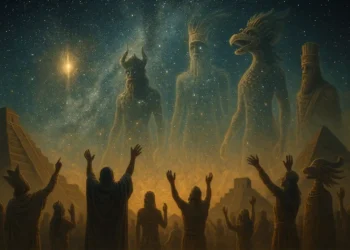
An illustration of the gods who descended from the stars.

An illustration of the gods who descended from the stars.

Across the ancient world, people told stories of the gods who descended from the stars and brought order, time, and knowledge to the Earth.

Who were the gods who descended from the stars?

In the heat of the Mesopotamian summer, workers brushed dust from a clay tablet buried beneath centuries of soil. The script was Sumerian, cuneiform, etched with purpose. Its lines spoke of kingship descending from the heavens, of gods who once walked the Earth and returned to the stars. These were not abstract symbols. To the people who carved them, the gods descended from the stars, and that descent shaped the birth of civilization.

This idea did not belong to Mesopotamia alone. On cliffs in West Africa, in temples across Central America, and in the highlands of the Andes, stories emerged of beings who came from the sky. They arrived not as mythic metaphors but as presences remembered in detail; often with names, tasks, and destinations. These stories may not be evidence of any alien contact, but they are unmistakable in pattern. Across continents and centuries, early peoples believed that the origin of their knowledge, their order, and their identity came from above.

The Anunnaki and the memory of divine rule

The earliest written literature emerged in Sumer (based on current evidence), in what is now southern Iraq. Its tablets record a world where deities were not distant concepts. They were rulers, architects, and enforcers. Among them were the so-called Anunnaki, a group of divine beings associated with the heavens, the underworld, and the fate of humankind.

In the Eridu Genesis and the Epic of Atrahasis, the Anunnaki are described as descending from the sky to organize the Earth. They assign duties to other gods, create humans to serve them, and later bring floods to reset the balance. Kingship itself is said to have been “lowered from heaven,” a phrase repeated in different contexts and cities. In this worldview, governance began not with human invention, but with a celestial mandate.

As Mesopotamian society evolved, so did the roles of the Anunnaki. Some remained creators. Others, like Enlil and Enki, took on judicial and cosmic functions. These gods were not static icons. They acted, traveled, and judged. And while modern scholars interpret these accounts through a mythological lens, the language of descent, from above to below, then back again, is consistent. To early Mesopotamians, the gods descended from the stars and brought order with them. But stories of “celestial” beings are not tied only to Mesopotamia. If we research a bit more, we find that such stories are very common across the world.

The Dogon and the silent star

In the sandstone ridges of Mali’s Bandiagara Escarpment, the Dogon people preserved an oral tradition built on observation, ritual, and an enduring relationship with the sky. At the center of their cosmology stands Sirius, the brightest star in the night sky. But it is not alone.

According to reports by French ethnographers in the mid-20th century, Dogon priests described Sirius as part of a system with an invisible companion — small, heavy, and moving in a defined orbit. They also spoke of its importance in cosmic balance. These accounts, published by Marcel Griaule and Germaine Dieterlen, have been cited as evidence of unexpected astronomical knowledge.

Today, modern astronomy identifies this object as Sirius B, a white dwarf first observed in the 19th century. Whether the Dogon understanding predates European contact remains a subject of debate. Later researchers questioned the accuracy of Griaule’s findings, suggesting that key details may have been introduced during earlier interactions. Still, within Dogon cosmology, the idea of descent from the stars remains foundational.

The Dogon speak of the Nommo, amphibious beings said to have come from the Sirius system to bring structure to the world. According to tradition, they arrived, introduced language and order, and returned to the stars. Their story is embedded in Dogon identity, reflected in ceremonial masks, agricultural rites, and annual festivals.

French anthropologists Marcel Griaule and Germaine Dieterlen documented these accounts during fieldwork in the 1930s and 1940s. Their findings, published in European journals, attracted global attention for their detail and apparent astronomical insight. Some researchers later argued that Dogon knowledge of Sirius B may have been influenced by earlier exposure to Western science. Others maintain that the tradition’s symbolic depth suggests a longer, independent origin.

While the question of source remains debated, the Dogon cosmology reflects an enduring belief: the gods descended from the stars and left a pattern in the sky worth remembering. In their rituals, the heavens are not abstract. They are ancestral. But wait, there’s more.

Mesoamerica and the return of the Feathered Serpent

In the heart of ancient Mesoamerica, from the pyramids of Teotihuacan to the rainforests of the Yucatán, civilizations tracked the stars with remarkable precision. Their gods were not only linked to celestial bodies, they were believed to come from them.

Among the Aztec and Maya, one of the most enduring figures is Quetzalcoatl, the Feathered Serpent. He was said to have arrived from the east, bringing maize, astronomy, and ceremonial law. His movements across the sky were associated with the planet Venus, which the Maya charted with astonishing detail.

Quetzalcoatl The Feathered Serpent of Aztec & Mayan Mythology
Epic Mythology - Quetzalcoatl: The Feathered Serpent God - Aztec Mythology Explained

Descriptions of Quetzalcoatl’s departure vary. In some accounts, he crossed the sea. In others, he returned to the sky. The cycle of his disappearance and promised return mirrored Venus itself, which vanished from view and later reappeared as a morning or evening star. His presence marked the passage of time. His absence shaped expectation.

The Popol Vuh, the creation story of the K’iche’ Maya, speaks of gods and ancestors who descended from the sky to shape the Earth. These figures were active. They established calendars, defined rituals, and left tools and stories behind. They were not imagined in abstraction. They were described as teachers, travelers, and builders.

In the highlands of Peru and Bolivia, Viracocha played a similar role. He emerged from Lake Titicaca, instructed the people, then disappeared toward the horizon. Though not explicitly called a sky-being, his solar and stellar associations remain clear. His appearance was linked to cultural transformation.

Across the Americas, the belief that gods descended from the stars shaped how people measured time, conducted rituals, and remembered where knowledge came from.

Reading descent through the stars

When early civilizations said their gods came from the stars, they may have been describing more than spiritual myth. Across cultures, celestial events shaped the rhythm of life. A god’s arrival could reflect the heliacal rising of a bright star. A descent might follow the arc of a meteor shower. In many traditions, constellations were understood as beings with stories, movements, and intent.

The Egyptians timed the flooding of the Nile with the first reappearance of Sirius in the dawn sky. In Australia, Aboriginal Dreamtime stories describe ancestral figures who crossed the heavens and shaped the Earth below. In Polynesia, navigators told origin stories tied to specific star clusters, which they followed across thousands of kilometers of open ocean.

These connections were not symbolic alone. The stars offered consistency. Through observation and memory, people built systems that depended on their timing. The descent of gods, in many traditions, reflected not just belief, but the return of light at the right time.

Authority born from above

In nearly every early society, the most essential structures — kingship, agriculture, law — were described as coming from the sky. This was not metaphor. It was origin. Rulers traced their lineage to celestial figures. Ritual calendars were aligned with the stars. Sowing and harvesting followed their motion.

In Sumer, records describe kingship being lowered from heaven. In Egypt, rulers joined the constellation of Orion after death. In China, the Mandate of Heaven determined whether dynasties rose or fell. In Mesoamerica, elite families claimed descent from sky-beings who arrived to teach and organize.

This structure was not built only for control. It created meaning. The stars offered reference points that persisted beyond the span of a lifetime. They explained regularity. They gave structure to power. Order came not from invention, but from alignment with what was already above.

Looking upward with the same question

The belief that gods descended from the stars lasted because it was tied to observation. People saw consistent movements above and connected them to patterns in their own lives. The stars were not distant. They were present, structured, and visible. Their return marked seasons, guided planting, and aligned with festivals. From that consistency, stories formed.

These accounts did not emerge from confusion. They were shaped by measurement, refined through practice, and passed along in ceremonies and ritual calendars. Whether the stories describe events or encode timing, they helped early societies track what mattered.

Today, we search the sky with satellites and telescopes. We catalog stars and measure orbits. But the act of looking up has not changed. The methods are different. The question is the same.

RELATED VIDEOS

The HIDDEN TRUTH of the Anunnaki - The LOST BOOKS of Enki | Documentary
The Anunnaki: Gods, Myths, and Their Influence on Ancient Civilizations
Carian Avian ET's | Avian Architects of the Universe | Astral Legends
Uncovering Egypt’s Most Powerful Gods | Historical Documentary | Ancient Gods Of Egypt

{ https://curiosmos.com/category/ancient-civilizations/ }

Hoe vind je dit bericht?
Geschreven door peter om 21:48 Stuur door

How scientists are hunting for alien technology in Earth’s oceans

How scientists are hunting for alien technology in Earth’s oceans

Some scientists believe alien technology may already be in Earth's oceans. From recovered spherules to sonar anomalies, the search is moving underwater.

 An illustration of a USO. scientists are hunting for alien technology.

The idea of alien technology arriving on Earth has often belonged to science fiction. But now, some scientists are hunting for alien technology in Earth’s oceans with real expeditions, physical evidence, and peer-reviewed methods. Their focus is not the stars, but the seafloor, where something may have already crashlanded.

In 2023, off the northern coast of Papua New Guinea, a research team led by Harvard astrophysicist Avi Loeb completed a month-long expedition to recover fragments of an object that crashed into the Pacific almost a decade earlier. Known as IM1, the object is believed to have originated from outside the solar system. The team recovered hundreds of small metallic spheres from the volcanic sediment. These spherules are the center of a growing scientific debate about their possible origin.

Possible Alien Tech Spherules Avi Loeb. Credit: Professor Avi Loeb.

Possible Alien Tech Spherules Avi Loeb.

Credit: Professor Avi Loeb.

A fireball from beyond the solar system

On January 8, 2014, U.S. Department of Defense sensors recorded a high-speed fireball entering Earth’s atmosphere. It exploded in the air near Manus Island, Papua New Guinea. The object’s velocity was extreme, measured at over 40 kilometers per second. Its steep entry angle and speed suggested that it was not gravitationally bound to the Sun. That made it interstellar.

The data remained classified for years. In 2022, U.S. Space Command confirmed that the object, formally named CNEOS 2014-01-08 (IM1), had indeed come from outside the solar system. This made it the first confirmed interstellar object to impact Earth, three years before ‘Oumuamua passed through the inner solar system. But unlike ‘Oumuamua, IM1 didn’t simply fly past. It struck the atmosphere and broke apart.

Loeb, who had already drawn controversy by suggesting that ‘Oumuamua might have been an alien probe, began developing a plan to recover whatever was left of IM1 from the ocean floor.

Into the Pacific: the completed search for IM1’s remains

In June 2023, Loeb and his team boarded the research vessel Silver Star and traveled to a narrow stretch of ocean roughly 100 kilometers north of Manus Island. Their goal was clear. If IM1 had survived its fiery entry and exploded over the sea, then fragments might still be preserved in the sediment.

The team deployed a magnetic sled designed to collect metallic debris from the seafloor. Over several weeks, they dragged the sled across a search area more than one and a half square kilometers in size. Each pass brought up sediment that was filtered and inspected in the ship’s onboard lab. The work was slow and methodical.

In total, they recovered 700 tiny metallic spherules. Most were smooth and round, no more than a millimeter across. Under the microscope, they resembled industrial ball bearings or micro-welded beads. But chemical analysis showed otherwise.

The Unknown Physics of UFO/UAP With Avi Loeb

Hunting for alien technology in Earth’s ocean

The spherules contained high concentrations of iron, magnesium, and nickel, along with trace elements such as beryllium, lanthanum, and uranium. According to Loeb, their composition does not match any known class of meteorite, nor does it reflect typical industrial waste. Some were unusually hard and resistant to corrosion. Others showed microstructures that hinted at rapid cooling in high-energy environments.

Loeb has not claimed they are alien technology. He has said that the fragments might be artificial and may represent engineered materials of interstellar origin. That distinction matters. The evidence is not conclusive. But the recovered objects are real, and they differ from any known terrestrial or meteoritic samples, according to Loeb.

For Loeb and his colleagues, the discovery justifies continued investigation. Hunting for alien technology in Earth’s oceans, they argue, is not a fringe idea but a scientific effort to treat unusual materials seriously. The next steps include peer-reviewed publication, expanded testing, and planning for a second, more advanced expedition to the region.

Avi Loeb: “This object came from another solar system!” (331)

The ocean as the quietest frontier

The reason scientists are hunting for alien technology in Earth’s oceans is not just because of IM1. It is also because the ocean itself is uniquely suited to conceal long-term visitors. The deep sea is cold, dark, and largely unexplored. More than 80 percent of the ocean floor has never been mapped in high resolution. Much of it remains invisible to satellites and sonar.

Water insulates thermal signatures. It blocks many forms of radiation. It absorbs light. For any intelligence wishing to observe Earth quietly, the deep ocean would be a logical location to operate from or hide within.

In recent years, some researchers have started looking beneath the waves rather than beyond the stars. The effort to search Earth’s oceans for non-human artifacts combines elements of oceanography, materials science, and astronomy. Instead of treating the sea as a biological frontier, this approach frames it as a potential archive, a place where evidence of past contact could remain hidden in physical form. This leads me to the next important thing.

A history of unexplained objects underwater

Reports of unidentified submerged objects, or USOs, go back decades. Submariners during the Cold War described sonar contacts moving at speeds beyond any known underwater craft. Pilots have reported aerial objects entering the sea without impact or disruption. In 2019, footage from the USS Omaha showed a spherical object descending into the ocean west of San Diego. It left no visible debris and has never been explained.

These encounters have rarely led to recovery. Most remain anecdotal or classified. But their consistency has led some researchers to consider the possibility that Earth’s oceans are not just empty zones of water but a domain where advanced technology could operate unseen.

From signals to fragments

The traditional search for extraterrestrial intelligence has focused on the sky. Radio telescopes scanned for signals. Optical observatories looked for laser pulses or unusual transits. But after decades of listening, no clear signal has ever arrived.

The discovery of IM1 and the recovery of physical fragments from the ocean floor mark a new approach. Hunting for alien technology in Earth’s oceans means searching for material evidence, alloys, components, or structures that suggest manufacture, not just chemistry.

This shift is profound. In fact it is as profound as when we decided to treat UFOs as a real thing, and not just a conspiracy theory.

It redefines what a technosignature might be. Instead of a broadcast, it could be a sphere of hardened iron buried in Pacific sediment. Instead of a message from light-years away, it might be a millimeter-sized object already on Earth.

The sky has not answered. So now, scientists are turning to the sea. Hunting for alien technology in Earth’s oceans is not about fantasy. It is about examining the places we have ignored, the signals we may have missed, and the debris that might already be here. I believe that if we focus more on the ocean, the ocean floor, we will perhaps come one step closer to answering the question “are we alone?”

RELATED VIDEOS

UFO Experts On Existence Of Underwater Alien Bases On Earth Probe | Shocking UFO Hearing LIVE | N18
ALIENS IN THE OCEANS?! HARVARD Scientist Finds INTERSTELLAR Objects In The Pacific Ocean: WATCH
Ancient Aliens: TOP 3 DEEP SEA UFO MYSTERIES

{ https://curiosmos.com/category/alien-theories/ }

Hoe vind je dit bericht?
Geschreven door peter om 21:08 Stuur door

This sunken structure is older than the pyramids and no one agrees on who built it

This sunken structure is older than the pyramids and no one agrees on who built it

Beneath the sea off Israel’s coast lies a 9,000-year-old village. This sunken structure is older than the pyramids, and no one agrees on who built it.

There’s a sunken structure older than the pyramids resting beneath the sea off Israel’s coast — part of a 9,000-year-old village known as Atlit Yam.

Submerged in shallow water just a few hundred meters from the shoreline, Atlit Yam remained hidden for thousands of years. It wasn’t swallowed by sand or jungle, but by the sea itself, it was actually the result of a sudden and catastrophic event in the distant past. You might even call it the Atlantis of the Middle East.

What has been uncovered since its discovery has challenged long-held assumptions about the timeline of civilization, agriculture, engineering, and how early humans lived together in permanent communities.

Atlit Yam is not just older than the pyramids. It’s older than writing, wheels, and metallurgy. And yet it shows signs of sophisticated planning, water management, and even ceremonial architecture. Despite all this, no one can say for sure who built it, what they believed, or why they vanished so suddenly.

How a sunken structure older than the pyramids was preserved beneath the sea

The site came to light in 1984, when marine archaeologist Ehud Galili was conducting a routine survey of the seabed near the modern Israeli town of Atlit. What first appeared to be random stone formations turned out to be the remains of a large, carefully organized Neolithic settlement. Today, Atlit Yam lies about ten meters underwater, spread across more than 40,000 square meters.

Radiocarbon dating places the site between 6900 and 6300 BCE, making it thousands of years older than Egypt’s earliest monumental architecture. Excavations have revealed rectangular stone houses with plastered floors, open courtyards, hearths, storage pits, and even an elaborate freshwater well dug directly into the coastal aquifer. Surrounding the village are tools, fishing gear, animal bones, and remnants of grain, suggesting a population that relied on a mix of farming and fishing.

The reason Atlit Yam is so well-preserved has everything to do with the water. The sea didn’t erode it. It protected it. Like many other sites across the world. The mud and silt created a perfect seal, preserving not just stonework but fragile organic materials as well. The sunken structure older than the pyramids is one of the best-preserved prehistoric coastal sites in the world precisely because of its sudden submersion.

Atlit Yam, Israel | A Sunken Neolithic Settlement. - YouTube

The stone circle at the heart of the mystery

 When I said structure, this is what I was mainly referring to.

Near the center of Atlit Yam, archaeologists uncovered a semicircle of seven massive stones, each one standing upright around what was once a spring. They are not scattered or toppled. They were placed with care, each upright block locked into position nearly 9,000 years ago.

Some of them weigh several tons. And yet they were moved, raised, and aligned by hand, without the help of wheels or metal tools. Their surfaces are smooth in places, but not untouched. Shallow basins have been carved into the tops of some, subtle recesses that hint at purpose. Perhaps they once held water. Perhaps something else.

No one knows for certain why the stones were arranged this way. The arc they form is too precise to be accidental. Some researchers suggest they may have served as a gathering place, a site for shared rituals or seasonal ceremonies tied to water. Others believe the alignment might be more than symbolic. A few have proposed that the stones were positioned in relation to the movement of the Sun or stars. I believe the latter.

Their arrangement invites comparison to other megalithic sites like Stonehenge, but this one is older by thousands of years. If the people of Atlit Yam were observing the sky and measuring time through stone, it would place the beginnings of astronomy far earlier than most histories allow. And I concur.

Stonehenge's stones formed during the time of the dinosaurs. Credit: Jumpstory

Stonehenge’s stones formed during the time of the dinosaurs. Credit: Jumpstory

What is peculiar is that there are no carvings here. There are no calendars. There are no visible signs to confirm the theory. What remains is the weight of the stones, their deliberate placement, and the quiet sense that they once meant something more. Nothing has been proven. But to stand in front of them, even underwater, is to feel the pull of a question we have not yet learned how to ask.

Burials, disease, and sudden destruction

Among the site’s most poignant discoveries are its graves. Archaeologists found several human burials within the village, including one especially intimate example: a woman and child interred together, their bodies laid out with care and respect. The grave offers a rare look at social bonds and burial customs from a time before writing.

Scientific analysis revealed the woman had suffered from tuberculosis, making her remains one of the earliest known cases of the disease in the archaeological record. This pushed the origin of tuberculosis thousands of years earlier than previously believed.

But while individual deaths are expected in any community, the end of Atlit Yam itself was anything but ordinary. The entire site appears to have been abandoned all at once, with no evidence of warfare, famine, or prolonged decay. The leading theory is that a massive tsunami — triggered by a volcanic collapse on Mount Etna in Sicily — swept across the eastern Mediterranean and drowned the entire village. Geological deposits along the coast support this theory.

A disaster of that scale would have been sudden and devastating. The people of Atlit Yam likely had no time to flee. Their homes, belongings, and lives were simply engulfed.

A glimpse into the lives that once moved through these walls

Nothing about Atlit Yam feels accidental. The layout of its homes, the channels that once carried water, the central well — they all speak to people who understood how to live in one place, and how to live together. This was a community with structure. Not just in the stones, but in the way they approached survival

They farmed the land, harvested the sea, and buried their dead with care. They planned where to place their homes and how to access freshwater. That kind of order doesn’t appear without conversation, cooperation, and shared memory.

What they left behind may be even more telling. Among the artifacts found at the site are tools made from obsidian, a volcanic glass that doesn’t occur naturally along the Israeli coast. The closest known sources lie in modern-day Turkey, hundreds of kilometers to the north. That kind of material doesn’t drift in with the tide. It has to be carried, traded, passed hand to hand. Whatever their route, the people of Atlit Yam had ties that reached beyond the shoreline.7

Atlit Yam was a functioning settlement. The layout of the homes, the location of the well, the presence of storage areas and work spaces — all of it points to people who understood how to live in one place for a long time. Nothing about the site suggests a seasonal camp.

They worked with the land, made use of the sea, and organized their space with purpose. Then the sea changed, and their world disappeared.

The 9,000-year-old underground megalithic settlement of Atlit Yam ...

The people behind Atlit Yam have no name

Atlit Yam offers no names, no written words, no symbols we can follow. The people who built this place left behind walls, wells, and stone tools, but not their voice. No inscription marks who they were, where they came from, or how they saw the world around them.

Some archaeologists suggest the site was part of a larger Neolithic tradition that once stretched across the Levant. Others believe it may have belonged to a distinct coastal culture, shaped by the shoreline and the sea. There are theories, but no certainty. What remains is a site without a signature.

Much of it is still buried beneath layers of silt. What has been uncovered is only a fragment. Working underwater is slow. The tides shift, sand drifts, and every excavation demands patience and care. It may take years before the rest of Atlit Yam comes into view, if it ever does. Whatever answers remain are still underwater.

What the site does show, even in its silence, is a community that had settled into a way of life. The homes were carefully built. The dead were buried with intention. The well was dug deep, and the carved stones placed around the spring suggest that meaning, not just survival, shaped this place.

There is no gold at Atlit Yam. No mythic ruins or towering monuments. What survives is something quieter. A village that stayed intact because it vanished all at once, pulled beneath the sea in a single, irreversible moment. The memory of its people wasn’t passed down. It was preserved by accident.

Now, as archaeologists work to recover its outline, stone by stone, we’re left to imagine what was lost. These people were watching the skies, digging wells, growing food, and burying their dead before the pyramids were even a thought. They are not mentioned in any history, but their presence remains, just below the surface.

The sea covered their world, but it did not erase it. And in that silence, we begin to hear their story.

 RELATED VIDEOS

The Lost City of Atlit-Yam | FULL DOCUMENTARY

9,000-Year-Old Underwater City! | The Lost Village of Atlit Yam #israel #palestine #history
Top 10 Greatest Underwater Discoveries Ever

{ https://curiosmos.com/ } 

Hoe vind je dit bericht?
Geschreven door peter om 20:35 Stuur door

Green Craft Over Perth, Australia On May 15, 2025, UFO UAP Drone Sighting News.

Green Craft Over Perth, Australia On May 15, 2025, UFO UAP Drone Sighting News.

UFO_UAP.png
Date of sighting: May 15, 2025
Location of sightings: Perth, Australia
Source: Email report
 
Now this is a cool sighing. The green glowing craft is a glowing sphere shape and has a slight white trail behind it. Very interesting how it deliberately fades in and out, but not really fade, but more like the light switches on and off. Alien try to fool us into thinking its not aliens, but...someone really messed up on board that green ship...because meteors do not turn off and on like a LED aircraft light. This is 100% proof that aliens are loving it in the skies over Australia this week. 
Scott C. Waring UFO Sightings Daily
 

{ https://www.ufosightingsdaily.com/ }

Hoe vind je dit bericht?
Geschreven door peter om 17:25 Stuur door

The Deepening Mystery Around the JWST's Early Galaxies

The Deepening Mystery Around the JWST's Early Galaxies

1338px-little_red_dot_galaxy_stamps_20_unlabeled.jpg When the JWST found Little Red Dot galaxies, astronomers were puzzled. They appeared to be brighter, and more massive, than galaxies should be in the very early Universe. New research is deepening this mystery. Image Credit: Matthee et al. 2024, The Astrophysical Journal. CC BY 4.0

When the JWST came to life and began observations, one of its first jobs was to gaze back in time at the early Universe. The Assembly of Galaxies is one of the space telescope's four main science themes, and when it observed the Universe's first galaxies, it uncovered a mystery. Some of them appear to have supermassive black holes (SMBH) in their centers that are fuelling active galactic nuclei (AGN). However, they're not emitting X-rays, which is one of the hallmarks of AGN.

Little Red Dot (LRD) galaxies are small, red galaxies that formed about 600 million years after the Big Bang. The JWST has found more than 300 of them, but they remain a mystery collectively. Their brightness indicated they're more massive and swollen with stars than they should be at an early age. Our models suggest there wasn't enough time for them to grow so massive.

Astronomers then discovered AGN signatures that could explain the excess light. Rather than only stars, the LRD's excess light came from AGN. That would mean that the LRDs wouldn't need to be so massive to emit all that light, and their size wouldn't challenge our galaxy evolution models.

Unfortunately, that potential conclusion causes another problem. AGN emit powerful X-rays as the material swirling around in their accretion disks heats up. However, according to new research, LRDs appear to emit no X-rays.

The new research, titled "Chandra Rules Out Super-Eddington Accretion For Little Red Dots," has been submitted to The Astrophysical Journal. The authors are Andrea Sacchi and Akos Bogdan, both from the Harvard and Smithsonian Centers for Astrophysics. The paper is currently available at arxiv.org.

"A key feature of LRDs is their extreme X-ray weakness: analyses of individual and stacked sources have yielded non-detections or only tentative, inconclusive X-ray signals, except for a handful of individual cases," the authors write.

The lack of X-rays winds everything backward. If there are no X-rays, there can't be AGN with accretion disks. If there are no accretion disks, then LRD's powerful brightness can't come from SMBHs. If it can't come from SMBHs, it has to come from stars. Then we're back to square one: trying to explain how early galaxies were so massive and swollen with stars.

55-lrd-chandra.jpg

This Chandra image from the research shows the 55 LRDs in the Chandra Deep Field South in the 0.3 − 7 keV X-ray band. This range encompasses both soft X-rays and a good portion of the hard X-ray band. It's a broad and informative band for astrophysical observations, yet it turned up no X-ray detections.

Image Credit: Sacchi and Bogdan, 2025, The Astrophysical Journal.

Some researchers have suggested another solution. They say that the SMBHs are experiencing super-Eddington accretion rates.

SMBH black hole accretion is governed by the Eddington limit. The Eddington limit is a fundamental concept in astrophysics that explains the maximum brightness and accretion rates for astrophysical objects like SMBH. An object reaches the Eddington limit when two forces are balanced: outward radiation and inward gravitation. If one of these forces is too powerful, the object either expels its outer layers or ceases further accretion.

Astrophysicists know that the Eddington limit influences SMBH growth. However, they've proposed what's called super-Eddington accretion to explain how these massive objects became so massive so early in the Universe. Objects can exceed the Eddington limit for periods of time and experience super-Eddington accretion. Can that explain why LRDs are so bright while also being so weak in X-rays?

The authors point out that the only other explanation for the lack of X-rays is obscuration, and that explanation hasn't held up.

"As the most natural explanation, high obscuration, is disfavored by JWST spectroscopic evidence, several authors have suggested that the X-ray weakness of LRDs is intrinsic, due to super-Eddington accretion rates," the authors write. "In this work, we test that scenario by stacking X-ray data for 55 LRDs in the Chandra Deep Field South, accumulating a total exposure time of nearly 400 Ms."

400 megaseconds is the cumulative observing time for the 55 LRDs combined, not the total telescope observing time. That's an impressive depth of observation for the 55 objects. If super-Eddington accretion were occurring, that would explain the lack of X-rays.

Super-Eddington accretion still creates X-rays. However, those photons can get trapped in the accretion flow. They can also be absorbed or scattered by outflows and winds, or obscured by the thick disk or envelope around the SMBH. Current models show that super-Eddington accretion still emits X-rays, but as lower-energy soft X-rays. 400 megaseconds of stacked X-ray observations should detect them.

However, they didn't.

chandra-observatory-drawing.jpg

The Chandra X-ray Observatory is the world's most powerful X-ray telescope. It has eight times greater resolution and can detect sources more than 20 times fainter than any previous X-ray telescope. 400 megaseconds of stacked observing time should've detected X-rays if they were being emitted.

Image Credit: NASA/CXC & J. Vaughan

"Despite reaching unprecedented X-ray depths, our stack still yields a non-detection," the authors write. "The corresponding upper limits are deep enough to rule out current super-Eddington accretion models, and are compatible only with extremely high levels of obscuration."

The authors say we're left with only one explanation: "To explain the X-ray weakness of LRDs, we therefore speculate that the SMBHs in these systems are neither as massive nor as luminous as currently believed. " Other researchers have also suggested this.

So what's going on if observations show no X-rays, and if the JWST shows that dust obscuration is responsible?

"If the bolometric luminosities are overestimated by an order of magnitude, much lower levels of obscuration can hide the X-ray emission from accreting SMBHs without invoking super-Eddington accretion," the authors conclude.

The JWST has fulfilled its promise by revealing the Universe's earliest galaxies. That the results go against our models isn't surprising. Every new mission and telescope delivers some surprises, and scientists often look forward to surprising results.

For now, the LRD galaxies are unexplained. In fact, the mystery has deepened.

RELATED VIDEOS

Again! Were We Wrong? JWST Discovered Ancient Huge Galaxies That Changes EVERYTHING We Know
Astronomers Shocked! JWST Discovers Galaxies Challenging Dark Matter Theory
James Webb Just Captured a Real Exoplanet Image for the First Time – A New Era Begins
"The New Ultra-Deep Image from the JWST Suggests That We May Have Made a Serious Error!"

{ https://www.universetoday.com/ }

Hoe vind je dit bericht?
Geschreven door peter om 17:22 Stuur door

Alien Craft Caught In Photo Just Before It Darts Into Cloud, France May 14, 2025, UFO UAP Sighting News.

Alien Craft Caught In Photo Just Before It Darts Into Cloud, France May 14, 2025, UFO UAP Sighting News.

UF_UAP_Cloud.gif
Date of sighting: May 14, 2025
Location of sighting: L'Arbresle, Auvergne-Rhône-Alpes, France
Source: NUFORC #189599
 
This just in at NUFORC UFO reporting site. A person was taking photos of the clouds close up and accidentally caught a large half disk darting into the cloud to hide. Alien craft have their own ai, which is constantly monitoring for human brain wavelengths...can read from over 2-3 miles away! And when the ai detects a human focusing on the UFO, it is programed to hide,  but does have other options. This one, was caught just before it hid. I love it! Proof of what I just said, caught in a photo. 
Scott C. Waring - UFO Sightings Daily
 
Eyewitness states: 
I didn't see it at the moment; it was after I already took the photo during my viewing of it at home that I noticed this orb. I photographed a cloud, and during my viewing, I noticed an orb that wasn't present a few seconds earlier.  
 
Original report in French:  
J'ai photographié un nuage et lors de mon visionnage j'ai remarqué un orbe sui n'était pas présent quelques secondes plus tôt.
 
UFO_cloud.jpg

UFO_UAP_paranormal.png

Cloud_UAP_disk.png

{ https://www.ufosightingsdaily.com/ }

Hoe vind je dit bericht?
Geschreven door peter om 17:04 Stuur door

Alien Entity Looking into Windows At Los Angeles, California May 2025, VIDEO! UFO UAP Sighting News.

Alien Entity Looking into Windows At Los Angeles, California May 2025, VIDEO! UFO UAP Sighting News.

UFO_UAP_Losangeles.png

UFO_Losangeles.png
Date of sighting: May 2025
Location of sighting: Los Angeles, California, USA
Source: Email report
 
Now this is a hot one. This mysterious object is floating around as if it's purposefully moving from window to window, looking into each, in an effort to spy on humans and learn from their activities. This alien entity is moving about like it understands scientific method, through observation, experimentation and analysis. Very rare sighting of an entity and I'm not at all surprised it's in Los Angeles, my home town. 
 
Scott C. Waring UFO Sightings Daily
 

{ https://www.ufosightingsdaily.com/ }

Hoe vind je dit bericht?
Geschreven door peter om 16:56 Stuur door
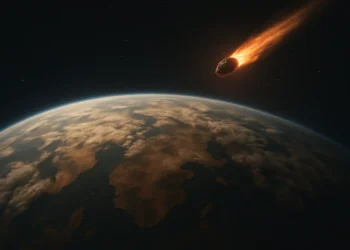
Incredible Alien Humanoid Encounters in Russia

Incredible Alien Humanoid Encounters in Russia

Incredible Alien Humanoid Encounters in Russia

From all over the world come reports of various humanoid entities that defy any proper classification. It seems such reports stretch far and wide across geological boundaries and here we will look at a selection of such encounters from the mysterious land of Russia. 

An early report takes us all the way back to the 1700s, in the Yekaterinburg region, Ural, Russia. In 1719, men working for a famous plant owner and industrialist were engaged in finding ores in this region of the Ural and reported capturing a strange gnome-like entity, which they found living underground in a cave as they were mining. It was reportedly kept alive for some time before finally dying after refusing to eat anything. Knowing about the interest in weird things by the first Russian Czar Peter the Great, the body of the diminutive humanoid was sent to the capital of Saint Petersburg in order to be kept in a museum. Evidently, it was uncommon in appearance, was not a monkey, and was very different from human beings. We will probably never know what ti was, because it seems the body disappeared long ago. 

In 1932, 12-year-old Vera Alexandrovna T was out walking in the rural area near her home in Vnukovo, Yaroslavl Province, when she noticed a “flying ship” that came swooping down over the river to create a wave strong enough to overturn boats. The object landed on a potato field behind the village, after which it dug a hole in the ground and submerged it almost completely into the earth. Not long after this, a group of curious visitors appeared in the village, described as having greenish-brown tint skin and sallow complexions, as well as only four fingers on each hand and hooves instead of feet. The apparent leader was taller than the rest, and rather than a dour expression seemed to be quite friendly, talking and laughing with the locals, purportedly through telepathy.

The locals called them “medics” because they were often walking along the village carrying big shiny tanks with numerous tubes sticking from above. At night the small entities entered the houses, inserting the tubes into the bodies of the sleeping inhabitants apparently “measuring” something. They also allegedly performed experiments on livestock. The aliens were often seen in the company of some kind of pets, which resembled black monkeys, and were known to be mischievous, stealing objects and chickens. As time went on, the aliens and their weird pet monkey-things began to dig up the fields and steal crops, on at least one occasion seen sucking up grain from a silo with a strange machine. It was said that these crops and grains were usually loaded onto a huge, elephant-like beast and brought to the partially buried ship to be unloaded. This went on for several weeks until one day the aliens and their ship were just gone, leaving questions and no answers.

Moving on to 1947, in June of that year, a herdsman by the name of Alexey Romanovich Bodnya was out tending to his herd in the Bahamut Kokchetav Region when he saw a brightly lit circle shining on the grass on the field, somehow resembling “a micro-tornado.” Next, he heard a loud metal clicking sound and when he looked up he was stunned to see a disc-shaped object about 25 meters in diameter, which was bright and shaped like two deep saucers joined together, with a transparent dome on top and 4 prop-like landing legs protruding from the bottom and moving up and down in rhythm. The surface of the disk was silver, almost mirror-like, reflecting the ground and grass beneath it, and piercing searchlights could be seen on the craft as it approached for a landing. Bodnya would later recall that the craft seemed to be wobbling, almost as if it were experiencing mechanical difficulties.

The object managed to land without incident, after which a ladder descended to the ground and three strange beings climbed out. These humanoids were said to stand about 3 meters in height, with elongated faces, oversized round eyes, long noses, high foreheads, grayish-bluish skin, and thin lips. They were dressed in silver reflecting tight-fitting overalls with head coverings. One of the aliens was noticeably taller than the rest and seemed to be the leader, shouting orders at them in a guttural, otherworldly language. The entities seemed to be fixated on the dome atop their craft, dismantling it and initiating what the witness assumed were repairs. 

The stunned witness had observed the emergency landing and repair of the disk while hiding behind some shrubs with his horse, but when the animal snorted all of the humanoids looked in his direction. The aliens immediately shone a green beam of light in his direction and the wines had the sneaking suspicion that they had photographed him. The leader then looked at the witness and began to telepathically communicate with him, telling him to come out of hiding and that they meant him no harm. The alien then explained that their craft’s flight control mechanism had been damaged by a bolt of lightning and that they were trying to fix it.

Bodnya drew closer, and the alien leader took him by his hands and sat him on the rim of the disk. Making the story even weirder is that at some point a wolf approached the tied-up horse and the alien apparently killed it with a “thunderous beam.” After what were can only assume was an “OK, where were we?”, the alien allowed Bodnya to come aboard. Looking in, he saw a long corridor leading inside the craft, some frame-like walls, and noticed that the ceiling was very high. He tried to walk along this corridor, but after a few steps, he was overcome by a wave of intense heat and nausea and could continue no further. The giant then said, “Come here” The boy then rushed back and fell on the alien’s arms, he could not remember what happened next, he apparently lost consciousness and woke up again sitting on the grass looking at the repair operations.

After this, Bodnya was somehow convinced that he had been examined onboard and implanted with some type of device. The rest of the night he watched the aliens toil away on their ship until they had seemingly finished the repair job. After finishing their repairs the aliens left behind a small cross-shaped metallic fragment, which the witness buried on the edge of the field intending to dig it out in the future, although he would forget where it was and it is still supposedly there to this day. The disk then rose up and zoomed up to the sky at incredible speed disappearing from sight in a mere flash, astounding Bodnya with bits sheer speed. 

It would appear that this would not be the end of things, because years later he would claim that he had once again be contacted by the aliens via a communications device planted in his head. The aliens informed Bodnya that their planet was sterile and that they were vegetarians and that they had a base on the moon, which was covered with a transparent glass dome. They expressed contempt towards the human race and refused to reveal the location or name of their home planet. They confirmed to the witness that there was life after death and predicted coming catastrophes and disasters that would affect humanity. When Bodnya asked them why they didn’t contact humanity openly, their curious answer was, “Why don’t humans contact those in an insane asylum?” This would apparently be his last contact with the creatures and it is unclear what happened to him after this series of otherworldly events.

The following year, in 1948, Valentin Stepanovich was fishing on a small river near the mountains near Lazarevskoye, Sochi, when suddenly he noticed a silver, cigar shaped craft nearby, and saw several luminous balls of light separate from the object to fly towards him. He also noticed several tall and beautiful women nearby, with long blond hair and smiling, but this is the last thing he would see before he suddenly and inexplicably lost consciousness. 

When he came to, he found himself onboard a strange craft, lying on a bed inside a room, into which an alien “Nordic” woman entered the room and telepathically communicated with him, telling him to join them on their journey. The witness would describe these aliens as standing 2 meters in height, Nordic people, with blond hair, and slightly slanted bluish, greenish, grayish eyes, and dressed in single-piece tight-fitting silver suits made out of a multi-layered composite material. Fascinated, the man agreed to go with them and it would lead to quite the trippy journey, indeed.

They traveled “faster than the speed of light” according to the aliens, and soon they landed on the alien planet that was approximately twice the size of Earth and divided into three huge continents. The story gets even more bonkers still, when Valentin meets an alien woman named Liffa and soon fell in love with her. At one point he attempted to kiss her, and her skin became extremely red and she told him to get away from her. For this transgression, he was punished and was briefly exiled to a barren, polluted and radioactive satellite moon. He apparently survived this exile and soon he was allowed to marry Liffa, although why this should be is not known and is probably one of the lesser more unbelievable traits of this tale. They had a child together and Valentin also helped the aliens overthrow a small colony of humans taken from Earth to that planet who wanted to overthrow their overlords. Right. The rebels were quickly and safely neutralized, and soon after this Valentin returned to Earth. Although it had felt like only 3 months, it would turn out that actually a year had gone by on Earth, and he had been presumed dead. Make of this story what you will, but it is a damn wild ride. 

One day in the summer of that same year, a young boy and two girls in the Stavropol region of North Caucasus, Russia, were out near their rural village watching their cows graze and having their lunch, after that the boy went to take a nap on the other side of the hill. At some time during his nap, he was woken by a piercing whistle, and he bolted up to see “a silver-colored object resembling a huge upside-down plate” that landed not far away on three prongs that looked like landing gear of some kind. As the boy stared at this truly strange sight, the object opened up and out stepped three tall and thin humanoid entities dressed in tight-fitting silver suits. These creatures then approached the witness, and he found that he was paralyzed and unable to move, powerless to resist as they took his hand and led him towards the craft, as if in some sort of trance.

When they were inside, the boy could see that they were in a corridor lined by 4 cages made out of metallic rods, each of which alternatively held a bear, a woman, three men, and one cage holding a single man apparently of Slavic descent. As the humanoid entities walked by these cages, the occupants had quite a violent reaction. The bear growled, snarled, and paced about angrily, the woman screamed in wild hysterics, with “her hair disheveled, her eyes fixed in a wild stare and foaming at the mouth,” and the three men dropped to their knees and began praying. The boy was then shoved into the cage with the Slavic man, who seemed to be the only one keeping his calm and who tried to calm the obviously terrified and increasingly panicked boy down. The aliens then left, the bear and the others calmed down, and the object they were in could be felt to take off and move.

Not long after take-off, the alien figures returned and produced “an operating table” that seemed to just slide right out of the wall, after which they proceeded to grab one of the three men from the cage and lead him to it. Although the man’s face was a grimace of terror, he was apparently under some sort of paralytic spell because he did nothing to physically resist as he was laid down on the table. The Slavic man, seemingly aware of what was going to happen next, tried to pull the boy’s attention away, but he was able to see the aliens take out various bizarre instruments and begin cutting open and dismembering the man, the poor victim completely silent and helpless even as the blood sprayed everywhere and the removed body parts were put into a metallic box. When they were finished, the entities then allegedly cleaned up the blood and carried the box and what remained of the man on the table away. At this point the boy was completely overcome by fear. 

The man in the cage with him tried to calm him down and told the boy that he was a mining engineer from the Urals and that his name was Alexander. He told the boy that he planned to get them out of there and urged him to try and squeeze through the bars of the cage, which he managed to do after some great effort and much pushing from Alexander. There was some sort of button on the wall that Alexander told the boy to push, but he couldn’t reach it, so Alexander removed articles of his clothing and piled them up for the boy to stand on until he was able to push it, which had the effect of causing their cage to slide open. Throughout all of this the bear, woman, and the two remaining men in the other cage were eerily silent. Even when Alexander tried to talk to them they were unresponsive, in some kind of vegetative daze. Now free of their cage, Alexander and the boy let the others be and headed down the corridor and tried to find some way out of their predicament. This is when things would get even more bizarre than they already were. 

They purportedly found several other rooms, with one of them holding two sleeping aliens and another “control room” with another alien asleep at the controls. Alexander frantically tried to find something they could use as a weapon but there was nothing for them to defend themselves with if their captors woke up. They then stumbled across what was described as an “engine room,” where there was a “metallic box with a stripe set up on metallic struts.” Alexander picked up this box and proceeded to throw it onto some control panels in the room, which provoked a violent smoking and sparking, as well as a piercing alarm of some kind. Not long after this two aliens rushed into the room and physically scuffled with Alexander as another one appeared with a metallic rod that was able to instantly paralyze the struggling man. These entities then supposedly dragged the both of them back to their cage and they were back to square one. 

The aliens then telepathically communicated with Alexander and asked why he was so capable while the others were at such a “low level of development,” to which he responded that they were likely just uneducated and scared out of their minds. The aliens then explained that they were there on Earth because they were concerned about mankind’s use of atomic energy and wanted to monitor our civilization. They also explained that radioactive materials were very useful on their world, as they did not have a large supply and used them for fuel. The boy would later claim:

“They told him (Alexander) that to waste radioactive material for explosions was madness. These materials could be used for other needs and they (the aliens) had those materials in very low quantity and were very valuable to them. They used the radioactive materials to obtain energy which they used in various branches of science and technique and also for space travel.”

They told him that they wanted to study our planet and also gather these radioactive substances and that they still did not know much about humankind. When asked why they had so brutally dismembered and cut apart that man, they said that they had merely dissected him for study, and had not realized that he was even a sentient being until meeting Alexander and realizing that humans were intelligent. To them, the man had been no different from that bear, just an animal, but now they knew differently. They then asked him if he wished to accompany them, which he agreed to on the condition that they release the other prisoners. They agreed, and the boy was dropped off where he had first been abducted from after giving him an injection they claimed he needed to counteract the radiation he had been exposed to on their ship. 

When the boy woke on that hill, he had a strong headache and was very thirsty, and he soon saw that there was a search party out looking for him. When he was brought back to his village, he was sick for several days with a fever, and a metallic taste in his mouth, and his eyes and skin were extremely sensitive to sunlight. At the time, he could not remember what had happened to him, and so was unable to answer when the others asked where he had been. The years went by and he tried to put it behind him, but then one day when he was out in a field he was approached by two military men and a man in civilian clothing who seemed to be very familiar with him but who he did not know. The man in civilian clothes seemed to know about the UFO encounter, but the boy himself did not remember it and told the man he must be mistaken. The man in civilian clothing wished to interrogate the boy under hypnosis, but the military men's clothing told him to leave it be because “the others” didn’t trust him. They then left after telling the boy to tell no one of their visits, and it is unclear exactly what connection this strange little incident has to the abduction event.

The boy would only much later have his memories of the experience dredged up through hypnosis, and it would leave him reeling and us without any clear answers about what we should do with such a tale. It is all a completely bonkers case, equal parts alien abduction and jailbreak, and it is hard to decide what to make of it. Did any of this happen at all, or is it just some twisted fantasy in the mind of this one witness? What happened to the mysterious Alexander, and did he end up joining the aliens on their adventures or was he just another piece of meat stuffed into a metal box? There is no way at all to know, and it is a completely off-the-rails case that occupies its own corner of the very fringe of alien abduction accounts. 

From the files of researcher Albert S. Rosales, one evening in 1975, an 18-year-old farmer was peacefully sitting on the edge of a forest glade making a painting in the Solnechnogorsk area, Moscow region. He suddenly had the intense feeling that he was being watched, and when he looked around he could see an object about 13 meters in diameter, which bizarrely disgorged three anthropoid figures wearing silvery clothing, with one being a woman and the other two being men. The trio invited the witness aboard and he agreed. After approximately an hour of flight, the craft entered the hazy atmosphere of their planet around which sailed numerous luminous spheres. The gravity was supposedly lighter than that on Earth, and the population was composed of people over three meters in height and “large-headed dwarfs who wore diving suits.” All around was a brilliant illumination that seemed to come from the very ground itself. Later, the witness was returned to the same location from which he had been taken. Strange, indeed. 

In September of 1979, an unidentified witness was sleeping at his home in Yaroslavl when he suddenly woke up to a strong feeling of danger for no discernible reason. He was so overcome with this inexplicable terror that he could scarcely move. As he warily looked around the room for some unidentifiable threat, he noticed that his TV set looked rather odd. Neither its size, nor contours changed, but it now looked like a stone monolith of greenish-gray color. Right in the center of the “screen,” there stuck out a small semicircular cap consisting of a transparent substance; it was about 3 cm in diameter and jutted out from the “screen” to the same distance. Behind the cap, he could see some “dense and viscous” light of a crimson-red color that did not illuminate anything in the room.

As he tried to process what he was seeing, a small being appeared, running over his legs and taking a seat beside him. Its head was disproportionately large in relation to its body. It was globular on top and slightly narrower beneath, and its eyes were rather large, elongated, and “horse-like”. The bridge of its nose was hollow and the nostrils protruding, the mouth was long, having no lips, and the ears were large, round and prominent. The face was gray-greenish in color. This little man then sat down on the witness's abdomen and slightly leaned forward stretching out his left hand “forward and downward in a natural gesture.” Its fingers clung to the witness’s right arm, and this made him feel sick; the being’s touch was frigid to the touch. More unsettling still, the humanoid was staring intently into his eyes.

The humanoid looked at him for about 10 seconds and then it leaned somewhat lower and extended its hand in a purely human gesture, holding its palm upwards. It then began to speak, telling the witness, although it was in an incomprehensible gibberish. The fact that the witness could not understand a word he was saying, the entity became visibly irritated that this human had never brushed up on his alien language skills. At this point, the witness attempted to move slightly and the being suddenly rushed toward his feet at very high speed and simply vanished into thin air in plain sight. Looking back the TV showed that it had returned to normal. What in the world was going on here?

Just a year later, in the summer of 1980, a witness by the name of Nadi S was staying at a summer camp in an isolated area of the Seoma River, near Gissar Ridge, when she was overwhelmed with a feeling that someone or something was trying to communicate with her. At this moment as she sat on her cot, she heard a mental voice asking her, “Do you want to leave the tent?” Even though it was very early she walked out of the tent and saw a tall figure hunched over and squatting behind some nearby bushes. The witness tried to approach the mysterious intruder, and at that point, the figure stood up and vanished “in a spark” that hung in the air for several seconds before fizzling out. 

Some nights later the tines woke up to the same strange feeling she had had before. She walked out of the tent and saw the tall figure standing about 20 meters away by a glade, and then she heard a noise from the nearby brook and noticed several luminous humanoid figures slowly floating in her direction. These floating humanoids hovered towards her and descended to the ground near the tent. Upon landing, they apparently bowed to her and greeted her telepathically. The tall luminous humanoids had large slanted eyes, large protruding foreheads and pointed chins, their bodies were surrounded by a beautiful bluish aura, which appeared to fluctuate, like blue flames on a candle. On their backs, they had blue protrusions resembling short wings. The witness felt a complete sense of love and understanding emanating from the creatures and did not bother to ask many questions since she felt that they were definitely here to help humanity. After this, she lost consciousness and when she came to the aliens were gone. What in the world?

From 1989 we have a case from the wilderness of Sochi, Caucasus, on the Black Sea coast, concerning a witness named Vasilievna Goloveshko. That summer she was vacationing at the Black Sea with her husband Vladimir and daughter Anyuta. One balmy evening as she tried to drift off to sleep she heard some sounds that sounded like footsteps. This was curious, as both her husband and daughter were fast asleep and there should have been no one else there. She then glanced at the open window and saw two minuscule humanoid beings with very pale greenish-gray skin, no discernible necks, and sporting flowing beards. She would later describe them as looking like “ancient gnomes.”

At first, she thought that she must have been hallucinating but the experience was obviously quite real. One was taller and lighter in color, the second more shadowy in appearance. The carpet seemed to move like a wave as one of the aliens penetrated through the window and began approaching her husband’s bed. Tatyana blinked briefly and as she opened her eyes the strange humanoid was now standing over her. As it did, the witness felt paralyzed by an unseen force, unable to move her arms or say a word. Then both of them slowly moved back from her bed, floating just above the floor, and in the next moment she heard a strange sound like a muffled shot, she then turned her head but both “gnomes” had disappeared, dissolving into thin air.

Moments later the witness saw a spherical lighted object fly into the room, like ball lighting, the size of a tennis ball, leaving a meandering smoky trail behind and emitting a “hissing, crackling” sound. The ball of light then quickly flew into the other room and then returned the same way and flew out the opened window. The witness found she was now able to move again, and went about locking all of the doors and windows. She would later realize that all of the clocks has stopped at the time she had first seen the humanoids. Was this a UFO encounter or perhaps something more paranormal? It is hard to say.

In September of that same year, a strange series of events unfolded in the wilds near Voronezh, Russia, beginning with numerous sightings by frightened locals who described a massive, red sphere floating over a park. When witnesses went to see what was going on, the object apparently dropped down to hover right over the ground, after which a hatch opened to disgorge several very bizarre entities. These creatures were purportedly 9 feet tall, dressed in silver outfits, and most notably with neckless, domed heads holding three glowing eyes and a bright red device that spun around “like a radar.” These aliens reportedly swiveled their heads about to look around, and along with the aliens was a “box-like robot” that walked around with jerky movements upon which the aliens occasionally adjusted instruments on its chest. These creatures were bizarrely described as walking around the park collecting soil samples and occasionally projecting multi-colored beams from disc-like structures in their chests, and strangest of all they reportedly zapped a teenager who got to close with a tube-like weapon of some sort, which “dematerialized” the poor boy. Luckily the boy reappeared when the beings boarded their craft and left. What are we to make of this?

In January of 1990, a 24-year-old man known only as Konstantin walking by the local dump in Kupchino, Leningrad, when he suddenly saw a huge figure standing about fifty meters from him. The figure was rather unusual-looking, sporting what appeared at a distance to be a large fur coat that was “shaggy and spiny.” It would get weirder as he drew closer because he could now see that it was no fur coat, but rather some sort of humanoid covered in “thorns or feather,” which he described as “cats-like.” The being also apparently had antennae or feelers of some sort on its head, which twitched and moved around. Amazingly, a nearby dirt pile then erupted to belch forth another of the creatures, and the two began to meander through the heaps of garbage. Then Konstantin saw the UFO from where the creatures had come from, which reminded him of a large cake. Both aliens were seen to enter the craft and after emitting a whistling sound the craft momentarily rose up into the air and hovered at a very low altitude above the ground before speeding off at high velocity. 

From that same year, we have a report from the archives of Albert S Rosales that apparently happened in Mahachkala, in the Dagestan Republic. The unnamed witness was returning home when he noticed a “coin-like circle” in the air, which looked quite like the beam of a flashlight. Indeed, that was what he at first thought it was, but noticed that it seemed to be increasing in size, and becoming more intense. The object then began a series of aerial acrobatics that completely dispelled the idea of it being a flashlight, and it began flying around the witness in a complicated trajectory, emitting heat and a whistling noise as it did. 

After some time of this display, the light expanded and morphed into a “human-like head,” making the witness believe he was hallucinating. The head then further transformed until it was a humanoid shape, with arms, legs and a body that was covered with dense fur, like an ape. Strangest of all was that it had only a single eye, which oddly shot forth a beam of red light. The creature was around 2 meters tall and solidly built. As the witness looked on in horror, this entity began to levitate towards where the man’s children were sleeping. He rushed to them and faced the one-eyed monstrosity, commanding it to back off. The entity stood motionless at some distance from the bed and did not make any threatening moves. It then turned around and walked out, slamming the door behind it. The witness was described by other locals as sober and level-headed, and the whole incident was so horrifying to him that he and his family moved shortly after.

One evening in October of 1992, a man and his wife were staying at a hostel near Yekaterinburg, in the Urals Region, when the husband woke up to find the room illuminated by a bright light outside. Suddenly, right above his head, he heard a noise, he turned and saw a sort of flying ‘white mass’ that appeared to have come out straight out of the wall. The strange mass stopped abruptly right in front of his face and seemed to transform into a three-dimensional holographic image of a woman, who was only visible down to her waist, the bottom section of her body blurry. It appeared to be dressed in a sort of ‘nightgown’ with long sleeves and gazed at the stunned witness with coal-black eyes which contrasted sharply with the rest of her body and according to the witness emitted ‘evil intentions.’

Before he could react to this surreal sight, a white hand quickly grabbed his right wrist and slowly pulled him towards the hovering mirage woman. This was enough to prompt the witness to scream out loud, and at this point, the shape instantly changed her appearance and hair to resemble an exact replica of the witness’s still-sleeping wife. As the man began to sob uncontrollably, the intruder let go of his wrist and faded away to nothing, leaving him in the darkness once again. 

His wife suddenly awakened and inquired why was he screaming, and he told her that something strange had occurred. She advised him to try to get some sleep and then fell back asleep herself. After walking around the room the husband lay down again, but as he tried to cover himself with the quilt it seemed to resist with incredible force and it even dragged him. As his wife remained sleeping he got up and went to smoke and once back he lay down again. The quilt this time no longer resisted but the feeling of anxiety remained. To alleviate his fear the witness then cursed out loud at the strange visitor he had seen. The reaction was instantaneous, a powerful blow, as if from a hefty board, struck with full force on the nearby table. He again roused his wife who never saw the strange female visitor and slept through most of the strange activity. We can only wonder at what this was all about. 

These are some surreal and far-out cases to be sure, and it is hard to know what to make of them. Are these just sensationalized accounts or is there something more to them? It is hard to know just what to think, and these remain some of the odder accounts from the mysterious UFO files of Russia.

RELATED VIDEOS

Russian Navy Encounters Hostile Aliens | Shocking Sighting
Do Russia's Nukes Attract Aliens? | Full Alien UFO Documentary | Soviet UFO's | TUU
Did Alien Creatures Turn Russian Troops Into Stone?! | NASA's Unexplained Files | Science Channel

{ https://mysteriousuniverse.org/ }

Hoe vind je dit bericht?
Geschreven door peter om 16:45 Stuur door

The Cosmic Origins of Life: Exploring the Evidence for Panspermia and Earth's Biological Heritage

The Cosmic Origins of Life: Exploring the Evidence for Panspermia and Earth's Biological Heritage

Why some scientists now think Earth was seeded by life. An illustration of an asteroid impacting early Earth.

Abstract:
Recent scientific developments have rekindled interest in the hypothesis that life on Earth may have extraterrestrial origins. This dissertation examines the multifaceted evidence supporting this idea, including the concept of life from space, the historical trajectory of the panspermia theory, cosmic chemistry of life's ingredients, and Earth's resilience in hosting life. We explore critical perspectives, the gaps in current knowledge, and the notion of a universe that breathes life. The synthesis of these themes suggests that Earth's biosphere may be a product of cosmic seeding, challenging traditional Earth-centric origins and opening new avenues for astrobiology.

Introduction

The origin of life on Earth remains one of the most profound scientific mysteries. While many scientists favor the hypothesis of abiogenesis—life arising from non-living matter—an alternative perspective posits that life was seeded from space, either via comets, meteorites, or cosmic dust. This concept, known as panspermia, has gained renewed interest due to discoveries of complex organic molecules in space and the resilience of microorganisms under harsh conditions. This dissertation delves into why some scientists now consider that Earth's life may have extraterrestrial roots, exploring scientific evidence, historical ideas, and cosmic chemistry.

1. Life from Space: The Forgotten Idea That Never Quite Died

The question of life's origins has fascinated humanity for centuries. For much of this period, most scientific and philosophical thought centered on the idea that life began uniquely on Earth—spontaneously emerging from the primordial "soup" of chemicals, driven by natural processes. This terrestrial origin theory dominated scientific discourse and public imagination. However, an alternative concept, often overshadowed by these mainstream ideas, has persisted through history: that life or its fundamental building blocks originate beyond our planet. This notion, known as panspermia, suggests that life may have extraterrestrial origins, arriving on Earth via space-faring objects such as comets, meteorites, or cosmic dust.

While the idea that life might have cosmic beginnings was largely neglected or dismissed for centuries, recent scientific discoveries have rekindled interest in this hypothesis. In particular, the detection of organic molecules—complex carbon-based compounds essential for life—in space rocks has provided compelling evidence that the ingredients for life are widespread throughout the universe. One of the most famous cases is the Murchison meteorite, which fell in Australia in 1969. Analysis of this meteorite revealed the presence of amino acids—the fundamental building blocks of proteins, which are crucial for the development of life as we know it. The discovery indicated that complex organic molecules could form naturally in space and be transported across vast distances, challenging the notion that life’s origins are solely Earth-bound.

This resurgence of interest in extraterrestrial origins can be traced back to the ideas of ancient philosophers and scientists. The Greek philosopher Anaxagoras, for instance, speculated that life might have originated elsewhere and been transported to Earth. Moving forward to the early 20th century, Swedish scientist Svante Arrhenius revived the concept in a more scientific framework. Arrhenius proposed that microscopic organisms could be propelled through space embedded within dust particles or comets, traveling across the cosmos and seeding planets like Earth with life. His ideas laid the groundwork for what would later be called panspermia—a term derived from the Greek words “pan” (all) and “sperma” (seed).

Panspermia is not merely a hypothesis about the movement of microorganisms; it encompasses a broader view that life’s building blocks, or even primitive life forms, can survive the harsh conditions of space and the entry into planetary atmospheres. This idea is appealing because it circumvents many of the difficulties faced by the traditional abiogenesis theory, which posits that life arose spontaneously from inorganic chemicals in Earth's primordial environment. Instead, panspermia suggests that life was "seeded" on Earth from extraterrestrial sources, perhaps during its violent early history when the planet was bombarded by comets and meteorites.

The persistence of the panspermia hypothesis demonstrates its resilience in scientific discussions. It also reflects a shift in understanding that the universe is replete with organic molecules. Recent space missions and telescopic observations have confirmed that the building blocks of life are abundant in space. For example, the detection of amino acids and other organic compounds in comets and meteorites implies that the universe is a chemically rich environment where prebiotic chemistry occurs naturally.

The significance of these discoveries extends beyond mere chemical abundance. They suggest that the basic ingredients necessary for life are not unique to Earth but are widespread throughout the cosmos. This notion has profound implications for astrobiology—the scientific study of life's potential in the universe. If organic molecules are common, it raises the possibility that life, or at least its precursors, could also be common in other planetary systems. This, in turn, fuels the debate about the likelihood of extraterrestrial life existing elsewhere in the universe.

Furthermore, the idea that life could be transported through space provides a plausible mechanism for how life might have originated on Earth. During the tumultuous period of its formation, Earth was subject to intense asteroid and comet impacts. These collisions could have carried organic molecules or primitive microorganisms, effectively delivering the necessary ingredients or even viable life forms to the young planet. Such "impact delivery" processes could have jump-started biological evolution, providing a biological inventory that would otherwise take immeasurable time to assemble from scratch.

In recent decades, advances in microbiology have shown that some microorganisms are remarkably resilient. Certain species can survive extreme conditions, including high radiation levels, vacuum, and temperature fluctuations—conditions typical of space environments. Experiments conducted on the International Space Station and in laboratory settings have demonstrated that some microbes can endure the journey through space, supporting the feasibility of panspermia.

Despite its intriguing potential, the panspermia hypothesis remains controversial and is not universally accepted. Critics argue that while organic molecules are widespread, the transfer of viable microorganisms across space is improbable given the extreme conditions involved. Moreover, even if life or its building blocks arrived from space, questions remain about whether this explains the origin of life itself or simply transfers the problem elsewhere.

Nevertheless, the idea that life might have cosmic origins continues to inspire scientific research and philosophical pondering. Missions like the European Space Agency's Rosetta probe, which analyzed the comet 67P/Churyumov-Gerasimenko, and NASA’s ongoing explorations of Mars and icy moons aim to uncover more evidence of extraterrestrial organic compounds or microbial life. These endeavors could eventually confirm or refute the panspermia hypothesis, shedding light on one of the most profound questions in science: where did life come from?

In conclusion, the idea of life from space—the notion that life or its building blocks arrived on Earth via cosmic carriers—remains a captivating and scientifically plausible hypothesis. With accumulating evidence of organic molecules in space and the resilience of microorganisms, the "forgotten" idea continues to challenge the terrestrial-centric view of life's origins. As our understanding of the universe expands, so too does the possibility that life is not unique to Earth but a widespread phenomenon, born in the stars and carried across the cosmos.


2. Cosmic Chemistry: Tracing Life’s Ingredients Across the Solar System

The concept of cosmic chemistry explores the fascinating idea that the fundamental building blocks of life are not exclusive to Earth but are instead widespread throughout the solar system. Advances in astrochemistry—a field that combines astronomy and chemistry—have significantly expanded our understanding of how complex organic molecules form and distribute in space. These molecules, including amino acids, sugars, and nucleobases, are crucial components in the chemistry of life as we know it. Their presence across various celestial bodies suggests that the ingredients for life are common in the cosmos, potentially supporting theories like panspermia, which proposes that life or its precursors could be transferred between planets via space debris.

One of the key methods scientists use to study cosmic organic molecules is through astronomical observations with telescopes and dedicated space missions. These tools allow researchers to analyze the atmospheres of planets and moons, as well as the composition of comets and asteroids. Comets, often called "dirty snowballs," contain a mixture of ice, dust, and organic compounds that have remained relatively unchanged since the early solar system. Space missions such as the European Space Agency's Rosetta spacecraft have provided direct evidence of organic molecules within comets. In 2014, the Rosetta mission’s analysis of comet 67P/Churyumov-Gerasimenko confirmed the presence of amino acids and other complex organic compounds. This discovery was groundbreaking because it demonstrated that comets carry essential ingredients for life, which could have been delivered to Earth and other planets during the solar system's formation.

Similarly, meteorites—fragments of asteroids that have fallen to Earth—have been found to contain rich assemblages of organic molecules. The Murchison meteorite, which fell in Australia in 1969, is famous for its complex organic composition, including amino acids, hydrocarbons, and other prebiotic molecules. These findings suggest that organic chemistry occurs naturally in space and that such materials can survive the intense conditions of atmospheric entry and impact, ultimately reaching planetary surfaces where they might contribute to prebiotic chemistry.

A snapshot of the surface of the near-Earth carbonaceous asteroid Ryugu taken by the Hayabusa2 spacecraft just before landing. Credit: JAXA / U. Tokyo / Kochi U./Rikkyo U./Nagoya U./Chiba Inst. Tech./Meiji U./U. Aizu / AIST

A snapshot of the surface of the near-Earth carbonaceous asteroid Ryugu taken by the Hayabusa2 spacecraft just before landing.

Credit: JAXA / U. Tokyo / Kochi U./Rikkyo U./Nagoya U./Chiba Inst. Tech./Meiji U./U. Aizu / AIST

Japan’s Hayabusa2 mission, which targeted asteroid Ryugu, exemplifies recent efforts to analyze space-derived organics. Launched in 2014, Hayabusa2 collected samples from Ryugu and returned them to Earth in 2020. Preliminary analysis of these samples indicates that Ryugu’s material is rich in organic compounds, including amino acids, which are essential building blocks of proteins. Interestingly, nucleobases such as uracil—important components of RNA—have also been detected in the samples. The presence of uracil is particularly significant because it plays a key role in genetic information storage and transfer in living organisms

However, despite these exciting discoveries, some organic molecules, notably sugars such as ribose, have not yet been identified in the samples. The absence of sugars may be due to limitations in current analytical techniques or the small size of the collected samples, which makes detection more challenging. It is also possible that sugars are present but in quantities below the current detection thresholds or that they are more fragile and have degraded over time. Future advancements in analytical methods and the collection of larger or more pristine samples could help determine whether sugars and other complex molecules are more widespread in space than current data suggest.

The formation of complex organic molecules in space occurs through various processes driven by energetic phenomena. Ultraviolet radiation from stars can induce chemical reactions in icy grain mantles, leading to the synthesis of complex organics. Shock chemistry—caused by collisions and shock waves in molecular clouds—also facilitates the formation of prebiotic molecules. These processes demonstrate that the chemistry necessary for life can occur naturally in the harsh environments of space, without the need for biological activity. Once formed, these molecules can be incorporated into comets, asteroids, and other small bodies, which may then deliver their organic cargo to planetary surfaces during impacts.

The delivery of organic molecules from space to Earth and other planets has profound implications for the origins of life. It suggests that the building blocks of life are not unique to Earth but are instead distributed throughout the cosmos. This widespread distribution increases the likelihood that life—or at least its precursors—could emerge elsewhere or be transferred from one celestial body to another through mechanisms like panspermia. If these molecules can survive the conditions of space and the process of landing on a planet, they could serve as the initial substrates for prebiotic chemistry, eventually leading to the emergence of living organisms.

In summary, the study of cosmic chemistry reveals that complex organic molecules are common across the solar system. Discoveries from space missions, meteorite analyses, and astronomical observations show that amino acids, nucleobases, and other prebiotic compounds are synthesized in space and can survive the rigors of space travel and planetary impact. Although some molecules like sugars have yet to be definitively detected in extraterrestrial samples, ongoing research continues to uncover the rich organic inventory present in our cosmic neighborhood. These findings support the idea that the ingredients for life are widespread, making the emergence of life on Earth and possibly elsewhere in the universe an increasingly plausible scenario. As analytical techniques improve and new samples are studied, our understanding of the distribution and diversity of cosmic organics will deepen, shedding light on the fundamental question of whether life is unique to Earth or a common feature of the universe.

3. Life’s Brutal Resilience; Earth Was Ready. Maybe Too Ready

One of the most compelling pieces of evidence supporting the theory of cosmic seeding—also known as panspermia—is the extraordinary resilience of life, particularly microorganisms, to extreme conditions. This resilience suggests that life, once originating or arriving in space, could survive the harsh journey through the cosmos and successfully establish itself on hospitable planets like Earth.

  • The Resilience of Microorganisms

Microorganisms such as tardigrades, bacterial spores, and certain extremophiles are renowned for their ability to withstand environments that would be lethal to most forms of life. Tardigrades, colloquially called "water bears," have demonstrated the capacity to survive the vacuum of space, intense radiation, and temperature extremes. Experiments conducted on these resilient creatures, notably the European Space Agency’s EXPOSE mission aboard the International Space Station, have shown that some microbes can endure prolonged exposure to the vacuum and radiation of space. These findings are significant because they indicate that biological material could survive the interplanetary travel embedded within comets or meteorites.

Bacterial spores, in particular, are highly resistant dormant forms capable of withstanding radiation, desiccation, and extreme temperatures. Their hardy nature makes them prime candidates for surviving the journey across space. When embedded within celestial bodies like comets or meteorites, these spores could potentially be shielded from the most damaging elements of space, remaining viable until they reach a hospitable environment.

  • Interplanetary Transfer and Survival

The concept of microbial survival during interplanetary transfer is supported by the understanding that celestial bodies such as comets and meteorites frequently collide with planets. These impacts could eject material from one planet and send it hurtling through space, carrying embedded microorganisms. This process, known as lithopanspermia, posits that life—or at least its building blocks—can be transferred between planets.

Once these microbial-laden rocks arrive at a planet like Earth, the question becomes whether they can survive the entry process and establish themselves. Given their resilience, some microbes could endure the intense heat generated during atmospheric entry. Moreover, once on the surface, they could find niches—such as underground caves, hydrothermal vents, or other protected environments—where conditions are suitable for survival and proliferation.

  • Earth’s Early Environment: A Perfect Host

Earth’s early environment, roughly 4.5 billion years ago, was a tumultuous and volatile place. Its surface was dominated by volcanic activity, frequent asteroid impacts, and a thick, toxic atmosphere. Despite these harsh conditions, Earth was also abundant in water, which is essential for life, and energy sources such as volcanic vents and lightning strikes. These conditions created a dynamic and energetic environment conducive to the emergence and spread of life.

The idea that Earth was "ready" for life hinges on the notion that the planet’s early conditions provided the necessary ingredients—water, energy, and protective niches—for any resilient microorganisms arriving from space to take hold and flourish. The presence of water, in particular, is critical; it acts as a solvent for biochemical reactions and provides a medium where life can develop and evolve.

  • A Cosmic Perspective on Life’s Origin

This resilience and the early conditions of Earth suggest a paradigm shift in the narrative of life's origins. Instead of viewing Earth as the sole cradle of life, the cosmic seeding hypothesis posits that life is an intrinsic feature of the universe—pervasive and ready to emerge whenever conditions align. Microorganisms with the ability to survive interstellar journeys could have been transported across the cosmos, seeding planets with life whenever they became suitable environments.

This perspective implies that life might be far more common in the universe than previously assumed. The universe’s vastness and the resilience of microbial life increase the possibility that life exists elsewhere, perhaps even thriving on other planets or moons with environments similar to early Earth. It also suggests that Earth's biosphere may have been "seeded" from space, rather than originating solely from terrestrial chemical processes.

  • Conclusion

In summary, the resilience of microorganisms to space's extreme conditions supports the idea that life could be a cosmic phenomenon, capable of traveling across the universe and establishing itself on worlds like Earth. The early Earth's volatile but water-rich environment provided an ideal setting for such hardy microbes to survive and proliferate. This interplay between cosmic resilience and planetary readiness paints a picture of life as an intrinsic, resilient feature of the universe—ready to emerge whenever the conditions are right. It challenges traditional notions of Earth's unique emergence of life, opening the door to the possibility that life is more widespread and interconnected than previously imagined.

4. Critics and Cosmic Gaps

The panspermia hypothesis presents an intriguing explanation for the origins of life on Earth, suggesting that life, or at least its building blocks, arrived from extraterrestrial sources. However, despite its appeal, this theory faces significant criticism and unresolved scientific questions that challenge its plausibility.

One of the primary concerns revolves around the mechanism of transfer. While it’s hypothesized that microbes or organic molecules could have hitchhiked on space debris such as comets or meteorites, the actual process of transfer remains uncertain. For life to survive the journey through space, it must endure extreme conditions, including intense radiation, vacuum, and temperature fluctuations. Critics argue that the survival of microbes during ejection from their parent planet, their transit through the harsh environment of space, and finally during entry into Earth’s atmosphere is highly improbable. The physical forces involved—such as high-velocity impacts and atmospheric friction—could easily destroy microbial life, making the successful transfer a rare and uncertain event.

Beyond the transfer process, significant cosmic gaps exist in understanding how complex life, particularly multicellular organisms, could have emerged solely from microbial seeding. The transition from simple organic molecules to self-replicating, evolving life involves numerous intricate steps. While organic molecules such as amino acids and nucleotides have been detected in space, the leap from these basic compounds to the formation of primitive life forms remains only partially understood. The pathway through which these molecules assembled into more complex structures capable of replication, metabolism, and eventual cellular organization is still a subject of intense research and debate. Many scientists believe that local prebiotic chemistry on Earth, driven by natural processes, might have sufficed to produce life independently, without extraterrestrial input.

Another critical issue is the lack of direct evidence supporting extraterrestrial life. Despite extensive searches—such as the analysis of meteorites, space missions, and telescopic observations—scientists have yet to find definitive proof that life exists elsewhere in the universe or that it has been transported to Earth. This absence of concrete evidence leaves the panspermia hypothesis within the realm of possibility rather than established fact.

Furthermore, some researchers argue that Earth’s own prebiotic chemistry could explain the origin of life without invoking extraterrestrial sources. The early Earth had a rich environment of organic molecules, water, and energy sources like volcanic activity and lightning, which could have fostered the spontaneous formation of life through natural chemical reactions. This perspective suggests that life’s emergence was an inherent outcome of Earth’s conditions, challenging the necessity of cosmic seeding.

In conclusion, while panspermia offers a compelling narrative for the potential extraterrestrial origins of life, it faces significant scientific hurdles. These include uncertainties about the transfer mechanism, gaps in understanding the transition from simple molecules to complex organisms, and the lack of direct evidence. As scientific techniques advance, future research may clarify these issues, but presently, the hypothesis remains an intriguing yet unconfirmed explanation for the origins of life on Earth.

5. A Universe That Breathes Life

The concept of a universe that breathes life is an intriguing and revolutionary perspective that challenges conventional understanding of cosmology and biology. Emerging theories suggest that life is not a rare accident confined solely to Earth but is, in fact, a fundamental component of the universe itself. This idea posits that the universe actively participates in the creation, distribution, and perhaps even the sustenance of life, giving rise to a dynamic, interconnected cosmic ecosystem.

At the core of this theory is the notion that the universe is a living, breathing entity—often described metaphorically as a "breathing universe." This metaphor implies that cosmic processes are ongoing and cyclical, continually generating and dispersing the building blocks of life. These processes include stellar formations, supernova explosions, planetary system developments, and cosmic dust circulation—all of which play roles in synthesizing organic molecules, complex compounds, and potentially even life forms. The universe, in this view, is not a static expanse but a vibrant, evolving system that actively fosters the emergence and dissemination of life.

One key element of this paradigm is the idea that organic molecules and microorganisms are not confined to Earth but are circulating between celestial bodies. Evidence from meteorites and comets has already shown that organic compounds can survive the harsh conditions of space travel, suggesting that the seeds of life can be transported across the cosmos. This process, known as panspermia, supports the notion that life can be seeded from one planet or star system to another, effectively creating a cosmic web of biological material. Such exchanges would imply that life is more widespread than previously believed, and that Earth’s biosphere is part of a larger, interconnected network of life-bearing worlds.

Furthermore, this perspective aligns with the hypothesis that many planets and moons throughout the universe could host their own biospheres. Places like Europa, Enceladus, and Titan—moons of Jupiter and Saturn—are considered promising candidates due to their subsurface oceans and chemical compositions conducive to life. If the universe is indeed a "breathing" entity, it would mean that life is a natural and inevitable outcome of cosmic processes, arising independently on multiple worlds. This broadens the scope of astrobiology and shifts the focus from searching for isolated instances of extraterrestrial life to understanding the universe as a whole as a cradle for life.

The implications of a universe that sustains and propagates life extend beyond scientific curiosity; they challenge traditional, Earth-centric views of our place in the cosmos. Instead of considering Earth as a unique oasis of life, we would recognize it as part of a vast, interconnected biosphere that spans countless worlds. This interconnectedness suggests a cosmic ecosystem where life is continually rejuvenated and enriched by extraterrestrial sources, creating a dynamic interplay that sustains life across the universe.

Such a paradigm also raises profound philosophical questions about the nature of life and consciousness. If the universe is inherently hospitable and actively involved in creating life, then perhaps life itself is a fundamental aspect of the universe’s fabric—an intrinsic property rather than a rare anomaly. This perspective invites us to reconsider the origins of life, not as a fortunate happenstance but as an essential feature of cosmic evolution.

In conclusion, the idea of a universe that breathes life offers a compelling and expansive view of our universe. It encourages us to see cosmic processes not just as physical phenomena but as vital, life-generating mechanisms. Recognizing the universe as a living, breathing entity that sustains and disperses life fundamentally alters our understanding of existence and our place within this grand cosmic tapestry. It opens new horizons for scientific exploration, philosophical reflection, and our sense of connection to the cosmos—reminding us that we are part of an ongoing, vibrant dance of life that spans the universe.

Conclusion

The hypothesis that Earth was seeded by life from space remains a compelling and evolving scientific narrative. Evidence from cosmic chemistry, the resilience of microorganisms, and the widespread presence of organic molecules in space support the possibility that life’s origins may be cosmic rather than solely terrestrial. While challenges and gaps in understanding persist, the idea that life could be a cosmic phenomenon encourages a broader perspective on our origins and our universe.

As research advances with new space missions and laboratory experiments, the line between Earth life and extraterrestrial life continues to blur. Recognizing Earth as part of a cosmic network of life-bearing worlds could profoundly influence our understanding of biology, evolution, and the universe itself.

References

  1. Arrhenius, S. (1908). Worlds in the Making. Harper & Brothers.
  2. Ehrenfreund, P., & Charnley, S. B. (2000). Organic molecules in the interstellar medium, comets, and meteorites: a voyage from dark clouds to the early Earth. Annual Review of Astronomy and Astrophysics, 38, 427–483.
  3. Flynn, G. J., et al. (2000). Organic matter in the Murchison meteorite: a review. Geochimica et Cosmochimica Acta, 64(3), 391–399.
  4. Pearce, A., et al. (2017). Organic molecules in comet 67P/Churyumov-Gerasimenko suggest an early Solar System reservoir of prebiotic molecules. Nature Astronomy, 1, 0095.
  5. Horneck, G., et al. (2010). Microbial resistance to space conditions. International Journal of Astrobiology, 9(2), 65–74.
  6. Wallis, M. K., & Wickramasinghe, N. C. (2004). Panspermia: the origin of life from space. International Journal of Astrobiology, 3(2), 41–45.

RELATED VIDEOS

{ PETER2011 }

Hoe vind je dit bericht?
Geschreven door peter om 23:39 Stuur door
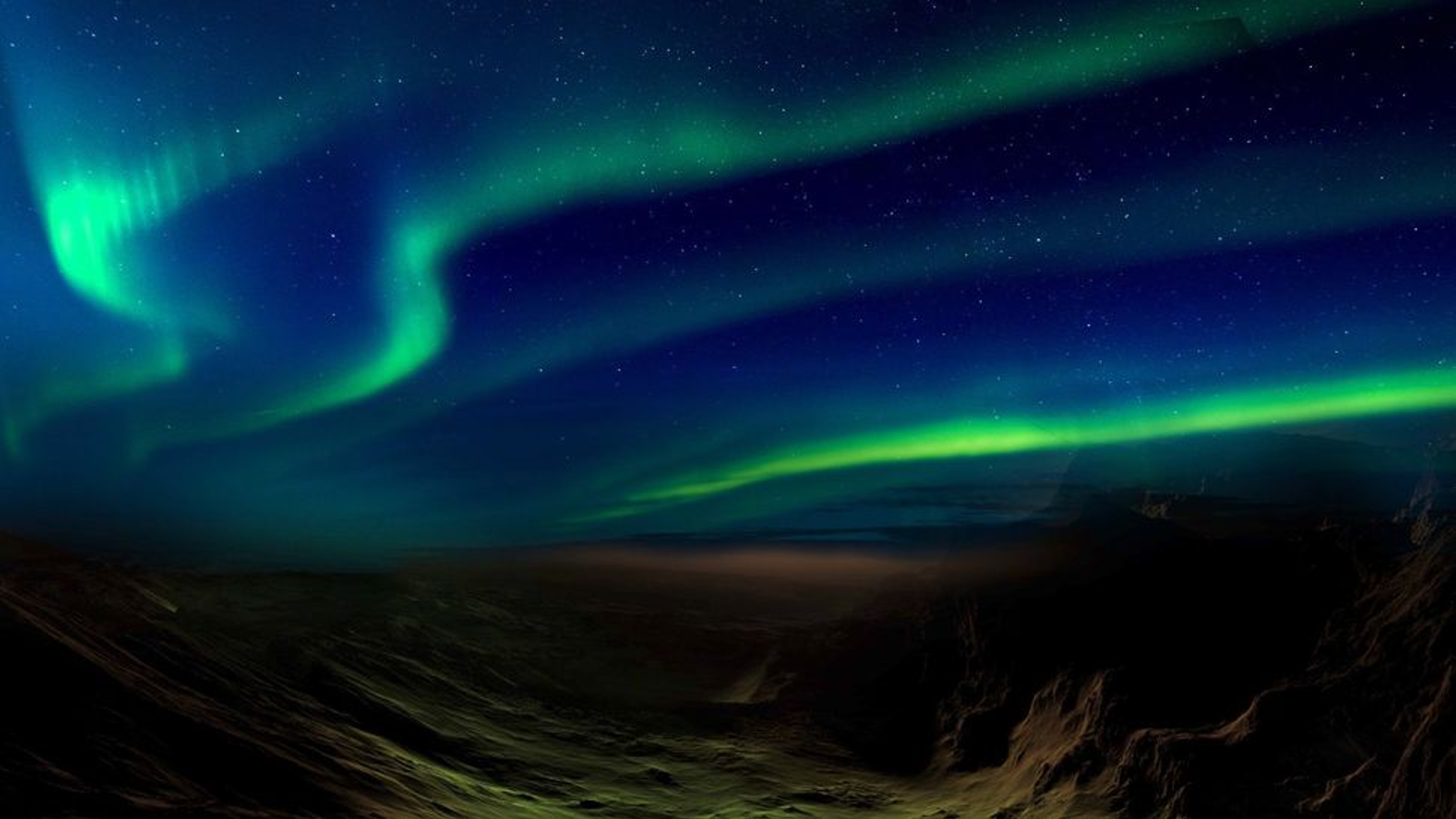
Lights on Mars! NASA rover photographs visible auroras on Red Planet for the first time

Lights on Mars! NASA rover photographs visible auroras on Red Planet for the first time

An artist's illustration of long ribbon-like auroras rippling across the Martian sky
Auroras have been detected on Mars before. However, unlike in this artist's illustration, they do not normally emit visible light. 
(Image credit: Emirates Mars Mission)

NASA's Perseverance rover has captured the first-ever photo of "naked eye" auroras on Mars. The alien light show — snapped after the Red Planet was battered by a powerful solar storm last year — is not as visually stunning as Earthly auroras, but it's arguably even more impressive.

The wandering robot snapped the newly released image on March 18, 2024, roughly three days after a sizable cloud of charged particles, known as a coronal mass ejection (CME), erupted from the sun. In a new study, published May 14 in the journal Science Advances, researchers revealed that the CME collided with Mars' patchy magnetic field, exciting the gas within the planet's wispy atmosphere to emit light, similar to how the most vibrant northern lights displays are created on Earth.

Mars was previously known to have several types of auroras, some of which have extended around the entire planet. However, until now, they have been emitted only in invisible wavelengths of the electromagnetic spectrum, predominantly in ultraviolet light.

You may like

In addition to being the first visible auroras on Mars, the faint green lights are believed to be the first auroras anywhere in the solar system to be captured using only visible wavelengths of light.

The new findings raise hopes that human eyes will one day witness auroras on another world firsthand. Under the right circumstances, Martian auroras "will be visible to future astronauts," the researchers wrote.

Related: 

A photo of mars night sky split into two, with green auroras visible on the left and the glare of Phobos on the right

Faint green light from auroras can be detected in both parts of this photo captured by Perseverance's Mastcam-Z on March 18, 2024. However, the color is more obvious when the glare from Mars' moon Phobos is removed (on the left hand side).  (Image credit: Knutsen et al., Sci. Adv. 11, eads1563 (2025))

The new photo was not captured by chance. Instead, researchers realized that the CME would likely hit Mars, so they positioned Perseverance's Mastcam-Z camera toward the Martian night sky in anticipation of catching a glimpse. However, even then, they were not confident they would see a visible aurora.

This also marks the first time a Martian aurora has been detected from the planet's surface. Until now, all observations have been captured by orbiting spacecraft, such as NASA's Mars Atmosphere and Volatile Evolution (MAVEN) probe and the UAE's Emirates Mars Mission orbiter.

Lights on Mars

Visible auroras were long assumed to be impossible on Mars because its atmosphere is extremely diffuse; the planet lacks a proper planet-wide magnetic field, which has allowed the solar wind and past solar storms to strip away most of Mars' air. However, the new image proves that there is still enough gas to emit the colorful lights.

Analysis of the auroras' green hues revealed that the light was emitted by excited oxygen molecules, which make up around 0.13% of Mars' limited atmosphere, according to Live Science's sister site Space.com. The low concentration of the gas, combined with high levels of dust in the air, is why the light from the auroras is barely visible in the photo.

The auroras were so weak that the light was apparent only after the glare from Mars' largest moon, Phobos, was edited out of the photo, which is why the image above is split in half.

An artist's impression of what Martian airglow might look like from space

Researchers also believe that future astronauts may see Martian airglow shining above the Red Planet. This photo shows a greatly exaggerated version of this phenomenon.  (Image credit: ESA)

It is unlikely that humans could have seen such weak auroras. However, the researchers think a higher dose of solar particles, coupled with reduced atmospheric dust, could allow the phenomenon to be visible to the naked eye in the future.

At night, another type of green, aurora-like light — known as airglow — can occur near the planet's poles and may be visible to future astronauts. This phenomenon occurs when oxygen molecules ionized by the sun cool down and recombine, releasing excess energy in the process. However, the newly observed auroras emitted a wavelength separate from any observed Martian airglow, which strongly hints that they are a new phenomenon.

Extraterrestrial auroras

Every other solar system world with an atmosphere — Venus, Jupiter, Saturn, Uranus and Neptune — is home to some sort of extraterrestrial aurora. However, as with Mars, these alien light shows occur in non-visible parts of the electromagnetic spectrum, including ultraviolet, infrared and X-ray light.

A picture of the Perseverance rover on Mars

NASA's Perseverance rover became to first human-made object to witness visible-light auroras on another planet.  (Image credit: NASA/JPL-Caltech/MSSS)

For distant worlds beyond the orbit of Mars, these auroras are triggered mainly by a constant stream of charged solar particles, known as the solar wind. However, some planets, such as Jupiter, can also experience extremely powerful auroras due to other phenomena, including magnetic anomalies triggered by these worlds' giant moons, recent research has revealed.

For planets closer to the sun — like Venus, Earth and Mars — more violent space weather events, such as CMEs, can also trigger auroras. Despite having virtually no atmosphere, Mercury has also been known to experience aurora-like X-ray emissions near its surface when the sun's closest neighbor is frequently hit by solar storms.

Large-scale solar outbursts have become more common in recent years as the sun has reached the peak of its roughly 11-year cycle of activity, known as solar maximum, when solar storms become more frequent and more intense. At various points, scientists have used Mars rovers to spy on the sun's far side, to predict when hidden CMEs may impact Earth.

{ https://www.livescience.com/space }

Hoe vind je dit bericht?
Geschreven door peter om 01:03 Stuur door

New Evidence Suggests Formation in Turkey Might Really Be Noah’s Ark

Overhead view of the Durupinar formation, near Mount Ararat in Turkey.

New Evidence Suggests Formation in Turkey Might Really Be Noah’s Ark

In a mountainous area of eastern Turkey, a team of American researchers believes they may have uncovered the remnants of one of history's most legendary vessels—Noah’s Ark. Working at a mysterious and intriguing site known as the Durupınar Formation, the group was stunned to discover what they describe as a “tunnel” beneath a boat-shaped geological formation that may match the Bible’s description of the vessel that supposedly came to rest after the Great Flood more than 4,300 years ago.

According to the Book of Genesis, Noah’s Ark was a massive wooden ship built to preserve humanity and animal life from a catastrophic global deluge. After 150 days, the Bible says, the ark came to rest “on the mountains of Ararat.” The Durupinar site lies just 18 miles (29 kilometers) south of Mount Ararat itself, Turkey’s highest peak and a location long rumored to be the ark’s final resting place.

Deep Scans Produce Stunning Results

The team, led by independent researcher Andrew Jones from the California-based organization Noah’s Ark Scans, employed ground-penetrating radar (GPR) to investigate the site. The scans reportedly revealed three distinct layers beneath the surface, an important detail that mirrors the biblical description of the ark having lower, second, and third decks.

One of the most significant discoveries to emerge from the GPR study is what appears to be a 43-foot (13-meter) tunnel running through the center of the formation. The scans also detected other open spaces and central and side corridors, which could suggest the presence of compartments or interior rooms.

“We're not expecting something that's fully preserved. What's left is the chemical imprint, pieces of wood and in the ground, the shape of a hall,” Jones explained in a statement published by the Daily Mail Online.

GPS scan showing structures and open spaces inside the formation in Turkey, which could reveal rooms and corridors.

(Noah’s Ark Scans).

So far, angular structures have been detected as deep as 20 feet (6 meters) below the surface of the ground. According to Jones and his colleagues, this would be a highly unusual feature in a naturally created geological formation.

“This is not what you'd expect to see if the site were simply a solid block of rock or the result of random mudflow debris,” Jones said. “But it is exactly what you'd expect to find if this were a man-made boat, consistent with the biblical specifications of Noah's Ark.”

Supporting their geophysical findings, the team has collected and analyzed soil samples from 22 different locations surrounding the Durupinar formation. Soil scientist William Crabtree, another member of the Noah’s Ark Scans team, noted that samples taken from inside the formation show significantly different characteristics from those collected elsewhere.

“Organic matter was found to be double inside the formation compared to the surrounding soil,” Crabtree stated. “If you know soil science—as I am a soil scientist—you will understand that potassium levels, organic matter, and pH can all be affected by the decomposition of organic materials. If this was a wooden vessel and the wood had rotted over time, we would expect to see increased potassium levels, changes in pH, and higher organic content—and that's exactly what we find.”

Further observations suggest grass growing within the formation differs in color from the vegetation outside it. This is a strong indicator that soil composition beneath the surface is varied or textured. Crabtree also mentioned a tunnel running from the tip of the structure toward its center, which is quite prominent and large. “It is large enough to walk through,” he said.

‘NOAH’S ARK' on Mount Ararat’ (1570) by Flemish painter Simon de Myle. 

(Public Domain).

Skeptics have long maintained that the Durupınar Formation is a natural rock formation, possibly created by mudflows and erosion. The Noah’s Ark Scans team believes the new evidence warrants more extensive investigation. They plan to expand their research with core drilling, additional radar scans, and more soil sampling to record internal and external conditions more thoroughly.

“We want to compare what’s inside the formation to what’s outside,” Jones said. “That could give us a much clearer picture of whether this is truly something man-made.”

Will the Durupinar Mystery Ever Be Solved?

Durupınar has intrigued explorers and researchers since 1948, when heavy rains and seismic activity exposed its unusual boat-like outline. Discovered by a local Kurdish shepherd, the site has drawn both scientific and religious interest for decades.

Until recently, however, no excavation has been officially sanctioned. That is about to change, as Noah’s Ark Scans has announced that they will carry out a controlled excavation in partnership with several Turkish universities. This is a victory for those who are at least open to the idea that the unusual formation may be a petrified Noah’s Ark, as academic institutions have traditionally dismissed the Ark story from Genesis as a myth.

Before breaking ground, the excavation team intends to complete a preservation plan, to make sure the integrity of the archaeological site is preserved regardless of what new studies may reveal.

Poster for the 1928 Warner Brothers motion picture Noah’s Ark.

(Public Domain).

Despite the widespread debate and skepticism from the broader scientific community, the team remains optimistic that their findings could reveal the truth about one of history’s oldest and most enduring stories (many cultures and spiritual traditions around the globe reference a global flood that supposedly occurred thousands of years ago). Whether the Durupınar Formation is truly the final resting place of Noah’s Ark remains in doubt, but the researchers involved in the new study are optimistic that their efforts will produce some eye-opening results.

  • Top image: Overhead view of the Durupinar formation, near Mount Ararat in Turkey.
  • Source: Noah’s Ark Scans.

By Nathan Falde

RELATED VIDEOS

{ https://www.ancient-origins.net/artifacts-0 }

Hoe vind je dit bericht?
Geschreven door peter om 00:42 Stuur door

Water Ice Found in Another Star System

Water Ice Found in Another Star System

waterice-.jpeg Artist's illustration of water ice in a protoplanetary system.

Water ice shapes the outer regions of our Solar System in profound ways, forming the thick crusts of moons like Europa and Enceladus that hide subsurface oceans, constituting major portions of Uranus and Neptune, and providing structure to countless comets and Kuiper Belt objects including Pluto. Beyond merely existing, this ice actively participates in exotic geological processes through sublimation, cryovolcanism, and tidal heating, creating some of the most dynamic environments beyond Earth while preserving chemical signatures from our Solar System's birth nearly 4.6 billion years ago.

comet_hartley_2.jpeg

The icy nucleus of of Comet Hartley 2 imaged by the Deep Impact (EPOXI) mission on November 2010

(Credit : NASA)

A new study, published in Nature, reports that observations using the James Webb Space Telescope (JWST) has confirmed the presence of crystalline water ice in a dusty debris disk orbiting a Sun-like star 155 light-years away, validating hints previously detected by the retired Spitzer Space Telescope in 2008. Lead researcher Chen Xie of Johns Hopkins University emphasised that JWST’s unprecedented spectral data revealed not just ordinary water ice but specifically crystalline water ice, the same form found in Saturn's rings and objects in our solar system's Kuiper Belt.

960px-spitzer_space_telescope.jpg

Artist impression of the Spitzer Space Telescope hinted at water ice in 2008

(Credit : NASA/JPL-Caltech)

This breakthrough, as noted by co-author Christine Chen of the Space Telescope Science Institute, finally enables researchers to study how water ice, which is crucial for giant planet formation functions across planetary systems, not just our own.

The young star HD 181327 is just 23 million years old compared to our 4.6 billion year old Sun and hosts an active debris disk that the team believe resembles our own Kuiper Belt billions of years ago. JWST's observations reveal a significant dust-free gap between the star and its debris disk. It’s here that frequent collisions between icy bodies continuously release tiny particles of dusty water ice perfectly sized for JWST to detect.

The water ice in the HD 181327 system is unevenly distributed, with the highest concentration—over 20%—in the cold, outer region of its debris disk, and much less (about 8%) in the middle. Near the star, almost no ice was detected, likely due to vaporisation by ultraviolet light or ice being trapped inside unseen planetesimals. The team used the JWST’s Near Infra-Red Spectrograph which can detect faint dust from space. Though slightly more massive and hotter than the Sun, HD 181327 offers a valuable look at what our early Solar System may have been like.

960px-nirspec_astrium.jpg

JWST's Near Infra-Red Spectrograph

(Credit : Astrium GmbH)

As astronomers continue mapping the presence of water ice across star systems, these discoveries build toward a more comprehensive understanding of planetary formation and evolution throughout the Galaxy. The striking similarities between HD 181327's debris disk and our own Kuiper Belt not only validate theoretical models but also suggest that our Solar System's development may be more representative than unique.

Future JWST observations of additional debris disks will likely reveal whether the patterns observed in HD 181327—with ice concentrations increasing at greater distances from the host star—represent a universal principle of planetary systems. This research opens exciting possibilities for understanding how water, essential for life as we know it, gets distributed during a planetary system's formation and potentially delivered to habitable zones where rocky planets reside. As we learn more about water in the Galaxy, we're ultimately learning more about the conditions that may have set the stage for Earth's own evolution and the emergence of life billions of years ago.

Source :

{ https://www.universetoday.com/ }

Hoe vind je dit bericht?
Geschreven door peter om 00:17 Stuur door
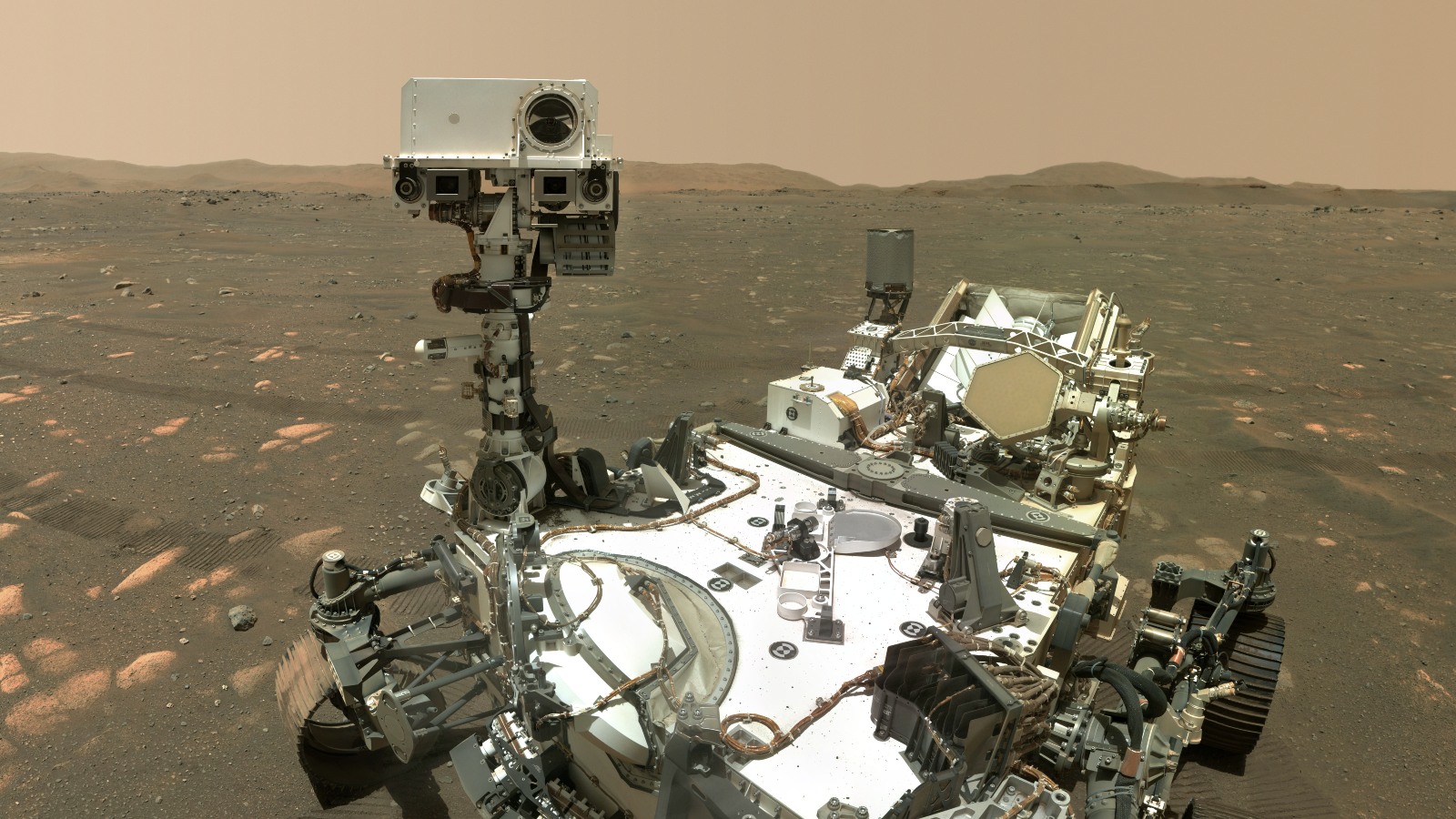
Venus Might Have Tectonic Activity After All

Venus Might Have Tectonic Activity After All

coronae_venus.jpeg New research suggests vast surface features on Venus called coronae continue to be shaped by tectonic processes. Observations of these features from NASA’s Magellan mission include, clockwise from top left, Artemis Corona, Quetzalpetlatl Corona, Bahet Corona, and Fotla Corona. (Credit : NASA/JPL-Caltech)

Venus, Earth's scorching twin, is our closest and most extreme planetary neighbour. Perpetually shrouded in thick, sulfuric acid clouds, it endures crushing atmospheric pressure 90 times Earth's and temperatures hot enough to melt lead. Despite appearing serene from space, the Venusian landscape features vast volcanic plains, towering mountains, and bizarre terrain forged in geological activity. Perhaps habitable billions of years ago, Venus now serves as a stark cautionary tale of runaway greenhouse effects.

1005px-venuspioneeruv.jpg

Venus, the second planet in our Solar System enshrouded in cloud

(Credit : NASA)

According to new research analyzing 30-year-old NASA Magellan data, Venus is now thought to be tectonically active after all. Unlike Earth's shifting tectonic plates generating mountain ranges and valleys, Venus displays large circular structures called coronae—ranging from dozens to hundreds of miles across. It’s here where hot material from the planet's mantle pushes upward against the lithosphere, creating distinctive oval formations surrounded by concentric fractures. These hundreds of coronae suggest Venus's surface is still being actively reshaped by internal forces despite lacking Earth-style plate tectonics.

magellan_at_kennedy_space_center.jpeg

Magellan with its Star 48B solid rocket motor undergoing final checks at the Kennedy Space Center

(Credit : NASA/JPL)

The new study published in Science Advances reveals these active processes through analysis of these corona formations. The circular features may offer insights into Earth's early development too before plate tectonics began. The team combined gravity and topography measurements from Magellan to understand the subsurface forces currently reshaping Venus.

"Coronae don't exist on modern Earth but likely did when our planet was young," - Gael Cascioli from the University of Maryland

The team used advanced 3D modelling to reveal that most studied coronae (52 of 75) have hot, buoyant mantle material beneath them actively driving tectonic processes. These processes include Venus-style subduction (where surface material spreads outward from rising plumes and pushes surrounding material downward), lithospheric dripping (where cool material sinks into the hot mantle), and volcanic activity where molten rock pushes through thicker crust—all providing crucial insights into planetary evolution.

The research builds on recent discoveries of volcanic eruptions at Maat Mons, Sif Mons, and Eistla Regio. While these findings are groundbreaking, researchers need higher-resolution data to fully understand Venus' tectonic activity. NASA's upcoming VERITAS mission, launching no earlier than 2031, will use high-resolution gravity data to further illuminate these planetary processes.

"VERITAS gravity maps will improve resolution by at least two to four times, potentially revolutionising our understanding of Venus' geology and its implications for early Earth," - Suzanne Smrekar, VERITAS principal investigator.

This renewed understanding of Venus as a geologically dynamic world challenges decades of assumptions. As we continue to unravel Venus's mysteries through both reexamination of existing data and upcoming missions, we may not only piece together its evolutionary past but also gain critical insights into Earth's potential future.

Source : 

RELATED VIDEOS

{ https://www.universetoday.com/ }

Hoe vind je dit bericht?
Geschreven door peter om 23:33 Stuur door

Methane is the Key to Understanding Titan

Methane is the Key to Understanding Titan

keck-jwst-titan-atmosphere.jpg These images of Titan were taken by NASA’s James Webb Space Telescope on July 11, 2023 (top row) and the ground-based W.M. Keck Observatories on July 14, 2023 (bottom row). They show methane clouds (denoted by the white arrows) appearing at different altitudes in Titan’s northern hemisphere. These are the first detailed observations of summer in Titan’s northern hemisphere. Image Credit: NASA, ESA, CSA, STScI, Keck Observatory

Saturn's moon Titan is the only other body in the Solar System with weather similar to Earth's. The large moon has a thick, nitrogen-rich atmosphere like Earth's, liquid on its surface, and a precipitation cycle. But instead of water, the surface liquid and the precipitation cycle are mainly based on methane.

Planetary scientists have questions about Titan's methane cycle, especially regarding the moon's northern hemisphere, where its hydrocarbon lakes are concentrated. The Cassini-Huygens mission examined that region during its mission, but left many questions unanswered. Titan's year lasts 29.45 Earth years, so the northern hemisphere experienced winter and spring the entire time that Cassini-Huygens was there.

In new research, scientists used the JWST and the Keck II telescope to observe Titan during 2022 and 2023, when the moon's northern hemisphere was experiencing summer. They gained new insights into Titan's methane cycle and other aspects of its atmosphere.

The research, published in Nature Astronomy, is titled "The atmosphere of Titan in late northern summer from JWST and Keck observations." The lead author is Conor Nixon, a planetary scientist from the Planetary Systems Laboratory at NASA Goddard Space Flight Center.

Titan has a thick atmosphere, and it's the only moon in the Solar System with one. Due to its cold surface and troposphere, methane can condense in the moon's lower atmosphere. "Methane therefore plays a similar meteorological role to water on Earth, evaporating from the surface and reaching the middle troposphere, where methane clouds form and rainfall occurs in changing seasonal patterns," the researchers explain in their article.

titan_in_true_color_by_kevin_m._gill.jpg

Titan is known for its thick, nitrogen-rich atmosphere, as seen in this true-colour Cassini image.

Image Credit: NASA/JPL-Caltech/SSI/Kevin M. Gill

"Titan is the only other place in our solar system that has weather like Earth, in the sense that it has clouds and rainfall onto a surface," Nixon explained in a press release.

In both worlds, convection drives the cycle. The Sun heats the surface and causes methane, or water in Earth's case, to evaporate and rise in the atmosphere. The temperature drops at higher elevations, and the vapour condenses and falls as rain.

"Together, these results provide a new, integrated look at the composition and meteorology of Titan's atmosphere in 2022 and 2023 from the upper atmosphere to the surface, at a season that was poorly documented by previous observations," the authors write in their research article.

One of the key questions facing scientists who study Titan's atmosphere concerns how the methane cycle changes through the seasons in different hemispheres. In this research, Nixon and his colleagues used the JWST's Mid-Infrared Instrument (MIRI) to detect the methyl radical CH3. CH3 has lost one of its hydrogen atoms and has an unpaired electron. That unpaired electron makes the radical highly reactive, and it typically has a very short lifetime because of it. CH3 is the main product of methane breakup in Titan's atmosphere, and is also the key to forming ethane and other heavier molecules like hydrogen cyanide (HCN) and acetylene (C2H2).

titan-methane-radical-cycle.jpg

JWST observations show how the methane cycle works in Titan's atmosphere. The moon has a thick, nitrogen-rich atmosphere that also contains methane. Sunlit and energetic protons from Saturn split apart methane, forming the methane radical CH3. CH3 is highly reactive and rapidly combines with other molecules or other CH3 molecules, forming molecules like ethane (C2H6). Then methane, ethane, and other molecules precipitate out of the atmosphere and fall as liquids onto Titan's surface, where they collect in the northern hemisphere's lakes.

Image Credit: NASA, ESA, CSA, Elizabeth Wheatley (STScI)

They used the JWST's Near-Infrared Spectrograph to detect CO and CO2 emission bands and measured these species over a wide range of altitudes. They also used the infrared cameras on the JWST and the Keck II to image tropospheric clouds over the northern hemisphere as they evolved by altitude. Scientists have observed clouds rising convectively over the southern hemisphere, but never over the northern hemisphere.

jwst-titan-spectroscopy.jpg

This figure from the research shows the JWST's spectroscopy results from NIRSpec (top) and MIRI (bottom). Grey bands in the top image show Titan's atmospheric windows. Note the detection of CH3 in the MIRI data, the first definitive detection of the methane radical in the moon's atmosphere.

Image Credit: Nixon et al. 2025, Nature Astronomy.

This is significant because Titan's methane seas are concentrated in the northern hemisphere. This research shows how the seas can be the source of methane evaporation that fuels the moon's methane cycle.

titans-hydrocarbon-lakes.jpg

Titan's lakes or seas are concentrated in the northern hemisphere and have about the same surface area as the Great Lakes.

Image Credit: NASA / JPL-Caltech / Agenzia Spaziale Italiana / USGS, Public Domain.

This isn't the first time scientists have observed clouds in Titan's atmosphere, but it's the first time observations have revealed such powerful convection.

"Our new observations of methane clouds in Titan's troposphere during late northern summer on Titan add to a catalogue of previous detections recorded by ground- and space-based observations that trace the seasonal variation of Titan's weather over nearly a full year," the authors write. Cassini detected many clouds in the southern hemisphere, and ground-based telescopes have observed large cloud outbursts in the same region.

In the last summer solstice in the northern hemisphere in 2017, clouds were increasingly being detected, "but few indicated deep, moist convection," the authors write. "Our observations indicate a continuation of cloud activity into late northern summer, roughly in agreement with the behaviour at high southern latitudes during southern summer, and also indicate the occurrence of deep, moist convection extending to the tropopause over the region of Titan where most of the surface liquids exist," they explain.

titan-clouds-2.jpg

This figure from the research article shows how clouds were detected over Titan's northern hemisphere. Arrows show the clouds as they change over time.

Image Credit: Nixon et al. 2025, Nature Astronomy.

The research also examines what these new insights into Titan's atmosphere could mean for its future.

When methane breaks up in Titan's atmosphere, some of it joins with other molecules and falls back to the surface; however, some hydrogen escapes into space. That means that without constant methane replenishment from some source, Titan's atmosphere will deplete methane over time. This happened on Mars, which is now a cold, dry world.

"On Titan, methane is a consumable. It’s possible that it is being constantly resupplied and fizzing out of the crust and interior over billions of years. If not, eventually it will all be gone and Titan will become a mostly airless world of dust and dunes," said lead author Nixon.

RELATED VIDEOS

{ https://www.universetoday.com/ }

Hoe vind je dit bericht?
Geschreven door peter om 22:55 Stuur door

Disk Disk Splits Into Dozen Orbs Over Warsaw, Poland May 2025, UFO UAP Sighting News. -VIDEO-

Disk Disk Splits Into Dozen Orbs Over Warsaw, Poland May 2025, UFO UAP Sighting News. VIDEO

UFO_Poland_UAP.gif
Date of sighting: May 13, 2025
Location of sighting: Warsaw, Poland
Source: Email scwaring @ yahoo.com
 
Guys, check this out. A person recorded a blue disk over Poland this week and I think this is something pretty big. This might not be as alien as it might look, but instead may be something far more sinister in disguise. I believe this to be a practice of the US military Project Blue Beam. A project designed using blue laser and holographic images of UFOs worldwide in order to put fear into all other countries and make them give their powers over to the United States of America, basically making a world government or US in control of all. Thats the US plan, and this is just a test in front of us. 
Scott C. Waring - UFO Sightings Daily
 
Eyewitness states: 
  • I saw this over Warsaw and the disk wasn't moving but suddenly broking into many pieces. What am I looking at here?
 

{ https://www.ufosightingsdaily.com/ }

Hoe vind je dit bericht?
Geschreven door peter om 21:24 Stuur door

Inside the Stargate Program: Remote Viewing, UFO Bases & the Secrets of Consciousness

Inside the Stargate Program: Remote Viewing, UFO Bases & the Secrets of Consciousness

ngcb1

Dr. Paul H. Smith, a former U.S. Army intelligence officer and one of the original participants in the top-secret Stargate Program, has long stood at the crossroads of military-grade psychic research and consciousness exploration. In a recent in-depth conversation, he peeled back the layers on hidden UFO bases, the evolution of remote viewing (RV), and what it means for our understanding of human perception and non-local consciousness.

From Intelligence Officer to Psychic Spy

Dr. Smith’s entry into the world of psychic intelligence began in the early 1980s when he was recruited under mysterious circumstances while stationed at Fort Meade. With a background in Middle Eastern analysis and linguistic proficiency, Smith had no idea that his next assignment would involve learning how to transcend space and time to gather intelligence using only his mind.

After passing a series of psychological and personality tests, he was introduced to Coordinate Remote Viewing (CRV), a structured technique originally developed by artist and psychic Ingo Swann and physicist Hal Puthoff at Stanford Research Institute (SRI). The methodology allowed individuals to “view” distant targets by accessing information beyond ordinary perception — a concept once relegated to science fiction.

Stargate, Soviet Threats, and the CIA’s Role

The military’s interest in remote viewing began during the Cold War when U.S. intelligence agencies learned that the Soviets were investing millions in psychotronic research. The CIA, initially skeptical, began supporting experiments at SRI after Swann successfully influenced a shielded device in a lab — an event that reportedly defied conventional explanation.

Dr. Smith explains that remote viewing was formally integrated into U.S. Army intelligence operations in the late 1970s. The Stargate Project became a classified unit tasked with gathering actionable intelligence, ranging from hostage situations to potential foreign threats — sometimes including unconventional targets like hidden underground facilities.

The Typhoon Submarine Case: Proving It Works

One of the most compelling examples of RV’s success was the prediction of the Soviet Typhoon-class submarine. Remote viewer Joe McMoneagle, working blind, described a massive submarine under construction with missile tubes located in front of the conning tower — a design detail that contradicted naval norms.

The National Security Council initially dismissed the session, but months later, the Typhoon sub was launched — exactly as described. Ironically, this success was not officially acknowledged, contributing to the misconception that remote viewing had no real-world impact.

Pat Price, Hidden UFO Bases, and a Mysterious Death

Another central figure in remote viewing lore is Pat Price, a former police commissioner turned psychic. His sessions — particularly those involving four suspected alien bases (Mount Hayes, Alaska; Australia; Africa; and Spain) — remain controversial. What’s extraordinary is that multiple remote viewers, including Dr. Smith himself, unknowingly corroborated Price’s earlier findings when tasked to view Mount Hayes years later.

Price described alien-like entities operating underground facilities, and even sketched craft eerily similar to what modern witnesses call “Tic Tac” UFOs. He later died suddenly under suspicious circumstances. According to Price’s daughter, he had warned that if anything happened to him, it would be the KGB — a plausible theory given that there is no known method to shield against psychic surveillance, making psychic operatives like Price high-value targets.

Consciousness as a Non-Local Phenomenon

For Dr. Smith, the implications of remote viewing go far beyond espionage. The practice suggests that consciousness may be non-local, capable of existing independently of time and space. This idea has philosophical and metaphysical ramifications, challenging materialist assumptions and opening new doors into the study of mind and existence.

Remote viewing has produced results that imply the viewer can “bilocate,” experiencing presence both in the viewing room and at the distant target — including locations as extreme as the far side of the Moon. In one such case, Smith and other trained viewers described an artificial underground cavity on the Moon containing manta-ray-shaped craft, potentially biological in nature and seemingly aware of being observed.

Psionics, Classified Programs, and the Future of Human Potential

As new whistleblowers like David Grusch and Jake Barber come forward, alleging the existence of recovered alien craft and so-called “psionic assets,” Dr. Smith remains cautiously open. He draws parallels between these new terms and the military’s older term psychoenergetics, which encompassed remote viewing and similar phenomena.

While the Stargate program was officially shut down in 1995, Smith and others believe interest in consciousness-based intelligence gathering never truly ended. Some former insiders, like Skip Atwater, have hinted at the existence of successor programs.

Dr. Paul H. Smith remains one of the most grounded and credible voices in the world of psychic phenomena. His experience spans not only military intelligence but also deep philosophical inquiry into the nature of mind, space, and perception.

If the implications of remote viewing are real — and according to Smith, they very much are — then humanity is only beginning to understand its own untapped potential. Whether for intelligence gathering, interstellar exploration, or expanding our comprehension of consciousness itself, remote viewing stands as one of the most fascinating and misunderstood tools of the modern age.


{ https://www.latest-ufo-sightings.net/ }

Hoe vind je dit bericht?
Geschreven door peter om 21:13 Stuur door

James Webb telescope reveals 'impossible' auroras on Jupiter that have astronomers scratching their heads

James Webb telescope reveals 'impossible' auroras on Jupiter that have astronomers scratching their heads

images showing auroras on Jupiter
JWST captured auroras on Jupiter "fizzing and popping with light" on Christmas Day 2023. (Image credit: NASA, ESA, CSA, STScI, Ricardo Hueso (UPV), Imke de Pater (UC Berkeley), Thierry Fouchet (Observatory of Paris), Leigh Fletcher (University of Leicester), Michael H. Wong (UC Berkeley), Joseph DePasquale (STScI), Jonathan Nichols (University of Leicester), Mahdi Zamani (ESA/Webb))

On Christmas Day in 2023, scientists trained the James Webb Space Telescope (JWST) on Jupiter's auroras and captured a dazzling light show.

The researchers observed rapidly-changing features in Jupiter's vast auroras using JWST's infrared cameras. The findings could help explain how Jupiter's atmosphere is heated and cooled, according to a study published May 12 in Nature Communications.

"What a Christmas present it was — it just blew me away!" study coauthor Jonathan Nichols, a researcher studying auroras at the University of Leicester in the UK, said in a statement. "We wanted to see how quickly the auroras change, expecting them to fade in and out ponderously, perhaps over a quarter of an hour or so. Instead, we observed the whole auroral region fizzing and popping with light, sometimes varying by the second."

You may like

Auroras form when high-energy charged particles, often released from the sun, slam into gases in a planet's atmosphere, causing the gas to glow. Jupiter's strong magnetic field scoops up charged particles such as electrons from the solar wind — and from eruptions on its highly volcanic moon Io — and sends them hurtling toward the planet's poles, where they put on a spectacle hundreds of times brighter than Earth's Northern Lights.

Related: 

In the new study, the team looked closely at infrared light emitted by the trihydrogen cation, H3+. This molecule forms in Jupiter's auroras when energetic electrons meet hydrogen in the planet's atmosphere. Its infrared emission sends heat out of Jupiter's atmosphere, but the molecule can also be destroyed by fast-moving electrons. To date, no ground-based telescopes have been sensitive enough to determine exactly how long H3+ sticks around.

But by using JWST's Near Infrared Camera, the team observed H3+ emissions that varied more than they expected. They found that H3+ lasts about two and a half minutes in Jupiter's atmosphere before being destroyed. That could help scientists tease out how much of an effect H3+ has on cooling Jupiter's atmosphere.

But the scientists don't have the full picture yet. They also found some puzzling data when they turned the Hubble Space Telescope toward Jupiter at the same time. Hubble captured the ultraviolet light coming from the auroras, while JWST captured infrared light.

"Bizarrely, the brightest light observed by Webb had no real counterpart in Hubble's pictures," Nichols said in the statement. "This has left us scratching our heads. In order to cause the combination of brightness seen by both Webb and Hubble, we need to have a combination of high quantities of very low-energy particles hitting the atmosphere, which was previously thought to be impossible. We still don't understand how this happens."

In future work, the researchers plan to study the source of this unexpected pattern using additional JWST data as well as observations from NASA's Juno spacecraft, which has been observing Jupiter from orbit since 2016.

RELATED VIDEOS

{ https://www.livescience.com/space }

Hoe vind je dit bericht?
Geschreven door peter om 23:31 Stuur door

10 Ways Artificial Intelligence Will Completely Change the World by 2030

10 Ways Artificial Intelligence Will Completely Change the World by 2030

In recent years, Artificial Intelligence (AI) has transitioned from a concept primarily seen in science fiction to a significant and ever-present aspect of our daily lives. This rapid evolution suggests that by 2030, AI will become as integral to human life and society as smartphones are today. A report from PricewaterhouseCoopers (PwC) supports this view, projecting that AI will contribute an impressive $15.7 trillion to the global economy by 2030.

This monumental shift indicates that the impact of AI on our world will be profound. To summarize, as AI continues to intertwine with various facets of life, it transforms not just technology but the very fabric of our existence, suggesting limitless possibilities akin to the way matter transforms into mind.

10 Ways Artificial Intelligence Will Completely Change the World

Let’s look at the future that AI has in store for us, good or worse.

1. HealthCare

AI has already revolutionized the healthcare sector by helping personalized delivery of care, building models that detect life-threatening diseases in their earlier stages, and assessing the treatment options’ risk and success rate.

Cancer patients will be the biggest beneficiaries of AI in the future. It is expected that five years down the road, AI will be controlling the usage of chemotherapy drugs related to dosage calculation and optimizing chemotherapy regimens. Clinical trials are going on using AI to calculate more accurate target zones for spinal radiotherapy that will result in swift and accurate treatment.

Similarly, there will be computer-aided detection (CAD) systems for diagnosis in general practice, leading to 70% reduction in misdiagnosis, preventing unnecessary surgeries, and offering more accurate remedial actions.

A New York University study found out that AI was better at finding breast cancers in women than human pathology, meaning that AI is seeing things the human eye can’t.

2. Shopping in 2030 would be Different

AI will significantly shape your shopping experience in 2030. This is one of the biggest changes we will see as clear evidence how artificial intelligence will change the world. More than 45% of supermarkets will be cashierless in 2030. You would walk into a store, grab what you want, and leave. No Lines, No checkouts. Amazon Go is already leading this transition by launching cashier-less convenience stores in 2020, while other chains like Walmart and Sam’s Club are soon to follow in their footsteps.

Augmented reality will be commonly used to simulate an in-person shopping experience. Customers can see how a product will look in their home in an interactive 360-degree experience. Shopify AR is an example of such a tool creating an immersive shopping experience.

Within 30 minutes after clicking on the order now button, a drone would have the product at your doorstep. Imagine watching a beautiful sunset on your porch with thousands of drones buzzing around delivering packages.

3. AI Backed Virtual Reality

Imagine a virtual world with endless possibilities, where you can meet, work, invest and play with other people around the globe, just using virtual glasses and a headset.

This is what Facebook (now Meta) is going all-in on. Metaverse will replace reality with computerized simulations. As per Zuckerberg, it is the next evolution of social connection where you will be able to share not just moments but experiences with other people.

By 2030, you will be able to attend concerts from your couch, work and have in-person virtual meetings with colleagues, do shopping, and invest in virtual real estate. While Metaverse will open the door to unfathomable opportunities, there may be social and ethical hazards that we will cover in another post.

4. Intelligent Banking

Banking in 2030 will be different; more sophisticated, efficient, and lucrative. Customer representatives will be replaced by chatbots, handling a multitude of requests in a short period, thus enhancing customer experience. Robo advisors will become the norm. They would become main game-changers for the banking industry, saving a lot of time for wealth managers and supplementing them in profitable decision-making.

AI will personalize customer experience to the extent that producing an ID in a Bank would no longer be required, and mere facial recognition will be used to verify and produce all of your account details.

5. Autonomous Self-driven Cars

Artificial intelligence (AI) and self-driving automobiles are the most complementary subjects in Technology. It is a life-and-death tussle between rival billionaires from Tesla to Aurora to AutoX.

There are six levels of automated vehicle driving systems. Currently, we are at level 2, and by 2030, we will achieve level 5 autonomy; complete driverless cars. By 2030, there will be 62.4 million self-driving cars in the market – up from 20.4 million in 2021. These cars are expected to account for about 12 percent of total car registrations by 2030.

6. Artificial Intelligence Will Change the World: Will Robots Be Everywhere?

Robotics is an exciting yet controversial field in AI. The total global stock of Robots will reach 20 million by 2030. According to Oxford Economics, these robots will be responsible for the loss of 20 million manufacturing jobs.

However, advances in AI would also mean that robots will play a more significant role in healthcare, construction, hospitality, farming, and entertainment. Disney Pictures engineers have already developed hundreds of robots to help them design animations. Amazon also doubled its robot workforce to 200,000 in 2021.

Similarly, robot-assisted surgeries would allow doctors to perform minimally invasive surgeries with more flexibility, precision, and control.

7. No more Need for Classrooms

AI-powered education systems will almost replace direct instruction by 2030. Adaptive learning software will be able to learn students’ preferences and past performance and then suggest areas of improvement where extra attention is needed. Adoption of Adaptive learning would mean that the role of teachers will change. The teacher will become a motivator, schedule designer, and student mentor. The agility of software would also mean that the academic curriculum would be reduced to 3 to 4 hours a day while the remaining time would be used to equip students with life skills or help them explore areas of personal interest.

8. Deep Fakes

AI will be used for manipulation. One such specious AI technology is Deep Fake. Deepfake technology uses someone’s behavior, like voice, face, typical facial expressions, or body movements, to deceptively create videos virtually identical to the original content. So, it will show real people saying or doing things they never said or did.

It is predicted that Deepfakes and AI imagery may account for 90% of all online videos by 2030. There will be intense competition to create and eliminate deepfakes in the future, as the technology will become easily accessible to everyone making it hard to distinguish authentic content from fake.

9. Massive Job Losses

AI will cause massive job displacement by 2030. The majority of quantitative or objective jobs, e.g., bookkeeping, customer service calls, receptionists, etc., will be replaced by AI. McKinsey Global Institute predicts that by 2030, around 45 million Americans (1/3rd of the total workforce) will lose their jobs to automation.

10. Privacy Issues

The greatest social risk of AI is Privacy Breach. As artificial intelligence evolves, it will amplify the ability to use personal information for commercial and political reasons.

Your autonomy as an individual will be greatly compromised as, on the one hand, governments will track their citizens as they move around, while businesses, on the other hand, will be monitoring your online behavior to serve you ads that resonate with your past surfing behavior. This grey area of AI has been heavily criticized and scrutinized by human rights activists. It is really hard to predict what the future holds, but one thing is for sure: AI is a big part of it.

RELATED VIDEOS

{ https://curiosmos.com/category/curious-lists/ }

Hoe vind je dit bericht?
Geschreven door peter om 22:31 Stuur door

Here Are 6 Incredible UFO Videos Filmed by the Military You Won’t Believe Are Real

Here Are 6 Incredible UFO Videos Filmed by the Military You Won’t Believe Are Real

In the wake of all that’s going on with the Navy, the Pentagon, and pilots admitting to encountering mysterious flying crafts while on different missions, people around the globe have regained interest in UFOs.

Millions of people around the planet believe in UFOs, and they argue that it is very likely that these unidentified flying vehicles are not from Earth.

And listening to everything Navy pilots and government officials have to say about these objects makes us want to believe these flying vehicles could come from a distant world.

Incredible UFO Videos

For example, in a recent interview with “Fox & Friends,” former Deputy Assistant Secretary of Defense for Intelligence Christopher Mellon said:

“We know that UFOs exist. This is no longer an issue. The issue is, why are they here? Where are they coming from, and what technology are we observing behind these devices?”

Shutterstock. Shutterstock.

Further evidence of their possible alien origin can be found in reports and testimonies of Navy pilots who reported encountering these objects daily.

Pilots who have seen UFOs argue the unidentified flying objects can do things that are not possible in this physical realm.

In other words, they can outmaneuver our most advanced military aircraft and seem to defy the laws of physics.

Video Evidence

Luckily for us, there’s evidence that supports the above.

In this article, we’ve gathered six extremely interesting videos recorded by the military.

Some of these videos have been declassified recently, while others are fairly recent.

Aguadilla Encounter

Homeland Security filmed a video a few are familiar with over Aguadilla in Puerto Rico.

While on a routine mission, a DHS aircraft spotted a UFO and recorded it using its thermal imaging camera.

What you will see in the video is an object that seems capable of traveling at night without lights, at times below tree-top altitude, at speeds approaching 100 mph, and apparently without risk of impacting objects as it passes by.

Chilean Navy Encounter

The U.S. Navy isn’t the only military branch to have come across UFOs. Back in 2014, a Chilean Navy Helicopter, an Airbus Cougar AS-532, was on a routine patrol, west of Santiago when pilots saw something odd in the sky.

The helicopter tired chasing the object for nearly ten minutes. The video you will see shows the Navy pilots attempting to chase down the UFO, and communicate with it. Despite trying to contact the unidentified object using multi-national, civilian bandwidth designed for this purpose, no one ever answered.

According to the pilots, the object they saw was a “flat, elongated structure” with “two thermal spotlights like discharges that did not coincide with the axel of motion.”

Mexican UFO Encounter

In 2004, the Mexican Air Force came across a fleet of unidentified flying objects.

Pilots on a routine mission in Mexican airspace encountered 11 flying objects flying in close proximity to them.

The objects were reportedly only visible using the IR-system but appeared invisible to the naked eye.

U.S. Navy F-18 UFO Encounter

This amazing footage was recorded by a F/A-18F Super Hornet and was released not long ago thanks To the Stars Academy of Arts and Science website.

The video, recorded on the Eastern coast of the United States, was filmed in 2015.

This footage was captured by a U.S. Navy F/A-18 Super Hornet using the Raytheon ATFLIR Pod that was being operated by a highly trained aerial observer and weapons system operator whom the government has spent millions of dollars to train.

U.S. Navy San Diego Coast Encounter

In 2004, a U.S. Navy F/A-18 Super Hornet encountered an unidentified flying object off the coast of  San Diego.

As noted by a report from the ‘To the Stars Academy of Arts & Science’, “footage comes with crucial chain-of-custody (CoC) documentation because it is a product of U.S. military sensors, which confirms it is original, unaltered, and not computer-generated or artificially fabricated.”

The Gimbal footage

This was one of the very first (actually the first) videos that have been through the official declassification review process of the United States government and have been approved for public release.

The footage was taken aboard a F/A-18 Super Hornet aircraft using the Raytheon Advanced Targeting Forward-Looking Infrared (ATFLIR).

In addition to the fascinating footage, the reaction of the pilots who spotted the UFO is extraordinary.


{ https://curiosmos.com/category/alien-theories/ }

Hoe vind je dit bericht?
Geschreven door peter om 22:02 Stuur door

Former Marine Witnessed Covert US Forces Loading UFO With Weapons

Former Marine Witnessed Covert US Forces Loading UFO With Weapons

In an unprecedented revelation, Michael Herrera, an ex-Marine, recalls how he and his five-member team allegedly witnessed an unidentified flying object that was being loaded with weapons, while on duty in Indonesia back in 2009. Their encounter was followed by a threatening confrontation with unknown US forces, marking a chilling incident in their military service.

Unusual Sighting during Humanitarian Mission

Herrera, who was stationed on a humanitarian mission following the catastrophic earthquake and tsunami in Sumatra, discloses how he and his unit encountered an octagonal, hovering craft purportedly crewed by undercover US forces. The extraordinary event occurred while they were safeguarding an aid supply drop outside Padang city in October 2009.

After 14 years of reticence, Herrera has decided to break his silence. Encouraged by new protections for UFO whistleblowers, he officially testified under oath in April before the government’s UFO investigative team, the All Domains Anomaly Resolution Office (AARO), and a Senate committee. Backing his claims, Herrera presented his spotless four-year service record and correspondence relating to the incident with a reluctant fellow witness who feared jeopardizing his life and family’s safety.

Validation of Peripheral Facts

Through its military sources, the Daily Mail confirmed some aspects of Herrera’s story. However, the 33-year-old Denver native lacks tangible proof or photographs of the actual incident.

Herrera’s journey as a Marine started straight after high school. Less than two years into his service, he was deployed to the Philippines with the 31st Marine Expeditionary Unit to assist with typhoon relief. When a 7.6 magnitude earthquake hit Sumatra on September 30, 2009, his 2nd Battalion, 5th Marines, 2nd Platoon from Echo Co. was dispatched to safeguard humanitarian aid drops around Padang city, plagued by local insurgent violence.

A massive UFO was loaded with weapons

During their mission, around October 8, Herrera and his team were heli-dropped at a clearing in Padang city’s northeast region. They climbed a ridge to their assigned positions for the supply drop, and that’s when Herrera spotted a peculiar object across the hill in the jungle.

Herrera narrates how he saw the object, as large as a football field, changing colors and emitting a peculiar hum. This octagonal craft with a pyramid top featured scales, sharp edges, and Vantablack-like panels. As Herrera and his team ventured closer, they were intercepted by eight unidentified men in all-black armor, wielding M4 rifles with high-end night vision attachments.

The Confrontation and Threat

Upon confrontation, the mysterious troops seized their weapons, scanned their military IDs, and loaded large containers onto a platform beneath the craft. The ship lifted off the ground, flashed lights of varying colors, and sped off silently at a remarkable speed. Shaken by the experience, Herrera and his team were ordered to retreat and not look back.

Back at their aid drop site, they faced reprimands from their artillery sergeant for returning early but kept mum about their unsettling encounter. Herrera recalls his fear and confusion, struggling with how to explain the situation.

UFO silence: Post-Incident Interrogation and Silencing

Once aboard the USS Denver, Herrera’s unit faced questions from an unrecognized rear admiral. Herrera’s camera’s memory card and battery, along with his comrades’ phones, went missing. Later in Okinawa, Japan, an unnamed Air Force lieutenant colonel warned Herrera against discussing the incident, sealing his silence with an NDA.

Herrera, who successfully served four years in the Navy and earned various medals, now leads a private security company, Valkyrie Eye. His public confession coincides with a recent claim from a former intelligence official about the US recovering and reverse-engineering crashed non-human spacecraft.


{ https://curiosmos.com/category/alien-theories/ }

Hoe vind je dit bericht?
Geschreven door peter om 21:23 Stuur door

Why Don't Titan's Seas Have Deltas?

Why Don't Titan's Seas Have Deltas?

Grainy monochrome satellite image of a river and its tributaries flowing into a sea. The image is grainy, with the liquid showing black and the ground in shades of grey and white. This image from NASA's Cassini spacecraft shows a vast river system on Saturn's moon Titan. Image Credit: NASA/JPL-Caltech/ASI

Titan, the largest moon of Saturn, looks more Earth-like on its surface than any other place in the Solar System. With its thick atmosphere and liquid methane rain, it has lakes, rivers, sand dunes and seas. But appearances can be deceiving and in other ways, Titan is in fact a very alien world. One baffling difference, recently discovered, is that Titan's rivers do not seem to form deltas when they reach the sea.

Titan is the largest moon of Saturn. It was discovered in 1655 by Christiaan Huygens, and was the 6th moon to be discovered after our own, and the 4 Galilean moons around Jupiter. It is the second largest moon in the Solar System, and orbits Saturn at an average distance of roughly 1.2 million kilometers. Although it is larger than Mercury, it has less than half as much mass. It also has a thick, cloudy atmosphere, and until a few decades ago, that was almost all we knew.

A breathtaking view of Titan's mysterious hydrocarbon seas, where rivers end in deep pits, challenging our understanding of planetary geology.

Similarities with Earth

When the Cassini mission arrived, we learned that Titan was surprisingly similar to Earth. It has an atmosphere thicker than our own and is the only place in the entire universe, outside of Earth, where we have observed the presence of free-running liquids on the surface. Despite the extreme cold, it has weather systems complete with rain falling from the clouds.

This rain, when it lands, rolls downhill to form streams and rivers, which eventually empty out into lakes and seas. Like on Earth, these rivers carve channels unto the ground, forming river beds, and they carry sediment.

But despite these similarities, they are still very different worlds. Titan is a place of extreme cold. Being so far from the Sun, it doesn't receive a lot of warming sunlight, and it doesn't have a massive molten iron core. At these temperatures, water is frozen so hard that it is just another kind of rock. The liquids raining from the sky and flowing on the surface? Super-chilled ethane and methane.

Hydrology

On Earth, water circulates around the planet in a cycle. Liquid water gives up some of its molecules to the atmosphere, driven out by their internal heat energy, in a process we call evaporation. The water vapour in the atmosphere circulates around the globe until it finds a region where the pressure is high enough, the temperature low enough, that it condenses into tiny droplets around nucleation sites: specks of dust or airborne bacteria. Sometimes these droplets stay liquid, and combine to form larger and larger droplets, sometimes they freeze into ice crystals, but either way we can see them from the ground as clouds. If the droplets get big enough, they start to fall, and we get precipitation (rain, snow, hail, depending on conditions).

If the rain falls from low enough that it doesn't simply evaporate again, it reaches land and wets the ground. Some soaks into the soil, the rest trickles down to form small streams, which in turn combine to form rivers, and eventually flow into the sea (or not! Some rivers in arid areas simply fade away, either soaking into the parched earth or evaporating away entirely). As rivers flow, they erode the ground beneath them, carving river beds, and transporting silt. This silt can be deposited wherever the flow is slow, and eventually builds up enough to change the course of the river. When this happens at a river mouth, the mouth begins to block up with silt and the river eventually breaks a new path around the blockage. Over enough time, this happens often enough that you are left with the classic triangular river delta formation.

But for some reason, this doesn't seem to happen on Titan!

Cassini

Titan's thick soupy atmosphere makes it hard to observe any of these features. None of this would be known without Cassini's synthetic aperture radar (SAR). Unfortunately liquid methane and ethane are completely transparent to the SAR instrument, so many of the details are inferred. We don't observe rivers or seas directly, but instead we see what they've done to the ground beneath: river beds cutting across the landscape, emptying to large basins that make up lake and sea beds.

Given that Deltas are formed from silt accumulated over very long times, blocking up river mouths and forcing rivers to find new paths, you might expect these formations to be easy to spot. But researchers studying Cassini mission data have not found them.

"It's kind of disappointing as a geomorphologist because deltas should preserve so much of Titan’s history," said Sam Birch, an assistant professor in Brown University’s Department of Earth, Environmental and Planetary Sciences. "We take it for granted that if you have rivers and sediments, you get deltas. But Titan is weird. It’s a playground for studying processes we thought we understood."

The hunt continues

To test his assumptions, Birch developed a numerical model to process similar data from a more familiar world: Earth. The model simulated what Earth's underwater features might look like to the same SAR instruments, if they were under liquid methane and ethane instead of water, and confirmed that river deltas should have been easily visible.

"If there are deltas the size of the one at the mouth of the Mississippi River, we should be able to see it," Birch said. "If there are large barrier islands and similar coastal landscapes like those we see all along the U.S. Gulf Coast, we should be able to see those."

But when Birch and his colleagues returned to the Cassini data they did not find the missing features: Only two rivers, near the South Pole of Titan, showed possible delta formations. By their count based on the Cassini data, only 1.3% of large rivers on Titan terminate in deltas, compared to almost all comparable rivers on Earth.

We're unlikely to know for certain what's going on until another mission can be sent to Saturn to study its moons more closely. But Birch and his team do have some ideas: Perhaps the sea level rises and falls fast enough that the sediments are regularly submerged, washing the silt away before it has time to form a proper delta. Or possibly strong winds and coastal currents are doing the same thing. After all, radar imaging has also revealed deep river channels cut into the sea beds themselves, another mystery that hasn't yet been solved.

As usual, it will take more data, and a lot more hard work from planetary scientists to find answers.

"This is really not what we expected," Birch said. "But Titan does this to us a lot. I think that’s what makes it such an engaging place to study."

{ https://www.universetoday.com/ }

Hoe vind je dit bericht?
Geschreven door peter om 20:47 Stuur door

Martian Resource Potential and Challenges for Future Human Activities

Martian Resource Potential and Challenges for Future Human Activities

mars-isru-750.jpg Artist's rendition of in-situ resource utilization on Mars. (Credit: NASA)

What steps can be taken to enhance in-situ resource utilization (ISRU) for future astronauts on Mars? This is what a recent study presented at the 56th Lunar and Planetary Science Conference hopes to address as an international team of researchers investigated the reasons, benefits, and challenges of conducting ISRU on Mars. This study has the potential to help astronauts, scientists, engineers, and mission planners develop new methods for enhancing the survivability of future Mars astronauts while also maximizing mission success.

Here, Universe Today discusses this incredible research with Dr. Christoph Gross, who is a postdoctoral researcher at Freie Universität Berlin (Free University of Berlin) and lead author of the study, regarding the motivation behind the study, specific locations on Mars for ISRU purposes, and the importance of ISRU in future crewed Mars missions. Therefore, what was the motivation behind the study?

Dr. Gross tells Universe Today, “The main motivation is the prospect that one day humans will set foot on Mars and will need resources to survive there. It may be feasible for short duration stays to bring everything to Mars (comparable to the lunar Apollo missions), but for long duration missions at least propellant and water/oxygen resources are needed to sustain the landed crews.”

Based on a 2024 study by the same researchers, the team discussed the benefits of growing food on Mars for future crewed missions. Based on the EDEN ISS project in Antarctica that operated from 2018 to 2022 and managed by the German Aerospace Center, the team estimated amount of area required to produce the necessary amount of food for one crewmember over one year was between 40 m2 to 65 m2 (430 ft2 to 700 ft2). Additionally, the team noted how growing plants on Mars could contribute to producing oxygen and removing carbon dioxide from the atmosphere.

The team also discussed various locations on Mars where resources could be exploited, including Juventae Chasma and Meridiani Planum, which the team notes possess hydrated minerals and uniform deposits, respectively. Juventae Chasma is a box canyon measuring 250 kilometers by 100 kilometers (155 miles by 62 miles) and located near the Martian equator just north of Valles Marineris, the latter of which is the largest canyon in the solar system. Meridiani Planum is a giant plain whose diameter stretches approximately 1,060 kilometers (659 miles) also located near the Martian equator and resides on top of hydrated sediments. But what other locations on Mars could be investigated for ISRU purposes?

“Our first study was in Juventae Chasma and more limited in Mawrth Vallis,” Dr. Gross tells Universe Today. “However, many places appear to be good candidates. Our investigations use remote sensing data from orbiting instruments. In Utopia Planitia, subsurface ice and salt deposits are suspected. However, remote sensing data is pretty sparse from this location, because the basin is so deep and the atmosphere thicker there, this makes the identification of specific minerals difficult.”

Dr. Gross continues, “Also, we try to find places which are also good candidates as landing sites, e.g. scientific interest, resources present, good location for transmissions to earth, good environmental conditions (not too extreme) etc. It also depends what kind of resources you are looking for. For example, larger impact craters could harbor important ore deposits too, depending on where they impacted (water-rich or water-poor substrate).”

ISRU involves using available resources to maximize mission success while also reducing the number of resources that are shipped from home. In the context of space exploration, this means astronauts on Mars would use available water from buried water ice for drinking, bathing, and producing oxygen from electrolysis. Since the atmosphere of Mars is incapable of having liquid water on its surface, buried water ice has become a target for future crewed mission plans.

Additionally, converting carbon dioxide, which is the dominant Martian atmospheric component, to oxygen using existing tools could reduce the amount of oxygen that is shipped from Earth. Finally, due to the harsh radiation that rains down on the Martian surface daily, Martian regolith could be used to cover habitats as a shield. Therefore, what is the importance of ISRU in future crewed Mars missions, and could it potentially lead to a self-sustaining settlement, someday?

“ISRU will make settlements self-sustaining one day,” Dr. Gross tells Universe Today. “There is no question about it. I think the fact that NASA demonstrated oxygen production with the MOXI experiment on the Perseverance rover shows in which direction the research is going. It will for sure not happen at once, but it will happen.”

Dr. Gross concludes, “I think it is important to note that many more exploration missions are needed since there are still so many question marks since we have only limited data from landed missions. This could be done with small and ‘cheap(er)’ scout missions that have specific tasks to discover and specify resource deposits.”

How will ISRU help enhance future crewed Mars missions in the coming years and decades? Only time will tell, and this is why we science!

  • As always, keep doing science & keep looking up!

RELATED VIDEOS

{ https://www.universetoday.com/ }

Hoe vind je dit bericht?
Geschreven door peter om 19:59 Stuur door

Glass Beads on the Moon Contain Material Dug Up from Deep Down

Glass Beads on the Moon Contain Material Dug Up from Deep Down

960px-mare_imbrium_si_map.jpg A massive, ancient impact on the Moon likelyexcavated material from deep in the mantle, and deposited glass beads on the surface. Image Credit: By Ferruggia Aldo - Own work, CC BY-SA 4.0, https://commons.wikimedia.org/w/index.php?curid=131912687

If we could peel back the Moon's cratered crust and examine its mantle, we might find answers to some foundational questions about the Solar System. We lack the technological capability to excavate the Moon's mantle, but Nature has a way. A massive, ancient impact excavated material from deep beneath the Moon's crust and left it on the surface for us to find. It could help confirm the Moon's origins.

The Giant Impact Hypothesis (GIH) is the widely accepted explanation for the origin of the Moon. It proposes that a massive protoplanet about the size of Mars, named Theia, slammed into Earth about 4.5 billion years ago. The impact melted Theia and some of Earth, sending the material into orbit around Earth. Eventually, some of it coalesced into the Moon. The GIH was first proposed in 1946 but didn't attract much interest until decades later, when the Apollo lunar samples generated renewed interest.

960px-artist's_concept_of_collision_at_hd_172555.jpg

This artist's illustration shows the protoplanet Theia impacting Earth more than 4 billion years ago.

Image Credit: By NASA/JPL-Caltech, Public Domain

The GIH says that the Moon formed primarily from the mantles of Earth and Theia. The lunar samples supported this idea because their isotopic ratios are similar to Earth's. However, surface rock has been exposed to space weathering and impacts for billions of years, altering its composition. What we need is a sample of the untouched mantle.

Ancient, massive impacts like the one that created the Imbrium Basin had the power to excavate material from the mantle and spread it around the crust near the impact site. China's Chang'e-5 mission returned its samples to Earth in 2020, and they contained glass beads. These beads are common near energetic impact sites, where the intense heat blasts rock and melts it into little pieces that land back on the ground near the site.

Normally, impact beads are made of crustal material. In new research, scientists from Curtin University, Nanjing University, and the Australian National University examined a large lunar bead from the Chang'e mission and found that it contains an unusually high level of magnesium oxide (MgO). This indicates that its parent rock is from the Moon's upper mantle.

The research, titled "A potential mantle origin for precursor rocks of high-Mg impact glass beads in Chang’e-5 soil," appears in Science Advances. The lead author is Chen-Long Ding from the School of Earth Sciences and Engineering at Nanjing University in China.

Evidence shows that all lunar rock contains glass beads. These beads are from lava eruptions and impacts and provide a collective record of lunar history. Samples from different sites on the Moon confirm this. However, the Chang'e 5 samples are different.

"The chemical compositions of most lunar impact glass beads reflect mixing of crustal components, including mare basalts, highlands rocks, and KREEP [from high concentrations of K, REE (rare earth element), and P]," the authors write in their research article. "However, a few glass beads in the soil from the Chang’e-5 mission have unusually high MgO contents that require distinct target compositions."

The young age of the glass beads indicates that they come from the impact melting of ultramafic rock, which generally contains higher amounts of MgO. "Of particular interest here is a group of glasses with MgO contents exceeding 18 wt% %," the authors write. "The high MgO concentrations clearly differentiate them from the local basalt and regolith at the Chang'e-5 landing site, which have MgO contents ~6.5 wt% %."

lunar-mantle-mgo.jpg

This figure from the research illustrates the high concentration of Magnesium Oxide in the Chang'e 5 glass beads in this study.

Image Credit: Ding et al. 2025, Science Advances.

Though these rocks could be from surface material, they don't appear similar to any of the Moon's known lithologies. "Alternatively, these high-Mg beads might be sampling the upper mantle brought to the surface by the Imbrium basin–forming event," the researchers write.

Professor Alexander Nemchin from the School of Earth and Planetary Sciences at Curtin University in Perth, Australia, is one of the study's co-authors. In a press release, Nemchin said, "These high-magnesium glass beads may have formed when an asteroid smashed into rocks that originated from the mantle deep within the Moon. This is exciting because we've never sampled the mantle directly before: the tiny glass beads offer us a glimpse of the Moon's hidden interior."

Professor Tim Johnson, also from Curtin's School of Earth and Planetary Sciences, is one of the paper's co-authors. Since the rocks' chemistry is so different from that of other lunar samples, they could've been excavated by a massive impact.

"One such event could be the formation of the Imbrium Basin, which is a huge crater formed more than 3 billion years ago," Professor Johnson said. "Remote sensing has shown the area around the basin's edge contains the kind of minerals that match the glass bead chemistry."

"This is a big step forward in understanding how the Moon evolved internally; if these samples really are pieces of the mantle, it tells us that impacts can excavate otherwise inaccessible mantle material to the surface," Johnson said.

While volcanism can produce similar types of glass beads, the authors explain why it's not likely that these beads are volcanic. The mission's sample includes other glass beads of various ages. For all of them to be volcanic, there must have been multiple volcanic eruptions in the region very early in the Moon's history. However, while impacts can spread their glass beads over a wide area, volcanoes don't have the same reach, and their glass beads tend to accumulate near the center of the eruption. There's no evidence of that accumulation. "Therefore, while the possibility of very young volcanism on the Moon is provocative, there is no geological evidence for this, and we interpret the high-MgO beads in the Chang'e-5 regolith to have an impact origin," they write.

These results can't confirm the Giant Impact Hypothesis. But they do support the idea that the Moon experienced a magma ocean phase during its formation, which the GIH predicts. This opens a window into the Moon's deeper interior that wasn't there before. Scientists will work with these results and see what they tell them about the Moon and the Solar System. The results may help them constrain lunar magma ocean crystallization models and determine whether the mantle is rich in olivine and pyroxene, as predicted.

"Understanding how the Moon’s interior is made helps us compare it to Earth and other planets," said co-author Professor Xiaolei Wang from Nanjing University. "It could even guide future missions, whether robotic or human, that aim to explore the Moon’s deep geology."

Press Release: 

Research: 

{ https://www.universetoday.com/ }

Hoe vind je dit bericht?
Geschreven door peter om 18:27 Stuur door

An Invisible Cosmic Force Swarming Earth?

An Invisible Cosmic Force Swarming Earth

In recent months, Earth has been experiencing a string of bizarre and unsettling phenomena. Massive power outages have struck Spain and Portugal, with similar blackouts occurring across the globe. Aircraft have inexplicably crashed or fallen from the sky. Lights - streetlamps, billboards, car headlights, even indoor lighting are flickering erratically, and the problem persists. 
invisible%20force%20swarming%20earth%20supernova.jpg

Power failures have disrupted air traffic control centers. Strange, unexplained noises have been heard coming from the sky. In parts of the U.S., blue rain has reportedly fallen. The Schumann Resonance, Earth’s natural electromagnetic frequency, has spiked dramatically. Most disturbing of all, now birds have been seen suddenly dropping dead, either mid-flight or while perched on power lines. 
It feels as if the planet is enveloped in a powerful, unseen force, an invisible energy field swarming the Earth, disrupting both man-made and natural systems. But where is it coming from? 
One theory suggests that we may be experiencing the delayed impact of a massive astronomical event that occurred thousands of years ago, such as a supernova, the cataclysmic explosion of a dying star. These cosmic blasts release enormous amounts of electromagnetic radiation, including gamma rays and X-rays, which can travel across space for thousands or even millions of years before reaching other celestial bodies, like Earth. 
Interestingly, some scientists have speculated that a gamma-ray burst from a distant supernova might have triggered the Ordovician mass extinction around 440 million years ago. If such radiation can wipe out entire ecosystems, could a similar event be silently influencing the strange phenomena we're seeing today? 
It might sound improbable, but what if Earth is now being bathed in residual energy from a long-past cosmic event, energy that is only just now arriving and interacting with our atmosphere and technology? 
And if that's true… could these strange occurrences be the early signs of something even more serious to come? 
Additional: MrMBB333, a well-known YouTuber, is also closely following these remarkable events. He shares daily live footage from around the world and often questions what is truly happening. In his latest video below he shares the mystery of the birds dropping dead while perched on power lines.
   

{http://ufosightingshotspot.blogspot.com/ }

Hoe vind je dit bericht?
Geschreven door peter om 18:06 Stuur door

This Man Who Hacked NASA Says Truth About Aliens Will Never Be Disclosed

Gary McKinnon Mexican alien mummy

This Man Who Hacked NASA Says Truth About Aliens Will Never Be Disclosed

In 2000, Gary McKinnon, a British Hacker who got so fed up with the government hiding information related to UFOs and free energy that he decided to hack the most secured servers of NASA and the Pentagon. McKinnon said that he had seen real photographs of UFOs in computer files at the Johnson Space Center Building. He even took a screenshot of one of the cigar-shaped UFOs in-between space and the Earth’s atmosphere. Unfortunately, it was removed from his computer after being seized.

Recently, MacKinnon shocked the UFO lovers with his “Ask Me Anything” post on Reddit where he explained how he hacked into various .gov/.mil networks in America.

Gary McKinnon Gary McKinnon Verification via Reddit/u/GaryMcKinnonOfficial

The post goes like this:

“I was arrested in March 2002 for ‘hacking’ into various .gov/.mil networks in America, looking for evidence of UFOs and ‘free energy.’ It wasn’t a clever hack, no fragmented packets to bypass firewalls or any of the glossy crap. I had a specific intention and, like any good sysadmin (which i was at the time) I wanted a simple process that would catch basic weaknesses, sometimes network-wide, with a simple script and a little creativity. It was cracking more than hacking.

As any sysadmin knows, the laziest solution is often the best;

In my effort to find solid proof that gov/mil knew about these crafts i followed information found in a book by the Disclosure Project, run by Steven Greer. In the book, Donna Hare (who was a NASA launch photographic specialist) said that in building 8 of Johnson Space Centre there was a lab set aside, especially for ‘airbrushing out’ UFOs from high-res sat imagery.

The tool I wrote scanned for local Administrator accounts on Windows PCs that had a password of either :

(same as user name)

password

(blank)

It was written in PERL (actually a compiled .exe so it would run on all NT machines, using PERL2EXE at the time) and scanned a class B in 8 minutes, the low-latency due to me running the scan on an already compromised machine on the same or another gov/mil network.

I found building 8 by reading the comment sections of the PCs via the command console, these fields are used for auditing and luckily NASA filled them all in, so i knew which PCs were in building 8.

There weren’t many machines in building 8 but one of the first I looked at had folders called ‘raw’ and ‘processed’, or ‘raw’ and ‘cleaned’ or ‘filtered’. The images averaged around 250MB and would have taken a long time at 5 minutes per megabyte on a 56K modem so, having remote control of the PC via a program called Remotely Anywhere I decided to view it live on the desktop, which was risky since they work odd hours at NASA!

The image was coming down very slowly via the Java-based Remotely Anywhere program so I cut the color to 4-bit (16 colors/shades) and the lowest res which was 640×480 I think, it may even have been 320×240.

The image slowly filled the screen and I could see blackness, superimposed upon which was a blue/white planet, and superimposed on that was a tubular form that was metallic white and had domes around its central circumference and at its ends. This thing had no rivets or seams and looked futuristic, though of course, with the low res and number of shades in the image detail was lacking.

This was my Eureka moment, Donna Hare’s lab was still in existence! I was waiting for this image to come down and planning on the fastest way to get all of the other images to me, and right when I was making my plans I saw the mouse cursor move to the bottom-right of the screen, right-click the network icon and choose disconnect. I’d been caught and disconnected, missing my chance to grab even a single image.”

Read also:

Gary Mckinnon who confirmed his identity via video verification has answered some of the most awaited questions of the UFO enthusiasts.

Question 1: After all your investigating what are your conclusions? Are govs in contact with UFOs? Have they reverse-engineered ufo tech? What are ET motives? What are government motives? In your opinion Is Steven Greer’s hypothesis right? Dolores Canons’ ideas right? Or someone else? Are there based on the moon?

Answer: Bottom line – I don’t know. All that I’m sure of is that they know they are there and that they are not Human. If you read Dolan’s ’12 documents that prove the government knows about aliens or some such title, it’s pretty plain no one knew where this tech was coming from.

Question 2: What do you think of the current (open) position of the government about the UAPs and its approach as a national security threat?

Answer: I think it’s the start of the alien false-flag psyop.

Question 3: Could you get on Nikola Tesla (free energy or zero point energy)?

Answer: That’s a big, phat LOL 🙂 Yes, apparently he was killed by the Office of Naval Intelligence for communicating with Martians and Venusians;

In all seriousness though, there is one device I replicated that is anomalous and would seem to defy the work-energy principle in physics. I did a short video on the effect back in 2012, all it does (i love the simplicity of it) is retard the counter-EMF in the standard inductor/magnet topology found in generators. If the rise-time of the counter-EMF is delayed there is no repelling on the way in or drag on the way out, so Lenz’s Law is ‘bent’. In a motor/generator like this, it runs faster and uses less power when we ask it to do work!

Question 4: Do you recall any details about the “ship to ship transfers” and “Non-terrestrial Officers”? Any ship names? During your legal ordeal did anyone indicate to you that you were being chased because of the UFO element rather than hacking in general?

Answer: No I remember none of the names, I did look a few up and none were Navy. No, as best I could learn the US mil/gov were really embarrassed and that drove them more than anything – ‘stoner hacks Pentagon’.

Question 5: Greer or Elizondo…. who do you trust more?

Answer: Greer academically and Elizondo in a bar fight

Question 6: Any interesting file names or anything extra you noticed that you saw but didn’t have time to actually open and look at?

Answer: Nope, but I did have an experience I still can’t explain, I only mentioned it once in an interview with Richard, scratch that, I did tell it on the Binnall of America podcast. I should add it to the intro post or something at the end, it’s interesting.

Question 7: Have you had any personal experiences with the phenomena? Also, what inspired you to head down the path to searching government databases?

Answer: I had a sighting when I was around 12. I decided to break the law because I thought it was immoral to be hiding the truth.

Question 8: You say up the thread ‘I think it’s the start of the alien false-flag psyop.’ So you believe in Steven Greer’s hypothesis about space Weapons and Von brown?

Answer: I believe in evidence and gov/mil will use anything to sway the populace. I believe what Carol Rosin told us about Von Braun.

Question 9: Do you think the Space Force was created for something more than the race amongst terrestrial powers?

Answer: I think that governments, the major ones at least, are all in it together. Governments are a facade, there is no left or right anymore, it’s all theatre put on to manipulate the masses into more control and less privacy.

Question 10: What names can be FOIA’d? The specific name of the file you clicked and which computer? I’m not a lawyer of course but those all would support a FOIA right?

Answer: Johnson Space Centre, building 8 is all I know. Donna Hare would have more useful info for FOIA, including the names of other employees.

Question 11: Have you ever personally witnessed a UFO/alien/something strange?

Answer: Only once, a red, glowing light that moved pretty fast from horizon to horizon, moving erratically left to right as it went on its path.

[Update] McKinnon on Mexican UAP hearings

Despite recent developments in the discussion of UFOs (Unidentified Flying Objects) and UAPs (Unidentified Aerial Phenomena), with Mexico’s congress reportedly being shown two alleged ‘non-human’ alien corpses and the White House acknowledging the issue of UFOs and UAPs, McKinnon remains skeptical about the likelihood of full disclosure. He believes that the truth about UFOs, UAPs, and aliens will never be revealed to the public.

He told the US Sun: “They will never tell us the truth… As usual, they said nothing, on balance. And when pressed they just repeated their non-committal statement. We’ll never get any truth from military institutions, which NASA is, regardless of the fact that it pretends to be a civilian institution.”

He said previously, “It’s a fact that there are objects we don’t understand flying around in our skies, it’s also a fact that there are scientific, intelligence and military departments that study these objects.”

NASA’s recent development int he UAP study  is very elusive says Representative Tim Burchett. Burchett who was one of the leading voices of the July 2023 hearing said that he left Thursday’s meeting with NASA “disappointed,” telling his followers in a video message to X, formerly Twitter, that the report “didn’t say a whole lot to me.”

“My colleague [Alabama Representative] Gary Palmer asked about classified stuff at NASA, and they said, ‘We don’t have anything classified,'” Burchett said regarding the meeting. And so, what I think they’ve done is, they sent these two folks in here, like the Pentagon did, that have very little knowledge of the issue,” Burchett continued. “So they can say they can hold up their hand before Congress and swear that they know nothing about the issue, and it doesn’t exist.”

Burchett said that he also pressed the NASA representatives about the testimonies that came out during July’s hearing, as well as videos of UAP that have been declassified and shared with the public.

“So anyway, didn’t get a lot from that, and I’m a little disappointed,” the congressman concluded…We’re probably going to have to get some more people from the Pentagon in there to tell us what exactly is going on…I just want the truth,” he added. “Give me the facts.”

{ https://howandwhys.com/ }

Hoe vind je dit bericht?
Geschreven door peter om 00:00 Stuur door

NASA satellites show Antarctica has gained ice despite rising global temperatures. How is that possible?

NASA satellites show Antarctica has gained ice despite rising global temperatures. How is that possible?

An aerial photo of mountains rising out of Antarctica snowy and icy landscape, as seen from NASA's Operation IceBridge research aircraft.
Antarctica is almost entirely covered in freshwater ice. 
(Image credit: Mario Tama/Staff via Getty Images)

Antarctica has gained ice in recent years, despite increasing average global temperatures and climate change, a new study finds.

Using data from NASA satellites, researchers from Tongji University in Shanghai tracked changes in Antarctica's ice sheet over more than two decades. The overall trend is one of substantial ice loss on the continent, but from 2021 to 2023, Antarctica gained some of that lost ice back.

However, this isn't a sign that global warming and climate change have miraculously reversed. Picture a long ski slope with a small jump at the end. That's what a line through the Antarctic ice sheet data looks like when plotted on a graph. While there have been some recent ice gains, they don't even begin to make up for almost 20 years of losses.

You may like

Most of the gains have already been attributed to an anomaly that saw increased precipitation (snow and some rain) fall over Antarctica, which caused more ice to form. Antarctica's ice levels fluctuate from year to year, and the gains appear to have slowed since the study period ended at the beginning of 2024. The levels reported by NASA thus far in 2025 look similar to what they were back in 2020, just before the abrupt gain.

Related: 

The ice sheet covering Antarctica is the largest mass of ice on Earth. Bigger than the whole of the U.S., the sheet holds 90% of the world's fresh water, according to the Antarctic and Southern Ocean Coalition, an environmental non-governmental organization. Antarctica is also surrounded by sea ice (frozen ocean water), which expands in the winter and retreats to the Antarctic coastline in the summer.

This latest study, published March 19 in the journal Science China Earth Sciences, analyzed data from NASA's Gravity Recovery And Climate Experiment (GRACE) and GRACE Follow-On satellites that have been monitoring this ice sheet since 2002. Studying changes to the sheet is important because any melt releases water into the ocean, which is a major driver of rising sea levels.

The satellite data revealed that the sheet experienced a sustained period of ice loss between 2002 and 2020. The ice loss accelerated in the latter half of that period, increasing from an average loss of about 81 billion tons (74 billion metric tons) per year between 2002 and 2010, to a loss of about 157 billion tons (142 billion metric tons) between 2011 and 2020, according to the study. However, the trend then shifted.

The ice sheet gained mass from 2021 to 2023 at an average rate of about 119 billion tons (108 metric tons) per year. Four glaciers in eastern Antarctica also flipped from accelerated ice loss to significant mass gain.

A graph showing changes to Antarctica's ice sheet over more than two decades.

The recent Antarctic ice sheet gain doesn't make up for the continent experiencing a sustained period of accelerated ice loss.  (Image credit: ©Science China Press)

"This isn't particularly strange," said Tom Slater, a research fellow in environmental science at Northumbria University in the U.K. who wasn't involved in the study. "In a warmer climate the atmosphere can hold more moisture — this raises the likelihood of extreme weather such as the heavy snowfall which caused the recent mass gain in East Antarctica," he told Live Science in an email.

A 2023 study documented Antarctica's unprecedented mass gain between 2021 and 2022. That study, written by many of the same authors behind the new study, found that a high precipitation anomaly was responsible for the gain in ice. The latest study suggests that the trend continued until at least 2023.

Slater noted that researchers expect the ice gains to be temporary.

"Almost all of Antarctica's grounded ice losses come from glaciers elsewhere which are speeding up and flowing into the warming ocean," Slater said. "This is still happening — while the recent snowfall has temporarily offset these losses, they haven't stopped so it's not expected this is a long-term change in Antarctica's behaviour."

A warming world

Climate change doesn't mean that everywhere on Earth will get hotter at the same rate, so a single region will never tell the whole story of our warming world. Historically, temperatures over much of Antarctica have remained relatively stable, particularly compared to the Arctic, which has cooked four times faster than the rest of the globe. Antarctica's sea ice has also been much more stable relative to the Arctic, but that's been changing in recent years.

In 2023, Antarctic sea ice hit record lows, which researchers concluded was extremely unlikely to happen without climate change. Meanwhile, global sea ice cover is consistently dropping to record lows or near-record lows, while global temperatures are consistently at record or near-record highs.

In 2015, world leaders signed the Paris Agreement, an international treaty promising to limit global warming to preferably below 2.7 degrees Fahrenheit (1.5 degrees Celsius) and well below 3.6 F (2 C). However, that first promise is on the line: April 2025 was the 21st out of the last 22 months to breach the 2.7 F limit, according to the European Union's Copernicus Climate Change Service.

RELATED VIDEOS


{ https://www.livescience.com/space }

Hoe vind je dit bericht?
Geschreven door peter om 23:46 Stuur door

Webb Watches Auroras Dance in Jupiter's Atmosphere

Webb Watches Auroras Dance in Jupiter's Atmosphere

hst_jupiter_aurora.jpeg Webb views of Jupiter's auroras

Auroral displays are breathtaking light shows that can be seen across high latitude skies, created by the interaction between the solar wind and a planet's magnetic field. High-energy particles from the sun—mostly electrons and protons—hurtle through space until captured by magnetic field lines, which funnel them toward the poles. There, these charged particles collide dramatically with atmospheric molecules, transferring energy that excites atoms and molecules to higher states. As these excited particles return to their ground state, they release their excess energy as the shimmering curtains of coloured light we know as aurora.

aurora.jpg

Stunning northern lights display

It’s not just Earth that enjoys auroral displays though, in particular, Jupiter’s auroras dwarf Earth's aurora creating vast light shows that could swallow our entire planet. Powered by the gas giant's colossal magnetic field—14 times stronger than Earth's—these polar displays glow with an intensity  never seen on Earth and never fully disappear. Unlike Earth's auroras, which depend primarily on solar wind, Jupiter generates much of its auroral energy internally through its rapid 10-hour rotation and interactions with its volcanic moon Io, which pumps tons of sulphur and oxygen into Jupiter's magnetosphere daily.

stsci-01evvgt8ehj3mjjr8ba2cd2cmz.tif.jpeg

Auroral displays on Jupiter captured by the Hubble Space Telescope in 2016

(Credit : NASA)

Recent observations by the James Webb Space Telescope's (JWST) Near-InfraRed Camera on Christmas Day 2023, led by Jonathan Nichols from the University of Leicester, have leveraged the telescope's exceptional sensitivity to capture the rapidly changing Jovian auroral features with unprecedented detail, revealing new insights into these massive electromagnetic storms.

“What a Christmas present it was – it just blew me away! We wanted to see how quickly the auroras change, expecting it to fade in and out ponderously, perhaps over a quarter of an hour or so. Instead we observed the whole auroral region fizzing and popping with light, sometimes varying by the second.” - Jonathan Nichols, University of Leicester.

Further observations were completed using the Hubble Space Telescope and together, the observations of Jupiter's auroras revealed that emissions from the trihydrogen ion (H3+) fluctuate much more dramatically than previously thought, offering new insights into the heating and cooling mechanisms of Jupiter's upper atmosphere.

However, the team encountered a mystery: the brightest infrared emissions captured by JWST had no corresponding features in Hubble's ultraviolet imagery. This suggests an apparently impossible phenomenon—what Nichols describes as "a tempest of drizzle," where large quantities of very low-energy particles somehow create intense auroral brightness visible only to JWST, leaving researchers baffled about the underlying mechanisms that could produce such contradictory observations.

jwst.jpg

Artist impression of the James Webb Space Telescope

The team acknowledge more work is required to investigate the discrepancy between the observations. They now hope to use additional JWST sessions to compare with NASA's Juno spacecraft data, hoping to solve the mystery.. These findings could prove valuable for the European Space Agency's Juice mission—which is currently traveling to Jupiter—to examine the gas giant's auroras using seven scientific instruments, including two imaging systems. They hope the study will improve our understanding of the interactions between Jupiter's magnetic field, atmosphere, and the charged particles from its moons, particularly Io.

Source : 

RELATED VIDEOS


{ https://www.universetoday.com/ }

Hoe vind je dit bericht?
Geschreven door peter om 22:56 Stuur door

Advancing Martian Geology Mapping with Machine Learning Tools

Advancing Martian Geology Mapping with Machine Learning Tools

picture1-750-min.png Image from the study demonstrating how machine learning tools can enhance image and mapping analysis with Mars surface images. (Credit: Annex (2025))

How can artificial intelligence (AI) be used to advance mapping and imaging methods on other planets? This is what a recent study presented at the 56th Lunar and Planetary Science Conference hopes to address as a lone researcher investigated using machine learning models to enhance mapping and imaging capabilities from orbital images obtained from the Mars Reconnaissance Orbiter (MRO) Context Camera (CTX), which is currently orbiting Mars. This study has the potential to help scientists, engineers, and the public better understand the benefits of AI in conducting more advanced science, specifically regarding global images around Earth and other worlds.

Here, Universe Today discusses this incredible research with Dr. Andrew Annex, who is a Senior Science Systems Engineer at the SETI Institute, regarding the motivation behind the study, the next steps in developing these machine learning models, and the importance of using machine learning models to improve upon existing methods. Therefore, what was the motivation behind the study?

“The primary motivation behind my work was the desire to accelerate scientific discovery and inquiry and enhance the scientific return from existing Mars datasets,” Dr. Annex tells Universe Today. “Many studies of Mars start by the simple identification of features on the surface and figuring out where they are. This is typically achieved by a scientist literally looking at images, many hundreds to thousands of images, manually. This process, however, can be very slow and tedious when looking at the surface at moderate to high resolution, as there is simply a lot of ground to cover.”

For the study, Dr. Annex evaluated how current image analysis methods could potentially be improved using machine learning models and tools, including content-based image retrieval (CBIR), OpenAI CLIP (Contrastive Language-Image Pre-training), and cloud computing architecture. The purpose of CBIR is to take a starting image and scan a database for similar images by scanning the image content.

OpenAI has become a leading research company with the goal of enhancing AI to benefit humanity in our everyday lives, with ChatGPT arguably being its most used and well-known model. OpenAI CLIP is a machine learning model designed to learn how to compare images and text while dealing with large datasets. Cloud computing uses a network of remote servers to manage large amounts of data, including mobile technologies, databases, storage, applications, and more.

In the end, Dr. Annex successfully used machine learning models to analyze global CTX mosaic images on Mars, including search and identification of specific image similarities across the Red Planet. While noting this research could open doors for improvements, including specific search queries, Dr. Annex emphasized machine learning models could be used on planetary surfaces across the solar system.

“What I built, in the end, is a basic visual search engine, that makes it possible to search the surface of Mars at the pixel resolution of CTX,” Dr. Annex tells Universe Today. “The work isn’t a single model answering a specific question that is typically seen in other ML [machine learning] research in planetary science. It’s an application of software (and machine learning) to make it possible to search the data quickly for many different things rapidly.”

The first image from a Mars orbiter occurred on July 15, 1965, by NASA’s Mariner 4 spacecraft, which returned strips of code that scientists and engineers colored based on the code number, along with returning the first black & white orbital image on July 16. That historic mission revealed that Mars was not the watery and tropical landscape that scientists dreamed about since Percival Lowell declared Mars to have living inhabitants in the early 20th century.

Since then, Mars orbiters from several nations have sent back incredible images of the Red Planet, revealing a world that once held oceans and rivers of liquid water possibly billions of years ago. Due to the tireless work of these robotic explorers, the entire surface of Mars has been imaged, and some in incredible detail, by NASA’s Context Camera and High Resolution Imaging Science Experiment (HiRISE) camera, respectively. Therefore, what is the importance of using machine learning models to improve upon existing image analysis methods for Mars?

Dr. Annex tells Universe Today, “I think the importance is that over the past 25+ years, while computing power has increased, so has the amount of data we have to look at to answer our scientific questions, but also our speed at using this data has not accelerated. Existing techniques have not kept pace because these techniques aren’t necessarily computational, but conventional and critical by-eye image analysis and geologic interpretation. Many revolutionary scientific discoveries for Mars occurred when seeing the surface at a higher resolution than was available before. But now different, important questions about Mars can now be asked with a complete picture of the surface that the CTX global mosaic provides.”

Dr. Annex continues, “But seeing the whole surface at 5 meters per pixel isn’t achievable for a single individual, again it’s simply a lot of area to look at and hold in your mind. Machine Learning is important not just for speed, but perhaps more critically for flexibility in the task you are automating in ways that conventional computational image analysis isn’t practical for or are simply too slow for given the amount of data you need to examine and the time available. I don’t see machine learning replacing all image analysis, but I see it as another tool in the toolbelt. One that can be used to complement and enhance existing methods and analysis.”

How will machine learning help improve Mars image analysis in the coming years and decades? Only time will tell, and this is why we science!

  • As always, keep doing science & keep looking up!

{ https://www.universetoday.com/ }

Hoe vind je dit bericht?
Geschreven door peter om 22:39 Stuur door

The Fastest Spinning Asteroids are Most Likely to Have Moons

The Fastest Spinning Asteroids are Most Likely to Have Moons

didymos-dimorphos_true_orientation.png Asteroid moonlet Dimorphos as seen by the DART spacecraft 11 seconds before impact. Credits: NASA/Johns Hopkins APL

Binary asteroid systems, in which a large asteroid is orbited by a smaller satellite, are a growing field of interest. In recent years, this has included the asteroid Didymos, a 765-meter-diameter (2,510 ft) Near-Earth Asteroid (NEA) with an orbiting companion (Dimorphos). This moonlet was targeted by the Double Asteroid Redirect Test (DART), a kinetic impactor designed to test a promising technique for planetary defense. Similar binaries have been found across a wide array of small body populations in the Solar System and are being characterized by observatories and spacecraft.

To date, 13 asteroids measuring more than 100 km (62 mi) in diameter have been detected that have confirmed satellites. Interestingly, asteroid satellites are generally found around those with rapid rotations and an elongated shape. Previous models suggest that these satellites could be generated by impacts, but much remains unknown about how these systems came to be. By combining impact simulations, the team was able to track how spin and shape are related to collisional circumstances.

The research was led by Kevin J. Walsh, a Senior Research Scientist at the Southwest Research Institute (SwRI) in Boulder, Colorado. He was joined by researchers from the Johns Hopkins University Applied Physics Laboratory (JHUAPL), the Observatoire de la Côte d'Azur, Charles University, the Space Research and Planetary Sciences at the University of Bern, and the University of Tokyo. The paper describing his team's findings recently appeared online and is being reviewed for publication in the Astrophysical Journal Letters.

Artist's impression of an asteroid belt. Credit: NASA

Asteroids are essentially material left over from the formation of the Solar System roughly 4.6 billion years ago. Therefore, the study of binary asteroid systems can provide important information regarding the collisional history of different asteroid populations. Changes in the orbital properties of the satellites can also provide insight into the internal properties of the primary. Similarly, differences in binary properties between asteroid classes may provide insight into the internal properties of different types of large asteroids and their formation process.

It is generally accepted that impacts are responsible for binary asteroid systems, since collisions are inevitable for large asteroids. Furthermore, investigations of Main Belt Asteroids like Ceres and Vesta (performed by the Dawn spacecraft between 2011 to 2018) have noted impact craters and basins. Previous research that modeled asteroid impacts, disruption, and reaccumulation has shown that satellite formation is a possible consequence. As Walsh told Universe Today via email:

"By 'impacts,' I simply mean that a large asteroid gets hit by some smaller asteroid. It builds a nice, big crater, and some of the ejected debris gets caught in orbit. The concept is sound, as we know, big asteroids get hit all the time. We also know that some get hit so hard that they literally break up – we see that in large families of asteroids that have very similar orbits and identical physical properties. However, the models never really explained why the ejecta doesn't just come back and hit the large asteroid. That is what simple physics suggests should happen if the target is a big, spherically symmetric object and the crater is relatively small."

Research has shown that the properties of asteroid satellites are highly dependent on the primary's size. For example, asteroids larger than 100 km (62 mi) in diameter typically have small satellites (<0.1 times the size of the primary). In addition, five of the 13 known systems have multiple satellites, with 130 Elektra having three. Meanwhile, fewer satellites have been observed around asteroids that are ~10 and 100 km (6.2 to 62 mi) in diameter, while those that are more than ~300 km (186.5 mi) appear to have none.

"What really caught our attention was a few things: first, the asteroids with satellites were all elongated and NOT spherical, and second, they were all rotating pretty fast," said Walsh. "We also noticed which asteroids didn’t have satellites, which is most of the ones with really big families of asteroids that would have been liberated in huge impacts. This data combined suggested that 'impacts' wasn’t enough to explain things, but that we needed to understand what types of impacts and the key mechanism that led some ejecta to end up as satellites and some to escape and become part of a larger asteroid family."

Asteroids_passing_Earth.jpg

For their study, the team conducted simulations of asteroid impacts, which resulted in a wide range of post-impact shapes. These relied on a hydrodynamics code, which models the big shockwave and initial breaking of the target object. This was followed by an N-body granular dynamics code that simulated the gravity of the new fragments, how they interacted with each other, and the resulting shape and spin of the post-impact primaries. Lastly, they performed a long-term simulation to see how the smaller fragments orbited their primaries over time.

Ultimately, their results showed a correlation between satellite formation and the shape and spin of the largest remaining remnant. As Walsh explained:

"They revealed that it wasn’t about how big/energetic the impacts are, but rather about the angular momentum (from pre-impact spin of the target, or applied rotation from an oblique impact) that can produce the odd-shaped primary and a bunch of satellites on stable orbits. We could also dig deeper and figure out where the material was likely to originate from inside the parent body, and found that it was typically all located 10-20 km (6.2 to 12.4 mi) deep."

These last findings are particularly significant since they predict how the observation and study of asteroid satellites will provide valuable insight into material deep within their primaries. Since an asteroid's interior is naturally shielded from solar and cosmic radiation and the vacuum of space, scientists would be studying material as it was when the Solar System was still forming. In addition, their study clarifies many unanswered questions about this less-understood population of asteroids.

"It tells us why we don't see satellites around every big asteroid (they do all get impacted a lot!), and why we don't see them around parent asteroids with huge asteroid families," said Walsh. "It also helps us understand the genetic relationship between the primary and the satellite. Finally, it could help us search deeper for more satellites that have not yet been observed since we now know what the key properties of the primary body should be."

Several space missions are planned for the near future that will rendezvous with binary asteroids to learn more about the origin and evolution of the Solar System. These missions will also provide more information on the orbital mechanics of asteroid populations, which will help inform planetary defense. In addition, facilities like the Vera C. Rubin Observatory are expected to dramatically increase the list of candidate systems in the coming years.

Further Reading: 

{ https://www.universetoday.com/ }

Hoe vind je dit bericht?
Geschreven door peter om 22:27 Stuur door

Not Saying it's Aliens: SETI Survey Reveals Unexplained Pulses From Distant Star

Not Saying it's Aliens: SETI Survey Reveals Unexplained Pulses From Distant Star

228177main_red-dwarf-flare-full_full.webp A multi-year survey has revealed strange behavior from a Sun-like star. Credit: NASA/Casey Reed

More than sixty years ago, the Search for Extraterrestrial Intelligence (SETI) officially began with Project Ozma at the Greenbank Observatory in West Bank, Virginia. Led by famed astronomer Frank Drake (who coined the Drake Equation), this survey used the observatory's 25-meter (82-foot) dish to monitor Epsilon Eridani and Tau Ceti - two nearby Sun-like stars - between April and July of 1960. Since then, multiple surveys have been conducted at different wavelengths to search for indications of technological activity (aka. "technosignatures") around other stars.

While no conclusive evidence has been found that indicates the presence of an advanced civilization, there have been many cases where scientists could not rule out the possibility. In a recent paper, veteran NASA scientist Richard H. Stanton describes the results of his multi-year survey of more than 1300 Sun-like stars for optical SETI signals. As he indicates, this survey revealed two fast identical pulses from a Sun-like star about 100 light-years from Earth, that match similar pulses from a different star observed four years ago.

Dr. Stanton is a veteran of NASA's Jet Propulsion Laboratory (JPL), whose work includes participating in the Voyager missions and serving as the Engineering Manager of the Gravity Recovery And Climate Experiment (GRACE) mission. Since retiring, he has dedicated himself to the Search for Extraterrestrial Intelligence (SETI) using the 76.2-cm (30-inch) telescope at the Shay Meadow Observatory in Big Bear, California, and a multi-channel photometer he designed. The paper describing his survey's findings appeared in the journal Acta Astronautica.

For years, Stanton has used these instruments to observe more than 1,300 Sun-like stars for optical SETI signals. Unlike traditional SETI surveys that have used radio antennas to search for evidence of potential extraterrestrial transmissions, optical SETI looks for pulses of light that could result from laser communications or directed-energy arrays. This latter example has been considered in recent years thanks to Project Starshot, NASA's Directed Energy Propulsion for Interstellar Exploration (DEEP-IN) concept, and similar interstellar mission concepts.

As Stanton indicated, the field of optical SETI traces its roots to a 1961 study by Schwartz and Townes. They reasoned that the best way an extraterrestrial intelligence (ETI) could send an optical signal that outshone their star would be with intense nanosecond laser pulses. These pulses are searched for using special equipment in infrared wavelengths, high-resolution spectra, or visible light. As Stanton related to Universe Today via email, his SETI search differs from conventional optical surveys:

"My approach is to stare at a single star for roughly 1 hour using photon counting to sample the star’s light at what is considered a very high time-resolution for astronomy (100 microsecond samples). The resulting time series are then searched for pulses and optical tones. The instrument uses readily available off-the-shelf components that can be assembled into a PC-based system. I’m not sure if anyone else is doing this with a significant time commitment. I am not aware of any discovery of similar pulses."

After years of searching, Stanton reported an unexpected "signal" when observing HD 89389, an F-type star slightly brighter and more massive than our Sun, located in the constellation Ursa Major. According to Stanton's paper, this signal consisted of two fast, identical pulses 4.4 seconds apart that were not revealed in previous searches. He then ran comparisons against signals produced by airplanes, satellites, meteors, lightning, atmospheric scintillation, system noise, etc.

Frank Drake posing with the Green Bank Telescope. Credit: NRAO/NSF/AUI

As he explained, several things about the pulses detected around HD89389 made them unique from anything seen previously:

"a. The star gets brighter-fainter-brighter and then returns to its ambient level, all in about 0.2s. This variation is much too strong to be caused by random noise or atmospheric turbulence. How do you make a star, over a million kilometers across, partially disappear in a tenth of a second? The source of this variation can't be as far away as the star itself.    

b. In all three events, two essentially identical pulses are seen, separated by between 1.2 and 4.4 seconds (the third event,  found in an observation on January 18th of this year, was not included in the paper). In over 1500 hours of searching, no single pulse resembling these has ever been detected.

c. The fine structure in the star's light between the peaks of the first pulse repeats almost exactly in the second pulse 4.4s later. No one knows how to explain this behavior.

d. Nothing was detected moving near the star in simultaneous photography or in the background sensor that easily detects distant satellites moving close to a target star. Common signals from airplanes, satellites, meteors, birds, etc., are completely different from these pulses."

A re-examination of historical data for similar signals revealed another pair of pulses detected around HD 217014 (51 Pegasi) in 2021. This main-sequence G-type star is located about 50.6 light-years from Earth and is similar in size, mass, and age to our Sun. In 1995, astronomers at the Observatoire de Haute-Provence detected an exoplanet orbiting this star, a hot gas giant that has since been named Dimidium. This was one of the first exoplanets ever detected, and the first time an exoplanet was discovered around a main-sequence star.

At the time, said Stanton, the signal was dismissed as a false positive caused by birds. However, a detailed analysis ruled out this possibility for all the pulses observed. Other possibilities that Stanton explores include diffraction caused by the Earth's atmosphere, possibly due to a shock wave. However, this is unlikely since shockwaves would have had to occur with perfect timing to coincide with both optical pulses. Other possibilities include starlight diffraction by a distant body in the Solar System, partial eclipses caused by Earth satellites or distant asteroids, and "edge diffraction" by a straight edge (as described by the Sommerfeld Effect).

deep-laser-sail.png

There's also the possibility that a gravity wave could have generated these pulses, which requires additional consideration. Another interesting possibility is that it could be the result of ETI. As Stanton indicated, whatever modulated these stars' light must be relatively close to Earth, implying that any ETI activity must be within our Solar System. However, Stanton stresses that more data is needed.

"None of these explanations are really satisfying at this point," he said. "We don't know what kind of object could produce these pulses or how far away it is. We don't know if the two-pulse signal is produced by something passing between us and the star or if it is generated by something that modulates the star's light without moving across the field. Until we learn more, we can't even say whether or not extraterrestrials are involved!"

There are several examples of Optical SETI (OSETI) or LaserSETI, including the collaborative effort launched by Breakthrough Listen and the Very Energetic Radiation Imaging Telescope Array System (VERITAS) Collaboration. However, Stanton's method presents many opportunities for future SETI surveys, which could search for similar examples of optical pulses. To that end, he suggests two approaches that could reveal more about this phenomenon and help astronomers place tighter constraints on their possible causes:

"Look for events using arrays of synchronized optical telescopes. If the object is moving between the star and us, this approach should tell us how fast it is moving normal to the line of sight, and potentially its size and distance. [Also,] it would be very interesting if the star's light is modulated without an object moving across the field. Observing events with telescopes separated by a few hundred kilometers might show that any separation in the time each pulse arrives is due only to differences in the light time from the star to each telescope. Then, unless the variation could somehow be attributed to the star itself, we would have even more to explain!"

Further Reading:

{ https://www.universetoday.com/ }

Hoe vind je dit bericht?
Geschreven door peter om 22:14 Stuur door

Global Perspectives on UFO Encounters: A Comparative Scientific Analysis of Cases across Continents

close encounter

Global Perspectives on UFO Encounters: A Comparative Scientific Analysis of Cases across Continents

1. Introduction

In recent years, the field of [your specific field, e.g., organizational management, environmental science, education, etc.] has experienced rapid developments, driven by technological advancements, changing societal needs, and evolving policy frameworks. Understanding these developments is crucial for practitioners, policymakers, and researchers to adapt strategies effectively and foster sustainable progress. This study aims to explore [briefly specify the main focus or phenomenon], providing insights into its underlying mechanisms, impacts, and potential future directions.

The significance of this research lies in its potential to fill existing gaps in knowledge, inform best practices, and contribute to the ongoing discourse within the field. By systematically examining relevant data and case studies, the study aspires to offer evidence-based recommendations and a comprehensive understanding of the subject matter.

2. Purpose and Significance of the Study

The primary purpose of this study is to investigate [state the main objective or phenomenon], with an emphasis on understanding its dynamics and implications. This involves analyzing how [specific factors or variables] influence outcomes and identifying patterns or trends that can inform future actions.

The significance of this research is multifaceted. First, it provides a nuanced understanding of [the phenomenon], which can aid practitioners in making informed decisions. Second, it contributes to the academic literature by offering new insights and theoretical frameworks. Third, it supports policymakers in designing effective interventions by highlighting key factors and potential challenges. Ultimately, the study aims to advance both theoretical knowledge and practical applications, contributing meaningfully to the field.

3. Research Questions and Methodology

To guide this investigation, the study addresses several key research questions:

  • What are the main factors influencing [the phenomenon]?
  • How do different contexts or environments impact [the phenomenon]?
  • What best practices can be identified from existing case studies?
  • What are the potential future trends or challenges related to [the phenomenon]?

The methodology chosen to answer these questions combines qualitative and quantitative approaches, allowing for a comprehensive analysis. Data collection involves reviewing existing literature, conducting interviews or surveys where applicable, and analyzing case studies. Analytical methods include thematic analysis, comparative analysis, and statistical techniques depending on data types. This mixed-method approach ensures robustness and depth in findings, enabling nuanced insights into the complex dynamics of [the phenomenon].

4. Methodology

4.1. Data Collection and Selection Criteria

Data collection for this study involves sourcing information from a variety of reputable sources, including academic journals, industry reports, government publications, and credible online repositories. The selection criteria for data include relevance to the research questions, credibility of the source, recency (preferably within the last five years), and methodological rigor. Priority is given to peer-reviewed articles and well-documented case studies to ensure high-quality data.

In addition, primary data may be gathered through interviews or surveys with key stakeholders, such as experts, practitioners, or affected individuals, to add contextual depth. All data collected will be systematically organized and stored to facilitate thorough analysis.

4.2. Criteria for Case Studies

The case studies selected for detailed analysis must meet specific criteria to ensure comparability and relevance:

  • Relevance: directly related to the core phenomenon or research questions.
  • Diversity: representing different geographical regions, organizational sizes, or contexts to capture a broad spectrum of experiences.
  • Data availability: sufficient documentation and data to enable comprehensive analysis.
  • Recency: recent cases (ideally from the last 3-5 years) to reflect current trends and practices.
  • Outcomes: cases that demonstrate both successes and challenges to provide balanced insights.

These criteria aim to select case studies that are both representative and rich in information, enabling meaningful comparisons and extraction of best practices.

4.3. Analytical Methods

The analysis employs a combination of qualitative and quantitative techniques. Thematic analysis will be used to identify recurring themes, patterns, and insights from qualitative data such as interview transcripts and document reviews. Comparative analysis will facilitate understanding differences and similarities across case studies, highlighting contextual factors that influence outcomes.

Quantitative data will be analyzed using statistical methods such as descriptive statistics, correlation analysis, or regression modeling to explore relationships between variables and quantify effects. Data visualization tools will be employed to illustrate key findings clearly.

Overall, these methods will enable a comprehensive understanding of the factors at play, support hypothesis testing, and facilitate the development of actionable recommendations. The integration of qualitative and quantitative insights will strengthen the validity and applicability of the study’s conclusions.

UNBELIEVABLE Eyewitness Alien Encounters | The Proof Is Out There

5. UFO Cases by Continent: A Comparative Analysis

5.1 Africa

  • Case 1: The Zimbabwe School UFO Encounter (1994)

In 1994, students at the Ariel School in Ruwa, Zimbabwe, reported witnessing a mysterious flying object and beings during their break time. The incident gained international attention due to the number of witnesses—approximately 60 students—and the detailed descriptions they provided. According to reports, the children described seeing a craft land nearby, with small humanoid figures emerging from it. The beings reportedly communicated through telepathy, conveying messages of peace and environmental concern. Psychologists and researchers who investigated the event noted the consistency in the children’s accounts, suggesting a genuine shared experience rather than mass hysteria.

  • Case 2: The Lake Victoria UFO Sightings (2010)

In 2010, residents around Lake Victoria in Kenya and Uganda reported seeing strange lights and objects moving across the night sky. Multiple witnesses described a large, luminous craft hovering over the lake, emitting pulsating lights before suddenly accelerating and disappearing. Local fishermen and villagers observed the phenomenon over several nights, with some capturing photographs and videos. The sightings prompted investigations by regional authorities, but no definitive explanation was provided. The case highlights the ongoing interest and unexplained aerial phenomena reported in Africa’s lakes and rural communities.

5.2 Asia

  • Case 1: The Ting Hsiao Incident (1974)

In 1974, residents of Ting Hsiao, Taiwan, reported a series of UFO sightings involving large, glowing discs hovering over the city. Witnesses described seeing luminous craft that emitted beams of light, sometimes accompanied by strange sounds. The events coincided with reports of electromagnetic disturbances in the area. Local authorities and military officials investigated but could not identify the objects. This incident remains one of the earliest well-documented UFO sightings in Asia, sparking debates about extraterrestrial visitors versus secret military experiments.

  • Case 2: The Shijiazhuang UFO Encounter (2010)

In 2010, multiple witnesses in Shijiazhuang, China, observed a series of bright, fast-moving lights in the night sky. Eyewitnesses reported that the lights appeared to perform complex maneuvers, such as rapid acceleration and sudden stops, inconsistent with conventional aircraft. Several videos circulated online, showing the strange objects. The Chinese government did not officially comment, but some experts speculated the phenomenon could be related to experimental military technology or atmospheric anomalies. The case remains unresolved, fueling speculation about secret Chinese aerospace projects.

5.3 Europe

  • Case 1: The Rendlesham Forest Incident (1980)

Often called the “British Roswell,” the Rendlesham Forest incident involved multiple military personnel witnessing unexplained lights and craft near RAF Woodbridge in Suffolk, England. Over several nights in December 1980, servicemen observed strange luminous objects landing and taking off in the dense woods. Some reports describe metallic triangular-shaped craft and beam-like lights. The witnesses’ testimonies, documented in official reports, suggest a genuine encounter with unknown aerial phenomena. The case remains one of Europe’s most famous and well-documented UFO incidents, often cited by researchers exploring military and extraterrestrial hypotheses.

  • Case 2: The Westall School UFO Encounter (1966)

On April 6, 1966, hundreds of students and teachers from Westall High School in Melbourne, Australia, reported observing a silver, saucer-shaped object descend rapidly from the sky, land briefly, then ascend and vanish. Witnesses described seeing the craft hovering over the school grounds, with some claiming it emitted a humming sound. The event was initially dismissed as a weather balloon or aircraft, but multiple witnesses maintained their accounts over decades. The incident remains a significant case in European and Australian UFO history, illustrating the widespread nature of sightings during that era.

5.4 North America

  • Case 1: The Phoenix Lights (1997)

On March 13, 1997, thousands of residents across Arizona and Nevada reported seeing a massive V-shaped formation of lights moving silently across the night sky. The phenomenon, dubbed the “Phoenix Lights,” generated widespread media coverage. Witnesses described a large, dark craft or formation of craft with multiple bright lights. Military and government officials initially dismissed the sightings as flares from a training exercise, but many skeptics and UFO enthusiasts remain unconvinced. The case remains one of the most documented and debated UFO sightings in North America, symbolizing the public’s fascination with extraterrestrial visitation.

  • Case 2: The McMinnville UFO Photographs (1950)

In 1950, farmer Paul Trent captured two photographs of a strange flying object over his farm in Oregon. The images show a disc-shaped craft with defined edges, hovering in the sky. The photographs were authenticated by some experts as genuine, although skeptics argued they could be hoaxes or misidentifications. The McMinnville photos became iconic, influencing UFO research in North America and fueling debates over the existence of extraterrestrial craft visiting Earth.

  • Case 3: The Belgian UFO Wave (1989-1990)

This case involved numerous sightings of large, triangular craft over Belgium. The wave of sightings was remarkable due to the high number of reports from civilians, airline pilots, and military personnel, all describing similar encounters. The Belgian Air Force conducted thorough investigations, and radar data confirmed the presence of unidentified objects in the sky. Witnesses reported seeing massive, dark triangular objects with lights along their edges, which moved silently and smoothly across the sky. Several military pilots even reported visual contact with these craft, and some radar systems tracked objects that defied conventional explanations. The UFO wave received extensive media attention and remains one of Europe's most well-documented and intriguing cases. It raised questions about possible extraterrestrial visits or advanced military technology. Despite ongoing investigations, no conclusive explanation has been given, making it a significant event in European UFO history.

5.5 South America

  • Case 1: The Colares UFO Flap (1977)

Between 1977 and 1978, residents of Colares, Brazil, reported multiple sightings of luminous objects and encounters with strange beings. The phenomenon was accompanied by reports of mysterious injuries and skin burns, attributed to alleged energy beams emitted by the crafts. The Brazilian military conducted investigations, and some witnesses claimed that the UFOs were attempting to abduct people. The case gained notoriety due to the physical evidence and testimonies suggesting contact with extraterrestrial entities.

  • Case 2: The Varginha Incident (1996)

In Varginha, Brazil, residents reported seeing strange creatures and a crashed UFO in the early hours of January 20, 1996. Several witnesses described seeing a small, humanoid being with large eyes and unusual features. The military reportedly captured the creature and removed it from the area. The incident received widespread media attention and is often compared to the Roswell story. Skeptics argue it was a case of misidentification or hoax, but believers see it as evidence of extraterrestrial contact.

5.6 Antarctica

  • Case 1: The "UFO Base" Hypothesis

While Antarctica is largely unexplored, some researchers and conspiracy theories suggest that the continent may host secret UFO bases beneath ice sheets. Alleged satellite images and eyewitness reports hint at anomalous structures or activity in remote regions. However, concrete evidence remains elusive, and most cases are speculative. The harsh environment and secrecy surrounding Antarctic expeditions fuel speculation about extraterrestrial presence or hidden human facilities linked to UFO activity.

  • Case 2: The "Ancient Alien" Artifacts

Some researchers propose that ancient artifacts found in Antarctica, such as strange structures or carvings, suggest the continent may have been inhabited or visited by ancient civilizations, possibly linked to extraterrestrials. These claims are highly controversial and often dismissed by mainstream archaeology. Nonetheless, they contribute to theories suggesting Antarctica’s role in extraterrestrial history and UFO phenomena.

5.7 Australia and Oceania

  • Case 1: The Westall Incident (1966)

As mentioned earlier, the Westall School UFO encounter in Australia remains one of the most significant sightings in Oceania. Hundreds of witnesses observed a silver craft descend and ascend rapidly, with many testimonies supporting the event’s authenticity. The case has become a focal point for UFO researchers exploring Australian aerial phenomena.

  • Case 2: The Lake Towakani Lights (2018)

In New Zealand, residents around Lake Towakani reported seeing mysterious lights dancing across the sky during a clear night. Witnesses described the lights as changing colors and performing complex maneuvers, including sudden stops and direction changes. Some speculated the lights could be drones or atmospheric phenomena, but others believed they might be extraterrestrial craft. The case remains under investigation, highlighting ongoing interest in UFO activity across Oceania.

Conclusion

This comparative analysis of UFO cases across continents reveals both unique regional phenomena and common themes, such as sightings of luminous craft, physical injuries, and encounters with humanoid beings. While some incidents are well-documented and supported by photographic evidence, others remain anecdotal or speculative. The diversity of cases underscores the global nature of UFO phenomena and the persistent human curiosity about extraterrestrial life and unknown aerial objects. Despite varying degrees of official acknowledgment, these cases continue to intrigue researchers, skeptics, and the public alike, contributing to the enduring mystery surrounding UFOs worldwide.

Unidentified Flying Objects (UFOs), also known as Unidentified Aerial Phenomena (UAP), have fascinated humanity for decades. From ancient myths to modern sightings, the phenomenon has garnered scientific interest and public intrigue worldwide. This analysis aims to compare UFO cases across different continents, examining patterns, cultural influences, scientific interpretations, and societal reactions. By understanding these dimensions, we can better appreciate how cultural backgrounds shape perceptions and what implications this has for future research and policy development.

6. Comparative Analysis of UFO Cases Across Continents

6.1. Patterns and Differences Between Cases and Continents

UFO sightings exhibit both commonalities and distinctive features depending on geographic regions. Across North America, especially the United States, reports often involve sightings of luminous objects, drone-like crafts, or structured crafts with lights. The famous Roswell incident of 1947 exemplifies how certain cases become embedded in popular culture, influencing subsequent reports.

In Europe, sightings tend to involve more anomalous lights and formations, often linked to military activities or atmospheric phenomena. Notable cases include the Rendlesham Forest incident in the UK (1980), which involved multiple witnesses and some physical traces.

Asia, especially China and Japan, reports include sightings of mysterious lights and often have a cultural component linked to traditional beliefs about spirits or celestial phenomena. In South America, countries like Brazil and Chile report frequent sightings, often described as luminous orbs, possibly influenced by local folklore and mythologies.

Africa and the Middle East have fewer documented cases, but reports tend to involve bright lights and sometimes coincidental encounters with military or civilian aircraft. Variations in reporting frequency may be due to differences in media penetration or governmental openness.

6.2.Impact of Cultural Backgrounds

Cultural context significantly influences the interpretation and reporting of UFO sightings. Societies with rich mythological traditions or spiritual beliefs tend to interpret sightings through those lenses. For instance, in Latin America, sightings are sometimes attributed to spiritual entities or divine messages, whereas in Western societies, these are often seen as extraterrestrial visitors.

In Japan, some sightings are linked to Shinto beliefs about spirits or kami, blending traditional folklore with modern encounters. Conversely, Western cultures often emphasize scientific explanations or potential military threats.

Historical and cultural narratives shape the language used in reports and the public’s understanding of phenomena. For example, in areas with a history of military secrecy, sightings may be dismissed as classified aircraft.

7. Scientific Interpretations and Skepticism

7.1. Overview of Scientific Approaches

The scientific community remains cautious about UFO phenomena, emphasizing the importance of empirical evidence. Many sightings are eventually attributed to natural atmospheric phenomena (e.g., ball lightning, meteors), human-made objects (aircraft, drones), or optical illusions.

Organizations such as the US government's Unidentified Aerial Phenomena Task Force (UAPTF) and scientific bodies like the Committee for Scientific Investigation of Claims of the Paranormal (CSICOP) approach UFO reports critically, often advocating for rigorous data collection and analysis.

Advanced technologies, including radar, infrared imaging, and satellite data, have been employed to investigate sightings. Recent declassified military videos, such as those released by the Pentagon, have reignited scientific interest and skepticism, emphasizing the need for systematic study.

7.2. Scientific Skepticism and Challenges

Despite some credible sightings, the lack of physical evidence and reproducibility remains a challenge. Many cases are explained by mundane causes, and extraordinary claims require extraordinary evidence, which remains elusive.

Skeptics argue that many UFO reports result from cognitive biases, misperceptions, or hallucinations. The "file drawer problem"—where unexplainable cases are ignored or dismissed—also hampers scientific progress.

Furthermore, the potential for psychological and social factors, such as mass hysteria or media influence, complicates scientific analysis.

8. Reactions of the Public and Governments

8.1. Public Perception and Media Influence

Public enthusiasm varies globally, often influenced by media coverage, cultural narratives, and personal beliefs. In the United States, media sensationalism has historically amplified UFO stories, leading to a mixture of fascination and skepticism.

In regions with less media exposure or government transparency, sightings may be less frequent or less publicized, but local folklore often fills the gaps with stories of lights or spirits.

The recent release of military videos and government acknowledgment of unexplained sightings has shifted public perception from dismissiveness to curiosity and concern.

8.2. Government Responses and Policies

Government reactions range from outright denial to active investigation. The US, Canada, and the UK have established or enhanced agencies to study UAPs, often citing national security concerns.

In some countries, military and governmental secrecy persists, leading to conspiracy theories. Conversely, countries like France have established scientific programs, such as the Groupe d'Études et d'Informations sur les Phénomènes Aérospatiaux Non Identifiés (GEIPAN), which aims to study UFO phenomena scientifically.

In Latin America, governments often display openness, sometimes even releasing reports and encouraging civilian reporting. This openness can facilitate data collection but can also fuel sensationalism.

9. Impact and Future Perspectives

9.1. How Cultural and Scientific Viewpoints Influence Perception

Cultural frameworks shape not only the reports themselves but also the interpretation and acceptance of explanations. Societies with a tradition of myth-making tend to see UFO encounters as spiritual or supernatural, while scientifically inclined societies seek physical, empirical evidence.

This divergence influences policy, research priorities, and public discourse. For example, in countries emphasizing scientific inquiry, resources are allocated for systematic data collection and analysis. In contrast, regions with cultural predispositions towards spiritual explanations might focus on integrating UFO phenomena within existing belief systems.

9.2. Implications for Future Research and Policy

Understanding these cultural and scientific perspectives is vital for developing effective policies. International cooperation could facilitate standardized data collection, cross-cultural studies, and shared scientific protocols.

Future research should prioritize transparent data sharing, multidisciplinary approaches integrating atmospheric sciences, psychology, and cultural studies, and the development of advanced detection technologies.

Policymakers should aim for balanced transparency, fostering public trust while safeguarding national security interests. Education campaigns can help mitigate misinformation and promote scientific literacy regarding UFO phenomena.

10 Conclusion

This comparative analysis underscores that UFO encounters are complex phenomena shaped by a combination of natural, psychological, cultural, and technological factors. Patterns across continents reveal both universal elements—such as luminous lights and aerial anomalies—and culturally specific interpretations rooted in local beliefs and histories.

Scientific skepticism remains essential, emphasizing rigorous evidence collection and analysis. The reactions of the public and governments are deeply intertwined with cultural backgrounds and societal values, influencing transparency and policy development.

Looking ahead, fostering international collaboration, embracing multidisciplinary research, and integrating scientific and cultural perspectives are crucial for advancing understanding. As technology progresses and societal openness increases, future investigations hold the promise of insights that could demystify many UFO phenomena, bridging the gap between curiosity and scientific knowledge.

11. Main Issues and Recommendations

  • Standardize Data Collection: Develop international protocols for reporting and analyzing UFO sightings to ensure consistency and comparability.

  • Promote Scientific Research: Encourage multidisciplinary studies combining atmospheric sciences, psychology, cultural studies, and engineering.

  • Enhance Transparency: Governments should balance national security with transparency to build public trust and facilitate scientific inquiry.

  • Cultural Sensitivity: Recognize and integrate cultural perspectives into research frameworks to avoid dismissiveness and foster inclusive understanding.

  • Invest in Technology: Support the development of advanced detection and analysis tools (e.g., high-resolution sensors, AI-based pattern recognition).

  • Public Education: Implement educational campaigns to improve scientific literacy and reduce misinformation.

Bibliography

  • Hynek, J. A. (1972). The UFO Experience: A Scientific Inquiry. University Books.

  • Maccabee, B. (2004). UFOs and Government: A Historical Inquiry. Anomalist Books.

  • National Aeronautics and Space Administration (NASA). (2021). UAP Investigations and Reports. [Online] Available at: https://www.nasa.gov

  • U.S. Government Unidentified Aerial Phenomena Task Force. (2021). Preliminary Assessment: Unidentified Aerial Phenomena. Office of the Director of National Intelligence.

  • French, B. (2010). An Introduction to UFOs. Harvard University Press.

  • Ruppelt, J. E. (1956). The Report on Unidentified Flying Objects. Doubleday.

  • GEPAN (Groupe d'Études et d'Informations sur les Phénomènes Aérospatiaux Non Identifiés). (1981). Annual Reports. CNES.

  • Vallee, J. (1990). Forbidden Science: Journals 1957-1969. Universe Books.

  • National Geographic. (2022). The Science of UFOs. [Online] Available at: https://www.nationalgeographic.com

  • Scientific American. (2023). Deciphering the UFO Phenomenon. [Online] Available at: https://www.scientificamerican.com

{ PETER2011 }

Hoe vind je dit bericht?
Geschreven door peter om 23:44 Stuur door

May MUFON eNewsletter- with the Monthly Sighting Statistics!

May MUFON eNewsletter- with the Monthly Sighting Statistics!

COUNTRIES OF THE WORLD

UNITED STATES 277

AUSTRALIA 41

CANADA 13

UNITED KINGDOM 12

BRAZIL 6

FRANCE 5

NETHERLANDS 4

POLAND 4

SLOVAKIA 3

PUERTO RICO 3

CZECH REPUBLIC 2

IRAN 2

MEXICO 2

HUNGARY 2

IRELAND 2

INDIA 2

HONG KONG 1

TURKEY 1

NEW ZEALAND 1

DOMINICAN REPUBLIC 1

PORTUGAL 1

BAHAMAS 1

GERMANY 1

MOROCCO 1

THAILAND 1

COLOMBIA 1

NORWAY 1

ARGENTINA 1

FINLAND 1

ITALY 1  

TOTAL:394

SHAPE

Sphere 87

Circle 46

Other 34

Unknown 29

Triangle 25

Oval 19

Cigar 18

Star-like 16

Disc 16

Cylinder 14

Fireball 9

Tic Tac 9

Square/Rectangular 6

Boomerang 6

Egg 6

Blimp 5

Diamond 3

Cone 2

Bullet/Missile 2

Flash 2

Saturn-like 2

N/A 2

Teardrop 1


STATES OF THE U.S.A.

Arizona 27

Florida 24

Texas 22

California 20

New Jersey 12

Missouri 12

New Mexico 11

Colorado 10

Pennsylvania 10

Michigan 9

North Carolina 8

Washington 8

Illinois 7

New York 6

Virginia 6

Rhode Island 5

Arkansas 5

Wisconsin 5

Maryland 5

South Carolina 4

Iowa 4

Kentucky 4

Ohio 4

Georgia 4

Hawaii 3

Massachusetts 3

Minnesota 3

Kansas 3

Mississippi 3

Louisiana 3

Oklahoma 3

Utah 3

Maine 3

New Hampshire 3

Tennessee 2

Connecticut 2

Delaware 2

Montana 2

Oregon 2

West Virginia 1

South Dakota 1

Wyoming 1

Nevada 1

Alabama 1

DISTANCE

< 100 ft 35

101-500 ft 51

501 ft - 1 Mile 50

Over 1 Mile 77

Unknown 42

NO VALUE 53

ERT

Most impressively there were 12 Landings, Hovering, or Takeoffs reported, and 17 Entities observed.

Mufon-journal.jpg

{ https://mufon.com/ }

Hoe vind je dit bericht?
Geschreven door peter om 21:58 Stuur door

Only Known Video of Soviet Kosmos 482 crashes back to Earth days early, UFO UAP Sighting News.

Only Known Video of Soviet Kosmos 482 crashes back to Earth days early, UFO UAP Sighting News.

UAP,%20%E0%A4%89%E0%A4%AB%E0%A5%8C%20,%20%E0%A6%87%E0%A6%89%E0%A6%8F%E0%A6%AB%E0%A6%93,%20%C4%91i%CC%83a%20bay,%20MUFON,%20%E7%9B%AE%E6%92%83%E3%80%81%E3%82%A8%E3%82%A4%E3%83%AA%E3%82%A2%E3%83%B3,%20%20UFO,%20UFOs,%20%D0%9D%D0%9B%D0%9E%20,%20NLO,%20sighting,%20sightings,%20alien,%20aliens,%20astrobiology,%20vreemdelinge,%20%203%20copy%209.png

Credit: NUFORC 189383 

Date of sighting: May 5, 2025
Location of sighting: Splendora, Texas, USA
 
I was going through recent NUFORC reports and found this one, that looked like falling space junk debris and even NUFORC labeled it as such too. I agree not only is it debris, but it's the Soviet Kosmos 482 craft falling to earth a few days earlier than they predicted. Texas skies are known for their clear view of the cosmos, and this video is more evidence of that. No aliens here, but...I found the only existing video in the world of Soviet Kosmos 482. Thats something ring?
Scott C. Waring - UFO Sightings Daily
 
Eyewitness states: 
Saw multiple fireball looking objects flying through the sky. Had enough time to pull over on the side of the road and video. Me, my fiance, and my son were driving home headed west on FM 2090 at 12:05am on 5/5/25. When we saw multiple fireballs streaking through the sky. We had enough time to stop the car, get out, and video record the remainder of the fireballs streaking through the sky. They were coming from the west and disappeared in the eastward.

sky.

{ https://www.ufosightingsdaily.com/ }

Hoe vind je dit bericht?
Geschreven door peter om 21:18 Stuur door

Glowing disk over Los Angeles, California May 7, 2025, UFO UAP Sighting News.

Glowing disk over Los Angeles, California May 7, 2025, UFO UAP Sighting News.

UFO_LA.png
Credit: NUFORC 
Date of sighting: May 7, 2025
Location of sighting: At Northridge, Los Angeles, CA. 
 
Eyewitness states:
  • No description included.
Now this is short but sweat. This raw video came in is only about 9 seconds, but I made two close ups at the end one normal color and one thermal filter. I want to give people a clear view of what they are seeing. This looks like 4-6 glowing orbs but is actually one large UFO. It's hovering in the distance and can only be seen for the exact right angle. This is absolute proof aliens visit Los Angeles. 
Scott C. Waring 

{ https://www.ufosightingsdaily.com/ }

Hoe vind je dit bericht?
Geschreven door peter om 21:04 Stuur door

Was the Apollo 17 moon landing faked or was it real, survey to see the public opinion, UFO UAP sighting News.

Was the Apollo 17 moon landing faked or was it real, survey to see the public opinion, UFO UAP sighting News.

fake_moon_landing.png
 
So...everyone wants to know the truth, but if it comes out...and its not good...it might damage the image of America forever in the eyes of foreign countries, US public and future generations of America. The shame it could carry for centuries. 

I decided to make a simple survey. This way I can get an idea of how good/bad it might affect people if...someone...anyone...discovers evidence to the truth. It would be funny if someone had this information but was holding it back. 

Hey, remember comments are on and anyone can leave their thoughts without signing in or anything. Just tell us what you are thinking. 

Scott C. Waring


{ https://www.ufosightingsdaily.com/ }

Hoe vind je dit bericht?
Geschreven door peter om 18:42 Stuur door

The humanoid Mantis Beings: Have they been here since ancient times?

The humanoid Mantis Beings: Have they been here since ancient times?

What would you do if you suddenly felt an unseen presence, turned around—and found yourself face to face with a seven-foot-tall, insect-like entity? Since 2006, anglers along New Jersey’s Musconetcong River have reported startling encounters with just such a being: a towering, humanoid creature that closely resembles a praying mantis. 
mantis%20being%20humanoid%20alien.png

But these aren’t just fleeting sightings. Witnesses frequently describe deeply unsettling experiences: telepathic communication, a sense of their thoughts or memories being accessed, and profound physiological effects. Consistent patterns emerge—electronic devices glitch, the surrounding forest falls unnaturally silent, and a strange, low-frequency hum seems to vibrate through the air. 
More intriguingly, these mantis-like figures aren’t limited to modern encounters. Strikingly similar forms appear in ancient art across the globe, from 8,000-year-old cave paintings to references in Egyptian iconography. Could these entities have been with us since the dawn of civilization? 
Theories vary widely. Some suggest these beings are an advanced species of insectoid extraterrestrials, possibly master geneticists overseeing hybridization programs involving humanity. Others propose a more Earth-bound origin, perhaps they’re a secret lineage of evolved terrestrial insects, hiding in the shadows of time. 
And then there’s the interdimensional hypothesis: that these creatures aren’t physical in the way we understand, but exist in a parallel state of reality, occasionally phasing into ours. 
Some researchers have even speculated that geological fault lines, like those beneath the Musconetcong River, could serve as energetic gateways, allowing these entities to cross between dimensions. 
One thing is clear: the Mantis beings are watching and they may have been here far longer than we’ve dared to imagine.


{ http://ufosightingshotspot.blogspot.com/ }

Hoe vind je dit bericht?
Geschreven door peter om 18:32 Stuur door

Aliens Among Us? 5 Scariest UFO Encounters Shared on Joe Rogan

Aliens Among Us? 5 Scariest UFO Encounters Shared on Joe Rogan

The Scariest ALIEN Stories In Joe Rogan History

5 Scariest Alien Stories Ever Told on the Joe Rogan Podcast

The Joe Rogan Experience has become a modern hub for controversial topics and mind-bending interviews—but few themes have captured attention like the chilling stories of alien encounters. Across several episodes, guests ranging from documentary filmmakers to Navy pilots have shared their firsthand experiences or investigations into unexplained phenomena. Here are five of the most frightening and compelling alien stories ever told on Joe Rogan’s podcast.

1. The Zimbabwe School Encounter (1994)

Guest: James Fox | Episode #1574

In a remote village in Rua, Zimbabwe, 62 schoolchildren aged 6 to 12 claimed they saw a silver, disc-shaped craft land near their school playground. Several described small humanoid beings with large black eyes and shiny black suits. Strangely, the beings were said to communicate telepathically, warning the children about environmental destruction.

Documentary filmmaker James Fox, initially skeptical, later worked on a film investigating the incident. He interviewed the now-adult witnesses—many of whom had never shared their stories due to fear of ridicule. Their detailed consistency and emotional reactions decades later offer one of the most credible UFO mass sightings in history.

2. Brazil’s Roswell: The Varginha Incident (1996)

Guest: James Fox | Episode #1976

Over a period of several days in January 1996, residents of Varginha, Brazil, reported seeing cigar- and disc-shaped objects flying erratically. But the most terrifying account came from three young women who claimed to encounter a strange creature with oily brown skin, red eyes, and a pungent odor of sulfur.

Witnesses say the Brazilian military captured the being and transferred it to a hospital, where secrecy intensified. A military officer who allegedly touched the being died weeks later from an unknown infection. Fox described firsthand testimonies, including one from a man who transported the entity—saying the encounter ruined his life due to threats and surveillance.

3. Travis Walton’s Alien Abduction (1975)

Guest: Travis Walton | Episode #1597

Travis Walton was part of a logging crew in Arizona when he disappeared after being struck by a beam from a hovering UFO. He reappeared five days later, confused and frightened. He later recalled waking inside an alien craft, surrounded by beings with large eyes and no facial expressions. After attacking them, he met tall, humanoid figures before blacking out.

Walton and his coworkers all passed polygraph tests, and Walton has maintained his story for over 40 years. The physical, psychological, and testimonial evidence surrounding this case continues to challenge skeptics.

4. Joe Rogan’s Visit to Skinwalker Ranch

Guests: Jason Sans & Lenval Logan | Episode #2264

Skinwalker Ranch in Utah has long been a magnet for paranormal activity. Joe Rogan recounted a visit during which he interviewed locals who had experienced bizarre events. One man described a glowing orb entering his house, seemingly communicating telepathically before disappearing through a wall. Other cases involved orbs appearing in doorways and even being caught on camera.

These phenomena tie into a broader pattern of electromagnetic disturbances, unexplained illnesses, and military-level secrecy at the ranch—fueling theories that it sits at a convergence point of interdimensional activity.

5. Navy Pilot Witnesses UFOs Regularly (2014–2015)

Guest: Ryan Graves | Episode #1883

Navy pilot and aerospace engineer Ryan Graves revealed that during training missions off the East Coast, he and fellow pilots routinely saw unidentified flying objects on upgraded radar systems. These craft could hover motionless in 140-mph winds and then accelerate to hundreds of miles per hour in erratic flight paths.

One incident involved a UFO flying directly between two fighter jets. The object was described visually as a dark cube suspended inside a translucent sphere—matching other civilian reports across the U.S. These objects defy known physics and remain unexplained.

Final Thoughts

These five stories highlight a common thread: consistency across witnesses, physical evidence, and long-term psychological impact. Whether you’re a skeptic or a believer, the accounts shared on the Joe Rogan Experience make it hard to ignore the possibility that we are not alone—and that some of them may already be here.

 .

{ https://www.latest-ufo-sightings.net/ }

Hoe vind je dit bericht?
Geschreven door peter om 18:17 Stuur door

Space photo of the week: Bizarre 1-armed spiral galaxy stuns Hubble scientists

Space photo of the week: Bizarre 1-armed spiral galaxy stuns Hubble scientists

An image of a spiral galaxy
The Hubble Space Telescope's image of spiral galaxy Arp 184/NGC 1961. 
(Image credit: ESA/Hubble & NASA, J. Dalcanton, R. J. Foley (UC Santa Cruz), C. Kilpatrick)
  • What it is: Arp 184 (NGC 1961)
  • Where it is: 190 million light-years distant in the constellation Camelopardalis, the giraffe.
  • When it was shared: April 29, 2025
  • Why it's so special: What if a galaxy had only one spiral arm?

Our solar system resides on the outskirts of one of the Milky Way galaxy's estimated four spiral arms, according to Space.com, but not all galaxies are like that. In the latest image from NASA's Hubble Space Telescope, a strange galaxy called NGC 1961 comes into focus that has just one — a single broad, star-speckled spiral arm that appears to stretch toward us as the galaxy is viewed from a skewed angle.

It may seem a dramatic point of view, but it's merely what Hubble sees from its line of sight on its orbital path around Earth. On the far side of the newly imaged galaxy, beyond swirls of stars and dust around a bright center, there is no similarly impressive spiral arm, with just a few wisps of gas and stars instead. The image is also available as a panoramic video, a zoomable version, and as a 15-megapixel download.

An image of a spiral galaxy

An uncropped version of the image.  (Image credit: ESA/Hubble & NASA, J. Dalcanton, R. J. Foley (UC Santa Cruz), C. Kilpatrick)

Its sole spiral arm long ago earned NGC 1961 the additional name Arp 184 and a place in the Atlas of Peculiar Galaxies, a catalog of galaxies that are neither perfectly symmetrical spiral galaxies nor smooth, spherical elliptical galaxies. First published in 1966 by American astronomer Halton Arp, the atlas collects 338 galaxies that are oddly shaped, many because they're interacting with other galaxies. Others in the atlas are dwarf galaxies in flux.

Related: 

There's another reason why Hubble targeted Arp 184/NGC 1961. It's hosted four known supernovas — the powerful explosion of a dying star — in the past four decades (in 1998, 2001, 2013 and 2021). It's exceptionally rare to catch a supernova in the act, so galaxies with a proven track record like this one make prime targets.

Arp 184/NGC 1961 was discovered by German-British astronomer William Herschel in 1788, seven years after he discovered the planet Uranus, the first planet to be found in modern times.

According to observations from NASA's Spitzer Space Telescope, the Milky Way has two main spiral arms — the Perseus and Scutum-Centaurus arms — and two less obvious arms, the Sagittarius and Norma arms. Two minor spiral arms are close to the galaxy's center, the Far-3 kiloparsec arm and the Near-3 kiloparsec arm. Our solar system exists in the Orion Spur between the Sagittarius and Perseus arms.

{ https://www.livescience.com/space }

Hoe vind je dit bericht?
Geschreven door peter om 23:53 Stuur door

NASA Mars satellite uncovers markings 'like paint dripping down a wall' on Martian surface

NASA Mars satellite uncovers markings 'like paint dripping down a wall' on Martian surface

A photograph taken from the Mars Reconnaissance Orbiter, which shows wave-like patterns inside a Mars crater.
Mars has wave-like soil patterns that match those found on Earth. This image, taken fromthe Mars Reconnaissance Orbiter, shows the patterns inside a Mars crater. 
(Image credit: NASA/JPL-Caltech/UArizona)

High-resolution satellite images have revealed dripping paint-like patterns on Mars that match those found on Earth, according to a new study.

The familiar soil patterns suggest that Mars and Earth were shaped by similar forces. On Earth, the patterns form on the slopes of cold, mountainous regions where soils freeze and thaw throughout the year. If Mars once had the same icy, wet conditions, then these patterns could be a good place to explore the role that liquid water may have had in shaping the Red Planet and its potential to harbor signs of life.

"Understanding how these patterns form offers valuable insight into Mars' climate history, especially the potential for past freezing and thawing cycles, though more work is needed to tell if these features formed recently or long ago," study lead author JohnPaul Sleiman, a doctoral student in the department of Earth and environmental sciences at the University of Rochester in New York, said in a statement.

Mars Sample Return Mission – NASA & ESA’s Historic Journey to Bring Mars Rocks to Earth #mars #nasa
Mars in 4K: Perseverance’s Rock Sample Collection

"Ultimately, this research could help us identify signs of past or present environments on other planets that may support or limit potential life," Sleiman added.

The researchers published their findings online March 26 in the journal Icarus.

Related: 

On Earth, soil patterns like this are known as solifluction lobes. They form when a sheet of frozen ground partially thaws and loosens, causing soil to creep downhill. The effect creates wave-like patterns on the side of hills in cold regions. Mars is further away from the sun than Earth, and typically much colder, but the Martian lobes only occur at high latitudes.

Some previous studies have suggested that Mars' high-latitude regions may have experienced freeze-thaw conditions in the planet's recent climate history, which would explain why it has similar lobes. However, there are many unanswered questions surrounding the Martian lobes, including why they appear to be significantly larger than those on Earth, according to the study.

A photograph of solifluction lobes on Earth.

The wave-like soil patterns form in cold, mountainous regions on Earth.  (Image credit: Gerald Corsi via Getty Images)

By analyzing high-resolution satellite imagery of the Martian surface taken by the HiRISE camera aboard NASA's Mars Reconnaissance Orbiter, the research team saw that the wave-like landforms followed the same basic geometric pattern as those in Earth's Rocky Mountains, Arctic and other cold mountainous regions, according to the statement.

Study co-author Rachel Glade, an assistant professor in the department of Earth and environmental sciences at the University of Rochester, likened the landforms to patterns seen in fluids. These patterns "are large, slow-moving, granular examples of common patterns found in everyday fluids, like paint dripping down a wall," Glade said in the statement.

The team also confirmed that the Martian lobes were larger than Earth's — around 2.6 times taller on average. To explain this, they proposed that Mars has taller lobes because its gravity is weaker, which allows waves of accumulating sediment to grow taller before collapsing, according to the study.

The findings reinforce previous suspicions that Mars' lobes are — or were — linked to ground ice, with their patterns resembling what would be expected from fluid-like instabilities. However, the researchers couldn't be certain that liquid water was involved just from the satellite data. The authors suggested that future laboratory experiments could explore whether ice and liquid water are both required for the wave-like patterns to form.

{ https://www.livescience.com/space }

Hoe vind je dit bericht?
Geschreven door peter om 23:30 Stuur door

It's Been a Year Since the Most Powerful Solar Storm in Decades. What Did We Learn?

It's Been a Year Since the Most Powerful Solar Storm in Decades. What Did We Learn?

sdo-sun.jpeg Image NASA’s Solar Dynamics Observatory captured this image of the Sun on May 7, 2024

Our local star the Sun is a vast sphere of electrically charged gas (plasma) and is the beating heart of our Solar System, bathing our world in life giving heat and light 150 million kilometres away.  A main-sequence star, it’s composed primarily of hydrogen and helium, converting four million tons of matter into energy every second through nuclear fusion in its core. With surface temperatures reaching 5,500°C and a diameter 109 times that of Earth, the Sun has illuminated our planet for 4.6 billion years and will continue to shine for (hopefully) another 5 billion more before expanding into a red giant.

1080px-the_sun_in_white_light.jpg

The Sun in white light showing sunspots and faculae

Of the many events visible on the Sun, solar storms are powerful eruptions of energy from that hurl charged particles and electromagnetic radiation into space at tremendous speeds. These violent phenomena begin as solar flares or coronal mass ejections (CMEs) on the Sun’s visible surface, where magnetic field lines twist, break, and explosively reconnect. When directed toward Earth, these storms can interact with our planet's magnetic field, triggering geomagnetic disturbances that create spectacular auroras but also pose serious risks to modern infrastructure.

solar_orbiter_s_widest_high-res_view_of_the_sun-(1).jpg

Solar Orbiter view of the Sun showing solar flares

A year ago, NASA and other government agencies gathered to simulate responding to such events due to the potential risks yet their simulations were interrupted by the most powerful solar storm in over two decades. The G5 level event that was named the Gannon storm (named after space weather physicist Jennifer Gannon,) struck Earth on 10 May 2024. It transformed their tabletop exercise into a real-world response. While this powerful solar event—capable of damaging satellites, overloading electrical grids, and endangering astronauts—didn't cause catastrophic damage, it provided valuable insights to help prepare for future solar threats.

The storm caused widespread disruptions on Earth and in space. High-voltage lines tripped and transformers overheated in the US and GPS-guided tractors went off course. In the air, increased radiation risk and communication issues forced trans-Atlantic flights to reroute. The storm also heated the thermosphere to over 1,100°C, causing it to expand and create strong winds that pushed heavy nitrogen particles higher. This expansion increased atmospheric drag on satellites, causing some to lose altitude or deorbit early, and forcing others to use more power to stay in orbit and avoid debris.

“Not all farms were affected, but those that were lost on average about $17,000 per farm” - Terry Griffin, a professor of Agricultural Economics at Kansas State University.

Rare global auroral displays were also triggered, with over 6,000 sightings reported from 55 countries across all continents. In Japan, unusually high magenta auroras puzzled scientists until they found, through photo analysis, that these lights appeared about 600 miles above Earth—much higher than usual. A study concluded the rare colour came from a mix of red and blue auroras caused by oxygen and nitrogen molecules lifted by the storm's heating and expansion of the upper atmosphere. NASA called it a unique and exceptional event.

The Sun’s intense activity didn’t just affect Earth—it also hit Mars. NASA’s MAVEN spacecraft observed auroral displays covering Mars between May 14 and 20. The solar particles disrupted the star camera on the Mars Odyssey orbiter, causing it to shut down temporarily, and create visual "snow" in images from Curiosity’s cameras. Most notably, Curiosity recorded its highest-ever radiation spike, with levels that would have exposed astronauts to the equivalent of 30 chest X-rays.

maven_launch2-full.jpg

The launch of MAVEN by an Atlas V rocket on 18 November 2013

(Credit : NASA)

The Gannon storm stands as a stark reminder of the Sun’s immense power, spreading aurora to unusually low latitudes and earning the title of the best-documented geomagnetic storm in history. It has provided an unprecedented set of data that scientists are still analysing a year later. From unexpected radiation surges on Mars to tractor disruptions in the American Midwest, the storm highlighted both the beauty and the vulnerability of life under the influence of our local star. As researchers continue to unravel the Gannon storm’s many effects, the lessons learned will shape future strategies for protecting technology, infrastructure, and even astronauts from the Sun.

Source : 

RELATED VIDEOS

{ https://www.universetoday.com/ }

Hoe vind je dit bericht?
Geschreven door peter om 22:33 Stuur door

There's Liquid Water Deep Down on Mars

There's Liquid Water Deep Down on Mars

wateronmars.jpeg Liquid water was abundant on Mars before ~3 billion years ago (left) but vanished as the planet transitioned into the cold, dry environment we see today (right). Art from https://i.ytimg.com/vi/pOcV7XbbfDs/maxresdefault.jpg.

Mars, the fourth planet from the Sun, has fascinated us for generations. This cold, dusty world features some of the Solar System's most dramatic landscapes, including massive canyons, towering volcanoes, and sprawling plains. While Mars appears dry and barren today, mounting evidence indicates it once had significant amounts of liquid water. Orbital imagery shows ancient riverbeds and what appear to be dried lake beds, while rovers have identified minerals that typically form in watery environments. These discoveries suggest Mars experienced a warmer, wetter period billions of years ago before transforming into the arid planet we observe today.

06mars-map-01b-qtjf-superjumbo.webp

A full globe image of Mars showing its many features

A team of international scientists from China, Australia, and Italy investigated this very mystery; whether liquid water—crucial for habitability and once abundant on ancient Mars—still exists beneath the planet's surface. Their research addresses fundamental questions about potential Martian life and future human exploration.

"Water involves profound questions about life and humanity's future on the Red Planet” - lead researcher Dr. Hrvoje Tkalčić from the Australian National University.

The international geophysicists and geologists analysed seismic data from NASA's InSight mission, examining waveforms from two major meteorite impacts and Mars' largest recorded quake to investigate the planet's crustal structure. Their research revealed a significant low shear-wave velocity anomaly 5.4-8 kilometres beneath the surface, strongly suggesting the presence of liquid water at the base of Mars' upper crust. The team calculated this potential water reservoir could contain the equivalent of a 520-780 meter deep global water layer if spread across the entire Martian surface.

960px-pia19664-marsinsightlander-assembly-20150430.jpg

InSight Lander in Mars-Surface Configuration

(Credit : NASA/JPL-Caltech/Lockheed Martin)

The research team cautions that their estimate of Martian subsurface water is based only on data from beneath the InSight lander and doesn't account for regional variations or potentially primordial water elsewhere in the crust. Their groundbreaking detection of substantial liquid water 5.4-8 kilometres below the surface of Mars provides crucial insights into the planet's water cycle and habitability, though confirmation will require additional seismic missions.

This study transforms our understanding of Mars, suggesting the Red Planet didn't simply lose its water—it hid it underground. The discovery of a potentially vast subsurface reservoir challenges long-held assumptions about the evolution of Mars and dramatically improves prospects for future human exploration. With accessible water potentially available beneath the surface, establishing sustainable Martian outposts becomes more feasible.

1280px-jezero_crater_on_mars,_sol_14_of_perseverance_mission.png

View of Jezero acquired by Perseverance's left navigation camera

(Credit : NASA)

As space agencies plan ambitious crewed missions to Mars in coming decades, these findings will shape mission objectives, landing site selections, and resource utilisation strategies. Beyond practical implications, this research opens exciting new possibilities in astrobiology, as subsurface liquid water environments could provide sheltered habitats where Martian microorganisms might have survived or even thrived long after the surface became inhospitable.

Source :

RELATED VIDEOS

{ https://www.universetoday.com/ }

Hoe vind je dit bericht?
Geschreven door peter om 22:07 Stuur door

The Plato Mission Just Got Dozens of Cameras Installed

The Plato Mission Just Got Dozens of Cameras Installed

plato.jpeg Plato's cameras

Hunting for exoplanets has transformed from science fiction to cutting-edge science fact in recent decades. Scientists use ingenious methods to spot these distant worlds, often looking for the subtle dimming of stars as planets cross their faces or the slight gravitational wobble planets induce in their host stars. Modern observatories like NASA's Transiting Exoplanet Survey Satellite and the James Webb Space Telescope have turned this cosmic treasure hunt into an age of discovery revealing thousands of worlds beyond our Solar System.

exoplanet_riverside.jpeg

Artist impression of an exoplanet around a distant star

The European Space Agency's PLATO mission will soon join this flotilla of planet-hunting spacecraft. Set to launch in 2026, PLATO (PLAnetary Transits and Oscillations of stars) features an array of 26 high-precision cameras working together to continuously monitor vast regions of the sky. Unlike previous planet hunters, PLATO will specialise in finding and characterizing Earth-like planets orbiting in the habitable zones of Sun-like stars by simultaneously tracking the faint dimming of light from over 200,000 stars.

960px-artist's_impression_of_plato.jpg

Artist impression of PLATO

(Credit - By ESA/ATG medialab)

PLATO is rapidly taking shape with 24 of its 26 sophisticated cameras now mounted on the spacecraft's optical bench to ensures precise alignment. The remaining two "fast" cameras will be installed in the coming weeks, while the spacecraft's supporting structure is being assembled in parallel at OHB in Germany.

"It's rewarding to see the progress we have made from last year when the work to mount the cameras started: with 24 cameras now in place, we see Plato taking its proper shape," - Thomas Walloschek, ESA's PLATO Project Manager.

PLATO's observational prowess comes from its strategic camera arrangement: 24 "normal" cameras positioned in four groups of six, each aimed at slightly different parts of the sky to collectively monitor about 5% of the celestial sphere simultaneously. Complementing these are two "fast" cameras that rapidly image the brightest stars within the same field and provide positioning coordinates to the spacecraft's guidance system. Meanwhile, engineers at OHB are constructing PLATO's service module, which houses the essential computers, orientation controls, propulsion systems, power distribution, and communication components. The integration of the camera-carrying payload module with this service module is scheduled for summer at OHB's facilities.

960px-ohb-geb1.jpg

Main building in Bremen

(Credit - Marko Schade)

Building the PLATO satellite requires a new level of precision as engineers carefully mount its delicate cameras to ensure perfect alignment for detecting the faintest signals from distant stars. The sophisticated instruments are designed to capture minute brightness variations that occur when exoplanets transit their host stars. Beyond planet hunting, PLATO will revolutionize stellar science by monitoring "starquakes"—subtle brightness fluctuations that reveal a star's internal structure and age. This comprehensive approach, combining space observations with ground-based telescope follow-ups, will allow scientists to determine both the sizes and masses of newly discovered exoplanets.

Source :

{ https://www.universetoday.com/ }

Hoe vind je dit bericht?
Geschreven door peter om 21:38 Stuur door

Mantis Overlords: Ancient Aliens or Earth’s Hidden Rulers?

Mantis Overlords: Ancient Aliens or Earth’s Hidden Rulers?

For decades, stories of alien abductions and mysterious creatures have flooded the paranormal landscape. But one specific entity has consistently stood out for its strangeness, intelligence, and chilling consistency: the Mantis Beings. Towering insectoid creatures, described as resembling humanoid praying mantises, have been reported across the globe—from ancient cave paintings to modern-day abduction experiences.

Encounters Along the Musconetcong River

In New Jersey, the quiet Musconetcong River has become a hotspot for reported sightings. Since 2006, multiple witnesses have come forward with eerily similar experiences: the forest falls silent, electronics fail, and a tall insectoid figure emerges—often accompanied by a low, humming vibration.

One of the earliest sightings came from a fisherman named Paul Jax, who described locking eyes with a seven-foot-tall being that seemed surprised he could see it. Shortly after, the creature vanished. Others, like Joe Pari, have reported telepathic contact, memory extraction, and paralysis during encounters with these beings—beings they say are not just aliens, but rulers in a complex extraterrestrial hierarchy.

Patterns in Abduction Testimonies

What makes the Mantis phenomenon so compelling is the consistency across thousands of abduction cases. People from different cultures and continents report the same appearance: triangular heads, large black eyes, thin insect-like bodies, and a commanding presence.

These beings don’t act alone. In many abduction stories—like the famous Terry Lovelace case from Devil’s Den State Park—witnesses report seeing smaller gray aliens working under the supervision of the Mantis beings. According to abductees, these Mantis entities often oversee medical procedures, communicate telepathically, and appear cold, efficient, and in complete control.

Ancient Evidence in Stone

Intriguingly, the Mantis narrative is not limited to modern experiences. Ancient civilizations may have also recorded these beings in their art and mythology. In Tamura, Iran, researchers discovered a petroglyph of a humanoid figure with mantis-like features, dated between 4,000 and 40,000 years old. In Africa, the San people (also known as the Khoisan) included mantis-headed figures in their rock art, often depicting them as creator gods.

These depictions span continents and cultures with no known contact, from early Mesopotamian and Egyptian texts to Native American legends—suggesting a global presence that predates written history.

A Portal in New Jersey?

One theory proposed by researchers is that certain geographic locations may act as gateways between dimensions. The Musconetcong River lies near several fault lines, which some scientists say could produce unusual electromagnetic fields. NASA refers to similar phenomena as “X-points,” or magnetic portals where Earth’s and the Sun’s magnetic fields connect. Could this explain the frequent sightings and strange activity in the area?

Some believe these locations serve as doorways, allowing interdimensional beings like the Mantis to enter our reality. Witnesses often describe their presence as distorting time, disabling electronics, and overwhelming the senses.

What Are They After?

Unlike the image of curious extraterrestrial explorers, Mantis beings appear to have a purpose. Abduction accounts, telepathic messages, and ancient stories suggest they are not merely observers—they’re here with a plan.

Some theories claim these entities have guided human development, influencing civilizations from behind the scenes. Others fear the Mantis are conducting long-term genetic experiments or harvesting knowledge and energy from humanity. Regardless of motive, one theme remains consistent: they are not new to this planet.

The Overlords Among Us?

Paranormal researchers, including Harvard psychiatrist Dr. John Mack, have extensively documented abduction cases and concluded that many cannot be dismissed as delusion. When so many individuals—many without mental illness or exposure to the subject—describe the same beings, the question is no longer if these entities exist, but who they are.

{ https://www.latest-ufo-sightings.net/ }

Hoe vind je dit bericht?
Geschreven door peter om 21:17 Stuur door

Wetenschappers geven onverwoestbaar beerdiertje een tatoeage – en daar hebben ze goede redenen voor

Wetenschappers geven onverwoestbaar beerdiertje een tatoeage – en daar hebben ze goede redenen voor

beerdier-954x716_1.jpg

Beerdiertjes hebben al heel wat meegemaakt. Zo hebben wetenschappers ze al eens ingevroren, de ruimte in geschoten en in een geladen geweer gestopt en afgevuurd. En daar blijft het niet bij, want onlangs hebben onderzoekers de arme organismen ook nog eens getatoeëerd.

Beerdiertjes zijn slechts een halve millimeter lang, maar onverwoestbaar gebleken. Zo hebben wetenschappers ze al eens volledig uit laten drogen, bevroren tot nabij het absolute nulpunt, verhit tot 148 graden Celsius en blootgesteld aan het vacuüm van de ruimte en een mate van straling die voor mensen dodelijk is. Maar de beerdiertjes gaven geen krimp en overleefden het allemaal. Zelfs experimenten waarin beerdiertjes in geladen geweren werden gestopt en met hoge snelheid werden afgevuurd – en ja, die hebben echt plaatsgevonden! – resulteerden niet in de dood van de kleine beestjes.

Tatoeage
En met dat onverwoestbare karakter hebben de beerdiertjes nu de aandacht getrokken van Chinese onderzoekers. Zij besloten vervolgens na te gaan of het schier onoverwinnelijke organisme ook het zetten van een soort tatoeage weer te boven kon komen. Hun bevindingen zijn terug te lezen in het blad Nano Letters en onthullen – jawel – dat beerdiertjes ook van het zetten van een tatoeage niet direct onder de indruk zijn.

Microfabricage
Het klinkt misschien als een ietwat lachwekkende onderzoeksvraag: kan een beerdiertje een tatoeage laten zetten en vrolijk voort leven? Maar dat is het zeer zeker niet. De betrokken wetenschappers houden zich namelijk bezig met microfabricage. Dit is een proces waarbij zeer kleine structuren – meestal op de schaal van micrometers of zelfs nanometers – worden gemaakt en dat bijvoorbeeld reeds heeft geleid tot de productie van microprocessoren en zonnecellen. Maar wetenschappers willen meer. Zo zouden ze bijvoorbeeld graag in staat zijn om micro- of nanosensoren direct op levend weefsel te printen, zo legt onderzoeker Ding Zhao aan Scientias.nl uit. “Microfabricage maakt het mogelijk om apparaten uiterst dicht op elkaar te integreren, binnen zeer beperkte ruimtes. Wanneer deze techniek wordt toegepast op levende organismen, minimaliseert dit de fysieke verstoring, wat helpt om de natuurlijke lichamelijke functies van het organisme te behouden.” Er is alleen één probleem: traditionele micro- en nanofabricagetechnieken zijn momenteel niet biocompatibel en zelfs ronduit gevaarlijk voor levend weefsels.

IJslithografie
Maar er gloort hoop. Want sinds kort is er ijslithografie. “Dit is een opkomende fabricagemethode waarvan is aangetoond dat deze patronen kan aanbrengen op kwetsbare delicate ondergronden,” legt Zhao uit. “Deze techniek vereist echter nog steeds barre omstandigheden, zoals bevriezing en een vacuümomgeving.” Levende weefsels moeten namelijk in een vacuüm worden geplaatst en met een ijscoating worden bedekt, waarna men met elektronenbundels een patroon in die ijscoating ’tekent’ dat pas zichtbaar wordt als het weefsel weer wordt verwarmd en de ijscoating smelt. In een eerste poging om na te gaan of ijslithografie op kleine, levende organismen kan worden toegepast, besloten de onderzoekers dan ook al snel een beroep te doen op de onverwoestbare beerdiertjes. “Want beerdiertjes staan bekend om hun extreme stressbestendigheid.”

Het experiment
Die stressbestendigheid hebben beerdiertjes mede te danken aan een slimme overlevingsstrategie die ook wel aangeduid wordt als cryptobiose. Zodra de omstandigheden waarin beerdiertjes leven onleefbaar worden, gaan ze in cryptobiose. Hun stofwisseling komt dan vrijwel stil te liggen en de beerdiertjes lijken bijna dood te zijn. Maar schijn bedriegt: wanneer de omstandigheden beter worden, komen de beerdiertjes uit cryptobiose en gaan ze weer verder waar ze gebleven waren. Omdat het tatoeage-avontuur een bevriezing, blootstelling aan straling en een vacuüm behelsde, besloten de onderzoekers de beerdiertjes eerst in cryptobiose te laten gaan. Ze lieten de beerdiertjes daartoe grotendeels uitdrogen. Eenmaal in cryptobiose werden de beerdiertjes klaargemaakt voor hun tatoeage. Ze werden in een vacuüm geplaatst, blootgesteld aan temperaturen van ongeveer -143 graden Celsius en bedekt met anisol – een naar anijs ruikend goedje. Vervolgens gebruikten de wetenschappers een elektronenbundel om een patroon in de anisol te kerven. Alleen anisol dat door de elektronenbundel werd beroerd, transformeerde tot een biocompatibel materiaal dat bij hogere temperaturen aan het beerdiertje bleef plakken. Dus toen de onderzoekers het beerdiertje weer opwarmden, verdampte de anisol die niet door de elektronenbundel was beroerd en vormde het door de elektronenbundel beroerde anisol een fraaie ‘tatoeage’. Door het uitgedroogde beerdiertje vervolgens weer te hydrateren, kwam deze uit cryptobiose en ging – met tatoeage – vrolijk verder waar deze gebleven was.

Sterfte
Tenminste: soms. Ongeveer 40 procent van de beerdiertjes overleefde het zetten van de tatoeage en hervatte de activiteiten, zonder ogenschijnlijk hinder te ondervinden van de tatoeage. Dat 60 procent stierf, komt volgens Zhao waarschijnlijk niet door de tatoeage zelf. “We kunnen niet volledig uitsluiten dat het aanbrengen van het patroon enige schade aanrichtte. Maar het feit dat een substantieel aantal beerdiertjes de ingreep overleefde en daarna de activiteiten hervatte, wijst erop dat de schade die de procedure zelf met zich meebracht beperkt was en niet de belangrijkste oorzaak van de dood van de beerdiertjes was.” Dat 60 procent van de beerdiertjes het loodje legde, zou eerder te wijten zijn aan natuurlijke, onderlinge verschillen in stressbestendigheid, zo stelt Zhao. Ook is het mogelijk dat de beerdiertjes niet op de meest optimale manier in cryptobiose zijn gegaan en dat daardoor hun kansen om daar weer levend uit te komen, flink afnamen.

Overwinning
Voor de onderzoekers is het duidelijk al een hele overwinning dat 40 procent van de beerdiertjes hun tatoeage-avontuur hebben overleefd en daarna – met tatoeage – ook hun leven weer konden oppakken. “Voor het eerst zijn we erin geslaagd om micro- tot nanoschaalpatronen met precisie rechtstreeks aan te brengen op het oppervlak van levende beerdiertjes,” benadrukt Zhao. “Gezien het onregelmatige en kwetsbare oppervlak van hun lichaam is dat veelzeggend (…) Het meest verbazingwekkende was nog wel dat de ‘getatoeëerde’ beerdiertjes niet alleen de procedure overleefden, maar ook in staat bleven om normaal te bewegen.”

Uitdagingen
De onderzoekers zien hun bevindingen als een ‘proof of concept’: bewijs dat het idee om micro- en nanofabricagetechnieken rechtstreeks op levende organismen toe te passen realiteit kan worden. Tegelijkertijd erkennen ze dat er nog een lange weg te gaan is. “Het toepassen van deze techniek op kleinere of kwetsbaardere organismen brengt aanzienlijke uitdagingen met zich mee,” erkent Zhao. Zo zijn die organismen bijvoorbeeld vaak niet opgewassen tegen de bevriezing die met de toepassing van ijslithografie gepaard gaat. “Om verdere vooruitgang te boeken, zullen we de experimentele omstandigheden moeten optimaliseren en mogelijk het fabricageproces volledig moeten herontwerpen.”

Onderzoeker Gavin King, uitvinder van de ijslithografie, maar niet betrokken bij het onderzoek, ziet het desalniettemin zonnig in. “Het is een uitdaging om levend materiaal te voorzien van patronen, maar dit is een stap vooruit en hint op een nieuwe generatie biomaterialen en biofysische sensoren die tot nu toe alleen in sciencefiction bestonden.”

Bronmateriaal

GERELATEERDE VIDEO'S


{ https://scientias.nl/nieuws/natuur-klimaat/ }

Hoe vind je dit bericht?
Geschreven door peter om 23:32 Stuur door

The ancient stone rings that predate writing — and may have mapped the sky

The ancient stone rings that predate writing — and may have mapped the sky

Before writing or cities, humans built stone  rings aligned to the heavens. These ancient monuments may reveal how the sky shaped civilization itself.

We often assume civilization began with writing. But across continents, long before alphabets or empires, ancient people carved meaning into stone and arranged it into circles. These ancient stone rings, some more than 7,000 years old, are aligned with the sun, moon, and stars. Their builders had no known writing system, no cities, and no monuments, only the sky above and stone beneath.

What drove them to create these structures? Were they calendars? Ceremonial sites? Cosmic memory devices? The answer may lie hidden in the way these circles track time, space, and something more timeless, human curiosity.

The first circles of meaning

The oldest stone structures in the world are not pyramids or palaces, but rings. They appear in deserts, forests, savannas, and steppes. Though separated by thousands of miles and built by unrelated cultures, these circles share one thing: alignment with the sky.

Archaeologists have found ancient stone circles that predate writing by thousands of years. Some track solstices. Others point to bright stars. All of them suggest a deep understanding of cycles and a need to record them in permanent form.

Why circles? The shape has no beginning or end. It reflects continuity of seasons, of time, of life and death. That universality may explain why circles appear in cultures that never met, speaking languages no longer remembered.

Nabta Playa: A stone calendar in the desert

These ancient astronomical observatories are older than the pyramids. A photograph showing the stones of Nabta Playa. A photograph showing the stones of Nabta Playa.

In southern Egypt, buried beneath sand for millennia, lies Nabta Playa, a site older than Stonehenge. Built around 7,000 years ago by nomadic pastoralists, it features upright stones arranged in a circle with alignments that track the summer solstice.

Some researchers believe the stones point to Sirius and Orion’s Belt, suggesting a celestial function that goes beyond seasonal tracking. Nearby carved stones, including depictions of cows, hint at rituals tied to fertility, rain, or life cycles. Yet the people who built Nabta Playa left no written record.

They had only the stars to guide them, and stones to preserve what they saw.

Arkaim: Russia’s forgotten observatory city

An infographic describing Arkaim. Image Credit: Wikimedia Commons. An infographic describing Arkaim. Image Credit: Wikimedia Commons.

I think a few of my readers have heard of this site. In the southern Ural Mountains lies Arkaim, a Bronze Age settlement with a circular layout and a mysterious past. Built roughly 4,000 years ago, its concentric walls and radial streets seem more than defensive. Researchers have noted solar and lunar alignments in its structure, leading some to describe it as an ancient observatory.

Arkaim’s origins are tied to early Indo-European migrations. Sky worship was common among these groups, and Arkaim may have served as a center for both astronomical observation and religious ceremony. Unlike Nabta Playa, it was a lived-in settlement, not just a ceremonial space. But its circular plan suggests a symbolic link to the sky above, a mirror of the heavens on Earth.

The Senegambian circles: Africa’s mysterious monuments

Scattered across Senegal and The Gambia are more than 1,000 stone circles, forming the largest concentration of megalithic structures in West Africa. Many date from the 3rd century BCE to the 9th century CE, but some may be older. Thousands of upright stones, often precisely placed, stretch across the landscape in repeating patterns.

Most were built over burials, but their scale and precision raise more questions than answers. Some researchers propose astronomical functions. Others see them as markers of territory or lineage. Almost nothing is known about the people who built them. Yet their work remains, quiet and immovable, still pointing at the sky.

What were the ancient stone circles really trying to say

We may never know exactly why these ancient stone circles were built, but when we step back and look at the patterns, a picture begins to form. Many of them are aligned with the solstices or lunar events, which suggests their builders were tracking time. This wasn’t just about counting days. It may have been a way to mark the rhythm of seasons, migrations, or sacred moments in the year.

Some of these ancient structures feel like gathering places. The way the stones are arranged, the way they open into space, hints at ceremonies or communal rituals. People may have met there to watch the sky, share stories, or honor something greater than themselves.

Then there are the details that raise even more questions. Certain sites reflect sound in strange ways. Others follow exact mathematical layouts. These elements suggest more than just tradition or instinct. They point to deliberate design, a kind of planning that reaches into science as well as spirit.

In a few places, the alignment of stones seems to echo the sky above. Stars have earthly counterparts. The layout becomes a reflection of the heavens. It’s as if these builders were creating a memory on the ground, one that would preserve what they saw in the sky.

Taken together, the  rings speak to a kind of intelligence we don’t often associate with ancient people. They understood space and time. And they used stone to hold on to that knowledge.

Circles across the world and across time

An image of a half-buried stone pillar at Gobekli Tepe. Shutterstock. An image of a half-buried stone pillar at Gobekli Tepe. Shutterstock.

One of the most remarkable things is how often these stone circles appear in places that had no contact with each other. From the deserts of North Africa to the grasslands of Russia and the mountains of South America, circles keep appearing. Different people, different continents, but the same shape again and again.

Within these circles, familiar symbols often repeat. Bulls. Vultures (like at Göbekli Tepe). Rays of sunlight. The meanings may not have been the same, but the images speak to shared concerns. Life and death. Light and darkness. The turning of the sky.

Even now, we still rely on circles to shape our understanding of time. Our clocks are round. Our calendars turn in cycles. We still think in seasons, in repetitions, in return.

Maybe these ancient rings weren’t just tools or temples. Maybe they were a way to remember. Not just information, but feeling. Not just facts, but presence. They were made to last, and they have. Even if the language is lost, the shape remains. Even if the names are gone, the stones are still watching the sky.

RELATED VIDEOS

{ https://curiosmos.com/category/curious-lists/ }

Hoe vind je dit bericht?
Geschreven door peter om 21:12 Stuur door

Meer van UFO'S of UAP'S, ASTRONOMIE, RUIMTEVAART, ARCHEOLOGIE, OUDHEIDKUNDE, SF-SNUFJES EN ANDERE ESOTERISCHE WETENSCHAPPEN - DE ALLERLAATSTE NIEUWTJES

↑ Terug naar de berichten