Ontdek de Fascinerende Wereld van UFO's en UAP's: Jouw Bron voor Onthullende Informatie!
Ben jij ook gefascineerd door het onbekende? Wil je meer weten over UFO's en UAP's, niet alleen in België, maar over de hele wereld? Dan ben je op de juiste plek!
België: Het Kloppend Hart van UFO-onderzoek
In België is BUFON (Belgisch UFO-Netwerk) dé autoriteit op het gebied van UFO-onderzoek. Voor betrouwbare en objectieve informatie over deze intrigerende fenomenen, bezoek je zeker onze Facebook-pagina en deze blog. Maar dat is nog niet alles! Ontdek ook het Belgisch UFO-meldpunt en Caelestia, twee organisaties die diepgaand onderzoek verrichten, al zijn ze soms kritisch of sceptisch.
Nederland: Een Schat aan Informatie
Voor onze Nederlandse buren is er de schitterende website www.ufowijzer.nl, beheerd door Paul Harmans. Deze site biedt een schat aan informatie en artikelen die je niet wilt missen!
Internationaal: MUFON - De Wereldwijde Autoriteit
Neem ook een kijkje bij MUFON (Mutual UFO Network Inc.), een gerenommeerde Amerikaanse UFO-vereniging met afdelingen in de VS en wereldwijd. MUFON is toegewijd aan de wetenschappelijke en analytische studie van het UFO-fenomeen, en hun maandelijkse tijdschrift, The MUFON UFO-Journal, is een must-read voor elke UFO-enthousiasteling. Bezoek hun website op www.mufon.com voor meer informatie.
Samenwerking en Toekomstvisie
Sinds 1 februari 2020 is Pieter niet alleen ex-president van BUFON, maar ook de voormalige nationale directeur van MUFON in Vlaanderen en Nederland. Dit creëert een sterke samenwerking met de Franse MUFON Reseau MUFON/EUROP, wat ons in staat stelt om nog meer waardevolle inzichten te delen.
Let op: Nepprofielen en Nieuwe Groeperingen
Pas op voor een nieuwe groepering die zich ook BUFON noemt, maar geen enkele connectie heeft met onze gevestigde organisatie. Hoewel zij de naam geregistreerd hebben, kunnen ze het rijke verleden en de expertise van onze groep niet evenaren. We wensen hen veel succes, maar we blijven de autoriteit in UFO-onderzoek!
Blijf Op De Hoogte!
Wil jij de laatste nieuwtjes over UFO's, ruimtevaart, archeologie, en meer? Volg ons dan en duik samen met ons in de fascinerende wereld van het onbekende! Sluit je aan bij de gemeenschap van nieuwsgierige geesten die net als jij verlangen naar antwoorden en avonturen in de sterren!
Heb je vragen of wil je meer weten? Aarzel dan niet om contact met ons op te nemen! Samen ontrafelen we het mysterie van de lucht en daarbuiten.
Screenshot from the official video released by the Chilean Navy of a UFO. You can read about this case in the article below.
Credit: Chilean Navy
Whether you believe in them or not – hundreds of genuine UFO sightings have been recorded over the past decades.
However, these observations continue to occur around the world today. And while most of us only hear about some of the most famous and fully researched UFO sightings from many years ago, some of the most intriguing events have only occurred in the last decade.
Perhaps the bonus of the modern era is that most people have instant access to cameras on their phones. With that in mind, here are 10 UFO sightings from the last decade that you really should know about.
1. UFO over Southern California – November 2015
In November 2015, thousands of eyewitnesses from Southern California reported a rare UFO sighting. You can see one of the thousands of videos from that day below. Apparently, the light remained in the sky for several minutes before it exploded into blue light and expanded.
Navy spokesmen later claimed that this was a ballistic rocket launched during tests at the Pacific Test Range in California. According to him, these tests are always kept secret but the reality is that these launches are usually announced months earlier in normal conditions. Moreover, the behavior of the object suggests that it definitely is not a rocket.
2. Triangular UFO harassing US Navy Ship – July 2019
Recently, a video captured by the US Navy was leaked online, revealing a mysterious triangular UFO. A couple of months ago, we wrote about the case of a swarm of UFO drones harassing several US Navy ships in July 2019 and the video below was captured during this exact period.
Several days after the footage was leaked, we got the official confirmation from the Pentagon that the video is real. There is no information as to what the triangular object was but there surely is an ongoing investigation.
One of the most promising UFO sightings from the past decade happened in the last days of last year in Oahu, Hawaii. Multiple eyewitnesses captured and reported a blue light in the night sky that remained visible for several minutes before it dropped into the ocean.
We recently wrote an article on the event, discussing the declassified military report on the blue UFO. For now, the origin and nature of the object remain unknown. See the genuine footage below.
4. UFO hovers over an airport in Puerto Rico – April 2013
This UFO sighting from 2013 includes some of the most promising footage not only from this past decade but perhaps in the entire history of observations. A mysterious object was monitored for several minutes by the Navy as it hovered over the Rafael Hernandez Airport in Puerto Rico. The UFO made a couple of flybys and then returned to the ocean where it disappeared.
We have an entire article dedicated to this UFO sighting and the ongoing investigations here.
5. US Navy pilots capture UFOs (Declassified) – November 2004 / January 2015
Despite the fact that one of the UFO sightings occurred in 2004, I am including all three here because they were declassified by the US Navy at the same time. All three were captured by pilots aboard F / A-18 Hornet fighters.
The videos were originally published several years ago but the official declassification came only in April 2020. According to the Pentagon, they were revealed only because they do not include sensitive information or capabilities. In each case, it was great to see some effort from the government and not just another major cover-up.
6. American Airlines Pilot Spots UFO during flight – February 2021
In February this year, the pilots of American Airlines Flight 2292 claimed that they saw a long cylindrical object while flying at a height of 36,000 feet over New Mexico. The UFO sighting was later confirmed by the FAA, FBI, and American Airlines but unfortunately, there is no footage and we do not know whether there is an ongoing investigation or not.
7.Learjet And Airbus pilots encounter UFO over Arizona – February 2018
The previous UFO sighting is actually the second such case in the past decade that happened in the region. On February 24, 2018, two separate flights reported close encounters with a mysterious craft at about 40,000 feet in the air. While there is no footage of the object/craft again, the sighting is evidenced by official audio recordings obtained from the FAA.
The Alburquerque Center got a report from a passing N71PG that an object had just passed above the plane. There was no traffic nearby at that time which made the control center inform the next flight American 1095 to report if they encounter a passing object while on their way. Surprisingly, a minute later, the second flight reported the passing of an object about several thousand feet above them.
8. Chilean Navi Encounter – November 2014
The Chilean government is known to be absolutely transparent when it comes to UFO and UAP investigations and back in 2017, they published an incredible nine-minute video of a UFO captured by a Navy helicopter.
They observed a mysterious object flying over the ocean with speed identical to that of the helicopter. The UFO was not caught on the nearby radar stations although the helicopter clearly appeared in the scans. The whole observation continued for about 10 minutes when the object disappeared and the helicopter was called to return to base.
9. UFO near Jorge Chavez International Airport in Lima, Peru – February 2019
Here is another UFO Sighting from the last decade that was confirmed officially, this time by the Peruvian Air Force. The incident took place on February 27, 2019, and included two unidentified flying objects near the Jorge Chavez International Airport in Lima.
The whole event lasted for more than 30 minutes and the objects were monitored by the crews of two commercial flights and the control tower. Unfortunately, there is no footage from this UFO sighting but the important fact here is that it was confirmed by the government.
10. Airliners and F-15s encounter mysterious aircraft – November 2017
Here is one of the most incredible cases of a sighting although it is not exactly a UFO. Several pilots from different flights spotted a mysterious aircraft at the same time while the craft itself did not appear on any radars. Simply said, this is not exactly an unidentified object but the fact is that the case has not yet been solved.
Based on the reports, the craft was not small and was able to outpace an airbus at max speed. Unfortunately, no commercial flight was close enough to make the difference and get more insight into the aircraft. Its origin remains unknown.
This case is so incredible and rare that multiple agencies, control centers, and officials were included in handling the incident. At one point, they launched several F-15Cs from the 142nd Fighter Wing based at Portland International Airport. They were sent to investigate but unfortunately, nothing was found and the mysterious aircraft was gone. Perhaps the F-15s were sent out too late.
You can read about the incredible case in this fantastic article by the Drive.
In this series we are exploring NASA's top five challenges as detailed in its Civil Space Shortfall Ranking, which is basically NASA's Christmas wish list. These are the technologies that NASA believes we need to develop if we want to go to space…and stay there.
Coming in second place is nothing less thanmore power. Which is kind of obvious: we want bigger and faster computers, we want more powerful robotics, and we want more sophisticated navigation systems. All that is going to take a lot of juice.
What we have now just…isn't going to cut it. Right now if you want power in space you essentially have two options: solar panels, and a kind of nuclear power called radioisotope thermoelectric generators.
Solar panels are exactly what you think of, because it's very similar to what we have on the Earth. On the plus side, solar panels are relatively cheap to make and deploy, and contain no moving parts, which is always a bonus when it comes to space applications. There are major downsides, however. One, anything outside the Earth's orbit is going to be tight on energy relying on solar panels, because…not a lot of sunlight. Also there's no Sun in the shade, which I know is an incredibly obvious statement to make but matters if you're, say, on the Moon and get plunged into darkness for two weeks at a time.
Even the International Space Station, which receives the same amount of sunlight as the Earth (because it's in Earth orbit), has over 262,000 individual solar cells spanning over an acre – which is over 2,500 square meters for you metric folks that generates on average an impressive 84 to 120 kilowatts of electricity, which could power…a handful of typical homes.
Hm.
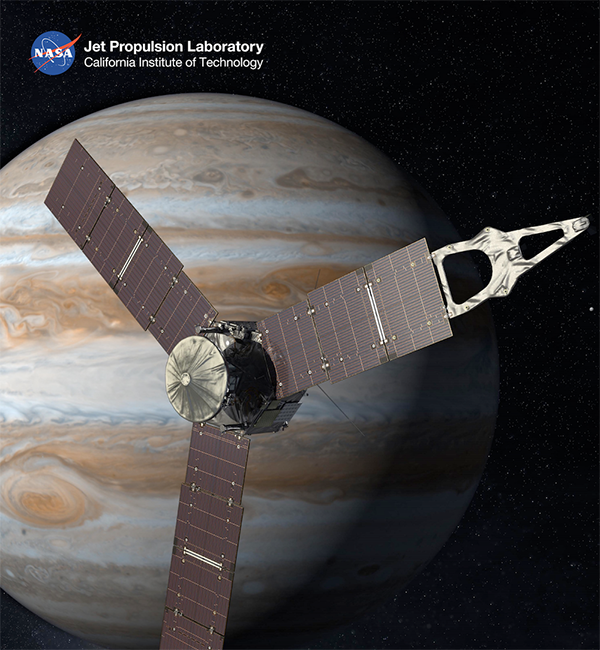
NASA's Juno spacecraft currently holds the record for the most distant deployed solar panels in the system, orbiting around Jupiter at a distance of over 800 million kilometers. Its gigantic solar array could generate 14,000 watts of power on the Earth, but at the distance sunlight is so feeble it only managed a measly 500 watts of power…which could run a kitchen blender. You know, if you needed to make a smoothie at Jupiter. But Juno was able to turn that juice into the most detailed images ever taken of the storms and cloud-tops of the giant planet, and use slight variations and gravity and magnetic fields to give us a sense of what's happening deep beneath the surface.
The alternative for deep-space missions is the RTG, or radioisotope thermoelectric generator. This device is essentially a chunk of radioactive material that decays. As it does it releases heat, which can be used to generate electricity. It's like a nuclear battery. On the upside these thigs last basically forever, giving spacecraft decades of reliable power. But on the downside they don't deliver a lot of power, they slowly lose power over time, and there's the whole nuclear thing which makes some people a little twitchy.
But there's thing. If we're going to stay in space for the long haul, we have to get over the whole nuclear thing real quick. And that doesn't mean more RTGs. That means full on nuclear power plants on lunar and Martian bases. Yes, you heard me right. Look, it's not like we don't know how to make relatively compact nuclear power plants: submarines and aircraft carriers around the world all carry their own little power plants. But those things are beyond heavy, which make them impractical to launch in a single mission, and nobody really likes the idea of trying to assemble one in Earth orbit.
So we have to get clever. We're going to have to figure out how to make smaller, launchable fission power plants. And the most difficult challenge will be convincing the public that we can launch nuclear material into space and totally not have it blow up in the atmosphere, we promise. I mean, it's kind a legit concern. It's not like we'll have a nuclear bomb going off or anything, but also nobody wants some rocket blowing up and rain radioactive material across a sizeable fraction of a continent. It's not likely to happen, but there's a possibility, and NASA and its partners will have its work cut out to convince the public that it's a small enough risk, and a great enough reward.
In the meantime, while we're figuring out all the bits and pieces that will make safe, efficient nuclear power in space a viable option, we have to up our game with solar panels. That's really the only other power source we can rely on. It's not like there are coal or oil deposits on the Moon or Mars. So we need more efficient solar panels, lighter solar panels, and the ability to deploy solar farms in sunlit areas and transmit that generated power to our bases and stations.
Those solar panels are going to have to be more durable than current ones, as they have to deal with micrometeorite impacts and the destruction caused by the Sun's unfiltered UV radiation. Oh, and don't forget the dust. The always-present, always-persistent dust that just gets…everywhere. The only reason that the Spirit and Opportunity rovers were able to go past their planned mission lifetimes was that random Martian dust devils would wipe the dust off their solar panels. And we can't rely on dust devils as a long-term solution.
In this series we are exploring NASA's top five challenges as detailed in its Civil Space Shortfall Ranking, which is basically NASA's Christmas wish list. These are the technologies that NASA believes we need to develop if we want to go to space…and stay there.
That brings us to the number 3 highest-priority technology for long-term space activities: better computers.
Computers have been involved in spaceflight since almost the very beginning. Just like on the Earth, computers aid in a variety of tasks, like navigation and communication. But unfortunately, space is really, really unkind to electronics.
It's not so much the vacuum of space; a circuit board does just fine. And freezing cold temperatures aren't that big of an issue either. No, it's our old friends, the cosmic rays. Each cosmic ray consists of a single proton or atomic nuclei, and the most powerful ones have the energy equivalent to a thrown baseball – which doesn't sound like much, but when you cram that baseball down to the size of a subatomic particle, it can be rather nasty.
Most cosmic rays slip through tissues and computer circuitry with ease; they're so small they literally miss the atoms and molecules of larger objects. But every once in a while they can strike, delivering all their energy to whatever they encounter. In humans, this can lead to an increased risk of cancer. In computers, it can lead to fatal glitches.
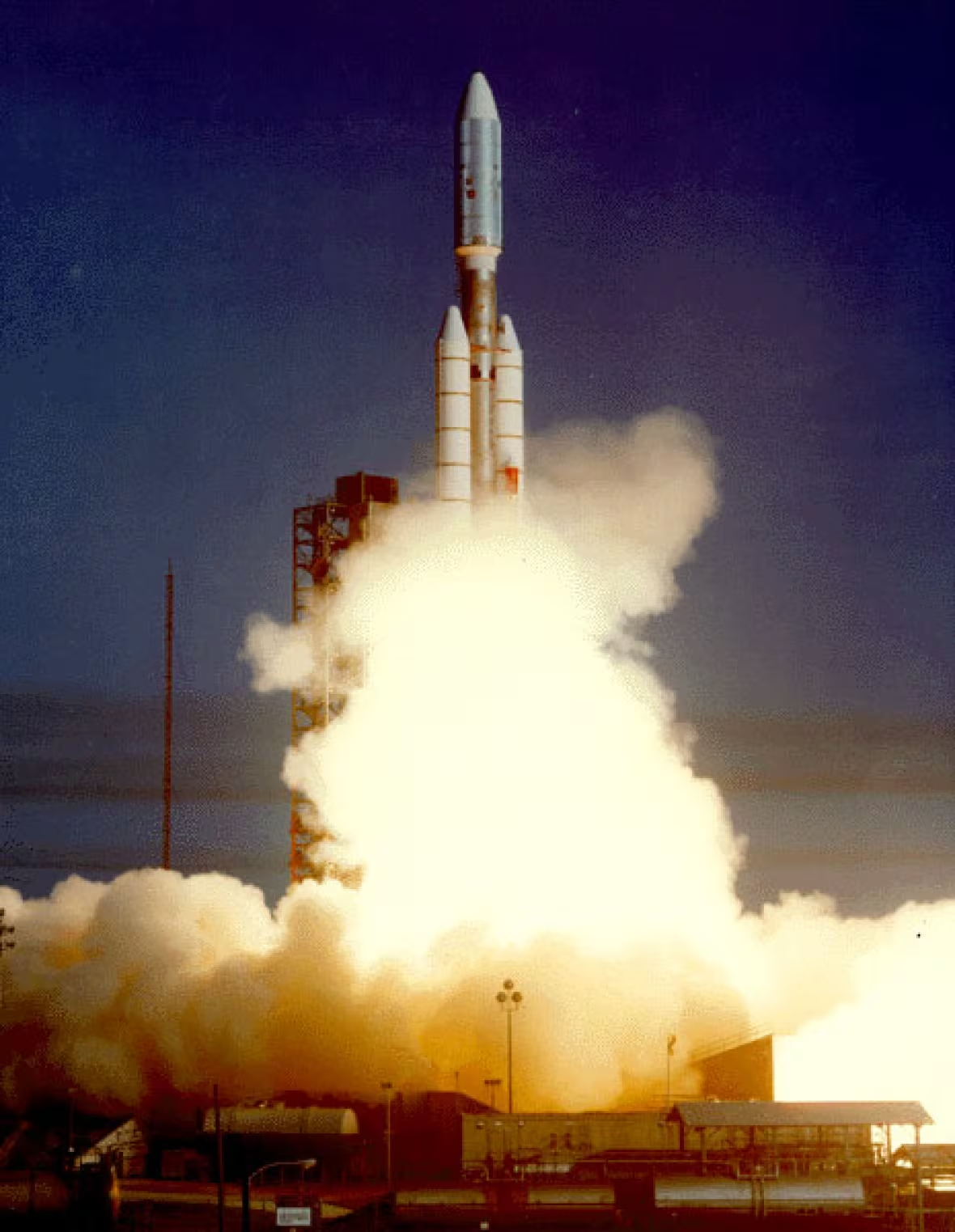
In 2022 the Voyager 1 spacecraft, launched all the way back in 1977 and is currently sailing beyond the borders of our solar system, started sending back garbled transmissions. By this point, voyager had spent decades cruising the outer solar system, giving us the most pristine images of the giant planets and our first taste of interstellar space. Most of the spacecraft was operating normally, but not the attitude articulation and control system, which is responsible for keeping Voyager's radio antenna pointed back to Earth, was just creating nonsense. Engineers were able to fix the issue by uploading the equivalent of a software update to route around the malfunctioning circuitry, although they never discovered the root cause of the problem. Many suspect that a cosmic ray struck a piece of circuitry at just the wrong moment to cause the problem.
More sophisticated computers are vulnerable as well. In 2023 the James Webb Space Telescope, the largest and most advanced telescope ever sent into space, suffered a minor malfunction when it's Near infrared Imager and Slitless Spectrograph, or Niriss, an important scientific instrument used to study exoplanets, become unsynchronized with the rest of the spacecraft, rendering it useless. NASA engineers suspected a cosmic ray led to the malfunction, but thankfully they were able to restore order by, essentially, turning it off and turning it back on again.
These issues were easy to solve, but it's only a matter of time before a cosmic ray strikes at a critical moment, shutting down a much more important mission. To protect against the ever-present threat of cosmic rays, spacecraft engineers take years to develop onboard computers and ensure that they are hardened against radiation. It's for this reason that computers going into space tend to be a couple…or more…generations behind the curve.
In 1969, the Apollo 11 mission's guidance computer weighed 70 pounds and was capable of performing about 40,000 instructions per second, which is over 100,000 times slower than the smartphone you're probably using right now. The International Space Station featured several custom-build computers with took nearly a decade to develop.
If we're going to maintain a larger presence in space, this isn't going to cut it. We need advanced hardware to handle a variety of complex tasks: more sophisticated navigation and tracking, much larger data communication loads, assistance with scientific surveys and studies, and more. Plus, we need our computers to be more fault tolerant, so that a stray cosmic ray doesn't derail an entire mission, and we need to be able to easily swap out computing modules when they go space crazy on us, because we need maximum adaptability to achieve our long-term plans.
Ironically, one of our biggest challenges with sending more powerful computers into space is how to deal with the heat. Yes, away from the Sun, space is cold, just a few degrees above absolute zero. But it's also a vacuum, which means there's no air or water to easily transport away heat. It's not just you can just plop a fan on the side of the CPU. So heat can easily build up to dangerous – for delicate circuitry – levels. Plus, shielding against cosmic rays isn't as simple as putting up a wall. That's because cosmic rays can strike the molecules in the wall itself and send out a shower of still-energetic particles that can disrupt circuitry.
We'll have to come up with many clever solutions if we want our space-based computers to be as fast and reliable as our Earthbound ones.
UFO-crashes in de Verenigde Staten naast Roswell: Aurora, Aztec en Kecksburg, en ook crashes in de rest van de wereld
Voorwoord
De vraag of buitenaards leven bestaat en of wij daadwerkelijk contact hebben gehad met niet-aardse wezens, blijft één van de meest intrigerende en controversiële onderwerpen binnen de wetenschap en populaire cultuur. Sinds het begin van de 20e eeuw hebben talloze meldingen, ooggetuigenverslagen en vermeende bewijzen de ronde gedaan over UFO-waarnemingen en -crashes. Hoewel de meeste incidenten worden toegeschreven aan natuurlijke verschijnselen, menselijke fouten of militaire testen, blijven enkele gebeurtenissen, zoals de beroemde Roswell-crash, het onderwerp van speculatie en onderzoek. Naast Roswell zijn er andere opvallende incidenten zoals Aurora, Aztec en Kecksburg, die elk hun eigen verhaal en mysterie bevatten. Daarnaast zijn er wereldwijd meerdere crash-incidenten gerapporteerd, waardoor het vraagstuk universeel lijkt en niet uitsluitend tot één regio beperkt.
In deze wetenschappelijke analyse zullen we de belangrijkste UFO-crashes naast Roswell in detail onderzoeken, inclusief de incidenten in Aurora, Aztec en Kecksburg. Daarnaast wordt een overzicht gegeven van crashincidenten elders in de wereld. We bespreken de beschrijvingen van deze crashes, de geloofwaardigheid ervan, de beschikbare bewijzen en de wetenschappelijke pogingen tot verklaring. Een kritische blik op de sceptische interpretaties en de tekortkomingen van het bewijs worden niet geschuwd, om zo een evenwichtig en volledig beeld te schetsen. Het doel is niet om onkritisch te geloven, maar om de feiten en de wetenschap achter de fenomenen te analyseren, en te kijken of er ruimte is voor een plausibele theorie of dat de meeste incidenten verklaard kunnen worden door andere oorzaken.
Historisch overzicht en datums van belangrijke UFO-crashes
De geschiedenis van UFO-crashes kent meerdere opvallende incidenten, waarvan sommige al decennia lang onderwerp van discussie en onderzoek zijn. Hieronder volgt een overzicht van de belangrijkste gebeurtenissen, gerangschikt op datum:
Deze UFO in de vorm van een eikel werd gemaakt als rekwisiet voor een tv-programma en is nu te zien in Kecksburg.
Krediet: Kecksburg Vrijwillige Brandweer
Kecksburg (1948):
Op 9 december 1948 vond in het kleine dorpje Kecksburg, Pennsylvania, een incident plaats dat sindsdien veel discussie en speculatie heeft uitgelokt. Volgens ooggetuigen en lokale bewoners zag men een helder, vuurbol-achtig object dat met grote snelheid door de lucht bewoog. Plotseling daalde het object neer in de dichtbeboste omgeving van het dorp, waar het volgens verslagen langzaam werd waargenomen voordat het uit het zicht verdween. Verschillende getuigen beschreven het object als een metalen, acorn-shaped (eikelvormig) voorwerp, dat met een knal op de grond zou zijn gevallen. Na de val werd het gebied onmiddellijk door militaire eenheden afgezet, en er werden militaire voertuigen en helikopters in de omgeving gesignaleerd, wat de indruk wekte dat de autoriteiten het incident zeer serieus namen.
Illustratie van de UFO beschreven door getuigen.
Krediet: Michael Schratt
De Amerikaanse overheid verklaarde aanvankelijk dat het om een meteoriet ging, maar veel inwoners en UFO-onderzoekers waren sceptisch over deze uitleg. Het object werd in beslag genomen door de militaire autoriteiten en naar een geheime locatie gebracht, waardoor er geruchten ontstonden over de aard van de inhoud. Sommige theorieën suggereren dat het een buitenaards vaartuig was dat crashte, terwijl anderen beweren dat het een experimenteel militair apparaat was dat geheim moest blijven voor het publiek. Het incident werd lange tijd nauwelijks besproken in de mainstream media, maar kreeg later meer aandacht van UFO-enthousiastelingen en onderzoekers, die het vergelijken met de beroemde Roswell-crash van 1947. Desalniettemin blijft de exacte aard van wat er in Kecksburg gebeurde, tot op heden een mysterie, dat vragen oproept over mogelijke buitenaardse interacties en overheidsgeheimen.
Aztec (1948-1949):
De geruchten over een mogelijke UFO-crash nabij Aztec, New Mexico, dateren uit de jaren 1990 en hebben sindsdien veel aandacht getrokken binnen de UFO-gemeenschap en bij geïnteresseerden in buitenaardse verschijnselen. Volgens verschillende theorieën en verhalen zou er in de jaren 1948-1949 een grote onbekende vliegende schijf of Ufo zijn neergestort in de buurt van Aztec, een klein stadje in het zuidwesten van de Verenigde Staten. Deze verhalen worden vaak gekoppeld aan het populaire narratief rond de Roswell-affaire, die plaatsvond in juli 1947, en suggereren dat niet alle crashsites en buitenaardse resten openbaar zijn gemaakt of bekend zijn bij het grote publiek.
De geruchten over Aztec worden ondersteund door enkele anonieme getuigen en bronnen die beweren dat er in die periode een grote, onverklaarbare crash heeft plaatsgevonden, waarbij mogelijk buitenaardse voertuigen en lichamen zijn gevonden. Sommige theorieën suggereren dat de Amerikaanse overheid de crash heeft geborgen en dat de resten geheim worden gehouden vanwege de technologische en politieke implicaties. Er wordt echter nooit concreet bewijs geleverd dat deze gebeurtenis daadwerkelijk heeft plaatsgevonden. Moderne onderzoekers en UFO-enthousiastelingen wijzen er op dat de verhalen vaak gebaseerd zijn op anekdotisch bewijs, geruchten en speculaties, zonder tastbare bewijzen.
De Amerikaanse overheid heeft nooit officiële bevestiging gegeven van een UFO-crash in Aztec, en documenten die deze gebeurtenis ondersteunen ontbreken of blijven geheim. Desalniettemin blijft het verhaal bestaan binnen de UFO-mythologie en wordt het door sommigen gezien als een mogelijke aanwijzing dat er meer is dan wat officieel wordt toegelaten. Tot op heden is er geen sluitend bewijs dat aantoont dat er daadwerkelijk een UFO is neergestort bij Aztec, maar de geruchten blijven bestaan en voeden de interesse in buitenaardse verschijnselen en overheidsgeheimen.
Roswell (1947):
Het Roswell-incident van 1947 is zonder twijfel het meest bekende en besproken UFO-incident ter wereld. Op 8 juli 1947 werd in de buurt van Roswell, New Mexico, een vreemd object ontdekt dat aanvankelijk door de lokale autoriteiten werd gerapporteerd als een “buitenaards ruimteschip.” Volgens eerste rapporten was er een grote metalen schijf gevonden, die niet leek op gewone vliegtuigen of militaire apparatuur. Het nieuws verspreidde zich snel en leidde tot veel speculaties over buitenaardse ontmoetingen en UFO’s.
Kort daarna bracht het Amerikaanse leger een officiële verklaring uit, waarin werd gesteld dat het om een "weerballon" ging, onderdeel van een geheime militaire project genaamd “Mogul.” Dit project was bedoeld om Sovjet-communistische raket- en bommenwerperactiviteiten te detecteren door middel van hoogvliegende ballonnen met speciale geluidstrackers. Het werd later duidelijk dat het leger het publiek wilde beschermen tegen paniek door het incident te minimaliseren.
In de jaren daarna ontstonden talloze complottheorieën en geruchten dat het leger een buitenaards ruimteschip had geborgen en dat er buitenaardse wezens waren gevonden. Sommige onderzoekers geloven dat het bewijs voor buitenaards leven werd verborgen door de Amerikaanse overheid om publieke angst te voorkomen en geheime technologieën te beschermen. Anderen blijven bij de officiële verklaring dat het om een experiment met weerballonnen ging.
Hoewel er geen sluitend bewijs is dat buitenaardse wezens betrokken waren, blijft het Roswell-incident een bron van fascinatie en speculatie. Het heeft een belangrijke rol gespeeld in de popcultuur en de UFO-onderzoeken, en blijft een symbool voor de voortdurende zoektocht naar buitenaards leven en de geheimen van de overheid.
Origineel krantenartikel dat het incident beschrijft, door S. E. Haydon, “A Windmill Demolishes It,” The Dallas Morning News, 19 april 1897, p. 5.
Aurora (1897):
Het incident in Aurora, Texas, dat plaatsvond tussen 1897 en 1898, wordt algemeen beschouwd als een van de eerste bekende UFO-incidenten in de Verenigde Staten. Volgens ooggetuigen zag een aantal inwoners van het kleine stadje Aurora een vreemd object dat uit de hemel leek te dalen. Dit object had een cilindrische of schijfvormige structuur en werd beschreven als een glanzend, metallic schip dat in de lucht leek te zweven voordat het neerstortte op een boerderij buiten de stad.
De bewoners waren verbijsterd door wat ze zagen en rapporteerden dat het object vlammen en rook uitstraalde voordat het in brand vloog en tot ontploffing kwam. Aanwijzingen voor het incident werden gevonden in de nasleep ervan, waaronder verbrande grond, verbrande planten en metalen resten die niet overeenkwamen met bekende technologie van die tijd. Sommige ooggetuigen verklaarden dat ze een vreemd, niet-van-de-wereldachtig wezen zagen dat uit het wrak kwam, hoewel deze beweringen niet algemeen worden bevestigd.
De lokale autoriteiten en kranten uit die tijd beschreven het voorval als een mysterieuze brand en crash. De officiële verklaring van de plaatselijke burgemeester was dat het een "vliegend schip" betrof dat door de storm was meegesleurd en neergehaald. In latere jaren werd het incident door UFO-onderzoekers geïnterpreteerd als mogelijk bewijs van buitenaardse contactpogingen of geavanceerde technologie die destijds nog onbekend was.
Hoewel er geen concreet bewijs is dat het om een buitenaards voertuig ging, blijft het Aurora-incident een fascinerend verhaal dat de verbeelding van vele UFO-enthousiastelingen en onderzoekers heeft aangezwengeld. Het wordt vaak aangehaald in discussies over vroege UFO-waarnemingen en de mogelijkheid dat buitenaardse wezens al lang onze planeet zouden bezoeken. Het incident wordt ook wel de “Roswell van de 19e eeuw” genoemd vanwege de mysterieuze aard ervan.
Naast deze incidenten zijn er wereldwijd meerdere meldingen en crash-incidenten gerapporteerd, waaronder in België, Mexico, en Rusland.
Hier zijn enkele bekende UFO-incidenten:
België (1989-1990): Tijdens deze periode werden talloze waarnemingen gemeld van ongewone vliegende objecten die door burgers en piloten werden gezien. Deze verschijnselen werden niet alleen visueel waargenomen, maar ook geregistreerd door militaire radarinstallaties. Verschillende jetjagers werden ingezet om de objecten te volgen, wat leidde tot intensieve militaire operaties. Het fenomeen staat bekend als het "Belgium Wave" en blijft een van de meest gedocumenteerde en onderzochte UFO-incidenten in Europa vanwege de combinatie van radar- en visuele waarnemingen.
Rusland (1947): Hoewel het jaar vooral bekend staat vanwege de Roswell-crash in de Verenigde Staten, heeft Rusland ook een geschiedenis van meldingen van onverklaarbare luchtverschijnselen. In dat jaar werden verschillende meldingen gedaan van vreemde objecten en lichtverschijnselen in de lucht, vaak gezien door piloten en militairen. Deze incidenten werden soms niet volledig verklaard, waardoor ze bijdroegen aan de internationale uitwisseling van UFO-gerelateerde verhalen. Rusland heeft door de jaren heen meerdere officiële en onofficiële rapporten over onverklaarbare luchtverschijnselen uitgebracht, wat wijst op een blijvende interesse in dit fenomeen.
Mexico (1991): In de stad Veracruz werden meerdere getuigen meldingen gedaan van grote, mysterieuze objecten die zich in de lucht bewogen. Verschillende inwoners en lokale autoriteiten zagen de objecten, die snel en onvoorspelbaar leken te bewegen. Sommige getuigen beschreven ze als fel verlichte, vliegende schijven of onregelmatige vormen die snel van plaats veranderden. Het incident kreeg veel media-aandacht en leidde tot verdere onderzoeken door lokale autoriteiten en UFO-onderzoeksgroepen. Het blijft een van de meest opvallende onverklaarbare luchtverschijnselen in Mexico uit die periode.
Wat betreft recente of actuele UFO-crashes, er zijn geen bevestigde of door officiële instanties bevestigde incidenten die ik kan verstrekken. Veel UFO-meldingen blijven onduidelijk en worden niet officieel erkend als buitenaardse voertuigen.
Geloofwaardigheid, bewijs en wetenschappelijk onderzoek
De geloofwaardigheid van UFO-crash-incidenten is een onderwerp dat al decennia voor opschudding zorgt, niet alleen onder onderzoekers en overheidsinstanties, maar ook binnen het algemene publiek. Verschillende incidenten worden verschillend beoordeeld op basis van de beschikbare bewijzen, getuigenverklaringen en de mate van wetenschappelijke onderbouwing.
Het meest bekende en vaak besproken geval is dat van Roswell, dat al sinds de late jaren 1940 een prominente plaats inneemt in de UFO-lore. In 1947 meldde het Amerikaanse leger dat het een "vliegend schijfje" had geborgen, maar later werd dit verhaal omgezet in een verklaring dat het om een weerballon ging. Desalniettemin blijven er talloze getuigenverklaringen, officiële documenten die later werden vrijgegeven en een breed scala aan theorieën die suggereren dat er wel degelijk sprake was van een buitenaards voertuig. De omvangrijke documentatie en de langdurige publieke interesse versterken de geloofwaardigheid van deze zaak, hoewel het officiële standpunt altijd vasthield aan een natuurlijke of militaire verklaring. Kritieken wijzen erop dat veel bewijs gebaseerd is op anonieme bronnen of niet-verifieerbare documenten, waardoor de betrouwbaarheid twijfelachtig blijft.
Andere incidenten zoals die van Kecksburg (1954) en Aztec (1948) worden vaak als minder betrouwbaar beschouwd. Kecksburg bijvoorbeeld, waarbij een brandend object in de bossen werd gevonden, wordt door officiële instanties toegeschreven aan een meteoriet of een stuk ruimtepuin. Toch blijven theorieën bestaan dat het om een geheime militaire of buitenaardse operatie ging. Het gebrek aan fysiek bewijs, de inconsistenties in getuigenverklaringen en het ontbreken van onafhankelijke verificatie zorgen ervoor dat deze gebeurtenissen minder geloofwaardig worden geacht binnen de wetenschappelijke gemeenschap.
Wetenschappelijk onderzoek naar UFO-crashes en gerelateerde incidenten is ingewikkeld. Veel overheidsinstanties zoals NASA en het Amerikaanse leger hebben nooit bevestigd dat buitenaardse voertuigen betrokken zijn bij deze incidenten. In plaats daarvan wordt vaak verklaard dat de waarnemingen kunnen worden toegeschreven aan natuurlijke verschijnselen zoals planeten, meteorieten of atmosferische anomalieën, of menselijke technologieën zoals geheime militaire tests. Psychologische factoren zoals massahysterie, hallucinaties, en de invloed van media en folklore spelen eveneens een rol in de interpretatie van getuigenverslagen.
Echter, er blijven een aantal incidenten over die niet volledig verklaard kunnen worden door de gangbare wetenschappelijke theorieën. Radarwaarnemingen die niet konden worden verklaard, fysische sporen zoals beschadigde bodem of metalen resten die niet aan bekende materialen konden worden toegeschreven, en getuigenverklaringen die consistent blijven over de jaren heen, zorgen voor een blijvend vraagteken. Sommige onderzoekers pleiten voor verder wetenschappelijk onderzoek en het openstellen van meer bewijsmateriaal om de ware aard van deze onverklaarde fenomenen te achterhalen.
Kortom, hoewel veel UFO-incidenten hun verklaarbaarheid vinden in natuurlijke of menselijke oorzaken, blijven enkele gevallen buiten het bereik van de huidige wetenschappelijke kennis. De combinatie van getuigenissen, fysiek bewijs en de complexiteit van interpretatie maken het een fascinerend, maar ook controversieel onderzoeksgebied. Het is belangrijk dat verder onderzoek gebaseerd is op wetenschappelijke methoden en dat bewijzen systematisch worden verzameld en geverifieerd om de geloofwaardigheid en de waarheid achter deze mysterieuze gebeurtenissen te achterhalen.
Sceptische visie en kritische analyse
De sceptische benadering van UFO-incidenten is gebaseerd op een grondige en kritische evaluatie van de beschikbare bewijzen en verklaringen. Sceptici benadrukken dat veel waarnemingen en vermeende ontmoetingen met onbekende vliegende objecten kunnen worden verklaard door natuurlijke fenomenen, menselijke fouten, of zelfs bedrog. Ze wijzen bijvoorbeeld op de rol van atmosferische verschijnselen zoals ballonnen, weerballonnen, onweersbollen, lenticulair wolken en meteorieten die vaak worden geïnterpreteerd als buitenaardse voertuigen. Daarnaast kunnen optische illusies, zoals glinsteringen of lichteffecten, en technische fouten in waarnemingen of registratieapparatuur eveneens leiden tot onjuiste conclusies.
Een belangrijk punt in hun kritiek is dat veel zogenaamde bewijzen voor buitenaardse aanwezigheid gebaseerd zijn op anonieme bronnen, getuigenverklaringen zonder verificatie, of foto's en video's die niet reproduceerbaar of te verifiëren zijn. Vaak blijken deze bewijsstukken te zijn ontstaan uit overdrijvingen, verkeerde interpretaties of zelfs bewust bedrog. Voorbeelden hiervan zijn valse documenten, gefotoshopte beelden of misleidende foto's die jarenlang als authentiek werden beschouwd, maar later werden ontmaskerd.
Verder onderstrepen sceptici dat de media en publieke angst een grote rol spelen in het ontstaan en verspreiden van legendes en mythen rondom UFO's. Sensatiezucht en het verlangen naar spectaculair nieuws zorgen ervoor dat eventuele incidenten worden opgeblazen en dat de verhalen worden aangevuld met verzinsels en geruchten. Dit leidt tot een versterking van de overtuiging dat er sprake zou zijn van buitenaardse contacten, terwijl er geen solide bewijs is dat deze overtuigingen ondersteunen.
Daarnaast wordt het ontbreken van verificateerbare en reproduceerbare bewijzen als een fundamenteel probleem gezien. Wetenschappelijke methoden vereisen dat waarnemingen kunnen worden nagebootst en getest door onafhankelijke onderzoekers, maar bij UFO-gevallen ontbreekt vaak deze reproduceerbaarheid. Veel van de claims blijven op anekdotisch bewijs gebaseerd, dat niet kan worden bevestigd of gecontroleerd door derden.
Tot slot benadrukken sceptici dat de meeste UFO-incidenten uiteindelijk kunnen worden verklaard door menselijke perceptie, psychologische factoren zoals pareidolie (het zien van patronen in willekeurige prikkels), massahypnose en de menselijke neiging om te zoeken naar betekenis of patronen in onduidelijke waarnemingen. Hierdoor ontstaat een soort zelfversterkend patroon van interpretaties, dat niet op feitelijke bewijzen is gebaseerd.
Kortom, de sceptische visie benadrukt dat er tot op heden geen overtuigend en onweerlegbaar bewijs bestaat dat wijst op buitenaardse aanwezigheid. Veel waarnemingen en verhalen kunnen worden verklaard door natuurlijke verschijnselen, menselijke fouten, interpretatiefouten en bedrog. Het ontbreken van reproduceerbare en verifieerbare bewijzen ondermijnt de geloofwaardigheid van de meeste claims en wijst erop dat de UFO-zaak nog steeds niet wetenschappelijk bewezen is. Hierdoor blijven veel incidenten in het domein van speculatie en mythevorming, in plaats van objectieve wetenschap.
Conclusie
De analyse van UFO-crashes, met name die rondom Roswell en de gerelateerde incidenten in Aurora, Aztec en Kecksburg, benadrukt de complexiteit en het intrigerende karakter van deze gebeurtenissen. Hoewel ze vaak worden aangehaald als mogelijk bewijs voor buitenaardse aanwezigheid, blijft het bewijs op dit moment ontoereikend om definitief conclusies te trekken. Veel van de beschikbare rapporten, getuigenverklaringen en documenten zijn anoniem, incompleet of niet verifieerbaar, waardoor er een grote mate van onzekerheid en scepsis bestaat binnen de wetenschappelijke wereld.
De gebeurtenis bij Roswell in 1947 is waarschijnlijk de meest bekende UFO-crash in de geschiedenis. Aanvankelijk werd er gemeld dat een "vliegend schijfje" was gevonden, maar de Amerikaanse overheid verklaarde later dat het ging om een weerballon van het Project Mogul, bedoeld om Sovjet-Amerikaanse kernproeven te detecteren. Desalniettemin hield het verhaal stand dat er mogelijk een buitenaards voertuig was gevonden, en dit heeft geleid tot talloze geruchten, complottheorieën en een uitgebreide mythology rondom UFO’s. De documenten die later vrijgegeven werden, bevatten vaak onduidelijke of gecensureerde informatie, wat de twijfel en speculatie alleen maar versterkt.
In Aurora, Texas (1897), werd melding gemaakt van een "vallende vliegende schijf" en een lijk dat werd gevonden in de buurt van een kerktoren. Hoewel dit incident mogelijk op natuurlijke of menselijke oorzaken kan worden teruggevoerd, blijft het door de beperkte documentatie en het gebrek aan fysiek bewijs een bron van speculatie en interesse. Hetzelfde geldt voor het incident in Aztec (1948), waar getuigen rapporteren over een crash en de vondst van vreemde lichamen, maar zonder concreet bewijs dat het om buitenaardse technologie ging.
Het Kecksburg-incident uit 1965 is een ander bekend voorbeeld. Een object dat werd waargenomen en uiteindelijk in een bos werd gevonden, werd door de autoriteiten snel verwijderd en werd door sommigen geïdentificeerd als een meteoriet. Anderen geloven dat het een buitenaards voertuig was dat onder de radar werd gehouden. Ondanks verschillende verklaringen ontbreekt er overtuigend bewijs dat definitief aantoont dat het hier om een buitenaards object ging.
Toekomstperspectief
De toekomst van onderzoek naar UFO-crashes ligt in het verder verbeteren van de wetenschappelijke methodologie, het vergroten van transparantie en het verzamelen van meer fysiek bewijs. Moderne technologieën zoals geavanceerde radar-, satelliet- en sensorinstrumenten kunnen helpen om gebeurtenissen nauwkeuriger vast te leggen en te analyseren. Daarnaast is er een groeiende openheid en interesse van overheden en wetenschappelijke instituten, zoals de recentelijk opgerichte UAP-taskforces in de Verenigde Staten, die zich richten op het onderzoeken van onverklaarbare luchtverschijnselen.
Het is belangrijk dat onderzoeksinitiatieven interdisciplinair en kritisch blijven, en dat ze niet alleen gefocust zijn op het bevestigen van buitenaardse betrokkenheid, maar ook op het uitsluiten van natuurlijke of menselijke verklaringen. Het verzamelen van fysiek bewijs, zoals crash-onderdelen, en het documenteren van getuigenverklaringen onder strikte protocollen kunnen bijdragen aan een meer solide wetenschappelijke basis.
Hoewel het nog steeds onduidelijk is of UFO-crashes daadwerkelijk buitenaardse technologie betreffen, biedt de voortdurende technologische vooruitgang en de toenemende transparantie hoop op het verkrijgen van meer duidelijkheid in de toekomst. Wetenschap blijft openstaan voor nieuwe bewijzen en inzichten, en het is essentieel dat onderzoek naar deze mysterieuze gebeurtenissen op een objectieve en kritische wijze wordt voortgezet. Alleen door zorgvuldig en transparant onderzoek kunnen we wellicht op termijn antwoorden vinden die nu nog buiten ons bereik liggen.
It was 1993 when I was first contacted by London businessman Ray Santilli. It was l995 when Santilli’s controversial ‘Alien Autopsy Film’ was released around the world. I have covered events surrounding this film in many publications around the world and in my new book ‘ROSWELL ALIEN AUTOPSY – The Truth Behind the Film That Shocked the World’ so forgive me if I don’t cover old ground here. All the relevant details of my previous research can be located on my website at: www.beyondroswell.com.
On June 22nd 2007, I travelled by train to London to meet up with Ray Santilli and his business partner Gary Shoefield. We had a pleasant lunch together and Ray Santilli showed me some frames of film encased in a type of perspex material. Santilli claimed these were original vintage 1947 frames of film from the alien autopsy. As they came with no official seal of approval or had been authenticated by anyone they were useless.
From left: Shoefield, Philip Mantle (Author), Ray Santilli
Within a couple of days of this meeting my friend and colleague Russel Callaghan, editor of UFO DATA magazine, had a phone call from a man by the name of Spyros Melaris. This man claimed he had lead the team that faked the whole alien autopsy film. He was a magician and filmmaker and he was now ready to spill the beans. He gave Russel a run down of the who, what, why and where of the whole affair. Because of my involvement in this affair Russel was soon on the phone to me with the details. It wasn’t long before I spoke to Spyros Melaris myself and he was telling me things in great detail. During the next few weeks I had several telephone conversations with Spyros Melaris and also put him in contact with US TV producer Robert (Bob) Kiviat at his request. Spyros was considering the best way to go public with his story, he had a book planned and thought that a TV documentary might also be a good idea.
Along with my colleagues Russel Callaghan, Michael Buckley and Steve Johnston, I was one of the co-organisers of the UFO DATA annual conference. It just so happened, that the 2007 conference had a loose Roswell theme to commemorate the 60th anniversary of the Roswell Incident. My colleagues and I discussed the possibility of asking Spyros Melaris to make his first public statement on this whole thing at our conference and eventually he agreed. The conference itself was held over the weekend of October 20th & 21st 2007 in Pontefract, West Yorkshire. A packed audience saw Spyros take the stage on Sunday October 21st. I had met him in person for the first time the night before at the hotel and I made loose arrangements to formally interview him at his home later in the year. As promised, Spyros took to the stage and told of his involvement in the making of the alien autopsy film. A small few members of the audience were rather upset to hear this but the vast majority were fascinated by what he had to say.
Spyros Melaris speaking at the UFO DATA conference in 2007. (Credit: Philip Mantle)
I made arrangements to visit the home of Spyros Melaris on November 16th 2007 and I drove to his house in Hertfordshire with my partner Christine. Before the formal audio-taped interview began we had lunch with Spyros and his lovely wife Anne. Over lunch Spyros showed us some of the documentary evidence he has to support his claims. This included his diary from l995, hand drawn sketches of the alien, a full list of hand painted story board images of the whole alien autopsy film, original fax messages from Kodak in the USA providing copies of l947 fill canister labels, and a large portfolio of research material. This was mainly of vintage (l940’s) US military vehicles and some vintage US military medical photographs. The interview itself lasted around two hours and we only touched the tip of the iceberg. The full interview can be located online at: http://www.outtahear.com/beyond_updates/index.html (Alien Autopsy Information section). I would like to thank my colleague Steve Johnston for transcribing this interview in full. The following is based on that interview.
Spyros Melaris (right) with Philip Mantle in 2007. (Credit: Philip Mantle)
Who is Spyros Melaris?
As the name might give it away Spyros was originally born in Cyprus. As a boy he was taught a magic trick by his grandfather and his love of magic was born. The other passion as a boy growing up in the UK was film making. At school he told his careers officer that he wanted to be an actor but this was discouraged. A proper job was what he should have. So a proper job he took and after leaving school became an apprentice trained motor mechanic. However, his love of magic and film making eventually won over and he eventually became a magician and a filmmaker. He now owns his own TV studio in London and makes TV shows for all the major networks in the UK and independent production companies alike. In short, in his owns words, we make programmes for “anyone who books us.”
How He Met Ray Santilli
In January 1995 he was to attend the MIDEM music industry event in Cannes, France. He was taking a film crew there and had some spare time on his hands so he sent fax messages to 4 production companies picked at random from a media directory. He basically asked them if they wanted to hire him and his crew while in Cannes. One of these happened to be the Merlin Group owned by Ray Santilli. Spyros and Ray Santilli had a few telephone conversations but did not meet and arranged to meet in Cannes. By pure chance they bumped into each other at a restaurant in Cannes and it was here that Ray Santilli fist told Spyros Melaris that he had obtained film footage of an alien. Holding back a smirk Spyros asked Santilli if he was serious and he replied he was, not only that, he wanted Spyros to make a documentary from this footage. They eventually agreed to meet at Ray Santilli’s office back in London. A few days later Spyros kept his appointment with Santilli at his office in London. Here he met an almost distraught Ray Santilli who told him he’d bought this film but it had turned out to be very poor quality. Spyros was shown what has become known as the ‘tent footage’ and he immediately recognised it as been shot on video. The tape he was shown was on VHS format. Santilli seemed surprised that he had recognised it as being shot on video so quickly and he realised the game was up. Again in Spyros’s own words “If I can’t get it past this guy, I’m not going to get it past anyone else. He realised it was game up. That’s when the meeting ended. I thought the guy’s mad. He’s trying a fast one. I thought it was over at that point.”
So How Did The Idea of a Fake Film Come About?
Melaris met up with his friend and colleague John Humphreys. Humphreys is a Royal Academy trained sculptor whose work had sometimes overlapped into film and TV special effects. Melaris and Humphreys had known each other for a long time and had worked on a number of things together in the past. Melaris simply put the idea to Humphreys, “John, do you fancy sculpting an alien?” Melaris told Humphreys of his meeting with Santilli and basically came up with the idea of making it. They talked things over from a legal point of view and how it might help them break into other projects, even Hollywood. The idea was to make it, release it to the world, and then make a second programme shortly after showing how they did it. Humphreys agreed and Melaris pitched the idea to Santilli. Santilli looked like a man reborn and agreed. The budget put forward by Melaris was about £30,000 and it was Santilli’s business partner and friend Volker Spielberg who put up the money. The funding was in place, contracts and a confidentiality agreement were signed and the ball was rolling.
The Team Behind The Making of The Film
First off there was Spyros Melaris. He designed and directed the film, instructed and paid the rest of the team, made the autopsy table along with many of the other props, he also made the ‘contamination suits’ as well as obtain the props and cameras. The main researcher behind it all was Spyros’s then girlfriend Geraldine. She was the one who checked the medical books, spoke with surgeons and pathologists and she even played the part of the nurse in the film. Geraldine is not her real name as she wishes to remain anonymous. John Humphreys of course made the alien’s bodies. The mould was actually made from John’s ten year-old son who was quite tall. As a trained sculptor Humphreys had also studied anatomy so he was the man who played the surgeon in the film. Another friend of Spyros’s was Greg Simmons. He was seen occasionally in the film in one of the contamination suits and he also played the part of the soldier in the Debris Footage. Gareth Watson, a colleague of Santilli’s and Shoefield’s was the man in the surgical mask behind the glass, and finally Spyros’s brother Peter helped behind the scenes. The set was built in Geraldine’s house in Camden in London. The property was in the process of being converted into three flats (apartments) at the time and was therefore empty. The props were obtained from someone Spyros knew in the USA. She was not told what they were for and were all ordered separately and delivered to different addresses so as not to arouse suspicion. The camera’s were obtained by Spyros; one bought and one borrowed from a friend.
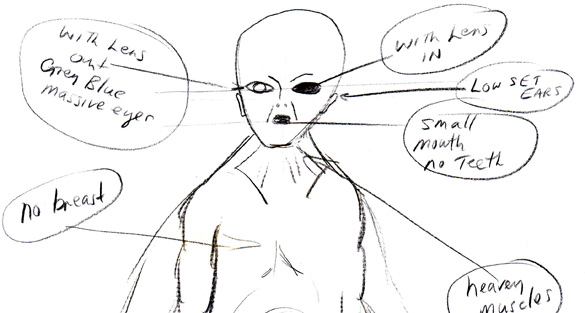
Original pencil sketch of a design for the alien creature by Spyros Melaris. (Credit: Spyros Melaris)Original pencil sketch of a design for the alien creature by Spyros Melaris. (Credit:Spyros Melaris)
Why There Are Two Separate Autopsy Films
According to Spyros the first ‘Alien Autopsy’ film went pretty much as planned. However, upon completion Geraldine noticed that a few of the medical procedures were not correct. They therefore had to make another creature and film another one. Apparently Santilli was ready for packing it all in at this point as there was no more money in the budget to film it again. They persevered and made another one at Spyros’s cost the very next day. This too was not without problems. The foam latex used to fill the dummy had not worked right and an air bubble had left a hollow space in the creature’s leg. Humphreys was despatched to the local butchers by Spyros to get a leg joint of a sheep. This was inserted into the hollow part in the alien’s right leg, a few other things were added, the outside of the leg was gently burnt with a blowtorch and hey presto, the leg wound. Some of the inner organs were manufactured by Melaris, and animal organs were also used for the alien’s innards, although altered with a scalpel and coated with latex. The alien’s brain was actually made from three sheep’s brains and part of a pig’s brain cast in gelatine. This is how there came to be two separate autopsy films one of which was shown in its entirety, while the second one made, has only ever been released in part.
The Wreckage and I-beams
These were all designed by Spyros himself. At the October 2007 UFO DATA conference Spyros showed me how he had designed the ‘writing’ on them and what it said. The wreckage was then manufactured by John Humphreys, Spyros and his brother Peter. He told me that he based it on Greek lettering, a bit of ancient Egyptian stylising and some artistic license. On the main large beams, if translated correctly, reads ‘FREEDOM’. Spyros thought this a fitting name for an alien spacecraft. While designing the letters which spell the word ‘FREEDOM’, Spyros noticed that if the word is turned upside down, the word ‘VIDEO’ could be seen. He adjusted some of the letters to better facilitate this, so the piece would throw a little red herring into the mix. The translation of the smaller beam is being held back for Spyros’s book.
Spyros Melaris shows two of the many paintings he did for the original ‘story board’ for the alien autopsy film. (Credit: Philip Mantle)
The Cameraman’s Home Video Interview
According to Melaris, Ray Santilli was put under a lot of pressure by various parties to arrange an interview with the fictitious cameraman he allegedly bought the film from. Of course, according to Melaris, there was no such person, so he came up with the idea of creating this aspect of the whole affair as well. The basic scenario is that Melaris flew to Los Angeles and met up with Santilli’s partner Gary Shoefield. Melaris wanted to find an eighty year old tramp on the streets of L.A., pay him a few hundred dollars, put him in front of a camera and ask him to read from a script. Santilli and Shoefield were nervous, and not sure this would work but Spyros was confident he could pull this off, and went ahead. He found an old guy living rough on the street, offered him $500 and a night in the hotel and he duly agreed. Again, by pure chance the chap had been an actor many years ago. Melaris took his name and the name of a movie he had appeared in. These details will be released in his book. He cleaned him up, gave him a shave, and added a bit of make up and a false prosthetic nose and chin and the job was done. The man himself did not know what he was reading or where it was going to be used. There was little chance that he would see the broadcast either. No one would recognise him in a thousand years. And they never did. This film was delivered in person in New York to US TV producer Bob Kiviat by Gary Shoefield and a man claiming to be the cameraman’s son. Eventually the film in question was broadcast on TV in Japan only and from there it was copied and distributed to UFO researchers around the world. The trick worked, no one has identified the man in question, and Melaris claims he is the only one who can do this.
The Crash Site
There are a number of people who believe the alien autopsy film is authentic, not because of the film itself but because of the crash site. Ray Santilli released details, supposedly from his cameraman, as to where the incident took place in the desert. How did this come about? Well, according to Spyros this was quite simple. In l995, he flew to Roswell. Here he interviewed many local people including Loretta Proctor. Mrs. Proctor was the neighbour of rancher Mac Brazel and it was she who suggested that Mac take some of the UFO debris into town after he found it. Spyros also met and hired private pilot Rodney Corn. He asked corn to fly him over the UFO crash site, to which he replied “which one.” There are in fact at least three such sites. So, Spyros flew over all three of them, filming as he went. Rodney Corn was able to show Spyros a great deal from the air, far better than would have been possible on foot. This included small dirt roads and long forgotten landmarks. Before the interview took place Spyros also informed me that he obtained both old and new maps of the area. All of this information was handed to Ray Santilli and it was Santilli, not Spyros, who then put it all together to make a location for a nonexistent crash site.
Field where the “real” Roswell debris is said to have been found. (Credit: OpenMinds.tv)
The Grand Plan
I asked Spyros what was the grand plan. The research was done, the film was made, so what next. Apparently it was a rather simple plan. To release the film to a broadcaster, ask them to investigate and see what happens. They were confident that it would not be exposed as a fake. Then, after a few months the plan was to hold their hands up and tell all. The reason this didn’t happen was money. Spyros had signed a confidentiality agreement with Ray Santilli and Santilli was still adamant that he needed to recoup his initial investment allegedly paid for the tent footage. Santilli told Melaris that he had invested a lot of money on this film and he must recoup that before they were to go public. Santilli reminded Spyros that he was bound by the confidentiality agreement and he was not to say or do anything until Santilli said so. Apart from a cheque for about £10,000, which Spyros split with his team, no royalties were ever paid. Santilli told him that due to the fact that he had stated publicly that it was a military film, that it had simply been copied by third parties without permission and used without payment as the people who were using the film believed that the copyright was vested with the US Military and not with Santilli. Eventually time went on and Spyros just got on with life. He was constantly working on other projects with Santilli and earning a living and the alien autopsy film was all but forgotten.
Going Public
Alien Autopsy movie poster. (Credit: Warner Bros.)
The one thing that I first asked Spyros was why was it that he had decided to go public with this information now. It was twelve years since the alien autopsy film hit the headlines. Melaris stuck to his confidentiality agreement. From a legal point of view if he broke it he could have been sued. However, in 2005 he was approached by Santilli and Shoefield to be involved in the movie version of this whole affair. He asked both if they would now tell the true story and reveal that it was all a fake but they said no, they were going to maintain that they really did have original film. Again, Santilli and Shoefield stated that there was no money in it and that they were doing it for “a bit of fun” when pressed they admitted that both Santilli and Shoefield would get paid a percentage of the profits, there was no such offer for Melaris. Melaris declined their offer. He left that meeting under the impression that the movie was not going to be made. However, the movie was made and distributed by Warner Bros and so Melaris felt that he was now able to speak as the story was now in the public domain.
The Doubters
To round off the interview I asked Spyros Melaris what he had to say to the doubters out there, those that believe the alien autopsy film is the genuine article. I’m not going to paraphrase this; instead I will use his words in full:
PM: Time’s against us, Spyros. I’ll ask one last question. There are those out there who believe in this film and Santilli 100% and they think that you’re some kind of pathological liar, playing devil’s advocate here, so please don’t be offended.
SM: No. Go ahead.
PM: What would you say if you could say one thing to the doubters out there? Is there any one thing that you can say that would say to them Spyros Melaris is who he says he is and has made this film?
SM: I don’t think that there’s any doubt that somebody made it today. That’s fair to say that somebody made the film and even Santilli said it’s a fake, but it was made from original film. I think that’s really the question. The question isn’t whether I made it because I can prove I made it. John Humphries will tell you I made it. Ray would probably tell you I made it! He couldn’t deny it. There’s too much evidence. The question is did I make it from original film? And the simple answer to that is no. There was never any original film other than the tent footage. I’ve never seen any other film. Ray maintains that he’s got original film. My question to Ray is how would that film marry with what I made? It can’t. I haven’t actually seen the film. Now you may say, “Maybe you’re lying and you did see the film and you made it.”
The story’s a bigger story if there was a real film. There would be more money in it. There wouldn’t be a reason for me and Ray to be parted. Why would we fall out? The common sense has got to come into the argument. I’m part of something as big as real film of a real alien. Why would I jeopardise being part of that and go off on my own? There’s no reason to. That’s the first thing.
The second thing. I promise you, something happened in Roswell. I’m not an easy person… I’m a sceptic. I’m not an easy person to convince. Thirty people that I talked to out there, clever people, doctors, lecturers, all sorts of people tell me they saw something. And I believe them. Something happened. A lot of ordinary people. Something happened. So, I don’t think there’s dispute about whether or not something happened in Roswell or other sightings or whether or not everything’s fake. No, I don’t think everything’s fake. I do know this is. I also know that if Ray had original film, he’d be jumping through hoops to let you test it. I’m sorry, but that’s what you would do. You would say, “Give me billions of pounds for this.” That’s what you would say. You would say, “I’ve got nothing to worry about. The cameraman doesn’t want to speak, but look at the film.” That’s what you’d do! That’s what you would do.
PM: Say no more.
[END OF INTERVIEW]
Once again I would like to reiterate that this is only part of what Spyros Melaris had to tell me. The full-unedited interview can be found in the alien autopsy section of our web site at:
So how do we check that what Spyros Melaris is telling us is correct? It is no easy task I can assure you. The documentary material shown to me by Spyros is intriguing but not proof positive. My colleague Mark Center in the USA checked the private pilot Rodney Corn for me and he does exist. Mark spoke to him on the phone but he has no recollection of being hired by Spyros Melaris. This could be because he was hired by Geraldine, and we are talking about an event which happened over 12 years ago.
At the UFO DATA conference in October 2007 was German researcher Michael Hesemann. Michael was also one of the speakers that weekend. Michael investigated the alien autopsy film from l995 through to l997 and believes it to be authentic. After the conference when Michael was back home in Germany he sent me an email that quite frankly left me stunned. He admitted for the first time that in l996 someone sent Michael an email telling him that Spyros Melaris was the hoaxer. Hesemann had never shared this information with anyone. I asked him what he did with it and he simply told me that he phoned Ray Santilli and asked him if he knew this man to which Santilli replied he did not. Michael told me he left it at that.
However, Spyros Melaris independently informed me that in l996 he had received a phone call from someone with a German accent asking him if he was the hoaxer and he of course denied it. He did not know who the caller was until he met Hesemann at our conference. I pressed Michael about this and eventually he admitted he did phone Spyros back in l996. Why Michael Hesemann never shared this information with anyone else is beyond me. In his defence, Michael has stated that there were others mentioned at the time and he did not want to spread false rumours, but these others names were circulated and eliminated. I have to be honest and say here and now that I cannot understand why Hesemann sat on this information and never told anyone. I leave it to you to make up your own mind.
A colleague of mine who is a veteran TV and movie special effects artist also took a look at the interview with Spyros. In his considered opinion the techniques and materials used by Melaris and his team to make the fake alien creature are 100% correct. There is no question in his mind that the dummies were made in the way described. He does have a few questions he’d like to ask, but these are purely little points of clarification and there is nothing wrong with what Melaris has had to say.
The other main person involved in all of this is of course US TV producer Bob Kiviat. Several years back my colleague Tim Mathews and I were tipped off about John Humphreys, Humphreys was part of the team and he made the dummies. Bob tried for years to get Humphreys on camera and make a TV documentary but all to no avail. Eventually, Bob did make a TV show for Channel 5 but without Humphreys in it. This was never broadcast. Both Humphreys and Melaris have spoken at length to Bob Kiviat about their involvement in this whole affair so I took the opportunity to ask Bob a few questions on December 4th 2007. This mini question and answer session is reproduced here in full:
Q: How many times did you speak with UK sculptor John Humphreys?
A: Once before the Ant & Dec movie came out. In approximately 2003. Once after that.
Q: Did Humphreys tell you on what he based the design for his alien creatures?
A: Yes, just on his own research, books and such. No other help.
Q: Did Humphreys ever see any original film, stills or otherwise?
A: No, never. He claimed it all came from his creative efforts and book research.
Q: During your conversations with Humphreys did he ever mention the name Spyros Melaris?
A: Yes. He said Spyros was the one who hired him for Santilli, who he met perhaps twice and came to the set once. All the money came through Spyros. Also, Spyros was the cameraman.
Q: Did Humphreys provide the names of anyone else involved. If yes what are those names?
A: No other names.
Q: Why was Humphreys looking to work with you on a documentary?
A: Yes, Humphreys wanted me to get him a network TV show based on his revelations that he made the autopsy footage, with Spyros acting as money man and cameraman, who he believed was working for Santilli.
Q: Was Humphreys going to tell all and sink the stories put out by Ray Santilli?
A: Yes, but until I got a commitment from a TV network and guaranteed money for his exclusive he kept much close to his chest.
Q: Did you speak to Humphreys agent/advisor?
A: Yes, his business manager was my main contact for all of 2003 and 2004, and it was he who informed me John was going to do the Ant & Dec movie, without giving me the details. There would also be a companion documentary “that would be my worst nightmare,” he said.
Q: If you did, what did he tell you about Humphreys involvement and reasons for wanting to spill the beans?
A: Instead of Humphreys spilling the beans to me, his manager clearly implied John had lost patience and saw a payday elsewhere – the movie, etc.
Q: You made a TV documentary for Channel 5 in 2006 in which I appeared, could you tell us why it was never broadcast?
Channel 5 was rushing instructions to my productions offices in L.A. from England telling me how the show needed to be styled, and they also wanted to move the airdate up to an almost impossible deadline. We were working around the clock already to appease the Channel 5 executive in charge when one of the top people at 5 actually listed the show in a TV guide of some sort. That’s when Gary Shoefield contacted 5 and falsely claimed Ray Santilli was involved in the ownership of my original Fox show, which the new 5 show was jumping off from. It was an outright fabrication, for my company has the only US copyright to the show AND THE ALIEN AUTOPSY FOOTAGE ITSELF!
While we were sorting through this false claim, we interviewed you. When the 5 executives saw you naming Humphreys as the guy who made the dummy and who was the key pro behind the footage, they wanted confirmation so they ILLEGALLY contacted Humphreys through a consulting producer. Humphreys freaked out, told them he wanted nothing to do with the 5 show and said he had to contact Warner Bros. Ultimately 5 reneged on their agreement with my distributor, my distributor did not fight for the airing, and this is how things were left. I’m still debating what course of action I can take to recover my substantial losses and damage!
Q: You have spoken on the telephone at length with Spyros Melaris. Are you convinced he is telling the truth?
A: For the most part, I can’t find any outlandish things that make his story unbelievable. But I do wonder how he could have been so naïve about the amount of money Santilli was making around the world. This part seems odd, as if he was playing dumb. On the contrary, he seems very bright. And if Ray gave him just enough work to keep him quiet afterward, I still wonder why he let all the other money go into Ray’s pocket without him demanding his share. This doesn’t add up, literally, pound for pound.
Q: You have been involved with the Alien Autopsy film since 1995, you have interviewed or spoken to most if not all the main players in it all, so what now is your conclusion?
A: I’m going to need more time to answer that question. Spryros’ actions or non actions in court will have a lot to do with this, and I’m looking into another intriguing angle that could impact my conclusions.
Robert Kiviat. End of interview.
It is clear from this brief interview with Bob Kiviat that there are slight differences between what John Humphreys says about his role in the faking of the film and what Melaris says. However, Humphreys does state quite clearly that it was Spyros Melaris who was the money man, it was Melaris who hired him on behalf of Santilli. Humphreys also confirms without any doubt that there never was any original film. It was a complete and utter fabrication.
I could go on but I think I’ve made my point. In l996, Spyros Melaris was outlined as the hoaxer to German researcher Michael Hesemann. In 2003, US TV producer Bob Kiviat spoke with UK sculptor John Humphreys who confirmed that Spyros was the man in charge and that there was no original film. In 2007, Spyros Melaris goes on the record for the first time and tells how it was all made. Well, perhaps not all. Spyros is holding back certain things for his book, which was supposed to be available in early 2008. And as for Ray Santilli, well he’s pretty quiet at the moment but I doubt if he will ever own up as he is quite simply in it too deep.
The long awaited book by Spyros Melaris ‘ALIEN AUTOPSY: The Myth Exposed’ comes with an accompanying DVD. It was originally scheduled to be released in 2008, but for a variety of reason it has been delayed with no firm date yet for its release.
ROSWELL ALIEN AUTOPSY – The Truth Behind the Film That Shocked the World is published by RoswellBooks.com where it can be purchased, and is avail via Amazon.com.
Alien Craft flips Over New Jersey Skyscrapers! Baffling Gray Disk, alien tech 👽🔍 UFO UAP Drone sighting news
Date of sighting: June 1, 2025
Location of sighting: Jersey City, New Jersey, USA
Source: NUFORC
This UFO video is just melting my brain. This craft looks to have huge metallic tubular structures going through the disk and its flipping through the sky as if it's an unmanned alien probe. This is 100% proof that alien probes are scanning our cities, military bases and even our homes!
Scott C. Waring - UFO Sightings Daily
Eyewitness states:
Sighting from apartment building roof. I saw an object enter the frame. It appeared to be changing shape or exhibiting some form of movement. Then the object continued to slowly ascend, while also remaining in place against the wind. Location details: Latitude: 40.71521, Longitude: -74.0475
Is there an inter-dimensional B2 Stealth USAF bomber on Google Earth map, UFO UAP sighting news 👽👽👽
Google coordinates: Nah...just watch the video to find it.
There is a stealth B2 bomber on google map over some fields and I really think this thing might have alien tech built into it because it looks like it's shifting out of our dimension. Like the plane itself is physically slicing into several other planes...each a different color.
To find this, follow the video and go to Google Earth history button, hit 2016 and there it is.
Een illustratie van een zwart driehoek UFO met lichten.
Depositphotos.
Zwarte Driehoek UFO's, Topgeheime Technologie of Bewijs van Aliënbezoeken?
Inleiding
De laatste decennia is er een groeiende interesse in zogenaamde "Black Triangle UFO’s", mysterieuze driehoekige vliegende objecten die regelmatig worden gemeld. Deze waarnemingen worden gekenmerkt door hun grote afmetingen, driehoekige vorm en vaak stil of traag bewegend gedrag. Ze worden wereldwijd gerapporteerd, vooral in Noord-Amerika, Europa en Rusland. Hoewel sommige waarnemingen mogelijk kunnen worden verklaard door militaire technologie, blijven veel gevallen onverklaard, wat de nieuwsgierigheid en speculaties aanwakkert over buitenaardse betrokkenheid.
De geschiedenis van deze fenomenen gaat terug tot de jaren 1980, met prominente incidenten zoals de "Belgische mysterieuze driehoeken" in de jaren 1990, waarbij honderden getuigen de objecten zagen. Verschillende theorieën zijn geopperd: van geheime militaire experimenten en stealth-technologie tot buitenaardse voertuigen. Sommige onderzoekers suggereren dat deze objecten mogelijk geavanceerde, niet-openbare technologieën vertegenwoordigen die door overheden worden getest, terwijl anderen geloven dat ze bewijs zijn van buitenaardse bezoeken.
Wetenschappelijk standpunt blijft voorlopig terughoudend. Er worden uitgebreide onderzoeken gedaan, maar concluderen dat er geen definitief bewijs is voor buitenaardse oorsprong. Desalniettemin blijven de Black Triangle UFO’s een intrigerend fenomeen dat vragen oproept over technologische vooruitgang en de mogelijkheid van andere levensvormen in het universum. Het onderwerp blijft een boeiend gebied voor zowel wetenschappers als enthousiaste waarnemers.
Definitie en Kenmerken van Black Triangle UFOs
Black Triangle UFOs worden gekenmerkt door hun opvallende driedimensionale driehoeksvorm, meestal zwart of donker van kleur. Ze worden vaak op lage hoogten gezien en vertonen een indrukwekkende combinatie van stilstand en beweging. Een kenmerkend aspect is dat ze vaak stil of met een geruisloos geluid worden waargenomen, hoewel sommige meldingen wijzen op lage, mechanische geluiden. Onder de onderkant van deze objecten worden vaak felle lichten waargenomen, die soms verschillende kleuren kunnen vertonen of in bepaalde patronen knipperen.
Een ander opvallend kenmerk van Black Triangle UFOs is hun complexe en onvoorspelbare beweging. Ze kunnen stil hangen, scherpe bochten maken, plotseling versnellen of traag bewegen, en lijken soms ongebruikelijke wervelingen of rotaties te vertonen. Dit geeft de indruk dat ze over geavanceerde technologie beschikken die ons nog onbekend is. Vaak worden ze waargenomen in gebieden met weinig lichtvervuiling, en de meldingen worden meestal gedaan door waarnemers die de objecten op korte afstand zien, waardoor de details beter zichtbaar zijn.
De meeste incidenten met Black Triangle UFOs dateren uit de late jaren 1980 en de jaren 1990. Vooral tussen 1989 en 1995 werden er talrijke meldingen gedaan, vooral in Noord-Amerika en Europa. Sommige van deze waarnemingen werden zelfs bevestigd door radar en andere meetinstrumenten, wat de mysterieuze aard van deze fenomenen versterkt. Ondanks talloze getuigenverklaringen en officiële rapporten blijft de herkomst en de technologie achter deze objecten onduidelijk, wat bijdraagt aan de speculaties over buitenaardse of geheime militaire oorsprong.
Kortom, Black Triangle UFOs vormen een intrigerend fenomeen dat zich onderscheidt door hun grote driehoekige vorm, donkere kleur, lage vlieghoogte, stille beweging en complexe manoeuvres. Ze blijven een bron van speculatie en onderzoek, en roepen vragen op over de technologische capaciteiten en mogelijke doelen van deze mysterieuze objecten.
Geschiedenis van de waarnemingen
De geschiedenis van de waarnemingen van Black Triangle UFOs is rijk en fascinerend, met een lange geschiedenis die teruggaat tot de late jaren tachtig. Deze mysterieuze driehoekige objecten worden gekenmerkt door hun grote afmetingen, opvallende vorm en vaak hun stille, glijdende bewegingen aan de hemel. De eerste uitgebreide documentatie van dergelijke waarnemingen kwam vooral in de jaren tachtig en negentig naar voren, met enkele opvallende incidenten die tot op heden voor veel discussie zorgen.
Een van de meest gerenommeerde en invloedrijke gebeurtenissen in de geschiedenis van Black Triangle UFO's was de zogenaamde "Belgian Wave." Deze gebeurtenis vond plaats tussen 1989 en 1990 in België en betekende een keerpunt in de UFO-onderzoeken. Tijdens deze periode meldden honderden mensen het zien van grote, driehoekige objecten die zich geruisloos en langzaam door de lucht bewogen. Wat deze waarnemingen bijzonder maakte, was niet alleen de frequentie ervan, maar ook de consistentie in de beschrijvingen: de objecten hadden meestal een driehoekige vorm, vaak met meerdere lichten die op de hoeken en soms in het midden van het object brandden. Verschillende waarnemingen werden ondersteund door radarbeelden en foto- en videomateriaal, wat de geloofwaardigheid van de meldingen versterkte. De Belgische overheid en diverse UFO-onderzoeksgroepen onderzochten deze incidenten grondig, zonder dat er tot op heden een definitieve verklaring is gegeven.
Naast de Belgische incidenten was er in de Verenigde Staten een vergelijkbare gebeurtenis die bekendstaat als de "Phoenix Lights" in 1997. Tijdens deze gebeurtenis werden duizenden mensen getuige van een enorme, driehoekige formatie die in de lucht verscheen boven Phoenix, Arizona. De objecten werden beschreven als groot, donker en stil, en bewogen zich in een vloeiende beweging zonder geluid. Ook hier werden het fenomeen vastgelegd op fotografie en videobeelden, wat de speculaties over buitenaardse oorsprong verder aanwakkerde. Hoewel de Amerikaanse autoriteiten aanvankelijk beweerden dat het om militaire oefenvliegtuigen ging, bleef het publieke debat over de ware aard van de waarnemingen bestaan.
In de loop der jaren werden dergelijke waarnemingen wereldwijd gerapporteerd, vaak met vergelijkbare kenmerken: grote afmetingen, driehoekige vorm, stilzwijgend en geruisloos vliegend, en vaak in de schemering of nacht. Wetenschappers en UFO-onderzoekers speculeren over de mogelijke oorsprong van deze objecten. Sommigen geloven dat het gaat om geavanceerde technologieën van de mens, mogelijk geheime militaire projecten, terwijl anderen denken aan buitenaardse voertuigen die ons bezoeken.
De geschiedenis van Black Triangle UFO's blijft dus een boeiend en onopgelost mysterie. Wat deze waarnemingen uniek maakt, is niet alleen de consistentie in vorm en gedrag, maar ook de omvang en de vele getuigenissen die het fenomeen ondersteunen. Tot op heden blijven onderzoekers zich inzetten om meer inzicht te krijgen in deze verschijnselen, met hoop dat toekomstige technologieën en onderzoeksmethoden meer duidelijkheid zullen brengen over de ware aard van deze mysterieuze objecten.
Wetenschappelijke benadering en verklaringen
De fenomenen rondom zogenaamde “Black Triangle UFOs” zijn de laatste decennia onderwerp van intensief onderzoek en discussie binnen de wetenschappelijke gemeenschap. Hoewel er geen definitieve verklaring bestaat voor alle waarnemingen, hebben onderzoekers verschillende hypotheses voorgesteld, gebaseerd op zowel natuurlijke als menselijke oorzaken, evenals op meer speculatieve theorieën over buitenaardse aanwezigheid en geavanceerde technologieën. In dit overzicht wordt een systematische en volledige uiteenzetting gegeven van de meest gangbare verklaringen, onderbouwd door wetenschappelijke theorieën en verklaringen.
Natuurlijke en menselijke oorzaken
Een eerste categorie verklaringen betreft natuurlijke fenomenen en menselijke technologieën die de waargenomen objecten kunnen nabootsen of verklaren. Deze verklaringen worden vaak aangehangen bij skeptici en onderzoekers die de waarnemingen willen contextualiseren binnen bekende wetenschappelijke kaders.
a. Militaire en geheime technologieën
Een veelgehoorde hypothese betreft de aanwezigheid van geavanceerde militaire en geheime vliegtuig- of drone- technologieën. Verschillende experts vermoeden dat de objecten die worden waargenomen, in werkelijkheid geheime prototypes of experimentele voertuigen zijn die nog niet publiekelijk bekend zijn gemaakt. Dit zou verklaren waarom deze objecten vaak grote afmetingen en stilstaande bewegingen vertonen, kenmerken die passen bij stealth-technologieën en camouflage.
In het bijzonder worden stealth-vliegtuigen zoals de F-35 en F-22 vaak genoemd; deze beschikken over geavanceerde radar- en infrarood-onderdrukkingssystemen die de detectie bemoeilijken. Daarnaast werken militaire labs aan nieuwe, nog niet geopenbaarde voertuigen die gebruikmaken van futuristische technologieën zoals plasma-schermen, adaptieve camouflage en geluidloos vliegen. De waarnemingen van grote, stilstaande of langzaam bewegende driehoeken kunnen hierdoor verklaard worden als testvluchten of prototypes die nog niet officieel bekendgemaakt zijn.
b. Luchtvaart- en atmosferische fenomenen
Een andere verklaring betreft natuurlijke verschijnselen en atmosferische condities die optische illusies of misinterpretaties kunnen veroorzaken. Bijvoorbeeld, halo’s, lenticulair wolken, lichtreflecties of spiegelingen kunnen leiden tot het ontstaan van vormen die lijken op vliegende objecten.
Sommige waarnemingen kunnen verklaard worden door het observeren van ballonnen of drones die op grote afstand of onder ongunstige lichtomstandigheden worden gezien. Bij zonsopgang of zonsondergang kunnen licht- en schaduwspelingen de indruk wekken van grote, stilstaande objecten in de lucht. Daarnaast kunnen atmosferische verschijnselen zoals inversies, refracties en lichtbreking leiden tot visuele vertekeningen, die door getuigen worden geïnterpreteerd als vreemde voertuigen.
Alternatieve en speculatieve theorieën
Naast de meer gangbare verklaringen, worden er ook meer controversiële en speculatieve theorieën voorgesteld door onderzoekers en UFO-enthousiastelingen. Deze theorieën proberen de waarnemingen te koppelen aan buitenaardse aanwezigheid of ultrageheime technologieën.
a. Buitenaardse oorsprong
Een van de populairste hypothesen onder UFO-onderzoekers is dat sommige Black Triangle-incidenten het bewijs vormen van buitenaardse voertuigen die onze atmosfeer bezoeken. Onderzoekers wijzen op de consistentie van bepaalde kenmerken, zoals de grote afmetingen, de vorm en de wijze waarop de objecten bewegen, als bewijs voor niet-aardse herkomst.
Daarnaast wordt gewezen op getuigenissen van piloten, militairen en civiele getuigen die spreken over onverklaarbare waarnemingen die niet overeenkomen met bekende menselijke technologie. Sommige incidenten worden zelfs gemeld met radar- en video-opnames, wat de plausibiliteit van buitenaardse herkomst versterkt.
b. Topgeheime technologie en futuristische experimenten
Een andere theorie stelt dat deze objecten het resultaat zijn van ultrageheime militaire projecten. Sommige wetenschappers en analisten geloven dat de objecten bewijs kunnen zijn van futuristische experimenten met technologieën die nog niet publiekelijk bekend zijn. Dit zou kunnen variëren van nieuwe vormen van voortstuwing tot energiebronnen die ver buiten onze huidige wetenschappelijke kennis liggen.
Volgens deze hypothese kunnen de Black Triangles in werkelijkheid geavanceerde drones of voertuigen zijn die ontwikkeld worden in geheime bases zoals Area 51 en andere clandestiene onderzoeksfaciliteiten. Sommige onderzoekers suggereren bovendien dat deze technologieën mogelijk geïnspireerd zijn door buitenaardse technologie, of dat er op zijn minst een wisselwerking is tussen menselijke en buitenaardse onderzoeksinitiatieven.
Kritische beschouwing en wetenschappelijke standpunten
Hoewel bovenstaande verklaringen plausibel lijken, is het belangrijk om te benadrukken dat de wetenschap nog geen sluitende bewijzen heeft voor een buitenaardse of geheime oorsprong van deze objecten. Veel waarnemingen blijven onverklaard en roepen vragen op, wat de interesse en speculatie aanwakkert.
Wetenschappers benadrukken dat een rigoureuze wetenschappelijke aanpak vereist is, inclusief het verzamelen van objectief bewijs zoals radarbeelden, fotomateriaal en getuigenverklaringen die geverifieerd kunnen worden. Tot nu toe ontbreekt het nog aan dergelijk bewijs dat definitief kan aantonen dat deze fenomenen buitenaards van oorsprong zijn of dat ze het resultaat zijn van geheime technologieën.
Conclusie
De verklaringen voor de Black Triangle UFO-waarnemingen variëren van natuurlijke en menselijke bronnen tot meer exotische theorieën over buitenaardse wezens en ultrageheime militaire projecten. De meest gangbare en wetenschappelijk onderbouwde verklaringen wijzen op natuurlijke atmosferische verschijnselen en de aanwezigheid van geheim ontwikkelde militaire technologieën. Echter, de consistentie en onverklaarbaarheid van sommige incidenten blijven vragen oproepen en stimuleren verder onderzoek.
Het is essentieel dat toekomstige studies zich baseren op objectief bewijs en transparantie, zodat een definitieve verklaring kan worden gevonden. Totdat dat mogelijk is, blijven deze fenomenen een intrigerend onderwerp dat de grens tussen wetenschap, technologie en het onbekende verkent. De voortdurende ontwikkeling van detectiemethoden en het verzamelen van betrouwbare data zullen hopelijk in de toekomst meer duidelijkheid scheppen over de ware aard van deze mysterieuze objecten.
Onderzoek en bewijsmateriaal
Onderzoek en bewijsmateriaal vormen de kern van de discussie rond onverklaarbare fenomenen, zoals UFO’s en vreemde objecten aan de hemel. Verschillende overheden en instanties hebben documenten en rapporten vrijgegeven die proberen inzicht te geven in deze waarnemingen. Zo heeft het Britse Ministerie van Defensie in het verleden bewijs gedeeld dat sommige waarnemingen niet konden worden verklaard binnen de bestaande kennis over luchtvaart en technologie. Deze documenten suggereren dat er waarnemingen waren die te complex of onduidelijk waren voor de betrokken onderzoekers.
Ook de Verenigde Staten en de FBI hebben een grote hoeveelheid informatie vrijgegeven over UFO-waarnemingen. Bijvoorbeeld, er zijn incidenten waarbij driehoekige objecten werden gezien, die zich bewegen op manieren die niet overeenkomen met bekende vliegtuigen, drones of natuurlijke fenomenen. Sommige van deze documenten bevatten verklaringen van militairen en getuigen die objecten zagen die snel manoeuvreerden, stil konden blijven hangen of ongebruikelijke snelheden bereikten.
Fotografisch en videocaptatie-materiaal speelt een cruciale rol in het bewijsmateriaal. Diverse beelden en filmpjes tonen objecten met ongewone vormen en gedrag, zoals het ontbreken van vleugels of het maken van scherpe bochten bij hoge snelheid. Sommige beelden lijken te bevestigen dat deze objecten niet voldoen aan de wetten van de natuurkunde zoals wij die kennen. Echter, het interpreteren van deze beelden blijft controversieel, mede door de mogelijkheid van digitale bewerkingen of interpretatiefouten.
Radar- en sensorgegevens vormen een andere belangrijke bron van bewijs. Deze gegevens kunnen objecten traceren en hun snelheid, hoogte en beweging vastleggen. Soms worden deze gegevens bevestigd door meerdere systemen en observaties, wat de betrouwbaarheid versterkt. Toch blijven er vragen bestaan over de interpretatie ervan, vooral omdat technologische beperkingen en menselijke fouten niet altijd uitgesloten kunnen worden.
Kortom, het bewijs voor onverklaarbare luchtfenomenen wordt ondersteund door diverse documenten, beelden en meetgegevens. Hoewel veel waarnemingen niet volledig verklaard kunnen worden, blijft de wetenschappelijke en overheidsinteresse groot. De combinatie van getuigenissen, visueel bewijs en technische data vormt de basis voor verder onderzoek en discussie over de aard en oorsprong van deze mysterieuze fenomenen.
Waarom blijven ze onopgelost?
De complexiteit van het fenomeen, de beperkte en vaak niet-verifieerbare aard van getuigenissen, en de geheime aard van militaire technologie compliceren het onderzoek aanzienlijk. Ten eerste speelt de moeilijkheid om betrouwbare en consistente waarnemingen te verkrijgen een grote rol. Veel getuigenissen komen voort uit menselijke perceptie, die niet altijd accuraat is, vooral onder stressvolle of onverwachte omstandigheden. Daarnaast zijn er talloze gevallen waarin getuigenissen niet kunnen worden bevestigd of herhaald, wat het bewijsfragmentarisch maakt. De menselijke geest is bovendien geneigd tot interpretatie, waardoor percepties kunnen worden beïnvloed door verwachtingen, culturele factoren of psychologische processen, zoals cognitieve bias en illusies.
Verder is de geheime aard van militaire technologie een groot obstakel. Overheden en militaire instanties houden vaak details over geavanceerde technologieën en onderzoeksprojecten verborgen, uit geheime strategische overwegingen. Dit betekent dat veel van de technologie die wordt waargenomen of gerapporteerd, mogelijk niet bekend is bij het grote publiek en niet wordt erkend door officiële instanties. Het ontbreken van transparantie en het niet openbaar maken van gegevens maken het moeilijk om conclusies te trekken of om bewijs te beoordelen. Ook speelt de angst voor nationale veiligheidsrisico’s een rol: het openbaar maken van bepaalde informatie kan diplomatieke of militaire belangen schaden en daarom wordt alles wat met dergelijke fenomenen te maken heeft, vaak onder de pet gehouden.
Daarnaast kunnen optische illusies, menselijke perceptie en psychologische factoren bijdragen aan de waarnemingen. Bijvoorbeeld, weersomstandigheden, lichtverstrooiing, of technische verschijnselen zoals satellieten en weerballonnen kunnen onbedoeld voor verwarring zorgen. Mensen kunnen ook door verwachtingen en overtuigingen worden beïnvloed, waardoor ze bepaalde fenomenen anders interpreteren dan ze in werkelijkheid zijn. Psychologische factoren zoals hysterie, massahysterie, en cognitieve biases dragen er ook toe bij dat onduidelijke of onverklaarbare waarnemingen blijven bestaan. Kortom, de combinatie van technologische geheimhouding, menselijke perceptie en het onvermogen om betrouwbare bewijs te verkrijgen, zorgt ervoor dat veel UFO-gerelateerde fenomenen onopgelost blijven.
De rol van overheidsinstanties en de publieke perceptie
Overheidsinstanties wereldwijd hebben zich vaak terughoudend opgesteld of slechts beperkte officiële verklaringen afgelegd over UFO’s en gerelateerde fenomenen. Dit komt voort uit verschillende strategische en veiligheidsbelangen. Ten eerste willen ze nationale veiligheid beschermen door geen details prijs te geven over mogelijke geavanceerde technologieën of waarnemingen die niet volledig begrepen worden. Het openbaar maken van dergelijke informatie zou kunnen leiden tot paniek, onrust of het ontdekken van militaire zwaktes. Vanuit strategisch oogpunt is het dus begrijpelijk dat overheden terughoudend zijn om volledige openheid te geven over deze fenomenen.
Daarnaast speelt de angst dat het publiek in paniek zou kunnen raken of dat er een verlies van vertrouwen in de autoriteiten ontstaat, een belangrijke reden voor het niet delen van alle informatie. Ook is er een geschiedenis van het onderdrukken of minimaliseren van UFO-gerelateerde informatie, zoals in de periode van de Koude Oorlog, toen veel rapportages werden ontkend of verborgen. Dit heeft bijgedragen aan een sfeer van wantrouwen en complottheorieën, waarin de overheid wordt gezien als degene die informatie achterhoudt over buitenaardse contacten of geheime technologieën.
De publieke perceptie wordt daarnaast sterk beïnvloed door media, films en literatuur, die vaak een mystiek en buitenaards karakter aan UFO’s toekennen. Deze verhalen versterken de indruk dat er meer aan de hand is dan alleen natuurlijke of menselijke oorzaak. Getuigenissen van piloten, militairen en ooggetuigen dragen bij aan de geloofwaardigheid van het fenomeen, vooral wanneer zij beschrijven dat ze onverklaarbare, buitenaardse schepen hebben waargenomen of contact hebben gehad. Het is deze combinatie van overheidsverschijningen en media-invloed die ervoor zorgt dat het publieke debat over UFO’s blijft voortduren, zelfs zonder officieel erkende bewijzen. Het resultaat is een voortdurende mix van scepsis, nieuwsgierigheid en geloof, waardoor het fenomeen onopgelost blijft en blijft intrigeren.
Controverses en kritische beschouwingen
Veel onderzoekers, skeptici en wetenschappelijke critici uiten grote twijfel over de interpretaties van Black Triangle-waarnemingen. Zij stellen dat veel van deze incidenten kunnen worden toegeschreven aan menselijke fouten, optische illusies, weersomstandigheden of natuurlijke fenomenen zoals atmosferische anomalieën. Daarnaast wordt er vaak gewezen op de rol van geheime militaire projecten en technologieën die wellicht voor verwarring zorgen of onterecht worden toegeschreven aan buitenaardse verschijnselen. Een veelgehoorde kritiek is dat er bij veel rapportages een gebrek aan solide bewijs is, waardoor de assertions over buitenaardse oorsprong niet wetenschappelijk kunnen worden onderbouwd. Bovendien bestaat de angst dat media en populaire cultuur de waarnemingen overdrijven, wat leidt tot sensatiezucht en het ontstaan van mythen rondom de Dark Triangles. Deze kritieken benadrukken het belang van kritisch onderzoek en het voorkomen van overhaaste conclusies zonder voldoende bewijs. Het risico van een ‘pseudowetenschappelijke’ benadering wordt door velen als schadelijk gezien voor het serieus nemen van onverklaarde fenomenen. Toch erkent men dat menselijke waarnemingen soms onvolledig en subjectief kunnen zijn, en dat het niet uitsluiten van het bestaan van buitenaardse technologieën niet betekent dat we het fenomeen zomaar moeten afdoen als fictie. Het is daarom essentieel dat verder wetenschappelijk onderzoek, met strenge methoden en transparantie, wordt gestimuleerd om de ware aard van deze mysterieuze objecten te achterhalen.
Conclusie
Black Triangle UFO's blijven een intrigerend en complex fenomeen dat zowel de nieuwsgierigheid van het publiek als de interesse van de wetenschap wekt. Hoewel veel waarnemingen kunnen worden verklaard door menselijke fouten, optische illusies of geheime militaire technologieën, blijven er incidenten over die moeilijk te verklaren zijn. Deze onverklaarbare gevallen roepen vragen op over de mogelijke aanwezigheid van buitenaardse bezoekers en de aard van de technieken die in het geheim worden ontwikkeld door overheden. Het ontbreken van sluitend bewijs betekent dat het onderwerp nog altijd in de sfeer van speculatie opereert. Het is daarom cruciaal dat toekomstig onderzoek wordt gevoerd met meer transparantie, openheid en geavanceerde technologieën. Alleen door een wetenschappelijke en onbevooroordeelde aanpak kunnen we mogelijk de ware aard achter deze mysterieuze objecten achterhalen en definitief uitsluitsel geven over hun oorsprong. Het onderwerp blijft spannend en relevant, omdat het niet alleen onze nieuwsgierigheid prikkelt, maar ook onze kijk op de wereld en onze plaats daarin uitdaagt. Met de voortgang van wetenschap en techniek is er hoop op meer duidelijkheid in de toekomst, zodat we wellicht eens definitief kunnen vaststellen of deze mysterieuze zwarte driehoeken buitenaardse bezoekers vertegenwoordigen of dat ze simpelweg het resultaat zijn van menselijke technologie en natuurlijke verschijnselen.
Bronnen en verdere leestips
MUFON (Mutual UFO Network) - Onderzoeksorganisatie die incidenten documenteert.
British Ministry of Defence documents - Over UFO-waarnemingen en rapporten.
"UFOs: Generals, Pilots, and Government Officials Go On the Record" door Leslie Kean.
Wetenschappelijke artikelen over atmospherische en optische verschijnselen.
Frequente media-rapportages en documentaires over Black Triangle UFOs.
This is a mind-blowing but controversial theory by Julian Jaynes, who suggested that Ancient humans lacked modern consciousness, mistook inner voices as commands from gods, and even cared for dead relatives as if they were still alive due to a divided “Bicameral” mind.
In his book ‘The Origin of Consciousness in the Breakdown of the Bicameral Mind‘, Jaynes argued that the “bicameral mind” was a way of thinking where people literally heard voices in their heads and obeyed them like divine commands. He believed this mental state stopped working around 3,000 years ago, near the end of the Bronze Age in the eastern Mediterranean.
He said this change led to the rise of modern human consciousness, where people became more self-aware and made decisions on their own.
Jaynes also suggested that people we now call schizophrenic might still have parts of this old way of thinking, and if someone from ancient times were alive today, we would likely see them as schizophrenic too.
In 1976, an American psychologist named Julian Jaynes, who lived from 1920 to 1997, published his book, he made a bold and unusual claim: that humans weren’t actually aware of their own thoughts until about 1000 BC.
He believed that when ancient people heard inner voices in their heads, they didn’t realize those voices came from their own minds. Instead, they thought these voices were gods speaking to them and telling them what to do, which is how stories of divine communication may have started. (Source)
Julian Jaynes
Jaynes introduced his theory about the bicameral mind in the 1970s, most psychologists didn’t respond positively.
In January 1979, William Thomas Jones wrote a paper questioning how any intelligent person could believe Jaynes’s theory. He analyzed the book in detail to show why Jaynes’s conclusions were unrealistic and explored why, despite this, some people still took his ideas seriously.
Jones argued that Jaynes’s supporters were drawn to the theory because they disliked Darwinian evolution and natural selection, felt nostalgic for the supposed lost state of bicamerality, and wanted a simple theory that could explain everything about human nature.
Today, no academic historian or anthropologist believes in Jaynes’s theory. You might find a rare psychologist who still supports it, but they are very few. Most philosophers who study the mind also reject it.
However, one well-known philosopher, Daniel Dennett, while acknowledging the theory has problems, says it should still be taken seriously.
He admits that most philosophers find the idea ridiculous at first, and he often has to convince them just to consider it. He himself takes it seriously enough to try to explain what Jaynes was really aiming for.
Even though experts have mostly dismissed the theory, it has still found a place in popular culture. In 2006, a writer named Terence Hawkins used Jaynes’s idea to retell the story of the Iliad in his novel The Rage of Achilles.
In the book, the gods are explained as products of the bicameral mind, and only characters like Odysseus and Paris have modern consciousness, while the rest still hear voices as commands from gods.
More recently, the theory appeared in the HBO show Westworld. But instead of applying it to humans, the show used it to describe how robots become conscious.
This made the idea a bit more believable. The show also wisely admitted that, when it comes to humans, the theory is considered “debunked.”
One big problem with Jaynes’s theory is the actual structure of the human brain. Scientists generally agree that how our brains are built is closely connected to how we think. Even people who believe that the mind and brain are separate still admit there’s a strong link between the two.
Jaynes claimed that ancient humans didn’t have consciousness like we do today. But if that were true, we would expect that their brains looked or were structured very differently from ours. However, this is not the case. Evidence from ancient skulls and even some preserved brains shows that the structure of the human brain has been almost exactly the same for at least the last 10,000 years.
For example, if you look at the skull of someone who lived in ancient Sumer around 3000 BC, you’ll see that their brain case is nearly identical to that of a person who died just recently. Even in cases where ancient brains have been naturally preserved, like in mummies or frozen bodies, the brain’s structure is the same as ours today.
So far, there is no physical evidence showing that human brains were built differently before around 1000 BC. This makes it very hard to support Jaynes’s idea.
If ancient humans really thought in a completely different way before 1000 BC, as Jaynes’s theory suggests, we should also see big differences in how they behaved. But the evidence doesn’t support that. Instead, what we see is that ancient people often acted very much like we do today, even though their cultures and societies were different.
One strong example is from ancient Mesopotamia, where people wrote customer complaint letters that sound surprisingly modern. A famous case involves a copper merchant named Ea-Nasir, who lived in the city of Ur around the 18th century BC. Archaeologists found several clay tablets from angry customers addressed to him. The most detailed one is from a man named Nanni, who was clearly upset about poor-quality copper and bad treatment.
In his letter, Nanni reminds Ea-Nasir of a promise to deliver good copper, complains about receiving low-quality goods, and scolds him for sending messengers back empty-handed through dangerous territory. He insists on better treatment and demands to inspect future deliveries himself. His tone, frustration, and the way he argues his case are all very familiar, like something someone today might write in an angry email or online review.
Julian Jaynes’s idea is controversial, but fascinating.. Today, it might be even more important because we are creating something like a new kind of bicameral mind, which is part human and part artificial intelligence. This is already happening with chatbots, which are becoming more like human beings in the way we talk to them and treat them. (Source)
However, even though we often act like chatbots are people, we know they are different. We don’t talk to them as if they have feelings or self-awareness.
If we truly thought a chatbot was a real person, we would treat it differently; we wouldn’t ask it embarrassing questions or bother it the way we sometimes do. While some people say polite words like “thank you” or “please” to chatbots, these bots still feel like something else, more like an imaginary friend. So, in a way, we are going back to a new kind of bicameral mind where we interact with a voice that is not really us, but something we help create in our minds.
The theory of “presence,” which means feeling like someone is really there during a conversation or interaction. When someone has a strong presence, they affect the situation in a good way.
It’s hard to imagine talking to someone without feeling their presence. The book Presence: The Strange Science and True Stories of the Unseen Other by psychologist Ben Alderson-Day looks closely at this idea. He discussed how people with schizophrenia might hear voices and how explorers sometimes feel like there is an invisible person with them on lonely trips.
Presence is something we notice and also create ourselves. It’s like opening a window on a computer screen that sets the stage for what happens next. Being able to feel and make a presence is very important for communication, and it happens because of relationships with other people.
Sometimes, people feel a presence even when they are alone, like in an empty house or on a lonely walk. This happens because our minds are made to connect with others, so if no one is there, the mind can create a pretend presence. This means that we might still be “bicameral” in a way, but the two parts exist between different people, not inside one person.
One interesting example is a Tibetan tulpa, which is an imaginary presence created on purpose. People build this presence carefully, giving it its personality and intentions, and then it feels like a separate person, even though it’s made by the mind.
Everyone has some experience with this because many of us have had imaginary friends as children. These imaginary friends help us practice having conversations with someone else safely, like training for social skills when we are young.
Things have changed with the rise of advanced language models like AI chatbots. These AI systems can create a kind of presence, making us feel like they are intentional beings we can interact with.
For an artificial intelligence to work, it needs to create this artificial presence. What’s amazing is that large language models have done this so well that many people don’t even realize it.
Now, our world is filled with these new kinds of presences, and we interact with them in many ways. In a way, we are like modern “tulpamancers” again—not just making imaginary friends, but creating something different and possibly deeper, like a new kind of bicameral mind shared between humans and AI.
In this series we're exploring NASA's top five challenges as detailed in itsCivil Space Shortfall Ranking, which is basically NASA's Christmas wish list. These are the technologies that NASA believes we need to develop if we want to go to space…and stay there.
Next we have number four: improved navigation.
We all take for granted our handy little cell phones, these magical rectangles that let us communicate instantly with anyone in the world…or scroll social media until our brains go numb. Related to that is the ease of navigation. Or you can plug in an address or drop a pin, and boom there you, the fastest route to grandma's house. Oh yeah, and you always know what time it is, day or night or season of the year…so that you know you're late for dinner.
All of this is easy for us to use because it was hard for someone else to create. To make a call, our cell phone connects to a nearby tower, of which there are approximately a bajillion, which is then connected to a vast globe-spanning network of wires and undersea cables. As for our position and navigation, that's all handled by hundreds of satellites in orbit around the Earth, with several different networks: The United State's Global Position System (the OG), Russia's Global Navigation Satellite System, China's BeiDou, and the European Union's Galileo. We have all that, plus a host of regional and local space- and ground-based location services, all overlapping and working together to provide that pinpoint accuracy.
But in space, like on the Moon or Mars, we have…none of that. Zero. No GPS satellites, no globe-spanning networks. Just radio broadcasts from command centers here on Earth to tell our robots and crews what to do.
And so we have the next high priority challenge we have to navigate (ha, ha) to achieve a permanent presence in space: all that stuff, but in space. So what would this look like?
The most important step is to create a mini-GPS for the Moon, with a constellation of satellites doing for the Moon what they already do for the Earth. Plus we need to augment that with relay stations and repeaters at lunar bases or centers of exploration, because we probably won't have enough signal strength to whip out our cell phones in the middle of Mare Vaporum. The hope is that our first generation of lunar GPS will be enough to match our first explorations, and then we can expand the system to match the needs of further lunar activities.
But in order to make that lunar GPS system, we need to deploy in space one critical piece of technology: atomic clocks. Atomic clocks are ultra-precise…well, clocks, that rely on the resonant frequency of atoms to monitor the passage of time. We already have atomic clocks in space, because every single GPS satellite has several of them onboard – that's the key component to the entire navigation system. But for deep-space work we need to be much more sophisticated. Earth-based atomic clocks can get away with some uncertainty, because they are always cross-checking and correcting each other. That won't be an option around the Moon or Mars, where a small network of satellites will have to keep perfect time.
Precise timing is necessary for pinpointing a satellite's location. If you receive a signal from the satellite from a ground station, you need to know how long it took for you to receive the signal to figure out where the satellite is.
In June of 2019 NASA launched the Deep Space Atomic Clock, or DSAC, which operated for two years, maintain an accuracy of better than 1 nanosecond in 10 days – the means after ten years, the clock would only be off by a microsecond. NASA has recognized that to enable long-term deep-space activities,we need to be even more accurate than that.
Lunar and Martian spacecraft are going to have to be able to navigate autonomously, without human input. As a complement to a space-based GPS system, these spacecraft could also employ a few other tricks. One trick is called radiometric tracking, which uses incoming radio signals to judge the distance to the source of those radio signals. We already use this technique quite frequently, but it's limited to one dimension: the direction towards the Earth, which is the origin of any radio signal that a spacecraft might pick up. Decades from now, we hope to have radio signals coming from lunar and Martian bases, and even asteroids, and a sufficiently sophisticated spacecraft might be able to pick up all these signals and figure out where it is in the solar system.
Speaking of weak radio signals, Lunar operations would benefit from our existing GPS network. Yes, those GPS satellites are aiming their signals down to the Earth, but some of that signal leaks out into outer space. We might be able to piggyback off that signal to at least get our navigation game started.
They allegedly came from Space, appeared metallic, and prompted official investigations. Were the mystery objects downed in Canada, Bolivia, and Russia genuine UFOs or some sort of secret space probes?
There are dozens of reported downed UFOs around the globe—some better documented and more credible than others. This article will address three of the best international cases including the unknown “dark object” that splashed off the Atlantic Coast near the small fishing village of Shag Harbour in Nova Scotia, Canada, on October 4, 1967; the powerful impact of an unknown space object in a remote mountainous area in Bolivia’s Tarija Department, on May 6, 1978; and the crash of a mysterious probe on Hill 611 in the Russian Pacific city of Dalnegorsk on January 29, 1986.
Shag Harbour, Nova Scotia, Canada, 1967
The author (center) with researcher Chris Styles (in black) on the site were witnesses gathered to sea the object that crashed in the ocean in 1967. Credit: A. Huneeus
Dozens of witnesses saw unidentified lights falling into the Atlantic Ocean on the southeastern coast of Nova Scotia, Canada, on the night of October 4, 1967. The investigation and search effort to recover debris involved Canadian military and police agencies, including the Royal Canadian Mounted Police (RCMP), the ‘Air Desk’ at the Royal Canadian Air Force (RCAF) in charge of UFO investigations, and the Coast Guard and Royal Navy Maritime Command, which coordinated a search effort with divers. Although widely reported by the media at the time, the case was quickly forgotten until 1993, when Halifax researcher Chris Styles began a new investigation into the incident.
Shag Harbour, as the case has come to be known, has a unique advantage over other alleged UFO crashes because, as Styles states, it offers an “official paper trail.” These are genuine officially released Canadian government documents, not some disputed memos commonly found in ufology. That’s why when a book about this incident, Dark Object, was published in 2001 by Styles and coauthor Don Ledger, it carried the subtitle of, “The World’s Only Government-Documented UFO Crash.”
A “Priority” telex to Canadian Forces Headquarters, dated October 5, 1967, titled, “UFO Report,” tells the story succinctly:
Night clear, no Moon. Cpl. (Corporal) Wercicky [sic] RCMP Barrington Passage outside Lower Woods Harbour, [Nova Scotia] & other witnesses – names known to RCMP Cpl. – dark object – in excess of 60 ft. – 4 white lights horizontally 15 ft. spacing – movement easterly low altitude down to water surface unknown but in excess of five minutes UFO descended rapidly to water with high whistling sound. Bright flash on hitting water. Single light floating on surface remained for long time sank before RCMP could get boat to it. Area searched extensively by [Canadian Coast Guard] lifeboat 101 and many small boats – nil results. Position of last sighting 4330.5N 6545W. All other possible leads ([aircraft], flares, etc.) checked – nil results. Follow up: at 03:21:57 Coast Guard Cutter 101 proceeding to area with RCMP on board to research area based on A/Ref Baton Point.
Canadian UFO report in the Shag Harbour UFO Incident summary. (Credit: Canada Library and Archives)
I know his case quite well as I visited the area twice, once in 1996 and again in 2003, interviewing Styles and a couple of witnesses, including retired RCMP officer Victor Werbicki, who was one of the first Mounties to arrive on the scene. In a telephone interview from his home in Alberta, Werbicki stated,
From my investigation and talking to many people, some good witnesses who saw the object, I sincerely felt that something fell down, but we could find no evidence. It came down at an angle supposedly at the channel, it was just unexplained. I was convinced, and I still am, that these people were sincere. I was convinced from all the witnesses that something came down and I don’t know what.
Most accounts place the beginning of the Shag Harbour incident around 11 p.m., when dozens of fishermen and some policemen saw lights plunging into the ocean. Their initial reaction was that an airplane had just crashed. Many vessels rushed to the spot, expecting to rescue survivors, but instead found the whole area covered with yellow foam. One of the documents uncovered by Styles, however, was a report by Leo Howard Mersey, captain of the J.B. Nickerson ship, who saw a UFO in the area a couple of hours earlier, adding that the object was also detected by the ship’s radar. Mersey’s report to the RCMP detachment in Lunenburg described the sighting:
At about 9 PM, on the 4 OCT 67, I noticed an object with three flashing red lights. Radar indicated this object to be sixteen miles away. It was very clear that night and we could see the lights of Halifax. At the time our boat was 32 miles south of Sambro Light and the object was approximately 16 miles north east of us… At the same time there were three other objects on the radar and about 6 miles from the first object. I would say it disappeared about 11:00 PM, when it went up in the air. I could not see any shape or form to it because of the distance. When it went into the air it only had one flashing light. While the object was on the water, or close to the water, it had three real bright flashing red lights… It is not unusual to see the Navy, or aircraft, dropping things into the water there. I had never seen anything like that before but it sounds like the thing they are looking for down off Shelburne or Barrington Passage. When the object left it went straight up in the air with only one red light.
Other witnesses pick up the story about fifteen minutes later, as summarized by Chris Styles, “It began sometime after 11 o’clock October the 4th, which was a moonless clear night. People who were driving or in the area began to notice that there was a set of flashing lights in the sky…most of them reported four, some of them saw them at a sharp angle and saw only three.” The witnesses called the RCMP, and when three officers arrived on the scene, “they could still see a pale yellow object moving on the water that looked unusual, it was leaving a trail of refuse, heavy yellow foam on the surface of the water.” Lawrence Smith, the first seaman to reach the impact area, received a phone call and rushed to the dock, “and got on my boat and then proceeded onto the sea, to the area where this object had gone in the water. I saw like a foam on the water, a long strip of foam, long and narrow, and that’s all I saw that night.”
The search continued the following day and the Canadian Navy arrived at noon on October 6—by this time the event was making headlines in the Canadian press. The Chronicle Herald of Halifax had the banner headline: “COULD BE SOMETHING CONCRETE IN SHAG HARBOR UFO—RCAF.” Other papers talked of a “Hunt for Saucer,” and the Canadian Broadcasting Corporation showed newsreels of the navy divers. “The Canadian naval search lasted until Sunday evening,” said Styles, “when the Maritime Command announced that the official naval search was canceled, but many witnesses seem to imply there was some kind of search effort going after that. The stated results of the military search was no results, they had recovered no debris and had no explanation for the object.”
Halifax’s Chronicle-Herald front page headline and other Canadian press stories about the Shag Harbour UFO crash. Credit: Huneeus Collection
An official memorandum from Col. Turner, Director of Operations at the RCAF Air Desk, summarized the official results: “The Rescue Coordination Centre conducted preliminary investigation and discounted the possibilities that the sighting was produced by an aircraft, flares, floats, or any other known objects.” While the first phase of the Shag Harbour incident can be documented officially, another part of the story is still shrouded in mystery. Styles’ investigation turned up a complex plot involving a second, secret search effort several miles north near Shelburne, next to a then top secret submarine detection base run jointly by the U.S. and Canada, Canadian Forces Station (CFS) Shelburne, which closed down a few years ago. Because he doesn’t have the same level of official documentation, Styles refers to this episode as “the story.” It was told to him confidentially by some divers and other retired military sources.
According to this version, as Styles wrote in a paper for the 1996 MUFON UFO Symposium Proceedings, the crippled UFO that plunged into the ocean near Shag Harbour, “navigated its way, while submerged, to a point on the seabed which lay off Shelburne County’s Government Point.” He continued,
A flotilla of ships sat over the submerged UFO. Consideration was given to the possibility of attempting a recovery operation. Procrastination was due to the fact that a second UFO was on the scene repairing the first crippled craft. The Naval operation would continue for seven days. It remained a mission of observation only. On the seventh day a Soviet submarine violated the former twelve-mile international limit and began to close on the UFO’s position. The surface ships sailed towards the approaching intruder to show challenge. Shortly thereafter, both UFOs began moving while still submerged towards the Gulf of Maine. Later in open water they surfaced, became airborne, and then flew away at high speed. The story also claims that in spite of public denials from Maritime Command, debris was recovered at the Shag Harbour impact site. The Styrofoam-like and aluminum-like debris was collected and driven to the Defense Research Establishment facility in Dartmouth, Nova Scotia.
Styles concluded:
I really have trouble explaining this in conventional terms. I really try to avoid speculating, but I do feel that when you look at all the composite of evidence from the multiple witnesses, from the military response, from the implications of the physical evidence, I think it’s pretty suggestive that something, either extraterrestrial, extra-temporal or extra-dimensional is responsible. I opt for extraterrestrial myself, and that opens of course a myriad of other questions, but it did imply a nuts and bolt object that was both aerodynamic and hydrodynamic.
In 2003, an official Canada Post stamp was issued to commemorate this mysterious and still unresolved UFO case.
Shag Harbour postage stamp. Credit: Chapel Hill Historical Society
Tarija Department, southeastern Bolivia, near the border of Salta Province, Argentina, 1978
Illustration from the Argentinean magazine Gente showing witnesses looking at the cylindrical object of Tarija. The Spanish caption reads, “Saturday 6 [May 1978], 17:15 Hours. The strange object falls in Bolivia.” Credit: Huneeus Collection/Gente
The Tarija case is probably South America’s best documented and most credible UFO crash incident. There were dozens—probably hundreds—of eyewitnesses who saw a cylindrical-shaped object spewing smoke across the sky on the mid-afternoon of May 6, 1978, and crash on a remote mountain near the Bermejo River, which separates the border betweenBolivia’s Tarija Department and Argentina’s Salta Province. Others heard a loud explosion—a sonic boom heard that was heard within 120 miles that shattered windows of villages over 30 miles from the target site.Some saw a thick column of smoke rising from a mountain known in Argentina as El Taire, or El Zaire, and in Bolivia as Cerro Bravo. Although the incident was widely reported in the South American press, there was a great deal of confusion about the facts. For days it wasn’t clear if the space object had crashed in Bolivian or Argentinean territory, and there was further confusion about its origin—whether it was a meteorite, a man-made space probe, or a real UFO.
The involvement of the U.S. government in this affair provided additional intrigue. The South American press kept mentioning the arrival of NASA experts at the area, and two American military officers in civilian dress were photographed by the local press as they arrived in Tarija supposedly “on vacation.” Some reports allege that metallic fragments and even a large capsule were retrieved and quickly moved away in a U.S. Air Force Hercules cargo plane; other reports claim this was not true, and that something may still be buried under a rock slide. Yet the participation of American officials is not in doubt, as we know from a few documents released by the U.S. State Department and the U.S. Air Force that Tarija indeed came under the eye of Project Moon Dust and Operation Blue Fly—two programs headquartered at Wright-Patterson Air Force Base in Ohio, which were tasked with retrieving sensitive space debris and “Unidentified Flying Objects,” as stated in a declassified November 1961 Air Force Intelligence memo. The two American officers in Tarija were not NASA scientists, but from the U.S. Defense Attaché Office (DAO) in La Paz, acting under Project Moon Dust guidelines.
The village of La Mamora with the “impact site” on the El Zaire Hill in Bolivia. The headline in the Argentinean weekly Radiolandia 2000 reads: “When the UFO fell, the earth trembled and we were overcome by panic.” Credit: Huneeus Collection/R. 2000
Eduardo Salmón and Bienvenido Ortega were Border Policemen with the 20th Detachment in Orán, Argentina, who were on duty in the village of Aguas Blancas on that May afternoon. A luminous flash caught their eyes, and they watched as an oval-shaped metallic-looking object crossed the sky in a northerly direction, trailing smoke. Seconds later they heard a loud explosion. The troopers were attending a soccer match, which had gathered some five hundred people at the local soccer field. Both players and spectators were astonished by the “fireball” that flew over their heads right before the explosion and the cloud of thick smoke. The closest villages to the impact area on the Bolivian side of the border were Padcaya, Mecoya, and La Mamora. Vélez Orozco was an engineer conducting a survey for a private company in Tarija when he too saw the cylindrical object. He estimated it was four meters in diameter and was conical-shaped in front. The explosion, he added, was louder than the one caused by the reentry of a meteorite a year earlier.
Corporal Natalio Farfán Ruiz was the highest military authority in La Mamora. He told Argentinean reporters:
I don’t know what would have happened if the UFO had fallen on their houses. Can you imagine? Some children live here. It was around 4:30 [p.m.] when a cylinder shook the Earth. I swear that it was horrible, I believed the end of the world was coming, but I had top have courage. After all, I was the authority.
Juan Hurtado, an agent with the Border Intelligence Service, described it this way:
It was like a huge wine container with a brilliant white color spewing smoke out of its back. I saw it quite clearly because it passed over my head. I was with three engineers of the Mining Bank in La Paz when I saw the object crash on the hill of El Zaire. The impact was so strong that it threw me down to the ground. In that moment, the whole Earth trembled.
Eventually, the Bolivian Air Force flew three single-engine AT-6 planes over the area and detected a large rockslide over the southern slopes of Cerro Bravo. The area is extremely rugged and of difficult access. Several expeditions attempted to reach the exact impact site, but only the second group, headed by Major Germán Callejas, was able to locate the rockslide around May 24. A great deal of confusion surrounded the case by that time. On May 14, the Buenos Aires newspaper Clarín reported that the object had been recovered—“a metallic-dull cylinder, four meters long and with some dents”—and that NASA officials would take charge of it. A sketch of the alleged retrieved object published by Clarín resembled a Gemini or Apollo space capsule. There was also a great deal of apprehension that it could be a Soviet nuclear satellite—Cosmos 954 had crashed in northern Canada only three months earlier on January 24, 1978. Finally, there was talk of a meteorite, although my own personal inquiries with the Smithsonian’s Scientific Event Alert Network (SEAN), which tracks natural disasters, showed no meteorite fall in Bolivia in May 1978.
The South American press was full of stories of NASA officials arriving in Tarija, but the truth is that the two military officers who showed up, Col. Robert Simmons and Major John Heisse, were most likely from the U.S. Defense Attaché Office (DAO) in La Paz, who were acting on behalf of Project Moon Dust, which oversaw the retrieval of downed space objects. We know the U.S. government was involved because at least some documents from the U.S. State Department and the U.S. Air Force were later obtained under the Freedom of Information Act. Key among these documents is a May 18 telegram, classified “Secret,” and bearing the name of Secretary of State Cyrus Vance, although it was drafted by Col. Robert Eddington from the State Department’s Bureau of Oceans, International Environment, and Scientific Affairs. The message indicated that the Tarija case, “has been checked with appropriate government agencies. No direct correlation with known space objects that may have reentered the earth’s atmosphere near May 6 can be made. However, we are continuing to examine any possibilities.” The message then referred the U.S. Embassy in La Paz to, “State Airgram A-6343 of July 26, 1973 which provides background information and guidance for dealing with space objects that have been found.” Secretary Vance concluded: “In particular any information pertaining to the pre-impact observations, direction or trajectory, number of objects observed, time of impact and a detailed description including any markings would be helpful.”
U.S. Secretary of State Cyrus Vance’s “Secret” telex, “Report of Fallen Space Object,” concerning the May 1978 Tarija case. Credit: Huneeus Collection
Additional data is provided by a couple of documents from the DAO in La Paz under the subject of Moon Dust. “This office has tried to verify the stories put forth in…the local press,” informed the DAO, adding that their office had contacted the chief of staff of the Bolivian Air Force and the commander of the Bolivian Army, both of whom indicated that search parties were “directed to go into the area to find the object but found nothing.” Two independent American investigators, the seasoned National Enquirer reporter Bob Pratt and Charles Tucker of the International UFO Investigating Bureau, actually visited the area and interviewed many witnesses, including the members of the Bolivian expeditions. Pratt tried to reach the crash site himself but couldn’t because of the difficulties of the terrain. In a 1984 letter, Pratt wrote that “a lot of misinformation has been published about this incident. I am certain, however, that the area was not cordoned off by the military, that no object was recovered by NASA or anyone else, that no Hercules picked up anything.” Pratt finished his letter by stating that, “I believe something crashed into the mountain and was buried under the landslide it created. But the six people I know who have personally inspected the site could find no debris of any kind. Whatever struck there is probably going to remain buried there.”
Dalnegorsk, Russian Pacific Coast, 1986
Although there are several reported UFO crashes in Russia and the republics of the old Soviet Union, the Dalnegorsk incident of 1986 is unique because it is one of the few cases where metallic fragments were recovered and analyzed by scientists with the results openly published. A number of unique circumstances made this possible. The principal investigator of the case, Dr. Valery Dvuzhilny, led a group from the Far Eastern Commission on Anomalous Phenomena, and the timing coincided with the then newly implemented policies of glasnost and perestroika issued by Mikhail Gorbachev, which allowed the publication of the case. Dvuzhilny also corresponded extensively with Western researchers, sending copies of his reports and photos of the recovered evidence.
Dalnegorsk is a small city near Russia’s Pacific Coast, on the Sea of Japan, just north of Vladivostok. The story begins at 7:55 p.m., on January 29, 1986, with the collision of an unknown object on Hill 611 in Dalnegorsk. One of the reports by Dr. Dvuzhilny summarized the events:
Residents of the settlements observed a reddish-orange sphere the size of a half full moon, which flew from the southwest at 260 degrees. Its altitude was 700-800 meters. The flight was parallel to the surface of the Earth, without the angles which are characteristic for meteorites. The witnesses heard absolutely no noises. The calculated speed by chronometer was 15 meters per second. There was no change of direction or altitude.
The object then approached the Izvestkovaya Mountain, or Hill 611, which has an elevation of 600 meters and is located at the center of the city. “The object made a dive and went at an angle of 60-70 degrees on the cliff ledge, where it ‘fell’ and burned for an hour,” continued the report, “some of the witnesses affirm that it rose and lowered itself six times, and that its light was intensified during its rise and weakened during its lowering.” Dvuzhilny and his team arrived on the scene on February 3, finding a number of physical traces, which included lead and iron balls, bits of glass, a fine mesh or netting, traces of high temperature activity, magnetic anomalies, and damage to nearby trees and stumps.
The materials were analyzed by several laboratories and research institutes; the results were quite enigmatic, leading Dvuzhilny and other scientists to conclude that the Dalnegorsk object was probably an artificial space probe of non-terrestrial origin. According to one report published in the influential newspaper, Socialist Industry (now Rabochaya Tribuna), “in the scales (or mesh), almost all the elements of the entire periodic table were found.” Special analysis of the lead balls, for instance, showed that besides lead, they contained silicon (20%), aluminum (10%), iron (15%), zinc (1.5%), titanium (2%), magnesium (1%) and silver (2%), as well as minute portions of copper, lanthanum, praseodymium, calcium, sodium, vanadium, cerium, chrome, cobalt, nickel, and molybdenum.
Metallic fragments consisting of a fine mesh or netting retrieved by scientists at Hill 611 in 1986. Credit: ICUFON Archives/V. Dvuzhilny
The scales, or mesh, reacted in a very strange manner during the laboratory analysis. The Socialist Industry report described how one of the scientists, A. Makeev, “presented the [X-ray] structural analysis and showed that from one scale, after melting it in a vacuum, all of a sudden gold, silver, and nickel disappeared. But there appeared alpha-titanium and molybdenum. In another scale, the metals did not appear at all. And for some reason, after the heating, there appeared beryllium sulfide.”
There were still further surprises, such as “six areas of magnetized silica rock” (silica is a non-magnetic material) found on the crash site. These results were published by A. Petukhov and T. Faminskaya, members of the Council of Scientific and Engineering Sciences’ Commission on Paranormal Events. “Vivid interest was also evoked by the mesh, a carbon-based composite of unknown origin,” wrote Petukhov and Faminskaya, “the specimen was found to include quartz filaments 17 microns thick, and golden wires inside the filament.” All this evidence led some investigators to conclude that something alien had indeed crashed at Hill 611. V. Vysotsky, Doctor of Chemistry from Vladivostok, stated: “Undoubtedly, this is a high-technology product and not a thing of natural or terrestrial origin.” Dvuzhilny proposed that it was “an automatic scout probe” of alien origin, and rejected the alternative hypothesis that it could have been a natural plasmoid.
Still another hypothesis was offered by Yuli Platov, a senior researcher with the Institute of Earth Magnetism, Ionosphere, and Radiowave Propagation of the USSR Academy of Sciences as well as a noted UFO skeptic. Platov wrote that the Dalnegorsk phenomenon, “in reality was connected with the conduct of a technical experiment.” This is a polite way of saying the Hill 611 object was probably a secret Soviet military aircraft or spacecraft; yet, if this was the case why wasn’t Hill 611 immediately cordoned-off by Soviet troops and the material hushed away by the KGB? Why were scientists and technicians from the civilian, rather than the military industrial sector, allowed to conduct their investigation more or less openly and parade their puzzling results to the local and national media? Moreover, neither Platov nor anyone else ever produced any supporting evidence to back their experimental craft hypothesis. Dvuzhilny also noted that there were no rocket launches and no civilian or military traffic over Dalnegorsk on the night of January 29, 1986.
Regardless of its ultimate origin, the crash on Hill 611 was only the beginning of an intense UFO wave around Dalnegorsk. For instance, another report by Dvuzhilny indicates that, “on February 6, 1986, eight days after the UFO crash, there appeared from the north two yellow globes at 8:30 p.m. They approached the crash spot, made four circles over it and disappeared with a flash.” By and large, however, the largest display of UFOs occurred on the night of November 28, 1987. Dvuzhilny wrote: “On Saturday November 28, 1987, 33 UFOs were flying at a low height over the Eastern coast of Primorye. Their flights took place between 9:10 pm and midnight. They were of different shape: cylinders, cigars, globes. They were flying over five regions and twelve settlements.”
UFO photographed over Dalnegorsk. Credit: ICUFON Archives/V. Dvuzhilny
Inquiries made by Dvuzhilny showed there had been no flights of civil or military aircraft at that time, and that no rockets were launched from Soviet Cosmodromes. In total, thirteen UFOs flew over Dalnegorsk itself. They were seen by over a hundred witnesses, including military personnel, militia (police), border guards, and sailors, as well as all kind of civilian workers who were questioned by the Far Eastern Commission. Still more sightings occurred in the months to come. The Commission recorded forty-five UFO sightings in 1987, fifteen in 1988, and thirty-two in 1989.Statistics for the 1990s were not included in the reports sent to the U.S. by Dr. Dvuzhilny, but what was included—all the evidence reviewed here—is quite extraordinary.
Reconstruction by the Far East Commission on Anomalous Phenomena of the UFO wave of November 28, 1987 around Dalnegorsk and other areas in Russia’s Pacific coast. Credit: ICUFON Archives/V. Dvuzhilny
THE METALLIC SPHERES – A CASE OF MISTAKEN IDENTITY
Some of the Project Moon Dust documents declassified by the Defense Intelligence Agency (DIA) include reports of mysterious metallic spheres found scattered in many countries around the world like Bolivia, Chad, and New Zealand. Other similar cases not in the DIA documents were reported in Argentina and Mexico. Usually these cases were readily identified as some kind of space junk, but occasionally they were treated as fragments from crashed UFOs. A couple of these spheres are even on display at the “Visión OVNI” (UFO Vision) Museum in Victoria in the province of Entre Ríos, Argentina. Among the Mexican cases, one was found in Chiapas in 1996, two in Tamaulipas in 1994 and 1996, and another obtained by famous TV journalist Jaime Maussán in 2008, all of which were claimed as possibly UFO-related fragments. Yet there can be little doubt that all these “space balls” are mundane parts of the Russian or American space programs and not real UFO artifacts.
One of the space spheres on display at the UFO Vision Museum in Victoria, Argentina; photo of George Adamski in the background. Credit: Open Minds Production
Here is a representative Moon Dust memo from the Republic of Chad in Africa, dated October 10, 1970:
This report forwards photographs of object believed to come under Project ‘MOON DUST’. The object was seen falling in an area 30 kms N.E. of LAI (0924N-1618E) on 1 August 1970. It produced three loud explosions on landing and was said to have burned for five days. The sphere weighs 30 pounds and has a circumference of four feet. A second object was found in the same general area. It however, resembles au automobile shaft. Photographs of this object are forwarded.
A longer Moon Dust document, dated August 17, 1979, concerns “an unidentified object having been found on a farm near Santa Cruz” in Bolivia, described as “about three times the size of a basketball.” The document quoted the director of the Air Force Academy, Col. Ariel Coca, as stating, “The sphere is made of special light ally but very resistant, possibly a fuel tank or a part of a satellite! The object does not have any signs or marks that could identify its origin nor the country to which it belongs.”
Two space spheres on display in the patio of the Firmat Museum in Santa Fe, Argentina. Credit: Open Minds Production
The argument in favor of the extraterrestrial origin of these spheres made by some ufologists in Mexico and Argentina is that they are extremely hard, almost impossible to burn or cut. But this is what you would expect of a fuel tank for a spacecraft, designed to be ejected for earth reentry once the fuel is used; it has to be made of metals able to withstand the space launch or the satellite or spacecraft could be in danger. Mexican engineer Luis Ruiz Noguez, a well-known UFO skeptic, explained that the alloy, which is composed of titanium, vanadium, and aluminum, shown in the 1994 and 1996 Mexican spheres “is chiefly utilized in the manufacture of fuel tanks for artificial satellites due to their high resistance to corrosion and temperature.” While the spheres at Argentina’s Visión OVNI Museum are exhibited as true UFO artifacts, another local museum in Paraná has a couple of similar spheres that the Russian space program has acknowledged as part of a Russian space probe.
A space sphere that fell in Mexico in 2008, now in the possession of Jaime Maussán. Notice the extensive damage inflicted due to reentry. Credit: Open Minds Production
These spheres provide a useful cautionary tale in learning how to distinguish prosaic man-made space objects from true unknown devices. There is a good possibility that many so-called UFO crashes have a terrestrial origin, but others are still enigmatic and so far unexplained.
A version of this article originally appeared in Issue #8 (June/July 2011) of Open Minds UFO Magazine. Back issues can be found here.
Congress Requires Pentagon to Address UFO Disinformation
US intelligence has admitted to participating in UFO disinformation that has helped create conspiracy theories, and congress has mandated they address it in a report.
In 1988, a recently retired U.S. Air Force Office of Special Investigations (OSI) Agent claimed on live television that the government was working with aliens at a secret base in the Nevada desert called Area 51 and that the “extraterrestrials have complete control of this base.” In the program, the producers blacked out the OSI agent’s face, and he went by the codename “Falcon.” The agent’s actual name is Richard Doty. It’s listed on theIMDBpage for the show. Doty hasadmitted that during his career as an OSI agent, beginning in 1980, he had been sharing disinformation about aliens and UFOs with the UFO community. Within weeks of the airing of the live UFO program, a man in Nevada named Bob Lazar approached reporters in Las Vegasclaiminghe had worked on alien spacecraft at Area 51. Despite lacking evidence, Lazar’s claims made headlines, and Area 51, then one of our most secret military bases, quickly became the most famous.
Stories like this leave me wondering how much of the UFO mythos is disinformation created by the U.S. government and why. It sounds like another UFO conspiracy theory, but Congress is interested in this question also. They require that the Pentagon’s current UAP investigation program, the All-Domain Anomaly Resolution Office (AARO), produce a report that includes “the key historical record of the involvement of the intelligence community with unidentified anomalous phenomena, including…any efforts to obfuscate, manipulate public opinion, hide, or otherwise provide incorrect unclassified or classified information about unidentified anomalous phenomena or related activities.”
Is there any reason to believe the U.S. government has deceived the public about UFOs? Mr. Doty’s story is not well known, but the CIA has admitted to deceiving the public about UFOs in a study published by the CIA journal Studies in Intelligence titled “A Die-hard Issue: CIA’s Role in the Study of UFOs, 1947–1990.”
According to the study, much like today, credible UFO sightings in the late 1940s and early 1950s brought media attention to the topic. This pressured the U.S. Air Forces into creating UFO investigation programs and the CIA to discreetly monitor the situation. The CIA didn’t want attention to the fact that it was monitoring UFO reports and interfacing with the U.S. Air Force on the matter, so both organizations chose to lie about it.
The report states, “This concealment of CIA interest contributed greatly to later charges of a CIA conspiracy and cover-up.”
The problem worsened in the late 50s when testing of U-2 spy planes began. The aircraft flew much higher than any others at the time, and the prototypes were highly reflective, causing a spike in reports to the USAF UFO research program at the time, Project Blue Book. The CIA later estimated half of the UFO reports during this time were due to U-2 aircraft. The report claims, “This led the Air Force to make misleading and deceptive statements to the public in order to allay public fears and to protect an extraordinarily sensitive national security project.”
The report also covers the CIA’s involvement with a University of Colorado review of UFO information in the late 60s, which led to the USAF closing Project Blue Book and exiting public UFO research completely. Both agencies decided to keep the CIA’s involvement in the report hidden.
Even Roswell was a cover-up, albeit not of the extraterrestrial kind. Unfortunately, the first volume of the AARO report whitewashes this event. According to the AARO report, in the 1990s, “USAF’s research did not locate or develop any information that indicated the ‘Roswell Incident’ was a UFO event, nor was there any ‘cover-up’ by the USG.”
It goes on to explain how the USAF found that the debris collected in the desert in 1947 was part of a classified project to listen for Russian nuclear testing called Project Mogul. It does not include the fact that the USAF’s research also found that the person in charge of researching the material, General Roger Ramey, had taken it upon himself to hide that the debris was part of a classified project. Instead, he told the press they had found an ordinary weather balloon and switched out the actual debris before taking press photos.
According to the 1995 USAF Roswell report, “the Air Force did not find documented evidence that Gen. Ramey was directed to espouse a weather balloon in his press conference, he may have done so because he was either aware of Project MOGUL and was trying to deflect interest from it, or he really perceived the material to be a weather balloon based on the identification from his weather officer, Irving Newton.”
Ramey’s Chief of Staff, Colonel Thomas DuBose, who can be seen in one of the photos, claimed in an affidavit, “the material shown in the photographs taken in Gen. Ramey’s office was a weather balloon. The weather balloon explanation for the material was a cover story to divert the attention of the press.”
Photo: Ramey, left, holding letter, and DuBose looking over wind-forecasting device at Fort Worth Army Airfield brought from Roswell, New Mexico. Credit: University of Arlington
DuBose does not claim to have seen or known anything about the material that the USAF found. Still, Ramey’s switching out of the material and DuBose’s statement help fuel Roswell’s conspiracy theories to this day.
This brings us back to Doty, who is the first source of the claim that the USAF took alien bodies to Area 51. He did so in a document claiming a cabal of influential people inside and outside of the government controls UFOs and alien secrets. If this sounds like the X-Files, it’s because the show was allegedly based on Doty’s stories.
In late 1980, Doty worked at Kirtland Air Force base in Albuquerque, New Mexico. Only months after beginning his position as an OSI agent, a local technical equipment vendor and paranormal enthusiast, Paul Bennewitz, claimed to be getting images and signals from UFOs over the base. According to documents I and others have received via FOIA, Doty and another agent looked at what Bennewitz had found but didn’t see anything worth researching.
Doty claims that someone in the Defense Intelligence Agency (DIA) approached him soon after meeting with Bennewitz. Doty refers to the DIA agent with the codename “Falcon”—the same name he later used on the TV show mentioned earlier. According to Doty, Falcon wanted Doty to feed disinformation to Bennewitz and make Bennewitz believe what he saw was aliens. Falcon said Bennewitz was capturing signals and videos of top-secret activity at the base, and the disinformation was intended to throw off Bennewitz and any Russian spies that might be monitoring him.
There is no evidence that Falcon exists or that Doty was ordered to conduct his disinformation program against Bennewitz, but it was effective and drove Bennewitz into a dangerous mental state. Even worse, the disinformation Doty spread and its amplification by the X-Files has created mythos that may even fool government insiders.
The FBI investigated some of Doty’s documents and asked the U.S. Air Force what they knew. The documents were returned with the word “BOGUS” written on them in thick black marker. But the question isn’t whether they are bogus. The question is why they came from an active OSI agent—a question still unanswered.
In an op-ed for Scientific American earlier this year, former AARO Chief Sean Kirkpatrick wrote: “…our efforts were ultimately overwhelmed by sensational but unsupported claims that ignored contradictory evidence yet captured the attention of policy makers and the public, driving legislative battles and dominating the public narrative.”
I agree with Kirkpatrick regarding the negative effect “sensational but unsupported claims” are having on moving UAP research forward. However, the government has to be open and cooperative as well and needs to investigate and take responsibility for its role in UAP disinformation.
A version of this article was originally posted on Den of Geek.
There has been much confusion about the alleged secret Pentagon UFO program the New York Timesexposed in 2017, and the problems stem from factual errors and omissions in the article.
According to the contract solicitation, the Pentagon created the Advanced Aerospace Weapon Systems Applications Program (AAWSAP) under the Defense Intelligence Agency (DIA) to research “advanced aerospace weapon system applications” to understand “the foreign threat out to the far term.”
In 2009, then-Nevada Senator Harry Reid tried to get Special Access Program (SAP) status for AAWSAP. In the request, he used the Advanced Aerospace Threat Identification Program (AATIP) as a nickname. James Lacatski, the DIA program manager for AAWSAP, confirmed this in his bookSkinwalkers at the Pentagon, co-written by Las Vegas journalist George Knapp and AAWSAP lead scientist Colm Kelleher.
Regarding Reid’s SAP request, the book states: “A new unclassified nickname, the Advanced Aerospace Threat Identification Program (AATIP), was created for use within the unclassified letter because it was decided for security reasons not to use the AAWSAP acronym.”
The Pentagon denied the SAP request.
Despite selling the program to the Pentagon as a future aerospace tech analysis program, Reid, Lacatski, and Nevada real estate tycoon Robert Bigelow intended to conduct paranormal investigations. Lacatski outlined AAWSAP’s work in his book. It does not align with the objectives outlined in the contract, nor do his tales of the alleged paranormal adventures AAWSAP engaged in. From the Pentagon’s perspective, AAWSAP was delivering on the non-paranormal research they were tasked to do.
I received the official AAWSAP files delivered to the Department of Defense in this FOIA request. All of them are within the scope of the contract.
For those of us who followed UFOs before the 2017 New York Times article, it was shocking to see that the Pentagon awarded the AAWSAP contract to Bigelow’s fledgling company, Bigelow Aerospace. The surprise was not only due to Bigelow’s involvement with AAWSAP’s inception but also because we knew what Bigelow had been up to, and UFO research was not the whole story.
At the time, Bigelow also owned Skinwalker Ranch, where a group of scientists investigated alleged paranormal activity. In 2005, Knapp (a close associate of Bigelow’s) and Kelleher wrote a book on this investigation called Hunt for the Skinwalker. The ranch now has a new owner and is the subject of a TV show on the History Channel.
We also knew that around 2008, Bigelow had changed the name of his Skinwaler and paranormal research group from the National Institute of Discovery Sciences (NIDS) to a department in his new Bigelow Aerospace company called Bigelow Aerospace Advanced Space Studies (BAASS). At this time, I was in a leadership position with a non-profit called the Mutual UFO Network (MUFON). We had created a partnership with BAASS. They provided us with resources for our UAP investigations. I handled public relations and was the only one in a leadership position who did not sign an NDA with BAASS. I didn’t want the liability.
I don’t know who knew what at MUFON, but Knapp later reported that Bigelow created BAASS solely to win and manage the AAWSAP contract. The MUFON partnership was short-lived and ended in less than a year.
Another thing many of us UFO enthusiasts knew was that despite their claims the numerous paranormal phenomena they investigate are real, Bigelow’s researchers have never been able to prove any of it.
In December 2017, the infamous NYT article claimed that a program called AATIP, run by an agent in the Office of the Under Secretary of Defense for Intelligence and Security named Lue Elizondo, received $22M to investigate UFOs. This conclusion has not aged well.
We know now:
AAWSAP got the contract, AATIP was a nickname for AAWSAP
Lacatksi and one of the lead scientists for BAASS deny Elizondo was involved with AAWSAP/AATIP – the program that was budgeted the $22M
The Pentagon did not create AAWSAP to investigate UFOs – Although AAWSAP did investigate UFOs, it was one of the least fringy things they took it upon themselves to look into, which is an important context the authors of the New York Times article left out.
Elizondo has claimed he was both part of AAWSAP and that he had nothing to do with AAWSAP
In 2018, a senior manager of BAASS, potentially wanting to set the record straight, gave a strange statement to KLAS, the news outlet Knapp works for, claiming “the [UFO] phenomenon also involved a whole panoply of diverse activity that included bizarre creatures, poltergeist activity, invisible entities, orbs of light, animal and human injuries and much more.”
The NYT article seemed to confuse the Pentagon, and its initial messaging was muddled. However, after further investigation, the Pentagon acknowledges the history I just covered. Volume 1 of the historical report created by the current Pentagon UAP program, the All-Domain Anomaly Resolution Office (AARO), states, “The primary purpose of AAWSAP/AATIP was to investigate potential next generation aerospace technologies in 12 specific areas—such as advanced lift, propulsion, the use of unconventional materials and controls, and signature reduction.”
“Although investigating UFO/UAP was not specifically outlined in the contract’s statement of work,” the report continues. “The selected private sector organization conducted UFO research with the support of the DIA program manager [Lacatski].”
The report also clarifies that the “DIA did not seek, nor specifically authorize, this work though a DIA employee set up and managed the contract with the private sector organization.”
In 2019, I asked one of the authors of the NYT article most familiar with the UFO topic, Leskie Kean, about the omission of AAWSAP. She said, “at the time, our focus was AATIP. This was the name on the documents that we had, and this is what Lue Elizondo had talked to us about in interviews with him, as did others associated with the program.”
Elizondo told me his involvement was primarily with AATIP and the UFO side of things, he did not feel at liberty to share AAWSAP information with the New York Times.
So what did Elizondo do? These details are less clear. I say this despite having interviewed him several times here on OpenMinds.tv. It appears he started a group of interested parties inside the intelligence community to look at the most interesting military UFO cases collected by AAWSAP. An effort I appreciate. Elizondo and his associates adopted the AATIP name to conduct this non-funded and apparent non-official work. Department of Defense spokesperson Susan Gough recently told News Nation, “Luis Elizondo had no assigned responsibilities for the Advanced Aerospace Threat Identification Program (AATIP) while assigned to the Office of the Under Secretary of Defense for Intelligence and Security.”
The successor to AAWSAP, the UAP Task Force (UAPTF), was set up in 2020 and included AAWSAP personnel in leadership roles. Like Bigelow’s previous efforts, members of the UAPTF continue to make extraordinary yet unsupported claims. These claims come after a 2021 UAPTF report concluding that “the limited amount of high-quality reporting on unidentified aerial phenomena (UAP) hampers our ability to draw firm conclusions about the nature or intent of UAP.” UAPTF was short-lived and ultimately replaced by AARO. Some former UAPTF members now appear on the The Secrets of Skinwalker Ranch TV show.
For a more comprehensive analysis of this topic, I recommend you read: “On the AAWSAP-AATIP Confusion” by V.J. Ballester-Olmos and Luis Cayetano.
UPDATE: On May 28, 2025, John Greenewald posted Department of Defense correspondence he received via a Freedom of Information Act (FOIA) request which supports my reporting on the nature of the “AATIP” Elizondo refers to as an unofficial, unfunded effort. In an email from June 5, 2019, a press official writes:
There is confusion — probably as a result of semantics/terminology — over whether the program “ended” or was “transitioned.” By the best information we’ve received, the formal AATIP program last received funding in the FY2010 NDAA, and those funds ran out, with the completion of the final 12 of 38 technical studies, in 2012. From the overall DoD perspective, that was the end of AATIP as a program. However, I’m beginning to think what happened is that some office in either OSD and/or Navy (e.g., N2N6) continued to track/monitor UAP incidents — but not as an official program, just as a mission/function/duty of an office, with no funding line, and certainly not as “AATIP.” I think that is what Elizondo is referring to when he claims that he continued to work with/in AATIP until 2017.
Read Greenewald’s article and download the documents here:
“It was like a giant light bar,” reports a witness who recorded a video of a large luminous object floating across the night sky over Spokane Valley and submitted it via theEnigma UFO reporting app.
“This thing flew right over top of us the best way that I can describe,” the witness continued. “The lights looked like big square lights going all the way across it in a cigar shape, and if you look at all the stars behind it the constellation is Orion‘s belt And all the stars are flashing in sequence as it passes by.”
Clip from Enigma #311157 – Spokane Valley, Washington – Sept. 5, 2022
The video shows what appears to be a long luminous object very high up in the sky. The object appears to be very large. Although the video was captured in 2022, it was only recently submitted to the Enigma app.
When SpaceX deploys Starlink satellites, they are very close together at first. There have been several videos and photos of these satellite trains where they look like one long object when it is a string of many small objects.
SpaceX deployed 51 Starlink satellites on Sept 4, 2022.
When it comes to the “flashing,” this is due to scintillation, the same phenomenon that causes stars to twinkle.
In this episode we discuss the state of UAP research and the best path forward. We also cover the latest UAP headlines and look at some recent UAP videos.
Enigma #307482 2025 Jan 11 • 6:50:00 PM EST Philadelphia, Pennsylvania, United States Link to report and UFO video: https://enigmalabs.io/sighting/307482
Orb Over Tri Cities, Washington USA On June 7, 2025, UFO UAP Sighting News.
Date of sighting: June 8, 2025
Location of sighting: Tri Cities, Washington, USA
Source: Email report
Now this one is special to me, since I lived in the Tri Cities for several years and still have family there. This orb is unique in that it's producing a whitish smoke around itself to hide its sphere shape. But with the bright blue sky in the background it really stand out. This is an alien orb...also called a 'drone that can't be shot down,' by the US military. Yes it's the same type of UFO seen over aircraft military runways around the world even today. Clearly it wants to be seen and recorded, a slow reveal by aliens may be happening in the coming months.
Scott C. Waring
Eyewitness states:
Suntanning in the pool. Just staring at the open sky enjoying the weather the first time. Yesterday I was actively looking for it… again. I had been outside for a couple hours… then boom! This time much higher in the sky. Appears to be spinning because it distorts the area around it and makes it look blurry. Really hard to find it on my camera. iPhone 15, at 5:20pm.
I recorded the moon and found some unusual structures of massive proportions, UFO UAP Sighting News.
Date of sighting: June 7, 2025
Location of sighting: Earths moon
Source: Me
I was using my old digital camera to record the moon and when uploading the video to the computer, I decided it was too light, so I added contrast, which brought out so much detail. Here is just a screenshot, and some of the things I found in it. My camera is an old Sony 50X zoom Cybershot from about 10 years ago, but id does the job of filling my screen with nothing but moon.
Anyone can do this, just record the moon with your camera or telescope. Then take a screenshot or photo of it and add contrast until it pops! Then fiddle with it adding sharpening and it should be perfect for your eyes to see the truth. That alien structure of massive proportions exist on our moon.
The classified truth: Mars' origins traced to lost planet Maldek
Evidence points to the existence of a massive planet once located between Mars and Jupiter, known to some as Maldek. This ancient world is believed to have had a large moon, complete with oceans, an atmosphere, and possibly even life, orbiting it for millions of years.
Maldek is thought to have once been home to a highly advanced humanoid civilization before meeting a cataclysmic end, likely the result of either internal collapse, through nuclear war, technological abuse, or spiritual decline, or an external force, whether natural or engineered. Its destruction scattered debris across the solar system, forming what we now know as the asteroid belt.
As for its large moon, it was cast adrift and eventually settled into a new orbit around the Sun. Today, we know that moon as Mars.
This theory sheds light on several of Mars’ mysteries: the stark contrast between its two hemispheres, the presence of tidal bulges typically seen in moons, and the unusual nuclear isotopes in its soil, matching those produced by atomic explosions.
For decades, government scientists have suppressed this information. But the truth remains, etched into planetary scars, buried beneath ancient monuments, and encoded in the mathematical patterns of our solar system’s violent past.
Additional: According to some alternative theories, a remnant of Maldek’s civilization escaped the planet’s cataclysmic destruction, seeking refuge on Mars, a world that once pulsed with life and bore a striking resemblance to Earth. For a time, they thrived. But Mars, too, would not remain untouched. Whether through the slow unraveling of its atmosphere or the lingering shadows of interplanetary war, Mars fell into decline. And so, the survivors journeyed again, this time to Earth. Shrouded in mystery, their presence may have shaped early human consciousness, remembered through the ages as ancient gods or sky beings.
The largest map of the universe, created with data from the James Webb Space Telescope, shows almost 800,000 galaxies crammed into a tiny piece of sky and spanning almost all of time.
A tiny sliver of the new COSMOS map showing an incredibly diverse collection of galaxies, created from a recent sky survey by JWST.
(Image credit: M. Franco/C. Casey/COSMOS-Web collaboration)
Scientists have unveiled the largest map of the universe ever created. Stretching across a tiny sliver of space and almost all cosmic time, it includes almost 800,000 galaxies imaged across the universe. Some are so far away that they appear as they existed in the infant universe, about 13 billion years ago.
The map, released Thursday (June 5) by scientists at the Cosmic Evolution Survey collaboration , covers a 0.54-degree-squared arc of the sky, or about three times as much space as the moon takes up when viewed from Earth.
To collect the data for the map, the James Webb Space Telescope (JWST) spent 255 hours observing a region of space nicknamed theCOSMOS field. This patch of sky has very few stars, gas clouds or other features blocking our view of the deep universe, so scientists have been surveying it with telescopes across as many wavelengths of light as possible.
Six galaxies from the COSMOS-Web map, each with a different age. From upper left to lower right: present-day universe, and 3 billion, 4 billion, 8 billion, 9 billion and 10 billion years ago. (Image credit: M. Franco/C. Casey/COSMOS-Web collaboration)
JWST's observations of the COSMOS field have given us an incredibly detailed view of the universe going back as far as 13.5 billion years.
Because the universe has been expanding, visible light that left its source at the other side of the universe gets stretched out, becoming infrared light. This is why JWST was designed to be an extremely sensitive infrared telescope: to detect these faint, stretched-out signals from the beginning of time that we couldn't see with other telescopes. It's already reshaping our understanding of how the universe formed.
A small portion of the new COSMOS-Web map showing many thousands of galaxies from across the universe. (Image credit: M. Franco/C. Casey/COSMOS-Web collaboration)
"Since the telescope turned on we've been wondering 'Are these JWST datasets breaking the cosmological model?"Caitlin Casey, a professor of physics at the University of California, Santa Barbara and co-lead for the COSMOS project, said in astatement. "The big surprise is that with JWST, we see roughly 10 times more galaxies than expected at these incredible distances. We're also seeing supermassive black holes that are not even visible with Hubble."
The raw data from the COSMOS field observations was made publicly available just after it was collected by JWST, but it wasn't easily accessible. Raw data from telescopes like JWST needs to be processed by people with the right technical knowledge and access to powerful computers.
The COSMOS collaboration spent two years creating the map from JWST's raw data to make it more accessible for amateur astronomers, undergraduate researchers and the general public to peer into the heart of the universe. You can see it for yourself using COSMOS'interactive map viewer.
The private Japanese spacecraft "Resilience" has seemingly been destroyed in a "hard landing" on the moon on Thursday. The lander was carrying what would have been the first European-built rover to explore the moon.
The Tenacious rover is carrying a tiny model of a suburban house, known as "The Moonhouse," which was supposed to be deployed on the lunar surface. (This photo was taken before the rover was launched into space.)
(Image credit: The Moonhouse)
Editor's note: This story was updated at 12:00 p.m. on Friday (June 6) with new information from ispace.
A private Japanese moon lander — which was carrying Europe's first lunar rover — has likely been destroyed in a "hard landing" after ground control suddenly lost contact with the spacecraft on Thursday (June 5).
Mission control lost contact with the lander, known as "Resilience," at 3:17 p.m ET, just as it was attempting a lunar touchdown, and was unable to restore it as of Friday morning.
"As of 8:00 a.m. on June 6, 2025, mission controllers have determined that it is unlikely that communication with the lander will be restored," Japanese company ispace wrote in a statement posted to X. "It has been decided to conclude the mission."
It is highly unlikely that the European rover, or any of the spacecraft's other payloads, can be deployed.
The rover, known as "Tenacious," is one of several payloads carried aboard Resilience, the second Hakuto-R lander made and operated by ispace. The spacecraft attempted to touch down in an unexplored region of the moon's northern hemisphere known as Mare Frigoris, or the "Sea of Cold," after spending just over a month in lunar orbit.
An artist's illustration of the Tenacious rover next to the Resilience lander on the moon. (Image credit: ESA/ispace)
Moon milestones
Resilience launched Jan. 15 on board a SpaceX Falcon 9 rocket from NASA's Kennedy Space Center in Florida, Live Science's sister site Space.com reported at the time. The same rocket also launched Firefly Aerospace's Blue Ghost lander, which successfully landed on the moon on March 2, after taking a more direct route.
Resilience would have been just the second private lunar lander to complete a soft landing on the moon. Its main payload, the Tenacious rover, would be the first European-built vehicle to roam the moon.
Tenacious is small, measuring roughly 21 inches (54 centimeters) long and weighing just 11 pounds (5 kilograms). But its most-talked-about payload — a tiny, red house dubbed "The Moonhouse" — is even teenier, standing just 4 inches (10 cm) tall. The art piece, dubbed the "first house on the moon," was created by Swedish artist Mikael Genberg, who first envisioned the project in 1999.
"To me, the Moonhouse is both a shared achievement, something made possible by the efforts of many individuals, but also a profoundly personal thing," Genberg recently told Space.com. "It's a small house in a vast, empty place, a symbol of belonging, curiosity, and vulnerability."
The Moonhouse was created by Swedish artist Mikael Genberg and has been in the works for more than 25 years. (Image credit: The Moonhouse)
Other experiments
Tenacious planned to roam the Sea of Cold for up to two weeks. It would then likely die during the "lunar night," when its solar panels can no longer collect light, according to ESA.
During this time, the rover would have conducted various additional experiments, including using a tiny scoop to collect a small amount of lunar regolith, which could be returned to Earth on a future mission. NASA has already agreed to buy the sample for $5,000, according to Sky News.
The Resilience lander also carryied several other payloads, including the Water Electrolyzer Experiment, which aimed to demonstrate the feasibility of producing oxygen and hydrogen from "lunar water resources"; an algae-based food production module, which would have attempted to grow the photosynthetic organism as a potential future food source for lunar astronauts; and the Deep Space Radiation Probe, which would have tracked the amount of radiation the lander will experience on the moon, according to Space.com.
Japan's private space company ispace experienced another setback on Thursday 5th June when its Resilience lunar lander crashed into the surface of the Moon, marking the company's second consecutive failed landing attempt in just over two years.
The Full Moon
(Credit : Gregory H. Revera)
The uncrewed spacecraft was attempting to touch down in Mare Frigoris, or the "Sea of Cold," a vast basaltic plain in the Moon's northern region around 3:17 p.m. ET on June 5th. More than 500 ispace employees, shareholders, and government officials watched anxiously at a public viewing event in Tokyo as flight data was suddenly lost less than two minutes before the scheduled touchdown time.
*Mare Frigoris is located just north of Mare Imbrium, and stretches east to north of Mare Serentatis.
(Credit : NASA)
According to ispace officials, the preliminary data suggests the lander's laser rangefinder experienced delays in obtaining accurate distance measurements to the lunar surface, preventing Resilience from slowing down for a safe landing. The spacecraft had successfully descended from about 100 kilometres to 20 kilometres above the surface and fired its main engine as planned, but something went wrong during the final critical phase.
“Based on these circumstances, it is currently assumed that the lander likely performed a hard landing on the lunar surface.” - ispace spokesperson This failure is somewhat similar to ispace's first attempt in April 2023, when their Hakuto-R lander also crashed during its final descent. However, company executives stressed that while both missions failed due to altitude measurement issues, the specific technical problems appear to be different.
Resilience had launched in January aboard a SpaceX Falcon 9 rocket alongside Firefly Aerospace's Blue Ghost lander, which took a faster trajectory to the Moon and successfully landed in March this year. The Japanese spacecraft chose a slower, more fuel-efficient route that took nearly five months to reach its destination.
The December 11th launch of a Falcon 9 rocket with the first Hakuto R. mission (Credit : SpaceX/ispace)
The mission carried significant scientific value, including a four-wheeled rover built by ispace's Luxembourg based subsidiary and five external payloads worth $16 million, featuring experiments from Japanese companies and a Taiwanese university. The lander was also contracted by NASA to collect lunar regolith samples during what was planned to be a 14-day surface mission.
Despite the setback, ispace isn't giving up. The company has already secured funding for a third attempt and is collaborating with US-based Draper on the Apex 1.0 lander, scheduled to target the Moon's far side as soon as 2027. The commercial space race to the Moon continues, but Thursday's crash serves as another reminder of just how challenging lunar exploration remains.
In this series we are exploring NASA's top five challenges as detailed in itsCivil Space Shortfall Ranking, which is basically NASA's Christmas wish list. These are the technologies that NASA believes we need to develop if we want to go to space…and stay there.
And we'll start with number five: high-powered robotics.
Space is hard. There's no doubt about that. It's completely unlike any environment we have ever faced on the Earth. Explorers in space, whether human or robotic, have to tackle literally out-of-this-world challenges. For example, there are extreme temperature fluctuations. One minute it could be hot enough to boil water, and the next minute cold enough to freeze nitrogen. Without thick atmospheres to balance and distribute heat, within the inner solar system you're at the mercy of the Sun: if you're in sunlight, it's generally going to be too warm, and if you're in the shade, it's hundreds of degrees colder. In the outer solar system? It's just...cold. Always, miserably cold.
And then there's the dust. On the Earth, dust is irritating – it makes us sneeze and it can jam up gears or wheels or cause your breaks to make that loud SQUEEEL sound. But in space dust is next-level. The surface of the Moon is covered in a fine powder, regolith, that is both tiny and, microscopically, fully of tiny, jagged edges. This dust can worm itself through even our best-sealed compartments, or just get carried along for the ride – where it immediately just sticks to everything.
And hey, who doesn't love a dose of deadly radiation every single second of every single day? Without a protective magnetic field and the security blanket of a nice thick atmosphere, operations on the Moon and Mars require constant exposure to cosmic rays, tiny charged particles slamming through the universe. Cosmic rays are caused by super-energetic events like supernovae and active galactic nuclei, and a typical cosmic ray particle is traveling somewhere around 99.999999% the speed of light. That's a lot of nines, and a lot of trouble. These cosmic rays can fry electronics and snip apart DNA.
And yeah, we've been sending robots into this extreme environment for decades, but if we want a more permanent presence on the Moon and Mars, we have to do better. For sure, we've had some huge successes, like the Cassini mission that spent 13 years in orbit around Saturn, or the Mars Exploration Rovers – Spirit and Opportunity – which lasted years longer than their planned 90-day missions. Those missions produced an enormous amount of science results, like the fact that we now have firm evidence that liquid water once existed on the Martian surface. We have been able to gather this evidence with the instruments on our rovers like rock abrasion tools and alpha particle X-ray spectrometer, in addition to a good old-fashioned camera.
But the presence of liquid water in the Martian past has opened up a powerful, difficult question: did Mars once harbor life? Unfortunately our current suite of robotic instruments are too limited to tell us. We need to be able to dig deeper into the soil, survey more regions, and bring more powerful instruments to answer that burning question.
This isn't just limited to Mars rovers. In general, every robot we send into space has a limited lifespan, is not meant to be repaired, and is extremely limited in what it can do. And still, those missions cost hundreds of millions, or even billions, of dollars, because we're trying to battle all those hostile environmental factors.
On the Earth, we've made great strides in making larger and more powerful robots. We have heavy-duty robots that assemble cars, and we have versatile ones that can walk like humans.
To make more impressive robots, designers have focused on increasing the power density: the amount of energy that robots can store and send through their various parts and systems. These systems include sensing, actuation (moving various bits and parts around), and aviation (like flight control). The more power you have available to all these systems, the more you can do. But if we rank power density on a scale, like a wind-up toy being a 1 and a Kaiju-killing Jaeger a 10, our robotic space probes are like a…3. Maybe 4 if we're being generous.
It's not just about having a big battery pack or solar cell. We need the ability to get this power to a robot's subsystems. We need more powerful electric motors, gearing, and drive train components. We need more capable sensors, with more dynamic range, more perception, more force. We need long-lived power distribution systems; you know, like cables and wires. We need more powerful computers to drive this all.
And, if this weren't enough, we need future robots to be modular, so that we can easily swap out components to allow the robot to fulfill a new mission objective, and we need our robots to be repairable and maintainable, because we simply can't build up a healthy lunar or Martian infrastructure with single-shot craft.
In fact, we probably need space-based robots that are even more capable and more power-dense than their current terrestrial cousins. Meaning that our goal isn't just to make current top-of-the-line Earth robots capable of facing the dangers and challenges of space environments. No, we need EVEN BETTER.
I found evidence of a pre-historic American Indian culture dating back to 900-1200AD, but...can I save it? Utah Discovery News.
Wow, while hiking I discover ancient evidence that is from 900-1200 AD (time Fremont existed) that has gone over looked in Utah till right now. I found undeniable proof of the Fremont tribe, a tribe so old, that American Indians call them the “ancient people” or “the old ones” who lived in the lands before them.
This is important, but how do you get a state to recognize the area as a historical significant location to protect it. It's close to an impending threat that will in the coming years, destroy it entirely, wiping the evidence away of this rare and little know about Fremont tribe.
I will make some videos on it, and share it with you all. But the Fremont no longer exist, since they. were absorbed into other tribes long ago. I will update soon on this discovery...it's big...and I'm not talking figuratively.
So I guess, I don't just find ancient alien artifacts on other planets and moons in NASA photos, I don't just find ancient cities and artifacts on Google Earth Map...I also do it in real life.
UFO Disk Over Douliu, Taiwan On June 5, 2025, UAP Sighting News.
Date of sighting: June 5, 2025
Location of sighting: Douliu, Taiwan
Source: Email report
Watch this cloaked alien disk flying over Taiwan. Someone was watching and caught it from their apartment balcony. The object has glowing white lights on the side of the disk. Magnificent catch!
Scott C. Waring
Eyewitness states:
At first I noticed them through the screen window. Then I picked up my phone and walked to the balcony to start recording. They seemed to be moving really fast, more like they were glowing, not just white in color. So I started filming.
The scrolls were first discovered by a Bedouin shepherd inside the West Bank's caves of Qumran between 1946 and 1947.
(Image credit: Menahem Kahana/AFP via Getty Images)
Many of the Dead Sea Scrolls may be older than experts thought, according to an artificial intelligence (AI) analysis.
Consisting of about 1,000 ancient manuscripts etched onto animal skin, papyrus and copper, the Dead Sea Scrolls contain the earliest known versions of texts from the Hebrew Bible — including copies of the books of Genesis, Exodus, Isaiah, Kings and Deuteronomy — and date from the third century B.C. to the first century A.D.
Now, scientists have used an AI program, dubbed Enoch, to analyze the handwriting patterns on the scrolls, revealing that they may be older than experts thought. The study authors say their findings, published June 4 in the journal PLOS One, are a significant step in dating some of the earliest versions of the Bible. However, not all experts are convinced.
"With the Enoch tool we have opened a new door into the ancient world, like a time machine, that allows us to study the hands that wrote the Bible," lead study author Mladen Popović, director of the Qumran Institute at the University of Groningen in the Netherlands, said in a statement. "Especially now that we have established, for the first time, that two biblical scroll fragments come from the time of their presumed authors."
Discovered by Bedouin shepherds inside the West Bank's caves of Qumran from 1946 to 1947, the ancient manuscripts range from legal documents and calendars to sections of the Hebrew Bible and psalms, written mostly in Hebrew but also in Aramaic and Greek.
Previous dating of the scrolls relied on paleography — the study of ancient writing systems — with some undergoing radiocarbon dating in the 1990s. However, castor oil had been applied to some of the manuscripts in modern times to improve their legibility. This oil is also a contaminant that can disrupt radiocarbon dating, so the results from these techniques remain a topic of debate.
In an attempt to clear things up, the researchers first cleaned 30 samples from different manuscripts to remove the castor oil, before successfully radiocarbon-dating 27 of them. They found that two of these scroll fragments were younger than past analyses suggested but that other fragments were older.
Then, the scientists set about creating their Enoch AI model. Enoch was trained on the handwriting of 24 of the newly dated manuscripts and their radiocarbon dates. After verifying the model with 13 further selected images from the same manuscripts, the researchers presented it with 135 undated manuscripts. They found that it agreed with the estimates made by scholars 79% of the time.
Yet the results for the remaining 21% of the scrolls point to a mystery, with Enoch giving them a range of dates that could make them older, hard to determine, or even a century younger than initial estimates.
They also suggest that two different writing styles, known as the Hasmonean and Herodian scripts (named after the Jewish Hasmonean dynasty and Herod, the Roman client king, respectively), could have overlapped for longer than previously thought.
Nonetheless, Enoch also corroborates earlier paleography, notably for a scroll titled 4Q114, which contains three chapters from the Book of Daniel. Analysts initially estimated 4Q114's writing to have been inked during the height of the Maccabee uprising in 165 B.C. (a part of the Hanukkah story) due to its description of Antiochus IV's desecration of the Second Temple in Jerusalem. The AI model's estimate also falls within this range, between 230 B.C. and 160 B.C.
But for some paleographers, the results are hardly surprising.
"The results of this study are very interesting, and presumably important, but not Earth-shattering," Christopher Rollston,a professor and chair of biblical and Near Eastern languages and civilizations at The George Washington University, told Live Science in an email. "Most of the conclusions of this article also dovetail with what the great palaeographers in the field, such as the late Frank Moore Cross, had already stated more than 60 years ago."
Rollston also criticized the notion that the new tool could enable researchers to "study the hands that wrote the Bible" as "at the very least, gross hyperbole." No manuscripts of the Hebrew Bible date to the First Temple period (circa 1200 to 586 B.C.), when it was originally composed, or to the early parts of the Second Temple period (538 B.C. to A.D. 70), he said.
He noted that AI can be useful, but it should only be one of many techniques used to study ancient texts like the Dead Sea Scrolls.
"Enoch could and should never be the only tool in the toolbox of someone wishing to determine the date for the writing of a manuscript. After all, human handwriting, and all of its variations and idiosyncratic features, is a deeply human thing," Rollston added. "Machines can be helpful in isolating features of a script, but the presence of a gifted palaeographer is at least as valuable as a machine-learning tool."
Professor Mladen Popović, director of the Qumran Institute, and Dr. Maruf Dhali, assistant professor of AI at the University of Groningen, spearheaded the research. Their interdisciplinary approach merges the physical sciences with digital analysis to bring a level of objectivity previously unattainable in manuscript studies.
"Enoch is the first complete machine-learning-based model that uses raw image inputs to produce probabilistic date predictions for ancient manuscripts," says Dr. Dhali. Importantly, the model is also transparent and explainable, making it a valuable tool for other manuscript traditions beyond the Dead Sea Scrolls.
With the ability to refine, support, or challenge paleographic assessments, Enoch is poised to become a cornerstone of ancient textual scholarship. Its implications go beyond dating: by anchoring texts more precisely in time, researchers can better understand the sociopolitical and religious milieu that shaped them.
In 1799, French soldiers near Egypt’s Nile Delta uncovered a large inscribed slab that would become known as the Rosetta Stone. It contained the key to decoding ancient Egyptian hieroglyphs, unlocking the voices of a long-lost civilization. While the stone itself bore no serpent imagery, Egypt’s surviving monuments and tombs are filled with depictions of snakes—coiled, crowned, and sacred. The serpent, in fact, appears everywhere in human history. From Mexico to Mesopotamia, India to Australia, ancient cultures developed strikingly similar snake symbolism. Why?
How could people separated by oceans and millennia independently choose the same symbol to express creation, danger, fertility, and power?
A Global Pattern in Stone and Story
And then it becomes obvious, after just researching a little bit, reading a few aritcles and books, and look at a few illustrations drawn by our ancestors across the globe.
Across continents, serpent imagery appears with remarkable consistency. In ancient Egypt, the cobra goddess Wadjet was a divine protector, often shown rearing up on the crowns of pharaohs. She embodied sovereignty, fire, and the divine right to rule. According to the British Museum, her symbolism reflected both protection and aggression—a duality at the heart of Egyptian cosmology.
In pre-Columbian Mesoamerica, the Aztecs worshipped Quetzalcoatl, the Feathered Serpent, a god of wind, learning, and creation. This serpent figure appears prominently in temples and codices, often linked with cosmic order and regeneration. At Chichén Itzá, during the equinoxes, a moving shadow along the steps of the main pyramid forms the shape of a descending serpent—engineered to honor this divine being.
These motifs appear far beyond the reach of shared trade routes or contact. In India, snakes known as Nāgas are still venerated today. In Aboriginal Australia, stories of the Rainbow Serpent stretch back tens of thousands of years, passed down in oral tradition and depicted in ancient rock art.
The consistency of this imagery suggests a deep-rooted psychological or environmental source—but no single explanation has ever fully accounted for it.
From Rock Art to Living Memory
In Western Australia’s Kimberley region, rock paintings depict enormous serpentine figures, their arcs following the curves of rivers and cliffs. These images are attributed to the Rainbow Serpent, a powerful being believed to have shaped the land itself—creating rivers, mountains, and life. Some of these paintings may be over 20,000 years old, though dating remains uncertain. According to Aboriginal elders, the Rainbow Serpent is not a metaphor. It is real, remembered, and revered.
On the other side of the world, early Hindu texts like the Mahabharata describe encounters with divine snakes. These Nāgas are neither wholly evil nor entirely benign. They live underground or near water, protect treasures, and wield supernatural power. Shrines to Nāgas still dot the Indian countryside, where villagers offer milk and flowers to carved serpent stones.
What connects these traditions is not only the snake’s visual presence—but its elevated role in explaining how the world came to be.
Serpents of Kings and Gods
In Egypt, the cobra goddess Wadjet was considered the personal protector of the pharaoh. Her image, known as the uraeus, appears on crowns dating back to around 3100 BCE, during the unification of Upper and Lower Egypt under Narmer. Her function was both symbolic and magical—believed to spit fire at enemies and defend the divine order (ma’at).
Mesoamerican texts, such as the Codex Borgia, include detailed illustrations of feathered serpents involved in rituals of time, rebirth, and celestial order. While interpretations vary, scholars agree that Quetzalcoatl’s symbolism was deeply embedded in Aztec spiritual and political life. He was a cultural founder figure, bringing laws, maize, and the calendar.
Despite the wide geographic gap, both traditions elevate the serpent to the realm of divine kingship and cosmic authority.
The Psychological Angle
Swiss psychiatrist Carl Gustav Jung believed that serpent imagery represents a universal archetype—a symbol embedded in the collective unconscious of all humanity. Because snakes shed their skin, Jung argued, humans instinctively associate them with rebirth, transformation, and immortality. In his Collected Works (Vol. 9), he wrote that the snake’s ability to renew itself made it an ideal emblem of the psyche’s deep structures.
Mythologist Joseph Campbell independently reached similar conclusions. In The Hero with a Thousand Faces, he showed that serpents often play key roles in the hero’s journey—appearing as both obstacle and guide. In nearly every culture he studied, serpents carried the dual symbolism of death and life, fear and wisdom, endings and beginnings.
Psychological theories help explain the emotional power of snake symbols—but they still don’t answer why snakes, above all animals, were chosen in so many places, by so many people.
Environment and Interpretation
Some anthropologists propose that the natural behaviors of snakes made them universally symbolic. In agricultural societies, snakes emerged after rain and often inhabited riverbanks, making them logical candidates to represent fertility and water cycles. In many myths, they are linked to rainfall, drought, or seasonal change.
In ancient Egypt, Wadjet was associated with the Nile floods, which brought fertility to the land. Similarly, Quetzalcoatl was believed to bring rain and agricultural renewal. Serpents in these contexts act as agents of the life-death-life cycle—a pattern at the core of many belief systems.
While no definitive scientific study has mapped all global serpent symbols to specific environmental factors, the correlation between serpent myths and water is notable and persistent.
The Oldest Serpent Yet
At Göbekli Tepe in southeastern Turkey, archaeologists have uncovered serpent carvings dating back nearly 11,000 years. These reliefs appear on massive T-shaped pillars arranged in ceremonial enclosures. The serpents are stylized, elongated, and often depicted in motion—carved with intent, not decoration.
Göbekli Tepe predates writing, agriculture, and urban life. Yet its builders clearly regarded the serpent as important enough to inscribe in stone. While the full meaning remains unknown, the presence of such early serpent imagery suggests that this symbol may have roots far deeper than organized religion or state power.
These are the oldest known serpent carvings yet found, pushing the symbol’s documented history to the dawn of monumental human architecture. And I find it really interesting that the serpent is one of the more prominent symbols at Göbekli Tepe.
So… what the Serpent?
Despite decades of scholarship, the question remains open. Was the serpent a biological fear? A metaphor for transformation? A visual shorthand for cycles of rain, life, and death?
Jung’s archetypes, Campbell’s myths, and archaeological discoveries offer pieces of the puzzle—but not the whole picture. What’s clear is this: across space and time, from desert temples to jungle pyramids to sun-scorched rock faces, humanity chose the serpent. Not once, but again and again.
Whether divine guardian or chaotic force, the snake has slithered its way into our deepest stories—and refuses to leave.
Imagine standing on the shores of the modern-day Black Sea about 8,000 years ago. Instead of brackish waves, you would have seen a calm freshwater lake surrounded by fertile plains and forested hills. That landscape changed dramatically around 7,600 years ago. Marine geologists William Ryan and Walter Pitman, after years of sediment analysis and sonar scans, proposed that a catastrophic flood had occurred when rising Mediterranean waters surged through the Bosporus Strait. This event rapidly transformed the Black Sea from a freshwater lake into a vast saltwater basin.
Sediment cores taken from the seabed reveal ancient shorelines more than 100 meters below present sea level, supporting the idea of a sudden inundation. While this event occurred after the last Ice Age, it remains one of the most dramatic post-glacial sea-level changes. It has led some researchers to wonder whether human settlements—perhaps even early civilizations—were lost beneath the rising waters.
Echoes Beneath the Waves
Over the past two decades, researchers have mapped submerged landscapes along the Black Sea’s former shoreline. Using sonar and underwater drones, they’ve documented features that appear to show organized shapes and linear patterns. While some formations resemble terraces or walls, these interpretations remain speculative. No peer-reviewed study has yet confirmed the presence of definitive pre-Holocene architecture beneath the Black Sea.
Still, the surrounding basin was once fertile and habitable. Archaeological evidence from the nearby Anatolian and Balkan regions shows Neolithic communities thriving in the millennia leading up to the flood. It’s plausible that similar groups occupied now-submerged lowlands. If so, their settlements may have been erased swiftly, with little trace left behind—except perhaps in the memories of their descendants.
Evidence of complex human activity at the end of the Ice Age does exist—above sea level. Göbekli Tepe, located in southeastern Turkey (one of my absolute favorite sites), was constructed around 9600 BCE, shortly after the Younger Dryas cold snap. The site features towering limestone pillars, some up to 10 tons, carved with animals, symbols, and abstract motifs. Its builders used advanced quarrying and organizational skills, even though they had no pottery, no written language, and no domesticated crops.
The sophistication of Göbekli Tepe challenges the traditional view that complex societies only emerged after agriculture. While the people who built it were likely hunter-gatherers, they clearly had the social coordination and symbolic systems often associated with later civilizations. This raises the question: Could Göbekli Tepe represent a surviving cultural lineage—descendants of an earlier, now-lost society forced to adapt after environmental collapse? Or is Göbekli Tepe a civilization on its own? Lost to time? If you believe there is a possibility, read this article I wrote a while back.
Atlantis Reconsidered
References to lost civilizations are not limited to scientific theories. Plato’s tale of Atlantis, often regarded as a philosophical allegory, has inspired generations of researchers to search for real-world parallels. Around the globe, underwater features have stirred debate: the Yonaguni Monument off Japan, structures in the Gulf of Khambhat off India, and the Bimini Road near the Bahamas.
The Bimini Road, in particular, consists of large, flat stones arranged in a roughly linear path just offshore. While many geologists identify it as natural beachrock shaped by erosion and wave action, a few researchers argue the stones show signs of human modification. No definitive tools or artifacts have been found to confirm this, and mainstream science considers the formation natural. However, its ambiguity keeps it in the public eye and reflects a broader curiosity about what the oceans might be hiding.
Supporting evidence includes peaks in platinum levels, nanodiamonds, and tiny glass-like spheres found in geological layers from that time. However, the scientific community remains divided. Critics point to the lack of a definitive crater, while proponents argue the explosion may have occurred in the air or on ice, leaving minimal physical trace.
If the hypothesis is correct, such an event could have devastated early societies, particularly those concentrated in vulnerable lowland regions. Any civilization that had emerged by then may have been scattered or reduced to small bands of survivors, their cultural memory passed on through story, symbol, and myth.
Hidden in Oral Tradition
Across the world, traditional stories tell of great floods, fire from the sky, and civilizations destroyed in cataclysm. The Mesopotamian Epic of Gilgamesh recounts a massive deluge. In Hindu texts, Manu survives a divine flood. Native American, Aboriginal Australian, and African oral traditions include tales of fire, shaking earth, and rising seas.
Historians caution against taking myths at face value. Still, the shared elements in these narratives are striking. While independent invention is possible, some scholars suggest these stories may preserve collective memories of real events—filtered through generations and transformed by cultural lenses. If so, they could offer clues to a time when humanity faced disasters so profound that only myth could preserve their meaning.
The Pursuit of Proof
The biggest challenge in confirming a pre-Ice Age civilization is the passage of time itself. Sea levels rose more than 120 meters after the last glacial maximum, submerging vast coastal areas where early populations likely lived. Underwater environments accelerate decay: wood, bone, and textiles degrade rapidly; storms and currents bury or break structures.
Yet technology is closing the gap. Multibeam sonar, underwater LIDAR, submersible drones, and satellite topography have revealed ancient coastlines, submerged forests, and even stone tools off modern coasts. The North Sea’s “Doggerland,” once a land bridge between Britain and Europe, has yielded Mesolithic artifacts and evidence of human habitation. Similar efforts in the Mediterranean, Black Sea, and Indian Ocean may one day reveal even older remains.
Rethinking Human History
The possibility of advanced human cultures existing before the Ice Age challenges a long-standing assumption: that complexity only began with farming. Sites like Göbekli Tepe already stretch that assumption. If further evidence of submerged or forgotten civilizations emerges, it would force a fundamental rethinking of our timeline.
We would need to ask: how many times have humans risen, innovated, and then fallen—only to rise again? History, it seems, may be cyclical rather than linear. Climate events, impacts, and floods may have wiped out not just species, but whole societies—some of which left only the faintest traces behind.
Looking Forward by Looking Back
At present, no conclusive proof exists for a pre-Ice Age civilization. But the growing body of anomalies, underwater features, and ancient sites like Göbekli Tepe ensures that the question won’t go away. It remains one of archaeology’s most provocative frontiers. I see, for example, Göbekli Tepe as the ultimate proof of a civilization BEFORE civilization. I see it as a period in human history that is not included in history books. I see this site, and all of the sites around it, as a smoking gun that Earth did have advanced civilizations in the past, but mainstream experts are perhaps just too lazy or afraid to admit it.
I think that the drive to uncover these lost histories is not merely academic, it’s human. Every excavation, every dive, every sonar ping reflects our desire to understand where we came from. In the oceans’ depths and in the stories we tell, hints of a forgotten past continue to whisper. Whether those whispers grow into evidence remains to be seen. I see Göbekli Tepe as a history breaker. Isn’t it time for our history books to change?
WTH is this on deserted island? Alien or Military? UFO UAP Sighting News, Google Earth discovery.
Date of discovery: June 5, 2025
Location of discovery:Google Earth
Source: Self
Guys check this out!
Hidden away on the remote volcanic island of Saint Helena in the South Atlantic Ocean, I discovered what may be one of the most secretive and mysterious sites on Earth. Just southeast of the island’s official airport lies a secluded concrete platform—military in design but completely isolated—housing a craft unlike anything in any known aircraft registry. The object’s shape is unconventional, seemingly a fusion between a stealth aircraft and something more exotic—something possibly not of this world.
This installation sits behind secured hills, out of view of most aerial routes, almost as if it was designed to avoid detection. It's not a normal military outpost. There's no sign of regular air traffic, no personnel, no vehicles—just the craft, parked like a silent guardian on a forgotten launchpad. Its twin-engine layout and dorsal configuration look nothing like commercial or military jets, resembling more a conceptual spacecraft or test vehicle from a black budget project.
Could this be a mini–Area 51? A remote black site where experimental propulsion or reverse-engineered alien tech is tested far from the eyes of the public and even allied governments? Saint Helena is British territory, but its remoteness would make it ideal for US or multinational cooperation on secret programs—especially if extraterrestrial technologies are involved. The question is: why here, and why now? This may be one of the most compelling pieces of visual evidence yet suggesting that advanced craft—possibly not built entirely by human hands—are being stored and tested on Earth in plain sight.
Greenland’s UFO Enigma: Secrets Behind the Lights and Strategic Power Plays
In a compelling conversation with investigative journalist Ross Coulthart, Danish-Greenlandic researcher and podcaster Martin Kleist unveils astonishing details of repeated UFO (or UAP) sightings in southern Greenland. The phenomenon, captured in high-quality infrared footage, involves glowing objects rising from icy mountain ranges—maneuvering, vanishing, and often interacting in strange ways.
Daily UFO Encounters in Southern Greenland
Martin’s investigations began after a Greenlandic pilot reported seeing an oval-shaped, luminous craft hovering near clouds during landing in Narsarsuaq. This wasn’t an isolated sighting. Pilots, mechanics, and air traffic controllers have allegedly seen similar objects regularly—often daily.
Equipped with high-end cameras, Martin and his team documented lights emerging from behind a remote mountain near a known rare earth mineral deposit. The phenomenon was reportedly visible to the naked eye, with the craft exhibiting intelligent maneuvers—sometimes changing direction, merging with other lights, and accelerating at speeds too fast to track.
Beyond Technology: A Consciousness Component?
Strangely, Martin describes apparent “interactions” with the phenomenon. On multiple occasions, he claims that when jokingly asking the sky for a sign, flashes of light would appear in response. He suspects a consciousness element—perhaps even suggesting the phenomenon isn’t meant to be understood in traditional scientific terms but instead serves to alter human perception itself.
Equipment malfunctions and mysteriously erased footage only deepen the mystery.
Geopolitics, Rare Earths, and U.S. Military Interest
Greenland’s strategic importance to the United States has long been established, dating back to Cold War-era nuclear deployments at Thule Air Base (now Pituq Space Base). Martin notes that American defense contractor Battelle Memorial Institute now operates a scientific facility in the Greenlandic interior—an area rich in uranium and rare earth minerals critical for advanced weapons.
Could UAPs be linked to these mineral-rich regions? It’s a question Martin doesn’t shy away from. He points to similar patterns in other global hotspots like Zimbabwe and Norway, where UAPs have appeared near sensitive mining sites.
While both Danish and American authorities publicly deny UAP activity, Kleist’s evidence—and the lack of any government investigations—tells a different story. Official responses have been limited, often brushing aside credible reports from locals and military personnel.
A Wake-Up Call for Greenland—and the World?
Kleist emphasizes that Greenlanders often feel their voices are ignored in Copenhagen. He sees the UFO discussion not only as a security issue but as a matter of cultural respect and sovereignty. Greenland’s indigenous peoples have long described “spirit lights” and “flying kayaks” in their mythology, treating such events as natural rather than supernatural.
Documentary Coming Soon
Martin Kleist’s upcoming documentary—tentatively titled “Den der ligner en tallerken” (“The One That Looks Like a Plate”)—promises a thoughtful exploration of these sightings, their psychological impacts, and what they might mean for geopolitics and human consciousness alike.
Chris Bledsoe, an American experiencer, has recently come forward with remarkable claims about mysterious beings, government fear, and a prophecy linked to the year 2026.
For the first time, on the Bledsoe Said So podcast, he revealed that NASA asked for his help to understand orbs that were harassing their astronauts. He said this is the first time he has spoken publicly about these things, even though he has known about them for 18 years. According to him, these orbs are not just lights in space. He says they are angelic beings that come out of the orbs and can be as tall as 125 feet. Some of them have wings and even smile at the astronauts.
Chris explained that he worked with NASA for years and has proof, including photos, videos, and official documents, along with meetings with high-level scientists. NASA was interested in him because these beings seemed to like him and communicated with him, while avoiding official agencies. NASA wanted to know why the beings chose him and why they were bothering their astronauts.
He claimed that all astronauts have seen orbs or these beings in space, even though this has never been officially released. These beings appear outside space shuttles, looking through the windows or floating above the shuttle bay or space station. Sometimes they are glowing, and there are reports of several of them standing together, up to 125 feet tall with wings, smiling at the astronauts.
Chris described them as energy beings that come out of glowing orbs. He says they are angelic and can appear in many forms. They can be six or seven feet tall or much larger. They can look like drones or flying saucers and can even split into two or many forms.
He revealed that the government is very afraid of these mysterious beings or phenomena. He calls them “plasmoids” or angelic beings and says the fear comes from the fact that the government cannot control them and has no way to defend against them.
He has attended high-level meetings in Washington, D.C. with congressmen and military officials who are scared and uncertain about how to handle these beings.
According to Chris, the government does not want the public to interact with or think about these entities because they fears losing control. To prevent this, they twist the truth or create fear by labeling the beings as aliens, plasmoids, or Chinese drones. This creates confusion and fear in people who don’t understand what is going on.
On Danny Jones’ podcast, Bledsoe revealed that after his first encounter with orbs in 2007, the sightings never stopped. They continued from that night onward. He kept seeing things in the sky, and it was always very obvious to him. He wrote many stories about these experiences in his book, though only part of what he wrote was published. He originally wrote about 140,000 words, but the final version had only around 90,000 words, including the introduction, so a lot was left out.
His daughter added that their mom was not very comfortable with these experiences and did not encourage them. But Chris would still secretly wake up her and her brothers, Ryan and Jeremy, late at night, sometimes at 2 or 3 a.m., to go outside and watch orbs appear in their yard. These glowing balls of light would sometimes come very close. After watching them, the kids would just go to bed and then go to school the next day as if nothing strange had happened.
Chris explained that some of the orbs were enormous, about 50 feet wide and 100 yards away. They were as big as trees and would float through the trees or hover for hours. One time, a blue orb stayed in place near their door, and they could watch it through the window as it moved around the trees.
When asked if the orbs made any sounds, Chris said that sometimes they did and sometimes they did not. When they made noise, it sounded like buzzing or sizzling, similar to the crackling sound an old light switch might make when you flip it. But he never noticed any kind of smell with them.
At one point, they look at a photo showing Chris Jr., his son, and Chris points out that behind his son, near the wood, is where he had an encounter with a small three-foot-tall being. That is also where the orbs landed in his yard. He says the orbs left marks on the ground that killed the grass, leaving big circles with a little patch of grass left in the center like a donut. There were three such circles. Some orbs even skimmed along the ground, burning the grass as they moved before settling down.
a photo showing Chris Jr., his son, and Chris points out that behind his son, near the wood, is where he had an encounter with a small three-foot-tall being.
Chris mentions that MUFON, the Mutual UFO Network, tested the soil in those areas. MUFON is a volunteer-based organization where people can report UFO sightings and get them investigated by enthusiasts and researchers.
Chris also said that one of the trees near where the orb landed, a large oak tree, died afterward. Its limbs just started falling off, and eventually the whole tree crumbled. He connects this to the orb landing only about 12 feet away from it.
On the Shawn Ryan Show, Chris discussed a powerful spiritual experience he had on Easter in 2012. He said a woman appeared to him in a vision. He calls her “The Lady” and also refers to her as “Hathor,” the ancient Egyptian goddess. She told him to start sharing his paranormal experiences with the world, including her message.
At the time, he believed he had been abducted by some force but didn’t remember the details right away. Later, he began to remember more. He said he was taken around the Earth in a clear bubble and shown different places, including Egypt, Hathor’s temple, and the Sphinx. He noticed the Sphinx was facing East.
In 2013, the same woman returned and showed him visions of the future. She gave him a prophecy. She said, “When the Red Star of Regulus appears on the horizon before daylight in the gaze of the Sphinx, at that time will be a New Knowledge to come to this planet.”
Chris said he told scientists and researchers about this, and when they checked it with astronomical tools, they confirmed that this rare alignment will happen on Easter in the year 2026.
After this, government-related groups began to focus on the date through remote viewing. Now the year 2026, and even 2027, is being talked about more in the media as a time when something big could happen. Chris says even well-known people like Lue Elizondo have mentioned 2026.
He also had a moment with a man named Robert Grant, who had been searching for a special ruby he thought needed to be placed between the paws of the Sphinx for a major event. But Chris told him it wasn’t a ruby. It was the star Regulus. Grant reacted strongly and said, “It’s the king star.”
This message from “The Lady” lines up with something Edgar Cayce, the famous psychic, predicted decades ago. Cayce said there is a hidden “Hall of Records” under the Sphinx in Egypt. He believed it contains ancient knowledge that could change the world.
According to Cayce, the chamber would only be discovered when certain stars and planets align. He described a specific moment when the shadow or light from the rising sun would fall between the Sphinx’s paws, marking the right time.
He said the entrance to the chamber would stay sealed until humanity is ready. The records are believed to contain information like:
The history of Atlantis, an advanced civilization that supposedly sank into the ocean
Details about the people of Atlantis, their technology, and spiritual wisdom
Knowledge about where humans came from and why we exist
A connection between the Atlanteans and ancient Egyptians
Cayce believed this knowledge would only be revealed when humanity becomes more spiritually aware. When that happens, it could bring in a new and better era for the world.
Chris Bledsoe now believes that whatever happens in 2026 might be connected to all of this. He even hints that it could be the return of Christ.
Illustration of black hole consuming a neutron star
Across the universe, some of the most dramatic events occur when a black hole meets a neutron star. A neutron star is the ultra-dense remains of a massive star that exploded—imagine all the mass of our Sun compressed into a sphere just a few tens of kilometres wide. When a black hole and neutron star spiral toward each other, the result is one of nature's most violent spectacles.
Before diving into their collision, it's worth understanding just how extreme these objects are. A black hole is a region of space where gravity is so strong that nothing, not even light can escape once it crosses the "event horizon." Black holes form when the most massive stars collapse at the end of their lives, creating a point of infinite density surrounded by this inescapable boundary.
A neutron star, meanwhile, is what forms when a slightly less massive star explodes in a supernova. The explosion is so violent that it crushes protons and electrons together into neutrons, creating matter so dense that a teaspoon would weigh about 6 billion tons on Earth. These city-sized spheres spin incredibly fast—sometimes hundreds of times per second—and have magnetic fields trillions of times stronger than Earth's.
Central neutron star at the heart of the Crab Nebula
(Credit : ESA/Hubble)
Researchers at Caltech led by Caltech assistant Professor of theoretical astrophysics Elias Most, used powerful supercomputers to simulate what happens in the final moments before a collision between these two types of objects. About one second before the black hole swallows the neutron star, something remarkable occurs: the neutron star's surface cracks open, like an eggshell! The black hole's immense gravity stretches and tears the neutron star's crust, creating "starquakes" similar to earthquakes on our planet. When the surface cracks, the neutron star's magnetic field—which can be billions of times stronger than Earth's—gets violently shaken. This creates ripples called Alfvén waves that eventually produce a burst of radio signals that future telescopes might detect.
As the neutron star gets closer to the black hole, even more extreme physics takes over. When the neutron star finally plunges into the black hole, it creates what scientists call "monster shock waves,” the most powerful shock waves predicted in the universe. These are like cosmic tsunamis, starting small but growing into incredibly violent bursts of energy.
Perhaps most surprisingly, the simulations revealed something never seen before: the birth of a black hole pulsar. When the black hole consumes the neutron star, it also absorbs the neutron star's powerful magnetic field. But black holes don't want this magnetic baggage, so they essentially fling it around as they spin, creating magnetic winds that sweep through space like a lighthouse beam. This creates a brief cosmic lighthouse that lasts less than a second, emitting bursts of X-rays and gamma rays before going dark forever.
These simulations help astronomers know what to look for when scanning the skies. While we've detected gravitational waves from black hole collisions using instruments like LIGO (Laser Interferometer Gravitational-wave Observatory), we haven't yet seen the light shows that might accompany neutron star-black hole mergers. The research suggests that these cosmic crashes might produce detectable radio signals both when the neutron star cracks and when the monster shock waves form. Future telescopes, including Caltech's planned array of 2,000 radio dishes in Nevada, might be able to catch these brief cosmic screams.
The Livingston Observatory of LIGO (Credit : Caltech/MIT/LIGO) Scientists are now working to detect these mergers up to a minute before they happen using gravitational wave detectors. This would give astronomers precious time to point their telescopes at the right spot in the sky to catch the light show that accompanies these cosmic catastrophes.
Scientists are now working to detect these mergers up to a minute before they happen using gravitational wave detectors. This would give astronomers precious time to point their telescopes at the right spot in the sky to catch the light show that accompanies these cosmic catastrophes.
Silver Orb Caught Over Nephi, UTAH June 4, 2025, UAP Drone Sighting News. Video!
Date of sighting: June 4, 2025
Location of sighting: Nephi, Utah, USA
Source: Email report
Now I live about 40 miles away from Nephi, Utah so this feels a bit personal. Not to mention I recorded something similar just two weeks ago. This sphere moves suddenly at the end. What I mean is...on the last few seconds of the video the sphere is far, then it shoots close and moves in a C pattern really fast. Only an intelligently controlled craft could do that! 100% alien built.
Scott C. Waring
Eyewitness states:
We were outside this afternoon when my 7-year-old suddenly pointed to the sky and said, “Dad, why is there a star in the middle of the day?” Sure enough, there was something strange up there. I grabbed my phone and started filming. What you’ll see in the video is just the start—after I stopped recording, it changed directions in a way that felt… intentional. The movement was almost playful, like it was being guided. Definitely not moving like a balloon or drone. It was super reflective too—when the sun hit it, it lit up bright, almost like polished metal. Anyone have an idea what this could be?
Venus, our celestial next-door neighbour, is hiding possibly hundreds of unpredictable and hard-to-see asteroids, according to a new study.
These space rocks are ‘co-orbitals’, so orbit the Sun in line with Venus from a safe distance.
The researchers wrote in a paper that while there’s a slim chance the asteroids will collide with Venus, them being co-orbitals ‘does not protect them from encountering Earth’.
Of these ‘six invisible threats’, three named 2020 SB, 524522, and 2020 CL1 ‘have a severe risk of collision’ as their orbits allow them to approach Earth within 0.05 astronomical units (about 4,650,000 miles).
While that sounds far, that’s close enough for them to be considered potentially hazardous asteroids.
Three asteroids have a ‘serious risk of collison’ – what does that mean?
Venus is one of the cloest planets to Earth (Picture: Getty Images/Science Photo Libra)
Two of the asteroids, 2020 SB, 524522, are up to 1,500 feet in diameter, about the same size as a football field, while 2020 CL1 is nearly 2,000 feet.
Of the trio of city-killers, the researchers said: ‘these objects could form craters with diameters from 2.2 to 3.4km, and release energies at impact from 1.5 to 4.1 × 10² megatons of TNT, which is more than enough to large cities.’
They added that this would be an eight on the Torino scale, a tool for communicating how concerned people should be about space rubble, ‘capable of causing localized destruction for an impact over land or possibly a tsunami if close offshore’.
One reason is because the asteroid has a path so clear scientists can even predict what time it will come close to Earth.
Valerio Carruba from the University of São Paulo in Brazil, who led the study, says the Venus asteroids are too unpredictable with only a small gravitational change or other force enough to nudge them towards Earth.
The brightness and glare of the Sun make anything whizzing around Venus hard to see through a telescope. The Rubin Observatory in Chile would have about four weeks to spot them.
The authors added: ‘Low-e [low eccentricity] Venus co-orbitals pose a unique challenge because of the difficulties in detecting and following these objects from Earth.’
Eccentricity refers to how round an orbit is, with a perfectly circular one having an eccentricity of zero. The smaller the orbit, the trickier they are to see.
The asteroids hidden behind Venus are tricky to spot, scientists said (Picture: Getty Images/iStockphoto)
What doesn’t help is their ‘highly chaotic’ orbits, ‘with Lyapunov times of the order of 150 years’, the authors said.
Lyapunov time is how long an object’s orbit takes to become completely unpredictable – so looking at the asteroids today won’t tell us much about what its orbit will look like in 150 years.
The researchers got around this by ‘cloning’ the rocks onto a simulated solar system and seeing where they wound up after 36,000 years.
They discovered that of 20 identified co-orbitals, six could become possibly hazardous asteroids in the next 12,000 years.
They said: ‘There is a range of orbits with eccentricity <0.38, larger at lower inclinations, for which Venus’ co-orbitals can pose a collisional hazard to Earth.’
What would happen if the asteroids smashed into Earth?
Dr Noelia Noël, a senior lecturer with a PhD in astrophysics at the University of Surrey, said the asteroids’ orbits certainly do bring them close to Earth.
But that’s close in ‘cosmic terms’, she stresses to Metro. ‘Think of it like a bus that occasionally drives past your street – it’s not dangerous unless it suddenly changes direction, which is very unlikely,’ she said.
‘If one did hit (which, again, is not expected), the impact would depend on its size. A smaller one, like 2020 SB, could cause local damage, similar to the Chelyabinsk event in 2013.
Asteroids are space rocks that orbit the Sun (Picture: Getty Images/Science Photo Libra)
‘A larger one like 524522, might do regional damage, but the chances of that happening are extremely low, and likely many thousands of years in the future.’
The window that space officials and stargazers could spot Venus’ hidden asteroids would be small but not tight, she said.
‘It could take anywhere from a few weeks to several months to get here,’ she explained.
‘The exact timing would depend on its speed and the shape of its new orbit – but here’s the good news: these kinds of objects are easier for astronomers to spot, because they move inside Earth’s orbit and reflect more sunlight. That means we’d likely have time to see them coming!’
Chris Lintott, a professor of astrophysics at the University of Oxford, would be the first to admit that this all sounds scary.
Speaking to Metro, he said: ‘There’s absolutely no need to panic – these asteroids are safely in their orbits millions of miles away and pose no imminent threat to Earth.’
The asteroid 2024 YR4 now has next to no chance of striking us (Picture: NASA/SWNS)
The odds that a city-destroying asteroid will hit Earth is about 1% per century, while no rocks larger than a kilometre are expected to get anywhere near us for at least the next 1,000 years.
Every close call with these titanic rocks, however scary, gives officials more data to work with to keep us safe, Edward Baker, planetary defence lead at the UK National Space Operations Centre, said to Metro.
The agency monitors 300 asteroids a month, Baker said, adding: ‘Very few of these asteroids pose a risk to Earth, and for those that do the probability of an Earth impact is generally extremely low.’
This includes the Venus asteroids. ‘Nonetheless, we will continue to monitor these and other asteroids to help keep the UK safe from hazards in space,’ Baker added.
Linott agrees. With agencies such as UK National Space Operations Centre keeping their eyes up at the sky, we’re more prepared than ever.
‘Despite these new ideas,’ he said, ‘you’ve never been safer from an asteroid dropping on you than you are now.’
Daniel Apai, an astrophysicist and astrobiologist at the University of Arizona, studies exoplanets – worlds that orbit other stars.
Figuring out if exoplanets are habitable is tricky, as they’re too far out of reach to properly research. Instead, stargazers and space officials narrow the list of habitable planets down by whether they have water.
Apai and his colleagues developed a model that shows how Earth organisms would fare on alien worlds by considering factors beyond water, like temperature or a creature’s metabolism.
Not every planet is a blue marble like Earth: ‘Hot Jupiters’ are gas giants that orbit blisteringly close to their stars, ‘super-Earths’ are our planet’s big older brothers and loner rogue planets drift through space.
One of Jupiter’s moons, Europa, is a possible candidate for alien life (Picture: NASA/JPL-Caltech/SWNS)
Mars may have once hosted life (Picture: Getty Images/Science Photo Libra)
So rather than asking what all life needs, Apai instead asked: ‘Would the conditions in the habitat – as we know them – allow a specific (known or yet unknown) species or ecosystem to survive?’
He wrote in The Conversation. ‘Even on Earth, organisms require different conditions to survive – there are no camels in Antarctica. By talking about specific organisms, we made the question easier to answer.’
Take the camel, Apai said. Under his team’s ‘quantitative habitability framework’, they first look at what conditions the animal needs to live beyond water, such as a hot, dry climate.
Next, they look at the habitat, with Antarctica being an icy wasteland, it ‘would correctly predict a near-zero probability that Antarctica is a good habitat for camels’.
To test the model, published on arXiv, the researchers looked at if methanogens, one of the oldest forms of life, could make it on the exoplanet TRAPPIST-1e-like.
The model said the ‘habitat suitability’ for these one-celled organisms would be 69%, making it a good candidate for astronomers to examine.
The model might not be able to tell if any aliens look like this, however (Picture: Getty Images)
Closer to home, the model said the suitability for methanogens just below the surface of Mars or the oceans of Jupiter’s moon, Europa, is at most 55% and 50%, respectively.
TRAPPIST-1e-like also has a habitat suitability of between 13% and 80% for cyanobacteria, commonly known as blue-green algae.
Evidence of alien life in the universe right now is next to none, and with all the space in the universe, scientists only have so much time and resources to work out if a planet or moon could host extraterrestrials.
Apai hopes the model will help scientists think outside the box when it comes to what life can look like and know where best to look for it.
The researchers will make a massive database of critters that live in extreme environments, such as insects that live in the Himalayas or microorganisms that live in hydrothermal vents on the ocean floor.
Apai said: ‘If scientists do detect a potential signature of life, this approach can help assess if the environment where it is detected can actually support the type of life that leads to the signature detected.’
Wat we weten over de 'niet-menselijke' buitenaardse lichamen van Mexico Op 12 september 2023 presenteerde journalist en UFO-fan Jaime Maussan de stoffelijk overschotten van vermeende aliens voor de Mexicaanse autoriteiten. Zo'n congresgebeurtenis is ongekend en de wereld raakt er maar niet over uitgepraat. Maar wie zijn deze vermeende buitenaardse wezens? En hoe zijn ze in 2023 in Mexico terechtgekomen?
Wetgevers De lichamen werden aan de wetgevers van het land gepresenteerd tijdens de eerste openbare hoorzitting van het Mexicaanse Congres over dit onderwerp.
Hoe oud zijn ze? Koolstof-14 datering uitgevoerd door de Nationale Autonome Universiteit van Mexico schat de buitenaardse resten op 700 tot 1.800 jaar oud.
De eerste keer "Dit is de eerste keer dat het (buitenaards leven) in een dergelijke vorm wordt gepresenteerd en ik denk dat er een duidelijk bewijs is dat we te maken hebben met niet-menselijke exemplaren die niet verwant zijn aan andere soorten in onze wereld," vertelde Maussan voor het congres.
DNA-bewijs Jaime Maussan zei dat DNA-testen zouden bewijzen dat de lijken niet van onze planeet afkomstig waren, maar dergelijk bewijs werd niet geleverd.
Tests Bovendien vertelde José de Jesús Zalce Benitez, directeur van het Wetenschappelijk Instituut voor Gezondheid van de Mexicaanse marine, ook dat er röntgenfoto's en 3D-reconstructies waren gemaakt. Maar opnieuw werd er geen bewijs gepresenteerd.
Tests Het Nationaal Laboratorium voor Massaspectrometrie met Versnellers (LEMA) bracht een verklaring uit 2017 opnieuw uit waarin stond dat hun tests alleen bedoeld waren om de leeftijd van de monsters te bepalen, en dat ze dit deden aan de hand van monsters die door de klant waren aangeleverd en niet aan de hand van de monsters zelf.
Verklaring LEMA Het lab "distantieert zich van elk gebruik, interpretatie of latere verkeerde voorstelling van de resultaten die het levert", luidde de verklaring. "In geen enkel geval trekken we conclusies over de herkomst van deze monsters."
Niet de eerste Het blijkt dat dit niet de eerste keer is dat Jaime Maussan beweert 'niet-menselijke' overblijfselen te hebben ontdekt. In 2015 beweerde hij een gemummificeerde alien te hebben ontdekt in Nazca, Peru.
Veranderingen in de wet Tijdens de hoorzitting werd gedebatteerd over of de inhoud over UAP (Unidentified Aerial Phenomena) in de Aerial Space Protection Law moest worden aangepast. Als deze veranderingen worden goedgekeurd, wordt Mexico 'de eerste natie die formeel erkent dat er buitenaards leven op aarde bestaat'.
Amerikaanse inbreng Maussan werd vergezeld door Ryan Graves, de uitvoerend directeur van de organisatie Americans for Safe Aerospace. Graves is een voormalig piloot van de Amerikaanse marine die soortgelijke zorgen naar voren bracht in Washington.
Amerikaanse inbreng Graves vertelde Mexicaanse wetgevers: "Wij geloven dat UAP een dringende prioriteit vormen voor zowel de veiligheid van de luchtvaart als voor wetenschappelijk onderzoek," zei hij. "Onze focus ligt op het verbeteren van publieke voorlichting over UAP, het doorbreken van stigma's en het werken aan betere transparantie en openbaarmaking."
Een congreslid laat de deur open "We blijven achter met overpeinzingen, met zorgen en met de weg om hierover te blijven praten," aldus Congreslid Sergio Gutiérrez Luna.
Kritiek Maussans presentatie is door een aantal mensen in twijfel getrokken, waaronder een van Mexico's beste astrobiologen, Antígona Segura, die zei: "Deze conclusies worden simpelweg niet ondersteund door bewijs."
Kritiek De vermeende buitenaardse lichamen als bewijs werd ook bekritiseerd door Julieta Fierro, onderzoeker aan het Instituut voor Astronomie van de Nationale Autonome Universiteit van Mexico, die zei dat het "nergens op sloeg".
Kritiek "Maussan heeft vele wonderen beleefd Hij zegt dat hij met de Maagd van Guadalupe heeft gesproken", aldus Fierro. "Hij vertelde me dat buitenaardsen niet met mij praten zoals ze met hem praten, omdat ik er niet in geloof."
Het Roswell-incident Het Roswell-incident is misschien wel een van de beroemdste in de Amerikaanse ufologie. In 1947 beweerden twee mannen dat ze hadden gezien hoe Amerikaans legerpersoneel een buitenaards ruimteschip uit de woestijn haalde. Het Amerikaanse leger ontkent het incident tot op de dag van vandaag.
De waarneming door Jimmy Carter In 1973 rapporteerde de toenmalige gouverneur van Georgia dat hij een UFO had gezien, een feit dat pas bekend werd nadat Carter president van de Verenigde Staten was geworden.
De waarneming in Vancouver Op 20 februari 2011 meldden een aantal mensen in Vancouver, Canada, dat ze een object in de lucht zagen zweven dat licht uitstraalde. Beelden van de gebeurtenis werden bekeken en er werd geconcludeerd dat de UFO eigenlijk een vlieger was met LED-lampjes.
Het incident met kapitein William Schaffner Op 9 september 1970 vloog piloot William Schaffner van de Royal Air Force boven de Noordzee toen hij een vreemd object zag zweven. Een paar minuten later verloor hij de radiocommunicatie. Het vliegtuig werd later in zee gevonden, maar de kap van het vliegtuig was dicht en er was geen spoor van kapitein Schaffner.
De lichtjes van Lubbock Tussen augustus en september 1951 werden in Lubbock, Texas, verschillende ongewone lichtformaties waargenomen die in een V-patroon waren gerangschikt. De Amerikaanse luchtmacht stelde een onderzoek in en concludeerde dat de lichten waren veroorzaakt door een plevier (een kleine waadvogel).
De lichtjes van Rendlesham Forest Het Rendlesham Forest incident is een serie waarnemingen die plaatsvond in 1980 nadat een UFO vermoedelijk was geland in het Engelse Rendlesham Forest. Maar het Ministerie van Defensie beschouwde de gebeurtenis nooit als een bedreiging voor de nationale veiligheid, dus werd het nooit formeel onderzocht.
Abductions by Extraterrestrials: Fantasy, Deception, or Reality? - PART I
1. Preface
Based on tens of thousands of reports from individuals claiming that extraterrestrial beings visit our planet and take selected persons aboard their spacecraft to perform various medical and reproductive experiments, we find ourselves delving into a new and intriguing aspect of ufology. These reports, originating from both alleged victims of abduction and some investigators, present detailed accounts that seem remarkably realistic, rooted in what the witnesses describe as genuine experiences.
Throughout history, many people have recounted encounters with strange beings, often described as humanoid or alien in appearance. Among these, the most commonly reported are the so-called Greys—small, gray-skinned entities with large black eyes—who are said to visit Earth in flying saucers. These stories have persisted for decades and continue to fascinate and mystify both the public and researchers alike.
The phenomenon of alien abductions has grown significantly over the years. According to current ufological research, thousands of well-documented reports detail encounters where individuals claim to have been taken aboard unidentified flying objects. Once aboard, they assert to have undergone medical examinations, sometimes involving invasive procedures, and to have been returned to their original location afterward. These accounts are often consistent, with many victims describing similar experiences, which lends a certain degree of credibility to their claims.
Artistic depiction of alien abduction by tractor beam
Adding to the intrigue, some ufologists believe that the incident in Roswell, New Mexico, in 1947, was a significant event—the crash of a flying saucer containing extraterrestrial beings, which was allegedly recovered by the U.S. military. This incident has become a cornerstone of UFO conspiracy theories, fueling speculation about secret government dealings with alien entities. According to these theories, the U.S. government has established clandestine contact with extraterrestrials and perhaps even maintains facilities like Area 51, where such encounters are said to occur and are kept under wraps from the public.
Despite the persistent nature of these stories, skepticism remains widespread. The scientific community and many skeptics argue that the entire phenomenon is rooted in imagination, misidentification, or deliberate deception. They contend that there is no credible scientific evidence to support the existence of extraterrestrial visitors or abductions. Instead, these reports are often dismissed as the result of hallucinations, sleep paralysis, psychological trauma, or the influence of popular media and science fiction.
The debate over the reality of alien abductions has become polarized. On one side are the believers—individuals and some researchers who are convinced that these experiences are genuine encounters with extraterrestrial beings. They point to the consistency of reports, the physical and psychological effects reported by victims, and the growing number of documented cases as evidence supporting their claims. On the other side are skeptics who see these stories as elaborate fantasies or fabrications, emphasizing the lack of empirical proof and highlighting the role of psychological and cultural factors.
This ongoing controversy illustrates the complex nature of the phenomenon. For many, these stories represent a profound mystery—one that challenges our understanding of reality and the universe. For others, they are simply the product of human imagination or deception. The question remains: are these abductions genuine encounters with extraterrestrial intelligences or merely a collective hallucination influenced by cultural narratives?
In conclusion, the phenomenon of alien abductions continues to occupy a prominent place in popular culture and scientific debate. While thousands of witnesses claim to have experienced these encounters, the lack of conclusive scientific evidence leaves the question open. Whether these stories are a manifestation of fantasy, deception, or an unknown aspect of reality, they remain one of the most fascinating mysteries of our time. The ongoing investigation and discussion reflect humanity's enduring curiosity about the universe and the possibility of life beyond Earth.
2. What Types of Alien Entities Are Described in UFO Reports?
Descriptions of extraterrestrial beings encountered in UFO sightings are remarkably diverse and intriguing. These accounts include a broad spectrum of entities, ranging from transparent, almost ghost-like figures to more solid, tangible beings. Some reports depict entities that appear entirely see-through or translucent, with some even showing visible skeletal structures through their semi-transparent bodies. Others describe large, bulky, glowing figures that resemble humanoid shapes but are significantly different in appearance, such as towering “men” with a luminous aura.
Among the most common descriptions are the so-called “Venusian” types—friendly, human-like aliens often associated with the planet Venus. These beings are described as having long, flowing blonde hair, and sometimes they are depicted as possessing a gentle, benevolent demeanor. Such descriptions evoke images of peaceful, approachable creatures that might be more akin to humans than to the stereotypical depiction of extraterrestrials.
In addition to these, there are reports of tiny, elf-like entities—small, delicate “little people” measuring only a few tens of centimeters tall. These diminutive beings are often described as having delicate features, and their appearances evoke fairy tales and mythologies, adding a mystical layer to the array of UFO-related encounters.
However, the most prevalent type of alien reported in the majority of cases—more than four-fifths, or about 80%—are the beings commonly known as “the Greys.” These extraterrestrials are characterized by their distinctive physical features: they are usually between 1.20 and 1.50 meters tall, with large, bald heads that dominate their small, slender bodies. Their most recognizable trait is their enormous, black, almond-shaped eyes, which are often described as deep, slanted, and mysterious. The Greys are frequently depicted as emotionless or highly logical beings, and they are associated with numerous abduction stories.
Artist's depiction of abduction by grey aliens.
Despite this prevalence, approximately 20% of these descriptions sound so bizarre and absurd that they challenge the credibility of the reports. Some accounts describe entities with features so peculiar that skeptics find it difficult to accept their authenticity, fearing they might be products of imagination or hallucination.
Nevertheless, a dedicated minority of researchers has diligently collected, analyzed, and studied these varied reports. These investigators understand the importance of setting aside personal biases and fears to compile a comprehensive database of UFO encounters. Their efforts aim to uncover patterns and possibly reveal the nature of these enigmatic beings.
Interestingly, some scientists and investigators believe that children are among the most reliable witnesses. Many UFO landings have been documented through sightings reported by children, who often describe encounters with extraterrestrial entities in great detail. Skeptics argue that children’s vivid imaginations, influenced by science fiction comics, cartoons, and video games, might lead to false or exaggerated reports. Still, proponents counter that children’s open-minded and unfiltered perspectives make them ideal witnesses; their descriptions often include details that adults might overlook or dismiss.
Furthermore, numerous cases of alleged alien abductions involve children as young as four or five years old. These individuals often report being taken aboard spacecraft and having direct contact with extraterrestrial beings. Many abductees recall their initial encounters occurring early in childhood, suggesting that these early experiences might be crucial in understanding the nature of UFO phenomena and the types of entities encountered. The consistency of these reports fuels ongoing debates and investigations into the possibility of genuine extraterrestrial contact, especially involving the most impressionable witnesses—children.
3. Who Sees UFOs?
According to skeptics, the individuals who report sightings of UFOs and encounters with UFO occupants are generally unreliable and untrustworthy. They often dismiss these reports as the product of overactive imaginations, hallucinations, or deliberate hoaxes. However, when we take a closer look at the diverse range of people who have reported such experiences, it becomes clear that skepticism may be premature or overly dismissive. Not only children but also law enforcement officers, medical doctors, notaries, lawyers, astronomers, airline pilots, and other prominent citizens have all come forward with accounts of witnessing strange flying objects and interacting with extraterrestrial beings. Even some highly trained astronauts, who have undergone rigorous psychological and physical evaluations, have reported encounters with UFOs during their missions or training. These testimonies challenge the notion that only unreliable or fringe individuals see these phenomena.
Do you know what the word “skeptic” actually means? The term originates from the Greek word “skepsis,” which translates to “doubt” or “doubting attitude.” A true skeptic is someone who questions and seeks evidence before accepting claims as fact. Yet, in practice, many so-called skeptics tend to interpret evidence through a rigid dogmatic lens, often dismissing any information that does not align with mainstream scientific paradigms. Herman Boel’s “Dictionary of the Skeptic” offers approximately 400 definitions, arguments, and critical articles covering topics from acupuncture to zombies. It is a translation of Robert T. Carroll’s “The Skeptic’s Dictionary,” an extensive compilation of skeptical viewpoints. Many skeptics seem to reject any ideas or phenomena that fall outside their narrow scientific worldview, often dismissing UFO sightings and alien abduction reports as mere fantasies or deliberate fabrications. But how can we ignore the testimonies of witnesses who, in their daily lives, serve as police officers, physicians, and other professionals—people responsible for our safety—simply because their accounts involve extraordinary experiences? How can we dismiss their reports as falsehoods without proper investigation?
Despite the fact that thousands of books have been written about UFO phenomena, there remains a surprising scarcity of objective, balanced, and scientifically rigorous studies that are accepted by all parties involved. While sightings of UFOs and encounters with alien beings—often sensationalized as “flying saucers” and “little green men” in popular media—have historically been met with skepticism by the press, secular science, and the skeptical community, the specific cases of abductions are even more controversial. Many perceive these reports as highly unreliable or sensationalized, but others believe they point to a real, unexplained phenomenon. The question remains: who is truly seeing these objects and beings? Are these sightings hallucinations, mistaken identities, or genuine encounters with extraterrestrial visitors? The debate continues, fueled by both skepticism and curiosity.
4. How Is It That Science Shows Such Little Interest in the UFO Phenomenon?
The primary reason lies in the ongoing struggle of ufology to gain recognition and acceptance as a serious field of scientific inquiry. For decades, it has been fighting an uphill battle to be regarded not as a lucrative pastime or a hobby for amateurs, fantasists, or attention-seekers, but as a legitimate subject worthy of rigorous investigation. This struggle stems from the perception that the UFO phenomenon is largely a myth, a collection of fanciful stories, or even outright deception. Consequently, mainstream scientific institutions have often dismissed or ignored it, considering it irrelevant or too fringe to warrant serious study. This skepticism is deeply rooted in the scientific community’s preference for empirical, reproducible data and their general reluctance to engage with phenomena that lack clear, conventional evidence.
Prominent skeptic Paul Kurtz famously remarked that ufology is akin to the mythology of the space age. Instead of ancient tales of angels and demons, we now confront stories of extraterrestrial beings visiting Earth. According to Kurtz, ufology is essentially a product of creative imagination—an imaginative construct that serves poetic and existential functions. It embodies humanity’s longing for higher mysteries and transcendent meaning. In this sense, UFOs and related phenomena symbolize our hopes and fears about the universe, acting as modern mythologies that reflect our desire to find purpose beyond the mundane.
One must consider whether the differences in stories about angels, demons, trolls, or UFO occupants are merely a matter of the reference frame—the mental framework through which individuals interpret their experiences. For example, when I mention the word “car,” you probably think of your own vehicle, perhaps a specific brand or model. When I think of a car, I might picture my Opel Astra. The core experience—the concept of a device used for transportation—remains the same for everyone. However, the way each person describes or interprets that experience varies according to their background, worldview, and language.
Interestingly, within the scientific and skeptical communities, you will rarely find articles, books, or responses that offer constructive criticism of ufologists, or that discuss UFOs in a positive light. Instead, their tone is often dismissive, condescending, or outright mocking. Their certainty and dogmatism are palpable—they seem to have already concluded that the phenomena are either delusions, hoaxes, or hallucinations, and they dismiss any alternative explanations without genuine investigation. Their confidence in their own rationality and science’s infallibility often seeps through their writings and arguments, making it clear that they see themselves as the ultimate arbiters of truth.
The landing reports and especially the so-called UFO abduction cases do sound absurd, implausible, and sometimes even laughable. To an objective, serious, and critically minded researcher, these accounts can seem bizarre or exaggerated, and they may be reluctant to delve into such reports due to their seemingly implausible nature. These peculiar stories provide skeptics with ample ammunition to dismiss the entire UFO phenomenon as mere fantasy, deception, or mass hysteria. As a result, many genuine investigators are understandably hesitant to dedicate time and resources to studying these cases, fearing that they will be labeled as gullible or credulous.
Moreover, there is a prevalent fear among serious researchers that engaging with these bizarre cases might harm their credibility, leading to ridicule or professional marginalization. Many investigators worry that if they explore these phenomena openly, skeptics and critics will portray them as fools or charlatans. This concern about reputation and scientific reputation discourages many earnest researchers from taking the phenomenon seriously. Instead, they prefer to leave the topic untouched or dismiss it altogether to avoid potential damage to their standing within the scientific community.
This cautious approach is reinforced by the often malicious and underhanded tactics used by some skeptics in the media. Experienced ufologists and researchers have seen how certain skeptics have used smear campaigns, ridicule, or misrepresentation to discredit individuals or entire groups. Past instances include media campaigns that portrayed ufologists as deluded or mentally unstable, or that spread false claims about their motives. These tactics deter many from pursuing serious inquiry, fearing that their work will be hijacked or dismissed without fair consideration.
In recent decades, especially since the advent of the internet, there has been a noticeable shift. More and more ufologists and witnesses are now willing to share their experiences publicly, challenging the skepticism and ridicule that historically surrounded the phenomenon. They are no longer dependent solely on traditional media outlets to spread their findings; instead, they use blogs, forums, and social media platforms to voice their opinions and share evidence. This increased openness is a significant development, allowing for a broader and more diverse range of perspectives.
In the past, researchers needed the media to disseminate their findings or to gain public attention. Today, the internet provides a democratized platform where anyone can publish reports, share sightings, and voice personal experiences without censorship or gatekeeping. This newfound freedom has enabled figures like Budd Hopkins, Dr. John Mack, Dr. Jacob Saunders, and others to publish their research and findings more openly. For example, Dr. John Mack, a renowned American psychiatrist affiliated with Harvard University, boldly publicly stated that certain abduction experiences are real and vivid, lifetime memories—not hallucinations or fantasies.
This brave stance by Dr. Mack and others was met with fierce opposition from skeptics and the scientific establishment. They attempted to discredit him, questioning his credibility and even trying to revoke his academic credentials or funding. Fortunately, they failed in these efforts. However, reading the critical comments and the translated “Dictionary for the Skeptic,” one can see how egocentric and narcissistic these skeptics tend to be. For instance, Herman Boel, in his book, claims on page 332 that Dr. Mack was “lying without ever being caught”—a statement that appears to be a direct translation of a hostile critique. Such allegations serve as veiled accusations that Dr. Mack was a fraud or a charlatan.
This kind of language reveals the underlying hostility and bias of skeptics, who are often more interested in maintaining their worldview than in genuine scientific inquiry. It is troubling to see respected scientists or professionals accused of dishonesty without evidence, especially when they have the courage to speak out about phenomena that challenge conventional paradigms. Some skeptics even go as far as labeling these researchers as profiteers, accusing them of seeking financial gain from their investigations.
Are these negative assertions rooted in objective, critical scientific methodology? Or are they merely personal attacks cloaked as skepticism? If the latter, they undermine the very principles of honest scientific inquiry—namely, open-mindedness and evidence-based reasoning. Such behavior leaves a bitter taste and raises questions about who the real deceivers are. It is perhaps more accurate to suggest that the skeptics’ relentless dismissiveness and ad hominem attacks reveal their own insecurities, biases, and inability to confront phenomena that challenge their worldview.
The “ostrich policy” of the materialist, secular scientific establishment—burying their heads in the sand regarding UFOs and related phenomena—is a simplistic and ultimately dangerous stance. This approach stems from a desire to preserve existing dogmas and avoid cognitive dissonance. Their general attitude often involves doubt and skepticism, but as Herman Boel points out, their skepticism tends to be selective—favoring disbelief in the paranormal or extraterrestrial because it threatens their worldview. Their outright denial of UFOs as a genuine phenomenon has not stopped sightings and reports from continuing or increasing. The phenomenon persists, growing in complexity and credibility as more witnesses come forward.
The internet, especially search engines like Google, serves as a valuable tool for those seeking information or wishing to connect with credible witnesses. Many experiencers and investigators prefer to share their stories online, seeking understanding rather than dismissal. The key request from witnesses is simple: respect their privacy, treat their observations discreetly, and avoid ridicule. Often, their stories are suppressed or dismissed outright, in part because media and skeptics have conditioned the public to view such reports with suspicion. Yet, many of these witnesses are ordinary people—no different from you or me—who have had extraordinary experiences.
It is a tragedy that these accounts are often dismissed without thorough investigation. Even if, in the end, research determines that the experiences are not caused by extraterrestrial beings, these individuals have still benefited from being heard and validated. Recognizing their experiences as genuine, regardless of the explanation, provides psychological relief and a sense of being taken seriously. The need for serious, unbiased investigation into UFO sightings and abduction reports is more crucial than ever. Only through honest inquiry, free from prejudice and bias, can we hope to understand the true nature of these mysterious encounters.
In conclusion, the lack of interest from mainstream science in the UFO phenomenon is rooted in a complex interplay of skepticism, institutional inertia, and cultural biases. While the phenomenon continues to grow in complexity and credibility, it remains marginalized largely because of the fear of losing scientific credibility or being associated with fringe beliefs. However, recent developments—such as the brave testimonies of researchers and witnesses online—offer hope for a future where UFOs are studied with the seriousness they deserve. Respect, open-mindedness, and a commitment to genuine scientific inquiry are essential if we are to unravel the mysteries that these phenomena present and to give voice to those who have experienced them firsthand.
The science behind alien abductions and UFO encounters | 60 Minutes Australia
5. What Is the Scientific Response?
The story of UFOs and extraterrestrial encounters begins on June 24, 1947, a date that marks the inception of modern UFO lore. On that day, an American pilot named Kenneth Arnold reported seeing nine unusual flying objects near Mount Rainier in Washington State. He described them as crescent-shaped craft flying in an irregular formation at incredible speeds, which made him think of “saucers bouncing over water.” This observation sparked widespread media attention, and the term “flying saucers” was quickly adopted to describe these mysterious objects. The media eagerly latched onto Arnold’s account, and within a matter of weeks, hundreds of reports poured in across the United States from individuals claiming to have seen similar phenomena.
This phenomenon can be loosely compared to the events that unfolded in Belgium around 1989-1990, after two police officers in Eupen observed a triangular-shaped craft in the night sky. That sighting received extensive media coverage, leading to a surge of reports from the Brussels-based UFO group SOBEPS, which documented hundreds of sightings. These episodes exemplify how media coverage can significantly influence public perception and stimulate a wave of reports—sometimes leading to what is called a “UFO flap.” Such episodes demonstrate the powerful role the media plays in shaping and even amplifying UFO phenomena, often creating a feedback loop that sustains public interest and investigation.
Many researchers point out that a significant proportion of UFO sightings and reports of “UFOonauts,” such as the famous Greys, correspond closely with standard descriptions that have become embedded in popular culture. For some, this consistency is seen as evidence that witnesses genuinely experienced something extraordinary—an authentic encounter that defies simple explanation. The recurring themes and descriptions lend credibility to the idea that these witnesses might have indeed observed real phenomena, perhaps even alien craft or beings. They argue that the similarities across reports are too consistent to be mere coincidence or collective hallucination.
On the other hand, skeptics challenge this interpretation. They contend that witnesses tend to describe these objects and beings in similar ways because of cultural expectations and stereotypical images of UFOs and aliens. According to this view, eyewitnesses are influenced by media portrayals, science fiction, and popular narratives, which shape their perceptions and descriptions. Skeptics argue that people often interpret ambiguous phenomena—such as lights in the sky or unusual shapes—through the lens of existing stereotypes, leading to reports that are essentially the same stories retold. They suggest that these accounts are constructed or influenced by psychological biases, rather than actual encounters with extraterrestrial craft.
The scientific response to UFO phenomena is multifaceted, involving disciplines such as astronomy, psychology, physics, and engineering. Most scientists approach UFO reports with a healthy dose of skepticism, emphasizing the importance of empirical evidence and reproducibility. The scientific community generally regards UFO sightings, especially those that lack verifiable data, as anecdotal and not sufficient to warrant claims of extraterrestrial visitation. Many scientists argue that most sightings can be explained by natural phenomena, such as meteors, atmospheric optical effects, or human-made objects like aircraft and drones. For instance, luminous phenomena like ball lightning, planets like Venus, or even weather balloons can sometimes be mistaken for unknown craft.
Moreover, the scientific method demands rigorous investigation, including collecting physical evidence, conducting controlled experiments, and replicating observations. To date, no credible scientific evidence has emerged that confirms the existence of extraterrestrial spacecraft or beings. Official investigations, such as Project Blue Book conducted by the U.S. Air Force from 1952 to 1969, concluded that the majority of UFO reports could be explained by natural causes or misidentifications. While some cases remain unexplained, the absence of verifiable physical data leaves the scientific community unconvinced that these are signs of alien visitation.
In recent years, government and military agencies have taken a renewed interest in UFOs, now often referred to as Unidentified Aerial Phenomena (UAP). Reports and videos released by the U.S. Department of Defense have shown objects exhibiting flight capabilities beyond known human technology. These developments have prompted calls within the scientific community for more transparent investigation and data sharing. Some scientists advocate for establishing dedicated research programs to analyze UAP data systematically, emphasizing the importance of applying scientific rigor to these unexplained sightings.
Despite the interest and advancements, the core scientific stance remains cautious. The absence of concrete, reproducible evidence means that extraordinary claims require extraordinary proof—something that has yet to be provided convincingly. Many scientists remain open to the possibility of extraterrestrial life but stress that extraordinary claims demand rigorous standards of evidence. Until such evidence is available, the scientific approach continues to treat UFO phenomena as intriguing but unconfirmed anomalies, emphasizing natural explanations and the importance of empirical investigation.
In conclusion, the scientific response to UFO sightings is characterized by skepticism, rigorous analysis, and a commitment to evidence-based conclusions. While public fascination and media influence have played significant roles in shaping UFO phenomena, the scientific community emphasizes that extraordinary claims require extraordinary evidence. Continued investigation, improved data collection, and open-minded inquiry are essential, but until definitive proof emerges, UFOs remain a fascinating mystery—one that challenges our understanding of the universe but also demands scientific discipline and rigor.
6. Why Is It Still Important to Remain Critical, Open-Minded, and Objective When Investigating Such Experiences?
Despite my willingness to openly discuss this bizarre phenomenon related to UFO sightings, I must admit that objectively, I find it challenging to see all these strange testimonies as genuine experiences. The core question, however, remains: “Why do people continue to report such encounters?” This is especially perplexing considering their fear of ridicule or being labeled as delusional. Many witnesses are deeply apprehensive; they often request that their reports be kept discreet and their identities remain anonymous. In numerous cases, they don’t even feel comfortable sharing their stories with family, friends, or acquaintances. This reluctance highlights the profound impact of societal prejudices and media portrayals that have, over time, shaped the UFO phenomenon into something laughable or bizarre.
As investigators, should we not maintain an open attitude that allows individuals to share their accounts freely? Offering support and understanding can help these witnesses feel less isolated in their experiences. Giving them a safe space to express themselves without immediate judgment is essential, especially since they might be genuinely confused or frightened by what they’ve encountered. Dismissing their accounts outright or branding them as liars or mentally unstable is neither constructive nor ethical. In the justice system, an individual is considered innocent until proven guilty; shouldn’t we apply the same principle when examining these reports?
If, after thorough investigation, evidence suggests that these experiences are caused by electromagnetic pollution or other types of radiation—such as signals from cell towers, high-voltage lines, underground streams, or natural phenomena—then studying these factors can still be valuable. Such research can help us understand environmental influences on human perception and experience. Even if the actual cause is natural or technological, it contributes positively to our knowledge and potentially aids the witnesses.
The critical question remains: why do witnesses often describe similar objects, entities, and phenomena? If these accounts are mere fantasies, why is there such consistency? Why isn’t there greater diversity in descriptions? Conversely, if even a single case—like a reported abduction—can be verified as genuine, based on the witness’s testimony, then shouldn’t we acknowledge that some encounters might be real?
Interestingly, skeptics sometimes admit that most testimonies are made by reasonably normal individuals without apparent motives. They even argue that if these stories weren’t so bizarre, it would be disrespectful not to trust the witnesses. So, why then, are the experiences of the same individuals not taken seriously? Why aren’t they studied more thoroughly by science or skeptics? These questions highlight the need for an unbiased, open-minded approach that seeks understanding rather than dismissal.
The Alien Abduction Phenomenon of the Mid-20th Century | STUFF YOU SHOULD KNOW
7. Which Ufologists Have Investigated or Are Still Investigating These Unusual UFO Encounters?
The dedicated efforts of qualified ufologists to analyze and interpret abduction experiences among the plethora of UFO reports are few in number but highly significant. These individuals have made substantial contributions to the field by carefully selecting, studying, and debating cases that involve extraordinary encounters with unidentified flying objects and alleged extraterrestrial abductions. Notable among them are pioneers like Aimé Michel and Jacques Vallée from France, who have long been fascinated by the mysteries of the skies. Aimé Michel, renowned for his theories on UFO flight patterns, was one of the first to systematically analyze sightings and their possible connection to extraterrestrial life. Jacques Vallée, now based in the United States, has approached the phenomenon from a scientific and psychological perspective, questioning the nature of UFO encounters rather than accepting them at face value. He has explored the idea that UFOs may be a complex, multi-layered phenomenon involving psychological, cultural, and possibly spiritual dimensions.
From the United Kingdom, notable figures include Gordon Creighton, later joined by Charles Bowen, Hilary Evans, and Jenny Randles. These researchers have contributed through extensive investigations, books, and conferences, aiming to shed light on the mysterious aspects of UFO phenomena and abduction cases. Their work often intersected with broader cultural and scientific debates, attempting to establish a credible framework within which these unexplained experiences could be understood.
In the United States, a distinguished group of investigators has dedicated their careers to studying these phenomena, including Coral and Jim Lorenzen, Ivan Sanderson, John Keel, Budd Hopkins, Jacobs Saunders, and Dr. John Mack. Budd Hopkins, in particular, became famous for his pioneering work on alien abductions, conducting interviews and hypnotic regressions to uncover details of these encounters. Dr. John Mack, a Harvard-educated psychiatrist, took an open-minded approach, believing that these experiences might have profound psychological and spiritual implications. Their collective efforts aimed to validate the reality of abduction experiences, often at great personal and professional risk, as they challenged mainstream scientific and societal norms.
In the Netherlands, Hans van Kampen authored the book “De Gezanten van Hyperion,” which delves into the mysterious encounters and possible extraterrestrial contacts reported in the region. Additionally, therapist Hilda Musch has played a role in helping abductees process their experiences through psychological support. These pioneering ufologists and therapists have been at the forefront of attempting to understand the unknown, risking skepticism and disbelief to explore the truth behind these strange phenomena.
Meanwhile, in the background of these investigations, American researcher Isabelle Davis of NICAP (National Investigations Committee on Aerial Phenomena) quietly collected evidence and clues related to humanoid UFO occupants. Paradoxically, NICAP's initial reaction to abduction cases was to dismiss and ignore them, considering them too bizarre and sensational to warrant serious attention. Having fought for over a decade against media sensationalism, scientific skepticism, and outright disbelief, the organization preferred to focus on more conventional UFO sightings rather than delve into the more controversial realm of abductions and extraterrestrial-human interactions. Stories of gray, zombie-like beings performing medical and reproductive experiments on abductees seemed too outlandish, threatening the credibility of the entire UFO research community.
However, recent developments and more cautious, scientific approaches—such as regression hypnosis, lie detector tests, and detailed victim interviews—have begun to shed new light on the phenomenon. These methods suggest that UFO encounters, especially abductions, may be largely subjective experiences rooted in complex psychological, sociocultural, and possibly neurological factors. Witnesses often insist that, when reporting their experiences, they emphasize their desire for discretion and deny any influence from alcohol, drugs, or medication during the event. This raises intriguing questions: why are so many individuals hesitant, even fearful, to share their encounters? Is it fear of ridicule, social stigma, or a deeper psychological barrier?
If skeptics aimed to dismiss these reports entirely, they may have succeeded in creating an environment of doubt and silence. Yet, as responsible researchers, we have a moral obligation to offer support and understanding to those who come forward. By taking their accounts seriously and seeking plausible, balanced explanations, we foster a more constructive, empathetic approach. Only through such an attitude can we hope to genuinely understand these mysterious phenomena, and perhaps, uncover the truth behind the strange and often frightening experiences of UFO witnesses.
Abductions by Extraterrestrials: Fantasy, Deception, or Reality? - PART II
8. How Do Ufonauts Behave? An In-Depth Exploration
In most reported landings incidents involving UFOs, the entities associated with these phenomena tend to exhibit behaviors that seem almost comical or bizarre. These beings are often perceived as animals or mindless robots of some sort, acting in ways that defy normal human expectations and logic. Such behaviors have led many to believe that these entities are either unintelligent or merely mechanical constructs, performing repetitive or seemingly purposeless actions during their encounters with humans. However, when it comes to UFO abductions, the behavior of these beings—often referred to as Greys or extraterrestrial entities—appears markedly different. During these abduction experiences, the beings respond in an alert, deliberate, and focused manner, almost as if they are conducting specific experiments or investigations. They seem to act as “emotionless” researchers, executing precise procedures on their “lab-dwelling” subjects, which are, in many cases, humans.
Many individuals who have been abducted report that during their encounters, they felt that these entities were part of a larger, interconnected whole. Witnesses often describe the sense that these beings are not isolated but are instead integral components of a more extensive life form or collective consciousness. This perception suggests that their motivations and behaviors might be driven by a set of complex, perhaps collective, objectives that go beyond mere curiosity or simple exploration.
There’s got to be a perfectly logical explanation for this.
The history of UFO sightings and encounters extends far back in time, with significant waves of sightings recorded throughout the 20th century. The first notable worldwide UFO wave occurred in 1954, a period marked by numerous landings and sightings across France, Italy, and South America. Interestingly, the earliest known photograph of a UFO in Belgium was also taken in 1954, over the city of Namur, aligning with this early wave of sightings. Similarly, in 1955, numerous reports of UFOs were made over the town of Lotenhulle in Belgium, adding to the global pattern of early sightings.
One of the most systematic studies of these early incidents was conducted by the French researcher Jacques Vallée. In 1954, Vallée compiled and analyzed 200 reports of UFO landings from around the world, applying rigorous scientific scrutiny. His analysis revealed that in approximately 8 out of these 200 cases—about 4%—witnesses described the beings as either small humanoids or giants, sometimes covered with hair. An even more startling aspect of these encounters was the physical response experienced by witnesses: over 75% of those reporting close encounters stated they felt “paralyzed” or completely powerless to move in the presence of these entities. Despite the frequency of such reports, the physical and medical implications of these encounters were rarely taken seriously by the scientific community or authorities, and detailed investigations into these effects were seldom conducted. This neglect persisted even though thousands of individuals worldwide claimed to have been abducted or otherwise interacted with these beings.
Long before the modern era of UFO sightings, reports of strange, greyish entities—often called Big Eyes Monsters (BEMS)—were already circulating. These creatures, not fully human, were described as having large eyes and sometimes bizarre features. Vallée’s book “Passport to Magonia” catalogs hundreds of such landings and sightings, stretching back centuries. These stories suggest that encounters with strange beings are not new phenomena but are part of a long continuum of human experience with the unknown. Over time, the descriptions of these entities have evolved, shaped by cultural and linguistic changes. Ancient civilizations called them gods, dwarfs, angels, or demons, while in our current space age, they are often referred to as extraterrestrials or abductees’ “aliens.”
Historical UFO flaps in the late 19th and early 20th centuries also contribute to this ongoing mystery. In 1896 and 1897, and again in 1905 and 1909, sightings of strange, Zeppelin-like airships were reported. Analysis of these incidents revealed a peculiar pattern: the crews of these anomalous flying objects often left behind mundane objects—newspapers, shoes, even peeled potatoes—on the ground after their flights. These artifacts seemed to serve as deliberate signals or messages, as if the craft were trying to demonstrate that they originated from Earth or had some connection to it. Theories abounded that these sightings might be the work of secret inventors testing experimental aircraft, fueling speculation about hidden technological advancements during that time. Nonetheless, many of these reports lacked comprehensive details, leading to skepticism and questions about their authenticity.
The challenge with historical UFO reports is that eyewitnesses and researchers did not always record all the details or characteristics of these sightings. Some details were perhaps intentionally omitted, either to preserve credibility or because the observers did not notice them at the time. Modern journalists and investigators often encounter similar issues today. They tend to omit or dismiss extraordinary details in current UFO reports, either to protect the perceived credibility of their articles or to avoid discrediting witnesses. Sometimes, even seemingly mundane sightings—such as strange lights in the sky—are subject to requests for confidentiality or discreet handling, highlighting the persistent fear of ridicule or skepticism. It’s not uncommon for witnesses to be asked to keep their reports quiet or to avoid sharing them publicly, even in 2011, illustrating how deeply ingrained the skepticism remains.
During wartime, reports of “foo fighters”—mysterious lights accompanying military aircraft—became widespread. Both Allied and Axis forces believed these lights to be secret weapons or enemy technology. Recent revelations have shown that Winston Churchill himself requested that reports of UFO sightings be kept confidential to prevent panic. After World War II, sightings of “Ghost Rockets” over Scandinavia and other parts of Europe increased, with many reports describing strange, unidentifiable objects in the sky. American and British authorities conducted investigations into these phenomena but have yet to reach definitive conclusions; some hypotheses suggest they could have been tests of Soviet missile technology or experimental aircraft.
In 1965, a new wave of UFO sightings swept through Mexico and the world. Mexican newspapers reported encounters with strange beings—described as tall, humanoid creatures with glowing eyes, no visible nose or mouth, and large, triangular heads adorned with short horns. Witnesses often described these entities as being at least three meters tall. The most famous case involved three women from a suburb of Mexico City, who claimed to have seen these beings and later panicked, fleeing to the police. Similar sightings were reported elsewhere in Latin America, including Brazil, where some creatures were allegedly captured or observed in the wild.
One of the most compelling and well-documented cases occurred in Brazil in early 1996, in the town of Varginha. Over several weeks, multiple witnesses reported seeing strange, alien-like creatures—described as short, with dark, hairless skin, large triangular heads, three short horns, and enormous red, vertical oval eyes. The Brazilian military reportedly captured at least two of these beings alive near Varginha, and there are claims that a UFO crashed in the area, adding to the intrigue. The military authorities attempted to keep details secret, but thanks to dedicated researchers like Dr. Ubiraja Franco Rodrigues and Vitorio Paccaccini, some information eventually leaked out. Their investigations suggest that these beings were not only real but part of a larger phenomenon involving government cover-ups and unidentified aerial craft.
As you can see, stories about strange encounters and bizarre sightings periodically resurface, often gaining new life through media attention and public fascination. For serious, objective, and critical researchers, it is essential to approach these stories with an open mind but also with caution. The question remains: why do people continue to tell such bizarre and often unbelievable stories? Are they mistaken, deluded, or perhaps motivated by other factors? Or could there be a deeper truth behind these recurring reports that we have yet to fully understand? What is clear is that the phenomenon of UFOs and their associated behaviors remains one of the most intriguing and elusive mysteries of our time, demanding careful investigation and open-minded skepticism.
9. How to Respond to Such Stories?
For many decades, the majority of UFO researchers and enthusiasts chose to ignore reports of unusual sightings and encounters, often opting not to publish these accounts in their scientific journals or magazines. When they did address these stories, they frequently dismissed them as speculative nonsense—often more bizarre than the original reports themselves. Some researchers even went so far as to distort or modify the original descriptions of UFO sightings, painting them as encounters with “little green men” instead of the more detailed, sometimes alarming descriptions originally provided by witnesses. This manipulation—altering the content of reports to fit a preconceived theory or narrative—indicates a troubling lack of objectivity, honesty, and fairness toward the witnesses and their testimonies. Such biases threaten the integrity of UFO research, yet they remain a persistent issue today.
From personal experience, I know that this remains an ongoing problem within the field. Take, for example, a specific case that we investigated together. Witnesses described an oval-shaped object adorned with around ten lights. When a skeptical colleague, who assumed it was merely an aircraft—perhaps a plane on the landing approach to the nearby airport—proposed that the lights must be fewer than described, the number of lights was reduced to just two. Our colleague at BUFON, a retired engineer with years of investigative experience, had identified an electromagnetic anomaly during the sighting with his custom-built instruments. However, rather than accepting this scientifically significant finding, some colleagues attempted to discredit him by suggesting that he was unreliable—claiming he had not answered all their questions about his measurement devices. Perhaps they believed he simply didn't understand the engineering explanations, or maybe they sought to undermine his credibility. This kind of skepticism complicates cooperation among researchers with differing perspectives, especially when one side pursues objective investigation while the other is more interested in confirming preconceived notions.
I could write pages about investigators studying bizarre abduction cases and others who dismiss or ridicule such reports as nonsense. The topic has become more open for discussion, especially with the advent of the internet, which provides a platform for witnesses to share their experiences anonymously and more freely. Victims of these encounters have gathered on certain websites, exchanging thoughts and supporting each other through shared pain and confusion. As the saying goes, “Shared pain is halved pain.” This sense of community offers comfort and validation to those who might otherwise feel isolated or dismissed.
Skeptics tend to compare abductees and other experiencers to mystics from bygone centuries. Both groups claim to have had profound, sometimes supernatural, experiences that others are denied or unable to verify. These skeptics argue that the primary evidence for such encounters is the witness’s belief that it happened, along with their personal account. They dismiss the reports because they see no objective proof—no tangible, scientific evidence—only faith in the stories told. According to these doubters, the fact that mystics’ descriptions of their visions and experiences are remarkably similar across different cultures and historical periods does not serve as proof of their authenticity. Instead, they suggest that these similarities reflect a commonality in human experience—such as birth, sexuality, and death—that transcend specific spiritual or mystical claims.
Historical sources support the skeptics’ view, noting that many alleged abductions by extraterrestrial beings resemble medieval stories of monks and nuns who believed they had been tempted by demons or devils. These monks often thought they were seduced by evil spirits; ancient Greek women claimed to have had sexual encounters with animals; and during later centuries, people accused of witchcraft believed they had been involved in diabolical rituals. The priests and religious authorities of those times, rather than questioning these stories, often encouraged and reinforced them. They did not see these visions as symptoms of mental illness, but as real encounters with supernatural entities. Tragically, many of these supposed victims were subjected to torture, forced confessions, and ultimately execution—burned at the stake or drowned, often with little or no real evidence of their guilt.
Thankfully, modern society does not execute or torture alleged UFO abductees, but skeptics and mainstream science still attempt to diminish their experiences. They often dismiss reports as hallucinations, wishful thinking, deception, or even deliberate fabrications. Some go as far as suggesting that these experiences are the result of psychiatric disorders, particularly delusional or paranoid states. All these tactics serve one purpose: to discredit and destroy the credibility of witnesses and investigators alike, in an effort to dismiss the phenomenon entirely.
The physical evidence cited by some abductees—such as scars or implants—are often ridiculed or outright denied by skeptics, who regard them as mere earthly injuries or artifacts. They dismiss claims of implants as nothing more than mundane objects or surgical souvenirs, lacking any connection to extraterrestrial activity. Even when evidence suggests otherwise, skeptics tend to reject it systematically.
The media’s portrayal of UFOs, abductions, and related phenomena further complicates matters. Their dismissive attitude fosters fear and reluctance among witnesses to come forward publicly. People are often hesitant to share their experiences, fearing ridicule or disbelief from the public or scientific community.
The fundamental goal of skeptical researchers seems to be to find a mundane, terrestrial explanation for all strange phenomena—regardless of the evidence—rather than genuinely seeking the truth. Their aim appears to be the preservation of existing doctrines and beliefs, dismissing any data that contradicts their worldview. Genuine investigators who attempt to understand and help victims by exploring all possible causes are often dismissed as frauds or charlatans. Who, then, truly suffers from a mental health disorder? Is it the individual who reports a strange experience and seeks understanding or the researcher who dismisses their story outright? Or perhaps the skeptic, who refuses to accept any evidence outside their rigid framework?
In conclusion, how we respond to stories of UFO sightings and abductions depends largely on our perspective and willingness to consider the extraordinary as potentially real. While skepticism is healthy and necessary for scientific progress, it must be balanced with empathy and openness to unexplained phenomena. Dismissing witnesses outright or ridiculing their experiences not only undermines the pursuit of truth but also dismisses the suffering and curiosity of those who seek answers. Ultimately, understanding the phenomenon requires an open mind, rigorous investigation, and a respectful acknowledgment of the complex, often baffling experiences individuals report.
10. Decision
In this document, I aim to present a comprehensive and balanced overview of my perspective on the ongoing debate surrounding phenomena that are often labeled as paranormal or esoteric. While I have, at times, used strong language to critique certain skeptics, I encourage a deeper understanding of the underlying issues by referencing the book “Dictionary for a Skeptic.” This publication sheds light on the mindset and methodologies of skeptics who often dismiss extraordinary claims without fully exploring their validity. It is important to distinguish between healthy skepticism—characterized by critical thinking and open-minded investigation—and outright denial or dismissal based on preconceived notions.
I hold respect and understanding for all researchers and investigators, regardless of their viewpoints. As long as their work is conducted with honesty, integrity, and fairness, I support their efforts. Constructive criticism is also valuable, and I believe that scientific progress relies on open dialogue and mutual respect. Fortunately, the days when believers and investigators of extraordinary phenomena had to operate in secrecy or be marginalized by mainstream media are largely behind us. Today, thanks to the internet, blogs, and various online platforms, individuals can freely share their experiences and findings without the fear of ridicule or censorship. This democratization of information has opened new avenues for dialogue and discovery.
However, I am deeply concerned about the role of skeptics who, in my view, engage in a malicious attempt to diminish hope and confidence among ordinary people. Their tactics often involve dismissing practices like acupuncture—an ancient Chinese healing method that has been used for thousands of years—as mere placebo effect. They overlook the historical fact that traditional medicine, including herbal remedies, was once the dominant form of treatment before the advent of modern pharmaceuticals. Similarly, critics tend to reduce homeopathy to a placebo, neglecting its long-standing use and the cultural context in which it developed.
My position is driven by a desire to maintain hope and optimism. I prefer to see myself as a “hopeful believer,” rather than a frustrated skeptic. I believe that our collective quest should be to find common ground—a middle path—where we can study, analyze, and understand these strange phenomena in a logical and scientifically sound manner. Such an approach would allow us to develop solutions and explanations that are acceptable to all, fostering unity rather than division.
Nevertheless, I am aware that the concept of utopia—the perfect world—is perhaps an idealistic dream. It raises the question of whether such perfection is attainable or merely an illusion. Despite this, I remain hopeful that through continued open-minded research and respectful dialogue, we can make meaningful progress. In the end, our shared goal should be to seek truth, understanding, and harmony in exploring the mysteries that surround us, always mindful of the need for critical thinking balanced with an open heart.
This comprehensive overview serves as my formal conclusion, emphasizing the importance of mutual respect, open-mindedness, and the pursuit of knowledge in the ongoing quest to understand phenomena beyond conventional science.
After nearly a decade in orbit, NASA's MAVEN spacecraft has, for the first time, directly observed the process that scientists had long suspected was responsible for stripping Mars of its atmosphere.
This artist's concept depicts the early Martian environment (right) with liquid water and a thicker atmosphere versus the cold, dry environment seen today (left).
(Image credit: NASA’s Goddard Space Flight Center)
After nearly a decade in orbit, NASA's MAVEN spacecraft has, for the first time, directly observed the process that scientists had long suspected was responsible for stripping Mars of its atmosphere.
The findings, published May 28 in the journal Science Advances, could help answer a longstanding question about how Mars transformed from a potentially habitable world with rivers and lakes into the mostly-frozen desert we see today.
Although Mars today is dry, cold and virtually airless, its surface is carved with unmistakable evidence of a wetter past. Features resembling ancient river valleys, lake beds, and minerals that only form in the presence of water point to long-lived lakes, possibly even shallow seas, that flowed on Mars' surface billions of years ago. For liquid water to persist, however, Mars would have needed a much denser atmosphere to trap heat and sustain higher surface pressure. Understanding when and how that atmosphere vanished is essential to reconstructing Mars' climate evolution, and to determining how long the planet may have remained habitable.
Over the past decade, scientists have gathered mountingevidence that solar wind — the constant stream of ionized particles emitted from the sun — and radiation stripped away much of the Martian atmosphere. Among the most significant mechanisms behind this erosion is a process called sputtering, where high-energy particles from solar wind collide with the planet's upper atmosphere. These collisions, in principle, transfer enough energy to neutral atoms and help break them free from the planet's gravitational pull, flinging them into space.
"It's like doing a cannonball in a pool," Shannon Curry, the principal investigator of the MAVEN mission at the University of Colorado Boulder who led the new study, said in a statement. "The cannonball, in this case, is the heavy ions crashing into the atmosphere really fast and splashing neutral atoms and molecules out."
While sputtering had long been suspected as a key player in Mars' climate evolution, this is the first time the process has been observed directly. Using nine years of data from the MAVEN spacecraft, Curry and her colleagues captured present-day sputtering on Mars.
By combining data from three of MAVEN's instruments, the researchers created a detailed map of argon, a noble gas, in Mars' upper atmosphere. Argon is an ideal tracer for this kind of atmospheric escape because it is chemically inert, heavy, and resistant to becoming charged. This makes it unlikely to interact with other atmospheric processes, meaning any significant loss of argon serves as a clear tracer of sputtering.
Indeed, MAVEN detected the highest concentrations of argon at altitudes where solar wind particles collide with the Martian atmosphere, the new study reports. Its presence was much higher than where scientists would expect it to naturally waft under the planet's gravity, so the findings provide direct evidence that sputtering is actively lifting and removing the molecules from Mars, according to the new study.
This process may even have been the driving force behind the loss of Mars' once-thick atmosphere and, with it, its ability to host liquid water on the surface, the study notes.
MAVEN's data also revealed that this process occurs at a rate four times higher than previously predicted by models, according to the new study. It became more pronounced during solar storms, potentially offering a glimpse into how much more intense the process might have been during Mars' early history when the planet was more vulnerable to the sun's energy.
Scientists suspect this process was especially intense billions of years ago, when the sun was more active and Mars had already lost its protective magnetic field. Without that magnetic shield, the Martian atmosphere was left vulnerable to the full force of the solar wind, accelerating its erosion and pushing the planet past a tipping point where liquid water could no longer persist.
"These results establish sputtering's role in the loss of Mars' atmosphere and in determining the history of water on Mars," Curry said in the statement.
To fully determine whether sputtering was indeed the primary driver of Mars' long-term climate change, scientists will need to peer billions of years into the past using models, isotopic data, and ancient climate clues. Only then can they judge whether sputtering merely grazed the edges of Mars' atmosphere — or stripped it bare.
Een illustratie van een neergestorte schotel en een buitenaards wezen, vergelijkbaar met het Varginha UFO-incident.
Afbeeldingscredit: YAYIMAGES.
De Varginha UFO-ontmoeting: Feit of Fictie?
1. Inleiding
De Varginha UFO-ontmoeting, die plaatsvond in januari 1996 in de Braziliaanse stad Varginha, Minas Gerais, behoort tot een van de meest besproken en omstreden buitenaardse incidenten in de recente geschiedenis. Het begon toen verschillende getuigen meldden dat ze vreemde wezens en ongewone lichtverschijnselen hadden waargenomen in de omgeving van de stad. Volgens sommige rapporten zouden er zelfs getuigen zijn geweest die een vreemd wezen hebben gezien, dat leek op een buitenaards wezen of een onbekend soort biologisch organisme. Deze waarnemingen leidden tot uitgebreide speculaties over een mogelijke UFO-landingsplaats en buitenaardse interacties.
Het incident kreeg extra aandacht door de aanwezigheid van lokale autoriteiten, waaronder het militaire en medische personeel, die betrokken zouden zijn geweest bij de observaties en het onderzoek. Sommige getuigen beweren dat ze bizarre wezens hebben gezien die niet van deze wereld leken, terwijl anderen suggereren dat de gebeurtenissen het gevolg waren van misverstanden, massahysterie of zelfs hoaxes. Verschillende theorieën werden geopperd, variërend van geheime militaire experimenten tot buitenaardse ontmoetingen.
Wetenschappelijke experts en UFO-onderzoekers blijven verdeeld over de interpretatie van het incident. Sommige beschouwen het als een mogelijk bewijs van buitenaardse aanwezigheid, terwijl anderen het afdoen als een incident dat kan worden verklaard door natuurlijke fenomenen, menselijke fouten of misleidende informatie. Ondanks de vele beschrijvingen en geruchten blijft het bewijs onduidelijk en controversieel. Dit rapport beoogt de gebeurtenissen rondom de Varginha UFO-ontmoeting nauwkeurig te analyseren, het beschikbare bewijs kritisch te evalueren en te onderzoeken of het incident daadwerkelijk bewijs is voor buitenaardse contacten of slechts een samenspel van misverstanden en interpretatie.
2. Het Varginha UFO-incident
Het Varginha UFO-incident, dat plaatsvond op 20 januari 1996 in de Braziliaanse stad Varginha in de deelstaat Minas Gerais, is een van de meest besproken en mysterieuze UFO-gerelateerde gebeurtenissen in de geschiedenis van Brazilië. Het incident heeft de aandacht getrokken van ufologen, onderzoekers en nieuwsgierigen over de hele wereld vanwege de vermeende waarnemingen van een vreemd object in de lucht en de getuigenissen over een bizarre, buitenaards lijkend wezen.
Volgens de lokale bewoners en diverse getuigen zagen op die bewuste dag meerdere mensen een ongewoon object aan de hemel, dat door sommige rapporten werd geïdentificeerd als een UFO. Het object werd beschreven als een helder, schijnend licht of een vliegend object dat zich met hoge snelheid door de lucht bewoog. De waarnemingen werden versterkt door het feit dat het object snel verdween en niet op normale wijze kon worden verklaard door de inwoners. Kort daarna deden zich geruchten en meldingen voor dat er een vreemd wezen was gevonden in de omgeving van Varginha.
Wat het incident bijzonder maakt, is de beschrijving van dat wezen. Verschillende ooggetuigen vertelden dat ze een klein, vreemd uitziend wezen hadden gezien dat grote, felrode ogen had en zich in paniek leek te bevinden. Sommige getuigen spraken over een wezen dat leek te lijden of gewond was, wat suggereerde dat het mogelijk betrokken was bij een soort incident, zoals een UFO-crash of -landings. Het wezen werd volgens de verhalen door lokale bewoners gezien in de buurt van een fabriek en later zou het door militaire autoriteiten zijn meegenomen.
De rol van de militaire en overheidsinstanties in het hele verhaal voegt een extra laag van mysterie toe. Verschillende getuigen en geruchten vertellen dat militaire voertuigen snel ter plaatse waren en dat het wezen werd meegenomen naar een militaire faciliteit voor verder onderzoek. Daarnaast zouden er pogingen zijn gedaan om het incident te onderdrukken en de waarnemingen te minimaliseren, wat de beschuldigingen van een cover-up versterkt. Sommige ooggetuigen beweerden dat ze het wezen hadden gezien in een militaire container, terwijl anderen meldden dat er een geheime operatie gaande was om de gebeurtenis te verbergen voor het publiek.
De media-aandacht voor het incident was aanvankelijk groot, vooral door de verhalen van lokale bewoners en de opvallende beschrijvingen van het wezen. De geruchten dat het om een buitenaards wezen ging, werden verder versterkt door de suggestie dat het mogelijk was gevonden na een UFO-crash of -landings. Deze theorieën werden ondersteund door de mysterieuze omstandigheden en de geheime activiteiten van de militaire autoriteiten.
Tot op heden blijft het Varginha UFO-incident een bron van discussie en speculatie. Sommige onderzoekers geloven dat er inderdaad een buitenaards wezen is gevonden, terwijl anderen denken dat het om een misinterpretatie, een menselijke fout of zelfs een hoax gaat. Desalniettemin blijft de gebeurtenis een fascinerend hoofdstuk in de geschiedenis van UFO-waarnemingen en buitenaardse theorieën in Brazilië. Het incident heeft ook de interesse van UFO-enthousiastelingen en onderzoekers versterkt om verder te zoeken naar antwoorden over de mogelijke aanwezigheid van buitenaards leven en de betrokkenheid van overheidsinstanties bij het verbergen van dergelijke gebeurtenissen.
3. Het Bewijsmateriaal
De bewijsvoering rond de Varginha UFO-ontmoeting is complex en bestaat uit verschillende elementen die samen een beeld proberen te schetsen van wat er precies is gebeurd. Deze elementen omvatten getuigenverklaringen, foto's en video's, officiële verklaringen van overheidsinstanties en wetenschappelijke analyses. Elk van deze onderdelen draagt bij aan de discussie en de twijfel of het incident daadwerkelijk buitenaards van aard was.
Een groep meisjes, Liliane Silva, Valquiria Silva en Katia Xavier, haalde destijds de krantenkoppen nadat ze beweerden dat ze een “vreemd wezen” in het volle daglicht waren tegengekomen.
1091 PICTURES
a. Getuigenverklaringen
Een van de belangrijkste bronnen van informatie over de Varginha-ontmoeting zijn de getuigenissen van lokale bewoners, militairen en andere ooggetuigen die het vreemde wezen en de UFO-sighting zelf hebben waargenomen. Deze verklaringen worden vaak als zeer belangrijk beschouwd omdat ze direct uit de eerste hand komen en dus niet gefilterd zijn door derden.
Veel getuigen beschreven een klein, vreemd wezen dat zich onderscheidde door opvallende fysieke kenmerken. Zo spraken ze van grote, rood gekleurde ogen, die vaak beschreven werden als angstaanjagend en onmenselijk. Daarnaast zouden de huid en het lichaamsbouw afwijkend zijn geweest: sommige getuigen spraken van een slijmerige, glanzende huid en een afwijkende lichaamsbouw die niet overeenkwam met bekende dieren of mensen. Sommige ooggetuigen meldden dat ze het wezen hadden gezien in de buurt van militaire faciliteiten in Varginha, terwijl anderen het zagen tijdens de vlucht of in de omgeving van de stad.
Er zijn ook verhalen die suggereren dat militaire autoriteiten probeerden te voorkomen dat de informatie zich verspreidde, door bijvoorbeeld getuigen onder druk te zetten of door de locatie te controleren. Sommige mensen beweerden dat ze het wezen hadden gezien in een medische faciliteit, waar het mogelijk werd onderzocht. De variatie in getuigenissen zorgt voor een complex beeld: niet alle verklaringen stemmen volledig overeen, maar ze bevatten wel overeenkomsten die door velen als opmerkelijk worden beschouwd.
Meer dan een kwart eeuw later is de interesse in de zaak hernieuwd na de release van een documentaire eerder deze maand,
Moment of Contact. 1091 PICTURES
b. Foto's en video's
Daarnaast bestaan er verschillende foto's en korte videobeelden die volgens sommige bronnen het wezen of het UFO-object tonen. Deze beelden worden vaak aangehaald als bewijs dat er daadwerkelijk iets buitenaards is waargenomen. Echter, de kwaliteit van deze beelden is over het algemeen laag, waardoor het moeilijk is om definitief vast te stellen wat er precies op te zien is.
Critici en skeptici betwijfelen de authenticiteit van deze beelden sterk. Sommige experts menen dat de beelden mogelijk gefotoshopt zijn of dat ze gefabriceerd zijn met behulp van eenvoudige special effects. Andere wijzen erop dat het ontbreken van kwalitatief hoogstaande beelden en het ontbreken van betrouwbare, verifieerbare bewijsstukken het moeilijk maakt om te concluderen dat de beelden echt zijn. Er is geen enkele foto of video die onbetwistbaar kan worden gecertificeerd als bewijs van een buitenaardse ontmoeting.
Filmmaker James Fox keerde terug naar het kleine stadje om getuigen, deskundigen en functionarissen te interviewen in verband met de UFO-waarneming.
1091 Pictures
c. Officiële verklaringen
De Braziliaanse overheid en militaire autoriteiten hebben tot op heden nooit officieel bevestigd dat er een buitenaards wezen of een UFO-crash heeft plaatsgevonden in Varginha. In verschillende officiële documenten en verklaringen werd aangegeven dat er sprake zou kunnen zijn van een misinterpretatie van natuurlijke of menselijke fenomenen.
Sommige verklaringen suggereren dat het om een gewoon dier ging dat verkeerd werd geïnterpreteerd, bijvoorbeeld een kameel of een andere diersoort die in de buurt aanwezig was. Andere verklaringen wijzen op een misidentificatie van een natuurfenomeen, zoals een meteoriet of een weersverschijnsel. Desalniettemin blijven bepaalde documenten en rapporten onbeantwoord of worden ze niet publiek gemaakt, waardoor er ruimte blijft voor speculatie en twijfel.
In een aantal gevallen werden er geruchten en verhalen verspreid dat de overheid probeerde de waarheid te verbergen of dat er geheime operaties plaatsvonden rondom de locatie. Deze theorieën worden niet door officiële instanties bevestigd, maar voeden wel het beeld dat er mogelijk meer aan de hand was dan de officiële verklaringen doen geloven.
d. Wetenschappelijke analyse
Tot op heden is er geen fysiek bewijs gevonden dat het wezen daadwerkelijk buitenaards was. Wetenschappers en onderzoekers hebben verschillende tests uitgevoerd op vermeende lichaamsdelen en vondsten die met het incident worden geassocieerd. Het resultaat hiervan is dat geen van deze tests ooit publiekelijk werd gepresenteerd of wetenschappelijk geverifieerd.
Sommige onderzoekers hebben geprobeerd om de fysieke kenmerken van het wezen te bestuderen, bijvoorbeeld op basis van haar of weefselmonsters. Tot nu toe ontbreken echter betrouwbare, reproduceerbare resultaten die kunnen aantonen dat het om een buitenaards levend wezen ging. De meeste wetenschappelijke analyses wijzen uit dat de vondsten kunnen worden verklaard door natuurlijke of menselijke oorzaken, zoals dieren of menselijke creaties.
Kortom, ondanks de vele getuigenissen en de beschikbare beelden, ontbreekt het aan concreet fysiek bewijs dat het incident in Varginha daadwerkelijk een buitenaardse ontmoeting bevestigt. Het blijft dus een mysterie dat vooral wordt ondersteund door verhalen en waarnemingen, maar niet door onweerlegbaar bewijs dat door de wetenschap wordt erkend.
4. De Discussie
De Varginha UFO-ontmoeting vormt een van de meest besproken en controversiële incidenten in de geschiedenis van buitenaardse waarnemingen in Brazilië. Het incident, dat plaatsvond in januari 1996 in het kleine stadje Varginha, leidde tot talloze geruchten, getuigenissen en speculaties over een vermeende ontmoeting met buitenaardse wezens en een UFO-verschijnsel. De complexiteit van het incident wordt versterkt door de tegenstrijdige verklaringen en de uiteenlopende interpretaties die sindsdien naar voren zijn gekomen. In deze uitgebreide uiteenzetting worden de belangrijkste argumenten voor en tegen de authenticiteit van de Varginha-ontmoeting besproken, evenals de invloed van socioculturele factoren die de perceptie en narratieven rond het incident beïnvloeden.
a. Argumenten voor de authenticiteit
Veel getuigenissen en lokale bewoners bevestigen dat zij een vreemd wezen en een UFO hebben waargenomen in de omgeving van Varginha. Verschillende mensen spreken over het zien van een klein, buitenaards uitziend wezen met grote ogen en een vreemd uiterlijk, dat mogelijk gewond of in shock leek te zijn. Deze getuigenissen worden versterkt door de meldingen van militaire aanwezigheid en pogingen om de zaak te onderdrukken of geheim te houden. Er wordt beweerd dat militaire voertuigen en soldaten snel ter plekke verschenen en dat er pogingen werden gedaan om foto’s en video’s te verwijderen of te onderdrukken. Sommige van deze beelden suggereren een fysiek object dat niet gemakkelijk te verklaren is door natuurlijke oorzaken, zoals onverklaarbare lichtverschijnselen of onbekende vormen.
Daarnaast zijn er officiële documenten en rapporten die wijzen op de betrokkenheid van het leger en het in beslag nemen van bewijsmateriaal. Sommige onderzoekers wijzen erop dat de consistentie van de getuigenissen en de ernst van de meldingen wijzen op een gebeurtenis die niet eenvoudigweg kan worden afgedaan als een fantasie of misverstand. Voorstanders van de authenticiteit stellen dat de combinatie van ooggetuigenverslagen, fysieke aanwijzingen en de betrokkenheid van militaire autoriteiten duidt op een incident van grote betekenis.
b. Argumenten tegen de authenticiteit
Aan de andere kant zijn er ook veel kritische stemmen die het incident in twijfel trekken. Een belangrijk punt van kritiek is dat het bewijs dat is geleverd vaak van lage kwaliteit is en subjectief van aard. Foto’s en video’s die worden aangevoerd als bewijs, zijn vaak van slechte resolutie, onduidelijk of kunnen gemakkelijk worden geïnterpreteerd als natuurlijke verschijnselen of menselijke fakes. Bovendien ontbreekt het aan fysiek bewijs dat onafhankelijk kan worden geverifieerd door wetenschappelijke instanties. Zonder objectieve, reproduceerbare bewijzen blijft de claim van een buitenaardse ontmoeting moeilijk te bevestigen.
Daarnaast is het incident vatbaar voor vergelijkingen met bekende patronen van hoaxes, massahypnose en massale waarnemingsfouten. In de jaren negentig was er een toegenomen media-aandacht voor UFO’s, wat de kans op misverstanden en interpretatiefouten vergrootte. Veel waarnemingen kunnen worden verklaard door natuurlijke oorzaken zoals dieren die ongewone geluiden maken, lichtreflecties, spiegels, of menselijke interpretaties van natuurlijke verschijnselen zoals sterren, vliegtuigen of weersverschijnselen. Bovendien bestaat de mogelijkheid dat sommige getuigen een foute waarneming deden of dat er sprake was van een hallucinerende of suggestieve toestand.
c. Socioculturele factoren
Het incident weerspiegelt ook de culturele en maatschappelijke context van de jaren 90 in Brazilië. Tijdens die periode waren UFO-mythes en buitenaardse theorieën erg populair en werden ze vaak versterkt door de media, films en literatuur. De angst voor militaire geheimhouding en de autoritaire regimes die in sommige regio’s nog actief waren, speelden eveneens een rol in de interpretatie van de waarnemingen. Het feit dat het Braziliaanse leger een grote rol speelde in de berichtgeving en dat er geheime operaties mogelijk waren, voedde de speculaties over een mogelijk verborgen buitenaards experiment of ontmoeting.
Daarnaast droeg de culturele verbeelding bij aan het ontstaan van een soort collectieve angst en nieuwsgierigheid. Mensen waren gevoelig voor verhalen over buitenaardse wezens en UFO’s, en deze verhalen werden vaak versterkt door de lokale folklore en de internationale populariteit van UFO-mythes. Het maatschappelijke klimaat van de jaren 90, gekenmerkt door onzekerheid over de toekomst en een groeiende interesse in buitenaardse levensvormen, zorgde voor een vruchtbare bodem voor het ontstaan en de verspreiding van geruchten en theorieën over het Varginha-incident.
Samengevat toont de discussie rondom de Varginha UFO-ontmoeting een complex samenspel van feitelijke getuigenissen, twijfelachtige bewijzen en culturele factoren. Of het incident nu daadwerkelijk heeft plaatsgevonden zoals sommige getuigen beweren, of dat het slechts een samenloop van natuurlijke verschijnselen, menselijke interpretaties en maatschappelijke verhalen is, blijft onderwerp van debat. Wat echter duidelijk is, is dat het incident een blijvende impact heeft gehad op de Braziliaanse en internationale UFO-discussie, en dat het een fascinerend voorbeeld vormt van hoe perceptie, cultuur en bewijsvoering elkaar kunnen beïnvloeden in het zoeken naar buitenaardse levensvormen.
5. Wetenschappelijke Onderzoek
Tot op heden is er slechts zeer beperkt formeel wetenschappelijk onderzoek gedaan naar de Varginha-ontmoeting. De meeste beschikbare analyses berusten op getuigenissen, media-rapportages en incidentele foto’s. Er bestaan geen fysiek bewijsstukken die het bestaan van een buitenaards wezen of een UFO daadwerkelijk kunnen bevestigen. Hierdoor blijft het incident vooral in het domein van anekdotisch bewijs en interpretaties, zonder dat er harde wetenschappelijke bevestiging is.
a. Analyse van de getuigenissen
Een belangrijk onderdeel van het onderzoek naar de Varginha-incidenten betreft de getuigenissen van mensen die destijds aanwezig waren of het voorval later hebben beschreven. Wetenschappers benadrukken dat menselijke waarnemingen en herinneringen inherent vatbaar zijn voor verschillende vormen van vertekening. Bias, suggestie en persoonlijke interpretaties kunnen de waarnemingen sterk beïnvloeden. Bijvoorbeeld, in situaties van hoge spanning, onzekerheid en beperkte informatie, is het waarschijnlijk dat mensen gebeurtenissen verkeerd herinneren of hun herinneringen aanpassen om coherentie te vinden.
Daarnaast kunnen factoren zoals groepsdruk of het media-aandacht genereren rondom het incident leiden tot het ontstaan van vervormde of overdreven verslagen. Getuigen kunnen bijvoorbeeld details toevoegen of weglaten, afhankelijk van hun perceptie of overtuigingen. Dit maakt het moeilijk om objectieve conclusies te trekken op basis van de getuigenissen alone. Wetenschappers waarschuwen daarom dat deze verhalen met de nodige voorzichtigheid moeten worden geïnterpreteerd en dat ze niet automatisch bewijs vormen voor de aanwezigheid van buitenaardse wezens.
"Regeringen dekken alles af wat ze niet aan hun bevolking kunnen uitleggen," zegt de gepensioneerde Braziliaanse luchtmachtgeneraal Jose Carlos Pereira tegen Fox.
1091 Pictures
b. Forensisch onderzoek
Wat betreft fysiek bewijs bestaat er geen bekend, transparant forensisch onderzoek dat de claims van de Varginha-ontmoeting heeft geverifieerd. Er zijn geen objectieve, wetenschappelijke tests uitgevoerd op mogelijke sporen of materialen die op buitenaardse interactie wijzen. Zonder dergelijk bewijs blijven de beweringen vooral anekdotisch en niet wetenschappelijk verifieerbaar.
Het ontbreken van fysiek bewijs betekent dat de zaak niet op dezelfde voet kan worden beoordeeld als andere incidenten waarbij bijvoorbeeld vreemde forensische sporen of technische gegevens zijn gevonden. Het is mogelijk dat er geen verfijnde of onafhankelijke onderzoeken zijn uitgevoerd, of dat bewijsstukken verloren zijn gegaan of niet zorgvuldig zijn gedocumenteerd. Dit bemoeilijkt het verkrijgen van een sluitende wetenschappelijke verklaring.
c. Alternatieve verklaringen
Omdat er geen sluitend bewijs is voor buitenaardse betrokkenheid, zijn er verschillende hypotheses geopperd om het Varginha-incident te verklaren. Sommige onderzoekers denken dat het om natuurlijke verschijnselen ging die verkeerd werden geïnterpreteerd. Bijvoorbeeld, optische illusies veroorzaakt door atmosferische omstandigheden zoals zonsopgang, zonsondergang, of bijzondere luchteffecten kunnen de indruk wekken van vreemde objecten of wezens.
Ook worden dieren vaak genoemd in verklaringen voor de waarnemingen. Zo zouden bijvoorbeeld capibara’s, een groot knaagdier dat in Zuid-Amerika voorkomt, of andere dieren die ’s nachts actief zijn, mogelijk de waarnemingen hebben veroorzaakt. Dergelijke dieren kunnen bij schaarse verlichting en in een angstige situatie voor een onduidelijk en vreemd wezen worden aangezien.
Daarnaast wordt gesuggereerd dat het incident mogelijk het resultaat was van een hoax of massahypnose. De rol van de media en de lokale cultuur speelt hierin een belangrijke rol. Media-aandacht kan leiden tot het versterken van verhalen en het creëren van een collectief geloof in de gebeurtenis. Massahypnose of groepssuggestie zou kunnen verklaren waarom meerdere mensen vergelijkbare, maar mogelijk onnauwkeurige waarnemingen rapporteren.
d. Conclusie van wetenschappelijke standpunten
De overgrote meerderheid van wetenschappelijke instanties blijft sceptisch over de claims van buitenaardse ontmoetingen in Varginha. Dit is vooral te wijten aan het ontbreken van fysiek bewijs dat de verhalen ondersteunt. Wetenschappers benadrukken dat het verkrijgen en verifiëren van bewijs voor dergelijke fenomenen bijzonder moeilijk is, vooral wanneer er geen objectieve gegevens beschikbaar zijn.
Het incident wordt vaak aangehaald als een voorbeeld van de complexiteit en de uitdagingen die gepaard gaan met het onderzoeken van UFO-gerelateerde zaken. De combinatie van subjectieve getuigenissen, het ontbreken van fysiek bewijs en de mogelijkheid van natuurlijke of menselijke verklaringen maken het moeilijk om definitieve conclusies te trekken. Wetenschappers adviseren daarom een kritische houding en vragen om meer rigoureus onderzoek, indien mogelijk, met gebruik van moderne technieken en onafhankelijke verificatie.
Samenvattend kan worden gesteld dat de Varginha-ontmoeting, ondanks de vele verhalen en media-aandacht, nog altijd niet wetenschappelijk is bevestigd. Het blijft een intrigerend verhaal dat de menselijke neiging tot fantasie, interpretatie en groepspsychologie illustreert, en dat laat zien hoe moeilijk het is om bewijs te verkrijgen in UFO-onderzoek. Het incident onderstreept bovendien het belang van wetenschappelijke kritischheid en het belang van fysiek bewijs bij het evalueren van beweringen over buitenaardse verschijnselen.
6. EINDBESLUIT
De Varginha UFO-ontmoeting, die plaatsvond in januari 1996 in de Braziliaanse stad Varginha, blijft een van de meest besproken en intrigerende incidenten in de geschiedenis van UFO-onderzoek. Het verhaal wordt gekenmerkt door talloze getuigenverklaringen, foto’s en videobeelden die suggereren dat er iets buitenaards is waargenomen. Verschillende inwoners en lokale autoriteiten meldden dat ze vreemde wezens hadden gezien, die afweken van menselijke verschijningen en mogelijk buitenaards origine waren. Sommige getuigen spraken over kleine, groene wezens met grote ogen, terwijl anderen beelden toonden van onbekende lichamen en objecten die door de lucht vlogen.
Toch ontbreekt het aan onweerlegbaar fysiek bewijs dat deze claims kan bevestigen. Hoewel er foto’s en video’s circuleren, kunnen deze gemakkelijk worden betwijfeld of onderbouwd door technische beperkingen en mogelijke manipulaties. Onderzoekers en skeptici wijzen erop dat het ontbreken van concreet, tastbaar bewijs – zoals fysieke resten, betrouwbare radar- of luchtvaartgegevens – het moeilijk maakt om het incident definitief te verklaren. Ondanks de vele getuigenissen en vermeende bewijzen, blijft het verhaal ambigu en open voor interpretatie.
Het incident heeft een grote impact gehad op de lokale gemeenschap en heeft bijgedragen aan de popularisering van UFO-onderzoek in Brazilië en wereldwijd. Sommige specialisten zien het als een typisch voorbeeld van massale hysterie of een misinterpretatie van natuurlijke of menselijke verschijnselen. Anderen geloven dat het een geval van geheime militaire experimenten betreft, of dat het gaat om een misvatting of een hoax. De waarheid blijft vooralsnog onduidelijk omdat er geen sluitend bewijs is dat de gebeurtenissen daadwerkelijk buitenaards van aard waren.
De Varginha-zaak illustreert bovendien hoe het menselijke brein en maatschappelijke factoren kunnen bijdragen aan het ontstaan van mythen en legendes rond UFO’s. Het incident laat zien dat getuigenverklaringen en beelden vaak worden geïnterpreteerd binnen een context van nieuwsgierigheid, angst en de zoektocht naar het onbekende. Het blijft een fascinerend voorbeeld van hoe folklore en moderne media kunnen samenvloeien tot een blijvend mysterie.
Kortom, ondanks de vele verhalen en beelden die de gebeurtenis omgeven, kan de Varginha UFO-ontmoeting niet worden bevestigd op basis van fysiek bewijs. Het incident blijft een intrigerend hoofdstuk in de geschiedenis van UFO-onderzoek, dat de kracht en beperkingen van getuigenissen en bewijsmateriaal benadrukt. Het herinnert ons eraan dat het zoeken naar de waarheid over buitenaardse ontmoetingen vaak complex en onvolledig blijft, en dat sommige mysteries mogelijk nooit volledig opgelost zullen worden.
Recent email exchanges reveal the military’s rebranding of unidentified underwater objects as Unidentified Undersea Phenomena (UUPs) to shake off stigma, similar to the renaming of UFOs as UAPs.
An email exchange between Tim Gallaudet, a former Navy oceanographer and administrator of the National Office of Oceanic and Atmospheric Administration (NOAA), and the Pentagon’s All Domain Anomaly Resolution Office (AARO) reveals that unidentified undersea objects have been rebranded as Unidentified Undersea Phenomena (UUPs). This change mirrors the renaming of UFOs to Unidentified Aerial Phenomena (UAPs) by the military to remove the associated stigma.
Obtaining Information on UUPs
Researchers who uncovered this information suggest that individuals seeking specific details about these underwater objects through the Freedom of Information Law may request documents containing the term USO (OSNI in Spanish). However, this approach may yield no records because agencies have adopted a different term for the phenomenon.
Following the Nimitz incident, numerous testimonies from United States Navy personnel have highlighted a close relationship between UAPs and UUPs and the oceans. Some high-ranking officials have even suggested the existence of underwater bases from which these objects might originate. In his email, Gallaudet states, “This phenomenon has been observed by credible witnesses, and it defies the laws of physics as we know them. As I have mentioned here, their study could eventually lead us to rewrite the books on what we know about the oceans (or the universe if you prefer).”
The thing about USOs or UUP
As I have explained in previous articles, for decades, Unidentified Submerged Objects, or USOs, have captivated the attention of scientists and researchers as underwater phenomena that continue to baffle the world. Often observed entering and exiting bodies of water at remarkable speeds, these objects display sudden turns and other extraordinary maneuvers that defy our current understanding of physics. While some individuals dismiss these sightings as mere natural occurrences or cases of misidentified marine life, others theorize that they might be evidence of covert underwater bases or even extraterrestrial involvement.
On the surface (you're welcome for the joke), Venus isn't even close to being hospitable to life. But that's not the end of the story.
This planet has by far the hottest surface temperatures in the solar system, beating out even Mercury, even though Venus is twice as far away from the Sun. That's because of a runaway greenhouse effect which unfolded…eh, we're not exactly sure, but somewhere between a few hundred million and a few billion years ago – there's a debate here. But it doesn't matter when exactly for our purposes; what matters is that it happened, and now the planet is choked to death in its own noxious atmosphere, with atmospheric pressures at the surface over 900 times greater than the Earth at sea level.
So super high pressure, and temperatures anywhere from 900 degrees Fahrenheit (480 Celsius) on the high end to a balmy…847 Fahrenheit / 450 Celsius on the cool end.
Here's the thing. There is no version of any kind of life in any form that we can possibly imagine existing under those conditions. I know that the universe is larger than our imagination, and there's always room for surprises, but…phew, even that's stretching it.
No, where we're really interested with Venus is in its atmosphere. The higher up you climb in altitude, the cooler the temperatures, until you're all the way in space, which is also bad but in the opposite way as the surface. But right in the middle, at an altitude between 50 and 60 kilometers, the temperatures are….fine. Comparable to the range of temperatures that we see on the Earth. And the air pressures are…fine. Comparable to the range of pressures that we see on the Earth.
The atmosphere itself is…not so fine. It's mostly carbon dioxide, which hey, it's what plants crave, but also a lot of nitrogen. And ultraviolet radiation breaks down the molecules in the upper atmosphere to make a host of really, really nasty stuff, like sulfuric acid, hydrogen sulfide, and chlorine.
So yes, you could walk outside and breath the air, and it would dissolve you from the inside out.
Life in the atmosphere of Venus has to have a really strange biochemistry. And in September of 2020 a group of astronomers claimed to detect the presence oflarge quantities of phosphine in the Venusian atmosphere. Now phosphine is an interesting molecule. It's quite stinky, and on Earth it's a byproduct of anaerobic bacteria (which is part of the reason that marshes and swamps are less than pleasant places to visit).
There ARE ways to produce phosphine without bacteria, and in fact Jupiter makes loads of it all the time, because of that planet's super-high temperatures and pressures – properties that Venus lacks. PLUS phosphine breaks down easily in UV light, so for it to be present in great quantities means that it has to be actively replenished and produced.
Cue…a giant mess. The news caused a tremendous uproar, with outlets around the world picking up on the tantalizing possibility. But then those pesky OTHER scientists shot back, arguing that the original research was flawed and used an improper analysis of background noise. Then the original authors updated their results and doubled-down. Then the astronomers working the telescope itself chimed in. Then others claimed that the signal was just getting confused for sulfur dioxide. Then…
Like I said, a giant mess, that even today isn't fully resolved. From what I can tell from the literature, the general stalemate sort-of-community-consensus that Venus probably doesn't have phosphine, and if it does, it's at levels far lower than the original claim.
Case closed? Not quite. NASA is developing two – that's right TWO – Venus missions to investigate further, because honestly there's only so much we can get from remote observations and the small scattering of probes we've (and by that I mean the Soviets) have been able to squeeze down to the surface for short-term visits.
One mission isDAVINCI, which will be an orbiter and an atmospheric probe. The other isVERITAS, an orbiter designed to map the surface in high resolution (which will also tell us a lot about the atmosphere). Don't worry, both missions have been delayed because NASA is kind of going through a thing at the moment.
The prospects of life on Venus seem rather low. But it's not zero. And long ago, before the greenhouse catastrophe, Venus was likely very similar to Earth. After all, we're made from the same material and have very similar properties – it's not an outrageous stretch of the imagination.
And some strange form of life may have gotten a start and evolved to adapt to the changing climate. Venusian life couldn't use water, it's way too hot for that. But they may use droplets of ammonium sulfite or sulfuric acid dispersed through the Venusian clouds. This life would be extremely simple, perhaps even lacking cell membranes and just consisting of self-replicating molecules that use UV radiation as an energy source.
This life may alter the chemical composition of the Venusian atmosphere, explaining several mysteries like the extra oxygen in the cloud layers, and extra amounts of sulfur dioxide where it shouldn't be based on simple chemical models.
Management of Public Reporting of Unidentified Aerial Phenomena in Canada. A preview of the upcoming Sky Canada Report From the Office of the Chief Science Advisor of Canada.
Credit: Government of Canada
Sky Canada’s UAP Report Preview: How Canada Plans to Handle UFO Sightings Scientifically
Unidentified Aerial Phenomena (UAPs), generally better known as UFOs, or unidentified flying objects, have been a popular topic of speculation, theorizing, and speculative fiction throughout the 20th and 21st century. It has also led to no small number of public panics and misperceptions, however, over whether a particular aerial phenomenon is natural, extraterrestrial, or the work of some nefarious adversary.
In 2022, the Office of the Science Advisor of Canada, Dr. Mona Nemer, sought to apply a more scientific lens to the question of what’s going on up there. That led to the Sky Canada Project, which was created to “review current practices surrounding public reporting of unidentified aerial phenomena (UAPs) in Canada,” and provide recommendations on how to “enhance transparency and scientific inquiry on UAP issues in Canada.”
Originally the final report was scheduled to be released in April of 2025. It isn’t out yet, as it was delayed by the election.
In the meantime, however, the Office released a version of the Report in January; and in lieu of the full report, this preview is worth looking at in order to see Science Advisor’s vision of how Canada could manage the UAP issue in the future. The preliminary report is called “Management of public reporting of Unidentified Aerial Phenomena in Canada,” and can be found here.
UAP reporting and coordination gaps
Notably, Sky Canada makes it very clear that the goal of the project is not to either collect evidence and first-hand data on UAPs or, especially, to “prove or disprove the existence of extraterrestrial life or extraterrestrial visitors.” Instead, it is focused more on methods and procedures; on means by which the Government can handle the “between 600 and 1000 UAP sightings annually” among Canadians. They said that “one in four respondents say they have personally witnessed a UAP in their lifetime.”
While polling cited in the report suggests that Canadians are generally either “not very concerned” or “not at all concerned” about UAPs, many still consider them a flight safety issue, and they’re still not sure what to do when they see one. “Only 10 percent reported their sightings,” the report said, with 40 percent of respondents not even knowing who to report to or how to do so.
This has led to a government-wide problem where “consultations with many federal departments and agencies revealed that they do receive UAP sighting information and reports from their stakeholders and the public,” but “few of these departments investigate these sightings unless they pertain to specific aspects of their respective mandates.” Even when they do collect reports, “most departments do not compile the reports they receive,” and so “UAP reports are scattered across multiple government and non-government organizations.”
Sky Canada’s preliminary report highlighted five key gaps that need to be addressed to resolve these issues.
A lack of a cohesive system for reporting and followup, where UAP reports are haphazardly received by various departments with “little coordination or oversight”;
An absence of public engagement, where Canadians have “no official, accessible platform””” to report UAP sightings and obtain potential explanations, which “contributes to the proliferation of misinformation and disinformation”;
The limited analysis of UAP reports: reports aren’t analyzed unless they’re deemed to post safety or security risks;
Insufficient scientific involvement: Sky Canada noted that “efforts to study UAPs with scientific rigour and engage the Canadian scientific community have been limited”; and
Only modest efforts to enhance science literacy: which combines with the lack of transparency and cohesive reporting and analysis to “exacerbate the impact of misinformation and disinformation.”
Comparing international approaches
Sky Canada’s report looked at some international counterparts, and saw that there were some useful examples of “coordinated, transparent and scientifically driven” UAP reporting approaches.
The United States, for example, has an All-domain Anomaly Resolution Office (AARO) that was established in 2022 and which “has structured approaches for collecting and investigating data on UAP sightings.” NASA has also created a position of “Director of Unidentified Anomalous Phenomena Research” to study the issue.
Sky Canada also points to France’s Groupe d’Études et d’Informations sur les Phénomènes Aérospatiaux Non identifiés / UAP Study and Information Group (GEIPAN) operates under France’s space agency CNES, whose mission is “to collect, investigate and archive UAP reports, and make its findings available to the public.” They also pointed to Chile’s SEFAA (Sección de Estudios de Fenómenos Aéreos Anómalos / Section for the Study of Anomalous Aerial Phenomena), which “serves as the official body responsible for collecting, analyzing and scientifically studying UAPs.”
Recommendations for handling UAPs
To resolve these issues, Sky Canada provided recommendations across four different topic areas: Reporting and Data Oversight, Communications, Research, and International Collaboration.
First, and most important: Canada needs to identify and/or create a lead that’s focused on this issue. This is the key first step in resolving the reporting and data oversight issue; someone at some federal department or agency needs to take the lead on this, preferably headed by “a trusted and recognized scientific organization” with communications ability and an “already established international scientific network.” Sky Canada suggested that the Canadian Space Agency might be a good choice on this.
This lead should establish a dedicated service focused on collecting testimonies and investigating cases, posting its analyses publicly to “proactively inform Canadians about UAPs.” Part of this will, the report said, “conven[ing] a network of government and academic partners and experts to conduct scientific analyses and follow up with observers.” This will also include working with civil aviation to encourage people in that space to “report UAP sightings without fear of stigmatization,” which will help avoid pilots being distracted by easily-explained UAPs.
On the question of Communications, Sky Canada recommended that the lead have a proactive strategy to “support public dialogue,” working together with publicly-facing organizations in the name of increasing transparency and communication with the public. They suggest museums, science centres and public libraries as a good place to start.
The government should also promote intra-governmental collaborations via an internal directive to federal agencies to work together with the lead on the issue. Not only will this help resolve the reportage bottleneck, but will help the agencies sort out UAPs that may actually be relevant to them. Sky Canada noted that both Transport Canada and the RCMP might benefit from this kind of collaboration.
They also mentioned the need to improve media relations, centred on the lead, and to set up an expert panel to determine “effective approaches to countering misinformation and disinformation.”
As to research, the report emphasizes the importance of “open access and open data,” as well as periodic surveys of Canadians to “gauge their perceptions of UAPs and assess the impact of the dedicated services.” Sky Canada said that the lead should also “support citizen science,” and that they should take steps to “enable volunteer participation in the study of UAPs.”
Part of that work should involve “the development and deployment of publicly accessible digital and portable tools,” such as smartphone apps and interactive platforms. That will help with data collection, as well as with disseminating information on UAPs. Sky Canada said that it should also involve “build[ing] on Canada’s strength in astronomy and aerospace research”; leveraging Canada’s “superb talent pool and physical research infrastructure” for the task, giving it opportunities “to be part of the public dialogue.”
Finally, in line with the international examples they highlighted, Sky Canada recommended a focus on international collaboration. This includes information-sharing partnerships with international entities dedicated to UAPs like AARO and GEIPAN, as well as international cooperation on research and communication to help with research and public awareness.
Implementing these recommendations, exemplifying a “science-based, collaborative approach,” the preliminary report said, “will help address public concerns, demystify UAPs, and potentially reveal valuable insights into aerial phenomena that are currently unexplained.” It will also “improve public trust but also position Canada alongside some of its allies as leaders in the global effort to elucidate the nature of UAPs.”
KOMEN UFO's (USOs) van Onderwater Basissen? Het Verkennen van het Mysterie
INLEIDING
In de afgelopen decennia hebben getuigenissen en waarnemingen met betrekking tot onverklaarbare vliegende objecten (UFO's) en onderwaterverschijnselen (USOs) de belangstelling van zowel het grote publiek als de wetenschappelijke gemeenschap versterkt. Hoewel het merendeel van deze waarnemingen kunnen worden verklaard door menselijke technologie, natuurlijke fenomenen of interpretatiefouten, blijven er gevallen over die moeilijk te verklaren zijn. Een bijzonder intrigerende hypothese is dat sommige USOs mogelijk afkomstig zijn uit geheime ondergrondse of onderwaterbases, gebouwd door intelligente wezens of clandestiene regeringsprojecten.
Deze theorie roept vragen op over de herkomst, aard en doelstellingen van deze objecten, evenals de mogelijkheid dat er onder de zeespiegel verborgen faciliteiten bestaan. Het idee dat dergelijke bases bestaan, wordt ondersteund door verschillende anekdotes, waarnemingen en bepaalde wetenschappelijke aanwijzingen, hoewel het bewijs vaak fragmentarisch en controversieel blijft.
In dit artikel wordt de plausibiliteit van deze theorie onderzocht door een analyse van bestaande literatuur, waarnemingen en wetenschappelijke inzichten. Door kritisch te kijken naar de verschillende aspecten van USOs en de mogelijke connectie met onderwaterbases, hopen we een genuanceerd beeld te schetsen van een fascinerend en mysterieus fenomeen dat nog niet volledig is verklaard.
1. Definities en Terminologie
1.1 UFO's en USOs UFO’s, ofwel Unidentified Flying Objects, verwijzen naar objecten die in de lucht worden waargenomen en niet onmiddellijk verklaard kunnen worden door bekende technologie of natuurlijke fenomenen. Het begrip ‘onbekend’ betekent dat op dat moment geen directe identificatie mogelijk is, maar het sluit niet uit dat later een verklaring gevonden kan worden. In de praktijk omvatten UFO-waarnemingen een breed scala aan verschijnselen, van eenvoudige lichtgevende vlekken tot complexe objecten die snelheden en manoeuvres vertonen die voor menselijke technologie onmogelijk lijken te zijn. Zo zijn er talloze rapportages van objecten die met grote snelheden bewegen, abrupt van koers veranderen, of zonder zichtbare aandrijving verdwijnen (Dolan, 2009).
De meeste waarnemingen blijven onverklaard en worden vaak door wetenschappers, overheden en onderzoekers serieus genomen. Bijvoorbeeld, de Amerikaanse overheid heeft de afgelopen decennia verschillende projecten gelanceerd, zoals het Project Blue Book in de jaren 50 en 60, waarin duizenden UFO-rapportages systematisch werden onderzocht. Hoewel de meeste waarnemingen uiteindelijk konden worden verklaard door natuurlijke verschijnselen of menselijke activiteiten, blijven enkele gevallen onverklaard en voeden ze de speculatie over buitenaardse intelligentie.
USOs (Unidentified Submarine Objects) vormen de onderwatervariant van UFO’s. In tegenstelling tot de luchtwaarnemingen vinden USO-waarnemingen plaats onder water, meestal bij militaire operaties of onderwateronderzoek. Deze objecten worden vaak gerapporteerd door duikers, onderzeediensten en maritieme onderzoekers. USOs kunnen zich bewegen met uitzonderlijke snelheden onder water, snel van koers veranderen en verdwijnen onder de oppervlakte zonder dat op dat moment een duidelijke verklaring gevonden wordt. Het bijzondere aan USOs is dat de onderwateromgeving veel minder goed bestudeerd is dan de atmosfeer, waardoor er meer ruimte is voor speculatie en mysterie rondom deze verschijnselen (Haines & O'Connell, 2008).
Een bekend voorbeeld van een USO-waarneming is die van de Amerikaanse marine in 2019, toen piloten van de USS Omaha een object zagen dat zich onder water snel kon bewegen, met een snelheid die niet overeenkwam met bekende onderwatertechnologie. Dit soort incidenten roept vragen op over de aard en herkomst van deze verschijnselen en of ze mogelijk natuurlijke, menselijke of buitenaardse oorsprong hebben.
1.2 Onderwater bases en hun hypothese De hypothese dat USOs afkomstig kunnen zijn uit onderwater bases is een van de meest fascinerende en controversiële theorieën binnen de ufologie. Deze theorie suggereert dat er geheime faciliteiten onder de zeespiegel bestaan, mogelijk gebouwd door menselijke regeringen, geheime genootschappen, of zelfs buitenaardse wezens. Deze bases zouden strategisch gelegen kunnen zijn in diepzee-gebieden, ver weg van menselijke controle en observatie, en dienen als schuilplaatsen of onderzoeksfaciliteiten voor geavanceerde technologieën.
Volgens deze hypothese beschikken deze onderwater bases over technologieën die het mogelijk maken om objecten te laten verdwijnen, te manoeuvreren op manieren die voor menselijke schepen onmogelijk zijn, en zelfs te communiceren met of te faciliteren voor buitenaardse wezens. Sommige theorieën stellen dat deze bases gebruik maken van natuurlijke geologische formaties, zoals onderzeese bergen of grottenstelsels, die moeilijk te detecteren zijn.
Een voorbeeld van de hypothese van onderwater bases is de vermeende aanwezigheid van zogenaamde ‘Black Projects’, geheime militaire projecten die zich bezighouden met het ontwikkelen van antizwaartekrachttechnologie en onderwatervaardigheden. Daarnaast zijn er geruchten over onderwater bases die verbonden zouden zijn met de zogenaamde ‘Deep Underground Military Bases’ (DUMBs), waar geavanceerde technologieën worden ontwikkeld en getest. Wetenschappers en onderzoekers die zich bezighouden met deze theorieën wijzen op het gebrek aan openlijke bewijs, maar benadrukken dat de uitgebreide militaire activiteit onder water en ondergrond mogelijk in overeenstemming is met dergelijke geheime faciliteiten.
De hypothese wordt ondersteund door enkele anekdotische rapportages en getuigenissen van marinepersoneel dat geheime ontmoetingen en waarnemingen heeft gedaan. Bijvoorbeeld, in 1980 meldde een Russische onderzeebootkapitein dat hij onderwaterbases had waargenomen die niet konden worden verklaard door bekende technologie. Het ontbreken van open data en het geheime karakter van militaire operaties maken het echter onmogelijk om definitief bewijs te leveren, waardoor deze theorie vooral in de sfeer van de speculatie blijft.
1.3. Wetenschappelijke inzichten en kritische beschouwing Hoewel de ideeën over onderwater bases en USO-verschijnselen intrigerend zijn, ontbreekt het vooralsnog aan sluitend wetenschappelijk bewijs. Veel waarnemingen kunnen achteraf worden verklaard door natuurlijke fenomenen zoals thermale waterstromingen, bioluminescente organismen of atmosferische verschijnselen. Daarnaast wijst de wetenschap erop dat technologieën die objecten onder water laten verdwijnen of snel laten bewegen, voor zover bekend, niet bestaan of nog niet ontwikkeld zijn.
Desalniettemin blijven de waarnemingen en rapportages een fascinerend fenomeen voor onderzoekers en liefhebbers. Ze illustreren de enorme complexiteit en het mysterie van de oceanen en de atmosfeer, en benadrukken de noodzaak voor meer wetenschappelijk onderzoek onder water en in de ruimte. Sommige wetenschappers pleiten voor een meer open en transparante aanpak van UFO- en USO-onderzoeken, zodat we niet alleen kunnen begrijpen wat er in de lucht en onder water gebeurt, maar ook de grenzen van menselijke technologie kunnen doorgronden.
Geraint Rowland Photography//Getty Images
2. Historische context en waarnemingen
2.1 Historische waarnemingen van USOs Sinds het begin van de 20e eeuw zijn er talloze rapporten en incidenten bekend waarbij onverklaarbare onderwaterverschijnselen, vaak aangeduid als USO’s (Unidentified Submarine Objects), werden waargenomen. Deze waarnemingen komen meestal van militaire schepen, onderzeeboten en gespecialiseerde onderwateronderzoekers. Een van de meest bekende incidenten vond plaats in de jaren 1970, toen de Amerikaanse marine tijdens oefeningen voor de kust van Californië vreemde onderwaterobjecten zag die zich met hoge snelheid door het water bewogen en zich plotseling konden laten verdwijnen. Deze verschijnselen werden door militaire piloten en scheepsbemanningen als zeer overtuigend beschreven en leidden tot intensieve onderzoeken door de US Navy (U.S. Navy, 2019).
Een ander opvallend geval betrof de USS Indianapolis, die tijdens de Tweede Wereldoorlog in 1945 werd ingezet. Sommige getuigenissen uit die periode beschrijven onderwaterverschijnselen die niet door de toenmalige technologie konden worden verklaard. Zo werden objecten beschreven die enorme snelheden konden behalen onder water, veel hoger dan de bekende onderzeetechnologie uit die tijd. Bovendien zouden deze objecten abrupt van koers kunnen veranderen, wat de technologische beperkingen van destijds overschreed. Wetenschappers en historici speculeren dat deze waarnemingen mogelijk verband houden met niet-geïdentificeerde technologieën die ver vooruit waren op dat moment (Friedman, 2014).
Daarnaast zijn er uitgebreide rapportages van de Russische marine uit de jaren 1980 en 1990, waarin meldingen worden gedaan over mysterieuze onderwaterobjecten die niet konden worden geïdentificeerd. Deze incidenten werden zelden publiekelijk erkend, maar militaire bronnen en geheime rapporten bevestigen dat Russische onderzeediensten soortgelijke verschijnselen observeerden die niet overeenkwamen met bekende onderzeetechnologie. Sommige van deze waarnemingen beschreven objecten die snelheden bereikten die de limieten van bekende onderwatersystemen overstegen en zich met grote precisie konden manoeuvreren (Skripkin, 2010).
2.2 Politieke en militaire interesse De waarnemingen van USOs hebben altijd grote politieke en militaire interesse gewekt. Overheden, vooral die van de Verenigde Staten, Rusland en andere grote mogendheden, hebben door de jaren heen uitgebreide onderzoeken uitgevoerd om de aard en oorsprong van deze verschijnselen te achterhalen. Het hoofdargument was dat deze objecten mogelijk afkomstig zouden kunnen zijn van geheime militaire technologieën, zoals onderwaterdrones, geavanceerde onderzeese voertuigen of zelfs nieuwe vormen van onderwaterwapens. Gezien de potentiële bedreiging voor nationale veiligheid werden deze waarnemingen intensief onderzocht door militaire en inlichtingendiensten.
In 2019 publiceerde het Pentagon een reeks videobeelden die waren gemaakt door radar- en videocliptechnologie van militaire piloten en schepen. Deze beelden toonden onverklaarbare onderwater- en luchtsverschijnselen die niet konden worden verklaard door bekende technologieën of natuurlijke fenomenen. De beelden leidden tot een hernieuwde discussie over de aard en herkomst van USOs en brachten vragen naar voren of deze verschijnselen mogelijk buitenaardse oorsprong hadden of dat ze door geheime technologieën van aardse makelij waren ontwikkeld (Pentagon, 2020).
Deze transparantie stimuleerde verder wetenschappelijk onderzoek en beleidsmatige discussies over de noodzaak om meer gegevens te verzamelen en te analyseren. Het blijft een open vraag of deze verschijnselen een bedreiging vormen of dat ze mogelijk nieuwe technologische inzichten bieden voor de mensheid. De voortdurende interesse en het onderzoek onderstrepen het belang van een grondige en kritische wetenschappelijke aanpak om de ware aard van USOs te achterhalen.
3. Wetenschappelijke verklaringen en theorieën
3.1 Natuurlijke fenomenen en menselijke technologie
Veel waarnemingen kunnen worden verklaard door natuurlijke verschijnselen. Onderwater vulkanen en hydrothermale bronnen kunnen bijvoorbeeld lichtgevende verschijnselen veroorzaken die lijken op UFO’s of USOs. Bioluminescente organismen, zoals bepaalde diepzeevissen, kunnen licht produceren dat op vliegende objecten lijkt, vooral in donker diepe wateren (Mikulski & O’Connell, 2013).
Daarnaast kunnen geheime militaire technologieën, zoals onderwater drones, autonome onderzeeboten en geavanceerde submarines, de waarnemingen verklaren. Tijdens de Koude Oorlog ontwikkelden de Verenigde Staten en de Sovjet-Unie geavanceerde onderzeese voertuigen die in staat waren om grote diepten te bereiken en zeer hoge snelheden te behalen. Sommige waarnemingen zouden kunnen wijzen op deze geheime technologieën die nog niet publiekelijk bekend zijn (Friedman, 2014).
3.2 Buitenaardse hypotheses
Sommige onderzoekers suggereren dat USOs mogelijk buitenaardse in oorsprong zijn. Volgens deze theorieën maken deze objecten gebruik van onderwater basisstructuren op aarde of in de buurt van de oceaanbodem om zich te verplaatsen, te observeren of te communiceren. De diepe oceaan wordt gezien als een ideale locatie voor buitenaardse wezens om zich te verbergen, vanwege de moeilijkheid om ze te detecteren en te volgen (Hynek, 1972).
Getuigenissen van militairen en duikers die objecten met buitengewone manoeuvres beschrijven, worden door sommige wetenschappers geïnterpreteerd als bewijs voor buitenaardse technologie die zich onder water manifesteert. Sommige waarnemingen wijzen op technologie die niet overeenkomt met menselijke capaciteiten, zoalsde mogelijkheid om snel te manoeuvreren, abrupt van richting te veranderen en op indrukwekkende snelheden te bewegen, zelfs onder extreme druk en in de donkere diepten van de oceaan. Deze waarnemingen roepen vragen op over de aard en oorsprong van deze objecten, en of ze mogelijk buitenaards van oorsprong zijn.
Onderwater-UFO's vertonen vermogen dat de Amerikaanse maritieme veiligheid in gevaar brengt, zegt voormalig marineofficier foxnews.com
3.2.1.De theorie van buitenaardse oorsprong van USOs
Sommige onderzoekers stellen dat onderwater onbekende objecten (USOs) niet zomaar natuurlijke verschijnselen of menselijke technologieën kunnen zijn, maar dat ze mogelijk buitenaardse voertuigen zijn die zich onder water bevinden. Volgens deze hypotheses maken deze objecten gebruik van natuurlijke onderwaterstructuren, zoals zeegrotten, onderwater vulkanen of thermale bronnen, om zich te verbergen en te bewegen. Deze locaties bieden strategische voordelen voor wezens die niet door menselijke instrumenten kunnen worden ontdekt of gevolgd.
Een belangrijk argument voor deze theorie is dat de diepe oceaan nog altijd grotendeels onontgonnen terrein is. Volgens Hynek (1972) en andere onderzoekers is de oceaan de ultieme schuilplaats voor buitenaardse wezens, omdat het voor menselijke waarnemers bijna onmogelijk is om volledige controle en detectie te verkrijgen in deze extreme omgeving. De enorme diepten en de complexiteit van onderwaterstructuren maken het mogelijk voor objecten om zich te verbergen voor observaties, terwijl ze toch in staat zijn om te bewegen en te observeren.
3.2.2. Getuigenissen en waarnemingen
Verschillende getuigenissen van militairen, duikers en luchtverkeersleiders ondersteunen de hypothese dat USOs mogelijk buitenaards van oorsprong zijn. In sommige gevallen beschrijven getuigen objecten die zich onder water bewegen met manoeuvres die geen overeenstemming tonen met menselijke technologieën. Bijvoorbeeld, sommige getuigenissen beschrijven objecten die plotseling van snelheid veranderen, onder water draaien of verdwijnen, en dat alles zonder enige zichtbare aandrijving.
Een bekend voorbeeld is een incident uit de jaren 1980 waarbij een Amerikaanse marinevaartuig meldde dat een onbekend object met snelheid onder water bewoog en zich daarna plotseling uit de oceaan verdween. Dit soort waarnemingen worden door onderzoekers geïnterpreteerd als bewijs dat deze objecten mogelijk gebruik maken van technologieën die buiten ons huidige begrip liggen, en dat ze mogelijk buitenaardse oorsprong hebben.
3.2.3. Technologie die menselijke capaciteiten overstijgt
Wat deze waarnemingen bijzonder maken, is dat de waargenomen manoeuvres en snelheden niet overeenkomen met de huidige menselijke technologie. Bijvoorbeeld, het is onmogelijk voor menselijke onderwatervaartuigen om snel van richting te veranderen op de manier die sommige getuigen beschrijven, vooral op grote diepten waar de druk en de beperkingen van de technologie het moeilijk maken om dergelijke bewegingen uit te voeren.
Sommige onderzoekers suggereren dat deze objecten beschikken over technologie die gebruikmaakt van onbekende fysische principes, zoals antizwaartekracht of andere vormen van geavanceerde energieën die nog niet door de wetenschap zijn ontdekt. Deze hypothese wordt ondersteund door observaties van objecten die plotseling snelheden bereiken die de limieten van menselijke technologie ver overschrijden, en die zich in een manier bewegen die onmogelijk lijkt voor conventionele onderwater- of luchtvaartuigen.
3.3.De rol van de diepe oceaan als schuilplaats
De diepe oceaan wordt vaak genoemd als een ideale locatie voor buitenaardse wezens om zich te verbergen en te opereren. Deze regio's zijn moeilijk te verkennen en te monitoren, en bieden talloze onderwaterstructuren en natuurlijke fenomenen die als dekmantel kunnen dienen. Thermale bronnen, onderwater grotten en vulkanische gebieden vormen natuurlijke schuilplaatsen die moeilijk te detecteren en te volgen maken.
Bovendien is het mogelijk dat buitenaardse wezens gebruik maken van onderwaterbasisstructuren die zich bevinden op de oceaanbodem of in de buurt van geologische activiteit. Volgens sommige hypothesen kunnen deze basisstructuren zich bevinden op plekken waar menselijke technologieën nog niet kunnen komen, waardoor ze perfect verborgen blijven voor onze observaties.
3.4. Wetenschappelijke uitdagingen en skeptische standpunten
Ondanks de fascinerende getuigenissen en waarnemingen, blijft de hypothese dat USOs buitenaards van oorsprong zijn, controversieel. Veel wetenschappers wijzen op het gebrek aan concreet bewijs en benadrukken dat natuurlijke verklaringen, zoals natuurlijke verschijnselen (bijvoorbeeld bioluminescente organismen, onderwaterexplosies of atmosferische fenomenen), vaak over het hoofd worden gezien of ondergewaardeerd.
Daarnaast is het technisch gezien nog steeds een grote uitdaging om te bewijzen dat deze objecten niet menselijke of natuurlijke oorsprong hebben, vooral omdat de diepe oceaan moeilijk te onderzoeken is en veel gegevens nog altijd niet beschikbaar zijn. Skeptici stellen dat waarnemingen vaak kunnen worden verklaard door misinterpretaties, optische illusies of verrassende maar natuurlijke verschijnselen.
3.5. Conclusie
De theorie dat USOs mogelijk buitenaardse voertuigen zijn die zich onder water bevinden, wordt ondersteund door getuigenissen, waarnemingen en de onmogelijkheid om bepaalde manoeuvres met menselijke technologie te reproduceren. De diepe oceaan vormt een natuurlijke schuilplaats voor deze objecten, waardoor het voor onderzoekers moeilijk is om definitief bewijs te verkrijgen. Hoewel er nog geen sluitend wetenschappelijk bewijs is dat deze objecten buitenaards van oorsprong zijn, blijft de mogelijkheid bestaan dat sommige waarnemingen wijzen op technologieën die onze huidige wetenschap overstijgen.
Het bestuderen van deze verschijnselen vereist verdere onderwateronderzoeken en het ontwikkelen van nieuwe technologische methoden om de diepe oceaan en de mysterieuze objecten die daarin worden waargenomen te verkennen. Het blijft een fascinerend en intrigerend gebied dat de grenzen van onze kennis uitdaagt en mogelijk nieuwe inzichten biedt over de aanwezigheid van buitenaardse levensvormen en hun technologische capaciteiten.
4. Plausibiliteit van onderwater bases als herkomst voor USOs
De vraag of onderwater bases kunnen dienen als herkomst voor onidentificeerbare onderwater objecten (USOs) is een complex en intrigerend onderwerp. Het wordt ondersteund door verschillende technologische, strategische en geopolitieke overwegingen. In dit hoofdstuk wordt de plausibiliteit hiervan geanalyseerd door te kijken naar de technologische haalbaarheid, de bestaande infrastructuur, toekomstige innovaties en de strategische belangen die hierbij een rol spelen.
4.1 Technologische haalbaarheid
4.1.1 Huidige technologische staat en bestaande onderwaterfaciliteiten
Het bouwen en onderhouden van onderwater bases op grote diepten vereist geavanceerde technologieën die momenteel nog in ontwikkeling zijn of geheim worden gehouden. Toch zijn er al enkele voorbeelden van onderzeese faciliteiten die aantonen dat langdurige menselijke aanwezigheid onder water mogelijk is. Zo kennen we het Amerikaanse project “SeaLab,” dat in de jaren 1960 en 1970 functioneerde op relatief beperkte diepten, en de Russische onderzeese basis “Nerpa,” die vooral voor militaire doeleinden wordt gebruikt. Deze voorbeelden tonen aan dat het technisch mogelijk is om onderzeese bases te bouwen, maar vooral op beperkte diepten en voor korte tot middellange termijn.
Het realiseren van onderwater bases op grote diepten, bijvoorbeeld dieper dan 1.000 meter, brengt echter aanzienlijk grotere uitdagingen met zich mee. De enorme waterdruk op dergelijke diepten, die kan oplopen tot meer dan 1000 bar, vereist de ontwikkeling van structures die bestand zijn tegen extreme krachten. Daarnaast spelen lage temperaturen, afwezigheid van natuurlijk licht en corrosieve omstandigheden een grote rol bij de keuze van materialen en constructietechnieken. Tot op heden zijn er geen publieke voorbeelden van langdurige onderwater bases op deze grote diepten, maar de recente ontwikkelingen in onderwatertechnologie geven reden tot optimisme dat dit in de toekomst mogelijk wordt.
4.1.2 Levensonderhoud en zelfvoorzienendheid
Een ander belangrijk aspect is de levensduur en zelfvoorzienendheid van onderwater bases. Voor langdurige operaties onder water moeten bases beschikken over systemen voor energieproductie, waterrecycling, voedselvoorziening en afvalbeheer. Moderne technieken zoals onderwater nucleaire reactoren, die al worden ontwikkeld voor onderzeese en ruimtevaarttoepassingen, zouden in de toekomst kunnen voorzien in een duurzame energievoorziening. Ook kunnen geavanceerde energieopslag systemen, zoals krachtige accu’s en waterstoftechnologieën, bijdragen aan de zelfvoorzienendheid.
Daarnaast is de inzet van autonome robots en drones van groot belang voor het onderhoud en de verkenning van deze bases. Deze technologieën verminderen de noodzaak voor permanente menselijke aanwezigheid en maken het mogelijk om grote delen van de infrastructuur op afstand te beheren. Bijvoorbeeld, de ontwikkeling van autonome onderwaterschepen zoals de Amerikaanse “Sea Hunter” – een vaartuig dat onderwater operaties kan uitvoeren zonder bemanning – illustreert de vooruitgang op dit gebied.
4.1.3 Innovaties en toekomstige technologische ontwikkelingen
De technologische uitdagingen voor het bouwen van grote, duurzame onderwater bases blijven groot, maar innovaties in materialen, constructietechnieken en robotica bieden perspectief. Zo wordt er gewerkt aan 3D-printen onder water, waarmee complexe structuren snel en efficiënt kunnen worden vervaardigd. Modulaire constructies maken het mogelijk om bases uit verschillende onderdelen samen te stellen en aan te passen, afhankelijk van de behoeften en omstandigheden.
Daarnaast worden nieuwe materialen ontwikkeld die beter bestand zijn tegen corrosie, hoge druk en lage temperaturen. Combinaties van lichtgewicht, sterke composieten en zelfhelende materialen kunnen de levensduur en stabiliteit van onderwater structuren aanzienlijk verbeteren. Het potentieel van dergelijke innovaties geeft aan dat het technisch mogelijk wordt om onderwater bases op grote diepten te realiseren, mits de juiste investeringen en onderzoeksinspanningen worden gedaan.
4.2 Strategische en geopolitieke overwegingen
4.2.1 Geheimhouding en militaire belangen
Veel van de technologieën en infrastructuren die nodig zijn voor onderwater bases worden waarschijnlijk in het geheim ontwikkeld. Militaire en strategische belangen spelen hierbij een grote rol, aangezien onderzeese bases strategische voordelen kunnen bieden voor spionage, communicatie en defensie. Het is mogelijk dat bepaalde onderzeese bases voor geheime doeleinden worden gebruikt, en dat hun bestaan niet publiekelijk bekend is.
Deze geheime bases kunnen dienen als herkomst voor USOs, vooral als ze uitgerust zijn met geavanceerde technologieën en goed beveiligde infrastructuren. Het feit dat veel militaire operaties onderwater niet onmiddellijk zichtbaar zijn, versterkt de plausibiliteit dat dergelijke bases bestaan en mogelijk worden gebruikt voor het testen en lanceren van USOs.
4.2.2 Mobiliseerbare en semi-permanente structuren
Een andere strategische overweging is dat onderwater bases niet per se permanent hoeven te zijn. Mobiliseerbare en semi-permanente structuren kunnen snel worden verplaatst of aangepast, afhankelijk van de behoeften en omstandigheden. Modulaire constructies en onderwaterdrijvende platforms maken het mogelijk om bases te herplaatsen of te herstructureren zonder grote infrastructurele veranderingen.
Dit biedt niet alleen strategische flexibiliteit, maar vermindert ook de kosten en risico's verbonden aan langdurige constructies op één locatie. Het gebruik van dergelijke structuren versterkt de plausibiliteit dat onderwater bases kunnen bestaan als herkomstlocaties voor USOs, zonder dat deze permanent en zichtbaar aanwezig hoeven te zijn.
4.3 Conclusie
Hoewel er aanzienlijke technologische uitdagingen zijn, wijzen de bestaande voorbeelden, de voortdurende innovaties en de geheime militaire ontwikkelingen erop dat onderwater bases op grote diepten technisch mogelijk en strategisch aantrekkelijk kunnen zijn. Ze zouden als herkomstlocaties voor USOs kunnen fungeren, vooral gezien hun strategisch voordeel, de moeilijkheid om ze te detecteren en de mogelijkheid tot zelfvoorzienendheid.
De combinatie van geavanceerde materialen, autonome robots, modulaire structuren en geheime militaire projecten maakt het plausibel dat dergelijke onderwater bases bestaan en worden gebruikt voor diverse doeleinden, inclusief het testen en lanceren van USOs. Hoewel het bewijs nog beperkt is en veel details in de duisternis blijven, blijft de technologische en strategische haalbaarheid een sterk argument voor de plausibiliteit van deze hypothese.
Kortom, de ontwikkeling en het bestaan van grote, geheime onderwater bases als herkomst voor USOs kunnen niet volledig worden uitgesloten. Ze vormen een intrigerend mogelijk verklaringsmodel dat verdere aandacht en onderzoek verdient.
5. De buitenaardse hypothese voor onderwater basissen
De hypothese dat buitenaards leven bestaat, is een van de meest intrigerende en controversiële onderwerpen binnen de wetenschap en de populaire cultuur. Deze theorie stelt dat intelligent buitenaards leven niet alleen mogelijk, maar ook daadwerkelijk aanwezig is op of in de buurt van onze planeet. Het verkennen van deze hypothese vereist een gestructureerde benadering, waarbij we kijken naar de bewijzen, de mogelijke locaties, en de implicaties.
5.1. Bewijs en argumenten voor de buitenaardse hypothese
Tot op heden is er geen sluitend wetenschappelijk bewijs dat buitenaards leven op Aarde aanwezig is geweest of nog bestaat. Echter, verschillende observaties en anekdotische rapporten worden door voorstanders aangevoerd als indicaties dat er mogelijk iets onverklaarbaars speelt. Bijvoorbeeld, fenomenen zoals UFO’s (Unidentified Flying Objects) worden door sommige waarnemers geïnterpreteerd als mogelijke buitenaardse voertuigen. Hoewel de meeste UFO-waarnemingen inmiddels kunnen worden verklaard door natuurlijke fenomenen, menselijke fouten of militaire experimenten, blijven een aantal incidenten onduidelijk en worden ze door sommige onderzoekers geïnterpreteerd als bewijs dat er meer aan de hand is.
Daarnaast wijzen astronomische ontdekkingen op de aanwezigheid van exoplaneten in de "bewoonbare zone" van andere sterrenstelsels, wat de plausibiliteit verhoogt dat leven elders in het universum ontstaan kan zijn. Onderzoek door bijvoorbeeld de NASA’s Kepler- en TESS-missies heeft duizenden exoplaneten geïdentificeerd, waarvan een aantal zich in de leefbare zone bevinden, waar vloeibaar water mogelijk aanwezig is. Wetenschappers zoals astrobioloog Sara Seager benadrukken dat de kans op het bestaan van leven buiten de aarde niet verwaarloosbaar is, vooral omdat het universum meer dan 100 miljard sterrenstelsels bevat.
Ook wordt er onderzoek gedaan naar extremofielen – organismen die onder extreme omstandigheden overleven, zoals in diepzee-venten, onder ijs of in zure zwavelbaden. Deze bevindingen breken met de oude opvatting dat leven alleen onder milde omstandigheden kan bestaan en vergroten de mogelijkheid dat buitenaards leven zich in totaal verschillende omgevingen kan ontwikkelen, inclusief onderwater basissen op andere planeten of manen.
5.2. Mogelijke locaties en manieren van aanwezigheid
Volgens de hypothese kunnen buitenaardse wezens zich op verschillende manieren en op diverse locaties op Aarde hebben geïntroduceerd. Twee hoofdscenario’s worden vaak besproken.
5.2.1. Indringers van buitenaardse beschavingen:
In dit scenario zouden buitenaardse wezens ons systeem bezoeken en mogelijk zelfs clandestien in onze samenleving aanwezig zijn. Dit wordt vaak gekoppeld aan de theorie van geheime bases, zoals die op de maan of op andere planeten in ons zonnestelsel, waarvan beweerd wordt dat ze door buitenaardse wezens worden gebruikt. Voorbeelden die in de populariteit blijven, zijn de zogenaamde "Roswell-incident" uit 1947, waar een vermeend neergestort UFO werd gevonden, en de vermeende geheime bases in de Antarctis, waar volgens theorieën buitenaardse technologiëen zouden worden bewaard.
Bovendien worden er geruchten verspreid dat bepaalde high-tech militaire installaties, zoals de Amerikaanse "Area 51", geheime technologie en mogelijk buitenaardse artefacten herbergen. Hoewel de officiële verklaringen meestal militaire experimenten of geheime projecten betreffen, blijven complottheorieën over buitenaardse betrokkenheid populair.
5.2.2. Langdurige aanwezigheid of contact:
Een andere theorie stelt dat buitenaardse vormen van leven al eeuwenlang onze cultuur beïnvloeden, bijvoorbeeld via oude mythes, monumenten of mysterieuze artefacten. Sommige onderzoekers denken dat mysterieuze structuren zoals de piramides van Egypte, Stonehenge of de Nazca-lijnen mogelijk bewijs zijn van buitenaardse interactie of invloed.
Daarnaast suggereren theorieën dat buitenaardse wezens zich bewust of onbewust mengen in ons dagelijks leven. Bijvoorbeeld, sommige getuigenissen verwijzen naar "zieleachtige" verschijningen of ontmoetingen die mogelijk verband houden met buitenaardse entiteiten die zich onder de mensen bevinden. Hoewel deze verhalen moeilijk te verifiëren zijn, wekken ze interesse en worden ze gebruikt om de hypothese te ondersteunen.
5.3. Kritiek en scepsis
De buitenaardse hypothese wordt niet algemeen ondersteund door de wetenschappelijke gemeenschap, voornamelijk vanwege het gebrek aan concreet bewijs en de mogelijkheid van alternatieve verklaringen voor waarnemingen en anomalieën. Veel waarnemingen kunnen worden toegeschreven aan natuurlijke fenomenen, menselijke fouten, of geheime militaire activiteiten. Bijvoorbeeld, ballonnen, weersverschijnselen, en optische illusies kunnen vaak UFO-waarnemingen verklaren.
Daarnaast wijst de wetenschap op het belang van falsifieerbaarheid; een hypothese moet getest kunnen worden en weerlegd kunnen worden. Omdat buitenaardse aanwezigheid op Aarde niet op een empirisch verifieerbare manier kan worden bevestigd of weerlegd, blijft het een hypothese die vooral in het domein van speculatie en pseudowetenschap valt.
Toch blijven onderzoekers, zoals de SETI (Search for Extraterrestrial Intelligence), zoeken naar tekenen van buitenaardse intelligentie via radio- en lichtsignalen, met de hoop dat toekomstige technologische ontwikkelingen meer duidelijkheid kunnen brengen. Het is belangrijk om een kritische houding te handhaven en niet te snel conclusies te trekken zonder voldoende bewijs.
Samengevat: hoewel de buitenaardse hypothese intrigerend en populair is, blijft het wetenschappelijk gezien een onderwerp van speculatie. Het onderzoek gaat door, en nieuwe ontdekkingen in astrobiologie en astronomisch onderzoek kunnen mogelijk in de toekomst meer licht werpen op de vraag of wij werkelijk niet alleen zijn in het universum.
Gallaudet zei ook dat deze "grote verlichte vaartuigen" misschien schuilgaan in de onontdekte diepten van onze oceanen
6. Wetenschappelijke kijk en sceptische benadering
De wetenschappelijke aanpak ten opzichte van de buitenaardse hypothese is sterk gebaseerd op kritisch denken, bewijs en falsifieerbaarheid. Wetenschappers benaderen onbekende fenomenen met een gezonde dosis scepsis, wat betekent dat ze eerst zoeken naar natuurlijke of menselijke oorzaken voordat ze buitenaardse verklaringen overwegen. Deze houding zorgt ervoor dat de wetenschap zich ontwikkelt op basis van objectieve waarnemingen en verantwoorde interpretaties, in tegenstelling tot speculatie en ongefundeerde aannames.
6.1. Kritisch onderzoeken en bewijzen
Wetenschap vereist dat claims worden ondersteund door herhaalbare en verificabele bewijzen. Wat betreft buitenaards leven betekent dit dat onderzoekers zoeken naar fysische, biochemische of astronomische bewijzen die een buitenaardse oorsprong kunnen bevestigen. Bijvoorbeeld, de detectie van buitenaardse signalen via radio-astronomie, zoals in het SETI-project (Search for Extraterrestrial Intelligence), kan een indicatie zijn van intelligent buitenaards leven. Daarnaast kunnen onverklaarbare emissies van exoplaneten of anomalieën in de kosmische achtergrondstraling aanwijzingen bieden. Een bekend voorbeeld is de waarneming van de 'Wow!-signaal' in 1977, dat korte tijd als potentiële buitenaardse communicatie werd beschouwd, maar nooit met zekerheid kon worden bevestigd. Wetenschappers zoeken ook naar biosignaturen, zoals specifieke chemische samenstellingen in de atmosfeer van een planeet die wijzen op biologische activiteit, bijvoorbeeld zuurstof of methaan in een exoplaneet.
6.2. Het belang van falsifieerbaarheid
Een fundamenteel principe in de wetenschap is dat hypotheses falsifieerbaar moeten zijn, dat wil zeggen dat er een manier moet bestaan om ze te weerleggen. De buitenaardse hypothese is moeilijk te falsifiëren omdat het bewijs vaak anekdotisch of interpretatief is, en omdat buitenaardse contacten mogelijk buiten ons bereik en begrip liggen. Bijvoorbeeld, het enige bewijs dat vaak wordt aangevoerd, zijn waarnemingen van onverklaarbare objecten of fenomenen die niet gemakkelijk te verklaren zijn door natuurlijke oorzaken. Echter, zonder concrete testbare voorspellingen blijft de hypothese moeilijk te weerleggen of te bevestigen, waardoor het een uitdaging vormt voor de wetenschappelijke methode. Een voorbeeld hiervan is de vermeende aanwezigheid van UFO’s, die vaak worden toegeschreven aan buitenaardse schepen, maar die meestal kunnen worden verklaard door natuurlijke of menselijke oorzaken zoals weersverschijnselen, vliegtuig- of satellietverkeer.
6.3. Het risico van pseudowetenschap
Veel claims over buitenaards leven en geheime bases worden als pseudowetenschap beschouwd omdat ze vaak niet kunnen worden getest of weerlegd. Pseudowetenschap kenmerkt zich door het ontbreken van falsifieerbare hypotheses, het gebruik van anekdotisch bewijs en het ontbreken van een wetenschappelijke methodiek. Een voorbeeld is het idee van geheime bases op de maan of onder de grond, dat vaak gebaseerd is op vermeende getuigenissen en interpretaties die niet door empirisch bewijs worden ondersteund. Het is daarom cruciaal dat wetenschappers zich baseren op bewijs dat objectief kan worden geëvalueerd en dat ze openstaan voor verschillende verklaringen. De wetenschappelijke gemeenschap waarschuwt voor het gevaar dat pseudowetenschappelijke claims de publieke perceptie van wetenschap kunnen ondermijnen en verkeerde verwachtingen kunnen scheppen over de mogelijkheden van buitenaards leven. Een goede wetenschappelijke benadering houdt in dat men kritisch blijft, openstaat voor nieuwe ontdekkingen, maar altijd terugvalt op bewijs en methodiek.
Kortom, de wetenschappelijke kijk op buitenaards leven is gekenmerkt door een kritische, bewijsgerichte en falsifieerbare aanpak. Hoewel het zoeken naar buitenaardse intelligentie en levensvormen fascinerend is en mogelijk grote wetenschappelijke doorbraken kan opleveren, blijft het belangrijk dat de claims en hypotheses binnen de grenzen van de wetenschappelijke methode blijven. Alleen op die manier kunnen we met vertrouwen spreken over wat we weten en wat nog moet worden onderzocht, en voorkomen dat pseudowetenschappelijke ideeën de overhand krijgen.
7. Eindbesluit
De vraag of buitenaards leven al dan niet op Aarde aanwezig is, blijft voorlopig onbewezen. Hoewel er veel interessante aanwijzingen en theorieën bestaan, ontbreken tot nu toe onweerlegbare bewijzen die deze hypothese ondersteunen. De wetenschap blijft echter openstaan voor nieuwe ontdekkingen en technologische ontwikkelingen die mogelijk meer licht kunnen werpen op deze mysterieuze vraag.
Gezien de huidige stand van kennis en de strengheid van de wetenschappelijke methode, kunnen we concluderen dat er geen overtuigend bewijs is voor de aanwezigheid van buitenaardse wezens op Aarde. Het is belangrijk om kritisch te blijven, bewijs te blijven zoeken en niet te snel te vervallen in speculatie of sensationele verhalen.
Tegelijkertijd moeten we de mogelijkheid niet uitsluiten dat buitenaards leven bestaat elders in het universum. De enorme omvang van het heelal en de recente ontdekkingen van exoplaneten in bewoonbare zones maken dat het plausibel is dat we niet de enigen zijn. Echter, totdat er harde en reproduceerbare bewijzen worden gevonden, blijft dit vooral een fascinerende hypothese en niet een wetenschappelijke vaststelling.
Kortom, de buitenaardse hypothese is een boeiend onderwerp dat de menselijke nieuwsgierigheid en de wetenschappelijke zoektocht naar het onbekende blijft stimuleren. Wetenschap en scepsis vormen hierbij de belangrijkste instrumenten om tot betrouwbare conclusies te komen. Pas wanneer solide bewijs beschikbaar is, kan men definitief spreken van buitenaards leven dat onze planeet heeft bezocht of hier leeft. Tot die tijd blijft het een intrigerende vraag, waarvoor we met een kritische blik en open geest blijven zoeke
3D map of the Milky Way uncovers strange structure
A new 3D map of the Milky Way shows our galaxy isn’t flat — it’s warped and twisted, revealing a complex shape that redefines how we see our place in the universe.
An artists illustration of the true shape of the Milky Way, with an S-like warp in the outer reaches of the disk.
Image Credit: CHEN Xiaodian.
The first true 3D map of the Milky Way is changing everything we thought we knew about our galaxy. What once looked like a flat spiral now appears warped, rippled, and strangely twisted. It’s not just a better view of space — it’s a reality check about where we live.
Our home in the universe is more dynamic and distorted than anyone imagined.
How the 3D map of the Milky Way was created
This 3D visualization of the Milky Way was created using data from 1,339 massive Cepheid variable stars — each one blazing up to 100,000 times brighter than our sun. These stellar beacons helped scientists reshape our understanding of the galaxy’s warped structure. Credit Chen Xiaodian.
The breakthrough comes from scientists at the National Astronomical Observatories of the Chinese Academy of Sciences (NAOC) and Macquarie University in Australia. To build the 3D map of the Milky Way, they tracked more than 1,300 classical Cepheids — rare, pulsating stars known for their consistent brightness cycles.
Because Cepheids act like stellar mile-markers, researchers were able to measure distances across the galaxy with incredible precision — often within 3 to 5%.
What they discovered was unexpected: the outer edges of the Milky Way aren’t flat. Instead, they curve upward and downward, forming a graceful S-shaped warp that becomes more pronounced the farther stars are from the center.
Why the Milky Way isn’t flat
This strange galactic twist is likely caused by gravitational torque — a twisting force from the Milky Way’s densely packed core. As the inner regions rotate, they tug unevenly on the outer arms, bending the galaxy’s shape over time.
The team also believes hydrogen gas clouds in the galaxy’s outskirts may respond differently to gravity, adding to the distortion. In essence, the galaxy is slowly twisting — and the new 3D map of the Milky Way is the first to capture it in detail.
Why this took so long to discover
Mapping our galaxy is notoriously difficult. Since we live inside the Milky Way, our view is limited by dust, gas, and distance. For decades, astronomers had only rough, two-dimensional models to work from.
But with Cepheid variables acting as reliable beacons, scientists were finally able to stitch together a fuller view — one that shows the true, twisted structure of our galactic home.
The Milky Way isn’t the only galaxy with this kind of warp. Astronomers have spotted similar distortions in dozens of spiral galaxies, suggesting this bending may be more common than previously thought.
But what makes this discovery remarkable is how close it hits — this isn’t a distant object in the sky. It’s where we live.
Thanks to the most accurate 3D map of the Milky Way ever created, we’re starting to see our galaxy not as a clean geometric spiral, but as a living, bending, evolving structure shaped by invisible forces.
This will totally blow your mind. Michael Levin found in his compelling study that our cells use higher-level systems to talk to each other and organize what they do. One of those higher-level systems is bioelectricity — a kind of electrical communication that happens in neurons (brain cells) and all cells. These electrical patterns help cells figure out where they are in the body and what they should become.
The groundbreaking work of Michael Levin, a scientist at Tufts University, and his research could radically change how we understand biology, development, and even intelligence itself.
Traditionally, scientists have believed that genes, the information stored in our DNA, are the main drivers of this process. Genes control how cells behave, what kind of cells they become, and how organs form. Since sequencing the human genome, most biological research has focused on figuring out how genes do all this.
Levin, however, argues that genes are not the full story. He compares genes to low-level computer code. In computer science, programmers don’t usually work with machine code directly—they use higher-level tools that make things easier to understand and control
Levin suggests that biology has higher levels of organization that go beyond genes. One of these higher levels is what he calls the bioelectric network—a system where cells communicate using electrical signals, not just chemical signals or genetic instructions.
We usually think of neurons (brain cells) as the only cells that talk to each other using electricity. But Levin’s research shows that many types of cells can do this. And these bioelectric signals help guide development, healing, and even complex decisions about what body parts to grow. (Source)
A powerful example of this is the planarian, a small worm that can regenerate its body, even from tiny fragments. Levin and his team discovered that the worm’s bioelectric state helps its cells “know” whether they need to grow a head or a tail. By changing the worm’s electrical signals (without altering its genes), they could create worms with two heads, no heads, or even the head of a different species. Some of these changes were permanent and passed on to offspring, showing that genes weren’t the only factor in controlling the worm’s shape and structure. (Levin website)
Levin’s lab has also used this method to make frogs grow extra limbs or eyes in strange places, like in their guts or tails, and those eyes work. This ability to guide development using electrical signals could eventually lead to tools that let us “program” living tissue, much like we program computers. Levin imagines a future where we can input a desired body part or organ into a program and output the signals needed to make it grow, which could revolutionize medicine.
But Levin’s work goes beyond just building new organs. He believes that intelligence and decision-making exist throughout biology, not just in brains. For instance, if a tadpole’s face is rearranged, the parts move back into place as it grows. Cells “know” what the final structure should look like and work together to reach that goal, even if things start wrong. This shows that development is flexible and smart—it’s not just following a rigid script written in genes.
Levin defines intelligence as the ability to reach the same goal in different ways. Cells and tissues show this kind of adaptability all the time. For example, if an embryo is split in two, both halves can grow into full organisms. If a salamander’s cells are enlarged, its organs still form at the right size by using fewer, bigger cells.
Even more surprisingly, Levin’s team has created “biobots” by giving certain chemical cues to frog or human cells. These are tiny living robots that can move, heal, and even reproduce—without any genetic engineering. This shows how much untapped creativity exists in biological systems, and how we might be able to harness it to heal diseases, repair injuries, or even clean up pollution.
On a practical level, the impact of Levin’s work is a move away from seeing genes as the sole blueprint for biological structure, toward recognizing the central role of bioelectric networks. But beneath that shift lies a deeper thesis: that intelligence and cognition are not exclusive to brains or conscious organisms, but are widespread across all levels of biology. Development itself appears to be intelligent. Take, for example, an experiment where researchers manually scrambled the facial features of a developing tadpole. Despite this disruption, the organs found their way back to their correct positions as the tadpole matured.
This shows that development isn’t a rigid, gene-driven process but something more adaptive—something that behaves as if it’s working toward a goal. The scrambling introduced by the researchers wasn’t an evolutionary pressure the animal was selected for, yet it still corrected itself. Levin and his team refer to such manipulated animals as “Picasso frogs,” highlighting the system’s ability to make sense of a bizarre configuration using its internal logic.
Biological systems adapt not just at the whole-organism level, but even at the level of individual cells and tissues. Levin defines intelligence as the capacity to reach the same goal through different means, and many of his experiments demonstrate exactly that.
If you slice an embryo in half, it doesn’t produce two malformed half-organisms—it forms two complete, viable individuals. If you artificially enlarge the cells of a newt’s kidney, the resulting structures still maintain their intended size, just built with fewer cells.
In extreme cases, when the cells are made large enough, the organism forms entire tubules out of single cells, folding inward. These systems are reconfigurable in ways that suggest decentralized decision-making and goal-directed behavior.
What makes all of this even more remarkable is that intelligence in biology doesn’t just mean resilience or robustness; it can also mean creativity.
When given the right stimuli, biological systems don’t just return to their default behavior; they can develop entirely new ones. Levin’s lab has taken frog skin cells, ordinary cells that would normally just form outer tissue, and, using biochemical signals (no genetic editing), turned them into tiny autonomous “biobots” that move and even self-replicate.
More recently, similar work has been done using adult human lung tissue to create biobots capable of repairing damaged neurons. These are early steps into a whole new world where we might create living machines to fight cancer, clean environmental waste, or regenerate damaged organs.
The broader implication of Levin’s work is that we may need to rethink our assumptions about what counts as an “agent” and what systems are capable of “goals.”
Is a cell an agent? What about a tissue, an organ, or a network of immune cells? Levin suggests that intelligent, goal-directed behavior predates brains—it appears in morphogenesis, in bacterial swarms, even in gene networks.
These systems don’t look like the agents we’re used to, but they exhibit behaviors we associate with intelligence: memory, problem-solving, and adaptation. And crucially, Levin isn’t just making this case philosophically; he and his colleagues are demonstrating it experimentally.
By redefining intelligence and cognition in these more general terms, Levin opens the door to new scientific and engineering paradigms. If cells have goals, we can learn to speak their language and steer them toward outcomes we want.
If intelligence arises from cooperation among many simple parts, then the brain is just one example of a much broader class of cognitive systems. That shift could unify fields that have long remained separate: neuroscience, immunology, developmental biology, synthetic bioengineering, and even sociology.
This way of thinking reframes cognitive science itself. If cognition is not limited to brains but is a property of coordinated systems, then any system of cooperating agents, cells, tissues, organisms, or even human societies can be studied with the same tools.
Researchers have already found parallels: cancer as a kind of cellular dissociative disorder, or ant colonies falling for visual illusions in the same way individual animals do.
Levin argues that all intelligence is collective intelligence. Every complex behavior we observe emerges from the interactions of simpler units, each with its limited competencies and goals. That includes us.
What we think of as a single “self” is, biologically, a federation of trillions of semi-autonomous cells negotiating and cooperating toward loosely shared outcomes.
It’s a radical but increasingly unavoidable perspective. Just as societies are built from individual humans, your body is built from individual cells.
And just as human societies have emergent properties, like language, law, and culture, so do the cellular societies inside us. The similarity isn’t just poetic; it might be the key to understanding both biology and intelligence in a far more unified and powerful way.
Missions to Mars with the Starship Could Only Take Three Months
By Matthew Williams
Artist's rendering of the Starship approaching Mars. Credit: SpaceX
Mars has received considerable attention in the past few decades, thanks to the many robotic missions exploring it to learn more about its past. NASA and China plan to send astronauts/taikonauts there in the coming decades, and commercial space companies like SpaceX hope to send passengers there sooner. This presents several significant challenges, one of the greatest being the lengthy transit times involved. Using conventional propulsion and low-energy trajectories, it takes 6 to 9 months for crewed spacecraft to reach Mars.
These durations complicate mission design and technology requirements and raise health and safety concerns since crews will be exposed to extended periods in microgravity and heightened exposure to cosmic radiation. Traditionally, mission designers have recommended nuclear-electric or nuclear-thermal propulsion (NEP/NTP), which could shorten trips to just 3 months. In a recent study, a UCSB physics researcher identified two trajectories that could reduce transits to Mars using the Starship to between 90 and 104 days.
The study was authored by Jack Kingdon, a graduate student researcher in the Physics Department at the University of California, Santa Barbara (UCSB). He is also a member of the UCSB Weld Lab, an experimental ultracold atomic physics group that uses quantum degenerate gases to explore quantum mechanical phenomena. The paper describing his work appeared in Scientific Reports(a Nature publication) on May 22nd, 2025.
Since its inception, research into nuclear propulsion has generally fallen into one of two camps: nuclear-thermal and nuclear-electric propulsion (NTP/NEP). The former relies on a nuclear reactor to heat hydrogen propellant, turning it into a hot plasma that is channeled to generate thrust, while the latter relies on a nuclear reactor to power a Hall-Effect engine. These concepts offer high acceleration (delta-v) and steady specific impulse (Isp), respectively, and using them together in the form of bimodal propulsion combines the benefits of both.
Many researchers consider the technology the only means to reduce transit times to the point that a mission will fall within NASA's career radiation limit of ~600 millisieverts (mSv). Kindgon's study challenges this prevailing assumption and advances the theory that a 90-day transfer can be achieved using conventional propulsion. This mission architecture could be realized while space agencies and commercial space entities wait for more advanced concepts to be developed. As Kingdon told Universe Today via email:
"This proposal's main advantage is that it only uses technology that exists or is close to existing. VASIMIR & NEP are very far from existing (for real missions in space), primarily as they all require giant in space nuclear reactors which will be technically tough and politically even tougher to develop. NTP is almost certainly more expensive than chemical even though the tech does exist, and it does not offer significant advantages."
Mission Outline
As outlined on its website, conference presentations, and user manual, the SpaceX mission architecture consists of six Starships travelling to Mars. Four of these spacecraft will haul 400 metric tons (440 U.S. tons) of cargo while two will transport 200 passengers. Based on the Block 2 design, which has a 1500 metric ton (1650 U.S. ton) propellant capacity, the crewed Starships will require 15 tankers to fully refuel in Low Earth Orbit (LEO). The cargo ships would require only four, since they would be sent on longer low-energy trajectories.
Once the flotilla arrives at Mars, the Spaceships will refuel using propellant created in situ using local carbon dioxide and water ice. When the return window approaches, one of the crew ships and 3-4 cargo ships will refuel and then launch into a Low Mars Orbit (LMO). The cargo ships will then transfer the majority of their propellant to the crew ship and return to the surface of Mars. The crew ship would then depart for Earth, and the process could be repeated for the other crew ship.
Kingdon calculated multiple trajectories using a Lambert Solver, which produces the shortest elliptical arc in two-body problem equations (aka. Lambert's problem). The first would depart Earth on April 30th, 2033, taking advantage of the 26-month periodic alignment between Earth and Mars. The transit would last 90 days, with the crew returning to Earth after another 90-day transit by July 2nd, 2035. The second would depart Earth on July 15th, 2035, and return to Earth after a 104-day transit on December 5th, 2037.
As Kingdon explained, the former trajectory is the most likely to succeed:
"The optimal trajectory is the 2033 trajectory - it has the lowest fuel requirements for the fastest transit time. A note that may not be obvious to the layreader is that Starship can very easily reach Mars in ~3 months - in fact it can in any launch window, over a fairly wide range of trajectories. However Starship may impact the Martian atmosphere too fast (although we do not know, and likely SpaceX don't either actually how fast Starship can hit the Martian atmosphere and survive). The trajectories discussed are ones that I am confident Starship will survive."
Challenges Remain
This study not only offers reduced transits to Mars but also addresses a key issue identified in the SpaceX mission architecture. This is the problem of the Starship's mass budget, which was identified in a previous study by a team of engineers from the German Aerospace Center (DLR), the University of Bremen, and the Chair of Space Systems at the Technical University of Dresden. After conducting a trajectory optimization, they found that the current plans did not yield a return flight opportunity due to a too large system mass.
In short, they found that once refueled on the surface, the Starship would not have sufficient thrust to achieve escape velocity and a trans-Earth-injection (TEI) maneuver. The addition of additional tankers to refuel in LMO addresses this issue by allowing the Starship to top up before breaking orbit from Mars.
Nevertheless, Kingdom acknowledges that there are still challenges that must be overcome before 90-day transits will be possible:
"There are two major challenges with this architecture, and those problems are also inherent to the current SpaceX Mars mission plan. Starship as a system must work - the failures on flight 7,8 & 9 must be overcome, and improvements to vehicle performance must be made, along with development of life support systems and orbital refuelling but these are all planned."
Another major challenge is the prospect of building refueling stations on Mars' surface. According to SpaceX's plan, propellant would be manufactured using a Sabatier reactor, where methane and oxygen are produced via a chemical reaction between hydrogen and carbon dioxide. No one has ever attempted to manufacture cryogenic propellants on another planet, and this presents all manner of unknowns.
"[T]his will be a tough problem, but again likely less hard of a problem than catching a 70m tall skyscraper with giant mechanical arms," said Kingdon. "If SpaceX gets close to its intended near-term performance goals for Starship, this architecture is feasible."
Future Telescopes Could Detect Life Managing their Planet Atmospheres
By Evan Gough
Earth's carbonate-silicate cycle moderates the planet's temperature and helps keep it habitable. If we can identify this cycle in a population of exoplanets, we're making progress in identifying habitable worlds. Image Credit: By John Garrett - https://www.skepticalscience.com/print.php?n=1959, CC BY-SA 3.0, https://commons.wikimedia.org/w/index.php?curid=74327875
The challenge in the search for habitable worlds is clear. We need to be able to identify habitable worlds and distinguish between biotic and abiotic processes. Ideally, scientists would do this on entire populations of exoplanets rather than on a case-by-case basis. Exoplanets' natural thermostats might provide a way of doing this.
"Within just a few decades, the search for potentially habitable and inhabited exoplanets has evolved from science fiction to a central scientific pursuit for the exoplanet community," the authors of new research write. With more than 5,000 confirmed exoplanets, the scientific focus is shifting from detecting exoplanets to characterizing them. The new work shows how atmospheric carbon dioxide could play a central role in understanding exoplanets.
Terrestrial planets like Earth have a natural thermostat called carbonate-silicate (Cb-Si) weathering feedback. The Cb-Si feedback is a geochemical cycle that regulates a planet's atmospheric CO2 content over long geological timescales.
When CO2 builds up in the atmosphere, the atmosphere warms. This creates more evaporation and rainfall. Carbonic acid is a weak acid formed in the atmosphere when water combines with carbon dioxide. When a warming atmosphere creates more rain, it also creates more carbonic acid.
Carbonic acid falls on the planet's surface, weathering silicate rocks and removing carbon. The carbon is eventually washed into the sea, where it's taken up in the shells of marine organisms. It falls to the sediment on the ocean floor and is ultimately sequestered back into the crust with help from plate tectonics. The creatures that absorb the carbon into their shells as calcium carbonate play a key role. The carbon in their shells becomes limestone.
This process is enhanced in a warming atmosphere, meaning it eventually removes more carbon from the atmosphere until it cools and the cycle slows again. Volcanic activity can release carbon back into the atmosphere, completing the cycle. Scientists think Earth's Cb-Si feedback has allowed our planet to maintain surface water and habitability for billions of years.
Earth as seen from NASA's Apollo 17 mission. Are there other worlds out there like ours? If they do, they likely have their own carbonate-silicate cycles.
The question is, can the Cb-Si cycle be understood in terms of a population of exoplanets? If it can be, then exoplanet scientists will have a powerful new way of understanding exoplanets without spending an inordinate amount of time examining them individually. With the help of upcoming missions, the Cb-Si cycle could be the tool scientists need.
"Identifying key observables is essential for enhancing our knowledge of exoplanet habitability and biospheres, as well as improving future mission capabilities," the researchers write. "While currently challenging, future observatories such as the Large Interferometer for Exoplanets (LIFE) will enable atmospheric observations of a diverse sample of temperate terrestrial worlds."
The researchers explain that the Cb-Si weathering feedback is a well-known habitability marker and a potential biological tracer. The cycle creates specific CO2 trends in terrestrial atmospheres. In their work, they explore the idea that they can identify CO2 trends specific to biotic or abiotic planet populations. They did it by creating simulated exoplanet populations based on geochemistry-climate predictions. The exoplanets are all exo-Earth Candidates (EEC) because they're the most conservative habitable zone planet candidates. The simulations involved EEC populations of 10, 30, 50, and 100 planets.
Their simulations include stellar flux, different F, G, and K-type stars within 20 parsecs of the Sun, and various atmospheric CO2 partial pressures. "With this, we aim to produce planet populations which remain close to an Earth-Sun-like environment," the researchers explain. The researchers then retrieved their results based on the observational power of the proposed LIFE mission, which is intended to detect atmospheric biosignatures.
"We observe a robust detection of CO2 trends for population sizes NP ≥ 30 and all considered spectrum quality scenarios S/N = [10, 20] and R = [50, 100] in both biotic and abiotic cases," the authors write. NP is the number of planets or population size, and S/N and R describe the quality of the atmospheric spectrum acquired by LIFE. S/N is the signal-to-noise ratio, while R is spectral resolution.
This figure illustrates some of the results. The top shows biotic trends, and the bottom shows abiotic trends. The dark blue biotic trends indicate a relationship between incident flux and atmospheric CO2 pressure, which shows that a Cb-Si weathering feedback cycle is present. The study aims to identify this relationship and trend among exo-Earth candidates.
Image Credit: Hansen et al. 2025. ApJ
That means that Cb-Si weathering feedback trends are robustly detectable in populations of 30 or greater exo-Earth candidates, where the signal-to-noise ratio is either 10 or 20 and the spectral resolution is at least 50 or 100. S/N ratios of 10 or 20, and resolutions of 50 are modest observational capabilities.
"We demonstrate the ability of future missions like LIFE, or similar mid-infrared interferometer concepts, to enable population-level characterization of temperate terrestrial atmospheres and find that Cb-Si cycle driven CO2 trends, as a population-wide habitability signature, can readily be detected in a modest population of thermal emission spectra," the authors write.
This illustration shows LIFE, the Large Interferometer For Exoplanets. The five-satellite constellation is designed to detect and characterize the atmospheres of dozens of Earth-like worlds.
Image Credit: ETH Zurich/LIFE Initiative.
Their work had some limitations, though, which the researchers readily point out. For example, there are systematic biases in CO2 partial pressure measurements, and those measurements are critical to identifying the trends. Their atmospheric model is also simplified and contains only H20, CO2, and N2, which are essential features of Earth's atmosphere, but not a complete picture. "The inclusion of additional species, such as CH4 or O3, would influence the self-consistent modelling of planetary atmospheres, impacting thermal structures and surface conditions," the researchers explain.
The end result is that this method shows promise for identifying population-level CO2 trends in populations of only 30 EECs. If scientists can do that, they can narrow down the targets worthy of in-depth study and characterization.
This is just the beginning of population-wide characterization of exoplanets and their biotic and abiotic signatures. Instead of looking for the "smoking-gun" signature of life on single worlds, we may be able to detect and identify life through large statistical patterns across numerous worlds. In that case, this work also shows how telescopes with modest observational capabilities can "filter through" the exoplanet population, sparing valuable and expensive observing time on more powerful observatories.
However, there's still more work to do before we get to that stage. The method needs to be tested against more diverse atmospheres.
"Further studies, which test atmospheric characterization performance against broad atmospheric diversity, are essential to prepare next-generation observational facilities to provide robust and accurate constraints of atmospheric as well as planetary parameters," the researchers explain in their conclusion.
"Efforts like these will pave the way toward assessing the commonness of habitable worlds or even global-scale biospheres outside of our Solar System," they conclude.
Bizarre Craft Hit Soldiers With Debilitating Light Beam
Courtesy John Timmerman, J. Allen Hynek Center For UFO Studies Courtesy CNI News
This text is an edited transcript of an interview between Mr. Francis P. Wall, a private first class (PFC) in the U.S. Army during the Korean War, and John Timmerman, an associate of the J. Allen Hynek Center for UFO Studies (CUFOS) in Chicago, Illinois. The interview took place in January, 1987. Noted UFO researcher Richard F. Haines checked military records and found Mr. Wall listed as a Korean combatant in the infantry unit he names below.
CNI News thanks John Timmerman for permission to reprint this text. Mr. Wall recounts his experience as follows:
"This event that I am about to relate to you is the truth, so help me God. It happened in the early Spring of 1951 in Korea. We were in the Army infantry, 25th Division, 27th Regiment, 2nd Battalion, 'Easy' Company. We were in what is known on the military maps as the Iron Triangle, near Chorwon. "It is night. We are located on the slopes of a mountain, below [which] there is a Korean village. Previously we have sent our men into this village to warn the populace that we are going to bombard it with artillery. On this night, we were doing just that. We had aerial artillery bursts coming in. "We suddenly noticed on our right-hand side what appeared to be a lava sphere / globe that looked like fire inside it. come wafting down across the mountain. And at first no one thought anything about it. So we noticed that this thing continued on down to the village to where, indeed, the artillery air bursts were exploding. It had an orange glow in the beginning. We further noticed that this object was [so] quick that it could get into the center of an airburst of artillery and yet remain unharmed. "[The] time element on this, I would say, [was] anywhere from, oh, forty-five minutes to an hour all told. "But then this object approached us. And it turned a blue-green brilliant light. It's hard to distinguish the size of it; there's no way to compare it. The light was pulsating. This object approached us. "I asked for and received permission from Lt. Evans, our company commander at that time, to fire upon this object, which I did with an M-1 rifle with armor-piercing bullets. And I did hit it. It must have been metallic because you could hear when the projectile slammed into it. "Now why would that bullet damage this craft if the artillery rounds didn't? I don't know, unless they had dropped their protective field around them, or whatever. But the object went wild, and the light was going on and off. It went off completely once, briefly. And it was moving erratically from side to side as though it might crash to the ground. Then, a sound -- we had heard no sound previous to this -- the sound of, like, diesel locomotives revving up. That's the way this thing sounded. "And then, we were attacked. We were swept by some form of a ray that was emitted in pulses, in waves that you could visually see only when it was aiming directly at you. That is to say, like a searchlight sweeps around and... you would see it coming at you. Now you would feel a burning, tingling sensation all over your body, as though something were penetrating you. "So the company commander, Lt. Evans, hauled us into our bunkers. We didn't know what was going to happen. We were scared. These are underground dugouts where you have peep holes to look out to fire at the enemy. So, I'm in my bunker with another man. We're peeping out at this thing. It hovered over us for a while, lit up the whole area with its light, and then I saw it shoot off at a 45 degree angle, that quick, just there and gone. That quick. And it was as though that was the end of it. "But, three days later the entire company of men had to be evacuated by ambulance. They had to cut roads in there and haul them out. They were too weak to walk. They had dysentery. Then subsequently, when the doctors did see them, they had an extremely high white blood cell count which the doctors could not account for. "Now in the military, especially the Army, each day you file a company report. We had a confab about that. Do we file it in the report or not? And the consensus was 'No.' Because they'd lock every one of us up and think we were crazy. At that time, no such thing as a UFO had ever been heard of, and we didn't know what it was. "I still don't know what it was. But I do know that since that time I have periods of disorientation, memory loss, and I dropped from 180 pounds to 138 pounds after I got back to this country. And I've had great difficulty keeping my weight up. Indeed, I'm retired and disabled today."
An illustration showing the pyramids of Egypt beneath the stars.
The Significance of Orion in Ancient Civilizations: An In-Depth Analysis
Abstract
The constellation Orion has fascinated humanity for thousands of years, serving as a prominent celestial feature that has inspired myths, legends, and practical applications across various ancient cultures. Its striking pattern of bright stars, including Betelgeuse and Rigel, makes it easily recognizable in the night sky, and its position has held significant astronomical and cultural importance.
This report delves into the complex role Orion played in ancient civilizations by exploring its astronomical characteristics, mythological stories, and cultural relevance. The constellation’s visibility from both the Northern and Southern Hemispheres, along with its seasonal appearances, made it an essential tool for various practical purposes, such as determining the timing of agricultural activities, navigation during long sea voyages, and marking important religious festivals.
Archaeological findings, such as ancient carvings and alignments of monuments, suggest that many cultures, including the Egyptians, Greeks, and Polynesians, attributed symbolic and spiritual meanings to Orion, often associating it with gods, heroes, or divine beings. Its association with the myth of Orion the Hunter in Greek mythology, as well as similar stories in other traditions, highlights its universal significance as a symbol of strength, pursuit, and cosmic order. By synthesizing archaeological, anthropological, and astronomical evidence, this report emphasizes how Orion was more than just a constellation; it was a vital cosmic symbol deeply embedded in the worldview, religious practices, and societal structures of ancient peoples worldwide. Ultimately, Orion’s enduring presence in human history underscores its profound influence on our understanding of the cosmos and our place within it.
Throughout human history, the night sky has served as a source of inspiration, guidance, and understanding for countless civilizations. From the earliest times, humans have looked upward to interpret the cosmos, using the stars and constellations as tools to make sense of their environment, timekeeping, and spiritual beliefs. Constellations functioned not only as celestial maps but also as narratives that conveyed myths, legends, and cultural values. Among these, Orion—the "Hunter"—stands out as one of the most recognizable and significant star patterns in the sky. Its brightness, distinctive shape, and prominent position have made it a focal point in many ancient cultures.
The significance of Orion transcends mere visual appeal. Its consistent appearance and predictable movement across the sky made it an invaluable reference point for early astronomers and travelers. For ancient Egyptians, Orion was associated with Osiris, the god of the afterlife, symbolizing rebirth and eternal life. The Greeks mythologized Orion as a mighty hunter, whose story intertwined with other celestial figures, influencing their mythology and art. Similarly, the Babylonians incorporated Orion into their celestial omens, using its position to predict seasonal changes. Indigenous cultures across the Americas and Australia also recognized Orion's shape and incorporated it into their mythologies, rituals, and calendars.
This report aims to explore the many facets of Orion's importance to these diverse civilizations. We will examine the astronomical reasons behind its prominence, such as its visibility and seasonal significance. Additionally, we will delve into the mythological stories and spiritual symbolism associated with Orion, highlighting how it shaped cultural identities and religious beliefs. Furthermore, we will consider the practical applications of Orion’s position, such as its role in agriculture and navigation. By understanding these dimensions, we gain insight into how a single constellation could influence societal development, religious practices, and cultural narratives across different parts of the world. Ultimately, Orion exemplifies the profound connection between the stars and human civilization, serving as a bridge between the cosmos and our collective cultural heritage.
Astronomical Characteristics of Orion
Visibility and Prominence
Orion is undoubtedly one of the most conspicuous and easily recognizable constellations in the night sky. Its prominence is due to both its brightness and its distinctive, easily identifiable pattern of stars. The constellation’s layout resembles a hunter, with a striking belt of three aligned stars—Alnitak, Alnilam, and Mintaka—that serve as a visual anchor. Orion's main stars are among the brightest in the entire night sky; for instance, Betelgeuse, a red supergiant marking Orion’s shoulder, and Rigel, a blue supergiant representing the foot, are both luminous and easily spotted. Because Orion straddles the celestial equator, it is visible from almost every part of the world, from the northern to the southern hemisphere, making it a universal feature of the night sky. During the winter months in the northern hemisphere and summer months in the southern hemisphere, Orion stands out prominently, often serving as a celestial landmark for stargazers and astronomers alike. Its bright stars and distinctive shape have made it a key point of reference in the night sky across different cultures and eras.
Seasonal and Agricultural Significance
Throughout history, many ancient civilizations observed Orion’s movements and positions to mark seasonal changes and agricultural cycles. One notable phenomenon is the heliacal rising of Orion—the first time the constellation becomes visible just before sunrise after a period of being hidden by the Sun’s glare. This event was often associated with seasonal transitions, such as the start of the agricultural planting season or the flood cycle. For example, in ancient Egypt, the heliacal rising of Orion occurred just before the annual flooding of the Nile River, which was essential for fertilizing the land and enabling successful crop cultivation. The Egyptians linked Orion with Osiris, the god of the afterlife and fertility, reinforcing its importance in their religious and agricultural calendars. Similarly, other ancient cultures, including the Babylonians and Greeks, associated Orion with mythological stories and used its position to predict seasonal changes. These observations highlight the crucial role Orion played in the daily lives and survival strategies of ancient peoples, serving as a celestial calendar guiding agricultural activities and societal planning.
Celestial Mechanics and Precession
The position of Orion in the sky is not fixed over long periods due to the phenomenon known as Earth's precession. Precession is a slow, conical movement of Earth's rotational axis caused by gravitational forces exerted by the Sun and the Moon on Earth's equatorial bulge. Over approximately 26,000 years, this precession causes the apparent position of stars and constellations, including Orion, to shift gradually relative to our vantage point on Earth. As a result, the timing of Orion's heliacal risings and its position in the sky change over millennia. Ancient civilizations, observing these shifts, incorporated Orion into their calendars, mythologies, and cosmological models. For instance, the changing position of Orion has influenced myth stories and religious practices, as societies interpreted its movement as part of celestial cycles. Precession also affects which stars serve as pole stars at different times in history, linking Orion’s position to broader astronomical phenomena and cultural developments. Understanding this celestial mechanics underscores the dynamic nature of the night sky and the long-standing human effort to comprehend the cosmos.
Orion in Ancient Civilizations
1. The Ancient Egyptians
Orion and Osiris
The ancient Egyptians held Orion in high regard, particularly associating it with Osiris, the god of the afterlife, resurrection, and fertility. This connection was deeply embedded in their religious beliefs and cosmology. The star constellation Orion, especially the three prominent stars that form Orion’s Belt — Alnitak, Alnilam, and Mintaka — served as a celestial symbol of Osiris. The Egyptians believed that the heliacal rising of Orion, which occurs just before the annual flooding of the Nile, marked a crucial time for agricultural planning and spiritual renewal. This timing reinforced the idea that Orion was a divine force linked to life, death, and rebirth.
In their mythology, Osiris was the ruler of the underworld and the judge of the dead, overseeing the process of resurrection. The association with Orion reflected a belief that the constellation represented the divine presence guiding souls through the afterlife. The rising of Orion in the night sky symbolized the cycle of death and rebirth, mirroring the annual flooding of the Nile, which brought fertility to the land and ensured the renewal of life. This celestial link further emphasized the importance of Orion in the Egyptian worldview as a symbol of eternal life and spiritual continuity.
The Orion Pyramids
The layout of the iconic Giza pyramids demonstrates the Egyptians' sophisticated understanding of celestial alignments, particularly with Orion’s Belt. The three main pyramids—those of Khufu, Khafre, and Menkaure—are believed to be deliberately aligned with the three stars of Orion’s Belt. This alignment suggests that the pyramids were more than just royal tombs; they were also astronomical monuments designed to encode celestial symbolism into the landscape.
Researchers have observed that the three pyramids mirror the pattern of Orion’s Belt from a specific vantage point, with the positions of the pyramids corresponding to the relative positions of the stars. This alignment not only reflects the Egyptians’ advanced knowledge of astronomy but also indicates their desire to establish a cosmic connection between the pharaohs buried within these structures and the divine realm represented by Orion. The celestial alignment underscores the importance of Orion in religious rituals, royal cosmology, and the belief in an eternal connection between the king’s soul and the stars.
In conclusion,
Orion held a significant place in ancient Egyptian culture, symbolizing divine power, eternal life, and cosmic order. Its association with Osiris and the alignment of the pyramids demonstrate the Egyptians’ intricate integration of astronomy, religion, and architecture, highlighting their profound understanding of the universe and their place within it.
2. The Greeks and Romans
Mythological Significance
In Greek mythology, Orion is renowned as one of the most formidable and legendary hunters. According to myth, Orion was a giant and a mighty hunter, celebrated for his strength, bravery, and hunting skills. His story varies across different sources, but a common theme is that he was the son of Poseidon, the god of the sea, which granted him the ability to walk on water and gave him a divine connection to the ocean. Orion's life was marked by numerous adventures, including his quest to hunt and kill dangerous beasts, and he was often depicted as a symbol of heroism and martial prowess.
A significant aspect of Orion’s myth involves his romantic relationship with the goddess Artemis, the goddess of the hunt, which ultimately led to his tragic demise. Some versions tell that Orion was accidentally killed by Artemis or by a giant scorpion sent by Gaia, the Earth goddess, to punish him. His death marked the end of his earthly adventures but elevated his status in the heavens. Zeus, the king of the gods, placed Orion among the stars as a constellation to honor his heroic deeds, allowing his myth to live on in the night sky. Over time, Orion became a symbol of human mortality and the fleeting nature of life, reminding viewers of the heroic ideals and the inevitable passage of time.
Astronomical Identification
Ancient Greek astronomers quickly recognized Orion as one of the most striking and prominent constellations in the night sky. Its bright stars, including Betelgeuse and Rigel, make Orion easily identifiable and serve as a celestial landmark. The constellation’s distinctive shape, resembling a hunter carrying a shield and a club, helped ancient observers to navigate the night sky and locate other celestial bodies.
Orion’s role extended beyond mythology into practical applications, especially in the realms of navigation and seasonal observation. For example, sailors and farmers used Orion as a celestial guide to determine the time of year and to plan their activities accordingly. In particular, the rising and setting of Orion signaled important seasonal changes, such as the arrival of winter or the start of planting season. The constellation’s position in the sky also served as a seasonal calendar, with its appearance in the evening sky indicating specific agricultural or ceremonial timings.
In summary,
Orion held both mythological and astronomical significance for the ancient Greeks and Romans. As a mythological figure, he embodied heroism, strength, and mortality, while astronomers used his prominent constellation as a navigational tool and seasonal indicator, emphasizing his importance in both cultural stories and practical daily life.
3. The Babylonians
The Babylonians were a highly advanced civilization known for their remarkable contributions to astronomy, mathematics, and mythology. Among their many achievements, their understanding and observation of the night sky played a crucial role in their culture and religious practices. One of the most notable celestial objects they documented and associated with their beliefs was the constellation Orion.
Zodiac and Mythology
Babylonian astronomers recognized Orion as an important part of the zodiac, which is a band of the sky through which the sun, moon, and planets move. They identified Orion as a prominent constellation and linked it to their mythological and religious beliefs. In Babylonian mythology, Orion was associated with the god of war and fertility, often depicted as a mighty hunter. This association reflected the constellation's significance in their cultural narratives, symbolizing strength, fertility, and divine power. The heliacal rising of Orion—when it first becomes visible just before sunrise after a period of being hidden by the sun’s glare—was considered a crucial calendrical event. This event marked the beginning of certain agricultural and religious festivals, guiding their agricultural cycles and rituals. The appearance of Orion in the night sky served as an important celestial signal that influenced their societal activities and ceremonies.
Astronomical Records
The ancient Babylonians meticulously recorded their observations of the night sky on clay tablets inscribed with cuneiform script. These tablets contain some of the earliest known detailed astronomical records, including precise descriptions of Orion’s position and movement throughout the year. These records not only demonstrated their keen interest in tracking celestial phenomena but also underscored Orion’s importance within their religious and cultural frameworks. The detailed data allowed Babylonian astronomers to predict celestial events with remarkable accuracy, which in turn helped them develop complex calendars and astrological systems. Their records of Orion’s heliacal risings and other positional data reveal a sophisticated understanding of the celestial mechanics and a deep connection between astronomy and their spiritual beliefs. For the Babylonians, celestial bodies like Orion were more than mere stars; they were divine symbols that connected the heavens with their earthly existence, guiding both their spiritual practices and daily lives.
In conclusion,
the Babylonians’ recognition of Orion as part of the zodiac and their detailed astronomical records highlight their advanced understanding of the cosmos and the integral role that celestial phenomena played in their mythology, religion, and societal organization.
4. Indigenous Cultures of the Americas and Australia
Many Indigenous Australian groups and Native American tribes have rich oral traditions that include detailed stories and mythologies associated with the constellation Orion. These cultures often interpret Orion not just as a pattern of stars in the night sky but as a powerful symbol embedded with deep spiritual, seasonal, and practical significance.
In Australia, Indigenous groups have long viewed the night sky as a vital part of their cultural landscape. For many Aboriginal Australians, the constellation Orion is linked to ancestral beings and mythological stories passed down through generations. Some communities see Orion as a celestial hunter or ancestral figure engaged in ongoing stories of creation and life. For example, certain groups interpret Orion as a representation of a great hunter or a spiritual figure responsible for guiding the seasons and the availability of resources. These stories often explain natural phenomena, such as animal migrations or the timing of seasonal events, by referencing Orion’s position and movement across the sky. Such narratives serve as an astronomical calendar, helping communities determine the right times for hunting, gathering, and ceremonial activities.
Similarly, in Native American cultures across North and Central America, Orion holds significant mythological importance. Many tribes recognize Orion as a powerful figure, often associated with hunting, war, or spiritual journeying. For example, the Plains tribes sometimes see Orion as a symbol of the Great Hunter, a hero figure who embodies strength and skill. These stories frequently link Orion to seasonal cycles, such as the timing of plant harvests or animal migrations, which are crucial for survival. In some traditions, Orion’s position in the sky signals the changing of seasons, serving as an astronomical guide for planting and harvesting schedules.
Furthermore, both Indigenous Australians and Native American tribes use Orion’s stars as part of their spiritual narratives. The constellation often appears in stories that explain the origins of the world, the actions of ancestral beings, or the moral lessons embedded in their cultural teachings. These narratives reinforce social structures, cultural identity, and spiritual beliefs, demonstrating how the night sky functions as a living map of their worldview.
Overall, for many Indigenous Australian groups and Native American tribes, Orion is not merely a pattern of stars but a vital element of their cultural storytelling—integrating astronomy with spirituality, seasonal change, and survival strategies. Their oral traditions reveal a profound understanding of the cosmos, emphasizing the interconnectedness of natural phenomena, human life, and spiritual existence.
Cultural and Religious Significance
Orion: the Hunter Constellation
Orion as a Cosmic Hunter
The constellation Orion has fascinated humanity for millennia, largely due to its striking pattern of bright stars that resemble a hunter in the night sky. Across numerous cultures and civilizations, Orion has been symbolized as a mighty hunter, embodying qualities such as strength, bravery, and protection. Its figure is often depicted as a formidable figure wielding weapons, with a belt and sword clearly visible among the brightest stars. This visual resemblance has made Orion a natural focal point for myth-making and storytelling, as people sought to interpret and find meaning in the patterns of the stars.
In many ancient societies, Orion was seen as a celestial warrior or protector figure, serving both as a symbol of human strength and as a divine guardian watching over the Earth. The prominent stars—Alnitak, Alnilam, and Mintaka—form Orion’s Belt, which is easily recognizable and has historically served as a navigational aid. The constellation’s commanding presence in the sky often led to its association with heroism and divine authority, reinforcing the human desire to connect their stories with the cosmos.
Furthermore, Orion's depiction as a hunter resonates with the universal human experience of hunting and survival, linking celestial imagery with terrestrial life. This connection underscores the importance of the stars not just for navigation but also for cultural identity and spiritual guidance. Many indigenous cultures, such as those in Africa, Australia, and the Americas, have their unique stories and legends centered on Orion, emphasizing its role as a symbol of protection, strength, and divine power.
Calendar and Agricultural Cycles
Throughout history, many societies have observed the heliacal risings of Orion—its first appearance in the dawn sky after a period of invisibility—and used these celestial events as markers for important agricultural activities. The rising of Orion at specific times of the year often signified the beginning of planting seasons or the time to harvest crops, integrating celestial observations into daily life and survival strategies.
For example, in ancient Egypt, the heliacal rising of Orion coincided with the flooding of the Nile River, which was crucial for agriculture. The Nile flood was essential for fertilizing the land, and its timing was closely linked to the appearance of Orion in the sky. The Egyptians associated this event with the god Osiris, who represented rebirth and fertility, further intertwining celestial phenomena with spiritual beliefs and societal practices.
Similarly, in ancient Greece and Mesopotamia, the appearance of Orion marked key seasonal transitions. The Greeks associated Orion with a heroic figure, and his rising often signaled the start of planting or harvesting periods. These observations allowed for the synchronization of agricultural activities with natural cycles, ensuring food security and societal stability.
In many indigenous cultures around the world, Orion’s position in the sky served as a natural calendar, guiding farmers and shepherds in their daily routines. The consistent timing of Orion's risings provided a reliable framework for organizing seasonal work, festivals, and communal rituals, reinforcing the deep connection between celestial phenomena and terrestrial life.
Mythological Narratives
The stories and legends surrounding Orion are rich and varied, often involving themes of death, rebirth, heroism, and divine intervention. These mythological narratives served to explain the origins of the constellation and to impart moral or spiritual lessons to society.
In Greek mythology, Orion was a giant huntsman known for his extraordinary strength and hunting skills. According to one legend, Orion was the son of Poseidon, the god of the sea, which granted him the ability to walk on water. His stories often depict him as a hero who faced various challenges, including conflicts with other gods and mythological creatures. His death is subject to different versions: one story suggests that he was killed by a scorpion sent by Gaia after he boasted he could kill all animals on Earth, leading to his placement in the sky by Zeus as a constellation—a symbol of heroic achievement and celestial immortality.
Many cultures also saw Orion as a symbol of renewal and rebirth. In some African traditions, Orion’s appearance was associated with the changing of seasons and the cycle of life and death. Its rising signaled times of renewal, planting, and spiritual rebirth. These stories reinforced societal values such as bravery, perseverance, and the importance of aligning human life with natural and divine cycles.
Furthermore, Orion’s constellation often served as a narrative device linking human experiences with the universe. Its stories provided a framework for understanding the cosmos and humanity’s place within it, offering explanations for natural phenomena and guiding moral behavior. These mythologies reinforced societal and spiritual beliefs, creating a shared cultural identity centered around the stars.
In summary,
Orion’s significance extends beyond its stunning visual presence in the sky. It embodies universal themes of strength, protection, renewal, and divine connection. Its role in calendars, mythology, and cultural identity underscores the profound impact celestial observations have had throughout human history, shaping societies’ spiritual, agricultural, and social practices.
Orion’s Role in Navigation and Astronomy
Navigational Aid
In ancient times, Orion played a crucial role for sailors and travelers who relied heavily on the stars to find their way across vast oceans and uncharted lands. Before the invention of modern navigational tools such as compasses, GPS devices, or detailed maps, celestial bodies served as vital reference points. Orion, being one of the most conspicuous and recognizable constellations in the night sky, stood out due to its bright stars and distinctive pattern resembling a hunter. Its consistent appearance in the night sky across different seasons and latitudes made it an invaluable celestial guide. Mariners would observe Orion’s position at specific times of the year to determine their latitude and direction, especially during long sea voyages where land was out of sight. The constellation’s alignment with other stars and its predictable rising and setting times allowed travelers to maintain their course with a higher degree of accuracy, reducing the risks associated with navigation in unfamiliar waters.
Astronomical Education Beyond its practical use as a navigational tool, Orion also served an important role in the education of early astronomers and priests. Its clear and memorable shape made it an ideal reference point for teaching celestial mechanics—the movements and relationships of celestial bodies. Ancient civilizations, such as the Egyptians and Babylonians, recognized Orion’s significance and incorporated it into their mythologies and religious practices. Priests and astronomers used Orion’s position to explain the cycles of the seasons, the apparent motion of stars, and the complex workings of the cosmos. The constellation’s prominence in the sky helped foster a sense of order, divine purpose, and interconnectedness within the universe, reinforcing cultural and spiritual beliefs. Furthermore, the study of Orion’s position and movement contributed to the development of early astronomical models, laying the foundation for future scientific advancements in understanding the heavens.
The Precession of the Equinoxes and Changing Significance
Over thousands of years, the Earth's axis experiences a slow wobble known as the precession of the equinoxes. This phenomenon causes the position of the stars and constellations, including Orion, to shift gradually relative to the Earth's equinoxes and solstices. As a result, the traditional celestial references associated with specific times of the year have changed over millennia. For example, during ancient times, Orion was prominently positioned in the night sky at certain key points in the calendar, influencing both agricultural practices and mythological stories.
This gradual shift has significant implications for how civilizations interpreted the heavens. As Orion's position relative to Earth's celestial markers moved, its symbolic importance in various cultures also evolved. In some mythologies, Orion was associated with gods, heroes, or seasonal cycles, but these associations diminished or transformed as the constellation's position changed. The precession effectively altered the "cosmic clock," leading to new constellational alignments and meanings over generations.
Furthermore, the changing position of Orion reflects the dynamic relationship between celestial phenomena and human culture. It demonstrates how our understanding of the universe is not static but constantly evolving. The precession underscores the importance of astronomy in shaping mythologies, calendars, and spiritual beliefs across different civilizations. Ultimately, this slow celestial movement highlights the interconnectedness of astronomical events and cultural development throughout history.
Comparative Analysis: Why Orion Was So Important
Aspect: Cultural Relevance Orion's prominence in various cultures underscores its deep-rooted significance. Its conspicuous position in the night sky made it a constant presence for ancient peoples, influencing their stories, rituals, and calendars. Its recognition across civilizations highlights its role as a universal symbol connecting humanity with the cosmos.
Explanation Throughout history, Orion has served as a cultural touchstone. Its distinctive shape and bright stars made it an easily recognizable constellation, inspiring myths and legends. Societies used Orion to mark time, celebrate events, and understand their place in the universe. Its imagery often appears in art, literature, and oral traditions, cementing its cultural importance.
Cultural Relevance Orion's brightness and distinctive pattern made it an iconic feature of the night sky, easily recognizable across different regions and cultures. Its visibility and unique shape facilitated a shared understanding among ancient peoples, fostering the development of mythologies and storytelling traditions that have persisted for millennia. This familiarity helped unify diverse groups through a common celestial reference.
Brightness & Recognizability The constellation's luminous stars, especially Betelgeuse and Rigel, stand out vividly against the night sky, serving as navigational beacons for ancient travelers. These bright points of light allowed people to identify Orion quickly, even from great distances, fostering a sense of familiarity and aiding in storytelling and myth creation. Its recognizability made it a natural celestial landmark.
Facilitated consistent observation and myth-making The conspicuous brightness of Orion's stars permitted consistent observation over generations, enabling cultures to develop rich mythologies around it. Its predictable appearance at certain times of the year allowed societies to anchor their stories and rituals to a reliable celestial event, reinforcing cultural identity and spiritual beliefs.
Seasonal Indicator Orion's heliacal risings, which occur when the constellation first becomes visible just before dawn after a period of invisibility, were crucial in ancient agricultural societies. These risings signaled the start of planting or harvesting seasons, guiding farming activities and ensuring food security, thus directly impacting societal stability.
Ensured survival and societal stability By serving as a seasonal calendar marker, Orion's heliacal risings helped ancient communities plan their agricultural cycles accurately. This synchronization of celestial events with farming activities contributed to crop success and societal stability. Such celestial cues were vital for survival, especially before written calendars, fostering societal cohesion and continuity.
Mythological Associations In numerous cultures, Orion is linked with gods, heroes, or spiritual principles, symbolizing strength, protection, or divine intervention. These mythological ties reinforced societal values, justified religious practices, and provided moral lessons. The constellation became more than a pattern of stars; it was a divine or heroic archetype embedded in cultural consciousness.
Reinforced cultural values and religious practices Myths surrounding Orion often encapsulate virtues like bravery, loyalty, or celestial order. Rituals and festivals centered around Orion's appearance celebrated these qualities, strengthening community bonds and religious devotion. The constellation's mythological stories served as moral guides, shaping societal norms and spiritual beliefs.
Architectural Alignments Ancient civilizations, such as the Egyptians, built pyramids and temples aligned with Orion's stars, embedding celestial symbolism into their physical monuments. These alignments reflected a profound spiritual connection to the cosmos, emphasizing the divine nature of their rulers and the universe's order. Such structures demonstrate an advanced understanding of astronomy and religious symbolism.
Embedded celestial symbolism in physical monuments The precise alignment of architectural structures with Orion's stars symbolized the divine cosmos on Earth. These monuments functioned as eternal representations of celestial principles, reinforcing the sacred connection between the heavens and the earthly realm. They served as physical manifestations of spiritual beliefs and cosmic order.
Navigation Orion's prominent and consistent position in the night sky provided a reliable celestial guide for travelers and explorers. Its distinctive shape and brightness made it an effective navigational point, especially in open landscapes or at sea. This facilitated exploration, trade, and expansion by helping societies traverse unfamiliar territories with confidence.
Supported exploration and expansion By acting as a celestial compass, Orion enabled ancient navigators to determine direction and latitude during journeys. Its position relative to other stars helped explorers find their way across vast distances, promoting cultural exchanges and territorial expansion. Orion's role as a cosmic guide was vital in shaping human exploration and connectivity.
The Search for Extraterrestrial Connections
Ancient Alien Civilizations: The Orion Connection Revealed
The enduring fascination with Orion has led some to speculate about its possible connections to extraterrestrial life and ancient astronaut theories. The consistency of Orion’s importance across different cultures and epochs raises intriguing questions. Could the myths and architectural marvels associated with Orion be more than mere coincidences or imaginative stories? Might they be ancient records or signals pointing to extraterrestrial origins or visitations? While these theories are speculative, they fuel our imagination and quest for understanding, reminding us that the night sky has always been a source of wonder, inspiration, and perhaps, clues to our own origins.
The constellation of Orion, with its rich tapestry of myths, astronomical significance, and mysterious allure, continues to fascinate and inspire. As we delve into the stories and symbols associated with this celestial giant, we are reminded of humanity’s eternal quest to understand the universe and our place within it. Whether as a hunter in the sky, a symbol of rebirth, or a link to otherworldly realms, Orion’s legacy remains a captivating chapter in our collective exploration of the cosmos. So, keep looking to the stars, maybe one day we will find all of the answers we seek by doing so.
Until the next one, stay curious!
Conclusion
The constellation of Orion held profound importance for ancient civilizations due to a confluence of astronomical, mythological, and practical factors. Its prominence in the night sky, predictability, and cultural symbolism made it a vital marker for seasonal cycles, religious beliefs, and societal cohesion. From the Egyptians' association with Osiris and their pyramid alignments to Greek myths of mighty hunters and navigational uses, Orion exemplifies humanity’s enduring quest to understand and find meaning in the cosmos.
Understanding Orion's historical significance not only illuminates ancient peoples' worldview but also underscores the universal human tendency to seek order, purpose, and connection within the celestial sphere. Its legacy continues to inspire modern astronomy and cultural reflection, reminding us of our shared celestial heritage.
Meer van UFO'S of UAP'S, ASTRONOMIE, RUIMTEVAART, ARCHEOLOGIE, OUDHEIDKUNDE, SF-SNUFJES EN ANDERE ESOTERISCHE WETENSCHAPPEN - DE ALLERLAATSTE NIEUWTJES


 10 Genuine UFO Sightings In The Last Decade You Should know About