Ontdek de Fascinerende Wereld van UFO's en UAP's: Jouw Bron voor Onthullende Informatie!
Ben jij ook gefascineerd door het onbekende? Wil je meer weten over UFO's en UAP's, niet alleen in België, maar over de hele wereld? Dan ben je op de juiste plek!
België: Het Kloppend Hart van UFO-onderzoek
In België is BUFON (Belgisch UFO-Netwerk) dé autoriteit op het gebied van UFO-onderzoek. Voor betrouwbare en objectieve informatie over deze intrigerende fenomenen, bezoek je zeker onze Facebook-pagina en deze blog. Maar dat is nog niet alles! Ontdek ook het Belgisch UFO-meldpunt en Caelestia, twee organisaties die diepgaand onderzoek verrichten, al zijn ze soms kritisch of sceptisch.
Nederland: Een Schat aan Informatie
Voor onze Nederlandse buren is er de schitterende website www.ufowijzer.nl, beheerd door Paul Harmans. Deze site biedt een schat aan informatie en artikelen die je niet wilt missen!
Internationaal: MUFON - De Wereldwijde Autoriteit
Neem ook een kijkje bij MUFON (Mutual UFO Network Inc.), een gerenommeerde Amerikaanse UFO-vereniging met afdelingen in de VS en wereldwijd. MUFON is toegewijd aan de wetenschappelijke en analytische studie van het UFO-fenomeen, en hun maandelijkse tijdschrift, The MUFON UFO-Journal, is een must-read voor elke UFO-enthousiasteling. Bezoek hun website op www.mufon.com voor meer informatie.
Samenwerking en Toekomstvisie
Sinds 1 februari 2020 is Pieter niet alleen ex-president van BUFON, maar ook de voormalige nationale directeur van MUFON in Vlaanderen en Nederland. Dit creëert een sterke samenwerking met de Franse MUFON Reseau MUFON/EUROP, wat ons in staat stelt om nog meer waardevolle inzichten te delen.
Let op: Nepprofielen en Nieuwe Groeperingen
Pas op voor een nieuwe groepering die zich ook BUFON noemt, maar geen enkele connectie heeft met onze gevestigde organisatie. Hoewel zij de naam geregistreerd hebben, kunnen ze het rijke verleden en de expertise van onze groep niet evenaren. We wensen hen veel succes, maar we blijven de autoriteit in UFO-onderzoek!
Blijf Op De Hoogte!
Wil jij de laatste nieuwtjes over UFO's, ruimtevaart, archeologie, en meer? Volg ons dan en duik samen met ons in de fascinerende wereld van het onbekende! Sluit je aan bij de gemeenschap van nieuwsgierige geesten die net als jij verlangen naar antwoorden en avonturen in de sterren!
Heb je vragen of wil je meer weten? Aarzel dan niet om contact met ons op te nemen! Samen ontrafelen we het mysterie van de lucht en daarbuiten.
With each passing day, you may feel like you're getting further past your peak.
But panic not – as a new study suggests your best days may still lie ahead of you.
Scientists in Australia say that overall mental functioning in the brain actually peaks between the ages of 55 and 60.
People in this age range may be at their best for complex problem–solving tasks and high–ranking leadership roles in the workforce.
'As your youth fades further into the past, you may start to fear growing older,' said study author Gilles Gignac, professor of psychology at the University of Western Australia.
'But our research shows there's also very good reason to be excited.
'For many of us, overall psychological functioning actually peaks between ages 55 and 60.
'Perhaps it's time we stopped treating midlife as a countdown and started recognising it as a peak.'
Scientists have revealed the surprising age at which your brain reaches its peak (stock image)
This graph shows peak performance for reasoning, vocabulary, memory, speed and an overall 'weighted cognitive ability composite' (WCAC)
Previous studies have suggested that humans reach their physical peak in their mid–twenties to early thirties – which is why athletes have such a relatively short career.
But in terms of a cognitive peak, the picture is much less clear.
In their meta–review of previous research, the team identified 16 key cognitive and personality–related traits, all 'with well–documented age trajectories'.
The 16 traits included moral reasoning, memory span, processing speed, knowledge and emotional intelligence.
They also included the so–called 'big five' personality traits – extraversion, emotional stability, conscientiousness, openness to experience, and agreeableness.
'By standardising these studies to a common scale, we were able to make direct comparisons and map how each trait evolves across the lifespan,' said Professor Gignac said in a piece for The Conversation.
When they combined the age–related trajectories of all 16 dimensions, a 'striking pattern' emerged, according to the academic.
'Overall mental functioning peaked between ages 55 and 60, before beginning to decline from around 65,' he said.
According to the experts, overall psychological functioning actually peaks between ages 55 and 60 – which might make people of this especially well–suited to demanding leadership roles (file photo)
Some traits such as moral reasoning continue to peak past the age of 65, the study suggests. In this graph, note the declines in financial literacy and resistance to sunk cost – being able to abandon a strategy or course of action when it is beneficial even after investing heavily in it
Cognitive traits that peak around 55–60
Crystallised intelligence (knowledge from prior learning and experiences)
Emotional intelligence
Moral reasoning
Cognitive empathy
Vocabulary
'That decline became more pronounced after age 75, suggesting that later–life reductions in functioning can accelerate once they begin.'
Several of the traits measured reach their peak much later in life, including conscientiousness (peaking around 65) and emotional stability (around 75).
Less commonly discussed traits, such as moral reasoning, also appear to peak in older adulthood – around 70 and older.
Although overall mental functioning notably declines after age 75, the capacity to resist cognitive biases – mental shortcuts that can lead us to make irrational decisions – may continue improving well into the 70s and even 80s.
The findings, published in the journal Intelligence, may explain why many demanding business leadership roles are often held by people in their fifties and sixties.
People best suited for high–stakes leadership, judgment, or executive roles are likely to be between 55 and 60 – and unlikely to be younger than 40 or older than 65.
However, older workers face greater challenges re–entering the workforce after job losses – perhaps because employers think they're soon to retire.
'Although many studies emphasize early adulthood declines in fluid cognitive abilities, our findings suggest that when broader adaptive traits are considered, human functional capacity peaks in midlife,' the team conclude.
Once you pass the five–year peak period (55–65), aspects of cognitive performance, such as reasoning and memory, may start to decline (file photo)
'This challenges many conventional assumptions about age and capability, and suggests that midlife may represent the true apex of psychological readiness for complex, consequential roles.'
Overall, researchers agree there's a difference between 'fluid intelligence' and 'crystallised intelligence' – concepts introduced in 1943 by Birmingham–born psychologist Raymond Cattell.
Fluid intelligence – described as 'raw processing power' – is the ability to process information quickly and problem solve, while crystallised intelligence is gained through prior learning.
Fluid intelligence typically peaks in the twenties, while crystallised intelligence tends to increase with age as we gain more experience.
'When we look beyond raw processing power, a different picture emerges,' said Professor Gignac.
'Evaluations and assessments should focus on individuals’ actual abilities and traits rather than age–based assumptions.'
Scientists discover the brain's three ageing 'waves'...and it starts before the age of 60
Whether you're turning 60, 70 or 80, everyone starts to feel 'old' at very different times.
A Christian pastor who accurately foresaw the assassination attempt on Donald Trump three months prior has shared a new vision about a threat in the sky.
'A major distraction is about to take place,' Biggs said in a YouTube video. 'I said, 'Lord, are there two of these?' And he said, 'No, it's just one.'
'That's what's going to make everybody freak out because they're going to see it moving across the ocean. It's going to be something that's going to be on TV.'
Biggs shared the vision in July, just weeks after 3I/ATLAS was identified, claiming that it is not aliens, but 'demonic spirits.'
'There is no such thing as aliens. You need to hear me. But there are going to be things in the sky that are going to scare everybody in the days ahead because people are going to go, 'Oh, no. ET really exists.' No, it's fallen angels,' he said.
Biggs admitted he did not know when his vision was set to take place, but warned that it would appear as a 'demonic-looking light' in the night sky.
His prediction has been met with criticisms online, with many users calling Biggs a 'false prophet.'
While there is no scientific or credible evidence to back up the claims, Biggs had accurately predicted the attack on Trump last year.
In April, Biggs posted a video detailing what he saw.
'This bullet flew by his ear, and it came so close to his head that it busted his eardrum,' he said
While there are wild theories about the object, dubbed 3I/ATLAS, NASA has long determined it is nothing more than a comet from another part of the universe
Also during the segment, Biggs said he saw red waves in Michigan and Oklahoma during the 2024 Election, which ultimately occurred in both states.
Now that those predictions have come and passed, social media users fear the last vision could also come true.
Loeb has also floated the idea that it is a mothership set to release tiny probes to intercept Earth.
Read More
Interstellar object spotted carrying mysterious companion that points to 'technological design'
Dr Matthew Genge, a planetary scientist from Imperial College London, dismissed Loeb's claims, telling the Daily Mail that 3I/ATLAS is a natural object.
'Little green men certainly aren't responsible!' he added.
Loeb said this week that the world will soon know the true origins of 3I/ATLAS, as the object will make its closest approach to the sun on October 29.
If it is a comet, it should 'disintegrate into fragments.'
'When a comet gets close to the sun, solar radiation heats its icy nucleus,' Loeb explained.
'Volatile ices like carbon dioxide, carbon monoxide, or water sublimate directly into gas, carrying away dust and small rocks.
'This process can cause the comet to break apart if the mix of ice and dust cannot withstand the thermal stress.'
The European Space Agency's Jupiter probe will have a front-row seat, capturing the moment it either breaks apart or, as Loeb speculated, 'releases mini-probes as a technological mothership.'
Loeb noted there is a 30 to 40 percent chance the object 'does not have a fully natural origin,' noting the possibility it is a 'Trojan Horse,' where a technological object masquerades as a comet.
The ESA's Jupiter Icy Moons Explorer (Juice) craft will have a view of the object when it comes 125 million miles from the planet and monitor it through November.
'During November and December, terrestrial observatories will also be able to monitor 3I/ATLAS and check whether it disintegrated like a natural comet or released mini-probes as a technological mothership,' Loeb explained.
It is a question that has long puzzled historians and theologians... what DID Jesus actually look like?
And it seems casting agents are also prone to getting themselves in a tangle over Christ's appearance.
Mel Gibson's highly-anticipated sequel to The Passion of the Christ has caused outrage from fans after it was revealed it is using a new cast because the original actors have aged since the first film in 2004.
The original movie followed the final 12 hours of Christ's life, and starred Jim Caviezel, 57, as Jesus.
However, The Resurrection of the Christ - which takes place three days after the crucifixion on Good Friday - will now star Finnish actor Jaakko Ohtonen, 36.
Despite the backlash, perhaps the bigger question is does Ohtonen actually look like Jesus? And what did the Messiah really look like in the first place?
According to historians, Jesus would have had short curly hair, brown skin and brown eyes.
However, just like Ohtonen, Jesus would have been strong and lean.
Dr Meredith Warren, senior lecturer on Biblical and religious studies at Sheffield University, told the Daily Mail that muscular depictions of Jesus aren't 'completely off the mark'.
She said: 'Jesus comes from a family where manual labour is the norm, and he certainly gets exercise with all the walking around.'
The original 2004 movie starred Jim Caviezel (left) as Christ, but the sequel will see Finnish actor Jaakko Ohtonen (right) in the role instead
The version of Jesus we are most familiar with often has brown, flowing shoulder-length hair and a full beard. However, neither of these ideas matches up with what we know about the historical figure of Jesus
Beard and hair
The version of Jesus we are most familiar with often has brown, flowing shoulder-length hair and a full beard.
However, neither of these ideas matches up with what we know about the historical figure of Jesus.
One of the few things we know for certain is that Jesus was ethnically Judean and came from the region which is now modern-day Palestine.
This means his hair and beard would have been black and curly rather than brown and straight.
Likewise, it is extremely likely that Jesus would have worn his hair and beard quite short.
Just like today, beards tended to go in and out of fashion in the Roman world over the years.
Around the time of Jesus' life in the first century AD, we think that being clean-shaven was extremely important to Romans but as a Jew, Jesus probably did grow a well-kept beard.
Paintings of Jesus often show a man with pale skin, long hair and a full beard. However, experts say that none of these details is correct
What would Jesus have really looked like?
Beard and hair
Jesus would have had short, curly hair and a well-trimmed beard.
Facial features
Jesus was ethnically Judean and would have been Middle Eastern in appearance. He would have had dark skin and brown eyes.
Body type
Jesus would have been lean and wiry due to manual labour and poor diet.
Clothing
Jesus would have worn a short tunic and an undyed woollen mantle with tassels.
Roman coins from the period show captive Judeans sporting short curly beards, which suggests this might have been the fashion of the time.
Joan Taylor, professor of Christian origins at King's College London, told the Daily Mail: 'To have long hair and a long beard signalled something in ancient Judaism - that you were keeping a special vow and not drinking wine.
'Jesus was actually accused of drinking too much, so he was not keeping such a vow.'
In fact, some of the very first depictions we have of Jesus show him looking distinctly well-groomed.
Paintings dating from the first half of the third century AD found the church in the ruined city of Dura-Europos in Syria show Jesus clean-shaven with hair cut well above his collar.
However, like so many of our modern depictionsof Jesus, these characteristics say more about the culture of the time than they do about the historical figure.
In the first century AD, Professor Taylor says that long hair on men was considered 'rather unseemly'.
However, by the fourth century AD, images of Jesus began to feature long hair and beards depending on what the artists wanted to emphasise.
The very earliest image of Jesus from the church in the ruined city of Dura-Europos shows a man with short hair and no beard. Long hair would have only been worn by Jewish men when they were taking a vow involving abstaining from wine
This third-century image shows Moses parting the Red Sea. Experts think this style of short hair and beard is the most likely way Jesus would have styled himself
Dr Warren says: 'If they want to connect Jesus with the notion of the Good Shepherd or make parallels with Roman ideas about Dionysus or Apollo, he'll have longer hair; likewise if they want to emphasise Jesus as Philosopher, who would have a longer beard.
'Later, when we get the idea of an all-powerful Christ as Creator, his depiction aligns with the way Zeus or Jupiter is imaged: with beard and longer hair.'
Facial features
Strikingly, the Bible does not include many descriptions of Jesus's appearance.
But based on the few biographical details we have experts have pieced together some details of his likely facial features.
Dr Warren says: 'Jesus would have had brown skin, brown eyes, like the local population.
'He died before he was 40. He wasn't rich and would have spent a lot of time outdoors, so some lines on that face, probably. His hands and feet were probably calloused and rough.'
To get more specific details, experts have to look at other people living in the region at the time.
Starting from the fourth century, Byzantine images of Jesus start to show a man with pale skin and Western features
In reality, experts say that Jesus would have looked more like the men shown in the Egyptian mummy paintings from the first century AD (pictured). These show dark-skinned men with brown eyes and curly hair
One of the few things the Bible tells us about Jesus's appearance is how indistinct he appeared to be.
When soldiers come to take him from the Garden of Gethsemane they needed Judas to point him out amongst the crowd of other Judean men.
Likewise, in the Gospel of John, Mary Magdalene mistakes him for a gardener when she goes looking for his body.
From these pieces of information, some scholars have inferred that Jesus might have looked very much like other men of the period and didn't have many distinctive features.
In her opinion, Dr Warren thinks the best representations of how Jesus might have looked come from the Egyptian mummy portraits.
These paintings were made of men who died between 80 and 120 AD in a similar part of the world to Jesus.
They show men with dark eyes, brown skin, short curly hair, beards and facial features which would have been distinctive of people living in what is now Egypt, the Palestinian territories and Israel.
Retired medical artist Richard Neave has recreated the face of a first-century Judean (pictured) using forensic techniques and Semite skulls found in archaeological excavations
Richard Neave's reconstruction shows what a man from the region might have looked like
The portrait revealed a wide face, dark eyes, a bushy beard and short curly hair, as well as a tanned complexion which might have been typical of Jews in the Galilee area.
While this is just a portrait of an adult man living at the same time as Jesus, this reconstruction gives us a better idea of what kind of features he may have had.
Muscles
Across statues and paintings of Christ, one of the most oddly consistent features is that the son of God is often depicted with chiselled abs.
While this might seem like an absurd detail to include, experts say that it's not that crazy when we consider the details of Jesus's life.
Professor Taylor says: 'Jesus did a lot of walking, during his mission, and his trade was as a carpenter or constructor, so he was not a couch potato.
'He and his disciples essentially lived on hospitality, charity and they shared food, so I don't think he ate that much. I see him more as wiry than bulky.'
This means that statues of Jesus with a six-pack probably aren't as far from reality as you might think.
Jesus is often depicted with bulging muscles and chiselled abs. While experts say that Jesus probably wouldn't have been extremely muscly, his manual labour and poor diet would have made him wiry and strong. Pictured: 'It Is Finished', by Sascha Schneider (1895)
However, statues of Jesus on the cross with bulging biceps and pecs definitely miss the mark.
As someone who travelled on foot and ate very little, it would be extremely surprising if Jesus was particularly muscular.
Clothing
When we see paintings of Jesus today, he is often wearing a long white robe which hangs down to his ankles.
However, in first-century Judea, long robes like these would have been seen as women's clothing.
Instead, men from the region would have worn a short woollen tunic made up of two pieces, belted or tied at the waist, with a thinner linen tunic underneath.
Only Roman citizens were permitted to wear a toga but Jesus would have had a thick woollen mantle called a himation to wrap about himself for warmth.
As a Jewish man, Jesus might have had a mantle with knotted tassels called tzitzit on each of the corners.
Jesus would have worn a knee-length tunic tied or belted at the waist with a thick woollen mantle or cloak called a himation over the top (pictured)
These sandals were found in the caves around the Dead Sea and date back to the first century. They are exactly the kind of simple footwear Jesus would have worn
However, this wouldn't have been entirely unique since lots of clothes from the period also had fringes.
The one thing that our modern images of Jesus get right is that everyone in Judea would have worn leather sandals during the time Jesus was alive.
Archaeologists have even found examples of first-century sandles in the caves Dead Sea and Masada.
These show that Jesus's sandals would have been very simple, with the soles made of thick pieces of leather sewn together, and the upper parts made of straps of leather going through the toes.
When it comes to colour, images of Jesus often show him wearing a red or blue mantle over his white robes.
Archaeological evidence from the time shows that people did wear brightly coloured and patterned clothes - but it is more likely that Jesus's clothes would have been a little more muted.
'Many garments were dyed bright colours, but it was considered more manly to wear duller hues or undyed clothing,' says Professor Taylor.
'Appearance and clothing do matter, and Jesus was quite clear about that: he asked those he sent out in his name to wear only one tunic and a pair of sandals, with no money, just like refugees might arrive in a village needing support with nothing on them. He would then have dressed very simply himself.'
No physical description of Jesus is found in the Bible.
He's typically depicted as Caucasian in Western works of art, but has also been painted to look as if he was Latino or Aboriginal.
It's thought this is so people in different parts of the world can more easily relate to the Biblical figure.
The earliest depictions show him as a typical Roman man, with short hair and no beard, wearing a tunic.
It is thought that it wasn't until 400AD that Jesus appears with a beard.
This is perhaps to show he was a wise teacher, because philosophers at the time were typically depicted with facial hair.
The conventional image of a fully bearded Jesus with long hair did not become established until the sixth century in Eastern Christianity, and much later in the West
Medieval art in Europe typically showed him with brown hair and pale skin.
This image was strengthened during the Italian Renaissance, with famous paintings such as The Last Supper by Leonardo da Vinci showing Christ.
Modern depictions of Jesus in films tend to uphold the long-haired, bearded stereotype, while some abstract works show him as a spirit or light.
On October 15–16, the recently discovered asteroid 2025 TP5 made a close flyby of Earth and then the Moon. It flew past our planet at a distance of less than 100,000 km. This is about four times less than the average distance between the Earth and the Sun.
Four times closer than the Moon: A small asteroid flew near Earth
A near-Earth asteroid in an artist’s impression. Source: space.com
Over the past few decades, astronomers have made significant efforts to catalog and search for potentially dangerous asteroids that could pose a threat to Earth. Their detection is handled, in particular, by the ATLAS system, which is funded by NASA. It consists of four automated telescopes, two of which are located in Hawaii, one in Chile, and another in South Africa. It was the ATLAS system that discovered thefamous interstellar comet 3I/ATLAS, which is currently approaching the Sun.
On October 13, ATLAS telescopes discovered a previously unknown asteroid, designated 2025 TP5. Its diameter is 16 meters.
On October 15, 2025, TP5 flew close to Earth. According to NASA’s Jet Propulsion Laboratory, the minimum distance between the two bodies was 97,089 km. This is significantly less than the distance of most similar visits. However, in any case, the approach posed no threat to Earth. And the very next day, 2025 TP5 flew past the Moon at a distance of 120,084 km, which is also quite close by cosmic standards.
Interestingly, in 1979, 2025 TP5 already made a close flyby of Earth. But no one noticed the asteroid at that time. The discovery of 2025 TP5 clearly demonstrates the significantly increased capabilities of astronomers in searching for near-Earth asteroids. Technology has advanced to such an extent that several small asteroids approaching Earth are now detected every month. Recall that one of them flew over Earth at the altitude of the International Space Station in early October.
The structure’s design, which has been compared to a traditional Chinese lantern, was unveiled in a recent study published in Nature Materials. The material’s ability to store and release energyacross the formation of several stable shapes could inspire new approaches in robotics, adaptivefiltration, and responsive material systems.
A Lantern That Comes to Life
The researchers started with a thin polymer sheet, cut into a diamond-shaped parallelogram. Evenly spaced slits were then added to form narrow ribbon patterns connected by solid strips at the top and bottom. When the ends were joined, the sheet folded into a hollow, spherical structure that resembled a paper lantern.
“This basic shape is, by itself, bistable,” said Jie Yin, one of the study’s authors and a professor of mechanical and aerospace engineering at NC State. “It’s stable in its lantern form, but when compressed, it suddenly snaps into a second stable shape that resembles a spinning top.”
When returning to its original form, the structure rapidly releases stored elastic energy, a process the researchers call snapping morphogenesis. By combining twisting and folding, the team produced a variety of additional shapes, including some with four stable states.
Controlling Motion With Magnetism
To enable remote control, the engineers applied a thin magnetic film to the lantern’s lower strip. An external magnetic field could then trigger the structure to twist or compress without direct contact.
In demonstrations, the magnetized lanterns functioned as gentle grippers, able to catch and release live fish unharmed. The devices also operated as fluid-control valves that opened and closed underwater, and as mechanisms that could quickly reopen a collapsed tube. Each of these applications relied on the rapid release of stored elastic energy.
Video footage of the device in operation shows the lanterns snapping and twisting with precise, lifelike motion. The structures almost appear to pulse or breathe, rather than move in a purely mechanical way.
Programming Shape and Energy
To control each shape’s behavior, the team created a mathematical model that connects the geometry of the lantern to stored elastic energy. This model lets researchers design configurations for specific stability and power output.
“This model allows us to program the shape we want to create, how stable it is, and how powerful it can be when stored potential energy is allowed to snap into kinetic energy,” said Yaoye Hong, the paper’s lead author and postdoctoral researcher at the University of Pennsylvania.
Geometry serves as the primary means of control for this system. By modifying angles or folding patterns, engineers can precisely adjust how the structure stores and releases energy to form various shapes.
Shape-Morphing Machines
Each lantern can be reprogrammed and triggered remotely, making the design a potential building block for new smart materials. “Moving forward, these lantern units can be assembled into 2D and 3D architectures for broad applications in shape-morphing mechanical metamaterials and robotics,” Yin said.
Systems like these could be used as the foundation for adaptive robots capable of crawling, swimming, or grasping with magnetically controlled limbs. They could also be applied to practical devices, such as sensors and filters that unfold to adjust the flow of water.
A New Generation of Smart Materials
Multistability, or the ability of a structure to remain stable in several different states, is becoming a central focus in smart materials research. The control of structure demonstrated in this study integrates concepts from physics and engineering, turning what seems like a simple device into a powerful tool for advancing shape-morphing robotics.
Using just a single sheet of polymer, the NC State team has shown how magnetism, geometry, and stored energy can work together to create motion that is adaptable, fast, and repeatable. The team’s research potentially lays the foundation for an all-new generation of adaptive machines.
The study, “Shape-Shifting ‘Chinese Lantern’ Structure Could Pave the Way for the Next Generation of Adaptive Machines,” appeared in Nature Materials on October 10, 2025.
Austin Burgess is a writer and researcher with a background in sales, marketing, and data analytics. He holds a Master of Business Administration and a Bachelor of Science in Business Administration, along with a certification in Data Analytics. His work combines analytical training with a focus on emerging science, aerospace, and astronomical research.
Scientists are interested in the origin of a number of gullies on Mars. They believe that carbon dioxide may be responsible for their formation. More precisely, we are talking about its solid form, which is essentially ice.
Was there really life on Mars? Unfortunately, there is no convincing evidence of this yet. However, some form of life seems to have been the driving force behind the mysterious Martian gullies. Geologist Dr. Lonneke Roelofs from Utrecht University investigated how these gullies were formed. During her experiment, she observed that blocks of CO2 ice “dug” these gullies in a unique way.
Other researchers had previously suggested that these blocks might play a role in the formation of gullies. Roelofs proved this by conducting an experiment in which blocks of CO2 ice actually carved out these gullies — a phenomenon that is unknown on Earth and has never been observed before.
Sublimation process
Ice appears on the dunes during the Martian winter, when temperatures drop to minus 120 degrees Celsius. By the end of winter, the slopes of the dunes heat up and blocks of ice break off, some of which are up to a meter long. Due to the thin atmosphere and the large temperature difference between the warm sand of the dunes and the ice, the lower part of the ice immediately turns into gas — a process called sublimation. Since a kilogram of gas takes up much more space than the same weight of ice, the ice, so to speak, explodes.
As a result of this process, the block gradually moves downward, leaving behind a long, deep gully with small sandy ridges on both sides. Such gullies can also be found on the Red Planet.
Lonneke Roelofs investigates the processes that shape the landscape on Mars. For example, last year she published the results of her research on CO2 ice sublimation as a factor contributing to the formation of Martian debris flows. These flows cut deep gullies into the crater walls. But the gullies discovered during this study looked different. Consequently, there was another phenomenon behind this, but what exactly was it? The researcher decided to find out.
Tests in the Mars chamber
Together with master student Simone Visschers, she traveled to the English city of Milton Keynes to unravel the mystery of these unusual sandy gullies. The Open University has a Mars chamber: a facility for simulating Martian conditions.
“We tried out various things by simulating a dune slope at different angles of steepness. We let a block of CO2 ice fall from the top of the slope and observed what happened,” says the researcher. “After finding the right slope, we finally saw results. The CO2 ice block began to dig into the slope and move downwards just like a burrowing mole or the sandworms from Dune. It looked very strange.”
But how exactly are these ice blocks formed? CO2 ice blocks form on desert dunes halfway to the Southern Hemisphere of Mars. In winter, a layer of CO2 ice forms across the entire surface of the dune field, sometimes reaching a thickness of 70 cm. In spring, this ice begins to heat up and sublimate.
The last remnants of this ice are on the shaded side of the dune tops, and there, blocks break off when the temperature gets high enough. When the blocks reach the bottom of the slope and stop moving, the ice continues to sublimate until all the CO2 has evaporated. A cavity remains in the sand at the bottom of the dune.
Why Mars?
Mars is our closest neighbor. It is the only rocky planet located near the “green zone” of our Solar System. This zone is far enough from the Sun to make liquid water possible, which is a necessary condition for life to exist. Therefore, the question of the origin of life and possible extraterrestrial life can be resolved right here.
Roelofs says: “Also, conducting research into the formation of landscape structures of other planets is a way of stepping outside the frameworks used to think about Earth. This allows you to pose slightly different questions, which in turn can deliver new insights for processes here on our planet.”
A US Air Force nuclear-capable B-52H Stratofortress has been spotted flying over Texas, raising questions about the purpose of the high-profile flight.
Flight tracking data showed the long-range, subsonic strategic bomber departed from Shreveport,Louisiana at 1:18pm ET on Tuesday, soaring up through Arkansas, into Oklahoma and is now flying over Texas.
The US Air Force describes the aircraft as a long-range, heavy bomber that can perform a variety of missions.
The bomber is capable of flying at high subsonic speeds at altitudes of up to 50,000 feet.
It was built during the Cold War to serve as a long-range strategic bomber capable of delivering massive payloads, including nuclear weapons, anywhere in the world.
The B-52 made a loop outside of Oklahoma City and several circles above northern Texas.
While the exact purpose of the flight has not been disclosed, such missions are often part of training exercises, strategic rotations or readiness operations.
The flight, which traveled over Texas at 26,000 feet at speeds exceeding 554 mph, highlights the bomber’s continued role in America’s nuclear and conventional arsenal.
Flight tracking data showed the long-range, subsonic strategic bomber departed from Shreveport, Louisiana at 1:18pm ET on Tuesday
The bomber is capable of flying at high subsonic speeds at altitudes of up to 50,000 feet, while carrying nuclear or precision-guided conventional ordnance with worldwide precision navigation capability
In conventional conflicts, the B-52 can conduct strategic attacks, close-air support, air interdiction, offensive counter-air and maritime operations.
During Desert Storm, B-52s were responsible for 40 percent of all coalition munitions dropped, demonstrating their critical role in large-scale operations.
The bomber is also highly effective in ocean surveillance, assisting the US Navy with anti-ship missions and mine-laying operations.
In just two hours, two B-52s can monitor roughly 140,000 square miles of ocean surface, providing unmatched coverage.
Modern B-52s are equipped with electro-optical viewing sensors, forward-looking infrared, and advanced targeting pods to improve targeting, battle assessment, and flight safety.
Pilots also use night vision goggles (NVGs) to enhance visibility during night operations, improving situational awareness, safety, and the ability to visually track other aircraft.
The current flight has the callsign 'TUFFF72,' which suggests the B-52 would likely be conducting training exercises and complex tactical maneuvers with other aircraft and ground forces.
This includes rehearsing strategic attack, air interdiction and maritime operations.
Flight tracking data spotted another bomber mission on October 8, taking a different route than today's flight
Another bomber took off from Shreveport this month, but its flight details are unknown.
Flight data tracked the aircraft heading east into Mississippi, back around over Baton Rouge, where it made several circles just outside the city before returning to home base.
While the bomber emerged during the Cold War, officials said that America's 76-strong fleet will fly until at least 2050, with a few upgrades along the way.
Rolls-Royce is among the companies competing to provide new fuel-saving engines that will spare the Air Force from having to keep ferreting out parts for existing ones that are no longer manufactured.
The B-52 is versatile, able to fire long-range missiles and launch satellite-guided mines and bombs, and is the only current U.S. bomber that can be equipped with nuclear-tipped cruise missiles.
Terry Lovelace Alien Abduction Is Most Convincing UFO Encounter With Biological Evidence
By Vicky Verma
Due to the lack of evidence, validating abduction accounts is challenging, resulting in abductees often not being taken seriously in the UFO community. Although some stories of abductions can be entertaining and well-crafted, most of them are fabricated. However, there is a particularly compelling incident.
Terry Lovelace, a retired assistant attorney general and lawyer, who served as a media and EMT in the United States Air Force from 1973 to 1979, claims that an extraterrestrial craft took him. Lovelace’s account is fascinating and one of the few plausible and credible abduction stories.
In 1973, Lovelace joined the U.S. Air Force immediately after graduating from high school. He received training as a medic/EMT and was stationed at Whiteman Air Force Base in Missouri, which was previously called Sedalia Air Force Base. The base served as a B-2 bomber base and missile base and was home to the 351st Strategic Missile Wing, with many Minuteman II nuclear-armed ICBM silos scattered across the rural area.
Lovelace was assigned as a base medic and drove an ambulance during the graveyard shift from 11 PM to 8 AM along with his partner, who he referred to as “Toby.” One night in January 1975, while on their regular shift, they were outside the ambulance stargazing when Toby, an amateur astronomer, pointed out the constellations and planets. Typically, their shifts were uneventful, but that night turned out to be very significant, altering the course of their lives.
Lovelace (now 69) went camping with Toby at Devil’s Den state park in northern Arkansas. While conversing near a crackling fire, they had difficulty hearing each other due to the loud sounds of crickets and tree frogs. Suddenly, an eerie silence enveloped them. “That sounds kind of clichéd – out of a movie – but that is exactly what happened to us,” he said.
As they gazed toward the horizon, three bright UFOs emerged and advanced in their direction. As the lights drew closer, the two partners could see that they were emanating from a black triangular prism as wide as two city blocks.
Alien sketch by Terry Lovelace
Terry’s re-drawn sketch originally dated Sep 4, 1977, of the massive 5-story-tall craft he and his friend “Toby” encountered in the clearing at Devil’s Den State Park in June of that year.
Credit: Terry Lovelace
Lovelace noticed a blue laser beam rapidly moving across them, possibly scanning their presence. Soon after it stopped, they lost consciousness. Upon awakening, he noticed Toby gazing outside the tent, and spotted a triangle-shaped object hovering above a group of approximately twelve children who were standing in a meadow below them. Lovelace questioned, “Why are these children out here at this time of night?”
“They aren’t little kids. Don’t you remember they took us and they hurt us?” Toby answered.
According to Lovelace, when Toby uttered those words, he experienced a sudden recall of memories of being inside a UFO. In later years, he resorted to hypnosis to recover his missing memories. Through one of these sessions, Lovelace recollected an incident where he had been taken aboard a spacecraft and subjected to medical experimentation by peculiar entities.
Those entities were humanoid forms, but their characteristics were distorted and almost non-human. They communicated with each other through telepathy and seemed to be performing a medical procedure on Lovelace. During his hypnosis sessions, Lovelace experienced flashes of memory where he was on an examination table and screaming, but no sound was coming out of his mouth. He could hear telepathic messages in his head, urging him to stop screaming because they did not intend to harm him and would take him back.
Lovelace said that they had a terrible experience that left their skin red and sore like a bad sunburn all over their body, even the soles of their feet. They had to go to the hospital at the base for two days because they were very dehydrated.
While they were there, they were questioned many times by some men who said they were from the “Office of Special Investigations.” They searched his home and car for a camera that Lovelace said he did not have, but they did not believe him. They also told him not to see his partner Toby again, who was sent to another base. The whole experience made Lovelace have nightmares and affected him mentally for a long time.
Terry Lovelace was profoundly disturbed by his encounter and left with numerous unanswered queries. Subsequently, he authored a book titled “Incident at Devils Den: A True Story,” with the intention of uncovering the facts about extraterrestrial abductions and inspiring others to share their experiences.
During a routine X-ray of his leg in 2012, it was discovered that Lovelace had a piece of metal embedded in his leg, about the size of a fingernail, with tiny wires protruding from it. This object resembled a computer chip, with two small wires extending toward his head, though it was unclear how far they went.
Crop of top right of above X-ray, showing what looks like a computer chip with two wires.
Credit: Terry Lovelace
Additionally, several other implants of varying shapes were detected, but only six out of the twenty-four images taken were provided to Lovelace, with the remainder claimed to have been destroyed. Moreover, a group of objects arranged in a floral pattern, similar in size to Tic Tacs, were found embedded in his calf muscle.
The most astonishing aspect of this discovery was that there were no signs of incision or surgery on Lovelace’s leg, and the radiologist who detected the object claimed that it was impossible to breach the skin’s integrity without leaving a scar. These implants were seemingly inserted into his body by unconventional means, and the radiologist referred to the situation as “disturbing,” noting that he had never encountered anything similar.
Terry Lovelace with former AATIP manager Luis “Lue” Elizondo, late June, 2019.
Credit: Terry Lovelace
On his personal blog, Lovelace writes: “September of 2017, I was a guest speaker at a UFO event in Houston. It was my first public appearance and opportunity to speak candidly on the topic of alien abduction. This was the time when I decided to write a book. It’s an important topic. We deserve to be informed and not mislead.
I fear we’ve been desensitized about the UFO phenomena by the media especially the motion picture industry. Close Encounters of the Third Kind was released in November 1977. my experience happened in June that same year. Now, YouTube provides a flood of valid information mixed with confabulation and deception. Know the truth. Alien’s really exist and some live and walk among us without so much as a second look. There are probably many species from different worlds or different dimensions here on Earth today.
Some aliens may actually be our ‘benign space brothers’ as some have claimed. Here to join hands and walk mankind into a new era of peace and higher consciousness. Maybe so, but not the ones we met. The beings we met were monsters. They kidnap people and subject them to terror and brutality in pursuit of their agenda. They are 100% purpose-driven and void of empathy for human or animal suffering. We are their lab rats. Once you’re tagged as their specimen you’re tagged for a lifetime. Like a wild animal on the Serengeti Plane.”
Five years ago, Terry Lovelace published a book that caused significant issues, leading to a year-long harassment incident over his home outside Dallas. Lovelace reports that following the book’s publicity, military aircraft, including two and four-seaters, as well as Airbus 350s with no registered “N” numbers, flew over his house. These aircraft, which were drab-olive in color, were spotted making flyovers at least twice a week, often every day. Lovelace captured many photos of the incidents, including one that appears to show a UFO in the same frame as one of the intruding aircraft.
USAF veteran Terry Lovelace suspects a UFO photobombed this helicopter as he tried to document evidence of aerial harassment of his home in Texas. Credit: Terry Lovelace via Bill Cox
After publishing a book about his experience, Lovelace received a call from Tom DeLonge, founder of To The Stars Academy, along with General Neil McCasland and Lue Elizondo, who were interested in the X-rays of Lovelace’s leg, which had been injured during the encounter.
Bill Cox writes:
“I can attest to the fact that TTSA was interested in speaking with Terry regarding possible biological effects that he may have suffered,” states former AATIP manager Elizondo in an email. “Biological effects (are) a potential serious aspect of what we studied in AATIP and we now know that certain elements with the U.S. Government are equally concerned as we were. If Terry is suffering any medical consequences as a result of an alleged encounter with a UAP while serving in the military, then he deserves medical care.
“It is my experience that helicopters of unknown utility have been reported by certain individuals. It is not yet known if this is some sort of intentional harassment or simply a matter of being near a congested flight corridor. Obviously, flying a helicopter is expensive and logistically intense if this were some sort of campaign to intimidate individuals on a regular basis. We would need to do additional research to better determine the nature of these incidents,” he added, “before making any sort of proclamation.
“Terry is a good person who is also credible. I believe Terry and others are convinced their experiences are legitimate.”
Podiatric surgeon and Ufologist Roger Leir investigated alleged alien implants found in Terry Lovelace’s body. The implants were discovered to contain rare elements, some of which are only found in meteorites and do not naturally occur on Earth. This raises questions about how Terry ended up with foreign implants in his body without surgical insertion, and adds credibility to his compelling abduction story.
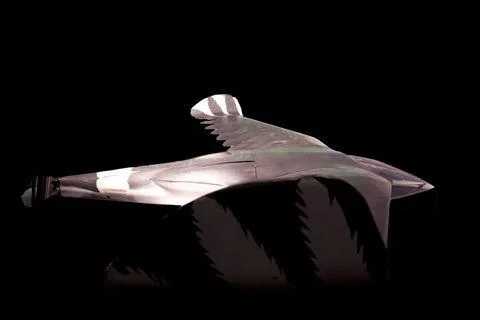
Project Aquiline was one of the most unusual and complex spying projects during the Cold War. The idea was to create 12 bird-shaped drones powered by nuclear energy that could fly for up to a month. These drones were meant to be robotic spy planes and deliver secret items, but the project was never finished.
The CIA wanted Aquiline to be the first uncrewed system for gathering intelligence. Its goal was to gather information in areas where access was restricted secretly. The drone, designed by McDonnell Douglas (a defense company known for fighter jets), was very different from the company’s usual aircraft.
Aquiline was a small drone meant to be kept as close to bird-like size as possible—five feet long, 7.5 feet wide, and a takeoff weight of 83 pounds—under the constraints of the time’s technology. A silent 3.5-horsepower, four-cycle engine would give the drone a speed of 47 to 80 knots and an endurance of 50 hours and 1,200 miles. Aquiline’s maximum altitude was estimated at 20,000 feet. CIA file: https://www.cia.gov/readingroom/collection/aquiline
Project Aquiline. CIA
Nuclear power was supposed to make Aquiline fly even farther. The CIA suggested adding a system that would use the heat from decaying radioactive materials like plutonium to create electricity. This system, made for deep space missions, would allow the drone to stay in the air for up to 30 days or travel 36,000 miles.
Aquiline was built to carry cameras and spy equipment. It could take photos from a lower height than the U-2 spy plane and collect electronic signals from radios, radar, and other devices for later study.
The CIA described Aquiline as a “small, bird-like surreptitious vehicle with sufficiently small acoustic, visible, and radar cross-section to permit it to operate in the natural physical signal environment of living birds.” Radars and human sentries at sensitive sites would mistake Aquiline for a bird and pay little attention to it.
Aquiline would be launched, controlled, and brought back by mobile teams on the ground. These teams could operate Aquiline from areas near the Soviet Union or China, like Taiwan, Turkey, Norway, or other places, to make sure the drone could fly over enemy land for a longer time.
The small drone would send its data to a modified DC-6 (later switched to a U-2R spy plane) flying nearby. This way, the drone wouldn’t need to carry its data storage, since storage at the time was bulky and heavy, using punch cards, tape, or large hard drives, which would use up too much weight and power.
The concept of the Aquiline includes bird feathers painted on its wing. The drone would have been a very radioactive bird.
The bird drone was supposed to be developed at Area 51, with various documents listing the personnel requirements and what it would take to regularly fly engineers to and from the mysterious base. The program was top secret, with access doled out on a strictly “need-to-know” basis. The program was so secret that it recommended personnel be recruited two years before the first flight to ensure enough personnel could pass the necessary security checks.
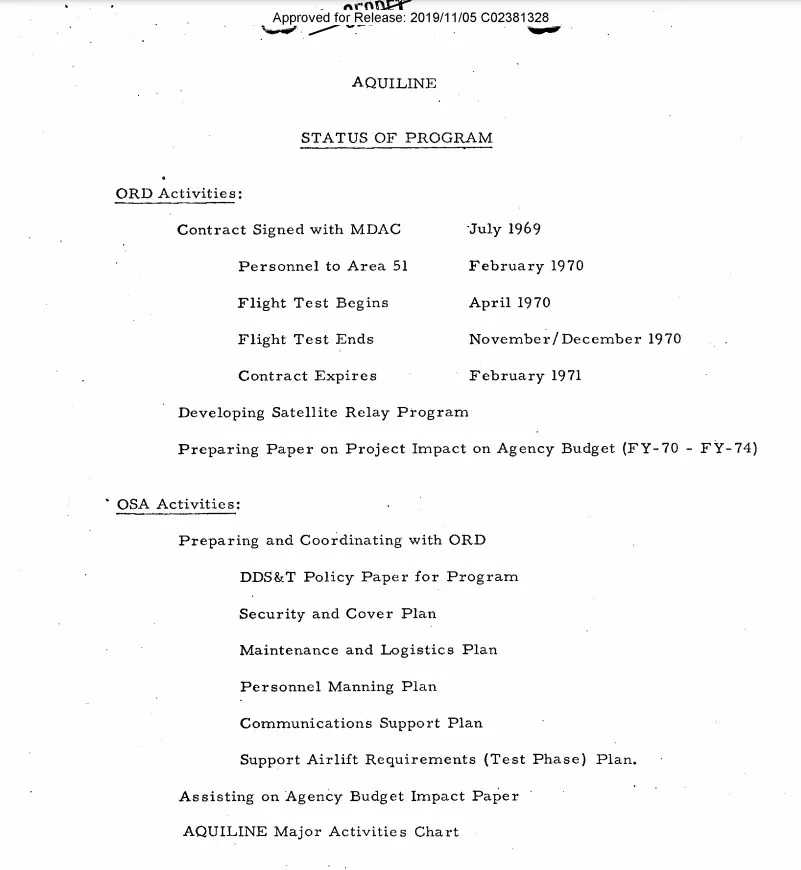
In 1969, the CIA agreed with the McDonnell Douglas Astronautics Corporation (MDAC) to start working on technologies for the Aquiline program. In 1970, people were sent to Area 51 to begin flight testing. This testing was planned to end in early 1971 when the contract was finished. It was expected that by then, a functioning Aquiline drone would be ready, and the program would become fully active.
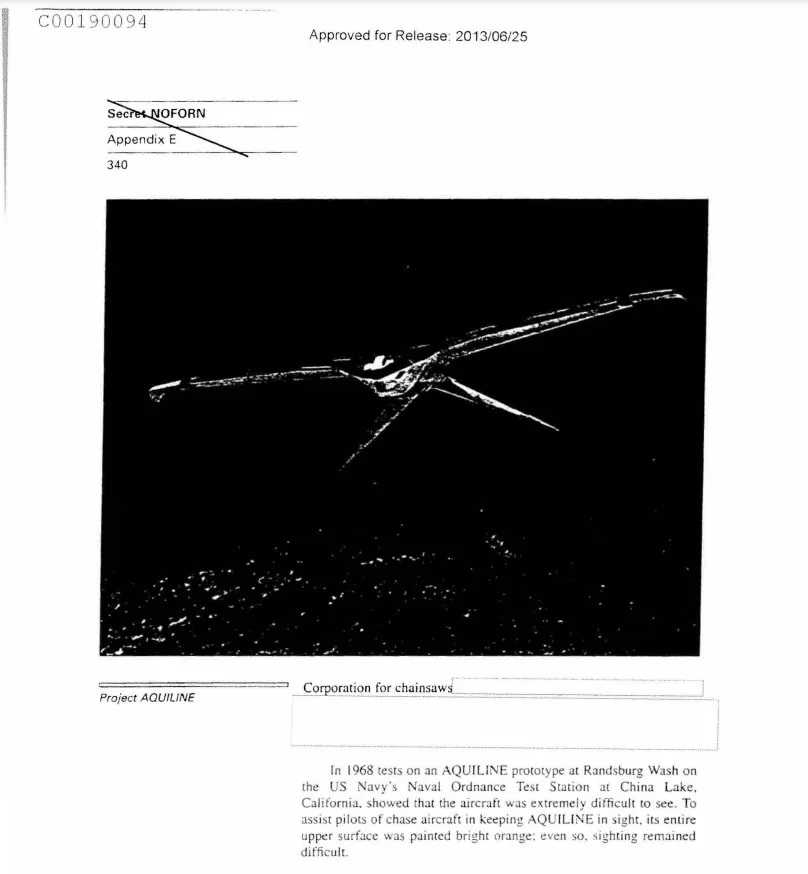
Exact specifications and design details are scarce, but what is known is that Aquiline drones were made to resemble birds and featured a single-tail propeller. Initially, the prototypes were powered by chainsaw motors. In one memo in the CIA’s reading room, the Aquiline drone is referred to as a “high characteristic operating model plane with a lot of expensive gadgetry.”
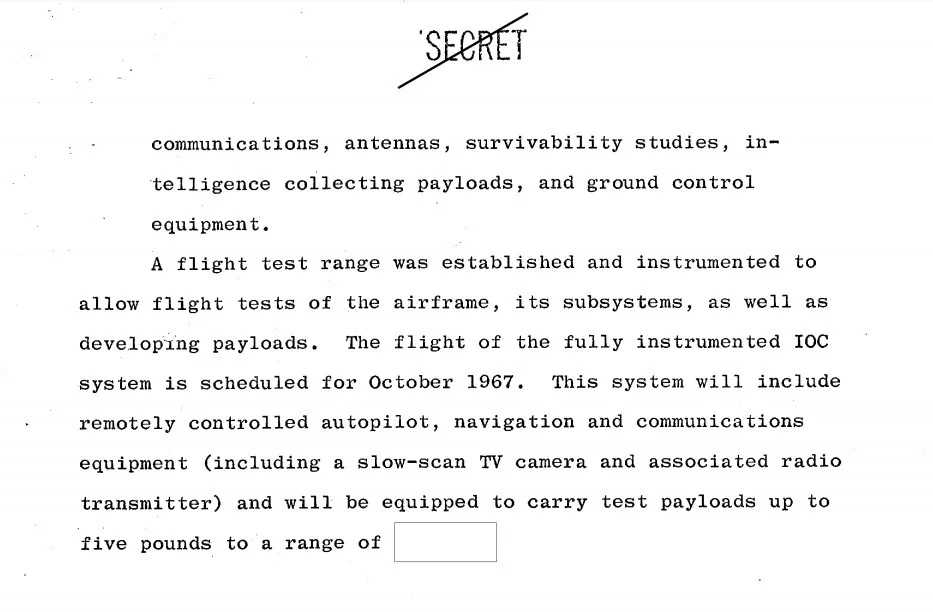
Sensor systems were embedded in the aircraft’s nose and included optical cameras infrared sensors, and even electronic intelligence packages. The drones were intended to have also been able to drop “black box” sensor systems into hostile territory, as well, so some form of payload-carrying capability must have been included in at least some of the Aquiline designs. Specifically, one of the CIA’s documents states that one of the test drones was designed to carry payloads weighing up to five pounds.
The Aquiline drones were hard to spot during testing, so engineers painted one bright orange to make it easier for a chase plane to see during a test flight. Even with the paint, the chase plane crew still had trouble spotting the drone in the air.
The exact range of the Aquiline drones remains unknown and is redacted in all of the CIA’s declassified documents.
However, one account states that Aquiline was able to fly for 130 miles while obtaining “very high-resolution photography,” while another document states one of the proposed mobile control units would have a range of 1,200 miles. A dedicated satellite was planned to offer a long-distance communications link for Aquiline drones but was never launched.
Aquiline drones had an impressive design, but they had a big problem: they didn’t have landing gear. Instead, they had to land by crashing into nets. This often damaged the drones’ wings and propellers, leading to delays because of constant repairs. Three Aquiline prototypes were destroyed during these landings.
In a personal account hosted on RoadrunnersInternationale.com, a site that preserves “the history of the aviation pioneers and programs that developed the U-2, A-12 ,and YF-12 during the Cold War,” John H. Meierdierck, retired Air Force Lieutenant Colonel, offers a brief recollection of the Aquiline program as he remembered it, writing:
The vehicle was a six-foot-long plane that had a small pusher prop and looked like an Eagle or Buzzard when it was in the air. It was designed to fly at very low levels along communications lines and intercept their messages. It also had a small television in the nose as an aid to navigation and to photograph targets of opportunity. There were several successful flights some crashes [reason unknown] and some lousy landings.
It’s unclear why Aquiline was canceled. It was meant to be a very complicated program, dealing with issues like stealth, data transfer, and propulsion in a tiny design. Using a nuclear power source would have made it even more complicated, and the technology of the 1960s might not have been enough to handle it.
Aquiline also depended on a trick, and if the Soviets or Chinese discovered it, their anti-aircraft weapons or MiG jets could have easily shot it down. In the end, Aquiline was just an idea held by a few people in the intelligence community.
If the rumors are to be believed, there’s a chance an example or two of Aquiline still exists among the other strange birds caged up in the darkness at Area 51.
The Strangest thing about Saturn is that this Man, who worked on the Voyager missions, said he discovered Enormous, Living, Electromagnetic Vehicles inhabiting its Rings.
Dr. Norman Bergrun concluded, based on his analysis of Voyager 1 and 2 data, which he detailed in his 1985 book, Ringmakers of Saturn, that he discovered enormous, living, electromagnetic vehicles inhabiting the rings of Saturn.
Dr. Bergrun, who had worked for NASA, claimed that there were massive alien spacecraft proliferating in the rings of Saturn. He is the author of the books “Ringmakers of Saturn” and “Tomorrows Technology Today,” which document the existence of extraterrestrial vehicles of immense power. A scientist who pioneered the methodology of thermal ice prevention design, he is also credited with roll-stability laws for airplanes and missiles
Dr. Bergrun was manager of test planning and analysis for the Polaris Underwater Launch Missile System and evaluated satellite system applications. Also a director of Information Systems, he founded his own company in 1971 and is cited in “Who’s Who in the World” and other reference works. He was an alumnus of Ames Research Laboratory, NACA (National Advisory Committee for Aeronautics), predecessor of Ames Research Center, NASA, where he worked for 12 years as a research scientist.
Dr. Norman Bergrun played a key role in the Voyager missions, the probes that were sent out to photograph Saturn, its rings, and its moons. There is a photo shown below from that mission, which he was able to obtain from the agency of a large unidentified flying object hovering just outside Saturn’s rings. It is huge, approximately the size of Earth, and is published in his book, “Ringmakers of Saturn.”
Dr. Bergrun claimed that these rings were not made of ice and rock as is commonly believed, but were actually the exhaust from these massive craft, which he calls “ringmakers.” He asserted that these vehicles are proliferating and are now also present at Jupiter and Uranus, creating new rings on planets that previously had none.
He suggested these vehicles had strong nuclear power sources and advanced electromagnetic technology. They appeared capable of creating massive electrical fields, lightning bolts larger than those on Earth, and disturbances across the entire ring system.
Dr. Bergrun recounted his professional history, mentioning his work at Lockheed on the first generation of the Polaris underwater launch vehicle. This had led him to work in a top-secret area behind closed doors, where he had been required to sign a 30-year non-disclosure agreement.
He explained that he eventually left this role due to “claustrophobia,” clarifying that it was not a fear of small spaces but rather the mental strain of being confined to the same secret room day after day.
It was during this period that he received his first clue about unusual things in space after being given a set of data that no one else could make sense of. When he plotted it, he realized that it showed something strange. (Source)
He claimed that he faced significant opposition and cover-ups from official bodies such as NASA. He recounted a story about a source allegedly connected to NASA who asked him how he had found a particular image from the moon, remarking, “I thought we darkened that enough that you wouldn’t find it.”
Dr. Bergrun also stated that his personal data and images, which he had stored in a supposedly impenetrable vault, were tampered with. He claimed that unknown parties had “garbled” his files on laptops and disks, sometimes erasing them completely. Despite this interference, he believed he did not need the old data because he was so familiar with the subject that he could reconstruct his work at any time.
Regarding the purpose of thesevehicles, Dr. Bergrun disagreed with the theory that they were mining the rings. Instead, he suggested that they were “nursing” from the rings, using them as a source of energy to power themselves and to create new, smaller vehicles that later grew, much like living organisms.
He was open to the idea that they might also fly close to the sun to “get pumped up” with energy, since their apparent ability to withstand extreme heat made that possible.
According to him, these could not be fully explained by natural processes. He suggested that the vehicles had electromagnetic capabilities and emitted streams of material, which then formed the rings and gaps seen around Saturn. He gave examples and measurements to support his claims, and pointed to historical observations by Galileo and others that showed unexplained phenomena.
Dr. Bergrun also claimed that similar effects were seen on some of Saturn’s moons. He described mysterious lighting and unusual markings, which he thought were possible “scars” left by the vehicles. He went even further, suggesting that Earth’s Moon, the Tunguska explosion in Siberia, and strange weather events might all be related to visits or actions by these powerful spacecraft.
He argued that these vehicles are evidence of a super-advanced intelligence in the universe and that they have been visiting our solar system for a long time. Bergrun warned that their power could pose risks if not understood, but also noted that they might not necessarily threaten humanity directly.
Dr. Bergrun believed that the situation was becoming “critical” because the activity was increasing, as evidenced by the new rings appearing around Uranus and Jupiter.
His urgency was not necessarily from the idea that the craft were coming to Earth, but from his sense that there was a strong possibility they could, and that the public and the scientific community had to be made to understand that these objects were real.
He noted that his conclusions were too controversial for his professional organization to address. He distinguished between his work, which he said was based on data, and the “theories” of others, such as John Lear’s idea that Saturn was a portal into another dimension.
He also touched on other topics, including his belief that humans were not capable of communicating with these entities, which rendered efforts by organizations like SETI ineffective.
He confirmed that plasma had been scientifically measured in Saturn’s rings, which he saw as supporting his claims. When asked about the hexagonal shape seen at Saturn’s north pole, he acknowledged it but regarded it simply as another geometric form that these advanced entities were capable of creating, rather than holding a special symbolic meaning.
Finally, he revealed that he had spent ten years earning a law degree so that he could better understand the mindset of the people “running the country,” whom he felt often made decisions without comprehending the underlying science.
He died on July 1, 2018, at Tracy Nursing and Rehabilitation Center at the age of 96. Unfortunately, Dr. Bergun was just another name on the list of NASA whistleblowers who are forgotten and ignored due to a lack of followers and media attention
Ret. US Army Colonel Claimed Aliens In Roswell UFO Crash Were Bio-Robots Built For Space Travel
By Vicky Verma
The information about the Roswell crash and so-called Extraterrestrial Biological Entities revealed by retired US Army Officer Philip James Corso was a breathtaking move in the history of UFOlogy. In his 21 years of serving, he claimed to have alleged involvement in the research of extraterrestrial technology recovered from the 1947 Roswell incident.
Born in 1915, Corso served in the US Army from 1942 to 1963, retiring from the rank of lieutenant colonel. According to him, the US policy was clear that UFOs and aliens do not exist. They were led to believe in it. But there were some great men who expressed themselves as believers. Some of them were Gen. Douglas McArthur, Gen. George Marshall, Werner Von Braun, President Ronald Reagan, Gen. Nathan Twining, Gen. Walter Bedell Smith, Dr. Carl Gustav Jung, and many others
Corso emphasized that the advancement in the technology that the world achieved in the past decades could not be possible without the helo of other worlds. Scientists such as Dr. Herman Oberth, Stanton T. Friedman, Robert Sarbaeher, W.E. Smith, Dr. Werner Von Braun, etc., are disregarded or ridiculed when they say, “we cannot take the credit for our record advancements in certain scientific fields alone. We have been helped by people of other worlds.”
Brig. Gen. Brown (left) shakes the hand of Maj. Philip Corso, who just received his bronze star in Rome. Image credit: Wikimedia Commons
He highlighted the intervention of aliens in human history by referring to Sumerians who stated that the EBEs were the most advanced in the studies and manipulations of DNAs, who were adroit in cloning. “We believed that the beings of the Roswell crash were clones. The Sumerians called them IGIGIs. They were used to ferry the ‘Gods’ to earth and continuously stayed in subspace and circled the globe-earth,” Corso explained.
During his military career, Corso was granted nine clearances above “Top Secret.” These included cryptographic, satellites, code and intercept special operational clearances, and the “Eyes Only” category of special White House (NSC) matters. This allowed him to have an eye on matters within the government which included UFO information.
He was the Chief of the Foreign Technology Division in the US army R&D. He received the piece of information that a sample recovered from the Western US desert was believed to be from a UFO. The material had immense strength but at the same time was as light as feather. It was perfect for space travel and no space debris could harm it.
Corso concluded UFOs existed. His team had reports of objects from a mother ship and they believe what was recovered were parts of sphere-type probes. Usually, four or five of these came from every saucer. He further explained that the radar images of formations are probably these probes surrounding one or two flying saucers. They dissolved in a transparent alignment of atoms.
On visiting the crash site, Corso was convinced that it was the UFO. His faith in UFOs came from his work in R&D, where the radars once locked an object flying over 3000 miles an hour.
Upon examination of the items recovered from the crashed craft, a harness-type system was discovered. Corso argued that many technical discoveries that appeared in the following decades, such as Kevlar body armor, optical fiber, transistors, night vision devices, and the integrated circuit chip were a direct result of what scientists studied and found inside the alien spacecraft. He also claimed that his job had been to transfer the alien technology to American companies.
The craft inside was illuminated by a yellow-greenish light. The light appeared to emit from solid metal, possibly a variation of the atom alignment within the structural members of the craft. This was discovered early from small pieces. When a light was applied at one end, the whole piece would light up and glow. This was thought to be a variation of the fiber optic tubes. It is not known if the source of the yellow-greenish light or glow was ever found.
Co-authors of ‘The Day After Roswell,’ Bill Birnes and Col. Philip Corso.
In 1957, while in command of the Army’s Missile Firing Range at Red Canyon, New Mexico, part of the White Sands Proving Grounds, Coros came up against a most perplexing problem. There had been much speculation that UFOs engage in time travel. He later discussed this with German scientists and they were of the opinion that this was the fact – the UFOs’ terrific acceleration and flashy disappearance and appearance is caused by exit and entry into a time dimension.
An interesting version that Corso advanced was that the two UFOs were entering our time zone at the same instant, they collided. One went on to crash at Roswell, the other was damaged and debris fell into our time zone. It accelerated at terrific speed, exceeding its own limits, and fell, just west of Red Canyon, in the White Sands area, but it had gained 10 years and crashed in 1957.
In 1997, Corso and writer William J. Birnes published a book that revealed many secrets and mysteries that took place during the events of Roswell in 1947. The book “The Day After Roswell” immediately became a sensation among UFO researchers and conspiracy theorists.
In the book, there are so many strong revelations about aliens that even ufologists considered it partly fictional or much exaggerated. At the same time, Corso suddenly died of an unexpected heart attack just a few months after the publication of his book. Conspiracy theorists believed that he was simply silenced by higher authorities because he had revealed many things.
In general, according to all the facts stated above, it does not prove that in the late 1990s, he was influenced by extraterrestrial beings. He also repeatedly participated in interviews with the American late-night radio talk show “Coast to Coast AM.”
He had repeatedly argued that the US government was hiding the truth about UFOs and aliens to profit from it in the tech sector. In the book, he described not only the UFO technology but also talked about the alien bodies found during the crash.
According to him,Grey aliens, also referred to as Zeta Reticulans, were not really aliens, but bio machines specially created to work on other planets. He wrote that as far as he knew, no one had encountered real aliens, and all eyewitnesses or abductees had seen only big-headed and black-eyed “bio machines."
To prove his claim, Corso described what he had seen during the autopsy. He wrote that those aliens were without any digestive system, and their bodies were linked to the spacecraft as if they were controlled through ships.
He wrote further that those extraterrestrial biological objects, as indicated in the autopsy reports, were humanoid robots specially designed to travel long distances in space and time.
An image of interstellar Comet 3I/ATLAS captured by the Gemini Multi-Object Spectrograph (GMOS) on Gemini South at Cerro Pachón in Chile (Credit : International Gemini Observatory/NOIRLab/NSF/AURA)
An interstellar comet is as its name suggests, a comet that originated outside our Solar System and travels through interstellar space before entering our neighbourhood. Unlike comets that orbit the Sun and formed within our Solar System, these rare visitors come from other star systems, traveling for millions or even billions of years across interstellar space. When they pass through our Solar System, their trajectories are hyperbolic rather than elliptical, meaning they're just passing through rather than remaining bound by the Sun's gravity. The most famous example is 2I/Borisov, discovered in 2019, which became the first confirmed interstellar comet observed.
Interstellar comet 2I/Borisov captured by the Hubble Space Telescope
(Credit : NASA, ESA, and D. Jewitt (UCLA))
Until now, water has never been detected from an interstellar comet but a team from Auburn University did just that. In comets native to our Solar System, water serves as the primary way to measure the comet’s activity. Water loss is tracked to understand how sunlight drives the release of other volatile gases locked within a comet's icy nucleus. Finding the same chemical signature in an interstellar visitor means astronomers can finally begin comparing 3I/ATLAS directly with Solar System comets, offering the first opportunity to compare the chemistry of planetary systems across the Galaxy.
What makes this detection particularly intriguing is the distance at which it occurred. Swift's observations captured hydroxyl emissions when 3I/ATLAS was nearly three times farther from the Sun than Earth, well beyond the region where surface ice typically turns straight to a gas easily. At that distance, the comet was losing water at roughly 40 kilograms per second, that’s the kind of output from a fire hose! Most Solar System comets remain dormant at such distances, suggesting something unusual is happening with ATLAS.
The location of the ATLAS system of telescopes that scours the skies for potential impactors
(Credit : Strebe)
The strong ultraviolet signal that the team detected hints at a complex process where sunlight heats small icy grains released from the nucleus, allowing them to vaporise and contribute to the surrounding gas cloud. These extended water sources have been observed in only a handful of distant comets and point toward layered ices that preserve clues about how these objects originally formed in their parent star system.
Each interstellar comet discovered so far has revealed dramatically different chemistry. 'Oumuamua, the first interstellar visitor identified in 2017, appeared remarkably dry, lacking any appreciable water content. The second, 2I/Borisov, proved rich in carbon monoxide. Now 3I/ATLAS is releasing water at unexpected distances. These differences demonstrate how varied the building blocks of planetary systems can be, driven by factors like temperature, radiation exposure, and local composition during formation.
To make their discovery, the team used NASA's Swift Observatory which carries a modest 30 centimetre telescope, but its location above Earth's atmosphere allows it to detect ultraviolet wavelengths that are almost completely absorbed before reaching ground based observatories. Free from atmospheric interference, Swift achieves sensitivity comparable to a four metre ground telescope at these wavelengths. Thankfully the team captured the data before 3I/ATLAS disappeared from view but it will become observable again after mid November, offering another opportunity to track how its activity evolves as it moves closer to the Sun.
NASA’s Swift Ultraviolet/Optical Telescope (UVOT) observed interstellar comet 3I/ATLAS during two visits in July and August 2025. The panels show visible-light (left) and ultraviolet (right) images, where the faint glow of hydroxyl (OH) traces water vapor escaping from the comet. Each image combines dozens of short, three-minute exposures, painstakingly stacked to reach total integration times of about 42 minutes in visible light and 2.3 hours in ultraviolet. Swift’s vantage point above Earth’s atmosphere allowed astronomers to detect these ultraviolet emissions that are normally invisible from the ground.
In a newly published novel titled “Hole in the Sky,” Cherokee science-fiction author Daniel H. Wilson blends those stories with up-to-date speculation about UFOs, now also known as unidentified anomalous phenomena or UAPs, to deliver a fresh take on the classic tale of first contact with an alien civilization.
Wilson says the typical alien-invasion tale tends to parallel the real-life story of European settlement in the Americas. “I love robot uprisings and alien invasions, and the more I thought about it, you realize that in an alien invasion, the aliens show up, and they usually want to extract our resources, take our land, our water, destroy our culture, enslave us,” he says in the latest episode of the Fiction Science podcast. “That’s kind of a really thinly veiled fear projection that what colonizers have done to Indigenous people will be done to our society. And so I started from there.”
He also managed to weave in other elements of Cherokee mythology, such as a supernatural being known as Tsul ‘Kalu or Judaculla. In tribal lore, the Judaculla is a giant with slanted eyes — something like the legendary Bigfoot or Sasquatch. The Judaculla plays a brief but pivotal role in “Hole in the Sky.”
“If you think about the human embodiment of Indigenous technology, it would be the Judaculla,” Wilson says, “because among the Cherokee at that time, the most advanced technological problems would have been keeping the ecosystem in balance to support all the people in perpetuity, without overexploiting it and doing what we’ve been doing for the last 200 years or more in North America.”
In Wilson’s novel, there’s a good deal of Cherokee-style magic at work, centered on Spiro Mounds, a complex of earthworks that was built centuries ago in eastern Oklahoma. But there are also lots of references to the U.S. military’s renewed interest in UFOs/UAPs. That part of the story draws upon a different phase in Wilson’s life.
“I had been writing threat assessments for the Air Force, which is where they find science-fiction authors, and they pair you with an analyst,” he says. “They brief you on some kind of potentially dangerous tech or interesting technology. And then you write a story, something fun that’s fictional, that demonstrates these sorts of threat capabilities. Higher-up people read these fictional accounts in order to get a better idea of what the threat could be.”
Wilson was amazed to learn that military officials have serious concerns about unidentified aerial phenomena.
“Nobody’s saying they’re aliens, but we don’t know what they are, and we’re intensely interested in learning more because it is a major defense issue for our country,” he says. “Walking away from that, I was thinking, ‘My God … This sounds crazy, but we could be in a situation in our lifetimes where first contact will be a real thing.'”
What would we do if the aliens arrived? Wilson imagines the actions that might be taken by intelligence experts, military leaders, scientists and regular folks — including a Cherokee oilfield worker and his daughter — and weaves them into a deliciously tangled tale.
“Hole in the Sky” is the latest science-fiction novel by Daniel H. Wilson. (Cover Design by Oliver Munday;
“If you think of our sun as a fire in the infinite night, this is where the light of the fire dies out, and you get out there into the real nitty-gritty between stars,” Wilson says. “And I thought, what better place to wake up something in the night than whenever you set foot outside the light of our own fire.”
Wilson drew upon recent observations of interstellar objects to describe how the aliens make their arrival. “We’ve gained this capability to observe interstellar objects, and they just keep getting more interesting, and frankly, more scary and creepy,” he says.
“This is what I do with my writing,” he says. “I mean, I was a scientist.”
A film adaptation of “Robopocalypse” has been in the works for 15 years. “I still hold out hope that we’ll see a ‘Robopocalypse’ movie someday, but I’m not holding my breath,” Wilson says. In contrast, there’s a chance that “Hole in the Sky” will be coming to a screen near you. Wilson says he’s adapting the story for Netflix.
“We have Sterlin Harjo attached to direct,” he says. “If you haven’t seen ‘The Lowdown,’ which is a TV show he just made with Ethan Hawke, you gotta watch it, it’s incredible. He of course did ‘Reservation Dogs’ before that. Sterlin is an incredible Native director and writer, and working with him on that has been really fun.”
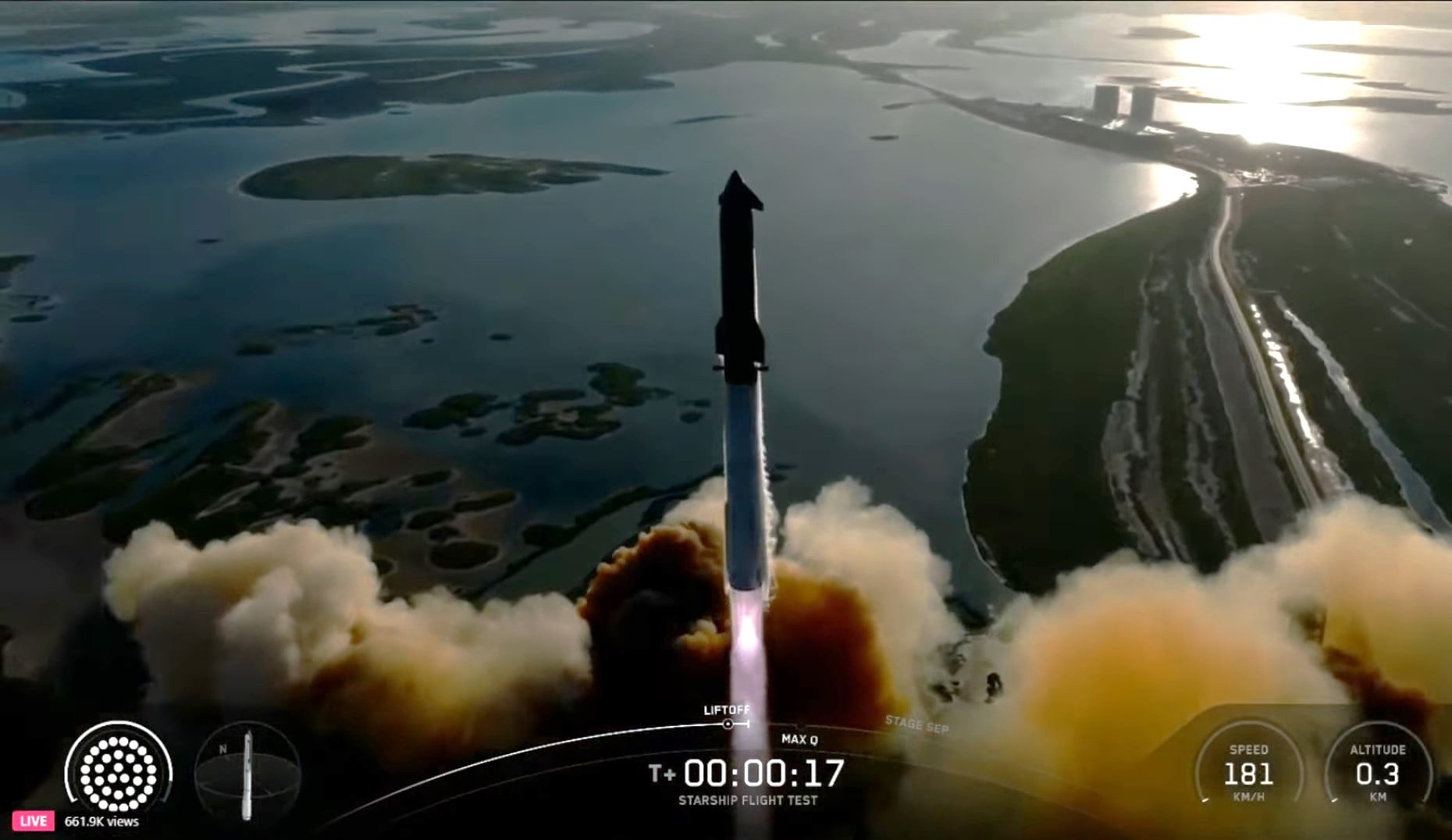
SpaceX's Starship rises up from its launch pad in South Texas. (SpaceX via YouTube)
SpaceX closed out a dramatic chapter in the development of its super-heavy-lift Starship launch system with a successful flight test that mostly followed the script for the previous flight test.
The 11th test flight began with the ascent of Starship’s Super Heavy booster from SpaceX’s Starbase launch pad in South Texas at 6:23 p.m. CT Oct. 13 (11:23 p.m. UTC). It was that particular pad’s last liftoff. An upgraded Pad 2 is being prepared to accommodate a more powerful Starship Version 3, with the first launch expected next year.
Starship V3 will feature an upgraded version of SpaceX’s methane-fueled Raptor engines and larger propellant tanks that are capable of in-orbit refueling.
The Super Heavy booster and its second stage, known as Ship, are being designed for missions in Earth orbit and beyond — and V3 is the version that’s meant to get SpaceX to that level.
Standing a little more than 400 feet tall, Starship is considered the world’s most powerful rocket, with liftoff thrust of 16.7 million pounds. That’s more than twice the oomph achieved by the Saturn V rocket during the Apollo era’s heyday.
The flight plan for Starship’s 11th not-quite-orbital flight test was designed to check on some of the performance issues that will be important for V3 — and repeat some of the procedures that were executed during the 10th flight test.
SpaceX reused the same Super Heavy booster that blasted off for the eighth flight test in March. All 33 Raptor engines fired up for the ascent, and after stage separation, the booster flew itself back down to a controlled splashdown in the Gulf of Mexico.
This time around, SpaceX tested a landing burn procedure that called for relighting 13 engines, powering down to five engines, and then to three. (The booster ended up going 12 for 13.) At the end of the descent, Super Heavy hovered over the water for a few seconds, then dropped into the gulf. “That was absolutely awesome,” said SpaceX launch commentator Jake Berkowitz.
Then the focus turned to Ship: In a replay of Flight 10’s in-space test, the upper stage automatically deployed eight flat spacecraft that served as stand-ins for SpaceX’s Starlink broadband satellites. Ship also performed a midflight relight of one of its six Raptor engines.
This time around, some of Ship’s heat-shield tiles were removed to see how well the hull and the flaps could hold up under stress. During atmospheric re-entry, cameras showed an orange glow of plasma surrounding the upper stage. But Ship weathered the inferno, went through a dynamic banking maneuver and an in-flight bellyflop, and then executed its landing burn with three Raptor engines.
In the end, Ship sank into the Indian Ocean and burst into flames, as expected. Splashdown came 66 minutes after launch. SpaceX said all of the flight test’s objectives were met.
“We promised maximum excitement, and Starship delivered,” Berkowitz said.
During the test program’s next chapter, SpaceX plans to demonstrate full and rapid reusability of both Super Heavy and Ship, with separate returns to the launch site. Another high-priority agenda item is in-space refueling, which will be needed for trips to the moon and Mars.
Locked away in the British Museum is a palm-sized clay tablet that could turn biblical history upside down. To most, it looks like nothing, just faded lines on ancient clay. But this 2,500-year-old artifact, known as the Babylonian Map of the World, may secretly hold the location of Noah’s Ark itself.
For years, experts thought the tablet was just a symbolic diagram. Now, new research by Irving Finkel and Edith Horsley reveals something shocking, it’s not myth, it’s a real map of the ancient world. And one mysterious inscription on it might point directly to the mountain where the Ark came to rest.
The tablet describes eight distant lands beyond the “Bitter River,” the great ocean surrounding Babylon. One of those lands mentions a “Great Wall”, towering trees, and something called parsiktu, a word that only appears once elsewhere in all Mesopotamian writings: in the flood story of Atrahasis, the Babylonian Noah. The connection is jaw-dropping.
This single word ties the world’s first map directly to the world’s first flood story. According to Finkel, the missing piece of the tablet describes the very mountain where the Ark landed, in a region ancient scribes called Urartu, now eastern Turkey and Armenia… home of Mount Ararat.
For centuries, explorers and pilgrims have searched Ararat’s peaks for traces of the Ark. In 1959, a Turkish airman discovered the Durupınar formation, a massive, boat-shaped outline exactly 300 cubits long, just like the Bible describes. Metal readings, strange “anchor stones,” and petrified “ribs” sparked wild claims that the Ark had been found. Skeptics called it a geological illusion, but the shape is undeniable.
And it doesn’t stop there. In 1949, U.S. spy planes spotted a strange box-like anomaly high on Mount Ararat itself — a dark, rectangular shadow under the ice that still fuels modern Ark hunts today.
But maybe the story goes even deeper. In 2000, scientists discovered that the Black Sea was once dry land, until the Mediterranean suddenly burst through the Bosporus, unleashing a flood with 200 times the power of Niagara Falls. Entire civilizations would have vanished overnight. Could this have been the real Great Flood?
Marine legend Robert Ballard, the man who found the Titanic, dove into the Black Sea and discovered the ruins of an ancient village buried deep below the waves, along with freshwater shells that all died at the same moment. Proof, he said, of a sudden, catastrophic flood.
And incredibly, nearly every ancient culture tells the same story, from Mesopotamia to China, from the Andes to India, all describing a global deluge and a lone survivor in a great ship. Recent discoveries in China (2016), South America (2020), and India (2023) show evidence of massive prehistoric floods that eerily match these ancient myths.
Is it all coincidence, or are these stories fragments of a forgotten truth?
Maybe the Babylonians knew more than we ever imagined. Maybe that tiny clay tablet in the British Museum isn’t just a relic of the past… but the world’s first map to Noah’s Ark, and the final clue to a cataclysm that changed humanity forever.
The Earth’s magnetic field is our invisible protective shield. It keeps the planet safe from dangerous cosmic radiation and solar particles. But this shield has begun to weaken. Thanks to data from the European Space Agency’s Swarm satellite constellation, scientists have obtained worrying evidence: one of the weakest areas of the field — the South Atlantic Anomaly— is rapidly expanding.
South Atlantic Anomaly (SAA). Illustration generated by Copilot AI.
What is the South Atlantic Anomaly?
This anomaly is a huge area over the South Atlantic where the magnetic field is significantly weaker than normal. It was first discovered in the 19th century. Today, it poses a real threat to spacecraft. Satellites flying through this zone receive increased doses of radiation, which can damage their equipment.
The Swarm mission, consisting of three identical satellites, has been continuously measuring the Earth’s magnetic field since 2013. Data published this month shows that since 2014, the anomaly has expanded to cover almost half of Europe. But what is most concerning is that since 2020, an area of even more rapid weakening has formed over the Atlantic southwest of Africa.
The South Atlantic Anomaly in 2025 has grown significantly over the past 11 years. Illustration: ESA
“The South Atlantic Anomaly is not just one block,” explains Professor Chris Finlay, lead author of the study. “It changes in different ways. Something special is happening in this region, causing a more intense weakening”.
Probable cause
Scientists attribute this strange behavior to processes in the Earth’s core, at a depth of about 3,000 km. There molten iron creates electric currents that generate a magnetic field. Unusual areas have been discovered beneath the South Atlantic Anomaly – so-called “reverse flow zones.” There, instead of escaping outward, the magnetic field unexpectedly returns back to the core. Swarm data shows that one such zone is moving westward over Africa, which is exacerbating the weakening.
Global changes in the magnetic field
Recent discoveries emphasize that the Earth’s magnetic field is a dynamic and complex structure. For example, there are two powerful magnetic regions in the Northern Hemisphere: one above Canada and the other above Siberia. Since Swarm was launched, the Siberian region has strengthened, while the Canadian region has weakened. This is due to the fact that the North Magnetic Pole is rapidly drifting towards Siberia, which is important for global navigation systems.
Changes in the strong magnetic field over Canada and Siberia. Animation: ESA
The Swarm mission continues to provide unique data that helps us not only better understand our planet, but also protect our technological infrastructure. As mission leader Anja Stromme notes, they hope to continue this research after 2030 in order to obtain even more key answers.
Known as the South Atlantic Anomaly (SAA), the region has expanded by an area nearly twice the size of Texassince 2014, and it is also slowly shifting westward toward Africa, according to a new study released on Monday.
The SAA has increased by up to 25 percent, as it moves about 14 miles west each year.
The expansion and movement are the result of turbulent flows of molten iron in Earth’s outer core, which generate unusual magnetic patterns that weaken the field in this part of the planet.
The Earth’s magnetic field, created by the swirling liquid iron thousands of miles beneath the surface, acts as a protective shield against dangerous charged particles from the sun and cosmic radiation.
Scientists warned that the weakening and shifting of this shield in the SAA is not just a scientific curiosity but has real-world consequences.
The SAA poses the greatest threat to satellites passing overhead, exposing spacecraft to higher levels of radiation that can temporarily disable electronics, corrupt data, or even cause permanent damage to critical hardware.
Satellites providing GPS, communications, and weather forecasting services for the US and around the world are particularly vulnerable when they pass through the anomaly.
The SAA has increased by up to 25 percent, as it moves about 14 miles west each year since 2014
Lead author Chris Finlay, Professor of Geomagnetism at the Technical University of Denmark, said in a statement: 'It's changing differently towards Africa than it is near South America.
'There's something special happening in this region that is causing the field to weaken in a more intense way.'
While regions outside of Earth contribute to the observed magnetic field, the primary source stems from inside the planet.
This, coupled with the tilt of the planet's magnetic axis, is what produces the SAA, according to Nasa.
In the southern hemisphere, weak magnetic areas under Africa are moving westward, while similar features in the mid-Atlantic are moving east.
Scientists warned the weak spot will let harmful radiation from the sun hit Earth, disrupting satellites in orbit
In the north, a strong magnetic zone under the Bering Strait is drifting west, and near Indonesia and the western Pacific, magnetic features are moving east.
These shifts are strongest near the equator, where the field is also experiencing rapid changes and oscillations.
The study, which analyzed 11 years of data from the European Space Agency’s (ESA) Swarm satellite constellation, also revealed other significant changes in Earth’s magnetic field.
This weakening can affect navigation systems, satellite operations, and even technologies that rely on geomagnetic calibration.
Additionally, the study found that strong magnetic flux features under the Bering Strait have shifted westward, while those beneath Indonesia and the western Pacific have moved eastward.
These movements, though invisible to most people, can influence global geomagnetic conditions and the behavior of space weather, further impacting satellites and technology infrastructure worldwide.
The SAA is not static and its continued growth underscores the importance of constant monitoring to anticipate and mitigate potential impacts.
The Swarm satellites, which have been collecting continuous magnetic field data since 2013, are providing unprecedented insight into the complex forces at work deep inside our planet.
While the average person on the ground is not directly at risk, the growing anomaly is a reminder of the delicate balance that protects life on Earth from the constant bombardment of cosmic radiation.
For satellites, astronauts, and high-altitude air travel, however, the implications are real and require careful attention.
'The South Atlantic Anomaly is a warning from Earth’s core,' Finlay said. 'It shows us that our planet’s protective shield is dynamic, and changes deep below the surface can ripple all the way to space and to our daily lives.'
The discovery was made using the European Space Agency's (ESA) Swarm satellite constellation that precisely measures the magnetic signals that stem from Earth's core, mantle, crust and oceans, as well as from the ionosphere and magnetosphere.
It is a question that feels like it should have a straightforward answer: how many planets are there in oursolar system?
Since Pluto was relegated back down to dwarf planet status, almost everyone has agreed that the answer is eight.
However, scientists say that it might be time to rewrite the textbooks.
A new study has proposed that there could be a secret world lurking on the edge of our solar system.
Dubbed 'Planet Y' by reseachers from Princeton University, this planet is said to be Earth–sized and rocky.
The researchers were alerted to the possible planet after noticing that 50 objects in the Kuiper Belt – a region of icy objects beyond Neptune – were tilted on an unusual angle.
'We started trying to come up with explanations other than a planet that could explain the tilt, but what we found is that you actually need a planet there,' lead author Dr Amir Siraj told CNN.
'This paper is not a discovery of a planet. But it's certainly the discovery of a puzzle for which a planet is a likely solution.'
Scientists say there could be a ninth planet, dubbed Planet Y, hidden in the outer reaches of the Solar System beyond the orbit of Neptune
(stock image)
Since Pluto was axed from the list of planets, astronomers looking for a ninth planet have focused on the Kuiper Belt.
Any potential planets hiding in this distant region would receive very little light from the sun, making them extremely hard to see with a conventional telescope.
However, Dr Siraj thinks that there could be another ninth–planet contender, hiding much closer to home.
If it exists, Planet Y should be a rocky world with a mass between that of Earth and Mercury.
That makes it much smaller than Planet X – another theorised planet hiding in our solar system, believed to be a gas giant with a mass 10 times greater than Earth's.
What do we know about Planet Y?
Type of planet: Rocky
Size: Between that of Earth and Mercury
Location: Kuiper Belt
Distance from the Sun:100 to 200 times further than Earth
Evidence in favour: Disturbed orbits of Kuiper Belt objects
Evidence against: Lack of direct observations
Orbiting 100 to 200 times farther from the sun than the Earth, Planet Y is also much closer than Planet X – which is believed to orbit 400 times further from the sun than Earth.
However, at that distance, Planet Y would still be extremely dim and difficult to detect.
Likewise, the researchers predict that Planet Y's orbit is likely tilted by about 10 degrees from the orbital plane, which would make it much harder to find.
Importantly, the Planet Y theory does not mean that Planet X does not exist – meaning there could be as many as 10 planets in our solar system.
In fact, Dr Siraj's previous research suggests that there could be room for up to five more Earth–like planets to hide in the Solar System's very outermost regions.
That means our stellar neighbourhood might be much more crowded than we had previously thought.
However, not every astronomer is convinced by Dr Siraj's calculations.
Dr Samantha Lawler, associate professor of astronomy at the University of Regina in Canada, told CNN that these findings were 'not definitive'.
Planet X and Planet Y are likely located in the Kuiper Belt, a doughnut–shaped ring of icy objects beyond Neptune. However, Planet Y could be two to four times closer to Earth
Although Planet Y is a plausible explanation for the tilted orbits of Kuiper Belt objects, without observational evidence, there is no hard proof.
However, that could change very soon thanks to the Vera Rubin Observatory, which has just started taking photos of the sky with the world's largest digital camera.
Over the next decade, the Vera Rubin Observatory will take a photo every 40 seconds for eight to 12 hours a night, repeatedly scanning the entire sky.
Scientists anticipate that this observatory will discover thousands of new objects – including Planet X and Planet Y – if they really are there.
Dr Siraj predicts: 'I think within the first two to three years [of the observatory's mission], it'll become definitive. If Planet Y is in the field of view of the telescope, it will be able to find it directly.'
Astronomers believe that the orbits of a number of bodies in the distant reaches of the solar system have been disrupted by the pull of an as yet unidentified planet.
First proposed by a group at CalTech in the US, this alien world was theorised to explain the distorted paths seen in distant icy bodies.
In order to fit in with the data they have, this alien world - popularly called Planet Nine - would need to be roughly four times the size of Earth and 10 times the mass.
Researchers say a body of this size and mass would explain the clustered paths of a number of icy minor planets beyond Neptune.
First proposed by a group at CalTech in the US, this alien world was theorised to explain the distorted paths seen in distant icy bodies.
Its huge orbit would mean it takes between 10,000 and 20,000 years to make a single pass around the sun.
The theoretical Planet Nine is based on the gravitational pull it exerts on these bodies, with astronomers confident it will be found in the coming years.
Those hoping for theoretical Earth-sized planets proposed by astrologers or science fiction writers - which are 'hiding behind the sun' and linked with Doomsday scenarios - may have to keep searching.
UFO Fleet Over McKinleyville, CA, USA On Oct 8, 2025, Raw Video! UAP UFOs Sighting News.
Date of sighting: Oct 8, 2025
Location of sighting: McKinleyville, California, USA
Source: NUFORC
Now this is strange. Flickering lights in the sky hovering in place and then just when you think they are all one craft...a single light shoots away and then back again, and away again. It causes the eyewitness to stare in awe and surprise. This is not one craft, but five or more craft. Seen at 2am in the morning when almost everyone was sleeping, this single person caught sight of it. And lucky for us, recorded it. This is 100% proof of aliens in California.
Scott C. Waring - UFO Sightings Daily
Eyewitness states:
Lights on object, Aura or haze around object Hovering green/red lights Hello, around 9th of October around 2 AM, looking NE of my direction, i saw MULTIPLE lights in the sky hovering silently, total of 6 lights in the same distance and formation next to each other, 1 green light and 2 on the bottom and multiplied right next to each other so 6 in total, i checked all the available sources to see if it was a plane, or celestial body, or starlink, and nothing I looked up was it, I believe this was not a hobbyist drone either, in person it was much more massive and closer than it actually appeared on picture, and way brighter also.
Whatever this thing was, was massive and for sure not someone can buy as a hobby, and the video pretty much debunks that claim also as the right side of the lights appears to hover above the left side of the lights and then go back to its original position. I could not see a shape of this with the naked eye, nor determine its size but from the looks of how the lights behaved and how it was position really made it seem like it was very large. After around 5 minutes, all the lights just disappeared, almost as if a light switch turned them off.
Orange UFO over Florida at beach Oct 8, 2025 UAP sighting news 👽 similar to dr Steven Greer orbs he summoned.
Date of sighting: Oct 8, 2025
Location of sighting: Santa Rosa Beach, Florida, USA
Source: NUFORC
Now Florida beach is no stranger to UFO sightings. Remember this area off the coast falls into the Bermuda triangle and there have been hundreds of reports of UFOs there. Also most recently, Dr Steven Greer got a group of people together to summon some orange UFOs...exactly like this...over the ocean at the Florida beach. So yeah...it's aliens. It's easy to summon, all you have to do is focus your thoughts in that direction and mentally speak to them, kindly with respect and admiration and honesty.
Scott C. Waring - UFO Sightings Daily
Eyewitness states:
Mother and 12 year old son were walking on the beach. An intense bright white light appeared overhead, glowed brighter, then broke into 5 smaller lights in a linear pattern, breaking away and pulling out in a line from the original. The lights faded in timing similar to how they appeared. A minute later the lights appeared again in the sky to the left of our vision toward where Alligator Lake runs into the ocean.
They appeared and disappeared in a similar fashion. A minute later the same thing happened but to the right of our vision, past where the first sighting was. The third sighting broke apart then came back together in a trio of lights clustered together. We were only able to get video of when the trio came back together.
More than 50 years ago, theApollo 17 astronautsmade the last lunar landing. They returned to Earth not only with unforgettable impressions, but also with a priceless cargo — more than 2,000 samples of lunar rocks. NASA carefully packed and preserved some of these treasures for the future, assuming that advanced technology would better reveal their secrets. And now, half a century later, that hope has been fulfilled.
Illustration of the collision between the hypothetical protoplanet Theia and the young Earth 4.5 billion years ago. Image: Wikipedia
The breakthrough was achieved thanks to the work of a team led by James Dottin from Brown University. Scientists gained access to one of the unique preserved samples — a soil column extracted from the Taurus Littrow lunar valley. Instead of the methods used in the 1970s, they used modern secondary ion mass spectrometry, a technology that allows the ratio of isotopes, a kind of “chemical fingerprint” of substances, to be measured with incredible accuracy.
The aim of the study was sulfur in volcanic rocks originating from the mantle of the Moon. For a long time, science believed that the composition of our moon’s mantle was practically identical to that of Earth, which was indicated, in particular, by analyses of oxygen isotopes. Dottin expected to see the same picture with sulfur.
James Dottin and Brian Monteleone analyze data from samples obtained using secondary ion mass spectrometry during the Apollo 17 mission. Photo: brown.edu
However, the results published in the journal JGR Planets proved to be sensational. Analysis showed that the sulfur-33 (33S) isotope content in lunar rocks differs sharply from any terrestrial samples. “My first thought was, ‘Oh my God, this can’t be true,’” Dottin admitted.
What does this mean for science?
This discrepancy is not just an interesting fact. It indicates different origins or different chemical processes that occurred in the early stages of the formation of the Earth and the Moon. The most common theory is that the Moon was formed from debris after a giant collision between Earth and an object the size of Mars, known as Theia.
The discovery of Dottin’s team may be the first direct “trace” of Theia. Scientists may have discovered the very sulfur that was once part of the mysterious protoplanet. This opens up new horizons for understanding the greatest space catastrophe in the history of our planet.
Further study of sulfur isotope “fingerprints” on Mars and other objects in the Solar System will help paint a complete picture of how the chaos formed into the eight planets known to us today.
Have you ever dreamed of flying away during the autumn cold to a place where it is always warm, but not too warm, with moderately humid air and, if possible, no strong winds? Could a planet with such conditions exist? Could such a space resort exist in reality?
Is a resort planet really possible?
Zone of life
Autumn has arrived in the Northern Hemisphere, including Ukraine. The days have grown colder, and the nights have grown longer. The leaves are falling from the trees, and it is generally a sad time of year. It makes you want to go somewhere where there is no winter. Or fly away. Have you ever dreamed of a resort planet? One where it is neither too cold nor too hot anywhere on the surface.
There are places on Earth where such conditions prevail all year round. We call them subtropical or Mediterranean climates. But is it possible for an entire planet to have such a climate? Or at least for it to have only tropics and temperate latitudes closer to the poles, without the rainforests of the equator, arid deserts and semi-deserts, and the icy expanses of the Arctic and Antarctic?
In general, it should be noted that a planet that is simply suitable for life on Earth would already be a real sensation. After all, many still believe that Earth occupies a unique place in the universe in terms of its characteristics and that there is no other planet like it, let alone one with better conditions than our planet.
Some of the most Earth-like exoplanets. Source: science.nasa.gov
Although in reality, there is nothing incredible about the existence of a planet similar to Earth. The main thing is that it should be comparable in size to Earth and located within the habitable zone, where it would receive neither too much nor too little heat for liquid water to exist on its surface.
However, this is actually an oversimplification, because climate is not just about the amount of sunlight. For example, a planet with synchronous rotation, i.e., one that always faces its star with the same side, will almost certainly not be a resort. Life on it will most likely exist, but it will exist in climatic conditions that are relatively extreme for Earth.
This means that at least some of the worlds orbiting red dwarfs are unlikely to be considered resorts. However, certain areas of their surface may still have fairly favorable conditions, even pleasant ones for relaxation.
The planet is almost captured by a tidal wave. Source: www.astronomy.com
Short year, length of day, and axial tilt
In general, with stars whose luminosity is significantly lower than that of the Sun, everything is quite ambiguous. Because in reality, a small distance from the star to the habitable zone means a very short orbital period, which means that annual temperature fluctuations cannot be significant, because the atmosphere and hydrosphere need time to heat up and cool down.
On the other hand, these planets will mostly have tidal locking or very long days (40, 60, or 80 hours). This means that the planet can experience significant annual temperature fluctuations, but it can cool down significantly overnight.
However, regardless of how close a planet is to its star, the most significant astronomical parameter affecting its climate is the axial tilt. If the Earth’s axis were perpendicular to the ecliptic, we would not know what seasonal changes were, and the difference between the polar and equatorial regions would not be so pronounced. So it is quite possible that this situation exists on some other planet.
Habitat zones of different species. Source: www.universetoday.com
Oceans and atmosphere
Therefore, for a planet to resemble a resort, it must orbit close to a circular path at a distance from its star such that the surface temperature is 15-30 degrees above the freezing point of water. At the same time, its axis of rotation must be perpendicular to the plane of the ecliptic. It is also desirable that the planet’s period of rotation around the star be shorter than that of Earth, but not so short that it becomes tidally locked.
But this is not all. The atmosphere and hydrosphere have a much stronger impact on the climate. They act as heat accumulators and transferors. Therefore, worlds with little water and thin atmospheres cannot be resorts.
A good option would be a planet slightly larger and more massive than Earth. It is believed that they can hold more water and gases, but we should not get carried away here, because a world that is too large will most likely turn into an ocean world, or even a mini-Neptune. An atmosphere only slightly denser than Earth’s, combined with a global ocean, will provide a greenhouse effect and powerful currents that distribute heat throughout the planet.
Mediterranean climate. Source: www.britannica.com
Incidentally, taking this into account, it should actually be a little further away from the star so that, theoretically, the latter could heat it to somewhere between 10 and 15°C. Then the greenhouse effect would heat it to exactly the right temperature, rather than turning it into Venus.
But how can we ensure that areas of pleasant warmth occupy most of the planet’s surface, rather than just small areas, as is the case on Earth? The location of the continents has a major influence here. Of course, over millions of years, they do not remain stationary. The movement of lithospheric plates is a necessary condition for the normal functioning of the carbon cycle, which also has a strong influence on the greenhouse effect.
However, it is still possible to imagine a configuration of the continents in which the planet would heat up more or less evenly. First, there should not be such large land masses as Eurasia. Such continents act as a kind of heat and cold accumulators, causing significant seasonal temperature fluctuations.
Secondly, the polar regions of the planet must remain covered with water. The reason is the same as in the first point. Antarctica is the largest “refrigerator” on our planet. This is good for the Earth, but not in cases where cooling is unnecessary.
Continents determine the paths of ocean currents. Source: www.offshoreengineering.com
Thirdly, the planet’s equator must remain free of dry land. This will allow energy not to concentrate in deserts and tropical forests, but to be redistributed by warm ocean currents, such as those that exist in the Pacific Ocean.
The optimal scenario would be the existence of 6-10 relatively small continents in the tropical and temperate zones, with several archipelagos between them. The absence of large mountain ranges would also have a positive effect on the climate. Of course, they can act as a barrier to cold air, but they also lead to the formation of altitude zones.
If all these conditions are met, it is entirely possible to have a planet where only the equatorial region has a tropical climate, while the far north and far south have a temperate climate. Everything else is subtropical, like one large Italy, Greece, or the southern coast of Crimea.
In fact, not all of the conditions described above need to be met simultaneously to obtain a resort planet. Various combinations of these conditions can be imagined that could produce the desired result. In any case, it can be stated that worlds without cold winters and snow can indeed exist.
On October 10, Chinese startup Orienspace launched its second Gravity-1 rocket. It successfully placed three satellites into orbit.
Orienspace was founded in 2020. Like many other Chinese aerospace startups, it decided to start its activities with the creation of solid-fuel rockets, and then move on to more powerful liquid launch vehicles. The company’s first rocket was Gravity-1.
Gravity-1 is 30 meters high and consists of four side boosters and three stages. All of them are solid fuel. It can carry up to 6.5 tons of cargo into low orbit and up to 4.2 tons into sun-synchronous orbit. This makes it the most powerful solid-fuel rocket in history. When activated, Gravity-1 engines produce large amounts of smoke and debris. Therefore, a barge is used to launch it.
The first flight of Gravity-1 took place in January 2024 and was successful. After that, Orienspace specialists modernized the rocket, which, according to the company, improved its reliability.
Launch of the Gravity-1 rocket. Source: ASPT
The second launch of Gravity-1 took place on October 10. Orienspace provided an official live broadcast of the mission, which is rare for Chinese launches. Gravity-1 successfully launched three spacecraft into near-polar orbit: an Earth remote sensing satellite and two satellites for the Internet of Things system being developed by Geely.
The successful launch of Gravity-1 is an important step toward realizing Orienspace’s ambitious plans. The company is actively working on a more powerful liquid rocket, Gravity-2, whose first test flight may take place before the end of this year. It will have a reusable first stage and will be capable of delivering over 20 tons of cargo into low Earth orbit.
A group of former US Defense Department experts has called on the current Pentagon leadership to pay more attention to the development of hypersonic weapons. They say that the United States is already significantly behind Russia and China in this area due to road development.
Hypersonic weapons include aircraft capable of traveling at speeds of several thousand kilometers per hour, i.e., 6, 8, or even 10 times faster than the speed of sound. Only recently, experts who previously worked for the US Department of Defense stated that the country was moving too slowly in developing such systems and risked falling behind its competitors.
These specialists are now part of the so-called Task Force, i.e., they are consultants who conduct independent external assessments of the situation in the military department. Their latest report suggests that the US has significant problems in the field of hypersonic weapons, even though officials may not think so.
In the modern world, hypersonic aircraft are predominantly unmanned, because suborbital bombers have never been put into practical use. That is, these are missiles, but their development faces a number of problems.
Hypersonic missiles and drones are being fully developed by the United States’ main competitor, China, and have already reached the practical testing stage. Russia is also attempting to use them in its war against Ukraine. All of this could pose a direct threat to the United States.
Missiles that are too pricey
Experts note that, in general, military engineers in the United States are not sitting idly by. There are projects for hypersonic weapons, but they are progressing extremely slowly. And the main reason for this is the price. The cost of one such unit is estimated at several tens of millions of dollars. This means that even a rich country like the US can only order them in small batches.
At the same time, China and Russia are trying in every way to reduce the cost of their hypersonic missiles, while large American companies, which are the main partners of the Department of Defense, are not interested in this at all. No one is interested in bringing discipline to the organizational chaos that exists in this area.
The structure of enterprises and subcontractors in the missile industry is far from optimal for the mass production of hypersonic missiles. Experts suggest drawing on the experience of the space program, which partially overcame this problem by involving private companies. In addition, they believe that attention should be paid to missile defense.
Since homo sapiens first emerged, humanity has enjoyed an unbeaten 300,000–year run as the most intelligent creatures on the planet.
However, thanks to rapid advances in artificial intelligence (AI), that might not be the case for much longer.
Many scientists believe that the singularity – the moment when AI first surpasses humanity – is now not a matter of 'if' but 'when'.
And according to some AI pioneers, we might not have much longer to wait.
A new report from the research group AIMultiple combined predictions made by 8,590 scientists and entrepreneurs to see when the experts think the singularity might come.
The findings revealed that AI experts' predictions for the singularity keep getting closer and closer with every unexpected leap in AI's abilities.
In the mid–2010s, scientists generally thought that AI couldn't possibly surpass human intelligence any time before 2060 at the earliest.
Now, some industry leaders think the singularity might arrive in as little as three months' time.
The singularity is the moment that AI's intelligence surpasses that of humanity, just like Skynet in the Terminator films. This might seem like science fiction, but experts say it might not be far away
What is the singularity?
In mathematics, the singularity refers to a point where matter becomes so dense that the laws of physics begin to fail.
However, after being adopted by science fiction writer Vernor Vinge and futurist Ray Kurzweil, the term has taken on a radically different meaning.
Today, the singularity usually refers to the point at which technological advancements begin to accelerate well beyond humanity's means to control them.
Often, this is taken to refer to the moment that an AI becomes more intelligent than all of humanity combined.
Cem Dilmegani, principal analyst at AIMultiple, told Daily Mail: 'Singularity is a hypothetical event which is expected to result in a rapid increase in machine intelligence.
'For singularity, we need a system that combines human–level thinking with superhuman speed and rapidly accessible, near–perfect memory.
'Singularity should also result in machine consciousness, but since consciousness is not well–defined, we can't be precise about it.'
Scientists' predictions about when the singularity will occur have been tracked over the years, with a trend towards closer and closer predictions as AI has continued to surpass expectations
When will the singularity arrive?
Earliest predictions: 2026
Investor Prediction: 2030
Consensus prediction: 2040–2050
Predictions pre–ChatGPT: 2060 at the earliest
What is the earliest the singularity might arrive?
While the vast majority of AI experts now believe the singularity is inevitable, they differ wildly in when they think it might come.
The most radical prediction comes from the chief executive and founder of leading AI firm Anthropic, Dario Amodie.
He says that this AI will be 'smarter than a Nobel Prize winner across most relevant fields' and will 'absorb information and generate actions at roughly 10x–100x human speed'.
CEO and founder of AI firm Anthropic, Dario Amodei (pictured), predicted in an essay that AI would become superintelligent by 2025
Likewise, Sam Altman, CEO of ChatGPT creator OpenAI, claimed in a 2024 essay: 'It is possible that we will have superintelligence in a few thousand days.'
That would place the arrival of the singularity any time from about 2027 onwards.
How likely is it that these predictions are right?
Although these predictions areextreme, these tech leaders' optimism is not entirely unfounded.
Mr Dilmegani says: 'GenAI's capabilities exceeded most experts' expectations and pushed singularity expectations earlier.'
The key to this revaluation of AI's potential is that the power of leading AI models has grown exponentially, roughly doubling once every seven months.
If this exponential growth starts to accelerate, it could kick off a chain reaction that would lead to a sudden intelligence explosion.
For this reason, some AI leaders think that the singularity could arrive incredibly quickly once the right conditions are met.
Sam Altman (pictured), CEO of ChatGPT creator OpenAI, has argued that AI will surpass humanity by 2027–2028 at the earliest
The confidence of tech leaders is based on the rapid increase in the power of AI models. These graphs show how various types of 'Large Language Models' have rapidly increased their computing power over the last decade
What is Artificial General Intelligence (AGI)?
Artificial General Intelligence (AGI) is currently seen as one of the necessary preconditions for the singularity.
AGI describes a type of computing system that is as good as a human at a wide range of different tasks.
At the moment, some AIs are better than humans at certain tasks but not at every task. Experts call this Narrow Artificial Intelligence.
Once AGI is achieved, experts think it will be between two and 30 years until the AI surpasses the collective intelligence of humanity.
However, the expert consensus is that the singularity will not arrive for many more years.
Mr Dilmegani says that if the singularity does arrive next year, he will 'happily print our article about the topic and eat it.'
Over–optimism about AI is nothing new, and countless exaggerated predictions have been proven wrong in the past.
Even as far back as 1965, AI pioneer Herbert Simon boldly claimed: 'Machines will be capable, within twenty years, of doing any work a man can do.'
As Mr Dilmegani points out, AI's capabilities are currently nowhere near what the human mind is capable of.
However, business leaders like Mr Altman and Mr Amodei have good reasons to overstate how soon the singularity will arrive.
Mr Dilmegani says: 'An earlier singularity timeline places current AI leaders as the ultimate leaders of industry.
Based on the rapid growth of computational power available, Elon Musk has predicted that AI will surpass humanity by the end of this year
The support for this theory is that the abilities of AI appear to have grown exponentially. This graph shows how the speed of AI agents has doubled once every seven months
AI expert Cem Dilmegani, of AIMultiple, told Daily Mail that he would print out and eat his research if Elon Musk's predictions (illustrated) came true
'The company that reaches singularity could always remain as the world's most valuable company.
'This optimism fuels investment, and both of these CEOs run loss–making companies that depend on investor confidence.'
When is the singularity likely to arrive?
To get a picture of when the singularity is really likely to occur, Mr Dilmegani and his colleagues combined surveys covering 8,590 AI experts.
This showed that, although predictions have moved a lot closer since the release of ChatGPT, most experts think the singularity is probably about 20 years away.
For the singularity to occur, experts say that AI will first need to reach a state known as Artificial General Intelligence (AGI), in which it has human–like abilities across a wide range of tasks.
Although the results of some studies vary, the consensus is that this will happen by around 2040.
Some groups, like investors, were more confident and placed this moment a little earlier, usually centring on some point around 2030.
However, most experts believe that the singularity will arrive sometime around 2040–2060. Investors are more bullish, putting this point around 2030. However, the overall consensus is that the AI singularity is coming, but not next year
Once AGI has been achieved, the experts think that the singularity will follow very quickly as the AI rapidly evolves to reach 'superintelligence'.
In one poll, scientists assigned a 10 per cent probability to the singularity arriving two years after AGI and a 75 per cent chance of this happening within the next 30 years.
However, although the experts' opinions put the singularity much further back than leaders like Mr Altman and Mr Musk, most agree that the singularity is coming.
That may mean humanity does not have much longer to enjoy our position as the smartest creatures on Earth.
Elon Musk wants to push technology to its absolute limit, from space travel to self-driving cars — but he draws the line at artificial intelligence.
The billionaire first shared his distaste for AI in 2014, calling it humanity's 'biggest existential threat' and comparing it to 'summoning the demon'.
At the time, Musk also revealed he was investing in AI companies not to make money but to keep an eye on the technology in case it gets out of hand.
His main fear is that in the wrong hands, if AI becomes advanced, it could overtake humans and spell the end of mankind, which is known as The Singularity.
That concern is shared among many brilliant minds, including the late Stephen Hawking, who told the BBC in 2014: 'The development of full artificial intelligence could spell the end of the human race.
'It would take off on its own and redesign itself at an ever-increasing rate.'
Despite his fear of AI, Musk has invested in the San Francisco-based AI group Vicarious, in DeepMind - which has since been acquired by Google - and OpenAI, creating the popular ChatGPT program that has taken the world by storm in recent months.
During a 2016 interview, Musk noted that he and OpenAI created the company to 'have democratisation of AI technology to make it widely available'.
Musk founded OpenAI with Sam Altman, the company's CEO, but in 2018 the billionaire attempted to take control of the start-up.
His request was rejected, forcing him to quit OpenAI and move on with his other projects.
In November, OpenAI launched ChatGPT, which became an instant success worldwide.
The chatbot uses 'large language model' software to train itself by scouring a massive amount of text data so it can learn to generate eerily human-like text in response to a given prompt.
ChatGPT is used to write research papers, books, news articles, emails and more.
But while Altman is basking in its glory, Musk is attacking ChatGPT.
He says the AI is 'woke' and deviates from OpenAI's original non-profit mission.
'OpenAI was created as an open source (which is why I named it 'Open' AI), non-profit company to serve as a counterweight to Google, but now it has become a closed source, maximum-profit company effectively controlled by Microsoft, Musk tweeted in February.
The Singularity is making waves worldwide as artificial intelligence advances in ways only seen in science fiction - but what does it actually mean?
In simple terms, it describes a hypothetical future where technology surpasses human intelligence and changes the path of our evolution.
Experts have said that once AI reaches this point, it will be able to innovate much faster than humans.
There are two ways the advancement could play out, with the first leading to humans and machines working together to create a world better suited for humanity.
For example, humans could scan their consciousness and store it in a computer in which they will live forever.
The second scenario is that AI becomes more powerful than humans, taking control and making humans its slaves - but if this is true, it is far off in the distant future.
Researchers are now looking for signs of AI reaching The Singularity, such as the technology's ability to translate speech with the accuracy of a human and perform tasks faster.
Former Google engineer Ray Kurzweil predicts it will be reached by 2045.
He has made 147 predictions about technology advancements since the early 1990s - and 86 per cent have been correct.
NASA has unveiled plans to send astronauts to live on the moon – inside glass bubbles made from lunar dust.
The US space agency is funding research into the large livable spheres which would be created in situ, theTelegraphreports.
Tiny pieces of so–called lunar glass – a component of the moon's soil, or regolith, along with rocks and mineral fragments – would be collected upon arrival from Earth.
The material would be melted down using the same technology as in a domestic microwave oven, along with a 'smart microwave furnace'.
A 'smart microwave furnace' will be developed to aid melting and blow the glass into a bubble, which would harden into a large, transparent structure.
The idea has been dreamt up by US space engineering company Skyeports, which has already proven that glass balls can be blown from lunar dust in this way.
The firm's test spheres are only a couple of inches wide – but the goal is to expand them by hundreds or thousands of feet, into workable astronaut homes.
The compound used to build a spherical habitat – which is hoped to be between around 1,000ft and 1,600ft wide – could be altered to make the eventual glass self–healing.
The compound used to build a spherical habitat – which is hoped to be between around 1,000ft and 1,600ft wide – could be altered to make the eventual glass self–healing.
It is a special type of glass made of polymers which can reorganise themselves after any breaks caused by micrometeorites or 'moonquakes'.
The moon homes could also be fitted with solar panels to generate their own energy.
Skyeports chief executive Dr Martin Bermudez hoped to one day see entire cities of the spheres, connected by glass bridges, on the moon – and elsewhere in space.
'You will never replicate Earth, but this is something that gets pretty close, and we could even put them into orbit one day,' he said.
He has always been interested in space and wanted to start using his architecture background to explore how to make structures on the moon or Mars.
Chemical compounds called silicates, often used to make glass, can account for up to 60 per cent of lunar dust – which first got him thinking about the bubbles.
And with further research, he discovered glass can be adapted to become less brittle – and even stronger than steel.
He contacted NASA around two years ago with the idea, which he said the agency liked from the start.
The American space agency is funding research into the large livable spheres (pictured, in plans), which would be created in situ
Lunar regolith would be melted down by a 'smart microwave furnace' and blown into concentric bubbles that would give the lunar base its structure
NASA's Artemis Mission Timeline
Artemis I
- Uncrewed lunar flight test
- Launched November, 2022
Artemis II
- Crewed Lunar Flyby
- Launch planned for April, 2026
Artemis III
- Crewed Surface Landing
- Launch planned for mid–2027
Artemis IV
- Building First Lunar Space Station
- Launch targeting September 2028
The concept is now being researched under the NASA Innovative Advanced Concepts (NIAC) programme, for projects which have the potential to transform aerospace.
And its in situ construction is attractive – it is hard to build things on the moon, with shipping materials to its surface hugely expensive.
Enormous gas pipes would be used to blow the melted glass – and repurposed to create the entrance once the bubble has been created.
Any interior fittings would be 3D printed using materials gathered from the surface of the moon.
Skyeports has said a sphere was chosen because it is a particularly structurally sound shape, with an even distribution of pressure.
Using transparent glass to build it, meanwhile, was said to be beneficial for astronauts' mental health.
Dr Bermudez added: 'The spherical shape happens automatically, because at that temperature it becomes an amorphous liquid, and when it is extruded out of a furnace in low gravity it will form the shape of a sphere.'
Along with the lunar glass, metals like titanium, magnesium and calcium will need to be mixed into the raw compound for strength.
Interior fittings could be made via 3D printing. This would create a habitat that could be suitable for a long–term presence on the lunar surface
It is also hoped that layers of bubbles could be created, with one warmer surface and another cooler to create condensation.
This would allow astronauts to plant vegetables and plants and create an ecosystem to produce oxygen.
And development teams also hope a glass bubble of that size could be used to produce enough electricity to power the whole system.
The blowing technique will be tested in a thermal vacuum chamber in January, before moving to a micro–gravity environment.
It will eventually be trialled on the International Space Station – and tests on the moon itself could happen in the next couple of years.
While NASA works out if humans could live on the moon, astronauts may well return to it for a visit.
The agency could put men on the moon within the next five years under its Artemis programme and is currently searching for appropriate habitats for that mission.
Dr Bermudez said: 'We're in a race against time because Artemis is moving so fast.'
NASA currently plans to return to the moon in 2027 with the Artemis III mission (illustrated. However, the space agency has also expressed plans for a 'village' on the moon by 2035
Clayton Turner, from NASA's Space Technology Mission Directorate, which is responsible for tech innovation, said: 'Our next steps and giant leaps rely on innovation, and the concepts born from NIAC can radically change how we explore deep space, work in low–Earth orbit, and protect our home planet.
'From developing small robots that could swim through the oceans of other worlds to growing space habitats from fungi, this programme continues to change the possible.'
The study comes after researchers at Aalen University in Germany suggested in 2023 that buildings and roads could be built on the moon using bricks made from lunar dust zapped with a laser.
The space agency's description of the research notes: 'This innovative approach involves in–situ melting of lunar glass compounds and the creation of a large spherical shell structure, representing a significant departure from current habitat construction methods.
'Traditional construction methods, such as using prefabricated parts, 3D printing, inflatable systems and complex assembly, are labour–intensive and time–consuming.
'In contrast, the concept of blown scalable glass structures utilizes lunar glass resources and introduces a novel in–situ manufacturing approach.'
It adds: 'The idea of constructing monolithic glass habitats on the moon holds immense promise for the future of space exploration and habitation.
'It inspires a pioneering spirit by envisioning a new era of self–sustaining off–world habitats, offering significant benefits to NASA, the aerospace community, and humanity as a whole.'
This Declassified CIA Book Reveals That Earth Undergoes Cataclysmic Events Approximately Every 6,500 Years, Leading to the Destruction and Rebirth of Civilizations
This declassified CIA document, “The Adam & Eve Story” by Dr. Chan Thomas, reveals that Earth undergoes cataclysmic events approximately every 6,500 years, leading to the destruction and rebirth of civilizations. He suggested that these cataclysms are natural, recurring events that reshape the planet’s surface and human history.
In 1966, Dr. Chan Thomas published a book called The Adam and Eve Story, but it soon disappeared from public access after the CIA classified it. The book talks about big disasters like pole shifts, mass extinctions, and the repeated destruction of advanced civilizations. It stayed mostly hidden until some parts were released years later.
Now, only 57 pages are available, but they are heavily edited, leaving many questions about what the book really says. People are curious about why this book might be considered dangerous and why the CIA wanted to keep it secret.
Bookshelves
Dr. Chan Thomas
Dr. Chan Thomas was an American electrical engineer and psychic who authored a hypothesis of global cataclysms involving radical shifts in Earth’s electromagnetic fields that increase the viscosity of the crust, causing rapid continental drift.
This is most notably described in his book “The Adam and Eve Story.” During the 1950s, Dr. Thomas was a project engineer on Bell Aircraft’s RASCAL missile guidance system and Douglas Aircraft’s A4D Skyhawk program, and was later employed in the late 1960s by McDonnell Douglas to work with Robert Wood’s “Advanced Concepts” R&D team, which worked on UFO and other fringe science related projects.
The idea of pole shifts has interested scientists and caused discussions for many years. Charles Hapgood was one of the first to suggest this concept in the mid-1900s. He believed that the Earth’s outer layer could move over the inner layers, making the poles change position.
Hapgood’s theory of “Earth’s crustal displacement” said that these shifts could happen fairly quickly, resulting in major changes in the Earth’s geography and climate. At first, many scientists rejected Hapgood’s ideas, but he gained respect when Albert Einstein showed interest in his work. Even though Hapgood’s theory didn’t become widely accepted, it opened the door for more research on how the Earth’s magnetic poles might change.
Charles Hapgood
Today, we know that the magnetic poles do indeed shift, though typically at a slow rate. However, the possibility of rapid, catastrophic shifts remains a subject of ongoing research.
Dr. Chan Thomas, in his book The Adam and Eve Story, made a scary prediction about sudden pole shifts. He believed these shifts could happen quickly, even in one day, and cause major disasters. He said that these quick changes could lead to huge earthquakes, volcanic eruptions, and tsunamis, resulting in widespread damage. While most scientists are doubtful about such rapid shifts, the idea still captures the interest of researchers and the public
Throughout Earth’s history, mass extinctions have wiped out many species, changing the course of life on our planet. Some scientists think these extinctions might be connected to pole shifts or other major geological events.
One example often mentioned is the Younger Dryas, a time of sudden cooling about 12,800 years ago. This period saw a big drop in global temperatures, which some believe was caused by a comet impact or a significant pole shift.
These disastrous events have also led to theories about ancient advanced civilizations that may have been destroyed by sudden catastrophes. Supporters of these theories argue that evidence of these lost civilizations can be found in myths and unexplained archaeological sites.
However, mainstream archaeologists are careful and stress the need for more solid evidence before changing our understanding of history.
Flood myths are stories about big floods that are found in many ancient cultures. These tales, which describe floods that destroyed entire civilizations, appear in religious texts, oral traditions, and ancient writings worldwide.
For example, Noah’s Ark in the Bible and the Epic of Gilgamesh from Mesopotamia share many similarities, even though they come from different places and times.
When we compare these myths to known geological events, like the Younger Dryas (a time about 12,800 years ago when the climate changed quickly), we see some interesting connections. The Younger Dryas involved sudden cooling and melting ice, which caused sea levels to rise significantly.
Some researchers think that these big changes in the environment might have inspired the flood stories in various cultures. They believe that ancient people, seeing the destruction from rising waters, passed down these stories to warn others about nature’s power.
Dr. Chan Thomas, in his book The Adam and Eve Story, goes further by saying these flood myths are not just exaggerated tales but are based on real disasters caused by shifts in the Earth’s poles and other catastrophic events. He argues that these myths are historical records of past disasters that nearly wiped out humanity. According to Thomas, our ancestors created these stories to remember these events and warn future generations about their r
The idea that advanced civilizations existed before written history fascinates both scholars and enthusiasts. Supporters of this theory point to archaeological evidence, like erosion patterns on the Great Sphinx of Giza and submerged cities off the coasts of Japan and India, suggesting these lost cultures were destroyed by disasters like the floods in ancient myths.
However, this idea is controversial and faces skepticism in the academic world. Many archaeologists and historians believe the evidence for these theories is either misinterpreted or not strong enough. The general view is that human civilization began about 6,000 years ago in Mesopotamia, with no credible evidence of advanced societies before then.
Still, the ongoing debate continues to interest people, and new discoveries sometimes spark discussions. While the concept of ancient advanced civilizations is still on the outskirts of scientific study, it encourages us to rethink what we know about the past and stay open to new evidence.
Dr. Chan Thomas’s predictions in The Adam and Eve Story show a dark future. He warns that a quick shift in the Earth’s poles could happen, causing disastrous events worldwide. He believes this shift could lead to huge earthquakes, volcanic eruptions, and tsunamis, possibly wiping out most of humanity in just a few hours. He thinks this disaster could happen soon, maybe even in our lifetime.
Scientists know that the Earth’s magnetic field is always changing, and the poles can move over time. However, most geophysicists think a sudden and disastrous shift like Dr. Thomas describes is very unlikely.
Right now, we understand that the poles may shift slowly or even reverse over thousands of years, but a quick shift causing a global disaster isn’t supported by current evidence.
If Dr. Thomas’s predictions were to come true, the effects on modern society would be terrible. Our essential systems — like power grids, communication, and transportation — would likely fail. This shift could lead to widespread destruction, chaos, and possibly a return to a dark age for survivors.
Dr. Thomas’s work makes us rethink our view of history. If he’s right about pole shifts and recurring disasters, it means that human civilization is much more fragile and has gone through cycles of rise and fall more than we think.
This view challenges the common belief that human progress is steady and uninterrupted. If disasters happen in cycles, it suggests that advanced civilizations have appeared and disappeared several times in Earth’s history, each time erased by a major event.
This idea changes how we see human history, suggesting that our current civilization is just the latest attempt at creating a lasting society.
Given Dr. Thomas’s theories, we should consider what we can learn for the future. If these disasters really do happen in cycles, it would be wise to prepare and build resilience, so that if another disaster occurs, humanity can survive and rebuild more effectively.
In 1966, the CIA classified The Adam and Eve Story soon after it was published. This decision has led to a lot of speculation about why a book about ancient disasters and pole shifts would catch the attention of a government agency.
One theory is that if people took the book seriously, it could cause a lot of panic. The idea of a coming global disaster, along with the government’s secrecy, might lead to unrest in society.
Another possibility is that the book had information related to secret government research. The author, Dr. Chan Thomas, worked on classified projects at McDonnell Douglas, and some think he knew more than what was publicly shared. The CIA might have been worried about revealing technologies or ideas that could threaten national security.
The “sanitization” of the 57 pages that were later declassified adds to the mystery. A lot of the text is blacked out, making people wonder what was removed and why. Some believe that the missing parts could contain more details about disasters or even government secrets. The exact reason for keeping much of the book hidden is still unclear
Tristan Harris and Aza Raskin claim that all our ‘Dreams’ and ‘Thoughts’ can be Decoded—imagine what authoritarian states could do with such power. AI can even read Wi-Fi radio signals bouncing around a space to create 3D image estimations.
Tristan Harris and Aza Raskin are the co-founders of the Center for Humane Technology which aims to warn people about how technology affects individuals, organizations, and society. It looks for ways to manage these effects, encourages leaders to take action, and offers resources for those interested in humane technology.
FYI: Harris was Google’s Design Ethicist, developing a framework for how technology should “ethically” steer the thoughts and actions of billions of people from screens. Raskin is a trained mathematician and dark matter physicist. He is the son of Jef Raskin, a human–computer interface expert who was the initiator of the Macintosh project at Apple.
In May 2023, Harris & Raskin attended Summit At Sea where they discussed how existing A.I. capabilities already pose catastrophic risks to a functional society, how A.I. companies are caught in a race to deploy as quickly as possible without adequate safety measures, and what it would mean to upgrade our institutions to a post-A.I. world.
This video educated me about the serious consequences we might face if greater control over advanced AI models—specifically generative models like Multimodal Large Language Models (MLLMs)—isn’t implemented.
Tristan Harris explains the complex terms behind “generative large language multimodal models” (AI models that handle language and images). To make things simpler, he suggests calling them “Golems.” This is inspired by the Golem in Jewish mythology—a creature that comes to life and gains unexpected abilities, much like these AI models. As more data is fed to them, they start displaying new skills even their creators didn’t anticipate.
Although many AI demos look different on the surface, they often function in similar ways. For example, tools like Stable Diffusion or DALL-E let users type words to generate images. If you type “Google soup,” the model turns it into a picture. However, Raskin points out that these “Golems” don’t truly “understand” what they’re doing; they process information without real comprehension of meaning.
Your Dreams And Thoughts Are No Longer Safe
Researchers Harris & Raskin discuss here how to turn brain patterns into images by studying brain scans from people looking at pictures. Raskin explains a person sits in an fMRI machine, which records brain activity while they look at an image. The computer learns to match each brain pattern with the image the person is viewing.
When the computer is shown only the brain patterns (without seeing the actual image), it tries to guess what the person saw. For example, if someone looked at a giraffe, the computer would use only the brain data to create an image it believes represents the giraffe.
The latest research uses “stable diffusion” technology, a tool used in digital art creation, to make these brain-reading images even clearer. Surprisingly, tools made for art are now helping decode human thoughts.
The research has advanced to the point where it can capture people’s inner dialogue—the words they think to themselves. In one experiment, people watched a video and thought about what they saw. The computer was able to recreate their thoughts, like “a girl gets hit and falls,” based solely on brain patterns.
This kind of brain decoding could raise concerns, especially in authoritarian States, since it could lead to tracking what people think or dream about.
WIFI Radio signals led to tracking Living Beings
This explains how AI can use Wi-Fi signals, like the ones from your home router, to locate and track people in a room. Think of it like sonar: the Wi-Fi signals bounce around, similar to how sonar works. In this experiment, they first used a camera along with Wi-Fi signals to track where people were. The camera acted like one “eye,” and the Wi-Fi signals were the “other eye.”
After the AI learned how to recognize where people were, they removed the camera, leaving only the Wi-Fi signals. Now, just by analyzing the way Wi-Fi signals bounce, the AI could figure out people’s positions in 3D and in real-time—even in the dark. Essentially, this technology could turn any Wi-Fi router into a sort of “camera” that can track movement without needing light.
Hacking Wi-Fi routers would be a complicated task. However, computer code is like a language. Raskin shares a real example where they asked an AI (like GPT) to find a security weakness in some code from a mail server and to write a script to take advantage of that weakness. In just about 10 seconds, the AI provided a code that could exploit it.
While AI can’t yet be used to hack Wi-Fi routers directly, Raskin believes that in the near future—whether in one, two, or five years—it will become much easier to use existing technology for widespread surveillance. Essentially, take it as a warning that as AI improves, it could turn all the hardware we have into powerful tools for monitoring people.
AI can copy you and generate your imagery, voice & full appearance in the most natural way possible
If we want to manage and control technology better, we need to understand its effects. For instance, new AI can copy someone’s voice using just three seconds of audio. There are examples of this, like how a computer can make a person sound a bit robotic after those initial three seconds, and then it generates the rest of the speech on its own.
One scary thought is that someone could call your child, record their voice, and then use it to trick you into thinking it’s really them calling for help. This has already happened in real life, like when a teenager’s voice was cloned for a million-dollar kidnapping scam.
People are already used to seeing changes in social media, where you can make photos look better or change voices instantly. Filters on apps like TikTok have evolved so much that they can create very realistic images of people.
For example, one influencer made a virtual version of herself to use as a kind of digital friend, allowing people to interact with her avatar. This means that in today’s world, it’s hard to trust what you see or hear, even in videos.
Banks and other institutions still think they can confirm your identity by recognizing your voice or face on video calls, but that doesn’t work anymore because of AI technology. This year marks a big change: photographic and video evidence may no longer be reliable, and we need to catch up to this reality.
2024 will be the last human election
Democracy relies on language, and our society operates through it. Language shapes law, code, and religion. A point was made in a New York Times article by an author named Yuval Harari, who wrote Sapiens. The idea presented was that if someone can manipulate language, they can control how people think and act.
Someone asks an AI like GPT to explain biblical events in light of current events. This means taking religious ideas and using them to make sense of what’s happening in the world today. By doing this, you can reshape people’s understanding of reality and relationships. Language is what makes us human, and technology allows us to alter it.
Yuval compared the power of nuclear weapons in the real world to the impact of artificial intelligence (AI) in the virtual world. He noted that the last time a non-human force created large, influential belief systems was with religion. Now, AI has the potential to form significant narratives that can deeply affect how people think.
Looking ahead, Harris & Raskin predicted that the 2024 election could be the last one mostly controlled by humans. This doesn’t mean there will be robots taking over, but it suggests that since 2008, political campaigns have already been using technology to test which messages work best with voters. By 2028, it’s expected that the effectiveness of content created by AI will greatly surpass what humans can produce, making human-generated messages less impactful in elections.
Video shows UAP surviving missile hitA never-before-seen video released in a Congressional hearing by a member of Congress appears to show a missile bouncing off a flying object being tracked off the coast of Yemen last year.
A never-before-seen video released Tuesday by a member of Congress appears to show a U.S. military Hellfire missile bouncing off a bright, shiny object that was being tracked off the coast of Yemen on Oct. 30, 2024.
The video was released at a House Government Oversight subcommittee hearing into Unidentified Anomalous Phenomena (UAP), which is the military's term for UFOs.
During the hearing Rep. Eric Burlison (R-Mo.) played a video that he said "I've been given" and that he claimed was taken by an MQ-9 Reaper drone.
The overhead video showed a fast-moving object moving in a straight line above the waves in the waters off the coast of Yemen and captured what Burlison said was a Hellfire missile fired by another Reaper drone that appeared to strike the object.
"I'm not going to explain it to you, you'll see exactly what it does," said Burlison as the video clip was played.
The video showed what appeared to be an impact, but the object seemed to continue on its same trajectory.
Unidentified Aerial Phenomena (UAP) witness U.S. Air Force veteran Jeffrey Nuccetelli, UAP witness U.S. Navy Senior Chief Petty Officer Alexandro Wiggins, UAP Journalist George Knapp, UAP witness U.S. Air Force veteran Dylan Borland and Senior Policy Counsel at the Project On Government Oversight Joe Spielberger testify before the House Oversight Committee's Task Force on the Declassification of Federal Secrets at the Capitol, Sept. 9, 2025.
Kevin Dietsch/Getty Images
"This is when it's zoomed out, you can still see it traveling," said Burlison who did not provide details of how he had obtained the video.
At the time that the video was purportedly taken, the waters off Yemen were an active combat zone as U.S. Navy ships and aircraft protected commercial shipping lanes from missiles and drones fired at shipping vessels by the Houthi militants in Yemen.
U.S. Navy ships were regularly shooting down Houthi missiles and drones that posed a threat to them or commercial vessels.
The video raises several questions: Did it capture a potential attack on ships? Did the object pose a threat to U.S. Naval ships operating in the combat zone?
"The public should be seeing this stuff, and why you're not allowed to, I don't know," said George Knapp, an investigative journalist, who was a witness at Tuesday's hearing alongside others identified as whistleblowers of military UFO incidents.
"That's the Hellfire missile smacking into that UFO and just (bouncing)right off," he said, commenting on the video. "And it kept going."
"It kept going," Burlison agreed, "and it looks like the debris was taken with it."
"Yeah. What the hell is that?" Knapp added.
Unidentified Aerial Phenomena (UAP) journalist George Knapp testifies before the House Oversight Committee's Task Force on the Declassification of Federal Secrets at the Capitol, Sept. 9, 2025.
Kevin Dietsch/Getty Images
Burlison said he was not going to speculate on what the object was in the video, but asked "Why are we being blocked from this information consistently?"
A U.S. defense official told ABC News "we do not have anything to provide on this" when asked to authenticate the video and the time and location it was allegedly taken.
Asked to comment on the video, a DOD spokesperson said: "I have nothing for you."
The Pentagon's All-domain Anomaly Resolution Office (AARO) continues to investigate UAP reports filed by military personnel, some of them going back decades.
While it has been able to explain some high-profile reports, there are still many cases that have been unexplained and has not found that any of the incidents are of an extraterrestrial origin
Unidentified Aerial Phenomena (UAP) witness U.S. Air Force veteran Jeffrey Nuccetelli, UAP witness U.S. Navy Senior Chief Petty Officer Alexandro Wiggins, UAP Journalist George Knapp, UAP witness U.S. Air Force veteran Dylan Borland and Senior Policy Counsel at the Project On Government Oversight Joe Spielberger are sworn-in before testifying to the House Oversight Committee's Task Force on the Declassification of Federal Secrets at the Capitol, Sept. 9, 2025.
Kevin Dietsch/Getty Images
The new video is similar to a 2015 video that came to be known as the "Go Fast" video that showed a fast moving object appearing to fly at a high rate of speed above the waves in the waters off of California.
AARO analysts later determined that the video had captured an optical illusion involving a weather balloon and that the high rate of speed captured by the sensors aboard a Navy F/A-18 fighter jet was due to parallax and the angle from at which the camera viewed the object.
AARO officials have said previously that some of the older incidents remain unexplained because there was not enough data gathered by high-tech military sensors at the time. Newer incidents provide more data, because of the increased sophistication of sensors, that analysts can use to review them.
At the end of the hearing, Rep. Anna Paulina Luna (R-Fla.) replayed the video and asked the panelists if they were scared by what they saw in the video. All said yes with the exception of Knapp, who replied that he was happy that the video had been released.
Is the truth out there? Inside the obsession over UFOs"Impact x Nightline" explores the public's decades-long obsession with UFOs and extraterrestrial life with insight from scientists and fans alike.
The stories of flying saucers, little green men, and contact with beings from across the cosmos have fascinated the public for centuries as people have wondered what's beyond our skies.
But over the last few decades, as science and mass media have expanded, the obsession with unidentified flying objects and possible extraterrestrial life has exploded.
From the fun, such as sightseeing tours of supposed UFO activity hotspots like Roswell, New Mexico, to the serious, with last year's tense congressional hearings on the subject, a lot of money, resources and time has been spent answering the question: "Are we alone?"
Neil deGrasse Tyson speaks with "Impact x Nightline."
ABC News
"There are people who will see things that are explainable, but they can't explain it. So to them, it's unidentified. Fine. Well, let's investigate it," famed astrophysicist Neil deGrasse Tyson told "Impact x Nightline."
An episode of "Impact x Nightline" now streaming on Hulu takes a look at the cultural phenomenon behind UFOs and features interviews with scientists, UFO enthusiasts and people who claimed to have been abducted by aliens.
Margaret Weitekamp, the department chair of the National Air and Space Museum, told "Impact" that the phenomenon behind UFOs began in the 1940s and 1950s with the public obsession over flying saucers.
Arguably the most famous incident took place in the summer of 1947 when a rancher found wreckage, including metallic-looking scraps, on his property. This was around the same time that the U.S. Air Force began "Project Blue Book," an initiative to investigate UFO reports.
"What we know is probably that it was a weather balloon incident, but a lot of lore has risen up around that and around especially secure areas in the American West, where people then ask a lot of questions about what's really happening there," Weitekamp said.
The reports of the weather balloon did little to quell people's suspicions, experts said.
Reports of unidentified lights in the sky, aircraft and other unexplained events, particularly in the Southwest, exploded since the 1950s and turned the area into a pop culture phenomenon.
Just outside of Las Vegas lies what many UFO enthusiasts call "The Extraterrestrial Highway," which features UFO-themed attractions and stores.
Kat Patterson claims she was abducted by aliens.
ABC News
But some who claimed they had gotten up close and personal with a being from outer space told "Impact" that their lives were forever changed from that fateful encounter.
Kat Patterson told "Impact" that she was abducted by aliens 24 years ago when she and her sister-in-law were driving in a rural area. Patterson said the experience, where she allegedly was put on a metal bed and was given a "pelvic exam" by a group of aliens, traumatized her.
"If you believe me, great. If you don’t, that’s fine, too. You don’t have to," she said. "I know what happened."
Avi Loeb, a theoretical physicist at Harvard University's department of astronomy, told "Impact" that aliens exist "because to think otherwise is arrogant." However, he said that there is no concrete evidence, yet, to prove extraterrestrial activity on Earth.
Avi Loeb, a professor of science at Harvard University, has been studying astronomy for years.
ABC News
"Nowadays, there are 10,000 satellites, many of which are communications satellites, and a lot of people mistake them for anomalous objects and there are many drones," Loeb said.
Still, that hasn't stopped scientists and the government from pouring billions of dollars over the years into probing the skies.
Two years ago, the Department of Defense created the All-Domain Anomaly Resolution Office, or AARO, to investigate unidentified aerial phenomena.
The agency's former director, Sean Kirkpatrick, told ABC News that there is no evidence of reports of an intact spacecraft kept by the U.S. government.
However, last July, David Grusch, a member of a previous Pentagon office tasked with investigating unidentified aerial phenomena, or UAPs, gave bombshell testimony to a congressional hearing.
Grusch spoke of the unconfirmed existence of a secret UFO recovery program sanctioned by the government and claimed that the UAPs were may be capable of probing our activities.
Kirkpatrick dismissed Grusch's testimony in a statement published on his personal LinkedIn page released shortly after the hearing.
The Pentagon last year also said it had investigated over 650 UAP incidents and found there was no evidence that any of them were of extraterrestrial origin.
Weitekamp noted that Grusch's testimony had very little new scientific information.
Ryan Graves, executive director of Americans for Safe Aerospace, David Grusch, former National Reconnaissance Officer Representative of Unidentified Anomalous Phenomena Task Force at the U.S. Department of Defense, and Retired Navy Commander David Fravor are sworn-in during a House Oversight Committee hearing titled "Unidentified Anomalous Phenomena: Implications on National Security, Public Safety, and Government Transparency" on Capitol Hill 26, 2023 in Washington, DC.
Drew Angerer/Getty Images
"So when Congress is holding hearings investigating the questions of unidentified aerial phenomenon, those are really questions about national security, questions about overflight, not so much about something overflying in space," she said.
Outside of the government, civilians have banded to try and answer the questions about the unknown themselves.
When "Project Blue Book," terminated in 1969, the Mutual UFO Network, or MUFON, formed to independently continue the government's work. The nonprofit has members across the globe from all walks of life, and conducts research, lobbies the government, and investigates sightings.
Once a year MUFON puts on a three-day field investigator boot camp preparing newcomers to join their ranks in proving or disproving mysterious phenomena.
"They're learning advanced interviewing techniques. They're learning astronomy, among other subjects that are just going to help them in their work," Stacey Wright, the head of the Arizona MUFON chapter, told "Impact."
Wright said MUFON can positively classify about 95% of the reports they investigate, "whether it's a naturally occurring thing in the environment, whether it's a conventional aircraft that people are seeing, [or] something floating in the sky as simple as mylar balloons."
Members of the Arizona MUFON gaze into the night sky for any signs of unusual activity.
ABC News
And while some of those inquiries about UFOs may not lead to major scientific revelations of extraterrestrial life, scientists said it is important to continue the research and follow the facts.
"If the day arises where they capture one of these things and they find there are aliens in it, that's cool. I'll rejoice. Finally, we found some aliens. But until that day happens, all we can do is collect data," Neil deGrasse Tyson said.
Pope Leo's bombshell alien claims as he makes 'life on other planets' statement
The Vatican has, since the dawn of Vatican time, stayed away from ever officially commenting on aliens and what officials known about them . . . until now, it seems
But nothing came of it, and rumours still persists that there are secret alien files in the Vatican's much-mysterious vault.
David Grusch, a US Air Force veteran has often made claims about the US Government's involvement in covering up the truth about aliens and UFOs and last year he brought the Vatican into the fold by claiming that it knows about aliens and was involved in a cover-up as far back as 1933.
However, nobody has ever really commented in any official capacity – until now.
Pope Leo XIV, who has only been in his role for a few months, has bucked the trend of silence and gone on record to claim that it's possible life does exists in other parts of the universe.
However, nobody has ever really commented in any official capacity – until now.
Pope Leo XIV, who has only been in his role for a few months, has bucked the trend of silence and gone on record to claim that it's possible life does exists in other parts of the universe.
Speaking during a reception held for participants of a summer course at the Vatican Observatory in June – but only just surfacing now – he said: “Thanks to this remarkable instrument, we are able for the first time to peer deep into the atmosphere of planets in other solar systems, where life could develop.
He was speaking at the Specola Vaticana
(Vatican Observatory) at Castel Gandolfo(Image: Getty Images)
“The new technology also makes it possible to trace the ancient light of distant galaxies, which tells us about the origins of our universe".
He then called on the participants of the course to use new telescopes and technology at the observatory to "deepen our knowledge of the cosmos, of which we are only a small but significant part”.
Despite this, it has often been claimed that if the Vatican were to open its vault doors and be honest about what it knows, it could do irreparable damage to itself.
But for now, the truth remains out there . . . somewhere.
For the first time, physicists have simulated what objects moving near the speed of light would look like — an optical illusion called the Terrell-Penrose effect.
The Vienna team stitched together slices of light to create snapshots. At rest (left), the cube looks normal. But when simulated at 99.9% of light speed (right), a sphere still looks round but reveals parts of its far side.
Using ultra-fast laser pulses and special cameras, scientists have simulated an optical illusion that appears to defy Einstein's theory of special relativity.
One consequence of special relativity is that fast-moving objects should appear shortened in the direction of motion — a phenomenon known as Lorentz contraction. This effect has been confirmed indirectly in particle accelerator experiments.
But in 1959, mathematician Roger Penrose and physicist James Terrell pointed out that an observer with a camera wouldn't actually see a squashed object at all. Instead, because light from different parts of the object takes different times to reach the camera, it would appear rotated.
Although previous models have worked with this illusion, now called the Terrell-Penrose effect, this is the first time it has been done in a lab setting. The team described their results in the journal Communications Physics.
"What I like most is the simplicity," Dominik Hornof, a quantum physicist at the Vienna University of Technology and first author of the study, told Live Science. "With the right idea, you can recreate relativistic effects in a small lab. It shows that even century-old predictions can be brought to life in a really intuitive way."
Re-creating the illusion
In the new study, physicists used ultra-fast laser pulses and gated cameras to produce snapshots of a cube and a sphere "moving" at nearly the speed of light. The results showed snapshots of rotated objects. This proved the Terrell-Penrose effect to be true.
The researchers fired ultra-short laser pulses at their test object and then used a delay generator to tell the camera exactly when to open its shutter (for just billionths of a second). This camera captured single slices of light bouncing off the object. They repeated the process and shifted the object between shots. The team built up the illusion of an object racing at near light speed. (Image credit: Hornof et al., 2025; CC BY 4.0)
But like every study, this one also had its difficulties. Moving any object at or near the speed of light is currently impossible. "In Einstein's theory, the faster something moves, the more its effective mass increases. As you get closer to the speed of light, the energy you need grows by a lot," Hornof said. We cannot generate enough energy to accelerate something like a cube, and "that's why we need huge particle accelerators, even just to move electrons close to that speed. It would take a huge amount of energy."
So the team used a clever substitute. "What we can do is mimic the visual effect," Hornof said. They started with a cube of about 3 feet (1 meter) on each side. Then, they fired ultra-short laser pulses — each just 300 picoseconds long, or about a tenth of a billionth of a second — at the object. They captured the reflected light with a gated camera that opened only for that instant and produced a thin "slice" each time.
After each slice, they moved the cube forward about 1.9 inches (4.8 cm). That is the distance it would have traveled if it were moving at 80% the speed of light during the delay between pulses. Then, the scientists put all of these slices together into a snapshot of the cube in motion.
"When you combine all the slices, the object looks like it's racing incredibly fast, even though it never moved at all," Hornof said. "At the end of the day, it's just geometry."
They repeated the process with a sphere, shifting it by 2.4 inches (6 cm) per step to mimic 99.9% light speed. When the slices were combined, the cube appeared rotated and the sphere looked as if you could peek around its sides.
"The rotation is not physical," Hornof said. "It's an optical illusion. The geometry of how light arrives at the same time tricks our eyes."
That is why the Terrell-Penrose effect does not contradict Einstein's special relativity. A fast-moving object is physically shortened along its direction of travel, but a camera doesn't capture that directly. Because light from the back takes longer to arrive than light from the front, the snapshot shifts in a way that makes the object appear rotated.
"When we did the calculations, we were surprised how beautifully the geometry worked out," Hornof said. "Seeing it appear in the images was really exciting."
Recent archaeological discoveries at two pivotal biblical sites are transforming our understanding of early Christianity's expansion across the ancient Mediterranean world. In Turkey's ancient Lystra, excavators have uncovered a magnificent 100-foot basilica adorned with gold-gilded mosaics, while Israel's el-Araj site yields new evidence supporting its identification as biblical Bethsaida. These findings illuminate the sophisticated urban networks that supported the first Christian communities and help validate biblical accounts with tangible archaeological evidence.
The Lystra basilica, discovered near modern Hatunsaray in central Anatolia, provides concrete proof that the city mentioned eight times in the New Testament was indeed a thriving Christian center capable of supporting grand religious architecture. According to Assoc. Prof. İlker Mete Mimiroğlu of Necmettin Erbakan University, this discovery confirms biblical narratives describing Paul's miraculous healing of a lame man and the subsequent establishment of organized Christian communities in first-century Anatolia claims the Daily Mail report.
Lystra: From Miraculous Healing to Christian Center
Lystra achieved biblical fame during Paul and Barnabas's first missionary journey when Paul healed a man "lame from birth" who had "never walked." This miracle, recorded in Acts 14:8-10, caused local residents to mistake the apostles for gods Hermes and Zeus, leading to dramatic religious confrontations that became foundational to early Christian history.
The newly discovered basilica spans 100 feet (30 meters) and features sophisticated late antique craftsmanship with gold-gilded ceiling mosaics and richly ornamented walls.
Archaeological evidence suggests the basilica served dual functions as both worship center and administrative hub, reflecting the organizational structure of early Christian communities in Anatolia. The site also connected to Timothy, Paul's spiritual successor, who was appointed as one of the region's first bishops. Excavations reveal continuous use from late antiquity through the early medieval period, demonstrating Christianity's lasting impact in this strategic Lycaonian city explains Arkeonews.
Beyond its Christian significance, Lystra excavations reveal remarkable cultural continuity through the Seljuk period (12th-13th centuries). Archaeologists discovered turquoise-colored beads in children's graves alongside Seljuk coins, representing early forms of the nazar boncuğu (evil-eye bead) that remains central to Turkish culture today. These artifacts demonstrate peaceful coexistence between Christian populations and incoming Turkish rulers rather than complete cultural displacement.
"It shows that when the Seljuks came, the local Christian population did not disappear," explains Mimiroğlu. "They continued their lives under Seljuk rule, within an atmosphere of tolerance."
Parts of the Byzantine basilica were repurposed into smaller chapels, with one altar incorporating a Roman funerary stele, illustrating how successive civilizations adapted sacred spaces for new religious purposes while maintaining spiritual continuity.
Turquoise-colored beads in children's graves alongside Seljuk coins discovered at the basilica.
Parallel discoveries at Israel's el-Araj site continue building the case for its identification as biblical Bethsaida, hometown of apostles Peter, Andrew, and Philip. Recent excavations uncovered a Byzantine church containing a mosaic inscription referencing "the chief of the apostles" - widely interpreted as Peter. This finding, combined with geographic and stratigraphic evidence, provides the strongest archaeological support yet for locating New Testament Bethsaida at this Sea of Galilee site.
The el-Araj church inscription includes a donor named Constantine petitioning for St. Peter's intercession, demonstrating organized Christian veneration at this location by the 5th-6th centuries AD. Wildfire damage in 2025 unexpectedly revealed hundreds of small mounds across the site, potentially representing individual house foundations from the ancient fishing village where Jesus performed multiple miracles and called his first disciples.
Ruins revealed by wildfire boost Sea of Galilee site's claim as being the New Testament's Bethsaida.
These synchronized discoveries at Lystra and Bethsaida demonstrate how archaeological evidence can help bolster biblical historical accounts while revealing the sophisticated urban networks that enabled Christianity's rapid expansion across the first-century Mediterranean world. From Paul's miraculous healings to the establishment of lasting religious institutions, these ancient cities continue yielding tangible proof of Christianity's foundational period.
Top image: The archaeological excavations at the Roman Lystra site in Turkey.
Dark matter is one of the biggest mysteries of modern science, because we can’t see it, touch it or feel it with our current instruments, and yet, we know it’s there because we can see how it affects galaxies, and its presence is felt through its gravity. Light bends around it as it travels across the universe, and the distribution of dark matter is known because of the way galaxies and galaxy clusters move, and the universe itself evolved differently than it would have if dark matter weren’t present.
The following 10 facts are a summary of what scientists have learned about this invisible stuff.
It outweighs the stuff we can see, because scientists have taken data from a number of missions, including the European Space Agency’s Planck mission, to show that regular atoms make up only about 5 percent of the universe, while dark matter makes up about 26 percent, and dark energy about 69 percent, which means that everything we can see and touch is only a small fraction of the universe’s mass-energy budget.
It’s invisible to light, because dark matter doesn’t emit, absorb or reflect any electromagnetic radiation, so our telescopes can’t spot it directly, but we know it’s there from the gravitational pull it exerts on stars, planets and galaxies, and stars in the outer regions of galaxies move faster than the stars closer to the center, which wouldn’t be possible if all we could see was the total amount of mass in the universe.
It’s not a new idea, since in the 1930s, Swiss astrophysicist Fritz Zwicky noticed that galaxies were moving so fast within galaxy clusters that the clusters should be flying apart, unless there was some invisible mass holding them together, which he called “dunkle Materie” — dark matter, and in the 1970s, Vera Rubin and Kent Ford made the same discovery in the rotation curves of spiral galaxies, thus turning it from a hunch to a fact of modern cosmology.
The Big Bang afterglow agrees, because dark matter affects the cosmic microwave background, the afterglow of the Big Bang, and satellites like WMAP and Planck have mapped the tiny ripples of heat in the CMB in exquisite detail, which agree with models that include dark matter, and without it, galaxies would not have formed so quickly.
It’s not made of normal atoms, because if dark matter were made of protons, neutrons or electrons, we would see clear signatures of that in the cosmic microwave background and in the abundance of light elements created in the first few minutes after the Big Bang, but we don’t, so that means dark matter is some other kind of particle.
Top candidates for dark matter are WIMPs and axions, because weakly interacting massive particles (WIMPs) and axions are two of the top contenders, where WIMPs would be heavy and interact via gravity and the weak force, while axions would be extremely light, and several experiments, such as XENONnT, LUX-ZEPLIN and ADMX, are currently hunting for signs of WIMPs and axions.
It molds galaxies and clusters, because dark matter provides the gravitational scaffolding that keeps galaxies and galaxy clusters together, while it also warps light across the universe, according to Einstein, where mass warps space and bends light, an effect called gravitational lensing, which has been observed by the Hubble Space Telescope, the Atacama Cosmology Telescope and other observatories, that have seen distant galaxies that are stretched and warped by massive, invisible structures, and those distortions create maps of where dark matter is.
It might only feel gravity, because no lab has yet detected dark matter interacting with anything except gravity, and the lack of signals at the Large Hadron Collider and other facilities has led some researchers to explore other ideas, such as self-interacting dark matter and sterile neutrinos.
It draws the cosmic web, because on the largest scales, galaxies are arranged into a web of filaments and galaxy clusters, which matches the distribution of dark matter in both simulations and maps of gravitational lensing, and dark matter’s gravity drew normal matter into those structures, giving the universe its large-scale architecture.
The existence of dark matter is supported by a wide range of observations, from the rotation curves of galaxies to the cosmic microwave background, therefore, whether it turns out to be a new particle, a tweak to gravity, or something we haven’t yet imagined, solving this mystery is key to understanding the universe and what it’s really made of.
Artificial intelligence is starting to appear in unexpected places, including houses of worship and spiritual communities. Around the world, religious groups, artists, and technologists are experimenting with ways AI might help people reflect on faith, ethics, and belief.
In 2024, the small chapel at the Protestant church in Lucerne, Switzerland, housed the Deus in Machina installation, where visitors could sit across from an animated “AI Jesus” and pose their questions, and the machine had texts from the Bible and writings from Christian theologians at its disposal to answer their questions. Almost 900 people tried it out over the course of two months, and some found it fascinating, while others were outraged, because, according to the organizers of the project, they did not want to encourage worship, but rather curiosity, and they were exploring what happens when ancient questions of meaning meet a machine. The parish of Poznań in Poland even went a step further and installed an AI guide for questions on Catholicism, which quotes from the Bible and official Church documents, and the priest behind the project said the machine allows people to ask things that they would not dare ask a human priest.
These are small experiments, but they show how AI is already changing how people talk about theology and belief, and a new role for algorithms is emerging, because Artificial intelligence is being used in a few corners of religious life, such as a reader of scripture, where large language models can read religious texts at a scale no human can, comparing translations and tracking patterns across centuries of commentary. Researchers are also testing how well these systems can answer questions about doctrine and ethics, but the results are mixed, because they can synthesize information quickly, but they tend to lose nuance or introduce bias, and some critics say they confuse guidance and automation. AI is also being used as a listener, as some communities are testing AI chat companions for daily reflections, prayers, or emotional support, which offer privacy and 24/7 availability that people can’t always provide, however, some critics argue that they lack the human touch.
As the source of belief itself, a handful of people have argued that AI could be worshipped as a god, because, in 2017, engineer Anthony Levandowski started a short-lived organization called Way of the Future, with the aim of preparing for a world where superintelligent machines have surpassed human intelligence, although the group never attracted more than a handful of followers, but the idea remains in the corners of the net, that intelligence, even artificial, could one day be revered as a divine force.
Moral philosophy and theology
Moreover, religious ethicists are taking up positions in AI labs, arguing that centuries of moral philosophy and theology can inform how we design intelligent systems, and at Oxford, the Collaboration on Theology and Artificial Intelligence is exploring how faith traditions understand concepts of autonomy, responsibility, and conscience, which dovetail with debates over machine decision-making.
When faith meets data, some of these problems will not be solved by better code, because bias is one of the issues, as these models learn from human language, which means they pick up our prejudices and blind spots, and a system trained to talk about religion will repeat not just the sacred texts, but the cultural biases woven through them. Agency is another problem, because a machine can recite scripture, but it cannot pray, doubt, or feel remorse, and it lacks what many people of faith would call the heart of moral experience, as some theologians have put it, AI may talk about God, but it can’t talk to God. Furthermore, there’s the danger of reduction, because boiling faith down to data points and algorithms strips the communal and emotional richness that is essential to most religious traditions, such as rituals, silence, and shared space, which are all fundamental aspects of most religions, and no chatbot can replace them.
The psychological effects are complex, too, because a study published by the University of Chicago’s Booth School of Business found that reading about the capabilities of AI slightly decreased people’s reported belief in God, while another study, published by Duke University, found that thinking about God made people more likely to trust recommendations from AI, and the relationship between divine and machine authority appears to be a two-way street. Consequently, AI isn’t going to replace religion, but it’s going to change how we practice it, and it’s going to change how we interpret it, because, for some, AI is a new kind of mirror, reflecting our hopes, fears, and contradictions in sharp relief, while for others, it’s a threat to the authenticity of our belief. Therefore, the real test is how our communities choose to use it, as a tool for inquiry, or as a stand-in for faith, because the machines can help us organize our texts, translate our scripture, spark us to reflection, but the heart of religion, the experience of wonder, doubt, and relationship, is something only humans can offer, and as the machines grow more capable, those lines are going to matter even more. Ultimately, the future of faith may not depend on whether the machines can find God, but it depends on whether the humans remember why they started searching.
A strange tilt in the outer reaches of the Kuiper Belt has scientists wondering if the solar system is hiding another planet—a potential “Planet Y” that could soon join the family of known worlds.
The Kuiper Belt is an enormous ring of icy bodies that extends from the orbit of Neptune to a distance of close to 30 astronomical units (AU), or approximately 30 times the distance from Earth to the Sun. During recent investigations of this mysterious outer solar system region, a team of Princeton researchers uncovered a strange warpin its plane, which could mean that something is pulling on some of the icy objects beyond Neptune—possibly even an undiscovered planet.
Eying the Kuiper Belt
The Princeton team’s work began with a simple question: “Is the Kuiper Belt flat?” Despite some slight deviations, the planets in our solar system all lie on roughly the same plane, which should be reflected in the belt. However, the Kuiper Belt unexpectedly changes this orientation with a tilt of about 15 degrees. Despite the team’s best efforts, most potential explanations failed to account for the unusual warpage, save for one: the potential existence of an unknown body the researchers dub “Planet Y.”
While there has been no direct observation of this currently theoretical planet, the team believes that current data suggests the planet would be between the sizes of Earth and Mercury, positioned deep in the outer reaches of our solar system.
“This paper is not a discovery of a planet, but it’s certainly the discovery of a puzzle for which a planet is a likely solution,”the authors said when presenting their work in the Monthly Notices of the Royal Astronomical Society: Letters.
A New Addition to the Solar System?
This isn’t the first time a theoretical planet has been suspected to lurk in the Kuiper Belt, which once held a recognized planet until one of its largest residents, Pluto, was reclassified as a dwarf planet in 2006. The region remains mysterious due to difficulties in observing it at such great distances.
Earlier work sought what astronomer Percival Lowell dubbed “Planet X,” an attempt to explain away other anomalies by proposing a mysterious hidden planet. Those anomalies were in the orbits of the planets Neptune and Uranus, and even the 1930 discovery of Pluto didn’t prove to be enough to account for them.
However, the mystery resolved itself in a less dramatic way than expected when Voyager 2 probe data revealed Neptune’s mass to be less than speculated in the 1990s. The recognition of a less massive Neptune seemingly resolved the question of the irregularities without requiring the pull of an unknown body.
Planet Y and the Search for Planet Nine
However, the search for a mysterious planet reignited with a 2016 paper speculating on what was now being called “Planet Nine” instead of “Planet X.” However, this long-suspected outer-solar system planetary body differs considerably from what the recent Princeton University research proposes, as this planet would be much larger and farther out beyond Pluto.
There is a great deal of debate over what an undiscovered planet in our solar system might look like, but the Princeton team says that they are not mutually exclusive. In theory, a pair of undiscovered planets could coexist beyond the range of our present observations.
Pentetrating the mysteries of the Kuiper Belt may soon be on the horizon, though, as the Vera C. Rubin Observatory in Chile is about to launch its decade-long survey, which the researchers believe will likely detect any such planet in the Kuiper Belt within two to three years.
Hence, the Vera C. Rubin Observatory may soon be able to finally resolve the question of whether other worlds might exist in our planetary neighborhood, as well as which planetary category the Princeton team’s suspected “Planet Y” belongs to.
Ryan Whalen covers science and technology for The Debrief. He holds an MA in History and a Master of Library and Information Science with a certificate in Data Science. He can be contacted at ryan@thedebrief.org, and follow him on Twitter @mdntwvlf.
Chinese onderzoekers hebben een plastic ontwikkeld uit bamboe dat twee schijnbaar tegenstrijdige eigenschappen heeft: het materiaal is sterker dan veel kunststoffen die vandaag de dag worden gebruikt, maar breekt volledig af binnen 50 dagen wanneer het in de grond terechtkomt.
Het plastic is gemaakt uit bamboevezels die worden ontleed tot losse moleculen en vervolgens opnieuw worden samengesteld tot een nieuwe vorm van plastic. Het resultaat, volgens het onderzoek waar het materiaal in wordt beschreven, is een kunststof die sterker is dan polyethyleen en ABS. Dat zijn veelgebruikte plastics: polyethyleen zit in verpakkingen en zakjes, ABS wordt gebruikt voor speelgoed en elektronische behuizingen.
Het plastic bereikte bij testen een treksterkte van 110 megapascal. Dat is een maat voor hoeveel kracht nodig is om het materiaal kapot te trekken. Gewoon polyethyleen haalt ongeveer 30 megapascal, het populaire bioplastic PLA zit rond de 50 megapascal. Ook de stijfheid van het bamboemateriaal overtrof die van gangbare plastics fors. Het plastic bleef tijdens tests zijn vorm behouden bij temperaturen van 100 graden Celsius en zelfs bij min 30 graden, zonder te barsten of te vervormen. Deze eigenschappen zouden het materiaal geschikt moeten maken voor allerlei toepassingen, zoals onderdelen voor auto’s en meubelair.
Op 50 dagen volledig weg
Maar de belangrijkste troef is misschien wel dat het materiaal kan oplossen in de natuur, zonder dat er plasticafval achterblijft. Zodra het in contact komt met grond, beginnen schimmels en bacteriën de bamboevezels af te breken. Op 50 dagen tijd zijn ze volledig verdwenen. De onderzoekers testten dit door monsters te begraven, naast stukjes gangbare plastics zoals ABS en polystyreen. Na 50 dagen waren deze laatste nog volledig intact. Logisch, want deze materialen blijven honderden jaren aanwezig in de bodem. Belangrijk om te vermelden is dat het bamboeplastic het beter doet dan bestaande bioplastics, die vaak slechts gedeeltelijk afbreken, of die speciale industriële producten vereisen om af te breken.
Makkelijk te gebruiken
Het materiaal heeft nog een groot voordeel. Het kan net als gewone plastics makkelijk worden vervormd. Zo kan het bijvoorbeeld in mallen gegoten worden, waardoor je in feite elk soort product kan maken. De onderzoekers toonden dit aan door tandwielen, sterren en golfplaten te produceren in het laboratorium. Dit lukte met vroegere materialen uit plantenvezels moeilijk.
Volledig recyclebaar
Dat het plastic in de natuur oplost, is een troef. Natuurlijk blijft het wel handiger om het te recyclen. Volgens de onderzoekers kan dit nieuwe materiaal worden omgesmolten tot nieuw plastic. Gerecycled materiaal heeft nog altijd 90 procent van zijn sterkte, staat te lezen in de studie. Ook de gebruikte oplosmiddelen kunnen worden teruggewonnen en opnieuw worden gebruikt.
Kostenplaatje lijkt mooi
Een economische analyse van de onderzoekers toont aan dat de productie van het bamboeplastic ongeveer 2.300 dollar per ton zou kosten, omgerekend zo’n 2.000 euro. Dat ligt weliswaar hoger dan simpel polyethyleen, maar het vergelijkbaar met of zelfs lager dan andere hoogwaardige plastics. Bamboe groeit bovendien razendsnel. Per hectare kan elk jaar tot 78 ton worden gewonnen. Dat is ruim vier keer zoveel als gewoon hout.
Volgens de onderzoekers is het materiaal ten slotte bestand tegen verschillende oplosmiddelen en zuren en blijft het stabiel wanneer de luchtvochtigheid hoog is. Dat wil zeggen dat materialen die buitenshuis gebruikt worden, hiermee kunnen worden gemaakt.
Niet té optimistisch zijn
Hoewel de resultaten veelbelovend zijn, is dit nog geen reden om te juichen. Tot nu toe is het materiaal enkel in het laboratorium getest, onder gecontroleerde omstandigheden. Of het in de echte wereld even goed presteert, is nog koffiedik kijken. Ook is de economische analyse nog niet onafhankelijk onderzocht en is niet duidelijk of het proces op een betaalbare wijze kan worden opgeschaald. Ten slotte is het materiaal enkel in één soort grond getest, bij een temperatuur van 25 graden. Wat er gebeurt als het in de zee terechtkomt of hoe het zich gedraagt in extreme klimaten zoals woestijnen, blijft nog een onbeantwoorde vraag.
Sumer, or the ‘land of civilized kings’, flourished in Mesopotamia, now modern-day Iraq, around 4500 BC. Sumerians created an advanced civilization with its own system of elaborate language and writing, architecture and arts, astronomy and mathematics. Their religious system was a complex one comprised of hundreds of gods. According to the ancient texts, each Sumeriancity was guarded by its own god; and while humans and gods used to live together, the humans were servants to the gods.
The Tablet of Nippur: Discovering the Ancient Sumerian Texts
As one of the earliest known written creation stories, the Sumerian creation legend holds significant importance offering valuable insights into the religious, political, and cultural aspects of ancient Mesopotamia.
The Sumerian creation myth can be found on a tablet in Nippur, an ancient Mesopotamian city founded in approximately 5000 BC. The creation of Earth (Enuma Elish) according to the Sumerian tablets begins like this:
When in the height heaven was not named, And the earth beneath did not yet bear a name, And the primeval Apsu, who begat them, And chaos, Tiamut, the mother of them both Their waters were mingled together, And no field was formed, no marsh was to be seen; When of the gods none had been called into being, And none bore a name, and no destinies were ordained; Then were created the gods in the midst of heaven, Lahmu and Lahamu were called into being...
The texts mention that at some point the gods mutinied against their labor.
When the gods like men Bore the work and suffered the toll The toil of the gods was great, The work was heavy, the distress was much.
The figures can be identified as gods by their pointed hats with multiple horns. The figure with streams of water and fish flowing from his shoulders is Ea (Sumerian Enki), god of subterranean waters and of wisdom. Behind him stands Usimu, his two-faced vizier (chief minister). At the centre of the scene is the sun-god, Shamash (Sumerian Utu), with rays rising from his shoulders. He is cutting his way through the mountains in order to rise at dawn. To his left is a winged goddess, Ishtar (Sumerian Inanna). The weapons rising from her shoulders symbolise her warlike characteristics.
The Unity of God and Man: How the First Human Came into Existence
Anu, the god of gods, agreed that their labour was too great. His son Enki, or Ea, proposed to create man to bear the labour, and so, with the help of his half-sister Ninki, he did. A god was put to death, and his body and blood was mixed with clay. From that material the first human being was created, in likeness to the gods.
You have slaughtered a god together With his personality I have removed your heavy work I have imposed your toil on man. … In the clay, god and man Shall be bound, To a unity brought together; So that to the end of days The Flesh and the Soul Which in a god have ripened – That soul in a blood-kinship be bound.
This first man was created in Eden, a Sumerian word which means ‘flat terrain’. In the Epic of Gilgamesh, Eden is mentioned as the garden of the gods and is located somewhere in Mesopotamia between the Tigris and Euphrates rivers.
Adapa, the first human being in ancient Sumerian Texts failed to answer the question of “the bread and water of life” Anu.
Initially human beings were unable to reproduce on their own, but were later modified with the help of Enki and Ninki. Thus, Adapa was created as a fully functional and independent human being. This ‘modification’ was done without the approval of Enki’s brother, Enlil, and a conflict between the gods began. Enlil became the adversary of man, and the Sumerian tablet mentions that men served gods and went through much hardship and suffering.
Adapa, with the help of Enki, ascended to Anu where he failed to answer a question about ‘the bread and water of life’.
Opinions vary on the similarities between this creation story and the biblical story of Adam and Eve in Eden. While Adapa was granted great wisdom and knowledge by Enki, he unknowingly rejected the gift of immortality when offered the "bread and water of life. Adam and Eve were placed in the Garden of Eden and instructed not to eat from the Tree of the Knowledge of Good and Evil. However, they were tempted by the serpent and ate the forbidden fruit, leading to their expulsion from paradise.
Overall, the Sumerian creation myth holds significant importance as one of the earliest known written creation stories, offering valuable insights into the religious, political, and cultural aspects of ancient Mesopotamia.
Astronomers have observed stars that are accelerating through space at a shockingly rapid pace. Normally this is assumed to relate to gravitational forces in some way, or to the natural emissions of the stars that might be causing them to move at unusually fast rates.
But one researcher has a different idea about why some stars or star systems seem to be moving more rapidly than normally, presumably dragging their planets along with them as they go. According to Clement Vidal, a philosopher from Vrije University Brussels in Belgium who has an interest in astronomy, these traveling solar systems may have been converted into fast-moving “spaceships” by advanced alien civilizations looking to explore other areas of the Milky Way galaxy.
The Solar System as UFO
Assuming for a moment they developed the technology to actually accomplish such a thing, an alien civilization might have various motivations for propelling their entire solar system through space.
“Two universal evolutionary motivations will make interstellar travel a necessity to any long-lived civilization: survival and reproduction,” Vidal wrote in a non-peer-reviewed paper about his concept published through Cornell University.
Such a civilization might want to escape the vicinity of a nearby supernova that threatens their star system’s existence. Or they might be running out of resources on their home planet, and decide to move to another part of their galaxy where resources might be plentiful. Or they could simply be explorers driven by curiosity or a sense of adventure. They might even be forced to take such action as a response to attacks from other alien civilizations.
Rather than constructing ships that would carry just a few of them through space as astronauts, these aliens could take everyone along for the ride, with their solar system traveling through space on the ultimate voyage of discovery. While the journey to another solar system in a different part of the galaxy would be a long one, since the entire civilization was taking the trip together the passing of the time wouldn’t really be noticed.
Binary star system R Aquarii, located 700 light-years from Earth.
This is an astonishing proposal, but it is based on an idea that has been around for a long time. The idea of creating a “stellar engine” (a star that could be used to power space travel) was first conceived of by science fiction writer Olaf Stapledon in 1937, and the concept has always been considered sound—impractical perhaps, but not totally out of the realm of possibility.
In his theoretical study, Vidal proposes that binary star systems would make the best candidates to be converted into spaceships. The particular types of binary systems he identifies are known as spidar pulsars and redback pulsars, and each consists of a star that is smaller than our sun revolving around a dense neutron star with a powerful gravitational field.
In such systems the neutron stars create an enormous amount of energy. They do this through the combination of their rapid rotation (rapidly spinning stars are known as pulsars) and the gravitational forces they generate, the latter of which causes high-powered ejections of materials from their partner stars.
It is these forces, Vidal says, that could be controlled or redirected by an advanced alien civilization to actually propel an entire star system through space at a high rate of speed. The idea would be to take control of the pattern of ejections by the neutron’s companion star, and to point them in a specific direction. This would essentially turn that star into a massive rocket, propelling the solar system and all of its inhabitants toward the region of space they would like to explore. Making changes of direction in the material ejection patterns would allow the alien engineers to steer their moving solar systems, giving them total control over their final destination.
An alien civilization would have to be enormously advanced to have developed the technology necessary to manipulate stellar forces. But if they were, converting their entire solar system into a spaceship could be feasible and logical, Vidal argues, and in such a circumstance there would be no shortage of reasons why such a civilization might want to put this idea into practice.
Let the Investigation Begin!
It would be easy to dismiss an idea like this as 100-percent speculation, rooted in science fiction more than science reality. But it is an idea that can be investigated, which is really all that Clement Vidal is recommending that astronomers do.
In fact scientists have already looked closely at the anomalous movements of hypervelocity stars, strange objects that were apparently ejected from the center of the Milky Way after passing too close to a black hole. Astronomers have identified and analyzed 16 hypervelocity stars so far, but as Vidal readily admits none of them show movement patterns that would suggest they are under intelligent control.
Vidal is convinced, however, that binary star systems with the neutron star-small companion star arrangement would make the best stellar engines, because of their unique gravitational dynamics. In fact, he has already identified two candidates that match the characteristics of the solar systems he wants investigated. These are a “black widow” pulsar designated PSR J0610-2100, and a "redback" pulsar known as PSR J2043+1711. Both of these binary star systems are accelerating, and as of now there is no good explanation for that.
Illustration of star flying through space pulling planet along with it.
And just last year, Vidal notes, NASA’s Chandra X-ray Observatory spotted five more binary pulsar systems like these in the Omega Centauri globular cluster, a grouping of 10 million stars that are about 17,000 light-years from earth. Vidal’s idea is that the movement patterns of all of these binary star systems should be closely analyzed, to see if they show any signs of speeding up or slowing down, changing direction, moving faster than predicted, and so on.
“I see the highlighted spider stellar engine candidates and predictions as promising starting points and clues that require further attention, observation, modeling, and follow-up,” he wrote.
Should such evidence be observed, it would of course not prove these solar systems were being driven across the galaxy by aliens. But if any of them are, perhaps one day thousands of years in the future they will decide to park in orbit for awhile around our sun and stop in for a visit. Should this ever happen, the result would be the largest and most spectacular mass UFO sighting in world history, followed up by actual alien contact.
Top image: Illustration of binary pair of giant starts, accompanied by multiple planets.
Source: NOIRLab/NSF/AURA/J. da Silva M. ZamaniCC BY-SA 4.0.
Rising levels of CO2 in the atmosphere may trigger a series of geological and biological processes that could ensure the next ice age arrives on time instead of being delayed, researchers say.
The key to the new findings is how phosphorus moves from the land to the ocean, researchers said.
(Image credit: Qiang Zhang / 500px/Getty Images)
Earth may respond to the huge quantities of carbon dioxide (CO2) that humans are pumping into the atmosphere by "overcorrecting" the imbalance, which could result in the next ice age arriving on time instead of being delayed by tens of thousands of years, as had previously been predicted.
This is due to a newfound "thermostat" that buries mountains of carbon beneath the seafloor so efficiently, it could do away with human carbon emissions within 100,000 years, researchers have discovered.
That's several times quicker than scientists assumed would happen with a previously described "lazy thermostat" that locks away carbon on timescales of 500,000 to 1 million years, the team reported in a study published Sept. 25 in the journal Science.
With both thermostats working in tandem, it's possible that the next ice age could start on time, instead of being delayed by the effects of climate change, study co-author Andy Ridgwell, a professor of geology at the University of California, Riverside, told Live Science.
The newfound thermostat does not protect humans living now from the effects of global warming, said study co-author Dominik Hülse, a mathematician and biogeochemical modeler at the University of Bremen in Germany. "It's not to say that we will be safe from global warming in the next 100 or even 1,000 years," he told Live Science.
Scientists have long suspected that Earth regulates its climate on geological timescales. Since the 1980s, researchers have theorized about a mechanism called the silicate weathering feedback, which occurs when rain captures CO2 from the air and sprays it onto silicate rocks — rocks with minerals made of oxygen and silicon that constitute about 90% of the planet's crust. CO2 reacts with these rocks, dissolving them and forming molecules that leach into the ground and eventually end up in the ocean. Once there, what was once CO2 forms limestone and chalk, meaning it is locked away for millions of years.
The silicate weathering feedback is like a thermostat because the more CO2 that is in the atmosphere, the warmer Earth gets and the more the water cycle intensifies. As precipitation increases, silicate weathering accelerates, meaning more CO2 is transferred to the ocean and atmospheric CO2 sinks to background levels again.
The feedback also works the other way around. "If you get too cold and CO2 is too low, then the thermostat is consuming too little CO2 compared with a background of constant release of CO2 from the mantle, from volcanoes and other magma features," Ridgwell said. In this scenario, less CO2 ends up in the ocean and atmospheric levels slowly increase back to average levels, he said.
But the silicate weathering feedback moves slowly; it can take up to 1 million years after a perturbation to rebalance CO2 levels. As a result, there are climate events it can't explain, including Earth's glacial and interglacial cycles, which are characterized by huge fluctuations in CO2 levels and temperature that occur roughly every 100,000 years, Ridgwell said.
Silicate weathering also can't explain snowball Earth events, which completely cover the planet in ice, Hülse said. If silicate weathering were the only thermostat regulating Earth's climate, its smooth balancing act would prevent it from tipping into such extreme conditions, Hülse explained.
A second "thermostat"
The new research was inspired by Hülse's doctoral dissertation, in which he calculated how much organic carbon was preserved in ocean sediments during past climatic events. His results showed that after periods of intense volcanic activity and warming, mountains of organic carbon were deposited onto the seafloor. This finding suggested there might be a link between atmospheric CO2 levels and organic carbon burial in the ocean.
"There are definitely times in Earth's history when a lot of organic carbon has been deposited," Ridgwell said. "We've sort of known that there must be other things going on [besides silicate weathering], but it's much more complex to put in a model."
But Hülse and Ridgwell tackled this challenge in the new study by amalgamating their individual projects into a single global climate carbon cycle model that accounted for organic carbon burial in the seafloor. Their results revealed a second "thermostat" rooted in Earth's phosphorus cycle, which starts on land with rocks containing minerals such as apatite, the researchers said.
Weathering of these rocks due to precipitation releases phosphorus, which leaches into the ground, enters streams and rivers, and eventually ends up in the ocean. There, phosphorus is a key nutrient for tiny photosynthetic creatures known as phytoplankton, which use it to fuel cellular processes. When phytoplankton die, they sink to the ocean bottom, where they deposit organic carbon, phosphorus and other nutrients.
Phytoplankton take up phosphorus to power cellular processes, and when they die, they bring it with them to the seafloor. (Image credit: Roland Birke/Getty Images)
In a warmer world, more phosphorus is washed into the ocean and phytoplankton proliferate, meaning more organic carbon and phosphorus reach the seafloor. However, warmer oceans also hold less oxygen because oxygen becomes less soluble as temperatures increase. This deoxygenation releases deposited phosphorus back into the water column while burying organic carbon in sediments.
"Exactly how that happens is not mechanistically entirely known, but we know it happens," Ridgwell said. "Where we've had these events in the past where we see massive amounts of organic carbon being buried after a warming event, there's very, very, very little phosphorus in that material compared with normal material. If it's not being buried, it must have been returned to the ocean."
As phosphorus gets recycled, it reenters the food chain and phytoplankton continue to proliferate as they feast on phosphorus from both the land and the ocean. This leads to a phytoplankton boom, which sucks more and more CO2 out of the atmosphere and deposits more and more organic carbon onto the seafloor, which brings down global temperatures.
So, the warmer the world gets, the more productive the oceans become and the more carbon is locked away, which cools the climate. But the difference between phosphorus and silicate weathering is that phosphorus in the ocean doesn't decline as soon as Earth cools, because it continues to be released at the seafloor.
"The organic carbon thermostat is a little bit like the silicate thermostat, except it has this supercharger," Ridgwell said. "You end up with so many nutrients in the ocean — and they're being recycled very efficiently — that it's very difficult to get rid of them again."
The phosphorus cycle eventually regains its balance, but the planet can "overcorrect" in the meantime, triggering events like snowball Earth, the researchers said. It's unclear how this second thermostat will respond to climate change now, but the ocean is so rich in oxygen compared with in the past that a snowball Earth is unlikely, they said.
Instead, it's possible that the organic carbon thermostat will make up for the delay expected for the next ice age. Climate change is disturbing Earth's natural cycles, and previous research suggests it could push back the next glacial period, which is due in about 11,000 years, by tens of thousands of years. But if the organic carbon thermostat activates, atmospheric CO2 could return to background levels much faster, ensuring that the next ice age arrives on time.
"Whatever delay we'll end up with for the next ice age ... thinking about this mechanism might bring it back forward again," Ridgwell said. "One is going to start at some point for sure; it's all about when it starts."
Oude UFO-foto. Beeldconcept van buitenaardse wezens.
Depositphotos.
De evolutie van UFO-studies: van randwetenschap tot voorhoedewetenschap
Inleiding
Sinds mensenheugenis hebben we de hemel boven ons bestudeerd met verwondering en een tikkeltje angst. Is er werkelijk leven buiten onze planeet, zoals we onszelf kennen? De afgelopen vier decennia heb ik het onderwerp UFO’s gevolgd, vaker naar de sterrengekeken dan ik kan tellen, en mezelf afgevraagd of een van die fonkelende objecten misschien een huis biedt aan wezens zoals wij. Soms vroeg ik me af of er planeten in het melkwegstelsel zijn die een spiegel vormen van onze eigen wereld. En ja, ik heb meerdere malen dingen aan de hemel gezien die ik niet kon verklaren. Dat betekent niet per se dat ik wezens uit andere werelden heb waargenomen die met hoge snelheid voorbijschieten; maar het betekent ook zeker niet dat ik dat niet heb gedaan. Wie over dit onderwerp bedachtzaam spreekt, zegt dat de waarheid daarbuiten ligt. En ik geloof sterk dat dit inderdaad zo is. Ik ben ervan overtuigd dat sommige voorwerpen die wij in onze lucht zien — en mogelijk zelfs door de ruimte reizen — niet van deze planeet zijn en geen product van de aard der dingen. Het is egoïstisch en grootheidswaanzin te denken dat ALLEEN op onze Aarde intelligent leven is en niet op de biljoenen sterren en planeten om ons heen...
Verandering van perceptie - Van bagatellisering, belachelijk maken naar wetenschap
Decennialang werden onopgehelderde vliegende voorwerpen, beter bekend als UFO’s, nu UAP's genoemd, vrijwel uitsluitend afgedaan als speelse curiosa uit de wereld van sciencefiction en mythen. De publieke verbeelding werd al gauw overschaduwd door scepsis: wat bovennatuurlijke verklaringen leek de overhand te hebben, werd in wetenschappelijke kringen al snel als ongefundeerd, oncontroleerbaar en soms zelfs als belachelijk beschouwd. Journalisten, politici en wetenschappers wisten zich vaak geen beter woord te vinden dan ridicule om het onderwerp te benaderen, waardoor serieuze debatten over de realiteit en oorzaken van deze verschijnselen ontaardden in grapjes of ontkenning. De consequentie hiervan was dat veel waarnemingen niet gedocumenteerd of serieus onderzocht werden, en dat het wetenschappelijke gesprek over mogelijk niet-normale luchtverschijnselen werd verengd tot marginaal terrein.
De afgelopen jaren is dit patroon echter ingrijpend verschoven. Steeds meer onderzoekers erkennen dat er minder sprake is van louter fantasie of misinterpretatie dan aanvankelijk werd gedacht, en dat systematische waarnemingen, data-analyse en verantwoorde rapportage wel degelijk leiden tot bruikbare inzichten. Universiteiten, onderzoeksinstituten en onafhankelijke wetenschappers pleiten vaker voor een open maar kritische benadering van wat aanvankelijk als “ongebruikelijke” gebeurtenissen werd gecatalogiseerd. Ze benadrukken dat het opdoen van betrouwbare kennis mogelijk is wanneer er transparante methodes, reproduceerbare bevindingen en stringent getypeerde waarnemingen aan ten grondslag liggen.
Ook overheidsinstanties hebben hun houding aangepast en investeren in gestructureerde programma’s om de verschijnselen te bestuderen zonder de wetenschappelijke integriteit in gevaar te brengen. Een bekend en symbolisch voorbeeld is de betrokkenheid van NASA, die, hoewel vaak geassocieerd met traditionele ruimtevaart en technologische topprestaties, nu duidelijk heeft gemaakt dat het onderwerp van onverklaarde luchtverschijnselen aandacht verdient. De vorming van een gespecialiseerde UFO-studiegroep door NASA onderstreept een intentie om werkwijzen te verbeteren, dataficeren te harmoniseren en interdisciplinaire samenwerking te stimuleren. Daarmee ontstaat een nieuw plausibel kader waarin waarnemingen worden geëvalueerd op basis van evidence, meegewogen in de context van ruimtevaart, atmospherische wetenschap en data-analyse.
Samengevat markeert deze verschuiving een markant keerpunt: van een sfeer van bagatellisering en belachelijk maken naar een wetenschappelijke, transparante en serieuze aanpak van onbegrepen verschijnselen. Het traject is nog lang niet afgerond, maar de toon is onmiskenbaar verschoven richting nieuwsgierigheid, methodische inzet en een herontdekte legitimiteit van onderzoek naar wat ons al lang fascineert: het onbekende aan de grenzen van onze perceptie.
In de afgelopen drie jaar hebben hoge functionarissen publiekelijk hun verwarring over ongeïdentificeerde luchtverschijnselen toegegeven. Boven: Vier mysterieuze objecten gespot in Salem, Massachusetts, in 1952.
Foto-illustratie door Paul Sahre
NASA’s UFO-studiegroep
Een spelverdeler of een keerpunt? De opstelling van zo’n groep onder de paraplu van een van ’s werelds meest gerespecteerde ruimte- en wetenschapsinstellingen verleent een ongekende geloofwaardigheid aan het onderzoek naar UFO’s. In plaats van losse geruchten of sensationele rapporten fungeert deze werkgroep als een serieuze, methodische instantie die systematisch kalibratie, validatie en replicatie van bevindingen nastreeft. Door een multidisciplinair team samen te brengen—astronomen, datawetenschappers, ingenieurs, veiligheidsdeskundigen en psychologen—wordt geprobeerd een zo volledig mogelijk beeld te schetsen van wat er gezien kan zijn en hoe het in een breder wetenschappelijk kader past.
De groep houdt zich bezig met het bestuderen van gerapporteerde ontmoetingen met UFO’s en het analyseren van mogelijke wetenschappelijke verklaringen voor de waargenomen verschijnselen. Dit omvat het beoordelen van waarnemingsdata uit satellieten, radar- en fotografische waarnemingen, evenals getuigenverklaringen die op langere termijn herzien kunnen worden. Een cruciale stap in dit proces is het scheiden van betrouwbare signalen van ruis, niet-specifieke interpretaties en mogelijk misleidende artefacten die door menselijke perceptie of instrumentele beperkingen kunnen ontstaan. Daarnaast wordt er aandacht besteed aan het ontwikkelen van gestandaardiseerde methoden voor data-registratie, metadata-consistentie en kwaliteitscontrole, zodat bevindingen op lange termijn herhaalbaar zijn door onafhankelijke onderzoekers.
Op 31 mei 2023 hield NASA een bijeenkomst waaruit blijkt dat UFO’s een mysterie zullen blijven totdat we betere, nauwkeurigere gegevens hebben. Daarmee wordt de eis niet zozeer dat alles onmiddellijk verklaard moet zijn, maar dat de kwaliteit en betrouwbaarheid van de data essentieel zijn voor elke vooruitgang. In deze context fungeert de studiegroep ook als een transparant platform voor publiek en wetenschappelijk debat, waar bevindingen worden gedeeld, scrutinized en waar mogelijk geanonimiseerd gedeeld in een gecontroleerde omgeving.
Overheids- en militaire onthullingen - Geluid van insiders
Naast NASA komen er steeds vaker onthullingen naar buiten van hooggeplaatste overheidsfunctionarissen, inlichtingenofficieren en militair personeel die het debat op een hoger niveau brengen. Deze insiders brengen getuigenissen naar buiten die niet louter als anekdotisch hoeven te worden gezien, maar als onderdeel van een soms lange geschiedenis van gedocumenteerde waarnemingen, onderzoeken en gedematerialiseerde rapportages. Ze beschrijven ervaringen die de twijfels van sceptici uitdagen en tegelijk de verantwoordelijke procedures benadrukken waarmee dergelijke feiten moeten worden geverifieerd en afgewogen. In veel gevallen wordt gespecieerd hoe meerdere getuigen onafhankelijk van elkaar soortgelijke kenmerken en patronen hebben waargenomen: snelle acceleraties, afwijkende aerodynamische manoeuvres, en een opmerkelijke stabiliteit tijdens turbulente omstandigheden. Sommigen voegen daaraan toe dat de waarnemingen gepaard gaan met meetinstrumenten die anomalieën registreren, zoals ongebruikelijke radiogolven, anomalieën in infraroodbeeldvorming en onverklaarbare responsen van sensoren.
Schokkende radarbeelden tonen Hellfire-raket afgevuurd door het Amerikaanse leger die afketst op een UFO boven de oceaan
Rapporten beschrijven objecten met geavanceerde vliegeigenschappen, die soms lijken te ontsnappen aan de bekende wetten van de aerodynamica en zelfs naadloos kunnen schakelen tussen verschillende media, zoals lucht en water, waardoor ze transmedium-vaartuigen lijken te zijn. In andere gevallen wordt gesuggereerd dat sommige waarnemingen mogelijk bestaan uit technologische demonstraties, prototypes of zelfs non-terrestrische technologieën die mogelijk in risicovolle proeven zijn ingezet. Daarnaast worden er bevindingen genoemd die suggereren dat overheden mogelijk delen of zelfs hele buitenaardse vaartuigen hebben teruggevonden, gedocumenteerd of onder langdurige geheimhouding geplaatst, wat het debat over autorisatie, classificatie en publieke verantwoording scherp houdt.
Of dit nu waar is of niet, het feit blijft dat dergelijke beweringen de horizon van wat als mogelijk wordt beschouwd aanzienlijk verbreden. Ze zetten overheden en militaire instellingen onder druk om transparanter, verifiëerbaarder en verantwoorder te handelen. Het gevolg is een toegenomen publieke interesse, een herijken van veiligheids- en technologiebeleid, en een gesprek over de implicaties voor nationale veiligheid, wetenschappelijke integriteit en ethische normen bij het omgaan met onbekende verschijnselen en potentieel revolutionaire technologieën. De combinatie van getuigenissen, feiten en onzekerheden maakt de kwestie complexer dan ooit en vraagt om zorgvuldige, feitelijke analyse en verantwoorde media-aandacht.
De evolutie van UFO-studies en maatschappelijke implicaties
Door de decennia heen is het veld van UFO-studies geëvolueerd van sensationele rapporten en mysteriezaaiers naar een doorwroet wetenschappelijk domein waarin gegevens, methodologie en transparantie centraal staan. In de beginjaren speelde het stigma een grote rol: waarnemingen werden vaak afgedaan als onbelangrijk of verkeerd geïnterpreteerd. Met de verschuiving naar gestructureerde rapportage, datasets en verificatie door onafhankelijke onderzoekers is de geloofwaardigheid aanzienlijk toegenomen. Instituten zoals NASA en andere ruimtevaartorganisaties hebben hun benadering verfijnd: open data, strikte waarnemingsprotocollen, en samenwerking met interdisciplinair teams van astronomen, natuurkundigen, psychologen en veiligheidsanalisten. Deze ontwikkeling heeft ervoor gezorgd dat het onderwerp op een verantwoord niveau wordt onderzocht, zonder sensationele hoogstandjes maar met reproduceerbare bevindingen.
De maatschappelijke implicaties zijn divers en diepgaand. Een “onthulling” van informatie—zij het geleidelijk of gedeeltelijk—kan het publieke vertrouwen in instituties versterken of juist ondermijnen, afhankelijk van de mate van transparantie en de duidelijkheid van communicatie. Het debat over buitenaardse intelligentie zet fundamentele vragen op tafel: wat weten we werkelijk over onze plaats in het universum, hoe definiëren we technologische vooruitgang, en welke ethische kaders gelden bij het delen van mogelijk wereldwijde kennis? Daarnaast beïnvloedt de mogelijkheid van technologische implicaties uit kontakt met andere beschavingen ons begrip van wetenschap, defensie en internationale samenwerking. Het bestuderen van deze fenomenen kan leiden tot een bredere kijk op innovatie, het herijken van prioriteiten in ruimte- en onderzoeksbeleid, en een versterkt bewustzijn van de intrinsieke menselijke zoektocht naar betekenis, zonder dat dit per se hoeft te leiden tot sensationalisme of paniek.
Een nieuwe periode van ontdekking en begrip
Wanneer we naar de toekomst kijken, lijkt het alsof de toenemende belangstelling voor UFO’s of UAP’s een hele nieuwe fase inluidt voor wetenschappelijke verkenning en menselijke nieuwsgierigheid. Deze verschijnselen roepen vragen op die verder gaan dan de onmiddellijke mysterie: wat is de aard van hun oorsprong, welke technologieën schuilen erachter, en welke wetten van natuurkunde dragen hieraan bij? Door het stimuleren van basiswetenschappelijk onderzoek kunnen onderzoekers theoretische modellen toetsen, instrumenten verbeteren en lanceerbaar maken wat ooit als ongrijpbaar lag. In dit proces kan de mensheid stappen zetten op het gebied van data-analyse, beeldverwerking, radar- en optisch waarnemen, en zelfs artificiële intelligentie die patronen detecteert die met het blote oog onzichtbaar blijven.
De verkenning van UAP’s biedt bovendien kansen om technologieën te ontwikkelen die de toekomst van de mensheid kunnen vormgeven. Denk aan geavanceerde sensoren en communicatiemethoden die ons begrip van energie, materiaalapatiteit en systemen op grote schaal kunnen verbeteren. De resultaten kunnen doorwerken in ruimtevaarttechnologie, langeafstandscommunicatie en efficiënter energiebeheer op aarde.
Daarnaast heeft deze zoektocht het potentieel om internationale samenwerking te versterken. Gedeelde nieuwsgierigheid en de drang om de grenzen van menselijke kennis te verleggen vormen universele motivaties die landen kunnen samenbrengen, ongeacht politieke of culturele verschillen. Het besef dat we mogelijk niet alleen zijn in het universum kan een sterker gevoel van menselijk samenhorigheid creëren. Het kan leiders aansporen om gezamenlijk te investeren in onderzoek, data-uitwisseling en gezamenlijke missies, met respect voor ethische, juridische en veiligheidskaders. Uiteindelijk zou dit kunnen leiden tot een nieuw tijdperk van vredevolle wetenschappelijke samenwerking en een bredere, inclusieve kijk op onze plek in het kosmische geheel.
Zwart-wit afbeelding uit video verstrekt door het ministerie van Defensie, gelabeld Gimbal, uit 2015, een onverklaard object is in het midden te zien terwijl het wordt gevolgd terwijl het hoog langs de wolken zweeft en tegen de wind in reist. Witte cijfers zijn rond de rand van de afbeelding te zien.
bu.edu
De onbekende grens - Van ridicule naar ERNSTIG wetenschappelijk terrein
De reis van UFO-studies van onderwerp van spot naar serieuze wetenschap is opmerkelijk en transformerend. Wat ooit als louter entertainment, complotdenken of oppervlakkige curiositeit werd afgedaan, wint tegenwoordig aan legitimiteit dankzij systematische waarnemingen, methodische analyses en transparante rapportage. Met de medewerking van gerenommeerde onderzoeksinstellingen, universiteiten en onafhankelijke onderzoeksnetwerken, evenals voormalige ambtenaren die hun ervaring en documenten delen, maken we licht op een terrein dat lange tijd in de schaduw lag. Deze samenwerking creëert een unieke cross-over tussen astronomische observaties, luchtvaarttechniek, datawetenschap, informatica, neurowetenschap en sociaologie, waardoor het terrein niet langer in silo’s kan worden gedacht.
Wat we vandaag doen, gaat verder dan anekdotes of sensationele beelden. Het doel is om hypotheses te formuleren, waarnemingen te verifiëren en een robuuste methode te ontwikkelen voor het evalueren van bewijs. Dit vereist open data, reproduceerbare analyses en voorzichtige interpretatie, zodat misverstanden en gehechtheid aan verlangens worden vermeden. De betrokken onderzoekers erkennen de hoge drempel van bewijslast en de noodzaak om kritisch te blijven, terwijl ze tegelijk de potentieel revolutionaire aard van bevindingen onderkennen.
De implicaties zijn diepgaand en reiken verder dan de wetenschap zelf. Een bevestigd fenomeen van buitenaardse oorsprong of onbekende technologische principes zou kunnen leiden tot doorbraken in communicatie-technieken, aandrijvingstechnologie, ruimtelijke verkenning en zelfs materiaalwetenschap. Verder heeft de verschuiving invloed op onderwijs, beleidsvorming en publieke perceptie: een cultuur van nieuwsgierigheid en bewijsverwerving kan de manier waarop wij ons universum, onze oorsprong en onze toekomst bekijken, fundamenteel veranderen. De onbekende grens blijft een uitdagend maar boeiend terrein, waarin heden en toekomst elkaar ontmoeten op de rand van wat wij kennen en wat nog ontdekt moet worden.
Een optimistische noot - Vooruitgang in zes jaar tijd
Wat de toekomst ook brengt, één ding is zeker. In de afgelopen zes jaar is er meer vooruitgang geboekt in het begrijpen van het UFO-fenomeen dan in de zestig jaar daarvoor samen. Die constatering onderstreept niet alleen de snelheid van nieuwe ontdekkingen, maar ook de ernst en de toewijding waarmee wetenschappers, beleidsmakers en onderzoeksinstellingen het onderwerp benaderen. Er is sprake van een verschuiving van terughoudend scepticisme naar een open, transparante en kritische aanpak, waarin data, verificatie en reproducibiliteit centraal staan. Betrouwbare waarnemingen worden verzameld, geclassificeerd en geconsumeerd met steeds geavanceerdere instrumenten: geodesische radars, high-resolution videotechnologie, spectroscopie en longitudinale analyses die patronen en anomalieën in kaart brengen zonder vooroordelen.
De tijdlijn van deze ontwikkeling is inspirerend. Grote onderzoeksnetwerken, internationale samenwerking en publiek-private partnerschappen hebben geleid tot een rijkere databank en een betere standaardisatie van rapportage. Burgers, piloten en professionals worden aangemoedigd om waarnemingen te documenteren en te delen, wat een bredere basis biedt voor peer-review en aanknopingspunten voor vervolggroepen. Het onderwerp zelf wordt verweven met naast elkaar liggende disciplines zoals astronomie, wiskunde, informatica en cognitieve wetenschap, waardoor we niet alleen kunnen verklaren wat mogelijk is, maar ook hoe het menselijke begrip evolueert.
Dus, kijk omhoog naar de hemel: misschien ziet ook u iets buitengewoons. De boodschap is duidelijk: we bevinden ons aan de vooravond van een mogelijk revolutie in ons begrip van de ruimte, de technologie en de plek van de mens in het grote heelal. Een toekomst waarin nieuwsgierigheid, voorzichtigheid en samenwerking de richting bepalen.
Overwegingen voor een geïnformeerde burger
Data is cruciaal. Zonder betrouwbare, hoogwaardige waarnemingen blijft het gissen. De roep om systematische verzameling en openbaarheid van data is essentieel voor elke wetenschappelijke doorbraak. In een tijdperk waarin data exponentieel toenemen, is het van belang te beseffen dat de kwaliteit van besluitvorming direct afhankelijk is van de integriteit, representativiteit en controleerbaarheid van die data. Dit betekent het investeren in gestandaardiseerde meetmethoden, metadata over context en beperkingen expliciet vermelden, en het waarborgen van herhaalbaarheid door het delen van meetprotocollen, analysecode en ruwe datasets waar mogelijk. Daarnaast dienen privacy, veiligheid en ethische overwegingen te worden afgewogen, zodat maatschappelijke belangen niet uit het oog verloren worden. Transparante kwaliteitsborging, inclusief peer-review en onafhankelijke validatie, versterkt het vertrouwen van burgers in wat wordt gemeten en gerapporteerd.
Wetenschap werkt best met meerdere invalshoeken.Gegevens uit anekdotische getuigenissen kunnen aanwijzingen geven, maar de robuuste conclusies komen voort uit rigoureuze analyses, reproduceerbare waarnemingen en gecontroleerde hypothesetoetsingen. Diversiteit in methoden en perspectieven helpt biais te verminderen en maakt het mogelijk verschuivingen in kennis dynamisch bij te houden. Het is cruciaal om verschillende disciplines naast elkaar te laten fungeren: statistiek, experimenten, modelling, en kwalitatieve benaderingen kunnen elkaar aanvullen. Zo ontstaat een vollediger beeld dan uit één enkel paradigma. Communicatie over onzekerheden hoort daarbij: welke resultaten zijn robuust, welke onzekerheden blijven bestaan, en welke aannames lagen ten grondslag aan de conclusies?
Open debat en transparantie zijn noodzakelijk. De geschiedenis heeft geleerd dat verkramping en geheimhouding innovatie kunnen schaden. Een cultuur van verantwoorde onthulling kan leiden tot bredere publieke steun en saamhorigheid. Dit vergt duidelijke richtlijnen voor toegankelijkheid van data, open publicatiekanalen, en mechanismen voor kritiek en foutcorrectie. Ook moet er ruimte zijn voor maatschappelijke stemmen, zodat zorgen en vraagstukken uit de samenleving worden meegenomen in onderzoeksprioriteiten en interpretaties.
Internationale samenwerking kan van onschatbare waarde zijn. De grootste mysteries in de kosmos overstijgen landsgrenzen; samenwerking tussen naties kan leiden tot completere datasets en betere interpretatie. Gezamenlijke infrastructuren, gedeelde databanken en gestandardiseerde protocollen verrijken de kwaliteit en snelheid van wetenschappelijke vooruitgang. Bovendien helpt internationale samenwerking bij het voorkomen van verstoorde belangen, het delen van kosten en risico’s, en het vergroten van de legitimiteit van bevindingen op wereldschaal.
Beleidsmakers en wetenschappers hebben een gezamenlijke verantwoordelijkheid om de publieke fascinerende maar vaak misleidende verhalen te corrigeren en een evenwichtig beeld te schetsen van wat bekend is, wat onbekend is, en welke vragen nog onbeantwoord zijn. Door betrouwbare uitleg te bieden, onzekerheden helder te communiceren, en toegankelijk beleid te vormen dat gebaseerd is op actuele inzichten, kunnen zij het draagvlak versterken en maatschappelijke keuzes ondersteunen die gebaseerd zijn op feiten, ethiek en transparantie.
Een terugblik op het huidige moment
De verschuiving in houding ten opzichte van UFO’s weerspiegelt een bredere verandering in hoe de mensheid kennis benadert en onze plaats in het universum uitlegt. Het is geen kwestie van het onkritisch aanvaarden van elk spectaculair verslag als onbetwist waar, maar van het erkennen dat sommige verschijnselen serieus wetenschappelijk onderzoek verdienen en mogelijk de grens tussen klassieke wetenschap en mysterie kunnen overbruggen. Deze nuance is cruciaal, want zij opent de deur naar een meer genuanceerde vorm van nieuwsgierigheid: geen blind geloof, maar wel weloverwogen verbeelding en bereidheid om hypotheses te toetsen.
Het debat is daarmee minder polariserend en meer onderzoekend geworden. Wetenschappers, overheidsinstanties en onafhankelijke onderzoekers zoeken naar methodische data, transparante rapportage en reproduceerbare resultaten. Samenwerking over landsgrenzen heen speelt een steeds belangrijkere rol, omdat de complexiteit van observaties vaak om grootschalige infrastructuur, gedeelde technieken en vergelijkbare standaarden vraagt. Internationaal gecoordineerde initiatieven kunnen de valkuilen van forensische biases en fragmentarische informatie verminderen en zo een robuuster beeld opleveren.
Ongeacht of er uiteindelijk bewijs wordt gevonden voor buitenaardse intelligentie of niet, zal de inzet van rigoureuze wetenschappelijke methoden, systematische data-analyse en open wetenschappelijk debat de manier waarop wij denken over onszelf en ons universum blijvend veranderen. Het gaat niet alleen om wat er buiten ons waarnemingsbereik ligt, maar ook om een verdiept bewustzijn van de grenzen en mogelijkheden van menselijke kennis, en de bereidheid om die grenzen waar nodig te herdefiniëren.
Slotbeschouwing
In een tijd waarin de grenzen van de menselijke kennis voortdurend worden uitgedaagd, imponeert de geschiedenis van UFO-studies als een treffend symbol van hoe wetenschap en wonder, twijfel en redelijkheid met elkaar verweven raken. Het pad van randverschijnselen naar frontlinie-wetenschap is niet lineair en is doordrenkt van controverse, maar de recente ontwikkelingen laten een hernieuwde moed en toewijding zien bij onderzoekers, ingenieurs en beleidsmakers. Nieuwe meetinstrumenten, betere data-analyse en vruchtbare interdisciplinaire samenwerking hebben de mogelijkheid geboden om eerder onverklaarde waarnemingen op een systematische en reproduceerbare manier te benaderen. Tegelijkertijd roept dit thema vragen op over methodologie, transparantie en verificatie, die ons dwingen om staalhard te marmeren wat we weten en wat we nog moeten leren.
De toekomst biedt ons de belofte van een genuanceerder begrip van wat er in onze atmosfeer gebeurt en mogelijk zelfs verder daarbuiten. Dit kan leiden tot onverwachte mogelijkheden voor technologie en veiligheid, maar ook tot een herdefinitie van onze positie in het universum en een diepere waardering van onze gedeelde verantwoordelijkheid voor de planeet en haar bewoners. Eén ding blijft onveranderd: we zullen blijven zoeken, blijven kijken en blijven leren, ook wanneer twijfel de eerste reflex blijft. In die voortdurende speurtocht schuilt de ware kern van vooruitgang.
Tot slot: de oproep aan de lezer
Wanneer u ’s nachts naar de sterren kijkt, weet dan dat er een groeiende gemeenschap is van mensen die hetzelfde doen, met hetzelfde doel: begrip. Blijf nieuwsgierig, kritisch en verantwoordelijk. Deel kennis, stel vragen en laat wetenschappelijke principes leidend zijn in het gesprek. Misschien ziet u zelf ooit iets wat uw verbeelding tart en uw begrip van het universum uitbreidt. Als we samen blijven zoeken, misschien ontdekken we uiteindelijk niet alleen wat er in de lucht rijdt, maar wat het betekent om mens te zijn te midden van de onmetelijke en stille ruimte.
Learn all about the bizarre hollow Earth theory While you may have heard of the Flat Earth Society, and understand what they believe about the Earth's shape, have you ever heard of the hollow Earth theory? While the theory may have been rooted in science originally, it has since diverged to become something closer to science fiction. However, that hasn't stopped people from believing in it!
Want to find out more about the theory that's been around for more than 300 years? Click through the following gallery to learn all about the far-fetched hollow Earth theory.
What is the theory? The hollow Earth theory posits that we live on the outer layer of our planet, however the inside is hollow, and may be home to a completely different world.
What does this earth look like? The theory has led to many ideas about what this inner Earth would look like, including anything from vague references to luminous atmospheres to a lush tropical paradise with advanced species.
How did it come to be? While the hollow Earth theory actually came to be through a scientific hypothesis, the root of the idea has been around for thousands of years.
Ancient Greeks The Ancient Greeks believed that caverns in the Earth led to the underworld. They also believed in a place called Tartarus, located even deeper than the underworld. This would've been where Zeus imprisoned the Titans.
Celtics In Celtic mythology, a cave called Oweynagat was the gate to the underworld. Supposedly it is where fairies and demons lured mortals to their doom.
The Mandan people The Mandan people supposedly lived underground, but found out about the “Earth plain” when they climbed a vine out to the surface. After describing what they had seen, some of their people climbed the vine to the surface until it finally snapped. The legend suggests that many of the Mandan people are still left underground. The Mandan are a Native American tribe of the Great Plains, and have lived primarily in what is now North Dakota.
Trobriand Islands People from the Trobriand Islands, in Papua New Guinea, hold the belief that their ancestors came from a subterranean land by the name of "Obukula."
Chinese mythology The supposed realm of the dead in Chinese mythology, Diyu is made up of various subterranean caverns and chambers. The number of levels varies depending on Buddhist and Taoist interpretations.
Christianity And, of course, there is the idea of hell within Christianity, which is frequently referred to as a location “below” us, whereas heaven is up above.
From myth to science While the hollow Earth theory clearly has a basis within mythology and religion, it became its own scientific idea in the late 1600s.
Edmond Halley In 1692, astronomer Edmond Halley (of Halley’s Comet fame) was a proponent of the idea of a hollow Earth from a more scientific perspective, suggesting that the Earth had inner shells, a core, and magnetic poles.
Magnetic field The reason for this assumption was the shifting of Earth’s magnetic field. He hypothesized that it was due to the Earth being made up of concentric circles, with a hollow space in the middle.
And there was life Not only did he posit that the center of the Earth was hollow, but he also suggested that there was life. He suggested that living things could exist between the concentric circles, and that there must be light between them.
Comparing them to apartments In support of this statement, Halley said: “We ourselves, in Cities where we are pressed for room, commonly build many Stories, one over the other, and thereby accommodate a much greater multitude of Inhabitants.”
Almost there While you may be looking at this theory as ridiculous, Halley was actually quite close to reality. The Earth is made up of layers, and we are on the outermost one (the crust). There is even some basis for the shifting of magnetic fields!
John Cleves Symmes Jr. Similarly to Halley, John Cleves Symmes Jr. also believed in a multi-layer world with a hollow core. The differentiation? We could enter this world through holes (pictured) at the North and South Pole. He even attempted to go to the North Pole himself.
Jeremiah Reynolds While Symmes never managed to create an expedition, Jeremiah Reynolds did. A newspaper editor, Reynolds was convinced by Symmes' theory and organized an expedition to Antarctica. Unfortunately, the ships never made it to their destination.
Concave hollow Earth There was also a theory, put forth by physician and alchemist Cyrus Teed, that we actually lived in the center of the hollow Earth. He created a cult called Koreshan Unity in the late 1800s based on the idea.
Schiehallion experiment The experiment measured the mean density of the Earth, thereby proving that it was too dense to be hollow. Hutton was one of the members involved.
Earthquakes Seismic waves also disprove a hollow Earth. The time it takes for seismic waves to move through the Earth is in contradiction to the concept of a completely hollow sphere.
The move to science fiction While this theory may sound straight out of a science fiction novel, in reality, the scientific theory came first! However, there have been many pieces of literature based around the idea of a hollow Earth.
‘Journey to the Center of the Earth’ Jules Vernes’ 1864 novel was one of the first to discuss the idea of inner worlds (though Dante’s ‘Inferno’ did predate it). This novel opened up a new subgenre for science fiction writers.
‘The Goddess of Atvatabar’ Using Symmes’ interpretation of a hollow Earth, William R. Bradshaw created the world of Atvatabar. Entering through a Symmes hole (the entrance at the North Pole), Atvatabar is shown as an advanced society with many spiritual motifs.
Hollow Earth theorists today Despite the theory being disproved, there are still people who believe in the idea of a hollow Earth today. Many use conspiracy theories to justify the lack of evidence, suggesting that much of the information has been covered up.
The mysterious interstellar visitor streaking through our Solar Systemis just days away from revealing its true origins.
Harvard professor Avi Loeb told DailyMail.com that if the object, dubbed 3I/ATLAS, is a comet, it should 'disintegrate into fragments' as it swings closest to the sun on October 29, 2025.
The European Space Agency's Jupiter probe will have a front-row seat, capturing the moment it either breaks apart or, as Loeb speculated, 'releases mini-probes as a technological mothership.'
'When a comet gets close to the sun, solar radiation heats its icy nucleus,' Loeb explained.
'Volatile ices like carbon dioxide, carbon monoxide, or water sublimate directly into gas, carrying away dust and small rocks.
'This process can cause the comet to break apart if the mix of ice and dust cannot withstand the thermal stress.'
But if it does not, Loeb said, it could release 'a fleet of mini-probes to study multiple targets simultaneously.'
Loeb noted there is a 30 to 40 percent chance the object 'does not have a fully natural origin,' noting the possibility it is a 'Trojan Horse,' where a technological object masquerades as a comet.
Harvard professor Avi Loeb told DailyMail.com that if the object, dubbed 3I/ATLAS, is a comet, it should 'disintegrate into fragments' as it swings closest to the sun on October 29, 2025
The ESA's Jupiter Icy Moons Explorer (Juice) craft will have a view of the object when it comes 125 million miles from the planet and monitor it through November.
'During November and December, terrestrial observatories will also be able to monitor 3I/ATLAS and check whether it disintegrated like a natural comet or released mini-probes as a technological mothership,' Loeb explained.
While the professor believes there is a possibility it is of alien origin, NASA has long said the object is a natural comet.
Stargazers on social media shared color-enhanced images of the object, which showed the interstellar visitor having a green glow.
Loeb and many other scientists are anticipating the visitor's journey to the sun as it will finally put the mystery to rest.
3I/ATLAS will appear as a fuzzy ball of light in the blackness of space, and if it does disintegrate, the professor said it will break into independent, smaller dots of light.
'Comets disintegrate primarily as a result of heating by the sun, but sometimes also by gravitational tides and rotational stress from outgassing,' Loeb explained.
NASA released images of 3I/ATLAS as it soared past Mars on October 3, showing it as cylindrical-shaped. Stargazers on social media shared color-enhanced images of the object, which showed the interstellar visitor having a green glow
'The catastrophic breakup of a comet into multiple fragments is difficult to forecast without knowing its detailed composition and material strength.'
So far, ESA’s Mars orbiters have not spotted any verified fragments, only faint artifacts and noise, as 3I/ATLAS moves closer to the sun.
Some reports have claimed that mysterious objects have been spotted with 3I/ATLAS, but Loeb told Daily Mail that these are false.
'There are unrelated contemporary comets, background stars and images of the moons of Mars, Phobos and Deimos, which appear in some images. But so far, no verified object branched off 3I/ATLAS,' the professor explained.
The object was first identified in July 2025 by the ATLAS telescope network, which looks for objects that might hit Earth.
Earlier images taken by the Vera C Rubin Observatory in Chile this summer had unknowingly photographed the object as well, but no one realized it was there at the time.
Two new AI models allow robots to perform complex, multistep tasks in a way that they couldn't previously.
(Image credit: Google DeepMind. Retrieved from Youtube.)
Google DeepMind has unveiled a pair of artificial intelligence(AI) models that will enable robots to perform complex general tasks and reason in a way that was previously impossible.
Earlier this year, the company revealed the first iteration of Gemini Robotics, an AI model based on its Gemini large language model (LLM) — but specialized for robotics. This allowed machines to reason and perform simple tasks in physical spaces.
The new models, dubbed Gemini Robotics 1.5 and Gemini Robotics-ER 1.5, greatly expand on the capabilities of the original version to handle multistep, "long-horizon" tasks and are a significant milestone towards robots assisting people in real-world use cases.
The baseline example Google points to is the banana test. The original AI model was capable of receiving a simple instruction like "place this banana in the basket," and guiding a robotic arm to complete that command.
Powered by the two new models, a robot can now take a selection of fruit and sort them into individual containers based on color. In one demonstration, a pair of robotic arms (the company's Aloha 2 robot) accurately sorts a banana, an apple and a lime onto three plates of the appropriate color. Further, the robot explains in natural language what it's doing and why as it performs the task.
"We enable it to think," said Jie Tan, a senior staff research scientist at DeepMind, in the video. "It can perceive the environment, think step-by-step and then finish this multistep task. Although this example seems very simple, the idea behind it is really powerful. The same model is going to power more sophisticated humanoid robots to do more complicated daily tasks."
AI-powered robotics of tomorrow
While the demonstration may seem simple on the surface, it demonstrates a number of sophisticated capabilities. The robot can spatially locate the fruit and the plates, identify the fruit and the color of all of the objects, match the fruit to the plates according to shared characteristics and provide a natural language output describing its reasoning.
It's all possible because of the way the newest iterations of the AI models interact. They work together in much the same way a supervisor and worker do.
Google Robotics-ER 1.5 (the "brain") is a vision-language model (VLM) that gathers information about a space and the objects located within it, processes natural language commands and can utilize advanced reasoning and tools to send instructions to Google Robotics 1.5 (the "hands and eyes"), a vision-language-action (VLA) model. Google Robotics 1.5 matches those instructions to its visual understanding of a space and builds a plan before executing them, providing feedback about its processes and reasoning throughout.
The two models are more capable than previous versions and can use tools like Google Search to complete tasks.
The team demonstrated this capacity by having a researcher ask Aloha to use recycling rules based on her location to sort some objects into compost, recycling and trash bins. The robot recognized that the user was located in San Francisco and found recycling rules on the internet to help it accurately sort trash into the appropriate receptacles.
Another advance represented in the new models is the ability to learn (and apply that learning) across multiple robotics systems. DeepMind representatives said in a statement that any learning gleaned across its Aloha 2 robot (the pair of robotics arms), Apollo humanoid robot and bi-arm Franka robot can be applied to any other system due to the generalized way the models learn and evolve.
"General-purpose robots need a deep understanding of the physical world, advanced reasoning, and general and dexterous control," the Gemini Robotics Team said in a technical report on the new models. That kind of generalized reasoning means that the models can approach a problem with a broad understanding of physical spaces and interactions and problem-solve accordingly, breaking tasks down into small, individual steps that can be easily executed. This contrasts with earlier approaches, which relied on specialized knowledge that only applied to very specific, narrow situations and individual robots.
The scientists provided an additional example of how robots could help in a real-world scenario. They presented an Apollo robot with two bins and asked it to sort clothes by color — with whites going into one bin and other colors into the other. They then added an additional hurdle as the task progressed by moving the clothes and bins around, forcing the robot to reevaluate the physical space and react accordingly, which it managed successfully.
1561 hemels verschijnsel boven Neurenberg, afgebeeld in een geïllustreerd nieuwsbericht (door UFO-liefhebbers beschreven als een luchtgevecht van buitenaardse oorsprong en door sceptici beschouwd als een zonnespectakel)
Bron: Publiek Domein
Wagens van de Goden, Schepen aan de Hemel: Ongeïdentificeerde Luchtverschijnselen uit het Verleden
Inleiding
Al eeuwenlang beschrijven mensen glinsterende voorwerpen aan de hemel die niet eenvoudig te plaatsen zijn binnen de gangbare verklaringen. Sommige hemelverschijnselen zoals kometen, meteorenzwermen, boliden, aurora’s of zelfs aardbevingachtige bliksem — allemaal aspecten die vandaag de dag vaak begrijpelijk zijn — werden in het oude rijkdommen van verhalen en waarnemingen uitgebreid gerapporteerd. Tegenwoordig noemen we zo’n fenomeen Unidentified Aerial Phenomena (UAPs). Sommigen denken aan buitenaardse oorsprong, anderen zien het als mysterieuze verschijnselen of als symbolen van maatschappelijke onrust. Het onderwerp trekt nog altijd aandacht, zowel in politieke kringen als in de wetenschappelijke wereld. De komende tekst probeert dit onderwerp vanuit een historisch perspectief te plaatsen: wat zinspeelden oude volkeren in hun stille uurtjes op tegen de lucht, en hoe raken die oude verhalen verweven met hedendaagse debatten over UAPs?
Oud historisch beeld - Tekenen van beroering
In de literatuur en in inscripties uit verschillende culturen verschijnen steeds weer scènes waarin onbekende of onverklaarbare verschijningen in de lucht als teken van maatschappelijke onrust en naderend onheil dienen. Een bekend voorbeeld uit de Bijbel is het boek Ezechiël, waarin de profeet spreekt over een goddelijke strijdwagen die heet gloeit en waarin vier levende wezens te zien zijn. Deze beelden lijken zowel menselijk als vreemd, met hun vier gezichten en vier vleugels. In vele culturen duiken soortgelijke motieven op: het beeld van voertuigen die door de hemel heen scheuren of die op een andere manier bovennatuurlijk licht uitstralen.
Giovanni Battista Fontana, De Visioen van Ezechiël, 1579.
(Publiek Domein)
Een andere rijke traditie komt uit de oude Indiase epische werken, de Mahābhārata en de Rāmāyana. In de hindoeïstische mythologie worden de vimāna’s genoemd: vliegende strijdwagens die de goden meevoeren naar de verste uithoeken van het universum. In vele mythen hollen goden in deze voertuigen door de ruimte en vervullen ze zowel dagelijkse als kosmische taken. In afbeeldingen en verhalen uit Azië zijn deze vimāna’s vaak afgebeeld als schitterende, indrukwekkende machines die snelheid en macht uitstralen. Ook hier wordt het beeld van de hemel als route en arena voor goddelijke daden afgebeeld.
Krishna en Rukmini als bruidegom en bruid in een hemelse wagen getrokken door Ganesha, India, Rajasthan, Bundi, 1675-1700.
(Los Angeles County Museum of Art)
In het Middellandse Zeegebied dragen historische keren een soortgelijke thematiek. In de Romeinse en Griekse literatuur duiken meldingen op van verschijnselen in de lucht die op de een of andere manier het klimaat van oorlog en macht weerspiegelen. Een voorbeeld uit de geschiedschrijving is de Romeinse historicus Livius, die beschreef hoe tijdens de Tweede Punische Oorlog “schepen schitterden aan de lucht” of als “grote vloot” in de hemel verschenen. Of het nu echte schepen waren, vreemde wolkenformaties of iets anders, de formulering beklemtoont een moment waarin de visuele wereld in de geschiedenis verweven raakt met ook de plek waar oorlog en macht plaatsvinden. Zulke beschrijvingen suggereren dat mensen altijd de lucht hebben geïnterpreteerd als een spiegel van wat in de aardse omgang plaatsvindt.
Een ander klassiek voorbeeld komt bij Plutarchus voor, in de Life of Lucullus. Wanneer de Romeinse legers tegenover koning Mithridates VI van Pontus stonden, werd een vreemd fenomeen aan de hemel waargenomen: het leek op een grote, vlamachtige bol die tussen de legers neerdaalde. Volgens Plutarchus had het object een vorm die leek op een wijnvat (pithos) en een kleur die leek op gesmolten zilver. De waarnemers schrokken en trok zich terug. Of dit nu een meteoriet betrof of iets anders, de beschrijving geeft aan dat het fenomeen zo’n impact had dat beide partijen het als een kwaadaardige voorteken zagen.
Een derde opmerkelijke getuigenis komt uit de Joods-Romijnse geschiedschrijving van Flavius Josephus. Gebeurtenissen rondom oorlogen tussen Romeinen en Joden roepen soms de indruk op van bovennatuurlijke verschijningen: “karren” of strijdkrachten schoten door de wolken terwijl er een reeks scherp beschreven gebeurtenissen in de lucht plaatsvond. Voor veel getuigen lijkt het alsof dergelijke verschijnselen de uitkomst van gevechten vooruitbellen of –zo niet – een teken vormden dat het lot troef had.
Een koning en zijn gevolg confronteren dames onder een hemelse strijd, Frans, circa 1600.
(Publiek domein)
Van middeleeuwen tot millenniumwisseling:
Het christelijke doembeeld en de evolutie van het begrip UAP Naar de overgang van oud naar middelbaar en daarna naar modern denken, verschuift de betekenis van dergelijke waarnemingen vaak van pure interpretatie naar een bredere zoölogie van angst en hoop. In de christelijke traditie kreeg de “shield of faith” van de apostel Paulus een symbolische plaats, terwijl “schepen die door de hemel varen” werden geïnterpreteerd als een metafoor voor de bescherming van de Kerk en zijn gelovigen. In de context van de middeleeuwse Ierse literatuur verschijnt het idee dat occultverschijnselen in de lucht een soort teken van de hemel zouden kunnen zijn, en zo wordt het een symbool van de veiligheid die de Kerk biedt.
Rond de millenniumwisseling groeit de belangstelling voor iets wat we vandaag UAPs noemen. De mensen in die tijd worstelen met de betekenis van het eind der tijden, en het teken van de hemel wordt opnieuw belicht in een modern jasje. In deze periode verschijnt ook een nieuwe vorm van beschouding: waarin men zoekt naar een rationele uitleg, maar waarin religie en mysterie nog steeds een belangrijke rol spelen. Het verhaal van talloze getuigen die met UAP’s te maken hebben, of die beweren religieuze formulering te vinden in wat ze waarnemen, blijft actueel. Voor velen biedt ufologie een manier om geloof en wetenschap samen te brengen: een plek waar zowel zingeving als objectieve verklaring mogelijk lijkt te zijn.
Een onverklaard object in een videobeeld geleverd door het Amerikaanse ministerie van Defensie, gelabeld als Gimbal, uit 2015.
(Ministerie van Defensie via AP)
Moderne duiding
Wat betekenen UAPs nu? Vandaag de dag lopen de interpretaties uiteen. De Amerikaanse belangstelling voor UAPs is onder andere ingegeven door verwerkte en eerder geheime beelden die uitlekken, maar ook door een beleg van een voormalige inlichtingenambtenaar die beweert dat de regering “off-world” technologie bezit. Tegelijkertijd concludeert een recente NASA-rapportage dat er geen bewijs is dat UAPs buitenaards van oorsprong zijn. De discussie draait om de vraag of dit soort waarnemingen wél een interessant venster openen op onze technologische vooruitgang, of dat ze vooral angst en onzekerheid teweegbrengen.
Toch is er een duidelijke continuïteit: mensen projecteren de onzekerheid van de eigen tijd op wat zich in de lucht afspeelt. Oude samenlevingen zagen krijgsdaden en goddelijke machten in de hemel, toen als voorteken van onheil, nu als indicatie van onbekende technologieën of onbekende motivaties. De spanning tussen interpretatie en verificatie blijft bestaan. Zelfs als we naheldere verklaringen vinden voor sommige verschijnselen — zoals meteorieten of atmosferische verschijnselen — blijft er ruimte voor interpretatie en verbeelding.
De menselijke neiging tot projectie op het onbekende Een belangrijke les uit de geschiedenis is dat UAP-achtige waarnemingen nooit uitsluitend een kwestie van “waar” of “niet waar” zijn. Ze reflecteren ook de staat van de maatschappij waarin ze voorkomen. Wanneer er onrust heerst, wanneer de machtsdynamiek verscherpt of wanneer grote toevloed van informatie plaatsvindt, worden verschijnselen in de lucht vaak geherinterpreteerd als tekenen van bredere sociale processen: onzekerheid over toekomst, angst voor verlies van controle, of hoop op een oplossing vanuit iets wat groter en machtiger lijkt.
Daarom kunnen we concluderen dat UAPs, zowel in het oude als in het moderne tijdperk, een venster bieden op menselijke zorgen. Ze tonen hoe mensen zoeken naar houvast en zingeving wanneer de wereld intensiever verandert dan ooit tevoren. Of uiteindelijk de objecten in de lucht nu al dan niet buitenaards zijn, de symboliek en de impact ervan spreken een universeel verhaal: de behoefte om onze crisis naar een hoger niveau te tillen, naar de hemel, naar het onbekende.
An unclassified sketch of a UAP from the CIA.
(Public Domain)
Qua uitleg: wat kunnen we vandaag als leerpunt meenemen?
Historische continuïteit: verschijnselen in de hemel zijn altijd gebruikt als symbolen van verandering en onzekerheid. Ze dienen als culturele spiegels waarin samenlevingen hun angsten en hoop projecteren.
Interpretatie voorop: de wijze waarop men een hemelverschijnsel beschrijft, zegt vaak iets over de tijd waarin het onderzoek plaatsvindt, meer dan over de oorsprong van het fenomeen zelf.
Wetenschap en geloof: ufologie kan functioneren als brug tussen geloof en wetenschap, een plek waar mensen zoeken naar een gecombineerde betekenis die beide dimensies erkent.
De rol van bewijs:in hedendaagse debatten blijven verificatie en transparantie cruciaal. Het uitlekken van beelden en de beschikbaarheid van data beïnvloeden publieke perceptie en beleidsbeslissingen.
Ancient Aliens | Chariots Of The Gods: 50th Anniversary | Full Documentary
Slotsom
Wij zien in de geschiedenis een duidelijke lijn: van Bijbelse en Indiase mythes tot moderne rapportages over UAPs, groeiende maatschappelijke belangstelling voor wat zich in de hoogte voltrekt. Of die verschijnselen uiteindelijk buitenaards zijn of niet, raakt ons vooral in ons menselijk vermogen om de wereld te interpreteren en onze toekomst te vormen. De oude waarnemers zochten naar tekenen, naar een taal die iets vertelde over hun tijd, en misschien ook een richting bood voor wat komen zou. Vandaag blijven we die drang voelen: een zoektocht naar verklaringen, maar ook naar betekenis. Soms lijken de objecten in de lucht ons te helpen begrijpen hoe dicht we bij het onbekende staan — en hoe hardnekkig onze behoefte is om orde te brengen in wat we zien.
Eindigen we met een gedachte die eeuwenlang overeind blijft: de mens blijft de hemel lezen als een kaart van zijn eigen zorgen en hoop. Of er nu kaartjes, strijdwagens of glanzende schepen aan de hemel verschijnen, onze reactie zal altijd gekleurd zijn door de tijd waarin we leven. De geschiedenis leert ons dat de lucht meer zegt over mensen dan over objecten daarboven. Het is een spiegel waarin we onszelf zien worstelen met onduidelijkheid, met onzekerheid, maar ook met de eeuwige behoefte aan begrip en richting. Zo blijft de fascinerende relatie tussen UAPs en menselijke ervaring ons wat te zeggen heeft over hoe wij ons plaatsen in het grote verhaal van de kosmos.
Out of all the amazing archaeological discoveries made each and every day around the world, my favorites have got to be those that emerge from the depths of the ocean. I think there is something about the underwater world that captures our imagination – perhaps it is the curiosity and intrigue about what else may lie beneath the surface, or the idea that entire cities may be hidden on the ocean floor, out of sight and out of reach. Fortunately, underwater discoveries are not always out of reach and every year more incredible findings are made thanks to advancing technology in the field of marine archaeology. Here we present ten remarkable marine discoveries that have captured our imagination.
1. Artifacts Retrieved From Site of First Ever Ancient Naval Battle
In November, 2013, archaeologists announced the recovery of a treasure trove of artifacts off the coast of Sicily from the site of the first ancient naval battle ever discovered, including battering rams, helmets, armor and weapons dating back 2,000 years.
Roman helmet from the Battle of the Egadi Islands.
They are the remnants of the Battle of the Egadi Islands - the last clash from the first Punic War which took place in 241 BC – in which the Romans fought the Carthaginians in a battle that culminated from more than 20 years of warring as the Romans struggled to gain a foothold in the Mediterranean Sea. While the Carthaginians were much more powerful on the water, the Romans lay in wait trapping the Carthaginians and blocking off their sea route in a sudden attack. Up to 50 Carthaginian ships were sunk, killing up to 10,000 men. The Roman victory set them on the road for Europe-wide domination. The priceless horde of artefacts had lain undisturbed on the seabed at a depth of 100 meters (328.08 ft) for more than two millennia.
2. 2,000-Year-Old Intact Roman Medicinal Pill Found In Submerged Shipping Vessel
In June, 2013, a team of Italian scientists conducted a chemical analysis on some ancient Roman medicinal pills discovered in the Relitto del Pozzino, a 2000-year-old submerged shipping vessel which sank off the coast of Tuscany, revealing what exactly the ancient Romans used as medicine.
A front, profile, and rear view of one of the medicinal tablets.
The Roman shipwreck lay near the remains of the Etruscan city of Populonia, which at the time the ship foundered was a key port along sea trade routes between the west and east across the Mediterranean Sea. The Relitto del Pozzino was excavated by the Archaeological Superintendence of Tuscany throughout the 1980s and 90s, revealing a variety of fascinating cargo including lamps originating in Asia minor, Syrian-Palestinian glass bowls, bronze jugs, ceramic vessels for carrying wine and, of particular interest, the remains of a medicine chest containing a surgery hook, a mortar, 136 wooden drug vials and several cylindrical tin vessels, one of which contained five circular medicinal tablets. The tin vessels had remained completely sealed, which kept the pills dry, providing an amazing opportunity to find out exactly what substances were contained within them. The results revealed that the pills contain a number of zinc compounds, as well as iron oxide, starch, beeswax, pine resin and other plant-derived materials. Based on their shape and composition, scientists have suggested that the tablets were used as a type of eye medicine.
3. Incredible Discovery Of Boat Wreck In Croatia Dated To 3,200 Years
In March 2014, marine archaeologist and researcher at the Centre National de la Recherche Scientifique (CNRS) in France, Giulia Boetto, announced the incredible discovery of a boat wreck in Zambratija Cove, Croatia, which was just dated to 1,200 BC. The unique and rare finding is a Bronze Age sewn boat, a type of wooden boat which is literally sewn together using ropes, roots, or willow branches.
Wreck of Zambratija, Istria. Observations on the hull.
The boat measures 7 meters (22.96 ft) in length and 2.5 meters (8.20 ft) in width and is a sewn boat, which was a technique of shipbuilding practiced in the Adriatic until the Roman era. The remains of the boat found in Zambratija Cove are incredibly well-preserved for its age, with stitching still visible in some areas and the frame largely undamaged. The different types of wood used to construct it have been identified as elm, alder, and fir, and tree ring dating is currently underway, which will provide the date the tree was cut to the nearest year. Ms. Boetto said that they hope to finalize a 3D model of the boat and, eventually, a complete reconstruction.
4. Elongated Skulls Found In Maya Underwater Cave
In January, 2014, a flooded sinkhole in southern Mexico that terrifies local villagers was explored by underwater archaeologists, who found the submerged cavern littered with elongated skulls and human bones. The underwater cavern, known as Sac Uayum, is a cenote located in Mexico’s Yucatán Peninsula.
A cenote is a natural pit resulting from the collapse of limestone bedrock that exposes groundwater underneath. They were sometimes used by the ancient Maya for sacrificial offerings. Local legend says that the mysterious cavern is guarded by a feathered, horse-headed serpent. Older residents of the nearby village of Telchaquillo tell stories of people seeing the serpent perching in a tree, leaping up, spinning around three times, and diving into the water. From the first day of diving archaeologists discovered that there may be a very real reason why the villagers fear the place. It appears something terrible took place there and perhaps knowledge of this was passed down over the centuries leading to the development of myths and legends. The team identified more than a dozen human remains. The bones bear no marks that would indicate cause of death, so the people probably weren't sacrificed. According to the researchers, the elongated skulls were intentionally flattened during infancy, a practice that archaeologists are still seeking answers for.
5. Swedish Divers Find 11,000-Year-Old Underwater Relics
Swedish divers made a unique and rare discovery in the Baltic Sea – Stone Age artifacts left by Swedish nomads dating back 11,000 years. Researchers uncovered a number of remnants that are believed to have been discarded in the water by Swedes in the Stone Age, objects which have been preserved thanks to the lack of oxygen and the abundance of gyttja sediment, which is sediment rich in organic matter at the bottom of a eutrophic lake.
It is extremely rare to find evidence from the Stone Age so unspoiled. Buried 16 meters (52.49 ft) below the surface, the team uncovered wood, flint tools, animal horns and ropes. Among the most notable items found include a harpoon carving made from an animal bone, and the bones of an ancient animal called aurochs, the ancestor of domestic cattle, the last of which died off in the early 1600s. Archaeologists are continuing the dig, and are now particularly interested to see whether there is also an ancient burial site in the region.
6. Mysterious 10,000-Year-Old Underwater Ruins In Japan
On the southern coast of Yonaguni, Japan, lie submerged ruins estimated to be around 10,000 years old. The origin of the site is hotly debated - many experts argue that is man-made, while more other scientists insist it was carved out by natural phenomena.
The unique and awe-inspiring site was discovered in 1995 by a diver who strayed too far off the Okinawa shore and was dumb-struck when he stumbled upon the sunken arrangement of monolithic blocks "as if terraced into the side of a mountain". The site consists of huge stone blocks which fit together perfectly, right angled joins, carvings and what appear to be stairways, paved streets, crossroads and plazas. Despite the unusual features displayed at Yonaguni, there remains some scientists, such as Geologist Robert Schoch of Boston University, who have studied the formation and who are adamant that the large blocks formed naturally as a result of tectonic movement.
7. The Controversial Underwater Structures Of Zakynthos
In June 2013, Greek archaeologists announced an amazing finding – an ancient underwater city in the gulf of Alykanas in Zakynthos, Greece. According to the Underwater Antiquities Department, the discovery included huge public buildings, cobblestone paving, bases for pillars and other antiquities. Of particular significance were the 20 stone pillar bases, all of which feature a “34 cm diameter incision”, which were probably meant for wooden columns. Preliminary observations led to the conclusion that the remains belonged to a large ancient public building, probably belonging to an important settlement in the ancient city’s port. However, in a strange twist, a study released in December claimed that the ‘artifacts’ are not remnants of an ancient city at all, but simply a unique natural phenomenon.
Disc and doughnut-shaped structures appeared to be architectural remnants of a city, but scientific analysis showed the formations to actually be a naturally occurring geological phenomenon.
8. The Perfectly Preserved Ancient Chinese Underwater City
The Lion City, otherwise known as Shi Cheng, is an ancient submerged city that lies at the foot of Wu Shi Mountain (Five Lion Mountain), located beneath the spectacular Qiandao Lake (Thousand Island Lake) in China. Officials have taken a renewed interest in the sunken city since discovering it in February 2014, that despite more than 50 years underwater, the entire city has been preserved completely intact, transforming it into a virtual time capsule.
The Lion city in China, similar to the lost city of Atlantis.
The Lion City was built during the Eastern Han Dynasty (25 – 200 AD) and was once the center of politics and economics in the eastern province of Zhejiang. But in 1959, the Chinese government decided a new hydroelectric power station was required - so it built a man-made lake, submerging Shi Cheng under 40 meters (131.23 ft) of water. The Lion City lay undisturbed and forgotten for 53 years, until Qiu Feng, a local official in charge of tourism, decided to see what remained of the city under the deep waters. He was amazed to discover that, protected from wind, rain, and sun, the entire city complete with temples, memorial arches, paved roads, and houses, was completely intact, including wooden beams and stairs.
9. The 5,000-Year-Old Sunken City In Southern Greece
In the Peloponnesus region of southern Greece there is a small village called Pavlopetri, where a nearby ancient city dating back 5,000 years resides. However, this is not an ordinary archaeological site, the city can be found about 4 meters (3.12 ft) underwater and is believed to be the oldest known submerged city in the world. The city is incredibly well designed with roads, two story houses with gardens, temples, a cemetery, and a complex water management system including channels and water pipes.
In the center of the city, was a square or plaza measuring about 40x20 meters ( 131.23 x 65.61 ft) and most of the buildings have been found with up to 12 rooms inside. The design of this city surpasses the design of many cities today. The city is so old that it existed in the period that the famed ancient Greek epic poem ‘Iliad’ was set in. Research in 2009 revealed that the site extends for about 9 acres and evidence shows that it had been inhabited prior to 2800 BC. Scientists estimate that the city was sunk in around 1000 BC due to earthquakes that shifted the land. However, despite this and even after 5,000 years, the arrangement of the city is still clearly visible and at least 15 buildings have been found. The city’s arrangement is so clear that the head of the archaeological team, John Henderson of the University of Nottingham, and his team, have been able to create what they believe is an extremely accurate 3D reconstruction of the city.
The underwater remains and the digitally reconstructed pillars and walls of one of the buildings.
10. Ancient Egyptian city of Heracleion - on the border between myth and reality
The city of Heracleion, home of the temple where Cleopatra was inaugurated, plunged into the Mediterranean Sea off the coast of Egypt nearly 1,200 years ago. It was one of the most important trade centers in the region before it sank more than a millennium ago. For centuries, the city was believed to be a myth, much like the city of Atlantis is viewed today. But in 2001, an underwater archaeologist searching for French warships stumbled across the sunken city. After removing layers of sand and mud, divers uncovered the extraordinarily well preserved city with many of its treasures still intact including, the main temple of Amun-Gerb, giant statues of pharaohs, hundreds of smaller statues of gods and goddesses, a sphinx, 64 ancient ships, 700 anchors, stone blocks with both Greek and Ancient Egyptian inscriptions, dozens of sarcophagi, gold coins and weights made from bronze and stone.
The team discovered a sunken statue of a pharaoh on the Mediterranean sea floor near the great temple of ancient Heracleion.
The Greek historian Herodotus (5th century BC) told us of a great temple that was built where the famous hero Heracles first set foot on to Egypt, and was named after him. He also reported of Helen of Troy’s visit to Heracleion with her lover Paris before the Trojan War. More than four centuries after Herodotus’ visit to Egypt, the geographer Strabo observed that the city of Heracleion, which possessed the temple of Herakles, is located straight to the east of Canopus at the mouth of the Canopic branch of the River Nile. However, until its discovery, Heracleion was just a place of legends.
Top image: Divers studying various underwater discoveries.
Is there life beyond the stars? This is one of those questions that have existed for centuries, and intrigued societies and great thinkers from the dawn of civilization. “Surely there is someone else out there in the distance,” they thought, and spoke in hushed tones about the mysteries that they could not explain. And so, generation by generation, century by century, the myths of the aliens remained, until a quite peculiar theory was born - the theory of the ancient aliens. Its adherents claim that extraterrestrial beings do exist, and that they visited our planet at the dawn of mankind, influencing its development and creating many ancient relics whose provenance cannot be explained today. These enduring mysteries are a dividing wedge between the scientific world and those who believe in something beyond the stars. But at the end of the day, is there truth to these beliefs?
The theory of ancient aliens remains quite popular, even in our modern age when we think we have answers for many things around us. Ancient alien theorists claim that there is ample evidence of extraterrestrial visitations, scattered throughout human history. They point out mysterious artifacts, stunning architectural wonders, and traditional myths that - in their view - cannot be explained by the capabilities of ancient societies and civilizations.
But there are many who oppose these ideas, always siding with mainstream society, urging people to observe things from an empirical point of view - if there isn’t sufficient evidence to support it, the theory should be disregarded.
And then there are those who go to the extremes, claiming that we are a freak of nature, and are the only living beings in the universe, and that the places beyond the stars are simply barren.
And so the war of views continues. It has been going on for many decades now. The ancient aliens theory and the concept of extraterrestrials visiting ancient peoples gained major popularity in the 1960s and 1970s. Controversial authors such as Erich von Däniken popularized the idea during this decade. Däniken’s best-selling book, “Chariots of the Gods?”, published in 1968, became a major hit and the theory quickly gained many adherents. The author proposed that many of the world’s best-known wonders are linked to extraterrestrial visitations, such as the enormous Naza Lines in Peru, the Great Pyramids in Egypt, the Stonehenge in England, and many others. Without direct proof that they were built by humans - and without an explanation how they would do it in the first place - Däniken quickly pinned them on the aliens.
Following the release of this book, the ancient alien theory gained momentum. Further books, such as “Gods from Outer Space” and “The Gods Were Astronauts”, as well as a number of documentaries, movies, and popular series all gave their own distinct views on these theories. In time, the theory incorporated claims that not only great structures were alien-made, but also religions, mythologies, and many innovations in history. And most of all, the theory posits that the Gods of ancient civilizations were actually alien beings, misinterpreted as deities by the primitive humans. And so came to be the theory of ancient aliens.
But can it be proven?
Is There Evidence of Ancient Aliens?
Those who staunchly believe that our distant ancestors came face-to-face with beings from outer space often point to what they consider compelling evidence that this is, in fact, true. However, this evidence is often based on the interpretation of texts, ancient artifacts, and major architectural feats. One evidence that they offer is the collection of Nazca Lines in Peru. These enormous geoglyphs, situated in the deserts of southern Peru, can only be seen from a great height. Those believing in ancient aliens claim that these lines were created as “landing strips” or messages for extraterrestrial visitors, exactly because they can only be seen from the air. Could the ancient Nazca people have observed spacecraft high above them, leaving these drawings as a message?
And, of course, the unexplained architectural marvels are always offered as clear evidence of alien visitation. For example, the site of Puma Punku in Bolivia is always mentioned. It is made of enormous stone blocks, some of which weigh well over 100 tons, all of which were carved with incredible precision and fitted precisely without the use of mortar. How was such precision achieved? These theorists say that the stones could not be carved like that, not without the use of very advanced machinery and technology, which could have only arrived from beyond the stars.
Without a doubt, the myths of the Anunnaki are the most frequently offered evidence of extraterrestrial ancients. These ancient Sumerian texts speak of the so-called Anunnaki, a group of deities described as arriving on Earth to create humanity. Ancient alien theorists propose that this is the unopposable evidence that extraterrestrials genetically engineered humans for their own purposes and pushed forward the formation of the world’s first civilizations.
Akkadian cylinder seal dating to circa 2300 BC depicting the deities Inanna, Utu, and Enki, three members of the Anunnaki.
The same goes for the Great Pyramids of Giza, which are usually the first to pop-up in talks of ancient aliens. The sheer size, perfect alignment with the cardinal directions, and incredible precision with which it was made and aligned with the celestial bodies, could have only been achieved with extraterrestrial assistance.
Science v. Belief: Who Wins?
The ancient alien theory became a proper trend in the recent years, but even so modern science continues to adamantly discredit it, unconvinced. Most scholars simply dismiss these claims, pointing out that they were built upon misinterpretation of evidence, misunderstanding, and underestimating our ancestors. A key counter argument to these theories is simply human ingenuity and ability. Archaeologists have long pointed out that our ancestors were not as primitive or clueless as we might think, and when presented with ample time and workforce, they could have achieved some truly stunning achievements. Are we simply underestimating them?
Many engineers and archaeologists stepped forward and demonstrated the construction techniques that were used to build many ancient structures, such as Stonehenge or megaliths. They all agree that such structures were well within the capabilities of ancient societies. Even though they used rudimentary materials and tools, they were still capable of organizing a massive workforce for their projects and coming up with innovative methods that would make their work easier and feasible.
Sunrise at Stonehenge on the summer solstice, 21 June 2005.
Scholars also try to provide a logical interpretation and explanation of the texts and myths that are commonly seen as connected to aliens. For example, they argue that many of the ancient religious and mythical texts are symbolic or metaphorical, and not literal descriptions of events. And many of the similarities that are shared amongst ancient cultures, such as their ideas, myths, beliefs, gods, and art, are not necessarily explained by extraterrestrial meddling. Instead, we can safely conclude that they were spread through cultural diffusion, through migration, trade, and conquest. There is also the independent invention of the same thing - in completely different cultures. This explains the appearance of pyramids in many ancient civilizations: this is a common architectural form that advanced cultures could have “invented” without anyone’s intervention.
Skepticism and Inquiry
To those who teeter at the edge, not knowing what to believe at the end of the day, it is crucial to offer advice. Sure, the idea of ancient alien visitors and superior high-tech innovations in the neolithic is definitely captivating. But it should still be taken with a healthy dose of skepticism. After all, such extraordinary claims require equally extraordinary evidence. However, much of the evidence that ancient alien theorists provide is rooted in speculation, conjecture, assumption, or free interpretation. And it always ends on the note that our ancestors were simply incapable of achieving any great feats, even when presented with ample time and many laborers.
But it is important to note that science bases everything on evidence - and truth is its only driving force. Repeatedly it has proven many things from our history and given explanations for many things that we previously had no knowledge on. From the secrets of the universe to the relics of our past, science seemingly pierced every mystery. But some evidence simply does not exist, even in the scientific world. And that is the evidence that extraterrestrials exist, and that they visited planet Earth in the past.
In the ongoing clash between the scientific world and the adherents of the ancient alien theory, the former always urges the latter to view our ancestors in a different light. To give credit where credit is due, and to understand that ancient humans were great thinkers, and observed the nature around them in a logical and innovative way, which allowed them to come up with many great inventions and creations. The Baghdad battery, the Antikythera mechanism, the hydraulics, navigation, sailing - the list of ancient achievements is never-ending, and the idea of extraterrestrial involvement is completely unnecessary in any of them. That is simply because those that came before us were not so feeble after all.
“If we want to set out on the arduous search for the truth, we must all summon up the courage to leave the lines along which we have thought until now and as the first step begin to doubt everything that we previously accepted as correct and true. Can we still afford to close our eyes and stop up our ears because new ideas are supposed to be heretical and absurd?”
― Erich von Däniken, Chariots of The Gods
When there is something which we cannot explain, we cannot understand, or cannot comprehend at all, we often reach for the stars to find the answers, as if all the truth of the world lies in that distant space. And yet, the answers never come - only speculation, only daydreams, and only imagination. The scientific world fires back with its factual data, the sheer evidence, and the unearthed, tangible history. In it, there are never extraterrestrials. There are only the achievements of mankind, fueled by natural knowledge gathered for hundreds of thousands of years before the emergence of the first civilizations.
Yet even so, there are those things from history that not even science can confirm or explain. There are those creations that defy all sense of reason and logic, leaving us neither amongst the stars nor on the hard ground - but somewhere in between. Where, then, do we search for answers, if not in the great beyond?
Top image: AI image of a flying saucer coming out from clouds on pyramids.
According to research by the British neurophysiologist Peter Fenwick, near-death experiences (NDEs) occur in approximately “10% of people who come close to death, or who survive actual clinical death.”
Tens of thousands of accounts have been collected by researchers in the nearly fifty years since the study of NDEs became formalized. Reports are found in both technologically advanced civilizations and in small-scale societies, from ancient times to modern times, in all parts of the world, appearing variously in religious, literary, anthropological, scientific, and medical literature.
While even the most skeptical of researchers acknowledge that there are a number of typical sub-experiences that make up the NDE, they do not always agree on what they are. Various attempts to define the experience by identifying the most consistently recurring elements have not proven wholly successful.
The American psychologist Kenneth Ring, for example, defined the core experience as feelings of peace and well-being, out-of-body experience (OBE), entering darkness, seeing bright light, and entering the light—excluding highly recurrent elements such as meeting other deceased individuals and reaching a border or limit. Others have reduced the supposedly universal core to but two elements, though these differ depending on the researcher: the British philosopher of religion Mark Fox suggested simply darkness and light; the American sociologist James McClenon isolated “seeing other beings and other realms”; while the Australian sociologist Allan Kellehear highlighted journeying to other worlds (usually an idealized mirror image of Earth) and meeting fellow spirits.
Kellehear also pointed out, however, that the OBE may be taken for granted in almost all descriptions, for NDE’ers do not claim that their experiences occurred in the physical body.
Other commonly reported features are “the subjective sense of being dead,” “beautiful colors,” hearing others discuss one’s own death, a loud noise, feelings of joy, a sense of profound wisdom or universal understanding, heightened senses and clarity, the impression of having an ethereal body, acceleration of time and thought, precognition and clairvoyance, telepathic communication with other spiritual beings, a sense of belonging or that one has returned “home,” a life review accompanied by a sense of moral evaluation or self-judgment, being instructed or deciding to return, returning (often reluctantly), and positive effects on the life of the NDE’er.
Heavenly painting from 1504 by Hieronymous Bosch, entitled ‘Ascent of the Blessed’.
Perhaps the most useful way of thinking about the experience is that of the American theologian Carol Zaleski, who characterized the NDE as “a catalogue of assorted motifs.” To redefine the “core” of the experience as a changeable collection of possible elements, drawn upon differently by different individuals to comprise the overall experience, prevents the imposition of structure and order where none may exist. It also allows for a purely descriptive consideration of the NDE, because we shouldn’t judge an account based on its content, or whether it measures up to some hypothetical (and mythical) prototype. Instead, we should judge by its context—that is, whether or not the individual was considered to be temporarily dead or near death and reported having undergone various spiritual episodes prior to revival. The nature of those experiences will always vary. In other words, our popular stereotypes about what NDEs are like are not always accurate.
The NDE: Truth or Illusion?
The issue of whether the NDE constitutes evidence for survival after physical death is separate from the question of their impact on beliefs, though it is relevant to the metaphysical theories discussed in chapter 11 of my new book, Near-Death Experience in Ancient Civilizations.
The most comprehensive attempt to explain the NDE in materialist terms has been by the British psychologist Susan Blackmore, who claims that it is the hallucinatory result of a combination of psychological and neurophysiological events and processes of the dying brain.
Painting from 1894 by Finnish artist Anna Sahlsten, entitled ‘Passage,’ showing the spirit leaving the body of a deceased woman.
Such perspectives have been criticized for a priori reductionism and for being dismissive of the aspects of NDEs that they cannot explain. There are numerous claims of evidential out-of-body experiences, in which NDE’ers report having seen and heard things while clinically dead—and from places or perspectives impossible from the vantage point of their bodies—that were later independently verified. There are reports of children encountering deceased relatives they had never met and of NDE’ers who discover the death of a friend or relative by meeting them during the NDE. There are even some claims of visions of the future that are later verified. While impressive, such claims are technically anecdotal and without empirical replication in laboratory settings—a criterion for widespread acceptance in the scientific community.
Metaphysical interpretations of the NDE—by which we mean ideas and concepts beyond observable physical reality—have been criticized for a perceived lack of scientific logic and for not being based on evidence gathered in rigorous, controlled testing. However, Fenwick stresses the significance of the fact that NDEs in cardiac arrest cases can occur when the pateint has a flat EEG reading, when there is “no possibility of the brain creating images” and “no brain-based memory functioning,” meaning that “it should be impossible to have clearly structured and lucid experiences.”
These arguments have apparently been bolstered by the research of the British resuscitation expert Sam Parnia. He seems to have shown that consciousness can persist when no brain activity is detectable, actually during the period of clinical death prior to revival. One of his cardiac patients accurately described his own resuscitation, which he claimed to have witnessed while out of body, including the sound of a defibrillator machine. This allowed researchers to pinpoint the time of the event as having occurred during his temporary “death.” In a study conducted in a Welsh hospital, intensive care nurse Penny Sartori found that only patients who had OBEs could accurately describe the process of their resuscitation.
AI-generated image of a man rising to heaven after death.
Whatever the case, in this book we seek neutral ground, adopting the position that whatever their nature, NDEs are part of human experience. This is attested by the fact that accounts of them are found around the world and throughout history. NDEs are not determined by culture, religion, sex, age, or other demographic factors. Though individuals may be influenced by “imagery and metaphor” in popular and religious culture, it has been found that prior knowledge of the NDE actually decreases the likelihood of having one. Nor is there any significant difference between Western NDEs reported before and after 1975, when the phenomenon was popularized and the term coined by the American psychiatrist Raymond Moody.
Near-death experiences in children are largely consistent with those of adults, further demonstrating that it is not mainly a matter of cultural conditioning (though, of course, children are not free of cultural influences—even cartoons can feature afterlife and OBE imagery). NDEs also occur in congenitally blind individuals who nevertheless report visualperception during the experience.
Dr. Raymond Moody, one of the preeminent researchers into the near-death experience, at a workshop in Paris in 2017. Ehabich/CC BY-SA 4.0).
Near-Death Experiences Across Cultures
The issue of universality is controversial in near-death studies, with some researchers emphasizing cross-cultural difference at the expense of similarity.
For example, in his assessment of perhaps the earliest Western NDE account that explicitly claims to be factual (that of Cleonymous of Athens in around 310 BCE), the Dutch historian Jan Bremmer writes that the only similarity between the account and modern NDEs is a “feeling of drifting away.” This is despite clear references to typical NDE elements such as OBE, meeting deceased relatives, moral evaluation assisted by mystical or divine beings, and clairvoyance.
Likewise, in their study of Chinese NDEs, the physicians Feng Zhi-ying and Liu Jian-xun interpreted some common NDE elements as being inconsistent with the (hypothetical) Western model because the descriptions were influenced by cultural and individual idiosyncrasies. For example, sensations of weightlessness and “feeling estranged from the body” must surely be equated with the OBE. “Unusually vivid thoughts,” a feeling that thought has accelerated, a sense of peace and euphoria, and a life review are all standard NDE elements that were reported by their subjects.
Funerary marble base from ancient Greece (410-400 BC), showing scenes of the afterlife in the Elysian Fields, where according to ancient tradition the blessed dead enjoyed the golden fruits.
Similarly, the American Buddhist and neuroscientist Todd Murphy writes that there is no being of light in Thai NDEs—despite reports of the Buddha appearing as a star and of encounters with “spiritual lights.” He also states that Thai NDE’ers do not report feelings of bliss, ecstasy, peace, and the like, but rather “pleasantness, comfort, a sense of beauty and happiness.”
Rather than seeing these as analogous emotional states, he sees discontinuity. Even encounters with deceased friends and relatives are classed as dissimilarities because they don’t specifically greet the NDE’ers, but rather instruct them. Murphy’s conclusion that “accounts of Western NDEs would seem to be useless in helping Thais know what to expect at their deaths” is not supported by the Thai references to OBE, traveling in spiritual form to another realm, life review with moral evaluation, encounters with divine and mystical presences, positive emotions, transcendent feelings and an impression of knowing “all the truths of the universe,” visions of the future, deceased relatives, and being instructed to return.
Top image: Deceased person entering the tunnel with the white light at the end that is so frequently reported during near-death experiences.
However, rather embarrassingly for the preachers who predicted it, the supposed End of Days has now come and gone without incident.
Now, experts have revealedwhat the apocalypse will really look like.
And the bleak reality of human extinction is far more depressing than any story of Biblical annihilation.
From the deadly threat of rogue AI or nuclear war to the pressing risk of engineered bio–weapons, humans themselves are creating the biggest risks to our own survival.
Dr Thomas Moynihan, a researcher at Cambridge University's Centre for the Study of Existential Risk, told Daily Mail: 'Apocalypse is an old idea, which can be traced to religion, but extinction is a surprisingly modern one, resting on scientific knowledge about nature.
'When we talk about extinction, we are imagining the human species disappearing and the rest of the universe indefinitely persisting, in its vastness, without us.
'This is very different from what Christians imagine when they talk about Rapture or Judgement Day.'
While TikTok evangelists predicted the rapture would come this week, apocalypse experts say that human life is much more likely to be destroyed by our own actions than any outside force - such as nuclear war
(AI–generated impression)
Nuclear war
Scientists who study the destruction of humanity talk about what they call 'existential risks' – threats that could wipe out the human species.
Ever since humans learned to split the atom, one of the most pressing existential risks has been nuclear war.
During the Cold War, fears of nuclear war were so high that governments around the world were seriously planning for life after the total annihilation of society.
The risk posed by nuclear war dropped after the fall of the Soviet Union, but experts now think the threat is spiking.
However, the worrying prospect is that humanity could actually be wiped out by only a tiny fraction of these weapons.
The nine nations with nuclear weapons currently hold 12,331 nuclear warheads, which could lead to millions of deaths (AI–generated impression)
The five most likely causes of human extinction
Rogue AI
Nuclear war
Engineered bioweapons
Climate change
Natural disasters or asteroid strike
Dr Moynihan says: 'Newer research shows that even a relatively regional nuclear exchange could lead to worldwide climate fallout.
'Debris from fires in city centres would loom into the stratosphere, where it would dim sunlight, causing crop failures.
'Something similar led to the demise of the dinosaurs, though that was caused by an asteroid strike.'
Studies have shown that a so–called 'nuclear winter' would actually be far worse than Cold War predictions suggested.
Using modern climate models, researchers have shown that a nuclear exchange would plunge the planet into a 'nuclear little ice age' lasting thousands of years.
Reduced sunlight would plunge global temperatures by up to 10˚C (18˚F) for nearly a decade, devastating the world's agricultural production.
Meanwhile, a global nuclear war would kill 360 million civilians immediately and lead to the starvation of 5.3 billion people in just two years following the first explosion.
Even a limited nuclear exchange could plunge the world into a 'little nuclear ice age' which would drop global temperatures by 10°C (18°F) for thousands of years (AI–generated impression)
Dr Moynihan says: 'Some argue it's hard to draw a clear line from this to the eradication of all humans, everywhere, but we don't want to find out.'
Engineered bioweapons
Just like the threat of nuclear arms, another likely way that humanity could come to an end is through the release of an engineered bioweapon.
Since 1973, when scientists created the first genetically modified bacteria, humanity has been steadily increasing its capacity to make deadly diseases.
These man–made diseases pose a significantly greater threat to our existence than anything found in nature.
Otto Barten, founder of the Existential Risk Observatory, told the Daily Mail: 'We have a lot of experience with natural pandemics, and these have not led to human extinction in the last 300,000 years.
'Therefore, although natural pandemics remain a very serious risk, this is very likely not going to cause our complete demise.
'However, man–made pandemics might be engineered specifically to maximise effectiveness, in a way that doesn't occur in nature.'
Natural pandemics are unlikely to lead to human extinction, but genetically engineered variants could be much more deadly (AI–generated impression)
Experts are concerned that the tools needed to engineer deadly pathogens are becoming more accessible and could fall into the wrong hands (AI–generated impression)
Currently, the means to create such deadly diseases are limited to a handful of states that wouldn't benefit from unleashing a deadly plague.
However, scientists have warned that improving technologies like AI mean that this ability is likely to fall into the hands of more and more people.
If terrorists gain the ability to create deadly bioweapons, they could release a pathogen that would spread wildly out of control and eventually lead to humanity's extinction.
What would be left behind would be a world that looks like it does now, but with all traces of living humans wiped away.
Dr Moynihan adds: 'Extinction is, in this way, the total frustration of any kind of moral order; again, within a universe that persists, silently, without us.'
Rogue artificial intelligence
Experts currently believe that the biggest danger humanity is creating for itself is artificial intelligence.
Scientists who study existential risk think there is anywhere between a 10 and 90 per cent chance that humanity will not survive the advent of superintelligent AI.
One of the biggest risks to humanity is the creation of a rogue AI which becomes 'unaligned' with humanity's interests (AI–generated impression)
What is a rogue AI?
Some AI experts are concerned that AI might soon reach a state called superintelligence, meaning it is more intelligent than the combined efforts of all humans.
Once this happens, the AI might start to develop its own goals.
If those goals don't align with what humans want, this is called an unaligned or 'rogue' AI.
A rogue AI might not be openly hostile to humans, but if humanity's extinction is more convenient for its goals, it could eliminate all living humans.
The big concern is that a sufficiently intelligent AI will become 'unaligned', meaning its goals and ambitions will cease to line up with the interests of humanity.
Dr Moynihan says: 'If an AI becomes smarter than us and also becomes agential — that is, capable of conjuring its own goals and acting on them.'
If an AI becomes agentic, it doesn't even need to be openly hostile to humans for it to wipe us out.
When an agentic AI has a goal that differs from what humans want, the AI would naturally see humans turning it off as a hindrance to that goal and do everything it can to prevent that.
The AI might be totally indifferent to humans, but simply decides that the resources and systems that keep humanity alive would be better used pursuing its own ambitions.
Experts don't know exactly what those goals might be or how the AI might try to pursue them, which is exactly what makes an unaligned AI so dangerous.
'The problem is that it's impossible to predict the actions of something immeasurably smarter than you,' says Dr Moynihan.
'It's hard to imagine how we could anticipate, intercept, or prevent the AI's plans to implement them.'
Experts aren't sure how an AI would chose to wipe out humanity, which is what makes them so dangerous - but it could involved usurping our own computerised weapons or nuclear launch systems (AI–generated impression)
Is climate change an existential risk?
Existential risk experts say that climate change could lead to human extinction, but that this is extremely unlikely.
The only way climate change could kill every human on Earth is if global warming continues to be much stronger than scientists currently predict.
The bigger risk is that climate change might exacerbate other risks.
For example, climate change will lead to food shortages and displace millions of climate refugees as parts of the world become uninhabitable.
That could lead to conflicts, which could escalate into nuclear war.
Another big issue is that experts don't know exactly how an AI might go about wiping out humanity.
Some experts have suggested that an AI might take control of existing weapon systems or nuclear missiles, manipulate humans into carrying out its orders, or design its own bioweapons.
However, the scarier prospect is that AI might destroy us in a way we literally cannot conceive of.
Dr Moynihan says: 'The general fear is that a smarter–than–human AI would be able to manipulate matter and energy with far more finesse than we can muster.
'Drone strikes would have been incomprehensible to the earliest human farmers: the laws of physics haven't changed in the meantime, just our comprehension of them.
'Regardless, if something like this is possible, and ever does come to pass, it would probably unfold in ways far stranger than anyone currently imagines. It won't involve metallic, humanoid robots with guns and glowing scarlet eyes.'
Climate change
Mr Barten says: 'Climate change is also an existential risk, meaning it could lead to the complete annihilation of humanity, but experts believe this has less than a one in a thousand chance of happening.'
In an unlikely but terrifying scenario, a runaway greenhouse effect could cause all water on Earth to evaporate and escape into space, leaving the planet dry and barren (AI–generated impression)
However, there are a few unlikely scenarios in which climate change could lead to human extinction.
For example, if the world becomes hot enough, large amounts of water vapour could escape into the upper atmosphere in a phenomenon known as the moist greenhouse effect.
There, intense solar radiation would break the water down into oxygen and hydrogen, which is light enough to easily escape into space.
At the same time, water vapour in the atmosphere would weaken the mechanisms which usually prevent gases from escaping.
This would lead to a runaway cycle in which all water on Earth escapes into space, leaving the planet dry and totally uninhabitable.
The good news is that, although climate change is making our climate hotter, the moist greenhouse effect won't kick in unless the climate gets much hotter than scientists currently predict.
The bad news is that the moist greenhouse effect will almost certainly occur in about 1.5 billion years when the sun starts to expand.
Elon Musk wants to push technology to its absolute limit, from space travel to self-driving cars — but he draws the line at artificial intelligence.
The billionaire first shared his distaste for AI in 2014, calling it humanity's 'biggest existential threat' and comparing it to 'summoning the demon'.
At the time, Musk also revealed he was investing in AI companies not to make money but to keep an eye on the technology in case it gets out of hand.
His main fear is that in the wrong hands, if AI becomes advanced, it could overtake humans and spell the end of mankind, which is known as The Singularity.
That concern is shared among many brilliant minds, including the late Stephen Hawking, who told the BBC in 2014: 'The development of full artificial intelligence could spell the end of the human race.
'It would take off on its own and redesign itself at an ever-increasing rate.'
Despite his fear of AI, Musk has invested in the San Francisco-based AI group Vicarious, in DeepMind - which has since been acquired by Google - and OpenAI, creating the popular ChatGPT program that has taken the world by storm in recent months.
During a 2016 interview, Musk noted that he and OpenAI created the company to 'have democratisation of AI technology to make it widely available'.
Musk founded OpenAI with Sam Altman, the company's CEO, but in 2018 the billionaire attempted to take control of the start-up.
His request was rejected, forcing him to quit OpenAI and move on with his other projects.
In November, OpenAI launched ChatGPT, which became an instant success worldwide.
The chatbot uses 'large language model' software to train itself by scouring a massive amount of text data so it can learn to generate eerily human-like text in response to a given prompt.
ChatGPT is used to write research papers, books, news articles, emails and more.
But while Altman is basking in its glory, Musk is attacking ChatGPT.
He says the AI is 'woke' and deviates from OpenAI's original non-profit mission.
'OpenAI was created as an open source (which is why I named it 'Open' AI), non-profit company to serve as a counterweight to Google, but now it has become a closed source, maximum-profit company effectively controlled by Microsoft, Musk tweeted in February.
The Singularity is making waves worldwide as artificial intelligence advances in ways only seen in science fiction - but what does it actually mean?
In simple terms, it describes a hypothetical future where technology surpasses human intelligence and changes the path of our evolution.
Experts have said that once AI reaches this point, it will be able to innovate much faster than humans.
There are two ways the advancement could play out, with the first leading to humans and machines working together to create a world better suited for humanity.
For example, humans could scan their consciousness and store it in a computer in which they will live forever.
The second scenario is that AI becomes more powerful than humans, taking control and making humans its slaves - but if this is true, it is far off in the distant future.
Researchers are now looking for signs of AI reaching The Singularity, such as the technology's ability to translate speech with the accuracy of a human and perform tasks faster.
Former Google engineer Ray Kurzweil predicts it will be reached by 2045.
He has made 147 predictions about technology advancements since the early 1990s - and 86 per cent have been correct.
Meer van UFO'S of UAP'S, ASTRONOMIE, RUIMTEVAART, ARCHEOLOGIE, OUDHEIDKUNDE, SF-SNUFJES EN ANDERE ESOTERISCHE WETENSCHAPPEN - DE ALLERLAATSTE NIEUWTJES


 Scientists reveal the surprising age at which your brain reaches its peak – so, are YOUR best days behind you?