Ontdek de Fascinerende Wereld van UFO's en UAP's: Jouw Bron voor Onthullende Informatie!
Ben jij ook gefascineerd door het onbekende? Wil je meer weten over UFO's en UAP's, niet alleen in België, maar over de hele wereld? Dan ben je op de juiste plek!
België: Het Kloppend Hart van UFO-onderzoek
In België is BUFON (Belgisch UFO-Netwerk) dé autoriteit op het gebied van UFO-onderzoek. Voor betrouwbare en objectieve informatie over deze intrigerende fenomenen, bezoek je zeker onze Facebook-pagina en deze blog. Maar dat is nog niet alles! Ontdek ook het Belgisch UFO-meldpunt en Caelestia, twee organisaties die diepgaand onderzoek verrichten, al zijn ze soms kritisch of sceptisch.
Nederland: Een Schat aan Informatie
Voor onze Nederlandse buren is er de schitterende website www.ufowijzer.nl, beheerd door Paul Harmans. Deze site biedt een schat aan informatie en artikelen die je niet wilt missen!
Internationaal: MUFON - De Wereldwijde Autoriteit
Neem ook een kijkje bij MUFON (Mutual UFO Network Inc.), een gerenommeerde Amerikaanse UFO-vereniging met afdelingen in de VS en wereldwijd. MUFON is toegewijd aan de wetenschappelijke en analytische studie van het UFO-fenomeen, en hun maandelijkse tijdschrift, The MUFON UFO-Journal, is een must-read voor elke UFO-enthousiasteling. Bezoek hun website op www.mufon.com voor meer informatie.
Samenwerking en Toekomstvisie
Sinds 1 februari 2020 is Pieter niet alleen ex-president van BUFON, maar ook de voormalige nationale directeur van MUFON in Vlaanderen en Nederland. Dit creëert een sterke samenwerking met de Franse MUFON Reseau MUFON/EUROP, wat ons in staat stelt om nog meer waardevolle inzichten te delen.
Let op: Nepprofielen en Nieuwe Groeperingen
Pas op voor een nieuwe groepering die zich ook BUFON noemt, maar geen enkele connectie heeft met onze gevestigde organisatie. Hoewel zij de naam geregistreerd hebben, kunnen ze het rijke verleden en de expertise van onze groep niet evenaren. We wensen hen veel succes, maar we blijven de autoriteit in UFO-onderzoek!
Blijf Op De Hoogte!
Wil jij de laatste nieuwtjes over UFO's, ruimtevaart, archeologie, en meer? Volg ons dan en duik samen met ons in de fascinerende wereld van het onbekende! Sluit je aan bij de gemeenschap van nieuwsgierige geesten die net als jij verlangen naar antwoorden en avonturen in de sterren!
Heb je vragen of wil je meer weten? Aarzel dan niet om contact met ons op te nemen! Samen ontrafelen we het mysterie van de lucht en daarbuiten.
Stationary Orb Suddenly Takes Off With Much Brighter Orb In Tow!
Small Orb that looks like it could be a star suddenly jets off with much brighter Orb following after
But Where Is Everybody? Fermi Paradox Explored: Problems With The Zoo Hypothesis
RELATED VIDEOS
Beyond Human: A Billion Years of Evolution and the Fate of Our Species
Our lifespans might feel like a long time by human standards, but to the Earth it's the blink of an eye. Even the entirety of human history represents a tiny slither of the vast chronology for our planet. We often think about geological time when looking back into the past, but today we look ahead. What might happen on our planet in the next billion years?
Written and presented by Prof David Kipping, edited by Jorge Casas.
This Amazing View Of Saturn Is Impossible
It's a popular trope in Science Fiction, and indeed in scientific visualization, a stunning view of Saturn and its rings viewed while standing on one of Saturn's moons. However, the reality is that only 2 major moons - Mimas and Iapetus - offer anything other than a near perfect edge on view of the rings. And there's good scientific reasons for why this is the case.
How are we searching for Extra Terrestrial messages ?
We been searching for intelligent life outside out planet for over 100 years and yet we still haven't found anything that provides solid proof that is out there. So in this video we look at how we are seaching to find E.T.
How to spot Comet C/2022 E3 (ZTF), plus JWST finds weird distant galaxies | Night Sky News Jan '23
In this month’s Night Sky News episode we’re chatting about how to spot Comet C/2022 E3 ZTF, the plan to collect Perseverance’s rock samples off the surface of Mars, the threat of light pollution to astronomical observatories, and of course two new JWST discoveries of distant galaxies!
Scientists Invented a Jail-Breaking Liquid Metal Robot
Someone call James Cameron — a team of scientists just invented a new kind of liquid metal robot that can shapeshift between solid and liquid form using the power of magnetism. Also, the Earth's spinning inner core may have slowed down so much it looks like it's spinning backwards from a certain point of view. But that's okay, it's happened before.
Hosted by: Hank Green (he/him)
ULA Vulcan Rocket is to launch into orbit after 9years await making Blue Origin & NASA crazily
ULA Vulcan Rocket is to launch into orbit after 9years await making Blue Origin & NASA crazily Now it's time to go one step further advancing American superiority in space. ULA is unleashing the energy of American ingenuity with the development of the Vulcan centaur a rocket purpose-built to meet all of the requirements of our national security space launch needs.
Unveiled in 2015, ULA has been working on Vulcan Centaur since at least 2014. After many years of delays, all the parts of the United Launch Alliance’s next-generation Vulcan Centaur rocket are finally about to converge on Florida for their first launch. Why the success of the first Vulcan orbital flight will be a big deal for NASA and Blue Origin? Find out everything about this in today's episode of Alpha Tech:
Following Russia’s first illegal invasion of Ukraine, countries around the world attempted to punish the aggressor mainly through economic sanctions. In the US, those sanctions included bans on the import of most Russian aerospace technologies, including the RD-180 engines that still power ULA’s Atlas V workhorse rocket in 2023. In 2014, ULA announced that it would work with Blue Origin to integrate the startup’s BE-4 engine into a new rocket booster to end its reliance on Russian engines.
Unfortunately, the BE-4 engine has proved to be one of the main stumbling blocks on Vulcan Centaur's journey to flight readiness, which was originally expected in 2020.
One reason the BE-4's development is progressing slower than planned is that it's a hugely ambitious piece of engineering. More than eight years later, that BE-4 engine is finally ready for flight, and the rest of the first two-stage Vulcan rocket appears to be right behind it. ULA Vulcan Rocket is to launch into orbit after 9years await making Blue Origin & NASA crazily
NASA test-fires 3D-printed Rotating Detonation Rocket Engine - Could be revolutionary!
NASA successfully test-fired a full-scale Rotating Detonation Rocket Engine (RDRE). It generates thrust by “using a supersonic combustion phenomenon known as a detonation,” according to the space agency's Marshall Space Flight Center, where the test was conducted.
Let's talk about Apollo 12 and its incredible 30 year journey through space. In September 2002, astronomers discovered what they first thought was an asteroid, but would soon find out it was the Saturn V third stage that launched the Apollo 12 astronauts to the Moon. This rocket left Earth in 1969 and returned to Earth 30 years later. But what happened in the meantime? In this video we look at how one tiny error in the Apollo 12 mission sent this rocket stage on a 30 year trip through space!
Excited to enter this month's giveaway? Enter at the link below for your chance to win a Space Shuttle canvas print from the Primal Space shop collection.
Unknown Craft Near Airliner, Phoenix, Arizona Jan 6, 2023 UFO Sighting News
Date of sighting: Jan 6, 2023
Location of sighting: over Phoenix, Arizona, USA
Check out this eyewitness video of a group of UFOs following a passenger jet this month. The UFOs are keeping steady speed with the plane and seem to rotate each of the four glowing objects. The passenger was recording through the window and has both sound and visual. However the UFOs seem to not have any sound, but we do hear the cabin. I see a huge similarity between these UFOs and the historic sighting of the Phoenix lights seen by thousands back in March of 1997. Defiantly the same types of UFOs.
Scott C. Waring - Taiwan
Eyewitness states:
At 41,000 feet above possibly Nevada or Arizona, I looked out of the window of our Delta plane and saw something flying in tandem with us, or at least it appeared to be. The brightness increased at one point. I took both pictures and a video of it. The city and state are not correct since we were flying and that information is required to file a report. I actually have no clue where we were except it had to be in the south west region given our flight path from LA to ATL.
Cylinder UFO Exits Popocatepetl Volcano In Jan 26, 2023, UFO Sighting News.
Date of sighting: Jan 26, 2023
Location of sighting: Mexico
Watch this UFO I recorded on the live cam of volcano Popocatepetl not far from Mexico City, Mexico. This volcano is a known hotspot for UFOs due to an alien base existing about 5-6 miles below its surface. UFOs are recorded exiting and entering it almost weekly.
Webcam caught mysterious ball of light flying over Mount Merapi volcano in Indonesia
A mysterious ball of light streaking across the sky seen in a video captured by a webcam monitoring the active Mount Merapi volcano in Indonesia on January 24, 2023.
Indonesia's Space Research Center said that it was a Falconsat-3 satellite burning up upon reentering the Earth's atmosphere while others explained that the phenomenon was an aircraft flying at that specific location at the time of the sighting.
There are various theories about what the orb could be, but without concrete evidence, it is difficult to say for certain. But some people believe that it could be of extraterrestrial origin.
In 2019, Michel Mayor and his colleague, Jean-Luc Queloz, were awarded a Nobel Prize for their discovery of the first exoplanet. Over 4,000 exoplanets have already been studied and classified, and more are expected to be discovered soon. In addition, NASA’s James Webb Space Telescope has the capability to take detailed images of exoplanets.
But what will we find when we look upon the images of other worlds, and possibly even the beings that inhabit them? According to ancient astronaut theory, it’s thought that these extraterrestrial beings coming from outside of our solar system were interacting with our society and manipulating our DNA to create people on Earth that look like them.
As we discover more exoplanets, the implications for humanity are enormous. Some believe that we’re on the verge of discovering our home planet and the place of our origins. The big revelation may not be whether they look like us, but rather that we look like them because we are their offspring. The discovery of intelligent alien life forms on exoplanets could cause a sea change in scientific and religious communities all over the world.-
Exoplanets Reveal Our True Ancestors | Ancient Aliens (Season 1)
Since the discovery of exoplanets, Ancient Astronaut Theorists believe they could be home to our true ancestors. See more in this clip from "Aliens and Outer Space."
Watch all new episodes of Ancient Aliens, Fridays, at 9/8c, and next day on The HISTORY Channel website at http://history.com/schedule.
Asteroid 2023 BU seen shortly before super close approach to Earth - Time-lapse
Gianluca Masi from the Virtual Telescope Project captured asteroid 2023 BU when it less than 40,000 km (25,854 mi.) away from Earth on Jan. 26, 2023. It’s closest approach to Earth was about 3,600 km (~2,236 mi) away.
Scientists Make a New Bizarre Discovery in Africa That Changes Everything!
As the so-called “cradle of mankind”, Africa plays a key role in the development of our species. Rich in culture and breathtaking landscapes, the second largest continent on earth is always in the sights of historians, naturalists and archaeologists. Today we would like to show you which overwhelming treasures are really slumbering in Africa! You want to know what the inexplicable incident that took place in Zimbabwe in 1994 is all about? And why is the discovery of an ancient city shaking our conventional worldview? Then be sure to watch our video to the end!
25,000 Mile Pre-Flood Ruin Exposed In Peru?
How Elon's SpaceX Starship SHOCKED Scientists, will blow your mind...
Astronomers breathed a collective sigh of relief as the James Webb Space Telescope (JWST) sprung to life. Getting the $10-billion telescope up and running following its launch on Christmas Day 2021 had been a nerve-racking affair. JWST would not fit into any modern rocket without being folded, and it had to rely on hundreds of moving parts to unfurl to full size once in space. Ultimately those efforts were successful, and the telescope has started returning some of its first calibration images to thrilled audiences back on Earth. Yet the experience left many astronomers wondering if there was a simpler way to build and launch telescopes of this size. “We were worried about the unfolding,” says John Blevins of NASA’s Marshall Space Flight Center. But with a larger rocket, “you don’t have to unfold in space. You can do it on the ground.”
As chance would have it, two such rockets are currently sitting on launchpads. Each should ultimately exceed the power of the mighty Saturn V, which sent the Apollo astronauts to the moon.
The first, NASA’s Space Launch System (SLS), is ready and waiting at Kennedy Space Center in Florida for its inaugural uncrewed voyage around the moon as part of the Artemis I mission—the opening shot in NASA’s plan to return humans to the lunar surface in the 2020s. The rocket, tentatively scheduled for a launch in late this month, is meant to be as reliable as possible and is therefore based, in large part, on legacy hardware from NASA’s Space Shuttle program.
But reliance on tried-and-true technology could be its Achilles’ heel: some estimates currently peg the SLS’s cost at an eye-watering $4.1 billion per launch. Presuming it is not scuttled by congressional appropriators feeling buyer’s remorse, its massive size could eventually be a boon for scientists seeking to send larger, more ambitious spacecraft and telescopes throughout the solar system—and even beyond. However, it can't! How Elon's SpaceX Starship SHOCKED Scientists, will blow your mind...
How Did SpaceX Starship Do During The BIGGEST Test Yet? - Largest Rocket Ignition In History Next!
Today’s episode is a big one! SpaceX did the Starship Wet Dress rehearsal, and we’re doing a DETAILED analysis! Elon Musk's Ship 24 is getting ready for the orbital launch, and Super Heavy Booster 7 is about to perform the largest rocket ignition in human history! On top of that, ULA’s Vulcan Centaur has arrived at the Cape and is getting ready for its maiden flight, Rocket Lab did its first Electron launch from US soil, and Neutron, Rocket Lab’s futuristic new super rocket, is making fast progress! Stay tuned, and let’s dive right in!”
Can They See Us? With Dr. Lisa Kaltenegger and Jonathan Barrientos
Neil deGrasse Tyson Explains Faster Than Light Interstellar Travel
In this video Neil DeGrasse Tyson, a well-known astronomer and science communicator, examines the idea of traveling between stars faster than the speed of light.
Tyson explores the theories and prospects of traveling at speeds faster than the speed of light, drawing on his vast understanding of physics and the cosmos.
He talks on how time travel affects technology, the limitations of today's technology, and the possibilities of advanced technologies like warp drive and hyperspace.
Tyson also discusses the idea of wormholes as a potential means of exceeding the speed of light travel and the influence of quantum mechanics in this area.Additionally, he discusses how popular culture, particularly Star Trek, affects how people view travel faster than light.
NASA Said That Something Massive Is Heading Towards Our Planet!
NASA has revealed that a massive asteroid, capable of destroying entire planets, is hurtling through space towards Earth. Dubbed the "planet killer," this ominous celestial object is said to be larger than any previously recorded asteroid. And if it collides into earth, we could be looking at doomsday in just a few months. The question that remains is, is this true? And if it is true, what does it mean for the human race? Watch till the end of this video to find out!
Star Trek Fans Rejoice! Actual Tractor Beam Was Made In a Lab Using Lasers
Massive iceberg breaks off Antarctica’s Brunt Ice Shelf, seen from space
A 1550 square km (963 sq mi.) iceberg, designated A81, recently broke off Antarctica’s Brunt Ice Shelf. A time-lapse of the 'calving process' was captured by satellites, according to ESA.
NASA's Day of Remembrance honors fallen astronauts
NASA honors the crews of Challenger, Columbia, Apollo 1, astronauts who died in training and on a test flight.
Apollo 1:Astronauts Virgil "Gus" Grissom, Edward White and Roger Chaffee
Challenger: Commander Scobee, Pilot Michael J. Smith, Mission Specialists Judith A. Resnik, Ellison S. Onizuka, and Ronald E. McNair, and Payload Specialists Gregory B. Jarvis and Sharon Christa McAuliffe
Columbia: Commander Rick D. Husband, Pilot William C. McCool, Payload Commander Michael P. Anderson, Mission Specialists Kalpana Chawla, David M. Brown and Laurel B. Clark, and Payload Specialist Ilan Ramon (Israeli Space Agency)
Astronauts that died during training/test flight:Theodore Freeman, Charles Bassett, Elliot See, Clifton C. Williams, Robert Henry Lawrence Jr. and X-15 pilot Michael James Adams
Credit:NASA
Dream Chaser Tenacity's Final Tests Before Its First Launch
Spaceplanes are unique engineering feats that come with different benefits and downsides compared to traditional spacecraft. They also come in many different shapes and sizes with the Space Shuttle and Dream Chaser being great examples.
In the past, the Shuttle revolutionized space access and what was capable. Now in 2023, Sierra Space and Dream Chaser are hoping to do the same. In the last couple of months, we have seen an increase in progress from the company regarding the first Dream Chaser test article expected to go to space named Tenacity. This involves finishing heat shield application and an upcoming shipment for final ground testing. Once complete, the only other factor influencing this launch is the first flight of Vulcan scheduled in a couple of months, which Tenacity will launch on in the future.
However, with Vulcan a few months behind schedule and this being Dream Chaser ‘s first ever mission, a lot can come in the way of the launch set to happen in the third quarter of this year. Here I will go more in-depth into some of the recent updates on both Dream Chaser Tenacity and Vulcan, what to expect on this first mission, the significance of this spaceplane, and more.
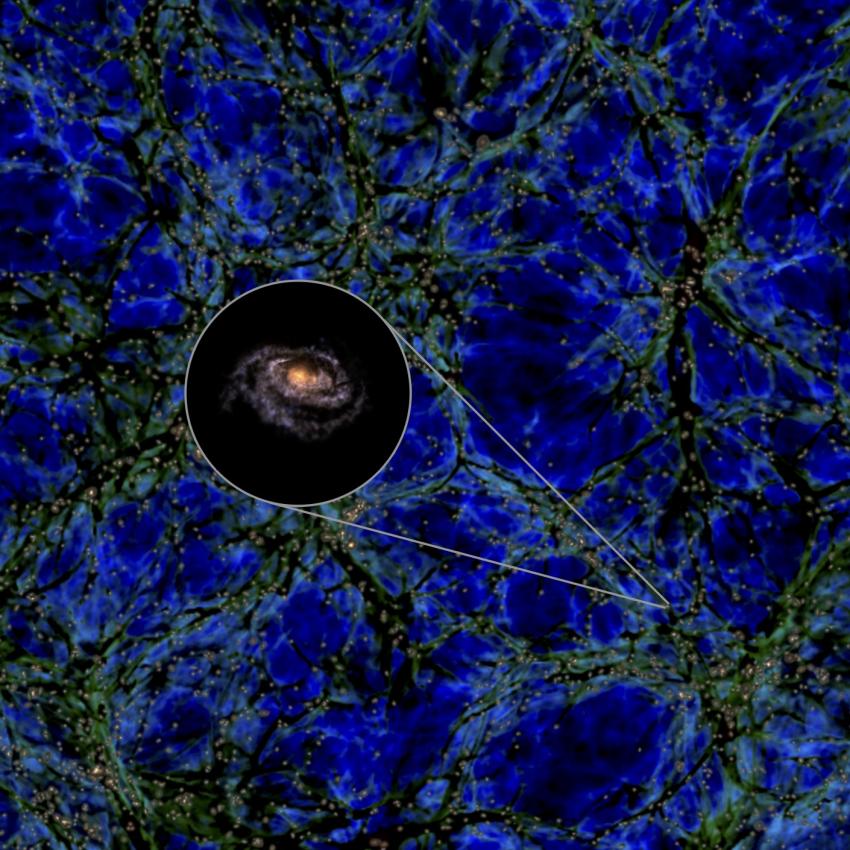
A lonely Milky Way analogue galaxy, too massive for its wall. The background image shows the distribution of dark matter (green and blue) and galaxies (here seen as tiny yellow dots) in a thin slice of the cubic volume in which we expect to find one of such rare massive galaxies. Credit Images: Miguel A. Aragon-Calvo. Simulation data: Illustris TNG project Licence type Attribution (CC BY 4.0)
According to Simulations, the Milky Way is One in a Million
Humanity is in a back-and-forth relationship with nature. First, we thought we were at the center of everything, with the Sun and the entire cosmos rotating around our little planet. We eventually realized that wasn’t true. Over the centuries, we’ve found that though Earth and life might be rare, our Sun is pretty normal, our Solar System is relatively non-descript, and even our galaxy is one of the billions of spiral galaxies, a type that makes up 60% of the galaxies in the Universe.
But the Illustris TNG simulation shows that the Milky Way is special.
Illustris TNG is an ongoing series of large-scale simulations. The goal is to understand the mechanisms behind galaxy formation and evolution. The effort is a “series of large, cosmological magnetohydrodynamical simulations,” according to the Illustris TNG website. So far, the project has produced three primary runs, each one larger and higher resolution than the previous one: TNG 50, TNG 100, and TNG 300. Each run also focuses on various aspects of galaxy formation. TNG 300 is the largest, simulating a region of almost 300 million megaparsecs, over a billion light-years across, and containing millions of galaxies.
TNG 50, TNG 100, and TNG 300. Image: IllustrisTNG
New research based on Illustris TNG shows that the Milky Way is special. But it’s not special purely for its intrinsic qualities. It’s special in relation to its surroundings.
The findings are in a new paper based on Illustris TNG 300 published in the Monthly Notices of the Royal Astronomical Society. The title is “The unusual Milky Way-local sheet system: implications for spin strength and alignment.” The lead researcher is Miguel Aragón, a computational cosmologist and assistant professor at the National Astronomical Observatory, Universidad Nacional Autonoma de Mexico.
Illustris TNG simulates the large-scale structure of the Universe. It shows how galaxies are arranged on filaments of dark matter that weave their way through vast cosmic voids. Some of the features it shows are cosmological walls, also called galaxy walls. They’re enormous features, and one of them—a wall called the Hercules–Corona Borealis Great Wall—is the largest known structure in the Universe and is 10 billion light-years long.
This image from TNG 50 shows the large-scale structure of cosmic gas in the early Universe at redshift three. It shows a region of space 15 megaparsecs across, where the cosmic web of gas filaments come together to fuel galactic formation and growth. Image Credit: Illustris TNG 50.
Cosmological walls are made up of galaxies. They’re a subtype of filaments, but they’re flattened and have voids on either side. The voids seem to squash the walls into their flattened shape. The cosmological wall nearest the Milky Way is called the Local Wall or Local Sheet.
The Local Sheet influences how the Milky Way and other nearby galaxies rotate on their axes. The Milky Way takes about 250,000,000 years to rotate, and the study shows that the rotation is more organized than if the galaxy wasn’t near the Local Sheet.
The study also shows that the Milky Way is special. While typical galaxies tend to be much smaller in relation to walls, the Milky Way is surprisingly massive in relation to the Local Wall. According to the research, this is a rare cosmic occurrence.
This video is from Illustris TNG 50 and shows the formation of an elliptical galaxy. Credit: Illustris TNG
One characteristic that cosmologists study is velocity dispersion. It describes how much dispersal there is in the velocity of a group of astronomical objects. The velocities are dispersed around a mean velocity. The velocity of objects in the Milky Way/Local Wall neighbourhood has low dispersion, meaning they’re not dispersed far from the mean.
This is unusual for a high-mass galaxy like the Milky Way in an environment like this, close to the Local Wall. To understand this better, the researchers looked for Milky Way Analogue (MWA) galaxies in Illustris TNG 300.
They found that MWAs in Local-Sheet analogues are rare. There was only one of them per 160–200?Mpc3 of volume in the simulation. With their research, they showed that the cold environment around the Local Sheet is responsible. “We find that a Sheet-like cold environment preserves, amplifies, or simplifies environmental effects on the angular momentum of galaxies,” they write in their paper.
Specifically, the Local Sheet affects the spin of the Milky Way. “… there are particularly strong alignments between the sheet and galaxy spins,” they explain, adding that in the simulation, the galaxies near walls have low spin parameters.
This all affects how galaxies grow and merge over time, they think. It leads to lower-mass galaxies in these types of cosmic neighbourhoods. That’s why the Milky Way, with its high mass, is so unusual and why the simulation found only one like it in up to 200 cubic megaparsecs of space.
This figure from the study shows how velocity dispersal relates to mass, with mass shown on the x-axis. The legend in the upper right shows how each line in the graph represents a different velocity dispersal (sigma v.) The blue solid line is the mass function in cold (<25, high velocity dispersal) regions, and the black solid line is the mass function in warm (<40, low velocity dispersal) regions. The dotted lines are the same, but for regions near Cosmic Walls. It shows how lower velocity dispersal produces less massive galaxies near walls. There are also two shaded grey areas: light and dark grey. The light area represents the masses of Milky Way Analogues in the simulation, and the dark grey shows where the Milky Way actually is. Image Credit: Aragon et al. 2023.
The study reminds us of something critical: context is important. If we look at the Milky Way as a discrete object and compare it to other similar discrete objects, it doesn’t appear to be exceptional. But in relation to its surroundings, it is. “Our results highlight the importance of carefully characterizing the environment around our galaxy,” the paper states. “The effect of the geometry and coldness of Local Sheet environment on angular momentum processes may help us better understand current problems in galaxy formation…”
In a press release presenting the research, the authors refer to the Copernican bias. “This bias, describing the successive removal of our special status in the nearly 500 years since Copernicus demoted the Earth from being at the centre of the cosmos, would come from assuming that we reside in a completely average place in the Universe,” the press release says. It shows the risk inherent in ignoring the environment of an object being studied.
This work also shows a potential flaw in how scientists use simulations like Illustris TNG. It’s misleading to think that any point in the simulation is the same as any other point. Galaxies close to a Cosmic Wall can evolve quite differently than at other points.
“So, the Milky Way is, in a way, special,” said research lead Miguel Aragón. “The Earth is very obviously special, the only home of life that we know. But it’s not the centre of the Universe or even the Solar System. And the Sun is just an ordinary star among billions in the Milky Way. Even our galaxy seemed to be just another spiral galaxy among billions of others in the observable Universe.”
“The Milky Way doesn’t have a particularly special mass or type. There are lots of spiral galaxies that look roughly like it,” Joe Silk, another of the researchers, said. “But it is rare if you take into account its surroundings. If you could see the nearest dozen or so large galaxies easily in the sky, you would see that they all nearly lie on a ring embedded in the Local Sheet. That’s a little bit special in itself. What we newly found is that other walls of galaxies in the Universe like the Local Sheet very seldom seem to have a galaxy inside them that’s as massive as the Milky Way.”
Spiral galaxies are common. This image shows six spectacular spiral galaxies in images from the ESO’s Very Large Telescope (VLT) at the Paranal Observatory in Chile. Credit: ESO
“You might have to travel half a billion light years from the Milky Way, past many, many galaxies, to find another cosmological wall with a galaxy like ours,” Aragón said. He adds, “That’s a couple of hundred times farther away than the nearest large galaxy around us, Andromeda.”
So is it okay if we feel special again? We’re obviously special just because we’re alive, and most matter we can see isn’t. But that doesn’t necessarily tell us about how much other matter might be alive and if we’re special. From a vantage point elsewhere in the Universe, there could be much more living matter. Before the rise of modern astronomy, we had no idea if there was life elsewhere or how special Earth might be. We’re wise to be cautious with the word special, according to one of the authors.
“You do have to be careful, though, choosing properties that qualify as ‘special,’” Dr. Mark Neyrinck, another member of the team, said. “If we added a ridiculously restrictive condition on a galaxy, such as that it must contain the paper we wrote about this, we would certainly be the only galaxy in the observable Universe like that. But we think this ‘too big for its wall’ property is physically meaningful and observationally relevant enough to call out as really being special.”
Archeologen ontdekken mogelijk oudste en meest complete mummie ooit gevonden in Egypte
Archeologen hebben een ontdekking gedaan vlakbij de Egyptische hoofdstad Caïro. Ze vonden er een graftombe van een farao met een mummie die mogelijk de oudste en meest complete is die ooit in Egypte werd gevonden. Dat meldt de leider van de opgraving, Zahi Hawass.
De mummie is 4.300 jaar oud en behoort toe aan een man met de naam Hekashepes. Hij lag in een kalkstenen sarcofaag die dichtgemaakt was met mortel, op de bodem van een schacht van vijftien meter diep, en was met goud bedekt.
“Deze mummie zou wel eens de oudste en meest complete kunnen zijn die tot nu toe gevonden werd in Egypte”, aldus Hawass in een verklaring. De sarcofaag verkeerde “in de exacte staat waarin de oude Egyptenaren hem 4.300 jaar geleden hebben achtergelaten.”
De tombe waarin de ontdekking werd gedaan maakt deel uit van een groep graven uit de vijfde (2504 tot 2347 voor Christus) en de zesde (2347 tot 2216 voor Christus) dynastie van het Oude Rijk. Die werden onlangs ontdekt vlakbij de Piramide van Djoser in Saqqara.
Een tweede graf behoorde toe aan Khnumdjedef, een inspecteur van ambtenaren, opzichter van edelen en priester tijdens het bewind van Unas, de laatste farao van de vijfde dynastie. Het graf was versierd met taferelen uit het dagelijkse leven.
Een derde graf bleek van Meri, die omschreven werd als “hoeder van de geheimen” en assistent van de grote leider van het paleis.
Tussen de graven lagen ook talloze beelden, waaronder eentje van een man met zijn vrouw en verschillende bedienden.
Eerder deze week kondigde Caïro ook de ontdekking van “een hele Romeinse stad” aan. Volgens critici hebben de berichten meer politieke en economische betekenis dan wetenschappelijke, aangezien het land in een ernstige economische crisis verkeert. Egypte rekent op het toerisme om de financiële situatie te herstellen.
Asteroïde komt deze nacht ontzettend dicht bij de aarde, maar “hij zal ons niet raken”, benadrukt NASA
Een asteroïde ter grootte van een bestelwagen zal vrijdagochtend langs de aarde razen. Dit zal een van de dichtstbijzijnde asteroïdes ooit zijn die we konden waarnemen. NASA benadrukt dat de asteroïde de aarde niet zal raken.
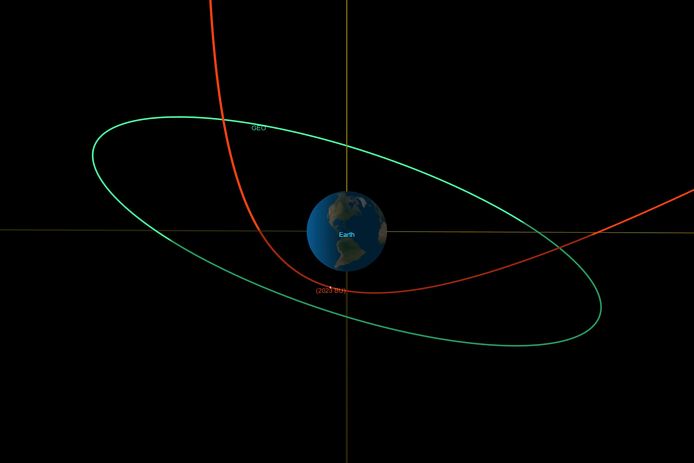
NASA zei woensdag dat deze pas ontdekte asteroïde 3.600 kilometer boven de zuidpunt van Zuid-Amerika zal vliegen. Dat is 10 keer dichterbij dan de vele communicatiesatellieten die boven de aarde cirkelen.
An illustration of the orbits of asteroid 2023 BU and Earth showing the asteroid at perigee on Jan. 26.
De nadering vindt plaats om 1.27 uur vrijdagochtend Belgische tijd. Zelfs als de ruimterots een stuk dichterbij komt, zou het grootste deel ervan volgens wetenschappers in de atmosfeer verbranden en zouden sommige grotere stukken als meteorieten kunnen vallen.
NASA’s systeem voor het inschatten van het inslaggevaar, Scout, sloot een inslag snel uit, aldus de ontwikkelaar ervan, Davide Farnocchia. “Maar ondanks het zeer geringe aantal waarnemingen kon het toch voorspellen dat de asteroïde de aarde buitengewoon dicht zou naderen”, zei Farnocchia in een verklaring. “In feite is dit een van de dichtste naderingen door een bekend object ooit geregistreerd.”
Tientallen waarnemingen
De asteroïde die zaterdag werd ontdekt en bekend staat onder de naam 2023 BU, heeft een diameter van 3,5 tot 8,5 meter. Hij werd voor het eerst gezien door dezelfde amateur-astronoom op de Krim, Gennady Borisov, die in 2019 een interstellaire komeet ontdekte. Binnen een paar dagen werden tientallen waarnemingen gedaan door astronomen over de hele wereld, waardoor ze de baan van de asteroïde konden verfijnen.
Het pad van de asteroïde zal drastisch worden gewijzigd door de zwaartekracht van de aarde zodra hij voorbijraast. In plaats van elke 359 dagen rond de zon te cirkelen, zal hij volgens NASA in een ovale baan van 425 dagen terechtkomen.
27.000 asteroïden
Wetenschappers hebben in de buurt van de Aarde zo’n 27.000 asteroïden geïdentificeerd, waarvan ongeveer 10.000 met een diameter van ruim 140 meter. Er is er geen enkele bekend die in de nabije toekomst rechtstreeks op onze planeet zou afstevenen.
Afgelopen oktober slaagde NASA er voor het eerst in de bewegingsrichting van een asteroïde te veranderen door een sonde te laten inslaan. Aan de basis van dat experiment lag de vraag hoe onze Aarde kan worden beschermd tegen aanstormende hemellichamen. Een inslag van een asteroïde ongeveer 66 miljoen jaar geleden wordt door wetenschappers beschouwd als de belangrijkste theorie waarom de dinosauriërs zijn uitgestorven.
KIJK.
Nasa wil raket met kernaandrijving ontwikkelen
Fully interactive, Eyes on Asteroids uses science data to help visualize asteroid and comet orbits around the Sun. Zoom in to travel along with your favorite spacecraft as they explore these fascinating near-Earth objects in beautiful 3D.
AMAZING UFO VIDEO! UAP drops two objects over Picket Post Mountain in Arizona
On January 22, 2023 at 2:47 PM, a group of hikers were on their way to Picket Post Mountain in Arizona when they noticed an unusual object in the sky. The hikers, who were identified as a sister, father, and the person who reported the sighting, observed the object for about 15 seconds before recording a video of the event. The footage, which was provided to the reporter, shows a small, bright dot in the sky that appears to be stationary at first. The object then drops two “flare-like” objects and then suddenly accelerates at a high speed before disappearing from sight.
The witnesses were unable to identify the object and speculated that it could have been a high-end drone or a helicopter. However, they were convinced that the object’s sudden acceleration was not something that could be explained by any known aircraft. The witnesses were also puzzled by the “flare-like” objects that were dropped by the object, as they were unable to explain what they were.
The sighting took place in an area known for its military and airforce bases, leading some to believe that the object could have been a classified military drone. However, the witnesses’ descriptions and the footage of the object do not match any known military aircraft.
UFO sightings are not uncommon, but the sudden acceleration and the “flare-like” objects dropped by the object in this particular sighting make it unique and intriguing. The stabilized footage provided by the witnesses offers a clear view of the object, but it remains unidentified. The witnesses have expressed their desire to know more about what they saw and have asked anyone with knowledge of the object to come forward with information.
Bellow you can watch original and stabilized footage from this latest UFO sighting!
Meer van UFO'S of UAP'S, ASTRONOMIE, RUIMTEVAART, ARCHEOLOGIE, OUDHEIDKUNDE, SF-SNUFJES EN ANDERE ESOTERISCHE WETENSCHAPPEN - DE ALLERLAATSTE NIEUWTJES


 LATEST UFO SIGHTINGS AND VIDEOS - 28/01/2023