Ontdek de Fascinerende Wereld van UFO's en UAP's: Jouw Bron voor Onthullende Informatie!
Ben jij ook gefascineerd door het onbekende? Wil je meer weten over UFO's en UAP's, niet alleen in België, maar over de hele wereld? Dan ben je op de juiste plek!
België: Het Kloppend Hart van UFO-onderzoek
In België is BUFON (Belgisch UFO-Netwerk) dé autoriteit op het gebied van UFO-onderzoek. Voor betrouwbare en objectieve informatie over deze intrigerende fenomenen, bezoek je zeker onze Facebook-pagina en deze blog. Maar dat is nog niet alles! Ontdek ook het Belgisch UFO-meldpunt en Caelestia, twee organisaties die diepgaand onderzoek verrichten, al zijn ze soms kritisch of sceptisch.
Nederland: Een Schat aan Informatie
Voor onze Nederlandse buren is er de schitterende website www.ufowijzer.nl, beheerd door Paul Harmans. Deze site biedt een schat aan informatie en artikelen die je niet wilt missen!
Internationaal: MUFON - De Wereldwijde Autoriteit
Neem ook een kijkje bij MUFON (Mutual UFO Network Inc.), een gerenommeerde Amerikaanse UFO-vereniging met afdelingen in de VS en wereldwijd. MUFON is toegewijd aan de wetenschappelijke en analytische studie van het UFO-fenomeen, en hun maandelijkse tijdschrift, The MUFON UFO-Journal, is een must-read voor elke UFO-enthousiasteling. Bezoek hun website op www.mufon.com voor meer informatie.
Samenwerking en Toekomstvisie
Sinds 1 februari 2020 is Pieter niet alleen ex-president van BUFON, maar ook de voormalige nationale directeur van MUFON in Vlaanderen en Nederland. Dit creëert een sterke samenwerking met de Franse MUFON Reseau MUFON/EUROP, wat ons in staat stelt om nog meer waardevolle inzichten te delen.
Let op: Nepprofielen en Nieuwe Groeperingen
Pas op voor een nieuwe groepering die zich ook BUFON noemt, maar geen enkele connectie heeft met onze gevestigde organisatie. Hoewel zij de naam geregistreerd hebben, kunnen ze het rijke verleden en de expertise van onze groep niet evenaren. We wensen hen veel succes, maar we blijven de autoriteit in UFO-onderzoek!
Blijf Op De Hoogte!
Wil jij de laatste nieuwtjes over UFO's, ruimtevaart, archeologie, en meer? Volg ons dan en duik samen met ons in de fascinerende wereld van het onbekende! Sluit je aan bij de gemeenschap van nieuwsgierige geesten die net als jij verlangen naar antwoorden en avonturen in de sterren!
Heb je vragen of wil je meer weten? Aarzel dan niet om contact met ons op te nemen! Samen ontrafelen we het mysterie van de lucht en daarbuiten.
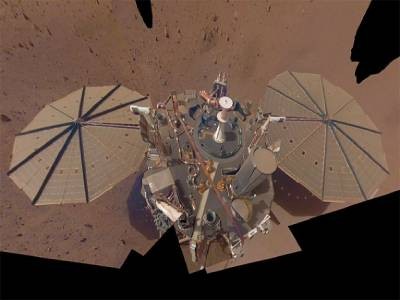
Mars helicopter Ingenuity flies for 40th time, sees rover tracks
NASA's Ingenuity helicopter flew for the 40th time on Jan. 19, 2023. See black & white and color footage along with statistics from the flight. Perseverance rover tracks can be seen.
Finally! SpaceX Ships Starship Deluge System to Texas
How SpaceX Crew Dragon DESTROYED Soyuz and Starliner?
How SpaceX Crew Dragon DESTROYED Soyuz and Starliner? Nearly a decade ago, the business of space changed. Exactly in 2014, NASA tapped SpaceX and Boeing to build two new human-rated spacecraft, the Crew Dragon and Starliner, respectively. this was intended to end dependence on Russia's Soyuz. Each company would first prove its ship capable of safe flight, then perform as many as six crewed missions to the International Space Station. From that moment onward, Soyuz, Boeing Starliner, and Crew Dragon capsules have been put on the scale together. The result? SpaceX Crew Dragon completely destroy the others. You ask me why? Let’s explain:
We can't deny that so far, the International Space Station is still one of the greatest engineering feats humans have designed due to its support for almost every space mission that leaves earth. It is one of a kind for it is one of the few times humanity has come together to build and use an item or station without any fracas. Since it was launched, hundreds of laboratory researches that have led to understanding space and how humans may survive on other planets have been done.
After all, it’s a football field sized floating laboratory traveling 10 times faster than a bullet, circling the Earth every 90 minutes. It’s taken 33 launches to put all of its pieces into orbit and has been home in space to astronauts from almost 20 countries.
The ISS typically has 6 astronauts onboard. Crews are sent in groups of 3 and usually reside at the station for 6 months. There is typically a 3-month overlap for the existing crew and the newly arriving crew. Since the Space Shuttle program ended in 2011, there’s only been a single ride to the ISS. Russia’s Soyuz vehicle.
Since NASA ended its space-shuttle program in 2011, the agency has relied exclusively on Russia to ferry its astronauts to and from orbit in Soyuz spacecraft. But those seats have gotten increasingly expensive, and the world's space agencies have had no alternative for launching and returning astronauts, even when technical glitches have arisen. How SpaceX Crew Dragon DESTROYED Soyuz and Starliner?
NASA and DARPA-developed nuclear thermal rocket engine could be tested in few years
NASA administrator Bill Nelson announces that NASA and DARPA will collaborate to develop and demonstrate the Demonstration Rocket for Agile Cislunar Operations (DRACO) spacecraft, which will employ a nuclear thermal rocket engine.
Credit: NASA
Children In Space, Dark Forest, Mars Lava Tubes | Q&A 208
What if two black holes with opposing spin merge? Can we use the Moon's L2 Lagrange point? How habitable are Mars's lava tubes? Can Starships compensate for satellite light pollution? All this and more in this week's episode Q&A with Fraser Cain.
Today's we're looking at the popular myth of Planet X and seeing if there could be any truth behind the claims of there being a ninth planet.
Did Life on Mars Self-Destruct?
An overview of the possibilities of life on Mars and recent science that suggests that it may have gone extinct by its own doing.
An exploration of time scales and time passage and its relation to the Fermi Paradox as a straightforwards solution.
Very Rare Collision Witnessed 840 Years Ago Created a Super Unusual Nebula
New Discovery That Changed Physics! Gravity Is Not a Force!
In his 1915 General Theory of Relativity, Albert Einstein defined gravity as the bending of space and time. This was the prevailing idea of gravity for the following century. But now, a new theory has been proposed that could change everything we know about gravity. The Digital Gravity Theory proposes that gravity is not a force but rather the product of the topology of space and time. If this new theory is correct, it could mean a complete overhaul of our understanding of physics. So far, it has been met with a lot of skepticism, but the scientists who proposed it are convinced that it is the right answer. Watch, like and comment on New Discovery That Changed Physics! Gravity Is Not a Force!What do you think? Is this new theory correct, or is it just another crackpot idea?
Credit:NASA, ESA, ESO, SpaceX, Wikipedia, Shutterstock, ...
The technologies that China has are shocking foreign scientists.
The technologies that China has are shocking foreign scientists.
Het duo is te zien op deze fascinerende ruimtefoto van de week.
Het duo – Arp-Madore 417-391 – is aan de rechterkant te zien. De twee sterrenstelsels zijn 670 miljoen lichtjaar van de aarde verwijderd. Zoals je ziet zijn de sterrenstelsels vervormd door zwaartekracht, waardoor ze nu een soort ring vormen. De twee heldere kernen van het duo liggen inmiddels naast elkaar en zullen over niet al te lange tijd samensmelten en één kern vormen.
De Arp-Madore-catalogus bestaat uit circa 6.000 ongebruikelijke sterrenstelsels, gefotografeerd door de Australische UK Schmidt-telescoop. De catalogus is samengesteld door astronomen Barry Madore en Halton Arp. Hubble fotografeert wel vaker bijzondere Arp-Madore-objecten, zoals Arp-Madore 2026-424 in 2019.
Op de ruimtefoto van de week zijn meer sterrenstelsels te zien. Links naast Arp-Madore 417-391 zien we twee spiraalstelsels. Het bovenste spiraalstelsel zien we vanaf de zijkant. Als je goed gaat inzoomen zie je nog tientallen andere sterrenstelsels. Fascinerend om te weten dat ieder sterrenstelsel vele miljarden sterren en nog meer planeten huisvest.
De afgelopen decennia hebben ruimtetelescopen en satellieten prachtige foto’s gemaakt van nevels, sterrenstelsels, stellaire kraamkamers en planeten. Ieder weekend halen we één of meerdere indrukwekkende ruimtefoto uit het archief. Genieten van alle foto’s? Bekijk ze op deze pagina.
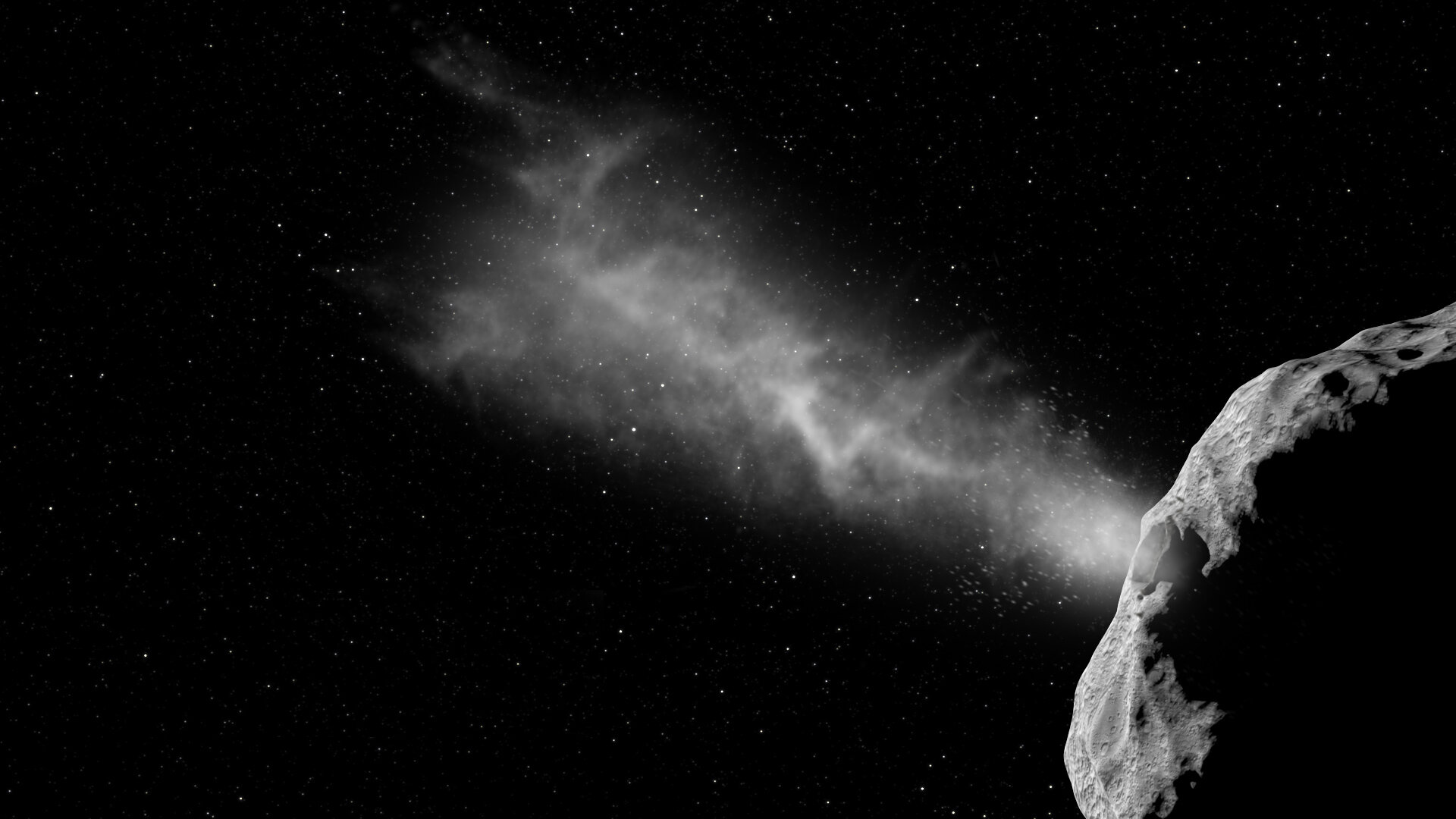
The otherwise unremarkable double asteroid of Didymos and Dimorphos made headlines as the target of NASA’s successful Double Asteroid Redirect Test (DART) mission. With new details about the system emerging, astronomers have put together a hypothesis of how this strange double asteroid came to be.
It starts with spin. Any solid body if it spins fast enough will lose pieces of itself as the centrifugal force overwhelms gravity. This is especially true of asteroids, which aren’t very big to begin with and are only loosely held together. Recently a team of astronomers have used this fact to propose a plausible formation mechanism for Didymos and Dimorphos.
In this scenario long ago Didymos spun up far too quickly. It could have been from a glancing collision or just from too many gravitational interactions with neighbors. Once it spun up it began losing mass, which formed a ring surrounding it. Initially this ring would be in what is called the Roche limit of the asteroid. The Roche limit is where the gravitational tidal force from a parent body is stronger than the ability for material orbiting it to hold itself together. So within the Roche limit Dimorphos couldn’t form .
But through many interactions some of the material can migrate away from the ring and go beyond the Roche limit where it would eventually coalesce. That material that escaped would eventually become the little moon Dimorphos.
The astronomers estimate that Didymos had to lose at least 25% of its mass in order to form Dimorphos in this manner. This model also predicts that Dimorphos will have a very irregular shape because it was built up from the slow accumulation of many smaller objects, which is in line with what we observe.
While NASA’s DART mission was an overall success, showing that we can conclusively nudge the orbit of an asteroid if we need to, the mission has another side benefit. It helps us explore the complicated, intricate lives of some of the smallest, and most often ignored, objects in the solar system.
Earth’s inner core is made mostly of solid iron, and can rotate separately from the outer parts of the planet.
Credit: Johan Swanepoel/SPL
Thousands of kilometres beneath your feet, Earth’s interior might be doing something very weird. Many scientists think that the inner core spins faster than the rest of the planet — but sometime in the past decade, according to a study, it apparently stopped doing so.
“We were quite surprised,” say Yi Yang and Xiaodong Song, seismologists at Peking University in Beijing who reported the findings today in Nature Geoscience1.
The results could help to shine light on the many mysteries of the deep Earth, including what part the inner core plays in maintaining the planet’s magnetic field and in affecting the speed of the whole planet’s rotation — and thus the length of a day. But they are just the latest instalment in a long-running effort to explain the inner core’s unusual rotation, and might not be the final word on the matter.
“I keep thinking we’re on the verge of figuring this out,” says John Vidale, a seismologist at the University of Southern California in Los Angeles. “But I’m not sure.”
Mysteries of the deep
Researchers discovered the inner core in 1936, after studying how seismic waves from earthquakes travel through the planet. Changes in the speed of the waves revealed that the planet’s core, which is about 7,000 kilometres wide, consists of a solid centre, made mostly of iron, inside a shell of liquid iron and other elements. As iron from the outer core crystallizes on the surface of the inner core, it changes the density of the outer liquid, driving churning motions that maintain Earth’s magnetic field.
Researchers have learnt about the inner core’s rotation by studying earthquakes that originated in the same region, such as the Kuril Islands (shown here), over decades.
Credit: Getty
The liquid outer core essentially decouples the 2,400-kilometre-wide inner core from the rest of the planet, so the inner core can spin at its own pace. In 1996, Song and another researcher reported2 studying earthquakes that originated in the same region over three decades, and whose energy was detected by the same monitoring station thousands of kilometres away. Since the 1960s, the scientists said, the travel time of seismic waves emanating from those earthquakes had changed, indicating that the inner core rotates faster than the planet’s mantle, the layer just beyond the outer core.
Later studies refined estimates of the rate of that ‘super-rotation’, to conclude that the inner core rotates faster than the mantle by about one-tenth of a degree per year. But not everyone agrees. Other work has suggested that super-rotation happens mostly in distinct periods, such as in the early 2000s, rather than being a continuous, steady phenomenon3. Some scientists even argue that super-rotation does not exist, and that the differences in earthquake travel times are instead caused by physical changes on the surface of the inner core4.
Last June, Vidale and Wei Wang, an Earth scientist also at the University of Southern California, threw another spanner into the works. Using data on seismic waves generated by US nuclear test blasts in 1969 and 1971, they reported that between those years, Earth’s inner core had ‘subrotated’, or rotated more slowly than the mantle5. Only after 1971, they say, did it speed up and begin to super-rotate.
A rotational shift
Now, Yang and Song say that the inner core has halted its spin relative to the mantle. They studied earthquakes mostly from between 1995 and 2021, and found that the inner core’s super-rotation had stopped around 2009. They observed the change at various points around the globe, which the researchers say confirms it is a true planet-wide phenomenon related to core rotation, and not just a local change on the inner core’s surface.
The data hint that the inner core might even be in the process of shifting back towards subrotation. If so, something is probably happening to the magnetic and gravitational forces that drive the inner core’s rotation. Such changes might link the inner core to broader geophysical phenomena such as increases or decreases in the length of a day on Earth.
Still, many questions remain, such as how to reconcile the slow pace of the changes that Yang and Song report with some of the faster changes reported by others. The only way out of the morass is to wait for more earthquakes to happen. A “long history of continuous recording of seismic data is critical for monitoring the motion of the heart of the planet”, say Yang and Song.
“We just have to wait,” Vidale adds.
doi: https://doi.org/10.1038/d41586-023-00167-1
References
Yang, Y. & Song, X. Nature Geosci. https://doi.org/10.1038/s41561-022-01112-z (2023).
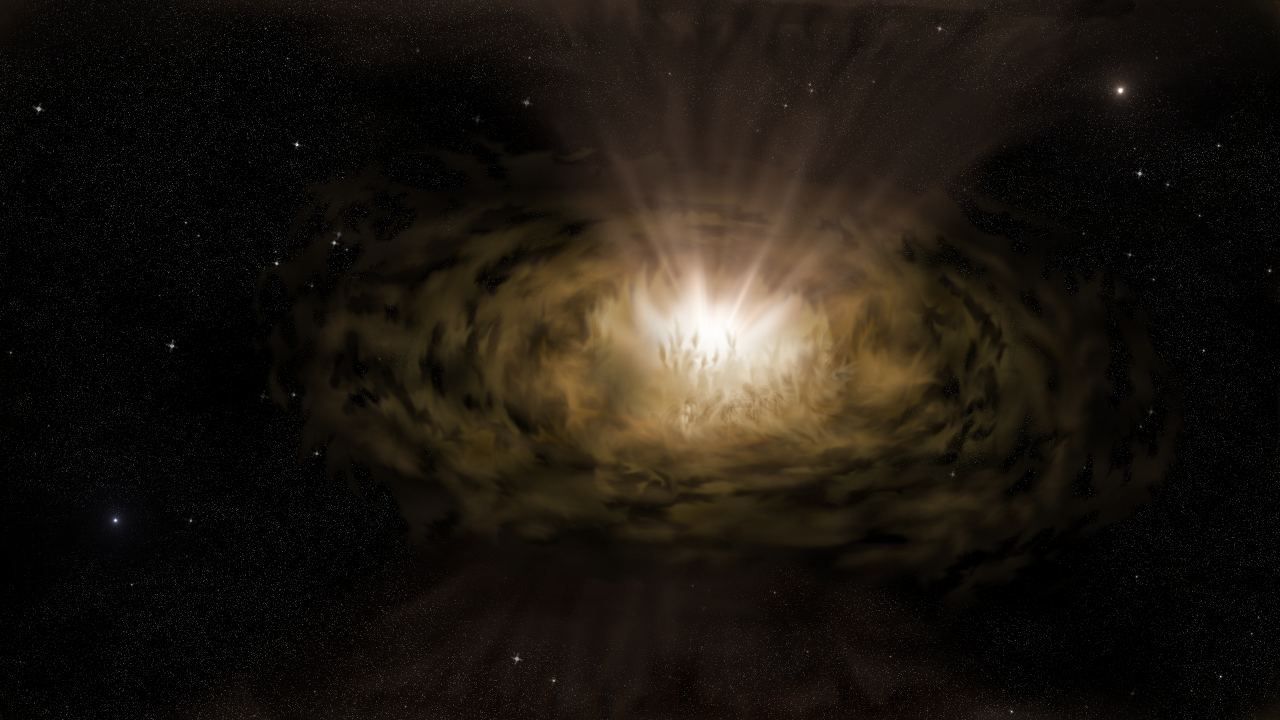
In the 1970s, astronomers discovered that the persistent radio source at the center of our galaxy was a supermassive black hole (SMBH). Today, this gravitational behemoth is known as Sagittarius A* and has a mass roughly 4 million times that of the Sun. Since then, surveys have shown that SMBHs reside at the center of most massive galaxies and play a vital role in star formation and galactic evolution. In addition, the way these black holes consume gas and dust causes their respective galaxies to emit a tremendous amount of radiation from their Galactic Centers.
These are what astronomers refer to as Active Galactic Nuclei (AGN), or quasars, which can become so bright that they temporarily outshine all the stars in their disks. In fact, AGNs are the most powerful compact steady sources of energy in the Universe, which is why astronomers are always trying to get a closer look at them. For instance, a new study led by the University of California, Santa Cruz (UCSC) indicates that scientists have substantially underestimated the amount of energy emitted by AGN by not recognizing the extent to which their light is dimmed by dust.
Artist’s impression of a powerful young quasar. Credit: ESO/M. Kornmesser Credit: ESO/M. Kornmesser
The research was led by Dr. Martin Gaskell, a research associate and lecturer at UCSC’s Department of Astronomy and Astrophysics. He was joined by a team of engineers, mathematicians, astronomers, and astrophysicists from Harvey Mudd College, Princeton University, and the University of California Berkeley. For their study, the team examined NGC 5548, a Type I Seyfert galaxy located about 244.6 million light-years away. This galaxy has a bright AGN, resulting from a central SMBH of roughly 65 million Solar masses.
The amount of dust is measured by the way it causes light from the AGN to shift toward the red end of the spectrum. This effect is known as “reddening,” and the amount of reddening corresponds directly to the amount of dimming. Although scientists have long recognized the possibility that dust dims the light from AGNs, the amount was widely considered negligible. The issue stemmed from the fact that astronomers predicted the amount of reddening based on theories regarding the intrinsic, unreddened colors astronomers should be seeing.
According to the results from this latest research, the amount of obscuring dust may be underestimated, much like the overall brightness of AGNs. The team reached this conclusion by studying the reddening effect of dust in the most well-studied AGN (NGC 5548) using seven different indicators. These included a mean AGN reddening curve, a standard reddening curve of the Milky Way, and the Small Magellanic Cloud (SMC) curve. In all cases, they found that the reddening of NGC 5548 was about 14 times greater than what is observed in the solar neighborhood due to the small amount of dust.
As Dr. Gaskell explained in a Royal Astronomical Society press release:
“When there are intervening small particles along our line of sight, this makes things behind them look dimmer. We see this at sunset on any clear day when the sun looks fainter. The good agreement between the different indicators of the amount of reddening was a pleasant surprise. It strongly supports simple theories of emission from active galactic nuclei. Exotic explanations of colors are not needed. This makes life simpler for researchers and is speeding up our understanding of what happens as black holes swallow material.”
Artist’s impression of a supermassive black hole and accretion disk.
Credit: ESA/Hubble, ESO, M. Kornmesse
These results show that In the ultraviolet wavelength, where most of their energy is radiated, a typical AGN puts out an order of magnitude more energy than previously thought. Another takeaway is that AGNs are very similar, and what was thought to be fundamental differences in brightness and energy output are actually the result of different amounts of dust. This could have drastic implications for our understanding of galactic formation, evolution, and the role played by SMBHs in both.
A Novel Propulsion System Would Hurl Hypervelocity Pellets at a Spacecraft to Speed it up
Today, multiple space agencies are investigating cutting-edge propulsion ideas that will allow for rapid transits to other bodies in the Solar System. These include NASA’s Nuclear-Thermal or Nuclear-Electric Propulsion (NTP/NEP) concepts that could enable transit times to Mars in 100 days (or even 45) and a nuclear-powered Chinese spacecraft that could explore Neptune and its largest moon, Triton. While these and other ideas could allow for interplanetary exploration, getting beyond the Solar System presents some major challenges.
As we explored in a previous article, it would take spacecraft using conventional propulsion anywhere from 19,000 to 81,000 years to reach even the nearest star, Proxima Centauri (4.25 light-years from Earth). To this end, engineers have been researching proposals for uncrewed spacecraft that rely on beams of directed energy (lasers) to accelerate light sails to a fraction of the speed of light. A new idea proposed by researchers from UCLA envisions a twist on the beam-sail idea: a pellet-beam concept that could accelerate a 1-ton spacecraft to the edge of the Solar System in less than 20 years.
The concept, titled “Pellet-Beam Propulsion for Breakthrough Space Exploration,” was proposed by Artur Davoyan, an Assistant Professor of Mechanical and Aerospace Engineering at the University of California, Los Angeles (UCLA). The proposal was one of fourteen proposals chosen by the NASA Innovative Advanced Concepts (NIAC) program as part of their 2023 selections, which awarded a total of $175,000 in grants to develop the technologies further. Davoyan’s proposal builds on recent work with directed-energy propulsion (DEP) and light sail technology to realize a Solar Gravitational Lens.
Image of a gravitationally-lensing galaxy creating an Einstein Ring. Credit: NASA/ESA/Hubble
As Prof. Davoyan told Universe Today via email, the problem with spacecraft is that they are still beholden to the Rocket Equation:
“All current spacecraft and rockets fly by expanding fuel. The faster the fuel is thrown away, the more efficient is the rocket. However, there is a limited amount fuel that we can carried on board. As a result, the velocity a spacecraft can be accelerated to is limited. This fundamental limit is dictated by the Rocket Equation. The limitations of Rocket Equation translate into a relatively slow and costly space exploration. Such missions as Solar Gravitational Lens are not feasible with current spacecraft.”
The Solar Gravitational Lens (SGL) is a revolutionary proposal that would be the most powerful telescope ever conceived. Examples include the Solar Gravity Lens, which was selected in 2020 for NIAC Phase III development. The concept relies on a phenomenon predicted by Einstein’s Theory of General Relativity known as Gravitational Lensing, where massive objects alter the curvature of spacetime, amplifying the light from objects in the background. This technique allows astronomers to study distant objects with greater resolution and precision.
By positioning a spacecraft at the heliopause (~500 AU from the Sun), astronomers could study exoplanets and distant objects with the resolution of a primary mirror measuring around 100 km (62 mi) in diameter. The challenge is developing a propulsion system that could get the spacecraft to this distance in a reasonable amount of time. To date, the only spacecraft to reach interstellar space have been the Voyager 1 and 2 probes, which launched in 1977 and are currently about 159 and 132 AUs from the Sun (respectively).
When it left the Solar System, the Voyager 1 probe was traveling at a record-breaking velocity of about 17 km/s (38,028 mph), or 3.6 AU a year. Nevertheless, this probe still took 35 years to reach the boundary between the Sun’s solar wind and the interstellar medium (the heliopause). At its current speed, it will take over 40,000 years for Voyager 1 to fly past another star system – AC+79 3888, an obscure star in the constellation Ursa Minor. For this reason, scientists are investigating directed energy (DE) propulsion to accelerate light sails, which could reach another star system in a matter of decades.
Project Starshot, an initiative sponsored by the Breakthrough Foundation, is intended to be humanity’s first interstellar voyage. Credit: breakthroughinitiatives.org
As Prof. Davoyan explained, this method offers some distinct advantages but also has its share of drawbacks:
“Laser sailing, unlike conventional spacecraft and rockets, does not require fuel on board to accelerate. Here acceleration comes from a laser pushing the spacecraft by radiation pressure. In principle, near-speed-of-light velocities can be reached with this method. However, laser beams diverge at long distances, meaning that there is only a limited distance range over which a spacecraft can be accelerated. This limitation of laser sailing leads to a need of having exorbitantly high laser powers, gigawatts, and in some proposals, terawatts, or puts a constraint on spacecraft mass.”
Examples of the laser-beam concept include Project Dragonfly, a feasibility study by the Institute for Interstellar Studies (i4is) for a mission that could reach a nearby star system within a century. Then there’s Breakthrough Starshot, which proposes a 100-gigawatt (Gw) laser array that would accelerate gram-scale nanocraft (Starchip). At a maximum velocity of 161 million km (100 million mi) or 20% of the speed of light, Starshot will be able to reach Alpha Centauri in about 20 years. Inspired by these concepts, Prof. Davoyan and his colleagues propose a novel twist on the idea: a pellet-beam concept.
This mission concept could serve as a fast-transit interstellar precursor mission, like Starshot and Dragonfly. But for their purposes, Davoyan and his team examine a pellet-beam system that would propel a ~900 kg (1 U.S. ton) payload to a distance of 500 AU in less than 20 years. Said Davoyan:
“In our case, the beam pushing the spacecraft is made of tiny pellets, hence [we call it] the pellet beam. Each pellet is accelerated to very high velocities by laser ablation, and then the pellets carry their momentum to push the spacecraft. Unlike a laser beam, pellets do not diverge as quickly, allowing us to accelerate a heavier spacecraft. The pellets, being much heavier than photons, carry more momentum and can transfer a higher force to a spacecraft.”
Image of a simulated Earth at the distance of Proxima Centauri as projected by the SGL to an image plane at 650 AU from the Sun. Credit: Toth H. & Turyshev, S.G.
In addition, the small size and low mass of the pellets mean that they can be propelled by relatively low-power laser beams. Overall, Davoyan and his colleagues estimate that a 1-ton spacecraft could be accelerated to velocities of up to ~30 AU a year using a 10-megawatt (Mw) laser beam. For the Phase I effort, they will demonstrate the feasibility of the pellet-beam concept through detailed modeling of the different subsystems and proof-of-concept experiments. They will also explore the utility of the pellet-beam system for interstellar missions that could explore neighboring stars in our lifetimes.
“The pellet beam aims to transform the way deep space is explored by enabling fast transit missions to far-away destinations,” said Davoyan. “With the pellet beam, outer planets can be reached in less than a year, 100 AU in about three years, and solar gravity lens at 500 AU in about 15 years. Importantly, unlike other concepts, the pellet-beam can propel heavy spacecraft (~1 ton), which substantially increases the scope of possible missions.”
If realized, an SGL spacecraft would allow astronomers to directly image neighboring exoplanets (like Proxima b) with multipixel resolution and obtain spectra from their atmospheres. These observations would offer direct evidence of atmospheres, biosignatures, and possibly even technosignatures. In this way, the same technology that lets astronomers directly image exoplanets and study them in extensive detail would also enable interstellar missions to explore them directly.
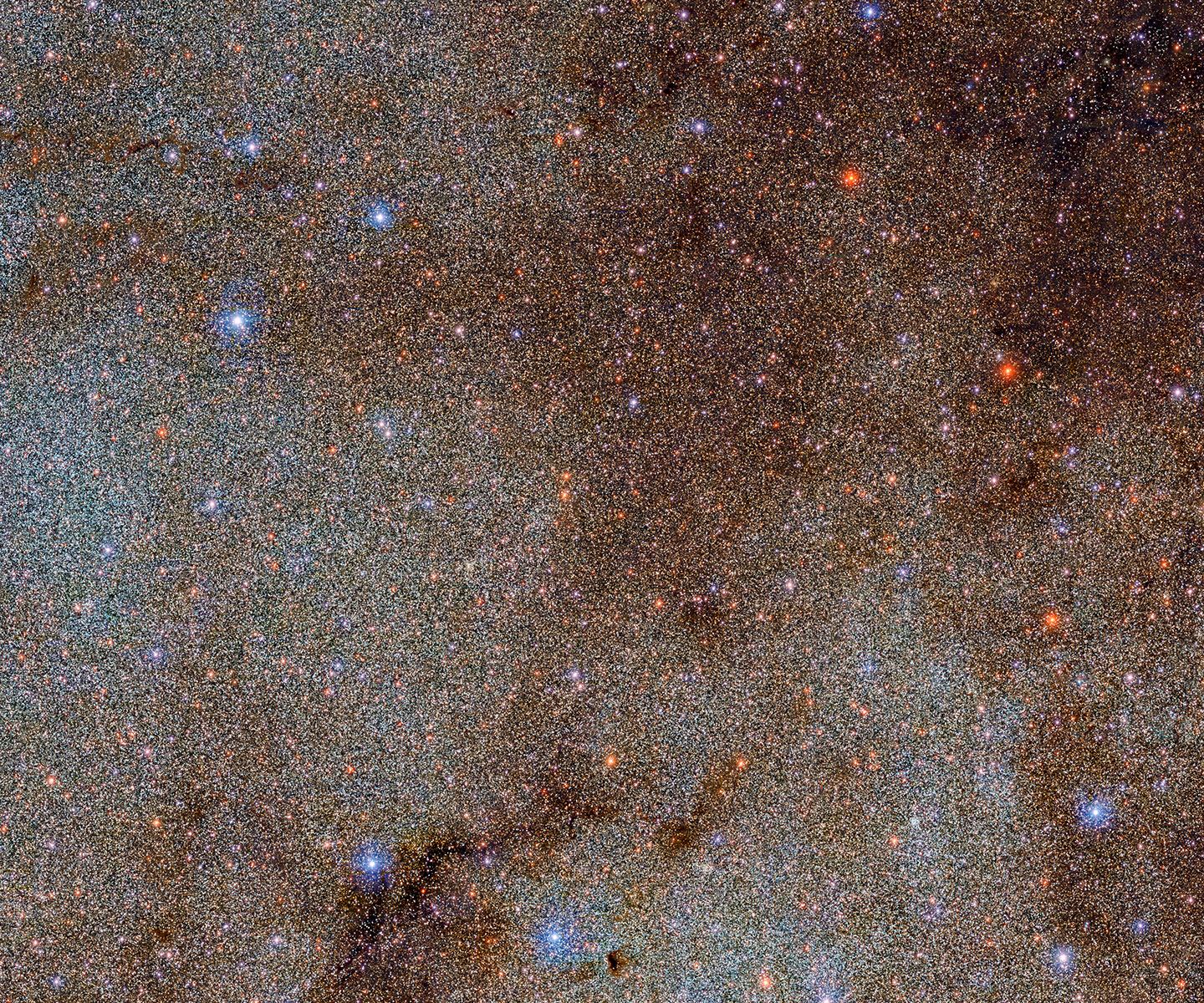
This image, which is brimming with stars and dark dust clouds, is a small extract — a mere pinprick — of the full Dark Energy Camera Plane Survey (DECaPS2) of the Milky Way. The new dataset contains a staggering 3.32 billion celestial objects — arguably the largest such catalog so far.
DECaPS2/DOE/FNAL/DECam/CTIO/NOIRLab/NSF/AURA Image processing: M. Zamani & D. de Martin (NSF’s NOIRLab)
A New Survey of the Milky Way Reveals Billions of Objects, Helping to Map Our Surroundings in Three Dimensions
The Dark Energy Camera Plane Survey 2 (DECaPS2) is out. This is the second data release from DECaPS, and the survey contains over 3 billion objects in the Milky Way. As the leading image shows, there are so many stars it appears as if there’s no space between them.
Throughout most of human history, the nature of the Milky Way has confounded us. Aristotle thought that it resulted from the ignition of Earth’s upper atmosphere, similar to how comets produce tails. The famous Persian scholar Al-Biruni thought the Milky Way was made up of countless fragments of nebulous stars. There are countless other ideas of what the Milky Way might have been.
Our modern understanding of the Milky Way is exquisitely detailed. Large-scale surveys of the galaxy have played a huge role in our growing understanding of the Milky Way. The ESA’s Gaia mission, an ongoing survey of the Milky Way, has collected detailed data on over one billion stars, including their ages, masses, chemical compositions, colours, temperatures, and metal content.
Will DECaPS2 make a similar contribution? It might, based on raw data alone.
“When combined with images from Pan-STARRS 1, DECaPS2 completes a 360-degree panoramic view of the Milky Way’s disk…”
Edward Schlafly, paper co-author, Space Telescope Science Institute.
DECaPS2 contains 3.32 billion objects built from 34 billion detections. The detections are in 21,400 exposures which added up to 260 hours of open shutter time with the Dark Energy Camera (DECam) at the Cerro Tololo observatory. Of the 3.32 billion objects, about 2 billion are stars. It took two years and produced over 10 terabytes of data. The first data set was released in 2017, and it contained 2 billion objects, most of which were also stars.
The survey focuses on the galactic disk, where most of the galaxy’s stars and dust are located. But the high density makes the region difficult to observe. The DECam Plane Survey overcomes this by performing “deep photometric surveys spanning a broad wavelength range (optical to NIR).”
Astronomers have released a gargantuan survey of the galactic plane of the Milky Way. The new dataset contains a staggering 3.32 billion celestial objects — arguably the largest such catalogue so far. The survey is here reproduced in 4000-pixel resolution to be accessible on smaller devices. Credit: DECaPS2/DOE/FNAL/DECam/CTIO/NOIRLab/NSF/AURA/E. Slawik Image processing: M. Zamani & D. de Martin (NSF’s NOIRLab)
“One of the main reasons for the success of DECaPS2 is that we simply pointed at a region with an extraordinarily high density of stars and were careful about identifying sources that appear nearly on top of each other,” said Saydjari. “Doing so allowed us to produce the largest catalogue ever from a single camera, in terms of the number of objects observed.”
The two data releases combined cover 6.5 percent of the night sky and span 130 degrees in length. That’s 13,000 times larger than the area of the full Moon. While 6.5 percent might not sound like a lot, it is. It’s even more impressive when combined with other sky surveys.
“When combined with images from Pan-STARRS 1, DECaPS2 completes a 360-degree panoramic view of the Milky Way’s disk and additionally reaches much fainter stars,” says Edward Schlafly, a researcher at the AURA-managed Space Telescope Science Institute and a co-author of the paper. “With this new survey, we can map the three-dimensional structure of the Milky Way’s stars and dust in unprecedented detail.”
“Astronomers will be poring over this detailed portrait of more than three billion stars in the Milky Way for decades to come.”
Debra Fischer, division director of Astronomical Sciences at NSF.
The galactic plane is difficult to observe. We’re embedded in it, and when we look toward the center, we’re looking through our arm of the Milky Way, through the central disk and beyond, into the spiral arms on the other side. It’s not just that there are hundreds of millions of stars—maybe way more—in this view. This is where most of the dust is located, too.
The image shows how beautiful and intriguing the dark lanes of dust are, but they’re also problematic. They absorb light from stars and can even block out faint stars entirely. There are many diffuse nebulae as well, and their light interferes with measurements of light from individual stars. The vast number of stars is also a challenge since they can overlap one another.
But understanding the central disk is critical to understanding the Milky Way. Observing in infrared helps overcome some of the challenges of observing the disk. Innovative data processing also helps. The team behind the survey came up with a way of predicting the background of each star. That made it easier to minimize the effects of overlapping stars and diffuse nebulae in the images.
“This is quite a technical feat. Imagine a group photo of over three billion people, and every single individual is recognizable!” says Debra Fischer, division director of Astronomical Sciences at NSF, one of the agencies that operates DECam. “Astronomers will be poring over this detailed portrait of more than three billion stars in the Milky Way for decades to come. This is a fantastic example of what partnerships across federal agencies can achieve.”
“Since my work on the Sloan Digital Sky Survey two decades ago, I have been looking for a way to make better measurements on top of complex backgrounds,” said Douglas Finkbeiner, a professor at the Center for Astrophysics, co-author of the paper, and principal investigator behind the project. “This work has achieved that and more!”
You can explore the DECaPS data and images at the Legacy Survey Viewer <Click on image>. Image Credit: legacysurvey.org
A century ago, we didn’t even know there were other galaxies. When astronomers saw the Andromeda galaxy and other spiral galaxies, they thought they were part of the Milky Way. They called them spiral nebula. Now we know better. We also know that the Milky Way is 90% dark matter and that the galaxy isn’t flat; it’s warped due to the Large and Small Magellanic Clouds tugging on it. We know that there’s a behemoth black hole lurking in the galactic center called Sagittarius A-star. We also know that galaxies grow so large by consuming and merging with other galaxies.
Large-scale astronomical surveys of the sky helped astronomers make some of these discoveries, and DECaPS promises to propel us to similar advancements. The first data release helped lead to some very interesting findings. One example is a 2018 paper that identified an old, metal-poor globular cluster in the galactic bulge. That was unusual since most globular clusters are in the galactic halo. Now, thanks to DECaPS and others, we know of many more globulars in the bulge.
The second data release will no doubt lead to many more discoveries and a filling-out of our knowledge about the galactic plane. “Combined with PS1, this completes comparable imaging of the entire Galactic plane essential for probing our Galaxy’s stars, gas, and dust,” the authors write. All of the data products from the survey “…should provide a rich, adaptable resource for the community, facilitating a variety of studies of the Milky Way,” they explain.
Another screenshot from the Legacy Survey Viewer. <Click Image to Visit> Image Credit: legacysurvey.org
We’re fortunate because our galaxy, the Milky Way, is a good model for understanding galaxies in general. About half of the stars in the Universe are in galaxies that are quite similar to ours. While nothing can be assumed, it’s a reasonable assertion that much of what DECaPS tells us about the Milky Way will have some bearing on other galaxies.
Astronomers have strived to understand galaxies and how they formed and evolved. The most comprehensive way to study them is to perform large surveys of stars like this one. Who knows what researchers will find in all of this data?
Here are some things on Mars, that the NASA rover just passes by without even a second look. The most significant evidence of an intelligent alien species is not a book, not mathematics, not alien technology. Its the actual faces of the aliens we speak about. Here I show you three great detailed faces. Two of them, are side by side, showing statues. One has no hat, the other has a huge crown like hat, showing its importance. This person with the hat, clearly a leader of great importance to this Mars culture.
“Volledige Romeinse stad” ontdekt bij opgravingen in Luxor
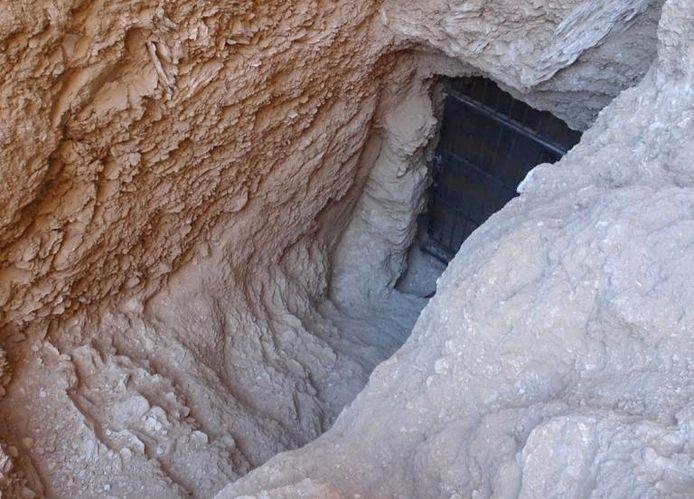
In de Egyptische stad Luxor zijn de resten ontdekt van “een volledige Romeinse stad” uit de eerste eeuwen na Christus. Dat heeft het ministerie van Oudheden bekendgemaakt.
Luxor was in de oudheid gekend als Thebe en was de belangrijkste stad van Opper-Egypte. Volgens het ministerie is nu “een volledige residentiële stad” uit de tweede en derde eeuw ontdekt “op de oostelijke oever van de Nijl, in de buurt van de Luxortempel”.
Eerder werden ook al metaalateliers met tal van werktuigen en Romeinse koperen en bronzen munten opgegraven, zegt Mostafa Waziri (het hoofd van de Egyptische Raad voor Oudheden; nvdr) “En de opgravingen gaan door.”
EXCLUSIVE:Metallic-looking orb is seen flying over Iraqi city of Mosul in 2016 - first ever publicly revealed UFO footage taken by US spy plane in a conflict zone - as expert warns of 'significant risk' to troops overseas
DailyMail.com has exclusively obtained an image of a 'metallic' orb flying over Mosul, Iraq in April 2016, from footage taken by a US intelligence-recon plane
It was obtained by journalists Jeremy Corbell and George Knapp, who have released the image on their new UFO podcast, 'Weaponized'
The sighting in a conflict zone where the US military is operating has sparked security and safety concerns at the Department of Defense
DailyMail.com obtained an exclusive image of a metallic-looking orb flying over an Iraqi city, caught on video by a US spy plane.
The image, captured in April 2016 by an intelligence-reconnaissance plane, was included in a classified briefing video on UFOs shown to multiple US government agencies.
The briefing video describes it as a 'short clip of an unidentified flying orb that appears to have a metallic shine on its surface', and shows the strange object flying over the city of Mosul in northern Iraq with the background of the shot showing the streets below.
It is the first publicly revealed image from the US government's ongoing UFO investigation showing an unidentified craft over a conflict zone.
A UFO flying around where the US military is operating has sparked security and safety concerns at the Department of Defense, with military officials worried it could endanger pilots and ground troops.
An image obtained exclusively by DailyMail.com of what appears to be a metallic-looking orb flying over Mosul, Iraq in April 2016, was included in a classified briefing video on UFOs shown to multiple US government agencies
(image credit: DoD/Jeremy Corbell)
One intelligence source said the video was sent to the Joint Base Langley-Eustis in Virginia, where imagery and electronic signals intelligence experts studied it for United States Central Command (CENTCOM)
Although the image itself is not classified, footage from which the image was captured was part of a classified briefing produced by the Pentagon's Unidentified Aerial Phenomena Task Force (UAPTF), a unit tasked with investigating UFO incidents, which has now been replaced by another office in the Department of Defense.
The briefing describes and shows the UFO as moving from south to north, adding that it does not appear to descend.
In a four-second video titled 'Mosul Orb' included in the briefing, the UFO appears for one second as it flies alongside the MC-12 spy plane.
The photo was obtained by documentary filmmaker and investigative journalist Jeremy Corbell (pictured) and journalist George Knapp
Intriguingly, the object appears to have no apparent flight surfaces like wings, or discernible propulsion.
An intelligence source with operational knowledge of the footage said it was filmed using 'FMV [full motion video] by DGS-1' – implying that the plane sensors captured infra-red and other data when it filmed the UFO.
DailyMail.com understands that officials who assembled the briefing video believe the 'orb' was under intelligent control.
One intelligence source said the video was sent to the Joint Base Langley-Eustis in Virginia, where imagery and electronic signals intelligence experts studied it for United States Central Command (CENTCOM).
Despite being analyzed and studied by intelligence experts for over six years, the incident remains unexplained.
DailyMail.com can now reveal that the case formed part of the Office of the Director of National Intelligence (ODNI) Preliminary Assessment on UFOs, a report published in May 2021 which analyzed 144 cases and found an explanation for just one.
It comes a few months after the Office of the Director of National Intelligence (ODNI) published a second UFO report this month, which said it has analyzed 510 cases up to August 30, 2022
The ODNI published a second report this month, which said it has analyzed 510 cases up to August 30, 2022.
One source who had seen the report described dozens of videos on classified servers showing metallic-looking orbs captured by US spy planes or drones in the Middle East – similar to the image released today.
'These drones operate 20-25,000 feet up in the air and they're flying around. We're keeping an eye on bad guys all over the world,' the source said.
'An operator will be zoomed in looking at a town in Syria. And all of a sudden, a little orb will go flying through the viewfinder.
'The operator's like, ''What the hell?'' And so he starts focusing on it and he just watches the orb for a while. We might get it for 30 seconds, we might watch it for 10 minutes. And then it will do something remarkable, like suddenly bolt off the screen.'
The image obtained by DailyMail.com was taken at 9:47am Coordinated Universal Time on April 16, 2016, according to its timestamp.
There were also precise coordinates of where the image was taken in northern Iraq, but Corbell told DailyMail.com he removed them out of an abundance of caution to avoid the release of sensitive information.
CENTCOM forces have been deployed in the Middle East since 2014 to conduct military operations against ISIS.
DailyMail.com understands that Congressional intelligence and defense committees have seen the image and footage, as part of a briefing given by the Unidentified Aerial Phenomena Task Force (UAPTF), a previous incarnation of the government's UFO office.
In May 2021, Corbell published videos from the warship incidents that set social media ablaze
Still images and briefing slides from a video show a spherical object diving into the Pacific Ocean off the coast of California in 2019. Jeremy Corbell told DailyMail.com last June that the video shows 'FLIR [forward looking infrared] data' that is complimented by the radar footage
Corbell and Knapp said they will be releasing information, photos and videos in the podcast that they have been holding for 'years'
Corbell said that the briefing presentation was updated on shared classified intelligence servers on November 4, 2021, to encourage and inform reporting of UFOs by armed forces personnel – and that it has been shared with the wider intelligence community to keep them updated about UFO incursions into sensitive airspace.
He said the spherical shape of the object captured in Iraq is reminiscent of similar UFOs encountered by naval aviators operating on the US east and west coast every day, but is more complicated since it is occurring in an active conflict zone.
'For the first time, we are releasing a military-filmed image of a UAP over an active conflict zone,' Corbell said. 'This is an entirely different scenario to the east and west Coast incursions over training ranges.
'UAP [unidentified anomalous phenomena] pose significant risk to our service men and women, and this case highlights this – and is unfortunately not unique.
'This is not just about safety concerns to pilots and ground troops. Its potential consequences are far deeper. And the scope is now proven to be global.'
A source close to the military's current UFO investigations office, the All-domain Anomaly Resolution Office (AARO), said there are 'more cases like this one'.
'We have investigated a lot of UAP cases over the years and there are many more cases like this one. And this one was indeed part of the official UAP investigations by the UAPTF and now DoD's AARO. And it is still unresolved.'
Corbell added: 'No matter where UFOs are from, it is now openly admitted by our Department of Defense that they are appearing with an increased frequency worldwide.
'UAP, at minimum, pose a fundamental intelligence and combat identification problem that must be addressed.
'It's time to acknowledge the UFO problem, and I am hopeful that ARRO and its stakeholders will dedicate robust resources to this enduring mystery on behalf of the American and global public.'
This case has emerged following the approval by President Joe Biden of the Fiscal 2023 National Defense Authorization Act, which contains provisions relating to UFOs.
The House Intelligence Committee held its first public hearing on UFOs in 54 years where panel members grilled Deputy Director of Naval Intelligence Scott Bray (left) and Undersecretary of Defense for Intelligence and Security Ronald Moultrie (right)
One clip shown at the historic congressional hearing was taken from a Navy cockpit in a training area and shows a spherical object floating by the aircraft
This file video grab image obtained April 28, 2020 courtesy of the US Department of Defense shows part of an unclassified video taken by Navy pilots that have circulated for years showing interactions with 'unidentified anomalous phenomena'
One clause in the new law offers protections for any whistleblowers coming forward to congress in classified briefings to disclose any previously hidden programs on 'unidentified anomalous phenomena' involving 'material retrieval, material analysis' and even 'reverse engineering' and 'developmental or operational testing'.
In May last year Congress held its first hearing on UFOs in 50 years.
He gained notoriety after producing a popular Netflix documentary on Bob Lazar, who claims to have worked at the infamous Area 51 in Nevada on recovered alien spacecraft.
George Knapp, who reports for Las Vegas CBS affiliate KLAS-TV, became a noted figure among UFO enthusiasts after his first interview with Lazar in 1989, and has written books on the government's UFO programs. He has won two Peabody awards and other gongs for his reporting.
Corbell and Knapp said they will be releasing information, photos and videos in the podcast that they have been holding for 'years'.
The first episode, released today, includes audio of an interview with a naval officer from the USS Paul Hamilton who witnessed alleged UFOs swarming the ship in July 2019.
'It was actually coming from the west,' the officer told Corbell in the recording. 'Over water away from land, I mean like, the only thing we have over there is Hawaii, which is probably the closest thing west of us.'
Other witnesses say the alleged UFOs 'shot down beams of light', and swarmed several other ships that were also conducting exercises in the Pacific Ocean off the US west coast that month.
Last year the Pentagon said they had identified the craft as drones, but could not confirm where they came from or who operated them. Corbell's witness was skeptical of the drone theory.
'They would depart on different bearings that they would come in from,' the officer said.
'Pretty constantly, it would be a different bearing, which is weird right, like so if you deploy a drone to check something out, it would come. So that was something significant enough for us.'
Meer van UFO'S of UAP'S, ASTRONOMIE, RUIMTEVAART, ARCHEOLOGIE, OUDHEIDKUNDE, SF-SNUFJES EN ANDERE ESOTERISCHE WETENSCHAPPEN - DE ALLERLAATSTE NIEUWTJES


 LATEST UFO SIGHTINGS AND VIDEOS - 25/01/2023