Ontdek de Fascinerende Wereld van UFO's en UAP's: Jouw Bron voor Onthullende Informatie!
Ben jij ook gefascineerd door het onbekende? Wil je meer weten over UFO's en UAP's, niet alleen in België, maar over de hele wereld? Dan ben je op de juiste plek!
België: Het Kloppend Hart van UFO-onderzoek
In België is BUFON (Belgisch UFO-Netwerk) dé autoriteit op het gebied van UFO-onderzoek. Voor betrouwbare en objectieve informatie over deze intrigerende fenomenen, bezoek je zeker onze Facebook-pagina en deze blog. Maar dat is nog niet alles! Ontdek ook het Belgisch UFO-meldpunt en Caelestia, twee organisaties die diepgaand onderzoek verrichten, al zijn ze soms kritisch of sceptisch.
Nederland: Een Schat aan Informatie
Voor onze Nederlandse buren is er de schitterende website www.ufowijzer.nl, beheerd door Paul Harmans. Deze site biedt een schat aan informatie en artikelen die je niet wilt missen!
Internationaal: MUFON - De Wereldwijde Autoriteit
Neem ook een kijkje bij MUFON (Mutual UFO Network Inc.), een gerenommeerde Amerikaanse UFO-vereniging met afdelingen in de VS en wereldwijd. MUFON is toegewijd aan de wetenschappelijke en analytische studie van het UFO-fenomeen, en hun maandelijkse tijdschrift, The MUFON UFO-Journal, is een must-read voor elke UFO-enthousiasteling. Bezoek hun website op www.mufon.com voor meer informatie.
Samenwerking en Toekomstvisie
Sinds 1 februari 2020 is Pieter niet alleen ex-president van BUFON, maar ook de voormalige nationale directeur van MUFON in Vlaanderen en Nederland. Dit creëert een sterke samenwerking met de Franse MUFON Reseau MUFON/EUROP, wat ons in staat stelt om nog meer waardevolle inzichten te delen.
Let op: Nepprofielen en Nieuwe Groeperingen
Pas op voor een nieuwe groepering die zich ook BUFON noemt, maar geen enkele connectie heeft met onze gevestigde organisatie. Hoewel zij de naam geregistreerd hebben, kunnen ze het rijke verleden en de expertise van onze groep niet evenaren. We wensen hen veel succes, maar we blijven de autoriteit in UFO-onderzoek!
Blijf Op De Hoogte!
Wil jij de laatste nieuwtjes over UFO's, ruimtevaart, archeologie, en meer? Volg ons dan en duik samen met ons in de fascinerende wereld van het onbekende! Sluit je aan bij de gemeenschap van nieuwsgierige geesten die net als jij verlangen naar antwoorden en avonturen in de sterren!
Heb je vragen of wil je meer weten? Aarzel dan niet om contact met ons op te nemen! Samen ontrafelen we het mysterie van de lucht en daarbuiten.
VIDEO – Mysterious Objects Spotted in Clear Skies Over Punta Gorda: Is it a UFO?
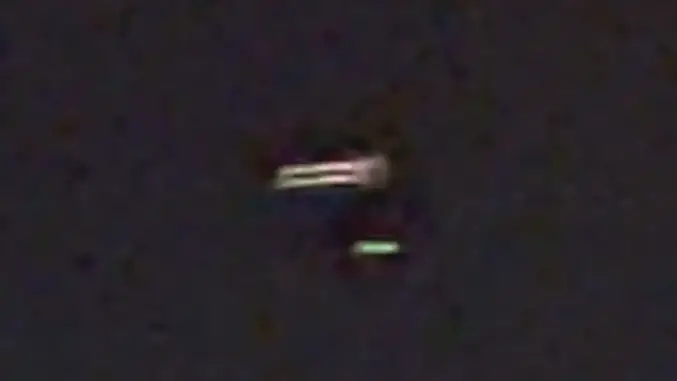
On January 7th, 2023, a UFO sighting was reported in Punta Gorda, Florida. According to the account, the sighting took place on a clear evening with eight miles of visibility. The observer observed two distinct objects: a smaller object with flashing lights, which was followed by a larger, rectangular object with very fast flashing white lights.
The observer initially began filming the objects, and at one point, the larger object stopped and disappeared, only to reappear about 10 degrees to the right of its original location. The object then continued on its path before stopping again and disappearing. The account states that the objects seemed to be no more than half a mile away at the closest point and proceeded to be less than a mile away. The observer noted that from their viewpoint, the objects appeared to be quite large.
After observing the objects, the observer contacted the Punta Gorda airport to inquire about any possible aircraft in the area at the time of the sighting. However, the airport reportedly informed the observer that their radar range is limited, and they were unable to provide any information about the objects. The observer stated that they have three separate films of the object.
This account of UFO sighting is interesting. However, it’s important to remember that just because something is unidentified doesn’t mean it’s alien or extraterrestrial in nature. There are many possible explanations for this sighting, such as aircraft, weather balloons, drones, or even misidentifications of celestial bodies. Without more information or analysis of the films taken, it is impossible to say for certain what the observer observed.
SpaceX launches OneWeb satellites for 2nd time, nails landing in Florida
A SpaceX Falcon 9 rocket launched 40 OneWeb Satellite from Space Launch Complex 40 (SLC-40) at Cape Canaveral Space Force Station in Florida on Jan. 9, 2023. A few minutes after stage separation, the first stage of the rocket landed on Landing Zone 1 (LZ-1) at Cape Canaveral Space Force Station.
Credit: SpaceX
Ship 24 Stacked on Booster 7 for Prelaunch Testing | SpaceX Boca Chica
Booster 7 was lifted onto the Orbital Launch Mount overnight, then Ship 24 was stacked on top of it ahead of an anticipated full wet dress rehearsal test.
DEEP OCEAN LIGHTS Point to Alien Activity | The Proof is Out There: Bermuda Triangle
Strange lights illuminating from the bottom of the Bermuda Triangle may point to strange alien activity. See more in this clip from Season 1, "USOs & Underwater Forces."
Love watching The Proof Is Out There: Bermuda Triangle Edition? Stay up to date on all of your favorite The HISTORY Channel shows at history.com/schedule.
Earth-size planet found in TOI 700 system's habitable zone
NASA’s Transiting Exoplanet Survey Satellite (TESS) has been used to discover Earth-size planet TOI 700 e. It is "orbiting within the habitable zone of its star – the range of distances where liquid water could occur on a planet’s surface," according to NASA's Goddard Space Flight Center.
The TOI 700 system is about 100 light-years away.
Credits:NASA/JPL-Caltech/Robert Hurt/NASA’s Goddard Space Flight Center
X1.9 solar flare! Hyperactive sunspot eruption seen by spacecraft
Sunspot AR3184 erupted with an X1.9-class solar flare on Jan. 9, 2022. NASA's Solar Dynamics Observatory (SDO) captured the fireworks. The sunspot has been very active since it rotated into SDO's view.
SpaceX did a Brilliant Upgrade On Starship Booster For 33 Engines Static Fire this week
Finally, SpaceX Booster 7 - our hero is back and better than ever with some robustness Upgrade to gear up for 33 Engines Static Fire this week! So, what has the SpaceX team upgraded on the B7 over the past month?
Discuss everything about this in today's episode of Alpha Tech:
Until now, Booster 7 and Ship 24 continue to be cited as the pairing that will conduct the orbital test flight, with Musk citing that the latest schedule is hopeful the first orbital flight of Starship could happen as soon as next month. "We have a real shot at late February. March launch attempt appears highly likely," Musk wrote.
Schedule clarity will be gained via the return of Booster 7 on last Sunday from its time back in the Mega Bay (High Bay 2) after it was transported away from its perch on the Orbital Launch Mount (OLM) in December. With road closures posted for this week, we hope a big test comes soon. Booster 7 alone completed more than 24 distinct tests (including six static fires) between early April and late November.
Now back to the main topic, let's see what's new on B7 after the latest reborn. Firstly, have you noticed that its appearance has become more attractive? Well, Booster 7 is surprisingly shiny. Doesn't look like there are any missing tiles now. Yeah, SpaceX’s futuristic Starship interplanetary craft may embody the golden age of sci-fi in more ways than one: in addition to (theoretically) taking passengers from planet to planet, it may sport a shiny stainless-steel skin that makes it look like the pulp covers of old. This is a special full-hardness steel alloy mentioned as being among the 300 series of high-strength, heat-resistant alloys — not the plentiful, pliable stuff we all have in our kitchens and buildings. Musk also ever mentioned another “superalloy” called SX500 that SpaceX’s metallurgists have developed for use in the Raptor engines that will power the vehicle.
Secondly, full engine shields. One month ago, B7 has 20 missing panels for each of its outer Raptor engines. That engine shielding looks great now! Any replacements would need to be modified to ensure that the ad-hoc system installed to prevent the conditions that led to Booster 7’s first explosion from recurring can still be used for future static fire tests. But honestly, it’s unclear why SpaceX would need to reinstall those panels now for Booster 7’s upcoming 33-engine static fire(s) and a full-stack wet dress rehearsal(s) when they weren’t needed for 11 and 14-engine static fires and a dozen other fire-free tests. SpaceX did a Brilliant Upgrade On Starship Booster For 33 Engines Static Fire this week
NASA Just Detected Several Massive Objects Entering Our Solar System!
While we have made several trips to space in hopes of trying to find life beyond Earth, things usually don’t happen the other way around. Well, that has just changed. Scientists have actually detected a new interstellar visitor, and it brought with it hundreds of questions. Join us as we dig deeper into what’s going on with this mysterious visitor, and what this could mean for the future of humanity!
But before we get to the visitor, we’re going to take a look back at 2017 to make sense of what’s going on right now! There are trillions of space rocks in our solar system alone, even more outside of it. But the space crafts, telescopes, and lasers we have on Earth still spend night and day studying them anyway.
That’s because any information we might find about the rocks flying around in space could change everything in an instant. So there’s no stone we can leave unstudied. While scientists spend all day and night studying space, we’ve never really had anything major enter our solar system. Even if we did, it’s usually right at the edge of our solar system. That, too, if it’s fast enough to make it through the sheer pressure objects have to deal with. So to have an interstellar object make it even remotely close to being detected by the machines on Earth was never really a goal.
Virgin Orbit rocket suffers anomaly during air launch on first UK mission
Virgin Orbit's Cosmic Girl carrier plane deployed the "Start Me Up" mission's LauncherOne rocket for an air launch on Jan. 9, 2022. The rocket was deployed about an hour after the plane lifted off from Spaceport Cornwall in the UK.
The rocket suffered an anomaly during the flight and failed to deliver its payload to orbit, according to Chris Relf, Virgin Orbit director of systems engineering and verification.
Credit:Virgin Orbit
Mars Ingenuity Helicopter found here after its most recent fascinating flight I 4K
Watch the latest spectacular flight that took place on the Red planet. Enjoy
Scientists Just Found This 3,500 Year Old Box Next To The Pyramids That Contained This Secret
Welcome to Futureunity, where we explore the fascinating world of science, technology, and the universe! From the inner workings of the human body to the outer reaches of space, we delve into the latest and most interesting discoveries that are shaping our world. Whether you're a science buff or just looking for some mind-blowing facts, we've got you covered. Join us as we uncover the mysteries of the world around us and discover new frontiers in the fields of science and technology. Get ready for a journey that's both educational and entertaining!
For astrobiologists, the scientists dedicated to the search for life beyond Earth, the moons of Saturn are a virtual treasure trove of possibilities. Enceladus is especially compelling because of the active plumes of water emanating from its southern polar region. Not only are these vents thought to be connected directly to an ocean beneath the moon’s icy surface, but the Cassini mission detected traces of organic molecules and other chemicals associated with biological processes. Like Europa, Ganymede, and other “Ocean Worlds,” astrobiologists think this could indicate hydrothermal activity at the core-mantle boundary.
Both NASA and the ESA are hoping to send missions to Enceladus that could study its plumes in more detail. These include the Enceladus Orbitlander recommended in the Planetary Science and Astrobiology Decadal Survey 2023-2032 and the ESA’s Enceladus Moonraker, which could depart Earth in the next decade, taking advantage of a favorable alignment between the planets. In anticipation of what these missions could find, an international team of researchers used data from the Cassini mission to establish how samples of plume material could constrain how much biomass Enceladus has within it.
While the Cassini orbiter revealed a great deal about Enceladus and its surface features, scientists have been speculating about the existence of plume activity. The first hints came from the Voyager 1 and 2 probes, which flew through the Saturn system in November 1980 and August 1981 (respectively). Based on the reflective surface and its location near the core of Saturn’s E ring (largely composed of water ice and silica), scientists speculated that the moon was geologically active and the source of material in the ring (possibly through the venting of water vapor).
The Cassini probe first encountered indications of plume activity during its passage in 2005, which were interpreted as signs of possible cryovolcanism. During its many subsequent encounters, Cassini flew directly through Enceladus’ plumes and obtained data from its spectrometer and magnetometer. Combined with imaging and ionic data, the readings obtained suggested that the southern polar plumes emanated from pressurized subsurface chambers. Since then, multiple studies have been conducted that have attempted to constrain the type of subsurface environment.
This includes numerical simulations showing how water could circulate in the core at high temperatures and detecting hydrogen in the plume. According to Affholder, who spoke to Universe Today via email, these findings point toward possible hydrothermal activity and methanogenesis similar to what has existed here on Earth for billions of years:
“On Earth, hydrogen is generated by hydrothermal processes in the ocean. Additionally, this hydrogen generation in Earth’s ocean supports methanogenesis, a metabolism known to be used by life on Earth very early on. This metabolism is also ubiquity found in ‘anoxic’ (oxygen-poor) environments. The antiquity and ubiquity of methanogenesis, and the elements supporting the existence of hydrothermalism on Enceladus together make the case that methanogenesis could occur in Enceladus’s ocean. This hypothesis might even predate findings of the Cassini mission, as it was suggested in 1999 by Thomas McCollom that methanogenesis could support primary production on Jupiter’s moon Europa which is in many ways similar to Enceladus.”
Artist rendering showing an interior cross-section of the crust of Enceladus, which shows how hydrothermal activity may be causing the plumes of water at the moon’s surface.
µCredits: NASA-GSFC/SVS/NASA/JPL-Caltech/SwRI
In the coming years, a dedicated mission may be sent to Enceladus to investigate its plume activity more closely – like the Enceladus Orbitlander or Moonraker. Upon arrival, this mission will either fly directly through the plumes and/or dispatch a lander to the surface to obtain samples of the plumes’ gas and grains, then analyze them for evidence of potential biosignatures. To get a better idea of what this might look like, Affholder and his colleagues calculated the likely abundance of certain biosignatures in the plume material based on the assumption that a methanogenic ecosystem exists.
“Using these calculations, we deduce the sample size required to capture at least one cell with a 95% chance or more,” said Affholder. “Other than cells, we have also looked at the production of small organic molecules such as amino acids. We used our ecosystem model and the assumption of Earth-like life to predict the concentration of amino acids in the plume under the hypothesis that an ecosystem exists and under the competing hypothesis that these amino acids are produced ‘naturally’ in hydrothermal settings.”
They found that (accounting for uncertainties) capturing at least one cell would require up to 1 milliliter (0.034 fluid ounces) of plume material to be sampled. This may sound like a tiny amount but based on the mission architecture for NASA’s Orbitlander, it would take hundreds of passes through the plume material to obtain this amount. Affholder and his colleagues acknowledge that these results are subject to large uncertainties concerning the chemical and physical processes that might affect the concentration of amino acids in the sample. For starters, Affholder conveyed that their calculations are a bit optimistic:
“Indeed, the calculations assume that most cells retain their structure upon traveling across the ocean in rising warm water and being outgassed into space. A variety of things can happen during this journey to the plume: cells could be destroyed during outgassing, but they could also be consumed by ‘heterotrophs’ (organic matter-eating organisms). Heterotrophs are almost always present in ecosystems on Earth. Hence, it would seem that assuming the presence of methanogens without that of heterotrophs does not make complete sense from an ecosystem perspective.”
“Concerning the detection of amino acids, we place the threshold concentration below which biotic production is unlikely at an achievable limit of detection for onboard instruments eg those envisioned for the Orbilander concept. It is important that we define the required limits of detection to allow the interpretation of ‘negative results.’ Maybe one could interpret our result as an argument not to prioritize cell detection instruments over broader spectrum biosignature detection instruments such as gas chromatography or mass spectroscopy, which are able to identify molecules such as amino acids.”
The “Ocean Worlds” of the Solar System.
Credit: NASA/JPL
Therefore, further research is needed to address the role of heterotrophs and establish tighter constraints on the amount of organic matter that could be detected. This will ensure that future missions don’t run the risk of mistaking negative results for the absence of biotic production (instead of being merely too small to detect). Nevertheless, this research constitutes an important first step in establishing what a future mission to Enceladus should look for and how the results could be interpreted. This will likely have significant implications for future mission architectures – and not just for Enceladus.
Throughout the outer Solar System, there are “Ocean Worlds” that have icy surfaces and subsurface oceans. Most of these bodies are moons that orbit gas giants, like Jupiter’s Europa, Ganymede, and Callisto, Saturn’s Titan and Dione, and Neptune’s Triton. However, astronomers and astrobiologists have begun eying other bodies like Ceres, Pluto, Charon, and other “dwarf planets” more closely in recent years. Several missions are planned to explore some of these bodies, all of which will benefit from research that helps establish what they could find. Said Affholder:
“What we do for Enceladus may translate at least in part for similar bodies – icy moons. Titan also has a global ocean overlain by ice and is the target of the upcoming NASA Dragonfly mission. Europa in the Jovian system is an icy moon that should be reached by the NASA Europa Clipperand by the ESA’s JUpiter ICy Explorer (JUICE) in the 2030s. I believe we are at the beginning of a very exciting era of exploration of icy moons, for which I am excited.”
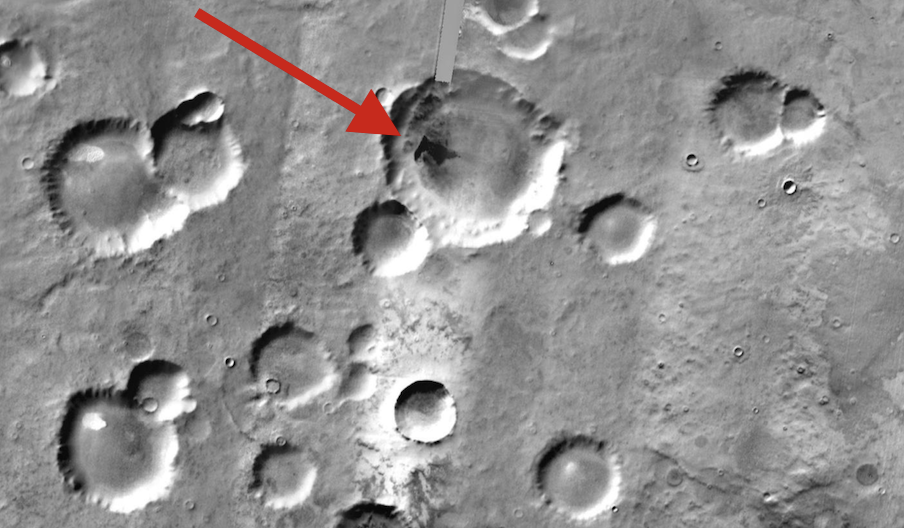
1.5 Mile High Structure Found On Mars In Crater, Google Map, UFO Sighting News.
Date of discovery: Jan 9, 2023 Location of discovery: Mars
Coordinates: Coming soon.
Hey all, I was using Google Mars map, and found this very tall ancient structure on Mars. The structure is so tall it shows a shadow for over 5 miles. Its about 1.5 miles tall, but since its on the floor of a crater, which is about 2-3 miles deep, its goes unnoticed. Yet I found it odd and exciting. The map I used is the infrared map, which shows things...detail that the human eye cannot normally see.
The Pentagon’s Top-Secret UFO Investigation: What We Know
In May 2021, Congress held its first hearing on UFOs, or unidentified aerial phenomena (UAPs), in over 50 years. The hearing was led by Senator Kirsten Gillibrand, Senator Marco Rubio, and Representative Ruben Gallego, who included an amendment in the latest defense bill requiring the Department of Defense (DoD) to establish a permanent office to investigate UAPs. The DoD has collected around 400 credible reports of UAPs, but has not provided any definitive answers, offering possible explanations such as airborne clutter, natural atmospheric phenomena, classified US technology, classified foreign technology, or other unidentified sources.
The government’s interest in UAPs dates back to the 1950s, when the Pentagon launched Project Blue Book to investigate over 12,000 UFO sightings, of which over 700 remain unidentified. In the 2000s, Senator Harry Reid of Nevada established the Advanced Aerospace Threat Identification Program (ATIP) to further investigate UAPs. The ATIP program was unclassified but not widely known to the public, and was officially ended in 2012.
Lou Elizondo, who was in charge of ATIP, became convinced that the UAPs they were investigating may not be of this world. When he tried to present this information to his superiors within the Pentagon, he faced skepticism and eventually resigned, bringing the program to public attention in 2017. Tom DeLonge, of the band Blink 182, has also been involved in bringing attention to the issue of UAPs.
Overall, the government is taking UAPs seriously as a national security issue, recognizing the need to investigate and identify any potential threats. However, the exact nature and origin of UAPs remains unknown.
VIDEO: Mysterious UFO Sighting Reported in Naples, Italy
On December 2022, a strange UFO was spotted outside a residence in Naples, Italy. According to the witness, the object appeared to be spinning like a flying saucer and then suddenly disappeared. There were no discos or clubs in the area with lights that could have caused the strange sight.
In the video of the incident, the UFO can be seen turning on itself and moving before disappearing from view. The witness is at a loss to explain what the object could be and submitted the video to our website through our Facebook page.
Florida: Crystal River Residents Report Strange Lights in the Sky – VIDEO!
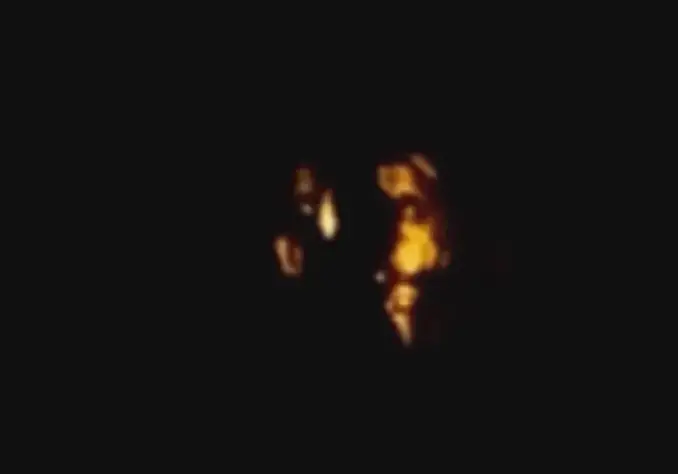
On the night of January 7th, 2023, a UFO was spotted in Crystal River, Florida. According to eyewitness accounts, the object was a group of glowing lights that appeared motionless in the night sky. The lights were described as shimmering red and blue, and seemed to change position slightly over time.
Upon review of video footage of the incident, it became clear that the UFO was actually a tight cluster of several glowing yellow lights that were holding a steady position in the sky. The lights were observed for an extended period of time, and seemed to gradually move further away as the night went on.
SpaceX Starship new timeline revealed, S24/B7 Full Stack & Massive Testing incoming
Mysterieuze Bol die uit Zichzelf Beweegt - de Betz-Bol
Jarenlang zijn er talloze vreemde artefacten gevonden - boeken met vreemde codes, onverklaarbare kaarten, stenen met ongebruikelijke vormen, oude figuren die vreemde dingen uitbeelden, en... het geval van de Betz-bol, een mysterieuze metalen bol die per ongeluk werd gevonden door een Amerikaans gezin in de jaren zeventig dat het vermogen had om zelfstandig te verhuizen ... Destijds veroorzaakte de bol een grote media-razernij en werd door velen beschreven als 'buitenaardse technologie'. Het begon allemaal in april 1974, toen een familie uit de stad Jacksonville, Florida, een vreemd bolvormig metalen voorwerp vond met een gewicht van ongeveer 20 pond en afmetingen die iets kleiner waren dan die van een bowlingbal.
See Mars Helicopter Ingenuity's first flight of 2023 in time-lapse + stats!
NASA's Mars helicopter Ingenuity took its first flight on 2023 on Jan. 4. See a time-lapse of the flight, color images and statistics.
Credit: NASA/JPL-Caltech | edited by [Steve Spaleta]
The team at Virgin Orbit in California explains how they transported a rocket to the United Kingdom for launch. -- Launch is scheduled for Jan. 9, 2022: https://www.space.com/virgin-orbit-fi...
Hello Everyone: Watch in this fantastic video Nasa's Mars Perseverance Rover Released Super Stunning Pictures of Mars and Curiosity Mission Update [2022-2023]
And watch Curiosity's Panoram images and latest photos of Mars sent by NASA'S Perseverance Rover acquired on latest sol 667
China launches 5 micro-satellites atop Galactic Energy's CERES-1 Y5 rocket
A Galactic Energy-developed CERES-1 Y5 carrier rocket launched 5 small satellites from the Jiuquan Satellite Launch Center on Jan. 9. 2023. Galactic Energy is a rocket maker based in Beijing.
Credit:Space.com | footage courtesy: China Central Television (CCTV) | edited by Steve Spaleta (https://twitter.com/stevespaleta)
Booster 7's Final Roll to the Launch Site? | SpaceX Boca Chica
Super Heavy Booster 7 was rolled out to the launch site in Boca Chica, potentially for the final time, ahead of an expected WDR and 33 engine static fire.
Dream Chaser - The Dream Of Lifting Body Space Planes
Dream Chaser isn't the first space plane, it is however on course to be the first operational Lifting Body space plane, intended to perform its first demo launch on a Vulcan rocket and rendezvous with the International Space Station during 2022. But its been a long time coming, the concept of lifting body space planes goes back to the 1950's, and NASA was test flying demonstrators 60 years ago, starting with the 'Flying Bathtub', build from a steel frame overlaid with plywood, and towed behind a car. But it would take some cues from the Soviet BOR-4 test vehicle to arrive at a more optimal design, stable across much larger ranges of speed.
The Physics of UFOs: Eric Weinstein + Hal Puthoff
Eric Weinstein is a Managing Director at Thiel Capital, creator of geometric unity, a unified theory in physics, and the intellectual dark web, a loose coalition of intellectuals dedicated to free thought. Hal Puthoff is former CIA, NSA and AATIP (the government’s official UFO investigation program). In the 70’s, he oversaw Stargate: the government’s psychic spy program at Stanford Research Institute. In this conversation, we discuss the physics of UFO’s, private aerospace as the keepers of fundamental science and Hal’s experience with parapsychology. Please enjoy
New JWST Image Shows That Grand Spiral Galaxies had Already Formed 11 Billion Years ago
For the first time this week, photos from the James Webb Space Telescope (JWST) revealed that stellar bars were present in some galaxies as far back as 11 billion years ago. Stellar bars are a defining feature of about two-thirds of all spiral galaxies in the Universe, including our own Milky Way. The discovery has implications for astronomers’ understanding of galactic evolution, indicating that bars form very quickly and may persist for much of a galaxy’s lifespan, influencing its shape and structure.
Stellar bars are regions of intense star formations that radiate out from a galaxy’s core. Through the motion of inner orbiting stars, dust, and gas clouds, they build up as a wave of dense material that perpetuates itself and spreads slowly outward while pulling raw material inwards.
These regions become stellar nurseries that churn out new stars at a rapid pace.
Six barred galaxies as seen by JSWT, as they would have looked in the early universe, between 8.4 and 11 billion years ago (Gyr). Credit: NASA/CEERS/University of Texas at Austin.
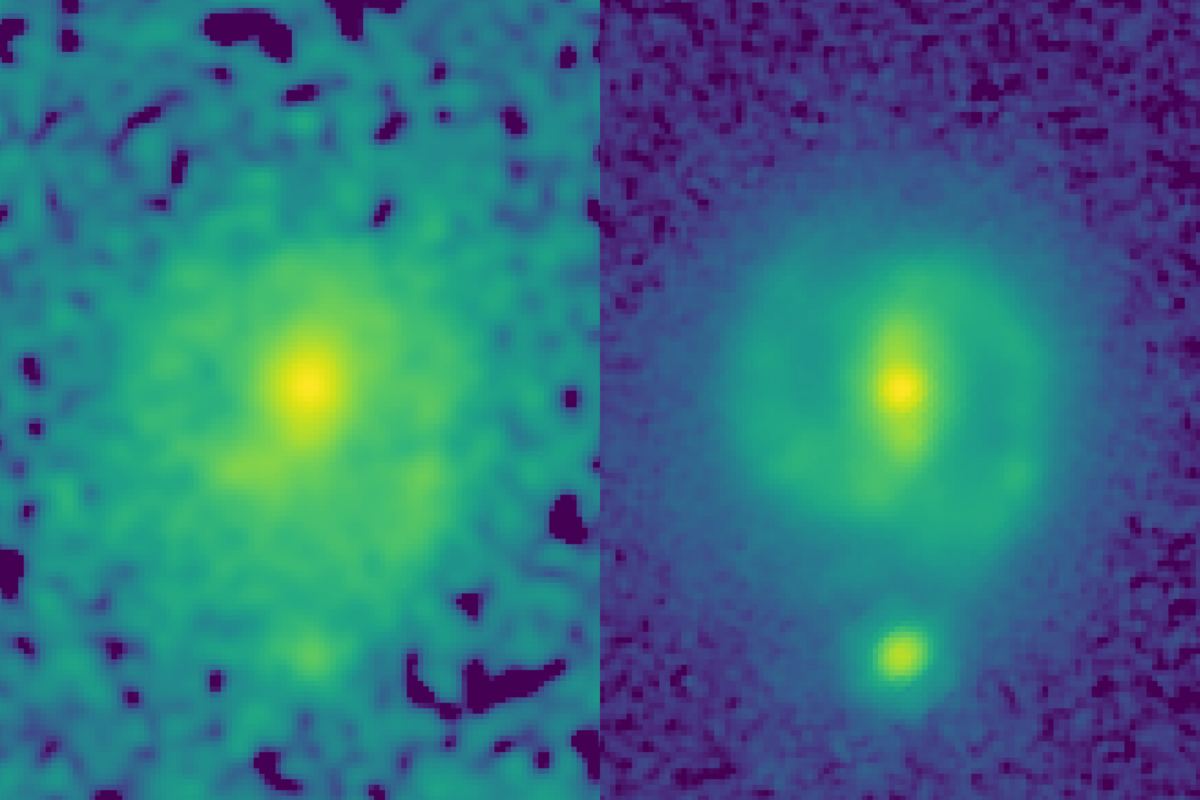
The new JWST images, presented by The University of Texas at Austin on January 5th, show six barred spiral galaxies over 8.4 million years old, two of which are older than 11 billion years (the oldest galaxy ever seen is around 13.4 billion years old).
Most of these galaxies were previously imaged by the Hubble Space Telescope, like EGS-23205, pictured below. (EGS stands for Extended Groth Strip, a region of the sky that has been extensively images and studied by international surveys). However, in the Hubble images, the bars are largely obscured.
Galaxy EGS23205, as seen by Hubble (left, taken in the near-infrared filter), and JWST (right, mid-infrared image). Credit: NASA/CEERS/University of Texas at Austin.
JWST has an advantage over Hubble in observing extremely old and distant galaxies, partly because its larger mirror can collect more light from distant, dim objects. But it also has an advantage due to its use of infrared rather than optical wavelengths. Light from older and more distant objects is ‘red-shifted’ along the electromagnetic spectrum, meaning that JWST’s detectors can pick them up better than Hubble can.
Infrared is also very effective at seeing through gas and dust, enabling JWST to pick out the stellar nurseries in the bars which would otherwise be obscured.
Shardha Jogee, professor of astronomy at The University of Texas at Austin, explained the implications of these early forming bars for models of galactic evolution:
The location of the Extended Groth Strip (EGS) in the night sky. The galaxies newly observed by JWST lie within the EGS. Image Credit: NASA, ESA, M. Davis (University of California, Berkeley), S. Faber (University of California, Santa Cruz), and A. Koekemoer (STScI).
“Bars solve the supply chain problem in galaxies,” Jogee says. “Just like we need to bring raw material from the harbor to inland factories that make new products, a bar powerfully transports gas into the central region where the gas is rapidly converted into new stars at a rate typically 10 to 100 times faster than in the rest of the galaxy…This discovery of early bars means galaxy evolution models now have a new pathway via bars to accelerate the production of new stars at early epochs.”
Mysterious UFO Sighting in Austin, Texas Causes Stir on Social Media
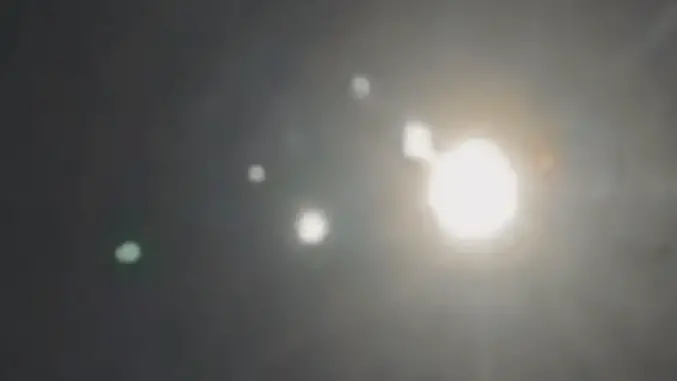
The video of the UFO sighting in Austin, Texas (3rd January 2023) has caused quite a stir on social media, with many people wondering what could have caused the bright light and strange object captured on film. Some have suggested that it could be a drone, possibly even one belonging to the local police department, due to the presence of a searchlight and the fact that the video appears to have been filmed through double-paned glass.
Others, however, are skeptical of this explanation and believe that the object could be something more mysterious. Some commenters on the original Reddit post claim to have seen similar objects at a United States Air Force base, leading some to speculate that the object could be some sort of military technology. Others have pointed out the triangle shape of the object as seen in the video, suggesting that it could be an unidentified flying object of extraterrestrial origin.
Regardless of what the object may be, it has certainly sparked a lot of debate and speculation among those who have seen the video. Some believe it could be a hoax or a staged event, while others think it could be a genuine mystery that deserves further investigation. Until more information becomes available, the true nature of the object in the video remains a mystery.
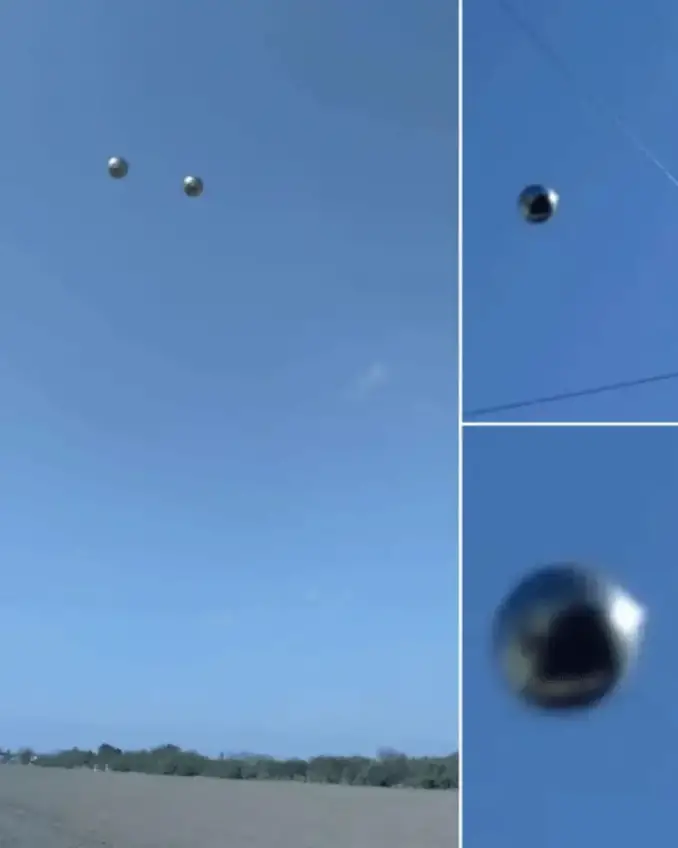
An unidentified flying object (UFO) was spotted on a highway in Tamaulipas, Mexico, according to a photograph shared on a forum dedicated to UFO sightings. The image, which shows two spherical objects flying over a stretch of land, was taken on December 29 by a user named Juanito Juan. “For the envious who do not believe … 12:05 pm … on the side of the road, Valle Hermoso to Matamoros, Tamaulipas … I thought it was one and not … there are 2,” Juanito Juan wrote in the Facebook forum “Ufo-Ovnis-Paranormal
Meer van UFO'S of UAP'S, ASTRONOMIE, RUIMTEVAART, ARCHEOLOGIE, OUDHEIDKUNDE, SF-SNUFJES EN ANDERE ESOTERISCHE WETENSCHAPPEN - DE ALLERLAATSTE NIEUWTJES


 VIDEO – Mysterious Objects Spotted in Clear Skies Over Punta Gorda: Is it a UFO?