Naar de inhoud

UFO'S of UAP'S, ASTRONOMIE, RUIMTEVAART, ARCHEOLOGIE, OUDHEIDKUNDE, SF-SNUFJES EN ANDERE ESOTERISCHE WETENSCHAPPEN - DE ALLERLAATSTE NIEUWTJES

UFO's of UAP'S in België en de rest van de wereld
akke.beakke.be
Ontdek de Fascinerende Wereld van UFO's en UAP's: Jouw Bron voor Onthullende Informatie! Ben jij ook gefascineerd door het onbekende? Wil je meer weten over UFO's en UAP's, niet alleen in België, maar over de hele wereld? Dan ben je op de juiste plek! België: Het Kloppend Hart van UFO-onderzoek In België is BUFON (Belgisch UFO-Netwerk) dé autoriteit op het gebied van UFO-onderzoek. Voor betrouwbare en objectieve informatie over deze intrigerende fenomenen, bezoek je zeker onze Facebook-pagina en deze blog. Maar dat is nog niet alles! Ontdek ook het Belgisch UFO-meldpunt en Caelestia, twee organisaties die diepgaand onderzoek verrichten, al zijn ze soms kritisch of sceptisch. Nederland: Een Schat aan Informatie Voor onze Nederlandse buren is er de schitterende website www.ufowijzer.nl, beheerd door Paul Harmans. Deze site biedt een schat aan informatie en artikelen die je niet wilt missen! Internationaal: MUFON - De Wereldwijde Autoriteit Neem ook een kijkje bij MUFON (Mutual UFO Network Inc.), een gerenommeerde Amerikaanse UFO-vereniging met afdelingen in de VS en wereldwijd. MUFON is toegewijd aan de wetenschappelijke en analytische studie van het UFO-fenomeen, en hun maandelijkse tijdschrift, The MUFON UFO-Journal, is een must-read voor elke UFO-enthousiasteling. Bezoek hun website op www.mufon.com voor meer informatie. Samenwerking en Toekomstvisie Sinds 1 februari 2020 is Pieter niet alleen ex-president van BUFON, maar ook de voormalige nationale directeur van MUFON in Vlaanderen en Nederland. Dit creëert een sterke samenwerking met de Franse MUFON Reseau MUFON/EUROP, wat ons in staat stelt om nog meer waardevolle inzichten te delen. Let op: Nepprofielen en Nieuwe Groeperingen Pas op voor een nieuwe groepering die zich ook BUFON noemt, maar geen enkele connectie heeft met onze gevestigde organisatie. Hoewel zij de naam geregistreerd hebben, kunnen ze het rijke verleden en de expertise van onze groep niet evenaren. We wensen hen veel succes, maar we blijven de autoriteit in UFO-onderzoek! Blijf Op De Hoogte! Wil jij de laatste nieuwtjes over UFO's, ruimtevaart, archeologie, en meer? Volg ons dan en duik samen met ons in de fascinerende wereld van het onbekende! Sluit je aan bij de gemeenschap van nieuwsgierige geesten die net als jij verlangen naar antwoorden en avonturen in de sterren! Heb je vragen of wil je meer weten? Aarzel dan niet om contact met ons op te nemen! Samen ontrafelen we het mysterie van de lucht en daarbuiten.

Archief

Locals Freaked Out By Glowing Red And White UFOs In The Night Sky Over Las Vegas

Locals Freaked Out By Glowing Red And White UFOs In The Night Sky Over Las Vegas

Hoe vind je dit bericht?
Geschreven door peter om 21:44 Stuur door

The Roswell UFO Affair and MK-Ultra Operations Combined: Very Sinister Sagas

The Roswell UFO Affair and MK-Ultra Operations Combined: Very Sinister Sagas

The Roswell UFO Affair and MK-Ultra Operations Combined: Very Sinister Sagas

Although the U.S. intelligence community, military and government has undertaken countless official (and off-the-record, too) projects pertaining to both mind-control and mind-manipulation, without any doubt whatsoever, the most notorious of all was Project MKUltra: a clandestine operation that operated out of the CIA’s Office of Scientific Intelligence, and that had its beginnings in the Cold War era of the early 1950s (it should be noted tht. The date of the project’s actual termination is a somewhat hazy one; however, it is known that it was definitely in operation as late as the latter part of the 1960s – and, not surprisingly and regretfully, has since been replaced by far more controversial and deeply hidden projects.To demonstrate the level of secrecy that surrounded Project MKUltra, even though it had kicked off at the dawn of the fifties, its existence was largely unknown outside of the intelligence world until 1975 – when the Church Committee and the Rockefeller Commission began making their own investigations of the CIA’s mind-control-related activities – in part to determine if (a) the CIA had engaged in illegal activity, (b) the personal rights of citizens had been violated, and (c) if the projects at issue had resulted in fatalities – which they most assuredly and unfortunately did. With that said, let's see what all of this has to do with the Roswell affair of July 1947? And one other thing: before MK-Ultra was in place, mind-control was already in place. That's something I'll talk about soon.

The story that unfolded was both dark and disturbing – in equal degrees. Indeed, the scope of the project – and allied operations, too – was spelled out in an August 1977 document titled The Senate MK-Ultra Hearings that was prepared by the Senate Select Committee on Intelligence and the Committee on Human Resources, as a result of its probing into the secret world of the CIA. As the document explained: “Research and development programs to find materials which could be used to alter human behavior were initiated in the late 1940s and early 1950s. These experimental programs originally included testing of drugs involving witting human subjects, and culminated in tests using unwitting, non-volunteer human subjects. These tests were designed to determine the potential effects of chemical or biological agents when used operationally against individuals unaware that they had received a drug.” The Committee then turned its attention to the overwhelming secrecy that surrounded these early 1940s/1950s projects: “The testing programs were considered highly sensitive by the intelligence agencies administering them. Few people, even within the agencies, knew of the programs and there is no evidence that either the Executive Branch or Congress were ever informed of them. 

(Central Intelligence Agency) The MK-Ultra files that are still around, are now in the public domain, thanks to the U.S. Freedom of Information Act.

“The highly compartmented nature of these programs may be explained in part by an observation made by the CIA Inspector General that, ‘the knowledge that the Agency is engaging in unethical and illicit activities would have serious repercussions in political and diplomatic circles and would be detrimental to the accomplishment of its missions. The research and development programs, and particularly the covert testing programs, resulted in massive abridgments of the rights of American citizens, and sometimes with tragic consequences, too. As prime evidence of this, the Committee uncovered details on the deaths of two Americans that were firmly attributed to the programs at issue; while other participants in the testing programs were said to still be suffering from the residual effects of the tests as late as the mid-1970s." And as the Committee starkly noted: “While some controlled testing of these substances might be defended, the nature of the tests, their scale, and the fact that they were continued for years after the danger of surreptitious administration of LSD to unwitting individuals was known, demonstrate a fundamental disregard for the value of human life.” 

While MKUltra was certainly the most infamous of all the CIA-initiated mind-control programs, it was very far from being an isolated one. Indeed, numerous sub-projects, post-projects and operations initiated by other agencies were brought to the Committee’s attention. One was Project Chatter, which the Committee described thus: “Project Chatter was a Navy program that began in the fall of 1947. Responding to reports of amazing results achieved by the Soviets in using truth drugs, the program focused on the identification and the testing of such drugs for use in interrogations and in the recruitment of agents. The research included laboratory experiments on animals and human subjects involving Anabasis aphylla, scopolamine, and mescaline in order to determine their speech-inducing qualities. Overseas experiments were conducted as part of the project. The project expanded substantially during the Korean War, and ended shortly after the war, in 1953.” Then there was Projects Bluebird and Artichoke. Again, the Committee dug deep and uncovered some controversial and eye-opening data and testimony: “The earliest of the CIA’s major programs involving the use of chemical and biological agents, Project Bluebird, was approved by the Director in 1950. Its objectives were: (a) discovering means of conditioning personnel to prevent unauthorized extraction of information from them by known means, (b) investigating the possibility of control of an individual by application of special interrogation techniques, (c) memory enhancement, and (d) establishing defensive means for preventing hostile control of Agency personnel.”

(Nick Redfern) Mind-manipulation and the world's most famous UFO case.

Now, we come to the matter of the Roswell event and mind-control and manipulation. The late Frank Joyce was a well-known figure in the saga of what did, or didn't, happen on the Foster ranch, Lincoln County, New Mexico in early July 1947. At the time of the Roswell event, Joyce was a radio announcer with KGFL, which covered Roswell. He was also the very first person in the media - local or national - to speak with rancher, W.W. Brazel, who found the curious materials. The story goes that Brazel told Joyce that it was not just a huge amount of debris he found, but a number of dead bodies, too. That's when all hell broke loose. Threats were made by a high-ranking officer somewhere in D.C. The staff at KGFL were warned to cease digging into Roswell, and to keep the story off the airwaves. As in permanently. The station's Walt Whitmore, Sr. and Jud Roberts were both threatened. As was Frank Joyce, who did not take kindly to being pushed around. The above issues aside, there is a lesser known - and much weirder - aspect to Joyce's claims. Yes, you can find the story/aspect if you look around (it actually goes back quite a while), but certain portions of the tale still remain shrouded in mystery. Roswell author-investigator Kevin Randle and I email back and forth and from time to time. On March 16 of this year, Kevin shared with me what he personally knew about that certain aspect of the Joyce story. It all revolves around a strange character that Joyce called "The Traveler." It goes like this...

In the wake of the threat made to the people at KGFL - we're talking about just a couple of days later - Walt Whitmore, Sr., had a strange request for Joyce. He asked Joyce to get in his (Whitmore's) car with him. Randle states that Jud Roberts may have been in the car too, but admittedly that's not precisely clear. Their destination, Joyce found out, was due to be the Roswell crash site, over in Lincoln County. Joyce sat in the front, with Whitmore driving. Joyce apparently didn't at first realize that there was someone else in the back-seat. It was the man who became known as "The Traveler." Very bizarrely, according to Joyce, "The Traveler" was dressed in either a gold-colored or bright-yellow suit; not unlike a flight-suit. As Kevin jokingly told me, a Man in Gold, rather than a Man in Black. Now, things get even more surreal. Could they get more surreal? Yep, for sure. Joyce found himself plunged into a definitively drugged-out state. A trance, even. In his mind-warped state, Joyce thought he was communicating with "The Traveler" by some kind of mind-to-mind process. Or, maybe, Joyce was so stoned that this was how it appeared to him.

On arrival, Kevin told me that Whitmore (and, of course, Roberts, if he was indeed with them) entered the Brazel home. Joyce, however, was instructed by Whitmore to hang out in a nearby shack, which drugged-out Joyce did. Brazel then entered the shack, begging Joyce not to say anything else about what happened on the ranch. Joyce, even though things probably still didn't feel quite right, could see how stressed out Brazel was and agreed to let matters rest. When Joyce got back to the car, "The Traveler" was nowhere to be seen. In their 2016 book, The Children of Roswell, Tom Carey and Don Schmitt state that the military was apparently "...still not sufficiently convinced by Joyce's pledge not to say anything, as he was shortly thereafter gathered up and physically removed to a military hospital in Texas for the next year." It all occurred under deeply unclear circumstances. Kevin states that Joyce was taken to a "mental hospital," which mirrors the story of Stanley Glickman, who reacted adversely to the mysterious drink that he gulped down and which left him with emotional problems for years. The story isn't finished, however. There is more about Roswell and mind-manipulation.

(Nick Redfern) From Roswell secrets to mind-control secrets.

Moving on, there is the even less well-known saga of a man named Conrad Zerbe. His name rarely surfaces and he is someone who even most Roswell researchers have failed to pay much attention to. Few researchers ever interviewed the now-dead Zerbe; although Bill Moore did in late 1983. Zerbe's link to the Roswell saga revolves around the matter of a certain, large number of photographs taken out at the crash site of the whatever-it-was that came down on the ranch in the summer of '47. A Roland S. Cliff, a Colonel Loomis, a Mr. Bohanon, and a Captain Ed Guill were in the know, when it came to (A) the matter of what happened and (B) who knew what the photos really showed. In 1980, when the Moore-Berlitz-Moore book, The Roswell Incident, was published and received publicity, Zerbe mused on the possibility of revealing what he knew. Before he had the chance to do so, however, one day in late 1980 there was a knock at the door of his California-based home. Zerbe opened the door and was confronted by a plain-clothes man who flashed government I.D. Thirty-three-years after Roswell, Zerbe was what is, today, termed a "person of interest." Zerbe was told he was not in any trouble, but (there's always a but in these situations...) the man added that he knew Zerbe had expressed a desire to go public (how he knew is anyone's guess). It would not be a wise move, Zerbe was told. He got the message - even though it was a very brief message. No explanation was given as to why Zerbe should stay silent, when people like retired Major Jesse Marcel had not been threatened. In all probability, it was due to the fact that Zerbe knew precisely what the photos showed, too - just like certain colleagues at the old Roswell base in '47.

Somewhat oddly the man in the suit had brought with him a couple of sodas. He significantly lightened up, too, and he quickly changed the subject to what Zerbe had been up to since he left the service, years earlier. Maybe five or six minutes after chugging back the soda Zerbe began to feel strange. He was spaced-out and found himself rambling on to the man and answering his every question without hesitation. He was hit by vertigo and vaguely heard voices in his head. It was whispered mumbling that he could not understand. And then? Nothing. Zerbe had no recollection of the rest of the conversation, or of what happened to the man. He never saw him again, though. It was as if around thirty minutes of time had been wiped from existence. Zerbe suspected, though, that as the soda was bottled, and with screw-tops, that something mind-warping had been surreptitiously put in the drink before the man called and the bottle-top had been carefully replaced and tightened. Zerbe also wondered if after the chemicals hit hard, the man returned the conversation back to Roswell. Although, admittedly, this was just Zerbe speculating. So, we have yet more stories of people finding themselves in curious situations and having their minds played with - all specifically "thanks" to certain drinks given to them by mysterious figures. Have we heard the end of all this? Probably not.


{ https://mysteriousuniverse.org/ }

Hoe vind je dit bericht?
Geschreven door peter om 18:32 Stuur door

What Does it Take to Make Black Holes Collide?

MIT-Spin-Origins-01-press_0.jpg

Simulation of the emitted light from a supermassive black hole binary system. (Credit: NASA’s Goddard Space Flight Center )

What Does it Take to Make Black Holes Collide?

In a recent study published in Astronomy and Astrophysical Letters, a team of researchers at the Massachusetts Institute of Technology (MIT) used various computer models to examine 69 confirmed binary black holes to help determine their origin, and found their data results changed based on the model’s configurations. Essentially, the input consistently altered the output, and the researchers wish to better understand both how and why this occurs and what steps can be taken to have more consistent results.

“When you change the model and make it more flexible or make different assumptions, you get a different answer about how black holes formed in the universe,” Sylvia Biscoveanu, an MIT graduate student working in the LIGO Laboratory, and a co-author on the study, said in a statement. “We show that people need to be careful because we are not yet at the stage with our data where we can believe what the model tells us.”

Like binary stars, binary black holes are two massive objects orbiting each other, with both having the ability to potentially collide—or merge—together, with another shared characteristic being black holes are sometimes born from the collapse of dying massive stars, also known as a supernova. But how binary black holes originated remains a mystery, as there are two current hypotheses regarding their formation: “field binary evolution” and “dynamical assembly”.

Field binary evolution involves when a pair of binary stars explode resulting in two black holes in their place, which continue orbiting each other the same as before. Since they initially orbited each other as binary stars, it is believed their spins and tilts should be aligned, as well. Scientists also hypothesize that their aligned spins indicate they originated from a galactic disk, given its relatively peaceful environment.

 Dynamical assembly involves when two individual black holes, each with their own unique tilt and spin, are eventually brought together by extreme astrophysical processes, to form their own binary black hole system. It is currently hypothesized that this pairing would likely happen in a dense environment such as a globular cluster, where thousands of stars in close proximity could force two black holes together.

The real question is what fraction of binary black holes originate from each respective method? Astronomers believe this answer lies in the data, specifically black hole spin measurements. Using the 69 confirmed binary black holes, astronomers have determined these massive objects could originate from both globular clusters and galactic disks. The LIGO Laboratory in the United States has worked with its Italian counterpart, Virgo, to ascertain the spins (rotational periods) of the 69 confirmed binary black holes.

“But we wanted to know, do we have enough data to make this distinction?” said Biscoveanu. “And it turns out, things are messy and uncertain, and it’s harder than it looks.”

For the study, the researchers continuously tweaked a series of computer models to ascertain whether their results agreed with each model’s predictions. One such model was configured to assume only a fraction of binary black holes were produced with aligned spins, where the remainder have random spins. Another model was configured to predict a moderately contrasting spin orientation. In the end, their findings indicated the results consistently changed in accordance with the tweaked models. Essentially, results were consistently altered based on the model’s tweaks, meaning more data than the 69 confirmed binary black holes is likely needed to have more consistent results.

“Our paper shows that your result depends entirely on how you model your astrophysics, rather than the data itself,” said Biscoveanu.

“We need more data than we thought, if we want to make a claim that is independent of the astrophysical assumptions we make,” said Dr. Salvatore Vitale, who is an associate professor of physics, a member of the Kavli Institute of Astrophysics and Space Research at MIT, and lead author of the study.

But how much more data will the astronomers require? Dr. Vitale estimates the LIGO network will be able to detect one new binary black hole every few days, once the network returns to service in early 2023.

“The measurements of the spins we have now are very uncertain,” said Dr. Vitale. “But as we build up a lot of them, we can gain better information. Then we can say, no matter the detail of my model, the data always tells me the same story — a story that we could then believe.”

As always, keep doing science & keep looking up!

RELATED VIDEOS, selected and posted by peter2011

{ https://www.universetoday.com/ }

Hoe vind je dit bericht?
Geschreven door peter om 18:23 Stuur door

Trucker records a "Giant Humanoid Figure" on a hill in Aguascalientes, Mexico

Trucker records a "Giant Humanoid Figure" on a hill in Aguascalientes, Mexico

According to Inexplicata, this recording of a giant 'humanoid figure' on a hill in Aguascalientes, Mexico in 2003 was obtained by a trucker driving through the state of Aguascalientes, specifically a section of the road between the capital and Lagos de Moreno, before reaching the toll booth known as "La Chona".
giant%20humanoid%20figure.jpg

Theories regarding the nature or origin of the creature began to arise among users and although it is unclear what exactly it could have been, the most popular theories were centered on the humanoid figure being a "giant".
Science says that races of giant humans do not exist and never have, but we know that the real history of humanity is deliberately being hidden from us, so could this humanoid figure be a giant from the past but still present on earth? 
The video shows what look to be a giant human or humanoid figure walking along the summit of a hill in Aguascalientes, Mexico

RELATED VIDEO
Hoe vind je dit bericht?
Geschreven door peter om 18:16 Stuur door

Mystery object described as ‘UFO’ eliminated in southern Russia

Mystery object described as ‘UFO’ eliminated in southern Russia

russia-ufo.png

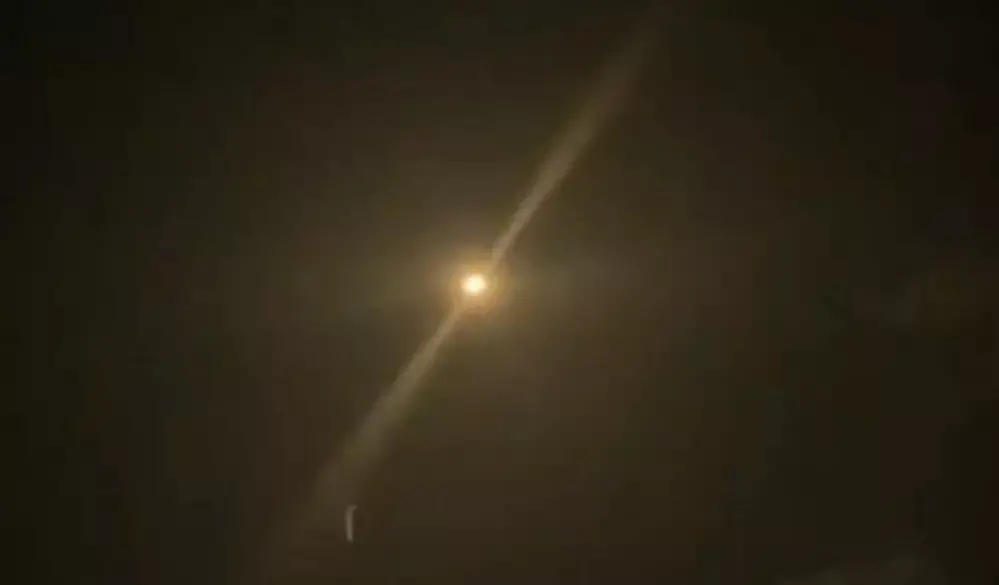
Object spotted in sky above southern Russian region of Rostov on January 3, 2023″

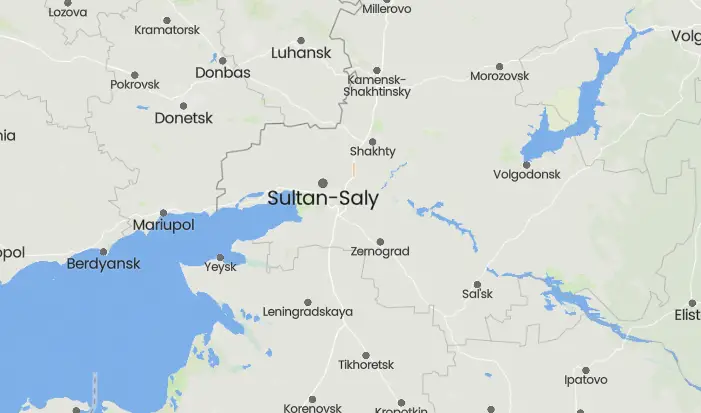
On January 3, a mysterious object described as a “UFO” was shot down in the southern Russian region of Rostov. The governor of the region, Vasily Golubev, reported that the object was a “small-size object in the shape of a ball” flying at an altitude of around one and a half miles above the village of Sultan Sala. In response, the decision was made to “liquidate” the object, and all forces and means were deployed to ensure security, including anti-aircraft defenses.

Local news outlet Pivyet Rostov referred to the incident as a “UFO in the form of a ball” being shot down, and Telegram channels reported on the activation of air defense systems in Rostov. A video shared on the channel Ostorozhna, Novosti showed a shining object flying and then exploding in the sky, with someone heard saying “look, another one has gone.” Witnesses described a “very strong explosion” and their houses shaking due to the activity of the air defenses.

Rostov, located on the border of the Sea of Azov, has been the site of regular shelling and drone attacks during the ongoing war in Ukraine. In October, the region was designated as a “medium-response level” area, with restrictions on movement and increased public order measures put in place. The annexation of four regions in Ukraine, including Kherson, Zaporizhzhia, Donetsk, and Luhansk, has resulted in a “maximum response,” or martial law, being imposed.

{ https://www.latest-ufo-sightings.net/ }

Hoe vind je dit bericht?
Geschreven door peter om 17:07 Stuur door

LATEST UFO SIGHTINGS AND VIDEOS - 06/01/2023

LATEST UFO SIGHTINGS AND VIDEOS - 06/01/2023

**Update** Russia Claims It Shot Down a UFO Over The Rostov Oblast On January 3, 2023. (FOOTAGE)

Earlier today the story broke that Russia claimed to have shot down a UFO, after doing some digging i found 3 clips of this event. I believe that even if it is something offworld there will be a cover up but this is the story so far...

Russia Says It Shot Down a UFO: https://www.newsweek.com/russia-rosto...

Thanks to the News website "Privet-rostov.ru" for the source of the footage UFO, OVNIs, UFO 2022, OVNI, UFOs, НЛО, UAP, UAPS, OVNI 2022, UAP 2022, GHOST, GHOST 2022

RELATED VIDEOS

Several UFO Filmed Deploying Brightly Lit Objects Over São Paulo, Brazil & The Magic Basketball

Clip One: This was sighted during the New Years Eve celebrations 2022/2023 over the city of Ribeirão Preto in São Paulo, Brazil. The witness stated the following. "During the fireworks of new year 2022~2023 we saw these UFOs. Every year we can see them. This year we managed to shoot. They are under the forest of the city and we have already had several sightings in this region, including during the day. Black UFOs during the day come out of the middle of the forest." Thanks to Nilton Rais for allowing me the use of his footage and to view the full, unedited footage:

Clip Two: This was spotted by a viewer of this basketball game, while The Warriors vs Hawks played it seem that the ball was in the hands of a player (Donte) only to magicly appear in another players hands (Draymond). Is this some sort of witchcraft? I say no, Cool footage yes but i believe it's the angle of the camera and the skills of the players but i so hope it is Magic.... Thanks to Overtime & laylaz52952/TT for posting this cool video and to view the source footage:

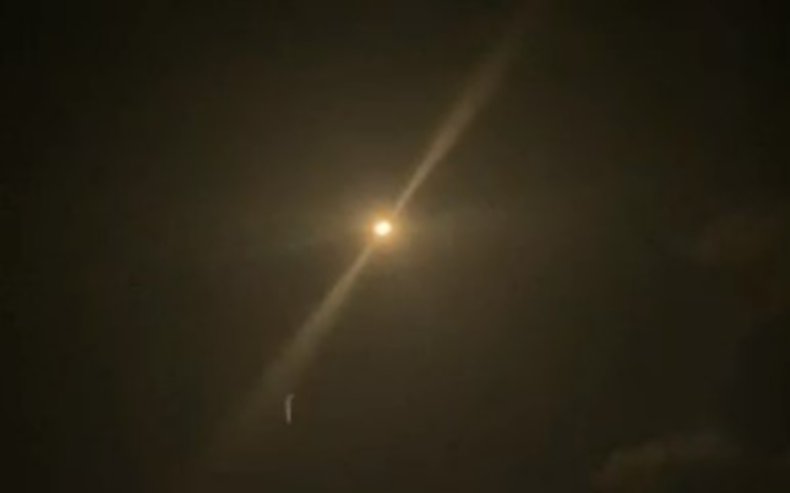
Object above Rostov, Russia

An image shared on Russian social media shows an object above the southern Russian region of Rostov on January 3, 2023. The regional governor said that an object was shot down in the area which has been the scene of drone attacks.

VIA TELEGRAM

UFO, OVNIs, UFO 2022, OVNI, UFOs, НЛО, UAP, UAPS, OVNI 2022, UAP 2022, GHOST, GHOST 2022

Fly to space and back in amazing SpaceX booster cam video - Launch to Florida landing

Watch SpaceX Falcon 9 rocket launch the Transporter 6 mission and land back in Florida in this booster cam video. The rideshare mission lifted off from Cape Canveral Space Force Station in Florida on Jan. 3, 2022.

Full Story: https://www.space.com/spacex-transpor...

Credit: SpaceX | edited by Space.com's Steve Spaleta (https://twitter.com/stevespaleta)

What Hidden Beneath The Sahara's Sands? Incredible Facts About This Desert

Endless sandy landscapes lie in the Sahara Desert in the absence of people under the scorching sun. It is one of the most famous deserts worldwide, and when you look at this desert, it has various mysteries hidden deep under the sand dunes. So, let’s find out what is hidden under the sands of the Sahara and some incredible facts about this desert in this video.

Watch until the end to avoid missing out on all the discoveries.

See Mars helicopter Ingenuity's last flight of 2022 in time-lapse + stats

NASA's Mars helicopter Ingenuity last flew on Mars on Dec. 17, 2022. See a time-lapse, color images and stats from the flight here.

Full Story: https://www.space.com/ingenuity-mars-...

Credit: Space.com | footage and graphics: NASA/JPL-Caltech | edited by Steve Spaleta (https://twitter.com/stevespaleta)

Sun blasts powerful X1.2 solar flare - Spacecraft view

Sunspot AR3182 erupted with an X1.2 solar flare on Jan. 6, 2022. NASA's Solar Dynamics Observatory (SDO) captured the fireworks in multiple wavelengths.

Credit: NASA/SDO/Helioviewer.org | edited by Space.com's [Steve Spaleta](https://twitter.com/stevespaleta)

This Huge Miles Long Structure Has Just Been Detected Moving Above Our Planet Close To Our Moon

The Drowned Ancient Civilisation Beneath The Black Sea | Dark Secrets of the Black Sea | Odyssey

Does the Black Sea hide the dark secrets of a long-lost ancient civilization? An international group of experts examine the evidence for this possible bronze age civilisation and more in the depths of this mysterious sea.

Odyssey is your journey into the world of Ancient History; from the dawn of Mesopotamia to the fall of Rome. We'll be bringing you only the best documentaries that journey into the mysteries and ruins of worlds long lost.

RELATED VIDEOS

{ https://www.youtube.com/ }

Hoe vind je dit bericht?
Geschreven door peter om 15:52 Stuur door

South Korean spacecraft enters lunar orbit with deceleration maneuver

South Korean spacecraft enters lunar orbit with deceleration maneuver

by Park Si-soo

KPLO-879x485.jpg

Artist’s concept of South Korea’s first robotic lunar orbiter, called Danuri, in space.

Credit: Korea Aerospace Research Institute

SEOUL, South Korea — South Korea’s first robotic lunar orbiter, Danuri, entered the lunar orbit after conducting its first lunar orbit insertion maneuver Dec. 16.

The orbiter is circling the moon in an elliptic orbit every 12.3 hours, with a perigee of 109 kilometers and an apogee of 8,920 kilometers, said the science ministry in a Dec. 19 statement.

The first maneuver, done with the firing of thrusters for thirteen minutes from 12:45 p.m. Eastern, “reduced the speed of Danuri from about 8,000 kilometers per hour to 7,500 kilometers per hour,” the ministry said in the statement. “It was confirmed that Danuri had been trapped in lunar gravity in a stable manner, which means it has become a genuine lunar orbiter.”

The ministry said the spacecraft would conduct four more propulsive maneuvers with its thrusters by Dec. 28 to steer it into a circular, low-altitude orbit about 100 kilometers from the lunar surface by Dec. 29. If successful, the 678-kilogram orbiter will go through a brief period of commissioning and tests to begin its yearlong mission from January, with six scientific instruments aboard, including NASA-funded hypersensitive optical camera ShadowCam. The camera is set to collect images of permanently shadowed regions near the moon’s poles to search for evidence of ice deposits, observe seasonal changes, and measure the terrain inside the craters. Collected data will be shared with NASA, which aims to send humans to the moon in the coming years under its Artemis program.

The Korean orbiter, also known as Korea Pathfinder Lunar Orbiter (KPLO), launched into space Aug. 4 on a SpaceX Falcon 9 rocket from Cape Canaveral Space Force Station’s Launch Complex 40. It flew to the moon on a ballistic lunar transfer trajectory, which initially took the spacecraft toward the sun and looped it back to the moon. The route, while much longer than traveling directly toward the moon, allows more fuel efficiency as it leverages the sun’s gravity for travel.

While going to the moon, the orbiter demonstrated “space internet” by sending video and photo files, including a popular Korean band’s music video, at a distance of more than 1.2 million kilometers to Earth. The demonstration was conducted twice — Aug. 25 and Oct. 28 — using a space internet demonstrator developed by the Electronics and Telecommunications Research Institute (ETRI) here, validating an interplanetary internet connection using delay-disruption tolerant networking.

The spacecraft also sent photos of the Earth and the moon’s orbit it took between Sept. 15 and Oct. 15 using a built-in high-resolution camera at a distance of between 1.46 million kilometers and 1.548 million kilometers to Earth.

The Danuri mission marks the beginning of South Korea’s deep space exploration initiative. The country’s leader recently pledged to land a robotic spacecraft on the moon in 2032 and on Mars in 2045. To that end, the government is planning to invest 2.13 billion won ($1.63 billion) in developing a next-generation rocket, KSLV-3, a two-stage vehicle capable of putting up to seven tons of payload into sun-synchronous orbit, 3.7 tons into geostationary transfer orbit, and 1,8 tons into Earth-Moon transfer orbit. As part of this, the Korea Aerospace Research Institute (KARI) is working to develop kerosene-fueled 100-ton thrust engines in five years.

The leader also promised to double the government’s space development budget in the next five years and funnel at least 100 trillion won ($76.7 billion) into the space sector by 2045. South Korea’s space budget for 2022 is 734 billion won ($563 million).

{ https://spacenews.com/ }

Hoe vind je dit bericht?
Geschreven door peter om 23:44 Stuur door

Artificial embryos: the hidden steps in forming a spine

Artificial embryos: the hidden steps in forming a spine

Hoe vind je dit bericht?
Geschreven door peter om 23:28 Stuur door

IS PLANET NINE OUT THERE? THIS NEW TELESCOPE COULD FINALLY SETTLE THE LONG-STANDING MYSTERY

00e9d7ae-c84a-4cb8-8d73-1ea08da443b9-lsst-summit-facility-camera-1-may_15_2022_07_00_00_pm.jpg?w=1200&h=630&fit=crop&crop=faces&fm=jpg

IS PLANET NINE OUT THERE? THIS NEW TELESCOPE COULD FINALLY SETTLE THE LONG-STANDING MYSTERY

Its shiny new camera will capture the night sky like never before.

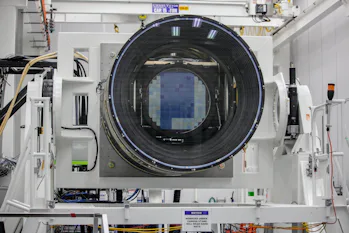
THE CAMERA RESTING in an impeccably clean, lint-free room at the SLAC National Accelerator Laboratory in Menlo Park, California, resembles an extremely oversized version of the SLR lenses for Nikon or Canon cameras. But it won’t snap family holiday cards or pet portraits.

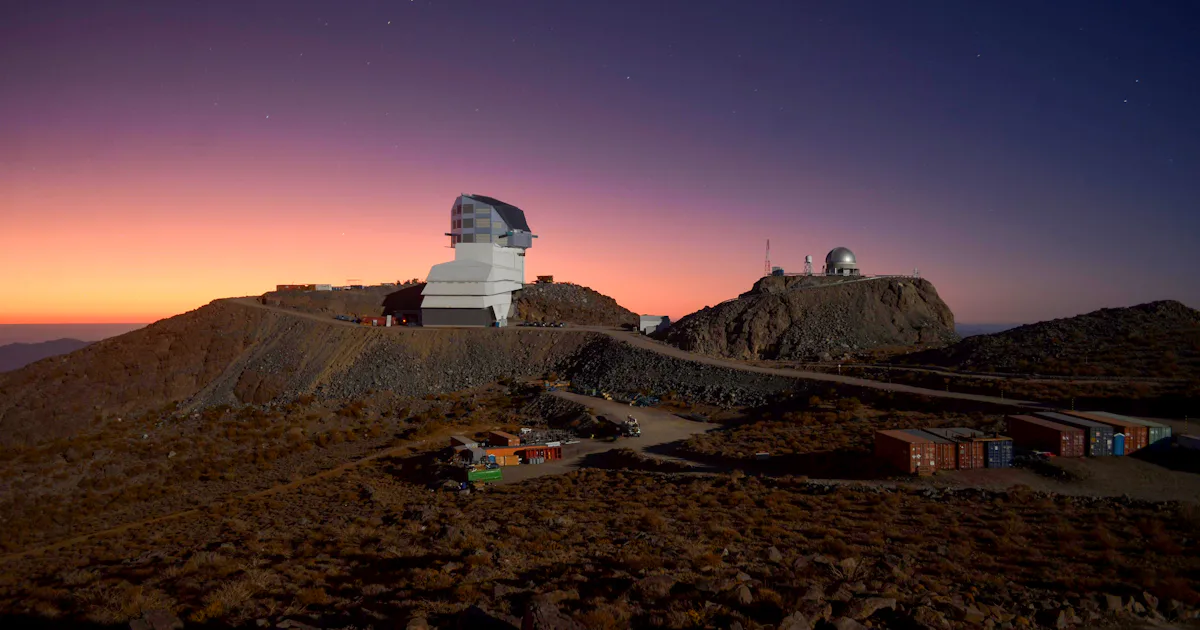
This massive device has a five-and-a-half foot aperture and a length of nearly 10 feet. Called the LSST Camera, which stands for the Legacy Survey of Space and Time, it’s destined for the National Science Foundation’s Vera Rubin Observatory, which is now under construction atop Chile’s Cerro Pachón mountain.

By the end of 2024, the observatory is scheduled to kick off a 10-year project that aims to enhance our understanding of the universe.

Unlike the stunning vistas captured by the James Webb Space Telescope in space or the Subaru Telescope on the ground, the Vera Rubin Observatory won’t stare at just one small patch of sky at a time. As a survey telescope, it’s intended to take nightly wide-angle images of the sky, tracking each mote of light possible from its patch of deep-dark sky in the Atacama Desert.

The Vera Rubin telescope camera is stored at SLAC in California.
This enormous camera is headed for the new Vera Rubin Observatory in Chile.
John Wenz

There, the telescope will take in unprecedented amounts of data, mapping the entire southern portion of the night sky. It may offer insight into both dark energy, which makes the universe expand, and dark matter, an elusive type of matter that makes up just over a quarter of the total mass (27 percent) of the universe. (The observatory’s namesake is credited with dark matter’s discovery.)

The telescope could also tell us more about our own home galaxy, the Milky Way, including the structure and the positions of stars — some perhaps too dim to appear in past surveys.

That’s a lot of work on the observatory’s plate. And it has another big task to perform much closer to home, in our own Solar System.

A rendering of the Vera Rubin Observatory in Chile.
A rendering of the future Vera Rubin Observatory, which could help find new planets.
LSST Project Office

When I toured the SLAC facilities this past September, Aaron Roodman, deputy director of the Vera Rubin Observatory, suggested that astronomers could discover “something like 50 times more than the number of objects that have been observed in our Solar System.”

Some are going to be small — nearby, building-sized asteroids — but others will be distant comets and pluto-like dwarf planets. Overall, it could glimpse six million objects just in our cosmic backyard.

Some of those mysterious objects could even earn recognition as new, bona fide planets.

WHY ASTRONOMERS SUSPECT THERE’S A PLANET NINE OUT THERE

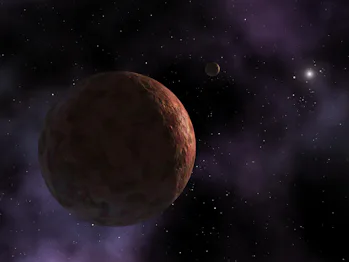
A rendering of the object Sedna.

An artist’s concept of the elusive object Sedna.
NASA/JPL-Caltech
In 2003, a strange object called Sedna, which measures 300 miles in radius, was discovered in our Solar System. Sedna is big enough to be considered a dwarf planet and is one of the most distant known objects in the Solar System — it takes 11,400 years to complete one trip around the Sun. At its most distant point, Sedna can swing out an astonishing 937 times the distance between the Sun and Earth. That’s one of the most extreme known orbits of any Solar System body.

Scientists speculated as to what could have caused that unusual orbit, including the possibility that it was captured from another star system that was passing by. Then, in 2012, astronomers discovered 2012 VP113, another object with a Sedna-like orbit. They also found more objects, all clustering near the same area at their closest point to the Sun.

In 2015, some astronomers suggested that these orbits could be associated with a large, still-unidentified planet. A second group, Mike Brown and Konstantin Batygin at the California Institute of Technology (Caltech), theorized in 2016 that an object with a mass somewhere between Neptune and Earth was behind it. They proposed an orbit and a provisional name: Planet Nine.

Astronomers have yet to find Planet Nine, and some are even growing a bit discouraged — some claim that the clustering of the distant objects doesn't even exist.

But the minds behind Planet Nine’s existence aren’t giving up. “We have been pretty careful about figuring out what the true predictions of the Planet Nine model is, and tracking them as the data set has grown,” Batygin tells Inverse.

At this point, Batygin says his team has found 24 to 25 objects that may be controlled by Planet Nine, compared to just six from the original paper.

Brown and Batygin have examined a series of potential locations for Planet Nine, given that it might sit opposite Sedna and the other objects it bullied into new orbits. But that work has been performed with telescopes with a limited view of a patch of sky.

“THIS PROCESS OF SEARCHING FOR OBJECTS IN THE DISTANT SOLAR SYSTEM IS NOT THAT COMPLICATED.”

And that’s why the introduction of the Vera Rubin Observatory becomes exciting. Because Vera Rubin takes a wider picture of the sky, it could yield a discovery of a new Solar System object in just a few nights.

“Fundamentally, this process of searching for objects in the distant Solar System is not that complicated,” Batygin says. “You take pictures of the sky one out one night after another, and you look for something that has moved.”

It takes around three nights to figure out if an object is local or far away, he says, and then a telescope can begin to detect motion and acceleration.

From there, a fleet of observatories could inspect the new object and figure out what it is. This means that if all goes right, Planet Nine could be found in a matter of nights. But it may take much longer. Ultimately, though, it could be data from the Vera Rubin Observatory that tips scientists off to the mysterious maybe-planet.

“[Vera Rubin Observatory] has a good chance, actually, because we have the combination of light-collecting area and field of view,” Roodman says. “So [even] if it's a dim object, we should have a chance to see it.”

Still, there’s no guarantee that it’ll be immediately visible in the Southern Hemisphere. Indeed, by some projections, the Northern Hemisphere is the place to look. But if the Vera Rubin Observatory finds a ton of distant Solar System objects like Sedna clustered in the same kinds of orbits, it still points the way toward a planet.

That information can be used to make — or break — the Caltech team’s hypothesis.

“If there is no other model that can explain what we see in the night sky, then we're sort of left with no option, no logical option other than to kind of say, well, ‘Planet Nine is probably there,’” Batygin says. “Conversely, if Vera Rubin searches the night sky, and shows that there is no clustering whatsoever, and all of this has somehow been a weird conspiracy of telescope observing strategies or whatever, then we're just wrong.”

OTHER WORLDS TO FIND

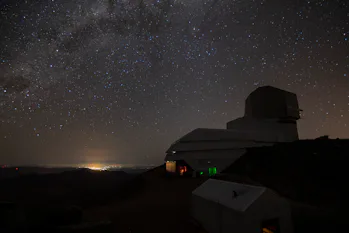
An image of the Vera Rubin Observatory at night.
The Vera Rubin Observatory could fill in a lot of gaps in our knowledge of the far outer Solar System.
Bruno C. Quint
Kat Volk, a University of Arizona planetary scientist, counts herself among the researchers who have never quite bought the Planet Nine hypothesis.

Partly, Volk thinks the observations may be biased — scientists aren’t seeing all the outer Solar System objects that don’t align, and there are plenty that don’t really fit into the Planet Nine model.

“The evidence for Planet Nine is very weak,” Volk tells Inverse, adding that the observatory could find out if something else is afoot in the outer Solar System.

In 2017, Volk and a colleague proposed an entirely different ninth planet: a Mars-sized object that accounts for other orbital irregularities in the outer Solar System. But Volk says subsequent data weakened the case for this object.

“THERE ARE SOME LARGE OBJECTS OUT THERE WAITING TO BE FOUND.”
The Vera Rubin Observatory could fill in a lot of gaps in our knowledge of the far outer Solar System. It may find out where some of the evidence for another planet is flimsy, and where such a scenario has a firmer footing.
“One of the best things about the Vera Rubin Observatory's [survey] is that it will provide one very large, coherent dataset of detected solar system small bodies,” Volk says. So far, scientists haven’t gotten a clear sense of what objects exist beyond Pluto, and our rough picture was painted from different surveys that each had different limitations.

All in all, a ninth planet may be possible, according to Volk. While she thinks the case for either Planet Nine or even her own hypothetical planet is weak, formation theories about our Solar System suggest that a population of small planets could exist still in its outskirts.

Based on models of planet and planetesimal formation in the early Solar System, it seems likely that some decently large planets “were scattered out during the dynamical upheaval that led to our current planet configuration,” Volk says.

“I don't think there is currently strong evidence for specific large objects in the [trans-Neptunian object] population,” she explains. “But I do think it's likely there are some large objects out there waiting to be found.”

Hoe vind je dit bericht?
Geschreven door peter om 23:20 Stuur door

Time Travel For Real This Time with Brian Greene & Neil deGrasse Tyson

Time Travel For Real This Time with Brian Greene & Neil deGrasse Tyson

What type of time travel is used in A Christmas Carol? Neil deGrasse Tyson and comic co-host Chuck Nice answer fan questions on time travel, paradoxes, and wormholes with theoretical physicist, Brian Greene. Did Ebenezer Scrooge get pulled through a wormhole?

How did people think about time travel before Einstein? How did the special theory of relativity change how we think about time? Discover time dilation and how speed and gravity affects an object’s passage of time. What type of time travel was Charles Dickens using?

Learn about the possible paradoxes of traveling and meddling with the past. Is there one immutable timeline or many timelines in a multiverse? Do we have free will? What is time to a photon traveling at the speed of light? How would we police time travel if it were possible? Will we even have time travel in the future? If time travel gets invented, why are we not overrun by tourists from the future?

Which films depict time travel best? How are cells affected by time travel? We explore the movement of information in and out of black holes, string theory, and tachyons. Could we theoretically time travel to before the big bang? Finally, is there even a realm to travel to before the Big Bang?

NOTE: StarTalk+ Patrons can watch or listen to this entire episode commercial-free.

{  https://www.youtube.com/ }

Hoe vind je dit bericht?
Geschreven door peter om 22:47 Stuur door

Meer van UFO'S of UAP'S, ASTRONOMIE, RUIMTEVAART, ARCHEOLOGIE, OUDHEIDKUNDE, SF-SNUFJES EN ANDERE ESOTERISCHE WETENSCHAPPEN - DE ALLERLAATSTE NIEUWTJES

↑ Terug naar de berichten