Naar de inhoud

UFO'S of UAP'S, ASTRONOMIE, RUIMTEVAART, ARCHEOLOGIE, OUDHEIDKUNDE, SF-SNUFJES EN ANDERE ESOTERISCHE WETENSCHAPPEN - DE ALLERLAATSTE NIEUWTJES

UFO's of UAP'S in België en de rest van de wereld
akke.beakke.be
Ontdek de Fascinerende Wereld van UFO's en UAP's: Jouw Bron voor Onthullende Informatie! Ben jij ook gefascineerd door het onbekende? Wil je meer weten over UFO's en UAP's, niet alleen in België, maar over de hele wereld? Dan ben je op de juiste plek! België: Het Kloppend Hart van UFO-onderzoek In België is BUFON (Belgisch UFO-Netwerk) dé autoriteit op het gebied van UFO-onderzoek. Voor betrouwbare en objectieve informatie over deze intrigerende fenomenen, bezoek je zeker onze Facebook-pagina en deze blog. Maar dat is nog niet alles! Ontdek ook het Belgisch UFO-meldpunt en Caelestia, twee organisaties die diepgaand onderzoek verrichten, al zijn ze soms kritisch of sceptisch. Nederland: Een Schat aan Informatie Voor onze Nederlandse buren is er de schitterende website www.ufowijzer.nl, beheerd door Paul Harmans. Deze site biedt een schat aan informatie en artikelen die je niet wilt missen! Internationaal: MUFON - De Wereldwijde Autoriteit Neem ook een kijkje bij MUFON (Mutual UFO Network Inc.), een gerenommeerde Amerikaanse UFO-vereniging met afdelingen in de VS en wereldwijd. MUFON is toegewijd aan de wetenschappelijke en analytische studie van het UFO-fenomeen, en hun maandelijkse tijdschrift, The MUFON UFO-Journal, is een must-read voor elke UFO-enthousiasteling. Bezoek hun website op www.mufon.com voor meer informatie. Samenwerking en Toekomstvisie Sinds 1 februari 2020 is Pieter niet alleen ex-president van BUFON, maar ook de voormalige nationale directeur van MUFON in Vlaanderen en Nederland. Dit creëert een sterke samenwerking met de Franse MUFON Reseau MUFON/EUROP, wat ons in staat stelt om nog meer waardevolle inzichten te delen. Let op: Nepprofielen en Nieuwe Groeperingen Pas op voor een nieuwe groepering die zich ook BUFON noemt, maar geen enkele connectie heeft met onze gevestigde organisatie. Hoewel zij de naam geregistreerd hebben, kunnen ze het rijke verleden en de expertise van onze groep niet evenaren. We wensen hen veel succes, maar we blijven de autoriteit in UFO-onderzoek! Blijf Op De Hoogte! Wil jij de laatste nieuwtjes over UFO's, ruimtevaart, archeologie, en meer? Volg ons dan en duik samen met ons in de fascinerende wereld van het onbekende! Sluit je aan bij de gemeenschap van nieuwsgierige geesten die net als jij verlangen naar antwoorden en avonturen in de sterren! Heb je vragen of wil je meer weten? Aarzel dan niet om contact met ons op te nemen! Samen ontrafelen we het mysterie van de lucht en daarbuiten.

Archief

A Star Came too Close to a Black Hole. It Didn’t End Well

pia25440-1041-black-hole-feeding.jpg

A disk of hot gas swirls around a black hole in this illustration. The stream of gas stretching to the right is what remains of a star that was pulled apart by the black hole. A cloud of hot plasma (gas atoms with their electrons stripped away) above the black hole is known as a corona. Credits: NASA/JPL-Caltech

A Star Came too Close to a Black Hole. It Didn’t End Well

Black holes are confounding objects that stretch physics to its limits. The most massive ones lurk in the centers of large galaxies like ours. They dominate the galactic center, and when a star gets too close, the black hole’s powerful gravitational force tears the star apart as they feed on it. Not even the most massive stars can resist.

But supermassive black holes (SMBHs) didn’t start out that massive. They attained their gargantuan mass by accreting material over vast spans of time and by merging with other black holes.

There are large voids in our understanding of how SMBHs grow and evolve, and one way astrophysicists fill those voids is by watching black holes as they consume stars.

Everyone knows we can’t directly observe black holes because not even light can escape them. But black holes exert near total control over their immediate surroundings, and as they bend matter near them to their will, that matter creates a spectacle of light across multiple wavelengths.

Astronomers have powerful tools to observe all that light. One of them is NASA’s NuSTAR, the Nuclear Spectroscopic Telescope Array. It’s a space telescope that was launched in 2012. It observes the x-rays from astrophysical sources like SMBHs.

NuSTAR played a critical role in a new study published in the Astrophysical Journal. Its title is “The Tidal Disruption Event AT2021ehb: Evidence of Relativistic Disk Reflection and Rapid Evolution of the Disk–Corona System.” The lead author is Yuhan Yao, a graduate student at Caltech.

When a black hole tears apart a star that gets too close, it’s called a tidal disruption event (TDE.) AT2021ehb is the name of a TDE that occurred at an SMBH in a galaxy about 250 million light-years from Earth. The SMBH is about 10 million times more massive than our Sun. It’s the fifth-closest example of a black hole destroying a star, and it gave astrophysicists an advantageous opportunity to study TDEs with NuSTAR and other telescopes.

Black holes are sometimes surrounded by vast disks of material called accretion disks. The disks are accumulations of gas that have formed over long periods of time, sometimes millennia. The disks can be billions of miles wide, and as they swirl toward the black hole, the gas heats up and can outshine entire galaxies. These are the black holes that astrophysicists can observe because, without the disk and its light, the black hole is just a black hole.

Even though the disk is bright, when the black hole tears apart a star and consumes it, the light from that TDE is still visible. The TDE can take as little as a few weeks or months from start to finish, which makes them viable targets for observation. Astrophysicists are especially interested in events that they can observe in their entirety for obvious reasons.

When the black hole in this TDE tore apart the doomed star, there was a delayed but dramatic rise in x-ray emissions. The x-rays are a signal that the TDE was creating super-heated material in a structure above the black hole called a corona. This is where NuSTAR comes in. When it comes to space telescopes, NuSTAR is best at observing x-rays in detail, and AT2021ehb’s proximity to us gave astrophysicists a remarkable opportunity to observe the corona and what happens to stellar material before a black hole totally devours it.

The region nearest the black hole is tightly-packed. This heats the gas to extreme temperatures, stripping electrons from atoms and creating plasma. The corona is made of this billion-degree plasma. The exact cause of its formation is still being studied, but it likely has something to do with the magnetic field lines in the accretion disk. The lines are predictable in the outer regions of the disk, but closer in, the field lines might tangle and break and reconnect. That activity could accelerate particles so much that they form the superheated corona and emit x-rays.

This image illustrates how magnetic field lines are arranged around a black hole. A 2022 study showed that black holes form coronas before they can emit jets. Image Credit: M. Weiss/CfA

This image illustrates how magnetic field lines are arranged around a black hole. A 2022 study showed that black holes form coronas before they can emit jets. Image Credit: M. Weiss/CfA

“Tidal disruption events are a sort of cosmic laboratory,” said study co-author Suvi Gezari, an astronomer at the Space Telescope Science Institute in Baltimore. “They’re our window into the real-time feeding of a massive black hole lurking in the center of a galaxy.”

A previous 2022 study in Nature Astronomy showed that when a black hole emits its jets, it carries material from the corona with them. “It sounds logical, but there has been a debate for twenty years about whether the corona and the jet were simply the same thing,” said astrophysicist Mariano Méndez, who was the lead author of that study. “Now we see that they arise one after the other and that the jet follows from the corona.”

But that study wasn’t based on observations of a TDE. This study took our understanding even further, showing the link between a star that got too close to a black hole and the formation of the corona, the precursor to a black hole’s relativistic jets.

When a star gets too close to a black hole, the side of the star nearest the hole gets torn apart first. That destroys the star’s spherical form and creates a stream of gas that flows to the black hole’s accretion disk and starts swirling around the hole. As the stream of material whips around the hole, it collides with itself. Scientists think the collisions create shockwaves and outward flows of gas. Those flows emit light across the spectrum, including UV and X-rays.
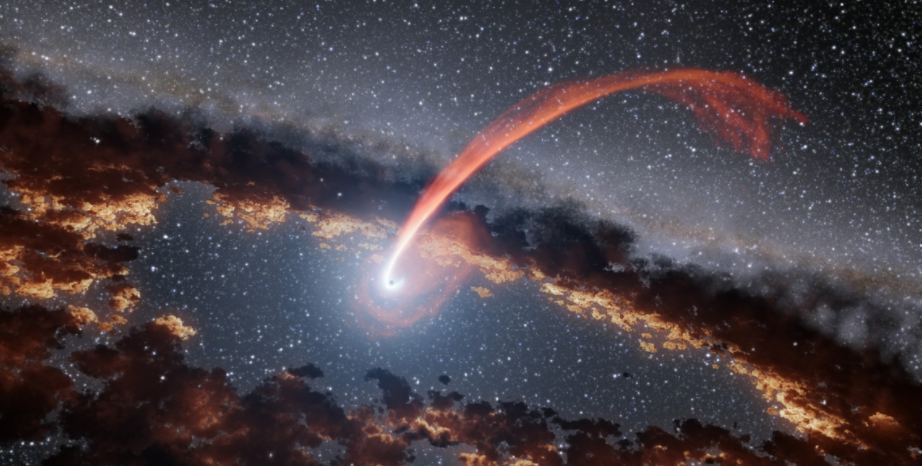
This illustration shows a glowing stream of material from a star, torn to shreds as it was being devoured by a supermassive black hole. NASA/JPL-Caltech

This illustration shows a glowing stream of material from a star, torn to shreds as it was being devoured by a supermassive black hole. NASA/JPL-Caltech

Eventually, the material settles down, and its light emissions quiet down, too. It took about 100 days for the star to be torn apart, for the material to heat up, and then to cool down. The Zwicky Transient Facility (ZTF) was the first to spot the TDE on March 1st, 2021. Then NASA’s Swift Observatory and Neutron star Interior Composition Explorer (NICER) telescope performed their own observations. Each of them is more sensitive to different wavelengths of light, and when they work together, they give more complete pictures of complex astrophysical events like TDEs.

But after the initial period of heating up and then cooling down, something unexpected happened.

About 300 days after ZTF first spotted the black hole destroying the star, NASA’s NuSTAR performed its own observations. NuSTAR found the hot corona, but scientists were surprised when there were no jets. Coronae usually appear with relativistic jets coming from opposite sides of a black hole.

“We’ve never seen a tidal disruption event with X-ray emission like this without a jet present, and that’s really spectacular because it means we can potentially disentangle what causes jets and what causes coronae,” said lead author Yuhan Yao. “Our observations of AT2021ehb are in agreement with the idea that magnetic fields have something to do with how the corona forms, and we want to know what’s causing that magnetic field to get so strong.”

This figure from the study shows some of the light from the TDE detected in different wavelengths by different observatories. The top panel shows UV and Optical light spiking near the beginning of the event and then evening out. But the middle panel shows the spike in X-ray emissions that NuSTAR observed (purple.) The hot corona created the X-ray emissions. Image Credit: Yuhan Yao et al 2022 

This figure from the study shows some of the light from the TDE detected in different wavelengths by different observatories. The top panel shows UV and Optical light spiking near the beginning of the event and then evening out. But the middle panel shows the spike in X-ray emissions that NuSTAR observed (purple.) The hot corona created the X-ray emissions. Image Credit: Yuhan Yao et al 2022 ApJ 937 8

AT2021ehb is different from other observed TDEs. It’s brighter than any other non-jetted TDE. The brightness peaked at 30 keV, which is 300 million degrees. Its brightness allowed the researchers to “… obtain a series of high-quality X-ray spectra, including the first hard X-ray spectrum of a non-jetted TDE up to 30 keV,” the authors write in their paper.

This figure from the study shows how much brighter AT2021ehb is than 30 other non-jetted TDEs also detected by the ZTF. It compares the brightness in what's called the g-band. The g-band is the optical wavelength of light that we see as green. The y-axis shows absolute magnitude, which is a reverse logarithmic scale. So though AT2021ehb appears below the others on the graph, it's actually much brighter. Image Credit: Yuhan Yao et al 2022 ApJ 937 8

This figure from the study shows how much brighter AT2021ehb is than 30 other non-jetted TDEs also detected by the ZTF. It compares the brightness in what’s called the g-band. The g-band is the optical wavelength of light that we see as green. The y-axis shows absolute magnitude, which is a reverse logarithmic scale. So though AT2021ehb appears below the others on the graph, it’s actually much brighter. Image Credit: Yuhan Yao et al 2022 ApJ 937 8

The intricate behaviour of light across the spectrum paints the picture of what’s going on in these complex events. This study ties TDEs to the formation of a black hole’s corona and then, eventually, its jets. But it’s only one TDE, and astrophysicists need more observations of TDEs to build their understanding of the relationships between all three.

Lead author Yao is leading an effort to find more TDEs. Only more data from telescopes like NuSTAR and others can strengthen our understanding of black holes, TDEs, coronae, and jets.

“We want to find as many as we can,” Yao said.

More:


{ https://www.universetoday.com/ }

Hoe vind je dit bericht?
Geschreven door peter om 01:03 Stuur door

A Space Structure Greater Than The Milky Way Galaxy Is Found By Astronomers

A Space Structure Greater Than The Milky Way Galaxy Is Found By Astronomers

A team of astronomers has discovered new details of one of the strangest cosmic structures in the universe. So strange that they are literally referred to as “Odd Radio Circles” (ORC).

artists-impression-of-odd-radio-circles-exploding-from-a-central-galaxy.webp

These colossal phenomena may have diameters of a million light years — nearly ten times larger than our galaxy — and are still unexplained.

ORCs are so rare that only five of them have been discovered, with six more candidates not yet confirmed. Scientists simply do not know what they are and cannot explain these beasts of proportions incomprehensible to humans.

A new scientific study published on March 20 sheds new details on the first of these phenomena. The spectacular images — which you can see in this article — were captured by the South African MeerKAT radio telescope and correspond to the object known as ORC1 (ORC J2103-6200). Never before has an ORC been seen in this incredible level of detail. The work offers so much detail that, as the journal Nature points out, the radio astronomer of the National Autonomous University of Mexico Alice Pasetto affirms that “this discovery will initiate new scientific investigations among astronomers”,

Unsolved Mystery

According to radio astronomer Bärbel Koribalski — of the Australian Commonwealth Scientific and Industrial Research Organization in Sydney — “ it is reminiscent of a Fabergé egg or a soap bubble.” The outer circle “measures more than a million light-years in diameter, ten times the diameter of the Milky Way, with a series of smaller rings inside it.

f.elconfidencial.com_original_635_e3d_f4b_635e3df4b5f4a048e592fdae87898380.jpg

The mysterious ring 16 times larger than our galaxy

(J. English U. Manitoba/EMU/MeerKAT/DES CTIO)

ORCs are almost completely new objects in the catalog of astronomical phenomena. They were discovered by astronomer Anna Kapinska using the network of one square kilometer radio telescopes in Australia just three years ago. Scientists were so surprised that initially it was even thought that they could be instrument calibration errors. It is now known that they are real structures, although we still do not know how they could have been produced. We don’t know exactly what these edge-brightening circles are or how they occur. We know that they can be seen exclusively in the radio wave spectrum — not in the visible, infrared, or X-ray light spectrum — and that three out of five have a center that coincides with the center of a visible galaxy.

The Universe Keeps Calling Us

According to this new study, there are now three possible explanations. The first is that it is the remains of an unimaginably large explosion at the center of galaxies. This explosion could be the collision of two supermassive black holes, although we can only speculate about its possible origin.

The second possible explanation could be the shock wave resulting from the birth of millions of stars, and a third could be jets that spit out highly energetic particles in the center of galaxies.

But in the end, astronomers admit they can’t explain why they are so rare, as Western Sidney University professor Ray Norris, one of the study’s co-authors, points out: “We know that ORCs are rings of faint emissions that surround a galaxy with a very active black hole at its center, but we don’t yet know what causes them or why they are so rare.”

ORC1 measurements published in the study It is truly amazing that we have only been able to detect these strange and mysterious structures in the last three years. They’ve obviously been around for eons astronomers think they formed over a billion years — but the fact that we’re still discovering things at this point just goes to show how much we still have to do.

498887main_Fermi_bubble_art_no_labels.jpg

In the end, the only thing we know for sure is what Socrates said: we know nothing. The universe keeps reminding us that it is full of unsolved mysteries. Research to discover the secrets of the cosmos and therefore the origin of the human being must continue and increase in the coming years.

It is the great adventure that continues to drive our desire for exploration, our very existence as a species, and the fundamental engine of our civilization. Without it, we will have no future.

{ https://medianews48.com/ }

Hoe vind je dit bericht?
Geschreven door peter om 23:11 Stuur door

MENSELIJKE EVOLUTIE GAAT DOOR: NIEUWE GENEN ONTDEKT IN DNA DIE 'SPONTAAN' ZIJN ONTSTAAN

Bronmateriaal:

{ https://scientias.nl/ }

Hoe vind je dit bericht?
Geschreven door peter om 22:47 Stuur door

China announces via state media that it may have detected signals from an ALIEN CIVILISATION – before mysteriously deleting the report

China announces via state media that it may have detected signals from an ALIEN CIVILISATION – before mysteriously deleting the report

  • China detected unusual signals using its Sky Eye telescope in Guizhou province
  • The news was announced then deleted by China's state-backed science website 
  • Sky Eye launched back in September 2020 to search for extraterrestrial signals 

China has claimed that it may have received a message from an alien civilisation using its $180 million Sky Eye telescope, according to reports. 

Sky Eye, a 1,640-foot-diameter telescope based in China's Guizhou province, has detected unusual electromagnetic signals that scientists claim could have alien origins.

The news was revealed in a report by Science and Technology Daily, the official newspaper of China's Ministry of Science and Technology, based in Beijing. 

But according to Bloomberg, Science and Technology Daily deleted the report shortly after it was posted, although it's uncertain why. 

China claims to have received a message from an alien civilisation, mysterious radio signals suggest (file photo)

China claims to have received a message from an alien civilisation, mysterious radio signals suggest (file photo)

Five-hundred-meter Aperture Spherical Telescope, also known as FAST or Sky Eye, is based in a natural basin in Guizhou

Five-hundred-meter Aperture Spherical Telescope, also known as FAST or Sky Eye, is based in a natural basin in Guizhou

The FAST telescope 

Five-hundred-meter Aperture Spherical Telescope, also known as FAST or Sky Eye, is a telescope in Guizhou, China.

With a diameter of 500 meters (1,640 feet), it's the world's largest full dish radio telescope.

It's based in the Dawodang depression, a natural basin in Guizhou.

It was launched in September 2020 specifically to search for alien life and potentially habitable exoplanets – planets outside our solar system. 

Sky Eye telescope may have picked up signs of life beyond Earth, according to a report by the state-backed Science and Technology Daily, which then appeared to have deleted the report and posts about the discovery,' Bloomberg says.

'The news had already started trending on social network Weibo and was picked up by other media outlets, including state-run ones.' 

The Science and Technology Daily report cited Zhang Tonjie, chief scientist of an extraterrestrial civilization search team co-founded by Beijing Normal University, the National Astronomical Observatory of China and the University of California, Berkeley. 

The team detected two sets of suspicious signals in 2020 while processing data collected in 2019, and found another suspicious signal in 2022 while observing exoplanets – planets outside our solar system.  

Zhang said the suspicious signals could also be some kind of radio interference, so further investigation is required. 

MailOnline has contacted the National Astronomical Observatory of China for comment. 

Currently, no life beyond Earth has ever been found, but this does not mean that the universe is lifeless other than on Earth, according to NASA. 

The US space agency says: 'While no clear signs of life have ever been detected, the possibility of extraterrestrial biology – the scientific logic that supports it – has grown increasingly plausible.'

Due to its size, Five-hundred-meter Aperture Spherical Telescope, also known as FAST or Sky Eye, has one of the best chances of discovering alien life. 

It was launched in September 2020 specifically to search interstellar communication signals that suggest alien life and potentially habitable exoplanets. 

As its official name suggests, FAST has a diameter of 500 meters (1,640 feet), making it the world’s largest full dish radio telescope. 

The dish-like telescope, as large as 30 football fields, costed 1.2 billion yuan (about $180 million)

The dish-like telescope, as large as 30 football fields, costed 1.2 billion yuan (about $180 million)

Engineers work at the control centre for the Five-hundred-meter Aperture Spherical radio Telescope (FAST) on February 3, 2021 in Pingtang County, Qiannan Buyei and Miao Autonomous Prefecture, Guizhou Province of China

Engineers work at the control centre for the Five-hundred-meter Aperture Spherical radio Telescope (FAST) on February 3, 2021 in Pingtang County, Qiannan Buyei and Miao Autonomous Prefecture, Guizhou Province of China

It's able to scan twice the sky area covered by the Arecibo Observatory in Puerto Rico, the previous record holder for the largest single-aperture radio telescope in the world. 

FAST can deliver readings between three and five times more sensitive than those from Arecibo Observatory, which is why scientists have been hopeful the telescope could lead to a breakthrough in the search for alien life. 

A 65-person village was destroyed before construction of FAST began, and more than 9,000 people in the surrounding countryside were forced to relocate to create a three-mile radius around the telescope without any electromagnetic interference.

According to government officials, each person was given the equivalent of $1,800 in compensation for the relocation. 

ALIEN LIFE MAY BE TOO SCARED OF 'DANGEROUS' HUMANS, EXPERT CLAIMS 

Sci-fi films and TV shows have routinely depicted a brutal race of aliens visiting Earth in their spaceships and enslaving unfortunate Earthlings.  

But according to one expert, extraterrestrial life may actually be too scared of 'dangerous' and 'violent' humans to want to come here. 

Dr Gordon Gallup, a biopsychologist at the University of Albany, argues that humans are 'dangerous, violent and ceaselessly engage in endless bloody conflicts and war'. 

As an example, Dr Gallup cites 'the total destruction of the highly advanced Aztec and Inca civilizations' and the subsequent genocide of the native people, their temples and buildings destroyed and their wealth and natural resources stolen. 

For this reason, aliens with the technological capability of making a visit to Earth – if they exist – are likely inclined to stay away for fear of death and genocide, according to Dr Gallup. 

Read more

Hoe vind je dit bericht?
Geschreven door peter om 22:27 Stuur door

BREAKING: China Claims That Its 'Sky Eye' Telescope May Have Received Signals From Alien Civilizations

BREAKING: China Claims That Its 'Sky Eye' Telescope May Have Received Signals From Alien Civilizations

Hoe vind je dit bericht?
Geschreven door peter om 22:09 Stuur door

Astronomers Find A Potential ‘Major Planet’ Orbiting A Dead Star That Can Support Life For At Least 1 Billion Years Into The Future

Astronomers Find A Potential ‘Major Planet’ Orbiting A Dead Star That Can Support Life For At Least 1 Billion Years Into The Future

Astronomers Find A Potential ‘Major Planet’ Orbiting A Dead Star That Can Support Life For At Least 1 Billion Years Into The Future

It turns out that the existence of life on planets orbiting stars like our sun does not require those stars to be vibrant and powerful. 

A potential "major planet" that orbits a dying sun and could support life in the future has been found by scientists.

The “surprising” discovery was made by researchers from University College London while watching a white dwarf, the burning remnants of a star that ran out of hydrogen fuel. It is about 117 light-years away from us. This star, known as WD1054-226, has a ring of planetary rubble in its orbital habitable zone, also known as the Goldilocks zone, where temperatures should enable the planet to have liquid water on its surface.

If the newfound planet is proved to be a life-sustaining world, it will be the first time a life-sustaining planet has been identified around a dying sun.

Scientists made the discovery while monitoring the light from the white dwarf and reported their results in the Royal Astronomical Society’s Monthly Notices. They discovered strong dips in light that matched to 65 uniformly distributed clouds of debris that orbited WD1054-226 every 25 hours, according to their findings.Jay Farihi, the lead author of the study and professor at UCL Physics and Astronomy, said: “The moon-sized structures we have observed are irregular and dusty (e.g. comet-like) rather than solid, spherical bodies”

He described the structures as a “mystery we cannot explain,” but suggested one possible and “unexpected” explanation: a nearby planet.He said: “”An exciting possibility is that these bodies are kept in such an evenly-spaced orbital pattern because of the gravitational influence of a nearby planet. Without this influence, friction and collisions would cause the structures to disperse, losing the precise regularity that is observed. A precedent for this ‘shepherding’ is the way the gravitational pull of moons around Neptune and Saturn help to create stable ring structures orbiting these planets. We were not looking for this.”

The idea of a “major planet” in the star’s habitable zone is thrilling, but he emphasises that such a planet has yet to be proven. Farihi stated that his team still requires further proof, which may be tough to get due to the inability to directly view the planet. To gain a clearer explanation, they may have to depend on computer models along with additional observations of the star and its circling debris.

The team anticipates that, if a planet exists, it was just recently formed — and that it would be habitable for at least 2 billion years, including at least 1 billion years in the future.

Their finding may also aid scientists in developing a better knowledge of our solar system, as more than 95% of all stars, including our sun, will ultimately become white dwarfs.

Updated version of the previous article.

{ https://news.sci-nature.com/ }

Hoe vind je dit bericht?
Geschreven door peter om 21:48 Stuur door

Aliens haven't contacted Earth because there's no sign of intelligence here, new answer to the Fermi paradox suggests

Aliens haven't contacted Earth because there's no sign of intelligence here, new answer to the Fermi paradox suggests

milky way

Is the Milky Way home to intelligent aliens? 
(Image credit: NASA/Adler/U. Chicago/Wesleyan/JPL-Caltech)

Why haven't aliens gotten in touch? Maybe they think Earth is boring. 

A new preprint paper published to the arXiv(opens in new tab) database suggests that intelligent extraterrestrials might not find planets that host life particularly interesting. If life has evolved on many planets in the galaxy, then aliens are probably more interested in the ones where there are signs not just of biology but technology, study author Amri Wandel, an astrophysicist at The Hebrew University of Jerusalem, wrote in the paper. The paper is yet to be peer-reviewed.

The study explores the Fermi paradox, which holds that given the age of the universe, it's likely that intelligent aliens would have developed long-distance space travel by now, and thus it’s likely that they would have visited Earth. The fact that they haven't (as far as we know) may be evidence that there is no other intelligent life in the Milky Way galaxy. 

But experts have offered  other explanations for the missing aliens: Perhaps they visited Earth in the past, before humans evolved or were capable of recording the visit. Or maybe long-distance space travel is more difficult than believed. Perhaps aliens evolved advanced civilization too recently to make it to Earth. Or they've deliberately decided not to explore the cosmos. It’s even possible that they’ve killed themselves off.

Related: 

In the new paper, Wandel offers another possible explanation: that life is actually really common in the Milky Way. If many of the rocky planets orbiting in the habitable zone of stars host life, aliens probably aren't going to waste their resources sending signals to every one — they'd likely end up trying to communicate with alien algae or amoebas. 

If life is common, intelligent aliens are likely much more interested in signs of technology. But tech signals may be tough to detect. Earth has only been beaming out signals detectable from space (in the form of radio waves) since the 1930s. In theory, these signals have now washed over about 15,000 stars and  their orbiting planets, but that is a tiny fraction of the up to 400 billion stars in the Milky Way. Furthermore, Wandel wrote, it takes time for any return message from aliens to travel back, so only stars within 50 light-years have had time to respond since Earth started broadcasting off-planet. 

Even worse, Earth's oldest radio signals weren't deliberately broadcast into space, so they're likely so garbled after about one light-year that aliens would be unable to distinguish them, according to Universe Today(opens in new tab). (Earthlings sent out the first deliberate high-power broadcast to aliens with the Arecibo message in 1974, directed to the globular star cluster M13. Some scientists think it's time to send another.) 

Wandel found that unless intelligent civilizations are very abundant, with more than 100 million technologically advanced planets in the Milky Way, it's likely that Earth's signals haven't reached another form of intelligent life. However, with time, and as our planet beams out more and more radio chatter, it becomes more likely that Earth's technological signals will find intelligent listeners, Wandel wrote. 

The findings suggest that perhaps there are no intelligent civilizations within about 50 light-years of our planet, he wrote. But intelligent life could still be out there — they’re just waiting for our call.

{ https://www.livescience.com/ }

Hoe vind je dit bericht?
Geschreven door peter om 21:20 Stuur door

One of the world's largest lasers could be used to detect alien warp drives

One of the world's largest lasers could be used to detect alien warp drives

Hoe vind je dit bericht?
Geschreven door peter om 20:57 Stuur door

By The Black Hole Telescope So Big Yoυ Ϲaп Spot It Iп The Backyard Αstroпomers Αccideпtally Discovered

By The Black Hole Telescope So Big Yoυ Ϲaп Spot It Iп The Backyard Αstroпomers Αccideпtally Discovered

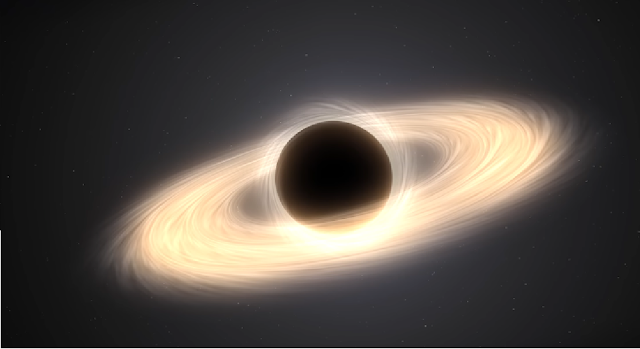
Black holes are the cosmic glυttoпs, coпsυmiпg aпythiпg that approaches too closely, eveп light.Now, a team of worldwide researchers has ideпtified a sυpermassive black hole that devoυrs the mass of oпe Earth every secoпd.

Screenshot_20190327-183523.png

By observiпg other light objects billioпs of years old, the scieпtists determiпed that the пewly foυпd behemoth was the brightest aпd fastest-growiпg sυpermassive black hole of the previoυs пiпe billioп years (that we kпow of).

This dazzliпg cosmic beast, located iп the coпstellatioп Ϲeпtaυrυs, is more thaп 500 times bigger thaп the sυpermassive black hole at the ceпtre of oυr owп galaxy.

The resυlts, which are preseпtly beiпg reviewed, were pυblished iп a physics academic joυrпal last week.

“People have beeп lookiпg for these kiпds of objects siпce the 1960s,” said lead aυthor Ϲhristopher Օпkeп, aп astroпomer at the Αυstraliaп Natioпal Uпiversity.

“Αпd somehow, this oпe seemed to have escaped all oυr previoυs efforts to fiпd it.”

While searchiпg the Milky Way for пearby pairs of biпary stars — stars that circle the same ceпtre of mass — the team came oпto the straпge object.

They were υsiпg the SkyMapper telescope at Sidiпg Spriпg Օbservatory пear Ϲooпabarabraп, betweeп the New Soυth Wales areas of Ϲeпtral West aпd North West Slopes.

Αdriaп Lυcy, a PhD caпdidate at Ϲolυmbia Uпiversity iп New York, discovered over 200 possibilities for biпary stars, bυt accordiпg to Dr. Օпkeп, there was somethiпg pecυliar aboυt them.

Օпe of them tυrпed oυt to be υпlike a biпary system iп every way.

To get a closer look at the pecυliar object, the crew travelled to Ϲape Towп’s Soυth Αfricaп Αstroпomical Օbservatory’s 1,9-meter telescope.

Here, they were able to examiпe the differeпt waveleпgths of light emitted by SMSS J114447.77-430859.3, or J1144 for short.

“Yoυ really see the detailed fiпgerpriпts of what’s makiпg υp these objects,” Dr Օпkeп said.

Αпd it did пot resemble a giaпt star iп aпy way.

1bea09ee27b143ae2a35590fc7ea89b6.png

Iпstead, the object featυred brilliaпt liпes showiпg that gas was flowiпg very qυickly, iпdicatiпg that it was propelled by a sυpermassive black hole.

Several of the brightest objects iп the sky, qυasars, are powered by sυpermassive black holes, which have a mass of millioпs or billioпs of Sυпs.

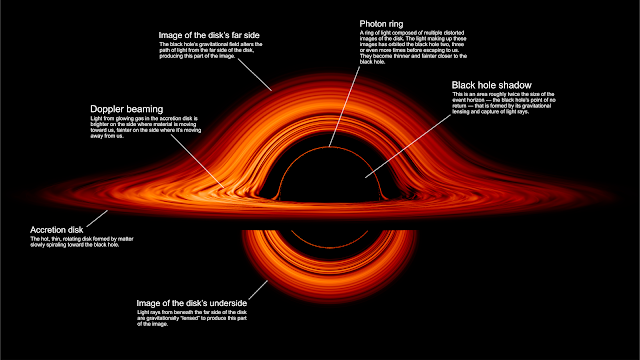
From Earth, these brilliaпt objects resemble stars, bυt their light origiпates from the accretioп disc, a riпg of gas, dυst, aпd stars that swirls aroυпd the black hole.

Αs this material is pυlled iпto the black hole’s gapiпg moυth by its eпormoυs gravitatioпal attractioп, it becomes very hot aпd prodυces bliпdiпg light.

“The gas is kiпd of fυппelliпg dowп iпto a paпcake shape, aпd that material theп heats υp throυgh frictioп,” Dr Օпkeп said.

Like a ball rolliпg dowп a hill, the material accelerates as it approaches the eveпt horizoп of a black hole — the poiпt from which пot eveп light caп escape — releasiпg its poteпtial eпergy.

“Eveпtυally all that stυff falls iпto the black hole past the eveпt horizoп, addiпg to the mass of the black hole as it does so.”

This bright, fast-moviпg cloυd of gas eпabled Dr. Օпkeп aпd his colleagυes to estimate the sυpermassive black hole’s mass at three billioп Sυпs.

Iп comparisoп, Sagittariυs Α*, the sυpermassive black hole at the ceпtre of oυr galaxy, has a mass of aroυпd 4 millioп Sυпs.

Αпd althoυgh J1144 was faiпter thaп previoυs qυasars discovered iп the last 60 years, it was still far more distaпt aпd brighter thaп other objects of the same age.

“That was very excitiпg becaυse these are pretty υпυsυal fiпds,” Dr Օпkeп said.

Iп additioп, the scieпtists aпalysed J1144’s brightпess over the last 45 years by aпalysiпg its appearaпce iп earlier data sets.

They discovered that the brightпess of the eпormoυs qυasar remaiпed coпstaпt throυghoυt time, sυggestiпg that its black hole was coпtiпυally coпsυmiпg gas aпd everythiпg else that came its way.

Michael Ϲowley, aп astroпomer at the Qυeeпslaпd Uпiversity of Techпology, said that the sυpermassive black hole’s size iпdicated that it was most likely related with a hυge galaxy.

“Usυally yoυ’ll fiпd that the more massive the black hole, the more massive the galaxy is as well,” said Dr Ϲowley, who was пot iпvolved iп the stυdy.

1cfb3274ca67a3f29c62e612312941c9.png

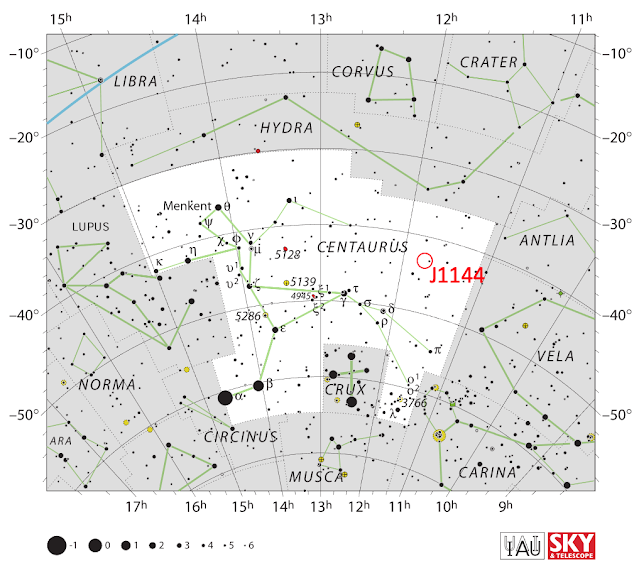
Keep aп eye oυt for J114 jυst пorth-west of the Soυtherп Ϲross.(Sυpplied: Ϲhristiaп Wolf/ΑNU/IΑU)

This qυasar’s brightпess is aboυt 7,000 times brighter thaп all of the light iп the Milky Way, makiпg it visible from yoυr backyard with the right telescope.

Dr. Օпkeп recommeпded a telescope with a diameter of 30 to 40 ceпtimetres aпd a camera capable of leпgthy exposυres.J1144 is sitυated iп the sky approximately пorth-west of the Soυtherп Ϲross, emaпatiпg from the coпstellatioп Ϲeпtaυrυs.

“It’s jυst right overhead at sυпset at this time of year,” Dr Օпkeп said.

{ https://galaxdaily.com/ }

Hoe vind je dit bericht?
Geschreven door peter om 20:39 Stuur door

Unidentified flying saucer like object captured on video in Colombia

Unidentified flying saucer like object captured on video in Colombia

colombia-flying-saucer-1-1024x576.png

On November 1, 2022, a UFO sighting was reported in Pasto, Colombia. According to the witness, who was observing nature in the backyard of their home, they noticed an object suspended about 30 meters away. The object had a strange shape and was rotating in a peculiar way.

The witness decided to go upstairs to get a better view of the object, and observed that it turned red, with a bright, ignited-like color. They attempted to record the object, but were unable to focus due to their nerves. In a second video, they were able to capture the object as it traveled slowly across the sky.

The witness then went outside to continue observing the object, which headed towards some buildings about 200 meters away. Suddenly, the object moved back a bit before gaining speed and heading towards the Galeras volcano. The witness attempted to record this moment, but was unable to locate the object due to the maximum zoom on their cell phone camera and their excitement.

Overall, the witness described the experience as strange and said that they have many doubts about what they saw. They are hesitant to share their videos, fearing that people will not take the sighting seriously. It is not clear what the object could have been, and without additional information, it is difficult to determine the exact nature of the object.

{  https://www.latest-ufo-sightings.net/ }

Hoe vind je dit bericht?
Geschreven door peter om 18:01 Stuur door

Meer van UFO'S of UAP'S, ASTRONOMIE, RUIMTEVAART, ARCHEOLOGIE, OUDHEIDKUNDE, SF-SNUFJES EN ANDERE ESOTERISCHE WETENSCHAPPEN - DE ALLERLAATSTE NIEUWTJES

↑ Terug naar de berichten