Date of discovery: Dec 8, 2022
Source photo:
Huge Rock Gets Stuck In Rover Perseverance Wheel, Dec 8, 2022, UFO Sighting News.
Date of discovery: Dec 8, 2022
Bob Lazar: Area 51 & Flying Saucers (FULL MOVIE)

The story of Bob Lazar. This was recently posted on YouTube to watch for free.
Bob Lazar, a former government physicist, revealed in 1989 that the US military had been secretly working on extraterrestrial spacecraft. He blew the whistle and shocked the world, but he had remained silent until now. His account was dramatized by Academy Award nominee Mickey Rourke.
Due to Lazar’s revelation, the public became aware of Area 51, which was a former secret military base. He was burdened with a revolutionary secret that required him to choose between his country’s interests and his conscience. His wife, his mother, and his close friends believed him, which is why his testimony has been regarded as one of the most controversial UFO stories of all time.
The film by Jeremy Corbell, which is about Lazar’s saga, offers a glimpse into the triumphs and struggles of a cosmic whistleblower. It follows Lazar’s claims about the government’s secret program to develop a powerful technology using recovered alien vehicles. His actions have affected his life significantly for the last three decades.
Due to his actions, his life has turned upside-down. He has tried to avoid the spotlight by maintaining a low-profile. This is why he has never allowed journalists or filmmakers into his private life.
The film by Corbell, which is about Lazar’s saga, offers a glimpse into the triumphs and struggles of a cosmic whistleblower. It will also change the way the public thinks about UFOs.
LATEST UFO SIGHTINGS AND VIDEOSLATEST UFO SIGHTINGS AND VIDEOS
NASA Artemis 1 mission update - Moon flyby and splashdown preview
NASA's Artemis 1 Orion spacecraft performed an engine burn when it was just 79 miles (128 kilometers) above the lunar surface on Dec. 5, 2022. The burn set it on a trajectory to splashdown on Earth on Dec. 11.
Credit: NASA
See Mars get eclipsed by moon in rare occultation - time-lapse
The Griffith Observatory in California had a great view of the Mars-Moon occultation on Dec. 7, 2022. See the Red Planet slip behind the moon and re-emerge in this time-lapse.
Credit: Griffith Observatory | edited by Space.com's edited by [Steve Spaleta]
Wow! See Artemis 1 spacecraft's Earth-moon transit view in amazing time-lapse
Shortly before NASA's Artemis 1 Orion spacecraft performed its longest engine burn of the mission on Dec. 5, 2022, it captured this amazing view of the moon. [NASA's Artemis 1 Orion spacecraft completes crucial moon flyby maneuver for trip home]
Credit: NASA
DOOMSDAY HIEROGLYPHICS HIDDEN IN THE PYRAMIDS | Countdown to Armageddon
Researchers believe extraterrestrial beings took part in building the great pyramids. See more in this clip from Nostradamus Effect.
Why Does The Trident Missile Have A Spike On Its Nose?
The Lesser known aerospike, the aerodynamic device found on the noses of missiles which have to have blunt noses to make them short enough to fit inside submarines. At supersonic speeds these reduce the drag by 50% and added 550km to the range of a Trident missile while still letting them fit in the same missile tubes designed for the original Polaris.
How NASA Will 3D Print Houses On The Moon!
How NASA Will 3D Print Houses On The Moon! Thanks, Pinecone, for sponsoring this video! Click my exclusive link https://www.influencerlink.org/SHEQZ to start earning cash on Pinecone!
Last Video: How We Will Build An Underground Civilization On Mars!
SpaceX upgrade everything for the massive engine testing and orbital flight incoming
Work on Ship 24 Continues as Scaffolding is Removed | SpaceX Boca Chica
Crews worked on Ship 24 as the scaffolding around it was removed, work on the Orbital Launch Mount continued, and Ship 28, 29, and 30's nosecones were spotted in various stages of production.
Video and Pictures from Nic (@NicAnsuini), Nomadd (@Nomadd13), and Starbase Live. Edited by Jack (@theJackBeyer).
Scientists Have Just Landed A Probe On An Asteroid & It Sent Back Some Unreal Photographs
Humans have advanced to the stage where we can land spacecraft on the moon and other planets. However, scientists have managed a by far trickier landing; landing a probe on an asteroid!
This is a massive feat, but even more unreal are the photographs of the asteroid that the probe sent back! Which asteroid did scientists land a probe on, and what has the probe discovered on the asteroid? Stay tuned as we bring you how scientists managed to land a probe on an asteroid and the unreal photographs it sent back!
When you look up at the sky on a clear night and see many stars, you may get the impression that space is a crowded place. However, that is far from the case, as space is mostly an empty place. But it contains objects that are of interest to us!
Some, like even the closest stars, are so far away that we may never be able to send a probe there, not to talk of human-crewed missions. However, some are relatively near, like asteroids, and scientists want to study them!
We have studied asteroids for long with powerful telescopes. But how about sending a probe to investigate an asteroid? This was the thinking of NASA when it sent a probe to asteroid Bennu to get samples! But landing a probe on an asteroid is no joke!
The mission is known as Origins-Spectral Interpretation-Resource Identification-Security-Regolith Explorer! Thankfully, there is an acronym that, while not so short, is more manageable; OSIRIS-REx!
OSIRIS-REx is quite expensive, with a budget of 800 million dollars. The mission won funding while pitched against other missions to study Venus and the moon. The mission took off in September 2016 and took more than two years to finally land on Bennu, where it took detailed measurements of the asteroid's shape and mass before returning to orbit
RELATED
Massive Magma Plumes and Maybe Microbes on Mars

We may be a long way from putting humans on Mars, but that hasn’t stopped scientists from placing sophisticated equipment on the Martian surface to find evidence of life now or once on the Red Planet … and one of those machines just detected a rumble that might mean there is something hot and molten below the surface of what has long been thought to be a cold, hard orb. On Earth, ‘hot and molten’ usually means lava when it is shooting out of a volcano like the Mauna Loa which is currently erupting, or magma when it is still trapped underneath the surface. Believe it or not, it may now mean the same thing on Mars – data from NASA’s InSight rover’s “mole” is showing an active mantle plume, which on Earth means a giant column of hot molten rock which drives volcanic activity and earthquakes by pushing hot magma up from the mantle to the planetary crust. This means Mars may have active volcanic activity – the kind that melts ice into water and sparks chemicals into life forms. Will a mechanical probe find life on Mars before humans arrive?

“Although the majority of volcanic and tectonic activity on Mars occurred during the first 1.5 billion years of its geologic history, recent volcanism, tectonism and active seismicity in Elysium Planitia reveal ongoing activity.”
As a new study published this week in Nature Astronomy reminds us, there was once volcanic activity on Mars, but it was 4 billion years ago. That has been confirmed by various satellites, rovers and landers which found tracks of ancient lava flows on the planet’s surface. C-authors Adrien Broquet, a postdoctoral research associate in the University of Arizona Lunar and Planetary Laboratory (LPL), and Jeff Andrews-Hanna, an associate professor of planetary science at the LPL, were intrigued by new data from NASA’s InSIght (Interior Exploration using Seismic Investigations, Geodesy and Heat Transport) lander. Since it touched down in 2018, InSight has been measuring marsquakes with its Seismic Experiment for Interior Structure (SEIS) instrument and recording underground heat with its Heat Flow and Physical Properties Package (HP3), which includes a probe nicknamed "the mole", which was designed to burrow 16 feet below the surface but only got to about 1.1 feet. Nonetheless, the equipment picked up a surprising amount of marsquakes and heat and virtually all of it was emanating from a region called Elysium Planitia, a plain close to the equator. According to the press release:
"Previous work by our group found evidence in Elysium Planitia for the youngest volcanic eruption known on Mars. It created a small explosion of volcanic ash around 53,000 years ago, which in geologic time is essentially yesterday."
While the rest of the planet hasn’t had any shaking going on in billions of years, Elysium Planitia has had large eruptions over the past 200 million years that continue to today -- as of May 2022, Insight had recorded 1,313 marsquakes but scientists were unable to determine what was causing them. Broquet and his team knew Mars does not have plate tectonics like Earth, so the only other cause of the marquakes would be a mantle plume. Think of them as blobs of molten magma bubbling to the surface where they either nestle under the crust, warming the area above them, or burst through fissures to cause quakes, volcanoes and lava flows. The data showed that Elysium Planitia had been lifted up a mile high by something under the Martian surface. When the data was fed into a tectonic model, it showed the presence of a plume … and it was a monster.
"This mantle plume has affected an area of Mars roughly equivalent to that of the continental United States. Future studies will have to find a way to account for a very large mantle plume that wasn't expected to be there.”
What was thought to be a dead spot when it was chosen as the landing spot for InSight turned out to be a 2,500 miles wide cap on a massive magma plume. As the study exclaims, this is a big deal.
“Our results demonstrate that the interior of Mars is geodynamically active today, and imply that volcanism has been driven by mantle plumes from the formation of the Hesperian volcanic provinces and Tharsis in the past to Elysium Planitia today.”
There is volcanic activity on Mars today. Broquet calls this “a paradigm shift for our understanding of the planet’s geologic evolution." It means Mars is not a cold, dead orb but a warm, active one … at least under the surface. That, as we now know, is where Marian ice is hiding. The heart of the magma means that ice could be water. And that means this could be a paradigm shift in the search for life on Mars as well.
"Microbes on Earth flourish in environments like this, and that could be true on Mars, as well. Knowing that there is an active giant mantle plume underneath the Martian surface raises important questions regarding how the planet has evolved over time. We're convinced that the future has more surprises in store."

Did the surface of Mars once look like Hawaii?
More surprise like … microbes living deep beneath the Martian surface? How about just 30 feet below it? Dr. Amy J. Williams, an assistant professor of geology at the University of Florida and not part of the study, thinks they could have been there in the not too distant past and perhaps are still there in a dormant state. She tells National Geographic:
“I wouldn’t put it past the Martian microbe to beat the odds and survive for an extended period. Whether it’s still there today, I can’t hazard a guess. But as an astrobiologist, my hope is that it is, and that maybe that knowledge can help us have a deeper appreciation for our place in the universe.”
Until now, Earth and Venus were the only planets in the Solar System known to have active mantle plumes … coincidentally, these were also the only planets to either have life or have strong signs of the possibility of life. We now have a third.
The 2023 Predictions From Baba Vanga and Nostradamus are Here - Be Forewarned!

The end of the year 2022 is fast approaching, which means it is time for the 2023 predictions of those famous dueling dead psychics – Baba Vanga and Nostradamus. And even though there are still a few weeks left to change the course of history, this is also a good time to see how the two of the most famous seers of all time did in their prognostications for 2022. Let’s start with the recap first … that will give you time to sit down, take a deep breath and brace yourself for what Baba Vanga and Nostradamus are warning is ahead for us in the new year.
“A team of researchers will discover a lethal virus in Siberia that was, up until now, frozen. Due to the catastrophic effects of global warming, said virus will be released and could quickly spin out of control…”

Baba Vanga Caption
Vangeliya Pandeva Gushterova, better known as Baba Vanga lived in Bulgaria from 1911 to 1996, and lives on to the present day in her predictions on major world events. Not one to dabble in World Cup winners, Baa occasionally forecast royal events as she amassed a sizeable collection of somewhat vague and often cryptic prognostications that nonetheless were deemed to be right or close to correct by those who follow and interpret them. While that hasn’t yet been the case for her 2022 prediction about a lethal virus from Siberia, she was said to be correct about “Intense bouts of floods (in Bangladesh, India, Thailand and Australia)” and “water shortages in several countries and major cities.” While events like those generally happen frequently and in those specific countries, ‘close’ counts in horseshoes, hand grenades and psychic predictions, so Baba Vanga is being credited for two right out of six for 2022, with three weeks left to still be right on this one: “Alien ships will attack Earth and they will bomb cities and take people captive.”
What does Baba Vanga see for humanity in 2023? Here are five predictions, courtesy of MSN.com
A solar storm will strike Earth in 2023 on a scale the world has never before seen. This prediction is certainly possible, and even a minor one could still knock out electrical and power grids that would bring communications and commerce to a standstill.
A "big country" will carry out bioweapons research on people, resulting in the death of thousands of them. This sounds pretty scary and completely plausible with the war in Ukraine, the volatile political climates in Iran and other countries, and the protests raging in China over mass COVID shutdowns – any of these could be linked to bioweapons research and the accidental or intentional mass deaths of thousands.
Baba Vanga predicts a nuclear power plant explosion in 2023. Again, that could easily happen in Ukraine – we came very close in 2022 with Russia attacking and seizing the Zaporizhzhia nuclear power plant.
Humans will grow babies to full term in laboratories in order to allow parents to choose skin color and other characteristics of their offspring. Chinese scientists have already edited the genomes of human embryos and created the first human genetically edited babies, so this is well on its way to happening in that country.
Aliens will visit Earth, the world could find itself "covered in darkness" and millions will die as a result. There is that “mass death” prediction again for 2023 – Baba Vanga doesn’t have much good to say about our upcoming year. If it is any consolation, she also predicted an alien arrival in 2022 and that hasn’t happened yet, but her forecast for 2022 did not predict that “millions will die.”
Will we survive to look back on 2023 and list the predictions of Baba Vanga that didn’t happen or were not as severe as she forecast? Let’s hope so. In the meantime, here’s a look at what Nostradamus saw happening in 2022.

“Twice put down, the East will also weaken the West.
It’s adversary after several battles chased by sea will fail at time of need.”
“The sudden death of the first personage / Will have changed and put another in the reign.”
That first prediction of a world war fought at sea hasn’t happened yet, and the “sudden death” in the second was not Queen Elizabeth II but thought to be North Korea’s Kim-Jong Un, although Russia’s Vladimir Putin is said by some to be dying of cancer … there are still three weeks to go for him to go. The quatrains of Michel de Nostradame’s prophecies were published in 1555 and must be interpreted, but many interpreters believe he correctly predicted the Great Fire of London, the French Revolution, the rise of Adolf Hitler, the assassination of JFK, the moon landing and 9/11. Looking past his misses in 2022, the Santa Barbara News-Press unveiled his predictions for 2023.
The antichrist very soon annihilates the three,
Twenty-seven years the war will last.
The unbelievers are dead, captive, exiled.
With blood, human bodies, water and red hail covering the earth.
If you thought Baba Vanga’s prophecies were depressing, Nostradamus’ are downright apocalyptic. This quatrain is interpreted to predict a 27-year world war between Russia and the U.S. and its allies as a result of the conflict in Ukraine. That war may quickly bring about Nostradamus’ second prediction for 2023 – Britain’s entry into the war.
“Within the isles is a very horrible uproar. One will hear only a party of war.”
Nostradamus is warning about a 9.8 quake in the Pacific Ocean which will release giant spiders and locusts – those are probably symbolic of something worse. He also predicts a meteorite the size of a whale will bring an alien species to Earth – perhaps this is Baba Vanga’s mass deaths as the result of aliens. He also projects that U.S. President Joe Biden will suffer from a mystery disease – that would not be a surprise based on his age. On the climate change front, he sees costs of scarce foods so high that “the bushel of wheat rise that man will be eating his fellow man.” However, the scariest (and possibly strangest) prediction goes back to Putin, Russia and the problem the country has in recruiting new soldiers to fight the war.
A monkey of fortune with twisted tongue
will come to the sanctuary of the gods.
He will open the door to heretics
And raise up the Church militant.
This is interpreted to mean that a long-running rumor that Russia is working on human-monkey hybrids will come true in 2023 – a military chimera that will feed on anything, fight like animals and not result in the same sorrow and guilt back home when they die.
There you go – the predictions of Baba Vanga and Nostradamus for 2023. Don’t you wish they’d stick to World Cup winners?
RELATED VIDEOS, selected and posted by peter2011
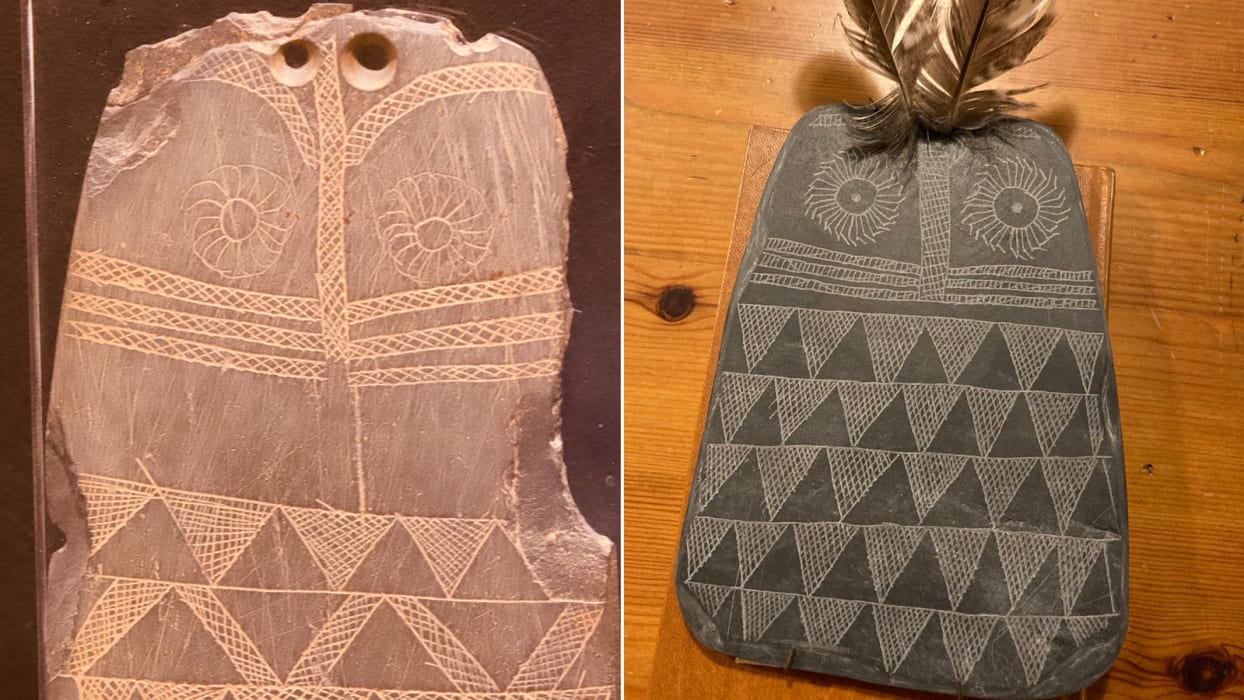
Popular toy of prehistoric children revealed by new research


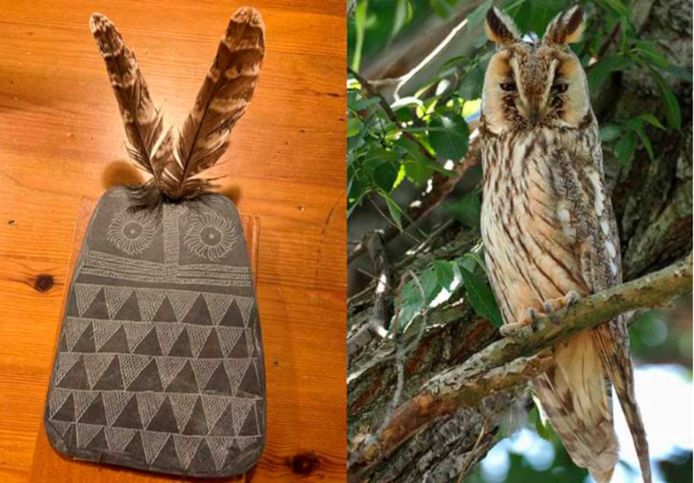
The common species called little owl (Athene noctua) may have inspired some engraved slate plaques. Two fledglings are shown.
Credit: Juan J. Negro/Scientific Reports

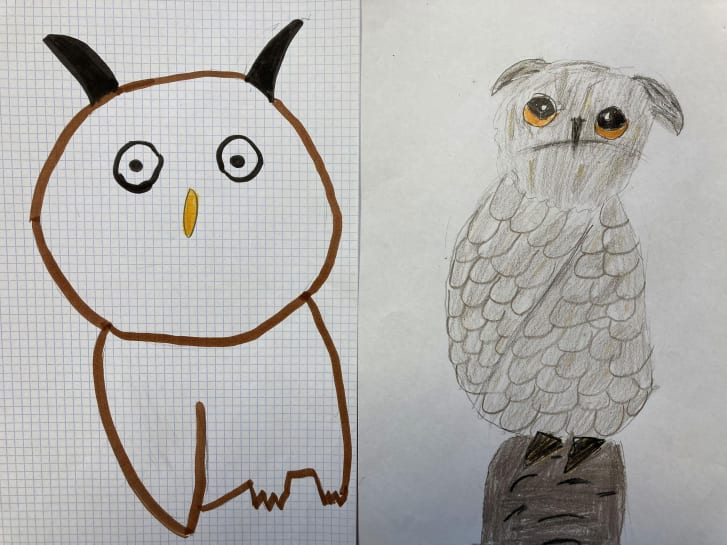
Drawings of owls by present-day children were similar to the owls on the plaques, researchers said.
Credit: Juan J. Negro/Scientific Reports

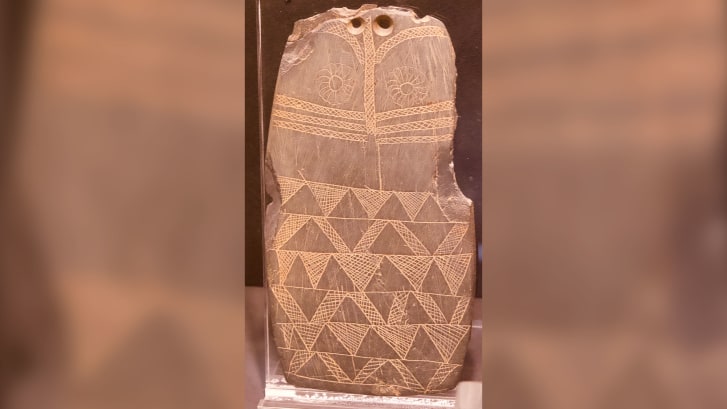
This slate plaque with an engraving of an owl was part of the study.
Credit: Juan J. Negro/Scientific Reports

Populair speelgoed van prehistorische kinderen onthuld door nieuw onderzoekEen prehistorisch voorwerp van 5.000 jaar oud dat regelmatig wordt gevonden in Spanje en Portugal blijkt speelgoed te zijn. Als je dacht dat een houten tol oud is, dan ga je versteld staan van dit stukje geschiedenis. In verschillende graftombes werden beschilderde stenen gevonden, een eeuw lang werd gedacht dat het ging om een religieus ereteken, maar het blijkt een uil in steen te zijn voor kinderen.
Bron: CNN
Víctor Díaz Núñez de Arenas, auteur van de studie en onderzoeker aan de universiteit van Madrid, vertelt aan CNN dat de guitige opschriften hen deed twijfelen of het een religieus voorwerp was. Veel van deze voorwerpen werden ook gevonden in huizen en andere sites die niets met religie te maken hadden.
De onderzoekers vergeleken honderd van deze voorwerpen met tekeningen van uilen die door kinderen tussen 4 en 13 jaar oud werden getekend op een lagere school in Spanje. De kinderen kregen als opdracht van hun leerkracht om een uil te tekenen in minder dan 20 minuten. “De gelijkenissen tussen deze tekeningen en de platen waren zeer opvallend”, zegt Díaz Núñez de Arenas. “Hoe kinderen toen een uil zagen, is bijna identiek aan hoe kinderen nu een uil voor ogen zien.”
“Het is onmogelijk om te weten te komen hoe kinderen 5.000 jaar geleden exact met dit speelgoed speelden, maar het werd wel duidelijk dat kinderen de uil konden versieren met veren bovenaan het plakkaat”, zegt Díaz Núñez de Arenas aan CNN. Het graveren van de uil was ook leerrijk, want zo leerden ze verschillende technieken aan voor het bewerken van stenen. Dit zou later van pas komen om messen, pijlpunten en andere objecten uit steen te maken.
Archeologe Brenna Hassett, onderzoeker aan het University College in London, die niet deelnam aan de studie, was het ermee eens dat veel voorwerpen uit de oudheid meerdere doelen en toepassingen kunnen hebben. Zij zegt dat er niet genoeg bekend is over hoe kinderen in de prehistorie speelden, en dat het een relatief onderbestudeerd gebied blijft. “We moeten niet vergeten dat veel dingen gemaakt zijn van vergankelijke materialen - zoals touw, bont en hout - dus dat is een van de redenen waarom het zo zeldzaam is om iets te vinden dat onmiskenbaar ‘speelgoed’ is”, zegt Hassett in een interview met CNN.
De platen zijn echter niet het oudste bekende speelgoed in het archeologische archief. Díaz Núñez de Arenas zegt dat er dierfiguren zijn gevonden in kindergraven in Siberië, van ongeveer 20.000 jaar oud, die mogelijk als speelgoed werden gebruikt. Daarnaast zegt Hassett dat er draaiplaatjes werden gevonden in Franse grotten van ongeveer 36.000 jaar geleden. Ook die kunnen volgens haar als speelgoed worden beschouwd.
Will We Ever Go Back to Explore the Ice Giants? Yes, If We Keep the Missions Simple and Affordable

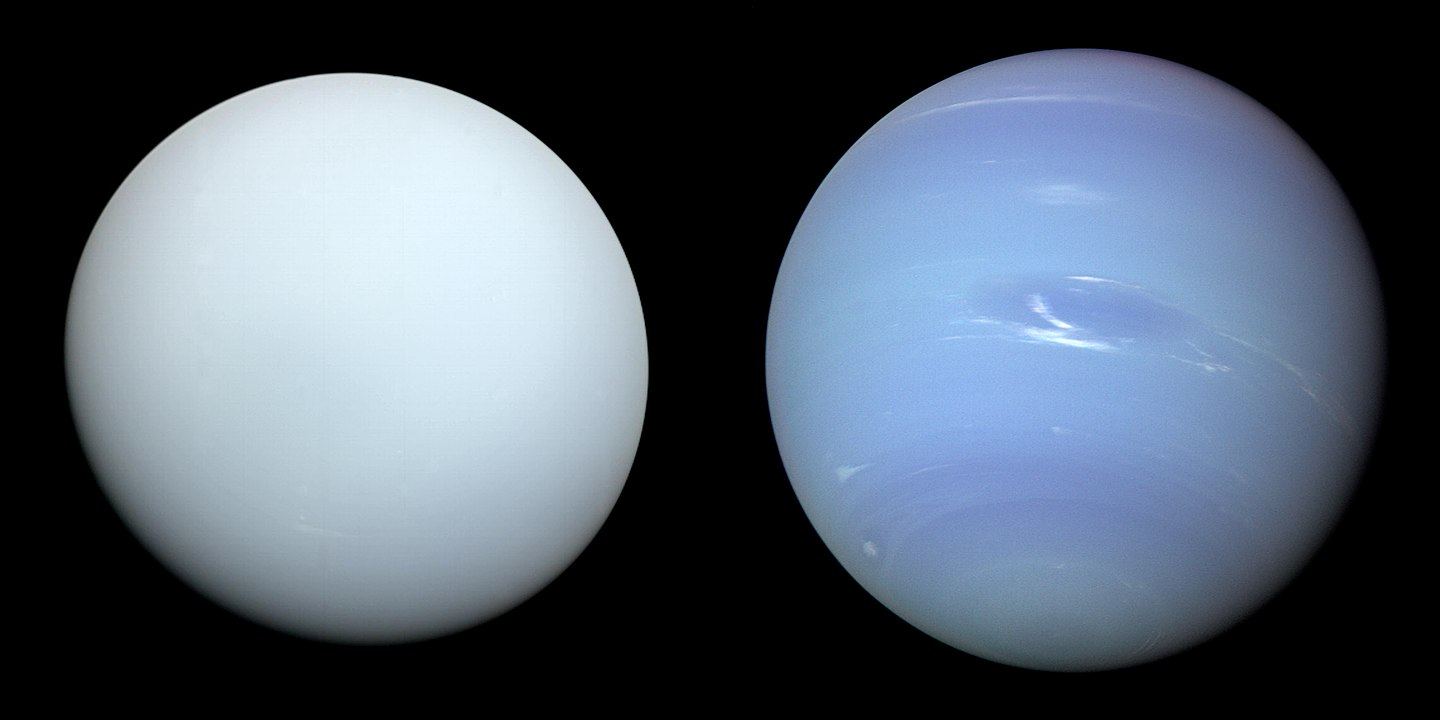
Uranus and Neptune are begging to be visited, but expensive missions to visit them may never be approved.
Image Credits: (L) By NASA – http://photojournal.jpl.nasa.gov/catalog/PIA18182, Public Domain, https://commons.wikimedia.org/w/index.php?curid=121128532. (R)
By Justin Cowart – https://www.flickr.com/photos/132160802@N06/29347980845/, Public Domain, https://commons.wikimedia.org/w/index.php?curid=82476611
BY
It’s been over 35 years since a spacecraft visited Uranus and Neptune. That was Voyager 2, and it only did flybys. Will we ever go back? There are discoveries waiting to be made on these fascinating ice giants and their moons.
But complex missions to Mars and the Moon are eating up budgets and shoving other endeavours aside.
A new paper shows how we can send spacecraft to Uranus and Neptune cheaply and quickly without cutting into Martian and Lunar missions.
The demands of deeper, scientifically fulfilling missions to Mars and the Moon are squeezing the budgets of NASA, the ESA, and other agencies. But there are fascinating worlds further out in the Solar System that are begging to be explored. Especially the ice giants Uranus and Neptune.
NASA has a strong focus on Mars and the Moon right now. The eventual Mars Sample Return mission will be resource intensive, as will the Artemis program. But the ice giants demand attention, too, even though we can never land there or gather samples from them. They played a role in the evolution of the Solar System, they’re similar to many exoplanets we find in distant solar systems, and our brief encounters with them gave us only tantalizing glimpses.
The last spacecraft to fly past Uranus was Voyager 2 in 1986, and it was the only one. It got to within 81,500 kilometres (50,600 miles) of the planet’s cloud tops. Voyager 2 was also the last and only spacecraft to fly past Neptune, coming to within 4,800 kilometres (2,983 miles) above the planet’s north pole in 1989. Imagine what dedicated orbiters could discover with modern technology.

The Hubble space telescope has tried to fill in the gaps in our understanding of the Solar System’s pair of ice giants. But it struggles to reveal details from a distance. The James Webb Space Telescope has shown its ability to study our Solar System’s planets with its fascinating images of Jupiter, but it has other jobs to do. Observations from a distance will always have their limitations and can never replace purpose-built missions.

Philip Horzempa, from LeMoyne College at Syracuse University, says that we can explore both Uranus and Neptune if we’re guided by two simple words: simple and affordable. In a white paper submitted to the National Academies of Sciences, Horzempa outlines the case for building a pair of orbiters to visit Uranus and Neptune. He explains how they needn’t be ground-breaking designs, and they needn’t be flagship missions.
“Flagship missions are wonderful, but they are useless if they are so complex that they never get funded and never fly.”
Philip Horzempa, Syracuse University
Instead, NASA could rapidly develop missions to both ice giants that could gather important scientific data without breaking their budget. Launch windows are approaching for missions to both planets, and rather than propose elaborate missions that may never get approved, NASA should develop reasonable missions that can advance our understanding of both worlds.
Horzempa points out that there’s a historical precedent for this. Some of NASA’s best missions were only launched as more streamlined, cheaper versions of their original proposals. The Viking Mars landers were eventually launched as more streamlined versions of an initial mission proposal. NASA’s Grand Tour program in the 1970s called for four probes: two would’ve visited Jupiter, Saturn, and Pluto. Two more would’ve visited Jupiter, Uranus, and Neptune. But the program was enormously expensive and was cancelled. Instead, NASA launched Voyager 1 and 2. The New Horizons mission and the Parker Solar Probe have similar backstories.
Timing is critical. Later this decade, there are two launch windows that can take advantage of Jupiter gravity-assist maneuvers. “In order to take advantage of the first Jupiter assist, it is imperative that Phase A should begin for a Neptune Orbiter in 2022,” Horzempa writes, so time is running out. “This abbreviated timeline dictates the use of a simple craft with no atmosphere Probe.”
Ideal missions to both planets would include orbiters and atmospheric probes. Both planets likely have solid cores, but the rest of their compositions are very strange and might include regions where methane decomposes into diamond crystals that rain downward like hailstones into oceans of liquid carbon. We’ve got a lot to learn about Uranus and Neptune and their atmospheres, but more detailed studies with probes will have to wait.

Sacrificing an atmosphere probe is a trade-off worth making if it means that a mission can be launched to take advantage of gravity-assist maneuvers, according to Horzempa. “Key to affordability is the separation of the Probe missions from the Orbiters,” he writes. This makes the orbiters more simple and cheap, which increases the likelihood that they will be approved.
Probes could still come later, Horzempa says, which can be an advantage for future atmospheric probe missions to both ice giants. “The Orbiters be given 1st priority in the launch queue. Since the Probe program will be untethered from the Orbiter effort, its mission cadence will be determined by factors unique to the study of giant planet atmospheres.”
All spacecraft are high-tech endeavours, but orbiters themselves are the most well-understood design. Rovers are enormously complex, and sample-return missions ratchet the complexity up even further, though neither of those is explicitly relevant to the ice giants. Restricting ice giant missions to orbiters only makes the missions feasible. “The Ice Giant Orbiters will build on the experience of previous such missions. By now, industry has ‘figured out’ how to construct such craft,” writes Horzempa.

For NASA, the 2020s is a decade of stiff competition for resources. Their budget will be stretched thin by Artemis, Mars Sample Return, and other programs like the Lunar Discovery program. But since missions to the ice giants can take so long, we run the risk of getting no new data from either planet for up to 40 years unless NASA acts now. “A radically new approach is called for if we are to obtain any new data in the coming 20-40 years,” Horzempa says.
One of the critical pieces for simple and affordable missions concerns the power source. Solar power is in short supply in the ice giants’ neighbourhood. Spacecraft travelling that far are designed around radioisotope thermoelectric generators. They contain radioactive isotopes that decay and release heat, which is then converted into electricity. This is the type of system that the New Horizons mission to Pluto uses.
Unfortunately, the development of the next generation of RTGs was cancelled. It was called the enhanced-MMRTG and would’ve delivered more power than previous RTGs. NASA has plans for a Next Generation RTG, but there are no firm dates attached to it and no guarantees it will be built.

This means that the standard MMRTG (Multi-Mission Radioisotope Thermal Generator) and solar power are the only available options. The orbiter missions are still doable, according to Horzempa. “This limitation means that the Ice Giant craft will need to be very frugal with their power demands.” It also means that the Uranus orbiter could be forced to get by on solar power because RTGs take time to build and may be needed for other applications. (MSL Curiosity and the Perseverance rover both use MMRTGs.) For distant Neptune, an RTG is the only option.
“Two fast, simple, affordable (FSA) orbiters can be launched if one of those crafts is solar-powered,” Horzempa explains. “Physics dictates that the single MMRTG be used for the Neptune Orbiter.”
Thanks to continued technological progress, solar power is now a feasible power source for a Uranus orbiter, as long as power consumption is managed rigorously. New designs are 20% lighter and one-quarter the volume of previous panels while delivering the same power output. “The ROSA (Roll-Out Solar Array) and Mega-ROSA panels can provide 200-400 W at 20 A.U.,” writes Horzempa. “The first ROSA array was launched to the ISS in 2017 and demonstrated its capability.”

With less power available, decisions will need to be made about science payloads. The words simple and affordable are still the guiding ideas, and Horzempa outlines how science payloads can adapt. The obvious first step is to limit the number of science devices.
As a flagship mission, the Juno mission to Jupiter holds nine scientific instruments. One of them, the JunoCam, was included solely to provide optical light images for the rest of us to enjoy and isn’t truly a science instrument. Simple and affordable orbiters to the ice giants won’t have the same payload capabilities as Juno.
But, perhaps ironically, a high-resolution camera is probably the primary instrument for missions to Uranus and Neptune.

“With a limited payload, first priority goes to imaging,” Horzempa writes. “The satellites of Uranus and Neptune are in dire need of complete, detailed photographic coverage.” Horzempa points out that creating charts is the first step in exploration, “… a tradition that is thousands of years old,” he explains.
“High-resolution and context cameras will produce those base maps,” he says, and by adding near-IR imagers, the orbiters can probe the atmospheres and the ring systems.
Decoupling probe missions from orbiter missions is one way to develop missions that are fast and affordable. But probe missions are too important to ignore completely.
Horzempa explains that while orbiter technology is well-established and can be employed more readily, probe technology has fallen behind. Proposals for a Saturn probe have been rejected, leaving that technology to languish. Before we can ever send atmospheric probes to the ice giants, we should send one to Saturn.
“The initial mission would be a Saturn Probe. That would satisfy a long-standing objective and develop the technology required for almost-identical Probes for Uranus and Neptune,” he writes. He also says that the Decadal Survey should “…advocate for combined KBO-Ice Giant Probe missions.”

In his white paper, Horzempa keeps coming back to the idea that flagship missions that try to accomplish too much at once are likely to be rejected. While flagship missions including probes are not the priority in ice giant missions, neither should probes be forgotten. The idea for orbiter-only missions to Uranus and Neptune makes more sense if there are also plans for future atmospheric probes.
“Flagship missions are wonderful, but they are useless if they are so complex that they never
get funded and never fly,” he writes. He refers to this as the ‘complexity trap.’ “Less ambitious missions will deliver less science, but they have a better chance of achieving a coveted New Start.”
NASA is considering a concept for a mission to Uranus and its moons. It’s called the Uranus Orbiter and Probe, and it’s a flagship mission that could be launched in 2031. It was being considered alongside a similar mission to Neptune called Neptune Odyssey. A flagship mission to Uranus makes logical sense because it follows similar missions to Jupiter and Saturn (Juno and Cassini.) But its potential expense means it may not be approved or developed in time. Horzempa’s argument is that we can visit both ice giants cheaply and rapidly if we trim down the missions.
Ultimately, it’s up to the Decadal Survey team to find the right mix. “This paper does not put forward a specific design but, rather, asks the Decadal team to endorse a competitive approach to the exploration of the Ice Giant systems,” Horzempa states in his conclusion. He says that NASA should set the cost, outline the objectives, and let the commercial sector tackle it. That will engender healthy competition.
There is never a shortage of worthwhile missions. Successful missions to destinations throughout the Solar System have only made us hungry for more. It’s been over 35 years since Voyager 2 performed its brief flybys of the ice giants. That spacecraft’s cameras were essentially TV cameras from the 1970s. Think of how much technology has advanced since then and how much we can learn from modern orbiters.
Horzempa makes a strong case for fast, simple, affordable missions that can take advantage of rapidly-approaching launch windows. Should NASA seize the opportunity?
A new Hubble Image Reveals a Shredded Star in a Nearby Galaxy

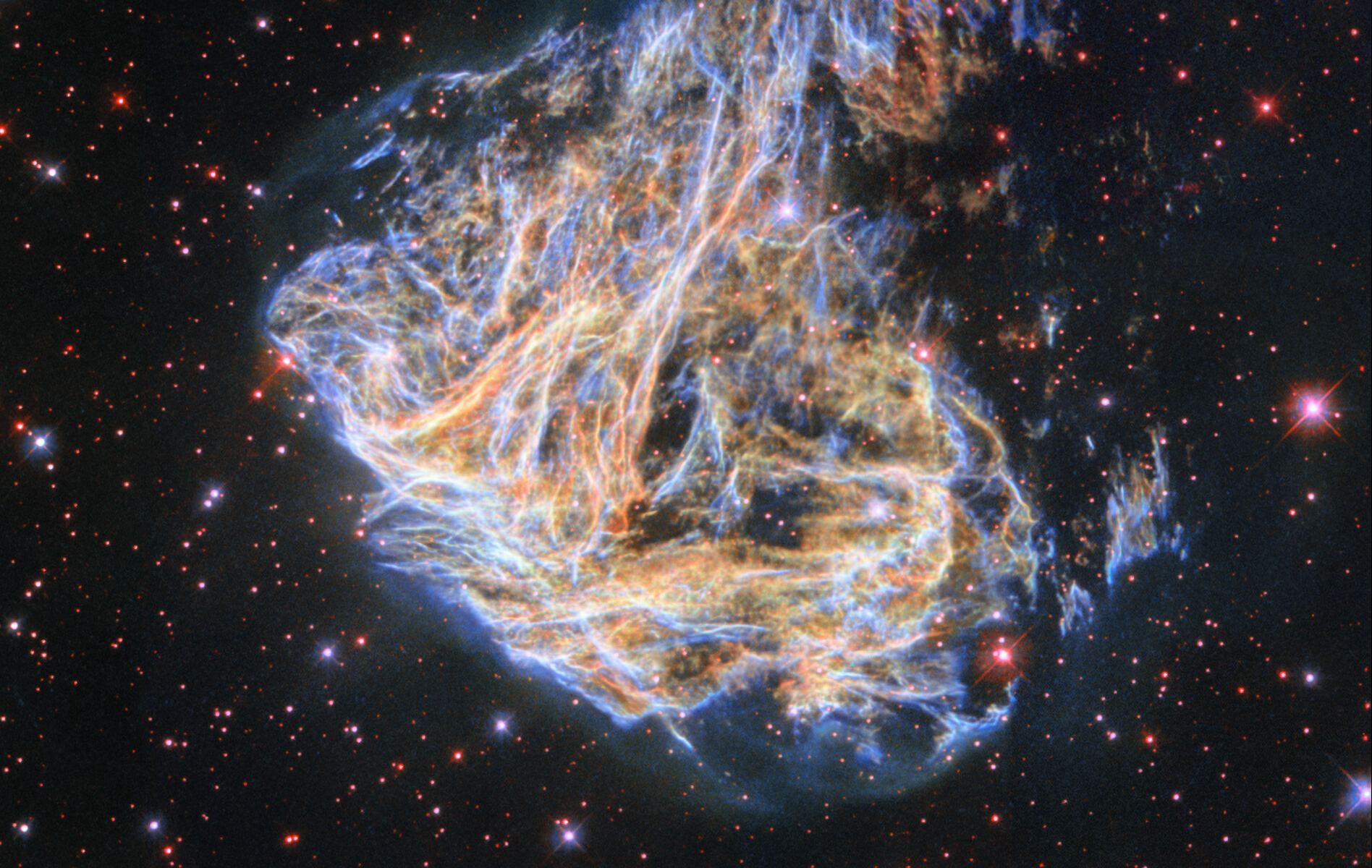
The latest composite image of supernova remnant DEM L 190, released in November 2022.
Credit: ESA/Hubble & NASA, S. Kulkarni, Y. Chu
The Hubble Space Telescope, to which we owe our current estimates for the age of the universe and the first detection of organic matter on an exoplanet, is very much doing science and still alive. It’s latest masterpiece remixes an old hit – apparently a growing trend in space science as well as space music.
The story of this image begins roughly 165,000 years ago, when an unnamed O-type star in the Large Magellanic Cloud died in a type II supernova. Light from the explosion shot out in all directions, and about 160,000 years later a tiny cross section of that expanding sphere of light reached Earth. If humanity had modern telescopes around 3,000 BC, automated systems might have logged a blip in the southern constellation Dorado, well under the limits of human perception from such a great distance.
The supernova remnant took on a familiar form: a beautiful glowing cloud of expanding gas surrounding a pulsar – a super-dense and rapidly spinning neutron star with a powerful magnetic field. Shockwaves from the collapsing stellar core interacted with the nebula, coalescing the diffuse gas into filaments. Two especially hot and dense regions of gas shot away from the central pulsar in opposite directions, “bullets” likely fired off by the core’s powerful magnetic field. Within 5,000 years the nebula would be 75 light-years across, its heart still glowing at a million degrees.
The remnant was catalogued by Karl Henize in 1956 as part of a survey of emission nebulae in the Magellanic Clouds. Dubbed N49 (sometimes LMC N49) it was immediately recognized as a powerful radio emitter, and to this day it is the brightest supernova remnant in the Large Magellanic Cloud. On March 5, 1979 a historically powerful gamma ray burst was detected by all nine spacecraft of the interplanetary gamma-ray burst network. The source was quickly pinpointed as N49, which at this point was a usual suspect for this sort of mischief.
But The March 5 transient was so insanely powerful that a second otherwise-invisible neutron star in that region was hypothesized. The term “pulsar” wasn’t going to cut it for N49. This and other similar events spurred on the study of “soft gamma ray repeaters,” and eventually the creation of the “magnetar” classification in 1992.
The Hubble Space Telescoped first imaged N49 over 3 hours between November of 1998 and July of 2000. Three false-color images in the classic “Hubble Palette” – red for sulfur, blue for oxygen, and green for hydrogen – were captured using its Wide Field Planetary Camera 2 (WFPC2) and superimposed on a black-and-white base image, also captured by Hubble. The composited image was used in studies mainly focused on better understanding the nebula’s structure and environment.

N49 has at least 26 other identifiers across different catalogues. The most common byname in the press is DEM L 190. The remnant has been imaged by notables like ROSAT, Chandra, and Spitzer, and was even mentioned in Chapter 9 of the companion book to Carl Sagan’s Cosmos.
The remnant’s intrigue comes not just from its brightness and powerful EM bursts, but also its asymmetry. Think of the stunning Ring Nebula, the Cat’s Eye, or the Lion Nebula. Each of these monuments to the awesome beauty of the cosmos was created by the same basic process as N49. An observer of most planetary nebulae could be forgiven for entertaining the thought of a cosmic watchmaker.
By comparison N49 looks like that watchmaker tried to flip an omelet and really messed up. Pinning down why and how the occasional stellar remnant gets so messy will help us understand stellar life cycles more completely.

Composite image of DEM L 190, released in November of 2006. Optical data from Hubble was overlaid with X-ray data from the Chandra Observatory in blue and infrared data from the Spitzer Space Telescope in red. The result suggests a dense region in the Interstellar Medium around N49 may have contributed to the uneven expansion of the planetary nebula.
Credit:
X-ray: NASA/CXC/Caltech/S.Kulkarni et al.
Optical: NASA/STScI/UIUC/Y.H.Chu & R.Williams et al.
IR: NASA/JPL-Caltech/R.Gehrz et al.

Composite image of DEM L 190, released in May of 2010. Optical data from Hubble was overlaid with X-ray data from the Chandra Observatory in blue. The magnetar can be seen as a blue-white light source in the upper-middle of the image. The result shows a “bullet” in the lower-right corned and a “bullet candidate” opposite, suggesting that the supernova itself may have been asymmetrical.
Credit:
X-ray: NASA/CXC/Penn State/S.Park et al.
Optical: NASA/STScI/UIUC/Y.H.Chu & R.Williams et al.
As imaging technology improves, from time to time the ESA/Hubble team revisits targets. For example, back in 2003 data from two UV filters centered at 300nm & 380nm were captured at the same time as the others but were not included in the original composite. For the 2022 image they were added in, and luminosity was depicted using red light instead of white, in part to give background stars a more natural-looking color.
The past nineteen years have also seen great strides in noise reduction and data stretching algorithms, which when applied to the updated image reveal an unprecedented level of detail. Fun fact, technically none of this improves the image’s resolution, which is limited by WFPC2’s performance back in the day. But that’s just a technicality – there’s no arguing the new 2022 image shows significantly more detail.
What will this new photo reveal to discerning eyes? That’s the fun part. Maybe the more detailed filaments will help astronomers better model especially violent stellar deaths. In a few years this photo may help answer questions we don’t even have yet.
FBI Documents Admit Existence of Aliens & UFO's - The UFO-Alien Occult New Age Great DeceptionThe Dan Bidondi Show – Spiritual Warfare The UFO-Alien Occult New Age Great Deception
FBI Documents Admit Existence of Aliens & UFO’s
Hosts Dan Bidondi & Brian Reece bring you the latest updates on the U.S. Government’s UFO reports and how the New Age occultic agenda will be pushed to bring about the great deception the Bible prophesied about.