Naar de inhoud

UFO'S of UAP'S, ASTRONOMIE, RUIMTEVAART, ARCHEOLOGIE, OUDHEIDKUNDE, SF-SNUFJES EN ANDERE ESOTERISCHE WETENSCHAPPEN - DE ALLERLAATSTE NIEUWTJES

UFO's of UAP'S in België en de rest van de wereld
akke.beakke.be
Ontdek de Fascinerende Wereld van UFO's en UAP's: Jouw Bron voor Onthullende Informatie! Ben jij ook gefascineerd door het onbekende? Wil je meer weten over UFO's en UAP's, niet alleen in België, maar over de hele wereld? Dan ben je op de juiste plek! België: Het Kloppend Hart van UFO-onderzoek In België is BUFON (Belgisch UFO-Netwerk) dé autoriteit op het gebied van UFO-onderzoek. Voor betrouwbare en objectieve informatie over deze intrigerende fenomenen, bezoek je zeker onze Facebook-pagina en deze blog. Maar dat is nog niet alles! Ontdek ook het Belgisch UFO-meldpunt en Caelestia, twee organisaties die diepgaand onderzoek verrichten, al zijn ze soms kritisch of sceptisch. Nederland: Een Schat aan Informatie Voor onze Nederlandse buren is er de schitterende website www.ufowijzer.nl, beheerd door Paul Harmans. Deze site biedt een schat aan informatie en artikelen die je niet wilt missen! Internationaal: MUFON - De Wereldwijde Autoriteit Neem ook een kijkje bij MUFON (Mutual UFO Network Inc.), een gerenommeerde Amerikaanse UFO-vereniging met afdelingen in de VS en wereldwijd. MUFON is toegewijd aan de wetenschappelijke en analytische studie van het UFO-fenomeen, en hun maandelijkse tijdschrift, The MUFON UFO-Journal, is een must-read voor elke UFO-enthousiasteling. Bezoek hun website op www.mufon.com voor meer informatie. Samenwerking en Toekomstvisie Sinds 1 februari 2020 is Pieter niet alleen ex-president van BUFON, maar ook de voormalige nationale directeur van MUFON in Vlaanderen en Nederland. Dit creëert een sterke samenwerking met de Franse MUFON Reseau MUFON/EUROP, wat ons in staat stelt om nog meer waardevolle inzichten te delen. Let op: Nepprofielen en Nieuwe Groeperingen Pas op voor een nieuwe groepering die zich ook BUFON noemt, maar geen enkele connectie heeft met onze gevestigde organisatie. Hoewel zij de naam geregistreerd hebben, kunnen ze het rijke verleden en de expertise van onze groep niet evenaren. We wensen hen veel succes, maar we blijven de autoriteit in UFO-onderzoek! Blijf Op De Hoogte! Wil jij de laatste nieuwtjes over UFO's, ruimtevaart, archeologie, en meer? Volg ons dan en duik samen met ons in de fascinerende wereld van het onbekende! Sluit je aan bij de gemeenschap van nieuwsgierige geesten die net als jij verlangen naar antwoorden en avonturen in de sterren! Heb je vragen of wil je meer weten? Aarzel dan niet om contact met ons op te nemen! Samen ontrafelen we het mysterie van de lucht en daarbuiten.

Archief

The Airforce UFO Cover Up That Drove a Man INSANE

The Airforce UFO Cover Up That Drove a Man INSANE

paul-bennewitz.jpeg

Paul Bennewitz is a civilian who lived near an airforce base. When he saw strange lights in the sky, he initially thought they were experimental aircraft. He then started picking up alien language on the radio. After gathering evidence, he reported it to the authorities, and the Air Force supported his UFO research. The military denied his claims, but privately, they confirmed his findings. He later ended in a mental institution.

{ https://www.latest-ufo-sightings.net/ }

Hoe vind je dit bericht?
Geschreven door peter om 18:35 Stuur door

NASA's InSight 'Hears' Its First Meteoroid Impacts on Mars

NASA's InSight 'Hears' Its First Meteoroid Impacts on Mars

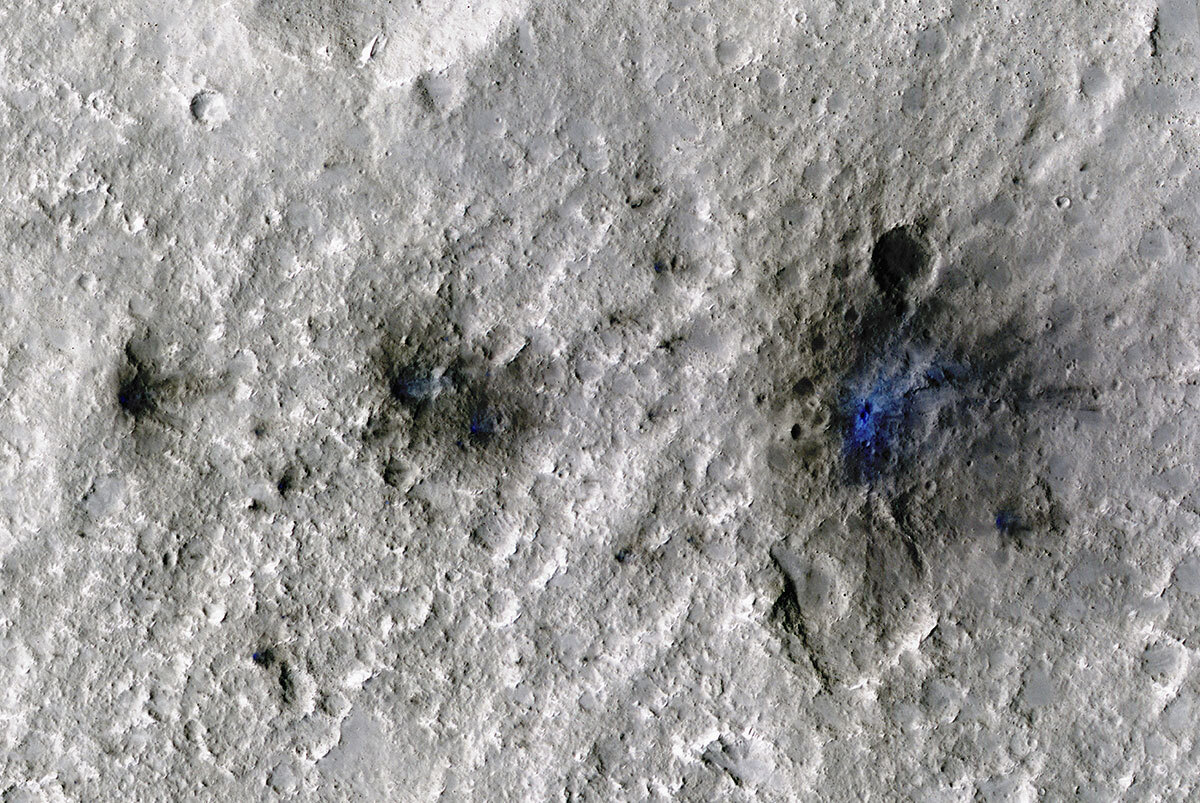
These craters were formed by a Sept. 5, 2021, meteoroid impact on Mars, the first to be detected by NASA’s InSight. Taken by NASA’s Mars Reconnaissance Orbiter, this enhanced-color image highlights the dust and soil disturbed by the impact in blue in order to make details more visible to the human eye.

InSight Detects an Impact for the First Time: These craters were formed by a Sept. 5, 2021, meteoroid impact on Mars, the first to be detected by NASA’s InSight. Taken by NASA’s Mars Reconnaissance Orbiter, this enhanced-color image highlights the dust and soil disturbed by the impact in blue in order to make details more visible to the human eye.

Credits: NASA/JPL-Caltech/University of Arizona. Download Image ›

The Mars lander’s seismometer has picked up vibrations from four separate impacts in the past two years.

NASA’s InSight lander has detected seismic waves from four space rocks that crashed on Mars in 2020 and 2021. Not only do these represent the first impacts detected by the spacecraft’s seismometer since InSight touched down on the Red Planet in 2018, it also marks the first time seismic and acoustic waves from an impact have been detected on Mars.

A new paper published Monday in Nature Geoscience details the impacts, which ranged between 53 and 180 miles (85 and 290 kilometers) from InSight’s location, a region of Mars called Elysium Planitia.

The first of the four confirmed meteoroids – the term used for space rocks before they hit the ground – made the most dramatic entrance: It entered Mars’ atmosphere on Sept. 5, 2021, exploding into at least three shards that each left a crater behind.

InSight’s Meteoroid Impact Detection: Learn more about the first meteoroid impact NASA’s InSight lander detected on Mars in this video.

Credits: NASA/JPL-Caltech. Download video ›

Then, NASA’s Mars Reconnaissance Orbiter flew over the estimated impact site to confirm the location. The orbiter used its black-and-white Context Camera to reveal three darkened spots on the surface. After locating these spots, the orbiter’s team used the High-Resolution Imaging Science Experiment camera, or HiRISE, to get a color close-up of the craters (the meteoroid could have left additional craters in the surface, but they would be too small to see in HiRISE’s images).

“After three years of InSight waiting to detect an impact, those craters looked beautiful,” said Ingrid Daubar of Brown University, a co-author of the paper and a specialist in Mars impacts.

Insight-Detected Impact in May 2020

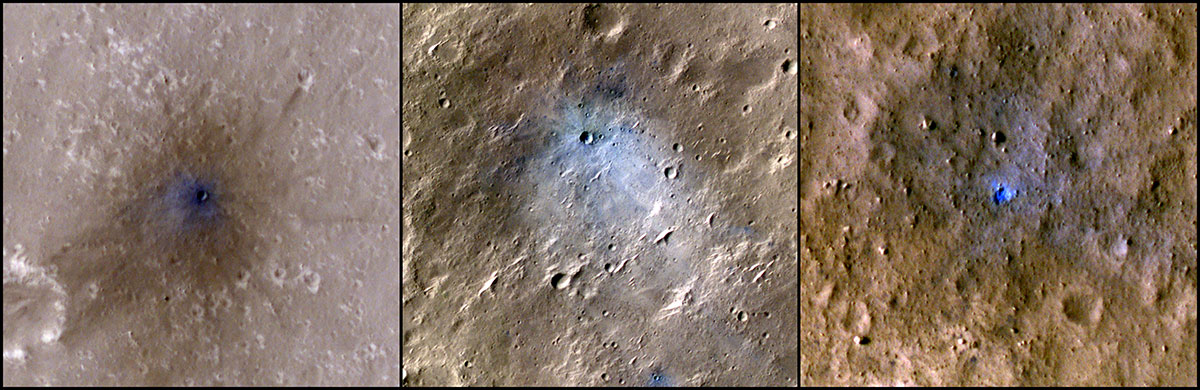
Mars Crater Collage: This collage shows three other meteoroid impacts that were detected by the seismometer on NASA’s InSight lander and captured by the agency’s Mars Reconnaissance Orbiter using its HiRISE camera.

Credits: NASA/JPL-Caltech/University of Arizona. Download Image ›

After combing through earlier data, scientists confirmed three other impacts had occurred on May 27, 2020; Feb. 18, 2021; and Aug. 31, 2021.

Researchers have puzzled over why they haven’t detected more meteoroid impacts on Mars. The Red Planet is next to the solar system’s main asteroid belt, which provides an ample supply of space rocks to scar the planet’s surface. Because Mars’ atmosphere is just 1% as thick as Earth’s, more meteoroids pass through it without disintegrating.

InSight’s seismometer has detected over 1,300 marsquakes. Provided by France’s space agency, the Centre National d’Études Spatiales, the instrument is so sensitive that it can detect seismic waves from thousands of miles away. But the Sept. 5, 2021, event marks the first time an impact was confirmed as the cause of such waves.

InSight’s team suspects that other impacts may have been obscured by noise from wind or by seasonal changes in the atmosphere. But now that the distinctive seismic signature of an impact on Mars has been discovered, scientists expect to find more hiding within InSight’s nearly four years of data.

Listen to a Meteoroid Hitting the Red Planet: The sound of a meteoroid striking Mars – created from data recorded by NASA’s InSight lander – is like a “bloop” due to a peculiar atmospheric effect. In this audio clip, the sound can be heard three times: when the meteoroid enters the Martian atmosphere, explodes into pieces, and impacts the surface. Credits: NASA/JPL-Caltech/CNES/IPGP. Download audio ›

Science Behind the Strikes

Seismic data offer various clues that will help researchers better understand the Red Planet. Most marsquakes are caused by subsurface rocks cracking from heat and pressure. Studying how the resulting seismic waves change as they move through different material provides scientists a way to study Mars’ crust, mantle, and core.

The four meteoroid impacts confirmed so far produced small quakes with a magnitude of no more than 2.0. Those smaller quakes provide scientists with only a glimpse into the Martian crust, while seismic signals from larger quakes, like the magnitude 5 event that occurred in May 2022, can also reveal details about the planet’s mantle and core.

But the impacts will be critical to refining Mars’ timeline. “Impacts are the clocks of the solar system,” said the paper’s lead author, Raphael Garcia of Institut Supérieur de l’Aéronautique et de l’Espace in Toulouse, France. “We need to know the impact rate today to estimate the age of different surfaces.”

Scientists can approximate the age of a planet’s surface by counting its impact craters: The more they see, the older the surface. By calibrating their statistical models based on how often they see impacts occurring now, scientists can then estimate how many more impacts happened earlier in the solar system’s history.

InSight’s data, in combination with orbital images, can be used to rebuild a meteoroid’s trajectory and the size of its shock wave. Every meteoroid creates a shock wave as it hits the atmosphere and an explosion as it hits the ground. These events send sound waves through the atmosphere. The bigger the explosion, the more this sound wave tilts the ground when it reaches InSight. The lander’s seismometer is sensitive enough to measure how much the ground tilts from such an event and in what direction.

“We’re learning more about the impact process itself,” Garcia said. “We can match different sizes of craters to specific seismic and acoustic waves now.”

The lander still has time to study Mars. Dust buildup on the lander’s solar panels is reducing its power and will eventually lead to the spacecraft shutting down. Predicting precisely when is difficult, but based on the latest power readings, engineers now believe the lander could shut down between October of this year and January 2023.

More About the Missions

NASA’s Jet Propulsion Laboratory, a division of Caltech in Pasadena, California, manages InSight for the agency’s Science Mission Directorate in Washington. InSight is part of NASA’s Discovery Program, managed by the agency’s Marshall Space Flight Center in Huntsville, Alabama. Lockheed Martin Space in Denver built the InSight spacecraft, including its cruise stage and lander, and supports spacecraft operations for the mission.

A number of European partners, including France’s Centre National d’Études Spatiales (CNES) and the German Aerospace Center (DLR), are supporting the InSight mission. CNES provided the Seismic Experiment for Interior Structure (SEIS) instrument to NASA, with the principal investigator at IPGP (Institut de Physique du Globe de Paris). Significant contributions for SEIS came from IPGP; the Max Planck Institute for Solar System Research (MPS) in Germany; the Swiss Federal Institute of Technology (ETH Zurich) in Switzerland; Imperial College London and Oxford University in the United Kingdom; and JPL. DLR provided the Heat Flow and Physical Properties Package (HP3) instrument, with significant contributions from the Space Research Center (CBK) of the Polish Academy of Sciences and Astronika in Poland. Spain’s Centro de Astrobiología (CAB) supplied the temperature and wind sensors.

News Media Contacts

{ http://www.nasa.gov/ }

Hoe vind je dit bericht?
Geschreven door peter om 23:57 Stuur door

Flinke krater en beving op planeet Mars door inslag ruimterots

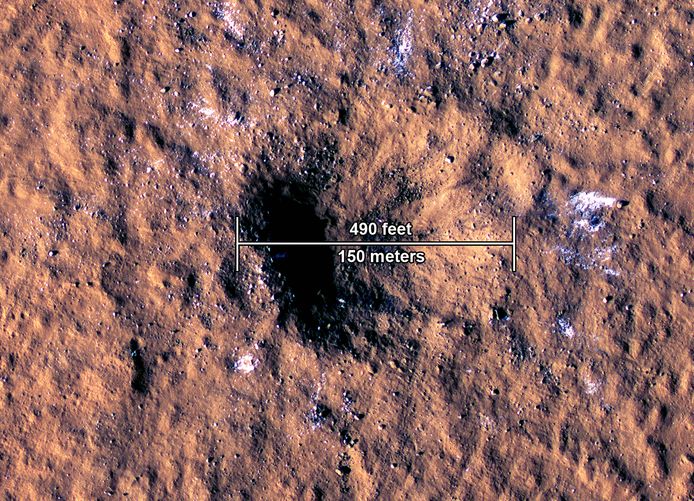
Een beeld dat is gemaakt door geavanceerde camera's op de Mars Reconnaissance Orbiter (MRO) van de NASA toont de door de meteorietinslag gevormde krater op Mars. Een beeld dat is gemaakt door geavanceerde camera's op de Mars Reconnaissance Orbiter (MRO) van de NASA toont de door de meteorietinslag gevormde krater op Mars.  © AFP/NASA/JPL-Caltech/University of Arizona

Flinke krater en beving op planeet Mars door inslag ruimterots

Op kerstavond vorig jaar werd op de planeet Mars een redelijk zware aardbeving met een kracht van 4,0 gemeten. Wetenschappers die de beving hebben onderzocht, concluderen donderdag dat deze werd veroorzaakt door de inslag van een ruimterots. Door de inslag is een krater gevormd die groter is dan een voetbalveld en ruim 20 meter diep.

Een Frans apparaat in de Amerikaanse Marslander InSight van ruimtevaartorganisatie NASA heeft in de afgelopen vier jaar meer dan 1.300 bevingen op Mars geregistreerd. Volgens The New York Times was de beving die op kerstavond werd geregistreerd anders dan alle eerdere bevingen, omdat trillingen langs de buitenste korst van de rode planeet werden geregistreerd. “We waren er onmiddellijk enthousiast over”, zegt wetenschapper Mark Panning tegen de krant.

Lees ook

De inslag van de ruimterots, die naar schatting tussen de 4,9 en 11,9 meter breed was, creëerde een 150 meter brede krater op een afstand van 3.500 kilometer waar de Marslander InSight zich op de planeet bevond. Op beelden van de Mars Reconnaissance Orbiter (MRO), een onbemande ruimtesonde van NASA, was de indrukwekkende krater te zien.

Onderzoeker Philippe Lognonne noemt de waarneming “de grootste meteorietinslag sinds met seismografen wetenschappelijk onderzoek is gedaan”.

De ontdekking helpt wetenschappers om de rode planeet beter te begrijpen en is “daarnaast een herinnering dat Mars, net als de aarde, door meteorieten getroffen kan worden”, schrijft The New York Times.

{ https://www.hln.be/ }

Hoe vind je dit bericht?
Geschreven door peter om 23:44 Stuur door

JWST Sees the Same Galaxy From Three Different Angles Thanks to a Gravitational Lens

JWST Sees the Same Galaxy From Three Different Angles Thanks to a Gravitational Lens

One of the great tragedies of the night sky is that we will never travel to much of what we see. We may eventually travel to nearby stars, and even distant reaches of our galaxy, but the limits of light speed and cosmic expansion make it impossible for us to travel beyond our local group. So we can only observe distant galaxies, and we can only observe them from our home in the universe. You might think that means we can only see one face of those galaxies, but thanks to the James Webb Space Telescope that isn’t entirely true.

As light from distant galaxies traverses the cosmos to reach us, its path can be deflected gravitationally along the way, known as gravitational lensing. For very distant galaxies their light is often lensed through galactic clusters closer to us and can produce multiple images. Each of these images comes from a different path of light.

A comparison of galaxies seen from Hubble vs Webb. Credit: NASA, ESA, CSA, Alyssa Pagan (STScI)

You can see this in a recent set of images released by the Space Telescope Science Institute. It shows a comparison of the galactic cluster MACS0647 captured by Hubble in 2012 and as seen by Webb in 2022. In the faint background of this cluster are three images of a more distant galaxy known as MACS0647-JD. It’s the same galaxy, but gravitational lensing lets us see it from slightly different paths. In the Hubble image, the galaxy images are just blurry clusters of pixels, but Webb can resolve these galaxies in some detail. Each image seems to have two smudges of light, and that means JD could be an early colliding galaxy. If it is the merger of two galaxies, it will be the most distant galactic merger we’ve observed.

One of the side effects of gravitational lensing is that it can magnify light from these far galaxies. This means the galaxy appears closer and brighter than it actually is. In the case of MACS0647-JD, the three images are magnified by different amounts. The images known as JD1, JD2, and JD3 are magnified by factors of 8, 5, and 2. Additionally, since the light path of each image is different, we also see the galaxy from three slightly different times.

This image is a great example of the power of JWST. It not only allows us to study the earliest galaxies in detail, but it also allows us to see some galaxies from more than one point of view.

Reference: 

The post JWST Sees the Same Galaxy From Three Different Angles Thanks to a Gravitational Lens appeared first on Universe Today.

Source: 

RELATED VIDEOS, selected and posted by peter2011

{ https://beforeitsnews.com/ }

Hoe vind je dit bericht?
Geschreven door peter om 23:15 Stuur door

Dwarf Planet Haumea is one of the Stranger Objects in the Solar System. How did it get That way?

Dwarf Planet Haumea is one of the Stranger Objects in the Solar System. How did it get That way?

There’s still a raging debate in some circles as to whether Pluto should be a planet or not. Ask an astronomer, and their typical answer would be something like – if Pluto is a planet, then there are plenty of other bodies out there in the solar system that should be considered one too. One of those is Haumea, a little explored rock in the Kuiper belt that is one of the strangest large objects out there. Now, a team from NASA has a new idea as to how it got that way.

Since Haumea is so far away, there isn’t much hard data on it. A probe has never visited it, and it is too small and distant to be properly measured by an Earth-based telescope. So the researchers interested in it turned to that favorite tool of most astrophysicists – computer models.

Computer models need inputs to make predictions, however, and there are a few bizarre things that we already know about Haumea. One is how fast it spins – a day lasts only four hours on its surface, much shorter than the day of any similar-sized object in the solar system. In addition, it is elongated, looking a bit like an American football rather than the spherical shape that most bodies of its size take on.

Interview with Dr. Noviello – the lead paper author.
Credit – Lunar and Planetary Institute

It also has some attending “family” – little balls of what appears to be water ice that float in a similar orbit around the main body of Haumea. Kind of like moons, but not considered to be such. So how did all of this strangeness come to be? To understand, the researchers had to look back in time – and make some estimates, of course.

That was a two-step process. First, Jessica Noviello, now a postdoc researcher at NASA’s Goddard Space Flight Center, developed a model requiring only three distinct inputs – Haumea’s size, mass, and spin rate. The outputs of that first model, such as the size and density of the body’s core, were then fed into another model that was used as the iterative basis for finding a creation process that reflected what Haumea looks like now.

Introducing small changes to those input parameters of the final simulation resulted in a set of expected outcomes, which could be compared to the measured reality. But it also highlighted a few interesting features that likely happened when Haumea was being formed.

Anton Petrov discusses the mysteries of Haumea.
Credit – Anton Petrov YouTube Channel

First, it was likely smacked by a massive object early in its history. Hence, the dramatic spin. But, while the impact would have knocked parts of Haumea off, it likely would have been too violent to simply form the small balls of ice now known as its “family.”

Creating those tiny ice balls required a second process, which took much longer, but arguably had as big of an impact. The fast spinning caused denser rocks to slide down into the core of the dwarf planet, and those rocks started to do something unexpected. Since they, like all rocks, were radioactive, they started to melt the water ice that was coagulating on Haumea’s outer shell.

Some of that water then flooded into the core, creating a clay-like substance, which the fast centripetal force then spun out like a potter, creating the elongated shape we see today. In addition, some of the balls of ice lost their grip on the main body and broke off gently to form the smaller icy bodies that still rotate in the same orbit as the parent dwarf planet.

These outcomes are all from simulations at this point, but they make sense both from a logical and scientific standpoint. However, it will still be a while before we collect any more concrete data about Haumea or its Kuiper belt cousins. Until then, astrophysicists will have to be content with papers like the one from Dr. Noviello and her team that was recently published in the Planetary Science Journal.

Learn More:

Lead Image:

  • Screenshot of an interactive 3D model of Haumea.
    Credit – NASA Visualization Technology Applications and Development

The post Dwarf Planet Haumea is one of the Stranger Objects in the Solar System. How did it get That way? appeared first on Universe Today.

Source: 

{ https://beforeitsnews.com/ }

Hoe vind je dit bericht?
Geschreven door peter om 22:51 Stuur door

This UFO Footage Wasn’t Meant for the Public

This UFO Footage Wasn’t Meant for the Public

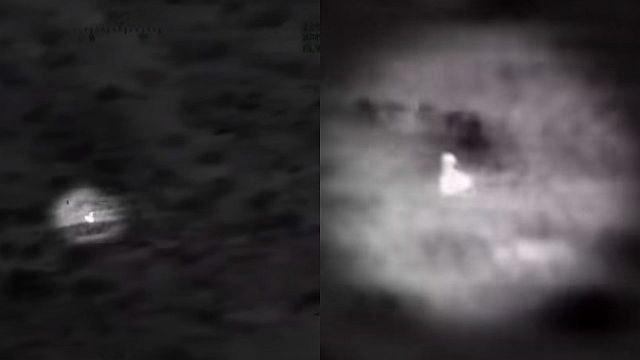
A FLIR camera captures a strange UFO with an uncanny resemblance to a rubber duck. 
ufo%20uap%20flir%20footage.jpg

A US surveillance aircraft being flown by Department of Homeland Security (DHS) captured by using their thermal optics system (FLIR) at around 9pm on November 23, 2019 a very strange "rubber duck" shaped UFO flying at a speed between 90 and 200mph.not far from the US's southern border with Mexico. 
The so-called "rubber duck' UFO is comparable with a unknown object also caught by the FLIR system of another Homeland Security aircraft while flying over Puerto Rico on April 25, 2013. 
This UFO like object also moves just above the surface at speeds of up to 120mph before reaching the ocean whereupon it splits into two objects before diving into the ocean with very little splash and then proceeds to move at times on the water surface and just below the surface. 
Since no known aircraft or drone has the capacity to perform the maneuvers as these UFOs did, we have to conclude that these objects of unknown origin are equipped with an advanced technology which is unknown to the public. 
It is questionable whether these objects are of extraterrestrial origin, it is very possible that these objects were developed by the military and being part of a secret project. 
Both UFOs were unintentionally captured on film, but it gives us a glimpse of the capabilities of these possible man-made objects whereby the object that plunged into the ocean may refer to an underwater base which may be under the control of the Navy/military.
   

{ http://ufosightingshotspot.blogspot.com/ }

Hoe vind je dit bericht?
Geschreven door peter om 20:53 Stuur door

Navajo Park Ranger revealed that something big Is happening in National Parks

Navajo Park Ranger revealed that something big Is happening in National Parks

This Navajo park ranger revealed that something big is happening right now in National Parks. Today, we take a look at what this Navajo park ranger found inside this National Park. 
mystery%20national%20parks.jpg

The police do incredible work, and they are usually the first ones on the scene when something goes wrong. Every so often though they will encounter something that even they can't explain. 
One of the places where officers are seeing strange things is that of the Navajo Reservation of the American southwest. This location is known for mysterious and legendary stories and the police here have encountered some strange things.

RELATED VIDEOS

{ http://ufosightingshotspot.blogspot.com/ }

Hoe vind je dit bericht?
Geschreven door peter om 20:25 Stuur door

UFO with 6 lights hovering above Hallandale Beach, Florida

UFO with 6 lights hovering above Hallandale Beach, Florida

Hallandale-Beach-UFO-1024x576.jpg

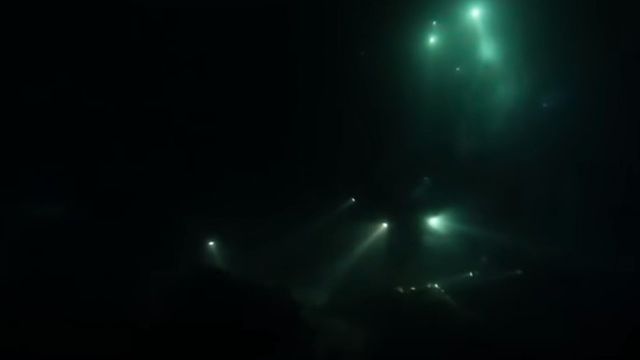
These UFO lights were seen and recorded in the night sky above Hallandale Beach, a city in southern Broward County, Florida. This event happened back on June 1st, 2021 but it was just today published online through MUFON’s website.

Witness report: 

I was sitting outside with my cousin when we noticed an object with panels of lights slowly ascending in the sky. As the object got higher it dissipated and disappeared into the clouds.

{ https://www.latest-ufo-sightings.net/ }

Hoe vind je dit bericht?
Geschreven door peter om 20:10 Stuur door

Scientists Are Gaming Out What Humanity Will Do If Aliens Make Contact

Scientists Are Gaming Out What Humanity Will Do If Aliens Make Contact

Will the monumental moment of first contact fuel division among war-hungry humanity, or will it inspire our better angels and unite us?
 
A_-Y93oE?format=jpg&name=900x900
IMAGE: HAITONG YU VIA GETTY IMAGES
Do intelligent aliens exist somewhere out there in the universe? It is a grand mystery that has captivated humans for generations, fueling ever-more sophisticated searches of the skies for signs of advanced civilizations. But while aliens have taken many forms in our imaginations—from hostile invaders to inscrutable ciphers—we have absolutely no idea what extraterrestrial life-forms might look like, how they would communicate, or even if they exist at all.

We can, however, make some assumptions about the only intelligent space-faring species that we know of—humans—and how we might react to contact with an alien civilization. Indeed, people have spent decades developing protocols that attempt to anticipate this momentous event and all of the extraordinary potential consequences it could have on our civilization. It’s an especially important question now, as the world appears more strongly divided than at any time in recent memory, with major powers taking on increasingly antagonistic stances toward each other. 

In 2020, a pair of researchers dug into this question in an article in Space Policy by suggesting that humans might pose as big a risk to ourselves in the aftermath of alien contact as any extraterrestrial species. The study views the search for extraterrestrial intelligence (SETI) through the lens of “realpolitik,” a term that describes the kind of gritty power plays and practical maneuvers that nations pull to enhance their own positions. 

Authors Kenneth Wisian and John Traphagan, a geophysicist and cultural anthropologist, respectively, at the University of Texas at Austin, envision nations monopolizing contact with an extraterrestrial intelligence, a move that could spark escalating conflicts, including possible attacks on astronomical facilities. For this reason, the team said scientists might need to enlist personal security to protect them and their families from state actors, or even terrorists, in the wake of a such a momentous event, among other concerns raised in the study.

“What might we do to ourselves? Let's not just think about what they might do to us, or vice versa, but what are the threads internally?”

“The SETI academic field is focused on looking out, and the main issues and concerns that have been brought up throughout the history of SETI development have been: what threats could the aliens present to us, if any?” said Wisian, who is a retired Major General in the U.S. Air Force, in a call with Motherboard. “I hadn't seen any thought about, well, what might we do to ourselves?” 

“From a grounding in military and international affairs history, it seems pretty obvious to me that a lot of times people act on perceived interest and perceived threats,” he continued. “That's what germinated the idea—what might we do to ourselves? Let's not just think about what they might do to us, or vice versa, but what are the threads internally?”

When the study came out two years ago, it caught the attention of Jason Wright, an astronomer and SETI researcher at Penn State University. Wright disagreed with many of Wisian and Traphagan’s conclusions, and published a blog post at the time expressing his thoughts on what he called the “very dubious assumptions” underlying the study. 

“I felt like it was misguided,” Wright said in a call with Motherboard, referring to the 2020 study. “I understood why they were writing what they wrote, but I thought it really would have benefited from a better understanding of how SETI and radio astronomy works, because it was based on a lot of misunderstandings about that.”

“Then, taking my own medicine, I said I’d love to write a rebuttal, but I'm not an expert on philosophy, ethics, geopolitics, and space law,” he added. 

For this reason, Wright connected with Chelsea Haramia, a philosopher at Spring Hill College, and Gabriel Swiney, a senior policy advisor in NASA’s Office of Technology, Policy, and Strategy. 

The team has now presented a comprehensive rebuttal to Wisian and Traphagan’s article, arguing that some of the study’s suggestions could backfire by sowing distrust and confusion, among many other scientific and ethical critiques presented in their new work, which was published this month in Space Policy.  

The disagreements between the teams are a microcosm of the kaleidoscopic diversity of views about the possible outcomes of a successful contact event with aliens, especially what it would mean for humans here on Earth. So, what do these perspectives reveal about what might happen if humanity finally makes the ultimate discovery? 

Could a nation monopolize communication with aliens?

Imagine an intelligent alien species sends a decipherable message to Earth that is received by a sophisticated astronomical observatory. In another scenario, a piece of alien technology could actually fall to Earth and be recovered by people on the ground. Though this is a far-fetched possibility, Harvard astronomer Avi Loeb believes that alien artifacts may have already reached Earth; he is currently planning an expedition to search for any surviving fragments of what was likely an interstellar meteor that hit our planet in 2014, which he thinks could be artificial in origin (Loeb’s views about alien artifacts have received substantial pushback from other scientists).

Regardless of the odds of such an event, Wisian and Traphagan argue that state officials who receive a message or artifact of this kind might conclude that they could exert a geopolitical advantage by monopolizing communication with the extraterrestrials, or by siloing information about alien technologies. To support their case, the team presents many historical examples of nations using this type of realpolitik approach.

“Pretty much by definition, if we make contact with some other intelligence, they're going to have a time advantage on us and therefore, probably, a significant technological lead,” Wisian said. “That is the driver. It's the information, and what it could provide as far as an advantage in international affairs and power and diplomacy, that would drive countries to take strong action to try to monopolize that channel.”

“I could definitely see world leaders acting on that perceived reward,” he added.

Wisian and Traphagan speculate that these perceived rewards could make radio telescopes targets for espionage or cyberattacks—or perhaps even real physical attacks with air strikes or weapons of mass destruction (WMDs). Morever, extremist groups that might be threatened by the reality of alien contact “would have the ability to launch small-scale raids (i.e., terrorist attacks) or possibly WMD attacks…aimed at destroying the critical infrastructure for [extraterrestrial intelligence] communication or the key personnel involved,” Wisian and Traphagan said in the study. 

With that in mind, the researchers suggested that astronomical facilities and personnel might need to be defended by military or other security forces, citing the kind of protection often seen around nuclear power plants, biowarfare research institutions, or American abortion services providers.

Wright and his colleagues raised several objections with these arguments in their new study. On a practical technical level, the team said that it is very unlikely that any nation or group would be able to monopolize communication with an alien species. While an initial detection of an extraterrestrial message might be captured by a premiere observatory, such as China’s Five-hundred-meter Aperture Spherical radio Telescope (FAST) or the Robert C. Byrd Green Bank Telescope in West Virginia, other facilities—and potentially even amateur sky watchers—could quickly start listening in, as well.

“If there are alien signals landing on Earth that contain this kind of information, then anyone can pick it up,” Wright said. “Once you know the frequency and the location on the sky, you could use satellite dishes and no one would know you were doing it because satellite dishes are pointed at the sky for all kinds of reasons. So, sending a bunch of troops to Green Bank isn't going to accomplish anything.”

In fact, Wright and his colleagues propose that hardening security around astronomical facilities might actually backfire and exacerbate the very tensions that Wisian and Traphagan sound alarms about in their study.  

“If we start locking down all the SETI facilities and getting all the SETI people personal security to protect them against state-level actors, it's going to look like something happened,” Wright said. “It's going to look like you need to do that; that it was necessary for some reason. That's what we're trying to avoid. We're trying to avoid that escalation.” 

“So, we were worried that their recommendations would take something that's a remote possibility to be guarded against, and make it happen, basically, by treating it as a foregone conclusion that we just go ahead and start protecting against. Our argument is that you have to fight that misperception by explaining what's going on.”

Both teams agree that this type of contact scenario—which involves a clear intelligible message with some kind of advantageous information—is extremely unlikely. It stands to reason that our first experience with extraterrestrial life in the universe would be much murkier in content and interpretation. For instance, Wright pointed out that humans cannot even speak the languages of other intelligent animals on Earth, such as dolphins or elephants, which casts doubt on our ability to decode any message from another civilization. 

Wisian and Traphagan, however, note that it is worth thinking about dangerous situations even if the odds of them materializing are astronomically low.

“I hope for the best, but as a military guy, you look at the range of possibilities and you may not focus on the worst, but you have to at least take into account those potential options,” Wisian said. “If something has severe consequences, you can't just dismiss it. Neither one of us said that this is likely—it's just that it's a possibility that needs to be considered.”

Would alien contact promote conflict or cooperation among nations?

Given that monopolizing access to aliens is unlikely, it’s worth widening the aperture to consider some of the general concerns raised by Wisian and Traphagan under their realpolitik analysis of an alien contact event. 

The researchers were partly inspired to write the 2020 study because they believe the protocols surrounding first contact are “limited in scope to aspirational thinking” and are not yet equipped to address the “thorny political ramifications of a discovery,” according to the study. By weaving in historical examples of power plays that span the Peloponnesian War, the Renaissance era, and the Cold War, among others, the team argue that governments are often unconstrained by international laws and deaf to the calls of scientists to adhere to existing protocols and treaties. 

“The scientists may think they are in charge, but as soon as something like this happens, the governmental bodies are going to take charge, and it will go outside of scientists’ hands,” Wisian said, though he added that “scientists have a pretty good network and an ability to subvert controls, which gives me cause for some optimism here.”

While Wright and his colleagues said that there is value in viewing SETI through a realpolitik lens, they note that this is one of many possible geopolitical perspectives that need to be considered when developing post-detection protocols. For instance, if a nation were the first to receive an alien signal, it might want to shout the news from the rooftops—as opposed to shroud the discovery in secrecy—due to the “incalculable prestige that would accrue to the state that made arguably the most significant scientific finding of the modern era,” Wright’s team said in their study.

06.28.22

In much the same way, Wright and his colleagues suggest that even if nations are primarily motivated by self-interest, their realpolitik posture to an alien message could very well be collaborative rather than combative. 

“Most interactions between nations are not driven by the threat of force,” Wright said. “There are so many other, probably more likely, outcomes that we can see, and so many other successful ways that nations manage sensitive science and technology in a peaceful cooperative way—even among rivals—that it's clear that we have a framework other than just hardening security for managing that sort of thing.” 

“We're having this discussion because we don't really have a good post-detection protocol yet”

“The example we give is fusion research,” he continued, referring to the international effort to derive power from nuclear fusion reactions. “It’s a sensitive topic that involves nuclear materials and nuclear technologies, but it's primarily driven towards trying to develop peaceful civilian uses for nuclear power generation. We have these international agreements that rivals sign onto and, basically, obey, that allows for constrained international collaboration.” 

For his part, Wisian does not dispute that outcomes beyond the realpolitik mold are possible. Indeed, he hopes that any first contact scenarios inspire our better angels and promote more scientific curiosity to counter ascendant anti-science attitudes and distrust in research institutions. 

Moreover, while Wisian said that many of the points raised by Wright’s team seem valid, he objected to what he saw as “straw man” arguments in their new study that misrepresented his original work with Traphagan. Wisian also acknowledged that the SETI field is not his academic specialty—he is an expert on geothermal energy—but suggested that interdisciplinary input will be essential to a robust post-detection plan.

“I've worked and served in multiple wars,” Wisian said. “I've seen how humanity actually behaves—not how it theoretically should.” 

How should we prepare for first contact?

To that end, both teams also agree on another important point: As the search for life elsewhere in the universe continues to mature, people from all walks of life should be involved in the preparations for a successful detection of alien life, and what it might mean for all Earthlings.

There should be “a ‘big tent’ approach to this, not just a few disciplines and academics—and not just the academic world,” said Wisian. “There's a whole bunch of areas that are ripe for exploration here that could move from the science fiction world into the practical planning world, like SETI has moved, over the last 50 or 60 years, from science fiction to a major scientific discipline now.”

Wright also pointed to the need to enlist diverse perspectives in the conversation about alien contact, and our own human reaction to it, though he emphasized that these efforts should involve researchers who are steeped in SETI history and technologies.

To that point, the basic post-detection protocol, as it stands today, is centered on making sure a detection is accurate, disseminating the news to the public as soon as it has been unambiguously confirmed, and refraining from responding to the alien civilization—not necessarily because of any inherent danger, but because a reply would need to emerge on behalf of our entire civilization, which is no simple task. 

Both teams think that there are many nuances and gaps within, and around, the existing guidelines that will need to be addressed by future discussions between people with different views and backgrounds. To that end, the United Nations, the International Academy of Astronautics, and other organizations have been working for years to harness the talents of people with a wide range of expertise—including sociologists, philosophers, policy makers, and scientists—to game out the various ways in which we might first encounter alien life. 

That work will have to keep pace with the exciting pace of the search for aliens in the skies, as well as the dizzying geopolitical and cultural shifts that we are experiencing right here on Earth.

“Our paper is not supposed to close the book on this topic,” said Wright. “We're having this discussion because we don't really have a good post-detection protocol yet. We have protocols that are old and they're probably insufficient, given all of the ways that we can do SETI these days.” 

“The response has to represent humanity and we don't know how to do that,” he concluded. “It should not be the purview of the people who make the discovery to be the ones to respond. That's a bigger decision that needs to be made at a larger collective level. That’s the essence of the protocol.”

RELATED VIDEOS, selected and posted by peter2011

Hoe vind je dit bericht?
Geschreven door peter om 00:36 Stuur door

Modern Humans and Neanderthals Lived Together in Europe for 2,000 Years!

A new study shows that humans and Neanderthals lived together in Europe for 2000 years. Source: athree23 / CC BY-SA 4.0

Modern Humans and Neanderthals Lived Together in Europe for 2,000 Years!

When Homo sapiens first arrived on the European continent about 42,500 years ago, the Neanderthals were still living there, and would remain there for another 1,400 to 2,900 years before finally disappearing from the face of the Earth. When the anatomically modern humans moved in, the Neanderthals did not move out, but stayed where they were and apparently lived peacefully alongside their Homo sapiens cousins for approximately 2,000 years, give or take a few centuries.

This is the conclusion of a trio of scientists from Leiden University in the Netherlands and Cambridge University in the United Kingdom, who used a unique and sophisticated modeling method known as optimal linear estimation to pin down more exactly when the Neanderthals actually lived in western Europe. The evidence the archaeologists examined was collected from multiple excavation sites in France and northern Spain, where modern human and Neanderthal artifacts have proven relatively easy to find.

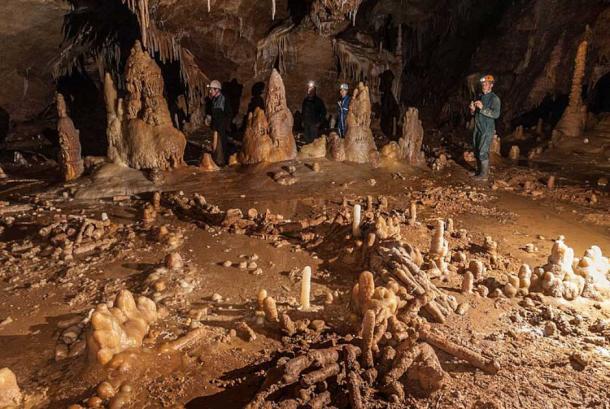
Speleofacts ring structure built by Neanderthal people in Bruniquel cave, France. (Luc-Henri Fage/SSAC / CC BY-SA 3.0)

Speleofacts ring structure built by Neanderthal people in Bruniquel cave, France.

(Luc-Henri Fage/SSAC / CC BY-SA 3.0 )

The results of this study, which have just been published in the journal Scientific Reports , offer no evidence to demonstrate that Homo sapiens and Neanderthals merged their genetic materials with each other 42,500 ago. But past research has proven that the modern human genome contains portions of Neanderthal DNA , which could have only gotten there if the two species of hominin had interbred at some point. People of European descent are among those who carry Neanderthal genetic material, so at least some of that interbreeding must have occurred on European soil.

The Stunning Convergence of Modern Humans and Neanderthals

Igor Djakovic, an archaeological PhD candidate at Leiden University and lead author of the Scientific Reports paper, acknowledges in an interview with the French press agency AFP that humans and Neanderthals “met and integrated in Europe,” at some point in the distant past, before adding that “we have no idea in which specific regions this actually happened.”

Scientists have also struggled to identify the precise years when modern humans and Neanderthals would have lived in Europe simultaneously, and this was what the scientists in the Leiden University-led study were trying to discover.

To apply their sophisticated modeling techniques to the question, the scientists gathered radiocarbon dating results connected to 56 artifacts taken from 17 archaeological sites across France and northern Spain. Half of these artifacts had been linked to Neanderthals, while the other half had been left by humans. The artifacts in question included skeletal remains of both species, plus different types of tools including distinctive stone knives believe to have been made by Neanderthals.

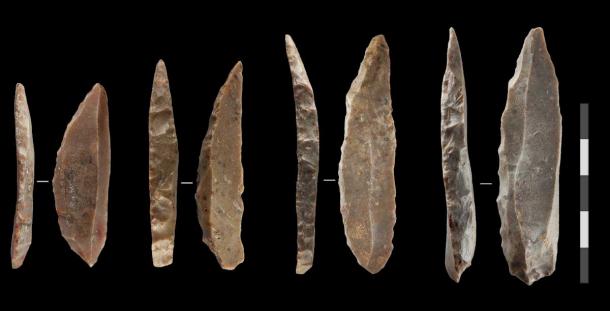
Distinctive stone knives thought to have been produced by the last Neanderthals in France and northern Spain. This specific and standardized technology is unknown in the preceding Neanderthal record, and may indicate a diffusion of technological behaviors between Homo sapiens and Neanderthals immediately prior to their disappearance from the region. (Igor Djakovic)

Distinctive stone knives thought to have been produced by the last Neanderthals in France and northern Spain. This specific and standardized technology is unknown in the preceding Neanderthal record, and may indicate a diffusion of technological behaviors between Homo sapiens and Neanderthals immediately prior to their disappearance from the region.

( Igor Djakovic)

The idea was to cross-reference all of these dated materials, first through Bayesian statistical modeling and then through optimal linear estimation modeling, to search for signs of overlapping activity. Optimal linear estimation modeling is a technique originally developed for use in biology that has now been repurposed for examining and dating human remains and artifacts (and in this case, Neanderthal remains and artifacts as well) to relatively narrow periods of time.

In this study Baynesian modeling could only narrow the potential date ranges down so far, but optimal linear estimation allowed the scientists to achieve much further refinement.

When the final numbers were crunched, the data showed that Neanderthals went extinct in the region of France and northern Spain between 40,870 and 40,547 years ago, a range covering just over three hundred years of time. Meanwhile, it was confirmed that modern humans first migrated into this part of Europe approximately 42,500 years ago. With some variations in the approximate time frame for when the modern humans arrived, the researchers concluded that modern humans and Neanderthals would have occupied the same geographical region for between 1,400 and 2,900 years, after which Neanderthals disappeared forever.

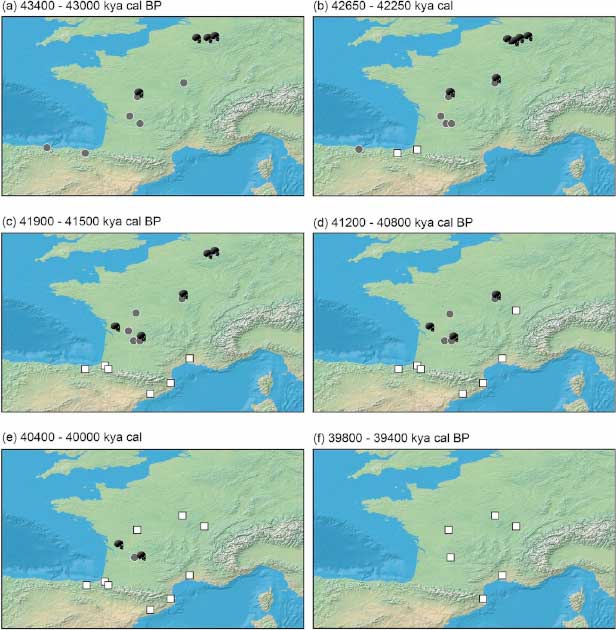
Geographic appearance of dated occurrences for the Châtelperronian (grey circles – Neanderthal stone tools), Protoaurignacian (white squares – Homo sapiens stone tools), and directly-dated Neandertals (black skulls) in the study region between 43,400 (a) and 39,400 (f) years cal BP. (Djakovic, I., Key, A. & M. Soressi / Nature 2022)

Geographic appearance of dated occurrences for the Châtelperronian (grey circles – Neanderthal stone tools), Protoaurignacian (white squares – Homo sapiens stone tools), and directly-dated Neandertals (black skulls) in the study region between 43,400 (a) and 39,400 (f) years cal BP.

(Djakovic, I., Key, A. & M. Soressi / Nature 2022 )

Sharing Knowledge

While there is no proof, it is reasonable to conclude that interbreeding between the two genetically compatible species would have occurred at this time and at this place. Perhaps just as significantly, there are signs that an extensive “diffusion of ideas” occurred, according to Djakovic, meaning there was a meeting of the cultures and a meeting of the minds that accompanied the physical encounters.

This period of time is "associated with substantial transformations in the way that people are producing material culture," including the way they made tools and ornaments, Djakovic explained. He and his colleagues also noted a dramatic change in the types of physical artifacts being produced by Neanderthals, which started to closely resemble tools and utensils made by the modern humans.

The Death of the Neanderthals Has Been Greatly Exaggerated

The latest research reveals that the DNA of humans of European and Asian descent is between one and two percent Neanderthal. In Africans Neanderthal DNA is not found except in trace amounts , since Africans and Neanderthals did not come into contact before the latter went extinct.

With respect to the extinction of the Neanderthals, Igor Djakovic argues that the concept should be reconsidered

"When you combine that with what we know now—that most people living on Earth have Neanderthal DNA—you could make the argument that they never really went extinct, in a certain sense," Djakovic said. Instead, he hypothesized, they were “effectively swallowed into our gene pool,” where they continue to exert a small but real influence over human genetic development to this very day.

It remains a mystery why Neanderthals weren’t able to breed and produce enough offspring among themselves to preserve their viability as a distinct species after modern human contact . Many different theories have been offered, but none are universally accepted.

Nevertheless, through genetic exchanges with anatomically modern humans they were able to guarantee their survival in a different form. They are like a shadow inside us, still preserved and never to be completely forgotten.

  • Top image: A new study shows that modern humans and Neanderthals lived together in Europe for 2000 years. 
  • Source: athree23 / CC BY-SA 4.0

By Nathan Falde

{ https://www.ancient-origins.net/ }

Hoe vind je dit bericht?
Geschreven door peter om 23:10 Stuur door

Meer van UFO'S of UAP'S, ASTRONOMIE, RUIMTEVAART, ARCHEOLOGIE, OUDHEIDKUNDE, SF-SNUFJES EN ANDERE ESOTERISCHE WETENSCHAPPEN - DE ALLERLAATSTE NIEUWTJES

↑ Terug naar de berichten