Naar de inhoud

UFO'S of UAP'S, ASTRONOMIE, RUIMTEVAART, ARCHEOLOGIE, OUDHEIDKUNDE, SF-SNUFJES EN ANDERE ESOTERISCHE WETENSCHAPPEN - DE ALLERLAATSTE NIEUWTJES

UFO's of UAP'S in België en de rest van de wereld
akke.beakke.be
Ontdek de Fascinerende Wereld van UFO's en UAP's: Jouw Bron voor Onthullende Informatie! Ben jij ook gefascineerd door het onbekende? Wil je meer weten over UFO's en UAP's, niet alleen in België, maar over de hele wereld? Dan ben je op de juiste plek! België: Het Kloppend Hart van UFO-onderzoek In België is BUFON (Belgisch UFO-Netwerk) dé autoriteit op het gebied van UFO-onderzoek. Voor betrouwbare en objectieve informatie over deze intrigerende fenomenen, bezoek je zeker onze Facebook-pagina en deze blog. Maar dat is nog niet alles! Ontdek ook het Belgisch UFO-meldpunt en Caelestia, twee organisaties die diepgaand onderzoek verrichten, al zijn ze soms kritisch of sceptisch. Nederland: Een Schat aan Informatie Voor onze Nederlandse buren is er de schitterende website www.ufowijzer.nl, beheerd door Paul Harmans. Deze site biedt een schat aan informatie en artikelen die je niet wilt missen! Internationaal: MUFON - De Wereldwijde Autoriteit Neem ook een kijkje bij MUFON (Mutual UFO Network Inc.), een gerenommeerde Amerikaanse UFO-vereniging met afdelingen in de VS en wereldwijd. MUFON is toegewijd aan de wetenschappelijke en analytische studie van het UFO-fenomeen, en hun maandelijkse tijdschrift, The MUFON UFO-Journal, is een must-read voor elke UFO-enthousiasteling. Bezoek hun website op www.mufon.com voor meer informatie. Samenwerking en Toekomstvisie Sinds 1 februari 2020 is Pieter niet alleen ex-president van BUFON, maar ook de voormalige nationale directeur van MUFON in Vlaanderen en Nederland. Dit creëert een sterke samenwerking met de Franse MUFON Reseau MUFON/EUROP, wat ons in staat stelt om nog meer waardevolle inzichten te delen. Let op: Nepprofielen en Nieuwe Groeperingen Pas op voor een nieuwe groepering die zich ook BUFON noemt, maar geen enkele connectie heeft met onze gevestigde organisatie. Hoewel zij de naam geregistreerd hebben, kunnen ze het rijke verleden en de expertise van onze groep niet evenaren. We wensen hen veel succes, maar we blijven de autoriteit in UFO-onderzoek! Blijf Op De Hoogte! Wil jij de laatste nieuwtjes over UFO's, ruimtevaart, archeologie, en meer? Volg ons dan en duik samen met ons in de fascinerende wereld van het onbekende! Sluit je aan bij de gemeenschap van nieuwsgierige geesten die net als jij verlangen naar antwoorden en avonturen in de sterren! Heb je vragen of wil je meer weten? Aarzel dan niet om contact met ons op te nemen! Samen ontrafelen we het mysterie van de lucht en daarbuiten.

Archief

Pentagon: “Time travel is real and we can visit other worlds”

Pentagon: “Time travel is real and we can visit other worlds”

Hoe vind je dit bericht?
Geschreven door peter om 00:24 Stuur door

Engineer Analyzes Unusual Magnetism at Brazilian Crop Circle Site

Z2UDFggE?format=jpg&name=small

Engineer Analyzes Unusual Magnetism at Brazilian Crop Circle Site

Paul Seaburn

Crop circles are a controversial subject – farmers hate them, drone camera operators love them, believers think they’re made by extraterrestrials as messages, skeptics swear they’re made by artistic humans with boards, ropes and vivid imaginations. What crop circles need is someone to conduct a scientific analysis on them to determine what they are and who made them. On October 4, 2022, a crop circle appeared in Ipuaçu, a city in the state of Santa Catarina in the South region of Brazil – a town with so many crop circles, it is considered by some to be the Wiltshire of Brazil or the “City of ETs.” Word traveled quickly and it was visited and scientifically studied by a government and military specialist in electronics and a paranormal and UFO investigator. What did he find? Will it change everything? Anything?

It pays to look both ways when examining a crop circle

"I woke up and it was already there. When I came out, I could see from above."

Farmer Sérgio Girotto told the GZH General media organization of his experience on the morning of October 4 in Ipuaçu. Looking out the balcony of his house at a wheat field, where he also plants beans corn and oats, he saw parts of his crop pressed down into the crop. Brazilians refer to crop as agroglyphs and Girotto says he is far from the first farmer in the area to see one – they date back to at least 2008 in Ipuaçu. Other farmers saw the agroglyph and texted photos to Girotto, along with posting them on WhatsApp and other social media platforms. Girotto noted that he’s had agroglyphs on his property before in 2013, but this one – with its geometric combination of a pentagon, circles and a triangle -- was one of the most intricate and precise he has seen and the first to be so close to an urban area. (Photos of the crop circle can be viewed here.) 

Brasil-Ipuacu-SC-04.10.2022.jpg

Brasil-Ipuacu-22-8.jpg

Images Cosmoslogo.jpg Copyright 2022 

imagem-misteriosa-proprieda.jpg

agroglifos-em-sc.jpg

Images Tiago Kosinski/Divulgação  Copyright 2022

agroglifo-001.jpg

Image Reprodução/Redes Sociais Copyright 2022

"I don't believe it or disbelieve it. But that's very strange, yes. People from Curitiba, São Paulo and even the Amazon. There was a French couple too. They said they live in Foz do Iguaçu."

As with the crop circles in England, the photos of this one went viral and the farm and Ipuaçu were soon swamped with visitors. By October 16, tramplings, decay and heavy rains had washed out the agroglyph … but not before it was visited by a team of investigators led by Alcides Cores. According to his biography at UFO Magazine (Revista UFO), Cores is a professional in electronic systems maintenance for the Brazilian Airport Infrastructure Company (Infraero) qualified in radio aid to air navigation, and is a technician specialized by the Air Force Command in high-precision flight telemetry equipment. On the paranormal side, Cores has been a researcher of paranormal phenomena and a ufologist for over 40 years, and is the author of “Dimensional Portals (Portais Dimensionais,) described by A Gazeta de Vale do Argentina as a best seller and “a fundamental work for any ufologist or interested in the subject, and it needs to be part of your library.”

“Several measurements were made inside and outside the figure to have a comparison parameter, using two different electromagnetic field meters: one with three axes, which makes scanning easier and more accurate and operates in the range between 50 MHz and 3.5 GHz, and a single-axis meter, but sensitive to a wider and higher band of frequencies, ranging from 700 MHz to 6 GHz.”

Cores and his team issued the results of their investigation last week in Revista UFO. They were most interested in magnetic anomalies in and around Sérgio Girotto ‘s crop circle. While the readings revealed a relatively weak electromagnetic field, they noticed several sudden magnetic pulse of more than 60,000 nT (an nT is one nanotesla or 10 to the -9 tesla) which “curiously happened outside the crop circle.” While they recorded fluctuations on their instruments, no anomalies were seen on personal electronics like cell phones and compasses.

Cores notes that the weak magnetic field could be due to the crop circle’s close proximity to the city of Ipuaçu. It could also be picking up electromagnetic emissions from a nearby (700 meters or 2300 feet) cell phone tower. Cores also points out that his team arrived the day after the agroglyph appeared and reading could have been different on that day. Moreover, he admits that “we are unaware of the technology that produces this phenomenon, but there is certainly the involvement of an energy that we can assume is of an electromagnetic nature and of high frequency, perhaps in the microwave range.” This is far from the first crop circle he has investigated, and Cores says he’s seen high magnetic readings in the wheat stalks of various crop circles. Unfortunately, electromagnetic radiation dissipates quickly and leaves no traces.

Those sudden magnetic pulse of more than 60,000 nT continued to bother the investigation team. Cores offered one possible explanation for them:

“According to the magnetic map that uses data from the World Magnetic Model (WMM2020), the magnetic field of Ipuaçu should have a value of 22,365.7 nT. Furthermore, it is known that the southern region is under the great magnetic anomaly of the South Atlantic, an immense area that is characterized by a great weakening of the global magnetic field, and Ipuaçu is located relatively close to its epicenter, which is currently over the Paraguay.”

Cores is referring to the South Atlantic Anomaly (SAA) – the area where Earth's inner Van Allen radiation belt comes closest to Earth's surface, causing an increased flux of energetic particles in this region and exposes orbiting satellites to higher-than-usual levels of ionizing radiation, which is why NASA tries to avoid sending satellites or space flights over it. If the Southern Atlantic Anomaly caused the spikes in electromagnetisim, could those spikes be attracting non-human entities there to create the crop circles?

Is the electromagnetism in the reading human-made or something else?

Alcides Cores has been investigating the paranormal with a scientific eye long enough to know better than to jump to any conclusions.

“The phenomenon of crop circles is perhaps more complex than we imagine. What is physically presented to the eye is the kneading of the wheat and the geometric figure formed by it, which undoubtedly can contain messages not yet deciphered. But perhaps, in addition to the geometric shape and the effects in wheat, there is something deeper in it that vibrates in the spectrum of energies of the universe that human perception does not reach.”

In other words, the local magnetic field may be dictating the shape of this and other agroglyphs in Ipuaçu and possibly in other areas. Since no one admits to seeing this crop circle being made, there is no evidence to conclude it was made by humans … but there is also none to drive the conclusion to extraterrestrials either. At this point, Cores reminds us why there are so many conflicts between science and the paranormal.

“However, it is worth remembering that science is not a matter of belief or disbelief. Science is verification, impartial investigation within a methodology established by it to avoid mistakes and reach results as close to reality as possible. In this process, data collection is essential.”

As we have noted, Alcides Cores and his team collected the data at the site of the recent crop circle in Ipuaçu, analyzed it a drew their conclusions as best as they could. To the frustration of believers, the conclusion was not extraterrestrials. However, this was only one of many agroglyphs in Ipuaçu and the surrounding area. Cores and other investigation teams will be back. And one day they may find the conclusive data on crop circles everyone is waiting for.


{ https://mysteriousuniverse.org/ }

Hoe vind je dit bericht?
Geschreven door peter om 23:35 Stuur door

NASA Gets Serious About UFOs - Unveils Unidentified Aerial Phenomena Study Team Members

De bronafbeelding bekijken

NASA Gets Serious About UFOs - Unveils Unidentified Aerial Phenomena Study Team Members

Paul Seaburn

For the organization which has spent more time in outer space that any other, NASA has been slow to embrace the idea of unidentified flying objects. Even when its own astronauts swear they have seen UAPs, the space agency has stepped back from acknowledging them, let alone investigating them. As the Department of Defense finally admitted that videos of UAPs taken by military pilots and naval ship personnel are real and the U.S. Congress demanded and received briefings and hearings, NASA this summer decided to jump on the UAP bandwagon and announced it would form a panel to investigate them. After months of searching, that panel has finally been announced. Let’s take a look at who is on it and why, and then compare it to some rival organizations.

“Exploring the unknown in space and the atmosphere is at the heart of who we are at NASA. Understanding the data we have surrounding unidentified aerial phenomena is critical to helping us draw scientific conclusions about what is happening in our skies. Data is the language of scientists and makes the unexplainable, explainable.”

In the NASA press release, Thomas Zurbuchen, associate administrator of the Science Mission Directorate at NASA Headquarters in Washington, makes some bold statements about a 16-person commission with a budget under $100,000 and only nine months to complete the project. But we’ll have to take when we can get from the organization that usually gives nothing on the subject. At the head of the table is David Spergel, the chair of the study. Spergel is the president of the Simons Foundation where he was the founding director of its Flatiron Institute for Computational Astrophysics and helped establish the standard model of cosmology.

Two names on the panel that should be familiar to the general public are Scott Kelly and Frederico Bianco. Kelly is a veteran NASA astronaut – having served on four space missions, including a one -year stint on the International Space Station – and is have of the human space travel guinea pigs team with his identical twin brother and fellow astronaut Mark Kelly, now a U.S. senator. Scott Kelly was asked by CNN in 2021 if he believes in UFOs or extraterrestrials and he said, “No. I think the distances are too great. The physics are... The nearest Earth-like planet, if we went as fast as we could, would take 80,000 years to get there." If UFO believers were hoping for a fighter on the team, Scott Kelly isn’t it … but Federica Bianco is. The Italian-born astrophysicist took up boxing for fitness and while living in New York and found she was good enough to turn pro – competing in competitions like Beautiful Brawlers and the National Women’s Golden Gloves. Bianco calls herself “The Mad Scientist” and has real science credentials – she is a joint professor at the University of Delaware, is the principal investigator of Federica Astrostatistics Lab (FASTLab), and coordinates more than 1,500 scientists for the 2023 Large Synoptic Survey Telescope Science Collaboration to discover new galaxies and stars in the southern sky.

Former astronaut Scott Kelly

With some UAPs also showing underwater capabilities, the team decided to include biological oceanographer Paula Bontempi, a professor of oceanography University of Rhode Island and a NASA veteran who was the acting deputy director of NASA’s Earth Science Division for the Science Mission Directorate and worked on many NASA Earth observing satellite missions. To help include non-military UFOs in the evaluation is Karlin Toner, the acting executive director of the FAA’s Office of Aviation Policy and Plans, who previously was the director of the Airspace Systems Program at NASA Headquarters. Also representing the FAA is Warren Randolph, the deputy executive director of the Federal Aviation Administration’s Accident Investigation and Prevention for Aviation Safety department. This is a good sign that the many UFOs seen by commercial pilots will be included in the NASA research. To make sure the photos are clear and the facts checked thoroughly is science journalist Nadia Drake, a contributing writer at National Geographic and Scientific American covering astronomy, astrophysics, planetary sciences, and jungles and the holder of a doctorate in genetics.

The search of extraterrestrial intelligence will be represented on the panel by Anamaria Berea, an associate professor of Computational and Data Science at George Mason University and a research affiliate with the SETI Institute in Mountain View, California, focusing on the science of both biosignatures and technosignatures as signs of intelligent life. Representing the issues of the Department of Defense is Reggie Brothers, the former undersecretary for Science and Technology at the U.S. Department of Homeland Security and Deputy Assistant Secretary of Defense for Research at the Department of Defense. On the medical side – if they happen to uncover some living ETs – is Jen Buss who worked with NASA on strategic planning processes for astronaut medical care. When it comes to negotiating with those living extraterrestrials, the panel has Mike Gold, a former NASA associate administrator for Space Policy and Partnerships, acting associate administrator for the Office of International and Interagency Relations and senior advisor to the Administrator for International and Legal Affairs. Gold also worked with the State Department on the creation and execution of the Artemis Accords, which established the norms of behavior in space. To help figure where the UFOs and aliens are coming from is David Grinspoon, a senior scientist at the Planetary Science Institute in Tucson, Arizona, and a researcher on comparative planetology, climate evolution and the implications of habitability on earth-like planets.

Proving that the James Webb Space Telescope has taken over SETI, the panel includes Matt Mountain, who oversees a consortium of national and international universities who help NASA and the National Science Foundation build and operate observatories including NASA’s Hubble Telescope and James Webb Space Telescope. Representing earthlings is Walter Scott, the executive vice president and chief technology officer of Maxar in Colorado which specializes in earth intelligence and space infrastructure. Also looking at the Earth side is Joshua Semeter, a professor of electrical and computer engineering at Boston University where he also researches interactions between Earth’s ionosphere and the space environment. For those who support the theory that extraterrestrials beat the speed of light limitation by traveling through wormholes and black holes is Shelley Wright, an associate professor of physics at the University of California, San Diego’s Center for Astrophysics and Space Studies specializing in supermassive black holes and the Search for Extraterrestrial Intelligence (SETI).

shutterstock_1274562847.jpg

Who will prove their existence first? 

That is NASA’s UFO investigation panel. It seems to have every aspect of unidentified aerial phenomena and the search for extraterrestrial intelligence covered except for one – no one on the panel has had an encounter with a UFO or ET. For that, we turn to a rival organization – the American Institute of Aeronautics and Astronautics (AIAA). The world’s largest technical society dedicated to the global aerospace profession, the AAIA announced the formation of the Unidentified Aerospace Phenomena Community of Interest with two co-chairpersons -- Ravi Kopparapu, a planetary scientist at NASA who is studying the potential habitability of Earth-like planets, and Ryan Graves, the former Navy fighter pilot and defense contractor who revealed his UFO encounters while piloting his F/A-18 Hornet fighter jet in 2014 and 2015. These two organizations are just starting out, while the Pentagon’s All-domain Anomaly Resolution Office formed in July “to detect, identify and attribute objects of interest in, on or near military installations, operating areas, training areas, special use airspace and other areas of interest, and, as necessary, to mitigate any associated threats to safety of operations and national security. This includes anomalous, unidentified space, airborne, submerged and transmedium objects.”

NASA’s unidentified aerial phenomena panel has the broadest background and a boxer, but the smallest budget. On the private sector side, the American Institute of Aeronautics and Astronautics has a pilot with real UFO experience. The Pentagon’s All-domain Anomaly Resolution Office has the backing of the federal government and the biggest budget. Which one will win the race to reveal the first extraterrestrials and their space ships?

{ https://mysteriousuniverse.org/ }

Hoe vind je dit bericht?
Geschreven door peter om 23:08 Stuur door

Silver Disk Over Buddha Statue In Sokcho-si City, South Korea Oct 10, 2022, Photos, UFO Sighting News.

Silver Disk Over Buddha Statue In Sokcho-si City, South Korea Oct 10, 2022, Photos, UFO Sighting News.

ovni,%20omni,MUFON,%20%E7%9B%AE%E6%92%83%E3%80%81%E3%82%A8%E3%82%A4%E3%83%AA%E3%82%A2%E3%83%B3,%20%20UFO,%20UFOs,%20sighting,%20sightings,%20alien,%20aliens,%20ET,%20anomaly,%20anomalies,%20ancient,%20paleontology,%20waarneming,%20vreemdelinge,%20%20.45.32.jpg
Date of sighting: Oct 10, 2022
Location of sighting: Sokcho-si, South Korea
Source: MUFON
Hey check this out. A person was praying at a temple on a hilltop in South Korea last week when they accidentally photographed an alien craft in one photo. The object is obviously a disk, tilted in flight, just like Bob Lazar said the look (tilted when moving). Bob Lazar is a employee in area S4 with Area 51, who worked on an actual alien disk for months to learn how it worked and could be duplicated for the USAF to make. This disk, is 98% similar to the disk he worked on. So yes, this is 100% real. 
Scott C. Waring - Taiwan 
 
Eyewitness states: 
Observer had taken three shots (facing Northwest) of the Buddha statue at 09:45:31, 09:45:32 and 09:45:51. Silver metallic disk type UFO is observed in the second shot taken at 09:45:32.
 
UAP,%20%E0%A4%89%E0%A4%AB%E0%A5%8C%20,%20%E0%A6%87%E0%A6%89%E0%A6%8F%E0%A6%AB%E0%A6%93,%20%C4%91i%CC%83a%20bay,%20MUFON,%20%E7%9B%AE%E6%92%83%E3%80%81%E3%82%A8%E3%82%A4%E3%83%AA%E3%82%A2%E3%83%B3,%20%20UFO,%20UFOs,%20%D0%9D%D0%9B%D0%9E%20,%20NLO,%20sighting,%20sightings,%20alien,%20aliens,%20ET,%20anomaly,%20vreemdelinge,%20%203%20.45.32.jpg

{ https://www.ufosightingsdaily.com/ }

Hoe vind je dit bericht?
Geschreven door peter om 22:21 Stuur door

Terrified Kids Watch Lights, Cottageville, South Carolina Oct 13, 2022, Video, UFO Sighting News

Terrified Kids Watch Lights, Cottageville, South Carolina Oct 13, 2022, Video, UFO Sighting News

ovni,%20omni,MUFON,%20%E7%9B%AE%E6%92%83%E3%80%81%E3%82%A8%E3%82%A4%E3%83%AA%E3%82%A2%E3%83%B3,%20%20UFO,%20UFOs,%20sighting,%20sightings,%20alien,%20aliens,%20ET,%20astrobiology,%20paleontology,%20waarneming,%20vreemdelinge,%20%20copy.jpeg
Yes its short, but they were scared. 🤔🤔🤔Eyewitness states: I went outside the call the cat in, and saw a light between the trees-(object was past the trees)- I moved my head several times because it was just sitting there. I ran inside to get my husband and ran back out and it started ascending up (slowly like a rising elevator) husband took the shortest video because he said it was a plane-it absolutely was not. It was low and hovered before ascending! Then flew over our heads over our house. Was it a drone? I have no idea. It seemed bigger than that. It did make noise as it flew over but not as loud as a low “plane” would have been. I do not believe it to be a helicopter either. It did have a flashing red light underneath which made me think it wasn’t a UFO-but I couldn’t see the standard red, white, and blue lights of a plane. I am positive it was triangular in shape as it flew over the house-and then that was that. I asked the community on FB if anyone had seen it-got nothing in return
Scott C. Waring - Taiwan
 
Eyewitness states: 
I went outside the call the cat in, and saw a light between the trees-(object was past the trees)- I moved my head several times because it was just sitting there. I ran inside to get my husband and ran back out and it started ascending up (slowly like a rising elevator) husband took the shortest video because he said it was a plane-it absolutely was not. It was low and hovered before ascending! Then flew over our heads over our house. Was it a drone? I have no idea. It seemed bigger than that. It did make noise as it flew over but not as loud as a low “plane” would have been. I do not believe it to be a helicopter either. It did have a flashing red light underneath which made me think it wasn’t a UFO-but I couldn’t see the standard red, white, and blue lights of a plane. I am positive it was triangular in shape as it flew over the house-and then that was that. I asked the community on FB if anyone had seen it-got nothing in return.

{ https://www.ufosightingsdaily.com/ }

Hoe vind je dit bericht?
Geschreven door peter om 22:05 Stuur door

Harvard professor on UFO sighting study: “I am significantly intrigued”

Harvard professor on UFO sighting study: “I am significantly intrigued”

Harvard-professor-on-UFO-study

NASA has enlisted the help of 16 experts to look into UFO sightings. Some of them include journalists, computer science experts, and astronomy experts. Also, Scott Kelly, an astronaut who holds the record for most days in space, is part of the group.

Avi Loeb, a science professor at Harvard, said that despite the stigma attached to UFOs, it’s time for scientists to start looking into these mysterious objects.

Last year, he established the Galileo Project, which aims to collect data related to the hundreds of alleged sightings of extraterrestrial objects. The team will start analyzing the data on Monday.

According to him, it’s the government’s duty to ask scientists to help investigate these alleged sightings. If they find that the objects are natural or human-made, then they will stop looking for them. However, if they find that the objects are alien, then it will be very exciting.

Science is based on evidence, and it’s important that the scientists get the necessary data to confirm if the objects are alien or natural.

When asked if he believes there’s life out there, he said that he’s interested in learning more about the possibility of intelligent life.

RELATED VIDEOS, selected and postred by peter2011

{ https://www.latest-ufo-sightings.net/ }

Hoe vind je dit bericht?
Geschreven door peter om 20:48 Stuur door

Marsrobot Perseverance haalt zuurstof uit de atmosfeer

Marsrobot Perseverance haalt zuurstof uit de atmosfeer

Future human missions to Mars would take scaled up versions of Moxie
NASA/JPL-CALTECH
Image caption,
The Moxie unit is about the size of a toaster

In de toekomst is zuurstof nodig om ter plaatse brandstof voor raketten te produceren, zodat ruimtetuigen vlot heen en weer kunnen pendelen tussen de aarde en Mars.

Beeld: MOXIE is zo groot als een broodrooster. Credit: NASA

De Amerikaanse ruimtevaartorganisatie NASA heeft alweer een mijlpaal bereikt in de verkenning van de planeet Mars. Het instrument MOXIE (Mars Oxygen In-Situ Resource Utilization Experiment) aan boord van het robotje Perseverance is erin geslaagd om CO2 uit de atmosfeer van Mars om te zetten in zuurstof. Op termijn moet dit toelaten om ter plaatse brandstof voor raketten te produceren, zodat ruimtetuigen vlot heen en weer kunnen pendelen tussen de aarde en Mars. Daarmee komt de ultieme droom een stapje dichterbij: bemande ruimtemissies naar Mars.

Het MARS Exploration Program (MEP) van de NASA wil zo veel mogelijk te weten komen over onze buurplaneet. Wetenschappers zoeken een antwoord op allerlei vragen. Hoe is Mars ontstaan? Welke evolutie heeft de planeet doorgemaakt? Is er ooit leven geweest? Kan de geschiedenis van Mars ons iets leren over de evolutie van onze eigen planeet?

Sinds 18 februari 2021 dokkert het zeswielig ruimtewagentje Perseverance over het ruwe Marsoppervlak. Hij gaat op zoek naar bodemstalen die over een aantal jaar in onze aardse labs moeten terechtkomen en ons inzicht in het ontstaan en de evolutie van de rode planeet moeten aanscherpen.

Pendeldienst

Maar om een ruimtetuig vanop Mars naar de aarde te laten terugkeren, heb je uiteraard brandstof nodig. De voor de hand liggende oplossing bestaat erin om de stuwstof (brandstof + zuurstof) voor de terugreis mee te sturen bij de lancering vanop aarde. Maar daarvoor heb je al gauw 500 ton nodig, een flinke belasting voor een raket.

Daarom zoeken ruimtevaartingenieurs en wetenschappers naar alternatieven. Aangezien zuurstof het leeuwenaandeel van het gewicht inneemt, loont het de moeite om te onderzoeken of we op zuurstof kunnen bezuinigen. En dat moet in principe kunnen, want er zit zuurstof in de atmosfeer van Mars. Zij het opgesloten in koolstofdioxide (CO2), dat 96% van de atmosfeer vult.

Zuurstof voor astronauten

Het komt er dus op aan om zuurstof uit de dampkring van Mars te halen. En dat is precies wat MOXIE doet. Dit instrument met de grootte van een broodrooster bevindt zich aan boord van de Perseverance. Het bevat een filter die schadelijke stofdeeltjes uit de inkomende atmosfeer haalt. Een pomp drukt het overblijvend atmosfeergas (hoofdzakelijk CO2) samen.

Wanneer het gas opgewarmd is tot 800°C wordt het door een volgende component van MOXIE gejaagd, SOXE (Solid Oxide Electrolysis). Door een proces van electrolyse scheidt SOXE de CO2-moleculen in zuurstof en koolstofmonoxide. Tot slot bevat MOXIE nog een onderdeel dat de productiesnelheid en zuiverheid van de verkregen zuurstof meet.

In de loop van zeven productieruns leverde MOXIE 50 gram zuurstof op, waarmee het instrument aan de verwachtingen voldoet. Ook de zuiverheid van de verkregen zuurstof stemt tot tevredenheid. Tot slot bleek deze methode van zuurstofextractie zowel overdag als ‘s nachts en onafhankelijk van de Martiaanse seizoenen te werken.

In een volgende fase moet MOXIE opgeschaald worden, zodat het op termijn de vereiste hoeveelheid zuurstof kan opleveren voor een raketlancering vanop Mars.

En terwijl de focus nu volop ligt op het transport tussen aarde en Mars, opent deze techniek in een verdere fase ook perspectieven op de productie van zuurstof voor astronauten op Mars.

{ https://www.eoswetenschap.eu/ }
Hoe vind je dit bericht?
Geschreven door peter om 01:23 Stuur door

Secret Diplomatic Mission to Underwater Cities in Atlantic Ocean

4XoxTA_r?format=jpg&name=900x900

Secret Diplomatic Mission to Underwater Cities in Atlantic Ocean

JP, who currently serves with the US Army as a quartermaster and chemical repairer, was recently taken on a covert mission to an underwater city off the Florida coast in the Bermuda triangle region. JP said that he witnessed tall human looking beings that inhabited the city which was protected by a giant underwater dome. He said that there were two other domed cities adjacent to the one he visited. JP said that he was there with a small contingent of soldiers to protect a civilian negotiator who met with leaders of the underwater city to conduct negotiations.

In this Exopolitics Today interview, JP discusses his mission, the people involved, and what he witnessed at the bottom of the ocean in the Bermuda triangle region.

Related Articles/Podcasts

More interviews and updates featuring JP are available here.

{ https://exopolitics.org/ }

Hoe vind je dit bericht?
Geschreven door peter om 01:04 Stuur door

De Artemis I-missie gaat niet alleen naar de maan

De Artemis I-missie gaat niet alleen naar de maan

De bronafbeelding bekijken

Met de Artemis I lanceert NASA ook een toestel dat met zonnezeilen koers zal zetten naar een asteroïde ver in ons zonnestelsel.

Na eindeloze vertragingen en tientallen miljarden dollars aan uitgaven stond NASA afgelopen maandag eindelijk op het punt om zijn Space Launch System (SLS)-megaraket te lanceren. Vanwege technische problemen werd die lancering op het laatste moment uitgesteld naar aanstaande vrijdag, met maandag 5 september als tweede optie. Dan zullen de hoofdmotoren en side-boosters een stuwkracht leveren van 39.000 kilonewton om de raket met de grootte van het Vrijheidsbeeld de lucht in te krijgen. De SLS moet een onbemande Orion-capsule en een bijbehorende dienstmodule in een baan om de maan brengen.

De missie, die Artemis I wordt genoemd, zal de grootste mijlpaal tot nu toe zijn in het gelijknamige programma van NASA – een project om voor het eerst in meer dan een halve eeuw mensen naar het maanoppervlak te sturen.

Als de missie slaagt, kan NASA ook een andere, minder bekende mijlpaal halen: de verkenning van asteroïden in de buurt van de aarde (ook wel NEA’s of near-Earth Asteroids genoemd). Terwijl Artemis I de maan nadert, zal NASA's NEA Scout, een meeliftende ruimtesonde kleiner dan een schoendoos, uitrollen vanaf een module op de adapterring die Orion verbindt met de tweede trap van de SLS-raket.

Eenmaal losgekomen zal de NEA Scout zich voorbereiden om 2020 GE, een asteroïde met de afmetingen van een schoolbus – op te zoeken en te fotograferen. 2020 GE wordt dan de kleinste asteroïde die ooit door een ruimtevaartuig van dichtbij zal zijn bestudeerd.

Maar de baanbrekende trip van de NEA Scout zal nog op een andere, meer betekenisvolle manier bijdragen aan de ruimtevaart. Om zich voort te bewegen zal de sonde namelijk gebruikmaken van zonnezeilen, één van de weinige methodes waarmee een ruimtevaartuig stuwkracht kan genereren zonder raketbrandstof.

‘De film van het zonnezeil heeft veel weg van vershoudfolie, behalve dat hij veel dunner is. Nog dunner dan een menselijk haar’

Zonnezeilen zijn al eerder met succes gelanceerd op proof-of-conceptmissies, zowel in de interplanetaire ruimte als in een lage baan om de aarde. De Japanse ruimtevaartorganisatie JAXA demonstreerde voor het eerst gecontroleerd zonnezeilen met Ikaros, dat een scheervlucht maakte langs Venus. De NanoSail-D van NASA had een zonnezeil, net de LightSail 1- en 2-ruimtevaartuigen van de Planetary Society. Die laatste cirkelt nog steeds in een baan rond de aarde.

Nadat hij is afgesplitst van Artemis I zal de 14 kilogram zware NEA Scout eerst zijn koudgas-stuwraketten – zes kleine gastanks – ontsteken. Daarmee moet hij in een stabiele baan weg van de maan en richting 2020 GE belanden. Het ruimtevaartuig zal dan een dun, met aluminium bekleed plastic zonnezeil ontvouwen. Het zeil, dat ongeveer zo groot is een squash-veld, vangt licht in plaats van wind. De opgevangen zonnestraling, die hij omzet in energie, moet hem op cruisesnelheid brengen.

‘NEA's zijn brokstukken afkomstig van botsingen in de belangrijkste asteroïdengordels’, zegt Julie Castillo-Rogez, hoofdonderzoeker van de NEA Scout aan NASA’s Jet Propulsion Laboratory (JPL) in Pasadena, Californië. ‘2020 GE vertegenwoordigt een klasse asteroïden waarover we heel weinig weten.’ Het wordt de eerste keer dat een asteroïde met een breedte kleiner dan 100 meter zal worden onderzocht.

Verkenner

Tijdens de flyby zal de NEA Scout zijn hogeresolutiecamera gebruiken om 2020 GE van dichtbij te bekijken. Hij zal nauwkeurig de grootte, vorm, rotatie en oppervlakte-eigenschappen van de asteroïde meten, en tegelijk het omringende stof en puin registreren. Omdat de camera van het kleine ruimteschip een resolutie van minder dan 10 centimeter per pixel heeft, zou het wetenschapsteam de samenstelling van 2020 GE moeten kunnen vaststellen. Dat wil zeggen: of de asteroïde rotsvast is of eerder een losse verzameling van kleinere steentjes en stof, zoals sommige van zijn grotere neven.

De asteroïde Bennu, die bijna dertig keer groter is dan 2020 GE, heeft een ogenschijnlijk vast, rotsachtig oppervlak, maar dat bleek alsnog poreus te zijn toen het Osiris Rex-ruimtevaartuig er onverwacht in wegzakte terwijl het monsters aan het verzamelen was.

De NEA Scout werd in 2013 oorspronkelijk opgezet als een verkenningsmissie. De sonde moest asteroïden uitzoeken waaraan astronauten later een bezoek konden brengen. Dat plan is inmiddels opgeborgen.

In zijn huidige opzet moet de missie belangrijke inzichten verschaffen in de risico's die kleine NEA's voor de aarde inhouden. ‘Grote asteroïden baren misschien de meeste zorgen vanuit het oogpunt van planetaire verdediging,’ zegt Castillo-Rogez, ‘maar objecten als 2020 GE komen wel veel vaker voor.’  

Ondanks hun kleinere afmetingen kunnen ze wel degelijk een gevaar vormen voor onze planeet. De meteoriet die op 15 februari 2013 boven het Rusissche Tsjeljabinsk ontplofte was een NEA van vergelijkbare grootte als 2020 GE. Hij veroorzaakte een schokgolf die in de hele regio ramen verbrijzelde en meer dan 1.600 mensen verwondde.

Twee voetbalvelden

De andere taak van de NEA Scout – het demonstreren van zonnezeilvoortstuwing voor missies in de diepe ruimte – kwam voort uit één enkele vraag: kan een klein ruimtevaartuig diep in de ruimte zich op een goedkope manier nuttig maken voor de wetenschap? ‘Dat is een enorme uitdaging’, zegt Les Johnson, missieleider aan NASA’s Marshall Space Flight Center. ‘Voor sondes als deze is er gewoon niet genoeg plaats voor grote aandrijfsystemen en veel brandstof.’

Het riskantste onderdeel van de missie van de NEA Scout zal de ontplooiing van zijn ragfijne zeil zijn. Dat moet zich foutloos kunnen ontvouwen, ver weg van de aarde. Het ruimtevaartuig zal vier samengevouwen metalen gieken uitrollen waaraan het strak opgevouwen zeil is bevestigd. De lange, afgeplatte steunen zullen rond een spoel worden gewikkeld die de gieken uitrolt als een meetlint. De gieken zullen vervolgens in een stijve, V-vormige dwarsdoorsnede openspringen.

Als het zonnezeil zich ontvouwt, zal het een totale oppervlakte van 86 m2 beslaan, aldus Johnson. Het zeil zelf is gemaakt van een rigide, flexibele, met aluminium gecoate polymeerfilm. ‘Die film heeft veel weg van vershoudfolie, behalve dat hij veel dunner is. Nog dunner dan een menselijk haar’, zegt Johnson.

Het spiegelzeil zal stuwkracht genereren door 90 procent van de inkomende fotonen van de zon te weerkaatsen. Die fotonen met een zichtbare golflengte zijn te vergelijken met projectielen uit een luchtgeweer, zegt Johson. ‘Ze raken het zeil raken en stuiteren er weer af. Daarbij brengen ze telkens een deeltje van hun momentum op het zeil over.’

Dat de zonnezeilen zo groot zijn, heeft te maken met de stralingsdruk van de zon. Die is buitengewoon zwak. Zelfs met zonnezeilen met een oppervlakte van twee voetbalvelden in de volle middagzon is de stralingsdruk niet groter dan de kracht die een muntstukje op je handpalm uitoefent’, zegt Johson.

‘De NEA Scout zal waarschijnlijk de langzaamste flyby van een asteroïde ooit maken’

Maar er is ook goed nieuws. ‘Newton's wetten werken!’, lacht Johnson. Bevrijd van het zwaartekrachtveld van de aarde en ongehinderd door de luchtweerstand – twee krachten die het zonnezeil anders tegenwerken – bouwt het momentum zich geleidelijk aan op. Uiteindelijk kunnen ruimtesondes met zonnezeilen verrassend hoge snelheden halen – en nauwelijks brandstof verbruiken.

De NEA Scout zal kleine hoeveelheden brandstof uit zijn koudgasstuwraketten gebruiken om zichzelf in de ruimte te besturen, maar het zeil zelf zal het meeste werk verrichten. Het toestel zal manoeuvreren door het zeil te kantelen, om zo de invalshoek van het inkomend zonlicht te veranderen. Het kan ook de stuwkracht en de reisrichting regelen.

Vergelijk het met hoe een zeilboot manoeuvreert door zijn zeilen onder een specifieke hoek te positioneren ten opzichte van de wind. Het zonnezeil zal een bepaalde oriëntatie dagenlang aanhouden, zodat het momentum van elk manoeuvre kan worden opgebouwd.

Tegen september 2023 zal de NEA Scout, deels dankzij een duwtje in de rug door de zwaartekracht van de maan, genoeg snelheid hebben verzameld om 2020 GE in te halen. Missienavigators zullen het toestel tot op een kilometer van de asteroïde leiden.

‘De NEA Scout zal waarschijnlijk de langzaamste flyby van een asteroïde ooit maken, met een relatieve snelheid van 20 meter per seconde’, zegt Castillo-Rogez. ‘Dat geeft ons ongeveer drie uur de tijd om onschatbare wetenschappelijke informatie te verzamelen.’

Daarna kan de NEA Scout aan een langere missie beginnen, denkt Castillo-Rogez. Hij zou nog een flyby kunnen doen langs 2020 GE, of misschien kan hij andere NEA’s bezoeken. Mogelijk laten de missieleiders hem zelfs naar potentiële Trojaanse asteroïden reizen op het Lagrangepunt 5, een ‘zwaartekrachtvallei’ die de baan van onze planeet volgt.

Waterijs

De NEA Scout is een voorbeeld van de groeiende kracht van CubeSats. Met hun kleine afmetingen en lage gewicht kunnen organisaties deze satellieten goedkoop als secundaire lading in een baan om de aarde brengen. Momenteel zijn meer dan 1.500 CubeSats actief.

Maar zoals de NEA Scout nu laat zien, kunnen CubeSats zich van eenvoudige satellieten ontwikkelen tot ruimtevaartuigen die in staat zijn om in de maanruimte en verder te opereren.

NASA's Lunar Flashlight, een CubeSat die bij een latere lancering naar de maan zal worden gebracht, is ontworpen om daar naar waterijsafzettingen te zoeken. Het ruimtevaartuig zal infraroodlasers gebruiken om licht te bundelen in de schaduwrijke gebieden van de zuidpool van de maan, in een poging om verborgen waterijs te onthullen. Waterijs kan onder andere worden gebruikt om raketbrandstof te produceren.

De NEA Scout zelf zal de toon zetten voor twee andere NASA-zonnezeilschepen. Die toestellen moeten mee vorm geven aan toekomstige ruimtevaartuigen die bijvoorbeeld kunnen waarschuwen voor zonnevlammen, of dienen als geostationaire communicatieverbindingen boven de polen van de aarde. Ook meer verreikende en ambitieuze interplanetaire missies zijn mogelijk.

Mettertijd zou zeilen op zonnestraling ruimtevaartuigen in staat moeten stellen om voor onbepaalde tijd in het zonnestelsel te reizen. Zo moeten ze nieuwe banen bereiken en aanhouden die anders ontoegankelijk zijn. Ruimtevaartuigen aangestuwd door raketten zouden met zonnezeilen efficiënter van baan kunnen veranderen om de polen van de zon en de planeten te bekijken en er zelfs te blijven.

Op de korte termijn wijzen CubeSat-ruimtevaartuigen van de volgende generatie, zoals de Lunar Flashlight en de NEA Scout, de weg naar meer kleine, capabele en betaalbare ‘SailCubes’. In de niet al te verre toekomst zou een vloot van autonome verkenners in een baan om de aarde kunnen worden gebracht. Vandaaruit kunnen ze wegzeilen, in de richting van asteroïden en andere wetenschappelijk of commercieel interessante bestemmingen.

{ https://www.eoswetenschap.eu/ }

Hoe vind je dit bericht?
Geschreven door peter om 00:52 Stuur door

A Black Hole is Hurling a jet of Material at its Neighboring Galaxy

blackhole-2000x1200.jpg

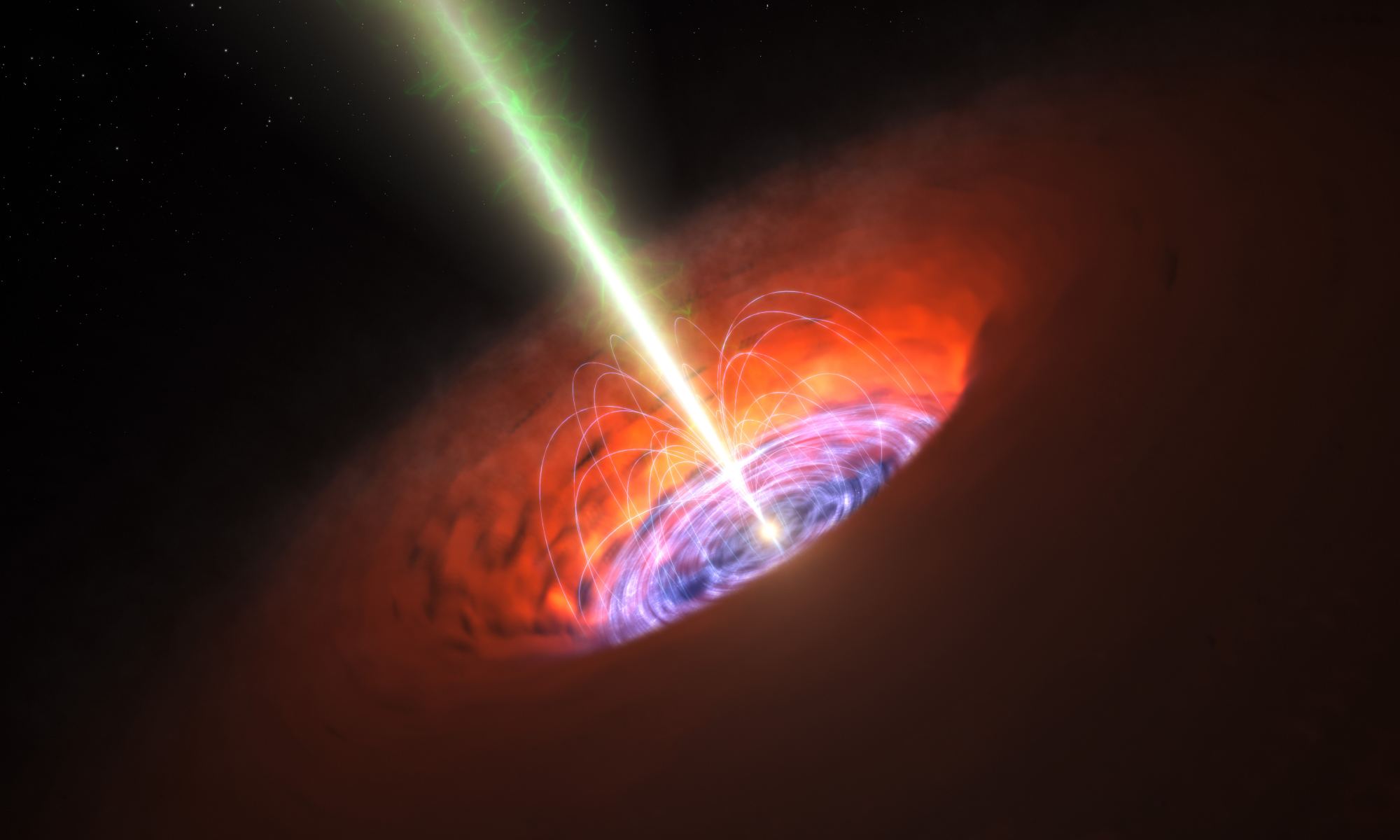
Artist view of an active supermassive black hole.

Credit: ESO/L. Calçada

A Black Hole is Hurling a jet of Material at its Neighboring Galaxy

It’s been a banner time for black hole research! In recent months, astrophysicists have announced the discovery of the most powerful gamma-ray burst ever recorded (due to the formation of a black hole), a monster black hole in our cosmic backyard, the frame-dragging effects of a binary black hole, and the remains of the 2017 Kilonova event (spoiler alert: it was a black hole). And with the help of citizen scientists, a team of astronomers recently discovered a unique black hole in a galaxy roughly one billion light-years away that’s hurling a relativistic jet at another galaxy.

The research was conducted by a team led by Ananda Hota, a researcher with the UM-DAE Centre for Excellence in Basic Sciences. He was joined by researchers from the Indian Institute of Astrophysics, the Sorbonne University’s Laboratory for the Study of Radiation and Matter in Astrophysics and Atmospheres (LERMA), the Arecibo Observatory, the Amity Institute of Applied Sciences, the Thapar Institute of Engineering and Technology, and the RAD@home Citizen Science collaboration. The paper that describes their findings was published on October 12th in the Monthly Notices of the Royal Astronomical Society Letters.

Galaxies are typically divided into three main classes based on size, shape, and composition. First, there are ellipticals, which account for about one-third of all galaxies in the Universe that range from being nearly circular to very elongated. Then there are spiral galaxies, which are noted for their distinct spiral arms and appear as flat disks with large yellowish bulges in their centers. Last, there are irregular galaxies, which are neither elliptical nor spiral and were more common in the early Universe (before evolving into the other two classes).

When it comes to elliptical galaxies, astronomers have observed that the formation of new stars is very scarce and appears to have largely ceased billions of years ago. While the reason for this remains a mystery, modern research suggests that the presence of supermassive black holes (SMBH) might be responsible. These “monster black holes” cause the centers of massive galaxies to become Active Galactic Nuclei (AGN) – aka. Quasars – where the nucleus is more energetic than all the stars in the disk combined.

In many cases, AGNs also have massive jets spewing from their poles that accelerate gas and dust to relativistic speeds (close to the speed of light). The ejection of this matter toward other galaxies is believed to deplete elliptical galaxies of the cold gas and dust that would otherwise be fuel for star formation. Another mystery facing astronomers is how these AGN-driven jets become coupled with the gas of merging galaxies, causing positive feedback. This temporarily leads to enhanced star formation, followed by negative feedback and a decline in star formation.

To address this latter mystery, Dr. Hota and his colleagues observed the SMBH at the center of RAD12, an elliptical galaxy located about 1 billion light-years from Earth. This unique nature of this galaxy first became apparent in 2013 based on optical data from the Sloan Digitised Sky Survey (SDSS) and radio data from the Very Large Array’s (VLA) Faint Images of the Radio Sky at Twenty-Centimeters (FIRST) survey. But when Dr. Hota and his team observed it again using the Giant Meterwave Radio Telescope (GMRT) in India, they noticed that RAD12 appeared to be ejecting matter from only one pole.

RAD12-RYB-GMRT-CFHT-MeerKAT-no-lbl-RAS.jpg

Image of the black hole within galaxy RAD12 spewing a large unipolar radio bubble onto its merging companion galaxy. Credit: Hota, A (et al.)/GMRT/CFHT/MeerKAT

These observations were confirmed using archival radio and optical data from the MeerKAT array in Australia and the Canada-France-Hawaii Telescope (respectively). Unlike other jets that eject matter in pairs and opposite directions, RAD12 appeared to be ejecting matter only toward its neighboring galaxy, RAD12-B. Their observations also revealed a jet of young plasma that is conical in shape at the stem and flares out to become mushroom-shaped at the end (shown above). The yellow features represent galaxies – the larger being RAD12 (left) and RAD12-B (right) – and the plasma jet is shown in red.

The whole structure extends for 440 thousand light-years and is much larger than the host galaxy itself. This is the first time a jet has been observed to collide with a large galaxy like RAD12-B. As Dr. Hota said in a recent Royal Astronomical Society (RAS) news release:

“We are excited to have spotted a rare system that helps us understand radio jet feedback of supermassive black holes on star formation of galaxies during mergers. Observations with the GMRT and data from various other telescopes such as the MeerKAT radio telescope strongly suggest that the radio jet in RAD12 is colliding with the companion galaxy. An equally important aspect of this research is the demonstration of public participation in making discoveries through the RAD@home Citizen Science research collaboratory.”

Thanks to the observations by Dr. Hota and his team, astronomers are now one step closer to understanding the impact that such interactions have on elliptical galaxies. Their findings could lead to a new understanding of how star formation is arrested in elliptical galaxies, resolving a long-standing mystery about galactic evolution. It is also a testament to the kind of research that is possible today through collaboration between citizen scientists and astronomers.

  • Further Reading: RA

{ https://www.universetoday.com/ }

Hoe vind je dit bericht?
Geschreven door peter om 00:14 Stuur door

Meer van UFO'S of UAP'S, ASTRONOMIE, RUIMTEVAART, ARCHEOLOGIE, OUDHEIDKUNDE, SF-SNUFJES EN ANDERE ESOTERISCHE WETENSCHAPPEN - DE ALLERLAATSTE NIEUWTJES

↑ Terug naar de berichten