Naar de inhoud

UFO'S of UAP'S, ASTRONOMIE, RUIMTEVAART, ARCHEOLOGIE, OUDHEIDKUNDE, SF-SNUFJES EN ANDERE ESOTERISCHE WETENSCHAPPEN - DE ALLERLAATSTE NIEUWTJES

UFO's of UAP'S in België en de rest van de wereld
akke.beakke.be
Ontdek de Fascinerende Wereld van UFO's en UAP's: Jouw Bron voor Onthullende Informatie! Ben jij ook gefascineerd door het onbekende? Wil je meer weten over UFO's en UAP's, niet alleen in België, maar over de hele wereld? Dan ben je op de juiste plek! België: Het Kloppend Hart van UFO-onderzoek In België is BUFON (Belgisch UFO-Netwerk) dé autoriteit op het gebied van UFO-onderzoek. Voor betrouwbare en objectieve informatie over deze intrigerende fenomenen, bezoek je zeker onze Facebook-pagina en deze blog. Maar dat is nog niet alles! Ontdek ook het Belgisch UFO-meldpunt en Caelestia, twee organisaties die diepgaand onderzoek verrichten, al zijn ze soms kritisch of sceptisch. Nederland: Een Schat aan Informatie Voor onze Nederlandse buren is er de schitterende website www.ufowijzer.nl, beheerd door Paul Harmans. Deze site biedt een schat aan informatie en artikelen die je niet wilt missen! Internationaal: MUFON - De Wereldwijde Autoriteit Neem ook een kijkje bij MUFON (Mutual UFO Network Inc.), een gerenommeerde Amerikaanse UFO-vereniging met afdelingen in de VS en wereldwijd. MUFON is toegewijd aan de wetenschappelijke en analytische studie van het UFO-fenomeen, en hun maandelijkse tijdschrift, The MUFON UFO-Journal, is een must-read voor elke UFO-enthousiasteling. Bezoek hun website op www.mufon.com voor meer informatie. Samenwerking en Toekomstvisie Sinds 1 februari 2020 is Pieter niet alleen ex-president van BUFON, maar ook de voormalige nationale directeur van MUFON in Vlaanderen en Nederland. Dit creëert een sterke samenwerking met de Franse MUFON Reseau MUFON/EUROP, wat ons in staat stelt om nog meer waardevolle inzichten te delen. Let op: Nepprofielen en Nieuwe Groeperingen Pas op voor een nieuwe groepering die zich ook BUFON noemt, maar geen enkele connectie heeft met onze gevestigde organisatie. Hoewel zij de naam geregistreerd hebben, kunnen ze het rijke verleden en de expertise van onze groep niet evenaren. We wensen hen veel succes, maar we blijven de autoriteit in UFO-onderzoek! Blijf Op De Hoogte! Wil jij de laatste nieuwtjes over UFO's, ruimtevaart, archeologie, en meer? Volg ons dan en duik samen met ons in de fascinerende wereld van het onbekende! Sluit je aan bij de gemeenschap van nieuwsgierige geesten die net als jij verlangen naar antwoorden en avonturen in de sterren! Heb je vragen of wil je meer weten? Aarzel dan niet om contact met ons op te nemen! Samen ontrafelen we het mysterie van de lucht en daarbuiten.

Archief

Vloten van UFO's verschenen aan tientallen vliegtuigen die de Stille Oceaan overstaken

Vloten van UFO's verschenen aan tientallen vliegtuigen die de Stille Oceaan overstaken

Een onderzoeker heeft in een video de dramatische beelden van de luchtverkeersleiding vrijgegeven van Amerikaanse piloten die vreemde waarnemingen van niet-geïdentificeerde vliegende objecten (UFO's) melden terwijl ze over de Stille Oceaan vlogen. 

Ervaren piloten meldden dat ze in augustus en september "felle lichten in langwerpige cirkels" hoog in de lucht zagen bewegen tijdens het vliegen van Japan en Hawaï naar de westkust van de Verenigde Staten . Zelf probeerden ze vanuit hun hutten de groep van drie tot vijf heldere objecten te filmen, die leek te vliegen in het gebied van de lucht waar het sterrenbeeld Grote Beer zich bevindt.

Deze grafiek toont de locatie en data van verschillende gerapporteerde UFO-waarnemingen, voornamelijk in de Stille Oceaan, in augustus en september.
© Aangeboden door Profiel

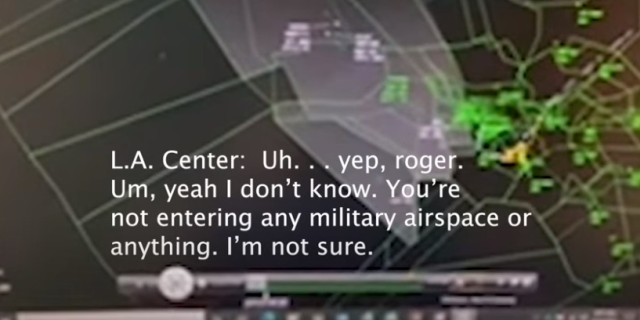
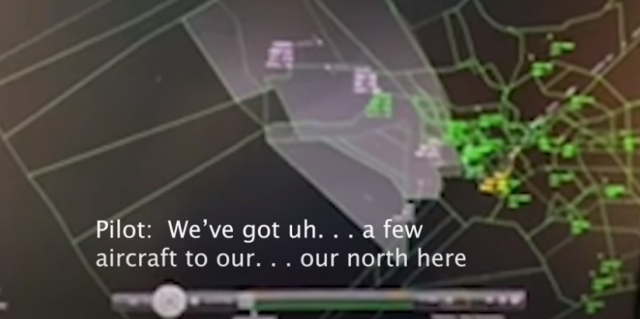
'We hebben hier een paar vliegtuigen die in noordelijke richting vliegen en ze cirkelen, veel hoger dan wij. Enig idee wat ze zijn?' vroeg Mark Hulsey, een piloot die een Gulfstream-chartervliegtuig bestuurt voor de kust van Los Angeles.

De piloot beschreef dat hij daar "misschien drie vliegtuigen " zag en 23 minuten later belde hij het  Air Route Traffic Control Centre (ARTCC) met de mededeling "er zijn er nu zo'n zeven" en schatte dat ze "ten minste 5 of 10.000 voet boven de grond waren". ." boven ons."

Deze afbeelding toont de helderheid van de UFO in vergelijking met de drie sterren (binnen rode cirkels).
© Aangeboden door Profiel

Gevraagd door de controller om meer details, voegde Hulsey eraan toe: " Ze blijven maar in cirkels draaien ." "Ik was een F-18-piloot bij het Korps Mariniers en ik zeg je dat ik veel onderscheppingen heb gedaan, ik heb nog nooit zoiets gezien", vertelde hij aan verslaggevers.

Chris Van Voorhis, 63, vertelde dat hij tussen de drie en vijf objecten zag, veel helderder dan de sterren om hem heen, vervagend zonder waarneembaar patroon en bewegend in een cirkelvormige "racebaan" -beweging terwijl hij in augustus van Honolulu naar Los Angeles vloog.

De ervaren piloot zei dat de objecten zich in een baan om de aarde of zelfs verder in de ruimte leken te bevinden , gezien hun voortdurende positie nabij het sterrenbeeld Ursa Major terwijl ze urenlang over de oceaan vlogen.

"De andere luchtvaartmaatschappijen zeiden: "Hé, zie je wat wij zien?"  , herinnerde de ervaren piloot zich. "Het waren lichten die heel intens aangingen, je zag ze bewegen en toen gingen ze uit" en hij verduidelijkte dat het geen satellieten konden zijn omdat ze lineair en in dezelfde richting zouden bewegen.

Ervaren piloten meldden dat ze urenlang "felle lichten in langwerpige cirkels" hoog in de lucht zagen bewegen terwijl ze routes van Japan en Hawaï naar de Amerikaanse westkust vlogen.

Ervaren piloten meldden dat ze urenlang "felle lichten in langwerpige cirkels" hoog in de lucht zagen bewegen terwijl ze routes van Japan en Hawaï naar de Amerikaanse westkust vlogen.

© Aangeboden door Profiel

"Het moest in een zeer, zeer hoge baan om de aarde zijn, of zelfs in de ruimte, vrij ver van alles wat een satelliet zou kunnen zijn, want elke keer dat we het zagen, bevond het zich in de rechter benedenhoek van de Grote Beer, wat er ook gebeurde. deel van de wereld waarin we ons bevonden.  Het duurde zo lang dat het eigenlijk bijna saai werd."

Van Voorhis zei dat UFO-waarnemingen heel gewoon zijn onder piloten: "Van mijn pilootvrienden heeft minstens 50% een of andere anomalie gezien", zei hij.

Kapitein Mark Hulsey heeft op 18 augustus UFO's waargenomen in Santa Catalina, een eiland voor de kust van Los Angeles.
Kapitein Mark Hulsey heeft op 18 augustus UFO's waargenomen in Santa Catalina, een eiland voor de kust van Los Angeles.© Aangeboden door Profiel

Ben Hansen, een voormalig FBI-agent en presentator van het Discovery+ -kanaal " UFO Witness "-programma, verzamelde  tussen 6 augustus en 23 september accounts van piloten van meer dan 15 commerciële vluchten voor Southwest Airlines , Hawaiian Airlines en anderen . dezelfde lichten aan de hemel als Van Voorhis.

"Veel van deze piloten hebben er alle vertrouwen in dat de lichten niet slechts in één richting gingen, maar in beide richtingen, wat zeer ongebruikelijk is voor satellieten. In het geval van Hulsey zouden ze uit het noorden komen en dan over hun schip gaan, waar hij moest zijn nek uitstrekken om ze vanaf het bladerdak te kunnen zien," zei hij.

Piloot Chris Van Voorhis vertelde dat hij tussen de drie en vijf UFO's zag, veel helderder dan de omringende sterren, vervagend zonder waarneembaar patroon en bewegend in een cirkelvormige "racebaan" -beweging, terwijl hij in augustus van Honolulu naar Los Angeles vloog.
© Aangeboden door Profiel

"In dit geval hebben we een wereldwijd fenomeen van West-Japan tot Oost-Miami.  Wat het ook is, piloten zien het vanaf de andere kant van de wereld," zei hij.

Maar Hansen zei dat er momenteel geen goede procedure is voor het melden van dergelijke waarnemingen, zelfs niet van vreemde objecten die een veiligheidsrisico kunnen vormen voor commerciële luchtvaartmaatschappijen.
{ https://www.msn.com/ }

Hoe vind je dit bericht?
Geschreven door peter om 20:30 Stuur door

"Racetrack UAPs" Reported by Dozens of Pilots and Commercial Flights

"Racetrack UAPs" Reported by Dozens of Pilots and Commercial Flights

A series of strange UFO incidents over the Pacific Ocean this summer were captured on video and in air traffic control recordings after sightings by dozens of pilots. 
The incidents were reported to the FAA, and a researcher obtained dramatic audio of the pilots calling in the strange sightings to Los Angeles Air Route Traffic Control Center (ARTCC), reports dailymail. 
ufo%20uap%20pilot%20sightings%20(1).png

UAPs/UFOs now dubbed the "Racetrack UAPs" have now been reported by dozens of pilots from upwards of 15 different commercial flights in August and September, 2022 from off the coast of Japan to the mid-western U.S. 
ufo%20uap%20pilot%20sightings%20(2).png

ufo%20uap%20pilot%20sightings%20(3).png

ufo%20uap%20pilot%20sightings%20(4).png

We provide a detailed breakdown of the intensely bright UFOs that are described as revolving in a circular pattern. New videos from Hawaiian Airlines flights, Southwest Airlines, and a private Gulfstream 650 flight are presented and different theories are discussed. 
Video below: For those only wanting to see the newly released videos and analysis, forward to 14:00 minutes to see the Hawaiian Airlines video and 32:34 to see the Southwest Airlines video.

Video below: These are excerpts from radio communications between airline pilots and the Los Angeles Air Route Traffic Control Center (ARTCC) in the early morning hours of August 18, 2022. A Gulfstream 650 and an American Airlines flight both reported witnessing UAPs while overflying the Catalina and Channel Islands area. 
  

{ http://ufosightingshotspot.blogspot.com/ }

Hoe vind je dit bericht?
Geschreven door peter om 18:39 Stuur door

Unbelievable but true "UFOs on trial in Italy"

Unbelievable but true "UFOs on trial in Italy"

The court of Sondrio is ready to make history. For the first time in a criminal trial, UFOs have been addressed. A story that is unbelievable occurred in Chiesa in Valmalenco, where the clash between a commander of the Carabinieri and his superiors has been going on for years. Thousands of euros were spent on an alleged fraud against the state for a total of 80 euros. And, to top it off, UFOs are at the center of the dispute. 
ufos%20aliens%20trial%20Italy%20(2).png

For the first time in a criminal trial, UFOs have been addressed. A story that is unbelievable occurred in Chiesa in Valmalenco, where the clash between a commander of the Carabinieri and his superiors has been going on for years. 
ufos%20aliens%20trial%20Italy%20(1).png
The commander of the Carabinieri reports everything and reports that he witnessed the events. Over the years, the reports multiply. The authority continues to record all events, sending - as per procedure - reports to the relevant provincial Company Command and the Ministry of Defense. 
In 2019 the case broke out: the superiors instructed him not to send reports of unidentified flying objects and non-human but intelligent beings anymore and to silence him, his superiors charged him with fraud and defamation, but In Sondrio, the UFOs are about to enter the courtroom because the judge would have admitted as evidence a dossier on the series of sightings of unidentified objects in the period in which Alessandro Di Roio was operating in Chiesa in Valmalenco with as a result that the commander of the Carabinieri won the trial. 
ufos%20aliens%20trial%20Italy%20(3).png

This is a long report, read the entire case at:
Links to Italian newspapers on this case: 

{ http://ufosightingshotspot.blogspot.com/ }

Hoe vind je dit bericht?
Geschreven door peter om 18:34 Stuur door

Amazing UFO sighting filmed over Medellin, Colombia – October 2022

Amazing UFO sighting filmed over Medellin, Colombia – October 2022

ufo-Medellin-1024x576.jpg

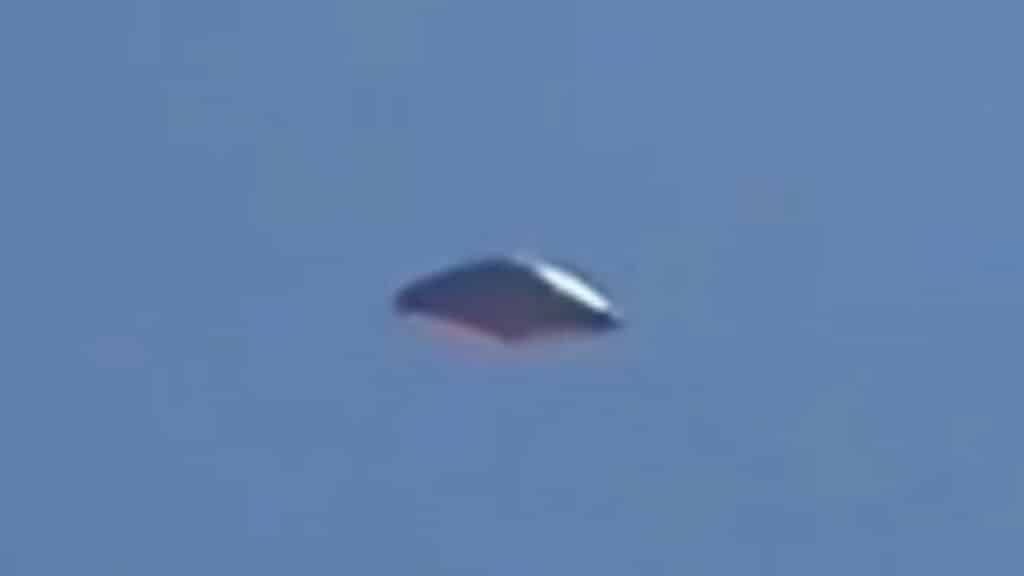
Check out this interesting UAP sighting footage of stationary object hovering in the daytime sky above Medellín, the capital of Colombia’s mountainous Antioquia province.

What do you think about this footage? Please leave your comment below!

Author’s report: 

A friend of mine captured this object in the skies above Medellin. Said it was stationary and rocking back and forth. There was a red glow underneath. It remained stationary. He said it was one solid object and rotated upside down. Definitely not a hang glider. It remained stationary and tilted against the wind. I’ve seen hanggliders in Medellin, I don’t think this is that.

{ https://www.latest-ufo-sightings.net/ }

Hoe vind je dit bericht?
Geschreven door peter om 17:11 Stuur door

TicTac UFO over Syracuse, NY 28-Aug-2022

TicTac UFO over Syracuse, NY 28-Aug-2022

tic-tac-ufo-1024x576.jpg

This white cylindrical shaped unidentified flying object was seen and recorded in the daytime sky above Syracuse in New York on 28th August 2022.

Witness report: 

“Tic toc” shaped flying object spotted over my back yard in Syracuse, NY. 10:12 AM 8/28/22. No sound, no exhaust. We have an airport 2 miles away so I see planes flying low and the drones out of Hancock air base all the time. I watched it for about 10 seconds before I grabbed my phone to film it. It was too strange not to. Straight line cruising pretty fast.

{ https://www.latest-ufo-sightings.net/ }

Hoe vind je dit bericht?
Geschreven door peter om 17:06 Stuur door

LATEST UFO SIGHTINGS AND VIDEOS

LATEST UFO SIGHTINGS AND VIDEOS

UFO "Orb" Sighted Making Manoeuvres Over Palm Desert, California. October 9, 2022

Witness stated the following: "I am a film and TV director and recording artist. When I saw the object, I started filming with an iPhone. I was talking to someone on the phone when I witnessed the event. The object moved away from the moon, ascended, then descended making right and left turns, and seem to go straight towards the moon then quickly turned and moved away from it. I lost it after a couple of minutes due to it disappearing behind some high cloud coverage."

Source: MUFON Case Number: 125794

Bright UFO appears to interfere or jam the Witness Recording, Costa Rica, Nov 2021

Video shared on Reddit by lakecote1971, recorded on November 27, 2021 in San Jose, Costa Rica. Andrea Vargas from Desamparados, San Jose, Costa Rica says her phone was permanently damaged with that buzzing sound.
She claimed the object somehow tried to jam her device.

Let Talk About UFOs And More & Our Special Guest: Third Phase Of Moon

We will be taking look at some some UFO footages and chilling with Third Phase Of Moon so grab them if you got'em because you never know who may join me.

UFOs: Hard Evidence Vol. 1 UFO Documentary Series

UFO Hard evidence is a six-part series that examines the UFO phenomenon and the mounting evidence that suggests there is something very real behind claims of UFO sightings and alien abduction, despite the continued denials by governments around the world.

This first episode explores sightings of triangular UFOs, which began to be seen increasingly in the late-1980s and throughout the 1990s, as well as some of the most intriguing UFO sightings captured on film.

The Belgian Wave – including documents that show all of the US intelligence agencies were kept completely up to date on the events as they happened, as well as radar confirmation from the Belgian air force of an object traveling faster than any human pilot could survive.

It also features UFO Researcher, Nick Pope, speaking of a particularly intriguing UFO sighting in March 1993, as well as an in-depth look at the midair UFO encounter of Malcolm Smith in June 1997. Another intriguing encounter that is explored here is a close sighting of a triangular UFO in Yorkshire in January 1998, including extensive interviews with the witnesses.

Perhaps most interesting of all is an in-depth interview with UFO investigator, Tony Dodd, who shares his experiences of huge triangular aircraft, including an incident involving alien occupants being witnessed emerging from one of these mysterious vehicles, as well as just some of the alien abduction cases, he has investigated.

Russell Callahan has studied UFO images for years, and he speaks about some of the most intriguing images of potential vehicles from another world, the methods he uses to analyze them, and finally examine what appears to be a UFO exploding over New Mexico in January 1998.

A series of episodes from the UFOs: Hard Evidence series by Graham W Birdsall of the now defunct UK publication, UFO Magazine originally produced for Quest Publications and edited by Russel Callaghan. Originally released in 1998.

TIMESTAMPS

0:00-3:09 - Introduction

3:09-6:37 - The Belgian Wave UFO Encounters

6:37-12:12 - Nick Pope On A UFO Sighting March 1993

12:12-20:00 - Malcolm Smith UFO Sighting

20:00-24:40 - Triangular UFO Sighting In Yorkshire

24:40-45:34 - Tony Dodd Interview

45:34-47:12 - First World UFO Conference, Brazil

47:12-53:37 - UFO Images With Russell Callahan

53:37-55:17 - UFO Sightings Over Mexico

55:17-57:36 - Exploding UFO Footage From New Mexico 1997

57:36-58:34 - Credits

UFOs: Hard Evidence Vol. 2 UFO Documentary Series

This episode of UFO Hard Evidence looks at some of the most mind-blowing sightings and disturbing encounters on record, as well as interviews with various people from UFO circles.

It begins by examining multiple sightings of strange, mysterious lights over the north of England on the evening of 2nd February 1998, one of which was captured on footage by one of the witnesses. The sightings are one of the most intriguing if little known on record, known as the Pennine Lights incident.

This episode also visits the town of Laughlin in Nevada which hosts the annual International UFO Congress and Film Convention which not only offers lectures from dozens of experts around the world but the chance for attendees to view collectible merchandise and memorabilia of ufology.

Jaime Maussan also explores a video of a UFO from early 1998 that he was sent by an anonymous person to analyze, a piece of footage that is certainly intriguing and shows a distinct disc-shaped object and would appear to be very credible. Furthermore, several other witnesses later came forward to claim they had witnessed the object also. Even more disturbing, according to Maussan, many of those witnesses would later become extremely sick.

There are also brief interviews with researchers and investigators Yvonne Smith and James Courant, as well as a more in-depth discussion with former US soldier, John Vasquez, who speaks about an alleged mass abduction case from 1977, referred to as the Fort Bennington incident.

Meteor Crater is also explored, a place that the Apollo astronauts used as training to hone their skills before embarking on their respective moon landing missions. The subject of reverse-engineered alien technology is examined as the team visit Area 51. Photo expert, Russell Callahan examines and analyzes some of the controversial images and footage in history, those by George Adamski, and the conclusions are perhaps not what many would expect.

UFO researcher and author, Timothy Good also speaks in-depth about his book Alien Base, as well as the apparent disclosure of information from Peter Horsley, who claims to have met an alien at a house in London.

A series of episodes from the UFOs: Hard Evidence series by Graham W Birdsall of the now defunct UK publication, UFO Magazine originally produced for Quest Publications and edited by Russel Callaghan. Originally released in 1998.

TIMESTAMPS

0:00-3:38 - Introduction

3:38-22:27 - The Pennine Lights UFO Incident

22:27-23:29 - Nevada International UFO Congress and Film Convention, Laughlin, Nevada

23:29-33:14 - The “Best UFO Video Ever Taken” (early 1998) Analysis with Jaime Maussan

33:14-34:30 - Interview with alien abduction researcher, Yvonne Smith

34:30-36:27 - Interview with the researcher, James Courant

36:27-41:52 - The Fort Benning Alien Abduction Incident – Interview with John Vasquez

41:52-43:27 - Meteor Crater, Arizona – Where the Apollo astronauts trained

43:27-50:14 - Area 51 and reverse-engineered technology

50:14-53:36 - Analysis of George Adamski footage and images with Russell Callahan

53:36-56:35 - Interview with UFO researcher Timothy Good

56:35-58:08 - Moving Images – UFO Video Footage

58:08-58:45 - Credits

{ https://www.youtube.com/ }

Hoe vind je dit bericht?
Geschreven door peter om 16:54 Stuur door

Everyone Knows the Mask of King Tut, but Have You Seen Any of the 5,000 Other Treasures from His Tomb?

Everyone Knows the Mask of King Tut, but Have You Seen Any of the 5,000 Other Treasures from His Tomb?

Everyone Knows the Mask of King Tut, but Have You Seen Any of the 5,000 Other Treasures from His Tomb?

To his subjects, King Tutankhamen was part man, part god. His death in 1323 BC signaled the end of an era - the end of Egypt as an imperial power. The circumstances surrounding King Tut’s death are shrouded in mystery. Equally obscure is the reason for his unusually small tomb. And yet, thanks to Howard Carter’s discovery nearly 3,000 years later, there is no Pharaoh more well-known and well-loved than King Tut. Inside the tomb, Carter discovered glorious treasures that had lain undisturbed for thousands of years. For a culture that believed being remembered was the path to eternal life, the preservation of King Tut’s tomb has ensured that his nameless and forgotten enemies failed miserably.

An Astonishing Array of Grave Goods and The Most Intact Royal Tomb Ever Found

Tutankhamen died of unknown causes in 1323 BC at the age of 20. He did not have a clear successor but the tiny mummies of two stillborn daughters, possibly twins were found in his tomb. Due to his sudden and unexpected death, the burial was hastily prepared in a somewhat less-than-grand tomb, measuring only “3.68 m or 12.07 feet high, 7.86 m or 25.78 feet wide and 30.79 m or 101.01 feet long” (History Embalmed, 2016).

For political reasons, the boy-king was to be forgotten and his name never mentioned for the rest of eternity, a fate worse than death for the ancient Egyptians. Yet by a strange stroke of luck, Tut’s obscurity preserved his tomb from grave robbers. Then, “discovered by archaeologist Howard Carter in 1922, the tomb of King Tut yielded an astonishing array of grave goods—more than 5,000 artifacts, many of them in pristine condition. It was the most intact royal tomb ever found, providing Egyptologists with an unprecedented glimpse into the material life of a king who ruled during the 14th century B.C.” (Hessler, 2016).

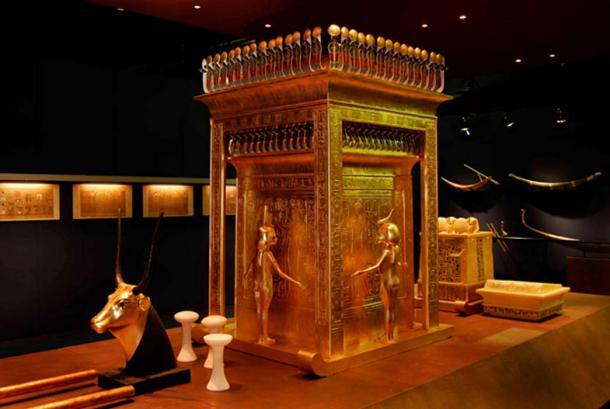
The canopic shrine from King Tutankhamun’s tomb.

The canopic shrine from King Tutankhamun’s tomb.

( seethrumag.org)

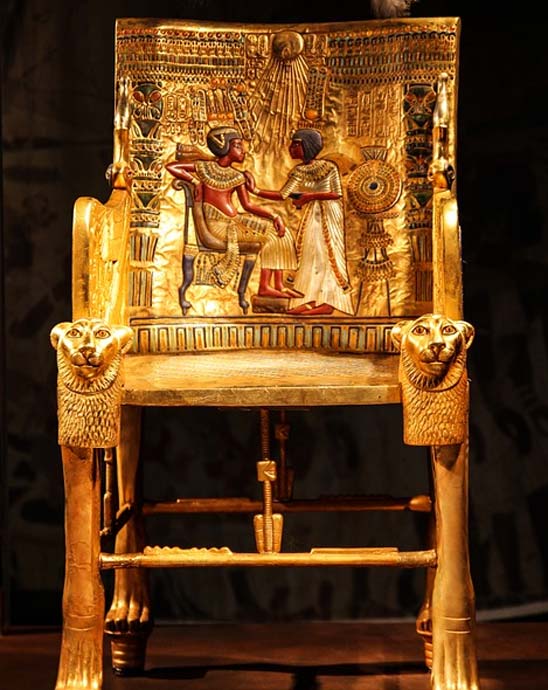
Tutankhamun’s throne from his burial chamber.

Tutankhamun’s throne from his burial chamber.

( public domain )

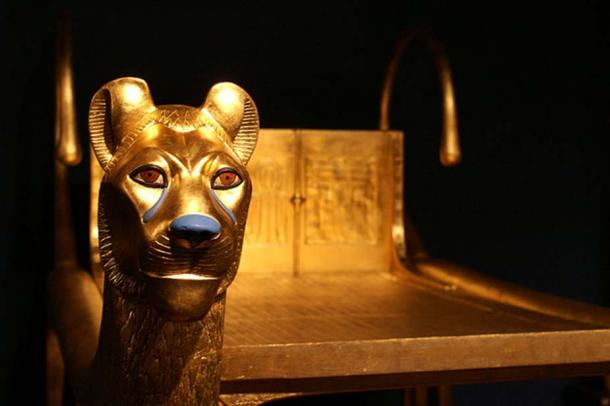
Detail of golden lions on a ritual bed found in the tomb.

Detail of golden lions on a ritual bed found in the tomb.

( CC by SA 3.0 )

The Golden Sarcophagus

It took Howard Carter 10 years to clear and catalog all the riches stored in the tomb. Most spectacular of all was the golden sarcophagus of Tutankhamen and the inlaid coffins, including one made of solid gold. Inside this nesting-doll-like assembly, rested the mummified body of the boy-King. His death mask, also made of gold, has become the symbol of ancient Egyptian finery and is considered one of the greatest works of art of the ancient world. It was Carter himself who, on October 28, 1925, lifted the heavy lid of the sarcophagus to look upon a wonder that had not been seen in 3,250 years.

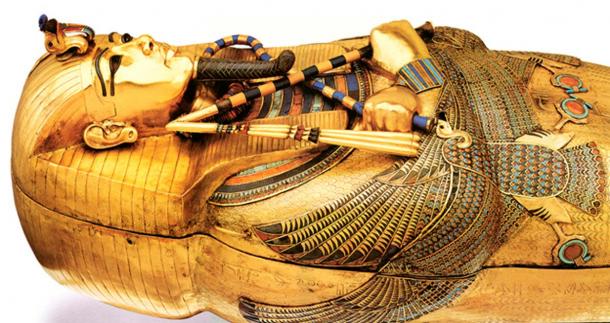
Tutankhamun’s golden coffin.

Tutankhamun’s golden coffin.

( Asaf Braverman / flickr )

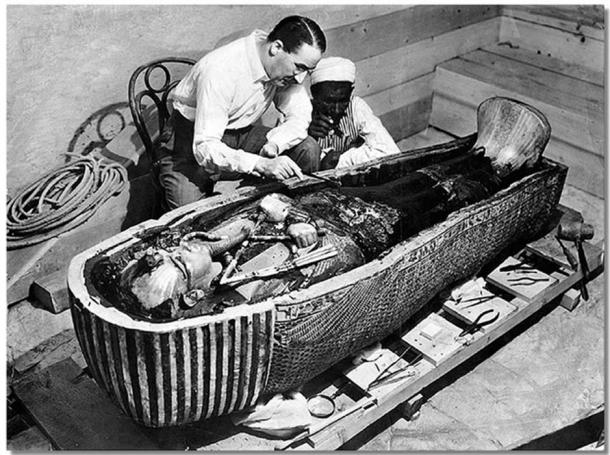
Howard Carter opens the innermost shrine of King Tutankhamen's tomb near Luxor, Egypt.

Howard Carter opens the innermost shrine of King Tutankhamen's tomb near Luxor, Egypt.

( Public Domain )

In his diary, Carter wrote:

“The pins removed the lid was raised. The penultimate scene was disclosed - a very neatly wrapped mummy of the young king, with a golden mask of sad but tranquil expression, symbolizing Osiris. The similitude of the youthful Tut.Ankh.Amen, until now known only by name, amid that sepulchral silence, made us realize the past. By this bespangled mummy as it lies in the coffin, he must have been a tall youth - from the top of the headdress of the mask to the feet it measures 6 feet. Attached to the throat of the golden mask, beautifully wrought with juvenile countenance, are three massive gold & faience necklaces, a pendent heart-scarab placed between the hands, crossed over the breast, which hold the flail and the crook. Below this mask, which reaches as far as the hands, is the linen covering and outer bandages, strapped in place by broad longitudinal and transverse flexible bands of inlaid gold work depending from a highly decorative incrusted gold protective figure of Nekhbet. She has full spread wings reached across the body and a human head.” (Carter, 1925).

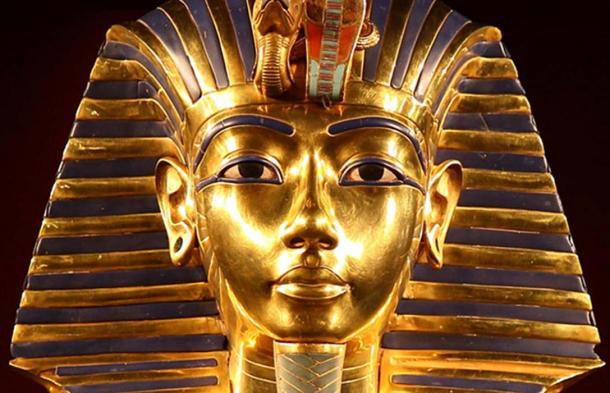
Detail of the iconic Golden Mask of Pharaoh Tutankhamun.

Detail of the iconic Golden Mask of Pharaoh Tutankhamun. 

(CC BY 2.0 )

Thousands of Artifacts

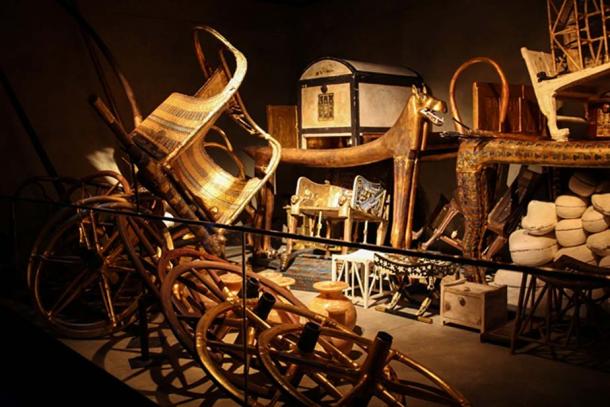
In addition to the sarcophagus, the tomb contained many wonders to behold. Yet the treasures were in a great deal of disorder, perhaps because of the untimely death of the Pharaoh, everything was placed helter-skelter, seemingly without logic. There were six disassembled chariots and all manner of weapons, shields, and daggers – King Tutankhamen is said to have loved the hunt. There was also a wide array of furniture, much of it covered in gold: two royal thrones, couches, chairs, ritual beds, and headrests. There were chests containing priceless pieces of jewelry and beautiful clothing made of fine linen. There were jars containing rare perfumes, precious oils, and ointments. There were elaborate shrines to the gods, including one which hosted the Canopic jars that stored King Tut’s preserved internal organs. There were musical instruments and writing implements, lamps, ostrich fans, and board games. There was food and as many as 30 bottles of wine. There were also “139 ebony, ivory, silver, and gold walking sticks” (History Embalmed, 2016). In short, every conceivable thing a young king may need in the next life could be found surrounding his body and sealed shut for eternity in the tomb. Outside it all stood a magnificent life-size, gilded statue of the god Anubis, believed to be the lord of the underworld and protector of the dead.

Just a small selection of the thousands of treasures found hastily stacked inside King Tut’s burial chamber.

Just a small selection of the thousands of treasures found hastily stacked inside King Tut’s burial chamber.

( public domain )

Canopic jars from Tutankhamun’s tomb.

Canopic jars from Tutankhamun’s tomb.

( CC by SA 2.0 )

Because of this discovery, Tutankhamen is one of the best-known Egyptian kings. His name is referenced is TV shows, movies, and video games ranging from the Three Stooges to Transformers. And thus, despite his enemies, King Tut has achieved eternal life.

Recently, Egyptologists have been reinvestigating Tutankhamen’s tomb. Experts believe that his small, seemingly second-rate burial may, in fact, have been a decoy to distract grave robbers from the real prize. “Radar scans on those walls [of Tut’s tomb] have revealed not only the presence of hidden chambers, but also unidentified objects that lie within these rooms. These objects…seem to be composed of both metal and organic materials” (Hessler, 2016).

The most popular theory? Concealed behind Tut’s tomb could be the long lost burial chamber of the magnificent Queen Nefertiti.

By Kerry Sullivan

Sources:

RELATED VIDEOS, selected and posted by peter2011

{ https://www.ancient-origins.net/ }

Hoe vind je dit bericht?
Geschreven door peter om 23:15 Stuur door

2.46 Billion Years ago, a day on Earth was Only 17 Hours and the Moon was Much Closer

2.46 Billion Years ago, a day on Earth was Only 17 Hours and the Moon was Much Closer

BY PAUL M. SUTTER

ATV4-3-1024x576.jpg

The ATV-4 is just visible as it passes into Earth's terminator.

Credit: NASA TV.

As the ages pass the Moon slowly drifts away from the Earth. In conjunction the length of our day gradually gets longer. For the first time astronomers have been able to estimate the length of the day and the distance to the Moon as it was almost two and a half billion years ago. Back then, our day was only 17 hours long.

As the Moon orbits the Earth it raises tides. These bulges stretch in the direction of the Moon and on the opposite side of the Earth. But the Earth is also spinning, and that rotation brings the bulge of the tide forward with respect to the current position of the Moon. This lump gives an extra gravitational tug to the Moon, like an invisible leash pulling on our satellite. That gravitational tug boosts the Moon into a more distant orbit.

But the energy to boost to that orbit has to come from somewhere, and it comes from the rotation of the Earth. In the distant past our day was much shorter as the Earth spun much faster on its axis. But with every day that passes, it gets longer and longer. 

Astronomers have known about this for quite some time and have used geologic records to estimate the length of the day in the past. But there’s a limit to what those records can tell us. New research has turned to a different kind of geologic record to estimate the length of the day.

The researchers studied banded iron formations in sedimentary rocks in Western Australia. In these kinds of formations, iron-rich layers alternate with more clay-like layers. The shape of these patterns is determined by the Earth’s climate. The Earth’s climate goes through several different variations, including one called the Milankovitch cycle, which is determined by the Earth’s orbit and the length of the Earth’s day.

The scientists were able to reconstruct the length of the Earth’s day at the time these formations were laid, 2.46 billion years ago. They found that at the time the dat lasted only 17 hours, much shorter than the current 24.

The current distance to the Moon gives us the very special phenomenon of total solar eclipses. This can only be possible if the apparent size of the Sun and the Moon are the same on our sky. While that’s true for now, in a few hundred million years the Moon will be too far away, and it will be too small to give us total solar eclipses. So enjoy them while they last.

{ https://www.universetoday.com/ }

Hoe vind je dit bericht?
Geschreven door peter om 22:26 Stuur door

The Asteroid That Killed the Dinosaurs Also Flooded the World's Coastlines With a Catastrophic Tsunami

The Asteroid That Killed the Dinosaurs Also Flooded the World's Coastlines With a Catastrophic Tsunami

BY MATT WILLIAMS

Earth and possibly its Moon were hit by impactors that killed off the dinosaurs

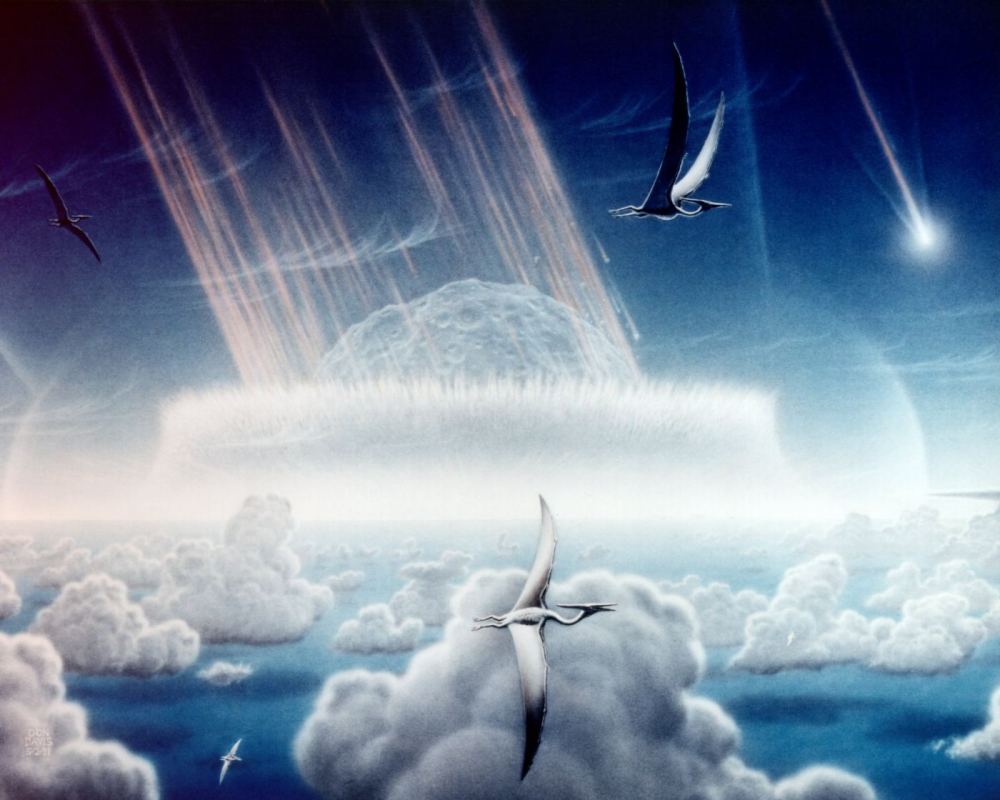
Artistic rendition of the Chicxulub impactor striking ancient Earth, with Pterosaur observing. Could pieces of the same impact swarm have hit the Moon, too?

Credit: NASA

For decades, scientists have theorized that a massive impact caused the Cretaceous-Paleogene extinction event. This event occurred about 66 million years ago and caused the mass extinction of about 75% of all plant and animal species on Earth (including the non-avian dinosaurs). With the discovery of the massive Chicxulub crater in the Yucatan Peninsula (southern Mexico) in the 1970s, scientists concluded that they’d found the impact responsible. Based on all the available data, the Chicxulub Impact event is believed to have been as powerful as 100,000 billion metric tons (110,231 U.S tons) of TNT.

This blast was more powerful than all the nuclear devices in the world combined and sent an estimated 25 trillion metric tons (~27.5 US tons) of hot dust, ash, and steam into the atmosphere, creating a global winter. But according to new research led by the University of Michigan, an international team of geologists has determined that the impact also created a global tsunami. According to their findings, this tsunami was 30,000 times more powerful than the 2004 Indian Ocean tsunami, one of the largest and most devastating tsunamis on record.

The team was by Molly M. Range, a with the Department of Earth and Environmental Sciences at the University of Michigan, Ann Arbor. She was joined by an international team of researchers from the NOAA’s Pacific Marine Environmental Lab (PMEL) and Geophysical Fluid Dynamics Laboratory (GFDL), the Institute of Environmental Geosciences (IGE), the Geophysics and Spatial Oceanography Studies Laboratory (LEGOS), the University Corporation for Atmospheric Research (UCAR), the PALEOMAP Project, and multiple universities.


The maximum sea surface perturbation heights of the global tsunami. Credit: Range, M. (et al.)/AGU Advances

To recap, evidence of the Chicxulub Impact is traced to the crater buried beneath the Yucatan Peninsula of southern Mexico. The crater measures 180 km (110 mi) in diameter and 20 km (12 mi) in depth and is centered offshore near the community of Chicxulub (from which it takes its name). Based on the crater’s dimensions, scientists estimate that the meteor that caused it measured about 14 km (8.7 mi) in diameter. Evidence of the impact is also found in the geological record in the form of deposits of iridium and other impact ejecta that were globally distributed.

This led to the scientific consensus that the impact that led to the Chicxulub crater was responsible for the Cretaceous-Paleogene extinction and possibly the volcanic activity that created the Deccan flood basalt in India. For the sake of their study, Range and her colleagues sought to determine the effects this impact had on the world’s oceans, from the initial moment of contact to the point where it became a global tsunami. To do this, the team created the first global simulation of this impact using hydrocode (which models fluid systems in 3D) and a shallow-water ocean model.

As study co-author Brian Arbic – a researcher with the University of Michigan (Ann Arbor), the IGE, and LEGO – told Universe Today via email, the simulation involved three steps. In the first step, the hydrocode was run by co-author Brandon Johnson (Purdue University) and simulated the first ten minutes of the impact. During this time, explained Arbic, the effects were nothing short of cataclysmic:

“[M]aterial from the asteroid, the underlying bedrock of the Earth, sediment, and ocean was displaced tens of kilometers above the atmosphere and (in the other direction) tens of kilometers below the Earth’s surface – in other words, a great big hole was dug out of the Earth. A massive crater was created by this impact, as well as an outward propagating “rim wave”. Most of the energy in the tsunami is due to the rim wave, but there is also a significant secondary effect due to water rushing back into the crater that the impact created.”

The maximum flow velocity of the global tsunami at each grid cell (b).

Credit: Range, M. (et al.)/AGU Advances

The second step was performed by Range as part of her Master’s Thesis at the University of Michigan, Ann Arbor. This consisted of putting the output of the hydrocode into two global shallow-water tsunami propagation models. These included the Modular Ocean Model 6 (MOM6), developed by co-author Alistair J. Adcroft (a research oceanographer from Princeton University), and the Method of Splitting Tsunami (MOST) developed by co-author Vasily Titov – a senior tsunami modeler at the NOAA’s Pacific Marine Environmental Lab.

“Vasily simulated the tsunami with MOST, and the results are fairly similar to those obtained with MOM6,” said Arbic. “Obtaining similar results from two different models gave us more confidence in our results. We will examine differences between shallow-water models and other models in future work.”

The third step consisted of co-author Ted Moore – a Professor Emeritus at the University of Michigan, Ann Arbor – examining the geological record of the Cretaceous-Paleogene boundary for signs of sediment erosion. This revealed that more erosion occurred in the North Atlantic and South Pacific basins than in the South Atlantic and North Pacific. In short, the geological record shows that the seafloor in these regions was eroded and scoured more aggressively, with flow velocities of about 100 meters per second (360 km/h; 224 mph).

Moreover, the model showed that the wavefront propagation velocities, the speed at which waves formed on the surface, were about 200 meters per second (720 km/h; 447 mph). This is consistent with what the team’s model predicted and constitutes the best observational evidence of a global tsunami at the Cretaceous-Paleogene boundary. Their results also indicate that the Cretaceous-Paleogene tsunami was several orders of magnitude more powerful than any observed in recorded history. As Range described it, the effects of the impact were seen worldwide:

“It was a global impact. The tsunami was seen across the globe in 48 hours. Most coastal regions saw waves hit the coastline. Depending on where you look, wave heights could be from 1 meter to hundreds of meters tall. At ten minutes post-impact, the wave that had formed in the Gulf of Mexico was 1.5 km tall. This tsunami has 30,000 times the energy of the 2004 Indian Ocean Tsunami.”

Plate reconstruction and drill site locations (circled) at the age of the K/Pg boundary, showing continental blocks (gray), and modern continental outlines (red), where the K/Pg tsunami was most violent (green).

Credit: Range, M. (et al.)/AGU

This research provides additional insight into one of the most important events in geological history. In addition, said Range, the research has significant implications for planetary defense:

“The Chicxulub event had many important impacts, which have been previously documented – fires, wild swings of temperature (both very hot and very cold), destruction and eventual resetting of the predominant forms of life on Earth, and more. The tsunami was another important impact, and we plan to continue studying this tsunami and its impacts on the geological record that we can still examine. Impacts from large asteroids and meteors could happen again, which is why NASA recently ran the DART mission to see if they could be deflected.”

The paper that describes their findings, titled “The Chicxulub Impact Produced a Powerful Global Tsunami,” recently appeared in the journal AGU Advances.

Further Reading: AGU Advances

{ https://www.universetoday.com/ }

Hoe vind je dit bericht?
Geschreven door peter om 22:17 Stuur door

The Heaviest Element Ever Seen in an Exoplanet’s Atmosphere: Barium

The Heaviest Element Ever Seen in an Exoplanet’s Atmosphere: Barium

BY EVAN GOUGH

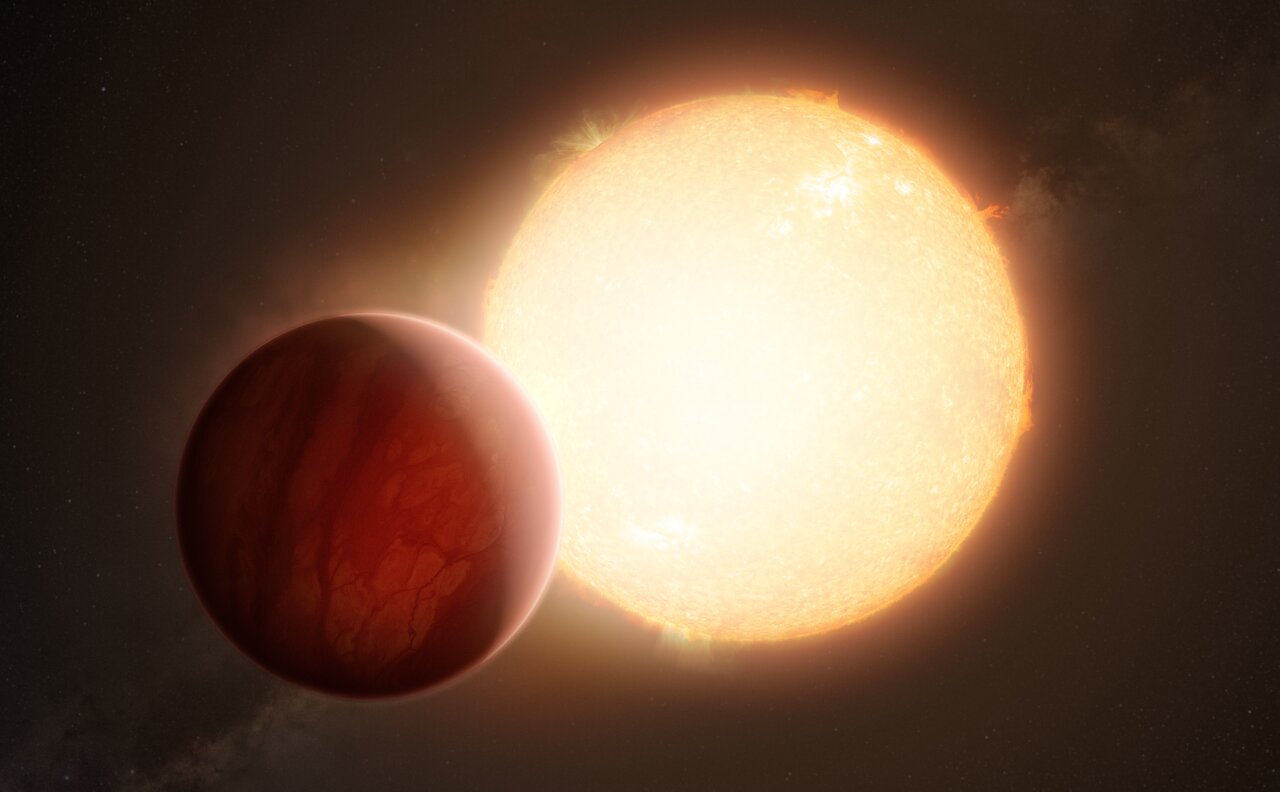
This artist’s impression shows an ultra-hot exoplanet as it is about to transit in front of its host star. Using the ESPRESSO instrument of ESO’s Very Large Telescope, astronomers have found the heaviest element yet in an exoplanet's atmosphere, barium, in the two ultra-hot Jupiters WASP-76 b and WASP-121 b.

Image Credit: ESO

Astronomers have spotted barium in the atmosphere of a distant exoplanet. With its 56 protons, you have to run your finger further down the periodic table than astronomers usually do to find barium. What does finding such a heavy element in an exoplanet atmosphere mean?

It means we’re still learning how strange exoplanets can be.

We’ve made a lot of progress in exoplanet science since astronomers discovered the first ones in the mid-1990s; we now know of thousands of them. In 2001, researchers using Hubble data were the first to observe an exoplanet atmosphere, identifying sodium. Some said it was lucky and wouldn’t happen again. Boy, were they wrong.

Now we have the power to characterize exoplanet atmospheres in more detail than ever. One of our most powerful telescopes is the European Southern Observatory’s (ESO) Very Large Telescope (VLT.) A new study based on observations with the VLT and its ESPRESSO (Echelle SPectrograph for Rocky Exoplanet and Stable Spectroscopic Observations) instrument presents evidence of barium in the atmosphere of the two ultra-hot gas giants.

The study is “Detection of Barium in the atmospheres of ultra-hot gas giants WASP-76b & WASP-121b.” The lead author is Tomás Azevedo Silva, a Ph.D. student at the University of Porto and the Instituto de Astrofísica e Ciências do Espaço (IA) in Portugal. The journal Astronomy and Astrophysics published the research.

WASP-76b and WASP-121b are both ultra-hot Jupiters. WASP-76b has been in the news because of the reported detection of iron in its atmosphere and the possibility that this tidally-locked planet experiences iron rain. Follow-up studies presented other explanations for the data, but the planet is still of great interest to exoplanet scientists.

This illustration of WASP-76b is based on data available in May 2020. As an object of high interest, data keeps coming in. Image Credit: By Trurle - Own work, CC BY-SA 4.0, https://commons.wikimedia.org/w/index.php?curid=89954341

This illustration of WASP-76b is based on data available in May 2020. As an object of high interest, data keeps coming in. Image Credit: By Trurle – Own work, CC BY-SA 4.0, https://commons.wikimedia.org/w/index.php?curid=89954341

WASP-121b is also noteworthy. It’s the first exoplanet where researchers found water vapour in its stratosphere. Both planets are extremely close to their stars and have orbital periods of less than two days. Both planets orbit stars similar to the Sun, with surface temperatures above 1000 C (1830 F.).

Artist's concept of the hot Jupiter WASP-121b. A new study finds barium in its atmosphere. Image generated using Engine House VFX. Credit: Bristol Science Centre/University of Exeter

Artist’s concept of the hot Jupiter WASP-121b. A new study finds barium in its atmosphere. Image generated using Engine House VFX. Credit: Bristol Science Centre/University of Exeter

Both of these planets are known for having exotic atmospheres, but the discovery of barium has intensified interest in them. There’s no ready explanation for barium in the upper atmosphere of the planets. “The puzzling and counterintuitive part is: why is there such a heavy element in the upper layers of the atmosphere of these planets?” said lead author Azevedo Silva.

Both Jupiter-sized planets have powerful gravity that should draw heavy elements like barium to their surfaces. But instead, the barium, which is even heavier than iron, is aloft in the upper atmospheres of both planets. “Given the high gravity of the planets, we would expect heavy elements like barium to quickly fall into the lower layers of the atmosphere,” explained co-author Olivier Demangeon, another researcher from the University of Porto and IA.

Barium isn’t up there by itself. These planets’ atmospheres are exotic mixtures of chemicals alien to our atmosphere. The researchers weren’t looking for barium when they found it; they were studying the strange atmospheres as part of their effort to constrain the atmospheric composition and dynamics. They also wanted to lay the “… groundwork for new research regarding their formation and evolution environments,” as they state in their paper.

“This was in a way an ‘accidental’ discovery,” says Azevedo Silva. “We were not expecting or looking for barium in particular and had to cross-check that this was actually coming from the planet since it had never been seen in any exoplanet before.” The team also found vanadium, lithium, manganese, and other elements in the atmospheres. But barium is the heaviest element ever found in an exoplanet atmosphere.

The two planets in the study lend themselves well to atmospheric research. Is finding barium in these atmospheres a signal that we can expect to find them in other ultra-hot Jupiters? Maybe. “Both WASP-76b and WASP-121b represent some of the highest S/N datasets currently available, the presence in both of the studied planets may indicate that this heavy species can be common in the atmospheres of ultra-hot Jupiters,” the paper states.

There’s no barium in Earth’s atmosphere unless we’re watching a fireworks display. How did it get into the upper atmosphere of these planets? “At the moment, we are not sure what the mechanisms are,” explained Demangeon.

The team doesn’t overextend themselves when it comes to those mechanisms. In their paper they write, “The presence of these heavy ionized species at high altitudes in the atmospheres of ultra hot Jupiters may be evidence of unexpected atmospheric dynamics.” Further research will uncover what those dynamics are. Who knows what discoveries are waiting for us in these atmospheres?

Planetary escape may play a role in the detection. Is an unknown mechanism driving heavy elements away? The observations show that the calcium detected on WASP-121b appears to extend beyond the planet’s Roche Lobe. “Finally, we also confirm the clear asymmetric absorption feature of Ca+ on WASP-121b, with an excess absorption at the bluer wavelengths and an effective planet radius beyond the Roche-Lobe, hinting that the signal may arise from planetary atmospheric escape.”

This won’t be the last team of researchers to study these planets. Giant gaseous planets close to their stars present an excellent opportunity to study their atmospheres as their starlight passes through them. And since the orbital period is less than two days, both planets are readily observed with powerful telescopes and instruments. “Being gaseous and hot, their atmospheres are very extended and are thus easier to observe and study than those of smaller or cooler planets,” said Demangeon.

There’s reason for some caution around these results, though. When researchers discovered iron at WASP-76b, and that the iron could possibly fall as rain, people noticed. It isn’t easy to envision a world so different from ours that it can rain iron. But that iron rain discovery was called into question by another study. At this time, scientists aren’t sure if there is iron rain.

Will further research question this barium detection?

More:

{ https://www.universetoday.com/ }

Hoe vind je dit bericht?
Geschreven door peter om 22:02 Stuur door

Meer van UFO'S of UAP'S, ASTRONOMIE, RUIMTEVAART, ARCHEOLOGIE, OUDHEIDKUNDE, SF-SNUFJES EN ANDERE ESOTERISCHE WETENSCHAPPEN - DE ALLERLAATSTE NIEUWTJES

↑ Terug naar de berichten