Ontdek de Fascinerende Wereld van UFO's en UAP's: Jouw Bron voor Onthullende Informatie!
Ben jij ook gefascineerd door het onbekende? Wil je meer weten over UFO's en UAP's, niet alleen in België, maar over de hele wereld? Dan ben je op de juiste plek!
België: Het Kloppend Hart van UFO-onderzoek
In België is BUFON (Belgisch UFO-Netwerk) dé autoriteit op het gebied van UFO-onderzoek. Voor betrouwbare en objectieve informatie over deze intrigerende fenomenen, bezoek je zeker onze Facebook-pagina en deze blog. Maar dat is nog niet alles! Ontdek ook het Belgisch UFO-meldpunt en Caelestia, twee organisaties die diepgaand onderzoek verrichten, al zijn ze soms kritisch of sceptisch.
Nederland: Een Schat aan Informatie
Voor onze Nederlandse buren is er de schitterende website www.ufowijzer.nl, beheerd door Paul Harmans. Deze site biedt een schat aan informatie en artikelen die je niet wilt missen!
Internationaal: MUFON - De Wereldwijde Autoriteit
Neem ook een kijkje bij MUFON (Mutual UFO Network Inc.), een gerenommeerde Amerikaanse UFO-vereniging met afdelingen in de VS en wereldwijd. MUFON is toegewijd aan de wetenschappelijke en analytische studie van het UFO-fenomeen, en hun maandelijkse tijdschrift, The MUFON UFO-Journal, is een must-read voor elke UFO-enthousiasteling. Bezoek hun website op www.mufon.com voor meer informatie.
Samenwerking en Toekomstvisie
Sinds 1 februari 2020 is Pieter niet alleen ex-president van BUFON, maar ook de voormalige nationale directeur van MUFON in Vlaanderen en Nederland. Dit creëert een sterke samenwerking met de Franse MUFON Reseau MUFON/EUROP, wat ons in staat stelt om nog meer waardevolle inzichten te delen.
Let op: Nepprofielen en Nieuwe Groeperingen
Pas op voor een nieuwe groepering die zich ook BUFON noemt, maar geen enkele connectie heeft met onze gevestigde organisatie. Hoewel zij de naam geregistreerd hebben, kunnen ze het rijke verleden en de expertise van onze groep niet evenaren. We wensen hen veel succes, maar we blijven de autoriteit in UFO-onderzoek!
Blijf Op De Hoogte!
Wil jij de laatste nieuwtjes over UFO's, ruimtevaart, archeologie, en meer? Volg ons dan en duik samen met ons in de fascinerende wereld van het onbekende! Sluit je aan bij de gemeenschap van nieuwsgierige geesten die net als jij verlangen naar antwoorden en avonturen in de sterren!
Heb je vragen of wil je meer weten? Aarzel dan niet om contact met ons op te nemen! Samen ontrafelen we het mysterie van de lucht en daarbuiten.
BEWIJS VOOR BUITENAARDS LEVEN KAN ZOMAAR AL EENS IN DE BUIK VAN DIT MARSWAGENTJE ZITTEN
Vivian Lammerse
Marsrover Perseverance heeft onlangs een monster verzameld dat organisch materiaal bevat, wat erop kan wijzen dat Mars in een ver verleden bewoonbaar was.
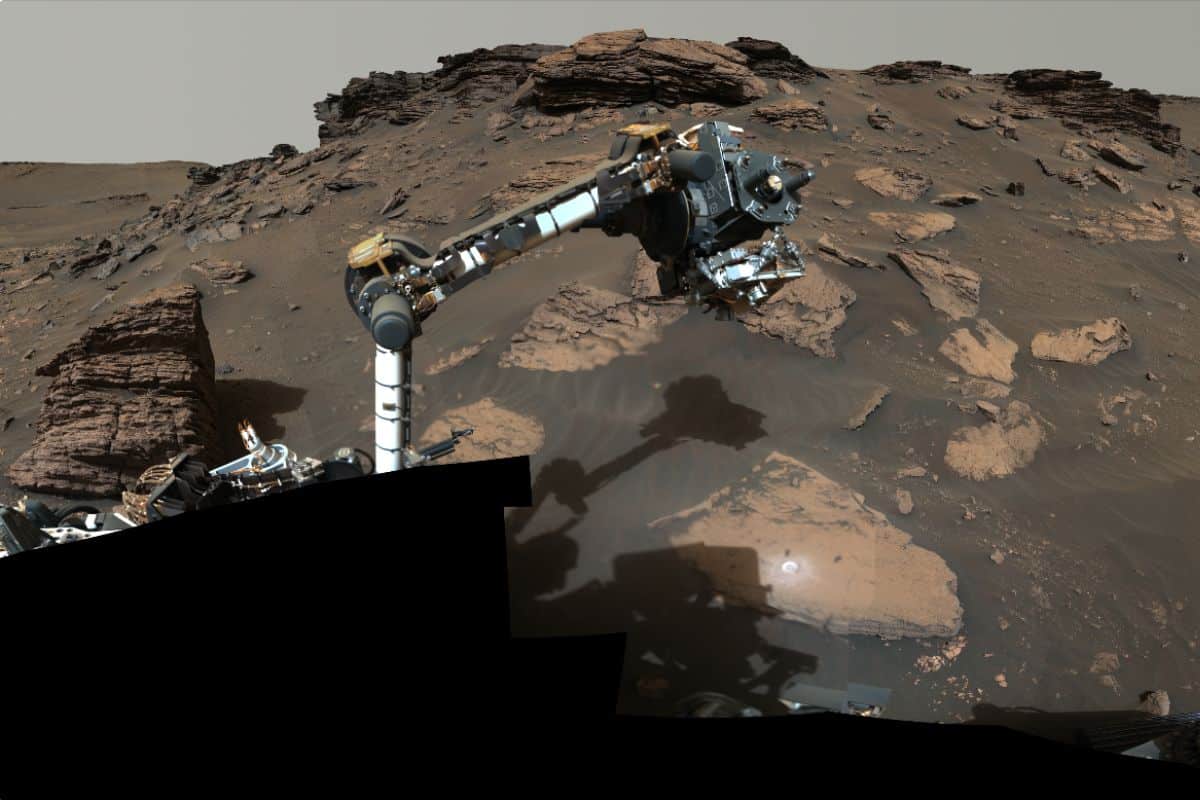
Ondertussen speurt NASA’s Perseverance-rover al enige tijd op Mars naar tekenen van oud, microbieel leven. In zijn zoektocht verzamelt het Marswagentje verschillende monsters. En die blijken beter dan het missieteam had durven hopen, zo laten ze weten. In de buik van Perseverance zit momenteel namelijk een monster opgeborgen dat organisch materiaal bevat. En dit monster zou zomaar eens het antwoord kunnen geven op de vraag of Mars ooit leven herbergde.
Wildcat Ridge Perseverance trof het organisch materiaal aan in een Mars-steen die de naam Wildcat Ridge heeft gekregen. De rots is waarschijnlijk miljarden jaren geleden gevormd toen modder en fijn zand zich vestigden in een verdampend zoutwatermeer. Eind juli schraapte de rover een gedeelte van het oppervlak van Wildcat Ridge weg en analyseerde het met behulp van zijn SHERLOC-instrument. SHERLOC – een afkorting voor Scanning Habitable Environments with Raman & Luminescence for Organics & Chemicals – gebruikt een ultraviolette laser om mineralen in gesteente te identificeren. Uit de analyse blijkt dat het monster een klasse organische moleculen bevat die verbonden zijn met sulfaten. En dat is interessant. Sulfaatmineralen kunnen namelijk belangrijke informatie opleveren over de waterige omgevingen waarin ze zijn gevormd.
Meer over organische moleculen Organische moleculen bestaan voornamelijk uit koolstof en bevatten gewoonlijk waterstof- en zuurstofatomen. Ze kunnen ook andere elementen bevatten, zoals stikstof, fosfor en zwavel. De vondst van dergelijke organische moleculen zijn van belang, omdat sommige van deze verbindingen de bouwstenen van leven zijn. De aanwezigheid van deze specifieke moleculen wordt beschouwd als een potentiële biosignatuur – een stof of structuur die een bewijs zou kunnen zijn van voormalig leven. Toch houden wetenschappers een slag om de arm. Sommige organische moleculen kunnen namelijk ook door middel van chemische processen, zonder de aanwezigheid van leven, ontstaan.
Het is niet de eerste keer dat er op Mars organisch materiaal wordt gevonden. Zowel Perseverance als de Curiosity-rover hebben dit al eerder aangetroffen. Toch is de huidige ontdekking een stuk spannender.
Spannender “In een ver verleden werd het zand, de modder en de zouten die nu het Wildcat Ridge-monster vormen, afgezet onder omstandigheden waarin leven mogelijk had kunnen gedijen,” legt onderzoeker Ken Farley uit. “Het feit dat er dus organische stof is gevonden in zo’n sedimentair gesteente, is heel interessant.” Toch moeten we nog even geduld hebben voordat we weten of het monster inderdaad bewijs van buitenaards leven herbergt. “Hoe geavanceerd de instrumenten aan boord van Perseverance ook zijn, verdere conclusies over wat er in het Wildcat Ridge-monster zit, kunnen we pas trekken als het monster op aarde aan een grondige inspectie is onderworpen,” aldus Farley.
Bodem en delta Marsrover Perseverance landde op 18 februari 2021 in de Jezero-krater waar de rover op sporen van (voormalig) leven jaagt. Dat Perseverance hier zoekt, is niet voor niets. Wetenschappers vermoeden namelijk dat het miljarden jaren geleden een met water gevuld kratermeer was. Tijdens Perseverance’ eerste wetenschappelijke campagne onderzocht de rover de bodem van de krater, waar hij zelfs stollingsgesteente aantrof, dat zich diep onder de grond vormt uit magma of tijdens vulkanische activiteit aan het oppervlak. Momenteel bestudeert Perseverance de delta; een oude, waaiervormige structuur die zo’n 3,5 miljoen jaar geleden werd gevormd bij de samenvloeiing van een Mars-rivier en een meer. Hier analyseert hij nu sedimentaire gesteenten. “De delta, met zijn diverse sedimentaire gesteenten, contrasteert prachtig met de stollingsgesteenten die al eerder op de kraterbodem zijn gevonden,” zegt Farley. “Het levert ons een gevarieerde reeks monsters op, die samen meer inzicht zullen verschaffen in de geologische geschiedenis nadat de krater werd gevormd.”
Twaalf monsters Wetenschappers keken erg uit naar het moment waarop Perseverance de delta aan een nadere inspectie zou onderwerpen. Zo vermoedden ze dat de kans reëel is dat hier bewijs van oud microbieel leven te vinden zou zijn. Het Wildcat Ridge-monster laat nu zien dat die kans inderdaad bestaat. Het monster is dan ook een belangrijke aanvulling op de toch al indrukwekkende collectie van Perseverance. Ondertussen heeft de rover al vier monsters in de oude rivierdelta verzameld. Ook heeft de rover al eerder rotsmonsters en één atmosferisch monster verzameld. Dit brengt het totaal aantal wetenschappelijk veelbelovende monsters op twaalf.
Uiteindelijk hopen de onderzoekers alle meegebrachte monsterbuisjes – maar liefst 42 in totaal – te vullen met interessante monsters van Mars. Door deze vervolgens naar de aarde terug te sturen, hopen wetenschappers een aantal prangende wetenschappelijke vragen te beantwoorden – waaronder natuurlijk die ene hoofdvraag: heeft er ooit leven op Mars bestaan? “Over slechts enkele jaren zullen de monsters op aarde arriveren, zodat wetenschappers ze tot in de kleinste details kunnen bestuderen,” zegt onderzoeker Laurie Leshin. “Dit is werkelijk fantastisch. We zullen zoveel leren.”
Meer weten… …over de toekomstige Mars Sample Return-missie, waarin de door Perseverance verzamelde Marsmonsters op aarde zullen worden afgeleverd? Lees dan ook dit eerder verschenen artikel op Scientias.nl!
Researchers have mounted 3D printers onto drones with the aim of creating swarms of robots that could 3D print entire buildings.
The aerial vehicles were specially designed to be able to deposit a cement-like material with enough precision to build tall structures. Groups of them together could do the job even faster.
The idea is that 3D printed shelters could be greener than standard construction methods, and drones could be useful in reaching difficult to access areas.
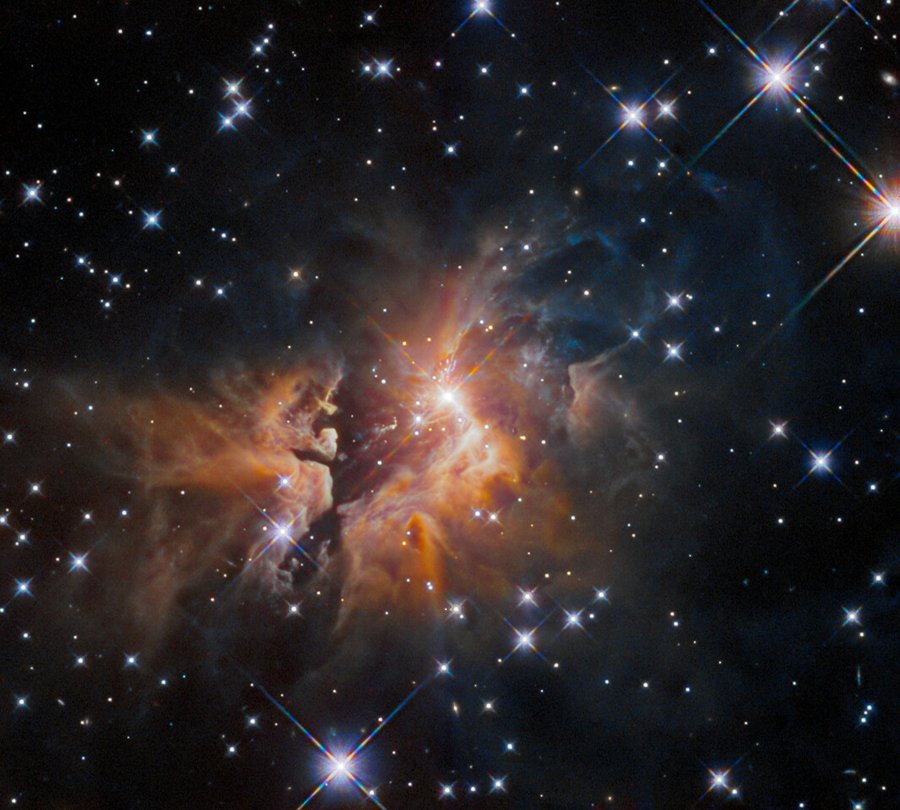
A shroud of thick gas and dust surrounds a bright young star in this image from the NASA/ESA Hubble Space Telescope. Hubble’s Wide Field Camera 3 inspected a young stellar object, over 9,000 light-years away in the constellation Taurus, to help astronomers understand the earliest stages in the lives of massive stars. This object – which is known to astronomers as IRAS 05506+2414 – may be an example of an explosive event caused by the disruption of a massive young star system.
The swirling discs of material surrounding a young star are usually funneled into twin outflows of gas and dust from the star. In the case of IRAS 05506+2414, however, a fan-like spray of material traveling at velocities of up to 217 miles per second (350 km per second) is spreading outwards from the center of this image.
Astronomers turned to Hubble’s Wide Field Camera 3 to measure the distance to IRAS 05506+2414. While it is possible to measure the velocity of material speeding outward from the star, astronomers cannot tell how far from Earth the star actually is from a single observation. To determine the star’s distance, they measured how far the outflow travels between successive images. From there they could infer the distance to IRAS 05506+2414. Knowing its distance allows astronomers to determine how bright the star is and how much energy it is emitting, and therefore estimate its mass – all vital information in determining the origin of this bright young star’s unusual outflow.
This Wireless Camera Taps Into Sound Waves to Reveal Deep-Sea Secrets
MIT scientists want to map the entire ocean so we can understand how climate change is forcing it to evolve.
Monisha Ravisetti
This battery-free, underwater device can harness sound waves to capture images of our ocean's deepest, darkest secrets.
Adam Glanzman
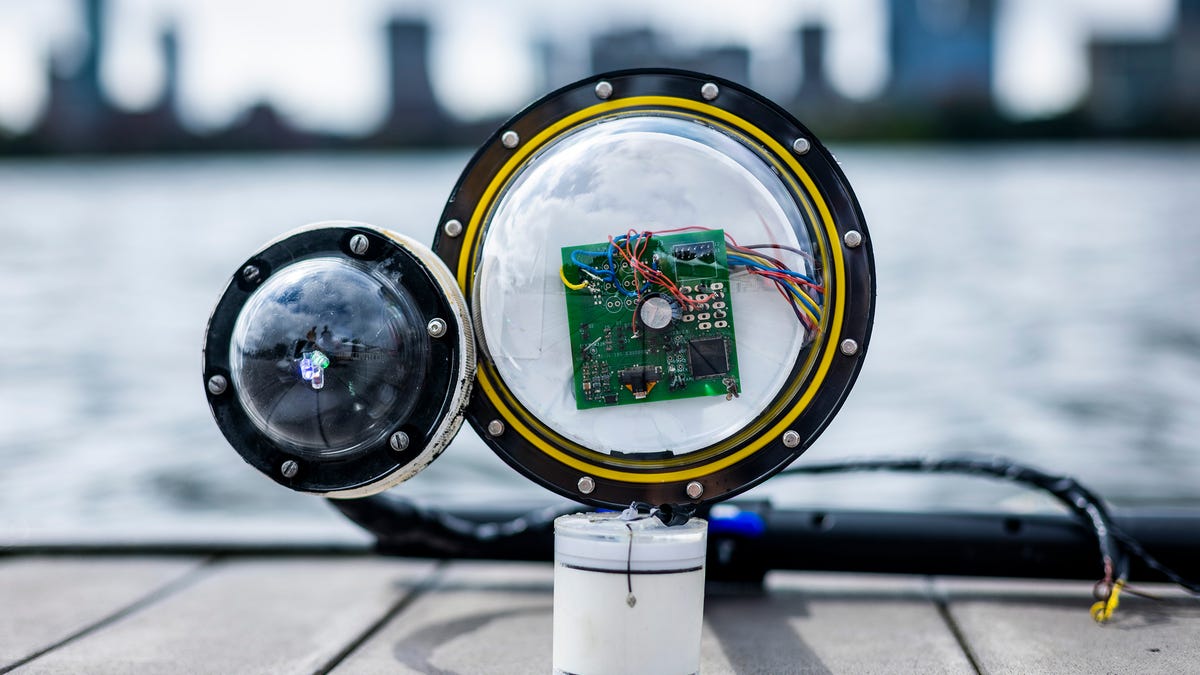
MIT scientists presented their prototype of a fascinating underwater camera on Monday. Rather than rely on battery power, this device gets juice from sound waves traveling through the ocean for its deep-sea image escapades. It even works in the darkest of environments.
Then it has the ability to wirelessly transmit all that photo data goodness back through the water to be reconstructed on a computer.
This means that if the model can be scaled up, it could spring humanity a few steps forward on the journey to achieving a massive goal: mapping every corner of Earth's oceans.
Though our beautiful planet's surface consists of a whopping 70% water (reminder, this doesn't account for depth) the research team estimates we've only ever observed less than 5% of the sea. And one reason, they say, for such lack of knowledge is viable underwater cameras are really hard to build due to battery restrictions.
Simply, a workable imager within the sea can't travel too far out from a ship without running out of power. It's also expensive to make a super long-lasting battery, and not time efficient to have to restart an expedition every time the camera at hand must be retrieved and recharged. Thus, the newly proposed sound wave-energized camera holds potential to be a game changer for deep-sea explorers.
According to an outline of the invention, published in the journal Nature Communications, the device can run for weeks on end before someone has to pick it up, allowing it to venture far out into the sea in just one go. It's also about 100,000 times more energy-efficient than other undersea cameras, the team said.
"One of the most exciting applications of this camera, for me personally, is in the context of climate monitoring," Fadel Adib, associate professor in MIT's department of electrical engineering and computer science, said in a statement. "We are building climate models, but we are missing data from over 95 percent of the ocean. This technology could help us build more accurate climate models and better understand how climate change impacts the underwater world."
As proof of principle, the research crew tested their mechanism to create color images of plastic bottles floating in a New Hampshire pond. They also captured images of an African starfish in such high resolution that you can see the tiny tubercles along its arms. Overall, it appears to be a solid pathway toward solving the underwater battery conundrum.
But perhaps even more exciting than the long-term implications of the team's camera is the absolutely remarkable way it works.
Turning sound waves into views
Basically, the team explained, this sound wave-powered camera takes advantage of noise that's already present under the sea. Passing ships, marine life, tides and other such things create sound. But what is sound, exactly?
Sound isn't an intangible force of some sort. Rather, it's the product of waves traveling through a medium and vibrating that medium on a super (super) minute scale. The medium could be air, water -- anything with atoms, really. When air vibrations hit our eardrums, for example, our brain translates the signal into what we consider sound. That's also why stuff sounds warped to us when we're underwater. Nothing is truly "warped," per se. Soundwaves just vibrate water molecules differently.
OK, so the important bit about this mechanism, for the team's new camera, are those vibrations.
The small device is encased in a special material that produces an electric signal every time it's hit by sound waves vibrating through the water. Those vibrations, in essence, vibrate it as well. Then, the vibrations are converted from mechanical energy into electrical energy, and there you have it -- a steadily powered underwater camera.
Further, to keep hardware light -- so the camera doesn't eat away at its power – the team used off-the-shelf imaging sensors and cheap flash instruments that can only capture images in grayscale. From there, they used sort of an old-fashioned way of obtaining a full-color image.
"When we were kids in art class, we were taught that we could make all colors using three basic colors. The same rules follow for color images we see on our computers. We just need red, green and blue -- these three channels -- to construct color images," Waleed Akbar, MIT researcher and co-author of the study, said in a statement.
First, the camera captures the image with a specifically tailored red LED light filter, then again with a blue filter and again with a green one. Put together, you get the full pic. Finally, all the image data is encoded in computer language, aka ones and zeros, and here's the kicker.
It's sent to a receiver back as soundwaves.
The camera receiver basically transmits its own sound waves to the camera, then the camera can either reflect the waves back or absorb them fully. Altogether, this creates a sort of binary code to tell the receiver what the image data really is.
"This whole process, since it just requires a single switch to convert the device from a nonreflective state to a reflective state, consumes five orders of magnitude less power than typical underwater communications systems," MIT researcher Sayed Saad Afzal said in a statement.
As of now, however, the camera only possesses a maximum transmission range of 40 meters from the receiver. But the team said it wants to increase both that range and the device's memory capacity going forward.
Eventually, they said, it could potentially capture real-time photos and perhaps even stream underwater secrets right to a computer.
Mysterious Cases of Living Fossils, Suspended Animation, and Hibernation
We all know that fossils, by their very nature, are dead. Of course, nothing can survive the conditions of pressure, depth and time required to petrify wood, see saplings mature into massive trees, transmogrify vegetation into coal or metamorphose mud into solid rock. Still, living creatures seemingly from remotest antiquity keep turning up encased in stone from far beneath Earth's surface, embedded inside solid tree trunks and in other situations defying both reason and the gospel of the Great God Science.
Living Fossils Story #1: Ancient Wormhole Mine
One such case occurred April 22, 1881, when miner Joe Molino was working deep in the Wide West Mine outside Ruby Hill, Nevada. When he wedged loose a protruding hunk of stone from the tunnel wall it landed on his foot. Enraged, he grabbed a sledgehammer and smashed it to bits. Molino was stunned to see his hammer blow had exposed a baseball-sized cavity in the rock. It was half full of motionless white worms.
As a crowd of quizzical miners gathered to view the unusual artifacts the worms began to move. Within an hour they were crawling around on the floor of the tunnel.
Mine operators sent the worms (whose species apparently was never determined) and their solid stone sarcophagus to the U.S. Bureau of Mines. Several weeks later the bureau sent the mine operators a letter declaring they must have been mistaken. Since it clearly is impossible for creatures to have survived under the circumstances described, as far as the bureau was concerned there was no way the incident could have happened.
In 1892 an ore nugget found in an Arizona mine was found to contain a dead beetle from which emerged a live beetle: is that a living fossil or what?
Yet more scientific mystery was brewing in the American West when, sometime in 1892, a large beetle was found encased in a chunk of iron ore in the Longfellow Mine outside Clifton, Arizona. The ore nugget and its dead inhabitant were turned over to El Paso geologist Z. T. White, who placed the insect in a specimen case. Several days later he was shocked to see the creature move. Watching through a magnifying glass White saw a small beetle emerge from the body of the larger, dead one. He placed the small beetle in a jar where it lived for several months. When it died, he presented it, the larger beetle and the lump of ore to the Smithsonian Institution , where they may remain to this day.
Living Fossils Story #3: A Load of Bullfrog
Since the vast majority of fossils are buried, it is predictable that mines are the main source of mysterious zoological artifacts. In 1873, miners at the Black Diamond Coal Mine outside San Francisco found a large frog encased in limestone.
This common (but venerable) bullfrog was apparently blind, and able to slowly move just one leg. After several hours on the surface, it died. The frog and its entombing stone were given to the San Francisco Academy of Sciences, where its survival of what would seem an impossible stretch of time continues to defy understanding.
Yet not all living fossils are found in stone or ore.
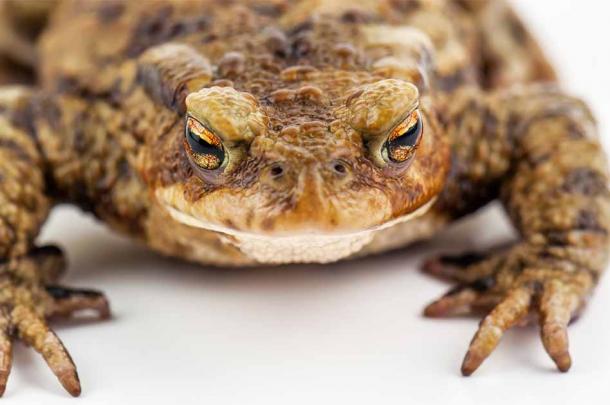
Once in 1893 in Ontario, Canada a live toad emerged from deep inside a tree trunk!
In October 1893 workmen at the Brown and Hall Sawmill in Ontario, Canada were using a circular saw to cut a large tree trunk into planks when the blade sliced through a cavity containing (and almost cut in two) a live toad imprisoned squarely in the middle of the tree trunk. The tree was about 200 years old, and the spherical, perfectly smooth hole in which the amphibian was entombed was about 60 feet (18 meters) above the ground. The toad tumbled from its wooden prison and hopped away, seemingly none the worse for its long confinement.
Another report of a live toad in a hole comes from England. In 1829 huge granite blocks that had formed a submerged footing under the docks of Liverpool's George's Basin were being cut into small chunks to be made into steps. During one of the cuts, the stone saw revealed a little hole in the middle of a block, and a toad within it.
Workers gently enlarged the hole to free its occupant, and the amphibian made several futile attempts to get to its feet. Several hours later, after trying one last time to assume its normal crouching position, the toad sank to the pavement and died. Several scientists who later examined the small corpse confessed they were at a loss to explain how the animal could have been found alive under such airless, foodless and waterless conditions. One of these learned men took the dead animal home with him, and it was never seen again. It was not the first or last impossible fossil yielded by Britain.
Living Fossils Story #5: Newt News
In 1818 professional geologist Dr. E.D. Clark, who taught at Caius College in Cambridge, Scotland, was present at the digging of a pit on a friend's property when the workmen hit a layer of animated fossils. As one of the workers was breaking up a large chunk of chalk stone into smaller pieces so they could be removed from the hole he found three newts embedded in the rock. Clarke placed them in the bright sunlight and was stupefied when they began to move. Two of them died later in the day, and for years he exhibited them to his students during his lectures on prehistory. He placed the third newt in a nearby brook, and it "skipped and twisted about as though it had never been torpid," and escaped, he later said. Clarke was never able to identify the species to which the newts belonged.
Upon Clarke's retirement he donated the preserved newts to the university's biology department, where, for decades, other professors displayed them during lectures. During the chaos of the 1940 Nazi bombing blitz these pickled specimens turned up missing. Unless they were blown to atoms by a Luftwaffe bomb, they may remain somewhere within Cambridge University, forgotten and still unexplained.
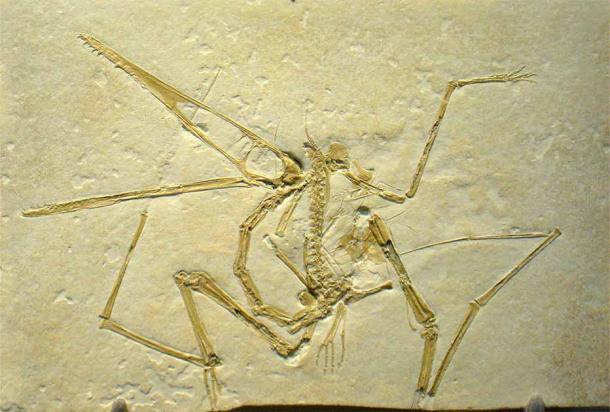
This is a fossil of a flying dinosaur, a Pterodactylus antiquus, and a close cousin of this species was apparently still alive in France in the 1850s according to newspaper reports at the time.
The most incredible find of a living fossil is that reported by the Illustrated London Times of February 9, 1856. The incident occurred in France during the construction of a railway tunnel between the towns of Nancy and St. Dizier. According to the article, workers were breaking up a huge boulder when a goose-sized monster staggered from a freshly exposed cavity and screeched hoarsely before falling dead. It had a long beak, sharp teeth, four legs joined by membranes, and feet with long hooked talons. Its flesh was oily and glossy black.
The mysterious carcass was taken to a paleontologist who instantly recognized the animal as a Pterodactylus anas, a denizen of the Jurassic Period , which ended 135 million years ago. There is no record of whether the body was preserved and still exists.
Possibilities
Certain animals' ability to live long stretches without sustenance is possible via hibernation to escape the lean, hostile conditions of winter. Because their metabolisms are conditioned to arouse them upon the advent of the warmth and renewed food supplies of springtime, they are seldom in suspended animation for more than four or five months. What might happen if spring never arrived? What if their hibernation dens were to be buried by glaciers and/or metamorphose into rock?
Southern Methodist University professor of biology Dr. John Ubelaker, Ph.D. points out that many organisms possess the ability to lower their metabolisms, and that this function is often triggered by environmental conditions. This permits survival through difficult times.
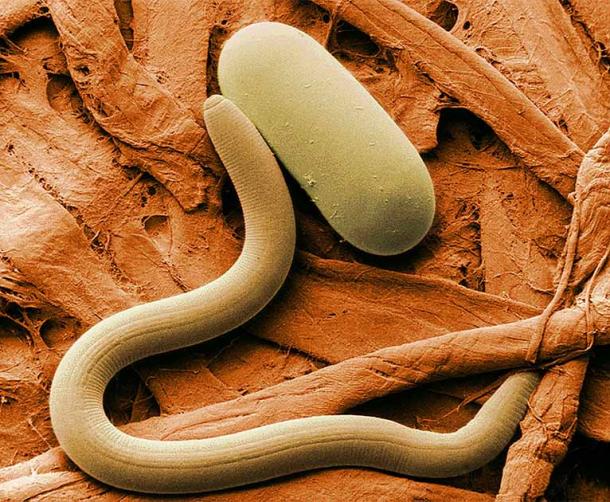
"This is a common phenomenon among many free-living nematodes that have the ability to form a resting stage--dauer larvae--in order to survive a stressful situation," he says. "In these nematodes the ability to control water and water loss is critical, and several metabolic-biochemical processes operate."
Nematodes that have come to life are perhaps the most incredible living fossils. A colorized electron micrograph of a soybean cyst nematode and egg.
In his 1863 book History of the Supernatural noted British author and scientist William Hewitt recounted a midsummer incident he had personally witnessed several years earlier in which workmen in Nottinghamshire, England were digging a ditch and unearthed what he called "a regular stratum of frogs." The creatures were not only alive, but so animated they all hopped away.
He described the layer of mud that had held the frogs as "stiff as butter," and based on the time of year and his examination of the ground where they were buried, he estimated they had been there at least six months. As he asked his readers, "If these frogs could live six months in this nearly solid casing of viscous mud, why not six or any number of years?"
Ubelaker expands upon this premise:
"An interesting fact of life is that an organism's structure and composition can remain virtually the same even though it continuously takes in nutrients and produces wastes. Often defined as a dynamic equilibrium, life allows concentrations of the mixture of the materials in an organism to remain constant even though individual molecules are constantly shifting back and forth, increasing or decreasing in a short time scale," he says."Remember that an organism at equilibrium is dead. A common classroom comparison is often made with a river and the steady state condition of organisms--the river maintains the same level and shape even though water is constantly flowing through it. Rivers rise and change course, drop to low levels depending on the available water, but at any one point it (and its concentration of materials) remains quite constant. In organisms the structure, proteins, nucleic acid, lipids stay relatively constant even though no one molecule remains in any pool for long."
The erratic and odd sides of the natural world remind us of how much we still have to learn about Mother Earth and the processes that govern her and her multitude of children. There are doubtless many more living relics of the primordial past awaiting exhumation. When they do come to light, they should be studied meticulously in order to ascertain how they survived such extremes of time, temperature and deprivation. The possibility of harmlessly subjecting human beings to suspended animation could solve problems of surviving extended space travel, awaiting the return of loved ones from the stars, outlasting terminal illnesses until cures are discovered, or simply staying alive long enough to meet one's great-great-great-grandchildren. Before we can even start on such grand aspirations, however, we must admit this potentially priceless process exists.
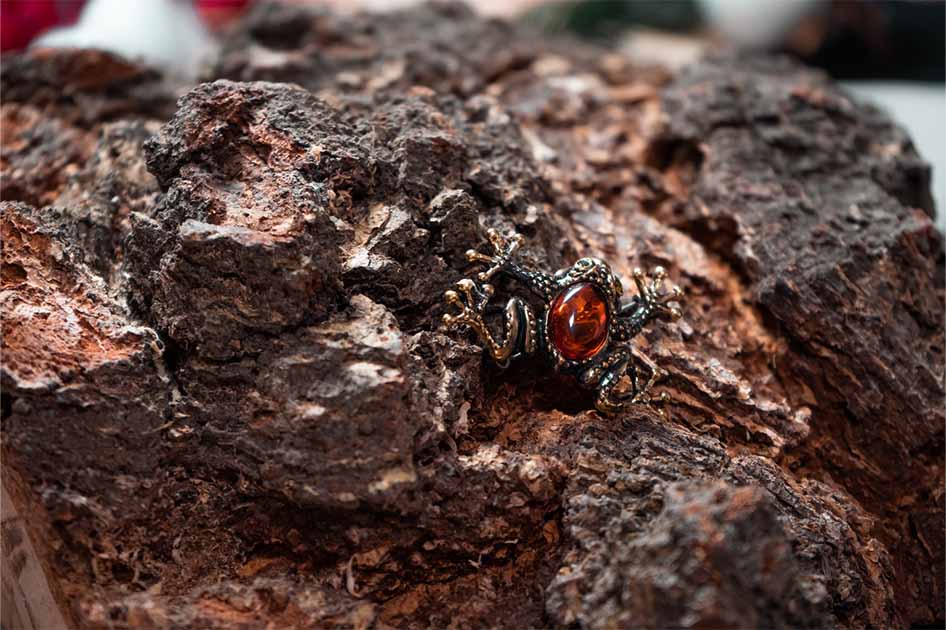
Top image: Frog brooch of amber and bronze on a rock, representative of living fossils.
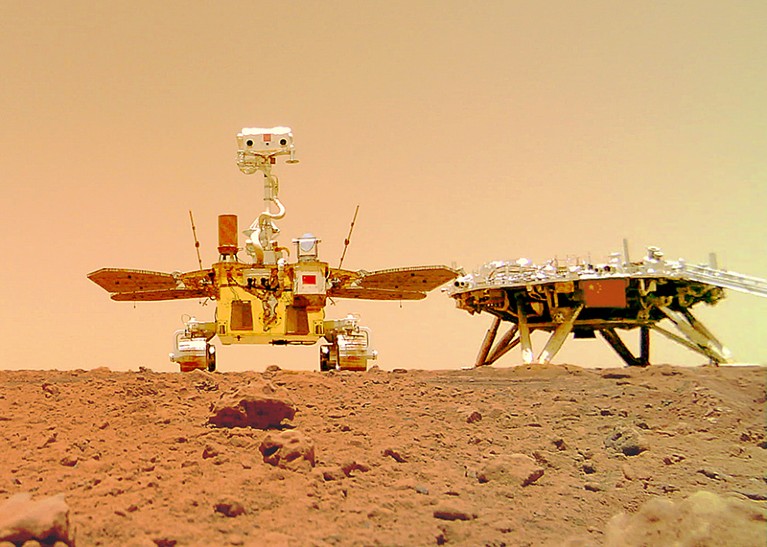
A radar on Zhurong can penetrate the surface to a depth of 100 metres.
Credit: Xinhua/Shutterstock
China’s Zhurong rover has peered deep under the surface of Mars, finding evidence of two major floods that probably shaped the region the robot has been exploring since it landed in May 2021.
An analysis published in Nature today1 is the first result from Zhurong’s radar imager, which can probe up to 100 metres below the surface. “It is a very interesting paper, and I was particularly impressed by how deep they can see with this radar,” says Svein-Erik Hamran, a planetary scientist at the University of Oslo, who analysed the only previous data from ground-penetrating radar used on the planet, collected by NASA’s Perseverance rover.
The history of Zhurong’s landing site — on Utopia Planitia, vast plains in Mars’s northern hemisphere — has puzzled scientists. Some have theorized that water or ice was once a feature of the landscape. Observations from space have identified sedimentary deposits that suggest the region was once an ancient ocean or submerged by huge floods, and geological features, such as pitted cones, resemble structures formed by water or ice. In May, researchers analysed infrared images of the landing site taken by China’s Mars orbiter, Tianwen-1, and found hydrated minerals that could have formed when groundwater rose through the rock or ice melted.
But the region could have also been covered in lava, concealing some of these hydrological processes in the subsurface. Eruptions from the volcano Elysium Mons to the east of the landing site, or other volcanic activity, could have covered the region in magma, as has been observed in other parts of the Utopia basin. By studying the radar data, researchers hope to understand what happened, and whether water or ice could still be lurking below the rocks. “We want to know what is going on beneath the surface,” says study co-author Liu Yang, a planetary scientist at the National Space Science Center in Beijing.
Below the surface
Zhurong is China’s first rover on the red planet, and it has been exploring the southern part of Utopia Planitia. The rover’s ground-penetrating radar transmits high-frequency radio waves that can penetrate the surface to a depth of between 3 and 10 metres, and low-frequency waves that can reach up to 100 metres underground but offer poorer resolution. The study authors analysed low-frequency data taken between 25 May and 6 September over more than 1,100 metres of terrain as Zhurong travelled south of its landing site. Radar signals reflect off materials under the surface, revealing the size of their grains and their ability to hold an electric charge. Stronger signals typically indicate larger objects.
The radar did not find any evidence of liquid water down to 80 metres, but it did detect two horizontal layers with interesting patterns. In a layer between 10 and 30 metres deep, the team reports, the reflection signals strengthened with increasing depth. The researchers say this is probably due to larger boulders resting at the base of the layer, and smaller rocks settling on top. An older, thicker layer between 30 and 80 metres down showed a similar pattern.
The older layer is probably the result of rapid flooding that carried sediments to the region more than three billion years ago, when there was a lot of water activity on Mars, says co-author Chen Ling, a seismologist at the Institute of Geology and Geophysics, Chinese Academy of Sciences, in Beijing.
The upper layer could have been created by another flood some 1.6 billion years ago, when there was lots of glacial activity. Chen says it is unlikely that the upper layer contains intact lava flows, because it has a smaller ability to hold an electric charge than would be expected for intact volcanic rocks. Furthermore, the researchers didn’t see any sudden changes in layering, which would be expected when lava flows meet sedimentary material.
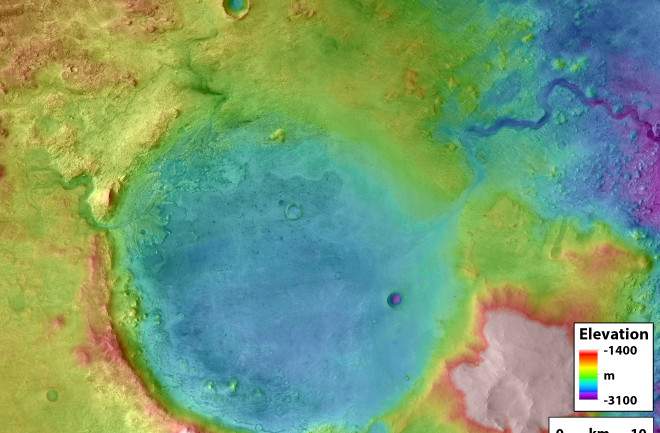
The Jezero crater is a paleolake on Mars. Its outlet canyon, carved by overflow flooding, can be seen in the upper right side of the crater.
(Credit: NASA/Tim Goudge)
Volcanic or sedimentary?
But, Chen says, it is possible that a thin coat of lava once covered the upper layer and it has gradually been broken down into smaller pieces. Radar data alone cannot definitively reveal whether material is sedimentary or volcanic, says Xu Yi, a planetary scientist at Macau University of Science and Technology.
Radar data are good at indicating the layering and geometry of subsurface material, but not so good at pinpointing its composition, including whether the material is ice or rock, says Hamran. Often, researchers rely on other clues, such as rocks peering out from the surface, to build a picture of past events, he says. The authors say they can’t rule out the possibility that the region contains buried saline ice.
More radar results are expected from the mission, including data taken during Zhurong’s continued traverse of Mars, results from the high-frequency radar measurements already made, and Tianwen-1’s orbital radar observations, which penetrate deep into the planet. They could help to clarify details of the terrain. “This is only the first step,” say Ling.
doi: https://doi.org/10.1038/d41586-022-03056-1
References
Li, C. et al.Nature https://doi.org/10.1038/s41586-022-05147-5 (2022).
Many ancient texts and Internet stories claim that humanity is the result of genetic mutation done to prehistoric humans by intelligent beings from outer space. Sitchin, who posed a great impact on the ancient astronaut theories, believed that an advanced race of intelligent beings arrived on Earth 450,000 years ago during the Age of Neanderthals, and through genetic engineering, they created modern-day human beings. Moreover, another theory that might support Sitchin’s claims is the mystery of Rh-negative blood which links humans to otherworldly origins.
“If mankind evolved from the same African ancestor then everyone’s blood would be compatible, but it is not. Where did the Rh- negatives come from? Why does the body of an Rh-negative mother carrying an Rh-positive child try to reject her own offspring? Humanity isn’t one race, but a hybrid species,” –Species with Amnesia: Our Forgottenby Robert Sepehr.
Species with Amnesia: Our Forgotten History
The population with the highest concentration of Rh-negative blood type is located between the border of Spain and France in the Pyrenees mountain range. The people that occupy this isolated region are known as the Basque, and they have long confounded anthropologists and historians. The language spoken by the portion of the territory is not related to any other in that part of the world. Up to 35% of Basque people have an Rh-negative blood type that is least likely to mutate or interact with other blood types.
There are 8 most common blood types (A+, A-, B+, B-, O+, O-, AB+, AB-); a classification derived from proteins found on the surface of cells which are basically designed to wage war against bacteria and viruses in the human body. Around 85% of humans in the world are Rh-positive and have no issues receiving blood from positive or negative donors.
Whether Rh-negative blood is just a mutation or not is something that has caused debate among researchers. If it was a mutation, then why are the people who possess Rh-negative blood known for having extra vertebrae? This, just as the blood type, is explained scientifically as being a mutation. However, according to modern DNA sequencing, it is demonstrated that humanity is not just one single race that descended from the same ancestor in Africa, but a hybridized species, with a far more enigmatic truth behind it all.
The fact is if the mother is Rh-negative, her immune system treats Rh-positive fetal cells as if they were a foreign substance. The mother’s body makes antibodies against the fetal blood cells. These antibodies may cross back through the placenta into the developing baby. They destroy the baby’s circulating red blood cells. It suggests somewhere in our lineage that the Rh negatives and the Rh positives are perceived as being profoundly different.
Rh-negative is very rare. It was not spread across the world until colonization started in the 15th century. Rh-negative didn’t exist in the Americas, Southern Africa and Asia. It was only in Europe. According to scientists, modern humans arose in Africa at least 250,000 to 300,000 years ago. They are all Rh-positive. They do not have any Rh-negative, so from where did it evolve?
Robert Sepehr tells in his book “Species with Amnesia: Our Forbidden History” more about the enigmatic blood type Rh-negative. The author suggests that highly advanced civilizations had been on Earth before us, just to be destroyed by some great global catastrophe as mysteriously, history tells us.
Could the Rh-negative blood type offer evidence of a vastly different pre-human evolution than what we are led to believe in our history books? Might it offer indisputable proof of extraterrestrial intervention in the remote past? But if so, is the experimentation with intelligent hominid over, or is it still taking place?
Ancient Origins writes:“Indeed, it is amidst the Basque of France and Spain that we find an odd prevalence of one human blood type known as Rh-negative. The use of Rh here denotes “Rhesus,” as the origins of the blood type were labeled after a common factor shared between humans and the Rhesus monkey; today, the Rh blood group system is one of thirty of the existing current blood group systems recognized by science, of which close to eighty-five percent of humans have. 8 The most common manifestation of the Rhesus blood factor in humans is known as Rh-positive blood. By studying the common factors present between blood types of, for instance, humans and the Rhesus monkey, it becomes clear in terms of the genetic information present here that at some point in our ancient past, humans must have shared a common ancestor with this species of Old World monkeys.”
Sepehr argues that “highly advanced civilizations have been here before us, just to be destroyed by some great global catastrophe. But for each race that has died out, another has taken its place, with a selected few holding on to the memories and sacred knowledge of the past race. In our vanity, we think we have discovered some of the great truths of science and technology, but we are in fact only just beginning to rediscover the profound wisdom of past civilizations. In many ways, we are like an awakening Species with Amnesia, yearning to reclaim our forgotten past.”
Many believe that Rh-negative blood would be the legacy that the Anunnaki left on Earth among other things.
LAUREL, Md. — For the first time in history, a spacecraft from Earth has crashed into an asteroid to test a way to save our planet from extinction.
The spacecraft, NASA's Double Asteroid Rendezvous Test (DART) probe, slammed into a small asteroid 7 million miles (11 million kilometers) from Earth tonight (Sept. 26) in what the U.S. space agency has billed as the world's first planetary defense test. The goal: to change the orbit of the space rock — called Dimorphos — around its larger asteroid parent Didymos enough to prove humanity could deflect a dangerous asteroid if one was headed for Earth.
"As far as we can tell, our first planetary defense test was a success," said Elena Adams, DART's mission systems engineer here at the Johns Hopkins University Applied Physics Laboratory (JHUAPL), after the successful crash. "I think Earthlings should sleep better. Definitely, I will."
That's something the dinosaurs couldn't do 65 million years ago, when the massive Chicxulub asteroid slammed into the Yucatan Peninsula and led to their extinction.
"The dinosaurs didn't have a space program to help them, but we do," Katherine Calvin, NASA's chief scientist and senior climate advisor, said before the crash. "So DART represents important progress in understanding potential hazards in the future and how to protect our planet from potential impacts."
The golf cart-sized DART spacecraft slammed into Dimorphos at 7:14 p.m. EDT (2314 GMT) while flying at a whopping 14,000 mph (22,500 kph). The spacecraft wasn't large as probes go, but NASA hoped that its 1,320 pounds (600 kilograms) would be enough to move the 534-foot-wide (163 meters) Dimorphos a bit faster in its orbit around its parent.
"The spacecraft is very small," said planetary scientist Nancy Chabot, DART coordination lead at JHUAPL, which oversees the mission for NASA, before the impact. "Sometimes, we describe it as running a golf cart into the Great Pyramid."
Despite the on-target crash, there was a mix of calm and anticipation at DART's mission control center at JHUAPL as the spacecraft sped towards its destruction. Nothing went wrong during the crash, so engineers didn't have to try one of the 21 different contingency plans they had in their hip pocket.
Much of DART's last four hours were automated, with the spacecraft's navigation system locking on to Dimorphos in the final hour of its approach. DART's main camera beamed a photo to Earth every second until the feed went black as the spacecraft crashed into the asteroid.
"It's nerve-wracking," Andy Cheng, chief scientist for planetary defense at JHUAPL, said of the final days before the crash. He came up with the DART mission's concept in 2011. The $313 million DART mission launched on Nov. 23, 2021.
As DART closed in on Dimorphos, the asteroid transformed from a mysterious bright dot into a detailed landscape of boulders, crags and shadowed terrain. Then, right on time, the live feed from DART went black and flight controllers inside DART's mission operations center jumped for joy and traded hugs and high fives in a triumphant celebration. DART hit its asteroid bull's-eye.
Did humanity's first planetary defense test succeed?
Other spacecraft also watched the crash.
NASA's new James Webb Space Telescope, the Hubble Space Telescope and the Lucy spacecraft on its own asteroid mission all tracked the crash from their respective vantage points across the solar system. On Earth, a vast network of ground-based telescopes were trained on the event and will be following the binary Didymos-Dimorphos system over time to see how much faster Dimorphos is now moving in its orbit.
"Our requirements are for 73 seconds but we actually think we're going to change by about 10 minutes," Statler said.
It will take time to know if the DART impact was successful as a planetary defense test.
More than three dozen telescopes around the world, including at least one on every continent, will be tracking the Didymos-Dimorphos asteroid system over the next six months to understand exactly how effective the test was. The first radar observations of the impact could come as early as Tuesday (Sept. 27), said Cristina Thomas, a planetary scientist with Northern Arizona University who leads the DART observations working group.
"We're going to be observing Didymos until it's no longer observable," Thomas said. DART mission scientists added that they should know definitively how much DART moved Dimorphos in the next two months.
The observation campaign has brought in volunteer student and university groups around the world, each hoping to add their observations to the DART effort.
I was looking over a recent Gigapan photo taken by the mars rover when I noticed a sculpture in a hillside, then below it, I noticed a human-like figure gripping a shield or staff. The figure clearly looks like it a real living and breathing person, but they died there in that place, in that position and were fossilized somehow. Maybe its a shield from the side and they were holding it up to shield them from something coming. Now understand that we humans have two strands of DNA the intertwine...if aliens had say...6 or more strands of DNA intertwined, the skin, bones would have 600% resistance from breaking down in the environment after death compared to our own. Hey please check out the HD video I made below and hear my explanation more deeply.
In this recent email report, a glowing sphere is seen in the sky which changes its color and its shape from sphere to diamond in a blink of an eye. The object is huge, much to big to be a star or planet and the flashes seem to be its only form of communication to those watching. If you can decipher the color pattern, you will also decipher a message they were sending to those watching. I would guess such a message would be short and to the point, like...we come in peace, or...greetings universal friends.
Scott C. Waring - Taiwan
Eyewitness states:
At 0600 I went outside in my backyard to bring the dogs out to go to the bathroom. While walking them around the yard I noticed an odd looking light to the east. I was at [gps location redacted] and it wasn’t exactly 266 degrees West. It took awhile for my eyes to focus on the source to make it out, but it appeared triangular with flashing lights. It was hovering. I took a quick video in case it disappeared while I went inside to get my wife and kids to witness the event. All 3 said the object was abnormal. I have worked for the airlines as a mechanic for over 20 years and was also in the Air Force for 4 years so can say this was unconventional to anything I have witnessed. After about 15 minutes we all went inside as it was getting close to dawn. I decided to go down and quick get my telescope to see if I could get a closer look at it. By the time I got back outside the object was gone. The video I took from my camera seemed distorted, like it was interfered with and blurry. You could see it much better in person.
Meer van UFO'S of UAP'S, ASTRONOMIE, RUIMTEVAART, ARCHEOLOGIE, OUDHEIDKUNDE, SF-SNUFJES EN ANDERE ESOTERISCHE WETENSCHAPPEN - DE ALLERLAATSTE NIEUWTJES


 BEWIJS VOOR BUITENAARDS LEVEN KAN ZOMAAR AL EENS IN DE BUIK VAN DIT MARSWAGENTJE ZITTEN