Ontdek de Fascinerende Wereld van UFO's en UAP's: Jouw Bron voor Onthullende Informatie!
Ben jij ook gefascineerd door het onbekende? Wil je meer weten over UFO's en UAP's, niet alleen in België, maar over de hele wereld? Dan ben je op de juiste plek!
België: Het Kloppend Hart van UFO-onderzoek
In België is BUFON (Belgisch UFO-Netwerk) dé autoriteit op het gebied van UFO-onderzoek. Voor betrouwbare en objectieve informatie over deze intrigerende fenomenen, bezoek je zeker onze Facebook-pagina en deze blog. Maar dat is nog niet alles! Ontdek ook het Belgisch UFO-meldpunt en Caelestia, twee organisaties die diepgaand onderzoek verrichten, al zijn ze soms kritisch of sceptisch.
Nederland: Een Schat aan Informatie
Voor onze Nederlandse buren is er de schitterende website www.ufowijzer.nl, beheerd door Paul Harmans. Deze site biedt een schat aan informatie en artikelen die je niet wilt missen!
Internationaal: MUFON - De Wereldwijde Autoriteit
Neem ook een kijkje bij MUFON (Mutual UFO Network Inc.), een gerenommeerde Amerikaanse UFO-vereniging met afdelingen in de VS en wereldwijd. MUFON is toegewijd aan de wetenschappelijke en analytische studie van het UFO-fenomeen, en hun maandelijkse tijdschrift, The MUFON UFO-Journal, is een must-read voor elke UFO-enthousiasteling. Bezoek hun website op www.mufon.com voor meer informatie.
Samenwerking en Toekomstvisie
Sinds 1 februari 2020 is Pieter niet alleen ex-president van BUFON, maar ook de voormalige nationale directeur van MUFON in Vlaanderen en Nederland. Dit creëert een sterke samenwerking met de Franse MUFON Reseau MUFON/EUROP, wat ons in staat stelt om nog meer waardevolle inzichten te delen.
Let op: Nepprofielen en Nieuwe Groeperingen
Pas op voor een nieuwe groepering die zich ook BUFON noemt, maar geen enkele connectie heeft met onze gevestigde organisatie. Hoewel zij de naam geregistreerd hebben, kunnen ze het rijke verleden en de expertise van onze groep niet evenaren. We wensen hen veel succes, maar we blijven de autoriteit in UFO-onderzoek!
Blijf Op De Hoogte!
Wil jij de laatste nieuwtjes over UFO's, ruimtevaart, archeologie, en meer? Volg ons dan en duik samen met ons in de fascinerende wereld van het onbekende! Sluit je aan bij de gemeenschap van nieuwsgierige geesten die net als jij verlangen naar antwoorden en avonturen in de sterren!
Heb je vragen of wil je meer weten? Aarzel dan niet om contact met ons op te nemen! Samen ontrafelen we het mysterie van de lucht en daarbuiten.
The DART Mission, Will This Save All Life On Earth?
This could be history in the making and joining me tonight will be my space science guy Dan from smAshomAsh so come and be apart of this event with us. Hope to see you here, stay blessed and safe...
Eridu: The Sumerian Garden of Eden and the Oldest City in the World?
Today, Eridu is often considered to be one of the oldest permanent settlements in Mesopotamia, and perhaps even in the world. The ancient Sumerians also believed that Eridu was the first city in the world and they documented that belief in the Sumerian King List and the Eridu Genesis . At least 18 layers of settlement are found at the site, could the ancient Sumerian belief be possible?
Archaeological evidence shows that the earliest structures date to the 6th millennium BC. The city reached its zenith during the 4th millennium BC and continued to be inhabited until around the 7th century BC. By then, however, the city had lost its importance.
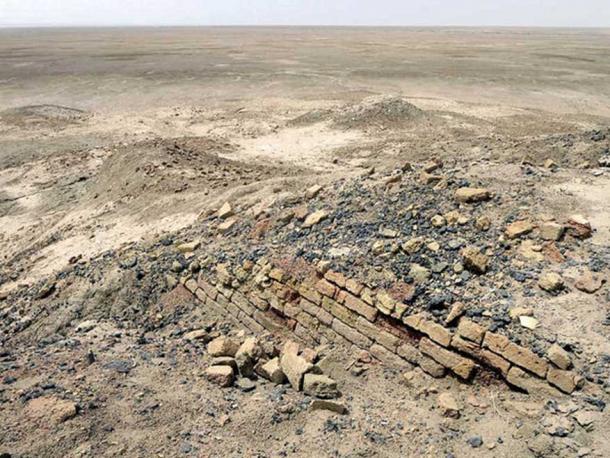
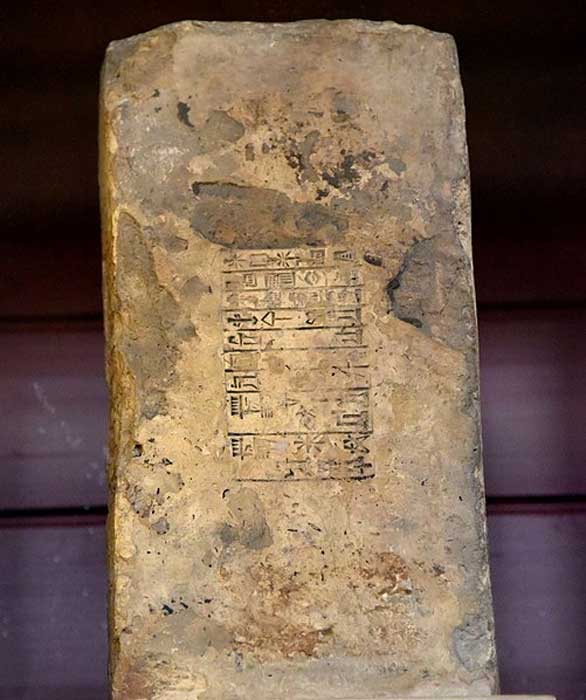
Some of the baked bricks used in the construction of the Sumerian ziggurat at Eridu, southwest of Nasiriyah, Iraq, are stamped with the name of King Ur-Nammu (2123-2106 BC).
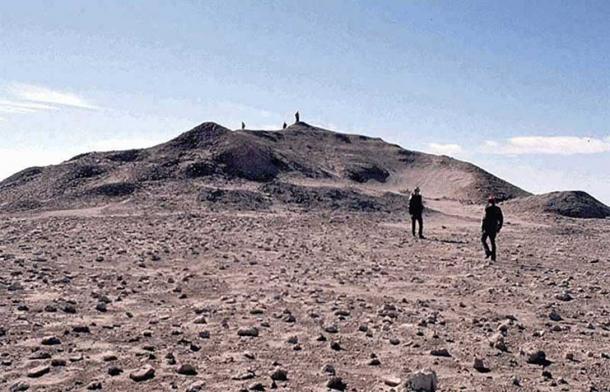
Eridu (known today as Tell Abu Shahrain) is located about 20 km (12.5 miles) to the southwest of the famous city of Ur. As its modern name indicates, the archaeological site is a tell, which is a huge mound formed over the millennia as a result of new settlements being built over the ruins of the previous ones. The tell rises to a height to 7 meters (23 feet), and is formed by 18 levels of occupation, according to the archaeological excavations. The bulk of this has been dated to the Ubaid and Uruk periods, which lasted from the 6th to 4th millennia BC.
The ancient Sumerians themselves made mention of Eridu’s antiquity. In the Sumerian King List , for example, it is written that “After the kingship descended from heaven, the kingship was in Eridug.” In addition, in the creation myth known as the Eridu Genesis , it is said to have been one of the five cities that existed before the Deluge, the others being Bad-Tibira, Larak, Sippar, and Suruppak.
The God of Eridu Temple
The patron god of Eridu was Enki (known also in Akkadian as Ea), the god of water. According to Sumerian mythology, the settlement was founded by Enki, and it was from this city that civilization was spread to other parts of the land. Although Enki was initially a local god, he rose in importance as the city grew in influence, resulting in him being incorporated into the pantheon of other cities as well. In Eridu, Enki’s temple is known as E-Abzu (Abzu may be translated as ‘Deep Ocean’, and refers to the underground spring from which all life is believed to have begun).
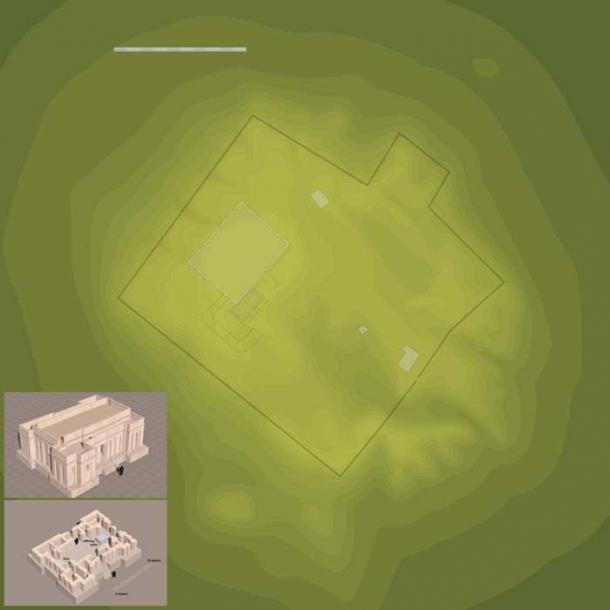
Rough map of the Eridu mound showing the main ziggurat, temple, and a few buildings.
Archaeological excavations of the E-Abzu have revealed that the temple began as a small room containing what has been referred to by scholars as a ‘cult niche’ and an ‘offering table’. Over the millennia, however, the inhabitants built new temples over the ruins of the old ones, each bigger than the last. The E-Abzu eventually became a large ziggurat, an apt reflection of Enki’s status as a major deity. It has been proposed that the E-Abzu may have been the largest of the ancient Mesopotamian ziggurats.
Economic Activities
Although the E-Abzu is the focal point of the site’s archaeology, there are either elements of interest. More recent excavations, for instance, have revealed that during the Ubaid period, the city was a pottery production center. This is evident in the pottery works, which had large scatterings of pottery fragments and kiln waste. Additionally, remains of fishing nets, weights, and even models of reed boats have been found at the site, suggesting that fishing was a major economic activity carried out by the inhabitants.
There are nine lines of cuneiform inscriptions on this fired clay brick; stamp of the king Amar-Sin (Amar-Suen, previously misread as Bur-Sin), king of Ur. 2100-2000 BC. From Eridu (modern-day Tell Abu Shahrain), southern Mesopotamia, Iraq. It is currently housed in the British Museum in London.
(Osama Shukir Muhammed Amin FRCP(Glasg)/ CC BY SA 4.0 )
Eridu was the dominant city in southern Mesopotamia during the Ubaid period, but it was eventually superseded by Uruk. Nevertheless, it continued to be revered as the first city, and it retained its religious significance thanks to the E-Abzu.
It has been suggested that ecological changes, i.e. the recession of the gulf coast and the increasingly unreliable water table, were responsible for the decline of Eridu around the end of the 3rd millennium BC. The city continued to be inhabited up until around the 7th century BC, although by then it had become a mere shadow of its former glory.
In 2016, Eridu was inscribed as a UNESCO World Heritage Site, as part of the ‘Ahwar of Southern Iraq: Refuge of Biodiversity and the Relict Landscape of the Mesopotamian Cities’.
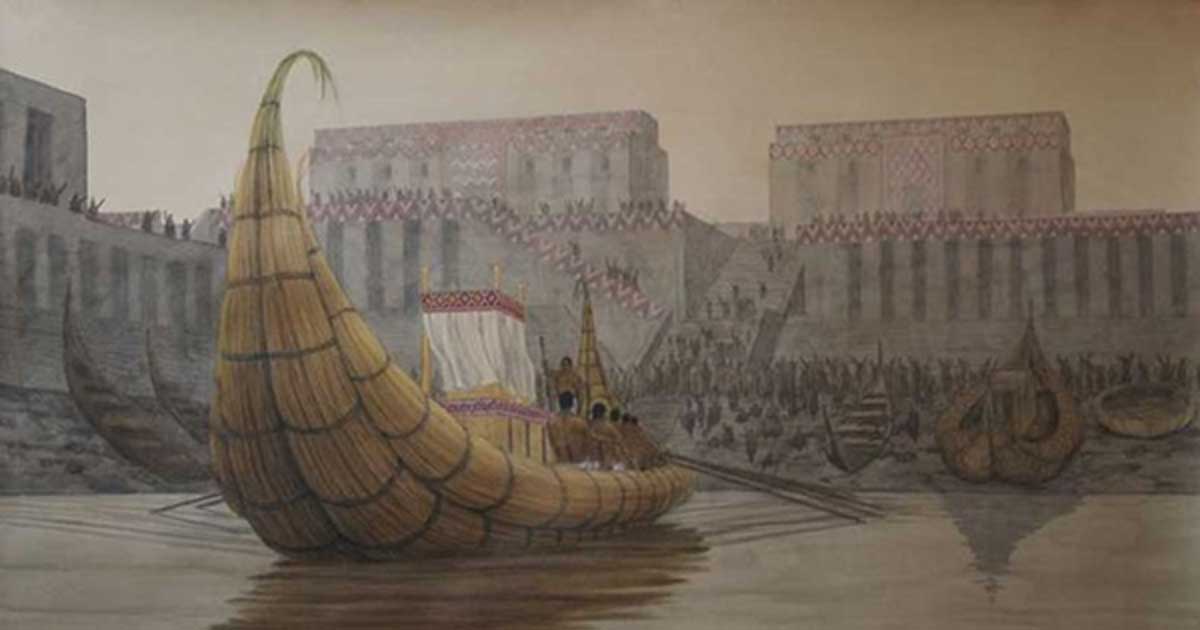
Top image: Re-creation of the port at Eridu. Source: Public Domain
For a long time, UFOs have been known to be Aerial phenomena that moves only in one medium, but then the report of objects diving into the water and coming out hit the media. Now, many experts including the Pentagon consider UFOs as “transmedium objects.” For example, an object could be considered “transmedium” if it could fly through Earth’s atmosphere in addition to another environment, such as space or underwater. There are more than dozens of incidents reported by the Navy personnel that justify the UFO maneuvers underwater with enormous speed. Those who have served years in the Naval force experienced something whose origins are still not understood.
1966, USS Tiru (SS-416) Encounters UFO
In 1966, a mysterious series of events occurred with the US Navy submarine USS Tiru SS-416. The submarine left Pearl Harbor in Hawaii and was bound for Seattle, Washington, where it was scheduled to stay in the repair dock for several days, after which it was supposed to take part in torpedo exercises. On the way to Seattle, one of the crew members reported something strange in the sky at a distance of about 2 miles, and he asked other sailors to check it, but at that moment, the boat’s radar station also recorded anomalous contact. One of the eyewitnesses, a crew member named Jim Speiser recounted what had happened: (Source)
“The lookout refused to tell the OOD (officer of the deck) what it was that he had seen and instead insisted that the starboard lookout and the OOD both look at that area. The three men looked through their binoculars toward the area reported and were astounded to see a metal craft larger than a football field tumble from the clouds into the ocean. It actually tumbled end over end and when it hit the water and sank beneath the ocean huge geysers of water rose into the air.
When the port lookout was sure that the others had seen it he then told the OOD that he had seen it tumble from the ocean up into the clouds. The OOD and the starboard lookout were speechless. Within a few minutes, however, they all became excited when it again rose from the water and tumbled up into the cloud layer. At about the same time a crew member below queried the bridge about a radar contact at the same range and bearing. Sonar also reported strange echos.
The OOD called for the Captain to come to the bridge at that time. At about the same time the object emerged from the clouds and fell down into the ocean. All five men witnessed this. The QMC (Quartermaster Clerk) took pictures as it rose up into the clouds and then back down into the ocean once again.
The five men watched for quite a while longer but nothing else happened. Soon the sub had moved out of visual range and the Captain told all witnesses that they were never to discuss what they had seen with anyone under any circumstances. He stated that the incident was classified information.
The Captain then went below and sent a radio msg. There was no doubt as to what we had seen. It was a metal craft with machinery on and around the outside of it. It appeared to have windows or lenses placed around its perimeter. It made no noise that we could hear. It did not disturb the sub’s electrical systems nor did it affect the gyro compass. It looked very much like a round flying “ship” as in sea going ship. It had the shape and form of a saucer with a bowl inverted in the saucer and it was huge. I will never forget it as long as I live.”
1991, USS Kirk FF108 UFO Encounter
Another similar incident took place in 1991 off the west coast of South America. The witness stated that at that time, he was a Chief of Operations and Intelligence serving aboard the Knox-class escort destroyer USS Kirk FF1087 and that they were part of a drug interdiction force consisting of the USS Kirk and three other Navy ships. Their main task was to patrol using a network of radars to track and then intercept drug planes flying out of Colombia, Panama and Guatemala, as well as to seize any smuggling ships that they could find. (Source)
USS Kirk (FF-1087). Image credit: Wikimedia Commons
The witness said that his primary position was at the CIC Combat Information Center, which he and 22 other specialists maintained 24 hours a day, 7 days a week, rotating in two shifts of 11 people.
At 2 a.m. on December 16, he was on duty at CIC. The night was calm and nothing unusual happened. He said he used the break to go up to the bridge. At this time, the entire ship was in a status called “darkened ship,” when all external lights were turned off, as well as on the bridge, that is, everything around was dimly lit only by instrument panels. His friend was on deck duty that night, and they chatted when they had some free time. And suddenly, everything around was lit up in red color:
“All of a sudden and out of nowhere, like a huge flash from a camera, emanating from the starboard bow sea level upward was a huge flash of red glowing light, which lit up our entire ship. It only lit up our ship, not the surrounding ocean, just our ship. It happened so fast, that the OOD, the navigator and I were speechless for about 5 seconds, at which time I looked at the OOD and asked him if he just saw that light. He stated yes in a sullen voice.
I then asked the navigator and he replied yes. I then took the navigator’s sound powered headset, and asked the forward and aft look outs, if they had just seen the same red flash, to which the forward look out stated, “YES! WHAT THE HELL WAS THAT?”
After lookout said yes as well. I then immediately contacted CIC, and asked the CIC officer if we had any aircraft or surface ships in our vicinity, to which he replied clear as a whistle. I asked if we had any submarine activity in the area, to which he replied, no. At this point I looked at the OOD and asked him if we should wake up the captain or as we would call him, The Old Man. The OOD sat there stunned for a minute, as did I and everyone else.
What had just happened did not make any sense. The flash emanated from the sea, directly off of our starboard bow (like it was touching our bow), and ascended upwardly so rapidly, creating the effect of the bright red flash. The other weird aspect of this event was that only our ship was lit up within the red flash, not the surrounding sea, but our vessel only. The OOD elected not to wake the captain, and the entire incident was logged in our ship’s log as an unexplained phenomenon.
Up until this event, I did not believe in UFOss or USOss. I have no doubt that our ship, steaming along at 12 knots, came right up on a submerged unidentifiable aircraft. I don’t think the aircraft or USO had any idea we were sailing up to them. I think whatever it was, took off in a very unplanned and fast manner, and wanted to quickly identify us, thus the flash.”
In the end, after much deliberation, they decided not to wake the captain up, but simply to register it in the ship’s log as an “unexplained phenomenon.”
Another Navy submarine encountered something strange happened in October 1989. On October 24, USS Memphis was on a mission to secure a shuttle launch site in Florida, patrolling about 150 miles from the coast, when something very large was detected by sonar and began approaching them quickly. At that point, almost all the instruments on the submarine failed: (Source)
“The ship was malfunctioning, our tanks were blowing out of control, we were losing navigation ability and the communications area was totally lost. We went to all stop and tried to access what was happening. The controls in the reactor area started to malfunction. This presented a serious danger to our safety, so the captain ordered us to shut down the reactor, surface and go to diesel motors. When the ship surfaced I went to my watch station. The ship was still experiencing electronic difficulties but the mechanical devices such as diesel engines, cook stoves, and turbines were fine.
This huge vessel was over a half mile across. The UFO made a half circle around our ship then passed across the stern causing our electronics systems to go crazy. We had permanent damage in communications and the sonar room. As the craft flew over the stern, I could see the rain stop under its red glow. The water seemed to rise almost a foot as the UFO passed over silently. When the UFO finished its swing across the stern it paused – the sky got brighter red and it simply moved off at tremendous speed inside 15 seconds. When the UFO left, our boat returned to normal with the exception of the radio and sonar. We did a quick system check and the captain ordered us to return to reactor power and get underway. The captain took two petty officers, the executive officer, and myself into the wardroom. He told us to not spread any rumors until we had a chance to talk to Commander Submarine Fleet – Atlantic.
We reached port in about 7 hours where I was taken into “protective custody.” Two enlisted men and myself agreed we had witnessed a real UFO. I was the one who shot it with a laser range finder, so I was the only one that had its exact sizes. I shot that vessel as it hovered and I got solid readings, not spotty like I would on debris. We were in holding for about three hours when an officer from the Air Force arrived and gave us a line of bull about an exploding weather satellite. The Navy then transferred virtually everyone on the crew to new assignments. This included the captain, the executive officer and the entire crew. They were split up which almost never happens unless one of them gets a promotion or a new command, neither of which happened.”
Nimitz-class aircraft carrier UFO Encounter
More recently, there has been a report from E-4 Petty Officer John Baughman, who in 2010 served aboard the Nimitz-class aircraft carrier USS Carl Vinson. At the time, the ship was off the coast of Haiti, delivering humanitarian aid to a region that had just experienced a catastrophic earthquake. He had a break that day, and he sat on the deck of the SAM launcher and was just looking at the water as usual. He liked to watch the underwater world. (Source)
He said: “I was staring into the water from above when a large, flat, white ’Tic Tac’ object, approximately twenty feet in length, suddenly appeared in my view below me, moving right and darted into the depths as fast as it appeared. I couldn’t really comprehend what I saw. It was definitely a solid object, but when it descended, its forward end rapidly collapsed in on itself and disappeared.”
Baughman could not believe what he saw. He told his supervisor about the strange object he had seen underwater. But others were indifferent and ended the talk by saying “everyone sees weird shit in the ocean.”
He doubted about his sighting as he believed that it could be anything from an albino whale, shark, or some ship wreckage to an optical illusion. He said: “But it cast its own shadow and that’s how I was able to perceive it as a solid object.”
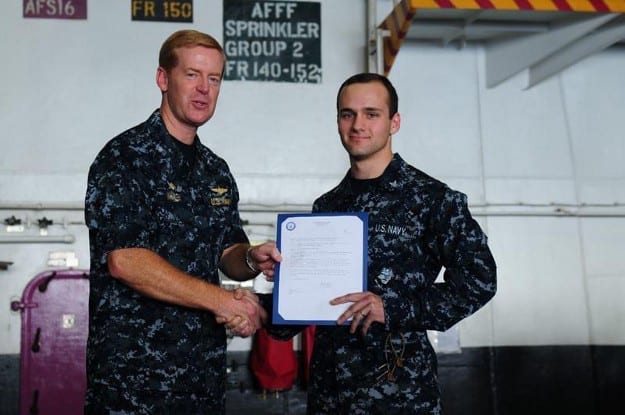
Capt. Kent D. Whalen and John Baughman, 2011
However, Baughman remained silent for all those years until the 2004 Nimitz event got public in 2017. This encouraged him to reveal his encounter with an underwater UFO. “It’s hard to come to grips with something like this, and I still feel somewhat insecure about it because it doesn’t make sense. But at the same time, more data points, even as basic as my story, could help solve the mystery of whether they’re foreign adversaries playing mind games, non-human entities, or the myriad of other possibilities,” he explained.
Being afraid of the response he could have received on his story, he had been keeping silence for many years. Likewise, there are other military personnel who do not reveal their incidents due to many reasons.
USS Omaha (LCS 12)
Some interesting UFO sightings have been reported by many in the US Navy, and footage has even been released showing UFOs entering water. Among the proposed evidence for this is a video filmed off the coast of San Diego in July 2019 by the crew of the USS Omaha. In a video posted by UFO researcher and investigative director Jeremy Corbell, a spherical object is seen flying over the ship and then descending into the water as one of the crew exclaims, “Wow, it splashed!”
The video caused a lot of buzz on the Internet, but it became even more interesting when Corbell said that a Navy submarine was sent to search for the object, however, it did not find anything. Interestingly, there was information that at about the same time, American submarines spotted other mysterious anomalous objects underwater in that area, which seemed to defy the laws of physics. The Navy has confirmed that the footage was genuine, but they cannot explain it.
More specifically, Luis Elizondo, a former director of the Pentagon’s Advanced Aerospace Threat Identification Program, said:
“Imagine a technology that can do 6-700 g-forces, which can fly at 13,000 miles per hour, which can evade radar and which can fly through air and water and eventually. in the space. And oh, by the way, has no obvious signs of propulsion, no wings, no control surfaces and yet can still defy the natural effects of Earth’s gravity. This is precisely what we are seeing.” (Source)
One of the undated accounts was a Soviet nuclear submarine’s encounter with the formation of six alien spacecraft in the south of the Pacific ocean. At the depth of 260 meters, the six disc-like objects were moving towards the submarine at the speed of 426 km per hour. The crew could not escape their pursuit, and the commander ordered the crew to rise to the surface. The crew saw through the periscope that the objects came out of the water and took off at absurdly fast speed.
According to former nuclear submarine commander Yury Beketov, many mysterious events also took place in the Bermuda Triangle region. The devices failed for no apparent reason. He believed that the UFOs were behind it.
“[In Translation]We have repeatedly observed that devices record the movement of material objects at an unimaginable speed. We measured some speeds – it is about 230 knots (400 km per hour). Such speed is difficult to create on the surface, only in the air. But there is gigantic resistance in the water. As if the laws of physics do not apply to these objects. There is only one conclusion: the creatures who created such material objects significantly surpass us in development” Beketov said.
Another Navy intelligence Captain Igor Barclay said that the Unidentified submerged objects were seen in the places where the Russian Navy and NATO fleet are concentrated. He said: “These are the Bahamas and Bermuda, Puerto Rico. Especially often UFOs are seen in the deepest region of the Atlantic – in the south of the Bermuda Triangle and in the Caribbean.” (Source)
NASA Announces The Discovery of a Potentially Habitable ‘Sister Solar System’
NASA recently announced the discovery of seven Earth-sized planets around the habitable or ‘temperate zone’ of a star 39 light-years away, in one of the most significant exoplanet discoveries to date.
According to research, at least the inner six planets appear to have Earth-like masses, are made of rock, and have surface temperatures ranging from 0 to 100°C (32 to 212°F). NASA refers to it as a “sister solar system” to our own, and claims that some of the planets might potentially support liquid water and even extraterrestrial life.
NASA made the announcement in a live press conference after triggering much speculation over their big “discovery beyond our Solar System”.
The new exoplanets were discovered circling TRAPPIST-1, an ultracool dwarf star 39 light-years distant from our Sun in the Aquarius constellation.
Using Earth-based telescopes, astronomers led by Michal Gillon of the University of Liège in Belgium discovered three exoplanets around the star. However, it wasn’t until the researchers examined it more extensively using NASA’s Spitzer satellite telescope that they identified four extra planets in the system.
Based on these findings, initial estimations imply that at least five of the planets have masses similar to Earth, and further Hubble Space Telescope metrics indicate that they are most likely rocky in composition.
At least three appear to be in their star’s temperate zone, which implies their surface temperatures are most likely to be between 0 and 100°C (32 and 212°F), making liquid water and possibly even extraterrestrial life a possibility.
Before we get too enthusiastic, the researchers emphasize that much more research and analysis have to be done, particularly on the seventh, outermost planet, which has only been detected orbiting the star once.
As a result, we still don’t know how long it takes the seventh planet to orbit TRAPPIST-1 or how it interacts with the inner planets. And because the entire system is so far away, we can’t be certain whether it contains water or is a good environment for life.
According to the researchers, not only are at least three of the planets potentially home to liquid seas, but the entire system appears to have a lot in common with our own. The authors write in Nature, “The TRAPPIST-1 system is a tiny analogue of the inner Solar System.”
Below is a comparison of the inner Solar System to the TRAPPIST-1 system:
oA/Amanda Smith
Despite the similarities, there are also significant differences between our systems. TRAPPIST-1 is only slightly larger than Jupiter, and its planets orbit only slightly farther apart than Jupiter’s moons.
The entire system is also quite compact, with the closest planet requiring only 1.5 days to round its star. The sixth planet takes 13 days. That is, if you were standing on the surface of one of these planets, the neighboring planets in the sky would appear larger than our Moon does to us at times.
Imagine something like this:
NASA/JPL-Caltech
As a result, it’s suggested that the planets may all affect each other, and that they may even be tidally locked, with one face always directed towards their star, similar to how Jupiter’s moons always have one side locked towards the giant planet.
That tidal locking could also do some strange things to the temperature gradients on the planet, which NASA says makes it possible that liquid water could exist on any of them under the right conditions.
Perhaps more interesting than this discovery is what it suggests for the potential of other Earth-like planets in our galaxy.
“In the past few years, evidence has been mounting that Earth-sized planets are abundant in the Galaxy, but Gillon and collaborators’ findings indicate that these planets are even more common than previously thought,” Ignas A. G. Snellen, an astronomer from the Leiden University in the Netherlands who wasn’t involved in the research, writes in an accompanying opinion piece in Nature.
“From geometric arguments, we expect that for every transiting planet found, there should be a multitude of similar planets (20 to 100 times more) that, seen from Earth, never pass in front of their host star.
Of course, the authors could have been lucky, but finding seven transiting Earth-sized planets in such a small sample suggests that the Solar System with its four (sub-)Earth-sized planets might be nothing out of the ordinary.”
For the time being, we can only speculate about what these seven fantastic Earth-like worlds would be like. But the best part about all of this is that in the not-so-distant future, we might actually be able to know more.
With the NASA James Webb Space Telescope launched last year, researchers will have a better understanding of the composition and atmosphere of this sister solar system.
When the European Space Agency’s Extremely Large Telescope gets functional in 2024, it should be able to detect water on distant worlds from right here on Earth.
If you want the wonder of this discovery put into perspective, here’s Sean Carey, the manager of NASA’s Spitzer Science Centre, to fill you with awe about the galaxy we live in:
Former NASA Employee Saw UFOs during Apollo 15 Mission
Apollo 15 UFO
Note: I was able to contact the gentleman who made this report. I asked him several questions about his account that I needed cleared up for my own curiosity, and the veracity of the report itself. One question concerned his employment dates, which he very quickly cleared up. Secondly, I asked him about what mission was being broadcast as he watched the UFOs on the TV screen. I had thought it must be Apollo 15, and he verified this for me also.
I would also like to thank Eileen Nesbitt for her invaluable assistance in gathering information on this very important report.) (B J)
When I first started working for NASA, its initials, not the name, National Aeronautics and Space Administration, was how it was referred to. NASA is with whom I began employment in 1958 as a security guard on Wayside in Houston, Texas. They hadn't even started building Manned Spacecraft Center at Webster yet, which would later be called MSC at Clear Lake.
In 1961, I transferred to the Fire Department at the fledgling MSC and started training as a Fire and Safety Technician. The contractor responsible for Fire and Safety was Houston Fire and Safety. They held the contract for five years, losing out to Wackenhut Corporation out of Coral Gables Florida in 1966 because Wackenhut incorporated all phases of fire, safety and security under one blanket contract. Some say that George Wackenhut had first, Kennedy's, then Johnson's ear, but I haven't seen proof of it.
Everybody who hired in as a Fire Fighter was cross-trained in almost every aspect of maintenance operations. I attended numerous schools on fire alarm systems, pump repair, electrical and mechanical maintenance, physical plant operations, and last and certainly not the least, fire, safety and security. We were told that we had to pass a very rigid security clearance investigation, and that our job would be forfeit if we did no pass. I passed with flying colors and kept my job. There were several who did not pass, and we were never told why they had been laid off.
When I started, there were approximately three hundred eighty men who were attached to the fire department there at MSC. I saw a lot of men come and go during my twenty-six years of employment, but I never saw anyone who was willing to speak out about the rigid security. Even in later years, I kept in touch with several of my closest friends, when conversations turned to anything we were told not to talk about, there was always someone there to remind us that we had been told not to discuss it, even after we were no longer there.
I saw things, and heard statements from Astronauts that I didn't discuss, even with my wife or family. It was like a gigantic trust handed us and we honored it. To this day, I don't talk about everything I heard when I was around the Astronauts, at least not in detail.
There were several incidents that occurred during my tenure as an employee and to several of the Fire Fighters that got all of us thinking about how our government wasn't telling all they knew. For instance, in Building #1 on Johnson Space center, which was Building #2 when I first started work there, most of the north center of the second floor was the "crypto" room. We didn't know what went on in the room, but we did know that we weren't allowed in the room under normal circumstances. However, when an alarm came in at the Fire Station, we responded to the floor of the building that showed up on the enunciator panel at the station, One time, around 1964, we responded to Bldg.#2 to find that the alarm originated from the "crypto" room.
However, the doors were open and we just walked in to check the minor panel located there.
The whole east wall was covered with photos of UFOs. As we finished up, the officer of that room came back in and found us there. He actually pulled his sidearm and pointed it at us before demanding to know why we had entered that room.
He eventually accepted our explanation, but it took Everette D. Shafer*, head of NASA Security to vouch for us before the man would shut off his threats towards us. Everette Shafer reminded him, that had the armed officer been there in the room with the door locked, the incident could have been avoided. No, that was one very unhappy officer. I think he was Air Force, but I could be wrong; he was a Captain, I do remember that. When I came back from the Cape in 1968, we had another incident in the very same room, and the same officer was there also.
Apollo 15 Landing Site
Hadley Rille/Apennine Mountains-26.13222° N latitude, 3.63386° E. longitude
The Apollo 15 landing site was located at 26° 4´ 54¨ north latitude by 3° 39´ 30¨ east longitude at the foot of the Apennine mountain range. The Apennines rise up to more than 15,000 feet (4572 m) along the southeastern edge of Mare Imbrium (Sea of Rains).
The Apennine escarpment--highest on the Moon--had been selected to allow the astronauts to drive from the LM to the Apennine front during two of the EVAs.
This time, he had Mr. Shafer to give the okay for us to enter the room, with him as our armed escort. But this time the walls on all four sides were photo-to-photo of UFOs and other very strange looking aircraft. We did our job, got out of there, but Mr. Shafer and the officer both told us to not speak to anyone of what we saw or observed in that room, ever! During Man Rated Tests, the fire department was trained to be rescuers should anything happen. Or job was to stand-by in readiness during many long hours of boring, repetitious, and meaningless exercises. Most times it was not the Astronauts themselves who performed the exercises, rather it was trained test subjects who did. We all became acquainted with them.
Buildings #7, #32, and #33 on Manned Spacecraft Center, were the test sites for Vacuum Chamber related tests. In Building #32, was housed the largest vacuum chamber in the free world. In Building #33, was the ultra-high vacuum test chamber, and Building #7 housed three test chambers. Building #7 is also where the Astronauts Space suits were manufactured.
Throughout the sixties, we performed numerous duties, some at MSC, while others were at Area 2000 at Ellington AFB in Genoa, Texas. Area 2000 was where the Lunar Landing Training Vehicle was tested and flown by test pilots and Astronauts. I was Crew Chief of the Contract Fire Department personnel at Area 2000 for close to a year, working all three shifts due to loss of personnel or whatever, but eventually being promoted up the ladder to Training Officer.
Not anything really special happened while I was Training Officer, but I did get to go places that was off limits to other personnel. It was one of my jobs to draw the pre-fire attack plans for every building on Site, to accomplish that job, I had the need to enter all buildings and accurately record everything of interest towards fire, safety, and security onto drawings. That is why I remember so much detail concerning the buildings, their locations, the interior layouts, and where all exits and equipment relating to Fire, Safety and Security were located.
Another part of everyone's job was the Safety patrols during any mission. From the first day on the job, before we were trained to become good little NASA Fire Fighters, we were told that we would perform various duties during our employment, that we would be constantly training, ensuring that we all would have the latest knowledge to do our job with the highest of proficiency.
Part of the training regimen was to know, and I do mean know, every building so intimately that we could draw a set of plans for them in our sleep. We ate, slept, and dreamed of building plans; construction materials inside and out, how many panels and manufacturer name of all alarm systems; how to repair or reset those systems; what was in the buildings that could be dangerous to us during emergencies.etc. but mostly the interior layout, hallways, exits, room locations.
With that small introduction, I will now attempt to give you the details of the safety patrols for Integrated Mission Control Center, commonly known as Building #30 on Johnson Space Center.
Building #30 is not just one building, rather it is two separate buildings, each having distinct functions. There is the Administrative side that houses support personnel, and the Mission Operations Control Rooms, otherwise known as the MOCR. By the way, at the time I was there, the Admin side of Building #30 was the building that housed the office of James Oberg.
There are two MOCR's located in IMCC, one on the second floor and one on the third floor. The building is like a big square, windowless structure sitting right next to the Southwestern Bell building. You can't miss it, because it is the only building that looks like it. Three stories inside, it looks more like a five- storied structure from the outside. As you have most likely ascertained by now, there are some very high ceilings inside the MOCR's.
Although we were never told we couldn't go into the MOCR's during missions, all of the safety inspectors assumed that we weren't welcome, that maybe we would be a distraction. However, we were allowed in every section surrounding the MOCR's.
On the second and third floors, there was the outside section, and the center section with a hallway completely around the inside of the building that separated the outside section from the inside. The outside section of the building housed the air handlers, workshops, soft and hardware support offices, and tool rooms, while the inside portion was dedicated to the MOCR and it's support.
In the MOCR itself, was a huge screen that stretched across the entire wall. It was the mission map, which kept the technicians apprised where the vehicle was at any given moment during its orbits above the earth. On one end was the big television screen, which received its picture from a large bank of cameras directly behind the screen.
Those cameras generated a lot of heat, and part of our duty during inspections was to make sure that there weren't any ignitable materials in that area. It was kept dark for some reason, but the cameras gave off enough light so a person didn't stumble around in there. It was also very cold most of the time, especially during missions.
At the back of the MOCR is a series of glass windows. These windows are set into the wall that makes up the barrier that separates the viewing room from the MOCR. The viewing room has two doors for entry. Entry is accomplished by getting off the elevator, taking a right down the hall, and the first door is the first entryway. About twenty-five feet further down the hall is the second door. Situated between them is a small door about three to four feet high. This door lets a maintenance technician into the area under the viewing room.
On each side of the room, to the front are located phone booths, one on each side of the window. There are about eight rows of seats with a set of slight stairs that separate them into two sections. The seats are similar to any seat you may see in a movie house, but way more comfortable.
Mounted on the wall above the big windows are two large screen colored TV's with several high mounted speakers so the viewer can listen in to the conversations between the Astronauts and the ground crews.
At the back of the room, right at the top of the center stairs, is a minor alarm panel. It was this minor alarm panel that safety had to monitor during all missions. The room was relatively quiet, cool and very comfortable. It was here I always chose to take a pipe break. My partner was also a pipe smoker, so we shared stories, listened to the quiet banter between the ground crew and the vehicle, and actually didn't pay much attention to what was going on in the MOCR.
Nothing out of the way ever occurred in the Missions, but during one particular Mission, something so unique happened that I would always remember it. Jim Baker and I had been doing the regular routine safety inspection during a Manned Mission to the Moon.
We entered the viewing room at the end of our patrol, and as was our wont, sat at the back of the room to enjoy a pipe. We both smoked a pipe, and the viewing room allowed smokers. We had been there for no longer than fifteen minutes, it may have been longer, but I doubt it, when the stage left door opened and in walked several, at least five of the upper echelon administrators of Johnson Space Center.
Uh, it actually wasn't called Johnson Space Center at that time; rather the name was Manned Spacecraft Center. Anyway, I do know that one of the people was definitely Chrome Dome, as we were irreverently known to call Dr. Gilruth. At that time I had hair and found it funny to refer to one of the finest minds our country had by the moniker, "Chrome Dome."
Just prior to their entering the viewing room, Jim and I noticed that the Technicians in the MOCR had gotten up and left the room. Now, that isn't unusual during a normal EVA, but the Astronauts were in Hadley's Rille. They couldn't be seen because they were over the edge, down in the Rille itself. The Lunar Rover was about thirty, maybe forty or more yards from the edge, and had the left front camera on the spot where the Astronauts had disappeared. You could hear the Astronauts voices talking, but as in most of the dialogs, we weren't paying close attention to what they were saying. We did notice the technicians getting up and leaving the MOCR. Jim is the one who actually said something about it.
"Looks as if everyone got a bee in their bonnet at the same time, don't it?" "Most probably their piss and lunch break," I offered. It was right after I made that statement, that Dr. Gilruth entered, and several others came in with him. They didn't look back, just went to the center of the viewing room and were talking excitedly among themselves and pointing towards the big screen to the right of the main screen in the MOCR.
Jim and I then paid close attention to what was on the screen. There was an object above the spot where the Astronauts were supposed to be in Hadley's Rille, just hovering. I am totally positive as to it being an object; it was round, it had a shiny side with a shadow side, with the shadow side matching the shadows on the moon, and though all the video shots coming from the moon looked black and white, they could actually have been in color. The harsh lighting was probably responsible for the illusion of black and white.
Anyway, The object started a slow move from screen left to screen right. The camera on the left front of the Rover followed the object as it moved screen right. Soon it was apparent that it actually wasn't moving screen right, but was circling the Rover.
The Rover has two mounted cameras on it. One camera was mounted on the left front and one on the right rear. As the object came into view of the right rear, that camera picked up the object and continued tracking it as it circled, very slowly around the Rover. It finally came to the point where the right rear camera could no longer follow it, so the left front camera picked up the image again and followed it to where it was once more above where the Astronauts were in Hadley's Rille.
I uttered something that brought us to the attention of Dr. Gilruth and the others. "What the crap is that? What caused me to utter that phrase was, the object took off straight up and went out of sight in less than a second. It may have been longer, but seemed like it was gone in the blink of an eye, but I was still aware that it had actually gone straight up.
One of the men there, I still think it was Everette Shafer, turned and asked us what we were doing in the room, and we told them that we were there to inspect the fire alarm panel at the rear of the room and to take our smoke break. And to ask a question of our own. "What in hell was that about?"
Can you believe they actually told us it was a drop of oil on the lens of the camera on the moon? Truth! Now, I am not stupid, though I have done a few stupid things in my life, like getting married the first time, but I know a pile of schlock when I hear it! It wasn't a drop of oil, no way!
I opened my mouth and said, "There's no way it was on the lens on the camera on the moon."
"The temperature would freeze the drop solid."
To Which the man holding my clearance in his hand, reading my name replied, "I mean it was a drop of oil on the camera lens at the back of that screen." To which he pointed. Okay, it was a good place to shut up and get out of the viewing room, but.. Once more I said something because as I have previously stated, I'm not stupid!
"There's no way that drop of oil is on any one of those lenses at the back of the screen, because of the temperature."
"The heat is high enough back there to set the drop of oil on fire."
Who ever it was holding my badge in his hand, says, "If you want to keep your job, you'll get out of here and keep your mouth shut about what occurred here."
Not about what I saw, not about why I was in there, just get out and keep my mouth shut about what had occured. I pulled away from him, turned to Jim and said lets go.
When we exited the room, to our surprise, there was Dick Nieber and Loring E. Williams of security on the doors. They were as surprised at seeing us come out of the room as we were at seeing them standing guard there. Further, they told us that Andrado and two others were on the rear doors to keep unauthorized people out of there.
Then they told us their story: They were pulled away from vehicular patrol and told to go immediately to IMCC and the second floor MOCR viewing room and stand guard until further notice. They were told that absolutely nobody other than Dr. Gilruth and the people who were with him were to be allowed into the room. It's no wonder our being there disturbed Dr. Gilruth and the others; we weren't supposed to be there.
When Nieber asked us what had happened in there, we told them we couldn't discuss it. They thought that the Astronauts had been killed. That was what had been circulating between them while they were guarding the doors to the viewing room. Wrong! That same evening, I sat at the typewriter and wrote out everything, time, date, place, and mission, plus all the names I could remember of who were there with all the facts concerning the incident, and asked Jim Baker to read it and sign it. He read it and signed it on condition that I would give him a copy of the report. I went to the copier, and made six complete copies of the report and gave Jim one of them.
Incidentally, when we arrived back at the fire station, Sgt. Thomas Walsh asked us to come to the dispatcher's office to speak to him. He closed the door and told us that he'd received a call from Shafer, that no matter what we had seen or heard in the viewing room, we were not supposed to discuss it with anyone at all, ever, because it had to do with National Security. "National Security over a drop of oil on a camera lens?" I think not!
Jim Baker died in 1983 of a sudden heart attack. He was forty- six and one of my best friends and we got together regularly at his home, in his gun shop to discuss different people and things. The last time I saw him alive, I asked him if he still had his report hidden away and he told me he had actually burned his copy, but had given a copy to another friend from West Virginia who wanted it.
I retired in 1979, and moved to Austin Texas. I was security dispatcher for the LBJ Presidential Library there in Austin when I got a call from Jim's daughter, Amey, telling me that her father had passed away early that morning.
Jim's last words to me, there in his little gun shop was, "You sure raised hell over that drop of oil, but you were right, they were full of shit and you knew it."
Addendum: 03-13-05
I looked it up recently and it was Apollo 15. For some reason, I have lost my original notes written up on NASA Fire Department's old IBM Selectric. However, I must reiterate that it wasn't a film, it was real-time and we observed the incident as it happened on the big screen in the MOCR on the second floor at Building 30, aka, Mission Operations Control Center.
We had stopped in the viewing room to check the minor fire panel at the rear of the room and then sat down to smoke our pipes. We had been in there about fifteen minutes when in walked Dr. Gilruth and about five other men. They didn't even know we were in the room until the object took off straight up, this being after it had circled the Lunar Rover.
As I stated, it was the Flight where the Astronauts had landed close to Hadley's Rille, and when the incident happened, they were out of sight over the edge, in the Rille. To the best of my knowledge, that is what was being told by the news media. However, when we returned to the Fire Station, nobody had seen the object, and Sgt. Thomas Walsh had taken us into the Dispatchers office and told us that he had received a call from Everette Shafer, NASA Security, telling him to apprise us of the oaths we had signed concerning National Security and the penalties attached to breaking the law.
*:Spelling may be Sheaffer, or Sheafer
In addition to this very recent information about the astronauts sighting one or more UFOs while in Hadley's Rille, the following is a conversation discovered from NASA's Apollo 15 flight journal with the crew in respect to an interview with news media. 270:22:31 Henize: Hey, 15, we're getting a beautiful picture coming through.
270:22:37 Scott: Roger. Go ahead with your questions.
270:22:46 Henize: Roger. We'll - we'll admire the beautiful picture for - for a few minutes here.
270:22:56 Henize: Deke just passed out from the shock, incidentally.
[The crew appear in a row, facing the camera. Dave is camera-left, Al in the centre and Jim to camera-right. Dave has a noticeable beard after 12 days in space.]
270:23:15 Henize: Okay, fellas. I have a preliminary statement to make here. The questions you will be asked in this news conference have been submitted by newsmen here at the Manned Spacecraft Center who've been covering the flight. Some of the questions they raised have been answered in your communications with - with Mission Control, but the public-at-large has not necessarily heard them. The questions are being read to you exactly as submitted by the newsmen, and in an order of priority specified by them.
270:23:46 Henize: Question number 1. This last week, we have shared scores of exciting moments with you. Which single moment would you most like to live again, and is there any moment which you would never like to repeat?
270:24:03 Scott: Well, I guess we all probably have a different idea of which would be the single most exciting moment of the flight, and maybe we'll just run through it one at a time. I guess the most impressive moment I can remember is standing up on Hadley mountain - Hadley Delta, and looking back at the plain and seeing the LM and the rille and Mount Hadley, and the whole big picture in one - one swoop. And I think we've got some pictures for you from up there, and I believe the TV was running at the same time, and I think that was probably the most impressive sight that I've ever seen. Al?
This information puts a whole new light on the following photos acquired over the years.
David Scott made his third space flight as spacecraft commander of Apollo 15, July 26 - August 7, 1971. His companions on the flight were Alfred M. Worden (command module pilot) and James B. Irwin (lunar module pilot). Apollo 15 was the fourth manned lunar landing mission and the first to visit and explore the moon's "Hadley Rille" and Apennine Mountains which are located on the southeast edge of the Mare Imbrium (Sea of Rains).
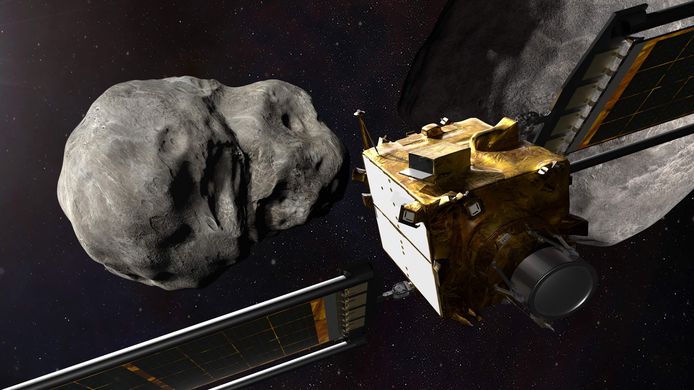
NASA will on Monday attempt a feat humanity has never before accomplished: deliberately smacking a spacecraft into an asteroid to slightly deflect its orbit, in a key test of our ability to stop cosmic objects from devastating life on Earth.
The Double Asteroid Redirection Test (DART) spaceship launched from California last November and is fast approaching its target, which it will strike at roughly 14,000 miles (22,500 kilometers) per hour.
"It's the final cosmic collision countdown," tweeted mission control at Johns Hopkins Applied Physics Laboratory in Maryland.
To be sure, neither the asteroid moonlet Dimorphos, nor the big brother it orbits, called Didymos, pose any threat as the pair loop the Sun, passing about seven million miles from Earth at nearest approach.
But NASA has deemed the experiment important to carry out before an actual need is discovered.
If all goes to plan, impact between the car-sized spacecraft, and the 530-foot (160 meters, or two Statues of Liberty) asteroid should take place at 7:14 pm Eastern Time (2314 GMT), viewable on a NASA livestream.
By striking Dimorphos head on, NASA hopes to push it into a smaller orbit, shaving ten minutes off the time it takes to encircle Didymos, which is currently 11 hours and 55 minutes—a change that will be detected by ground telescopes in the days or weeks to come.
The proof-of-concept experiment will make a reality of what has before only been attempted in science fiction—notably in films such as "Armageddon" and "Don't Look Up."
Technically challenging
As the craft propels itself through space, flying autonomously for the mission's final phase, its camera system will start to beam down the very first pictures of Dimorphos.
Minutes later, a toaster-sized satellite called LICIACube, which already separated from DART a few weeks ago, will make a close pass of the site to capture images of the collision and the ejecta—the pulverized rock thrown off by impact.
LICIACube's pictures will be sent back in the next weeks and months.
Also watching the event: an array of telescopes, both on Earth and in space—including the recently operational James Webb—which might be able to see a brightening cloud of dust.
Finally, a full picture of what the system looks like will be revealed when a European Space Agency mission four years down the line called Hera arrives to survey Dimorphos' surface and measure its mass, which scientists can currently only guess at.
Being prepared
Very few of the billions of asteroids and comets in our solar system are considered potentially hazardous to our planet, and none are expected in the next hundred years or so.
But "I guarantee to you that if you wait long enough, there will be an object," said NASA's Thomas Zurbuchen.
We know that from the geological record—for example, the six-mile wide Chicxulub asteroid struck Earth 66 million years ago, plunging the world into a long winter that led to the mass extinction of the dinosaurs along with 75 percent of all species.
An asteroid the size of Dimorphos, by contrast, would only cause a regional impact, such as devastating a city, albeit with greater force than any nuclear bomb in history.
How much momentum DART imparts on Dimorphos will depend on whether the asteroid is solid rock, or more like a "rubbish pile" of boulders bound by mutual gravity—a situation that's not yet known.
The shape of the asteroid is also not known, but NASA engineers are confident DART's SmartNav guidance system will hit its target.
If it misses, NASA will have another shot in two years' time, with the spaceship containing just enough fuel for another pass.
But if it succeeds, the mission will mark the first step towards a world capable of defending itself from a future existential threat.
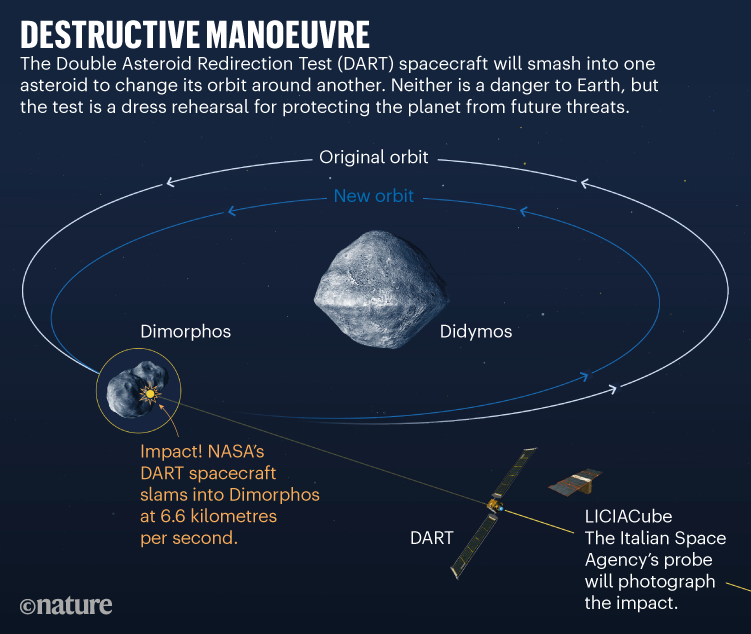
Graphic on NASA's DART mission to crash a small spacecraft into a mini-asteroid to change its trajectory as a test for any potentially dangerous asteroids in the future.
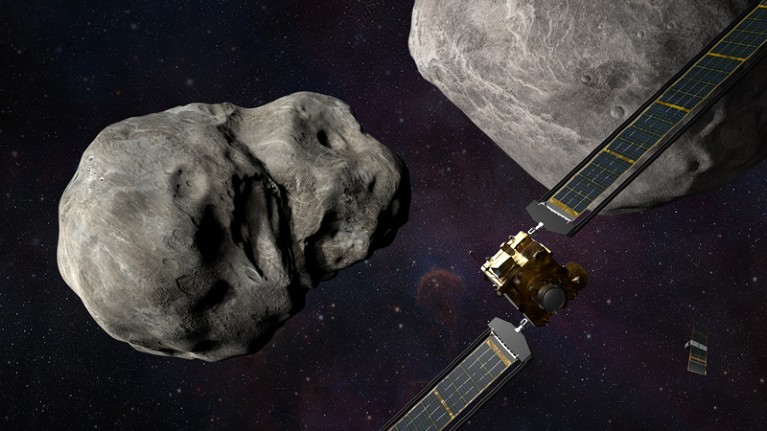
The DART spacecraft will smash into the asteroid Dimorphos, and the LICIACube probe (bottom right) will snap photos of the aftermath, as shown in this artist’s rendering.
Credit: NASA/Johns Hopkins APL/Steve Gribben
On 26 September, at 7:14 p.m. US eastern time, NASA will strike a pre-emptive blow against the dangers of the Solar System. That’s when, 11 million kilometres from Earth, the agency is set to smash a spacecraft into an asteroid. The goal is to knock the harmless space rock into a slightly different orbit to test whether humanity could do such a thing if a dangerous asteroid were ever detected heading for Earth1.
The Double Asteroid Redirection Test (DART) spacecraft will meet its end when it crashes into the asteroid Dimorphos, which is about 160 metres across. “We describe it as running a golf cart into the Great Pyramid,” says Nancy Chabot, a planetary scientist at the Johns Hopkins University Applied Physics Laboratory in Laurel, Maryland.
The endeavour is reminiscent of Bruce Willis saving Earth by blasting a wayward asteroid in the 1998 film Armageddon. And the whole event will unfold like a film when it’s broadcast on NASA’s website. DART’s camera will focus on Dimorphos and the larger asteroid that it orbits, Didymos, as the spacecraft approaches.
At first, DART will not be able to distinguish between the two asteroids, but when it gets close enough, its view will resolve into two points of light. The spacecraft will continue to hurtle towards Dimorphos, snapping images once per second and sending them to Earth until the asteroid’s rubbly surface fills the field of view. “We are super excited to see what it’s going to look like,” says Michelle Chen, a software engineer at the Johns Hopkins lab. Then the footage will end abruptly, as DART smashes into the surface.
Aftermath of a smash
But the US$330-million mission aims to accomplish some science before the credits roll. DART will study the effects of injecting kinetic energy — from an impact at 6.6 kilometres per second — into an asteroid. Dimorphos might absorb much of that energy or it might partially break apart, depending on whether it is made of solid rock or is a loose agglomeration of space pebbles2. Small asteroids are “little geophysical and geological worlds”, says Patrick Michel, a planetary scientist at the Côte d’Azur Observatory in Nice, France. “What DART will see, we don’t know.”
This simulation, created by researchers at Lawrence Livermore National Laboratory in California, predicts what will happen as DART hits the surface of Dimorphos, if the asteroid is made of strong rocky material.
Researchers will get their best view of the collision’s aftermath from another spacecraft that will fly by. An Italian probe named LICIACube is travelling a little behind DART and will zip past Dimorphos just three minutes after the impact. Its cameras will snap images before and after the crash. LICIACube will see whatever is left of the DART spacecraft — unless the impact kicks up a cloud of dust big enough to obscure the view3,4. The most exciting images from LICIACube should be available within 24 hours of the crash, says Simone Pirrotta, the probe’s project manager at the Italian space agency ASI in Rome.
The impact might not leave behind a crater if Dimorphos absorbs much of DART’s kinetic energy, says Adriano Campo Bagatin, a planetary scientist at the University of Alicante in Spain. Visits to other asteroids have shown just how complicated and surprising space rocks can be. Beginning in 2018, for example, NASA’s OSIRIS-REx spacecraft spent two years orbiting and studying the asteroid Bennu, but when it moved in to collect a sample, Bennu turned out to be a loose collection of pebbles that responded in unexpected ways to the sampling arm.
Confirming success
With Dimorphos, it will take days to weeks before mission scientists can confirm whether the test worked. The goal is to speed up Dimorphos’s orbit, cutting the time it takes to travel around Didymos by 10–15 minutes (see ‘Destructive manoeuvre’). Scientists will learn whether this has happened by using telescopes on Earth to observe how Dimorphos blocks the light from Didymos, and vice versa, as the smaller asteroid circles the larger.
Source: This graphic was repurposed from this story, by Alexandra Witze
Observatories on every continent will measure the aftermath of the crash, as will the Hubble and James Webb space telescopes. “I’m going to be rooting for every single observer,” says Cristina Thomas, a planetary scientist at Northern Arizona University in Flagstaff who leads the observation teams. Changes to Dimorphos’s orbit will probably become apparent around 1–2 October, or even earlier, depending on how quickly the cloud of dust clears after the impact. Researchers will have to wait until 2027 for another close-up look, when a European Space Agency mission called Hera visits the asteroid to study the crash site5.
Dimorphos and Didymos are not a threat to Earth — and they won’t be after the test. NASA just wants to understand whether it has the ability to deflect a space rock of Dimorphos’s size, which could devastate a region of Earth if it were to hit the planet.
The agency is surveying the cosmos for threatening asteroids, but the project is behind schedule. With the telescopes currently available on Earth, it would take another three decades to finish. And this year, NASA delayed the launch of a long-awaited space telescope that would help hunt these asteroids, from 2026 to no earlier than 2028.
“The most important thing to keep in mind about any of these deflection techniques is they rely on having enough time to work,” says Amy Mainzer, a planetary scientist at the University of Arizona in Tucson and principal investigator of the planned telescope. “The key is finding objects well ahead of any potential impact.”
NASA laat vannacht opzettelijk satelliet neerstorten op meteoriet
De Amerikaanse ruimtevaartorganisatie NASA laat komende nacht (13.15 uur Belgische tijd) een satelliet inslaan op een ruimterots. Op die manier wil NASA onderzoeken of ze de aarde kan redden als een meteoriet op onze planeet zou afstormen.
Vorig jaar in november werd het ruimtevaartuig DART, Double Asteroid Redirection, gelanceerd vanaf Vandenberg in Californië. De ruimtesonde met een grootte van een golfkarretje is aangekomen bij het einddoel: de planetoïde Didymos A.
De satelliet - ongeveer 310 miljoen euro waard - moet met een snelheid van 22.000 kilometer per uur op Dimorphos, een maantje dat rond Didymos A draait, botsen. Het doel is om het maantje uit zijn baan te duwen.
Door de klap zal de omlooptijd van de maan, die normaal 11 uur en 45 minuten is, waarschijnlijk met tien minuten veranderen. Kosmisch gezien is dit maar een klein duwtje. Maar een kleine koerswijziging kan er al voor zorgen dat een toekomstige op ramkoers liggende planetoïde langs de aarde scheert.
Geen dreiging
Het is de eerste keer dat NASA zo’n missie start. “Het stelsel is een perfecte plek om te testen of het mogelijk is de koers van een planetoïde te veranderen door er moedwillig een ruimtevaartuig op in te laten slaan”, klinkt het bij de ruimtevaartorganisatie.
NASA benadrukt dat er voorlopig geen enkele dreiging voor de aarde is. Volgens ‘The Guardian’ volgen astronomen continu zo’n 30.000 grote asteroïden op in de nabijheid van de aarde. Geen enkele daarvan zou de komende honderd jaar in contact met de aarde komen. Maar DART zou wel een antwoord kunnen vormen op kleinere, minder voorspelbare meteoren die richting onze planeet vliegen.
Meer van UFO'S of UAP'S, ASTRONOMIE, RUIMTEVAART, ARCHEOLOGIE, OUDHEIDKUNDE, SF-SNUFJES EN ANDERE ESOTERISCHE WETENSCHAPPEN - DE ALLERLAATSTE NIEUWTJES



 Octopus like UFO over NYC | Yesterday




 NASA spacecraft will slam into asteroid in first planetary-defence test
 Record number of asteroids seen whizzing past Earth in 2020
 NASA ‘fist bumps’ an asteroid to reveal Solar System’s secrets
 Asteroid dust recovered from Japan’s daring Hayabusa2 mission