Ontdek de Fascinerende Wereld van UFO's en UAP's: Jouw Bron voor Onthullende Informatie!
Ben jij ook gefascineerd door het onbekende? Wil je meer weten over UFO's en UAP's, niet alleen in België, maar over de hele wereld? Dan ben je op de juiste plek!
België: Het Kloppend Hart van UFO-onderzoek
In België is BUFON (Belgisch UFO-Netwerk) dé autoriteit op het gebied van UFO-onderzoek. Voor betrouwbare en objectieve informatie over deze intrigerende fenomenen, bezoek je zeker onze Facebook-pagina en deze blog. Maar dat is nog niet alles! Ontdek ook het Belgisch UFO-meldpunt en Caelestia, twee organisaties die diepgaand onderzoek verrichten, al zijn ze soms kritisch of sceptisch.
Nederland: Een Schat aan Informatie
Voor onze Nederlandse buren is er de schitterende website www.ufowijzer.nl, beheerd door Paul Harmans. Deze site biedt een schat aan informatie en artikelen die je niet wilt missen!
Internationaal: MUFON - De Wereldwijde Autoriteit
Neem ook een kijkje bij MUFON (Mutual UFO Network Inc.), een gerenommeerde Amerikaanse UFO-vereniging met afdelingen in de VS en wereldwijd. MUFON is toegewijd aan de wetenschappelijke en analytische studie van het UFO-fenomeen, en hun maandelijkse tijdschrift, The MUFON UFO-Journal, is een must-read voor elke UFO-enthousiasteling. Bezoek hun website op www.mufon.com voor meer informatie.
Samenwerking en Toekomstvisie
Sinds 1 februari 2020 is Pieter niet alleen ex-president van BUFON, maar ook de voormalige nationale directeur van MUFON in Vlaanderen en Nederland. Dit creëert een sterke samenwerking met de Franse MUFON Reseau MUFON/EUROP, wat ons in staat stelt om nog meer waardevolle inzichten te delen.
Let op: Nepprofielen en Nieuwe Groeperingen
Pas op voor een nieuwe groepering die zich ook BUFON noemt, maar geen enkele connectie heeft met onze gevestigde organisatie. Hoewel zij de naam geregistreerd hebben, kunnen ze het rijke verleden en de expertise van onze groep niet evenaren. We wensen hen veel succes, maar we blijven de autoriteit in UFO-onderzoek!
Blijf Op De Hoogte!
Wil jij de laatste nieuwtjes over UFO's, ruimtevaart, archeologie, en meer? Volg ons dan en duik samen met ons in de fascinerende wereld van het onbekende! Sluit je aan bij de gemeenschap van nieuwsgierige geesten die net als jij verlangen naar antwoorden en avonturen in de sterren!
Heb je vragen of wil je meer weten? Aarzel dan niet om contact met ons op te nemen! Samen ontrafelen we het mysterie van de lucht en daarbuiten.
Artemis I Becomes Cultural, Educational Time Capsule for Trip Around Moon
When NASA’s Orion spacecraft travels beyond the Moon duringArtemis I, boosted by the Space Launch System rocket on its maiden voyage, the spacecraft will carry a host of mementos for educational engagement and posterity in the Official Flight Kit.
NASA spacecraft, both crewed and uncrewed, have carried mementos from Earth since the 1960s. NASA’s Voyager probe carried with it a gold record with Earth sounds, and the Perseverance rover that landed on Mars included a microchip with 10.9 million names that people submitted for inclusion in the journey. The agency flew metal on the last space shuttle mission that was later melted down and made into awards for employees.
A small Moon rock from Apollo 11 that also was aboard the final space shuttle flight will fly aboard Orion, marking the significance of the return of a spacecraft built for humans to the Moon. The National Air and Space Museum is lending an Apollo 8 commemorative medallion, a bolt from the Apollo 11 mission, and an Apollo 11 mission patch to the kit. The Apollo items contributed by the museum will be displayed in an exhibit after they are returned to Earth.
The bolt from one of Apollo 11’s F-1 engines that is included in the Artemis I Official Flight Kit.
Credits: Smithsonian’s National Air and Space Museum
Many of the items included in the flight kit are symbols of cultural significance or NASA’s collaborative efforts with STEM-focused organizations. The agency and the Girl Scouts of the USA collaborated to include space science badges to inspire scientific and career exploration in the STEM fields. Four LEGO minifigures also will catch a ride on the flight – NASA and the LEGO Group have partnered on collaborative efforts over the past two decades to engage children and adults alike in STEM and space exploration, including a free online Artemis I “Build to Launch” lesson series.
Digitized entries from NASA’s Artemis Moon Pod essay contest, in recognition of students’ efforts and contributions, as well as pledges from teachers to educate students about space exploration will also be included in the flight kit. Around 100 miniature Artemis I patches will be included and given after the flight for team recognitions to some participants in Artemis Student Challenges, an annual series of engineering challenges for middle school through undergraduate students. A variety of tree seeds will fly and will be distributed to educational organizations and teachers as a learning opportunity after the mission. Tree seeds were flown aboard the Apollo 14 mission and were germinated and grown into “Moon Trees” after being returned to Earth as an experiment to understand the effects of deep space on seeds.
Employees examine Artemis I mission patches to be included in the Official Flight Kit.
A pen nib from the Charles M. Schulz Museum and Research Center in Santa Rosa, California, will make the trek on Artemis I. NASA has shared an association with Schulz and his American icon Snoopy since Apollo missions began in the 1960s. Schulz created comic strips depicting Snoopy on the Moon, illustrating public excitement about America’s achievements in space. NASA renewed its relationship with Snoopy in 2019, the 50th anniversary of Apollo 10. The nib, used by Schulz himself, will be wrapped in a space themed comic strip.
NASA has a strong history of international collaboration and is extending many of its international partnerships to Artemis. Several items from other space agencies will be included in the flight kit. ESA (European Space Agency), which is providing the service module that powers and fuels Orion around the Moon and on its way home, will fly Shaun the Sheep, a small animal from the children’s television series spinoff from “Wallace and Gromit” that was broadcast in 180 countries. ESA has a long-standing partnership and Shaun the Sheep has flown on its parabolic flight campaign to generate awareness of space.
A 3D-printed replica of the Greek goddess Artemis will fly for later display in the Acropolis Museum in Greece. The Israel Space Agency is contributing a pebble from the shore of the Dead Sea, the lowest dry land surface area on Earth, to symbolize humanity’s continuing drive for exploration. The German Space Agency will fly digitized versions of student visions of lunar exploration as part of a nationwide educational activity.
The kit will also include a variety of flags, patches, and pins to be distributed after the mission to stakeholders and employees who contributed to the flight.
The colliding cluster Abell 3266 as seen across the electromagnetic spectrum, using data from ASKAP and the ATCA (red/orange/yellow colours), XMM-Newton (blue) and the Dark Energy Survey (background map). (Image credit: Christopher Riseley (Università di Bologna),)
Christopher Riseley(opens in new tab), Research Fellow, Università di Bologna Tessa Vernstrom(opens in new tab), Senior research fellow, The University of Western Australia
The universe is littered with galaxy clusters — huge structures piled up at the intersections of the cosmic web(opens in new tab). A single cluster can span millions of light-years across and be made up of hundreds, or even thousands, of galaxies.
However, these galaxies represent only a few percent of a cluster's total mass. About 80% of it is dark matter, and the rest is a hot plasma "soup": gas heated to above 10,000,000 degrees Celsius and interwoven with weak magnetic fields.
We and our international team of colleagues have identified a series of rarely observed radio objects — a radio relic, a radio halo and fossil radio emission — within a particularly dynamic galaxy cluster called Abell 3266. They defy existing theories about both the origins of such objects and their characteristics.
Relics, haloes and fossils
Galaxy clusters allow us to study a broad range of rich processes — including magnetism and plasma physics — in environments we can't recreate in our labs.
When clusters collide with each other, huge amounts of energy are put into the particles of the hot plasma, generating radio emission. And this emission comes in a variety of shapes and sizes.
"Radio relics" are one example. They are arc-shaped and sit towards a cluster's outskirts, powered by shockwaves travelling through the plasma, which cause a jump in density or pressure, and energize the particles. An example of a shockwave on Earth is the sonic boom that happens when an aircraft breaks the sound barrier.
"Radio haloes" are irregular sources that lie towards the cluster's center. They're powered by turbulence in the hot plasma, which gives energy to the particles. We know both haloes and relics are generated by collisions between galaxy clusters — yet many of their gritty details remain elusive.
Then there are "fossil" radio sources. These are the radio leftovers from the death of a supermassive black hole at the center of a radio galaxy.
When they're in action, black holes shoot huge jets of plasma(opens in new tab) far out beyond the galaxy itself. As they run out of fuel and shut off, the jets begin to dissipate. The remnants are what we detect as radio fossils.
Abell 3266
Our new paper(opens in new tab), published in the Monthly Notices of the Royal Astronomical Society, presents a highly detailed study of a galaxy cluster called Abell 3266.
This is a particularly dynamic and messy colliding system around 800 million light-years away. It has all the hallmarks of a system that should be host to relics and haloes — yet none had been detected until recently.
Our data paint a complex picture. You can see this in the lead image: yellow colors show features where energy input is active. The blue haze represents the hot plasma, captured at X-ray wavelengths.
Redder colors show features that are only visible at lower frequencies. This means these objects are older and have less energy. Either they have lost a lot of energy over time, or they never had much to begin with.
The radio relic is visible in red near the bottom of the image (see below for a zoom). And our data here reveal particular features that have never been seen before in a relic.
The 'wrong-way' relic in Abell 3266 is shown here with yellow/orange/red colours representing the radio brightness. (Image credit: Christopher Riseley, using data from ASKAP, ATCA, XMM-Newton and the Dark Energy Survey))
Its concave shape is also unusual, earning it the catchy moniker of a "wrong-way" relic. Overall, our data break our understanding of how relics are generated, and we’re still working to decipher the complex physics behind these radio objects.
Ancient remnants of a supermassive black hole
The radio fossil, seen towards the upper right of the lead image (and also below), is very faint and red, indicating it is ancient. We believe this radio emission originally came from the galaxy at the lower left, with a central black hole that has long been switched off.
The radio fossil in Abell 3266 is shown here with red colors and contours depicting the radio brightness measured by ASKAP, and blue colors showing the hot plasma. The cyan arrow points to the galaxy we think once powered the fossil (Image credit: Christopher Riseley, using data from ASKAP, XMM-Newton and the Dark Energy Survey)
Our best physical models simply can’t fit the data. This reveals gaps in our understanding of how these sources evolve — gaps that we're working to fill.
Finally, using a clever algorithm, we de-focused the lead image to look for very faint emission that's invisible at high resolution, unearthing the first detection of a radio halo in Abell 3266 (see below).
The radio halo in Abell 3266 is shown here with red colors and contours depicting the radio brightness measured by ASKAP, and blue colors showing the hot plasma. The dashed cyan curve marks the outer limits of the radio halo. (Image credit: Christopher Riseley, using data from ASKAP, XMM-Newton and the Dark Energy Survey)
Toward the future
This is the beginning of the road towards understanding Abell 3266. We have uncovered a wealth of new and detailed information, but our study has raised yet more questions.
The telescopes we used are laying the foundations for revolutionary science from the Square Kilometre Array(opens in new tab) project. Studies like ours allow astronomers to figure out what we don’t know — but you can be sure we’re going to find out.
We acknowledge the Gomeroi people as the traditional owners of the site where ATCA is located, and the Wajarri Yamatji people as the traditional owners of the Murchison Radioastronomy Observatory site, where ASKAP and the Murchison Widefield Array are located.
This article is republished from The Conversation(opens in new tab) under a Creative Commons license. Read the original article(opens in new tab).
The Butterfly Nebula, located just under 4,000 light-years from Earth in the constellation Scorpius, is a striking example of a planetary nebula, the end stage in the evolution of a small to medium-sized star. The butterfly’s diaphanous “wings” consist of gas and dust that have been expelled from the dying star and illuminated from within by the star’s remaining core. The nebula’s symmetrical, double-lobed shape is a telltale sign that a companion star helped shape the outflowing gases. Both the primary star and its companion are hidden by the shroud of dust in the nebula’s center.
NASA/ESA/HUBBLE
Billions of years from now, as our Sun approaches the end of its life and helium nuclei begin to fuse in its core, it will bloat dramatically and turn into what’s known as a red giant star. After swallowing Mercury, Venus and Earth with hardly a burp, it will grow so large that it can no longer hold onto its outermost layers of gas and dust.
In a glorious denouement, it will eject these layers into space to form a beautiful veil of light, which will glow like a neon sign for thousands of years before fading.
The galaxy is studded with thousands of these jewel-like memorials, known as planetary nebulae. They are the normal end stage for stars that range from half the Sun’s mass up to eight times its mass. (More massive stars have a much more violent end, an explosion called a supernova.) Planetary nebulae come in a stunning variety of shapes, as suggested by names like the Southern Crab, the Cat’s Eye and the Butterfly. But as beautiful as they are, they have also been a riddle to astronomers. How does a cosmic butterfly emerge from the seemingly featureless, round cocoon of a red giant star?
Observations and computer models are now pointing to an explanation that would have seemed outlandish 30 years ago: Most red giants have a much smaller companion star hiding in their gravitational embrace. This second star shapes the transformation into a planetary nebula, much as a potter shapes a vessel on a potter’s wheel.
NASA’s new James Webb Space Telescope has revealed extraordinary details in the Southern Ring Nebula, a planetary nebula that lies around 2,500 light-years away in the constellation Vela. On the left, a near-infrared image shows spectacular concentric shells of gas, which chronicle the history of the dying star’s outbursts. On the right, a mid-infrared image easily distinguishes the dying star at the nebula’s center (red) from its companion star (blue). All of the gas and dust in the nebula was expelled by the red star.
NASA, ESA, CSA, AND STSCI
The dominant theory of planetary nebula formation previously involved only a single star — the red giant itself. With only a weak gravitational hold on its outer layers, it sheds mass very rapidly near the end of its life, losing as much as 1 percent per century. It also churns like a boiling pot of water underneath the surface, causing the outer layers to pulse in and out. Astronomers theorized that these pulsations produce shock waves that blast gas and dust into space, creating what’s called a stellar wind. Yet it takes a great deal of energy to expel this material completely without having it fall back into the star. It cannot be any gentle zephyr, this wind; it needs to have the strength of a rocket blast.
After the star’s outer layer has escaped, the much smaller inner layer collapses into a white dwarf. This star, which is hotter and brighter than the red giant it came from, illuminates and warms the escaped gas, until the gas starts glowing by itself — and we see a planetary nebula. The whole process is very fast by astronomical standards but slow by human standards, typically taking centuries to millennia.
Until the Hubble Space Telescope launched in 1990, “we were pretty sure we were on the right track” toward understanding the process, says Bruce Balick, an astronomer at the University of Washington. Then he and his colleague Adam Frank, of the University of Rochester in New York, were at a conference in Austria and saw Hubble’s first photos of planetary nebulae. “We went out to get coffee, saw the pictures and we knew that the game had changed,” Balick says.
Astronomers had assumed that red giants were spherically symmetrical, and a round star should produce a round planetary nebula. But that’s not what Hubble saw — not even close. “It became obvious that many planetary nebulae have exotic axisymmetric structures,” says Joel Kastner, an astronomer at the Rochester Institute of Technology. Hubble revealed fantastic lobes, wings and other structures that weren’t round but were symmetric around the nebula’s main axis, as if turned on that potter’s wheel.
In early photos from ground-based observatories, the Southern Crab Nebula appeared to have four curved “legs” like a crab. But detailed images from the Hubble Space Telescope show that these legs are the sides of two bubbles that roughly form an hourglass shape. In the center of the bubbles are two jets of gas, with “knots” that may light up when they encounter the gas between the stars. The Southern Crab, located several thousand light-years from Earth in the constellation Centaurus, appears to have had two gas-releasing events. One around 5,500 years ago created the outer “hourglass,” and a similar event 2,300 years ago created the inner, much smaller one.
ADAPTED FROM NASA, ESA, AND A. FEILD (STSCI)
A 2002 article by Balick and Frank in the Annual Review of Astronomy and Astrophysics captured the debate at the time over the origin of these structures. Some scientists proposed that the axial symmetry stemmed from how the red giant star rotated or how its magnetic fields behaved, but both ideas failed some fundamental tests. Both rotation and magnetic fields should get weaker as the star grows larger, yet the mass-loss rate of red giants accelerates at the end of their lifetimes.
The other option was that most planetary nebulae are formed not by one star, but by a pair of stars — what Orsola De Marco, an astronomer at Macquarie University in Sydney, named the “binary hypothesis.” In this scenario, the second star is much smaller and thousands of times fainter than the red giant, and it might be as far away as Jupiter is from the Sun. That would allow it to disrupt the red giant while being distant enough to not be swallowed up. (Other possibilities also exist, such as a dive-bombing orbit in which the second star would approach the red giant every few hundred years, peeling off layers from it.)
The binary hypothesis accounts very well for the first stage of metamorphosis of a dying star. As the companion pulls dust and gases away from the primary star, they do not immediately get sucked into the companion, but form a swirling disk of material known as an accretion disk in the orbital plane of the companion. That accretion disk is the potter’s wheel. If the disk has a magnetic field, it will propel any charged gases out of the plane of the disk and toward the axis of rotation. But even without a magnetic field, the material in the disk impedes the outward flow of gases in the orbital plane, so the gas will take on a bilobed structure, with faster flow toward the poles. And that’s just what Hubble saw in its images of planetary nebulae. “Why look for a really complicated explanation when a companion star explains it really well?” says De Marco.
Left: The Twin Jet Nebula, 2,400 light-years from Earth in the constellation Ophiuchus, shows off an hourglass shape, with two jets of rapidly moving gas streaming poleward. The gas was probably ejected by the central star about 1,200 years ago. Right: The Cat’s Eye Nebula, 3,300 light-years from Earth in the constellation Draco, exhibits 11 concentric rings of dust, which astronomers estimate were released at 1,500-year intervals. The process by which the complicated inner structure formed is still anybody’s guess. “The Cat’s Eye is weird. I don’t know if I can explain it,” says astronomer Adam Frank of the University of Rochester.
Nevertheless, the idea of undetectable companion stars didn’t sit well with some astronomers. As recently as 2020, writes Leen Decin, an astronomer at KU Leuven in Belgium, a famous astrophysicist told her “You know, Leen, it all looks so fantastic, the observations are so fascinating, the current state-of-the-art models seem to do a pretty good job for interpreting the data, but in the end, shouldn’t we only believe what we can actually see?”
But over the last 10 to 15 years, the tide has steadily turned. New and innovative telescopes have revealed that some red giants are surrounded by spiral structures and accretion disks before they turn into planetary nebulae — just as expected if there were a second star pulling material off the red giant. In a couple of cases, astronomers may have even spotted the companion star itself.
Decin and her colleagues have especially relied upon the Atacama Large Millimeter/submillimeter Array (ALMA) in Chile, which came online in 2011. ALMA consists of 66 radio telescopes that work together to produce images of astronomical objects. “It gives us high spatial and spectral resolution that are important if you want to understand dynamics and velocity,” Decin says. Velocity is an important part of the puzzle for scientists to map stellar winds and accretion disks.
ALMA has seen spiral-shaped or arc-shaped structures around more than a dozen red giant stars, almost certainly a sign that matter is being shed from the red giant and spiraling toward its companion. The spirals closely match computer simulations and are impossible to explain with the old stellar-wind model. Decin reported the initial findings in 2020 in Science and expanded on them the following year in Annual Review of Astronomy and Astrophysics.
In addition, Decin’s group may have spotted the previously undetectable companions of two red giants, p1 Gruis and L2 Puppis, in ALMA images. To make sure, she needs to monitor them over a period of time to see if the newly detected objects are moving around the primary star. “If they move, I’m sure that we have companions,” says Decin. Perhaps this discovery will win over the last skeptics.
Like crime scene investigators, astronomers now have “before” and “after” snapshots of the creation of a planetary nebula. The one thing they lack is the equivalent of CCTV footage of the event itself. Is there any hope that astronomers can catch a red giant in the act of turning into a planetary nebula?
So far, computer models are the only way to “watch” the centuries-long process unfold from beginning to end. They have helped astronomers home in on one dramatic scenario, in which the companion star plunges into the primary after a prolonged period of orbiting it and losing distance due to tidal forces. As it spirals toward the red giant’s core, the companion sheds “an insane amount of gravitational energy,” says Frank. The computer models show that this hugely accelerates the process through which the star lets go of its outer layers, to just one to 10 years. If this is correct, and if astronomers knew where to look, they could witness the death of a star and birth of a planetary nebula in real time.
A hydrodynamic simulation of a small companion star (white dot) orbiting a red giant star (white circle) shows that the outflowing stellar wind forms a spiral, consistent with what has been seen in the ALMA telescope images.
L. DECIN / *AR ASTRONOMY AND ASTROPHYSICS* 2021
One candidate to keep an eye on is called V Hydrae. This very active red giant star ejects bullet-like clumps of plasma toward its poles every 8.5 years, and it also has coughed out six large rings in its equatorial plane over the last 2,100 years. Raghvendra Sahai, an astronomer at NASA’s Jet Propulsion Laboratory who published the discovery of the rings in April, believes that the red giant has not one but two companion stars. A nearby companion may already be grazing the red giant’s envelope and producing the plasma ejections, while a distant companion in a dive-bombing orbit controls the ejection of the rings. If so, V Hydrae may be close to swallowing up its closer companion.
Finally, what about our Sun? Studies of binary stars might seem to have little relevance for our star’s fate, because it is a singleton. Stars with companions lose mass about six to 10 times faster than those without, Decin estimates, because it’s much more efficient for a companion star to pull off a red giant’s shell than for the red giant to push off its own shell.
This means that data on stars with companions cannot reliably predict the fate of stars without companions, like the Sun. Roughly half of the stars that are the Sun’s size have companions of some sort. According to Decin, the companion will always affect the shape of the stellar wind, and it will significantly affect the mass-loss rate if the companion is close enough. The Sun will most likely eject its outer layer more slowly than those stars and will stay in its red-giant phase several times longer.
But a great deal is still unknown about the Sun’s last act. For example, even though Jupiter is not a star, it could still be hefty enough to attract material from the Sun and power up an accretion disk. “I think we’ll have a very small spiral created by Jupiter,” Decin says. “Even in our simulations, you can see its impact on the solar wind.” If so, then our Sun too might be in line for a showy grand finale.
Gods, Extraterrestrials and Religion: From Ancient Atlantis to Today via Michael Salla
Dr.Michael E. Salla, is a pioneer in the development of ‘Exopolitics’, the political study of the key actors, institutions and processes associated with extraterrestrial life.
Ancient records and religious texts describe multiple “Gods” (aka extraterrestrials) creating humanity in a series of genetic experiments and warring among themselves over who would be dominant in influencing Earth’s future. The world’s oldest known creation story, Sumer’s Enuma Elish, and other ancient texts introduce the different creator Gods and how they formed grand assemblies to resolve their differences over the destiny of humanity.
This new video is the official trailer/short film for the “World Religions and Extraterrestrial Contact” webinar to be held on August 13. In addition to the above issues, the trailer discusses the rise and fall of Atlantis in relation to creator Gods/extraterrestrials alarmed over humanity’s rapid technological development. Finally, this short film covers the return of the creator Gods (Elohim/Anunnaki) to our solar system and what this means for us today.
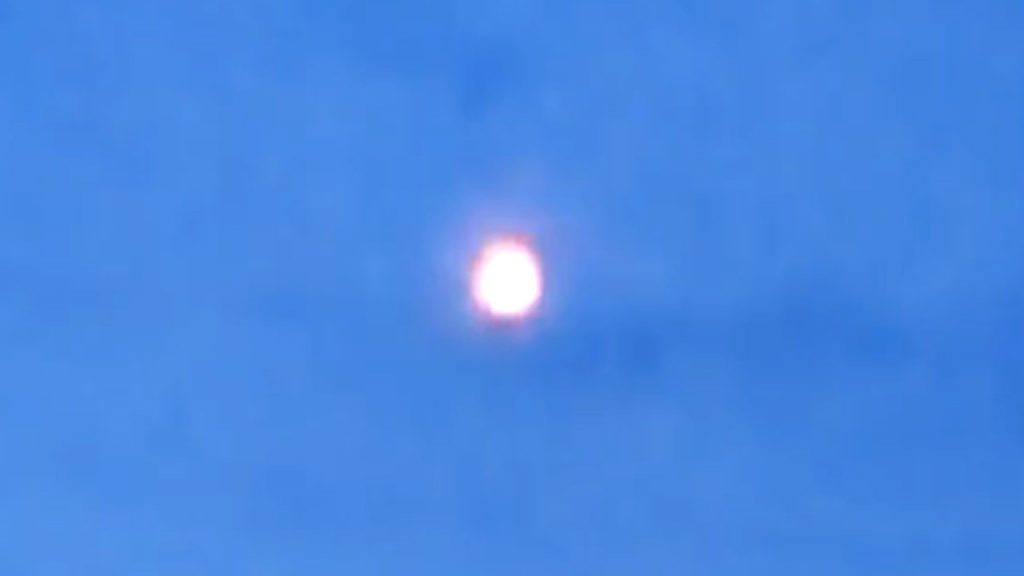
Sparkling Orange UFO Ball over Albuquerque, NM 2022
Check out this interesting UFO sighting video filmed over Albuquerque, Mexico on 31st July 2022.
Let me know your opinion about this footage in the comments!
Witness report:
Driving north in our car, came to intersection & stopped at stop sign. Time was twilight. Noticed a low flying orange ball of light that appeared to be *sparkling”. Light was neither ascending or descending. Seemed to be above treeline, but not as high as a helicopter or small plane. Normal aviation lights were not present. Object was traveling at a constant, slow speed. Turned north about a minute after we viewed it, then disappeared ahead of us.
The stellar smash produced a short gamma-ray burst that could provide important context for understanding similar blasts.
An artist’s impression of a red supergiant star in the final year of its life emitting a tumultuous cloud of gas. This suggests at leastsome of these stars undergo significant internal changes before going supernova.Show less
W.M. KECK OBSERVATORY/ADAM MAKARENKO
A distant neutron-star merger unleashed one of the most powerful short gamma-ray bursts (GRB) ever seen, according to new observations by ALMA, the Atacama Large Millimeter/submillimeter Array in Chile.
Neutron stars are the super-dense stellar cores left after massive stars explode, and when, say, two neutron stars collide, the result is a dramatic explosion, the light of which is referred to as a kilonova. The mergers also release gravitational waves and a brief blast of gamma-ray radiation in two tight jets shooting opposite directions into space.
On Nov. 6 2021, a short gamma-ray burst was detected by the European Space Agency's INTEGRAL X-ray and gamma-ray observatory, which sent out an instant alert that triggered NASA's Swift satellite, among others, to follow up. The burst, cataloged as GRB 211106A, lasted less than two seconds, but the afterglow from the kilonova shone for far longer as the jet of particles released by the merger excited the surrounding gas.
"This short gamma-ray burst was the first time we tried to observe such an event with ALMA," Wen-Fai Fong, an astronomer at Northwestern University in Illinois, said in a statement. "Afterglows for short bursts are very difficult to come by, so it was spectacular to catch this shining so brightly."
An artist's impression of a neutron-star merger (on the left) that produces a relativistic jet of particles that interacts with gas in the surrounding environment, producing an afterglow. (Image credit: ALMA (ESO/NAOJ/NRAO), M. Weiss (NRAO/AUI/NSF))
Detecting the afterglow from the merger in the millimeter-wavelength light that ALMA is tuned to gives astronomers an advantage when it comes to understanding these titanic explosions.
"Millimeter wavelengths can tell us about the density of the environment around the GRB," Genevieve Schroeder, also of Northwestern University, said in the same statement. "And, when combined with the X-rays, [the millimeter-wave light] can tell us about the true energy of the explosion."
As the GRB's jets, which move at nearly the speed of light, smash through the surrounding gas, the shockwaves accelerate electrons. The energy of the radiation from those electrons peaks at millimeter wavelengths, and therefore can tell astronomers about the total energy of the explosion.
ALMA's measurements suggest that GRB 211106A released a total energy between 2 x 10^50 ergs and 6 x 10^51 ergs, which places it among the most powerful short GRBs ever detected. (One erg is equal to 10^–7 joules; for comparison, the sun releases just 3.8 x 10^33 ergs per second.)
An artist's depiction of two neutron stars before they collide. (Image credit: NASA/Goddard Space Flight Center)
It's particularly impressive that GRB 211106A was so bright, relatively speaking, since the merger happened sometime between 6.3 and 9.1 billion years ago, and the galaxy in which the merger took place is now approximately 20 billion light-years from Earth due to cosmic expansion. At this distance, the gravitational waves released by the merger were too feeble to detect.
Another advantage to come from observing with ALMA is that the afterglow at millimeter wavelengths lasts longer than in, say, X-rays. This gives astronomers more time to study the GRB jet, which begins as a narrow stream, then gradually opens out, like a laser pointer that makes a larger spot on a wall than the laser's base.
Fong and Schroeder's team calculated the opening angle of the jet to be 16 degrees, which is the widest ever measured for a short GRB. This is important because we only see a GRB when the jet is pointed toward us, so the wider the jet, the higher chance we have of seeing it.
And the odds matter: Astronomers calculate the rate of neutron-star mergers in the universe based on how many short GRBs we see and estimates of their jet's opening angles. If more short GRBs have jets with wider opening angles, scientists may have overestimated how many neutron-star mergers are taking place.
The rate at which neutron stars merge isn't just an astrophysical curiosity — it has repercussions for cosmic chemistry. The conditions during neutron-star mergers are so intense that some of the universe's heaviest and most precious elements, such as gold, platinum and silver, are forged by these collisions. Indeed, scientists have estimated that a single neutron-star merger can produce between 3 and 13 Earth masses worth of gold. Hence the cosmic abundance of such elements is heavily dependent upon the rate at which neutron-star mergers take place.
While the collision is an act of cosmic alchemy, enriching the surrounding region with atomic treasure, the discovery has offered astronomers a whole new arena for studying short GRBs and their afterglows. "After a decade of observing short GRBs, it is truly amazing to witness the power of using these new technologies to unwrap surprise gifts from the universe," Fong said.
A paper describing the findings is set to be published in a forthcoming issue of Astrophysical Journal Letters; a preprint version was posted on Monday (Aug. 1).
Follow Keith Cooper on Twitter @21stCenturySETI. Follow uson Twitter@Spacedotcomand onFacebook.
The aging vehicle can still have a big role in answering whether there has ever been life on Mars.
The European ExoMars rover, conceived in 2004, might arrive on Mars in 2028.
(Image credit: ESA/ATG Media Lab)
The stars have not been aligned for Europe's first Martian rover ExoMars, but scientists still think the aging vehicle can play a big role in answering one of the biggest questions in Mars exploration: has there ever been life on the Red Planet?
The European Space Agency's (ESA) ExoMars Rosalind Franklin Rover is probably the most high-profile space industry casualty of Russia's war in Ukraine. Originally expected to launch in 2018, the rover was finally declared ready to go (after several delays) for a launch in September this year atop Russia's Proton rocket from the Baikonur Cosmodrome in Kazakhstan. But Russia's invasion of Ukraine put a stop to these plans.
ESA officially terminated cooperation on the ExoMars mission with Russia in July, leaving the rover, conceived in 2004, once again in limbo, and more importantly, without a landing platform to place it on the surface of Mars. (That landing platform was built by Russia, who joined the ExoMars program in 2012 following the withdrawal of the original partner, NASA, in 2012.)
ESA has yet to decide on the mission's fate. Having spent $1.3 billion on the program already, it will have to choose between scrapping the rover altogether or forking out another substantial sum to replace the Russian bits.
In the case of the latter option, the most optimistic estimates see the ExoMars rover leaving Earth in 2028. For many European scientists, scrapping the mission should not be an option at all, and not just because of the investment. Even though NASA's Perseverance has been smashing its sample collection targets, and plans for a mission that would bring those samples to Earth are already underway, there is a lot the aging ExoMars rover can contribute to our understanding of Mars, they say. And some of those questions, in fact, cannot be answered by the stellar Perseverance.
"[The rover's instruments] are going to get a bit old," John Bridges, a professor of planetary science at Leicester University in the U.K., told Space.com. "But as long as the maintenance can be done, it doesn't actually bother me too much that we're not using the most cutting-edge technology. Even if we're going by bicycle rather than by the newest car, it doesn't really matter, as long as we get there."
The promise of the drill
The biggest strength, and scientific promise, of the Rosalind Franklin ExoMars rover is its 6.6-foot (2 meters) drill, which, according to some astrobiologists, may have a higher chance of finding traces of past or present Martian life on Mars than the agile Perseverance.
"The rock pieces that Perseverance collects are from the immediate surface [of Mars]," Susanne Schwenzer, an astrobiologist at Open University in the U.K., who is also an interdisciplinary scientist on the ExoMars mission and a member of the science teams of NASA's Curiosity and the Mars Sample Return missions, told Space.com. "And this immediate surface is bombarded by galactic cosmic rays, and the UV rays [from the sun], which destroy organic materials."
The European ExoMars rover carries a suite of instruments designed to find traces of life in Martian soil.(Image credit: ESA)
Unlike Earth, Mars has no protective magnetic field and a very thin atmosphere, so there is nothing to filter this sterilizing radiation, some of which can penetrate several meters deep into the Martian rocks.
"[The effects of the radiation] diminish exponentially, so the first centimeters [inches] are the worst hit," Schwenzer said.
That doesn't mean that Perseverance cannot find traces of life, just that detecting the organic molecules in the burnt surface layers might require a more challenging scientific analysis, Schwenzer added.
"The advantage of the return samples is that we will have them in our labs over here," Schwenzer said. "If we find something that we can't answer with the instruments that we have, we can wait for the right technology to be developed. It took until the late 1990s to find water in the Apollo samples because they didn't have the right instrumentation at that time."
The deep excavations that the ExoMars rover was built for can, in fact, help scientists understand Perseverance's rocks and the alteration they underwent due to the bombardment by radiation.
"[The ExoMars rover] will help us understand how the organics degrade with depth or do not degrade and are preserved at deeper layers," Schwenzer said.
Europe's wrong turn
Bridges agrees with Schwenzer. But there are other reasons why continuing with ExoMars should be the only option on the table, he thinks. A generation of European scientists has tied their careers with the mission, which may have always been a bit of a moonshot for Europe, ever since its inception in 2004.
"When we started ExoMars in 2004, it was way off the capabilities [of ESA and the European space industry] to do it," Bridges said. "So we got the Americans in to land it and when the Americans pulled out, ESA just looked around, and the Russians put up their hand, and it was done."
Bridges describes the partnership with Russia, hastily put together by ESA leadership under General Director Jean-Jacques Dordain in 2012, as "a strategic mistake."
"I think we should have hit the pause button back then and have a harder discussion across the European communities about what we were going to do," he said.
At that time, the onset of the conflict in Ukraine was still two years away, but Russia was already guilty of stirring a bloody war in Georgia(opens in new tab); its actions in the Caucasian country were overwhelmingly overlooked by the international community at that time.
"There's frustration and disappointment, because so much work has gone into ExoMars," Bridges said. "The instruments, the science teams. But we should probably still stick with it and try and recoup all that scientific investment, not just throw up our hands in disappointment and walk away from it.
ExoMars' landing site in Oxia Planum is an ancient area that could harbor traces of past life. (Image credit: ESA)
The call to confirm life on Mars
Schwenzer adds that to provide the ultimate answer to the big question, whether there has ever been life on Mars, scientists would want to review as much data as possible.
"Extraordinary claims require extraordinary evidence," Schwenzer said, quoting famous astrobiologist Carl Sagan. "We can't just find one molecule that is usually produced by life on Earth and claim that we have found life on Mars. We can't make that claim unless we can absolutely exclude that anything else could have made that molecule. And in order to do that, we would need all the information that we can get, not just that from one mission."
ExoMars' projected landing site in Oxia Planum, an ancient clay-rich basin near Mars' northern tropic, was carefully selected by a pan-European scientific consortium as it offers the best conditions to harbor traces of life.
Formed about 4 billion years ago, the basin, covered with fine-grained sediments, has a catchment area of thousands of miles, Bridges said, where water in the past used to accumulate.
"It's a very different area to Jezero Crater [where Perseverance roams]," Bridges said. "But because we have seen one, that doesn't mean that it is not worth going to see the other. We have still only explored a tiny fraction of the Martian surface and we shouldn't fall into the trap of assuming that we've seen that, done that."
Falling behind
The ExoMars conundrum, Bridges suggests, highlights weaknesses in ESA's strategy, and undermines the agency's aspiration to be the world-class player it desires to be.
ESA, a partnership of 22 European member states, was beaten to the surface of Mars by China, which only revealed its plans for the Zhurong rover in 2014. Chinese landers, including the famous Yutu rover, have dominated moon exploration in the past decade. Japan's space agency JAXA, in the meantime, has built a legacy of returning samples from asteroids.
"ESA has this problem that they can be left flapping in the breeze a bit," Bridges said. "If external factors change, they don't seem to quite have the size or strength to withstand being buffeted about. Part of that is because they haven't really decided what their strategy is, what they really want to be doing, compared to JAXA or China's National Space Administration, who know exactly what they want to do and they just get on and do it."
ESA is currently evaluating options for the ExoMars rover, which it will present to its member states later this year. Among the possibilities is a return to the original partner NASA, who could land the rover using its proven technologies, Bridges said, but with a substantial financial contribution from ESA.
Rogue planets nearly double in number with new discovery
Astronomers announced on December 22, 2021, that they’ve found somewhere between 70 and 170 rogue, or free-floating, planets; that is, planets not currently in orbit around a star. This mass of unattached planets, each approximately the size of Jupiter, lies in a region of the Milky Way known as the Upper Scorpius OB stellar association. These newly found free-floating planets nearly double the total number of rogue planets already known.
The peer-reviewed journal Nature Astronomy published the rogue planet discovery on December 22, 2021.
Location of the rogue planets
The team of astronomers used observations and archival data from telescopes around the world and in space to make their discoveries. They sifted through 80,000 wide-field images taken over 20 years. Núria Miret-Roig and Hervé Bouy at the University of Bordeaux in France took a census of all the stars, brown dwarfs and rogue planets greater than four Jupiter masses in the Upper Scorpius region.
This region of sky, the Upper Scorpius OB association, lies 420 light-years away from Earth. Amateur astronomers might be familiar with this region of sky because it contains favorite targets for astrophotographers, including the colorful region around Rho Ophiuchi plus dark nebulae such as the Pipe Nebula, Barnard 68 and the Coalsack.
A new rogue planet detection method
Previously, astronomers discovered free-floating planets with microlensing surveys. With this method, astronomers witness a brief chance alignment between a rogue planet and a background star. The drawback is that the scientists can’t make follow-up observations with these one-time microlensing events.
In the new study, scientists looked for rogue planets that were still young, within a few million years of their formation. Normally, a planet that is not near its parent star wouldn’t be visible to astronomers without a source to illuminate it. But these young planets are still hot enough to glow. So Miret-Roig and her team looked for direct images of them with sensitive cameras on large telescopes. They measured the points of light in optical and near-infrared wavelengths in the Upper Scorpius region and combined the measurements with the movement they detected. Miret-Roig said:
We measured the tiny motions, the colors and luminosities of tens of millions of sources in a large area of the sky. These measurements allowed us to securely identify the faintest objects in this region.
The origin of the rogue planets
The scientists also wonder how these rogue planets came to be. Were they ejected from a solar system like our own? Or did they form from the collapse of a gas cloud that was too small to create a star? (Which also brings up the as-yet-unanswered question, if the rogue planet doesn’t orbit a star or didn’t originally form around a star, is it still, by definition, a planet?)
If the origin of rogue planets was due to ejection from a stellar system, it suggests there could be an abundance of Earth-sized free-floating planets out there. As Miret-Roig explained:
The free-floating Jupiter-mass planets are the most difficult to eject, meaning that there might even be more free-floating Earth-mass planets wandering the galaxy.
An inexact number of free-floating planets
Sean Raymond, also of the University of Bordeaux and one of the authors on the paper, explained on Twitter why the number of planets is in a range between 70 and 170:
This star-forming region of space – the Upper Scorpius region – is from 3 to 10 million years old. If the star-forming region is younger and closer to the 3 million year age, then the objects the scientists singled out are more likely young, hot planets. If the star-forming region is older, then the candidates are also older, and their brightness comes from a larger size, not youth. In this case, some of them may therefore be brown dwarfs (failed stars).
Could rogue planets have life?
What are these rogue planets like, and would they be suitable for life? Well, for one, they might have moons. As Raymond said on Twitter:
Some ejected gas giants hold onto their moons! We can speculate that tidal heating might maintain not-too-frigid temperatures in the interiors of such moons.
Which, of course, sounds rather conducive to the existence of life. What about Earth-like planets and water, aka, life as we know it? Raymond also tweeted:
The scientists hope to answer some of their many questions in the years to come. With the new Vera C. Rubin Observatory coming online, they’ll likely find many more free-floating planets.
Bottom line: Astronomers have nearly doubled the number of known rogue planets with a recent discovery using archive images from the Upper Scorpius region.
Scientists with the CEERS Collaboration have identified an object—dubbed Maisie’s galaxy in honor of project head Steven Finkelstein’s daughter—that may be one of the earliest galaxies ever observed. If its estimated redshift of 14 is confirmed with future observations, that would mean we’re seeing it as it was just 290 million years after the Big Bang. Credit: NASA/STScI/CEERS/TACC/S. Finkelstein/M. Bagley/Z. Levay.
Two new images from NASA's James Webb Space Telescope show what may be among the earliest galaxies ever observed. Both images include objects from more than 13 billion years ago, and one offers a much wider field of view than Webb's First Deep Field image, which was released amid great fanfare July 12. The images represent some of the first out of a major collaboration of astronomers and other academic researchers teaming with NASA and global partners to uncover new insights about the universe.
Members of the CEERS collaboration explore the first wide, deep field image from the James Webb Space Telescope at the Texas Advanced Computing Center’s Visualization Lab on the UT Austin campus on July 21, 2022.
Credit: Nolan Zunk/University of Texas at Austin.
The team has identified one particularly exciting object—dubbed Maisie's galaxy in honor of project head Steven Finkelstein's daughter—that they estimate is being observed as it was just 290 million years after the Big Bang (astronomers refer to this as a redshift of z=14).
The finding has been published on the preprint server arXiv and is awaiting publication in a peer-reviewed journal. If the finding is confirmed, it would be one of the earliest galaxies ever observed, and its presence would indicate that galaxies started forming much earlier than many astronomers previously thought.
The unprecedentedly sharp images reveal a flurry of complex galaxies evolving over time—some elegantly mature pinwheels, others blobby toddlers, still others gauzy swirls of do-si-doing neighbors. The images, which took about 24 hours to collect, are from a patch of sky near the handle of the Big Dipper, a constellation formally named Ursa Major. This same area of sky was observed previously by the Hubble Space Telescope, as seen in the Extended Groth Strip.
"It's amazing to see a point of light from Hubble turn into a whole, beautifully shaped galaxy in these new James Webb images, and other galaxies just pop up out of nowhere," said Finkelstein, associate professor of astronomy at The University of Texas at Austin and the principal investigator for the Cosmic Evolution Early Release Science Survey (CEERS), from which these images were taken.
An image taken with the Mid-Infrared Instrument (MIRI) on the James Webb Space Telescope from a patch of sky near the handle of the Big Dipper. This is one of the first images obtained by the Cosmic Evolution Early Release Science Survey (CEERS) collaboration.
The CEERS collaboration is composed of 18 co-investigators from 12 Institutions and more than 100 collaborators from the U.S. and nine other countries. CEERS researchers are studying how some of the earliest galaxies formed when the universe was less than 5% of its current age, during a period known as reionization.
Before the actual telescope data came in, Micaela Bagley, a postdoctoral researcher at UT Austin and one of the CEERS imaging leads, created simulated images to help the team develop methods for processing and analyzing the new imagery. Bagley led a group processing the real images so the data could be analyzed by the whole team.
The large image is a mosaic of 690 individual frames that took about 24 hours to collect using the telescope's main imager, called the Near Infrared Camera (NIRCam). This new image covers an area of the sky about eight times as large as Webb's First Deep Field image, although it is not quite as deep. Researchers used supercomputers at the Texas Advanced Computing Center for the initial image processing: Stampede2 was used to remove background noise and artifacts, and Frontera, the world's most powerful supercomputer at a U.S. university, was used to stitch together the images to form a single mosaic.
"High-performance computing power made it possible to combine myriad images and hold the frames in memory at once for processing, resulting in a single beautiful image," Finkelstein said.
The other image was taken with the Mid-Infrared Instrument (MIRI). Compared with NIRcam, MIRI has a smaller field of view but operates at much higher spatial resolution than previous mid-infrared telescopes. MIRI detects longer wavelengths than NIRCam, allowing astronomers to see cosmic dust glowing from star-forming galaxies and black holes at modestly large distances, and see light from older stars at very large distances.
Meer van UFO'S of UAP'S, ASTRONOMIE, RUIMTEVAART, ARCHEOLOGIE, OUDHEIDKUNDE, SF-SNUFJES EN ANDERE ESOTERISCHE WETENSCHAPPEN - DE ALLERLAATSTE NIEUWTJES


 Artemis I Becomes Cultural, Educational Time Capsule for Trip Around Moon