Ontdek de Fascinerende Wereld van UFO's en UAP's: Jouw Bron voor Onthullende Informatie!
Ben jij ook gefascineerd door het onbekende? Wil je meer weten over UFO's en UAP's, niet alleen in België, maar over de hele wereld? Dan ben je op de juiste plek!
België: Het Kloppend Hart van UFO-onderzoek
In België is BUFON (Belgisch UFO-Netwerk) dé autoriteit op het gebied van UFO-onderzoek. Voor betrouwbare en objectieve informatie over deze intrigerende fenomenen, bezoek je zeker onze Facebook-pagina en deze blog. Maar dat is nog niet alles! Ontdek ook het Belgisch UFO-meldpunt en Caelestia, twee organisaties die diepgaand onderzoek verrichten, al zijn ze soms kritisch of sceptisch.
Nederland: Een Schat aan Informatie
Voor onze Nederlandse buren is er de schitterende website www.ufowijzer.nl, beheerd door Paul Harmans. Deze site biedt een schat aan informatie en artikelen die je niet wilt missen!
Internationaal: MUFON - De Wereldwijde Autoriteit
Neem ook een kijkje bij MUFON (Mutual UFO Network Inc.), een gerenommeerde Amerikaanse UFO-vereniging met afdelingen in de VS en wereldwijd. MUFON is toegewijd aan de wetenschappelijke en analytische studie van het UFO-fenomeen, en hun maandelijkse tijdschrift, The MUFON UFO-Journal, is een must-read voor elke UFO-enthousiasteling. Bezoek hun website op www.mufon.com voor meer informatie.
Samenwerking en Toekomstvisie
Sinds 1 februari 2020 is Pieter niet alleen ex-president van BUFON, maar ook de voormalige nationale directeur van MUFON in Vlaanderen en Nederland. Dit creëert een sterke samenwerking met de Franse MUFON Reseau MUFON/EUROP, wat ons in staat stelt om nog meer waardevolle inzichten te delen.
Let op: Nepprofielen en Nieuwe Groeperingen
Pas op voor een nieuwe groepering die zich ook BUFON noemt, maar geen enkele connectie heeft met onze gevestigde organisatie. Hoewel zij de naam geregistreerd hebben, kunnen ze het rijke verleden en de expertise van onze groep niet evenaren. We wensen hen veel succes, maar we blijven de autoriteit in UFO-onderzoek!
Blijf Op De Hoogte!
Wil jij de laatste nieuwtjes over UFO's, ruimtevaart, archeologie, en meer? Volg ons dan en duik samen met ons in de fascinerende wereld van het onbekende! Sluit je aan bij de gemeenschap van nieuwsgierige geesten die net als jij verlangen naar antwoorden en avonturen in de sterren!
Heb je vragen of wil je meer weten? Aarzel dan niet om contact met ons op te nemen! Samen ontrafelen we het mysterie van de lucht en daarbuiten.
US Navy submarines have detected mysterious objects moving hundreds of knots underwater as the Pentagon prepares to release its report on UFO sightings.
The Navy has collected sonar data showing mysterious fast-moving underwater objects that experts or current technology cannot explain.
Tom Rogan of the Washington Examiner said the US Navy “has the data” to prove the strange encounters.
Some of these encounters could be included in the US government working group that is preparing to report back to Congress on its UFO findings next month.
Speaking with Tucker Carlson of Fox News about the new footage, Rogan said: “One area that we will learn more about in relation to this video is the interaction between Navy submarines that pick up sonar contact from things moving hundreds knots under water ”.
“There is an underwater dimension to this, in addition to what the pilots are seeing above the water.”
Mr. Carlson replied, “Hundreds of knots under water? I don’t think people can even digest that. “
Mr. Rogan added: “That is what I have heard from very good sources and that the United States Navy has the data.”
Last month, Corbell shared a video of another mysterious triangular craft flying near another US Navy ship.
He said, “Whether this being is worldly or otherworldly, we don’t know. It is just part of a much larger series of events that we are going to learn from. “
Last week, video showed a dark spherical object moving across the sky near a Navy ship , before suddenly veering into the water and disappearing.
Elizondo, former director of the Pentagon’s Advanced Aerospace Threat Identification Program, said that some of the UAPs that have been seen defy physics as we know it.
“They have no signs of propulsion, no wings, and yet they can defy the natural effects of Earth’s gravity. That is precisely what we are seeing ”.
From HG Wells’ “The Time Machine” to the “Back to the Future” franchise, time travel has been a hallmark of science fiction for more than a century.
Part of its appeal has been that famous physicists like Albert Einstein have come up with theories that explain weather phenomena in ways that don’t rule out the possibility of time travel.
Einstein’s special theory of relativity proposes that time moves relative to an observer and is an illusion.
In his 1905 theory, space and time combined into a singular entity known as “space-time”, which physicists have been able to verify.
However, in an article published in The Conversation , Barak Shoshany, an assistant professor of physics at Brock University in Canada, wrote about the possibility of time travel, but with certain conditions.
One of the biggest obstacles to time travel is the practical requirement of “exotic matter,” which is matter with negative energy, as opposed to the matter around us, which consists of positive energy.
However, Professor Shoshany adds that there is no evidence that it is impossible to create exotic matter in sufficient quantities.
“In addition, other equations can be discovered that allow time travel without requiring exotic matter,” explains Professor Shoshany.
Another hurdle is the possibility of time paradoxes, where an action done in the past could have ripple effects in the present that undo the need for time travel.
A classic example of this is the famous “ grandfather paradox ”, where pundits ponder whether a time traveler would cease to exist if he went back in time to kill his grandfather when he was young.
“In physics, a paradox is not an event that can actually happen, it is a purely theoretical concept that points to an inconsistency in the theory itself,” adds the Canadian physicist.
“In other words, the paradoxes of consistency not only imply that time travel is a dangerous endeavor, but that it simply cannot be possible.”
Theoretical physicist Igor Dmitriyevich Novikov attempted to solve the problem of time travel paradoxes with a self-consistency conjecture, which essentially states that you can travel to the past, but you cannot change it.
But Professor Shoshany, along with his students Jacob Hauser and Jared Wogan studied time travel, and in a recent study they discovered that there are time travel paradoxes that the Novikov conjecture cannot resolve.
“We show that allowing for multiple histories (or in more familiar terms, parallel timelines) can resolve paradoxes that the Novikov conjecture cannot,” Shoshany writes.
“In fact, it can solve any paradox you throw at it.”
According to his theory, when a person steps out of a time machine, they arrive in a different timeline, where they can do whatever they want, including destroying their time machine five minutes before they were supposed to use it.
In this theory, changes to this new timeline would have no effect on the original timeline.
“After working on time travel paradoxes for the past three years, I have become increasingly convinced that time travel might be possible, but only if our universe can allow multiple histories to coexist,” he continues. explaining the physical
The team of researchers now seeks to formulate a concrete theory of time travel that complies with the law of general relativity.
Professor Shoshany adds that even if they do manage to find such a theory, this would not be enough to prove that time travel is possible, but it would at least mean that time travel is not ruled out by consistency paradoxes.
In short: multiple timelines would allow you to travel to a different timeline and kill your grandparents, let’s ignore the ‘why’ for the sake of debate, without causing a paradox.
Of course, once this happens, there is no reason to believe that that Universe will continue exactly as ours has.
It is likely that the “butterfly effect” of your arrival has changed it, it is also likely that you have selected a limited number of similarities, no matter how great they are.
Still, this would be a (still extremely far-fetched) way to experience the past, without affecting the present or creating paradoxes.
Artist's illustration of a protogalaxy. This is not real, it's just a colorful image generated by Midjourney AI.
The Record for the Farthest Galaxy just got Broken Again, now just 250 million years after the Big Bang
In a recent study submitted to MNRAS, a collaborative research team has utilized the first set of data from the James Webb Space Telescope (JWST) discovering a galaxy candidate, CEERS-93316, that formed approximately 250 million years after the Bing Bang, which also set a new redshift record of z = 16.7. This finding is extremely intriguing as it demonstrates the power of JWST, which only started sending back its first set of data a few weeks ago. CEERS stands for Cosmic Evolution Early Release Science Survey, and was specifically created for imaging with JWST.
Postage stamp images of CEERS-93316 from their respective JWST NIRCam (Near Infrared Camera) filters (F115W, F150W, F200W, F277W, F356W, and F444W). (Credit: Donnan et al. (2022))
“The past few weeks have been surreal, watching all the records that stood for a long time with Hubble be broken by JWST,” says Dr. Rebecca Bowler, who is an Ernest Rutherford Fellow at the University of Manchester, and a co-author on the study. “Finding a z = 16.7 galaxy candidate is an amazing feeling – it wasn’t something we were expecting from the early data.”
This new study references a dozen previous studies that have measured objects up to redshifts z ? 10 using a mixture of ground-based observations and with the Hubble Space Telescope and Spitzer Space Telescope.
“It’s amazing to have found such a distant galaxy candidate already with Webb given that this is just the first set of data,” says Mr. Callum Donnan, a PhD student at the University of Edinburgh, and lead author of the study. “It is important to note that to be certain of the redshift, the galaxy will need follow up observations using spectroscopy. This is why we refer to it as a galaxy candidate.”
The study determined that CEERS-93316 can’t be a low-mass star or unobstructed active galactic nucleus based on imaging data from NIRCam (Near Infrared Camera), which is JWST’s primary imager. Since CEERS-93316 is could be only 250 million years old, one goal for cosmologists is to know what’s happening in galaxies that young, and so soon after the Big Bang.
“After the Big Bang the Universe entered a period known as the dark ages, a time before any stars had been born,” explains Dr. Bowler. “The observations of this galaxy push observations back to the time when we think the first galaxies ever to exist were being formed. Already we’ve found more galaxies in the very early Universe than computer simulations predicted, so there is clearly a lot of open questions about how and when the first stars and galaxies formed.”
Given this incredible finding in just the first set of data from JWST, it’s intriguing to think how much father back in the universe this record-shattering space telescope can see, and whether it can see the Big Bang itself.
“In principle JWST can detect galaxies at redshifts greater than 20, less than 200 million years after the Big Bang,” explains Bowler. “These galaxies will likely be extremely hard to find, but the detection of CERRS 93316 gives us hope that they may exist. Watch this space!”
“The most distant phenomenon observed is the cosmic microwave background (CMB) which is the ‘afterglow’ of the Big Bang,” explains Donnan. “The light from the CMB comes from approximately 400,000 years after the Big Bang and has been observed by various instruments over the years – most notably the Planck satellite which launched in 2009. Webb won’t be able to see as far back as that, but it is able to probe the earliest stages of galaxy formation.”
While Donnan and Bowler both stated there are no further observations planned for CEERS-93316, they are hopeful that there will be in the future.
Redshift is part of what’s known as the Doppler effect, which astronomers use to measure distances in the universe. A frequent example to demonstrate the Doppler effect is the change in sound wave pitch as a loud object travels towards you then travels away from you, often by an ambulance or other first responder vehicle. The sound waves as the object travels towards you is known as blueshift, while the opposite is called redshift. This new study setting a new redshift record means scientists have measured the farthest object in the universe to date.
Sun is Older Than The Earth But The Water You Drink is Older Than The Sun
Consider this the next time you pick up a “fresh” glass of water: some of the molecules in that water are billions of years old – much older than the solar system itself.
This seems impossible at first: how could water on Earth predate the solar system in which it exists? However, recent peer-reviewed research published in the journal Science confirms this.
Astronomers arrived at this conclusion by proving that water in our solar system had to have been produced inside the thick cloud of gas and dust that preceded and was required for the formation of the star we know as the Sun. This means that the water that finally made its way to Earth through “wet rocks” such as asteroids or comets existed before the Sun exploded into a star.
Ted Bergin, an astronomy professor at the University of Michigan in Ann Arbor and one of the study’s authors, describes the discovery as “extraordinary.” “If you look back 4.6 billion years ago, there’s an incredible story to be told,” he says.
Earth was formed from microscopic particles little larger than the width of a human hair. Astronomers — who, Bergin says, are “very imaginative souls,” — call this “dust.”
These dust particles would collect so much energy from the Sun at their distance from it that they would become too hot for water to condense on them as ice. “This means that when the Earth was born, it was dry,” Bergin says. “So that’s an interesting problem: Where did the water come from?”
If we consider the matter more generally, Bergin asserts, we must ask: Where did all the water in the cosmos originate from? “The universe isn’t made of water, it’s made of atoms,” he explains. “So, at someplace, at some time, those atoms came together in the universe, via chemistry, to form water.”
Fortunately, astronomers can investigate that chemistry in Earth-based laboratories. They are capable of reproducing the circumstances that result in the formation of water. They do this using a process known as isotopic fingerprinting.
They do this using a process known as isotopic fingerprinting. The second kind is deuterium. These elements coexist in a more-or-less stable ratio throughout the solar system: for every deuterium atom, there are around 100,000 hydrogen atoms. Water has around this amount of hydrogen and deuterium.
“But chemistry tells us that under very specific conditions there can be an excess of deuterium,” says Bergin. “That’s what we call a ‘isotopic fingerprint.’ Earth contains a surplus of deuterium, as do comets and asteroids.”
The isotopic fingerprint appears only at very low temperatures, between 10 and 20 degrees above absolute zero (-441 degrees Fahrenheit). “So, because the Earth has this excess of deuterium,” Bergin explains, “we know one thing already: that whatever the source of the water was, it was really, really cold. So now we have to look at star and planet formation and ask, ‘Where is it that cold?’”
When a star starts to develop, temperatures may get so low in just two locations inside the enormous, violent system: within the cloud of gas and dust that surrounds the protostar, or within the accretion disc that begins to form around it. However, there is one more twist: water is also created by a chemical process called ionization. The researchers established that the disc is incapable of powering this chemical reaction by examining a comprehensive model of it.
“This tells you that, of the two potential sources to make the water — the disc and the cloud of gas and dust — the disc can’t do it,” Bergin explains. Therefore, the water with the isotopic fingerprint could only have emerged from the gas and dust — about a million years before the formation of the sun.
Nonetheless, this begs the issue of how this water reached Earth. According to Bergin, planets are generated from the same cloud of gas and dust that collapses and ignites to form a star. Within the cloud, rocks were thrown into space and collided with the particles that eventually created Earth. Although some of them lacked water, they collided with the Earth and amalgamated with it. Additional boulders were flung our way from a greater distance, and these rocks were chilly enough to contain water.
“So as the Earth was being born, these rocks from greater distances supplied the water,” Bergin says. “The water became part of the rocks, and it just out-gassed via volcanoes, and that created the oceans and the atmosphere, and this wonderful planet that we have today.”
As NASA’s Curiosity Mars rover turns 10, scientists and workers celebrate fond memories and lessons of the Red Planet mission
On August 5, 2012 the Mars Curiosity Rover slowly eased its way onto the surface of the Red Planet and began its journey
'It plays a special role in NASA's Mars exploration program,' said Mars Science Laboratory project scientist Ashwin Vasavada
JPL systems engineer Sophia Mitchell spoke about her job as a 'space Uber driver,' as she pilots the Curiosity rover from over 100 million miles away
'We're looking forward to seeing you on Mars one day. I can tell you that Curiosity is going to help protect you,' Vasavada told a child who asked a question
Happy landiversary to one of NASA’s proudest accomplishments.
On August 5, 2012 the Mars Curiosity Rover eased its way onto the surface of the Red Planet and began a journey that has gone on eight years longer than planned, collecting valuable data about whether life can be supported there - and if those conditions existed in the past.
As part of the celebration, scientists and mission members from NASA’s Jet Propulsion Lab and Goddard Space Flight Center, as well as the United States Geological Survey took part in a Twitter Space - basically a chat room of sorts - where they shared fond memories and lessons of the historic mission to the fourth rock from the sun.
Scroll down for video
On August 5, 2012 the Mars Curiosity Rover slowly eased its way onto the surface of the Red Planet. The rover used the camera at the end of its arm in April and May 2014 to take dozens of component images combined into this self-portrait where the rover drilled into a sandstone target called 'Windjana'
'It plays a special role in NASA's Mars exploration program,' said Mars Science Laboratory project scientist Ashwin Vasavada. 'The ultimate goal is to figure out if life ever evolved on Mars, if it existed in the past or even today.'
To do so, Curiosity was launched on November 26, 2011 from Cape Canaveral. After its months-long journey through space, the 2,000 pound, car-sized rover touched down inside the 3.7 billion-year-old, 100-mile long Gale crater and began its methodical exploration of Mars’ surface.
JPL systems engineer Sophia Mitchell spoke about her job as a 'space Uber driver,' as she pilots the Curiosity rover from over 100 million miles away.
'It’s definitely a dream job,' she said. 'I'm an aerospace engineer and but I really think of myself as an explorer and so the ultimate exploration job in my mind is getting to drive a massive science robot around on a different planet.'
'It plays a special role in NASA's Mars exploration program,' said Mars Science Laboratory project scientist Ashwin Vasavada. 'The ultimate goal is to figure out if life ever evolved on Mars, if it existed in the past or even today.' The Red Planet is pictured above in a handout from NASA
NASA scientists say that now-dusty Mars was once covered in bodies of water – an indication that this barren planet may have once been host to some form of life, or at least had the capacity to do so. The Mars Curiosity Rover snapped this panorama (above) of the Red Planet
What the rover learned has helped scientists paint a picture of what the planet likely looked like billions of years ago. The answer is that now-dusty Mars was once covered in bodies of water – an indication that this barren planet may have once been host to some form of life, or at least had the capacity to do so.
That possibility was reinforced by Curiosity’s discovery of organic molecules found while drilling into shallow parts of the planet’s surface. The team spoke excitedly of future missions, such as the European Space Agency’s ExoMars rover, which will be able to dig deeper than Curiosity’s tools allowed.
While the past decade has been filled with discovery, it’s also been fraught with challenges. What was supposed to be a two-year mission has been extended indefinitely and Curiosity has started to show its age, with wear-and-tear on the wheels and a drill that doesn’t operate the way it once did.
As Mitchell noted, when something breaks on Mars, 'We can’t send someone there to repair it. We just have to figure out how to use what we have to still be able to do what we want.'
Though robots have visited our closest celestial neighbor, that’s a trip that no human has yet been able to take.
The team enthusiastically endorsed the possibility of mankind one day making it to Mars, a trip that will be aided by vital data on radiation being collected by Curiosity - and probably with the help of Elon Musk's Starship, after it successfully conducts a orbital launch test and brings people to the moon first.
'I can just say I hope you go to Mars,' Vasavada told one curious child who was picked to ask a question. 'We're looking forward to seeing you on Mars one day and I can tell you that Curiosity is going to help protect you.'
As Mitchell noted, when something breaks on Mars, 'We can’t send someone there to repair it. We just have to figure out how to use what we have to still be able to do what we want.' This is an artist's concept of NASA's Mars Science Laboratory spacecraft approaching Mars
"We're still able to do the same quality and breadth of science that we were 10 years ago, and that's pretty extraordinary."
Curiosity takes a selfie at Mont Mercou on Mars on March 30, 2021.
(Image credit: NASA/JPL-Caltech/MSSS)
NASA's Curiosity rover has hit a major milestone: the robot is celebrating the 10th anniversary of its landing on Mars on Aug. 5, 2012.
Over the decade, the rover has greatly advanced our understanding of the Red Planet through its exploration and research. Curiosity's primary mission objective was to determine whether or not Mars was habitable in the past. Through previous missions, scientists had already determined that water was once present on Mars and, in fact, is currently present on Mars in the form of ice. But water alone isn't enough to support life.
"Determining habitability requires knowing if there were things like organic molecules — carbon-containing molecules that life needs — sources of energy, other molecules that life needs, like nitrogen, phosphorus, oxygen," Curiosity deputy project scientist Abigail Fraeman, who is also a planetary scientist at NASA's Jet Propulsion Laboratory in California, told Space.com. "And we have found that all of those were there."
In order to find these key signatures of habitability on Mars, Curiosity carries with it tools to drill into the surface of the planet and spectrometers like the Sample Analysis at Mars (SAM) and Chemistry and Mineralogy (CheMin) that can analyze the resulting samples. Within the rover's first few years on the planet, it had already discovered key requirements for life.
"So we found, one, Mars was habitable, and two, that those habitable environments persisted for tens of millions of years, most likely, maybe even hundreds of millions of years, which was surprising and exciting," Fraeman said.
The rover's research into the rock and soil of Mars also yielded new information about groundwater cycles on Mars. "All of the rocks that we've driven through show not only the signature of water when they were originally deposited, but this later overprinting of one or two or dozens of cycles of groundwater circulating through the rocks," Fraeman said. "And so it really emphasized the importance of subsurface water on Mars, which is something that would have been a really important process."
Curiosity's first drill sample. The image was taken on Feb. 20, 2013. (Image credit: NASA/JPL-Caltech/MSSS)
But in a decade of exploration, Curiosity has discovered much more than the building blocks of life. "One of the types of science that doesn't get mentioned a whole lot, but is really important and really interesting, is the environmental science we've been doing," Fraeman said.
Curiosity has radiation detectors and environmental and atmospheric sensors that have been put to good use on Mars. For instance, throughout its wanderings, when Curiosity approached geological formations like cliffs and buttes, the rover's instruments detected that the rocks blocked radiation from reaching it. "We can now use that for models for future astronauts. For example, can you use natural terrain as shielding?" Fraeman said.
She's also enthralled by Curiosity's study of Martian weather, noting that just last year, Curiosity photographed beautiful clouds known as noctilucent clouds, which appear at sunset during winter.
Curiosity photographed noctilucent clouds, also called twilight clouds, on March 28, 2021. (Image credit: NASA/JPL-Caltech)
Although Curiosity's original mission timeline lasted just under two Earth years, a decade out the rover continues to be in relatively good health — good enough to continue its work. "We do have a little bit of arthritis, a little bit of aches and pains in the joints," Fraeman said. Its wheels, for instance, have developed quite a few holes after some 17.5 miles (28 kilometers) of travel with a 2,000-foot (600 meters) elevation gain. But Fraeman noted that the wheels are accumulating damage at a relatively slow rate, allowing Curiosity to continue moving.
"I think what's most remarkable to me is all the science instruments are basically working as well as they did when we landed," she said. "We're still able to do the same quality and breadth of science that we were 10 years ago, and that's pretty extraordinary."
Next up for Curiosity is an investigation into what happened to the once-habitable climate of Mars and how long the region remained habitable as the water began to dry up. While the rover spent the past decade exploring lake environments — most recently, a region where sand dunes formed as lakes disappeared — the team is now sending the explorer even higher up Mount Sharp.
One of Curiosity's earliest selfies, taken on Sept. 7, 2012. (Image credit: NASA/JPL-Caltech/Malin Space Science Systems)
"We're so close to reaching what we call the Layered-Sulfate unit, which is a completely different portion of Mount Sharp," Fraeman said. "We see from orbit that it has a different texture, a different mineralogy, and we think this is going to represent a very different environmental time on Mars. We're excited to see just what this environmental change was, how it's reflected in the rock record, and what that means for habitability."
But before Curiosity gets to all that, the team is going to spend a little time celebrating the anniversary. "Those of us who are local in Pasadena, we're going to have a party. We're going to get some Thai food, we'll have a raffle," Fraeman said. "I think it'll just be a joyous occasion to celebrate the accomplishments and hopefully look forward to more fun science.
In recent decades, scientists have been studying near-death experiences (NDEs) in an attempt to gain insights into how death overcomes the brain.
Some people who have NDEs can later report, with accuracy, what was taking place around them, even though medical professionals considered them clinically dead or unconscious at the time.
While the exact mechanisms behind NDEs remain unclear, research suggests that we remain conscious for about two to 20 seconds after our breathing and heartbeat stop.
Time of death is considered when a person has gone into cardiac arrest, which is the cessation of the electrical impulse that drives the heartbeat. As a result, the heart locks up. This moment when the heart stops is considered by medical professionals to be the clearest indication that someone has died.
But what happens inside our mind during this process? Does death immediately overtake our subjective experience or does it slowly creep in?
Some scientists are beginning to think that NDEs are caused by reduced blood flow, coupled with abnormal electrical behavior inside the brain. So, the stereotypical tunnel of white light might derive from a surge in neural activity. Dr. Sam Parnia is the director of critical care and resuscitation research, at NYU Langone School of Medicine, in New York City. He and colleagues have investigated exactly how the brain dies.
In previous work, Dr. Parnia has conducted animal studies looking at the moments before and after death. He’s also investigated near-death experiences. “Many times, those who have had such experiences talk about floating around the room and being aware of the medical team working on their body,” Dr. Parnia toldLive Science. “They’ll describe watching doctors and nurses working and they’ll describe having awareness of full conversations, of visual things that were going on, that would otherwise not be known to them.”
Medical staff confirm this, he said. But how could people who were technically dead be cognizant of what’s happening around them? Even after our breathing and heartbeat stop, we remain conscious for about two to 20 seconds, Dr. Parnia says. That’s how long the cerebral cortex is thought to last without oxygen. This is the thinking and decision-making part of the brain. It’s also responsible for deciphering the information gathered from our senses.
According to Dr. Parnia, during this period, “You lose all your brain stem reflexes — your gag reflex, your pupil reflex, all that is gone.” Brain waves from the cerebral cortex soon become undetectable. Even so, it can take hours for our thinking organ to fully shut down.
Usually, when the heart stops beating, someone performs CPR (cardiopulmonary resuscitation). This will provide about 15% of the oxygen needed to perform normal brain function. “If you manage to restart the heart, which is what CPR attempts to do, you’ll gradually start to get the brain functioning again,” Dr. Parnia said. “The longer you’re doing CPR, those brain cell death pathways are still happening — they’re just happening at a slightly slower rate.”
Other research from Dr. Parnia and his colleagues examined the large numbers of Europeans and Americans who have experienced cardiac arrest and survived. “In the same way that a group of researchers might be studying the qualitative nature of the human experience of ‘love,'” he said, “we’re trying to understand the exact features that people experience when they go through death, because we understand that this is going to reflect the universal experience we’re all going to have when we die.”
One of the objectives is to observe how the brain acts and reacts during cardiac arrest, throughout both the processes of death and revival. How much oxygen exactly does it take to reboot the brain? How is the brain affected after revival? Learning where the lines are drawn might improve resuscitation techniques, which could save countless lives per year.
“At the same time, we also study the human mind and consciousness in the context of death,” Dr. Parnia said, “to understand whether consciousness becomes annihilated or whether it continues after you’ve died for some period of time — and how that relates to what’s happening inside the brain in real time.”
This article was originally published on Big Think in October 2017. It was updated in July 2022.
Research suggests that after death, we remain conscious for about two to 20 seconds
In recent decades, scientists have been studying near-death experiences (NDEs) in an attempt to gain insights into how death overcomes the brain.
Some people who have NDEs can later report, with accuracy, what was taking place around them, even though medical professionals considered them clinically dead or unconscious at the time.
While the exact mechanisms behind NDEs remain unclear, research suggests that we remain conscious for about two to 20 seconds after our breathing and heartbeat stop... Read more
A psychiatrist studied 1,000 near-death experiences. Here’s what he discovered.
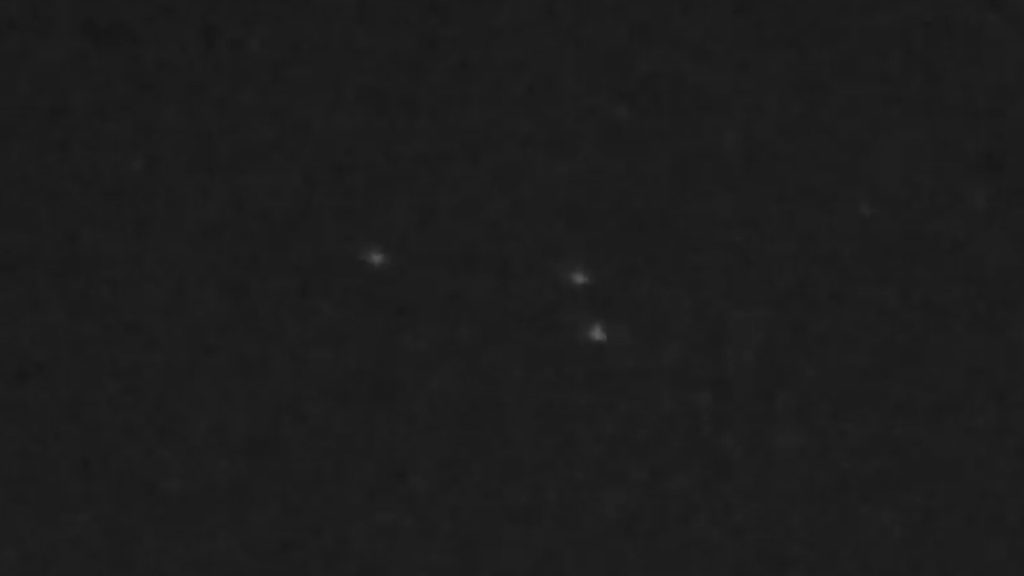
3 UFOs or possibly a triangle UFO over Benidorm, Spain
This triangular formation was filmed over Benidorm, Spain on 10th July 2022.
Witness report:
In the early morning of July 10th 2022 at 1:31 A.M. I was sitting outside with my Night Vision monocular watching the stars when suddenly 3 lights came flying in my field of vision. I immediately started recording and followed the lights for about 20 seconds until they disappeared behind a branch of a tree in the forefront. At first I thought they were 3 separate UFOs but it could as well have been a single big triangular UFO turning on its axis. Attached you find the recording so you can judge for yourself.
Meer van UFO'S of UAP'S, ASTRONOMIE, RUIMTEVAART, ARCHEOLOGIE, OUDHEIDKUNDE, SF-SNUFJES EN ANDERE ESOTERISCHE WETENSCHAPPEN - DE ALLERLAATSTE NIEUWTJES


 US submarines detect “very high speed ships” underwater





 Happy 10th Birthday, Curiosity! MailOnline looks at NASA...
 NASA is 'in the final stretch' of launching its Artemis I...