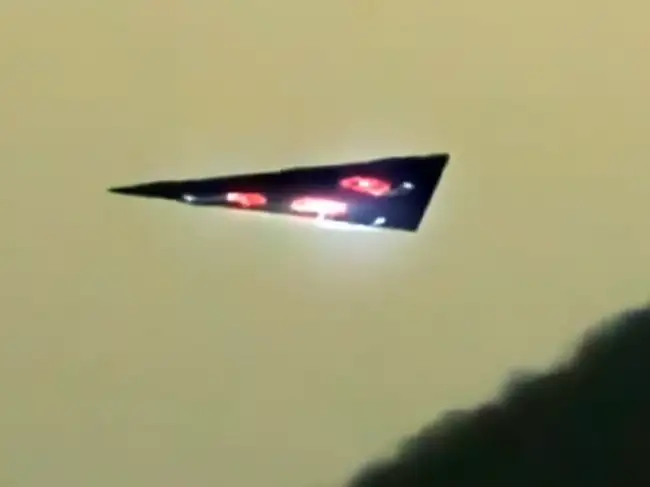
Ancient Alien Skull On Mars, With Cranium 3X Longer Than Peru Alien Mummy Skulls, UFO UAP Sighting News.

Ancient Alien Skull On Mars, With Cranium 3X Longer Than Peru Alien Mummy Skulls, UFO UAP Sighting News.
10-Mile-Wide Ames Impact Crater Linked to 372-Million-Year-Old Violent Extinction Event

Researchers at the University of Texas at Austin have determined that the 10-mile-wide subsurface Ames impact crater was formed during a meteor impact 100 million years later than previously believed, linking its formation to a violent extinction event that wiped out much of Earth’s marine life 372 million years ago.
The researchers said the zircon crystal radiometric approach used to date the Ames crater’s formation could help scientists date other ancient meteor impact sites or add supplementary information to previously dated impact formations.
According to a statement, the impact crater that the researchers examined is buried beneath several layers of sedimentary strata. Dubbed the Ames impact structure, it is also a major producer of oil and gas.
Because it lies near a series of ancient meteor strikes across the North American continent that occurred roughly 467.5 million years ago, called the Ordovician Meteor event, scientists assumed Ames was a similar age. The researchers note that the frequency of impacts around this time has caused some to suggest that Earth may have once supported a Saturn-like ring of asteroid debris.
A map of upper North America shows the approximate area and location of impact structures from about 486-360 million years ago.
Credit: Catlos et al.
Before now, the site had been dated only from fossilized teeth of an ancient eel-like creature called a conodont discovered within the site’s rock. Since that date matched the Ordovician date, researchers considered the case closed.
Still, the research team behind the new effort said the conodont remains could have been “jumbled around” during a much later impact, creating the false correlation.
Instead of relying on fossilized teeth, Danny Stockli, dean of the Jackson School of Geosciences and a co-author of the study, and colleagues employed a technique that examines the structure of zircon crystals found embedded in rocks at the site to determine when they formed.
Stockli said radiometric zircon U-Pb dating is the most accurate way to date events like major asteroid impacts in Earth’s history, since zircon microstructures can record the shock pressures of such violent events.
“These small crystals allow us to go back in time and learn about the major changes to Earth’s ancient landscapes,” Stockli explained.
After a zircon is impacted with an extreme force, it recrystallizes in what the team described as “a very specific way.” With some assistance from NASA, the researchers imaged the crystals collected from the Ames crater using cathodoluminescence and electron backscatter diffraction.
As hoped, the tests revealed that the zircon crystals were formed around 370 million years ago when a meteorite impacted the Ames area. The researchers said this date proves that the impact event that caused the now underground crater “could not have been part of the Ordovician Meteor Event.”
Instead, the new date, which is 100 million years later than the previously suspected event, lines up with the Frasnian-Famennian mass extinction event, which occurred about 372 million years ago. Like the impact that contributed to the extinction of the dinosaurs, this event wiped out much of Earth’s marine life.
“No matter what technique we used, it was coming back to this younger signal,” explained the study’s lead author, Elizabeth Catlos, an associate professor at UT’s Department of Earth and Planetary Sciences.
When discussing the significance of the findings, Catlos said the result takes “a major pawn out of the Ordovician Meteor Event” and places it into the Frasnian-Famennian event.
“This is where this impact belongs,” she said.
The researcher also noted the value of more accurate dating for mass extinction events or other large-scale events that can deform zircon crystals. Stockli echoed the sentiment, noting that the process could help date other sites and bring the Earth’s violent ancient past into clearer focus.
“It would be great to do this for more of the meteor impact sites across the continent so we could get a more accurate timeline for these major events,” they explained.
Story of Former Pentagon Official Who Led U.S Government’s UAP Investigations Is Coming to Television

The Sopranos writer and Boardwalk Empire creator Terence Winter will be teaming up with filmmaker and producer Dan Farah for the development of a new television series based on the former U.S. intelligence official who led the U.S. government’s investigations into Unidentified Anomalous Phenomena (UAP).
The series will be based on the forthcoming memoir Out of the Shadows, which offers a candid look at the career of Jay Stratton, the former official who led the U.S. government’s Unidentified Aerial Phenomena Task Force (UAPTF).
Stratton’s book, scheduled for publication in October by William Morrow, recounts his involvement with official investigations of UAP, the military’s term for what historically are known as unidentified flying objects or UFOs, and the bureaucratic hurdles he encountered while leading government efforts to resolve their nature and origin.
Winter will serve as an executive producer for the screen adaptation through Cold Front Productions, and Farah will also be an executive producer under Farah Films, according to Variety.
Farah previously directed the documentary film The Age of Disclosure, which brought together more than thirty current and former U.S. officials who spoke on the record about the UAP issue, potential national security related to the phenomenon, and ongoing efforts to secure the release of information about it, which are believed to remain in the U.S. government’s possession. Farah also produced the documentary film The Phenomenon by director James Fox.
Along with the secretive world of U.S. government investigations into UAP, the forthcoming series will deal with the unusual intersection between Stratton’s classified work and his life at home, as detailed in his forthcoming memoir, where he describes how his family also reportedly experienced unusual events while he served in government.
Winter described Stratton’s story and the plans for a forthcoming series as a journey into the lesser-known world of U.S. government and UAP investigations. Farah compared the material to a high-stakes political thriller, with a central mystery that is accompanied by the personal toll placed on Stratton and his family, and lingering questions about the existence of non-human intelligence.
New Drilling at Controversial ‘Noah’s Ark’ Site Reveals Organic Material and Mysterious Underground Cavities

An international research team led by the privately funded Christian organization Noah’s Ark Scans and supported by archaeologists from Sivas Cumhuriyet University has reported a series of successful core drilling excavations at Turkey’s Durupınar formation.
The controversial boat-shaped feature is believed by some to represent the remains of Noah’s Ark from the biblical Old Testament. Among the team’s recent findings is the claim that one of the drills used during the operation shattered once it encountered material the team believed may be petrified wood.
“I believe this is Noah’s Ark; that’s why I’m putting the Durupinar site through the most rigorous testing possible,” explained the organization’s founder, Andrew Jones.
The research team’s announcement appeared in a press release issued by Jones’s organization, and the results of their findings have not undergone scientific peer review.
The announcement includes initial observations that the drilling did not encounter any limestone bedrock, which, according to Jones’s organization, challenges the mainstream scientific explanation that the site is simply a rock formation. The core drilling effort also experienced a broken bit, which the team said suggests the potential presence of ancient petrified wood instead of comparatively softer limestone.
After future laboratory testing of the core drilling samples designed to provide further insight into the Noah’s Ark-shaped formation’s composition, the team is also planning to send a robot into the subterranean tunnels and chambers identified by previous site scans to search for more clues about its nature and origin.
The Durupınar formation is a 157-meter (515-foot) boat-shaped surface feature that first gained attention in 1959 when Turkish Army Capt. İlhan Durupınar spotted it.
Because of its unusual curved shape, some researchers have wondered whether the formation could potentially be the petrified remains of an ancient sea vessel. This, along with the formation’s location, which echoes beliefs about the alleged location where Noah’s Ark came to rest in the Old Testament, has led to speculations that the site could be the famed vessel built by Noah, as described in the book of Genesis.

Credit: Noah’s Ark Scans.
In 1988, an investigation to determine whether the ‘Noah’s Ark’ formation contained remains of petrified wood or limestone bedrock, as suggested by geologists, attempted to solve the faith-versus-science argument by drilling holes.
According to the Noah’s Ark Scans team, those holes extended to only “a fraction of the depth now being sampled,” offering limited value. Further, the samples in the earlier study were “corrupted” by water used to cool the drill bits, rendering tests inconclusive, according to Jones and his team.
Jones’s team, which includes U.S. Defense Scientist Dr. Khrosrow Bakthar, the inventor of the Bakthar Radar used to map much of the formation’s underground detail, has completed a months-long mapping effort at the site. The work includes the creation of three-dimensional models, collecting soil samples “inside and outside” the Noah’s Ark formation’s outline, and assembling an array of high-resolution surface imaging of the entire area. This work prepared the team for the core drilling effort.
According to a press release announcing the new work, core holes were drilled within the boat-shaped outline and in “control” locations well outside the formation’s area. These control samples offered a comparison set for future lab tests of samples collected within the outline of the Noah’s Ark site.
According to the team’s announcement, samples collected during the effort included “sequences of soil and sediment, intervals of organic-rich material, and cavities.”
“For the first time in history, we are performing an extensive, permitted deep core drilling survey inside and outside the Durupınar Noah’s Ark site, recovering samples from depths of up to 18 meters, nearly 60 feet,” Jones explained.
The researchers said the first samples include rich organic layers that could be evidence of ancient “decayed” wood. Jones, who describes himself as a believer in the historical veracity of the Noah’s Ark story, said the effort also revealed multiple hidden cavities, “including one filled with mud and water.”
One moment Jones highlighted from the work involved the ‘dry’ drilling system the team used, which does not rely on water. At one point, one of the drills suddenly stopped when the team “struck a layer so hard that the drill bit broke.” Jones said this occurred when the bit was 4-5 meters below the surface, and after the drilling system “had already penetrated the overlying material.”
“Whatever the core drill struck was harder than limestone — hard enough to break the bit,” Jones explained.

Team members said that the drill bit broke after hitting something harder than limestone.
Credit: Noah’s Ark Scans.
While lab tests will be needed to confirm the material’s composition, the researchers noted that if petrified wood from an ancient vessel caused the infamous formation, its harder-than-limestone status could explain the drill suddenly stopping.
“Petrified or highly mineralized wood [is] both a possibility we want to investigate through third-party lab testing,” Jones said.
Interpretations of the Durupınar formation as being purported physical evidence of events described in the Old Testament remain controversial. As previously reported by The Debrief, Jones and other team members of Noah’s Ark Scans have expressed views indicating that they already believe the Durupınar site represents the literal remains of the vessel ascribed to the Biblical character Noah, despite the ongoing investigations they are undertaking in an attempt to provide evidence for such beliefs.
Even some prominent young-Earth creationists have pushed back on Jones and his team’s claims. Ken Ham, the founder, CEO, and former president of the Christian apologetics organization Answers in Genesis, has criticized the group’s members for being “convinced of what this site likely was” before reviewing the results of geophysical surveys, arguing that the group’s findings fail to “objectively assess the raw geophysical data by canvassing other interpretations.”
To date, the research conducted by the Noah’s Ark Scans team has not been published in a formal scientific journal or undergone peer review, and has only been presented in press releases and on the organization’s website.
While the Noah’s Ark Scans team awaits the results of its most recent laboratory tests, the group has another exploration of the supposed Noah’s Ark site already planned. According to the team, this effort will follow up on earlier ground-penetrating radar scans that identified “linear features, right-angle intersections, layered anomalies, and elongated voids.” The researchers suggested these underground voids could be corridors to ‘chamber-like places,’ related to an ancient seagoing vessel.
Instead of more drilling, the team will deploy GOPHER, a custom-built robot named for the ‘gopher wood’ described in the book of Genesis. To explore the inner areas, GOPHER is equipped with a high-resolution camera that the team said is “designed to enter narrow borehole access points without opening large excavation trenches.”
“This is a major breakthrough in our ability to investigate what lies beneath this remarkable site,” explained Lauren Witzke, a Fundraiser for the Noah’s Ark Scans organization and self-described Christian activist, according to the group’s website.
Jones echoed those sentiments, noting that the team is “collecting physical samples for laboratory analysis, with more fieldwork planned next year.”
“These current findings challenge claims that this is simply a natural shape made of limestone or bedrock,” Jones said, adding that these first investigations have “opened an entirely new chapter in the Noah’s Ark investigation.”
RELATED
Two huge unknown objects captured in Hubble Live Stream — Alien Spacecraft?.jpg)
The first face of mankind? Ancient human who lived 315,000 years ago is brought back to life in stunning digital reconstruction
It’s like coming face to face with a long-lost relative – 315,000 years after we last saw them.
Scientists have pieced together what one of the world’s first humans looked like, using fossil fragments to bring them to life in an amazing digital image.
The result – the ‘oldest know representation’ of our species – shows a dark-skinned man with long black hair and a bushy beard, complete with deep-set eyes, a wide nose and full lips.
The facial image was created from the remains of a body discovered by a miner working at a mineral extraction site in Jebel Irhoud, Morocco.
That find led to a dramatic revision to the history of human evolution, as it showed that Homo sapiens are at least 100,000 years older than previously thought.
And the latest breakthrough sheds new light on what our ancestors may have looked like in their earliest days.
‘The archaeological site of Jebel Irhoud houses the oldest fossils attributed to Homo sapiens, dated to approximately 315,000 years before present,’ the researchers‘ paper, published in the journal Heritage, reads.
‘This study presents a forensic facial approximation based on data from a three-dimensional composite skull derived from Layer 7 of the site.’

The reconstruction shows a dark-skinned man with long black hair and a bushy beard, complete with deep-set eyes, a wide nose and full lips

Scientists pieced together the ancient face from fossil fragments combined with state-of-the-art technology

By combining scans, photographs and video footage of the skull fragment known as Irhoud 1 with jawbone and tooth fossils unearthed nearby, the team created a 3D model of the skull

One reconstruction is a stripped-back scientific reconstruction in grayscale, highlighting the skull's underlying anatomy
When the skull was first unearthed in the 1960s, archaeologists thought it belonged to a Neanderthal and was around 40,000 years old. But in 2017, scientists determined that the skull was actually around 315,000 years old – and belonged to Homo sapiens.
By combining scans, photographs and video footage of the skull fragment – known as Irhoud 1 – with jawbone and tooth fossils unearthed nearby, researchers created a detailed 3D model of the skull.
They then used a modern human anatomical template, digitally adapting it to match the fossil's shape before adding estimated layers of muscle, fat and skin to put a face on the remains.
The process produced two versions of the face. One is a stripped-back scientific reconstruction in grayscale, highlighting the skull‘s underlying anatomy.
The other is a lifelike colour portrait complete with skin, hair and a beard, offering the public a striking glimpse of one of humanity‘s earliest known ancestors.
The study was led by 3D reconstruction expert Cícero Moraes, who is based in Brazil. The researchers stressed that the more lifelike reconstruction involved a degree of artistic licence.
Features such as skin colour, lighting, hairstyle and facial hair cannot be determined from the fossil remains themselves.
Instead, they were based on anthropological research into ancient and modern human populations, providing a plausible representation of what someone living in North Africa around 315,000 years ago may have looked like.
They also cautioned that the digital models do not show exactly what any one individual looked like, as the fossil fragments used to complete the reconstruction were likely to have been from several different people.
The team also consisted of researchers from Flinders University, the University of Pavia, the University of Lodz and Universiti Sains Malaysia.
RELATED
Mysterious 'UFO' spotted on SpaceX livestream sparks wild alien theories: 'Looks like a mothership'
SpaceX reached a historic milestone on Monday after sending the world's most powerful rocket into orbit.
But before Starship got there, viewers watching SpaceX’s livestream spotted something bizarre trailing behind the spacecraft in the darkness of space.
About seven minutes and 55 seconds into the test flight, social media users zeroed in on a narrow, slightly curved streak of pale blue light with a brighter white tip.
Many X users shared screenshots of the mysterious object, with one user saying it 'looks like a mothership' and 'bigger than a city.'
'I think we all just saw a UFO live-streamed,' one user shared. Another X user replied: 'I couldn't believe my eyes. I'm glad it wasn't just me that saw it.'
Others wondered whether the object was NASA's International Space Station, although the footage offers no way to judge its size or distance.
While many users were baffled, Dean Scott chimed in, suggesting the streak was gas left behind by the Super Heavy booster as its engines shut down after separation and fired again for the return burn.
In his view, it appeared to rise because Earth’s bright horizon had initially hidden it.

A mysterious object was seen by users tuning into SpaceX's livestream of its Starship launch on Monday

The object appeared as a narrow, slightly curved streak of pale blue light with a brighter white tip
One user replied to Scott: ‘I went back and saw the cloud before it “flattened.” You're absolutely right, thank you!’
The user appeared to be referring to an earlier frame, captured six minutes and 35 seconds after launch, that shows a small, fuzzy blue-white patch near Earth’s edge.
But Scott’s explanation did little to quiet the alien theories.
‘The Greys are making sure all is ok,’ one X user commented, referring to the gray humanoid beings common in UFO lore.
Others tagged Elon Musk, with one asking: ‘Hey Elon, is this Mothership?’ Several users declared it was ‘definitely aliens.’
Engineer Kyle Holl connected the sighting to another scare during the flight: the unexpected shutdown of one of Starship’s engines.
‘Hmm, an engine out and then an alien battle cruiser uncloaks. Interesting,’ Holl posted.
Neither SpaceX or Musk have commented online about the mysterious object seen in the livestream.

One user speculated that it was gas left behind by the Super Heavy booster as its engines shut down after separation, which others believe was seen about a minute prior (above, circled)

SpaceX launched its massive Starship rocket on Monday morning for its first orbital mission
The uncrewed Starship launched around 8.46am ET from SpaceX's Starbase complex along the Gulf of Mexico near Brownsville, and was scheduled for a 10-hour mission around the Earth.
However, SpaceX cut Starship’s flight short after an engine unexpectedly shut down during its climb to orbit.
Footage showed the 40-story Starship flip into position for a gentle splashdown at 11.58am ET, only to erupt in a huge fireball seconds after hitting the water.
SpaceX spokesperson Dan Huot said during the livestream: 'Starship has landed.
'As you saw, not quite a soft splashdown as we had on the last one, but it's Starship in the water nonetheless.'
While the SpaceX team did not confirm Starship had exploded, onshore cameras captured the booster exploding near the middle.
Some have deemed the mission a 'complete failure,' but the goal was to send the massive rocket to orbit, and that is exactly what occurred on Monday.
NASA Administrator Jared Isaacman congratulated SpaceX on the successful launch, saying on X: 'Gorgeous launch, getting Ship to orbit and managing every step in a safe, responsible, and especially inspirational way.
'NASA, along with the rest of the interested public, is excited to help where we can and for Starship missions to become routine!'
Starship appeared to splash down as planned, but seconds later, a massive fireball erupted, sending pieces of the spacecraft flying.

While the ship made it to orbit, it exploded during splashdown
After 13 test flights that never reached orbit, SpaceX was attempting to send Starship around Earth for the first time and bring it safely back down.
Success would have strengthened confidence that a modified version can be ready for NASA's planned Artemis moon landing in 2028.
It was not immediately clear whether the engine trouble and fiery splashdown would affect SpaceX’s preparations for the planned 2028 moon landing.
SpaceX ultimately wants Starship to flip upright and touch down in Texas, bringing crews home and allowing the spacecraft to fly again.
For now, its test flights end at sea, with no plans to recover the vehicle.
RELATED
‘Reverse engineered from UFOs’: Does US military have a triangular aircraft with anti-gravity technology called ‘TR-3B Black Manta’? Here’s the truth
However, there is no credible evidence that the TR-3B Black Manta exists, let alone that it uses anti-gravity technology or was reverse-engineered from extraterrestrial spacecraft.
One video circulating online reportedly showed a large, crescent- or triangular-shaped object with bright lights over Tehran, including the area near the Azadegan Expressway. Another video showed a cluster of lights moving across the night sky over Zahedan.
The footage quickly triggered speculation on social media that the objects could be the alleged TR-3B.
Another X user made a similar claim, writing that the alleged US-made TR-3B Black Manta had been seen in Argentina and Iran and was developed through reverse engineering of crashed UFOs.
There is, however, no publicly verified evidence supporting these claims.
The TR-3B Black Manta is the name given online to an alleged secret US military aircraft. It is often described as a large triangular platform equipped with an advanced propulsion system that supposedly uses anti-gravity technology.
UFO researcher investigated 700 alleged alien abductions. He found one pattern that changed his belief about God
UFO doomsday cult play When Prophecy Fails coming to Beacon(Image: Christopher Bowen)
A THEATRE production about a UFO doomsday cult is coming to the Beacon Arts Centre.
Groupwork will present When Prophecy Fails at the venue on October 23 at 7.30pm.

The production is inspired by the true story of history’s first UFO doomsday cult.
It follows people who believe the apocalypse is near and prepare for salvation by flying saucer.
When reality challenges belief, the group faces a crisis on stage.
Tickets are available through the Beacon Arts Centre website or by calling 01475 723723.