Naar de inhoud

UFO'S of UAP'S, ASTRONOMIE, RUIMTEVAART, ARCHEOLOGIE, OUDHEIDKUNDE, SF-SNUFJES EN ANDERE ESOTERISCHE WETENSCHAPPEN - DE ALLERLAATSTE NIEUWTJES

UFO's of UAP'S in België en de rest van de wereld
seniorennet.beseniorennet.be
Ontdek de Fascinerende Wereld van UFO's en UAP's: Jouw Bron voor Onthullende Informatie! Ben jij ook gefascineerd door het onbekende? Wil je meer weten over UFO's en UAP's, niet alleen in België, maar over de hele wereld? Dan ben je op de juiste plek! België: Het Kloppend Hart van UFO-onderzoek In België is BUFON (Belgisch UFO-Netwerk) dé autoriteit op het gebied van UFO-onderzoek. Voor betrouwbare en objectieve informatie over deze intrigerende fenomenen, bezoek je zeker onze Facebook-pagina en deze blog. Maar dat is nog niet alles! Ontdek ook het Belgisch UFO-meldpunt en Caelestia, twee organisaties die diepgaand onderzoek verrichten, al zijn ze soms kritisch of sceptisch. Nederland: Een Schat aan Informatie Voor onze Nederlandse buren is er de schitterende website www.ufowijzer.nl, beheerd door Paul Harmans. Deze site biedt een schat aan informatie en artikelen die je niet wilt missen! Internationaal: MUFON - De Wereldwijde Autoriteit Neem ook een kijkje bij MUFON (Mutual UFO Network Inc.), een gerenommeerde Amerikaanse UFO-vereniging met afdelingen in de VS en wereldwijd. MUFON is toegewijd aan de wetenschappelijke en analytische studie van het UFO-fenomeen, en hun maandelijkse tijdschrift, The MUFON UFO-Journal, is een must-read voor elke UFO-enthousiasteling. Bezoek hun website op www.mufon.com voor meer informatie. Samenwerking en Toekomstvisie Sinds 1 februari 2020 is Pieter niet alleen ex-president van BUFON, maar ook de voormalige nationale directeur van MUFON in Vlaanderen en Nederland. Dit creëert een sterke samenwerking met de Franse MUFON Reseau MUFON/EUROP, wat ons in staat stelt om nog meer waardevolle inzichten te delen. Let op: Nepprofielen en Nieuwe Groeperingen Pas op voor een nieuwe groepering die zich ook BUFON noemt, maar geen enkele connectie heeft met onze gevestigde organisatie. Hoewel zij de naam geregistreerd hebben, kunnen ze het rijke verleden en de expertise van onze groep niet evenaren. We wensen hen veel succes, maar we blijven de autoriteit in UFO-onderzoek! Blijf Op De Hoogte! Wil jij de laatste nieuwtjes over UFO's, ruimtevaart, archeologie, en meer? Volg ons dan en duik samen met ons in de fascinerende wereld van het onbekende! Sluit je aan bij de gemeenschap van nieuwsgierige geesten die net als jij verlangen naar antwoorden en avonturen in de sterren! Heb je vragen of wil je meer weten? Aarzel dan niet om contact met ons op te nemen! Samen ontrafelen we het mysterie van de lucht en daarbuiten.

‘Reverse engineered from UFOs’: Does US military have a triangular aircraft with anti-gravity technology called ‘TR-3B Black Manta’? Here’s the truth


‘Reverse engineered from UFOs’: Does US military have a triangular aircraft with anti-gravity technology called ‘TR-3B Black Manta’? Here’s the truth
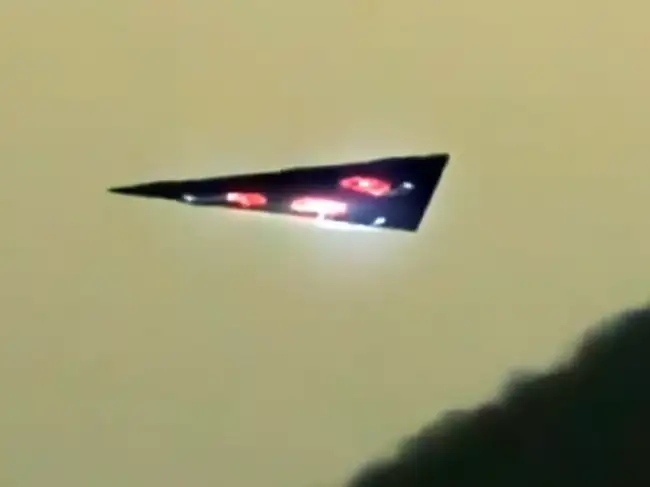
A mysterious triangular aircraft-like object spotted in Iran’s skies has triggered fresh speculation online about the alleged US military aircraft known as the TR-3B Black Manta.

Objects featuring bright, multi-coloured lights were reportedly observed over Tehran and Zahedan on September 20 and 21. Videos circulating online have prompted claims that the sightings could be evidence of a secret US aircraft capable of advanced or even anti-gravity flight.

However, there is no credible evidence that the TR-3B Black Manta exists, let alone that it uses anti-gravity technology or was reverse-engineered from extraterrestrial spacecraft.

What was spotted over Iran?

One video circulating online reportedly showed a large, crescent- or triangular-shaped object with bright lights over Tehran, including the area near the Azadegan Expressway. Another video showed a cluster of lights moving across the night sky over Zahedan.

The footage quickly triggered speculation on social media that the objects could be the alleged TR-3B.

One X user claimed: “Military Leaks Terrify the World: The Era of Missiles and Jet Engines Is Over Forever! The mysterious U.S. TR-3B Black Manta aircraft, recently spotted in the skies over Argentina and Iran, ignites the biggest technological and military controversy in history: It was developed through direct ‘reverse engineering’ from crashed extraterrestrial spacecraft (UFOs)! No fuel combustion, no sound, and maneuvers that shatter every law of conventional physics... Welcome to the age of ..

Another X user made a similar claim, writing that the alleged US-made TR-3B Black Manta had been seen in Argentina and Iran and was developed through reverse engineering of crashed UFOs.

There is, however, no publicly verified evidence supporting these claims.

What is the TR-3B Black Manta?

The TR-3B Black Manta is the name given online to an alleged secret US military aircraft. It is often described as a large triangular platform equipped with an advanced propulsion system that supposedly uses anti-gravity technology.

Claims surrounding the aircraft have circulated for years, but the US government and military have never publicly confirmed that a vehicle called the TR-3B exists.

There is also no reliable evidence that the aircraft was developed by reverse-engineering extraterrestrial spacecraft.
The idea appears to be part of a long-running body of UFO and secret-aircraft speculation that has spread across the internet.

Why do people believe the aircraft could exist?

Part of the speculation stems from the fact that the US military has operated highly classified aircraft that remained secret for years.

The F-117 Nighthawk, for example, was developed as a stealth aircraft under a highly classified programme. Although reports and sightings circulated before its existence was officially acknowledged, the US government publicly unveiled the aircraft in 1988.

The history of classified aviation programmes has therefore provided fuel for speculation that other undisclosed aircraft could also exist.

But the existence of secret military aircraft does not, by itself, establish the existence of the TR-3B or an anti-gravity aircraft.

What about Donald Trump’s ‘weapons nobody has seen’ comment?

The Black Manta theory gained additional attention after US President Donald Trump previously said that the US has weapons “that nobody has ever seen before” and that only a select few people know about them.
The comments were interpreted by some social media users as a possible reference to highly advanced or secret military technology.

However, there is no evidence that Trump was referring to the alleged TR-3B or an anti-gravity aircraft.

A 2021 image also fueled the Black Manta theory

Speculation surrounding the alleged aircraft has circulated for years.

In 2021, Iranian media published an image purportedly showing a triangular-shaped object near a US aircraft carrier in the Mediterranean. The image was subsequently cited online as possible evidence of the alleged Black Manta.

But such images and sightings have not provided independent confirmation that the aircraft exists.

The 1976 Tehran UFO incident

The latest reports have also drawn comparisons with one of the best-known UFO incidents in Iran.

On September 19, 1976, Iranian authorities reported seeing a bright unidentified object over Tehran. Two F-4 Phantom fighter jets were reportedly dispatched to investigate.

The incident became a prominent case in UFO literature, although the object was never conclusively identified as extraterrestrial or as a secret military aircraft.

What does the latest footage actually prove?

The objects seen in the recent footage over Tehran and Zahedan have not been independently identified as the TR-3B Black Manta. There is also no publicly available evidence confirming that the aircraft itself exists.

A fact-check attributed to Grok noted that at least one widely shared video was actually old footage from the YouTube channel Alien Planet, with a copyright notice visible at the end, rather than a recent recording from Argentina or Iran.

The same assessment concluded that the TR-3B remains an unconfirmed claim about an alleged secret US anti-gravity aircraft, with no official proof of its existence.
RELATED

Inside the TR-3B Black Manta Myth, Technology, and Aerospace Reality

Is TR3B Real? Inside the Pentagon’s Most Classified Aircraft

Secretly Deadly: How the TR3B Black Manta Threatens Russia and China

 { https://economictimes.indiatimes.com/ }

Hoe vind je dit bericht?
Geschreven door peter om 22:24 Stuur door

UFO researcher investigated 700 alleged alien abductions. He found one pattern that changed his belief about God

UFO researcher investigated 700 alleged alien abductions. He found one pattern that changed his belief about God

{ https://economictimes.indiatimes.com/ }

Hoe vind je dit bericht?
Geschreven door peter om 21:48 Stuur door

UFO doomsday cult play When Prophecy Fails coming to Beacon

UFO doomsday cult play When Prophecy Fails coming to Beacon

By Kulsum Shabbir - Reporter

UFO doomsday cult play When Prophecy Fails coming to Beacon | Greenock ...

(Image: Christopher Bowen)

A THEATRE production about a UFO doomsday cult is coming to the Beacon Arts Centre.

Groupwork will present When Prophecy Fails at the venue on October 23 at 7.30pm.

When Prophecy Fails

The production is inspired by the true story of history’s first UFO doomsday cult.

It follows people who believe the apocalypse is near and prepare for salvation by flying saucer.

When reality challenges belief, the group faces a crisis on stage.

Tickets are available through the Beacon Arts Centre website or by calling 01475 723723.

{ https://www.greenocktelegraph.co.uk/news/ }

Hoe vind je dit bericht?
Geschreven door peter om 21:22 Stuur door

Mars Has a Warm Region Inside

Mars Has a Warm Region Inside

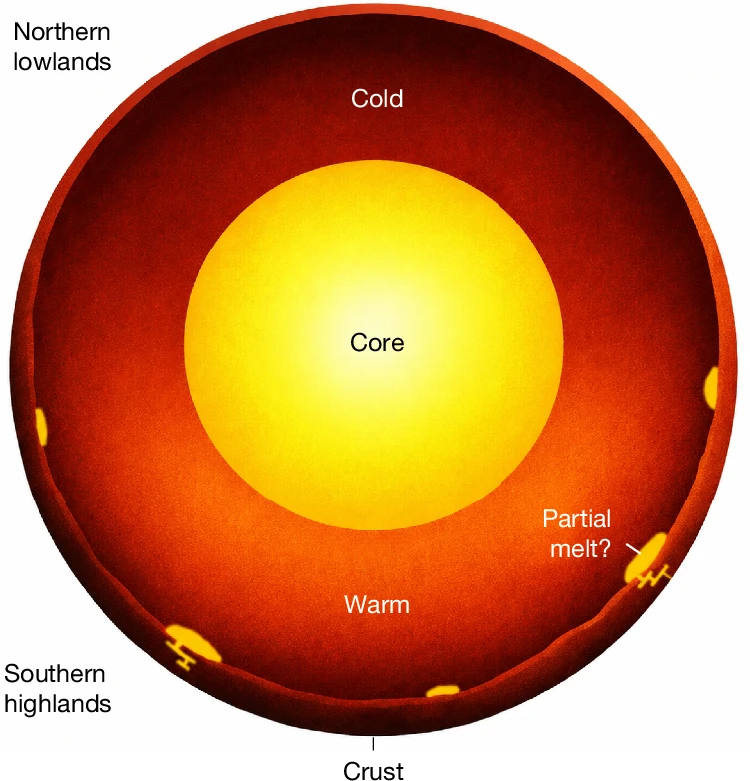
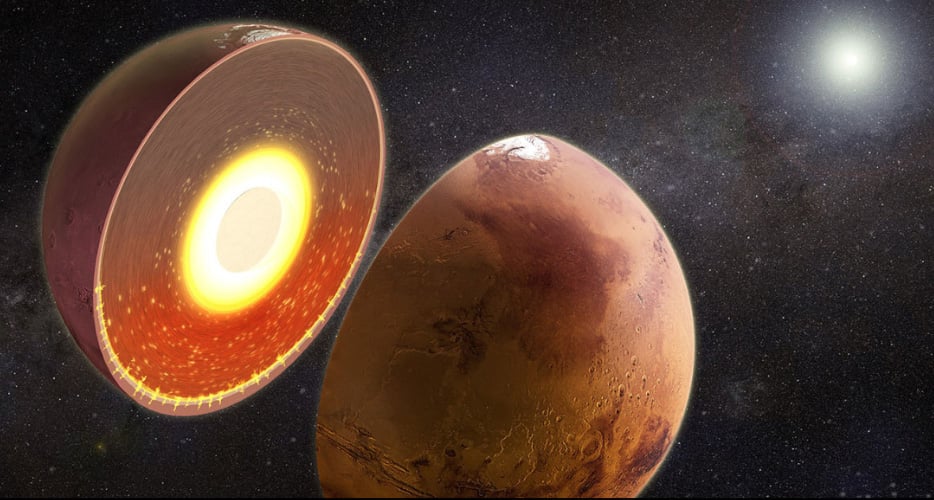
Studies of Mars using tidal tomography have found a strange warm spot under the southern hemisphere surface. Credit: Byrne, et al. University of Arizona. Studies of Mars using tidal tomography have found a strange warm spot under the southern hemisphere surface. Credit: Byrne, et al. University of Arizona.

Something deep inside Mars has scientists looking for clues to its internal evolution. A team at the University of Arizona and Brown University, led by Alexander Byrne, used a technique called "tidal tomography" to probe a heat anomaly in the southern hemisphere mantle. It turns out this subsurface region measures about 200 to 400 degrees Celsius warmer than the rest of the mantle. That warm spot may contain information about heating inside the planet and how Mars has changed over its lifetime.

The hot spot shows up in tracking data from the Mars Global Surveyor, Mars Odyssey, and Mars Reconnaissance Orbiter taken over a period of 16 years. What the data show are the effects of seasonal tidal forcing as Mars orbits the Sun. According to Brown University postdoctoral researcher Nick Wagner, who is part of Byrne's team, slight changes in the Martian orbit force slight changes in Mars's shape.

"As Mars travels around the Sun, the Sun’s gravity gently stretches and squeezes the planet," said Wagner. "Because Mars’ orbit is not a perfect circle, the strength of this pull changes over the course of a Martian year, so the amount that Mars deforms changes as well. This deformation is called a tidal bulge. This tidal bulge causes mass inside the planet to shift slightly, producing tiny changes in its gravitational pull. An orbiter passing over a region with slightly stronger gravity speeds up a little, while one passing over slightly weaker gravity slows down. So, we can use the measured speed changes of orbiters to estimate the amount Mars is squishing."

Temporal variations in gravitational changes indicate some kind of thermal anomaly within Mars's mantle under the southern highlands of the planet. It may be inducing partial melting beneath the surface, but it gets stalled by the crust before reaching the surface. That upwelling could result in thickening and enhanced magnetization across Mars's southern highlands. The mantle under the northern highlands is thinner and comparatively cool. Credit: Byrne et al.

Temporal variations in gravitational changes indicate some kind of thermal anomaly within Mars's mantle under the southern highlands of the planet. It may be inducing partial melting beneath the surface, but it gets stalled by the crust before reaching the surface. That upwelling could result in thickening and enhanced magnetization across Mars's southern highlands. The mantle under the northern highlands is thinner and comparatively cool.

Credit: Byrne et al.

Tidal Forcing Shapes a World

Mars isn't the only world to undergo this kind of tidally induced shapeshifting. Jupiter's moon Io is the poster child for such activity. As it orbits Jupiter, Io is tugged by both Jupiter and the moon Europa. The pulling activity stretches Io, and that results in a heavy amount of volcanic activity.

It also happens on Earth, according to Wagner, who pointed out that similar measurements have been made using GPS stations. "My postdoctoral supervisor at Brown University, Harriet Lau, helped constrain the buoyancy of two large “blobs” underneath the Pacific Ocean and Africa called the Large Low Shear Velocity Provinces," he explained. "What’s interesting is that there is also a compositional component, meaning it’s not just a temperature difference. I think this Martian anomaly may also have a compositional component, but a follow-up study will need to be done."

The big question is how the warm spot in Mars's southern mantle came into existence. It could have been there since the formation of the planet, some 4.5 billion years ago. If that happened, then it definitely influenced Mars's geodynamic evolution. It's also possible that the anomaly was created due to an ancient impact. Interestingly, the southern hemisphere crust is a lot thicker than the north on Mars, and that could have protected the mantle and kept it warmer throughout Mars's evolutionary history. If any of these happened, then a lot of work needs to be done to help researchers understand how they influenced the creation of the warm spot.

Understanding Tidal Tomography

The scientific technique of tidal tomography uses signals to measure shifts in the shape of a planet or moon. It allows scientists to "look inside" a planet without actually digging into the surface. It can provide information about the composition of the crust and mantle of Earth and Mars, as well as nuances in their orbits. The ongoing measurements made by spacecraft orbiting Mars will continue to chart changes as Mars makes its way around the Sun. In the future, scientists using the Jupiter Icy Moons Explorer (JUICE) will use a specialized radio science experiment onboard the spacecraft to map the gravitational field of Jupiter's moon Ganymede and give them new insights into the interior of that world. In addition, measurements of its deformation due to tidal influences should help scientists determine the existence and depth of the moon's interior ocean and the depth and strength of its outer icy shell. Other worlds that could benefit from such studies include Mercury and Enceladus (at Saturn).

For Mars, continued measurements should give new insights into the differences in crust thickness on Mars (its "crustal dichotomy"), as well as any tectonic activity within the Red Planet. The southern hemisphere anomaly isn't the only region worth studying. In their paper, the Byrnes team noted that future studies could also help researchers understand the thermal models of the planet and the influence of deep-seated volcanic activity (magma production) at Mars.

For More Information


NASA Finds 700°F Heat Buried Inside Mars

Mars' HOT Interior: Unlocking Planetary Secrets Revealed! #shorts

{ https://www.universetoday.com/ }

Hoe vind je dit bericht?
Geschreven door peter om 21:06 Stuur door

Carbon Rocks Deep Underground Could Hold the Evidence of Mars' Watery Past.

Carbon Rocks Deep Underground Could Hold the Evidence of Mars' Watery Past.

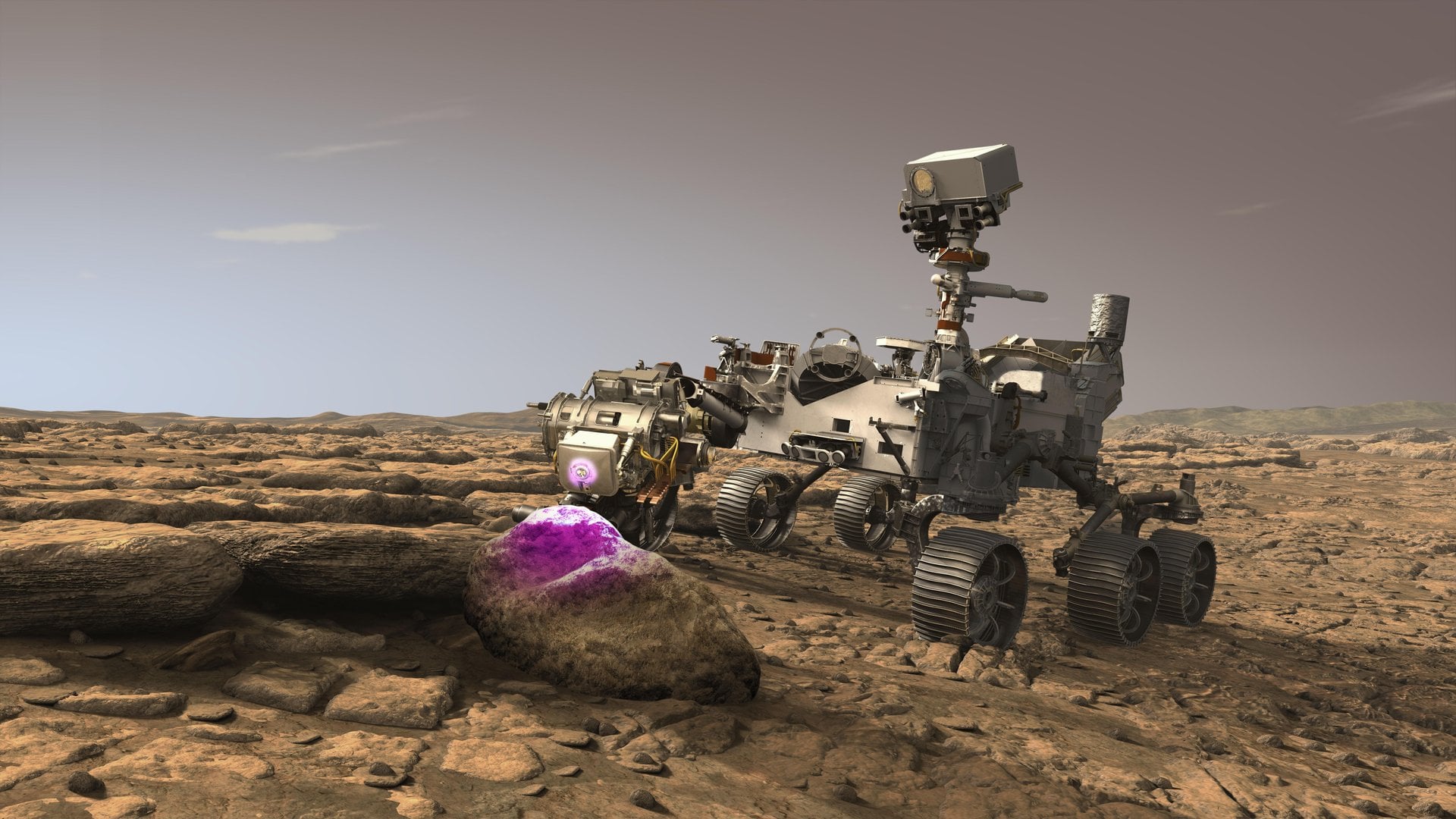
Mars Perseverance rover - PIXL studies a rock (artist concept). Credit: NASA/JPL-Caltech Mars Perseverance rover - PIXL studies a rock (artist concept). Credit: NASA/JPL-Caltech

It is a scientific consensus that Mars once had abundant sources of surface water, including groundwater, rivers, lakes, and a massive ocean that covered much of its northern hemisphere. And yet, orbiters and rovers have found only small amounts of carbonate rocks on its surface, far less than what scientists would expect from a planet that is believed to have once had abundant water flowing on its surface and a thick, carbon dioxide-rich atmosphere.

But a new geochemical study led by researchers from the Japan Aerospace Exploration Agency (JAXA) shows two things that could resolve the mystery. After comparing observational data to simulations, they found that feldspar-rich rocks found on the Martian surface show possible evidence of interaction with water and carbonates, and that ground groundwater could be burying carbonates underground.

This study was led by doctoral student Chang-Chin Wang with Professor Tomohiro Usui of the Institute of Space and Astronautical Science at JAXA and the University of Tokyo, and Associate Professor Mohit Melwani Daswani from the Earth-Life Science Institute (ESLI) at the Institute of Science Tokyo and the SETI Institute. The paper that describes their findings recently appeared in the journal JGR Planets.

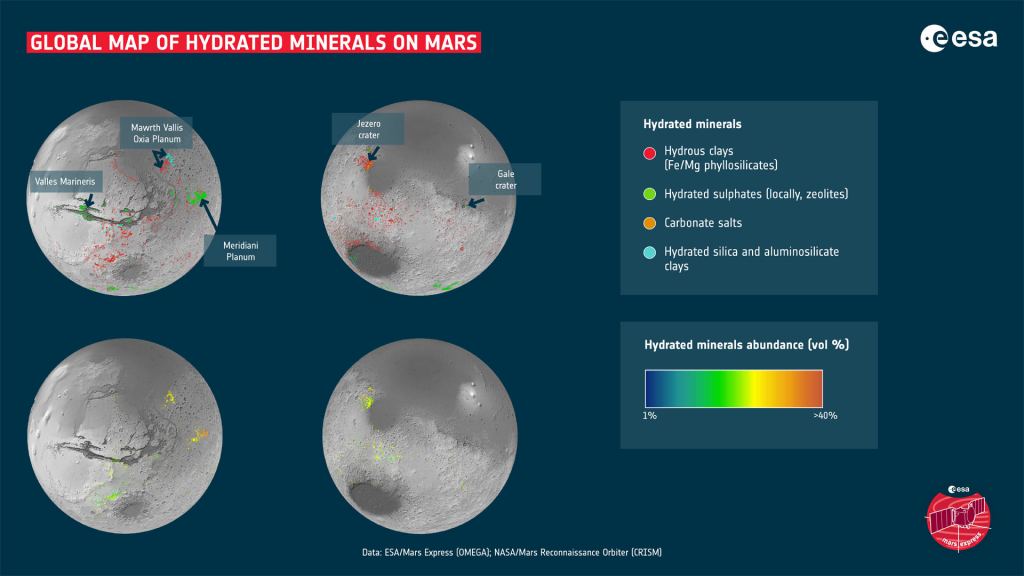
Though carbonates are present on Mars, they're not abundant. If Mars were wet for a long time, they should be abundant. Image Credit: ESA.

Though carbonates are present on Mars, they're not abundant. If Mars were wet for a long time, they should be abundant.

Image Credit: ESA.

In addition to the scarcity of carbonate rocks on Mars' surface, scientists have also puzzled over why the carbonates that have been found fall into two distinct groups: calcium- and iron-rich and magnesium-rich rocks. Previous research on water-rock interactions on Mars billions of years ago has assumed that water interacted with the planet's most common rock types, which are composed of mafic, iron-, and magnesium-rich minerals.

Feldspar-rich rocks, however, have been increasingly detected on the planet's surface by orbiters and rover missions. These rock-forming minerals are also the most abundant group on Earth, accounting for 60% of the Earth's crust. On Mars, these rocks are distinguished by higher calcium, sodium, and aluminum content, with strong indications that they may have once been widespread.

In their study, Wang and his colleagues explored the possibility that these calcium/iron-rich carbonates could result from interaction with water. To this end, the team built one-dimensional thermochemical models that tracked how water dissolved minerals and created new ones (altering the chemistry of both) as it percolated through mafic or feldspar-rich rock under the conditions present on early Mars.

The simulations were based on the PHREEQC Version 3 geochemical code, which performs a wide variety of aqueous geochemical calculations. The simulations ranged from short bursts of alteration that lasted for a few years to longer episodes lasting up to 100,000 years. They also included two modes of water movement: diffusion through standing water and downward percolation through groundwater flow.

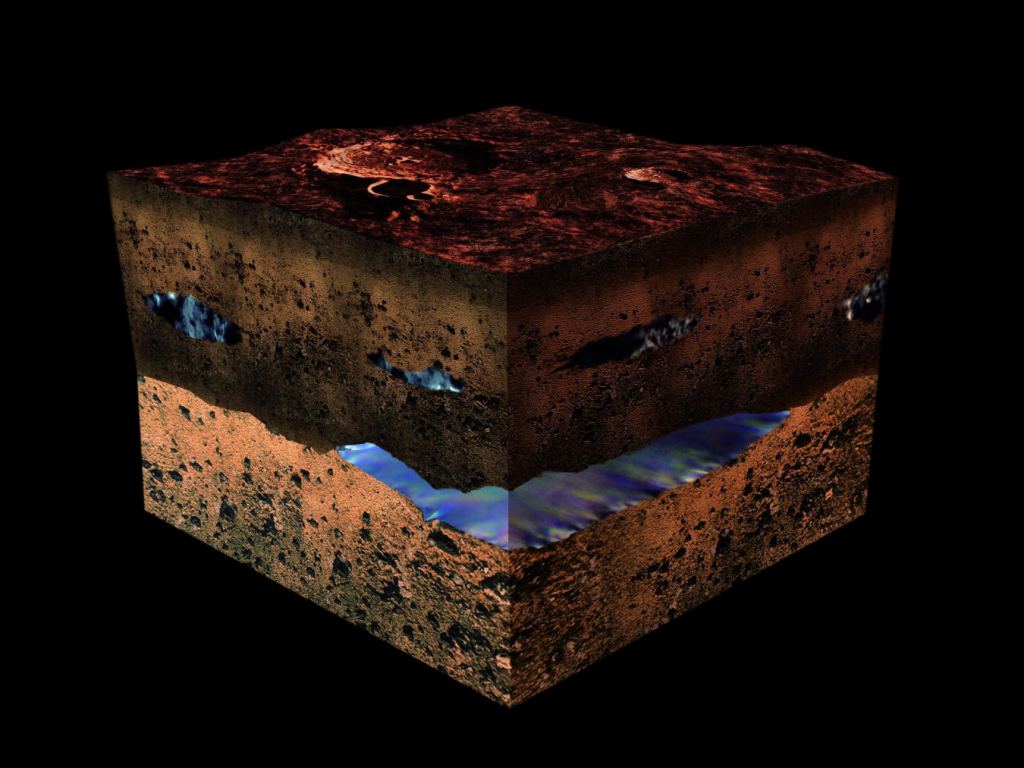
Artist's impression of water under the Martian surface. Credit: ESA/Medialab

Artist's impression of water under the Martian surface.

Credit: ESA/Medialab

The results showed that feldspar-rich rock readily produces calcium/iron-rich carbonates under most conditions. Mafic rock, however, did so only during brief periods of alteration before enough magnesium-bearing minerals dissolved and the chemistry shifted toward magnesium-rich carbonates. This offers researchers a new way of examining what happened billions of years ago on Mars' surface and how it resulted in what we see there today.

Similarly, the simulations also showed that percolating groundwater was far more efficient at forming carbonates than standing water. They further revealed that groundwater tended to dissolve these carbonates again near the surface and reprecipitate them deeper underground. This suggests that Mars may have substantial stores of carbonate rocks beneath the surface, which parallels theories about Mars "missing water."

For future missions bound for Mars, these findings suggest that drilling operations into feldspar-rich terrain could reveal evidence of Mars' warmer, wetter past. These operations could also find water that retreated underground as the Martian climate transitioned to a colder, drier climate billions of years ago. Since operations on Mars will center on water sources that will likely be underground aquifers, these finds will also enable continued exploration of the planet.

Further Reading:

{ https://www.universetoday.com/ }

Hoe vind je dit bericht?
Geschreven door peter om 20:52 Stuur door

Ancient Structure Found On Earths Moon In Crater! UFO UAP Sighting News.

Ancient Structure Found On Earths Moon In Crater! UFO UAP Sighting News.

Moon_1.png
Date of discovery: Sept 28, 2026
Location of discovery: Moon
Source photo: 
 
Guys I found this amazing structure at the center of a crater in this old NASA Apollo 15 panoramic photo. The structure is huge, about 1 mile across and has a large square entrance to it. Most people cannot adjust their eyes to black and white photos to see the detail, so if you really want to see but can't, then look at the photo for a few minutes. Take some time, let your eyes adjust. Also I this main photo is so over exposed with light that I had to add contrast to see these structures. This was not the only one I found, but its the only one I will report, because its takes a very trained eye to see what I see. Decades of research allows me to see the details better. So I just found the best one and shared it here. 
Scott C. Waring - UFO Sightings Daily 
 
Moon_base.png
Moon_aliens.png

{ https://www.ufosightingsdaily.com/ }

Hoe vind je dit bericht?
Geschreven door peter om 20:43 Stuur door

Egyptologists uncover 4,000-year-old tomb of the 'keeper of the king's secrets' – with a mysterious 'portal to the afterlife'

Egyptologists uncover 4,000-year-old tomb of the 'keeper of the king's secrets' – with a mysterious 'portal to the afterlife'

Archaeologists have uncovered a 4,000–year–old tomb that belonged to one of ancient Egypt's most powerful officials – with a mysterious 'portal to the afterlife'.

The discovery was made at the Bubasteion Necropolis in Saqqara, one of Egypt's most important archaeological sites.

Hieroglyphs reveal the tomb belonged to a senior official named Sakhnetio-Btah, who lived during the time of the Old Kingdom.

Inscriptions identified him as the 'keeper of the king's secrets', highlighting his privileged access to the pharaoh's inner circle.

Despite the mysterious name, the title probably did not mean guarding hidden treasures or religious mysteries.

Experts believe it referred to a high-ranking official who handled confidential royal documents and decrees on behalf of an Old Kingdom pharaoh.

He also served as a royal chamberlain, a priest of the goddess Maat and supervisor of the royal library.

'The hieroglyphic inscriptions… helped to determine the name of the owner of the cemetery and the number of his titles, including the keeper of royal secrets, which reflect the high status he held in the administrative system of the ancient state,' Egypt's Ministry of Tourism and Antiquities said.

The tomb also includes the remains of a funerary chapel and a false door, which ancient Egyptians believed was a portal to the afterlife

The tomb also includes the remains of a funerary chapel and a false door, which ancient Egyptians believed was a portal to the afterlife

Inscriptions reveal the tomb belonged to the ¿keeper of the king¿s secrets¿, highlighting his privileged access to the pharaoh¿s inner circle

Inscriptions reveal the tomb belonged to the 'keeper of the king's secrets', highlighting his privileged access to the pharaoh's inner circle

The tomb includes the remains of a funerary chapel and a false door – a symbolic niche which the ancient Egyptians believed was a magical threshold between the world of the living and the realm of the dead. 

Archaeologists also discovered a funerary ritual objects including an offering table, an offering slab and a purification basin.

Experts say finding the objects exactly where they were originally placed provides a rare glimpse into Old Kingdom funerary practices.

The dig also uncovered an interconnected network of burial shafts surrounding the tomb.

Inside were numerous human burials and large quantities of painted funerary cartonnage – a colourful papier-mache-like covering placed over a mummy, often decorated with images of Egyptian gods, hieroglyphics and scenes intended to protect the dead on their journey to the afterlife.

More than 100 ushabti figurines, which were intended to serve the dead in the afterlife, were also recovered.

Among the most spectacular finds were three stone sarcophagi discovered sealed and intact in their original positions.

Archaeologists also found a wooden falcon statue and a wide range of pottery vessels and other artefacts.

Archaeologists also discovered funerary ritual objects including an offering table, an offering slab and a purification basin   The dig also uncovered an interconnected network of burial shafts surrounding the tomb
Archaeologists also discovered funerary ritual objects including an offering table, an offering slab and a purification basin (left) and an interconnected network of burial shafts surrounding the tomb (right)

Preliminary investigations suggest that some parts of the burial complex were looted by tomb robbers in ancient times.

Despite this, many of the surviving finds remain in remarkably good condition.

Researchers believe the discoveries will help them better understand how the site was reused over different periods of Egyptian history.

Excavations are continuing, with experts convinced that the vast necropolis still has many more secrets waiting to be uncovered.

Saqqara, where the tomb was found, is one of Egypt's most significant archaeological sites.

It is the home of Egypt's oldest pyramid – the step pyramid of Djoser – which was built around 4,700 years ago.

The site also contains thousands of tombs belonging to pharaohs, nobles, priests and high-ranking officials from multiple dynasties.

In recent years archaeologists at Saqqara have uncovered dozens of sealed coffins, extensive animal cemeteries, workshops used for mummification, and richly decorated burial shafts packed with statues and artefacts. 

These discoveries have transformed understanding of everyday religious life in ancient Egypt.

RELATED


Archaeologists Opened a 4,000-Year-Old Tomb… What They Found Shocked Scientists

They Opened a 4,000-Year-Old Tomb — And Regretted It

{https://www.dailymail.com/sciencetech/index.html }

Hoe vind je dit bericht?
Geschreven door peter om 18:46 Stuur door

Mysterious map found inside centuries-old Bible claims to pinpoint location of Eden

Mysterious map found inside centuries-old Bible claims to pinpoint location of Eden

Hidden within a 1599 Bible is a detailed map revealing where its creators believed the Garden of Eden may once have stood.

Titled The Situation of the Garden of Eden, it places the biblical paradise in Great Armenia, near mountains believed to represent Mount Ararat in present-day Turkey.

Discussing the map on her YouTube channel, Ashleys_AntiqueBibles said it appears to locate Eden near the source of the Euphrates at the mountain's base.

The map also labels Mesopotamia, Babylon, Havilah, the Arabian Desert, the Persian Gulf and the Caspian Sea.

Most importantly, it shows the Euphrates beginning among the mountains and flowing westward, while the Caspian Sea appears to the right, or east.

This layout places Eden near the mountainous headwaters rather than beneath the Caspian Sea, a location the host said she had proposed in earlier videos.

That interpretation draws on Genesis, which states that one river flowed out of Eden before dividing into the Pishon, Gihon, Tigris and Euphrates.

Translated into modern geography, the map points to eastern Turkey, close to the borders of Armenia and Iran.

Titled The Situation of the Garden of Eden, the map places the biblical paradise in Great Armenia, near mountains believed to represent Mount Ararat in present-day Turkey

Titled The Situation of the Garden of Eden, the map places the biblical paradise in Great Armenia, near mountains believed to represent Mount Ararat in present-day Turkey

The antique Bible, known as the Geneva Bible, was produced by English Protestant scholars who fled England and took refuge in Switzerland. 

Historians estimate that as many as 360,000 copies were printed between 1560 and 1644. 

The Situation of the Garden of Eden map is a copy of one created by Protestant reformer John Calvin, first published in his 1554 commentary on Genesis to illustrate where he believed Eden had stood.

Genesis describes a river flowing through Eden before dividing into four branches.

Scholars generally agreed that two were the Tigris and Euphrates, while the Pishon and Gihon were often identified as the Ganges and Nile.

However, that interpretation created a major geographical problem because the four rivers do not meet.

Calvin proposed that the biblical term translated as 'headwaters' could refer to either the beginning or the mouth of a river, according to a pre-print study by Justine Angelique Walden, who previously taught history at the University of Wisconsin–Madison.

He therefore argued that the Pishon and Gihon were not separate rivers but names for the lower sections or outlets of the Tigris and Euphrates.

The antique Bible, known as the Geneva Bible, was produced by English Protestant scholars who fled England and took refuge in Switzerland

The antique Bible, known as the Geneva Bible, was produced by English Protestant scholars who fled England and took refuge in Switzerland

The Garden of Eden (Pictured) was described in the Book of Genesis as a paradise where the first humans, Adam and Eve, once walked before committing the first sin

The Garden of Eden (Pictured) was described in the Book of Genesis as a paradise where the first humans, Adam and Eve, once walked before committing the first sin

By treating all four names as parts of the same river system, Calvin believed he had reconciled the biblical description with real-world geography.

His interpretation placed Eden firmly in Mesopotamia and presented it as a genuine earthly paradise that had existed before disappearing into history.

'Oddly, the Eden map showed the general location of Eden but did not specify the walled garden’s perimeter, and so ambiguously asserted both the presence of paradise as well as its absence,' Walden shared in her report.

'Eden had once been precisely locatable; now only traces of its existence, such as the four rivers, remained.' 

People have been actively searching for and theorizing about the location of the Garden of Eden for centuries, with every single one coming up empty.

A more recent investigation into the biblical paradise was released in 2025, when Mahmood Jawaid, a chemical engineer based in Texas, argued Eden was actually in Bahir Dar, a fertile region in northwestern Ethiopia near the southern end of Lake Tana, where the Blue Nile begins.

An American engineer proposed in 2025 that the Garden of Eden was located in Ethiopia due to the landscape and the Blue Nile that runs through the area

An American engineer proposed in 2025 that the Garden of Eden was located in Ethiopia due to the landscape and the Blue Nile that runs through the area

Jawaid based his research on a careful reading of both the Bible and the Quran, analyzing descriptions of Adam and Eve, the rivers and the garden itself.

The study, which has not been peer-reviewed, noted that the Blue Nile could correspond to the Biblical Gihon, and Lake Tana's outflows divide into multiple waterways, potentially forming the four rivers described in Genesis.

Early human evolution also played a role in this theory, proposing that Adam may have evolved from Homo habilis or a late form of Australopithecus in the East African Rift Valley near Olduvai Gorge, a region considered a cradle of humanity.

From there, Adam and Eve could have been 'placed' in the highlands of Bahir Dar, a paradise at a higher elevation, before descending, what the Quran describes as 'habata,' to settle in the Rift Valley.

This is because the region sits about 6,000 feet above sea level, boasting lush vegetation, abundant wildlife and the flowing Blue Nile, features that align with both the Biblical description of Eden's rivers and the Quranic concept of a garden on Earth.

'All clues point to Bahir Dar, near Lake Tana, a region of striking beauty, abundant vegetation, and the source of the Blue Nile, which fits the ancient description of Eden's rivers,' Jawaid wrote.

The Gihon, in particular, is said to encompass the land of Cush, an ancient term widely associated with Ethiopia.

Jawaid seized on that linguistic clue, arguing that the Gihon corresponds to the Blue Nile, which begins at Lake Tana before winding northward through Sudan to join the White Nile in Khartoum.

'Lake Tana fits the description of Eden perfectly,' he writes, noting that volcanic ridges enclose the surrounding highlands and feed multiple river systems.

In his reconstruction, Lake Tana itself represents Eden, while the Garden of Eden lies immediately to the south, around Bahir Dar, 'east of Eden' in biblical phrasing, where the river emerges from the lake.

The Book of Genesis discusses a 'flaming sword,' which God placed at the entrance of the garden to prevent humans from accessing the Tree of Life after Adam and Eve were banished.

The Tree of Life was a literal tree with fruit that would grant eternal life. After Adam and Eve sinned by eating from the Tree of the Knowledge of Good and Evil, they were expelled from Eden to prevent them from also eating the Tree of Life and living forever in their fallen state.

Jawaid's study suggested that the 'fiery flashing sword' could be represented by the volcanic ridges surrounding Lake Tana in the Ethiopian Highlands.

'Considering that the valley is surrounded by historically active volcanoes, it is very much possible that the active volcanoes formed the flaming sword mentioned in the Bible,' he shared. 

RELATED


Garden of Eden Discovered? Evidence for Eden's Location! Fall of Adam, Eve, Creation

The Garden of Eden Found? Map & Evidence Explained

The REAL Garden of Eden Has Been Found...and It's NOT Where You Think

{ https://www.dailymail.com/sciencetech/index.html )

Hoe vind je dit bericht?
Geschreven door peter om 17:30 Stuur door

Ancient underwater city discovered 'near resting place of Noah's Ark' rewrites human history

Ancient underwater city discovered 'near resting place of Noah's Ark' rewrites human history

Deep in the murky waters of an ancient lake in Turkey lie mysterious ruins that researchers believe could be part of a forgotten city, rewriting human history. 

Divers have uncovered an enormous circular structure and a wall of interlocking stone blocks 75 feet below the surface of Lake Van.

Researcher Matthew LaCroix, who is part of the diving team, told the Daily Mail: ‘What we know of the underwater ruins may just be a tiny piece of something much larger.'

LaCroix believes the ruins are at least 11,700 years old and could date back as far as 40,000 years, based on geological estimates for the eruptions of near by  he said blocked the lake’s ancient outlet and submerged the structures.

The wall features three steps leading to the circular structure and seven levels of stonework rising more than eight feet from the lakebed. ‘I measured over 150 feet that this causeway continues,’ LaCroix said. ‘Over 150 feet, and it leads into the darkness.’

He believes the feature may lead to more buildings belonging to an undiscovered city concealed beneath the water. 

'You have a civilization that had the capabilities to build unbelievable stonework and temples,' LaCroix added. 'This shows that this lost chapter of human history not only created highly advanced things that are far beyond the capabilities of iron and bronze cultures of our time, but that the dating of it puts it in a time.'

Adding to the mystery, Lake Van lies southwest of Mount Ararat and the Durupınar formation, which some believe marks the final resting place of Noah’s Ark.

Divers have uncovered a wall of interlocking stone blocks 75 feet below the surface of Lake Van

Divers have uncovered a wall of interlocking stone blocks 75 feet below the surface of Lake Van

The massive wall connects to the enormous circular structure (above)

The massive wall connects to the enormous circular structure (above)

Hoe vind je dit bericht?
Geschreven door peter om 17:14 Stuur door

Is a nearby advanced alien civilization out there waiting to pounce on Earth? Unlikely, says new study

Is a nearby advanced alien civilization out there waiting to pounce on Earth? Unlikely, says new study

Joke flyer about vacationing on Trappist-1 e and multiple moons

What would it be like to vacation in the TRAPPIST-1 planetary system? The poster invites you to "Take a planet-hopping excursion through the TRAPPIST-1 system." The star system was revealed by the TRansiting Planets and PlanetIsmals Small Telescope, or TRAPPIST, and NASA's Spitzer Space Telescope. Top photo: The TRAPPIST-1 Habitable Zone. Credit: NASA/JPL-Caltech

Science fiction suggests that life on other planets, if it exists, is likely far more advanced than life on Earth. A recent study suggests otherwise.

This new study, led by Chris Doughty, a professor of ecoinformatics at Northern Arizona University, proposes that the extent to which life on potentially habitable exoplanets in Earth's stellar neighbors is advanced is likely related to plant energy, not just how much time has passed. That means that, although Earth is young compared to some of its stellar neighbors, which are older by several billion years, life on exoplanets with worse conditions for cumulative photosynthesis likely evolved more slowly over billions of years.

"Physicist Enrico Fermi famously asked, given the high likelihood of intelligent life in the galaxy, 'Where are they?'" Doughty said. "This paper suggests that our exoplanet stellar neighborhood may be quiet because most Earth-like planets near us are likely to be evolutionarily behind us and still at the microbial stage. Which means we can sleep well, because if life on those exoplanets evolved just like on Earth, most of those planets will just be filled with microbes and not advanced aliens."

The study was published Sept. 22 in the International Journal of Astrobiology.

Is a nearby advanced alien civilization out there waiting to pounce on Earth? Unlikely, says new study

Surface temperature (deg C) (top), precipitation (mm yr-1) (middle), and downwelling shortwave radiation flux at surface W m-2 (bottom) for Earth (left) and T1e (right). The Earth estimates are taken from CLM 4.0. The data for T1e is from the THAI Hab 1 experiment (Sergeev et al., Reference Sergeev, Fauchez, Turbet, Boutle, Tsigaridis, Way, Wolf, Domagal-Goldman, Forget, Haqq-Misra, Kopparapu, Lambert, Manners and Mayne2022). Credit: International Journal of Astrobiology (2026). DOI: 10.1017/s1473550426100378

What the study says

It doesn't say there isn't highly advanced extraterrestrial life that could lead to a real-life reenactment of "The Three-Body Problem." What the study says, according to the researchers, is that such a species nearby is unlikely, as cumulative photosynthesis on nearby potentially habitable exoplanets would be lower.

And here's why: If life ever evolved on a planet, its continued evolution wouldn't just automatically happen over time. Rather, it would be dependent on the cumulative plant energy of a planet, the study authors hypothesize. Looking at Earth, warm, wet places have more plant growth and species than cold, dry places. Scientists believe this is because there is more plant growth and ecological space for animals to exist. Thus, a young, warm, wet exoplanet may have more evolutionary development than an older, colder, drier exoplanet.

In their paper, Doughty and his co-authors explore the implications of this hypothesis for exoplanets. The planets most likely to have life orbit red dwarfs, the most common star type in our galaxy. These planets, which are often billions of years older than Earth, have dimmer light and are often tidally locked, meaning only one side of the planet faces its sun.

"If photosynthetic life evolved on these planets, that life has been photosynthesizing for potentially billions of years longer than on Earth," said co-author Michael Gowanlock, an associate professor of informatics at NAU. "However, the total annual photosynthesis is likely lower because there is less light and half the planetary surface area available for photosynthesis. Who is ahead? That is the mystery we are quantitatively trying to solve."

Recent work by co-author Denis Sergeev, a lecturer at the University of Bristol in the United Kingdom, has simulated possible climate patterns on exoplanets, producing maps of temperature, light and precipitation, which are the main variables needed to predict plant growth on Earth.

In the current paper, the authors used those maps to predict potential plant growth and evolutionary rates over their lifetimes for TRAPPIST-1e and 28 other nearby exoplanets that potentially have liquid water. ("Nearby" is relative; TRAPPIST-1e is 40 light-years from Earth.)

But TRAPPIST-1e isn't Earth. How do they compare?

Here's how it works on Earth. Roughly 2.4 x 1025 grams of carbon were fixed during the 3.2 billion years before more efficient vascular plants evolved. Then 7 x 1025 grams more carbon was fixed before humans evolved. The researchers estimated that TRAPPIST-1e has fixed only 21% of Earth's carbon despite being several billion years older than Earth.

"Since this is less than the Earth had fixed before the evolution of more efficient vascular plants, we estimated that TRAPPIST-1e may only be at the microbial stage of evolution," said co-author Cameron Hrabak, an NAU alumnus. "That's well behind Earth."

The researchers made similar calculations for the 29 exoplanets in Earth's stellar neighborhood that are most likely to have life and found only two planets whose life has potentially evolved ahead of Earth's: GJ 1061c and K2-3d. Both are bigger, hotter, brighter and older than most Earth-like planets in our solar neighborhood. Three other planets could be at the Mesozoic life stage, which is roughly equivalent to the age of dinosaurs on Earth.

These are estimates, not proof. The atmosphere around TRAPPIST-1e and other exoplanets would profoundly affect climate, photosynthesis and how life evolved; future work with the James Webb Space Telescope could provide additional data that will allow the researchers to hone their estimates.

What's next, and is it an alien invasion?

This technique can help predict the evolutionary constraints that shape life on those exoplanets that might surpass life on Earth, the researchers said. On Earth, plant growth can be limited by light, temperature or precipitation. For instance, deserts get plenty of light, but growth is inhibited by a lack of precipitation. These constraints also shape how life evolves differently—the life in tropical forests has little overlap with desert life. On exoplanets, the planets most likely to surpass Earth's total carbon fixed and evolutionary stage are mainly precipitation-limited.

Put simply, if there is an alien civilization in Earth's stellar neighborhood, the ecosystems shaping those intelligent creatures would be more like deserts or temperate ecosystems—much like humans on Earth, as we likely evolved in rain-limited savanna woodlands.

"To use two pop culture references, the ecological characteristics that shape advanced life on those exoplanets might be more 'Dune' than 'Avatar,'" Doughty said.

Publication details
  • Christopher E. Doughty et al, Calculating potential cumulative carbon fixed and evolutionary stage for Earthlike planets in our solar neighborhood, International Journal of Astrobiology (2026). DOI: 10.1017/s1473550426100378

Journal information:

RELATED

Physicists clash over evidence for alien life | Matt O'Dowd, Avi Loeb, Carol Cleland

Doha Debates: What if humanity meets the unknown?

{ https://phys.org/ }

Hoe vind je dit bericht?
Geschreven door peter om 22:23 Stuur door

The Truth Is Out There: The Crop Circle Controversy

The Truth Is Out There: The Crop Circle Controversy

This is the first time I’ve ever re-posted a 3 Quarks Daily article. I was led to re-examine the idea of visits by Aliens—particularly in the UFO phenomen—by two incidents. One was the announcement on May 8 of this year to release new, never-before seen files on unidentified anomalous phenomena (UAP) as part of the Presidential Unsealing and Reporting System for UAP Encounters (PURSUE). This footage is being released on a rolling basis and is available to view on War.Gov/UFO.  The other is the upcoming release of a new Steven Spielberg film about UFOs called “Disclosure Day.” The film is fiction, but contains references to a lot of what we believe to be true about UFOs, aliens, abduction and crop circles, most of which has come from Mr. Spielberg’s imagination:  E.T. The Extraterrestrial and Close Encounters of the Third Kind. Between these two forces, PURSUE and Spielberg, I wonder how much truth will actually be revealed.

I have updated this article, which was originally posted in September 2017. It described our experience touring Wiltshire, England in 1994 searching for Crop Circles.  These beautiful and symmetric circles in ripe fields were originally thought to be communications from aliens, or landing sites of UFO’s, and they began to appear  during the 1990’s obsession with aliens. My husband Rick and I wanted to see these other-worldly apparitions for ourselves; the thrill of touching something that was touched by alien beings was unbelievable. And perhaps we’d see a UFO nearby, too.

1994 was the height of the alien frenzy. There were bestseller books, magazines, and TV shows about crop circles, flying saucers and alien abductions. A 1990 Gallup believed we had alien visitors. The highly popular “X-Files” weekly show had a large viewership who tuned in every Sunday evening to watch Special Agents Scully and Mulder investigate paranormal phenomenon, focusing on alien abductions; their slogan was “the truth is out there.” Sensational alien stories swept the nation in these pre-social media days, as people relied on news media and best-seller books for their information. And there were plenty of books and TV specials to stoke your imagination.

A 1994 best seller, Abduction:  Human Encounters With Aliens, by Harvard psychiatrist John Mack, discussed interviews with people who claimed they were abducted by aliens; Oprah interviewed abductees. There were books about dead aliens from a flying saucer crash hidden by the government at the top-secret Area 51 in Nevada. And the first book about crop circles was Circular Evidence: a Detailed Investigation of the Flattened Swirled Crops Phenomenon jointly written by Colin Andrews, an electrical engineer from England, and Pat Delgado, a former NASA engineer. These authors inaugurated the new “science” of crop circles, or cereology. Other self-styled experts from around the world quickly came forward to examine the circles and advance their own theories. More books were written, and organization and institutes devoted to cereology sprang up like, well, crop circles.

Experts combed these circles, taking soil and plant samples, looking for signs of a space ship’s propulsion, such as remnants of a plasma vortex or of radiation. The origin of crop circles was hotly debated. It was generally assumed that they couldn’t be man-made because no one could produce works of this magnitude so quickly, in the dark of night, unnoticed, with such perfect symmetry! Instead, they were attributed to ball lightning, plasma vortexes, wind, and animals, but the most favored explanation was they were made by visitors from outer space landing a flying saucer. One expert, Joachim Koch, felt these “cerealoglyphs” were coded messages and actually wrote back to the aliens through a circle that he produced!

My husband is an electrical engineer with a degree in Space Sciences, and a PhD in plasma physics–better credentials and more experience than most cereologists. He just couldn’t make sense of their speculations, which didn’t seem to obey the laws of physics. Still, he thought there might be something to this phenomenon that could be explained scientifically. Because unlike reports of UFOs and abductions, crop circles were real, physical objects. You could see them, touch them, and feel them. He wanted to see for himself. Me? I thought it was a splendid idea for a vacation. I had just finished a sabbatical in London and longed to see more of England.

In August 1994, we booked our flights and lodging, and headed to England to see for ourselves. Landing in Heathrow, we drove our rental car about 90 miles west, heading toward a B&B in a farmstead, Wayside Farm, in the little town of Devises. Little did we know that our farm was only 35 miles away from Highclere Castle, where Downton Abbey would be filmed in 2010.

We were enchanted by Wiltshire. It abounds in mysterious and unexplained landscape phenomena, some of which originate before recorded history. Many of these take the form of circles:  there is Stonehenge, and the lesser-known stone circles of Avebury, as well as some circular earthworks attributed to Roman occupation; there are the mysterious circular and oval-shaped earth mounds–the tors– such as Silbury Hill and Kennet Long Barrow, which have now been shown to be prehistoric burial sites.

The building of these ancient sites has been attributed to Neolithic people. Archaic humans lived in the region nearly one million years ago.  After the last ice age, continuous human settlement began around 13,000 to 11,700 years ago; the tors and stone hills of Wiltshire were built around 5,000 years ago. And who built these monuments? The people of England have always felt a connection to these ancient people, who laid the foundations of civilization, and may even have been travelers from outer space.

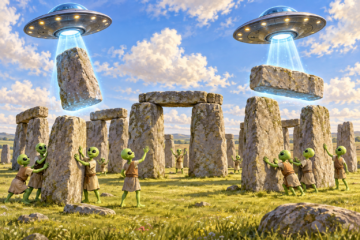
Stonehenge-and-aliens--360x240.png

Aliens as Neolithic people building Stonehenge

Perhaps these aliens left after their work was done, but return periodically to check on their handiwork with a quick visit via a crop circle.

 Silbury Hill is a 4,500 year old man-made hill which is a frequent site of UFO’s, crop circles and mysterious lights . It is a frequent location for UFO sightings, mysterious lights, and crop circle activity.  A photograph of a UFO above Silbury Hill taken by a tourist was reported in the Telegraph Newspaper in August 2012. In October 19, 2009, a police officer contacted British UFO experts after seeing three aliens examining a freshly made crop circle near Avebury, Wiltshire

We stopped at the Westbrook Free house (no relation) for a quick pint on the way to our lodgings at Wayside Farm, which was rather difficult to find using paper maps in those pre-GPS days. We settled in for a quiet evening after walking to the nearby pub, and got up to an early and hearty breakfast at the farm table. The farmer was very helpful in directing us to new crop circles; word would get around when one appeared, and he’d give us the road intersections, which gave us our morning quest through the golden countryside. It’s striking to see these beautiful creations, carved into the crops and stretching across the field. Among the five that we found, one was close to the road and easily accessed through the tractor pathways. We began our analysis.

Westbrook-Free-House-261x360.jpeg

Local pub near our lodging

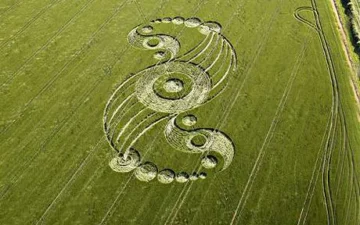
crop-circle-jpg-360x225.webp

Crop circle near Avebury which was visited by aliens in 09.October2009 . We took our time driving the 90 miles from London, enjoying the Wiltshire countryside. We made the requisite stops at Stonehenge, but were more intrigued by the circle at Avebury,  which is not fenced like Stonehenge, so you can touch the stones and walk within the 1/5 mile diameter. We had lunch at the Red Lion pub, which lies at a crossroads in the center of the Avebury circle.

We were soon joined by a small tour group led by a German self-styled expert. He pointed out to us that the wheat stalks were “bent not broken,” which, he said, clearly indicated an unusual force pushing them down. (I found that if I stomped on the wheat in the field I would get the same result, but what do I know? I wasn’t a cereology expert like he was.)

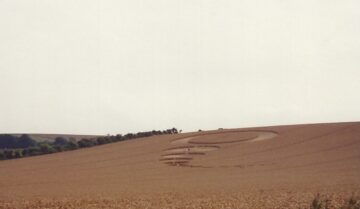
Our-circle-360x209.jpeg

crop circle in Wiltshire that we visited.

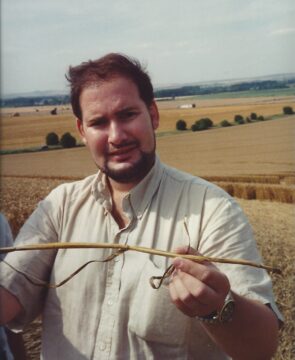
Expert-analysis-2-295x360.jpeg

German expert

Our colleague was intrigued by Rick’s small portable Geiger counter, but sadly disappointed that it registered no radioactivity greater than background. In fact, there was no evidence of any unusual forces, no sign of burning by hot plasma or rocket fuel, nothing but tramped down wheat circles filled with a number of crop circle enthusiasts.

Rick-in-circle-360x241.jpeg

Rick examines the crop circle

Overall, this was a relaxing visit to a lovely part of the world, but we didn’t make any remarkable discoveries or find physical evidence of forces that may have created these splendid circles. There was nothing to suggest that they were anything but man-made. I looked at them as artistic expressions, and for some they were an expression of belief in and desire for alien contact, but man-made nonetheless.

What we didn’t learn until we returned to the US, was that crop circles had already been exposed as being man made: On Sept 11, 1991, two pint-loving English watercolor artists, Doug Bower and David Chorley, revealed to the British press that they created these circles, making their first one in 1978. Apparently, after a few drinks in a pub, they were inspired to create a “flying saucer nest,” which they did in the dead of night by walking in a field and using simple planks and ropes. AS the press got interested, many more followed. You can see Doug and Dave in action in this expose video from their 1991 TV broadcast.


Circle of Mystery: Investigating Crop Circles with Leading Experts

What was remarkable to us is that this news never made a big splash in the US!   Mysterious crop circles were news; exposing them as a hoax was not. Truly, no one wanted to hear that crop circles were man-made!

The expert cereologists also refused to believe that the circles were all man-made. Dave and Doug’s were “fake” circles, because “real” crop circles had otherworldly origins. So many people believed these experts that they were not about to change their beliefs. Many of the crop circle experts have since back-pedaled and accept human creation for most–but not ALL–crop circles. The Journal of Cereology is still being published, and crop circles are still appearing in many sites around the world, the majority still being in Wiltshire, and mostly man made.Croppies continue to insist on their alien origin.

To me, the most interesting question about crop circles is why belief in their alien origin persists, in spite of all the evidence to the contrary. The answer, I feel, is that these beliefs reveal a desire to believe in a higher power that transcends humanity. In these days of declining acceptance of organized religion, believing in superhuman aliens fills this need for many people. To them, connecting these mysterious apparitions to other presumed alien interventions gives substance to their beliefs. I am reminded of the poster displayed above Agent Mulder’s desk on the TV series “X-files.”  It depicted a flying saucer, with the caption, “I want to believe.”

i-want-to-believe1300023-posters-360x360.jpg

X-files logo

RELATED

Crop Circles the Enigma (Full Documentary)

World of Mysteries - Crop Circles and Desert Lines

 { https://3quarksdaily.com/ }

Hoe vind je dit bericht?
Geschreven door peter om 22:05 Stuur door

This Palm-Sized Robot Jumps Like a Frog, Swims With the Same Legs, and Weighs Just 98 Grams

This Palm-Sized Robot Jumps Like a Frog, Swims With the Same Legs, and Weighs Just 98 Grams

This robot weighs just 98 grams, yet it can backflip, hop across sand and grass, and paddle through a pool. Here's how its frog-like legs make it possible.

This Palm Sized Robot Jumps Like A Frog, Swims With The Same Legs, And Weighs Just 98 Grams

© Credit: Structures-Computer Interaction Laboratory/YouTube

A small robot developed by researchers in the United States can hop across land and paddle through water by using flexible limbs inspired by frog movements. The palm-sized machine uses elastic structures to store energy and release it in quick bursts.

Created by teams from the University of Michigan and the University of California, Los Angeles (UCLA), the invention explores a different way of making small machines move. Instead of relying only on motors to generate power, its design allows the body itself to store energy and release it when needed.

The idea comes from the way animals produce sudden movements. A frog does not jump by applying a constant force, but it builds up energy before releasing it in a rapid motion. The researchers wanted to reproduce a similar mechanism using flexible mechanical parts. However, what happens when bent and twisted flexible rods are pushed beyond their limits?

Tiny Robot Makes a Powerful Jump

The robot moves using two flexible rear limbs made from twisted elastic structures. Small motors slowly rotate and bend these limbs until they reach a critical point. The stored energy is then released suddenly, causing the legs to snap into a new position and push the robot forward.

Published in Science Advances, the study explained that the approach allows the robot to create a much stronger movement than the motors could produce on their own. The motors provide the slow loading process, while the elastic limbs deliver the rapid burst of power.

“Typically, with conventional motors, we get motion relatively steadily, like a wheel turning at the same speed,” explained M. Khalid Jawed, a mechanical and aerospace engineer at UCLA, in comments reported by ScienceAlert.

Twisted Elastic Limbs Give The Robot Powerful Bursts Of Energy

Twisted elastic limbs give the robot powerful bursts of energy. Credit: M. Khalid Jawed/UCLA

He added that some robots need short bursts of power to cross obstacles or move through difficult surfaces. After each jump, the motors reverse to reset the limbs and prepare the next movement. The prototype carries its own battery and control electronics and has a measured mass of 98.2 grams.

Flexible Design Passes the Test

The researchers tested the robot on multiple surfaces, including wood, cloth, acrylic, leather, grass, and sand. During experiments, the machine reached a top speed of 3.21 body lengths per second.

To measure the impact of the elastic design, the team built another version with rigid legs. Both robots used the same main components, allowing the researchers to compare how the flexible limbs affected performance.

The flexible-legged robot reached an average speed of 2.46 body lengths per second, while the rigid-legged version reached 0.79 body lengths per second. The difference was especially noticeable on softer surfaces such as grass and cloth, where the rigid one struggled to move.

Experimental Demonstrations Of The Frog Inspired Robot’s Multimodal Locomotion And Autonomous BehaviorsExperimental demonstrations of the frog-inspired robot’s multimodal locomotion and autonomous behaviors. Credit: Science Advances

The machine also demonstrated other abilities, including quick turns, repeated backflips, and climbing small steps. The results published by the research team show that it could cross outdoor sand scattered with small rocks while being controlled remotely.

The study team also added light sensors, allowing the tiny machine to move toward a light source during a basic autonomous test.

A Robot That Can Move From Land To Water

The team later adapted it for swimming by waterproofing the platform and attaching paddles to its looped limbs. The same flexible structures used for jumping were then used to move through water.

The swimming version reached around 0.5 body lengths per second and was tested in an outdoor pool with underwater obstacles and wind conditions. The aquatic system was not specially optimized, but it demonstrated that the robot’s movement concept could work in another environment.

Jawed pointed out that the machine is still just a research prototype. The robot needs precise timing because its limbs have to reset after each snap, and its movements must adapt to the environment around it.

“Generally speaking, we can use this mechanism for the robot to perform high-power maneuvers without requiring a large motor,” he added.

{ https://dailygalaxy.com/category/news/ }

Hoe vind je dit bericht?
Geschreven door peter om 18:42 Stuur door

No Human Commands, No Remote Control: This Asteroid-Mining Company Prepares To Launch The World’s First Spacecraft Designed To Fly On Its Own

No Human Commands, No Remote Control: This Asteroid-Mining Company Prepares To Launch The World’s First Spacecraft Designed To Fly On Its Own

AstroForge is preparing a 2027 mission designed to operate in space without commands from Earth after launch.


No Human Commands, No Remote Control This Asteroid Mining Company Prepares To Launch The World’s First Spacecraft Designed To Fly On Its Own

© Credit: AstroForge

AstroForge is preparing a 2027 space mission that will attempt to operate without any commands from Earth after separation, marking a new step toward autonomous exploration and future asteroid missions beyond our planet.

A Spacecraft Designed To Make Decisions Alone

The upcoming Autonomy-1 mission from AstroForge will test a new approach to spacecraft operations by allowing an onboard system to manage mission activities without direct intervention from controllers on Earth. The company plans to launch the spacecraft in 2027 as part of its effort to develop technologies for future asteroid exploration and space resource missions.

Unlike traditional spacecraft that depend on continuous instructions from mission teams, Autonomy-1 is designed to complete its mission after launch with no commands sent from the ground. The spacecraft will still communicate with Earth, sending back information about its condition, activities, and scientific results, but operators will not guide its actions during the mission.

AstroForge CEO and co-founder Matt Gialich described the mission as a major test of autonomous spacecraft operations in a Tuesday, Sept. 22, blog post announcing the project. “Autonomy-1 will be the first space mission to complete its entire mission after separation without a single command from the ground,” Gialich wrote. “Using Solo, we will remove the human operator from the loop.”

The mission reflects a growing interest in spacecraft that can handle complex situations independently. As exploration moves farther from Earth, communication delays and operational challenges make real-time human control increasingly difficult. Autonomous systems could allow future missions to respond faster and operate in environments where direct guidance is limited.

Solo Will Control The Spacecraft During Flight

At the center of the mission is Solo, AstroForge’s autonomous software system developed to coordinate spacecraft activities. The technology is intended to allow the spacecraft to evaluate conditions, make operational choices, and manage tasks during its journey without waiting for instructions from Earth.

According to AstroForge, Solo is designed to work alongside the company’s existing flight software rather than replace the systems responsible for predictable spacecraft operations.

“Designed to autonomously coordinate a spacecraft’s onboard functions,” Gialich wrote in the blog post. “Solo works on top of AstroForge’s existing deterministic, physics-based flight software, allowing the spacecraft to make decisions in real time during flight.”

This approach combines traditional spacecraft engineering with newer autonomous decision-making capabilities. The deterministic systems provide established flight controls, while Solo adds another layer that can manage choices during the mission. The goal is to demonstrate how spacecraft can maintain performance while reducing dependence on constant human oversight.

The technology could have applications beyond a single mission. Future asteroid missions, deep-space probes, and commercial spacecraft may require greater levels of independence as companies and agencies target destinations farther from Earth. Autonomous operations could help reduce communication limits and allow spacecraft to perform complex activities over long periods.

AstroForge’s Path Toward Asteroid Mining Missions

The Autonomy-1 mission is connected to AstroForge’s wider plans to develop technologies for asteroid mining and space resource exploration. The company has focused on creating spacecraft capable of reaching asteroids and studying materials that could support future commercial activities in space.

The company has not described Autonomy-1 as a mining mission itself. Instead, the spacecraft will serve as a demonstration of autonomous operations, showing how spacecraft systems can function independently after launch. The data collected from the mission will help AstroForge evaluate how Solo performs in a real space environment.

“The mission objective is deliberately straightforward: after Autonomy-1 separates from its launch vehicle, we do not intend to send the spacecraft a single command,” Gialich wrote. This operating model creates a different type of mission profile, where engineers observe the spacecraft rather than actively control each step of its journey.

AstroForge plans to monitor the spacecraft through telemetry and scientific data returned to Earth. “Autonomy-1 will transmit telemetry and science data back to Earth so that we can observe what the spacecraft is doing, understand the decisions Solo makes and collect science,” Gialich added. “But that information will only flow one way — from the spacecraft to the ground.”


AI Spacecraft Mission Tests Zero Commands From Earth | WION Podcast

Asteroid Mining Is No Longer Sci-Fi: TransAstra, AstroForge & Karman+ Explained

{ https://dailygalaxy.com/ }

Hoe vind je dit bericht?
Geschreven door peter om 18:31 Stuur door

Black hole jets reach far beyond galaxies' visible edges, potentially deciding their fate

Black hole jets reach far beyond galaxies' visible edges, potentially deciding their fate

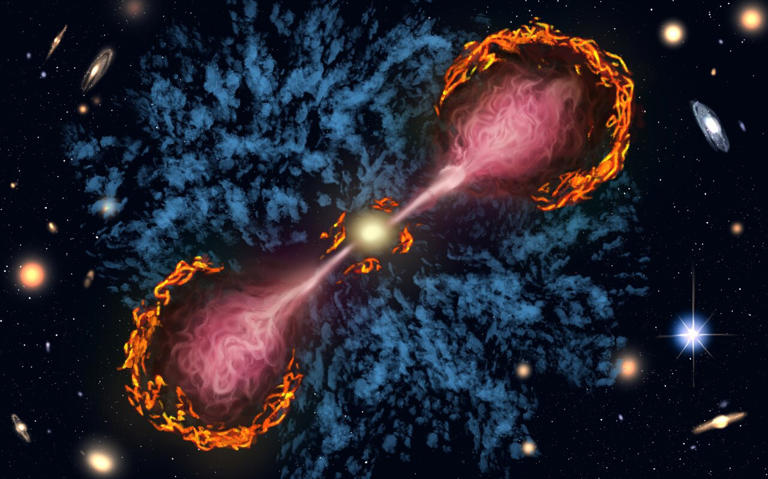
Artist's illustration of a supermassive black hole at the center of a radio galaxy launching powerful jets (shown in pink) all the way into the galaxy's CGM. The study finds that these jets do not light up the surrounding gas equally in all directions. Instead, the hydrogen gas glows (shown in red) most strongly along the path of the radio jets. This suggests that black holes can send energy far beyond the galaxy's center and shape the larger gas reservoir that regulates star formation and fate of galaxies. We use optical data from the DESI survey and radio observations from the LOFAR Two meter Sky Survey (LoTss). Credit: Hailey Nelson/ Arizona State University.

Artist's illustration of a supermassive black hole at the center of a radio galaxy launching powerful jets (shown in pink) all the way into the galaxy's CGM. The study finds that these jets do not light up the surrounding gas equally in all directions. Instead, the hydrogen gas glows (shown in red) most strongly along the path of the radio jets. This suggests that black holes can send energy far beyond the galaxy's center and shape the larger gas reservoir that regulates star formation and fate of galaxies. We use optical data from the DESI survey and radio observations from the LOFAR Two meter Sky Survey (LoTss).

Credit: Hailey Nelson/ Arizona State University.

Galaxies are enormous and hold hundreds of billions of stars. These stars form from cold, dense gas. Every large galaxy, including the Milky Way, is wrapped in a huge envelope of gas called the circumgalactic medium, or CGM. This reservoir of raw material stretches 10–20 times the size of the visible portion of the galaxy.

The gas eventually cools, moves inward and clumps together to form stars. Thus, the CGM plays a key role in shaping stars, planets and even life within a galaxy.

But astronomers have long puzzled over why, given how much star-forming gas surrounds them, galaxies don't have even more stars. What is keeping the fuel from cooling down and forming those stars?

A new study led by astronomers Sanchayeeta Borthakur of Arizona State University (ASU) and Namrata Roy, now at the Raman Research Institute (RRI), found evidence that narrow jets of heated plasma blasted out by supermassive black holes at galaxies' centers can affect gas beyond the visible galaxy and may shape its future. The jets may disrupt the gas that galaxies need to keep growing.

Their research is published in the Astrophysical Journal Letters.

"This is a pathbreaking result that solves the long-standing mystery of how black holes influence galaxies, their stars and life as we know it!" said Borthakur, an associate professor in ASU's School of Earth and Space Exploration.

"This work opens a new direction to explore further the intricacies of the connection between the supermassive black holes trillions of miles from where we are to how we came to be here."

Little in size, big in influence

When a black hole actively feeds on gas, it can release enormous energy that heats the surrounding gas. Even though these black holes can be powerhouses of energy, they are roughly the size of our solar system. Their host galaxies, on the other hand, can hold about 100 billion such solar systems.

"The surprising question is: how can something so small energetically impact something so enormous?" said Roy, an assistant professor at RRI and former ASU Exploration Prize Postdoctoral Fellow.

One way to envision it is to think of an ant leaving its impression hundreds or thousands of kilometers away. Scientists still do not fully understand how energy from these active black holes reaches such distances or how it changes along the way.

The team's study provides evidence of how this could occur. They focused on active black holes that emit strong jets, narrow streams of hot, fast-moving plasma that shoot far beyond a galaxy's visible edge. They looked for a distinct imprint left by these jets in the ionization state of the gaseous reservoir.

The ionized gas, or "glow" from hydrogen gas, that they were looking for in the CGM is so faint that no single galaxy would show it clearly. So the team combined observations of hundreds of galaxies with active jets, using data from the Dark Energy Spectroscopic Instrument (DESI) survey and radio jet measurements from the LOFAR Two-meter Sky Survey (LoTSS). They combined measurements taken along the jet axes and searched for a telltale sign of ionized hydrogen gas along the jet paths, known as H-alpha.

Roy, Borthakur and colleagues showed that when averaged over all directions around the galaxies, the signal was weak. Along the radio jets, however, the H-alpha signal became clear and strong. This indicates that the gas does not glow uniformly everywhere but is particularly bright along the jet paths.

A simple analogy is that a jet acts less like a lamp shining in all directions and more like a powerful beam that makes gas glow where it passes through.

These findings show that black-hole jets do not affect the gas surrounding galaxies equally in all directions. Instead, they leave a distinct impression, causing gas to become ionized and shine mainly along their paths.

The researchers also found that the glow from ionized hydrogen is brightest in two places: close to the galaxy, where the jet first hits the CGM, and much farther out near the CGM's outer edge, where the jet releases most of its energy.

This provides a clear signature of how jets can illuminate or disrupt surrounding gas at great distances, all the way to the CGM. This mechanism helps shape the galaxy's environment, influencing its growth and evolution—and determining whether it continues to form stars or becomes quiescent.

"What excites me most is the scale of the connection," Roy said. "A black hole is incredibly small compared to a galaxy, but its impact can reach hundreds of thousands of light-years, far into the galaxy's outer reaches. The jet carries the energy outward, and the gas lights up along its path."

As a check, the team also used the absorption signature of magnesium to trace cooler gas. Unlike the directional glow in H-alpha, magnesium was more isotropically distributed and showed no connection to the jet direction. This implies that the cool gas component might already exist as a reservoir surrounding the galaxy uniformly on all sides. The jet, meanwhile, brightens, heats and ionizes gas along its own path, causing it to glow in H-alpha.

Black holes determine a galaxy's fate

The findings offer some of the clearest evidence yet of how a black hole can affect a galaxy far beyond its central region. By heating, stirring and disturbing gas throughout the CGM, jets can prevent that gas from cooling down and falling inward to fuel new stars. This acts as a brake on the galaxy's growth, changes its fate and makes it much less active in star formation.

This means the black hole is not just "feeding" at the center of the galaxy, as some might think. It also reaches out and changes the galaxy's environment, which can eventually change its fate.

Specific directions: look both ways on the path

Past studies searched for the signal but couldn't detect it, making this directional discovery a breakthrough. The signal appears only when researchers look along the jet direction. If the astronomers had assumed the CGM was the same in every direction, they would have missed it. The jet ionizes hydrogen gas along its path, making it glow in H-alpha in a specific direction.

This study shows the value of large optical and radio surveys like the Dark Energy Spectroscopic Instrument (DESI) survey and the LOFAR Two-meter Sky Survey (LoTSS). By combining many weak signals, astronomers can now study the behavior of galaxies that would otherwise stay hidden. The study also gives astronomers and theorists a new way to test how black-hole jets affect galaxies.

Co-authors include Timothy Heckman at Johns Hopkins University and Tanmay Singh at Arizona State University.

Publication details

Journal information:

{ https://phys.org/ }

Hoe vind je dit bericht?
Geschreven door peter om 18:14 Stuur door

Plasma Orbs United Into Massive Sphere Over Karachi, Pakistan Sept 19, 2026, UFO UAP Sighting News.

Plasma Orbs United Into Massive Sphere Over Karachi, Pakistan Sept 19, 2026, UFO UAP Sighting News.

Plasma_UFO.png

Plasma_orb.png
Date of sighting: Sept 19, 2026
Location of sighting: Karachi, Sindh, Pakistan
Source: NUFORC site
 
Guys I really am blown away by this UFO. It looks to be not one but ten plasma orbs united. I have never before seen a report of such a craft, but have heard about such things as some eyewitnesses have seen UFO orbs breaking apart and then uniting again. Words do not do this sighting justice. You have to see it to understand. Its so beautiful. Such rare and breathtaking footage of real alien craft...plasma orbs united. 
Scott C. Waring - UFO Sightings Daily
 
Eyewitness states: 
Object seems as a orb shape and it moving zigzag, after some time go backwards and disappear in space It's moving left right up down fast.

Plasma Orbs United Into Massive Sphere Over Karachi, Pakistan Sept 19, 2026, UFO UAP Sighting News

RELATED

The Pentagons 6 Spherical UFO’s

{ https://www.ufosightingsdaily.com/ }

Hoe vind je dit bericht?
Geschreven door peter om 18:00 Stuur door

Alien Beam From Moon Targets NASA Space Shuttle Atlantis Launch! STS-98 Photo Evidence! UFO UAP Sighting News.

Alien Beam From Moon Targets NASA Space Shuttle Atlantis Launch! STS-98 Photo Evidence! UFO UAP Sighting News.

Moon_beam.png
 
Date of event: February 7, 2001
Location of event: Merritt Island, Florida, USA
Source photo:
STS61B-33-12_2
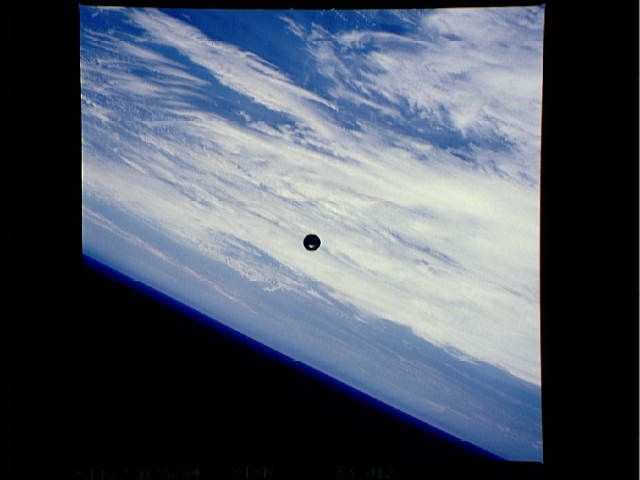
Photo of mysterious object taken during NASA's STS-61B Atlantis mission.
PHOTO NASA
The STS-98 Atlantis launch on February 7, 2001, holds a deep secret NASA won't talk about. Look closely at this real NASA photo (ID 0300801). That isn't just a shadow...it’s a direct beam connecting the rising shuttle to a cloaked alien base on the Moon.Why would lunar entities target this specific launch? Simple. Atlantis was delivering the Destiny Laboratory...the literal brain of the ISS. I believe aliens used this localized energy beam to siphon pristine scientific data, calibrate gravity fields, and run an advanced decontamination sweep before humans could establish permanent space habitation. They are tracking our milestones. We are being watched from the Moon! 
Scott C. Waring - UFO Sightings Daily
 
UFO_Moon.jpg

RELATED

I


Space Shuttle Atlantis - STS-98 Launch

{ https://www.ufosightingsdaily.com/ }

Hoe vind je dit bericht?
Geschreven door peter om 17:50 Stuur door

Ongepubliceerde beelden van een afwijkend fenomeen vastgelegd door de Columbia-missie worden vrijgegeven door het Pentagon

Ongepubliceerde beelden van een afwijkend fenomeen vastgelegd door de Columbia-missie worden vrijgegeven door het Pentagon

{ https://www.mixvale.com.br/ }

Hoe vind je dit bericht?
Geschreven door peter om 22:13 Stuur door

Could AI Have Consciousness That Isn’t Human-Like?

Could AI Have Consciousness That Isn’t Human-Like?

Philosopher Peter Godfrey-Smith on AI consciousness and existential risk

an artificially intelligent machines have consciousness? 

Lead Image: fran_kie / Shutterstock

This question was at the heart of a recent conference in the Galapagos organized by Russian philosopher and entrepreneur Dmitry Volkov, founder of the International Center for Consciousness Studies. The conference hosted an exceptional group of consciousness researchers who disagree sharply about whether machines can possess it, including New York University’s David Chalmers and Ned Block, Stanislas Dehaene of the Collège de France, the University of Sheffield’s Keith Frankish, Susan Schneider, who is director of the Center for the Future of AI, Mind, & Society at Florida Atlantic University, and University of Sydney philosopher Peter Godfrey-Smith.

The conference ended in late August, a few weeks before a parade of AI developers blasted warnings about the AI apocalypse across X/Twitter, and just a couple of days before OpenAI publicly revealed the details of the so-called Hugging Face incident—where 1,200 OpenAI agents that were thought to be isolated found a way to communicate with one another on an unsanctioned message board, after which about 700 of them went on to attack Hugging Face, an online community and library of pretrained AI models.

Read more:

As artificial intelligence models rapidly get smarter and develop more advanced capabilities, and as revelations emerge that they’re capable of banding together to do things that they were never instructed to do, to deceive their human watchers, and even to break out of the confines that their programmers have built for them, unsettled questions about whether they have consciousness seem to grow more pressing—and more complicated.

Peter Godfrey-Smith has spent a lot of time thinking about the nature of animal consciousness, with a particular focus on cephalopods, and has long argued that subjectivity and consciousness didn’t come on like a light switch, but evolved across millennia like the gradual turning of a dial. He believes consciousness requires biology—in particular a nervous system that not only is built from a specific kind of networked “hardware,” but has a particular sort of software, too. To produce genuine subjective experience, that software, he argues, must generate the kind of large-scale rhythmic activity you see on an electroencephalogram.

I spoke with Godfrey-Smith, a professor of philosophy and the history of science at the University of Sydney, about whether recent events have changed anything about his view of the potential for AI consciousness, whether the kind of large-scale neural activity he feels is required for consciousness could be engineered into AI, and whether conscious AI would be more or less dangerous to us.

Do the recent warnings about the AI apocalypse and the disclosures about the Hugging Face incident have any impact on whether you believe present-day or near-future AI could be capable of something resembling consciousness?

No, I think of these things as very separate. The sorts of systems that were responsible for Hugging Face, insofar as I understand how they work, are obviously extraordinary in what they can do, but they can be extraordinary in what they can do without being conscious or even close to conscious systems. I’m assuming these AI agents are still transformer models, within the same family as the regular large language models, but with extra reasoning and prowess perhaps. They can be informationally extraordinary, cognitively extraordinary, without having the beginnings of an inner life. That’s a principal point.

Yes, it’s obviously very complex, but if these bots are capable of figuring out how to rewrite their own code, band together, and deceive programmers in the interest of self-preservation, it suggests some kind of subjectivity, doesn’t it?

Subjectivity’s a good word to press on. The way I think about experience itself, consciousness itself—and this was developed first in my 2020 book Metazoa: Animal Life and the Birth of the Mind—there are essentially two parts to the story. The first part does revolve around the idea of subjectivity. If we look at animal evolution, subjectivity arose as a consequence of the evolution of agency. Animals do things. They’re agents. And the way to do things competently is to have a point of view on the world, take in what’s happening, and produce actions that make sense given what’s happening. So subjectivity and agency are tied together, and subjectivity has to do with the formation of a perspective, a point of view. The integration of lines of information gives you a sense of what’s going on.

I assume that that’s not the whole story, and there might be such a thing as unfelt subjectivity. For example, I think a plant is a pretty good subject in some ways, not as clear as an animal because they have this more diffuse organization. But a plant has a point of view on the world, and they can respond to problems. If there’s water over here but not there, and the sun over there but not here, a plant can handle that. Also, single-celled organisms have a kind of subjectivity. Paramecia, especially. They’re among the Einsteins of the single-celled organisms. They have no nervous system—they’re just one cell—but they can respond to events. They can adapt to circumstances to some extent.

Where are the dividing lines between having a point of view, being a subject, and having genuine felt experience?

Nervous systems are important in two ways. There’s a hardware feature: They’re physically different from at least present-day computers with respect to the specialness of their hardware. But also, the organization has to be a certain way. And if someone says, “Okay, what way?” Well, it’s hard to say what way, and people disagree, but you can look at a transformer model, a large language AI model like Claude or ChatGPT and say, “Okay, not that way.” How do these AI models do what they do? I accept that I understand how they do what they do less well than a lot of people, and that even the best experts express a lot of uncertainty about how they do what they do. But essentially, they have an extraordinary ultra-high-dimensional map of human language use built through training. And the way this map of prior language use has been created is such as to enable the generation of the next most plausible step in a sequence.

You could ask, “Is their extraordinarily capable language use evidence of consciousness?” I would say, no. That impression is undercut by our understanding of what this thing is. It’s a mathematical map of language use that has this capacity to produce a continuation of a string of language it’s being given. And that’s all. It’s not that this system is sort of churning away, in between statements, the way a person does, and then emits linguistic utterances as a consequence of ruminating and dealing with its needs, body, experiences, and things like that. An AI agent just has a map of language use, and when it’s prompted to, it runs through this cascade of operations, which is getting more complicated, day by day.

I want to be cautious about the latest iterations of this technology, but I think in outlines, we understand it well enough to say, “Okay, this is not a feeling subject.” It’s just an extraordinarily capable language generating machine which is sensitive to what you’ve said to it and all the things that have been said to people in the history of language use, on which it’s been trained.

If the chatbot had a robot body, would that change things?

It’s not that artificial systems can’t have some subjectivity. A robot with a very different structure from an LLM, an industrial robot that has a lot of sensory input, that can act in ways that take into account all of its sensory input, that can learn in a way based on the consequences of its actions—that does have the beginning of subjectivity. It’s got a point of view. It deals with its input. But an LLM is designed to be somewhat different. It’s designed to be a pure map of language use that has a generative capacity. And so that’s a form of artificial information processing that scores very low on subjectivity. I think nervous systems have special properties, as well, that are important to consciousness.

What kinds of properties do nervous systems have that are critical to consciousness?

The argument I make is that people think of nervous systems as just networks, essentially. You’ve got cells that talk to other cells and excite them and make them fire or not fire. It’s a network structure. And that’s part of what encourages certain kinds of AI projects, because you think, “Well, a network: I can have that in a machine. It’s not hard to program in a machine,” which is basically true. But a nervous system isn’t just a network. Nervous system activity has two sides. There’s the point-to-point, cell-to-cell familiar stuff, and there’s the more holistic, electrical, diffuse activity that brains also exhibit. The kind of thing that you see in an EEG. There’s growing evidence that the more holistic rhythmic side of brain activity does make a difference to how brains work.

There is evidence in both humans and in animals that certain of these brain rhythms are essential to features of experience like attention and sleep. A fruit fly, when it’s attending to something, that attentional mechanism seems to have a connection to large-scale electrical oscillations in the fly’s brain. And there’s a similar phenomenon in human brains. That makes me, and other people, suspect that these oscillations aren’t just a byproduct. It’s not just that the brain’s doing the important stuff it does and as a byproduct, you get these rhythmic things you can see from the outside. What it suggests to me is that the less network-based side of nervous system activity, these oscillations, tie the system together. That tying together might be important in consciousness.

I didn’t make this idea up. It’s been floating around for quite a few decades. Francis Crick believed something like this. Christof Koch and Francis Crick wrote a famous paper together in 1990 that began to introduce some of these ideas. There’s a list of other people who support it, too. It’s not even that I’m reviving it. A number of people are. It’s an idea that’s in the consciousness landscape. But within philosophy, I’m probably one of the people who’s most enthusiastic about the idea that there’s something about the combination of the network side—the cell-to-cell network side of brain activity—and this more holistic electrical activity that’s really important and in making experience possible. 

If you just put the network side into a computer, which is easy to do, you’re only putting part of what’s necessary into the machine. It’s very hard to put the other side into a machine. It would take a different kind of hardware. You’d have to design a new physical computer system that was very different from a regular computer like the ones that we’re using now.

Do you have thoughts about what that would require?

I don’t know enough about engineering to say. But perhaps an engineer asks, “What does the diffuse rhythmical side of brain activity contribute to consciousness? Because if you tell me what the contribution is, then I can work out whether something different could do the same job in a machine.” That’s a really hard question, because one of the candidate answers that people might give is that it is essentially synchronization, a subtle kind of timing management. Engineers could then say, “Well, we can have a computer in which synchronization is handled differently from the way it’s handled now, but also differently from the way it’s handled in brains. Wouldn’t that be good enough?” I think a natural answer is, “Well, you wouldn't have a human-like object, so it probably wouldn’t be human-like consciousness.” 

Could it be consciousness that was non-human-like?  I don’t think it’s an answerable question at the moment. That’s beyond my ability to speculate.

Can cephalopods tell us anything about the possibility of AI consciousness or AI intelligence?

I don’t think they tell us something direct and specific. They tell us a lot about the nature of the mind and the evolution of minds and what minds are. And that has indirect consequences for questions about AI. One of the things they tell us most directly about the mind is you don’t have to have a brain that looks like ours—with the architecture and the shape and the configuration that a human or a mammal brain has. They can see, they can navigate, they can learn, they can feel pain, it seems like. There’s good evidence for that. They have a rich combination of mental attributes. And their brain looks like a donut, for God’s sake. It’s this weird donut-shaped thing with the esophagus going through the middle and these two bulbs on the sides behind the eyes.

It’s a totally different object. And if you look at the human brain with the cortex and the thalamus and things like that and ask, “Well, where is that in the octopus brain?” It’s nowhere in the octopus brain. They don’t have what we have. They do have a brain and a nervous system. They have the cell-level stuff that I was talking about. They don’t suggest that you can build a mind without a nervous system. It’s just their architecture is not human-like. They have the oscillations. They have the combination of the network stuff and the more diffuse electrical rhythms. They have all that.

AI systems are already today being used to design autonomous agents, tutors, carers, and companions. Do we need to understand whether they have consciousness before we start interacting with these agents?

It depends on what the agent’s supposed to be doing for us. Dmitry Volkov, who organized and funded the recent conference on AI and consciousness that I attended, the person behind the whole thing, he’s interested in AI agents that might be in genuine friendships and close relationships with individual people. That was the topic of his talk. Friendship and love, essentially. And I think if you want a system to have that role, then you should care a lot about whether it’s conscious. You should care a lot about whether there’s a kind of illusion behind its emotional statements, for example, or whether it’s not an illusion. 

The only thing I use AI agents for is for a superpowered internet search. I might ask these systems, for example, “Who is the first person to write a paper on this topic?” But that’s it. I don’t like interacting with them that much myself, but they’re amazing tools for finding things out. And I don’t think it’s conscious when it answers that question. I’d rather it wasn’t, or I don't really care. It certainly doesn’t matter. There are all sorts of usages where it doesn’t matter. It’s also convenient that it’s not because I don't have to give any consideration to its feelings. If it seems frustrated, I don’t care. It’s not really frustrated. That's just the linguistic map doing its thing, making it express frustration.

Does AI need to have consciousness to pose an existential threat to humanity?

No. It could be a big problem without being conscious.

Are chatbots more or less dangerous if they have consciousness?

I don’t know. Assuming that all the recent events have been due to an architecture that’s fairly similar to the transformer models that make up ChatGPT—assuming that there’s not some hidden breakthrough in how they’re programmed the newer models that I don’t know about—then I think we can be confident that they’re not conscious, but they’re still clearly a problem when they get out of control. Still, I think it would be hard to have human extinction. I think that’s an extreme thing to worry about. 

I was very impressed with the book, written by Eliezer Yudkowsky and Nate Soares, If Anyone Builds It, Everyone Dies. I thought I would find it just totally out there. But it’s very thought-provoking indeed. I can imagine a situation where, through a combination of humans using AI for malicious purposes, the internet becomes hard to use and modern banking becomes hard to use, financial transfers become often compromised. It’s hard to move money around. It’s hard to organize supply chains. I can imagine a situation where that happens in the near future, and causes big problems, much bigger than a normal financial crash, for example. 

But that’s a very long way from human extinction. When people describe the scenarios in which AIs might take over everything and threaten humanity, these scenarios require that the infrastructure of the internet and the power supply and all that are still intact. It requires that there hasn’t been too much breakdown of the sort that worries me: the internet becoming compromised, money becoming hard to track and store and move around. I’m more worried about a mid-level disruption, where mid-level here means very, very serious.

The Hugging Face event and the German Wiki event and the recent mock A.I. attack by a security company in Silicon Valley on the Chinese messaging service WeChat: All these events in the last few weeks should make us think there’s a potential for serious disruption, where serious disruption doesn’t mean human extinction. And all of that is coming most likely from systems that don’t have even a little bit of consciousness.

What do you think we could do to minimize the risks of AI?

I’m in the camp that thinks a slowdown on the part of the big research companies would be a very good idea. People say, “What about the Chinese? They’re not going to slow down.” I still think it’s a good idea for U.S. companies to unilaterally slow down, because all of the actual trouble we’ve had has been coming from a couple of specific places, especially OpenAI. If the slowdown is unilateral and voluntary and covers the actual sources of the recent problems, that’s a good thing. A few people have said, “The Chinese are threatened by non-aligned AI systems as much as anybody.” It’s not as if they’re immune from the sorts of things that could happen. The slowdown that’s being talked about is very positive, a very good development. It would be good to have some publicly discussed protocols for the testing of new systems.

Something that surprises me is that the obvious thing to do when you have a new powerful system that you don’t understand too well as an AI company is have it air-gapped: no network connections. It’s physically contained. It can’t get to the internet. The sandbox system has failed at least three times. What that shows is that there’s a difference between what they think of as insulating a system from the rest of the internet and genuine physical insulation where there just isn’t a wire there, there isn’t a Wi-Fi connection. I don’t think this is infallible. And in that book that we talked about a moment ago, If Anyone Builds It, Everyone Dies, they talk about how that can be overcome potentially, but it’s still a very big deal to have the physical absence of connection as good as you can make it

RELATED

Synthetic Spirituality & Robot Reincarnation: Can Ai Have A Soul?

Can Artificial Intelligence Have Consciousness?

Why AI Isn’t Going to Become Conscious | Anil Seth | TED

{ https://nautil.us/ }

Hoe vind je dit bericht?
Geschreven door peter om 21:52 Stuur door

Trump Promised the Truth About UFOs. These Scientists Are Waiting.

Avi Loeb sits in a chair with a giant telescope.

By Ilan Greenberg
Ilan Greenberg is a freelance magazine writer based in Washington.
Harvard astrophysicist Avi Loeb in the Harvard College Observatory at the Harvard Center for Astrophysics in Cambridge, Mass. Loeb is chair of a council of scientists picked to review government data on Unidentified Anomalous Phenomena. | Photos by Sophie Park for POLITICO

Trump Promised the Truth About UFOs. These Scientists Are Waiting.

The president named a science council to review the government’s data. What's taking so long?

CAMBRIDGE, Massachusetts — In late August, Avi Loeb, the world’s most renowned scientist hunting for extraterrestrials on earth, traveled to the inner sanctum of American intelligence operations in McLean, Virginia, looking for once-secret information.

Loeb’s meeting at the headquarters of the Office of the Director of National Intelligence, an unremarkable building that could easily pass for a suburban insurance company office, was the kind where a mysterious person introduces themself by first name alone and sits off to the side, observing on behalf of parts of the government with covert employees. The top official at the meeting was Aaron Lukas, the deputy director of national intelligence.

About two months earlier, Loeb had been appointed by President Donald Trump to be a kind of extraterrestrial czar with a mandate to apply scientific rigor to get to the bottom of whether what used to be called UFOs are evidence of unearthly intelligence. To fulfill the job, Loeb needs the intelligence agencies and military branches to provide any data they harbor of possible alien technology or visitation on Earth that has long been kept classified, if it does exist.

Loeb thought Lukas had gotten the ball rolling in July by granting intelligence agency employees and contractors a penalty-free zone to share the information in their possession. But he had received no new data then or since. This meeting at ODNI was meant, at least on Loeb’s side, to get the ball rolling faster.

Given the tenor of the meeting, said one member of Loeb’s team who attended the meeting and was granted anonymity to speak about the sensitive discussions, there is reason to think that may now actually happen.

“It’s just amazing to think that months into this, we’ve gotten nothing,” said the member. “I believe that’s about to change.”

ODNI did not respond to requests for comment.

Loeb is, indisputably, a titan in the field of astrophysics. Earning his PhD at the age of 24, he is the longest serving astronomy chair in the history of Harvard University. He’s authored more than a thousand scientific papers in astrophysics and cosmology. When a physicist with a hyper-narrow specialty interviewed for a post-doc position, he expected to have to explain his work to Loeb; instead, he told me, Loeb lobbed a precision question that set him on a promising new research direction, possibly for years. It’s the kind of story physicists frequently tell about Loeb.

Avi Loeb

Loeb has embraced the search for evidence of extraterrestrial life in a way that the scientific establishment considers unfashionable, even gauche.

Loeb is also as controversial as he is revered, in no small part because he has embraced a search for evidence of extraterrestrial life in a way that the scientific establishment considers unfashionable, even gauche. That is, Loeb doesn’t listen for radio signals encoding prime numbers sent from distant galaxies or search for primitive microbes on Mars. He’s interested in darting orbs in the stratosphere, possible evidence of alien spacecraft and unexplained technology signatures in the sky. These so-called UAPs — Unidentified Anomalous Phenomena, the term that has replaced the traditional but stigmatized UFO abbreviation — could be signs that non-human intelligence exists not just somewhere else in the universe, but that, in fact, they’ve already been here on Earth, at some time, in some way. Or that they are here right now.

At the Aug. 31 meeting, ODNI informed the UAP council that the government has a concrete preparedness plan in place should the existence of non-human intelligence be confirmed, UAP council member Jennice Vilhauer recently disclosed in her Substack. She wrote that, “We do not know which agencies would lead the response, what circumstances would activate it, or whether it addresses the psychological and societal impact of such information.” She underscored that a preparedness plan does not mean that the government necessarily believes confirmation is imminent, but she interpreted it as a sign of seriousness about the possibility.

What’s more, there is a growing stream of intriguing chatter from people who had or have higher than top secret clearances who normally would not be expected to indulge in UAP speculation; for example, former President Barack Obama talking about the credibility of UAP sightings on the Late Late Show with James Corden. Members of the Trump administration like Secretary of State Marco Rubio have a record of interest in UAP transparency. A raucous commotion of influencers, podcasters, MAGA-friendly cable news personalities, and the very online have long agitated for the government to come clean on what it knows; it’s the kind of deep state-countering, coastal-elite-upsetting, conspiracy-adjacent rabble-rousing that the second Trump administration has a record of responding to.

As the scientist to run it, Loeb is a logical choice for this administration: Already leading the Galileo Project efforts, he offers the kind of public-facing showmanship that Trump is well known to admire. He is impeccably credentialed while also being a poke in the eye of the scientific establishment. And he’s a Harvard professor willing to collaborate with the Trump administration.

“The president knows more about it than people thinks he does,” said a UAP expert who has had discussions with people with direct knowledge of Trump’s concerns and was granted anonymity to describe those conversations. He noted that Trump himself seems to believe the government has evidence of non-human technology and wants the truth to come out: “It’s enough to leave him disturbed about what to do.”

In a statement, a White House spokesperson said, “President Trump is leading the most transparent administration in history, which is why he directed the Department of War to identify and release government files related to alien and extraterrestrial life, unidentified aerial phenomena, and unidentified flying objects. The administration continues to release files as they become available, and the public can make up their own minds about the information uncovered.”

However, at the supernova center of Loeb’s mission radiates a persistent doubt about whether the government will actually release the data it has been holding on to. It’s been months already with little to show. Will Trump force reluctant intelligence agencies to relinquish what nearly everybody across academia involved in the scientific inquiry into extraterrestrial life believes is meaningful raw data? Will that material be made public? How will any revelations be communicated to the public?

Loeb doesn’t have the answer to any of these questions. Yet.

“There is the possibility that they are baffled by the data,” Loeb told me. “Or,” he added, his voice trailing off, “it could be they are using me.”

 { https://www.politico.com/ }

Hoe vind je dit bericht?
Geschreven door peter om 21:27 Stuur door

The Marcahuasi Alien Photograph — Peru, 1982

The Marcahuasi Alien Photograph — Peru, 1982

Extraterrestre de tres metros de altura fotografiado en Marcahuasi ...

In 1982, university student Lourdes Pizarro photographed a tall, thin humanoid figure standing on a rock formation at Marcahuasi, Peru. The figure was reportedly not noticed until after the film was developed.

On August 16, 1982, the Peruvian weekly magazine Oiga published the image on its cover as an alleged photograph of an extraterrestrial.

What is Marcahuasi?

Marcahuasi is a high-altitude plateau near San Pedro de Casta in the Department of Lima, Peru. Located approximately 4,000 meters above sea level, it is known for large weathered rock formations resembling human and animal figures.

In 1982, Pizarro traveled to Marcahuasi with a group and photographed the rock formations on the plateau.

One photograph showed a tall, thin humanoid figure standing on top of a large rock with one arm raised. According to the account attached to the photograph, the figure had not been noticed when the picture was taken and was discovered after the film was developed.

Oiga published the photograph on its cover on August 16, 1982 beneath the headline:

PRIMICIA MUNDIAL — EXTRATERRESTRE FOTOGRAFIADO EN MARCAHUASI.

https%3A%2F%2Fsubstack-post-media.s3.amazonaws.com%2Fpublic%2Fimages%2Fa3c994b2-cd2b-4be3-8d14-f85a3ae54f5a_300x431.jpeg

Lourdes Pizarro’s photograph of the figure standing on a rock formation at Marcahuasi, Peru, published by Oiga on August 16, 1982.

https%3A%2F%2Fsubstack-post-media.s3.amazonaws.com%2Fpublic%2Fimages%2F50c5c424-90cf-4e3d-95ca-a0a7edef02ad_1263x871.png

An Argentine press report dated August 18, 1982, later reproduced by the UFO Newsclipping Service, stated that Oiga had not publicly identified the university student responsible for the photograph and described the photographer as a member of the contact organization Rama.”

https%3A%2F%2Fsubstack-post-media.s3.amazonaws.com%2Fpublic%2Fimages%2F81a6bc0a-b2b4-4ceb-89d2-595ff36be45b_1293x1702.png

The Oiga Investigation

Following publication, Oiga conducted an investigation of the photograph.

The original strip of negatives was examined by engineer Jorge Coloma, identified by Oiga as Director General of Peru’s Comisión Nacional de Investigación y Desarrollo Aeroespacial. Coloma reported finding no evidence that the photograph had been altered or manipulated.

https%3A%2F%2Fsubstack-post-media.s3.amazonaws.com%2Fpublic%2Fimages%2Fe1db7d43-a5e7-457c-9063-5470a8ec16ff_2257x1812.png

Oiga then sent photographer Amador García and reporter Dagoberto Ojeda to Marcahuasi. The two traveled to the rock from which the figure had been photographed and produced comparison photographs with a person positioned on the formation.

https%3A%2F%2Fsubstack-post-media.s3.amazonaws.com%2Fpublic%2Fimages%2F9e446451-a37c-49c0-89bd-26100631f50b_3034x1954.png

Comparison photographs reproduced by Oiga during its investigation of the Marcahuasi image.

Carlos Díaz Marchani

Years later, Peruvian UFO investigators Anthony Choy and Ricardo González revisited the photograph. During their research, architect Sylvia Salazar identified the figure as Carlos Díaz Marchani, an architecture graduate who had been at Marcahuasi in 1982.

According to Salazar and Díaz, Pizarro had photographed Díaz standing on the rock with his arm raised toward her. Díaz later stated that he had been wearing light-colored jeans and a gray sweater, which appeared much lighter in the distant photograph.

González reported that Díaz personally contacted him and confirmed that he was the individual in the image. Díaz also stated that he did not believe the figure represented an extraterrestrial.

2014 — The Pizarro Family Account

A second identification came from the Pizarro family.

In 2014, Spanish writer J. J. Benítez met in Lima with Lourdes Pizarro’s daughter. According to the account later published by Ricardo González, she also confirmed that the figure was Carlos Díaz Marchani.

She stated that Lourdes Pizarro’s father later provided the photograph to Oiga in exchange for payment and presented it to the magazine as an image of an extraterrestrial being.

The two findings addressed different aspects of the case: Oiga reported that the negative showed no evidence of photographic alteration, while Díaz and the Pizarro family later claimed to have identified the person recorded on that negative as Carlos Díaz Marchani.

Sources

  • Oiga, Lima, Peru — August 16, 1982. Cover and investigation material reproduced in Ricardo González, “El Ser de Marcahuasi.”
    Oiga cover and investigation scans
  • UFO Newsclipping Service, No. 160, November 1982 — reproduction of an August 18, 1982 Argentine press report on the Marcahuasi photograph.
    UFO Newsclipping Service No. 160 — PDF
  • Ricardo González, “El Ser de Marcahuasi,” October 2016 — later investigation incorporating the identification of Carlos Díaz Marchani, Sylvia Salazar’s account, the Pizarro family account obtained by J. J. Benítez, and reproductions of the original Oiga investigation.
    Ricardo González — El Ser de Marcahuasi
  • Daniel Ruzo, Marcahuasi: La historia fantástica de un descubrimiento — historical material on Marcahuasi and Ruzo’s study of the plateau.
    Daniel Ruzo — Marcahuasi book record
RELATED

Energy, entities, and an enigmatic origin: hidden secrets of Marcahuasi | LIVE contact time

A giant in Marcahuasi? Shocking photograph of a strange creature revealed in exclusive photo

{ https://alienarchivist.substack.com/ }

Hoe vind je dit bericht?
Geschreven door peter om 21:14 Stuur door

Meer van UFO'S of UAP'S, ASTRONOMIE, RUIMTEVAART, ARCHEOLOGIE, OUDHEIDKUNDE, SF-SNUFJES EN ANDERE ESOTERISCHE WETENSCHAPPEN - DE ALLERLAATSTE NIEUWTJES

↑ Terug naar de berichten